Pancake morning has one small unfairness built into it: the person holding the spatula usually eats last. While everyone else gets a hot stack, you are still standing at the stove pouring, flipping and starting the next batch.
Sheet pan pancakes fix that. One batch goes into one rimmed pan, everyone gets a warm square together, and the result should still taste unmistakably like pancakes: lightly browned underneath, soft and buttery through the middle, ready for melting butter and maple syrup.
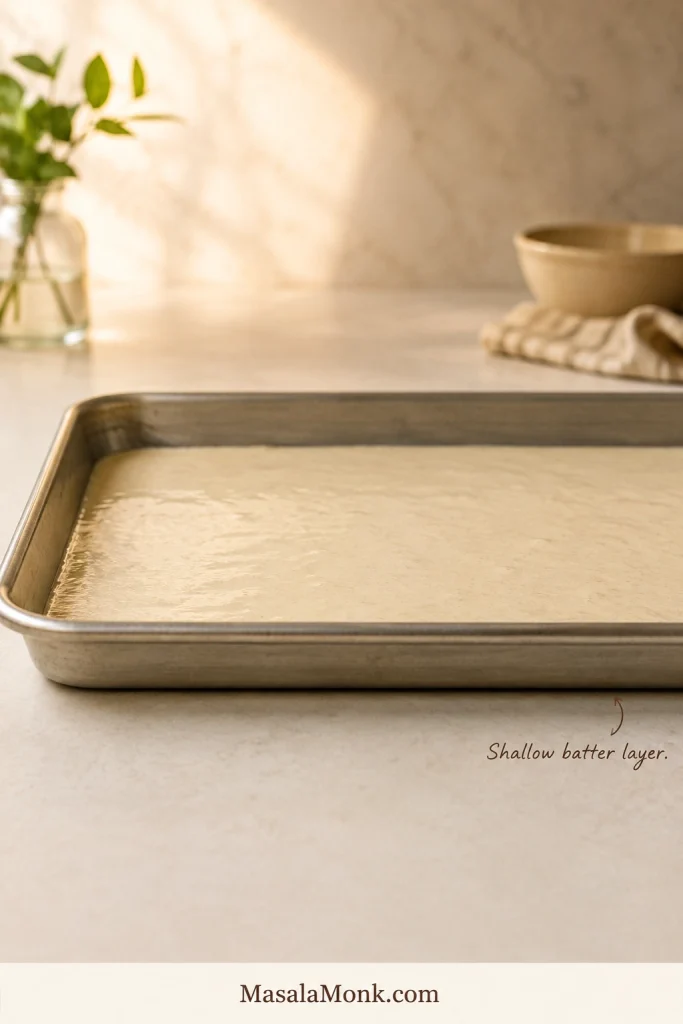
This recipe is sized for a 13×18-inch rimmed half-sheet, so the batter stays shallow enough to bake through without leaving you with dry edges and a slow-cooking middle.
Spread thick-but-pourable buttermilk pancake batter evenly in a 13×18-inch (33×46 cm) rimmed half-sheet pan. Bake at 425°F / 220°C and start checking at 12 minutes. Most trays finish in 12–16 minutes.
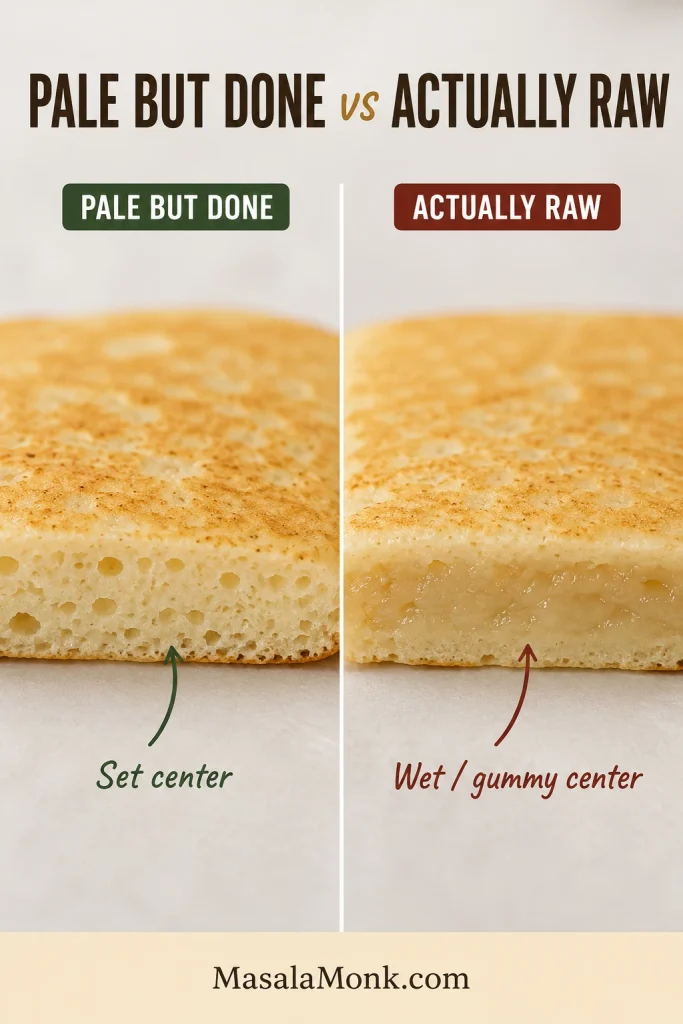
The middle should look set and show no wet batter when checked. A lightly golden top is completely fine—you don’t need the deep browning of a pancake cooked on both sides of a griddle.
Sheet Pan Pancakes Recipe
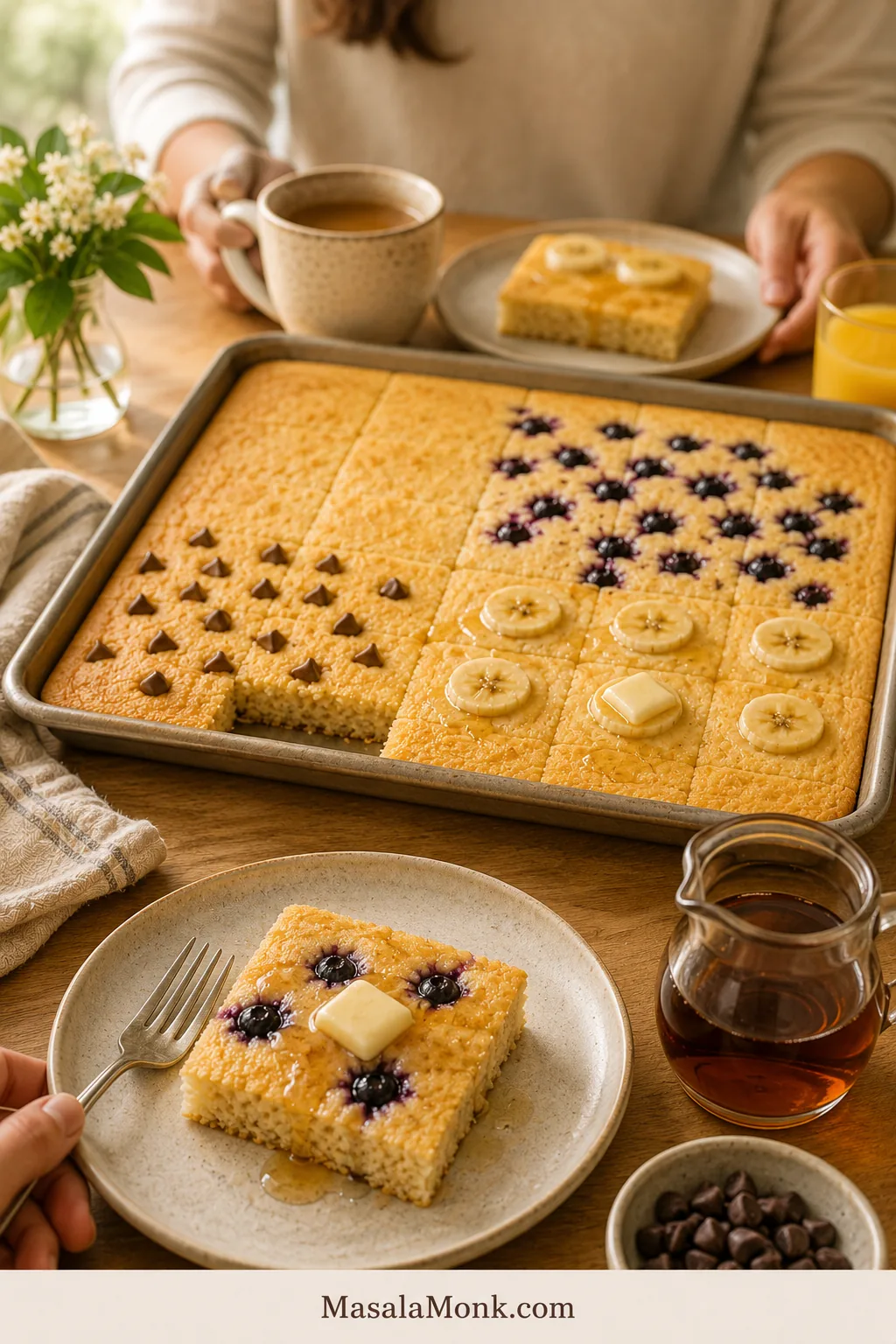
Make the whole tray plain, scatter one topping across it, or divide the batter into flavor zones so everyone gets the pancake they actually want.
Recipe at a Glance
Prep
About 10 minutes
Bake
12–16 minutes
Total
About 25–30 minutes, including a brief rest before cutting
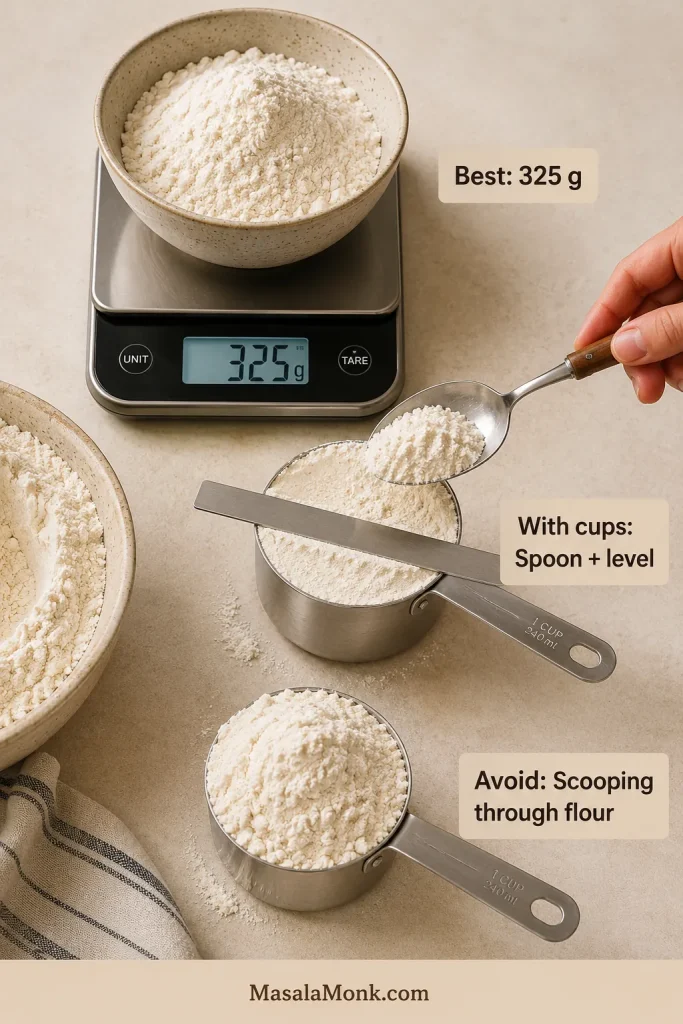
Digital kitchen scale, especially useful for the flour
Ingredients
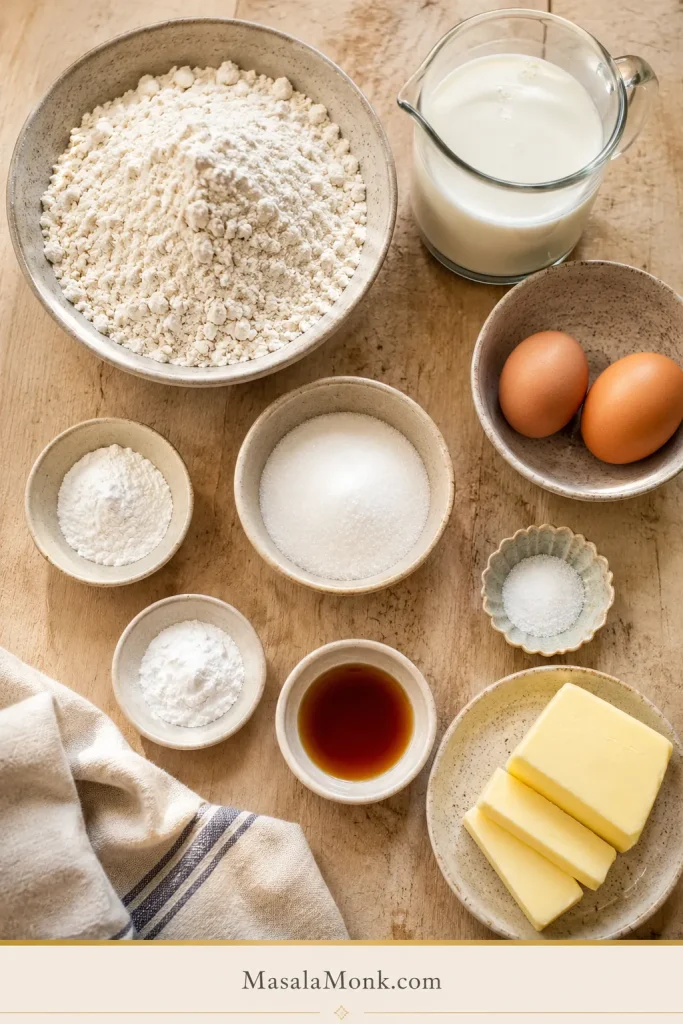
325 g (11.5 oz; about 2⅔ cups) all-purpose flour, spooned and leveled if using cups
50 g (¼ cup) granulated sugar
1 tablespoon baking powder (12 g)
¾ teaspoon baking soda (about 4 g)
¾ teaspoon fine sea salt (about 4–5 g)
2 cups / 480 ml buttermilk
2 large eggs
4 tablespoons / 57 g unsalted butter, melted and cooled slightly
2 teaspoons vanilla extract
1 tablespoon / 14 g butter, softened or melted, for the pan
Flour and leaveners are especially worth measuring carefully: flour affects batter thickness, while small leavener errors can change rise and flavor.
Optional Toppings
These are useful starting amounts for one full tray. There is no need to pull out a scale just to scatter a few berries.
125–150 g blueberries, about ¾–1 cup
100–120 g chocolate chips, about ½–⅔ cup
1 medium banana, thinly sliced
75–100 g strawberries, about ½–⅔ cup sliced
60–80 g pecans or walnuts, about ½–⅔ cup chopped
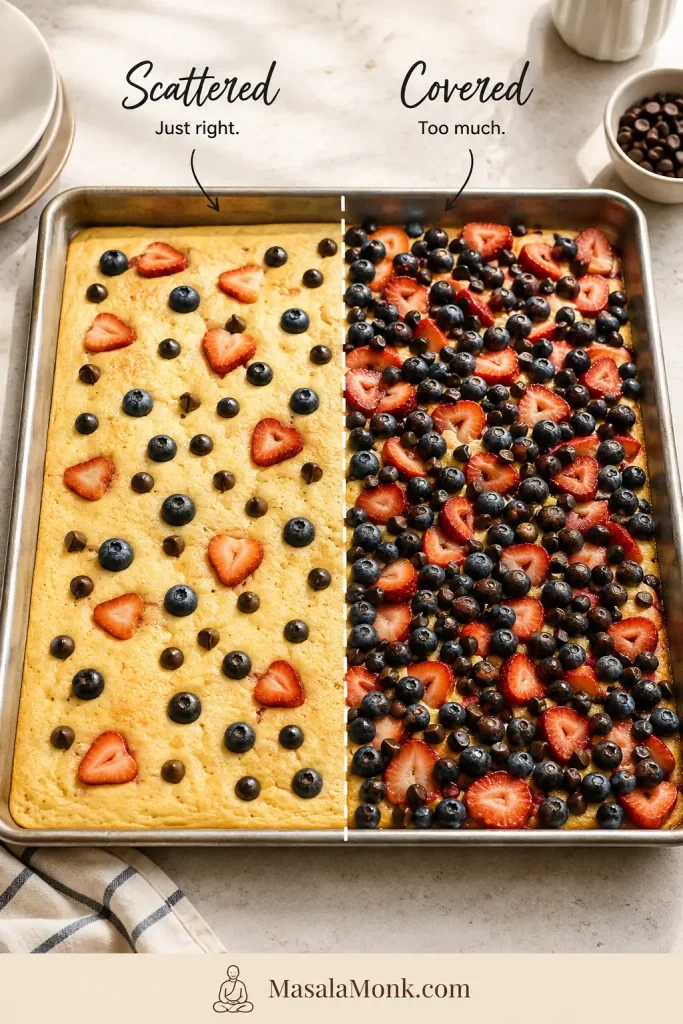
For several flavors on one pan, use less of each. Plenty of batter should remain visible between the toppings.
How to Make Sheet Pan Pancakes
Preheat the oven. Put a rack in the middle and heat the oven thoroughly to 425°F / 220°C conventional or 400°F / 205°C fan/convection, unless your oven automatically adjusts for fan cooking.
Prepare the pan. Butter the half-sheet, including the corners and sides. You don’t need to preheat the pan for this version; starting at room temperature gives you time to spread the batter evenly. If your pan has a history of sticking, line the base with parchment and lightly butter it.
Whisk the dry ingredients. Combine the flour, sugar, baking powder, baking soda and salt in a large bowl.
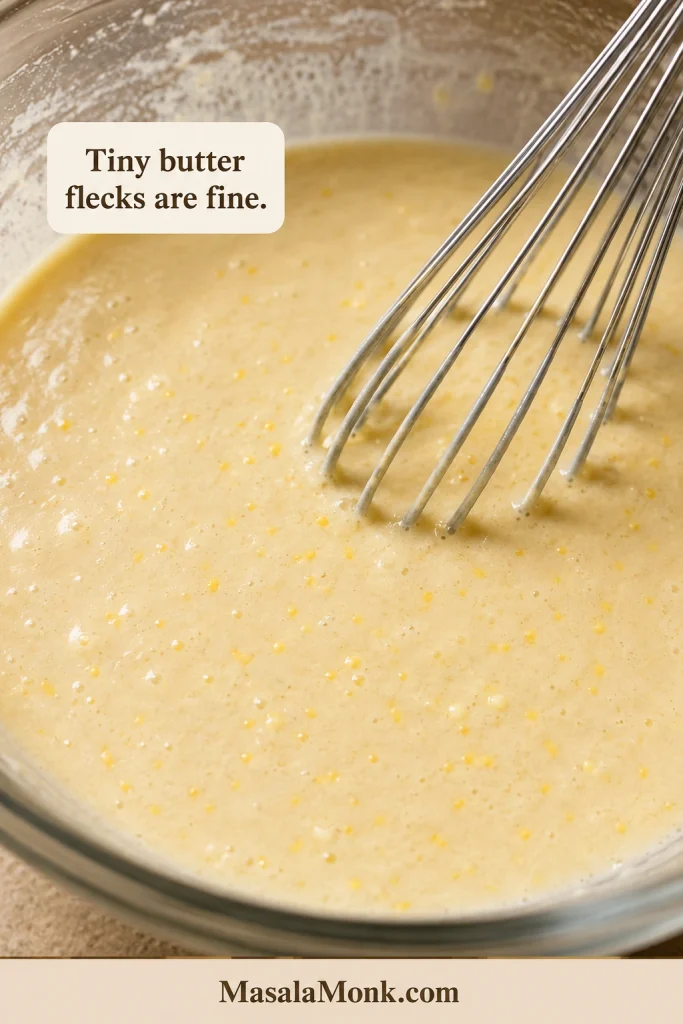
Mix the wet ingredients. In another bowl or large jug, whisk the buttermilk, eggs and vanilla. Whisk in the cooled melted butter. Cold buttermilk may make the butter form a few tiny flecks; that’s fine. They’ll melt in the oven.
Tiny butter flecks are normal when melted butter meets cold buttermilk. They will melt in the oven.
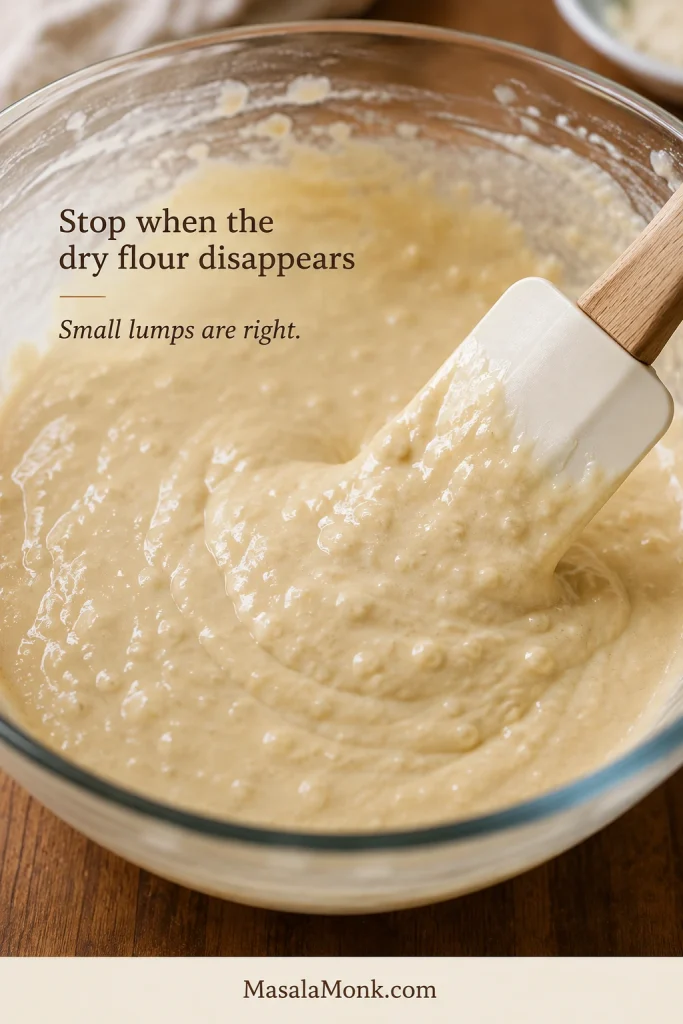
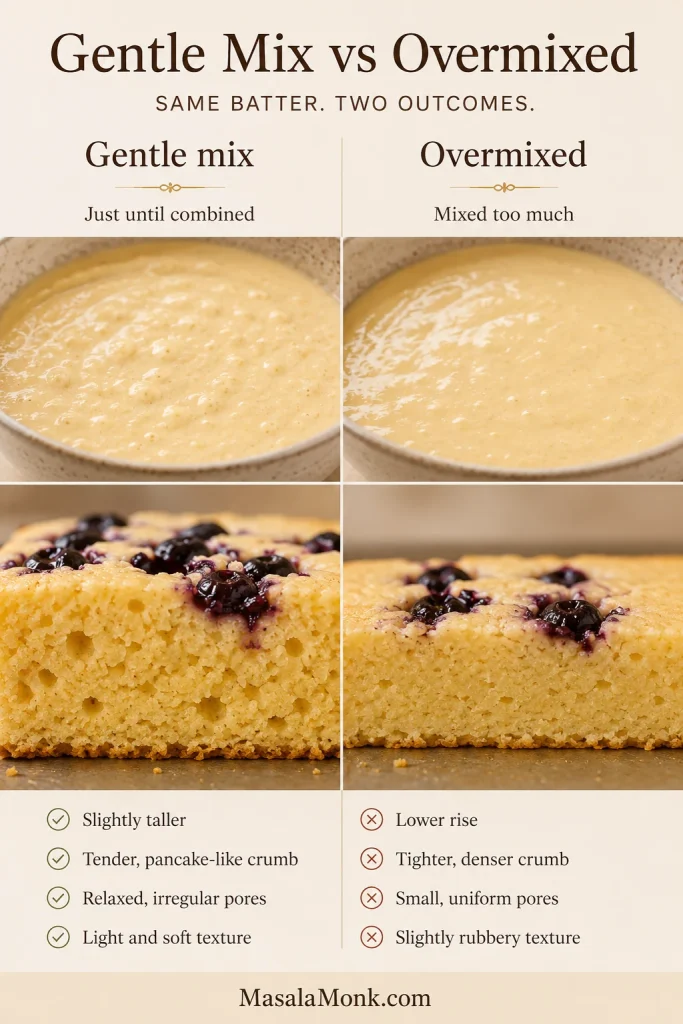
Fold the batter. Pour the wet mixture into the dry and fold gently with a flexible spatula. Stop as soon as the dry flour disappears. A few small lumps are exactly what you want.
Scrape the bowl once for hidden dry flour, then stop. Small lumps should remain.
Spread, Top and Bake
Spread it promptly. This batter doesn’t need a deliberate long rest. Pour it into the prepared pan, ease it toward the corners and give the tray a gentle jiggle to even the surface.
The batter should sit shallowly in the half-sheet. If it looks deep now, fix the pan or amount before baking.
Add toppings. Scatter them over the surface, leaving plenty of batter visible between them.
Leave plenty of batter visible between toppings. Coverage matters more than counting individual berries or chips.
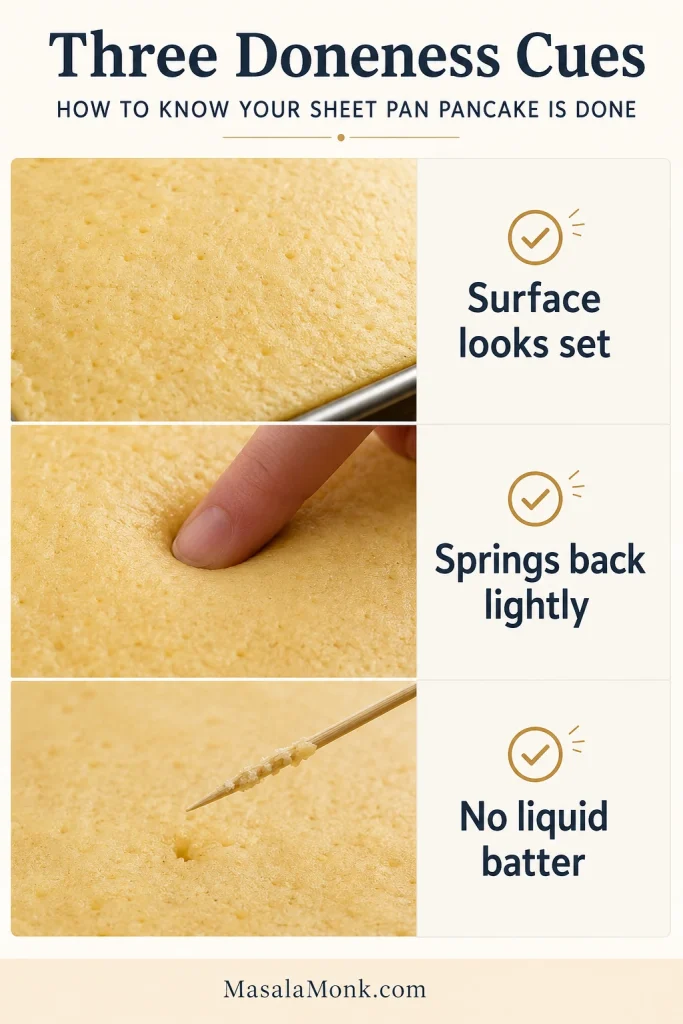
Bake. Start checking at 12 minutes. The center should look set, spring back lightly when pressed and show no liquid batter on a tester. Expect 12–16 minutes in most ovens.
Add more color only if you want it. Once the pancake is cooked through, broil very briefly if you want a little more browning. Watch continuously. Skip the broiler if parchment is sticking up near the heating element.
Rest and serve. Let the tray stand for 2–3 minutes, then cut the pancake into 12 large squares.
The finished tray should smell of warm butter and vanilla, with slightly firmer edges and a tender, springy middle. A broiler can add color in seconds; it can’t put moisture back into an overbaked pancake.
Why They Stay Fluffy
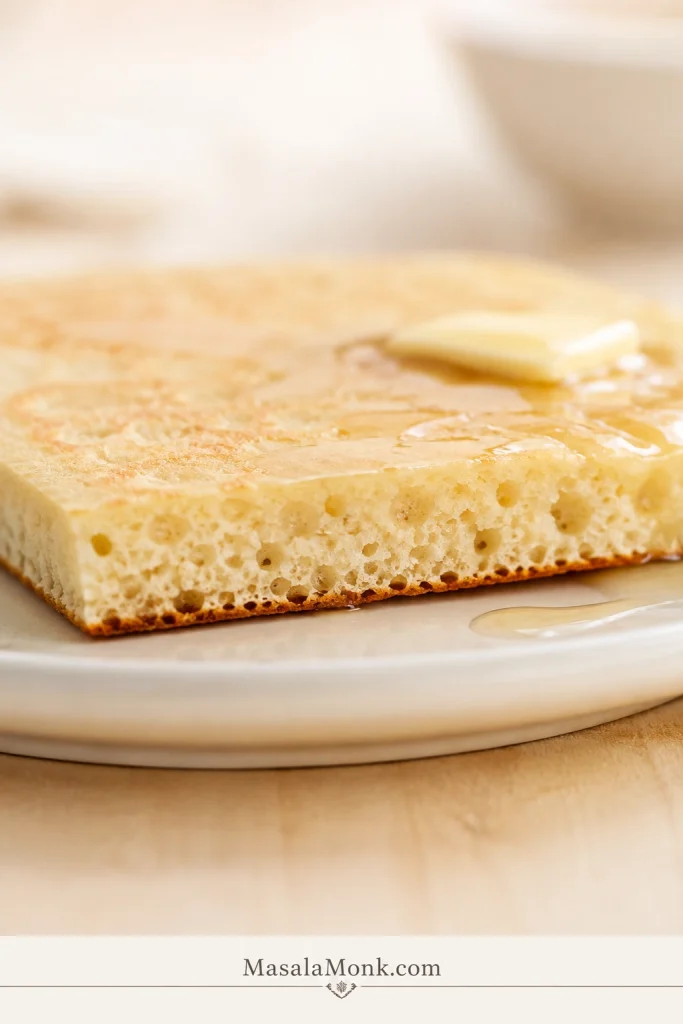
A good sheet pan pancake should still feel like a pancake when you lift a square: tender through the middle, springy rather than rubbery, and sturdy enough to reach the plate without behaving like a slice of sponge cake.
Small, irregular air pockets and a browned underside are exactly what a tender baked pancake should show.
Buttermilk + Leavening Give the Batter Its Lift
Buttermilk brings a slight tang and supplies the acid that baking soda needs. Baking powder adds more lift. Together, they give the batter what it needs to rise.
Once flour gets wet, continued mixing develops more gluten. Some structure is useful; too much gives pancakes a chewy, rubbery bite.
The smoother batter is not the better batter: overmixing tightens the crumb.
Stop while a few lumps remain. Pancake batter doesn’t need to look polished before it goes into the oven.
Measure the Flour Carefully
Extra flour makes the batter unnecessarily thick. If you have a scale, use the 325 g measurement. With cups, spoon the flour into the cup and level the top.
Using a scale? Tare the bowl first, then add 325 g flour directly.
Eggs give the pancake enough structure to cut cleanly, while melted butter keeps the crumb rich and tender. The sugar stays modest because syrup and toppings can add plenty later.
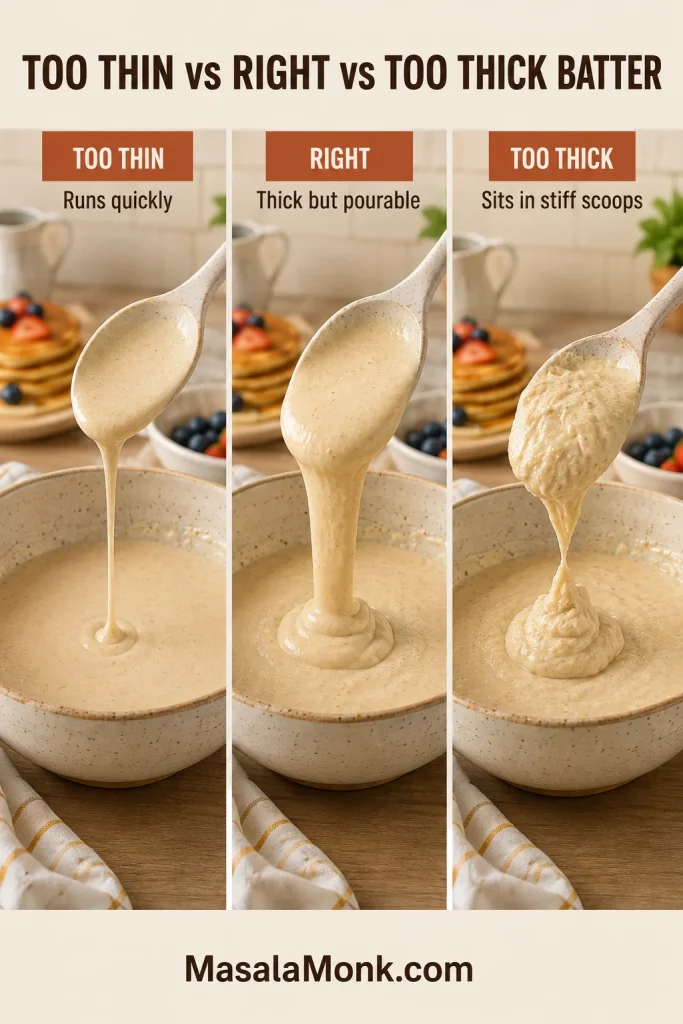
Numbers get you close. The batter itself is the final check.
What the Batter Should Look Like
The batter should be thick but pourable.
It falls from the spatula in a broad, heavy ribbon.
It spreads slowly when encouraged toward the corners.
A few small lumps remain visible.
It doesn’t race across the pan like crêpe batter.
It doesn’t sit in stiff scoops like muffin batter either.
The right ribbon lands heavily, then slowly relaxes back into the batter.
If the batter is unusually stiff, first check whether the flour was overmeasured. Once that’s ruled out, fold in extra buttermilk 1 tablespoon at a time until the batter becomes comfortably pourable.
The homemade buttermilk substitute in the FAQ can be thinner than cultured buttermilk, so use these visual cues before making any adjustment.
Which Pan Works Best?
Use a light-colored 13×18-inch (33×46 cm) rimmed half-sheet for the easiest, most predictable version of this recipe. If that’s the pan you have, you’re set; the details below are mainly useful when your pan is darker, smaller or unusually sticky.
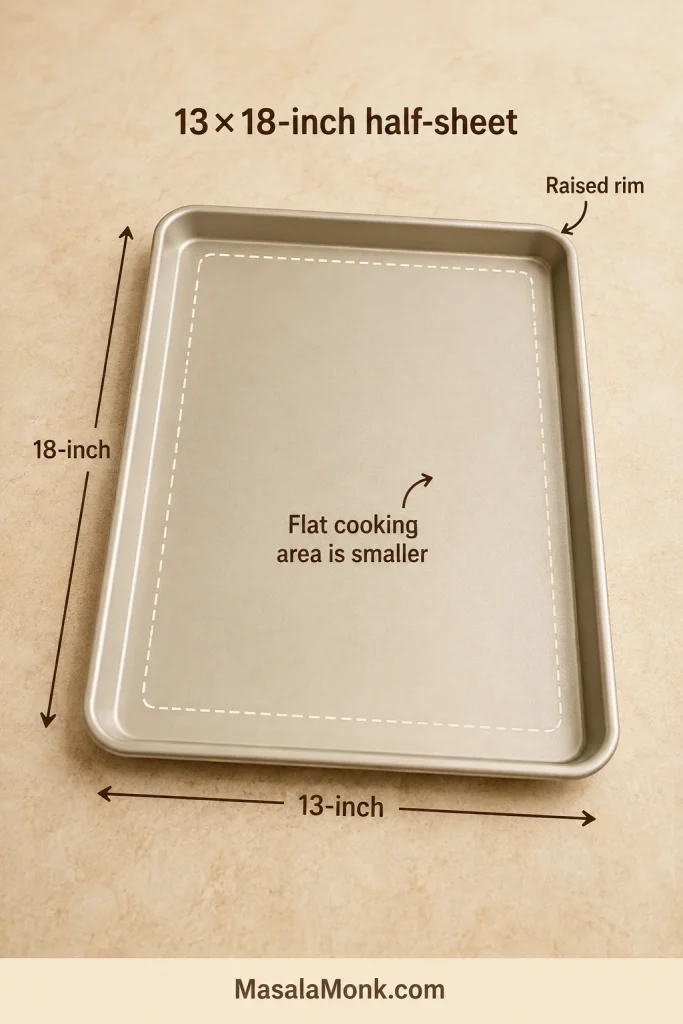
You might call yours a baking sheet, baking tray, sheet tray, oven tray or cookie sheet. The name isn’t important. It needs a raised rim and should be close to the standard half-sheet size.
A completely flat cookie sheet is the one style to avoid. Pancake batter and an unprotected oven floor are not a combination worth trying.
Why Does a 13×18 Pan Measure Smaller Inside?
The listed dimensions usually include the rim. Across the flat cooking surface, a pan sold as 13×18 inches may measure closer to roughly 12×17 inches.
So if yours seems a little smaller when you put a ruler inside it, you probably bought the right pan.
Measure across the outer rim; the flat cooking surface is naturally smaller than 13×18 inches.
Light Pan, Dark Pan or Parchment?
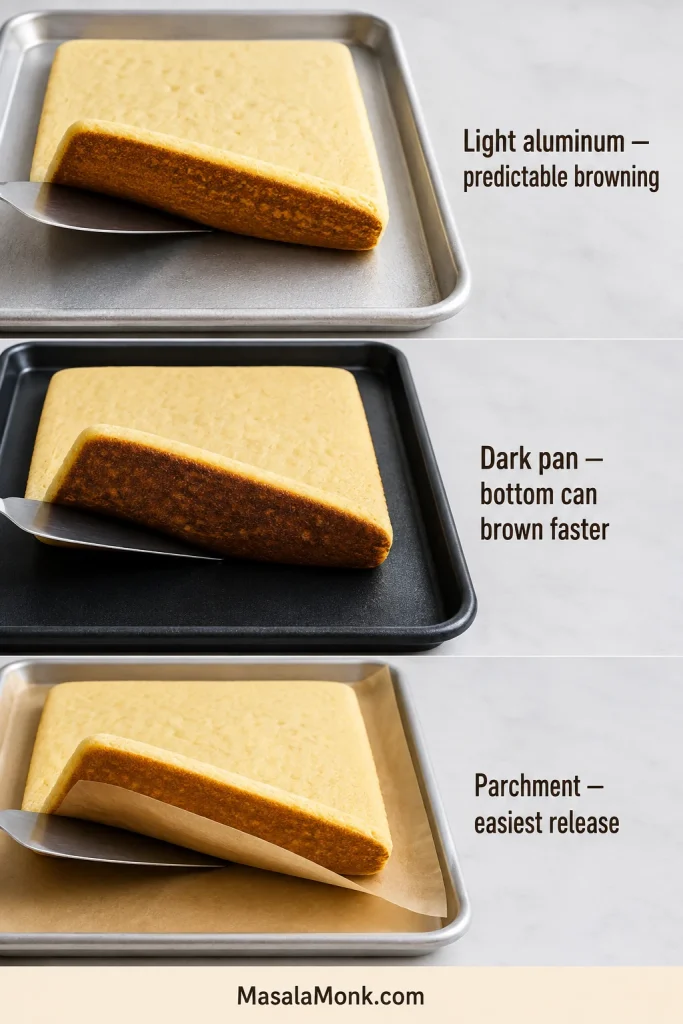
Light aluminum tends to give predictable bottom browning. Dark nonstick bakeware can color the underside faster, so start checking sooner.
Parchment is fine too. Buttering the metal directly can give you a little more color underneath; parchment wins on easy release and cleanup. If your pan has betrayed you before, use the parchment.
Dark pans brown the underside faster; parchment favors easy release and cleanup.
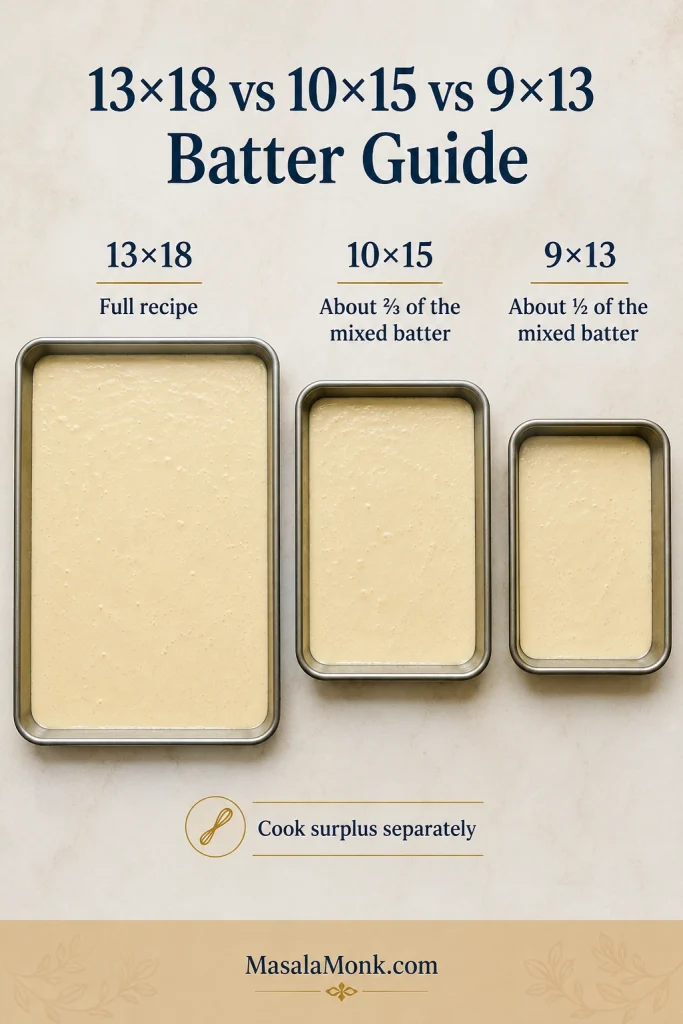
13×18 vs 10×15 vs 9×13
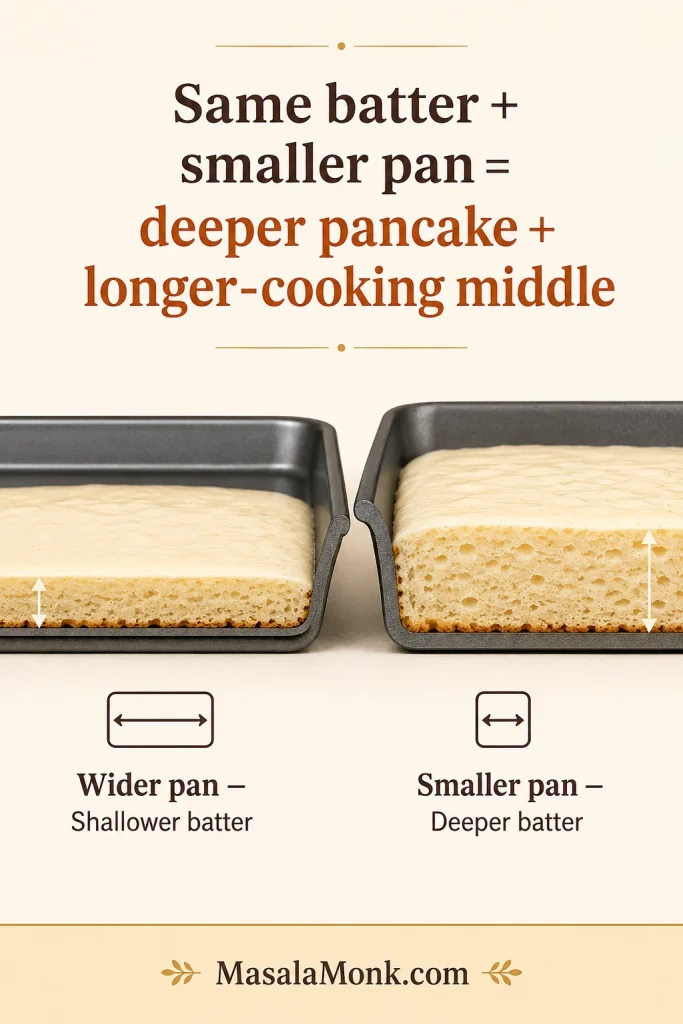
A smaller pan gives the same amount of batter less room to spread, so the pancake becomes deeper.
Pan
How Much Batter to Use
What to Expect
13×18-inch half-sheet
Full recipe
Shallow, fluffy pancake squares
10×15-inch pan
About two-thirds of the mixed batter
Similar depth; timing may shift
9×13-inch pan
About half of the mixed batter
Similar depth; start checking early
9×13 + full recipe
Not recommended
Very deep batter; slow-cooking middle, drier edges and a much more cake-like result
13×18 uses the full batch; 10×15 needs about two-thirds; 9×13 needs about half to keep a similar depth.
A 10×15 pan has about two-thirds the nominal area of a 13×18 half-sheet, while a 9×13 has about half. Mix the full recipe, pour only the approximate amount shown above and cook the surplus separately.
Pour the whole batch into a 9×13 and the pancake sits roughly twice as deep.
Same batter + smaller pan = deeper pancake + longer-cooking middle.
Same batter + smaller footprint = a deeper center and a longer path to doneness.
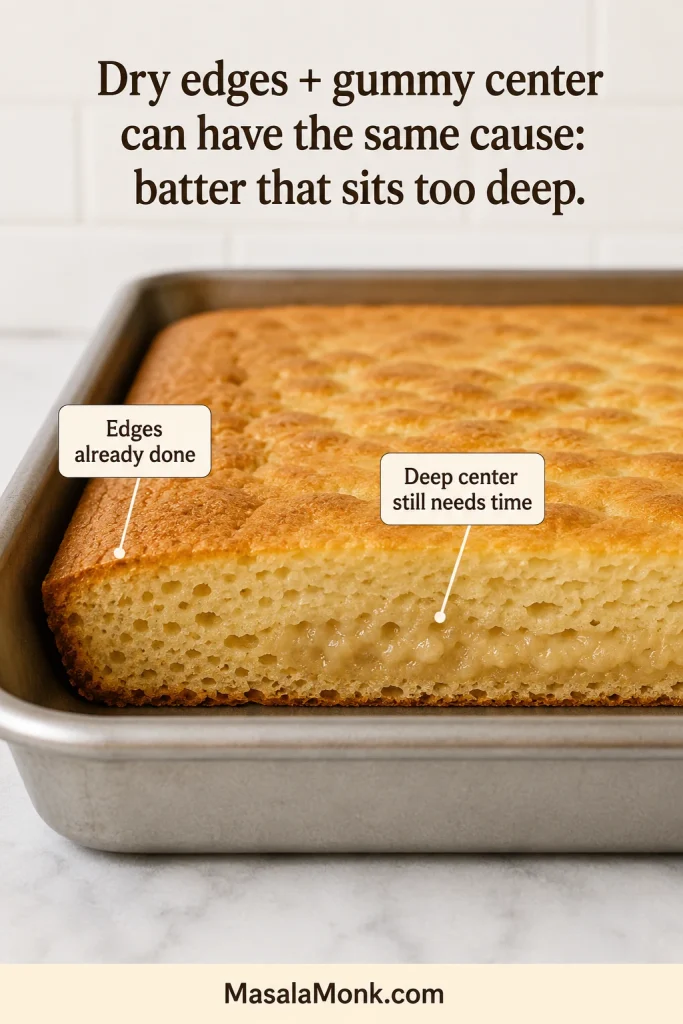
That is how dry edges and a gummy middle can happen at the same time: the center still needs heat after the edges have had enough.
Dry edges with a gummy center usually point to a layer that was too deep, not simply too little oven time.
Stovetop pancakes give you an obvious sequence: bubbles, dry edges, flip, brown the second side. A baked tray removes the flip, so color alone isn’t a reliable finish line.
Look at the middle. It’s ready when the surface is set, a gentle press springs back and a tester shows no liquid batter. A few moist crumbs are fine. The edges may also begin to pull slightly from the pan.
Look for all three cues together: a set center, gentle spring-back and a tester with no liquid batter.
Why Is the Top Still Pale?
This is the moment that can tempt you to leave the tray in too long.
A regular pancake gets direct contact with hot metal twice: once before the flip and again afterward. Here, the bottom sits against the pan while the top cooks mostly in oven air.
A fully cooked middle with a pale-golden top is completely normal. For extra color, use the brief broiler finish after the center is cooked.
A pale top can be fully cooked. The cut edge tells you more than surface color.
Make One Flavor—or Four on the Same Pan
Getting everyone breakfast at the same time solves one pancake problem. One pan can solve another too: everyone wants something different.
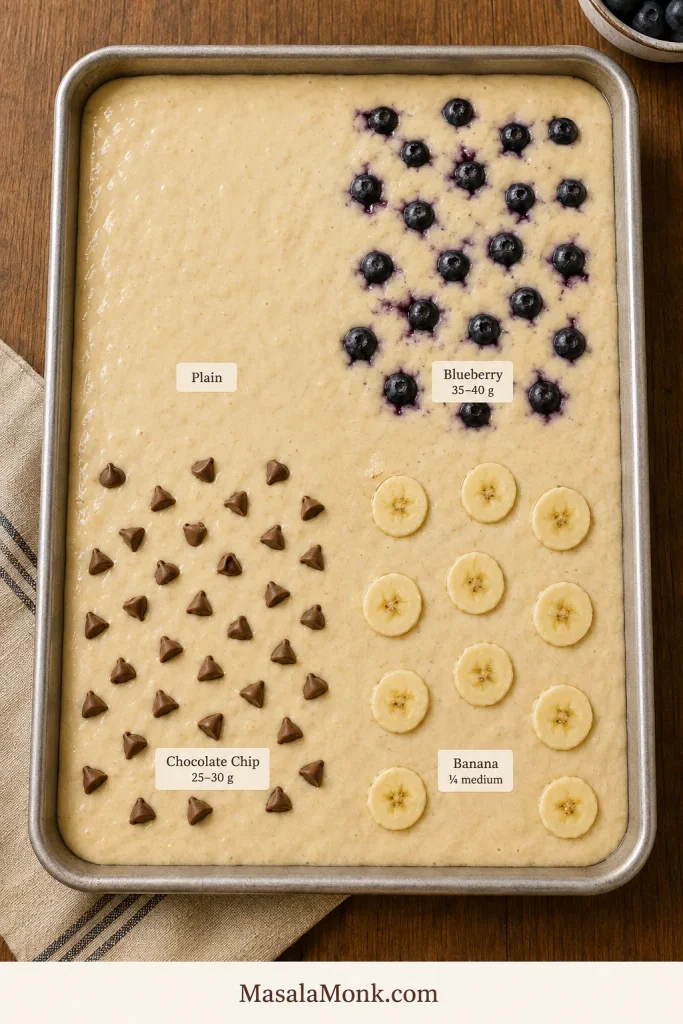
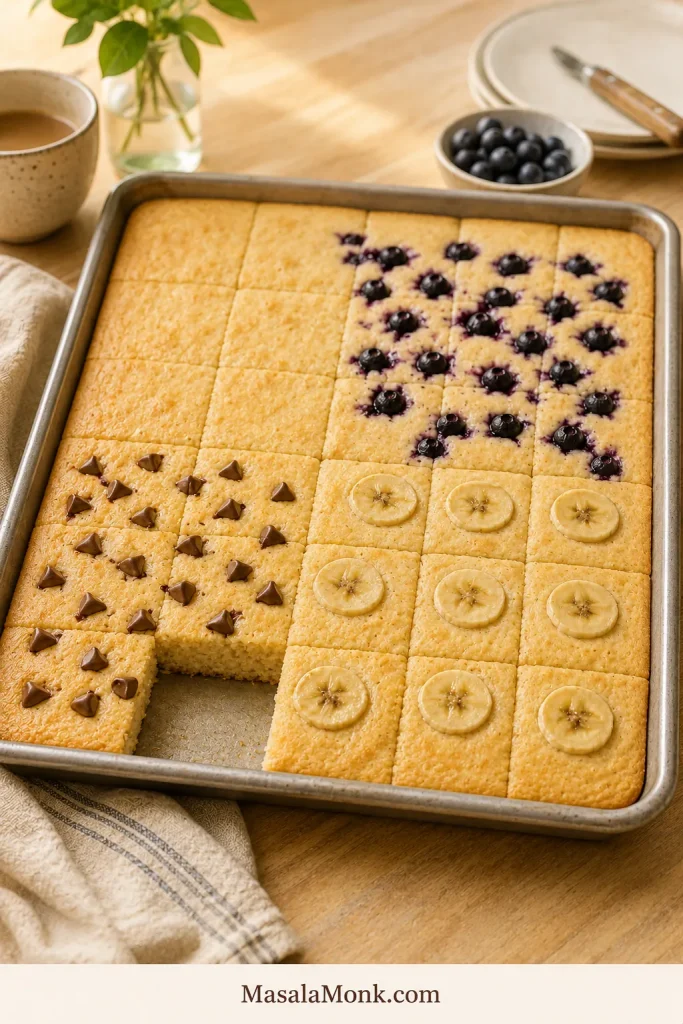
Blueberry can have one corner, chocolate chips another, banana gets its quarter, and anyone who thinks pancakes need no decorating at all can keep the fourth section plain.
Level the batter first, then build the flavor zones lightly so one section does not end up deeper than another.
Quarter-Pan Flavor
Good Starting Amount
Plain
Leave untouched
Blueberry
35–40 g blueberries, about ¼ cup
Chocolate chip
25–30 g chocolate chips, about 2–3 tablespoons
Banana
About ¼ medium banana, thinly sliced
Think scattered, not covered. A heavy topping layer can weigh down the batter and bring more moisture with it.
The berries soften and burst, the chocolate goes molten, and the plain corner needs nothing more complicated than butter and syrup.
Cut along the flavor boundaries first for cleaner blueberry, chocolate, banana and plain servings.
Fresh vs Frozen Blueberries
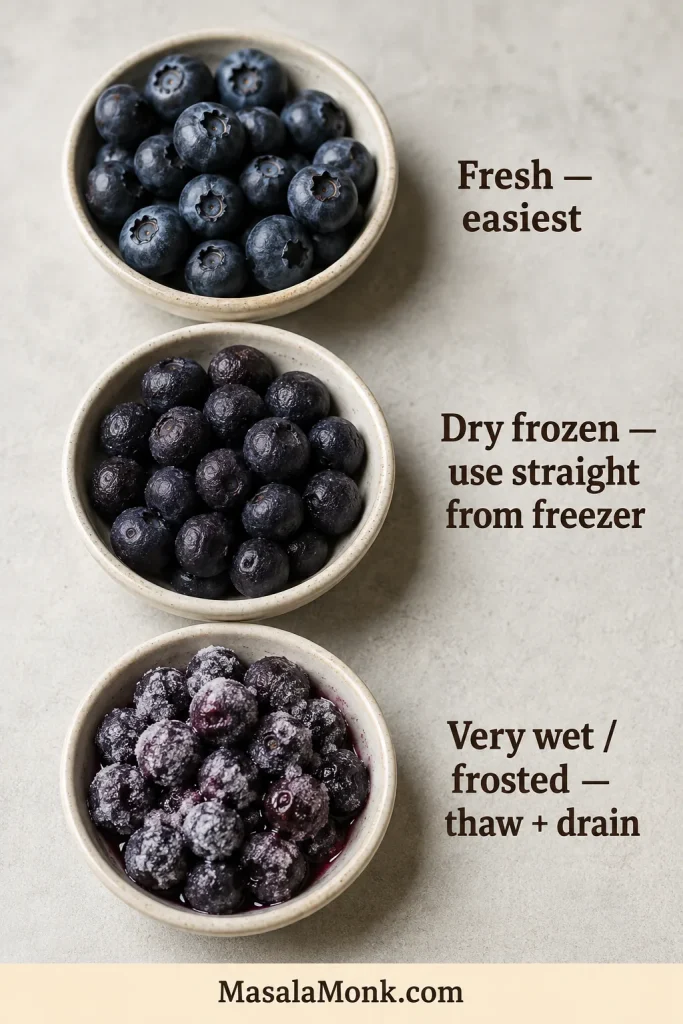
Fresh blueberries are the simplest option, but frozen berries work too. Fairly dry frozen berries can go straight onto the batter; shake off loose ice and keep the layer light.
Heavily frosted berries or berries already releasing lots of juice are better thawed and drained first. Keep excess water off the batter and either type can work well.
The real variable is loose moisture: shake off surface ice, and drain berries that are already thawing or juicy.
Making blueberry the main event? Our blueberry pancakes guide goes further into classic, lemon, banana, oat and other blueberry pancake variations.
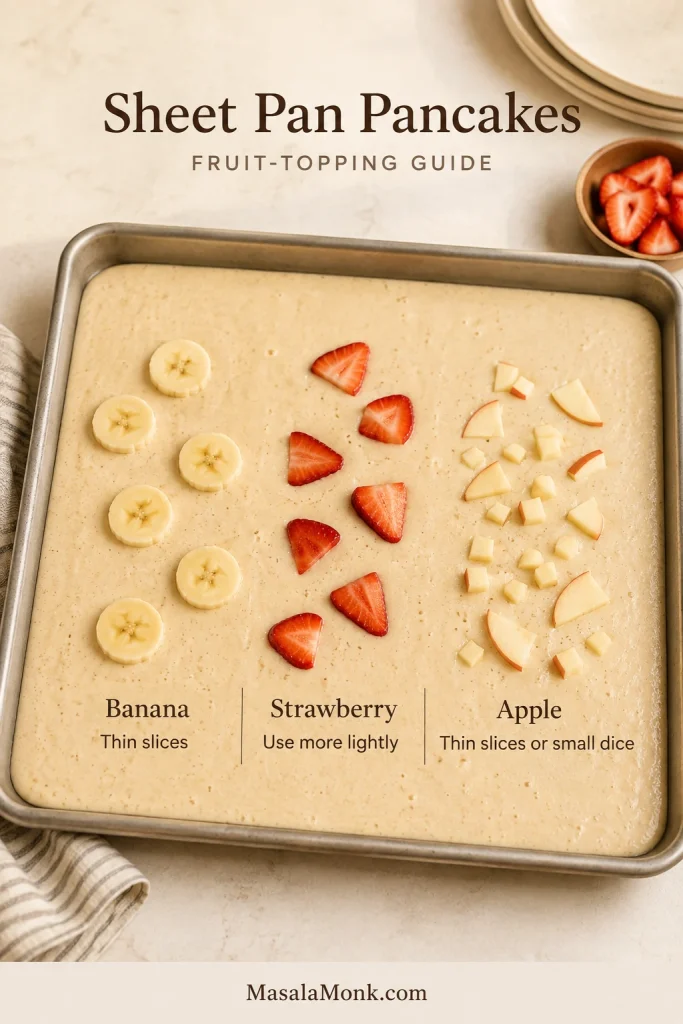
Bananas, Strawberries and Apples
Thin banana slices soften easily during the short bake. Strawberries release more water, so use them more sparingly.
Apples are firmer. Very small dice or thin slices work better than large raw chunks; you can also soften them briefly before adding them to the batter.
Match the cut to the bake: softer fruit can stay sliced; firmer apples need thin slices or small dice.
Troubleshooting
Most problems trace back to batter depth, mixing, measurements or the way a particular pan and oven handle heat.
Texture & Rise
What You’re Seeing
What Probably Happened
What to Do
Dense or heavy
Too much flour, overmixing or stale leavener
Check the flour; mix more gently; use fresh leavener
Chewy or rubbery
Batter was mixed too much
Stop folding once the dry flour disappears
Gummy middle
Underbaked, batter too deep or too many wet toppings
Return it to the oven if still raw; use the correct batter depth next time
Dry edges, wet center
Batter layer was too deep or uneven
Use less batter in a smaller pan and spread it evenly
Didn’t rise much
Old leavener, cool oven, long batter rest or overmixing
Use fresh leavener, preheat fully and bake soon after mixing
Bitter, metallic or soapy
Too much baking powder or baking soda
Measure the leaveners carefully
Batter too thick
Usually excess flour
Check the flour measurement; loosen with buttermilk 1 tablespoon at a time if needed
Batter very thin
Flour or liquid measurement may be off
Recheck the quantities before adding anything else
Pan, Browning & Toppings
What You’re Seeing
What Probably Happened
What to Do
Bottom too dark
Dark pan or a longer bake than needed
Start checking sooner next time
Top looks pale
Often completely normal
Use the doneness cues above; broil briefly only after it’s cooked
Wet fruit pockets
Too much fruit or excess surface moisture
Use less fruit and remove excess moisture before topping
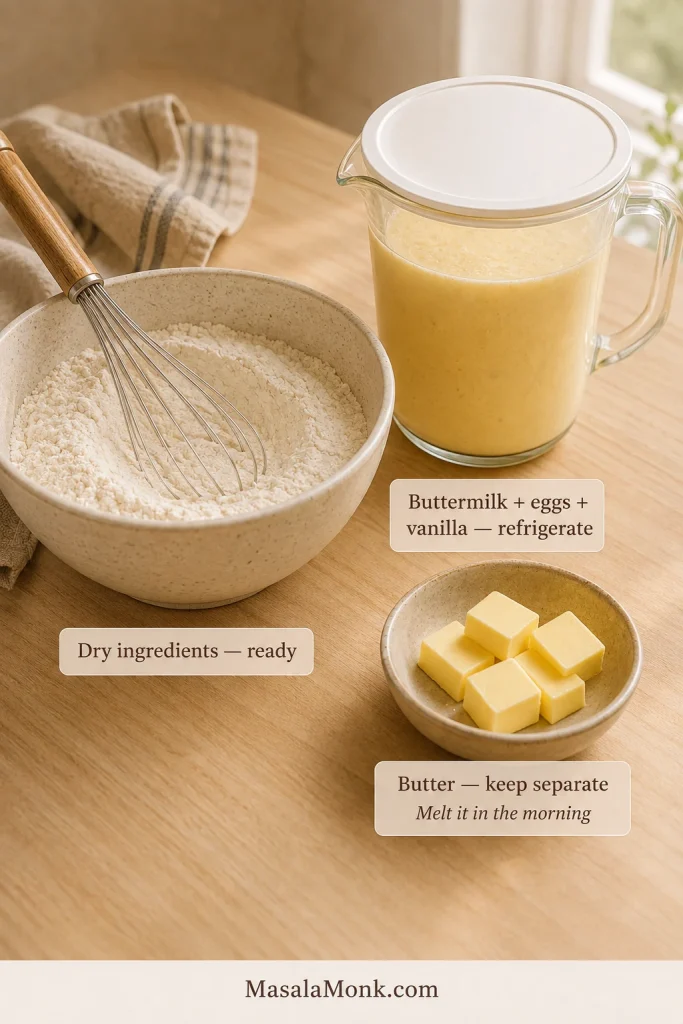
You can make the morning easier without leaving a bowl of mixed pancake batter in the refrigerator overnight. A little measuring the night before leaves much less to do once everyone is hungry.
Best Night-Before Prep
Measure the dry ingredients into one bowl. In another container, whisk together the buttermilk, eggs and vanilla, then cover and refrigerate that mixture overnight.
Keep the butter separate. In the morning, preheat the oven, melt the butter and whisk it into the cold wet mixture before combining wet and dry. A few tiny butter flecks are harmless and will melt during baking.
Measure tonight; mix tomorrow. Keep dry ingredients, wet ingredients and butter separate until breakfast.
For a breakfast that really can be assembled before bed, an overnight French toast casserole shifts even more of the work to the night before.
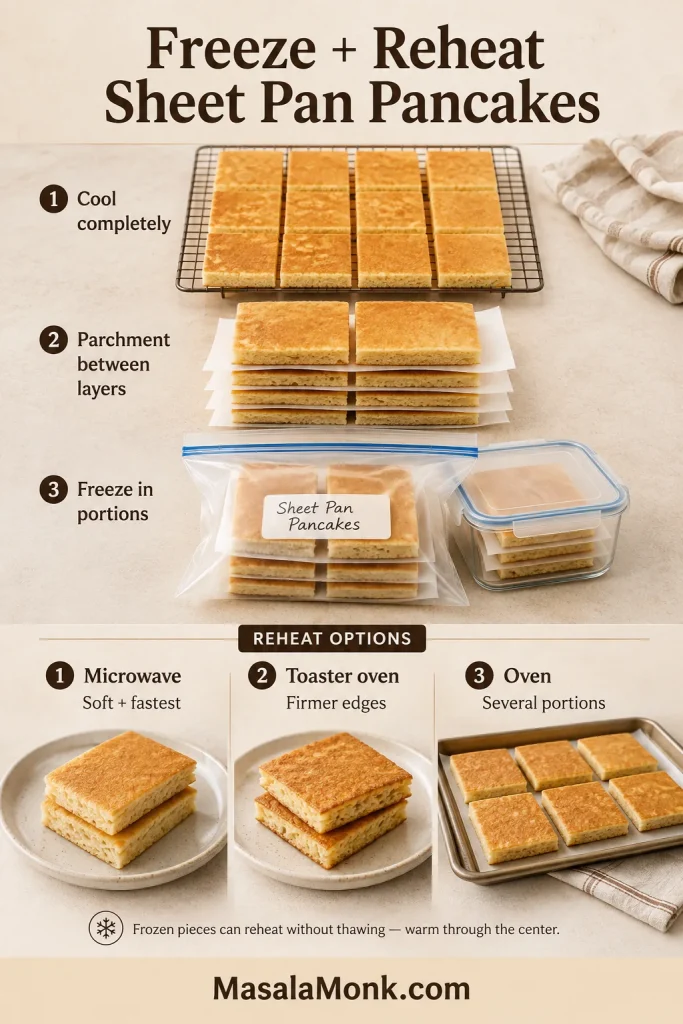
Cut the cooled pancake into portions and place parchment between layers, or freeze the pieces in a single layer until firm before transferring them to a freezer bag or container.
For the best results, use them within about 2 months.
Individual squares can go straight from the freezer to reheating; there’s no need to thaw them first. Frozen pieces simply need more time than refrigerated ones, so make sure they’re warm through the middle before serving.
Freeze the pancakes in the portion size you normally reheat, with parchment between stacked pieces.
Best Way to Reheat Them
If You Want…
Use…
What You Get
Fastest breakfast
Microwave
Soft, quick pancakes
Firmer edges
Toaster oven
A slightly crisper surface
Several portions at once
Oven
Gentle, even reheating
Microwave one or two refrigerated squares in 20–30-second bursts until warm through the middle. Frozen pieces can be reheated the same way; keep the bursts short, reposition the pancake between them if needed, and expect it to take longer.
If you want firmer edges, warm individual squares in a toaster oven at about 325°F / 165°C. Put them on a small tray and leave them uncovered for a drier surface, or cover loosely with foil if you want to preserve more tenderness. Frozen or heavily topped pieces will need longer, so check the center before serving.
Reheating several servings? Arrange the pancakes in a single layer on a baking sheet, cover loosely with foil and warm at 325°F / 165°C until hot through the middle. Remove the foil near the end if you want the surface a little drier.
Whichever method you use, a thin plain square will warm faster than a thick or heavily topped one. Let the temperature in the center—not just the warmth on the surface—be your guide.
How Many People Does One Pan Serve?
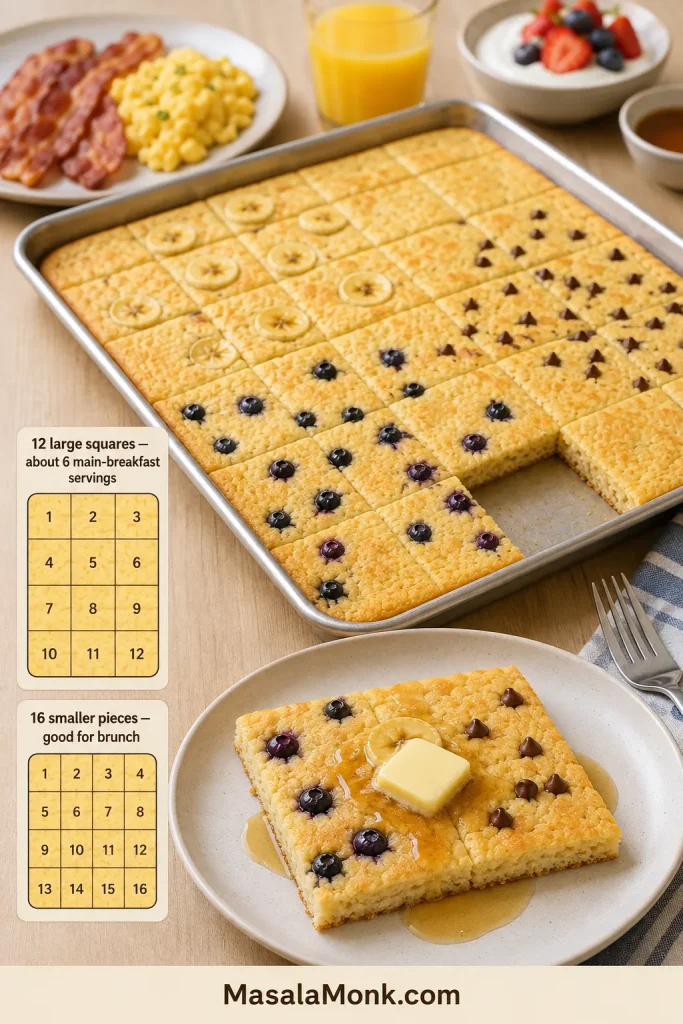
The tray cuts neatly into 12 generous squares. If pancakes are the main breakfast, plan on roughly two squares per adult, or about 6 servings.
For a brunch table with eggs, bacon, yogurt or fruit, cut the tray into 16 smaller pieces and let people come back for seconds.
Make the long cuts first, then cross-cut the tray into a simple grid for even squares.
What to Serve With Them
A simple breakfast needs little more than salted butter, maple syrup and fresh berries. The butter softens almost immediately on the warm surface, and syrup settles into the tender crumb instead of simply running off the plate.
For brunch, add eggs, breakfast sausage, Greek yogurt, fresh fruit or toasted nuts. If bacon is on the table too, cooking bacon in the oven lets you handle a full pack at once without standing over another skillet.
The batter isn’t overly sweet, so it works just as comfortably beside something savory as it does under a generous pour of maple syrup.
Frequently Asked Questions
Can I Use Regular Milk Instead of Buttermilk?
Yes. Because the batter uses baking soda, give regular milk some acidity first.
Add 2 tablespoons / 30 ml lemon juice or white vinegar to a measuring jug, then add milk until the total reaches 2 cups / 480 ml. Stir and let it stand for about 5 minutes.
This homemade buttermilk substitute can be thinner than cultured buttermilk, so use the batter-consistency cues above before deciding it needs any adjustment.
Can I Double the Recipe?
Yes. Use two half-sheet pans. Putting twice as much batter into one pan changes the depth too much.
If both pans bake at the same time, place the racks in the upper and lower thirds of the oven. If your oven browns unevenly, swap rack positions and rotate the pans during the second half of baking. Use the usual doneness cues instead of adding a fixed number of minutes.
Can I Bake These in a Fan or Convection Oven?
Yes. Use 400°F / 205°C fan/convection unless your oven automatically adjusts temperatures for you. Start checking earlier than you would in a conventional oven.
Can I Use Pancake Mix?
Yes. Make the pancake batter according to the package directions; don’t swap a boxed mix cup-for-cup for the flour in this recipe. Complete mixes, Bisquick-style baking mixes and higher-protein mixes such as Kodiak can all need different amounts of liquid, eggs and fat.
If you adapt a prepared mix to a half-sheet, keep the batter layer shallow and use the same visual doneness cues described above. Exact proportions depend on the mix, so a dedicated mix-based recipe is more reliable than trying to make one ratio fit every brand.
The Payoff Is More Than No Flipping
The best thing about sheet pan pancakes isn’t really that they save you from using a spatula.
It’s that breakfast stops arriving in shifts.
Once you know the few cues that matter—the right batter depth, gentle mixing and a cooked center—the rest is simple.
Then cut the tray, pass the syrup and sit down while everybody’s breakfast is still warm—including yours.
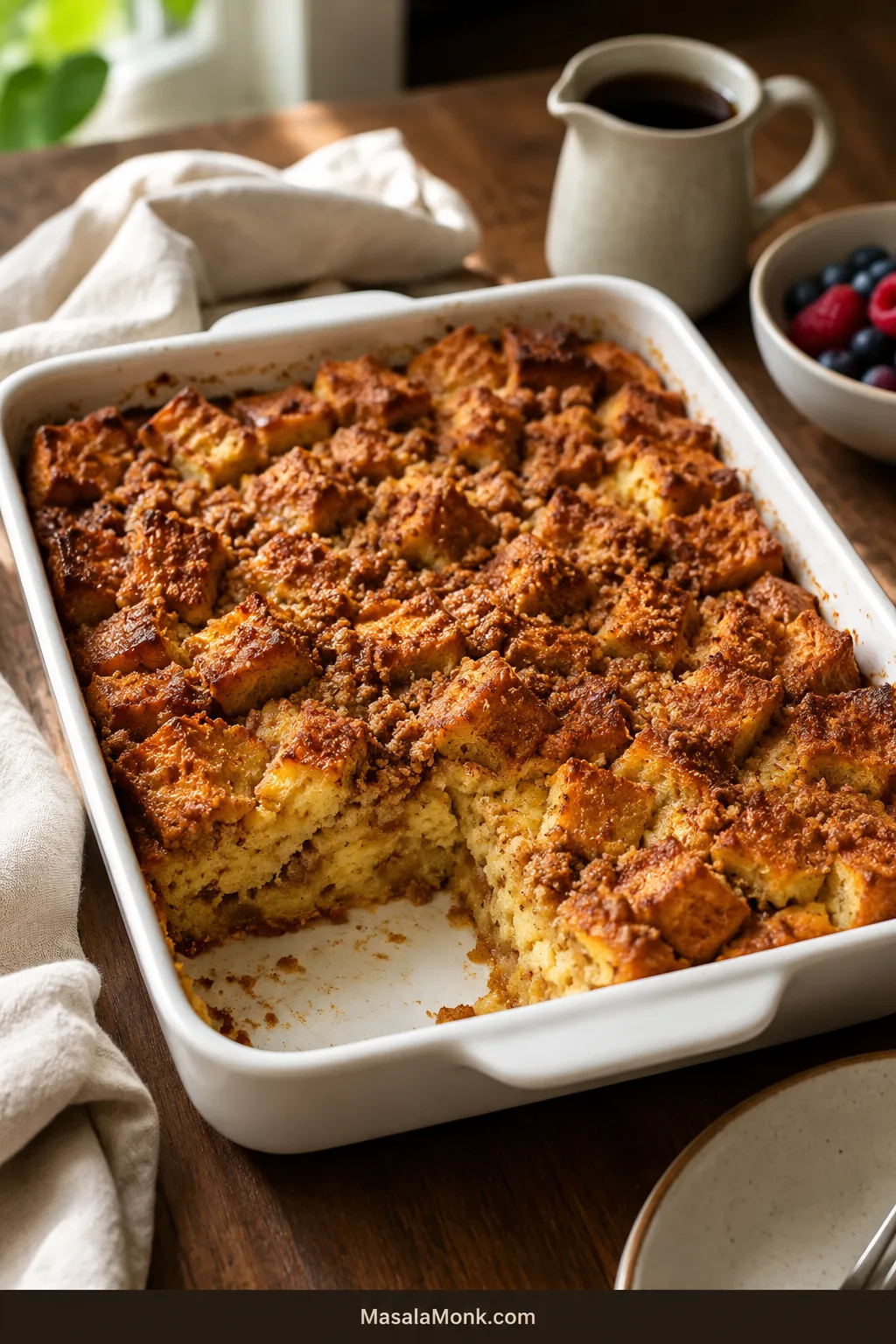
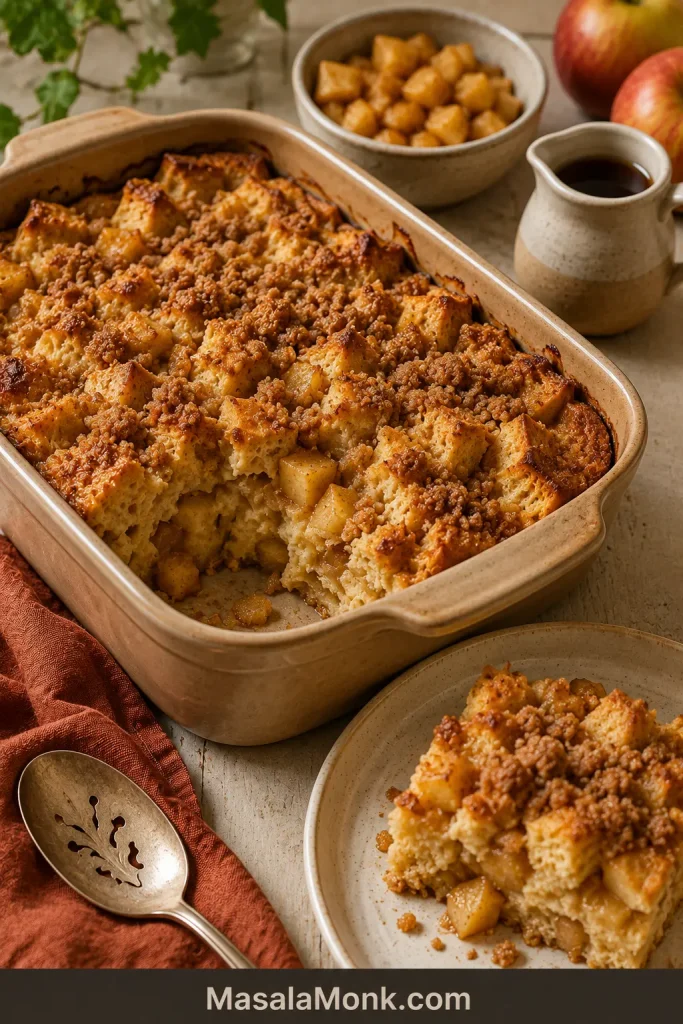
By the time the oven begins to warm, breakfast should already be decided. The bread has spent the night soaking in cinnamon-vanilla custard, the streusel is cold and crumbly, and the morning work is little more than scattering the topping, baking the pan and pouring the coffee.
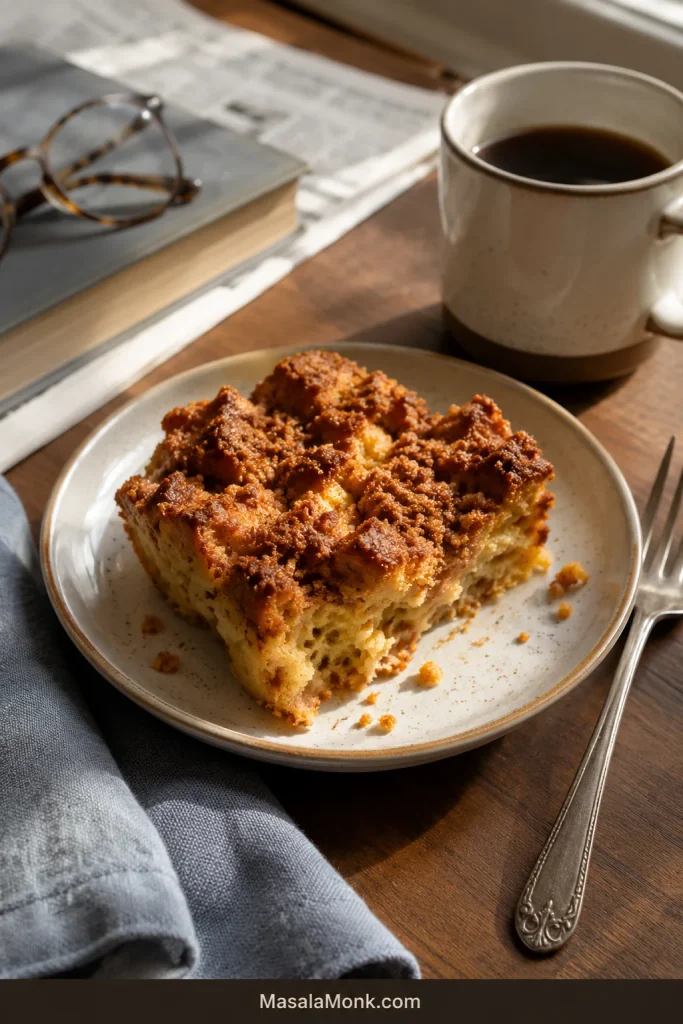
The easy morning only pays off when an overnight French toast casserole comes out properly: crisp and buttery across the top, tender where the bread has absorbed the custard, and set enough that the first spoonful holds together. Here, the bread is weighed rather than guessed, the sweetness stays balanced, and the middle—not merely the golden topping—decides when the pan is ready.
Day-old French bread absorbs the custard without collapsing, which makes it the easiest loaf to use here. Brioche, challah, sourdough, plain Texas toast and sturdy gluten-free bread can also work with a few adjustments. Once the bread amount, pan depth and final doneness are right, the method is highly forgiving.
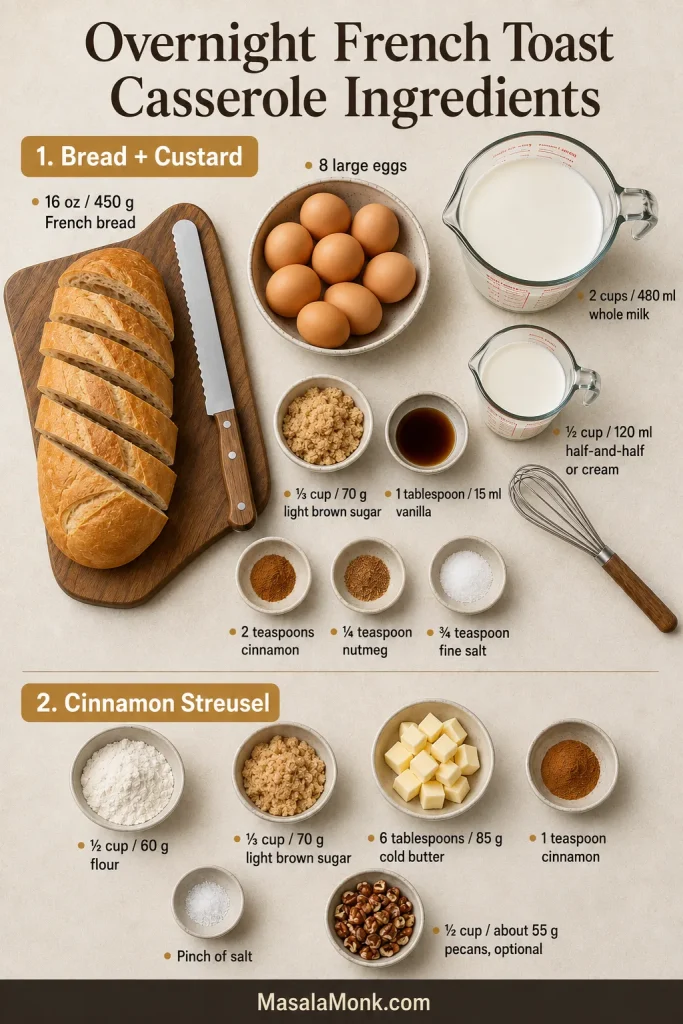
Use 16 oz / 450 g day-old French bread—about 10–12 loosely filled cups after cutting it into 1-inch / 2.5 cm pieces. Soak it overnight in a mixture of 8 eggs, 2 cups / 480 ml whole milk and ½ cup / 120 ml half-and-half or cream. Keep the streusel cold and separate until morning.
Bake in a standard 9×13-inch / 23×33 cm dish at 350°F / 175°C. Begin checking near 40 minutes; many pans finish in approximately 45–55 minutes. The topping should be golden, the middle should look set rather than fluid, and the thickest central area should reach at least 160°F / 71°C.
The clock tells you when to check; the center tells you when to stop.
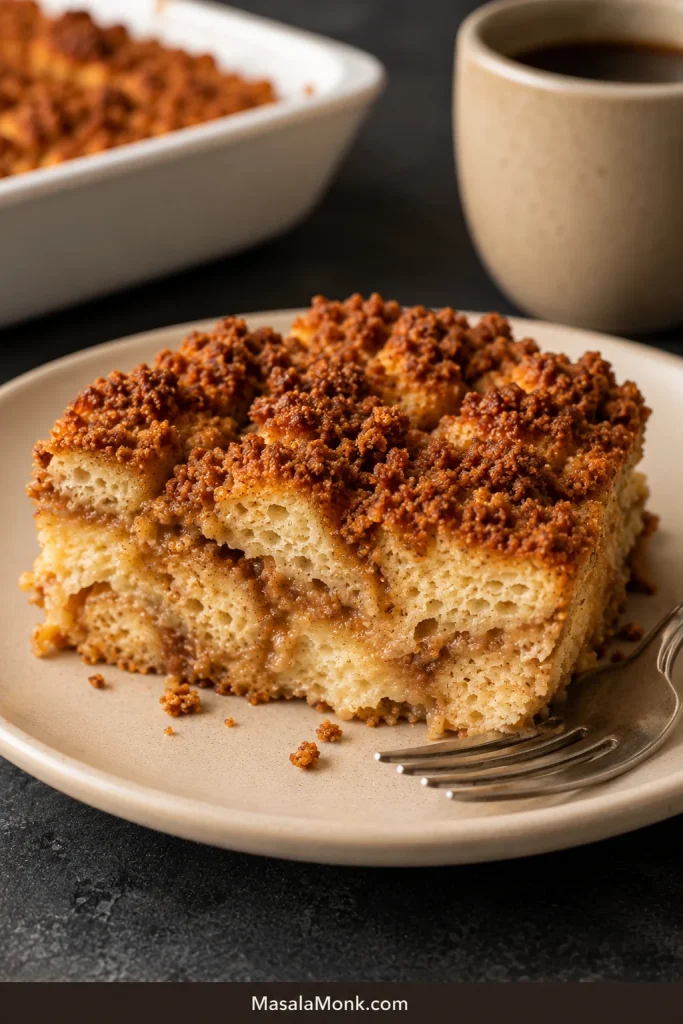
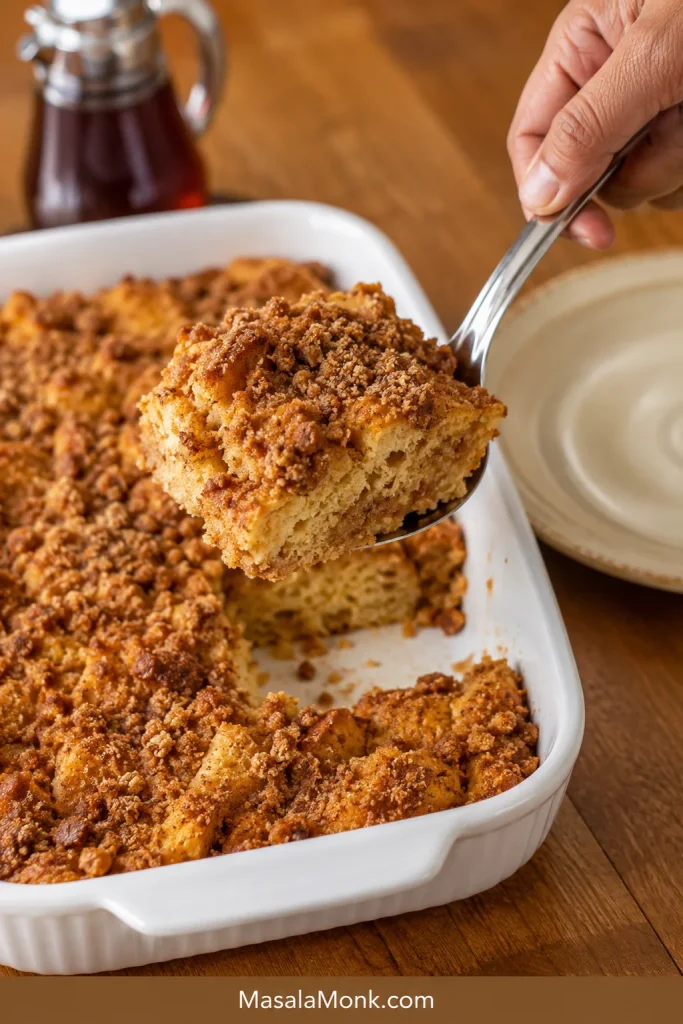
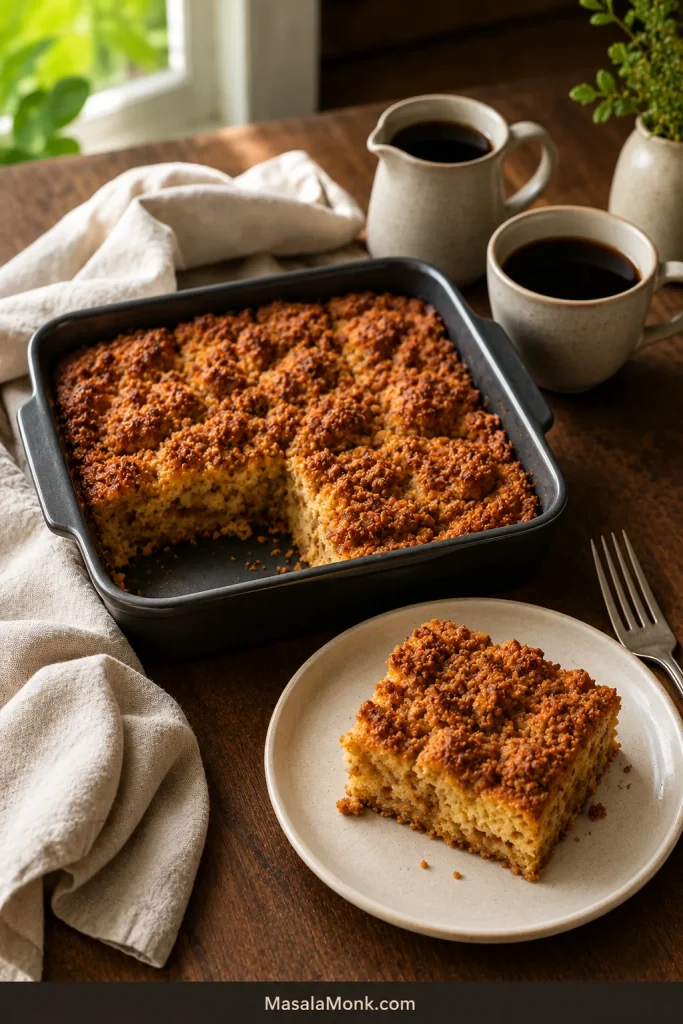
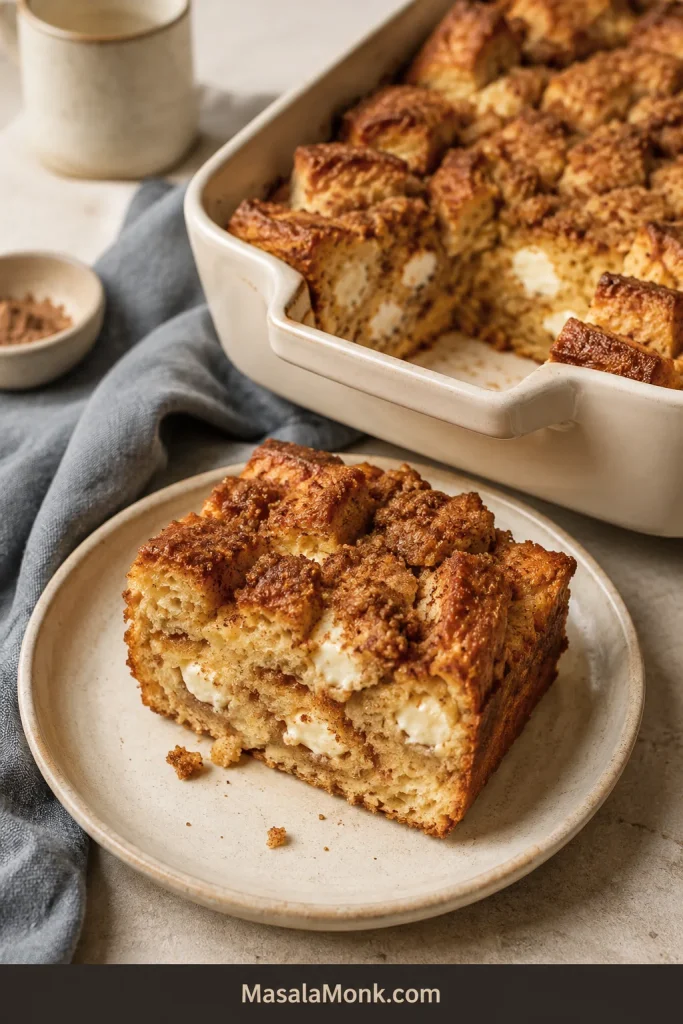
This is the texture to aim for: recognizable bread pieces held together by softly set custard, with a crisp top and no liquid collecting beneath the serving.
The cut face should show moist seams between recognizable bread pieces—not a smooth pudding layer or a dry, cake-like crumb.
Make it tonight
Overnight French Toast Casserole Recipe
A make-ahead French toast bake with cinnamon-vanilla custard, crisp exposed bread edges and a cold brown sugar streusel added just before baking. It is moderately sweet on its own, leaving room for warm maple syrup at the table.
Recipe at a Glance
Yield: 10 standard servings, 8 generous servings or up to 12 smaller brunch portions
Active preparation: About 20 minutes at night, plus 5 minutes in the morning
Chilling: 8–12 hours
Bake and rest: Approximately 45–55 minutes, plus 10 minutes
Total elapsed time: Approximately 9–13½ hours, mostly unattended
Pan: Standard 9×13-inch / 23×33 cm dish, about 3 quarts / 2.8 liters
Oven: 350°F / 175°C
Doneness: The center looks set, a thin knife shows no raw custard, and the thickest area reaches at least 160°F / 71°C
Equipment
Standard 9×13-inch / 23×33 cm baking dish, about 3 quarts / 2.8 liters
Large mixing bowl and whisk
Serrated bread knife and cutting board
Kitchen scale
Measuring cups and spoons
Rimmed sheet pan if the bread needs drying
Foil
Instant-read thermometer, recommended
Ingredients
For the Bread and Custard
16 oz / 450 g French bread, preferably day-old, about 10–12 loosely filled cups after cutting
8 large eggs
2 cups / 480 ml whole milk
½ cup / 120 ml half-and-half or heavy cream
⅓ cup / 70 g packed light brown sugar
1 tablespoon / 15 ml vanilla extract
2 teaspoons ground cinnamon
¼ teaspoon ground nutmeg
¾ teaspoon fine salt
Unsalted butter or nonstick cooking spray, for the dish
For the Cinnamon Streusel
½ cup / 60 g all-purpose flour
⅓ cup / 70 g packed light brown sugar
1 teaspoon ground cinnamon
Pinch of fine salt
6 tablespoons / 85 g cold unsalted butter, cut into small cubes
½ cup / about 55 g chopped pecans, optional
For Serving
Warm maple syrup
Fresh berries, sliced apples or another fresh fruit
Powdered sugar, optional
Measure the custard and streusel ingredients separately before beginning, especially the two portions of brown sugar.
Keep the two brown-sugar portions separate: one sweetens the cinnamon-vanilla custard, whereas the second combines with flour and cold butter to form the streusel.
Instructions
Before Bed
Prepare the dish. Butter the base, sides and especially the corners of a standard 9×13-inch / 23×33 cm baking dish generously. Custard-soaked bread can cling where the pan is only lightly coated. Nonstick cooking spray can be used instead.
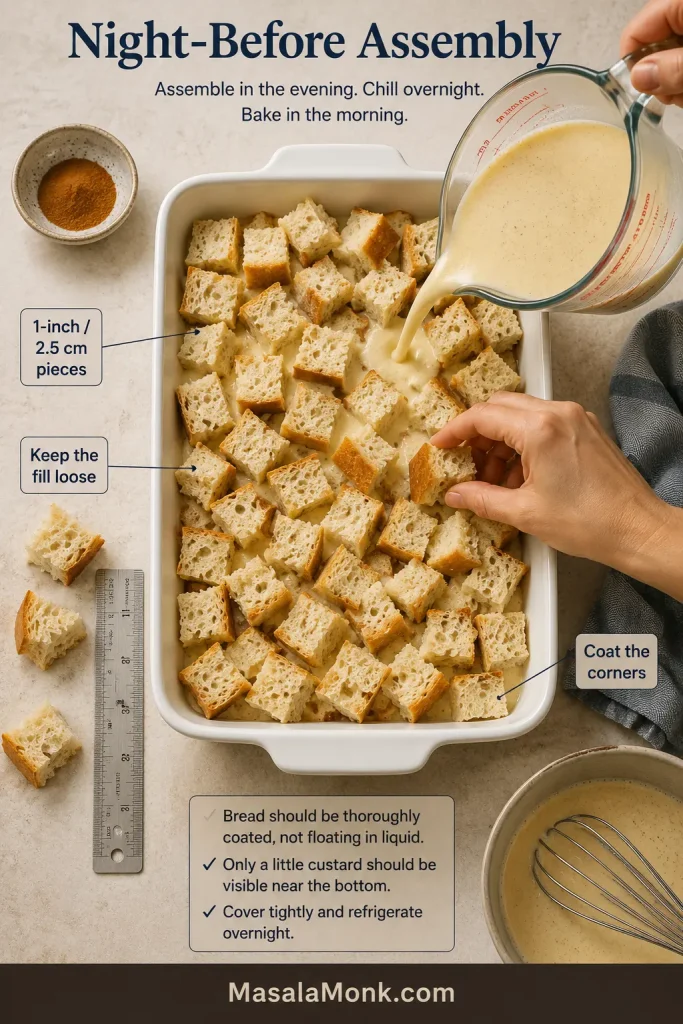
Cut the bread. Cut the French bread into pieces around 1 inch / 2.5 cm. Keep the crusts unless they are unusually hard or thick; they add structure and create some of the crispest exposed edges. If the bread is fresh and soft, dry it using the method in the notes, then let it cool.
Fill the pan loosely. Spread the bread through the dish. The pan should look comfortably full, with the pieces sitting loosely instead of being pressed into a dense layer.
Whisk the custard. Whisk the eggs until the whites and yolks are fully blended. Add the milk, half-and-half or cream, brown sugar, vanilla, cinnamon, nutmeg and salt. Continue whisking until the sugar is mostly dissolved and no visible streaks of egg white remain.
Coat, Cover and Chill
Coat the bread. Pour the custard in stages, pausing to turn the pieces gently so the liquid reaches the middle and corners. Press lightly until the dry edges touch the custard. Packing the bread down firmly can make the casserole dense.
Check the pan. The bread should look well moistened, with a little custard visible near the bottom. It should not be floating in a deep pool.
Cover and refrigerate. Cover tightly and refrigerate for 8–12 hours.
Make the streusel. Mix the flour, brown sugar, cinnamon and salt. Work in the cold butter until it is coated and the topping contains fine crumbs with a few pea-sized clumps. Mix in the pecans when using, then cover and refrigerate separately.
Before covering the pan, make sure the bread still sits loosely, looks evenly moistened and rises above the small amount of custard at the base.
Pour the custard in several passes, pausing between them; dry-looking corners and pale upper surfaces reveal where the next pour should go.
The Next Morning
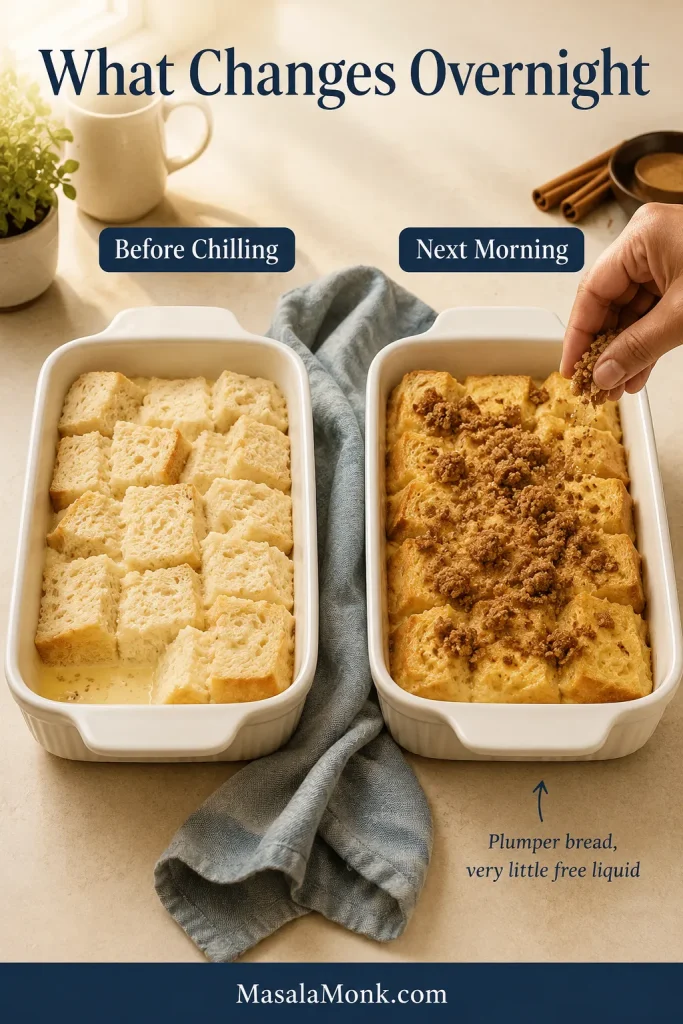
By morning, the bread should look fuller and darker with custard, while the dish remains stable rather than sloshing when moved.
Check the corners as well as the center: pale, dry pieces there suggest the custard was not distributed evenly before chilling.
Heat the oven. Preheat to 350°F / 175°C. A metal pan can come out of the refrigerator while the oven heats. For glass or ceramic, first check the cold-bakeware guidance below.
Check the overnight absorption. The pieces should look plumper and slightly darker with custard. A little liquid may remain visible low in the pan, but pressing the top should not make it surge across the dish.
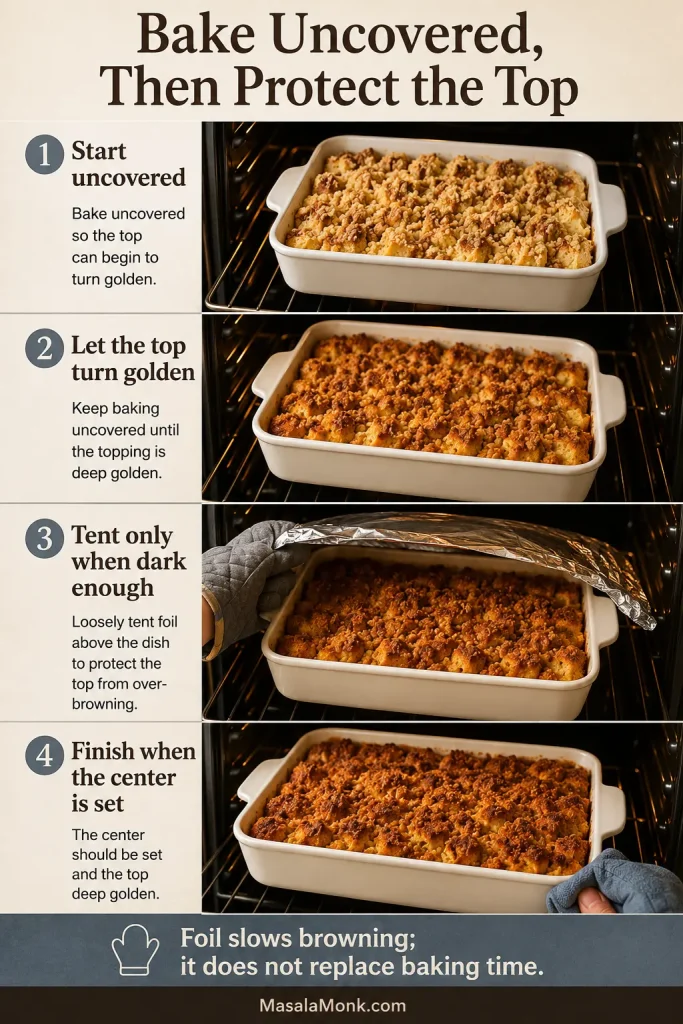
Add the topping. Uncover the dish and scatter the cold streusel over the bread. Leave a few edges exposed so they can crisp.
Bake. Place the dish on the center rack and begin checking around 40 minutes.
Protect the Top and Check the Center
Protect the top when needed. If the streusel and exposed bread are deeply golden while the center is still loose, tent the dish with foil and continue baking.
Check the center. The edges should look puffed, and the middle should no longer appear shiny or liquid. Insert a thin knife through an area with less streusel; it should show moist crumbs, not raw custard.
Confirm the temperature. The thickest central area should reach at least 160°F / 71°C. Melted butter and brown sugar may cling to the knife even when the custard underneath is set.
Rest before serving. Let the pan stand for 10 minutes. Use that time to warm the maple syrup, put out the fruit and call everyone to the table.
Cold Glass and Ceramic Bakeware
Avoid exposing very cold glass or ceramic bakeware to sudden high heat unless the manufacturer specifically approves refrigerator-to-oven use. Letting the dish stand while the oven preheats may reduce the temperature difference, but it does not replace the manufacturer’s instructions. A metal pan avoids this thermal-shock concern.
Success Notes
Fresh bread: Dry the pieces at 300°F / 150°C for 10–15 minutes, turning once. Very soft, freshly baked bread may need up to 20 minutes. Stop while the pieces remain pale.
Without cream: Replace the half-and-half or heavy cream with an equal amount of whole milk.
Dairy-free: Use 2½ cups / 600 ml oat milk and plant-based butter; see the complete dairy-free adaptation below.
Gluten-free: Use 450 g sturdy gluten-free bread and 1:1 gluten-free flour in the streusel; see the complete gluten-free adaptation below.
Nut-free: Leave out the pecans. No replacement is needed.
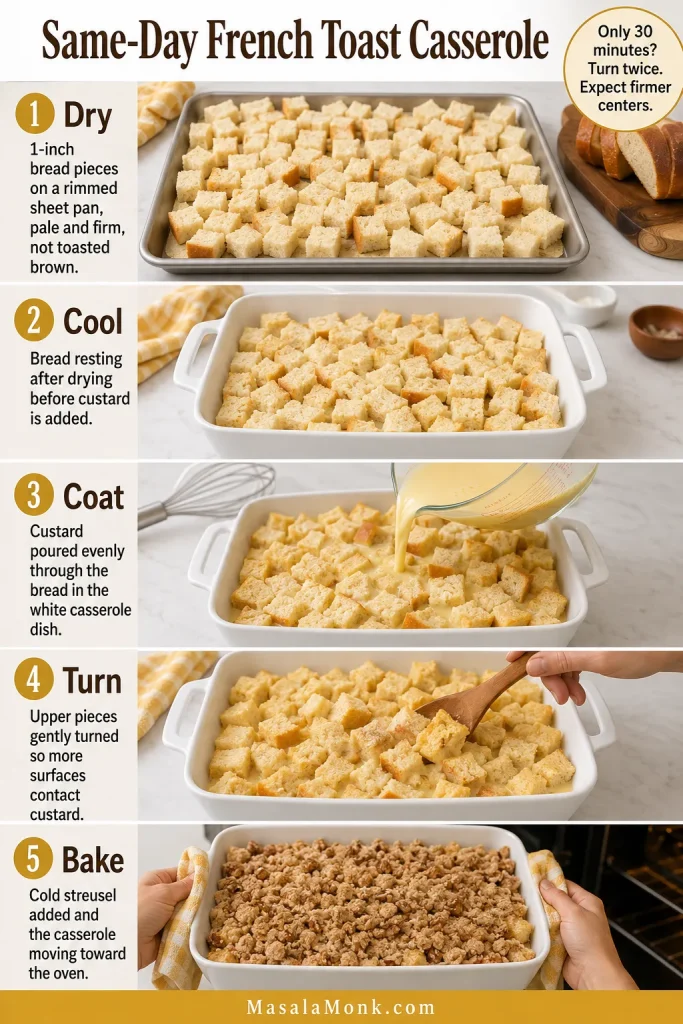
Same-day version: Dry the bread thoroughly and soak it for 45–60 minutes before baking.
Sweetness: Keep the casserole moderately sweet and add more maple syrup at the table.
After a 10-minute rest, the casserole should scoop cleanly enough for the plate while still looking soft between the bread pieces.
A broad serving spoon supports the tender base better than a narrow utensil, helping the rested casserole reach the plate without splitting through the middle.
Cooking now? The recipe above is all you need. Keep reading when you want help choosing bread, shortening the soak, scaling the pan or rescuing a soggy center.
Day-old bread has enough dryness to absorb the custard while still holding its shape. Weighing the loaf makes sure there is enough bread for the custard, and a shallow 9×13-inch dish gives the center time to set before the edges dry. When the top looks ready first, a thermometer removes the remaining guesswork.
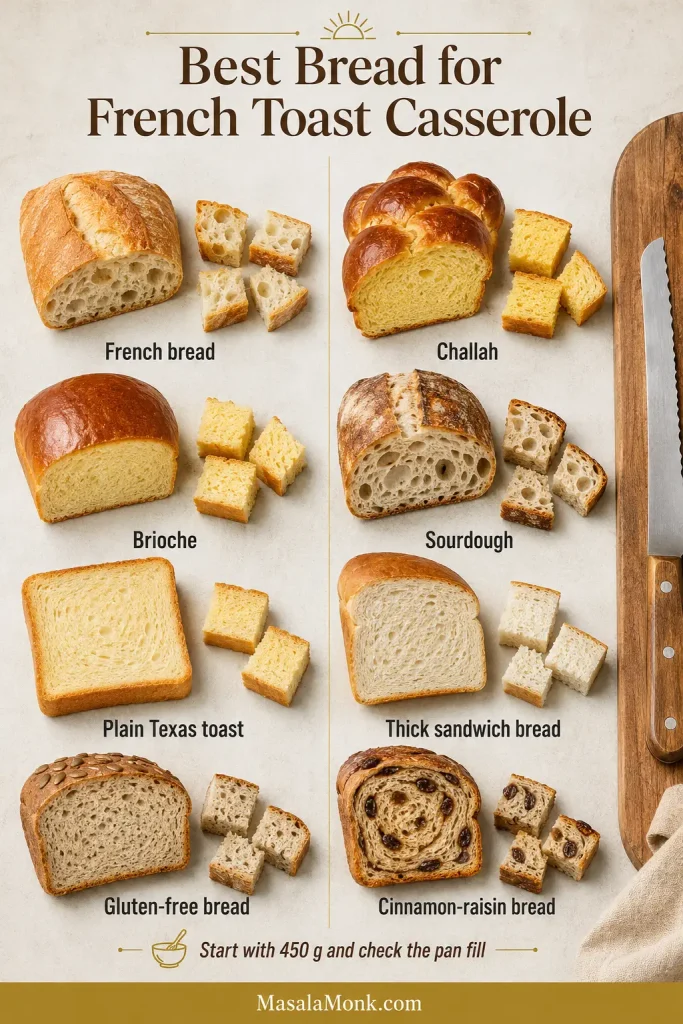
French bread has an open crumb that accepts the custard, while its crust and firmer interior help the pieces hold their shape overnight. With another type of loaf, start with 450 g and use the pan’s fill level as the final check. The cut pieces should loosely fill the dish to approximately the same level as 10–12 cups of French bread.
Use the loaf lineup as a texture map: chewy, open crumbs tolerate a long soak, while soft enriched breads need more drying and gentler handling.
How Each Bread Changes the Casserole
Bread
Result
Handling
French bread
Clear bread-and-custard contrast with crisp exposed edges
Use day-old bread or dry fresh pieces briefly
Challah
A softer, richer result with a slightly eggier flavor
Dry well; when noticeably sweet, reduce the custard sugar to ¼ cup / 50 g
Brioche
A very buttery, tender result
Dry thoroughly; when sweetened, reduce the custard sugar to ¼ cup / 50 g
Sourdough
Firmer pieces with a light tang
Allow the full overnight soak; especially good for a less-sweet pan
Plain Texas toast
A soft, familiar casserole with even pieces
Use plain thick-cut bread—not prepared garlic toast—and dry it when very fresh
Thick sandwich bread
A softer bake with less contrast from the crusts
Dry well and leave the pieces loose in the pan
Gluten-free bread
Results vary considerably by brand and loaf density
Choose a sturdy loaf, weigh it, dry it well and turn gently
Cinnamon-raisin bread
Built-in spice, sweetness and pockets of dried fruit
Use ¼ cup / 50 g custard sugar and reduce the custard cinnamon to 1 teaspoon
No special bakery loaf is required. The bread already in your kitchen can usually work once you know whether it needs a little drying first.
Croissants soften and compress much faster than French bread. They need their own bread-to-custard ratio, so they are not a direct swap in this recipe.
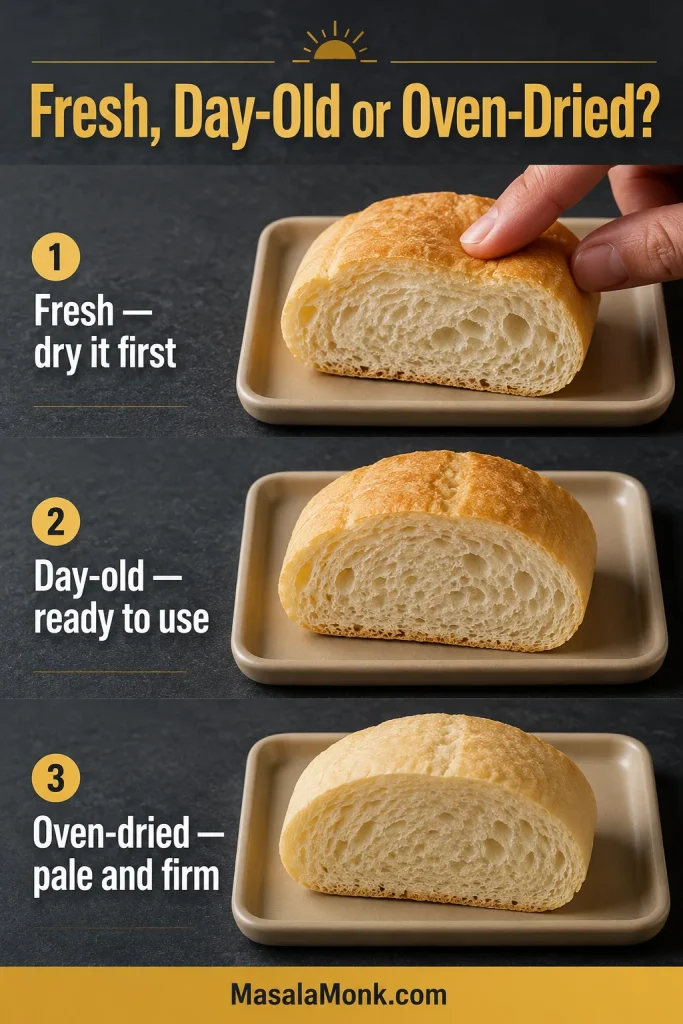
Fresh, Stale or Oven-Dried?
Day-old bread usually needs no extra drying. If the loaf has become very hard, trim any unusually tough crust and allow the full overnight soak.
Fresh bread should feel dry and slightly firm on the outside while the pieces still give when squeezed. Spread it over a rimmed sheet pan and bake at 300°F / 150°C for 10–15 minutes, turning once. Very soft bread may need up to 20 minutes. Keep the pieces pale instead of toasting them brown, then let them cool before adding the eggs.
The oven-dried sample should look almost unchanged; the useful difference is a dry, firm surface that absorbs custard without compressing.
What the Custard Ingredients Do
Eggs set the custard around the bread. Whole milk gives it enough richness without making the casserole unusually heavy, while a smaller amount of cream makes the baked custard richer and more tender. Whisk the eggs first so visible streaks of white do not bake into firm patches.
Whole milk: Gives the custard body while keeping the casserole breakfast-like.
Half-and-half or cream: Adds richness and a softer finish.
Unsweetened oat milk: Gives the custard more body than most everyday plant milks.
Unsweetened almond milk: Produces a lighter result.
Evaporated milk: Can replace up to half of the whole milk for a richer dairy flavor.
Brown sugar brings a light caramel note without turning the casserole fully into dessert. Vanilla and cinnamon supply the familiar French toast aroma, nutmeg adds warmth underneath, and salt keeps the whole pan from tasting flat.
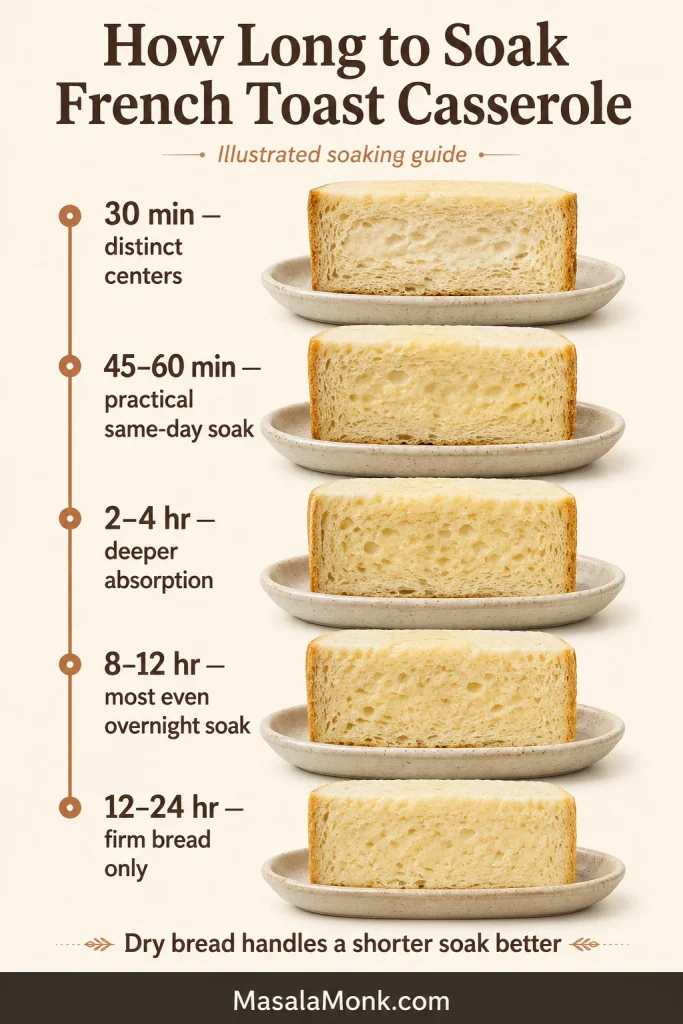
How Long Should French Toast Casserole Soak?
Soak the casserole for 8–12 hours when you can. That gives the custard time to reach the center of the bread and leaves almost nothing to do in the morning. Thoroughly dried bread can still produce a good same-day version after 45–60 minutes.
The change is gradual rather than dramatic: longer soaking narrows the pale dry core while the bread still keeps its edges.
Soaking time
When it works
What to expect
30 minutes
When time is very short and the bread has been dried thoroughly
More distinct bread centers and less complete absorption
45–60 minutes
A practical same-day casserole
Good results when the bread is dried and turned once
2–4 hours
Firm or moderately dry bread
The custard reaches farther into the center of each piece
8–12 hours
The easiest overnight schedule
Very little morning work and the most consistent soak
12–24 hours
Firm, dry French bread or sourdough
Usually workable; softer breads may begin losing their shape
Before Refrigerating: Three Assembly Checks
This is the last real bit of work for the night. Three details make the biggest difference once the pan is covered.
Keep the bread pieces similar in size. Pieces around 1 inch / 2.5 cm absorb at a similar rate. Tiny pieces can compact into a soft layer, while oversized chunks may remain dry inside.
Whisk the eggs completely. Blend the whites and yolks before adding the dairy and flavorings so firm patches of egg white do not appear in the finished custard.
Distribute the custard throughout the pan. Add it in stages and turn the bread gently so the upper pieces and corners receive their share.
None of these checks has to be perfect. When the bread is well coated, the pan is not swimming in custard and the center is allowed to finish baking, the casserole is very forgiving.
In the Morning: Bake Until the Center Is Set
By morning, the pieces should look plumper and slightly darker with custard. A little liquid may remain low in the pan, but the dish should not slosh when nudged. Scatter over the cold streusel and begin baking uncovered so the exposed bread edges and topping can crisp.
As the streusel turns deep gold, cinnamon, vanilla and warm butter begin to fill the kitchen. By then, the smell has usually reached the rest of the house.
A golden top can look ready while the middle still needs time. Once the surface is dark enough, a loose foil tent lets the center continue baking without taking the streusel any further.
A loose foil tent should sit above the streusel instead of pressing against it, slowing browning while preserving the crumbly surface.
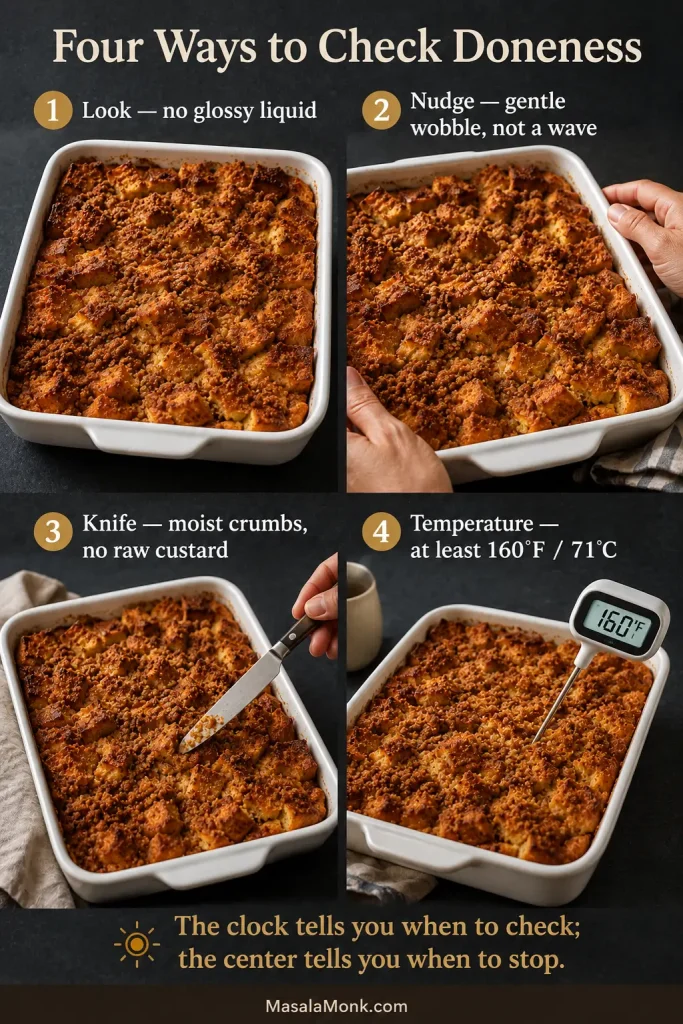
How to Tell When the Casserole Is Done
Look: The center no longer appears glossy or filled with liquid custard.
Nudge the dish: A gentle wobble through the center is fine; a flowing wave means it needs longer.
Use a thin knife: Moist crumbs are expected. Raw custard coating the knife means the casserole needs more time.
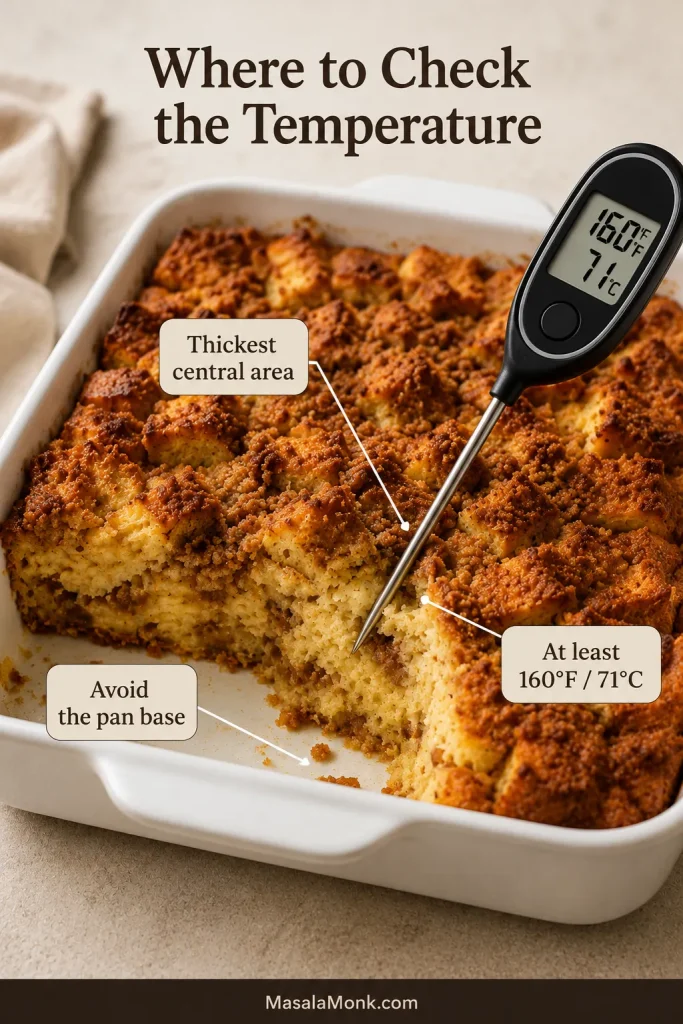
Check the temperature: Insert an instant-read thermometer into the thickest central area, avoiding the base of the dish.
To tell when French toast casserole is done, use the cues in order—look, nudge, knife and temperature—so the oven loses as little heat as possible between checks.
Angle the thermometer into solid bread and custard in the thickest central area; an air gap or contact with the hot dish can produce a misleading reading.
Forgot Last Night? Use the Same-Day Method
Remembered after waking? A full overnight soak is no longer possible, but the morning does not have to become a scramble. Thoroughly dried bread gives a shorter soak a much better chance to work.
Cut the bread into pieces around 1 inch / 2.5 cm.
Dry it using the oven method above, allowing up to 20 minutes when the bread is especially fresh and soft.
Cool the bread before adding the egg mixture.
Toss thoroughly so every piece makes contact with the custard.
Let the assembled casserole stand for 45–60 minutes.
Turn the upper pieces gently once midway through the soak.
Add the streusel and bake using the same center-of-the-pan cues as the overnight version.
For same-day French toast casserole, cool the dried bread before adding custard; otherwise, trapped steam can soften the surface you just worked to dry.
The casserole will still bake up warm and crisp-topped; the bread will simply keep more of its individual shape.
The 30-Minute Backup
Dry the bread thoroughly, keep the pieces close to 1 inch and turn them twice during the short soak. Those two turns help more of the surface meet the custard before the pan goes into the oven.
Whether the bread soaked for an hour or overnight, the same moisture cues determine whether the center finishes custardy or remains wet.
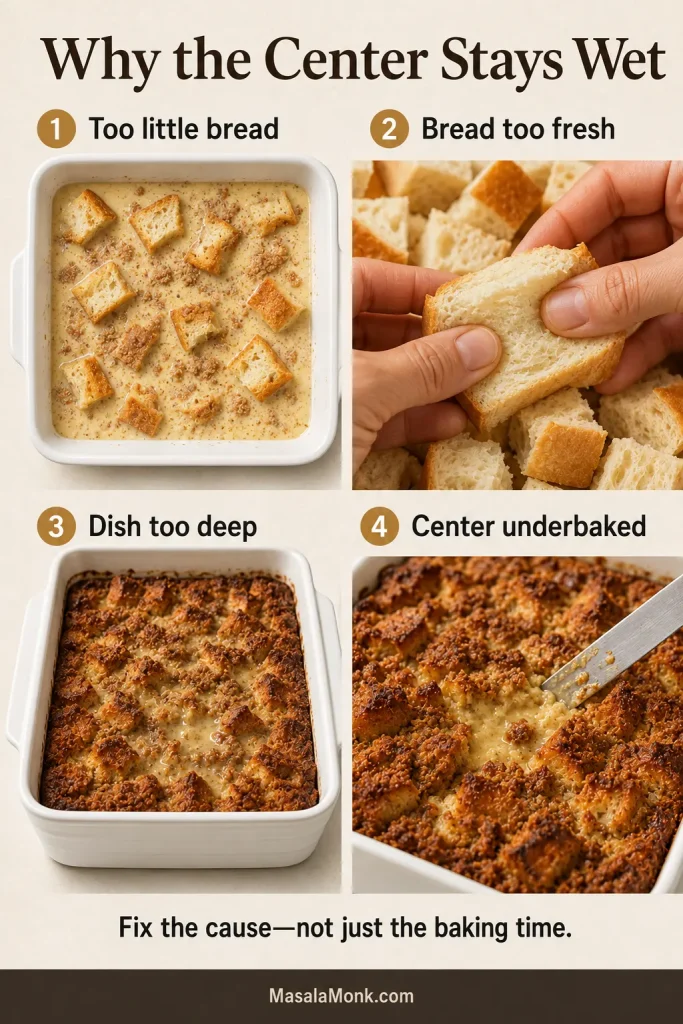
How to Keep French Toast Casserole From Getting Soggy
Softness belongs in the dish. Free liquid does not. Most soggy pans come back to four causes.
Too little bread. An unusually small loaf leaves more custard than the pan can absorb. Use the full 16 oz / 450 g.
Bread that was too soft or moist. Very fresh pieces lose their shape more easily during a long soak. Dry them until the surface feels firm but remains pale.
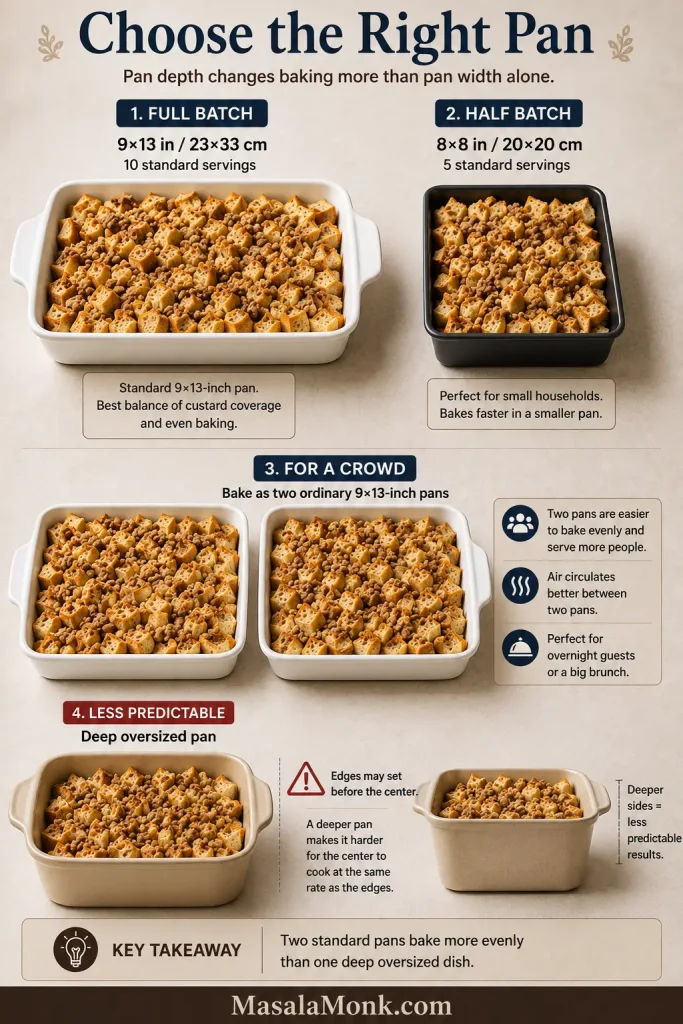
A dish that is too deep. The edges can finish before enough heat reaches the middle. Two standard pans are more dependable than one very deep casserole.
A center that needed more baking. A brown top does not guarantee that the custard underneath has set. Cover the surface with foil when it is dark enough and continue until the middle passes the visual, knife and temperature checks.
Before changing the egg-and-milk ratio, check the four more likely causes of a wet French toast casserole: bread quantity, starting moisture, pan depth and center doneness.
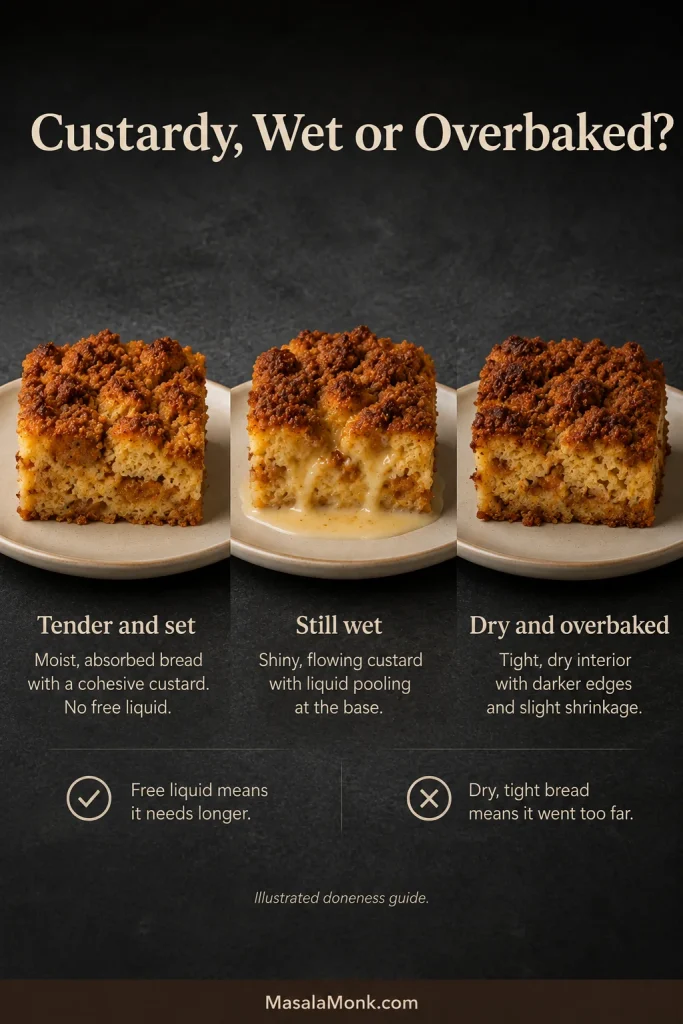
Custardy or Still Wet?
Custardy means the bread is tender and moist, with no liquid collecting around the serving spoon. Still wet means custard flows when the dish moves or coats a knife in the center.
Compare the cut faces: the correct center glistens lightly and holds, the wet sample slumps, and the overbaked sample fractures.
Dietary Adaptations
These adaptations work best when the substitutes preserve the original structure: sturdy bread by weight, enough body in the custard and a firm fat that can still form streusel crumbs.
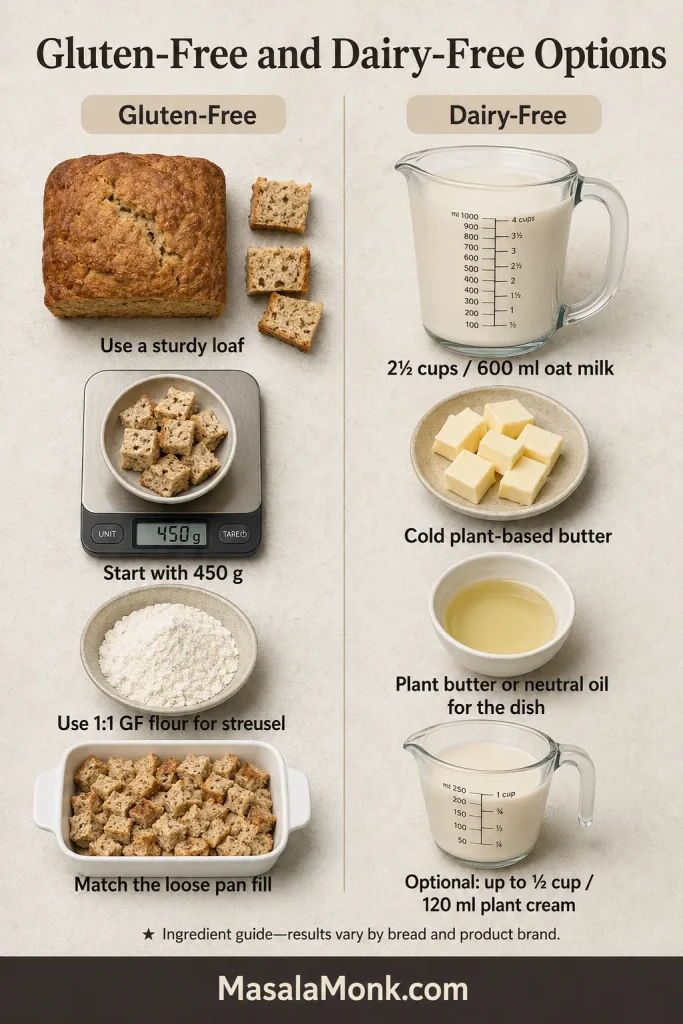
For gluten-free and dairy-free French toast casserole, keep the structure intact: weigh the bread, use oat milk for body and choose firm plant butter for crisp streusel.
Gluten-Free
Use a certified gluten-free loaf and replace the all-purpose flour in the streusel with ½ cup / 60 g 1:1 gluten-free baking flour. Begin with 450 g bread and check that the pieces loosely fill the pan to roughly the same level as 10–12 cups of French bread.
A thick, sturdy loaf usually holds up better overnight than thin packaged slices. When cooking for someone with celiac disease or significant cross-contact concerns, check the certification of all packaged ingredients.
Dairy-Free
Use 2½ cups / 600 ml unsweetened oat milk. Replace the streusel butter with an equal weight of cold, firm plant-based butter, and grease the dish with plant-based butter or neutral oil. For a richer custard, replace up to ½ cup / 120 ml of the oat milk with an unsweetened plant-based cream suitable for cooking.
Egg-Free or Vegan
Eight eggs do most of the setting in this recipe, so replacing them changes the whole custard—not only the flavor. A general egg replacer is unlikely to hold a full 9×13-inch casserole together on its own. Begin with a vegan baked-French-toast custard designed for a full casserole. This vegan French toast guide explains several egg-free custard approaches and how each one helps the mixture set.
Pan Size, Servings and Scaling
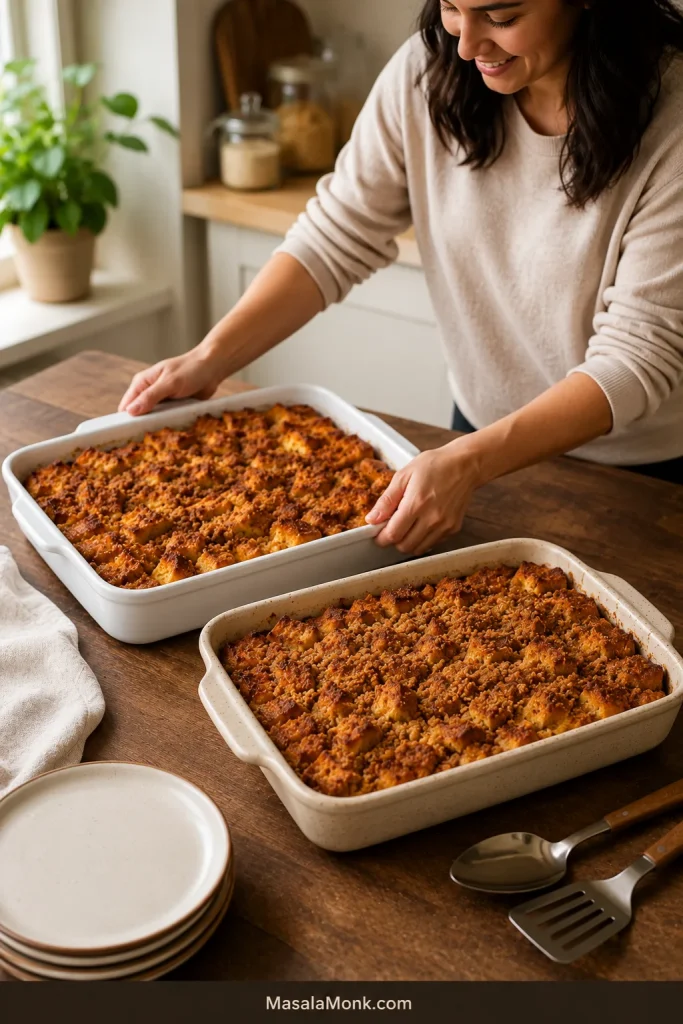
A half batch suits a smaller table and still leaves room for one easy breakfast the following day. For a larger gathering, two ordinary pans bake more consistently and are easier to serve than one extra-deep casserole.
The side profile matters more than the footprint alone: a deeper custard layer needs longer for heat to reach its center.
Setup
Yield
Begin checking
Watch for
9×13-inch full batch
10 standard servings, 8 generous or up to 12 smaller brunch portions
About 40 minutes
The center setting before the top becomes too dark
8×8-inch / 20×20 cm half batch
5 standard, 4 generous or up to 6 smaller portions
About 30 minutes
Many dishes finish around 35–45 minutes
Two 9×13-inch pans
20 standard servings, or 16–24 depending on the menu
Check each pan on its own
One pan finishing several minutes before the other
One deeper oversized batch
Varies with dish size
Later than the standard batch
The edges setting before the center
Half Batch for an 8×8-Inch / 20×20 cm Dish
Quick guide: This smaller pan makes 5 standard, 4 generous or up to 6 smaller servings. Begin checking at 30 minutes; many half batches finish in approximately 35–45 minutes.
A half-batch French toast casserole still bakes at 350°F / 175°C; only the quantity and checking time change, so resist lowering the oven temperature.
Follow the same night-before assembly, morning topping and center-doneness cues as the full recipe.
8 oz / 225 g bread
4 large eggs
1 cup / 240 ml whole milk
¼ cup / 60 ml half-and-half or cream
2 tablespoons plus 2 teaspoons / 35 g brown sugar
1½ teaspoons vanilla
1 teaspoon cinnamon
⅛ teaspoon nutmeg
⅜ teaspoon fine salt, or ¼ teaspoon plus ⅛ teaspoon
For the smaller streusel, use ¼ cup / 30 g flour, 35 g brown sugar, ½ teaspoon cinnamon, a pinch of salt, 3 tablespoons / 43 g butter and ¼ cup / about 28 g pecans when using.
Baking Two Pans for a Crowd
Leave space around both pans for airflow and rotate their positions when the oven browns unevenly. When guests are staying over, two pans also let breakfast reach the table without anyone cooking individual batches at the stove.
Treat two pans as separate bakes: rotate only when needed and remove each pan when its own center reaches doneness.
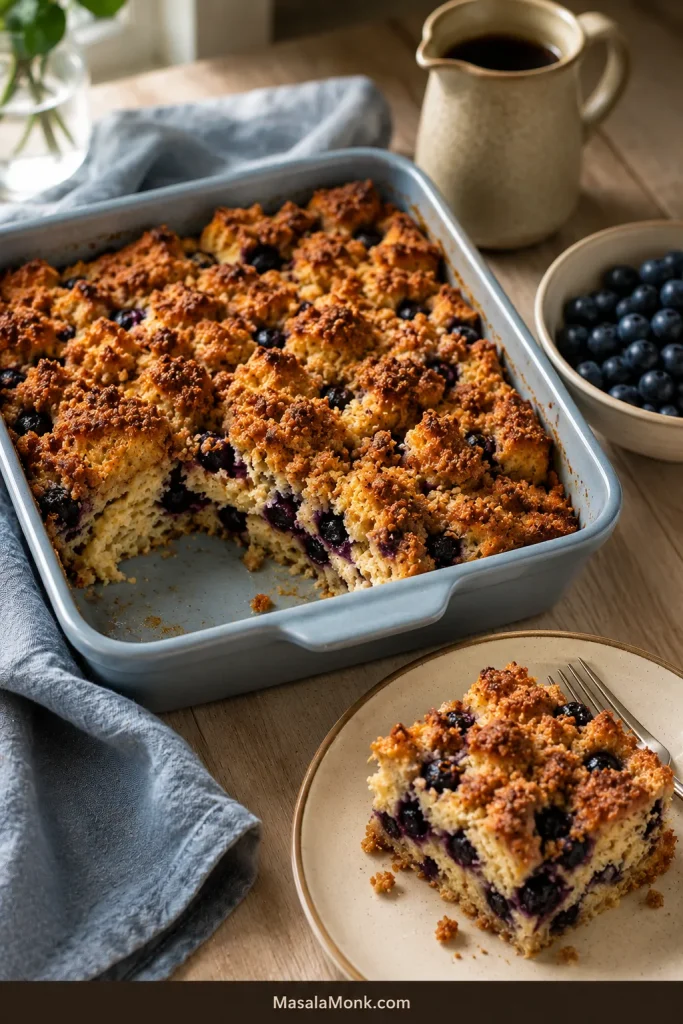
Blueberries add tart, juicy pockets against the cinnamon custard and brown sugar topping. Scatter 1 cup / 140 g through the bread. Fresh blueberries hold their shape better and release less juice. Frozen berries also work; add them straight from the freezer and expect the surrounding bread to become slightly softer.
For blueberry French toast casserole, tuck berries between several bread layers instead of piling them on top, reducing scorched fruit and concentrated pockets of juice.
Apple-Cinnamon
Soft cinnamon apples make the casserole warmer, fruitier and especially well suited to an autumn or holiday brunch. Cook 1½ cups / approximately 180–200 g peeled, diced apples in 1 tablespoon / 14 g butter with a pinch of cinnamon until just tender but still holding their shape. Cool them on a plate before distributing them through the bread.
Spread the cooked, cooled apples through several shallow layers; this gives every serving fruit without creating one heavy pocket that weakens the custard structure.
Cream Cheese
Cream cheese adds small tangy pockets that break up the sweetness of the custard and streusel. Use 4–6 oz / 115–170 g cold full-fat block cream cheese, cut into small pieces. Tuck them throughout the bread so every serving gets a few creamy pockets. Avoid whipped or spreadable tub cream cheese, which brings more moisture.
Keep the cream-cheese pieces smaller than a walnut so they stay scattered instead of melting into one heavy stripe.
Less-Sweet Version
For a more breakfast-like pan, reduce the brown sugar in the custard to ¼ cup / 50 g and leave the crisp streusel unchanged.
What to Serve With French Toast Casserole
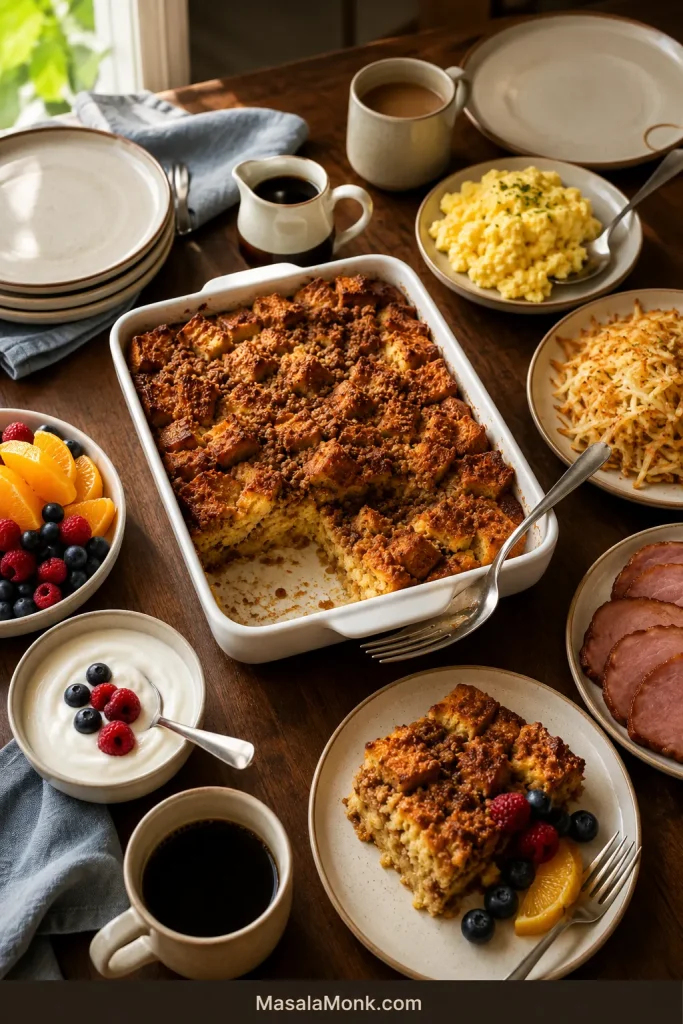
The casserole is rich, soft and sweet enough that the best sides usually bring freshness, salt or a crisper texture. Air-fryer hash browns add crisp potatoes without competing for oven space.
Fresh fruit: Berries, orange segments, melon or lightly tart apples brighten the plate.
Maple syrup: Warm it separately so each person can decide how sweet the serving should be.
Eggs: Soft scrambled eggs or a simple egg bake make the meal feel more balanced.
Breakfast meat: Bacon or breakfast sausage provides a salty contrast to the cinnamon topping.
Holiday main: Sliced honey glazed ham works especially well for Christmas or Easter brunch.
Yogurt: Plain or lightly sweetened yogurt adds tang and pairs naturally with berries.
Coffee or tea: Often the only other thing a quiet weekend breakfast needs.
Build the brunch around contrast: pair the soft, sweet casserole with at least one fresh side, one crisp side and one savory side, then serve maple syrup separately.
For a holiday spread with more than one sweet centerpiece, homemade cinnamon rolls can also be prepared the night before.
For a buffet, cut smaller portions first; people can always return for another spoonful. When the casserole is the main event, plan on eight generous servings.
Leftovers, Freezing and Reheating
The top softens in the refrigerator, but a little dry heat brings back enough crispness to make leftovers worth looking forward to.
Refrigerate or Freeze
Leftovers. Refrigerate within two hours of serving, then keep in covered containers for 3–4 days. The USDA leftovers guidance (opens in a new tab) recommends rapid cooling, covered storage and reheating leftovers to 165°F / 74°C.
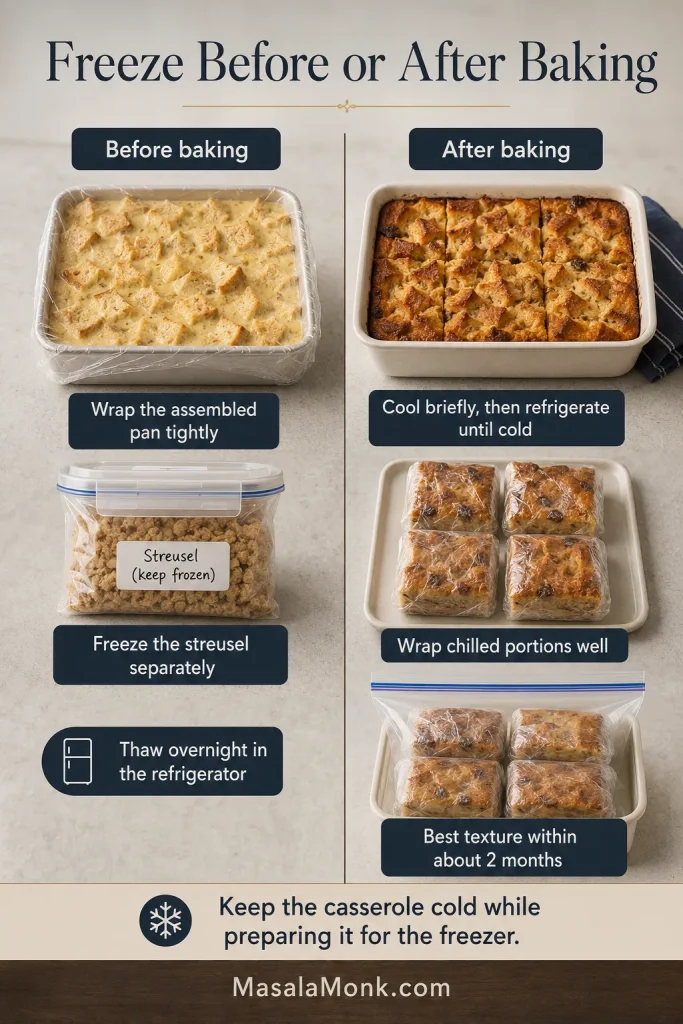
Freeze before baking. Assemble the bread and custard in a freezer-safe pan, wrap tightly and freeze the streusel separately. Thaw overnight in the refrigerator before topping and baking. Follow the cold-bakeware guidance in the recipe when choosing the pan.
Freeze after baking. Let the casserole cool briefly, then cut it into portions and refrigerate until cold. Wrap the chilled portions well and freeze for up to about two months for the best texture.
To freeze French toast casserole before baking, keep the streusel separate; after baking, chill individual portions before wrapping so less condensation becomes trapped inside.
Reheat One Portion or Several
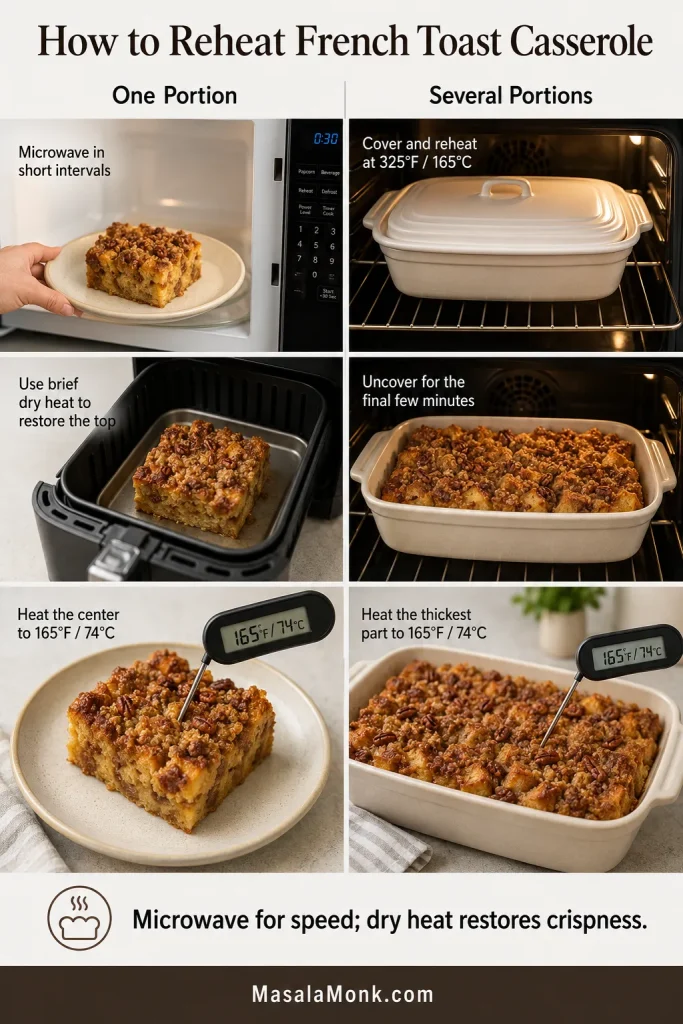
One portion. Microwave in 30-second intervals until nearly heated through. To restore the top, begin checking after about 2 minutes in a 350°F / 175°C air fryer or after about 5 minutes in a conventional oven. Confirm that the center has reached 165°F / 74°C before serving.
Several portions. Cover and reheat at 325°F / 165°C. Begin checking after 15 minutes and continue until the thickest part reaches 165°F / 74°C. Uncover for the final few minutes to refresh the streusel.
Heat and crisp are separate jobs: covered or microwave heating warms the center, while a brief uncovered finish refreshes the streusel.
For the best second breakfast, chill the remaining casserole promptly and reheat only the portion you plan to serve.
A chilled portion reheated once can bring back enough crispness for an easy second breakfast.
Troubleshooting Overnight French Toast Casserole
Most problems are recoverable: cover a dark top, give a loose center more time, or revive dry pieces with warm syrup.
Problem
Fix it now
Next time
Center is wet
Return the casserole to the oven and continue baking. Add a loose foil tent only if the top is already brown enough
Use the stated bread weight and check the thickest area; time alone can mislead
Top is dark but center is loose
Cover loosely with foil and continue baking
Keep the pan on the center rack and begin checking earlier
Casserole is dry
Serve with warm syrup, fruit or yogurt
Use the full custard amount and remove the pan once the center is set
Flavor is overly eggy
Tart fruit and maple syrup can make the egg flavor less noticeable
Avoid adding extra eggs, and whisk the custard thoroughly before pouring
Edges are rubbery
Trim only the driest edge when serving
Begin checking sooner, especially in dark metal pans
Some bread is still dry
Spoon warm syrup over those pieces
Pour in stages and turn the bread during assembly
Bread collapsed into mush
Let the casserole rest longer, then serve it by the spoonful instead of cutting clean portions. Add fresh fruit or toasted pecans for contrast
Use firmer or better-dried bread and avoid adding extra liquid
Streusel disappeared
Add a light dusting of cinnamon sugar after baking
Refrigerate the topping separately and add it in the morning
Frequently Asked Questions
Can I assemble it more than one night ahead? Firm, dry French bread or sourdough can usually remain refrigerated for up to about 24 hours. Softer breads may begin losing their shape, so 8–12 hours remains the usual target.
Can I bake it directly from the refrigerator? Check the manufacturer’s guidance before moving cold glass or ceramic bakeware into a hot oven. A metal pan avoids that thermal-shock concern.
Should French toast casserole bake covered or uncovered? Bake this streusel-topped version uncovered so the exposed bread and topping can crisp. If the top becomes dark before the center is set, tent it loosely with foil and continue baking.
Breakfast Is Waiting
The cinnamon streusel and soft vanilla custard make this pan feel special, but the real reward happened the night before. The bread was cut, the eggs were whisked and most of the kitchen was already cleaned while the morning was still hours away.
Now the top is crisp, the center is properly set and breakfast can be carried to the table all at once. No skillet line, no stack growing cold while the next pieces cook—just one warm casserole and a morning that began with the difficult part already handled.
What bread did you use? Tell us whether you made the casserole overnight or used the same-day method—and what you might add next time.
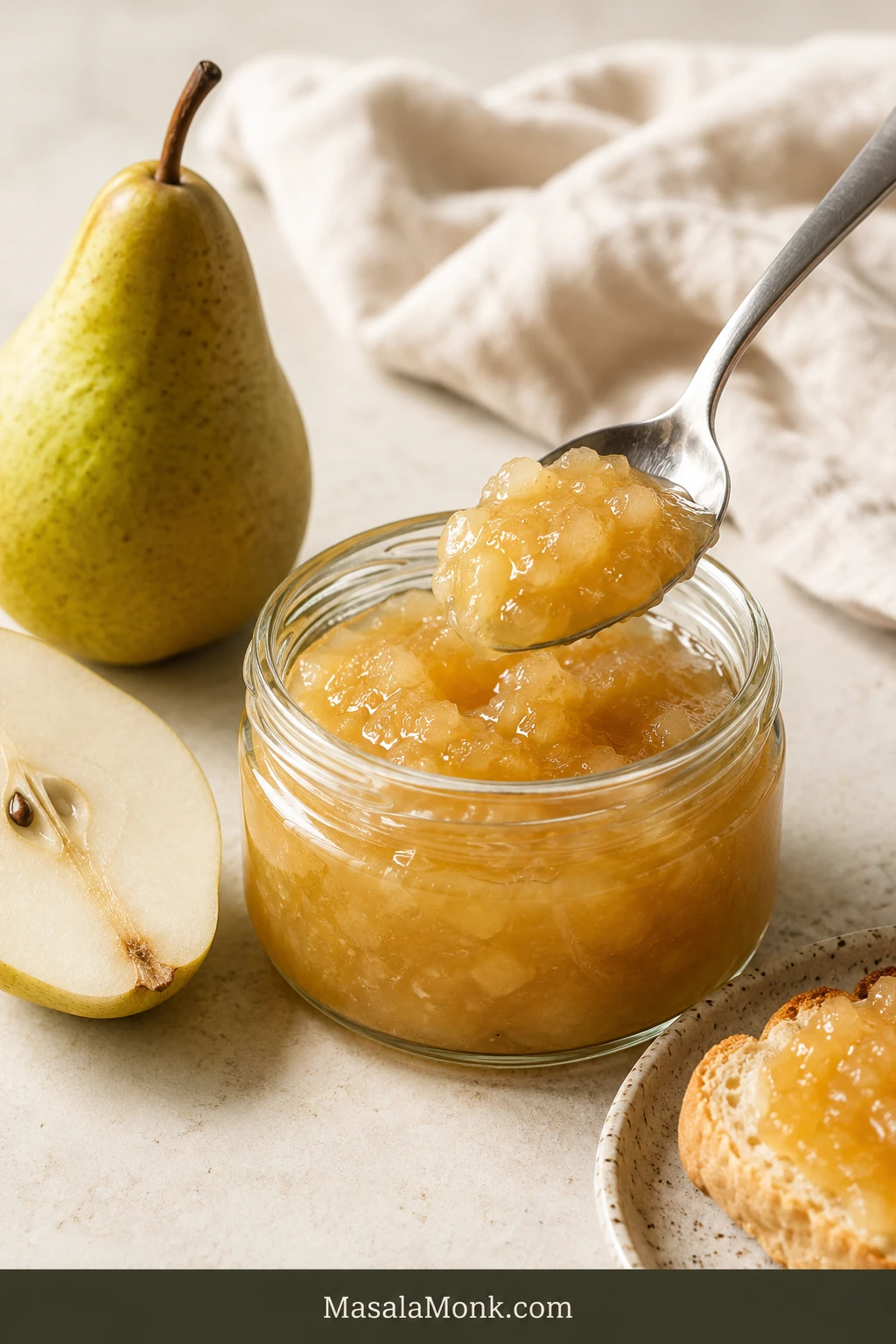
Pear jam is a quieter preserve than berry jam or marmalade. Its pleasure is in the fragrance: soft, almost floral sweetness concentrated into a pale-gold spread with enough lemon to keep it bright.
This pear jam recipe is made for that brief window when ripe pears smell wonderful but are beginning to soften faster than you can eat them. The jam sets softly, making it easy to spread across toast, spoon over yogurt or serve with warm English scones and salty cheese.
You need only three core ingredients: prepared pears, sugar and lemon juice. Weigh the pears after trimming, cook them in a broad pan and judge the finish from a cooled spoonful instead of relying on a fixed cooking time.
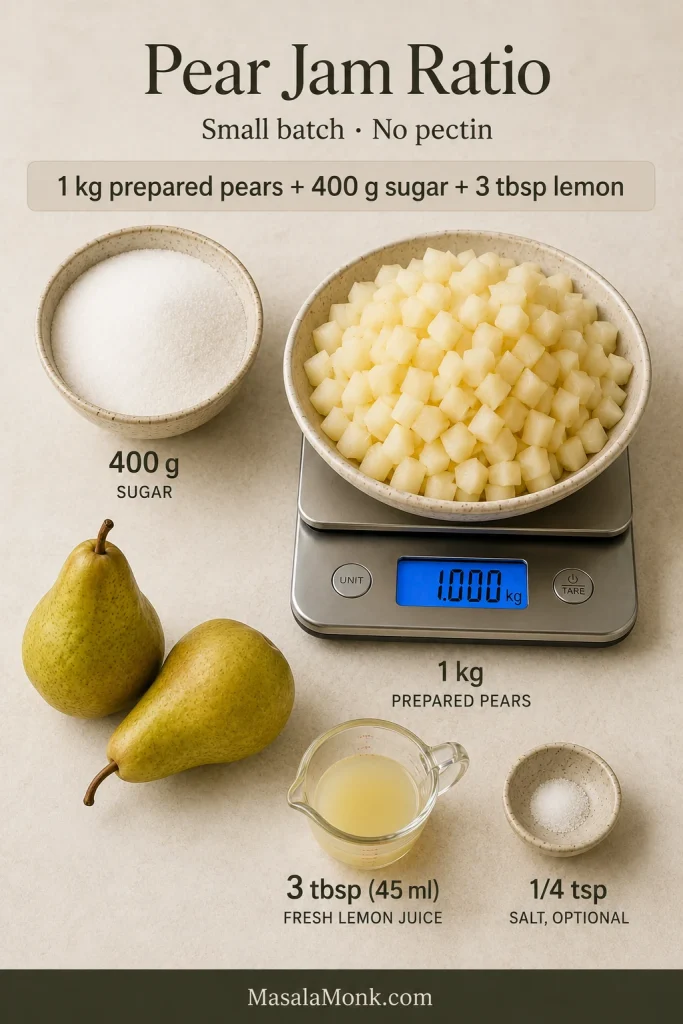
For one small batch, use 1 kg / 2 lb 3 oz peeled and cored pears, 400 g / 14 oz granulated sugar and 45 ml / 3 tablespoons fresh lemon juice. Cook larger quantities as separate batches so the fruit stays shallow in the pan.
Soften the pears, mash or blend them to the texture you like, then boil in a broad pan until a cooled teaspoon gathers and leaves a visible path when pushed. Stovetop cooking usually takes about 25–40 minutes, depending on the fruit and the shape of the pan.
The recipe makes approximately 2½–3 cups / 600–700 ml, or about three small jars. Store the finished jam in the refrigerator or freezer; it is not pantry-safe as written.
Weigh pears after peeling and coring; otherwise, discarded fruit can shift the sugar ratio and final consistency.
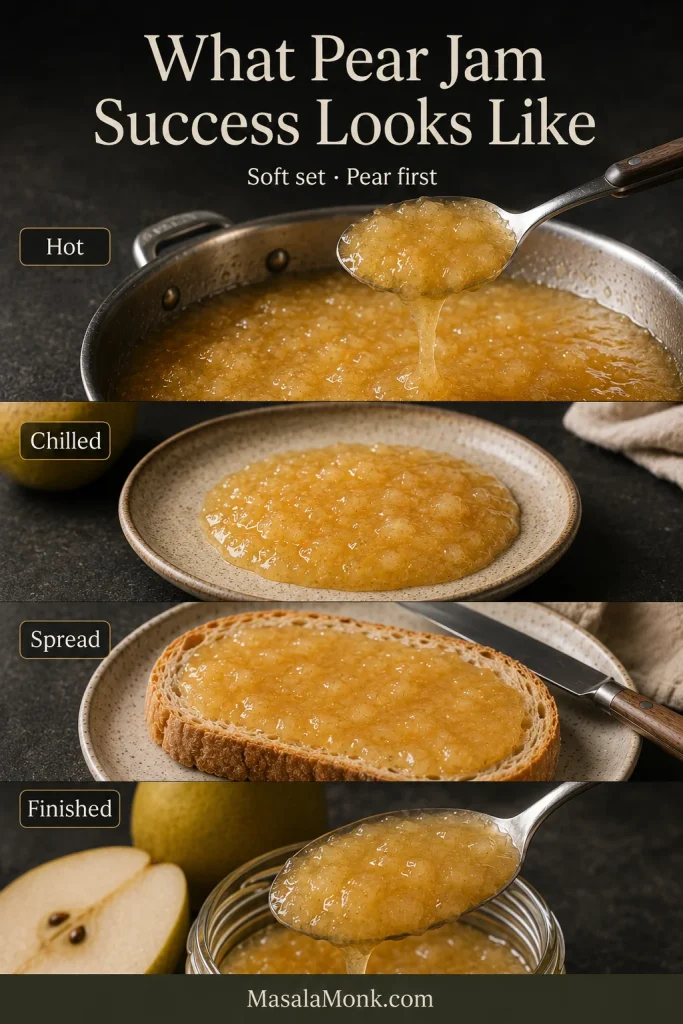
What Success Looks Like
While hot: glossy, pale gold to honey-coloured, and still fairly loose
After chilling: softly mounded and easy to spoon
On bread: spreadable without running straight off
In flavour: pear first, with lemon adding brightness
Weigh after trimming. Keep the batch shallow. Trust the cooled sample.
Hot jam firms as it cools; waiting for it to look set in the pan usually causes overcooking.
This is a no-pectin refrigerator jam. Packaged pectin is the better route when you want a firmer set or a shorter cooking time. For shelf-stable jars, follow the tested canning recipe in the storage section rather than adapting this lower-sugar method.
Easy Small-Batch Pear Jam Recipe Without Pectin
This version keeps the pear flavour clear and finishes with a soft refrigerator set. You do not need a canning setup or a precise thermometer endpoint; the cooled-plate test guides the finish.
Prep time
About 20 minutes
Optional resting time
1–4 hours
Cook time
About 25–40 minutes
Yield
About 2½–3 cups / 600–700 ml
Jar estimate
About three small jars in total
Storage
Refrigerator or freezer
Ingredients
1 kg / 2 lb 3 oz peeled, cored and diced pears
400 g / 14 oz granulated sugar, about 2 level US cups
45 ml / 3 tablespoons fresh lemon juice
¼ teaspoon fine salt, optional
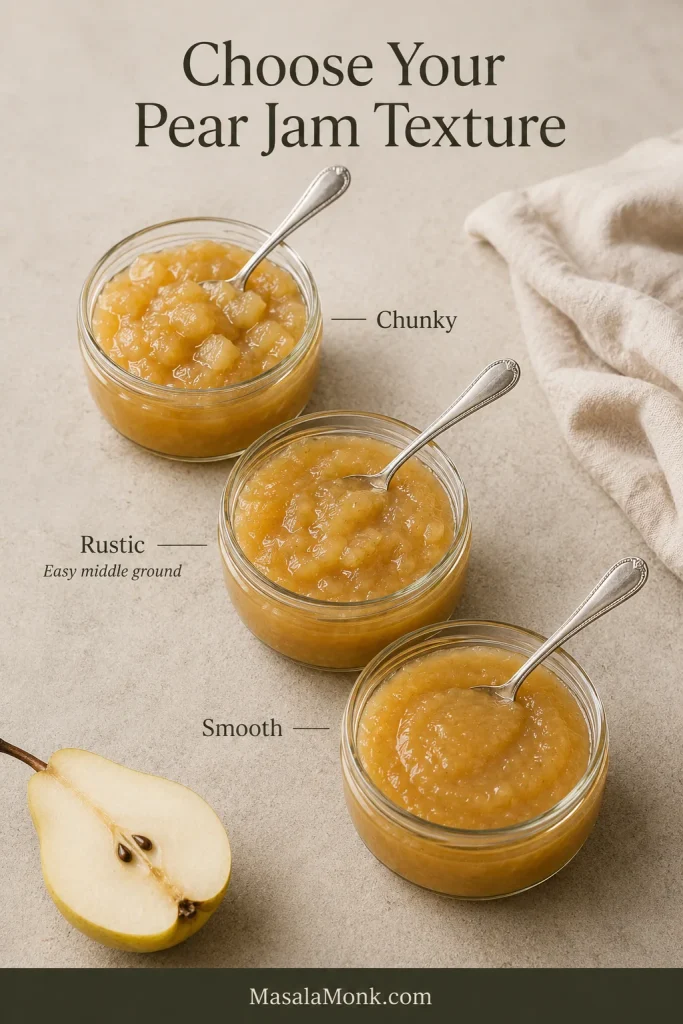
Choose Your Texture
Chunky: mash about half the pears
Rustic and spreadable: mash most of the fruit
Smooth: blend briefly after the pears soften
Not sure? Mash most of the pears. The result will still look homemade but will spread easily.
Mash fully for smooth jam, partly for rustic texture, or lightly to keep larger pear pieces.
Method
Prepare and Soften the Pears
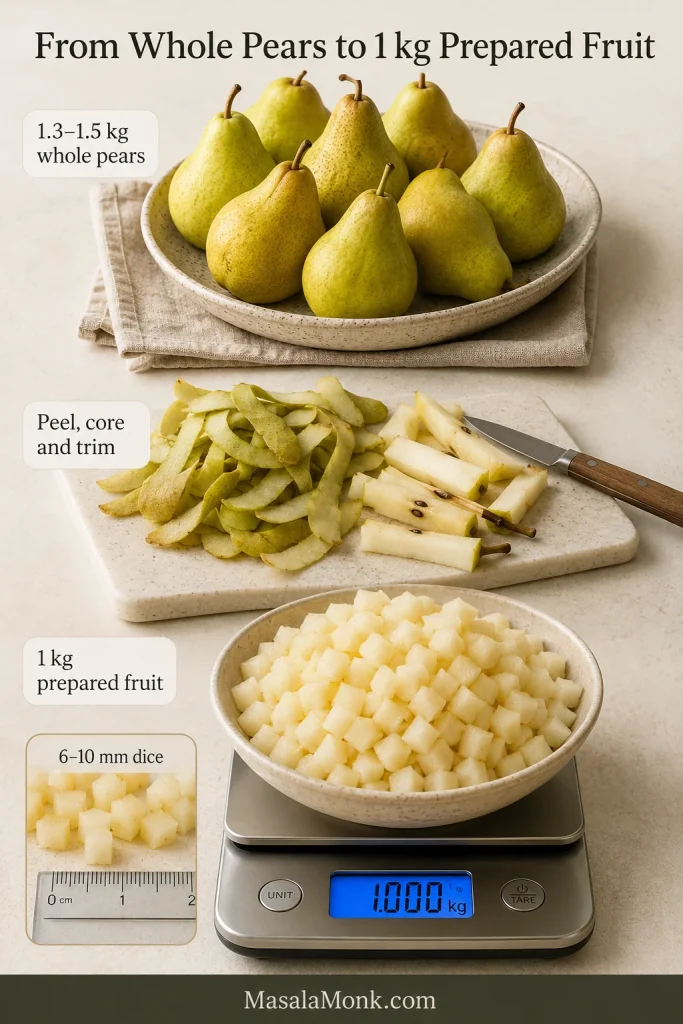
Prepare and weigh the pears. Put two small plates in the freezer. Peel, quarter and core the pears, trim away damaged flesh and cut the fruit into 6–10 mm / ¼–⅜ inch pieces. Weigh exactly 1 kg after preparation.
Add the sugar and lemon. Combine the pears, sugar, lemon juice and optional salt in a non-reactive bowl. Stir until every piece is coated.
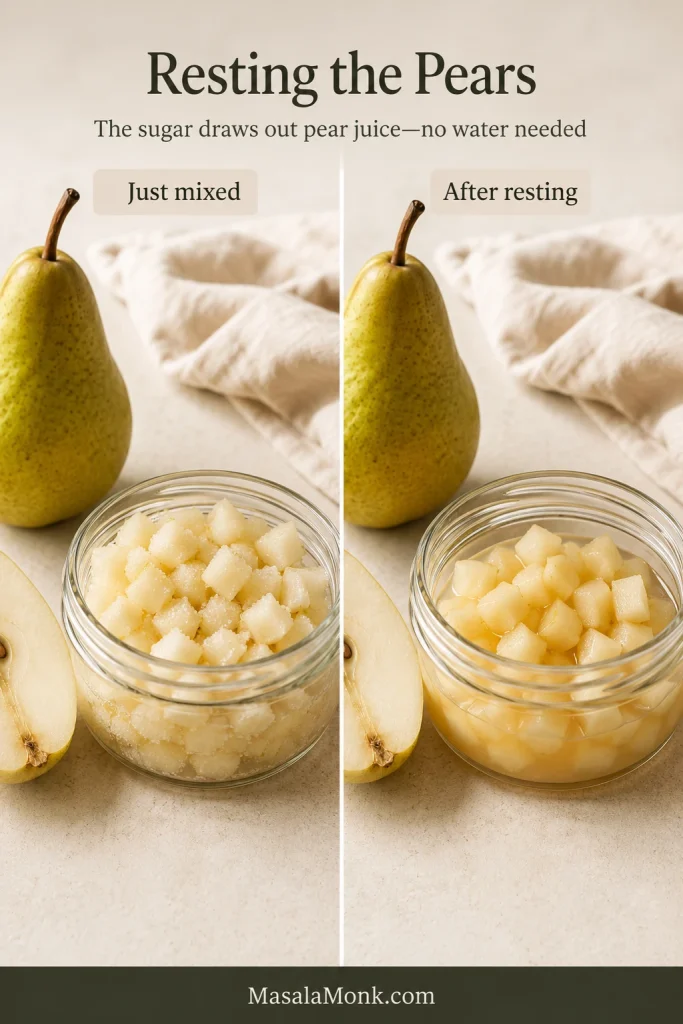
Rest if time allows. Cover and leave for 1 hour at cool room temperature, or refrigerate for up to 4 hours. A shallow pool of pear syrup should collect in the bowl. Skip the rest when time is short.
Soften the pears. Transfer the fruit and all its syrup to a wide, heavy-bottomed pan. Cook over medium-low heat for 10–15 minutes, stirring regularly, until the sugar has dissolved and a pear piece crushes easily against the side.
Choose the texture. Mash thoroughly for a smooth jam, mash most of the pears for a rustic spread, or leave more pieces intact for a chunky finish.
Reduce, Test and Fill
Once the fruit crushes easily, finish the batch in three stages: reduction, set testing and careful filling.
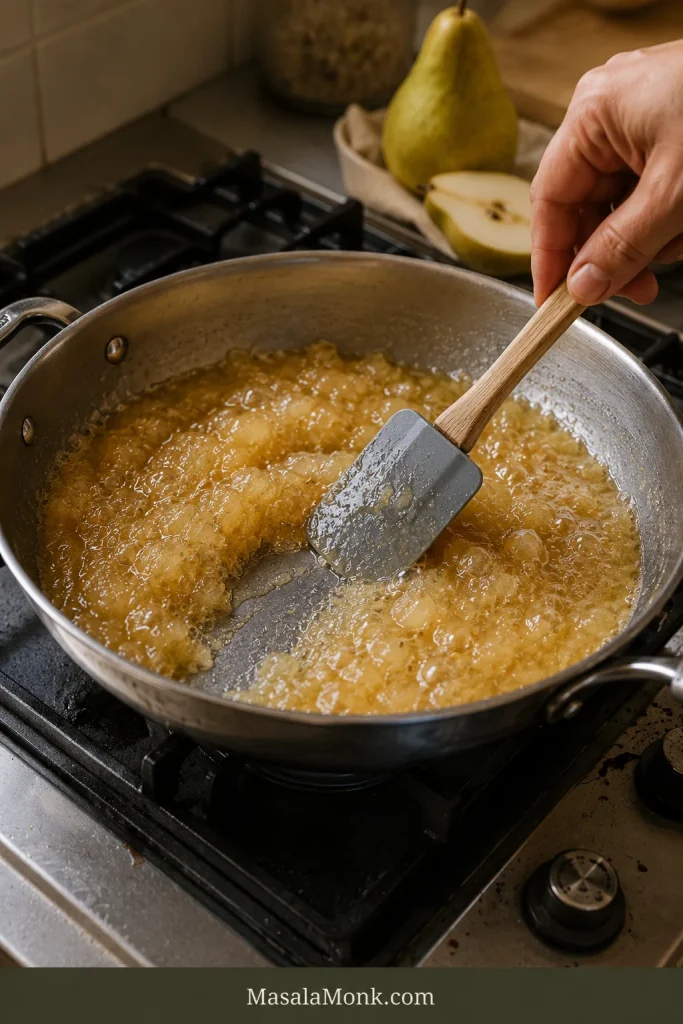
Keep the simmer active, then lower the heat as the mixture thickens and needs more frequent stirring.
Boil and reduce. Increase the heat to medium or medium-high. Cook uncovered at an active boil for approximately 15–25 minutes. Stir more frequently as the jam thickens, scraping across the base and into the corners.
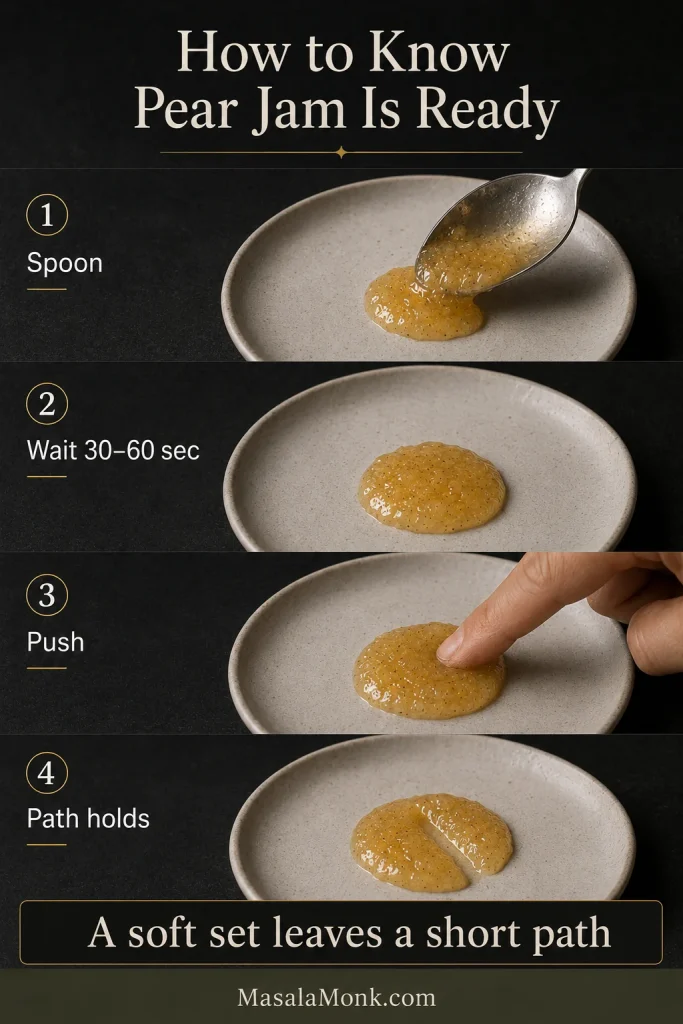
Test the set. When the bubbles become larger and slower, move the pan away from the heat. Place a teaspoon of jam on a chilled plate, wait 30–60 seconds and push it with a fingertip. The sample should gather and leave a visible path. If it runs back together like syrup, boil for another 2–3 minutes and test again.
Warm the jars. While the jam finishes, fill clean, heat-safe jars with hot water. Empty and dry them just before filling so the glass is warm when the hot jam goes in.
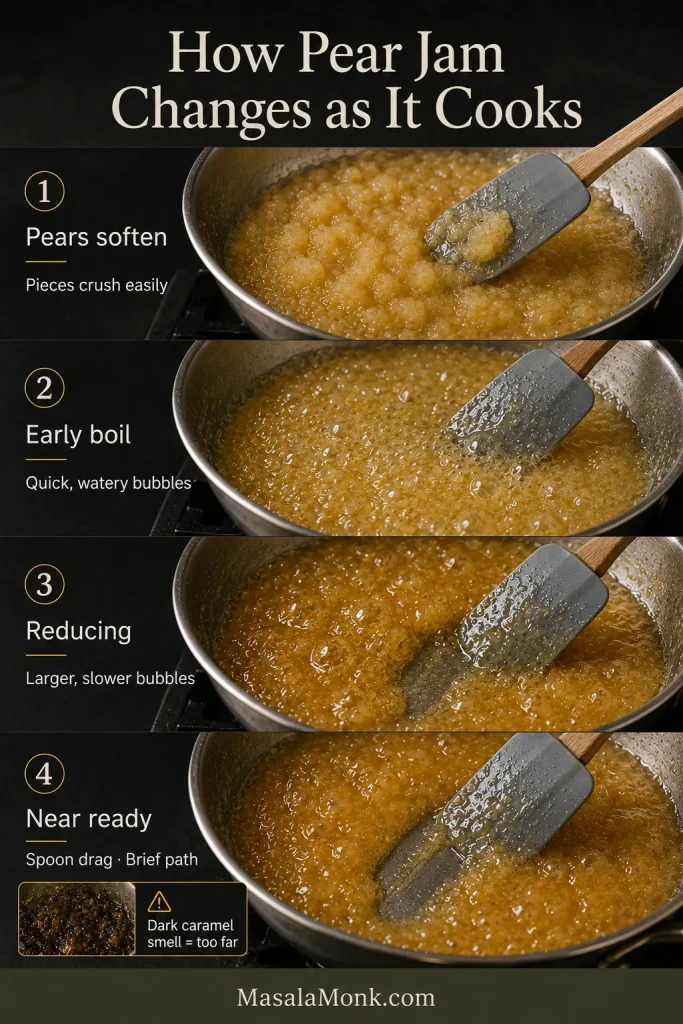
Rest and fill. Let the pan stand for 5 minutes, stir gently and skim any foam that remains. The jam should look glossy and range from pale gold to honey-coloured. A distinctly dark caramel smell suggests it has cooked too far. Ladle the jam into the warm jars and fit the lids.
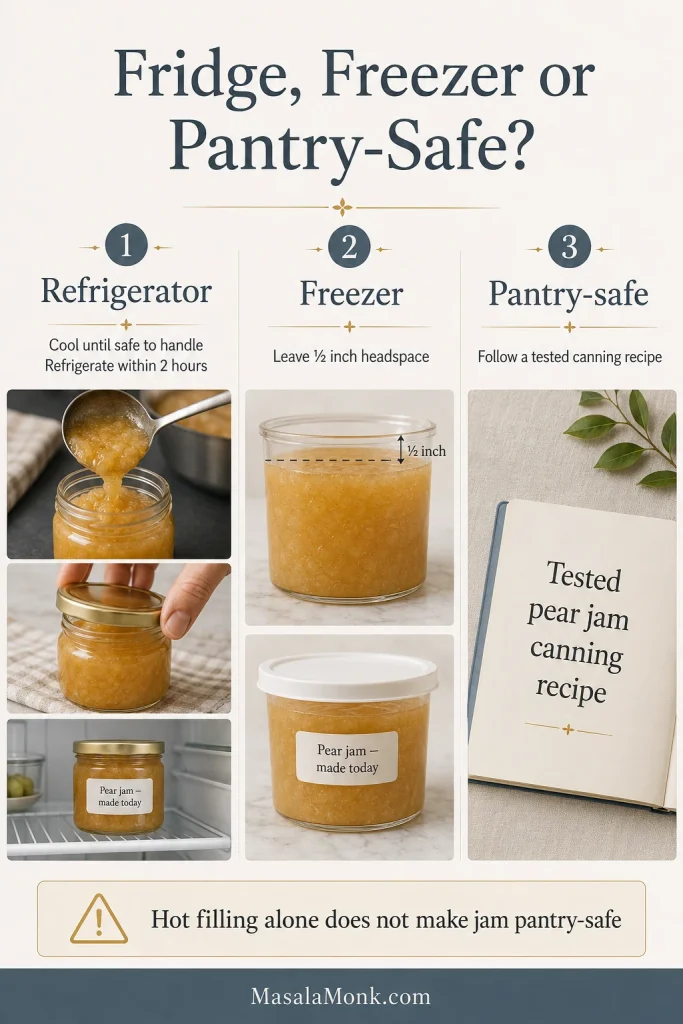
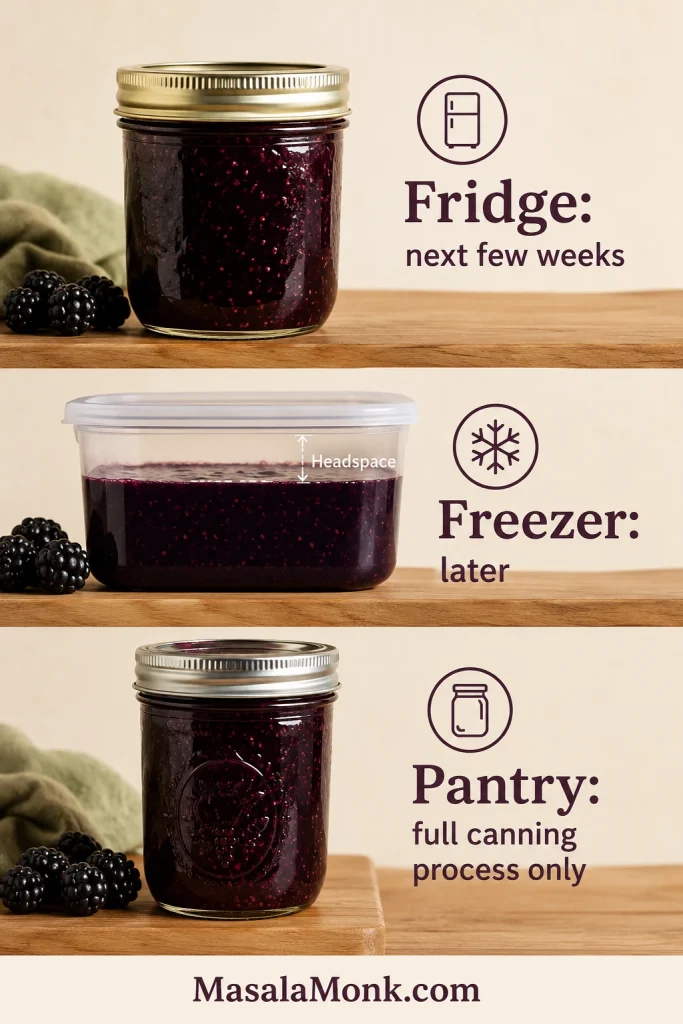
For refrigerator storage: Let the jars cool only until they are safe to handle, then refrigerate them. Do not leave them at room temperature for more than two hours.
For freezing: Use freezer-safe jars or containers and leave ½ inch of headspace for expansion.
Recipe Notes
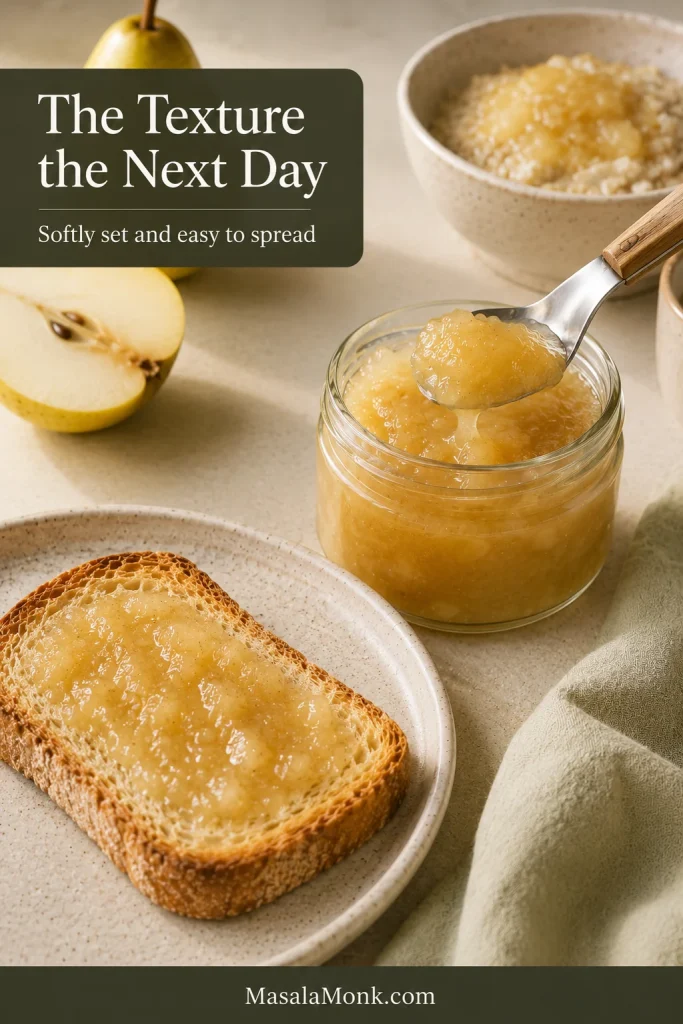
Warm jam looks looser than expected. By the next day, it should settle into a soft mound that gives easily under a knife.
A lid may pull down as the jar cools, but that does not make this refrigerator recipe pantry-safe.
A loose-looking jar may set perfectly overnight, so judge the final texture only after thorough chilling.
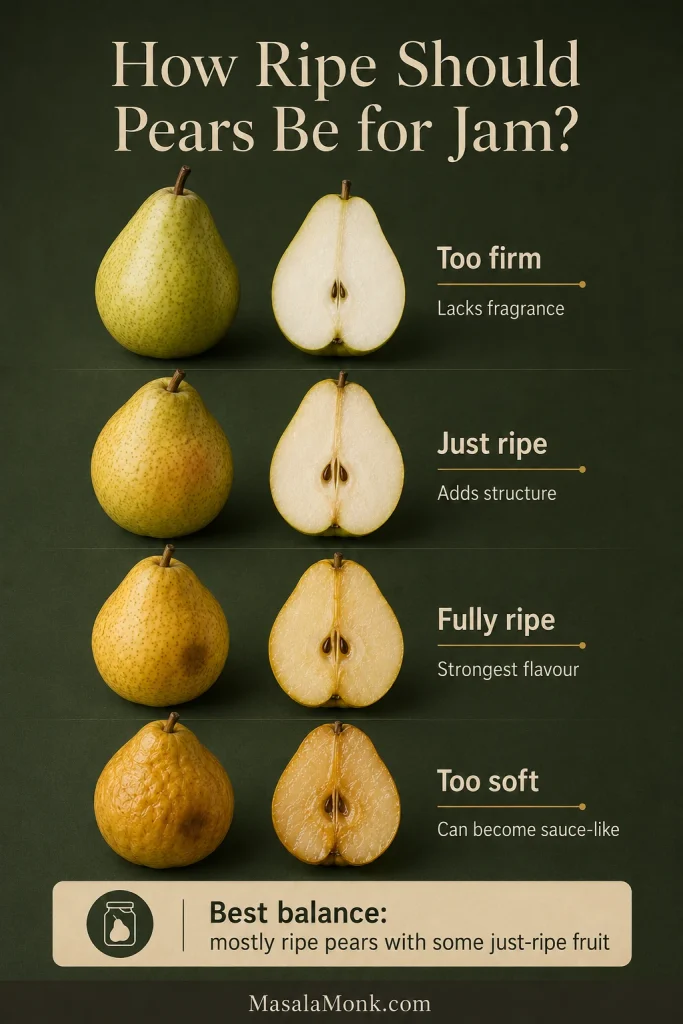
Choose pears that smell ripe and yield slightly near the neck but still hold their shape when cut. Green-hard fruit lacks the aroma you want, while pears that are collapsing throughout can produce something closer to pear sauce.
For a balance of aroma and structure, use mostly ripe pears with a smaller amount of firmer, just-ripe fruit. Ripe pears bring the strongest flavour; firmer pieces give the finished jam more body.
Blend fully ripe pears with just-ripe fruit for aroma and structure; very soft pears can turn sauce-like.
Pear flavour becomes warmer and more concentrated as it cooks, while lemon helps it remain distinct.
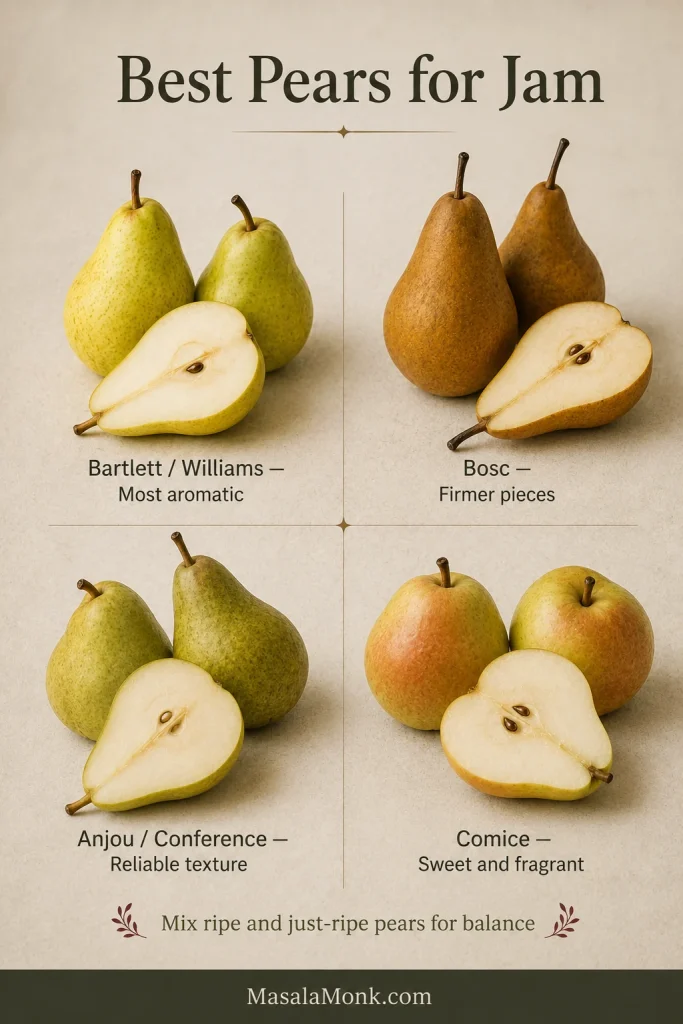
Which Pear Varieties Work Best?
Pear
Best use
Bartlett or Williams
Highly aromatic base that softens quickly
Bosc
Firmer pieces with a warm, honeyed flavour
Anjou or Conference
Reliable all-purpose texture and mild sweetness
Comice
Very sweet and fragrant; combine with firmer fruit
Bartlett or Williams pears add aroma; firmer Bosc, Anjou or Conference pears retain visible fruit pieces.
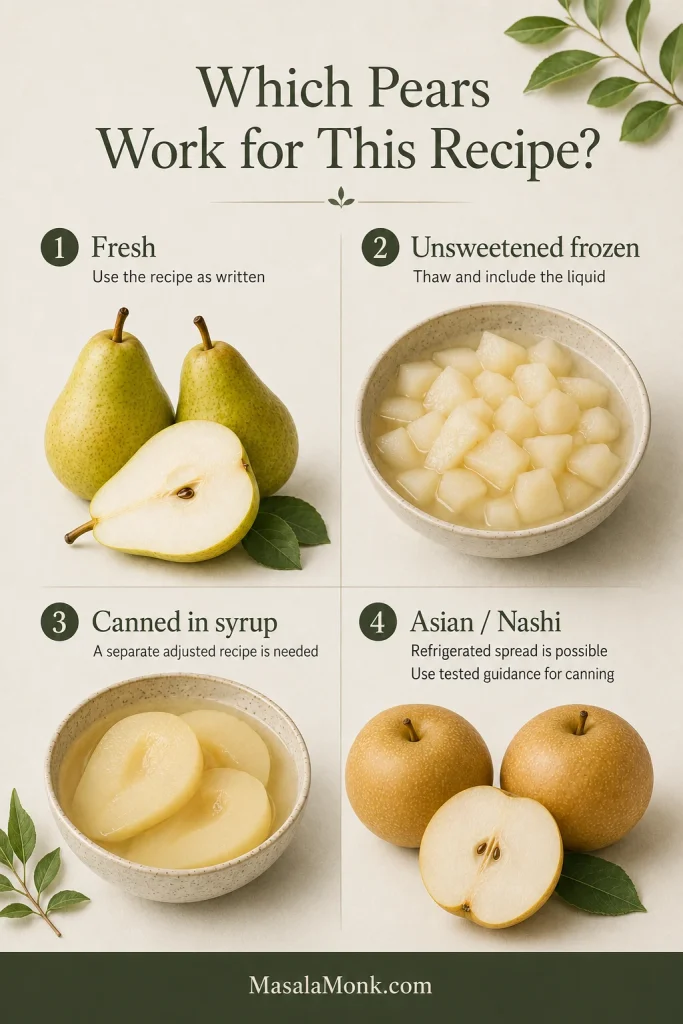
Can You Use Very Ripe, Frozen or Canned Pears?
Very ripe pears: Use them if they show no mould, fermentation or other spoilage. They bring plenty of aroma but less structure, so combine them with some firmer fruit and begin checking the jam earlier.
Frozen pears: If you freeze your own, peel, core and weigh 1 kg before freezing. For purchased unsweetened frozen pears, thaw first and weigh the fruit together with its released liquid. Thawed pears work best in a smoother jam and may need a little longer to reduce.
Canned pears: This recipe is written for fresh or properly weighed frozen pears. Syrup-packed fruit changes the sugar ratio and cooking time, so an adjusted canned-pear version is not included here.
Weigh the pears after peeling, coring and trimming. Depending on their size and how much must be discarded, allow roughly 1.3–1.5 kg / 2¾–3⅓ lb whole pears to produce 1 kg prepared fruit.
Uniform 6–10 mm pieces soften evenly, preventing some chunks from dissolving while others remain firm.
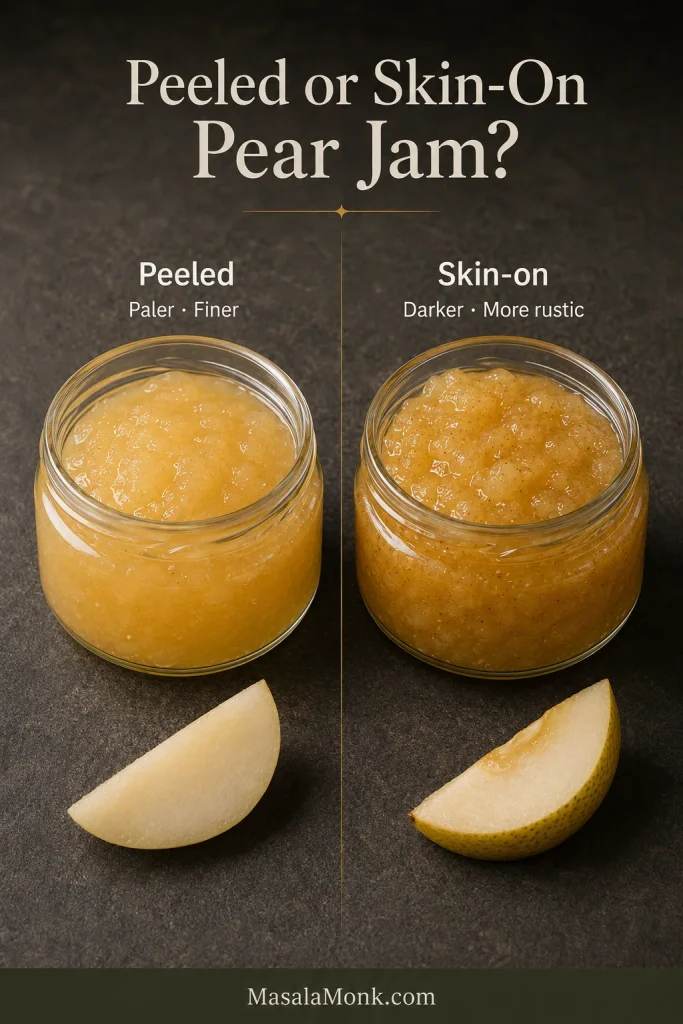
You may leave some or all of the skin on for a darker, more rustic jar. Still weigh 1 kg after removing the cores and damaged areas. Peeling remains the default because it gives the spread a paler colour and finer texture.
Peeling gives a paler, finer spread; clean pear skins add colour, fibre and rustic texture.
Sugar, Lemon and Salt for Pear Jam
If you reduce the sugar, expect a looser spread and a smaller yield. In this version, sugar also draws juice from the pears and gives the finished jam body.
Resting draws out pear juice, helping the sugar dissolve and reducing early sticking in the pan.
The recipe uses 400 g sugar for 1 kg prepared pears—40% of the fruit weight. It produces a spoonable refrigerator jam; traditional higher-sugar recipes generally set more firmly.
For a firm jam with substantially less sugar, use a low/no-sugar pectin recipe written for the exact product.
Lemon balances the sweetness, slows visible browning and supports the soft set. A small pinch of salt softens the sweetness and makes the pear taste more distinct.
Best Pan and Tools for Pear Jam
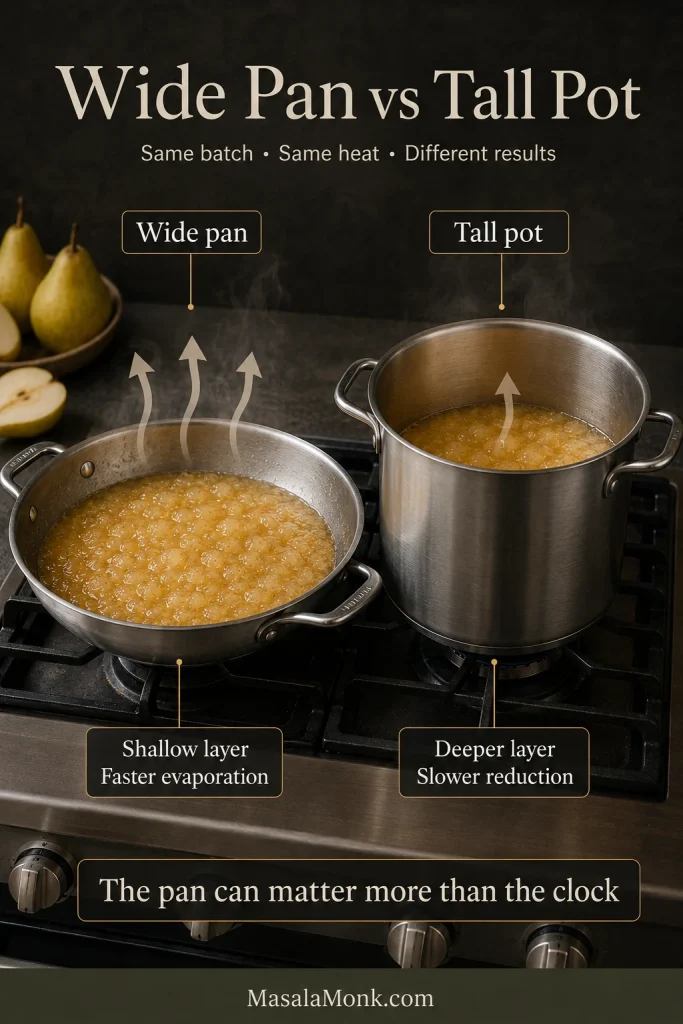
If your jam is taking far longer than expected, the pan may matter more than the pears. A broad surface releases steam quickly; a tall stockpot holds the same mixture in a deeper layer and slows evaporation.
A wide pan evaporates faster; the same batch reduces more slowly in a deeper, narrower pot.
Digital kitchen scale: for accurate fruit and sugar measurements
Wide, heavy-bottomed pan: approximately 4–6 litres for this batch
Silicone spatula or wooden spoon: for scraping the full base
Potato masher: for a rustic finish
Immersion blender: optional for a smoother jam
Two chilled plates: for checking the cooled texture
Clean, heat-safe jars or refrigerator containers: warmed before filling
What to Watch in the Pan
When the Pears Are Ready to Mash
The pieces should look translucent around the edges and crush easily against the side of the pan. As they soften, the raw-fruit smell becomes warmer and fuller—the first moment the pan begins to smell like pear jam instead of chopped pears.
Blending the pears too early can make the mixture watery. Let the pieces soften until they crush easily before reaching for the blender.
When to Begin Testing
At first, the bubbling is quick and watery. As the pear juice concentrates, the bubbles become larger and slower, the spoon drags slightly and a line scraped across the base remains visible for a moment.
Fresh pear aroma should remain clear; a dark caramel smell means the reduction has gone too far.
The colour may stay pale gold or deepen toward honey, depending on the variety and cooking time. Near the end, the sound often becomes heavier before the jam looks dramatically thicker. That is the moment to begin checking cooled samples.
Very high heat before the pears soften can catch the sugar on the base. Continuing to boil after the jam is ready darkens the colour and dulls the fruit.
A jar that finishes a little looser or firmer than planned can still be delicious. Texture is easier to repurpose than flavour.
How to Test the Set
This is the uncertain moment in the recipe because the jam often looks looser than the finished jar will be.
Pears do not announce the setting point dramatically. The bubbles simply slow, the spoon feels heavier and a cooled drop finally stays where you push it.
The Chilled-Plate Test
Move the pan away from the heat.
Place a teaspoon of jam on a chilled plate.
Wait 30–60 seconds.
Push the edge with a fingertip.
Move the pan off the heat while testing, or the batch may overcook as the sample cools.
A watery sample runs straight back together. When ready, it gathers and leaves a short path. You may see a faint wrinkle at the edge, but do not wait for a dramatic one.
The same cooled-sample principle appears in this orange marmalade recipe, where stopping at the first soft set helps prevent an overly stiff preserve.
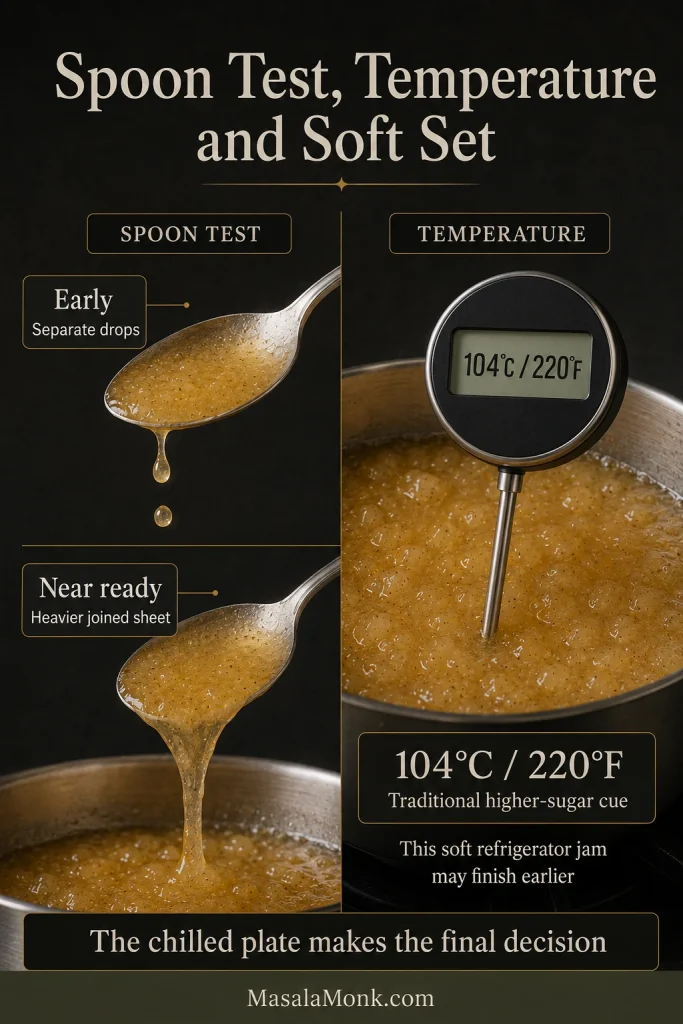
Early in cooking, the liquid falls from a cool spoon in quick separate drops. Near the endpoint, those drops become heavier, begin to join and fall from the edge in a short sheet.
Traditional higher-sugar jams without packaged pectin are often cooked toward approximately 104°C / 220°F at sea level. This lower-sugar refrigerator jam may be ready earlier, so treat the chilled plate as the deciding test.
Temperature and spoon behaviour support the decision, but the cooled sample determines the final set.
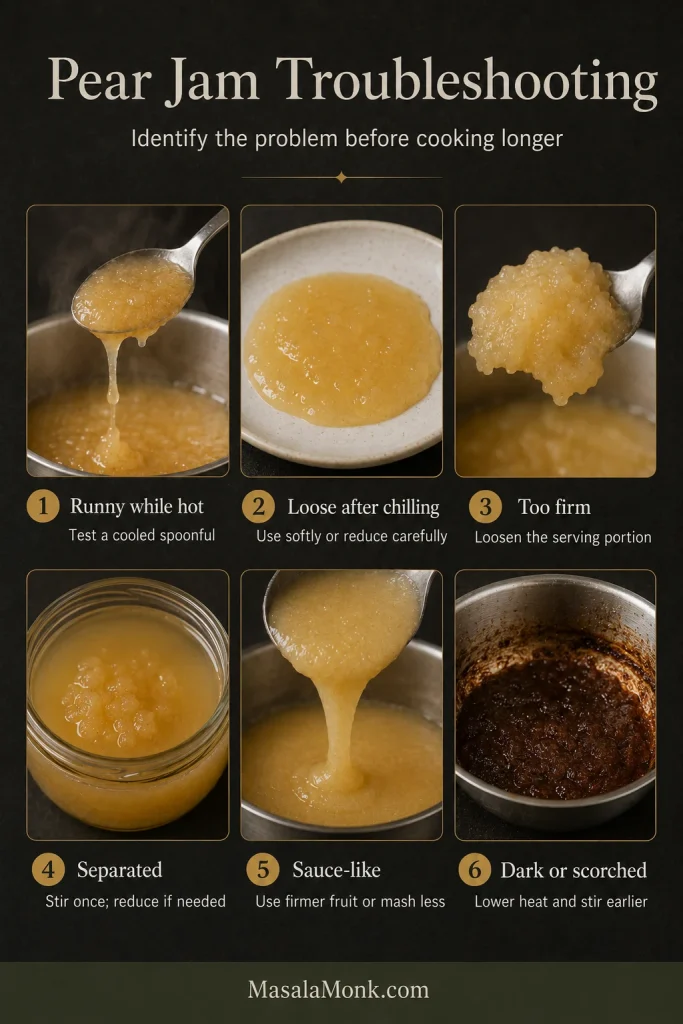
Pear Jam Troubleshooting
Differences in pear ripeness usually change the cooking time more than they ruin the batch. Let the jam chill overnight before deciding that something has gone wrong.
Hot looseness is normal; decide whether the batch needs more cooking only after testing a cooled sample.
Problem
What to do
Runny while hot
Check a cooled teaspoon before cooking longer. Hot jam naturally appears loose.
Still runny the next day
Use it as a soft spread, or return a measured amount to a broad pan and reduce it carefully.
Separation after chilling
Stir the jar once. Persistent separation suggests the jam needed a little more reduction.
Overly firm set
Warm only the amount you plan to serve with a teaspoon or two of water or lemon juice.
Sauce-like texture
Firmer pears and a lighter mash leave more recognisable fruit in the jar.
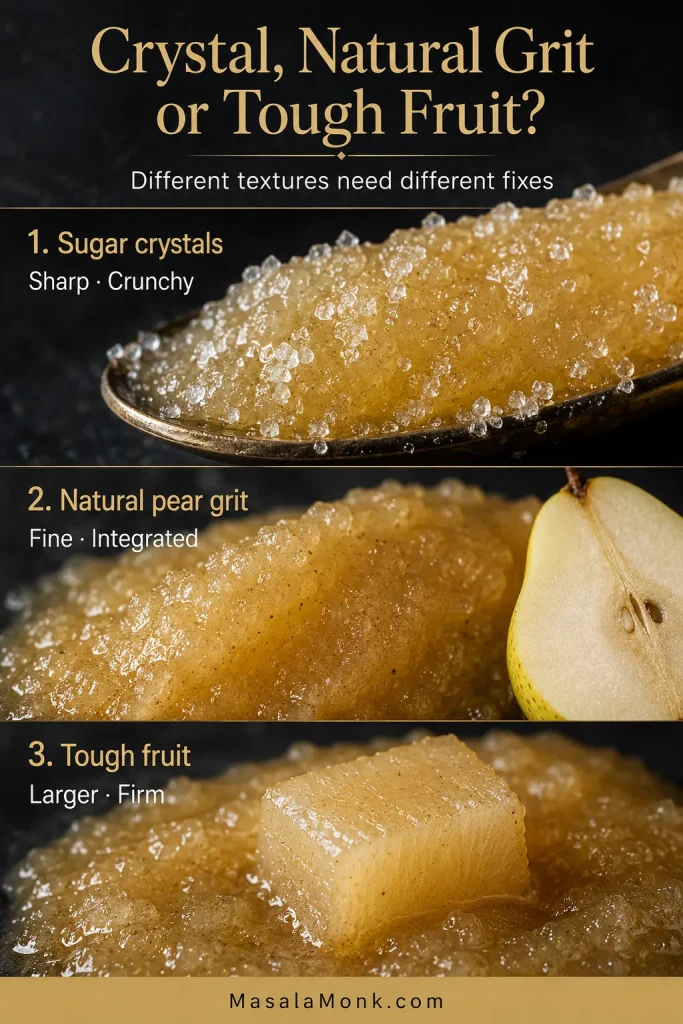
Crunchy sugar crystals
Let all visible sugar dissolve before bringing the mixture to an active boil.
Fine pear-like grit
Pears naturally contain stone cells. Blend more thoroughly or choose a smoother-textured variety.
Tough fruit pieces
Soften the fruit until each piece crushes easily before mashing or blending.
Weak pear flavour
More aromatic pears and enough lemon give a mild batch greater definition.
Dark or scorched jam
A broad, heavy pan and more frequent stirring near the end reduce the risk of scorching.
Unusually long cooking time
A narrow pan, deep layer of fruit or unusually juicy pears can slow evaporation.
Sugar Crystals, Natural Pear Grit or Tough Fruit?
Reflective grains suggest sugar crystals; fine matte grit may be natural, while larger firm pieces are under-softened fruit.
A loose batch that tastes good is not a failed batch. Spoon it over oatmeal, yogurt or ice cream, use it as a breakfast syrup, or warm it into a glaze.
Cornstarch makes a starch-thickened fruit filling, not a conventional jam. It belongs in recipes such as this cherry pie filling, where the thickened fruit needs to stay inside a pie.
Texture can be corrected or repurposed. Pears cooked past their fresh flavour are harder to rescue.
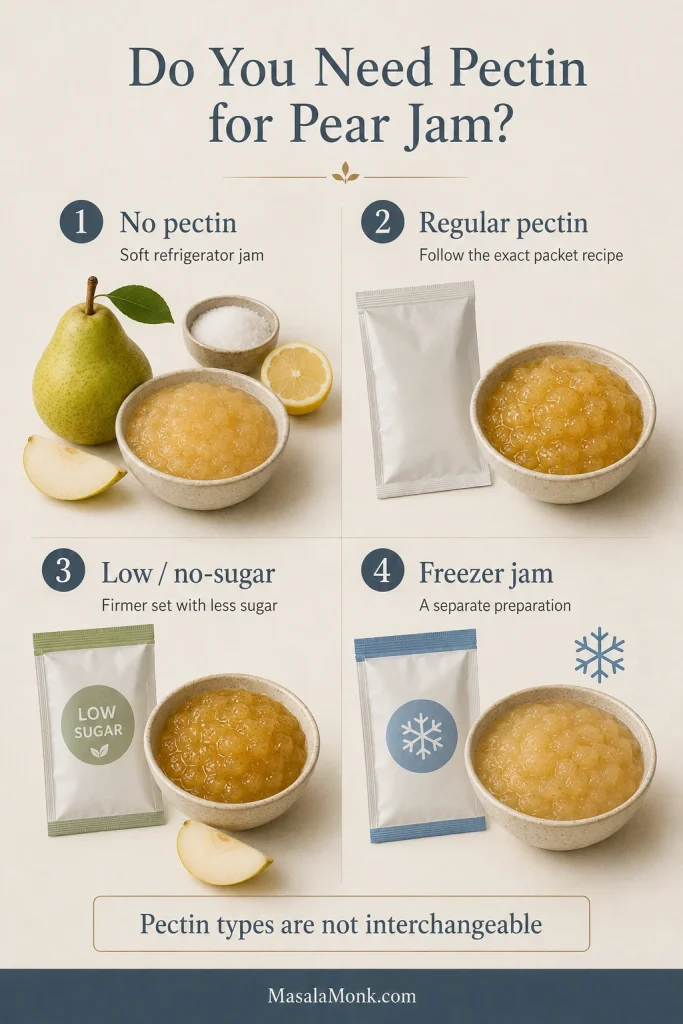
Choose the no-pectin method for a soft refrigerator jam. Use packaged pectin when a firmer set, shorter cooking time or substantially lower sugar matters more.
Regular powdered or liquid pectin: follow the pear-jam recipe written for the exact product, including its sugar quantity and mixing order.
Low/no-sugar pectin: choose this when less sugar and a firmer gel are both important.
Freezer-jam pectin: use it for the separate, usually uncooked or briefly heated preparation described on the packet.
Changing pectin also changes sugar, acid and method, so follow the packet’s complete formula.
Honey and maple syrup add liquid as well as sweetness. They work best in recipes developed around those sweeteners, not as direct cup-for-cup replacements.
Pear Jam Storage: Refrigerator, Freezer and Pantry-Safe Options
Choose the Right Storage Route
A pulled-down lid does not prove shelf safety; pantry storage needs a separately tested canning recipe.
Refrigerator
Fit the lids after filling, let the jars cool only until they are safe to handle, then refrigerate them. Keep the jam at 4°C / 40°F or colder and use it within about three weeks for best quality. Return the jar to the refrigerator after serving and use a clean spoon each time.
Discard the contents if you notice mould, active bubbling, fermentation or an alcoholic or yeasty smell.
Freezer
Use freezer-safe jars or containers and leave approximately ½ inch of room for expansion. Freeze for up to one year for best quality and thaw overnight in the refrigerator.
Freezing this cooked jam is different from making classic freezer jam, which is generally uncooked or briefly heated and uses a freezer-jam pectin formula.
Pantry-Safe Canning
For pantry storage, change recipes instead of trying to convert this one. Follow one tested canning method from beginning to end, including its fruit, sugar, acid, jar size, headspace, processing time and altitude adjustment.
For a tested shelf-stable option, follow Bernardin’s no-added-pectin pear jam exactly as written. Its higher-sugar, long-boil method is separate from the refrigerated version on this page.
A hot-filled lid may appear to seal as it cools. Pantry storage still requires the boiling-water process specified in the tested recipe.
Ginger, Vanilla and Other Variations
Pear is delicate, so one measured flavouring usually works better than several competing spices.
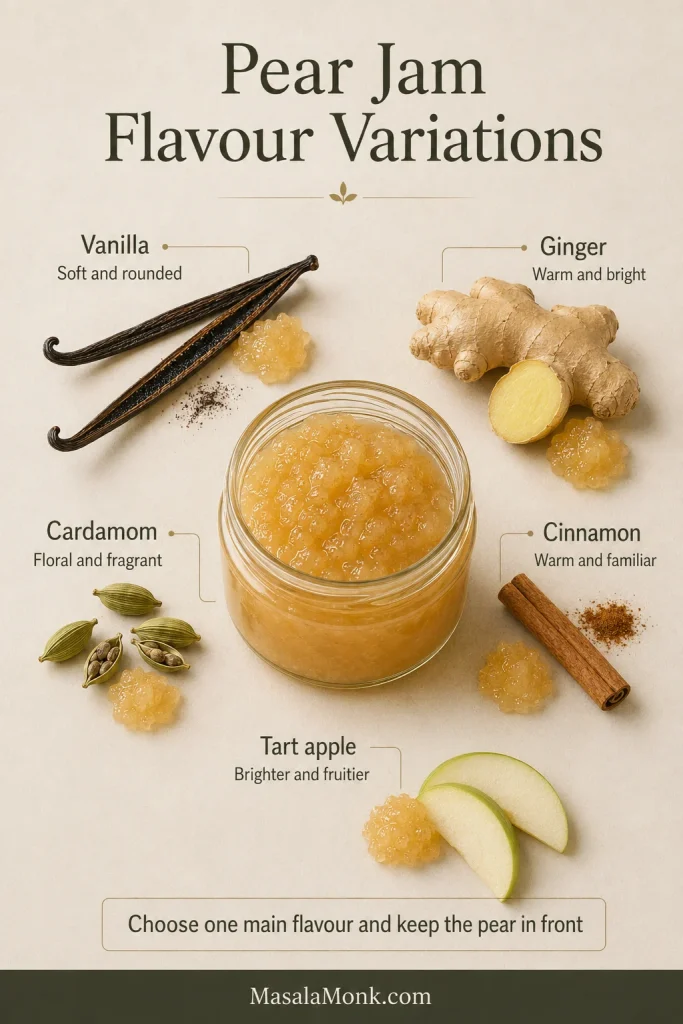
Vanilla, ginger, cardamom, cinnamon and tart apple each complement pear differently; choose one main flavour so the fruit stays recognisable.
Ginger: Add 10–15 g finely grated fresh ginger, approximately 2–3 teaspoons, with the pears and sugar. It gives the jam a clean warmth that works particularly well with cheese.
Vanilla: Stir in 1 teaspoon vanilla extract after taking the pan off the heat. It softens the lemon’s edge and gives the pear a fuller, more dessert-like flavour.
Cinnamon: Add one small cinnamon stick during cooking and remove it before filling the jars, or use ¼ teaspoon ground cinnamon. More can make the jar taste closer to pie filling than pear jam.
Cardamom: Add ¼ teaspoon finely ground cardamom with the sugar. Its floral, lightly citrusy warmth is especially good with brie, goat cheese and salty crackers.
Apple and pear: Replace up to one-third of the pears with a tart cooking apple for a tangier, fuller-bodied refrigerator spread. Use a separately tested recipe when the jars are intended for pantry storage.
More Than Toast
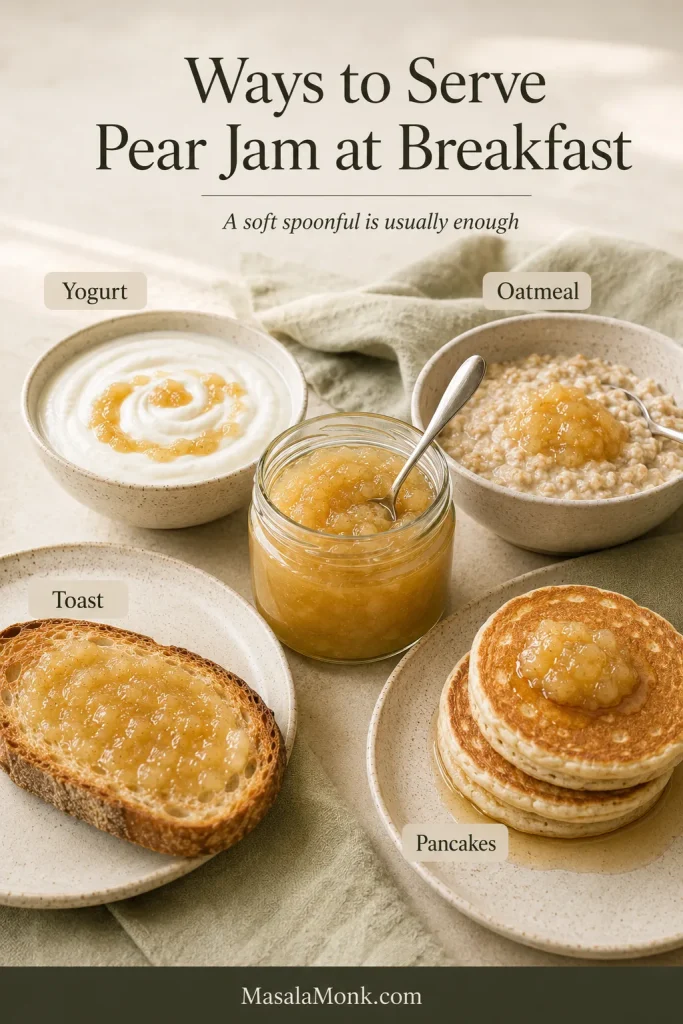
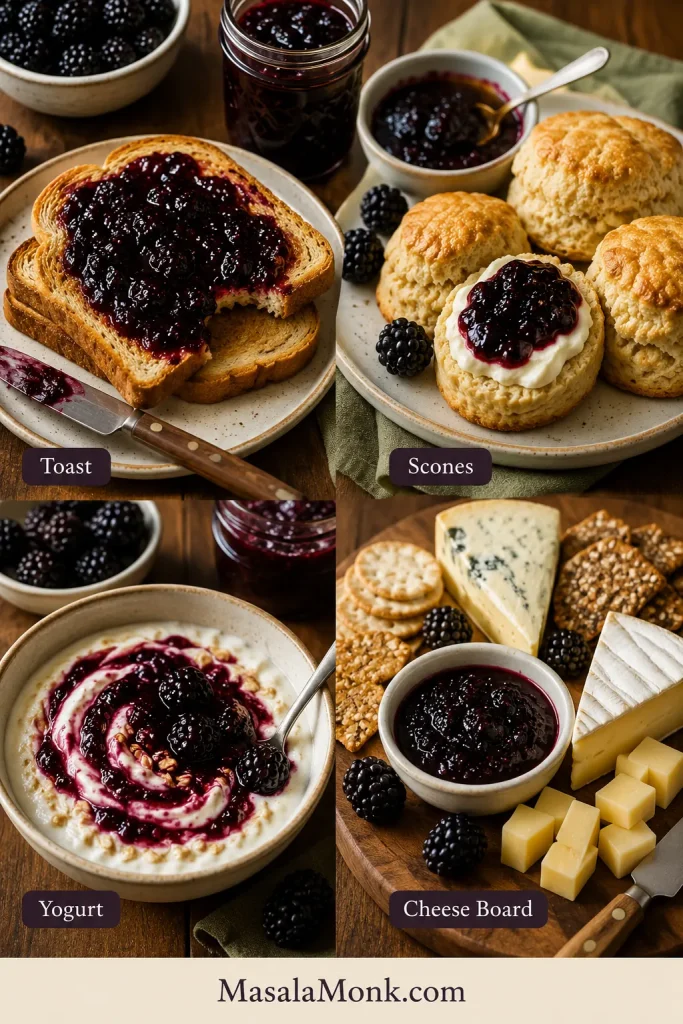
For breakfast: Spoon the jam over creamy overnight oats, warm porridge, yogurt, pancakes or French toast.
Beyond toast, a spoonful of pear jam can brighten yogurt, oatmeal or pancakes without overwhelming them.
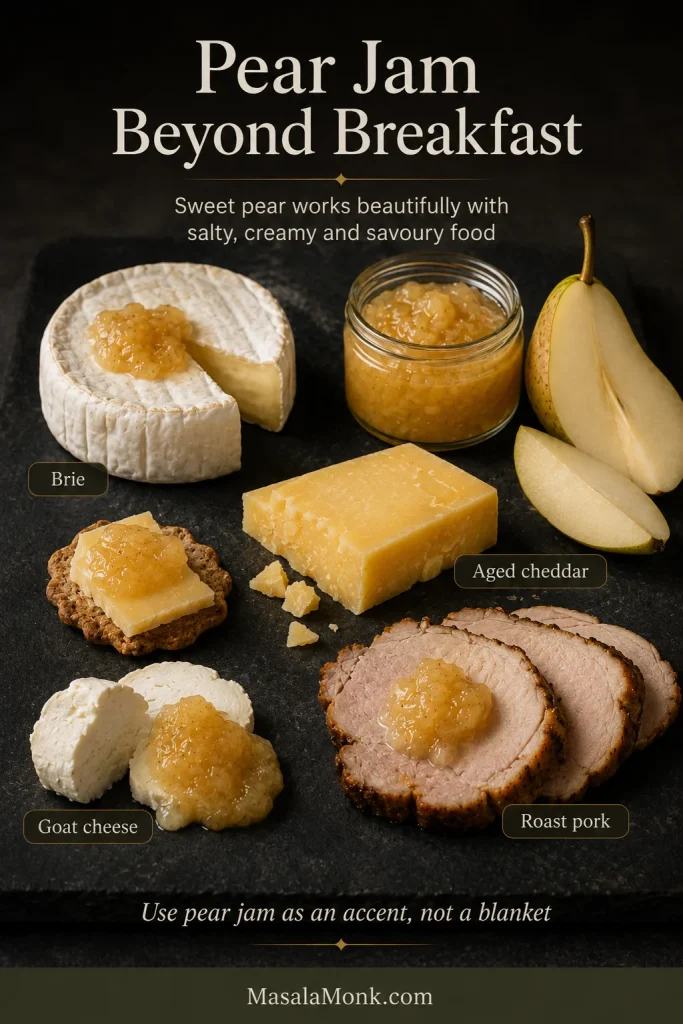
Pear Jam With Cheese and Savoury Food
With cheese: Serve it beside warm baked brie, goat cheese, blue cheese or mature cheddar.
Pear jam suits Brie, goat cheese, aged cheddar and roast pork best as a restrained sweet accent.
In baking: Spread it between sponge-cake layers, spoon it into thumbprint cookies or swirl it through cheesecake and rice pudding.
As a glaze: Warm it with a splash of lemon juice and brush it over roasted carrots, baked apples, roast pork, chicken or glazed ham.
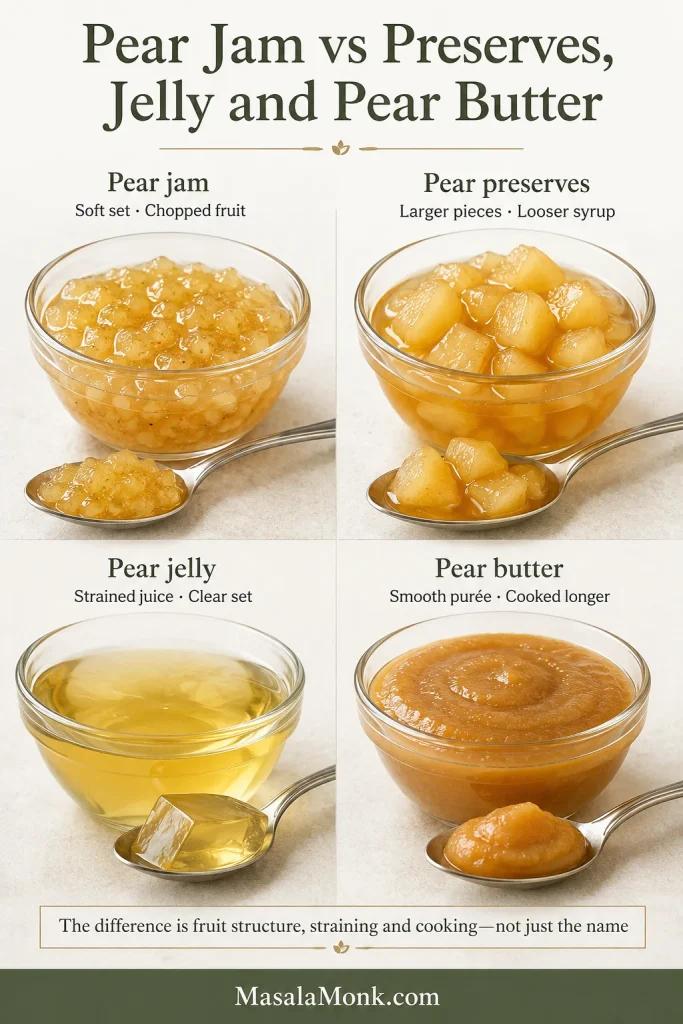
Jam, Preserves, Jelly and Pear Butter
The difference lies in how much fruit remains visible and whether the pears are chopped, strained or puréed.
Preserve
What makes it different
Pear jam
Chopped, mashed or briefly blended fruit with an even, spreadable texture
Pear preserves
Larger slices or pieces that remain recognisable in thick syrup
Pear jelly
Extracted and strained juice cooked into a clear, smooth gel
Pear butter
Fully puréed fruit cooked until dense and concentrated instead of gelled
Jam uses chopped fruit, preserves keep larger pieces, jelly uses juice, and pear butter is smooth purée.
This pineapple jam and preserves guide shows how changing the fruit preparation creates either a smoother jam or a chunkier preserve.
Frequently Asked Questions
Do pears need packaged pectin?
No. Ripe pears can make a spoonable refrigerator jam without packaged pectin. Use commercial pectin when you want a firmer or faster-setting result.
Do pears need to be peeled for jam?
No. Leaving some or all of the skin creates a darker, more rustic texture. Peeling gives the jam a paler colour and smoother finish.
How many whole pears make 1 kg of prepared fruit?
Allow approximately 1.3–1.5 kg / 2¾–3⅓ lb whole pears. The exact amount depends on their size, variety and how much must be removed during peeling and coring.
Can brown sugar be used?
Yes, but it will darken the jam and add caramel or molasses notes. Keep granulated sugar as the majority when you want the pale colour and delicate pear flavour to remain dominant.
Can the lemon juice be omitted?
For this version, keep the lemon juice. It balances the sweetness, slows browning and supports the soft set. A lemon-free jam needs a different recipe.
Why does pear jam sometimes feel slightly gritty?
Pears naturally contain tiny stone cells that can create a fine gritty sensation. This is different from crunchy sugar crystals. Blending more thoroughly or choosing a smoother-textured variety can reduce it.
Can the recipe be doubled?
Cook doubled quantities as two separate batches. A larger amount sits deeper in the pan, so water escapes more slowly and the pears may overcook before the jam thickens.
Can pear jam be frozen or canned?
For freezing, leave ½ inch of expansion space and thaw the jar in the refrigerator. For pantry canning, use the separate tested recipe linked in the storage section.
The finished jam should still taste clearly of pear. Stop when the cooled sample holds its path; that small pause protects both the soft set and the fruit’s delicate flavour.
Which pears are on your counter—and are you keeping the jam chunky or blending it smooth?
Blackberry jam sounds simple until the berries hit the pan. Then the real questions begin: will it set, should you use pectin, what about the seeds, can frozen blackberries work, and what changes if you want pantry jars?
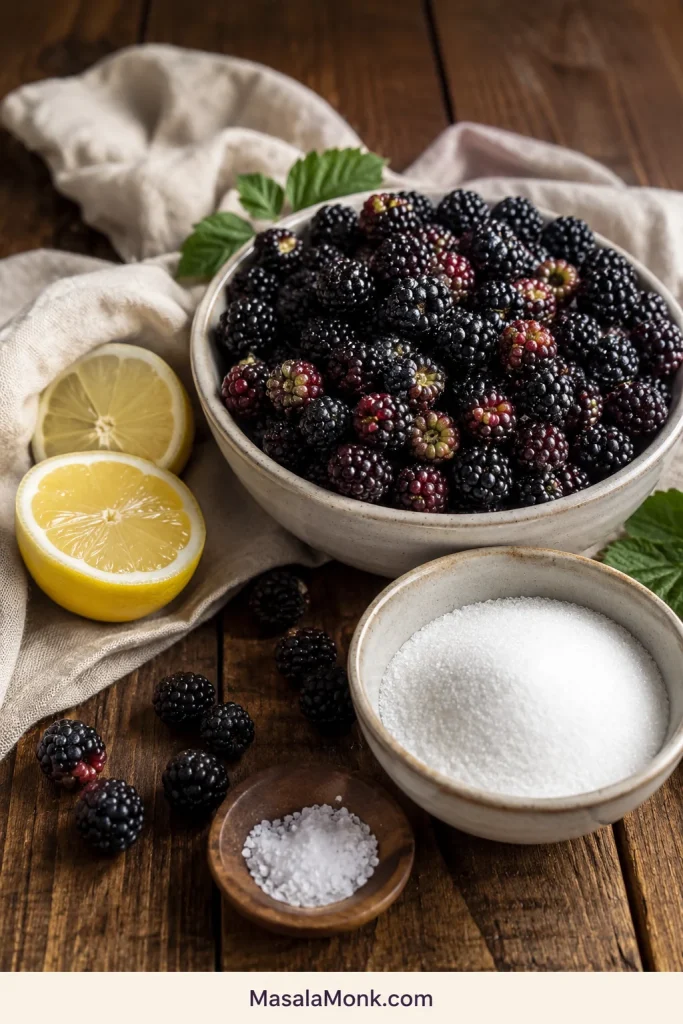
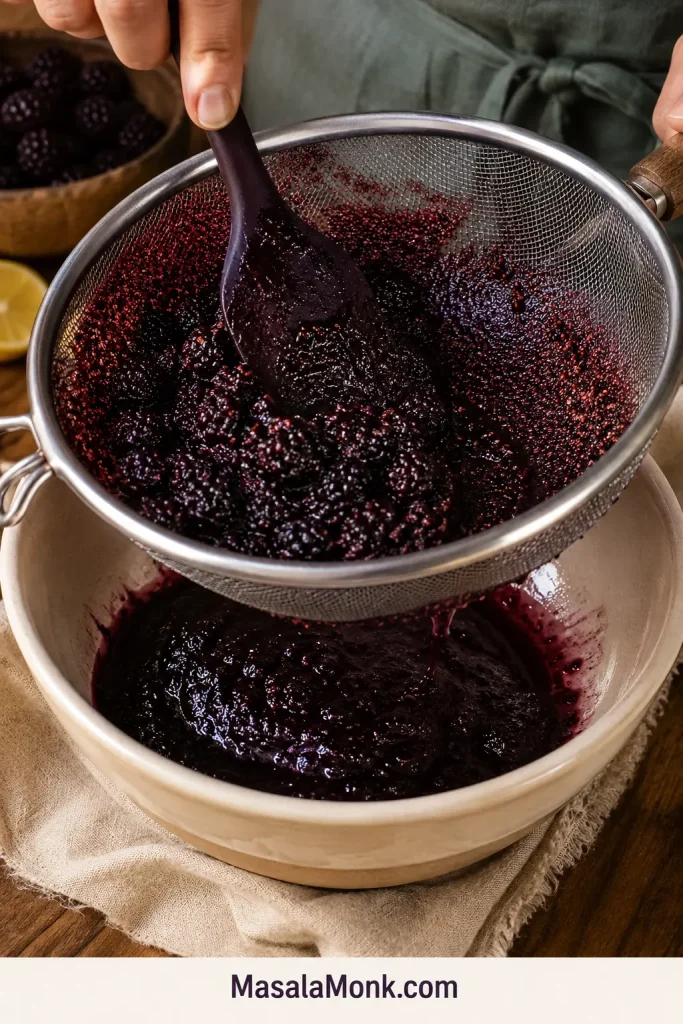
This blackberry jam recipe is for the bowl of berries from the market, the frozen bag you forgot about, the wild blackberries that came home with leaves still attached, and the cook who wants jam that tastes like fruit instead of just sugar.
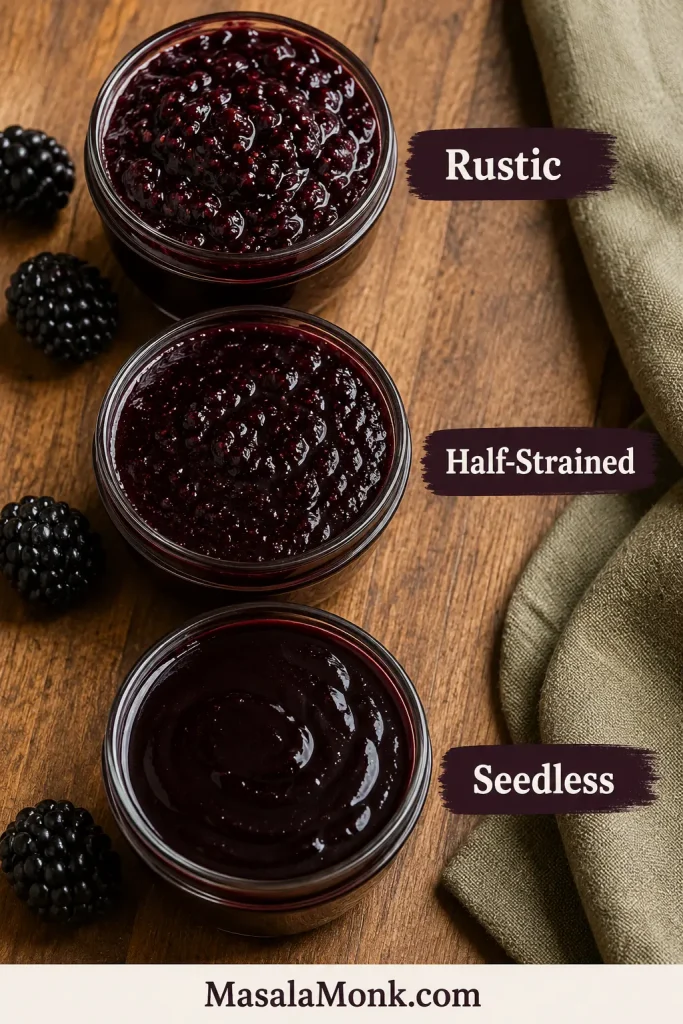
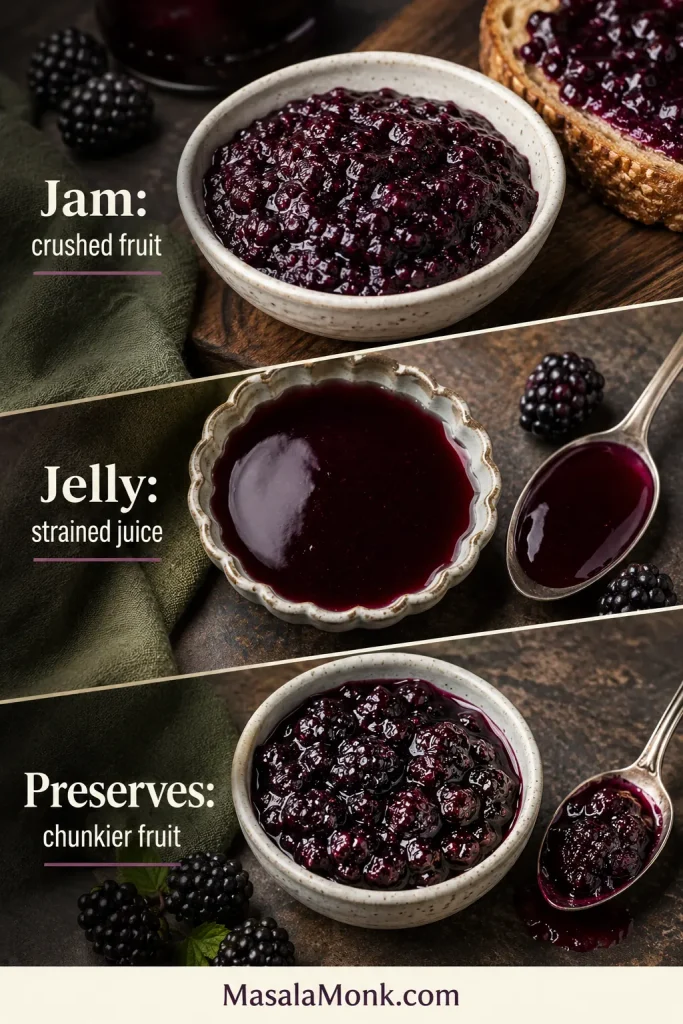
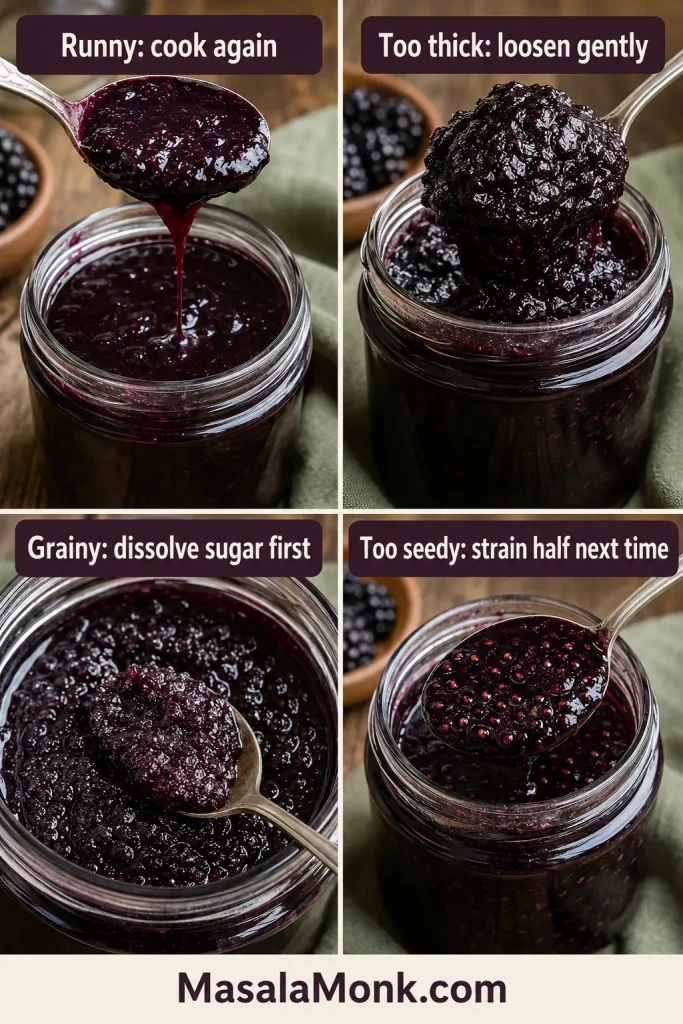
The main method is a no-pectin blackberry jam with deep berry flavor, a spoonable set, and clear cues for when to stop cooking. Make the main cold-storage version first, then use the seedless, pectin, canning, freezer, low-sugar, and troubleshooting sections only as needed.
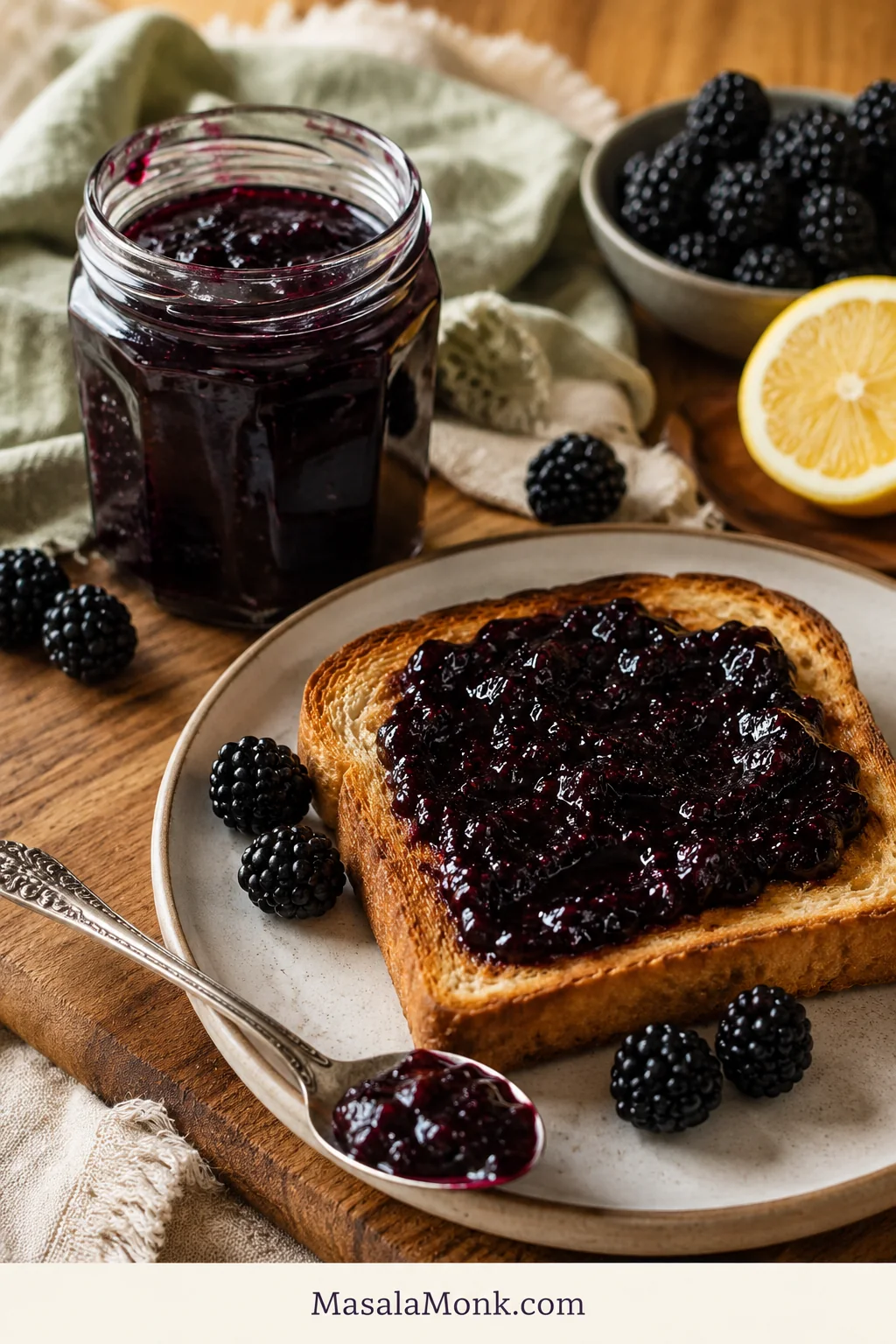
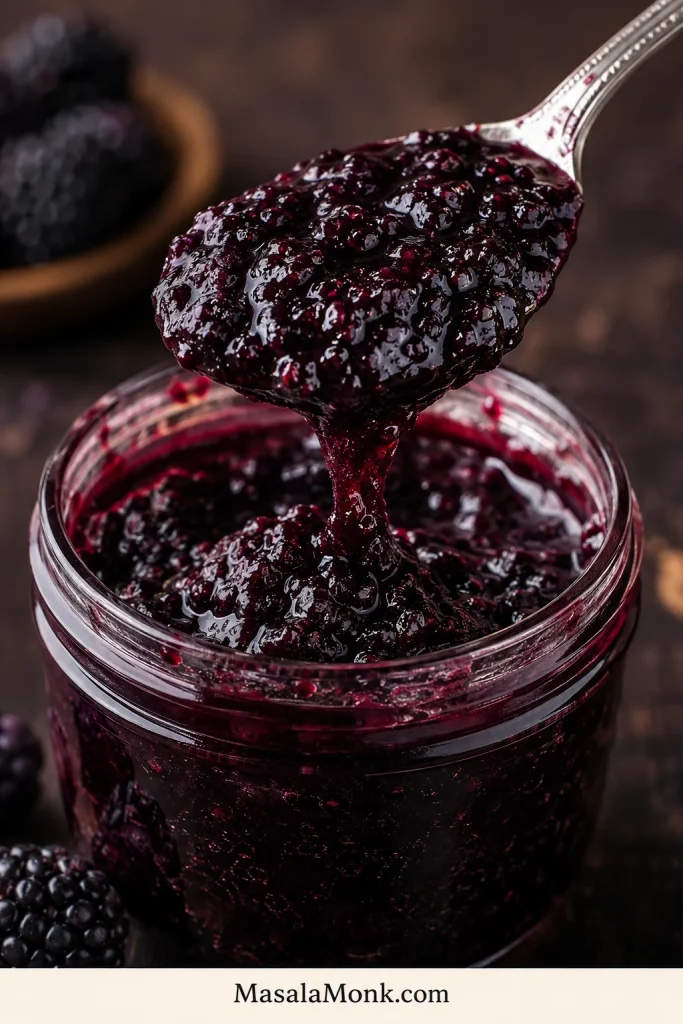
The best blackberry jam is glossy, dark, and just loose enough to spread. It should taste like the berries first: tart at the edges, sweet through the middle, and rich enough to make plain toast feel like something special.
Most of all, it should be the kind of jar you reach for again the next morning, even if all you have is toast.
Quick Answer: Blackberry Jam That Sets
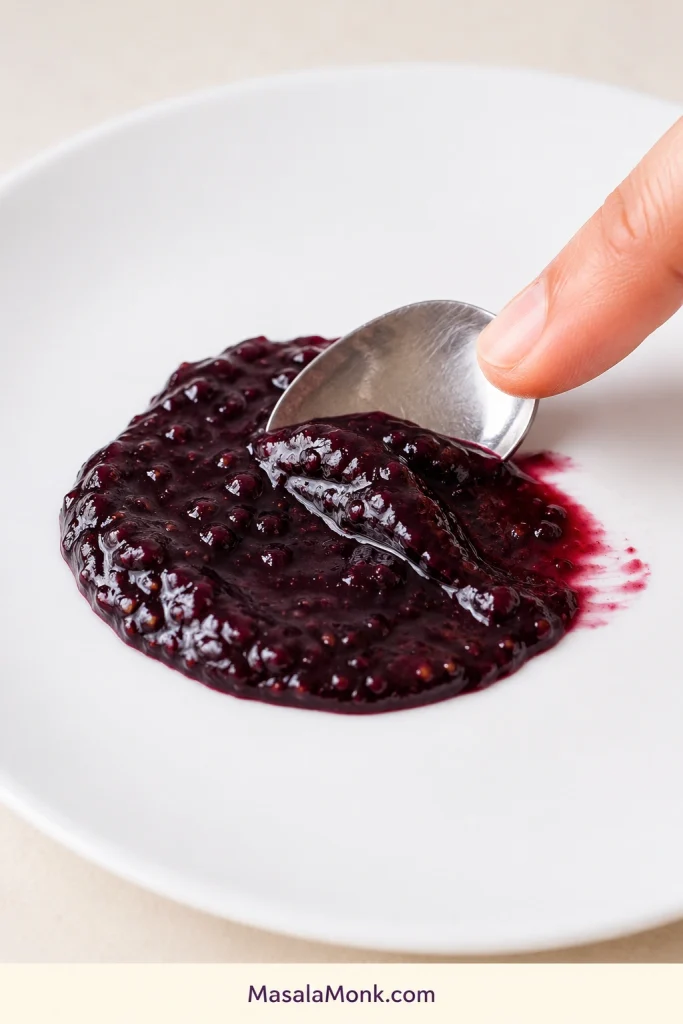
To make blackberry jam without pectin, cook crushed blackberries with sugar and lemon juice in a wide pan until the mixture turns glossy, darker, and thick enough to pass the cold plate test. At sea level, jam usually sets around 105°C / 220–221°F, but the cold plate test is often the easiest way to judge texture at home.
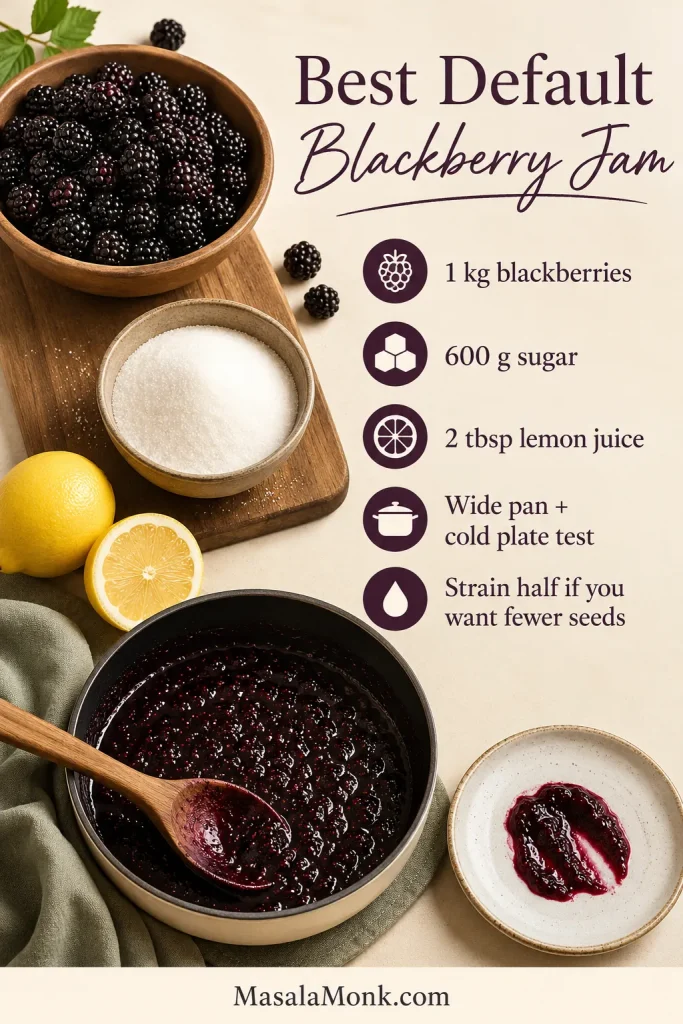
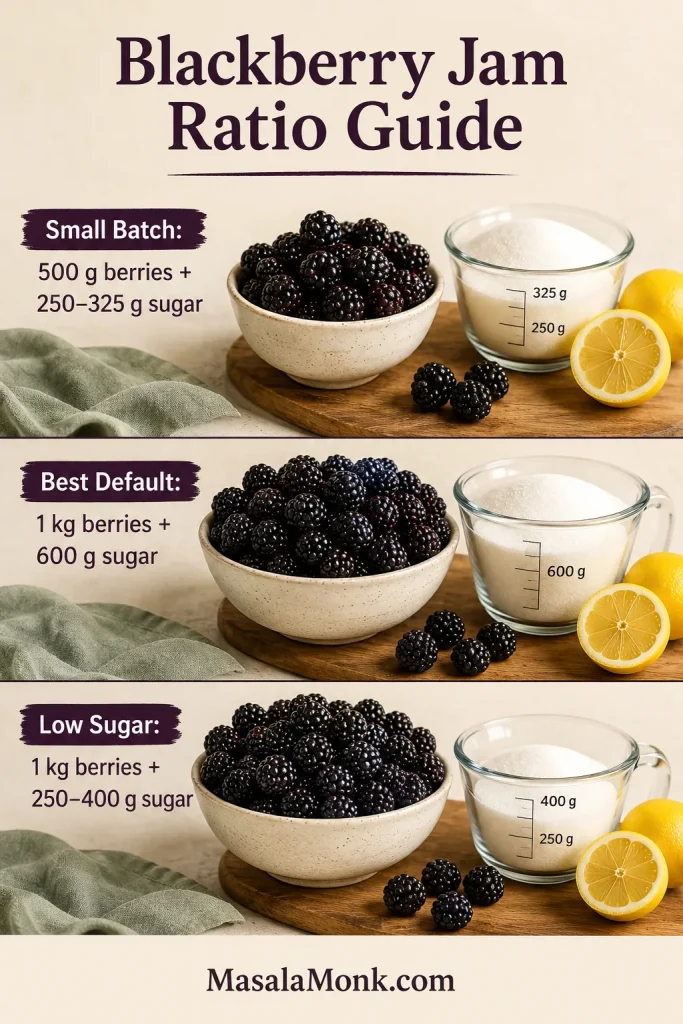
MasalaMonk’s best default path: use 1 kg blackberries, 600 g sugar, 2 tablespoons lemon juice, a wide pan, and the cold plate test. Strain half the berries if you want fewer seeds without losing jammy body.
For a flexible no-pectin batch, use about 1 kg / 6½–7 cups blackberries, 500–650 g / 2½–3¼ cups sugar, and 2 tablespoons lemon juice. Use the lower sugar range for a sharper cold-storage jam and the higher range for a sweeter, firmer, more classic set.
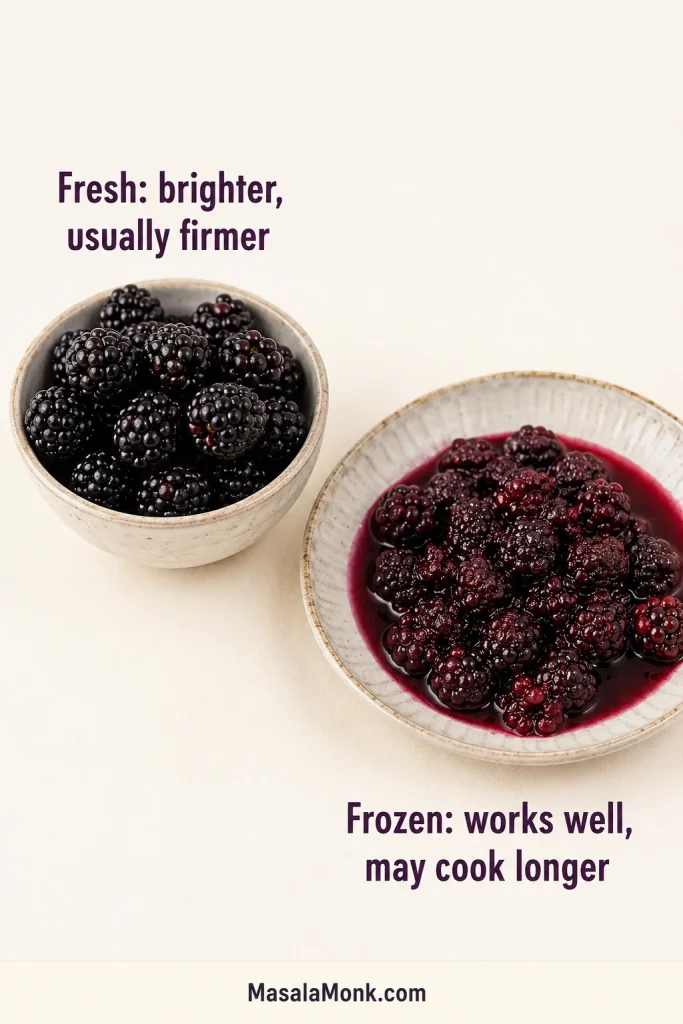
Fresh blackberries give the brightest result, but thawed frozen blackberries also work. Frozen berries may give a slightly softer set or smaller yield because they release more liquid. For shelf-stable jars, switch to a proper canning method with the correct jar size, headspace, processing time, and altitude adjustment.
If this is your first batch, do not worry about every variation yet. Make the main no-pectin version, store it in the fridge or freezer, and remember this: stop when the cooled spoonful wrinkles, not when the bubbling pot looks thick.
Best Default Blackberry Jam Path
If you are unsure where to begin, start with the default path: a balanced fruit-to-sugar ratio, a wide pan, and a cold plate test.
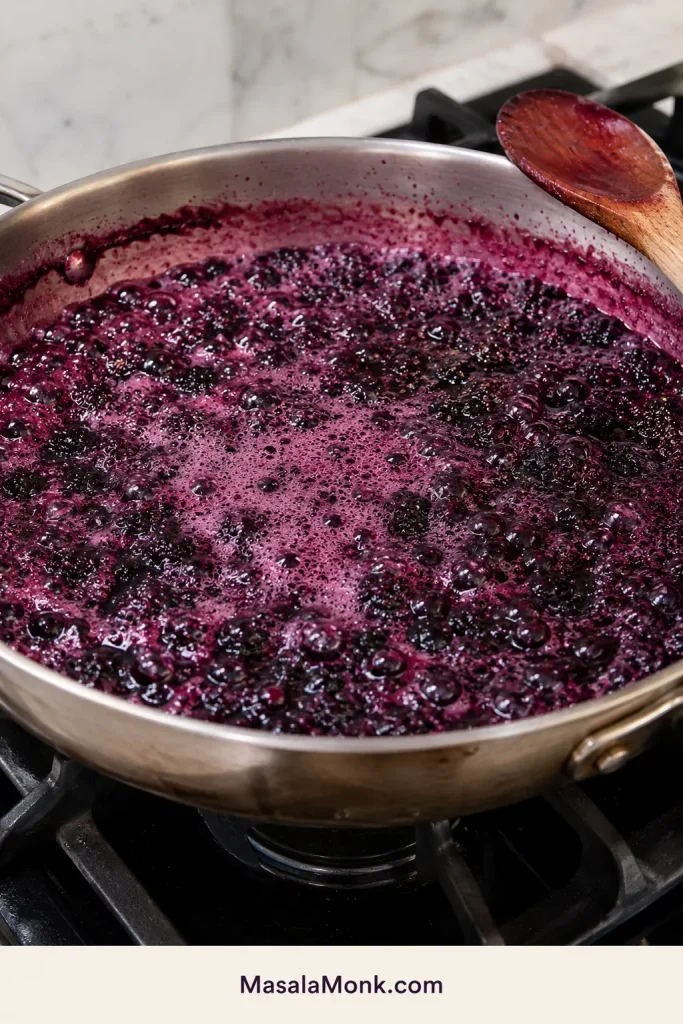
For the easiest first batch, begin with the balanced blackberry jam ratio shown here: fruit, sugar, lemon, a wide pan, and a cold plate test.
This is the main stovetop version: ripe blackberries cooked with sugar and lemon juice until glossy, thick, and spreadable. It is written as a cold-storage jam unless you follow a shelf-stable canning recipe.
Recipe Details
Prep time
10 minutes
Optional rest
10 minutes
Cook time
25–40 minutes after the sugar dissolves
Total time
45–60 minutes, including optional rest
Yield
About 720–960 ml / 3–4 cups / 3–4 half-pint jars, depending on cook-down and straining
Set cue
105°C / 220–221°F or cold plate wrinkle test
Storage
Refrigerate or freeze unless using shelf-stable canning instructions
Ingredients
1 kg / about 6½–7 cups blackberries, fresh or thawed frozen
500–650 g / about 2½–3¼ cups granulated sugar
30 ml / 2 tablespoons lemon juice
Pinch of salt, optional
Best beginner version: Use 600 g sugar, strain half the softened berries if seeds bother you, and stop cooking when a chilled spoonful wrinkles softly instead of running back like syrup.
Texture cue: Finished blackberry jam should be thick enough to mound on a spoon once cooled, but still soft enough to spread without tearing toast.
Sugar note: Use 500 g sugar for a sharper, softer cold-storage jam. Use 650 g for a sweeter, firmer, more classic set. Berry cup measurements are approximate because blackberries vary in size; weight is more reliable.
Instructions
Sort and rinse the berries. Remove stems, leaves, spoiled berries, and anything moldy. Rinse gently and drain well.
Crush the fruit. Add the blackberries to a wide, heavy-bottomed pan. Mash with a potato masher until juicy but not completely smooth.
Add sugar and lemon juice. Stir in the sugar, lemon juice, and optional pinch of salt. Let the mixture sit for 10 minutes if you have time.
Dissolve the sugar gently. Warm over medium heat, stirring often, until the sugar dissolves and the mixture looks syrupy rather than gritty. This helps prevent grainy jam.
Boil the jam. Increase the heat and bring the mixture to a lively boil. Stir often, scraping the bottom and sides as it thickens. Lower the heat slightly near the end if the jam starts catching on the bottom.
Watch the texture. The jam will foam first, then darken and turn glossy. Near the end, the bubbles look slower and heavier.
Test for set. Start testing after 20–25 minutes. Use a cold plate or cook to about 105°C / 220–221°F at sea level. Do not wait for the hot jam to look as thick as cooled jam.
Jar and cool. Remove from heat. Skim foam if desired. Ladle into clean jars, let the jam cool until no longer steaming, then cover and refrigerate or freeze.
For seedless jam: strain half or all of the softened fruit before the final cook-down. See the seedless section below for details.
Do not miss: Use a wide pan, make two batches instead of doubling in one pot, and treat this as cold-storage jam unless you follow a proper shelf-stable canning method.
What the Finished Blackberry Jam Should Look Like
Use this cooled spoon cue as your texture target: the jam should mound, drip slowly, and still spread softly after the boil is over.
The spoon tells you what the jar should feel like after cooling: thick enough to mound, yet soft enough to spread without turning rubbery.
The recipe above gives you the basic batch. Below, the no-pectin fridge/freezer version can be adjusted for texture, sweetness, storage, pectin, jelly, or canning needs.
Before choosing your version, separate flexible jam from pantry-safe jam. A fridge or freezer batch gives you room to adjust sweetness and texture; a shelf-stable jar needs a proper canning method.
This recipe is for the flexible no-pectin version. If your goal is clear jelly, sugar-free pantry storage, brand-specific pectin jam, or full shelf-stable canning, use a dedicated method built for that purpose.
Use This Recipe For
Blackberry jam without pectin
Fresh or frozen blackberries
Rustic, half-strained, or seedless texture
Fridge or freezer storage
Learning the cold plate set test
A flexible sweetness range
Use a Separate Method For
A clear blackberry jelly with no pulp
A sugar-free pantry jam without a tested low/no-sugar method
A commercial-style firm gel
A pectin-brand recipe with exact packet instructions
A pantry-stable canning recipe with full processing instructions
Any wax-sealed or paraffin-sealed jar method
Blackberry Jam Rules That Matter
You do not need perfect berries or special pectin to make a good jar. Most blackberry jam problems come from the same few things: a crowded pan, undissolved sugar, judging the jam while it is still hot, or trying to make a flexible batch behave like a canned preserve.
Do This
Not This
Use a wide pan
Do not crowd a deep pot
Dissolve sugar before boiling hard
Do not rush into a hard boil while the mixture is still gritty
Test on a cold plate
Do not judge hot jam by thickness alone
Make two batches if needed
Do not double everything in one pot
Use cold storage for flexible ratios
Do not pantry-store an improvised low-sugar jam
Strain half for balanced texture
Do not strain all the fruit unless you want a very smooth jar
Ingredients You Need
The base is simple, but every ingredient has a job: berries bring flavor, sugar builds body, lemon brightens, and a tiny pinch of salt deepens the fruit.
Before the jam boils, the flavor is already taking shape: ripe blackberries bring depth, while sugar and lemon help with shine, balance, and set.
Blackberries
Use ripe blackberries that taste sweet-tart and smell fruity. Fully ripe berries give the best flavor. A few slightly underripe berries can help the jam set because underripe fruit usually has more natural pectin.
Good jam starts before the stove. If the berries taste flat in your hand, they will taste flat in the jar. Avoid moldy, fermented, or collapsing berries because cooking concentrates both the good flavor and the tired one.
If you bought extra blackberries and want more ways to use them beyond jam, MasalaMonk’s blackberry nutrition guide is a useful follow-up beyond the jam pot.
Sugar
Sugar sweetens the jam, but it also helps with body, shine, and set. Reducing sugar can be useful, especially for a sharper fridge or freezer batch, but the texture will usually be softer and the yield smaller.
The goal is not the least sugar possible; it is enough sugar to help the berries become jam without burying their tartness. For this no-pectin version, the most useful range is 500–650 g sugar per 1 kg blackberries.
Lemon Juice
Lemon juice brightens the flavor and helps the jam set. Fresh lemon juice is fine for fridge and freezer jam. For canning recipes, follow the recipe’s specified acid. Many tested recipes use bottled lemon juice because its acidity is consistent.
Salt
A small pinch of salt is optional. It does not make the jam salty; it simply rounds the sweetness and makes the blackberry flavor taste deeper.
Equipment for Blackberry Jam
The jam itself is simple, but a wide pan and a way to test the set make the whole process calmer, especially the first time you watch a loose purple pot slowly turn into jam.
Wide heavy-bottomed pan: helps water cook off quickly, so the jam reaches set before the fruit tastes dull or overcooked.
Potato masher: crushes the berries while keeping some fruit texture.
Wooden spoon or silicone spatula: helps you stir and scrape the bottom as the jam thickens.
Cold plates or thermometer: help you test the set instead of relying only on time.
Fine mesh sieve, food mill, or chinois: useful if you want seedless blackberry jam.
Clean jars: needed for fridge or freezer storage.
Canning tools: needed only for a proper shelf-stable canning process.
Fresh vs Frozen Blackberries
This comparison matters before cooking because frozen berries bring extra liquid into the pan, which changes timing more than the basic method.
Peak-season fresh blackberries usually give the brightest flavor; however, frozen fruit still makes good jam once its extra juice has time to reduce.
During peak season, fresh blackberries make beautiful jam when they are ripe but still firm. The flavor is bright, and the berries usually cook down evenly.
Frozen blackberries work too. Thaw them first, then use the berries and their juices unless they release a large amount of watery liquid. Frozen fruit breaks down faster in the pan, but because it releases more moisture, the batch may take a few extra minutes before the bubbles turn glossy and heavy.
When thawed berries taste mild, use the higher end of the sugar and lemon range. If they taste sharp and concentrated, start lower and adjust after the fruit warms.
Leftover frozen berries can go into a thick berry smoothie recipe instead of being thawed for more jam than you need.
Best Blackberry Jam Ratio
The best ratio depends on how you want the jam to taste and how you plan to store it. Traditional jam uses more sugar and sets more firmly. Lower-sugar jam tastes fruitier but may cook longer and set softer.
Blackberry Jam Ratio Guide
The ratio guide turns the sugar range into practical choices: a small test batch, the balanced default batch, or a softer low-sugar jar.
Match the ratio to the jar you want: small batch for testing, the default ratio for balance, or less sugar for softer cold-storage blackberry jam.
Batch Style
Blackberries
Sugar
Lemon Juice
Best Use
Small batch
500 g / about 3¼–3½ cups
250–325 g / about 1¼–1⅝ cups
1 tbsp
Testing the recipe or making 1–2 jars
Main batch
1 kg / about 6½–7 cups
500–650 g / about 2½–3¼ cups
2 tbsp
Balanced no-pectin jam
Best default
1 kg / about 6½–7 cups
600 g / about 3 cups
2 tbsp
First batch with balanced flavor and set
Traditional sweeter set
1 kg / about 6½–7 cups
Up to 1 kg / about 5 cups
2–3 tbsp
Classic firmer jam
Low-sugar fridge/freezer style
1 kg / about 6½–7 cups
250–400 g / about 1¼–2 cups
2 tbsp
Softer, fruit-forward cold-storage jam
For a small batch, use the higher end of the sugar range if you want a firmer, more classic set.
Do not double casually: Need more jam? Make two smaller batches instead of crowding one pot. A crowded pan slows evaporation, stretches the cooking time, and can leave you with jam that is runny, scorched, or overcooked before it sets.
Low-sugar reminder: Reducing sugar does not only change sweetness. It changes how fast the jam sets, how glossy it looks, how much it yields, and how long it keeps.
Why This Blackberry Jam Works
A wide pan speeds up evaporation. The batch sets faster when excess water can cook off efficiently.
Lemon keeps the flavor bright. It balances the sugar and helps the fruit’s natural gel structure.
Moderate sugar keeps the berry flavor alive. The recipe is sweet enough to set but not so sweet that the fruit disappears.
A cold plate test prevents guessing. It shows how the jam behaves once cooled, not just how it looks while boiling.
Seed control is built in. You can leave the spread rustic, strain half for balance, or strain all for a smoother jar.
The method fits blackberries. Blackberries are naturally seedy and tart, so the recipe builds in both seed control and acid balance.
The same fridge/freezer-first logic also works well in MasalaMonk’s fig jam recipe, where the flexible no-pectin method stays separate from canning-safe notes.
How to Make Blackberry Jam Without Pectin
The no-pectin method is less about complicated ingredients and more about watching the pan. The mixture begins loose and syrupy, then foams, reduces, darkens, and finally moves more slowly as the water cooks off.
1. Sort and Crush the Berries
Pick through the blackberries and remove leaves, stems, spoiled berries, or anything moldy. Rinse gently and drain well. Place the berries in a wide pan and crush them with a potato masher until the juices release.
2. Add Sugar and Lemon Juice
Stir in the sugar and lemon juice. Let the mixture sit for about 10 minutes if time allows. This short rest pulls juice from the berries and helps the sugar dissolve more evenly.
3. Dissolve the Sugar Gently
Warm the mixture over medium heat, stirring often. The goal is to dissolve the sugar before the jam reaches a hard boil. If sugar crystals remain on the sides of the pan, try not to scrape them back into the pot.
4. Boil Until the Jam Thickens
Increase the heat and bring the mixture to a lively boil. Stir regularly, especially once it begins to thicken. The bubbles will look light and foamy at first. Later, they become slower, glossier, and heavier.
5. Test Before You Stop
Start testing after 20–25 minutes for a main batch, sooner for a small batch. Do not rely only on time. Frozen berries, watery berries, low sugar, and narrow pans can all change the cooking time.
What the Jam Looks Like as It Cooks
This is the part that makes many first batches feel uncertain. Early on, the jam looks too loose before it looks right, and that does not mean anything has gone wrong.
At first, the berries look loose, purple, juicy, and foamy. This is normal because the fruit is releasing water.
In the middle, the bubbles rise quickly, the fruit softens, and the color deepens. The pan may still look more like syrup than jam.
Near the set point, the bubbles slow down, the surface looks glossier, and a spoon begins to leave a brief trail through the mixture.
If it goes too far, the jam starts looking dull, sticky, and heavy. It may drag across the pan instead of bubbling freely.
The pot does not go from syrup to jam all at once. It changes in small signs: the bubbles slow, the color deepens, the spoon drags, and the chilled spoonful finally wrinkles.
Early Foamy Boil
The early boil looks messy because water is cooking off; keep stirring, then watch for darker, heavier bubbles as the jam reduces.
Foam at this stage is normal because the berries are giving off water; next, the loose bubbles reduce into a darker, heavier blackberry jam.
Glossy Bubbles Near Set
After the foam settles, darker and slower bubbles tell you the jam is close enough to test.
When the bubbles slow down, darken, and look glossy, the jam is close enough to test instead of cooking blindly by the clock.
Spoon Trail Before Testing
Treat the spoon trail as a warning light, not the finish line; it tells you the jam is close enough to test, not automatically done.
A spoon trail is a useful thickening cue; still, the cold plate test gives the final answer because hot jam always looks looser in the pan.
As the jam gets close, the kitchen starts to smell darker and more berry-rich, not just sweet. The color deepens from bright purple to a glossy blackberry wine shade, and the spoon feels a little more resistance as you stir.
This is the moment many beginners are tempted to keep cooking. Test first.
You are not waiting for the jam to look solid in the pot. The goal is a jam that cools into a spread.
Jam thickens as it cools, so it will not look completely finished while it is bubbling in the pan. Use a test instead of waiting until it looks stiff. By then, it may already be overcooked.
Cold Plate Test
Put two small plates in the freezer before cooking. To test, remove the pan from the heat, spoon a little jam onto a chilled plate, and wait 30–60 seconds. Push the jam with your finger. If it wrinkles, mounds, or moves slowly instead of flooding back like syrup, the jam is ready.
This little wrinkle matters: it shows how the blackberry jam will set after cooling, before you accidentally cook it too thick.
When the spoonful on the cold plate wrinkles for the first time, the whole batch suddenly makes sense. That is the moment you stop guessing and start trusting the jam.
Thermometer Test
At sea level, blackberry jam usually sets around 105°C / 220–221°F. This number is useful, but not perfect for every kitchen. Altitude, sugar level, batch size, and berry moisture can all affect the final texture.
Spoon Test
Lift a spoonful of jam and let it fall back into the pan. Early in cooking, it drips quickly. As it gets close to set, it falls more slowly in thicker drops or sheets.
Better slightly soft than overcooked: If you are unsure, stop a little early and test again. Runny jam can often be simmered longer. Jam that has cooked into a stiff, rubbery paste is harder to rescue.
The first batch teaches you what the bubbles look like. After that, blackberry jam becomes much less mysterious.
Blackberry seeds are part of the fruit, but they do not have to dominate the jar. This is where homemade jam becomes personal: some people love the old-fashioned seediness, while others want the fruit without the crunch.
For most readers, straining half the berries is the best default. It reduces grit while keeping enough pulp and body for real jam texture. Half-strained jam is often the sweet spot because it still feels homemade without making every bite about seeds.
Seed Method
Result
Best For
Leave all seeds in
Rustic, thick, full fruit texture
Fastest old-fashioned jam
Strain half the berries
Smoother but still jammy
Best balance for most people
Strain all the cooked berries
Very smooth seedless jam
People who dislike blackberry seeds
Drain through a jelly bag without pressing
Clear blackberry jelly
Jelly, not jam
Seedless Straining Step
For seedless jam with real body, press the softened fruit firmly enough to capture thick pulp, not just thin juice.
Straining changes the eating experience: seeds stay in the sieve, while the thick berry pulp below keeps seedless blackberry jam from feeling thin.
To strain half, cook the berries until softened, then press half the fruit through a fine mesh sieve, food mill, or chinois. Return the strained pulp and juice to the pan with the unstrained half. This keeps the jam thick and fruity without letting the seeds take over.
If you strain all the berries, press firmly enough to capture pulp, not just juice. For clear blackberry jelly, do not press the bag. Let the juice drip naturally so the jelly stays clearer.
Rustic, Half-Strained, or Seedless Texture
Compare the textures before straining all the fruit, because rustic, half-strained, and fully seedless jam each eat differently.
Texture is not one-size-fits-all: rustic jam keeps crunch, half-strained jam keeps body, and seedless jam gives the smoothest spoonful.
Blackberry jam is crushed fruit cooked with sugar until it thickens into a spread. Unlike jelly, jam keeps some fruit body. Compared with preserves, it is usually less chunky and more evenly spreadable.
The best jar keeps the berry’s natural tartness. If it is undercooked, it runs like syrup. When overcooked, it can turn stiff and sticky. The sweet spot is glossy, spoonable, and thick enough to mound softly on toast.
Blackberry Jam vs Jelly vs Preserves
Once you start removing seeds, this distinction becomes important. Seedless jam still keeps fruit pulp, while blackberry jelly is built from strained juice.
Look at the fruit first: blackberry jam has pulp, blackberry jelly is strained smooth, and preserves keep larger berry pieces.
Type
What It Is
Texture
Best Use
Blackberry jam
Crushed fruit cooked with sugar
Thick, spreadable, fruit texture
Toast, biscuits, cakes, yogurt
Blackberry jelly
Strained blackberry juice cooked to gel
Smooth, clear, no seeds or pulp
Toast, glazing, clean seedless texture
Blackberry preserves
Larger fruit pieces in a syrupy set
Chunkier and looser
Desserts, spooning, cheese boards
Blackberry freezer jam
Jam stored frozen instead of canned
Usually softer and fresher
Beginners, small batches, quick storage
For another fruit-spread example, MasalaMonk’s pineapple jam and preserves shows how a smoother jam and chunkier preserve can come from the same fruit but eat very differently.
A smooth, clear, seedless spread may be better as blackberry jelly. Jam keeps fruit pulp; jelly starts with strained juice. For clear jelly, strain the cooked berries through a jelly bag or damp cheesecloth and avoid pressing the solids. With seedless jam, you can press softened fruit through a sieve or food mill because pulp belongs in the jar.
Blackberry Jam With Pectin
Pectin is useful when you want a faster, more predictable set, especially with very ripe, watery, or low-pectin berries. It is not better or worse than no-pectin jam; it is simply a less flexible method with its own order and ratios.
No-pectin jam gives deeper cooked-berry flavor and more flexibility, while pectin recipes trade that flexibility for speed and predictability. If you are using Sure-Jell, Ball, Certo, Pomona, or another pectin brand, follow that product’s fruit amount, sugar amount, acid, pectin type, and boiling order. In many pectin recipes, the order matters as much as the ingredients.
Use pectin if you want a faster, more predictable set.
Skip pectin if you want a deeper cooked berry flavor and do not mind a longer cook.
Use low/no-sugar pectin if you want reduced sugar with a more reliable set.
Do not guess conversions between liquid, powdered, regular, and low-sugar pectin.
If your jars are going into the fridge or freezer, the recipe can stay flexible. Pantry shelves are different: storage becomes part of the recipe.
Safety note: The main no-pectin recipe is written for fridge or freezer storage. For shelf-stable blackberry jam, use a tested canning recipe and follow the correct jar size, headspace, processing time, and altitude adjustment.
Can you can this exact lower-sugar recipe? Not as written. Use it for the fridge or freezer, or switch to a tested canning formula.
Canning is where jam-making becomes less flexible. That is not because canning is scary; it is because room-temperature storage needs a recipe built for it.
In other words, the jar is not the safety step; the full process is.
Tested No-Pectin Berry Jam Reference
For shelf-stable berry jam without added pectin, the National Center for Home Food Preservation gives a tested berry jam formula using 9 cups crushed berries and 6 cups sugar, yielding about 7–8 half-pint jars. The hot jam is packed into hot sterile jars with ¼ inch headspace and processed in a boiling-water canner with timing adjusted by altitude.
That canning ratio is different from the flexible lower-sugar fridge/freezer recipe in this post. This reference is included to show how shelf-stable jam differs; it is not a substitute for following full canning instructions from start to finish.
Use half-pint / 8 oz / about 240 ml jars unless the canning recipe says otherwise.
Choose proper canning jars and new lids.
Fill hot jam into hot jars.
Leave ¼ inch headspace for canned jam or jelly.
Wipe rims before adding lids.
Process in a boiling-water canner.
Adjust processing time for altitude.
Use low/no-sugar pectin instructions written for canning if preserving reduced-sugar jam.
Do not use paraffin or wax seals for modern home-canned jam.
Blackberry freezer jam is the low-stress route when you want the homemade jar without the full canning afternoon. It is stored in the freezer instead of the pantry, so the process is more forgiving.
This post uses the cooked-jam route. Classic pectin freezer jam follows the pectin package method instead, so use those instructions if you are working from a freezer-pectin recipe.
Freezer jam is usually softer and fresher-tasting than canned jam. Some versions use pectin, while others are simply cooked down and frozen. Either way, use freezer-safe jars or containers and leave about ½ inch headspace so the jam can expand as it freezes.
Cool jam before freezing.
Use freezer-safe containers.
Leave expansion space at the top.
Thaw in the refrigerator.
Keep thawed jam refrigerated.
Low-Sugar, No-Sugar, and Sugar-Free Blackberry Jam
Low-sugar blackberry jam can taste wonderfully fruit-forward. This is often the version people want when the berries are especially good and they do not want sugar to cover them up.
Low sugar is not just less sweet. It is a different texture. Less sugar usually means a softer set, longer cooking time, smaller yield, and shorter storage unless you use a reliable low-sugar canning method.
Low sugar: less sugar, softer set, and fridge/freezer storage unless you follow a canning-safe method.
No sugar or sugar-free: usually needs special pectin, chia seeds, or cold storage.
Pantry-safe low sugar: requires a tested low/no-sugar canning method with its own processing instructions.
For fridge or freezer jam, start with 250–400 g sugar per 1 kg blackberries if you want a sharper, less sweet spread. Cook it until thickened, then rely on the cold plate test rather than the clock.
No-sugar or sugar-free blackberry jam usually needs special low/no-sugar pectin, chia seeds, or refrigerator/freezer storage. Do not assume a sugar-free jam is pantry-safe just because it looks thick; use the canning notes if shelf storage is the goal.
These are flavor ideas for small fridge/freezer batches unless you are following a tested canning recipe for that exact combination.
Apple Blackberry Jam or Bramble Jam
Apple softens blackberry’s sharp edge and gives the jam a cozy autumn feel, especially when the berries are very ripe. In the UK, blackberry jam is often discussed as bramble jam, especially when made with foraged berries.
Blackberry Rhubarb Jam
Rhubarb pushes the jar brighter and sharper, which is lovely if you like tart jam. It also changes acidity, water content, and texture, so use a dedicated tested recipe if you want to can it.
Blackberry Jalapeño Jelly
Blackberry jalapeño jelly belongs on the savory-sweet side: cheese boards, crackers, sandwiches, and holiday appetizers. Treat it as its own jelly recipe rather than a small tweak to breakfast jam.
Blackberry Chia Jam
Blackberry chia jam is the quick breakfast version, soft-set and refrigerator-only. It uses berries, a little sweetener, lemon, and chia seeds instead of a traditional jam set.
Blackberry Vanilla Jam
Vanilla turns blackberry jam into more of a dessert spooning jam, especially for yogurt, cheesecake, oatmeal, and cake layers. Add vanilla near the end so it stays fragrant instead of cooked away.
Blackberry Lemon Jam
Blackberry lemon jam is the brighter jar. Lemon zest gives the fruit a fresher edge, as long as you use only the yellow zest and avoid the bitter white pith.
If your jam is not perfect the first time, you probably still have something useful: syrup, sauce, cake filling, yogurt topping, or a batch that just needs a few more minutes.
Troubleshooting Blackberry Jam
Most jam problems are not disasters; they usually come from water, sugar, heat, or patience falling slightly out of balance.
Soft, stiff, grainy, or seedy jam does not have to be wasted; with the right fix, it can still become a spread, sauce, filling, or topping.
Why Is My Blackberry Jam Runny?
Runny blackberry jam usually means it needed more cooking, the berries were watery, the sugar was reduced too much, or the batch was too large. Frozen berries and low-sugar batches often need extra time.
To fix soft fridge jam, return it to a wide pan and simmer again. Stir often and use the cold plate test. If it stays loose, use it as blackberry syrup for pancakes, yogurt, oatmeal, or desserts.
Why Is My Jam Too Thick?
Jam becomes too thick when it is overcooked or cooked too aggressively near the end. For immediate use, warm it gently with a spoonful of water or lemon juice to loosen it. Do not casually re-can adjusted jam without safe canning guidance.
Why Is My Jam Grainy?
Grainy jam often comes from undissolved sugar or sugar crystals. Warm the fruit, sugar, and lemon gently at first, and stir until the sugar dissolves before boiling hard.
Why Is My Jam Foamy?
Foam is normal when berries and sugar boil. Skim it near the end if you want a cleaner-looking jar. A tiny amount of butter is sometimes used in pectin recipes to reduce foam, but it is not needed for this no-pectin version.
Why Is My Jam Too Seedy?
Blackberries are naturally seedy. Next time, strain half the cooked fruit for a balanced texture or strain all of it for smoother seedless blackberry jam. For clear jelly, drain the juice without pressing the pulp.
Why Did My Jam Scorch?
Jam can scorch if the heat is too high near the end, the pan is too thin, or the batch is too large. Use a wide heavy pan, stir more often as the jam thickens, and avoid oversized batches.
Storage depends on how the jam was made. Flexible no-pectin and low-sugar batches belong in cold storage unless they were prepared with a tested canning process.
Fridge and freezer jars suit flexible jam, while pantry storage needs a recipe and process built for safe canning.
Storage Type
How to Store
Notes
Fridge jam
Cool, cover, and refrigerate
Best within 2–3 weeks
Freezer jam
Use freezer-safe jars or containers
Best within 3–6 months for flavor; leave ½ inch headspace
Canned jam
Store sealed jars in a cool, dark place
Follow the canning recipe’s shelf-life guidance
Opened canned jar
Refrigerate after opening
Use within a few weeks
Moldy or fermented jam
Discard
Do not scrape mold off jam and keep eating
A fridge jar is for the next few breakfasts, a freezer jar is for later, and a pantry jar only belongs on the shelf when the full canning process was built for it.
Once the jar has cooled, the real reward is how easily it fits into breakfast, dessert, and the small snacks in between.
How to Use Blackberry Jam
Blackberry jam is sweet enough for breakfast but tart enough for desserts and cheese boards. A good jar cuts through creamy, buttery, and sweet foods instead of tasting flat.
It is especially good anywhere you want something sweet but not flat: buttery toast, plain yogurt, sharp cheese, or a simple cake that needs a little fruit.
Once the jar is ready, use that tart blackberry flavor beyond toast: scones, yogurt, oats, cheese boards, and simple desserts all benefit from it.
Spoon over Japanese pancakes, waffles, oatmeal, yogurt, or ice cream.
Swirl a spoonful into overnight oats or layer it with plain yogurt and granola.
Use as a cake filling, cheesecake topping, or spooned dessert sauce with homemade whipped cream.
Swirl into thumbprint cookies or shortbread bars.
Serve with sharp cheddar, goat cheese, crackers, or warm biscuits.
Warm gently and brush over a simple cake as a berry glaze.
Stir into sparkling water, mocktails, or cocktails for a berry syrup effect.
FAQ
Most of the big decisions happen before the jar cools. These quick answers cover the questions that usually come up while cooking, storing, or planning the next batch.
Does blackberry jam need pectin?
No. It can set without added pectin when cooked with sugar and lemon juice until thick enough. Use the cold plate test or thermometer test instead of relying only on time.
Do frozen blackberries work for jam?
Yes. Thaw them first, then use the berries and their juices unless the liquid looks thin and watery. Frozen berries may take a little longer to cook down.
How long should blackberry jam cook?
A main batch usually takes 25–40 minutes after the sugar dissolves. Small batches cook faster; frozen, watery, or low-sugar batches often take longer.
What temperature makes blackberry jam set?
At sea level, it usually sets around 105°C / 220–221°F. Because altitude and sugar level affect the exact set point, the cold plate test is still useful.
Why did my blackberry jam stay runny?
It may need more cooking, or the berries may be watery, low in pectin, low in sugar, or crowded in the pan. Return soft fridge jam to a wide pan and cook again, testing often.
What is the best way to make seedless blackberry jam?
Cook the berries until soft, then press some or all of the fruit through a fine mesh sieve, food mill, or chinois. Straining half gives a smoother jam while keeping enough body.
Should blackberry seeds be removed?
No. Leave them in for rustic jam, or strain some of the fruit if you prefer a smoother texture.
How much sugar can be reduced?
For fridge or freezer jam, you can reduce the sugar to about 250–400 g per 1 kg blackberries. The jam will usually set softer and keep for less time.
Is low-sugar blackberry jam safe for canning?
Only when made with a tested low-sugar canning recipe or a low/no-sugar pectin method with its own processing instructions.
Blackberry jam or blackberry jelly: what is the difference?
Jam uses crushed fruit, so it has body and texture. Jelly uses strained juice, so it is smoother, clearer, and seedless.
How are blackberry preserves different?
Preserves are usually chunkier and looser than jam, with more whole or partial berries in the spread.
How long does homemade blackberry jam last?
Fridge jam is best within 2–3 weeks. Freezer jam is best within 3–6 months for flavor. Canned jam depends on proper processing and a good seal.
Does blackberry jam freeze well?
Yes. Cool it first, use freezer-safe containers, leave about ½ inch space for expansion, and thaw in the refrigerator.
Which pectin works best?
The best pectin is the one your recipe was written for: powdered, liquid, regular, or low/no-sugar. They are not always interchangeable, so follow that product’s order and ratios.
Should this recipe be doubled?
No. Make two separate batches. Doubling in one pot slows evaporation and can make the final set less reliable.
What tastes good with blackberry jam?
Toast, scones, pancakes, yogurt, oatmeal, cakes, cheesecake, ice cream, cheese boards, and whipped cream all work well.
Final Thought
A good blackberry jam should taste like the fruit led the recipe and the sugar only helped it along.
Once you learn the signs — glossy bubbles, a slower spoon, and that little wrinkle on a cold plate — the process stops feeling like guesswork. Then every batch becomes your choice: rustic or seedless, soft or firm, fresh or frozen, fridge jam or properly canned. That is when blackberry jam becomes less of a guessing game and more of a jar you know how to make again.
Cherry jam is one of those recipes that feels easy until the pot starts asking questions. Is it thick enough? Will it set after cooling? Should you add pectin? Can frozen cherries work? What if you want less sugar? And if the jar is going into the pantry, is the recipe actually safe for canning?
This cherry jam recipe is built to answer those questions before they ruin a batch. The main method is a small-batch, no-pectin cherry jam for the refrigerator or freezer: glossy, spoonable, fruit-forward, and bright enough to taste like cherries instead of cooked sugar.
Once you know what ready jam looks and feels like, the whole process becomes much calmer. The bubbles get heavier, the spoon leaves a little trail, the fruit looks glossy, and the jam starts moving more slowly in the pan. That is the moment you are looking for.
The goal is not a stiff, factory-style jam. The goal is a soft, beautiful cherry spread that tastes fresh, sets enough to spoon and spread, and does not leave you guessing. This recipe is flexible where a refrigerator jam can be flexible, and strict where safety needs it.
Quick Answer: How Do You Make Cherry Jam That Sets?
To make a simple cherry jam without pectin, combine 500 g / about 3 cups pitted cherries, 200 g / about 1 cup sugar, and 2 tablespoons / 30 ml lemon juice in a wide pan. Cook until the cherries soften and the syrup turns glossy, then use the Glossy-and-Wrinkle Method: cook until the bubbles look slow and shiny, then confirm the set with a cold plate wrinkle test.
The jam usually reaches this stage around 220°F / 104–105°C. Temperature helps, but the cold plate test tells you how the jam will behave once cooled.
You will usually need about 600–700 g / 1 1/3–1 1/2 lb whole cherries to get around 500 g / about 3 cups pitted cherries, depending on cherry size and pit weight.
This gives you a soft-to-medium set cherry jam for the refrigerator or freezer. It should be thick enough to spread on toast, but still soft enough to spoon over pancakes, yogurt, cheesecake, ice cream, or rice pudding.
Storage note: Keep this no-pectin version chilled or frozen. Pantry jars need a canning-tested cherry jam recipe with proper processing.
Make It Now
If you are standing in front of a bowl of cherries and just want jam today, start here. Use 500 g pitted cherries, 200 g sugar, and 2 tablespoons lemon juice. Cook in a wide pan until the jam looks glossy, thickened, and heavy-bubbled, then confirm the wrinkle on a cold plate. Cool, cover, and refrigerate.
The rest of the guide is there for the moments when the pot starts looking confusing: frozen cherries releasing extra juice, sugar changes, pectin questions, loose jam, texture choices, or pantry storage.
Cherry Jam Recipe Card: No-Pectin Cherry Jam
This is the small batch to make when you want cherry jam today without turning the kitchen into a full canning project. It cooks on the stovetop, uses no boxed pectin, and sets into a soft, glossy spread once chilled.
Keep the heat lively but not wild. You want steady bubbling, not angry splattering. Near the end, slow down and test instead of rushing the jar.
Prep time
15 minutes
Cook time
25–35 minutes
Total time
40–50 minutes
Yield
About 1 1/2 cups / 360 ml
Method
Stovetop
Storage
Refrigerator 2–3 weeks or freezer up to 3 months
Ingredients
500 g / about 3 cups pitted cherries, fresh or thawed frozen, chopped or halved
200 g / about 1 cup granulated sugar
2 tablespoons / 30 ml lemon juice
1 small pinch salt, optional
1/8 to 1/4 teaspoon almond extract, optional
1 teaspoon vanilla extract, optional
Cherries give the jam body, sugar helps it thicken, and lemon juice adds the brightness and acidity a no-pectin batch needs.
Whole cherry note: Buy about 600–700 g / 1 1/3–1 1/2 lb whole cherries to get around 500 g / about 3 cups pitted cherries. The exact yield depends on cherry size, pit weight, and how much you trim.
Instructions
Prepare the cherries. Pit the cherries and chop them roughly. Chop smaller for smoother jam or leave some halves for a chunkier preserve-style texture.
Combine. Add cherries, sugar, lemon juice, and salt to a wide heavy-bottomed pan. Stir well.
Rest briefly. Let the cherries sit for 15–30 minutes if you have time. This draws out juice and helps the sugar dissolve.
Heat gently. Cook over medium heat until the sugar dissolves and the cherries release more liquid.
Mash for texture. Use a potato masher or spoon to break down the fruit lightly. For smoother jam, mash more; for chunkier jam, leave more pieces intact.
Boil and reduce. Increase the heat to medium-high and cook, stirring often, until the bubbles become slower, glossier, and heavier.
Test the set. Aim for about 220°F / 104–105°C, then check with a cold plate test. If the cooled sample wrinkles gently and does not run like syrup, it is ready.
Finish the flavor. Turn off the heat. Stir in almond extract or vanilla, if using. Start small, especially with almond extract.
Jar and cool. Rest the jam for 5 minutes, spoon into clean jars, cool, cover, and refrigerate. For longer storage, freeze in freezer-safe containers with a little headspace.
What Success Looks Like
The finished jam should be glossy, deep red, spoonable, and slightly loose while warm. It should not look stiff in the pan. Once cooled, it should thicken into a soft spread that holds on toast but still falls easily from a spoon.
It helps to test on a cold plate even when the thermometer says 220°F, because cherry batches vary. If the spoon trail closes immediately, keep cooking. If it pauses for a second before filling in, you are close.
And if it cools softer than you hoped, you have not wasted the cherries. Reboil it for a thicker set, or use it as a cherry sauce over breakfast and desserts. A loose cherry jar can still be wonderful.
The best part is the first cooled spoonful: deep red, glossy, sweet-tart, and still tasting like cherries. This small batch is not for a huge pantry project. It is for toast tomorrow, yogurt tonight, cheesecake on the weekend, and the quiet satisfaction of saving good cherries before they disappear.
Simple ingredients: cherries, sugar, lemon, and optional flavoring.
Fresh or frozen cherries both work.
A soft, glossy, spreadable set without boxed pectin.
Visual cues show when the jam is ready, so you are not relying only on a timer.
The small-batch method keeps the process manageable.
Clear help is included for loose jam, frozen cherries, pectin, sugar changes, and canning boundaries.
Use it as jam, dessert topping, breakfast swirl, cake filling, or cheese board spooning sauce.
In This Guide
The recipe above is the simple path. The guide below is grouped by what you need in the moment.
This recipe works because it asks you to watch the jam, not just the timer. Some cherries are juicy, some are firm, some are sweet, and frozen cherries often release more liquid than fresh ones. The clock helps, but the pan tells the truth.
A wide pan helps water evaporate. More surface area means the jam thickens faster and tastes fresher.
Sugar builds body. It sweetens the fruit, but it also helps with shine, texture, and set.
Lemon juice keeps the flavor awake. Sweet cherries especially need acidity so the finished spread does not taste flat.
Small batches are easier to control. The fruit cooks down faster and is less likely to set unevenly.
Set tests prevent guessing. A thermometer, cold plate, spoon trail, and cooled texture matter more than the exact minute count.
No-pectin jam gives a concentrated, cooked-fruit flavor because it thickens by reduction. Pectin-set jam usually cooks faster and can keep a fresher fruit note, but the texture and sugar formula are more exact.
The same texture-first thinking also helps in a fig jam recipe, where the fruit thickens into a rustic spread instead of a clear jelly.
Ingredients for Cherry Jam
Cherry jam is simple, but it is not random. Each ingredient has a job: cherries bring the fruit, sugar helps the texture and shine, lemon keeps the flavor bright, and a small pinch of salt makes the sweetness taste rounder.
Cherries
Fresh cherries give the best texture, but frozen cherries are often easier and work very well. Sweet cherries make a deep, mellow jam. Sour cherries make a brighter, tangier batch. If using frozen fruit, thaw and drain it first so the extra juice does not stretch the cooking time too far.
Whole Cherries to Pitted Cherries
This yield check is useful before you cook, because cherries lose weight to pits, stems, and trimming.
Before pitting, plan for the weight loss: 600–700 g whole cherries usually gives about 500 g pitted fruit for one small batch.
Bing and other dark sweet cherries make a rich, dark red jam. Rainier cherries can work too, but the color will be lighter and the flavor softer. Sour cherries, tart cherries, pie cherries, and Morello cherries make a brighter spread with more tang and may need slightly more sugar depending on taste. For a broader look at the fruit itself, this guide to the benefits of cherries explains sweet and tart cherries in a more general way.
Sugar
Sugar is not only a sweetener. In jam, it helps the mixture thicken, shine, and hold a spreadable texture. You can reduce it slightly for a softer refrigerated batch, but do not heavily cut sugar in any recipe you plan to can.
Lemon Juice
Lemon juice gives the jam brightness and balance. It is especially important with sweet cherries, which can taste heavy once cooked. For a fridge batch, fresh lemon juice is fine. For canning, follow the tested recipe exactly, especially if it asks for bottled lemon juice.
If you enjoy citrusy preserves, the peel-and-acid balance in this orange marmalade recipe is a useful next read.
Salt, Almond, and Vanilla
A small pinch of salt is optional, but useful. It should not make the jam salty; it simply helps the cherry flavor taste fuller. Almond extract gives a classic cherry-almond note, but it can take over quickly, so start with 1/8 teaspoon. Vanilla is gentler and gives the jam a rounder finish.
Equipment You Need
For refrigerator cherry jam, the most important tool is a wide heavy-bottomed pan. It helps extra cherry juice evaporate before the fruit tastes overcooked.
Cherry pitter, sturdy straw, or chopstick
Wide heavy-bottomed pan
Wooden spoon or silicone spatula
Potato masher
Thermometer, optional but helpful
Two chilled plates for set testing
Clean jars or freezer-safe containers
No cherry pitter? Push a sturdy straw or chopstick through the stem end and pop the pit out over a bowl. It is slower than a pitter, but it works well for a small batch.
For shelf-stable canning, use a canning-tested recipe and proper water-bath equipment, not just clean storage jars.
How to Make Cherry Jam Step by Step: What to Watch For
Once the cherries are in the pan, the recipe becomes less about exact minutes and more about watching the fruit change. The recipe card gives the practical steps. This section slows them down so you know what to look for.
1. Pit and Chop the Cherries
Remove every pit before cooking. Then chop the cherries roughly. Smaller pieces give a smoother jam that spreads easily. Larger pieces give a chunkier preserve-style texture with visible fruit.
2. Mix With Sugar and Lemon, Then Rest
Add the cherries, sugar, lemon juice, and optional salt to a wide pan. Stir until the cherries are coated. If you have time, let the mixture sit for 15–30 minutes so the fruit releases juice and the sugar begins to dissolve.
After resting with sugar and lemon, the cherries release ruby syrup, so the fruit softens more evenly when cooking begins.
3. Start Gently
Cook over medium heat at first. This lets the sugar dissolve without catching on the bottom. Stir often, especially once the mixture starts to bubble and the kitchen begins to smell like warm cherries.
At first, the mixture may look thin, foamy, and watery; however, that loose boil is normal before the syrup concentrates.
4. Mash for Texture
When the cherries soften, use a potato masher or spoon to break them down lightly. You do not have to turn them into puree. For a smoother jam, mash more; for a chunkier preserve-style texture, leave some larger fruit pieces.
5. Boil Until Glossy
Increase the heat and let the jam bubble steadily. At first, the bubbles will look thin and watery. As moisture evaporates, they become slower, glossier, and heavier. Stir more often near the end because the sugar is more concentrated. The jam should smell fruity and bright, not caramelized.
A little foam is normal while the jam boils. Stir through it, then skim near the end only if you want a clearer-looking jar.
As moisture cooks off, the bubbles slow down and turn glossy, giving you the first clear sign that the jam is close.
6. Test Before You Jar
Do not judge the jam only while it is hot. Hot jam always looks looser than cooled jam. Use a thermometer, cold plate, spoon test, or pan trail test before you stop cooking.
Once the jam starts looking glossy, stop watching the clock and start watching the texture.
Next, pull a spoon through the pan; if the trail pauses before closing, the texture is ready for the cold plate test.
7. Finish the Flavor
Once the set is right, turn off the heat before adding almond extract or vanilla. Starting with a small amount keeps the cherry flavor in charge.
8. Jar and Cool
Let the jam settle for a few minutes, then spoon it into clean jars. Cool it before covering tightly, then refrigerate or freeze according to the storage notes.
Fresh, Frozen, or Canned Cherries: What Works Best?
Frozen cherries work well for jam if you thaw, drain, and add back only enough juice to keep the pan from drying out. Fresh and canned cherries can work too, but they need different handling.
Fresh vs Frozen Cherries for Jam
This visual comparison helps explain why thawed frozen cherries often need drainage before they go into the pan.
Frozen cherries work well, but thawing and draining them first prevents extra juice from stretching the cooking time.
Cherry type
How to use it
What to watch
Fresh cherries
Pit, chop, and macerate with sugar and lemon
Best texture and cleanest fruit flavor
Frozen cherries
Thaw, drain, reserve the juice, then cook
They release more water, so cooking may take longer
Canned cherries
Drain well before cooking
Texture is softer and flavor depends on syrup or packing liquid
Sour cherries
Taste before adjusting sugar and lemon
Bright, tart, excellent for jam
Sweet cherries
Use lemon juice for balance
Can taste flat if cooked without enough acidity
How to Make Cherry Jam From Frozen Cherries
Thaw the cherries first, then drain them well. Start the jam with the drained fruit, sugar, and lemon juice. Keep the reserved juice nearby and add back only a splash if the pan looks dry. If you add all the thawed juice at once, the jam may take much longer to thicken.
Frozen cherries are not a problem. They simply bring more water to the pan, so the fix is patience and drainage, not panic. If you are using frozen cherries, notice how much juice they release after thawing; that one detail explains a lot about cook time and final set.
For another quick fridge-friendly fruit spread, this strawberry and apple preserve keeps the same simple, small-batch spirit.
Canned cherry note: Use plain canned cherries packed in juice, water, or syrup, and drain them well. Do not use cherry pie filling as a direct substitute. Pie filling already has sugar, starch or thickener, and flavoring, so it cooks and sets differently from plain cherries.
Sweet cherry jam and sour cherry jam have different personalities. Sweet cherries give a dark, mellow, rounded result. Sour cherries, tart cherries, pie cherries, and Morello cherries give a brighter batch with sharper fruit flavor.
If you are using sweet cherries, lemon juice is important because it keeps the jam from tasting heavy. If you are using sour cherries, taste the fruit first. Some need a little more sugar, while others are tart in a way that makes the finished jar more exciting.
Which Cherry Jam Method Should You Use?
The easiest way to avoid confusion is to choose the goal before choosing the method. A fridge jar can be flexible. A pantry jar needs rules.
Jam today: use the no-pectin refrigerator recipe.
Firmer classic jam: use a pectin method.
Less sugar: choose low/no-sugar pectin or a reduced-sugar method.
Pantry jars: use a canning-tested recipe.
Quick topping: stop softer and use it as cherry sauce.
This is not meant to scare you away from canning. It is meant to keep the two projects separate: a quick cherry jam for the fridge today, and a tested pantry-safe recipe when you want jars for the shelf.
Cherry Jam With Pectin or Without Pectin?
You do not need pectin for soft-set refrigerator cherry jam, but pectin is useful when you want a firmer set, a lower-sugar structure, or a canning-safe formula. Pectin is not cheating; it is just a different kind of jam.
Think of pectin as a different route, not a shortcut. No-pectin jam gives you a soft, reduced-fruit spread. Pectin gives you more structure and predictability, especially when sugar or pantry storage matters.
Pectin types are not casual swaps. Powdered pectin, liquid pectin, and low/no-sugar pectin are built for different methods, and each one has its own sugar, acid, and boiling expectations.
Method
Best for
What to expect
No pectin
Simple small-batch refrigerator or freezer jam
Soft, concentrated, fruit-forward
Powdered pectin
Firmer jam and many canning formulas
More predictable, but method matters
Liquid pectin
Specific jelly, jam, or freezer jam recipes
Not a direct swap for powdered pectin
Low/no-sugar pectin
Reduced-sugar jam
Best route when sugar is reduced heavily
Because cherries are naturally lower in pectin, a no-pectin batch sets mainly by reduction. The water cooks off, the sugar concentrates, the lemon sharpens the flavor, and the mixture thickens into a soft spread as it cools.
What Changes When You Use Pectin?
A classic pectin cherry jam is more exact than this flexible fridge recipe. It usually starts with prepared cherries, lemon juice, and a setting aid. The mixture is brought to a full rolling boil, sugar is added, and then the jam returns to a hard boil for the time stated in the tested recipe or package instructions.
For shelf-stable jars, follow a tested canning source rather than improvising. The National Center for Home Food Preservation’s cherry jam with pectin method uses prepared cherries, powdered pectin, sugar, hot jars, 1/4 inch headspace, and boiling-water processing with altitude guidance.
The easiest ratio for a small no-pectin cherry jam is about 5 parts pitted cherries to 2 parts sugar by weight, plus enough lemon juice to brighten the fruit and help the mixture behave in the pan.
Batch size
Pitted cherries
Sugar
Lemon juice
Notes
Very small test batch
250 g / about 1 1/2 cups
100 g / about 1/2 cup
1 tbsp / 15 ml
Good for testing sweetness and set
Standard small batch
500 g / about 3 cups
200 g / about 1 cup
2 tbsp / 30 ml
Best starting point for this recipe
Double batch
1 kg / about 6 cups
400 g / about 2 cups
4 tbsp / 60 ml
Better made as two separate batches
For best results, do not begin with the double batch. This jam sets more predictably when the fruit cooks down quickly in a wide pan. Two smaller batches are easier than one overloaded pot.
Choose Your Cherry Jam Texture
Now that the method is clear, texture is the fun part. You can make this jam smoother, chunkier, looser, or thicker depending on how you plan to use it.
Smoother jam: chop the cherries small and mash them well as they cook.
Chunky jam: leave some cherry halves or larger pieces so the fruit stays visible.
Sauce-like topping: stop a little softer and use it over pancakes, yogurt, ice cream, or rice pudding.
Preserve-style jar: mash less and let some fruit pieces stay large enough to spoon.
Cake filling: cook a little thicker and always confirm the set on a cold plate.
Can You Use This Cherry Jam as Cake Filling?
Yes, but cook it slightly thicker than a spooning sauce and let it cool completely before using. For layer cakes, spread a thin barrier of frosting around the edge of the cake layer before adding jam so it does not slide out. If the jam is very loose, use it as a topping instead of a filling.
Substitutions and Adjustments
Flavor has room to play. Set and storage are less casual. Before you adjust sugar, acid, or pectin, decide where the jar is going to live: refrigerator, freezer, or pantry.
Less sugar: works in a modest way for a softer refrigerated jam, but the set will be looser.
Honey or maple syrup: possible in small amounts for fridge jam, but the texture and flavor will change.
Lime instead of lemon: fine for flavor in a fridge batch, but follow canning-tested recipes exactly for pantry jars.
Vanilla or almond: add after cooking, and start small so the cherry flavor stays clear.
Double batch: not recommended for your first try. Make two small batches for better control.
How to Know Cherry Jam Is Set
This is the moment most homemade jam goes wrong: the jam looks too loose while it is hot, so you keep boiling, and then it cools into something sticky and overcooked. Cherry jam should leave the pan looking glossy and slightly softer than your final goal.
The easiest way to remember it is the Glossy-and-Wrinkle Method: cook until the bubbles turn slow and glossy, then confirm the set with the cold plate wrinkle test.
If you only remember one thing, remember this: hot jam lies. It moves more freely in the pan than it will after cooling. Give it a proper test before deciding it needs more time.
Glossy-and-Wrinkle Method
This three-part cue keeps the process practical: look for glossy bubbles, check the spoon trail, then confirm the set with a chilled plate.
For a reliable no-pectin set, follow the Glossy-and-Wrinkle Method: glossy bubbles, spoon trail, then a cold plate wrinkle.
You Are Close When…
The bubbles look slower, heavier, and glossier.
The jam looks shiny instead of watery.
A spoon trail pauses before closing.
A cold plate sample wrinkles gently when pushed.
The smell is fruity and bright, not caramelized.
The goal is not to boil the jam into submission. Once it is glossy, heavy-bubbled, and passing the cold plate test, stop.
Set test
How to do it
What you want
Thermometer test
Cook until the jam reaches about 220°F / 104–105°C
Jam is near the setting stage
Cold plate test
Drop jam on a chilled plate, wait, then push it
The surface wrinkles slightly and does not run like syrup
Spoon test
Lift a spoon and let the jam fall back
It falls in thicker drops or sheets instead of thin drips
Pan trail test
Drag a spatula through the jam
The trail briefly holds before filling in
Cold Plate Test: Not Ready vs Ready
Use this test after the bubbles turn glossy, because a cooled sample shows the final texture more honestly than the hot pan.
Finally, the cold plate test gives the clearest answer: syrupy jam needs more time, while a gentle wrinkle means it is ready.
For the cold plate test, keep two small plates in the freezer before you start cooking. When the jam looks close, spoon a little onto a chilled plate, wait 30–60 seconds, then push it. A gentle wrinkle means it is ready. When the sample runs quickly, cook for a few more minutes and test again.
When your first batch sets softer than expected, write down the cook time and texture. The second batch is usually much easier because you already know how your pan and cherries behave.
Before fixing cherry jam, let it cool completely. Warm jam can look thin even when it is going to set. After cooling, check the texture with a spoon.
Warm Jam vs Cooled Jam
This is the check that prevents overcooking: judge a cooled spoonful, not the bubbling jam in the pan.
Hot jam always looks looser than the finished set, so judge the texture only after a cooled spoonful has thickened.
Runs like syrup: it probably needs more cooking.
Slowly slides from the spoon: it may be a soft-set jam, not a failed batch.
Holds softly on toast: it is set enough for fridge jam.
Feels sticky or chewy: it may be overcooked.
Most jam panic happens too early, while the jar is still warm. A soft set is not a mistake. It is the style of this jam.
Why Your Cherry Jam Did Not Set
Cherry jam is usually runny because it was undercooked, made with too much liquid, cooked in too large a batch, reduced too heavily in sugar, or made with the wrong pectin method. Most of the time, the jar is not ruined.
Runny, Soft-Set, or Overcooked?
A visual texture check helps you decide whether the batch needs more cooking, has reached a soft fridge set, or went too far.
Soft-set jam should be glossy and spoonable; by contrast, runny jam spreads too fast and overcooked jam turns stiff.
Problem
Likely cause
What to do now
Next time
Very runny
Too much liquid or undercooking
Return to a wide pan and simmer longer
Drain frozen cherries and test the set
Syrupy after cooling
Did not reach setting stage
Reboil and use cold plate test
Cook to texture, not only time
Weak set with pectin
Wrong pectin method or old pectin
Follow the pectin brand’s remake instructions
Use fresh pectin and exact boil timing
Loose low-sugar jam
Too much sugar reduction
Use as sauce or remake with low-sugar pectin
Use pectin made for reduced sugar
Too thick
Overcooking
Loosen warm jam with a little hot water or lemon juice
Stop when glossy and softly set
Flat flavor
Not enough acid
Add lemon juice a teaspoon at a time
Use enough lemon with sweet cherries
How to Fix Runny Cherry Jam
Let the jam cool completely before you fix it. If you used pectin, wait up to 24 hours because some pectin jams continue to set after jarring. If it is still too loose, choose the fix based on the style you made.
For No-Pectin Cherry Jam: Reboil and Retest
Use a wide pan so extra water can evaporate quickly without flattening the cherry flavor.
If the cooled batch is truly too loose, pour it back into a wide pan, simmer briefly, and retest before the fruit overcooks.
Pour the loose jam back into a wide pan.
Bring it to a steady boil over medium-high heat.
Cook for a few minutes, stirring often.
Test on a chilled plate.
Stop when the jam wrinkles slightly or sheets from the spoon.
Do not boil it endlessly. A longer boil is not always better; sometimes it just cooks away the fresh cherry flavor.
For Pectin Cherry Jam
If you used packaged pectin, follow that pectin brand’s remake instructions. Pectin formulas vary, and adding more pectin without the correct sugar, acid, and boiling method can make the texture gummy or uneven.
For Jam That Will Not Set Firmly
Use it as cherry sauce. This is not a failure if the flavor is good. A loose cherry jam can be better than stiff jam on pancakes, yogurt, ice cream, cheesecake, waffles, oatmeal, and desserts.
The main no-pectin recipe in this post is written for the refrigerator or freezer. It is not a shelf-stable canning recipe.
This does not mean canning is difficult. It only means pantry storage needs a recipe built for pantry storage. The recipe card version is flexible because it stays cold; a pantry recipe has to be exact because it is stored at room temperature.
The difference is the whole formula: sugar level, acid, jar size, headspace, processing time, and altitude. For shelf-stable jars, use a canning-tested cherry jam recipe and follow the exact instructions. The National Center for Home Food Preservation’s cherry jam with pectin method is a better reference point for pantry jars than a flexible fridge-jam recipe.
Fridge Jam vs Pantry Canning
The safest way to think about storage is simple: chilled jars can stay flexible, but pantry jars need a tested process.
For safe storage, keep this small-batch jam in the fridge or freezer; shelf-stable jars need a tested canning recipe.
What Changes for Canned Cherry Jam?
The recipe usually uses pectin for a reliable set.
The sugar level is part of the pantry-safe formula, not just a taste choice.
Jam jars need correct headspace, often 1/4 inch / about 6 mm.
Filled jars need boiling-water processing for the correct time.
Processing time may change with altitude.
Jar inversion is not a substitute for proper water-bath processing.
Low-sugar canning needs a reduced-sugar canning route or low/no-sugar pectin system.
Think of this as two different goals: a chilled homemade jar today, or a pantry-safe jar for later. Make the recipe card version when you want a quick homemade spread. Use a water-bath canning route when you want pantry jars.
Low sugar cherry jam can be lovely, especially when the cherries are flavorful. Just do not treat sugar like decoration. Sugar does more than sweeten the fruit; it helps the jam set, shine, and store properly.
Reducing sugar for a fridge jar is a taste choice. Reducing sugar for a pantry jar is a preservation change. That is why low-sugar cherry jam should not come from cutting sugar from a regular recipe at the end.
For a softer refrigerated batch, you can reduce sugar modestly and accept a looser finish. For a more reliable low-sugar set, use pectin designed for low-sugar or no-sugar jam and follow that pectin’s instructions. Oregon State University Extension explains why reduced-sugar fruit spreads need different handling here: Low-Sugar Jams and Jellies.
Slightly less sweet fridge jam: reduce sugar modestly and expect a softer set.
Firm low-sugar jam: use low/no-sugar pectin.
Sugar-free jam: use a tested sugar-free pectin method.
Low-sugar canned jam: use a canning-safe recipe designed for reduced sugar.
Cherry Freezer Jam Is Different
Freezer jam is its own style, not just cooked jam stored cold. It often uses fresh crushed fruit, sugar, and pectin, then sets in the fridge or freezer without water-bath processing. It is fresh-tasting and easy, but it still belongs in the freezer or refrigerator, not the pantry.
Cherry Jam, Jelly, Preserves, Compote, and Chia Jam
If you are comparing cherry jam with jelly, preserves, compote, or chia jam, here is the quick difference.
Name
What it means
Texture
Cherry jam
Chopped or crushed cherries cooked with sugar
Spreadable with fruit texture
Cherry preserves
Larger cherry pieces in syrupy jam
Chunkier and fruitier
Cherry jelly
Strained cherry juice set with sugar and pectin
Clear and smooth
Cherry compote
Fruit cooked briefly with sugar or syrup
Loose sauce
Cherry chia jam
Quick fridge spread thickened with chia seeds
Soft and seedy
If you want fruit pieces, make cherry jam or preserves. If you want a clear, smooth spread, cherry jelly is the better recipe. If you only need a quick topping, compote or chia jam may be enough.
Cherry Jam Flavor Variations
Plain cherry jam is the best first batch because it teaches you the set and sweetness. After that, small flavor changes can make the same base recipe feel completely different.
Vanilla cherry jam: add 1 teaspoon vanilla extract after cooking.
Cherry almond jam: add 1/8 to 1/4 teaspoon almond extract at the end.
Amaretto cherry jam: stir in a small splash of amaretto after cooking for a dessert-style jam.
Black forest cherry jam: pair cherry jam with chocolate desserts instead of adding too much cocoa to the jar.
Lemon cherry jam: add lemon zest for a brighter finish.
Jalapeño cherry jam: add finely chopped jalapeño for a sweet-savory cheese board jam.
Mixed berry cherry jam: replace part of the cherries with raspberries, strawberries, or blueberries.
Rhubarb cherry jam: add tart rhubarb for a sharper preserve.
When adding extracts, start small. Cherry jam has a delicate fruit flavor, and almond or alcohol-based flavors can take over quickly. If you want the chocolate-cherry direction, pair the jam with chocolate cream cheese frosting instead of adding too much cocoa to the jar.
How to Use Cherry Jam
A spoonful of cherry jam can make a plain breakfast feel like something you planned. It is especially good anywhere you want a dark, sweet-tart spoonful against something creamy, buttery, or crisp.
Serving Ideas for Cherry Jam
The best uses pair the jam with creamy, buttery, or lightly crisp foods so the cherry flavor stays bright.
Once set, the jam adds a bright fruit finish to toast, yogurt, pancakes, cheesecake, rice pudding, and cheese boards.
Spread on toast, sourdough, biscuits, croissants, or English muffins.
Once the jar is cool, the storage choice matters more than the jar itself. A refrigerated jam, freezer jam, and properly canned jam should not be treated the same way.
Storage method
How long
Notes
Refrigerator
2–3 weeks
Best for the no-pectin recipe in this post
Freezer
Up to 3 months
Use freezer-safe containers and leave headspace
Properly canned jars
Follow tested canning guidance
Only for correctly processed shelf-stable recipes
Opened canned jar
Refrigerate after opening
Use as you would regular jam
Always use clean utensils when scooping jam from the jar. If jam smells fermented, grows mold, becomes fizzy, or looks unusual, discard it.
Common Cherry Jam Mistakes to Avoid
Most cherry jam problems come from the same few moments: too much liquid, not enough testing, too much heat, or treating a fridge jar like a pantry jar. Watch for these and the whole batch becomes much easier to control.
Using a deep narrow pot. A wide pan helps extra water evaporate faster.
Skipping lemon juice with sweet cherries. Sweet cherries need acidity for a brighter flavor.
Adding all the thawed frozen cherry juice. Too much liquid makes the jam take longer to set.
Using cherry pie filling as the fruit. Pie filling already contains sugar and thickeners, so it is not the same as plain cherries.
Reducing sugar randomly. Sugar affects texture, shine, set, and storage.
Doubling the batch without adjusting technique. Larger batches take longer to reach the setting stage.
Boiling too long. Overcooked jam can become sticky, dull, and too firm.
Judging set while hot. Jam thickens as it cools.
Using expired pectin. Old pectin can lead to a weak set.
Swapping pectin types without checking the method. Powdered, liquid, and low/no-sugar pectin behave differently.
Treating cold-storage jam like pantry jam. Fridge and freezer jams stay chilled; shelf-stable jars need a canning-tested method.
Cherry Jam Recipe FAQ
Why is my cherry jam runny?
Cherry jam is usually runny because it was undercooked, made with too much liquid, cooked in too large a batch, reduced too heavily in sugar, or made with the wrong pectin method. Let the jam cool fully before deciding it failed, because jam thickens as it cools.
Does cherry jam need pectin?
No. Cherry jam does not need pectin for a soft refrigerator set, but pectin helps when you want a firmer jam, reduced-sugar structure, or pantry-safe canning recipe. For the no-pectin version here, cook the fruit down properly and test it on a cold plate.
What cherries are best for jam?
Sweet cherries make a deep, mellow jam, while sour cherries make a brighter and tangier jam. Bing cherries, dark sweet cherries, tart cherries, pie cherries, and Morello cherries can all work. Rainier cherries are fine too, but the jam will be lighter in color and softer in flavor.
How many cherries do I need for this recipe?
You need 500 g / about 3 cups pitted cherries for this recipe. Start with about 600–700 g / 1 1/3–1 1/2 lb whole cherries to allow for the pits and stems.
Do frozen cherries work for cherry jam?
Yes. Frozen cherries work well for cherry jam if you thaw and drain them first, then add back only a splash of reserved juice if the pan looks dry. They often release more liquid than fresh cherries, so the jam may take a little longer to thicken.
Can I make cherry jam with canned cherries?
Yes, but use plain canned cherries and drain them well before cooking. Cherries packed in syrup, juice, or water can work, but cherry pie filling is not a direct substitute because it already contains sugar, thickeners, and flavoring.
How much sugar do I need for cherry jam?
For the no-pectin fridge jam in this post, use 200 g / about 1 cup sugar for 500 g / about 3 cups pitted cherries. That gives a balanced soft-to-medium set. Less sugar can work for a softer fridge jam, but the texture will be looser. Pectin canning recipes often use more sugar because the sugar level is part of the formula.
Is lemon juice necessary in cherry jam?
Lemon juice is strongly recommended, especially with sweet cherries. It brightens the flavor and helps the jam set better. Without lemon, sweet cherry jam can taste flat or overly heavy after cooking.
What temperature should cherry jam reach?
Cherry jam usually sets around 220°F / 104–105°C. At higher altitudes, the setting point may be closer to about 8°F above your local boiling point of water. Temperature is helpful, but it should be used with a cold plate test instead of replacing it.
Can this cherry jam recipe be canned?
The main no-pectin recipe is for refrigerator or freezer storage. For shelf-stable pantry jars, use a canning-safe recipe with proper boiling-water processing, correct headspace, and altitude adjustments.
Is low-sugar cherry jam safe for canning?
Only when the recipe is designed for that. Low-sugar cherry jam can be canned when you use a tested reduced-sugar canning recipe or a low/no-sugar pectin method designed for canning. Do not simply cut sugar from a traditional recipe and store the jars in the pantry.
What is the difference between cherry jam and cherry jelly?
Cherry jam is made with chopped or crushed cherries, so it has fruit texture. Cherry jelly is made from strained cherry juice, so it is smooth and clear. Jelly usually needs a different method and often uses pectin for a firm set.
Can I make cherry jam without a thermometer?
Yes. Use the cold plate test. Place a small plate in the freezer before cooking, spoon a little jam onto it, wait briefly, then push the jam with your finger. If it wrinkles and does not run like syrup, the jam is ready.
Can I double this cherry jam recipe?
It is better to make two small batches instead of one large batch. Small batches cook faster, evaporate more evenly, and are easier to set. Large batches can stay watery longer and may overcook before they thicken properly.
Did you make this with sweet cherries, sour cherries, or frozen cherries? Tell us which one you used, whether you used pectin, and whether your jam set soft, medium, or firm. Your note can help the next person decide how long to cook their batch.
Final Thoughts
That is the real point of jam: catching fruit at its best and giving it a second life in a jar. A good cherry jam does not have to be perfect like store-bought jelly. It should taste bright, look glossy, spread easily, and remind you why cherries were worth saving in the first place.