Posted on Leave a comment

Sourdough Banana Bread Recipe

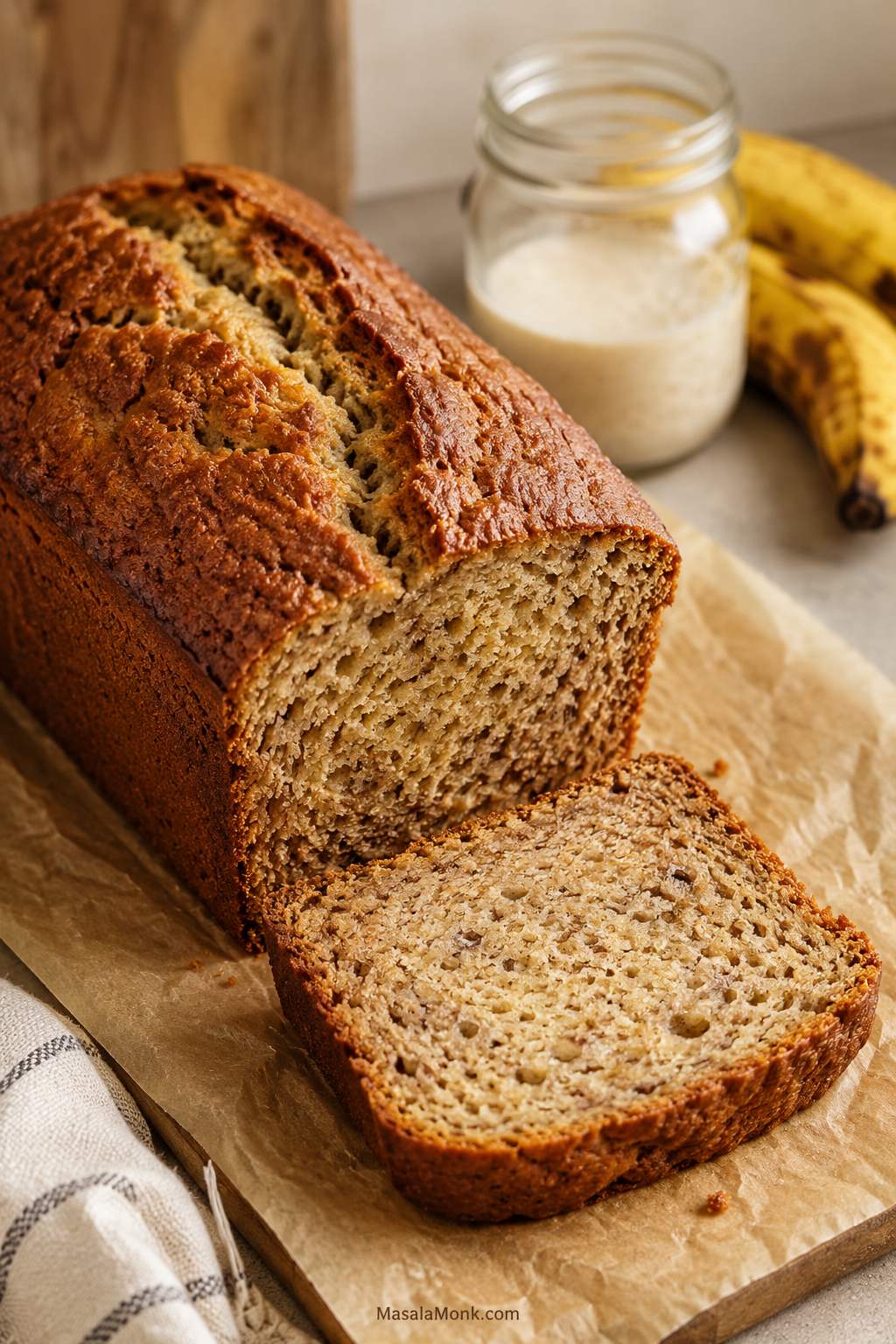
Sliced sourdough banana bread loaf on parchment with a moist crumb, ripe bananas, and a jar of sourdough discard in the background.

This sourdough banana bread recipe is for the two things home bakers hate wasting most: overripe bananas and sourdough discard. The loaf bakes up soft, fragrant, and deeply banana-forward, with brown sugar warmth, a tender crumb, and just enough sourdough tang to make each slice taste more rounded and interesting.

This is the bread you make when the bananas are too far gone for snacking but exactly right for baking. It is the kind of loaf that smells like a good decision before it even leaves the oven, especially if you plan to eat the first slice warm with butter.

Why This Sourdough Banana Bread Is Different

The batter comes together like a regular quick bread: no kneading, no shaping, no rise time, no mixer, and no complicated sourdough schedule. You only need about 15 minutes of hands-on prep, one main mixing bowl, and a standard loaf pan.

Meanwhile, the discard adds flavor, moisture, acidity, and a little tang, while baking soda and baking powder do the lifting. This sourdough banana bread recipe is designed to feel familiar first and sourdough-smart second, so the discard improves the loaf without making it complicated.

What makes this loaf especially reliable is the way it handles moisture. Ripe bananas and sourdough discard both make banana bread taste better, but too much of either can leave the middle gummy. This recipe keeps the banana and discard in a safe range, then gives you clear doneness cues so the loaf bakes up moist, tender, and sliceable.
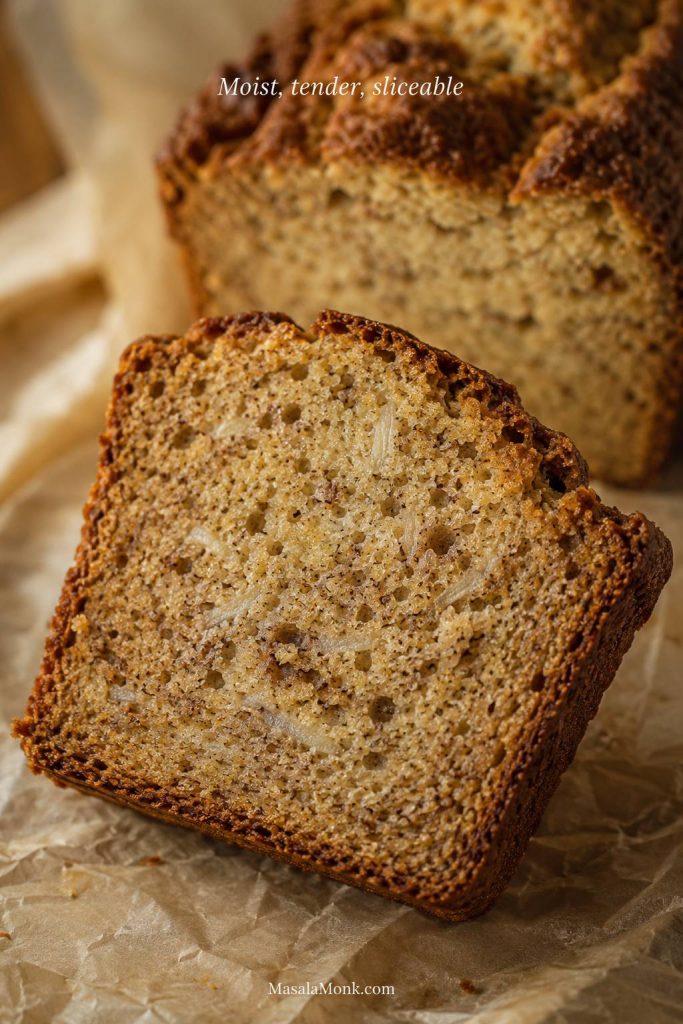
Close-up slice of sourdough discard banana bread with a soft crumb, banana flecks, and the words “Moist, tender, sliceable.”
A good sourdough discard banana bread slice should look tender and slightly plush, while still holding together when you pick it up.

So instead of guessing whether your bananas are “about right” or whether the loaf just needs five more minutes, you get clear amounts, clear texture cues, and a better chance at a loaf that slices the way banana bread should.

If your main worry is a wet center, the doneness cues and troubleshooting guide below are the two sections to keep closest.

Sourdough Banana Bread Recipe: Quick Answer

This sourdough discard banana bread is a same-day quick bread made with ripe bananas and sourdough discard or active starter. The discard gives the loaf a mild tang, deeper flavor, and extra moisture, but baking soda and baking powder do the lifting, so there is no rise time.

In this sourdough banana bread recipe, you can mix the batter and bake it right away. For the best texture, use very ripe bananas, measure the mashed banana instead of guessing, whisk the discard fully into the wet ingredients, and bake until no wet batter remains in the thickest part.

A good slice should feel soft and moist, but still hold together when you pick it up. It should taste like banana bread first, with just enough sourdough depth to make it more interesting than the usual loaf.
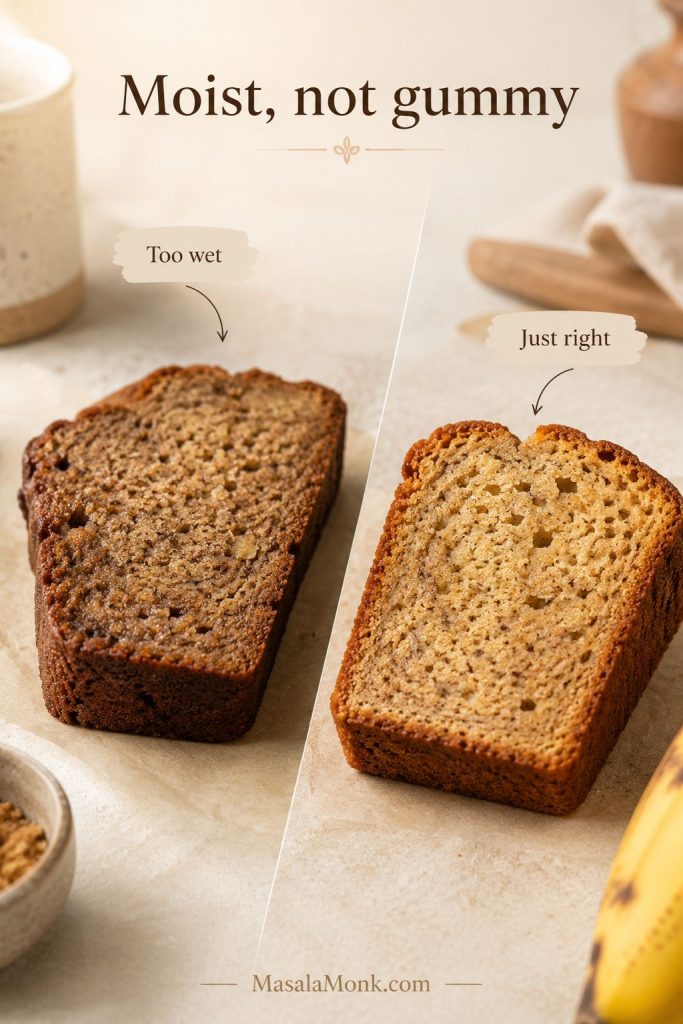
Comparison of two banana bread slices labeled “Too wet” and “Just right” under the heading “Moist, not gummy.”
Because ripe bananas and discard both add moisture, the best loaf needs enough structure and bake time to stay soft without turning heavy.

For exact quantities, pan size, and bake time, you can jump straight to the printable recipe card.

Sourdough Banana Bread Recipe at a Glance

  • Best pan: 9×5-inch light metal loaf pan
  • Oven: 350°F / 175°C
  • Bake time: 55–65 minutes
  • Banana amount: 340–360 g mashed ripe banana
  • Discard amount: 113 g / ½ cup sourdough discard
  • Texture goal: moist, tender, sliceable, and baked cleanly through the center

Those numbers matter most in three places: the ingredient measurements, the pan and bake-time notes, and the doneness test.
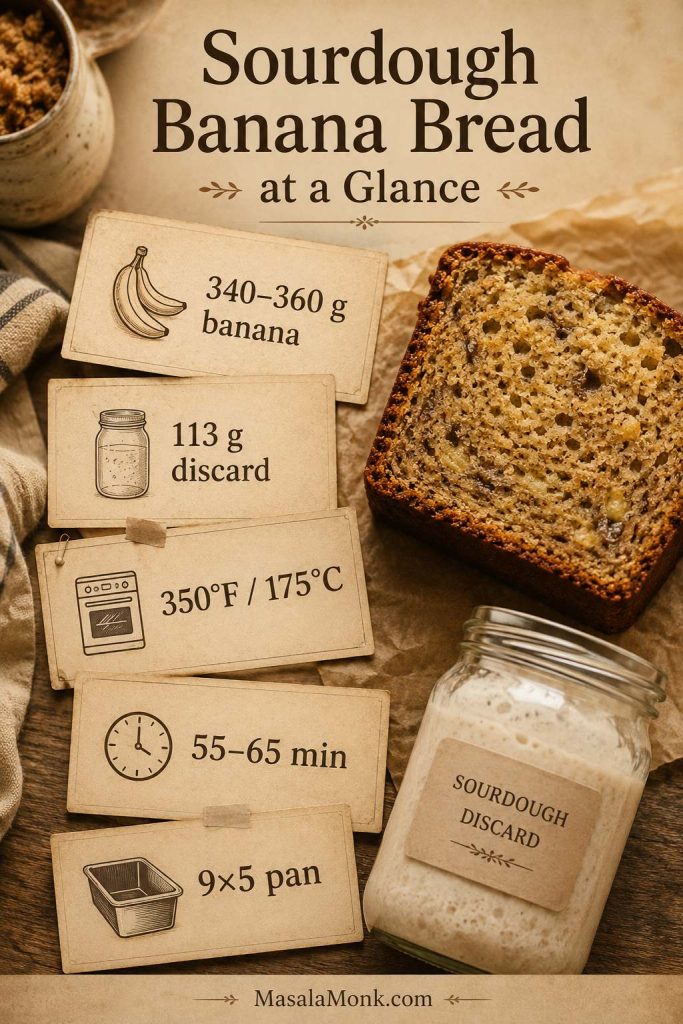
Sourdough banana bread at-a-glance card with 340–360 grams banana, 113 grams discard, 350 degrees Fahrenheit, 55–65 minutes, and 9×5 pan.
Keep these core numbers close: measured banana, steady discard, the right pan, and clear bake cues make the recipe easier to repeat.

What This Sourdough Banana Bread Tastes Like

This is not a sharp or sour loaf. Instead, it tastes like classic banana bread with more depth: sweet ripe banana first, then brown sugar, vanilla, butter, and a gentle sourdough note in the background.

The crumb should be moist and tender, not wet or pudding-like. Once cooled, the slices should hold together cleanly, with enough softness to feel cozy and enough structure to toast the next day.

Walnuts make it feel more breakfast-like and nutty. Chocolate chips, on the other hand, push it toward dessert. Either way, the base loaf stays simple enough for a weekday bake.

The Three Things That Make This Loaf Reliable

Measure the mashed banana, whisk the discard fully into the wet ingredients, and bake until the loaf tests clean at its tallest point. Together, those three small steps help it stay tender while still slicing neatly.

Why This Sourdough Banana Bread Recipe Works

You will like this loaf if you want banana bread that still feels familiar, just a little more grown-up. The discard does not take over. Instead, it deepens the flavor, softens the crumb, and gives you one more reason not to waste a jar of starter.

Why Moisture Control Matters

Although banana bread looks simple, the best loaves depend on balance. Too little moisture and the loaf feels dry. Too much banana or discard, however, and the center can take longer to bake through. The sweet spot is enough banana for flavor, enough flour for structure, and enough leavening to lift a dense, moist batter.

The recipe is built around the problem that makes sourdough banana bread tricky: ripe bananas and discard both add moisture, so the loaf needs enough structure, enough lift, and clear doneness cues to finish properly.

The key is moisture control: measure the banana by weight, keep the discard steady at 113 g, and bake by doneness cues instead of the clock alone. That is what gives you a slice that feels soft in the hand instead of fragile or underbaked.

  • Very ripe bananas bring natural sweetness, aroma, and moisture.
  • Sourdough discard adds gentle tang, acidity, and deeper flavor.
  • Brown sugar gives a warmer, caramel-like banana bread flavor.
  • Melted butter keeps the loaf rich and classic.
  • Baking soda plus baking powder gives more reliable lift than baking soda alone.
  • Measured banana helps the loaf bake through cleanly.

The Moisture-Control Rule

For this loaf, do not measure bananas by count alone. Measure the mashed banana, keep the discard steady, and bake by doneness cues. That is the difference between moist banana bread and a loaf that stays heavy in the middle.
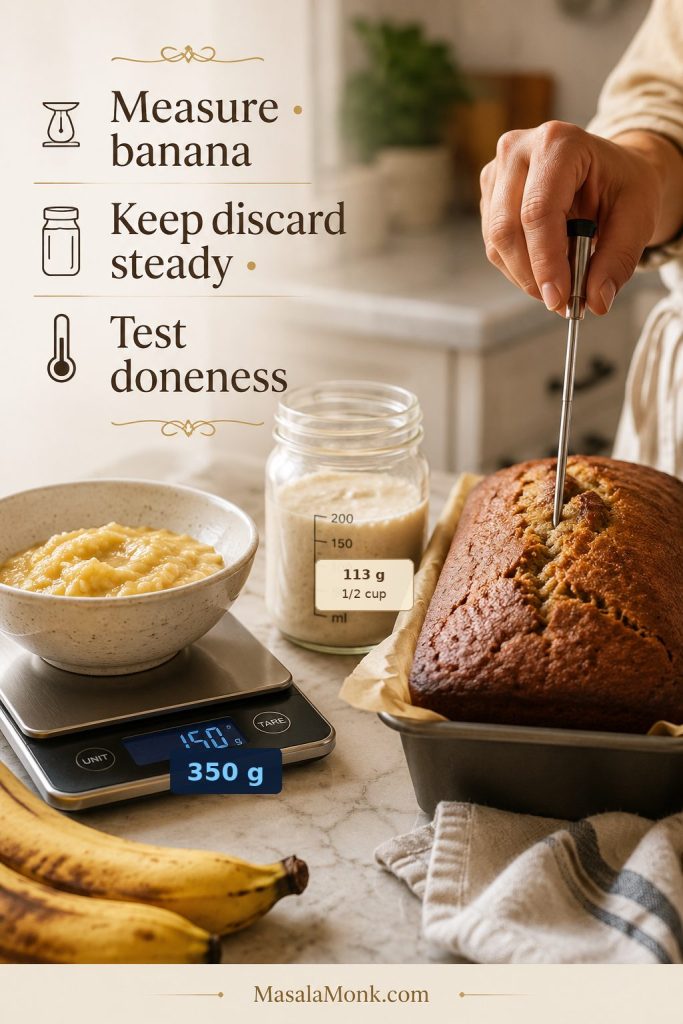
Moisture-control guide with mashed banana on a scale, sourdough discard measured at 113 grams, and a banana bread loaf being tested for doneness.
Instead of guessing by banana count, this recipe controls the main moisture points before the loaf ever goes into the oven.

If you only remember one thing, remember this rule; then use the doneness section to confirm the loaf is fully baked before slicing.

Think of this as classic banana bread with a sourdough-discard upgrade. It is not trying to be chewy sandwich bread, and it is not trying to be aggressively tangy. Rather, it is soft, sliceable, fragrant, and practical.

Before You Start

Mash and measure the bananas first. If you have more than 360 g mashed banana, save the extra for oatmeal, pancakes, or a smoothie instead of adding it all to the loaf. That one step keeps the bread moist while helping the center bake through cleanly.

Ingredients for Sourdough Banana Bread

The ingredient list for this sourdough banana bread recipe is familiar, but a few details matter more because sourdough discard adds both moisture and acidity.
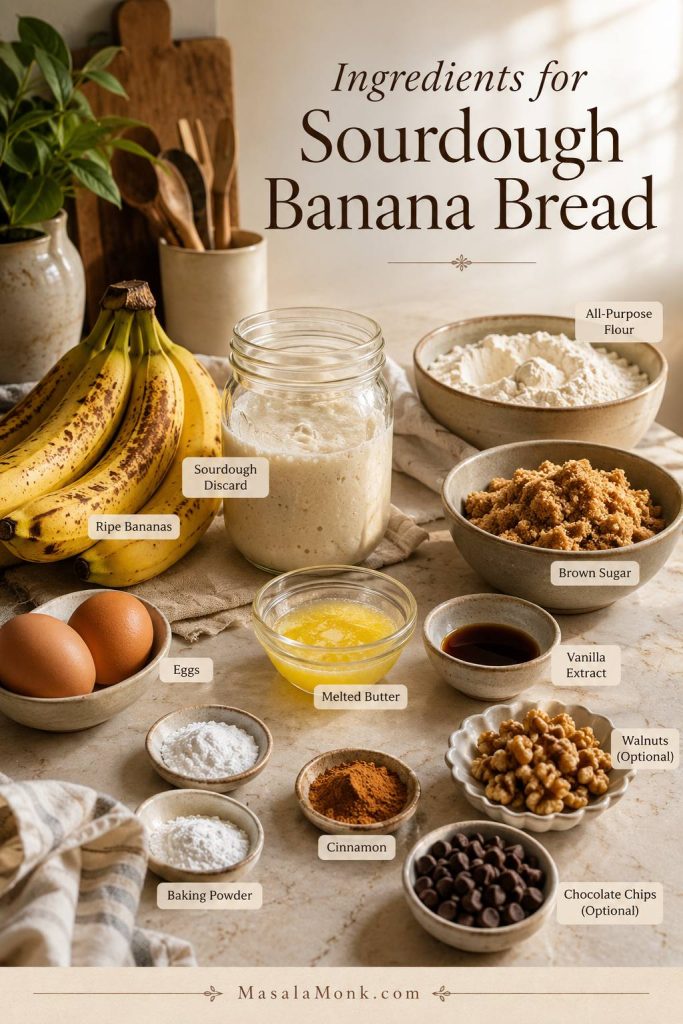
Ingredients for sourdough banana bread including ripe bananas, sourdough discard, flour, brown sugar, eggs, butter, vanilla, cinnamon, baking soda, baking powder, walnuts, and chocolate chips.
The ingredients are familiar, yet the balance matters: bananas bring flavor, discard adds depth, and the leaveners support a steady rise.

Very Ripe Bananas

Use bananas with plenty of brown spots, or bananas that are fully soft and deeply fragrant. They should mash easily with a fork.
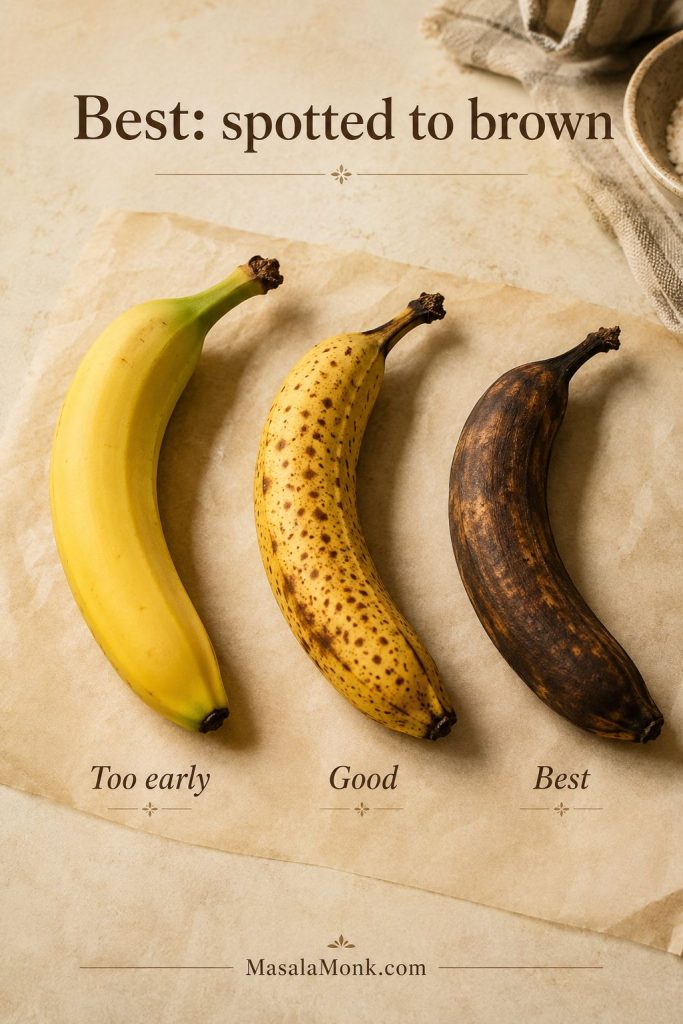
Banana ripeness guide with yellow, spotted, and very ripe brown bananas labeled as best when spotted to brown.
For the best banana bread flavor, choose bananas that smell sweet and mash easily; however, avoid fruit that smells fermented or spoiled.

Measure the Mashed Banana

The best range is 340–360 g peeled mashed banana, which is about 1½ cups. That is usually 3 medium-to-large bananas; however, a scale saves you from guessing here, because three bananas can mean very different things depending on their size.
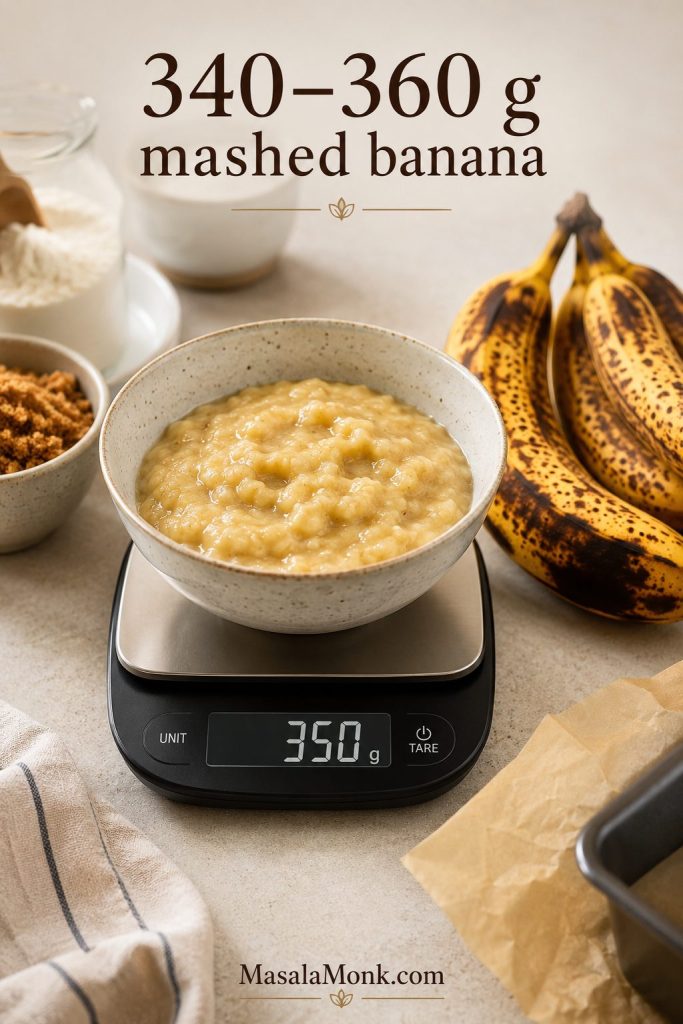
Bowl of mashed banana on a digital scale reading 350 grams with ripe bananas nearby and the text “340–360 g mashed banana.”
Banana size varies a lot, so weighing the mashed fruit is the easiest way to avoid an overly loose banana bread batter.

You do not need perfect-looking bananas for this recipe. You just need ripe, fragrant bananas and a measured amount, so the loaf gets banana flavor without turning heavy.

Banana Bread Texture Tip

Extra banana sounds harmless, but it can make the middle take much longer to set. Therefore, when your bananas are extra large, mash them first and measure the amount instead of adding every banana on the counter.

Can You Use Frozen Bananas?

Yes. First, thaw frozen bananas; then drain off any watery liquid before measuring. Frozen bananas release more moisture than fresh ripe bananas, so measure the mashed fruit after thawing and keep it in the 340–360 g range.
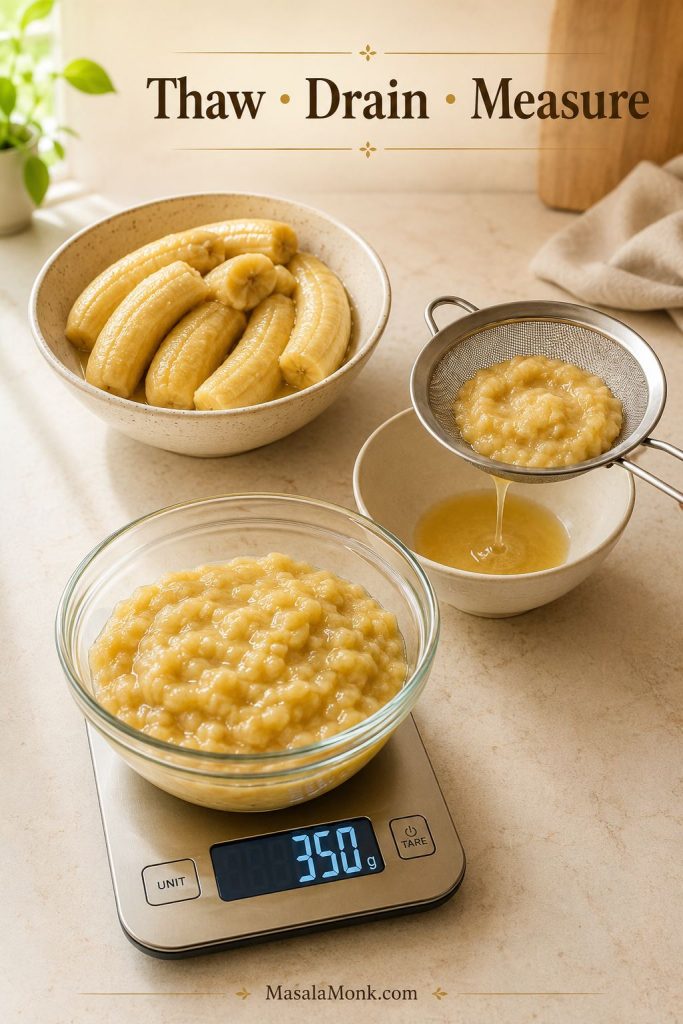
Frozen banana process guide showing thawed bananas, liquid being drained, and mashed banana measured on a scale with the text “Thaw, Drain, Measure.”
Frozen bananas work well in sourdough banana bread, but draining the extra liquid first keeps the batter from becoming too wet.

Because thawed bananas release extra liquid, the mashed banana measurement matters even more here.

Sourdough Discard or Active Starter

Use 113 g / ½ cup sourdough discard. A discard from a starter fed with equal weights of flour and water works best here.

Fresh discard gives a milder loaf. Older fridge discard gives a stronger sourdough note. Active starter also works, and it may make the loaf slightly lighter. However, this recipe does not rely on the starter for rise.
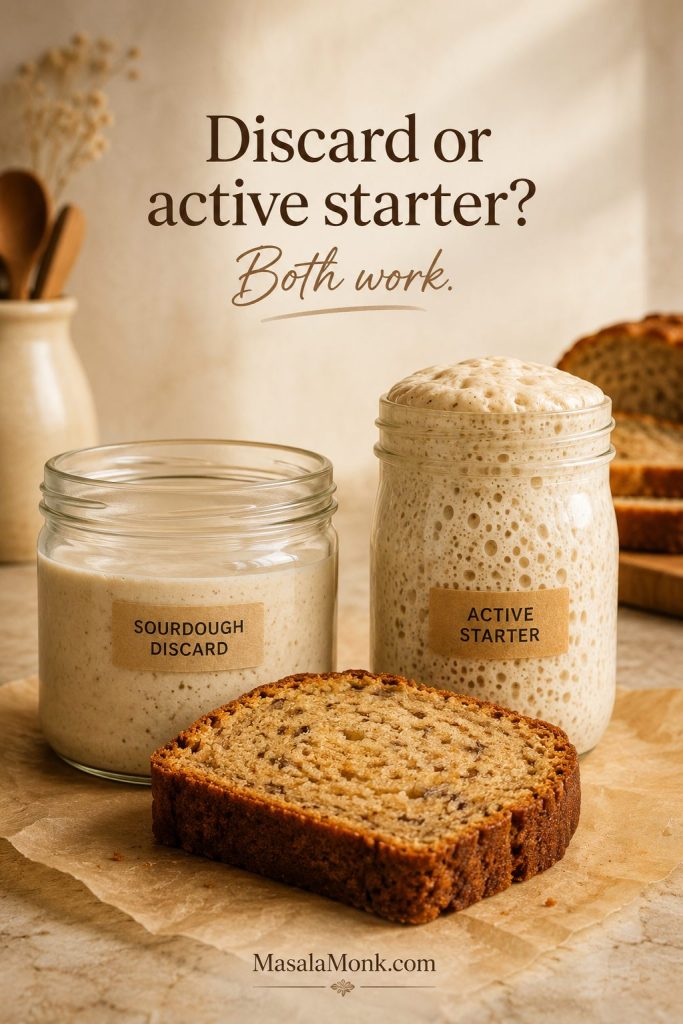
Two jars of sourdough discard and active starter beside a slice of banana bread with the text “Discard or active starter? Both work.”
Discard gives this loaf a deeper tang, while active starter can make the flavor milder and the crumb slightly lighter.

For a clearer comparison, see the full discard vs active starter section before you choose.

For starter basics, feeding schedules, and discard handling, see this guide to how to feed and maintain a sourdough starter.

Flour, Sugar, Fat, and Eggs

All-purpose flour gives the cleanest structure. Brown sugar keeps the loaf moist and gives the flavor a caramel edge. Meanwhile, melted butter makes the loaf rich and familiar, while eggs help bind the batter and support the crumb.

If you measure flour by cups, spoon it into the cup and level it off instead of scooping directly from the bag, because scooped flour packs down easily. Too much packed flour can make the loaf dry, heavy, or dense.

FatBest ForTexture
Melted butterClassic banana bread flavorRich, tender, slightly denser
Neutral oilSoftest crumb and longer moistnessSofter, lighter, less buttery

Use a neutral oil such as avocado, canola, sunflower, or light olive oil if you choose the oil version. Avoid strongly flavored oils unless you already know you like them in sweet bakes.
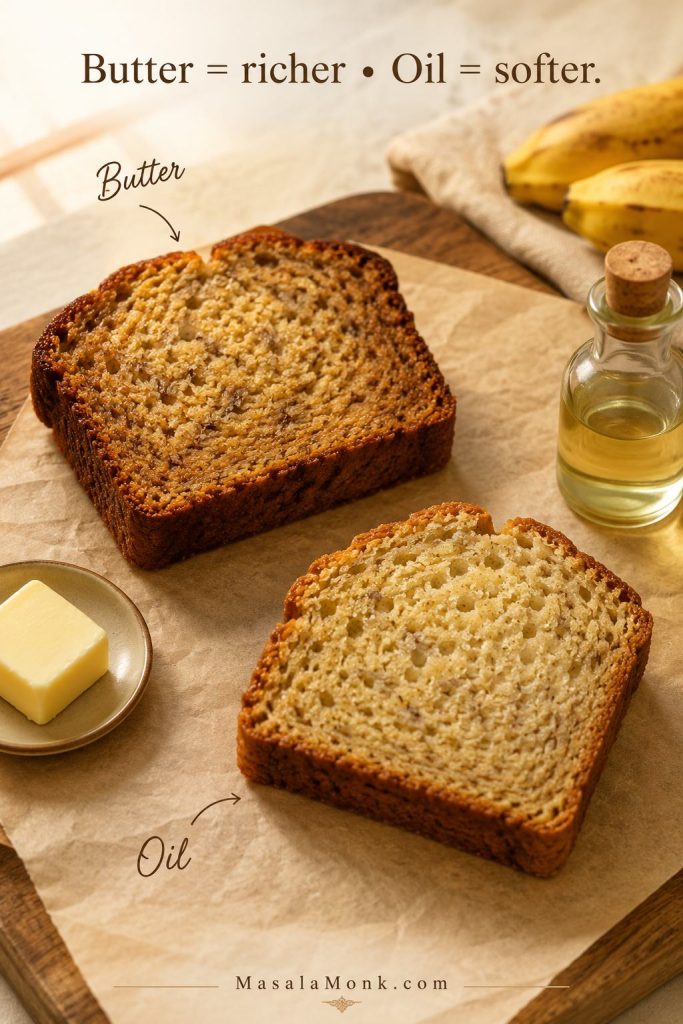
Two banana bread slices comparing butter and oil versions with butter, oil, bananas, and the text “Butter = richer, Oil = softer.”
Butter gives a classic banana bread flavor, whereas oil creates a softer crumb that can stay tender a little longer.

If you are choosing a version before baking, the version guide gives the quickest way to decide between classic, softer, tangier, walnut, or chocolate chip.

Baking Soda and Baking Powder

This recipe uses both for a steadier rise. Baking soda reacts with the acidity from the bananas, brown sugar, and sourdough discard, while baking powder adds backup lift so the loaf does not feel heavy for how moist the batter is.
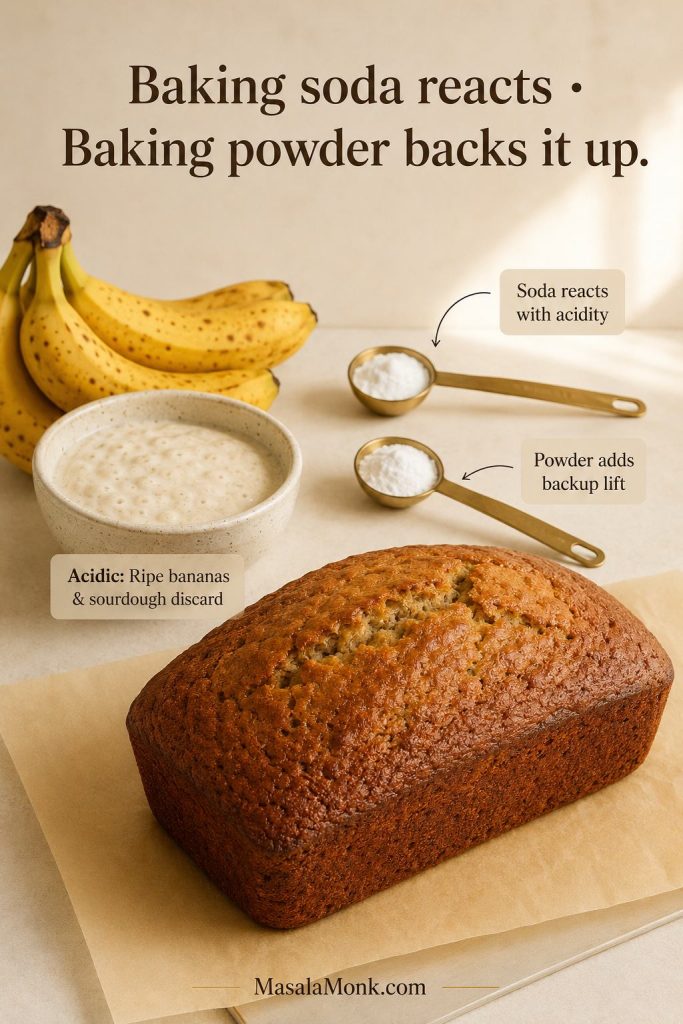
Baking soda and baking powder guide with ripe bananas, sourdough discard, leaveners, and a domed banana bread loaf.
Even though this loaf uses sourdough discard, baking soda and baking powder still do the lifting for a steadier quick bread rise.

Optional Mix-Ins

Walnuts, pecans, and chocolate chips all work well. Keep mix-ins to about 85–115 g so the loaf does not become too heavy.

Blueberries can be added, but they bring extra moisture. For that reason, keep them to about 75–100 g, use them straight from the fridge or freezer, and avoid adding extra banana at the same time.

Sourdough Discard vs Active Starter

This is one of the most common questions when making banana bread with sourdough discard: does the starter need to be active? For this recipe, no. Discard is the easiest default.

In this loaf, discard is mostly a flavor and moisture ingredient. The baking soda and baking powder do the main lifting, so you do not need to wait for the starter to rise the batter.
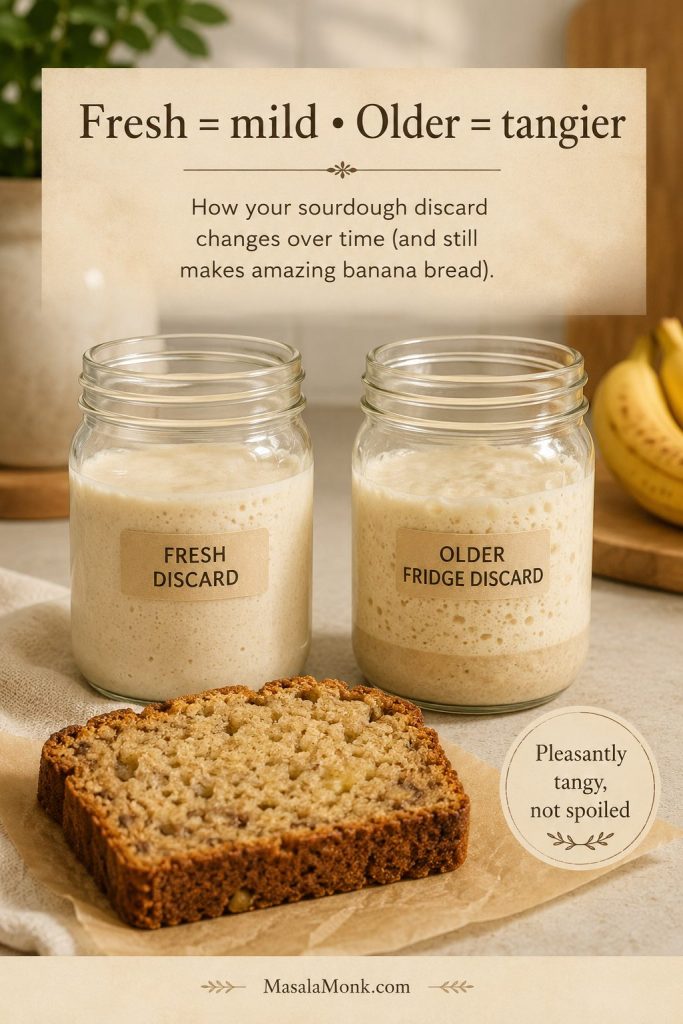
Fresh and older sourdough discard jars beside banana bread with the text “Fresh = mild, Older = tangier” and “Pleasantly tangy, not spoiled.”
Older discard can add more sourdough character, but it should smell pleasantly tangy rather than harsh, moldy, or unpleasant.
Starter TypeCan You Use It?What to Expect
Fresh discardYes, best defaultMild flavor, easy mixing, classic banana bread taste.
Older fridge discardYes, if it smells pleasantly tangyStronger sourdough note. Good for people who like more tang.
Active starterYesSlightly lighter loaf and usually less sour flavor.
Very runny discardYesBatter may be looser and the loaf may need a few extra minutes.
Very thick discardYesBring closer to room temperature and whisk well into the wet ingredients.
Brand-new starter discardNot idealEarly starter discard can smell harsh or unstable. Use mature discard for better flavor.

For more ways to use starter and discard in baking, keep this page on more sourdough bread recipes handy. It is useful when you want to move from quick discard bakes to focaccia, pizza dough, and simple bread projects.

Which Sourdough Banana Bread Version Should You Make?

Use the base recipe if you want a classic moist loaf. Then adjust only one or two things depending on the flavor or texture you want. Banana bread is forgiving, but the best versions come from changing one thing at a time.

If You Want…Use This Direction
Mild classic banana breadUse fresh discard or active starter.
More sourdough tangUse older but healthy fridge discard.
Softer crumbUse neutral oil instead of melted butter.
Richer flavorUse melted butter and dark brown sugar.
Less sweetnessReduce brown sugar to about 125 g.
Better structureDo not skip the baking powder.
Nutty banana breadAdd 85–115 g walnuts or pecans.
Dessert-style loafAdd 85–115 g chocolate chips.
Eggless loafUse flax eggs and cool the loaf completely before slicing.
Lowest risk of a wet centerWeigh the banana and bake to 200–205°F / 93–96°C.

Choose One Direction First

For a first bake, choose one direction and keep the rest of the loaf simple. Then you will know whether your repeat version is the buttery classic, the softer oil loaf, the walnut breakfast loaf, or the chocolate-chip treat.

What Not to Change the First Time

For your first loaf, do not increase the banana, increase the discard, remove the baking powder, and switch flour types all at once. Make the base version once, then adjust sweetness, fat, mix-ins, or tang after you know how your pan and oven behave.

If you already know your favorite banana bread style — walnut, chocolate chip, less sweet, extra tangy, or warm with butter — choose that direction first. Most people find their house version after two bakes: one classic loaf, then one small adjustment based on what they liked most.

How to Make Sourdough Banana Bread

The method for this sourdough banana bread recipe is straightforward, but the order matters. Blend the discard into the wet ingredients before adding flour. That way, you avoid sticky sourdough streaks and get a more even crumb.
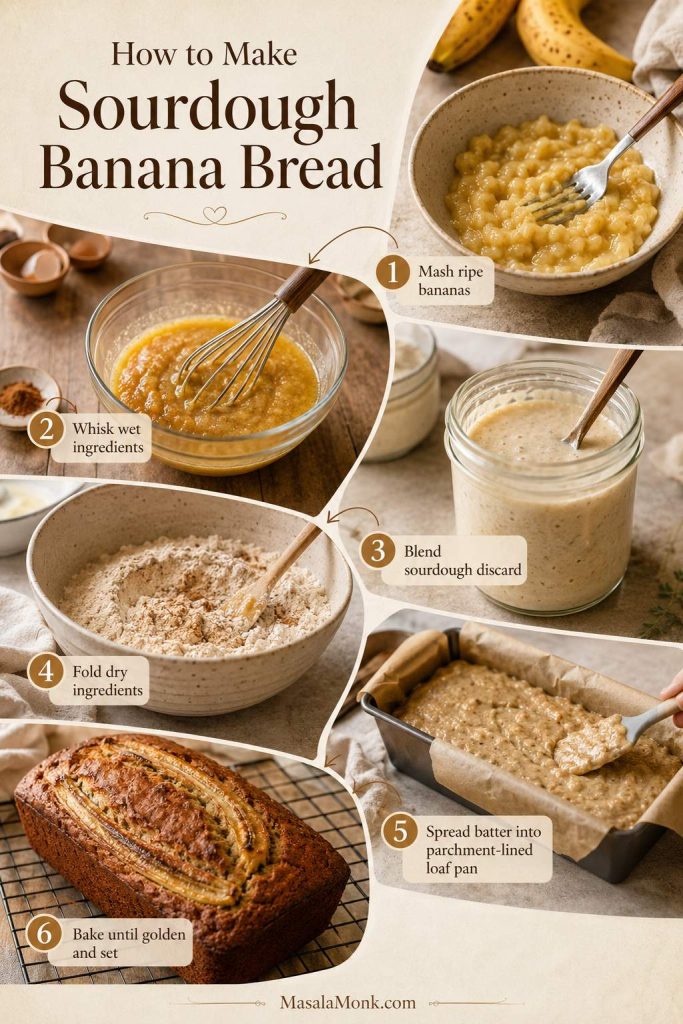
Step-by-step sourdough banana bread process showing mashed bananas, wet ingredients, sourdough discard, dry ingredients, loaf pan batter, and baked loaf.
Once the discard is fully blended into the wet mixture, the flour can be folded in gently without leaving sticky starter streaks.

1. Prepare the Pan and Oven

Preheat the oven to 350°F / 175°C. Then line a 9×5-inch / 23×13 cm loaf pan with parchment paper, leaving a little overhang so the baked loaf is easy to lift out.

If your loaf pan looks more than about three-quarters full after adding the batter, set a small amount aside and bake it as 1–2 muffins. An overfilled pan can rise unevenly or stay wet in the center.

2. Mash and Measure the Bananas

Mash the bananas until mostly smooth with a few small lumps. Then measure out 340–360 g. A few soft banana pieces are fine; however, large chunks can create wet pockets in the loaf.

3. Mix the Wet Ingredients

Whisk melted butter and brown sugar until glossy. Next, add the eggs, vanilla, mashed banana, and sourdough discard. Whisk until the discard is fully blended into the mixture.

At this point, the mixture should look glossy and loose, with no visible streaks of discard.
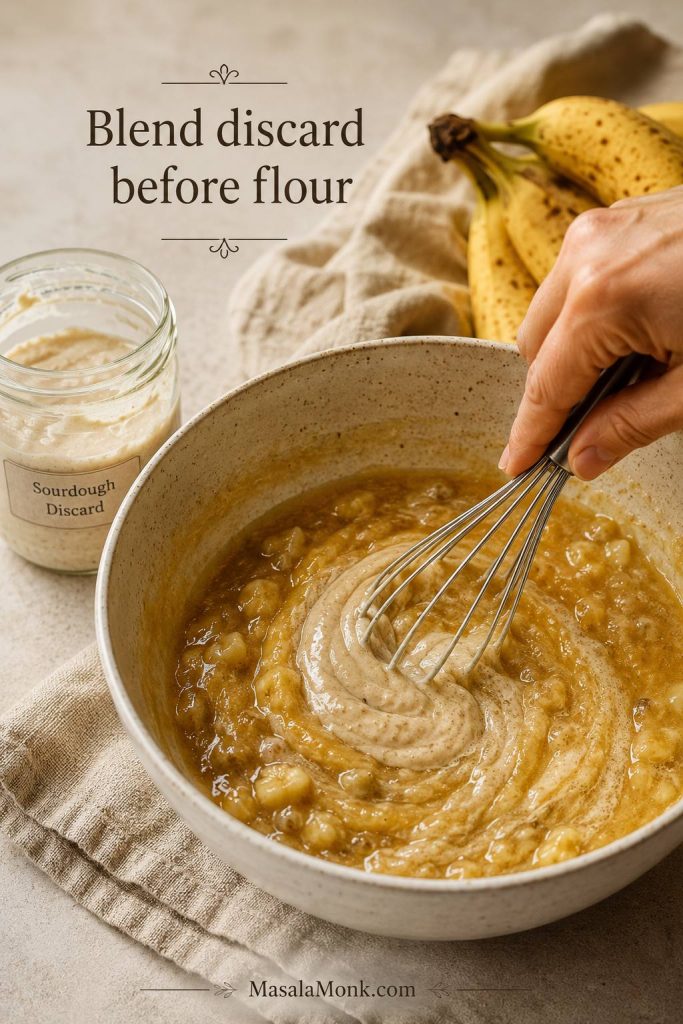
Hand whisking sourdough discard into banana bread wet ingredients in a bowl before flour is added.
At this stage, look for a glossy banana mixture with no visible discard streaks before the dry ingredients go in.

4. Fold in the Dry Ingredients

Add flour, baking soda, baking powder, salt, and cinnamon. Sprinkle the baking soda, baking powder, salt, and cinnamon evenly over the flour before folding so they distribute more evenly. Then fold gently with a spatula until no dry flour remains. Stop as soon as the batter comes together.
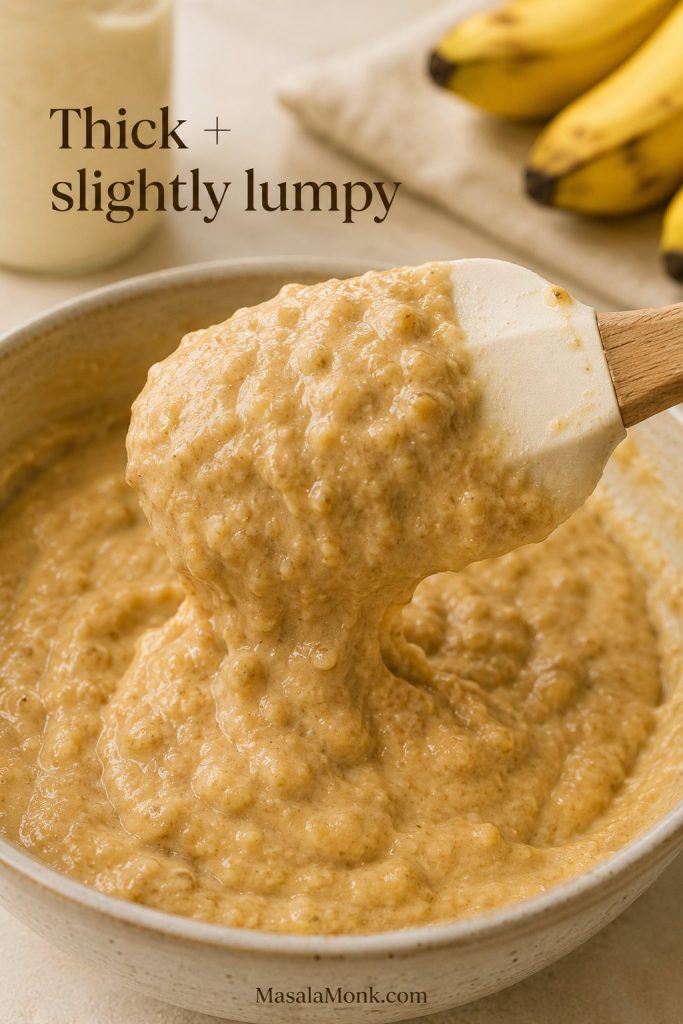
Thick slightly lumpy sourdough banana bread batter lifted with a spatula and the text “Thick + slightly lumpy.”
A thick, slightly lumpy batter is exactly what you want because it means the flour has been mixed in without overworking the loaf.

The batter should look thick and slightly lumpy, not smooth like cake batter. It should mound slightly in the pan; if it pours like pancake batter, the loaf may need longer to bake. A slightly uneven batter is a good sign here. Smooth, overworked batter is more likely to bake up heavy.
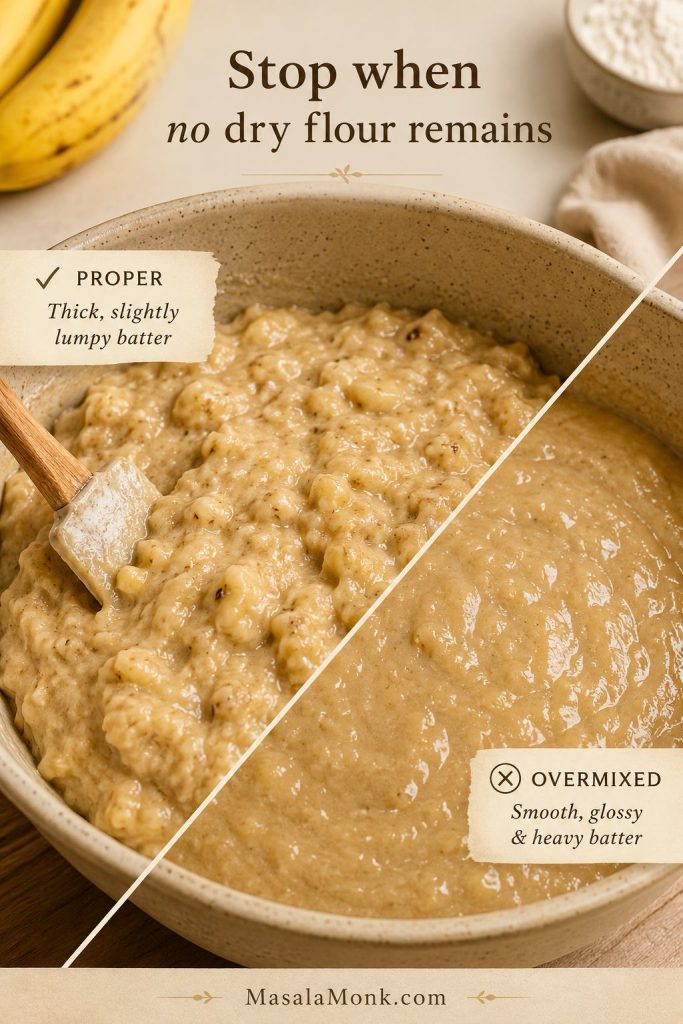
Comparison of properly mixed banana bread batter and overmixed batter with the text “Stop when no dry flour remains.”
A few small lumps are fine because overmixing can make banana bread dense, especially in a moist sourdough discard batter.

In fact, overmixing develops gluten and can make banana bread dense, tough, or heavy. If your past banana bread turned dense or gummy, compare your batter to the troubleshooting section before changing the recipe.

5. Add Mix-Ins

Fold in walnuts, pecans, or chocolate chips, if using. Keep the amount moderate so the loaf still rises and slices cleanly.

6. Bake and Cool

Spread the batter into the prepared pan and smooth the top. The batter should sit below the rim of the pan, with room to rise.
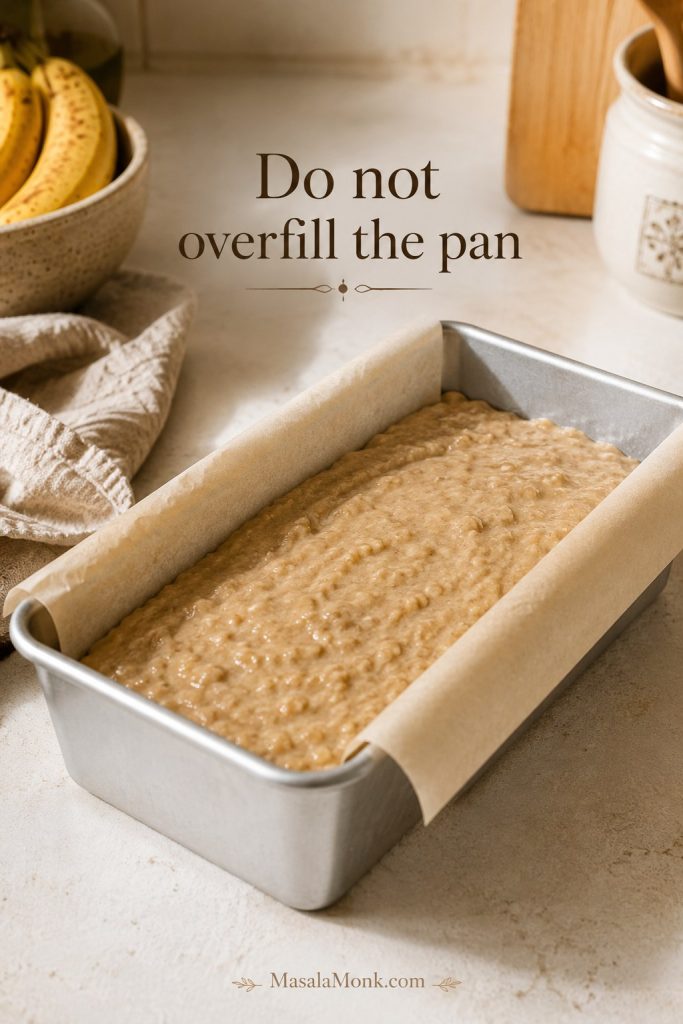
Sourdough banana bread batter spread in a parchment-lined light metal loaf pan with the text “Do not overfill the pan.”
A 9×5 light metal loaf pan gives the batter enough room to rise, while parchment makes the cooled loaf easier to lift out.

Bake for 55–65 minutes, or until the highest part of the loaf feels firm and no wet batter remains. When it is done, the top should look set and gently domed, not jiggly.

Finally, cool in the pan for 10–20 minutes. After that, lift the loaf onto a rack and let it cool before slicing.
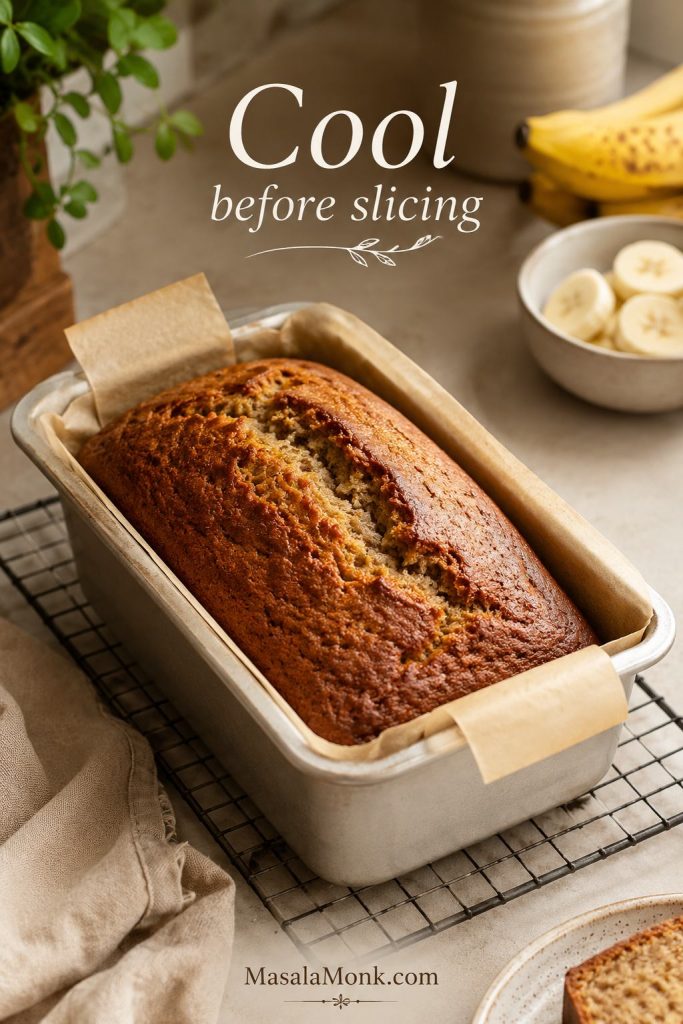
Freshly baked sourdough banana bread cooling in a parchment-lined metal loaf pan on a wire rack with the text “Cool before slicing.”
The loaf keeps firming as it cools, so this resting time is part of the texture — not just a waiting step.

Important Cooling Note

Warm banana bread is tempting, but slicing too early can make the middle seem wetter than it really is. Let it cool until the crumb has time to set.
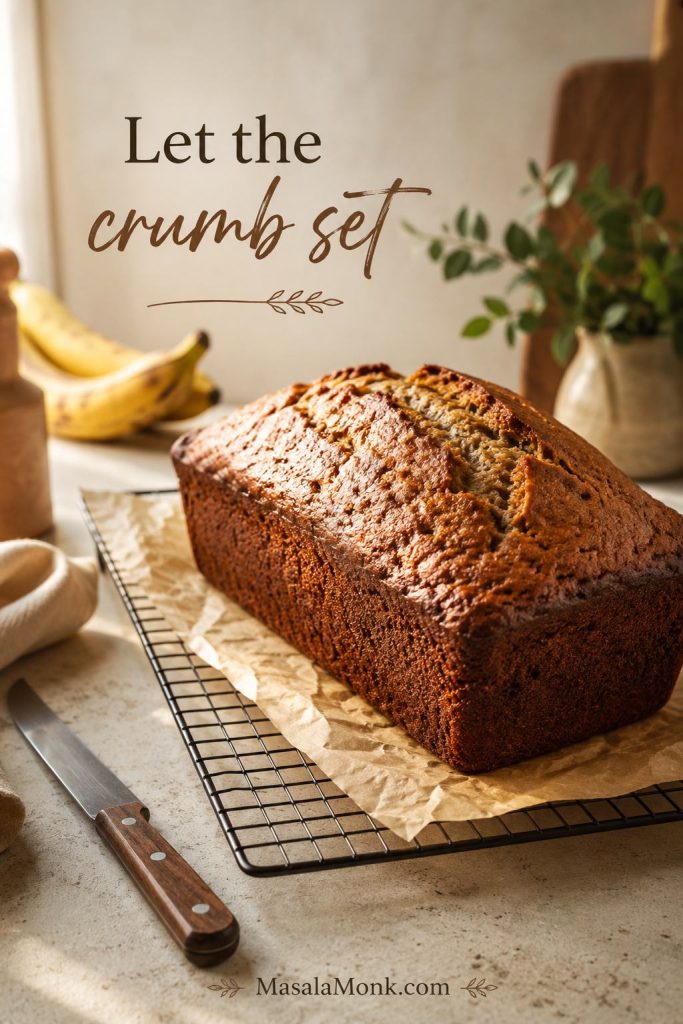
Whole sourdough banana bread loaf cooling on a rack with a knife nearby and the text “Let the crumb set.”
Cutting too soon can make a finished loaf seem underbaked, so give the crumb time to settle before the first slice.

Best Pan, Oven Temperature, and Bake Time for Sourdough Banana Bread

For this sourdough banana bread recipe, the most reliable setup is a 9×5-inch light metal loaf pan at 350°F / 175°C. Light metal helps the loaf bake evenly without the sides darkening too quickly.
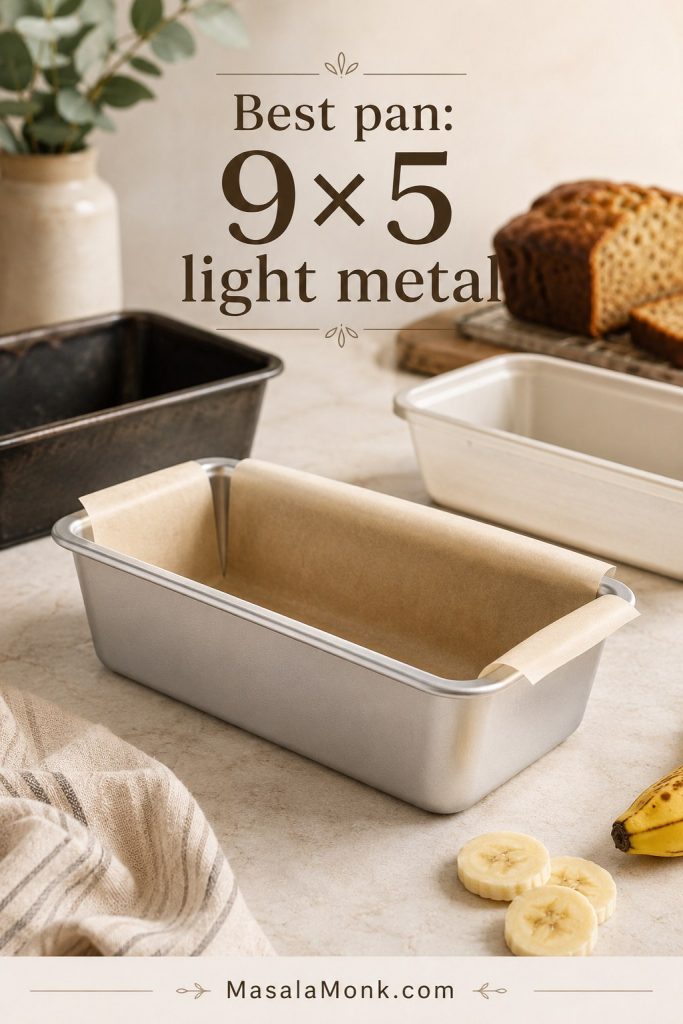
Light metal 9×5 loaf pan lined with parchment beside other loaf pans and the text “Best pan: 9×5 light metal.”
Pan choice affects bake time: a light metal 9×5 pan helps the sides and center finish more evenly.

Banana bread is naturally dense and moist, so bake time is only a guide. The real test is whether the loaf is baked through at its tallest point.

That is why the doneness test matters more than the exact minute on the timer.

Pan or Oven SituationWhat to Do
9×5-inch light metal panMost reliable setup for this recipe. Start checking around 55 minutes.
8½×4½-inch panThe loaf will be taller and may need extra time in the middle.
Dark metal panBrowns faster. Tent with foil if the top darkens before the middle is done.
Glass or ceramic panMay bake differently and often needs a few extra minutes. Check the thickest part carefully.
Top browning too fastTent loosely with foil during the last part of baking.
Outside dark but middle wetNext time, bake at 325°F / 163°C for longer so the loaf has more time to bake through.

How to Tell When the Loaf Is Done

If your first worry is a wet middle, you are not alone. Banana bread often looks done on top before the loaf has finished baking through, so test the tallest part instead of trusting the browned crust.
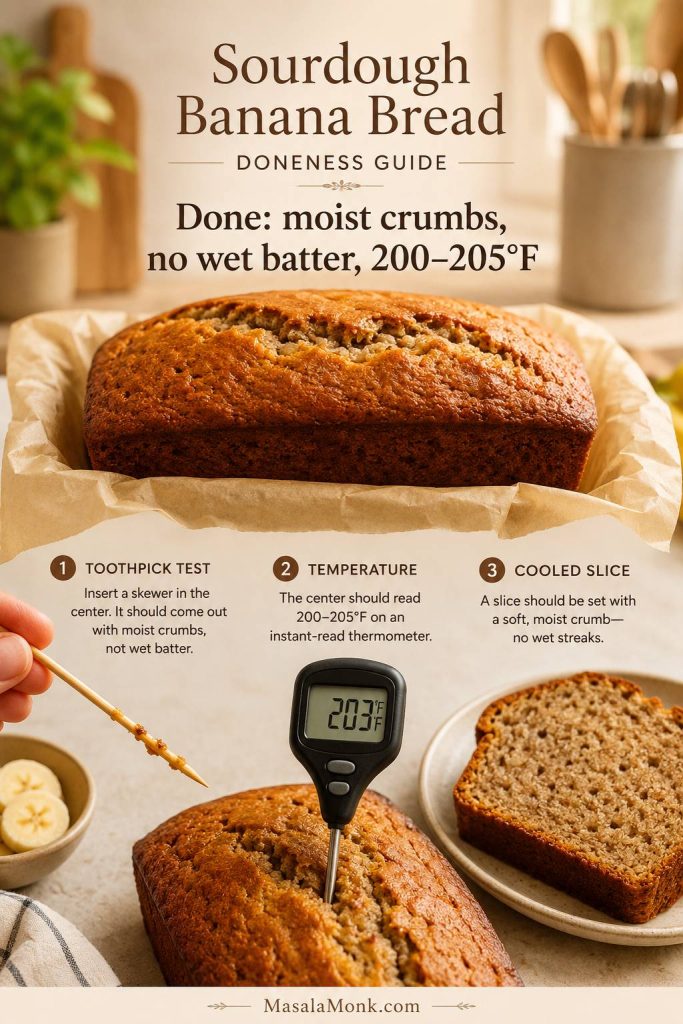
Sourdough banana bread doneness guide with skewer crumbs, thermometer reading 203 degrees Fahrenheit, and a clean slice.
Because banana bread browns before the center always finishes, the thermometer and crumb test are more reliable than color alone.

A browned top is a clue, not a guarantee. The inside still needs time to settle into a soft, sliceable crumb.

  • A skewer inserted into the center should come out without wet batter.
  • A few moist crumbs are fine.
  • The top should spring back lightly when pressed.
  • The thickest part of the loaf should read about 200–205°F / 93–96°C on an instant-read thermometer.

Because banana smears on a skewer can look wet, look for raw batter rather than soft banana. When in doubt, give the loaf a few more minutes, especially if you used a smaller pan, extra banana, or runny discard.

How to Fix Gummy, Dense, or Dry Sourdough Banana Bread

Most texture problems in sourdough discard banana bread come down to moisture, mixing, or bake time. Once you know which one caused the problem, the next loaf is much easier to fix.

If your loaf failed once, do not assume the recipe is hopeless. Sourdough banana bread usually goes wrong for one of four reasons: too much banana, very wet discard, overmixing after flour, or pulling the loaf before the thickest part has finished baking.

Match the Problem Before You Change the Recipe
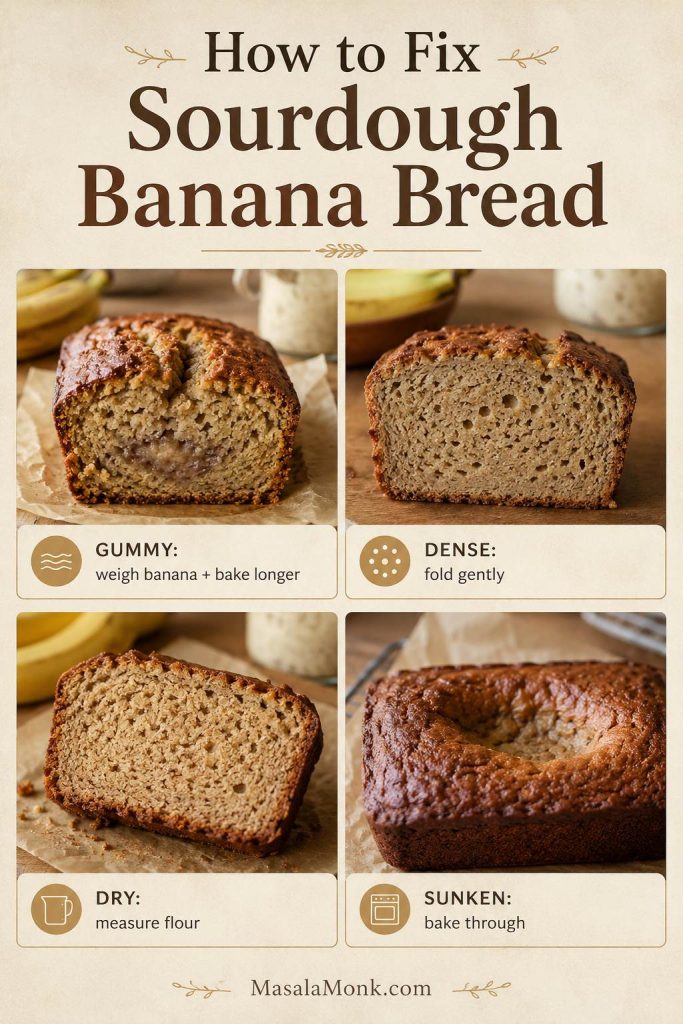
Troubleshooting board for sourdough banana bread with gummy, dense, dry, and sunken examples plus short fixes.
If a loaf fails, the fix is usually practical: adjust banana moisture, mix more gently, measure flour carefully, or bake a little longer.
ProblemLikely CauseFix
Gummy centerToo much banana, underbaking, overmixing, or slicing too soonWeigh the banana, bake longer, fold the flour gently, and cool before slicing.
Dense loafDiscard not blended well or batter overmixed after flourWhisk discard fully into wet ingredients, then fold dry ingredients lightly.
Dry loafToo much flour or overbakingWeigh flour or spoon-and-level it. Check a few minutes earlier next time.
Too sourOlder, very acidic discardUse fresher discard or active starter for a milder loaf.
Sunken middleUnderbaked center or too much moistureBake until the thickest part tests clean and avoid adding extra banana beyond the recipe range.
Dark outside, raw middleOven too hot, pan too dark, or loaf too tallTent with foil, use a lighter pan, or bake lower and longer next time.
Sticky sourdough streaksDiscard not fully mixed into wet ingredientsWhisk the discard with banana, eggs, butter, and sugar before adding flour.

If you only change one thing next time, weigh the mashed banana. It is the small, unglamorous step that solves more banana bread texture problems than almost anything else.

Once you know the cause, go back to the ingredient measurements, mixing method, or doneness cues rather than changing everything at once.

Sourdough Banana Bread Variations and Mix-Ins

Once this sourdough banana bread recipe works for you, the variations are easy. Keep mix-ins moderate and avoid adding extra wet ingredients unless you adjust the bake time.
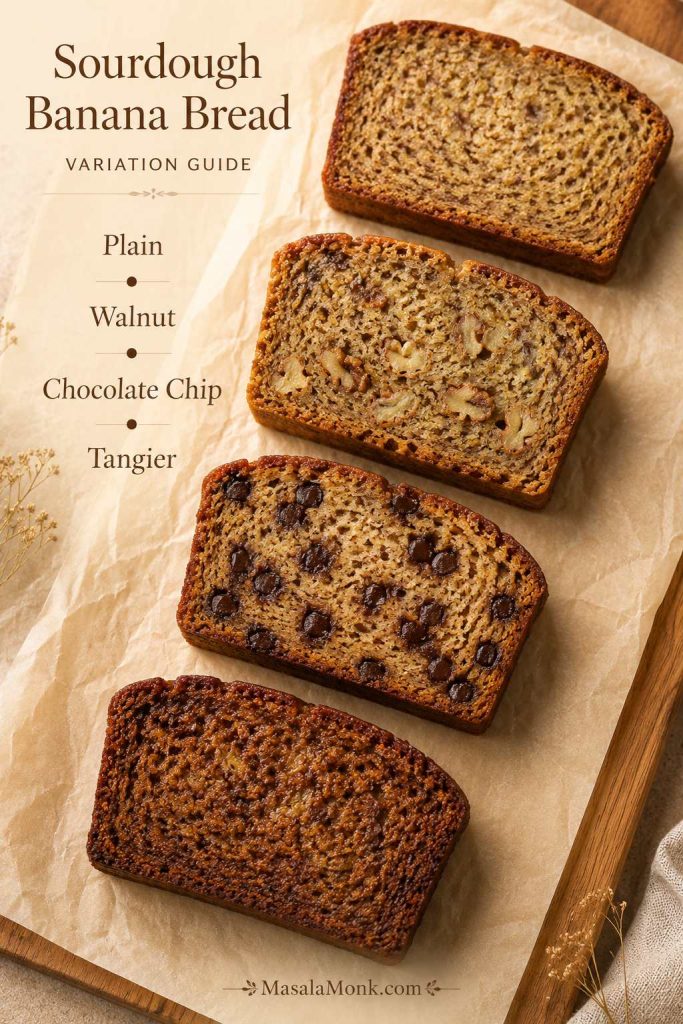
Sourdough banana bread variation guide with plain, walnut, chocolate chip, and tangier slices arranged on parchment.
Start with the base loaf first; then, once you know the texture, choose a walnut, chocolate chip, or tangier discard version.

Walnut Sourdough Banana Bread

Fold in 85–115 g chopped walnuts. Toasting the walnuts first gives a deeper flavor and helps them stay crisp inside the loaf.

Chocolate Chip Sourdough Banana Bread

Fold in 85–115 g chocolate chips. For a more dessert-like loaf, sprinkle a few extra chips on top before baking.

Less-Sweet Version

Reduce the brown sugar to about 125 g. The loaf will be less moist and less caramel-like, but still pleasant if your bananas are very ripe. However, avoid cutting the sugar too aggressively because sugar affects softness, browning, and shelf life.

Eggless Version

For an eggless version, use 2 flax eggs and expect a slightly softer, denser crumb. Let the loaf cool completely before slicing so the structure has time to set. This flax egg for quick breads guide explains the basic ratio and when flax eggs work best.

Healthier Banana Bread Direction

For a more wholesome loaf, replace up to half the all-purpose flour with whole wheat flour, reduce the sugar slightly, or use part Greek yogurt in place of a little butter. For a separate banana-bread style built around oat flour, see this healthy banana bread with oat flour.

Optional Long-Fermented Version

The same-day version gives the most classic banana bread texture, so start there if this is your first loaf. However, if you want deeper sourdough flavor, you can use a long-fermented method as long as the final leaveners are added close to baking.

For a true long-fermented version, mix the flour, sourdough discard, mashed banana, melted butter, and brown sugar first. Cover and refrigerate overnight. The next day, let the mixture sit at room temperature for 20–30 minutes so it softens slightly. Beat the eggs and vanilla together first, then stir them into the fermented mixture. Sprinkle in the baking soda, baking powder, salt, and cinnamon, then fold until evenly combined and bake right away.
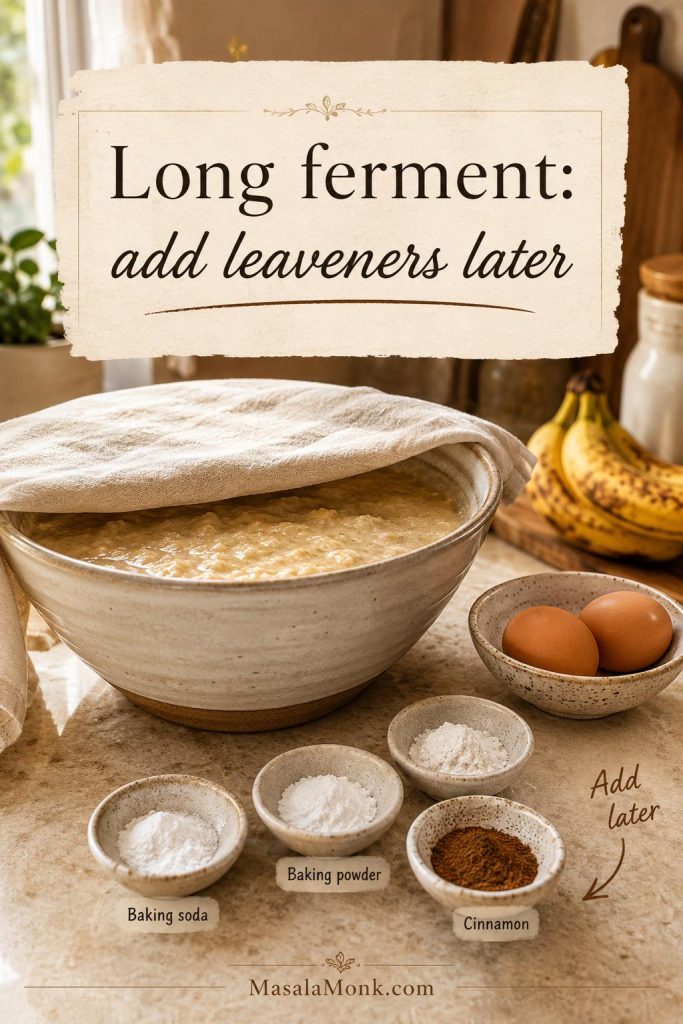
Long-fermented sourdough banana bread setup with covered batter, eggs, baking soda, baking powder, cinnamon, and the text “Long ferment: add leaveners later.”
The overnight rest is for flavor and fermentation, while the eggs, baking soda, and baking powder wait until baking day for better lift.

If the mixture looks very stiff the next day, do not panic. Let it soften at room temperature, then stir gently after adding the beaten eggs and vanilla.

The texture will be tangier and slightly less cake-like than the same-day loaf. Do not add the baking soda or baking powder before the overnight rest, because they give the loaf its best lift when added closer to baking.

Can This Become Muffins?

The flavor works beautifully as muffins, but the pan, fill level, and bake time change. Use this loaf as the flavor base, then bake muffin versions separately rather than treating the loaf timing as a direct swap. For another portioned breakfast-bake idea, these high protein muffins with banana or applesauce are useful when you want something meal-prep friendly.

How to Serve Sourdough Banana Bread

The first day, this loaf is soft enough to eat plain once it has cooled. For a warmer, richer slice, add salted butter, cream cheese, peanut butter, or a little honey.

The next day, toast a slice lightly until the edges crisp and the banana aroma comes back. That is also the best way to revive a frozen slice.

It is humble enough for a weekday breakfast and good enough to wrap up for someone who needs a little comfort. It also disappears slice by slice: breakfast, afternoon tea, lunchbox treat, late-night snack.

How to Store and Freeze Sourdough Banana Bread

Let the loaf cool completely before wrapping. Otherwise, warm banana bread traps steam, and that can make the crust sticky and the middle feel wetter than it should.
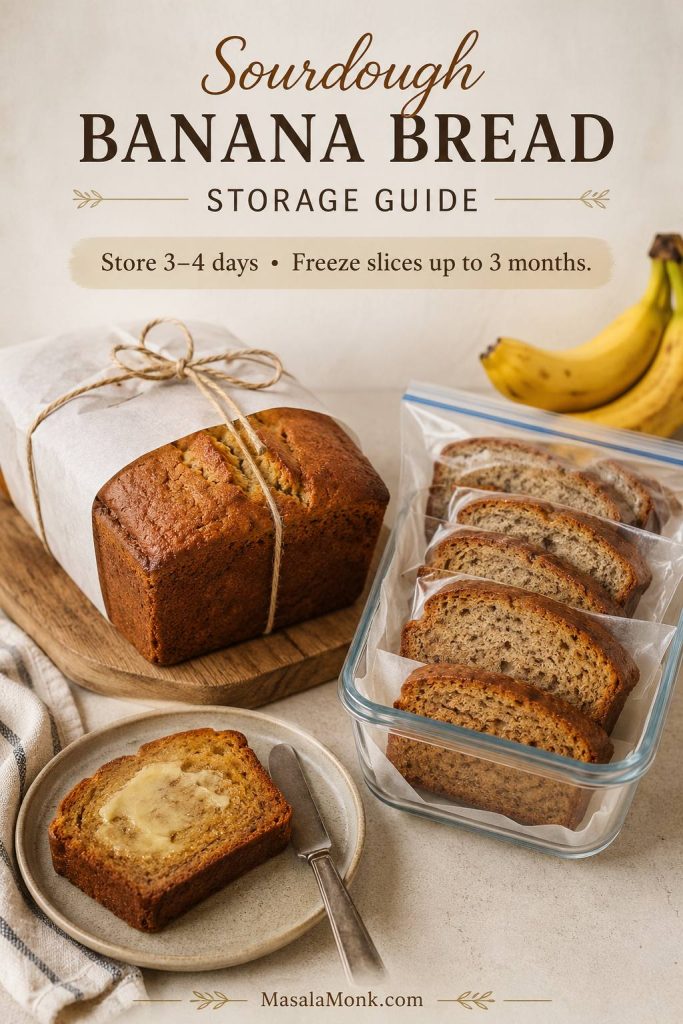
Storage guide for sourdough banana bread with wrapped loaf, sliced bread in a freezer container, and a buttered slice on a plate.
Wrap the loaf once it is fully cool, and freeze slices separately so you can toast one piece whenever you need it.
  • Room temperature: Wrap well and keep for 3–4 days.
  • Refrigerator: Useful in hot or humid weather, but the loaf may dry out faster.
  • Freezer: Freeze slices for up to 3 months for best texture.
  • To reheat: Warm gently, toast lightly, or microwave a slice briefly until soft.

Instead of freezing only the whole loaf, freeze slices so you can warm one piece at a time for breakfast, tea, or a quick sweet snack.

If you are baking ahead, the recipe card has the core times, pan size, and storage note in one place.

For general food-safe freezer guidance, the USDA’s overview of freezing and food safety is a helpful reference.

Printable Sourdough Banana Bread Recipe Card

Sourdough Banana Bread Recipe

This moist sourdough discard banana bread turns ripe bananas and starter discard into a soft, sliceable loaf with brown sugar warmth, gentle tang, and classic banana bread comfort.

Prep Time15 minutes

Cook Time55–65 minutes

Total Time1 hour 10 minutes to 1 hour 20 minutes, plus cooling

Yield1 loaf

Equipment

  • 9×5-inch / 23×13 cm loaf pan
  • Parchment paper
  • Mixing bowl
  • Whisk
  • Rubber spatula
  • Kitchen scale, recommended
  • Cooling rack
  • Instant-read thermometer, optional but helpful

Ingredients

  • 340–360 g very ripe bananas, peeled and mashed, about 1½ cups
  • 113 g sourdough discard, about ½ cup, ideally from a starter fed with equal weights flour and water
  • 240 g all-purpose flour, about 2 cups
  • 150 g packed brown sugar, about ¾ cup
  • 113 g unsalted butter, melted and cooled, about ½ cup
  • 2 large eggs
  • 2 teaspoons vanilla extract
  • 1 teaspoon baking soda
  • 1 teaspoon baking powder
  • ½ teaspoon fine salt
  • 1 teaspoon ground cinnamon, optional
  • 85–115 g chopped walnuts, pecans, or chocolate chips, optional

Instructions

  1. Preheat the oven to 350°F / 175°C. Line a 9×5-inch loaf pan with parchment paper.
  2. Mash the bananas and measure out 340–360 g. Set aside.
  3. In a large bowl, whisk melted butter and brown sugar until glossy.
  4. Add eggs, vanilla, mashed banana, and sourdough discard. Whisk until the discard is fully blended into the wet ingredients.
  5. Add flour, baking soda, baking powder, salt, and cinnamon. Sprinkle the leaveners and salt evenly over the flour, then fold gently with a spatula until no dry flour remains.
  6. Fold in walnuts, pecans, or chocolate chips, if using.
  7. Spread the batter into the prepared loaf pan and smooth the top.
  8. Bake for 55–65 minutes, or until the top is domed, the thickest part feels set, and a skewer inserted into the center shows moist crumbs but no wet batter. If the top browns too quickly, tent loosely with foil.
  9. The loaf is done when the thickest part reads about 200–205°F / 93–96°C.
  10. Cool in the pan for 10–20 minutes, then lift onto a rack and cool before slicing.

Recipe Notes

  • Fresh discard gives a mild flavor. Older discard gives a stronger sourdough note.
  • Active starter can be used in the same amount by weight.
  • Do not add extra banana without expecting a longer bake time.
  • For a less-sweet loaf, reduce brown sugar to about 125 g.
  • For a softer oil-based loaf, replace the melted butter with 100–110 g neutral oil.
  • For blueberries, use 75–100 g and avoid adding extra banana at the same time.
  • For a long-fermented version, use a separate method where the flour, discard, banana, butter, and sugar rest first, then add the eggs and final leaveners closer to baking.
  • Store wrapped at room temperature for 3–4 days, or freeze slices for up to 3 months.

Save these core cues for repeat bakes: measured banana, 113 g discard, a 9×5 pan, and a 200–205°F finish.
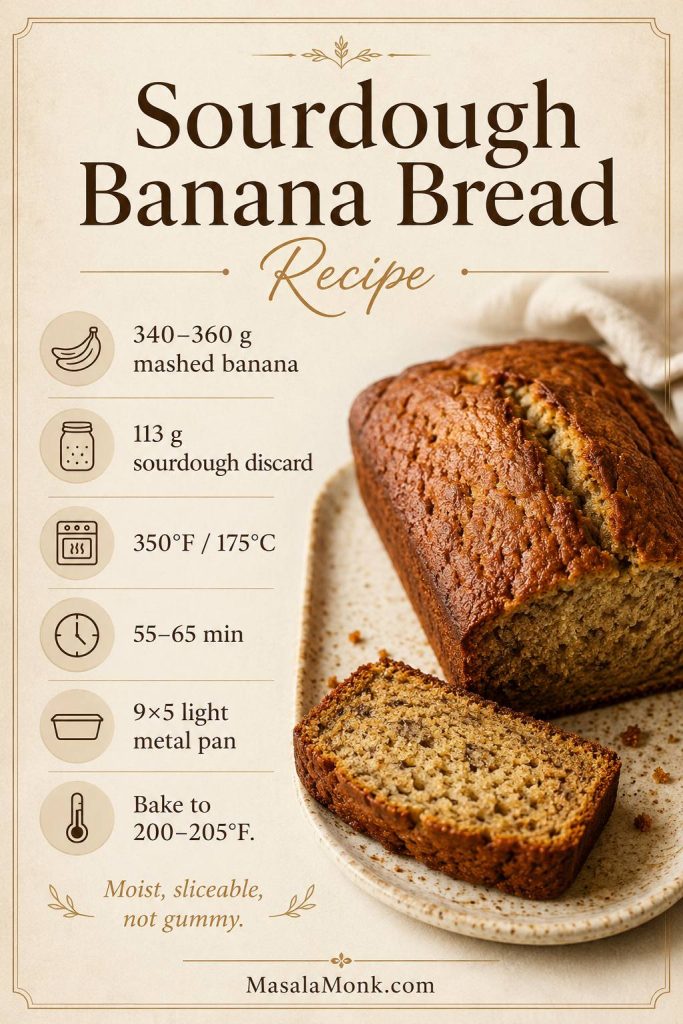
Sourdough banana bread recipe card with loaf and slice plus key cues for mashed banana, sourdough discard, oven temperature, bake time, pan size, and doneness temperature.
Save the core cues for later: measured banana, 113 g discard, a 9×5 pan, and a 200–205°F finish make the loaf easier to repeat.

More Ways to Use Ripe Bananas

If you still have bananas on the counter after this loaf, this banoffee pie recipe takes them in a caramel-and-cream dessert direction. For a no-oven breakfast, banana oatmeal pancakes use ripe banana for natural sweetness and moisture.

Once this base loaf works for you, it becomes a reliable discard recipe to return to whenever bananas go brown. After that, the walnut, chocolate chip, oil-based, and extra-tangy versions become easy little adjustments rather than brand-new recipes.

Once you know how your oven bakes this loaf, it becomes one of those quiet kitchen recipes you do not need a special occasion for: brown bananas, a little discard, one bowl, and a loaf that makes the next morning easier.

FAQs

Does sourdough banana bread taste sour?

It should taste like banana bread with a little extra depth, not like sour bread. Fresh discard gives the mildest flavor. Older fridge discard creates a stronger tang, especially if it has been sitting for several days.

Can I use active sourdough starter instead of discard?

Yes. Use the same amount by weight. Active starter usually gives a slightly lighter loaf and a milder sourdough flavor, while older discard gives more tang.

Is this a sourdough starter banana bread?

Yes. You can make it with sourdough discard or active starter. However, it is still a quick bread, so baking soda and baking powder do the main lifting while the starter adds moisture, acidity, tenderness, and flavor.

Why is my loaf gummy in the middle?

The most common causes are too much banana, underbaking, overmixing, or slicing before the loaf has cooled. Use 340–360 g mashed banana, fold the flour gently, and bake until no wet batter remains in the thickest part.

How ripe should bananas be for banana bread?

Use bananas with brown spots or fully brown skins. They should smell sweet and mash easily. Firm yellow bananas do not give the same sweetness, moisture, or banana flavor.

Can I use frozen bananas?

Yes. Thaw them first, drain off the watery liquid, then measure the mashed banana. Frozen bananas release more moisture than fresh ripe bananas, so keeping the amount in the 340–360 g range matters even more.

Should I use baking soda, baking powder, or both?

Both work best in this recipe. Baking soda reacts with the acidity in the bananas, brown sugar, and discard, while baking powder adds backup lift for a more reliable loaf.

What happens when the discard is very old?

Older discard can make the loaf tangier. That can be delicious when the discard smells pleasantly sour, but avoid discard that smells spoiled, moldy, or sharply unpleasant. For a mild loaf, use fresh discard or active starter.

Does the discard make the bread rise?

Not much. In this quick bread, baking soda and baking powder do the main lifting. The discard mostly adds moisture, acidity, tenderness, and flavor.

Can I make this dairy-free?

Yes. Replace the melted butter with 100–110 g neutral oil. The loaf will taste less buttery, but the crumb will stay soft and moist. This makes the loaf dairy-free, but not egg-free unless you also use the flax egg option.

Can I use whole wheat flour?

Yes, but start by replacing only half the all-purpose flour with whole wheat flour. A full whole-wheat loaf can taste heavier and absorb more moisture. If the batter feels unusually stiff, add 1–2 tablespoons of milk, yogurt, or water.

Can this sourdough banana bread recipe be made ahead?

Yes. The loaf keeps well at room temperature for 3–4 days and freezes nicely in slices. In fact, the flavor often tastes even better the next day because the banana, brown sugar, and sourdough notes settle together.

Can I bake this as muffins?

The batter can inspire muffins, but loaf timing does not translate directly. Muffins need a different pan, shorter bake time, and careful fill level. For the cleanest result, treat sourdough banana muffins as their own recipe rather than simply shrinking the loaf.

If you make this sourdough banana bread recipe, leave a comment with three details: fresh discard or older discard, butter or oil, and plain, walnut, or chocolate chip. Those notes help the next baker choose a version — and I would love to know which one becomes your repeat loaf.
Back to top

Posted on 1 Comment

Applesauce Cake Recipe

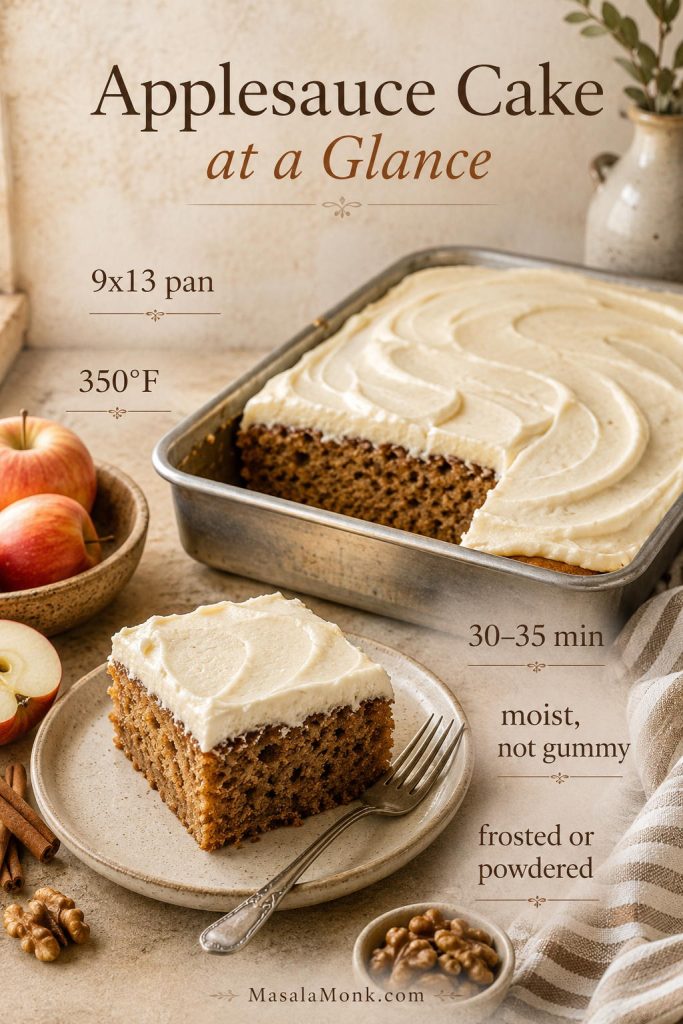
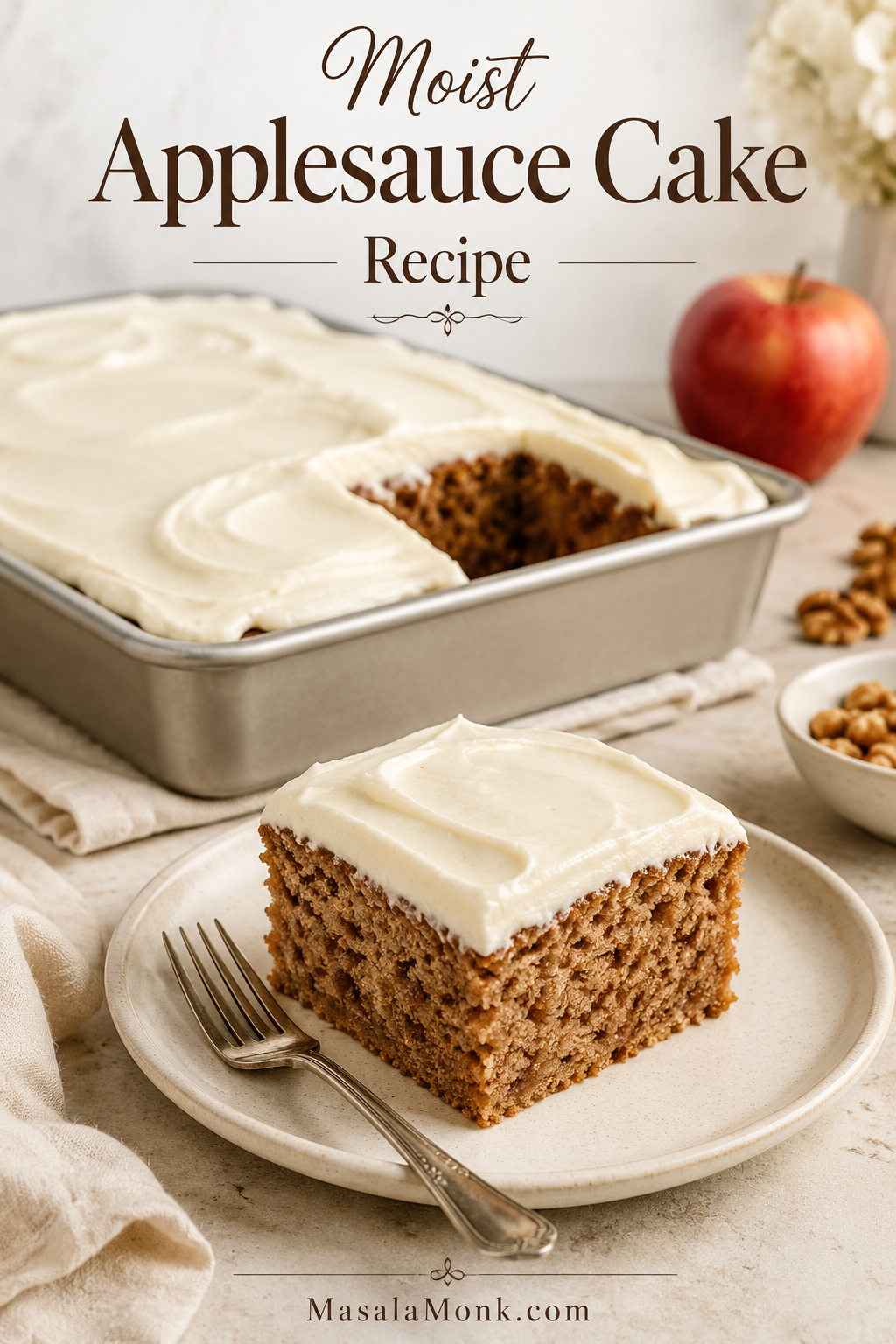
Frosted applesauce cake in a 9x13 metal pan with one square removed and plated in front, showing a soft brown crumb and cream cheese frosting.

Applesauce cake usually starts with one very specific craving: a soft, warmly spiced cake that feels old-fashioned without being dry, heavy, or fussy. This applesauce cake recipe is built around that craving, but also around the problems that can sneak in. Applesauce sounds like it should guarantee moisture, yet the middle can still turn gummy, the edges can dry out, the spices can taste flat, or the frosting can melt because the cake was still warm underneath.

The goal here is to prevent those problems before they happen. This easy applesauce cake bakes in a 9×13 pan with unsweetened applesauce, brown sugar, neutral oil, eggs, vanilla, cinnamon, ginger, nutmeg, and a small pinch of clove or allspice. Applesauce keeps the cake moist, while oil keeps the crumb tender after it cools.

The flavor is apple-spice rather than fresh-apple-chunk cake: cinnamon first, brown sugar underneath, gentle apple in the background, and a tangy cream cheese finish if you frost it. Think of it as an old-fashioned snack cake dressed up just enough for dessert. Dust it with powdered sugar when you want something simple with coffee, or fold in raisins and walnuts when you want the kind of cake that tastes like it came from an older recipe box.

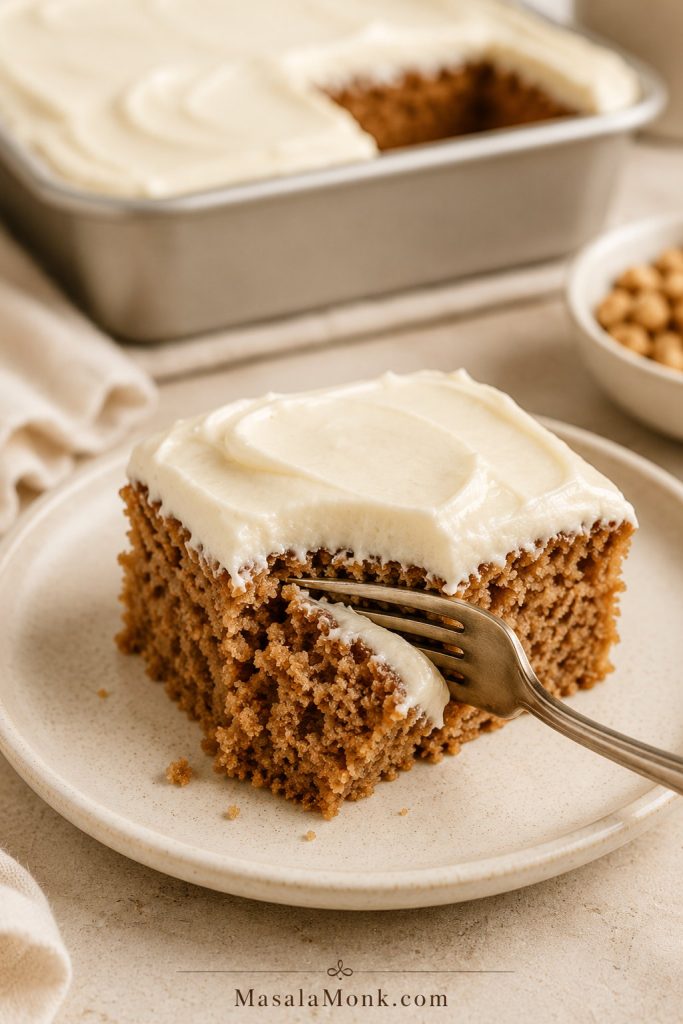
Close-up of a frosted applesauce cake square on a cream plate with a fork pressing into the soft crumb.
A fork should slide into the slice easily, but the cake should still hold its shape. That balance is what separates a tender applesauce cake from one with a gummy middle.

Applesauce Cake at a Glance

Most reliable pan 9×13-inch light metal baking pan.
Oven temperature 350°F / 175°C for metal pans; 325°F / 165°C for glass.
Bake time About 30–35 minutes, depending on pan and oven.
Applesauce texture Unsweetened, smooth, and not watery.
Texture goal Moist and tender, not wet or gummy.
Flavor profile Warm apple-spice cake with gentle apple flavor.
Topping choices Cinnamon cream cheese frosting, powdered sugar, or vanilla glaze.
Yield 15–16 squares.
Storage Refrigerate once frosted with cream cheese.
Make-ahead Bake one day ahead and frost after cooling.
At-a-glance applesauce cake guide showing a frosted cake square with cues for pan size, oven temperature, bake time, texture, and topping options.
Start with the reliable 9×13 setup: 350°F, about 30 to 35 minutes, and a center check that matters more than browned edges.

What This Applesauce Cake Guide Covers

Use this guide for the full cake, frosting choices, pan swaps, shortcut options, storage, and the small baking decisions that keep this cake moist instead of gummy.

Quick Answer: Moist 9×13 Applesauce Cake

For a moist applesauce cake, bake a 9×13-inch pan at 350°F / 175°C for about 30 to 35 minutes. Use unsweetened applesauce, brown sugar, eggs, warm spices, vanilla, and a moderate amount of neutral oil. The cake is done when the center springs back lightly and a toothpick comes out clean or with a few moist crumbs.

The most important texture rule is simple: applesauce adds moisture, but it does not replace fat perfectly. A no-oil version may sound appealing, but it is much more likely to bake up dense, chewy, or gummy. A little oil gives the crumb softness, especially after the cake has cooled and rested.

Most reliable first bake: use unsweetened applesauce, 3/4 cup neutral oil, a light metal 9×13 pan, and let the cake cool completely before frosting. Once you know how the crumb should feel, you can adjust sweetness, frosting, add-ins, or oil level with more confidence.

Need the visual cues before baking? Jump to the Applesauce Cake Texture Checklist before you mix the batter.

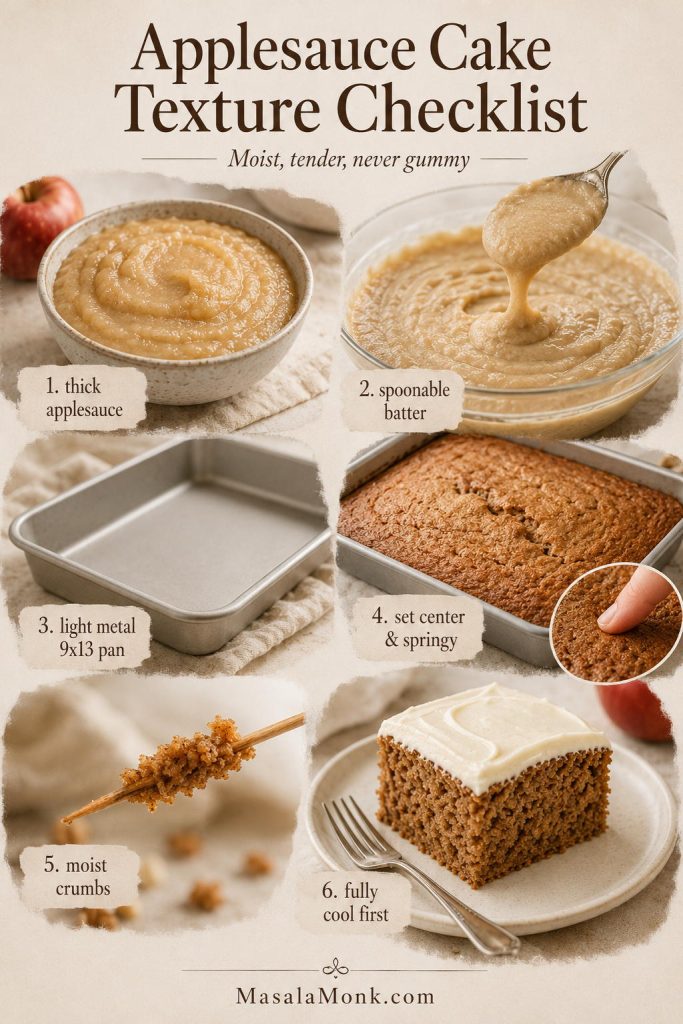
Applesauce Cake Texture Checklist

Applesauce Smooth, thick, and not watery.
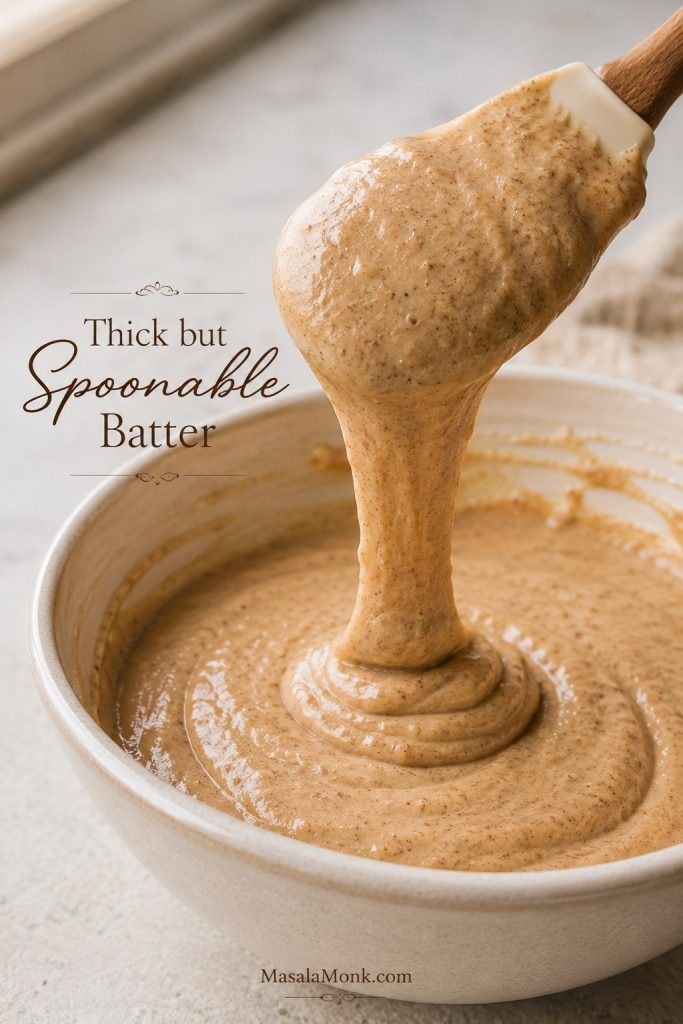
Batter Glossy, tan, thick but spoonable.
Pan Light metal 9×13 for the most even first bake.
Center Set and springy, with no jiggle.
Toothpick Clean or a few moist crumbs, not wet batter.
Frosting Only after the cake is fully cool.
Applesauce cake texture checklist showing thick applesauce, spoonable batter, a metal pan, a set cake center, a toothpick test, and a cooled frosted slice.
The best anti-gummy cues happen before and after baking: thick applesauce, spoonable batter, a set center, moist crumbs, and a fully cooled cake before frosting.

Once those cues make sense, go straight to how to make applesauce cake without a gummy center, or use the recipe card if you are ready to bake.

Why This Recipe Works

The texture comes down to balance: enough applesauce for moisture, enough oil for tenderness, and enough structure for clean slices. Applesauce gives the cake its soft, damp crumb and quiet apple flavor, but oil is what keeps that crumb tender after the pan cools. Eggs help it set cleanly, while brown sugar, cinnamon, and the supporting spices make the apple flavor feel fuller.

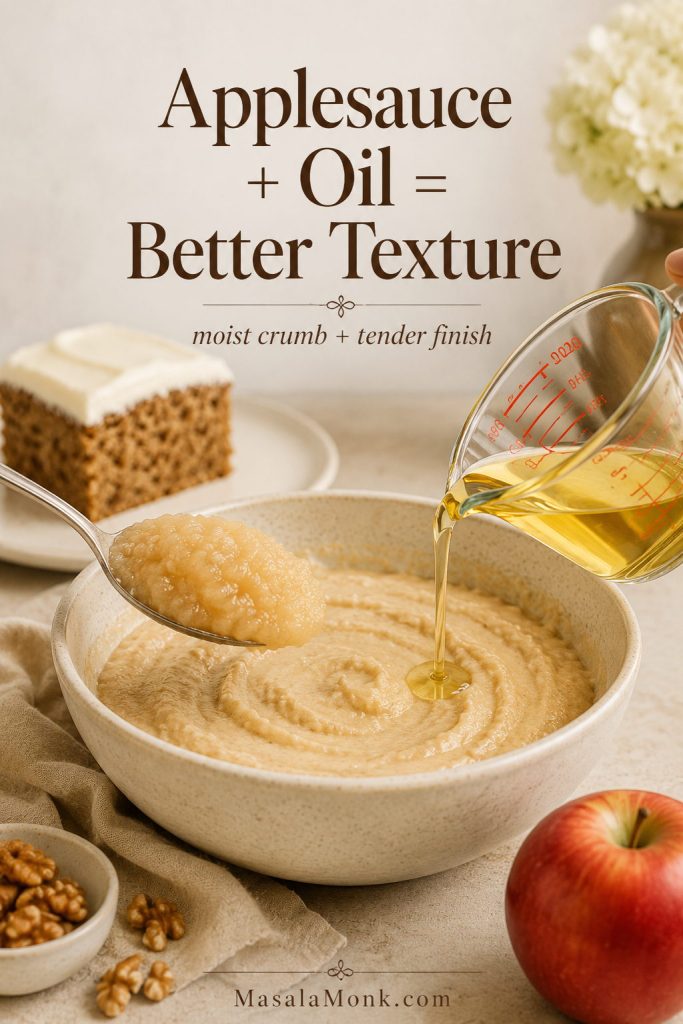
Applesauce and oil being added to cake batter with a finished applesauce cake slice in the background.
Applesauce gives the cake its soft, damp apple-spice crumb; however, the oil protects tenderness once the pan cools, so the slices stay plush instead of rubbery.

A 9×13 pan helps too. It gives the batter enough room to bake evenly, cools faster than a deep Bundt or loaf, and makes the finished cake easy to frost, slice, store, and share. This is the kind of pan cake that works for potlucks, after-school snacks, holiday tables, and casual weekends when you want the house to smell like cinnamon without building a layer cake.

Resting does this cake a favor. Warm spice cakes often taste fuller after a few hours because the cinnamon, applesauce, brown sugar, and vanilla have time to settle into the crumb. That makes this a useful make-ahead dessert, especially if you bake it one day and frost it the next.

There is one place where this recipe stays deliberately practical: it does not remove every bit of fat just because applesauce is in the batter. Applesauce can replace some oil or melted butter in certain bakes, but replacing too much can change the texture. Bon Appétit has a helpful explainer on using applesauce as an oil or butter replacement; the same lesson applies here. Applesauce brings moisture, but fat still matters for tenderness.

What Makes This an Old-Fashioned Applesauce Cake?

Old-fashioned applesauce cake is not just about the ingredient list. It is about the mood of the cake: simple pan, pantry ingredients, warm spice, soft crumb, and a flavor that feels better the next day. It should not need decoration to be good. A square dusted with powdered sugar should still feel complete.

The old-fashioned feeling stays, but the method gets a little more precise. The base cake is soft and spiced, the frosting is optional rather than mandatory, and the add-ins are flexible. In some families, raisins and walnuts are expected. Others want a plain soft square with powdered sugar. For dessert people, cream cheese frosting is what makes the cake feel complete. This recipe can handle all three camps.

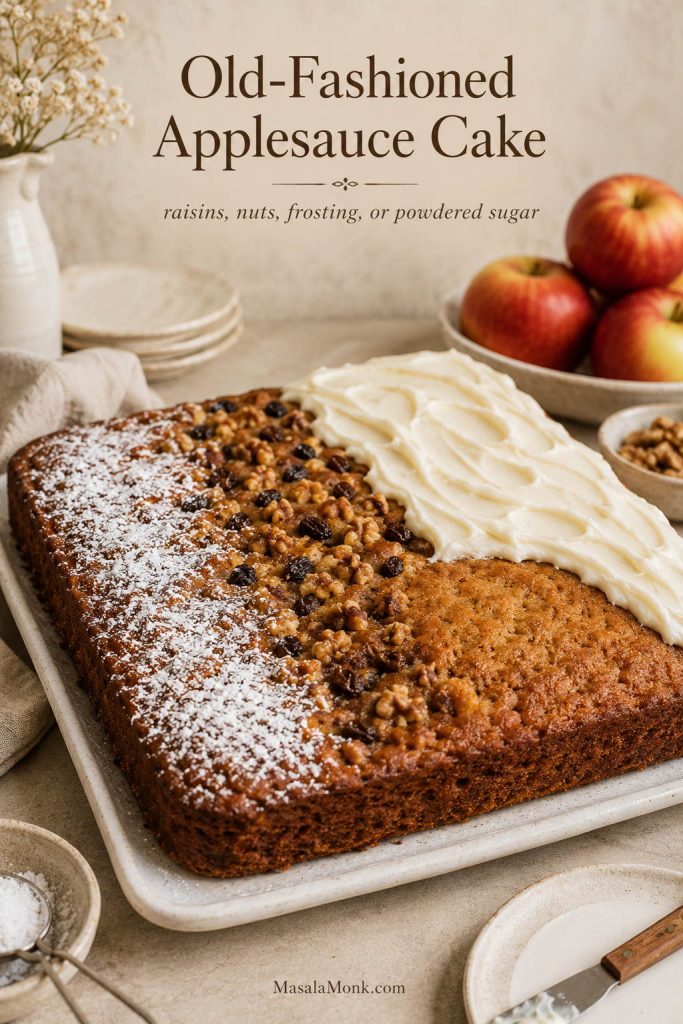
Old-fashioned applesauce cake shown with frosted, powdered sugar, raisin-walnut, and plain sections in one pan.
One pan can satisfy several applesauce cake camps: frosted for dessert, powdered for old-fashioned simplicity, plain for snacking, or raisin-walnut for recipe-box flavor.

If you grew up with applesauce cake, you probably already know which camp your family was in: raisins, no raisins, nuts, no nuts, frosting, or just powdered sugar. This is also the kind of cake that behaves well in real kitchens. Cut it into neat squares for guests, or let people shave off uneven little pieces all day. It is exactly the sort of cake that quietly disappears from the pan before anyone admits they had a second slice.

Ingredients That Keep the Cake Moist

The ingredient list is simple; the texture depends on how you handle a few key choices. Use smooth unsweetened applesauce, measure the flour carefully, keep some oil in the batter, and make sure the spices still smell fresh before you add them. The batter should already smell cozy before it goes into the oven: cinnamon first, then brown sugar, vanilla, and that quiet apple note from the applesauce.

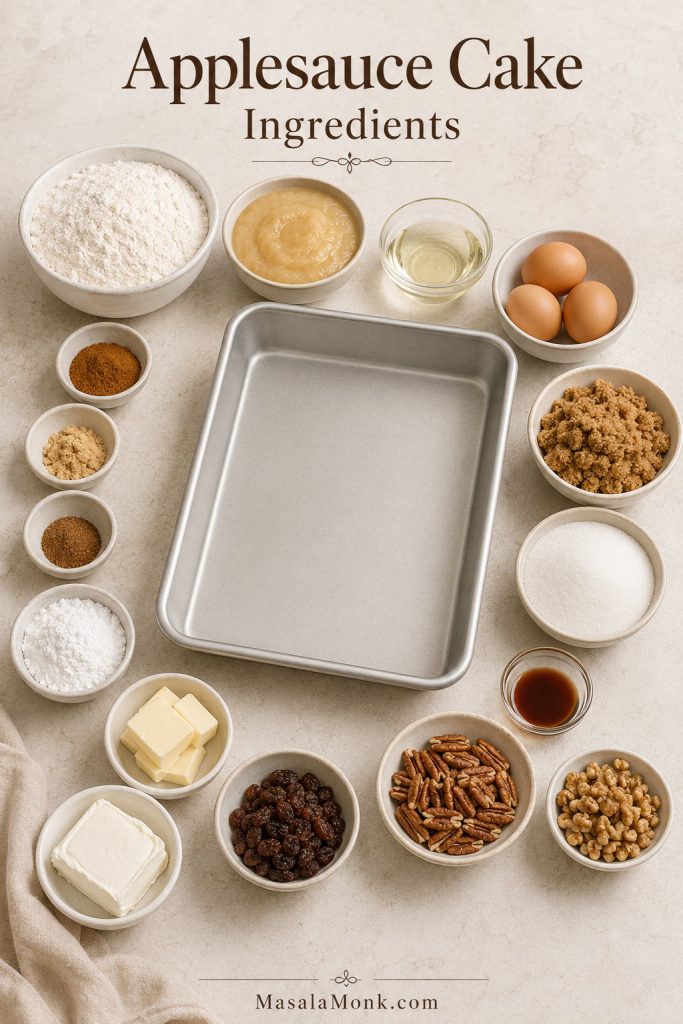
Ingredients for applesauce cake arranged around a 9x13 pan, including applesauce, flour, oil, eggs, sugars, spices, nuts, raisins, cream cheese, butter, and powdered sugar.
A simple pantry cake still depends on balance: watery applesauce slows the center, too much flour dries the crumb, and tired spices make the flavor fall flat.

Best Applesauce to Use

Unsweetened applesauce is the cleanest choice because the batter already has brown sugar and granulated sugar. Sweetened applesauce will work, but the cake can taste more sugary than balanced. Cinnamon applesauce can also work, although it gives you less control over the spice level.

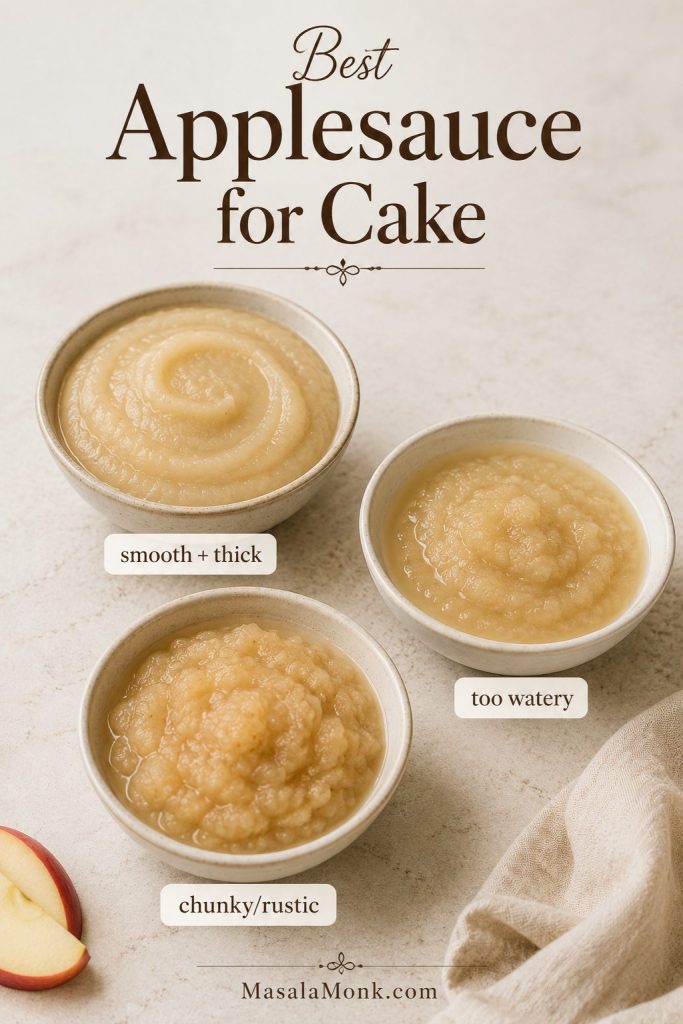
Smooth applesauce gives the most even crumb, which is what you want if this is the kind of cake you plan to frost, slice, and carry to a table without fuss. Chunky applesauce makes the texture more rustic, but large pieces may create damp pockets unless the sauce is thick and the chunks are small. Homemade applesauce is fine as long as it is not watery. If it looks loose, simmer it briefly or drain off extra liquid before measuring.

Three bowls comparing smooth thick applesauce, watery applesauce, and chunky applesauce for baking applesauce cake.
Smooth, thick applesauce gives the most even crumb. However, watery applesauce can loosen the batter and make the center harder to bake through.

If your applesauce looks loose, keep the troubleshooting guide nearby so you know how to avoid a wet or gummy center.

Why This Recipe Uses Applesauce and Oil

Applesauce gives the cake moisture, fruit solids, and mild apple flavor. Oil brings fat, which keeps the crumb soft after baking. Because the batter uses both, the finished squares stay moist without turning rubbery. That balance matters most after cooling, when leaner versions can start to feel dense or chewy.

For a slightly lighter cake, reduce the oil from 3/4 cup to 1/2 cup and add 1/4 cup extra applesauce. The full amount gives the most plush first-bake texture, though. Do not remove all the oil unless you are comfortable with a denser, more snack-cake-style result.

For a lighter version, check the variations section before reducing the oil too aggressively.

Flour, Leavening, and Salt

All-purpose flour gives the cake enough structure to slice cleanly. Spoon and level the flour, or weigh it if you can. Too much flour is one of the easiest ways to lose the soft, snack-cake crumb that makes this recipe work.

This recipe uses both baking powder and baking soda. Baking powder helps lift the batter, while baking soda supports browning and works with the acidity in the applesauce and brown sugar. Salt is not optional here; it keeps the sweetness and spice from tasting flat.

Warm Spices for Old-Fashioned Flavor

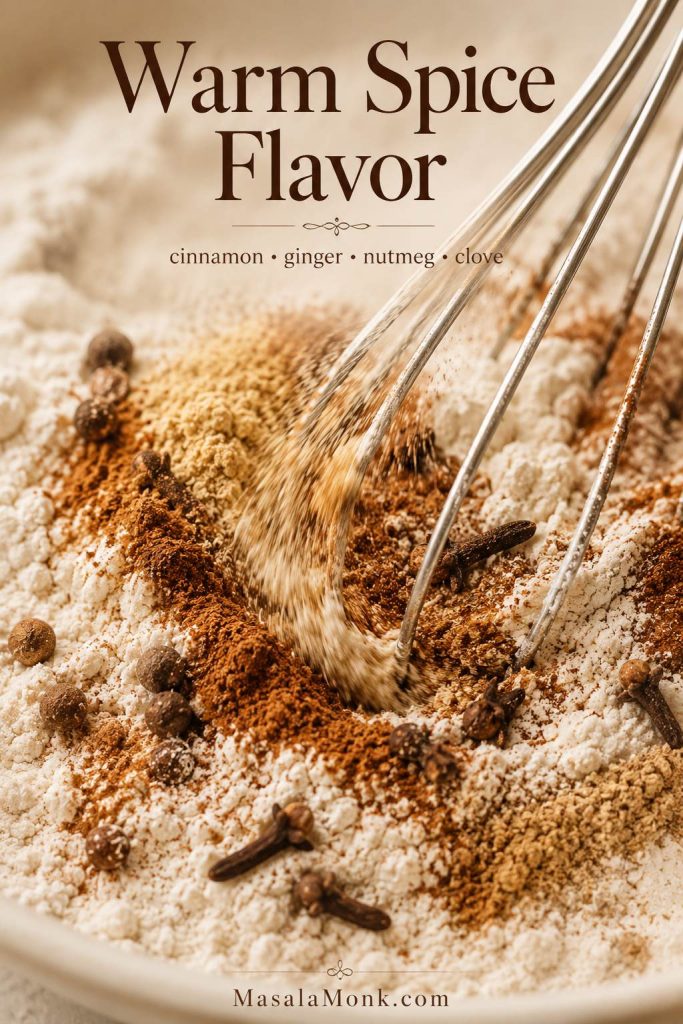
Cinnamon does most of the work, but it should not be alone. Ginger adds warmth, nutmeg adds roundness, and a small amount of clove or allspice gives the cake that old-fashioned spice-cake finish. Keep the clove light. Too much can cover the applesauce flavor instead of supporting it.

Before mixing, smell your cinnamon. If it does not make you think of fall before the cake even bakes, it probably will not carry the flavor once it is in the batter. Applesauce is gentle, so the spice blend has to carry the aroma.

Warm spices including cinnamon, ginger, nutmeg, and clove being whisked into flour for applesauce cake.
Because applesauce has a gentle flavor, the spice blend does much of the aromatic work. Fresh cinnamon, ginger, nutmeg, and clove make the cake taste warmer and fuller.

Optional Raisins, Walnuts, and Pecans

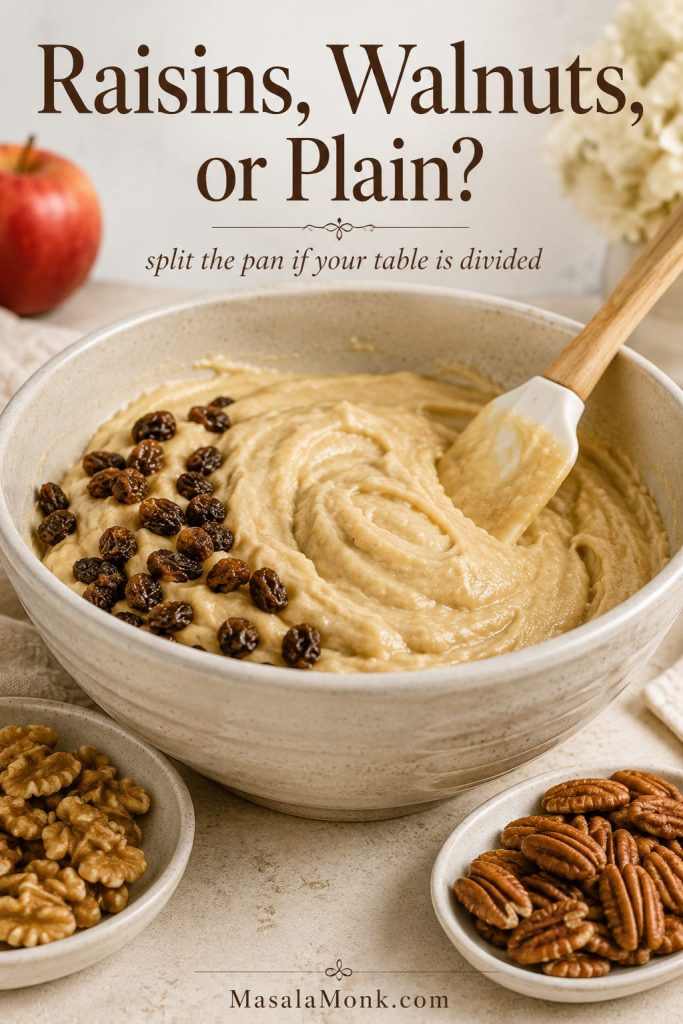
Walnuts make the cake taste classic and slightly earthy. Pecans make it richer and sweeter. Raisins add soft little pockets of fruit, especially if they are soaked in hot water for 10 minutes and drained well before mixing.

To keep add-ins from sinking, toss them with a tablespoon of flour before folding them into the batter. If your table is divided on raisins, leave the batter plain and sprinkle nuts over only half the frosting. Raisins, walnuts, frosting, and powdered sugar all seem to create strong opinions around this cake, which is why a half-and-half pan works so well.

Applesauce cake batter with raisins partly folded in and walnuts and pecans shown nearby as add-in options.
Raisins, walnuts, and pecans are optional, but they change the whole mood of the cake. For divided tables, keep one side plain and add the old-fashioned extras to the other.

How to Make Applesauce Cake Without a Gummy Center

This is a stir-together cake, not a fussy layer cake. You do not need to cream butter, separate eggs, or use a mixer for the batter. The most important steps are preparing the pan, mixing gently, and baking until the center is truly set.

Already comfortable with the steps? Jump to the recipe card. Unsure how the center should look? Use the doneness cues before pulling the pan.

1. Prepare the Pan and Oven

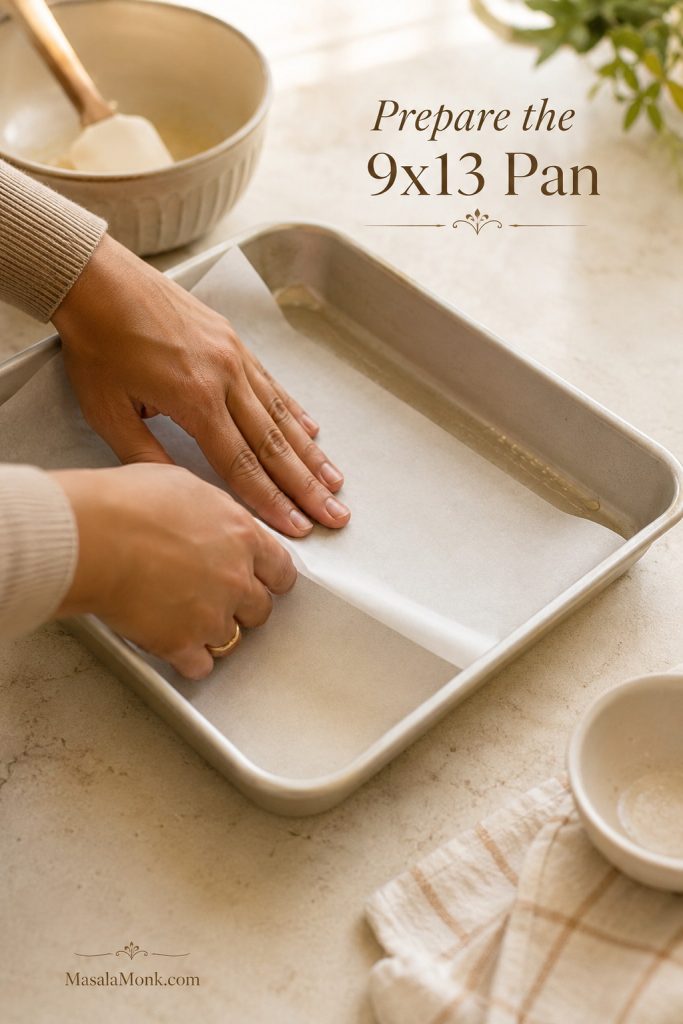
Heat the oven to 350°F / 175°C. Grease a 9×13-inch light metal baking pan, or line it with parchment if you want to lift the cooled cake out for cleaner slices. A light metal pan gives the most reliable, even bake.

Hands smoothing parchment paper into a greased 9x13 metal baking pan before adding applesauce cake batter.
Preparing the pan before mixing saves trouble later. Parchment makes the cooled cake easier to lift, frost, slice, and serve cleanly.

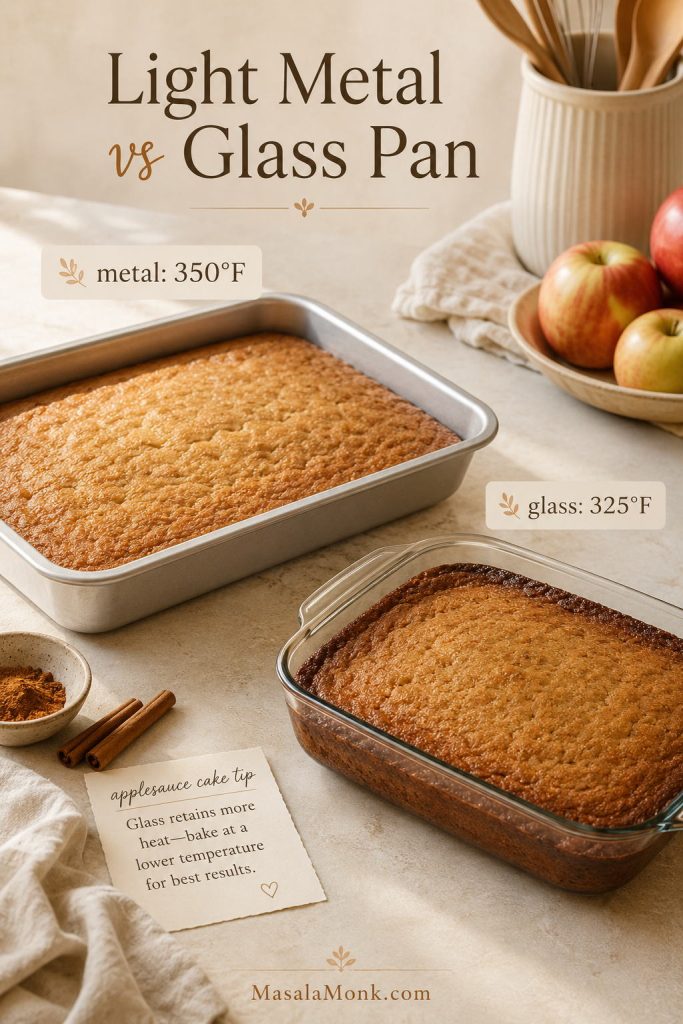
When using a glass pan, reduce the oven temperature to 325°F / 165°C. Glass keeps radiating heat differently than metal, so the edges can race ahead while the center still needs time. The lower temperature gives the middle a better chance to catch up.

Light metal and glass baking pans compared for applesauce cake, with temperature cues for baking in each pan.
Metal and glass do not bake this cake the same way. A light metal 9×13 pan is the easiest first choice, while glass usually needs lower heat.

2. Whisk the Dry Ingredients

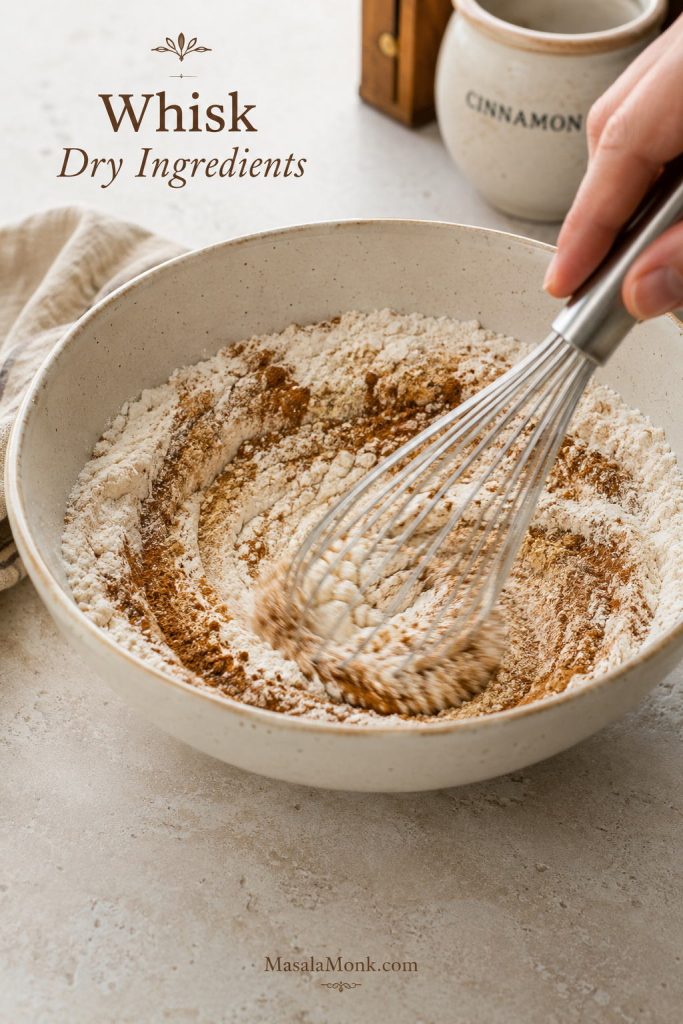
In a medium bowl, whisk the flour, baking powder, baking soda, salt, cinnamon, ginger, nutmeg, and clove or allspice. This spreads the leavening and spices evenly through the flour, so the cake rises well and does not end up with bitter pockets of baking soda or dull patches of spice.

Flour, baking powder, baking soda, salt, and warm spices being whisked together in a bowl for applesauce cake.
A quick whisk before the wet ingredients go in is small insurance; it keeps the rise, salt, and spice evenly spread through every square.

3. Mix the Applesauce, Oil, Eggs, Sugars, and Vanilla

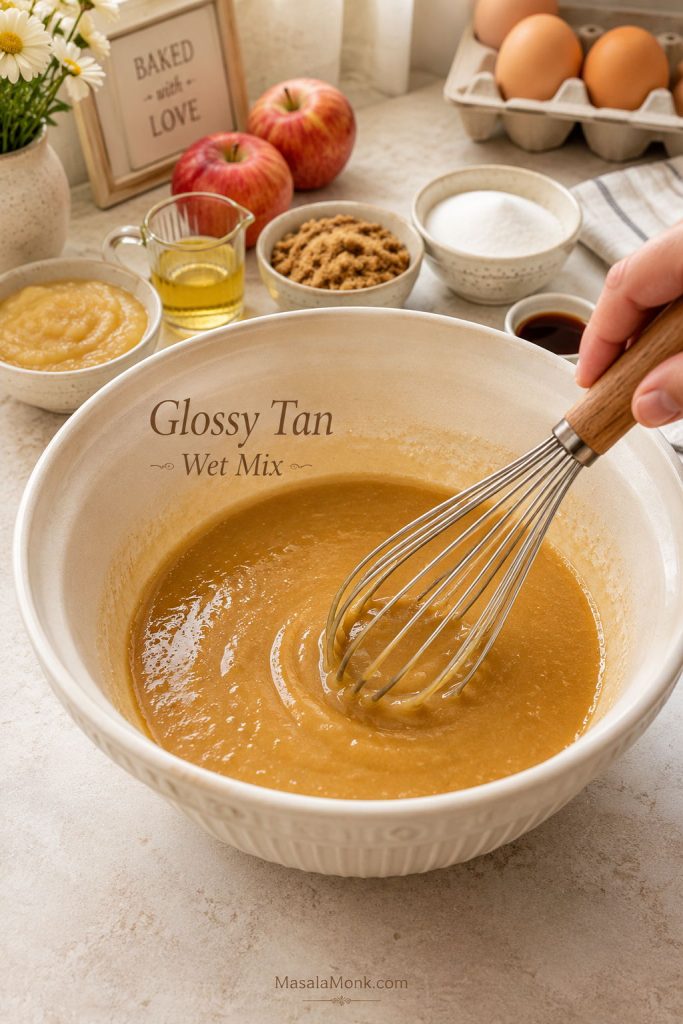
In a larger bowl, whisk the applesauce, oil, eggs, brown sugar, granulated sugar, and vanilla until smooth. The mixture should look loose, glossy, and tan. Break up any lumps of brown sugar now, before the flour goes in.

Applesauce, oil, eggs, brown sugar, granulated sugar, and vanilla whisked into a glossy tan mixture.
Before the flour goes in, the wet mixture should look loose, glossy, and even. At this stage, break up any brown sugar lumps so they do not streak through the batter.

Room-temperature eggs blend more easily, but the cake will still work if you forget. Just whisk the wet ingredients until the eggs are fully incorporated and the mixture looks even. This is the point where the batter starts to smell like the cake you are hoping for: cinnamon, brown sugar, vanilla, and just enough apple to make it feel old-fashioned.

4. Combine Without Overmixing

Add the dry ingredients to the wet ingredients and fold just until the flour disappears. The batter should be thick but spoonable, not runny and not stiff like cookie dough. Stop as soon as it comes together. Overmixing develops the flour too much and can make the cake feel tough or gummy.

Thick tan applesauce cake batter lifting from a spatula and falling slowly back into the bowl.
Thick but spoonable batter is the sweet spot. If it pours too loosely, the middle of an applesauce cake can take longer to bake through.

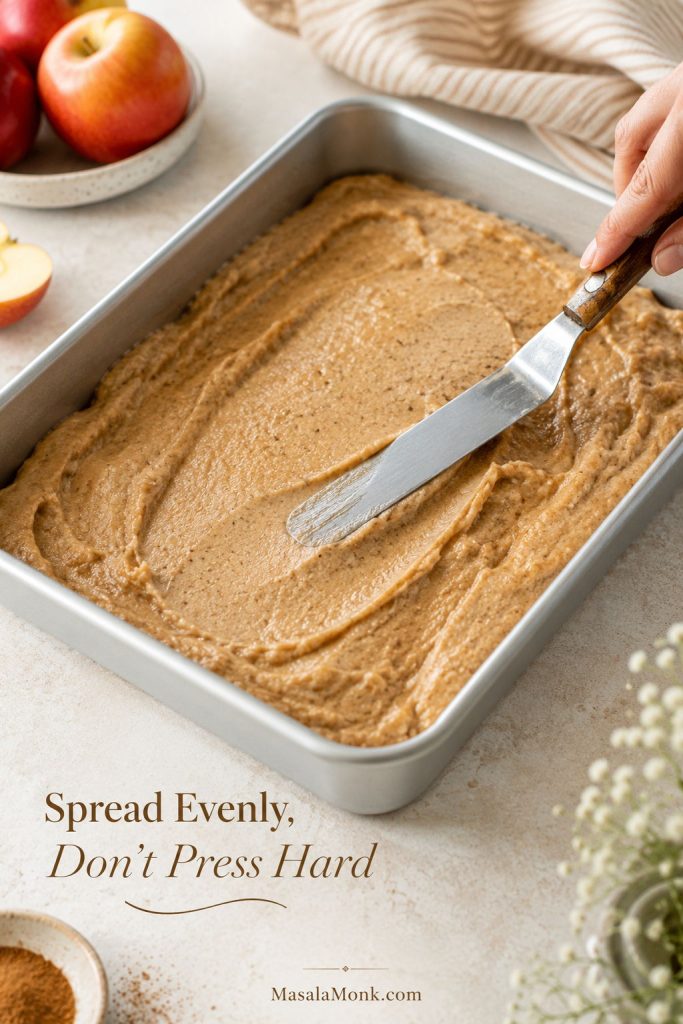
Fold in walnuts, pecans, or raisins at the end if you are using them. Spread the batter evenly into the pan and smooth the top without pressing it down too firmly.

Applesauce cake batter being spread evenly into a 9x13 metal pan with an offset spatula.
Spread the batter evenly, then stop fussing with it. A level surface helps the center and edges bake at a similar pace.

5. Bake Until Moist, Not Gummy

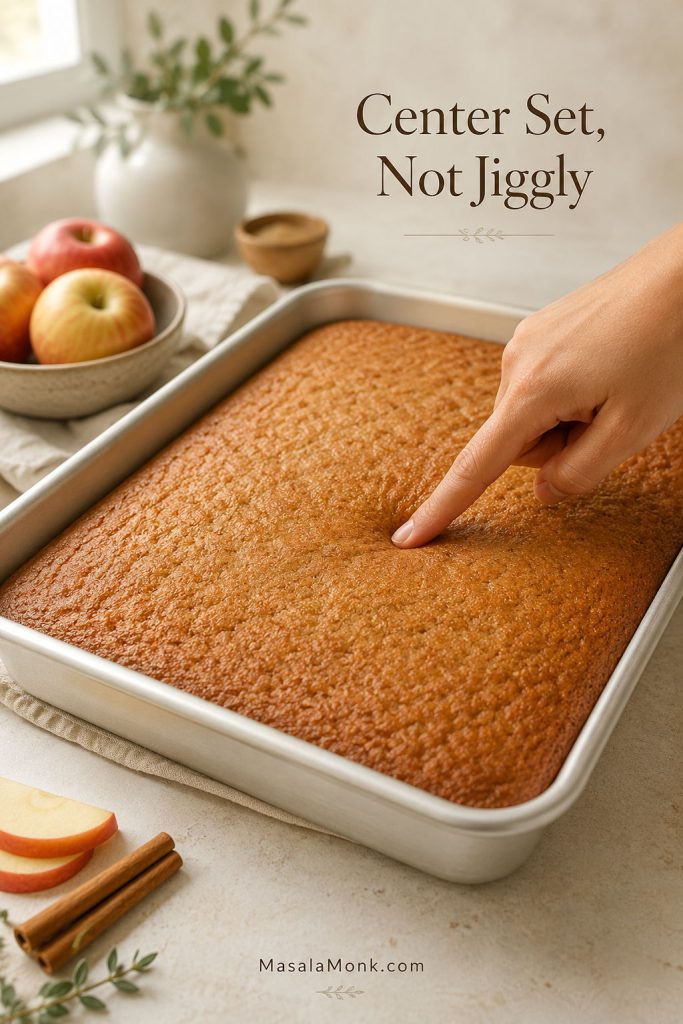
Bake for 30 to 35 minutes, checking near the center around the 30-minute mark. The top should spring back lightly, and a toothpick inserted near the center should come out clean or with a few moist crumbs. Wet batter means the cake needs more time.

The center is the part that lies to you. The edges may look finished while the middle still needs a few more minutes. Since applesauce adds so much moisture, pulling the cake too early is the fastest route to a gummy square in the middle of the pan.

Finger gently pressing the center of a baked applesauce cake in a 9x13 pan to check that it springs back.
The edges often look done first, but the middle decides the cake’s texture. Press gently in the center and look for a light spring-back before pulling the pan.

Before removing the cake from the oven, compare it with the doneness cues so the edges do not trick you into underbaking the center.

6. Cool Completely Before Frosting

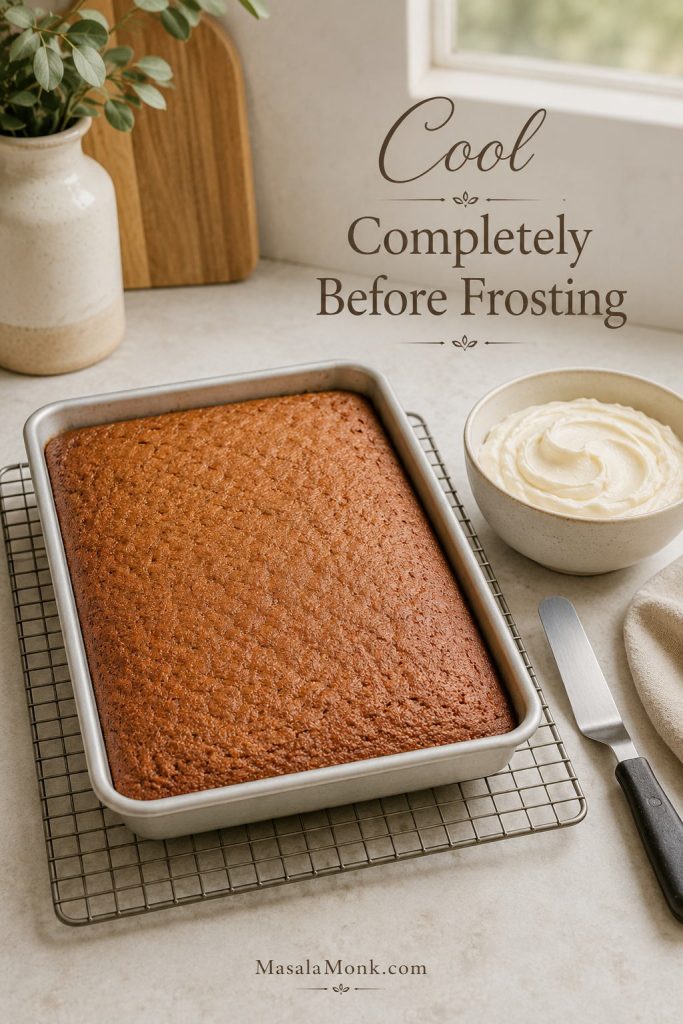
Let the cake cool completely before frosting. Cream cheese frosting melts quickly on a warm cake, and even a slightly warm center can make the frosting slide, soften, or turn greasy. If you are baking ahead, cool the cake, cover it, and frost it the next day.

Unfrosted applesauce cake cooling in a 9x13 metal pan on a wire rack with cream cheese frosting waiting nearby.
Cream cheese frosting behaves best on a fully cooled cake. Even a little trapped warmth can loosen the topping and blur those clean frosted squares.

Can You Make It in One Bowl?

You can make a one-bowl version, but two bowls are more reliable. Whisking the flour, leavening, salt, and spices separately helps the cake rise evenly and keeps the spice flavor consistent. For the easiest cleanup, use one medium bowl for the dry ingredients and one large bowl for everything else.

The visual recipe card below keeps the main bake cues close before the full printable-style details.

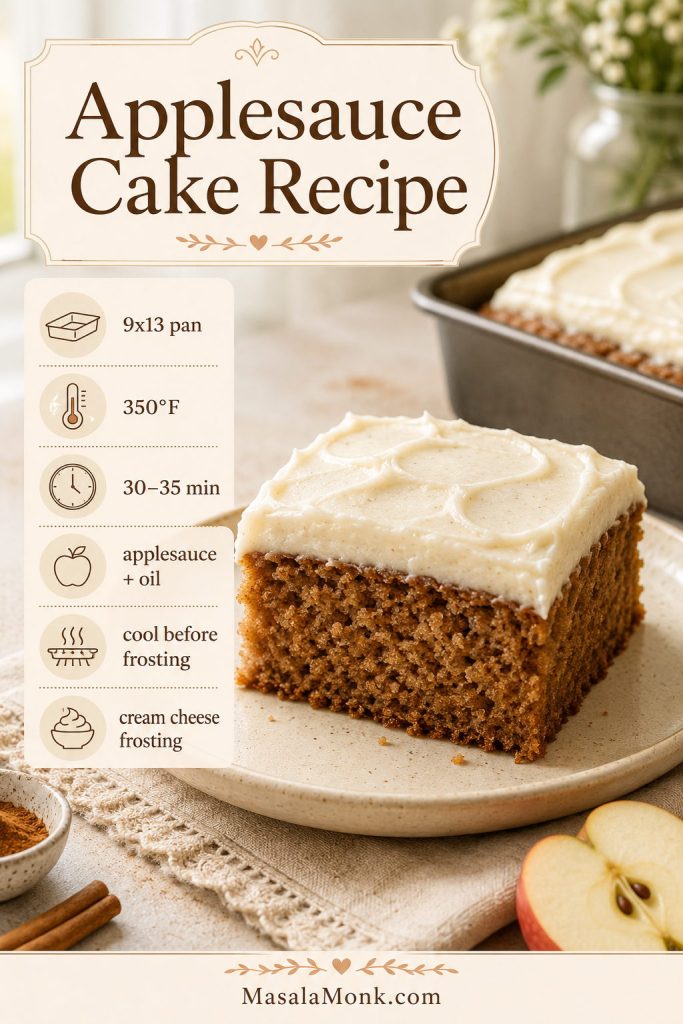
Saveable applesauce cake recipe card with a frosted cake square, 9x13 pan cue, oven temperature, bake time, applesauce and oil cue, and cream cheese frosting note.
This saveable cue card keeps the bake on track: use a 9×13 pan, keep the oven at 350°F, check around 30 minutes, and cool the cake before frosting.

Applesauce Cake Recipe Card

This easy 9×13 applesauce cake recipe has a soft, plush crumb, warm cinnamon-spice flavor, and just enough oil to stay tender after cooling. Frost it with cinnamon cream cheese frosting for a classic dessert finish, or leave it unfrosted for an old-fashioned snack cake.

Prep Time20 minutes
Cook Time30–35 minutes
Cooling Time1–1 1/2 hours
Yield15–16 squares

Equipment

  • 9×13-inch baking pan, preferably light metal
  • Mixing bowls
  • Whisk and silicone spatula
  • Measuring cups/spoons or kitchen scale
  • Toothpick, cake tester, or instant-read thermometer
  • Wire cooling rack
  • Hand mixer or stand mixer for frosting
  • Offset spatula, optional

Ingredients

For the Cake

  • 2 1/2 cups all-purpose flour, spooned and leveled, about 300–315g
  • 2 teaspoons baking powder
  • 1 teaspoon baking soda
  • 3/4 teaspoon fine salt
  • 1 tablespoon ground cinnamon
  • 1/2 teaspoon ground ginger
  • 1/2 teaspoon ground nutmeg
  • 1/4 teaspoon ground cloves or allspice
  • 2 cups smooth unsweetened applesauce, about 490–500g
  • 3/4 cup neutral oil, 180ml
  • 2 large eggs, room temperature if possible
  • 3/4 cup packed light brown sugar, about 150g
  • 1/2 cup granulated sugar, about 100g
  • 2 teaspoons vanilla extract
  • 3/4 cup chopped walnuts or pecans, optional
  • 1/2 cup raisins, optional

For the Cinnamon Cream Cheese Frosting

  • 8 oz brick-style cream cheese, softened, 226g
  • 6 tablespoons unsalted butter, softened, 85g
  • 2 1/2 to 3 cups powdered sugar, 300–360g
  • 1 teaspoon vanilla extract
  • 1/4 to 1/2 teaspoon cinnamon
  • Pinch of salt

Instructions

  1. Heat the oven. Preheat to 350°F / 175°C. Grease a 9×13-inch light metal baking pan or line it with parchment.
  2. Whisk the dry ingredients. In a medium bowl, whisk flour, baking powder, baking soda, salt, cinnamon, ginger, nutmeg, and cloves or allspice.
  3. Mix the wet ingredients. In a large bowl, whisk applesauce, oil, eggs, brown sugar, granulated sugar, and vanilla until smooth.
  4. Combine. Add the dry ingredients to the wet ingredients and fold just until no dry streaks remain. Fold in nuts or raisins if using.
  5. Bake. Spread the batter into the pan. Bake for 30 to 35 minutes, until the center no longer jiggles, springs back lightly, and a toothpick comes out clean or with a few moist crumbs.
  6. Cool. Let the cake cool completely in the pan before frosting.
  7. Make the frosting. Beat cream cheese and butter until smooth. Add powdered sugar, vanilla, cinnamon, and salt. Beat until creamy, using more powdered sugar for a thicker frosting.
  8. Frost and slice. Spread over the cooled cake, slice into squares, and serve.
Glass pan note: If baking in a glass 9×13 pan, reduce the oven to 325°F / 165°C and begin checking around 35 minutes. Glass can brown the edges before the center is fully set.
Using a different pan? Check the pan size and bake-time guide before adjusting the recipe.
Frosting note: Use brick-style cream cheese, not tub-style spread. Tub cream cheese is softer and can make the frosting loose.

How to Tell When the Cake Is Done

Do not pull the pan from the oven just because the edges look set. The center matters most. Look for three signs together: the top springs back lightly, the middle no longer jiggles, and a toothpick inserted near the center comes out clean or with a few moist crumbs.

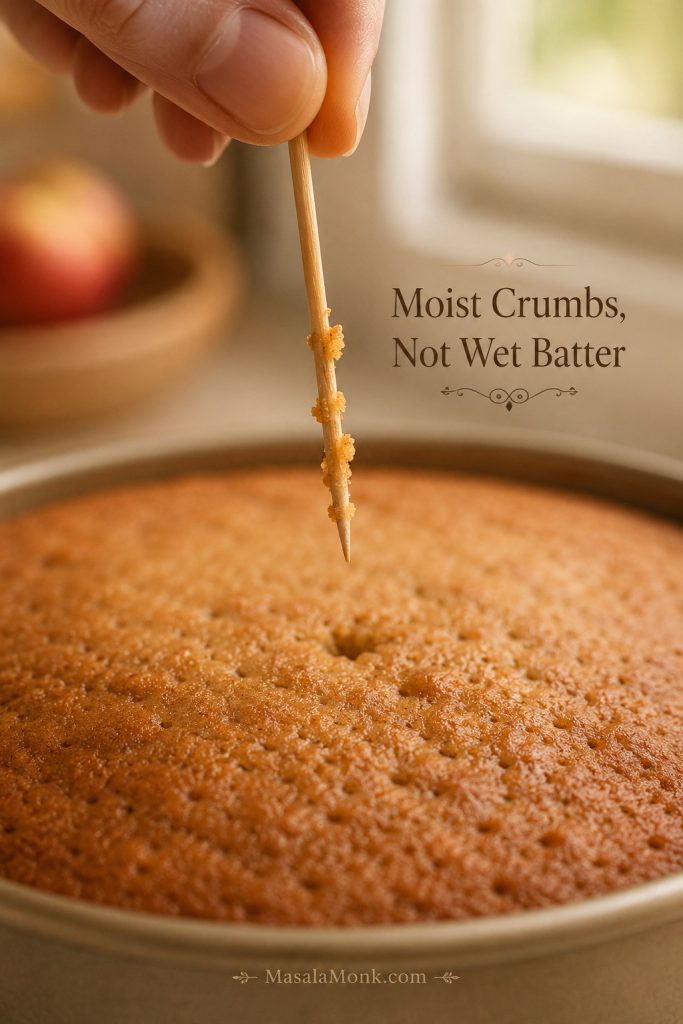
Toothpick lifted from the center of applesauce cake with a few moist crumbs attached and no wet batter.
Moist crumbs mean the cake has baked through without drying out. Wet batter on the toothpick, however, means the center still needs more oven time.

A few soft crumbs are fine. Wet batter is not. Since applesauce keeps the batter moist, an underbaked center can seem acceptable while warm but turn dense and gummy as the cake cools. When in doubt, bake another 3 to 5 minutes and check again.

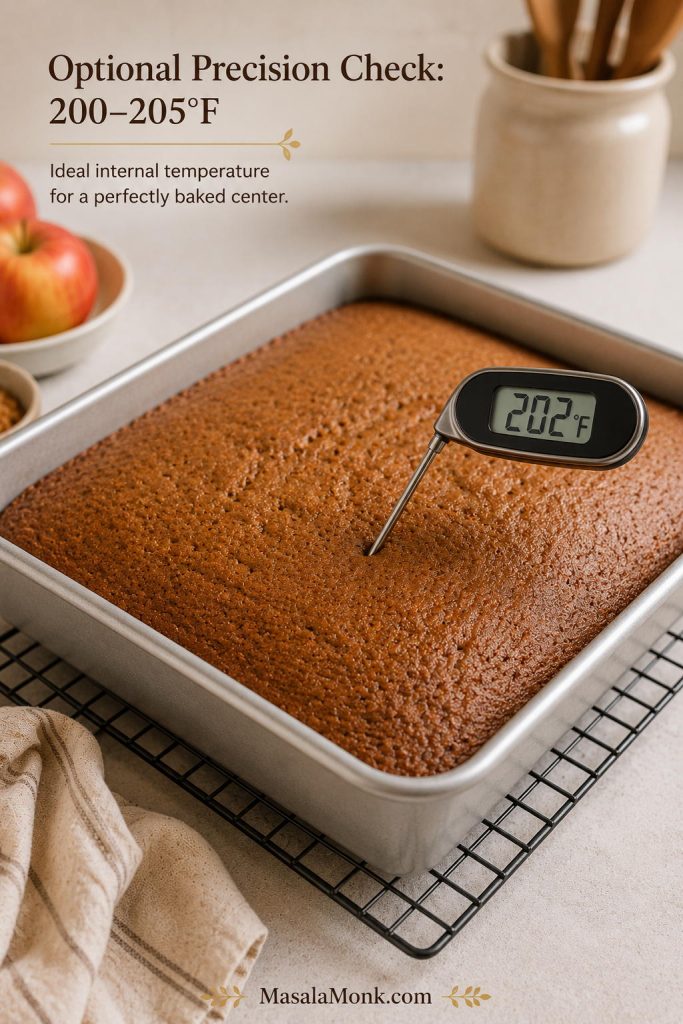
For extra precision, the center should be around 200–205°F / 93–96°C on an instant-read thermometer. You do not need to check this every time, but it helps if your oven runs cool, your pan is glass, or you are adapting the batter to a deeper pan.

Instant-read thermometer inserted into the center of applesauce cake showing a temperature around 202 degrees Fahrenheit.
An internal temperature around 200 to 205°F is a helpful backup check, especially when using glass, a deeper pan, or an oven that runs cool.

Cream Cheese Frosting, Glaze, or Powdered Sugar?

Cream cheese frosting is the classic dessert finish. The tang balances the brown sugar and warm spices, while the cinnamon ties the frosting back into the cake. Make this version when you want a soft square to feel like dessert rather than an everyday snack.

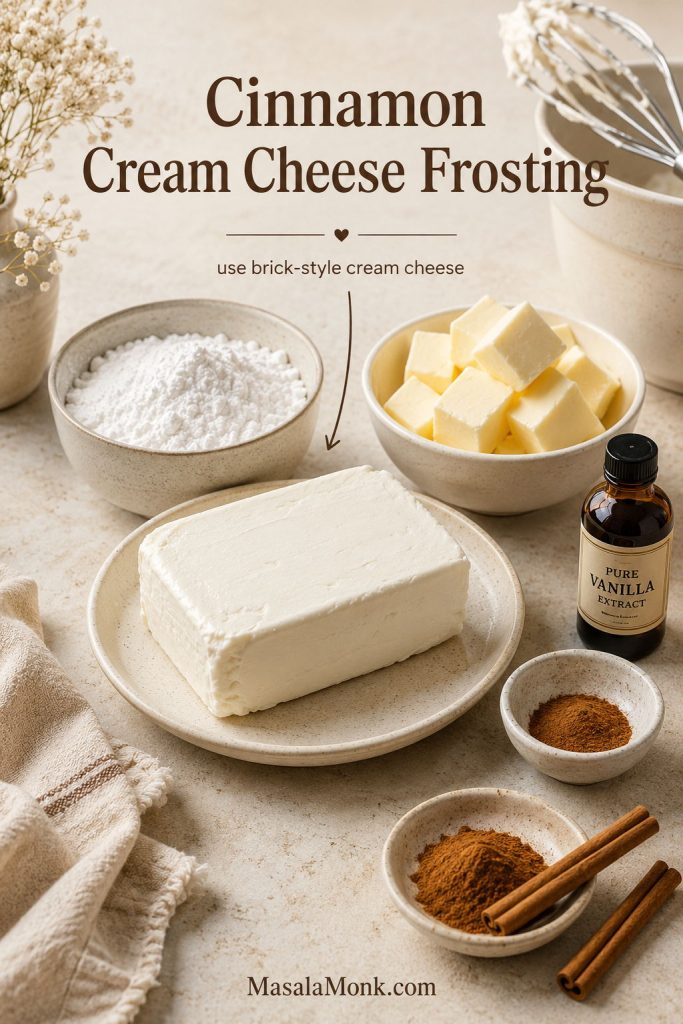
Cream cheese frosting ingredients for applesauce cake, including brick-style cream cheese, butter, powdered sugar, vanilla, and cinnamon.
Brick-style cream cheese gives the frosting more structure than tub-style spread. That small choice helps the topping stay creamy instead of loose or runny.

Powdered sugar makes the cake feel more old-fashioned. A thin vanilla glaze suits Bundt cakes and loaf cakes because it sets neatly and slices cleanly. No frosting at all works when you want the spice and applesauce flavor to stay in front.

The topping is where this cake changes personality, and it is also where families tend to have the strongest opinions. Frosted, it feels like dessert. Unfrosted, it feels like the kind of cake you cut in small squares with coffee, then somehow return to again before dinner. If the cake is for lunchboxes or a room-temperature table, powdered sugar or glaze is easier than cream cheese frosting.

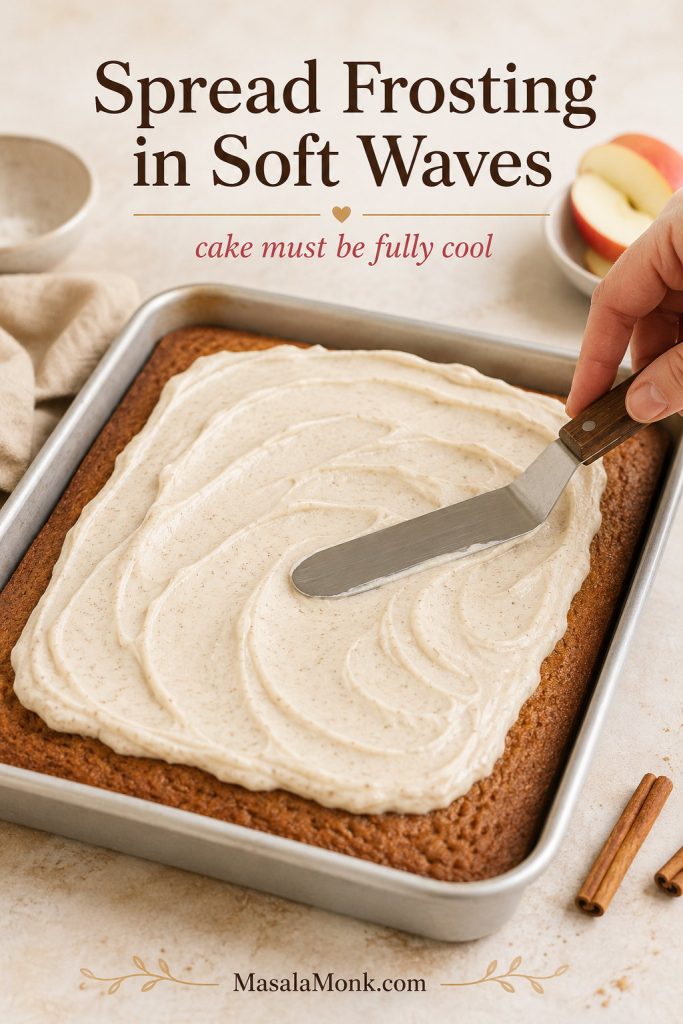
Cream cheese frosting being spread in soft waves over a cooled 9x13 applesauce cake with an offset spatula.
Once the cake is fully cool, spread the frosting in soft waves rather than a thick slab. The topping should feel creamy without overwhelming the spice cake.

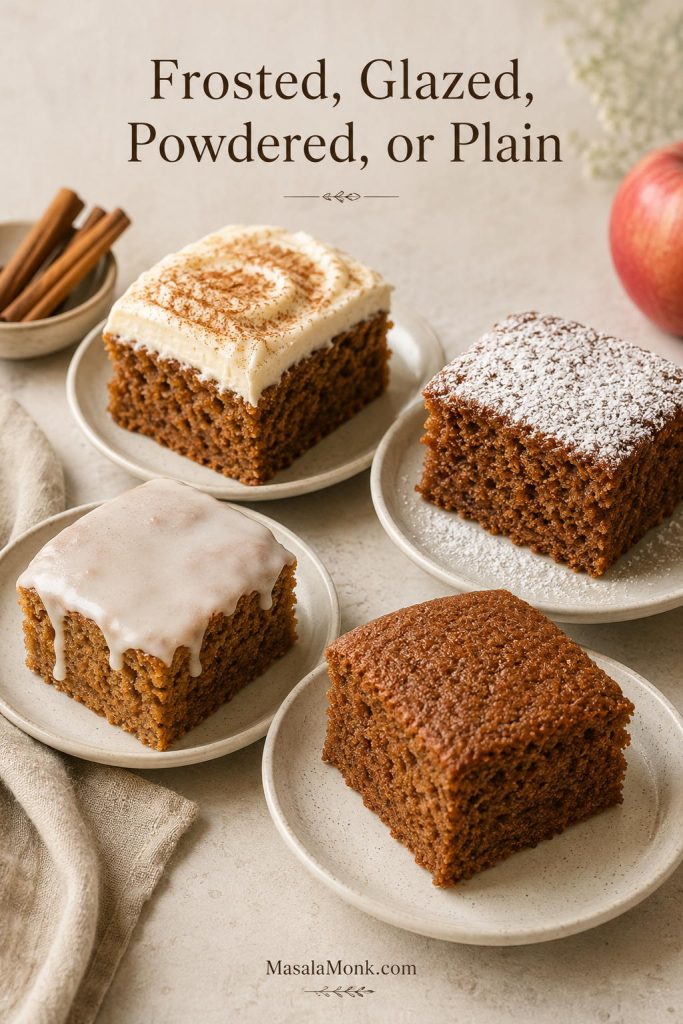
Applesauce Cake Topping Options

Four applesauce cake squares with different toppings: cream cheese frosting, vanilla glaze, powdered sugar, and plain.
The same applesauce cake can become dessert, coffee cake, lunchbox snack, or an old-fashioned plain square depending on how you finish the top.
Topping Best For Flavor
Cinnamon cream cheese frosting Classic dessert-style cake Tangy, creamy, warmly spiced
Brown butter cream cheese frosting Holiday or potluck version Nutty, rich, deeper
Powdered sugar Old-fashioned snack cake Simple and not too sweet
Vanilla glaze Bundt cake or loaf cake Sweet, neat, easy to slice
No frosting Breakfast, lunchbox, or coffee break More spice-forward

Applesauce Cake Pan Swaps and Bake-Time Changes

Start with the 9×13 Pan

A 9×13 pan is the most reliable first bake because the batter has room to set evenly. Deeper pans need more patience in the center, while wider pans bake faster and can dry out if you wait too long to check them.

Use the table below as a starting point, but let the center make the final call. This cake can look finished at the edges before the middle is ready, especially in glass, Bundt, or loaf pans.

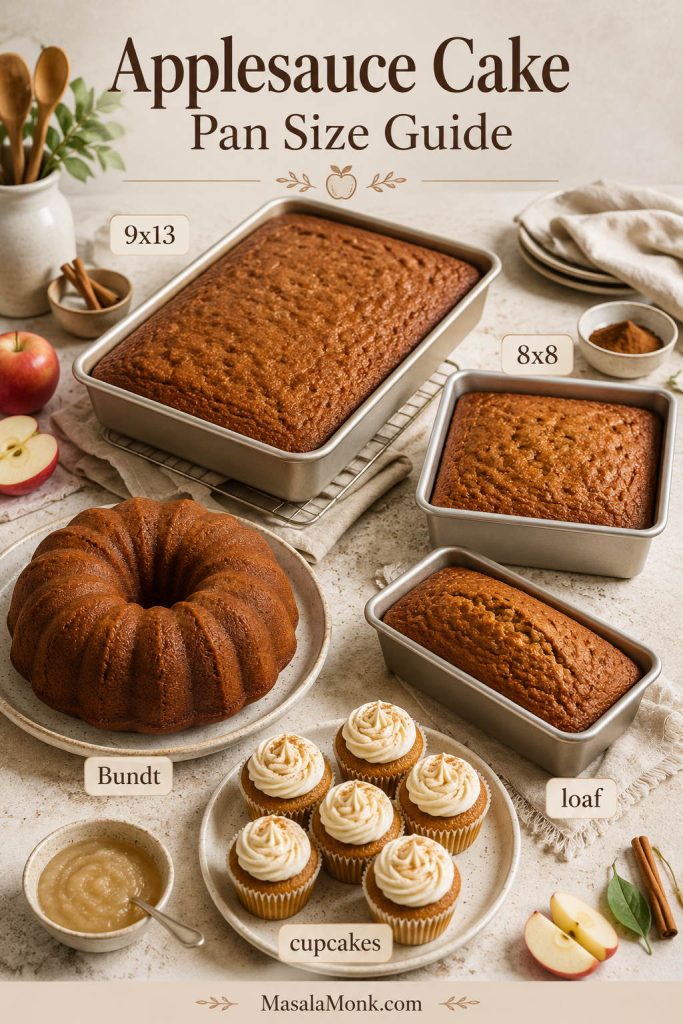
Pan Size and Bake-Time Guide

Applesauce cake pan size guide showing a 9x13 pan, 8x8 pan, Bundt cake, loaf pan, and cupcakes.
The 9×13 pan is the easiest starting point, but once the batter moves into Bundt, loaf, cupcake, or smaller pans, depth changes the bake time.
Pan Oven Approximate Bake Time Notes
9×13 metal pan 350°F / 175°C 30–35 minutes Most reliable default for this recipe.
9×13 glass pan 325°F / 165°C 35–42 minutes Lower heat helps protect the edges.
8×8 half batch 350°F / 175°C 30–38 minutes Use half the batter or halve the recipe.
15×10 sheet pan 350°F / 175°C 18–22 minutes Thinner cake; check early.
Bundt pan 350°F / 175°C 45–60 minutes Grease very well and check the deepest part.
Two 8-inch round pans 350°F / 175°C 25–32 minutes Useful for a simple layer cake.
Cupcakes 350°F / 175°C 18–22 minutes Fill liners about two-thirds full.
Two 9×5 loaf pans 350°F / 175°C 50–60 minutes Tent loosely if the tops brown too quickly.

If changing the pan changes the texture, use the problem-solving guide to diagnose whether the cake needed more time, less moisture, or gentler mixing.

Bundt Pan Release Tips

Bundt pans need special care because moist cakes are more likely to stick in the ridges. Grease every detail of the pan carefully, let the cake cool before unmolding, and use a glaze instead of soft frosting. King Arthur Baking has a useful guide to preventing Bundt cakes from sticking if you bake in shaped pans often.

Variations and Easy Changes

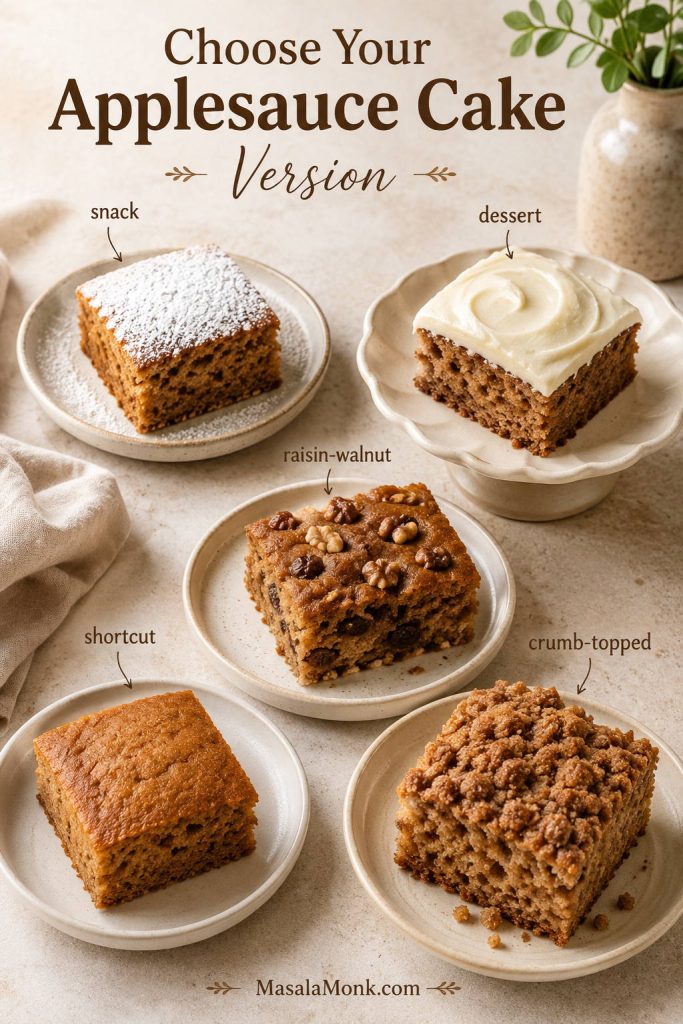
Once the base cake is right, it can move in several directions without losing its soft crumb. The first bake teaches you what the texture should feel like; after that, these variations make more sense.

Applesauce cake variation guide showing powdered sugar snack cake, frosted dessert cake, raisin-walnut cake, shortcut cake, and crumb-topped cake.
Choose the version by mood: powdered sugar for snack cake, cream cheese frosting for dessert, raisins and walnuts for old-fashioned flavor, or crumb topping for coffee-cake style.
Version Choose It When What to Change
Less sweet You want a snack cake Skip frosting or use powdered sugar.
More dessert-like You want a potluck or holiday cake Use full oil and cream cheese frosting.
More old-fashioned You like recipe-box flavor Add raisins and walnuts.
Shortcut version You want almost no measuring Use cake mix, applesauce, and eggs.
Brunch-style You want coffee cake energy Use crumb topping and a light glaze.

Old-Fashioned Raisin-Walnut Version

Fold in 1/2 cup raisins and 3/4 cup chopped walnuts or pecans. Skip the frosting and dust the cooled cake with powdered sugar for a more old-fashioned coffee-cake feel, or keep the cream cheese frosting when you want a richer dessert.

This version feels closest to an older recipe-box cake: soft crumb, warm spice, little bites of fruit and nuts, and a flavor that deepens overnight. It is especially good with coffee or black tea.

Cake Mix Shortcut

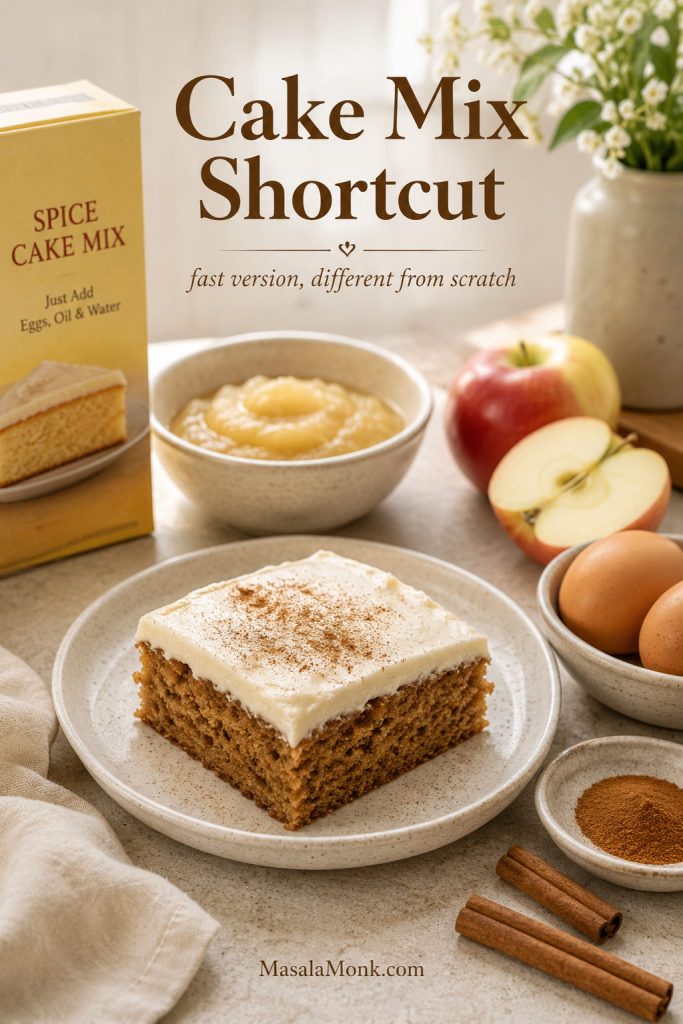
This is not the same cake as the from-scratch version, but it is useful when you want the applesauce-spice idea with almost no measuring. For the simplest shortcut, use a 15.25 oz box of yellow or spice cake mix, 1 1/2 cups applesauce, and 3 large eggs. Bake in a greased 9×13 pan at 350°F until set, usually around 25 to 35 minutes depending on the mix and pan.

Applesauce cake mix shortcut setup with boxed cake mix, applesauce, eggs, cinnamon, and a frosted cake square.
A cake mix shortcut is useful when speed matters, although the texture will be different from the from-scratch applesauce cake.

The three-ingredient version wins on speed. The version with a little oil or melted butter tastes softer, richer, and less lean. For that style, add 2 to 4 tablespoons oil or melted butter and 1 to 2 teaspoons cinnamon.

If shortcut apple desserts are what you reach for most often, the same easy-bake mood also works in an apple cinnamon roll bake with apple pie filling, where refrigerated cinnamon rolls and apple filling turn into a warm 9×13 dessert.

Crumb Cake or Coffee Cake Style

To move this cake toward crumb cake, skip the cream cheese frosting and add a cinnamon brown sugar crumb topping before baking. Use a moderate layer of crumb at first because this batter is already moist. A very heavy topping can slow down the center and make the cake harder to bake evenly.

For a brunch-style version, add chopped nuts or oats to the crumb and finish with a thin vanilla glaze after cooling. Because the crumb topping changes how heat moves through the cake, check the center carefully and expect the bake time to shift slightly.

Bundt Cake Version

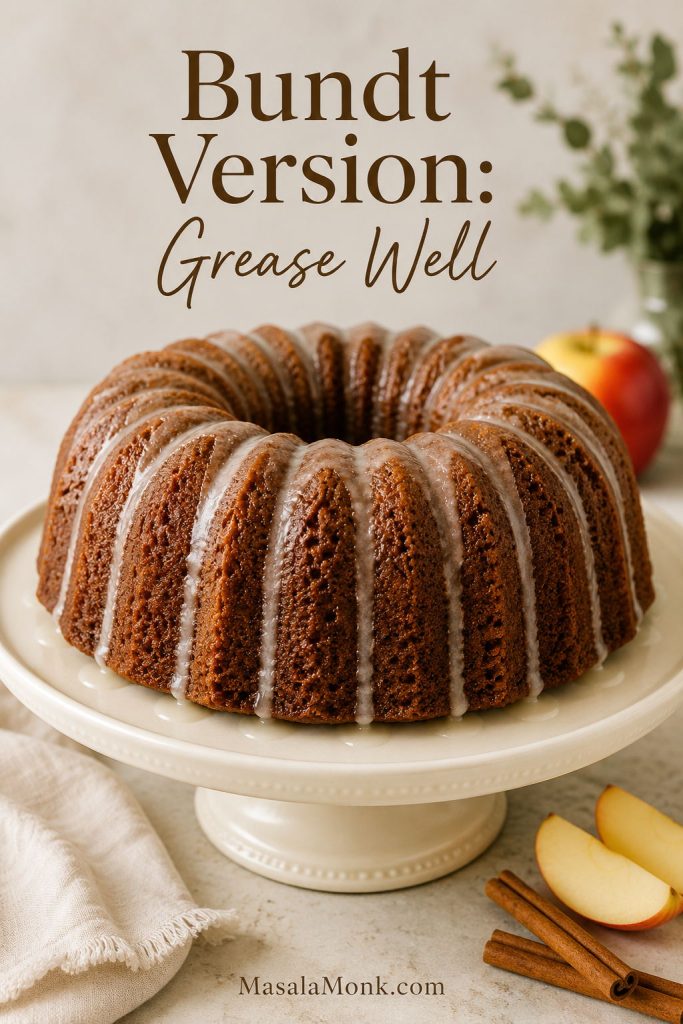
A Bundt version works well with vanilla glaze, maple glaze, or brown butter glaze. Grease every ridge of the pan, bake longer, and cool the cake before turning it out. The deepest part should be fully set before unmolding.

Applesauce Bundt cake with a thin glaze dripping down the ridges on a cream cake stand.
A Bundt version works best with careful pan greasing and a thin glaze. That way, the ridges stay visible and the cake releases more cleanly.

Gluten-Free or Almond Flour Version

For the closest gluten-free version, use a tested 1:1 gluten-free flour blend in place of the all-purpose flour. The texture may still be a little different, but the structure is more predictable than an almond flour swap.

Do not replace the flour with almond flour 1:1 in this batter. Almond flour needs different liquid, egg, and structure. Because applesauce already adds moisture, a casual almond flour swap can turn the cake oily, fragile, or gummy. For an almond flour version, use a formula written for almond flour from the start.

Vegan or Eggless Version

Eggless applesauce cake is possible, but this batter should not be converted by simply adding more applesauce. Applesauce is already the main moisture ingredient here, so using extra applesauce as an egg replacement can push the cake toward gummy.

For an egg-free version, start with a formula built that way from the beginning. This batter already gets so much moisture from applesauce that simply adding more can make the center heavy instead of soft.

Lighter or Lower-Sugar Version

For a lighter cake, use unsweetened applesauce, reduce the granulated sugar slightly, and serve the cake unfrosted or with a thin glaze. You can also cut the oil to 1/2 cup and add 1/4 cup extra applesauce, but the crumb will be a bit less plush.

Avoid removing all the oil on the first attempt. A little fat keeps the cake softer and prevents the texture from becoming rubbery. If you enjoy using applesauce in breakfast-style baking, it can also work as a moisture helper in recipes like oat pancakes, where softness and natural sweetness matter.

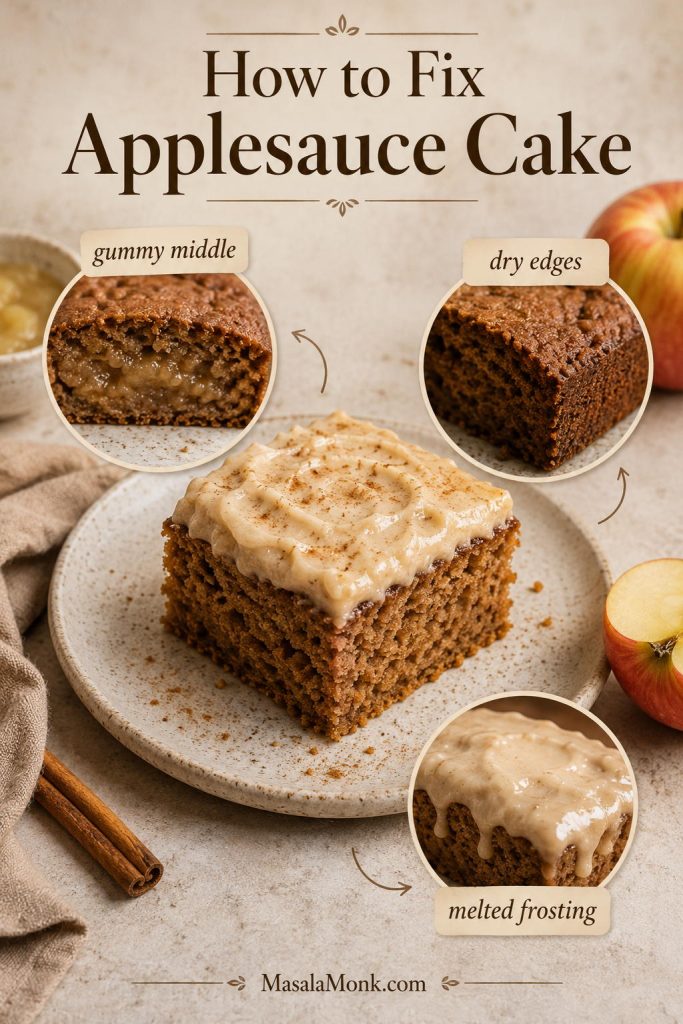
Common Applesauce Cake Problems and Fixes

When this cake disappoints, the problem usually comes from one of a few places: too much moisture, too much flour, not enough bake time, or overmixing. Once you know which one is working against you, the next pan is much easier to fix.

Texture, Bake-Time, and Flavor Problems

Troubleshooting board for applesauce cake showing gummy middle, dry edges, and melted frosting problems around a central frosted cake square.
A gummy middle, dry edges, or melted frosting usually points to one of four fixes: thicker applesauce, gentler mixing, more bake time, or longer cooling.
Problem Likely Cause Fix
Gummy middle Underbaked cake, watery applesauce, too much applesauce, or overmixed batter Bake until the center is fully set; use thick applesauce; mix only until combined.
Dry cake Too much flour or overbaking Spoon and level flour or use grams; start checking around 30 minutes.
Sank in the center Opened oven early or pulled the pan before the center set Do not open the oven too early; check the center, not just the edges.
Bland flavor Old spices, not enough salt, or too little vanilla Use fresh cinnamon and the full spice blend; do not skip the salt.
Weak apple flavor Applesauce flavor is naturally mild Expect spice-cake flavor with gentle apple in the background, or add a small amount of finely diced apple.

Pan, Add-In, and Frosting Problems

Problem Likely Cause Fix
Frosting melted Cake was still warm Cool completely before frosting.
Edges too dark Dark pan, glass pan, or overbaking Use a light metal pan or reduce heat for glass.
Nuts or raisins sank Add-ins were heavy or batter was loose Toss add-ins with 1 tablespoon flour before folding in.
Baking soda aftertaste Leavening was unevenly mixed or measured heavily Measure carefully and whisk the dry ingredients thoroughly.
Frosting too loose Tub cream cheese, warm butter, or too little powdered sugar Use brick cream cheese, softened butter, and add powdered sugar gradually.

Once you know what went wrong, return to the texture checklist before your next bake.

How to Store, Freeze, and Make Ahead

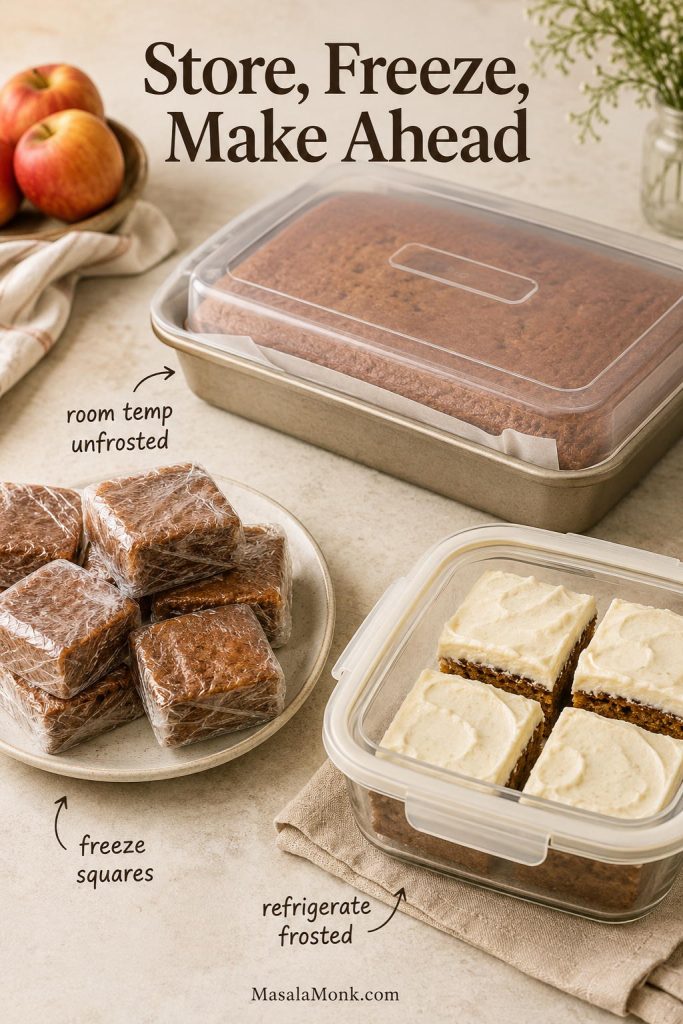
Unfrosted cake can be covered and stored at room temperature for about 2 days if your kitchen is cool. Once it has cream cheese frosting, refrigerate it. Let chilled slices sit at room temperature for 15 to 20 minutes before serving so the frosting softens and the crumb tastes tender again instead of cold and tight.

To freeze, wrap unfrosted squares tightly and freeze for up to 2 to 3 months. Thaw overnight in the refrigerator or at room temperature, then frost after thawing for the freshest texture.

This applesauce cake recipe is also easy to make ahead. Bake the cake one day ahead, cool it completely, cover it, and frost it the next day. The spice flavor often improves after resting because the cinnamon, brown sugar, and applesauce have time to settle into the crumb.

Storage guide showing a covered unfrosted applesauce cake pan, wrapped cake squares for freezing, and frosted slices in a container.
For make-ahead ease, freeze unfrosted squares and refrigerate anything with cream cheese frosting. Then let chilled slices soften before serving.

If you are baking ahead for a gathering, choose the topping from the frosting and topping guide after deciding how long the cake needs to sit out.

What to Serve with Applesauce Cake

This cake does not need much beside it. A square with coffee, black tea, chai, or cold milk is enough for an afternoon snack. If you want the whole table to lean into fall, a mug of healthy pumpkin spice latte keeps the cinnamon-and-spice mood going without adding another heavy dessert.

For dessert, serve it with vanilla ice cream, lightly whipped cream, caramel drizzle, or a few toasted walnuts scattered over the frosting. For brunch, cut it into smaller squares and keep the topping simple. Powdered sugar or a thin glaze works better than a heavy frosting when the cake is sharing the table with eggs, pancakes, fruit, and savory dishes.

For a fall dessert spread, pair this soft spice cake with pumpkin desserts, fruit crisps, or a shortcut pie like apple pie with apple pie filling. The cake brings warm spice and cream cheese frosting, while the pie brings flaky crust and glossy apple filling.

If you are making the apple side of the table from scratch, keep a batch of homemade apple pie filling ready for pies, waffles, pancakes, yogurt, or ice cream. It sits in a fruitier lane than this soft spice cake, so the two do not feel repetitive together.

Applesauce Cake FAQs

What does applesauce do in cake?

Applesauce adds moisture, mild apple flavor, and softness. However, it is not the same as fat. That is why this recipe uses applesauce and oil together for a tender crumb.

Sweetened or unsweetened applesauce?

Unsweetened applesauce is the better choice because it gives you control over the cake’s sweetness. Sweetened applesauce works, but the finished cake may taste sweeter than intended.

Oil or no oil: what happens?

You can reduce the oil, but removing it completely changes the texture. A no-oil version is usually denser and more likely to taste gummy. For the most reliable first bake, keep the oil.

Bundt pan timing

A Bundt pan works, but the bake time will be longer, usually around 45 to 60 minutes. Grease the pan very well, check the deepest part, and cool before turning it out.

Frosted or unfrosted?

Frosting is optional. Cream cheese frosting makes it feel like dessert, while powdered sugar, vanilla glaze, or no topping at all keeps it closer to an old-fashioned snack cake.

Why did the middle turn gummy?

The usual reasons are underbaking, watery applesauce, too much applesauce, not enough fat, or overmixing the batter. Bake until the center is fully set and fold the flour in gently.

Fresh apples: helpful or too wet?

A small amount of finely diced apple is fine, but do not add too much. Fresh apples release moisture as they bake, which can make the center wetter. For the first bake, keep the recipe focused on applesauce, then experiment later.

Homemade applesauce texture

Homemade applesauce works well as long as it is thick enough for baking. If it looks loose, simmer it briefly to thicken or drain off excess liquid before measuring. Smooth, thick applesauce gives the most reliable texture.

Make-ahead timing

This cake is a good make-ahead dessert. Bake it one day ahead, cool it completely, cover it, and frost it the next day. The spice flavor often improves after resting.

Applesauce instead of eggs?

Not in this recipe as a simple swap. Applesauce is already part of the batter, and adding more in place of eggs can make the cake too wet or gummy. Use a tested eggless formula if you need an egg-free version.

Final Thoughts

A good applesauce cake should feel simple, but not careless. The best version is soft in the middle, lightly spiced, easy to slice, and moist without being wet. That comes from treating it like the soft spice cake it is: enough moisture, enough tenderness, fresh spices, and enough patience for the center to set.

Serve it frosted when you want dessert, dust it with powdered sugar when you want something old-fashioned, or fold in raisins and walnuts when you want the cake to taste like it came from an older recipe box. Either way, this is the kind of 9×13 cake that quietly disappears one square at a time — first as dessert, then with coffee, then in those uneven little “just one more” slices everyone pretends do not count.

Back to top

Posted on 1 Comment

Ajwain leaves Paratha| Carom leaves flatbread Recipe

Creating a little kitchen garden in my house is no less than a dream for me. Living in a concrete jungle, we crave greenery and put in some effort to make a small kitchen garden. I love planting herbs like mint, coriander, carom leaves, and curry leaves in my kitchen garden, and I often use these herbs in my recipes. Ajwain, also known as carom seeds, is one of my favorites in my kitchen garden. I frequently make ajwain paratha for my kid’s lunch box and as a companion to my morning chai. This ajwain paratha is easy to make and healthy at the same time.

Ingredients:

  • 1 cup wheat flour
  • 1/2 cup finely chopped ajwain leaves
  • 1 tablespoon ajwain seeds
  • 1 tablespoon oil or ghee (plus extra for cooking)
  • 1/2 teaspoon salt (adjust to taste)
  • Water (as needed)

Method:

Wash the ajwain leaves thoroughly and pat dry the leaves, now finely chop them and keep aside.

In a large mixing bowl, take wheat flour and add ajwain seeds, oil or ghee, salt, and the chopped ajwain leaves. Mix everything well to combine the ingredients.

Gradually add water to the mixture, little by little, and knead it into a smooth and firm dough. The amount of water required may vary, so add it gradually until the dough comes together. The dough should be soft but not sticky.

Once the dough is ready, cover it with a damp cloth and let it rest for about 10-15 minutes. After the resting period, divide the dough into small sized portions. Take one portion and dust the rolling surface with flour and roll out the portion into a circle using a rolling pin. Heat a tawa or a non-stick pan over medium heat. Place the rolled paratha on the hot tawa and cook it . Drizzle a little oil or ghee around the edges of the paratha and flip it over using a spatula. Press the paratha gently with the spatula to help it cook evenly and cook for another minute or until both sides are golden brown.

Remove the cooked paratha from the tawa and place it on a plate. Serve the ajwain leaves paratha hot with a side of yogurt, pickle, or any curry of your choice. It also makes a delicious addition to a lunchbox or can be enjoyed with a hot cup of tea.

Enjoy your homemade ajwain leaves paratha! I hope you enjoyed reading this recipe. Do give this recipe a shot. If you try this recipe, do give us a shout out. Just click a picture and tag us on @masala.monk or use the hashtag #MasalaMonkRecipe and share on Instagram and Facebook. We would love to hear from you.

Posted on Leave a comment

Black Jeera for Weight Loss: Harnessing the Power of Cumin Seeds

blue tape measuring on clear glass square weighing scale

When it comes to natural remedies for weight loss, black jeera (also known as black cumin or Nigella seeds) has gained significant attention. These small, black seeds have been used for centuries in traditional medicine and culinary practices for their potential health benefits. In this comprehensive and detailed blog post, we will delve deeper into the weight loss properties of black jeera, exploring the scientific evidence and ways to incorporate it into your diet effectively. Get ready to uncover the potential of these aromatic seeds and take a step towards achieving your weight loss goals! 🖤🌿

🌿 Understanding Black Jeera Black jeera is derived from the seeds of the Nigella sativa plant, which is native to South Asia, the Middle East, and North Africa. These tiny seeds have a unique, pungent aroma and a slightly bitter taste. They are packed with essential nutrients, including vitamins, minerals, antioxidants, and volatile oils that contribute to their potential health benefits.

🖤 Weight Loss Benefits of Black Jeera While further research is needed to fully understand the mechanisms behind black jeera’s weight loss effects, several studies and anecdotal evidence suggest various ways in which it may support weight management:

  1. Metabolism Booster: Black jeera contains compounds that may help boost metabolism. One study published in the Journal of Ethnopharmacology found that black jeera supplementation led to increased resting metabolic rate and fat oxidation in overweight individuals, indicating its potential role in promoting weight loss.
  2. Appetite Suppression: Black jeera has been traditionally used as an appetite suppressant. It may help reduce food cravings and promote feelings of fullness, thereby aiding in portion control and calorie reduction.
  3. Blood Sugar Regulation: Maintaining stable blood sugar levels is crucial for weight management. Black jeera has shown promise in improving insulin sensitivity and regulating blood glucose levels, potentially reducing the risk of weight gain and insulin resistance.
  4. Anti-Inflammatory Effects: Chronic inflammation in the body can hinder weight loss efforts. Black jeera contains bioactive compounds with anti-inflammatory properties, which may help reduce inflammation and support overall well-being.
  5. Digestive Health: Black jeera has long been used to support digestive health. It may help alleviate symptoms of bloating, gas, and indigestion, promoting a healthy gut environment and efficient digestion. Improved digestion can contribute to weight loss by optimizing nutrient absorption and reducing digestive discomfort.

🌿 Incorporating Black Jeera into Your Diet To enjoy the potential weight loss benefits of black jeera, here are some practical tips to incorporate it into your daily diet:

  1. Ground Black Jeera: Grind black jeera seeds in a spice grinder or mortar and pestle to create a fine powder. Use this ground black jeera as a seasoning in various dishes, including curries, stews, roasted vegetables, or sprinkle it on salads and soups.
  2. Black Jeera Tea: Steep a teaspoon of whole black jeera seeds in a cup of hot water for about 10 minutes. Strain and enjoy as a warm, aromatic tea. You can add a squeeze of lemon or a dash of honey for flavor if desired.
  3. Smoothie Booster: Add a teaspoon of ground black jeera to your favorite smoothie recipes. It can add a distinct nutty flavor and potentially enhance the weight loss properties of your smoothie.
  4. Homemade Spice Blends: Combine ground black jeera with other spices like turmeric, cayenne pepper, or cinnamon to create homemade spice blends. Use these blends to season your meals and add a flavorful kick to your dishes.
  5. Sprinkle on Yogurt or Oatmeal: Sprinkle a pinch of ground black jeera on top of yogurt, oatmeal, or smoothie bowls for an added boost of flavor and potential weight loss benefits.

🖤🌿 While black jeera shows promise as a natural aid for weight loss, it’s important to remember that individual results may vary, and it should be incorporated as part of a balanced and healthy lifestyle. It is not a standalone solution for weight loss but can complement a nutritious diet, regular exercise, and overall wellness practices.