Posted on Leave a comment

Ham and Cheese Quiche Recipe: Creamy, Easy, Crustless Option

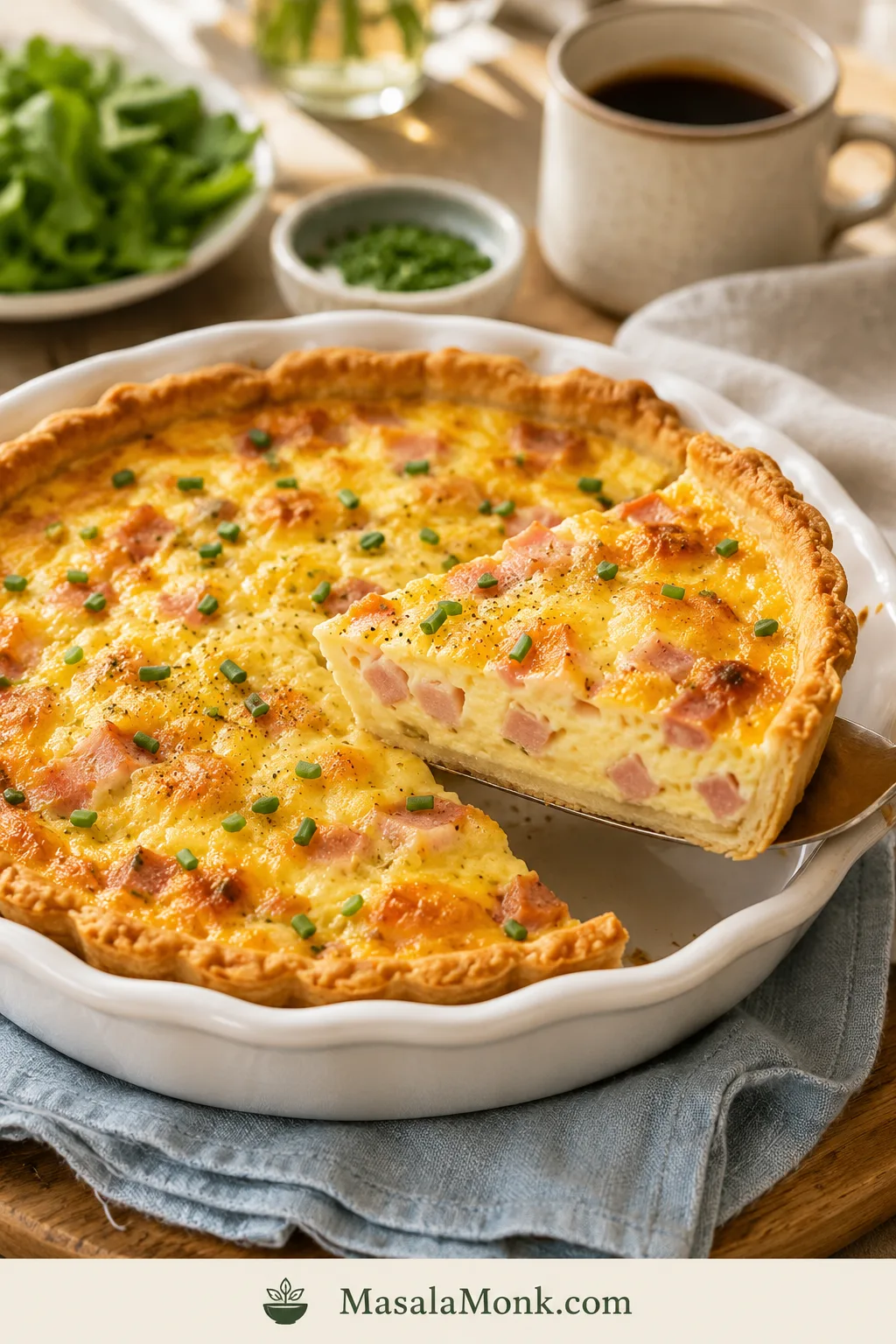
Whole ham and cheese quiche in a white ceramic pie dish with one slice lifted, showing golden crust, creamy custard, diced ham, melted cheese, and chives.

Ham and cheese quiche is what you make when brunch needs to feel special but you do not want to stand at the stove. It uses cooked ham, a simple egg custard, plenty of cheese, and a crust that can be homemade, refrigerated, frozen, or skipped completely.

The most satisfying bites have smoky ham, melted cheese, and soft custard against the flaky edge of the crust. This version is creamy without being loose, savory without being too salty, and practical enough for a holiday brunch, a quiet lunch, or a weeknight dinner with salad.
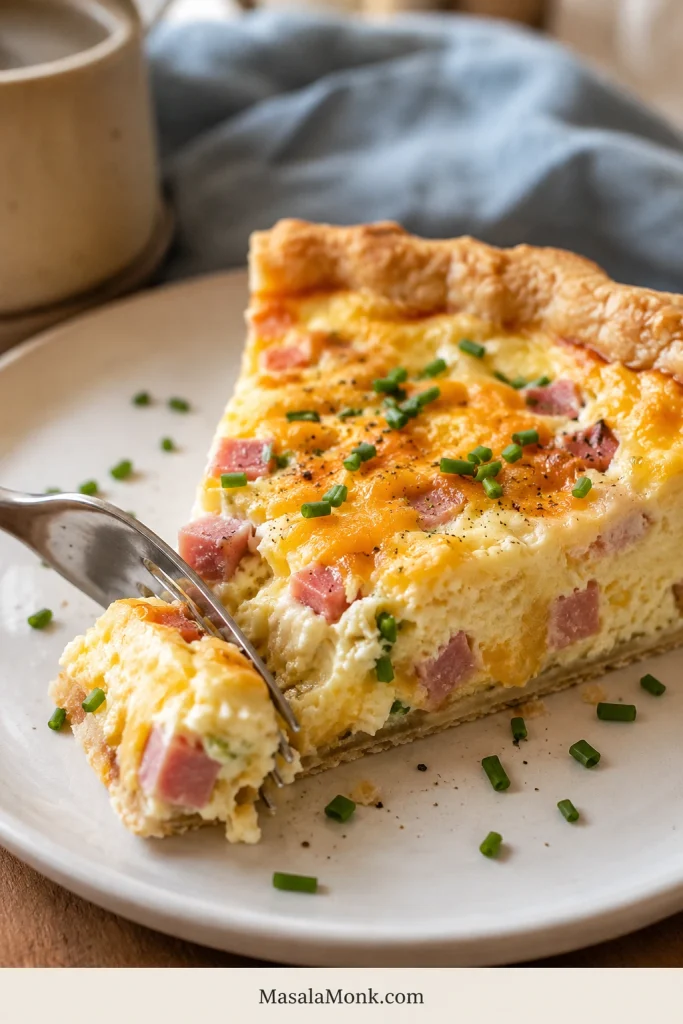
Close-up of a ham and cheese quiche slice on a white plate, with a fork cutting into the creamy custard and flaky crust.
A good slice should hold together but still look soft inside; that creamy custard is what keeps this from feeling like a firm egg bake.

This ham and cheese quiche is built for real kitchens: the kind with leftover holiday ham, a frozen crust in the freezer, or a bit of cheese that needs using. As long as the ham is cooked, diced small, and not wet, the recipe is flexible.

The base is simple: 5 large eggs, 1 cup dairy, 1½ cups diced ham, and 1½ cups cheese for one 9-inch / 23 cm quiche. That ratio keeps the center creamy but sliceable, so you do not end up with a stiff egg pie or a watery middle.

Start with the quick answer and recipe if you are ready to bake. The extra notes are there for frozen crusts, crustless baking, make-ahead timing, variations, and troubleshooting.

Quick Answer

For one 9-inch / 23 cm ham and cheese quiche, use 5 large eggs, 1 cup dairy, 1½ cups cooked diced ham, and 1½ cups shredded cheese. Par-bake the crust, fill it, bake at 375°F / 190°C until the edges are set and the center is soft-set, then rest for 10 minutes before slicing.

Quiche ElementUse This
Eggs5 large eggs
Dairy1 cup / 240 ml / 8 fl oz half-and-half, or cream + milk
Ham1½ cups / 200–225 g / 7–8 oz cooked diced ham, loosely measured
Cheese1½ cups / 150–170 g / 5–6 oz shredded cheese, loosely measured
Oven375°F / 190°C for a crusted quiche
Done whenEdges are set and the center is soft-set, not liquid

For a first bake, keep it simple: deep-dish frozen or refrigerated pie crust, half-and-half, 1 cup sharp cheddar, ½ cup Swiss, and diced cooked ham. Once you see how the center should wobble, the variations become much easier.
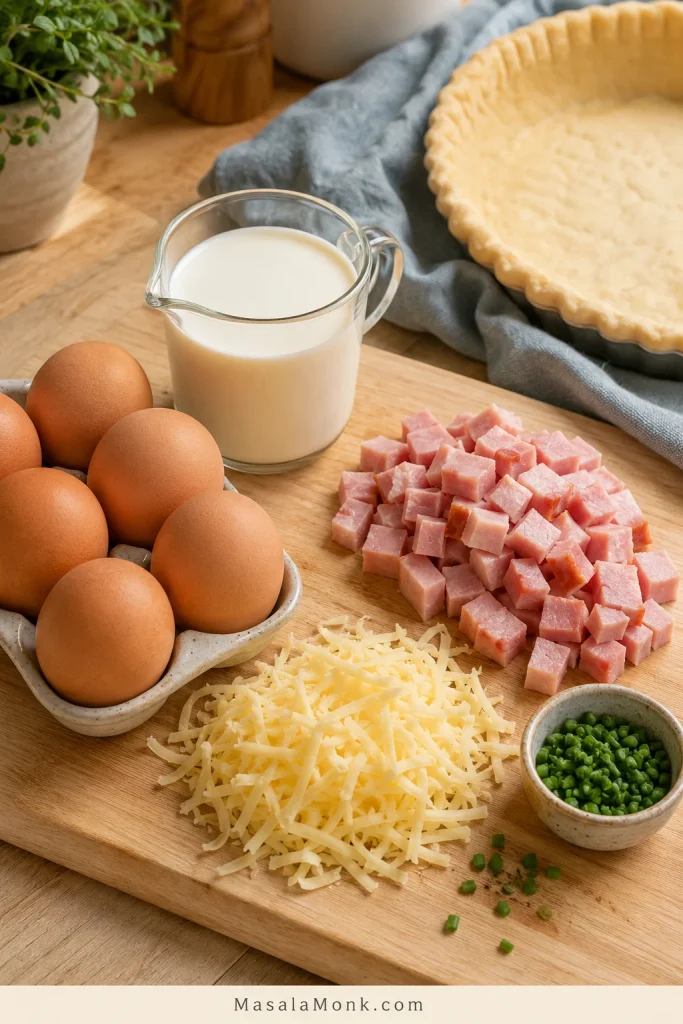
Eggs, dairy, diced cooked ham, shredded cheese, chopped chives, and a pie crust arranged on a kitchen prep surface.
Use the base as a balance check: eggs help the custard set, dairy keeps it tender, and ham and cheese make the filling generous without weighing it down.

Choose Your Ham and Cheese Quiche Path

Start with the same creamy base, then choose the version that fits your day: frozen crust for ease, crustless for meal prep, or extra vegetables when the fridge needs clearing.

If This Is Your SituationBest Path
You want the easiest brunchUse a deep-dish frozen crust, half-and-half, sharp cheddar, Swiss, and cooked diced ham.
You have leftover holiday hamDice it small, pat it dry if needed, reduce the salt, and balance sweet glaze with Dijon and black pepper.
You want no crustGrease the pie dish well and bake the same egg mixture at 350°F / 175°C until just set.
You want the creamiest textureUse half-and-half, or equal parts heavy cream and whole milk.
You are adding vegetablesCook, drain, and cool them before they touch the egg mixture.
You are meal-preppingBake the quiche first, cool it, slice it, then refrigerate or freeze the slices.

Ham and Cheese Quiche Recipe

Description

This easy quiche has a creamy egg custard, diced cooked ham, plenty of cheese, and a crisp-tender pie crust. Use a frozen deep-dish crust for the easiest version, or make it with homemade or refrigerated crust. Serve it for brunch, lunch, holidays, meal prep, or an easy dinner with salad.

Crustless note: For a no-crust version, use the same filling in a well-greased 9-inch / 23 cm pie dish and bake at 350°F / 175°C for 30–40 minutes. See the crustless ham and cheese quiche section for the full method.

  • Prep Time: 15 minutes
  • Par-Bake Time: 10–12 minutes
  • Final Bake Time: 35–45 minutes
  • Resting Time: 10 minutes
  • Total Time: About 1 hour 10 minutes to 1 hour 20 minutes
  • Servings: 6–8 slices

Equipment

  • 9-inch / 23 cm pie dish or 9-inch deep-dish frozen pie shell
  • Rimmed baking sheet
  • Mixing bowl
  • Whisk
  • Measuring cups and spoons
  • Fork
  • Foil or pie shield
  • Wire rack
  • Instant-read thermometer, optional

Ingredients

  • 1 9-inch / 23 cm deep-dish pie crust, homemade, refrigerated, or frozen
  • 5 large eggs
  • 1 cup / 240 ml / 8 fl oz half-and-half, or ½ cup / 120 ml heavy cream plus ½ cup / 120 ml whole milk
  • 1½ cups / 200–225 g / 7–8 oz cooked diced ham, measured loosely, not packed
  • 1½ cups / 150–170 g / 5–6 oz shredded cheese, measured loosely, not packed
  • 2–3 tablespoons chopped green onions or chives
  • 1 teaspoon Dijon mustard
  • ¼ teaspoon black pepper
  • ¼–½ teaspoon salt
  • Small pinch of nutmeg, optional
  • 1 tablespoon butter or oil, optional, if sautéing onion, mushrooms, spinach, or other vegetables

Use ¼ teaspoon salt if your ham or cheese is salty. Use ½ teaspoon only if your ham is mild and your cheese is not very salty.

Instructions

1. Preheat and Set Up

Heat the oven to 375°F / 190°C and set a rack in the middle or lower-middle position. Place the pie crust on a rimmed baking sheet so it is easier to move and any overflow is caught.

2. Par-Bake the Crust

Give the crust a short head start for 10–12 minutes, or follow the package timing if using a frozen shell. The surface should look dry and lightly set, even if it is still pale. Gently press down any puffed spots with a spoon.
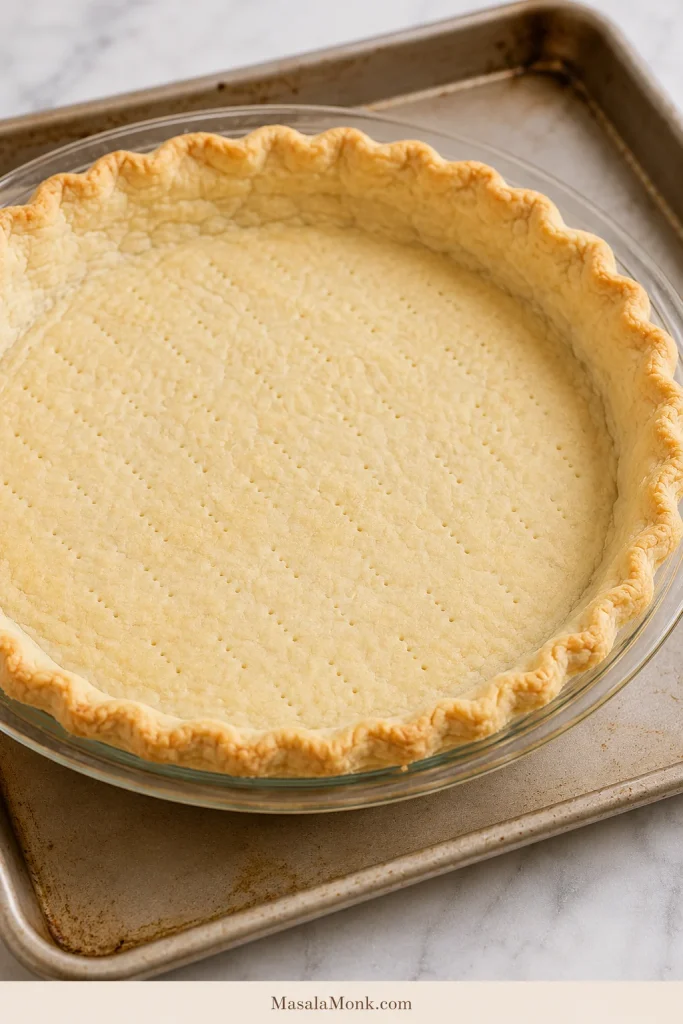
Lightly par-baked pie crust with fork holes in a pie dish on a rimmed baking sheet.
Par-bake the crust until the surface looks dry and lightly set; it should not be deeply browned yet because it bakes again with the custard.

3. Whisk the Custard

Combine the eggs, half-and-half, Dijon mustard, black pepper, salt, and nutmeg in a mixing bowl until the mixture looks smooth and evenly yellow. Stop once it is blended; the custard should not be bubbly or foamy.
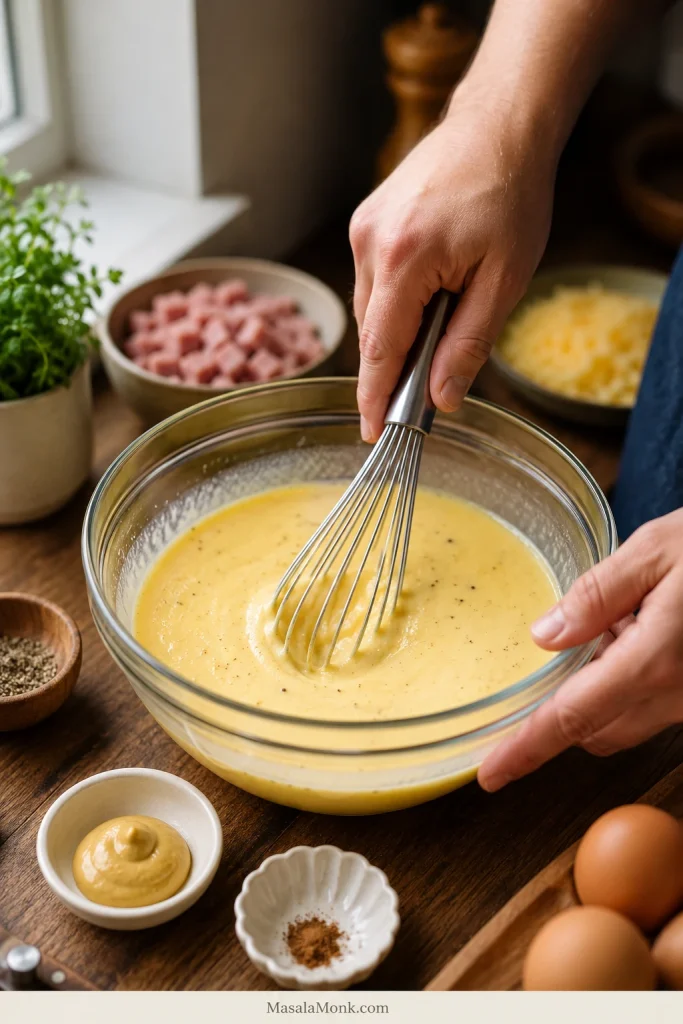
Hands whisking a pale egg custard mixture in a glass bowl with dairy, Dijon mustard, pepper, and seasonings nearby.
Whisk the eggs and dairy just until smooth; a calm, even custard bakes more neatly than one whipped full of foam.

4. Layer the Ham, Cheese, and Chives

Scatter the diced ham evenly over the warm par-baked crust. Add the shredded cheese and green onions or chives so the filling is spread across the base before the custard goes in.

Diced ham, shredded cheese, and chopped chives spread evenly inside a par-baked pie crust.
Layer the ham, cheese, and chives before the custard goes in so every slice gets flavor throughout instead of one heavy layer at the bottom.

5. Pour Without Overfilling

Add the egg mixture slowly over the ham and cheese so it can settle into the gaps. Stop before it touches the rim, especially if the crust is shallow. A clean oven is worth more than one extra spoonful.
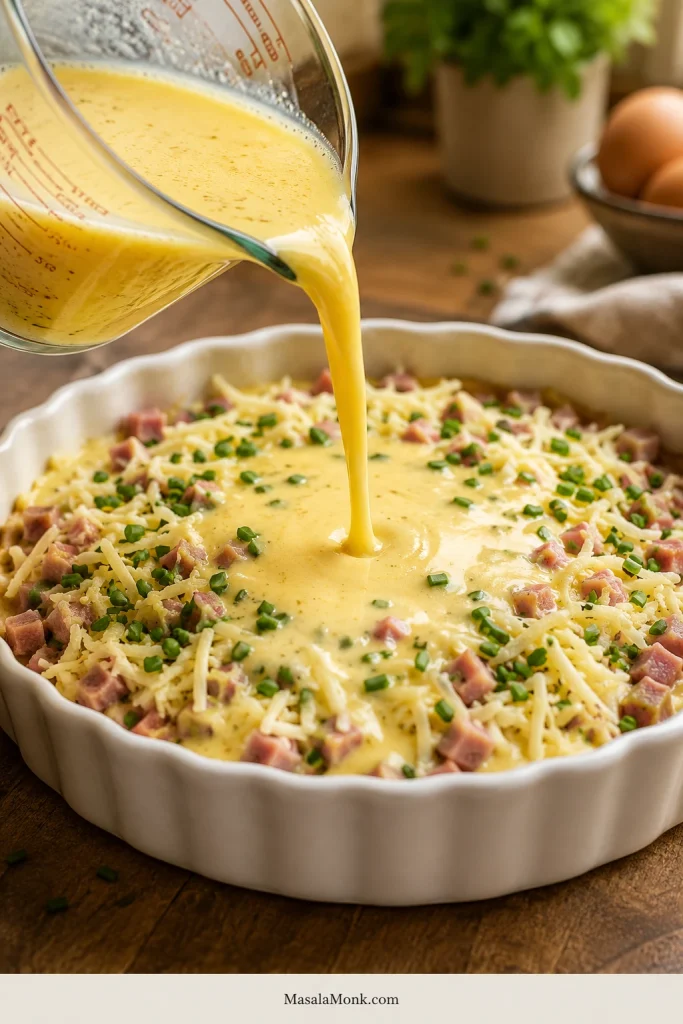
Egg custard being poured from a glass measuring cup into a pie crust filled with ham, cheese, and chives.
Pour slowly so the custard settles between the ham and cheese; this helps the quiche bake evenly from the crust edge to the center.

A shallow crust may not hold every drop of custard. When the filling looks close to the top, save the extra for a greased ramekin instead of risking overflow.
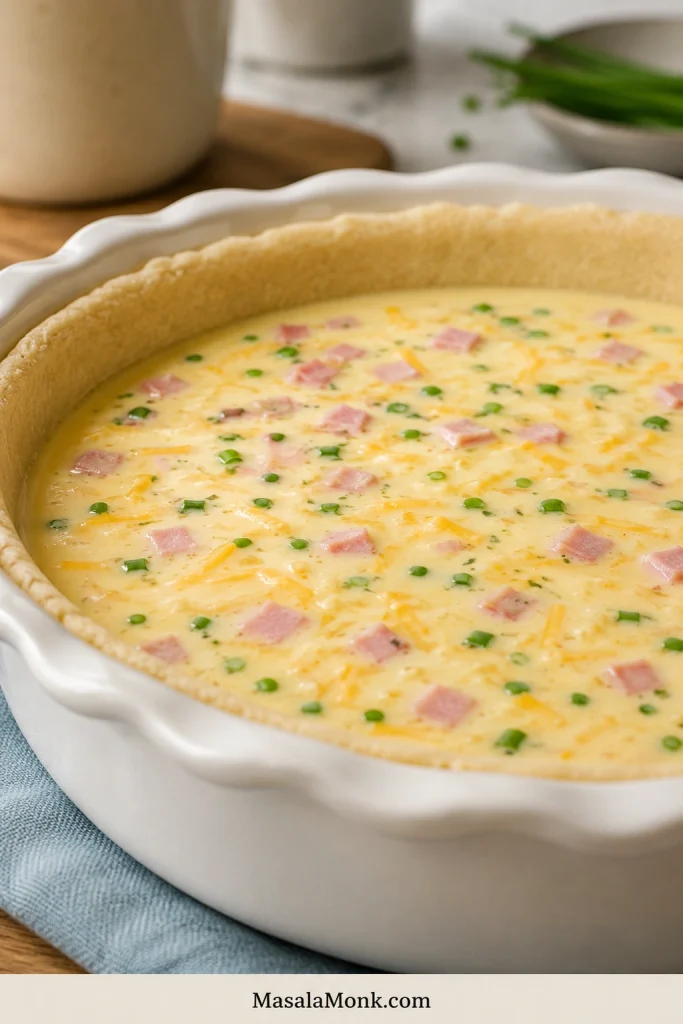
Unbaked quiche filling sitting below the visible rim of a deep pie crust in a white ceramic dish.
Stop before the filling reaches the rim; leaving visible crust above the custard is one of the easiest ways to prevent overflow in a deep-dish quiche.

6. Bake Until Soft-Set

Slide the quiche into the oven for 35–45 minutes, until the edges are set and the center moves like soft-set pudding when you gently nudge the pan. Cover the crust edge with foil or a pie shield if it browns too quickly, and tent the whole quiche loosely if the top colors before the center is ready.
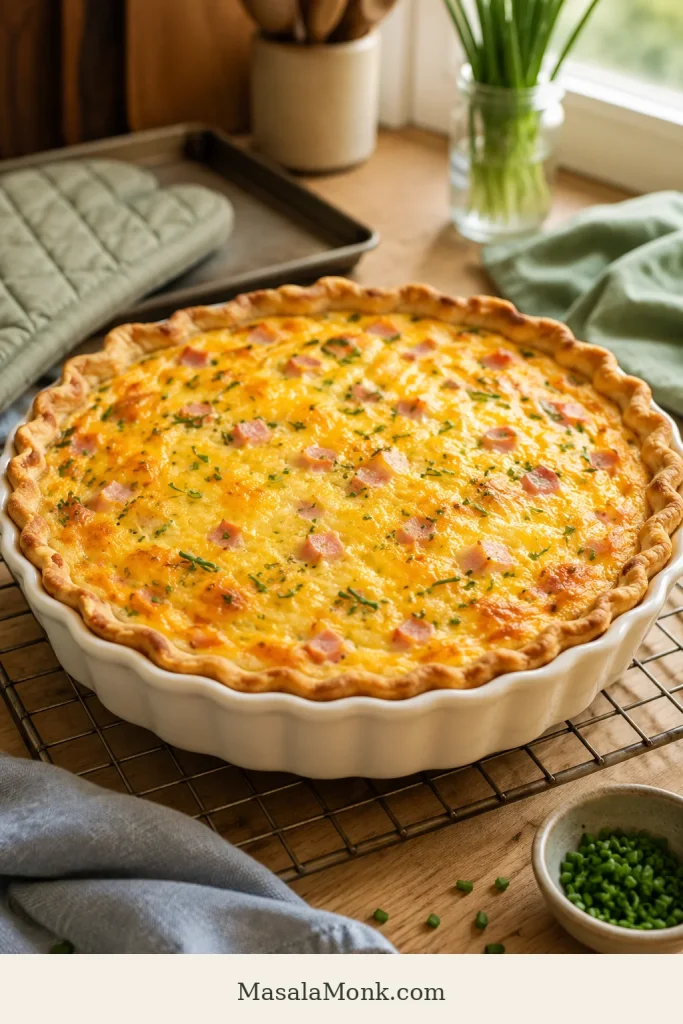
Whole baked ham and cheese quiche in a white ceramic pie dish resting on a wire cooling rack.
A softly puffed top, golden cheese spots, and a browned crust edge are better doneness clues than waiting for the center to look firm.

7. Rest Before Slicing

Set the quiche on a wire rack for 10 minutes before cutting. The center settles as it cools, which helps the slices lift cleanly instead of slumping.

8. Serve Warm or Room Temperature

Bring slices to the table warm or at room temperature for the creamiest texture. Chilled leftovers are fine for quick lunches, but the custard tastes better once the chill comes off.

A good slice should look softly set in the center, with ham and cheese suspended through the custard instead of sunk into one dense layer.
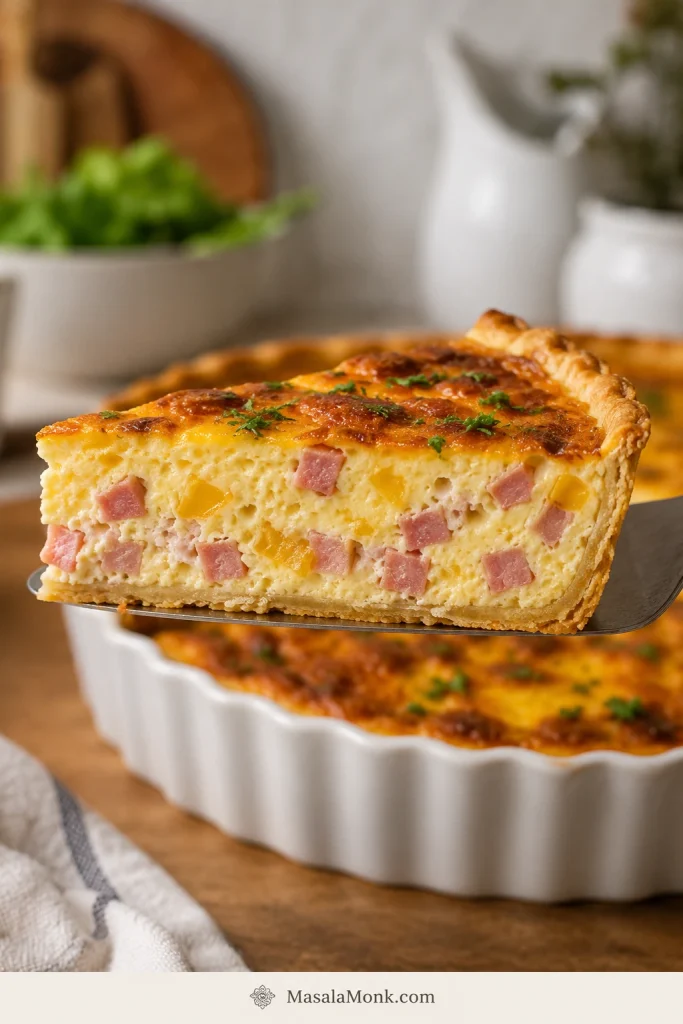
Slice of ham and cheese quiche lifted on a pie server, showing creamy custard, diced ham, melted cheese, and an intact bottom crust.
A clean cross-section shows the target texture: ham suspended through the custard, a tender middle, and a crust strong enough to lift.

Recipe Notes

  • This recipe card is for the crusted version. For crustless baking, use the crustless note above or jump to the crustless quiche section.
  • If using frozen crust, make it deep-dish. Regular frozen shells can work, but they often cannot hold all the filling; the frozen crust notes explain why.
  • If using homemade or refrigerated pie dough, chill it in the dish, line it with parchment, add pie weights, dried beans, or uncooked rice, and par-bake until the edges begin to set. Frozen crusts can usually follow package directions.
  • Cook, drain, and cool vegetables before adding them so they do not throw off the texture.
  • Do not overfill a shallow crust. Extra egg mixture can be baked in a small greased ramekin.

Why This Recipe Works

That ratio does most of the work here: 5 large eggs + 1 cup dairy + 1½ cups ham + 1½ cups cheese. Five eggs give the slice structure, one cup of dairy keeps the center soft instead of omelet-like, and the ham and cheese stay generous without weighing down the custard.

The goal is a slice that lifts cleanly but still tastes soft and creamy, with little pockets of ham and melted cheese all the way through.

A short head start in the oven also protects the crust. It keeps the bottom from turning pale and soft once the wet custard goes in, and it helps you avoid the usual quiche problems: too much liquid, wet add-ins, a soft bottom crust, and eggs baked until rubbery.

Ingredients and Key Tips

Quiche is forgiving, but it is not random. Once you control moisture, salt, and bake time, the rest becomes flexible.

Ham

Almost any cooked ham works here: leftover holiday ham, ham steak, smoked ham, or thick-cut deli ham. Dice it small so it spreads evenly through the custard.

This is especially useful after a holiday meal, Sunday dinner, or any time you have cooked ham in the fridge. The ham is already seasoned and ready to help; you are not building brunch from nothing, just giving leftovers a better second life.

For deli ham, choose thicker slices and dice them small. Watery packages need a quick blot before the ham goes into the crust because extra moisture can affect the custard just like wet vegetables can.

Salty ham needs less salt in the egg mixture. You can always add a little salt at the table, but you cannot remove it once it is baked into the dish.

With sweet glazed ham, trim away any thick sticky edges before dicing. A little sweetness is fine, but too much glaze can make the quiche taste sweeter and more casserole-like than classic ham quiche. Dijon mustard, black pepper, cheddar, Swiss, or Gruyère will help balance it.
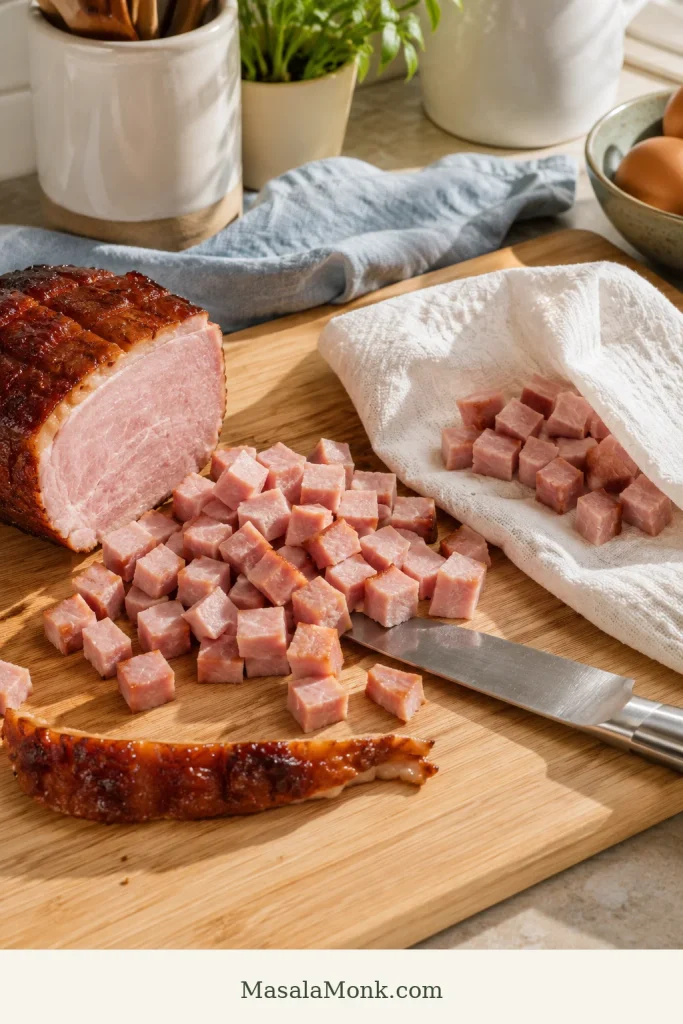
Diced cooked ham on a wooden cutting board with a towel blotting some pieces and a glazed ham edge being trimmed.
Blot wet ham before adding it; this small step helps prevent watery quiche, especially with deli ham or glazed leftovers.

Brown the ham if it is pale, wet, or mild. Skip this step if the ham is already smoky, dry, or strongly flavored. A quick 2–3 minutes in a dry skillet or a little butter gives the edges more savory flavor.

Eggs

Five eggs is the sweet spot for this size: enough structure to slice, but not so many that the center turns firm and omelet-like.

Dairy

For the creamiest everyday texture, half-and-half gives you the easiest balance. If half-and-half is not available where you live, use equal parts heavy cream and whole milk.

Whole milk also works for a lighter quiche. The center will be less rich, but it will still set if you keep the egg-to-dairy ratio steady.

Cheese

For cheese, stay with something that actually has flavor. Sharp cheddar gives the quiche that familiar melted ham-and-cheese pull, Swiss is mild and classic, and Gruyère makes the dish feel more brunch-table polished.

Measure shredded cheese loosely, not packed tightly into the cup. Too much cheese can make the quiche greasy, salty, or heavy. Freshly shredded cheese melts most smoothly, but pre-shredded cheese is fine when convenience matters.

Avoid fresh mozzarella unless it is very well drained. It can release water into the custard. Low-moisture mozzarella is safer, but it is mild, so it works better as part of a blend than as the main cheese.

Green Onions, Chives, Onion, or Garlic

Green onions and chives are the easiest because they can go straight into the egg mixture. If using yellow onion, shallot, or garlic, sauté them first so the flavor softens before baking.

Dijon, Pepper, and Nutmeg

Dijon mustard adds gentle sharpness without making the quiche taste mustardy. Black pepper keeps the custard from tasting flat. A tiny pinch of nutmeg is optional, but it works beautifully with eggs, cream, cheese, and ham.

Before You Bake, Check These 5 Things

If you remember only three things, par-bake the crust, control wet add-ins, and pull the quiche before the center turns firm. If the center still makes you nervous, the doneness cues below explain the wobble, resting time, and thermometer range.

  • The crust is par-baked and lightly set.
  • The ham is diced small and patted dry if it feels wet.
  • Any vegetables are cooked, drained, and cooled slightly.
  • The cheese and ham are measured loosely, not packed down.
  • The egg mixture sits below the rim of the crust.

Best Crust, Dairy, and Cheese Choices

This is where you can make the recipe fit your kitchen. Frozen crust, homemade crust, cream, milk, cheddar, Swiss, or Gruyère can all work — the goal is to keep the custard balanced and the crust from going soft.

Using a Frozen Pie Crust

If you are using a frozen crust, you are not cheating; you are making brunch easier. Choose a 9-inch deep-dish frozen crust if you can. Regular frozen shells can work, but they often cannot hold all the filling.

Keep the crust in its tin if it comes that way, place it on a rimmed baking sheet, prick the base lightly, and par-bake for 10–12 minutes before filling. Do not worry if it is not deeply browned after the first bake. It will go back into the oven with the custard.
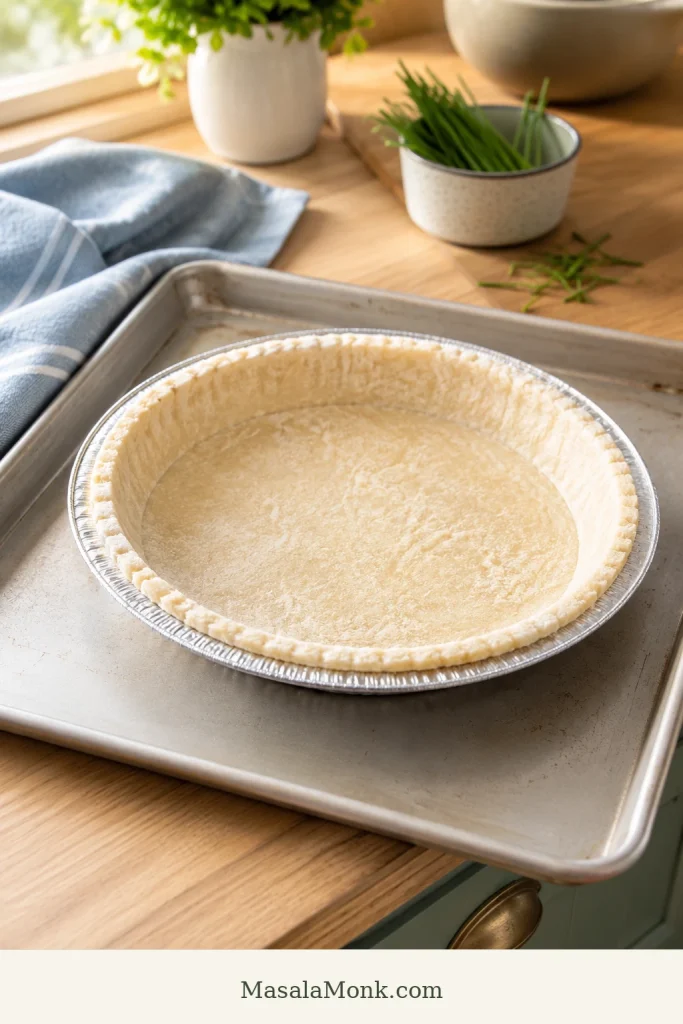
Deep-dish frozen pie crust in a foil tin set on a rimmed baking sheet on a kitchen counter.
A deep-dish frozen pie crust makes frozen crust quiche easier because it gives the egg custard enough room and helps reduce spillover.

Homemade or Regular Pie Crust

Not every 9-inch crust holds the same amount of custard. A regular 9-inch crust can still work, but you may not need every drop of the egg mixture.

If using homemade pie dough, chill it in the dish before blind baking. Line it with parchment, fill with pie weights, dried beans, or uncooked rice, and bake until the edges begin to set before removing the weights.
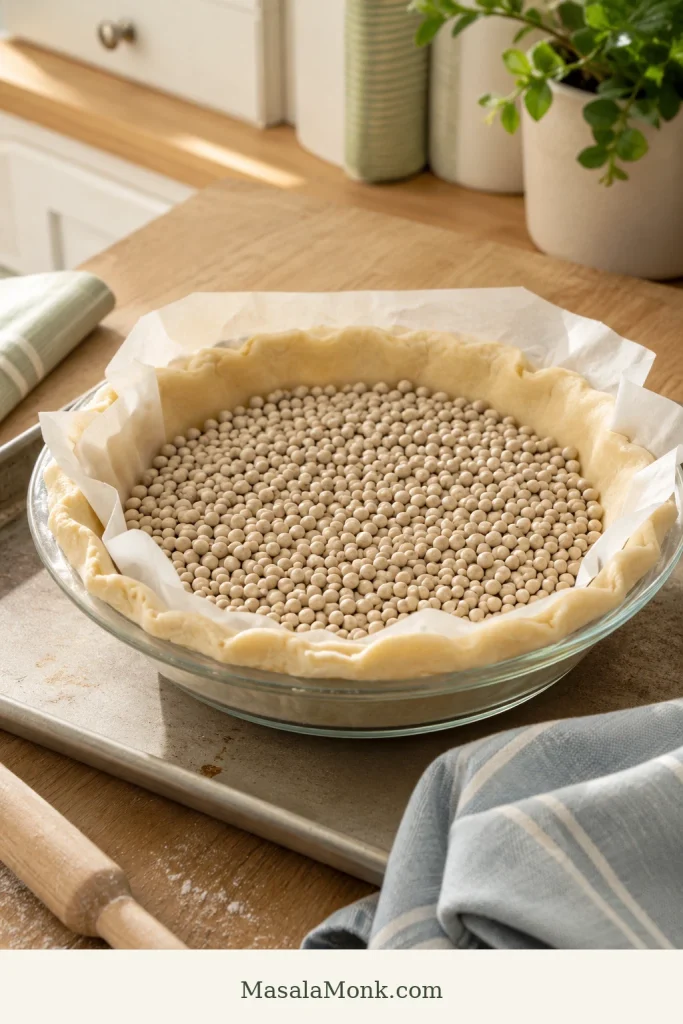
Pie crust lined with parchment paper and filled with pie weights in a glass pie dish.
With homemade or refrigerated dough, blind-baking with parchment and pie weights helps the crust hold its shape before the wet filling goes in.

Do not fill the crust all the way to the rim. Quiche can puff as it bakes. If you have extra egg mixture, bake it in a small greased ramekin instead of forcing it into the crust.

What Dairy Makes the Creamiest Texture?

The dairy is where you can quietly change the whole personality of the quiche. Cream makes it rich, milk makes it lighter, and half-and-half sits comfortably in the middle.

DairyTexture and FlavorGood Use
Heavy creamRichest, softest, most custardySpecial brunch or holiday quiche
Half-and-halfCreamy but not too heavyEveryday choice
Whole milkLighter and less richLighter quiche that still sets
Low-fat milkLess creamy and slightly less forgivingUse only if you accept a lighter texture
½ cream + ½ whole milkRich and balancedEasy substitute for half-and-half

If you do not have half-and-half, use ½ cup / 120 ml heavy cream + ½ cup / 120 ml whole milk. To make the quiche without heavy cream, use 1 cup / 240 ml whole milk.

Cheddar, Swiss, or Gruyère?

Ham needs cheese with enough flavor to stand up to it. Sharp cheddar gives bold, familiar flavor. Swiss gives a mild, nutty, classic brunch taste. Gruyère makes the custard richer and deeper.

For an everyday version, use 1 cup sharp cheddar + ½ cup Swiss. For a richer brunch version, use 1 cup Gruyère + ½ cup cheddar or Swiss. A little Parmesan can also be added for salty, nutty depth, but use it lightly.
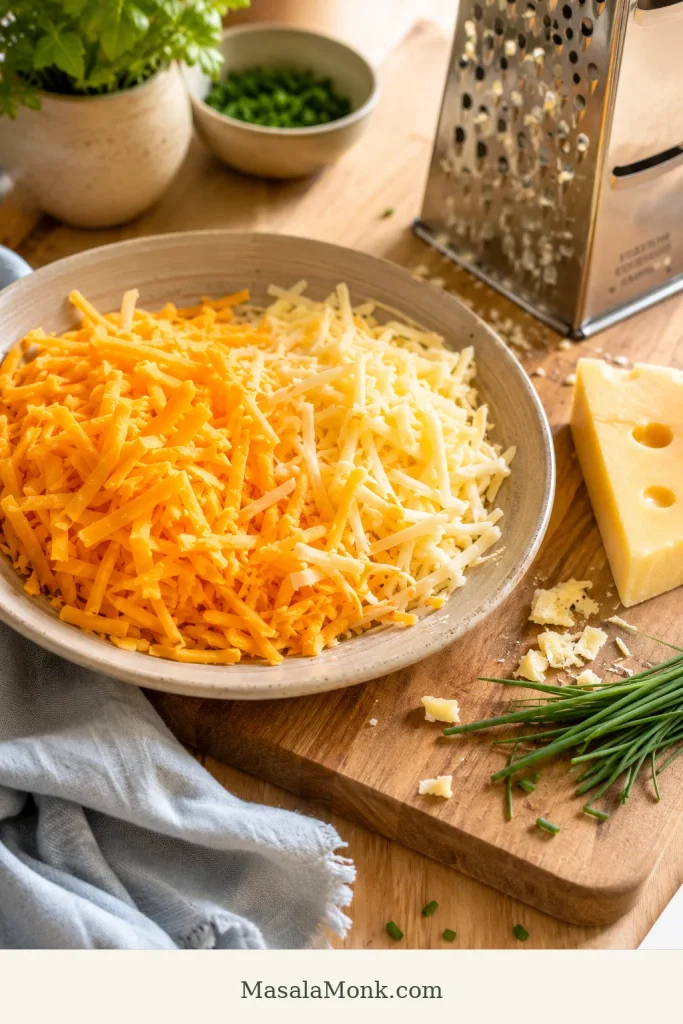
Shredded cheddar and pale Swiss or Gruyère cheese on a board with a grater and chopped chives nearby.
Sharp cheddar with Swiss or Gruyère gives ham quiche familiar melt plus a more brunch-ready finish.

Bake Time, Doneness, and Visual Cues

For a crusted quiche, use 375°F / 190°C for 35–45 minutes. A shallow quiche may finish closer to 35 minutes, while a deep-dish or vegetable-heavy one may need closer to 45–50 minutes.

Use 350°F / 175°C for the crustless version or a very deep filling. Save 400°F / 200°C mainly for par-baking crust or quick browning, not for the full custard bake.

Visual Doneness Cues

  • After par-baking: the crust should look dry and lightly set, not deeply browned.
  • After whisking: the egg mixture should look smooth and lightly yellow, not frothy.
  • Before baking: the egg mixture should sit below the rim, with a little breathing room.
  • Near the end: the top may puff slightly and turn golden in spots.
  • When done: the center should move like soft-set pudding, not ripple like raw liquid.
  • After resting: the center should look calmer, and the slice should hold when lifted.

If the crust browns too quickly, cover the edges with foil or a pie shield and keep baking until the center is set. If the top browns before the center is ready, tent the whole quiche loosely with foil.

The first time you bake quiche, the wobble can feel wrong. It is not. The quiche is done when the edges are puffed and set, the center is soft-set but not liquid, and the top is lightly golden in places.

Thermometer and Resting Cues

If using a thermometer, the center should reach at least 160°F / 71°C for egg safety. For a tender, sliceable quiche, start checking around 165°F / 74°C and avoid pushing far past 185°F / 85°C. Carryover heat and resting time will help the center finish setting.

Instant-read thermometer inserted into the center of a baked ham and cheese quiche in a white ceramic pie dish.
A thermometer gives extra confidence with quiche doneness: the center should be safe and set without baking until the eggs turn rubbery.

If you are unsure, give the quiche a few more minutes of rest before cutting rather than putting it back into the oven too quickly. Resting often fixes a soft-looking center; overbaking does not.
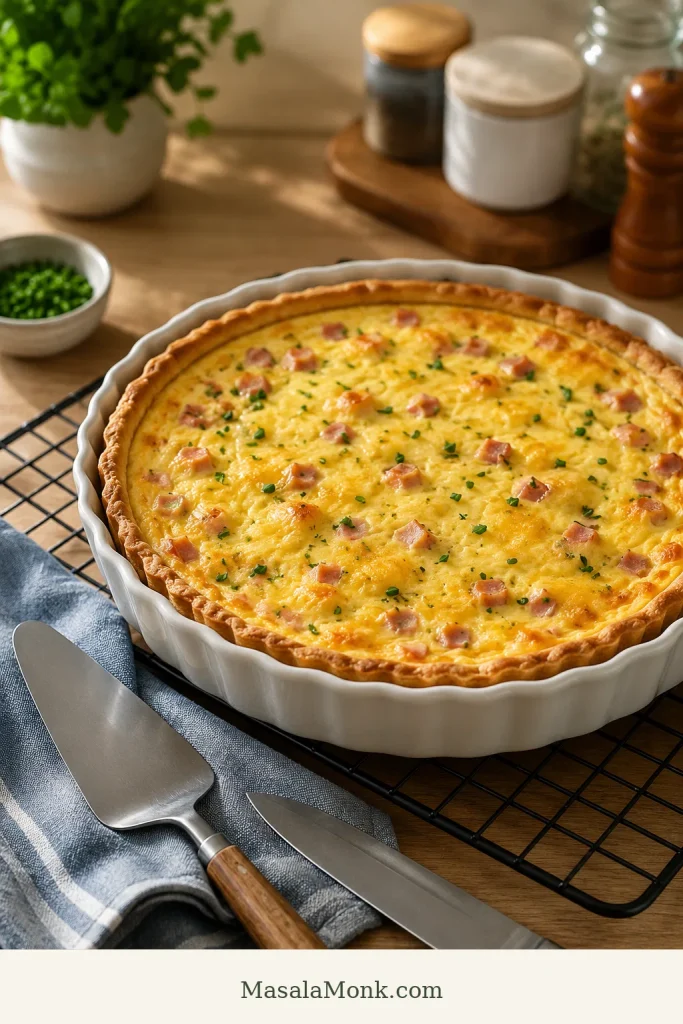
Whole baked ham and cheese quiche resting on a wire rack with a knife and pie server nearby.
Let the quiche rest before slicing; this pause helps the center settle so the slices lift cleaner and taste creamier.

Crustless Ham and Cheese Quiche and Easy Variations

Once the base is steady, this quiche is easy to bend toward the day: crusted for brunch, crustless for meal prep, mini for parties or lunchboxes.

If You Want…Do This
Classic ham and cheese quicheUse cheddar + Swiss in a par-baked crust
Richer brunch quicheUse Gruyère and a cream + milk mixture
Lighter quicheUse whole milk instead of cream or half-and-half
Crustless quicheGrease the dish well and bake at 350°F / 175°C
Vegetable quicheCook and cool vegetables before adding them
Mini quichesUse muffin tins and fill each cup about ¾ full
Leftover ham quicheDice ham small and reduce added salt if needed

Crustless Ham and Cheese Quiche

The crustless version is not just the fallback. It is the faster, lighter version for meal prep or for anyone skipping pastry.

To make it crustless, skip the pie crust and bake the egg mixture in a well-greased 9-inch / 23 cm pie dish. Use the same base: 5 eggs, 1 cup / 240 ml dairy, 1½ cups ham, 1½ cups cheese, Dijon, pepper, and herbs.

Bake at 350°F / 175°C for 30–40 minutes, or until the center is just set. The crustless version is softer than the crusted version, so let it rest for at least 10 minutes before slicing.
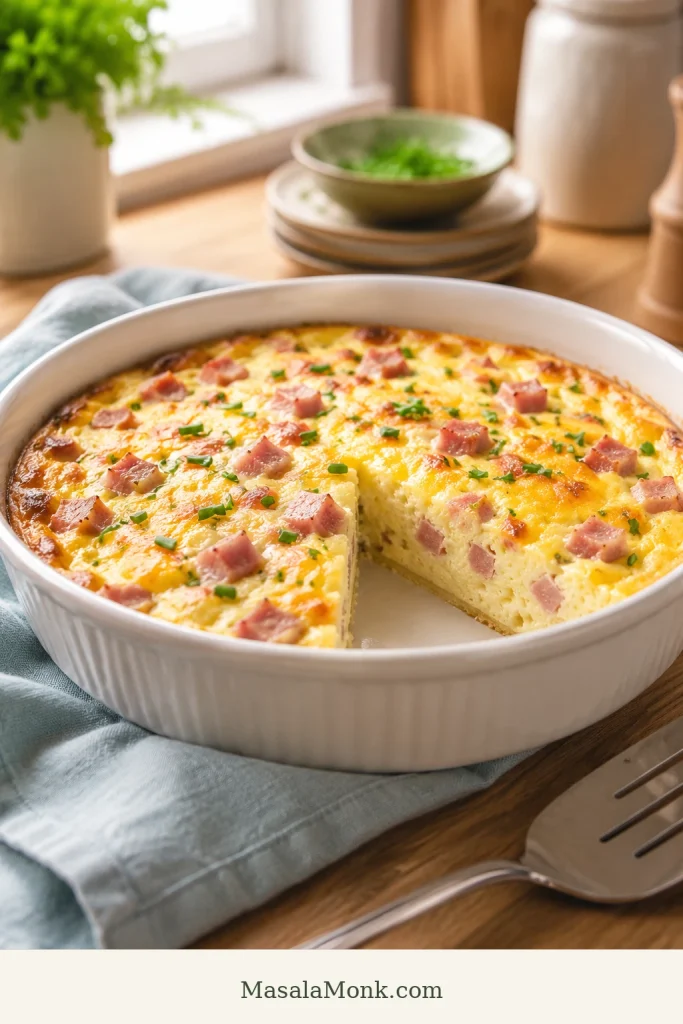
Crustless ham and cheese quiche in a white baking dish with one wedge removed, showing set custard, ham, cheese, and chives.
The lighter crustless ham and cheese quiche uses the same creamy filling but bakes directly in a greased dish.

For another no-crust egg bake, the frittata recipe is the skillet-style route; for muffin-tin meal prep, use the egg muffins recipe.

Ham and Swiss Quiche

Ham and Swiss quiche has a mild, nutty, classic brunch flavor. Use Swiss for all or part of the cheese. A good blend is 1 cup Swiss + ½ cup sharp cheddar. Dijon mustard and chives work especially well with this version.

Ham and Spinach Quiche

For ham and spinach quiche, use either 1 cup cooked fresh spinach or ½ cup frozen spinach that has been thawed and squeezed very dry. Spinach pairs well with Swiss, Gruyère, cheddar, feta, or goat cheese.

Wet spinach is not a small issue. It can make the center watery, even if the egg ratio is right.
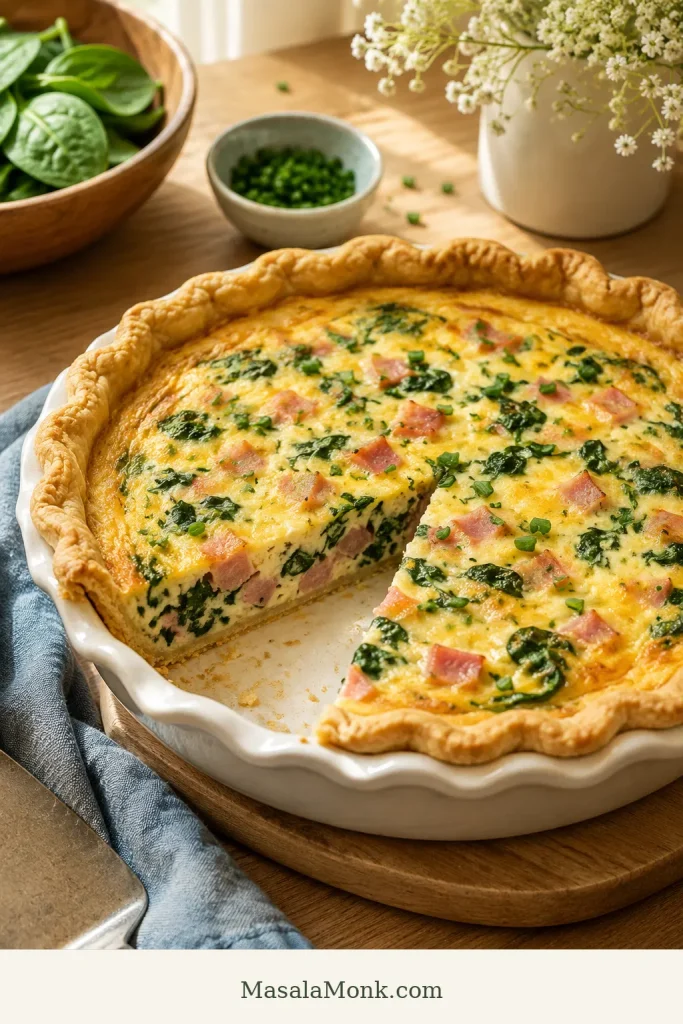
Ham and spinach quiche with a wedge cut out, showing spinach ribbons, diced ham, creamy custard, and golden crust.
Cook or squeeze spinach dry before making ham and spinach quiche; the greens should add color and flavor, not extra water.

Broccoli Ham and Cheese Quiche

For broccoli ham quiche, use 1 cup small broccoli florets. Steam, blanch, microwave, or sauté them first, then drain well and chop small. Sharp cheddar is the easiest pairing, but Swiss or Gruyère also work.
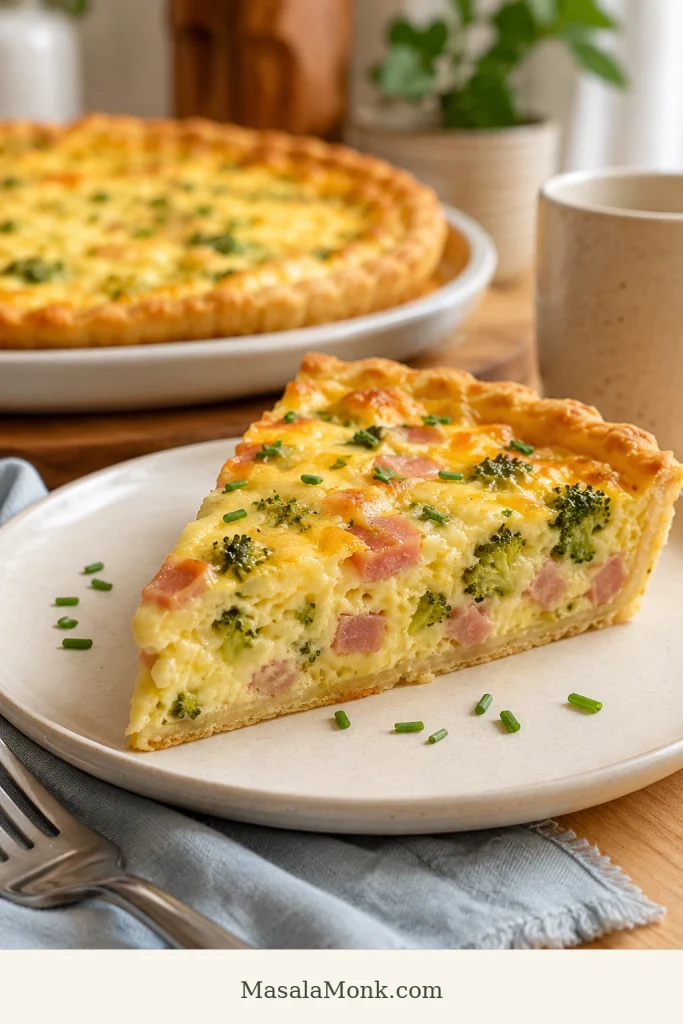
Slice of broccoli ham and cheese quiche on a plate with visible broccoli florets, diced ham, creamy custard, and crust.
Small cooked broccoli florets keep broccoli ham and cheese quiche tender, balanced, and easy to cut.

Mushroom, Onion, Asparagus, and Other Add-Ins

Add-ins are where a good quiche can go watery, so treat them before they reach the crust. A few minutes in a skillet can save the whole dish.

Add-InAmountPrep
Mushrooms¾–1 cup slicedSauté until the moisture evaporates
Onion or shallot¼–½ cup choppedSauté until softened
Asparagus¾–1 cup choppedBlanch or sauté if thick
Bell pepper½ cup dicedSauté for better texture
TomatoSmall amountRemove seeds and excess moisture

Let cooked vegetables cool for a few minutes before adding them. Hot add-ins can start setting the eggs unevenly before the dish even reaches the oven.
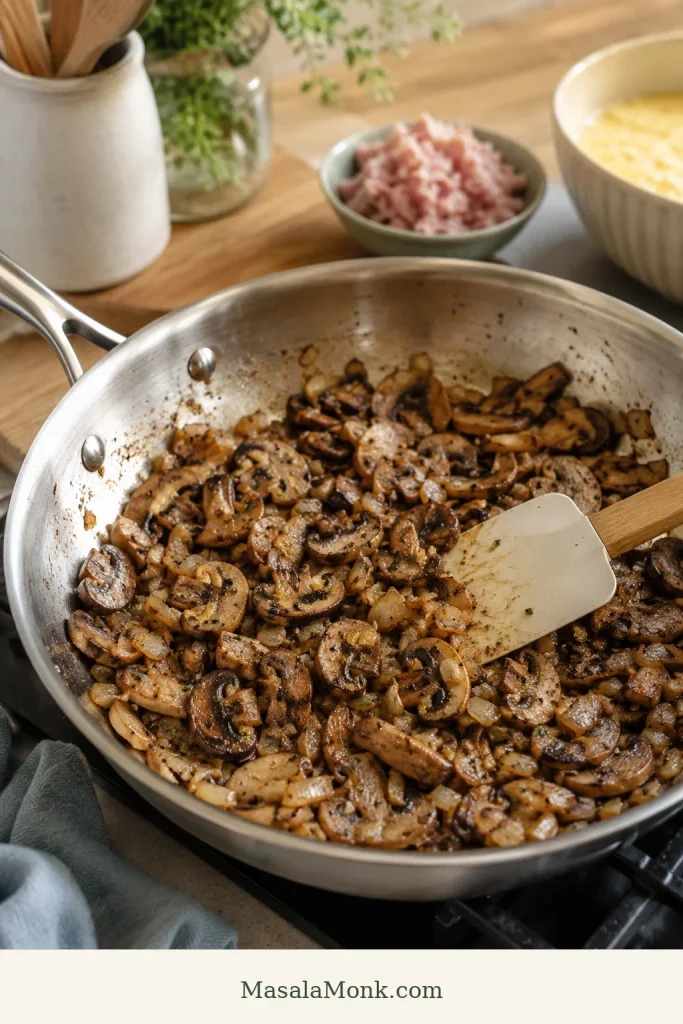
Sautéed mushrooms and onions in a skillet with a spatula, browned and cooked down with no pooled liquid.
Sauté mushrooms and onions until their moisture cooks off; this is a simple fix for watery quiche.

Mini Ham and Cheese Quiche

Mini ham and cheese quiches are best when you want party bites, brunch trays, lunchboxes, or freezer-friendly portions. Use the same egg mixture, but cut the ham and add-ins smaller so each bite gets ham, cheese, and custard. For leftovers, use the make-ahead, storage, and reheating cues below.

The full filling usually makes about 10–12 regular muffin-size mini quiches or 24–30 mini muffin-size bites, depending on how much crust and add-ins you use.

  • Regular muffin tin: bake at 350°F / 175°C for 18–25 minutes.
  • Mini muffin tin: bake at 350°F / 175°C for 14–20 minutes.
  • With crust: press small pie crust or puff pastry rounds into greased cups before filling.
  • Without crust: grease the tin very well or use silicone liners.
  • Filling level: fill each cup about ¾ full so the egg mixture has room to puff.

Let mini quiches cool for 5 minutes before loosening them with a small knife. They freeze well after baking; reheat from chilled or thawed in a 325°F / 160°C oven until warmed through.
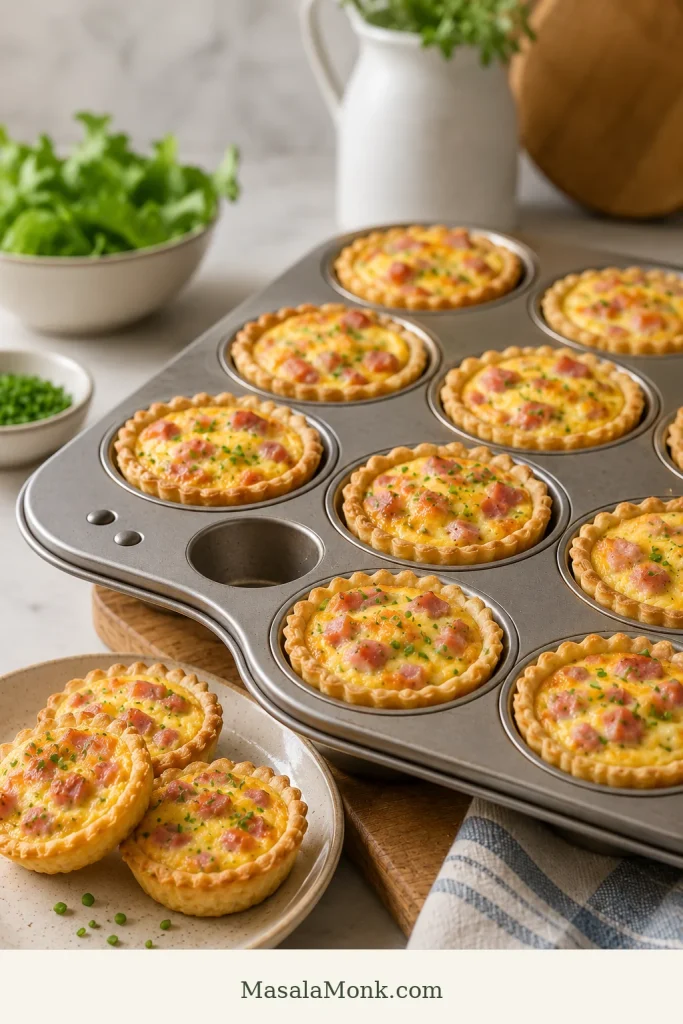
Mini ham and cheese quiches with small golden pastry crusts baked in a muffin tin, with a few placed on a nearby plate.
Party-size mini ham and cheese quiches work best with small pastry crusts, visible ham, and room for the custard to puff.

Other Shortcut Variations

Puff pastry works well for mini quiches and party bites. Crescent dough gives a softer, breadier crust. A Bisquick-style ham and cheese bake is closer to an impossible pie than a classic quiche, so it is better treated as a separate recipe rather than a small swap.

For an old-fashioned ham and cheese quiche, keep it simple: pie crust, cooked ham, cheddar and Swiss, half-and-half, green onions or chives, and black pepper.

Make Ahead, Storage, and Reheating

Quiche is one of the rare egg dishes that actually likes being made ahead. It can rest, settle, reheat, and still taste good when everyone finally reaches the table.

This is also why quiche works so well for hosting: it gives you something generous to serve without asking you to cook every egg to order. When the timing is sorted, jump to what to serve with it for plate ideas.

For a crisper crust, do not pour the raw egg mixture into the shell many hours before baking. The crust can absorb moisture and soften before it ever reaches the oven. If you want to prep ahead, par-bake the crust, dice the ham, shred the cheese, cook any vegetables, and keep the egg mixture separate until baking.

For safety, cooked egg dishes should not sit at room temperature for more than 2 hours; the FDA gives the same basic egg-safety guidance.

Fridge

Let the quiche cool completely, then cover it and refrigerate for 3–4 days, whole or in slices. That timing lines up with USDA leftover food safety guidance.

Freezer

Quiche freezes more cleanly after baking. Cool it completely, wrap it tightly, and freeze it whole or sliced for up to 2 months for the creamiest texture.

The crust may soften slightly after freezing, but reheating in the oven helps bring it back. If freezing slices, wrap them individually or place parchment between them so they do not stick together.

For a freezer breakfast that reheats faster than quiche, MasalaMonk’s breakfast burrito recipe is the better handheld option.

Reheating

For a better texture, reheat slices in a 325°F / 160°C oven until warmed through. Reheat loosely covered with foil, then uncover for the last few minutes if the crust needs crisping.

The microwave works for individual slices when speed matters, but it will soften the crust. If reheating from frozen, thaw overnight in the refrigerator first.
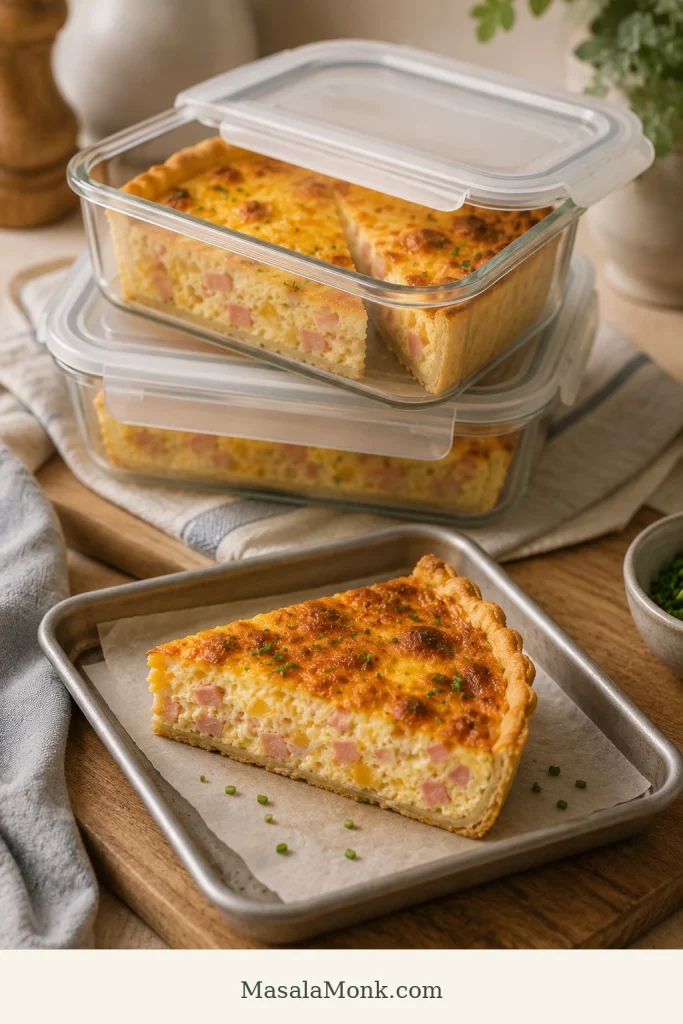
Slices of ham and cheese quiche stored in clear containers with one slice on a parchment-lined reheating tray.
Make-ahead ham and cheese quiche slices store well once cooled; reheat them in the oven or toaster oven when you want the crust to stay crisp.

What to Serve with Ham and Cheese Quiche

The quiche already brings richness, salt, and comfort. The best sides simply make the plate feel fresher. A crisp salad or fresh fruit keeps each creamy, salty bite from feeling heavy.
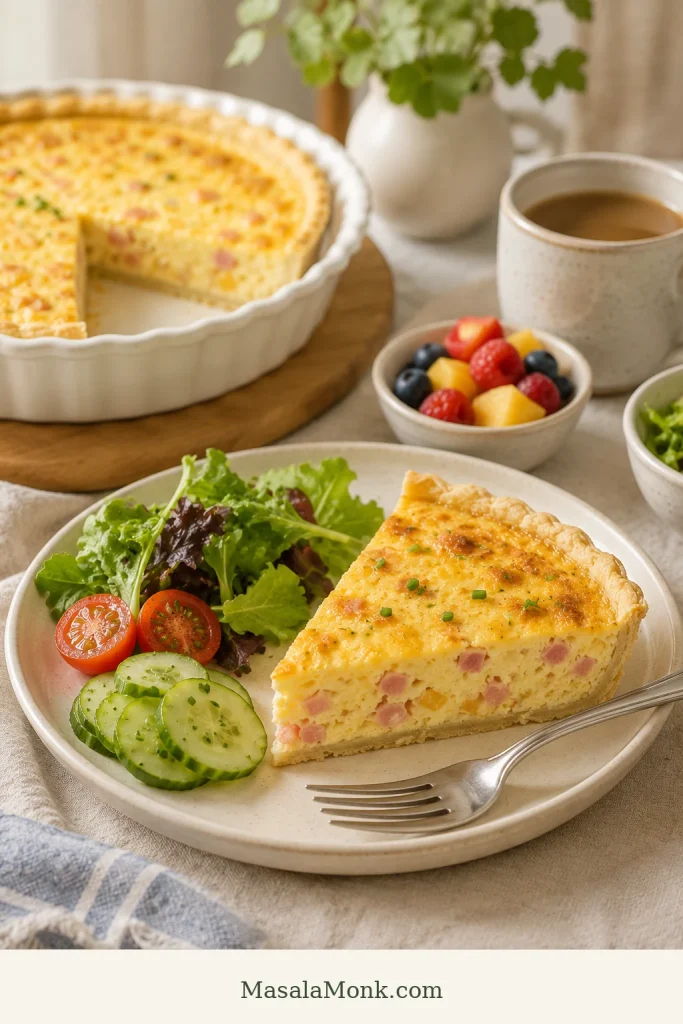
Plated slice of ham and cheese quiche served with greens, cucumber slices, tomatoes, fruit, and coffee on a brunch table.
Serve the rich quiche with fruit, greens, cucumber, or coffee so the creamy, salty slices feel balanced.

How to Avoid Watery, Soggy, or Rubbery Quiche

When quiche goes wrong, it usually gives you clues. A watery middle, soggy bottom, rubbery texture, or salty bite can almost always be traced back to moisture, timing, salt, or overfilling — not to quiche being difficult.

Once you know what the center should look like, quiche stops feeling mysterious.

ProblemMost Likely CauseFix Next Time
Watery centerWet vegetables, watery ham, too much dairy, or underbakingCook and drain add-ins, keep the ratio steady, and rest before slicing
Soggy crustCrust not par-baked or custard sat in crust too longPar-bake first and assemble close to baking
Rubbery textureOverbakingPull while the center is still soft-set
Too saltySalty ham and cheese plus full added saltUse ¼ teaspoon salt or less with salty ham
OverflowShallow crust or filling too close to rimUse deep-dish crust and stop below the rim

The 3 Biggest Quiche Mistakes

  • Skipping the par-bake: this is the fastest path to a soft bottom crust.
  • Adding wet ingredients: watery ham, spinach, mushrooms, and tomatoes can loosen the custard.
  • Baking until fully firm: pull it while the center is still soft-set, then let it rest.

Why is my quiche watery?

Watery quiche is almost always a moisture or timing problem. The usual culprits are wet spinach, raw mushrooms, watery ham, too much dairy, underbaking, or slicing before the center has had time to settle.

  • Cook and drain vegetables before adding them.
  • Squeeze spinach very dry.
  • Pat wet ham dry.
  • Use the 5 eggs to 1 cup dairy ratio.
  • Bake until the center is just set.
  • Rest for 10 minutes before slicing.

Why is my crust soggy?

A soggy crust usually means the crust was not par-baked, the egg mixture sat in the crust too long before baking, or wet ingredients released moisture into the bottom. Par-bake the crust, cook and drain vegetables, and avoid assembling the raw custard in the crust too far ahead.
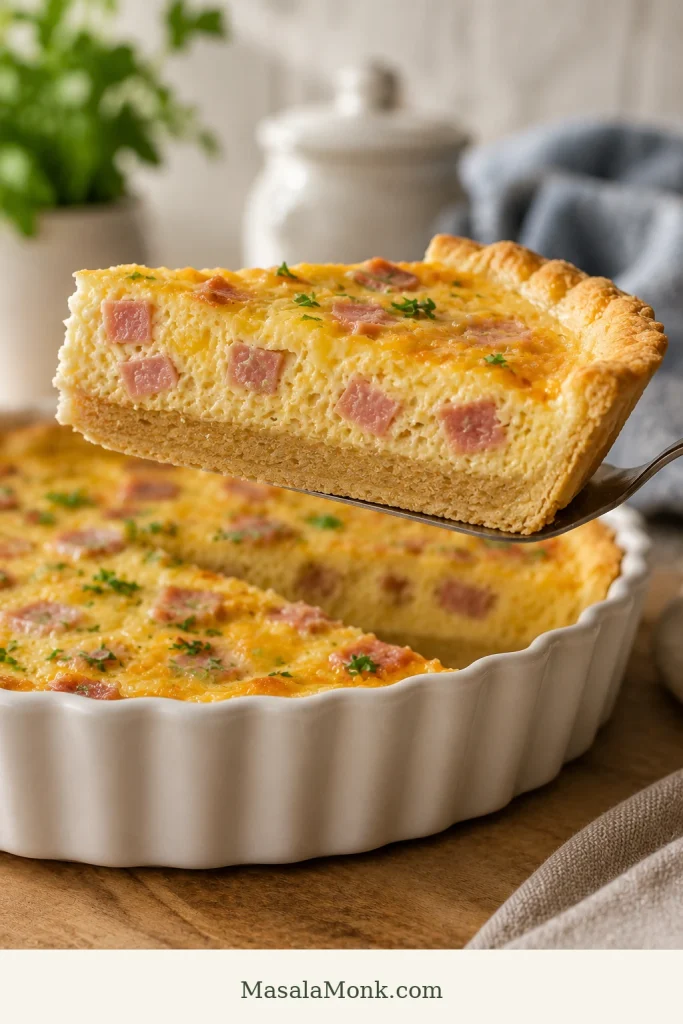
Lifted slice of ham and cheese quiche showing a clean, firm bottom crust, creamy custard, diced ham, melted cheese, and golden edge.
The best no-soggy-bottom proof is underneath: the crust should look firm enough to lift, not pale, wet, or collapsed.

Why is my quiche rubbery?

Rubbery quiche is usually overbaked. Eggs become firm and tough when they cook too long. Remove the quiche when the center still has a gentle wobble. It will finish setting as it rests.

Why did the center not set?

The center may not set if the quiche is very deep, the oven temperature is too low, the mixture has too much liquid, or it simply needs more time. Cover the crust edges with foil if needed and continue baking until the center no longer looks liquid.

Why is it too salty?

Ham and cheese both bring salt. If your ham is salty, use less salt in the egg mixture. Dijon, black pepper, green onions, chives, and a small amount of cream can help balance the flavor without adding more salt.

Why did it overflow?

The crust may have been too shallow or filled too close to the top. Use a deep-dish crust when possible, stop before the egg mixture reaches the rim, and always bake the quiche on a rimmed baking sheet.

FAQs

Does ham and cheese quiche work without crust?

Yes. Grease a 9-inch / 23 cm pie dish, add the filling, and bake at 350°F / 175°C for 30–40 minutes. Rest before slicing so the center can settle.

Milk instead of cream: will the quiche still set?

Yes. Whole milk works. Keep it to 1 cup / 240 ml so the center still slices cleanly. It will taste lighter than a cream version, but it will still be a proper, sliceable quiche.

Best substitute for half-and-half

Use ½ cup / 120 ml heavy cream plus ½ cup / 120 ml whole milk. You can also use 1 cup / 240 ml whole milk for a lighter version.

Best cheese for ham quiche

Sharp cheddar gives bold flavor, Swiss gives a classic ham quiche taste, and Gruyère makes it richer. A cheddar-Swiss blend is the easiest everyday choice.

Frozen pie crust: deep-dish or regular?

Deep-dish is better because regular frozen shells may not hold all the filling. Par-bake the crust first, place it on a rimmed baking sheet, and avoid overfilling it.

Spinach in quiche: fresh, frozen, cooked, or raw?

Fresh spinach should be wilted first, and frozen spinach should be thawed and squeezed very dry. Raw or wet spinach can make the quiche watery.

Make-ahead quiche: bake first or assemble later?

Bake it first for the easiest make-ahead plan. To prep parts ahead, keep the par-baked crust, cooked add-ins, cheese, ham, and egg mixture separate until baking.

Freezing ham and cheese quiche: whole or sliced?

Both work. Bake it first, cool it completely, then freeze it whole or in slices. Slices are easier for quick meals. Thaw overnight in the refrigerator and reheat in the oven for the best texture.

Doneness cues for creamy, sliceable quiche

The edges should be set, and the center should look soft-set, not liquid. A gentle wobble is okay. If using a thermometer, the center should reach at least 160°F / 71°C.

Watery quiche: what went wrong?

Quiche usually turns watery because of wet vegetables, watery ham, too much dairy, underbaking, or slicing too soon. Cook and drain add-ins, use the right egg-to-dairy ratio, and rest it before slicing.

Is ham and cheese quiche the same as quiche Lorraine?

Not exactly. Quiche Lorraine is traditionally made with bacon or lardons and a savory custard. Ham and cheese quiche has a similar creamy egg base, but uses cooked ham and usually includes cheese like cheddar, Swiss, or Gruyère.

Final Thoughts

Once the ratio makes sense, this stops feeling like a recipe you have to follow tightly and starts feeling like a brunch formula you can use. Cooked ham after a holiday, spinach from the fridge, cheddar one week, Swiss the next, crusted for brunch, crustless for meal prep — it all works as long as the base stays steady.

That is the kind of recipe worth keeping: calm, flexible, and good enough for both leftover ham and a proper brunch table. Slice it warm, serve it with something crisp or fresh, and let the ham, cheese, custard, and flaky crust do the quiet work.

If you make it, start with the cheddar-Swiss version once, then tell me where you took it: crustless, extra herbs, leftover holiday ham, spinach, broccoli, or a different cheese blend.

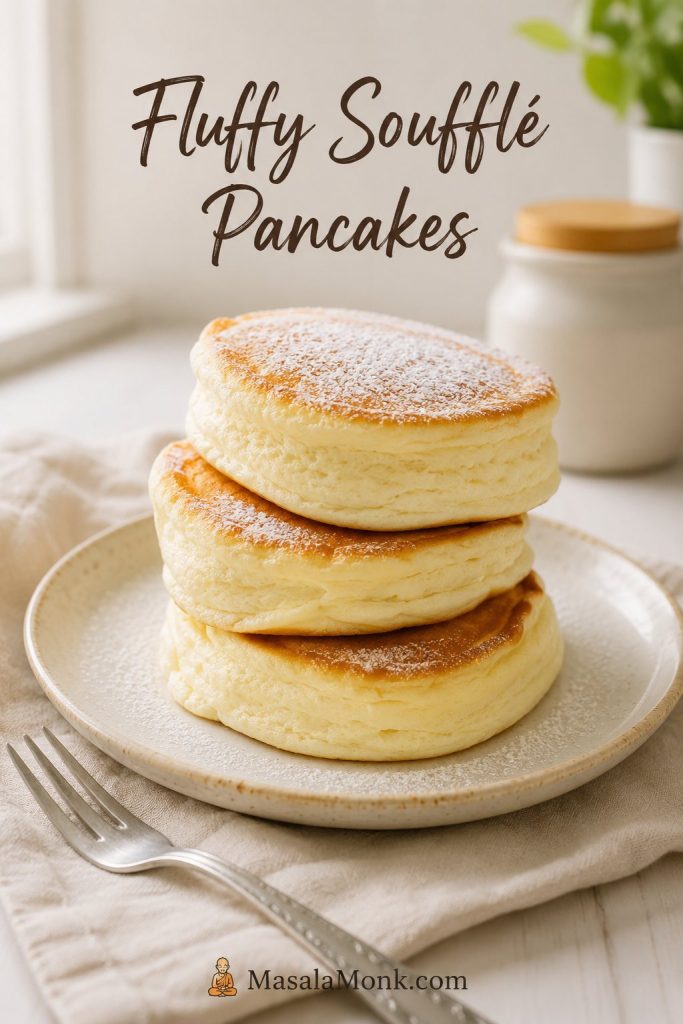
Posted on Leave a comment

Japanese Pancakes Recipe: Tall, Fluffy Soufflé Pancakes

Tall Japanese soufflé pancakes stacked on a pale plate with whipped cream, powdered sugar, and syrup nearby.

Japanese pancakes look magical until you try to make them at home. They rise like little clouds, jiggle when the plate moves, and seem soft enough to collapse under a spoon. Then the real fear arrives: what if they spread flat, burn on the bottom, stay raw in the center, or puff up beautifully in the pan and sink the second you serve them?

The real challenge is technique, not ingredients. That is the moment this Japanese pancakes recipe is built for. The ingredients are simple, but the method matters. These are not regular pancakes with extra baking powder. They are small soufflés cooked like pancakes, and once you treat them that way, the method starts to make sense.

The secret is a stable meringue, gentle folding, controlled heat, a little steam, and patience. In this guide, you will get exact grams and spoon measures, the right batter texture, the meringue stage to aim for, ring-mold and no-mold methods, a pancake-mix shortcut, and clear fixes for deflating, spreading, burning, shrinking, and raw centers. If you only remember one framework, start with the 3 checks that decide whether Japanese pancakes rise or collapse.

By the time you reach the pan, you will know what the meringue should look like, how the batter should stand, when to flip, and why a pancake that looks almost ready often needs one more covered minute. That extra minute is not hesitation; it is usually the difference between a pancake that holds and one that sinks as it cools.

If you want a more classic pancake stack instead of the tall soufflé style, you may also like these fluffy buttermilk pancakes with stewed cinnamon apples. This recipe is for the café-style Japanese soufflé pancakes that are tall, soft, jiggly, and best eaten right away.

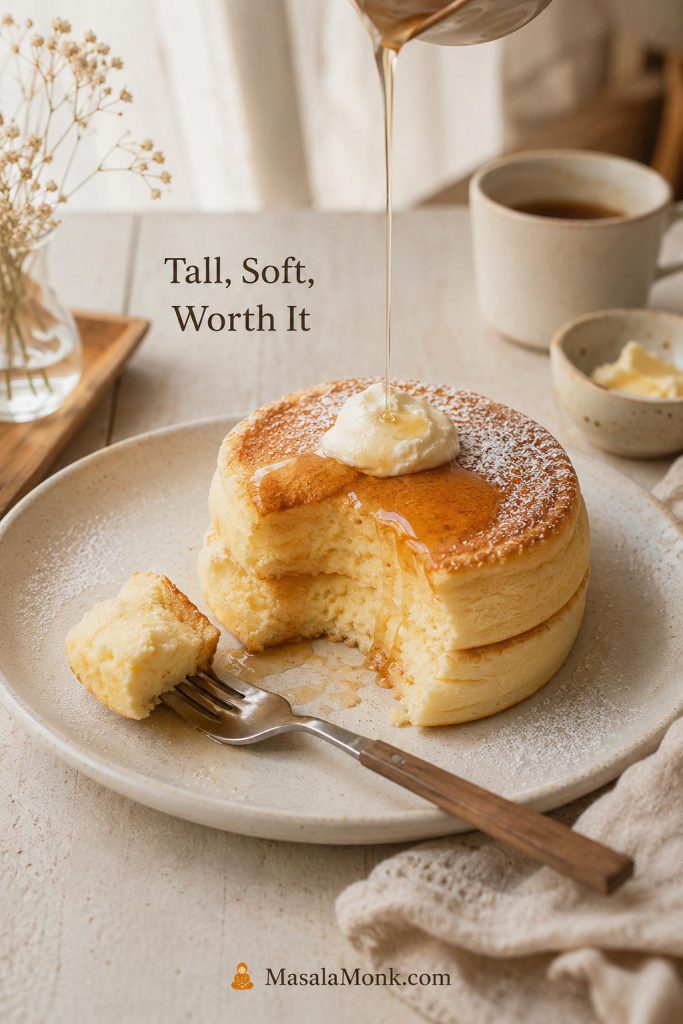
This is the home-cook target: soft, tall pancakes that feel special without needing every edge to look like a perfect café cylinder.

Homemade fluffy Japanese soufflé pancakes stacked on a plate with powdered sugar and a fork nearby.
A home batch does not need perfect café edges; instead, aim for fluffy soufflé pancakes with height, softness, and a fully set center.

Quick Answer: How Do You Make Fluffy Japanese Pancakes?

Japanese pancakes, often called Japanese soufflé pancakes, are tall pancakes made by folding whipped egg whites into a small yolk batter and cooking the batter slowly in a covered pan. The fluff comes mostly from meringue, not from baking powder alone.

For the best height, beat the egg whites to glossy stiff peaks, fold gently, scoop the batter into tall mounds, cook on gentle heat, and use a little steam so the center sets before the outside over-browns. A ring mold gives the neatest shape, but the no-mold Japanese pancake method works by stacking the batter in layers. If your first batch spreads, burns, or sinks, use the troubleshooting guide before changing the whole recipe. Serve them immediately because this soufflé-style texture naturally settles as it cools.

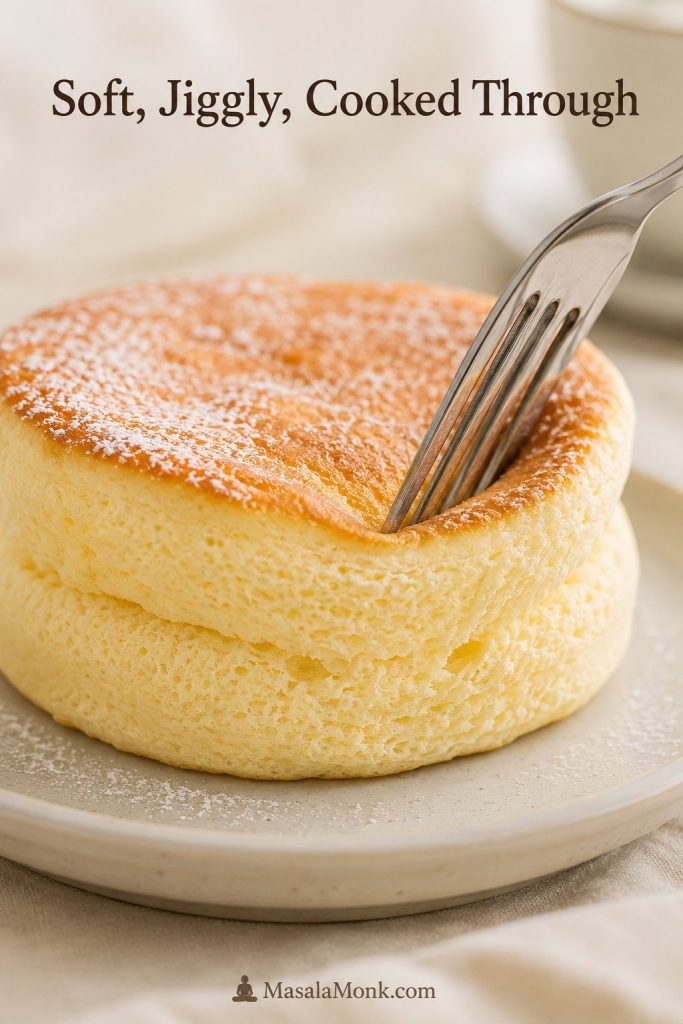
What Jiggly but Cooked Through Looks Like

The pancake should move softly, but it should still feel set. Think gentle spring, not wet batter hiding under a browned top.

A fork gently pressing into a soft Japanese soufflé pancake to show its springy texture.
Jiggly should mean soft and bouncy, not wet. If the pancake springs back gently, the center is much closer to ready.

Japanese Pancakes at a Glance

Yield2–3 thick pancakes
Texture goalTall, soft, airy, gently jiggly, cooked through
Meringue targetGlossy firm/stiff peaks
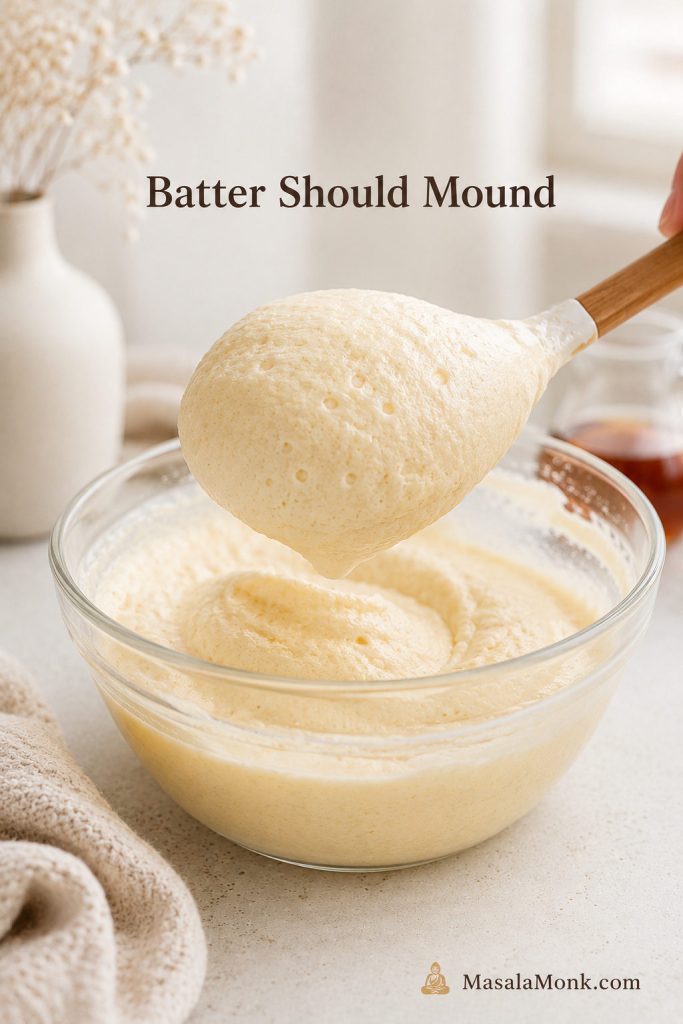
Batter textureThick and spoonable; it should mound, not pour
Pan targetAbout 300°F / 150°C
Workable pan range285–320°F / 140–160°C
First side6–8 minutes covered, depending on size
Second side4–6 minutes covered
Cook timeAbout 12–15 minutes per batch
MoldOptional; no-mold method included
Best servedImmediately, ideally within 5–10 minutes
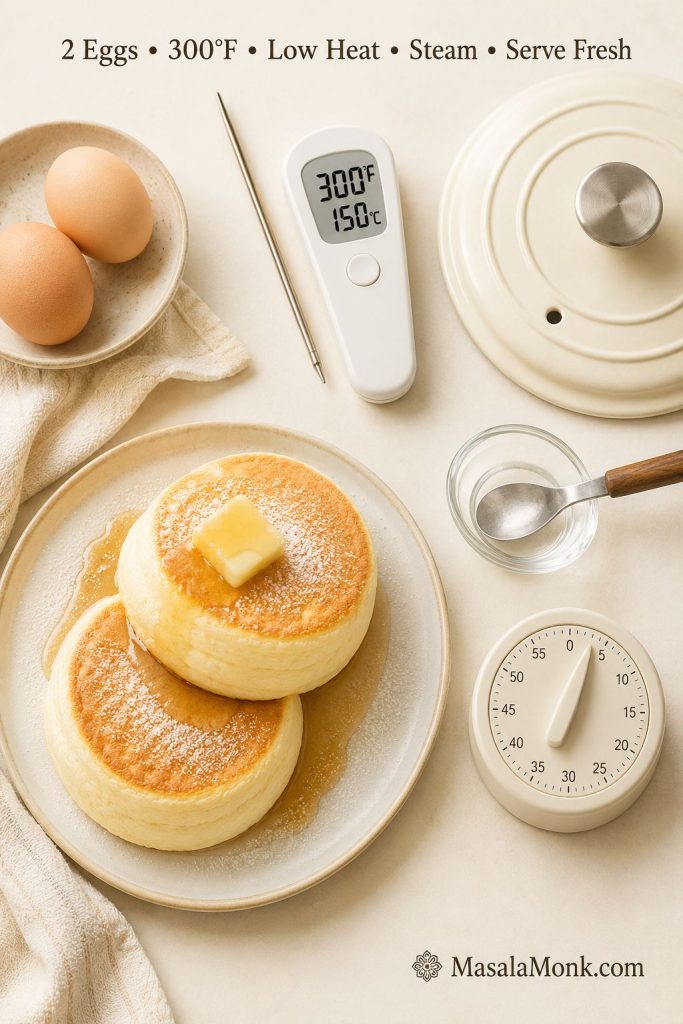
Japanese pancake quick guide showing two eggs, a 300°F pan cue, a lid, a water spoon, and pancakes.
Before cooking, remember the working numbers: two eggs, low heat near 300°F, a covered pan, steam, and quick serving.

What Are Japanese Pancakes?

In this tall, café-style version, Japanese pancakes means Japanese soufflé pancakes: soft, airy pancakes made with whipped egg whites and cooked gently until they rise into a thick, delicate stack.

They are different from regular pancakes. A normal pancake batter is mixed, poured, and cooked fairly quickly. Japanese soufflé pancake batter is built around foam. The egg whites are beaten into a meringue, folded into a yolk mixture, then cooked low and slow so the foam has time to set.

That is why the method feels more precise than a usual pancake recipe. You are not only browning batter on a pan. You are setting a fragile structure full of air. Once that idea clicks, the recipe stops feeling mysterious and starts feeling manageable.

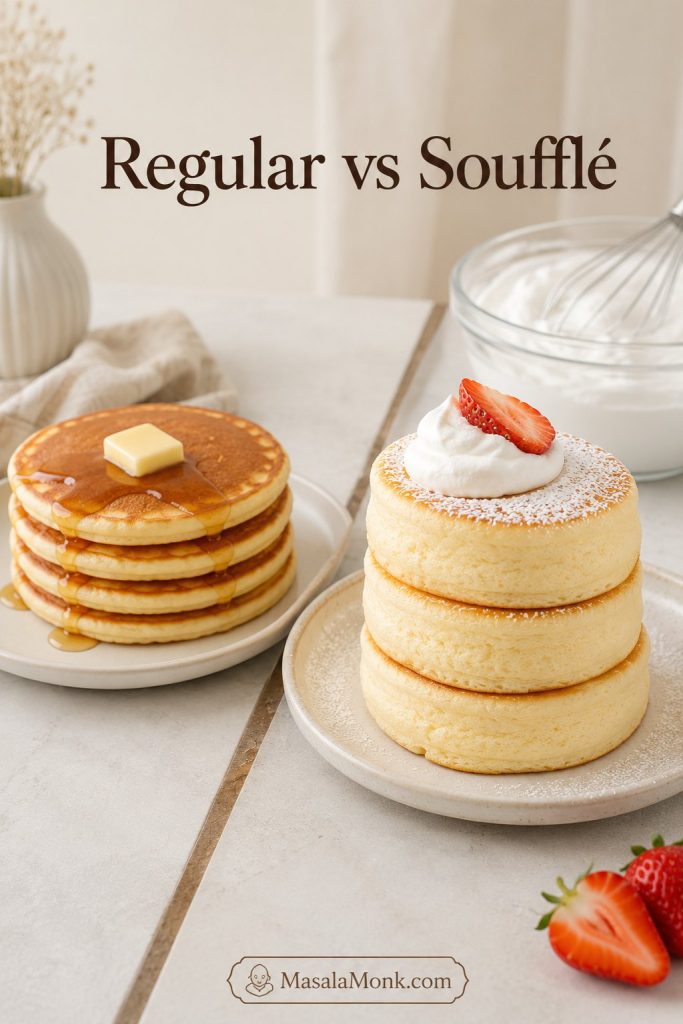
Regular pancakes compared with taller Japanese soufflé pancakes and a meringue bowl in the background.
Because this batter is lifted by whipped egg whites, it behaves more like a delicate pan-cooked soufflé than a regular pancake.

Japanese Hotcakes vs Japanese Soufflé Pancakes vs Fuwa Fuwa Pancakes

The names can get confusing because several styles of Japanese pancakes appear in cafés, cookbooks, and social videos. Here is the simple difference.

TermWhat it usually meansTexture
Japanese hotcakesThicker, sweeter, more regular-style pancakes, often made from a batter or mixSoft, cakey, and sturdy
Japanese soufflé pancakesTall pancakes lifted with whipped egg whites and cooked slowlyAiry, jiggly, delicate, and cloudlike
Fuwa fuwa pancakesA texture-focused name for soft, fluffy pancakesLight, soft, and pillowy
Jiggly pancakesA social-media-friendly name for Japanese soufflé pancakesWobbly and tall, but still cooked through
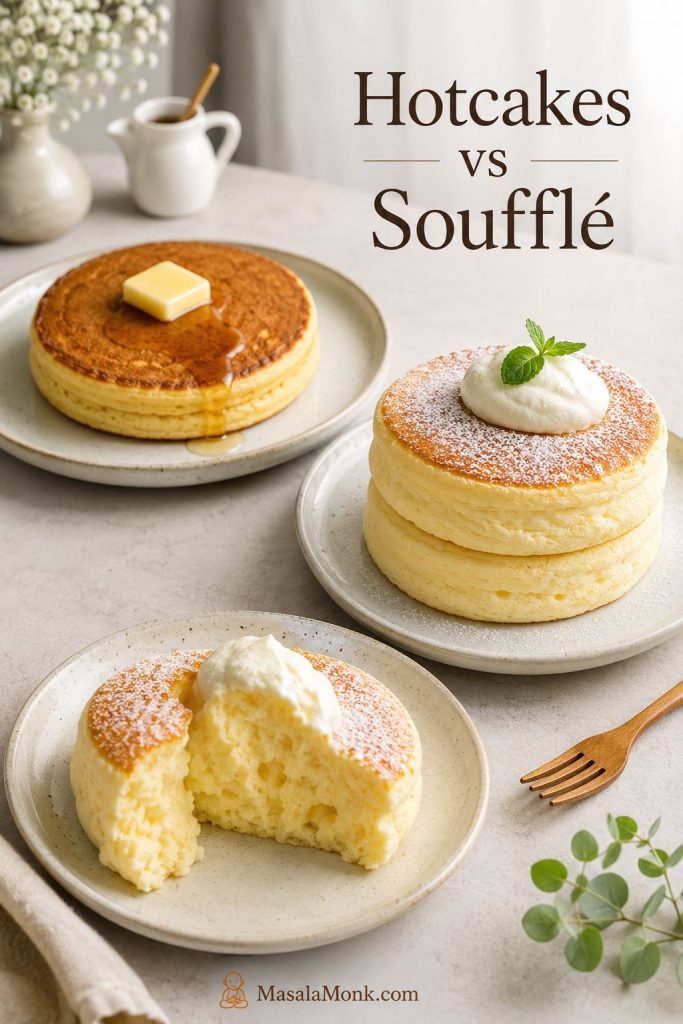
Japanese hotcakes, Japanese soufflé pancakes, and a soft fuwa fuwa pancake texture shown together.
Japanese hotcakes are sturdier and more cake-like; soufflé pancakes need meringue, low heat, and steam for their tall café-style texture.

This recipe focuses on the tall, meringue-based pancake version. Japanese soufflé cake is a different dessert, usually closer to Japanese cheesecake or cotton cheesecake, which is baked rather than cooked on a skillet. There is a short note on that difference later in the post.

So if you came here for the tall, jiggly café pancakes, you are in the right place. If you wanted a sturdier everyday hotcake, treat this as the soufflé-style weekend version instead.

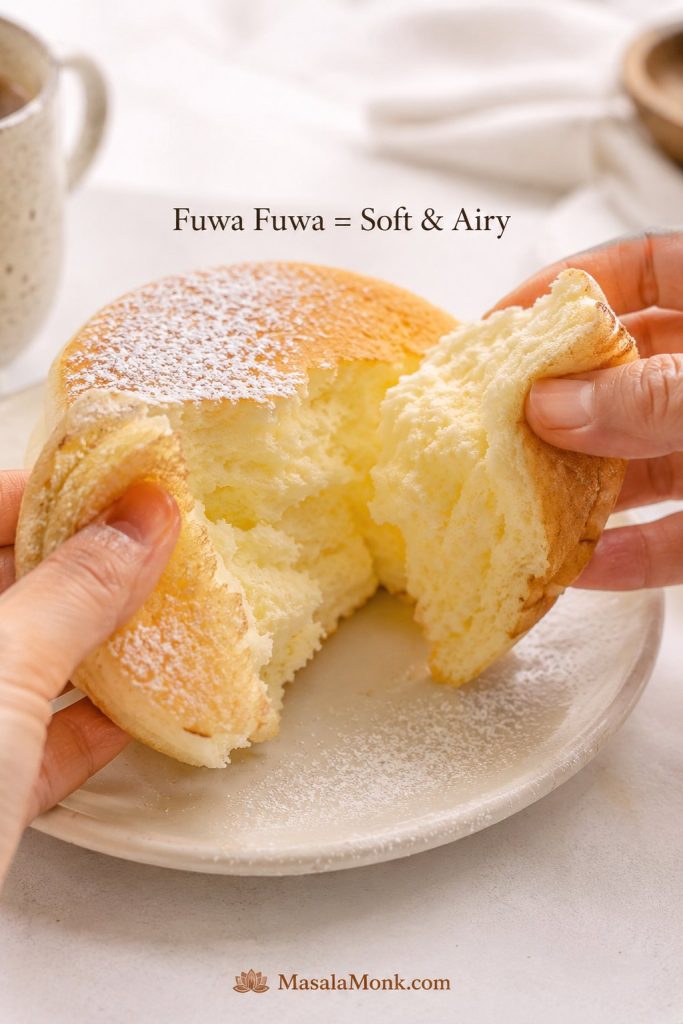
What Does Fuwa Fuwa Mean?

Fuwa fuwa is a Japanese expression used for something soft, airy, and fluffy. In a pancake context, it describes the texture people want from café-style Japanese pancakes: tall, tender, light, and gently wobbly.

Fuwa fuwa texture does not come from making the batter sweeter or loading it with baking powder. It comes from air. The egg whites trap tiny bubbles, sugar helps stabilize those bubbles, and gentle heat gives the pancake enough time to cook without collapsing too quickly.

Texture target: A good Japanese soufflé pancake should feel soft and airy, with a gentle jiggle. It should not be wet, runny, or raw in the center.

A Japanese pancake being pulled open to show a soft airy interior crumb.
Fuwa fuwa is the soft, airy texture you are chasing, so protect the foam from mixing bowl to pan.

Before You Start: Set Yourself Up to Win

This small setup step makes the recipe much easier. Once the meringue is folded into the batter, the clock starts. The batter slowly loses air as it sits, so you do not want to stop halfway through to find a lid, wash a spatula, or clear space on the stove.

  • Use clean, dry bowls and beaters. Grease or yolk in the egg whites can weaken the meringue; the meringue guide shows what the right texture should look like.
  • Have the pan, lid, spatula, water, and serving plates ready. The batter should be cooked soon after folding.
  • Start with gentle heat. You can always cook a little longer, but you cannot un-burn the outside.
  • Make only 2–3 pancakes at once. Crowding makes flipping harder and lowers control.
  • Serve immediately. These pancakes are meant to be eaten fresh, while the structure is still warm and lifted.

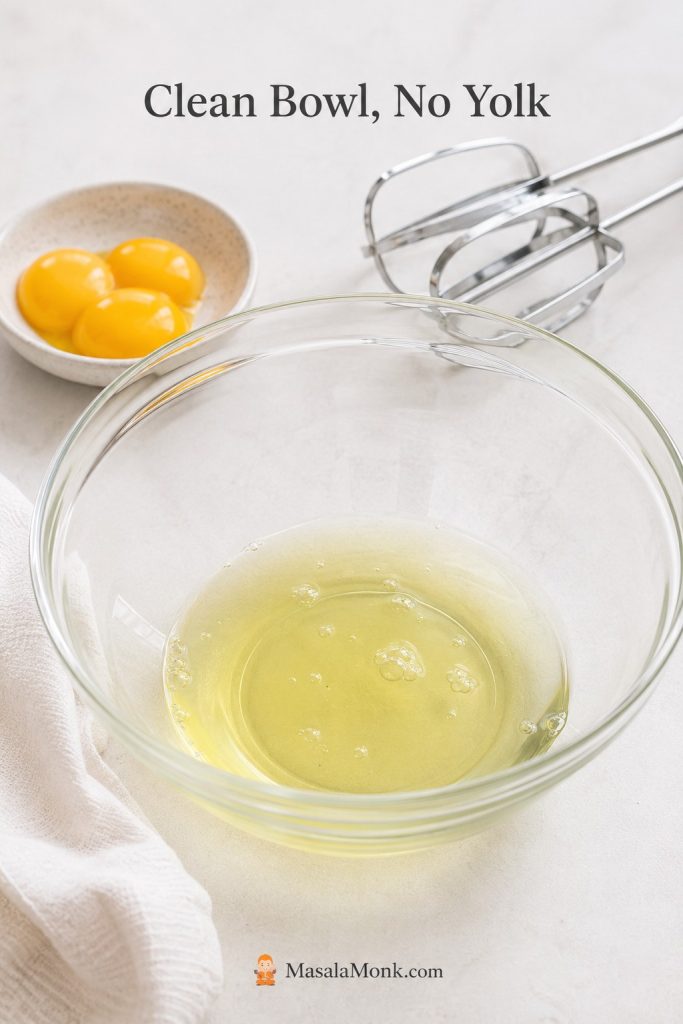
Why the Egg White Bowl Must Be Clean

Before you beat the whites, check the bowl and beaters. This tiny setup detail protects the foam that gives the pancakes their height.

Egg whites in a clean bowl with separated yolks and beaters nearby for making meringue.
Start with spotless egg whites. Even a small streak of yolk or grease can keep the meringue from whipping properly.

Beginner reassurance: Your first batch may not look like a café stack, and that is completely normal. If the pancakes taste good but sit a little lower, you are already close. The next batch usually improves once you understand your pan heat and meringue texture.

Why This Japanese Pancakes Recipe Works

Home kitchens are messy in the best way: one stove runs hot, another pan holds heat differently, and not everyone has a ring mold. Instead of asking you to trust the timer blindly, this method shows you what to look for at each stage.

  • Meringue gives height. The whipped egg whites are the main lift in this style. Baking powder helps a little, but it cannot replace a strong foam.
  • A small amount of flour keeps the pancakes light. Too much flour makes them cakey and heavy; too little structure makes them fragile.
  • Cornstarch gives extra support. A teaspoon helps the delicate foam hold together without making the pancake dense.
  • Slow covered cooking sets the middle. Tall pancakes need more time than normal pancakes. High heat gives you a browned outside and a wet center.
  • Steam helps the pancake set. A covered pan traps moisture and heat around the tall batter so the inside cooks through.
  • Layered scooping builds height without a mold. Instead of pouring all the batter at once, you add it in mounds so the pancake rises upward, not outward.

The 3 Checks That Decide Whether They Rise or Collapse

If the recipe starts to feel fussy, bring it back to three checks: the meringue should hold itself, the batter should stand in a mound, and the heat should be gentle enough that the middle sets before the bottom browns too deeply.

CheckWhat you wantWhat it tells you
MeringueShiny, firm peaks that hold their shapeA drooping meringue usually leads to spread; a dry, clumpy one is hard to fold smoothly.
BatterThick, airy, and able to mound on a spoonA batter that slides off the spoon instead of sitting in a mound will usually cook flatter.
HeatGentle enough to cook slowly under a lidThe bottom should set and lightly color while the center has time to catch up.

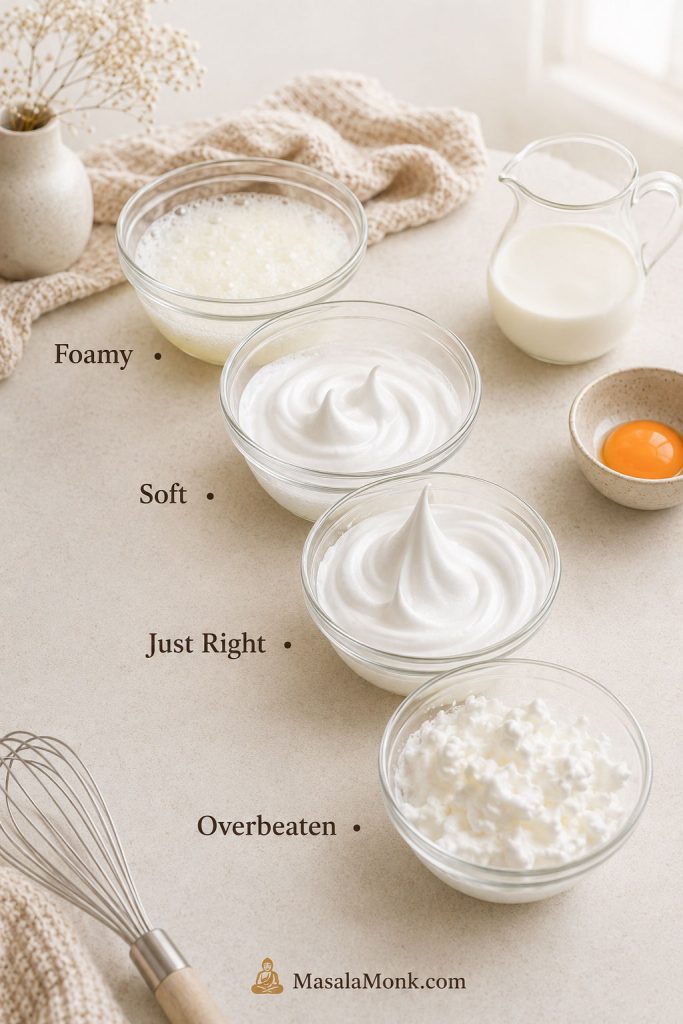
Meringue Stages for Japanese Pancakes

Use the meringue stage as your first checkpoint. Foam is too early, soft peaks are usually weak, glossy firm peaks are the target, and dry clumps mean you went too far.

Four meringue stages for Japanese pancakes showing foamy, soft, glossy stiff, and overbeaten egg whites.
Use the stages as a checkpoint: keep beating past foam and soft peaks, then stop at glossy firm peaks before the meringue breaks.

A pancake that looks tall but feels liquid under the spatula needs more covered time, not a brave flip. In testing, the pancakes that looked almost ready were usually the ones that needed one more covered minute.

Ingredients for Japanese Soufflé Pancakes

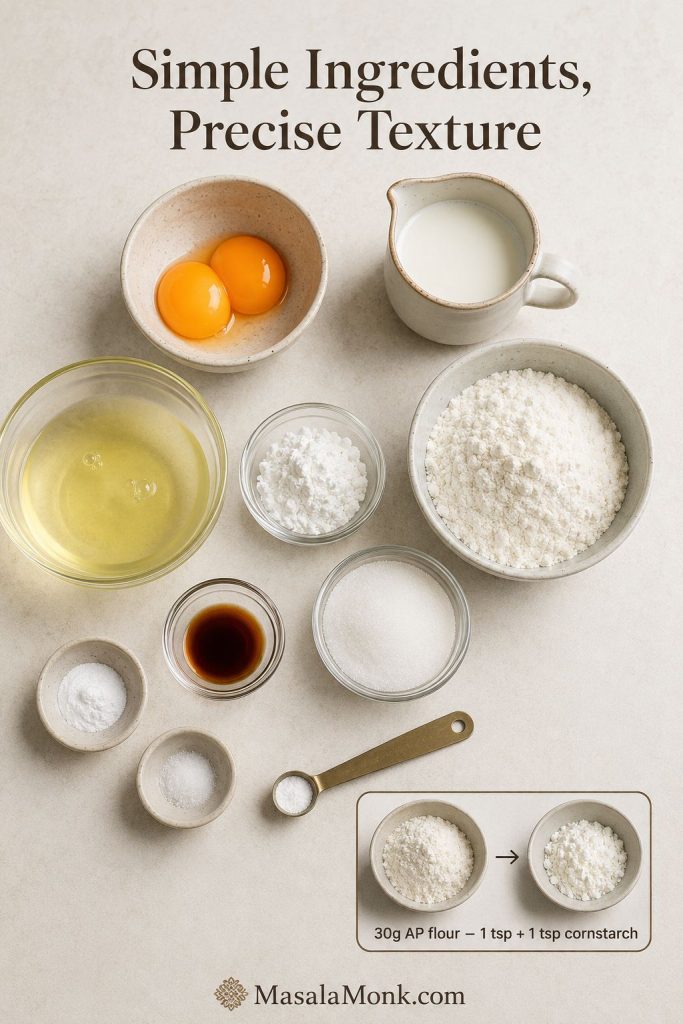
Use a scale if you have one. This is a tiny batter, so small changes matter. An extra splash of milk can make the batter slide instead of mound, and a heavy scoop of flour can make the pancakes feel cakey instead of cloudlike. The gram amounts in this recipe are the ones to follow here. After mixing, compare your bowl with the batter texture cues before scooping.

Ingredients for Japanese soufflé pancakes arranged on a counter with eggs, milk, flour, sugar, cornstarch, and a cake flour swap note.
Small measurements matter here: too much milk loosens the batter, while careful flour and cornstarch balance keeps the texture light.
IngredientAmountWhy it matters
Large egg yolks2 yolks, about 35–40gMake the rich base of the batter
Large egg whites2 whites, about 60–65gCreate the main soufflé lift
Whole milk20ml / 1 tbsp + 1 tspLoosens the yolk batter without making it runny
Vanilla extract½ tspSoftens the eggy flavor
Cake flour30g / about ¼ cup spooned and leveledGives light structure
Cornstarch1 tsp / about 3gHelps support the delicate foam
Baking powder¼ tspAdds a little backup lift
Fine saltPinchBalances the sweetness
Granulated sugar24–25g / 2 tbspSweetens and stabilizes the meringue
Cream of tartar¼ tspHelps stabilize the egg whites
Neutral oil or melted butterFor greasingPrevents sticking without frying the pancake
Water1–2 tbsp totalCreates steam under the lid

Ingredient Notes and Substitutions

Cake flour: Cake flour gives a lighter pancake. If you do not have it, measure 30g all-purpose flour, remove 1 teaspoon, and replace that teaspoon with cornstarch.

Cream of tartar: This helps the egg whites whip into a more stable meringue. If you do not have it, use 1 teaspoon lemon juice or ½ teaspoon white vinegar instead.

Egg temperature: Cold eggs can be easier to separate cleanly, while room-temperature whites usually whip faster. Either works here as long as the bowl is clean and the whites are beaten to the right stage.

Milk: Whole milk gives the best body. Add more only if the yolk batter is too stiff to mix. The finished batter should feel light but not loose.

Optional taller version: For a taller café-style pancake, use 3 egg whites and 2 yolks. Keep the other ingredients the same, but fold carefully because the batter becomes more delicate. Start with the basic 2-white version if this is your first try.

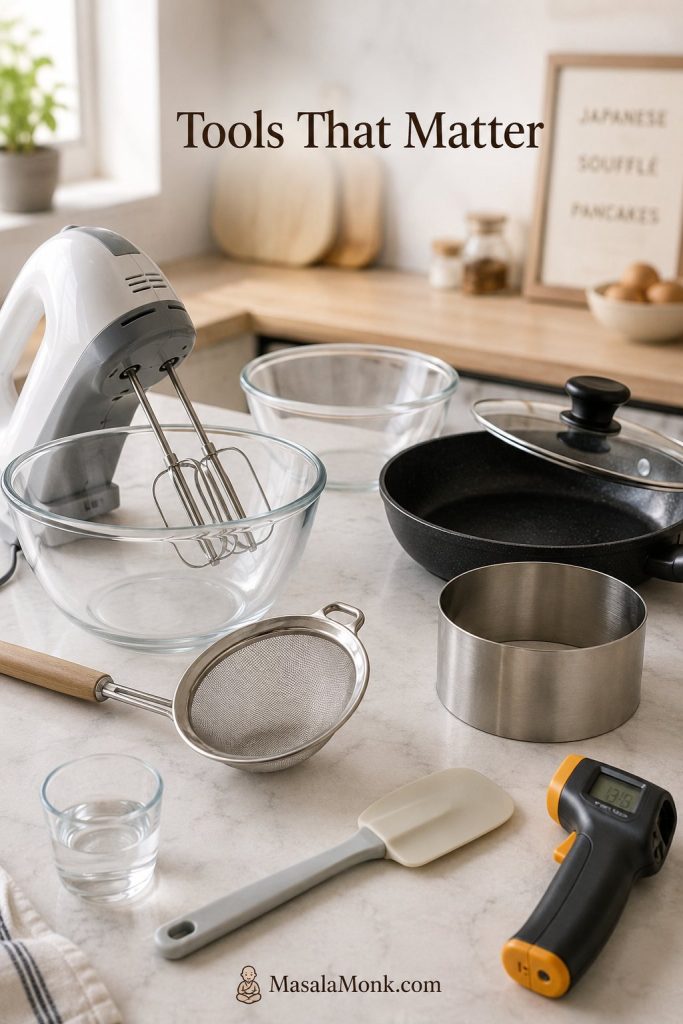
Equipment: What You Need and What You Don’t

You do not need a professional kitchen to make fluffy Japanese pancakes. The most important “equipment” is really control: a clean bowl for the whites, a pan that heats gently, and a lid that traps steam around the tall batter. If you have molds, see how to use a ring mold; if not, the no-mold method is built for a normal home pan.

Equipment for Japanese soufflé pancakes including mixing bowls, beaters, a pan, lid, spatula, ring mold, and thermometer.
The most useful tools are the ones that give control: clean bowls, steady heat, a lid for steam, and a thin spatula.

Essential Equipment

  • Electric hand mixer or stand mixer
  • Two clean mixing bowls
  • Fine mesh sieve
  • Nonstick pan or electric griddle
  • Tight-fitting lid, preferably tall enough not to touch the pancakes
  • Thin flexible spatula
  • Paper towel for spreading a thin film of oil

Helpful but Optional

  • Cookie scoop or disher for even mounds
  • Piping bag for cleaner shaping
  • Ring molds for straighter sides
  • Infrared thermometer for checking pan surface temperature
  • Instant-read thermometer for checking the center of the pancake

Choose Your Method: Ring Mold, No Mold, or Pancake Mix

There is more than one way to make these pancakes, and the best path depends on your tools and comfort level. A ring mold gives the neatest sides, the no-mold method is friendlier for home cooks, and pancake mix is a convenience shortcut rather than a magic fix.

MethodBest forWhat to watch
Basic 2-white batterFirst attempts and best controlStart here before trying a taller, more delicate version.
No moldHome cooks who want fewer toolsThe batter must be thick enough to mound; the shape will be softer.
Ring moldVery tall, straight-sided pancakesGrease the mold well and fill only halfway to two-thirds full.
Pancake mix shortcutConvenienceThe mix replaces the dry base, not the whipped egg whites.
3-white versionExtra height after you know the methodFold carefully because the batter becomes more delicate.
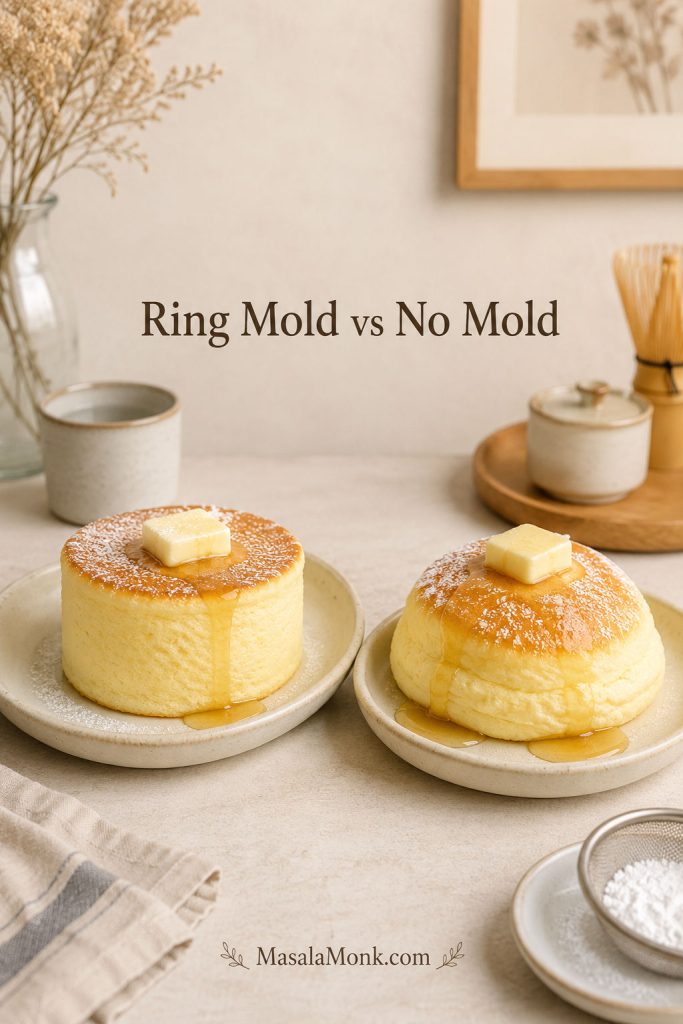
A straight-sided ring mold Japanese pancake beside a softer no-mold Japanese pancake on plates.
Ring molds give cleaner sides, but a strong no-mold batter can still make fluffy Japanese pancakes worth serving proudly.

A ring mold can make the pancakes look more like café cylinders, but it is not required for a lovely plate. Without a mold, expect softer café-style mounds rather than perfectly vertical sides. The texture can still be airy, tender, and special.

How to Make Japanese Pancakes Without a Mold

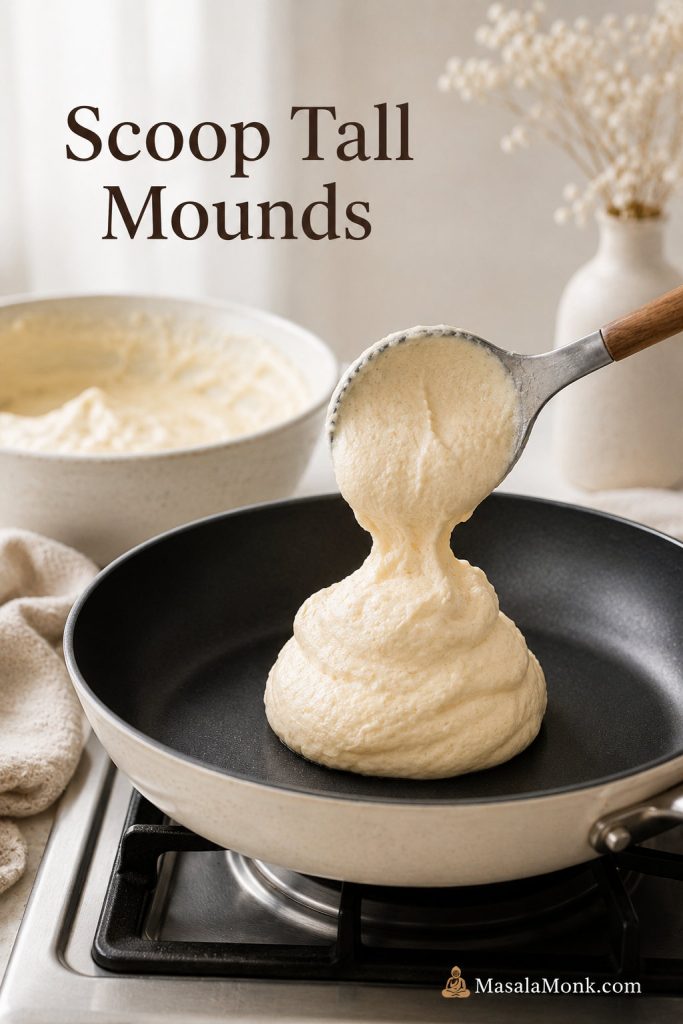
For the no-mold method, scoop the batter into tall mounds instead of pouring it. Use about two-thirds of the batter for the first mounds and reserve the rest for topping them after the base starts to set.

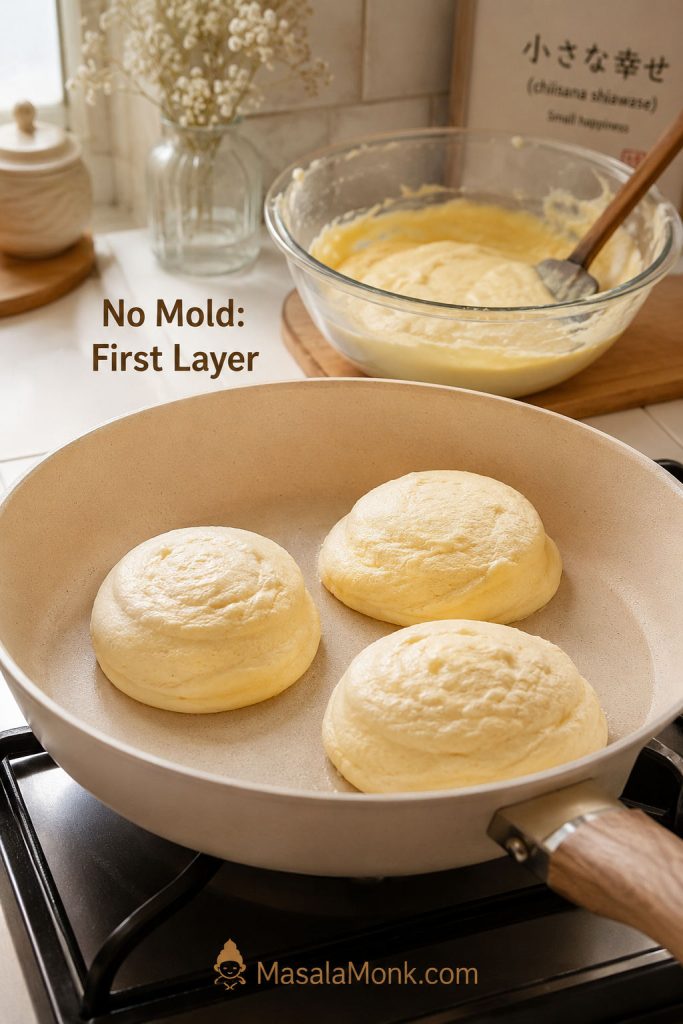
No-Mold First Layer

The first scoop should sit tall in the pan. Once that base begins to set, it can hold more batter without spreading as much.

Three no-mold Japanese pancake batter mounds cooking in a pan with a bowl of batter behind them.
For the no-mold method, start with thick first-layer mounds; once they begin to set, they can support the second scoop.
  1. Preheat the pan on gentle heat and wipe it with a thin film of oil.
  2. Scoop 2–3 tall mounds of batter into the pan, leaving space between them.
  3. Add 2 teaspoons water to the empty space in the pan, away from the batter.
  4. Cover and cook for 3–4 minutes, until the bottom layer starts to set.
  5. Add the reserved batter on top of each pancake.
  6. Cover again and cook until the sides look less glossy and the base releases cleanly.
  7. Flip gently, add another small splash of water, cover, and finish cooking.

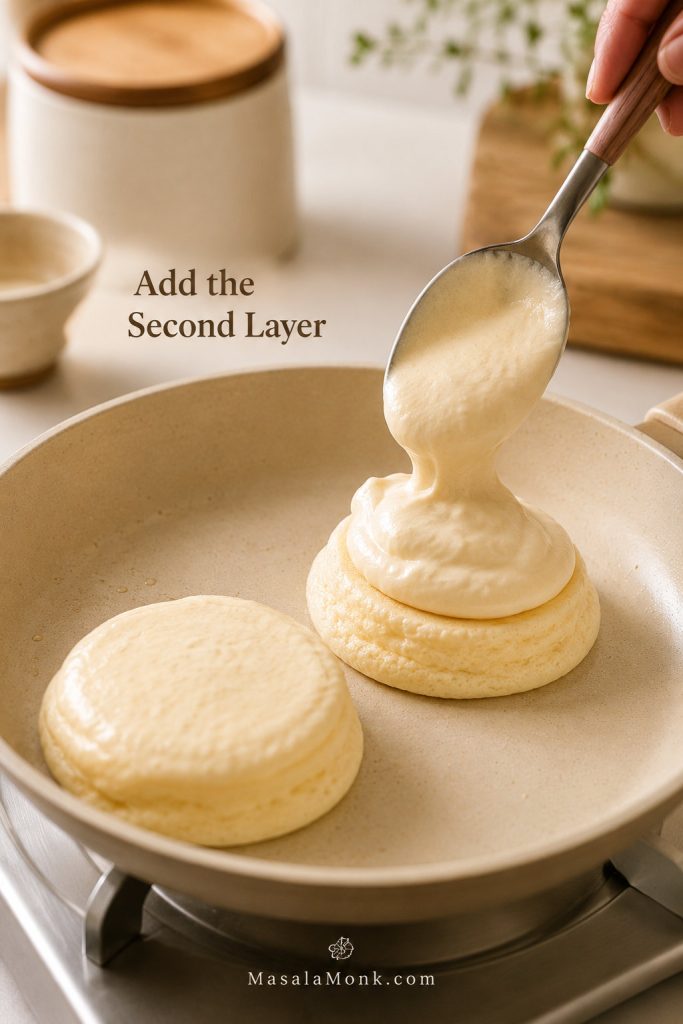
How to Layer No-Mold Japanese Pancakes

Add the reserved batter after the first layer has started to hold its shape. This gives the pancake height without needing a ring mold.

Reserved batter being spooned on top of a partially set no-mold Japanese pancake in a pan.
Add the second layer only after the base starts to set; otherwise, the batter spreads outward instead of stacking upward.

The no-mold pancakes may lean a little, and their edges may look softer. That is not failure. The win is a pancake that rises upward, cooks through, and lands on the plate warm and tender.

How to Use a Ring Mold

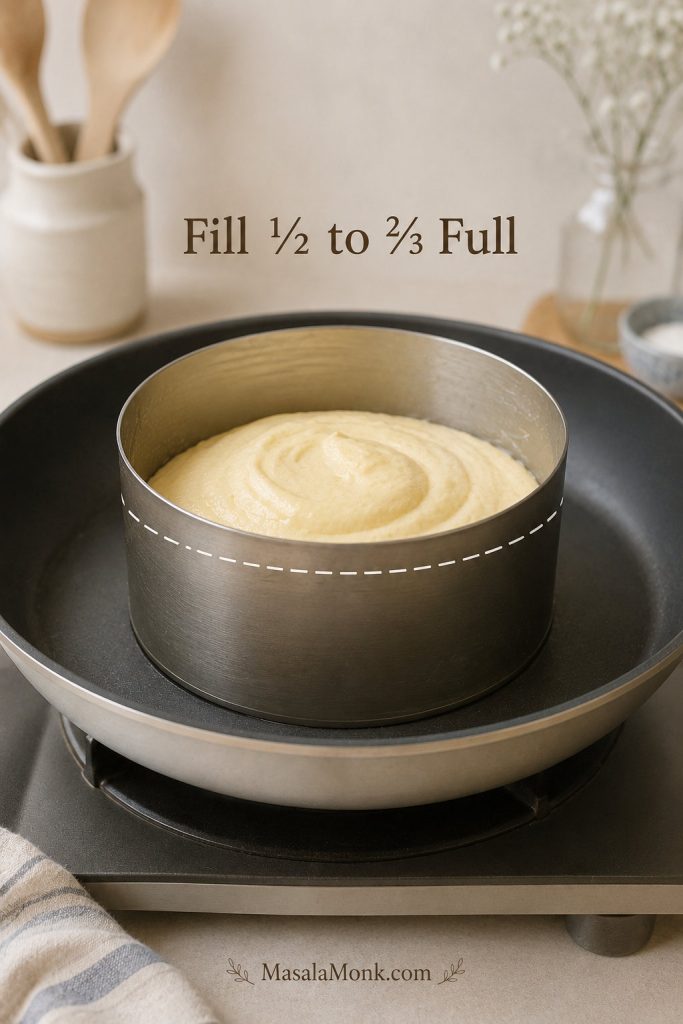
Use a ring mold about 2.5–3 inches wide and roughly 2 inches high. Grease the inside very well, place it in the pan, and fill it only halfway to two-thirds full. The batter needs room to rise.

How High to Fill a Ring Mold

Leave visible headroom in the mold. Filling to the top looks dramatic, but it gives the batter nowhere to rise.

Japanese pancake batter inside a metal ring mold in a pan with a fill-height guide line.
Fill the ring mold only halfway to two-thirds full. The batter needs headroom to rise without spilling or compressing.

When flipping, slide a thin spatula under the mold and use tongs to steady the ring. A pancake that resists or looks wet at the sides is asking for more time. Ring molds get hot, so use tongs or a towel when adjusting them.

Meringue Guide: The Most Important Step

The meringue is where these pancakes get their height. Think of it as the scaffolding inside the pancake: too soft and the batter spreads; too dry and it becomes hard to fold smoothly.

A good meringue looks shiny and confident. It should not slide around the bowl like foam, and it should not break into dry chunks. When the peak stands with only a small bend at the tip, you are in the right zone. In testing, batter made with soft peaks spread quickly, even when the pan heat was right.

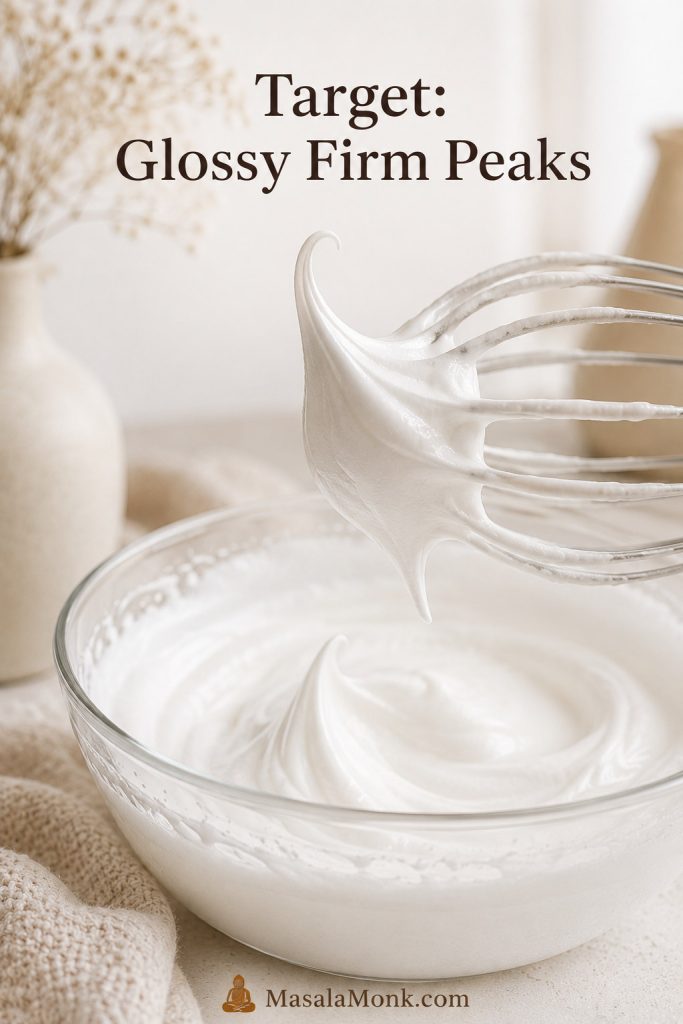
The Glossy Firm Peak Target

The target is not just “fluffy.” It is glossy, structured foam that can hold the batter up once it reaches the pan.

Glossy stiff meringue peak lifted from a bowl with a mixer beater.
This is the target texture: shiny, strong, and stable enough to help the batter mound in the pan instead of spread.

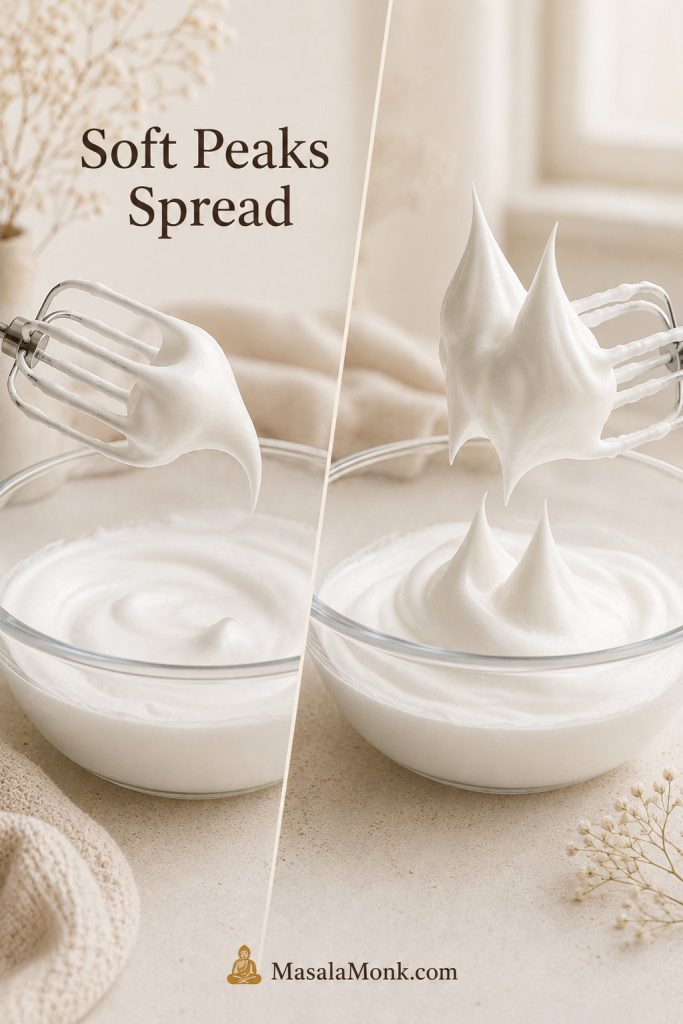
Soft Peaks vs Stiff Peaks

Soft peaks may seem close, but this batter needs a stronger foam. A drooping peak often becomes a spreading pancake.

Soft meringue peaks compared with stiff glossy peaks for Japanese pancake batter.
Soft peaks can look promising, but they often collapse after folding. Beat a little longer until the peaks stand firmly.
Meringue stageWhat it looks likeUse it?
FoamyBubbles with no real shapeNo. Too early.
Soft peaksPeak forms but droops overUsually too weak for tall pancakes.
Firm/stiff glossy peaksPeak stands upright or nearly upright; meringue looks smooth and shinyYes. This is the target.
Dry or clumpy peaksGrainy, dull, broken-looking foamNo. Overbeaten and harder to fold.

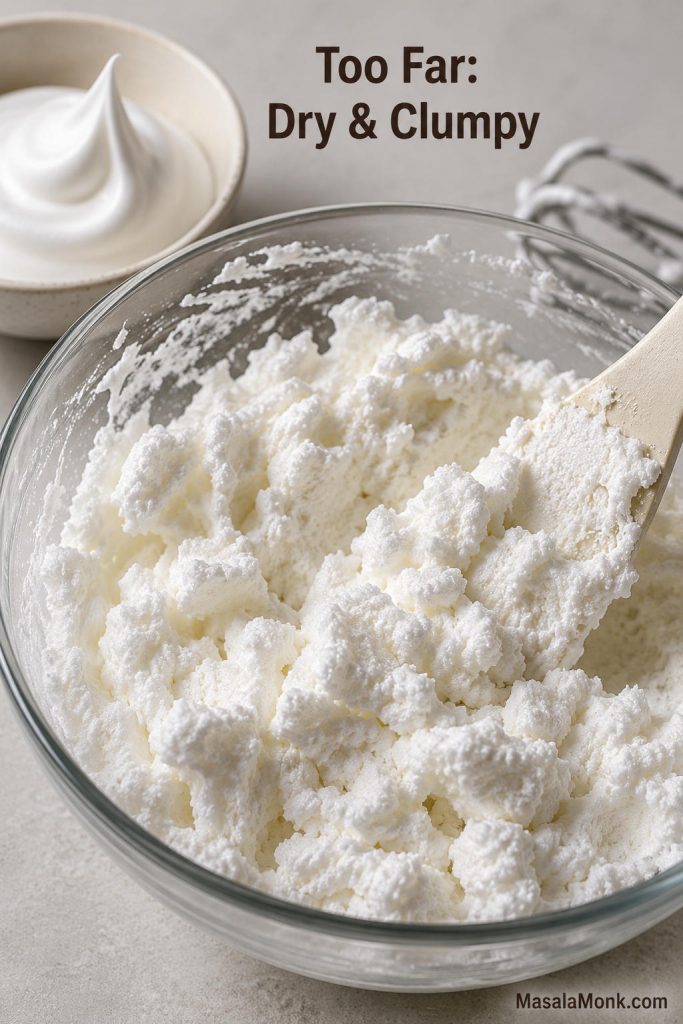
What Overbeaten Meringue Looks Like

The other mistake is going too far. Once the meringue looks dry, dull, and broken, it becomes harder to fold into a smooth, airy batter.

Dry clumpy overbeaten meringue in a bowl with a glossy peak comparison in the background.
Once meringue turns dry and clumpy, it becomes harder to fold evenly; next time, stop at glossy firm peaks.
  1. Use a clean, dry bowl. Any grease or yolk can weaken the foam.
  2. Start beating the egg whites with cream of tartar until foamy.
  3. Add the sugar gradually, not all at once.
  4. Beat until the meringue is shiny and structured enough to hold strong peaks.
  5. Stop before it turns dry, grainy, or chunky.

If the whites refuse to foam after a minute or two, it is usually better to start over in a clean bowl than to keep trying to rescue them. A little yolk or grease can quietly ruin the lift.

What the Batter Should Look Like

The batter should be thick, airy, and spoonable. It should hold its shape when dropped into the pan. It should not pour like crepe batter or spread immediately into a flat circle.

Thick Japanese pancake batter holding a mound on a spoon above a mixing bowl.
The batter should sit in a soft mound on the spoon. If it slides away quickly, the pancakes will likely spread.

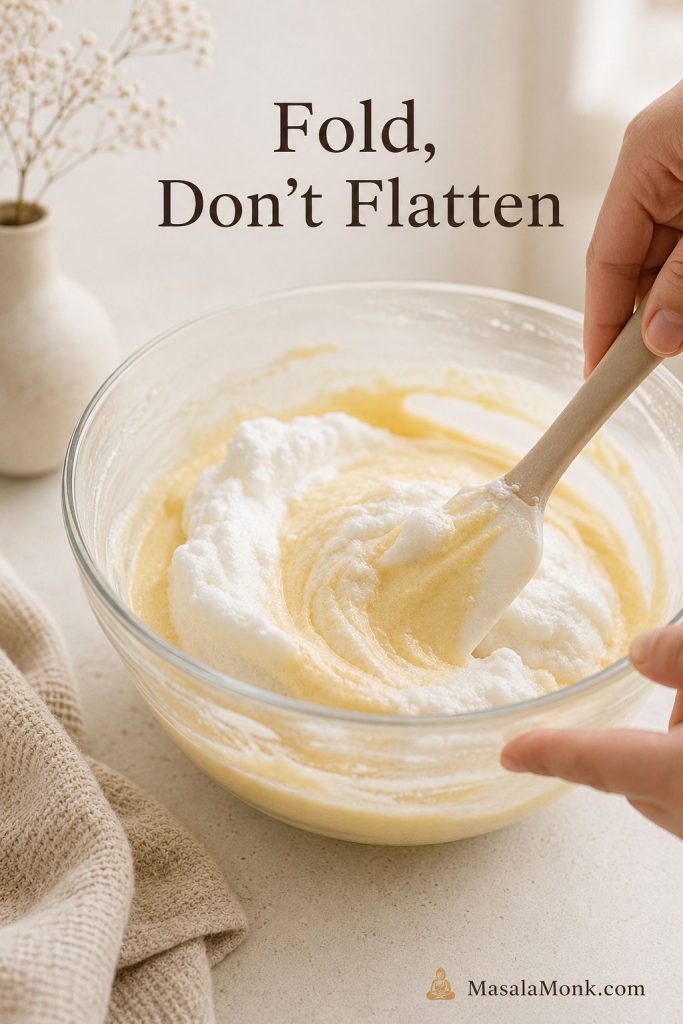
When folding, keep the movement calm and broad. Sweep under the batter, turn it over itself, and stop before you flatten the air out of it. A few faint streaks are better than a perfectly smooth batter that has lost its lift.

Batter cueWhat it means
Thick and mounds on a spoonGood. The meringue is holding structure.
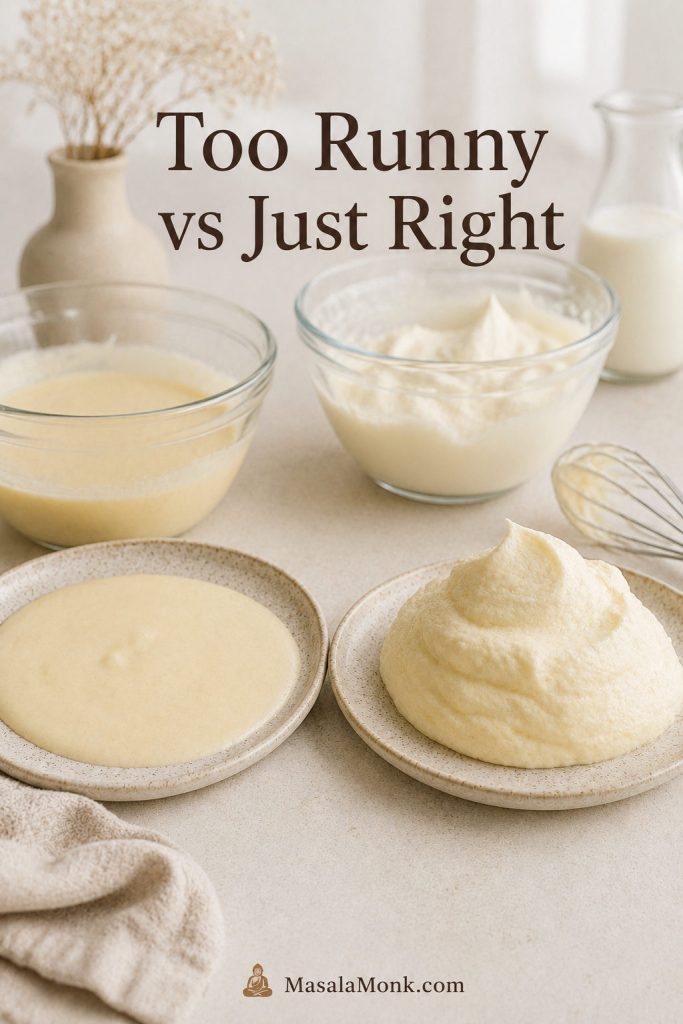
Loose and pourableMeringue may be underwhipped, overfolded, or the batter has too much liquid.
Lumpy with dry white clumpsMeringue may be overbeaten or not folded evenly.
Watery at the bottomBatter has started breaking down. Cook immediately, but expect less height.

Runny vs Moundable Batter

Before the pan gets involved, the bowl already tells you a lot. Batter that sits in a mound has structure; batter that flows quickly is already warning you it may spread.

Runny Japanese pancake batter compared with thicker moundable batter in two bowls.
Check texture before cooking: moundable batter rises upward, while runny batter usually flattens before it can set.

How to Make Japanese Soufflé Pancakes Step by Step

Read through the method once before starting. The batter is best cooked soon after folding, so it helps to have the pan, lid, spatula, water, and serving plates ready.

First-batch reality check: The first pancake is where you learn your pan. A quick-browning bottom means the heat needs to come down. A spreading mound points back to the meringue or batter texture. A shorter but cooked-through pancake is still progress.

1. Separate the Eggs

Separate 2 large eggs into yolks and whites. Keep the whites completely free of yolk. If you separated the eggs while cold, let the whites sit for a few minutes while preparing the yolk batter. They do not need to be perfectly room temperature; the final meringue stage matters more.

2. Make the Yolk Batter

In a medium bowl, whisk the egg yolks, milk, vanilla, and salt until smooth. Sift in the cake flour, cornstarch, and baking powder. Whisk just until the batter is smooth and thick. Add extra milk only if the batter is too stiff to mix.

3. Beat the Meringue

In a clean bowl, beat the egg whites and cream of tartar until foamy. Add the sugar gradually while beating. Continue until the meringue is smooth, shiny, and firm enough to stand. If the peak stage feels unclear, check the glossy firm peak cue before folding. Soft peaks make soft pancakes; firm peaks give the batter a chance to rise tall.

4. Fold the Batter

Add about one-third of the meringue to the yolk batter and mix it in more freely to lighten the base. Add the remaining meringue in two additions, folding with a spatula until the batter is mostly even, thick, and airy.

Before scooping, the batter should match the moundable batter cues. A batter that sits proudly on the spoon is ready for the pan; one that slides away quickly will usually cook flatter, so move quickly and keep the mounds smaller.

A spatula gently folding whipped meringue into Japanese pancake batter in a glass bowl.
Fold with broad, gentle strokes. A few faint streaks are better than a smooth batter that has lost its air.

5. Preheat the Pan Gently

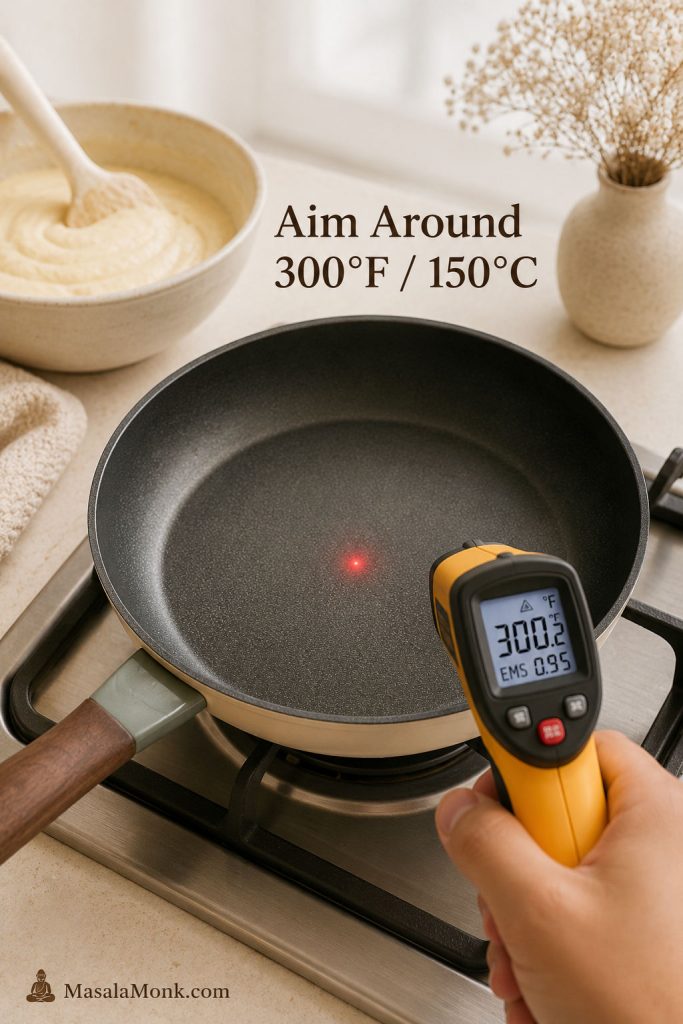
Set a nonstick pan over gentle heat. If using an infrared thermometer, aim for about 300°F / 150°C, with a workable range of 285–320°F / 140–160°C. Wipe the pan with a very thin film of oil.

If your lid is low, use smaller mounds so the batter does not touch the lid as it rises.

6. Scoop and Steam

Scoop the batter into 2 or 3 tall mounds. Use about two-thirds of the batter for this first layer and reserve the rest for building height. Add 2 teaspoons water to the empty area of the pan, away from the batter, and cover immediately.

Thick Japanese pancake batter being scooped into a tall mound in a nonstick pan.
Scoop upward, not outward. Tall mounds give no-mold Japanese pancakes a better chance to rise instead of spreading flat.

7. Build Height

After 3–4 minutes, the first layer should look slightly more set around the base. Add the reserved batter on top of each mound. Cover again and continue cooking.

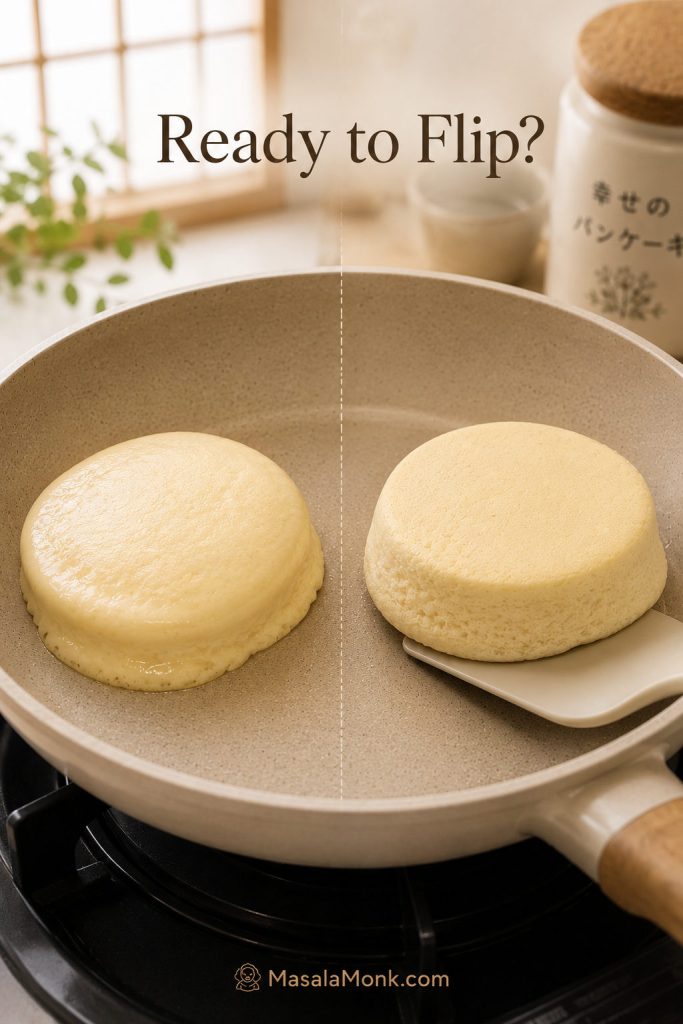
8. Flip Gently

Flip when the sides look less glossy, the bottom is lightly golden, and the pancake feels like it has a body of its own. The spatula should slide under with support, not drag through wet batter.

How to Know When Japanese Pancakes Are Ready to Flip

This is the part where most people want to move too soon. Wait for the sides to lose their wet gloss and for the pancake to feel supported under the spatula.

Two Japanese pancakes in a pan showing a glossy pancake that needs more time and a set pancake ready for a spatula.
Flip when the sides lose their wet gloss and the spatula slides underneath with support. If it drags, wait longer.

If you are nervous here, that is normal. The safer move is usually one more covered minute, not forcing the spatula under a pancake that is still wet at the sides. Use the flip-readiness cues before trying again.

After flipping, add another small splash of water, cover, and cook until the second side is set. Let the pancake keep the air you built into it; a gentle flip is enough.

A tall Japanese soufflé pancake being lifted gently with a thin spatula in a pan.
Use a thin spatula and a calm hand. A rough flip can press out the air you worked so hard to keep.

9. Serve Immediately

These pancakes have a short golden window. Bring the plate to the table first, then bring the pancakes. A little settling is normal because the hot air inside cools, but they are at their softest and tallest right away.

The best bite is warm, soft, and custard-tender in the center without being wet. The pancake should give under the fork, then spring back just a little. That is the café-at-home moment you are cooking toward.

Low Heat and Steam: Time, Temperature, and Doneness

Most failed Japanese pancakes come down to heat. Tall batter needs time. When the pan is too hot, the outside browns before the inside cooks. When the pan is too cool and the lid is lifted too often, the center can stay gummy.

Best Pan Temperature for Japanese Pancakes

Think gentle surface heat, not a hot pancake rush. A pan near 300°F gives the foam time to set before the bottom goes too dark.

Infrared thermometer aimed at a nonstick pan to check the temperature for Japanese soufflé pancakes.
Keep the pan gentle, not blazing hot. Around 300°F gives the center time to cook before the outside browns too fast.

The bottom should not race ahead of the middle. A sweet, warm pancake smell is fine; a toasted smell before the sides look set is your cue to lower the heat. The batches that browned fastest were also the ones most likely to stay wet inside. If the outside is browning while the middle stays wet, go straight to the raw center fix.

Cooking cueBest target
Pan surface temperature285–320°F / 140–160°C
Ideal targetAbout 300°F / 150°C
First side6–8 minutes total, covered
Second side4–6 minutes, covered
Steam water2 teaspoons to 1 tablespoon at a time
Optional center temperatureAbout 160°F / 71°C
Best serving windowImmediately, ideally within 5–10 minutes

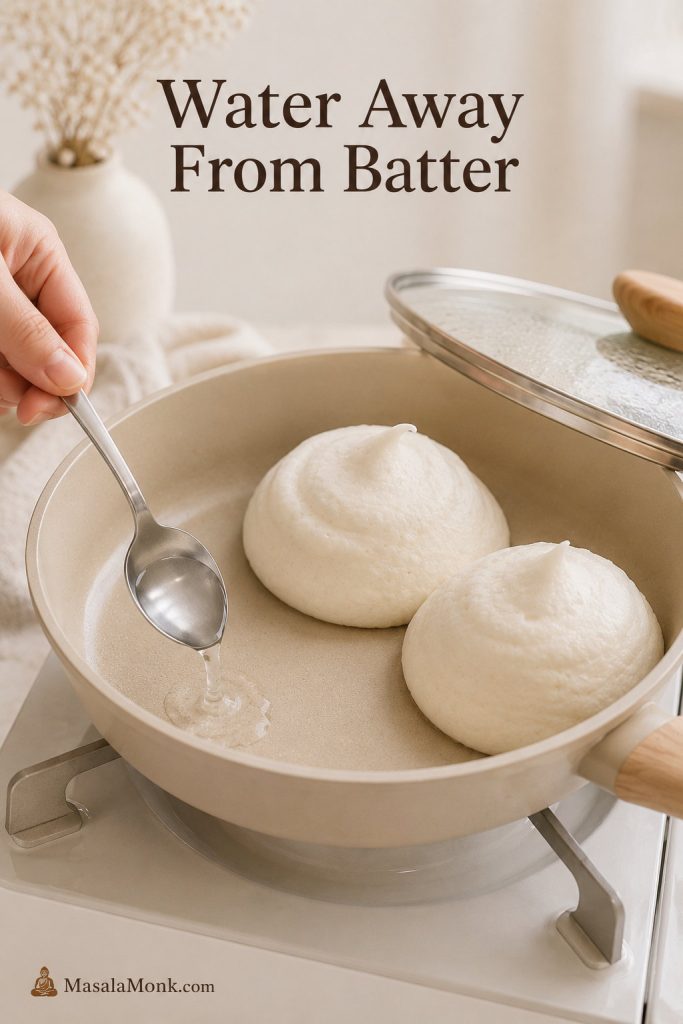
The water should go into the empty space in the pan, not on top of the batter. You only need enough to create a quiet puff of steam under the lid, not a puddle.

Where to Add Water for Steam

Place the water beside the batter so the steam can circulate around the pancakes. Pouring on top can thin or disturb the mounds you just built.

A spoon adding water to the empty space beside Japanese pancake batter in a pan.
Add water to the empty pan space, then cover. That way, steam surrounds the pancakes without thinning the batter.

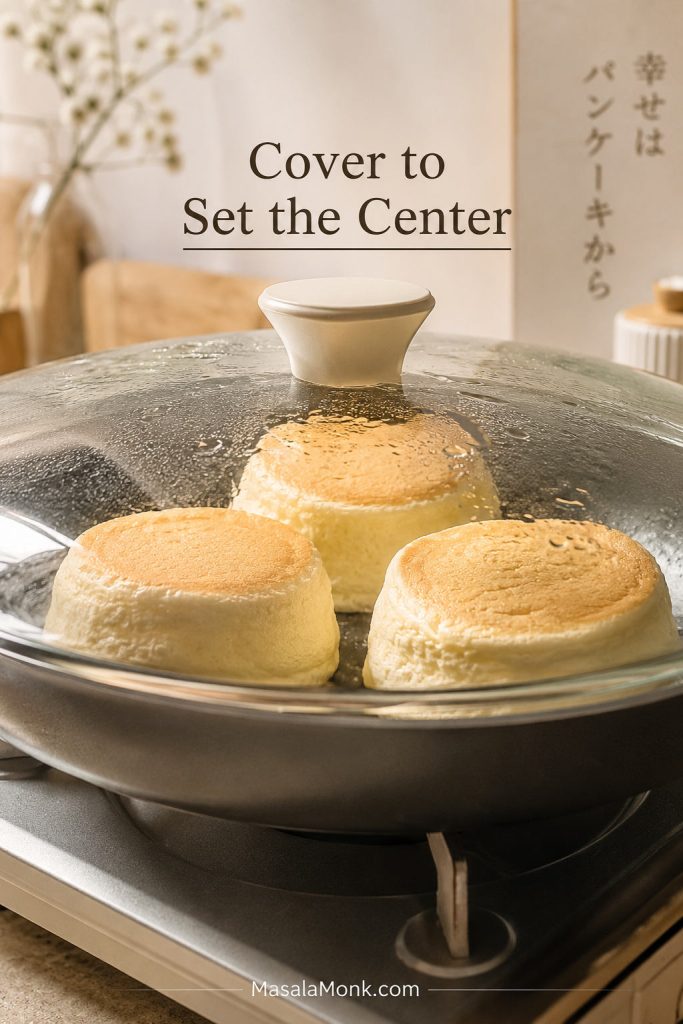
Why Covered Steam Cooking Matters

Once covered, the pan becomes a small steam chamber. Keep the lid on long enough for the center to set instead of chasing color too early.

Japanese soufflé pancakes cooking under a clear glass lid with steam and condensation.
Once the lid goes on, let the steam work. Opening too often releases heat and slows the center from setting.

How to Tell If the Pan Is Too Hot or Too Cool

What you seeWhat it meansWhat to do
Bottom browns deeply in 2–3 minutesPan is too hotLower the heat and move the pan off the burner briefly
Edges look cooked but center feels liquidHeat is too high or pancake is too thickCover longer on low heat and make smaller mounds next time
Pancake barely colors after 8 minutesPan may be too coolIncrease heat very slightly, but keep it gentle
Pancake deflates when lid opensStructure is not set yetCover again and give it more time before flipping

Keep the lid on as much as possible. Every time you lift it, you release heat and steam, and the pancakes may take longer to set.

Optional safety cue: If using a thermometer, aim for about 160°F / 71°C in the center. The pancake should also feel softly bouncy, not liquid, when touched gently. For general egg-dish temperature guidance, see the USDA egg safety guide.

Can You Make Japanese Soufflé Pancakes With Pancake Mix?

Yes, you can make a shortcut version with pancake mix, but use it for fewer dry ingredients, not to skip the soufflé technique. The height still comes from whipped egg whites.

Think of pancake mix as a replacement for the flour, baking powder, and part of the dry base. It does not replace separated eggs, meringue, slow covered cooking, steam, or gentle folding.

Japanese hotcake mix or regular pancake mix can both work, but the result may be a little sweeter, cakier, or more mix-flavored than the main recipe. Keep the heat low because mixes with sugar can brown faster.

If you want a more everyday pancake-mix direction instead of the soufflé method, this guide to blueberry pancakes and homemade pancake mix is the better place to go.

Simple Pancake Mix Shortcut Formula

IngredientAmount
Large eggs2, separated
Pancake mix3 tablespoons / about 25–30g
Milk1½–2 tablespoons / 22–30ml, added gradually
Vanilla½ teaspoon
Sugar2 tablespoons / 24–25g
Cream of tartarPinch to ¼ teaspoon, or a few drops of lemon juice

Start with 1½ tablespoons milk. Add the remaining ½ tablespoon only if the yolk batter is too stiff to mix. Pancake mixes vary, and a looser shortcut batter is harder to stack tall.

Make the yolk batter with the yolks, milk, vanilla, and pancake mix. Beat the whites with the acid and sugar until the meringue is glossy and holds its shape, then fold and cook the same way as the main recipe.

Shortcut truth: Pancake mix can make the dry ingredients easier, but it will not save a weak meringue. If the egg whites are not whipped well, the pancakes will still spread or deflate.

What Success Looks Like

A good batch does not have to look identical to a café pancake. Look for these signs instead.

  • The batter rises upward more than it spreads outward.
  • The sides look set instead of glossy-wet.
  • The pancake releases from the pan without tearing.
  • The center feels softly bouncy, not liquid.
  • The inside is moist and airy, not raw.
  • The pancakes settle slightly after serving, but do not collapse into flat rounds.

Normal settling means the pancakes soften and lower slightly as they cool. A failure collapse means they flatten quickly, slump into the plate, or look wet in the middle.

Save the batch: If the first pancakes are shorter than expected but cooked through and soft, serve them proudly with toppings. A slightly shorter pancake with a set center is better than a dramatic tall pancake that is wet inside.

Troubleshooting Japanese Pancakes

Most pancake problems are not disasters. They are clues. Find the problem you actually saw, not the problem you are afraid of, and the next batch becomes much easier.

This style is technique-sensitive, but the fixes are usually simple: strengthen the meringue, fold less, lower the heat, cook longer covered, or make smaller mounds.

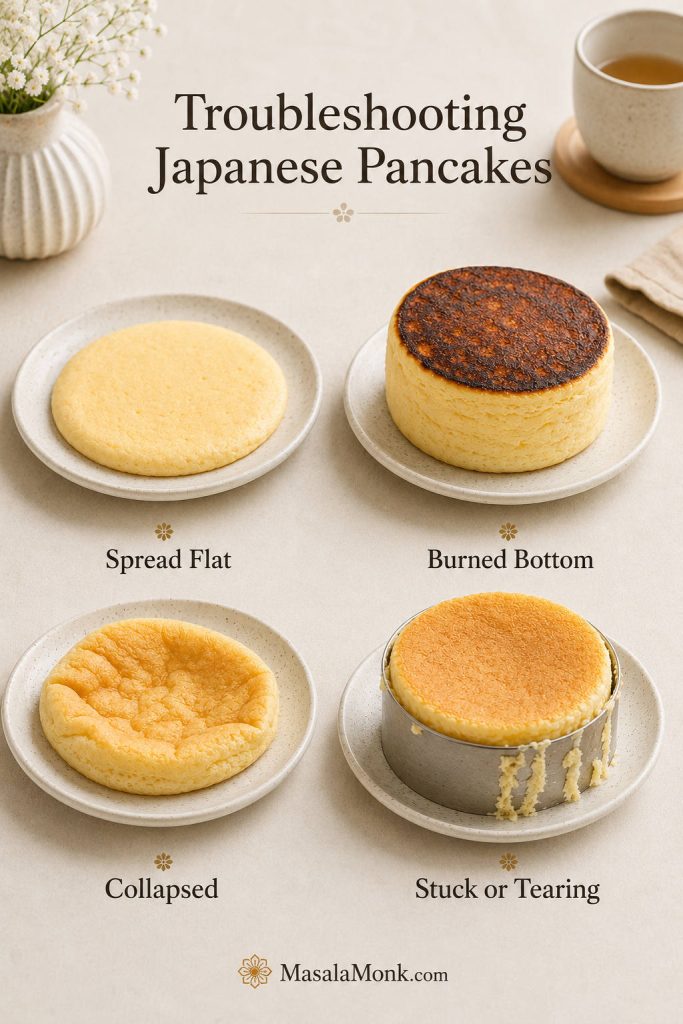
Troubleshooting board showing Japanese pancakes that spread flat, burned on the bottom, collapsed, and stuck to a ring mold.
Use the failure shape as a clue: spreading points to batter, burning points to heat, collapse points to structure, and sticking points to mold prep.

Rise, Spread, and Collapse Problems

ProblemLikely causeFix nowNext time
Pancakes never roseMeringue was too soft, batter was overfolded, or the pan was too hot too soonCook them through, stack with toppings, and serve as soft pancakesBeat to firm peaks that hold their shape and fold more gently
Pancakes rose in the pan but collapsed on the plateCenter was undercooked or structure was too weakServe quickly; texture may still be pleasantCook longer covered and make slightly smaller mounds
Batter spread flatMeringue was underwhipped, batter was too loose, or too much milk was addedUse a ring mold if you have oneBatter should hold a mound, not pour

Heat, Doneness, and Texture Problems

ProblemLikely causeFix nowNext time
Outside burnedPan was too hotLower heat immediately and move pan briefly off the burnerUse gentle heat and aim for 285–320°F / 140–160°C
Center stayed rawPancakes were too tall, flipped early, or cooked too hot outsideCover and cook longer on low heatMake smaller mounds and use steam
Pancakes wrinkled or shrank at the sidesSudden cooling, undercooked center, or weak structureServe quickly while still warmCook until the center is set and avoid opening the lid too often
Eggy flavorUnderseasoned batter or undercooked centerAdd toppings such as fruit, cream, or syrupUse vanilla, salt, and enough cook time

Flipping, Batch, and Mold Problems

ProblemLikely causeFix nowNext time
Pancake cracked while flippingIt was flipped before the base setSupport with a second spatula if neededWait until the sides look less glossy and the base releases cleanly
Second batch was flatterBatter sat too long and lost airCook immediately if possibleMake a small batch or use two pans
Pancakes stuck to moldMold was not greased well enoughLoosen gently with a thin knifeGrease the inside of the ring generously before filling

Why Did My Japanese Pancakes Deflate?

The most common reasons are weak meringue, overfolded batter, heat that was too high, or an undercooked center. Some settling is normal after cooking, but a full collapse usually means the pancake did not have enough structure to hold itself.

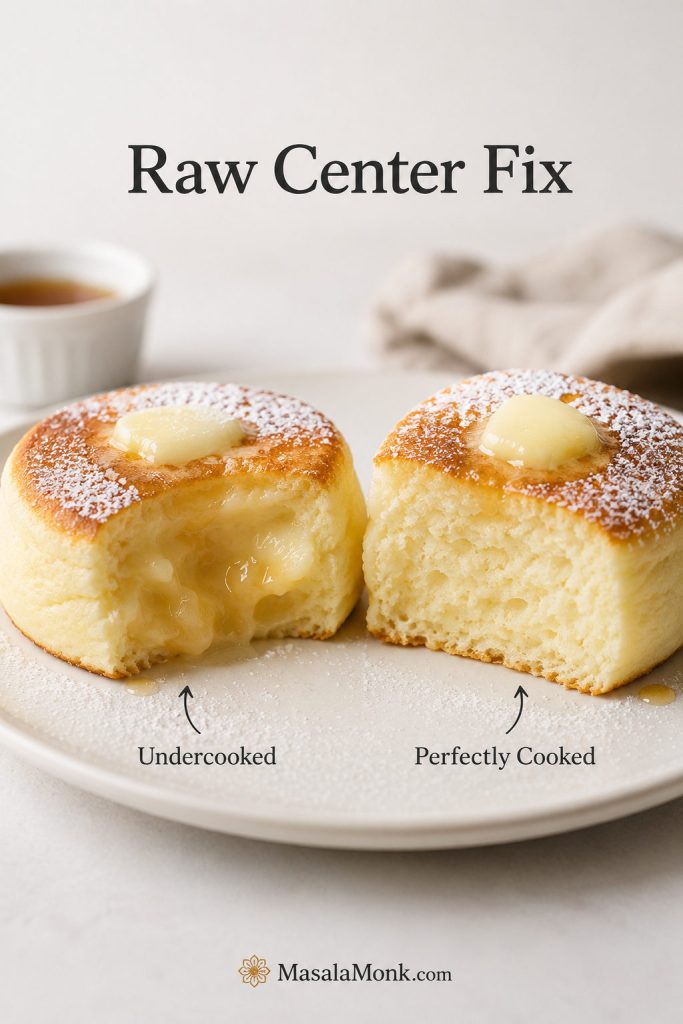
Why Are My Pancakes Raw Inside?

The pan was probably too hot or the pancakes were too large. High heat browns the outside before the center has time to set. Lower the heat, cover the pan, use a little steam, and make slightly smaller mounds next time.

Cut Japanese pancakes showing an undercooked raw center beside a properly cooked airy center.
A raw center usually means the outside cooked too quickly. Lower the heat, cover longer, and let steam help next time.

Why Is My Batter Runny?

Runny batter usually means the meringue was underwhipped, overmixed into the yolk batter, or left sitting too long. The batter should look airy and thick enough to hold a mound.

Why Are They Not Jiggly?

They may be too thin, overcooked, or made with batter that lost too much air. The jiggle comes from height, moisture, and a set-but-soft center. Aim for thick mounds, gentle heat, and a center that feels bouncy rather than dry.

Why Was the Second Pancake Worse Than the First?

Soufflé pancake batter loses air as it sits. If the first pancake was tall and the later ones were flatter, the batter probably waited too long. For best results, cook all the batter at once in one large pan, use two pans, or make a smaller batch.

Best Toppings for Japanese Pancakes

Japanese soufflé pancakes are delicate, so the best toppings should make them feel café-special without crushing them. Think light cream, soft fruit, a little syrup, or a sauce served mostly to the side. The pancakes are the drama; the toppings should frame them.

Classic Café-Style Toppings

  • Powdered sugar
  • Softened butter
  • Maple syrup
  • Whipped cream
  • Fresh strawberries or mixed berries

For a warmer fruit topping, spoon over a little homemade apple pie filling; keep the portion light so it does not flatten the stack.

Japanese-Inspired Toppings

  • Matcha whipped cream
  • Sweet red bean paste
  • Black sesame cream
  • Kinako sugar
  • Yuzu honey

Dessert-Style Toppings

For the tallest look, finish with powdered sugar, berries, or a light cream first. Add heavier sauces at the table, after the pancakes have had their moment.

Can You Make Japanese Pancakes Ahead?

This is a cook-and-eat-now recipe, and that is part of its charm. The batter should not be made ahead because the meringue loses air as it sits. Cooked pancakes also deflate as they cool, which is normal for this style.

If you have leftovers, refrigerate them in an airtight container for up to 1 day. Reheat gently in a covered pan over low heat or microwave briefly at low power. They will still be soft, but they will not be as tall or jiggly as freshly cooked pancakes.

Japanese Soufflé Pancakes vs Japanese Soufflé Cake

Japanese soufflé pancakes and Japanese soufflé cake sound similar, but they are different recipes. The pancake version is cooked in a pan or on a griddle and served like breakfast pancakes. Japanese soufflé cake usually refers to Japanese cheesecake or cotton cheesecake, which is baked, sliced, and served as a dessert.

Both use meringue logic, so they share that soft, airy personality. However, the method, texture, and serving style are different. If you wanted the cake version, see this Japanese cheesecake recipe.

FAQs About Japanese Pancakes

Are Japanese pancakes and soufflé pancakes the same thing?

For this tall, café-style version, yes. Here, Japanese pancakes means Japanese soufflé pancakes: thick pancakes made with whipped egg whites and cooked slowly until soft, airy, and jiggly.

Do I need a ring mold?

No. A ring mold gives cleaner sides and more dramatic height, but the no-mold method still works if the batter is thick enough to mound. The shape will be softer, but the pancakes can still be fluffy and tender.

Why did my pancakes collapse after cooking?

A little settling is normal. A dramatic collapse usually means the meringue was too weak, the batter was overmixed, or the center needed more covered cooking time. The fix is usually stronger peaks, gentler folding, and a lower, slower pan.

How do I know when to flip them?

Flip when the bottom is lightly golden, the sides look less glossy, and the pancake releases cleanly from the pan. If the spatula drags through wet batter, cover the pan again and give it another minute.

Can I use pancake mix?

Yes, but pancake mix only replaces the dry base. You still need separated eggs, whipped egg whites, gentle folding, steam, and slow covered cooking for the soufflé height.

Can I make the batter ahead?

No. Once the meringue is folded in, the batter starts losing air. Make it, scoop it, and cook it right away for the best rise.

Can I double this recipe?

You can, but only if your pan or griddle can cook the batter right away. Soufflé pancake batter loses air as it waits, so a small fresh batch is usually better than a large bowl sitting on the counter.

Can I make them without cake flour?

Yes. Use 30g all-purpose flour, remove 1 teaspoon, and replace that teaspoon with cornstarch. The pancakes may be slightly less delicate than the cake-flour version, but the swap works well for this small batch.

Can I make them gluten-free?

A cup-for-cup gluten-free flour blend is the safest first experiment, but this batter is delicate, so results can vary. Almond flour is heavier and can make soufflé pancakes collapse more easily. For a more reliable gluten-free-style pancake, try almond flour pancakes instead.

Can I make these eggless or vegan?

Classic Japanese soufflé pancakes depend on egg-white meringue, so eggless or vegan versions need a separate tested formula. For an easier egg-free or vegan-friendly pancake direction, a recipe like oat pancakes is a better place to start.

Can I make keto Japanese soufflé pancakes?

Not cleanly with this exact recipe. Low-carb flours and sweeteners change the batter structure, and soufflé pancakes are already delicate. Use a dedicated keto pancake formula rather than adapting this one directly.

Why do they taste eggy?

Eggy flavor usually comes from undercooking, skipping vanilla or salt, or using a formula with a very high egg ratio. Cook the center through, keep the vanilla and salt, and serve with fruit, cream, or syrup.

What does fuwa fuwa mean?

Fuwa fuwa means soft, fluffy, and airy. For Japanese pancakes, it describes the cloudlike texture created by whipped egg whites and gentle cooking.

Once you understand the three checks — meringue that holds, batter that mounds, and heat that stays gentle — these pancakes stop feeling like a café trick. They become a small weekend project you can actually pull off, one covered minute at a time.

Serve Japanese Pancakes While They Are Tall and Warm

Bring the plate to the table first, then bring the pancakes. The reward is that first soft bite while the stack is still warm, lifted, and a little magical.

Tall Japanese soufflé pancakes with syrup, whipped cream, and a forkful showing the soft cooked interior.
Once the meringue, batter, and heat checks click, the final stack feels less like a café trick and more like a weekend win.

Japanese Pancakes Recipe Card

Japanese Pancakes Recipe: Fluffy Soufflé Pancakes

Tall, soft, jiggly Japanese soufflé pancakes made with whipped egg whites, a light yolk batter, gentle heat, and steam. Use the no-mold method for a simple home version or ring molds for straighter café-style sides.

Yield2–3 thick pancakes
Prep Time20 minutes
Cook Time12–15 minutes per batch
Total Time35–50 minutes

Ingredients

Yolk Batter
  • 2 large egg yolks, about 35–40g
  • 20ml whole milk, about 1 tablespoon + 1 teaspoon
  • ½ teaspoon vanilla extract
  • 30g cake flour, about ¼ cup spooned and leveled
  • 1 teaspoon cornstarch, about 3g
  • ¼ teaspoon baking powder
  • Pinch of fine salt
Meringue
  • 2 large egg whites, about 60–65g
  • 24–25g granulated sugar, about 2 tablespoons
  • ¼ teaspoon cream of tartar, or 1 teaspoon lemon juice, or ½ teaspoon white vinegar
For Cooking
  • Neutral oil or melted butter, for greasing
  • 1–2 tablespoons water, for steam, used in small splashes
  • Powdered sugar, whipped cream, berries, maple syrup, or toppings of choice

Instructions

Make the Batter
  1. Prepare the pan and tools. Set out the pan, lid, spatula, water, and serving plates before mixing.
  2. Separate the eggs. Place the yolks in one bowl and the whites in a clean, dry mixing bowl. Make sure no yolk gets into the whites.
  3. Make the yolk batter. Whisk the yolks, milk, vanilla, and salt. Sift in the cake flour, cornstarch, and baking powder. Whisk just until thick and smooth.
  4. Start the meringue. Beat the egg whites with cream of tartar until foamy. Add the sugar gradually.
  5. Beat to glossy stiff peaks. Continue beating until the meringue is shiny and holds strong peaks. Stop before it turns dry or clumpy.
  6. Fold the batter. Lighten the yolk batter with one-third of the meringue, then fold in the rest until the batter is thick, airy, and mostly even.
Cook and Serve
  1. Preheat gently. Heat a nonstick pan over low heat. If using a thermometer, aim for about 300°F / 150°C. Wipe with a thin film of oil.
  2. Scoop the pancakes. Add 2 or 3 tall mounds of batter, using about two-thirds first and reserving the rest. Add 2 teaspoons water away from the batter and cover.
  3. Build height. After 3–4 minutes, add the reserved batter on top. Cover again and cook until the sides look less glossy and the bottom releases cleanly.
  4. Flip carefully. Slide a thin spatula under each pancake and flip gently. Add another small splash of water, cover, and cook for 4–6 minutes more.
  5. Check doneness. The pancakes should be lightly golden, softly bouncy, and set in the center. If using a thermometer, aim for about 160°F / 71°C.
  6. Serve immediately. Dust with powdered sugar and add toppings. Some settling is normal as the pancakes cool.

Recipe Notes

  • Best cue: The batter should hold a soft mound, and the cooked pancakes should feel gently bouncy in the center.
  • If the batter spreads: The meringue was likely too soft, the batter was overfolded, or too much liquid was added.
  • If the center is raw: Lower the heat, cover longer, and make smaller mounds next time.
  • No-mold layering: Use about two-thirds of the batter for the first mounds and reserve the rest for topping.
  • For ring molds: Grease well and fill only halfway to two-thirds full.
  • For taller pancakes: Use 3 egg whites and 2 yolks, keeping the other ingredients the same, but fold carefully.
  • Pancake mix shortcut: Use the shortcut formula in the guide above; the mix replaces the dry base, not the whipped egg whites.
  • Storage: Best fresh. Leftovers can be refrigerated for 1 day, but they will lose height and jiggle.

Back to top

Posted on Leave a comment

Easy Benedict Sauce Recipe: 5-Minute Blender Hollandaise

Eggs Benedict with glossy hollandaise sauce over a poached egg on a toasted English muffin with ham.

Eggs Benedict looks calm and polished on a brunch plate, but the sauce is usually where the nerves begin. The muffins are toasting, the eggs are poaching, the butter is melting, and suddenly one small bowl of hollandaise can decide whether breakfast feels effortless or chaotic.

This easy Benedict sauce recipe keeps that moment simple. It makes a warm, buttery, lemony blender hollandaise in about 5 minutes, without standing over a double boiler or worrying that the sauce will split before the eggs are ready.

This is not just a fast hollandaise. It is a no-panic Benedict sauce guide with the cues that matter most: hot butter, a slow pour, the right glossy texture, the right amount for brunch, and a rescue plan if the sauce starts to split.

Already dealing with an oily or broken sauce? Jump to the troubleshooting guide and come back to the method once the sauce is stable.

Benedict sauce is hollandaise by its brunch name: warm, buttery, lemony, and built for poached eggs. Once the cues are clear, it stops feeling fragile and starts feeling like something you can actually trust on a busy brunch morning.

Quick Answer: What Is Benedict Sauce?

Benedict sauce is hollandaise sauce, the warm sauce traditionally served over Eggs Benedict and sometimes simply called Eggs Benedict sauce. It is made by emulsifying egg yolks, melted butter, lemon juice, salt, and a little cayenne or white pepper into a smooth, buttery sauce.

So if a restaurant menu, recipe card, or brunch guide says hollandaise, it is talking about the same sauce many home cooks mean when they search for Benedict sauce.

In the classic method, the yolks are whisked gently over heat while butter is slowly added. In this blender version, the machine does the whisking for you. Melted butter is streamed into seasoned yolks, and the mixture turns from loose yellow liquid into a pale, creamy sauce in minutes.

A good batch tastes rich, bright, and lightly tangy. It should fall in a soft ribbon and settle over poached eggs instead of sliding straight off like melted butter.

Benedict Sauce vs Hollandaise Sauce

The name changes with the setting. Restaurants and classic cookbooks usually call it hollandaise; at home, many people call it Benedict sauce because that is the dish they know and love. “Eggs Benedict sauce” is another everyday name for the same butter-and-yolk emulsion.

Either way, the sauce has one job: make poached eggs taste like brunch. A good batch lands between melted butter and mayonnaise: soft, warm, and able to settle over the egg. The texture matters more than the name.

For classic Eggs Benedict, this sauce goes over toasted English muffins, ham or Canadian bacon, and poached eggs. If you like building breakfast around eggs and bread, these breakfast sandwich ideas are useful for English muffin, bagel, croissant, and waffle-style brunch bases.

Benedict Sauce At-a-Glance

DetailWhat to Know
TimeAbout 5 minutes
YieldAbout 220–240 ml / just under 1 cup
Serves4 generous Eggs Benedict plates or 6–8 individual Benedict halves
Main methodStandard blender
Most important cuePour hot melted butter slowly over 30–45 seconds
Texture targetSilky, spoon-coating, and pourable
Best timingMake it near the end and serve warm
Best withEggs Benedict, poached eggs, salmon, crab, asparagus, and roasted vegetables
Benedict sauce at-a-glance guide with hollandaise, lemon, poached egg, and time, yield, and slow-pour cues.
Start with the numbers that prevent guesswork: about 5 minutes, just under 1 cup of sauce, and a slow butter pour. Once those cues are clear, the whole brunch feels easier to manage.

Ingredients That Make It Work

With a sauce this simple, there is nowhere for dull lemon or lukewarm butter to hide. Fresh lemon, hot melted butter, and a slow enough pour do most of the work; the yolks and butter build the body while the seasonings keep the richness balanced.

For a reliable batch, use:

  • 3 large egg yolks, about 50–55 g total
  • 10 tablespoons unsalted butter, 142 g / 5 oz
  • 1 tablespoon fresh lemon juice, 15 ml
  • ½ teaspoon Dijon mustard, optional
  • ¼ teaspoon fine salt, plus more to taste
  • Small pinch cayenne pepper or white pepper
  • 1–3 teaspoons hot water, only if needed to thin
Ingredients for Benedict sauce including egg yolks, melted butter, lemon, Dijon mustard, salt, cayenne, and hot water.
Each ingredient has a specific job. Yolks hold the emulsion, hot butter builds body, lemon keeps the sauce bright, and a little hot water lets you fine-tune the final pour.

Egg Yolks

Egg yolks give hollandaise its color, body, and ability to hold the butter. They are the reason the sauce becomes creamy instead of separating into lemon juice and melted fat.

Use large eggs if possible. Very small eggs may make the finished batch looser, while extra-large yolks can make it thicker and richer. Large yolks give the most predictable result.

Unsalted Butter

Use 10 tablespoons unsalted butter, or about 142 g / 5 oz. This gives about 220–240 ml / just under 1 cup of sauce: enough for a small brunch, without leaving you with a large bowl of delicate leftover hollandaise.

The butter should be fully melted before it goes into the blender. Look for butter that is liquid, lightly steaming, and possibly gently foaming. It should not be browned. If it has melted but no longer feels hot, rewarm it briefly before pouring.

Hot melted butter in a saucepan with light steam and foam for making hollandaise sauce.
Hot butter is one of the biggest success cues in blender hollandaise. It should be fully melted and lightly steaming, because “just melted” butter may not give the yolks enough warmth to thicken properly.

You do not need a thermometer. The practical cue is enough: hotter than “just melted,” but not cooked into browned butter. Salted butter also works, but start with less added salt and adjust after blending.

The pour matters as much as the heat, so check the slow butter pour cue before you start blending.

Lemon, Dijon, Salt, and Pepper

Fresh lemon keeps the sauce from tasting heavy. Dijon is optional, but it gives the flavor a rounder tang without making the finished sauce taste like mustard.

Start with ¼ teaspoon fine salt, then adjust at the end. A small pinch of cayenne or white pepper should lift the butter and lemon, not make the sauce spicy.
Hot Water

Hot water is your texture adjustment. If the hollandaise tightens as it sits, a teaspoon or two brings it back to a softer pour without restarting.

Useful ratio: for about 220–240 ml / just under 1 cup Benedict sauce, use 3 large yolks, 10 tablespoons hot melted butter, 1 tablespoon lemon juice, salt, and a small pinch of cayenne or white pepper. Dijon is optional, but helpful.

Once everything is measured, move to the blender method so the butter can go in while it is still hot.

How to Make This Blender Hollandaise

Once the butter is hot, the recipe moves fast. Measure the ingredients first, melt the butter, then pour slowly while the blender does the hard part. After the butter is melted, the actual blending takes less than a minute.

1. Blend the Yolks Until Lighter and Frothy

Add the egg yolks, lemon juice, Dijon mustard if using, salt, and cayenne or white pepper to the blender.

Blend for 15–30 seconds, until the yolks look slightly lighter and a little frothy. This gives the butter a better base to blend into.

Egg yolks and seasonings blended in a blender jar until lighter and slightly frothy.
Blend the yolks before adding butter so the sauce has movement from the start. This quick frothy stage helps the butter blend in smoothly instead of breaking the emulsion.

2. Melt the Butter Until Hot and Lightly Steaming

Melt the butter in a small saucepan over low to medium-low heat, or in the microwave in short bursts. It should be fully liquid and lightly steaming. A little foam is fine; browning is not needed.

If the butter cools while you are setting up the blender, warm it again for a few seconds. Starting with butter that is still hot gives the sauce a better chance of thickening properly.

3. Stream the Butter Slowly for 30–45 Seconds

Turn the blender on low to medium-low. Remove the center cap from the lid. With the blender running, pour the butter through the opening in a thin, steady stream.

Think of the butter pour as the whole recipe: slow enough for the yolks to keep up, warm enough to help them thicken, steady enough to stay smooth. If the butter goes in all at once, the emulsion is more likely to break.

Thin stream of hot melted butter being poured into a blender to make hollandaise sauce.
The slow pour is the heart of this easy hollandaise sauce. When the butter goes in over 30–45 seconds, the yolks have time to absorb it and turn creamy instead of greasy.

Avoid jumping straight to high speed once the butter starts going in. Too much splashing can coat the sides of the blender instead of feeding the sauce evenly.

After blending, use the ribbon test to confirm the sauce is thick enough for poached eggs.

4. Adjust Until Glossy and Spoon-Coating

Once all the butter is blended in, stop and check the sauce. It should look paler, thicker, and creamier than when you started, with a buttery-lemon smell rather than an eggy one.

The payoff is immediate: a pale, glossy sauce that smells like butter and lemon and falls from the spoon in a soft yellow ribbon. That is the point where Eggs Benedict stops feeling like a restaurant trick.

Before-and-after comparison of loose yellow mixture and finished glossy hollandaise sauce.
The shift from loose to glossy tells you the emulsion has formed. Once the sauce turns paler, thicker, and smoother, it is ready for tasting, adjusting, and spooning over eggs.
  • Too thick: loosen with hot water, one teaspoon at a time.
  • Flat flavor: add a tiny pinch of salt or a few drops of lemon.
  • Too sharp: blend in a little more warm melted butter.
  • Greasy or split: use the rescue method in the troubleshooting section.

Taste before you fix. Hollandaise often needs one tiny adjustment, not a full rescue.

Perfect Texture Cues

Perfect hollandaise should feel like a warm custard sauce, not melted butter and not mayonnaise. It should cling, move, and pour.

The Soft Ribbon Test

The spoon test is the easiest check. Dip a spoon into the sauce. It should coat the back, then fall in a soft ribbon when lifted. It should not look oily around the edges, grainy, foamy, or separated.

Spoon lifting glossy hollandaise sauce in a soft ribbon above a bowl.
A proper ribbon should fall slowly from the spoon and settle back into the bowl. That tells you the sauce is thick enough for poached eggs while still loose enough to pour.

When it coats, ribbons, and shines, the batch is ready. Oily edges, however, mean the sauce needs fixing before it reaches the eggs.

Oily edges mean it is time to use the boiling-water rescue, not keep pouring the sauce over eggs.

Texture Guide: Glossy, Thick, or Split

Three-part hollandaise texture guide showing glossy sauce, too-thick sauce, and split sauce.
Texture tells you what to do next. Glossy Benedict sauce is ready, thick sauce needs hot water, and split sauce needs a rescue before it ever reaches the eggs.
What You SeeWhat It MeansWhat to Do
Silky, warm, and pourableThe sauce is rightServe soon or hold gently warm
Very thick or mayonnaise-likeThe sauce is too tight or has cooledBlend or whisk in hot water 1 teaspoon at a time
Thin and weakThe emulsion may not have fully formedBlend a little longer; warm very gently if needed
Greasy or separatedThe emulsion brokeUse the boiling-water rescue below
Grainy or scrambledThe yolks overheatedRestart for the smoothest result

A sauce that thickens as it sits is not ruined. Hollandaise naturally tightens as it cools. A teaspoon or two of hot water can bring it back to a softer pouring texture.

At this point, you know the three things that protect the sauce: warmth, movement, and a little patience. The recipe card below keeps those cues in one place.

Easy Benedict Sauce Recipe: 5-Minute Blender Hollandaise

A quick blender Benedict sauce made with egg yolks, hot melted butter, lemon juice, and a pinch of cayenne. It turns glossy, buttery, and spoon-coating in minutes, ready for poached eggs, smoked salmon, asparagus, or crab.

Prep Time
2 minutes
Melt Time
3 minutes
Total Time
5 minutes
Yield
About 220–240 ml / just under 1 cup
Servings
4 plates or 6–8 halves
Method
Standard blender
Best Served
Fresh and warm
Hold Time
15–30 minutes over hot water

Ingredients

  • 3 large egg yolks, about 50–55 g total
  • 10 tablespoons unsalted butter, 142 g / 5 oz
  • 1 tablespoon fresh lemon juice, 15 ml
  • ½ teaspoon Dijon mustard, optional
  • ¼ teaspoon fine salt, plus more to taste
  • Small pinch cayenne pepper or white pepper
  • 1–3 teaspoons hot water, only if needed to thin

Instructions

  1. Add the egg yolks, lemon juice, Dijon mustard if using, salt, and cayenne or white pepper to a blender.
  2. Blend for 15–30 seconds, until the yolks look slightly lighter and a little frothy.
  3. Melt the butter until fully liquid, hot, and lightly steaming. Do not brown it.
  4. With the blender running on low to medium-low, slowly pour the hot butter through the lid opening in a thin stream. Aim to pour over 30–45 seconds.
  5. Blend for a few more seconds, then stop and check the sauce. It should be smooth, warm, and spoon-coating.
  6. Taste and adjust with a few drops of lemon juice, a tiny pinch of salt, or a little cayenne if needed.
  7. If the sauce is too thick, blend in hot water 1 teaspoon at a time until it pours smoothly.
  8. Serve warm over Eggs Benedict, poached eggs, smoked salmon, asparagus, crab cakes, or vegetables.

Recipe Notes

  • Use fully melted butter that is still hot enough to steam lightly.
  • Give the butter 30–45 seconds to stream in. That slow pour is what helps the sauce stay smooth.
  • The finished batch should be warm, silky, and pourable. If it tightens, loosen it with a small splash of hot water.
  • Best served fresh. Hold briefly over hot water if needed, and try the boiling-water rescue if the sauce splits.
Recipe card for 5-minute blender hollandaise with egg yolks, unsalted butter, lemon juice, Dijon, salt, cayenne, and hot water.
Keep the recipe card close for the two cues that matter most: hot butter and a slow pour. With blender hollandaise, those small checks protect the texture before the sauce ever reaches the eggs.

Why This Blender Method Works

Hollandaise works because egg yolks can hold butter and lemon together when they are blended gradually. The blender is not replacing technique completely; it is giving you constant movement while the yolks slowly accept the butter.

The blender helps most at the moment where hollandaise usually fails: the first few seconds of adding butter. The yolks need movement before they need speed. That is why this recipe starts by blending the yolks alone, then adds hot butter slowly instead of dumping everything in at once.

Hot butter being poured into a blender with egg yolks as hollandaise sauce begins to emulsify.
The blender helps most at the fragile beginning, when the yolks first meet the butter. Instead of relying on frantic whisking, you get steady movement while the emulsion forms.

If you enjoy understanding sauces, the same emulsion idea shows up in homemade mayonnaise too: the yolks help hold fat and liquid together so the sauce turns creamy instead of separated.

  • Yolks create the base. They give the butter and lemon a structure to blend into.
  • Hot butter adds body. It warms and loosens the yolks while building richness.
  • A slow pour protects the emulsion. The yolks get time to absorb the butter instead of breaking.
  • Lemon and water keep it balanced. Lemon cuts the richness; water lets you soften the texture if it tightens.

Once you see the emulsion form, the sauce feels much less mysterious. It is not magic; it is just a slow pour, steady movement, and a little heat working together.

Best Blender, Jar, or Bowl to Use

Tiny batches sound convenient, but many full-size blenders struggle when there is not enough yolk mixture for the blades to catch. This batch size is intentional: large enough for most standard blenders to work properly, but not so large that you end up with a bowl of fragile leftover sauce.

  • Use a standard blender for the easiest full small-batch brunch sauce.
  • Use an immersion blender if you have a tall, narrow jar that lets the sauce pull into the blade.
  • Use a double boiler if you want more deliberate yolk heating and do not mind whisking.
  • Use a bowl and whisk if you have no appliance and can work slowly over gentle heat.
  • Use a food processor only in a pinch; wide bowls can make small batches harder to emulsify.
Standard blender, immersion blender jar, whisk bowl, and saucepan arranged as hollandaise equipment options.
A standard blender is the easiest tool for this batch, although a tall jar or whisk bowl can work when needed. Choose the setup that gives the sauce movement without overheating it.

For the blender method, use a blender with a lid that has a removable center cap. That opening lets you pour in the butter while the blender runs. You will also need a small saucepan or microwave-safe cup for melting butter, a measuring cup with a spout, and a spatula.

Once you know your blender can handle the batch, the next question is how much sauce to make.

How Much Sauce to Make for Brunch

How Much Sauce Per Plate?

Plan on 1½–2 tablespoons sauce per Benedict half, or 3–4 tablespoons per plate when each plate has two halves. On most plates, that gives you a generous pour without flooding the muffin.

Eggs Benedict plates showing hollandaise amounts for one Benedict half, one plate, and extra sauce.
A normal Eggs Benedict plate needs enough hollandaise to coat the egg, not drown the muffin. Use 3–4 tablespoons per plate, then make a 1.5x batch if potatoes, asparagus, salmon, or crab are joining the table.
Serving NeedSauce AmountPractical Note
1 Benedict half1½–2 tablespoonsEnough to coat the egg without flooding the muffin
1 plate / 2 halves3–4 tablespoonsA normal restaurant-style pour
2 plates⅓–½ cupA small amount; some blenders may struggle with tiny batches
4 plates¾ cup to just under 1 cupThe ideal home brunch batch
8 Benedict halvesJust under 1 cupA lighter pour for each half
Extra saucy brunch1¼ cups or 1.5x batchUseful if serving asparagus, salmon, or potatoes too

Yield and Batch Size

You will get about 220–240 ml / just under 1 cup, depending on yolk size and how much water you use to adjust the texture. That is enough for 4 generous plates or 6–8 individual Benedict halves, depending on how heavy your pour is.

Measuring cup and bowl of hollandaise showing just under 1 cup of sauce for four plates.
This batch makes just under 1 cup, enough for about four generous plates. That keeps the recipe practical for brunch without leaving too much delicate sauce behind.
This is also the part of brunch where people quietly ask for “just a little more sauce,” so make the 1.5x batch if potatoes, asparagus, or salmon are also on the table.

For the least stressful cooking order, use the brunch timing sequence before you start poaching eggs.

The Easiest Brunch Timing Order

Eggs Benedict is not difficult because of one step. It feels difficult because everything wants to be warm at the same time. The easiest rhythm is simple: toast, warm, poach, blend, assemble.

Brunch timing sequence showing toast, warm, poach, blend, and assemble steps for Eggs Benedict.
Eggs Benedict feels calmer when the order is clear: toast, warm, poach, blend, assemble. The sauce comes last so it lands on the eggs while still warm and glossy.

Feeding a table and want something lower-pressure? A breakfast casserole with hash browns is easier to make ahead than poaching eggs one by one.

Make the Sauce Last

  1. Toast the English muffins first and keep them warm.
  2. Warm the ham, Canadian bacon, smoked salmon plate, spinach, or other base.
  3. Have the poaching water ready and poach the eggs close to serving time.
  4. Make the blender hollandaise last, once the other parts are almost ready.
  5. Assemble immediately and spoon the sauce over the eggs while it is warm.
Blender hollandaise being made beside prepared Eggs Benedict ingredients on a brunch counter.
Make the hollandaise after the muffins, base, and poached eggs are nearly ready. That way, the sauce spends less time waiting and more time coating the plate beautifully.

When the eggs finish before the sauce, hold the poached eggs briefly in warm water. When the sauce finishes first, keep it gently warm over hot water and loosen it before serving if needed.
How to Hold Hollandaise Without Splitting It

This sauce is smoothest right after blending, but short holding is fine. Think warm bath, not stovetop cooking. You are keeping the sauce comfortable, not cooking it again.
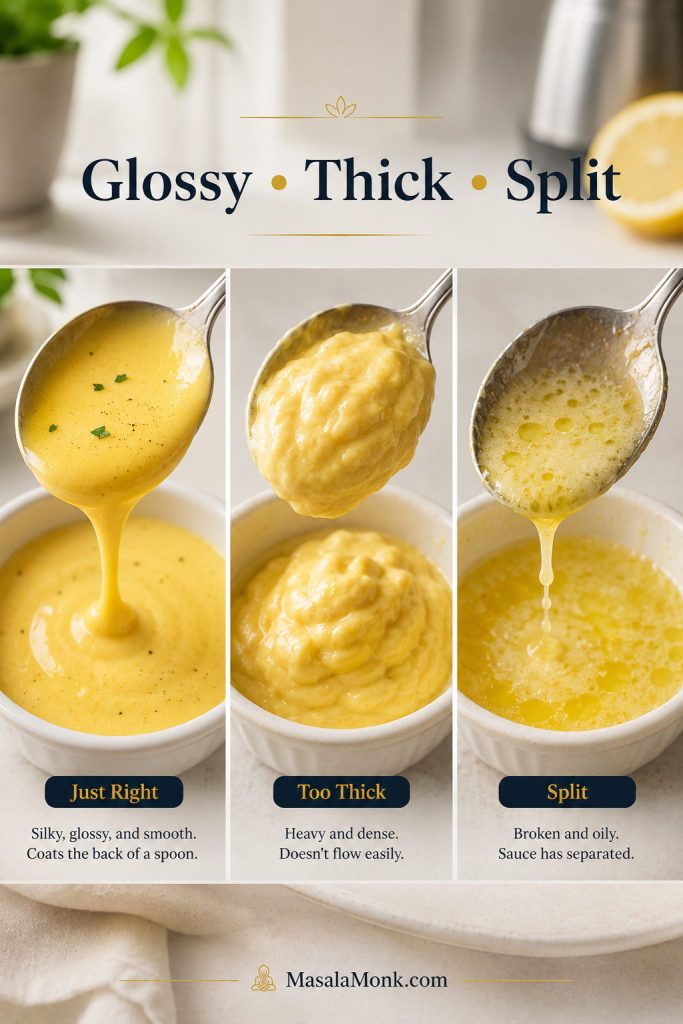
Bowl of hollandaise resting over hot water with gentle steam for warm holding.
A warm water bath buys you time without turning holding into cooking. Keep the bowl gently warm, then loosen the hollandaise with hot water if it thickens before serving.
  • Spoon the sauce into a warm bowl.
  • Set the bowl over a pan of hot water, not boiling water.
  • The bowl should feel warm, not aggressively hot.
  • Stir occasionally so the edges do not overheat.
  • Hold for 15–30 minutes if needed.
  • If it thickens, loosen it with a teaspoon or two of hot water.

That gentle hold buys you time without making the sauce feel like another thing to manage. Do not put hollandaise over direct high heat; too much heat can make it grainy or cause the yolks to scramble.

Brunch timing tip: make the sauce last whenever possible. If the rest of the plate is ready, fresh blender hollandaise makes Eggs Benedict feel much easier.

If the sauce thickens or separates while waiting, use the troubleshooting guide before serving.

Troubleshooting: How to Fix Benedict Sauce

If the sauce breaks, thickens, or looks wrong, pause before throwing it away. Most problems are fixable unless the yolks have fully scrambled.

A sauce that looks wrong for a moment is not a failed brunch. It is usually just asking for heat, water, or a slower hand. Look first, fix second.

Save split sauce. Restart scrambled sauce. If the sauce is oily or separated, the emulsion can often come back. If the yolks have turned grainy or scrambled, the smooth texture is usually gone.

Comparison of split oily hollandaise and grainy scrambled hollandaise in two bowls.
Split hollandaise and scrambled hollandaise need different decisions. If it looks oily, try saving it; however, once the yolks turn grainy, restarting is usually the smoother path.

The 3 Mistakes That Usually Break It

  • Adding the butter too fast. The yolks need time to absorb the butter.
  • Using butter that has cooled too much. Lukewarm butter can make the sauce weak or greasy.
  • Heating the finished sauce too aggressively. Direct heat can scramble the yolks or split the sauce.
Troubleshooting guide showing split, too-thick, too-thin, and grainy Benedict sauce fixes.
Most hollandaise problems are easier to fix when you identify the texture first. Thick sauce needs a little hot water, thin sauce needs more blending, and a broken emulsion needs the rescue step.
ProblemLikely CauseFix Now
Split or greasy textureButter went in too fast, butter cooled too much, or the emulsion brokeBlend in 1 tablespoon boiling water slowly. Add a second tablespoon only if needed.
Too thickIt cooled down or the emulsion is too tightWhisk or blend in hot water 1 teaspoon at a time.
Too thinButter was not hot enough, yolks were under-blended, or the sauce needs a little more timeBlend a little longer. If needed, warm very gently while whisking.
Grainy textureYolks overheated or started to scrambleStraining may help slightly, but restarting usually gives the best result.
Too lemonyToo much acid for the amount of butterBlend in a little more warm melted butter.
Flat flavorNot enough salt, lemon, or gentle heatAdd a tiny pinch of salt or a few drops of lemon juice.
Cooled before servingIt sat too long or the bowl was coldWarm gently over hot water and loosen with hot water if needed.

The Boiling-Water Rescue for Split Sauce

If your sauce looks greasy or separated, add 1 tablespoon boiling water to a clean blender or bowl. With the blender running, or while whisking constantly, slowly drizzle the broken sauce into the hot water. The heat and water can help pull the emulsion back together.

Broken hollandaise being slowly drizzled into a bowl with boiling water while whisking.
The boiling-water rescue gives split hollandaise a clean place to rebuild. Add the broken sauce slowly, because the emulsion needs a fresh start, not another rushed pour.

If the sauce improves but still looks slightly broken, add another tablespoon of boiling water only if needed. Do not keep adding water blindly, or the sauce can become too thin.

Once the sauce is smooth again, return to the warm-holding method or go back to the brunch timing order for assembly.

No Blender? Two Backup Methods

No blender does not mean no hollandaise. Use the bowl-and-whisk path when equipment is the issue; use the double-boiler path when you want more deliberate yolk heating.

Bowl-and-whisk hollandaise and double-boiler hollandaise methods shown with whisk, bowl, saucepan, and gentle heat.
No blender does not mean no hollandaise. A bowl and whisk solves the equipment problem, while a double boiler gives you gentler control over yolk heating.

Bowl-and-Whisk Hollandaise

Use the same ingredient amounts. Set a heatproof bowl over barely simmering water, making sure the bottom of the bowl does not touch the water. Whisk the yolks, lemon juice, and 1 tablespoon water until the mixture looks lighter and slightly thickened, then remove the bowl from the heat and slowly whisk in the melted butter.

It works well, although it needs a slower hand and more attention than the blender version. Keep the heat gentle, whisk constantly, and do not let the bowl get too hot.

Double-Boiler Hollandaise

For a more traditional cooked-yolk approach, set a heatproof bowl over a pan of barely simmering water, again making sure the bowl does not touch the water. Whisk the egg yolks, lemon juice, and 1 tablespoon water until the mixture looks slightly lighter, warm, and a little thicker.

Remove the bowl from the heat, then gradually whisk in warm melted butter. If the sauce tightens too much, loosen it with warm water in small splashes.

This method takes longer than the blender version, but it gives you more control over warming the yolks. Keep the heat gentle; hollandaise likes warmth, not aggression.

Food Safety Note for Blender Hollandaise

Blender hollandaise is warmed mostly by the melted butter. Because of that, the yolks may not get as thoroughly heated as they would in a custard or double-boiler sauce. For young children, pregnant people, older adults, or anyone immunocompromised, use pasteurized eggs or choose the double-boiler method above. For general egg-safety guidance, see the FDA egg safety guide.

This is not meant to make the sauce feel intimidating; it simply gives careful households a clear path: use pasteurized eggs, or choose the double-boiler method above.

Homemade vs Packet Hollandaise

There is no shame in packet or jarred hollandaise on a chaotic morning. Convenience has its place, especially for casseroles, breakfast bakes, or low-pressure sides. For classic Eggs Benedict, though, fresh blender sauce tastes brighter, warmer, and more buttery-lemony.

Homemade hollandaise and packet hollandaise compared on Eggs Benedict plates with asparagus and blender sauce.
Packet hollandaise can help on a busy morning, but homemade blender sauce gives you more control: brighter lemon, softer texture, and a warmer, fresher pour.

The homemade version also lets you adjust the plate in real time: more lemon for salmon, a thicker pour for eggs, a looser sauce for asparagus, or a little cayenne for crab. Packet sauce rarely gives you that kind of control.

Flavor Variations

Think of the base sauce as the calm version. Lemon makes it brighter, Dijon makes it rounder, cayenne makes it warmer, and herbs make it feel fresher.

Bowls of hollandaise with lemon, Dijon, cayenne, herbs, and smoked paprika flavor variations.
Once the base sauce is smooth, small flavor changes can match the plate. Lemon sharpens salmon, Dijon rounds out ham, cayenne suits crab, and herbs brighten spring vegetables.
  • Extra lemon: add a few more drops at the end for smoked salmon, asparagus, or crab.
  • Dijon hollandaise: use ½–1 teaspoon Dijon for classic Eggs Benedict, ham, or breakfast potatoes.
  • Cayenne hollandaise: add a slightly larger pinch for crab Benedict, steak and eggs, or rich seafood plates.
  • White pepper hollandaise: use white pepper instead of cayenne for a more traditional brunch flavor.
  • Herb hollandaise: stir in chopped chives, dill, or tarragon after blending for salmon, asparagus, or spring brunch plates.
  • Smoked paprika hollandaise: add a small pinch for potatoes, steak, or roasted vegetables.

For dietary swaps, a good dairy-free butter can make a hollandaise-style sauce closest to the original. Yogurt or mayo-based versions are lighter shortcuts, while cashew or tofu sauces belong more in vegan Benedict territory. They can be useful, but they are alternatives rather than classic hollandaise.

More Ways to Use It

Once the main Benedict plate is handled, this lemony butter sauce can stretch into the rest of brunch: vegetables, seafood, potatoes, and simple egg plates.

Spoon it over asparagus with black pepper, smoked salmon with extra lemon, crab cakes with a little cayenne, or breakfast potatoes when you want the plate to feel more like brunch than leftovers.

Brunch spread with hollandaise on asparagus, smoked salmon, crab cakes, potatoes, and poached egg.
Beyond Eggs Benedict, hollandaise works best where butter, lemon, and warmth already make sense: asparagus, salmon, crab cakes, potatoes, and simple egg plates.
  • Egg dishes: classic Eggs Benedict, Eggs Florentine, poached eggs on toast, steak and eggs, or a slice of frittata when you want a brunch plate that still feels egg-forward.
  • Toast and brunch plates: spoon a little over poached eggs, sautéed greens, or avocado toast when you want something richer than lemon or hot sauce.
  • Seafood: try it with smoked salmon, crab cakes, salmon croquettes, shrimp, scallops, or grilled salmon.
  • Vegetables and potatoes: use it with asparagus, roasted broccoli, broccolini, breakfast potatoes, grain bowls, or vegetable plates topped with eggs.

If the food underneath is rich, use a slightly sharper sauce with a few extra drops of lemon. If the food is lean or vegetable-heavy, the classic version works beautifully.

Storage and Reheating

Hollandaise is at its best right after blending, while it is still warm, glossy, and loose enough to spoon over eggs.

If you have leftovers, refrigerate them in a covered container and use them within 1–2 days for best quality. The sauce will thicken when cold and may separate slightly. That does not always mean it is ruined, but reheating needs to be gentle.

Freezing is not recommended. The emulsion usually suffers when thawed and reheated, so the texture will not be as smooth as a fresh batch.

Covered hollandaise in a refrigerator and hollandaise reheating gently over warm water.
Fresh hollandaise has the smoothest pour, although a short fridge stay is manageable. Reheat slowly over warm water; freezing and harsh heat both work against the emulsion.

How to Reheat It

  • Set the sauce in a heatproof bowl over warm water.
  • Whisk gently as it loosens.
  • Add small splashes of hot water if it is too thick.
  • Use very low heat only; do not boil.
  • If using a microwave, use very short bursts and whisk between each one.

You can hold it briefly and reheat leftovers carefully, but if texture really matters, make the sauce fresh.

For meal-prep mornings, sturdy egg dishes are much easier to store. These egg muffin cups are a better make-ahead option when you want eggs ready for the week instead of a delicate sauce.

The Brunch Payoff

Once you know the slow pour, the soft ribbon, and the gentle warm hold, the final plate feels much less fragile.

Fork cutting into Eggs Benedict with runny yolk mixing into glossy hollandaise sauce.
This is the brunch payoff: warm hollandaise, a runny yolk, and a toasted muffin catching the sauce. Once you know the cues, Benedict sauce feels far less fragile than it looks.

Need a quick answer instead? The Benedict sauce FAQs cover storage, reheating, salted butter, lemon swaps, and sauce amounts.

Benedict Sauce FAQs

Is Benedict sauce the same as hollandaise?

Yes. Benedict sauce is the everyday name many home cooks use for hollandaise when it is served on Eggs Benedict. The recipe is the same basic butter, yolk, lemon, and seasoning emulsion.

What is Eggs Benedict sauce made of?

Eggs Benedict sauce is usually made with egg yolks, melted butter, lemon juice, salt, and cayenne or white pepper. This blender version also includes optional Dijon mustard for a little extra brightness.

Why did my sauce split?

It usually splits when the butter goes in too quickly, cools too much, or the emulsion never fully forms. If it looks oily or separated, try the boiling-water rescue before restarting.

How do I fix sauce that is too thin or too thick?

For a thick sauce, whisk in small splashes of hot water until it loosens. For a thin sauce, blend a little longer; if needed, warm it gently while whisking. Avoid high heat because the yolks can scramble.

How long can hollandaise stay warm?

Hold it for 15–30 minutes over hot water, not direct heat. Stir now and then, and loosen it if it thickens. If the bowl feels hot enough to cook eggs, it is too hot for holding hollandaise.

Can I make or reheat it ahead of time?

It is best made fresh. You can hold it warm for 15–30 minutes, and leftovers can be reheated gently over warm water, but hollandaise thickens and can separate as it cools. Treat reheating as a careful rescue, not a full make-ahead plan.

Does blender hollandaise cook the egg yolks?

The melted butter warms the yolks, but blender hollandaise may not cook them fully like a custard. Use pasteurized eggs or the double-boiler method if that matters for your household.

Can I make it without a blender?

Yes. Use the same ingredients in a heatproof bowl over barely simmering water. It takes more whisking than the blender method, but the cue is the same: gentle heat, slow butter, smooth texture.

Is Dijon mustard required?

Dijon is optional. Use it when you want a rounder, slightly tangier sauce; leave it out when you want a more classic hollandaise flavor.

Can I use salted butter?

Salted butter works, but treat the recipe salt as optional at first. Blend the sauce, taste it, then add only what it needs.

What can I use instead of lemon juice?

Fresh lemon is best because it gives hollandaise a clean brightness. White wine vinegar can work in a pinch, but start with less because it can taste sharper and more pointed than lemon.

How much sauce do I need for four Eggs Benedict plates?

For four plates with two Benedict halves each, plan on ¾ cup to just under 1 cup sauce. This recipe makes enough for a normal pour; make 1.5x if everyone likes extra sauce or if potatoes, asparagus, or salmon are also on the table.

Why is my hollandaise pale instead of bright yellow?

Egg yolk color varies. Some yolks make a deeper yellow sauce, while others make a paler one. If the flavor and texture are right, the color is not a problem.

Back to top

Posted on Leave a comment

Banana Bread with Applesauce Recipe

Sliced banana bread with applesauce on parchment, showing a soft set crumb with ripe bananas and applesauce nearby.

This banana bread with applesauce recipe is for the moment when the bananas on the counter are almost too soft for the fruit bowl but perfect for baking. The loaf comes out moist, sliceable, and a little lighter than classic banana bread, while still holding together after it cools.

The texture comes down to balance. Applesauce is wonderful in banana bread because it adds moisture and lets you use less fat, but it also brings water into the batter. With the wrong ratio, the top can look beautifully baked while the center stays heavy, damp, or gummy.

The goal is a loaf that smells like ripe bananas and cinnamon, slices without dragging, and feels plush rather than damp when you pick up a piece.

Quick Answer: Banana Bread with Applesauce

For one moist loaf, the sweet spot is 1½ cups mashed ripe banana plus ½ cup unsweetened applesauce, with 3 tablespoons oil or melted butter to keep each slice from feeling rubbery or fragile. Bake it in a 9×5-inch loaf pan at 350°F / 175°C until the middle bakes through and the crumb looks even, not shiny or wet.

This is not a fully no-oil loaf by default because applesauce replaces moisture better than it replaces tenderness. The small amount of fat keeps the crumb softer, cleaner, and easier to slice neatly.

This version is built around the texture problem applesauce banana bread often has: plenty of moisture, but not enough structure to slice cleanly. That is why the banana and applesauce are measured, a little fat stays in the batter, and the loaf gets time to bake through and cool before slicing.

At a glance: For one 9×5-inch loaf, use 1½ cups mashed ripe banana, ½ cup unsweetened applesauce, 2 cups flour, 2 eggs, and 3 tablespoons oil or melted butter. Bake at 350°F / 175°C for 55–65 minutes, until the center reaches about 200–205°F / 93–96°C.

For the first bake, make the recipe as written before reducing the oil, cutting the sugar further, or swapping in more whole wheat flour. Once you know how the batter should look and how the cooled loaf should slice, the variations become much easier to control.

Quick answer ratio board for banana bread with applesauce showing mashed banana, applesauce, oil or butter, bake temperature, and time.
Make the first loaf with the full ratio before tweaking. Once you know this baseline, lower-fat and variation decisions become much easier.

What This Loaf Tastes Like

This is a banana-forward loaf first, with gentle apple sweetness in the background. It does not taste like apple cake. The applesauce mostly shows up in the texture: an even crumb, a little extra moisture, and slices that still taste pleasant the next day.

Cinnamon, vanilla, and brown sugar make the banana flavor warmer. If you add walnuts or pecans, the loaf becomes more classic and bakery-style. If you skip them, it stays simple, easy to slice, and lunchbox-friendly.

It should taste like a cozy banana loaf with a softer crumb, not like applesauce trying to take over. It is still a quick bread, so expect a soft, sturdy crumb rather than an airy cake texture.

Close-up of banana bread slices showing an even, moist crumb with no gummy center or shiny wet line.
Look for a crumb that is evenly baked from edge to middle. That is the difference between fruit-rich banana bread and underdone banana bread.

Why You’ll Love This Recipe

  • Moist without the gummy middle: the banana, applesauce, flour, fat, and bake time are balanced so the loaf sets properly.
  • Still tastes like real banana bread: applesauce lightens the loaf, but a small amount of oil or butter keeps each slice from feeling rubbery or fragile.
  • Uses the bananas you were about to lose: heavily speckled bananas give the deepest flavor and natural sweetness.
  • Easy to adjust after the first bake: make it nuttier, less sweet, lower fat, dairy-free, vegan, or muffin-style without starting from scratch.

Why Applesauce Works in Banana Bread

Banana bread already depends on fruit puree, so applesauce fits naturally into the batter. It adds gentle sweetness and helps the loaf stay fresh-tasting for longer.

The catch is that applesauce is not the same as butter or oil. Fat helps coat the flour, which gives the crumb a softer bite. Applesauce brings extra water and fruit solids, which is why the batter needs the right balance. When the batter gets too wet, quick breads can turn dense, chewy, or gummy.

For that reason, this recipe keeps a small amount of oil or melted butter in the batter. It still feels lighter than a classic loaf, but it slices more cleanly once cooled.

You see the same idea in a good applesauce cake, where the applesauce keeps the crumb moist and even without making the cake feel wet.

Ingredients for Banana Bread with Applesauce

The ingredients are familiar, but measuring them makes the loaf much more reliable. A little too much banana or applesauce can make the crumb feel compressed instead of tender.

Labeled ingredients for banana bread with applesauce, including ripe bananas, applesauce, eggs, flour, brown sugar, oil, spices, and nuts.
The ingredient list is simple, but the recipe depends on balance: ripe bananas for flavor, applesauce for moisture, and a little fat for tenderness.

Very Ripe Bananas

Use bananas that are heavily speckled or mostly brown on the outside. They mash easily, taste sweeter, and give the loaf its deep banana flavor. If the bananas are still too yellow, use the ripening shortcuts before you start.

Banana ripeness guide showing bananas from too firm to heavily speckled and mostly brown for banana bread.
Heavily speckled bananas give banana bread the deepest flavor. However, measuring the mashed fruit still keeps the applesauce loaf from getting too wet.

If a banana looks too far gone for eating out of hand, it may be exactly right for this batter. For this recipe, measure 1½ cups mashed banana, which is usually about 3 large bananas or 4 smaller ones. Too little banana gives a bland loaf, while too much can make the middle heavy, especially with applesauce in the batter. Using freezer bananas? Drain them before measuring.

Mashed banana measured to 1½ cups in a glass measuring cup with ripe bananas and a fork nearby.
Banana size changes from bunch to bunch, so measure after mashing. This one step makes banana bread with applesauce much more reliable.

Frozen bananas also work. Thaw them first, drain off excess liquid, then mash and measure. They can release a lot of moisture, so measuring is even more important if you are using bananas from the freezer.

Frozen banana process guide showing thawed bananas, drained liquid, mashed banana, and 1½ cups measured for banana bread.
Frozen bananas work well, but they release extra liquid. Drain first, then mash and measure so the loaf stays soft instead of gummy.

How to Ripen Bananas Faster

If your bananas are yellow but not soft yet, place them in a paper bag and leave them at room temperature until the peels become heavily speckled. For a same-day option, bake unpeeled bananas on a lined baking sheet at 300°F / 150°C until the peels darken and the fruit softens, then cool before mashing.

This shortcut helps with texture, but it does not create the same deep flavor as bananas that ripen naturally over several days. Use it when you need banana bread today, not when you are chasing the strongest banana flavor.

If the bananas release liquid as they cool, leave that liquid behind before measuring so you do not add extra water to the batter.

Two-method guide for ripening bananas faster, showing the paper bag method and oven-ripened bananas at 300°F.
A paper bag is better when you have time; meanwhile, the oven shortcut helps when banana bread needs to happen today.

Unsweetened Applesauce

Plain unsweetened applesauce is best because it adds moisture without making the loaf too sweet. Homemade or store-bought both work, as long as the applesauce is smooth enough to blend evenly into the batter.

Sweetened applesauce is fine, but reduce the brown sugar slightly if you prefer a less sweet loaf. Cinnamon applesauce works too, especially if you want a warmer, spiced flavor.

A Small Amount of Oil or Melted Butter

The few tablespoons of fat are not there by accident. You can make a no-oil version, but the texture is usually more fragile. Three tablespoons of neutral oil or melted butter give the crumb a better bite while keeping the recipe lighter than a traditional butter-heavy loaf.

Use neutral oil when you want the banana flavor to stay clean and simple, with a softer next-day slice. Use melted butter if you want a richer, more classic banana bread flavor and a slightly firmer bite once the loaf cools. Trying to reduce more fat? Compare the applesauce-oil options later in the post.

Oil versus melted butter comparison for banana bread with applesauce, showing texture and flavor differences.
Oil keeps the banana flavor cleaner and softer the next day, while melted butter gives the loaf a richer, more classic banana bread taste.

Flour, Eggs, Sugar, and Leavening

All-purpose flour gives the most reliable loaf. You can replace up to half of it with whole wheat flour for a heartier flavor, but using all whole wheat flour will make the bread denser and may need a little extra moisture.

Whole wheat flour swap guide showing all-purpose flour, whole wheat flour, and a banana bread slice.
A partial whole wheat swap adds heartier flavor without taking over the loaf. Start with half so the crumb still stays tender.

If you want a banana loaf built around oats instead of regular flour, try this healthy banana bread with oat flour for a more oat-forward version.

Brown sugar is doing more than sweetening here. It brings a light caramel note that makes the banana taste rounder, especially when the applesauce is plain and unsweetened. Eggs help the batter set, and a mix of baking soda plus a little baking powder helps lift the fruit-heavy batter.

Walnuts, Pecans, or Chocolate Chips

Walnuts and pecans turn this into banana nut bread with applesauce. Use ½ cup for a lighter crunch or up to ¾ cup for a more classic banana nut loaf. Chocolate chips also work, but they make the bread sweeter and more dessert-like.

Mix-in chooser for banana bread with applesauce showing plain, walnuts, pecans, and chocolate chips.
Mix-ins change the personality of the loaf. Still, keep them under 1 cup so the banana-applesauce batter stays balanced and sliceable.

Equipment for This Loaf

You do not need a mixer for this loaf. In fact, mixing by hand is better because it helps prevent a rubbery crumb. A few small banana lumps are fine; beaten batter is not what you want here.

  • 9×5-inch loaf pan
  • Large mixing bowl
  • Medium bowl for dry ingredients
  • Fork or potato masher for the bananas
  • Whisk
  • Flexible spatula
  • Parchment paper, optional
  • Cooling rack
  • Digital thermometer, optional

The important part is not special equipment. It is gentle mixing, the right pan, and enough cooling time before slicing. A digital thermometer removes the guesswork from fruit-heavy loaves, where the top can brown before the center is ready.

Equipment for banana bread with applesauce, including loaf pan, bowls, fork, whisk, spatula, parchment, rack, and thermometer.
A bowl, whisk, spatula, and loaf pan are enough. The thermometer is the only optional tool that can save an uncertain center.

What Kind of Applesauce Should You Use?

The applesauce you use changes more than sweetness. It can change how loose the batter feels and how quickly the middle bakes through. If you are trying to avoid a damp center, this is one of the easiest places to stay in control.

Applesauce chooser board with smooth unsweetened, sweetened, cinnamon, chunky, and watery applesauce options.
Smooth unsweetened applesauce is the safest choice. If your applesauce is chunky or watery, adjust it before mixing so the crumb bakes evenly.
Applesauce Type Works? What to Adjust
Unsweetened smooth applesauce Best choice No change needed
Sweetened applesauce Yes Reduce the brown sugar slightly if you want a less sweet loaf
Cinnamon applesauce Yes Reduce or skip the extra cinnamon if needed
Homemade applesauce Yes Use smooth applesauce that is not watery
Chunky applesauce Sometimes Mash or blend first for a more even crumb
Very watery applesauce Risky Drain slightly or use 1–2 tablespoons less

If your applesauce looks loose and watery, hold back a little instead of adding extra. The batter may seem thick at first, but extra water shows up later in the baked crumb. The finished batter should mound softly in the pan, not pour like pancake batter.

Best Banana-to-Applesauce Ratio

The best starting ratio for one standard loaf is 1½ cups mashed banana to ½ cup applesauce. That gives enough banana flavor and enough applesauce moisture without flooding the batter.

Applesauce is not the problem. The problem is stacking too much banana and applesauce without giving the loaf enough flour, eggs, bake time, and cooling time.

Loaf Style Mashed Banana Applesauce Result
Balanced classic 1½ cups ½ cup Moist and sliceable
More banana-forward 1⅔ cups ⅓ cup Stronger banana flavor with slightly less added moisture
Lower-fat style 1½ cups ½ cup Lighter and more delicate, especially if you reduce the oil
Risky wet loaf 2 cups or more ½ cup or more More likely to bake up dense or gummy in the center

When the balance is right, the loaf tastes fruit-rich without feeling heavy. The first slice should smell warm, hold together, and look set rather than damp or compressed.

Banana and applesauce ratio guide showing balanced, banana-forward, lower-fat, and risky wet loaf options.
The banana-to-applesauce ratio controls moisture before the loaf ever reaches the oven. Too much fruit can make the crumb slow to set.

That balance is what keeps the loaf tasting like real banana bread, not like a lighter version where the texture feels like a compromise.

Best Pan Size and Pan Type for Banana Bread with Applesauce

Pan size changes how deep the batter sits, which changes how quickly the center sets. For this fruit-rich batter, a 9×5-inch loaf pan is the safest default.

Pan What Changes How to Bake It
9×5-inch loaf pan Best default; bakes most evenly 55–65 minutes at 350°F / 175°C
8½x4½-inch loaf pan Taller loaf; center takes longer Start checking around 55 minutes, but expect extra time
8×5-inch loaf pan Works, but the center can be slower Use a thermometer if possible and avoid pulling early
Dark metal loaf pan Browns faster on the outside Check early, tent if needed, and reduce the oven by 25°F / about 15°C if it over-browns
Glass or ceramic loaf pan Can bake more slowly through the center Expect extra time and use a thermometer; tent if the top browns before the middle is done
Mini loaf pans Smaller loaves bake faster Start checking around 30–35 minutes
Muffin tin Fastest bake with more edges 20–25 minutes at 350°F, or 18–20 minutes at 375°F
Pan size and pan type guide for banana bread with applesauce, including loaf pans, dark metal, glass, mini loaves, and muffin tin.
Pan size and material change how the middle bakes. Because this batter is fruit-rich, the safest default is a 9×5-inch loaf pan.

If the top browns before the middle is done, tent the loaf loosely with foil and continue baking. This is especially useful with smaller loaf pans, dark metal pans, glass pans, ceramic pans, or very ripe bananas.

Dark metal versus glass or ceramic loaf pan comparison for banana bread, with browning and center-baking cues.
Dark metal browns faster, while glass and ceramic can bake more slowly through the center. As a result, doneness cues matter more than color alone.

How to Make Banana Bread with Applesauce

Once the fruit and applesauce are measured, the method is simple. The main thing is to mix gently and give the center enough time to bake through. If you are unsure near the end, use the doneness guide instead of judging by color alone.

Step-by-step process for banana bread with applesauce, showing pan prep, mashed banana, wet ingredients, dry ingredients, folding, baking, and cooling.
The method is simple, but the order helps: measure the fruit, mix wet and dry separately, fold gently, then let the loaf cool before slicing.

1. Prepare the Pan

Heat the oven to 350°F / 175°C. Grease a 9×5-inch loaf pan and line it with parchment if you want to lift the loaf out easily.

2. Mash and Measure the Bananas

Mash the ripe bananas with a fork, then measure 1½ cups. A few small banana lumps are fine. They make the loaf feel homemade and keep the crumb from becoming too uniform.

3. Mix the Wet Ingredients

Whisk the mashed banana, applesauce, eggs, brown sugar, oil or melted butter, and vanilla until combined. The mixture will look loose and glossy.

4. Mix the Dry Ingredients Separately

In another bowl, whisk the flour, baking soda, baking powder, cinnamon, and salt. This helps the leavening spread evenly through the thick fruit-based batter.

5. Fold Gently

Add the dry ingredients to the wet ingredients and fold with a spatula until no dry flour remains. A mixer is not needed here; overmixing is one of the easiest ways to make the crumb rubbery.

The batter should be thick enough to mound on the spatula. If it looks loose before it goes into the oven, the finished crumb is more likely to feel heavy.

Batter texture guide showing banana bread batter mounding on a spatula compared with batter that is too loose.
The batter should mound instead of pour. If it spreads too easily, the baked banana bread is more likely to feel compressed.

6. Add Nuts if Using

Fold in walnuts or pecans at the end. For a prettier top, save a small handful and scatter them over the batter before baking.
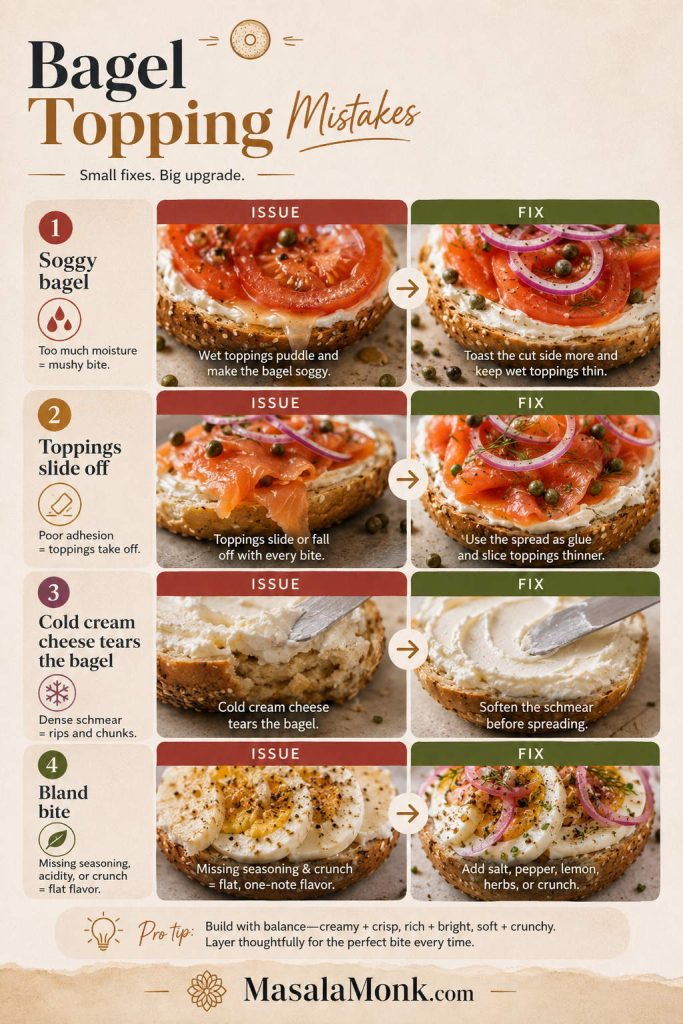
7. Bake Until the Center Is Set

Spread the batter into the prepared pan and bake for 55 to 65 minutes. A browned top is only part of the story; this fruit-heavy batter still needs time for the center to finish baking.

Near the end, the loaf should smell deeply banana-rich, and the center should look set rather than glossy. The bread is done when a toothpick inserted into the center comes out with moist crumbs but no wet batter. For the most reliable check, use a digital thermometer; the center should register about 200°F to 205°F / 93°C to 96°C. King Arthur Baking also recommends this internal-temperature range for banana bread doneness in its banana bread doneness guide.

Doneness guide for banana bread with applesauce showing toothpick crumbs, a thermometer reading, and a set center.
A few moist crumbs are fine, but wet batter is not. For extra confidence, check for 200–205°F in the center before cooling the loaf.

8. Cool Before Slicing

Let the loaf cool in the pan for 10 to 15 minutes, then move it to a rack. Banana bread continues to set as it cools, especially when applesauce is in the batter.

Cutting too early can make a properly baked loaf look underdone, because the crumb has not had time to settle. Waiting is annoying, but it is one of the easiest ways to get clean slices.

Once cooled, the slices should look even and plush, with tiny banana flecks through the crumb instead of a shiny wet line in the center.

Cooling timeline for banana bread showing cooling in the pan, cooling on a rack, and clean slices after resting.
Cooling is part of the recipe, not an afterthought. Once the crumb settles, the slices cut cleaner and hold their shape.

Before you use the recipe card, remember the three texture cues that matter most: measured banana, batter that mounds instead of pours, and a fully cooled loaf before the first cut.

Clean slices of banana bread with applesauce showing an even crumb and no wet line.
This is the texture to look for after cooling: even crumb, clean edges, and slices that hold together without crumbling.

Banana Bread with Applesauce Recipe

This fruit-rich loaf is lighter than classic banana bread but still soft, fragrant, and sturdy enough to slice cleanly once cooled.

Yield1 standard loaf
Prep Time15 minutes
Cook Time55–65 minutes
Total TimeAbout 1 hour 20 minutes, plus 45–60 minutes cooling

Pan: 9×5-inch loaf pan
Oven: 350°F / 175°C

Ingredients

  • 1½ cups mashed very ripe banana, about 340 g
  • ½ cup unsweetened applesauce, about 120 g
  • 2 large eggs
  • ½ cup packed light brown sugar, about 105 g
  • 3 tablespoons neutral oil, about 45 ml, or 3 tablespoons melted butter, about 42 g
  • 2 teaspoons vanilla extract
  • 2 cups all-purpose flour, 240 g
  • 1 teaspoon baking soda
  • ½ teaspoon baking powder
  • 1 teaspoon ground cinnamon
  • ½ teaspoon fine salt
  • ½ cup chopped walnuts or pecans, optional, about 55–65 g

Method

  1. Heat the oven to 350°F / 175°C. Grease a 9×5-inch loaf pan and line it with parchment if you want easier lifting.
  2. Mash the bananas, then measure 1½ cups. Banana size varies so much that measuring gives you a more reliable loaf than counting bananas alone.
  3. In a large bowl, whisk the mashed banana, applesauce, eggs, brown sugar, oil or melted butter, and vanilla.
  4. In a separate bowl, whisk the flour, baking soda, baking powder, cinnamon, and salt.
  5. Add the dry ingredients to the wet ingredients and fold gently until no dry flour remains. The batter should be thick enough to mound on the spatula, not runny.
  6. Fold in walnuts or pecans if using.
  7. Spread the batter into the prepared pan. Bake for 55–65 minutes, or until a toothpick inserted in the center comes out with moist crumbs but no wet batter. For the most reliable check, the center should read about 200–205°F / 93–96°C.
  8. If the top browns before the center is done, tent the loaf loosely with foil and keep baking.
  9. Cool in the pan for 10–15 minutes, then move to a rack. Let the loaf cool for at least 45–60 minutes before slicing so the crumb can finish setting.

Notes

  • For your first loaf, use the full 3 tablespoons oil or melted butter. Once you know the texture, you can reduce it to 2 tablespoons for a lighter but more delicate loaf.
  • Use up to ¾ cup nuts, about 85 g, if you want a more classic banana nut loaf.
  • For a less sweet loaf, reduce the brown sugar to ⅓ cup if your bananas are very ripe.
  • If using frozen bananas, thaw and drain off excess liquid before measuring.
  • For the cleanest slices, cool the loaf fully before cutting.

After the first loaf, the best tweak is personal: richer with butter, cleaner with oil, crunchier with walnuts, softer as muffins, or lighter with a little less fat. The sections below help you adjust without losing the clean-slicing texture.

How to Avoid Gummy Banana Bread with Applesauce

A good slice should hold together, with an even crumb and a set center. If your last loaf looked beautiful on top but cut into a compressed middle, you probably do not need a completely different recipe. You usually need better measurement, a little more bake time, and enough cooling before cutting.

Most gummy loaves come from a combination of too much wet fruit, heavy mixing, not enough time in the oven, or slicing before the crumb has set. The good news is that it usually does not mean you are bad at banana bread; it comes down to one of a few fixable choices.

Troubleshooting board for gummy banana bread, showing fixes for gummy middle, rubbery crumb, fast browning, dense loaf, wet slices, and dry edges.
Most gummy banana bread problems come from moisture, mixing, bake time, or cooling. Once you know the cause, the fix is usually simple.

Texture Problems and Fixes

Problem Likely Cause How to Fix It
Gummy middle Too much banana or applesauce, or the loaf was underbaked Measure the banana, keep applesauce to ½ cup, and bake until the middle no longer looks shiny or wet
Rubbery texture The batter was overmixed Fold gently by hand and stop when the flour disappears
Top browns too fast The outside is browning before the center finishes Tent loosely with foil and continue baking
Dense loaf Too much wet ingredient or weak leavening Use fresh baking soda and baking powder, and follow the banana-to-applesauce ratio
Wet-looking slices The loaf was sliced too hot Cool at least 45 minutes before slicing
Dry edges Dark pan, overbaking, or too little wet ingredient Check earlier, use parchment, and try a lighter pan next time if the edges keep drying out
Side-by-side comparison of gummy compressed banana bread crumb and properly set sliceable crumb.
A compressed crumb is a clue, not a disaster. Next time, check the fruit amount, bake time, and cooling window.

Wet Center vs Fully Baked Crumb

A clean toothpick is not always the best goal for banana bread. A few soft crumbs on the toothpick are fine. Wet batter, shiny streaks, or a sunken center mean the loaf needs more time.

Banana bread center guide showing wet batter, shiny streaks, and a fully set crumb.
Moist crumbs are normal in banana bread, but shiny streaks or wet batter mean the center still needs more time.

What to Do If the Top Browns Too Fast

If the top is dark but the center still has wet batter, lay a loose piece of foil over the loaf and continue baking. This keeps the crust from getting too dark while the middle finishes.

Foil tent sequence for banana bread showing a darkening top, loose foil over the loaf, and continued baking.
If the top browns early, do not pull the loaf too soon. Tent it loosely with foil so the crust is protected while the center finishes.

Can Applesauce Replace Oil or Butter in Banana Bread?

Applesauce can lighten banana bread beautifully, but it cannot do everything butter or oil does. It brings moisture; fat brings richness, tenderness, and a cleaner bite.

Because banana bread already contains mashed fruit, it handles applesauce better than many cakes or cookies. Even so, a small amount of oil or melted butter helps prevent the loaf from becoming springy, tough, or too delicate in the middle.

Think of applesauce as a helper, not a perfect stand-in for every bit of fat. Bon Appétit explains this tradeoff in its guide to using applesauce instead of oil or butter.

Version What to Use Texture
Best balanced ½ cup applesauce + 3 tablespoons oil or melted butter Moist, rich enough, and sliceable
Lower-fat ½ cup applesauce + 1–2 tablespoons oil Lighter and more delicate
No-oil ½ cup applesauce and no added fat Moist but more delicate, with a higher risk of a soft center
Richer loaf ⅓ cup applesauce + ¼ cup melted butter or oil More classic banana bread texture

After the first loaf, you can reduce the oil slightly if you prefer a softer, lower-fat version.

Applesauce instead of oil decision board showing balanced, lower-fat, no-oil, and richer banana bread options.
Applesauce adds moisture, but fat adds tenderness. That is why the best banana bread with applesauce usually keeps a small amount of oil or butter.

Banana Bread with Applesauce and Yogurt

Yogurt works best as a small swap, not a big extra addition, because banana, applesauce, and yogurt all bring moisture. For a tangier, softer loaf, replace 2 tablespoons of the applesauce with plain Greek yogurt or regular plain yogurt.

Yogurt variation for banana bread with applesauce showing yogurt, applesauce, measuring spoon, and a loaf slice.
Use yogurt as a swap, not an add-on. A small amount adds tang, while too much extra moisture can slow the center.

It gives the loaf a little tang and softness without turning it into a completely different bake.

Adding a full extra ½ cup yogurt can make this batter too wet unless you also adjust the flour or bake time. The flavor may be good, but the center can turn heavy.

Banana Nut Bread with Applesauce

For banana nut bread with applesauce, fold ½ to ¾ cup chopped walnuts or pecans, about 55–85 g, into the batter just before baking. Walnuts make the loaf taste more old-school; pecans make it a little softer and sweeter.

Banana nut bread with applesauce showing sliced loaf with walnuts, pecans, applesauce, and toasted nut cues.
Toast the nuts, cool them, then fold them in last. That keeps the crunch clear without overworking the batter.

This is the version to make when you want the loaf to feel more classic and bakery-style, with a little crunch against the soft fruit-rich crumb.

Toasting the nuts first gives deeper flavor without changing the recipe. Warm them in a dry skillet for 3–5 minutes, or on a baking sheet for 6–8 minutes at 350°F / 175°C, then cool before folding them into the batter.

Too many nuts can make the loaf crumbly and weigh down an already-moist batter. Keep it under 1 cup if you want neat slices.

No Added Sugar Banana Bread with Applesauce

A no-added-sugar version works best when the bananas are deeply ripe, but it will taste more like a breakfast loaf than a dessert loaf. The bananas carry most of the sweetness, so this is not the place for pale, barely ripe fruit.

This version is not truly sugar-free because bananas and applesauce contain natural sugars. However, you can skip the brown sugar or reduce it to 2 to 3 tablespoons if your bananas are very sweet and heavily speckled.

No added sugar banana bread with applesauce showing ripe bananas, a sliced loaf, cinnamon, vanilla, and reduced sugar cue.
For a no-added-sugar version, very ripe bananas do the heavy lifting. However, the loaf will taste more breakfast-style than dessert-like.

For better flavor in a no-added-sugar loaf, use extra cinnamon, vanilla, and a pinch more salt. These small touches make the banana flavor taste fuller even without much added sugar.

Eggless or Vegan Banana Bread with Applesauce

For a vegan version, use neutral oil instead of butter and replace the eggs with 2 flax eggs. To make 2 flax eggs, mix 2 tablespoons ground flaxseed with 5 tablespoons water and let it thicken for about 10 minutes before adding it to the batter.

Eggless or vegan banana bread with applesauce showing flax egg, neutral oil, applesauce, and a sliced loaf.
Flax eggs help bind the batter, but the crumb is more delicate. Let the loaf cool fully before slicing for the cleanest texture.

It is a helpful option when the loaf needs to work for more people at the table, but full cooling matters even more because the crumb is more delicate.

Applesauce helps with moisture and a little binding, but it does not behave exactly like eggs. An eggless loaf will usually be more delicate and slightly denser, so let it cool completely before slicing.

If you only need the recipe to be dairy-free, the fix is easier: use neutral oil instead of melted butter. The rest of the main recipe can stay the same.

Banana Muffins with Applesauce

This batter also works as banana muffins with applesauce. Divide it into a lined muffin tin, filling each cup about ¾ full. Bake at 350°F / 175°C for about 20 to 25 minutes, or until the tops spring back and a toothpick comes out with moist crumbs.

Banana muffins with applesauce in a lined muffin tin, with bake times, fill level, cooling cue, and split muffins showing crumb.
The same banana-applesauce batter can become muffins. Because they bake faster than a loaf, check early and let them rest briefly in the pan.

Muffins are the better choice when you want faster cooling, easy freezing, or smaller grab-and-go portions with the same banana-applesauce flavor. Overbaking while waiting for a dark top can dry the edges, so look for tops that are set and spring back lightly.

For slightly taller muffin tops, bake at 375°F / 190°C and start checking around 18 to 20 minutes. Muffins bake faster than a loaf, so watch them closely near the end.
This recipe usually makes about 12 standard muffins. Let them sit in the pan for 5 minutes, then move them to a rack so the bottoms do not steam and turn damp.

For a more filling meal-prep bake, these high protein muffins are a good next step.

Storage and Freezing

How to Store the Loaf

Because this loaf is fruit-rich, storage matters almost as much as baking. Wrap it too soon and the outside can turn sticky; cool it fully and the slices keep beautifully. Want smaller portions instead? Use the muffin conversion.

  • Room temperature: keep tightly wrapped or in an airtight container for 2–3 days once fully cool.
  • Refrigerator: store for 5–6 days if your kitchen is warm, though the crumb may firm slightly.
  • Freezer: freeze slices for up to 3 months with parchment between them for easier thawing. For the cleanest setup, use the slice-freezing method below.
Storage guide for banana bread with applesauce showing wrapped loaf, fridge container, and freezer bag.
Cool the loaf fully before storing. Otherwise, trapped steam can soften the crust and make the slices feel sticky.

How to Freeze Slices

To serve frozen slices, thaw at room temperature or warm gently. A quick warm-up makes the banana flavor taste fresher and softens the crumb again.

Freezing guide for banana bread slices showing parchment between slices, a freezer container, a freezer bag, and a warmed slice.
Freeze slices with parchment between them so you can thaw one piece at a time. Then warm gently to bring back the soft crumb.

It is especially good the next day, when the banana flavor has had time to settle into the crumb.

If you are baking through ripe bananas often, this sourdough banana bread recipe is another good make-ahead loaf for the same breakfast-and-snack lane.

The Next-Day Slice

Once you know the texture cues, this becomes the kind of banana bread you stop overthinking: ripe bananas, a measured scoop of applesauce, a thick batter, and enough cooling time for clean slices. The first slice is soft and fragrant, but the next-day slice may be even better — more settled, more banana-rich, and exactly the reason those spotted bananas were worth saving.

Next-day banana bread slices on a plate with coffee, applesauce, bananas, and warm morning light.
The next-day slice is often the reward for waiting: the banana flavor deepens, the crumb settles, and the loaf feels even easier to enjoy.

After the first bake, pay attention to your favorite version: oil for a cleaner banana flavor, melted butter for a richer slice, walnuts for a classic banana bread feel, or plain for a softer breakfast loaf. That little preference is what turns the recipe into your house version.

FAQs About Banana Bread with Applesauce

How much applesauce belongs in one loaf of banana bread?

For one standard 9×5-inch loaf, ½ cup applesauce is the best starting point. It adds moisture without making the batter too loose, especially when paired with about 1½ cups mashed banana.

Does applesauce replace all the oil or butter?

Applesauce can replace some of the fat, but the best texture usually comes from keeping a small amount of oil or melted butter in the batter. A fully no-oil loaf can work, although it will be more delicate.

Why did my applesauce banana bread turn gummy?

The usual causes are too much wet ingredient, overmixing, underbaking, or slicing while the loaf is still hot. Measure the banana, keep the applesauce to ½ cup, fold gently, and bake until the middle no longer looks shiny or wet.

Do frozen bananas work?

They do, but thawing and draining matter. Frozen bananas release extra liquid, so drain off the excess, mash the fruit, and then measure the 1½ cups.

How much whole wheat flour can I use?

Up to half is the safest swap. Replacing all the all-purpose flour with whole wheat flour makes the loaf heartier and denser, so start with a partial swap before changing the whole recipe.

What happens if I skip the added sugar?

The loaf will taste more breakfast-style than dessert-style. Very ripe bananas help, but bananas and applesauce still contain natural sugars, so “no added sugar” is the more accurate description.

How do I make this into banana nut bread?

Fold ½ to ¾ cup chopped walnuts or pecans into the batter before baking. Toasted walnuts give the most classic banana nut bread flavor.

Which applesauce types work best?

Unsweetened smooth applesauce is the easiest choice. Sweetened applesauce works if you reduce the sugar slightly, cinnamon applesauce adds warmth, and chunky applesauce should be mashed or blended first.

How do I make it eggless or vegan?

For a vegan loaf, use neutral oil instead of butter and replace the eggs with 2 flax eggs. The loaf will be more delicate and slightly denser, so cool it completely before slicing.

Where does yogurt fit into the recipe?

A small amount works best. Replace 2 tablespoons of the applesauce with plain yogurt for a tangier loaf, but avoid adding much more unless you adjust the flour or bake time.

How do I know the middle is fully baked?

A toothpick should come out with moist crumbs, not wet batter or shiny streaks. For a more precise check, the center should register about 200°F to 205°F / 93°C to 96°C on a digital thermometer.

Back to top ↑

{ “@context”: “https://schema.org”, “@graph”: [ { “@type”: “Organization”, “@id”: “https://masalamonk.com/#organization”, “name”: “MasalaMonk.com”, “url”: “https://masalamonk.com/”, “logo”: { “@type”: “ImageObject”, “@id”: “https://masalamonk.com/#logo”, “url”: “https://masalamonk.com/wp-content/uploads/2018/04/masala-monk-logo.png”, “contentUrl”: “https://masalamonk.com/wp-content/uploads/2018/04/masala-monk-logo.png” } }, { “@type”: “WebSite”, “@id”: “https://masalamonk.com/#website”, “url”: “https://masalamonk.com/”, “name”: “MasalaMonk.com”, “publisher”: { “@id”: “https://masalamonk.com/#organization” }, “inLanguage”: “en-US” }, { “@type”: “ImageObject”, “@id”: “https://masalamonk.com/banana-bread-with-applesauce-recipe/#primaryimage”, “url”: “https://masalamonk.com/wp-content/uploads/2026/05/banana-bread-with-applesauce-recipe.jpg”, “contentUrl”: “https://masalamonk.com/wp-content/uploads/2026/05/banana-bread-with-applesauce-recipe.jpg”, “caption”: “Banana bread with applesauce sliced to show a soft, set crumb.” }, { “@type”: “WebPage”, “@id”: “https://masalamonk.com/banana-bread-with-applesauce-recipe/#webpage”, “url”: “https://masalamonk.com/banana-bread-with-applesauce-recipe/”, “name”: “Banana Bread with Applesauce Recipe”, “headline”: “Banana Bread with Applesauce Recipe”, “description”: “A moist banana bread with applesauce recipe that uses ripe bananas, measured applesauce, and a little oil or butter for tender slices without a gummy center.”, “isPartOf”: { “@id”: “https://masalamonk.com/#website” }, “publisher”: { “@id”: “https://masalamonk.com/#organization” }, “primaryImageOfPage”: { “@id”: “https://masalamonk.com/banana-bread-with-applesauce-recipe/#primaryimage” }, “mainEntity”: { “@id”: “https://masalamonk.com/banana-bread-with-applesauce-recipe/#recipe” }, “datePublished”: “2026-05-28”, “dateModified”: “2026-05-28”, “isAccessibleForFree”: true, “inLanguage”: “en-US” }, { “@type”: “Recipe”, “@id”: “https://masalamonk.com/banana-bread-with-applesauce-recipe/#recipe”, “mainEntityOfPage”: { “@id”: “https://masalamonk.com/banana-bread-with-applesauce-recipe/#webpage” }, “url”: “https://masalamonk.com/banana-bread-with-applesauce-recipe/”, “name”: “Banana Bread with Applesauce Recipe”, “headline”: “Banana Bread with Applesauce Recipe”, “description”: “Moist banana bread with applesauce, ripe bananas, and a small amount of oil or butter for tender slices without a gummy center.”, “image”: [ { “@type”: “ImageObject”, “@id”: “https://masalamonk.com/banana-bread-with-applesauce-recipe/#image-finished-loaf”, “url”: “https://masalamonk.com/wp-content/uploads/2026/05/banana-bread-with-applesauce-recipe.jpg”, “contentUrl”: “https://masalamonk.com/wp-content/uploads/2026/05/banana-bread-with-applesauce-recipe.jpg”, “caption”: “Sliced banana bread with applesauce showing a soft, set crumb.” }, { “@type”: “ImageObject”, “@id”: “https://masalamonk.com/banana-bread-with-applesauce-recipe/#image-slice-texture”, “url”: “https://masalamonk.com/wp-content/uploads/2026/05/banana-bread-with-applesauce-slice-texture-683×1024.jpg”, “contentUrl”: “https://masalamonk.com/wp-content/uploads/2026/05/banana-bread-with-applesauce-slice-texture-683×1024.jpg”, “caption”: “Close-up of banana bread with applesauce slices showing an even crumb.” }, { “@type”: “ImageObject”, “@id”: “https://masalamonk.com/banana-bread-with-applesauce-recipe/#image-clean-slices”, “url”: “https://masalamonk.com/wp-content/uploads/2026/05/clean-slices-of-banana-bread-with-applesauce-683×1024.jpg”, “contentUrl”: “https://masalamonk.com/wp-content/uploads/2026/05/clean-slices-of-banana-bread-with-applesauce-683×1024.jpg”, “caption”: “Clean slices of banana bread with applesauce showing no wet line.” }, { “@type”: “ImageObject”, “@id”: “https://masalamonk.com/banana-bread-with-applesauce-recipe/#image-next-day-slice”, “url”: “https://masalamonk.com/wp-content/uploads/2026/05/banana-bread-with-applesauce-next-day-slice-683×1024.jpg”, “contentUrl”: “https://masalamonk.com/wp-content/uploads/2026/05/banana-bread-with-applesauce-next-day-slice-683×1024.jpg”, “caption”: “Next-day banana bread with applesauce served as a breakfast slice.” } ], “thumbnailUrl”: “https://masalamonk.com/wp-content/uploads/2026/05/banana-bread-with-applesauce-recipe.jpg”, “author”: { “@id”: “https://masalamonk.com/#organization” }, “publisher”: { “@id”: “https://masalamonk.com/#organization” }, “datePublished”: “2026-05-28”, “dateModified”: “2026-05-28”, “inLanguage”: “en-US”, “prepTime”: “PT15M”, “cookTime”: “PT1H5M”, “totalTime”: “PT2H20M”, “recipeYield”: “1 standard loaf (about 10 slices)”, “recipeCategory”: [ “Quick Bread”, “Breakfast”, “Snack” ], “recipeCuisine”: “American”, “keywords”: “banana bread with applesauce, applesauce banana bread, moist banana bread, banana bread recipe, banana nut bread with applesauce, no added sugar banana bread, eggless banana bread, vegan banana bread, banana muffins with applesauce”, “recipeIngredient”: [ “1½ cups mashed very ripe banana, about 340 g”, “½ cup unsweetened applesauce, about 120 g”, “2 large eggs”, “½ cup packed light brown sugar, about 105 g”, “3 tablespoons neutral oil, about 45 ml, or 3 tablespoons melted butter, about 42 g”, “2 teaspoons vanilla extract”, “2 cups all-purpose flour, 240 g”, “1 teaspoon baking soda”, “½ teaspoon baking powder”, “1 teaspoon ground cinnamon”, “½ teaspoon fine salt”, “½ cup chopped walnuts or pecans, optional, about 55–65 g” ], “recipeInstructions”: [ { “@type”: “HowToStep”, “@id”: “https://masalamonk.com/banana-bread-with-applesauce-recipe/#prepare-the-pan”, “position”: 1, “name”: “Prepare the pan”, “url”: “https://masalamonk.com/banana-bread-with-applesauce-recipe/#prepare-the-pan”, “text”: “Heat the oven to 350°F / 175°C. Grease a 9×5-inch loaf pan and line it with parchment if you want easier lifting.”, “image”: “https://masalamonk.com/wp-content/uploads/2026/05/how-to-make-banana-bread-with-applesauce-step-by-step-683×1024.jpg” }, { “@type”: “HowToStep”, “@id”: “https://masalamonk.com/banana-bread-with-applesauce-recipe/#mash-and-measure-bananas”, “position”: 2, “name”: “Mash and measure the bananas”, “url”: “https://masalamonk.com/banana-bread-with-applesauce-recipe/#mash-and-measure-bananas”, “text”: “Mash the bananas, then measure 1½ cups. Banana size varies, so measuring gives you a more reliable loaf than counting bananas alone.”, “image”: “https://masalamonk.com/wp-content/uploads/2026/05/measure-mashed-bananas-for-banana-bread-683×1024.jpg” }, { “@type”: “HowToStep”, “@id”: “https://masalamonk.com/banana-bread-with-applesauce-recipe/#mix-wet-ingredients”, “position”: 3, “name”: “Mix the wet ingredients”, “url”: “https://masalamonk.com/banana-bread-with-applesauce-recipe/#mix-wet-ingredients”, “text”: “In a large bowl, whisk the mashed banana, applesauce, eggs, brown sugar, oil or melted butter, and vanilla.”, “image”: “https://masalamonk.com/wp-content/uploads/2026/05/how-to-make-banana-bread-with-applesauce-step-by-step-683×1024.jpg” }, { “@type”: “HowToStep”, “@id”: “https://masalamonk.com/banana-bread-with-applesauce-recipe/#mix-dry-ingredients”, “position”: 4, “name”: “Mix the dry ingredients”, “url”: “https://masalamonk.com/banana-bread-with-applesauce-recipe/#mix-dry-ingredients”, “text”: “In a separate bowl, whisk the flour, baking soda, baking powder, cinnamon, and salt.”, “image”: “https://masalamonk.com/wp-content/uploads/2026/05/how-to-make-banana-bread-with-applesauce-step-by-step-683×1024.jpg” }, { “@type”: “HowToStep”, “@id”: “https://masalamonk.com/banana-bread-with-applesauce-recipe/#fold-gently”, “position”: 5, “name”: “Fold the batter gently”, “url”: “https://masalamonk.com/banana-bread-with-applesauce-recipe/#fold-gently”, “text”: “Add the dry ingredients to the wet ingredients and fold gently until no dry flour remains. The batter should be thick enough to mound on the spatula, not runny.”, “image”: “https://masalamonk.com/wp-content/uploads/2026/05/banana-bread-batter-texture-guide-683×1024.jpg” }, { “@type”: “HowToStep”, “@id”: “https://masalamonk.com/banana-bread-with-applesauce-recipe/#add-nuts-if-using”, “position”: 6, “name”: “Add nuts if using”, “url”: “https://masalamonk.com/banana-bread-with-applesauce-recipe/#add-nuts-if-using”, “text”: “Fold in walnuts or pecans if using.”, “image”: “https://masalamonk.com/wp-content/uploads/2026/05/mix-ins-for-banana-bread-with-applesauce-683×1024.jpg” }, { “@type”: “HowToStep”, “@id”: “https://masalamonk.com/banana-bread-with-applesauce-recipe/#bake-until-center-is-set”, “position”: 7, “name”: “Bake until the center is set”, “url”: “https://masalamonk.com/banana-bread-with-applesauce-recipe/#bake-until-center-is-set”, “text”: “Spread the batter into the prepared pan. Bake for 55–65 minutes, or until a toothpick inserted in the center comes out with moist crumbs but no wet batter. For the most reliable check, the center should read about 200–205°F / 93–96°C.”, “image”: “https://masalamonk.com/wp-content/uploads/2026/05/banana-bread-doneness-guide-683×1024.jpg” }, { “@type”: “HowToStep”, “@id”: “https://masalamonk.com/banana-bread-with-applesauce-recipe/#foil-tent-banana-bread”, “position”: 8, “name”: “Tent with foil if needed”, “url”: “https://masalamonk.com/banana-bread-with-applesauce-recipe/#foil-tent-banana-bread”, “text”: “If the top browns before the center is done, tent the loaf loosely with foil and keep baking.”, “image”: “https://masalamonk.com/wp-content/uploads/2026/05/top-browning-too-fast-banana-bread-fix-683×1024.jpg” }, { “@type”: “HowToStep”, “@id”: “https://masalamonk.com/banana-bread-with-applesauce-recipe/#cool-before-slicing-step”, “position”: 9, “name”: “Cool before slicing”, “url”: “https://masalamonk.com/banana-bread-with-applesauce-recipe/#cool-before-slicing-step”, “text”: “Cool in the pan for 10–15 minutes, then move to a rack. Let the loaf cool for at least 45–60 minutes before slicing so the crumb can finish setting.”, “image”: “https://masalamonk.com/wp-content/uploads/2026/05/cool-banana-bread-before-slicing-683×1024.jpg” } ] } ] }
Posted on 1 Comment

Bagel Toppings and Spreads

Assorted open-faced bagels with smoked salmon, scallion schmear, tomato, peanut butter banana, ricotta berries, and jam.

Bagel toppings and spreads can make the difference between dry bread with stuff on it and the bagel everyone reaches for first. A plain bagel can become breakfast, lunch, a sweet snack, or a full brunch board with one good spread, one useful topping, and one small finish. Usually, the best ones have the right mix of creamy, crisp, salty, sweet, fresh, or bright.

Along the way, this guide covers the best bagel toppings and spreads for every kind of craving: classic cream cheese schmear, smoked salmon and lox, sweet bagel toppings, savory combinations, healthy ideas, breakfast bagels, and bagel bar toppings for brunch. You will also get an easy homemade bagel schmear recipe with sweet and savory flavor variations, plus exact amounts for schmear, smoked salmon, and brunch boards.

Whether you are using a fresh bakery bagel, a freezer bagel, or the last plain bagel in the bag, the right spread and one good finish can make it feel intentional. In practice, the spread does more than add flavor; it gives the toppings something to hold onto and helps the whole bagel eat better.

Quick Answer: Best Bagel Toppings and Spreads

Start a classic bagel with cream cheese or scallion schmear. When you want something savory, it is hard to beat a tangy spread with smoked salmon, capers, red onion, dill, and lemon. For a sweet bagel, try cream cheese with jam, peanut butter with banana and honey, or ricotta with berries.

If you only remember one rule, choose the spread first. The best bagel toppings and spreads usually work together: the spread gives moisture, while the toppings add flavor, texture, and a final finish.

Beyond that, other easy bagel toppings include butter, avocado, eggs, hummus, tuna salad, egg salad, turkey, cucumber, tomato, cottage cheese, Nutella, berries, apple slices, honey walnut cream cheese, and everything bagel seasoning.

Quick guide showing classic, savory, sweet, high-protein, and dairy-free bagel topping ideas.
Use this quick guide when you know you want a bagel but not the direction. A classic schmear, smoked salmon, ricotta berries, egg, hummus, or avocado can each turn the same bagel into a different kind of meal.
CravingReliable bagel topping idea
ClassicCream cheese, scallion schmear, butter, or jam
Deli-styleCream cheese, smoked salmon, capers, red onion, dill, lemon
BreakfastEgg, cheese, bacon, avocado, tomato, sausage, or turkey
SweetCream cheese and jam, peanut butter and banana, ricotta and honey, Nutella and strawberries
HealthyHummus, avocado, cottage cheese, smoked salmon, turkey, egg, Greek yogurt cream cheese
Brunch boardAssorted schmears, smoked salmon, cucumber, tomato, onion, capers, eggs, fruit, herbs

Making brunch instead of one bagel? Jump to the easy bagel schmear recipe or the bagel bar quantities before you shop.

What bagel toppings and spreads should you use right now?

When you do not know what you want yet, start with the spread. Once that is chosen, the rest of the bagel usually becomes obvious.
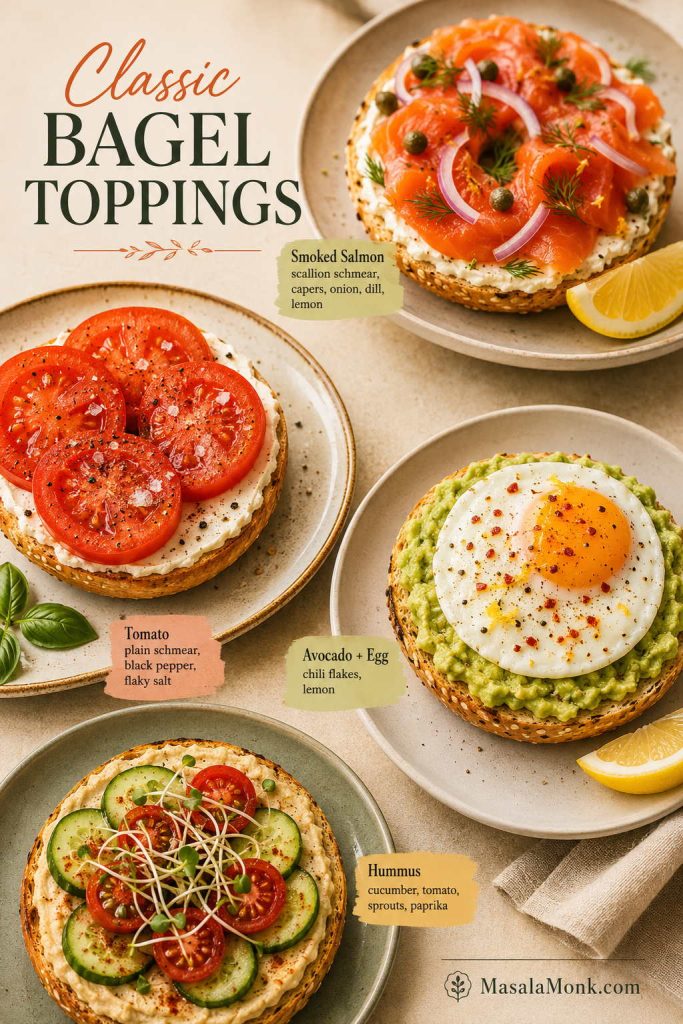
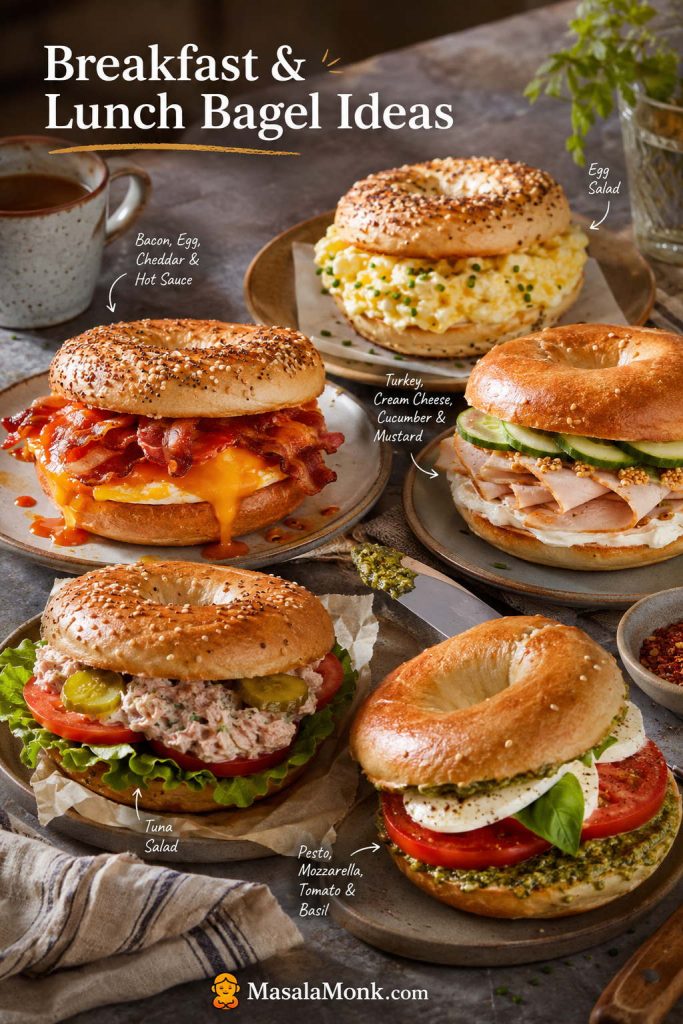
If you want…Use this topping combination
The fastest classic bagelScallion cream cheese + black pepper
A filling breakfastEgg + cheese + avocado or bacon
A brunch-style bagelCream cheese + smoked salmon + capers + red onion + dill
Something sweetCream cheese + jam, or peanut butter + banana + honey
A lighter lunchHummus + cucumber + tomato + sprouts
A high-protein optionCottage cheese + tomato, or smoked salmon + cucumber

Best bagel toppings by situation

  • Best fast breakfast: scallion cream cheese, tomato, black pepper, and flaky salt.
  • High-protein pick: cottage cheese with tomato, or smoked salmon with cucumber.
  • Sweet favorite: cream cheese with jam, or ricotta with berries and honey.
  • Brunch favorite: cream cheese, smoked salmon, capers, onion, dill, and lemon.
  • Dairy-free pick: hummus with cucumber, tomato, sprouts, olive oil, and paprika.
Bagel topping guide organized by situation, including fast breakfast, high-protein, sweet, brunch, and dairy-free options.
Instead of choosing toppings at random, start with the situation: fast breakfast, brunch, packed lunch, sweet snack, or dairy-free meal. From there, the best bagel toppings become much easier to narrow down.

Quick fix: if a bagel tastes unfinished, do not automatically add more toppings. Instead, add the missing piece: lemon for lift, capers for sharpness, flaky salt for tomato, herbs for creaminess, honey for sweet spreads, or crunch for soft fillings.

How to Build a Better Bagel

A good bagel is not just a pile of toppings. It tastes better when the layers make sense together. Use this simple formula:

Spread + main topping + crunch + brightness + seasoning.

Step-by-step bagel-building guide with a spread, main topping, crunch or brightness, and final seasoning.
Once the spread is chosen, the bagel becomes easier to build. Add one main topping, then use cucumber, onion, lemon, capers, honey, herbs, or seasoning to shape the final bite.

However, you do not need all five parts every time. Even two or three good layers can keep the bagel from becoming dry, heavy, soggy, or one-note.

Start with a bagel spread

The spread gives the bagel moisture and flavor. It also helps small toppings stay in place.

  • Classic: plain cream cheese, whipped cream cheese, scallion schmear
  • Savory: garlic herb spread, hummus, avocado, labneh, goat cheese
  • Sweet: butter, peanut butter, almond butter, ricotta, mascarpone, cream cheese with jam
  • Lighter: Greek yogurt cream cheese, cottage cheese, tofu cream cheese, white bean spread

Add one main bagel topping

The main topping decides whether the bagel feels like breakfast, lunch, snack, or brunch. It can be as simple as an egg, a few slices of tomato, smoked salmon, tuna salad, turkey, banana, berries, or roasted vegetables.

For a quick weekday bagel, one spread and one main topping may be enough. However, for a brunch bagel or open-faced bagel, a finishing layer helps every bite feel more complete.

Finish bagel toppings with crunch, brightness, or seasoning

This is the small step that makes a bagel taste finished. A plain schmear becomes brighter with chives or lemon. Smoked salmon becomes cleaner and sharper with capers, onion, and a squeeze of lemon. Peanut butter becomes more interesting with banana, honey, cinnamon, or a tiny pinch of salt.

Bagel finishing ingredients including lemon, capers, flaky salt, pepper, herbs, chili flakes, honey, cinnamon, and everything seasoning.
When a bagel tastes dull, it usually needs a small finisher rather than another full topping. Lemon, capers, pepper, herbs, honey, cinnamon, or everything seasoning can add lift without crowding the bagel.
  • Crunch: cucumber, onion, radish, sprouts, toasted nuts, granola, crispy bacon
  • Brightness: lemon, pickled onions, capers, tomatoes, berries, apple slices
  • Seasoning: black pepper, chili flakes, flaky salt, everything bagel seasoning, cinnamon, herbs

The bagel test: When the bite feels too rich, add cucumber, tomato, herbs, lemon, or pickled onion. An unfinished bite usually needs one small finish: flaky salt, black pepper, capers, chili flakes, honey, cinnamon, or everything seasoning. Messy builds are easier to control when toppings are sliced thinner and the spread works like glue.

When bagels turn soggy, messy, or dull, the bagel topping mistakes section will help you fix the texture before adding more ingredients.

One small detail makes a big difference: press capers gently into the creamy layer before adding smoked salmon so they stick instead of rolling off. For wet toppings like tomato or cucumber, slice thinly and pat dry before layering.

Bagel Topping Mistakes That Make Bagels Soggy, Messy, or Flat

A bagel can have great toppings and still eat badly if the texture is off. These are the small mistakes that turn a good idea into a soggy, slippery, or bland bagel.

Bagel topping mistakes and fixes showing soggy bagels, sliding toppings, cold cream cheese, and bland bites.
Most disappointing bagels fail because of texture, not flavor. Toast the cut side, soften the schmear, slice wet toppings thinly, and use small finishes so the bagel stays crisp, stable, and satisfying.
MistakeWhat happensBetter move
Using cold block cream cheeseIt tears the bagel and spreads unevenly.Let cream cheese soften first, or beat it into a schmear.
Piling on wet tomatoes or cucumbersThe cut side gets soggy before you finish eating.Slice thinly, pat dry, and use a thick spread, hummus, avocado, or butter as a barrier.
Adding delicate toppings to a piping-hot bagelThe spread melts, herbs wilt, and smoked salmon can feel greasy.Let the bagel cool for a minute before adding schmear, fish, herbs, or fresh vegetables.
Overloading a closed sandwichThe filling slides out and the bagel becomes hard to bite.Keep tall builds open-faced, or use fewer toppings and slice them thinner.
Skipping the final finishThe bagel tastes like bread plus spread instead of a finished bite.Add lemon, herbs, black pepper, flaky salt, capers, honey, cinnamon, or chili flakes.
Using loose tuna, egg, or chicken saladThe filling slides off the bagel.Use a thicker salad, add lettuce as a barrier, or serve it open-faced.

How to keep wet toppings from making bagels soggy

In most cases, the two biggest fixes are simple: toast the cut side enough to create a barrier, and keep wet toppings thin. Tomato, cucumber, avocado, pickles, and loose salads are all good on bagels, but they need structure underneath them. A thick schmear, hummus, avocado, butter, or even lettuce can help protect the bread from turning soft too quickly.

For more detail on getting the cut side sturdy, see the toasting guide before adding tomato, cucumber, eggs, avocado, hummus, or smoked salmon.

Before-and-after comparison showing a soggy bagel and a better bagel with toasted bread, a spread barrier, and thin tomato slices.
Juicy tomato and cucumber are great on bagels, but they need a toasted surface and a creamy barrier underneath so the bread stays firm.

Texture rule: the wetter the topping, the sturdier the bagel needs to be. Toast a little longer, use a thicker spread, and keep juicy toppings thin.

15 Bagel Topping Ideas to Try First

Think of these as the safe bets — the combinations to try before you start inventing anything complicated. They cover the classics, quick breakfasts, sweet cravings, and the “I need this to feel like lunch” moments.

These are the bagels I would put in front of someone who says, “Just tell me what works.” They are not the weirdest ideas; instead, they are the bagel toppings and spreads that taste complete without needing ten toppings.

To keep this practical, effort is rated from 1 to 5, with 1 being almost no prep and 5 needing more cooking or assembly.

Classic bagel toppings and spreads to try first

Start with these before getting creative; each one gives the bagel a clear base, one main topping, and a small detail that makes the bite feel intentional.

Four classic bagel toppings including smoked salmon with schmear, tomato with cream cheese, avocado egg, and hummus cucumber.
Classic bagel toppings work because they cover the essentials: creamy schmear, salty or fresh toppings, crisp vegetables, and a small finish. Start here before moving into more creative spreads.
Bagel combinationBest momentEffortGood bagel choicesWhy it tastes balanced
Scallion cream cheese + smoked salmon + capers + red onionBrunch / lunch2/5Plain, everything, poppy, pumpernickelSalmon brings salt, capers and onion add bite, and the schmear keeps the bagel rich without feeling dry.
Plain schmear + tomato + black pepper + flaky saltFast breakfast1/5Plain, sesame, onionJuicy tomato, creamy spread, and enough salt make it feel complete.
Avocado + fried egg + chili flakes + lemonFilling breakfast3/5Everything, whole wheat, sesameEgg makes it filling, avocado keeps it creamy, and lemon/chili stop it from feeling heavy.
Hummus + cucumber + tomato + sproutsLight lunch1/5Sesame, whole wheat, plainCool cucumber and sprouts keep the hummus from feeling dense.

Breakfast and lunch bagel topping ideas

These builds are meant to eat like real meals, so the spread, protein, vegetables, and toast level need to help the bagel hold together.

Breakfast and lunch bagels with bacon egg cheese, turkey cucumber, tuna salad, egg salad, and pesto mozzarella tomato.
Meal-style bagels hold together better when the cut side is toasted, the spread is thick, and crisp vegetables sit between the bread and creamy fillings.
Bagel combinationBest momentEffortGood bagel choicesWhy it tastes balanced
Bacon + egg + cheddar + hot sauceWeekend breakfast3/5Plain, everything, AsiagoCheddar and egg make it rich; hot sauce cuts through the breakfast heaviness.
Turkey + cream cheese + cucumber + mustardEasy lunch1/5Plain, sesame, whole wheatCucumber keeps the turkey from eating dry, while mustard gives the sandwich some bite.
Tuna salad + tomato + lettuce + picklesMeal-style lunch2/5Plain, poppy, whole wheatCreamy filling tastes better with crisp, briny, and juicy layers.
Egg salad + chives + everything seasoningMake-ahead lunch2/5Plain, everything, poppyChives and everything seasoning make soft egg salad taste more like a proper deli bagel.
Pesto + mozzarella + tomato + basilVegetarian lunch2/5Plain, sesame, AsiagoPesto seasons the cheese, tomato adds juiciness, and basil keeps it from feeling flat.

Sweet bagel toppings and spreads to try

Sweet bagels taste better when the topping has a little tang, salt, nuttiness, or fruit instead of only more sugar.

Sweet bagel topping ideas including peanut butter banana, ricotta berries, strawberry cream cheese, cinnamon sugar, and Nutella strawberries.
A sweet bagel should still feel like breakfast, not frosting on bread. Tangy cream cheese, soft ricotta, berries, toasted nuts, cinnamon, lemon zest, or a pinch of salt keep the sweetness in check.
Bagel combinationBest momentEffortGood bagel choicesWhy it tastes balanced
Honey walnut cream cheese + bananaSweet breakfast1/5Cinnamon raisin, plain, whole wheatBanana makes it filling, honey walnut schmear adds sweetness, and cinnamon keeps it cozy.
Peanut butter + banana + honey + cinnamonFast filling snack1/5Plain, cinnamon raisin, whole wheatPeanut butter gives staying power, banana softens the bite, and honey/cinnamon make it feel finished.
Ricotta + berries + honey + lemon zestSweet brunch1/5Plain, blueberry, whole wheatRicotta gives softness, berries add juice, and lemon zest keeps the sweetness clean.
Strawberry cream cheese + fresh berriesBakery-style breakfast1/5Plain, blueberryFresh berries keep the strawberry spread from tasting too candy-sweet.
Butter + cinnamon sugar + toasted walnutsCozy snack1/5Cinnamon raisin, plainButter melts into the toasted cut side, while cinnamon sugar and walnuts add cozy crunch.
Nutella + strawberries + pinch of saltDessert-style bagel1/5Plain, blueberry, mini bagelsStrawberries brighten the chocolate spread, and salt keeps it from tasting one-note.

How to choose from this list

If the Caprese-style bagel is the one you want to build, use a thick pesto rather than a loose sauce so it spreads cleanly. This homemade pesto recipe and variations guide has basil pesto, red pesto, vegan pesto, nut-free pesto, pesto dip, pesto butter, and sandwich-friendly ideas.

Creative bagel upgrades when you want something different

After the basics, these are the bagels to try when plain cream cheese is not enough and you want something more snacky, brunchy, global, or restaurant-style without making the whole thing complicated.

Creative bagel upgrades with chili crisp cream cheese, za’atar hummus, furikake avocado, jalapeño popper, pizza bagel, and fig goat cheese.
After the classics, creative bagel upgrades make a simple bagel feel restaurant-style. Chili crisp, za’atar, furikake, fig, goat cheese, jalapeño, and pizza toppings bring big flavor without needing a complicated build.

Warm and toasted

  • Jalapeño popper bagel: cream cheese, cheddar, jalapeño, scallion, garlic powder, toasted until warm.
  • Pizza bagel: marinara, mozzarella, Parmesan, basil, and a quick toast until the cheese melts.
  • Maple bacon breakfast bagel: cream cheese, crispy bacon, maple drizzle, and black pepper.
  • Tuna melt bagel: thick tuna salad, cheddar, tomato, and a short toast until the cheese softens.
Warm toasted bagel ideas with pizza bagels, jalapeño popper bagels, tuna melt bagels, and maple bacon breakfast bagels.
Warm toppings taste best when they melt into a firm toasted cut side. That is why pizza bagels, tuna melts, jalapeño popper bagels, and bacon breakfast bagels need heat before the toppings go on.

Fresh and savory

  • Za’atar hummus bagel: hummus, cucumber, tomato, olive oil, za’atar, and lemon.
  • Whipped feta cucumber bagel: whipped feta, cucumber ribbons, dill, black pepper, and lemon.
  • Cucumber dill labneh bagel: labneh, cucumber, dill, lemon zest, and flaky salt.
  • Roasted red pepper bagel: goat cheese or hummus, roasted red peppers, basil, and a little olive oil.

Bold and snacky

  • Chili crisp cream cheese bagel: plain schmear, chili crisp, scallions, cucumber, and sesame seeds.
  • Furikake avocado bagel: mashed avocado, furikake, cucumber, lime, and a little chili oil.
  • Pickle-everything schmear: cream cheese, chopped pickles, everything seasoning, and scallion.
  • Sun-dried tomato cream cheese: cream cheese, chopped sun-dried tomatoes, basil, black pepper, and lemon zest.

Sweet-salty

  • Honey pecan bagel: cream cheese, honey, cinnamon, and toasted pecans.
  • Fig and goat cheese bagel: goat cheese, fig jam, walnuts, honey, and black pepper.

Easy Bagel Schmear Recipe

A good bagel schmear is softer and more spreadable than cold cream cheese straight from the block. It should glide over a toasted bagel without tearing it apart, and it should taste lightly seasoned even before you add toppings.

Homemade bagel schmear being spread on a toasted bagel with lemon, scallions, pepper, and a bowl of creamy spread nearby.
Soft schmear should spread in smooth strokes instead of tearing the bagel. Let the cream cheese soften first, then loosen it with lemon, herbs, or tangy dairy before adding toppings.

This base recipe makes about 1 cup / 9 oz / 255 g, enough for roughly 4 to 6 bagels, depending on how generously you spread it. Because schmear is one of the most useful bagel spreads, it also works as the base for many sweet and savory toppings.

The finished texture should be soft enough to spread easily but thick enough to hold herbs, capers, onions, or chopped salmon without turning loose.

Bagel schmear ingredients

The base is simple, but each small addition changes how the schmear spreads, tastes, and holds toppings.

Bagel schmear ingredients including cream cheese, Greek yogurt or sour cream, lemon, salt, pepper, scallions, herbs, and bagel halves.
A simple bagel schmear does not need many ingredients. However, lemon, salt, pepper, scallions, and a little Greek yogurt or sour cream make cream cheese softer, brighter, and easier to pair with toppings.
IngredientUS amountMetric amount
Brick cream cheese, softened8 oz225 g
Sour cream, Greek yogurt, or crème fraîche2 tbsp30 g / 30 ml
Fresh lemon juice½ tsp2.5 ml
Fine saltPinch to ⅛ tspTo taste
Black pepperOptionalOptional

How to make bagel schmear

The goal is a spreadable texture first; once the base is smooth, herbs, smoked salmon, honey walnut, or berries fold in more evenly.

Four-step bagel schmear process showing softened cream cheese, beaten cream cheese, seasoning, and folded-in flavorings.
Homemade schmear is easiest when you build it in stages: soften, beat smooth, loosen and season, then fold in flavor. After that, the same base can become scallion, smoked salmon dill, honey walnut, or berry schmear.
  1. Soften the cream cheese. Leave it at room temperature for about 30 minutes, or until it gives slightly when pressed.
  2. Beat until smooth. Use a hand mixer, stand mixer, or sturdy spoon. The texture should look creamy, not lumpy.
  3. Loosen it slightly. Mix in sour cream, Greek yogurt, or crème fraîche.
  4. Season it. Add lemon juice and salt. Then taste before adding more salt, especially if you plan to add smoked salmon, capers, bacon, cheddar, or everything seasoning.
  5. Keep it plain or add flavor. Finally, fold in one of the flavored cream cheese ideas below.

Once the base is smooth, use the flavored cream cheese ideas to turn one batch into savory, sweet, or smoked salmon schmear.

How much schmear do you need per bagel?

Use the amount as a texture decision: lighter for everyday breakfasts, thicker for deli-style bagels, and a little extra when guests are sampling flavors.

Schmear amount guide showing light, normal, and deli-style cream cheese layers on toasted bagel halves.
Schmear amount changes the whole bagel. Use a light layer for quick breakfasts, a normal layer for everyday bagels, and a thicker deli-style schmear for smoked salmon bagels or brunch boards.
StyleAmount per whole bagel
Light layer2 tbsp / 30 g
Normal breakfast bagel3 tbsp / 45 g
Deli-style thick schmear4 tbsp / 55–60 g
Open-faced bagel halves1–2 tbsp / 15–30 g per half

If you are serving a bagel bar, plan slightly more spread than you think you need. People usually take more schmear when there are several flavors to try.

Flavored Cream Cheese Ideas for Bagels

Think of flavored cream cheese as the easiest way to make a plain bagel feel planned. One good mix-in can do the work of several loose toppings.

Flavored cream cheese bowls for bagels, including scallion, garlic herb, smoked salmon dill, jalapeño cheddar, honey walnut, and strawberry.
Flavored cream cheese can do the work of several loose toppings. For a balanced bagel bar, make one classic flavor, one savory flavor, and one sweet flavor so every guest has an easy starting point.

Once the base is smooth, flavored cream cheese is easy. Start with 8 oz / 225 g cream cheese, then fold in one flavor direction. If you are making more than one flavor, keep one plain or scallion, one savory, and one sweet. That way, the board works for both breakfast people and dessert-leaning people.

If you are only making two flavors, make one scallion or garlic-herb schmear and one honey walnut or strawberry cream cheese. That way, you cover the savory people, the sweet people, and the person who wants to try both.

Best flavored cream cheese ideas for bagels

FlavorAdd to 8 oz / 225 g schmear baseGood bagel choices
Scallion schmear¼ cup finely sliced scallions or chives + black pepperEverything, sesame, plain
Garlic herb1 small grated garlic clove + 2 tbsp chopped dill, parsley, or chives + lemon zestPlain, sesame, whole wheat
Smoked salmon dill3–4 oz / 85–115 g chopped smoked salmon + dill + lemonPlain, poppy, pumpernickel
Jalapeño cheddar1 minced jalapeño + ½ cup shredded cheddar + scallionEverything, cheese, plain
Honey walnut2 tbsp honey + ¼ cup chopped walnuts + pinch of cinnamonCinnamon raisin, plain, whole wheat
Strawberry2–3 tbsp strawberry jam or ½ cup chopped berries + 1 tbsp powdered sugar if neededPlain, blueberry, whole wheat
Everything bagel1–2 tbsp everything bagel seasoningPlain, sesame
Veggie cream cheese⅓ cup finely diced cucumber, carrot, bell pepper, or celery + herbsPlain, whole wheat, sesame

How to make one cream cheese base work harder

Once you understand the base formula, you can also play with sun-dried tomato, olive-herb, maple cinnamon, cranberry orange walnut, lemon pepper, or pickle-everything cream cheese. One simple base can cover several bagel toppings and spreads without much extra work.

Make-ahead tip: flavored cream cheese usually tastes better after chilling for at least 1 hour. For brunch, make the schmears the night before, then let them soften for 15–30 minutes before serving.

Bagel Spreads Besides Cream Cheese When You Want Something Different

What bagel spreads to use when cream cheese is not the answer

This is the section for the morning when the cream cheese tub is empty, or when you want the bagel to feel more like lunch than a bakery breakfast.

Bagel spreads besides cream cheese, including hummus, avocado, ricotta, cottage cheese, nut butter, jam, and vegan cream cheese.
Cream cheese is classic, although hummus, avocado, ricotta, cottage cheese, nut butter, white bean spread, jam, and vegan cream cheese can each push the same bagel in a new direction.

Of course, cream cheese is the classic, but it is not the only spread that belongs on a bagel. The easiest way to replace it is to choose another spread that gives the bagel moisture: hummus for savory crunch, avocado for breakfast, ricotta for sweet toppings, peanut butter for a filling snack, and white bean spread for a dairy-free lunch bagel.

If you want the bagel to feel like lunch, choose hummus, avocado, white bean spread, tuna salad, turkey, or a thick savory salad. On the other hand, if you want it to feel like breakfast, choose butter, ricotta, peanut butter, cottage cheese, egg, or a fruit-friendly spread.

For plant-based builds, the vegan bagel toppings section has hummus, avocado, tofu cream cheese, white bean spread, and nut butter ideas.

For example, hummus works best when cucumber, tomato, sprouts, or paprika keep the bite from feeling dense. Meanwhile, ricotta and cottage cheese work better when fruit, honey, lemon zest, pepper, or herbs give them a clear direction.

Best bagel spreads to pair with toppings

SpreadToppings to addGood bagel choices
HummusCucumber, tomato, sprouts, paprika, olive oilSesame, plain, whole wheat
AvocadoEgg, chili flakes, lemon, tomato, everything seasoningEverything, sesame, whole wheat
RicottaHoney, berries, lemon zest, pistachiosPlain, blueberry, whole wheat
Peanut butterBanana, honey, cinnamon, chia seeds, jamPlain, cinnamon raisin, whole wheat
Cottage cheeseTomato, black pepper, cucumber, berries, honeyPlain, whole wheat, sesame
ButterJam, cinnamon sugar, honey, flaky saltPlain, cinnamon raisin, blueberry
White bean spreadTomato, herbs, olive oil, lemon, roasted peppersPlain, sesame, whole wheat
MascarponeBerries, honey, citrus zest, toasted nutsPlain, blueberry, mini bagels

How to make mild bagel spreads taste finished

Spread first, then toppings: a mild spread like ricotta, cottage cheese, or white bean spread usually needs a stronger finish. Add lemon, herbs, pepper, honey, cinnamon, flaky salt, or fruit so the bagel does not taste unfinished.

Savory Bagel Toppings

If your savory bagel tastes heavy after three bites, it usually does not need more meat or more cheese. Instead, it needs something crisp, sharp, juicy, or herbal to cut through the richness. A classic schmear and smoked salmon are iconic, but hummus, avocado, eggs, tuna salad, turkey, chicken salad, pesto, goat cheese, and crisp vegetables can be just as satisfying.

Savory bagels with smoked salmon, turkey cucumber, pesto mozzarella tomato, cream cheese, capers, herbs, and vegetables.
Savory bagel toppings taste better with contrast: crisp cucumber, juicy tomato, sharp onion, lemon, herbs, mustard, or capers can cut through smoked salmon, turkey, pesto, tuna, or egg salad.

At the same time, the lunch bagel should not collapse halfway through. If you are using tomato, cucumber, pickles, roasted peppers, or avocado, keep the slices thin and use a creamy spread underneath to protect the toasted surface.

Classic savory topping ideas

  • Plain schmear + tomato + black pepper
  • Scallion schmear + cucumber + dill
  • Smoked salmon + capers + red onion + lemon
  • Hummus + cucumber + tomato + paprika
  • Avocado + fried egg + chili flakes
  • Tuna salad + lettuce + pickles
  • Egg salad + chives + everything seasoning
  • Turkey + cream cheese + cucumber + mustard
  • Chicken salad + celery + herbs
  • Pesto + tomato + mozzarella
  • Goat cheese + roasted peppers + basil
  • Bacon + cream cheese + tomato

If tuna salad is your easy lunch topping, this healthy tuna salad guide has lighter deli-style, avocado, Mediterranean, no-mayo, tuna-and-egg, and sandwich-friendly variations you can spoon onto toasted bagels.

Savory combinations worth making

Use these when you want a bagel that eats more like a meal than a snack. Each one has creaminess, a main topping, and a sharper or fresher finish. In other words, these bagel toppings and spreads are built to hold up beyond the first bite.

CombinationBuild
Lox-style bagelCream cheese, smoked salmon, capers, red onion, dill, lemon
Avocado egg bagelMashed avocado, fried or scrambled egg, chili flakes, lemon, salt
Hummus crunch bagelHummus, cucumber, tomato, sprouts, paprika, olive oil
Deli turkey bagelCream cheese, turkey, cucumber, lettuce, mustard, black pepper
Tuna melt bagelTuna salad, cheddar, tomato, toasted until warm
Caprese bagelMozzarella, tomato, pesto, basil, black pepper

Chicken salad, tuna salad, and egg salad all need the same thing on a bagel: a thick enough texture to stay put. If the filling is loose, serve the bagel open-faced or add lettuce as a barrier.

Packing a savory bagel for later? Use the work and lunchbox toppings guide so juicy or slippery toppings do not soak the bread.

Bagel Toppings That Travel Well for Work or Lunchboxes

For packed lunches, choose bagel toppings that stay firm and do not leak into the bread. Thick hummus, cream cheese, turkey, peanut butter, firm egg salad, thick tuna salad, and sliced cheese travel better than watery tomatoes, loose salads, avocado, or overfilled smoked salmon builds.

A good lunchbox bagel should still taste good a few hours later: a sturdy toasted base, a spread that acts like a barrier, and fresh toppings packed separately when they are juicy or slippery.

Packed lunch bagel with sturdy spread and separate containers of cucumber, tomato, pickles, capers, lemon, and hummus.
For work or lunchbox bagels, sturdy spreads matter most. Pack tomato, cucumber, pickles, capers, lemon, and other juicy toppings separately so the bread stays firm until lunch.
Pack it nowPack separatelySkip for packed bagels
Cream cheese, hummus, turkey, cheese, peanut butter, thick tuna or egg saladTomato, cucumber, avocado, pickles, capers, lemon wedgesWatery tomatoes, loose salads, overfilled lox bagels, very wet spreads

Sweet Bagel Toppings

In general, sweet bagel toppings are more satisfying when they have a little contrast instead of tasting only sweet. Tangy cream cheese, toasted nuts, salt, lemon zest, cinnamon, berries, and honey can make a sweet bagel feel more like breakfast and less like frosting on bread.

Sweet and savory bagel topping comparison with smoked salmon, avocado, cucumber, berries, jam, peanut butter banana, honey, and ricotta.
Sweet and savory bagel toppings need different kinds of contrast. Savory bagels usually want crunch, herbs, lemon, or briny toppings, while sweet bagels benefit from tangy cheese, fruit, nuts, honey, cinnamon, or salt.

That said, sweet bagels need a lighter hand when the bagel itself already has cinnamon, raisins, or blueberries. Start with tangy or lightly salted toppings first, then move sweeter only if the bagel itself is plain.

If you are starting with cinnamon raisin, blueberry, or another flavored bagel, check the bagel type pairings before adding a very sweet spread.

Easy sweet bagel ideas

  • Plain cream cheese + strawberry jam
  • Butter + cinnamon sugar
  • Peanut butter + banana + honey
  • Almond butter + apple slices + cinnamon
  • Ricotta + honey + pistachios
  • Mascarpone + berries
  • Nutella + strawberries
  • Cream cheese + brown sugar + cinnamon
  • Greek yogurt cream cheese + berries + granola
  • Honey walnut cream cheese + banana
  • Apple butter + cream cheese
  • Peanut butter + jam + flaky salt

If you want a fruit spread that feels brighter than regular strawberry jam, this pineapple jam recipe makes a glossy sweet-tart spread for toast, scones, waffles, yogurt, and breakfast-style bagels.

Fruit spreads are especially good on plain or lightly toasted bagels because they bring both sweetness and brightness. A warm toasted cut side with cream cheese and glossy fruit spread feels completely different from a cold, overloaded sweet bagel.

Sweet topping tip: cinnamon raisin and blueberry bagels already bring sweetness, so they usually taste best with tangy or lightly salted toppings like plain cream cheese, butter, peanut butter, ricotta, or honey walnut cream cheese rather than very sugary spreads alone.

In fact, for sweet bagels, a tiny pinch of salt often does more than extra sugar. It makes peanut butter, honey, berries, chocolate-hazelnut spread, and sweet cream cheese taste fuller without making the bagel heavy.

Sweet bagel combinations by mood

Choose the topping based on whether you want the bagel to feel like breakfast, dessert, or something in between. This is also where bagel spreads matter most, because a tangy or lightly salted base keeps sweet toppings from becoming too much.

MoodTry this
Bakery-styleStrawberry cream cheese + fresh berries + lemon zest
CozyButter + cinnamon sugar + toasted walnuts
Protein-friendlyPeanut butter + banana + chia seeds
Dessert-likeNutella + strawberries + pinch of salt
Light and creamyRicotta + honey + berries
Fall-styleApple butter + cream cheese + cinnamon

Healthy and High-Protein Bagel Toppings That Still Taste Good

A bagel is best treated like a bigger, denser bread base, not a breakfast problem to apologize for. The toppings matter because they decide whether it feels like a quick carb moment or a breakfast that holds you for a while. For a lighter plate, use one half open-faced instead of building a heavy closed sandwich.

The goal is not to make the bagel smaller; it is to make the topping smarter, more satisfying, and still good enough to look forward to.

Healthy high-protein bagel toppings with cottage cheese tomato, avocado egg, smoked salmon cucumber, turkey mustard, hummus sprouts, and tofu cream cheese.
Healthy bagel toppings should still taste like something you want to eat. Cottage cheese, egg, smoked salmon, turkey, hummus, tofu cream cheese, avocado, and vegetables add protein, texture, and staying power.

For dairy-free or higher-protein variations, tofu cream cheese, cashew cream cheese, white bean spread, egg whites, turkey slices, smoked salmon, and Greek yogurt-style spreads all work with the same spread-plus-finish formula.

Balanced bagel toppings for protein, produce, and healthy fats

IdeaWhy it feels balanced
Cottage cheese + tomato + pepperCreamy, fresh, and high in protein
Avocado + egg + lemonRich, filling, and bright
Hummus + cucumber + sproutsDairy-free, crunchy, and easy
Smoked salmon + cucumberProtein-rich and classic
Greek yogurt cream cheeseTangier and lighter than a heavy spread
Tuna salad with Greek yogurtMore protein and less heaviness
Turkey + cucumber + mustardLean, savory, and crisp
Ricotta + berriesSweet, creamy, and lighter than frosting-like spreads
White bean spread + tomatoVegan, filling, and good with herbs
Tofu cream cheese + chivesDairy-free and bagel-friendly

If you want a warmer high-protein breakfast bagel, spoon soft eggs over a toasted half and finish with chives, tomato, or hot sauce. These scrambled eggs with cottage cheese are especially useful when you want creamy eggs with more protein.

Balance tip: if the bagel itself is large, use an open-faced style. One bagel split into two halves with protein and vegetables often feels more satisfying than a closed sandwich overloaded with spread.

Vegan bagel toppings and spreads

Vegan bagel toppings do not need to feel like substitutes. A thick swipe of hummus with cucumber and paprika, avocado with lemon and everything seasoning, or white bean spread with roasted peppers can taste just as complete as a cream cheese bagel.

Vegan bagel toppings including hummus cucumber, avocado, tofu cream cheese, white bean spread, peanut butter banana, and vegan cream cheese.
Vegan bagel toppings do not need to feel like substitutes. Start with hummus, avocado, tofu cream cheese, white bean spread, or nut butter, then add crunch, lemon, herbs, or briny bite.

Start with a spread that already has body, then add something crisp, juicy, nutty, or briny. Hummus, avocado, tofu cream cheese, white bean spread, peanut butter, almond butter, jam, olive tapenade, and vegan cream cheese all give the bagel enough moisture before you add fresh toppings.

  • Hummus + cucumber + tomato + paprika
  • Avocado + everything seasoning + lemon
  • Tofu cream cheese + chives + black pepper
  • White bean spread + roasted peppers + herbs
  • Peanut butter + banana + cinnamon
  • Vegan cream cheese + capers + red onion + cucumber

How to Toast Bagels for Toppings and Boards

Because many toppings are wet, creamy, or warm, toasting matters more than it seems. A lightly toasted bagel is fine for butter and jam, but a bagel with cream cheese, tomato, egg, avocado, smoked salmon, or hummus needs a firmer surface.

Toaster oven scene showing light toast, firm toasted cut side, and a topped bagel with cream cheese, tomato, cucumber, onion, and capers.
Toast level should match the toppings. Butter and jam only need light toast, but wet or creamy toppings like tomato, cucumber, avocado, hummus, eggs, or smoked salmon need a firmer cut side.
MethodTime / temperatureUse it for
Regular toaster2–5 minutes, depending on toaster strengthEveryday bagels, breakfast bagels, cream cheese bagels
Toaster oven375°F / 190°C for 4–6 minutes, cut side upOpen-faced bagels and warm toppings
Bagel chips or small pieces375°F / 190°C for 8–10 minutesBoards, dips, smoked salmon spread, cream cheese boards
Garlic-toasted bagel pieces400°F / 200°C for 8–10 minutesBrunch boards, savory spreads, party trays

For a soft-but-sturdy bagel, toast only the cut side. For a loaded open-faced bagel, toast a little longer so the surface can hold cream cheese, tomato, cucumber, avocado, or eggs without going soggy.

Day-old bagels only need enough heat to firm the cut side. Over-toasting makes thick schmear and dry toppings feel heavier.

Breakfast Bagel Ideas

For breakfast, the bagel needs to do a little more than taste good for five minutes. A spread plus protein — eggs, smoked salmon, cottage cheese, turkey, peanut butter, or Greek yogurt cream cheese — makes it feel more like a real meal.

Breakfast bagels with egg and cheese, avocado egg, cottage cheese tomato, peanut butter banana, and smoked salmon egg.
Breakfast bagels become more satisfying when protein, fruit, vegetables, or warmth join the spread. Egg, cheese, avocado, cottage cheese, peanut butter, banana, tomato, and smoked salmon all make the bite more filling.

This is where a bagel is especially useful: it can hold eggs, cheese, avocado, hash browns, or smoked salmon without needing much cooking beyond the filling.

For more morning ideas, this breakfast sandwich recipe guide has more ways to build a hearty breakfast around eggs, cheese, spreads, and add-ons.

Basic egg and cheese bagel formula

IngredientAmount for 1 bagel
Bagel1, split and toasted
Egg1–2 large eggs
Butter or oil1 tsp / 5 g
Cheese1 slice or ¼ cup shredded
Cream cheese, sauce, or avocado1–2 tbsp / 15–30 g
Fresh toppingTomato, onion, herbs, spinach, or avocado

Breakfast bagel combinations

  • Bacon, egg, and cheese
  • Egg, cheddar, avocado, and tomato
  • Scrambled egg with scallion cream cheese
  • Sausage, egg, and cheddar
  • Smoked salmon, egg, dill, and cream cheese
  • Peanut butter, banana, and honey
  • Greek yogurt cream cheese, berries, and granola
  • Hummus, egg, cucumber, and paprika
  • Cottage cheese, tomato, black pepper, and chives

For smaller servings, see the kids’ bagel toppings or mini bagel toppings sections.

Bagel Toppings for Kids

For kids, keep the bagel toppings simple, familiar, and easy to hold. Cream cheese with jam, peanut butter with banana, butter with cinnamon sugar, strawberry cream cheese, egg and cheese, mini bagel pizzas, and Nutella with strawberries all work because they are flavorful without being hard to bite.

Kid-friendly bagel toppings with cream cheese jam, peanut butter banana, egg cheese, mini pizza, cinnamon sugar, and Nutella strawberries.
Kid-friendly bagel toppings should be simple, familiar, and easy to hold. Cream cheese with jam, peanut butter banana, egg and cheese, mini pizza bagels, cinnamon sugar, and strawberry chocolate spread all keep the choices approachable.

For a crisp diner-style breakfast bagel, add a small hash brown patty or a thin layer of crispy shredded potatoes with egg and cheese. This air fryer hash browns guide is useful when you want golden potatoes without babysitting a skillet.

Toasting tip: toast the cut sides well if you are adding egg, avocado, tomato, or warm fillings. A firmer toasted surface keeps the bagel from turning soggy.

Smoked Salmon, Lox, and Cream Cheese Bagels

A smoked salmon bagel is one of the most reliable savory combinations because every piece has a job. Cream cheese adds richness, salmon adds salt and protein, cucumber or tomato adds freshness, capers add sharpness, onion adds bite, dill adds fragrance, and lemon wakes everything up.

Ideally, the best bites have cool cucumber, soft cream cheese, salty salmon, sharp onion, and a little lemon all at once. A smoked salmon bagel should taste like a deli order, not just fish on bread.

Close-up smoked salmon bagel with cream cheese, capers, red onion, cucumber, dill, lemon, and black pepper.
A smoked salmon bagel should taste creamy, salty, crisp, sharp, and lemony in the same bite. Thin onion, capers, cucumber, dill, pepper, and lemon keep the silky salmon feeling fresh.

Smoked salmon vs lox vs gravlax: which one goes on a bagel?

People often use these names loosely, but they do not taste exactly the same. The best choice depends on whether you want smoky, salty, herbal, or flaky fish.

Comparison of lox, cold-smoked salmon, gravlax, and hot-smoked salmon with bagel serving suggestions.
Lox, cold-smoked salmon, gravlax, and hot-smoked salmon are not interchangeable. Silky slices suit classic cream cheese bagels, while flaky hot-smoked salmon works better in spreads, salads, and egg bagels.
TypeWhat it tastes likeBest bagel build
Smoked salmonSilky or firmer depending on style, with a smoky flavorCream cheese, cucumber, red onion, capers, dill, lemon
LoxSalty, silky, rich, and usually not smokyPlain schmear, tomato or cucumber, red onion, capers
GravlaxHerbal, slightly sweet, and dill-forwardLabneh or cream cheese, cucumber, dill, lemon zest
Hot-smoked salmonFlaky, cooked-tasting, and more robustFlaked into schmear, added to egg bagels, or served on brunch boards

For the easiest first smoked salmon bagel, buy cold-smoked salmon or lox-style salmon if you want silky folds. Use hot-smoked salmon when you want a flakier, more filling brunch spread, egg bagel, or smoked salmon schmear. For a deeper breakdown of the terms, this Food & Wine guide to lox, gravlax, and smoked salmon explains how the curing and smoking methods differ.

One-bagel smoked salmon formula

IngredientAmount
Bagel1, split and toasted
Cream cheese or schmear2–4 tbsp / 30–60 g
Smoked salmon or lox2–3 oz / 55–85 g
Capers1–2 tsp
Red onion3–5 thin rings or 1–2 tbsp sliced
Cucumber or tomato4–6 thin slices
Dill or chives1–2 tsp
Lemon1 wedge or ½ tsp zest

Serving smoked salmon for a group? Use the bagel bar quantities and keep the storage tips in mind so the salmon stays chilled.

How to layer a smoked salmon bagel

Layering matters because the smallest toppings are the easiest to lose; press them into the schmear before adding larger salmon folds.

Step-by-step smoked salmon bagel layering guide with schmear, capers, cucumber, smoked salmon, red onion, dill, and lemon.
Layer a smoked salmon bagel from small to large. Press capers and herbs into the schmear first, then add cucumber, salmon folds, onion, dill, pepper, and lemon so the toppings stay in place.
  1. Toast the bagel and let it cool for a minute so the spread does not melt immediately.
  2. Spread cream cheese or scallion schmear on both cut sides.
  3. Press capers lightly into the creamy layer.
  4. Add cucumber or tomato if using.
  5. Layer smoked salmon in loose folds instead of flat sheets.
  6. Finish with red onion, dill, black pepper, and lemon.

Loose folds of salmon make the bagel feel fuller without needing a huge amount of fish. For a softer, spreadable version, chop smoked salmon and fold it into the schmear base with dill, lemon zest, and chives. This is especially useful for a bagel bar because guests can spread it quickly without pulling apart delicate salmon slices.

If you have extra smoked salmon, cucumber, avocado, or lemony sauce after brunch, turn the same flavors into a simple bowl later. This salmon bowl recipe includes a no-cook smoked salmon direction with cucumber, avocado, and a bright yogurt-style sauce.

Best Bagel Toppings by Bagel Type

At this point, bagel choice really matters. A cinnamon raisin bagel needs a different topping than an everything bagel, and a pumpernickel bagel can handle stronger, saltier flavors.

Bagel type pairing guide with plain, everything, sesame, cinnamon raisin, blueberry, and pumpernickel bagels with matching toppings.
The bagel itself already brings flavor. Plain bagels can handle almost anything, while everything, cinnamon raisin, blueberry, sesame, and pumpernickel bagels usually shine with more focused toppings.

Because stronger bagels already have personality, the topping should usually be simpler. Everything, onion, cheese, cinnamon raisin, blueberry, and pumpernickel bagels bring flavor on their own; plain and whole wheat bagels give you more room to build.

If the bagel is already salty or garlicky, keep the spread calmer and let the toppings do less work. If the bagel is sweet, use tangy, creamy, or lightly salted toppings so the whole bite does not become sugary.

Bagel typeToppings that pair well
PlainAny cream cheese, smoked salmon, egg, avocado, butter, jam
EverythingScallion cream cheese, lox, egg and cheese, avocado, hummus
SesameHummus, smoked salmon, turkey, cucumber, peanut butter
Poppy seedCream cheese, lox, egg salad, tuna salad
Cinnamon raisinButter, honey walnut cream cheese, peanut butter, apple, ricotta
Whole wheatHummus, avocado, turkey, cottage cheese, tuna, egg
OnionCream cheese, tomato, egg, bacon, deli turkey
Asiago or cheeseEgg, bacon, tomato, garlic herb cream cheese, turkey
BlueberryPlain cream cheese, strawberry cream cheese, butter, honey, ricotta
PumpernickelSmoked salmon, horseradish cream cheese, cucumber, dill

When in doubt, let the bagel lead. Plain and whole wheat bagels are flexible; everything, onion, cheese, blueberry, cinnamon raisin, and pumpernickel bagels already have a point of view.

Bagel Bar Toppings, Spreads, and Brunch Board Quantities

A bagel bar should feel generous without becoming chaotic. You do not need every topping on the table at once; you need the right mix of bagels, spreads, proteins, fresh toppings, and small bowls that are easy to refill.

This is low-pressure brunch food. Instead of cooking every guest a separate breakfast, you are giving everyone enough good pieces to build the bagel they actually want.

Bagel bar quantity guide for eight guests with bagels, schmear, smoked salmon, sliced vegetables, herbs, eggs, fruit, jam, peanut butter, and honey.
A bagel bar should look generous without turning messy. For eight guests, plan 12–16 bagels, 16–24 oz schmear, 16–24 oz smoked salmon, and plenty of fresh toppings, then refill smaller bowls as needed.

How many bagels per person?

Serving styleBagels per personGood for
Light brunch1 bagelWhen serving fruit, salad, eggs, pastries, or sides
Main meal1½ bagelsHungry guests or fewer side dishes
Mini bagels2 mini bagelsGrazing boards and mixed toppings

Bagel bar quantity table

The bagels are easy. The part people misjudge is the spread, salmon, and fresh toppings. A good board should look full when it lands on the table, but still be easy to refill without everything getting wet or messy.

The exact mix depends on your crowd, but these numbers keep you from underbuying the expensive parts and overbuying the things that wilt or get soggy. If your guests love smoked salmon, eggs, or thick cream cheese, round up slightly.

Sliced fresh toppings means cucumber, tomato, onion, radish, lettuce, herbs, fruit, or similar add-ons.

For make-ahead timing, use the storage and prep guide so schmear, salmon, sliced vegetables, and bagels stay fresh.

Mini Bagel Toppings for Brunch Boards and Kids

Mini bagels work best with toppings that do not slide around. Use thick schmears, small slices, and easy spreads so guests can pick them up without losing half the topping on the board.

Mini bagel toppings including cream cheese jam, peanut butter banana, egg cheese, mini pizza, hummus cucumber, and Nutella strawberries.
Mini bagels are best for brunch boards, kids, and grazing because guests can try more than one topping. Use thick spreads, small slices, and toppings that stay put when picked up.
  • Cream cheese + jam
  • Peanut butter + banana
  • Egg + cheese
  • Mini pizza bagels
  • Hummus + cucumber
  • Smoked salmon chopped into schmear
  • Nutella + strawberries
  • Butter + cinnamon sugar
GuestsBagelsCream cheese / spreadsSmoked salmonSliced fresh toppings
22–34–6 oz / 115–170 g4–6 oz / 115–170 g1–2 cups
44–68–12 oz / 225–340 g8–12 oz / 225–340 g3–4 cups
88–1216–24 oz / 450–680 g1–1½ lb / 450–680 g6–8 cups
1212–1824–32 oz / 680–900 g1½–2 lb / 680–900 g8–12 cups

What to put on a bagel bar

  • Bagels: plain, everything, sesame, whole wheat, cinnamon raisin, poppy, mini bagels
  • Spreads: plain cream cheese, scallion schmear, garlic herb cream cheese, honey walnut cream cheese, hummus, butter, jam
  • Proteins: smoked salmon, hard-boiled eggs, scrambled eggs, bacon, turkey, tuna salad, egg salad
  • Fresh toppings: cucumber, tomato, red onion, avocado, radish, lettuce, sprouts, herbs
  • Finishes: capers, lemon wedges, everything seasoning, flaky salt, black pepper, chili flakes, honey
  • Sweet side: berries, banana slices, apple slices, Nutella, peanut butter, cinnamon sugar

The board should look abundant, but it should still feel easy to use: spreads in bowls, wet toppings contained, bagels sliced, and the brightest ingredients where people can see them.

For the egg option on a bagel bar, cook the eggs ahead and slice them right before serving. This air fryer hard-boiled eggs guide is handy when you want easy peeled eggs for brunch plates, toast, deviled eggs, or snack boards.

Bagel bar equipment

  • Large board, tray, platter, or sheet pan
  • Small bowls or ramekins for capers, onions, jams, nuts, and seasonings
  • Spreader knives for each cream cheese flavor
  • Serrated knife for slicing bagels
  • Toaster or toaster oven
  • Serving spoons and small tongs
  • Parchment paper for easy cleanup
  • Airtight containers for make-ahead spreads

For a bagel bar, smaller bowls are not just prettier. They keep wet toppings from soaking into the bread and make the board easier to refill.

Hosting tip: do not put every topping directly on the board if it will make things wet. Keep capers, jams, honey, pickled onions, and chopped herbs in small bowls so guests can build cleaner bagels.

Make-Ahead, Storage, and Food Safety

Most bagel toppings are easy to prep ahead. However, they do not all hold the same way. Cream cheese spreads are great make-ahead items, while sliced tomatoes, cucumbers, avocado, and toasted bagels are better closer to serving time.

To keep a bagel bar calm, prep the sturdy things early and leave the wet, fresh, or delicate things for last.

Make-ahead bagel bar prep with containers of schmear, smoked salmon, vegetables, herbs, boiled eggs, berries, lemons, honey, and bagels.
Make-ahead bagel bar prep works best when sturdy items are done early and delicate toppings wait. Prep schmear, eggs, herbs, and fruit ahead; slice wet toppings later, keep salmon chilled, and toast bagels close to serving.

Storage guide

ItemBest storage
Plain schmearAbout 5–7 days refrigerated in an airtight container
Flavored cream cheeseBest within 3–5 days
Smoked salmon cream cheeseBest within 2–3 days, or sooner if the smoked salmon package says so
Cut tomatoes and cucumbersBest same day; pat dry before serving
Pickled onions3–5 days refrigerated
Toasted bagelsBest fresh
Frozen bagelsSlice first, then freeze in a sealed bag

What to prep ahead

  • 1 day ahead: schmear flavors, pickled onions, boiled eggs, washed herbs, washed fruit
  • Morning of serving: slice tomatoes, cucumbers, onions, radishes, fruit, and bagels
  • Right before serving: toast bagels, slice avocado, arrange smoked salmon, add lemon wedges

How long can a bagel bar sit out?

If your bagel bar includes cream cheese, smoked salmon, eggs, meat, or cut produce, keep everything chilled until serving. According to FDA food safety guidance, perishable foods that need refrigeration should not sit at room temperature for more than 2 hours, or more than 1 hour when the temperature is above 90°F / 32°C.

During a longer brunch, set out smaller portions and refill from the refrigerator as needed. That keeps the board fresher and the toppings do not sit out longer than they should.

Recipe Card: Easy Bagel Schmear with 6 Flavor Variations

Use this as the base recipe for the schmear ideas above. It starts with softened cream cheese, a little sour cream or Greek yogurt, lemon, and salt, then turns into sweet or savory flavored cream cheese.

Saveable bagel schmear recipe card with yield, prep time, base ingredients, method, and flavor ideas.
Keep one batch of plain schmear, then flavor smaller portions for different bagel toppings. That way, one easy cream cheese base can support savory, sweet, smoked salmon, and brunch-board combinations.
Prep Time5 minutes
Optional Chill1 hour
YieldAbout 1 cup / 9 oz / 255 g
Serves4–6 bagels

Equipment

  • Medium mixing bowl
  • Hand mixer, stand mixer, or sturdy spoon
  • Rubber spatula
  • Measuring spoons
  • Airtight container

Ingredients

  • 8 oz / 225 g brick cream cheese, softened
  • 2 tbsp / 30 g sour cream, Greek yogurt, or crème fraîche
  • ½ tsp / 2.5 ml fresh lemon juice
  • Pinch to ⅛ tsp fine salt, to taste
  • Black pepper, optional

Instructions

  1. Add softened cream cheese to a mixing bowl.
  2. Beat until smooth, creamy, and slightly lighter.
  3. Add sour cream, Greek yogurt, or crème fraîche.
  4. Add lemon juice and salt, then mix again until spreadable.
  5. Fold in one flavor variation from the list below.
  6. Taste and adjust with more lemon, salt, herbs, honey, or seasoning as needed.
  7. Chill for 1 hour if you want the flavor to deepen.
  8. Store refrigerated in an airtight container.

Six Easy Flavor Variations

VariationAdd to the base schmear
Scallion schmear¼ cup sliced scallions or chives + black pepper
Garlic herb schmear1 small grated garlic clove + 2 tbsp chopped herbs + lemon zest
Smoked salmon dill schmear3–4 oz / 85–115 g chopped smoked salmon + dill + lemon
Jalapeño cheddar schmear1 minced jalapeño + ½ cup shredded cheddar + scallion
Honey walnut schmear2 tbsp honey + ¼ cup chopped walnuts + pinch of cinnamon
Strawberry cream cheese2–3 tbsp strawberry jam or ½ cup chopped berries + 1 tbsp powdered sugar if needed

Notes

  • Use brick-style cream cheese for the thickest, creamiest result.
  • Greek yogurt makes the schmear tangier; sour cream makes it softer and richer.
  • Add salty mix-ins slowly. Smoked salmon, capers, bacon, cheddar, and everything seasoning can make the spread salty fast.
  • For a bagel bar, make 2–3 different schmear flavors so guests can build sweet and savory bagels.
  • For a full bagel build, pair this schmear with one main topping, one crunchy or fresh topping, and one finishing detail such as lemon, pepper, herbs, honey, or flaky salt.

Still deciding? Start with the bagel type, then choose the spread. Plain bagels give you the most freedom, everything bagels want creamy or savory toppings, and sweet bagels usually need something tangy, salty, or nutty to stay balanced.

FAQs About Bagel Toppings and Spreads

What are the most popular bagel toppings?

The most popular bagel toppings are cream cheese, butter, jam, smoked salmon or lox, capers, red onion, egg and cheese, avocado, peanut butter, tuna salad, egg salad, hummus, tomato, cucumber, and everything bagel seasoning. However, the best choice depends on the bagel itself: plain bagels can take almost anything, while everything, cinnamon raisin, blueberry, and pumpernickel bagels usually need more thoughtful pairings.

What goes on a bagel besides cream cheese?

For a simple breakfast bagel, use butter or jam. For a savory dairy-free option, choose hummus or white bean spread; for something filling, use avocado or eggs; and for sweet or high-protein builds, try ricotta, cottage cheese, peanut butter, or almond butter. Tuna salad, egg salad, turkey, smoked salmon, pesto, goat cheese, honey, Nutella, and fresh fruit also work when the spread and toppings support each other.

What is schmear?

Schmear usually means a spread for bagels, especially cream cheese. In everyday bagel-shop language, asking for a schmear usually means you want a generous layer of cream cheese, not a thin scrape. A good homemade schmear is softer and easier to spread because it is mixed until creamy and sometimes loosened with sour cream, Greek yogurt, crème fraîche, lemon, herbs, or seasonings.

What is the best spread for an everything bagel?

Everything bagels pair especially well with scallion cream cheese, plain schmear, lox spread, garlic herb cream cheese, avocado, egg, hummus, or tuna salad. Since the bagel already has garlic, onion, sesame, poppy, and salt, the spread can stay simple.

What goes best on a plain bagel?

Plain bagels are the most flexible because they do not compete with the toppings. Use them when you want the spread or filling to stand out: scallion schmear, smoked salmon, egg and cheese, avocado, butter and jam, hummus with cucumber, ricotta and honey, or peanut butter with banana.

What goes best on an everything bagel?

Everything bagels already bring garlic, onion, sesame, poppy, and salt, so the best toppings are creamy, fresh, or protein-rich rather than heavily seasoned. Scallion cream cheese, smoked salmon, egg and cheese, avocado, hummus, tuna salad, cucumber, and plain spread with tomato all work because they support the seasoning instead of fighting it.

What goes best on a cinnamon raisin bagel?

Cinnamon raisin bagels are already sweet and spiced, so they usually need tangy, creamy, nutty, or lightly salted toppings. Plain cream cheese, butter, peanut butter, ricotta, honey walnut schmear, apple slices, and a small pinch of flaky salt all keep the sweetness from feeling too heavy.

What goes best on a blueberry bagel?

Blueberry bagels work best with toppings that either sharpen the fruit or keep it creamy. Try plain schmear, lemon cream cheese, strawberry cream cheese, butter, ricotta, mascarpone, honey, fresh berries, or almond butter.

What are good sweet bagel toppings?

Good sweet bagel toppings include cream cheese and jam, honey walnut cream cheese, peanut butter and banana, almond butter and apple, ricotta and honey, Nutella and strawberries, butter and cinnamon sugar, mascarpone with berries, and Greek yogurt cream cheese with granola. That said, a pinch of salt, lemon zest, cinnamon, or toasted nuts helps sweet toppings taste more complete.

What are healthy bagel toppings?

The healthiest bagel toppings are usually the ones that add protein, produce, or healthy fat instead of only more spread. Eggs, avocado, smoked salmon, hummus, cottage cheese, Greek yogurt cream cheese, turkey, tuna, tofu cream cheese, white bean spread, cucumber, tomato, sprouts, herbs, and fresh fruit can all make a bagel more satisfying.

How much cream cheese do you need per bagel?

Use about 2 tbsp / 30 g for a light layer, 3 tbsp / 45 g for a normal breakfast bagel, and 4 tbsp / 55–60 g for a thick deli-style schmear. For open-faced bagel halves, use 1–2 tbsp / 15–30 g per half.

Should bagels be toasted before adding toppings?

Toast bagels when the toppings are wet, creamy, warm, or heavy. A firmer cut side helps hold cream cheese, tomato, cucumber, eggs, avocado, hummus, tuna salad, and smoked salmon without turning soggy.

How do you keep bagel toppings from sliding off?

Use the spread as glue, slice toppings thinly, and press small toppings like capers, scallions, herbs, seeds, or everything seasoning into the creamy layer. If the build is tall, wet, or slippery, serve the bagel open-faced instead of closing it.

How long can a bagel bar sit out?

A bagel bar with cream cheese, smoked salmon, eggs, meat, or cut produce should not sit out for more than 2 hours. In hot weather above 90°F / 32°C, keep it to 1 hour. For longer gatherings, set out smaller portions and refill from the refrigerator.

Final Thoughts

Ultimately, a better bagel does not always need more toppings. Often, it needs one smarter finishing detail: lemon on smoked salmon, flaky salt on tomato, cinnamon with peanut butter, herbs in cream cheese, or cucumber with hummus.

Start with the spread, then let the rest of the bagel answer one simple question: what would make this bite more satisfying? A plain bagel with cream cheese and tomato may only need black pepper and flaky salt. A smoked salmon bagel comes alive with capers, onion, dill, and lemon. Peanut butter feels more finished with banana, cinnamon, and a tiny pinch of salt.

Once you know the rhythm, almost any bagel in the kitchen can become something worth sitting down for: a fast breakfast, a proper lunch, a sweet snack, or a brunch board that feels generous without being complicated.

Back to top