Posted on Leave a comment

Japanese Pancakes Recipe: Tall, Fluffy Soufflé Pancakes

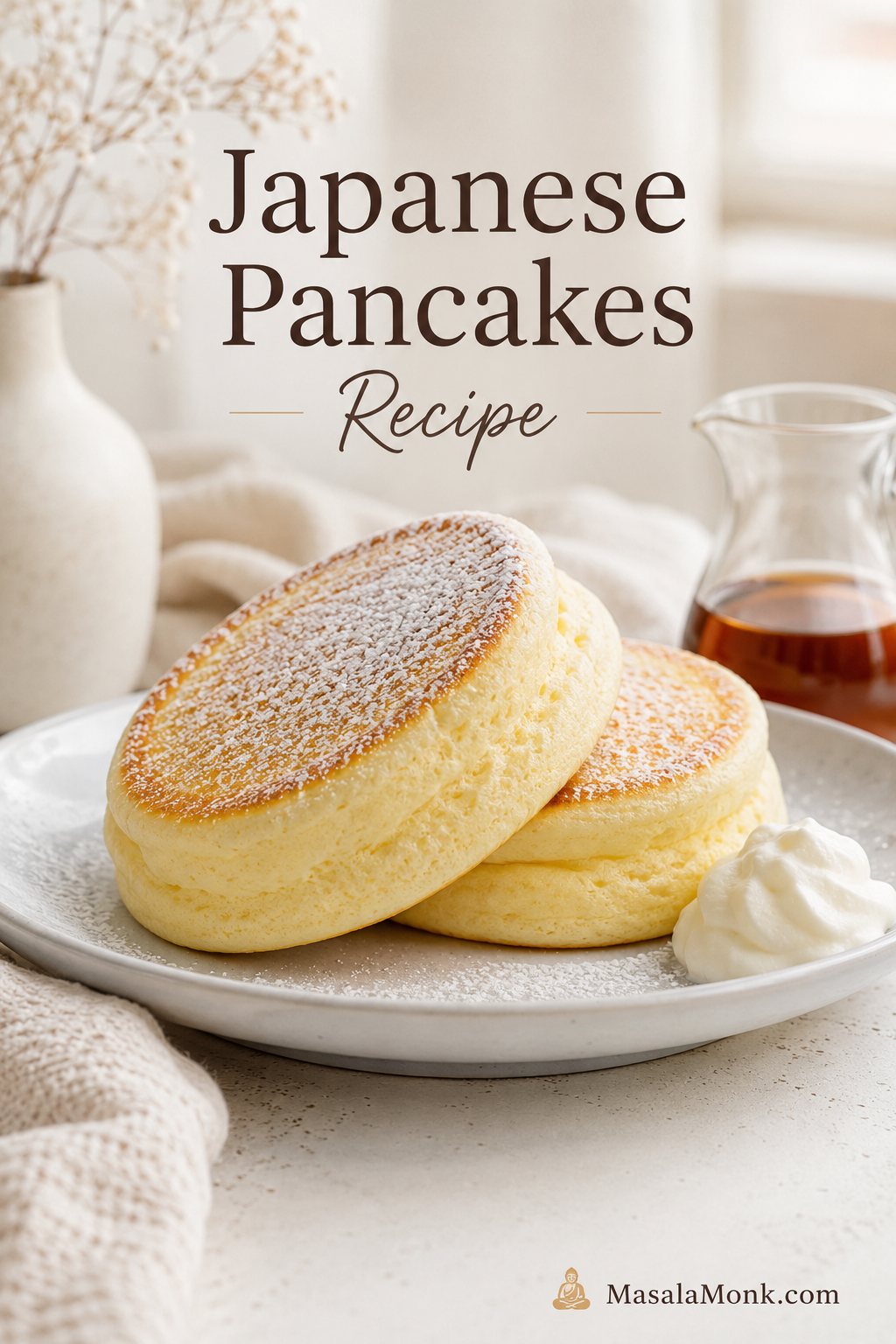
Tall Japanese soufflé pancakes stacked on a pale plate with whipped cream, powdered sugar, and syrup nearby.

Japanese pancakes look magical until you try to make them at home. They rise like little clouds, jiggle when the plate moves, and seem soft enough to collapse under a spoon. Then the real fear arrives: what if they spread flat, burn on the bottom, stay raw in the center, or puff up beautifully in the pan and sink the second you serve them?

The real challenge is technique, not ingredients. That is the moment this Japanese pancakes recipe is built for. The ingredients are simple, but the method matters. These are not regular pancakes with extra baking powder. They are small soufflés cooked like pancakes, and once you treat them that way, the method starts to make sense.

The secret is a stable meringue, gentle folding, controlled heat, a little steam, and patience. In this guide, you will get exact grams and spoon measures, the right batter texture, the meringue stage to aim for, ring-mold and no-mold methods, a pancake-mix shortcut, and clear fixes for deflating, spreading, burning, shrinking, and raw centers. If you only remember one framework, start with the 3 checks that decide whether Japanese pancakes rise or collapse.

By the time you reach the pan, you will know what the meringue should look like, how the batter should stand, when to flip, and why a pancake that looks almost ready often needs one more covered minute. That extra minute is not hesitation; it is usually the difference between a pancake that holds and one that sinks as it cools.

If you want a more classic pancake stack instead of the tall soufflé style, you may also like these fluffy buttermilk pancakes with stewed cinnamon apples. This recipe is for the café-style Japanese soufflé pancakes that are tall, soft, jiggly, and best eaten right away.

This is the home-cook target: soft, tall pancakes that feel special without needing every edge to look like a perfect café cylinder.
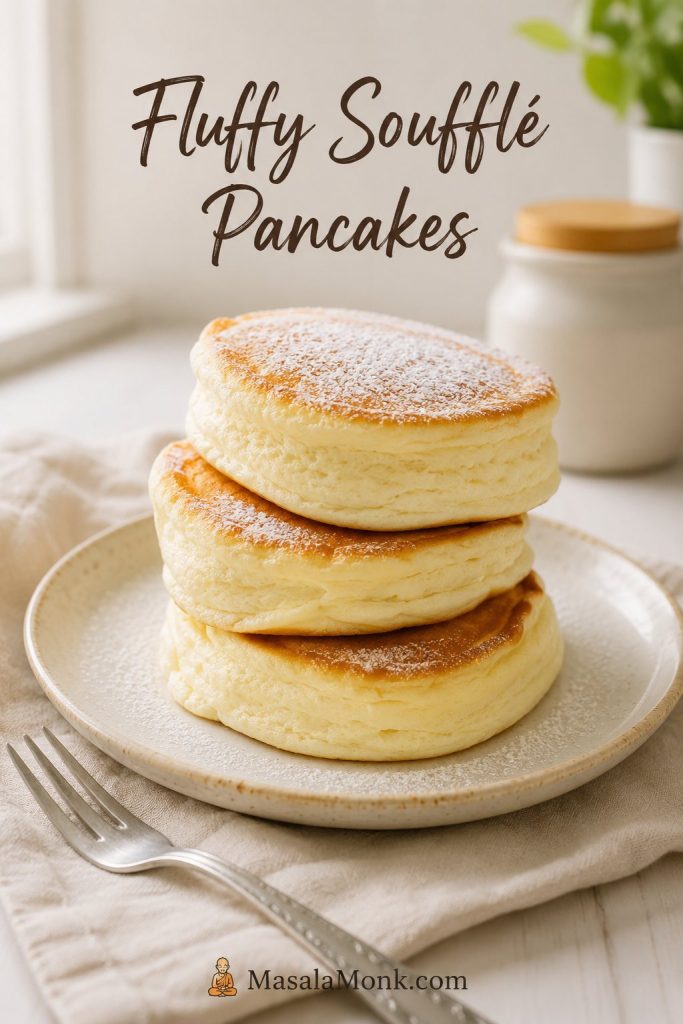
Homemade fluffy Japanese soufflé pancakes stacked on a plate with powdered sugar and a fork nearby.
A home batch does not need perfect café edges; instead, aim for fluffy soufflé pancakes with height, softness, and a fully set center.

Quick Answer: How Do You Make Fluffy Japanese Pancakes?

Japanese pancakes, often called Japanese soufflé pancakes, are tall pancakes made by folding whipped egg whites into a small yolk batter and cooking the batter slowly in a covered pan. The fluff comes mostly from meringue, not from baking powder alone.

For the best height, beat the egg whites to glossy stiff peaks, fold gently, scoop the batter into tall mounds, cook on gentle heat, and use a little steam so the center sets before the outside over-browns. A ring mold gives the neatest shape, but the no-mold Japanese pancake method works by stacking the batter in layers. If your first batch spreads, burns, or sinks, use the troubleshooting guide before changing the whole recipe. Serve them immediately because this soufflé-style texture naturally settles as it cools.

What Jiggly but Cooked Through Looks Like

The pancake should move softly, but it should still feel set. Think gentle spring, not wet batter hiding under a browned top.
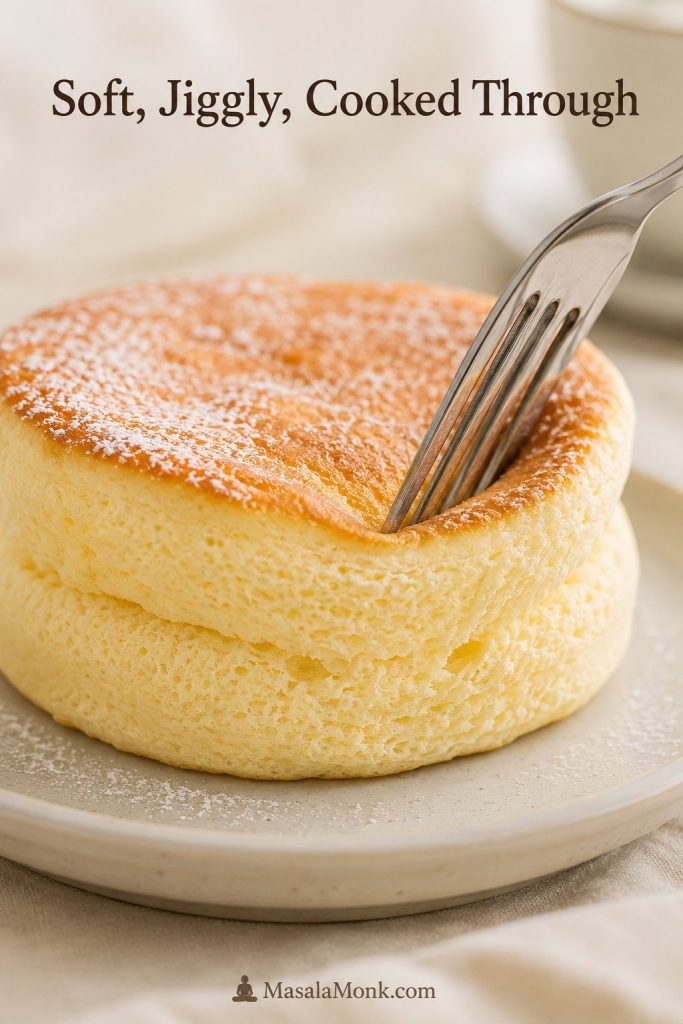
A fork gently pressing into a soft Japanese soufflé pancake to show its springy texture.
Jiggly should mean soft and bouncy, not wet. If the pancake springs back gently, the center is much closer to ready.

Japanese Pancakes at a Glance

Yield2–3 thick pancakes
Texture goalTall, soft, airy, gently jiggly, cooked through
Meringue targetGlossy firm/stiff peaks
Batter textureThick and spoonable; it should mound, not pour
Pan targetAbout 300°F / 150°C
Workable pan range285–320°F / 140–160°C
First side6–8 minutes covered, depending on size
Second side4–6 minutes covered
Cook timeAbout 12–15 minutes per batch
MoldOptional; no-mold method included
Best servedImmediately, ideally within 5–10 minutes
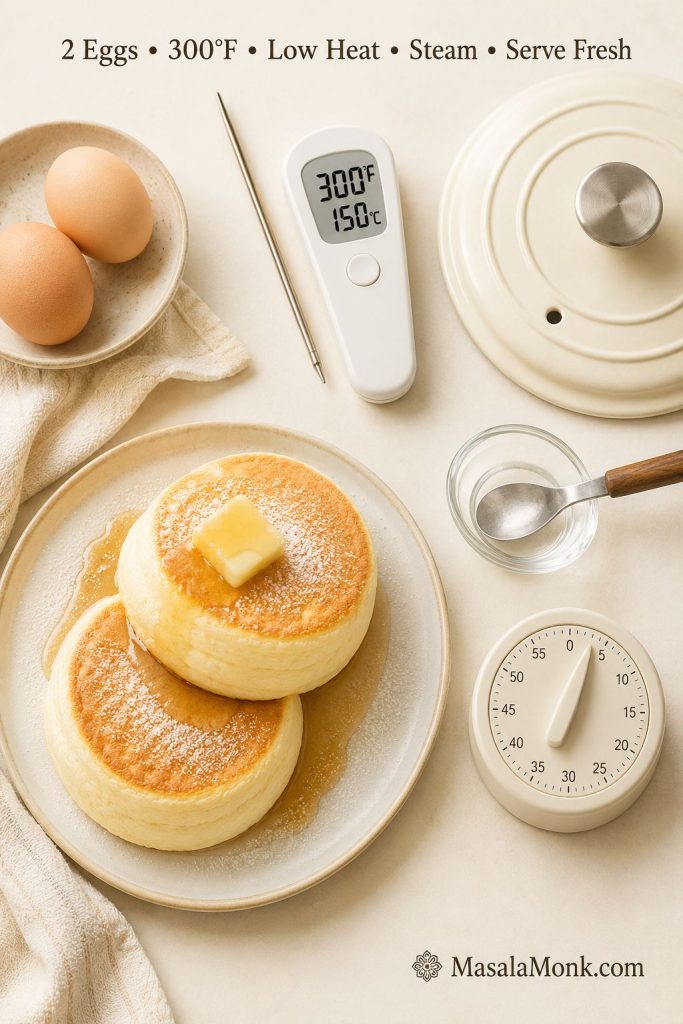
Japanese pancake quick guide showing two eggs, a 300°F pan cue, a lid, a water spoon, and pancakes.
Before cooking, remember the working numbers: two eggs, low heat near 300°F, a covered pan, steam, and quick serving.

What Are Japanese Pancakes?

In this tall, café-style version, Japanese pancakes means Japanese soufflé pancakes: soft, airy pancakes made with whipped egg whites and cooked gently until they rise into a thick, delicate stack.

They are different from regular pancakes. A normal pancake batter is mixed, poured, and cooked fairly quickly. Japanese soufflé pancake batter is built around foam. The egg whites are beaten into a meringue, folded into a yolk mixture, then cooked low and slow so the foam has time to set.

That is why the method feels more precise than a usual pancake recipe. You are not only browning batter on a pan. You are setting a fragile structure full of air. Once that idea clicks, the recipe stops feeling mysterious and starts feeling manageable.
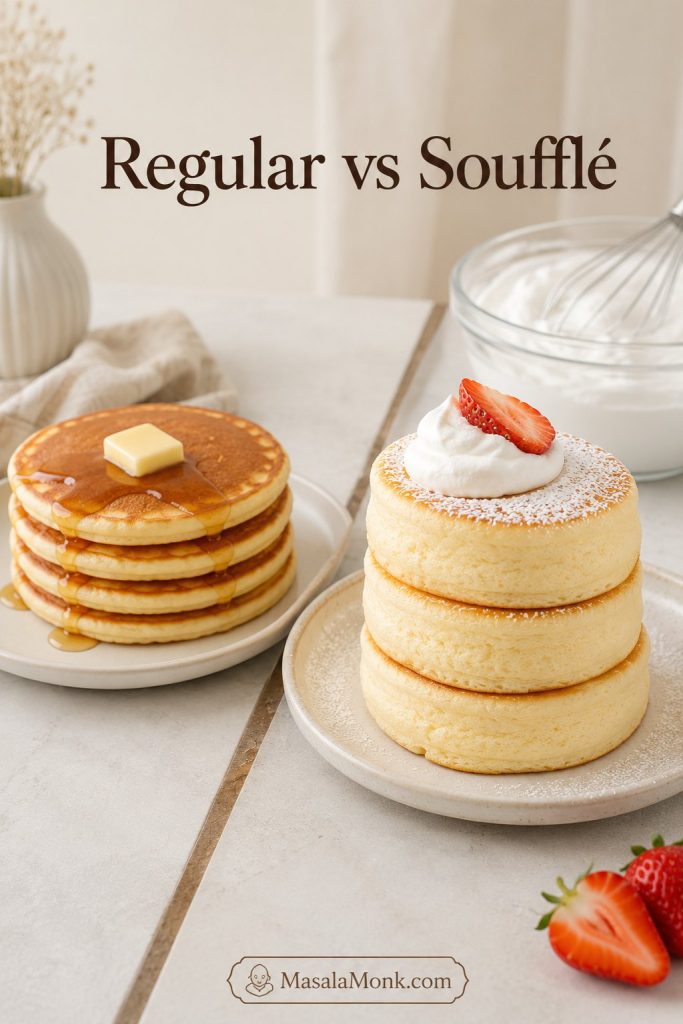
Regular pancakes compared with taller Japanese soufflé pancakes and a meringue bowl in the background.
Because this batter is lifted by whipped egg whites, it behaves more like a delicate pan-cooked soufflé than a regular pancake.

Japanese Hotcakes vs Japanese Soufflé Pancakes vs Fuwa Fuwa Pancakes

The names can get confusing because several styles of Japanese pancakes appear in cafés, cookbooks, and social videos. Here is the simple difference.

TermWhat it usually meansTexture
Japanese hotcakesThicker, sweeter, more regular-style pancakes, often made from a batter or mixSoft, cakey, and sturdy
Japanese soufflé pancakesTall pancakes lifted with whipped egg whites and cooked slowlyAiry, jiggly, delicate, and cloudlike
Fuwa fuwa pancakesA texture-focused name for soft, fluffy pancakesLight, soft, and pillowy
Jiggly pancakesA social-media-friendly name for Japanese soufflé pancakesWobbly and tall, but still cooked through
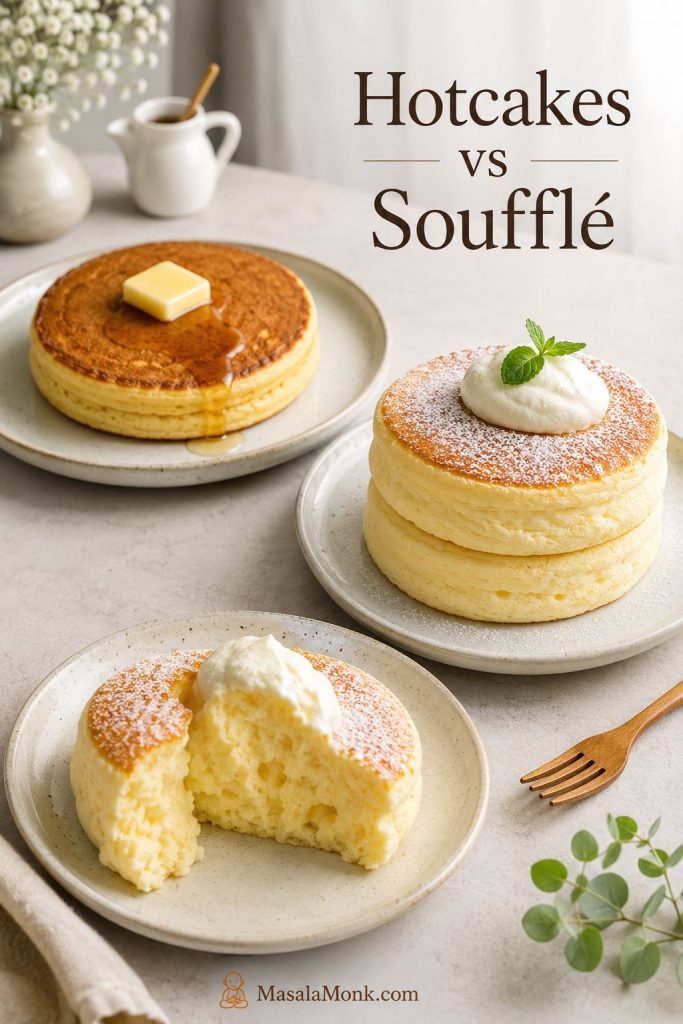
Japanese hotcakes, Japanese soufflé pancakes, and a soft fuwa fuwa pancake texture shown together.
Japanese hotcakes are sturdier and more cake-like; soufflé pancakes need meringue, low heat, and steam for their tall café-style texture.

This recipe focuses on the tall, meringue-based pancake version. Japanese soufflé cake is a different dessert, usually closer to Japanese cheesecake or cotton cheesecake, which is baked rather than cooked on a skillet. There is a short note on that difference later in the post.

So if you came here for the tall, jiggly café pancakes, you are in the right place. If you wanted a sturdier everyday hotcake, treat this as the soufflé-style weekend version instead.

What Does Fuwa Fuwa Mean?

Fuwa fuwa is a Japanese expression used for something soft, airy, and fluffy. In a pancake context, it describes the texture people want from café-style Japanese pancakes: tall, tender, light, and gently wobbly.

Fuwa fuwa texture does not come from making the batter sweeter or loading it with baking powder. It comes from air. The egg whites trap tiny bubbles, sugar helps stabilize those bubbles, and gentle heat gives the pancake enough time to cook without collapsing too quickly.

Texture target: A good Japanese soufflé pancake should feel soft and airy, with a gentle jiggle. It should not be wet, runny, or raw in the center.
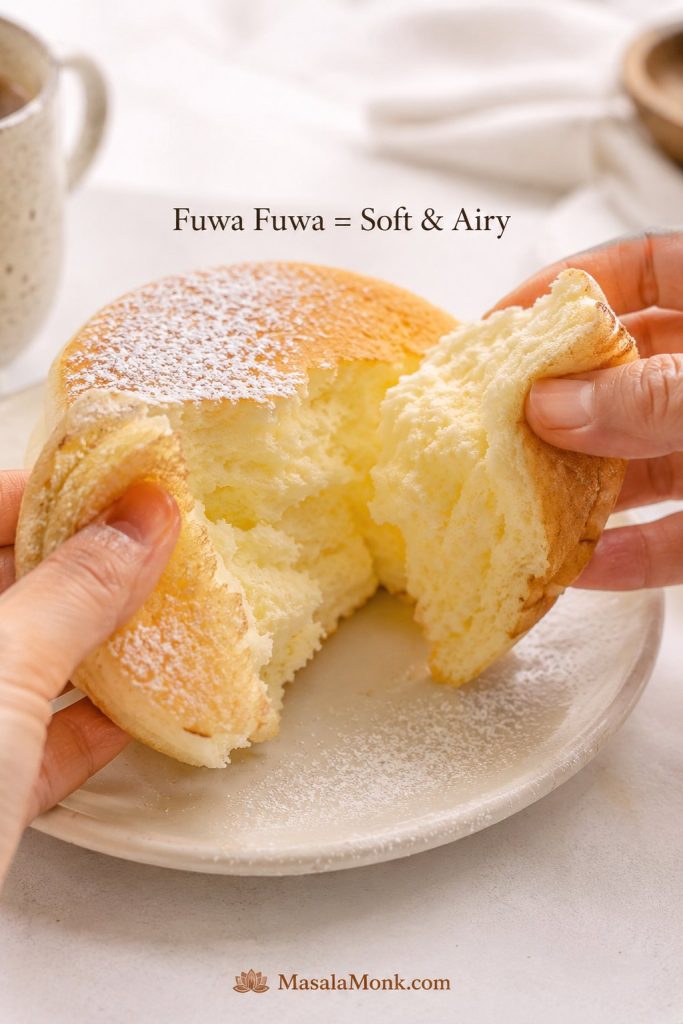
A Japanese pancake being pulled open to show a soft airy interior crumb.
Fuwa fuwa is the soft, airy texture you are chasing, so protect the foam from mixing bowl to pan.

Before You Start: Set Yourself Up to Win

This small setup step makes the recipe much easier. Once the meringue is folded into the batter, the clock starts. The batter slowly loses air as it sits, so you do not want to stop halfway through to find a lid, wash a spatula, or clear space on the stove.

  • Use clean, dry bowls and beaters. Grease or yolk in the egg whites can weaken the meringue; the meringue guide shows what the right texture should look like.
  • Have the pan, lid, spatula, water, and serving plates ready. The batter should be cooked soon after folding.
  • Start with gentle heat. You can always cook a little longer, but you cannot un-burn the outside.
  • Make only 2–3 pancakes at once. Crowding makes flipping harder and lowers control.
  • Serve immediately. These pancakes are meant to be eaten fresh, while the structure is still warm and lifted.

Why the Egg White Bowl Must Be Clean

Before you beat the whites, check the bowl and beaters. This tiny setup detail protects the foam that gives the pancakes their height.
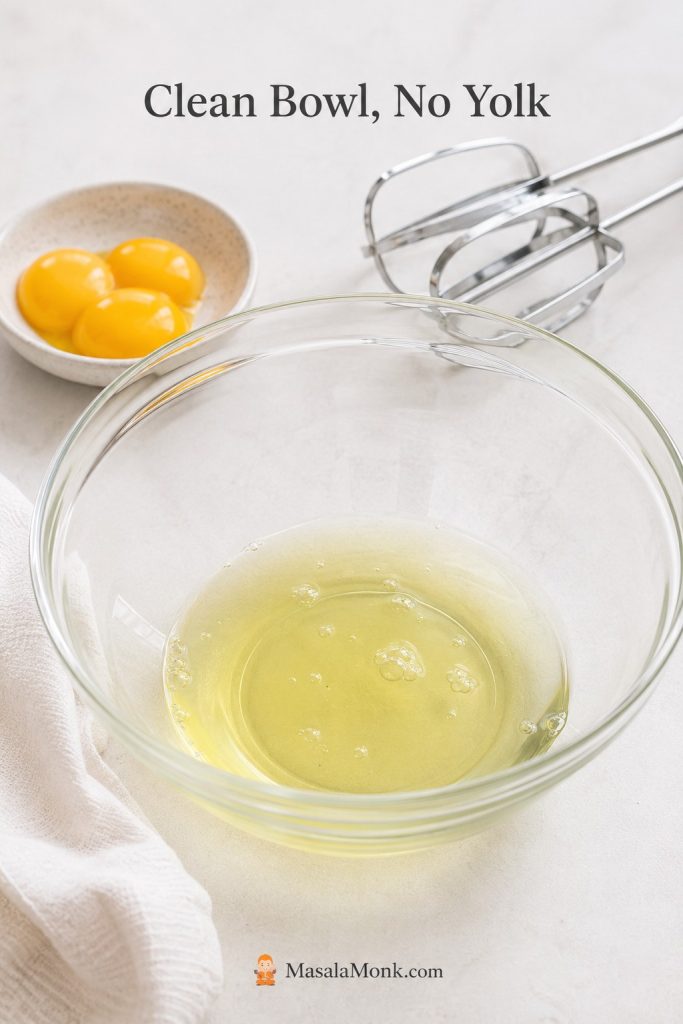
Egg whites in a clean bowl with separated yolks and beaters nearby for making meringue.
Start with spotless egg whites. Even a small streak of yolk or grease can keep the meringue from whipping properly.

Beginner reassurance: Your first batch may not look like a café stack, and that is completely normal. If the pancakes taste good but sit a little lower, you are already close. The next batch usually improves once you understand your pan heat and meringue texture.

Why This Japanese Pancakes Recipe Works

Home kitchens are messy in the best way: one stove runs hot, another pan holds heat differently, and not everyone has a ring mold. Instead of asking you to trust the timer blindly, this method shows you what to look for at each stage.

  • Meringue gives height. The whipped egg whites are the main lift in this style. Baking powder helps a little, but it cannot replace a strong foam.
  • A small amount of flour keeps the pancakes light. Too much flour makes them cakey and heavy; too little structure makes them fragile.
  • Cornstarch gives extra support. A teaspoon helps the delicate foam hold together without making the pancake dense.
  • Slow covered cooking sets the middle. Tall pancakes need more time than normal pancakes. High heat gives you a browned outside and a wet center.
  • Steam helps the pancake set. A covered pan traps moisture and heat around the tall batter so the inside cooks through.
  • Layered scooping builds height without a mold. Instead of pouring all the batter at once, you add it in mounds so the pancake rises upward, not outward.

The 3 Checks That Decide Whether They Rise or Collapse

If the recipe starts to feel fussy, bring it back to three checks: the meringue should hold itself, the batter should stand in a mound, and the heat should be gentle enough that the middle sets before the bottom browns too deeply.

CheckWhat you wantWhat it tells you
MeringueShiny, firm peaks that hold their shapeA drooping meringue usually leads to spread; a dry, clumpy one is hard to fold smoothly.
BatterThick, airy, and able to mound on a spoonA batter that slides off the spoon instead of sitting in a mound will usually cook flatter.
HeatGentle enough to cook slowly under a lidThe bottom should set and lightly color while the center has time to catch up.

Meringue Stages for Japanese Pancakes

Use the meringue stage as your first checkpoint. Foam is too early, soft peaks are usually weak, glossy firm peaks are the target, and dry clumps mean you went too far.
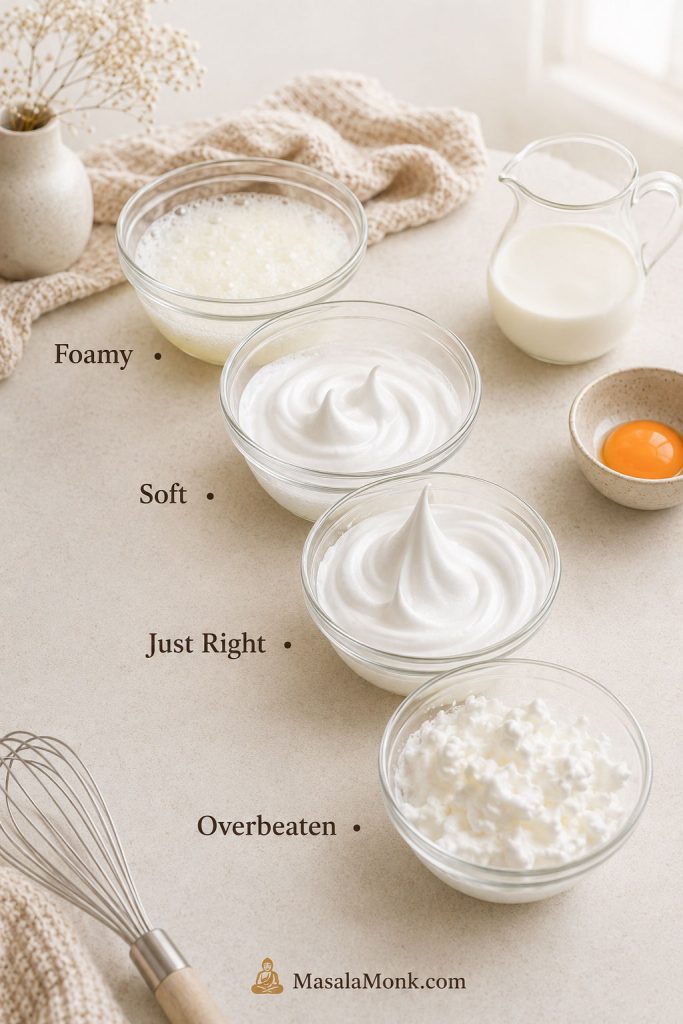
Four meringue stages for Japanese pancakes showing foamy, soft, glossy stiff, and overbeaten egg whites.
Use the stages as a checkpoint: keep beating past foam and soft peaks, then stop at glossy firm peaks before the meringue breaks.

A pancake that looks tall but feels liquid under the spatula needs more covered time, not a brave flip. In testing, the pancakes that looked almost ready were usually the ones that needed one more covered minute.

Ingredients for Japanese Soufflé Pancakes

Use a scale if you have one. This is a tiny batter, so small changes matter. An extra splash of milk can make the batter slide instead of mound, and a heavy scoop of flour can make the pancakes feel cakey instead of cloudlike. The gram amounts in this recipe are the ones to follow here. After mixing, compare your bowl with the batter texture cues before scooping.
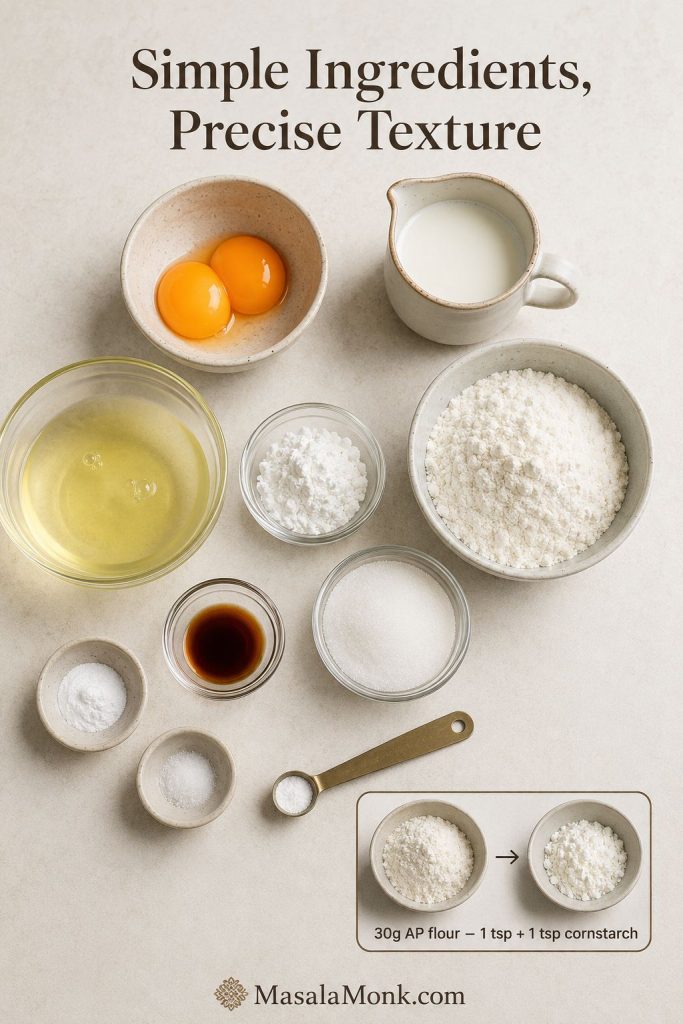
Ingredients for Japanese soufflé pancakes arranged on a counter with eggs, milk, flour, sugar, cornstarch, and a cake flour swap note.
Small measurements matter here: too much milk loosens the batter, while careful flour and cornstarch balance keeps the texture light.
IngredientAmountWhy it matters
Large egg yolks2 yolks, about 35–40gMake the rich base of the batter
Large egg whites2 whites, about 60–65gCreate the main soufflé lift
Whole milk20ml / 1 tbsp + 1 tspLoosens the yolk batter without making it runny
Vanilla extract½ tspSoftens the eggy flavor
Cake flour30g / about ¼ cup spooned and leveledGives light structure
Cornstarch1 tsp / about 3gHelps support the delicate foam
Baking powder¼ tspAdds a little backup lift
Fine saltPinchBalances the sweetness
Granulated sugar24–25g / 2 tbspSweetens and stabilizes the meringue
Cream of tartar¼ tspHelps stabilize the egg whites
Neutral oil or melted butterFor greasingPrevents sticking without frying the pancake
Water1–2 tbsp totalCreates steam under the lid

Ingredient Notes and Substitutions

Cake flour: Cake flour gives a lighter pancake. If you do not have it, measure 30g all-purpose flour, remove 1 teaspoon, and replace that teaspoon with cornstarch.

Cream of tartar: This helps the egg whites whip into a more stable meringue. If you do not have it, use 1 teaspoon lemon juice or ½ teaspoon white vinegar instead.

Egg temperature: Cold eggs can be easier to separate cleanly, while room-temperature whites usually whip faster. Either works here as long as the bowl is clean and the whites are beaten to the right stage.

Milk: Whole milk gives the best body. Add more only if the yolk batter is too stiff to mix. The finished batter should feel light but not loose.

Optional taller version: For a taller café-style pancake, use 3 egg whites and 2 yolks. Keep the other ingredients the same, but fold carefully because the batter becomes more delicate. Start with the basic 2-white version if this is your first try.

Equipment: What You Need and What You Don’t

You do not need a professional kitchen to make fluffy Japanese pancakes. The most important “equipment” is really control: a clean bowl for the whites, a pan that heats gently, and a lid that traps steam around the tall batter. If you have molds, see how to use a ring mold; if not, the no-mold method is built for a normal home pan.
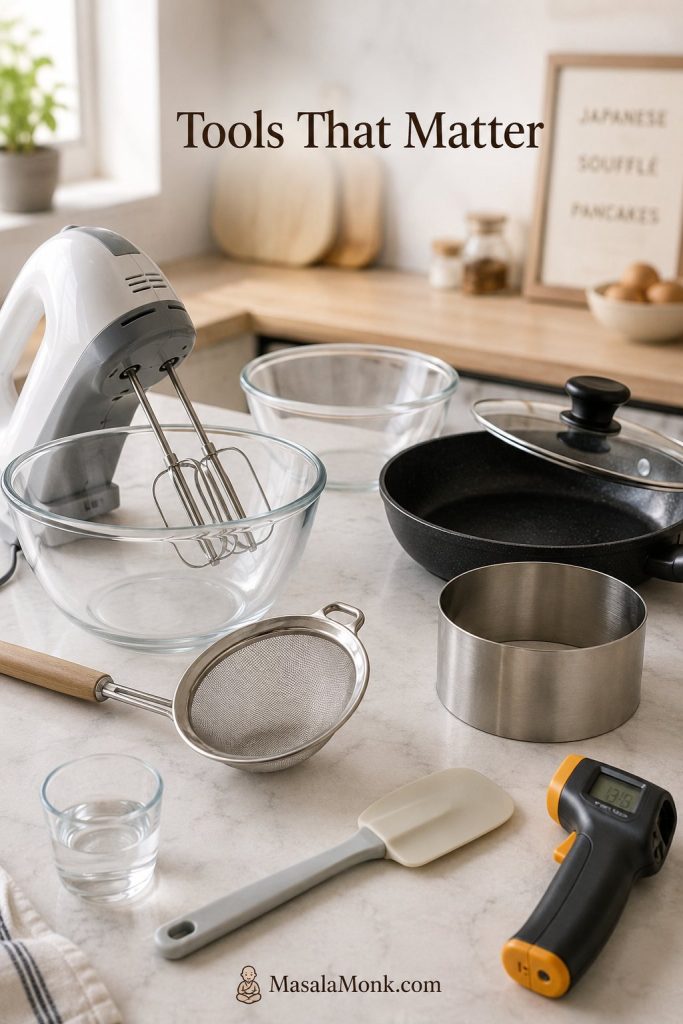
Equipment for Japanese soufflé pancakes including mixing bowls, beaters, a pan, lid, spatula, ring mold, and thermometer.
The most useful tools are the ones that give control: clean bowls, steady heat, a lid for steam, and a thin spatula.

Essential Equipment

  • Electric hand mixer or stand mixer
  • Two clean mixing bowls
  • Fine mesh sieve
  • Nonstick pan or electric griddle
  • Tight-fitting lid, preferably tall enough not to touch the pancakes
  • Thin flexible spatula
  • Paper towel for spreading a thin film of oil

Helpful but Optional

  • Cookie scoop or disher for even mounds
  • Piping bag for cleaner shaping
  • Ring molds for straighter sides
  • Infrared thermometer for checking pan surface temperature
  • Instant-read thermometer for checking the center of the pancake

Choose Your Method: Ring Mold, No Mold, or Pancake Mix

There is more than one way to make these pancakes, and the best path depends on your tools and comfort level. A ring mold gives the neatest sides, the no-mold method is friendlier for home cooks, and pancake mix is a convenience shortcut rather than a magic fix.

MethodBest forWhat to watch
Basic 2-white batterFirst attempts and best controlStart here before trying a taller, more delicate version.
No moldHome cooks who want fewer toolsThe batter must be thick enough to mound; the shape will be softer.
Ring moldVery tall, straight-sided pancakesGrease the mold well and fill only halfway to two-thirds full.
Pancake mix shortcutConvenienceThe mix replaces the dry base, not the whipped egg whites.
3-white versionExtra height after you know the methodFold carefully because the batter becomes more delicate.
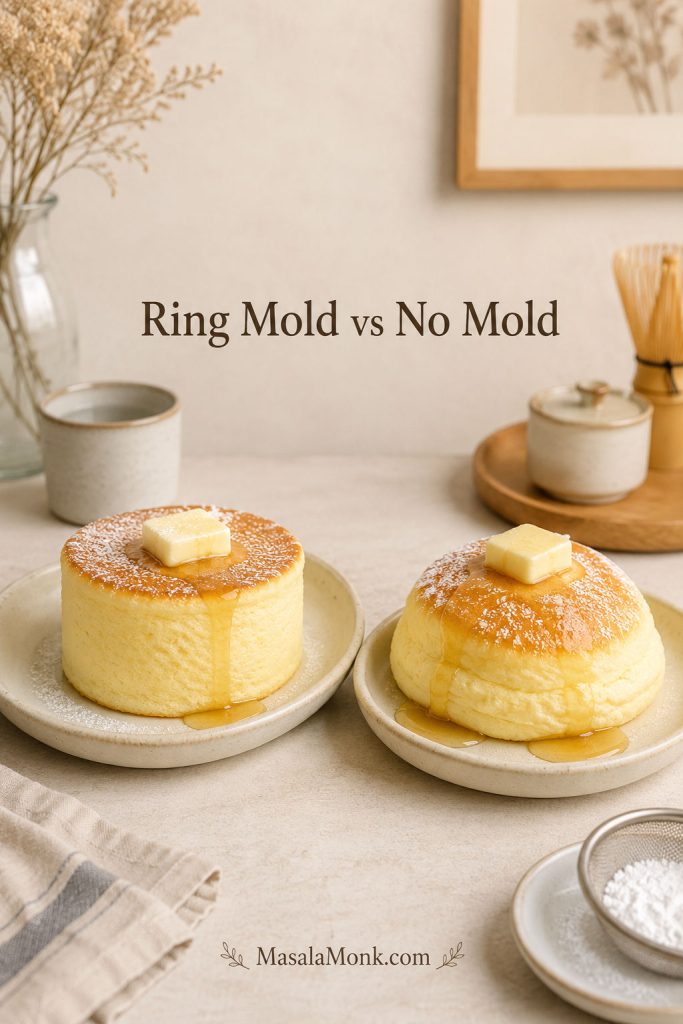
A straight-sided ring mold Japanese pancake beside a softer no-mold Japanese pancake on plates.
Ring molds give cleaner sides, but a strong no-mold batter can still make fluffy Japanese pancakes worth serving proudly.

A ring mold can make the pancakes look more like café cylinders, but it is not required for a lovely plate. Without a mold, expect softer café-style mounds rather than perfectly vertical sides. The texture can still be airy, tender, and special.

How to Make Japanese Pancakes Without a Mold

For the no-mold method, scoop the batter into tall mounds instead of pouring it. Use about two-thirds of the batter for the first mounds and reserve the rest for topping them after the base starts to set.

No-Mold First Layer

The first scoop should sit tall in the pan. Once that base begins to set, it can hold more batter without spreading as much.
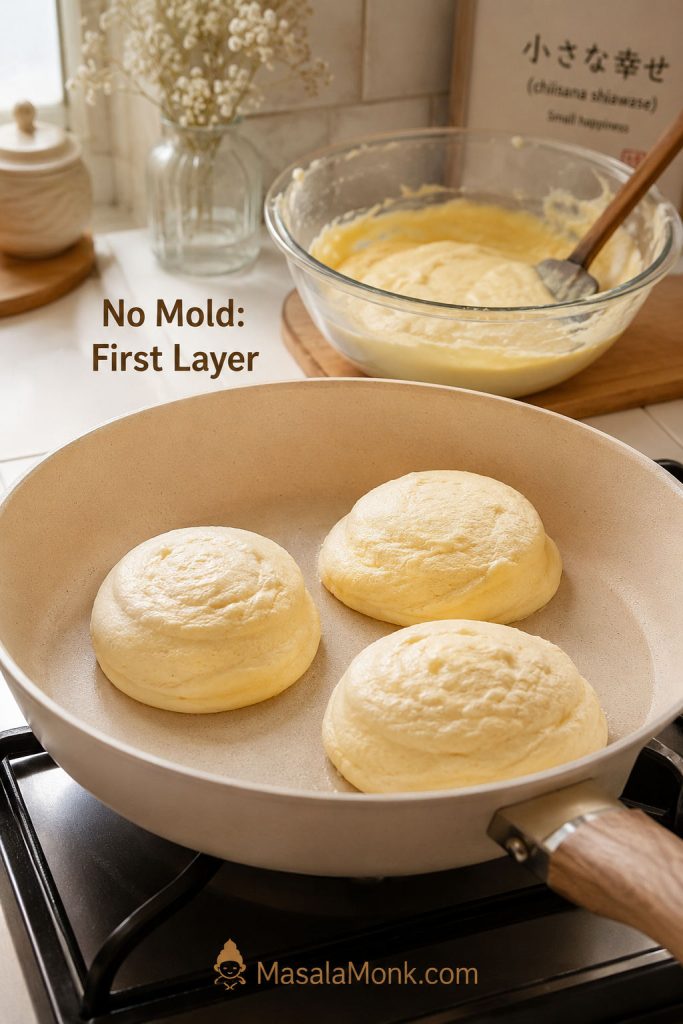
Three no-mold Japanese pancake batter mounds cooking in a pan with a bowl of batter behind them.
For the no-mold method, start with thick first-layer mounds; once they begin to set, they can support the second scoop.
  1. Preheat the pan on gentle heat and wipe it with a thin film of oil.
  2. Scoop 2–3 tall mounds of batter into the pan, leaving space between them.
  3. Add 2 teaspoons water to the empty space in the pan, away from the batter.
  4. Cover and cook for 3–4 minutes, until the bottom layer starts to set.
  5. Add the reserved batter on top of each pancake.
  6. Cover again and cook until the sides look less glossy and the base releases cleanly.
  7. Flip gently, add another small splash of water, cover, and finish cooking.

How to Layer No-Mold Japanese Pancakes

Add the reserved batter after the first layer has started to hold its shape. This gives the pancake height without needing a ring mold.
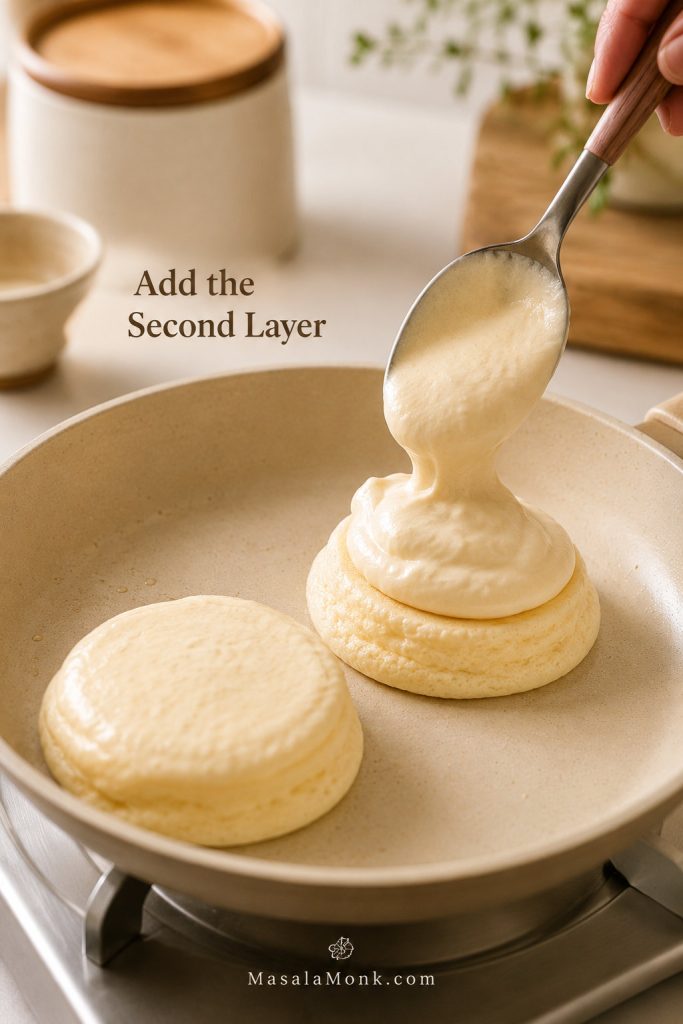
Reserved batter being spooned on top of a partially set no-mold Japanese pancake in a pan.
Add the second layer only after the base starts to set; otherwise, the batter spreads outward instead of stacking upward.

The no-mold pancakes may lean a little, and their edges may look softer. That is not failure. The win is a pancake that rises upward, cooks through, and lands on the plate warm and tender.

How to Use a Ring Mold

Use a ring mold about 2.5–3 inches wide and roughly 2 inches high. Grease the inside very well, place it in the pan, and fill it only halfway to two-thirds full. The batter needs room to rise.

How High to Fill a Ring Mold

Leave visible headroom in the mold. Filling to the top looks dramatic, but it gives the batter nowhere to rise.
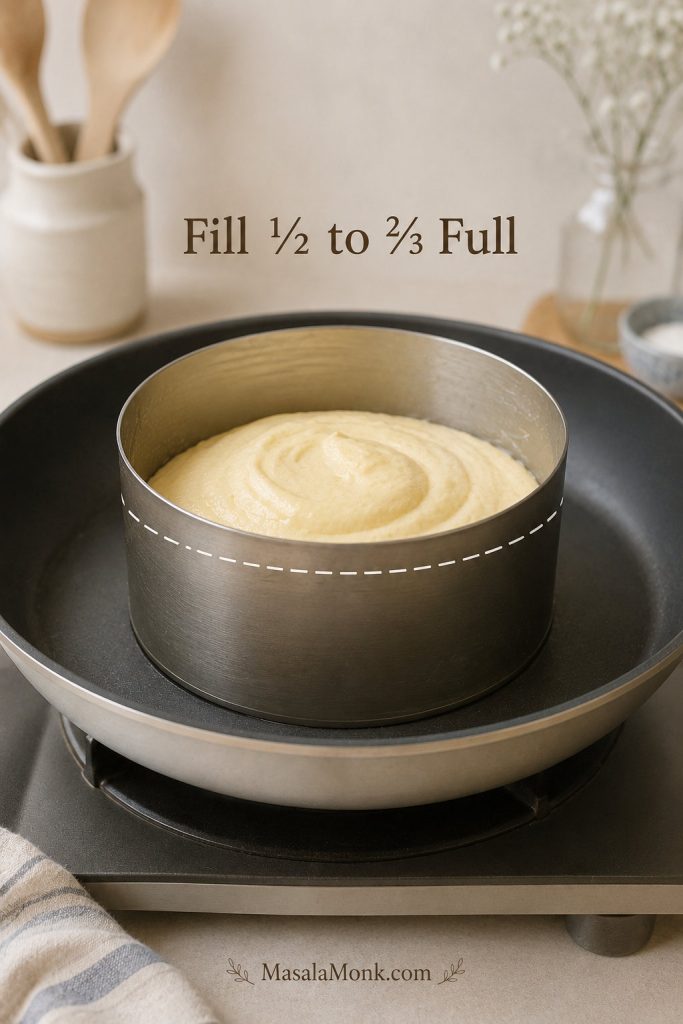
Japanese pancake batter inside a metal ring mold in a pan with a fill-height guide line.
Fill the ring mold only halfway to two-thirds full. The batter needs headroom to rise without spilling or compressing.

When flipping, slide a thin spatula under the mold and use tongs to steady the ring. A pancake that resists or looks wet at the sides is asking for more time. Ring molds get hot, so use tongs or a towel when adjusting them.

Meringue Guide: The Most Important Step

The meringue is where these pancakes get their height. Think of it as the scaffolding inside the pancake: too soft and the batter spreads; too dry and it becomes hard to fold smoothly.

A good meringue looks shiny and confident. It should not slide around the bowl like foam, and it should not break into dry chunks. When the peak stands with only a small bend at the tip, you are in the right zone. In testing, batter made with soft peaks spread quickly, even when the pan heat was right.

The Glossy Firm Peak Target

The target is not just “fluffy.” It is glossy, structured foam that can hold the batter up once it reaches the pan.
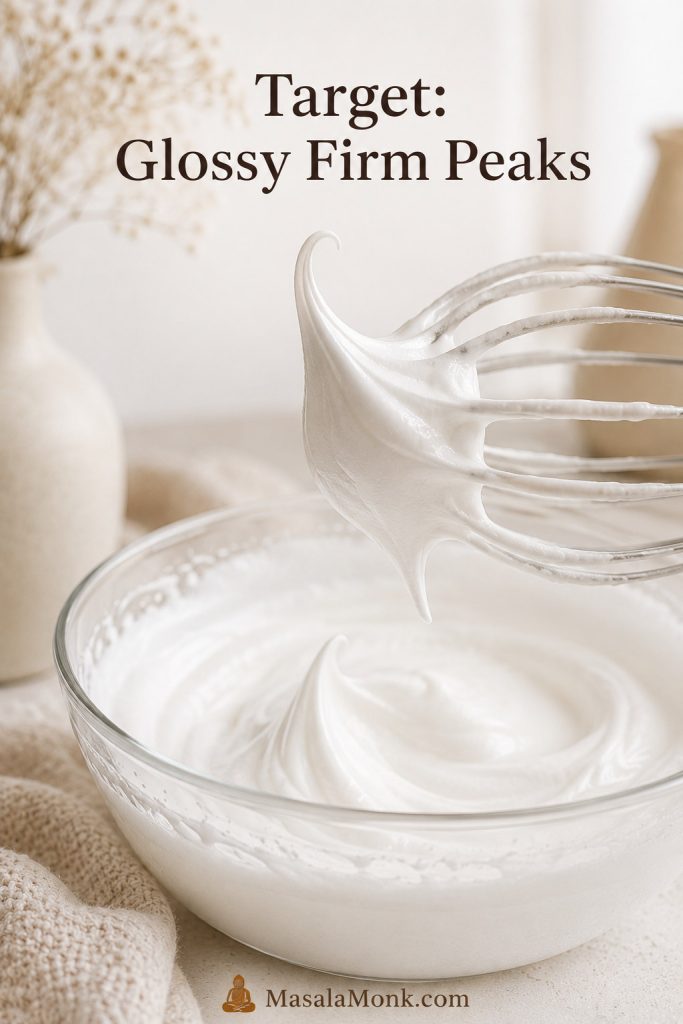
Glossy stiff meringue peak lifted from a bowl with a mixer beater.
This is the target texture: shiny, strong, and stable enough to help the batter mound in the pan instead of spread.

Soft Peaks vs Stiff Peaks

Soft peaks may seem close, but this batter needs a stronger foam. A drooping peak often becomes a spreading pancake.
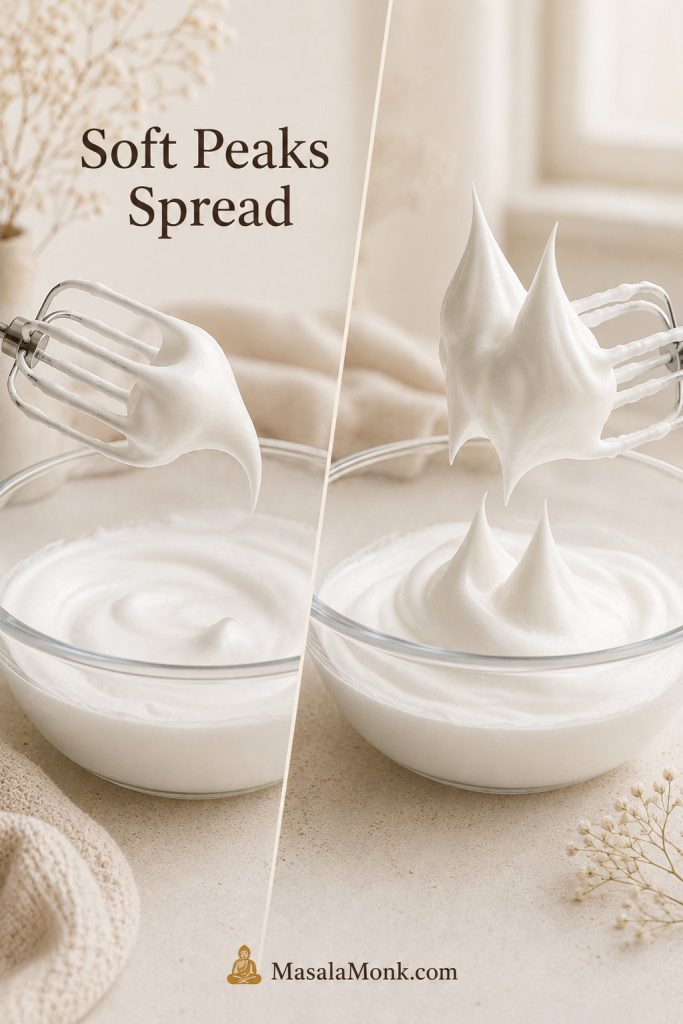
Soft meringue peaks compared with stiff glossy peaks for Japanese pancake batter.
Soft peaks can look promising, but they often collapse after folding. Beat a little longer until the peaks stand firmly.
Meringue stageWhat it looks likeUse it?
FoamyBubbles with no real shapeNo. Too early.
Soft peaksPeak forms but droops overUsually too weak for tall pancakes.
Firm/stiff glossy peaksPeak stands upright or nearly upright; meringue looks smooth and shinyYes. This is the target.
Dry or clumpy peaksGrainy, dull, broken-looking foamNo. Overbeaten and harder to fold.

What Overbeaten Meringue Looks Like

The other mistake is going too far. Once the meringue looks dry, dull, and broken, it becomes harder to fold into a smooth, airy batter.
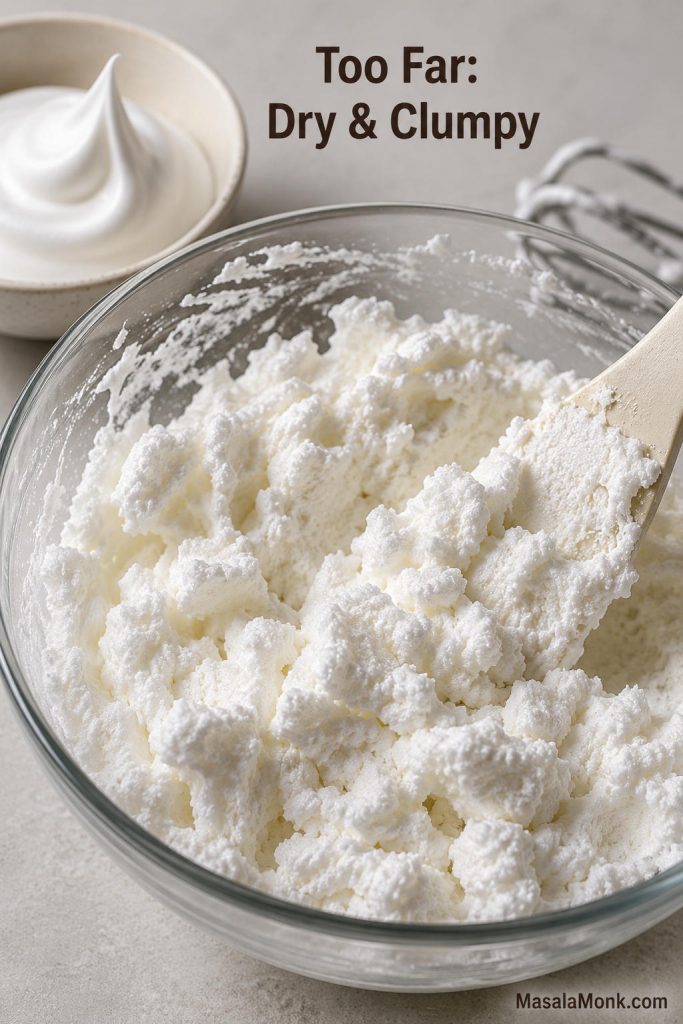
Dry clumpy overbeaten meringue in a bowl with a glossy peak comparison in the background.
Once meringue turns dry and clumpy, it becomes harder to fold evenly; next time, stop at glossy firm peaks.
  1. Use a clean, dry bowl. Any grease or yolk can weaken the foam.
  2. Start beating the egg whites with cream of tartar until foamy.
  3. Add the sugar gradually, not all at once.
  4. Beat until the meringue is shiny and structured enough to hold strong peaks.
  5. Stop before it turns dry, grainy, or chunky.

If the whites refuse to foam after a minute or two, it is usually better to start over in a clean bowl than to keep trying to rescue them. A little yolk or grease can quietly ruin the lift.

What the Batter Should Look Like

The batter should be thick, airy, and spoonable. It should hold its shape when dropped into the pan. It should not pour like crepe batter or spread immediately into a flat circle.
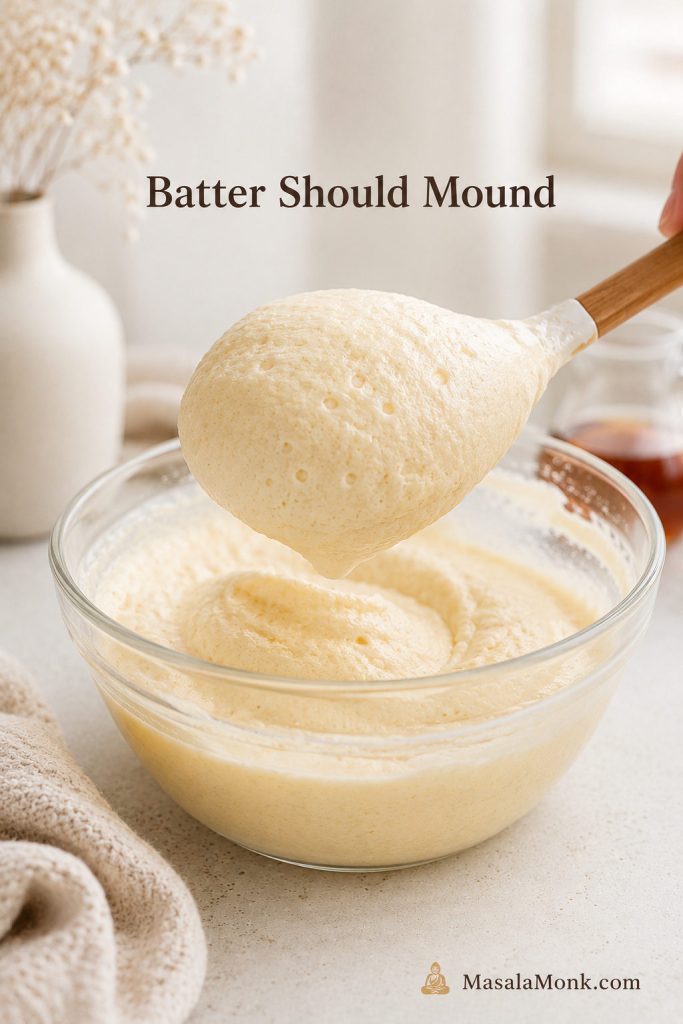
Thick Japanese pancake batter holding a mound on a spoon above a mixing bowl.
The batter should sit in a soft mound on the spoon. If it slides away quickly, the pancakes will likely spread.

When folding, keep the movement calm and broad. Sweep under the batter, turn it over itself, and stop before you flatten the air out of it. A few faint streaks are better than a perfectly smooth batter that has lost its lift.

Batter cueWhat it means
Thick and mounds on a spoonGood. The meringue is holding structure.
Loose and pourableMeringue may be underwhipped, overfolded, or the batter has too much liquid.
Lumpy with dry white clumpsMeringue may be overbeaten or not folded evenly.
Watery at the bottomBatter has started breaking down. Cook immediately, but expect less height.

Runny vs Moundable Batter

Before the pan gets involved, the bowl already tells you a lot. Batter that sits in a mound has structure; batter that flows quickly is already warning you it may spread.
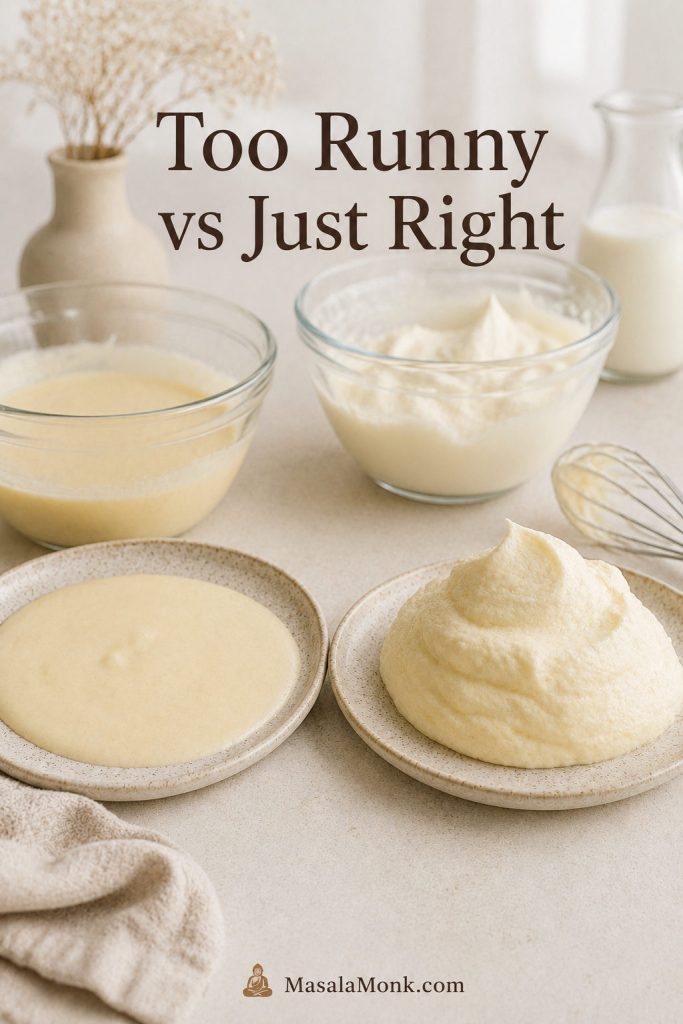
Runny Japanese pancake batter compared with thicker moundable batter in two bowls.
Check texture before cooking: moundable batter rises upward, while runny batter usually flattens before it can set.

How to Make Japanese Soufflé Pancakes Step by Step

Read through the method once before starting. The batter is best cooked soon after folding, so it helps to have the pan, lid, spatula, water, and serving plates ready.

First-batch reality check: The first pancake is where you learn your pan. A quick-browning bottom means the heat needs to come down. A spreading mound points back to the meringue or batter texture. A shorter but cooked-through pancake is still progress.

1. Separate the Eggs

Separate 2 large eggs into yolks and whites. Keep the whites completely free of yolk. If you separated the eggs while cold, let the whites sit for a few minutes while preparing the yolk batter. They do not need to be perfectly room temperature; the final meringue stage matters more.

2. Make the Yolk Batter

In a medium bowl, whisk the egg yolks, milk, vanilla, and salt until smooth. Sift in the cake flour, cornstarch, and baking powder. Whisk just until the batter is smooth and thick. Add extra milk only if the batter is too stiff to mix.

3. Beat the Meringue

In a clean bowl, beat the egg whites and cream of tartar until foamy. Add the sugar gradually while beating. Continue until the meringue is smooth, shiny, and firm enough to stand. If the peak stage feels unclear, check the glossy firm peak cue before folding. Soft peaks make soft pancakes; firm peaks give the batter a chance to rise tall.

4. Fold the Batter

Add about one-third of the meringue to the yolk batter and mix it in more freely to lighten the base. Add the remaining meringue in two additions, folding with a spatula until the batter is mostly even, thick, and airy.

Before scooping, the batter should match the moundable batter cues. A batter that sits proudly on the spoon is ready for the pan; one that slides away quickly will usually cook flatter, so move quickly and keep the mounds smaller.
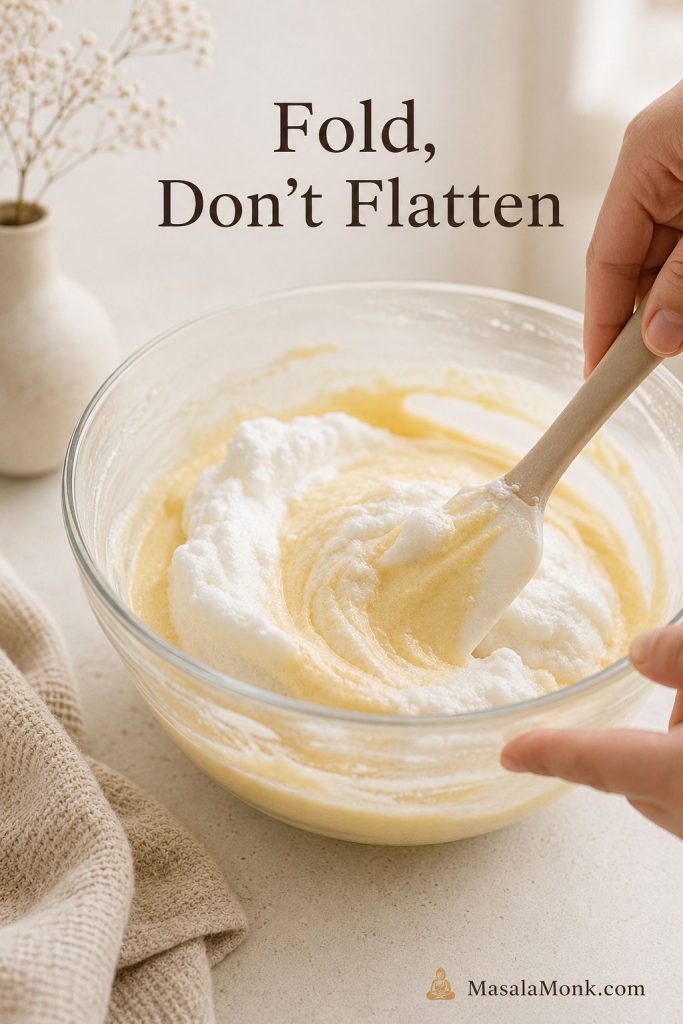
A spatula gently folding whipped meringue into Japanese pancake batter in a glass bowl.
Fold with broad, gentle strokes. A few faint streaks are better than a smooth batter that has lost its air.

5. Preheat the Pan Gently

Set a nonstick pan over gentle heat. If using an infrared thermometer, aim for about 300°F / 150°C, with a workable range of 285–320°F / 140–160°C. Wipe the pan with a very thin film of oil.

If your lid is low, use smaller mounds so the batter does not touch the lid as it rises.

6. Scoop and Steam

Scoop the batter into 2 or 3 tall mounds. Use about two-thirds of the batter for this first layer and reserve the rest for building height. Add 2 teaspoons water to the empty area of the pan, away from the batter, and cover immediately.
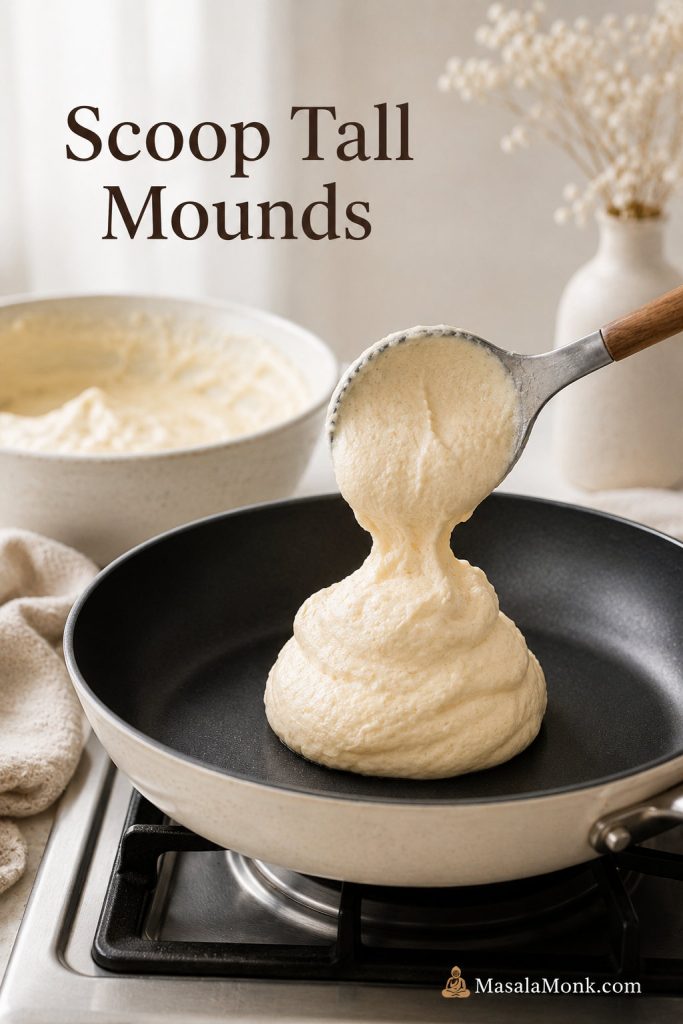
Thick Japanese pancake batter being scooped into a tall mound in a nonstick pan.
Scoop upward, not outward. Tall mounds give no-mold Japanese pancakes a better chance to rise instead of spreading flat.

7. Build Height

After 3–4 minutes, the first layer should look slightly more set around the base. Add the reserved batter on top of each mound. Cover again and continue cooking.

8. Flip Gently

Flip when the sides look less glossy, the bottom is lightly golden, and the pancake feels like it has a body of its own. The spatula should slide under with support, not drag through wet batter.

How to Know When Japanese Pancakes Are Ready to Flip

This is the part where most people want to move too soon. Wait for the sides to lose their wet gloss and for the pancake to feel supported under the spatula.
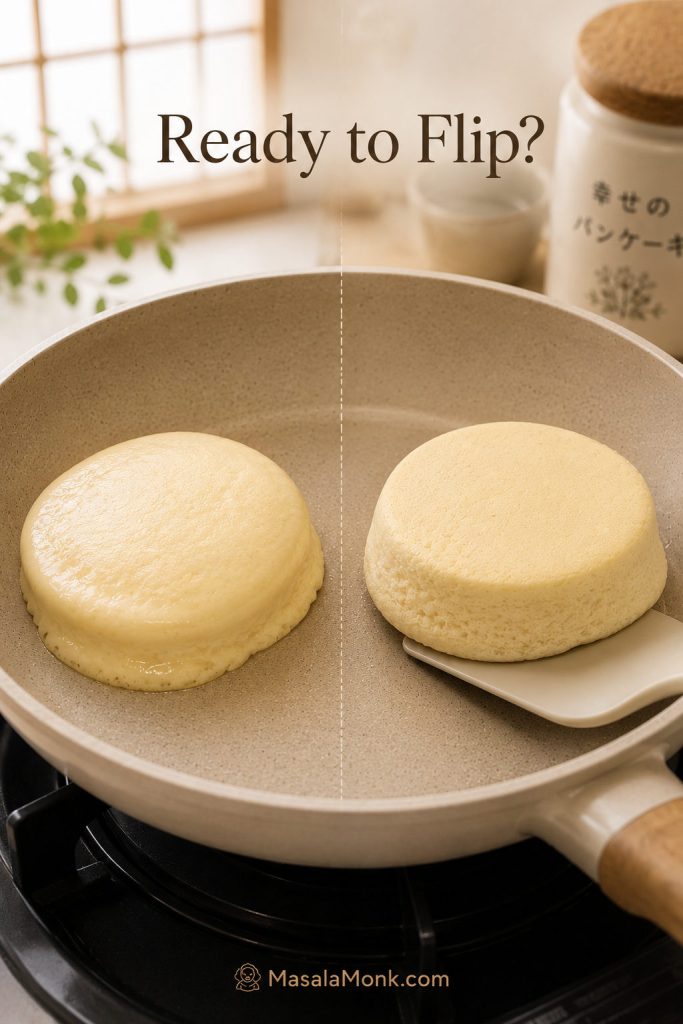
Two Japanese pancakes in a pan showing a glossy pancake that needs more time and a set pancake ready for a spatula.
Flip when the sides lose their wet gloss and the spatula slides underneath with support. If it drags, wait longer.

If you are nervous here, that is normal. The safer move is usually one more covered minute, not forcing the spatula under a pancake that is still wet at the sides. Use the flip-readiness cues before trying again.

After flipping, add another small splash of water, cover, and cook until the second side is set. Let the pancake keep the air you built into it; a gentle flip is enough.
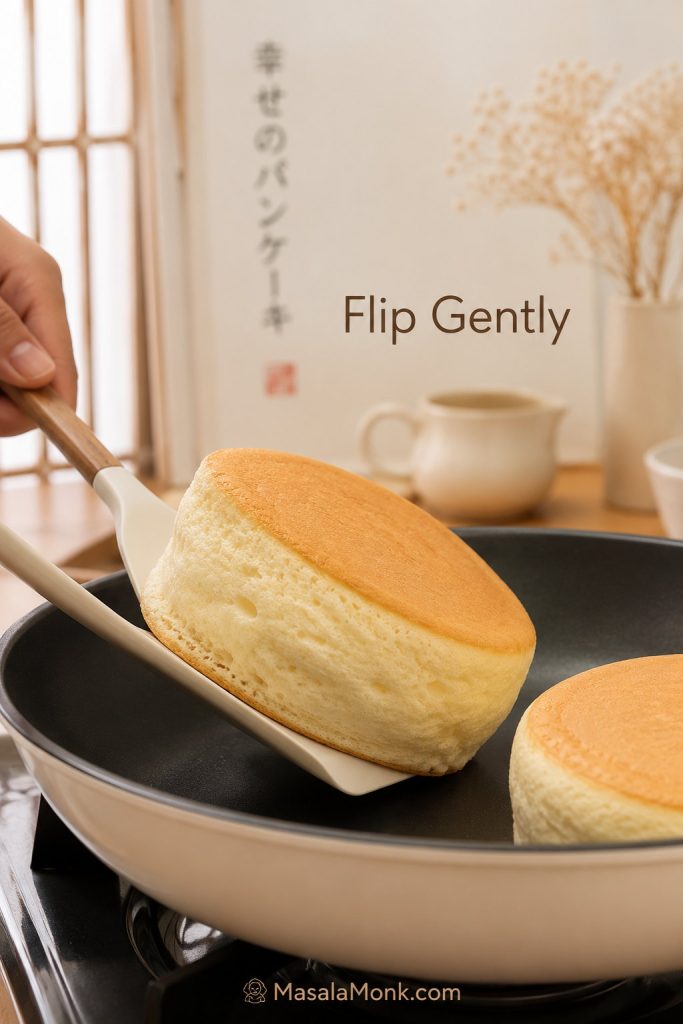
A tall Japanese soufflé pancake being lifted gently with a thin spatula in a pan.
Use a thin spatula and a calm hand. A rough flip can press out the air you worked so hard to keep.

9. Serve Immediately

These pancakes have a short golden window. Bring the plate to the table first, then bring the pancakes. A little settling is normal because the hot air inside cools, but they are at their softest and tallest right away.

The best bite is warm, soft, and custard-tender in the center without being wet. The pancake should give under the fork, then spring back just a little. That is the café-at-home moment you are cooking toward.

Low Heat and Steam: Time, Temperature, and Doneness

Most failed Japanese pancakes come down to heat. Tall batter needs time. When the pan is too hot, the outside browns before the inside cooks. When the pan is too cool and the lid is lifted too often, the center can stay gummy.

Best Pan Temperature for Japanese Pancakes

Think gentle surface heat, not a hot pancake rush. A pan near 300°F gives the foam time to set before the bottom goes too dark.
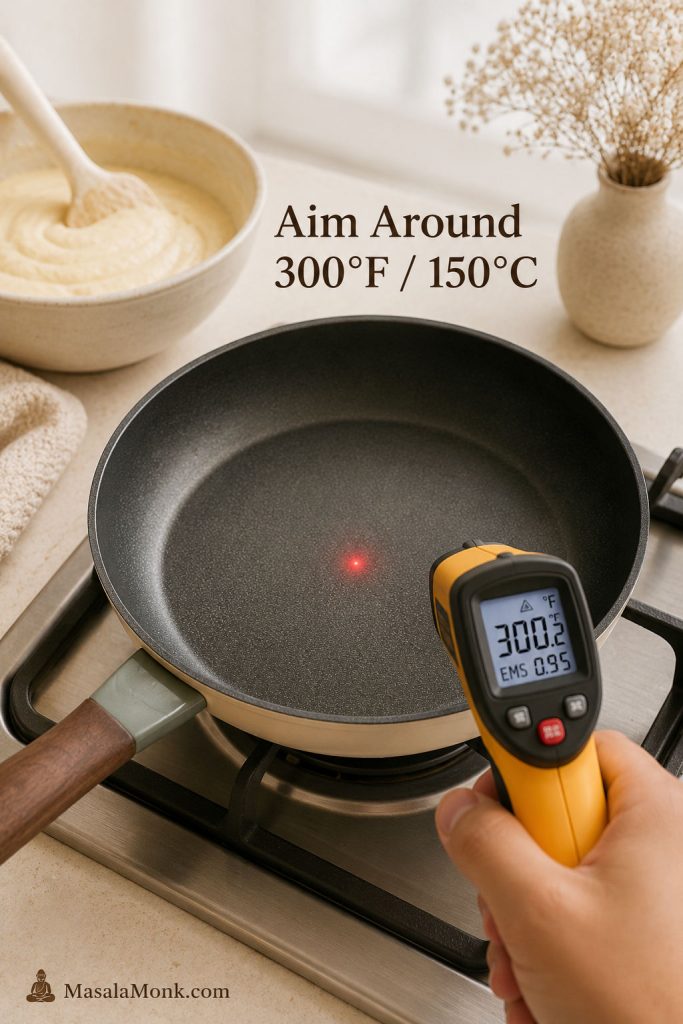
Infrared thermometer aimed at a nonstick pan to check the temperature for Japanese soufflé pancakes.
Keep the pan gentle, not blazing hot. Around 300°F gives the center time to cook before the outside browns too fast.

The bottom should not race ahead of the middle. A sweet, warm pancake smell is fine; a toasted smell before the sides look set is your cue to lower the heat. The batches that browned fastest were also the ones most likely to stay wet inside. If the outside is browning while the middle stays wet, go straight to the raw center fix.

Cooking cueBest target
Pan surface temperature285–320°F / 140–160°C
Ideal targetAbout 300°F / 150°C
First side6–8 minutes total, covered
Second side4–6 minutes, covered
Steam water2 teaspoons to 1 tablespoon at a time
Optional center temperatureAbout 160°F / 71°C
Best serving windowImmediately, ideally within 5–10 minutes

The water should go into the empty space in the pan, not on top of the batter. You only need enough to create a quiet puff of steam under the lid, not a puddle.

Where to Add Water for Steam

Place the water beside the batter so the steam can circulate around the pancakes. Pouring on top can thin or disturb the mounds you just built.
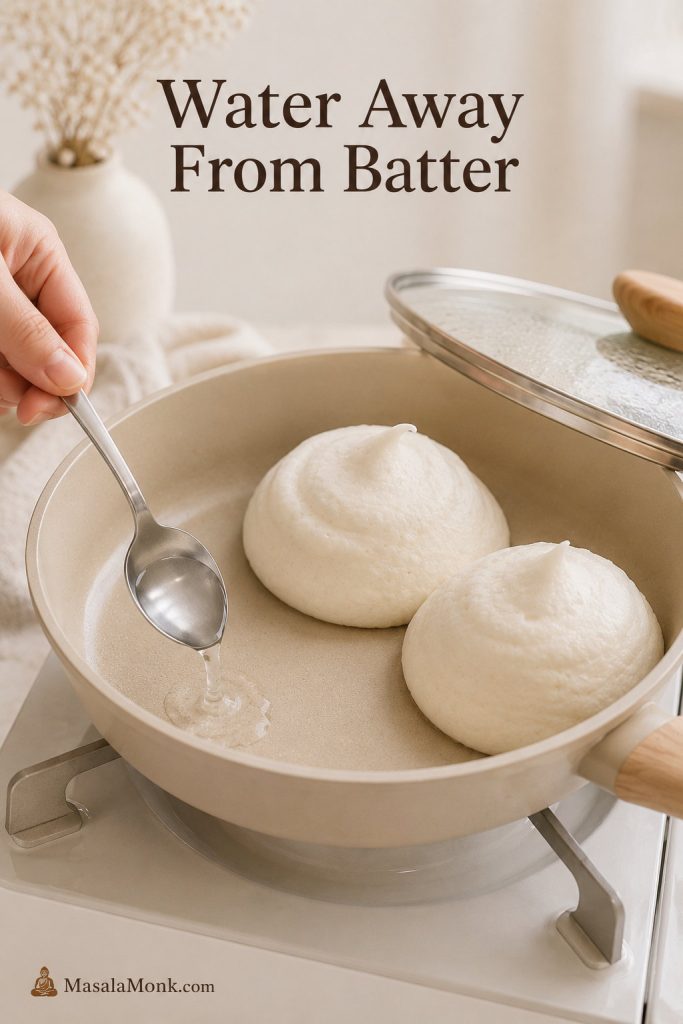
A spoon adding water to the empty space beside Japanese pancake batter in a pan.
Add water to the empty pan space, then cover. That way, steam surrounds the pancakes without thinning the batter.

Why Covered Steam Cooking Matters

Once covered, the pan becomes a small steam chamber. Keep the lid on long enough for the center to set instead of chasing color too early.
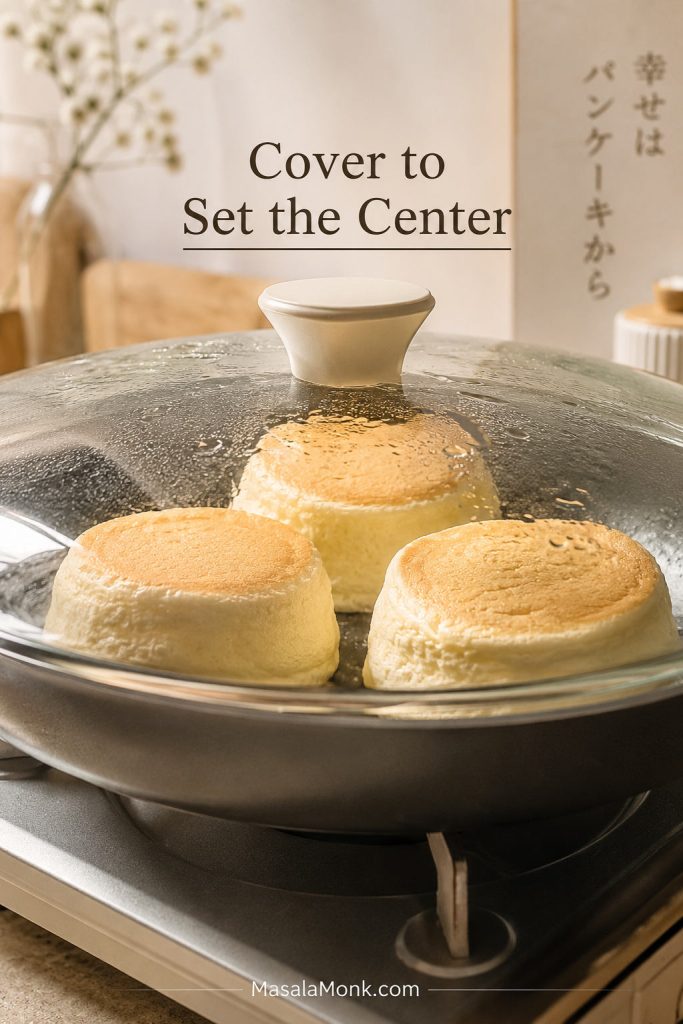
Japanese soufflé pancakes cooking under a clear glass lid with steam and condensation.
Once the lid goes on, let the steam work. Opening too often releases heat and slows the center from setting.

How to Tell If the Pan Is Too Hot or Too Cool

What you seeWhat it meansWhat to do
Bottom browns deeply in 2–3 minutesPan is too hotLower the heat and move the pan off the burner briefly
Edges look cooked but center feels liquidHeat is too high or pancake is too thickCover longer on low heat and make smaller mounds next time
Pancake barely colors after 8 minutesPan may be too coolIncrease heat very slightly, but keep it gentle
Pancake deflates when lid opensStructure is not set yetCover again and give it more time before flipping

Keep the lid on as much as possible. Every time you lift it, you release heat and steam, and the pancakes may take longer to set.

Optional safety cue: If using a thermometer, aim for about 160°F / 71°C in the center. The pancake should also feel softly bouncy, not liquid, when touched gently. For general egg-dish temperature guidance, see the USDA egg safety guide.

Can You Make Japanese Soufflé Pancakes With Pancake Mix?

Yes, you can make a shortcut version with pancake mix, but use it for fewer dry ingredients, not to skip the soufflé technique. The height still comes from whipped egg whites.

Think of pancake mix as a replacement for the flour, baking powder, and part of the dry base. It does not replace separated eggs, meringue, slow covered cooking, steam, or gentle folding.

Japanese hotcake mix or regular pancake mix can both work, but the result may be a little sweeter, cakier, or more mix-flavored than the main recipe. Keep the heat low because mixes with sugar can brown faster.

If you want a more everyday pancake-mix direction instead of the soufflé method, this guide to blueberry pancakes and homemade pancake mix is the better place to go.

Simple Pancake Mix Shortcut Formula

IngredientAmount
Large eggs2, separated
Pancake mix3 tablespoons / about 25–30g
Milk1½–2 tablespoons / 22–30ml, added gradually
Vanilla½ teaspoon
Sugar2 tablespoons / 24–25g
Cream of tartarPinch to ¼ teaspoon, or a few drops of lemon juice

Start with 1½ tablespoons milk. Add the remaining ½ tablespoon only if the yolk batter is too stiff to mix. Pancake mixes vary, and a looser shortcut batter is harder to stack tall.

Make the yolk batter with the yolks, milk, vanilla, and pancake mix. Beat the whites with the acid and sugar until the meringue is glossy and holds its shape, then fold and cook the same way as the main recipe.

Shortcut truth: Pancake mix can make the dry ingredients easier, but it will not save a weak meringue. If the egg whites are not whipped well, the pancakes will still spread or deflate.

What Success Looks Like

A good batch does not have to look identical to a café pancake. Look for these signs instead.

  • The batter rises upward more than it spreads outward.
  • The sides look set instead of glossy-wet.
  • The pancake releases from the pan without tearing.
  • The center feels softly bouncy, not liquid.
  • The inside is moist and airy, not raw.
  • The pancakes settle slightly after serving, but do not collapse into flat rounds.

Normal settling means the pancakes soften and lower slightly as they cool. A failure collapse means they flatten quickly, slump into the plate, or look wet in the middle.

Save the batch: If the first pancakes are shorter than expected but cooked through and soft, serve them proudly with toppings. A slightly shorter pancake with a set center is better than a dramatic tall pancake that is wet inside.

Troubleshooting Japanese Pancakes

Most pancake problems are not disasters. They are clues. Find the problem you actually saw, not the problem you are afraid of, and the next batch becomes much easier.

This style is technique-sensitive, but the fixes are usually simple: strengthen the meringue, fold less, lower the heat, cook longer covered, or make smaller mounds.
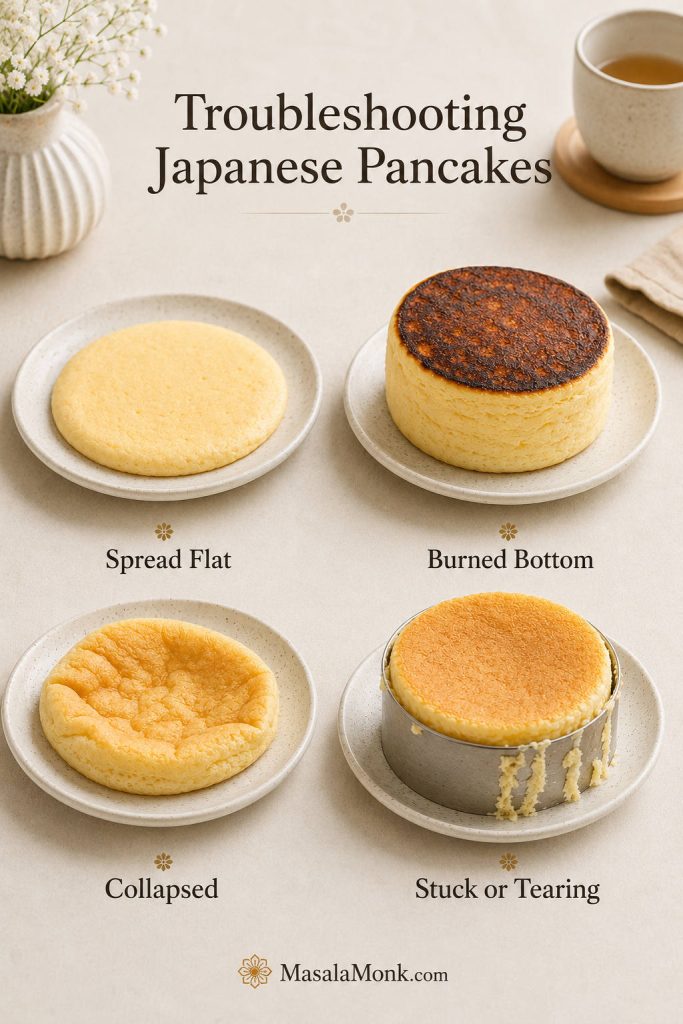
Troubleshooting board showing Japanese pancakes that spread flat, burned on the bottom, collapsed, and stuck to a ring mold.
Use the failure shape as a clue: spreading points to batter, burning points to heat, collapse points to structure, and sticking points to mold prep.

Rise, Spread, and Collapse Problems

ProblemLikely causeFix nowNext time
Pancakes never roseMeringue was too soft, batter was overfolded, or the pan was too hot too soonCook them through, stack with toppings, and serve as soft pancakesBeat to firm peaks that hold their shape and fold more gently
Pancakes rose in the pan but collapsed on the plateCenter was undercooked or structure was too weakServe quickly; texture may still be pleasantCook longer covered and make slightly smaller mounds
Batter spread flatMeringue was underwhipped, batter was too loose, or too much milk was addedUse a ring mold if you have oneBatter should hold a mound, not pour

Heat, Doneness, and Texture Problems

ProblemLikely causeFix nowNext time
Outside burnedPan was too hotLower heat immediately and move pan briefly off the burnerUse gentle heat and aim for 285–320°F / 140–160°C
Center stayed rawPancakes were too tall, flipped early, or cooked too hot outsideCover and cook longer on low heatMake smaller mounds and use steam
Pancakes wrinkled or shrank at the sidesSudden cooling, undercooked center, or weak structureServe quickly while still warmCook until the center is set and avoid opening the lid too often
Eggy flavorUnderseasoned batter or undercooked centerAdd toppings such as fruit, cream, or syrupUse vanilla, salt, and enough cook time

Flipping, Batch, and Mold Problems

ProblemLikely causeFix nowNext time
Pancake cracked while flippingIt was flipped before the base setSupport with a second spatula if neededWait until the sides look less glossy and the base releases cleanly
Second batch was flatterBatter sat too long and lost airCook immediately if possibleMake a small batch or use two pans
Pancakes stuck to moldMold was not greased well enoughLoosen gently with a thin knifeGrease the inside of the ring generously before filling

Why Did My Japanese Pancakes Deflate?

The most common reasons are weak meringue, overfolded batter, heat that was too high, or an undercooked center. Some settling is normal after cooking, but a full collapse usually means the pancake did not have enough structure to hold itself.

Why Are My Pancakes Raw Inside?

The pan was probably too hot or the pancakes were too large. High heat browns the outside before the center has time to set. Lower the heat, cover the pan, use a little steam, and make slightly smaller mounds next time.
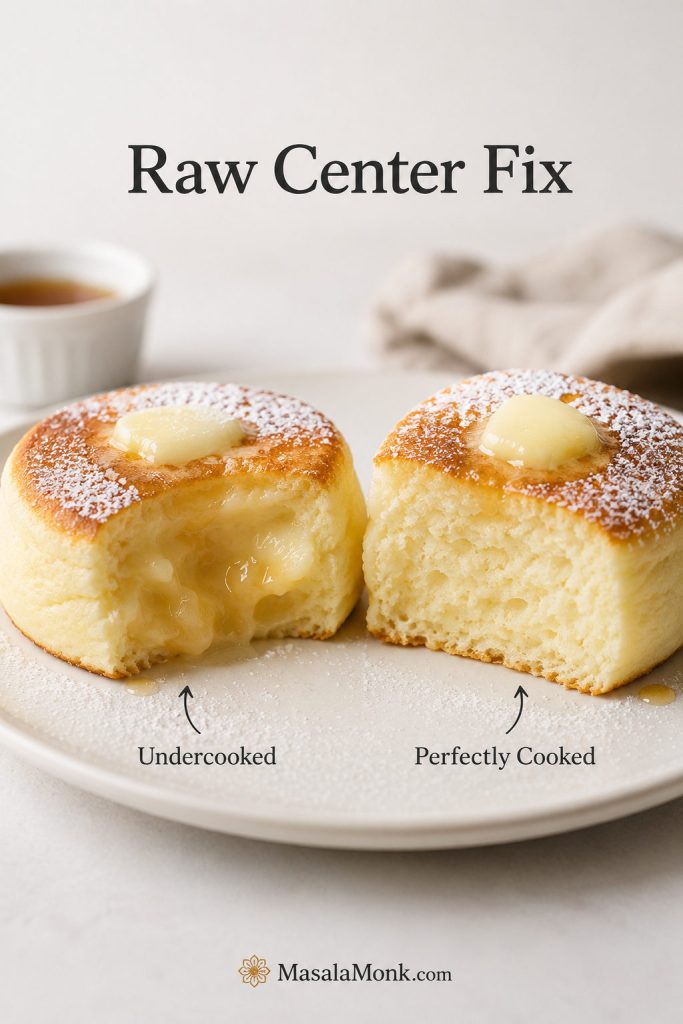
Cut Japanese pancakes showing an undercooked raw center beside a properly cooked airy center.
A raw center usually means the outside cooked too quickly. Lower the heat, cover longer, and let steam help next time.

Why Is My Batter Runny?

Runny batter usually means the meringue was underwhipped, overmixed into the yolk batter, or left sitting too long. The batter should look airy and thick enough to hold a mound.

Why Are They Not Jiggly?

They may be too thin, overcooked, or made with batter that lost too much air. The jiggle comes from height, moisture, and a set-but-soft center. Aim for thick mounds, gentle heat, and a center that feels bouncy rather than dry.

Why Was the Second Pancake Worse Than the First?

Soufflé pancake batter loses air as it sits. If the first pancake was tall and the later ones were flatter, the batter probably waited too long. For best results, cook all the batter at once in one large pan, use two pans, or make a smaller batch.

Best Toppings for Japanese Pancakes

Japanese soufflé pancakes are delicate, so the best toppings should make them feel café-special without crushing them. Think light cream, soft fruit, a little syrup, or a sauce served mostly to the side. The pancakes are the drama; the toppings should frame them.

Classic Café-Style Toppings

  • Powdered sugar
  • Softened butter
  • Maple syrup
  • Whipped cream
  • Fresh strawberries or mixed berries

For a warmer fruit topping, spoon over a little homemade apple pie filling; keep the portion light so it does not flatten the stack.

Japanese-Inspired Toppings

  • Matcha whipped cream
  • Sweet red bean paste
  • Black sesame cream
  • Kinako sugar
  • Yuzu honey

Dessert-Style Toppings

For the tallest look, finish with powdered sugar, berries, or a light cream first. Add heavier sauces at the table, after the pancakes have had their moment.

Can You Make Japanese Pancakes Ahead?

This is a cook-and-eat-now recipe, and that is part of its charm. The batter should not be made ahead because the meringue loses air as it sits. Cooked pancakes also deflate as they cool, which is normal for this style.

If you have leftovers, refrigerate them in an airtight container for up to 1 day. Reheat gently in a covered pan over low heat or microwave briefly at low power. They will still be soft, but they will not be as tall or jiggly as freshly cooked pancakes.

Japanese Soufflé Pancakes vs Japanese Soufflé Cake

Japanese soufflé pancakes and Japanese soufflé cake sound similar, but they are different recipes. The pancake version is cooked in a pan or on a griddle and served like breakfast pancakes. Japanese soufflé cake usually refers to Japanese cheesecake or cotton cheesecake, which is baked, sliced, and served as a dessert.

Both use meringue logic, so they share that soft, airy personality. However, the method, texture, and serving style are different. If you wanted the cake version, see this Japanese cheesecake recipe.

FAQs About Japanese Pancakes

Are Japanese pancakes and soufflé pancakes the same thing?

For this tall, café-style version, yes. Here, Japanese pancakes means Japanese soufflé pancakes: thick pancakes made with whipped egg whites and cooked slowly until soft, airy, and jiggly.

Do I need a ring mold?

No. A ring mold gives cleaner sides and more dramatic height, but the no-mold method still works if the batter is thick enough to mound. The shape will be softer, but the pancakes can still be fluffy and tender.

Why did my pancakes collapse after cooking?

A little settling is normal. A dramatic collapse usually means the meringue was too weak, the batter was overmixed, or the center needed more covered cooking time. The fix is usually stronger peaks, gentler folding, and a lower, slower pan.

How do I know when to flip them?

Flip when the bottom is lightly golden, the sides look less glossy, and the pancake releases cleanly from the pan. If the spatula drags through wet batter, cover the pan again and give it another minute.

Can I use pancake mix?

Yes, but pancake mix only replaces the dry base. You still need separated eggs, whipped egg whites, gentle folding, steam, and slow covered cooking for the soufflé height.

Can I make the batter ahead?

No. Once the meringue is folded in, the batter starts losing air. Make it, scoop it, and cook it right away for the best rise.

Can I double this recipe?

You can, but only if your pan or griddle can cook the batter right away. Soufflé pancake batter loses air as it waits, so a small fresh batch is usually better than a large bowl sitting on the counter.

Can I make them without cake flour?

Yes. Use 30g all-purpose flour, remove 1 teaspoon, and replace that teaspoon with cornstarch. The pancakes may be slightly less delicate than the cake-flour version, but the swap works well for this small batch.

Can I make them gluten-free?

A cup-for-cup gluten-free flour blend is the safest first experiment, but this batter is delicate, so results can vary. Almond flour is heavier and can make soufflé pancakes collapse more easily. For a more reliable gluten-free-style pancake, try almond flour pancakes instead.

Can I make these eggless or vegan?

Classic Japanese soufflé pancakes depend on egg-white meringue, so eggless or vegan versions need a separate tested formula. For an easier egg-free or vegan-friendly pancake direction, a recipe like oat pancakes is a better place to start.

Can I make keto Japanese soufflé pancakes?

Not cleanly with this exact recipe. Low-carb flours and sweeteners change the batter structure, and soufflé pancakes are already delicate. Use a dedicated keto pancake formula rather than adapting this one directly.

Why do they taste eggy?

Eggy flavor usually comes from undercooking, skipping vanilla or salt, or using a formula with a very high egg ratio. Cook the center through, keep the vanilla and salt, and serve with fruit, cream, or syrup.

What does fuwa fuwa mean?

Fuwa fuwa means soft, fluffy, and airy. For Japanese pancakes, it describes the cloudlike texture created by whipped egg whites and gentle cooking.

Once you understand the three checks — meringue that holds, batter that mounds, and heat that stays gentle — these pancakes stop feeling like a café trick. They become a small weekend project you can actually pull off, one covered minute at a time.

Serve Japanese Pancakes While They Are Tall and Warm

Bring the plate to the table first, then bring the pancakes. The reward is that first soft bite while the stack is still warm, lifted, and a little magical.
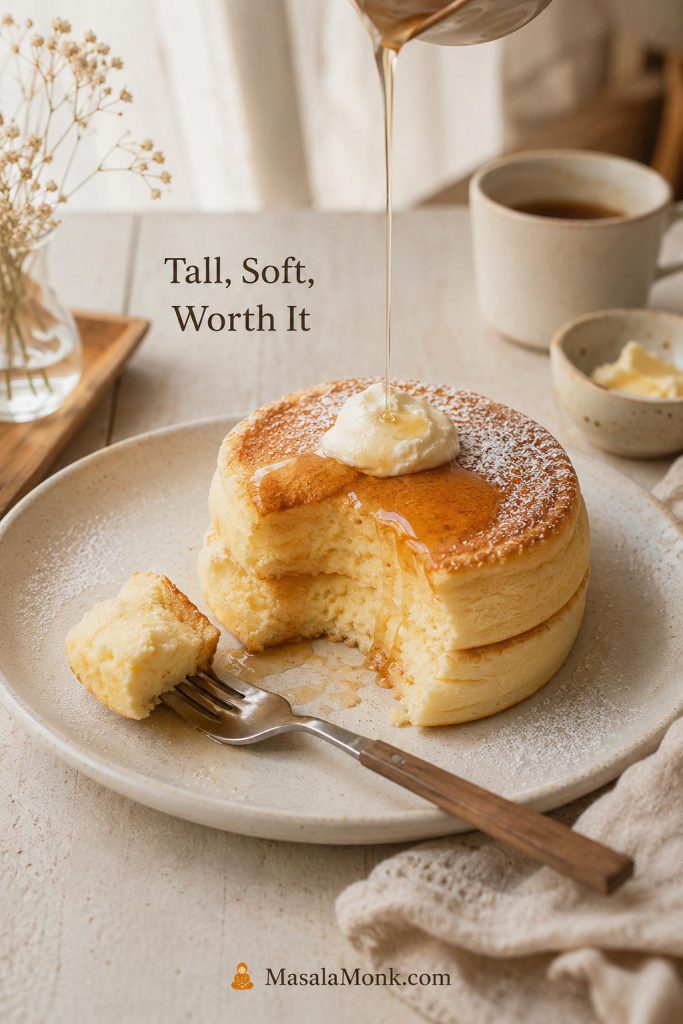
Tall Japanese soufflé pancakes with syrup, whipped cream, and a forkful showing the soft cooked interior.
Once the meringue, batter, and heat checks click, the final stack feels less like a café trick and more like a weekend win.

Japanese Pancakes Recipe Card

Japanese Pancakes Recipe: Fluffy Soufflé Pancakes

Tall, soft, jiggly Japanese soufflé pancakes made with whipped egg whites, a light yolk batter, gentle heat, and steam. Use the no-mold method for a simple home version or ring molds for straighter café-style sides.

Yield2–3 thick pancakes
Prep Time20 minutes
Cook Time12–15 minutes per batch
Total Time35–50 minutes

Ingredients

Yolk Batter
  • 2 large egg yolks, about 35–40g
  • 20ml whole milk, about 1 tablespoon + 1 teaspoon
  • ½ teaspoon vanilla extract
  • 30g cake flour, about ¼ cup spooned and leveled
  • 1 teaspoon cornstarch, about 3g
  • ¼ teaspoon baking powder
  • Pinch of fine salt
Meringue
  • 2 large egg whites, about 60–65g
  • 24–25g granulated sugar, about 2 tablespoons
  • ¼ teaspoon cream of tartar, or 1 teaspoon lemon juice, or ½ teaspoon white vinegar
For Cooking
  • Neutral oil or melted butter, for greasing
  • 1–2 tablespoons water, for steam, used in small splashes
  • Powdered sugar, whipped cream, berries, maple syrup, or toppings of choice

Instructions

Make the Batter
  1. Prepare the pan and tools. Set out the pan, lid, spatula, water, and serving plates before mixing.
  2. Separate the eggs. Place the yolks in one bowl and the whites in a clean, dry mixing bowl. Make sure no yolk gets into the whites.
  3. Make the yolk batter. Whisk the yolks, milk, vanilla, and salt. Sift in the cake flour, cornstarch, and baking powder. Whisk just until thick and smooth.
  4. Start the meringue. Beat the egg whites with cream of tartar until foamy. Add the sugar gradually.
  5. Beat to glossy stiff peaks. Continue beating until the meringue is shiny and holds strong peaks. Stop before it turns dry or clumpy.
  6. Fold the batter. Lighten the yolk batter with one-third of the meringue, then fold in the rest until the batter is thick, airy, and mostly even.
Cook and Serve
  1. Preheat gently. Heat a nonstick pan over low heat. If using a thermometer, aim for about 300°F / 150°C. Wipe with a thin film of oil.
  2. Scoop the pancakes. Add 2 or 3 tall mounds of batter, using about two-thirds first and reserving the rest. Add 2 teaspoons water away from the batter and cover.
  3. Build height. After 3–4 minutes, add the reserved batter on top. Cover again and cook until the sides look less glossy and the bottom releases cleanly.
  4. Flip carefully. Slide a thin spatula under each pancake and flip gently. Add another small splash of water, cover, and cook for 4–6 minutes more.
  5. Check doneness. The pancakes should be lightly golden, softly bouncy, and set in the center. If using a thermometer, aim for about 160°F / 71°C.
  6. Serve immediately. Dust with powdered sugar and add toppings. Some settling is normal as the pancakes cool.

Recipe Notes

  • Best cue: The batter should hold a soft mound, and the cooked pancakes should feel gently bouncy in the center.
  • If the batter spreads: The meringue was likely too soft, the batter was overfolded, or too much liquid was added.
  • If the center is raw: Lower the heat, cover longer, and make smaller mounds next time.
  • No-mold layering: Use about two-thirds of the batter for the first mounds and reserve the rest for topping.
  • For ring molds: Grease well and fill only halfway to two-thirds full.
  • For taller pancakes: Use 3 egg whites and 2 yolks, keeping the other ingredients the same, but fold carefully.
  • Pancake mix shortcut: Use the shortcut formula in the guide above; the mix replaces the dry base, not the whipped egg whites.
  • Storage: Best fresh. Leftovers can be refrigerated for 1 day, but they will lose height and jiggle.
Back to top

Posted on 9 Comments

Almond Flour Pancakes (Easy Recipes) Fluffy, High-Protein, Keto & More

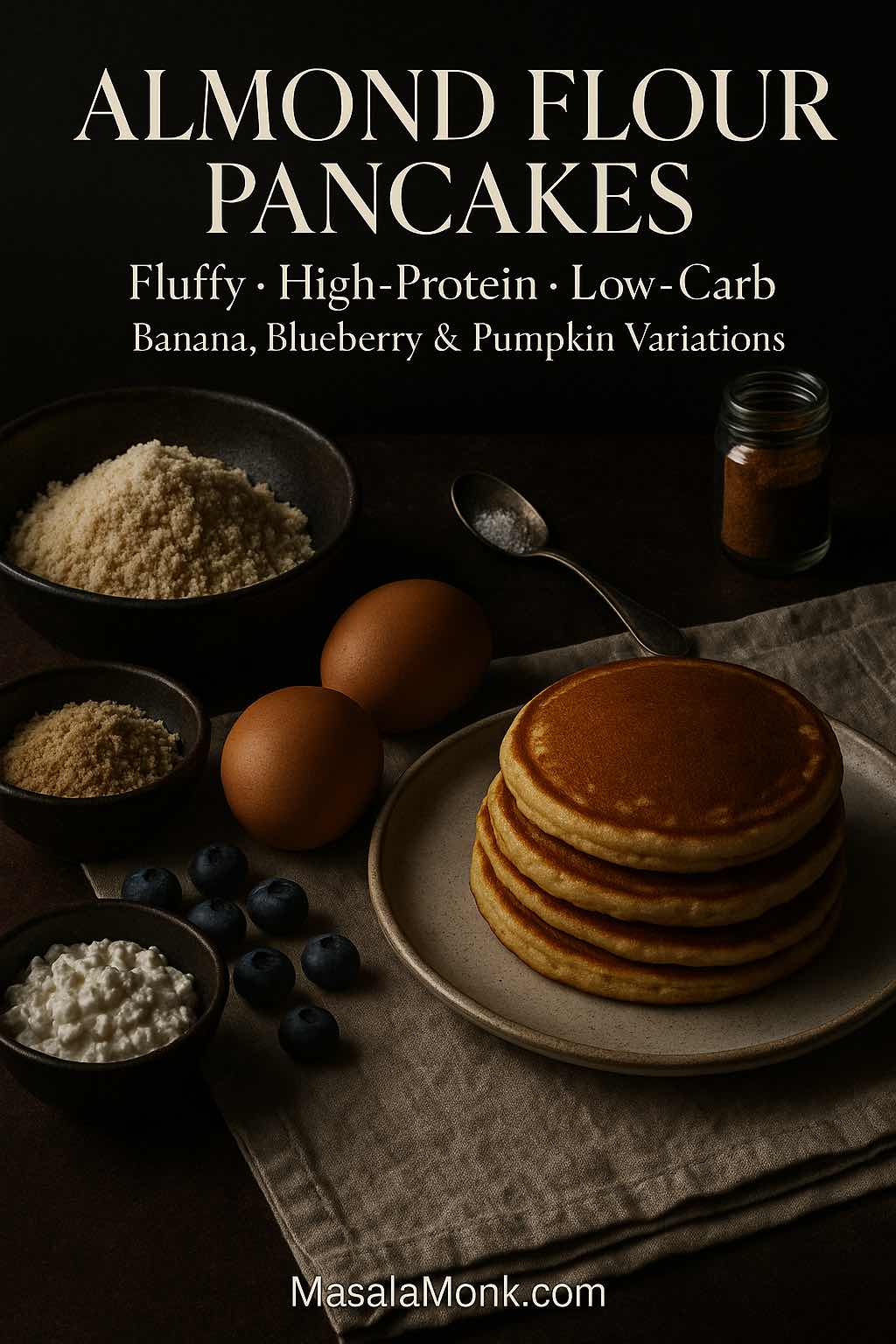
Dark, Vogue-style portrait cover featuring a stack of almond flour pancakes with almond flour, eggs, blueberries, cottage cheese, and spices, with elegant headline text and MasalaMonk.com in the footer.

There’s a reason pancakes are so deeply comforting. They’re warm, they’re familiar, and they’re endlessly customizable. Yet when you swap regular flour for almond flour (or almond meal) to make pancakes, the first attempt can feel like the rules changed overnight. The batter looks thicker. The surface browns faster. The flip feels delicate. And instead of an easy breakfast, you’re suddenly negotiating with your pan.



Even so, almond-based pancakes are incredibly forgiving once you learn their rhythm. They’re naturally gluten-free, they’re filling in a way that many traditional stacks aren’t, and they can suit everything from low-carb mornings to protein-heavy meal prep. Best of all, they can taste like a real treat instead of “diet food,” as long as you cook them with gentle heat and a little patience.

This guide is designed to make that process feel simple. You’ll start with a dependable base recipe, then branch into variations that still feel natural in a home kitchen: almond meal pancakes, fluffy almond flour pancakes, 3 ingredient almond flour pancakes, 2 ingredient almond flour pancakes, protein almond flour pancakes, almond flour cottage cheese pancakes, vegan almond flour pancakes, low carb pancakes with almond flour, and seasonal versions like almond flour and banana pancakes, almond flour blueberry pancakes, and almond flour pumpkin pancakes. You’ll also get a practical section for almond flour pancake mix and pancake-and-waffle mix style batters—because sometimes convenience is the whole point.

Now, let’s get into the batter.

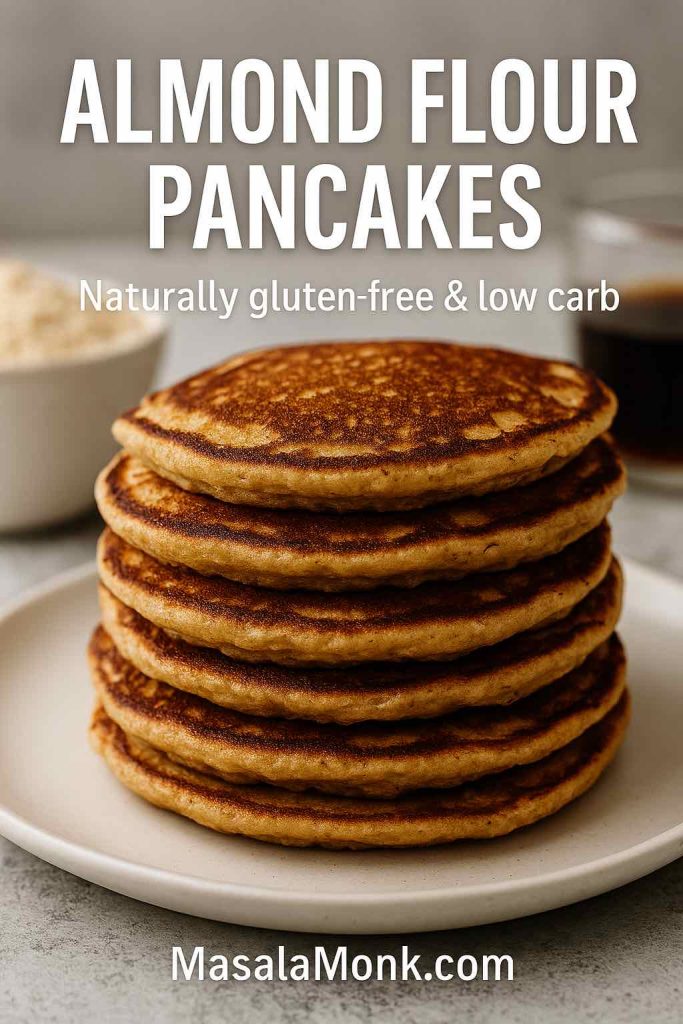
Stack of almond flour pancakes on a plate with text overlay highlighting gluten-free and low-carb breakfast.
Quick cue for success: almond-flour pancakes like gentle heat and smaller rounds—aim for a matte top before flipping for clean, tender centers.

Almond Flour vs Almond Meal for Pancakes

Almond flour and almond meal both come from ground almonds, but they aren’t identical. That difference matters most in texture and hydration.

Almond flour is usually finely ground, often from blanched almonds. As a result, pancakes made with almond flour tend to be smoother, lighter on the tongue, and more “cake-like” in the center.

Almond meal is often coarser and may include the skins. That coarser texture can create a heartier pancake—more rustic, more “flapjack,” with a slightly deeper nutty taste. Almond meal pancakes are still tender, but they can feel sturdier and more substantial. If you’ve ever heard people call them almond flour flapjacks, this is usually what they mean: a thicker, cozier pancake made with nut flour that eats more like a tender breakfast cake than a diner-style wheat pancake.

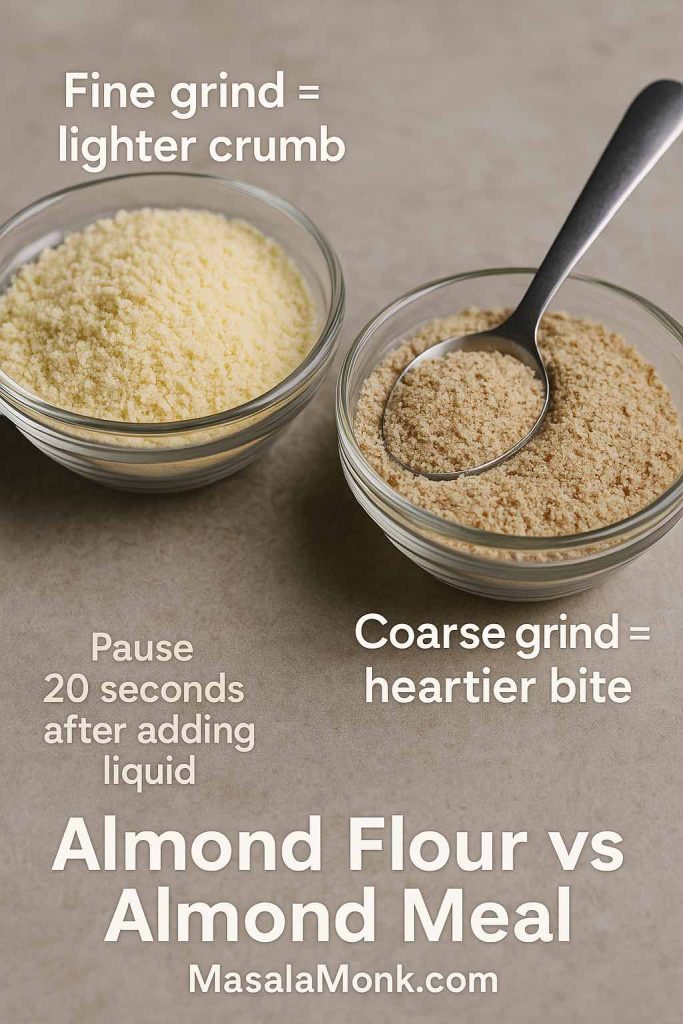
Almond flour vs almond meal in bowls showing fine vs coarse texture for making pancakes, with tips for batter hydration.
If your batter suddenly thickens, it’s not “wrong”—nut flours keep absorbing liquid. Add milk 1 tbsp at a time, stir, then wait 20 seconds before deciding again.

Here’s the practical part: almond meal often absorbs liquid differently. So if you’re making pancakes made with almond meal and the batter thickens quickly, don’t fight it. Add liquid in small amounts. Stir. Pause for 20–30 seconds. Then decide if it needs more. That tiny pause is surprisingly powerful because nut flours keep hydrating even after you’ve mixed them.

In other words, treat the batter like it has a heartbeat. Give it a moment. Then adjust.

Also Read: Almond Flour and Diabetes: A Low-Carb, High-Impact Swap for Better Blood Sugar


A Dependable Almond Flour Pancakes Recipe

This is your everyday base: easy almond flour pancakes that work plain, but also welcome banana, blueberries, pumpkin, cottage cheese, protein powder, or savory add-ins. Think of it as your go-to pancake made with almond flour (what some people simply call almond pancakes): dependable on its own, but flexible enough for mix-ins.

It’s also built on a logic you’ll see in reliable tested recipes, like King Arthur Baking’s almond flour pancakes: almond flour + eggs for structure + milk for moisture + baking powder for lift.

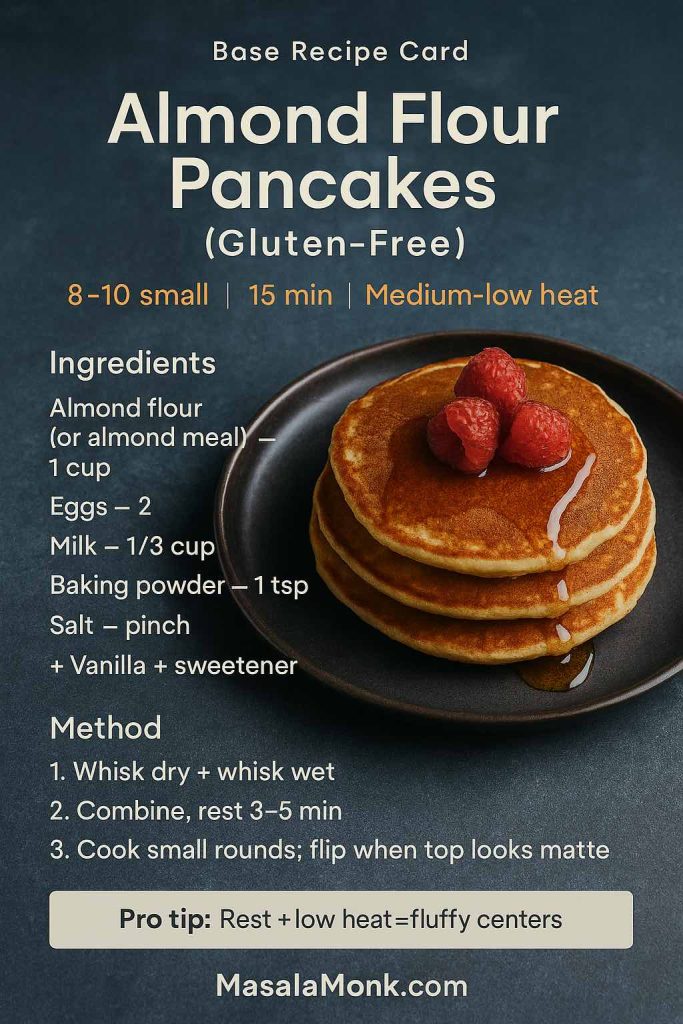
Ingredients (makes about 8–10 small pancakes)

  • 1 cup almond flour (or almond meal)
  • 2 large eggs
  • 1/3 cup milk of choice (dairy or non-dairy)
  • 1 teaspoon baking powder
  • Pinch of salt
    Optional: 1 tablespoon sweetener, 1/2 teaspoon vanilla
Recipe card for almond flour pancakes (gluten-free) showing ingredients, quick method, and a tip for fluffy centers.
Save this card for repeat mornings: keep pancakes small, rest the batter briefly, and flip only when the surface turns matte—this is the easiest way to avoid undercooked centers.

Method

  1. In a bowl, whisk almond flour, baking powder, and salt until evenly combined.
  2. In a second bowl, whisk eggs and milk until smooth. Add vanilla or sweetener if using.
  3. Pour wet into dry and stir until the batter is cohesive. It should be thick but still spoonable.
  4. Let the batter rest for 3–5 minutes while you warm your pan.
  5. Cook on medium-low heat in a lightly greased skillet. Make small rounds (3–4 inches wide). Flip only once the edges look set and the top looks more matte than glossy.

That brief rest is not a fussy extra step—it’s what keeps the batter consistent from the first pancake to the last. Resting batter is a classic pancake habit even outside nut-flour cooking, and it’s baked into traditional approaches like King Arthur’s classic pancake method.

Also Read: Mayo Recipe: 15+ Homemade Mayonnaise Variations


Almond Flour Pancake Batter That Behaves

Nut-flour batters don’t look like wheat batters. They’re thicker, less elastic, and they set differently. Once you accept that, the rest becomes easier.

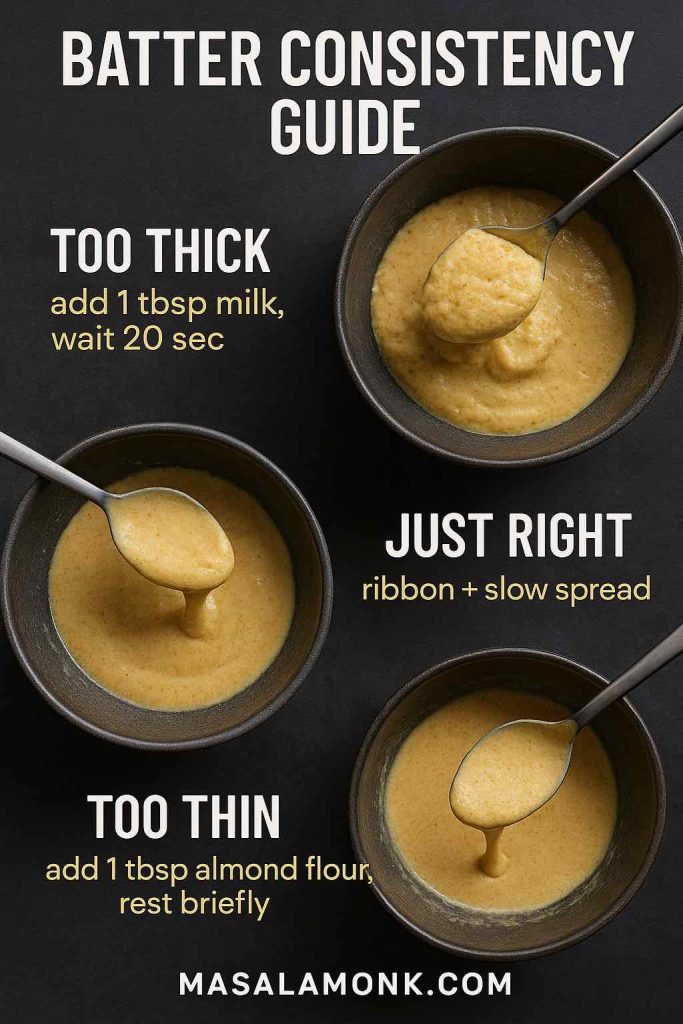
What “right consistency” looks like

  • The batter falls from a spoon in a ribbon and spreads slowly.
  • It looks glossy and cohesive, not dry and clumpy.
  • It doesn’t run like crepe batter.
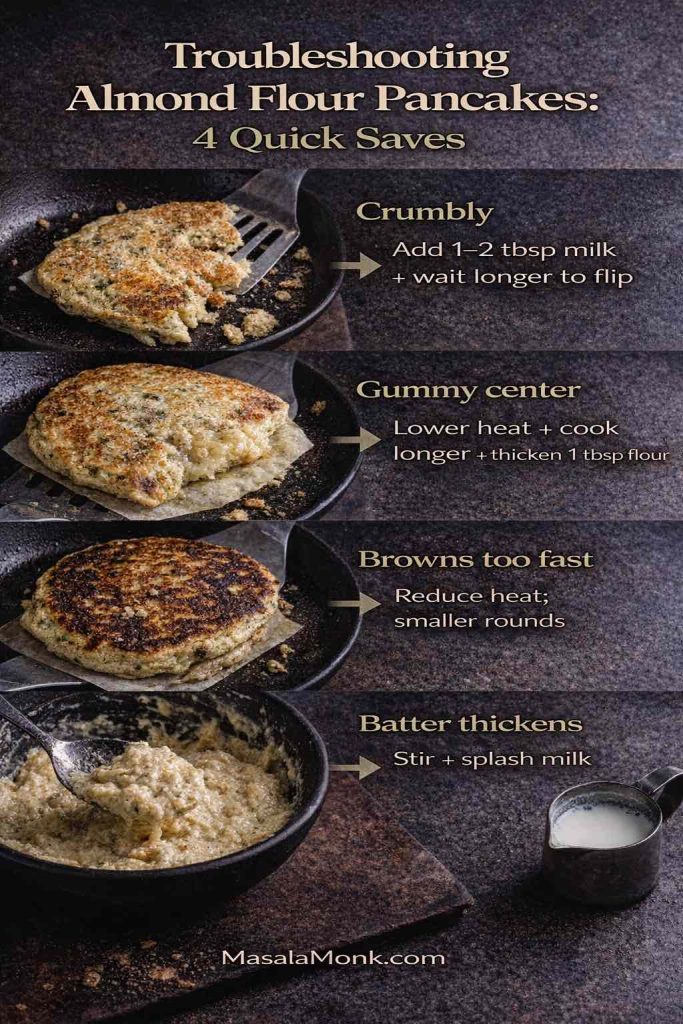
Visual guide showing almond flour pancake batter consistency: too thick, just right, and too thin, with quick fixes for each.
Use this as a mid-batch rescue chart: adjust in tablespoon steps and give the batter a short pause—almond flour keeps hydrating even after you stop stirring.

The three most common batter problems

Too thick: It won’t spread; it sits like a mound.
Fix it by adding 1 tablespoon milk, stirring, then waiting 20–30 seconds before deciding whether to add more.

Too thin: It spreads into very wide, fragile pancakes.
Fix it by adding 1 tablespoon almond flour (or almond meal), stirring, and resting briefly.

Thickens mid-batch: This is normal.
Fix it by stirring and loosening with small splashes of milk if needed.

That last point matters more than you’d expect. Almond flour pancake batter often changes slightly as it sits. Instead of trying to “perfect” it in one go, treat it like a living mixture and make micro-adjustments.

Also Read: Pepper Sauce Recipe Guide: Classic Vinegar Heat to Chipotle, Ají & Peppercorn


Fluffy Almond Flour Pancakes

If your goal is fluffy almond flour pancakes—soft, tender, and slightly lifted—there are a few levers that do most of the work. Fortunately, none of them require culinary gymnastics.

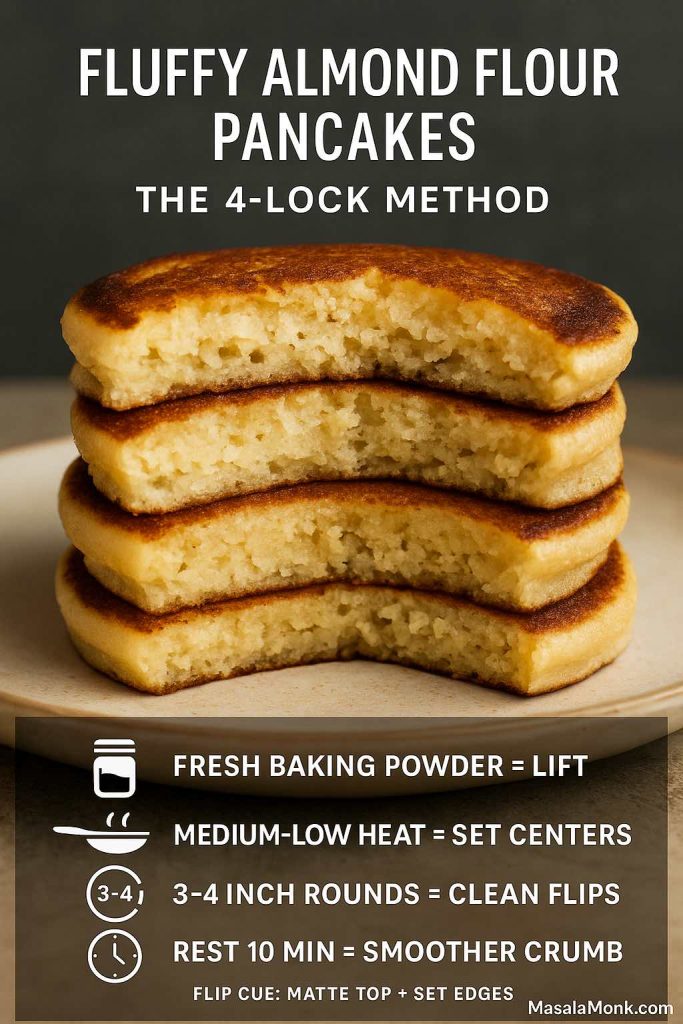
1) Fresh leavening

Baking powder is the lift here. If it’s old, the pancakes can turn out flat even if everything else is right. A quick way to check freshness is the method described in King Arthur’s baking powder test.

2) Gentle heat

Almond flour browns quickly. Medium-low heat gives the pancake time to set inside without over-darkening outside. You’ll get a more even crumb and a cleaner flip.

Fluffy almond flour pancakes with a cut-open crumb photo and a quick guide for lift, heat, pancake size, and resting batter.
Want height without fuss? Keep rounds small, cook on medium-low, and wait for a matte top—most “flat” almond pancakes are just heat + timing.

3) Smaller pancakes

It’s tempting to pour big rounds, especially when you want a “proper stack.” Nevertheless, smaller pancakes cook more evenly and rise more consistently. Once you’ve nailed the method, you can go bigger. Until then, keep it tidy.

A quiet upgrade: rest the batter a little longer

A short rest already helps. A slightly longer rest—say 10 minutes—can make the texture even more uniform. Resting batter is a widely recommended way to improve pancake texture in general, not just for nut flours.

For a classic pancake inspiration that leans cozy and traditional, MasalaMonk’s fluffy buttermilk pancakes with stewed cinnamon apples is a delicious reference point for texture and topping ideas.


Simple Almond Flour Pancakes for Everyday Mornings

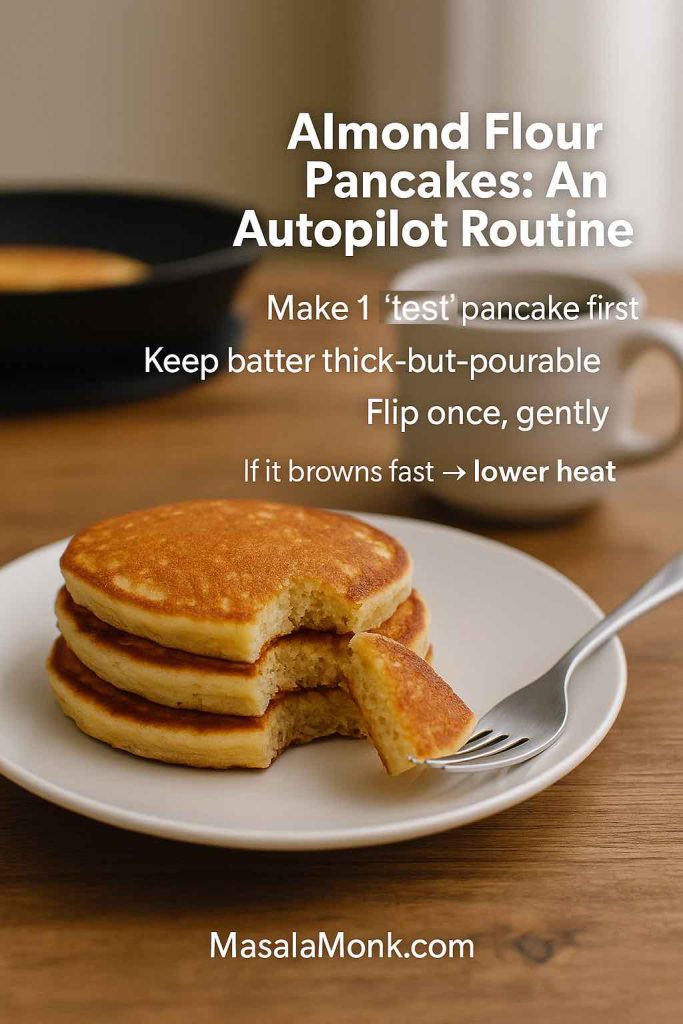
Sometimes you want a no-drama breakfast—something you can make on autopilot. Simple almond flour pancakes are exactly that once you settle into a routine.

First, treat the first pancake as your “test pancake.” If it browns too quickly, lower the heat. If it takes too long to set, nudge the heat slightly higher. Then keep the rest consistent.

Simple almond flour pancakes on a plate with a quick routine checklist for a test pancake, thick-but-pourable batter, and flipping once gently.
Your “test pancake” is the thermostat: if it browns too fast, lower heat; if it takes forever to set, nudge heat up—then don’t touch the dial again.

Second, keep the batter slightly thicker than you think. Thin batter tends to spread, and spreading creates pancakes that are harder to flip and easier to tear. Thick-but-pourable is your friend.

Third, flip gently and only once. Pancakes made with almond flour don’t love being pressed, smashed, or flipped repeatedly. If you let them set properly, they hold together beautifully.

Also Read: Whole Chicken in Crock Pot Recipe (Slow Cooker “Roast” Chicken with Veggies)


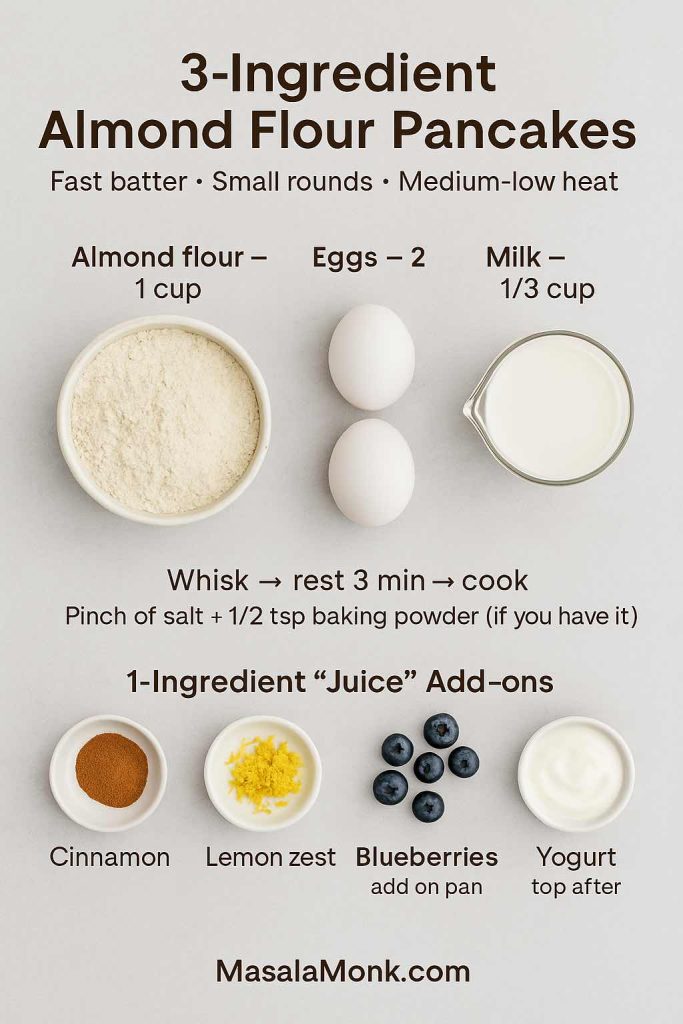
3 Ingredient Almond Flour Pancakes

There are mornings when you want breakfast in the fewest possible steps. Three-ingredient versions are perfect for that.

Ingredients

  • 1 cup almond flour
  • 2 eggs
  • 1/3 cup milk
Recipe card showing 3-ingredient almond flour pancakes with almond flour, eggs, milk, a quick method, and simple add-on ideas.
Shortcut math: the add-ons aren’t new recipes—just one small change. Cinnamon for cozy, lemon zest for brightness, blueberries for bursts, yogurt for contrast.

Method

Whisk everything until smooth, rest 3 minutes, then cook small pancakes on medium-low. If you have salt, add a pinch. If you have baking powder, add 1/2 teaspoon for a little lift. Still, even without extras, these can be satisfying when cooked gently.

To add “juice” without adding complexity, you can fold in one of these single-ingredient upgrades:

  • cinnamon for warmth
  • lemon zest for brightness
  • a handful of blueberries placed on the pan after pouring
  • a spoonful of yogurt on top after cooking

Each one changes the experience without changing the method.

Also Read: Cheesy Chicken Broccoli Rice – 4 Ways Recipe (One Pot, Casserole, Crockpot & Instant Pot)


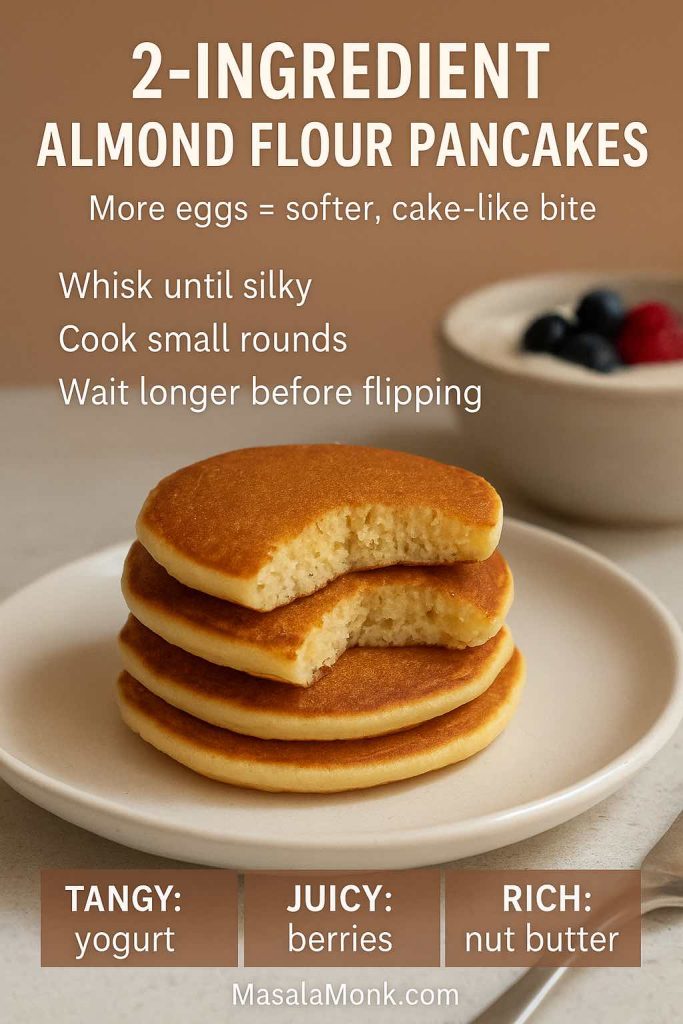
2 Ingredient Almond Flour Pancakes

Two-ingredient versions are as minimal as it gets. They’re also more egg-forward, and the texture leans closer to soft breakfast cakes than classic diner pancakes.

Ingredients

  • 1 cup almond flour
  • 3 eggs
2-ingredient almond flour pancakes with a cake-like crumb and tips to whisk thoroughly, cook small rounds, and flip later, plus topping contrast ideas.
Two-ingredient batter is naturally egg-forward—treat it like a mini breakfast cake: cook smaller, wait longer on side one, then balance with something tangy (yogurt) or juicy (berries).

How to make them feel more pancake-like

  • Whisk very thoroughly so the batter becomes uniform.
  • Cook smaller rounds so they set through.
  • Wait longer before flipping; the first side needs time.

These are excellent with toppings that bring contrast. For instance, something creamy and tangy (yogurt), something juicy (berries), or something nutty and rich (nut butter) can make the whole plate feel balanced rather than heavy.

Also Read: Sheet Pan Chicken Fajitas Recipe (Easy One-Pan Oven Fajitas)


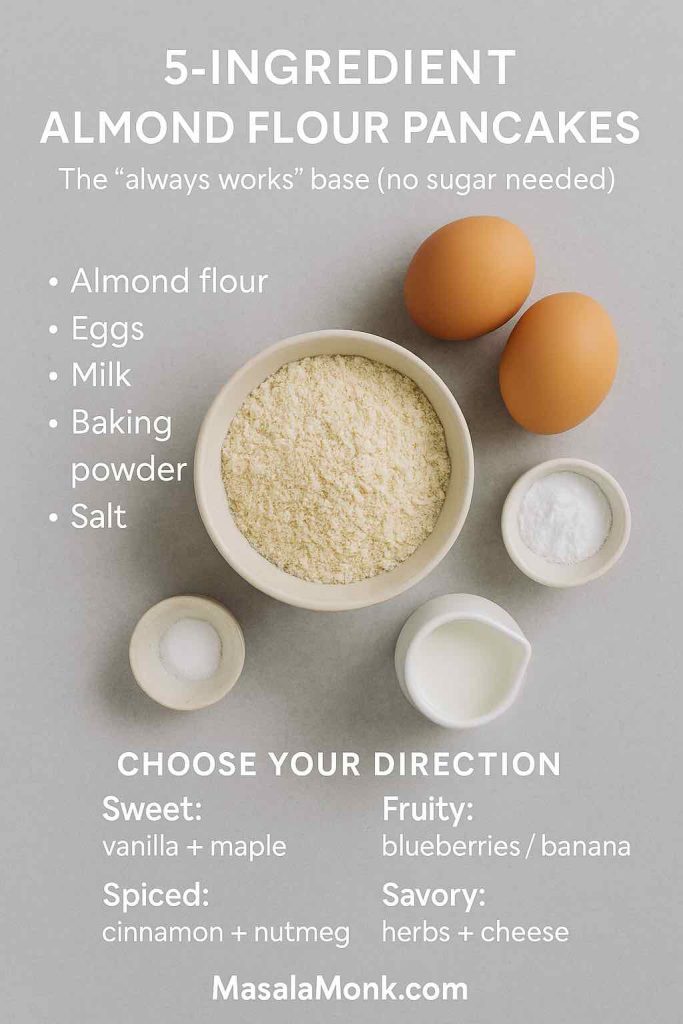
5 Ingredient Almond Flour Pancakes

If you want the minimal version that still feels consistently “right,” five ingredients is often the sweet spot.

  • almond flour
  • eggs
  • milk
  • baking powder
  • salt
Flat-lay guide showing the five ingredients for almond flour pancakes and a “choose your direction” chart for sweet, fruity, spiced, or savory variations.
Think of this as your neutral batter “template”: keep the five ingredients constant, then change the mood with one direction—sweet, fruity, spiced, or savory.

This is basically the base recipe without vanilla or sweetener. It’s also ideal for customization. Because the flavor is neutral, you can push it sweet, fruity, spiced, or savory without fighting the batter.

Also Read: Authentic Louisiana Red Beans and Rice Recipe (Best Ever)


Protein Almond Flour Pancakes

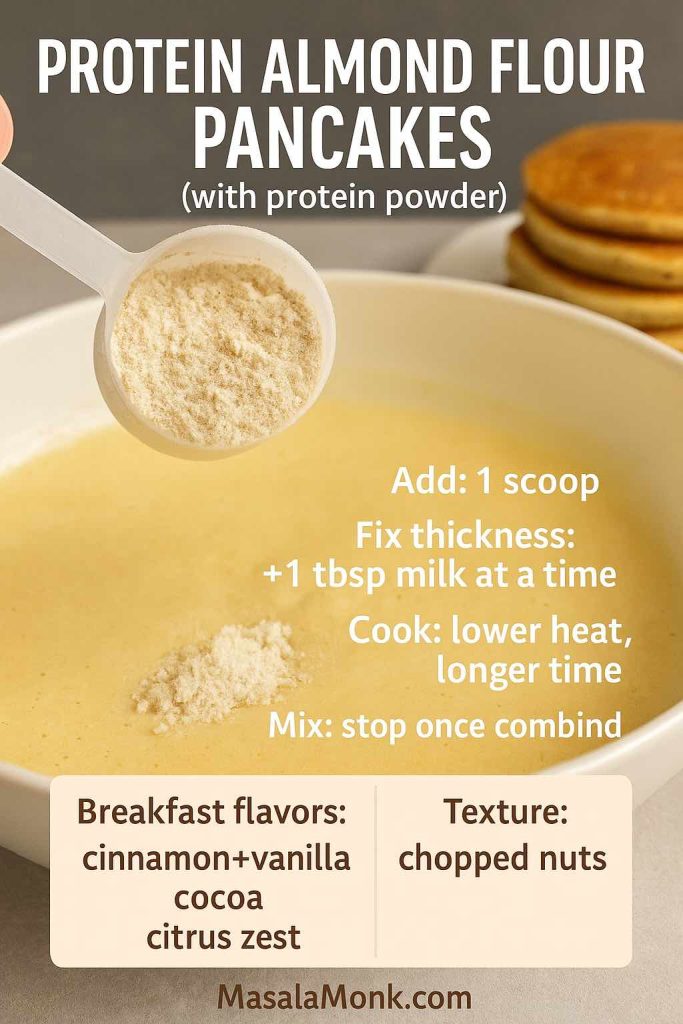
If you want breakfast that keeps you full, protein almond flour pancakes are an obvious move. The trick is to add protein without drying the batter or turning it rubbery. Moisture and gentle heat solve most issues.

Protein almond flour pancakes with protein powder

Start with the base batter. Add one scoop of protein powder. Then loosen with milk a tablespoon at a time until it returns to thick-but-pourable.

Protein almond flour pancake batter with protein powder being added, showing tips to adjust thickness with milk, cook on lower heat, and avoid overmixing.
Protein powder is thirsty: add it, then “dial back” thickness with milk in tablespoon steps—over-thinning is what makes pancakes spread and tear.

Because protein powder thickens batter quickly and can brown faster, keep the heat lower and cook longer. Also, resist the urge to keep stirring after you’ve mixed it. Overmixing can make protein batters feel tougher.

To make the flavor feel like breakfast rather than a shake in pancake form, add one of these:

  • cinnamon + vanilla
  • cocoa + a touch of sweetener
  • citrus zest for a bright finish
  • chopped nuts for texture

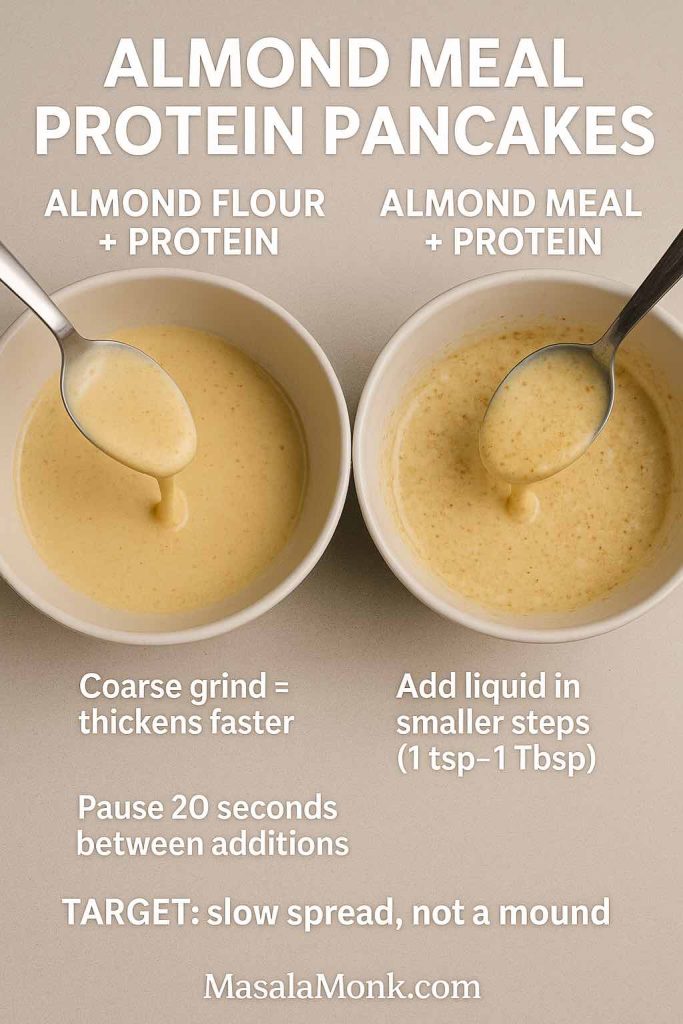
Almond meal protein pancakes

If you’re using almond meal rather than almond flour, the same concept applies, but the batter may thicken faster because of the coarser grind. In that case, add liquid in smaller steps and give it a short pause between additions. You’re aiming for a batter that spreads slowly rather than sitting in a mound.

Side-by-side comparison of almond flour vs almond meal protein pancake batter showing how almond meal thickens faster and needs smaller liquid additions.
Almond meal + protein is a “thickener combo.” Treat liquid like seasoning—add a little, pause, then repeat until the batter spreads slowly instead of sitting like a scoop.

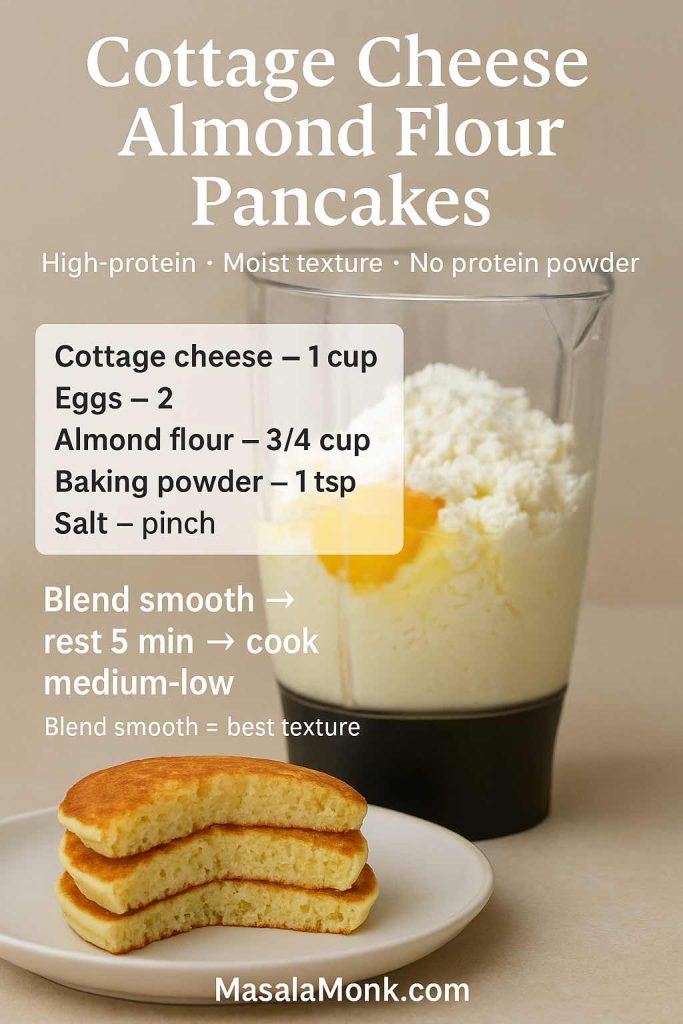
Almond flour cottage cheese pancakes

This is the high-protein option that stays moist and tender without needing protein powder.

Blend until smooth:

  • 1 cup cottage cheese
  • 2 eggs
  • 3/4 cup almond flour
  • 1 teaspoon baking powder
  • pinch of salt
Recipe card for cottage cheese almond flour pancakes showing blended ingredients, rest time, medium-low cooking tip, and moist high-protein results.
For the smoothest, most tender bite: blend until completely silky, then let the batter rest 5 minutes so it thickens evenly before hitting the pan.

Let it rest for 5 minutes, then cook on medium-low. The texture tends to be soft, moist, and satisfying—especially when served warm.

For more protein-focused breakfast variety that’s still pancake-adjacent, MasalaMonk’s millet protein pancakes and protein-rich cherry pancakes are great rotation options.

Also Read: Baked Jalapeño Poppers (Oven) — Time, Temp & Bacon Tips


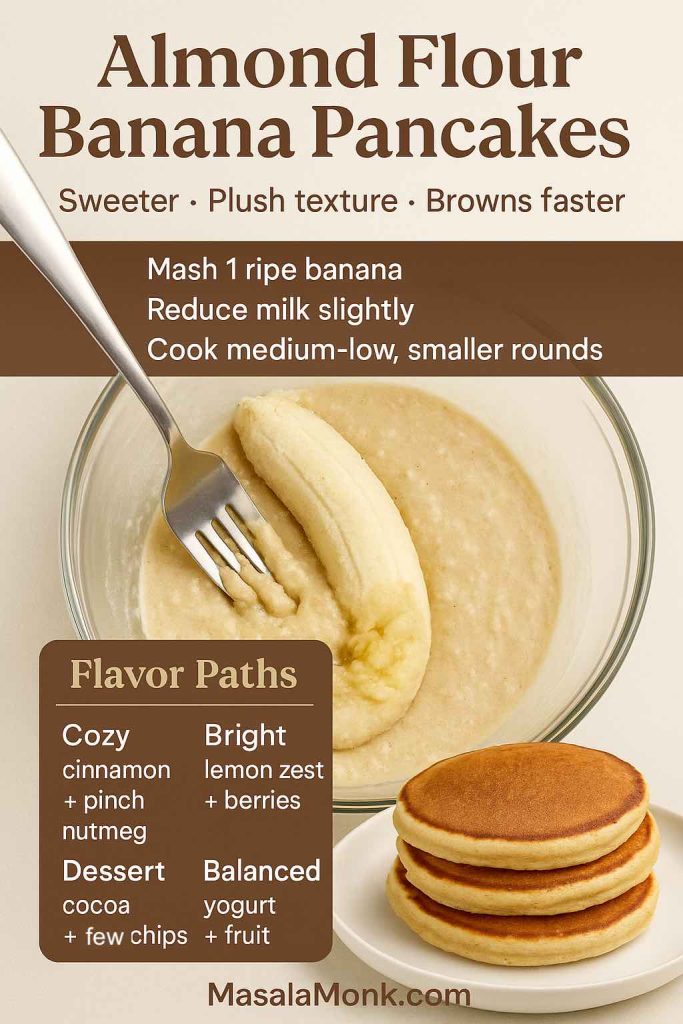
Almond Flour and Banana Pancakes

Banana adds sweetness and tenderness, which can make almond-based batter feel plush. It’s also one of the easiest ways to make breakfast feel like a treat without doing much extra work.

Almond flour banana pancake guide showing mashed banana in batter, tips to reduce milk and cook smaller rounds, plus cozy, bright, dessert, and balanced flavor options.
Banana makes pancakes brown faster—keep heat medium-low and think “mini pancakes” for the cleanest flips. Then pick one flavor path to change the vibe without changing the method.

Method

Mash 1 ripe banana into the base batter and reduce milk slightly (banana adds moisture). Cook on medium-low and keep pancakes smaller; banana encourages faster browning.

To add more “juice” while keeping it simple, you can choose a direction:

Cozy direction: cinnamon + a tiny pinch of nutmeg
Bright direction: lemon zest + berries
Dessert direction: cocoa + a few chocolate chips
Balanced direction: top with yogurt and fruit

Each direction uses the same batter, so you’re not learning a new recipe—just playing with the flavor.

Also Read: Carbonara Recipe: Italian Pasta (Creamy, Veggie, Chicken, Shrimp, Tuna & Keto)


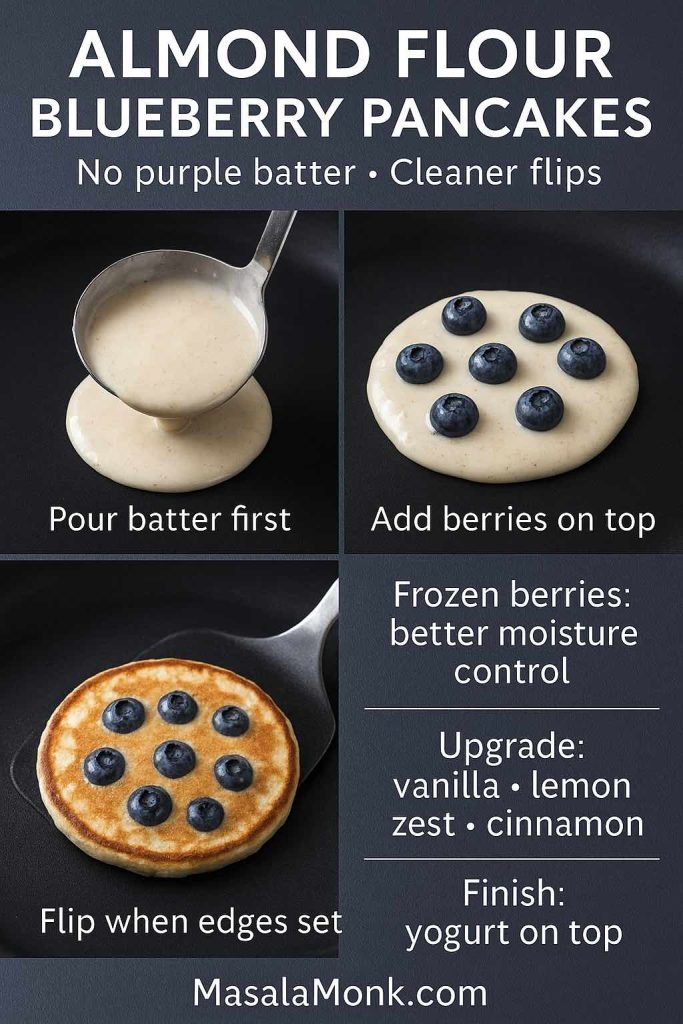
Almond Flour Blueberry Pancakes

Blueberries work beautifully with a nutty base. The key is to avoid turning the entire batter purple and to keep the pancakes easy to flip.

Almond flour blueberry pancake guide showing pour batter first, add blueberries on top, flip when edges set, with tips for frozen berries and flavor add-ins.
The cleanest blueberry pancakes come from a simple order of operations: batter first, berries second. You’ll get better structure, less bleeding, and easier flips—especially with frozen blueberries.

Method

Pour your batter onto the skillet first, then place blueberries on top of each pancake. Flip once the edges are set. This works especially well with frozen berries because you keep control of the moisture.

MasalaMonk’s blueberry pancake roundup reinforces the same practical approach of keeping heat moderate and adding berries on the pan for better results.

To deepen flavor without complicating the recipe, try one small add-on:

  • vanilla in the batter
  • lemon zest in the batter
  • cinnamon in the batter
  • a dollop of yogurt on top after cooking

The goal is contrast: warm pancake, juicy berries, creamy topping.

Also Read: Protein Oatmeal: Turn Plain Oats into a High-Protein Meal


Almond Flour Pumpkin Pancakes

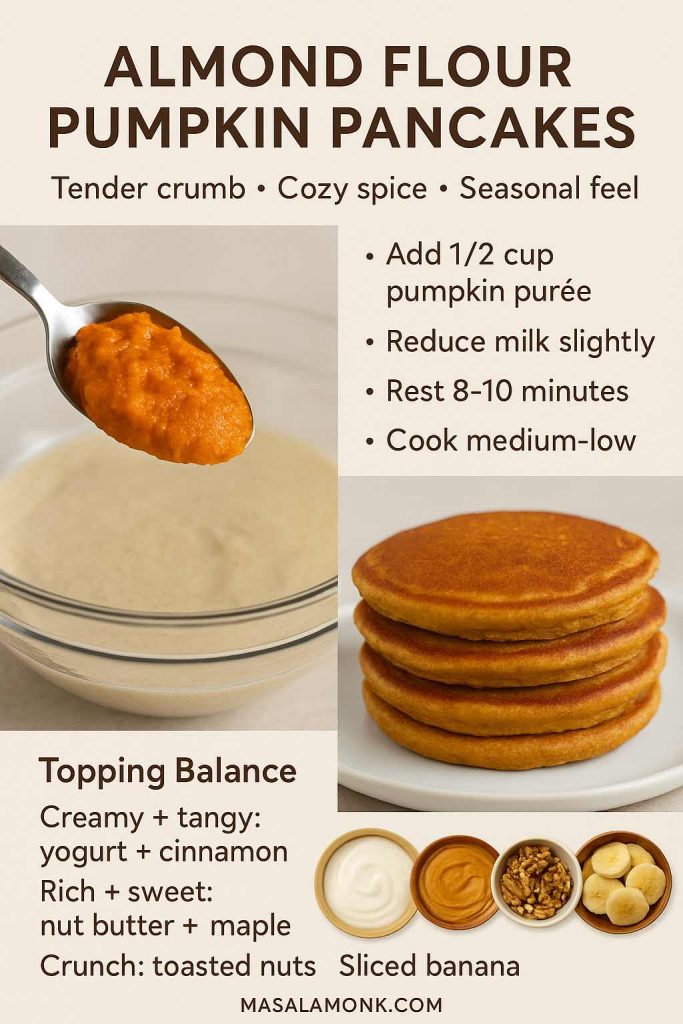
Pumpkin makes nut-flour pancakes feel especially tender because it adds moisture and body. It also brings that cozy, spiced flavor that makes breakfast feel seasonal even in the middle of an ordinary week.

Almond flour pumpkin pancake guide showing pumpkin purée added to batter, resting time, medium-low cooking tip, and topping balance ideas like yogurt, nut butter, toasted nuts, and banana.
Pumpkin adds moisture, so give the batter time to “settle” (8–10 minutes). That rest is what turns a loose bowl into a smooth, spoonable batter that cooks up tender.

Method

Add 1/2 cup pumpkin purée to the base batter, add cinnamon (or pumpkin spice), and reduce milk slightly. Rest 8–10 minutes so the batter becomes smoother and more uniform. Cook on medium-low.

To “juice” the experience, pair pumpkin pancakes with toppings that create balance:

  • yogurt + cinnamon (creamy and tangy)
  • nut butter + a drizzle of maple (rich and sweet)
  • toasted nuts (crunch)
  • sliced banana (soft sweetness)

Also Read: Healthy Oat Protein Bars – 5 Easy No Sugar Recipes for Snacks


Keto Pancakes With Almond Flour

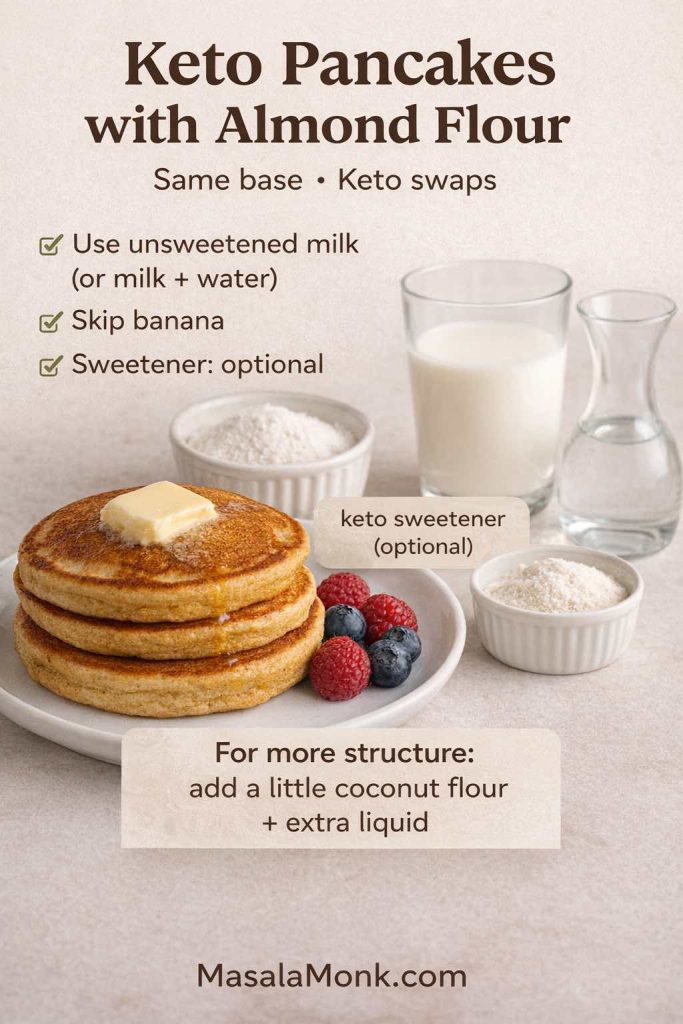
If you’re going for keto pancakes with almond flour, the base recipe already fits the general structure. The difference is mainly what you add.

  • Use unsweetened milk or a mix of milk and water.
  • Skip banana.
  • Sweeten only if desired, with a keto-friendly sweetener.
Keto pancakes with almond flour guide showing keto swaps like unsweetened milk, optional sweetener, skipping banana, and a tip to add coconut flour for structure.
Keto success is mostly “what you don’t add”: keep the base, skip banana and sugar, and use unsweetened liquid—then fine-tune texture with a small pinch of coconut flour plus extra liquid.

In other words, this becomes your basic almond flour keto pancake template—then you decide whether you want it plain, spiced, or protein-boosted.

If you like blending flours for structure, King Arthur’s keto pancake recipe is a useful reference for how almond flour and coconut flour can work together and why the batter may need extra liquid. For days when you want something keto-friendly that isn’t pancakes, MasalaMonk’s chia breakfast ideas provide a nice change of pace.


Gluten-Free Almond-Flour Pancakes

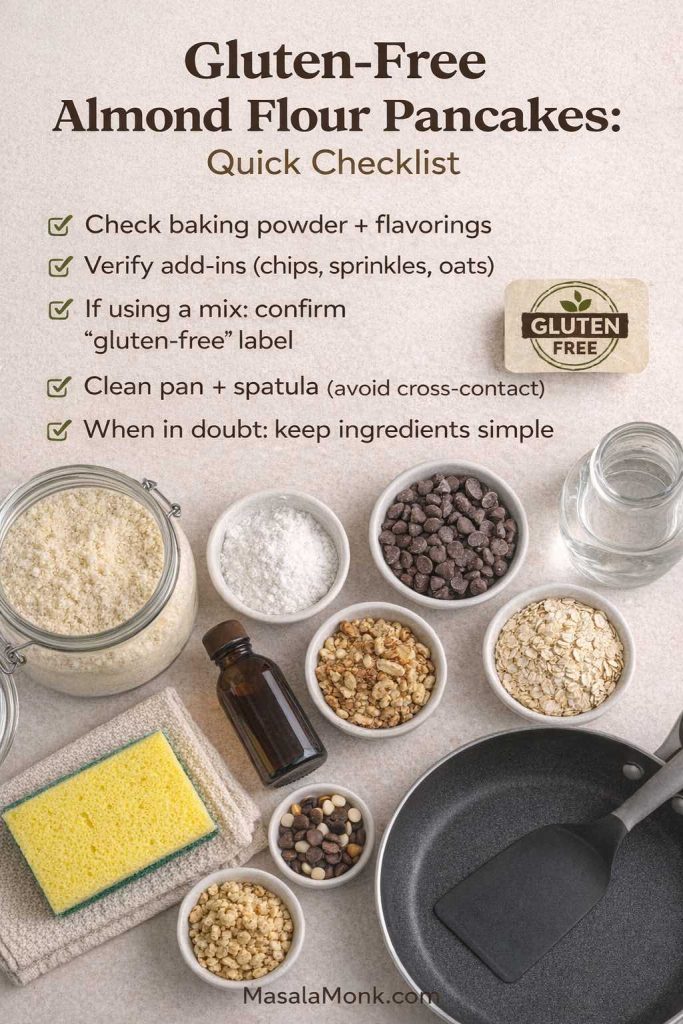
Almond flour is naturally gluten-free. Still, if you’re cooking for someone who needs strict gluten avoidance, packaged ingredients matter: baking powder, flavorings, add-ins, and especially mixes.

Gluten-free almond flour pancakes checklist showing label checks for baking powder and add-ins plus clean pan and spatula tips to avoid cross-contact.
The biggest gluten-free “gotchas” aren’t almond flour—they’re the extras. Treat baking powder, flavorings, mix-ins, and shared cookware as the real checklist items.

For official context, the FDA’s page on gluten-free labeling explains the standard used for foods labeled “gluten-free.” The Celiac Disease Foundation’s label reading guide is also helpful because it clarifies that “wheat-free” isn’t always the same as gluten-free and encourages checking the ingredients list.

In practice, the simplest approach is: trusted ingredients, a clean pan, and careful add-ins.

Also Read: 10 Best Espresso Martini Recipe Variations (Bar-Tested)


Vegan Almond Flour Pancakes

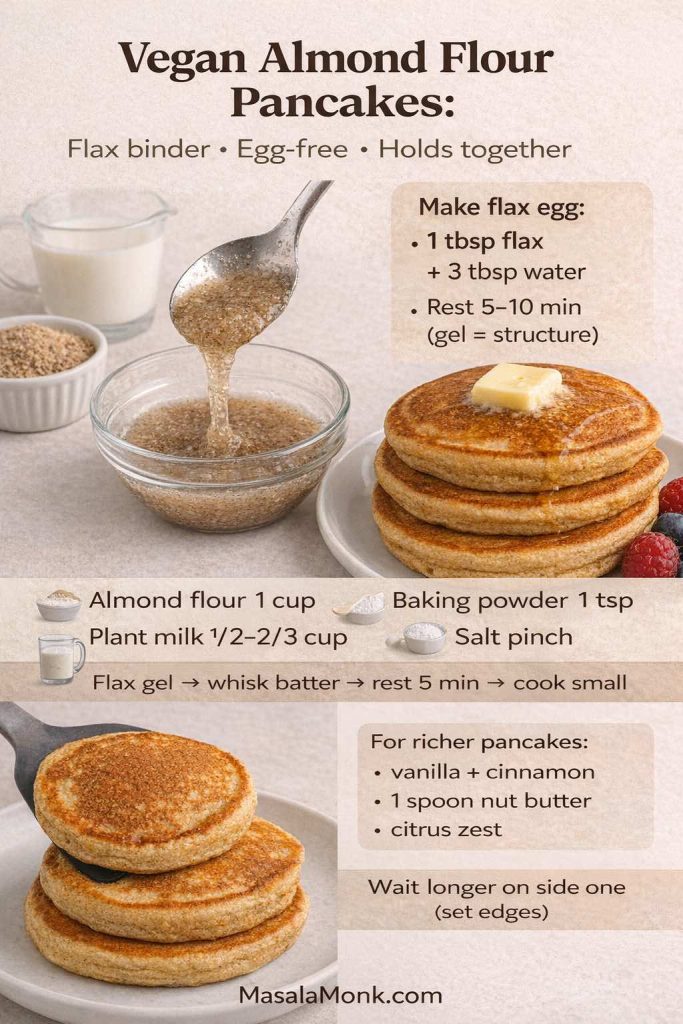
Vegan nut-flour pancakes are absolutely possible. They just need a binder, because eggs usually provide structure. Flax works well because it gels and helps hold the batter together.

Ingredients

  • 1 cup almond flour
  • 1 tablespoon ground flax + 3 tablespoons water (rest 5–10 minutes)
  • 1 teaspoon baking powder
  • 1/2 to 2/3 cup plant milk
  • pinch of salt
Vegan almond flour pancake guide showing how to make a flax egg binder, ingredient ratios, cooking cues, and add-ins for richer egg-free pancakes.
The flax gel is the “glue.” If your vegan pancakes feel fragile, the fix is usually more resting time for the binder—not more flipping.

Method

Mix flax and water first and let it thicken. Then whisk in the remaining ingredients. Rest 5 minutes. Cook small pancakes on low-to-medium heat, and let the first side set properly before flipping.

To make vegan almond flour pancakes feel richer without breaking the structure, you can add:

  • vanilla + cinnamon
  • a spoonful of nut butter stirred in
  • citrus zest for lift

The batter remains the same in spirit; it simply becomes more interesting.

Also Read: Vegan French Toast: 6 Easy Recipes (Pan, Air Fryer, GF & High-Protein)


Almond Flour Pancake Mix and Pancake-and-Waffle Mixes

Sometimes you want speed. Mixes are useful. Still, nut-based mixes can frustrate people because they thicken mid-batch or brown too quickly. Luckily, the solution is consistent and simple.

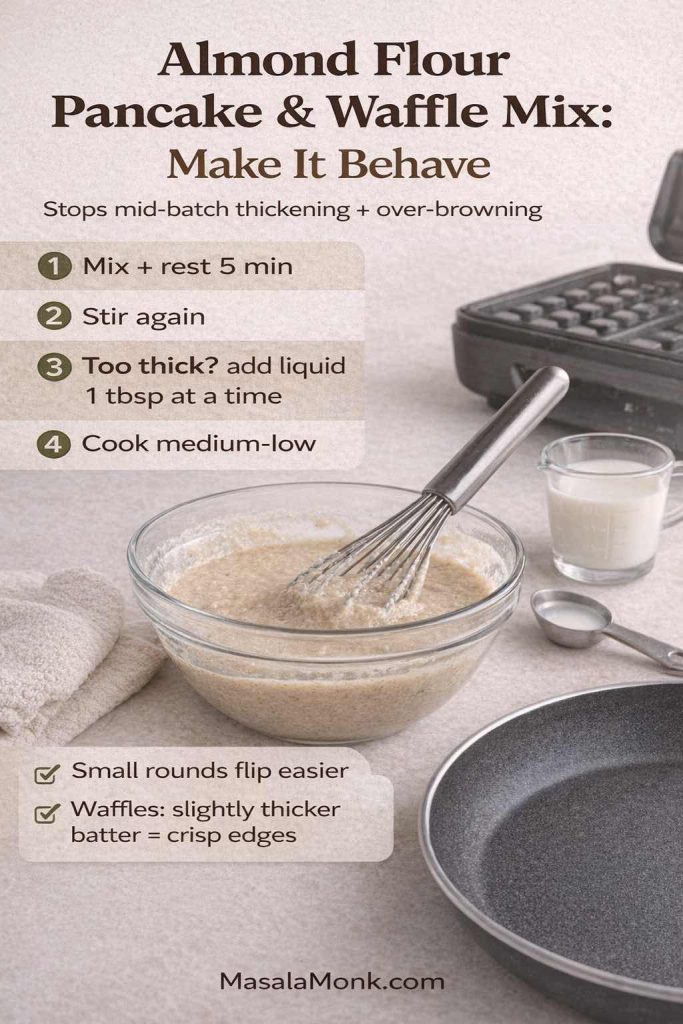
Almond flour pancake and waffle mix guide showing a 4-step routine to rest batter, stir again, add liquid 1 tablespoon at a time, and cook on medium-low.
The 5-minute rest is the secret: it reveals the “true” thickness of nut-based mixes so you can adjust once—then cook consistently without chasing the batter.

A routine that makes mixes behave

  1. Mix batter and rest 5 minutes.
  2. Stir again and check thickness.
  3. Add liquid one tablespoon at a time if it becomes too thick.
  4. Cook on medium-low.

If you want ideas for improving the flavor and texture of boxed mixes in general—without turning breakfast into a science project—Serious Eats tested a wide range of additions in their boxed pancake mix upgrade guide.

Meanwhile, if you enjoy making breakfast feel playful, waffles are the natural cousin of pancakes. MasalaMonk’s post on waffle twists is a fun way to add variety when you’re using a pancake-and-waffle mix style batter.


Coconut Flour Pancake Recipes and Almond–Coconut Blends

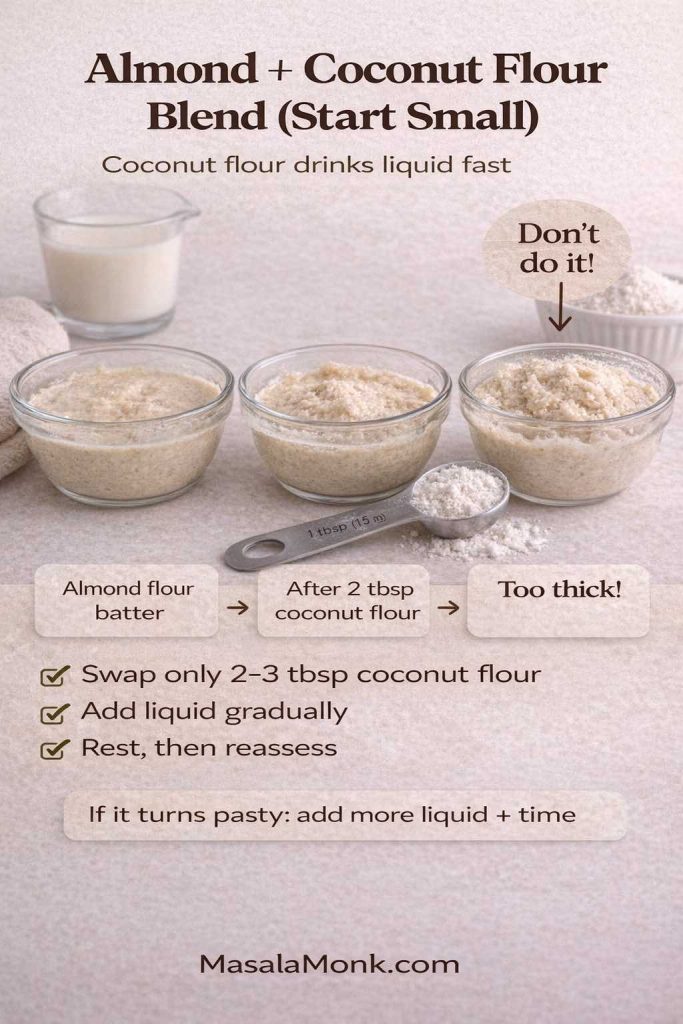
Coconut flour is extremely absorbent. That’s why coconut flour pancake recipes often use very different ratios compared to almond flour batters. If you’re blending coconut flour into an almond-based batter for structure, start small.

Guide showing almond and coconut flour pancake batter blend with bowls comparing thickness and tips to swap only 2–3 tablespoons coconut flour, add liquid gradually, and rest before adjusting.
Coconut flour’s superpower is absorbency—measure it in tablespoons, not handfuls. The pause after mixing is part of the recipe because it keeps thickening.

A gentle approach:

  • Replace only 2–3 tablespoons of almond flour with coconut flour.
  • Add liquid gradually.
  • Rest and reassess before adding more.

Again, King Arthur’s keto pancake recipe is a practical reference for how blended low-carb batters behave and why the mixture may need extra liquid.

Also Read: Fermented RAGI (Finger Millet) IDLIS- Gluten Free | Gut Friendly | Breakfast Recipe


Almond and Oat Flour Pancakes, Buckwheat, Tapioca, and Other Blends

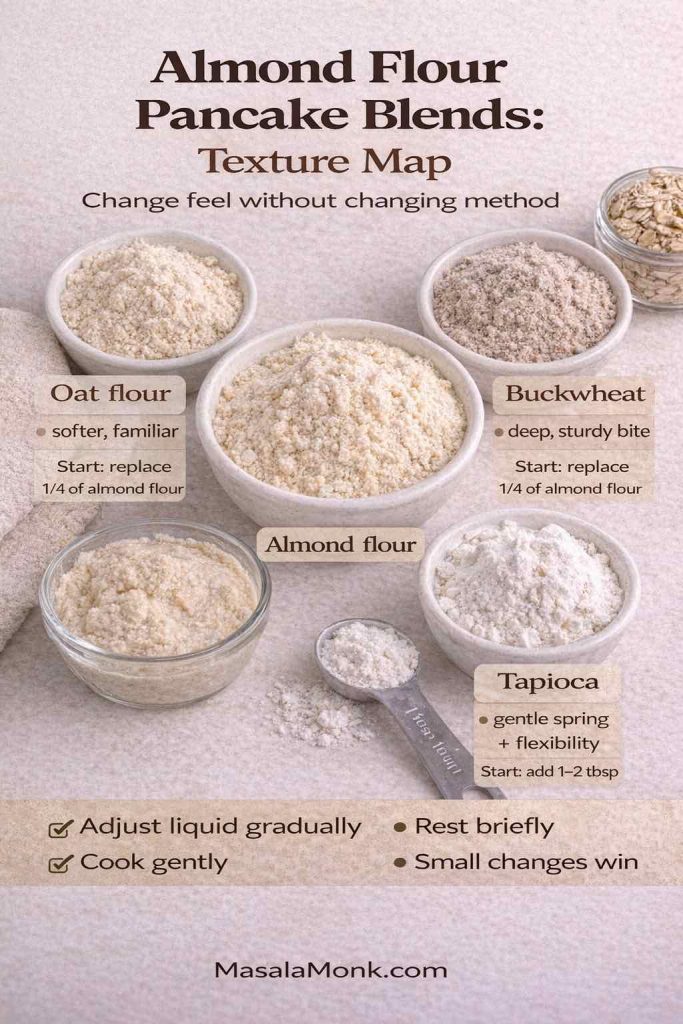
Once you’ve nailed your base batter, blending becomes a fun way to tailor texture.

  • Oat flour often makes pancakes feel softer and more familiar.
  • Buckwheat adds depth and a sturdier bite.
  • Tapioca can add a gentle spring and flexibility.
Texture map for almond flour pancake blends showing oat flour, buckwheat flour, and tapioca with beginner starting ratios and tips to adjust liquid gradually and rest batter.
Use this like a dial: oat flour softens, buckwheat deepens, tapioca adds spring. Start small, let the batter rest, then decide—most blend mistakes come from adjusting too fast.

The method stays the same: adjust liquid gradually, rest briefly, cook gently. The biggest mistake with blends is over-correcting too fast. Small adjustments win.

Also Read: Buckwheat and Weight Loss: Examining Its Role in a Healthy Diet


Savory Pancakes and Breakfast Variety

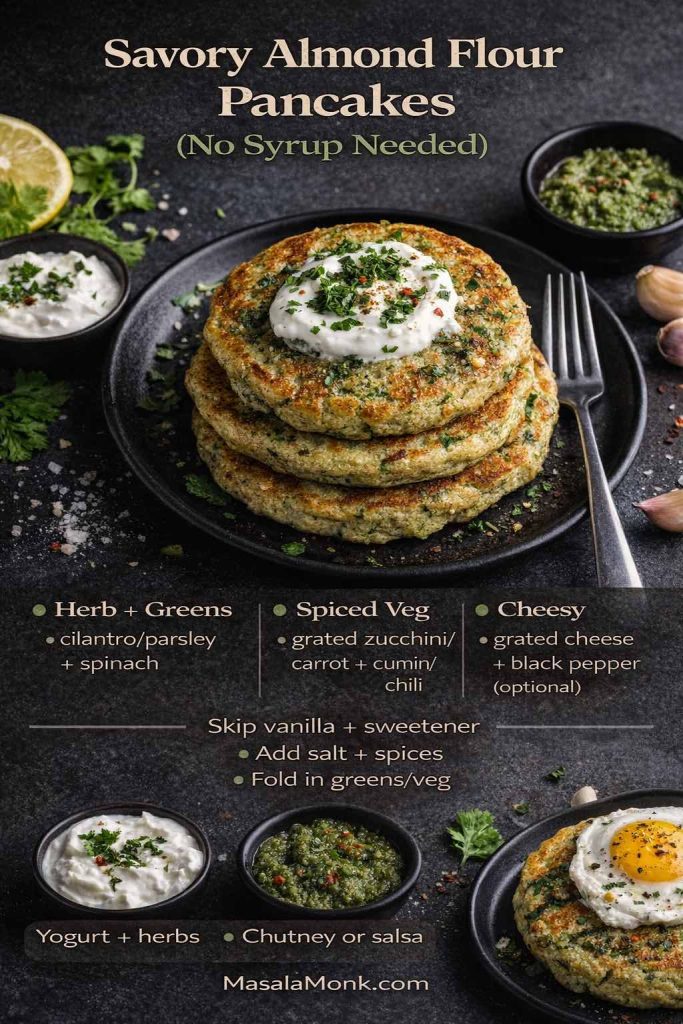
Not every pancake needs syrup. Savory nut-flour pancakes can be delicious when you treat them like a quick breakfast flatbread: skip sweetener and vanilla, add spices and herbs, and fold in greens or grated vegetables.

Savory almond flour pancakes guide with herb-and-greens, spiced veggie, and cheesy variations plus serving ideas like yogurt, chutney, or a fried egg.
Savory pancakes work best when you build contrast: salty batter + cool yogurt, or herby pancakes + bright chutney. Pick one “cool” topping and one “punchy” condiment and you’re done.

If you want savory pancake inspiration that naturally expands a breakfast menu, MasalaMonk has great posts that fit here:

These aren’t almond flour recipes, but they’re perfect recipes for readers who want more savory breakfast options without switching to entirely different meal categories.


Toppings That Make Nut-Flour Pancakes Feel Special

A pancake can be perfectly cooked and still feel a little flat emotionally. Toppings fix that. More importantly, toppings create contrast—creamy with crisp, bright with rich, salty with sweet.

Creamy toppings

  • Greek yogurt or thick yogurt: tangy, cooling, protein-friendly.
  • Cottage cheese whipped smooth: especially good on banana or pumpkin pancakes.
  • Nut butter: rich, filling, and great for low-carb routines.

Fruity toppings

  • Warm berries: makes any stack feel like brunch.
  • Sliced banana: soft sweetness and extra satiety.
  • Stewed apples: a cozy topping that feels like dessert for breakfast—MasalaMonk’s cinnamon-apple method is a good reference.
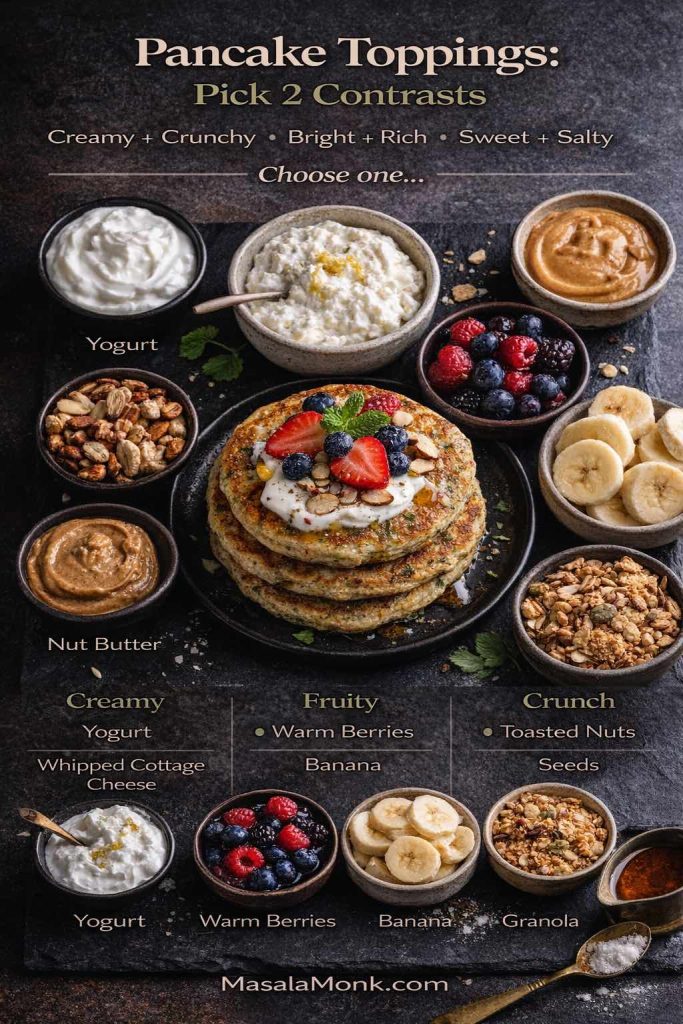
Pancake toppings guide showing how to pick two contrasts—creamy, fruity, and crunchy—with yogurt, whipped cottage cheese, nut butter, warm berries, banana, nuts, seeds, granola, and sweet finishes.
A simple rule that makes any stack feel “complete”: choose one creamy base, one bright fruit, and finish with either crunch or a light drizzle—three elements max keeps it special, not messy.

Crunch toppings

  • Toasted nuts: excellent with pumpkin or banana.
  • Seeds: add texture without much effort.
  • A sprinkle of granola: great on yogurt-topped pancakes.

Sweeteners (when you want them)

  • Maple syrup: classic for a reason.
  • Honey: floral sweetness.
  • A small dusting of powdered sweetener: subtle and quick.

The point isn’t to overdo it. Rather, it’s to pick one or two contrasts so the plate feels complete.

Also Read: Upma Recipe: 10+ Easy Variations (Rava, Millet, Oats, Semiya & More)


Meal Prep: How to Store and Reheat Without Ruining Texture

Nut-flour pancakes are surprisingly meal-prep friendly, especially the cottage cheese version, which stays moist even after chilling.

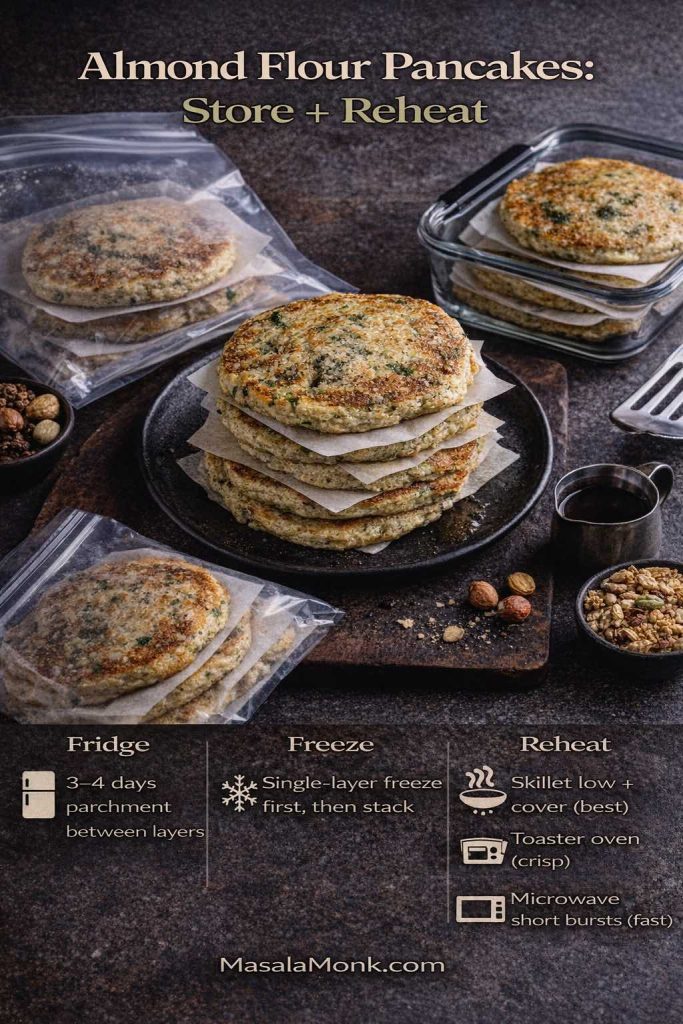
Storage

Let pancakes cool completely, then store them in an airtight container. If stacking, place parchment between layers so they don’t stick.

Freezing

Freeze in a single layer first, then transfer to a container or bag with parchment between pancakes. This prevents them from freezing into one solid slab.

Meal prep guide for almond flour pancakes showing how to store in the fridge, freeze with parchment between layers, and reheat using skillet, toaster oven, or microwave.
Best texture trick: reheat in a covered skillet on low for a minute or two—gentle steam warms the center without drying the edges.

Reheating

  • Skillet: best for texture. Low heat, cover briefly to warm through.
  • Toaster oven: great for gentle crisping.
  • Microwave: fastest, but keep it short to avoid rubberiness.

Because almond flour can go rancid faster than wheat flour (it contains natural oils), it’s also worth storing almond flour and almond meal properly. UC Davis provides practical guidance on nut storage—such as refrigeration/freezing for quality and using odor-tight containers—in their PDF on safe handling and storing nuts. For broader pantry staples and general storage practices, Penn State Extension’s guide to storing staple ingredients is a helpful reference.


Troubleshooting: Small Fixes That Save a Batch

Even good cooks get weird pancakes sometimes. Fortunately, most problems come from a few predictable causes.

Pancakes are crumbly

Usually too dry or flipped too early.
Fix: add 1–2 tablespoons milk, cook smaller pancakes, and wait longer before flipping.

Pancakes are gummy in the center

Often the heat is too high or the batter is too thin.
Fix: lower the heat, cook longer, and thicken with 1 tablespoon almond flour if needed.

Troubleshooting guide for almond flour pancakes showing four common problems—crumbly, gummy center, browns too fast, and batter thickens—with quick fixes.
No panic fixes: change just one variable at a time—heat first, then thickness. Most “bad batches” turn around with a lower flame and a tablespoon-level adjustment.

Pancakes brown too quickly

Heat is too high. Almond flour browns fast.
Fix: reduce heat and give the center time to set.

Batter thickens between pancakes

Normal.
Fix: stir and loosen with small splashes of milk.

That’s it. No panic. No starting over.


Nutrition Lookups Without Guessing

If you like checking nutrition details—almond flour vs almond meal, cottage cheese vs yogurt, or comparing add-ins—the USDA’s FoodData Central and its food search are the standard public references.


A Final Way to Think About It

Once you get comfortable with how almond flour pancake batter looks and cooks, everything becomes easier. The process becomes familiar: a thicker batter than wheat pancakes, medium-low heat, smaller rounds for clean flips, and tiny adjustments instead of big corrections.

Closing guide image showing almond flour pancakes with options to choose your version—everyday base, fluffy, protein, or fruity—with a tip to cook on medium-low and flip when matte.
Use this as your shortcut: pick the goal (fluffy, protein, fruity, or everyday), then keep the two universal rules—medium-low heat and flip when the top turns matte—for consistently tender pancakes.

From there, the variations stop feeling like separate recipes. Banana becomes a sweetness choice. Blueberries become a texture choice. Pumpkin becomes a cozy-season choice. Cottage cheese becomes a protein choice. Flax becomes a vegan choice. Coconut flour becomes a structure choice. Savory spices become a mood choice.

That’s when almond flour pancakes stop being a “special” breakfast and become what they should be: a simple, comforting meal you can make on any morning—without drama.

Also Read: Peanut Butter Cookies (Classic Recipe & 3 Variations)

FAQs

1) Can I replace all-purpose flour with almond flour in pancakes?

Yes, although it isn’t a 1:1 swap in behavior. Almond flour has less starch and more fat, so the batter is usually thicker and the pancakes brown faster. Use a recipe designed for almond flour rather than converting a wheat-flour one directly.

2) What’s the difference between almond flour and almond meal for pancakes?

Almond flour is typically finer, so the texture comes out smoother and more “classic.” Almond meal is coarser and can produce a heartier bite. Either works, but almond meal often needs a touch more liquid to keep the batter pourable.

3) Why is my almond flour pancake batter so thick?

Because almond flour absorbs liquid and thickens as it rests. If it becomes too stiff, add milk one tablespoon at a time, stir, then pause briefly before adjusting again.

4) Why do my pancakes made with almond flour fall apart?

Most often, the pancakes are too thin, too large, or flipped too early. Make smaller pancakes, cook longer on the first side, and ensure the batter is thick-but-pourable rather than runny.

5) How do I make fluffy almond flour pancakes?

Use fresh baking powder, rest the batter, keep the heat on medium-low, and cook smaller rounds. If you want extra lift, add one egg white without changing the rest of the recipe.

6) Why are my almond pancakes browning too fast?

Almond flour browns quickly due to its fat content and fine particles. Lower the heat and extend the cook time so the center sets without over-darkening the outside.

7) Can I make 3 ingredient almond flour pancakes?

Absolutely. The common three are almond flour, eggs, and milk. They’ll be more tender if you also add salt and baking powder, but the minimalist version can still work with gentle heat and small pancakes.

8) Do 2 ingredient almond flour pancakes really work?

They do, though the texture is more egg-forward. Typically it’s almond flour plus eggs; cook smaller pancakes and wait longer before flipping so they set properly.

9) What are 5 ingredient almond flour pancakes?

Usually almond flour, eggs, milk, baking powder, and salt. This “simple but reliable” set is a popular middle ground between minimalist versions and more flavored recipes.

10) How can I make a simple almond flour pancakes recipe taste better?

Add one flavor element rather than many: vanilla, cinnamon, lemon zest, or a pinch of salt if you skipped it. Also, avoid high heat—better texture often tastes better too.

11) How do I make protein almond flour pancakes without them turning dry?

Protein powder thickens batter fast, so increase liquid gradually and cook on lower heat. Alternatively, use cottage cheese for moisture and protein without the “chalky” texture.

12) How do almond meal protein pancakes differ from almond flour protein pancakes?

Almond meal is coarser, so the batter can be thicker and sometimes needs more liquid. Beyond that, the cooking approach is similar: smaller pancakes, steady heat, and a careful flip.

13) Can I make almond flour cottage cheese pancakes without a blender?

Yes. Mash and whisk thoroughly; you may get a slightly more textured batter. For smoother pancakes, blending helps, but it’s not mandatory.

14) Are cottage cheese almond flour pancakes good for meal prep?

They’re one of the best options for meal prep because they stay moist and tender after refrigeration compared to some other high-protein versions.

15) How do I make keto pancakes with almond flour?

Use unsweetened milk (or partially water), skip banana, and sweeten only if needed with a keto-friendly option. Keep the batter thicker and cook on medium-low for even setting.

16) Are almond flour pancakes low carb?

They’re typically lower carb than wheat-based pancakes, although the exact carbs depend on add-ins like banana, sweeteners, and mix-ins.

17) Can I make almond flour gluten free pancakes?

Yes, almond flour is naturally gluten-free. Still, confirm that baking powder, flavorings, and any mix-ins are also gluten-free if you need strict avoidance.

18) Can I make vegan almond flour pancakes?

Yes, but you’ll need a binder since eggs normally provide structure. A flax “egg” (ground flax + water) is a common solution, and small pancakes flip more easily.

19) Why do vegan almond flour pancakes stick more?

Egg-free batters can be more delicate and take longer to set. Use a good nonstick pan, cook on lower heat, and wait until the first side is fully set before flipping.

20) How do I make almond flour and banana pancakes that aren’t mushy?

Use a ripe banana but reduce the added milk since banana adds moisture. Cook gently and longer on the first side so the center sets.

21) Can I make almond flour pancakes with banana and no sweetener?

Yes. Banana naturally sweetens the batter, especially when very ripe. Add cinnamon or vanilla for extra flavor without additional sugar.

22) How do I make almond flour blueberry pancakes without streaky batter?

Instead of mixing berries into the bowl, pour batter into the pan first, then add blueberries on top. This keeps the batter cleaner and helps them cook evenly.

23) Can I use frozen blueberries in blueberry almond flour pancakes?

Yes. Place frozen berries onto the batter once it’s in the pan. This reduces “bleeding” and makes flipping easier.

24) How do I make almond flour pumpkin pancakes thicker and fluffy?

Pumpkin adds moisture, so reduce the milk slightly and rest the batter longer. Cook on medium-low to prevent over-browning while the center sets.

25) Can I turn almond flour pancake batter into waffles?

Yes. Make the batter slightly thicker than for pancakes and add a teaspoon of oil or melted butter for crisping. Cook until the waffle is deeply set before opening the iron.

26) Why does my almond flour pancake mix turn out dry?

Many mixes thicken as they sit. Rest the batter, then adjust with small splashes of milk or water. Also, avoid high heat, which can dry the outside before the inside finishes.

27) How do I fix an almond flour pancake mix batter that’s too thick?

Add liquid one tablespoon at a time, stir, then wait briefly. This stepwise method prevents over-thinning and keeps the pancakes from turning fragile.

28) Can I make an almond flour pancake mix recipe at home?

Yes. A common DIY “mix” combines almond flour with baking powder, salt, and optional sweetener; then you add eggs and milk when cooking. Store the dry mix airtight for quick mornings.

29) How should I store almond flour so it doesn’t taste off?

Because almond flour contains oils, store it in an airtight container in a cool place; refrigeration or freezing helps for longer storage. If it smells bitter or “paint-like,” it may be rancid.

30) Why are my pancakes using almond flour gummy in the middle?

Typically the heat is too high or the batter is too thin. Lower the heat, cook a bit longer, and thicken the batter slightly if it spreads too much.

Posted on 2 Comments

Protein Rich Cherry Pancakes Recipe

Summer is here and cherries are in season. You have got to try this recipe before the cherry season runs out. These healthy fats pancakes are fluffy, delicious and a little addictive. Made with whole grains, milk and egg these come together in just 10 minutes. 

I normally make pancakes with different fruits like banana, apple, strawberries but never tried it with cherries. It was only when I had 2 boxes of cherries that I decided to give it a shot. I think this is the first time I have ever made anything with cherries. I just don’t eat it with anything else. Cherries are pretty perfect on their own. Also, cherries are super healthy too. They are loaded with antioxidants which have anti-inflammatory properties. If you have been exercising and have sore muscles have cherries daily. They are excellent to soothe sore muscles. 

With all the goodness of cherries, these pancakes are packed with protein too. Just 4 pancakes have approx. 25 grams of protein. So, it’s a win-win situation wherein cherries are helping to heal your sore muscles and you are getting quality protein from these pancakes.

  • 1/2 cup Buttermilk: 6 gms Protein
  • 1 egg: 6 gms Protein: 3/4th Wholewheat flour: 10-12 gms Protein
  • 1/2 cup rolled Oats: 5-6 gms Protein

I served this to my little one yesterday and guess what, he gave me 83,000 crore likes for these pancakes. That’s how he described it when I asked him how was the taste 😁

Main Ingredients you need and their Substitutes

Wholewheat Flour: I have made these pancakes using wholewheat flour. You can make this gluten free by using gluten free flour like millet flour. Buckwheat, barnyard millet, pearl millet or finger millet flour, they all go well.

Rolled Oats: I have also added rolled oats in combination to wholewheat flour. It gives a nice bite and texture to the pancakes. You can skip it if you like and just use wholewheat flour.

Jaggery Powder: Some form of sweetness helps to enhance the taste. Jaggery has its own distinct flavour and I think goes very well with earthy and nutty flavour of wholewheat flour. You can use any unprocessed sugar like palm sugar or coconut sugar.

Buttermilk: Buttermilk is an excellent ingredient in baked goods and pancakes because it helps create light and fluffy foods by encouraging carbon dioxide bubbles to form in the batter. Also, it gives a slightly tangy flavour which I love. If you don’t have buttermilk, you can use yogurt or milk. You can also make these vegan by using  Almond milk or Coconut milk. 

Eggs: Eggs are helpful in adding volume to the pancakes. They also provide moisture along with the oil. However, if you want to make these eggless, just take 1 tbsp of chia seeds or flaxseeds (coarsely ground), mix 4 tbsps of water. Keep aside for 15 minutes. The mixture will get a gel like texture. Use this in place of 1 egg. 

Coconut Oil: Coconut oil not only adds flavor but also nutrition. Pure coconut oil is anti-inflammatory and antioxidant in nature, that helps maintain heart health. Thanks to the good fats. You can substitute coconut oil with either butter or olive oil.

Now on to the process of making these cherry pancakes

Recipe: makes 4-5 pancakes

Ingredients:-

  1. Deseeded Cherries: 10-12
  2. Buttermilk: 1 cup
  3. Egg: 1 large
  4. Wholewheat Flour: 3/4th cup
  5. Rolled Oats: 1/2 cup
  6. Pure Vanilla extract: 1/2 tsp
  7. Jaggery Powder: 2 tsps
  8. Baking Soda: 1/2 tsp
  9. Salt: a generous pinch
  10. Coconut Oil: 1 tbsp
  11. Oil/Butter for cooking 

Instructions 

  • In a blender, add 8-9 deseeded cherries, buttermilk, egg, pure vanilla extract, coconut oil & jaggery powder. Blend till everything comes together. 
  • In a bowl, sieve wholewheat flour, baking soda and salt. Mix well. Now add rolled oats and mix again. 
  • Gradually add the wet ingredients to dry ingredients and make a thick flowing consistency batter. Gently mix till everything incorporates well but do not over mix the batter 
  • Now grease a non-stick pan with some butter or oil. When the pan is medium hot, add 1/3rd cup of batter or according to the size you prefer. Once the bubbles form and top sets, flip and cook both the sides till golden brown. 
  • Enjoy it as it is or serve with maple syrup or honey or toppings of your choice. 

If you are looking for more pancake recipes, then you must check out these recipes below-

Do let me know if you try out this recipe. If you try this recipe, you can also click a picture and tag us on @masala.monk or use the hashtag #MasalaMonkRecipe and share on Instagram or Facebook. We would love to hear from you. 🙂