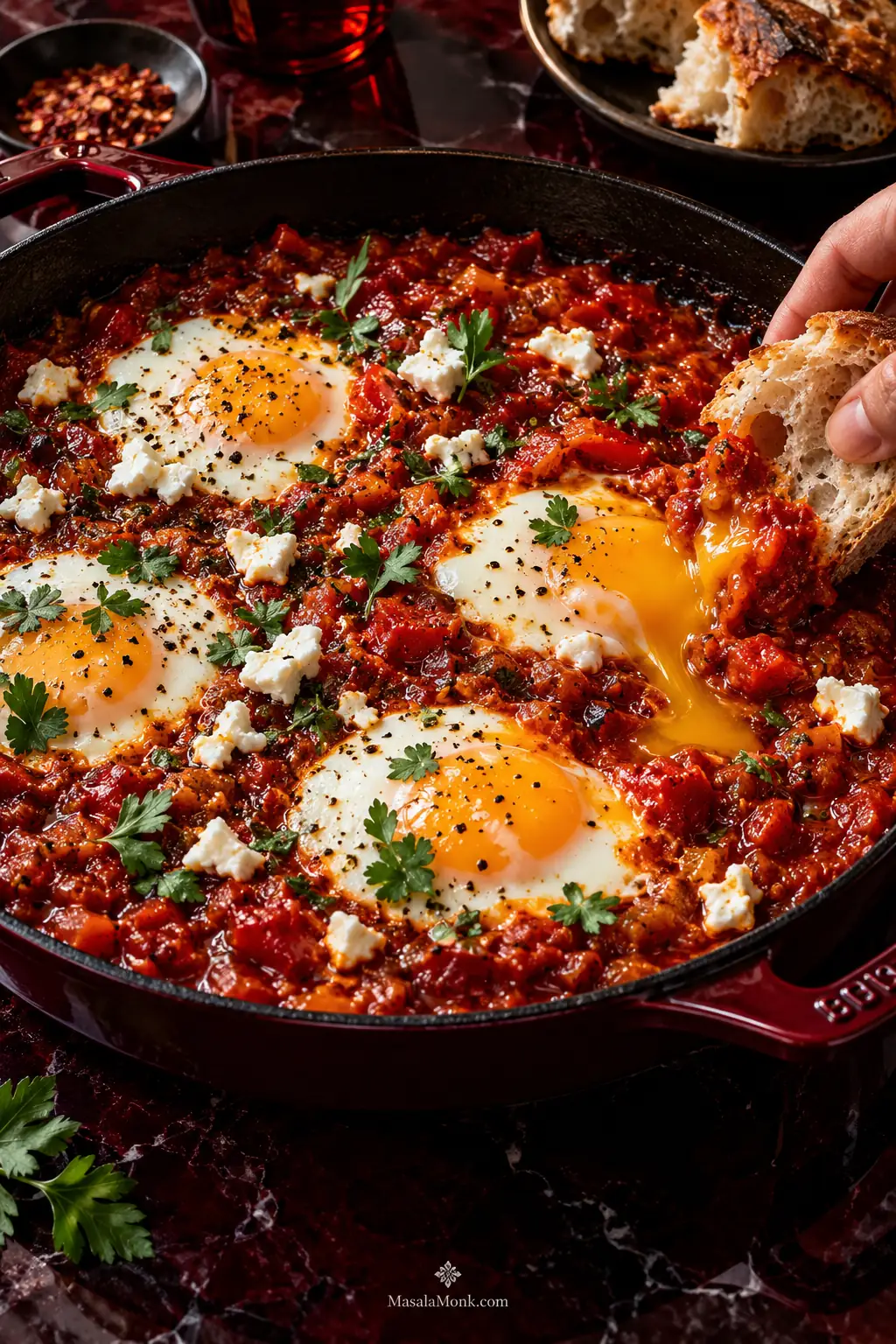
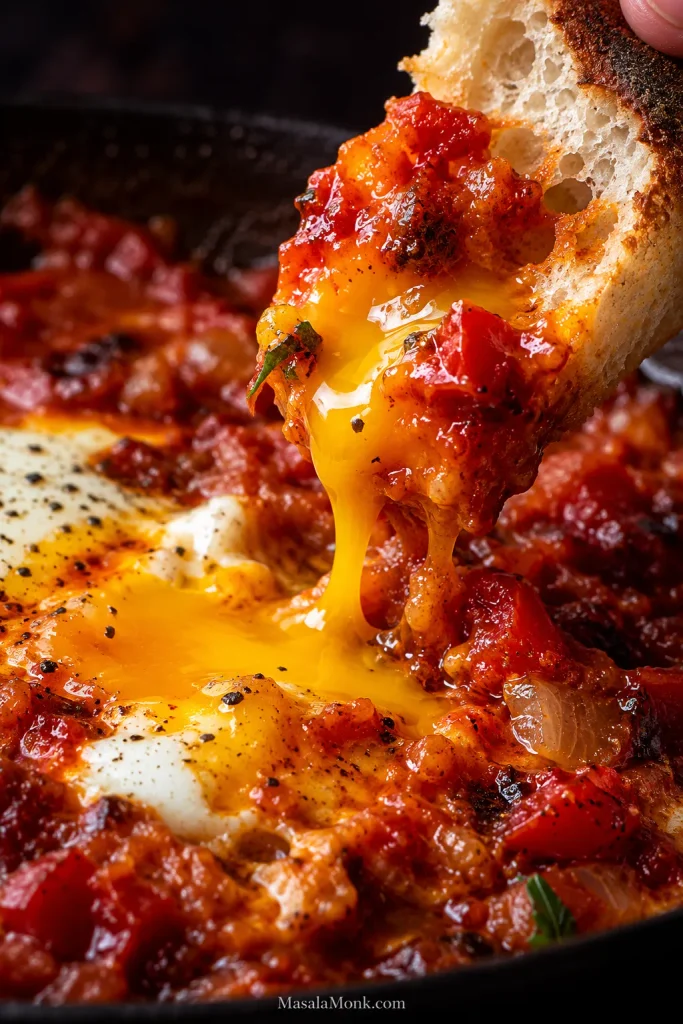
Shakshuka is at its best when the tomato sauce clings to a piece of torn bread, the whites are just set, and the yolk spills into the sauce as soon as you break it. Onion, pepper, garlic, cumin and paprika make the base, but the real trick is knowing when the sauce is ready for the eggs.
Shakshuka is a one-pan dish of eggs gently poached in a spiced tomato and pepper sauce, with roots in North Africa and versions now eaten widely across the Middle East and beyond. The handoff is the heart of this shakshuka recipe: finish the sauce first, then change how you cook.
Onion and bell pepper soften with cumin, paprika and garlic before tomatoes cook down into a thick, scoopable sauce. Six eggs go in off the heat, then finish gently until the whites are set and the yolks are as soft or firm as you like.
Serves 3 generously or 4 with bread and sides
Prep About 10 minutes
Cook About 25–35 minutes
Total About 35–45 minutes
Pan 12-inch / 30 cm skillet with lid
Eggs 6 large
Ingredients
2 tablespoons / 30 mL olive oil
1 medium yellow onion, diced, about 5½–6 oz / 150–170 g prepared
1 medium-large red bell pepper, diced, about 5½–7 oz / 160–200 g prepared; green also works for a sharper flavor
½ teaspoon fine sea salt, plus more after the sauce has reduced
3 garlic cloves, finely chopped, about 12 g
1 teaspoon ground cumin
1 teaspoon sweet paprika
¼ teaspoon red pepper flakes, or to taste
2 tablespoons / about 30 g tomato paste
1 can whole peeled tomatoes, 28 oz / 794 g, crushed with their juices, or the same weight of good crushed tomatoes
¼ teaspoon freshly ground black pepper
6 large eggs
2–3 oz / 60–85 g feta, crumbled, optional
2–4 tablespoons chopped flat-leaf parsley or cilantro, optional
Method
Soften the onion and pepper. Heat the olive oil in a 12-inch / 30 cm skillet over medium heat. Add the onion, bell pepper and ½ teaspoon salt. Cook for about 7–8 minutes, stirring occasionally, until the onion is translucent, a little gold is appearing at the edges and the pepper has lost its raw crunch.
Bloom the aromatics. Add the garlic, cumin, paprika and red pepper flakes. Stir for about 30 seconds, until the garlic and spices smell aromatic.
Cook the tomato paste. Stir it through the vegetables for 1–2 minutes, until the paste turns a deeper brick red and loses its raw canned smell.
Add the tomatoes. Pour in the crushed tomatoes with their juices and add the black pepper. Bring everything to a lively simmer, then adjust the heat so the sauce bubbles steadily without spitting aggressively.
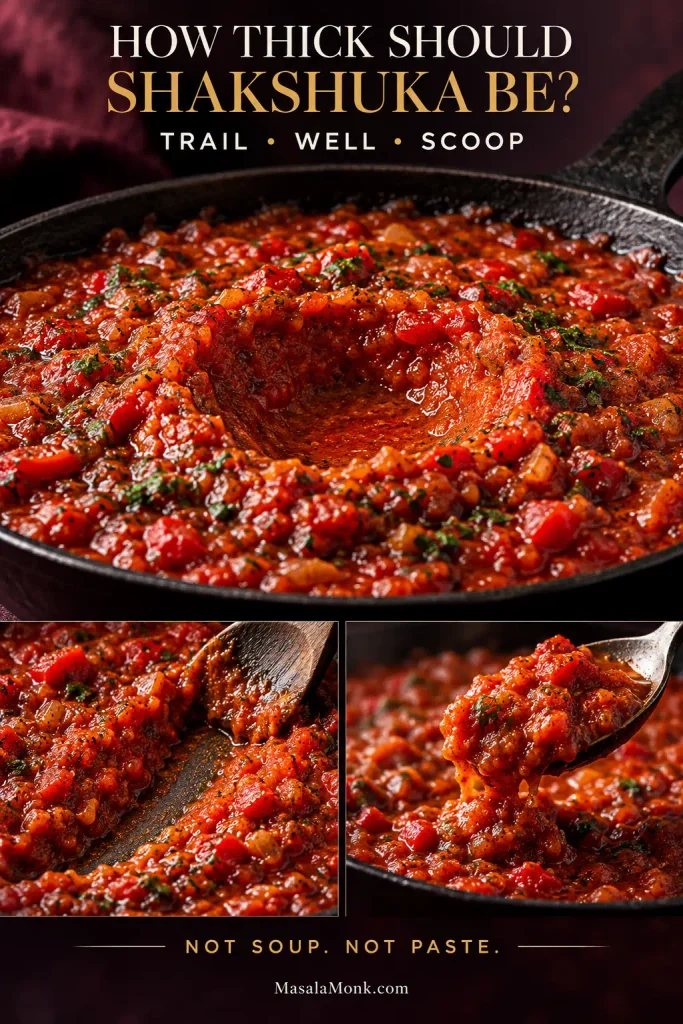
Finish the sauce. Start checking after about 10 minutes. In a 12-inch / 30 cm skillet, the sauce often reaches the right consistency in 10–15 minutes; wetter tomatoes or a narrower pan can take longer. Drag a spoon across the bottom and look for a trail that stays open briefly. Press a shallow well into the sauce; it should not immediately flood. Lift a spoonful and it should still slump back into the pan. Taste now. Canned tomatoes vary considerably in saltiness, so season until the sauce tastes finished, staying slightly conservative if you plan to add feta at the end.
Add and Cook the Eggs
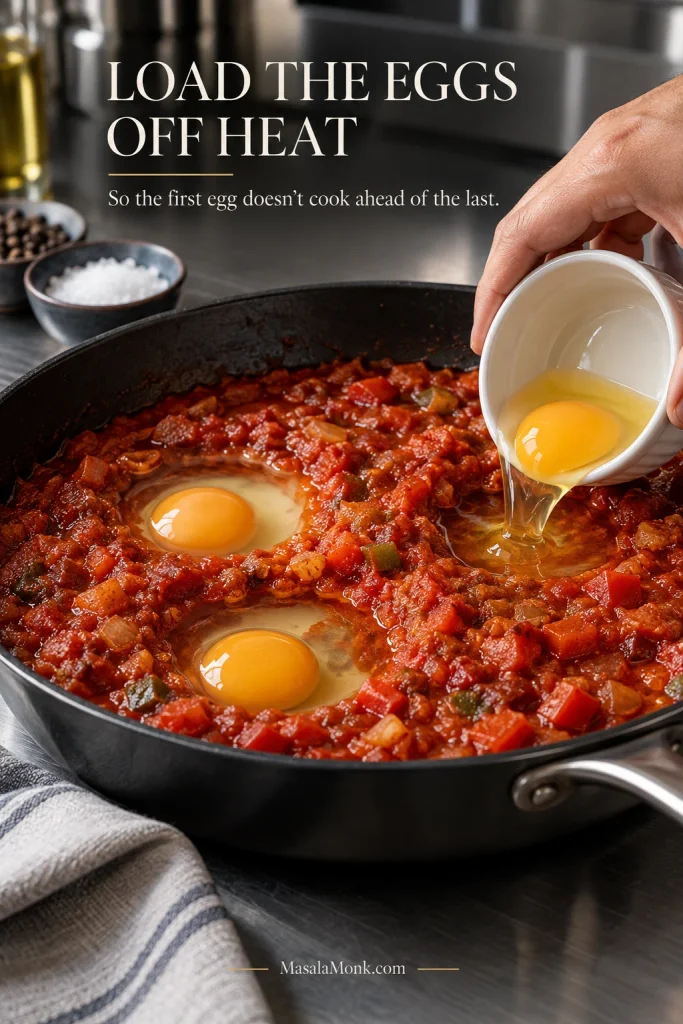
Take the skillet off the heat and add all six eggs. Make six broad, shallow wells. Crack each egg into a small bowl or ramekin first, then slide it gently into place. Loading them away from the burner keeps the first egg from cooking while you are still placing the last.
Return the skillet to low heat. Cover and start checking after about 4 minutes. The eggs often take about 4–8 minutes after the skillet returns to the heat. If a thick patch of white beside a yolk still looks glassy, spoon a little hot tomato sauce over that white only, leave the yolk exposed, cover briefly and check again.
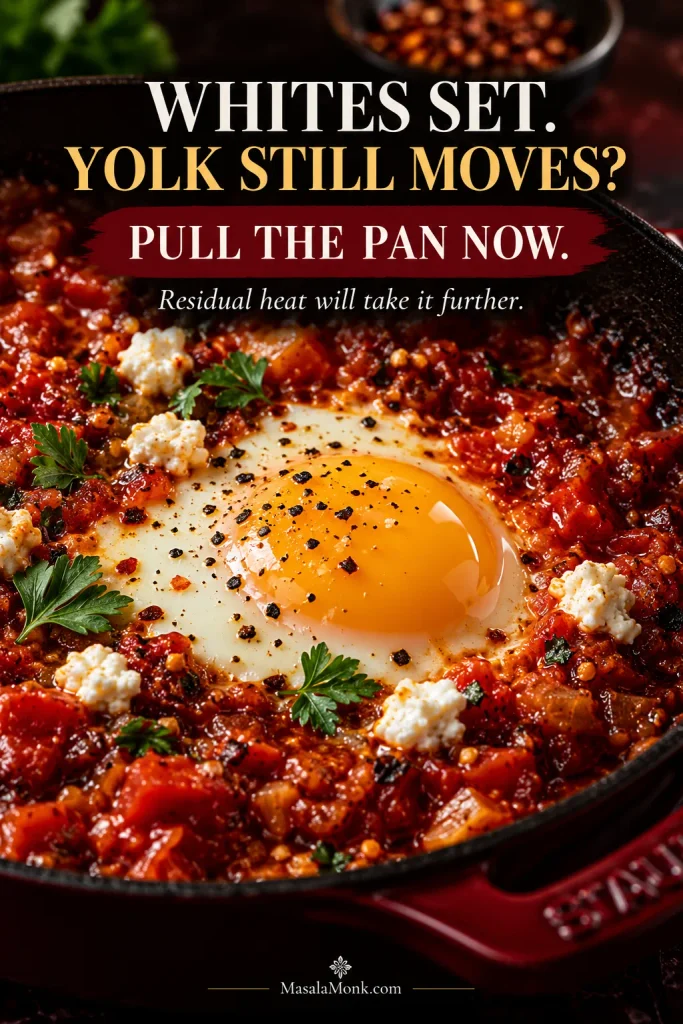
Stop where you like the yolks. The whites should be opaque and tender rather than rubbery. Soft yolks still move clearly when the skillet is nudged; jammy yolks move less; firm yolks barely move at all. Pull the skillet a little early because the hot tomato sauce and pan continue cooking the eggs after the burner is off.
Finish and serve. Scatter with feta and herbs if using. The feta should begin to soften against the hot tomatoes while the herbs stay bright on top. Bring the skillet straight to the table.
Useful Method Notes
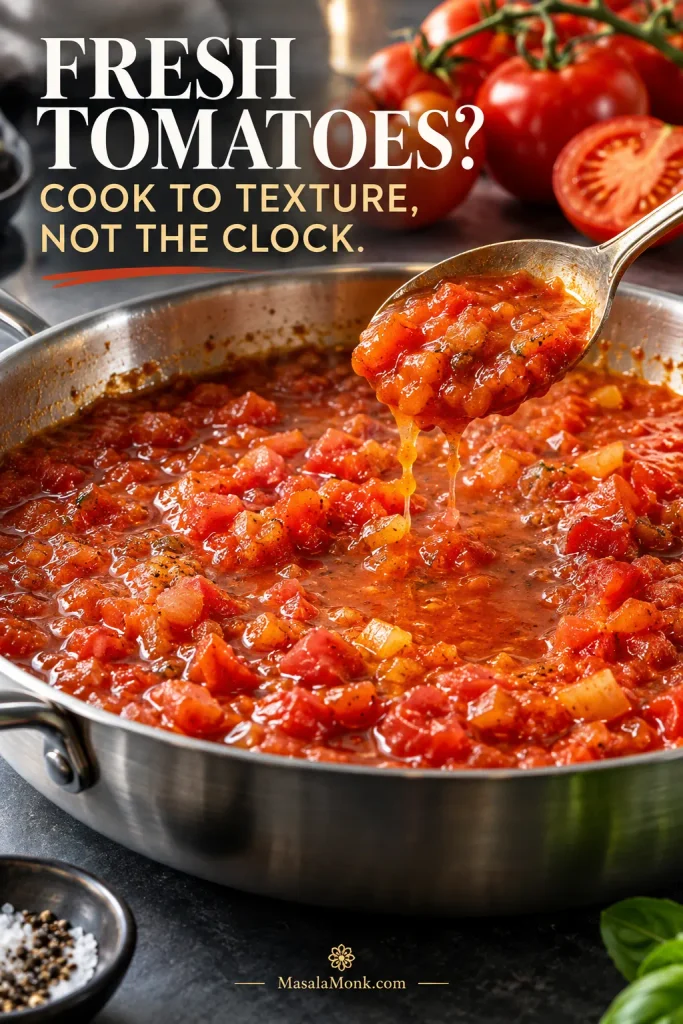
Fresh tomatoes: start with about 1.75–2 lb / 800–900 g ripe tomatoes, weighed after coring, then roughly chopped. Their water content varies, so cook to the same trail, well and scoop cues instead of copying the canned-tomato timing.
Oven finish: preheat the oven to 375°F / 190°C before making the egg wells. Transfer the oven-safe skillet after adding the eggs and start checking around 7–8 minutes.
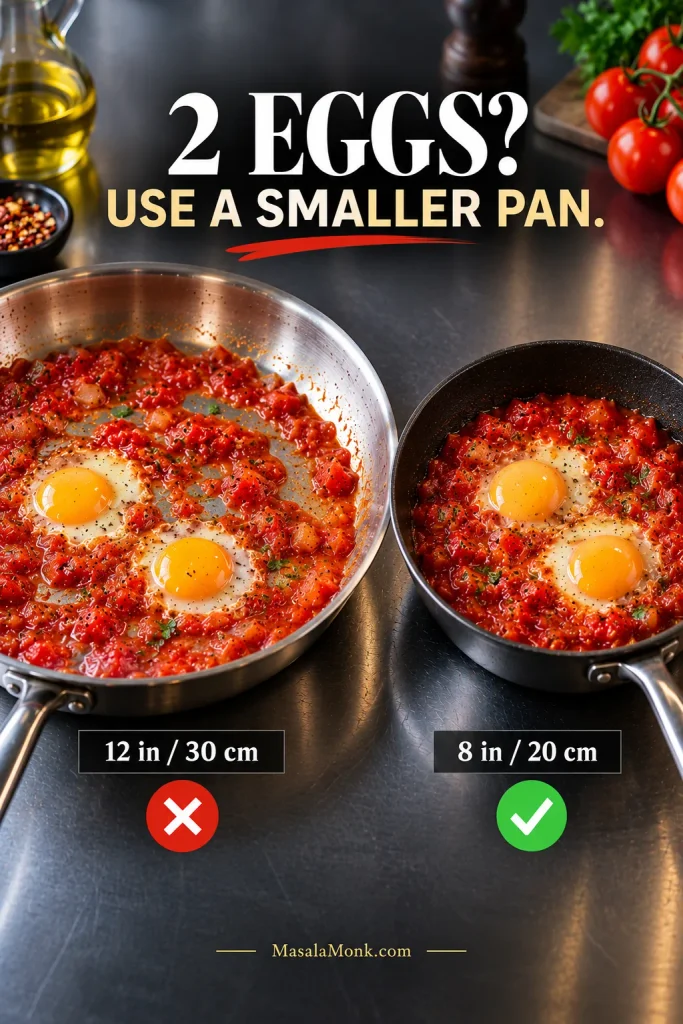
Smaller batch: about 8 inches / 20 cm suits two eggs; roughly 9–10 inches / 23–25 cm works well for three or four. See Shakshuka for One or Two for the full scaling guide.
Need fully cooked eggs? Continue until both whites and yolks are firm. The FDA’s egg-safety guidance gives conservative cooking advice and information about pasteurized eggs for dishes served with softer yolks.
The Pan Changes Jobs When the Eggs Go In
Before the eggs, moisture is the problem. Onion and pepper need time to soften. Tomato paste needs a brief cook. The tomatoes need steady bubbling and uncovered surface area so excess water can escape. Taste and finish the seasoning here too.
After the eggs, excessive heat is the problem. The sauce is already finished. Lower heat gives the whites time to set without pushing every yolk farther than you wanted.
A wide skillet of canned tomatoes may reach the right consistency quickly; juicy fresh tomatoes in a narrower pan can take considerably longer. The clock changes with the pan and tomatoes. The finished sauce should not.
Listen as the skillet changes jobs. Before the eggs, expect an active simmer and steady steam; afterward, the pan should sound calmer. Hard spitting around the eggs means the heat is still too high.
Build a Tomato-Pepper Sauce That Can Hold an Egg
The finished sauce should taste ready to eat: savory from onion and garlic, sweet from the softened pepper, warmly spiced and concentrated enough to stand on its own.
Fresh vs Canned Tomatoes for Shakshuka
For the most predictable result, use whole peeled or crushed canned tomatoes. Whole tomatoes let you control how chunky the sauce stays; crushed tomatoes save that step. Diced tomatoes work too, although some brands stay firmer and may need breaking down with the spoon. Passata gives the smoothest sauce and can reduce a little faster.
Fresh tomatoes deserve different treatment because their water content changes so much. Start with roughly 1.75–2 lb / 800–900 g ripe tomatoes, weighed after coring, then roughly chopped. Cook them until the sauce reaches the same consistency as the canned version. A juicy summer tomato may take much longer than a dense Roma. If the pan suddenly looks wetter than expected, nothing is wrong; give it time. For larger batches, our tomato sauce from fresh tomatoes guide goes deeper into choosing tomatoes and reducing excess water.
With fresh tomatoes, watch the liquid moving between the pieces. The surface can look thick while clear moisture still collects underneath, so let that free liquid cook away before adding the eggs.
Build Flavor and Control the Reduction
Tomato paste gives the sauce more depth without demanding a long simmer. Cook 2 tablespoons / 30 g with the softened vegetables until it turns brick red and loses its raw canned smell. Leave it out and the tomatoes may need longer to reach the same body.
Cumin brings the earthy note, sweet paprika deepens the pepper flavor, and chile controls the heat. Smoked paprika works too if you want the whole pan noticeably smokier.
Crowd this amount of sauce into a small, deep skillet and you will wait longer for the tomatoes to reduce. A 12-inch / 30 cm skillet gives roughly 28 oz / 794 g tomatoes enough exposed surface while still leaving room for six eggs; spread the sauce much wider and it can dry sooner. Material matters less than shape here; stainless-steel, enameled, nonstick and well-seasoned cast-iron skillets can all work.
How Thick Should Shakshuka Be?
Check three things before the eggs go in.
Trail: drag a spoon through the sauce. The line across the bottom should stay visible for a moment before the tomatoes slowly move back.
Well: press a shallow hollow into the sauce. It should remain open instead of immediately filling with watery liquid.
Scoop: lift some sauce with the spoon. It should slump and fall back into the skillet, not sit in a stiff mound.
The three checks matter most when they disagree. If a sauce holds a well but still pours freely from the spoon, give it another short uncovered simmer before adding the eggs.
You want the middle ground: not soup, not tomato paste. Taste it too. The tomatoes should feel rounded and concentrated, the sweet pepper should still sit behind them, and the cumin should come through clearly. Once yours does that, the eggs can go in.
Too thick? Stir in water 1 tablespoon / 15 mL at a time until the sauce loosens without becoming runny.
This is the annoying part of shakshuka: a yolk can look perfect while the thick white beside it is still translucent. Turning the burner higher usually punishes the yolk first.
Add the Eggs Evenly
Take the skillet off the burner. Make broad, shallow wells and slide in the eggs one by one from small bowls or ramekins.
Separate ramekins make the eggs easier to place and let you catch a stray shell or broken yolk before either reaches the finished sauce.
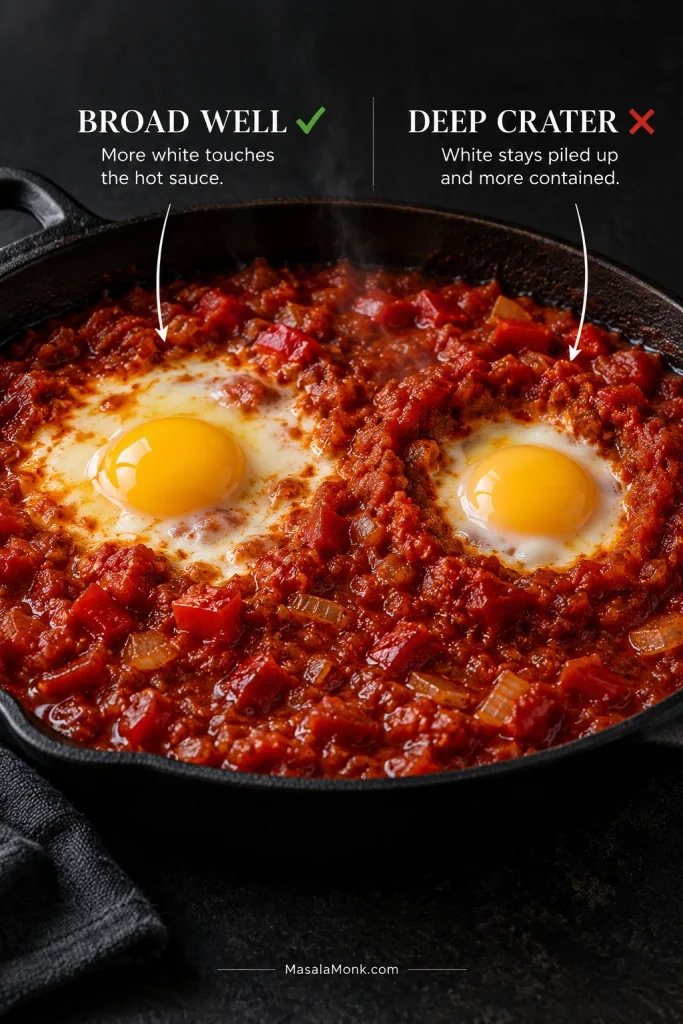
Deep craters hold a thick mass of white close to the yolk, where it takes longer to set. Broad wells let some of that white spread across the hot tomato sauce.
Widen the well with the back of the spoon instead of digging to bare pan. A broad depression gives the white more hot sauce to touch while keeping sauce beneath the egg.
Help the Whites Set Without Overcooking the Yolks
Return the loaded skillet to low heat and cover it. Start checking after about four minutes.
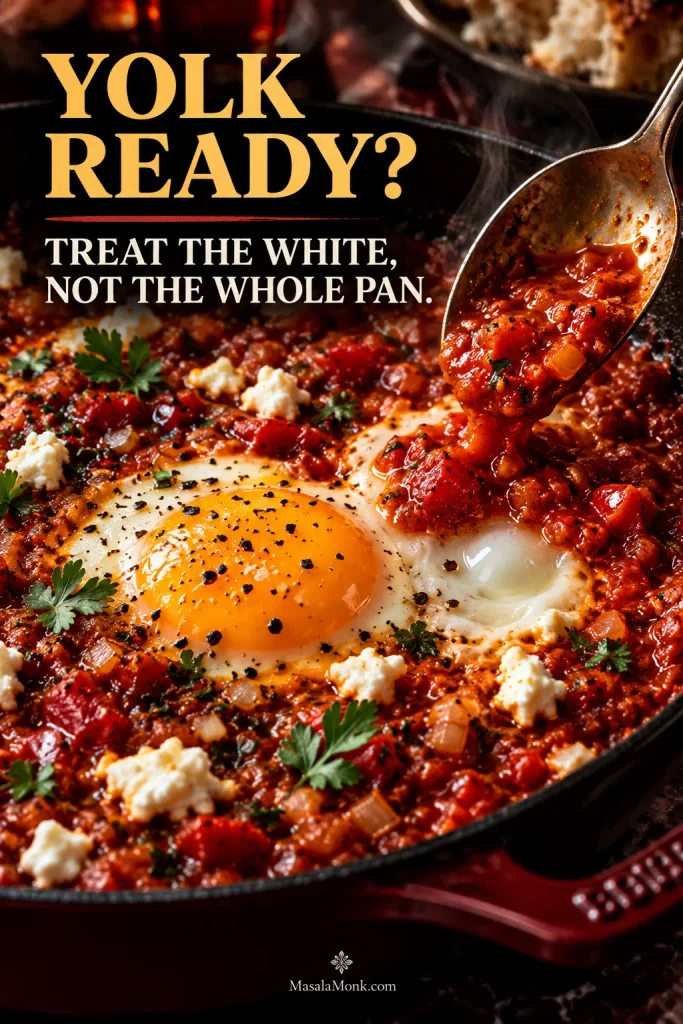
A glassy patch of thick white does not mean the whole pan needs more heat. Spoon a little hot tomato sauce over the white and leave the yolk uncovered. Do not chase one stubborn white by cooking the other five yolks to death.
Take the hot sauce from a clear patch between the eggs, not from beneath the yolk you are protecting. Spoon it over the stubborn white only to add heat without disturbing the yolk.
One side of the skillet may run hotter than the other. Rotate the pan and judge the eggs individually; they do not all need to be done at once.
Soft, Jammy or Firm Eggs
Target
White
Yolk
Soft / runny
Opaque and softly set
Domed and clearly moving when the pan is nudged
Jammy
Fully set
Thicker with a smaller, slower jiggle
Firm
Completely set
Little or no visible movement
Take the skillet off the heat slightly before the yolks look completely finished. The hot tomato sauce and skillet will carry them a little further.
Opaque whites and a yolk that still moves are your cue to stop for soft eggs. Pull the skillet slightly early; the hot sauce and pan will keep cooking the yolks.
Finish Shakshuka in the Oven
An oven can help when your burner has obvious hot spots or the bottoms of the eggs repeatedly firm before the tops of the whites.
Preheat to 375°F / 190°C before adding the eggs. Once the loaded oven-safe skillet goes in, start checking around 7–8 minutes. Some batches need longer; use the whites and yolks to make the final call.
Rescue the Pan
When something goes wrong, first check whether the eggs are already in the skillet.
Before the Eggs Go In
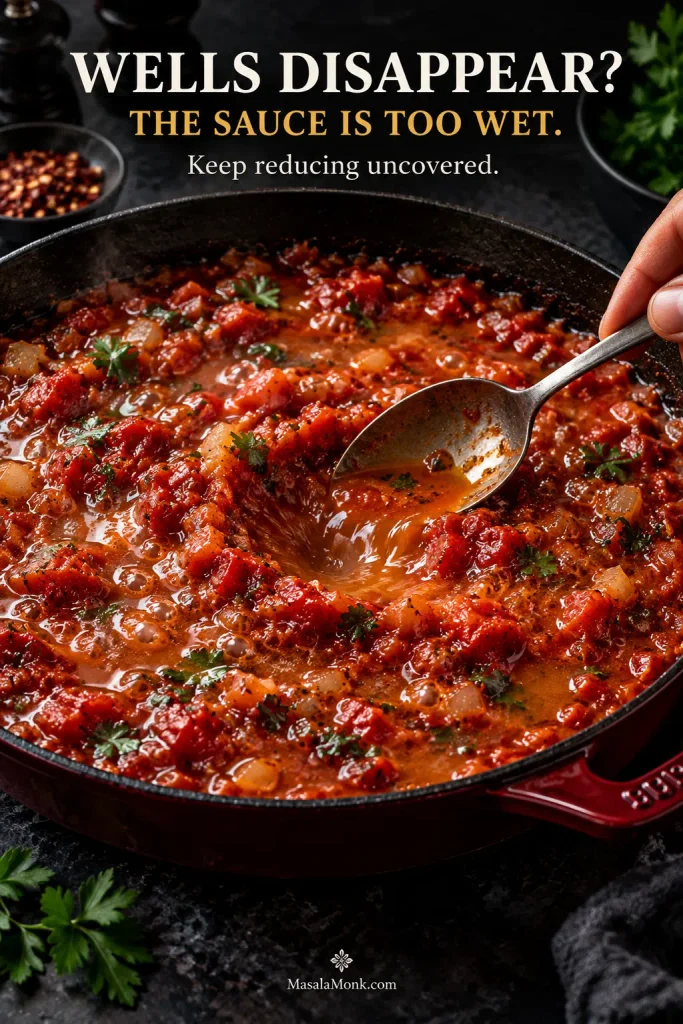
The sauce is watery or the wells immediately disappear. Keep simmering uncovered. The eggs can wait.
Test the deepest part of the skillet, not just the rim. The edges may look reduced while the center is still loose; if a well there floods, keep simmering uncovered.
Fresh tomatoes have flooded the skillet. Nothing has necessarily gone wrong; they may contain more water. Keep cooking until the sauce reaches the same consistency cues.
The sauce is too thick. Add water 1 tablespoon / 15 mL at a time until it becomes scoopable again.
The flavor is weak. Check the consistency first. A loose sauce can make the tomatoes, pepper, salt and spices all taste muted.
The tomatoes taste sharply acidic. Cook them fully and check the salt. Once the sauce is properly reduced, a tiny pinch of sugar can soften an unusually harsh batch without making it sweet.
After the Eggs Go In
White translucent, yolk nearly ready? Treat that white locally with a little hot tomato sauce; do not keep cooking the whole pan.
One side is cooking faster. Rotate the skillet.
The yolks keep going hard. Check earlier and take the pan off sooner. Carryover heat will finish them a little further.
The bottom is catching. Lower the burner. The sauce no longer needs hard bubbling.
The lid leaves the surface watery. Uncover briefly. Next time, reduce the sauce a little further before adding the eggs, or use the oven finish if your stovetop repeatedly gives you trouble.
The same pan control matters when you scale shakshuka down. A smaller batch needs a smaller skillet: put two eggs and a little sauce in the same 12-inch pan used for six and everything becomes shallow, fast-cooking and harder to control.
For a two-egg shakshuka, choose the skillet by sauce depth. You want enough tomato sauce beneath and around each egg to form broad wells without exposing large areas of bare pan.
For one 2 eggs About 8 in / 20 cm skillet
For two 3–4 eggs About 9–10 in / 23–25 cm skillet
Full pan 6 eggs About 12 in / 30 cm skillet
The simplest small-batch system is to make the sauce once. Reheat enough to form a generous layer that can hold broad, shallow egg wells, then add only the eggs you plan to eat. A container of finished sauce in the fridge turns tomorrow’s breakfast into a few minutes of eggs instead of another round of chopping onion, pepper and garlic.
Make Ahead and Store the Sauce
Stop before the eggs. Cool the finished tomato-pepper sauce promptly and refrigerate it in a covered container. Reheat the portion you need until bubbling, then add fresh eggs.
Use refrigerated cooked leftovers within 3–4 days, following USDA guidance for handling leftovers safely. Finished shakshuka can be reheated, but its yolks will become firmer.
For longer storage, freeze the sauce without eggs. Thaw it in the refrigerator, reheat it in a skillet and finish with fresh eggs.
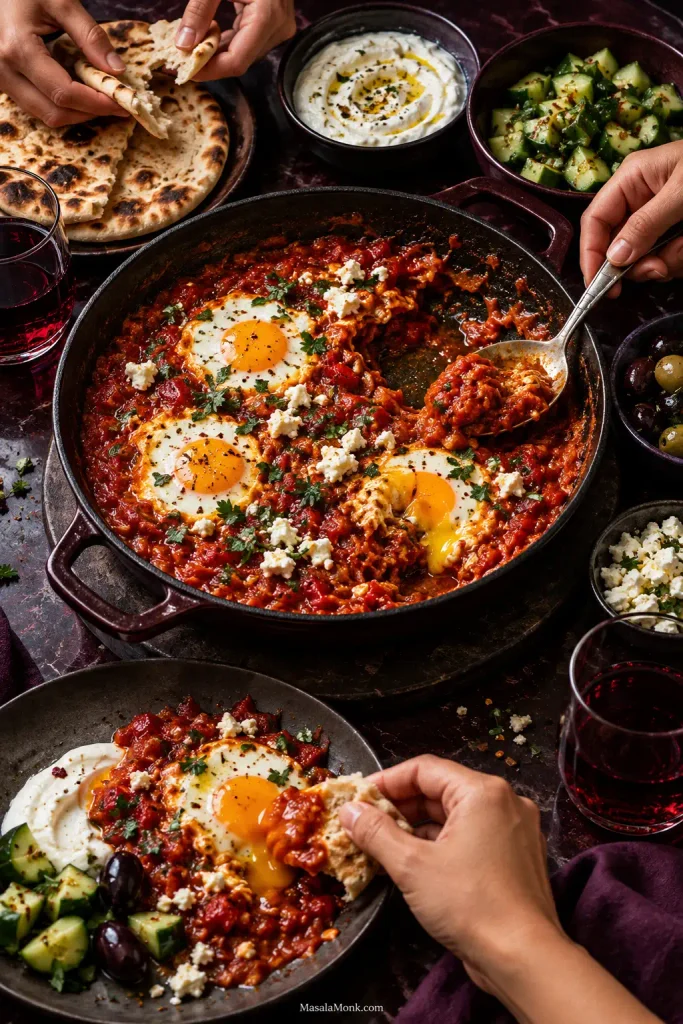
Bread gets first place beside the skillet. Warm pita, flatbread or a crusty loaf can scoop the thick tomato sauce and catch the yolk when it breaks. Our homemade pita bread recipe includes both oven and stovetop methods.
Shakshuka may be known as breakfast or brunch food, but it is just as comfortable at lunch or dinner. Thick yogurt or labneh, olives and extra feta can round out the table.
Something cold and crisp is especially welcome beside hot tomatoes and a rich yolk. Our cucumber salad with vinegar, dill and onion adds crunch and acidity without asking you to cook another dish.
Keep cool sides beside the skillet so yogurt, labneh or cucumber can brighten individual bites without cooling the shakshuka meant for second servings.
Put the skillet in the middle of the table. Shakshuka is easier to love when nobody is trying to carve six perfect restaurant portions out of it. Spoon an egg and plenty of sauce into shallow bowls, tear the bread, pass it around, and go back for whatever is left between the eggs.
Then break a yolk. Let it run through the cumin-scented tomatoes, drag a warm piece of bread through both, and take the next bite while the skillet is still hot.
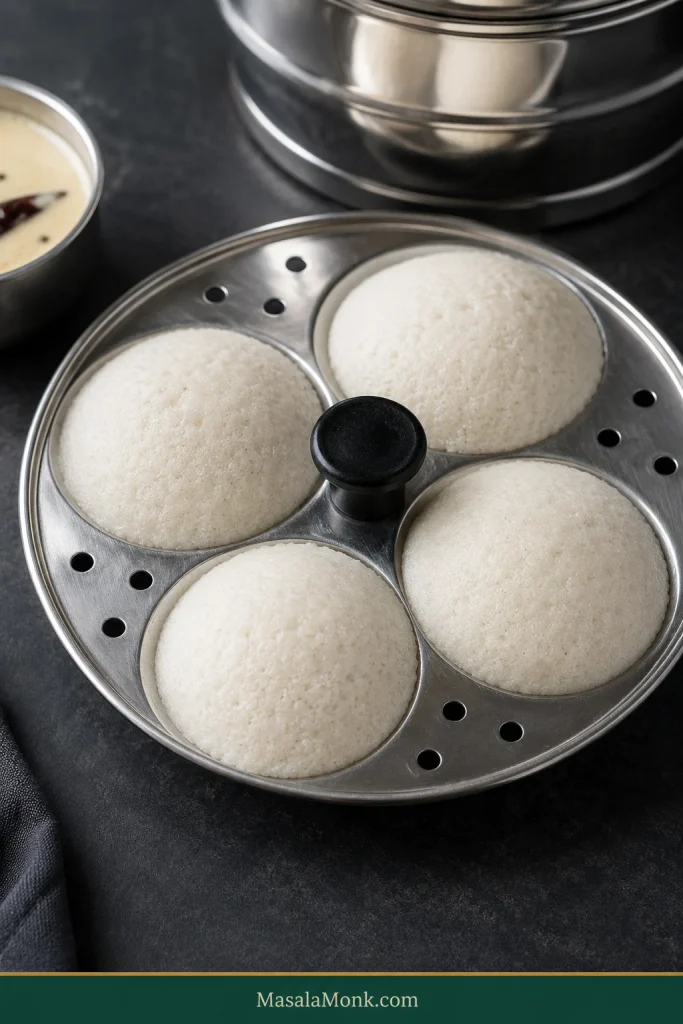
A really good idli feels lighter than it looks. Press one gently and it gives under your finger, then springs back. Tear it open and the middle is soft and porous, ready to drink in sambar or catch a spoonful of coconut chutney. Even ghee and podi are enough when the idli itself is right.
Most of that softness is decided before the batter reaches the steamer. Urad that never gained much air tends to stay heavy, and very stiff batter struggles to expand. Then a few unnecessary minutes of steam can firm up a batch that fermented beautifully.
That is what makes idli frustrating when it goes wrong: you soak, grind and wait overnight, then discover the problem in the first steamed plate. The finished idli usually tells you where to look. Use the 4:1 batter below as your baseline; if yours behaves differently, the later sections help trace the cause.
Start with a 4:1 rice-to-urad ratio by weight: 400 g idli rice and 100 g urad, plus 20 g poha and ¼ teaspoon methi. Soak the rice and urad separately for about 4 hours. Grind the urad until pale, smooth and airy; grind the rice and poha separately until very fine with just a faint grain remaining.
When the two are mixed, the batter should fall from a ladle in a thick, broad ribbon and slowly settle back into the bowl. Ferment until it has risen, shows fine bubbles, feels lighter and smells clean and mildly sour.
Steam in an already hot steamer and begin checking common medium idlis around 9–10 minutes. The surface should look matte and set, and the centre should spring lightly when touched. Rest the plates for 2–3 minutes before unmoulding.
Soft & Fluffy Idli Recipe
Recipe at a Glance
Yield
About 20–24 medium idlis, depending on mould size and fill
Rice : urad
4:1 by weight
Typical hands-on prep
About 25–35 minutes with a blender or mixer-grinder
Soaking
About 4 hours at room temperature
Fermentation
From about 8 hours in a warm kitchen, judge by rise, bubbles, texture and aroma
Steaming
Begin checking around 9–10 minutes
Plan ahead
Commonly about 13–18 hours in warm conditions; cooler kitchens take longer
Making idli for breakfast? Soak in the afternoon, grind in the evening and ferment overnight. In the morning, judge the batter while the steamer heats. Most of the elapsed time is simply waiting.
Equipment
Kitchen scale, strongly recommended
Two soaking bowls
Wet grinder, high-speed blender or mixer-grinder
Large fermentation container
Idli plates and steamer, or another covered steaming vessel
Ladle and spoon for unmoulding
Kitchen thermometer, optional for a cold kitchen
Ingredients
Use the gram measurements when possible. Cup sizes vary between kitchens and countries; 400 g rice and 100 g urad always preserve the intended 4:1 ratio.
Ingredient
Metric
Approximate volume
Idli rice / suitable parboiled rice
400 g
about 2 cups
Whole skinned urad dal / urad gota
100 g
about ½ cup
Thick poha / flattened rice
20 g
about ¼ cup
Fenugreek seeds / methi
about 1 g
¼ teaspoon
Fine salt
6 g
about 1 teaspoon if finely ground
Cold water for urad — mixer/blender method
120–150 ml
½ cup to ½ cup + 2 tablespoons
Cold water for rice — mixer/blender method
180–220 ml
¾ cup to just under 1 cup
Oil or ghee for greasing
as needed
—
If your salt is coarse, use the 6 g weight instead of trying to match one teaspoon exactly.
Wet-grinder note: the water quantities above are starting ranges for blade grinders. Stone grinders take water differently as the urad expands. Add it gradually and stop when the urad has become light and airy.
1. Soak the Rice and Urad Separately
Rinse the rice several times and cover it generously with fresh water. In another bowl, rinse the urad, add the methi and cover with fresh water.
Soak both for about 4 hours. About 20–30 minutes before grinding, rinse the poha and soak it separately until soft. Keep the rice and urad apart because they need different grinding textures.
Need to soak longer? Keep room-temperature soaking to about four hours. For a longer soak, refrigerate the rice and urad at 4°C / 40°F or below. The BC Centre for Disease Control’s dosa and idli food-safety guidance provides additional controls for soaking and refrigerated storage.
2. Grind the Urad Until It Looks Almost Whipped
Drain the urad and methi well. With a mixer-grinder or high-speed blender, begin with about 120 ml cold water. Grind, scrape the jar as needed and add more cold water a little at a time.
If your mixie heats quickly, chill the soaked urad first. The finished batter should be pale and smooth, but smoothness is only half the job. It should also look noticeably fuller, with fine bubbles through it, and feel light on the spoon instead of sitting there like a dense paste.
Give a warm jar a short rest before continuing.
Wet grinder: grind the urad first and add water gradually while the stones work. Stop when it is smooth, airy and clearly expanded.
Fermentation cannot fully replace aeration the grinder never built. Light, expanded urad gives the later batter more structure to work with.
3. Grind the Rice and Poha
Drain the rice and poha. For a blade grinder, start with about 180 ml cold water and add more only as needed to keep the mixture moving.
Rub a little between your fingertips. Rice is much more forgiving than the urad here. Hard pieces need more grinding, but if it went slightly smoother than intended, carry on with the batch.
Wet grinder: remove the urad first, then grind the rice and poha separately to a very fine texture with a faint grain remaining.
A faint grain is enough here: once hard pieces are gone, chasing perfectly silky rice batter usually adds less than getting the urad aeration right.
4. Combine and Check the Flow
Transfer both batters to a clean container that will be no more than about half full after mixing. Add the salt and mix thoroughly.
Lift a ladleful and let it fall back into the bowl. Good batter comes down in a broad, thick ribbon, sits on the surface briefly and then slowly disappears. Heavy clumps mean it needs a little more water. Add 1 tablespoon / 15 ml at a time and stop as soon as the ribbon flows properly.
Think of the ribbon as a hydration endpoint rather than a water measurement; rice and grinder differences can change how much water gets you there.
5. Ferment
Cover the container with a lid or plate without sealing it airtight and leave it somewhere comfortably warm.
In a warm kitchen, from about 8 hours onward, judge the batter by what has changed. It should sit higher in the bowl, show fine bubbles along the sides and feel lighter when you scoop into it with a ladle. The aroma should be gently sour and still pleasant.
Do not chase somebody else’s dramatic rise. Compare your own batter before and after: lift, fine bubbles, lighter body and mild tang are the useful changes.
When those signs are there, heat the steamer. Almost no movement by morning usually points to temperature first.
6. Heat the Steamer
Add enough water to create strong steam without letting it touch the idli plates. Around 1½–2 cups / 360–480 ml works as a starting point for many home steamers. Bring the water to an active simmer or boil before the filled stand goes in.
Pressure cooker: use it as a steamer with the lid on and the weight/whistle removed. Instant Pot: use a steaming setup with the valve venting. Do not pressure-cook the idlis.
7. Fill the Idli Moulds
Lightly grease the cavities. Give the fermented batter one or two gentle folds if it needs evening out, then fill the moulds about three-quarters full. For many medium plates that works out to roughly 3 tablespoons / 45 ml, but there is no need to measure each cavity.
Leaving headroom does more than prevent overflow: similar fill levels make the steaming time across a plate much easier to interpret.
8. Steam Until the Centre Is Set
Put the stand into the already steaming vessel and cover. Begin checking around 9–10 minutes.
Lift the lid and let the steam clear. The tops should look softly matte instead of wet and shiny. Press the middle gently; it should spring back. A skewer inserted into the thickest part should come out without raw batter.
Deeper moulds usually need a little longer. Once the centre is set, take the plate out. A cooked centre is the finish line; extra steam only makes the idli firmer.
Matte, set tops and a springy centre are the cue to stop steaming; once the centre is cooked through, extra time only makes the crumb firmer.
9. Rest and Unmould
Leave the plates for 2–3 minutes. Dip a spoon in water, slide it around the edge and lift each idli gently from underneath.
Break the first one while it is warm. An open, moist crumb means the timing is right for the remaining plates.
Treat the first warm idli as feedback on the whole process. Open, moist crumb suggests the batter had enough structure and the steamer stopped in time.
If that first plate is already soft and airy, keep going. If not, use the shortcuts below to trace the batter, fermentation or steamer.
Use idli rice or Ponni parboiled rice when available. Sona Masoori also works; adjust the water as needed and expect a somewhat different crumb. Basmati and other aromatic long-grain rice are less predictable for this style of idli.
Outside India, Indian groceries commonly carry bags labelled Idli Rice, Ponni Boiled Rice or Ponni Parboiled Rice. Idli rava belongs to a different method and should not replace the whole rice cup-for-cup.
Fresh Urad Matters More Than Whole vs Split
Whole skinned urad, often sold as urad gota, is an excellent choice, and split skinned urad works too. Buy from a shop with good turnover when possible. Fresh urad usually hydrates and expands better; older stock can become perfectly smooth in the grinder and still stay disappointingly heavy.
Markedly yellowed or tired-looking dal can suggest age, although colour by itself is not a reliable date stamp.
At the shop, get into the right rice family first; then prioritise good-turnover urad instead of obsessing over whole versus split.
About the poha and methi: excellent idlis can be made from rice, urad, water and salt alone. This version uses 20 g poha for a little extra softness and only ¼ teaspoon methi. No methi? Make the batter without it.
An ivory or off-white idli is normal. Texture matters far more than chasing a perfectly white surface.
For a millet version, use a batter designed around the grain instead of replacing the rice here. Our Fermented Ragi Idli uses its own balance of ragi, rice, poha and urad.
Why the Rice-to-Urad Ratio Can Vary
For this recipe, use 4:1 by weight: 400 g rice to 100 g urad. Other excellent idli recipes use 3:1, 5:1 and more rice-heavy ratios because urad quality, grinder performance and additions such as poha all change the way the batter behaves.
Keep the 4:1 base while you learn the recipe. Heavy idlis are better diagnosed through the grind, batter thickness and steaming before you start changing the dry ratio.
Holding the 4:1 ratio steady makes troubleshooting easier: changes in texture are then easier to trace to grinding, hydration or steaming.
Wet Grinder, High-Speed Blender or Mixer-Grinder?
If you own a wet grinder, use it; it is the easiest of the three for building highly aerated urad. A powerful blender is the fastest. A regular mixie also works well when you keep the urad cold, avoid overloading the jar and add water gradually.
The ingredients may be identical, but the failure points change: stone pickup, blender circulation and mixie heat each deserve a different kind of attention.
Wet Grinder
A wet grinder works slowly and generally keeps the batter cooler. Grind the urad first, adding water gradually as the stones work, until it is smooth, airy and clearly expanded. The texture is the useful endpoint here, not an arbitrary number of minutes.
Some large wet grinders struggle with only 100 g dry urad because the soaked dal forms too shallow a layer. If yours is barely being picked up by the stones, double the recipe or use a smaller grinder.
High-Speed Blender
A powerful blender moves fast, and the batter can heat fast with it. Use cold water, leave enough room for the mixture to circulate and stop when the urad is airy and noticeably larger in volume.
Regular Mixer-Grinder
An everyday Indian mixie works well for idli batter. Chill the soaked urad if the machine heats aggressively, drain it well and work in manageable batches.
Urad that stays dense even after the water, heat and batch size are under control may simply be meeting the limits of that particular jar and blade setup.
Reading the Batter When Something Looks Off
Smooth Urad That Never Became Airy
If the urad is perfectly smooth but still sits heavily on the spoon, do not let the smoothness fool you. The useful change is the extra air and volume: well-ground urad feels much lighter and contains fine bubbles throughout.
A dense urad batter can be perfectly smooth and still ferment. It simply begins with less trapped air for the mixed batter to expand around.
A small drop often floats in water when the urad has trapped plenty of air. Treat that as one clue, not a verdict on the finished batter.
Rice That Went Too Smooth—or Stayed Too Coarse
Hard rice pieces need more grinding. Completely smooth rice batter is much less worrying; continue with the batch.
Too Thick, Right or Too Thin?
State
What You See
What It Can Cause
Too thick
Falls in clumps and leaves pronounced mounds
Slower expansion and dense idlis
Good range
Falls in a thick ribbon that slowly disappears
Enough moisture while still holding height
Too thin
Pours quickly and levels almost immediately
Flat, weak or sticky idlis
Too-stiff batter is easy to loosen a tablespoon at a time. Make the last water additions slowly; once the batter pours freely, taking that water back out is much harder.
Use these states to choose a direction, not an exact water number: heavy ridges need cautious loosening; a fast pour means stop adding water.
Fermenting Idli Batter in Warm and Cool Kitchens
An overnight ferment in a hot kitchen and one in a cold apartment are not the same job. If you can control the temperature, around 28–30°C / 82–86°F is a useful working range.
Kitchen / Batter Environment
What to Expect
About 28–30°C / 82–86°F
Begin checking around 8 hours, then judge by the batter itself
About 25–27°C / 77–81°F
A slower rise is normal
Below about 24°C / 75°F
Give the bowl gentle, controlled warmth
Very warm kitchen
Fermentation moves faster, so check earlier
For a Cold Kitchen
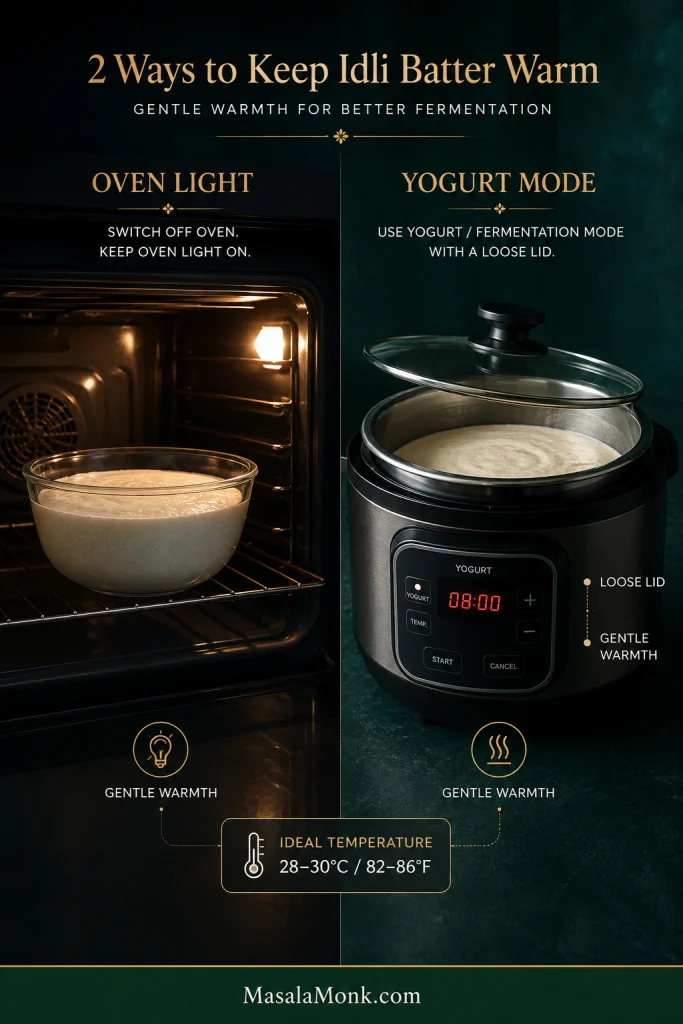
A switched-off oven with its light on can provide a warmer spot. With an Instant Pot, use Yogurt/fermentation mode with a loose or glass lid; do not seal the pot for pressure. The batter still decides when fermentation is finished, so do not run the full programmed cycle blindly.
A kitchen thermometer is useful when you are unsure how warm the space really is. Gentle warmth is enough.
Use an oven light or Yogurt mode for gentle warmth, then judge readiness by the same rise, fine bubbles, lighter body and mild tang as usual.
Ready batter usually gives several clues together: it sits higher in the container, fine bubbles appear along the sides or surface, the batter feels lighter when you scoop through it, and the aroma has developed a mild fermented tang.
Does Idli Batter Have to Double?
No. A big rise is encouraging. Read it together with the bubbles, lighter texture and aroma. A lively batch can be ready without matching somebody else’s dramatic before-and-after photograph.
My Batter Didn’t Rise Overnight. What Now?
A cold kitchen may simply need more time and a warmer spot. If the batter was already kept comfortably warm, compare its consistency next. Very thick batter struggles to expand; very loose batter may bubble without building much height. Dense urad gives fermentation less airy structure to work with.
Fix those fundamentals before reaching for Eno, baking soda or yeast. Extra gas does not repair a poorly ground or badly balanced batter.
How to Steam Idli Without Guessing
Idli recipes give different steaming times because steamers and moulds differ. A shallow cavity in a compact stovetop steamer does not cook like a deep cavity halfway up a tall stack.
Start with an already hot steamer and fill the cavities to roughly the same level. About three-quarters full is a useful visual guide. Those two habits remove much of the variation before the timer starts.
Use the First Plate to Calibrate Your Steamer
With an unfamiliar steamer or mould, cook one plate before filling every rack. Begin checking the centre around 9–10 minutes.
A wet centre needs another minute or two. Dry, firm idlis mean the next plate should come out earlier. Once you know your moulds and steamer, the timing becomes routine.
Bottom plate wet while the others are fine? Its position is the first suspect, not the batter. It may be sitting unusually close to the boiling water or catching more condensation.
Your first successful plate becomes a local calibration for that mould and steamer, so the next batch starts with evidence instead of a generic timer.
No Idli Stand?
Use shallow heat-safe cups or small bowls inside a covered steamer. Grease them lightly and leave room for expansion.
Cups are often deeper than idli moulds, so the centre usually needs a little longer. Judge doneness by the set surface and springy middle instead of treating 9–10 minutes as an exact promise.
Substitute vessels do not cook by capacity alone: a deeper centre changes the steaming job even when two cups hold roughly the same amount.
What Went Wrong With Your Idli?
The cooked texture usually narrows the possibilities quickly. Change one thing at a time.
What Happened?
Start Here
Next Move
Hard + dense
Urad aeration, thick batter, steaming
Loosen the remaining batter if needed and shorten the next steaming test
Hard despite a good rise
Batter thickness and steaming
Confirm the batter still has a thick-ribbon flow, then take the next plate out earlier
Hard + flat
Fermentation and urad aeration
For the next batch, revisit warmth, dal freshness and how much volume the urad gained
Soft but flat
Loose batter or heavy post-fermentation mixing
Add no more water and handle the remaining batter gently
Dry / rubbery
Too much steaming
Shorten the next plate
Soft hot, noticeably hard once cool
Steaming time and moisture loss
Take the next plate out as soon as the centre sets and keep cooked idlis covered
Wet / gummy centre
Weak steam, deep fill or undercooking
Improve the steam and cook only until the middle sets
Use the crumb to narrow the search before changing anything: weak structure, an unset centre and excess steaming leave different signatures.
My Batter Fermented Beautifully. Why Are the Idlis Hard?
If the batter rose well but the idlis are hard, consider batter thickness and steaming before extending fermentation. Urad should have been airy, not merely smooth. The mixed batter should have flowed in a thick ribbon instead of sitting in heavy lumps. Vigorous mixing after fermentation can knock out some of that volume, while idlis left over steam after the centre has set become firmer.
A nicely shaped idli that feels dry and resistant often points toward steamer calibration. By contrast, a heavy crumb from edge to centre sends you farther back toward the urad and water.
Use the finished idli to decide how far back to investigate: dry but well-shaped points late; uniformly heavy crumb sends you back toward the batter.
Flat Idlis: Soft or Hard?
Hard, flat idlis often go with weak fermentation, poor urad aeration or batter that stayed too heavy. A flat idli that stays soft points more toward loose batter or vigorous stirring after fermentation.
Shape alone does not diagnose a flat idli; the texture inside decides which branch of troubleshooting is worth following.
Sticky Mould or Gummy Crumb?
An idli that is cooked through but sticks to the mould may simply need another minute of rest, better greasing or a wet spoon. A gummy centre is a different problem: mould fill, steam strength and unusually loose batter are the first places to investigate.
Surface release and internal doneness are separate signals: better greasing or resting can help sticking, but it will not cure an unset centre.
Cooked Outside, Raw in the Middle?
Start with the steamer. Weak steam, unusually deep moulds or cavities filled almost to the rim can leave the middle behind. Correct the steam and fill before changing the batter.
How Much Batter Do You Need for 20, 50 or 100 Idlis?
Mould capacities vary enough that exact counts are misleading. Use these as planning quantities, then note what one batch actually gives you in your own plates.
Planning Goal
Rice
Urad
Poha
About 20–24 idlis
400 g
100 g
20 g
About 40–48 idlis
800 g
200 g
40 g
Plan for at least 50
1 kg
250 g
50 g
Plan for at least 100
2 kg
500 g
100 g
Scale the methi and salt by the same factor. For a large batch, grind several normal-sized loads instead of packing one jar or wet grinder too full, and divide the mixed batter between roomy fermentation containers.
Scale the dry ingredients mathematically; add grinding water by texture. Five batches will not necessarily need exactly five times the water.
Before steaming for a crowd, make one plate first.
Scaling ingredients is arithmetic; scaling the process means protecting grinder load, fermentation headroom and steam consistency as the batch grows.
Need exactly 1 kg of finished batter? Weigh one successful mixed batch in your kitchen first. Final batter weight changes with draining and grinding water.
Fresh Batter, Day-2 Batter & Leftover Idlis
Fresh vs Refrigerated Batter
For the softest idlis, use the batter fresh or during the first day or two after refrigeration. Fermentation continues slowly in the fridge, so the batter becomes more sour and may loosen, separate slightly or occasionally become more gelled.
If the fresh batter made excellent idlis and the refrigerated portion later behaves differently, use the older batter for dosa, uttapam or Kuzhi Vegetable Paniyarams. Should this happen often in your kitchen, steaming a few extra idlis while the batter is at its best is perfectly sensible.
When refrigerated batter remains sound but loses its best idli texture, the extra tang often suits dosa, uttapam or paniyaram better.
Keep refrigerated batter at 4°C / 40°F or below. The BCCDC guidance for controlled dosa/idli processes describes refrigerated holding of roughly 5–7 days, but those controls are not identical to every home recipe. Use the batter much earlier for the best idli texture.
Some liquid separation can happen as fermentation continues, so do not judge the batter by that sign alone. Visible fuzzy mould, unusual pink or orange patches, or a clearly rotten or otherwise off smell are reasons to discard it. If you are unsure about its safety, discard it.
Storing Cooked Idlis
Keep freshly steamed idlis covered while the next plates cook. Idlis that are wonderfully soft when hot but noticeably hard once cool often benefit from a shorter steam on the next batch.
Cool leftovers promptly and refrigerate them in a closed container. Reheat briefly with steam, or microwave under a damp paper towel in short bursts until hot throughout. Cooked idlis also freeze well and can be steamed straight from frozen until hot throughout.
Can You Make Dosa With This Idli Batter?
Yes. Scoop out only what you need and thin it gradually with water until it spreads comfortably across a hot tawa. Slightly older batter works especially well for dosa and uttapam because the stronger tang suits them.
This is an idli-first 4:1 batter, so it may not spread or crisp exactly like a batter designed specifically for very thin, crisp masala dosa.
Keeping dilution outside the main batch preserves your option to steam more idlis later instead of committing all the batter to dosa.
What to Serve With Idli
A hot idli is mild enough to work with something cool and creamy, a bowl of sambar, or a dry podi-and-ghee plate.
Coconut chutney: cool chutney against a hot idli is hard to improve upon. Make our South Indian Coconut Chutney while the final plates are steaming so both arrive fresh.
Sambar: break an idli into the hot broth and leave it for a few seconds. The edges soften first, the centre stays springy, and the open crumb fills with sambar.
Those interconnected pores are functional: they hold sambar inside a soft idli while enough structure remains for the crumb to stay tender rather than dissolve.
The Next Batch Gets Easier
The second or third batch is easier because you already know how the batter moved through your grinder and how long your moulds needed over steam. If something changes, the finished idli gives you somewhere to start.
Lift the lid, let the steam clear and ease an idli from the plate while it is still warm. Spoon over chutney or sambar, or keep breakfast simple with sesame oil or ghee and our Idli Podi / Milagai Podi.
Pancake morning has one small unfairness built into it: the person holding the spatula usually eats last. While everyone else gets a hot stack, you are still standing at the stove pouring, flipping and starting the next batch.
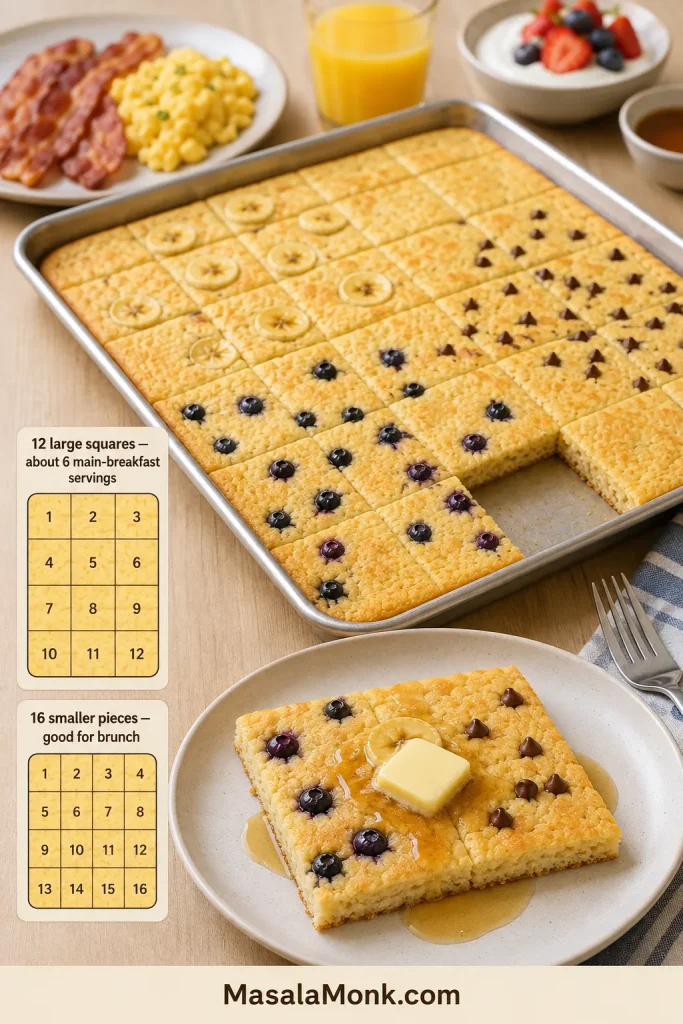
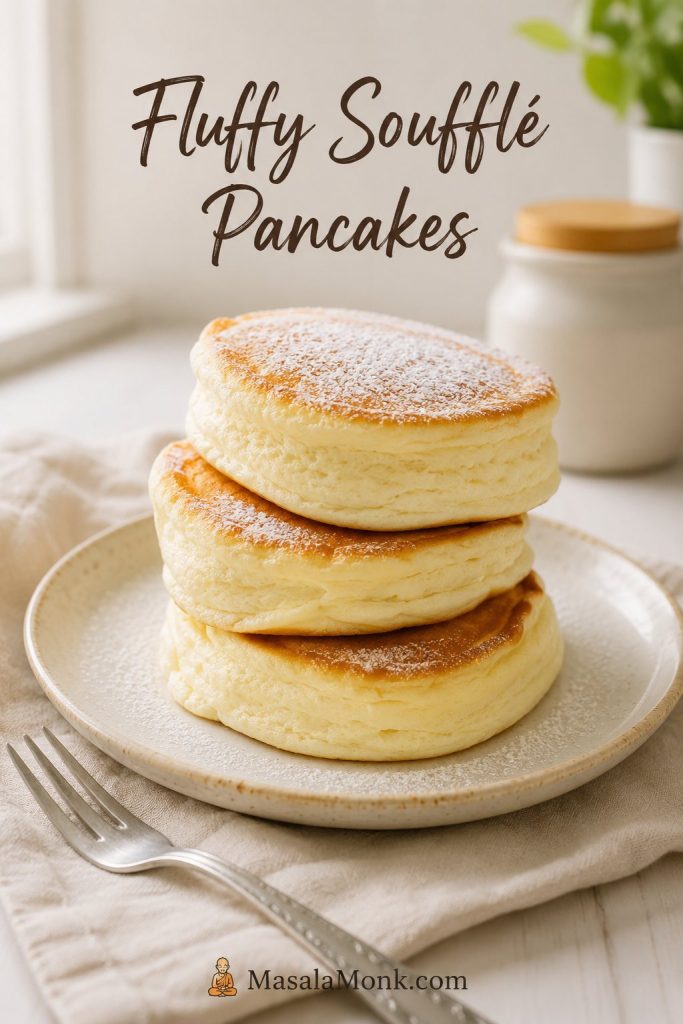
Sheet pan pancakes fix that. One batch goes into one rimmed pan, everyone gets a warm square together, and the result should still taste unmistakably like pancakes: lightly browned underneath, soft and buttery through the middle, ready for melting butter and maple syrup.
This recipe is sized for a 13×18-inch rimmed half-sheet, so the batter stays shallow enough to bake through without leaving you with dry edges and a slow-cooking middle.
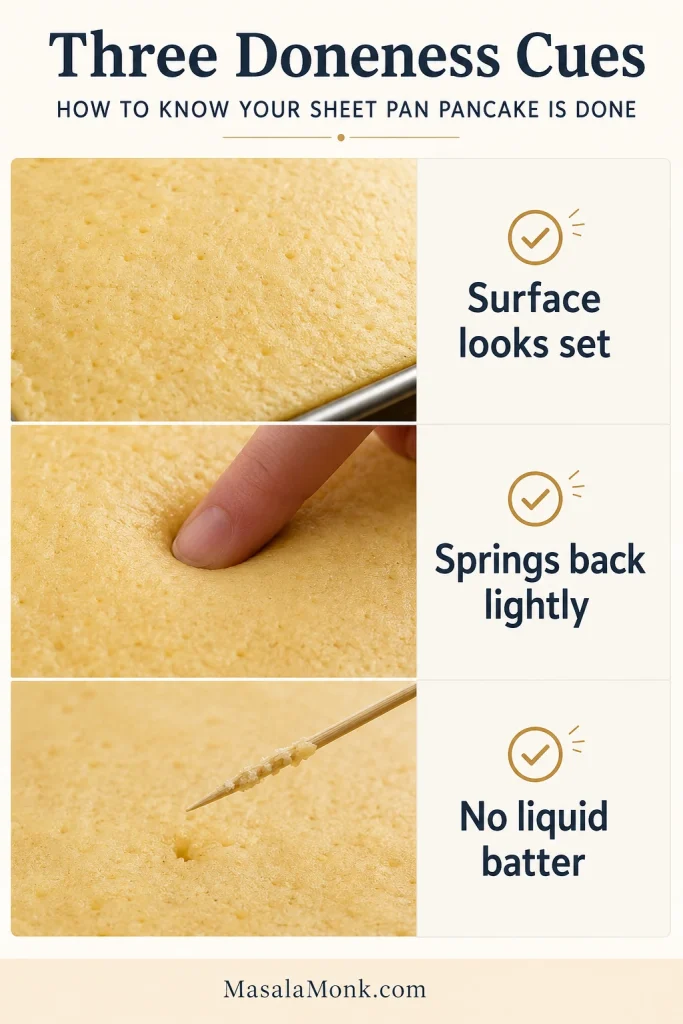
Spread thick-but-pourable buttermilk pancake batter evenly in a 13×18-inch (33×46 cm) rimmed half-sheet pan. Bake at 425°F / 220°C and start checking at 12 minutes. Most trays finish in 12–16 minutes.
The middle should look set and show no wet batter when checked. A lightly golden top is completely fine—you don’t need the deep browning of a pancake cooked on both sides of a griddle.
Sheet Pan Pancakes Recipe
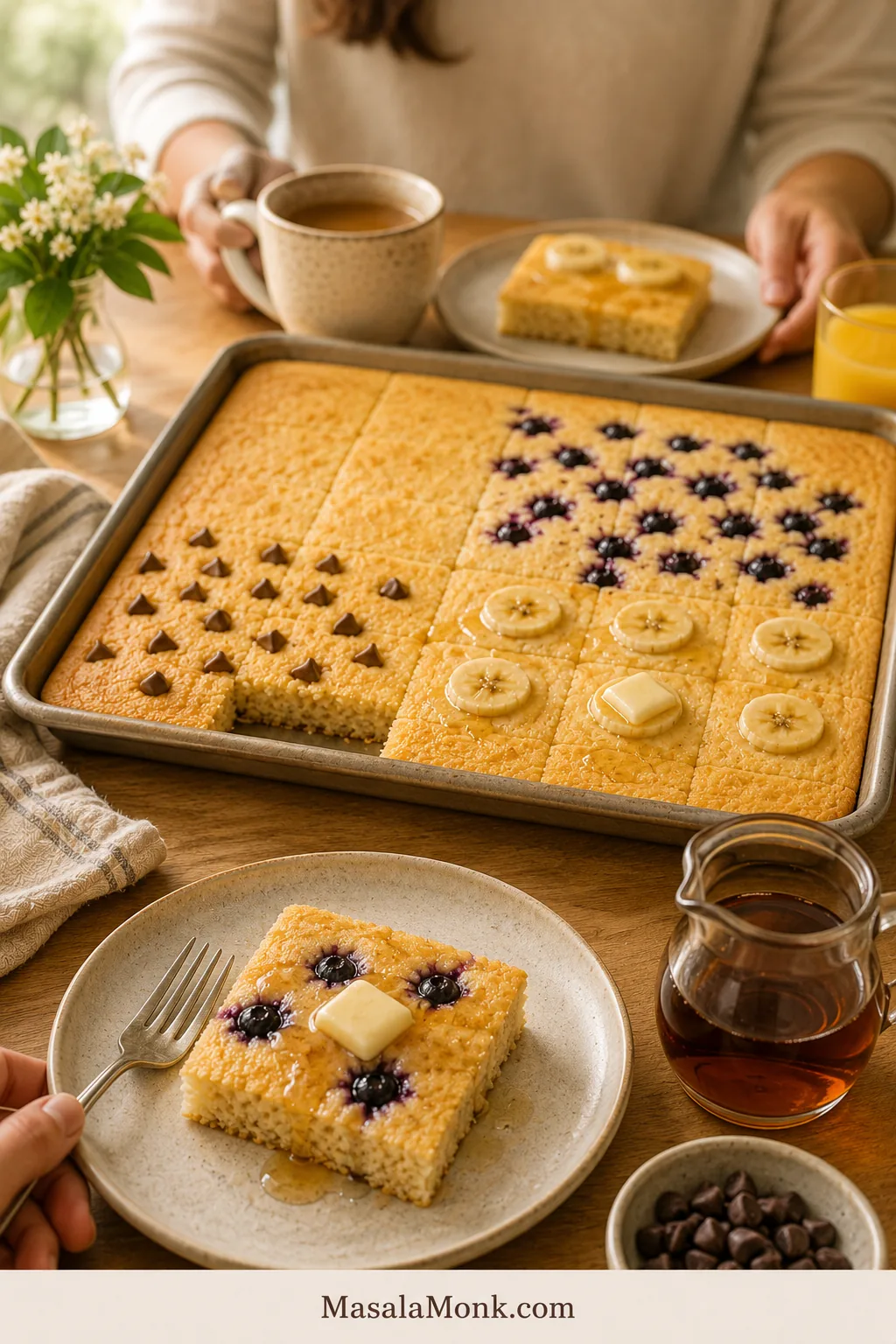
Make the whole tray plain, scatter one topping across it, or divide the batter into flavor zones so everyone gets the pancake they actually want.
Recipe at a Glance
Prep
About 10 minutes
Bake
12–16 minutes
Total
About 25–30 minutes, including a brief rest before cutting
Digital kitchen scale, especially useful for the flour
Ingredients
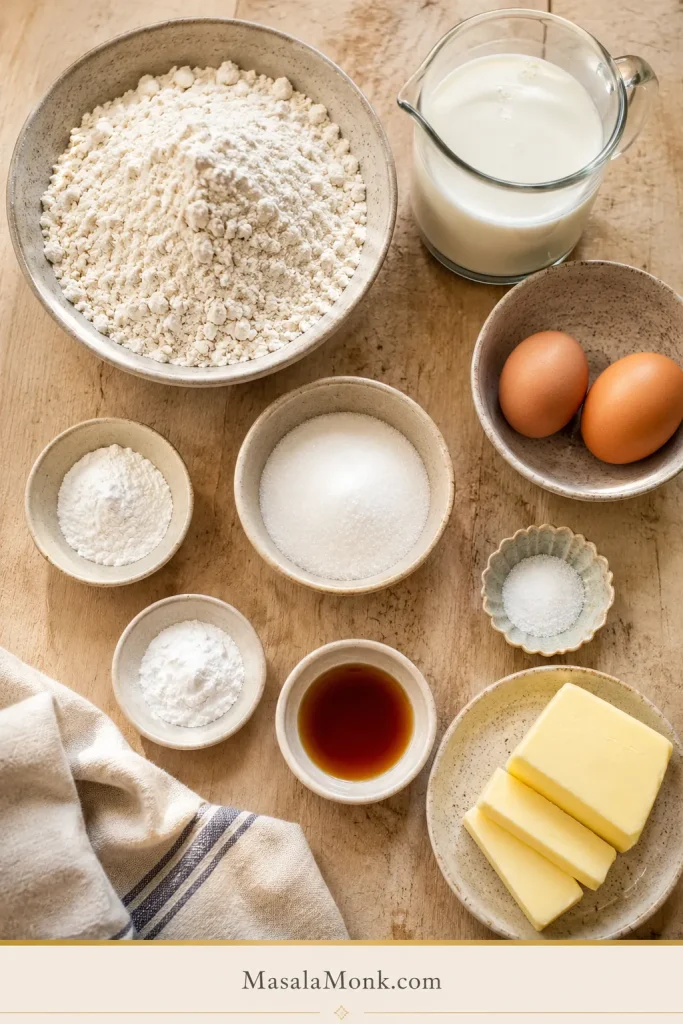
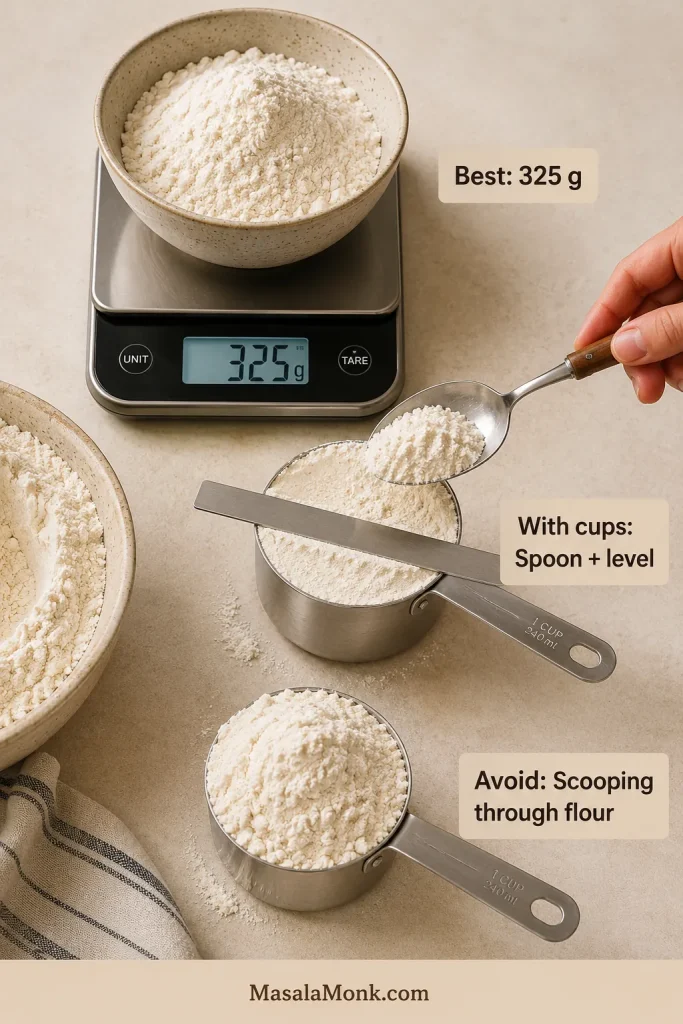
325 g (11.5 oz; about 2⅔ cups) all-purpose flour, spooned and leveled if using cups
50 g (¼ cup) granulated sugar
1 tablespoon baking powder (12 g)
¾ teaspoon baking soda (about 4 g)
¾ teaspoon fine sea salt (about 4–5 g)
2 cups / 480 ml buttermilk
2 large eggs
4 tablespoons / 57 g unsalted butter, melted and cooled slightly
2 teaspoons vanilla extract
1 tablespoon / 14 g butter, softened or melted, for the pan
Flour and leaveners are especially worth measuring carefully: flour affects batter thickness, while small leavener errors can change rise and flavor.
Optional Toppings
These are useful starting amounts for one full tray. There is no need to pull out a scale just to scatter a few berries.
125–150 g blueberries, about ¾–1 cup
100–120 g chocolate chips, about ½–⅔ cup
1 medium banana, thinly sliced
75–100 g strawberries, about ½–⅔ cup sliced
60–80 g pecans or walnuts, about ½–⅔ cup chopped
For several flavors on one pan, use less of each. Plenty of batter should remain visible between the toppings.
How to Make Sheet Pan Pancakes
Preheat the oven. Put a rack in the middle and heat the oven thoroughly to 425°F / 220°C conventional or 400°F / 205°C fan/convection, unless your oven automatically adjusts for fan cooking.
Prepare the pan. Butter the half-sheet, including the corners and sides. You don’t need to preheat the pan for this version; starting at room temperature gives you time to spread the batter evenly. If your pan has a history of sticking, line the base with parchment and lightly butter it.
Whisk the dry ingredients. Combine the flour, sugar, baking powder, baking soda and salt in a large bowl.
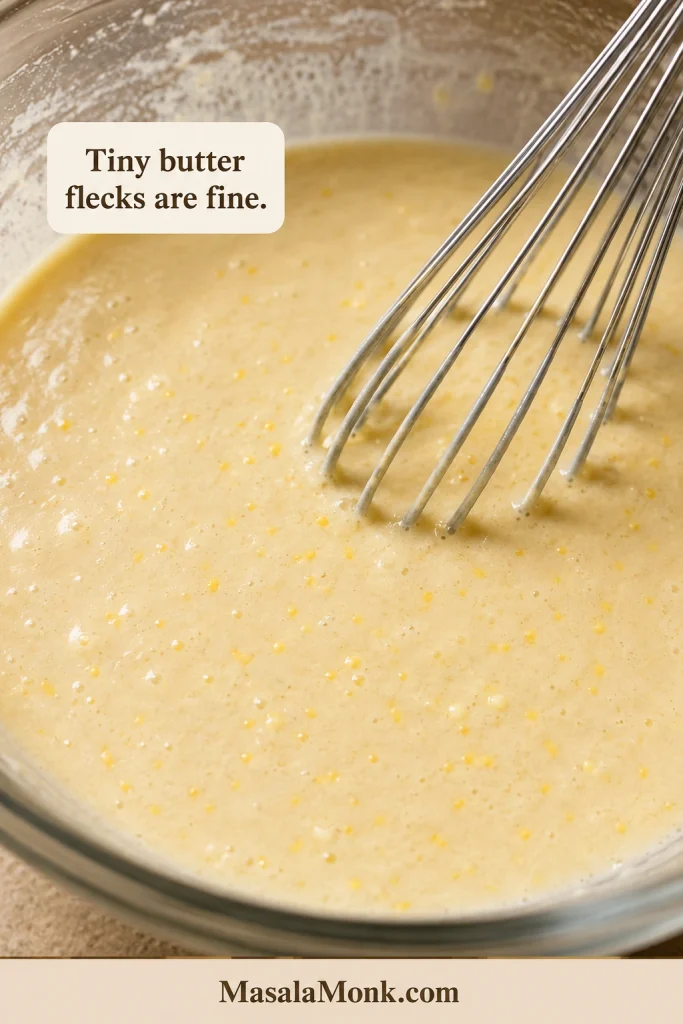
Mix the wet ingredients. In another bowl or large jug, whisk the buttermilk, eggs and vanilla. Whisk in the cooled melted butter. Cold buttermilk may make the butter form a few tiny flecks; that’s fine. They’ll melt in the oven.
Tiny butter flecks are normal when melted butter meets cold buttermilk. They will melt in the oven.
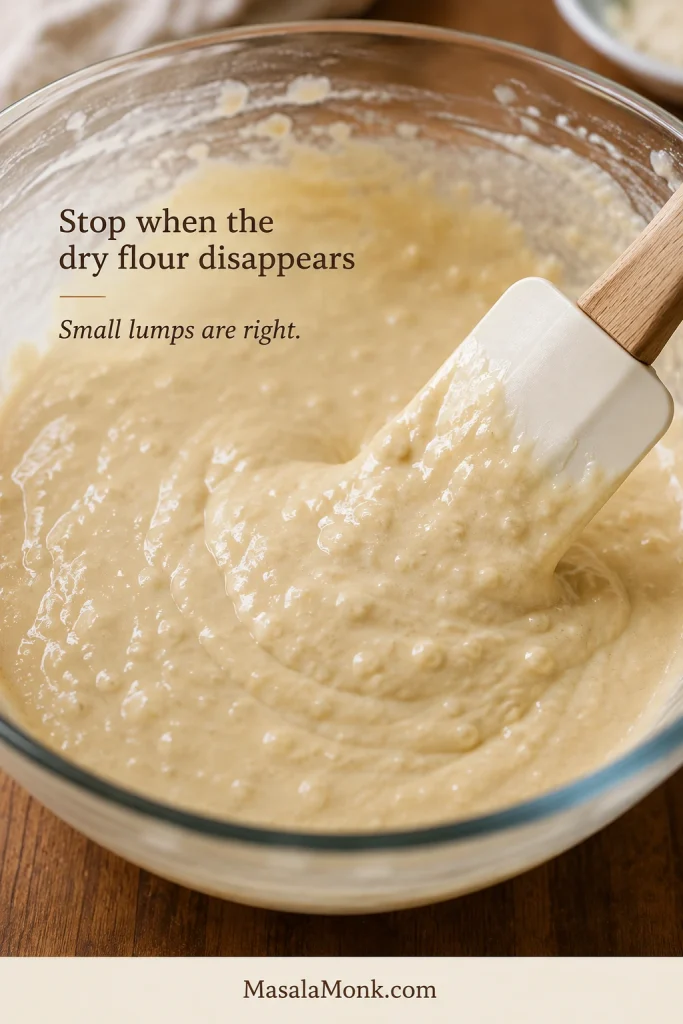
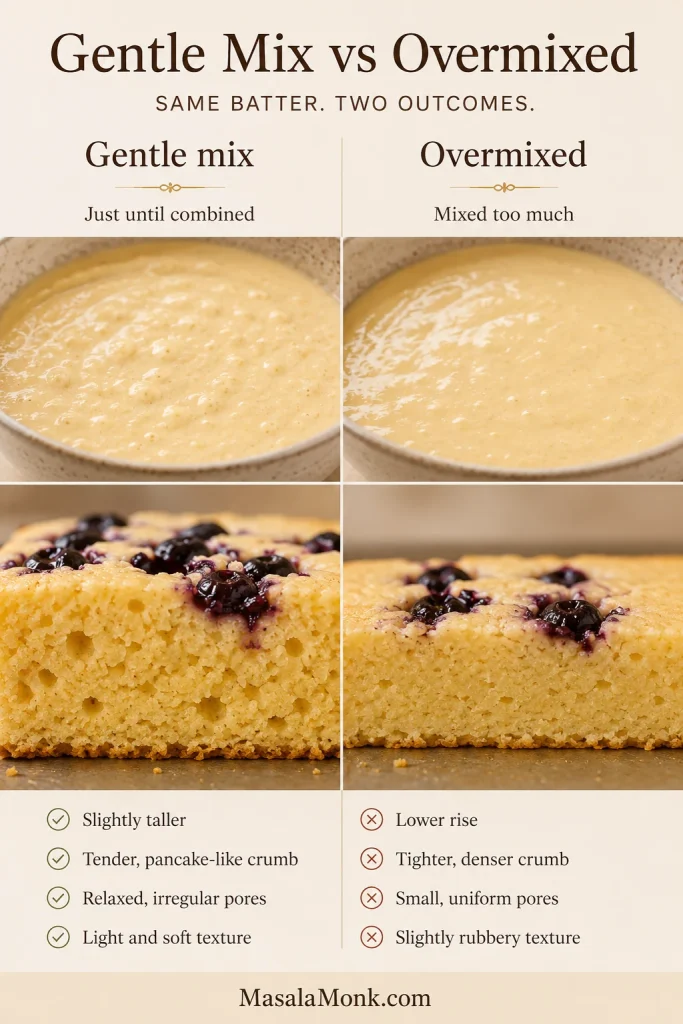
Fold the batter. Pour the wet mixture into the dry and fold gently with a flexible spatula. Stop as soon as the dry flour disappears. A few small lumps are exactly what you want.
Scrape the bowl once for hidden dry flour, then stop. Small lumps should remain.
Spread, Top and Bake
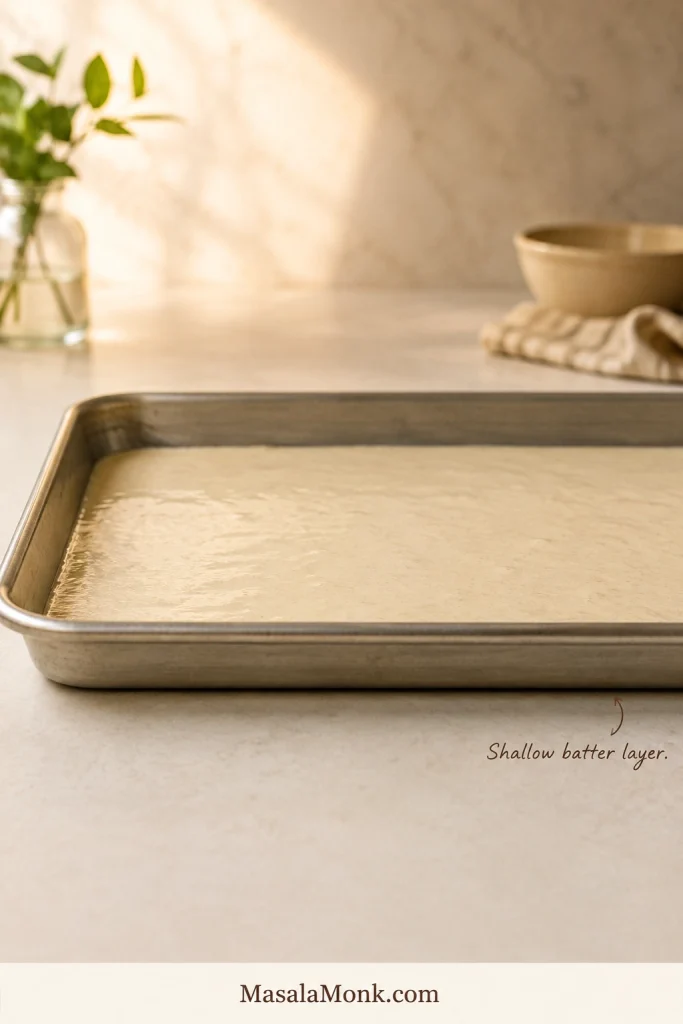
Spread it promptly. This batter doesn’t need a deliberate long rest. Pour it into the prepared pan, ease it toward the corners and give the tray a gentle jiggle to even the surface.
The batter should sit shallowly in the half-sheet. If it looks deep now, fix the pan or amount before baking.
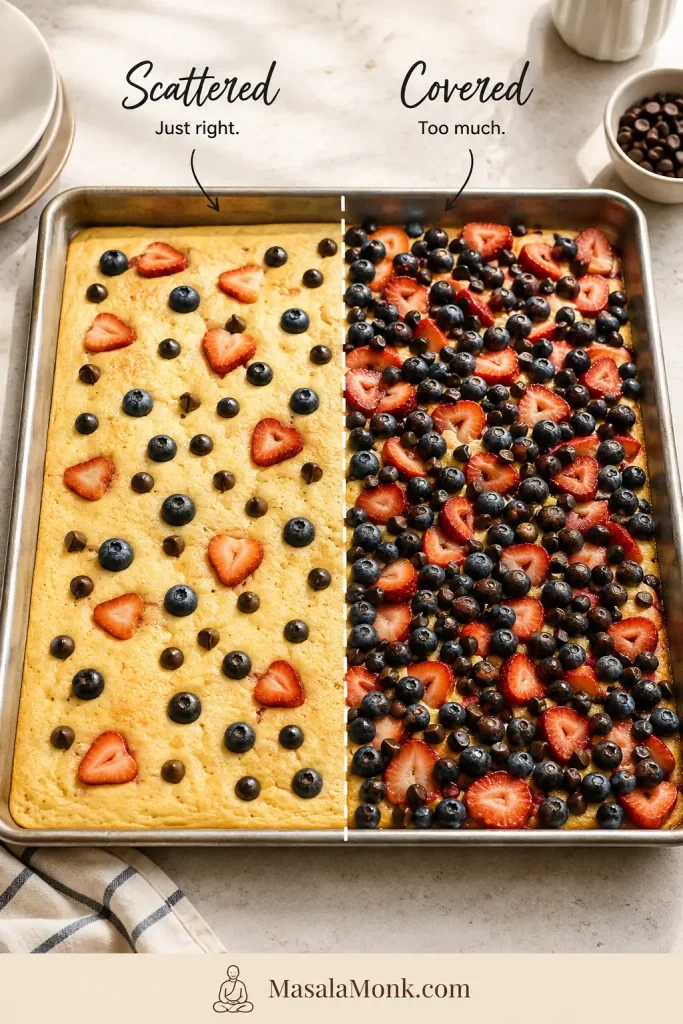
Add toppings. Scatter them over the surface, leaving plenty of batter visible between them.
Leave plenty of batter visible between toppings. Coverage matters more than counting individual berries or chips.
Bake. Start checking at 12 minutes. The center should look set, spring back lightly when pressed and show no liquid batter on a tester. Expect 12–16 minutes in most ovens.
Add more color only if you want it. Once the pancake is cooked through, broil very briefly if you want a little more browning. Watch continuously. Skip the broiler if parchment is sticking up near the heating element.
Rest and serve. Let the tray stand for 2–3 minutes, then cut the pancake into 12 large squares.
The finished tray should smell of warm butter and vanilla, with slightly firmer edges and a tender, springy middle. A broiler can add color in seconds; it can’t put moisture back into an overbaked pancake.
Why They Stay Fluffy
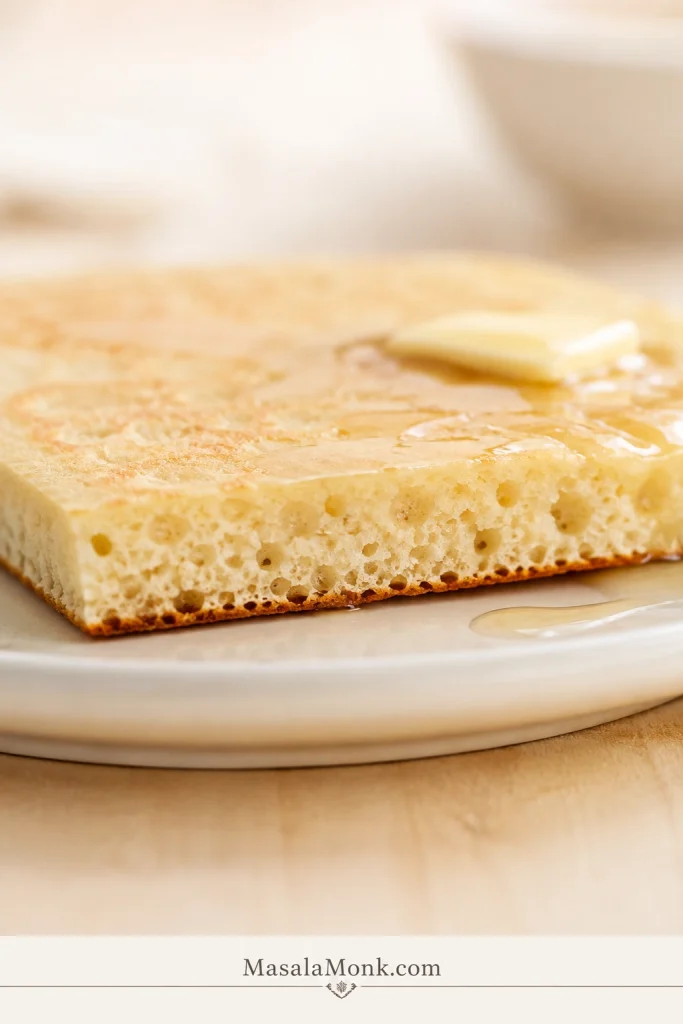
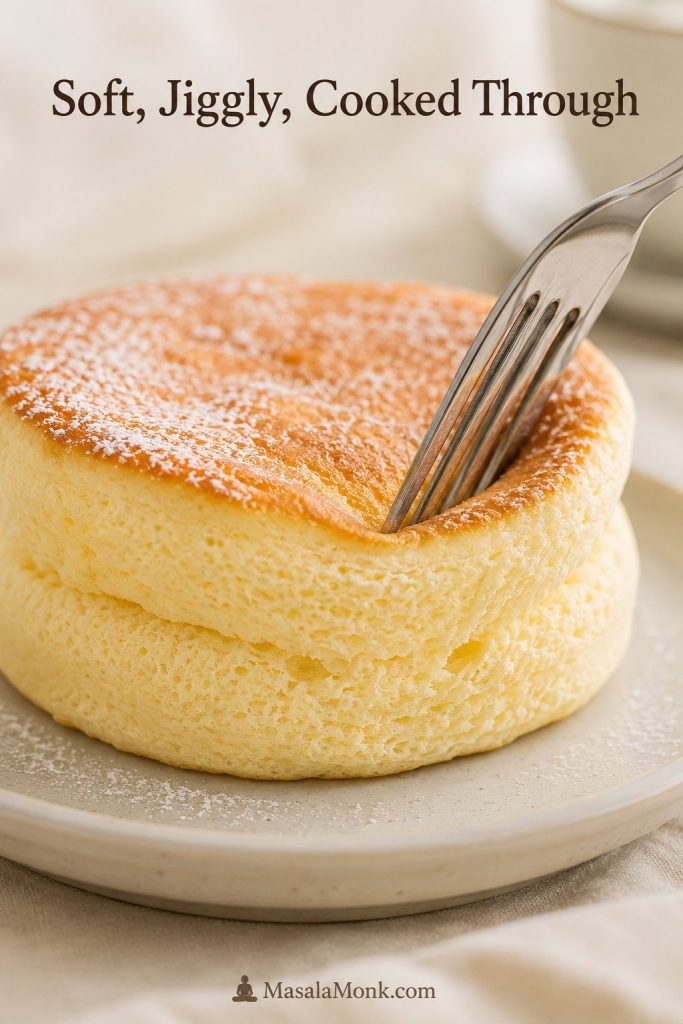
A good sheet pan pancake should still feel like a pancake when you lift a square: tender through the middle, springy rather than rubbery, and sturdy enough to reach the plate without behaving like a slice of sponge cake.
Small, irregular air pockets and a browned underside are exactly what a tender baked pancake should show.
Buttermilk + Leavening Give the Batter Its Lift
Buttermilk brings a slight tang and supplies the acid that baking soda needs. Baking powder adds more lift. Together, they give the batter what it needs to rise.
Once flour gets wet, continued mixing develops more gluten. Some structure is useful; too much gives pancakes a chewy, rubbery bite.
The smoother batter is not the better batter: overmixing tightens the crumb.
Stop while a few lumps remain. Pancake batter doesn’t need to look polished before it goes into the oven.
Measure the Flour Carefully
Extra flour makes the batter unnecessarily thick. If you have a scale, use the 325 g measurement. With cups, spoon the flour into the cup and level the top.
Using a scale? Tare the bowl first, then add 325 g flour directly.
Eggs give the pancake enough structure to cut cleanly, while melted butter keeps the crumb rich and tender. The sugar stays modest because syrup and toppings can add plenty later.
Numbers get you close. The batter itself is the final check.
What the Batter Should Look Like
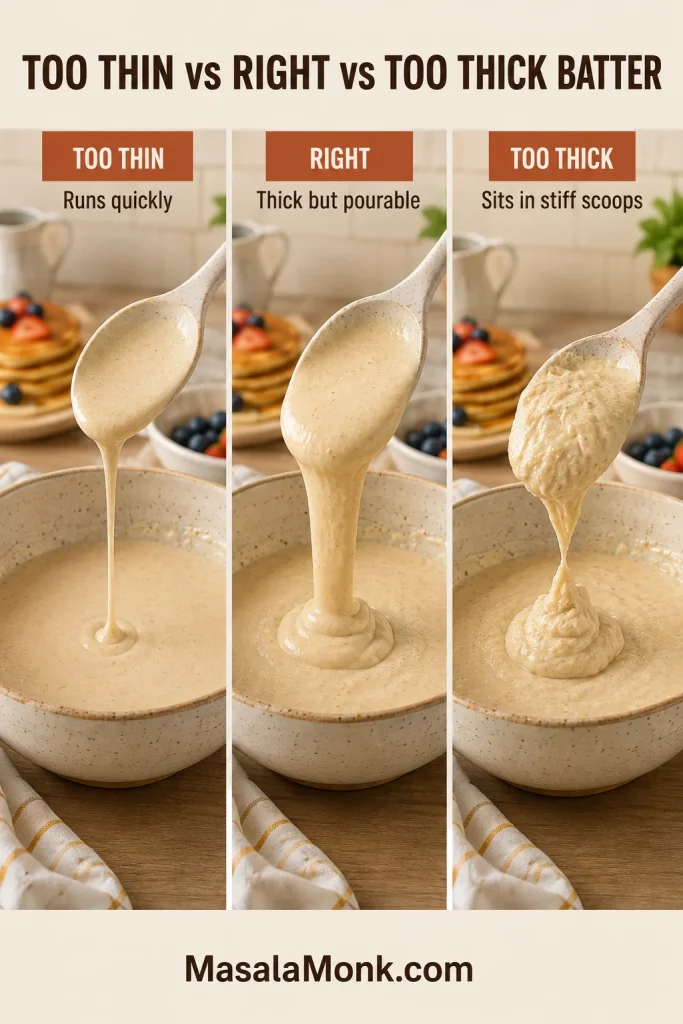
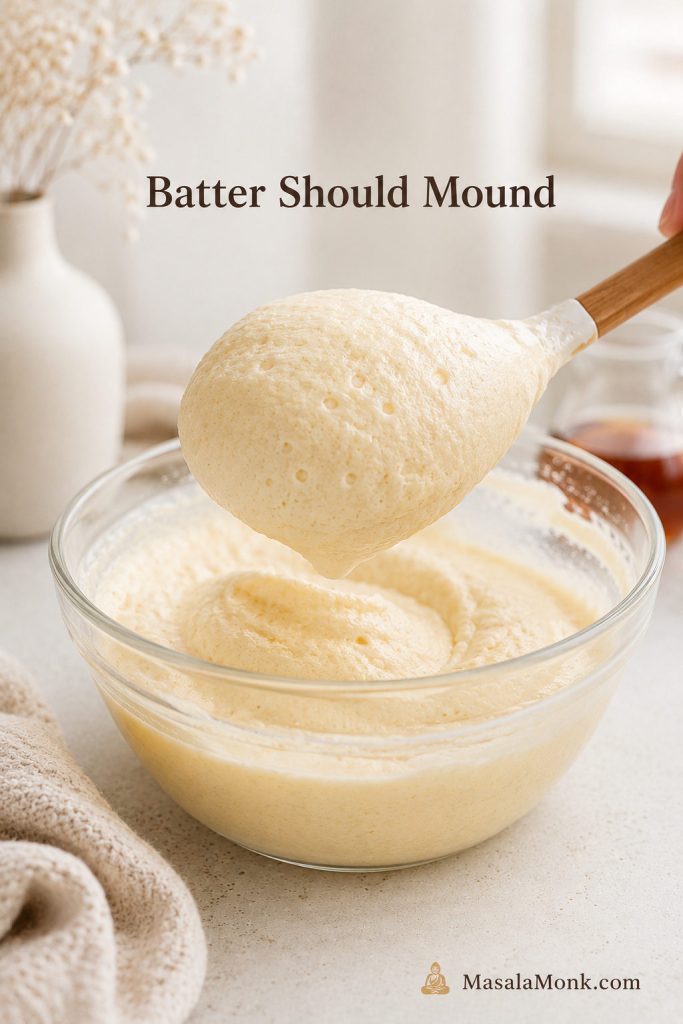
The batter should be thick but pourable.
It falls from the spatula in a broad, heavy ribbon.
It spreads slowly when encouraged toward the corners.
A few small lumps remain visible.
It doesn’t race across the pan like crêpe batter.
It doesn’t sit in stiff scoops like muffin batter either.
The right ribbon lands heavily, then slowly relaxes back into the batter.
If the batter is unusually stiff, first check whether the flour was overmeasured. Once that’s ruled out, fold in extra buttermilk 1 tablespoon at a time until the batter becomes comfortably pourable.
The homemade buttermilk substitute in the FAQ can be thinner than cultured buttermilk, so use these visual cues before making any adjustment.
Which Pan Works Best?
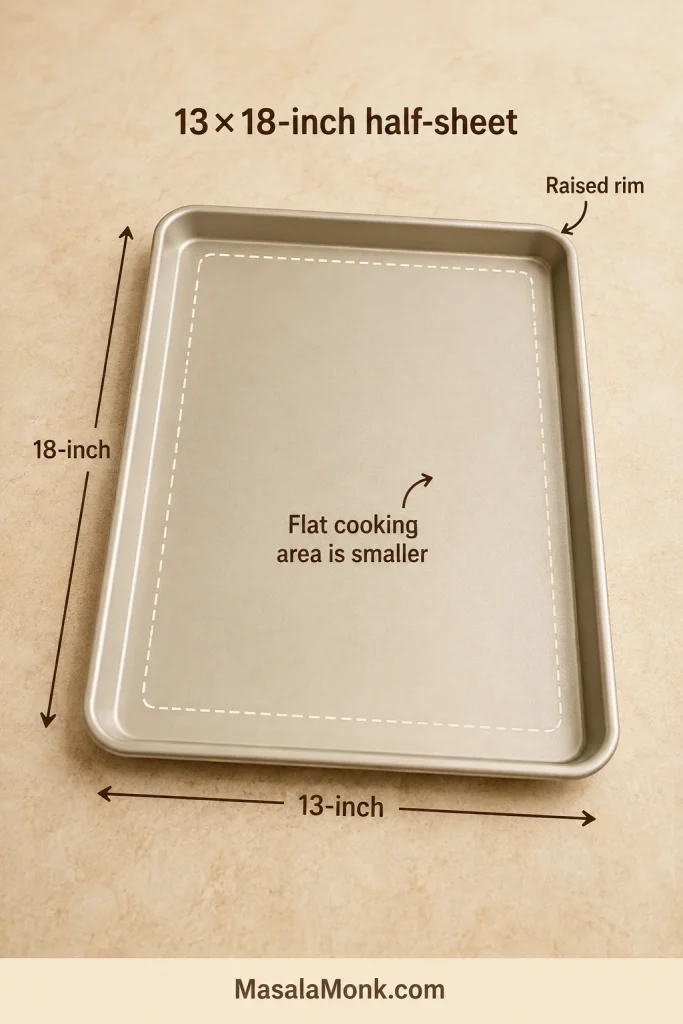
Use a light-colored 13×18-inch (33×46 cm) rimmed half-sheet for the easiest, most predictable version of this recipe. If that’s the pan you have, you’re set; the details below are mainly useful when your pan is darker, smaller or unusually sticky.
You might call yours a baking sheet, baking tray, sheet tray, oven tray or cookie sheet. The name isn’t important. It needs a raised rim and should be close to the standard half-sheet size.
A completely flat cookie sheet is the one style to avoid. Pancake batter and an unprotected oven floor are not a combination worth trying.
Why Does a 13×18 Pan Measure Smaller Inside?
The listed dimensions usually include the rim. Across the flat cooking surface, a pan sold as 13×18 inches may measure closer to roughly 12×17 inches.
So if yours seems a little smaller when you put a ruler inside it, you probably bought the right pan.
Measure across the outer rim; the flat cooking surface is naturally smaller than 13×18 inches.
Light Pan, Dark Pan or Parchment?
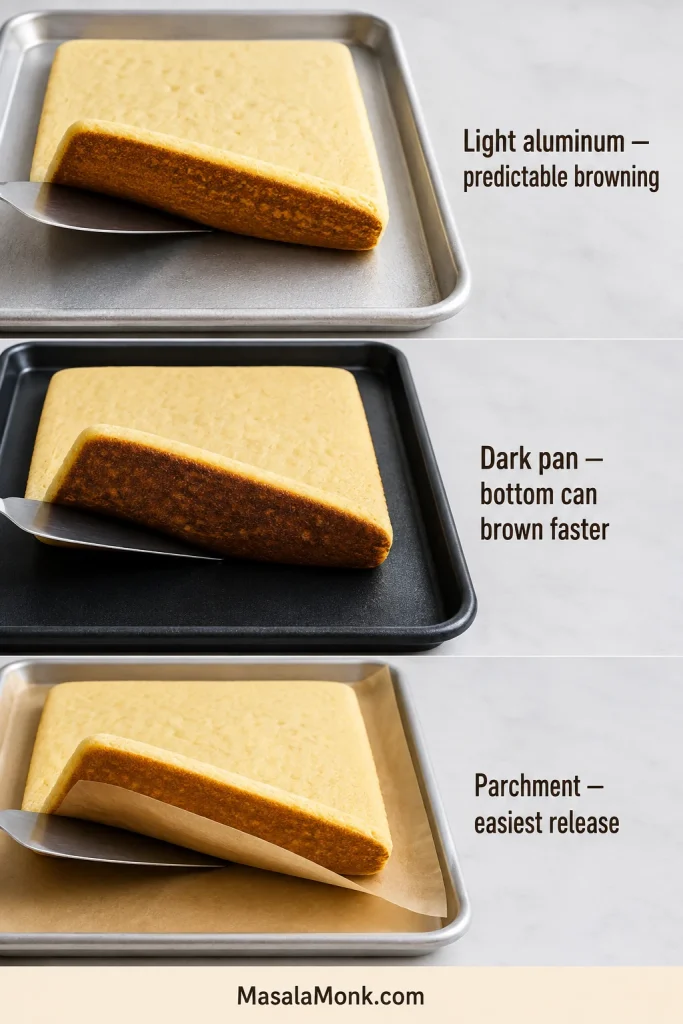
Light aluminum tends to give predictable bottom browning. Dark nonstick bakeware can color the underside faster, so start checking sooner.
Parchment is fine too. Buttering the metal directly can give you a little more color underneath; parchment wins on easy release and cleanup. If your pan has betrayed you before, use the parchment.
Dark pans brown the underside faster; parchment favors easy release and cleanup.
13×18 vs 10×15 vs 9×13
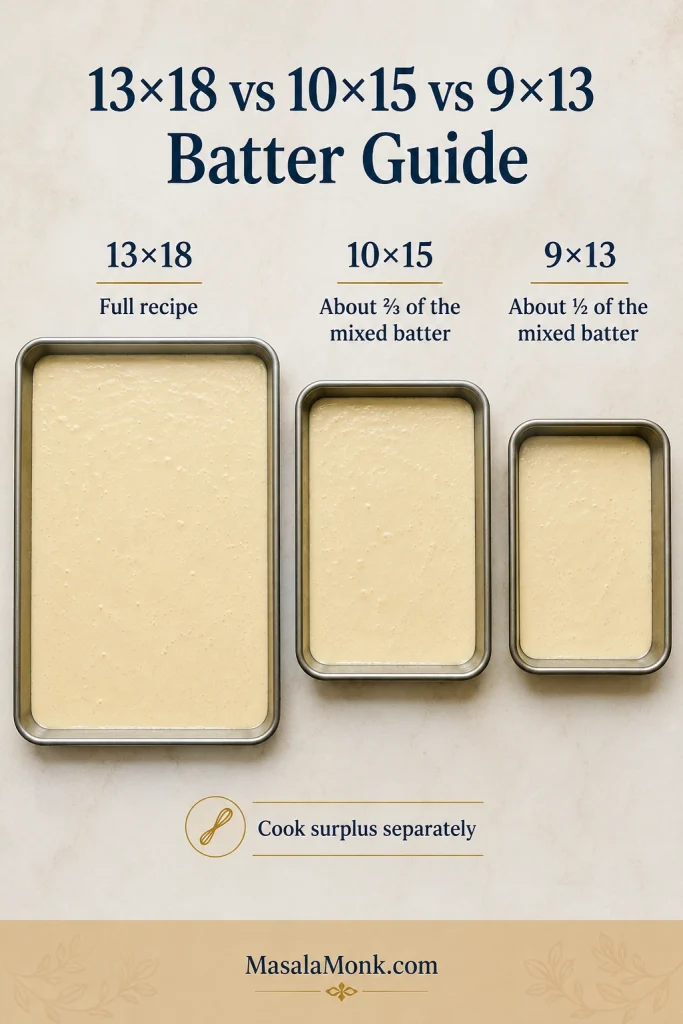
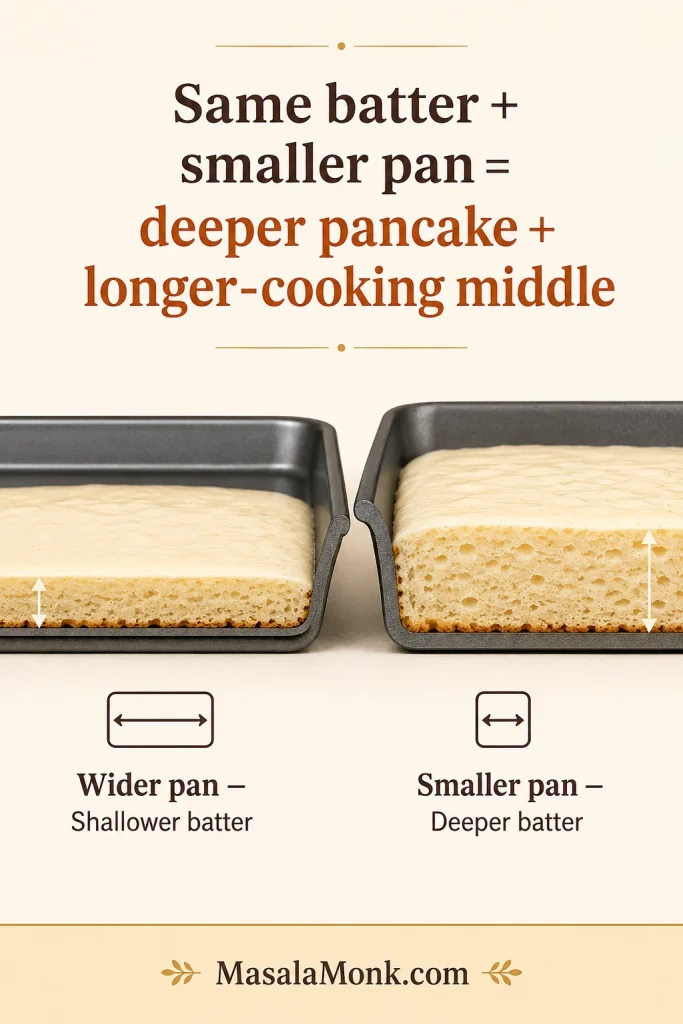
A smaller pan gives the same amount of batter less room to spread, so the pancake becomes deeper.
Pan
How Much Batter to Use
What to Expect
13×18-inch half-sheet
Full recipe
Shallow, fluffy pancake squares
10×15-inch pan
About two-thirds of the mixed batter
Similar depth; timing may shift
9×13-inch pan
About half of the mixed batter
Similar depth; start checking early
9×13 + full recipe
Not recommended
Very deep batter; slow-cooking middle, drier edges and a much more cake-like result
13×18 uses the full batch; 10×15 needs about two-thirds; 9×13 needs about half to keep a similar depth.
A 10×15 pan has about two-thirds the nominal area of a 13×18 half-sheet, while a 9×13 has about half. Mix the full recipe, pour only the approximate amount shown above and cook the surplus separately.
Pour the whole batch into a 9×13 and the pancake sits roughly twice as deep.
Same batter + smaller pan = deeper pancake + longer-cooking middle.
Same batter + smaller footprint = a deeper center and a longer path to doneness.
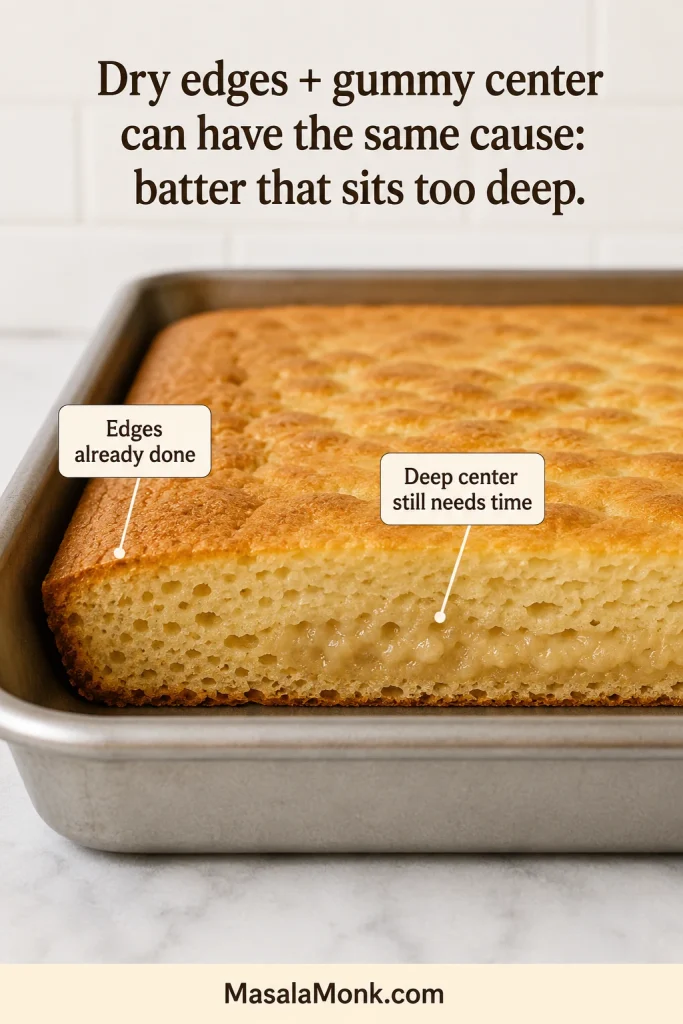
That is how dry edges and a gummy middle can happen at the same time: the center still needs heat after the edges have had enough.
Dry edges with a gummy center usually point to a layer that was too deep, not simply too little oven time.
Stovetop pancakes give you an obvious sequence: bubbles, dry edges, flip, brown the second side. A baked tray removes the flip, so color alone isn’t a reliable finish line.
Look at the middle. It’s ready when the surface is set, a gentle press springs back and a tester shows no liquid batter. A few moist crumbs are fine. The edges may also begin to pull slightly from the pan.
Look for all three cues together: a set center, gentle spring-back and a tester with no liquid batter.
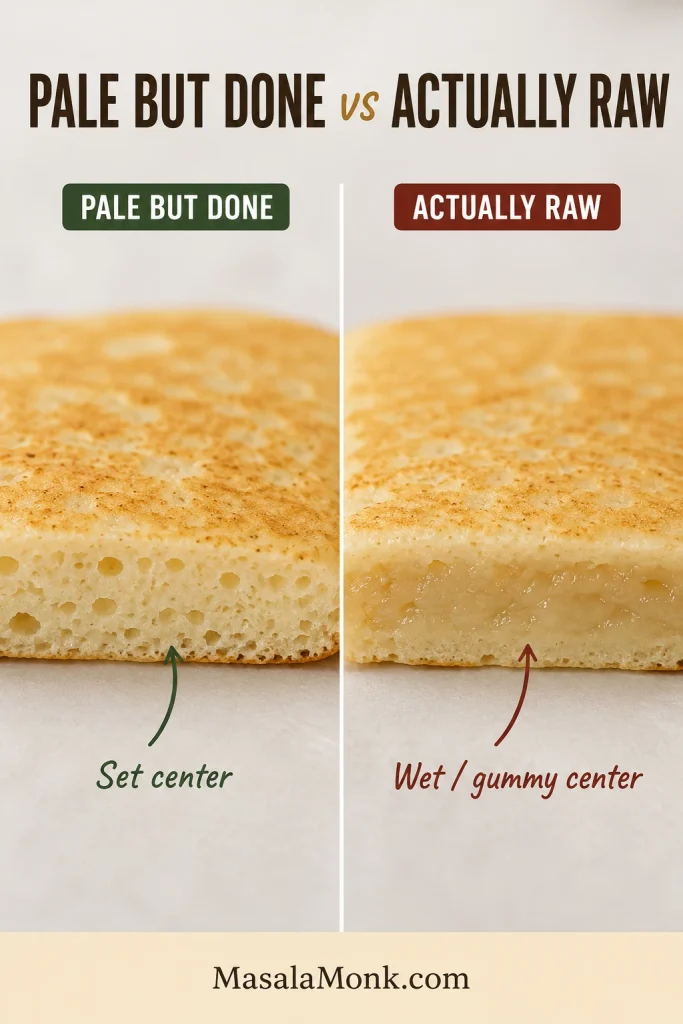
Why Is the Top Still Pale?
This is the moment that can tempt you to leave the tray in too long.
A regular pancake gets direct contact with hot metal twice: once before the flip and again afterward. Here, the bottom sits against the pan while the top cooks mostly in oven air.
A fully cooked middle with a pale-golden top is completely normal. For extra color, use the brief broiler finish after the center is cooked.
A pale top can be fully cooked. The cut edge tells you more than surface color.
Make One Flavor—or Four on the Same Pan
Getting everyone breakfast at the same time solves one pancake problem. One pan can solve another too: everyone wants something different.
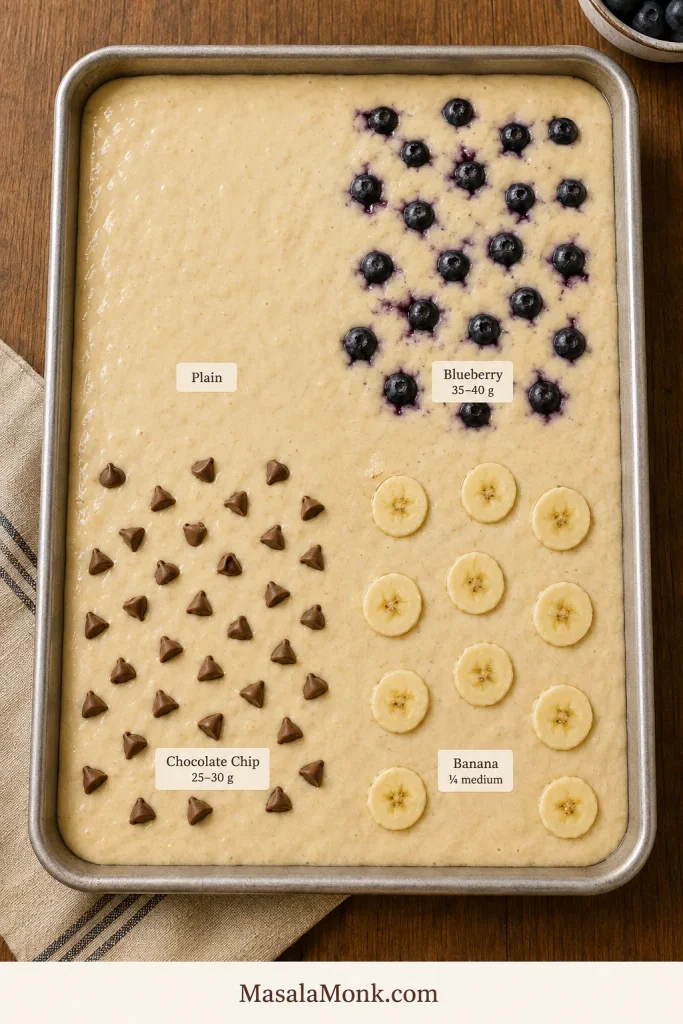
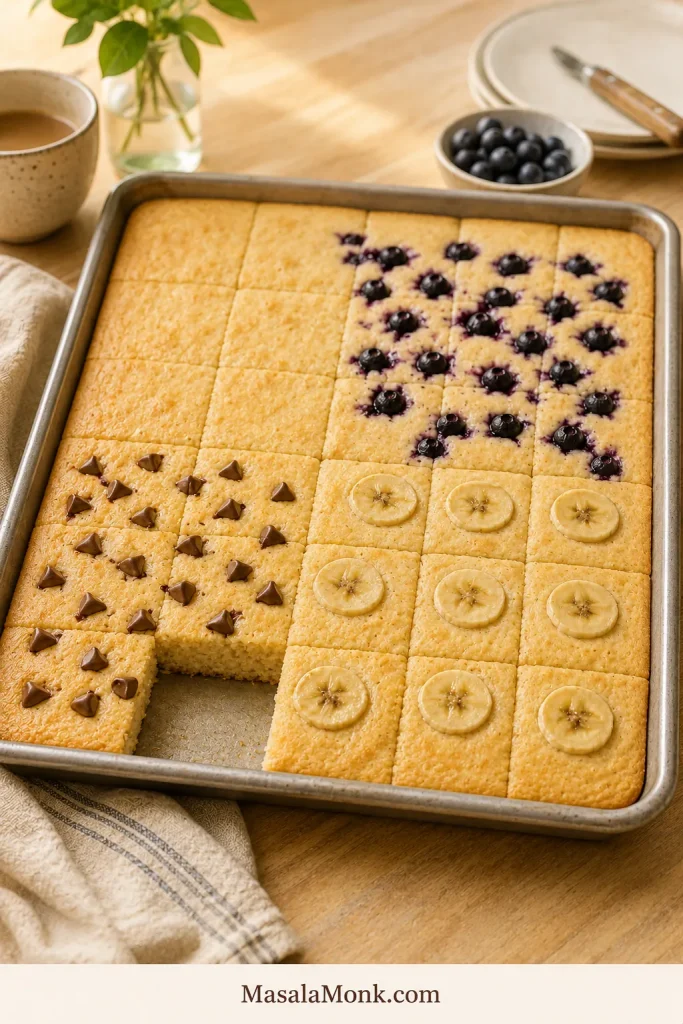
Blueberry can have one corner, chocolate chips another, banana gets its quarter, and anyone who thinks pancakes need no decorating at all can keep the fourth section plain.
Level the batter first, then build the flavor zones lightly so one section does not end up deeper than another.
Quarter-Pan Flavor
Good Starting Amount
Plain
Leave untouched
Blueberry
35–40 g blueberries, about ¼ cup
Chocolate chip
25–30 g chocolate chips, about 2–3 tablespoons
Banana
About ¼ medium banana, thinly sliced
Think scattered, not covered. A heavy topping layer can weigh down the batter and bring more moisture with it.
The berries soften and burst, the chocolate goes molten, and the plain corner needs nothing more complicated than butter and syrup.
Cut along the flavor boundaries first for cleaner blueberry, chocolate, banana and plain servings.
Fresh vs Frozen Blueberries
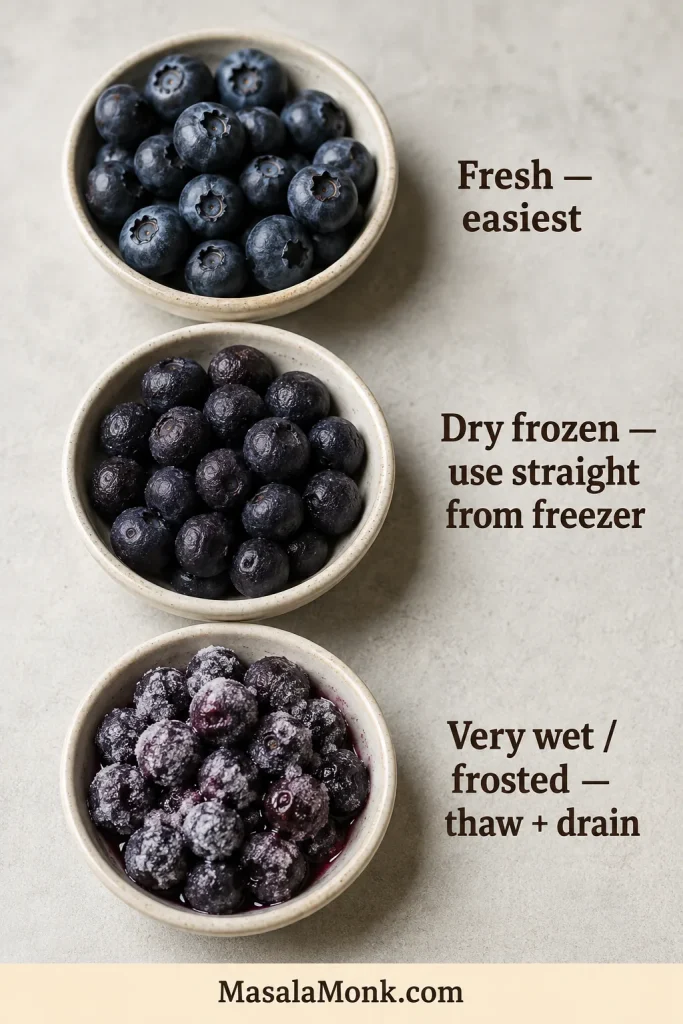
Fresh blueberries are the simplest option, but frozen berries work too. Fairly dry frozen berries can go straight onto the batter; shake off loose ice and keep the layer light.
Heavily frosted berries or berries already releasing lots of juice are better thawed and drained first. Keep excess water off the batter and either type can work well.
The real variable is loose moisture: shake off surface ice, and drain berries that are already thawing or juicy.
Making blueberry the main event? Our blueberry pancakes guide goes further into classic, lemon, banana, oat and other blueberry pancake variations.
Bananas, Strawberries and Apples
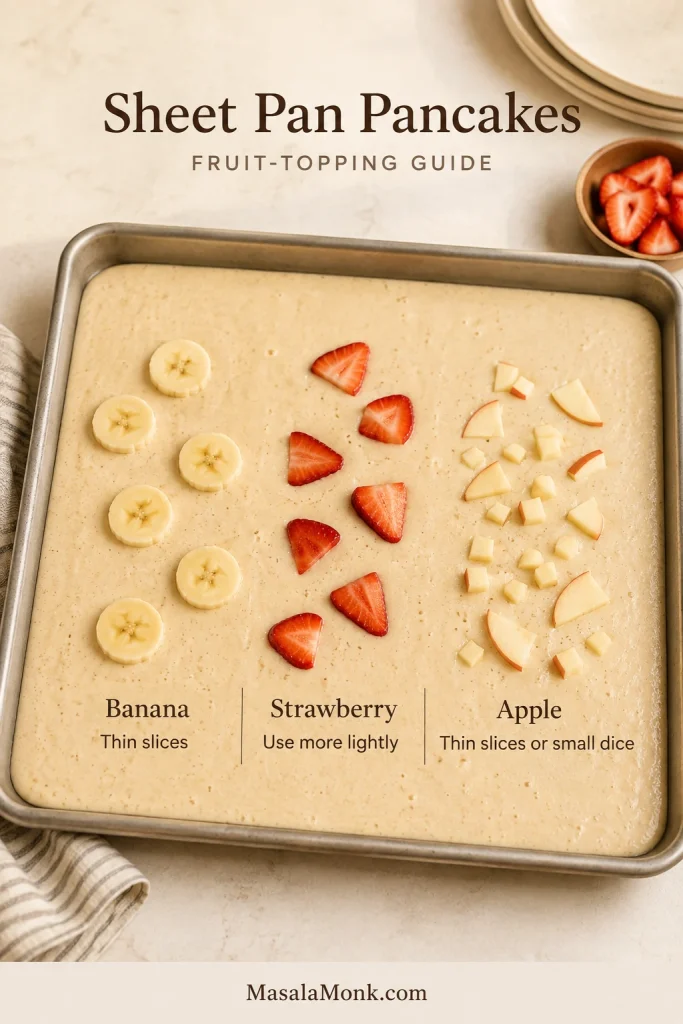
Thin banana slices soften easily during the short bake. Strawberries release more water, so use them more sparingly.
Apples are firmer. Very small dice or thin slices work better than large raw chunks; you can also soften them briefly before adding them to the batter.
Match the cut to the bake: softer fruit can stay sliced; firmer apples need thin slices or small dice.
Troubleshooting
Most problems trace back to batter depth, mixing, measurements or the way a particular pan and oven handle heat.
Texture & Rise
What You’re Seeing
What Probably Happened
What to Do
Dense or heavy
Too much flour, overmixing or stale leavener
Check the flour; mix more gently; use fresh leavener
Chewy or rubbery
Batter was mixed too much
Stop folding once the dry flour disappears
Gummy middle
Underbaked, batter too deep or too many wet toppings
Return it to the oven if still raw; use the correct batter depth next time
Dry edges, wet center
Batter layer was too deep or uneven
Use less batter in a smaller pan and spread it evenly
Didn’t rise much
Old leavener, cool oven, long batter rest or overmixing
Use fresh leavener, preheat fully and bake soon after mixing
Bitter, metallic or soapy
Too much baking powder or baking soda
Measure the leaveners carefully
Batter too thick
Usually excess flour
Check the flour measurement; loosen with buttermilk 1 tablespoon at a time if needed
Batter very thin
Flour or liquid measurement may be off
Recheck the quantities before adding anything else
Pan, Browning & Toppings
What You’re Seeing
What Probably Happened
What to Do
Bottom too dark
Dark pan or a longer bake than needed
Start checking sooner next time
Top looks pale
Often completely normal
Use the doneness cues above; broil briefly only after it’s cooked
Wet fruit pockets
Too much fruit or excess surface moisture
Use less fruit and remove excess moisture before topping
You can make the morning easier without leaving a bowl of mixed pancake batter in the refrigerator overnight. A little measuring the night before leaves much less to do once everyone is hungry.
Best Night-Before Prep
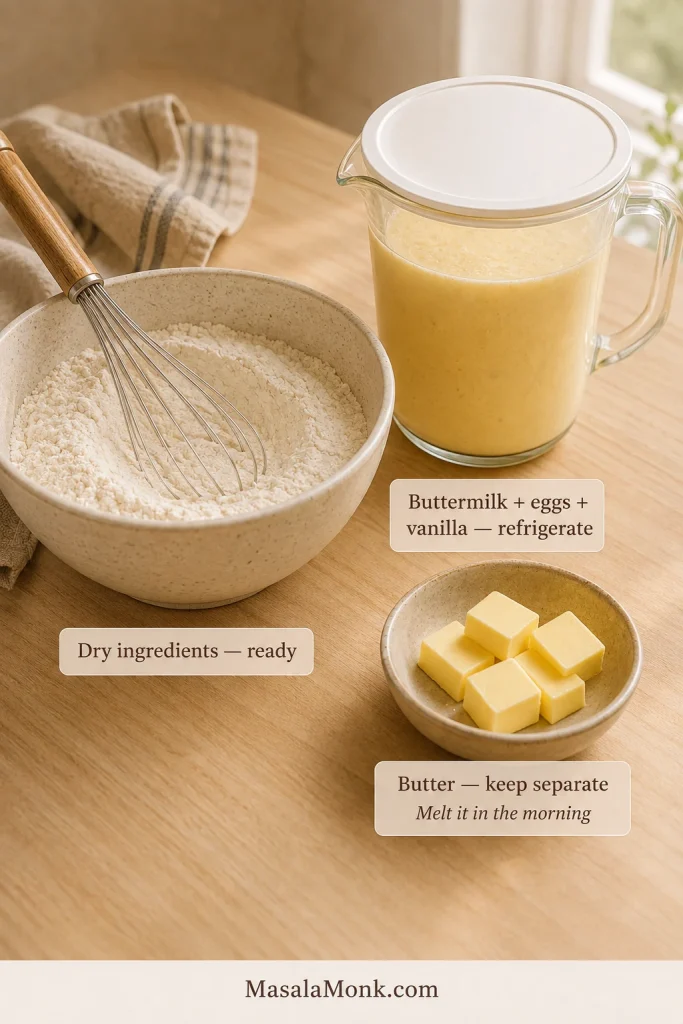
Measure the dry ingredients into one bowl. In another container, whisk together the buttermilk, eggs and vanilla, then cover and refrigerate that mixture overnight.
Keep the butter separate. In the morning, preheat the oven, melt the butter and whisk it into the cold wet mixture before combining wet and dry. A few tiny butter flecks are harmless and will melt during baking.
Measure tonight; mix tomorrow. Keep dry ingredients, wet ingredients and butter separate until breakfast.
For a breakfast that really can be assembled before bed, an overnight French toast casserole shifts even more of the work to the night before.
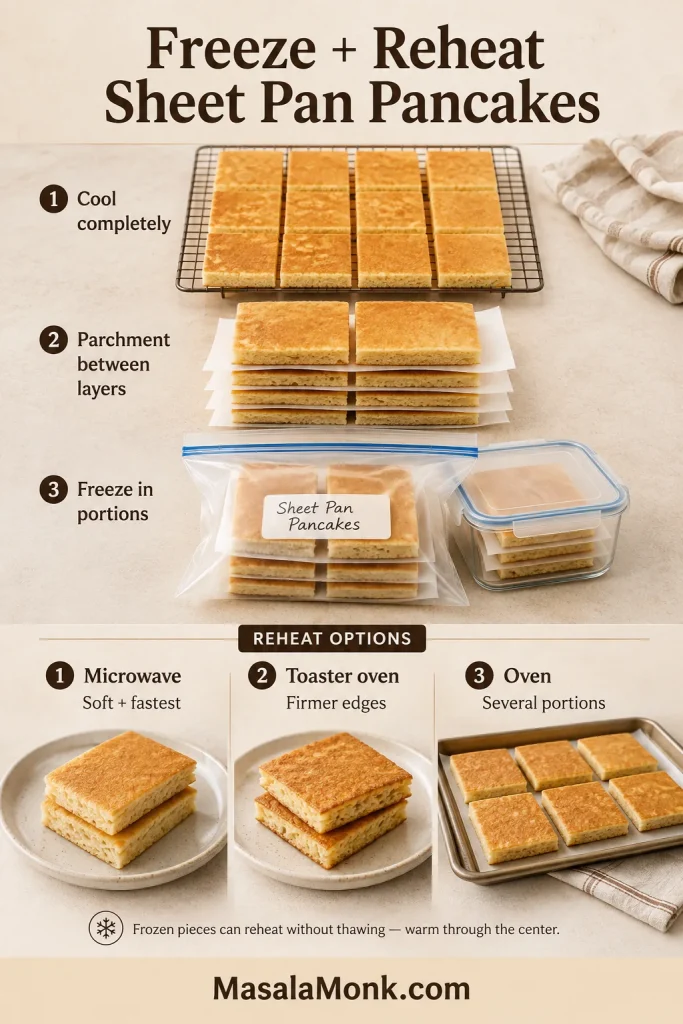
Cut the cooled pancake into portions and place parchment between layers, or freeze the pieces in a single layer until firm before transferring them to a freezer bag or container.
For the best results, use them within about 2 months.
Individual squares can go straight from the freezer to reheating; there’s no need to thaw them first. Frozen pieces simply need more time than refrigerated ones, so make sure they’re warm through the middle before serving.
Freeze the pancakes in the portion size you normally reheat, with parchment between stacked pieces.
Best Way to Reheat Them
If You Want…
Use…
What You Get
Fastest breakfast
Microwave
Soft, quick pancakes
Firmer edges
Toaster oven
A slightly crisper surface
Several portions at once
Oven
Gentle, even reheating
Microwave one or two refrigerated squares in 20–30-second bursts until warm through the middle. Frozen pieces can be reheated the same way; keep the bursts short, reposition the pancake between them if needed, and expect it to take longer.
If you want firmer edges, warm individual squares in a toaster oven at about 325°F / 165°C. Put them on a small tray and leave them uncovered for a drier surface, or cover loosely with foil if you want to preserve more tenderness. Frozen or heavily topped pieces will need longer, so check the center before serving.
Reheating several servings? Arrange the pancakes in a single layer on a baking sheet, cover loosely with foil and warm at 325°F / 165°C until hot through the middle. Remove the foil near the end if you want the surface a little drier.
Whichever method you use, a thin plain square will warm faster than a thick or heavily topped one. Let the temperature in the center—not just the warmth on the surface—be your guide.
How Many People Does One Pan Serve?
The tray cuts neatly into 12 generous squares. If pancakes are the main breakfast, plan on roughly two squares per adult, or about 6 servings.
For a brunch table with eggs, bacon, yogurt or fruit, cut the tray into 16 smaller pieces and let people come back for seconds.
Make the long cuts first, then cross-cut the tray into a simple grid for even squares.
What to Serve With Them
A simple breakfast needs little more than salted butter, maple syrup and fresh berries. The butter softens almost immediately on the warm surface, and syrup settles into the tender crumb instead of simply running off the plate.
For brunch, add eggs, breakfast sausage, Greek yogurt, fresh fruit or toasted nuts. If bacon is on the table too, cooking bacon in the oven lets you handle a full pack at once without standing over another skillet.
The batter isn’t overly sweet, so it works just as comfortably beside something savory as it does under a generous pour of maple syrup.
Frequently Asked Questions
Can I Use Regular Milk Instead of Buttermilk?
Yes. Because the batter uses baking soda, give regular milk some acidity first.
Add 2 tablespoons / 30 ml lemon juice or white vinegar to a measuring jug, then add milk until the total reaches 2 cups / 480 ml. Stir and let it stand for about 5 minutes.
This homemade buttermilk substitute can be thinner than cultured buttermilk, so use the batter-consistency cues above before deciding it needs any adjustment.
Can I Double the Recipe?
Yes. Use two half-sheet pans. Putting twice as much batter into one pan changes the depth too much.
If both pans bake at the same time, place the racks in the upper and lower thirds of the oven. If your oven browns unevenly, swap rack positions and rotate the pans during the second half of baking. Use the usual doneness cues instead of adding a fixed number of minutes.
Can I Bake These in a Fan or Convection Oven?
Yes. Use 400°F / 205°C fan/convection unless your oven automatically adjusts temperatures for you. Start checking earlier than you would in a conventional oven.
Can I Use Pancake Mix?
Yes. Make the pancake batter according to the package directions; don’t swap a boxed mix cup-for-cup for the flour in this recipe. Complete mixes, Bisquick-style baking mixes and higher-protein mixes such as Kodiak can all need different amounts of liquid, eggs and fat.
If you adapt a prepared mix to a half-sheet, keep the batter layer shallow and use the same visual doneness cues described above. Exact proportions depend on the mix, so a dedicated mix-based recipe is more reliable than trying to make one ratio fit every brand.
The Payoff Is More Than No Flipping
The best thing about sheet pan pancakes isn’t really that they save you from using a spatula.
It’s that breakfast stops arriving in shifts.
Once you know the few cues that matter—the right batter depth, gentle mixing and a cooked center—the rest is simple.
Then cut the tray, pass the syrup and sit down while everybody’s breakfast is still warm—including yours.
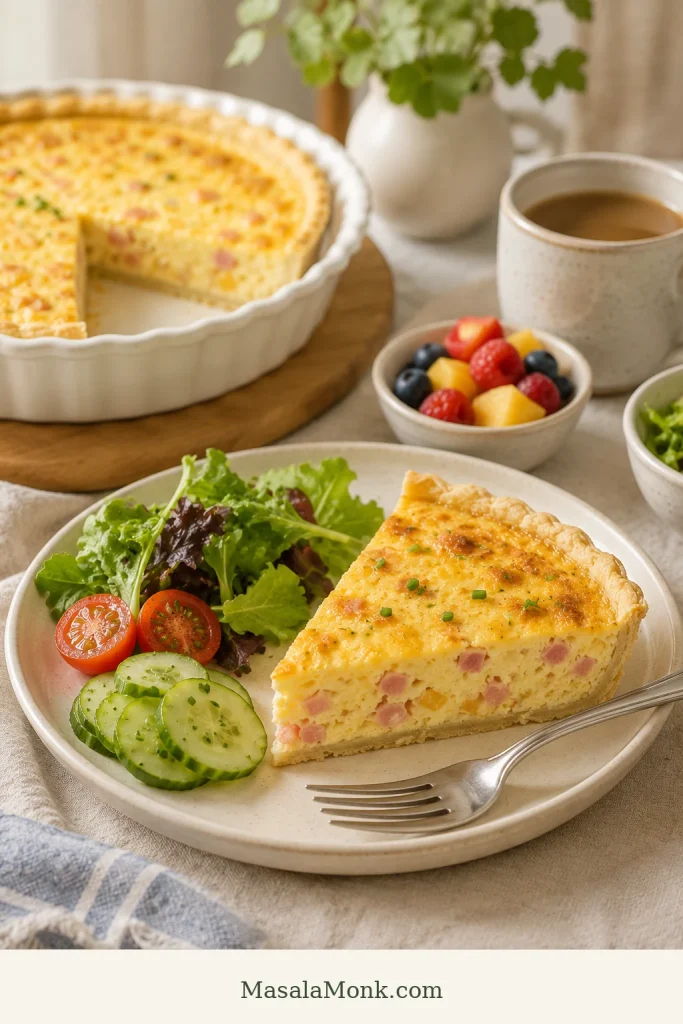
Ham and cheese quiche is what you make when brunch needs to feel special but you do not want to stand at the stove. It uses cooked ham, a simple egg custard, plenty of cheese, and a crust that can be homemade, refrigerated, frozen, or skipped completely.
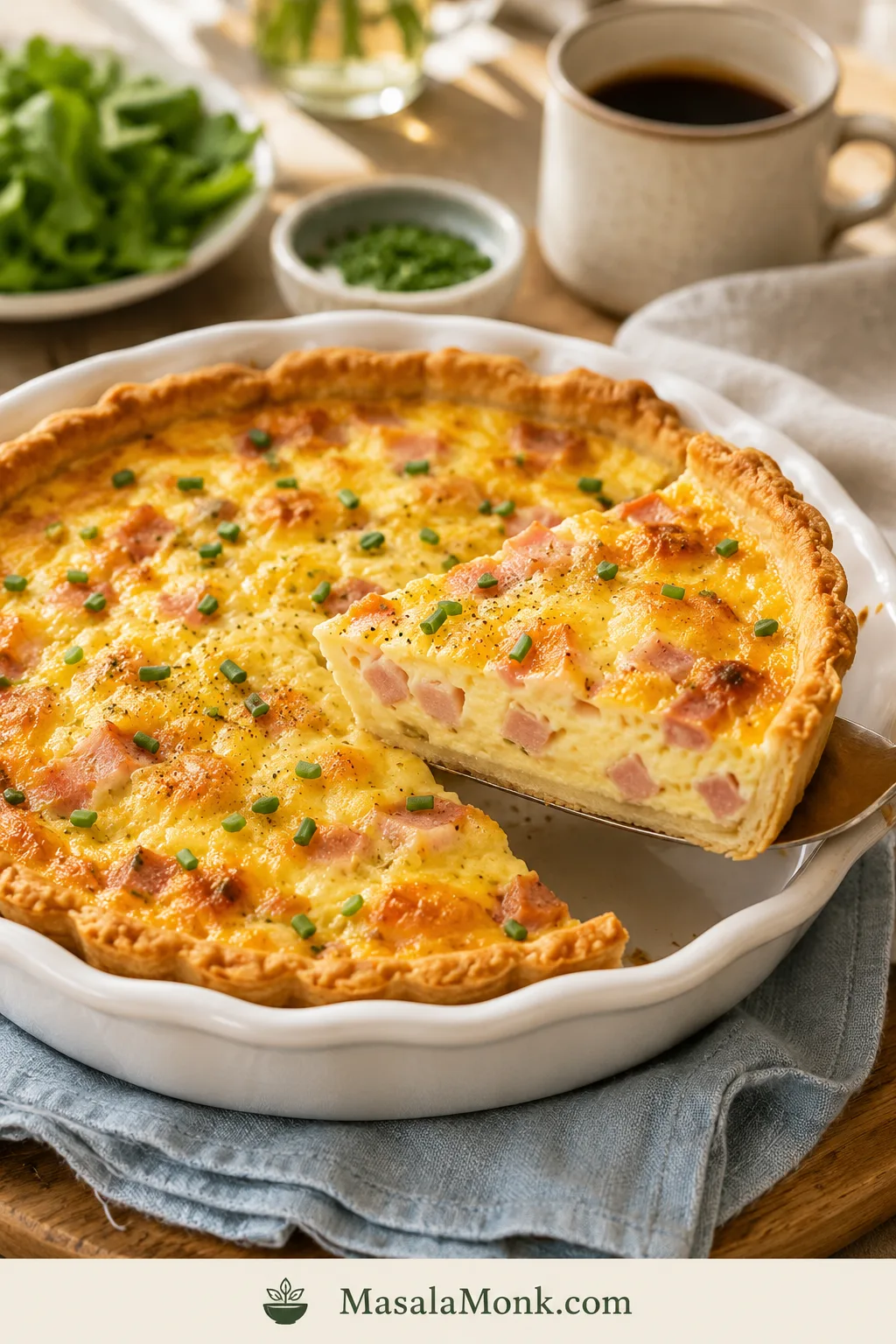
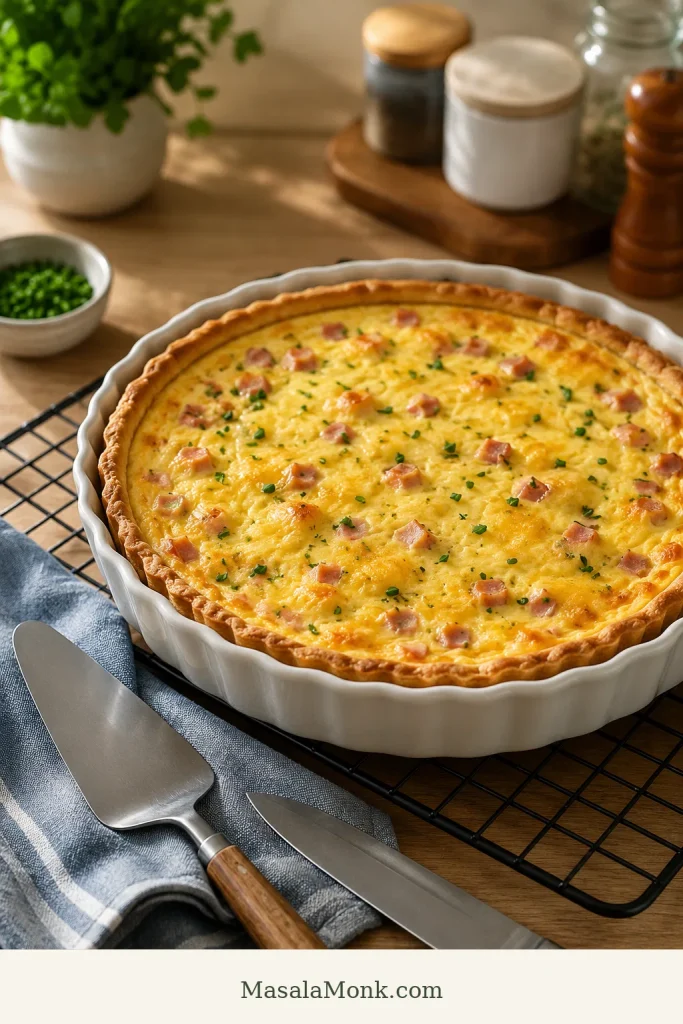
The most satisfying bites have smoky ham, melted cheese, and soft custard against the flaky edge of the crust. This version is creamy without being loose, savory without being too salty, and practical enough for a holiday brunch, a quiet lunch, or a weeknight dinner with salad.
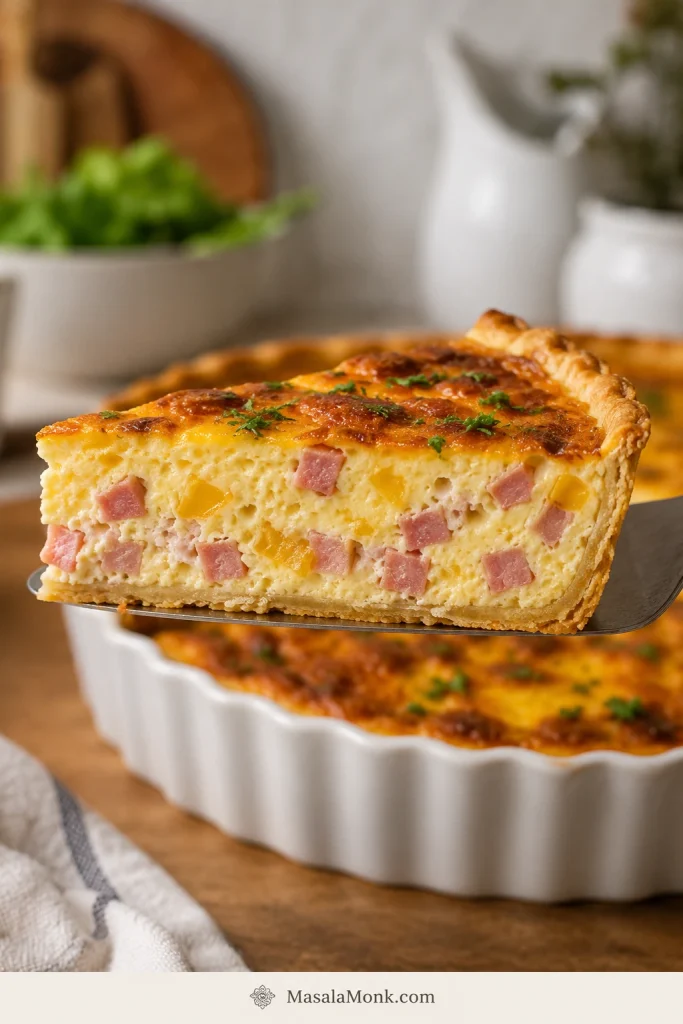
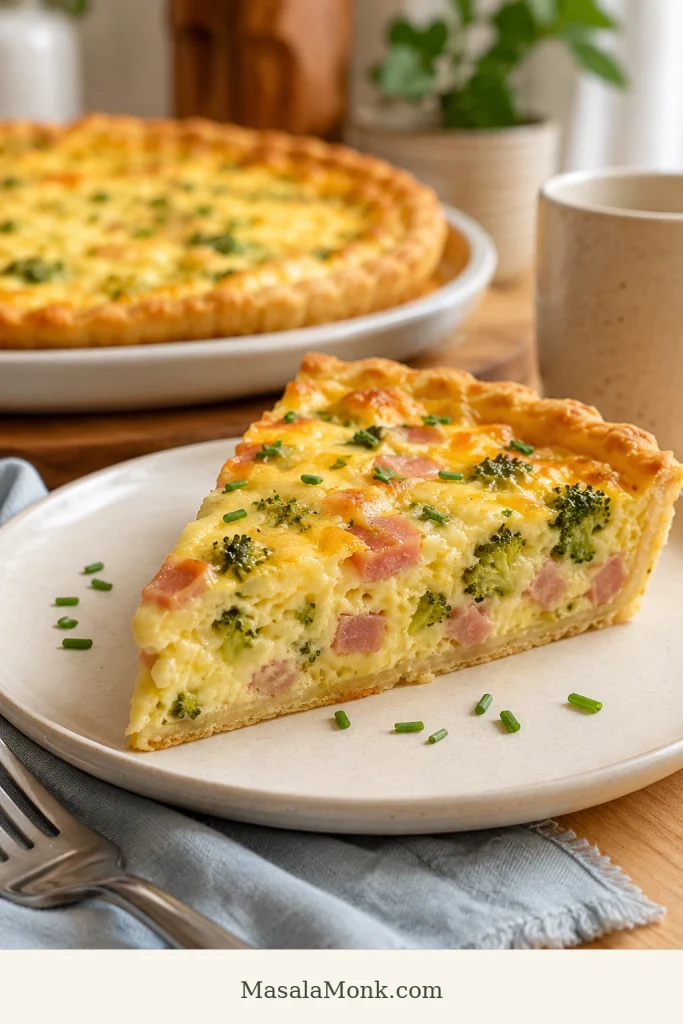
A good slice should hold together but still look soft inside; that creamy custard is what keeps this from feeling like a firm egg bake.
This ham and cheese quiche is built for real kitchens: the kind with leftover holiday ham, a frozen crust in the freezer, or a bit of cheese that needs using. As long as the ham is cooked, diced small, and not wet, the recipe is flexible.
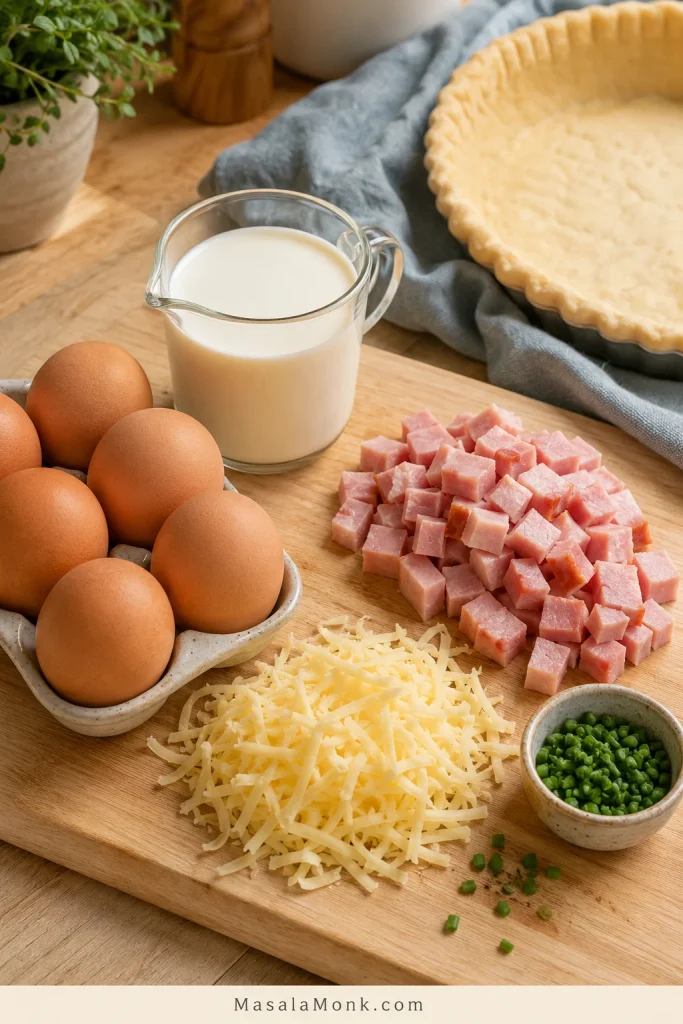
The base is simple: 5 large eggs, 1 cup dairy, 1½ cups diced ham, and 1½ cups cheese for one 9-inch / 23 cm quiche. That ratio keeps the center creamy but sliceable, so you do not end up with a stiff egg pie or a watery middle.
Start with the quick answer and recipe if you are ready to bake. The extra notes are there for frozen crusts, crustless baking, make-ahead timing, variations, and troubleshooting.
For one 9-inch / 23 cm ham and cheese quiche, use 5 large eggs, 1 cup dairy, 1½ cups cooked diced ham, and 1½ cups shredded cheese. Par-bake the crust, fill it, bake at 375°F / 190°C until the edges are set and the center is soft-set, then rest for 10 minutes before slicing.
Quiche Element
Use This
Eggs
5 large eggs
Dairy
1 cup / 240 ml / 8 fl oz half-and-half, or cream + milk
Ham
1½ cups / 200–225 g / 7–8 oz cooked diced ham, loosely measured
Cheese
1½ cups / 150–170 g / 5–6 oz shredded cheese, loosely measured
Oven
375°F / 190°C for a crusted quiche
Done when
Edges are set and the center is soft-set, not liquid
For a first bake, keep it simple: deep-dish frozen or refrigerated pie crust, half-and-half, 1 cup sharp cheddar, ½ cup Swiss, and diced cooked ham. Once you see how the center should wobble, the variations become much easier.
Use the base as a balance check: eggs help the custard set, dairy keeps it tender, and ham and cheese make the filling generous without weighing it down.
Choose Your Ham and Cheese Quiche Path
Start with the same creamy base, then choose the version that fits your day: frozen crust for ease, crustless for meal prep, or extra vegetables when the fridge needs clearing.
If This Is Your Situation
Best Path
You want the easiest brunch
Use a deep-dish frozen crust, half-and-half, sharp cheddar, Swiss, and cooked diced ham.
You have leftover holiday ham
Dice it small, pat it dry if needed, reduce the salt, and balance sweet glaze with Dijon and black pepper.
You want no crust
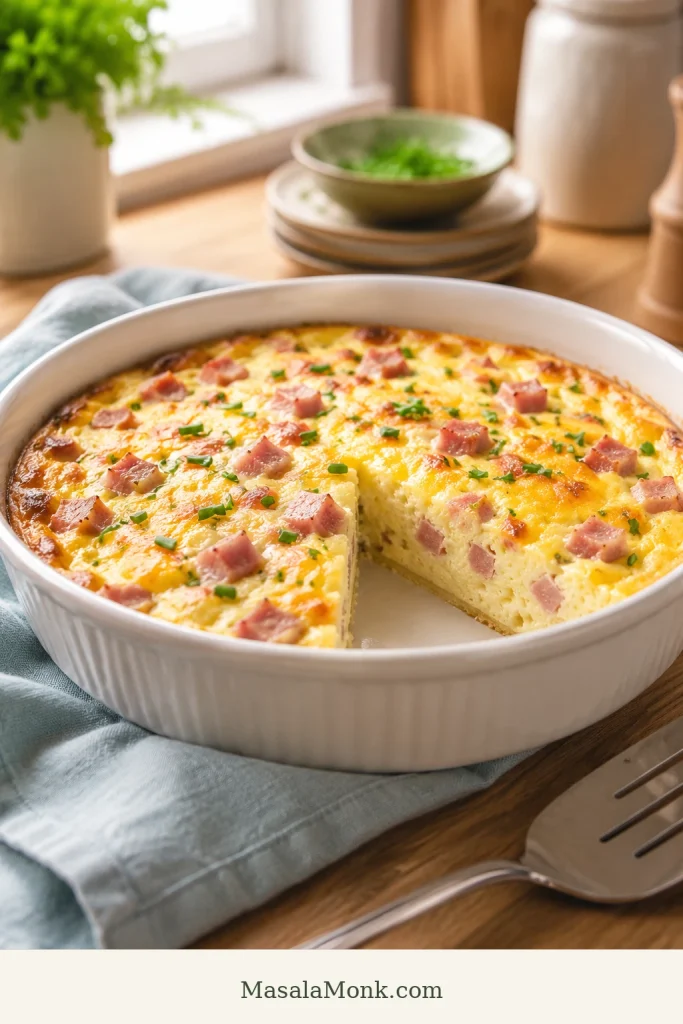
Grease the pie dish well and bake the same egg mixture at 350°F / 175°C until just set.
You want the creamiest texture
Use half-and-half, or equal parts heavy cream and whole milk.
You are adding vegetables
Cook, drain, and cool them before they touch the egg mixture.
You are meal-prepping
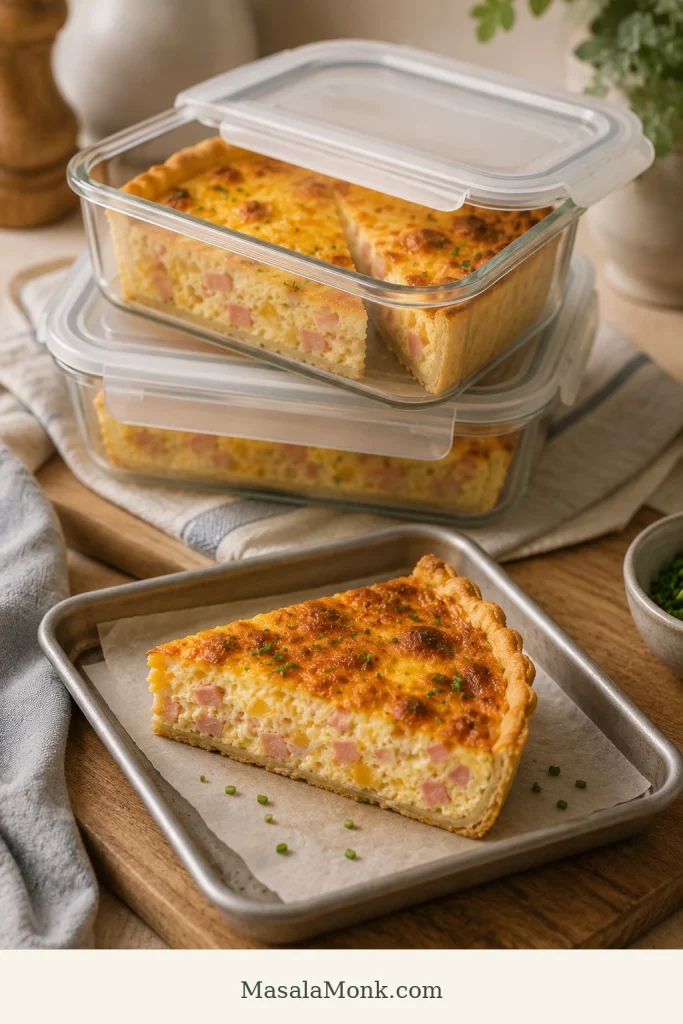
Bake the quiche first, cool it, slice it, then refrigerate or freeze the slices.
Ham and Cheese Quiche Recipe
Description
This easy quiche has a creamy egg custard, diced cooked ham, plenty of cheese, and a crisp-tender pie crust. Use a frozen deep-dish crust for the easiest version, or make it with homemade or refrigerated crust. Serve it for brunch, lunch, holidays, meal prep, or an easy dinner with salad.
Crustless note: For a no-crust version, use the same filling in a well-greased 9-inch / 23 cm pie dish and bake at 350°F / 175°C for 30–40 minutes. See the crustless ham and cheese quiche section for the full method.
Prep Time: 15 minutes
Par-Bake Time: 10–12 minutes
Final Bake Time: 35–45 minutes
Resting Time: 10 minutes
Total Time: About 1 hour 10 minutes to 1 hour 20 minutes
Servings: 6–8 slices
Equipment
9-inch / 23 cm pie dish or 9-inch deep-dish frozen pie shell
Rimmed baking sheet
Mixing bowl
Whisk
Measuring cups and spoons
Fork
Foil or pie shield
Wire rack
Instant-read thermometer, optional
Ingredients
1 9-inch / 23 cm deep-dish pie crust, homemade, refrigerated, or frozen
5 large eggs
1 cup / 240 ml / 8 fl oz half-and-half, or ½ cup / 120 ml heavy cream plus ½ cup / 120 ml whole milk
1½ cups / 200–225 g / 7–8 oz cooked diced ham, measured loosely, not packed
1½ cups / 150–170 g / 5–6 oz shredded cheese, measured loosely, not packed
2–3 tablespoons chopped green onions or chives
1 teaspoon Dijon mustard
¼ teaspoon black pepper
¼–½ teaspoon salt
Small pinch of nutmeg, optional
1 tablespoon butter or oil, optional, if sautéing onion, mushrooms, spinach, or other vegetables
Use ¼ teaspoon salt if your ham or cheese is salty. Use ½ teaspoon only if your ham is mild and your cheese is not very salty.
Instructions
1. Preheat and Set Up
Heat the oven to 375°F / 190°C and set a rack in the middle or lower-middle position. Place the pie crust on a rimmed baking sheet so it is easier to move and any overflow is caught.
2. Par-Bake the Crust
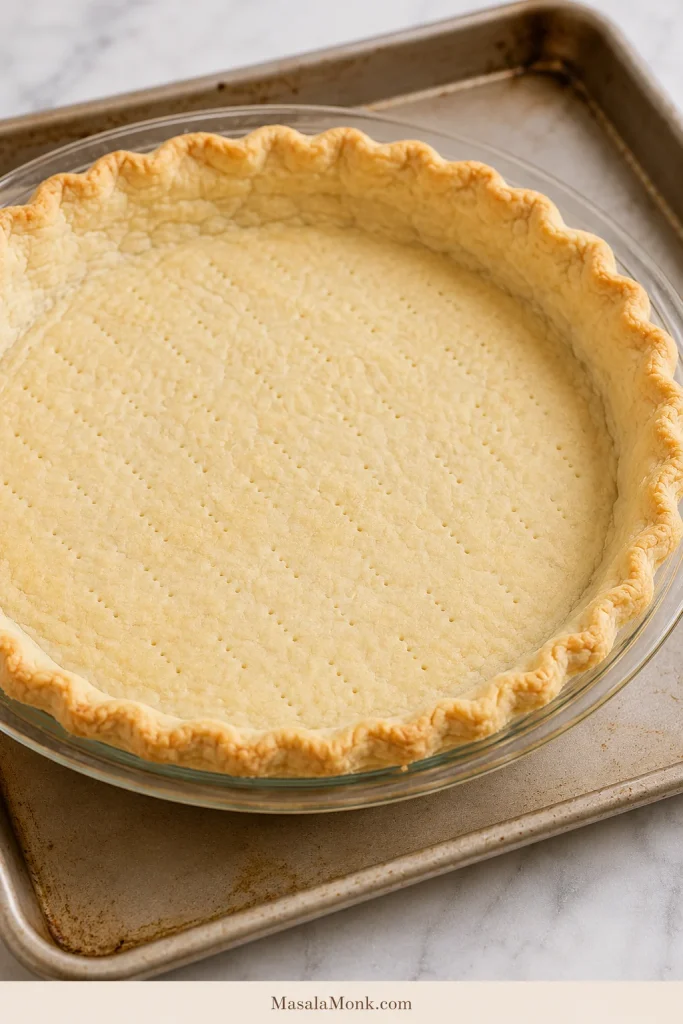
Give the crust a short head start for 10–12 minutes, or follow the package timing if using a frozen shell. The surface should look dry and lightly set, even if it is still pale. Gently press down any puffed spots with a spoon.
Par-bake the crust until the surface looks dry and lightly set; it should not be deeply browned yet because it bakes again with the custard.
3. Whisk the Custard
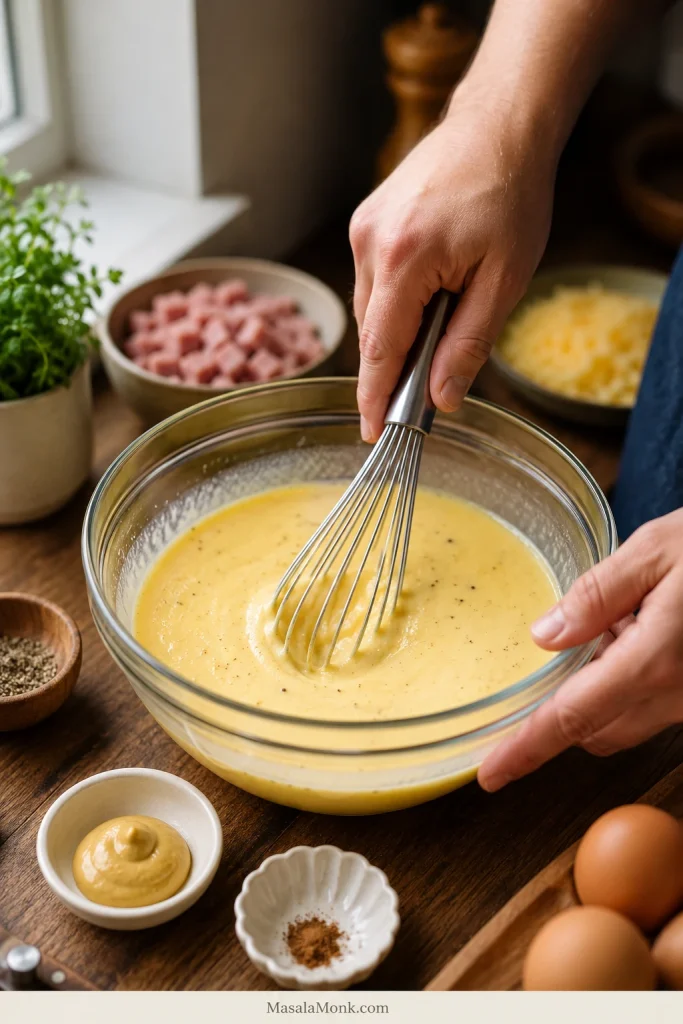
Combine the eggs, half-and-half, Dijon mustard, black pepper, salt, and nutmeg in a mixing bowl until the mixture looks smooth and evenly yellow. Stop once it is blended; the custard should not be bubbly or foamy.
Whisk the eggs and dairy just until smooth; a calm, even custard bakes more neatly than one whipped full of foam.
4. Layer the Ham, Cheese, and Chives
Scatter the diced ham evenly over the warm par-baked crust. Add the shredded cheese and green onions or chives so the filling is spread across the base before the custard goes in.
Layer the ham, cheese, and chives before the custard goes in so every slice gets flavor throughout instead of one heavy layer at the bottom.
5. Pour Without Overfilling
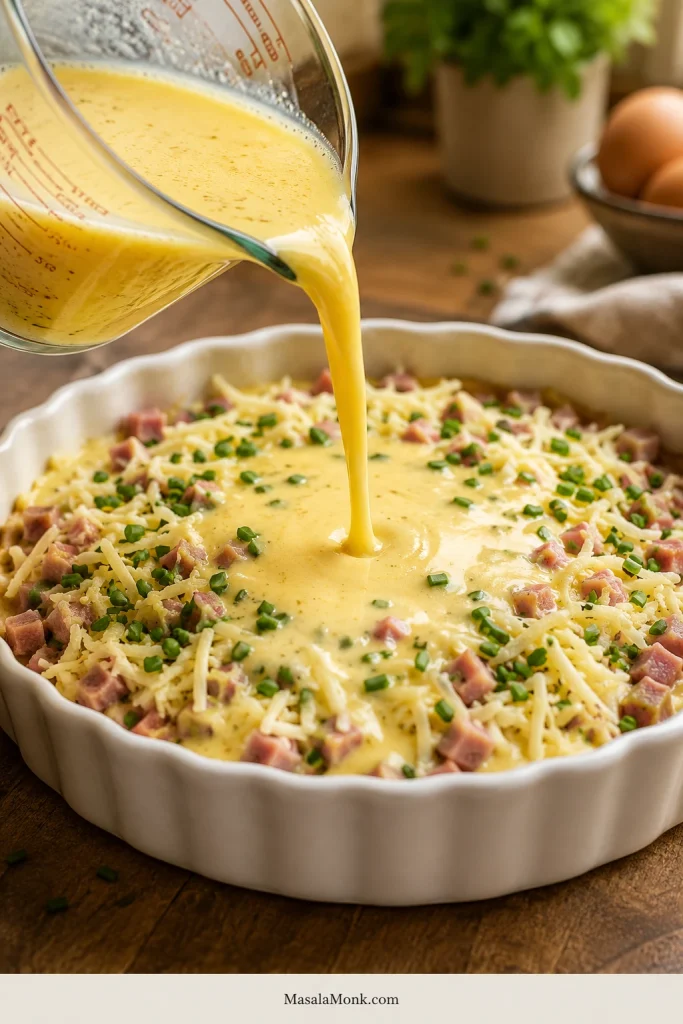
Add the egg mixture slowly over the ham and cheese so it can settle into the gaps. Stop before it touches the rim, especially if the crust is shallow. A clean oven is worth more than one extra spoonful.
Pour slowly so the custard settles between the ham and cheese; this helps the quiche bake evenly from the crust edge to the center.
A shallow crust may not hold every drop of custard. When the filling looks close to the top, save the extra for a greased ramekin instead of risking overflow.
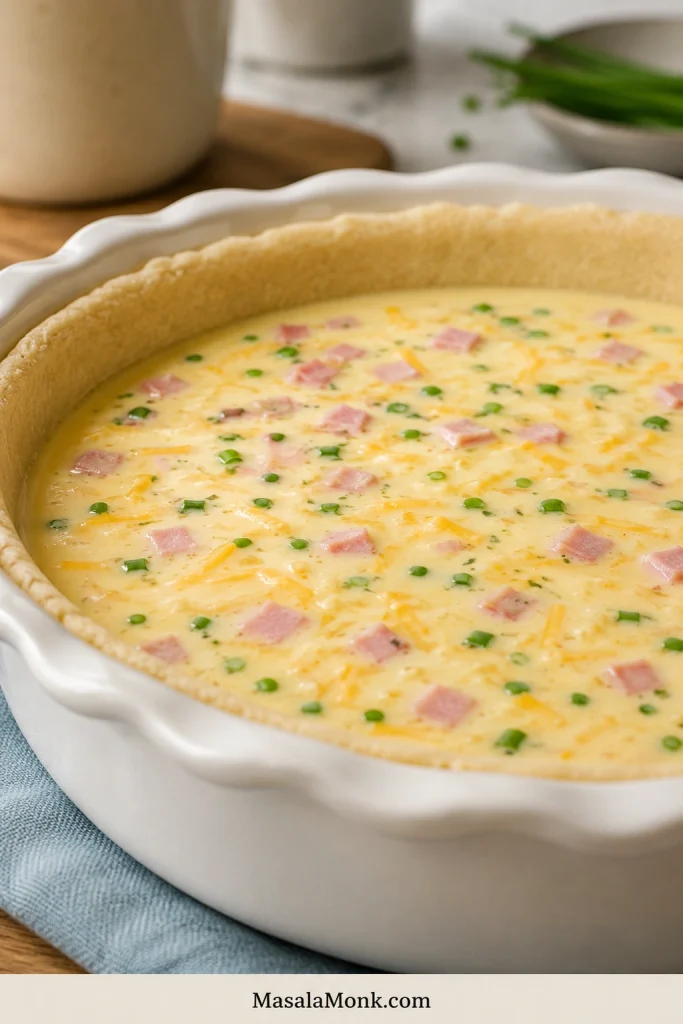
Stop before the filling reaches the rim; leaving visible crust above the custard is one of the easiest ways to prevent overflow in a deep-dish quiche.
6. Bake Until Soft-Set
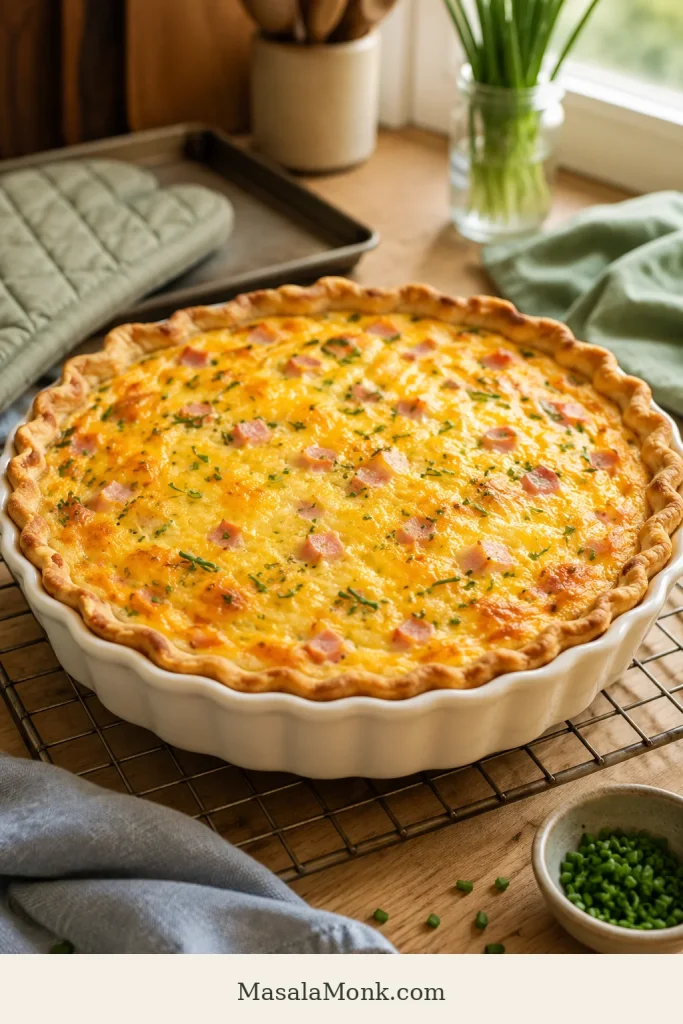
Slide the quiche into the oven for 35–45 minutes, until the edges are set and the center moves like soft-set pudding when you gently nudge the pan. Cover the crust edge with foil or a pie shield if it browns too quickly, and tent the whole quiche loosely if the top colors before the center is ready.
A softly puffed top, golden cheese spots, and a browned crust edge are better doneness clues than waiting for the center to look firm.
7. Rest Before Slicing
Set the quiche on a wire rack for 10 minutes before cutting. The center settles as it cools, which helps the slices lift cleanly instead of slumping.
8. Serve Warm or Room Temperature
Bring slices to the table warm or at room temperature for the creamiest texture. Chilled leftovers are fine for quick lunches, but the custard tastes better once the chill comes off.
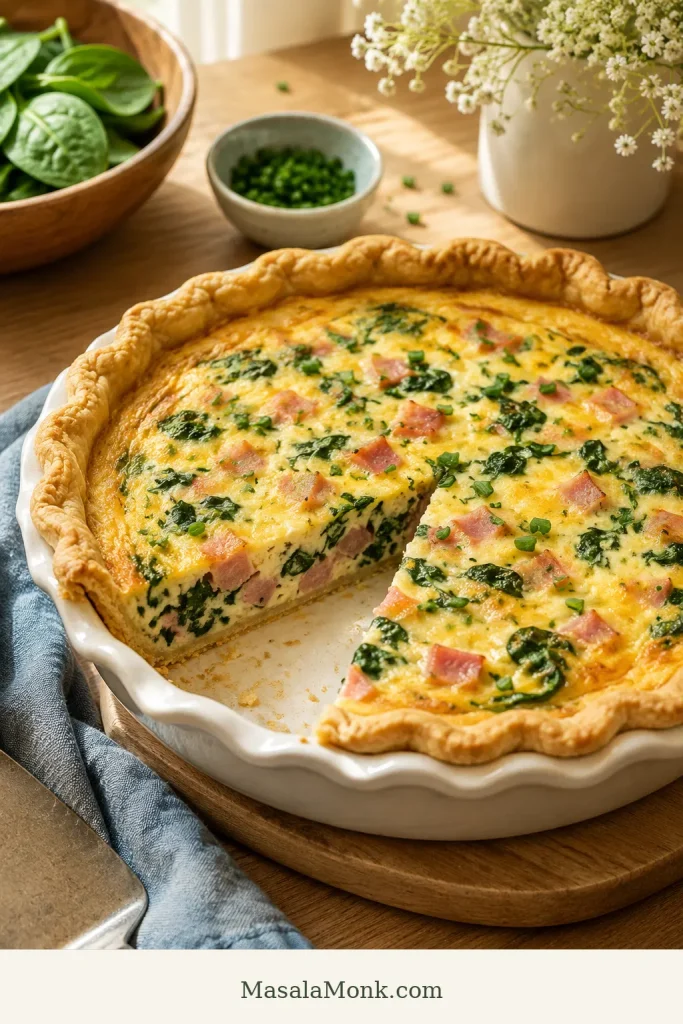
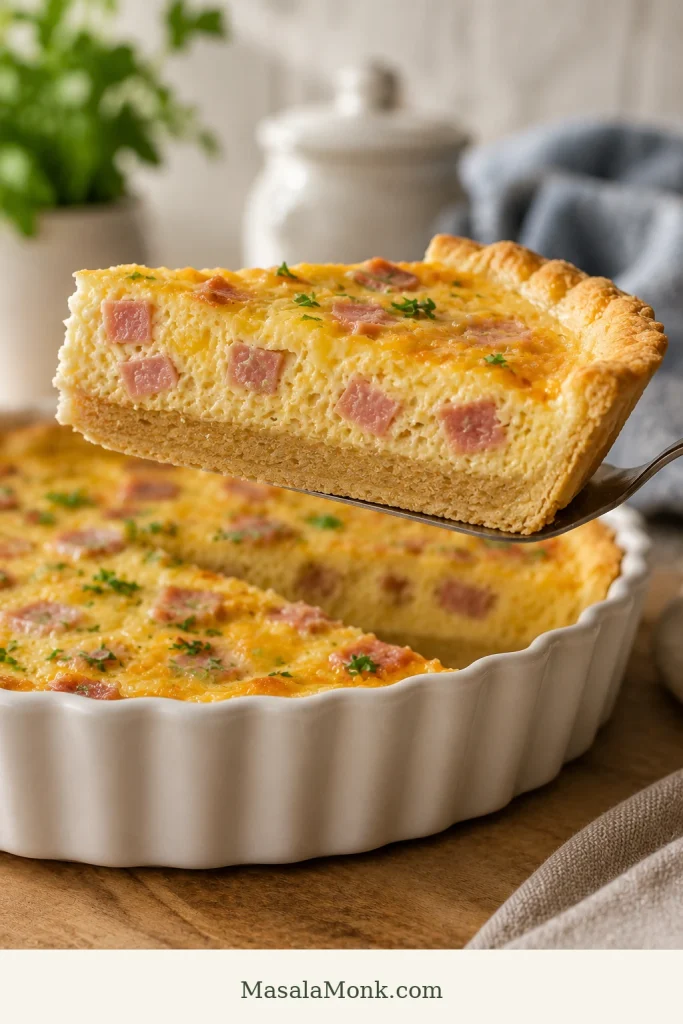
A good slice should look softly set in the center, with ham and cheese suspended through the custard instead of sunk into one dense layer.
A clean cross-section shows the target texture: ham suspended through the custard, a tender middle, and a crust strong enough to lift.
Recipe Notes
This recipe card is for the crusted version. For crustless baking, use the crustless note above or jump to the crustless quiche section.
If using frozen crust, make it deep-dish. Regular frozen shells can work, but they often cannot hold all the filling; the frozen crust notes explain why.
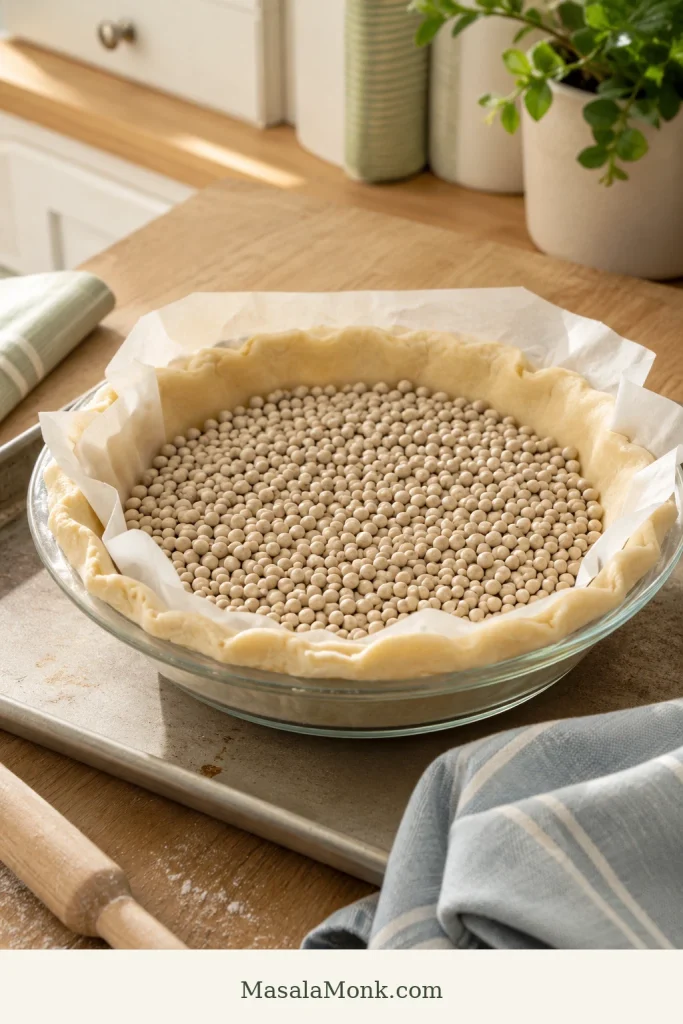
If using homemade or refrigerated pie dough, chill it in the dish, line it with parchment, add pie weights, dried beans, or uncooked rice, and par-bake until the edges begin to set. Frozen crusts can usually follow package directions.
Cook, drain, and cool vegetables before adding them so they do not throw off the texture.
Do not overfill a shallow crust. Extra egg mixture can be baked in a small greased ramekin.
Why This Recipe Works
That ratio does most of the work here: 5 large eggs + 1 cup dairy + 1½ cups ham + 1½ cups cheese. Five eggs give the slice structure, one cup of dairy keeps the center soft instead of omelet-like, and the ham and cheese stay generous without weighing down the custard.
The goal is a slice that lifts cleanly but still tastes soft and creamy, with little pockets of ham and melted cheese all the way through.
A short head start in the oven also protects the crust. It keeps the bottom from turning pale and soft once the wet custard goes in, and it helps you avoid the usual quiche problems: too much liquid, wet add-ins, a soft bottom crust, and eggs baked until rubbery.
Ingredients and Key Tips
Quiche is forgiving, but it is not random. Once you control moisture, salt, and bake time, the rest becomes flexible.
Ham
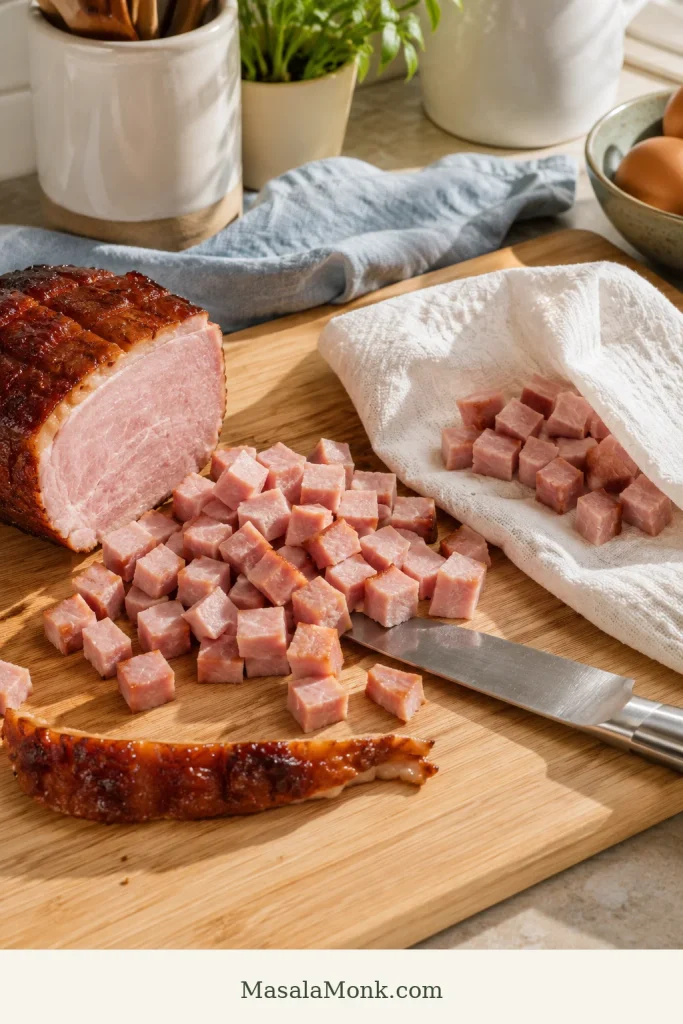
Almost any cooked ham works here: leftover holiday ham, ham steak, smoked ham, or thick-cut deli ham. Dice it small so it spreads evenly through the custard.
This is especially useful after a holiday meal, Sunday dinner, or any time you have cooked ham in the fridge. The ham is already seasoned and ready to help; you are not building brunch from nothing, just giving leftovers a better second life.
For deli ham, choose thicker slices and dice them small. Watery packages need a quick blot before the ham goes into the crust because extra moisture can affect the custard just like wet vegetables can.
Salty ham needs less salt in the egg mixture. You can always add a little salt at the table, but you cannot remove it once it is baked into the dish.
With sweet glazed ham, trim away any thick sticky edges before dicing. A little sweetness is fine, but too much glaze can make the quiche taste sweeter and more casserole-like than classic ham quiche. Dijon mustard, black pepper, cheddar, Swiss, or Gruyère will help balance it.
Blot wet ham before adding it; this small step helps prevent watery quiche, especially with deli ham or glazed leftovers.
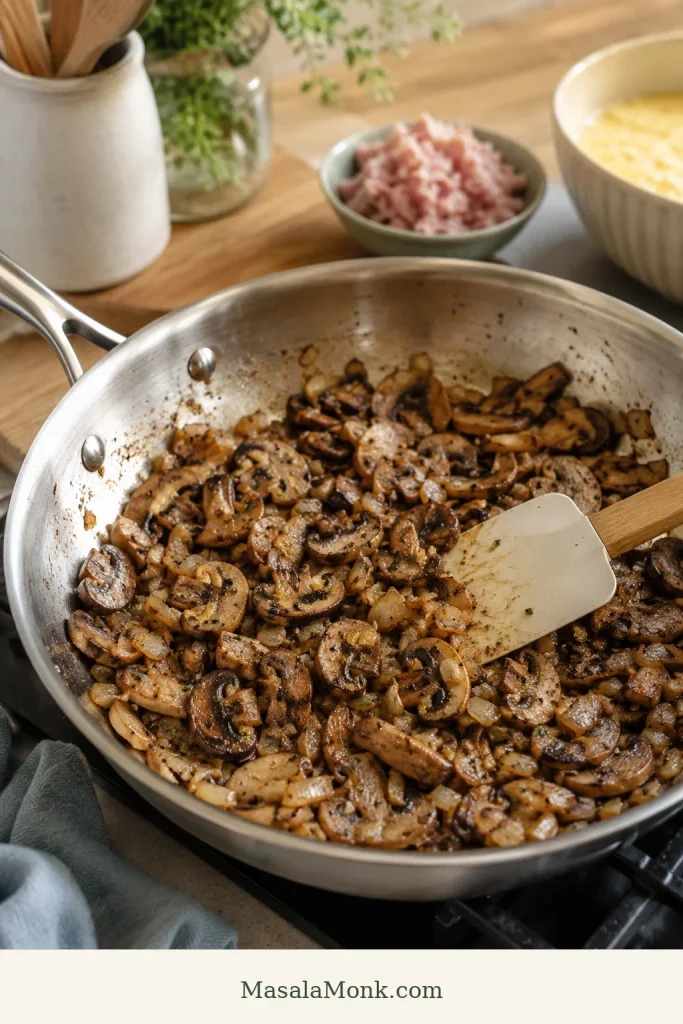
Brown the ham if it is pale, wet, or mild. Skip this step if the ham is already smoky, dry, or strongly flavored. A quick 2–3 minutes in a dry skillet or a little butter gives the edges more savory flavor.
Eggs
Five eggs is the sweet spot for this size: enough structure to slice, but not so many that the center turns firm and omelet-like.
Dairy
For the creamiest everyday texture, half-and-half gives you the easiest balance. If half-and-half is not available where you live, use equal parts heavy cream and whole milk.
Whole milk also works for a lighter quiche. The center will be less rich, but it will still set if you keep the egg-to-dairy ratio steady.
Cheese
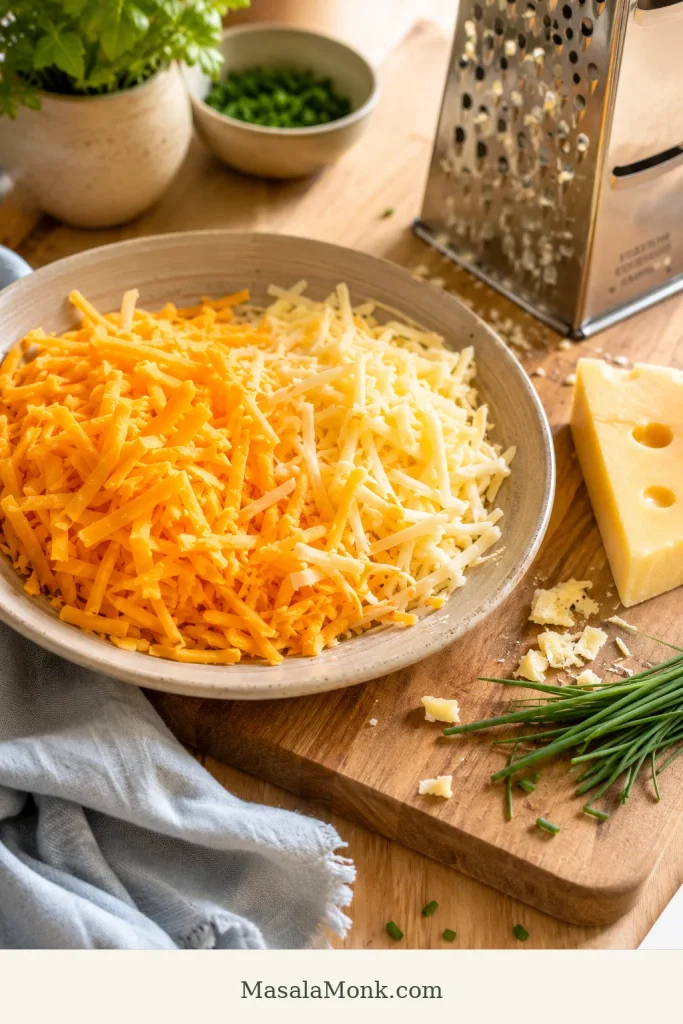
For cheese, stay with something that actually has flavor. Sharp cheddar gives the quiche that familiar melted ham-and-cheese pull, Swiss is mild and classic, and Gruyère makes the dish feel more brunch-table polished.
Measure shredded cheese loosely, not packed tightly into the cup. Too much cheese can make the quiche greasy, salty, or heavy. Freshly shredded cheese melts most smoothly, but pre-shredded cheese is fine when convenience matters.
Avoid fresh mozzarella unless it is very well drained. It can release water into the custard. Low-moisture mozzarella is safer, but it is mild, so it works better as part of a blend than as the main cheese.
Green Onions, Chives, Onion, or Garlic
Green onions and chives are the easiest because they can go straight into the egg mixture. If using yellow onion, shallot, or garlic, sauté them first so the flavor softens before baking.
Dijon, Pepper, and Nutmeg
Dijon mustard adds gentle sharpness without making the quiche taste mustardy. Black pepper keeps the custard from tasting flat. A tiny pinch of nutmeg is optional, but it works beautifully with eggs, cream, cheese, and ham.
Before You Bake, Check These 5 Things
If you remember only three things, par-bake the crust, control wet add-ins, and pull the quiche before the center turns firm. If the center still makes you nervous, the doneness cues below explain the wobble, resting time, and thermometer range.
The crust is par-baked and lightly set.
The ham is diced small and patted dry if it feels wet.
Any vegetables are cooked, drained, and cooled slightly.
The cheese and ham are measured loosely, not packed down.
The egg mixture sits below the rim of the crust.
Best Crust, Dairy, and Cheese Choices
This is where you can make the recipe fit your kitchen. Frozen crust, homemade crust, cream, milk, cheddar, Swiss, or Gruyère can all work — the goal is to keep the custard balanced and the crust from going soft.
Using a Frozen Pie Crust
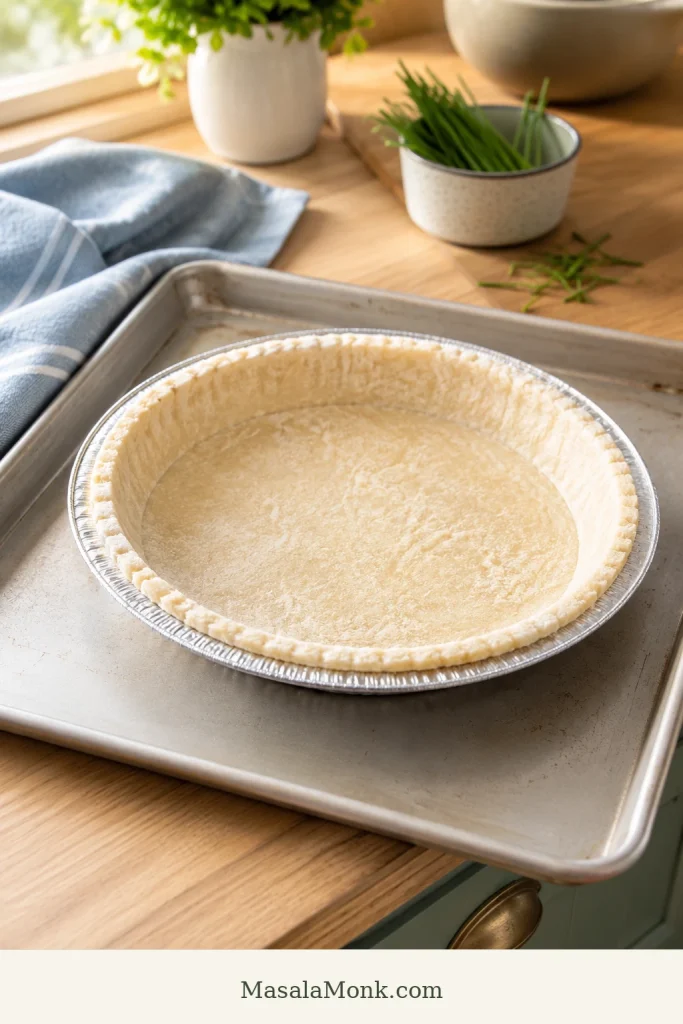
If you are using a frozen crust, you are not cheating; you are making brunch easier. Choose a 9-inch deep-dish frozen crust if you can. Regular frozen shells can work, but they often cannot hold all the filling.
Keep the crust in its tin if it comes that way, place it on a rimmed baking sheet, prick the base lightly, and par-bake for 10–12 minutes before filling. Do not worry if it is not deeply browned after the first bake. It will go back into the oven with the custard.
A deep-dish frozen pie crust makes frozen crust quiche easier because it gives the egg custard enough room and helps reduce spillover.
Homemade or Regular Pie Crust
Not every 9-inch crust holds the same amount of custard. A regular 9-inch crust can still work, but you may not need every drop of the egg mixture.
If using homemade pie dough, chill it in the dish before blind baking. Line it with parchment, fill with pie weights, dried beans, or uncooked rice, and bake until the edges begin to set before removing the weights.
With homemade or refrigerated dough, blind-baking with parchment and pie weights helps the crust hold its shape before the wet filling goes in.
Do not fill the crust all the way to the rim. Quiche can puff as it bakes. If you have extra egg mixture, bake it in a small greased ramekin instead of forcing it into the crust.
What Dairy Makes the Creamiest Texture?
The dairy is where you can quietly change the whole personality of the quiche. Cream makes it rich, milk makes it lighter, and half-and-half sits comfortably in the middle.
Dairy
Texture and Flavor
Good Use
Heavy cream
Richest, softest, most custardy
Special brunch or holiday quiche
Half-and-half
Creamy but not too heavy
Everyday choice
Whole milk
Lighter and less rich
Lighter quiche that still sets
Low-fat milk
Less creamy and slightly less forgiving
Use only if you accept a lighter texture
½ cream + ½ whole milk
Rich and balanced
Easy substitute for half-and-half
If you do not have half-and-half, use ½ cup / 120 ml heavy cream + ½ cup / 120 ml whole milk. To make the quiche without heavy cream, use 1 cup / 240 ml whole milk.
Cheddar, Swiss, or Gruyère?
Ham needs cheese with enough flavor to stand up to it. Sharp cheddar gives bold, familiar flavor. Swiss gives a mild, nutty, classic brunch taste. Gruyère makes the custard richer and deeper.
For an everyday version, use 1 cup sharp cheddar + ½ cup Swiss. For a richer brunch version, use 1 cup Gruyère + ½ cup cheddar or Swiss. A little Parmesan can also be added for salty, nutty depth, but use it lightly.
Sharp cheddar with Swiss or Gruyère gives ham quiche familiar melt plus a more brunch-ready finish.
Bake Time, Doneness, and Visual Cues
For a crusted quiche, use 375°F / 190°C for 35–45 minutes. A shallow quiche may finish closer to 35 minutes, while a deep-dish or vegetable-heavy one may need closer to 45–50 minutes.
Use 350°F / 175°C for the crustless version or a very deep filling. Save 400°F / 200°C mainly for par-baking crust or quick browning, not for the full custard bake.
Visual Doneness Cues
After par-baking: the crust should look dry and lightly set, not deeply browned.
After whisking: the egg mixture should look smooth and lightly yellow, not frothy.
Before baking: the egg mixture should sit below the rim, with a little breathing room.
Near the end: the top may puff slightly and turn golden in spots.
When done: the center should move like soft-set pudding, not ripple like raw liquid.
After resting: the center should look calmer, and the slice should hold when lifted.
If the crust browns too quickly, cover the edges with foil or a pie shield and keep baking until the center is set. If the top browns before the center is ready, tent the whole quiche loosely with foil.
The first time you bake quiche, the wobble can feel wrong. It is not. The quiche is done when the edges are puffed and set, the center is soft-set but not liquid, and the top is lightly golden in places.
Thermometer and Resting Cues
If using a thermometer, the center should reach at least 160°F / 71°C for egg safety. For a tender, sliceable quiche, start checking around 165°F / 74°C and avoid pushing far past 185°F / 85°C. Carryover heat and resting time will help the center finish setting.
A thermometer gives extra confidence with quiche doneness: the center should be safe and set without baking until the eggs turn rubbery.
If you are unsure, give the quiche a few more minutes of rest before cutting rather than putting it back into the oven too quickly. Resting often fixes a soft-looking center; overbaking does not.
Let the quiche rest before slicing; this pause helps the center settle so the slices lift cleaner and taste creamier.
Crustless Ham and Cheese Quiche and Easy Variations
Once the base is steady, this quiche is easy to bend toward the day: crusted for brunch, crustless for meal prep, mini for parties or lunchboxes.
If You Want…
Do This
Classic ham and cheese quiche
Use cheddar + Swiss in a par-baked crust
Richer brunch quiche
Use Gruyère and a cream + milk mixture
Lighter quiche
Use whole milk instead of cream or half-and-half
Crustless quiche
Grease the dish well and bake at 350°F / 175°C
Vegetable quiche
Cook and cool vegetables before adding them
Mini quiches
Use muffin tins and fill each cup about ¾ full
Leftover ham quiche
Dice ham small and reduce added salt if needed
Crustless Ham and Cheese Quiche
The crustless version is not just the fallback. It is the faster, lighter version for meal prep or for anyone skipping pastry.
To make it crustless, skip the pie crust and bake the egg mixture in a well-greased 9-inch / 23 cm pie dish. Use the same base: 5 eggs, 1 cup / 240 ml dairy, 1½ cups ham, 1½ cups cheese, Dijon, pepper, and herbs.
Bake at 350°F / 175°C for 30–40 minutes, or until the center is just set. The crustless version is softer than the crusted version, so let it rest for at least 10 minutes before slicing.
The lighter crustless ham and cheese quiche uses the same creamy filling but bakes directly in a greased dish.
For another no-crust egg bake, the frittata recipe is the skillet-style route; for muffin-tin meal prep, use the egg muffins recipe.
Ham and Swiss Quiche
Ham and Swiss quiche has a mild, nutty, classic brunch flavor. Use Swiss for all or part of the cheese. A good blend is 1 cup Swiss + ½ cup sharp cheddar. Dijon mustard and chives work especially well with this version.
Ham and Spinach Quiche
For ham and spinach quiche, use either 1 cup cooked fresh spinach or ½ cup frozen spinach that has been thawed and squeezed very dry. Spinach pairs well with Swiss, Gruyère, cheddar, feta, or goat cheese.
Wet spinach is not a small issue. It can make the center watery, even if the egg ratio is right.
Cook or squeeze spinach dry before making ham and spinach quiche; the greens should add color and flavor, not extra water.
Broccoli Ham and Cheese Quiche
For broccoli ham quiche, use 1 cup small broccoli florets. Steam, blanch, microwave, or sauté them first, then drain well and chop small. Sharp cheddar is the easiest pairing, but Swiss or Gruyère also work.
Small cooked broccoli florets keep broccoli ham and cheese quiche tender, balanced, and easy to cut.
Mushroom, Onion, Asparagus, and Other Add-Ins
Add-ins are where a good quiche can go watery, so treat them before they reach the crust. A few minutes in a skillet can save the whole dish.
Add-In
Amount
Prep
Mushrooms
¾–1 cup sliced
Sauté until the moisture evaporates
Onion or shallot
¼–½ cup chopped
Sauté until softened
Asparagus
¾–1 cup chopped
Blanch or sauté if thick
Bell pepper
½ cup diced
Sauté for better texture
Tomato
Small amount
Remove seeds and excess moisture
Let cooked vegetables cool for a few minutes before adding them. Hot add-ins can start setting the eggs unevenly before the dish even reaches the oven.
Sauté mushrooms and onions until their moisture cooks off; this is a simple fix for watery quiche.
Mini Ham and Cheese Quiche
Mini ham and cheese quiches are best when you want party bites, brunch trays, lunchboxes, or freezer-friendly portions. Use the same egg mixture, but cut the ham and add-ins smaller so each bite gets ham, cheese, and custard. For leftovers, use the make-ahead, storage, and reheating cues below.
The full filling usually makes about 10–12 regular muffin-size mini quiches or 24–30 mini muffin-size bites, depending on how much crust and add-ins you use.
Regular muffin tin: bake at 350°F / 175°C for 18–25 minutes.
Mini muffin tin: bake at 350°F / 175°C for 14–20 minutes.
With crust: press small pie crust or puff pastry rounds into greased cups before filling.
Without crust: grease the tin very well or use silicone liners.
Filling level: fill each cup about ¾ full so the egg mixture has room to puff.
Let mini quiches cool for 5 minutes before loosening them with a small knife. They freeze well after baking; reheat from chilled or thawed in a 325°F / 160°C oven until warmed through.
Party-size mini ham and cheese quiches work best with small pastry crusts, visible ham, and room for the custard to puff.
Other Shortcut Variations
Puff pastry works well for mini quiches and party bites. Crescent dough gives a softer, breadier crust. A Bisquick-style ham and cheese bake is closer to an impossible pie than a classic quiche, so it is better treated as a separate recipe rather than a small swap.
For an old-fashioned ham and cheese quiche, keep it simple: pie crust, cooked ham, cheddar and Swiss, half-and-half, green onions or chives, and black pepper.
Make Ahead, Storage, and Reheating
Quiche is one of the rare egg dishes that actually likes being made ahead. It can rest, settle, reheat, and still taste good when everyone finally reaches the table.
This is also why quiche works so well for hosting: it gives you something generous to serve without asking you to cook every egg to order. When the timing is sorted, jump to what to serve with it for plate ideas.
For a crisper crust, do not pour the raw egg mixture into the shell many hours before baking. The crust can absorb moisture and soften before it ever reaches the oven. If you want to prep ahead, par-bake the crust, dice the ham, shred the cheese, cook any vegetables, and keep the egg mixture separate until baking.
Let the quiche cool completely, then cover it and refrigerate for 3–4 days, whole or in slices. That timing lines up with USDA leftover food safety guidance.
Freezer
Quiche freezes more cleanly after baking. Cool it completely, wrap it tightly, and freeze it whole or sliced for up to 2 months for the creamiest texture.
The crust may soften slightly after freezing, but reheating in the oven helps bring it back. If freezing slices, wrap them individually or place parchment between them so they do not stick together.
For a freezer breakfast that reheats faster than quiche, MasalaMonk’s breakfast burrito recipe is the better handheld option.
Reheating
For a better texture, reheat slices in a 325°F / 160°C oven until warmed through. Reheat loosely covered with foil, then uncover for the last few minutes if the crust needs crisping.
The microwave works for individual slices when speed matters, but it will soften the crust. If reheating from frozen, thaw overnight in the refrigerator first.
Make-ahead ham and cheese quiche slices store well once cooled; reheat them in the oven or toaster oven when you want the crust to stay crisp.
What to Serve with Ham and Cheese Quiche
The quiche already brings richness, salt, and comfort. The best sides simply make the plate feel fresher. A crisp salad or fresh fruit keeps each creamy, salty bite from feeling heavy.
Serve the rich quiche with fruit, greens, cucumber, or coffee so the creamy, salty slices feel balanced.
Potlucks: cool slightly, slice cleanly, and serve warm or at room temperature.
How to Avoid Watery, Soggy, or Rubbery Quiche
When quiche goes wrong, it usually gives you clues. A watery middle, soggy bottom, rubbery texture, or salty bite can almost always be traced back to moisture, timing, salt, or overfilling — not to quiche being difficult.
Once you know what the center should look like, quiche stops feeling mysterious.
Problem
Most Likely Cause
Fix Next Time
Watery center
Wet vegetables, watery ham, too much dairy, or underbaking
Cook and drain add-ins, keep the ratio steady, and rest before slicing
Soggy crust
Crust not par-baked or custard sat in crust too long
Par-bake first and assemble close to baking
Rubbery texture
Overbaking
Pull while the center is still soft-set
Too salty
Salty ham and cheese plus full added salt
Use ¼ teaspoon salt or less with salty ham
Overflow
Shallow crust or filling too close to rim
Use deep-dish crust and stop below the rim
The 3 Biggest Quiche Mistakes
Skipping the par-bake: this is the fastest path to a soft bottom crust.
Adding wet ingredients: watery ham, spinach, mushrooms, and tomatoes can loosen the custard.
Baking until fully firm: pull it while the center is still soft-set, then let it rest.
Why is my quiche watery?
Watery quiche is almost always a moisture or timing problem. The usual culprits are wet spinach, raw mushrooms, watery ham, too much dairy, underbaking, or slicing before the center has had time to settle.
Cook and drain vegetables before adding them.
Squeeze spinach very dry.
Pat wet ham dry.
Use the 5 eggs to 1 cup dairy ratio.
Bake until the center is just set.
Rest for 10 minutes before slicing.
Why is my crust soggy?
A soggy crust usually means the crust was not par-baked, the egg mixture sat in the crust too long before baking, or wet ingredients released moisture into the bottom. Par-bake the crust, cook and drain vegetables, and avoid assembling the raw custard in the crust too far ahead.
The best no-soggy-bottom proof is underneath: the crust should look firm enough to lift, not pale, wet, or collapsed.
Why is my quiche rubbery?
Rubbery quiche is usually overbaked. Eggs become firm and tough when they cook too long. Remove the quiche when the center still has a gentle wobble. It will finish setting as it rests.
Why did the center not set?
The center may not set if the quiche is very deep, the oven temperature is too low, the mixture has too much liquid, or it simply needs more time. Cover the crust edges with foil if needed and continue baking until the center no longer looks liquid.
Why is it too salty?
Ham and cheese both bring salt. If your ham is salty, use less salt in the egg mixture. Dijon, black pepper, green onions, chives, and a small amount of cream can help balance the flavor without adding more salt.
Why did it overflow?
The crust may have been too shallow or filled too close to the top. Use a deep-dish crust when possible, stop before the egg mixture reaches the rim, and always bake the quiche on a rimmed baking sheet.
FAQs
Does ham and cheese quiche work without crust?
Yes. Grease a 9-inch / 23 cm pie dish, add the filling, and bake at 350°F / 175°C for 30–40 minutes. Rest before slicing so the center can settle.
Milk instead of cream: will the quiche still set?
Yes. Whole milk works. Keep it to 1 cup / 240 ml so the center still slices cleanly. It will taste lighter than a cream version, but it will still be a proper, sliceable quiche.
Best substitute for half-and-half
Use ½ cup / 120 ml heavy cream plus ½ cup / 120 ml whole milk. You can also use 1 cup / 240 ml whole milk for a lighter version.
Best cheese for ham quiche
Sharp cheddar gives bold flavor, Swiss gives a classic ham quiche taste, and Gruyère makes it richer. A cheddar-Swiss blend is the easiest everyday choice.
Frozen pie crust: deep-dish or regular?
Deep-dish is better because regular frozen shells may not hold all the filling. Par-bake the crust first, place it on a rimmed baking sheet, and avoid overfilling it.
Spinach in quiche: fresh, frozen, cooked, or raw?
Fresh spinach should be wilted first, and frozen spinach should be thawed and squeezed very dry. Raw or wet spinach can make the quiche watery.
Make-ahead quiche: bake first or assemble later?
Bake it first for the easiest make-ahead plan. To prep parts ahead, keep the par-baked crust, cooked add-ins, cheese, ham, and egg mixture separate until baking.
Freezing ham and cheese quiche: whole or sliced?
Both work. Bake it first, cool it completely, then freeze it whole or in slices. Slices are easier for quick meals. Thaw overnight in the refrigerator and reheat in the oven for the best texture.
Doneness cues for creamy, sliceable quiche
The edges should be set, and the center should look soft-set, not liquid. A gentle wobble is okay. If using a thermometer, the center should reach at least 160°F / 71°C.
Watery quiche: what went wrong?
Quiche usually turns watery because of wet vegetables, watery ham, too much dairy, underbaking, or slicing too soon. Cook and drain add-ins, use the right egg-to-dairy ratio, and rest it before slicing.
Is ham and cheese quiche the same as quiche Lorraine?
Not exactly. Quiche Lorraine is traditionally made with bacon or lardons and a savory custard. Ham and cheese quiche has a similar creamy egg base, but uses cooked ham and usually includes cheese like cheddar, Swiss, or Gruyère.
Final Thoughts
Once the ratio makes sense, this stops feeling like a recipe you have to follow tightly and starts feeling like a brunch formula you can use. Cooked ham after a holiday, spinach from the fridge, cheddar one week, Swiss the next, crusted for brunch, crustless for meal prep — it all works as long as the base stays steady.
That is the kind of recipe worth keeping: calm, flexible, and good enough for both leftover ham and a proper brunch table. Slice it warm, serve it with something crisp or fresh, and let the ham, cheese, custard, and flaky crust do the quiet work.
If you make it, start with the cheddar-Swiss version once, then tell me where you took it: crustless, extra herbs, leftover holiday ham, spinach, broccoli, or a different cheese blend.
Japanese pancakes look magical until you try to make them at home. They rise like little clouds, jiggle when the plate moves, and seem soft enough to collapse under a spoon. Then the real fear arrives: what if they spread flat, burn on the bottom, stay raw in the center, or puff up beautifully in the pan and sink the second you serve them?
The real challenge is technique, not ingredients. That is the moment this Japanese pancakes recipe is built for. The ingredients are simple, but the method matters. These are not regular pancakes with extra baking powder. They are small soufflés cooked like pancakes, and once you treat them that way, the method starts to make sense.
The secret is a stable meringue, gentle folding, controlled heat, a little steam, and patience. In this guide, you will get exact grams and spoon measures, the right batter texture, the meringue stage to aim for, ring-mold and no-mold methods, a pancake-mix shortcut, and clear fixes for deflating, spreading, burning, shrinking, and raw centers. If you only remember one framework, start with the 3 checks that decide whether Japanese pancakes rise or collapse.
By the time you reach the pan, you will know what the meringue should look like, how the batter should stand, when to flip, and why a pancake that looks almost ready often needs one more covered minute. That extra minute is not hesitation; it is usually the difference between a pancake that holds and one that sinks as it cools.
If you want a more classic pancake stack instead of the tall soufflé style, you may also like these fluffy buttermilk pancakes with stewed cinnamon apples. This recipe is for the café-style Japanese soufflé pancakes that are tall, soft, jiggly, and best eaten right away.
This is the home-cook target: soft, tall pancakes that feel special without needing every edge to look like a perfect café cylinder.
A home batch does not need perfect café edges; instead, aim for fluffy soufflé pancakes with height, softness, and a fully set center.
Quick Answer: How Do You Make Fluffy Japanese Pancakes?
Japanese pancakes, often called Japanese soufflé pancakes, are tall pancakes made by folding whipped egg whites into a small yolk batter and cooking the batter slowly in a covered pan. The fluff comes mostly from meringue, not from baking powder alone.
For the best height, beat the egg whites to glossy stiff peaks, fold gently, scoop the batter into tall mounds, cook on gentle heat, and use a little steam so the center sets before the outside over-browns. A ring mold gives the neatest shape, but the no-mold Japanese pancake method works by stacking the batter in layers. If your first batch spreads, burns, or sinks, use the troubleshooting guide before changing the whole recipe. Serve them immediately because this soufflé-style texture naturally settles as it cools.
What Jiggly but Cooked Through Looks Like
The pancake should move softly, but it should still feel set. Think gentle spring, not wet batter hiding under a browned top.
Jiggly should mean soft and bouncy, not wet. If the pancake springs back gently, the center is much closer to ready.
Japanese Pancakes at a Glance
Yield
2–3 thick pancakes
Texture goal
Tall, soft, airy, gently jiggly, cooked through
Meringue target
Glossy firm/stiff peaks
Batter texture
Thick and spoonable; it should mound, not pour
Pan target
About 300°F / 150°C
Workable pan range
285–320°F / 140–160°C
First side
6–8 minutes covered, depending on size
Second side
4–6 minutes covered
Cook time
About 12–15 minutes per batch
Mold
Optional; no-mold method included
Best served
Immediately, ideally within 5–10 minutes
Before cooking, remember the working numbers: two eggs, low heat near 300°F, a covered pan, steam, and quick serving.
What Are Japanese Pancakes?
In this tall, café-style version, Japanese pancakes means Japanese soufflé pancakes: soft, airy pancakes made with whipped egg whites and cooked gently until they rise into a thick, delicate stack.
They are different from regular pancakes. A normal pancake batter is mixed, poured, and cooked fairly quickly. Japanese soufflé pancake batter is built around foam. The egg whites are beaten into a meringue, folded into a yolk mixture, then cooked low and slow so the foam has time to set.
That is why the method feels more precise than a usual pancake recipe. You are not only browning batter on a pan. You are setting a fragile structure full of air. Once that idea clicks, the recipe stops feeling mysterious and starts feeling manageable.
Because this batter is lifted by whipped egg whites, it behaves more like a delicate pan-cooked soufflé than a regular pancake.
Japanese Hotcakes vs Japanese Soufflé Pancakes vs Fuwa Fuwa Pancakes
The names can get confusing because several styles of Japanese pancakes appear in cafés, cookbooks, and social videos. Here is the simple difference.
Term
What it usually means
Texture
Japanese hotcakes
Thicker, sweeter, more regular-style pancakes, often made from a batter or mix
Soft, cakey, and sturdy
Japanese soufflé pancakes
Tall pancakes lifted with whipped egg whites and cooked slowly
Airy, jiggly, delicate, and cloudlike
Fuwa fuwa pancakes
A texture-focused name for soft, fluffy pancakes
Light, soft, and pillowy
Jiggly pancakes
A social-media-friendly name for Japanese soufflé pancakes
Wobbly and tall, but still cooked through
Japanese hotcakes are sturdier and more cake-like; soufflé pancakes need meringue, low heat, and steam for their tall café-style texture.
This recipe focuses on the tall, meringue-based pancake version. Japanese soufflé cake is a different dessert, usually closer to Japanese cheesecake or cotton cheesecake, which is baked rather than cooked on a skillet. There is a short note on that difference later in the post.
So if you came here for the tall, jiggly café pancakes, you are in the right place. If you wanted a sturdier everyday hotcake, treat this as the soufflé-style weekend version instead.
What Does Fuwa Fuwa Mean?
Fuwa fuwa is a Japanese expression used for something soft, airy, and fluffy. In a pancake context, it describes the texture people want from café-style Japanese pancakes: tall, tender, light, and gently wobbly.
Fuwa fuwa texture does not come from making the batter sweeter or loading it with baking powder. It comes from air. The egg whites trap tiny bubbles, sugar helps stabilize those bubbles, and gentle heat gives the pancake enough time to cook without collapsing too quickly.
Texture target: A good Japanese soufflé pancake should feel soft and airy, with a gentle jiggle. It should not be wet, runny, or raw in the center.
Fuwa fuwa is the soft, airy texture you are chasing, so protect the foam from mixing bowl to pan.
Before You Start: Set Yourself Up to Win
This small setup step makes the recipe much easier. Once the meringue is folded into the batter, the clock starts. The batter slowly loses air as it sits, so you do not want to stop halfway through to find a lid, wash a spatula, or clear space on the stove.
Use clean, dry bowls and beaters. Grease or yolk in the egg whites can weaken the meringue; the meringue guide shows what the right texture should look like.
Have the pan, lid, spatula, water, and serving plates ready. The batter should be cooked soon after folding.
Start with gentle heat. You can always cook a little longer, but you cannot un-burn the outside.
Make only 2–3 pancakes at once. Crowding makes flipping harder and lowers control.
Serve immediately. These pancakes are meant to be eaten fresh, while the structure is still warm and lifted.
Why the Egg White Bowl Must Be Clean
Before you beat the whites, check the bowl and beaters. This tiny setup detail protects the foam that gives the pancakes their height.
Start with spotless egg whites. Even a small streak of yolk or grease can keep the meringue from whipping properly.
Beginner reassurance: Your first batch may not look like a café stack, and that is completely normal. If the pancakes taste good but sit a little lower, you are already close. The next batch usually improves once you understand your pan heat and meringue texture.
Why This Japanese Pancakes Recipe Works
Home kitchens are messy in the best way: one stove runs hot, another pan holds heat differently, and not everyone has a ring mold. Instead of asking you to trust the timer blindly, this method shows you what to look for at each stage.
Meringue gives height. The whipped egg whites are the main lift in this style. Baking powder helps a little, but it cannot replace a strong foam.
A small amount of flour keeps the pancakes light. Too much flour makes them cakey and heavy; too little structure makes them fragile.
Cornstarch gives extra support. A teaspoon helps the delicate foam hold together without making the pancake dense.
Slow covered cooking sets the middle. Tall pancakes need more time than normal pancakes. High heat gives you a browned outside and a wet center.
Steam helps the pancake set. A covered pan traps moisture and heat around the tall batter so the inside cooks through.
Layered scooping builds height without a mold. Instead of pouring all the batter at once, you add it in mounds so the pancake rises upward, not outward.
The 3 Checks That Decide Whether They Rise or Collapse
If the recipe starts to feel fussy, bring it back to three checks: the meringue should hold itself, the batter should stand in a mound, and the heat should be gentle enough that the middle sets before the bottom browns too deeply.
Check
What you want
What it tells you
Meringue
Shiny, firm peaks that hold their shape
A drooping meringue usually leads to spread; a dry, clumpy one is hard to fold smoothly.
Batter
Thick, airy, and able to mound on a spoon
A batter that slides off the spoon instead of sitting in a mound will usually cook flatter.
Heat
Gentle enough to cook slowly under a lid
The bottom should set and lightly color while the center has time to catch up.
Meringue Stages for Japanese Pancakes
Use the meringue stage as your first checkpoint. Foam is too early, soft peaks are usually weak, glossy firm peaks are the target, and dry clumps mean you went too far.
Use the stages as a checkpoint: keep beating past foam and soft peaks, then stop at glossy firm peaks before the meringue breaks.
A pancake that looks tall but feels liquid under the spatula needs more covered time, not a brave flip. In testing, the pancakes that looked almost ready were usually the ones that needed one more covered minute.
Ingredients for Japanese Soufflé Pancakes
Use a scale if you have one. This is a tiny batter, so small changes matter. An extra splash of milk can make the batter slide instead of mound, and a heavy scoop of flour can make the pancakes feel cakey instead of cloudlike. The gram amounts in this recipe are the ones to follow here. After mixing, compare your bowl with the batter texture cues before scooping.
Small measurements matter here: too much milk loosens the batter, while careful flour and cornstarch balance keeps the texture light.
Ingredient
Amount
Why it matters
Large egg yolks
2 yolks, about 35–40g
Make the rich base of the batter
Large egg whites
2 whites, about 60–65g
Create the main soufflé lift
Whole milk
20ml / 1 tbsp + 1 tsp
Loosens the yolk batter without making it runny
Vanilla extract
½ tsp
Softens the eggy flavor
Cake flour
30g / about ¼ cup spooned and leveled
Gives light structure
Cornstarch
1 tsp / about 3g
Helps support the delicate foam
Baking powder
¼ tsp
Adds a little backup lift
Fine salt
Pinch
Balances the sweetness
Granulated sugar
24–25g / 2 tbsp
Sweetens and stabilizes the meringue
Cream of tartar
¼ tsp
Helps stabilize the egg whites
Neutral oil or melted butter
For greasing
Prevents sticking without frying the pancake
Water
1–2 tbsp total
Creates steam under the lid
Ingredient Notes and Substitutions
Cake flour: Cake flour gives a lighter pancake. If you do not have it, measure 30g all-purpose flour, remove 1 teaspoon, and replace that teaspoon with cornstarch.
Cream of tartar: This helps the egg whites whip into a more stable meringue. If you do not have it, use 1 teaspoon lemon juice or ½ teaspoon white vinegar instead.
Egg temperature: Cold eggs can be easier to separate cleanly, while room-temperature whites usually whip faster. Either works here as long as the bowl is clean and the whites are beaten to the right stage.
Milk: Whole milk gives the best body. Add more only if the yolk batter is too stiff to mix. The finished batter should feel light but not loose.
Optional taller version: For a taller café-style pancake, use 3 egg whites and 2 yolks. Keep the other ingredients the same, but fold carefully because the batter becomes more delicate. Start with the basic 2-white version if this is your first try.
Equipment: What You Need and What You Don’t
You do not need a professional kitchen to make fluffy Japanese pancakes. The most important “equipment” is really control: a clean bowl for the whites, a pan that heats gently, and a lid that traps steam around the tall batter. If you have molds, see how to use a ring mold; if not, the no-mold method is built for a normal home pan.
The most useful tools are the ones that give control: clean bowls, steady heat, a lid for steam, and a thin spatula.
Essential Equipment
Electric hand mixer or stand mixer
Two clean mixing bowls
Fine mesh sieve
Nonstick pan or electric griddle
Tight-fitting lid, preferably tall enough not to touch the pancakes
Thin flexible spatula
Paper towel for spreading a thin film of oil
Helpful but Optional
Cookie scoop or disher for even mounds
Piping bag for cleaner shaping
Ring molds for straighter sides
Infrared thermometer for checking pan surface temperature
Instant-read thermometer for checking the center of the pancake
Choose Your Method: Ring Mold, No Mold, or Pancake Mix
There is more than one way to make these pancakes, and the best path depends on your tools and comfort level. A ring mold gives the neatest sides, the no-mold method is friendlier for home cooks, and pancake mix is a convenience shortcut rather than a magic fix.
Method
Best for
What to watch
Basic 2-white batter
First attempts and best control
Start here before trying a taller, more delicate version.
No mold
Home cooks who want fewer tools
The batter must be thick enough to mound; the shape will be softer.
Ring mold
Very tall, straight-sided pancakes
Grease the mold well and fill only halfway to two-thirds full.
Pancake mix shortcut
Convenience
The mix replaces the dry base, not the whipped egg whites.
3-white version
Extra height after you know the method
Fold carefully because the batter becomes more delicate.
Ring molds give cleaner sides, but a strong no-mold batter can still make fluffy Japanese pancakes worth serving proudly.
A ring mold can make the pancakes look more like café cylinders, but it is not required for a lovely plate. Without a mold, expect softer café-style mounds rather than perfectly vertical sides. The texture can still be airy, tender, and special.
How to Make Japanese Pancakes Without a Mold
For the no-mold method, scoop the batter into tall mounds instead of pouring it. Use about two-thirds of the batter for the first mounds and reserve the rest for topping them after the base starts to set.
No-Mold First Layer
The first scoop should sit tall in the pan. Once that base begins to set, it can hold more batter without spreading as much.
For the no-mold method, start with thick first-layer mounds; once they begin to set, they can support the second scoop.
Preheat the pan on gentle heat and wipe it with a thin film of oil.
Scoop 2–3 tall mounds of batter into the pan, leaving space between them.
Add 2 teaspoons water to the empty space in the pan, away from the batter.
Cover and cook for 3–4 minutes, until the bottom layer starts to set.
Add the reserved batter on top of each pancake.
Cover again and cook until the sides look less glossy and the base releases cleanly.
Flip gently, add another small splash of water, cover, and finish cooking.
How to Layer No-Mold Japanese Pancakes
Add the reserved batter after the first layer has started to hold its shape. This gives the pancake height without needing a ring mold.
Add the second layer only after the base starts to set; otherwise, the batter spreads outward instead of stacking upward.
The no-mold pancakes may lean a little, and their edges may look softer. That is not failure. The win is a pancake that rises upward, cooks through, and lands on the plate warm and tender.
How to Use a Ring Mold
Use a ring mold about 2.5–3 inches wide and roughly 2 inches high. Grease the inside very well, place it in the pan, and fill it only halfway to two-thirds full. The batter needs room to rise.
How High to Fill a Ring Mold
Leave visible headroom in the mold. Filling to the top looks dramatic, but it gives the batter nowhere to rise.
Fill the ring mold only halfway to two-thirds full. The batter needs headroom to rise without spilling or compressing.
When flipping, slide a thin spatula under the mold and use tongs to steady the ring. A pancake that resists or looks wet at the sides is asking for more time. Ring molds get hot, so use tongs or a towel when adjusting them.
Meringue Guide: The Most Important Step
The meringue is where these pancakes get their height. Think of it as the scaffolding inside the pancake: too soft and the batter spreads; too dry and it becomes hard to fold smoothly.
A good meringue looks shiny and confident. It should not slide around the bowl like foam, and it should not break into dry chunks. When the peak stands with only a small bend at the tip, you are in the right zone. In testing, batter made with soft peaks spread quickly, even when the pan heat was right.
The Glossy Firm Peak Target
The target is not just “fluffy.” It is glossy, structured foam that can hold the batter up once it reaches the pan.
This is the target texture: shiny, strong, and stable enough to help the batter mound in the pan instead of spread.
Soft Peaks vs Stiff Peaks
Soft peaks may seem close, but this batter needs a stronger foam. A drooping peak often becomes a spreading pancake.
Soft peaks can look promising, but they often collapse after folding. Beat a little longer until the peaks stand firmly.
Meringue stage
What it looks like
Use it?
Foamy
Bubbles with no real shape
No. Too early.
Soft peaks
Peak forms but droops over
Usually too weak for tall pancakes.
Firm/stiff glossy peaks
Peak stands upright or nearly upright; meringue looks smooth and shiny
Yes. This is the target.
Dry or clumpy peaks
Grainy, dull, broken-looking foam
No. Overbeaten and harder to fold.
What Overbeaten Meringue Looks Like
The other mistake is going too far. Once the meringue looks dry, dull, and broken, it becomes harder to fold into a smooth, airy batter.
Once meringue turns dry and clumpy, it becomes harder to fold evenly; next time, stop at glossy firm peaks.
Use a clean, dry bowl. Any grease or yolk can weaken the foam.
Start beating the egg whites with cream of tartar until foamy.
Add the sugar gradually, not all at once.
Beat until the meringue is shiny and structured enough to hold strong peaks.
Stop before it turns dry, grainy, or chunky.
If the whites refuse to foam after a minute or two, it is usually better to start over in a clean bowl than to keep trying to rescue them. A little yolk or grease can quietly ruin the lift.
What the Batter Should Look Like
The batter should be thick, airy, and spoonable. It should hold its shape when dropped into the pan. It should not pour like crepe batter or spread immediately into a flat circle.
The batter should sit in a soft mound on the spoon. If it slides away quickly, the pancakes will likely spread.
When folding, keep the movement calm and broad. Sweep under the batter, turn it over itself, and stop before you flatten the air out of it. A few faint streaks are better than a perfectly smooth batter that has lost its lift.
Batter cue
What it means
Thick and mounds on a spoon
Good. The meringue is holding structure.
Loose and pourable
Meringue may be underwhipped, overfolded, or the batter has too much liquid.
Lumpy with dry white clumps
Meringue may be overbeaten or not folded evenly.
Watery at the bottom
Batter has started breaking down. Cook immediately, but expect less height.
Runny vs Moundable Batter
Before the pan gets involved, the bowl already tells you a lot. Batter that sits in a mound has structure; batter that flows quickly is already warning you it may spread.
Check texture before cooking: moundable batter rises upward, while runny batter usually flattens before it can set.
How to Make Japanese Soufflé Pancakes Step by Step
Read through the method once before starting. The batter is best cooked soon after folding, so it helps to have the pan, lid, spatula, water, and serving plates ready.
First-batch reality check: The first pancake is where you learn your pan. A quick-browning bottom means the heat needs to come down. A spreading mound points back to the meringue or batter texture. A shorter but cooked-through pancake is still progress.
1. Separate the Eggs
Separate 2 large eggs into yolks and whites. Keep the whites completely free of yolk. If you separated the eggs while cold, let the whites sit for a few minutes while preparing the yolk batter. They do not need to be perfectly room temperature; the final meringue stage matters more.
2. Make the Yolk Batter
In a medium bowl, whisk the egg yolks, milk, vanilla, and salt until smooth. Sift in the cake flour, cornstarch, and baking powder. Whisk just until the batter is smooth and thick. Add extra milk only if the batter is too stiff to mix.
3. Beat the Meringue
In a clean bowl, beat the egg whites and cream of tartar until foamy. Add the sugar gradually while beating. Continue until the meringue is smooth, shiny, and firm enough to stand. If the peak stage feels unclear, check the glossy firm peak cue before folding. Soft peaks make soft pancakes; firm peaks give the batter a chance to rise tall.
4. Fold the Batter
Add about one-third of the meringue to the yolk batter and mix it in more freely to lighten the base. Add the remaining meringue in two additions, folding with a spatula until the batter is mostly even, thick, and airy.
Before scooping, the batter should match the moundable batter cues. A batter that sits proudly on the spoon is ready for the pan; one that slides away quickly will usually cook flatter, so move quickly and keep the mounds smaller.
Fold with broad, gentle strokes. A few faint streaks are better than a smooth batter that has lost its air.
5. Preheat the Pan Gently
Set a nonstick pan over gentle heat. If using an infrared thermometer, aim for about 300°F / 150°C, with a workable range of 285–320°F / 140–160°C. Wipe the pan with a very thin film of oil.
If your lid is low, use smaller mounds so the batter does not touch the lid as it rises.
6. Scoop and Steam
Scoop the batter into 2 or 3 tall mounds. Use about two-thirds of the batter for this first layer and reserve the rest for building height. Add 2 teaspoons water to the empty area of the pan, away from the batter, and cover immediately.
Scoop upward, not outward. Tall mounds give no-mold Japanese pancakes a better chance to rise instead of spreading flat.
7. Build Height
After 3–4 minutes, the first layer should look slightly more set around the base. Add the reserved batter on top of each mound. Cover again and continue cooking.
8. Flip Gently
Flip when the sides look less glossy, the bottom is lightly golden, and the pancake feels like it has a body of its own. The spatula should slide under with support, not drag through wet batter.
How to Know When Japanese Pancakes Are Ready to Flip
This is the part where most people want to move too soon. Wait for the sides to lose their wet gloss and for the pancake to feel supported under the spatula.
Flip when the sides lose their wet gloss and the spatula slides underneath with support. If it drags, wait longer.
If you are nervous here, that is normal. The safer move is usually one more covered minute, not forcing the spatula under a pancake that is still wet at the sides. Use the flip-readiness cues before trying again.
After flipping, add another small splash of water, cover, and cook until the second side is set. Let the pancake keep the air you built into it; a gentle flip is enough.
Use a thin spatula and a calm hand. A rough flip can press out the air you worked so hard to keep.
9. Serve Immediately
These pancakes have a short golden window. Bring the plate to the table first, then bring the pancakes. A little settling is normal because the hot air inside cools, but they are at their softest and tallest right away.
The best bite is warm, soft, and custard-tender in the center without being wet. The pancake should give under the fork, then spring back just a little. That is the café-at-home moment you are cooking toward.
Low Heat and Steam: Time, Temperature, and Doneness
Most failed Japanese pancakes come down to heat. Tall batter needs time. When the pan is too hot, the outside browns before the inside cooks. When the pan is too cool and the lid is lifted too often, the center can stay gummy.
Best Pan Temperature for Japanese Pancakes
Think gentle surface heat, not a hot pancake rush. A pan near 300°F gives the foam time to set before the bottom goes too dark.
Keep the pan gentle, not blazing hot. Around 300°F gives the center time to cook before the outside browns too fast.
The bottom should not race ahead of the middle. A sweet, warm pancake smell is fine; a toasted smell before the sides look set is your cue to lower the heat. The batches that browned fastest were also the ones most likely to stay wet inside. If the outside is browning while the middle stays wet, go straight to the raw center fix.
Cooking cue
Best target
Pan surface temperature
285–320°F / 140–160°C
Ideal target
About 300°F / 150°C
First side
6–8 minutes total, covered
Second side
4–6 minutes, covered
Steam water
2 teaspoons to 1 tablespoon at a time
Optional center temperature
About 160°F / 71°C
Best serving window
Immediately, ideally within 5–10 minutes
The water should go into the empty space in the pan, not on top of the batter. You only need enough to create a quiet puff of steam under the lid, not a puddle.
Where to Add Water for Steam
Place the water beside the batter so the steam can circulate around the pancakes. Pouring on top can thin or disturb the mounds you just built.
Add water to the empty pan space, then cover. That way, steam surrounds the pancakes without thinning the batter.
Why Covered Steam Cooking Matters
Once covered, the pan becomes a small steam chamber. Keep the lid on long enough for the center to set instead of chasing color too early.
Once the lid goes on, let the steam work. Opening too often releases heat and slows the center from setting.
How to Tell If the Pan Is Too Hot or Too Cool
What you see
What it means
What to do
Bottom browns deeply in 2–3 minutes
Pan is too hot
Lower the heat and move the pan off the burner briefly
Edges look cooked but center feels liquid
Heat is too high or pancake is too thick
Cover longer on low heat and make smaller mounds next time
Pancake barely colors after 8 minutes
Pan may be too cool
Increase heat very slightly, but keep it gentle
Pancake deflates when lid opens
Structure is not set yet
Cover again and give it more time before flipping
Keep the lid on as much as possible. Every time you lift it, you release heat and steam, and the pancakes may take longer to set.
Optional safety cue: If using a thermometer, aim for about 160°F / 71°C in the center. The pancake should also feel softly bouncy, not liquid, when touched gently. For general egg-dish temperature guidance, see the USDA egg safety guide.
Can You Make Japanese Soufflé Pancakes With Pancake Mix?
Yes, you can make a shortcut version with pancake mix, but use it for fewer dry ingredients, not to skip the soufflé technique. The height still comes from whipped egg whites.
Think of pancake mix as a replacement for the flour, baking powder, and part of the dry base. It does not replace separated eggs, meringue, slow covered cooking, steam, or gentle folding.
Japanese hotcake mix or regular pancake mix can both work, but the result may be a little sweeter, cakier, or more mix-flavored than the main recipe. Keep the heat low because mixes with sugar can brown faster.
Pinch to ¼ teaspoon, or a few drops of lemon juice
Start with 1½ tablespoons milk. Add the remaining ½ tablespoon only if the yolk batter is too stiff to mix. Pancake mixes vary, and a looser shortcut batter is harder to stack tall.
Make the yolk batter with the yolks, milk, vanilla, and pancake mix. Beat the whites with the acid and sugar until the meringue is glossy and holds its shape, then fold and cook the same way as the main recipe.
Shortcut truth: Pancake mix can make the dry ingredients easier, but it will not save a weak meringue. If the egg whites are not whipped well, the pancakes will still spread or deflate.
What Success Looks Like
A good batch does not have to look identical to a café pancake. Look for these signs instead.
The batter rises upward more than it spreads outward.
The sides look set instead of glossy-wet.
The pancake releases from the pan without tearing.
The center feels softly bouncy, not liquid.
The inside is moist and airy, not raw.
The pancakes settle slightly after serving, but do not collapse into flat rounds.
Normal settling means the pancakes soften and lower slightly as they cool. A failure collapse means they flatten quickly, slump into the plate, or look wet in the middle.
Save the batch: If the first pancakes are shorter than expected but cooked through and soft, serve them proudly with toppings. A slightly shorter pancake with a set center is better than a dramatic tall pancake that is wet inside.
Troubleshooting Japanese Pancakes
Most pancake problems are not disasters. They are clues. Find the problem you actually saw, not the problem you are afraid of, and the next batch becomes much easier.
This style is technique-sensitive, but the fixes are usually simple: strengthen the meringue, fold less, lower the heat, cook longer covered, or make smaller mounds.
Use the failure shape as a clue: spreading points to batter, burning points to heat, collapse points to structure, and sticking points to mold prep.
Rise, Spread, and Collapse Problems
Problem
Likely cause
Fix now
Next time
Pancakes never rose
Meringue was too soft, batter was overfolded, or the pan was too hot too soon
Cook them through, stack with toppings, and serve as soft pancakes
Beat to firm peaks that hold their shape and fold more gently
Pancakes rose in the pan but collapsed on the plate
Center was undercooked or structure was too weak
Serve quickly; texture may still be pleasant
Cook longer covered and make slightly smaller mounds
Batter spread flat
Meringue was underwhipped, batter was too loose, or too much milk was added
Use a ring mold if you have one
Batter should hold a mound, not pour
Heat, Doneness, and Texture Problems
Problem
Likely cause
Fix now
Next time
Outside burned
Pan was too hot
Lower heat immediately and move pan briefly off the burner
Use gentle heat and aim for 285–320°F / 140–160°C
Center stayed raw
Pancakes were too tall, flipped early, or cooked too hot outside
Cover and cook longer on low heat
Make smaller mounds and use steam
Pancakes wrinkled or shrank at the sides
Sudden cooling, undercooked center, or weak structure
Serve quickly while still warm
Cook until the center is set and avoid opening the lid too often
Eggy flavor
Underseasoned batter or undercooked center
Add toppings such as fruit, cream, or syrup
Use vanilla, salt, and enough cook time
Flipping, Batch, and Mold Problems
Problem
Likely cause
Fix now
Next time
Pancake cracked while flipping
It was flipped before the base set
Support with a second spatula if needed
Wait until the sides look less glossy and the base releases cleanly
Second batch was flatter
Batter sat too long and lost air
Cook immediately if possible
Make a small batch or use two pans
Pancakes stuck to mold
Mold was not greased well enough
Loosen gently with a thin knife
Grease the inside of the ring generously before filling
Why Did My Japanese Pancakes Deflate?
The most common reasons are weak meringue, overfolded batter, heat that was too high, or an undercooked center. Some settling is normal after cooking, but a full collapse usually means the pancake did not have enough structure to hold itself.
Why Are My Pancakes Raw Inside?
The pan was probably too hot or the pancakes were too large. High heat browns the outside before the center has time to set. Lower the heat, cover the pan, use a little steam, and make slightly smaller mounds next time.
A raw center usually means the outside cooked too quickly. Lower the heat, cover longer, and let steam help next time.
Why Is My Batter Runny?
Runny batter usually means the meringue was underwhipped, overmixed into the yolk batter, or left sitting too long. The batter should look airy and thick enough to hold a mound.
Why Are They Not Jiggly?
They may be too thin, overcooked, or made with batter that lost too much air. The jiggle comes from height, moisture, and a set-but-soft center. Aim for thick mounds, gentle heat, and a center that feels bouncy rather than dry.
Why Was the Second Pancake Worse Than the First?
Soufflé pancake batter loses air as it sits. If the first pancake was tall and the later ones were flatter, the batter probably waited too long. For best results, cook all the batter at once in one large pan, use two pans, or make a smaller batch.
Best Toppings for Japanese Pancakes
Japanese soufflé pancakes are delicate, so the best toppings should make them feel café-special without crushing them. Think light cream, soft fruit, a little syrup, or a sauce served mostly to the side. The pancakes are the drama; the toppings should frame them.
Classic Café-Style Toppings
Powdered sugar
Softened butter
Maple syrup
Whipped cream
Fresh strawberries or mixed berries
For a warmer fruit topping, spoon over a little homemade apple pie filling; keep the portion light so it does not flatten the stack.
For the tallest look, finish with powdered sugar, berries, or a light cream first. Add heavier sauces at the table, after the pancakes have had their moment.
Can You Make Japanese Pancakes Ahead?
This is a cook-and-eat-now recipe, and that is part of its charm. The batter should not be made ahead because the meringue loses air as it sits. Cooked pancakes also deflate as they cool, which is normal for this style.
If you have leftovers, refrigerate them in an airtight container for up to 1 day. Reheat gently in a covered pan over low heat or microwave briefly at low power. They will still be soft, but they will not be as tall or jiggly as freshly cooked pancakes.
Japanese Soufflé Pancakes vs Japanese Soufflé Cake
Japanese soufflé pancakes and Japanese soufflé cake sound similar, but they are different recipes. The pancake version is cooked in a pan or on a griddle and served like breakfast pancakes. Japanese soufflé cake usually refers to Japanese cheesecake or cotton cheesecake, which is baked, sliced, and served as a dessert.
Both use meringue logic, so they share that soft, airy personality. However, the method, texture, and serving style are different. If you wanted the cake version, see this Japanese cheesecake recipe.
FAQs About Japanese Pancakes
Are Japanese pancakes and soufflé pancakes the same thing?
For this tall, café-style version, yes. Here, Japanese pancakes means Japanese soufflé pancakes: thick pancakes made with whipped egg whites and cooked slowly until soft, airy, and jiggly.
Do I need a ring mold?
No. A ring mold gives cleaner sides and more dramatic height, but the no-mold method still works if the batter is thick enough to mound. The shape will be softer, but the pancakes can still be fluffy and tender.
Why did my pancakes collapse after cooking?
A little settling is normal. A dramatic collapse usually means the meringue was too weak, the batter was overmixed, or the center needed more covered cooking time. The fix is usually stronger peaks, gentler folding, and a lower, slower pan.
How do I know when to flip them?
Flip when the bottom is lightly golden, the sides look less glossy, and the pancake releases cleanly from the pan. If the spatula drags through wet batter, cover the pan again and give it another minute.
Can I use pancake mix?
Yes, but pancake mix only replaces the dry base. You still need separated eggs, whipped egg whites, gentle folding, steam, and slow covered cooking for the soufflé height.
Can I make the batter ahead?
No. Once the meringue is folded in, the batter starts losing air. Make it, scoop it, and cook it right away for the best rise.
Can I double this recipe?
You can, but only if your pan or griddle can cook the batter right away. Soufflé pancake batter loses air as it waits, so a small fresh batch is usually better than a large bowl sitting on the counter.
Can I make them without cake flour?
Yes. Use 30g all-purpose flour, remove 1 teaspoon, and replace that teaspoon with cornstarch. The pancakes may be slightly less delicate than the cake-flour version, but the swap works well for this small batch.
Can I make them gluten-free?
A cup-for-cup gluten-free flour blend is the safest first experiment, but this batter is delicate, so results can vary. Almond flour is heavier and can make soufflé pancakes collapse more easily. For a more reliable gluten-free-style pancake, try almond flour pancakes instead.
Can I make these eggless or vegan?
Classic Japanese soufflé pancakes depend on egg-white meringue, so eggless or vegan versions need a separate tested formula. For an easier egg-free or vegan-friendly pancake direction, a recipe like oat pancakes is a better place to start.
Can I make keto Japanese soufflé pancakes?
Not cleanly with this exact recipe. Low-carb flours and sweeteners change the batter structure, and soufflé pancakes are already delicate. Use a dedicated keto pancake formula rather than adapting this one directly.
Why do they taste eggy?
Eggy flavor usually comes from undercooking, skipping vanilla or salt, or using a formula with a very high egg ratio. Cook the center through, keep the vanilla and salt, and serve with fruit, cream, or syrup.
What does fuwa fuwa mean?
Fuwa fuwa means soft, fluffy, and airy. For Japanese pancakes, it describes the cloudlike texture created by whipped egg whites and gentle cooking.
Once you understand the three checks — meringue that holds, batter that mounds, and heat that stays gentle — these pancakes stop feeling like a café trick. They become a small weekend project you can actually pull off, one covered minute at a time.
Serve Japanese Pancakes While They Are Tall and Warm
Bring the plate to the table first, then bring the pancakes. The reward is that first soft bite while the stack is still warm, lifted, and a little magical.
Once the meringue, batter, and heat checks click, the final stack feels less like a café trick and more like a weekend win.
Japanese Pancakes Recipe Card
Japanese Pancakes Recipe: Fluffy Soufflé Pancakes
Tall, soft, jiggly Japanese soufflé pancakes made with whipped egg whites, a light yolk batter, gentle heat, and steam. Use the no-mold method for a simple home version or ring molds for straighter café-style sides.
Yield2–3 thick pancakes
Prep Time20 minutes
Cook Time12–15 minutes per batch
Total Time35–50 minutes
Ingredients
Yolk Batter
2 large egg yolks, about 35–40g
20ml whole milk, about 1 tablespoon + 1 teaspoon
½ teaspoon vanilla extract
30g cake flour, about ¼ cup spooned and leveled
1 teaspoon cornstarch, about 3g
¼ teaspoon baking powder
Pinch of fine salt
Meringue
2 large egg whites, about 60–65g
24–25g granulated sugar, about 2 tablespoons
¼ teaspoon cream of tartar, or 1 teaspoon lemon juice, or ½ teaspoon white vinegar
For Cooking
Neutral oil or melted butter, for greasing
1–2 tablespoons water, for steam, used in small splashes
Powdered sugar, whipped cream, berries, maple syrup, or toppings of choice
Instructions
Make the Batter
Prepare the pan and tools. Set out the pan, lid, spatula, water, and serving plates before mixing.
Separate the eggs. Place the yolks in one bowl and the whites in a clean, dry mixing bowl. Make sure no yolk gets into the whites.
Make the yolk batter. Whisk the yolks, milk, vanilla, and salt. Sift in the cake flour, cornstarch, and baking powder. Whisk just until thick and smooth.
Start the meringue. Beat the egg whites with cream of tartar until foamy. Add the sugar gradually.
Beat to glossy stiff peaks. Continue beating until the meringue is shiny and holds strong peaks. Stop before it turns dry or clumpy.
Fold the batter. Lighten the yolk batter with one-third of the meringue, then fold in the rest until the batter is thick, airy, and mostly even.
Cook and Serve
Preheat gently. Heat a nonstick pan over low heat. If using a thermometer, aim for about 300°F / 150°C. Wipe with a thin film of oil.
Scoop the pancakes. Add 2 or 3 tall mounds of batter, using about two-thirds first and reserving the rest. Add 2 teaspoons water away from the batter and cover.
Build height. After 3–4 minutes, add the reserved batter on top. Cover again and cook until the sides look less glossy and the bottom releases cleanly.
Flip carefully. Slide a thin spatula under each pancake and flip gently. Add another small splash of water, cover, and cook for 4–6 minutes more.
Check doneness. The pancakes should be lightly golden, softly bouncy, and set in the center. If using a thermometer, aim for about 160°F / 71°C.
Serve immediately. Dust with powdered sugar and add toppings. Some settling is normal as the pancakes cool.
Recipe Notes
Best cue: The batter should hold a soft mound, and the cooked pancakes should feel gently bouncy in the center.
If the batter spreads: The meringue was likely too soft, the batter was overfolded, or too much liquid was added.
If the center is raw: Lower the heat, cover longer, and make smaller mounds next time.
No-mold layering: Use about two-thirds of the batter for the first mounds and reserve the rest for topping.
For ring molds: Grease well and fill only halfway to two-thirds full.
For taller pancakes: Use 3 egg whites and 2 yolks, keeping the other ingredients the same, but fold carefully.
Pancake mix shortcut: Use the shortcut formula in the guide above; the mix replaces the dry base, not the whipped egg whites.
Storage: Best fresh. Leftovers can be refrigerated for 1 day, but they will lose height and jiggle.