Posted on Leave a comment

Easy Poha Recipe

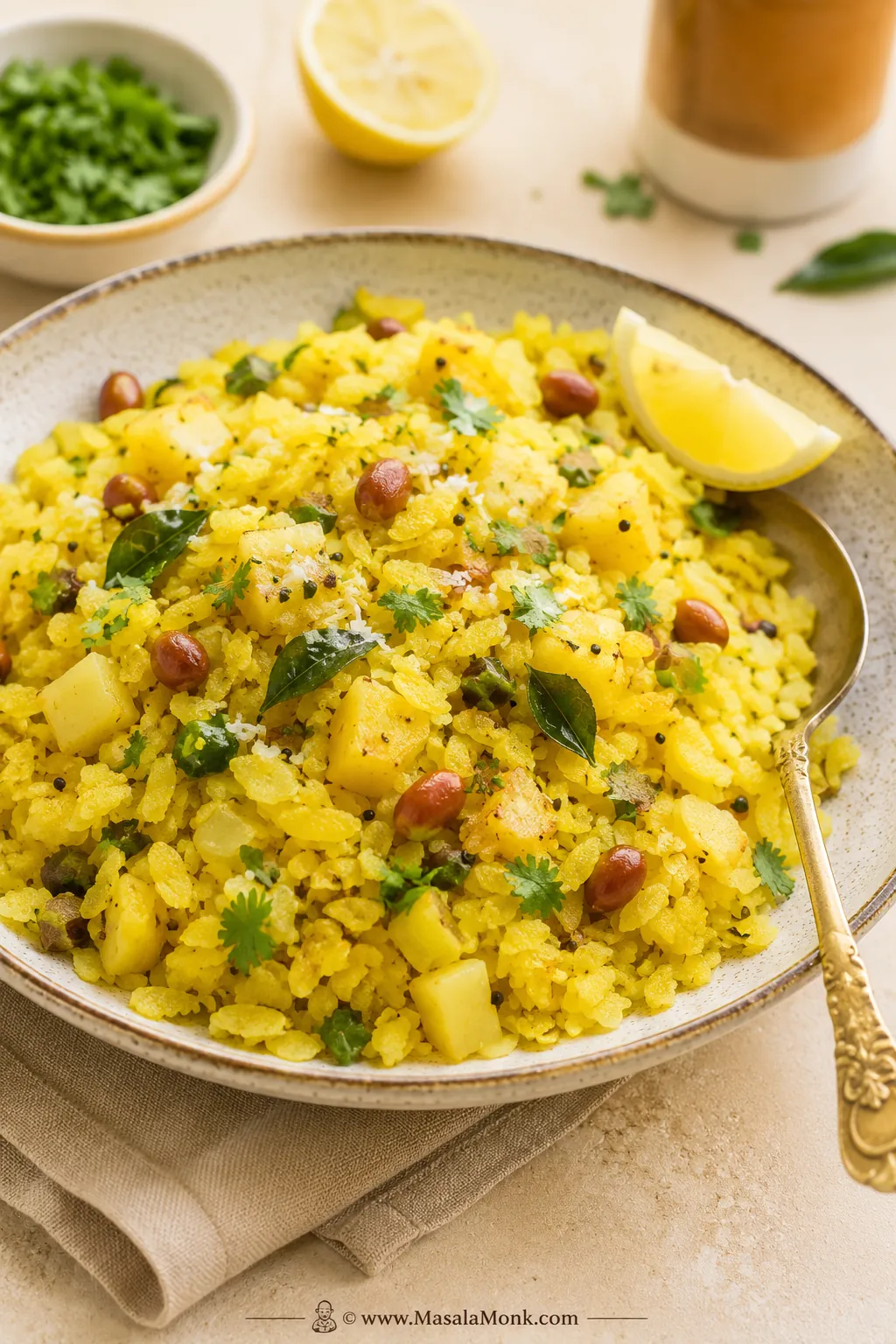
Bowl of kanda batata poha with yellow flattened rice, potato cubes, peanuts, curry leaves, coriander, and lemon.

This poha recipe is for the morning you want soft, fluffy kanda batata poha without guessing whether to soak, rinse, steam, or rescue a pan of sticky yellow flakes. It is quick, comforting, and built around the one detail that makes or breaks poha: moisture control.

The method uses thick flattened rice, onion, potato, peanuts, curry leaves, green chilli, turmeric, lemon, and fresh coriander. The poha is rinsed briefly, rested until tender, then folded through a hot tempering so the flakes stay loose and spoonable instead of turning heavy or paste-like.

If your poha has ever looked fine in the sieve and then clumped up in the pan, the problem was probably not your spices. It was too much water too early. Once that part clicks, the rest of the recipe becomes simple. You can read the full method below or go straight to the recipe card.

Quick Answer: How to Make Poha

To make poha for 2 generous servings, use 1½ cups / about 110–120 g thick or medium poha. Rinse it briefly in a sieve, drain it well, and let it rest until the flakes soften. For fluffy poha, the flakes should feel tender before cooking but still look separate.

Fry the peanuts first, then temper mustard seeds, cumin, curry leaves, and green chilli in the same pan. Add onion and small diced potato, cook until the potato is tender, then stir in turmeric, salt, and a little sugar. Fold in the softened poha, steam on low heat for 2–3 minutes, and finish with lemon and coriander.

The key is to treat poha differently from raw rice. It does not need a long soak. A quick rinse gives the flakes moisture, and the short rest lets them soften without collapsing. The finger-press test is the easiest way to know when they are ready.

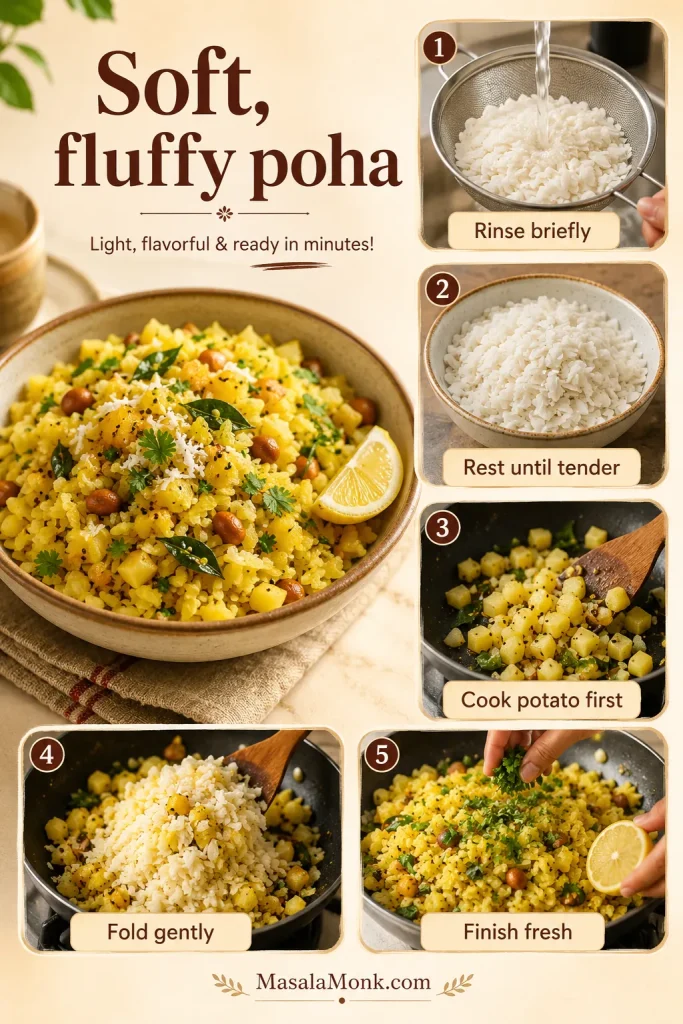
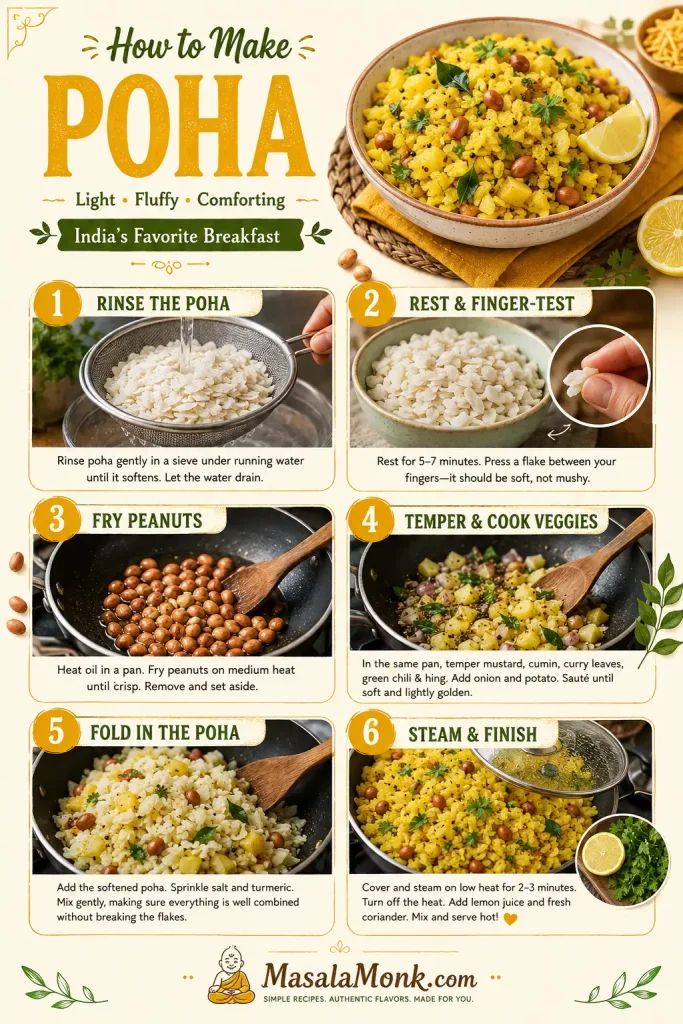
Illustrated guide showing poha being rinsed, rested, folded with cooked potato, and finished with lemon and coriander.
The key shift happens before cooking: once the flakes feel tender but still separate, the pan can add flavor without turning the poha heavy.
Before you start: Check your poha thickness. If the flakes look thin and papery, save them for chivda or snack mixtures. For this breakfast poha, use thick or medium flakes so they can soften without falling apart. See the poha type guide if you are unsure which one you have.

Why This Poha Works

This method works because it controls moisture before the poha reaches the pan. Sturdy flakes can handle a quick rinse, the short rest lets them soften evenly, and the finger-press test tells you when they are ready. By the time the poha is folded into the tempering, the onion and potato are already cooked, so the flakes only need a brief covered steam.

Poha should be softened before it cooks, not cooked until it softens. That is why the finished dish stays loose and tender instead of clumping together. The pan gives flavor; the rinse-rest method gives structure. If your batch has already gone wrong, the troubleshooting table will help you fix it.

What Is Poha?

Poha is one of those words that means both the ingredient and the dish. As an ingredient, it is flattened rice, also called beaten rice or rice flakes. In different parts of India, you may also see names like avalakki, aval, atukulu, chuda, or chira.

As a breakfast dish, poha usually means those flakes cooked with a quick tempering, onions, potatoes, peanuts, lemon, and herbs. For this recipe, the ingredient matters as much as the seasoning. A good breakfast poha should feel tender and light, but the flakes should still look separate. If the poha is too thin or too wet before cooking, it can turn sticky before the first bite.

For a deeper look at flattened rice as an ingredient, this poha explainer is useful for understanding why thick poha behaves differently from thin poha. MasalaMonk’s guide to regional Indian breakfasts is also helpful if you want to place poha among other Indian morning dishes.

Best Poha to Use for This Recipe

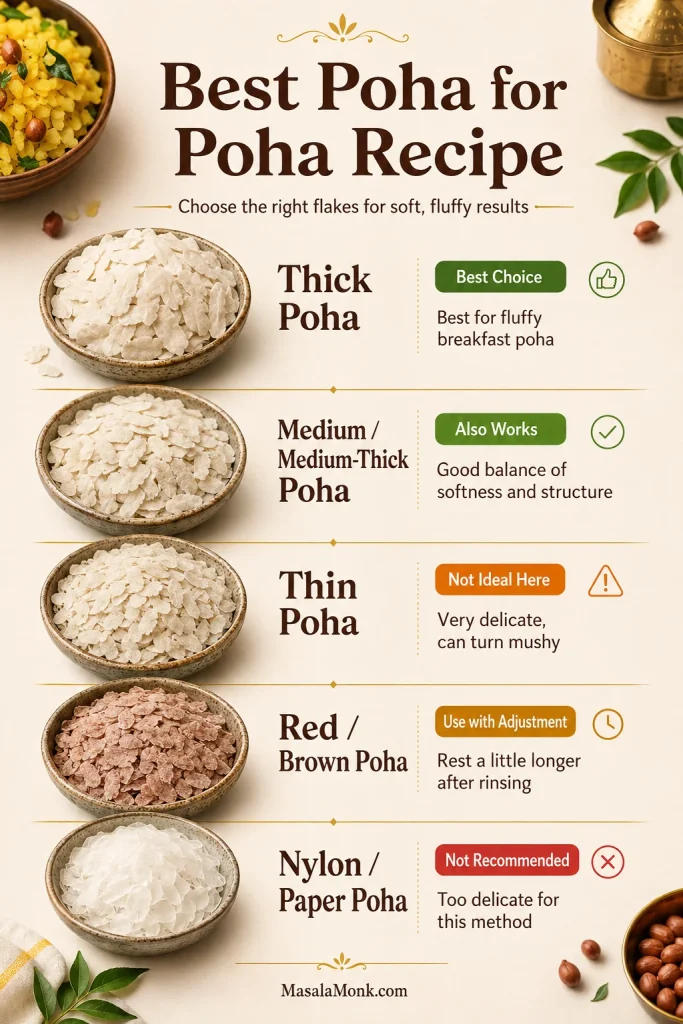
For a hot breakfast version, thick poha or medium-thick poha is the safest choice. These flakes give you a little room to work. They can handle rinsing, resting, and gentle steaming without falling apart.

If you are buying poha mainly for this breakfast dish, choose thick or medium-thick flakes. Thin poha is useful in crisp mixtures and quick snacks, but it is not the safest choice for kanda batata poha.

Guide showing thick, medium, red, thin, and nylon poha flakes with recommendations for breakfast poha.
Thick or medium-thick poha is the safest choice for breakfast because it softens gradually; thin flakes, by contrast, can collapse before the tempering is ready.
Poha Type Use It Here? Best Use Texture Note
Thick poha Yes, best choice Kanda poha, batata poha, vegetable poha Softens well and stays separate when rinsed correctly.
Medium / medium-thick poha Yes Everyday breakfast poha Works well if you rinse briefly and handle gently.
Thin poha Not recommended Chivda, snacks, very quick preparations Absorbs water fast and can turn mushy in this recipe.
Red or brown poha Yes, with adjustment Nutty, slightly heartier poha May need a little longer resting time after rinsing.
Nylon or paper poha Not recommended Light snacks and crisp mixtures Too delicate for a steamed breakfast poha.

Why Flake Structure Matters

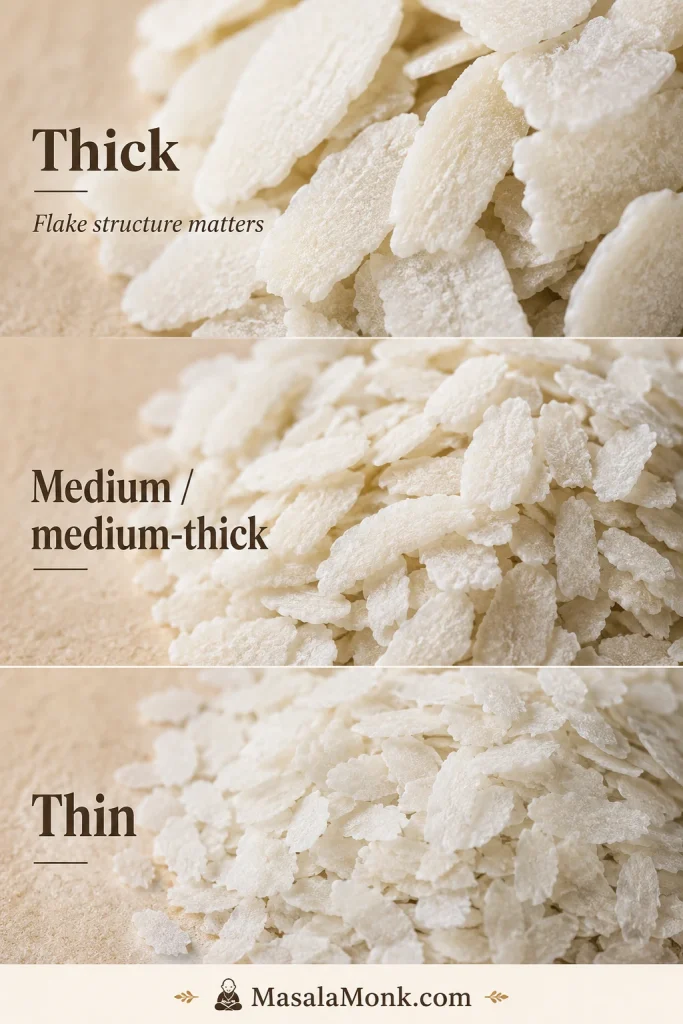
Think of this as a texture decision, not just a grocery decision. Thin flakes are the fastest route to mushy poha because they absorb water quickly and lose structure. Thicker flakes give you a better chance of getting a tender, spoonable finish.

Close-up comparison of thick, medium, and thin poha flakes showing differences in flake size and structure.
Flake structure changes the whole recipe. The sturdier the poha, the easier it is to rinse, rest, and steam without ending up with mushy poha.

For the full texture checklist, see how to keep poha soft, fluffy, and not mushy.

Ingredients You’ll Need

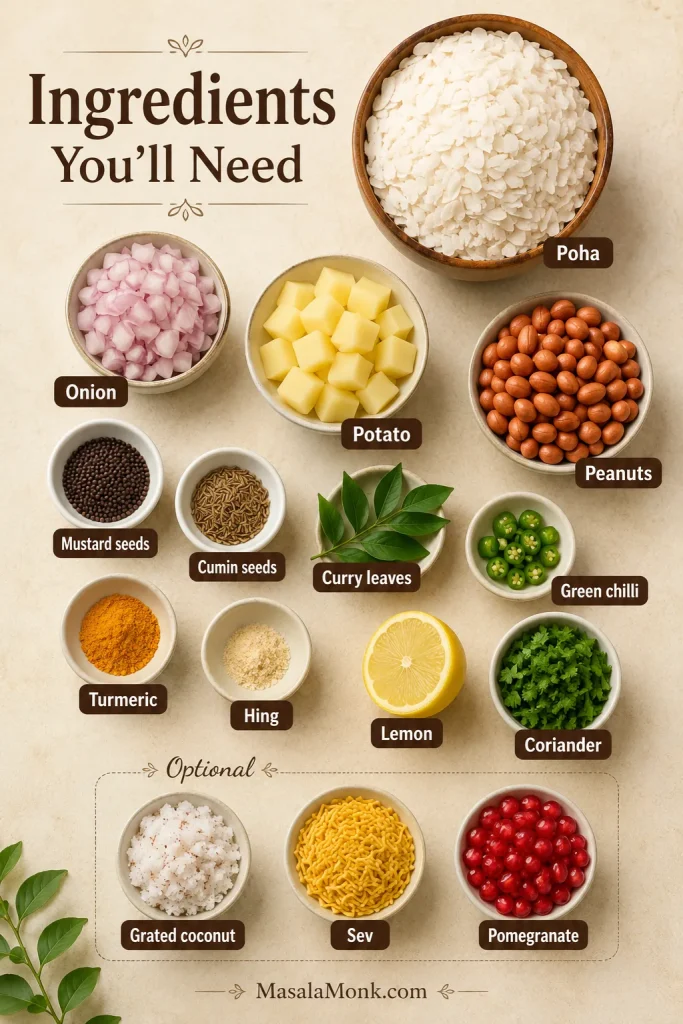
The ingredient list is short, so each piece has a job: peanuts for crunch, potato for body, lemon for brightness, and curry leaves for that familiar breakfast aroma. This version is a classic kanda batata poha, which means it uses both onion and potato. Kanda brings sweetness, batata makes the bowl more satisfying, and the final coriander-lemon finish keeps the poha fresh instead of flat.

Ingredients for poha including flattened rice, onion, potato, peanuts, curry leaves, green chilli, turmeric, lemon, coriander, hing, sev, coconut, and pomegranate.
A small ingredient list can still do a lot: potato adds body, peanuts add crunch, curry leaves add aroma, and lemon wakes everything up at the end.

The recipe card has the full list, and the measurements table below gives the main cups, grams, ounces, and ml conversions.

Poha

Use 1½ cups, or about 110–120 grams, of thick or medium poha. The flakes should be sturdy enough to rinse without breaking down. Do not soak them in a bowl; a short rinse and a proper rest are enough.

Onion and Potato

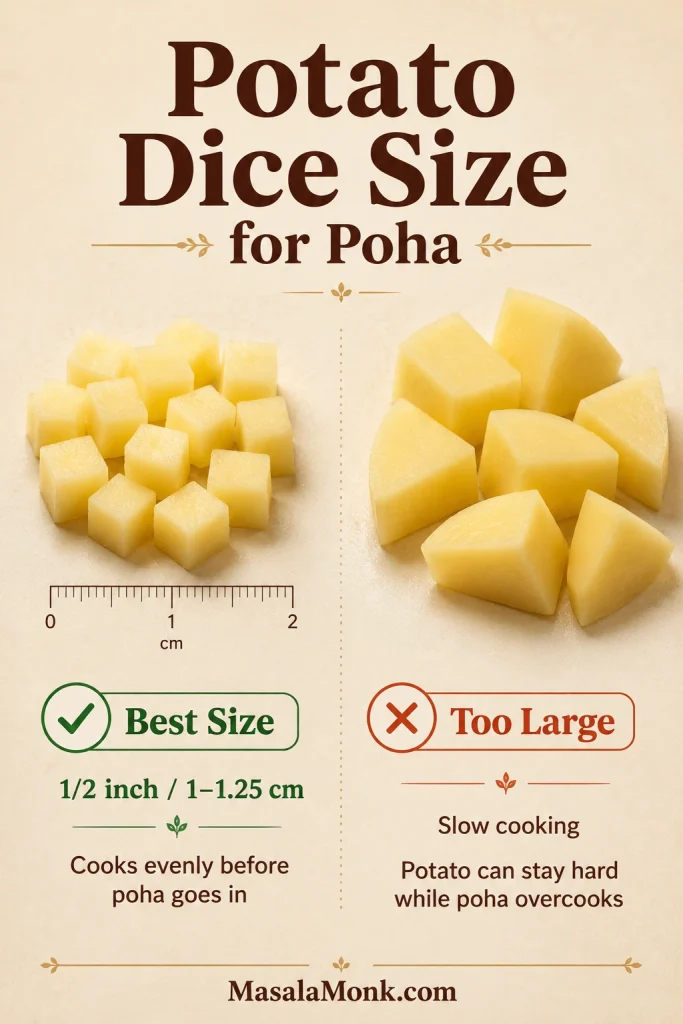
Use one small to medium onion and one small potato. Dice raw potato small, about ½ inch or 1 to 1.25 cm, so it can cook through before the poha goes into the pan. Large potato chunks are one of the easiest ways to end up with either raw potato or overworked poha.

Correct half-inch potato dice for poha shown beside larger potato pieces that cook more slowly.
Cut potato small enough to soften during the onion-potato stage; once the poha goes in, the flakes only need a gentle finish.

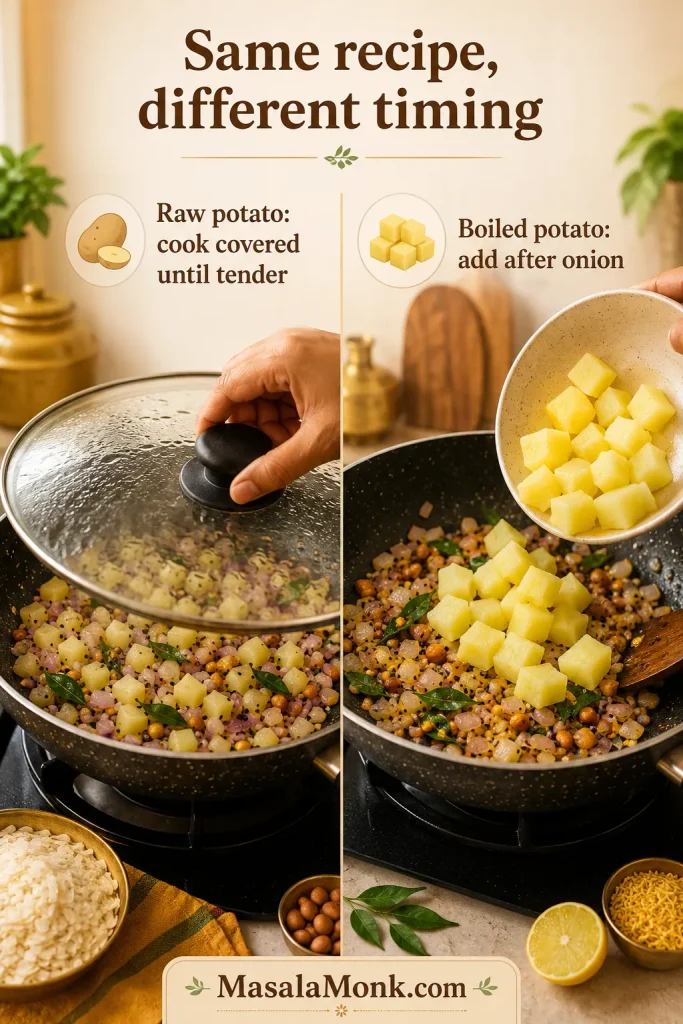
Boiled potato can go in after the onion and only needs enough time to coat in the tempering. If you start with raw potato, give it the full covered cooking time.

Raw vs Boiled Potato Timing

Raw diced potato cooking covered for poha compared with boiled potato being added after onion.
Both potato options work, but the timing changes: cook raw cubes until tender, and toss boiled cubes briefly through the tempering.

Peanuts

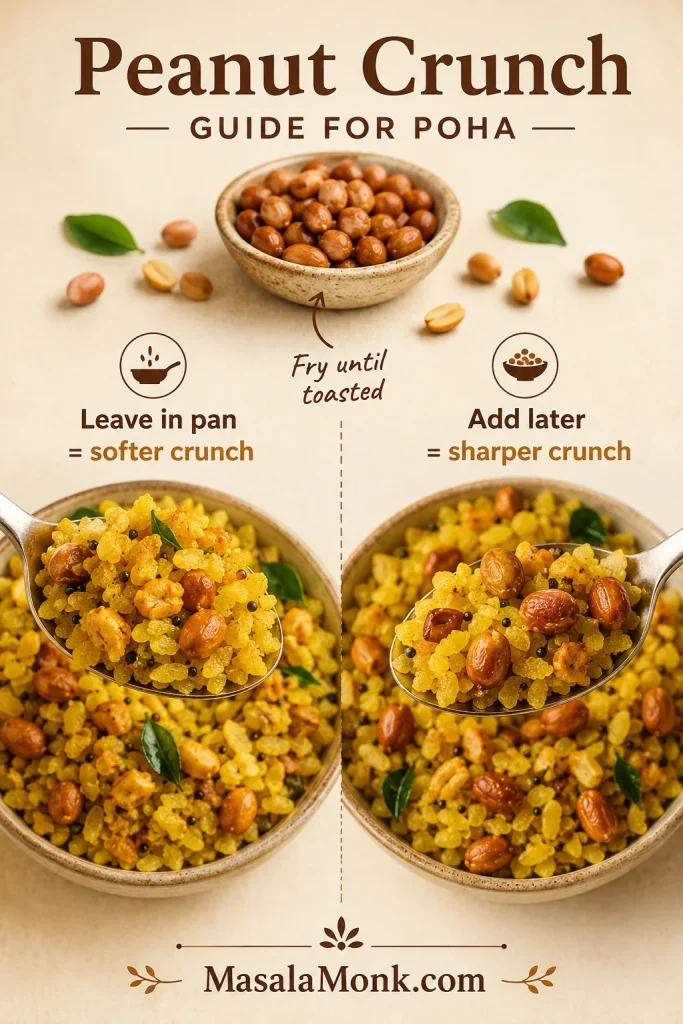
Peanuts add crunch, nuttiness, and a little protein. For softer homestyle poha, leave them in the pan after frying. For sharper crunch, remove them once they smell toasted and add them back at the end. If you need to avoid peanuts, use cashews, roasted chana dal, or sev for crunch.

Poha peanut crunch guide comparing peanuts left in the pan with fried peanuts added back at the end.
For a softer homestyle bite, leave peanuts in the pan; for sharper crunch, fry them first and add them back at the end.

Tempering

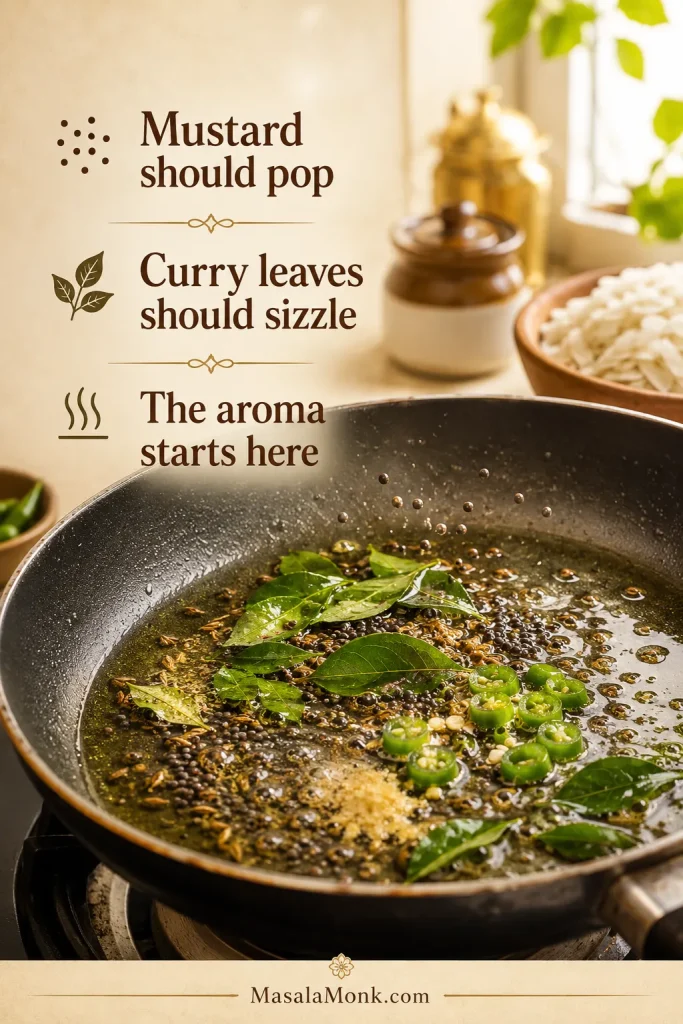
Mustard seeds, cumin seeds, curry leaves, green chilli, turmeric, and a pinch of hing give poha its familiar breakfast aroma. Hing is optional. If you need the recipe to be gluten-free, use certified gluten-free hing or skip it.

Mustard seeds, cumin seeds, curry leaves, green chilli, and hing sizzling in hot oil for poha tempering.
This is where the aroma starts. Let the mustard pop and the curry leaves sizzle so the oil carries flavor into the onion, potato, and poha.

Lemon, Coriander, and Garnish

Lemon and coriander are what wake the poha up at the end. Add them after cooking so the flavor stays fresh. Sev, grated coconut, pomegranate, or extra peanuts can be added depending on whether you want a homestyle, Maharashtrian, or Indori-style finish.

Small but useful tip: A little sugar is optional, but it helps balance lemon, salt, chilli, and turmeric. You do not need enough to make the poha taste sweet; ½ teaspoon is usually enough for balance.

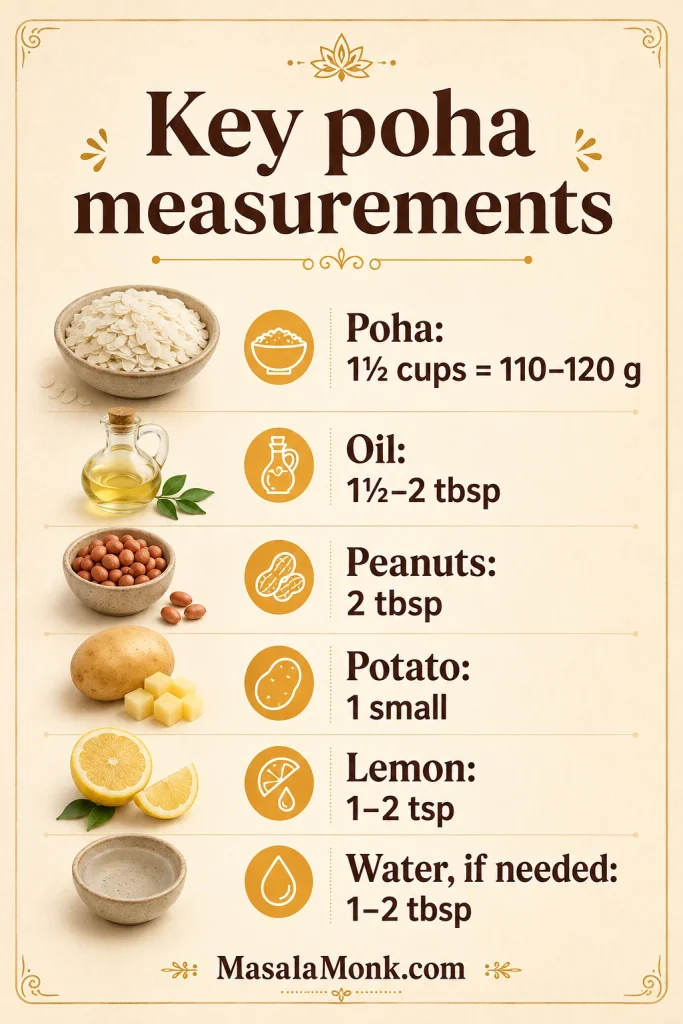
Key Measurements and Conversions

Because poha flakes vary by brand and thickness, cup measurements are not perfectly identical everywhere. Still, these conversions are practical enough for home cooking.

Ingredient US Measure Metric Notes
Thick or medium poha 1½ cups 110–120 g / about 4 oz The main recipe amount for 2 generous servings.
Oil 1½–2 tbsp 22–30 ml Use the higher amount for richer, street-style poha.
Raw peanuts 2 tbsp 18–22 g Add more if you want extra crunch.
Onion 1 small to medium 75–100 g Finely chopped or small diced.
Potato 1 small 100–120 g Dice ½ inch / 1–1.25 cm or smaller.
Lemon or lime juice 1–2 tsp 5–10 ml Add off heat and adjust to taste.
Water, if needed 1–2 tbsp 15–30 ml Use only if the poha feels hard or dry.
Measurement guide for poha showing cups, grams, tablespoons, and milliliters for poha, oil, peanuts, potato, lemon, and water if needed.
Clear measurements make this poha recipe easier to repeat, and the small water range helps rescue dry flakes without flooding the pan.

How to Make Poha Step by Step

The method is easiest when you treat it as three small jobs: soften the poha without drowning it, cook the tempering and vegetables until they are ready, then fold everything together gently at the end. Once the flakes go into the pan, the recipe is almost done.

Do not rush the potato, but do not overwork the flakes. A wide spatula is better than a spoon here because poha needs lifting, not hard stirring.

Step-by-step poha guide showing rinsing, resting, finger testing, frying peanuts, cooking onion and potato, folding poha, and steaming.
Once the order is clear, poha becomes easier: prepare the flakes first, cook the base fully, then fold and steam just long enough to heat through.

1. Rinse and Rest the Poha

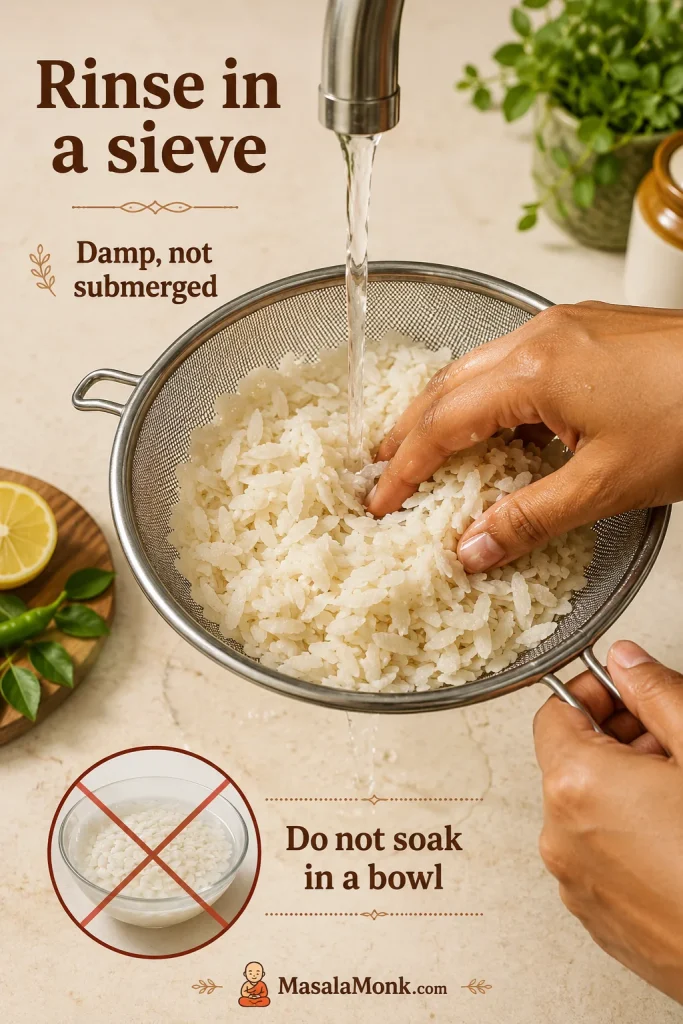
Add the poha to a sieve or colander. Rinse under cold running water for 20–30 seconds, moving the flakes gently with your fingers so all of them get wet. Stop before the flakes start breaking. They should look damp, not submerged.

Let the poha drain completely, then leave it in the sieve or spread it in a bowl for 8–15 minutes while you prep and cook the tempering. This resting time lets residual moisture do the work slowly, which is much safer than soaking the flakes in a bowl.

Poha flakes being rinsed briefly in a metal sieve under running water instead of soaked in a bowl.
A brief rinse gives poha the moisture it needs; after that, resting does the real softening, which helps prevent a waterlogged batch.

The Finger-Press Test

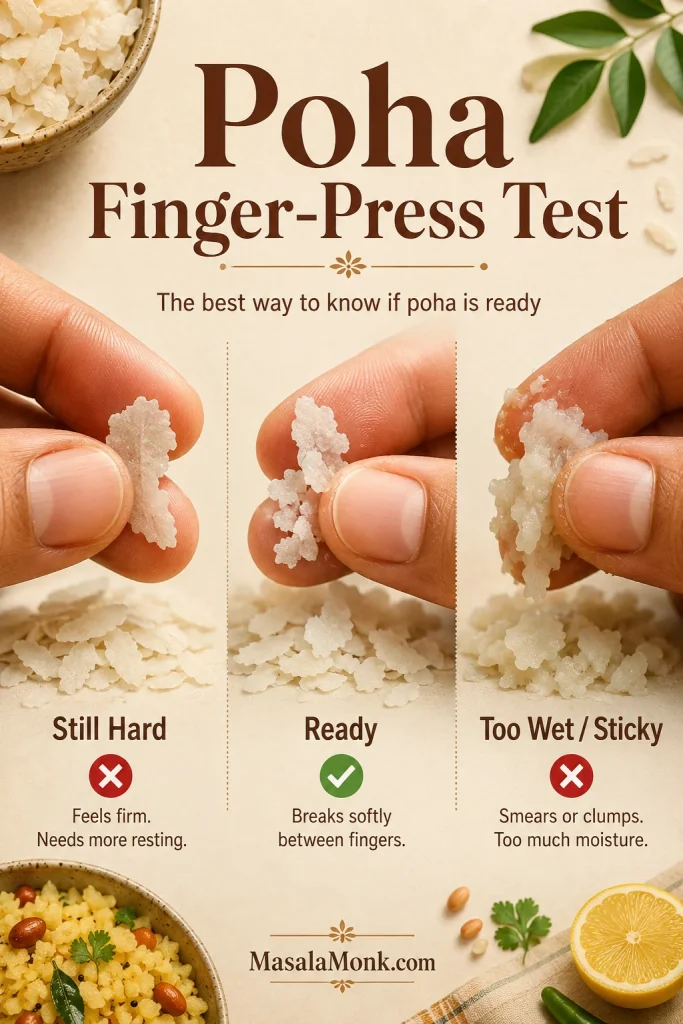
Before the poha goes into the pan, press a few flakes between your thumb and finger. A ready flake should break softly, almost like cooked rice, but it should not smear into paste. If it feels hard, rest it longer or sprinkle over 1–2 tablespoons water. If it feels wet and sticky, it has gone too far.

Finger-press test for poha showing still hard, ready, and too wet or sticky flakes.
Touch is more reliable than the clock here: ready flakes break softly, while sticky flakes are already carrying too much water.
Poha is ready when: the flakes break softly between your fingers, still look separate, and do not smear into paste. If they feel hard, rest longer. If they feel wet and sticky, stop adding moisture.

Use the feel of the flakes, not the clock alone. Very thick poha may need closer to 15 minutes; medium poha may be ready closer to 8 minutes.

Texture Checkpoints Before Cooking

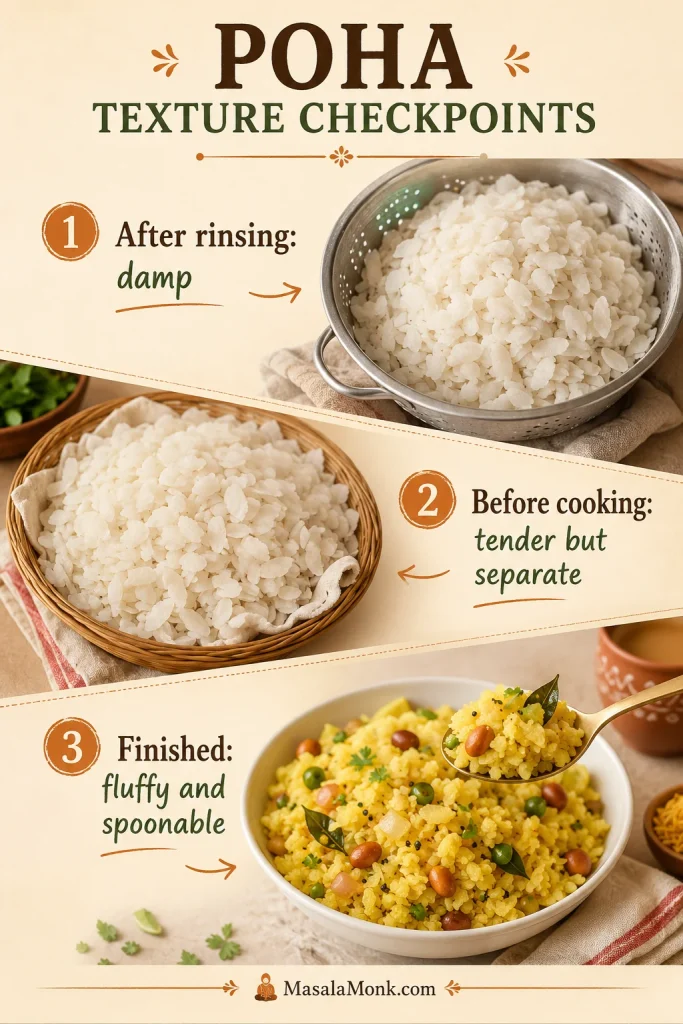
Three poha texture stages showing damp flakes after rinsing, tender flakes before cooking, and fluffy finished poha.
Think in stages instead of minutes alone: damp after rinsing, tender before cooking, and fluffy after steaming with the tempering.

2. Fry the Peanuts

Heat oil in a heavy-bottomed kadai, skillet, or sauté pan over medium heat. Add the peanuts and fry for 1–2 minutes, stirring often, until they smell nutty and turn a shade darker. Remove them to a plate if you want the crunch to stay sharper.

3. Temper the Spices

Add mustard seeds to the hot oil and let them pop. Add cumin seeds, curry leaves, green chilli, and hing if using. The curry leaves should sizzle, and the pan should smell sharp, nutty, and aromatic within a few seconds.

4. Cook the Onion and Potato

Add the chopped onion and cook for 2–3 minutes, until it softens but does not brown deeply. Add the small diced potato, stir well, cover the pan, and cook on medium-low heat for 5–7 minutes, or until the potato is tender. A knife should slide through a potato cube without resistance.

The potato should be cooked before the poha goes in. If you add the flakes too early, you will either overcook the poha while waiting for the potato or end up with raw potato in an otherwise finished dish.

5. Add Turmeric, Salt, Sugar, and Poha

Lower the heat. Add turmeric, salt, and sugar, then stir for a few seconds. Add the softened poha and fold gently with a wide spatula. The flakes should turn yellow as they pick up the turmeric, but they should still move loosely through the pan rather than dragging as one mass.

6. Steam and Finish

Cover the pan and steam the poha on low heat for 2–3 minutes. Turn off the heat and let it rest, covered, for another 2 minutes. The finished poha should be hot, yellow, tender, and lightly glossy. Add lemon juice, chopped coriander, and the fried peanuts if you removed them earlier. Toss lightly and serve hot.

Add the lemon at the end, not while the pan is still cooking hard. That keeps the final flavor fresh, bright, and clean. Once you understand the flow, the shorter recipe card is easiest to follow while cooking.

What the Pan Should Look Like

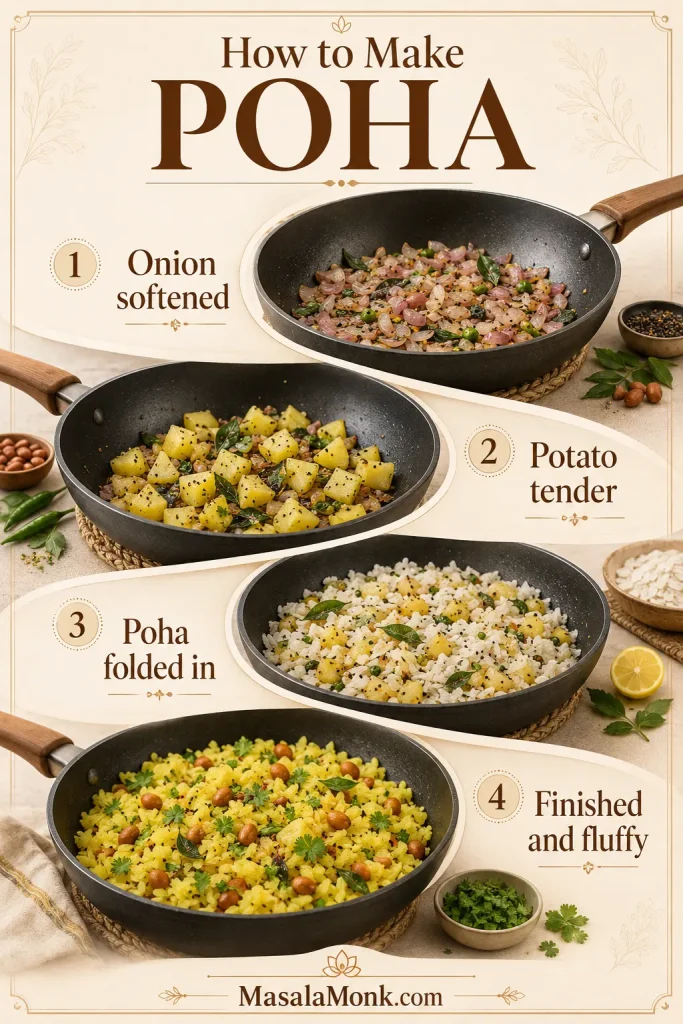
Pan-stage guide for poha showing softened onion, tender potato, poha folded in, and finished fluffy poha.
Watch the pan more than the timer. The potato should be tender before the flakes arrive, because poha only needs a gentle finish.

Recipe Card: Poha Recipe

This kanda batata poha recipe makes 2 generous breakfast servings or 3 lighter servings with thick flattened rice, onion, potato, peanuts, curry leaves, lemon, and coriander.

Prep Time10 minutes
Cook Time12–15 minutes
Total Time22–25 minutes
Servings2 generous or 3 light

Equipment

  • Sieve or colander
  • Heavy-bottomed kadai, skillet, wok, or sauté pan
  • Lid
  • Wide spatula
  • Knife and chopping board
  • Measuring cups and spoons
  • Kitchen scale, optional

Ingredients

  • 1½ cups thick or medium poha, about 110–120 g / 4 oz
  • 1½–2 tablespoons oil, about 22–30 ml
  • 2 tablespoons raw peanuts, about 18–22 g
  • ½ teaspoon mustard seeds
  • ½ teaspoon cumin seeds
  • 1 pinch hing, optional
  • 8–10 curry leaves
  • 1–2 green chillies, finely chopped or slit
  • 1 small to medium onion, finely chopped, about 75–100 g
  • 1 small potato, diced ½ inch / 1–1.25 cm, about 100–120 g
  • ¼ teaspoon turmeric powder
  • ½ teaspoon salt to start, then more to taste
  • ½ teaspoon sugar, optional
  • 1–2 teaspoons lemon or lime juice
  • 2 tablespoons chopped coriander / cilantro
  • Sev, grated coconut, or pomegranate for garnish, optional

Instructions

  1. Add poha to a sieve or colander. Rinse under cold running water for 20–30 seconds, moving the flakes gently. Drain completely.
  2. Let the rinsed poha rest for 8–15 minutes. Press a flake between your fingers; it should break softly without turning pasty.
  3. Heat oil in a heavy-bottomed pan over medium heat. Fry the peanuts for 1–2 minutes until crunchy. Remove them to a plate if you want them extra crisp.
  4. Add mustard seeds to the same oil. Once they pop, add cumin seeds, hing, curry leaves, and green chillies. Stir briefly.
  5. Add onion and cook for 2–3 minutes until softened.
  6. Add diced potato, cover, and cook on medium-low heat for 5–7 minutes, or until tender.
  7. Lower the heat. Add turmeric, salt, and sugar. Stir for a few seconds.
  8. Add the softened poha and fold gently until evenly coated. Do not mash the flakes.
  9. Cover and steam on low heat for 2–3 minutes. Turn off the heat and rest covered for 2 minutes.
  10. Finish with lemon juice, coriander, and fried peanuts. Garnish with sev, coconut, or pomegranate if using. Serve hot.

Notes

  • Use thick or medium poha; thin poha turns mushy more easily in this method.
  • Rinse, drain, and rest the poha instead of soaking it in a bowl.
  • The resting time overlaps with chopping and cooking. Very thick poha may need closer to 15 minutes; medium poha may be ready around 8 minutes.
  • If the poha feels hard before cooking, sprinkle 1–2 tablespoons water over it and rest for a few more minutes.
  • Keep potato pieces small so they cook before the poha goes in.
  • Taste before serving. If the poha feels flat, add lemon, salt, coriander, or sev rather than cooking it longer.
  • Vegan as written if using oil. Gluten-free if the hing is certified gluten-free or skipped.
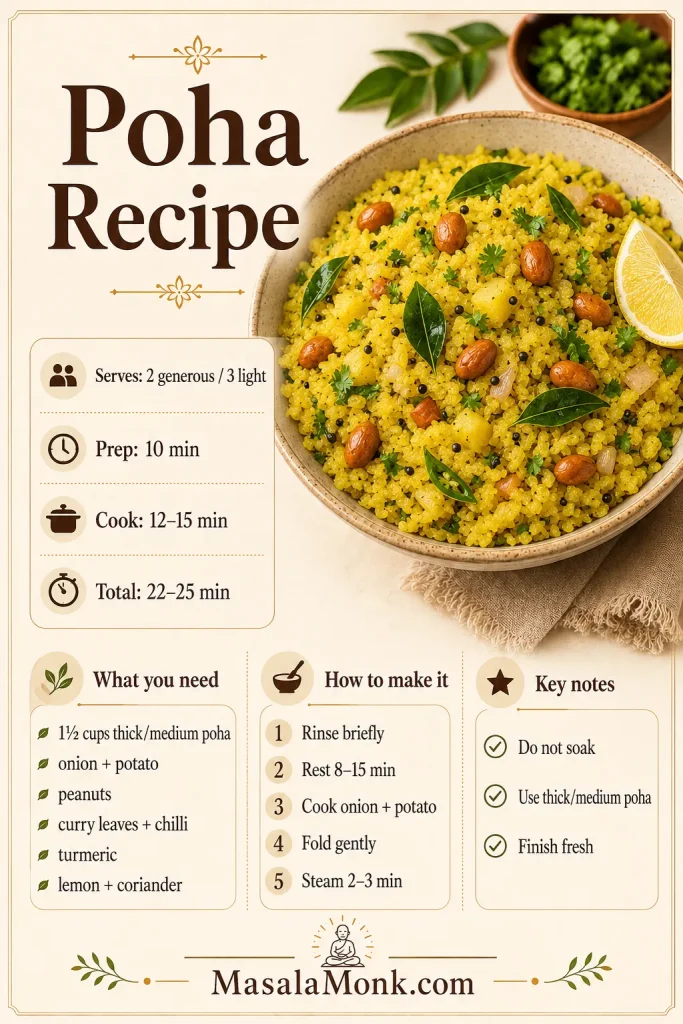
Saveable poha recipe card with timing, servings, ingredients, short method, key notes, and a bowl of kanda batata poha.
Use this poha recipe card as a quick reset: soften the flakes first, cook the onion-potato base completely, then fold gently and steam briefly.

How to Keep Poha Soft, Fluffy, and Not Mushy

Most mushy poha problems begin before the pan gets hot. The flakes either absorb too much water, sit too wet, or get stirred too aggressively after they soften. The goal is not to soak the flakes; the goal is to make them tender while they still hold their shape.

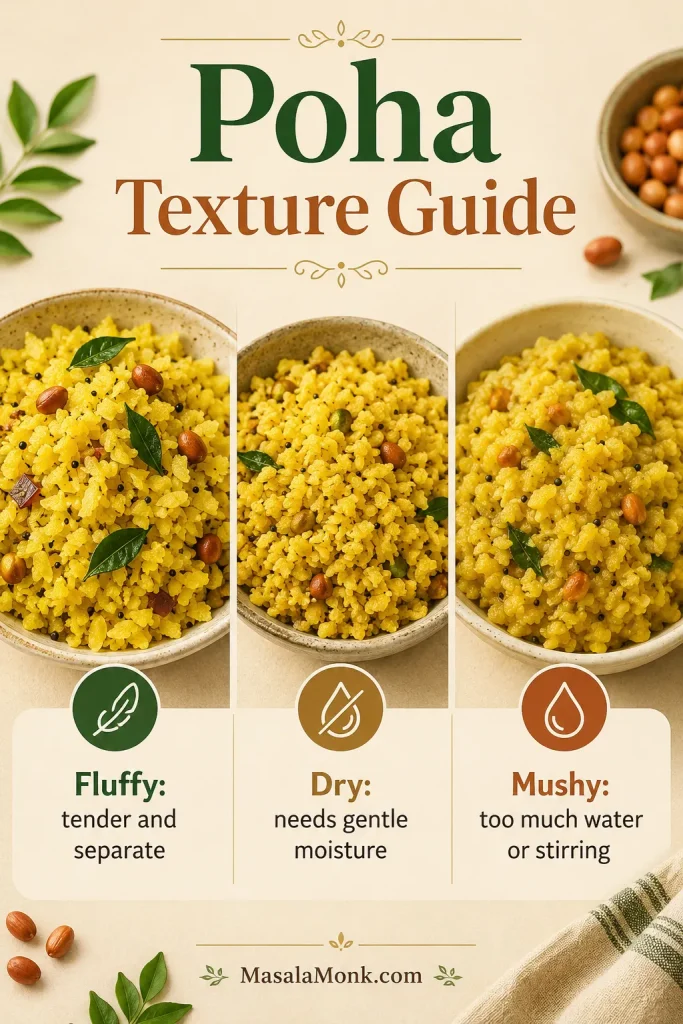
Comparison of fluffy poha, dry poha, and mushy poha in three bowls.
The ideal texture is tender and separate. Dry poha looks tight and dull, while mushy poha usually means too much water, too much stirring, or both.

Start with Flakes That Can Hold Their Shape

Thin poha collapses quickly once wet. Thick or medium flakes give you more margin for rinsing, resting, folding, and steaming, which is why they work better for this hot breakfast version.

Hydrate the Poha Without Soaking

Poha should be tender before it enters the pan. A quick rinse and rest gives the flakes moisture without drowning them. If the flakes are already sticky in the sieve, the pan will not save them.

Lift and Fold Instead of Stirring Hard

Once the flakes are soft, rough stirring breaks them down. Use a wide spatula and lift the poha through the tempering until it is evenly yellow and hot. Stop once everything is combined and warmed through.

The Three Rules at a Glance

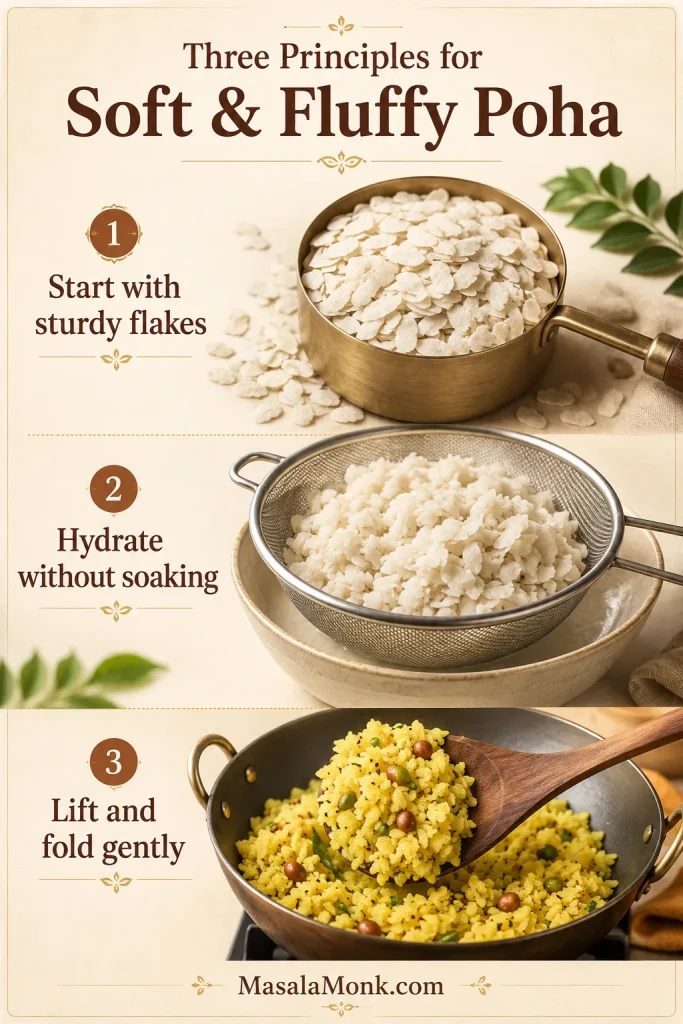
Three principles for soft fluffy poha showing sturdy flakes, hydration without soaking, and gentle folding.
Great poha usually comes down to three habits: choose sturdy flakes, hydrate without soaking, and lift the mixture instead of stirring it hard.

Common Poha Mistakes and Fixes

Poha is forgiving once you know what went wrong. A sticky batch, a dry batch, or a bland batch usually points to one small fix. Use the sections below to rescue what you have and make the next batch easier.

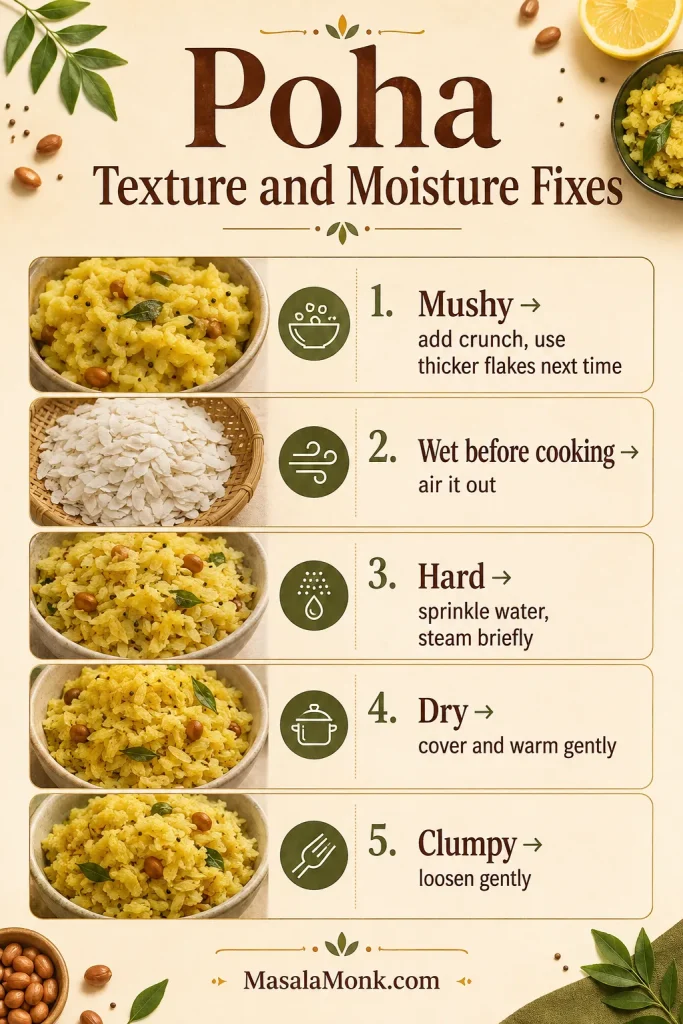
Texture and Moisture Fixes

Poha troubleshooting board showing fixes for mushy, wet, hard, dry, and clumpy poha.
When the texture goes wrong, moisture is usually the clue. Let wet flakes air out, steam hard flakes gently, and stop adding water once the poha looks sticky.
Problem Why It Happened Fix It Now Fix It Next Time
Poha is mushy Thin poha, over-rinsing, soaking, or rough mixing Spread it out in the pan, keep the heat low, and add crunchy peanuts or sev for contrast Use thicker flakes and rinse only briefly
Poha looks wet before cooking Too much water after rinsing or not enough draining time Spread it out and let it air for a few minutes before adding it to the pan Rinse for less time and drain fully before resting
Poha is hard Not hydrated or rested enough Sprinkle 1–2 tablespoons water, cover, and steam for 2 minutes Rest longer after rinsing and use the finger-press test
Poha is dry Too little moisture or too much cooking after adding poha Sprinkle a little water, cover, and warm gently Steam briefly on low and do not overcook
Poha clumps together Poha was too wet or stirred too hard Loosen gently with a fork or wide spatula Drain fully and fold gently on low heat

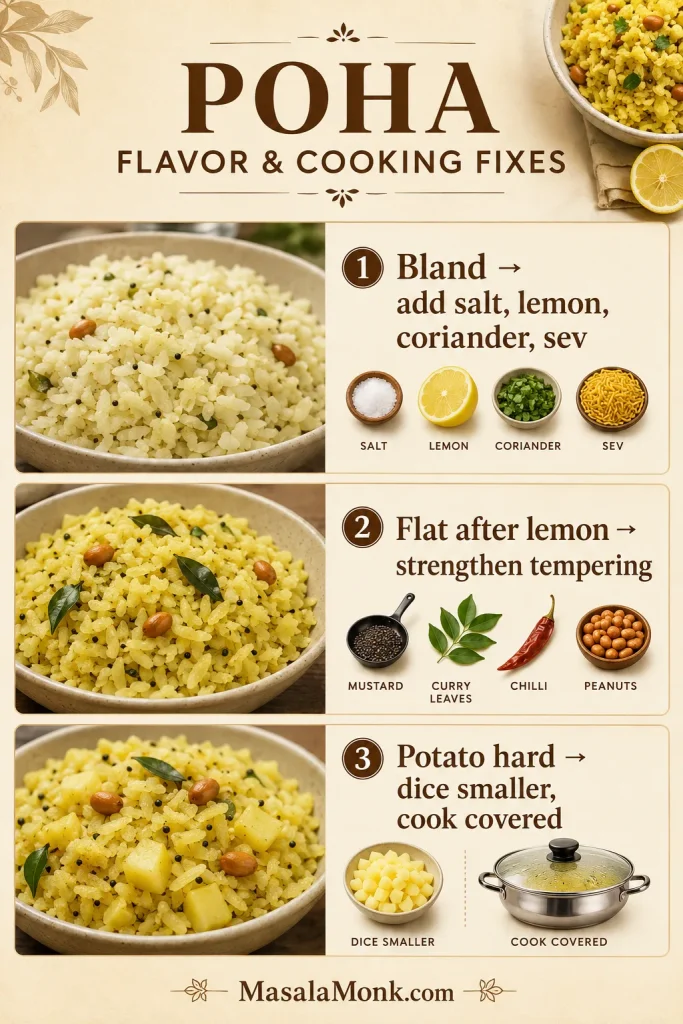
Flavor and Cooking Fixes

Poha troubleshooting board showing fixes for bland poha, flat poha after lemon, and undercooked potato.
If the texture is right but the bowl still tastes dull, fix the seasoning and tempering first instead of cooking the poha longer.
Problem Why It Happened Fix It Now Fix It Next Time
Poha tastes bland Not enough salt, lemon, chilli, or garnish Add lemon, salt, coriander, sev, or roasted peanuts Season the onion-potato base well before adding poha
Poha tastes flat even after lemon Weak tempering or under-seasoning Add a little salt, sev, coriander, or a small pinch of sugar Let the mustard, curry leaves, chilli, and peanuts flavor the oil properly before adding vegetables
Potato is undercooked Pieces were too large or cooked on high heat without enough time Cover and cook a few more minutes before adding lemon Dice potato ½ inch / 1–1.25 cm or smaller

Poha Variations

Once you understand the hydration step, poha is easy to adapt. Change the vegetables, garnish, or seasoning, but keep the flakes tender and separate.

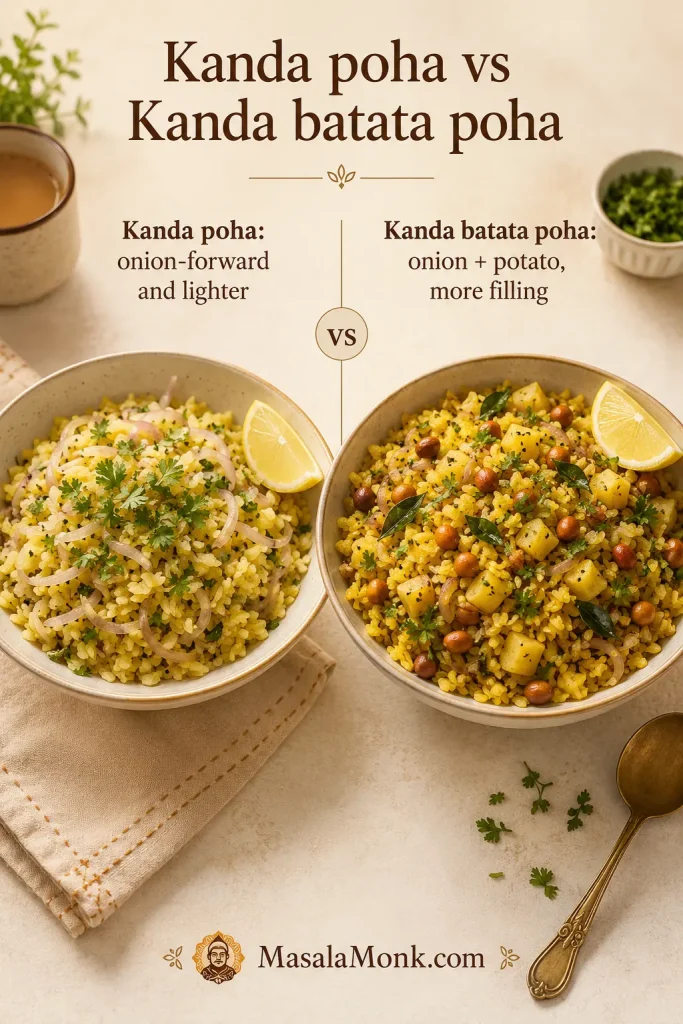
Kanda Poha vs Kanda Batata Poha

Comparison of kanda poha with onion and kanda batata poha with onion, potato, peanuts, and lemon.
The onion-only version stays lighter, whereas kanda batata poha adds potato for a fuller, more satisfying breakfast bowl.

Kanda Poha

For the lighter kanda poha version, skip the potato and let the onion, peanuts, curry leaves, lemon, and coriander do the work. It cooks faster and feels especially good when you want breakfast without heaviness.

Batata Poha

Batata poha is heartier because of the potato. Keep the pieces small so they turn tender before the poha goes in. This is the version to make when you want the bowl to feel more filling without adding much else.

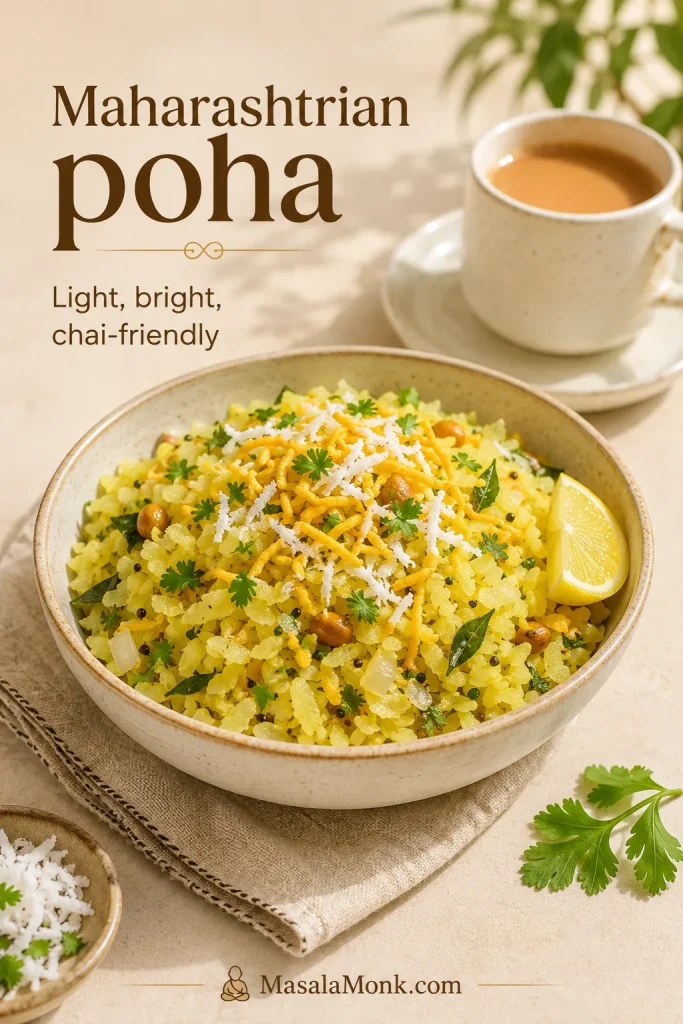
Maharashtrian Poha

In many Maharashtrian homes, kanda poha or kanda batata poha is finished simply with lemon, coriander, fresh coconut, and sometimes sev. This is the version many people think of with morning chai: light yellow poha, softened onions, a little sweetness, and a bright garnish at the end.

Maharashtrian poha served with coconut, sev, coriander, lemon, and a cup of chai.
Maharashtrian poha often keeps the base simple; then coconut, lemon, coriander, and sometimes sev make the bowl feel bright without weighing it down.

Kanda Batata Poha

This is the version in the recipe card: onion, potato, peanuts, turmeric, lemon, and coriander. It gives the best balance of flavor, texture, and breakfast satisfaction.

Vegetable Poha

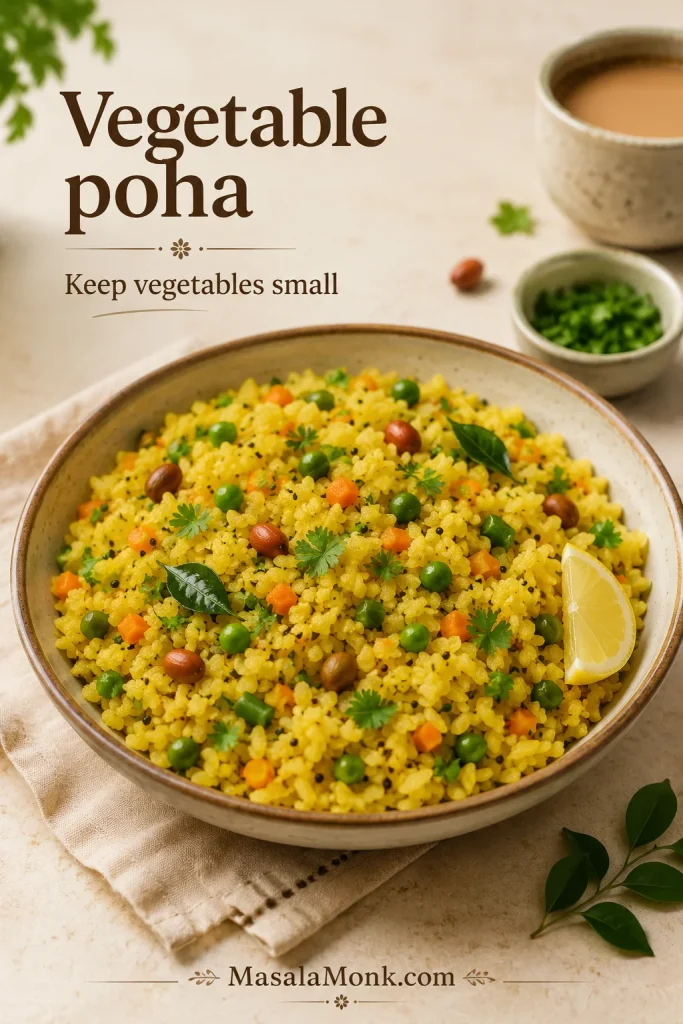
Add peas, finely diced carrots, beans, or capsicum after the onion. Keep the vegetables small so they cook quickly. Avoid adding watery vegetables in large amounts because they can make the flakes damp and clumpy.

Vegetable poha with peas, small carrot pieces, peanuts, curry leaves, coriander, lemon, and green chilli.
Vegetable poha works best when the add-ins are small, because they cook quickly and blend into the flakes instead of making the bowl wet or heavy.

Tomato Poha

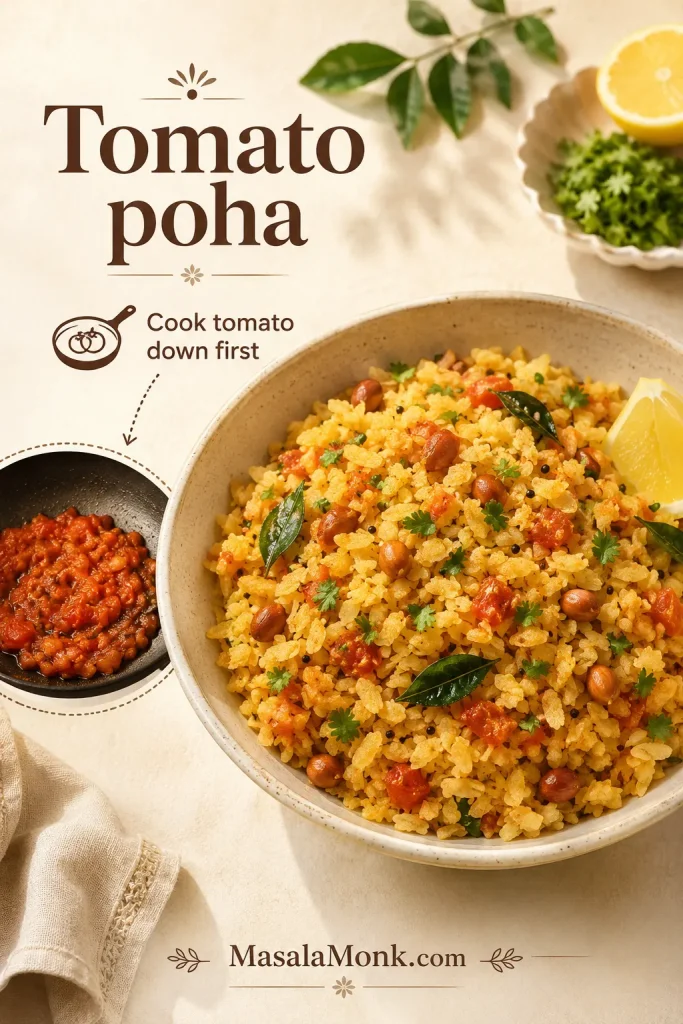
For a tomato poha variation, add 1 small chopped tomato after the onion has softened and cook it down until most of its moisture evaporates. Do not add tomato at the same time as the poha, or the flakes can turn wet and clumpy.

Tomato poha with cooked-down tomato, yellow poha flakes, peanuts, curry leaves, coriander, and lemon.
Tomato poha works best when the tomato cooks down first; adding it late can make the finished flakes damp and clumpy.

Indori-Style Poha

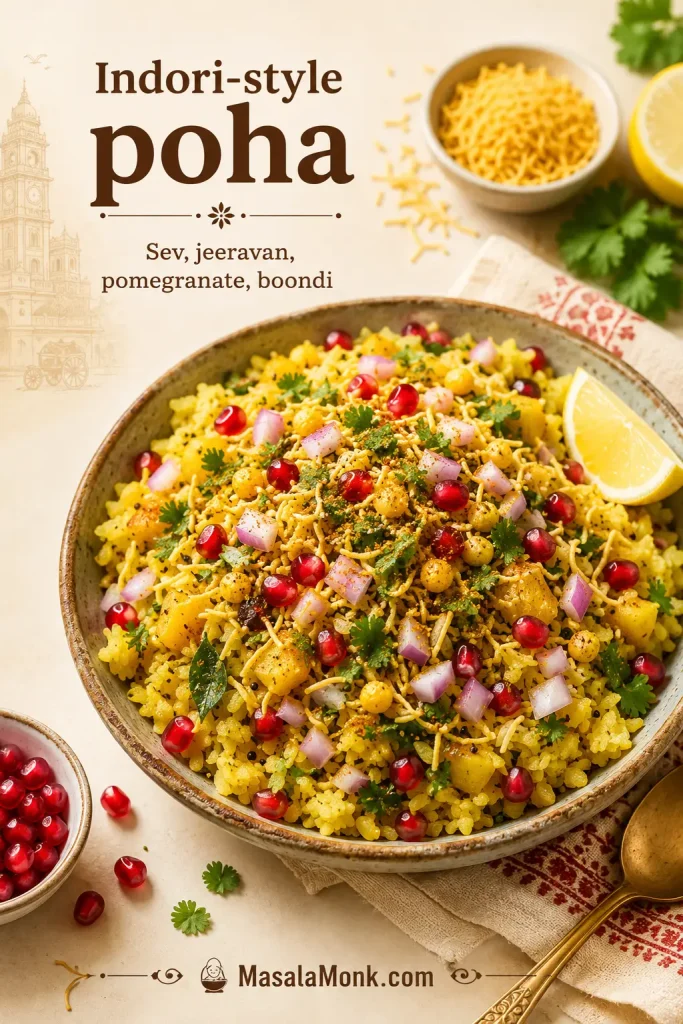
For an Indori-style finish, take the basic poha slightly sweeter and brighter, then pile on sev, jeeravan masala, chopped onion, coriander, lemon, and pomegranate. Add boondi too if you want a fuller street-style topping mix. This is an Indori-style finish rather than a full dedicated Indori poha recipe, but the toppings take the bowl in that direction.

Indori-style poha topped with sev, jeeravan, chopped onion, coriander, pomegranate, lemon, and boondi.
Indori-style poha is about contrast: soft flakes underneath, then sev, jeeravan, onion, pomegranate, and boondi for crunch, spice, and brightness.

No Onion Poha

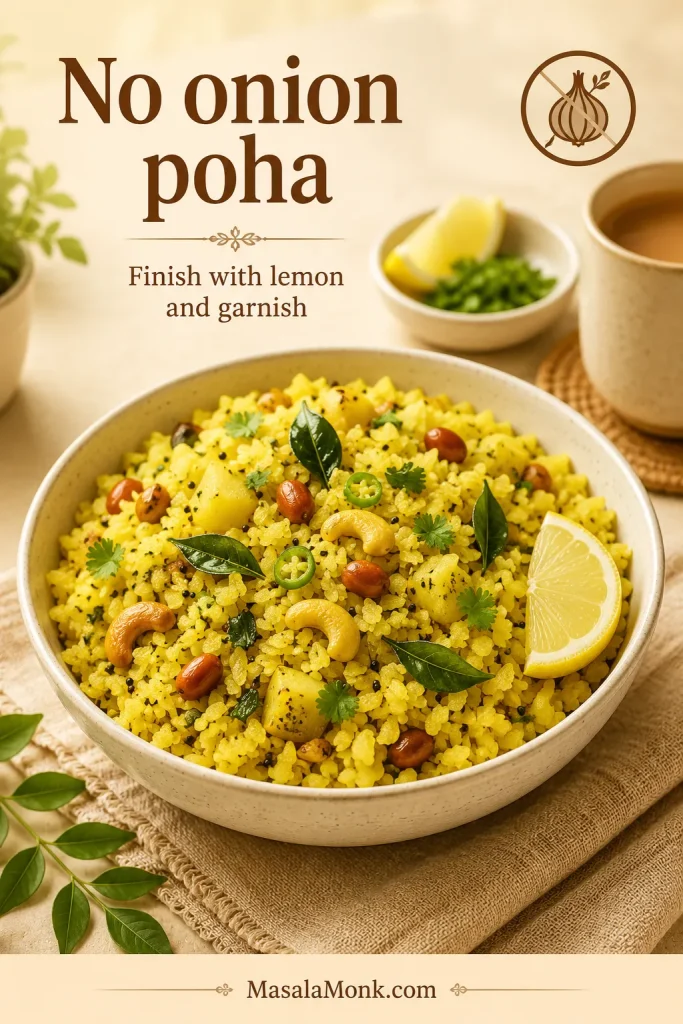
Skip the onion and use potato, curry leaves, green chilli, turmeric, lemon, coriander, and either peanuts or another crunchy garnish. The flavor will be simpler, so finish with enough lemon, salt, and garnish to keep the bowl lively.

No-onion poha with potato, curry leaves, green chilli, peanuts, cashews, coriander, and lemon.
Even without onion, poha can still taste lively when the tempering is aromatic and the final bowl gets lemon, herbs, and a crunchy garnish.

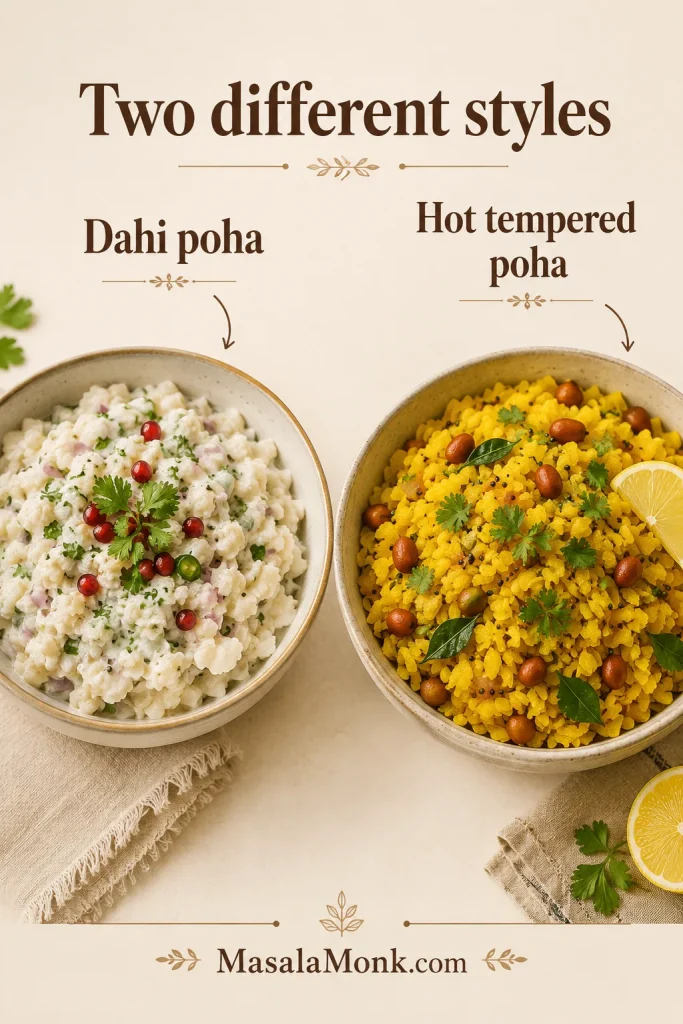
Dahi Poha

Dahi poha is a cooler curd-based variation rather than a hot tempered poha. The flakes are softened and mixed with curd instead of being folded into a hot pan, so it belongs closer to no-cook breakfast territory. In warm weather, these no-cook recipes for hot summer days fit the same cooling breakfast mood.

Dahi poha with curd compared with hot tempered yellow poha with peanuts, curry leaves, coriander, and lemon.
These are two different styles: dahi poha is cool and creamy, while hot tempered poha is warm, spiced, and built around curry leaves and peanuts.

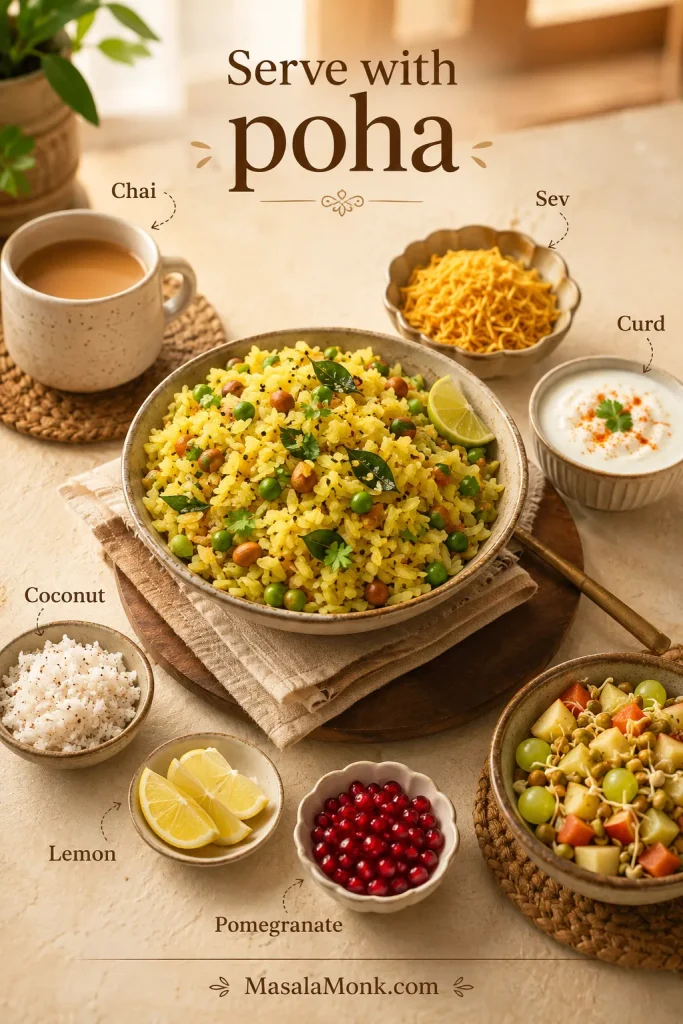
What to Serve with Poha

Poha is best served hot, while the flakes are still light and the peanuts are crisp. Add lemon just before serving, then finish with something fresh or crunchy so the bowl does not feel one-note.

Poha serving spread with chai, sev, curd, coconut, lemon wedges, pomegranate, and sprouts.
Poha tastes brighter with something cool, crunchy, or tangy on the side, which is why curd, sev, lemon, coconut, and pomegranate work so well.
  • Chai: the classic breakfast pairing.
  • Sev: adds crunch and a street-style finish.
  • Fresh coconut: adds softness and gentle sweetness.
  • Lemon wedges: let each person brighten their plate.
  • Curd: useful if you want a cooler, more filling breakfast.
  • Pomegranate: works especially well with Indori-style poha.
  • Sprouts or fruit: make the meal feel more complete.

If you like something fresh on the side, a spoon of green chutney also works well with poha, especially when the plate needs a sharper coriander-mint finish.

Storage, Reheating, and Make-Ahead Tips

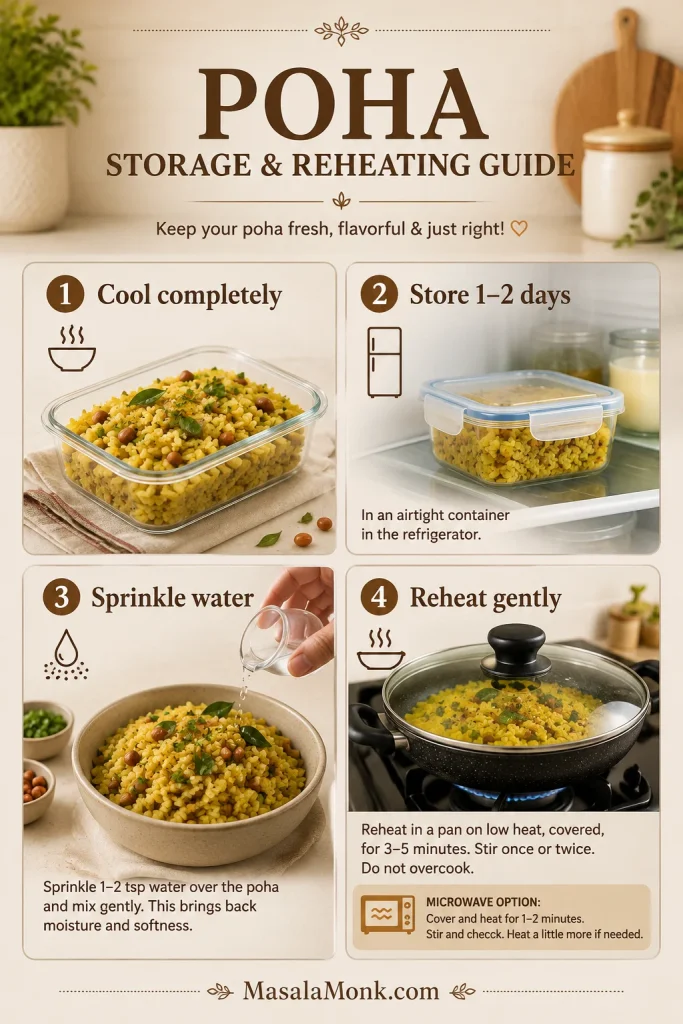
Poha tastes best fresh because the flakes continue to absorb moisture as they sit. It will never be quite as lively after refrigeration, but it can still make a good next-day breakfast if you store and reheat it gently.

Storage and reheating guide for poha showing cooling, airtight storage, sprinkling water, and reheating gently in a covered pan.
Leftover poha reheats best when it is cooled fully, stored airtight, and refreshed gently with a little water rather than cooked hard again.

How to Store Leftover Poha

Cool the poha completely, then store it in an airtight container in the refrigerator for 1–2 days. Do not pack it while steaming hot, or condensation can make the flakes damp and clumpy.

How to Reheat Poha

Sprinkle 1–2 teaspoons water over the poha, cover, and warm gently in a pan on low heat. You can also microwave it covered in short bursts, but avoid overheating because that can make the flakes dry at the edges and dense in the center.

Make-Ahead Tip

For the best make-ahead version, cook the onion-potato tempering ahead and refrigerate it. When you are ready to eat, rinse and rest the poha fresh, warm the tempering, fold in the poha, steam briefly, and finish with lemon and coriander.

FAQs About Poha

What is poha called in English?

Poha is usually called flattened rice, beaten rice, pressed rice, or rice flakes in English. The word poha also refers to the cooked Indian breakfast dish made from those flattened rice flakes.

What kind of poha works best for this recipe?

Thick poha or medium-thick poha works best because it softens without falling apart. Thin poha is better for snacks like chivda, not for this hot breakfast method.

Should poha be soaked or rinsed?

Rinse it, drain it, and let it rest. Do not soak poha in a bowl for this recipe, because the flakes absorb water quickly and can turn heavy before cooking.

Why did my poha become mushy?

Poha usually becomes mushy because the flakes were too thin, soaked too long, over-rinsed, or mixed too roughly. Use sturdier flakes, rinse briefly, drain completely, and fold gently on low heat.

Why is my poha hard?

Hard poha was not hydrated enough before cooking. Sprinkle a tablespoon or two of water over it, cover the pan, and steam gently for a couple of minutes. Next time, let the rinsed poha rest until it passes the finger-press test.

Do you need potato in poha?

Potato is optional. Skip it for a lighter kanda poha; the recipe will cook faster because you only need to soften the onion before adding the poha.

How do you make poha without onion?

For a no-onion version, keep the potato, peanuts or another crunchy garnish, curry leaves, green chilli, turmeric, lemon, and coriander. The flavor will be simpler, so finish with enough lemon, salt, and garnish.

What can replace peanuts in poha?

Cashews, roasted chana dal, sev, or extra vegetables can replace the crunch from peanuts. The recipe will still work, but the finished poha will have a softer bite.

Is poha healthy for breakfast?

Poha can be a light and useful breakfast, especially when paired with peanuts, vegetables, curd, sprouts, or another protein-rich side. Plain poha is mostly carbohydrate, so toppings and portion size matter if you want a more balanced meal. These high-protein Indian vegetarian meal prep ideas can help if you want to pair poha with more protein through the week.

Does red poha work for this recipe?

Red poha works, but it often needs a slightly longer resting time after rinsing. Check the flakes before cooking; they should be tender enough to break, but not wet or sticky.

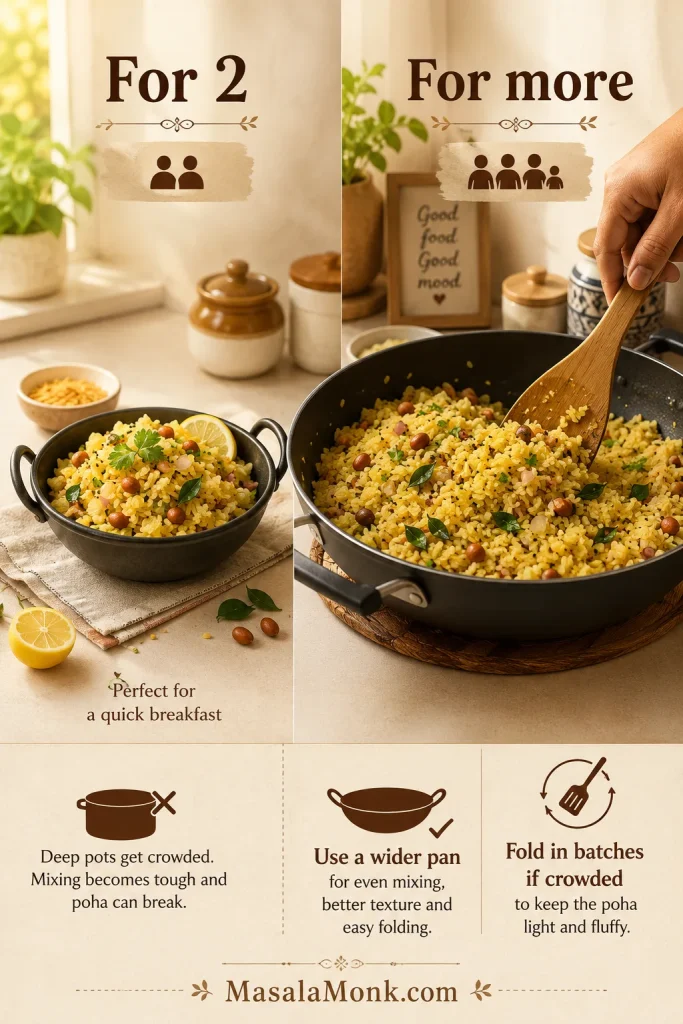
How do you scale this recipe for more poha?

Use a wider pan rather than a deeper one so the flakes can be folded gently without mashing. Double the ingredients, cook the onion and potato fully, then add the softened poha in batches if the pan feels crowded.

Small batch of poha for two compared with a larger family batch being folded in a wide pan.
A wider pan helps more than a deeper one when scaling poha, because the flakes need room to fold without being pressed into a dense mass.

What is the difference between kanda poha and batata poha?

Kanda poha is made mainly with onion, while batata poha includes potato. Kanda batata poha uses both onion and potato, which is why it tastes fuller and feels more satisfying as breakfast.

Final Tips for Better Poha

Good poha is about timing and touch. The flakes do not want to be drowned, the potato does not want to be rushed, and the finished poha does not want rough stirring. Keep the heat low once the poha goes in, fold gently, and finish fresh once everything is hot and fluffy.

After that, the recipe becomes easy to personalize. Keep it simple as kanda poha, make it heartier with potato, add vegetables, or finish it Indori-style with sev, pomegranate, and jeeravan. Once you get the texture right, poha becomes the kind of breakfast you can make from memory.

If you want another warm, savory Indian breakfast to rotate with poha, this upma recipe guide is a natural next stop.

Back to Table of Contents ↑

Posted on 6 Comments

Upma Recipe: 10+ Easy Variations (Rava, Millet, Oats, Semiya & More)

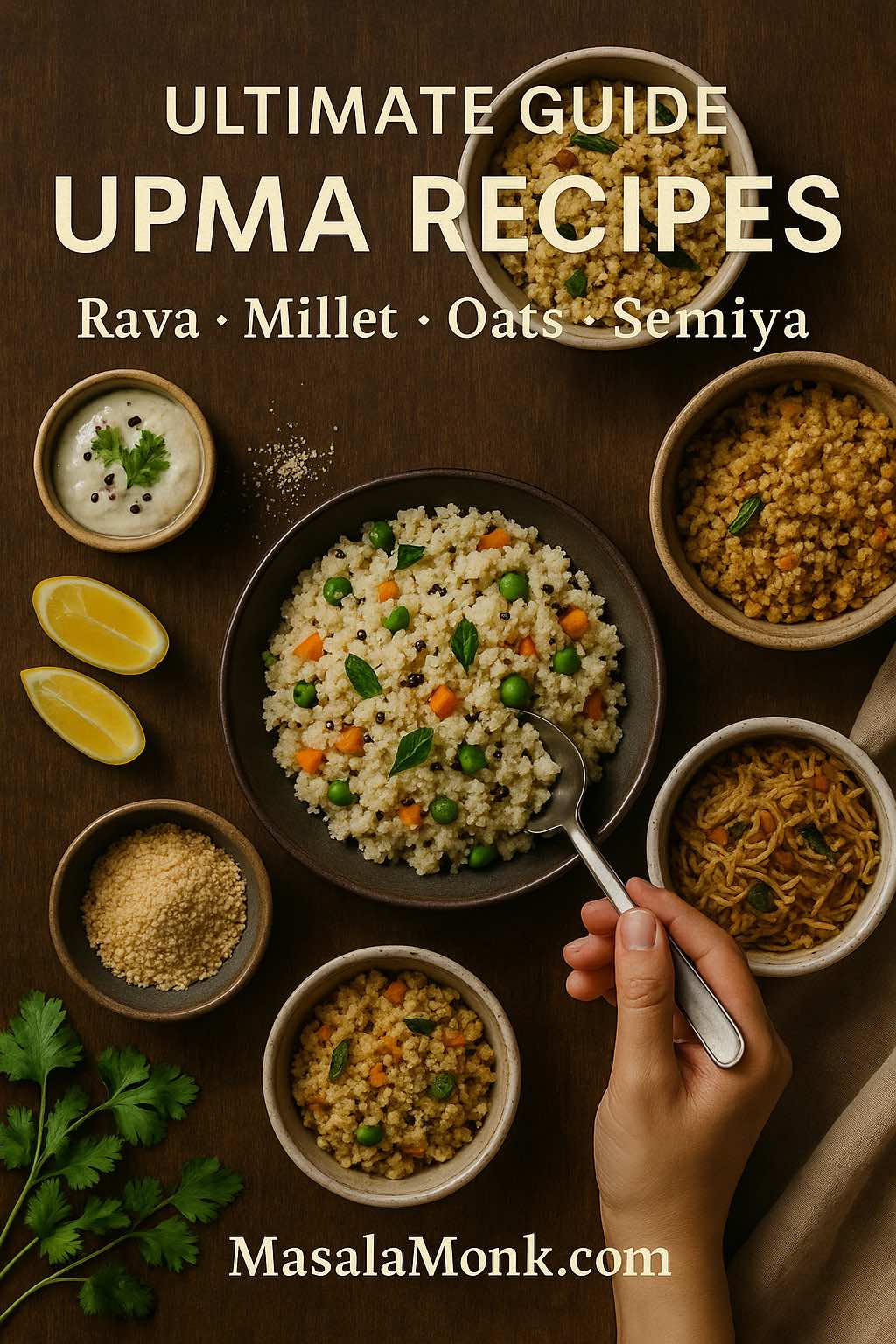
Top-down flatlay of five Indian upma varieties—rava, millet, oats and semiya—arranged with chutney, lemon wedges and herbs, hand holding a spoon, cover image for ultimate upma recipes guide on MasalaMonk.

Upma is one of those breakfasts that feels like home, no matter which part of India you’re from. It’s warm, soft, gently spiced, and endlessly adaptable. With a few pantry staples and one basic upma recipe in your head, you can improvise everything from a simple rava upma for rushed mornings to a millet upma for days when you want something a little more wholesome, or even an oats or quinoa upma when you’re leaning towards high-fibre bowls.

For people looking for “upma recipe”, “how to make upma”, “simple upma recipe”, “millet upma recipe”, “semiya upma”, “instant upma premix” or even “upit recipe”, this long, no-rush guide is meant to sit in your kitchen as a one-stop reference. You’ll get:

  • A detailed, step-by-step rava upma recipe with all the tiny tricks that matter
  • Vegetable and masala variations that turn it into a one-bowl meal
  • Millet upma with different grain options and real health context
  • Semiya (vermicelli) upma, for tiffin boxes and kids who love noodles
  • Oats upma and quinoa upma, with links to what science actually says about them
  • Wheat and rice rava upma for days when you don’t feel like semolina
  • A homemade instant upma mix for travel or office lunches
  • Plenty of ideas for what to serve with upma to build a complete breakfast plate

Along the way, you’ll also find links out to trusted recipe writers and nutrition resources, so you’re not just taking one blog’s word for it. For instance, if you like cross-checking your basics, you can always compare with this lovely, traditional South Indian rava upma method on Indian Healthy Recipes, which you’ll find under the title traditional South Indian rava upma recipe.


What Is Upma, Really?

At its heart, upma is a savoury porridge or pilaf made by roasting a grain (most commonly semolina / suji) and then simmering it in a seasoned, tempered liquid. The tempering usually includes mustard seeds, lentils like urad dal and chana dal, curry leaves, green chillies, onion and sometimes ginger. Once the grain absorbs the water and steams, it turns soft and fluffy, ready to be fluffed, finished with lemon and coriander, and eaten hot.

Cast iron skillet filled with soft rava upma topped with peas and curry leaves, surrounded by bowls of semolina, lentils and spices, with a hand sprinkling curry leaves, illustrating the upma cooking method.
One pan, so many breakfasts – a skillet of gently simmering rava upma with all the classic tempering elements that define the upma method.

Traditionally, rava upma is especially popular in South India, often served with coconut chutney and filter coffee. If you’re curious about that version, you can see another take on it at Veg Recipes of India under their traditional upma with coconut chutney, which matches closely with what many homes actually make.

However, the family of upma is much bigger than just semolina. As grains like ragi, foxtail millet, jowar, oats and quinoa become more common in pantries, the same technique is being reused with different bases. That means an “upma recipe” today can be:

  • A classic suji upma with just onions and chillies
  • A colourful vegetable upma
  • A masala upma with sambar powder or garam masala
  • A millet upma packed with fibre and minerals
  • A semiya upma that looks like a noodle stir-fry
  • An oats upma that quietly helps your cholesterol numbers
  • A quinoa upma that feels modern but very Indian in flavour
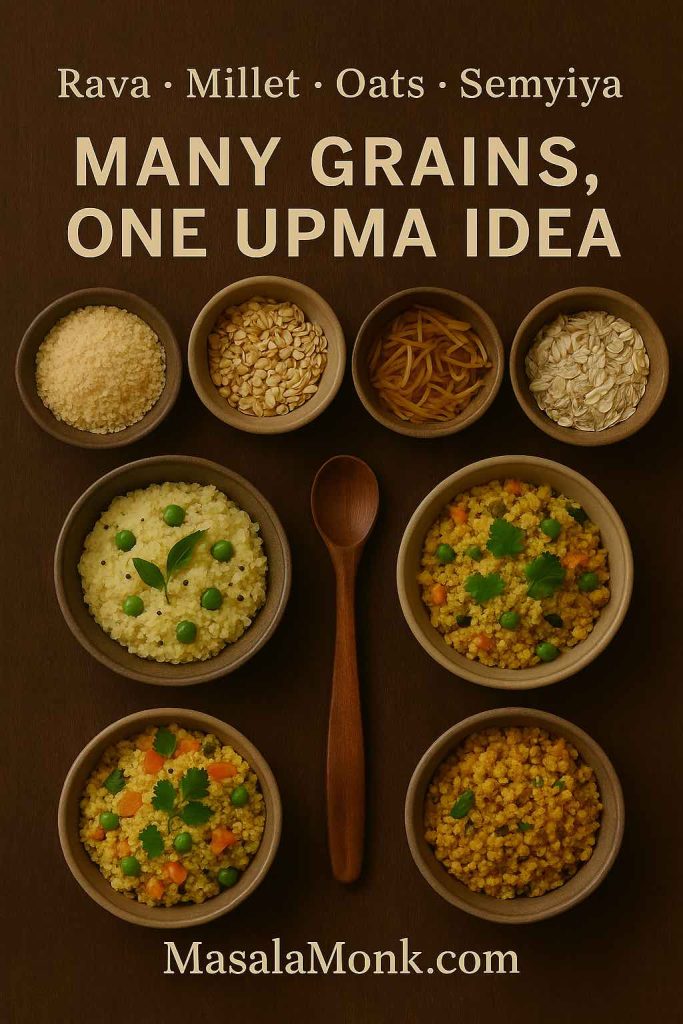
Flatlay of small bowls showing raw rava, millet, semiya and oats at the top, with cooked rava, vegetable millet and semiya upma in bowls below and a wooden spoon in the centre, illustrating that many grains can be used to make upma.
Rava, millet, semiya and oats in their raw and cooked forms, side by side – a reminder that upma is a method you can apply to many grains, not just semolina.

Instead of treating each of these as a totally separate dish, it helps to understand the common logic once, then play.

Also Read: Double Chocolate Chip Cookies – Easy Recipe with 7 Variations


The Classic Rava Upma Recipe (Suji Upma)

Let’s begin with the version you’re most likely to cook again and again: a simple rava upma. Once you get comfortable with this, switching to millet rava or wheat rava upma becomes almost automatic.

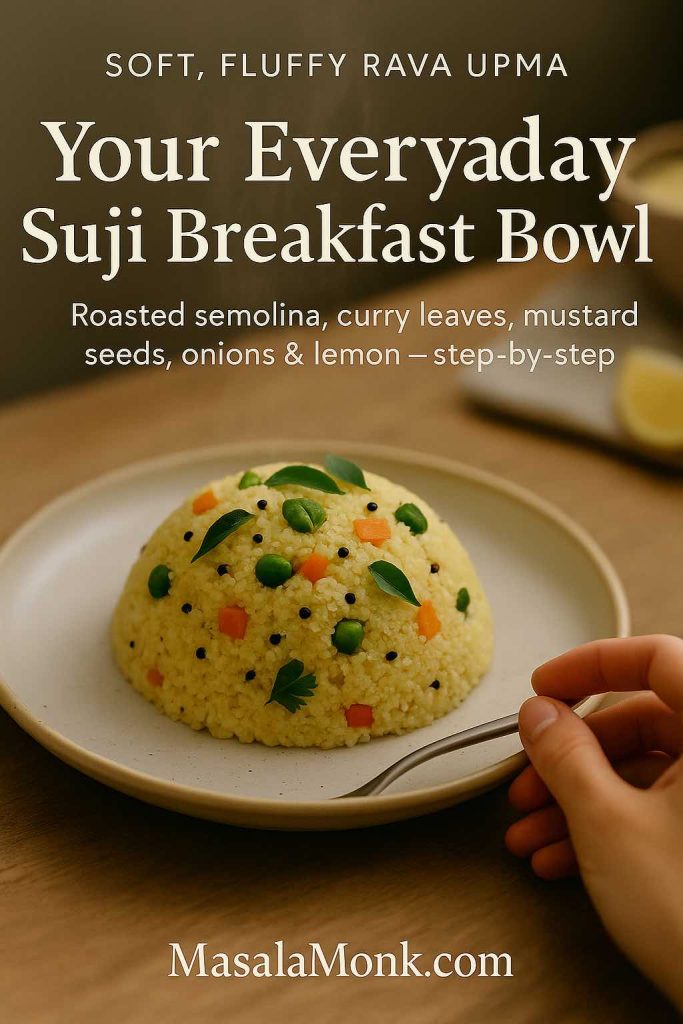
Close-up of a neatly domed serving of soft rava upma with peas, carrots and curry leaves on a ceramic plate, hand reaching for the spoon, with text describing it as an everyday suji breakfast bowl.
Soft, fluffy rava upma piled into an everyday suji breakfast bowl, scented with curry leaves, mustard seeds, onions and a squeeze of lemon.

Ingredients for 2 Servings

  • Semolina / suji / upma rava – ½ cup (medium or slightly coarse)
  • Water – 1½ cups (you can move between 1¼ and 1¾ depending on how soft you like it)
  • Oil or ghee – 2 tablespoons
  • Mustard seeds – ½ teaspoon
  • Urad dal – 1 teaspoon
  • Chana dal – 1 teaspoon
  • Cashew halves – 6–8 (optional but lovely)
  • Onion – 1 small, finely chopped
  • Green chillies – 1–2, slit or chopped
  • Ginger – ½ inch piece, finely chopped
  • Fresh curry leaves – 8–10
  • Salt – to taste
  • Lemon juice – 1–2 teaspoons
  • Fresh coriander – a small handful, chopped

Home cooks and bloggers disagree very gently about the perfect ratio of rava to water. Some prefer it soft and spoonable, others a little drier and crumbly. If you want to dig deeper into this, Raks Kitchen has a useful breakdown of textures and ratios in her rava upma water ratio tips. For now, though, 1:3 is a safe, beginner-friendly place to start.

Step 1: Roast the Rava

Begin by dry-roasting the semolina in a wide pan. Keep the flame low-medium and stir continuously so it doesn’t catch at the bottom.

Step 1 of making rava upma showing a hand stirring semolina in a black skillet with a wooden spatula, with text explaining to dry toast suji on low heat till aromatic to keep upma non-sticky.
Step 1 – gently roasting the rava on low heat so every grain of suji stays separate and the final upma turns out soft, fluffy and never sticky.

You’re looking for:

  • A slightly deeper colour, but not brown
  • A warm, nutty aroma
  • Grains that feel separate when you stir them

This step might feel skippable if you’ve bought “roasted upma rava”, but it’s worth doing anyway. Roasting removes raw flavours and, more importantly, helps the rava swell up evenly without turning sticky.

Once roasted, transfer the rava to a plate and let it cool slightly while you prepare the tempering.

Step 2: Build the Tempering

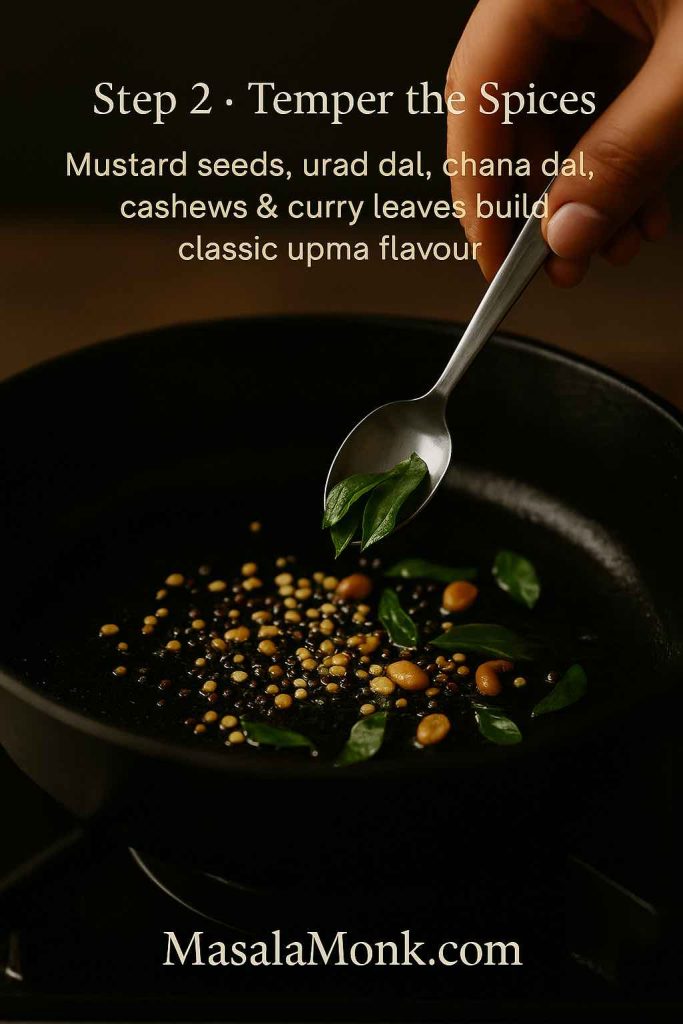
In the same pan, add the oil or ghee. When it heats up, drop in mustard seeds. As soon as they splutter, stir in urad dal and chana dal.

Step 2 of making upma showing mustard seeds, urad dal, chana dal and cashews sizzling in oil in a black skillet while a hand adds fresh curry leaves with a spoon, illustrating the tempering stage for classic rava upma.
Step 2 – tempering mustard seeds, lentils, cashews and curry leaves in hot oil to create the nutty, fragrant base that makes every rava upma taste authentic.
  • Fry the dals on medium heat until they turn golden and crisp.
  • Add cashews at this stage if you’re using them and fry till lightly golden.

The sizzling mix of mustard, dals and nuts is not just for taste; it contributes crunch in every bite. After this, tip in the curry leaves, chopped ginger and green chillies. They’ll sputter a bit, so stand back for a moment.

Finally, add the chopped onion. Sauté until it turns soft and translucent. You don’t really need to brown the onion for a basic upma recipe; you just want the raw bite to vanish.

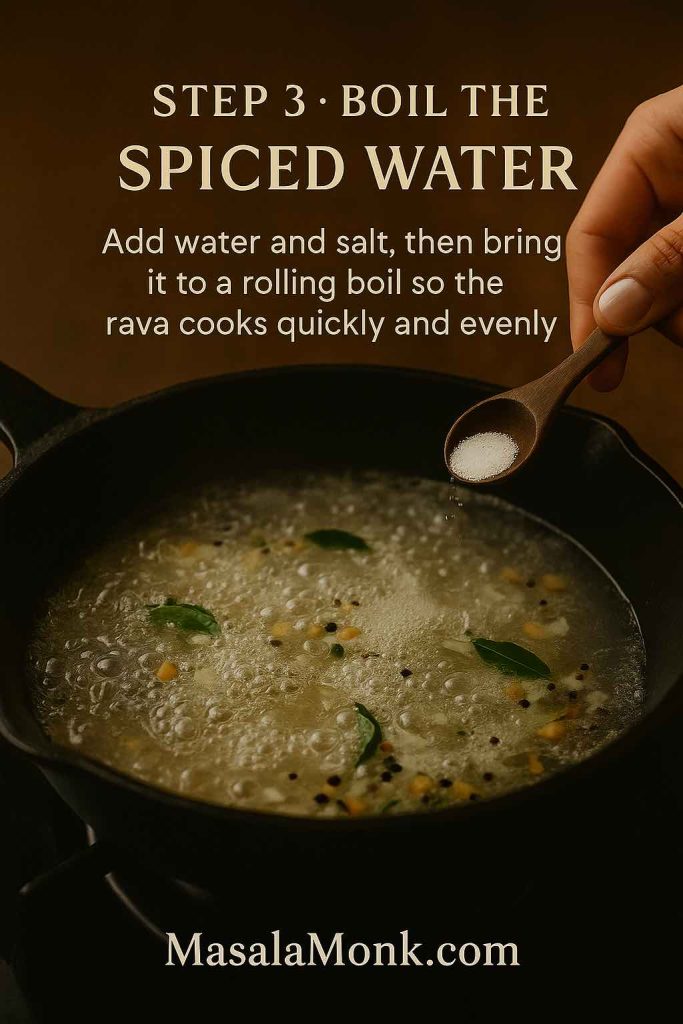
Step 3: Bring the Spiced Water to a Boil

Now pour in the measured water and add salt. Taste the water – it should be slightly saltier than you’d like the final upma to be, because the rava will absorb some of that salt.

Step 3 of the rava upma recipe showing a cast-iron skillet of spiced water at a rolling boil with curry leaves and lentils, while a hand sprinkles salt from a wooden spoon, with text explaining to boil the water so the rava cooks quickly and evenly.
Step 3 – add water and salt to the tempering, then bring it to a proper rolling boil so the suji swells quickly and the upma cooks evenly without turning lumpy.

Bring this to a rolling boil. This matters more than it seems:

  • Boiling water helps rava swell quickly and evenly.
  • It dramatically reduces your chances of ending up with lumpy upma.

Meanwhile, if you feel like cross-checking a slightly different style of tempering or vegetable add-ins, you could glance through the traditional South Indian rava upma recipe at Indian Healthy Recipes; you’ll notice the same broad steps.

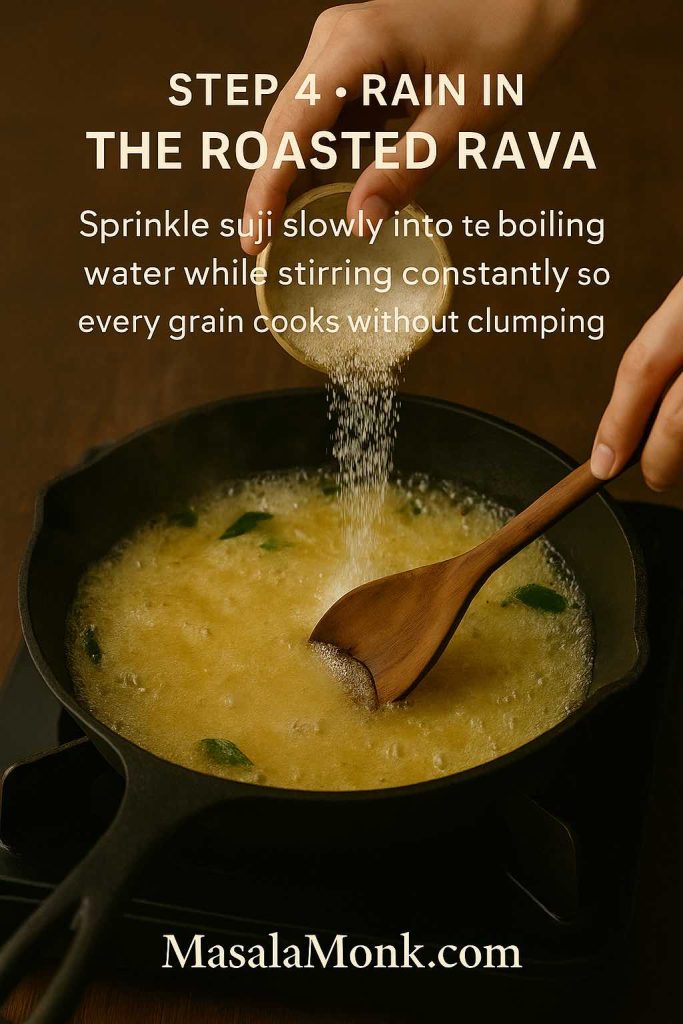
Step 4: Add the Rava Without Lumps

Once the water is bubbling, lower the flame. Hold the roasted rava in one hand and a spatula in the other.

Step 4 of the rava upma method showing a hand pouring roasted semolina in a thin stream into a skillet of bubbling spiced water while another hand stirs with a wooden spatula, with text explaining to sprinkle suji slowly and stir constantly to avoid lumps.
Step 4 – “raining in” the roasted rava, sprinkling suji slowly into boiling spiced water while stirring so every grain cooks evenly without clumping.
  • Slowly sprinkle the rava into the boiling water in a steady stream.
  • Keep stirring continuously.

The idea is to give each little sprinkle of rava a chance to meet the hot liquid and swell individually. If you dump it all in at once, it will clump and form dumplings.

Within a minute or two, the mixture will start thickening and pulling away from the sides.

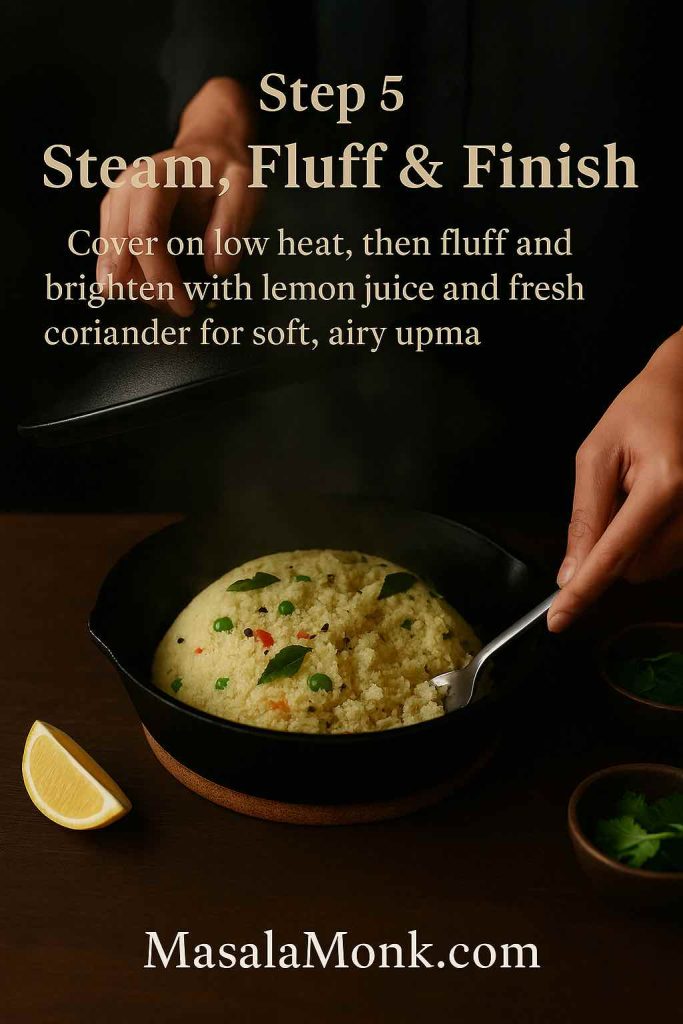
Step 5: Steam, Fluff and Finish

At this point, cover the pan and let the upma steam on the lowest flame for about 3–4 minutes. Switch off the heat and allow it to sit, still covered, for another 2 minutes.

Step 5 of the rava upma recipe showing a hand lifting the lid off a steaming skillet of fluffy upma while another hand fluffs it with a spoon, with lemon wedge and coriander nearby and text explaining to steam, fluff and finish with lemon and coriander.
Step 5 – let the upma steam on low, then fluff it and finish with lemon juice and fresh coriander for a soft, airy bowl.

When you open the lid:

  • The rava should be cooked through, soft and fluffy.
  • The surface might look a little dome-like; that’s fine.

Fluff gently with a fork or spatula to loosen up the grains. Finally, add lemon juice and chopped coriander, and fold everything together. Taste and adjust salt or lemon once more.

Serve hot with coconut chutney, podi, pickle or simply a drizzle of ghee on top. For another angle on serving ideas (especially with coconut chutney), you can refer to the version at Veg Recipes of India under their traditional upma with coconut chutney.

Also Read: Carbonara Recipe: Italian Pasta (Creamy, Veggie, Chicken, Shrimp, Tuna & Keto)


Vegetable Upma, Masala Upma Recipe and Other Rava Upma Variations

Once the basic method feels natural, you’ll inevitably start tweaking it. Some mornings you’ll want more vegetables, some days more heat, and sometimes you’ll be in the mood for a slightly indulgent, ghee-laced bowl of “mom upma”.

Vegetable Upma

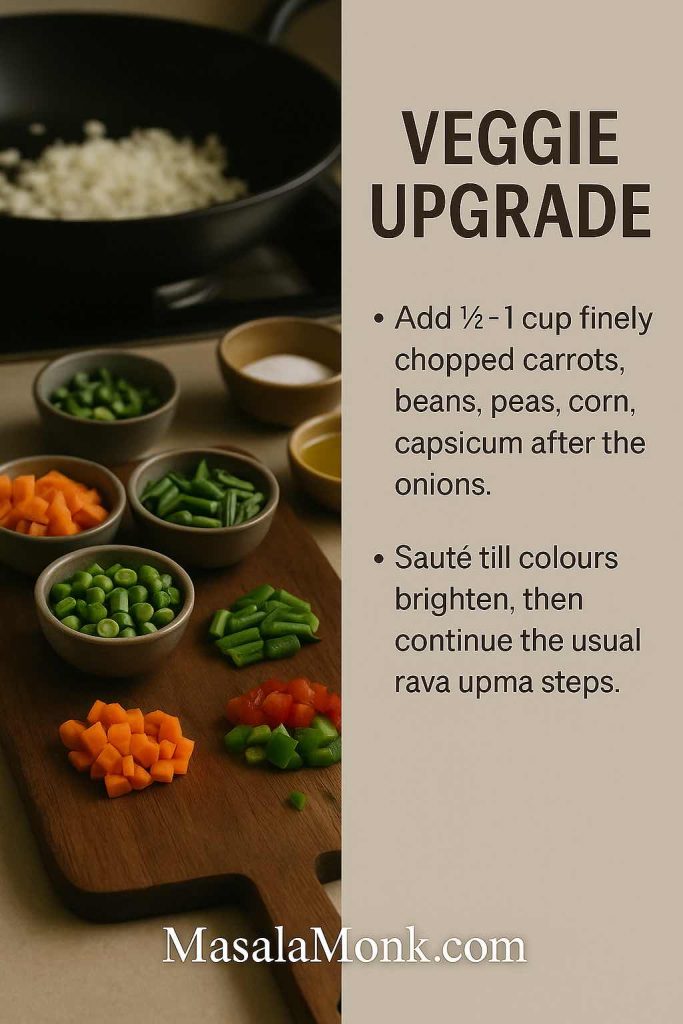
For a simple vegetable upma, follow the classic recipe with one change: after sautéing the onion, add about ½ to 1 cup of finely chopped vegetables such as:

  • Carrots
  • Green beans
  • Green peas
  • Sweet corn
  • Capsicum
Recipe card style image for vegetable upma showing small bowls of chopped carrots, beans, peas, corn and capsicum on a board with a skillet of onions in the background, plus text explaining to add ½–1 cup mixed veggies after the onions and sauté before continuing the rava upma recipe.
Veggie upgrade – turn plain rava upma into colourful vegetable upma by adding a generous ½–1 cup of finely chopped carrots, beans, peas, corn and capsicum after the onions and sautéing till they brighten.

Sauté the vegetables for a couple of minutes until the colours brighten and they lose their rawness. After that, proceed with water, salt and rava as usual.

This variation cleverly answers many searches like “simple upma recipe”, “veggie upma” or “upma recipe for kids”, without changing the core technique.

Masala Upma

For mornings when you want something closer to a one-bowl lunch, a masala upma works beautifully.

Hand sprinkling turmeric into a pan of vegetable upma with peas, carrots and beans, with small bowls of turmeric and red spice in front and text explaining how to turn veggie upma into masala upma with turmeric and sambar or garam masala.
Masala twist – once the veggies are in, add turmeric for colour and a spoon of sambar or mild garam masala to turn everyday vegetable upma into a fuller, lunch-style masala upma.

In addition to the vegetables:

  • Add ¼ teaspoon turmeric powder for a bright colour.
  • Sprinkle in ½ teaspoon sambar powder or a mild garam masala.

Those additions transform the flavour just enough to make it feel more lunch-worthy, especially if you serve it with a dollop of yoghurt and a salad on the side.

Red Rava Upma Recipe

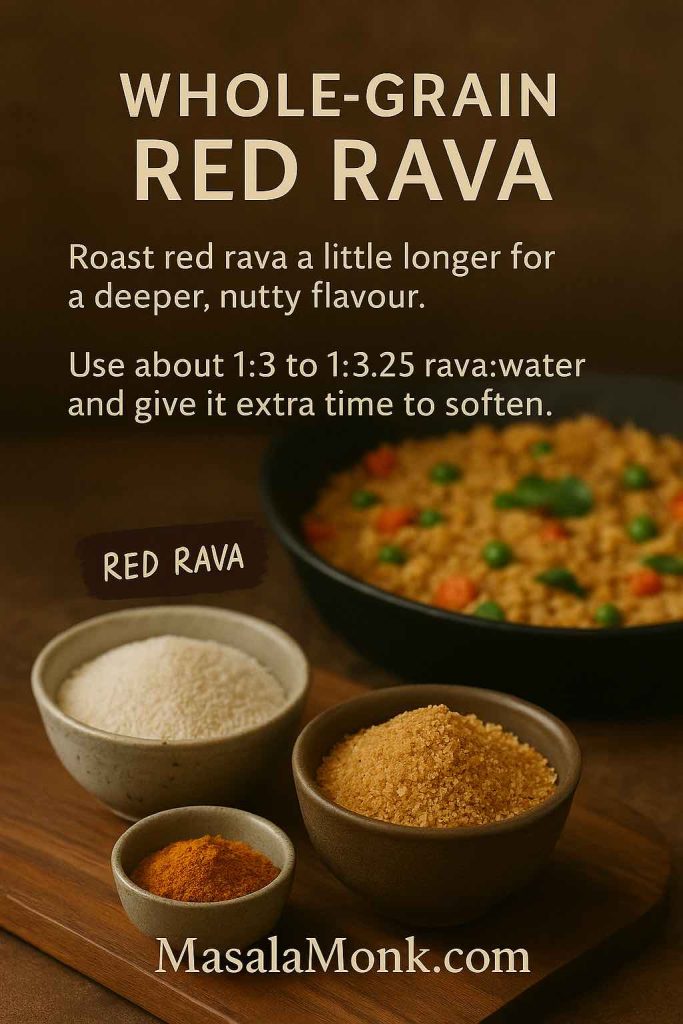
Sometimes you’ll come across red rava (made from whole wheat or red rice) labelled as “upma rava” too. You can treat it in almost the same way as suji, with slight adjustments:

Recipe card for whole-grain red rava upma showing bowls of regular suji and coarse red rava in the foreground with a skillet of rustic red rava upma behind them, plus text explaining to roast red rava longer and use about 1:3 to 1:3.25 rava to water for a nutty, softer texture.
Whole-grain red rava upma – roast the red rava a little longer, add more water and give it extra time on the stove for a deeper, nuttier bowl that feels closer to a whole grain breakfast.
  • Roast it a little longer; whole-grain rava benefits from deeper roasting.
  • Increase the water slightly to around 1:3 or even 1:3.25 if it’s very coarse.
  • Be patient with cooking time; whole grains take longer to soften.

The result is a nuttier, more rustic upma that fits nicely on days when you want something closer to a whole grain breakfast.

Recipe of “Mom-Style” Ghee Rava Upma

If you grew up on upma made by a mother or grandmother who didn’t shy away from ghee, you might crave that taste from time to time.

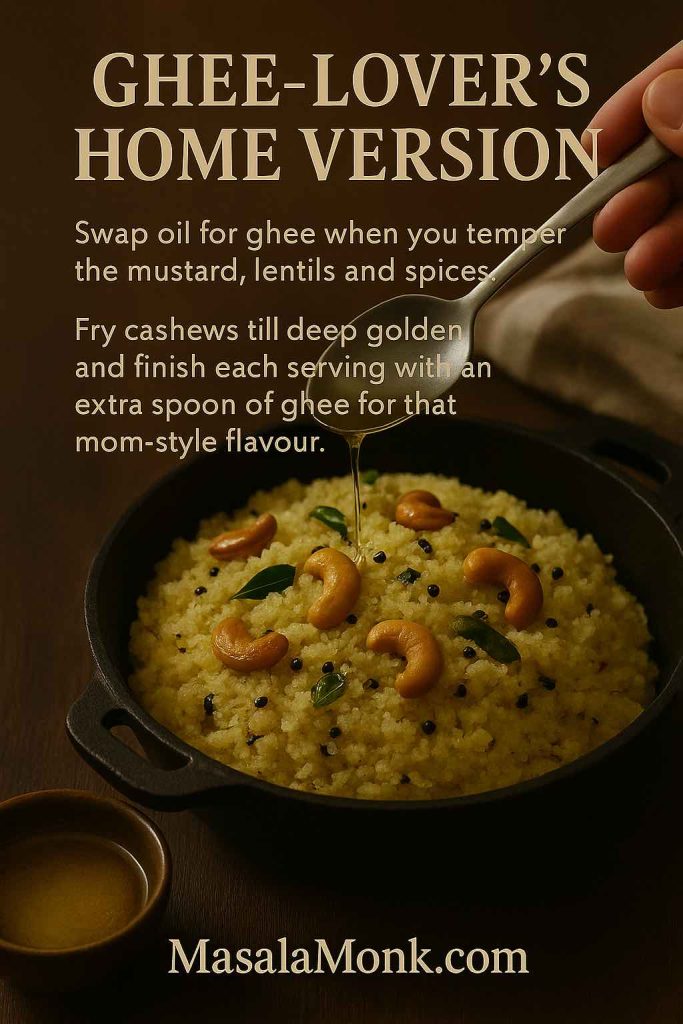
Mom-style ghee rava upma in a cast-iron pan topped with deep golden cashews and curry leaves while a hand pours ghee from a spoon, with text explaining to use ghee for tempering and finish each serving with an extra spoon of ghee.
Ghee-lover’s home version – swap oil for ghee, fry the cashews till deep golden and finish each serving with an extra spoon of ghee for that nostalgic, mom-style rava upma flavour.

To get that flavour:

  • Use ghee instead of oil for the tempering.
  • Fry the cashews till deep golden.
  • Finish with a small spoonful of ghee drizzled over each serving.

The extra richness hides in the background, but it makes every spoonful taste like a hug.

Also Read: One-Pot Chicken Bacon Ranch Pasta (Easy & Creamy Recipe)


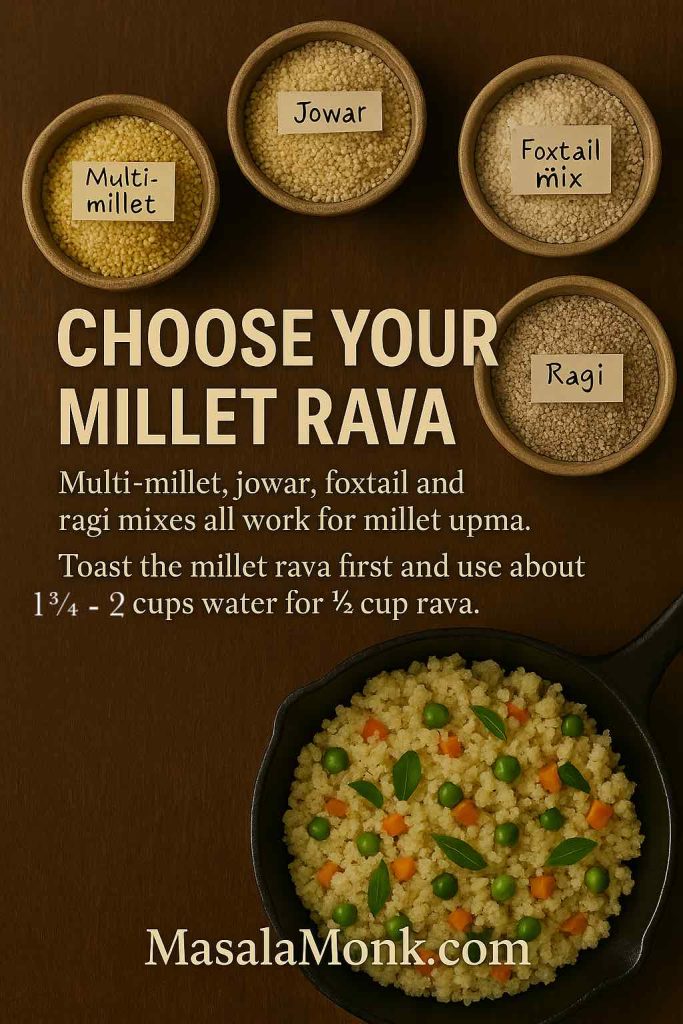
Millet Upma: Jowar, Foxtail, Ragi and Multi-Millet Rava Recipe

Over the last few years, millet upma has become a favourite for people who want a more nutrient-dense breakfast without sacrificing Indian flavours. Millets are naturally rich in fibre, minerals like iron, calcium and zinc, and often have a gentler effect on blood sugar compared to refined grains.

If you’d like to see the bigger picture before you start cooking, two good reads are MasalaMonk’s own overview Millets: The Gluten-Free Superfood and their guide exploring the various types of millets in India. For a more formal look, you can also glance at the ICMR–NIN document on nutritional and health benefits of millets, or FSSAI’s classification of millets as “nutri-cereals” in their millets guidance notes.

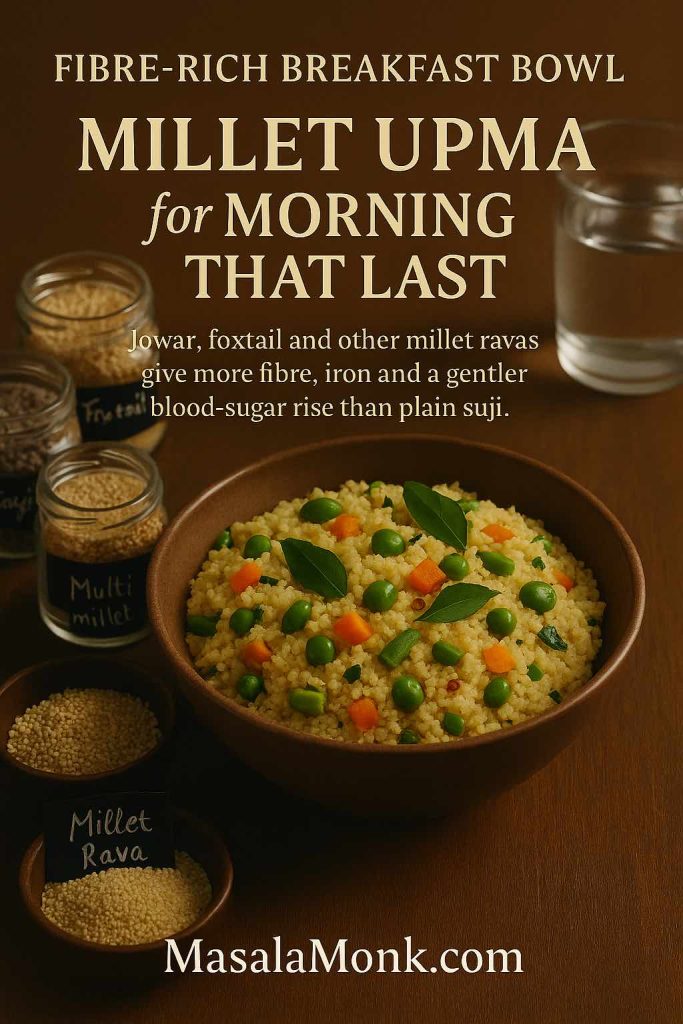
Portrait photo of a fibre-rich millet upma bowl with peas, carrots and curry leaves on a wooden table, surrounded by jars labelled multi millet, foxtail and millet rava, with text describing millet upma as a breakfast that gives more fibre, iron and a gentler blood-sugar rise than plain suji.
Millet upma for mornings that last – a fibre-rich bowl made with multi-millet rava, jowar and foxtail-style grains, offering more iron and a gentler blood-sugar rise than plain suji upma.
Which Millet Rava Works Well for Upma?

You can make a millet upma recipe using:

  • Multi-millet rava blends
  • Jowar rava, often called jonna rava in some regions
  • Foxtail millet rava
  • Ragi-based mixed millet rava (often combined with other millets for better texture)

For a clearer sense of what’s available in Indian markets, this breakdown of common types of millet available in India is handy.

Basic Millet Upma Recipe

For 2 servings:

  • Millet rava – ½ cup
  • Water – 1¾ to 2 cups (millets generally need more water than suji)
  • Oil – 2 tablespoons
  • Mustard seeds – ½ teaspoon
  • Urad dal – 1 teaspoon
  • Chana dal – 1 teaspoon
  • Cashews – a small handful (optional)
  • Onion – 1 small, chopped
  • Ginger – ½ inch, chopped
  • Green chillies – 1–2
  • Curry leaves – a few sprigs
  • Mixed vegetables – ½ to 1 cup
  • Salt, lemon juice, coriander – to taste

The method mirrors rava upma, with a few tweaks:

Recipe card image showing small bowls of millet rava labelled multi-millet, jowar, foxtail mix and ragi above a skillet of cooked millet upma, with text explaining that all these millet ravas work for upma and need to be toasted and cooked with about 1¾–2 cups water for ½ cup rava.
Choose your millet rava – multi-millet, jowar, foxtail and ragi mixes all work beautifully for millet upma when you toast the rava first and use a little extra water for soft, fluffy grains.
  1. Dry roast the millet rava in a pan till it smells toasty and feels lighter.
  2. In another pan (or the same pan after transferring the roasted millet), make the tempering: oil, mustard, dals, cashews, curry leaves, ginger, chillies, onion.
  3. Add vegetables and sauté till they brighten.
  4. Pour in water and salt; bring to a good boil.
  5. Lower the flame and slowly stir in the roasted millet rava, stirring as you go.
  6. Cover and cook on a low flame till the grains soften. Rest for a few minutes and fluff.

Because millets can feel new if you haven’t cooked them much before, you might also enjoy trying other breakfast-style millet recipes, such as fermented ragi (finger millet) idlis or barnyard millet and foxnuts savoury pancakes, which give you more ideas on how to rotate millets through your mornings.

Also Read: Katsu Curry Rice (Japanese Recipe, with Chicken Cutlet)


Wheat and Rice Rava Upma Recipe (Godhuma, Bansi, Samba, Arisi Upma)

Beyond millets, many households regularly switch between suji, wheat rava and rice rava. People looking for “wheat rava upma”, “samba rava upma”, “bansi rava upma”, “rice rava upma” and “arisi upma mix” are all essentially trying to do this rotation with confidence.

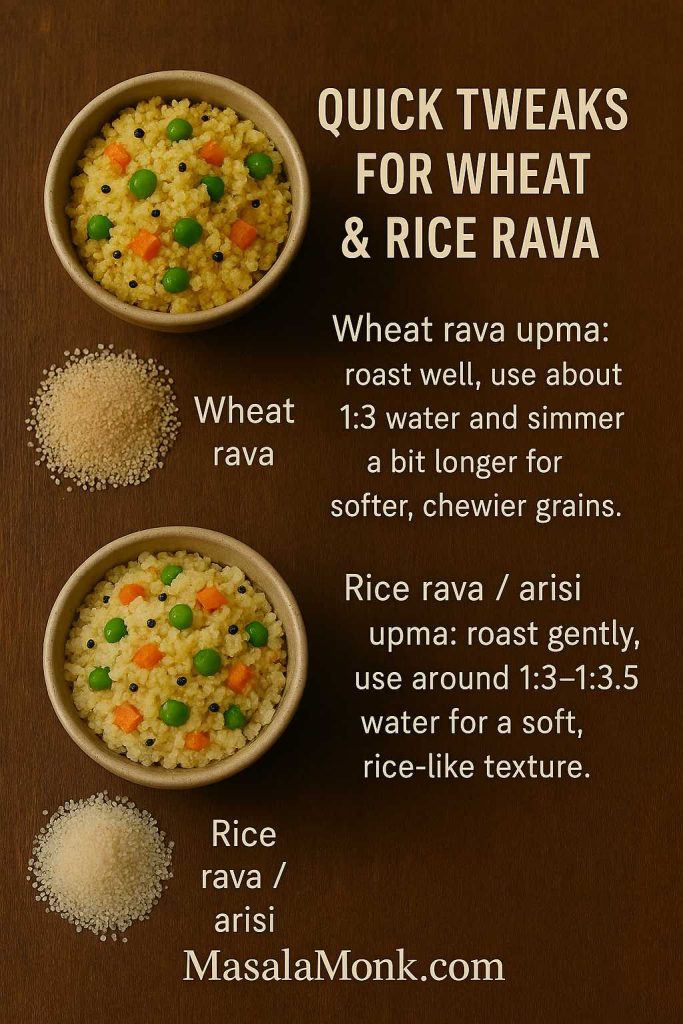
Digital food photo showing two bowls of upma on a wooden board, one labelled wheat rava upma and the other rice rava or arisi upma, with small piles of wheat rava and rice rava, curry leaves, green chutney and lemon, plus text explaining that wheat rava needs more water and time while rice rava feels closer to soft rice.
Beyond suji – side-by-side bowls of wheat rava upma and rice rava (arisi) upma, showing how you can swap in godhuma or arisi rava for a heartier, rice-like take on classic upma.

Wheat Rava Upma Recipe

Wheat rava goes by many names: godhuma rava, bansi rava, samba rava, broken wheat and so on. This base yields a slightly chewier, almost pilaf-like upma.

To prepare it:

  • Replace suji with the same quantity of wheat rava.
  • Roast it gently before use.
  • Use around 1½ to 2 cups of water for ½ cup wheat rava, depending on how coarse it is.

The tempering and vegetable combination can be identical to rava upma. The only real difference is the cooking time, which tends to be a touch longer.

If someone at home has to avoid wheat because of an allergy or suspected intolerance, it’s worth reading a focused guide such as wheat allergy: symptoms, causes, and treatment and then leaning on rice or millet-based upma instead of wheat rava versions.

Instructional graphic showing a bowl of wheat rava upma with a pile of wheat rava, and a bowl of rice rava or arisi upma with a pile of rice rava, plus text explaining to roast wheat rava well and use about 1:3 water, and to roast rice rava gently and use about 1:3–1:3.5 water for a soft rice-like texture.
Quick tweaks for wheat and rice rava upma – roast wheat rava well and simmer with about 1:3 water for chewier grains, while rice rava or arisi upma prefers gentler roasting and a little extra water for a soft, rice-like finish.

Recipe for Rice Rava Upma / Arisi Upma

Rice rava (or arisi rava) is simply broken rice. It tends to taste closer to soft rice cooked in a tempering, but still follows the “roast, simmer, steam” logic.

You can:

  • Use ½ cup rice rava to start with.
  • Roast it lightly, just until it loses any raw aroma.
  • Temper oil with mustard seeds, dals, curry leaves, ginger, chillies and onions.
  • Add water and salt (start with about 1½ to 1¾ cups, adjusting as needed).
  • Stir in rice rava, then simmer covered till the grains are soft but not mushy.

If you’re already cooking plain rice alongside, you might find MasalaMonk’s guide on how to cook perfect rice every time helpful; it walks through stovetop, cooker and Instant Pot methods and helps time everything together in a busy kitchen.

Also Read: 10 Best Espresso Martini Recipe Variations (Bar-Tested)


Semiya Upma Recipe (Vermicelli / Seviyan Upma)

Switching gears a little, semiya upma is what many people reach for when they’re dealing with fussy children, tiffin boxes or days when they’re simply bored of rava. Vermicelli upma feels lighter, looks fun on the plate, and still uses the same basic building blocks.

Ingredients for 2 Servings

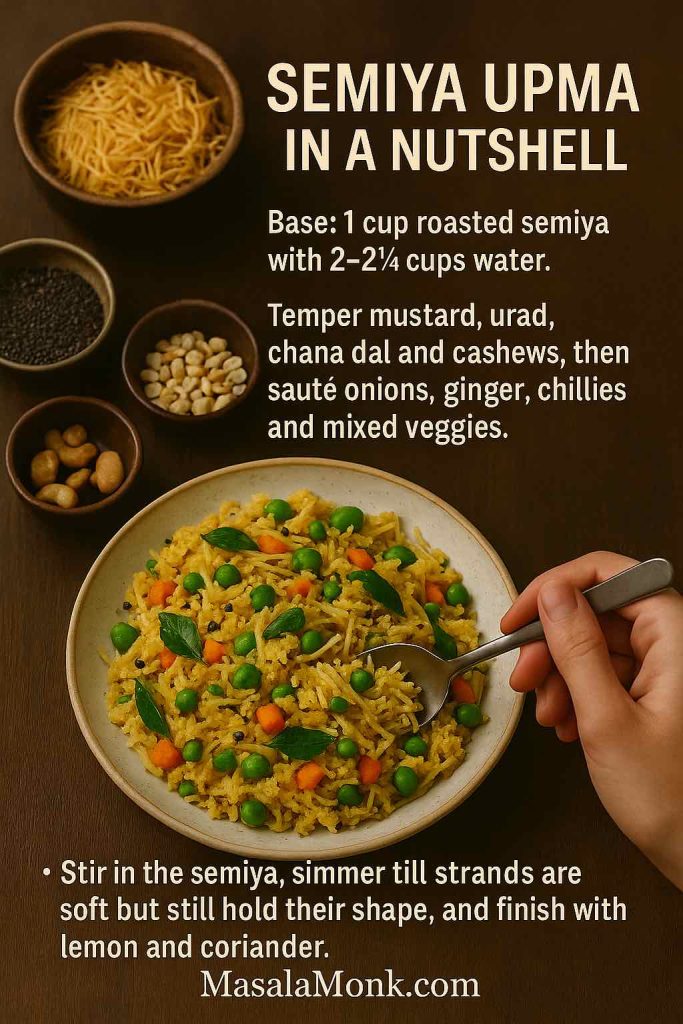
  • Roasted vermicelli (semiya) – 1 cup
  • Water – 2 to 2¼ cups
  • Oil – 1½ to 2 tablespoons
  • Mustard seeds – ½ teaspoon
  • Urad dal – 1 teaspoon
  • Chana dal – 1 teaspoon
  • Cashew nuts – a small handful (optional)
  • Onion – 1 small, chopped
  • Ginger – ½ inch, minced
  • Green chillies – 1–2, chopped
  • Curry leaves – a sprig or two
  • Mixed vegetables – ½ to 1 cup (peas, carrots, beans, corn)
  • Salt, lemon juice, coriander – to taste
Recipe card for semiya upma showing a bowl of colourful vermicelli upma with peas, carrots and curry leaves, surrounded by bowls of roasted semiya, mustard seeds, lentils and cashews, with text summarising the base ratio, tempering and cooking method for semiya upma.
Semiya upma recipe in a nutshell – roasted vermicelli simmered with tempered mustard, lentils, cashews, onions and mixed veggies for a lighter, tiffin-friendly twist on classic upma.

Method

  1. If the vermicelli isn’t pre-roasted, dry roast it till it turns a light golden-brown and gives off a nutty aroma.
  2. In a separate pan, prepare the tempering exactly as you would for rava upma: oil, mustard, dals, cashews, curry leaves, ginger, chillies, onion.
  3. Add vegetables and sauté briefly until they brighten in colour.
  4. Pour in water and salt, bring to a boil.
  5. Add the roasted vermicelli gradually while stirring so it doesn’t clump.
  6. Lower the heat and cook uncovered or partially covered until the water is absorbed and the semiya is soft but still holds its shape.
  7. Finish with lemon and coriander.

Unlike some other variations, semiya upma doesn’t always need chutney; it tastes quite complete on its own, especially if you’re generous with the vegetables and cashews.

Also Read: Greek Tzatziki Sauce Recipe (1 Master Sauce + 10 Easy Variations)


Oats Upma Recipe: A Savoury, High-Fibre Bowl

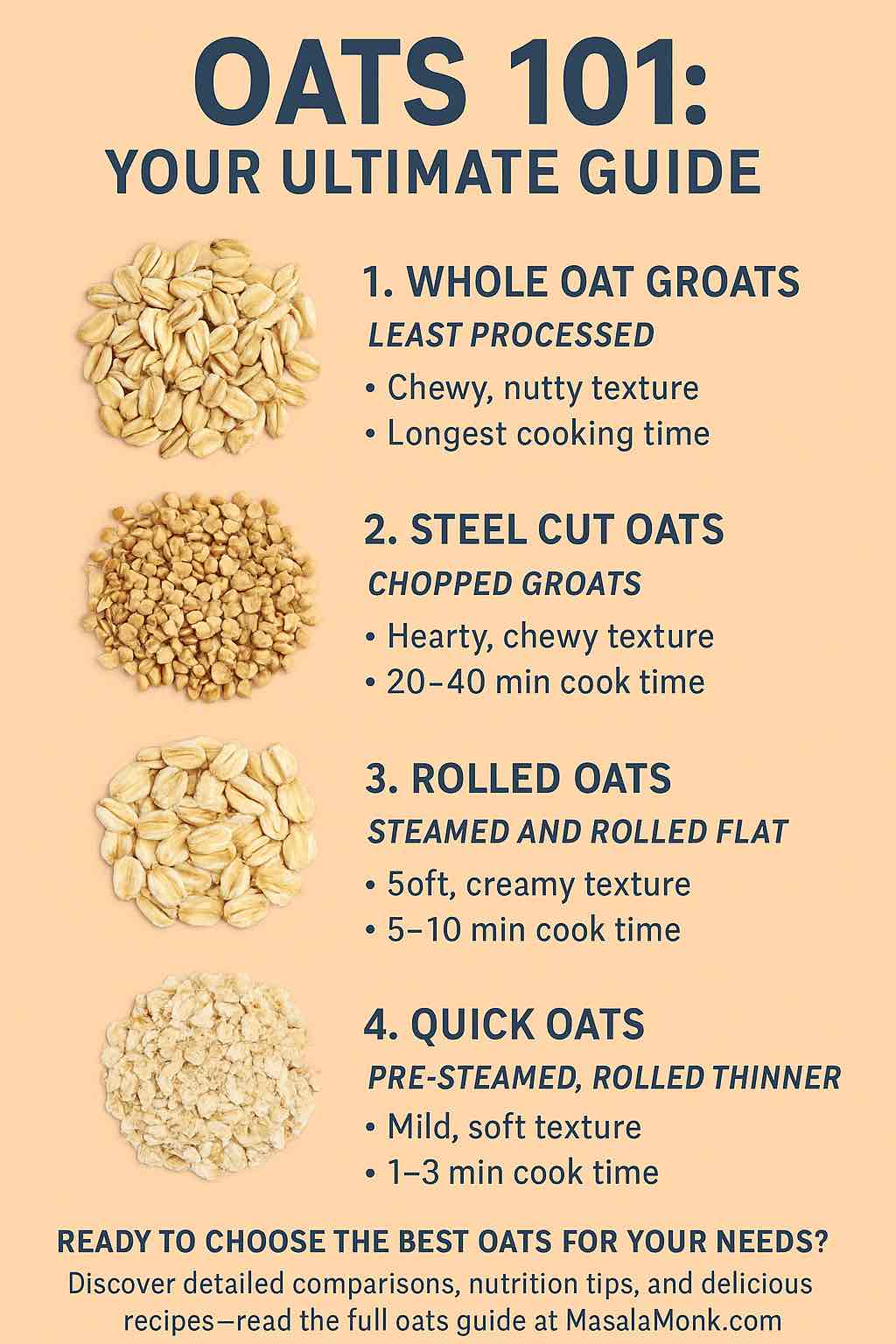
Once you’re comfortable with the idea that almost any grain can become an upma, oats are a natural next step. Many readers searching for “oats upma” are looking for a way to eat oats that doesn’t feel like a bowl of sweet porridge.

From a nutrition point of view, oats are rich in beta-glucan, a soluble fibre that helps with satiety and cholesterol regulation. Harvard’s Nutrition Source has a concise explainer under their overview of oats and beta-glucan benefits, and Mayo Clinic offers a practical perspective in their guide to starting your day with healthy oatmeal.

Ingredients for 2 Servings

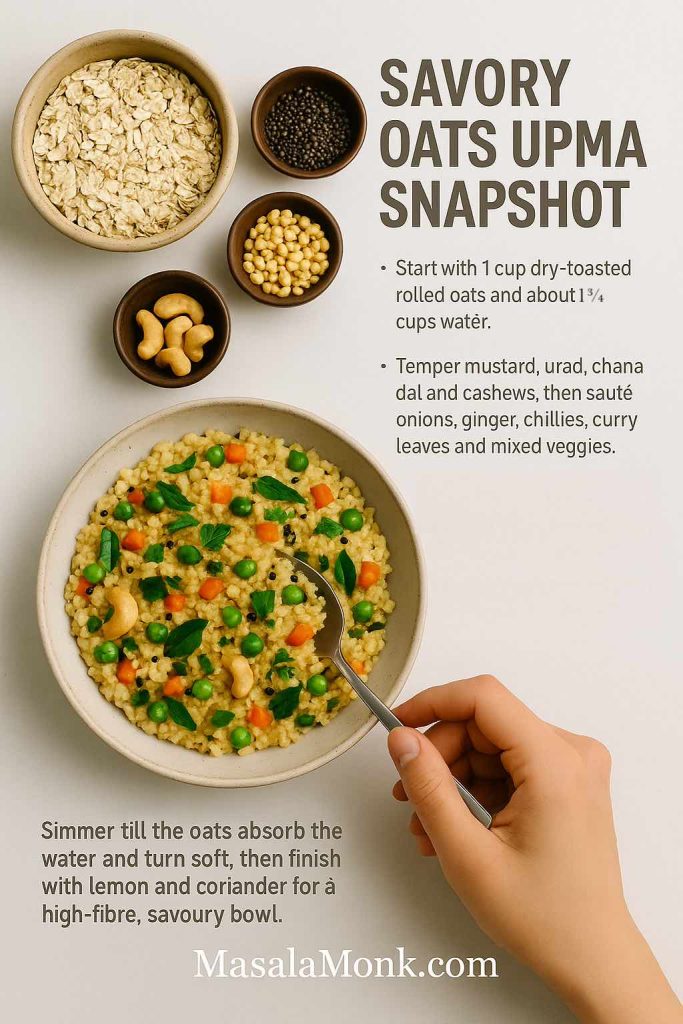
  • Rolled oats – 1 cup
  • Water – about 1¾ cups (adjust if you like it looser or firmer)
  • Oil – 1½ tablespoons
  • Mustard seeds – ½ teaspoon
  • Urad dal – 1 teaspoon
  • Chana dal – 1 teaspoon
  • Cashew nuts – a few (optional)
  • Onion – 1 small
  • Ginger – ½ inch
  • Green chillies – 1–2
  • Curry leaves
  • Mixed vegetables – ½ cup or more
  • Salt, lemon juice, coriander – as usual
Recipe snapshot for savory oats upma showing a bowl of colourful oats upma with peas, carrots and cashews, surrounded by bowls of rolled oats, mustard seeds, lentils and cashews, with text summarising the ratio, tempering and simmering steps for a high-fibre Indian breakfast bowl.
Savory oats upma recipe snapshot – dry-toasted rolled oats simmered with tempered mustard, lentils, cashews, onions and veggies, then finished with lemon and coriander for a high-fibre Indian breakfast bowl.

Method

  1. Dry toast the oats in a pan for 2–3 minutes until they smell toasty and slightly nutty. This step keeps the final texture pleasant and prevents mushiness.
  2. In another pan, temper oil with mustard, dals and cashews.
  3. Add curry leaves, ginger, chillies and onion, sauté till the onion softens.
  4. Stir in vegetables and fry briefly.
  5. Add water and salt; bring to a boil.
  6. Tip in the toasted oats, lower the flame and cook, stirring occasionally, until they absorb the water and turn soft.
  7. Rest for a couple of minutes, then fluff and garnish with lemon and coriander.

If you enjoy oats in both sweet and savoury forms, you might want to keep a few ideas bookmarked. MasalaMonk’s high protein overnight oats and their guide on turning plain oats into a high-protein meal are both excellent for days when you want more variety and protein without abandoning oats as a base.

Meanwhile, if you’re curious about the “hard” science on oats and cholesterol, you’ll find clinical-trial style evidence in publications that examine oat beta-glucan and LDL reduction in detail; those are reassuring when you commit to eating oats upma regularly.

Also Read: Simple Bloody Mary Recipe – Classic, Bloody Maria, Virgin & More


Quinoa Upma: Low-GI, High-Protein Comfort Recipe

Quinoa might not be native to Indian kitchens, but it slips into Indian flavours surprisingly well. When you treat it like rava and build an upma recipe around it, you get a bowl that tastes familiar but behaves a little differently in your body.

As a grain, quinoa tends to have a lower glycaemic index than both white and brown rice and also brings more protein and minerals per cup. A recent comparison on quinoa vs rice for blood sugar and weight management lays this out in an accessible way, and if you enjoy science-y talks, you might appreciate this Royal Society of Chemistry event that explored whether quinoa can be a healthier alternative to rice.

Ingredients for 2 Servings

  • Quinoa – ½ cup, rinsed thoroughly
  • Water – 1½ cups
  • Oil – 1½ to 2 tablespoons
  • Mustard seeds – ½ teaspoon
  • Urad dal – 1 teaspoon
  • Chana dal – 1 teaspoon
  • Cashews – a handful (optional)
  • Onion – 1 small, chopped
  • Ginger – ½ inch
  • Green chillies – 1–2
  • Curry leaves
  • Mixed vegetables – ½ to 1 cup
  • Salt, lemon juice, coriander
Recipe snapshot for quinoa upma showing a bowl of quinoa upma with peas, carrots and cashews beside small bowls of quinoa and lentils, with text explaining rinsing, tempering and simmering quinoa for a low-GI, high-protein upma bowl.
Quinoa upma recipe snapshot – well-rinsed quinoa simmered with tempered mustard, lentils, cashews, onions and veggies until the grains show little “tails”, then fluffed with lemon and coriander for a low-GI, high-protein upma bowl.

Method

  1. Place the quinoa in a fine-mesh sieve and rinse thoroughly under running water. This helps wash away saponins, which can taste bitter.
  2. In a pan, prepare the tempering with oil, mustard seeds, dals and cashews, followed by ginger, chillies, curry leaves and onion.
  3. Add chopped vegetables and sauté briefly.
  4. Stir in the drained quinoa and sauté for a minute or two; this step gives the grains a lightly toasted flavour.
  5. Pour in the water, add salt, and bring to a boil.
  6. Reduce to a simmer, cover and cook until the water is absorbed and the quinoa grains show little “tails”.
  7. Rest off the heat for a few minutes, then fluff and finish with lemon and coriander.

To see how quinoa compares directly to rice in everyday meals, including dishes like pulao and bowls similar to upma, you might enjoy MasalaMonk’s own quinoa vs rice overview, which brings the conversation back into a very Indian kitchen.


Homemade Instant Upma Mix: Just Add Hot Water

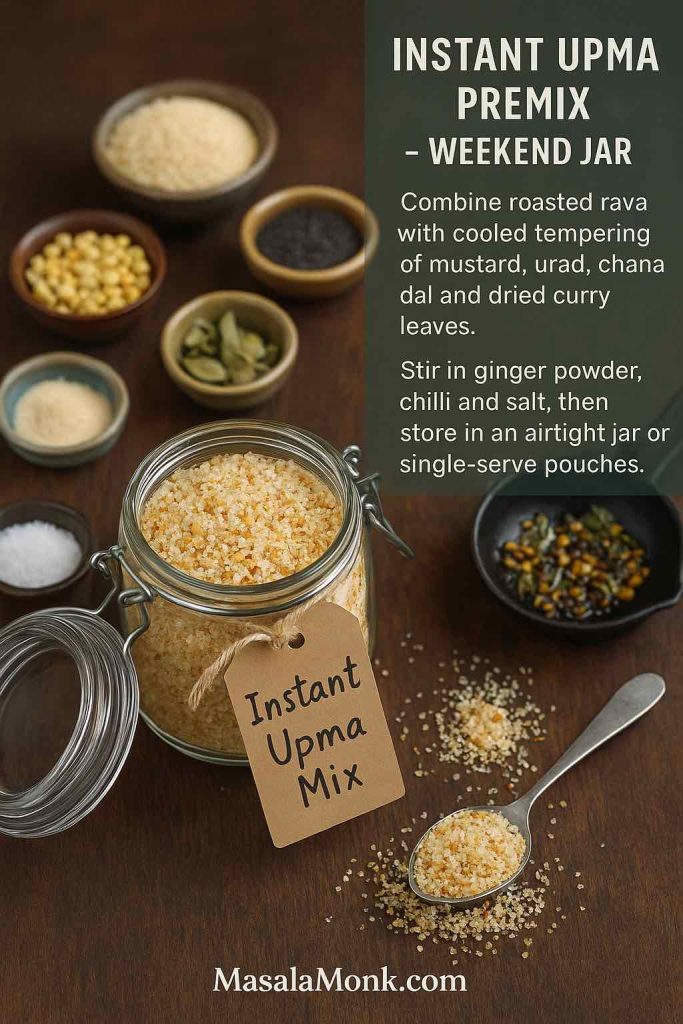
There are days when you have no time to chop onions, wash curry leaves or even stand at the stove for long. That’s when searches like “instant upma mix for travel”, “instant rava upma mix”, “readymade upma packet” and “upma premix” start appearing.

Instead of only relying on store-bought packets, you can make your own instant upma mix in a small weekend batch and use it through the week, or carry it in a jar or pouches when you travel.

Instructional image showing a glass jar labelled Instant Upma Mix surrounded by bowls of roasted rava, mustard seeds, lentils, dried curry leaves and spices, with text explaining how to combine them into a homemade instant upma premix for the week.
Instant upma premix – combine roasted rava with cooled tempering, dried curry leaves, ginger powder, chilli and salt, then store it in a jar or pouches so a hot bowl of upma is only boiling water away all week.

What You Need for a Small Batch

  • Roasted rava – 1 cup
  • Oil – 1 tablespoon (you can leave this out and keep the mix completely dry if you prefer)
  • Mustard seeds – ½ teaspoon
  • Urad dal – 1 teaspoon
  • Chana dal – 1 teaspoon
  • Dried curry leaves – a tablespoon or so
  • Ginger powder – a pinch or two
  • Green chilli powder or red chilli flakes – to taste
  • Salt – ¾ to 1 teaspoon (or pack separately)

Making the Instant Upma Premix at Home

  1. Dry roast the rava if it isn’t already roasted; let it cool completely.
  2. In a small pan, heat the oil and fry mustard seeds, urad dal, chana dal and dried curry leaves until crisp and fragrant. Allow this tempering to cool fully.
  3. Mix the roasted rava with the cooled tempering, ginger powder, chilli powder and salt.
  4. Store the mix in a clean, dry, airtight jar. For travel, portion it into small zip pouches or tiny containers so you can make one serving at a time.

Because the mix already contains salt and spices, all you need at the destination is boiling water and a bowl.

Instructional image showing boiling water being poured from a kettle into an insulated mug filled with instant upma premix on a desk, with text explaining how to add premix, pour hot water, cover and wait a few minutes for an easy travel- or office-friendly upma.
Instant upma, anywhere – add premix to a mug, pour boiling water, cover and wait a few minutes for a hot, comforting bowl at your desk, in a hostel or on a train journey.

How to Cook Instant Rava Upma from the Mix

For one serving:

  • Instant upma premix – ½ cup
  • Boiling water – ¾ to 1 cup

You simply:

  1. Add the premix to a bowl or small insulated container.
  2. Pour boiling water over it, stir well and cover.
  3. Let it stand for 5–7 minutes.
  4. Fluff with a fork and eat.

This approach is especially useful for office lunches, dorm rooms and overnight train journeys. If you’re into meal prepping more broadly, you can pair a home-made upma premix with larger batch cooks using guides like MasalaMonk’s vegetarian and high protein meal prep ideas from Indian cuisine, which help you think in terms of components instead of one-off meals.


What to Serve With Upma (and How to Build a Breakfast Around It)

While upma can absolutely be the only thing on your plate, it often plays very well with other small dishes. On some mornings you might want something cooling and tangy alongside; on others, you might want a hot drink or even a sweet treat to nibble with the last few bites.

Upma breakfast platter on a wooden tray with a bowl of rava upma, coconut and tomato chutneys, podi with ghee, curd, lemon wedges and a tumbler of filter coffee, with text suggesting pairing upma with chutneys, pickle and a warm drink for a complete morning meal.
Build your upma breakfast – pair any bowl of rava, semiya or millet upma with coconut and tomato chutney, podi with ghee, curd, lemon pickle and a warm drink like filter coffee to turn it into a complete morning ritual.

Here are a few ways to round out the experience:

  • Coconut chutney, tomato chutney, gunpowder (podi) with ghee, lemon pickle or even a simple bowl of curd all sit naturally next to a bowl of suji upma, semiya upma or millet upma.
  • A warm drink balances the savoury comfort of upma nicely. In winter, for instance, you could make a mug of homemade hot chocolate with cocoa powder on the side and turn breakfast into a cosy ritual.
  • On days when you’re fasting for part of the day, sipping on homemade electrolytes for fasting before or after your eating window—within which you eat a lighter millet upma—can help you feel more balanced.

Boosting the Nutrition

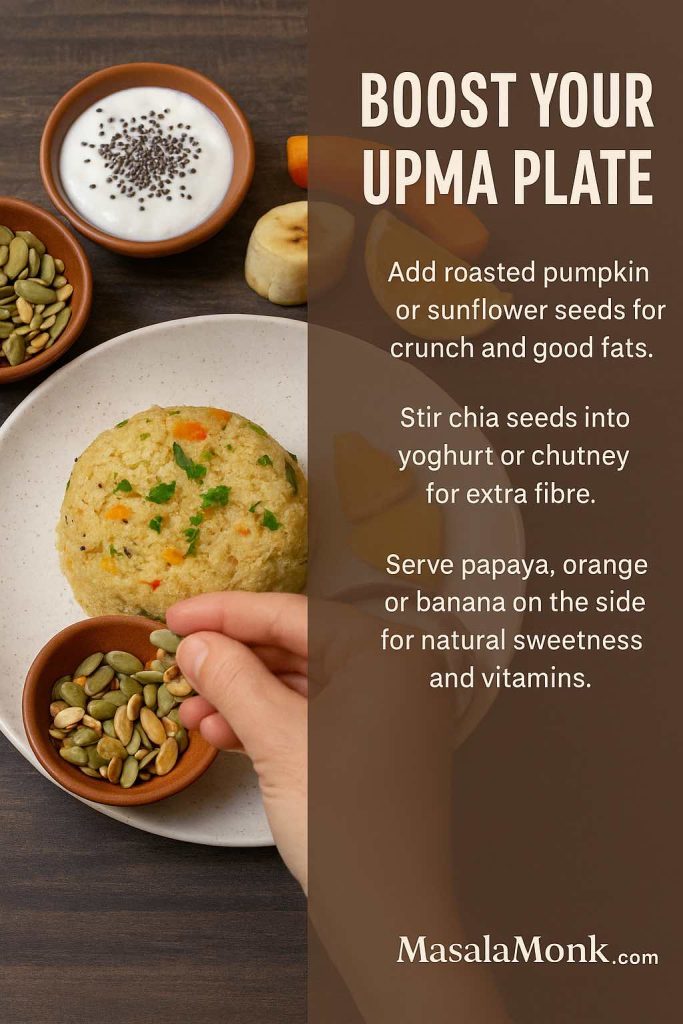
If you’re trying to boost the overall nutrition of the plate, there are a few simple tweaks that add up over time:

  • Sprinkle roasted seeds, such as pumpkin or sunflower, on your upma for a bit of crunch and good fats.
  • Stir soaked chia seeds into yoghurt or chutney; for ideas on how to use chia in Indian-style meals, MasalaMonk’s guide on benefits of chia seeds & how to use them in Indian diet offers plenty of inspiration.
  • Add a small fruit component—slices of papaya, orange segments, a banana—to bring in vitamins and sweetness naturally.
Instructional image showing a plate of upma with small bowls of roasted pumpkin and sunflower seeds, yoghurt topped with chia seeds and sliced banana and orange, with text explaining how to add seeds, chia and fruit to make an upma breakfast more nutritious.
Boost your upma plate – sprinkle roasted seeds, stir chia into yoghurt and add a side of fruit so a simple bowl of upma turns into a more balanced, fibre- and nutrient-rich breakfast.

And if you like mixing Indian and Western breakfast styles on weekends, nothing stops you from serving a simple vegetable upma alongside a couple of slices of vegan French toast or baked toast sticks. MasalaMonk’s collection of vegan French toast recipes and their crispy French toast sticks can give you a head start there.


Rotating Grains Through the Week

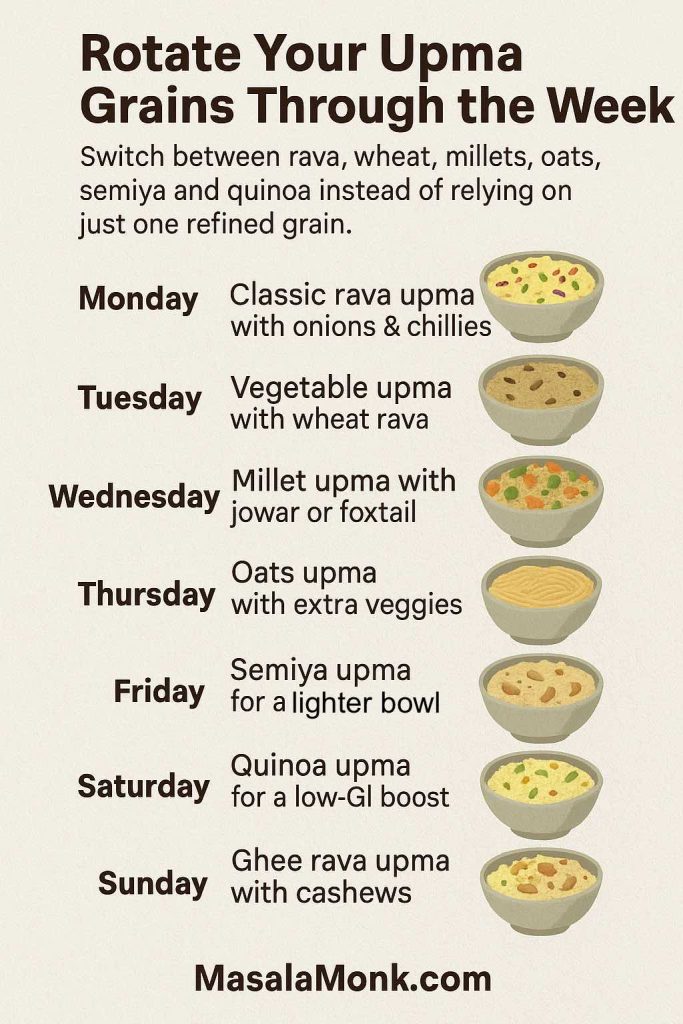
One quiet advantage of mastering a few upma recipes is that you can then build a weekly rhythm around rotating grains. Instead of eating only suji or only oats, you can switch between several bases while keeping flavours familiar.

For example:

  • Monday – Classic rava upma with onions and chillies
  • Tuesday – Vegetable upma using wheat rava
  • Wednesday – Millet upma with jowar or foxtail millet rava
  • Thursday – Oats upma with lots of vegetables
  • Friday – Semiya upma for a lighter, comforting bowl
  • Saturday – Quinoa upma when you want something special
  • Sunday – A more indulgent ghee rava upma with cashews

The idea of variety is not just about boredom; it’s also about nutrition. The updated Indian dietary guidelines from ICMR emphasise including a range of cereals and millets over the week rather than relying only on refined grains. You can read more about that in the ICMR document on cereals and millets in the diet, which explains why shifting between rice, wheat, millets and other grains matters for long-term health.

Vertical infographic titled Rotate Your Upma Grains Through the Week showing a weekly planner from Monday to Sunday with small illustrations of different upma bowls and text suggesting classic rava upma, wheat vegetable upma, millet upma, oats upma, semiya upma, quinoa upma and ghee rava upma to encourage rotating grains instead of relying on one refined grain.
Rotate your upma grains through the week – move from rava to wheat, millets, oats, semiya and quinoa so breakfast stays interesting while your plate gradually shifts away from a single refined grain.

On top of that, broader resources that list foods rich in soluble fibre—such as this round-up of soluble-fibre-rich foods on Health.com—help you see where oats, barley, pulses and fruits fit into the larger picture of heart and gut health. As you get comfortable with those patterns, you’ll see that a thoughtfully made upma can anchor a very respectable breakfast, especially when it’s paired with pulses, vegetables and a side of fruit or nuts.

Also Read: Air Fryer Hard-Boiled Eggs (No Water, Easy Peel Recipe)


Bringing It All Together

When you step back and look at everything you can do with one simple technique, the humble upma starts to look less like a single dish and more like a framework. With one basic method—roast the grain, build a tempering, simmer, steam and fluff—you can create:

  • A straightforward suji upma for days when you want something quick and familiar
  • A vegetable or masala upma that almost counts as a complete meal
  • A millet upma that uses jowar, foxtail or ragi rava for extra minerals and fibre
  • A wheat or rice rava upma that tweaks the texture just enough to keep things interesting
  • A semiya upma that feels tiffin-friendly and child-approved
  • An oats upma that quietly supports your cholesterol and blood sugar goals
  • A quinoa upma that borrows global ingredients but stays rooted in Indian seasoning
  • A home-made instant upma mix that travels with you wherever you go
Family sitting at a wooden table enjoying bowls of rava upma, with a close-up of hands holding a bowl in the foreground and text reading “Bringing It All Together – master one upma method and spin it into a cozy, nutritious breakfast”.
Bringing it all together – once you’ve mastered one simple upma method, you can keep serving it in different grains and styles, but what really matters is the shared bowl at the table and the comfort it brings to busy mornings.

You don’t have to memorise separate instructions for each of these. Instead, you only need to internalise the proportions, roasting times and cooking times for each grain. Once you’ve done that, everything else is just small variations: more vegetables one day, more spices another, extra ghee on a Sunday, milder seasoning when someone’s unwell.

Somewhere between “how to make upma” and “which upma recipe should I choose today?”, you’ll probably find your own favourite combination of grain, vegetables, fat and accompaniments. And when that happens, upma stops being just a default breakfast and becomes one of those dishes you can cook almost on autopilot—leaving you free to enjoy the aroma of curry leaves in hot oil, the steam rising from the pan, and the simple pleasure of a warm, comforting bowl at the start of the day.

Also Read: Tres Leches – Mexican 3 Milk Cake Recipe

FAQs

1. What is upma, and how is it different from other Indian breakfasts?

Upma is a savoury, spoonable dish usually made by roasting a grain like rava (semolina, also called suji or upma rava) and then simmering it in a spiced liquid with a tempering of mustard seeds, lentils, curry leaves, chillies and onions. Unlike poha, which uses flattened rice, or idli, which relies on fermented batter, an upma recipe is quick, does not need soaking or grinding, and can be easily adapted to use different grains such as wheat rava, rice rava, millets, oats or quinoa.


2. What is the best rava for a classic rava upma recipe?

For a traditional rava upma or suji upma, medium or slightly coarse upma rava works best. Very fine suji can turn pasty, while extremely coarse rava may feel too chewy. Typically, packets labelled “upma rava” or “bombay rava” are ideal. Wheat rava (bansi or samba) and rice rava also make good upma, but they give a slightly different texture and flavour compared to the classic semolina-based upma recipe.


3. What is the ideal water ratio for soft, fluffy upma?

For most rava upma recipes, a ratio of 1:2½ to 1:3 (rava:water) works well. If you love very soft, hotel-style upma, you can lean closer to 1:3. On the other hand, if you prefer a firmer, grainier texture, you might enjoy 1:2½ more. Millet upma, wheat rava upma and rice rava upma usually need a little extra water; oats upma and quinoa upma also behave differently and often fall somewhere between 1:2 and 1:3 depending on the exact grain and cut.


4. How can I prevent lumps in my rava upma?

To keep your upma smooth and lump-free, the grain needs two things: roasting and careful mixing. First, dry roast the upma rava on a low to medium flame until it smells nutty and feels lighter. Next, bring the water and tempering to a full boil, then lower the heat. Gradually sprinkle the roasted rava into the boiling water with one hand, while you stir constantly with the other. This way, each little bit of rava meets the hot water separately and swells on its own, instead of clumping into balls.


5. Why does my upma turn sticky or mushy?

Upma often becomes sticky if the rava is not roasted enough, if the water ratio is too high for the grain, or if it is stirred aggressively after cooking. For a classic rava upma recipe, roast the semolina until it is aromatic, measure the water accurately, and once it has steamed, fluff gently rather than vigorously mixing it. For semiya upma (vermicelli upma) and oats upma, overcooking or adding too much water can also create a gluey texture, so it helps to keep the flame low and stop cooking as soon as the grain is just tender.


6. How do I make a simple upma recipe without vegetables?

A basic suji upma without vegetables is straightforward. Dry roast the rava, prepare a tempering with oil or ghee, mustard seeds, urad dal, chana dal, curry leaves, ginger, green chillies and onions, then add water and salt and bring it to a boil. Slowly stir in the roasted rava, cook covered for a few minutes, and finally finish with lemon juice and coriander. Even though there are no vegetables, this minimal upma recipe still tastes satisfying because of the fragrant tempering and the roasted flavour of the rava.


7. Can I make upma without onion or garlic?

Many people prefer a satvik upma recipe without onion or garlic, and that version is absolutely possible. In that case, rely more on curry leaves, ginger, green chillies, mustard seeds and lentils in the tempering. You can also add grated coconut or chopped coriander at the end for extra freshness. This style of upma is common on fasting days or festival mornings, and it works equally well with rava upma, millet upma and even oats upma.


8. Is upma healthy, or is it just a heavy breakfast?

Upma can be as light or as indulgent as you choose to make it. A plain rava upma recipe made with a moderate amount of oil or ghee, plenty of vegetables and served with yoghurt or chutney can fit into a balanced diet. Nevertheless, rava is a refined grain, so if you want a more nutrient-dense bowl, it helps to rotate with millet upma, wheat rava upma, oats upma or quinoa upma. By changing the base grain, increasing the amount of vegetables and moderating the fat, you can turn a simple upma recipe into a wholesome, everyday breakfast.


9. Which type of upma is better for weight management or diabetes?

Although individual needs differ, many people looking for a “healthy upma recipe” gravitate towards millet upma, oats upma or quinoa upma. These versions often have more fibre and a gentler impact on blood sugar compared to an upma recipe made only with refined semolina. In addition, adding vegetables, a small portion of nuts or seeds and pairing the bowl with yoghurt or a protein-rich side makes the meal more filling and may reduce the urge to snack soon after. Even so, portion size still matters, so lighter, moderate servings usually work best.


10. What are some easy variations beyond rava upma?

Beyond the classic rava upma, it is quite simple to explore other versions using the same basic method. For instance, semiya upma (vermicelli upma) swaps rava for roasted vermicelli threads; millet upma uses millet rava such as jowar, foxtail or multi-millet blends; oats upma relies on rolled oats; quinoa upma uses rinsed quinoa simmered with the tempering; and rice rava or arisi upma uses broken rice. The seasoning and vegetables can remain almost identical, so once you grasp one upma recipe, the others become natural extensions.


11. How do I prepare an instant upma mix for travel or busy mornings?

An instant upma mix starts with roasted rava and a very dry tempering. To assemble it, first roast the semolina thoroughly and cool it, then fry mustard seeds, urad dal, chana dal and dried curry leaves in a little oil until crisp. Once everything is completely cool, mix the rava, the tempering, dry spices such as ginger powder and chilli powder, and salt. Store the mixture in an airtight jar or in single-serving pouches. Later on, you only need to combine a portion of this instant upma mix with boiling water, allow it to stand covered for a few minutes, and fluff it before eating.


12. How long can roasted rava or instant upma premix be stored?

Roasted rava alone, if cooled thoroughly and kept in an airtight container away from moisture and insects, keeps well for several weeks and often even a couple of months. Instant upma premix that contains oil and spices generally has a shorter shelf life, though it still lasts a few weeks at room temperature in a cool, dry cupboard. If your climate is very humid, keeping smaller quantities of the premix in the fridge can be a safer choice. In any case, it is wise to check aroma and appearance before use; if the mix smells stale or looks clumpy, it is better not to use it.


13. Can I make upma in a pressure cooker or microwave?

Upma is traditionally cooked in an open pan, but it can also be adapted to a pressure cooker or microwave when needed. In a cooker, you can prepare the tempering, add rava and water, then cook on low heat without placing the whistle, treating the cooker like a heavy pan. In a microwave, you may roast rava and prepare the tempering separately, then combine everything with hot water in a microwave-safe bowl and cook in short bursts, stirring in between. Both methods work, although controlling texture and avoiding overcooking is usually easiest on the stovetop.


14. Is upma suitable for toddlers and children?

Upma can be very child-friendly, especially when you keep the spices gentle and cut the vegetables finely. For toddlers, it helps to make the rava upma slightly softer, use only a mild amount of chilli (or skip it altogether), and mash or blend the bowl lightly if needed. As children grow older, you can gradually introduce vegetable upma, semiya upma, millet upma and even a lightly spiced masala upma. Because the basic upma recipe is soft and easy to chew, it often works well as one of the early family foods that kids can share with adults.

Posted on 15 Comments

Guide to Oats: Types, Nutrition, and Differences Explained

OATS 101: YOUR ULTIMATE GUIDE

Oats are more than just a breakfast staple—they’re one of the most versatile, nutritious, and misunderstood whole grains you’ll find. Whether you call it oatmeal, porridge, or just “oats,” there’s a surprising amount of confusion around the types you see on supermarket shelves. Is there really a difference between rolled oats and old-fashioned oats? Are steel cut oats healthier than regular oats? What about quick oats, instant oats, or those porridge blends?

Let’s unravel the mystery, once and for all.


What Are Oats?

Oats are the edible seeds of the grass species Avena sativa. They’ve been a core part of traditional diets across the world for centuries—from hearty Scottish porridge to savory Indian oat upma and everything in between. At their core, all oat products start from the same whole oat “groat.”
Oats refers to the raw, unprocessed grain, while oatmeal is the name for a meal or porridge made from oats. However, in everyday use, the terms get mixed up—sometimes even on product labels.

Key Takeaway:

  • Oats = the grain in all forms (raw, steel cut, rolled, quick, etc.)
  • Oatmeal = any dish prepared from oats, typically boiled into a porridge.

Read more: Oats vs Oatmeal: What’s the Difference?


How Are Oats Processed? (From Field to Bowl)

The journey from oat field to your breakfast bowl involves several stages. All oat products begin with whole oat groats—the de-husked, cleaned oat kernel. From there, the differences come down to how the oats are cut, steamed, and rolled:

  1. Steel Cut Oats (a.k.a. Irish oats, pinhead oats):
    • The groats are chopped into 2-4 pieces with steel blades.
    • No rolling or flattening.
    • Texture: Chunky, chewy, hearty.
  2. Rolled Oats (a.k.a. old-fashioned oats):
    • Groats are steamed and then pressed flat by large rollers.
    • Texture: Flaky, tender, with more bite than quick oats.
  3. Quick Oats:
    • Start as rolled oats, then cut into smaller pieces and rolled even thinner.
    • Texture: Soft, cook quickly, become mushy faster.
  4. Instant Oats:
    • The most processed. Pre-cooked, dried, then rolled ultra-thin. Often found in single-serve packets, usually with added flavors or sugar.
    • Texture: Creamiest, smoothest, “instant” porridge.

You might also see:

  • Sprouted Oats: Oats are soaked, allowed to sprout, then processed as above. Supposedly easier to digest, with a slightly nuttier flavor.
  • Porridge Oats: In the UK, this can refer to rolled oats or finely ground oats used for traditional porridge. Sometimes it’s a blend for extra creaminess.

Types of Oats: A Detailed Comparison

Let’s break down the differences and similarities in detail:

Steel Cut Oats

  • Also Known As: Irish oats, pinhead oats.
  • Processing: Whole oat groats chopped into pieces, not flattened.
  • Texture: Chewy, nubby, and hearty. Retains a bite even after cooking.
  • Flavor: Nutty and slightly sweet.
  • Cooking Time: 20-40 minutes on the stovetop; can be made in a pressure cooker or slow cooker.
  • Best For: Hearty porridge, overnight oats (with long soaking), savory oat bowls.

Fun Fact:
Steel cut oats are the closest to whole oat groats, meaning they take longest to digest and keep you full the longest.


Rolled Oats (Old-Fashioned Oats)

  • Also Known As: Old-fashioned oats (the terms are interchangeable!).
  • Processing: Groats are steamed to soften, then pressed flat into flakes.
  • Texture: Flaky, soft, with a pleasant chew; less firm than steel cut but not mushy.
  • Flavor: Mild and slightly sweet.
  • Cooking Time: 5-10 minutes on the stovetop; also popular for overnight oats and baking.
  • Best For: Classic oatmeal, overnight oats, cookies, muffins, granola, smoothies.

Tip:
If a recipe calls for “rolled oats” or “old-fashioned oats,” you can use either. They are exactly the same thing—just different names!


Quick Oats

  • Processing: Rolled oats cut into smaller pieces and rolled even thinner.
  • Texture: Cooks up soft, loses distinct flake structure, becomes mushy if overcooked.
  • Flavor: Neutral; takes on flavor of add-ins.
  • Cooking Time: 1-3 minutes—just add boiling water or microwave.
  • Best For: Quick breakfasts, mixing into batters, no-bake bars.

Note:
Quick oats and instant oats are not exactly the same, but many people (and brands) use the terms interchangeably. See the deep dive:
Are Quick Oats the Same as Instant Oats?


Instant Oats

  • Processing: Pre-cooked, dried, and rolled ultra-thin (often into a powdery texture).
  • Texture: Silky and creamy, almost pudding-like.
  • Flavor: Mild; often enhanced with added flavors, sugar, or salt in commercial packets.
  • Cooking Time: Instant! Just add hot water or microwave for 1 minute.
  • Best For: Emergency breakfasts, travel, kids, when you need food now.

Warning:
Check instant oat packets for added sugars and flavors. “Plain” versions are best if you want to avoid excess sugar.


Sprouted Oats

  • Processing: Groats are soaked, allowed to sprout (germinate), then dried and rolled or cut.
  • Texture/Flavor: Slightly nuttier, potentially easier to digest.
  • Use: As you would rolled oats or steel cut oats.

Porridge Oats / Pinhead Oats

  • Porridge Oats: In the UK and other countries, “porridge oats” might refer to rolled oats, sometimes ground for a creamier texture.
  • Pinhead Oats: Another name for steel cut oats.

Oats vs Oatmeal: Clearing Up the Confusion

  • Oats are the raw ingredient (groats, steel cut, rolled, quick, instant).
  • Oatmeal refers to the dish made from oats (porridge) or, in some places, any processed oat product.

If you’re buying oats for a recipe, always check if it calls for a specific type, because texture and cooking time can change the final result!

More details: Oats vs Oatmeal: What’s the Difference?


How Do Oat Types Compare Nutritionally?

Let’s be clear: All oats are nutritious!
But, the processing can slightly change how your body digests them:

TypeCaloriesFiberProteinGlycemic IndexCook Time
Steel Cut~150~4g~5g~5220–40 min
Rolled/Old-Fash~150~4g~5g~595–10 min
Quick Oats~150~4g~5g~661–3 min
Instant Oats~150~4g~5g75+1 min

Key points:

  • The macro nutrition (calories, protein, fiber) is nearly identical between all unsweetened oat types.
  • Steel cut oats are digested a bit more slowly, leading to a lower glycemic index and possibly longer-lasting energy.
  • Rolled oats strike a balance: faster to cook than steel cut, more texture than quick or instant.
  • Quick and instant oats digest faster, raising blood sugar more quickly—especially if sugar is added.

For people watching blood sugar:
Choose steel cut or rolled oats.
For convenience? Quick or instant is fine (just watch for extra sugar!).

Key Vitamins and Minerals in Oats (all types, per 40g dry serving):

While the macros (calories, protein, fiber) are very similar across all oat types, the micronutrient (vitamin and mineral) content is also quite consistent, because the different forms (steel cut, rolled, quick, instant) all start from the same whole grain. Minor losses in B-vitamins can occur with additional processing, but for most people, the differences are negligible.

  • Manganese: 70–90% Daily Value (DV)
  • Phosphorus: 20–30% DV
  • Magnesium: 15–20% DV
  • Iron: 8–10% DV
  • Zinc: 10–15% DV
  • Copper: 15–20% DV
  • Vitamin B1 (Thiamin): 10–15% DV
  • Folate: 5–8% DV
  • Selenium: 15–20% DV

Oats also contain:

  • Small amounts of potassium, calcium, and B5 (pantothenic acid)
  • The powerful antioxidant avenanthramides (unique to oats)

Does Processing Change the Mineral Content?

  • Steel cut, rolled, and quick oats:
    Very similar micronutrient profiles, as the oat bran and germ are retained.
  • Instant oats:
    Slightly lower levels of some B-vitamins due to extra steaming and pre-cooking, but still a rich source of minerals compared to most cereals.
    Main concern is usually added sugar/salt in flavored packets—not loss of minerals.

How Do Oats Support Health?

  • Manganese, phosphorus, and magnesium: For energy metabolism, bone health, and nerve function.
  • Iron and zinc: For immune support and oxygen transport.
  • Beta-glucan fiber: Supports cholesterol reduction, heart health, and gut microbiome.
  • Antioxidants (avenanthramides): Anti-inflammatory, may help lower blood pressure.

Bottom Line

  • Oats of all types are nutrient-dense, especially for minerals and certain B vitamins.
  • Choose plain, unsweetened varieties for maximum health benefit.
  • Processing for quick or instant oats may reduce B-vitamins slightly, but minerals remain high.

Cooking With Different Oat Types

Steel Cut Oats:

  • Use for a hearty, chewy porridge.
  • Great in savory oat “risottos” or grain bowls.
  • Overnight soak or pressure cook to save time.

Rolled/Old-Fashioned Oats:

  • Perfect for traditional oatmeal, overnight oats, and muesli.
  • Use in baking: cookies, muffins, breads, pancakes.
  • Make homemade granola or snack bars.

Quick Oats:

  • Great for instant breakfast or to thicken smoothies.
  • Use in batters (pancakes, muffins) for softer texture.
  • Not ideal for recipes where you want oat texture to stand out.

Instant Oats:

  • Best for emergencies, travel, or super-fast prep.
  • Often sweetened—use plain, then add your own toppings for a healthier bowl.

Can You Substitute One Oat for Another?

  • Rolled oats ↔ Old-fashioned oats: YES, always!
  • Rolled/old-fashioned ↔ Quick oats: Usually yes, but final texture will be softer/mushier.
  • Rolled/quick ↔ Steel cut: Not directly. Steel cut oats require more liquid, longer cooking, and have a totally different texture.
  • Instant oats ↔ Any other: Not a good swap for most recipes, as they dissolve or get mushy quickly.

Tip:
When baking, always use the type of oat called for in the recipe—especially for cookies or granola, where texture is key.


Why Choose One Oat Type Over Another?

  • Steel cut oats for chew, hearty texture, slow digestion.
  • Rolled oats for versatility, classic oatmeal, baking.
  • Quick oats for speed and convenience.
  • Instant oats for emergencies or travel.
  • Sprouted oats for those who want easier digestion or a slightly different flavor.

Final Thoughts: Which Oats Are Best?

There’s no single “best” oat for everyone. It depends on your:

  • Time: Steel cut for slow mornings, quick or instant for busy days.
  • Texture: Chewy (steel cut), soft but still textured (rolled), or creamy (quick/instant).
  • Nutrition: All are healthy, just be mindful of instant oat ingredients.

The bottom line? All oats are good oats.
Pick the type that fits your taste, recipe, and schedule best!


Ready to Go Deeper? Explore These Detailed Guides:


Do you have a favorite way to use oats? Share your tips and questions in the comments below!

10 FAQs About Oats

1. Are steel cut oats healthier than rolled oats?

Steel cut and rolled oats have almost identical nutrition—same calories, fiber, and protein. Steel cut oats have a slightly lower glycemic index and digest more slowly, which may help you feel full longer.


2. Can I substitute rolled oats for old-fashioned oats in recipes?

Yes! Rolled oats and old-fashioned oats are the same product, just two names. Use them interchangeably in any recipe.


3. Are quick oats and instant oats the same thing?

Not exactly. Quick oats are cut and rolled thinner to cook in 1–3 minutes. Instant oats are pre-cooked, dried, and rolled ultra-thin for “just add water” convenience. Instant oats often have added sugar or flavors.


4. Which type of oats is best for overnight oats?

Rolled (old-fashioned) oats work best for overnight oats, providing the right texture after soaking. Steel cut oats will be too chewy unless pre-cooked or soaked very long; quick oats become mushy.


5. Is there a big difference in calories or protein between oat types?

No. Steel cut, rolled, quick, and instant oats (plain, unsweetened) all have nearly the same calories, protein, and fiber per serving.


6. Why do steel cut oats take longer to cook?

Steel cut oats are just chopped, not rolled or steamed. Their thicker, denser shape takes more time and liquid to soften fully.


7. What are porridge oats?

In the UK and some other countries, “porridge oats” typically means rolled oats or a blend of rolled and ground oats for a creamy texture.


8. Can I use instant oats in baking recipes?

Not recommended. Instant oats tend to dissolve and make baked goods mushy. Use rolled or quick oats for better texture in cookies, muffins, and bars.


9. Are flavored instant oat packets healthy?

Many instant oat packets contain added sugars, salt, and artificial flavors. Choose plain instant oats and add your own healthy toppings for a better option.


10. Do oats contain gluten?

Oats are naturally gluten-free, but are often processed in facilities that also handle wheat. If you need gluten-free oats, look for oats specifically labeled “gluten-free.”