Posted on Leave a comment

Homemade Granola Recipe

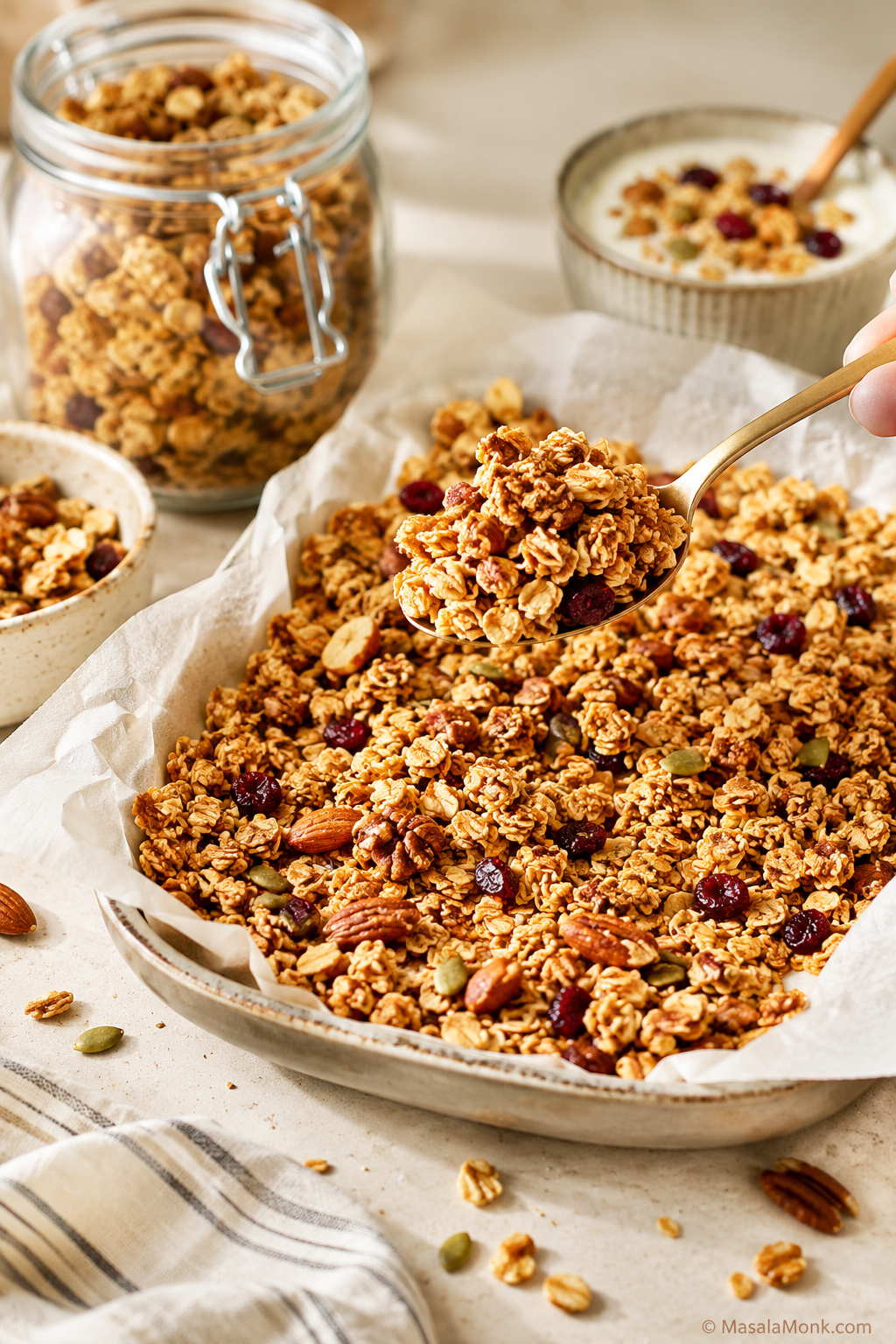
Golden homemade granola with oats, nuts, seeds, and clusters being lifted with a spoon, with a jar and yogurt bowl in the background.

Homemade granola is one of those small kitchen wins that feels much bigger than the effort. A tray of oats, nuts, maple syrup or honey, cinnamon, and vanilla goes into the oven, and soon the kitchen smells like breakfast for the whole week.

It is especially satisfying if you have ever bought a bag of granola that looked beautiful but tasted too sweet, too bland, or too dusty by the time it reached the bowl. The goal here is simple: crunchy granola that does not burn, clusters that actually hold, and a jar you will want to use all week.

This is a base-ratio recipe first. Once you understand the method, you can make the granola crunchier, chunkier, less sweet, nut-free, vegan, gluten-free, or better for yogurt without starting from scratch.

The base uses old-fashioned rolled oats, nuts or seeds, oil, maple syrup or honey, salt, cinnamon, and vanilla. It bakes low and steady at 300°F / 150°C, which gives the oats time to crisp while keeping the nuts and coconut from browning too aggressively.

The first batch teaches the method. The second batch starts to become your house granola: almonds and cranberries one week, peanut butter and chocolate the next, or pumpkin seeds and coconut when you want something nut-free.

Homemade Granola at a Glance Quick Answer
Oats to use Old-fashioned rolled oats
Oven temperature 300°F / 150°C
Bake time 35–40 minutes
Yield 7–8 cups granola
Servings 14–16 larger ½-cup servings or 28–32 smaller ¼-cup topping portions
Pan to use Large rimmed baking sheet lined with parchment
For clusters Press after stirring and cool fully before breaking
Add dried fruit After baking, not before
How to use it Yogurt bowls, parfaits, milk, smoothie bowls, snack jars, and make-ahead breakfasts

Quick Answer: The Best Homemade Granola Ratio

The easiest homemade granola ratio is:

4 cups / about 320–360g rolled oats + 1½ cups / 150–180g nuts or seeds + ½ cup / 120ml oil + ½ cup / 120ml maple syrup or honey.

Mix that with salt, cinnamon, and vanilla, then bake it on a parchment-lined rimmed baking sheet at 300°F / 150°C for 35–40 minutes. Stir once halfway through, press it back down if you want clusters, and let it cool fully on the pan before breaking it apart.

Hot granola lies a little. It often feels slightly soft when it first comes out of the oven, then crisps as it cools. If you bake it until it feels fully crunchy while hot, the edges and nuts can turn bitter.

That is the real appeal of homemade granola: one pan, one jar, and several breakfasts that feel easier before the week even starts.

Want the exact measurements without the full guide? Skip to the recipe card. If your last batch stayed soft, the troubleshooting section has the quick re-crisp fix.

Homemade granola ratio guide
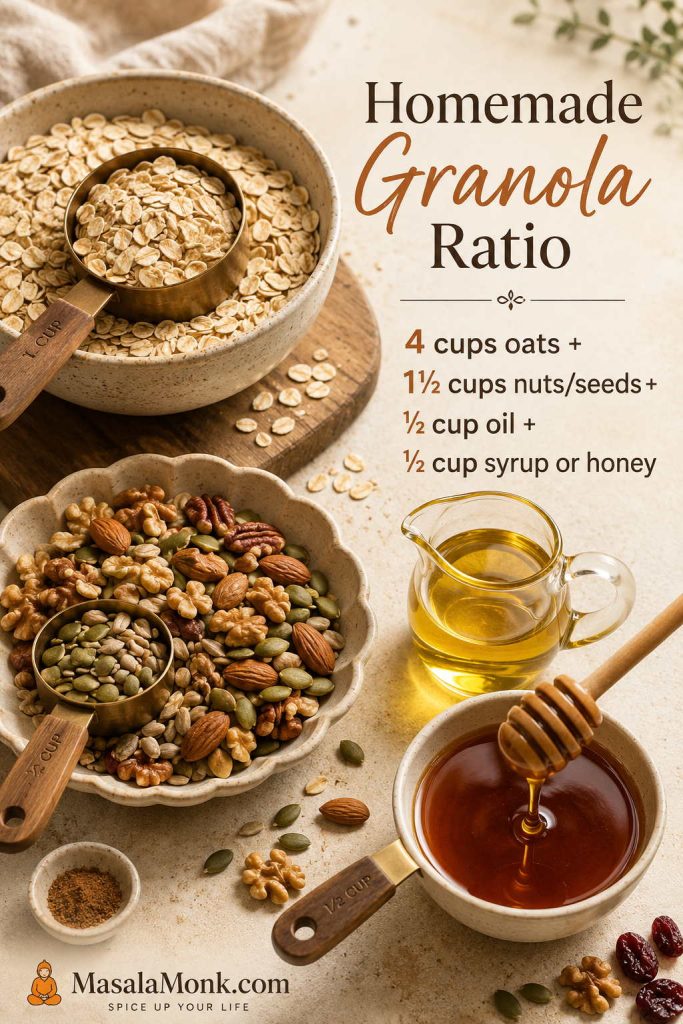
Homemade granola ratio guide showing rolled oats, nuts and seeds, oil, and maple syrup or honey arranged in separate ingredient zones.
Once the base granola ratio makes sense, the recipe becomes flexible: keep the oats, oil, and sweetener balanced, then change the nuts, seeds, spices, or fruit.

Why This Homemade Granola Recipe Works

The promise here is straightforward: granola should be easy, but texture should not be left to luck. This recipe keeps the ratio steady and shows you how to read the four things that matter most: heat, coating, space on the pan, and cooling.

A lower oven protects the edges

Many granola recipes bake hotter, but nuts, coconut, and the edges of the tray can brown quickly. At 300°F / 150°C, the oats have time to dry and crisp before the mix-ins over-toast.

Oil and sweetener do different jobs

Oil helps the oats toast evenly instead of turning dry and dusty. Maple syrup or honey adds sweetness, but it also helps bind the oats into clusters. Reduce either one too much and the batch will still work, but the texture will change.

Cooling is part of the cook time

The hardest part is leaving the pan alone. If you break the granola while it is warm, you get smaller pieces. If you wait until it firms up, the clusters hold better.

The base is flexible without becoming vague

Because nuts, seeds, honey, maple syrup, and dried fruit are not ingredients you want to waste, the recipe leans on clear signs instead of guesswork: glossy coated oats, an even layer, dry-looking edges, a warm nutty smell, and a full cool-down before breaking.

Once you know those signs, you can make the batch more snack-like, more yogurt-friendly, less sweet, vegan, gluten-free, nut-free, or cluster-heavy without losing the basic structure.

Ingredients for Homemade Granola

The ingredients are simple, but each one has a job. Once you understand those jobs, granola stops feeling like a strict formula and becomes something you can adjust with confidence.

Homemade granola ingredients at a glance
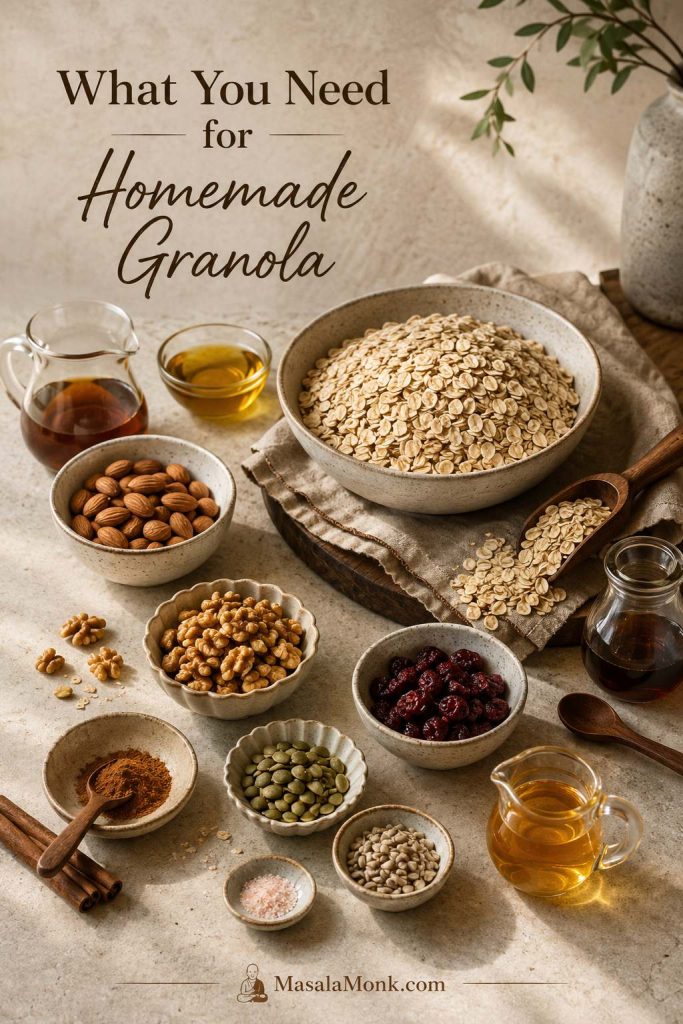
Homemade granola ingredients including rolled oats, nuts, seeds, oil, maple syrup or honey, cinnamon, vanilla, salt, and dried fruit.
The best homemade granola starts with simple ingredients doing different jobs: oats give structure, oil helps crispness, sweetener binds, and dried fruit adds chew after baking.
Ingredient Amount Why it matters
Old-fashioned rolled oats 4 cups / about 320–360g The main base. They toast well and create the best classic granola texture.
Nuts and seeds 1½ cups / 150–180g Add crunch, richness, flavor, and a more satisfying bite.
Oil ½ cup / 120ml Helps the oats crisp and brown evenly.
Maple syrup or honey ½ cup / 120ml Sweetens the granola and helps bind clusters.
Fine salt ¾ teaspoon, plus more to taste Balances the sweetness and keeps the granola from tasting flat.
Cinnamon 1–2 teaspoons / about 3–5g Adds warm breakfast flavor.
Vanilla extract 1 teaspoon / 5ml Rounds out the flavor and makes the granola smell bakery-like.
Dried fruit ⅔ cup / 80–100g Add after baking so it stays chewy instead of hard or burnt.

Rolled oats or old-fashioned oats

Old-fashioned rolled oats are the best oats for homemade granola. They are sturdy enough to toast, but thin enough to become crisp. They also hold their shape, which helps the granola feel like granola instead of powdery cereal crumbs.

If you are unsure about oat types, MasalaMonk’s guide to oats explains the differences between rolled oats, quick oats, instant oats, and steel-cut oats in more detail.

Nuts and seeds

Use almost any mix you like. Almonds, walnuts, pecans, cashews, pistachios, pumpkin seeds, sunflower seeds, sesame seeds, flaxseed, chia seeds, and hemp hearts all work.

For the best texture, use both larger pieces and smaller seeds. Sliced almonds plus pumpkin seeds give you crisp flakes and deeper crunch, while a good mix of nuts and seeds makes the granola more satisfying. For nut-free granola, skip the tree nuts and use seeds, coconut, and hemp hearts instead.

Oil

Coconut oil gives a classic sweet breakfast flavor. Olive oil tastes a little more savory and grown-up. Avocado oil or a neutral oil stays quieter in the background. Melted butter is delicious too, but it makes the batch richer and more dessert-like.

Do not remove the oil completely unless you are intentionally making an oil-free version. It is one of the reasons granola becomes crisp instead of papery.

Trying to skip oil completely? Read the oil-free granola notes before swapping it out, because fruit binders change the final texture.

Maple syrup or honey

Both work, but they give slightly different results. Use maple syrup if you want vegan granola, cleaner sweetness, and a lighter flavor. Use honey if you want deeper sweetness, a more golden finish, and slightly stickier clusters.
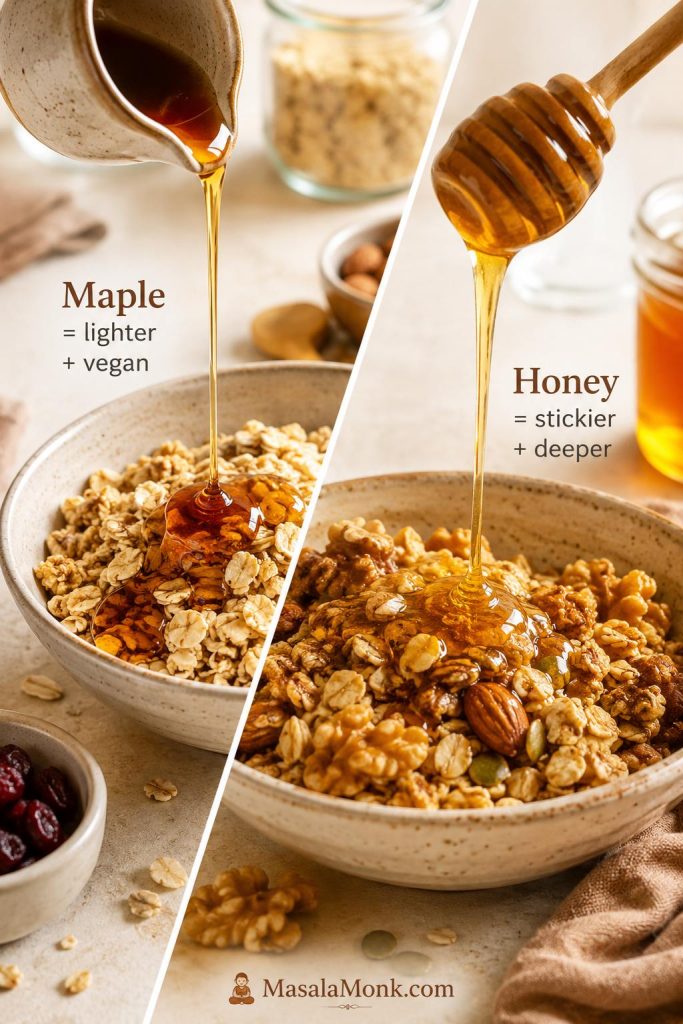
Side-by-side comparison of maple syrup and honey being poured over oats and nuts for homemade granola.
Maple syrup gives homemade granola a lighter flavor and keeps it vegan, while honey brings a deeper sweetness and can help clusters feel slightly stickier.

Using maple syrup for a vegan batch? The variation guide shows how to keep the texture flexible without relying on honey.

Salt, cinnamon, and vanilla

These small ingredients make a big difference. Salt keeps the granola from tasting one-dimensional. Cinnamon adds warmth. Vanilla makes the finished batch smell like something you bought from a very good bakery.

Dried fruit and chocolate

Raisins, cranberries, chopped dates, apricots, figs, cherries, and dried blueberries all work well. Stir them in after baking so they stay chewy instead of turning hard or bitter.

Chocolate chips should also go in after the granola cools. Add them while the tray is hot and they will melt through the batch, which can be delicious, but it is not the same as little chocolate pieces scattered through crisp granola.

Best Oats for Granola

The best oats for granola are old-fashioned rolled oats. They toast evenly, hold their shape, and give the finished granola a crisp but hearty texture.
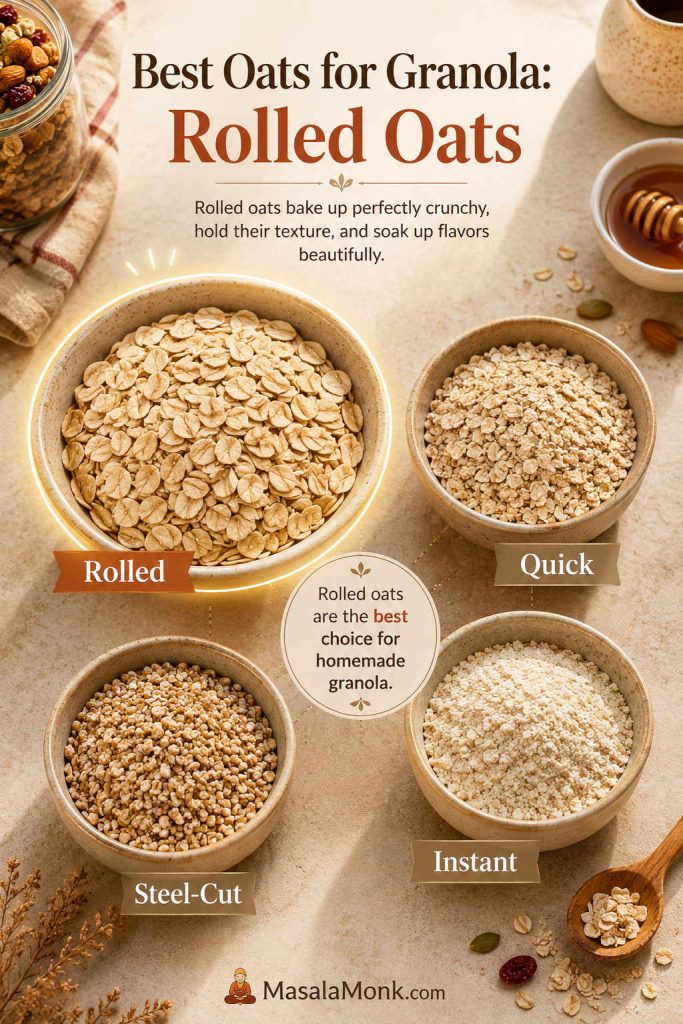
Oat comparison guide showing rolled oats, quick oats, instant oats, and steel-cut oats for choosing the best oats for granola.
Rolled oats are the safest choice for crunchy homemade granola because they toast evenly, hold their shape, and avoid the soft or powdery texture of finer oats.
Oat type Use for granola? Best answer
Rolled oats / old-fashioned oats Yes Use for classic homemade granola, clusters, and crunch.
Quick oats Only in a pinch They make softer, less defined granola and fewer sturdy clusters.
Instant oats No Too fine and powdery for good granola texture.
Steel-cut oats Not for classic granola Too hard and not a direct swap for rolled oats.
Certified gluten-free rolled oats Yes Best choice for gluten-free homemade granola.

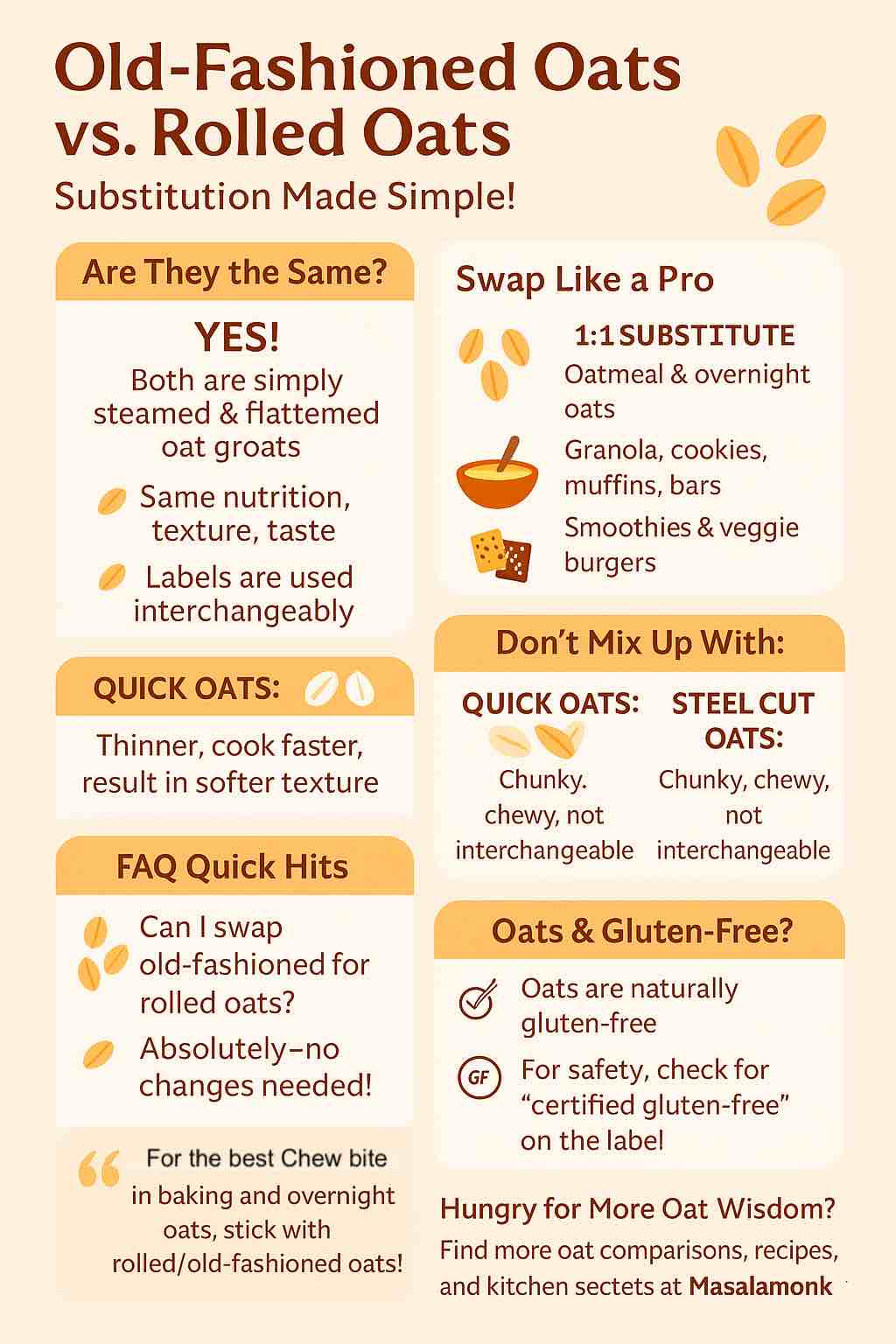
Rolled oats and old-fashioned oats are usually the same style of oat for recipe purposes, while steel-cut oats are cut pieces of the oat groat and do not behave the same way on a baking sheet. For more detail, see MasalaMonk’s guide to old-fashioned oats and rolled oats.

How to Make Homemade Granola

The method is simple, but a few small choices decide whether the tray comes out crisp and chunky or pale and soft. Think of it as controlled drying: coat the oats well, spread them evenly, bake low and steady, stir once, and let cooling do the final crisping.
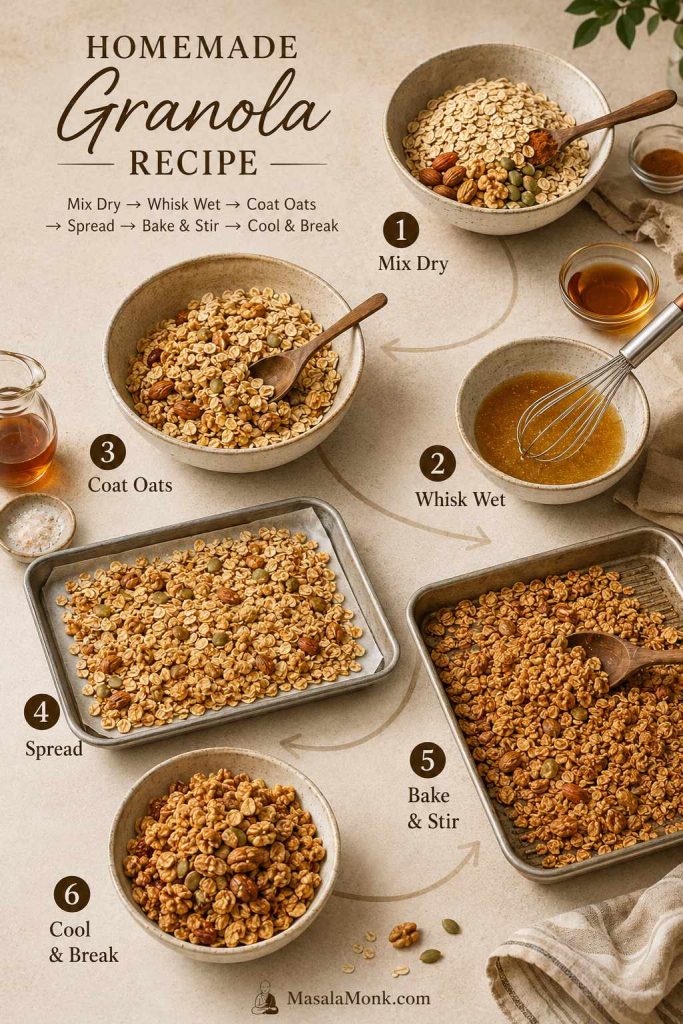
Step-by-step homemade granola process board showing dry ingredients, wet ingredients, coated oats, spreading, baking, stirring, cooling, and breaking.
Granola is less about complicated steps and more about order: coat first, spread evenly, bake gently, and let the tray cool before breaking it into clusters.

Step 1: Heat the oven and line the pan

Preheat the oven to 300°F / 150°C. Line a large rimmed baking sheet with parchment paper.

A rimmed pan keeps the granola from sliding off when you stir. Parchment prevents sticking and makes it easier to lift off bigger clusters later. If your baking sheet is small, divide the mixture between two pans. Crowded granola steams before it crisps.

If your baking sheet is very dark, start checking a few minutes early. Dark pans can brown granola faster than light-colored pans.

Step 2: Mix the dry ingredients

In a large bowl, combine the rolled oats, nuts, seeds, salt, and cinnamon. If your coconut flakes are delicate or already toasted, save them for the halfway stir so they do not brown too fast.

Step 3: Mix the wet ingredients

In a smaller bowl or measuring cup, whisk together the oil, maple syrup or honey, and vanilla. When honey is thick or coconut oil has solidified, warm the wet ingredients gently just until pourable, not hot.

Step 4: Coat the oats well

Pour the wet mixture over the oats and stir thoroughly. Every oat should look lightly glossy. Dry, dusty oats will not toast or cluster as well.
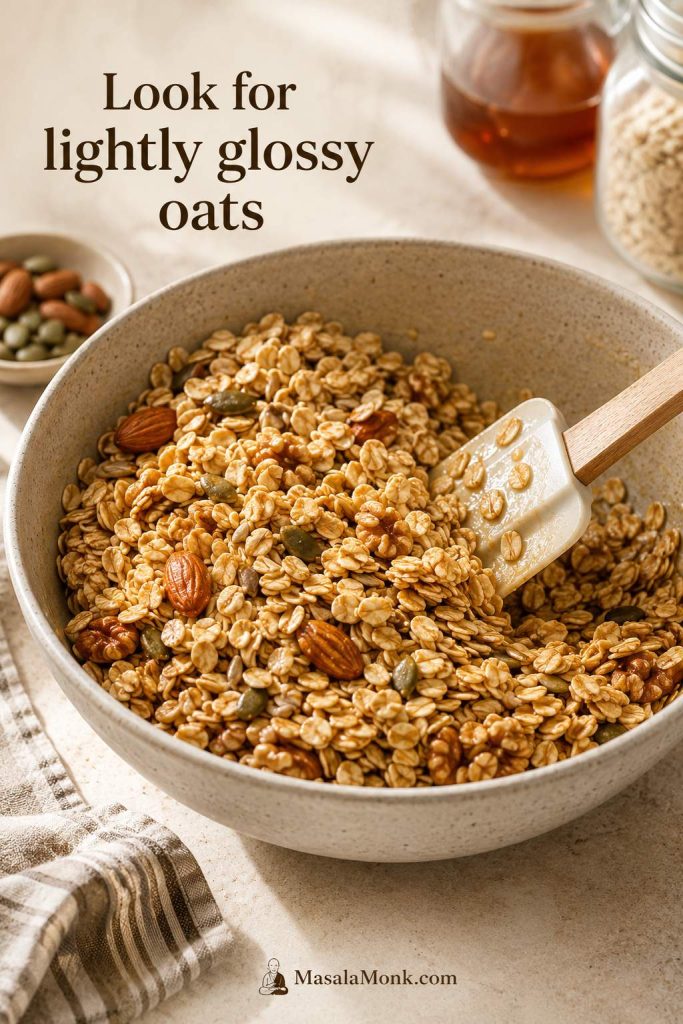
Close-up of rolled oats, nuts, and seeds lightly coated with oil and sweetener in a bowl with a spatula.
Lightly glossy oats are a good sign before baking. If the mixture looks dusty, the granola may toast unevenly and struggle to form crisp clusters.

Step 5: Spread and press

Tip the mixture onto the prepared pan and spread it into an even layer. For looser granola, spread it evenly and leave it alone. For clusters, press the mixture down gently with a spatula so the oats bake together.
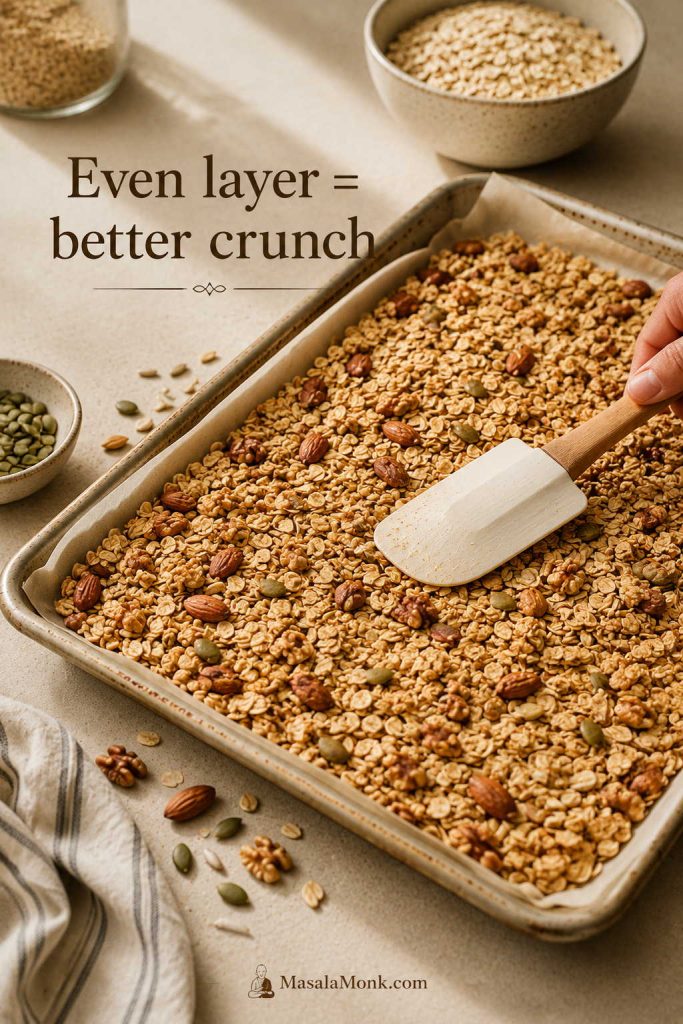
Granola mixture being spread into an even layer on a parchment-lined rimmed baking sheet with a spatula.
Give the oats room to dry and toast. If the pan is too crowded, the granola can steam before it gets crisp.

Step 6: Bake, stir once, and press again

Bake for 20 minutes. Remove the pan, stir once, add delicate coconut now if using, spread the granola back out, and press again for clusters.
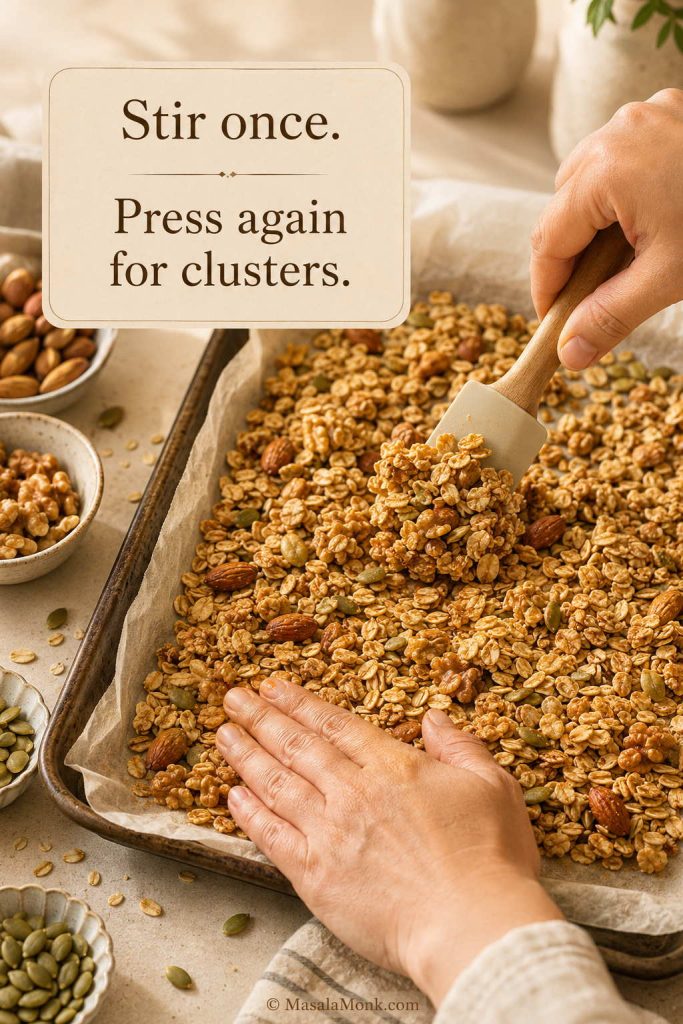
Partially baked granola on a tray being stirred and pressed down with a spatula to help clusters form.
The halfway stir keeps the batch even; pressing it back down afterward helps the coated oats cool into sturdier granola clusters.

For bigger pieces, check the granola clusters section before changing the binder or stirring pattern.

Return the pan to the oven and bake for another 15–20 minutes, until the kitchen smells toasted and warm, the surface looks dry, and the edges are lightly golden. It should smell nutty, not sharp or burnt, and the granola will still feel softer than it tastes later.

What finished granola should look like
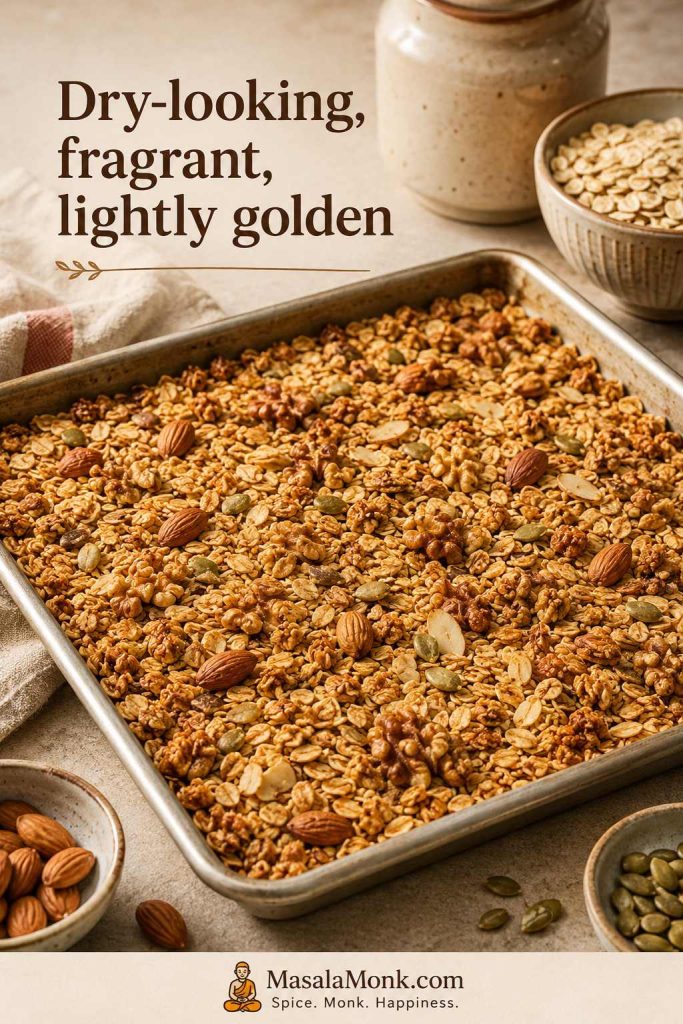
Tray of homemade granola with dry-looking oats, lightly golden edges, nuts, and seeds showing the doneness stage before cooling.
Finished granola does not need to look dark. Instead, stop when the surface looks dry, the edges are lightly golden, and the kitchen smells warm and toasted.

Step 7: Cool before breaking

Set the pan on a rack or heat-safe surface and leave it alone until the granola firms up, usually 35–45 minutes. Break it too early and the clusters will be smaller.
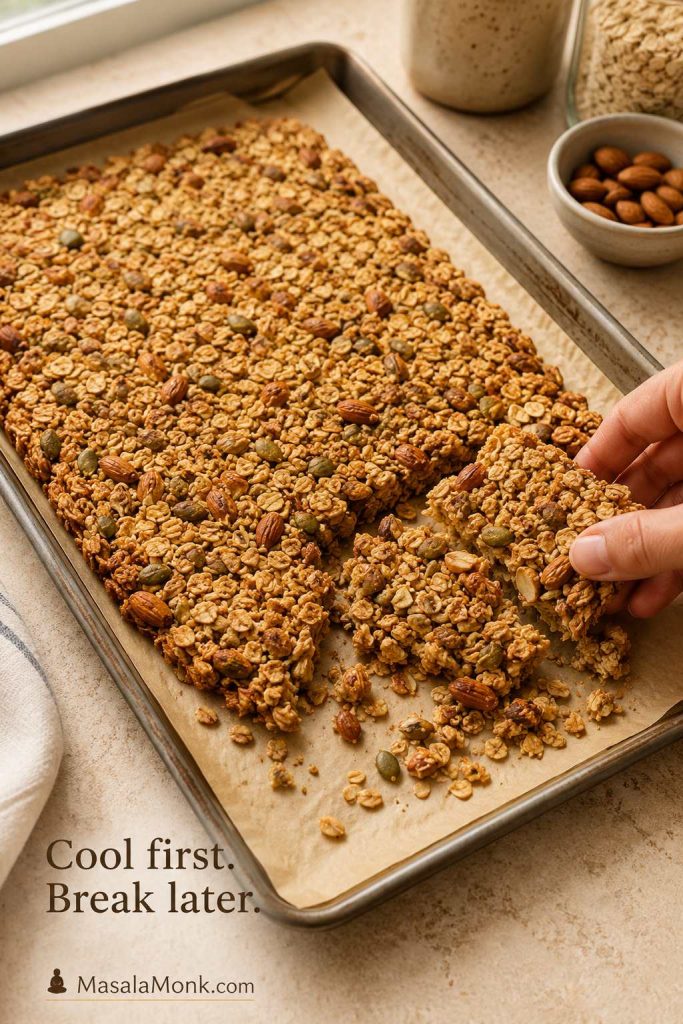
Cooled granola slab on parchment being broken by hand into large clusters on a baking sheet.
Cooling is part of the recipe, not a waiting penalty. Once the granola firms on the tray, it breaks into cleaner, crunchier clusters.

Step 8: Add dried fruit

Once the granola is cool or just barely warm, add dried fruit. Break the granola into the size you like, then transfer it to an airtight jar or container.
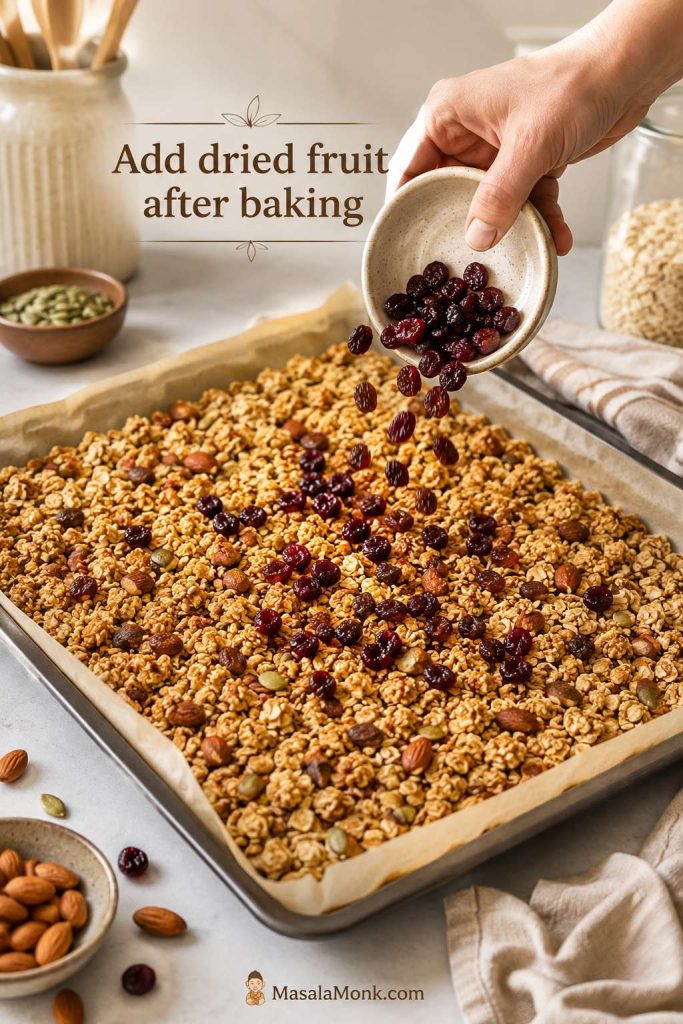
Dried cranberries and raisins being scattered over cooled baked granola on parchment paper.
Add dried fruit after baking because the oven can turn raisins, cranberries, dates, and apricots hard or bitter before the oats are finished.

How to Make Granola Crunchy

Crunchy granola comes from four things: enough coating, enough space on the pan, low, steady heat, and a full cool-down. If one of those is missing, the batch may taste soft, dusty, steamed, or overbaked.

The four controls for crunchy granola
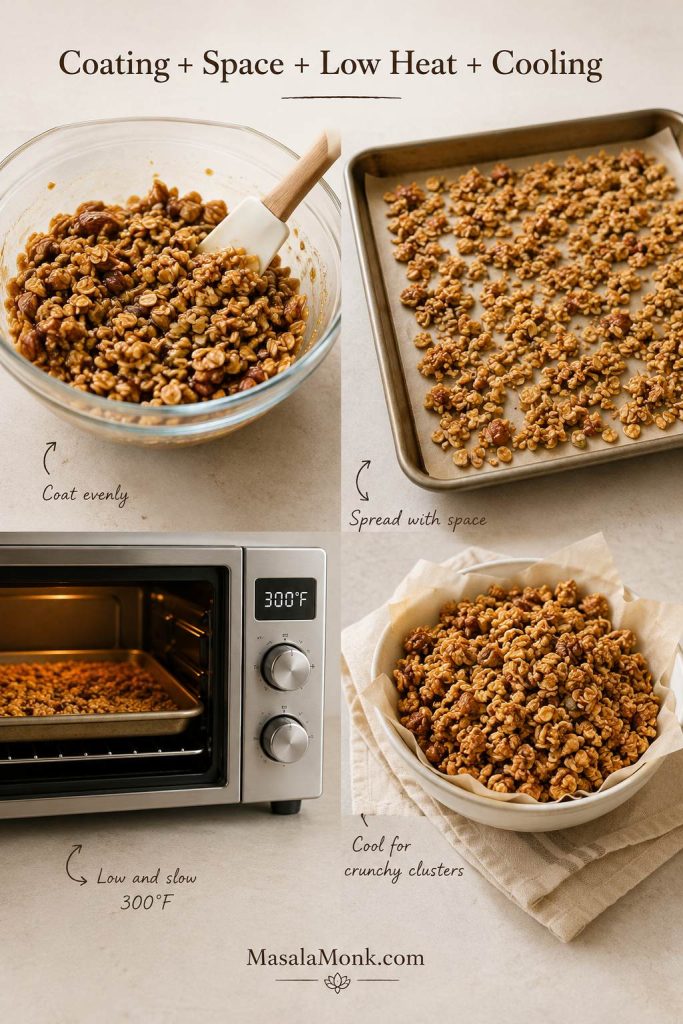
Granola texture guide showing coated oats, spaced granola on a tray, a low oven cue, and cooled clusters.
Crunchy granola comes from four small controls working together: glossy coating, space on the pan, gentle heat, and a full cool-down before storing.
Crunch factor What to do What it prevents
Good coating Stir until the oats look lightly glossy. Dry, papery oats.
Space on the pan Spread in an even layer; use two pans if needed. Steamed, soft granola.
Low heat Bake at 300°F / 150°C. Burnt nuts and dark edges.
Full cooling Let the tray rest before judging texture. Breaking clusters too soon.
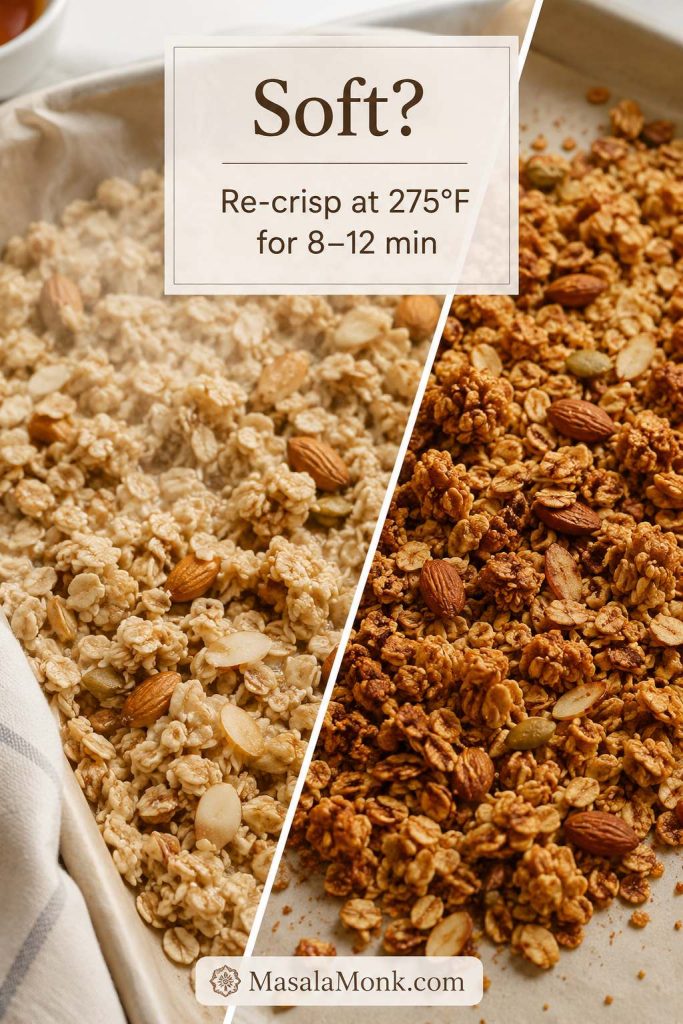
Quick fix: If your granola cooled and still tastes soft, spread it back on the pan and bake it at 275°F / 135°C for 8–12 minutes. Let it cool again before storing.

Soft vs crunchy granola

Diagonal comparison of pale soft granola and golden crunchy granola with a note about re-crisping at 275 degrees Fahrenheit.
Soft granola is usually fixable. Spread it back out, warm it gently at 275°F, and then cool it fully before deciding whether it needs more time.

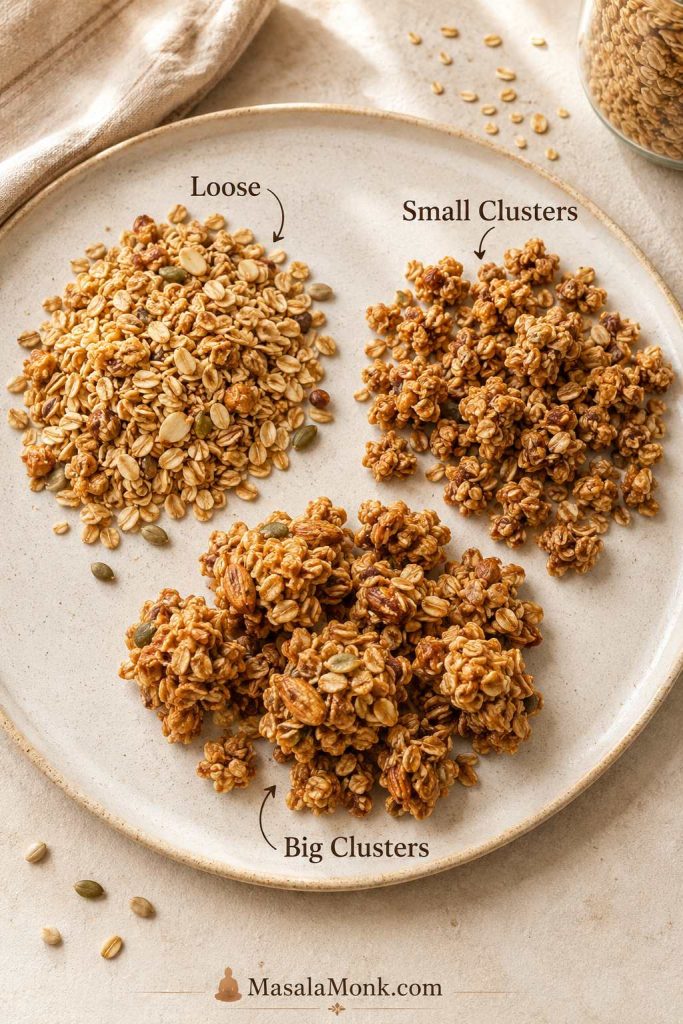
How to Make Granola Clusters

Clusters are the pieces people pick out of the jar first. Some readers want loose, cereal-style granola they can scoop with milk; others want big crunchy chunks for yogurt, parfaits, snack jars, and smoothie bowls.

You can choose that texture instead of hoping for it.
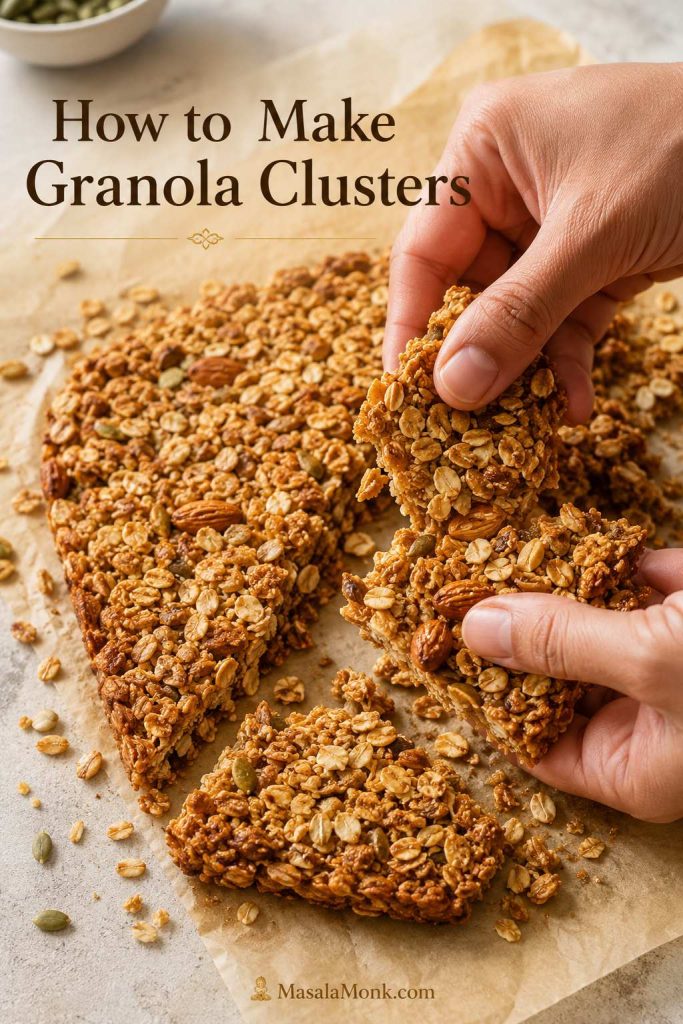
Hands breaking large homemade granola clusters from a cooled slab on parchment paper.
Bigger granola clusters come from restraint: stir less, press the mixture down, and wait until the slab cools before breaking it apart.

Choose your granola cluster size

Texture you want What to do
Loose cereal-style granola Stir twice, spread evenly, and break into smaller pieces after cooling.
Small everyday clusters Stir once, press down after stirring, and wait until firm before breaking.
Big bakery-style clusters Add 1 beaten egg white, press firmly, stir minimally, and cool completely.
Vegan clusters Add almond butter or peanut butter, press into a compact layer, and let the slab set before breaking.
Extra crisp clusters Bake 5 minutes longer if needed, then cool before breaking.
Cluster size guide showing loose granola, small granola clusters, and large bakery-style granola clusters.
Cluster size depends on how you bake and break the batch. Loose granola suits milk, small clusters work well on yogurt, and bigger pieces are best for snack jars.

The base recipe is enough for small everyday clusters. To make larger bakery-style clusters, add 1 beaten egg white to the coated oats before baking. A vegan version can use 2 tablespoons almond butter or peanut butter in the wet mixture instead.

Why too many add-ins break clusters

If you want bigger clusters, avoid overloading the mixture with too many loose add-ins. Extra nuts, seeds, coconut, and dried fruit can taste great, but heavy mix-ins make the slab easier to break apart.
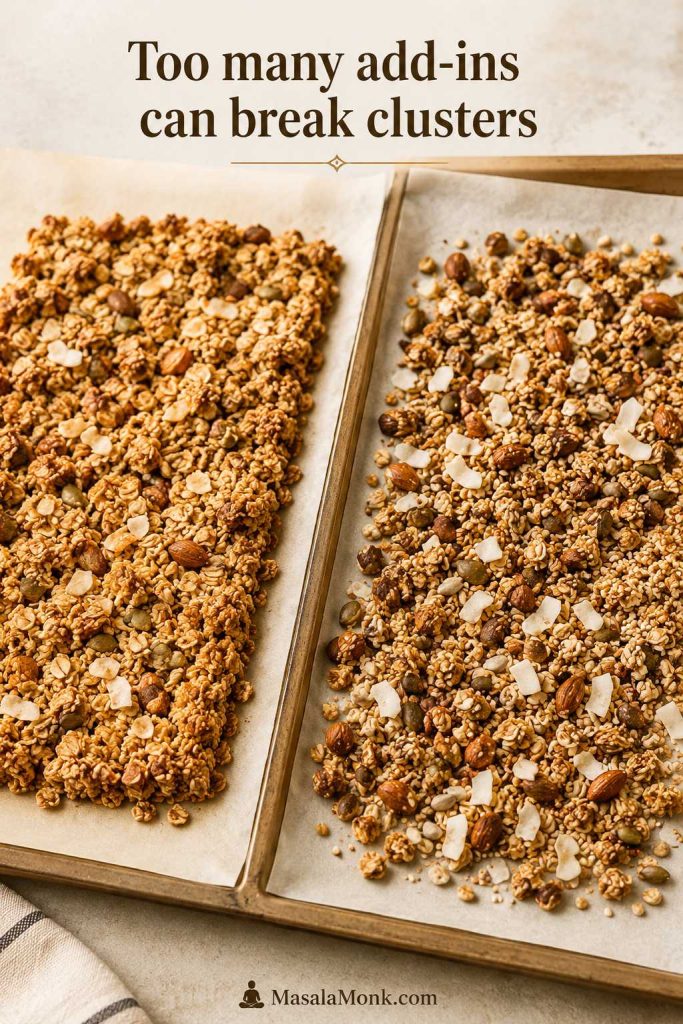
Comparison of balanced granola holding together and overloaded granola with too many nuts, seeds, and coconut breaking apart.
Extra mix-ins add flavor, but too many loose nuts, seeds, and coconut flakes can weaken the slab and make large granola clusters harder to keep.

If you warmed the oil and sweetener, let that mixture cool until just warm before adding egg white. Hot liquid can cook the egg white before it reaches the oats.

Loose granola is not a failure either. It is often better when you want a cereal-style bowl with milk or a lighter topping that scatters over fruit.

Homemade Granola for Yogurt, Parfaits, Bowls, and Milk

A spoonful of crunchy granola can turn plain yogurt into breakfast, make a smoothie bowl feel finished, and make a simple fruit bowl feel more satisfying. Granola is often best as the finishing crunch, not the base of the whole bowl.
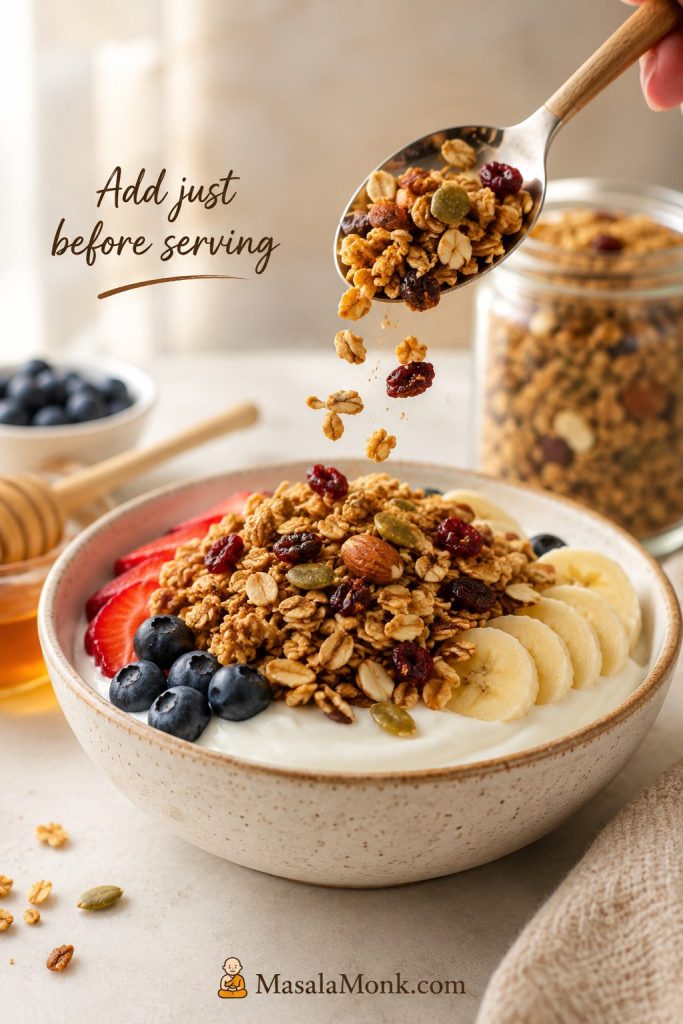
Spoonful of homemade granola being added over a bowl of thick yogurt with berries and banana slices.
Add granola to yogurt right before eating. That way, the oats stay crisp, the clusters hold longer, and the bowl keeps its contrast.

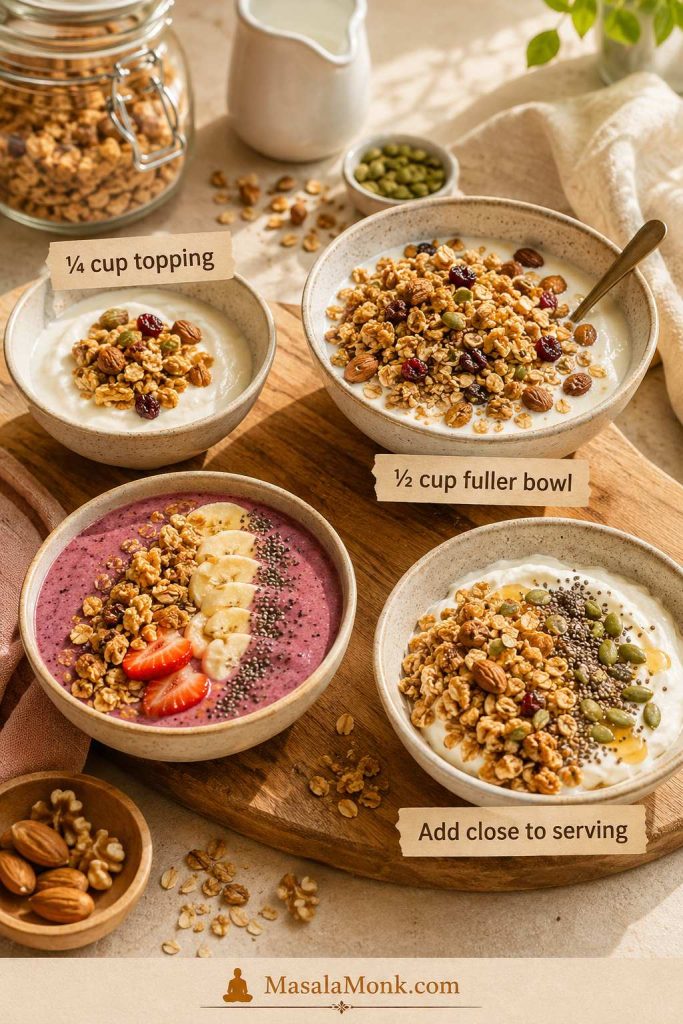
For crisp granola, timing matters: add it close to serving. Yogurt softens granola as it sits.

How much granola to use

Use Good starting amount Texture that works well Tip
Yogurt bowl ¾–1 cup yogurt + ¼ cup granola + fruit Loose granola or small clusters Add just before eating so it stays crisp.
Parfait jar ¾ cup Greek yogurt + ¼ cup fruit + ¼ cup granola Larger clusters Keep granola separate until serving if making ahead.
Larger breakfast bowl ½ cup granola + milk or yogurt + fruit Loose granola or small clusters Use a bigger bowl when granola is the main base.
Smoothie bowl 2–4 tablespoons granola Crunchy clusters Sprinkle on top instead of mixing in, especially with a thick fruit base like mango, banana, or berries.
Kids snack bowl ¼ cup granola + banana or berries Peanut butter or chocolate variation Add chocolate chips after cooling.
High-protein bowl Greek yogurt + ¼ cup granola + seeds Protein granola with small clusters Add hemp hearts, chia, flax, or nuts.
Granola portion guide showing yogurt topping, fuller granola bowl, smoothie bowl topping, and high-protein yogurt bowl ideas.
Use ¼ cup when granola is a crunchy topping and ½ cup when it is the main breakfast base. Then add yogurt, milk, fruit, or seeds around it.

Use these amounts as starting points, not rules. Granola is forgiving once you know whether you want it as a topping, a cereal-style bowl, or a snacky cluster.

Make-ahead parfaits without soggy granola

For meal-prepped yogurt parfaits, keep the granola separate unless you prefer a softer texture. If you layer it early, expect a softer, chewier granola layer rather than crisp clusters. The same rule applies to smoothie bowls: blend the fruit first, then finish with granola right before serving.
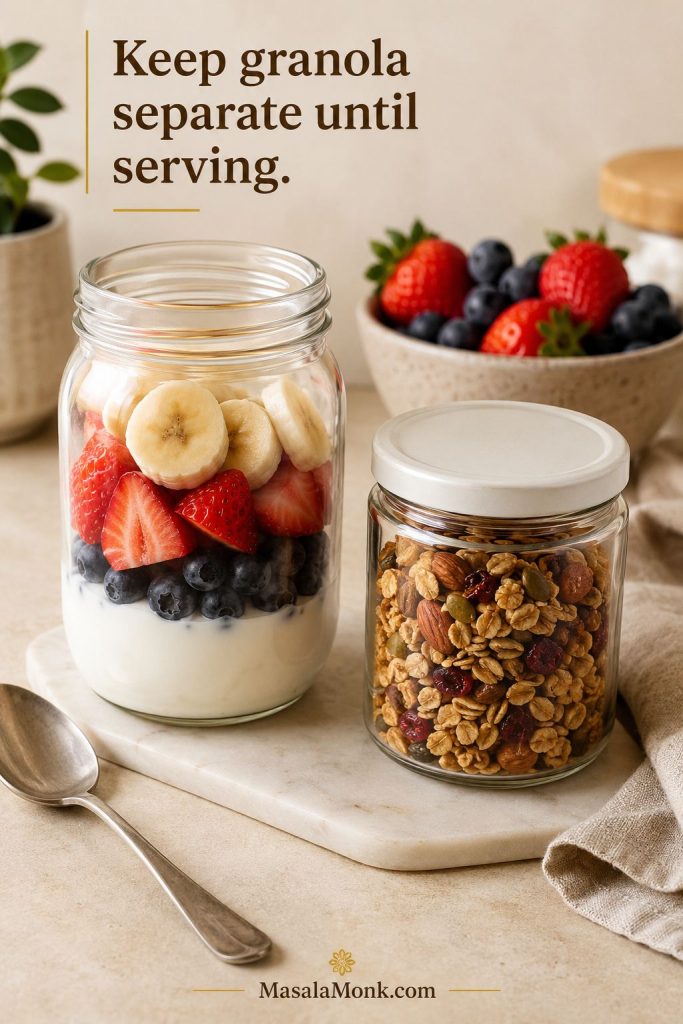
Meal-prep setup with a jar of yogurt and fruit beside a separate jar of homemade granola.
For make-ahead parfaits, prep the yogurt and fruit first, but keep the granola separate until serving so the clusters stay crisp.

If you are making a batch for the week, the storage section explains how to keep the main jar crisp.

This recipe also works beautifully as a topping for overnight oats. For a higher-protein breakfast, pair a smaller handful of granola with Greek yogurt or use it on high-protein overnight oats.

Homemade Granola Variations: Gluten-Free, Vegan, Nut-Free, Low-Sugar, and More

Homemade granola is not automatically low-calorie, but it can be a smarter everyday choice because you control the oats, nuts, seeds, oil, sweetener, and portion size. Starting with whole-grain oats gives the recipe a hearty base, while the rest of the mix-ins are up to you.

Think of granola as a flavorful crunch booster: a ¼-cup handful can make yogurt, fruit, oatmeal, or a smoothie bowl feel much more satisfying. For a fuller bowl, use ½ cup with milk or yogurt and add fresh fruit.
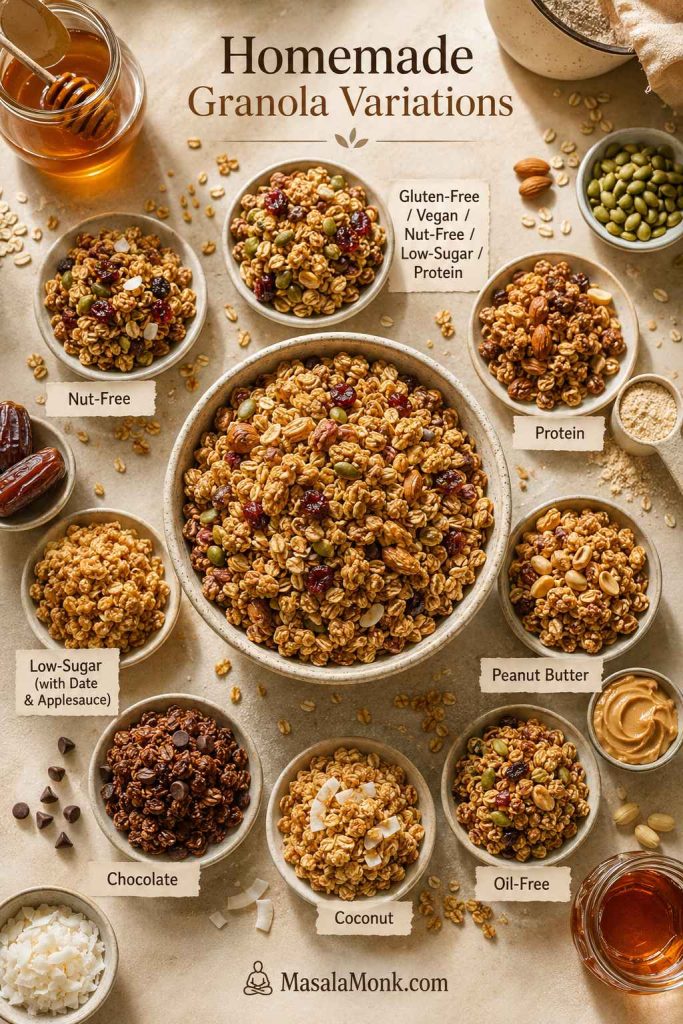
Homemade granola variations board with bowls for gluten-free, vegan, nut-free, low-sugar, protein, peanut butter, chocolate, coconut, and oil-free granola.
The same homemade granola base can move in several directions: gluten-free, vegan, nut-free, low-sugar, protein, peanut butter, chocolate, coconut, or oil-free.

Choose the variation you need

Variation How to adjust Texture note
Gluten-free granola Use certified gluten-free rolled oats. Texture stays close to the original.
Vegan granola Use maple syrup instead of honey. For vegan clusters, add almond butter or peanut butter.
Nut-free granola Use pumpkin seeds, sunflower seeds, sesame seeds, coconut, or hemp hearts. Still crunchy, but lighter than nut-based granola.
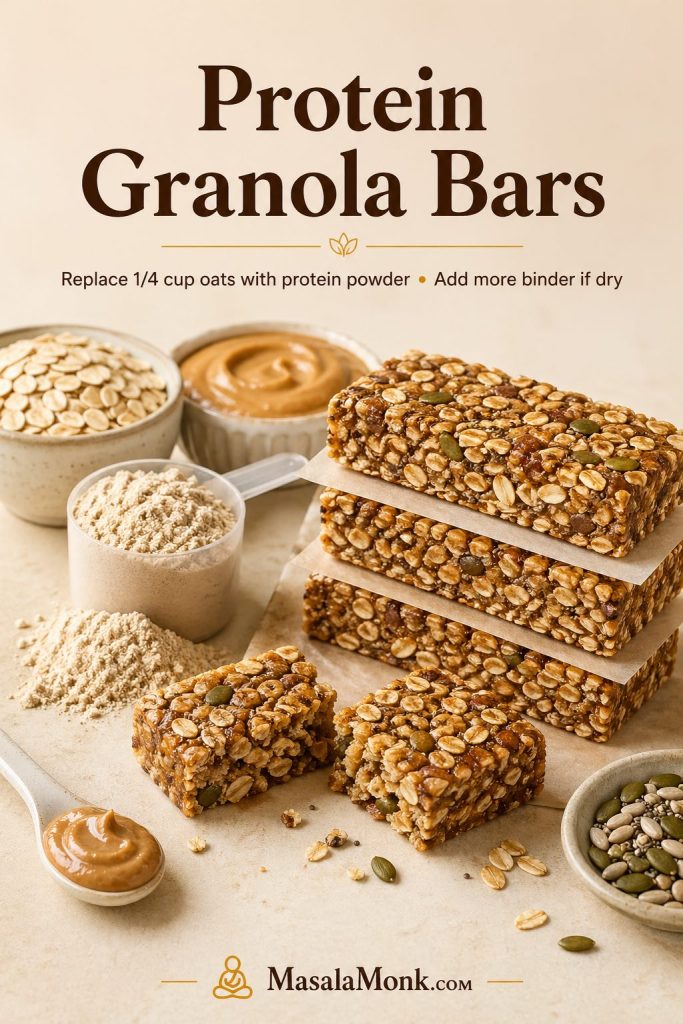
Protein granola Add more seeds and nuts, or start with ¼ cup protein powder. Too much protein powder can make granola dry or chalky.
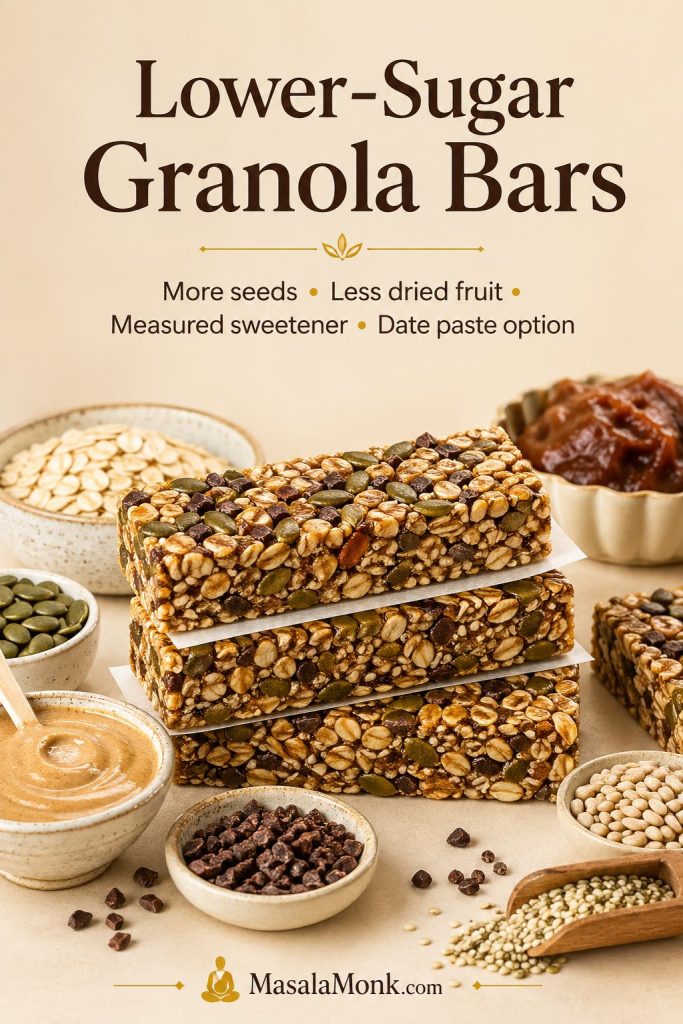
Low-sugar granola Reduce maple syrup or honey to ⅓ cup. Less sweetener usually means fewer clusters.
Peanut butter granola Add 2–3 tablespoons peanut butter to the wet mixture. Better clusters and a stronger snack-like flavor.
Chocolate granola Add 2 tablespoons cocoa powder before baking; add chocolate chips after cooling. Do not bake chocolate chips unless you want them melted through.
Coconut granola Add coconut flakes halfway through baking if they brown quickly. Large coconut flakes can burn if added too early.
Oil-free granola Replace oil with mashed banana, applesauce, date paste, or extra nut butter. Softer and chewier than the main recipe.
No-added-sugar style Use mashed banana or date paste instead of syrup. Softer, less crisp, and less clumpy than the base recipe.

Use the variations as steering points, not separate recipes: a little more protein here, a little less sugar there, a different binder when you want clusters.

Gluten-free granola

Oats are naturally gluten-free, but cross-contact during processing can be an issue. For gluten-free homemade granola, use gluten-free oats and check the labels on nuts, seeds, dried fruit, chocolate, and other mix-ins.

Vegan granola

Use maple syrup instead of honey. For vegan clusters, use almond butter, peanut butter, or another nut or seed butter as the binder instead of egg white.

Protein granola

For a protein granola variation, start with ingredients that naturally improve texture: pumpkin seeds, sunflower seeds, hemp hearts, chia seeds, flaxseed, almonds, peanuts, or walnuts.
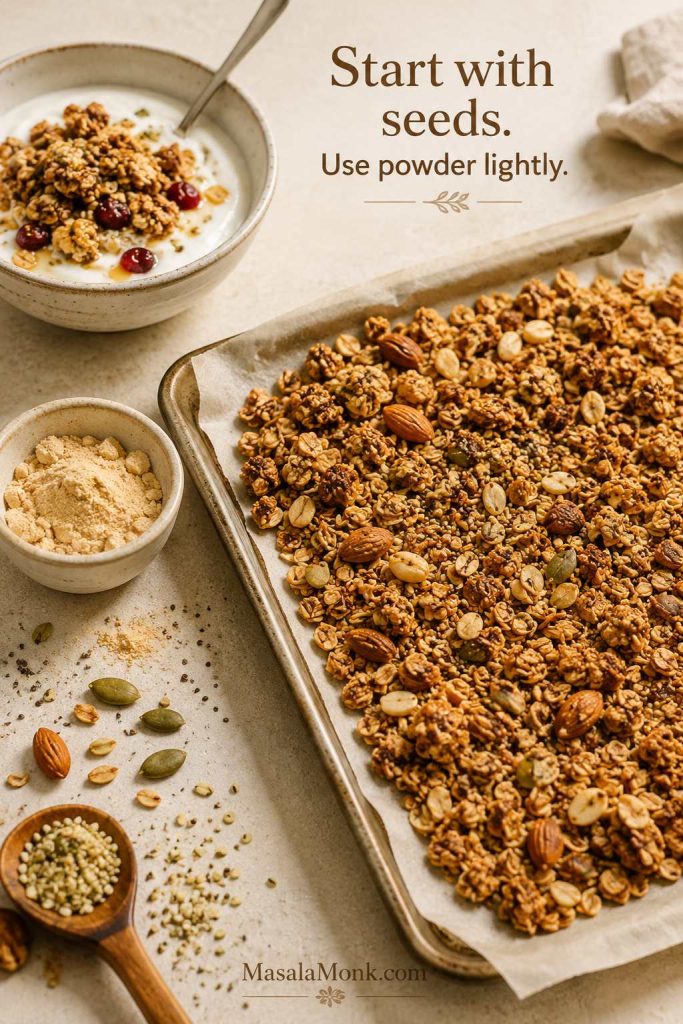
Protein granola with oats, nuts, seeds, a small bowl of protein powder, and a yogurt bowl in a warm breakfast setting.
Seeds and nuts are the easiest way to make protein granola feel natural. Protein powder can work too, but start small so the texture stays crisp instead of chalky.

With protein powder, start with ¼ cup, not ½ cup. Mix it into the dry ingredients before adding the wet mixture. If the oats look dusty or dry after mixing, add 1–2 extra tablespoons of maple syrup, honey, oil, or nut butter.

Plant-based powders usually absorb more moisture, while some whey powders brown faster, so start small before scaling up. Seeds and nuts are the safer protein boost if texture matters most.

If you enjoy protein-rich oat breakfasts, this high-protein oatmeal guide has more ideas for building a satisfying bowl.

Low-sugar granola

You can reduce the maple syrup or honey to ⅓ cup. The granola will be less sweet and may form fewer clusters, but it can still be crisp and flavorful.

To make it taste fuller, keep the salt, increase the cinnamon and vanilla slightly, use flavorful toasted nuts or seeds, and add dried fruit after baking if you want little pockets of sweetness.

Peanut butter granola

Add 2–3 tablespoons peanut butter to the wet mixture. If your peanut butter is thick, warm it gently with the oil and maple syrup or honey so it mixes smoothly. A spoonful of homemade peanut butter works especially well when you want a stronger roasted-peanut flavor.

Peanut butter granola is especially good with bananas, chocolate chips, raisins, Greek yogurt, or a splash of milk.

Oil-free granola

Oil-free granola is possible, but it will not have the same crisp texture as the main recipe. Use mashed banana, applesauce, date paste, or extra nut butter to help coat the oats, and expect a softer, chewier finish.
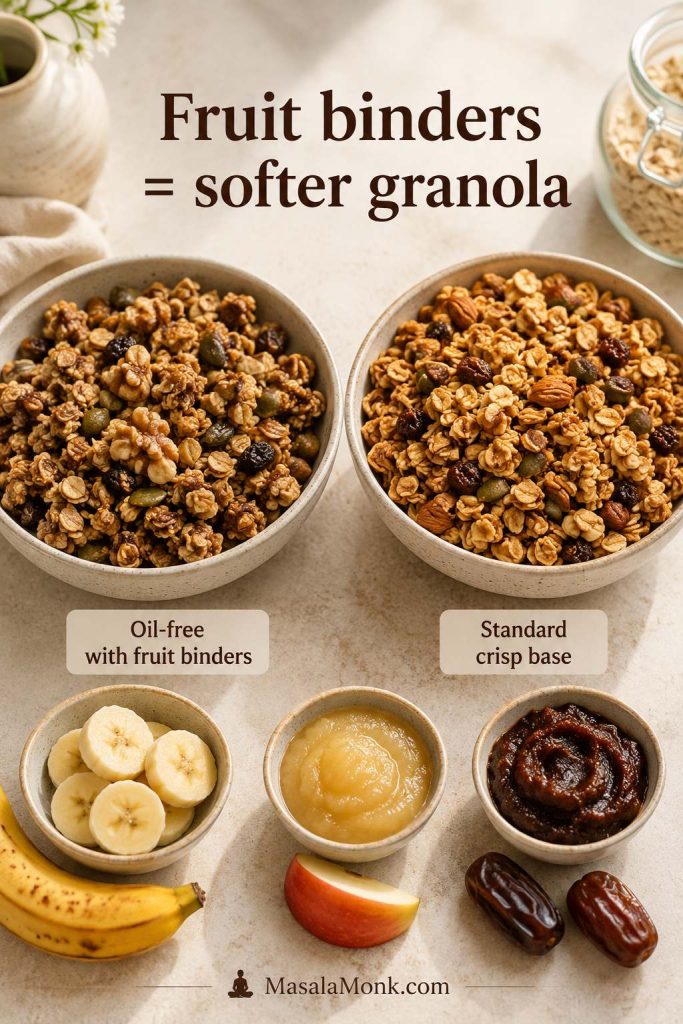
Oil-free granola comparison showing softer granola made with fruit binders beside a standard crisp granola base, with banana, applesauce, and date paste below.
Oil-free granola can still be delicious, but fruit binders like banana, applesauce, and date paste usually make it softer than the standard crisp base.

Fruit-based binders like banana, applesauce, and date paste add moisture, so the granola will usually be softer and less crisp than the maple or honey version. For a firmer oat-based snack that leans into fruit and dates instead of syrup, these healthy oat cookies are a better direction than trying to make this granola behave like a cookie.

Easy Homemade Granola Flavor Ideas

Once the base recipe feels familiar, the fun is in changing the flavor without changing the method. Keep the oats, oil, sweetener, and salt steady, then change the nuts, seeds, spices, fruit, or finishing mix-ins.

Pick one direction for each batch instead of adding everything at once; the best granola usually tastes intentional, not crowded.
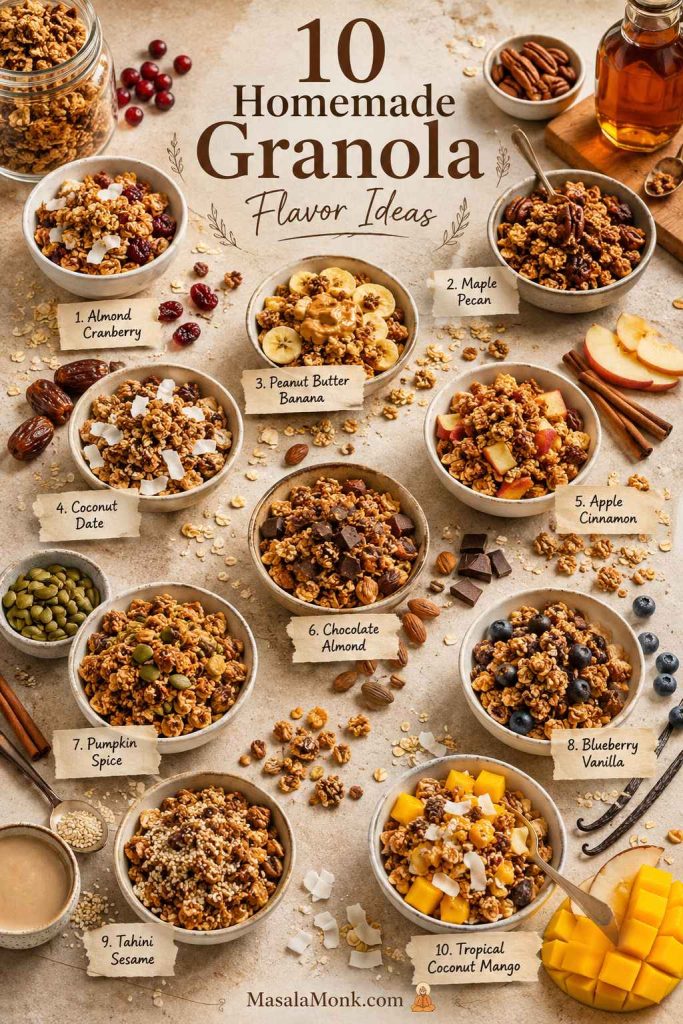
Board of ten homemade granola flavor ideas including almond cranberry, maple pecan, peanut butter banana, coconut date, apple cinnamon, chocolate almond, pumpkin spice, blueberry vanilla, tahini sesame, and tropical coconut mango.
Keep the base ratio steady, then change one flavor direction at a time. That is how maple pecan, apple cinnamon, chocolate almond, or tropical coconut mango still feel balanced.
Flavor idea What to add
Almond cranberry granola Sliced almonds, dried cranberries, vanilla, and a little orange zest after baking.
Maple pecan granola Pecans, maple syrup, cinnamon, and a pinch of nutmeg.
Peanut butter banana granola Peanut butter in the wet mixture, banana chips after baking, and optional chocolate chips once cool.
Coconut date granola Coconut flakes, chopped dates after baking, cinnamon, and a pinch of cardamom.
Apple cinnamon granola Extra cinnamon, walnuts, dried apple, and raisins after baking.
Chocolate almond granola Cocoa powder before baking, almonds, and chocolate chips after cooling.
Pumpkin spice granola Pumpkin pie spice, pecans or walnuts, pumpkin seeds, and dried cranberries after baking.
Blueberry vanilla granola Extra vanilla, almonds or cashews, and dried blueberries after baking.
Tahini sesame granola Tahini in the wet mixture, sesame seeds, pistachios, and a little honey or maple syrup.
Tropical coconut mango granola Coconut flakes, cashews or macadamias, and dried mango after baking.

If you make your own version, note what went in. Granola is one of those recipes where the second batch is often even better because you learn exactly how sweet, chunky, nutty, or fruit-heavy you like it. If one batch disappears faster than the others, write that combination down; that is usually your house granola trying to announce itself.

How to Store Homemade Granola

Cool the granola before storing it. This is the storage rule that matters most.

If you close the lid while the batch is still warm, steam gets trapped in the jar and softens the oats. Let the pan sit first, then move the granola to an airtight container.
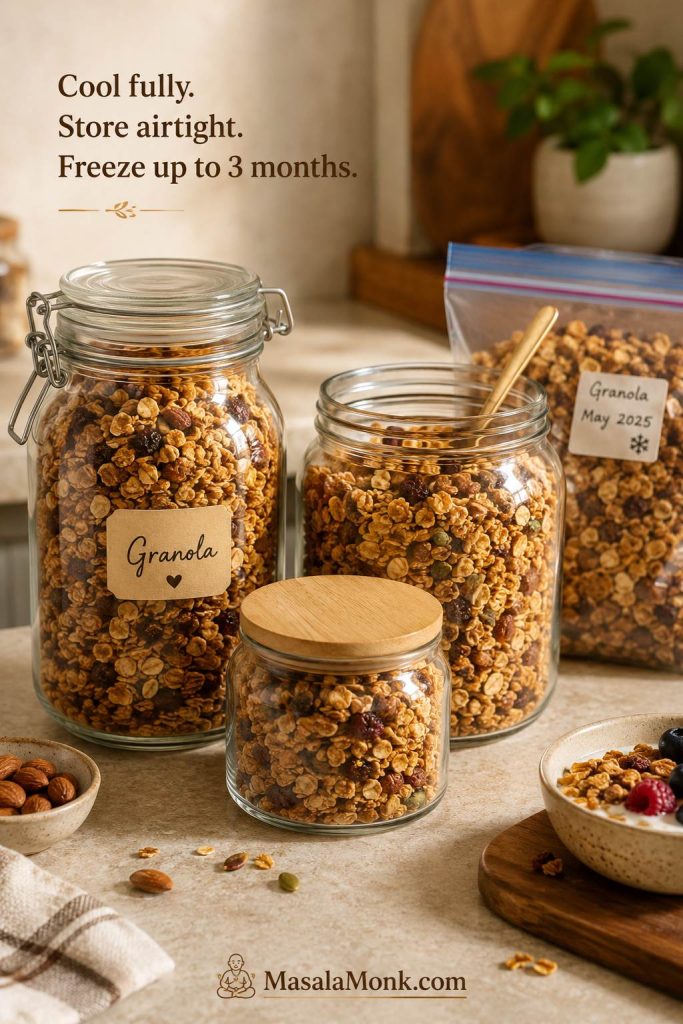
Airtight jars and a freezer bag of cooled homemade granola on a warm kitchen counter with storage guidance.
Store homemade granola only after it cools completely. Airtight jars protect the crunch, while freezer portions help a big batch last beyond the week.

For everyday use, store homemade granola in a clean airtight jar or container at room temperature. For the best texture, use it within 2 weeks. It may last longer in a sealed container, but the crunch is usually best earlier.

Once a jar is ready, it becomes the easiest breakfast helper in the kitchen: the thing that makes plain yogurt, fruit, or milk feel like you planned ahead.

For longer storage, freeze granola for up to 3 months in a freezer-safe bag or container. Let it come back to room temperature before serving, or refresh it briefly in a low oven if you want the crunch to come back more strongly.

Storage tip: If your kitchen is humid, smaller jars are better than one giant container that gets opened every day. Less air exposure helps the granola stay crisp.

Homemade Granola Troubleshooting

Most granola problems are fixable, and almost all of them come down to heat, moisture, binder, or timing. A less-than-perfect batch is rarely wasted: soft granola can usually be re-crisped, too-sweet granola can be balanced with yogurt or nuts, and a loose batch still works beautifully over fruit or milk.
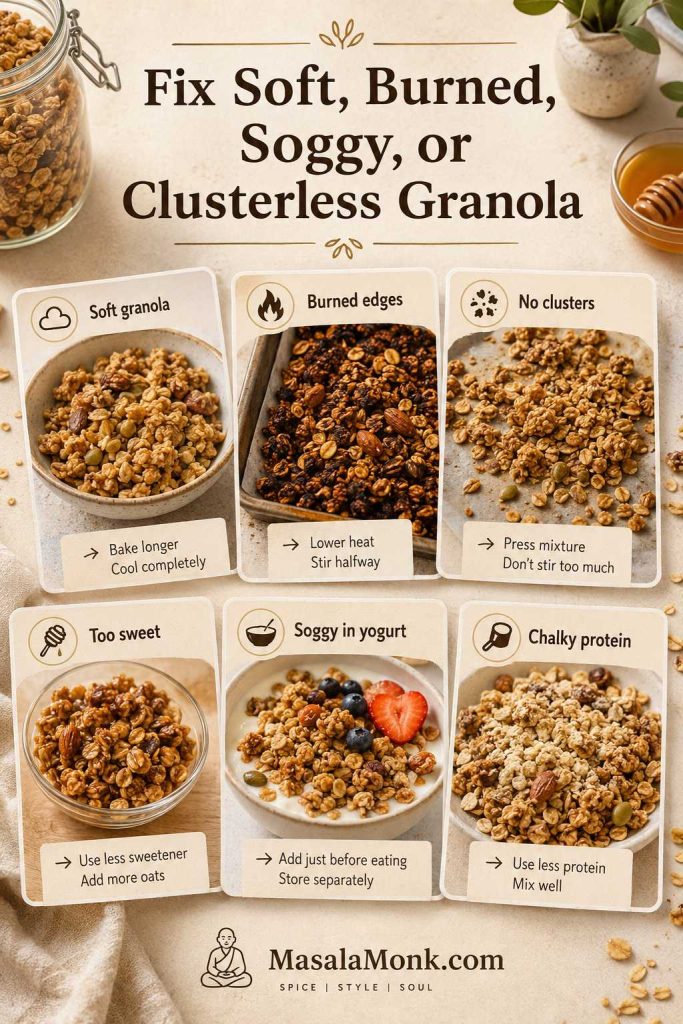
Homemade granola troubleshooting board showing soft granola, burned edges, no clusters, too sweet granola, soggy yogurt, and chalky protein granola.
Most granola problems are fixable: soft batches can be re-crisped, clusterless granola still works over yogurt, and too-sweet granola can be balanced with plain toppings.

Texture and cluster fixes

Start here if the problem is crunch, clusters, sticking, or sogginess. Most texture problems come from moisture, pan crowding, heat, or breaking the granola too soon.

Problem Fix this batch Adjust next time
Granola is soft Spread it out and bake at 275°F / 135°C for 8–12 minutes, then cool fully. Bake a few minutes longer, cool before storing, and avoid trapping steam in the jar.
Granola burned Pick out very dark or bitter pieces if needed. Use 300°F / 150°C, check early with dark pans, and add delicate coconut later.
No clusters Use it as loose granola for milk, yogurt, or fruit. Press after stirring, stir less, and add egg white or nut butter for more binding.
Granola stuck to the pan Let it cool, then lift gently with a spatula. Use parchment paper and avoid baking sticky sweetener directly onto the pan.
Granola got soggy in yogurt Eat it as a softer parfait layer. Keep granola separate and add it right before serving.

Flavor, fruit, and protein fixes

Use this section when the texture is fine but the flavor, sweetness, dried fruit, or protein add-ins need help. These fixes are mostly about balance rather than rebaking the whole batch.

Problem Fix this batch Adjust next time
Granola is too sweet Serve over unsweetened Greek yogurt or add plain toasted nuts for balance. Reduce syrup or honey slightly and use less dried fruit or chocolate.
Granola is not sweet enough Add dried fruit, a few chocolate chips, or a light drizzle of honey when serving. Use the full ½ cup sweetener or choose sweeter dried fruit.
It tastes bitter Remove scorched nuts, coconut, or dark edge pieces if possible. Lower heat, check earlier, and add coconut halfway through.
Dried fruit is hard Pick out the hardest pieces if they bother you. Add dried fruit after baking, not before.
Protein granola tastes chalky Use it over yogurt or with milk to soften the dryness. Start with ¼ cup protein powder and add extra wet binder only if needed.

By this point, the recipe is less about memorizing rules and more about knowing the signs: glossy coated oats, an even layer, dry-looking edges, a warm nutty smell, and a full cool-down before breaking.

If a fix points back to bake time or cooling, compare it with the step-by-step method or the recipe card.

Recipe Card: Easy Crunchy Homemade Granola
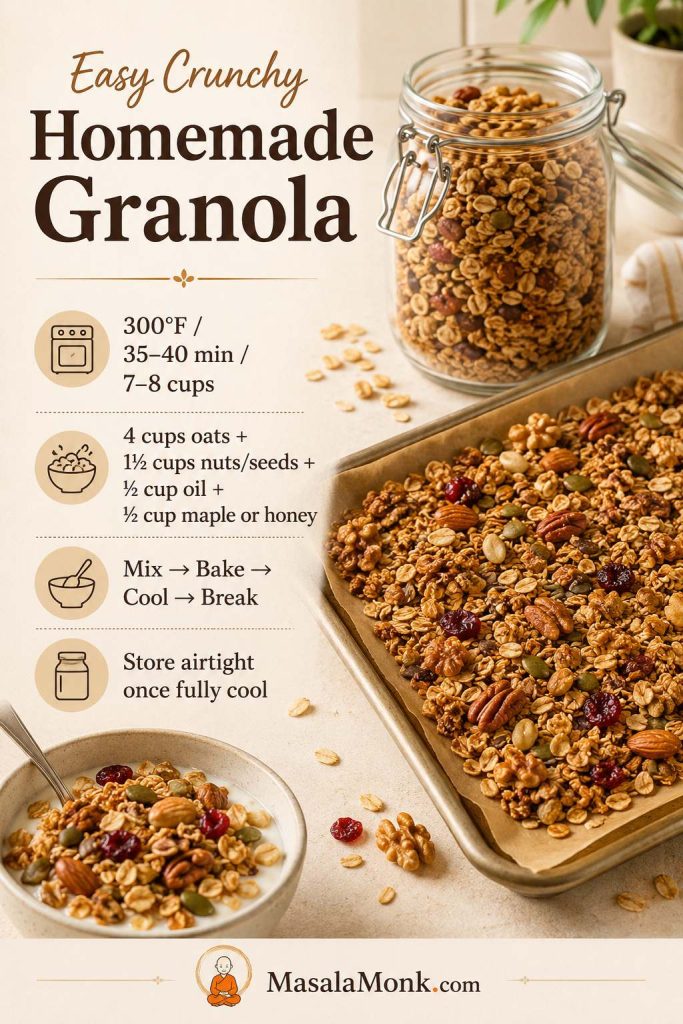
Saveable recipe card for easy crunchy homemade granola with oven temperature, bake time, yield, base ratio, method summary, and storage cue.
Save the core formula first: oats, nuts or seeds, oil, maple or honey, low oven heat, and a full cool-down before storing.

Easy Crunchy Homemade Granola

Crunchy homemade granola made with rolled oats, nuts, seeds, maple syrup or honey, oil, cinnamon, and vanilla. Bake it low and steady, then let it cool on the pan so the oats turn crisp and the clusters hold together.

Prep Time10 minutes
Cook Time35–40 minutes
Cooling Time35–45 minutes
Total Time1 hour 20 minutes to 1 hour 35 minutes
Yield7–8 cups
Servings14–16 larger ½-cup servings
Topping Portions28–32 smaller ¼-cup portions
Oven300°F / 150°C

Equipment

  • Large rimmed baking sheet or half-sheet pan
  • Parchment paper
  • Large mixing bowl
  • Small bowl or measuring cup for wet ingredients
  • Rubber spatula or flexible spatula
  • Measuring cups, measuring spoons, or kitchen scale
  • Airtight jar or container for storage

Ingredients

  • 4 cups old-fashioned rolled oats / about 320–360g
  • 1½ cups chopped nuts and/or seeds / 150–180g
  • ½ cup oil / 120ml, such as coconut oil, olive oil, avocado oil, or neutral oil
  • ½ cup maple syrup or honey / 120ml
  • ¾ teaspoon fine salt, plus more to taste
  • 1–2 teaspoons ground cinnamon / about 3–5g
  • 1 teaspoon vanilla extract / 5ml
  • ⅔ cup dried fruit / 80–100g, added after baking
  • Optional: ½–1 cup coconut flakes / 40–80g
  • Optional for bigger clusters: 1 large egg white, beaten
  • Optional for vegan clusters: 2 tablespoons almond butter or peanut butter / about 32g

Instructions

  1. Preheat the oven to 300°F / 150°C. Line a large rimmed baking sheet with parchment paper.
  2. In a large bowl, mix the rolled oats, nuts and/or seeds, salt, and cinnamon. If using delicate coconut flakes, stir them in when you stir the granola halfway through baking instead of adding them at the beginning.
  3. In a smaller bowl or measuring cup, whisk together the oil, maple syrup or honey, and vanilla. If using almond butter or peanut butter for vegan clusters, whisk it into this wet mixture.
  4. Pour the wet mixture over the oats. Stir thoroughly until every oat looks lightly coated and glossy.
  5. If using egg white for bigger clusters, make sure the oat mixture is not hot, then stir the beaten egg white into the coated oats.
  6. Spread the granola evenly on the prepared pan. Press it lightly with a spatula if you want clusters.
  7. Bake for 20 minutes. Stir once, spread the granola back out, and press it down again for clusters. Bake for another 15–20 minutes, until lightly golden, dry-looking, and fragrant.
  8. Let the granola cool on the pan until firm. Break it into the size you like, then stir in dried fruit. Store in an airtight jar or container once fully cool.

Notes

  • Do not judge the crunch straight from the oven. Granola firms and crisps as it cools.
  • For clusters, press after stirring and cool fully before breaking; for very big clusters, add 1 beaten egg white.
  • For vegan clusters, add 2 tablespoons almond butter or peanut butter to the wet mixture.
  • For gluten-free granola, use certified gluten-free rolled oats.
  • For low-sugar granola, reduce the maple syrup or honey to ⅓ cup, but expect fewer clusters.
  • Add delicate coconut halfway through baking if it browns quickly.
  • Divide between two pans if the baking sheet is crowded.
  • Store only once fully cool. Use within 2 weeks at room temperature or freeze for up to 3 months.

Use the recipe card as the base, then let the rest of the guide help you steer the texture, sweetness, and mix-ins.

FAQs About Homemade Granola

What are the best oats for homemade granola?

Old-fashioned rolled oats are best because they toast evenly, hold their shape, and create a crisp texture. Quick oats are softer, instant oats are too fine, and steel-cut oats are too hard for classic granola.

Why did my homemade granola turn soft?

Soft granola is usually underbaked, stored before cooling, or exposed to moisture. Re-crisp it at 275°F / 135°C for 8–12 minutes, then cool fully before storing.

How do I get bigger granola clusters?

Press before and after the halfway stir, then cool fully before breaking. For very large clusters, add egg white; for vegan clusters, use nut butter.

Is homemade granola healthy?

Homemade granola can be a better everyday choice because you control the oats, nuts, seeds, oil, sweetener, and portion size. It is still calorie-dense, so it works especially well as a measured topping for yogurt, fruit, or oatmeal.

When should I add dried fruit?

Add dried fruit after baking. If it bakes with the oats for the full time, it can become hard, bitter, or burnt.

How long does homemade granola keep?

Homemade granola is usually best within 2 weeks at room temperature when stored fully cool in an airtight container. For longer storage, freeze it for up to 3 months.

How do I make gluten-free granola?

Use certified gluten-free rolled oats and check that your nuts, seeds, dried fruit, chocolate, and other mix-ins are also labeled gluten-free if needed.

What granola texture is best for yogurt?

Small or medium clusters are best for yogurt. Add granola just before eating if you want crunch, or layer it earlier if you like a softer, chewier parfait texture.

What changes in oil-free granola?

Oil-free granola is usually softer and chewier than the base recipe. Mashed banana, applesauce, date paste, egg white, or nut butter can help coat the oats, but the finish will not be as crisp as granola made with oil.

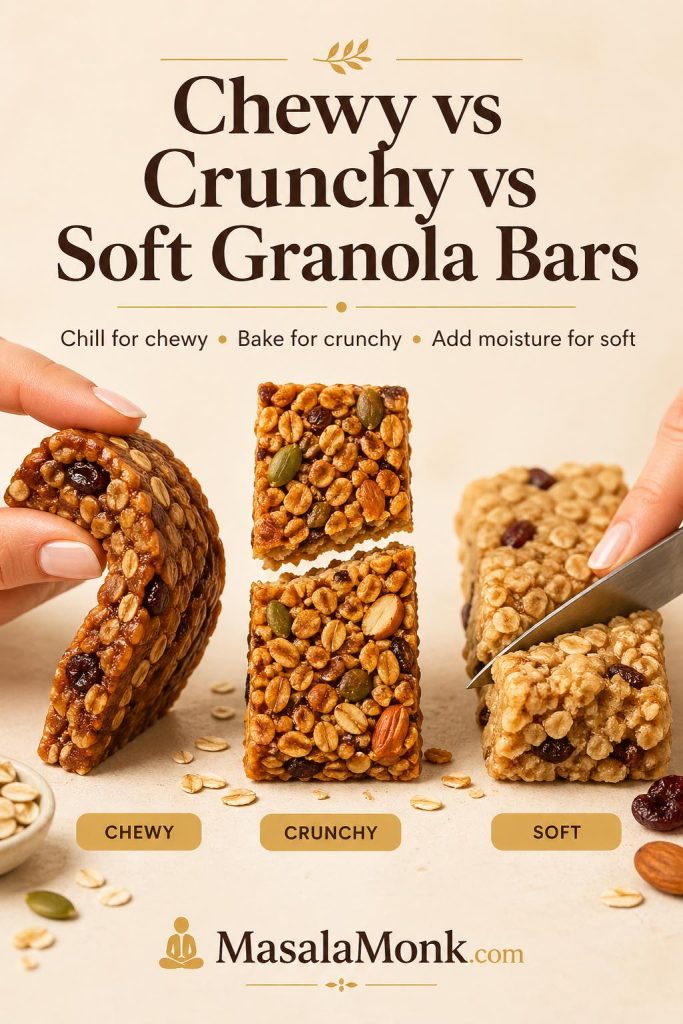
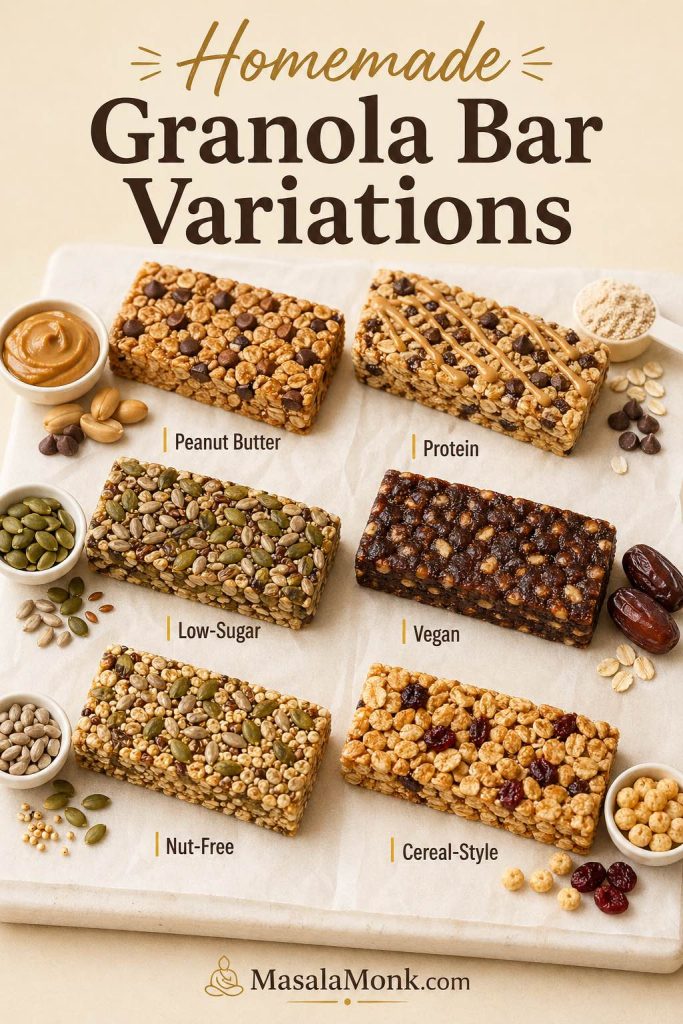
Can I turn this granola into bars?

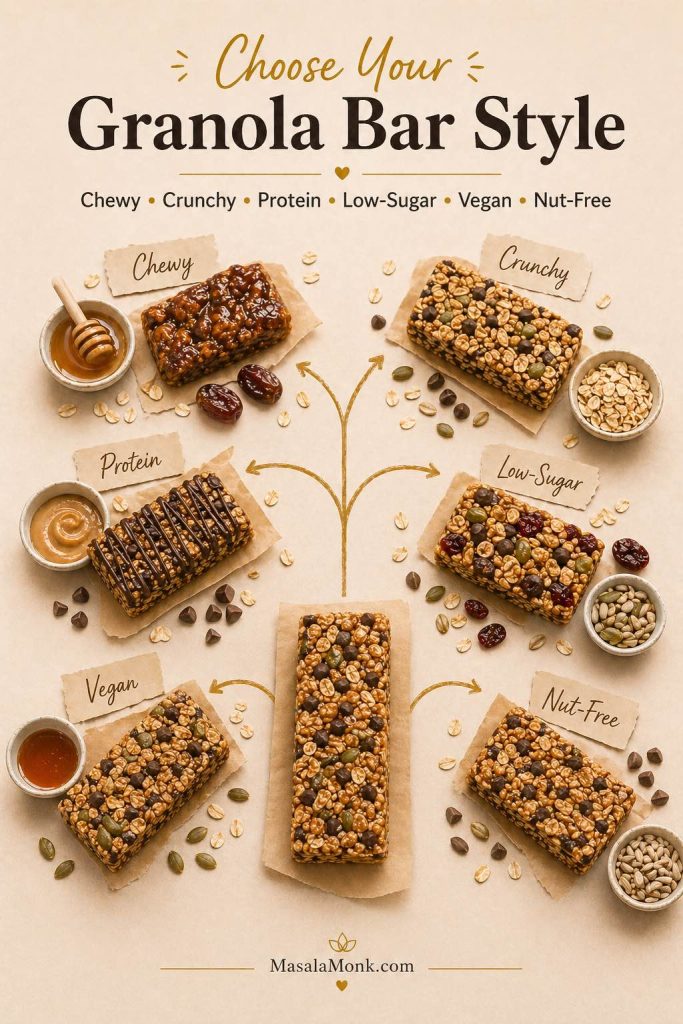
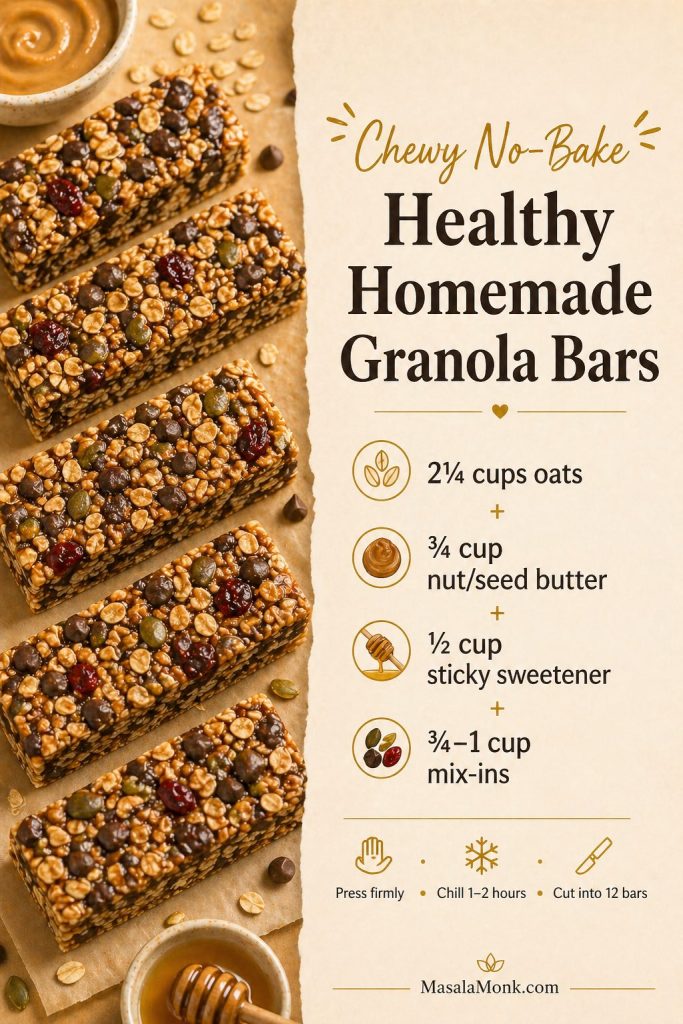
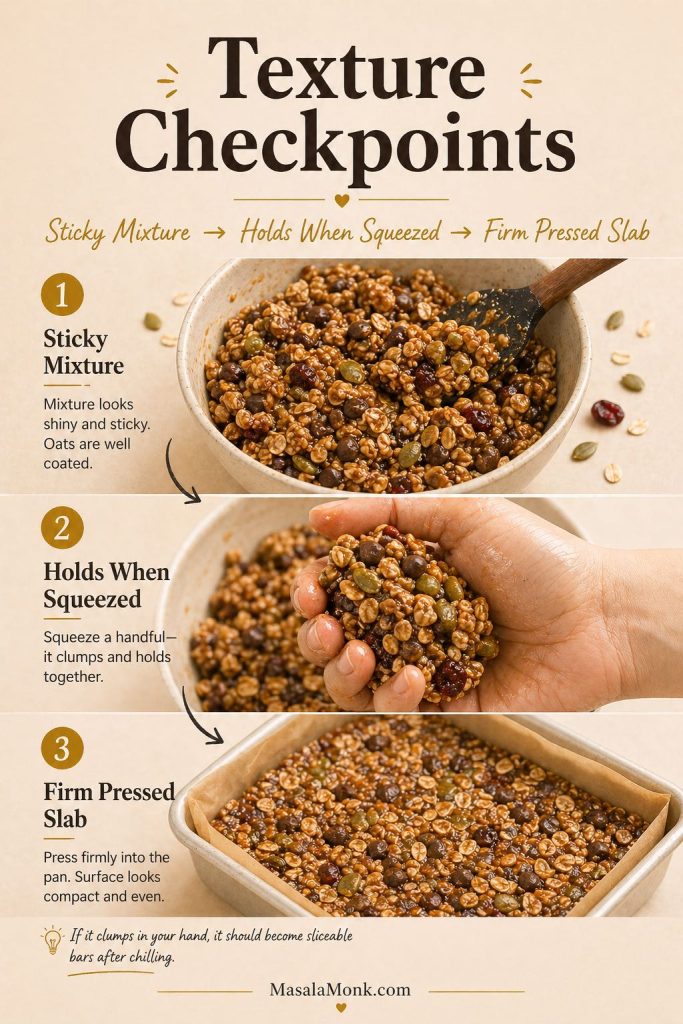
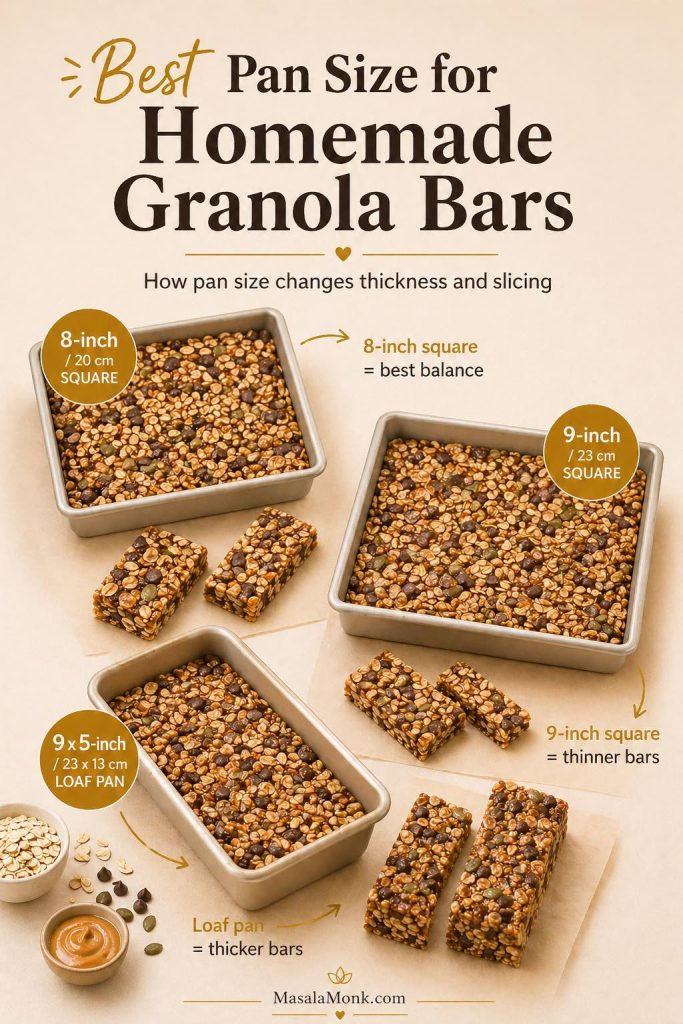
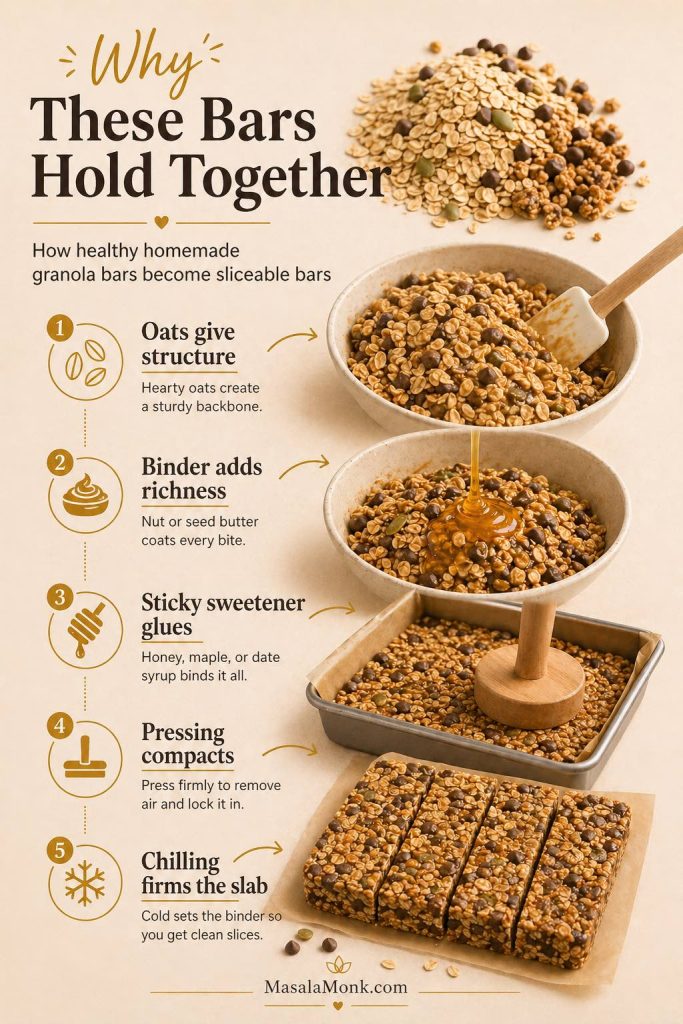
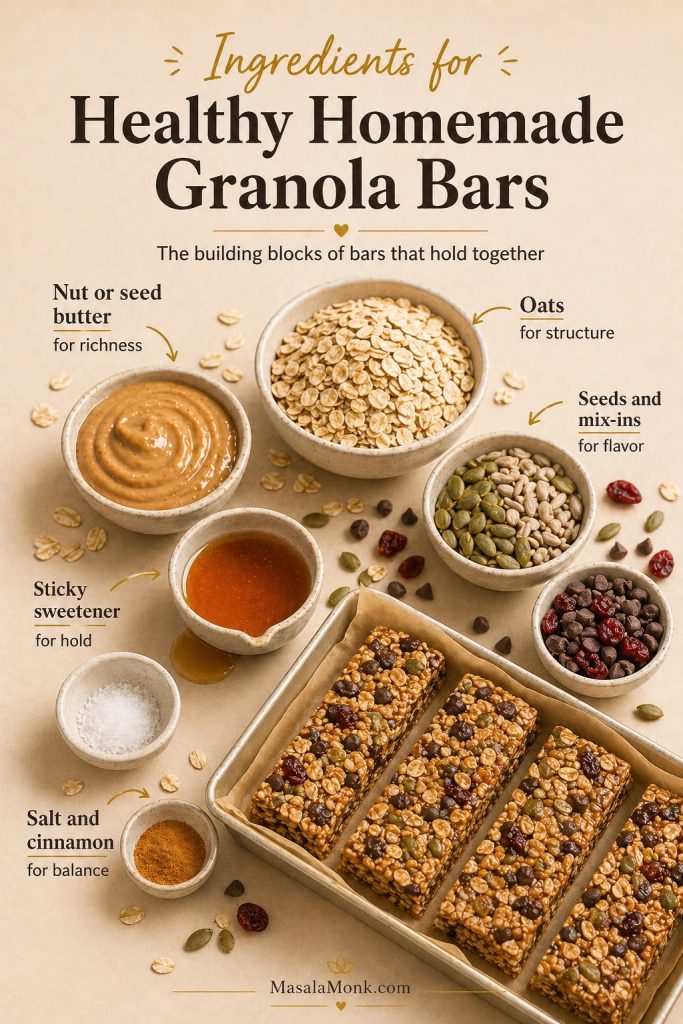
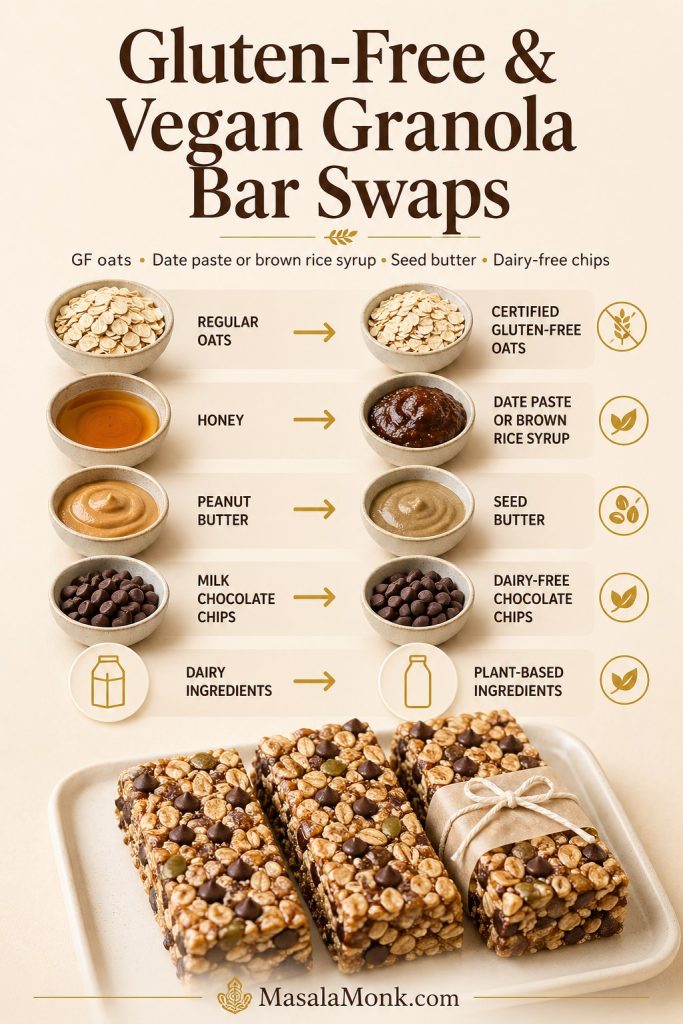
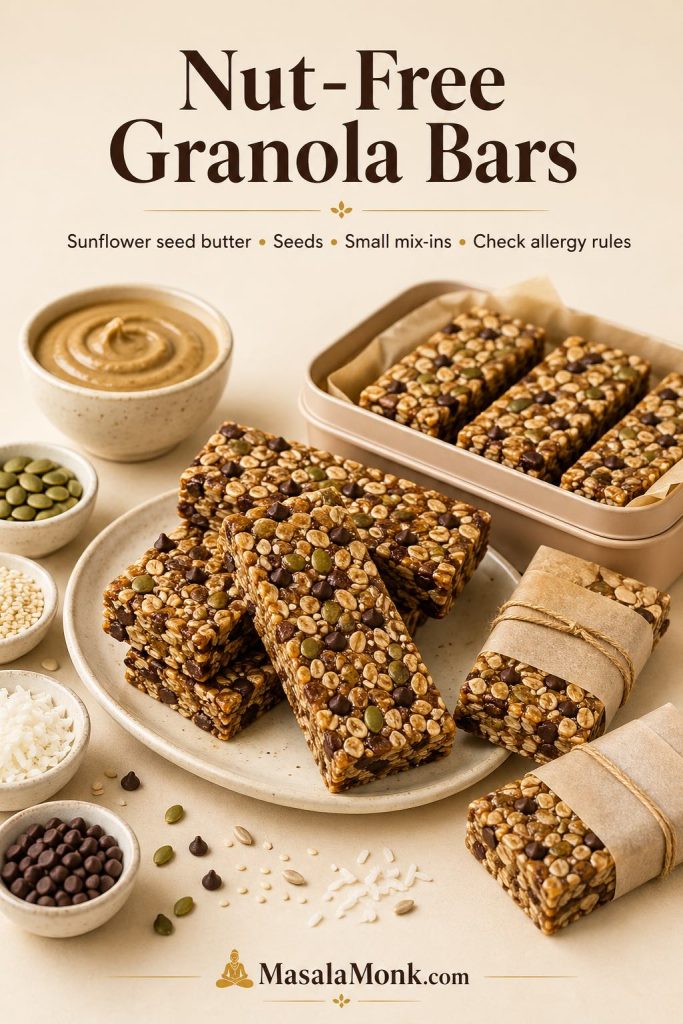
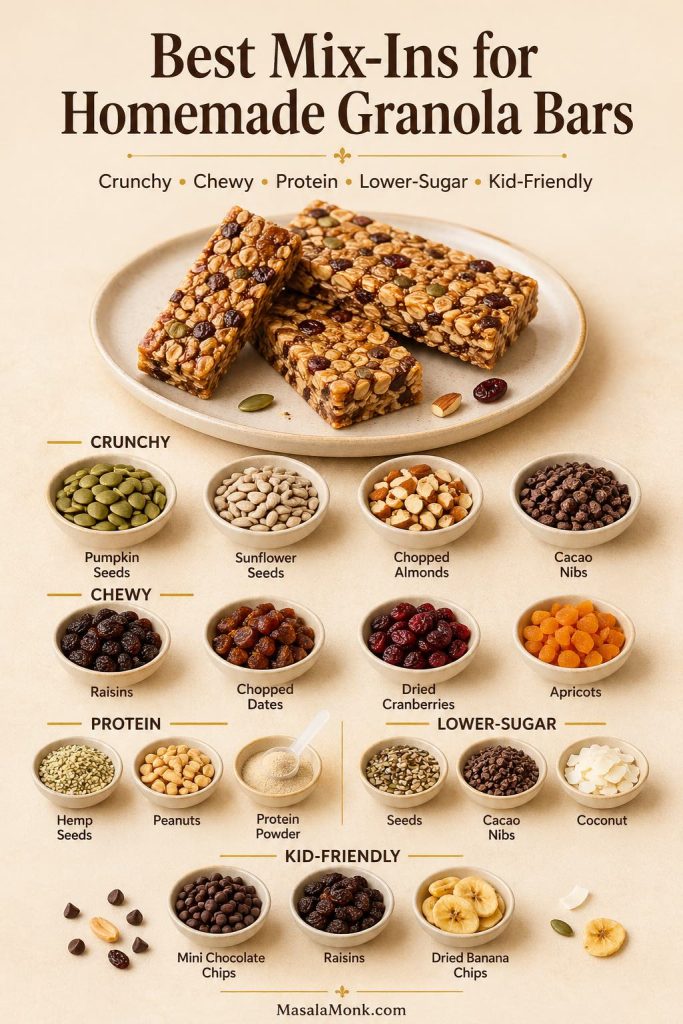
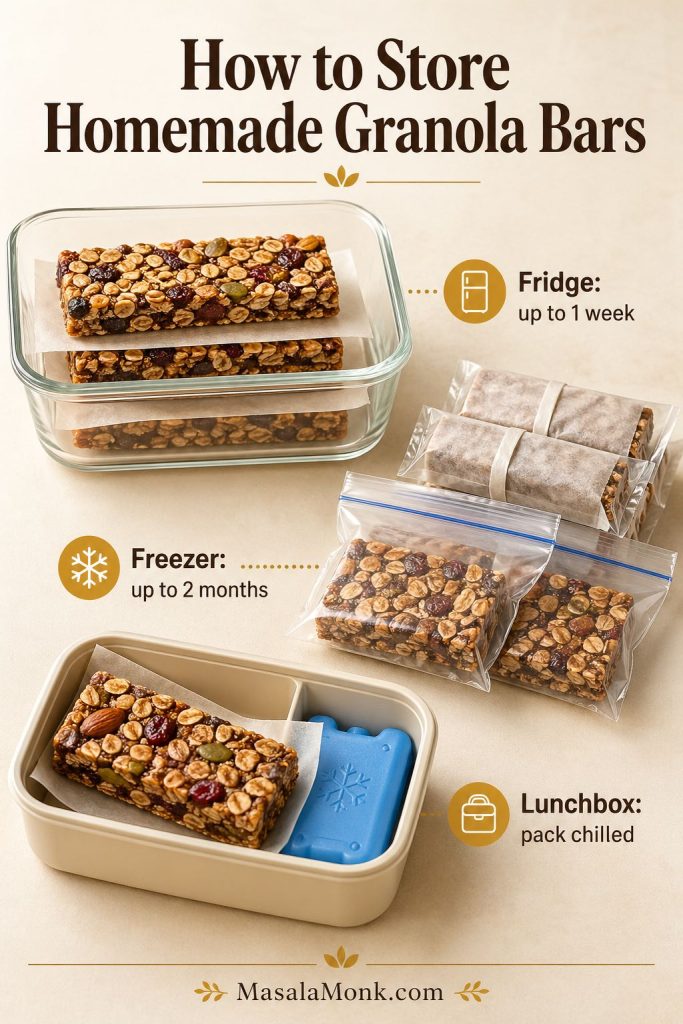
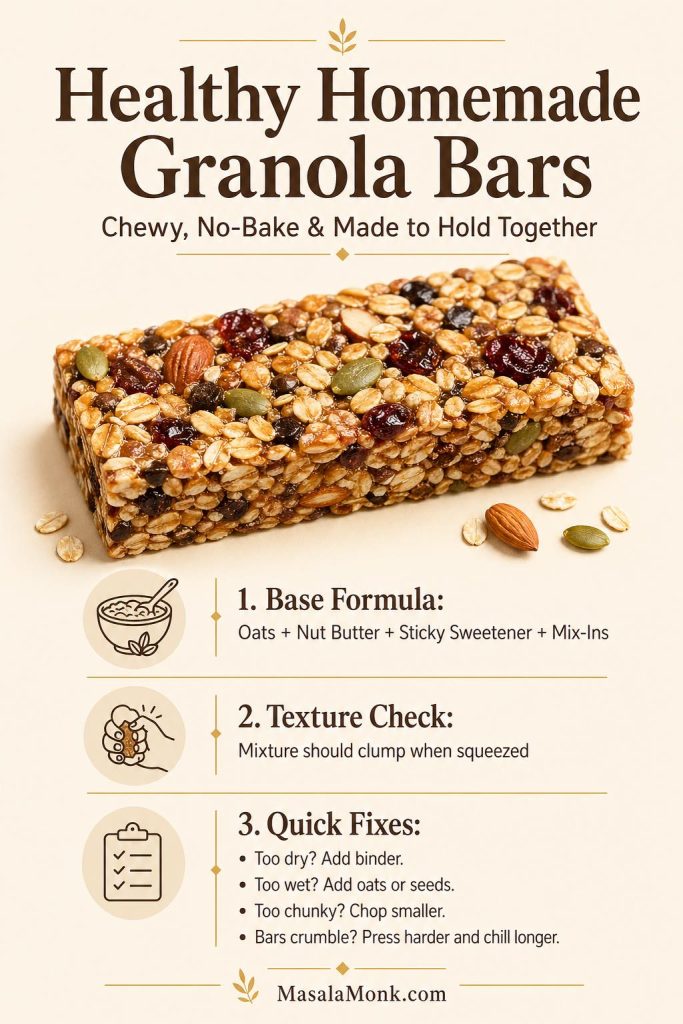
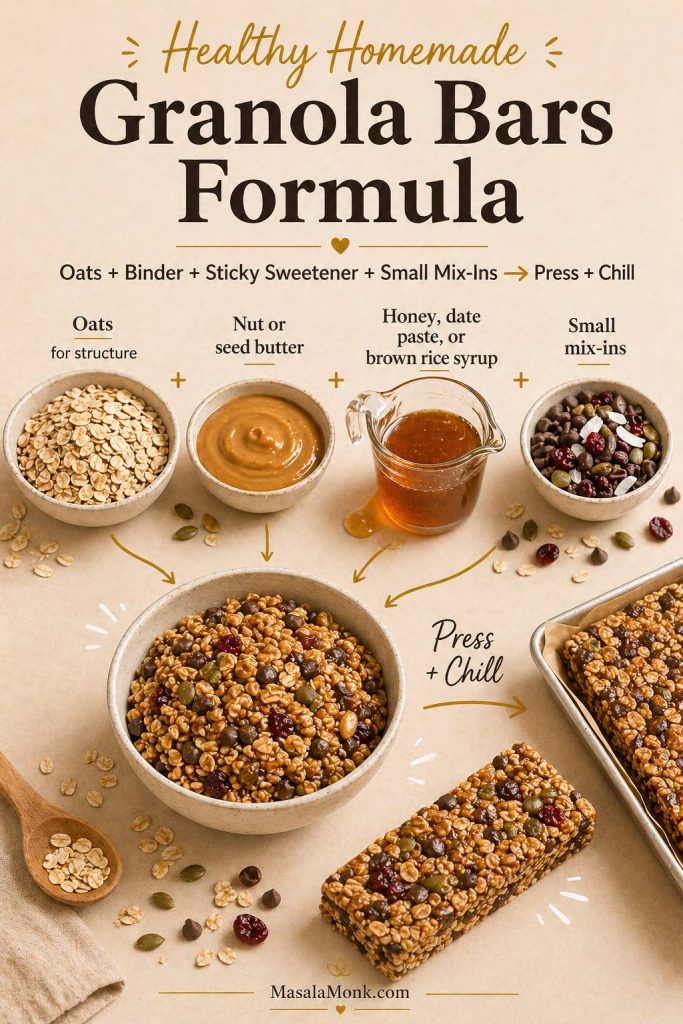
This recipe is not designed to slice into bars because granola bars need more binder. For that version, use MasalaMonk’s homemade granola bars recipe.

Your house granola for the week
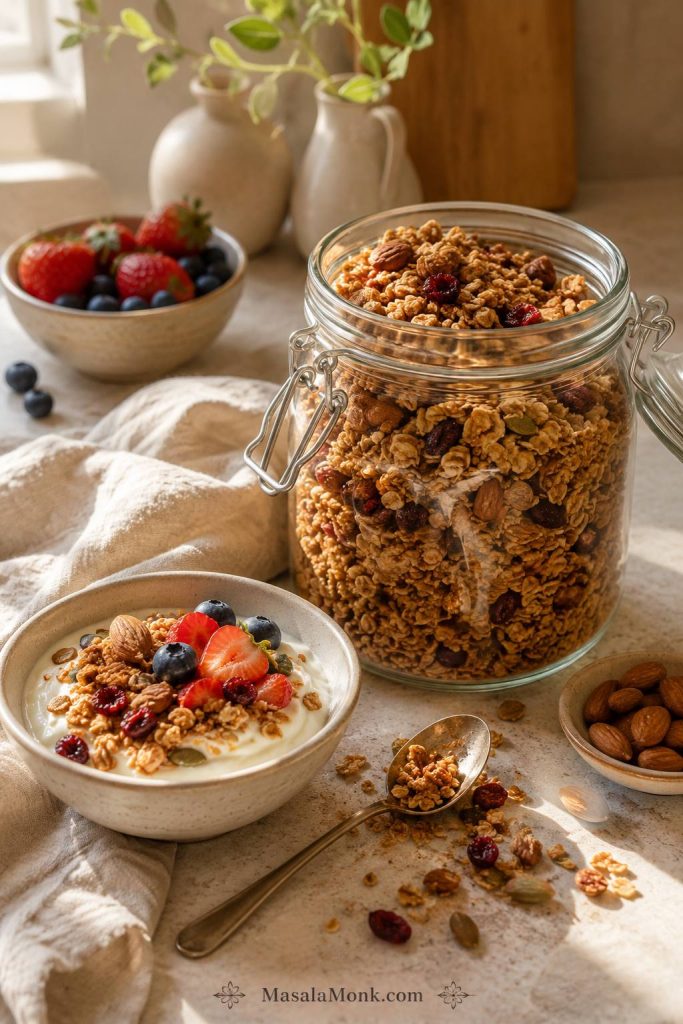
Jar of homemade granola beside a yogurt bowl with berries, spoon, linen, and warm morning light on a kitchen counter.
Once the jar is ready, breakfast gets easier: spoon homemade granola over yogurt, fruit, or milk whenever you want crunch without starting from scratch.

The first batch teaches you the method. After that, granola becomes a small weekly habit: the sweetness you like, the cluster size you reach for, and the jar that makes plain yogurt, fruit, or milk feel like breakfast without extra work.
Posted on 1 Comment

Overnight Oats Recipe: Best Base Ratio, Easy Flavors, Storage & Texture Fixes

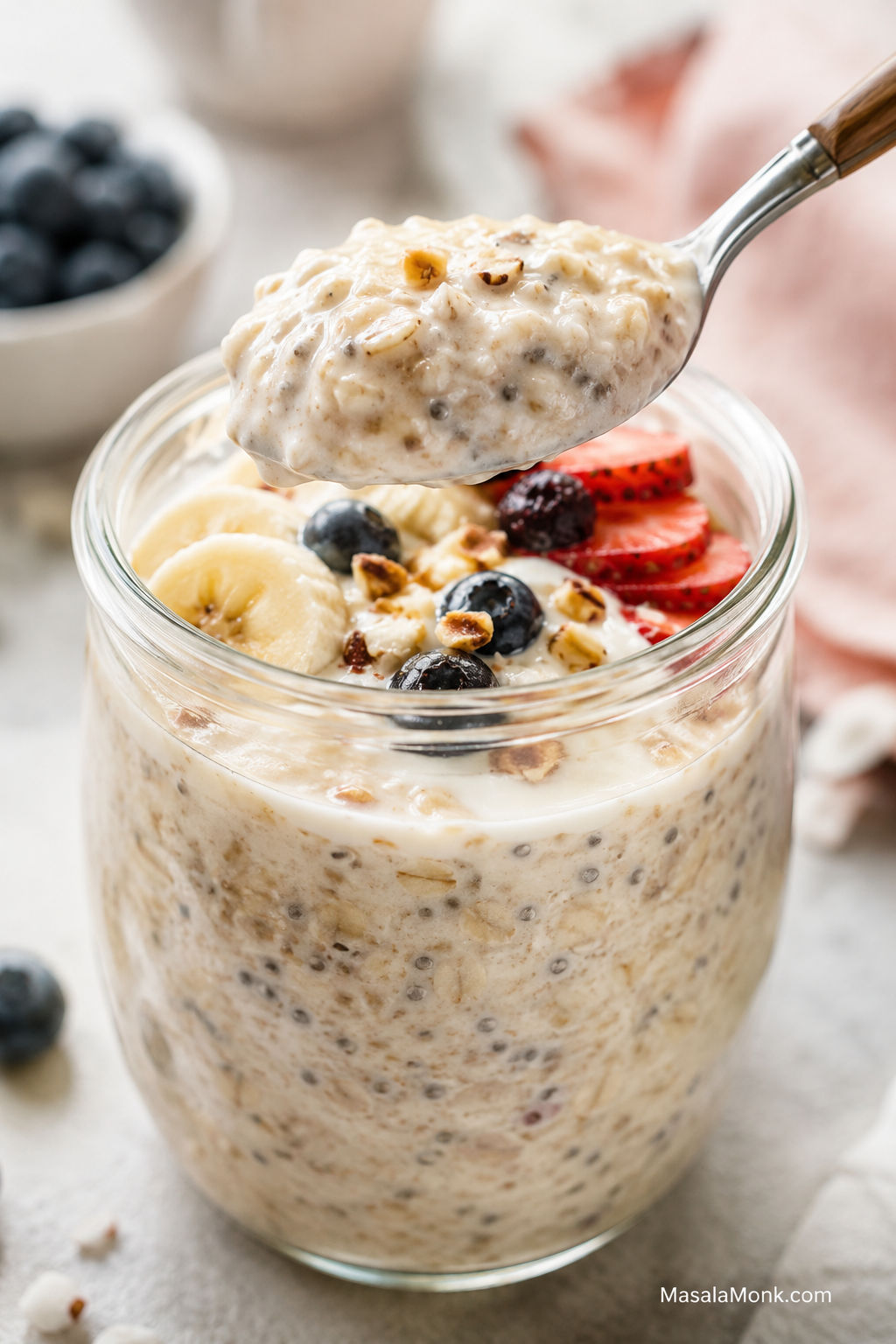
Creamy overnight oats in a glass jar with fresh fruit, nuts, and a spoon lifting a thick bite.

This overnight oats recipe gives you one dependable breakfast jar, then shows you exactly how to adjust it. Start with rolled oats, milk, yogurt or chia, a little sweetness, and a few hours in the fridge. By morning, the oats soften into a creamy, spoonable breakfast with just enough chew — not watery, not gluey, and not bland.

The real secret is not one rigid formula. The best overnight oats depend on the consistency you like: creamy with yogurt, thicker with chia, lighter without yogurt, looser with extra milk, or higher-protein with Greek yogurt and protein powder. Once you know the base, you can turn the same chilled oats into peanut butter, mango, chocolate, apple cinnamon, coffee, banana, berry, or matcha overnight oats without learning a new recipe every time.

The goal is simple: you should be able to mix a jar at night, understand why the texture works, and know exactly what to do in the morning if it needs more milk, more chia, better toppings, or a little extra flavor.

Overnight Oats Guide

Use this guide to get the base ratio right first, then adjust the creaminess, toppings, storage, and flavor so breakfast fits your morning instead of turning into a soggy fridge experiment.

Quick Answer: The Best Overnight Oats Ratio

The basic overnight oats ratio

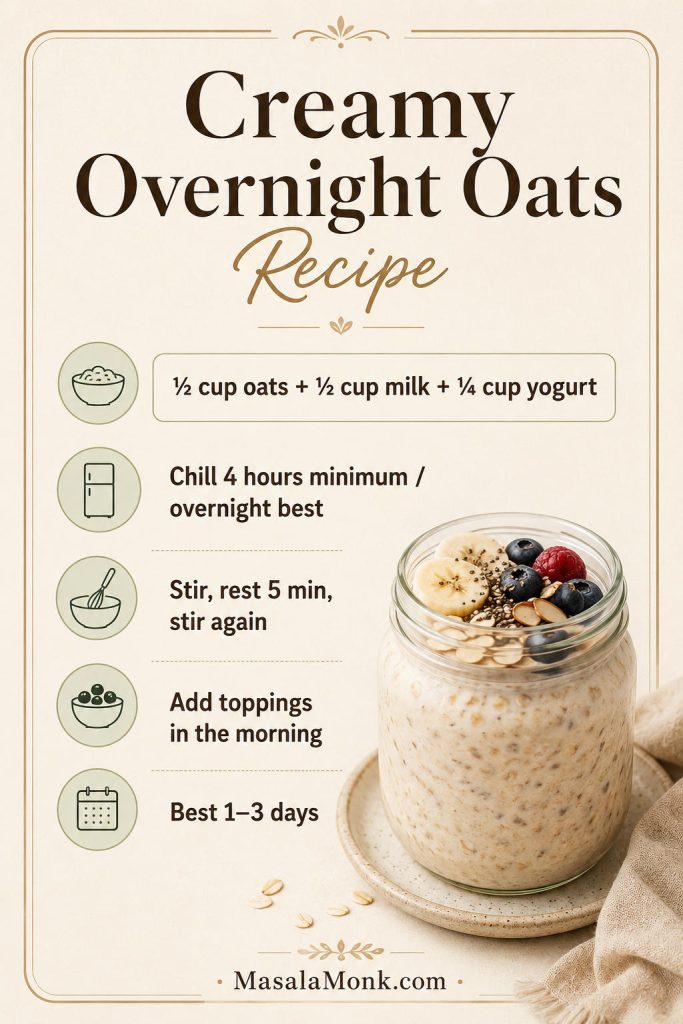
The best all-purpose overnight oats ratio is ½ cup rolled oats + ½ cup milk + ¼ cup Greek yogurt or thick curd. In metric, that is about 40 g oats, 120 ml milk, and 60 g yogurt. This gives you creamy overnight oats that are soft, spoonable, and not too watery.

The no-yogurt ratio

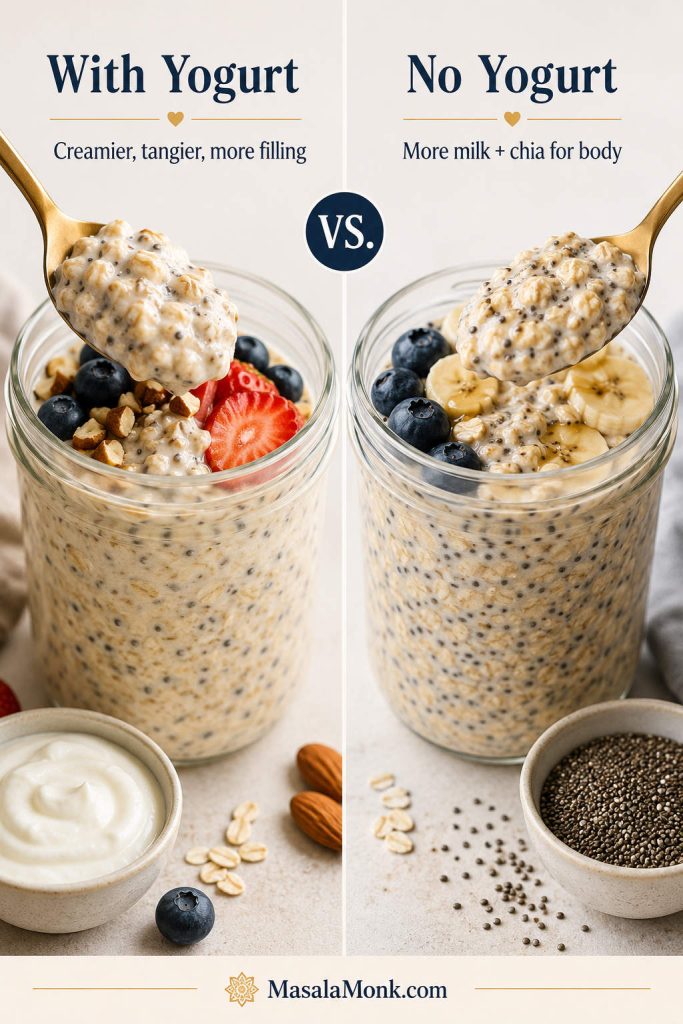
For overnight oats without yogurt, go with ½ cup rolled oats + ⅔ cup milk + 1 tablespoon chia seeds. The extra milk helps the oats soften, while chia seeds thicken the mixture so it still feels creamy.

Best oats and chill time

Rolled oats or old-fashioned oats give the best bite. After mixing, let the jar rest for 5 minutes, then stir again before refrigerating to prevent chia clumps and dry pockets. Chill for at least 4 hours, though overnight, about 8 hours, gives the creamiest result.

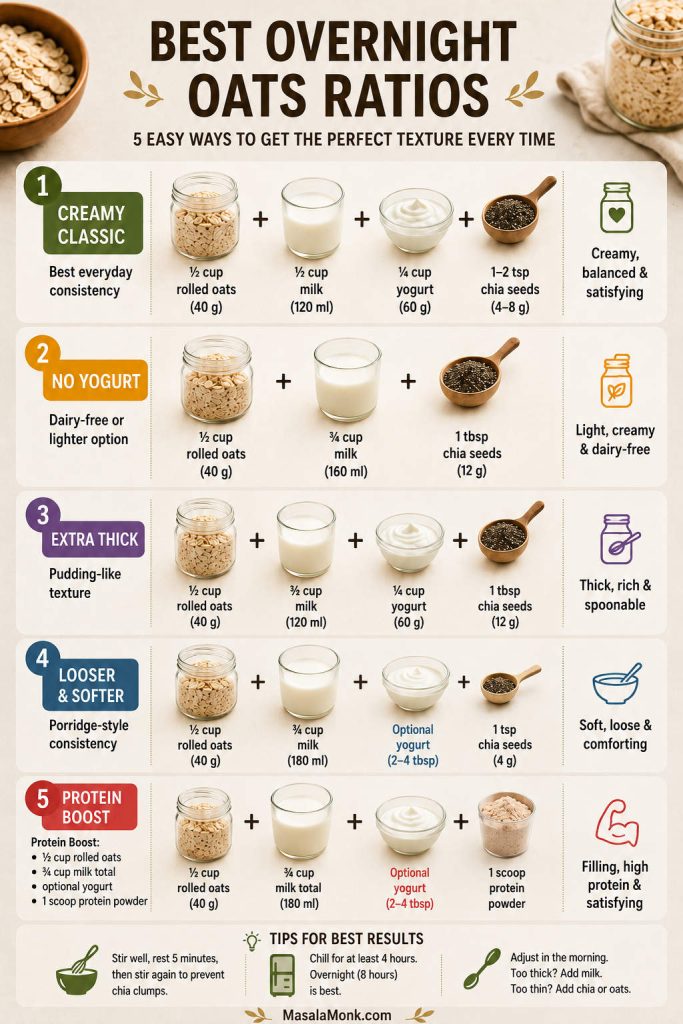
Overnight oats ratio guide showing creamy classic, no-yogurt, extra-thick, looser, and protein versions.
Use the classic overnight oats ratio as your starting point, then adjust milk, yogurt, chia seeds, or protein powder to make the jar thicker, looser, lighter, or more filling.

Ratio variations at a glance

StyleOatsLiquidYogurt / ChiaBest For
Creamy classic½ cup / 40 g½ cup / 120 ml¼ cup / 60 g yogurt + 1–2 tsp chiaBest default consistency
No yogurt½ cup / 40 g⅔ cup / 160 ml1 tbsp chiaDairy-free or lighter oats
Extra thick½ cup / 40 g½ cup / 120 ml¼ cup / 60 g yogurt + 1 tbsp chiaPudding-like oats
Looser½ cup / 40 g¾ cup / 180 mlOptional yogurt or 1 tsp chiaSofter porridge-style oats
Protein powder½ cup / 40 g¾ cup / 180 ml to start1 scoop protein + optional yogurtHigher-protein meal prep

Once you know the ratio, you can jump straight to the recipe card or use the troubleshooting guide if your oats usually turn too thick, watery, mushy, or clumpy. Using protein powder? The protein powder tips section explains why the jar may need extra milk after chilling.

Why This Overnight Oats Recipe Works

The method works because it balances three things: enough liquid to soften the oats, enough body to keep the breakfast creamy, and enough flavor so it does not taste flat by morning. Rolled oats absorb milk slowly, yogurt or curd adds creaminess, chia seeds help everything set, and a pinch of salt makes the sweet flavors taste brighter.

The second stir matters too. When oats, chia, yogurt, and milk sit for a few minutes, they begin to thicken. Stirring again before refrigerating spreads the chia seeds evenly and prevents dry oats or thick clumps from settling at the bottom. You can see the technique in the second-stir step.

That is what makes the core recipe flexible without feeling random. You can make it creamier with yogurt, thicker with chia, lighter with more milk, sweeter with ripe fruit, or more filling with protein powder or nut butter, while still keeping the same basic method.

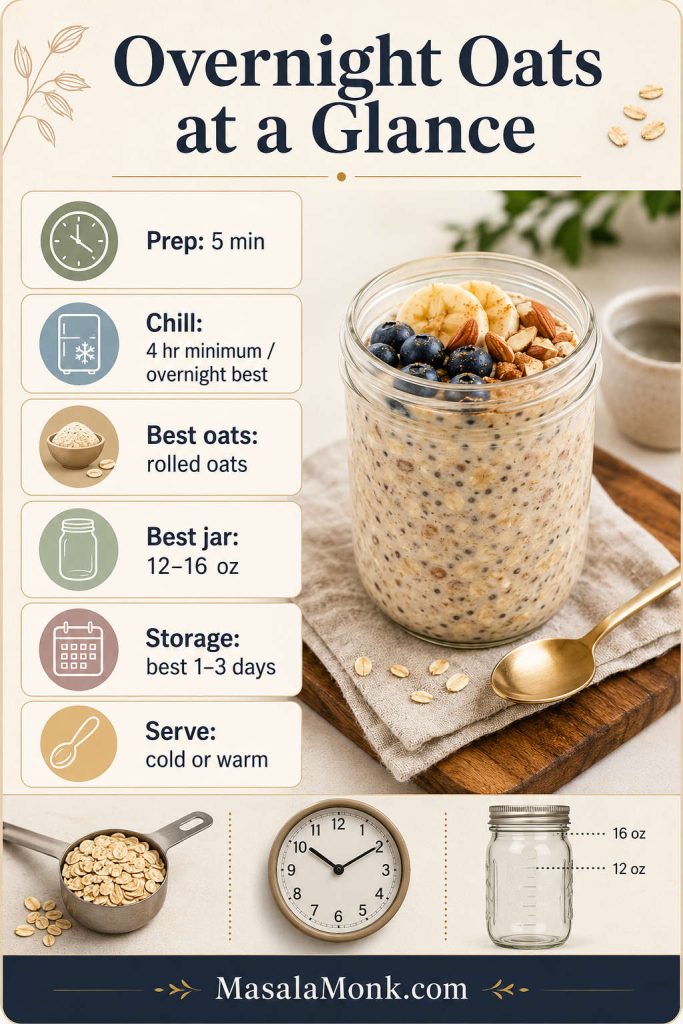
Overnight Oats at a Glance

Before you start, here are the practical details that make the recipe easier to repeat.

At-a-glance overnight oats guide with prep time, chill time, rolled oats, jar size, storage, and cold or warm serving notes.
Once the timing is clear, overnight oats become easy to repeat: mix in minutes, chill until creamy, and finish with toppings when you are ready to eat.
DetailBest Answer
Best oatsRolled oats or old-fashioned oats
Prep time5 minutes
Cook time0 minutes
Chill time4 hours minimum; overnight / 8 hours best
Best container size12–16 oz / 350–500 ml; 16 oz is best with toppings
Fridge temperature40°F / 4°C or below
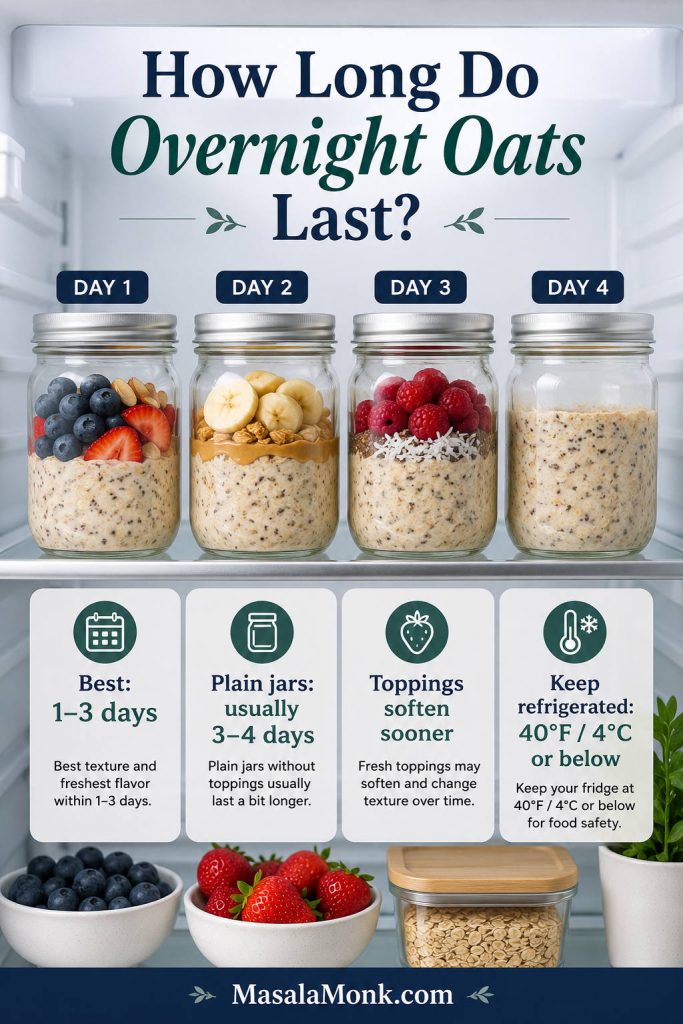
Best storage windowBest in 1–3 days; plain oats usually 3–4 days
Eat cold or warm?Usually cold; can be warmed 30–60 seconds with a splash of milk

If you only want one version to try first, make the creamy classic below. It gives you enough body from yogurt, enough softness from milk, and just a little chia for structure without turning the oats stiff.

Overnight Oats Recipe Card

Creamy Overnight Oats Recipe

This overnight oats recipe is the dependable starting mix: creamy, lightly thickened, easy to flavor, and flexible enough for yogurt, curd, dairy-free milk, chia, fruit, nuts, or protein add-ins.

Prep Time5 minutes

Cook Time0 minutes

Chill Time4 hours minimum

Yield1 breakfast jar

Ingredients

  • ½ cup rolled oats or old-fashioned oats, about 40 g
  • ½ cup milk of choice, 120 ml / 4 fl oz
  • ¼ cup Greek yogurt or thick curd, about 60 g
  • 1–2 teaspoons chia seeds, about 4–8 g
  • 1–2 teaspoons maple syrup, honey, date syrup, or jaggery syrup, 5–10 ml
  • ¼ teaspoon vanilla extract
  • Pinch of fine salt
  • Fruit, nuts, seeds, nut butter, cinnamon, cocoa, coconut, or granola for topping

Instructions

  1. Add the oats, milk, yogurt or curd, chia seeds, sweetener, vanilla, and salt to a jar or lidded container.
  2. Stir very well, scraping the bottom and sides so there are no dry oats, chia clumps, or yogurt pockets.
  3. Let the mixture sit for 5 minutes, then stir again. This second stir helps the chia seeds spread evenly and gives a smoother result.
  4. Cover and refrigerate for at least 4 hours. For the best consistency, chill overnight.
  5. In the morning, stir again. If the oats are too thick, loosen with 1–3 tablespoons milk.
  6. Add fresh fruit, crunchy toppings, nuts, granola, or extra nut butter right before serving.

Recipe Notes

  • No yogurt? Combine ½ cup oats, ⅔ cup milk, and 1 tablespoon chia seeds, or see the no-yogurt ratio for the texture logic.
  • Want a thicker, pudding-like jar? Increase the chia seeds to 1 tablespoon.
  • Adding protein powder? Use 1 scoop and increase the milk by about ¼ cup / 60 ml; see the protein powder tips if your oats turn stiff or clumpy.
  • Need more sweetness? Taste in the morning and adjust then, so the jar does not become dessert-sweet overnight.
  • For the smoothest mix, stir everything in a bowl first, then transfer it to a jar after the second stir.
  • Need more topping guidance? Add crunchy toppings in the morning, or jump to when to add overnight oats toppings.
  • Nutrition varies by milk, yogurt, sweetener, and toppings. The base jar is generally more balanced when it includes yogurt or another protein source, while nut butter, granola, dried fruit, chocolate chips, and syrup can raise calories quickly.

Storage

Overnight oats taste best in the first 1–3 days. A plain sealed serving can usually keep for 3–4 days in the refrigerator at 40°F / 4°C or below. Add delicate fruit, nuts, seeds, and granola closer to serving for the best consistency.

Saveable creamy overnight oats recipe card with oats, milk, yogurt, chill time, second stir tip, topping timing, and storage note.
This base overnight oats recipe gives you the formula to return to whenever you want a make-ahead breakfast without guessing the liquid, chill time, or topping timing.

Want to change the thickness? Use the ratio guide. Want to keep the same base but change the taste? Go to the flavor ideas.

First time making overnight oats? Start with the creamy classic ratio, keep toppings simple, and adjust the thickness in the morning. After one serving, you will know whether you prefer more milk, more chia, or less yogurt.

Overnight Oats Ratio Guide

The easiest way to build the base is to start with equal parts oats and milk, then decide whether you want yogurt, chia, or both. Yogurt makes the oats creamier and more filling. Chia does a different job: it makes the jar thicker and more pudding-like. Extra milk gives you a looser, softer consistency.

Creamy classic ratio

This is the version to start with if you are making overnight oats for the first time. For a creamy everyday texture, combine ½ cup rolled oats, ½ cup milk, and ¼ cup yogurt or curd. It gives you a satisfying breakfast without making the oats too stiff.

Yogurt vs No-Yogurt Overnight Oats

Go this route when you want dairy-free, vegan, or lighter overnight oats. Instead of yogurt, combine ½ cup rolled oats, ⅔ cup milk, and 1 tablespoon chia seeds. Chia replaces some of the body you would normally get from yogurt.

Side-by-side comparison of overnight oats with yogurt and no-yogurt overnight oats thickened with chia seeds.
Yogurt makes overnight oats creamier and tangier, while the no-yogurt version needs extra milk and chia seeds to stay thick and spoonable.

Extra-thick chia ratio

For a thicker, pudding-like result, keep the classic ratio but increase chia seeds to 1 tablespoon. This works especially well with cocoa, peanut butter, banana, and coffee flavors.

Looser porridge-style ratio

If you like softer oats with more movement, combine ½ cup oats and ¾ cup milk, with yogurt or chia kept optional. This version feels closer to chilled porridge.

Texture tip: Overnight oats thicken as they sit. A jar that looks slightly loose at night can be perfect by morning, while a jar with chia or protein powder may need extra milk after chilling.

Choose your overnight oats texture

There is no single perfect consistency. Some people want oats thick enough to hold a spoon upright, while others want something closer to chilled porridge. Use this as your shortcut.

If You Like…Best Adjustment
Thick, spoonable oatsAdd yogurt plus 1 tablespoon chia seeds.
Soft, loose oatsUse ¾ cup milk for every ½ cup oats.
Less tangUse less yogurt and more milk.
More natural sweetnessMix in mashed banana, mango, grated apple, berries, or applesauce.
More staying powerAdd Greek yogurt, soy milk, chia, protein powder, peanut butter, or nut butter.
A lighter breakfastUse milk plus chia instead of yogurt, and keep toppings simple.

If your oats still do not come out the way you like, the texture guide and fixes section will help you adjust the next batch.

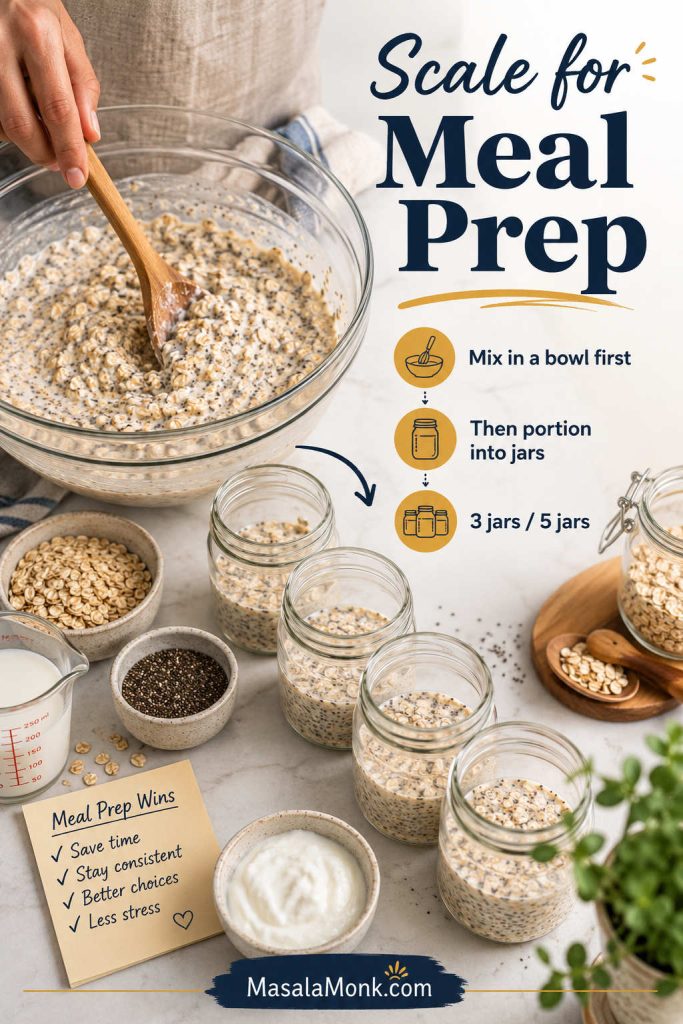
How to Scale Overnight Oats for Meal Prep

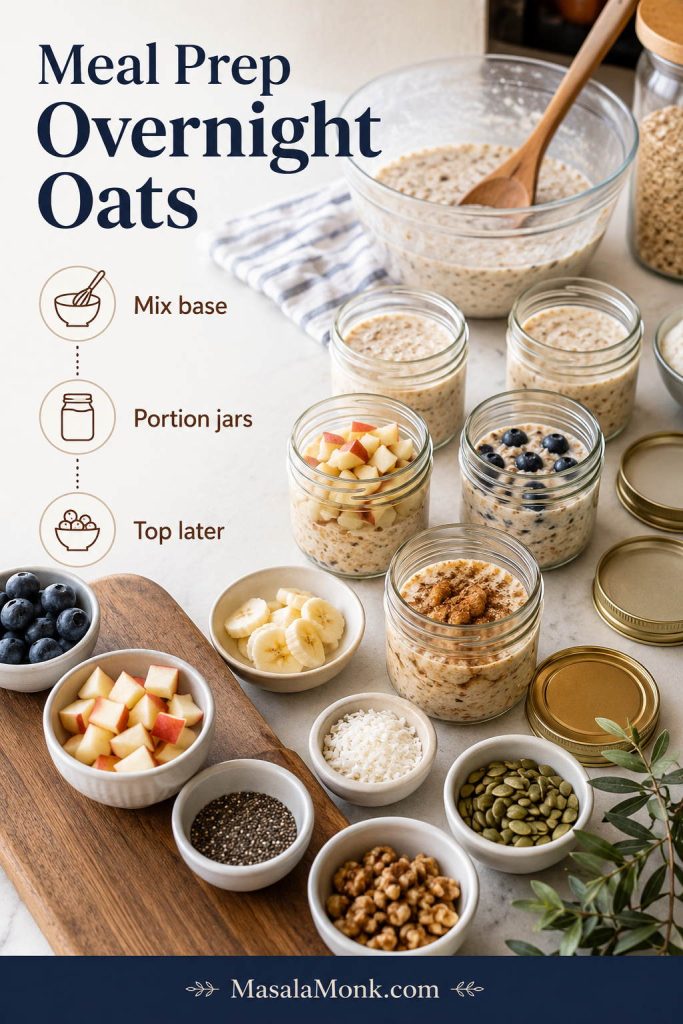
For meal prep, mix the oats in a large bowl first, then divide them into jars. This is easier than trying to stir several full containers one by one, and it helps every serving taste consistent.

Large bowl of overnight oats being mixed and portioned into several jars for meal prep.
For overnight oats meal prep, mix the base in one bowl first and then divide it into jars, so every serving has the same texture and flavor.
ServingsRolled OatsMilkYogurt / CurdChia Seeds
1 jar½ cup / 40 g½ cup / 120 ml¼ cup / 60 g1–2 tsp
3 jars1½ cups / 120 g1½ cups / 360 ml¾ cup / 180 g1–2 tbsp
5 jars2½ cups / 200 g2½ cups / 600 ml1¼ cups / 300 g1½–3 tbsp

Equipment for Overnight Oats

You do not need special equipment, but the right container makes the oats easier to mix, store, and eat. A jar that is too small might technically hold the ingredients, but it will not give you much room to stir or add toppings.

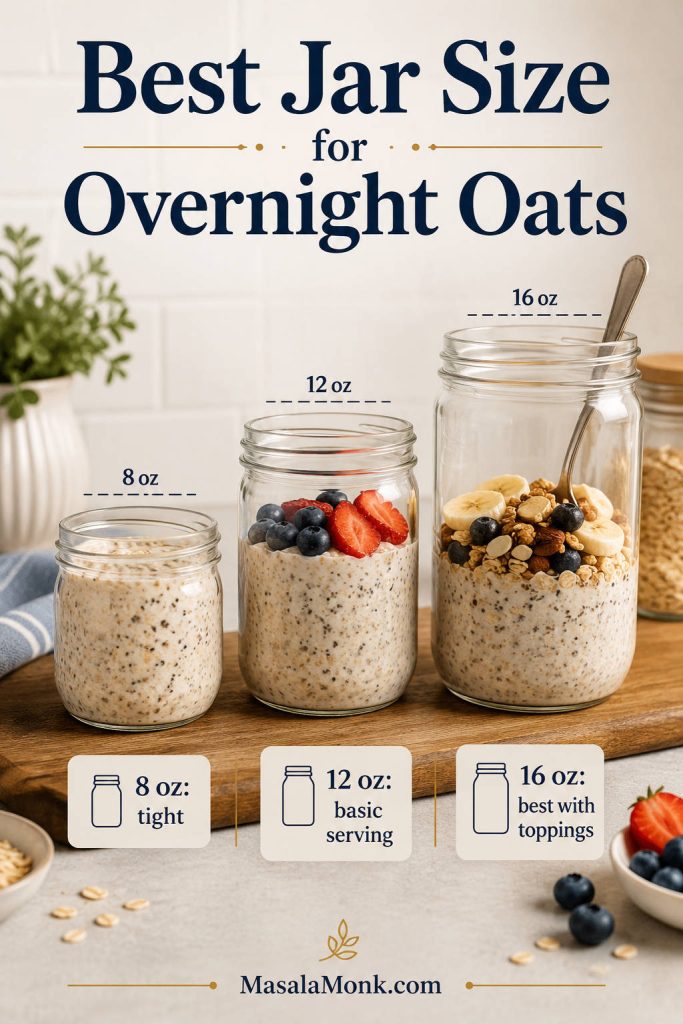
Best Jar Size for Overnight Oats

Use the jar size as a texture tool, not just a container choice. A little extra room makes stirring easier and keeps fruit or crunchy toppings from spilling over.

Jar size guide for overnight oats showing 8-ounce, 12-ounce, and 16-ounce jars with different fill levels.
A 12-ounce jar works for a basic serving, but a 16-ounce jar gives you more room to stir, add fruit, and keep toppings from spilling over.
  • Jar or lidded container: 12–16 oz / 350–500 ml for one serving.
  • 16 oz / 475–500 ml jar: best if you want room for fruit, nuts, yogurt, and stirring.
  • Mixing bowl: useful when making 3–5 servings at once.
  • Spoon or mini spatula: helpful for scraping the bottom and sides so chia seeds and oats do not clump.
  • Measuring cups and spoons: important until you know the consistency you like.
  • Microwave-safe bowl: optional, only if you plan to warm the oats.

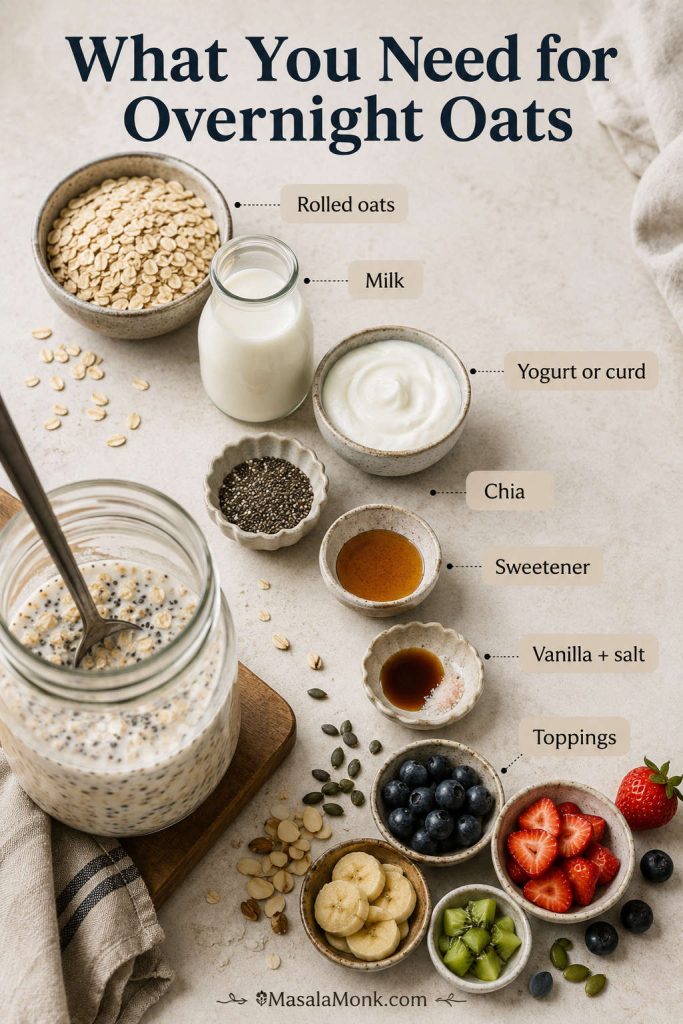
Ingredients You Need for Overnight Oats

A good jar starts with a simple oat mixture, then gets its personality from fruit, spices, nuts, seeds, nut butter, cocoa, coffee, or coconut. Here is what each ingredient does.

Overnight oats ingredients guide with rolled oats, milk, yogurt or curd, chia seeds, sweetener, vanilla, salt, and toppings.
The best overnight oats start with a simple base: rolled oats, liquid, something creamy or thickening, a little seasoning, and toppings added with purpose.

Rolled oats or old-fashioned oats

Rolled oats are the safest default because they soften well while keeping a little texture. Old-fashioned oats and rolled oats can usually be used the same way. For a deeper oat-type breakdown, see this MasalaMonk guide to oats types, nutrition, and differences.

For a quick comparison of rolled oats, quick oats, instant oats, steel-cut oats, and muesli in this recipe, see the best oats for overnight oats section below.

Milk

Dairy milk, oat milk, almond milk, soy milk, coconut milk, and cashew milk can all work. Soy milk and dairy milk add a little more protein. Oat milk and coconut milk make the breakfast creamier, while almond milk keeps it lighter.
Yogurt or thick curd

Greek yogurt or thick curd makes the oats creamier, tangier, and more filling. When your curd is very sour, use a smaller amount and balance it with fruit, vanilla, cinnamon, or a little sweetener.

Chia seeds

Chia seeds thicken the oats and help hold the liquid. Add 1–2 teaspoons for light thickening or 1 tablespoon for a pudding-like result. Too much chia can make the texture feel gluey, so increase it gradually.

If you like the thicker, pudding-style side of overnight oats, you may also enjoy these chia pudding recipes, which use chia as the main thickener rather than a small supporting ingredient.

Sweetener

Maple syrup, honey, date syrup, jaggery syrup, or a mashed ripe banana all work. Start light because fruit and toppings can add sweetness later.
Vanilla, salt, and spices

A tiny pinch of salt makes overnight oats taste less flat. Vanilla, cinnamon, cardamom, cocoa, nutmeg, ginger, or instant espresso powder can also change the flavor without changing the base method.

Toppings

Fruit, nuts, seeds, granola, coconut, peanut butter, almond butter, jam, chocolate chips, or roasted makhana can all work. Soft mix-ins can go in at night, while crunchy toppings are better in the morning. For a quick way to build a better jar, see the topping builder.
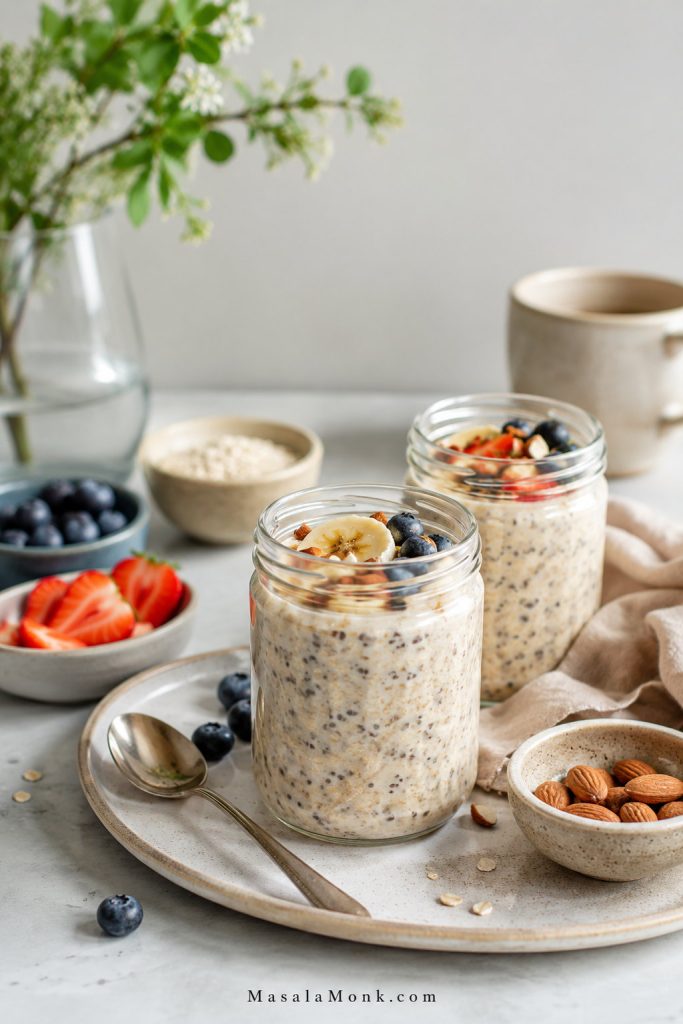
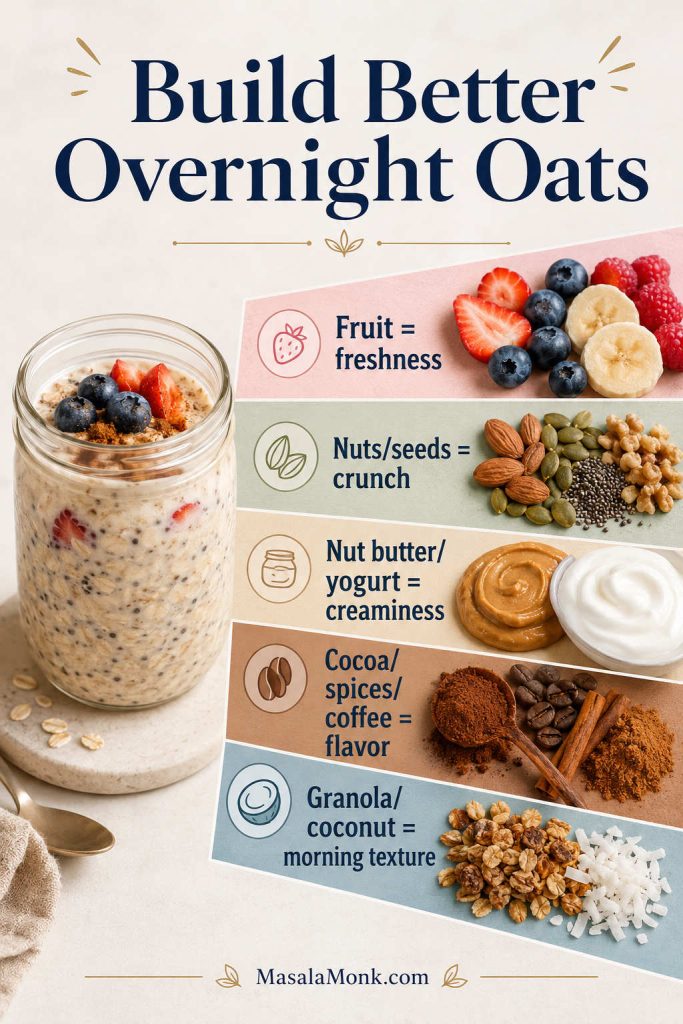
Build Better Overnight Oats Toppings

Choose toppings by purpose instead of adding everything at once. Freshness, crunch, creaminess, flavor, and texture each do a different job in the jar.

Overnight oats topping builder showing fruit, nuts, seeds, nut butter, yogurt, spices, granola, and coconut grouped by purpose.
Better toppings do a job: fruit adds freshness, nuts and seeds add crunch, and creamy extras like yogurt or nut butter make the jar more satisfying.

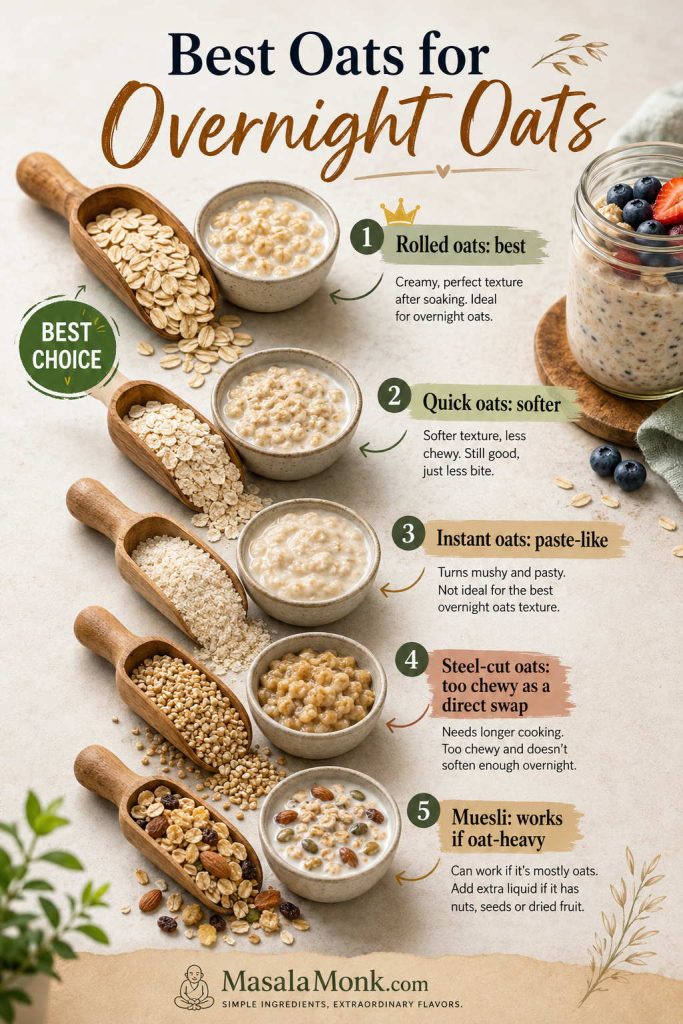
Best Oats for Overnight Oats

The best oats for overnight oats are rolled oats or old-fashioned oats. They absorb liquid evenly and become creamy without turning instantly mushy.

Guide to rolled oats, quick oats, instant oats, steel-cut oats, and muesli for making overnight oats.
Rolled oats are the safest choice for overnight oats because they soften evenly while still keeping enough texture to avoid turning mushy.
Oat TypeCan You Use It?TextureBest Use
Rolled oats / old-fashioned oatsYes, best choiceCreamy with light chewBest default method
Quick oatsYes, but softerVery soft, can turn mushyFast-soak jars or softer oats
Instant oatsOnly if neededSoft, sometimes paste-likeEmergency quick version
Steel-cut oatsNot a simple swapChewy, firm, sometimes toughSeparate steel-cut overnight method
MuesliYes, if oat-heavyMore varied textureNutty, fruit-filled jars

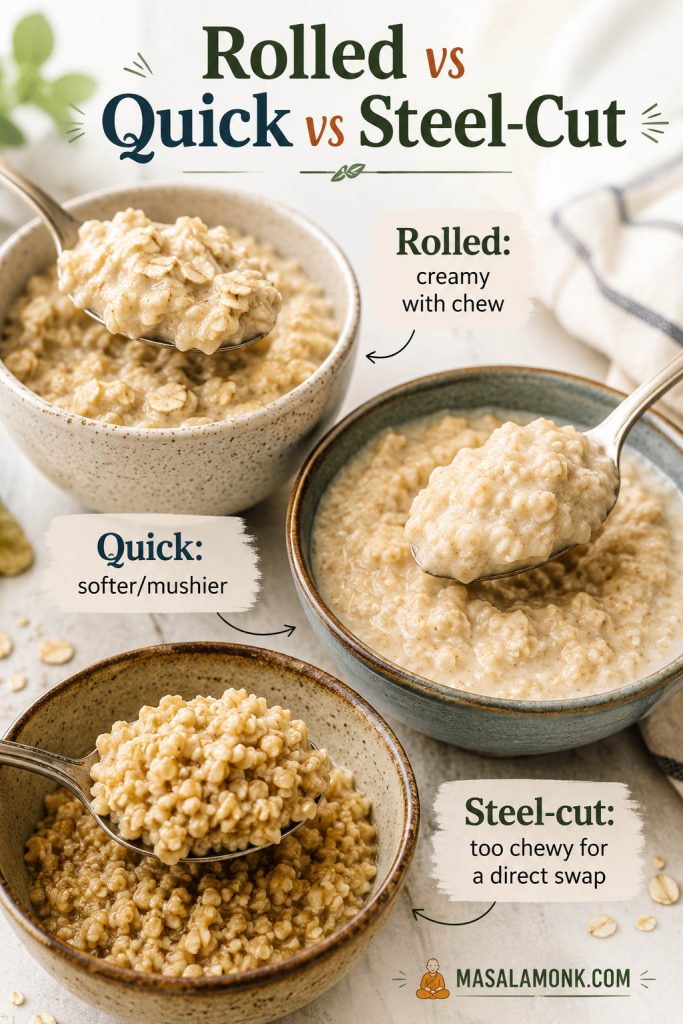
Rolled Oats vs Quick Oats vs Steel-Cut Oats

The soak changes each oat type differently. This comparison is useful when you want to understand why rolled oats are the safest default for this method.

Comparison of soaked rolled oats, quick oats, and steel-cut oats showing different overnight oats textures.
Rolled oats give the best balance of creaminess and chew; quick oats soften more, while steel-cut oats stay too firm for a direct swap.

If you are choosing between rolled oats and steel-cut oats, this MasalaMonk comparison of steel-cut oats vs rolled oats explains the texture difference in more detail.

If your package says old-fashioned oats, this guide to old-fashioned oats and rolled oats will help clarify the naming.

How to Make Overnight Oats

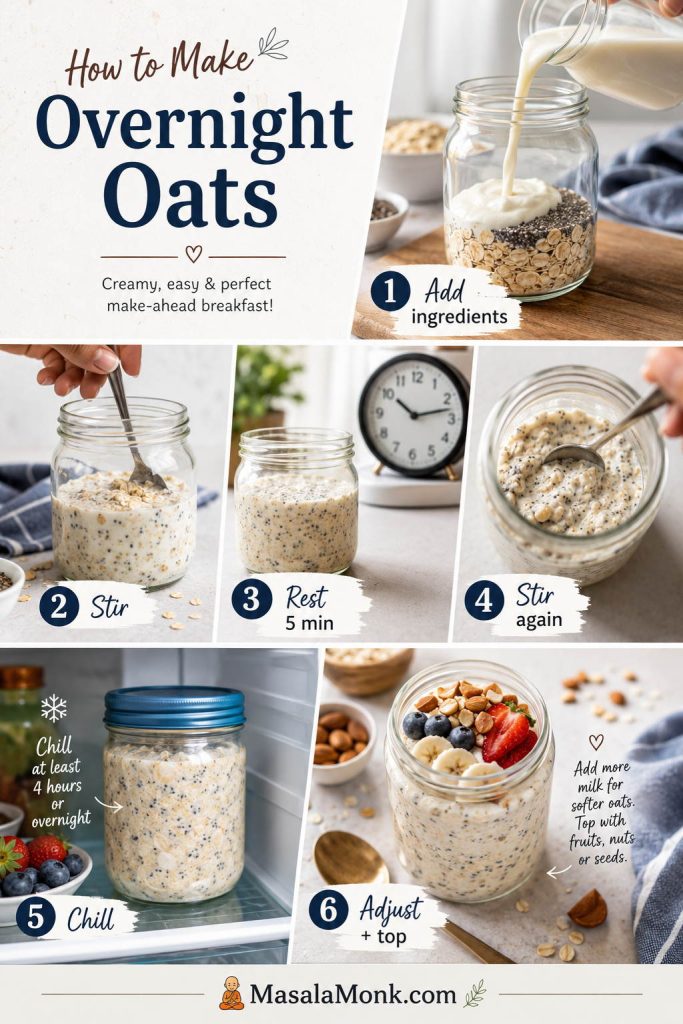
The method is simple, but the small details matter. Stirring well, resting briefly, and stirring again helps prevent dry pockets, chia clumps, and protein powder lumps.

Step-by-step overnight oats method showing ingredients added, stirred, rested, stirred again, chilled, adjusted, and topped.
The overnight oats method is simple, but the rest-and-stir step helps prevent dry pockets and chia clumps before the jar goes into the fridge.

Step 1: Add the base ingredients

Add rolled oats, milk, yogurt or curd, chia seeds, sweetener, vanilla, and salt to a jar or bowl.

Step 2: Stir very well

Scrape the bottom and sides as you stir. Dry oats and chia seeds often hide in the corners of a jar, especially if the container is narrow.

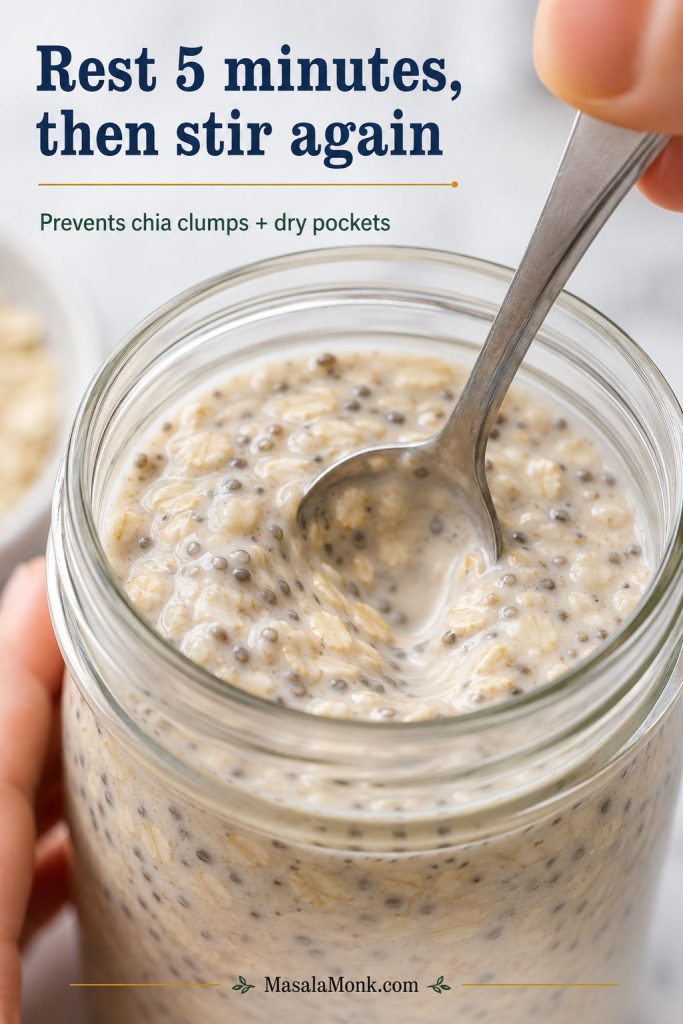
Step 3: Rest for 5 Minutes, Then Stir Again

This second stir is the difference between creamy oats and a serving with clumps at the bottom. It is especially helpful when you use chia seeds, yogurt, cocoa, matcha, or protein powder.

Close-up of overnight oats being stirred again after a short rest to prevent chia clumps and dry pockets.
After the first stir, let the jar sit for five minutes and stir again so chia seeds spread evenly and the oat mixture sets more smoothly.

Step 4: Cover and refrigerate

Chill for at least 4 hours. Overnight, or about 8 hours, gives the best consistency because the oats have more time to soften evenly.

Step 5: Stir and adjust in the morning

If the oats are too thick, add 1–3 tablespoons milk. If they are too loose, add a teaspoon of chia or a spoon of oats and let them sit a little longer.

Step 6: Add toppings

Add fresh banana, crisp apple, granola, toasted nuts, and other crunchy toppings right before eating so they keep their bite.

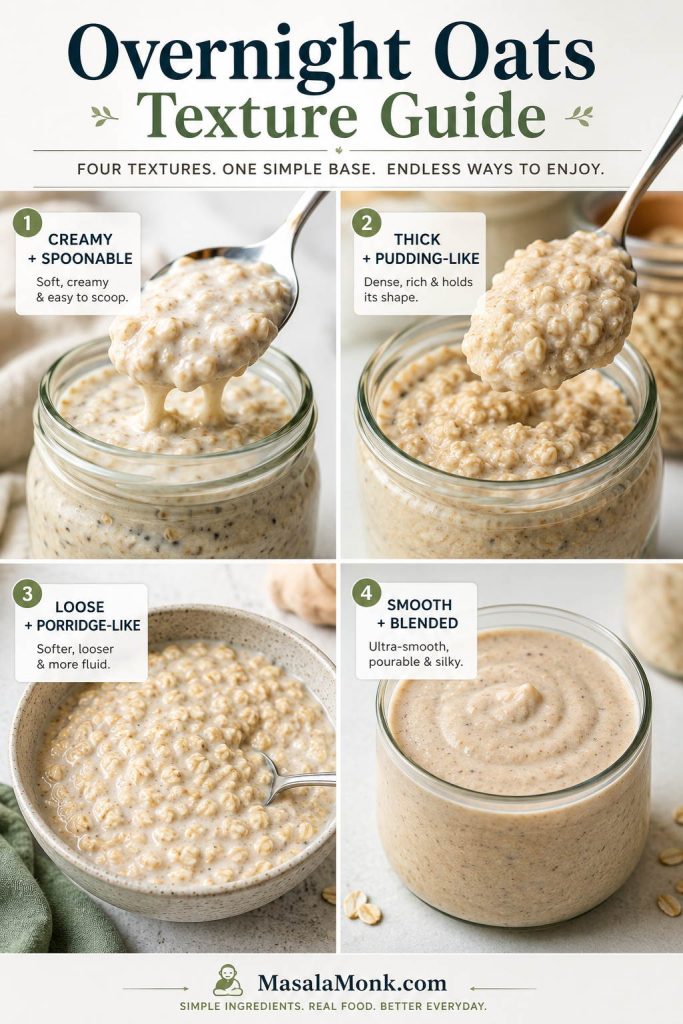
Overnight Oats Texture Guide

Good overnight oats should be creamy, not watery, gluey, or dry. The final consistency comes down to the oat type, liquid amount, yogurt, chia, and how long the mixture rests.

Overnight oats texture guide showing creamy, thick, loose, and smooth blended oat textures.
Texture is adjustable: yogurt makes oats creamier, chia seeds make them thicker, extra milk makes them looser, and blending makes the base smoother.
TextureHow to Get ItBest Ratio
Creamy and spoonableAdd yogurt or thick curd½ cup oats + ½ cup milk + ¼ cup yogurt
Thick and pudding-likeAdd yogurt plus more chia½ cup oats + ½ cup milk + ¼ cup yogurt + 1 tbsp chia
Loose and porridge-likeIncrease the liquid½ cup oats + ¾ cup milk
ChewierChoose thicker rolled oats and soak overnightKeep the classic ratio, avoid quick oats
Smooth/blendedBlend the mixture before chillingUse the classic ratio, then blend

If you are trying to fix a jar that already went wrong, start with the too thick vs too runny guide, then use the full overnight oats troubleshooting table.

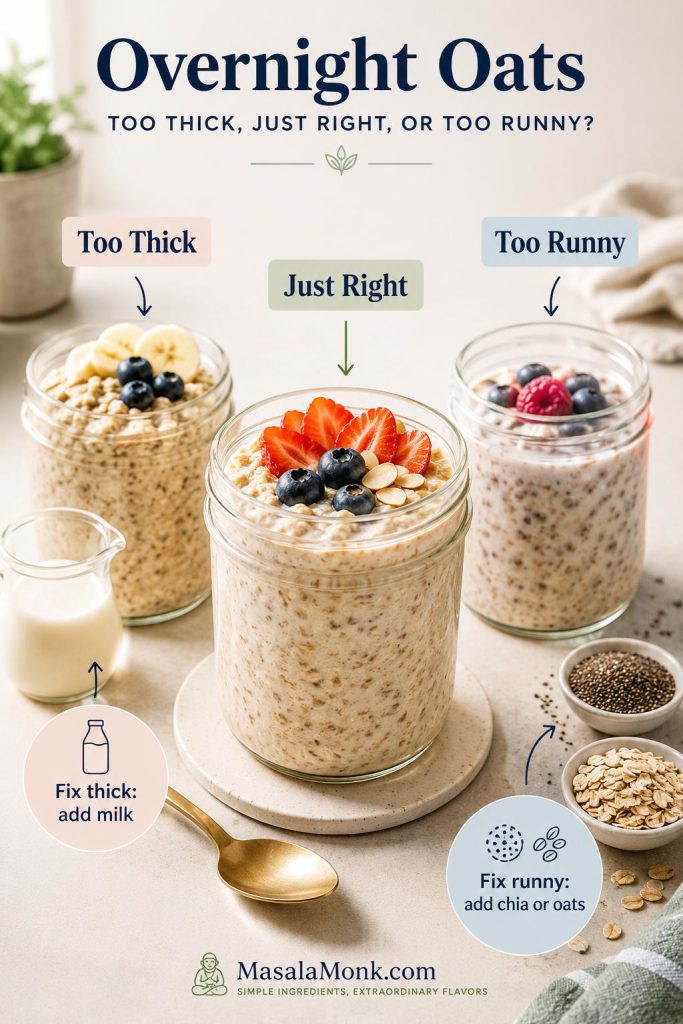
Too Thick, Just Right, or Too Runny?

Before changing the whole recipe, check the texture first. Most jars only need a small correction with milk, oats, or chia seeds.

Overnight oats comparison showing too-thick, just-right, and too-runny textures with milk, chia, and oats as fixes.
Most overnight oats texture problems are easy to fix: add milk when the jar is too thick, or add chia seeds or oats when it is too loose.

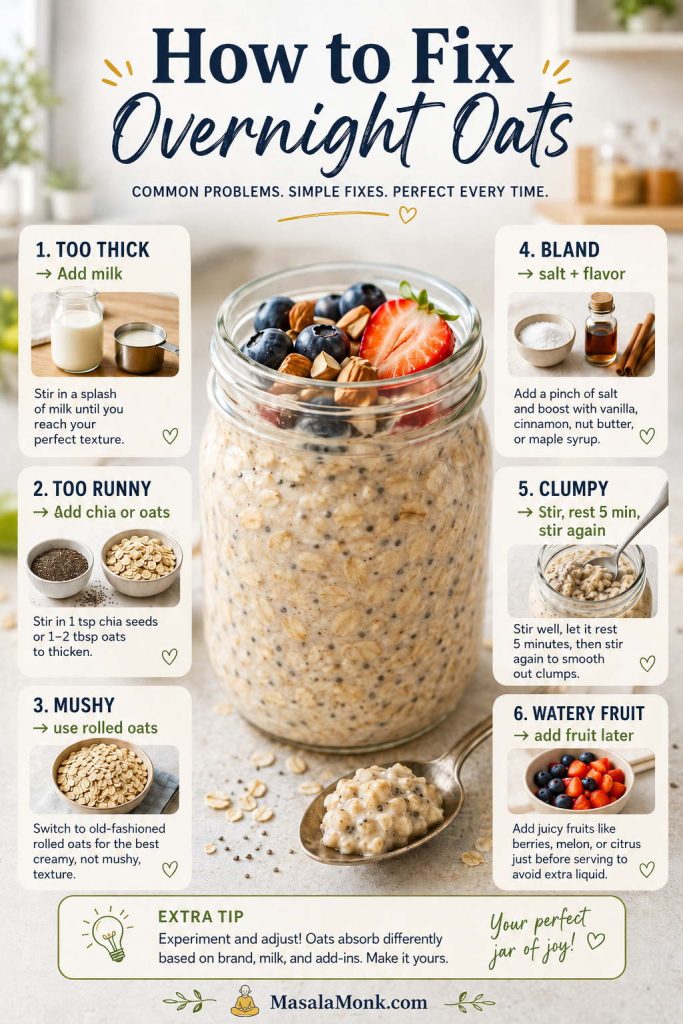
How to Fix Overnight Oats

A disappointing jar is usually fixable. In practice, most bad overnight oats are not a recipe problem; they are a ratio or topping-timing problem. Too much chia needs milk, too much liquid needs oats or chia, bland oats need salt and flavor, and watery fruit usually means the toppings went in too early.

Troubleshooting board for overnight oats that are too thick, too runny, mushy, bland, clumpy, or watery from fruit.
A disappointing jar is usually fixable once you know whether the problem is liquid, thickener, oat type, flavor, stirring, or topping timing.
ProblemWhy It HappenedFix It NowNext Time
Too thickToo much chia, protein powder, or too little liquidStir in 1–3 tbsp milkReduce chia or add more milk
Too runnyToo much liquid or not enough soak timeAdd 1–2 tsp chia or 1–2 tbsp oats and restStart with less milk or more thickener
Too mushyQuick oats, instant oats, or too much liquidAdd crunchy toppingsChoose rolled oats
Too chewySteel-cut oats or not enough soak timeAdd milk and rest longerStick with rolled oats for this method
BlandNo salt, vanilla, fruit, spice, or enough sweetnessAdd salt, cinnamon, vanilla, and fruitSeason the mixture at night
Too sourToo much yogurt or very sour curdAdd milk, fruit, or a little sweetenerUse less yogurt or a milder curd
Chia clumpsNot stirred properlyBreak clumps with a spoon and loosen with milkStir, rest 5 minutes, stir again
Protein powder clumpsPowder was not mixed with enough liquidStir hard or blend brieflyMix protein powder with milk first
Watery fruit layerJuicy fruit was mixed in too earlyStir in chia or add thicker toppingAdd delicate fruit in the morning

15 Easy Overnight Oats Flavors

Once the ratio is right, the fun part is flavor. The easiest overnight oats flavors usually follow the same pattern: one main flavor, one creamy or crunchy element, and one fresh topping added in the morning. Start with these combinations, then adjust sweetness and thickness after chilling.

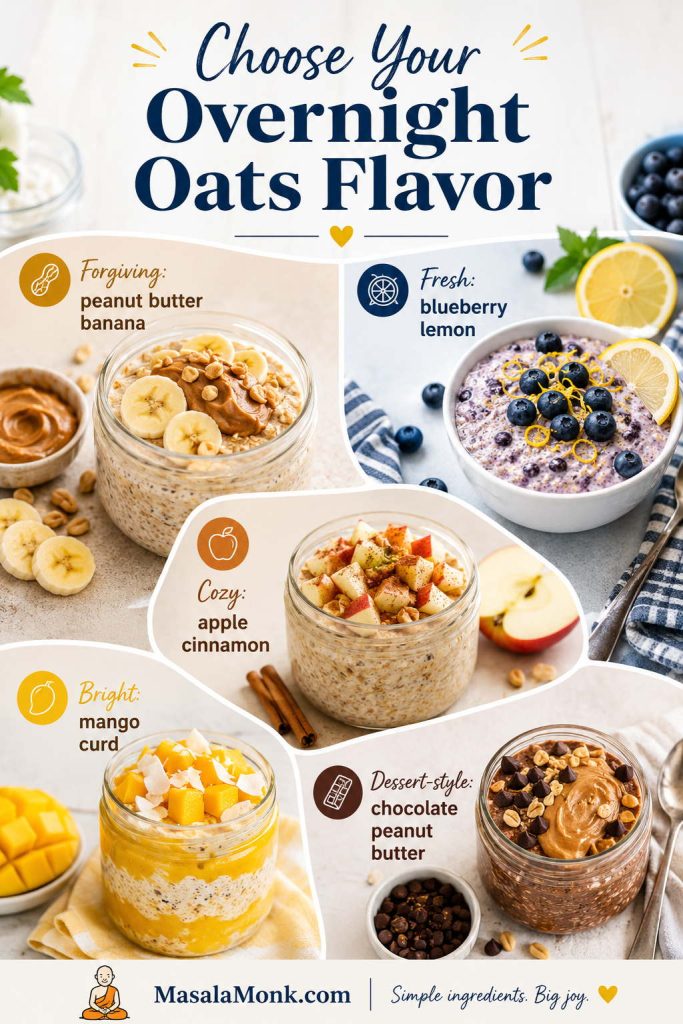
Overnight oats flavor chooser with peanut butter banana, blueberry lemon, apple cinnamon, mango curd, and chocolate peanut butter ideas.
Choose your first overnight oats flavor by mood: peanut butter banana is forgiving, apple cinnamon is cozy, mango curd is bright, and blueberry lemon feels fresh.

Best Flavors to Try First

If you are not sure where to start, choose by mood. Peanut butter banana is the most forgiving first jar because it hides small texture mistakes well. Mango curd tastes bright and lassi-like. Apple cinnamon feels cozy, especially when you add crisp apple in the morning. Chocolate peanut butter is the dessert-style option, while blueberry lemon keeps the jar fresher and lighter.

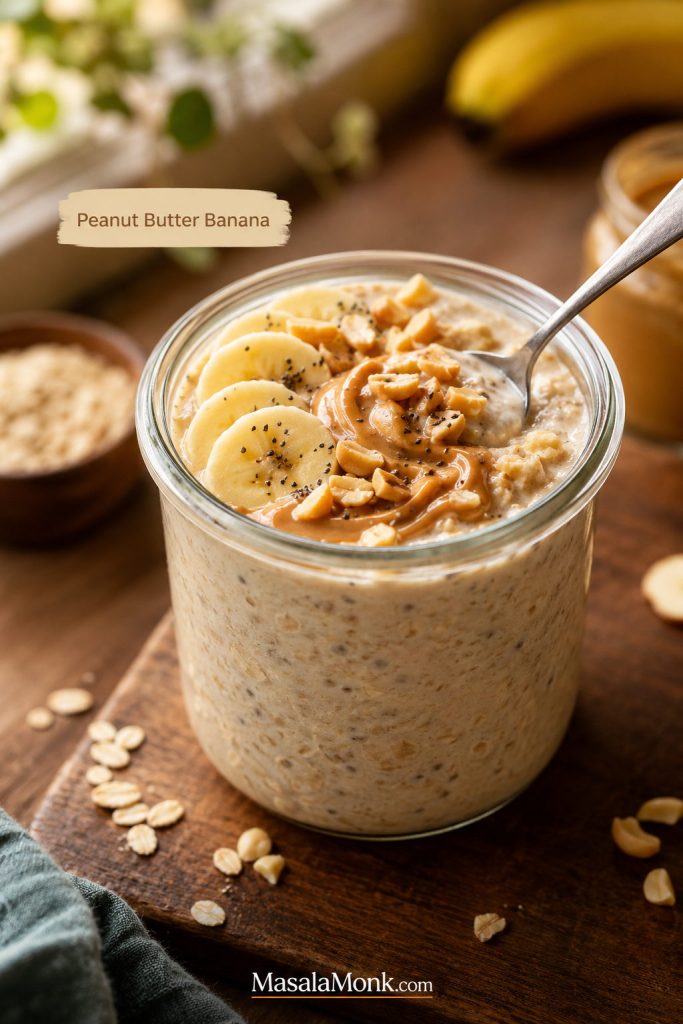
Peanut butter banana overnight oats topped with banana slices, peanut butter, crushed nuts, and chia seeds.
Peanut butter banana is one of the easiest overnight oats flavors because banana and nut butter both help the jar taste creamy and forgiving.

How to build better flavor

For a breakfast that tastes fresh, keep juicy fruit and crunchy toppings for the morning. For a more dessert-like jar, mix cocoa, coffee, cinnamon, peanut butter, mashed banana, or coconut into the oats before chilling so the flavor has time to settle.

Fruit-Forward Overnight Oats Flavors

Use this group when you want a brighter breakfast jar. Fruit flavors work best when juicy fruit and crunchy toppings are timed carefully.

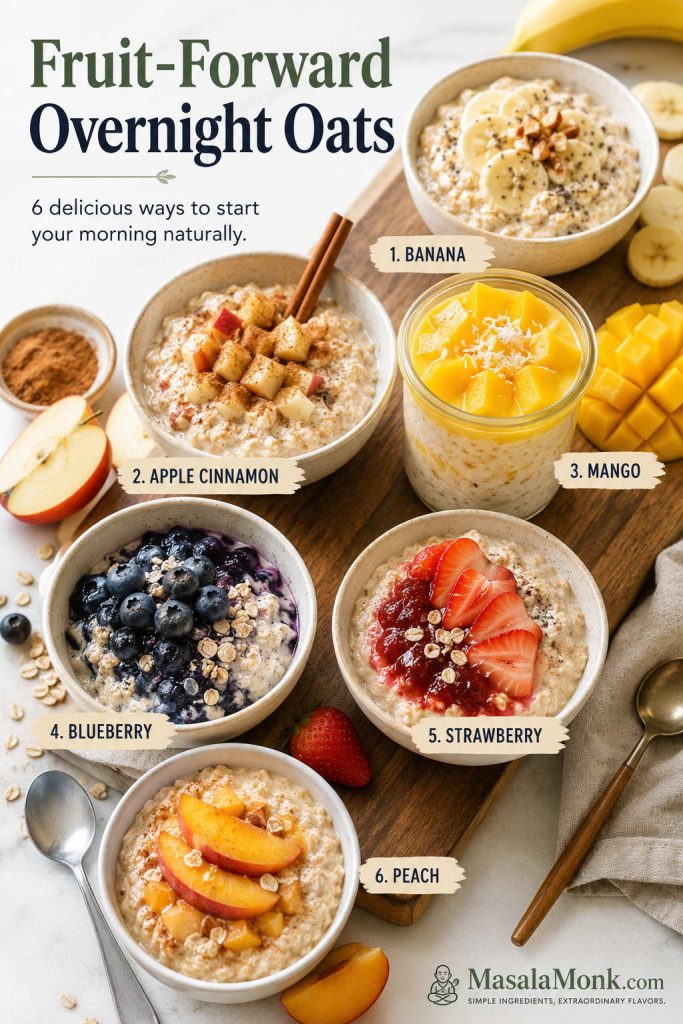
Fruit-forward overnight oats flavor board with banana, apple cinnamon, mango, blueberry, strawberry, and peach options.
Fruit-forward overnight oats taste best when juicy fruit and crunchy toppings are timed well, so the base stays creamy instead of turning watery.
FlavorMix In at NightAdd in the MorningTexture Note
BananaMashed ripe banana + cinnamonFresh banana slices, walnutsMashed banana thickens the oats
Apple cinnamonCinnamon + grated apple or applesauceDiced apple, walnuts, raisinsAdd crisp apple in the morning
MangoMango puree or chopped mangoFresh mango, coconut, pistachioThick curd gives a lassi-style feel
BlueberryFrozen or fresh blueberriesLemon zest, nuts, yogurt swirlFrozen berries release juice
StrawberryChopped strawberries or strawberry compoteFresh strawberries, granolaAdd granola only before eating
PeachChopped peach + cinnamonMore peach, almonds, granolaRipe peaches can loosen the oats

If fruit jars often turn watery or soft, the topping timing guide will help you decide what to mix in at night and what to add in the morning.

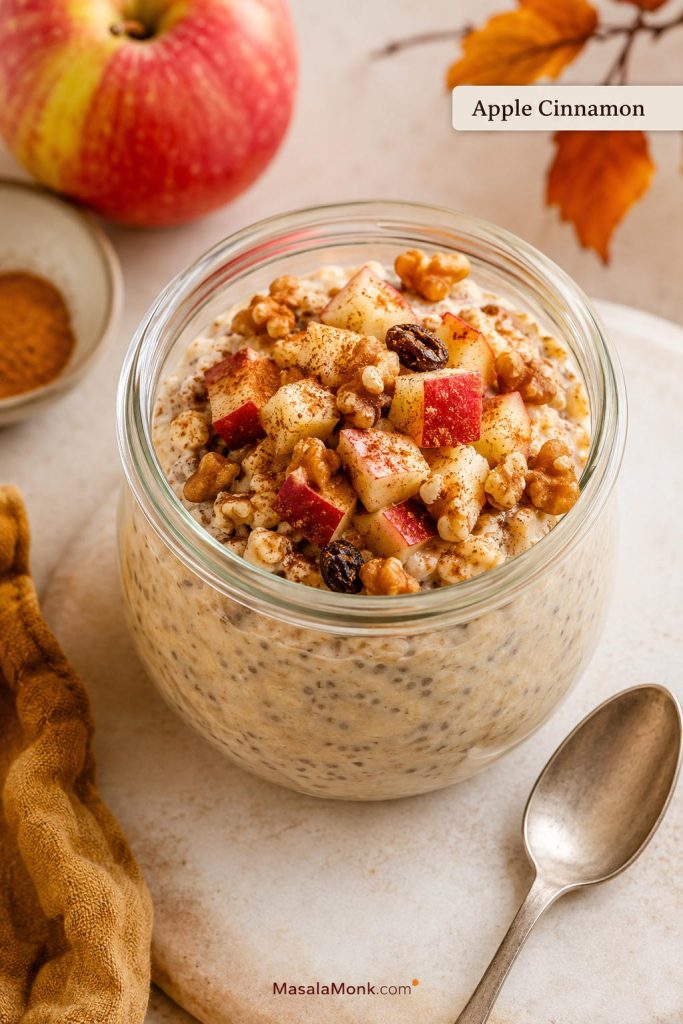
Apple Cinnamon Overnight Oats

This is the cozy option when you want spice and crunch. Add crisp apple close to serving so the topping stays fresh against the creamy oat base.

Apple cinnamon overnight oats topped with diced apple, cinnamon, walnuts, and raisins.
Apple cinnamon overnight oats work best when crisp apple is added close to serving, giving the creamy base a fresh bite and cozy flavor.

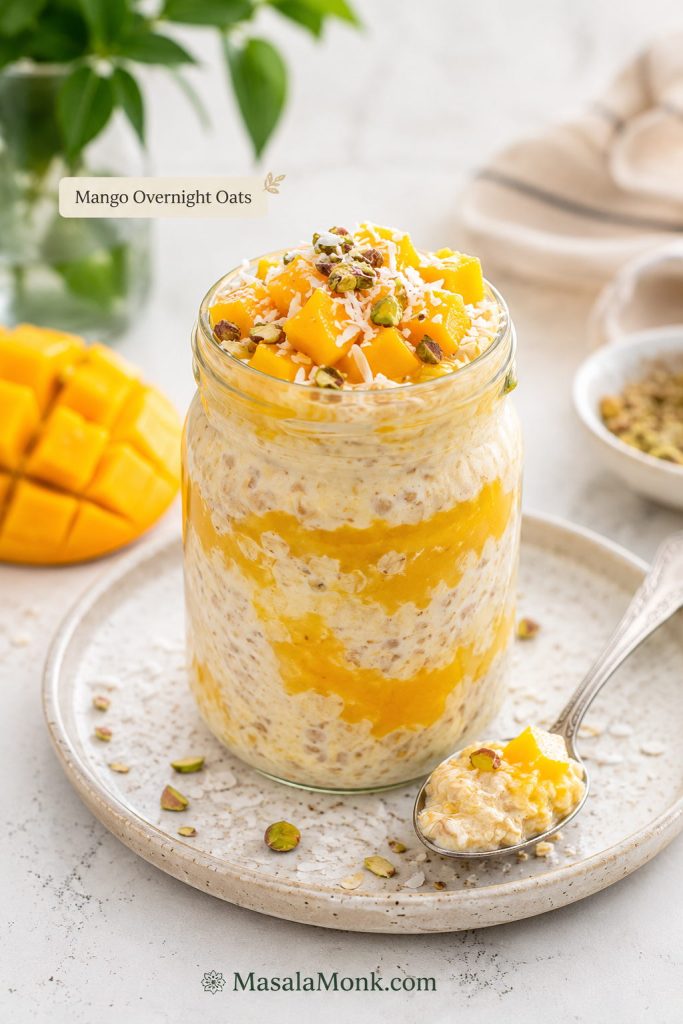
Mango Overnight Oats

Mango works especially well with thick curd or yogurt because the jar tastes bright, creamy, and lightly tangy without needing much extra sweetness.

Mango overnight oats with creamy oats, mango puree, fresh mango cubes, coconut, and pistachios.
For mango overnight oats, stir mango puree into the base at night, then add fresh mango cubes in the morning for a brighter texture.

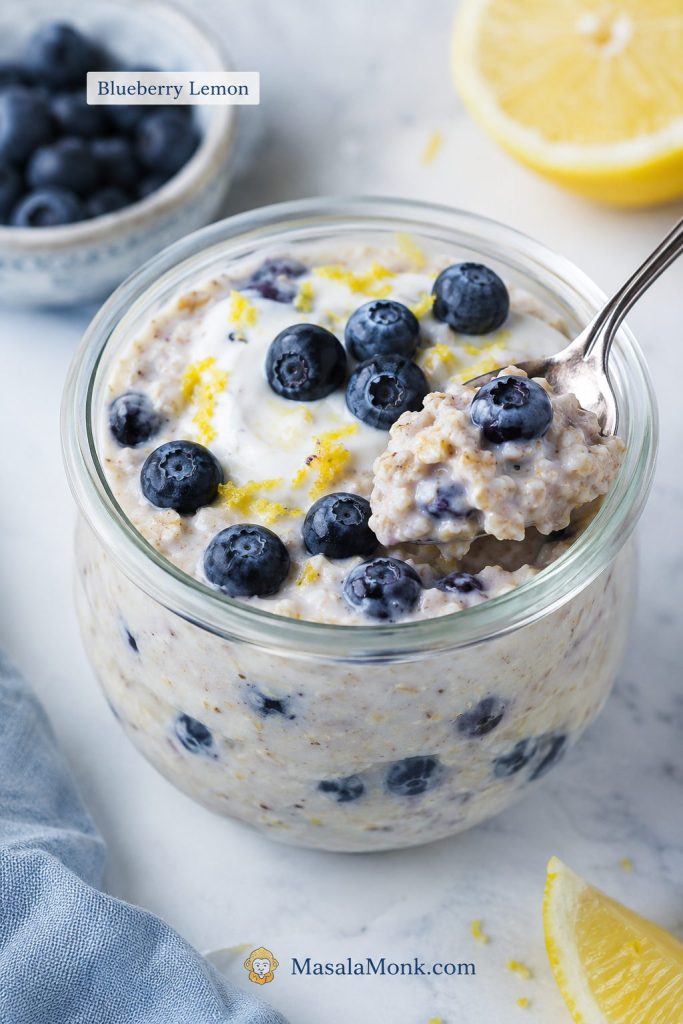
Blueberry Lemon Overnight Oats

Blueberry lemon is the fresh option, but the berries can release juice. Yogurt or chia helps keep the base creamy instead of watery.

Blueberry lemon overnight oats with fresh blueberries, lemon zest, creamy oats, and a spoon lifting a bite.
Blueberry lemon keeps overnight oats fresh and bright, while yogurt or chia seeds help balance the juice released by the berries.

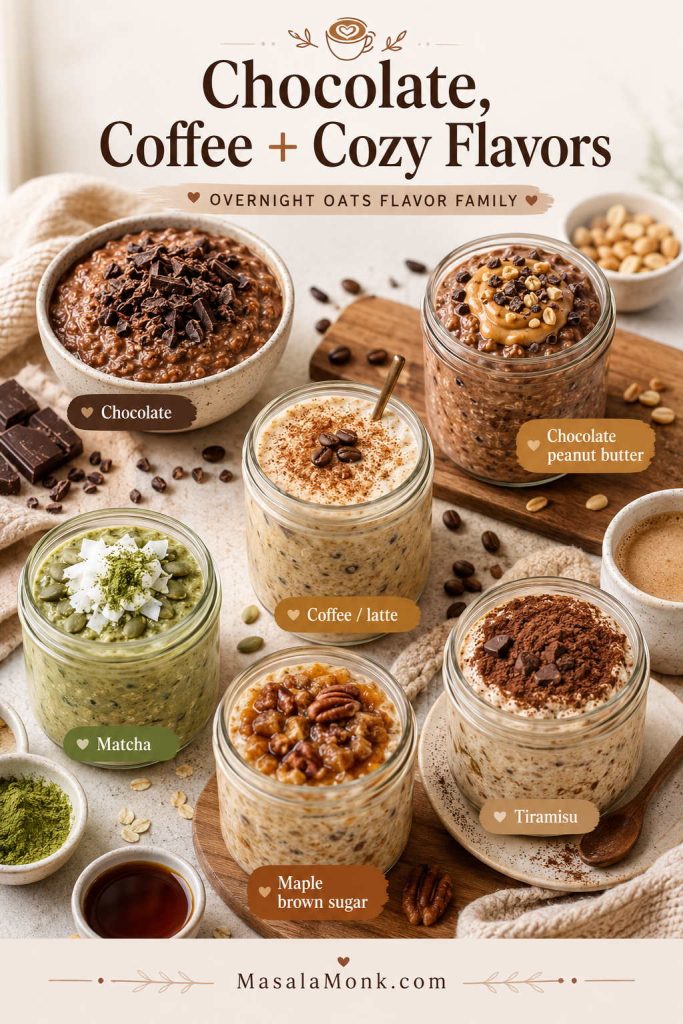
Chocolate, Coffee and Cozy Flavors

These flavors are richer, so balance matters. Bitter ingredients such as cocoa, coffee, and matcha need enough creaminess, salt, and gentle sweetness.

Chocolate, coffee, matcha, maple brown sugar, tiramisu, and chocolate peanut butter overnight oats flavor board.
Chocolate, coffee, matcha, and tiramisu-style overnight oats need enough creaminess, salt, and gentle sweetness to balance bitter flavors.
FlavorMix In at NightAdd in the MorningTexture Note
Chocolate1 tbsp cocoa + extra sweetenerChocolate chips, berries, nutsCocoa absorbs liquid
Chocolate peanut butterCocoa + peanut butterBanana, peanuts, dark chocolateUsually needs a splash more milk
Coffee / latteEspresso powder dissolved in milkCocoa, chocolate chips, yogurtAvoid too much bitter coffee
MatchaMatcha whisked into milkBanana, coconut, sesame, berriesWhisk matcha first to avoid clumps
Maple brown sugarMaple syrup + brown sugar + cinnamonPecans, walnuts, bananaKeep sweetness balanced
TiramisuEspresso + cocoa + vanillaYogurt layer, cocoa dustingUse strong coffee flavor carefully

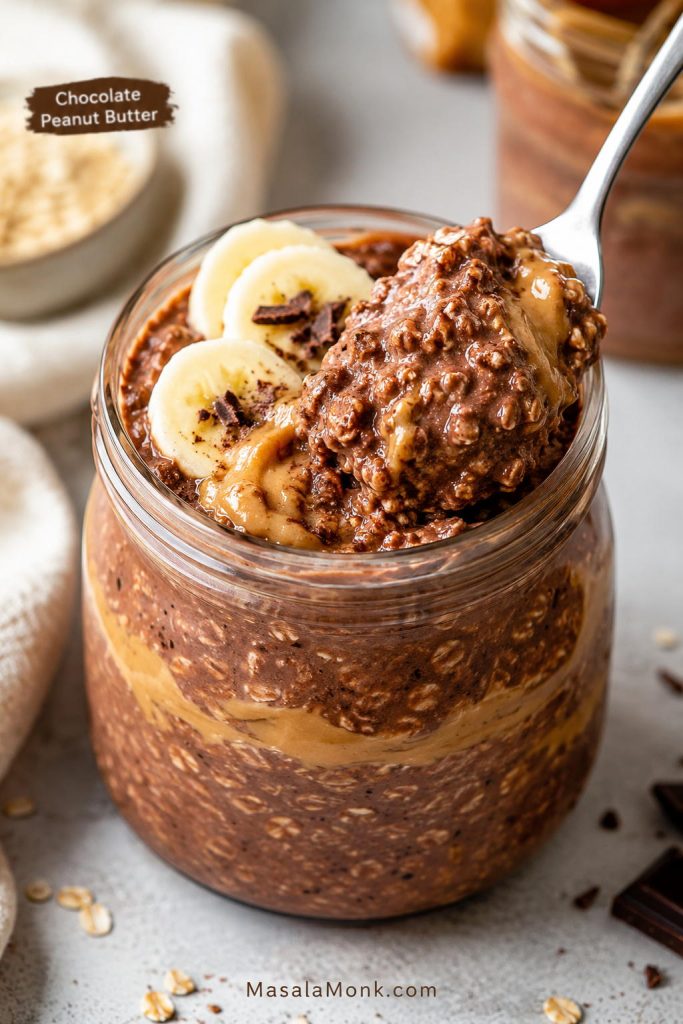
Chocolate Peanut Butter Overnight Oats

Chocolate peanut butter tastes dessert-like, so keep the base balanced with enough milk and a pinch of salt rather than relying only on sweetness.

Chocolate peanut butter overnight oats with cocoa oats, peanut butter swirl, banana slices, and a spoon lifting a thick bite.
Because cocoa and peanut butter both thicken the oat mixture, this flavor often needs a small splash of milk after chilling.

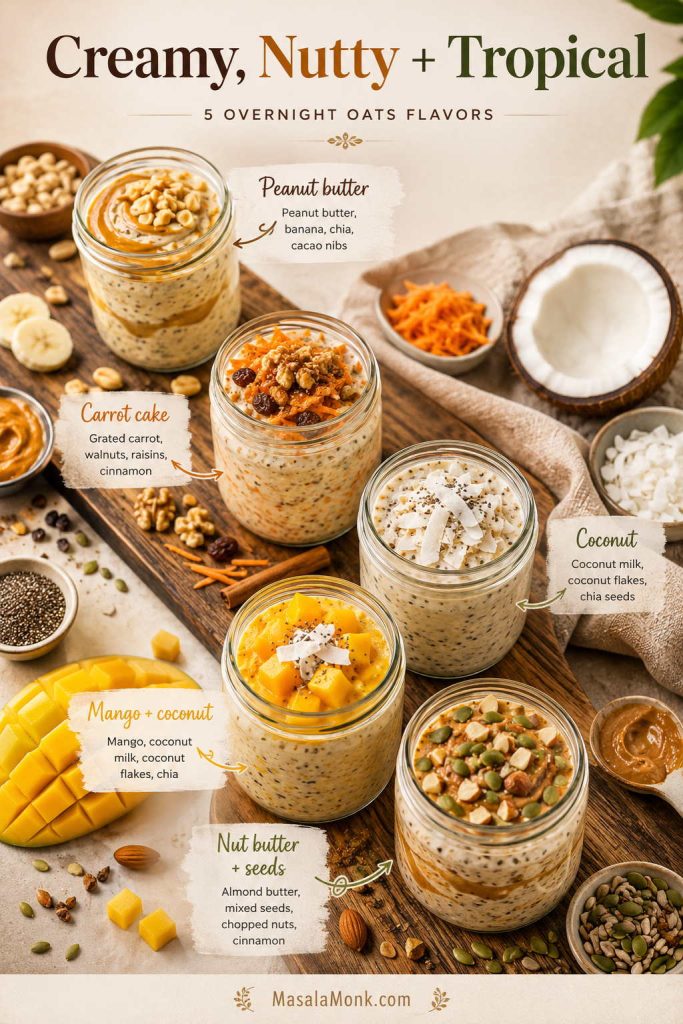
Creamy, Nutty and Tropical Flavors

This flavor family is useful when you want a jar that feels richer and more filling. Creamy add-ins such as nut butter, coconut, yogurt, and seeds give the oats more body.

Creamy, nutty, and tropical overnight oats board with peanut butter, carrot cake, coconut, mango coconut, and nut butter seed ideas.
Nutty and tropical add-ins make overnight oats feel richer, especially when peanut butter, coconut, mango, seeds, or extra yogurt support the oat base.
FlavorMix In at NightAdd in the MorningTexture Note
Peanut butter1 tbsp peanut butter + cinnamonBanana slices, peanuts, extra drizzleAdd extra milk if thick
Carrot cakeGrated carrot + cinnamon + nutmegWalnuts, raisins, coconutYogurt makes it creamier
CoconutCoconut milk + shredded coconutMango, pineapple, toasted coconutRich coconut milk makes it thicker

If you are making overnight oats for the first time, peanut butter banana, apple cinnamon, mango curd, chocolate peanut butter, and blueberry lemon are the easiest flavors to get right. Coffee, matcha, and tiramisu are a little more sensitive because bitter ingredients need enough sweetness, salt, and creaminess to balance them. For more on why the peanut butter version is so satisfying, MasalaMonk’s guide to oatmeal and peanut butter is a useful companion read.

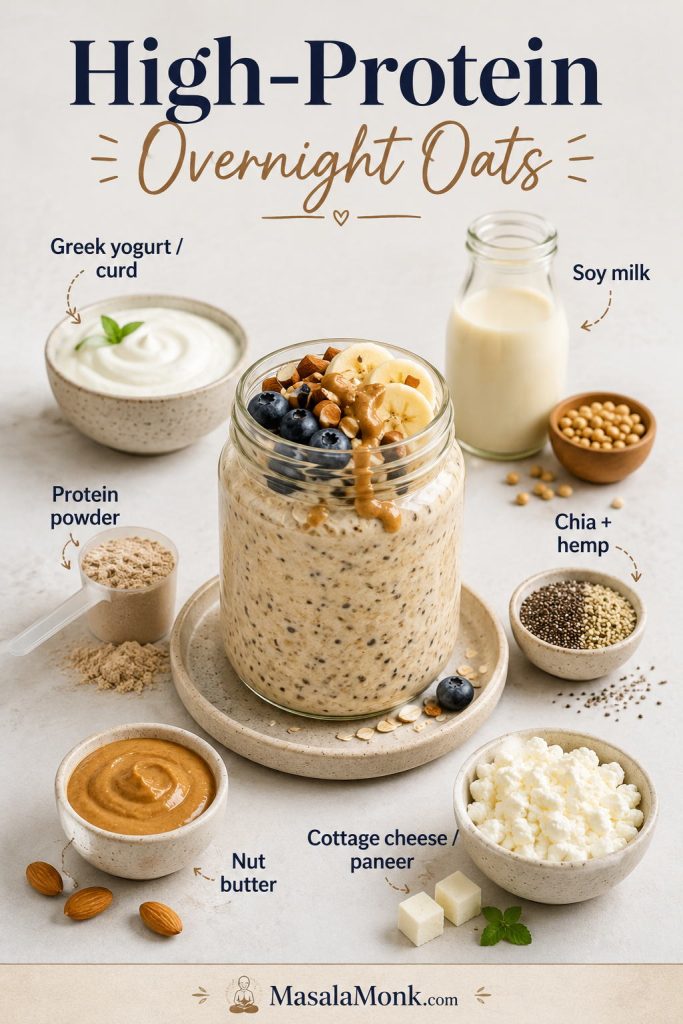
How to Make High-Protein Overnight Oats

For higher-protein overnight oats, build the serving with Greek yogurt, thick curd, soy milk, protein powder, blended cottage cheese or paneer, chia seeds, hemp seeds, peanut butter, or nut butter. For the base amounts before adding protein powder, use the quick ratio guide near the top of the post.

High-protein overnight oats guide with Greek yogurt or curd, soy milk, protein powder, chia, hemp, nut butter, and cottage cheese or paneer.
High-protein overnight oats work best when the base includes a creamy protein source and enough extra liquid to handle overnight thickening.

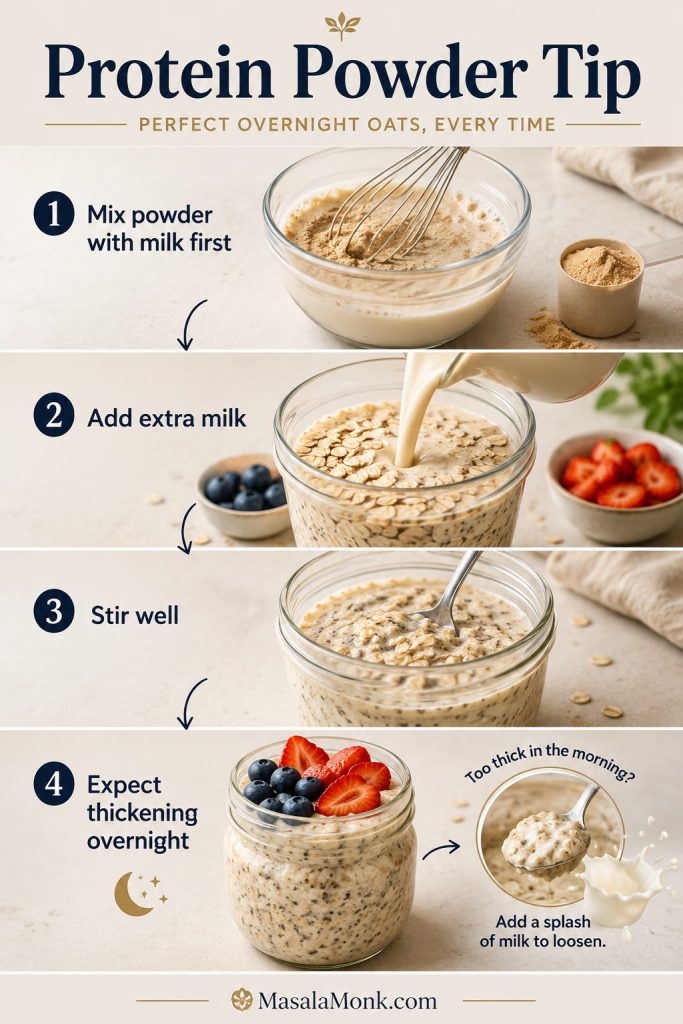
Protein Powder Overnight Oats Tips

Protein powder is the ingredient most likely to trick you. The jar may look perfect when you mix it, then turn thick and stiff by morning. Start with 1 scoop protein powder and about ¼ cup / 60 ml extra milk, then loosen again after chilling if needed.

Protein powder overnight oats guide showing protein powder mixed with milk first, added to oats, stirred well, thickened overnight, and loosened with milk.
Protein powder thickens as it sits, so mixing it with milk first and adding extra liquid helps prevent clumps and stiffness by morning.

For a full protein-focused version with flavors, macro-friendly ideas, vegan options, and protein powder tips, use this MasalaMonk guide to high protein overnight oats. If you also like warm oats, this protein oatmeal guide covers hot oatmeal and proats-style breakfasts.

Vegan, Dairy-Free, Gluten-Free and No-Yogurt Overnight Oats

The core recipe is easy to adapt. Think of these as swaps, not separate recipes: the oat base stays the same, while the milk, thickener, sweetener, or creamy element changes depending on what you need. If you are skipping dairy, start with the no-yogurt ratio. If you are using water instead of milk, go straight to overnight oats with water, because that version needs extra help from chia, salt, and flavor.

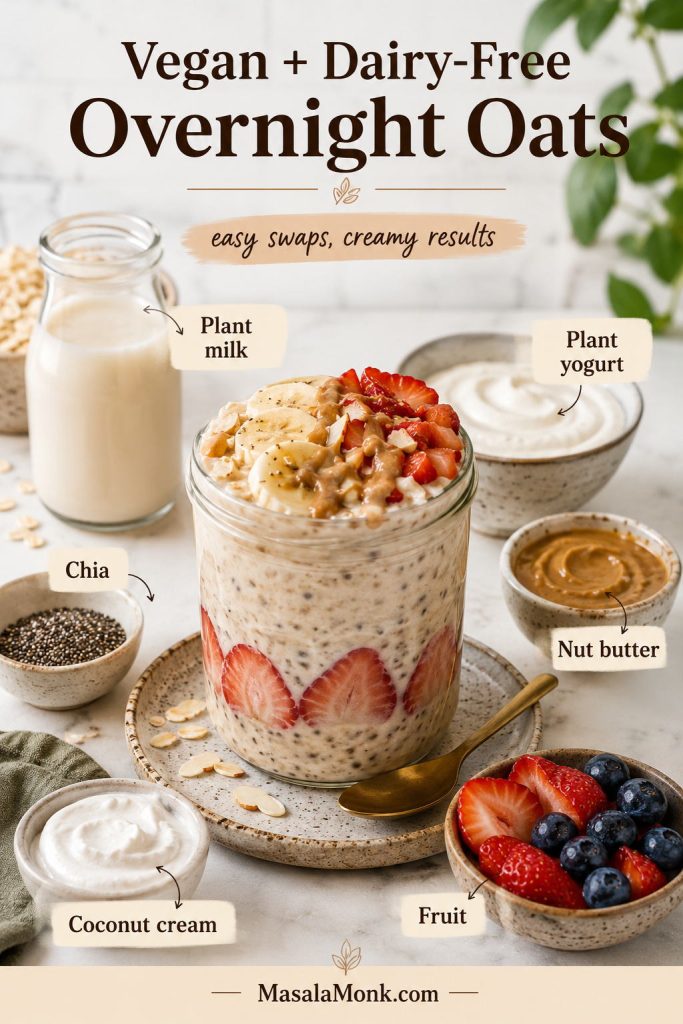
Vegan and dairy-free overnight oats with plant milk, plant yogurt, chia seeds, nut butter, coconut cream, and fruit.
Dairy-free overnight oats can still be creamy when plant milk is paired with chia seeds, plant yogurt, nut butter, coconut cream, or ripe fruit.

Vegan overnight oats

Choose plant milk, plant yogurt if desired, chia seeds, maple syrup or date syrup, and fruit. Oat milk, soy milk, almond milk, and coconut milk all work.
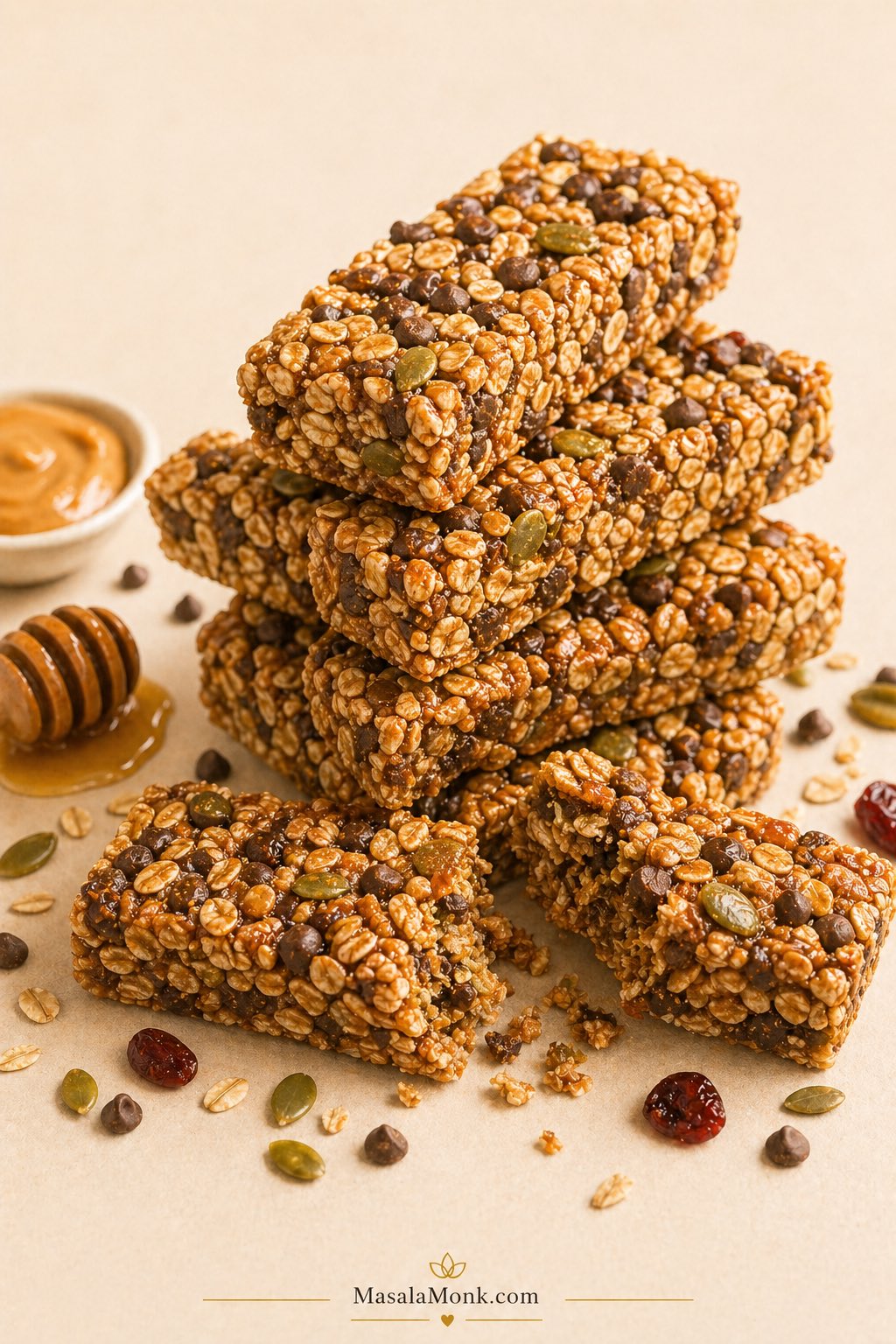
Dairy-free overnight oats

Almond milk, oat milk, soy milk, coconut milk, or cashew milk can replace dairy milk. For creaminess without dairy, add chia seeds, nut butter, coconut cream, mashed banana, or plant yogurt. MasalaMonk also has a guide to homemade oat milk if you want to make your own.
Gluten-free overnight oats

Choose certified gluten-free oats if you need the recipe to be gluten-free. Oats are naturally gluten-free, but cross-contact during processing is common, so the package label matters.

Overnight oats without yogurt

Combine ½ cup rolled oats, ⅔ cup milk, and 1 tablespoon chia seeds. Add nut butter, mashed banana, or coconut cream if you want a creamier result without yogurt.

For the full no-yogurt ratio and how it compares with yogurt-based oats, see the ratio guide above.

Overnight Oats with Water

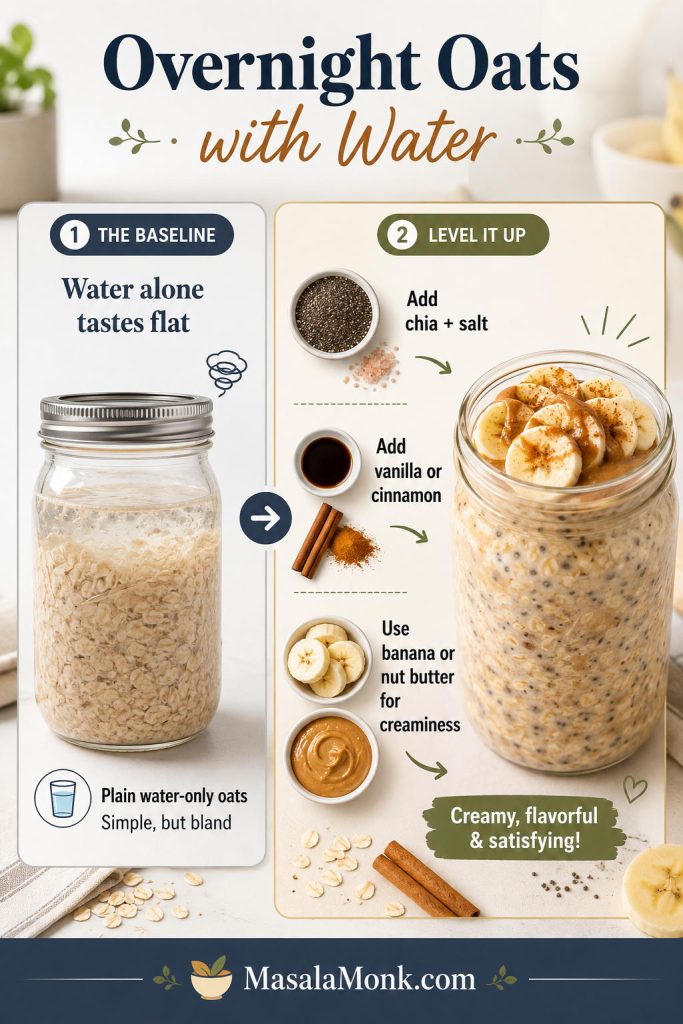
You can make overnight oats with water, but water needs help. Combine ½ cup oats, ¾ cup water, 1 tablespoon chia seeds, a pinch of salt, vanilla or cinnamon, and something creamy like peanut butter, almond butter, coconut cream, mashed banana, or plant yogurt. Without one of those creamy add-ins, the oats can taste flat.

Overnight oats with water guide showing plain water oats improved with chia seeds, salt, vanilla, cinnamon, banana, and nut butter.
Water works for overnight oats, but it needs help from chia seeds, salt, flavor, and something creamy like banana or nut butter.

Keto-style no-oat overnight oats

Regular oats are not usually keto-friendly. For a keto-style breakfast jar, make a no-oat version with chia seeds, hemp hearts, flaxseed, coconut, and low-carb milk instead of rolled oats. It will not taste exactly like classic overnight oats, but it gives a similar chilled, spoonable breakfast format. If that is the direction you want, this keto chia pudding recipe is a better starting point than trying to force regular oats into a keto breakfast.

Are Overnight Oats Healthy for Weight Loss?

Overnight oats can fit a weight-loss breakfast when the serving has enough protein, fiber, and volume without turning into dessert. Oats give the mixture structure, chia adds fiber and thickness, yogurt or protein powder can make it more filling, and fruit adds sweetness without needing too much syrup.

No single breakfast causes weight loss on its own. Still, a well-built oats jar can make breakfast easier to control because the portions are measured ahead of time.

Oats also bring soluble fiber to the bowl, which is one reason they work so well in a make-ahead breakfast. Harvard’s Nutrition Source has a helpful overview of oats if you want the broader nutrition background.

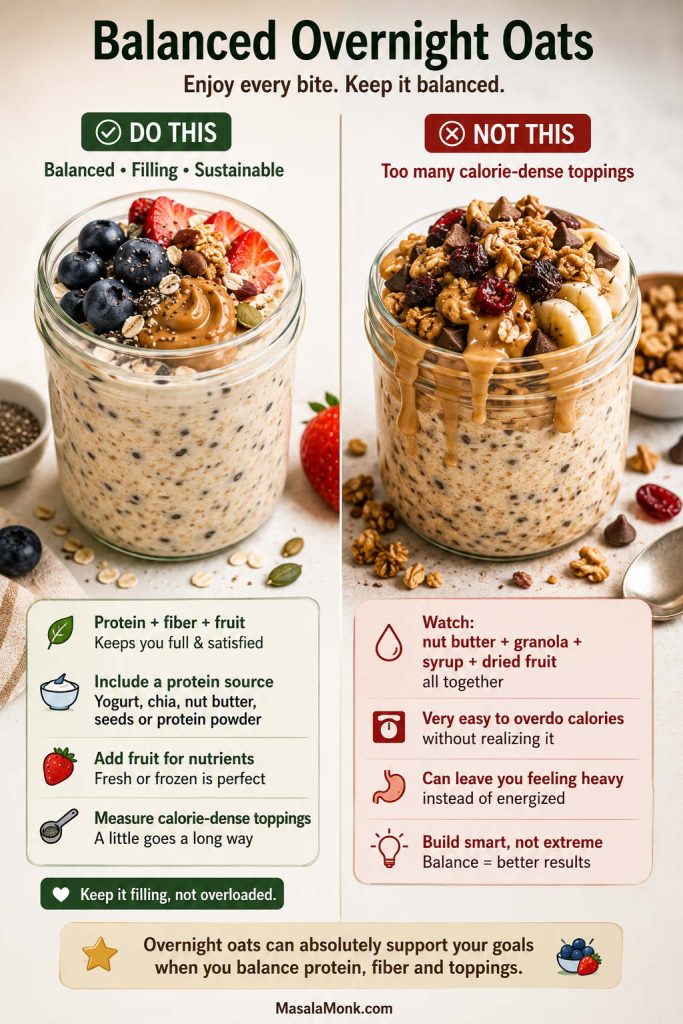
The main thing is not letting a balanced breakfast jar accidentally turn into dessert. Nut butter, granola, chocolate chips, dried fruit, and syrup are all fine in the right amount, but they add up quickly when they all go into the same container. Keep the base balanced, add enough protein if you need more staying power, and choose toppings with intention.

Balanced overnight oats compared with an overloaded jar containing extra nut butter, granola, syrup, dried fruit, and chocolate chips.
Overnight oats can support a balanced breakfast, but calorie-dense toppings add up quickly when nut butter, granola, syrup, dried fruit, and chocolate all go into one jar.
GoalBetter ChoiceWatch Out For
More fillingGreek yogurt, protein powder, chia, soy milkThin oats with only milk and fruit
Lower sugarBerries, apple, cinnamon, vanillaToo much syrup, jam, sweetened yogurt
More fiberChia, flax, berries, apple, oatsLow-fiber toppings only
Controlled caloriesMeasure nut butter, granola, nutsLarge handfuls of calorie-dense toppings

For more on oats, chia, and fullness-focused breakfasts, see MasalaMonk’s guide to oats and chia seeds for weight loss.

Meal Prep and Storage

Overnight oats are built for meal prep, but consistency changes over time. A plain mixture keeps better than a container loaded with fresh fruit, granola, and crunchy toppings.

Meal prep overnight oats setup with several jars, a mixing bowl, lids, fresh fruit, nuts, seeds, and toppings kept separately.
For better meal-prep texture, store the oat base in jars and keep crunchy or delicate toppings separate until serving.

The biggest meal-prep mistake

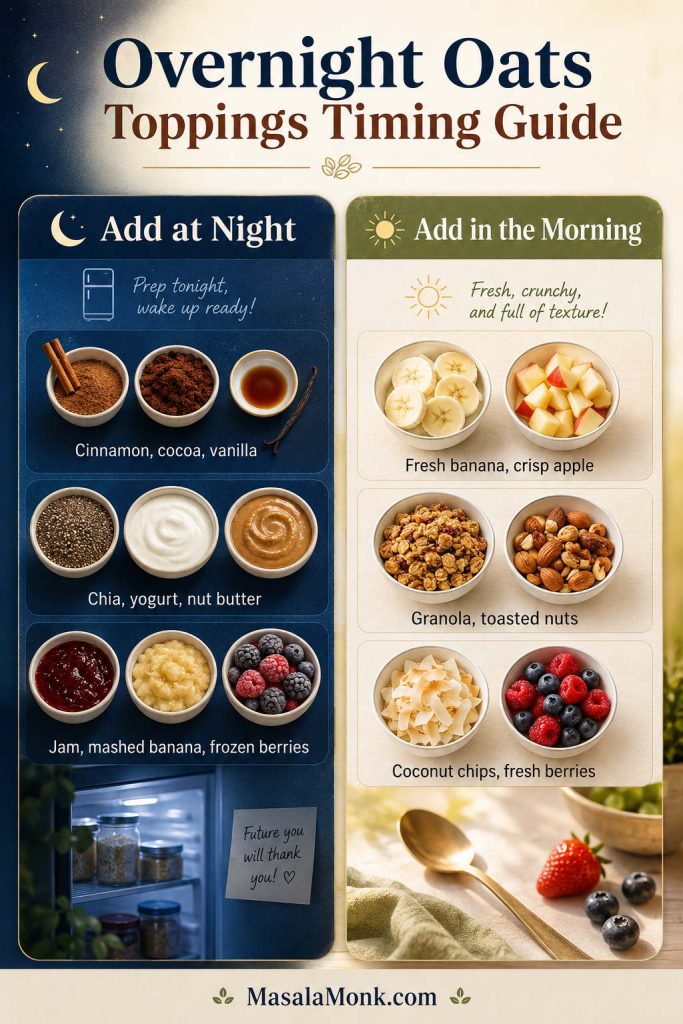
The biggest mistake is adding every topping the night before. Soft mix-ins like cocoa, cinnamon, chia, yogurt, nut butter, jam, mashed banana, applesauce, or frozen berries can go in early. Crunchy toppings are different: fresh banana, crisp apple, granola, toasted nuts, and coconut chips are better added right before eating.

For quick topping timing, use the table below, or go back to the flavor ideas if you are planning several jars at once.

Best jar size for overnight oats

For one serving of overnight oats, a 12–16 oz / 350–500 ml jar works best. A 16 oz jar gives you enough space to stir properly and add toppings without overflowing.

Jar SizeHow It WorksBest Use
8 oz / 240 mlVery tight for a full servingSmall portions, snack jars, no bulky toppings
12 oz / 350 mlWorks for one basic servingSingle serving with light toppings
16 oz / 475–500 mlBest overall sizeOne serving with fruit, nuts, yogurt, and stirring room
Bowl or meal-prep containerMore room to mixBatch prep or family portions

How Long Do Overnight Oats Last?

Overnight oats taste best in the first 1–3 days. A plain sealed mixture can usually keep for 3–4 days in the fridge. Some servings may be fine longer, but fruit, yogurt, and toppings soften faster.

Overnight oats storage timeline showing jars for day 1 through day 4, best texture in 1 to 3 days, and refrigeration at 40°F or 4°C.
Overnight oats taste best in the first few days, especially when fresh fruit, nuts, and granola are added closer to serving.

Keep overnight oats refrigerated at 40°F / 4°C or below. For general food-safety guidance, the USDA recommends keeping refrigerators at 40°F or below and using refrigerated leftovers within a few days. You can read their refrigerator safety guidance here: USDA refrigerator safety basics.

When to Add Overnight Oats Toppings

The best overnight oats are usually built in two stages: flavor the oats at night, then add delicate or crunchy toppings in the morning. In short, crunch belongs in the morning.

Overnight oats toppings timing guide showing soft mix-ins to add at night and fresh or crunchy toppings to add in the morning.
Soft mix-ins can go in at night, while fresh fruit and crunchy toppings usually taste better when added right before serving.
Add at NightAdd in the Morning
Cinnamon, cocoa, vanilla, chia, yogurt, nut butter, jam, mashed banana, applesauce, frozen berriesFresh banana, crisp apple, granola, toasted nuts, coconut chips, fresh berries, crunchy seeds, chocolate chips

If you like a little crunch on top, keep granola-style toppings separate until serving. For a make-ahead oat snack in the same pantry lane, these homemade granola bars use oats, nut butter, honey or dates, and seeds in a different meal-prep format.

Can You Freeze Overnight Oats?

You can freeze overnight oats, but the consistency is usually best when you freeze the plain mixture without delicate toppings. Leave headspace in the container because the mixture expands, thaw in the fridge, stir well, then add fresh fruit and crunchy toppings after thawing.

Freezing guide for overnight oats showing plain containers with headspace, thawing in the fridge, and fresh toppings added later.
Overnight oats freeze best when kept plain, with headspace in the container and fresh toppings added only after thawing.

Can You Warm Overnight Oats?

Yes. Overnight oats are usually eaten cold, but you can warm them. Transfer to a microwave-safe bowl or jar, add a splash of milk, and heat for 30–60 seconds, stirring once. Do not microwave a metal lid.

Cold versus warm overnight oats guide showing a chilled jar and warmed oats with a splash of milk, microwave timing, and no metal lid warning.
Overnight oats are usually eaten cold, although you can warm them gently with a splash of milk for a softer, cozier breakfast.

Overnight Oats FAQs

What is the best ratio for this overnight oats recipe?

The best starting ratio is ½ cup rolled oats, ½ cup milk, and ¼ cup yogurt or thick curd. For no-yogurt overnight oats, use ½ cup oats, ⅔ cup milk, and 1 tablespoon chia seeds. For more detail, see the ratio guide and texture guide above.

How long do overnight oats need to soak?

Plan on at least 4 hours. Ideally, give rolled oats an overnight rest of about 8 hours so they become creamier and more even.

Are overnight oats eaten cold or warm?

Most people eat overnight oats cold, straight from the fridge. You can also warm them for 30–60 seconds with a splash of milk when you want a softer, cozier breakfast.

How do you make overnight oats without yogurt?

Skip the yogurt and let chia do the thickening instead. A good no-yogurt ratio is ½ cup oats, ⅔ cup milk, and 1 tablespoon chia seeds.

Do overnight oats need chia seeds?

Chia seeds are helpful, but they are not required. Instead, you can use yogurt or slightly less liquid to keep the oats thick.

How do you make overnight oats with water?

Water works, but it needs help. Add chia seeds, salt, vanilla or cinnamon, and something creamy like nut butter, mashed banana, coconut cream, or plant yogurt so the oats do not taste flat.

Which oats are best for overnight oats?

Rolled oats or old-fashioned oats are best. Quick oats get softer, instant oats can become paste-like, and steel-cut oats need a different method.

What happens if you use steel-cut oats?

Steel-cut oats are not a direct swap here. They stay much chewier and need a longer soak or a separate preparation method.

How long do overnight oats last in the fridge?

They taste best in the first 1–3 days. A plain sealed mixture can usually keep for 3–4 days when refrigerated properly.

Do overnight oats freeze well?

They freeze best when kept plain. Freeze the oats without delicate fruit or crunchy toppings, leave headspace in the container, thaw in the fridge, stir well, and then add fresh toppings after thawing.

Are overnight oats good for weight loss?

They can be, especially when the serving includes protein, fiber, fruit, and measured toppings. Still, large amounts of nut butter, granola, syrup, dried fruit, and chocolate chips can raise calories quickly.

How do you add protein powder to overnight oats?

Add 1 scoop protein powder and increase the milk by about ¼ cup / 60 ml. Then stir very well, because protein powder can clump and thicken as it sits.

Why are my overnight oats too thick?

They may have too much chia, too much protein powder, or not enough liquid. As a quick fix, stir in 1–3 tablespoons milk before eating.

Why are my overnight oats watery?

They may have too much liquid, watery fruit, or not enough soaking time. To fix them, add chia seeds or a spoon of oats and let the mixture sit longer.

The Takeaway

Start with rolled oats, use enough liquid, season the mixture with a pinch of salt, and stir twice before chilling. Then, add delicate fruit and crunchy toppings closer to serving, and adjust the consistency in the morning instead of trying to get everything perfect the night before.

Once you like the base recipe, you can turn it into peanut butter overnight oats, apple cinnamon overnight oats, mango overnight oats, chocolate overnight oats, coffee overnight oats, or a higher-protein version without changing the basic method. And when you want a warm oat breakfast instead of a chilled jar, these oat pancakes are another easy way to use rolled oats for breakfast.

Finished overnight oats jars in a calm breakfast scene with fruit, nuts, spoon, small bowls, and creamy oat texture.
Once you understand the base, overnight oats become a flexible make-ahead breakfast you can adjust for texture, flavor, protein, and meal prep.

Back to top

Posted on 1 Comment

Healthy Homemade Granola Bars Recipe

Stack of chewy homemade granola bars with oats, seeds, chocolate chips, honey, and nut butter on a warm neutral surface.

A good healthy homemade granola bars recipe should give you bars that are chewy, sturdy, lightly sweet, and easy to pack without crumbling into oat clusters. This version starts with a simple no-bake base of oats, nut butter, a sticky sweetener, salt, and mix-ins. Once that base works, you can adjust it for peanut butter, chocolate chip, protein, low-sugar, gluten-free, vegan, nut-free, cereal-style, or baked flapjack-style bars.

The best part is that these healthy homemade granola bars can fit the way you actually snack. Keep them simple for lunchboxes, add protein powder for a more filling post-workout bar, use sunflower seed butter for a nut-free lunchbox option, or bake the mixture briefly when you want a crunchier texture. Once you know how the oat-binder-sweetener formula works, homemade granola bars become much easier to customize.

Summary guide for healthy homemade granola bars showing the base formula, texture check, and quick fixes for dry, wet, chunky, or crumbly bars.
If a reader only remembers three things, it should be these: use a balanced base formula, make sure the mixture clumps when squeezed, and fix problems before chilling by adjusting binder, oats, seeds, or mix-in size.

If this is your first batch, start with the basic chewy no-bake version. Do not try to make the bars protein-rich, vegan, low-sugar, crunchy, and nut-free all at once. Instead, make one reliable batch first, learn how the mixture should feel before pressing, and then use the variations to change the flavor, sweetness, texture, or diet fit.

Healthy Homemade Granola Bars Guide

Start with the chewy no-bake base, then use the guides below to make the bars firmer, softer, crunchier, lower in sugar, higher in protein, vegan, gluten-free, nut-free, cereal-style, or flapjack-style.

Quick Answer: Healthy Homemade Granola Bars Recipe

To make chewy, healthy homemade granola bars, mix rolled oats with creamy nut butter or seed butter, a sticky sweetener such as honey, brown rice syrup, or date paste, a little salt, and small mix-ins. Then, press the mixture very firmly into a lined pan, chill until set, and slice it into bars.

The bars hold together best when the mixture looks sticky and slightly glossy before it goes into the pan. However, if it looks dusty, it will probably slice dusty. If it feels wet and loose, add more oats, seeds, or ground flaxseed. In the end, the goal is a dense mixture that clumps when squeezed in your hand.

In this recipe, the homemade oat mixture turns into chewy granola-style bars once it is pressed firmly and chilled. That texture cue matters more than any single mix-in, especially if you want a healthier bar that still slices cleanly.

Formula guide showing oats, nut butter, sticky sweetener, small mix-ins, pressing, chilling, and finished homemade granola bars.
In short, the formula is simple: oats give structure, nut or seed butter adds richness, sticky sweetener helps the bars hold, and small mix-ins add flavor without breaking the slab.
At a glance: These are chewy no-bake granola bars made with rolled oats, creamy peanut butter or seed butter, honey or date paste, seeds, and mini chocolate chips. You need about 15 minutes of hands-on time, then the bars chill until firm. For the most reliable first batch, use peanut butter and honey, press the mixture firmly, and chill before slicing.

Why Make Granola Bars at Home?

Making granola bars at home gives you more control over sweetness, texture, binder choice, and mix-ins. That matters because the same basic oat mixture can become a chewy snack bar, a firmer lunchbox bar, a lower-sugar seed bar, a vegan date bar, or a protein-focused bar once you know how to adjust the formula.

Guide image explaining why to make granola bars at home, highlighting control over sweetness, binder choice, texture adjustment, and real mix-ins.
One of the biggest advantages of making granola bars at home is control. You decide how sweet they are, what binder to use, how chewy or firm they feel, and which real mix-ins actually go into the batch.

5-Ingredient Homemade Granola Bars

When you want the simplest possible version, use this 5-ingredient formula. It is the easiest way to make homemade granola bars without turning the recipe into a project.

Because this recipe keeps the bars homemade, you can control the granola-style base, the binder, and the final sweetness without relying on a packaged snack bar.

Five ingredients for homemade granola bars: oats, nut butter, honey, salt, mix-ins, and one finished granola bar.
Because this version starts with only five ingredients, it is the easiest place to learn how the oat mixture should look before you move into protein, vegan, nut-free, or low-sugar bars.
  • Oats for structure and chew
  • Peanut butter or sunflower seed butter for richness and binding
  • Honey, brown rice syrup, or date paste for stickiness
  • Salt for balance
  • Mini chocolate chips, seeds, raisins, or chopped nuts for flavor

If you are making these for older kids, start with oats, peanut butter, honey, salt, and mini chocolate chips. For a nut-free version, use sunflower seed butter and seeds instead. When you want a less sweet batch, use seeds or chopped nuts as the fifth ingredient instead of chocolate or dried fruit.

For a lighter, crispier bar, replace 1/2 to 1 cup of the oats with puffed rice cereal, crisp rice cereal, or crisp oat cereal. Since cereal is lighter than oats, keep the sticky binder strong so the bars hold together.

Choose Your Granola Bar Style

This recipe works because homemade granola bars do not all need the same texture. A lunchbox bar, breakfast bar, protein bar, cereal bar, and crunchy bar each need slightly different handling.

Granola bar style guide showing chewy, crunchy, protein, low-sugar, vegan, and nut-free homemade granola bar options.
Once the base recipe works, you can steer the same homemade granola bar formula toward chewy, crunchy, protein-rich, low-sugar, vegan, or nut-free versions.
You Want Best Version to Make What to Remember
Easiest first batch Chewy no-bake granola bars Use peanut butter and honey, then press hard and chill fully.
Bars that hold together best Honey or brown rice syrup + nut butter Brown rice syrup is especially sticky; honey is easier to find.
Prepared granola version Ready-made granola + sticky binder Crush large clusters first and use less added sweetener if the granola is already sweet.
Nut-free lunchbox option Sunflower seed butter + seeds Skip nuts and use pumpkin seeds, sunflower seeds, sesame, coconut, or mini chocolate chips.
Higher-protein bars Protein granola bars Start with a small amount of protein powder so the bars do not turn chalky.
Less sweet bars Seed-heavy bars with less dried fruit and chocolate Do not remove all sticky binder, or the bars will crumble.
Crunchy granola bars Toasted and briefly baked bars Cool completely before slicing; crunchy bars firm as they cool.
Cereal bars Oats + puffed rice or crisp cereal Use a strong binder and press firmly because cereal is lighter than oats.
Vegan granola bars Date paste or brown rice syrup bars Maple syrup can work, but it usually needs extra support from nut butter or flax.
Soft breakfast bars Oat bars with banana or applesauce These are softer and more breakfast-like than classic granola bars.
Flapjack-style oat bars Baked granola bar variation Use the crunchy baked method, but keep the sweetener measured for a lighter bar.

Recipe Card: Chewy No-Bake Healthy Homemade Granola Bars

Tip: Use your browser’s print option to save this recipe card, or screenshot it if you want to keep the basic formula on your phone.

Saveable recipe card for chewy no-bake homemade granola bars with oats, nut or seed butter, sticky sweetener, mix-ins, pressing, chilling, and slicing notes.
Use this base ratio as your starting point, then adjust the binder, sweetener, and mix-ins depending on whether you want softer bars, firmer lunchbox bars, or a more protein-focused batch.
Before you start: For the easiest chewy bars, use peanut butter and honey. If you have a kitchen scale, weigh the oats, nut butter, and sweetener for the most consistent texture. For vegan bars, use brown rice syrup or date paste instead of honey.

Chewy No-Bake Healthy Homemade Granola Bars Recipe

These healthy homemade granola bars are chewy, no-bake, easy to customize, and made with oats, nut butter, honey or date paste, seeds, and mini chocolate chips. Start with the base recipe, then use the variations below to change the flavor, texture, sweetness, or diet fit.

Yield12 bars
Prep Time15 minutes
Binder Warming2 minutes
Chill Time1 to 2 hours
Total TimeAbout 1 1/2 to 2 1/2 hours

Ingredients for Chewy Homemade Granola Bars

  • 2 1/4 cups rolled oats or old-fashioned oats, about 200 g / 7 oz
  • 3/4 cup creamy peanut butter, almond butter, sunflower seed butter, or tahini, about 190–205 g / 6.7–7.2 oz
  • 1/2 cup honey, brown rice syrup, or thick date paste, about 160–170 g / 5.6–6 oz / 120 ml
  • 1 teaspoon vanilla extract, 5 ml
  • 1/2 teaspoon cinnamon, optional
  • 1/2 teaspoon fine salt, about 3 g, or less if your nut butter is salted
  • 1/3 cup pumpkin seeds or sunflower seeds, about 45–55 g / 1.6–2 oz
  • 1/3 cup chopped nuts, chopped dried fruit, or extra seeds, about 40–55 g / 1.4–2 oz
  • 1/3 cup mini chocolate chips, about 55–60 g / 2 oz, optional
  • 1 to 2 tablespoons ground flaxseed or chia seeds, about 7–18 g, optional

Instructions for Homemade Granola Bars

  1. Line an 8-inch / 20 cm square pan with parchment paper, leaving overhang on two sides. For thinner bars, use a 9-inch / 23 cm square pan. For thicker bars, use a 9 x 5-inch / 23 x 13 cm loaf pan or press the mixture into only part of a larger pan.
  2. In a small saucepan over low heat, warm the nut butter and honey until smooth and pourable. Then, stir in vanilla, cinnamon, and salt. Do not boil for the basic no-bake version.
  3. In a large bowl, mix the oats, seeds, chopped nuts or dried fruit, and flaxseed or chia seeds if using.
  4. Pour the warm binder over the oat mixture. Stir thoroughly until every oat and mix-in is coated. At this point, the mixture should feel sticky and dense, not dry or dusty.
  5. Let the mixture cool for 3 to 5 minutes, then fold in the mini chocolate chips.
  6. Transfer to the lined pan. Cover with parchment and press very firmly into an even layer. Use the bottom of a measuring cup to compact the mixture into the corners.
  7. Chill for at least 1 hour, or 2 hours for firmer bars. Before slicing, the center should feel firm when pressed.
  8. Lift out of the pan and slice into 12 bars. Store chilled for the firmest texture.

Recipe Notes for Homemade Granola Bars

  • The mixture should look sticky and dense before pressing. If dry oats collect at the bottom of the bowl, add 1 tablespoon more nut butter or honey before pressing.
  • When the mixture crumbles before pressing, add more nut butter or honey. If it feels wet and sticky, add more oats, seeds, or ground flaxseed.
  • Use brown rice syrup or thick honey instead of thin maple syrup when you want firmer bars.
  • Vegan granola bars work best with brown rice syrup or date paste.
  • Nut-free bars need sunflower seed butter or tahini, plus seeds instead of nuts.
  • Gluten-free bars need certified gluten-free oats and checked labels on all mix-ins.
  • Protein granola bars work best when you replace 1/4 cup oats with protein powder and add 1 to 2 extra tablespoons nut butter if the mixture feels dry.
  • For a lighter crisp texture, replace 1/2 to 1 cup of the oats with puffed rice cereal, crisp rice cereal, or crisp oat cereal.
  • Bars made with ready-made granola need about 2 1/2 cups prepared granola in place of the oats, with less sweetener if the granola is already sweet.
  • A warm lunchbox needs a firmer binder, so use brown rice syrup or a short-cooked honey binder and pack with an ice pack.
  • Do not use honey in bars for children under 12 months old. Use date paste or another suitable sweetener instead.

Nutrition Estimate for Homemade Granola Bars

Nutrition will vary depending on the nut butter, sweetener, seeds, chocolate, dried fruit, and protein powder you use. As a rough estimate, one of 12 bars from the basic peanut butter and honey version will usually fall in the range of 180 to 230 calories, with most of the energy coming from oats, nut butter, seeds, and sweetener. For a lighter bar, cut the slab into 16 smaller squares.

How to Cut Homemade Granola Bars

Cut the slab into 12 rectangles when you want regular snack bars. For smaller lunchbox portions, slice it into 16 squares. Bite-size freezer snacks work well as 24 mini bars. In general, thicker bars hold together better, while thinner bars feel lighter and chill faster.

Texture Notes for Chewy Homemade Granola Bars

For the most reliable first batch, use peanut butter and honey because both help the oats stick together. Brown rice syrup makes firmer bars, especially if you need them to hold up longer outside the fridge. Maple syrup tastes good, but it usually makes softer, more fragile bars unless you add extra nut butter or ground flaxseed.

Texture checkpoint guide showing sticky granola bar mixture, a hand-squeezed cluster, and a firm pressed slab in a pan.
Before chilling, the mixture should look sticky, clump when squeezed, and press into a compact slab; otherwise, the bars may crumble when sliced.

The mixture should feel sticky before it goes into the pan. If dry oats are still sitting at the bottom of the bowl, do not press yet. Instead, add another spoonful of nut butter or honey, stir again, and test a small handful. Once it clumps when squeezed, it is ready to press.

Texture checkpoints: Before pressing, the mixture should look sticky, dense, and slightly glossy. After pressing, the slab should feel compact and flat, not loose or bumpy. After chilling, the center should feel firm when pressed. If the knife smears, chill longer. If the slab cracks sharply, let it sit for 5 minutes before slicing.

Best Pan Size for Homemade Granola Bars

An 8-inch / 20 cm square pan gives the best balance of thickness, chilling time, and clean slicing. A 9-inch / 23 cm square pan makes thinner bars that chill faster, but they can break more easily if the mixture is not pressed firmly. A 9 x 5-inch / 23 x 13 cm loaf pan makes thicker bars that hold together well, although the yield will be smaller.

Comparison guide showing homemade granola bars in an 8-inch square pan, 9-inch square pan, and 9x5-inch loaf pan, with notes about thickness and slicing.
Pan size changes the thickness of homemade granola bars more than most people expect. An 8-inch square pan usually gives the best balance, whereas a 9-inch square makes thinner bars and a loaf pan gives a thicker, taller bar.

Whatever pan you use, press the mixture into a tight, even layer before chilling. Otherwise, the slab may look set on top but crumble when sliced.

Why These Healthy Homemade Granola Bars Work

Granola bars are simple, but they can fail in frustrating ways. Sometimes they taste good but crumble as soon as you cut them. At other times, they are so sticky that they feel unfinished. Occasionally, they become hard because the binder was cooked too long.

These bars work because the oats, binder, sweetener, and mix-ins are balanced before anything goes into the pan. First, the oats give chew and structure. Then, the nut butter or seed butter adds richness and helps glue the mixture together. Meanwhile, the sticky sweetener holds the dry ingredients in place. Because small mix-ins spread through the bars instead of creating big break points, the slab cuts more cleanly. Finally, firm pressing and proper chilling turn the mixture into sliceable bars.

Guide showing how oats, binder, sticky sweetener, pressing, and chilling help homemade granola bars hold together and slice cleanly.
In other words, bars hold together because each part has a job: oats build structure, binder adds cohesion, sticky sweetener locks things in, pressing compacts the slab, and chilling firms everything up for cleaner slices.

Oats are also a strong base for a filling snack because they are a whole grain and contain beta-glucan, the main soluble fiber in oats. Harvard’s Nutrition Source notes that beta-glucan has been studied for slowing digestion and increasing satiety, which is one reason oats work so well in breakfasts and snacks. Read Harvard’s guide to oats and beta-glucan here.

Are Homemade Granola Bars Healthy?

Homemade granola bars can be a healthier everyday snack, especially when you build them around oats, nuts, seeds, and a measured amount of sweetener. Still, homemade does not automatically mean sugar-free, low-calorie, or high-protein. The real benefit is that you decide what goes in and how sweet, filling, or protein-rich the bars should be.

Plate of homemade granola bars with oats, seeds, chocolate chips, berries, and yogurt, alongside notes about why balanced homemade granola bars can be a healthier snack.
Homemade granola bars can be a healthier snack when they are built with balance. For example, whole oats, nuts or seeds, measured sweetener, and sensible portions make them easier to fit into everyday eating.

For a more balanced homemade granola bar, start with whole oats, a moderate amount of nut or seed butter, seeds for texture, a sticky sweetener used with restraint, and enough salt to make the flavors taste complete. If the bar is meant to replace breakfast, consider protein and fiber. However, if it is meant to be a small snack, keep the portion size realistic.

In practice, a healthy homemade granola bars recipe should not depend only on removing sugar. It should also help the bars stay satisfying, easy to portion, and sturdy enough to eat without falling apart.

Granola Bars vs Oat Bars vs Muesli Bars vs Cereal Bars

These names overlap, but they are not always used the same way. Knowing the difference helps you choose the right style instead of forcing one recipe to do everything.

Comparison image showing a granola bar, oat bar, muesli bar, and cereal bar, with notes on texture, ingredients, and style differences.
Although these snack bars often get grouped together, they are not exactly the same. Granola bars are usually chewier and chunkier, oat bars are softer, muesli bars lean more toward nuts and dried fruit, and cereal bars are lighter and crispier.
Bar Type What It Usually Means Best For
Granola bars Oat-based bars with nuts, seeds, dried fruit, chocolate, and a sticky binder. Classic snack bars, lunchboxes, road trips, meal prep.
Oat bars Often softer, more breakfast-like, and sometimes made with banana, applesauce, or baked oatmeal-style mixtures. Breakfast, kids’ snacks, softer meal-prep bars.
Muesli bars A common name in some regions for oat, nut, seed, and dried fruit bars. Chewy oat bars with fruit, nuts, and seeds.
Cereal bars Bars made with puffed rice, toasted cereal, oat cereal, or similar breakfast cereals. Quick no-bake lunchbox bars and kid-friendly snacks.
Protein bars Bars built around extra protein from protein powder, nuts, seeds, dairy, soy, or other protein-rich ingredients. Post-workout snacks, higher-protein breakfasts, gym bags.
Flapjacks In UK-style usage, usually baked oat bars made with oats, fat, sugar, and syrup. People who want a firmer baked oat bar texture.

For this recipe, rolled oats or old-fashioned oats are the best starting point because they give homemade granola-style bars visible texture and chew. If you are still deciding which oats to use, MasalaMonk’s guide to oats, types, nutrition, and differences explains rolled oats, quick oats, instant oats, and steel-cut oats in more detail.

Ingredients for Healthy Homemade Granola Bars

This recipe uses simple homemade granola bar ingredients, but each one has a job. Once you understand what each ingredient does, it becomes much easier to make substitutions without ending up with crumbly, sticky, or dry bars.

Ingredient guide for healthy homemade granola bars showing oats, nut or seed butter, sticky sweetener, seeds, mix-ins, salt, cinnamon, and sliced bars in a pan.
Before you start, it helps to see the building blocks clearly. Oats provide structure, nut or seed butter adds richness, sticky sweetener helps with hold, and mix-ins bring flavor, texture, and variety.

Rolled Oats or Old-Fashioned Oats

Rolled oats are the best all-purpose choice for chewy granola bars. They are flat enough to bind into the mixture, but they still keep enough texture to feel hearty. Old-fashioned oats and rolled oats are usually the same thing, so either label works here. MasalaMonk has a full guide on substituting old-fashioned oats for rolled oats if you want the details.

Quick oats can work when you want softer bars, although the texture will be less defined. On the other hand, steel-cut oats are not ideal for this no-bake recipe because they stay too hard and do not bind well unless they are cooked or processed first.

Nut Butter or Seed Butter

Creamy peanut butter is the easiest binder for a first batch because it is thick, flavorful, and sticky. Almond butter, cashew butter, sunflower seed butter, pumpkin seed butter, and tahini can also work. If you use natural nut butter, stir it very well before measuring, since separated oil can make some parts of the bars greasy while other parts stay dry.

For peanut butter granola bars, use creamy peanut butter. For nut-free granola bars, use sunflower seed butter or tahini. If you want full control over salt, sweetness, and texture, you can also make peanut butter at home and use it as the binder.

Sticky Sweetener and Best Binders

A sticky sweetener turns oats and mix-ins into bars instead of loose granola. Honey is the easiest choice for chewy no-bake granola bars. Brown rice syrup is even stickier and can help bars hold together more firmly. Date paste works well for a no-refined-sugar version. Maple syrup tastes good, but it is thinner and less sticky, so bars made only with maple syrup can be more fragile unless you adjust the formula.

Binder comparison guide for granola bars showing honey, brown rice syrup, date paste, and maple syrup, with notes on firmness, sweetness, and texture.
Choosing the right binder changes how your granola bars feel and slice. Honey is easy to use, brown rice syrup gives the firmest hold, date paste avoids refined sugar, and maple syrup usually makes a softer bar.

For vegan granola bars, brown rice syrup and date paste usually give a better hold than maple syrup alone. If you use maple syrup, add extra nut butter, ground flaxseed, or a slightly longer chill time. Also, if you are making bars for a baby under 12 months old, do not use honey; the CDC advises against giving honey to children younger than 12 months because of infant botulism risk. Read the CDC guidance here.

The binder is where most granola bars succeed or fail. Use this quick guide when you are choosing between honey, maple syrup, date paste, brown rice syrup, peanut butter, tahini, or seed butter.

Binder Goal Best Choice Why It Works
Best first batch Peanut butter + honey Easy, sticky, familiar, and reliable.
Firmest vegan bars Seed butter + brown rice syrup Brown rice syrup is thick and sticky, so it holds better than thin maple syrup.
No-refined-sugar bars Nut butter + date paste Thick, sweet, and caramel-like, though still naturally sweet.
Flapjack-style bars Honey or golden syrup + butter or nut butter Gives a firmer baked oat-bar texture.
No-peanut-butter bars Almond butter, cashew butter, tahini, or sunflower seed butter Useful for allergies, taste preference, and lunchbox planning.
Lunchbox-firm bars Brown rice syrup or short-cooked honey binder Helps bars hold up better outside the fridge.

Nuts, Seeds, Dried Fruit, and Chocolate

Mix-ins make homemade granola bars more interesting, but they can also make the bars break apart. Large almonds, whole cashews, big chunks of dates, and oversized chocolate chips create weak spots in the slab. Therefore, chop nuts and dried fruit before mixing, and use mini chocolate chips when possible.

Good mix-ins include pumpkin seeds, sunflower seeds, chia seeds, flaxseed meal, sesame seeds, chopped nuts, shredded coconut, dried cranberries, raisins, dates, mini chocolate chips, cacao nibs, and a pinch of cinnamon. In general, smaller pieces make cleaner bars because they compress more evenly into the oat mixture.

Salt, Vanilla, and Cinnamon

Do not skip the salt. A small amount keeps the bars from tasting flat and makes the nut butter, oats, and sweetener taste more complete. Vanilla adds warmth, while cinnamon gives the bars a breakfast-like flavor. You can also use cardamom, ginger, cocoa powder, orange zest, or espresso powder in specific variations.

Optional Protein Powder

Protein powder can turn this into a homemade protein granola bars recipe, but it changes the texture quickly. Whey protein usually blends more smoothly than many plant proteins. Meanwhile, plant protein powders often absorb more moisture and can make bars dry or chalky. Start small, then add more nut butter or a splash of milk if the mixture feels dry before pressing.

For a more protein-focused oat recipe, MasalaMonk already has healthy oat protein bars. If you want to understand protein powder in oats more deeply, this protein oatmeal guide explains whey, plant protein, yogurt, egg whites, paneer, tofu, and other ways to raise protein in oat-based meals.

The Simple Formula Behind Homemade Granola Bars

Think of this recipe as a balance between dry structure and sticky glue. The oats and mix-ins give the bars body, while the nut butter and sweetener hold everything together. If either side gets too heavy, the texture suffers.

Formula guide for homemade granola bars showing oats, nut or seed butter, sticky sweetener, mix-ins, and a finished bar.
Once you understand the base formula, homemade granola bars become much easier to adjust. The oats build structure, while the binder and sticky sweetener help the mixture press into bars instead of crumbling apart.
Ingredient Type Starting Amount Purpose Best Choices
Oats 2 to 2 1/2 cups Structure and chew Rolled oats or old-fashioned oats
Nut or seed butter 3/4 cup Binder, richness, flavor Peanut butter, almond butter, sunflower seed butter, tahini
Sticky sweetener 1/2 cup Glue and sweetness Honey, brown rice syrup, date paste
Mix-ins 3/4 to 1 cup Flavor, crunch, chew Mini chips, seeds, chopped nuts, chopped dried fruit
Flavor boosters Small amounts Balance Salt, vanilla, cinnamon, cocoa, cardamom

As a rule, do not keep adding dry mix-ins just because they sound good. Too many seeds, nuts, dried fruit pieces, chocolate chips, or protein powder will overwhelm the binder. Ideally, the mixture should look compact and sticky before pressing, with no dry oats collecting at the bottom of the bowl.

Can You Make Granola Bars with Ready-Made Granola?

Yes, you can make granola bars with ready-made granola, but the texture depends on what is already in the granola. If your granola is very crunchy, very sweet, or full of large clusters, crush or pulse it lightly before mixing so the bars can compact properly. Large clusters taste good in a bowl, but they can make sliced bars break apart.

Because prepared granola is often already sweetened, use less added sweetener than the main recipe. As a starting point, use 2 1/2 cups granola, 1/2 cup creamy nut or seed butter, 1/3 cup honey or brown rice syrup, and 1/4 to 1/2 cup extra seeds, mini chocolate chips, or chopped dried fruit. After that, warm the binder, mix everything well, press very firmly into a lined pan, and chill before slicing.

Guide showing ready-made granola clusters being crushed smaller, mixed with binder, and pressed into a pan for granola bars.
Ready-made granola can work, but large clusters need to be broken down first. Then, add just enough binder and press the mixture firmly so it slices more like bars than loose clusters.

With ready-made granola, the recipe still works, but homemade-style bars need smaller clusters and a strong binder. Otherwise, the slab may taste good but crumble when sliced.

Texture tip: Granola bars made with ready-made granola work best when the granola pieces are small enough to compress. If the mixture looks like loose cereal even after adding the binder, crush the granola a little more or add another spoonful of nut butter.

How to Make Homemade Granola Bars Step by Step

This step-by-step recipe shows how a homemade granola mixture becomes firm, sliceable bars after warming, mixing, pressing, chilling, and cutting.

Step-by-step guide showing homemade granola bars being warmed, mixed, pressed into a pan, chilled, and sliced.
The method is simple, although the order matters. Warm the binder first, mix until the oats are coated, press the slab firmly, and then chill before slicing for cleaner homemade granola bars.

1. Line the Pan

Line an 8-inch / 20 cm square pan with parchment paper, leaving some overhang on two sides. This makes it easier to lift the chilled slab out cleanly. For thinner bars, use a 9-inch / 23 cm square pan. For thicker bars, use a 9 x 5-inch / 23 x 13 cm loaf pan or press the mixture into only part of a larger pan.

2. Warm the Binder

Add the nut butter, honey or other sticky sweetener, vanilla, and salt to a small saucepan. Warm over low heat just until smooth and pourable. For the basic no-bake version, you are not trying to boil the mixture. Instead, you only want it loose enough to coat the oats evenly.

If you need firmer room-temperature bars, gently simmer honey for about 1 minute before mixing it with the nut butter. This creates a stickier binder, but it can also make the bars harder if cooked too long.

3. Mix the Oats and Dry Ingredients

In a large bowl, combine the rolled oats, seeds, chopped nuts, chopped dried fruit, cinnamon, and any protein powder or flaxseed meal. Keep chocolate chips aside until the binder has cooled slightly, especially if you want visible chips instead of melted chocolate streaks.

4. Combine Wet and Dry

Pour the warm binder over the oat mixture. Stir until every oat and mix-in is coated. Scrape the bottom and sides of the bowl so there are no dry pockets. The mixture should look sticky, dense, and slightly glossy. If it still looks dusty, add another spoonful of nut butter or honey.

5. Add Chocolate Chips Last

Let the mixture cool for a few minutes before folding in mini chocolate chips. Small chips work better than large chips because they spread through the bars evenly and do not create big break points. If the mixture is very warm, the chips will melt, which is fine for flavor but less tidy for slicing.

6. Press Harder Than Feels Necessary

Transfer the mixture to the lined pan. Cover the top with another piece of parchment paper and press down firmly with your hands, the bottom of a measuring cup, or a flat spatula. Push into the corners and flatten the surface. Then press again. This step is what turns a sticky oat mixture into actual bars.

Close-up of a measuring cup pressing homemade granola bar mixture firmly into a parchment-lined pan.
Pressing is where many granola bars succeed or fail. For better structure, compact the corners, flatten the surface, and remove air gaps before the slab goes into the fridge.

7. Chill Before Slicing

Chill for at least 1 hour, or 2 hours if your kitchen is warm. Do not judge the final texture while the slab is still soft. After chilling, lift the slab out using the parchment, then slice with a sharp knife. Press straight down instead of sawing back and forth.

Common Mistakes When Making Homemade Granola Bars

Even a simple homemade granola bars recipe can fail when the mixture is too dry, too wet, too chunky, or not pressed firmly enough.

Common granola bar mistakes guide showing a dry mixture, chunky pieces, and a loose slab with fixes for each problem.
Most crumbly bars come from one of three issues: the mixture is too dry, the mix-ins are too large, or the slab was not pressed firmly enough. Fortunately, each problem is easy to fix before the next batch.
  • Avoid overloading the mix-ins. Too many nuts, seeds, dried fruit pieces, chocolate chips, or protein powder can overwhelm the binder.
  • Keep large chunks out of the mixture. Big almonds, dates, chocolate pieces, and granola clusters create weak spots.
  • Press harder than feels necessary. Otherwise, the mixture may stay loose instead of compacting into one slab.
  • Wait before slicing. No-bake granola bars need chilling time before they cut cleanly.
  • Keep some sticky sweetener in the recipe. Sweetener is part of the structure, not just the flavor.
  • Let protein bars rest before judging texture. Protein powder absorbs moisture as the mixture sits.

Why Homemade Granola Bars Fall Apart

If homemade granola bars fail, they usually fail here. The recipe may taste good, but the slab slices into crumbs. Fortunately, the fix is rarely complicated: use enough sticky binder, chop the mix-ins smaller, press harder than feels necessary, and chill the slab until it is genuinely firm.

Troubleshooting guide showing why homemade granola bars fall apart, including dry mixture, big chunks, loose slab, warm bars, and wet mixture fixes.
When homemade granola bars fall apart, do not guess blindly. Instead, check the texture: add binder if the mixture is dry, chop large chunks smaller, press harder, chill longer, or add oats and seeds if the mixture is too wet.

The Hand-Squeeze Test

Before pressing the mixture into the pan, squeeze a spoonful in your hand. A good mixture should hold together like a sticky cluster after a firm squeeze. When it falls apart immediately, add a little more nut butter, honey, date paste, or brown rice syrup. When it smears and feels wet, balance it with more oats, seeds, or ground flaxseed.

What to Adjust Before Pressing

Crumbly bars usually need more sticky binder, even when the homemade granola mixture looks well mixed. That is why the hand-squeeze test is so useful before everything goes into the pan. Once the mixture clumps in your hand, press it firmly into the pan instead of adding more dry mix-ins.

Clean Slicing Cues

Before slicing, press the center of the slab gently. A firm center means the bars are ready to cut. Deep dents mean they need more chilling time. Smearing on the knife usually means the bars are too warm or too wet, while sharp cracking can mean the mixture is too dry or too cold.

Quick Troubleshooting Guide

Problem Most Likely Cause Best Fix
Crumbles when sliced Not enough sticky binder Add 1 to 2 tablespoons more nut butter, honey, date paste, or brown rice syrup next time.
Breaks around nuts or fruit Mix-ins are too large Chop nuts and dried fruit smaller before mixing.
Falls apart after chilling Mixture was not pressed firmly enough Cover with parchment and press hard with a measuring cup before chilling.
Sticky and messy texture Too much wet binder or not enough dry structure Add more oats, seeds, shredded coconut, or ground flaxseed.
Too hard after setting Binder was cooked too long or too much syrup was used Warm only until smooth for chewy no-bake bars. Avoid over-boiling.
Softens in a lunchbox No-bake bars are warmer than ideal Pack with an ice pack, use brown rice syrup, or make the firmer cooked-binder version.
Chocolate melts into the mixture Binder was too hot when chips were added Cool the mixture for a few minutes, then add mini chocolate chips.
Slab cracks when cut Mixture is too dry or too cold Let it sit for 5 minutes before slicing, and add slightly more binder next time.
Knife smears through the bars Bars are too warm or too wet Chill longer, then slice with a sharp knife. Add more oats next time if needed.

Granola Bar Mixture: Too Dry, Too Wet, or Just Right

Texture guide showing granola bar mixture that is too dry, too wet, and just right, with the note that the mixture should clump when squeezed.
Before you ever press the mixture into the pan, texture tells you whether the bars are likely to work. The mixture should look cohesive and slightly sticky, and it should clump when squeezed instead of scattering or smearing.

Chewy vs Crunchy vs Soft Granola Bars

This homemade recipe can make chewy, crunchy, or soft granola bars depending on how you handle the binder, oats, baking, and chilling.

Comparison image showing chewy, crunchy, and soft granola bars, with notes that chilling makes chewy bars, baking makes crunchy bars, and added moisture makes soft bars.
Texture changes the whole experience of a homemade granola bar. For example, chilling helps create a chewier bite, baking makes bars crisper, and a slightly moister mix gives you a softer, more tender bar.
Texture How to Get It Best For
Chewy no-bake bars Use nut butter + sticky sweetener, press firmly, and chill. Classic homemade granola bars, lunchbox snacks, freezer snacks.
Crunchy granola bars Toast the oats and nuts first, use slightly less wet binder, then bake briefly and cool fully. People who prefer crisp edges and toasted flavor.
Soft breakfast oat bars Add mashed banana, applesauce, yogurt, egg, or flax egg and bake like oatmeal bars. Breakfast, toddlers, softer snack bars, meal prep.
Firm travel bars Use brown rice syrup or a short cooked honey binder and keep mix-ins small. Road trips, office snacks, gym bags, warmer weather.

For Chewy Granola Bars

Use the main no-bake recipe. Keep the oats mostly whole, use creamy nut butter, choose a sticky sweetener, and chill fully. Chewy bars are the best first version because they are easy, flexible, and forgiving.

For Crunchy Granola Bars

For crunchy granola bars, toast the oats, nuts, and seeds at 325°F / 165°C until fragrant, then use slightly less wet binder than the chewy no-bake version. Press the mixture firmly into a parchment-lined pan and bake at 300°F / 150°C for 15 to 20 minutes, until the edges look lightly golden. Let the slab cool completely before slicing. If you cut while warm, the bars may bend or crumble instead of snapping cleanly.

Extra crispness comes from replacing 1/2 to 1 cup of the oats with puffed rice cereal, crisp rice cereal, or crisp oat cereal. Brown rice syrup gives a firmer bite than maple syrup because it is thicker and stickier.

For Soft Breakfast Oat Bars

Use more moisture and a baking method. Add mashed banana, applesauce, yogurt, or a flax egg to the oats. The result will be closer to oatmeal breakfast bars than classic granola bars. If you want a spoonable make-ahead breakfast instead of a sliced bar, MasalaMonk’s high protein overnight oats are a better fit.

Recipe Variations for Homemade Granola Bars

Once the basic healthy homemade granola bars recipe works, the variations become much easier. Keep the oat-binder balance in mind, and change one or two things at a time.

Guide showing six homemade granola bar variations: peanut butter, protein, low-sugar, vegan, nut-free, and cereal-style.
Once the base recipe works, it becomes much easier to branch out. From peanut butter and protein bars to lower-sugar, nut-free, and cereal-style versions, these variations help readers adapt homemade granola bars to different needs.

Peanut Butter Granola Bars

Peanut butter is the easiest flavor to start with because it binds well, tastes familiar, and makes the bars feel richer without extra steps. Use creamy peanut butter with honey, then add mini chocolate chips, chopped roasted peanuts, or a pinch of cinnamon. If your peanut butter is very thick, warm it gently before mixing so it coats the oats instead of clumping.

To make the peanut flavor stronger, use roasted peanut butter and add chopped peanuts as part of the mix-ins. A softer bar needs finely chopped peanuts and slightly more peanut butter. When the bars need to hold up better in a lunchbox, choose honey or brown rice syrup rather than maple syrup.

Chocolate Chip Granola Bars

Mini chocolate chips are better than large chips because they spread evenly through the bars and do not create big gaps. Let the oat mixture cool for a few minutes before adding them. If you add chocolate while the binder is very hot, the chips will melt into the mixture instead of staying visible.

For a more chocolate-forward bar, stir 1 tablespoon cocoa powder into the warm binder before adding the oats. For a less sweet version, use cacao nibs or chopped dark chocolate instead of regular chocolate chips.

Protein Granola Bars

Protein granola bars need a little more care because protein powder absorbs moisture. Start by replacing 1/4 cup oats with protein powder. Then, mix the bars and check the texture before pressing. If the mixture feels dry, add 1 to 2 tablespoons more nut butter or a small splash of milk.

Protein granola bars shown with oats, protein powder, nut butter, seeds, and stacked finished bars.
Protein granola bars usually work best when only part of the oats is replaced. In other words, add enough protein powder to boost nutrition, but keep enough binder so the bars stay chewy instead of dry and crumbly.

Whey protein usually blends more smoothly, while many plant protein powders make the mixture thicker and drier. Do not expect a homemade protein granola bar to feel exactly like a store-bought protein bar. The best homemade version should still taste like oats, nut butter, and real mix-ins, with extra protein added carefully.

For a simple protein version, use 2 cups oats, 1/4 cup protein powder, 3/4 cup peanut butter or almond butter, 1/2 cup honey or brown rice syrup, 1/3 cup seeds, and 1/3 cup mini chocolate chips. If the mixture feels stiff before pressing, add 1 tablespoon milk or extra nut butter at a time until it clumps when squeezed.

Low-Sugar Granola Bars

For lower-sugar granola bars, the goal is not to remove every sweet ingredient. Instead, keep the sticky binder measured, use fewer dried fruits and chocolate chips, and build more of the texture from oats, seeds, nuts, coconut, cacao nibs, or chopped dark chocolate.

Lower-sugar granola bars made with oats, seeds, measured sweetener, nut butter, and a date paste option.
Lower-sugar granola bars do not need to taste flat. Instead, leaning on seeds, oats, nut or seed butter, and carefully measured sweetener helps keep the bars satisfying while cutting back on overall sweetness.

For a lower-sugar batch, use more seeds and nuts, reduce dried fruit and chocolate, and keep the sticky binder measured. If you want a no-refined-sugar version, use date paste. For flavor without extra syrup, try cinnamon, vanilla, cocoa, orange zest, toasted coconut, or a small pinch of salt.

EatingWell’s dietitian guidance on granola bars recommends looking at added sugar, fiber, protein, whole grains, and recognizable whole-food ingredients when deciding whether a granola bar is a healthy choice. Read their granola bar health guide here.

Gluten-Free Granola Bars

For gluten-free granola bars, start with certified gluten-free oats and then check the smaller ingredients too, especially chocolate chips, protein powder, cereal-style mix-ins, and flavorings. As long as the oats and add-ins are gluten-free, the base recipe can be gluten-free too.

Gluten-Free and Vegan Granola Bar Swaps

Swap guide for gluten-free and vegan granola bars showing regular oats changed to certified gluten-free oats, honey to date paste or brown rice syrup, peanut butter to seed butter, and milk chocolate chips to dairy-free chips.
If you need gluten-free or vegan granola bars, the easiest approach is to swap one ingredient at a time. Certified gluten-free oats, plant-based binders, seed butter, and dairy-free chocolate chips usually get you close to the original texture without rebuilding the whole recipe.

Vegan Granola Bars

For vegan granola bars, choose brown rice syrup, date paste, or maple syrup instead of honey. Brown rice syrup gives the firmest result, while date paste adds softer caramel-like sweetness. Also check that your chocolate chips are dairy-free if needed.

Nut-Free Granola Bars

For nut-free granola bars, start with sunflower seed butter, pumpkin seed butter, or tahini instead of nut butter. Then, replace nuts with pumpkin seeds, sunflower seeds, sesame seeds, chia seeds, flaxseed, dried fruit, coconut, or chocolate chips. This can be useful for lunchboxes, depending on allergy rules where the bars will be eaten.

Nut-free granola bars made with seed butter, seeds, small mix-ins, and packed bars for storage or lunchboxes.
Nut-free granola bars can still be rich, sturdy, and flavorful. For best texture, use seed butter, keep the mix-ins fairly small, and check school or allergy rules if the bars are meant for lunchboxes or sharing.

Sunflower seed butter is one of the easiest nut-free binders, and sunflower seeds also work well as crunchy mix-ins. For the best texture, keep the seeds small, use a sticky binder, and press the mixture firmly before chilling.

Muesli-Style Granola Bars

For muesli-style bars, use oats, chopped almonds, pumpkin seeds, sunflower seeds, raisins, dried cranberries, chopped dates, and a little coconut. Because fruit-and-nut bars can become chunky, keep everything chopped small and press the mixture especially firmly.

Breakfast Granola Bars

For breakfast bars, keep the chocolate light and build the flavor around oats, seeds, nut butter, cinnamon, dried fruit, and maybe protein powder. If you want something softer and more filling, use the soft oat bar variation with mashed banana or applesauce.

Date Granola Bars

Blend soft dates with a splash of warm water to make a thick date paste, then use it as part or all of the sticky sweetener. Date paste gives the bars caramel-like sweetness and helps avoid refined sugar. Even so, dates are still sweet, so balance them with salt, seeds, and unsweetened nut butter.

No-Peanut-Butter Granola Bars

If you do not want peanut butter, use almond butter, cashew butter, sunflower seed butter, tahini, or pumpkin seed butter. Almond butter gives a mild flavor, cashew butter makes the bars softer and creamier, sunflower seed butter works well for nut-free bars, and tahini gives a slightly earthy flavor that pairs well with honey, sesame, dates, and dark chocolate.

Cereal Bar Variation

For a lighter, crispier cereal bar, replace 1 cup of the oats with puffed rice cereal, toasted oat cereal, or another crisp breakfast cereal. Keep the binder sticky, because cereal is lighter than oats and can fall apart if the mixture is too dry. For chocolate chip cereal bars, use mini chocolate chips and press the mixture especially firmly before chilling.

For a stronger cereal-bar texture, use half oats and half crisp cereal. However, if you want the bars to taste more like classic granola bars, keep more oats than cereal.

No-Bake Oat Bars

If you want softer no-bake oat bars instead of classic granola bars, use quick oats for part of the oats and add a softer ingredient such as mashed banana, applesauce, or date paste. The bars will be less crisp and less granola-like, but they will feel more like breakfast bars. This is a good direction for kids, softer snacks, and make-ahead breakfasts.

For a simple no-bake oatmeal bar, use 1 cup rolled oats, 1 cup quick oats, 3/4 cup peanut butter or sunflower seed butter, 1/2 cup date paste or honey, and 1/2 cup small mix-ins. Press firmly and chill before slicing.

Healthy Granola Flapjack Variation

If you know flapjacks as baked oat bars, this recipe can move in that direction too. Use the crunchy baked variation, press the mixture into a lined tin, and bake until the edges look lightly golden. Traditional flapjacks are usually richer and sweeter because they often use butter, sugar, and syrup. This version stays closer to a healthy granola bar because it uses oats, nut or seed butter, measured sweetener, seeds, and dried fruit.

For a more flapjack-like texture, use slightly more binder and bake the slab until it looks set at the edges but still a little soft in the center. Let it cool completely before slicing, because baked oat bars firm up as they rest.

Best Mix-Ins for Homemade Granola Bars

The best mix-ins depend on what you want from the bar. Crunchy batches work well with pumpkin seeds, sunflower seeds, sesame seeds, chopped almonds, cacao nibs, or toasted coconut. Chewier batches are better with raisins, chopped dates, dried cranberries, dried apricots, figs, or dried blueberries.

Guide image showing the best mix-ins for homemade granola bars, grouped by crunchy, chewy, protein, lower-sugar, and kid-friendly options, including pumpkin seeds, sunflower seeds, chopped almonds, cacao nibs, raisins, chopped dates, dried cranberries, apricots, hemp seeds, peanuts, protein powder, coconut, mini chocolate chips, and dried banana chips.
The best mix-ins do more than add flavor. They also shape the texture, sweetness, chew, and nutrition of your homemade granola bars, so choosing them with a purpose helps the bars taste better and hold together more reliably.

To add more protein, use hemp seeds, pumpkin seeds, peanuts, almonds, protein powder, or extra peanut butter. Meanwhile, kid-friendly bars work best when the flavor stays familiar, so try peanut butter, mini chocolate chips, cinnamon, vanilla, raisins, or dried banana chips. If you want a lower-sugar feel, lean on seeds, nuts, unsweetened coconut, cinnamon, cacao nibs, or chopped dark chocolate instead of large amounts of dried fruit.

Whatever you add, keep the pieces small. Although that sounds like a minor detail, small mix-ins make a huge difference. They help the slab compress tightly and slice cleanly.

How to Store and Freeze Homemade Granola Bars

No-bake homemade granola bars are firmest when stored cold. Once sliced, place parchment between layers so the bars do not stick together. Therefore, if your kitchen is warm, the fridge is the safest place for clean, chewy bars.

Storage guide for homemade granola bars showing fridge storage for up to 1 week, freezer storage for up to 2 months, and packing chilled bars for lunchboxes.
Homemade granola bars usually keep best when chilled and stored with a little separation between layers. Refrigeration helps preserve texture for the week, while freezing is the better option if you want to make a larger batch ahead.

For lunchboxes, this recipe makes homemade granola bars that slice more cleanly when chilled first. If the room is warm, pack them with an ice pack or use the firmer binder variation.

Fridge-firm vs lunchbox-firm: Most no-bake granola bars are best from the fridge. If you need bars that hold up longer at room temperature, use brown rice syrup or a short-cooked honey binder, keep mix-ins small, press very firmly, and chill before packing.

Make-Ahead Plan

For weekly meal prep, make the bars the night before you need them. Chill the whole slab overnight, then slice in the morning. After that, wrap individual bars in parchment and store them in an airtight container in the fridge or freezer. This gives the cleanest slices and the firmest texture.

Storage Method How Long Best For
Room temperature 1 to 2 days, only if firm enough Short-term snacking, cool kitchens, firmer cooked-binder bars.
Refrigerator Up to 1 week Best texture for chewy no-bake bars.
Freezer Up to 2 months Meal prep, lunchbox planning, batch cooking.
Lunchbox Same day Pack with parchment. Use an ice pack if the weather is warm.

To freeze, wrap bars individually or layer them with parchment in an airtight container. Thaw in the fridge or let a frozen bar sit at room temperature for a few minutes before eating. Frozen bars are especially useful in hot weather because they soften gradually instead of falling apart immediately.

As with any homemade snack, store the bars in a clean airtight container and discard them if they smell off, look moldy, or become unusually wet or sticky during storage.

How to Serve Homemade Granola Bars

Homemade granola bars are useful at several points in the day. For example, you can serve one with tea or coffee, pack one in a lunchbox, crumble one over yogurt, eat one before a workout, or keep a few in the freezer for rushed mornings.

Serving ideas for homemade granola bars, including breakfast with yogurt and fruit, lunchbox packing, yogurt topping, and freezer snack use.
Homemade granola bars are more versatile than just grab-and-go snacks. They can double as breakfast with yogurt and fruit, work well in lunchboxes, and even be broken up as a topping when you want a little crunch.

For a more complete breakfast, pair a bar with fruit, yogurt, eggs, cottage cheese, paneer, milk, or a smoothie. The bar gives you oats and energy; the extra protein or fruit makes the meal feel more complete.

FAQs About Healthy Homemade Granola Bars

Why do homemade granola bars fall apart?

Homemade granola bars usually fall apart because they do not have enough sticky binder, the mix-ins are too large, the mixture was not pressed firmly enough, or the bars were sliced before chilling. Use enough nut butter and sticky sweetener, chop large nuts and dried fruit, press hard, and chill fully.

What is the best binder for homemade granola bars?

A combination of creamy nut butter and honey is the easiest binder for chewy granola bars. Brown rice syrup is even stickier and works well for firm or vegan bars. Date paste is useful for no-refined-sugar bars. Maple syrup tastes good, but it is thinner and usually needs extra support from nut butter, flaxseed, or longer chilling.

Can I make granola bars without peanut butter?

Absolutely. Almond butter, cashew butter, sunflower seed butter, pumpkin seed butter, and tahini can all work. For a nut-free version, sunflower seed butter and tahini are usually the easiest swaps.

Can I use quick oats instead of rolled oats?

You can, although the texture will be softer and less defined. Rolled oats give a chewier, more classic granola bar texture, while quick oats make the bars more compact and softer for kids.

Can I use maple syrup instead of honey?

You can, but maple syrup is usually less sticky than honey or brown rice syrup. If you use maple syrup, add extra nut butter, ground flaxseed, or date paste to help the bars hold together. Chill the bars longer before slicing.

How do I make vegan granola bars?

For vegan granola bars, choose brown rice syrup, date paste, or maple syrup instead of honey. Brown rice syrup gives the firmest result, while date paste adds softer caramel-like sweetness. Also check that your chocolate chips are dairy-free if needed.

How do I make gluten-free granola bars?

Start with certified gluten-free oats, then check the labels on your chocolate chips, protein powder, cereal mix-ins, and flavorings. As long as the oats and add-ins are gluten-free, the base recipe can be gluten-free too.

How do I make nut-free granola bars?

Start with sunflower seed butter, pumpkin seed butter, or tahini instead of nut butter. Then, replace nuts with pumpkin seeds, sunflower seeds, sesame seeds, coconut, dried fruit, or chocolate chips. Depending on allergy rules where the bars will be eaten, this can be a useful lunchbox direction.

Can I add protein powder to granola bars?

Yes, but start small. Replace 1/4 cup oats with protein powder. If the mixture becomes dry or chalky, add more nut butter or a splash of milk. Plant protein powders usually absorb more moisture than whey protein.

How do I make crunchy or crispy granola bars?

Toast the oats, nuts, and seeds first, then press the mixture into a pan and bake it briefly at a low temperature. Let the slab cool completely before slicing. For a lighter crisp texture, replace part of the oats with puffed rice cereal or crisp rice cereal.

How long do homemade granola bars last?

Chewy no-bake granola bars keep best in the fridge for about 1 week. They can be frozen for up to 2 months. At room temperature, they are best eaten within a day or two unless you make a firmer cooked-binder version.

Can I freeze homemade granola bars?

Freezing works well. First, wrap bars individually or layer them with parchment in an airtight container. After that, freeze them for up to 2 months. To serve, thaw in the fridge or let a frozen bar sit at room temperature for a few minutes before eating.

Are homemade granola bars good for breakfast?

They can be, especially if they include oats, nut or seed butter, seeds, and a moderate amount of sweetener. To make breakfast more complete, pair a granola bar with fruit, yogurt, milk, eggs, cottage cheese, paneer, or another protein source.

What is the difference between granola bars and oat bars?

Granola bars are usually chewy or crunchy snack bars made with oats, nuts, seeds, dried fruit, and a sticky binder. Oat bars can be softer and more breakfast-like, especially when made with banana, applesauce, yogurt, or a baked oatmeal-style base.

Can I make granola bars with dates instead of honey?

Yes. Blend soft dates with a small amount of warm water to make a thick paste, then use it as the sticky sweetener. Date paste gives the bars a caramel-like flavor and helps avoid refined sugar, but it still adds sweetness.

Can I make granola bars with ready-made granola?

Prepared granola can work well. As a starting point, use about 2 1/2 cups prepared granola, 1/2 cup creamy nut or seed butter, and 1/3 cup honey, brown rice syrup, or date paste. Since prepared granola is often already sweetened, start with less added sweetener than you would use for plain oats.

Are granola bars the same as flapjacks?

They overlap, especially in UK-style usage. A British flapjack is usually a baked oat bar made with oats, fat, sugar, and syrup, while granola bars are often made with oats, nuts, seeds, dried fruit, and a sticky binder. This recipe is closer to a healthy homemade granola bar, but the baked variation can work like a lighter flapjack-style oat bar.

Can I add crisp rice cereal or puffed rice to granola bars?

Yes. Replace 1/2 to 1 cup of the oats with crisp rice cereal, puffed rice, crisp oat cereal, or another light breakfast cereal. This makes the bars lighter and crispier. Because cereal is less dense than oats, keep the binder sticky and press the mixture firmly before chilling.

What is the best sweetener for granola bars that hold together?

Honey and brown rice syrup are the easiest sweeteners for granola bars that hold together. Brown rice syrup is especially sticky and works well for firm or vegan bars. Date paste is useful for no-refined-sugar bars. Maple syrup tastes good, but it is thinner and usually needs extra nut butter, flaxseed, or longer chilling.

If you try this healthy homemade granola bars recipe, leave a comment with the binder, sweetener, and mix-ins you used. That helps other readers choose their own chewy, crunchy, protein, nut-free, or low-sugar version.

Back to top

Posted on 5 Comments

Oats vs Oatmeal: What’s the Difference?

OATS VS OATMEAL

If you’ve ever wandered the cereal aisle, flipped through a healthy cookbook, or browsed breakfast recipes online, you’ve probably seen “oats” and “oatmeal” used in ways that seem interchangeable—or completely different. Sometimes you buy “oats,” sometimes you’re told to “make oatmeal.” So what do these words actually mean, how do they relate, and does it matter for your cooking, health, or grocery list?
Let’s break down the differences and clear up the confusion—once and for all.


Oats: The Starting Point of Everything

Oats are a whole grain, the edible seed of the oat plant (Avena sativa).
Before they ever reach your kitchen, oats go through several stages:

  • Harvested from the field
  • Cleaned and hulled (removing inedible outer layer)
  • Processed into different forms for the market

All oat products start with the oat groat—the unprocessed, whole grain. From here, how they’re cut, steamed, or rolled determines what kind of oat you end up with.
If you’re curious about all the ways oats are processed and what types you’ll find in stores, check out our Ultimate Guide to Oats: Types, Nutrition, and Differences Explained. It covers steel cut, rolled, quick, and instant oats in detail.


What Is Oatmeal? (And Why the Term Changes by Country)

The word oatmeal can mean two things, depending on where you are and who you ask:

  1. In the US, Canada, and India: “Oatmeal” almost always refers to the hot, cooked porridge made from oats (any type).
  2. In the UK, Ireland, and some other countries: “Oatmeal” can also mean finely ground oats used in baking, coatings, and sometimes for porridge.

So, “oatmeal” might mean the dish (cooked oats, usually eaten hot for breakfast) or, in some cases, a specific form of processed oat.

  • When you see a recipe for “oatmeal cookies,” it means cookies made with rolled oats, not ground oats.
  • If you see “oatmeal” on a UK or European ingredient list, check if it means ground oats or cooked porridge.

If you want to know exactly which oat type makes the best oatmeal (dish), see Steel Cut Oats vs Rolled Oats: Nutrition, Taste, Cooking & More, which explains the texture and flavor differences in real-life bowls.


When Do You Use “Oats” and When “Oatmeal”?

  • Oats = The raw ingredient in all its forms: steel cut, rolled, quick, instant, and even whole groats.
    Example: “Add 1 cup of oats to your batter.”
  • Oatmeal = Most often the prepared porridge (the dish) you eat for breakfast.
    Example: “Oatmeal with bananas and almonds is my favorite breakfast.”

But there’s overlap:

  • Some packaging (especially in the UK) uses “oatmeal” to describe ground oats or even instant oats.
  • Some recipes use “oats” when they mean “oatmeal” as the finished dish.

If you ever wonder what type a recipe wants, refer to our Can You Substitute Old-Fashioned Oats for Rolled Oats? for clarity on the most commonly used oats in baking and porridge.


Types of Oats Commonly Used for Oatmeal

You can make oatmeal (the dish) with nearly any type of processed oat.
But the oat type you choose changes everything:

  • Steel cut oats: Chewy, hearty, and nutty; takes longest to cook.
    (See the in-depth taste and nutrition comparison: Steel Cut Oats vs Rolled Oats)
  • Rolled oats (old-fashioned oats): Creamy and classic; ready in 5–10 minutes.
  • Quick oats: Very soft, fast to cook, good for smoother bowls or quick baking.
  • Instant oats: Silky, ready in seconds, often pre-flavored (read the labels!).
    (Want to know how quick oats and instant oats really compare? Are Quick Oats the Same as Instant Oats?)

For most traditional oatmeal (porridge) recipes, rolled oats are the most popular and versatile. If you want a softer or mushier bowl, use quick or instant oats. For a heartier, longer-cooking meal, choose steel cut.


Oats in Baking vs. Oatmeal in Baking

  • If a recipe calls for oats in baking (like granola bars, cookies, or bread), it usually means rolled oats or old-fashioned oats.
  • If it says “oatmeal” as an ingredient (sometimes seen in older British or Irish recipes), it might be referring to ground oats or oat flour.

For modern recipes, the safest bet is to use rolled oats unless the recipe says otherwise.
Wondering if you can swap quick oats, instant oats, or rolled oats in baking? Our post on Are Quick Oats the Same as Instant Oats? covers when substitutions work and when they’ll change your texture.


Nutrition: Oats vs. Oatmeal

Whether you eat oats raw (in muesli or smoothies) or as oatmeal (cooked porridge), you’re getting a nutrient-packed whole grain:

  • Oats: Naturally high in fiber (especially beta-glucan), protein, vitamins, and minerals.
  • Oatmeal: The nutrition of the finished dish depends on your oat type and what you add (milk, water, sweeteners, fruit, nuts, etc.).

All unsweetened oat types—steel cut, rolled, quick, and instant—are naturally healthy. The biggest nutritional difference comes when you buy flavored instant oatmeal, which can be high in sugar and sodium.
Learn how all oat types compare for health and diet in our Ultimate Guide to Oats.


Real-Life Examples and International Variations

  • In the US and Canada: “Oatmeal” always means the hot breakfast bowl (no matter the oat type), and “oats” are the raw ingredient.
  • In the UK/Ireland: “Oatmeal” often means ground oats; “porridge oats” or “rolled oats” are for making breakfast bowls.
  • In India: “Oats” is the more common term for the ingredient, while “oatmeal” is usually the finished dish, often made with rolled or quick oats.

When following recipes from different countries, always double-check which oat type is being used. Our main Guide to Oats: Types, Nutrition, and Differences Explained has a section on UK, US, and Indian terminology, and can help you buy the right ingredient every time.


Frequently Asked Mistakes and Kitchen Tips

  • Don’t confuse old-fashioned oats and rolled oats—they are the same! (Need more? Can You Substitute Old-Fashioned Oats for Rolled Oats?)
  • For classic oatmeal, use rolled oats for the best blend of creaminess and texture.
  • Avoid using instant oats in recipes where you want a chewy texture—they dissolve quickly and can turn bakes to mush.

If you’re not sure about the best oats for porridge, baking, or meal prep, see our popular deep dives:


Conclusion: How to Choose (and Talk About) Oats and Oatmeal

Oats is the umbrella term for the raw grain in all its processed forms: steel cut, rolled, quick, instant, or even whole groats.

Oatmeal is most often the comforting, nourishing bowl of porridge made by cooking oats, though in some countries it can mean ground oats as well.

Understanding these terms (and regional differences) helps you shop smarter, follow recipes more confidently, and get the best results in your kitchen.
And if you want to know how to use each oat for every recipe, or discover which is truly healthiest, don’t miss our full Ultimate Guide to Oats: Types, Nutrition, and Differences Explained.


Ready to take your oats knowledge further?
Explore our most-read posts:

Have a question, or a favorite oat recipe? Drop it in the comments—we’d love to hear from you!


10 FAQs – Oats vs Oatmeal: What’s the Difference?

1. Are oats and oatmeal the same thing?

No. Oats are the raw grain in various forms (steel cut, rolled, quick, instant), while oatmeal usually refers to the hot porridge made by cooking oats.


2. Why do some recipes say “oatmeal” when they mean “oats”?

This is often due to regional differences or old-fashioned language. In the UK and Ireland, “oatmeal” can mean ground oats, while in the US, it often means the cooked dish.


3. What type of oats should I use to make oatmeal?

Rolled oats (old-fashioned oats) are most common for classic oatmeal. Steel cut oats make a chewier porridge, and quick/instant oats create a softer, creamier bowl.


4. Can I use any type of oats to make oatmeal?

Yes, but the texture and cook time will vary. Steel cut oats take longest and are chewiest; rolled oats are classic and creamy; quick/instant oats cook fastest and are softest.


5. Is there a nutrition difference between oats and oatmeal?

The nutrition is similar. The difference comes from what you add to your oatmeal (milk, water, sugar, fruit, etc.) or if you use pre-flavored instant oats.


6. Is oatmeal always hot, or can it be cold?

Oatmeal is traditionally hot, but overnight oats are a popular cold version made with rolled oats soaked in milk or yogurt.


7. What is “oatmeal” in UK recipes?

In the UK, “oatmeal” often refers to ground oats, not the cooked porridge. Always check the recipe context.


8. Is it possible to use oatmeal (the dish) in baking?

No. Most baking recipes use dry oats (usually rolled oats), not cooked oatmeal.


9. Can I substitute oats for oatmeal in recipes?

Only if the recipe is clear about which form it means. If it says “oatmeal” but lists it with dry ingredients, it probably means ground oats or rolled oats.


10. Which is healthier: oats or oatmeal?

Both are healthy. Oats are the base ingredient; oatmeal is simply cooked oats. Just watch what you add for flavor or sweetness.

Posted on 7 Comments

Can You Substitute Old-Fashioned Oats for Rolled Oats?

Old-Fashioned Oats vs. Rolled Oats

If you love oats—whether for breakfast, baking, or healthy meal prep—you’ve probably encountered the terms “old-fashioned oats” and “rolled oats.” The good news? These names often cause confusion, but they actually refer to the same product! Here’s what every home cook, baker, and oat enthusiast should know about using these oats, when substitutions are seamless, and when it might matter.


What Are Old-Fashioned Oats?

“Old-fashioned oats” is simply another name for “rolled oats.” Both terms describe oat groats that have been steamed and then pressed flat with large rollers, resulting in those classic, thin oat flakes you find in most kitchens and recipes. There is no real difference between the two—manufacturers just use the names interchangeably, and you might see either on a package label.

  • Texture: Flat, oval flakes that are soft yet hold their shape when cooked or baked.
  • Flavor: Mild and slightly nutty.
  • Uses: Perfect for oatmeal (porridge), overnight oats, granola, cookies, muffins, bars, smoothies, or as a binder in burgers and veggie patties.

What About “Rolled Oats”?

Rolled oats, like old-fashioned oats, are made by steaming whole oat groats and rolling them into flakes. This process helps them cook faster than steel cut oats but still gives you a heartier texture and more nutrition than quick or instant oats.

  • Look for: Rolled oats, old-fashioned oats, or even “traditional oats”—they’re all the same in most recipes.

Substituting Old-Fashioned Oats for Rolled Oats

Can you substitute old-fashioned oats for rolled oats?

  • YES! These two oat types are completely interchangeable in any recipe calling for either one.

How about the other way around?

  • Absolutely. There’s no difference—you can swap “old-fashioned oats” and “rolled oats” 1:1 by volume or weight.

This is true for:

  • Classic cooked oatmeal/porridge
  • Overnight oats
  • Baking (cookies, muffins, breads, bars)
  • Granola or muesli
  • Pancakes, smoothies, or savory uses

Where Substitutions Might Matter

While old-fashioned/rolled oats can replace each other, there’s sometimes confusion with other oat types. Here’s where you need to be careful:

  • Quick oats or instant oats: These are rolled even thinner and/or cut smaller, so they cook faster and lose texture. If you substitute quick oats for old-fashioned/rolled oats, your recipe will be softer, sometimes mushy (especially in cookies, granola, or bars).
  • Steel cut oats: These are not rolled or steamed, just chopped—completely different texture and much longer cooking time. Steel cut oats are not a direct substitute for rolled/old-fashioned oats in baking or most recipes.

Want to understand all oat types in more depth? Visit our Ultimate Guide to Oats: Types, Nutrition, and Differences Explained.


Practical Kitchen Tips

For best results in baking or granola:

  • Use rolled/old-fashioned oats for chewy cookies, sturdy granola, and hearty breakfast bars.
  • If you only have quick oats, you can use them in a pinch, but expect a softer, less textured result.
  • Never use instant oats in place of rolled oats for baking—they dissolve and change the final texture.

For overnight oats:

  • Rolled/old-fashioned oats give you the classic, creamy-yet-chewy bite everyone loves.

For classic oatmeal:

  • Both rolled and old-fashioned oats are ideal, cooking in just 5–10 minutes for a creamy, hearty bowl.

In smoothies or as a binder:

  • Either works perfectly—blend or stir directly in for extra fiber.

When Might Packaging Matter?

Some brands market “old-fashioned oats” for a rustic, traditional feel, while others label their oats as “rolled oats.” As long as the ingredient list says 100% rolled oats and they look like flat flakes, you’re good to go.

If you’re following a gluten-free diet, always look for certified gluten-free rolled/old-fashioned oats, as oats are often processed in facilities that handle wheat.


Related Oat Comparisons

If you’re curious about how rolled/old-fashioned oats compare to steel cut, quick, or instant oats, be sure to check out:


Conclusion

You never need to worry about substituting old-fashioned oats for rolled oats—or vice versa. In fact, they are two names for the same nutritious, versatile ingredient that can power up breakfasts, snacks, and baked treats with ease. Just keep an eye out for quick, instant, or steel cut oats, as those are different in texture, cook time, and use.

Ready to learn everything about oat types, nutrition, and kitchen secrets? Explore our Ultimate Guide to Oats!


10 FAQs – Old-Fashioned Oats vs Rolled Oats Substitution

1. Are old-fashioned oats and rolled oats the same?

Yes. Old-fashioned oats and rolled oats are just two names for the same product.


2. Can I substitute old-fashioned oats for rolled oats in recipes?

Yes, you can substitute them 1:1 in any recipe without adjustment.


3. Can I use quick oats instead of rolled oats?

You can, but the texture will be softer and the final result may be less chewy, especially in baked goods.


4. Can I use instant oats instead of rolled oats?

It’s not recommended. Instant oats tend to break down too much and make recipes mushy.


5. Is there a difference in nutrition between old-fashioned and rolled oats?

No, they have identical nutrition since they are the same product.


6. Which is better for overnight oats: rolled or old-fashioned oats?

They are the same—both are perfect for overnight oats and give the best creamy-yet-chewy texture.


7. Do I need to change the cooking time if I swap old-fashioned oats for rolled oats?

No, use the same cooking time for both.


8. What if my recipe calls for “traditional oats”?

“Traditional oats” is another name for rolled/old-fashioned oats. Use them interchangeably.


9. Can I use rolled oats in place of quick oats?

Yes, but your recipe will have more texture and may take slightly longer to cook or soften.


10. Are rolled oats or old-fashioned oats gluten-free?

Oats are naturally gluten-free, but always check for a gluten-free label if you are sensitive or celiac.