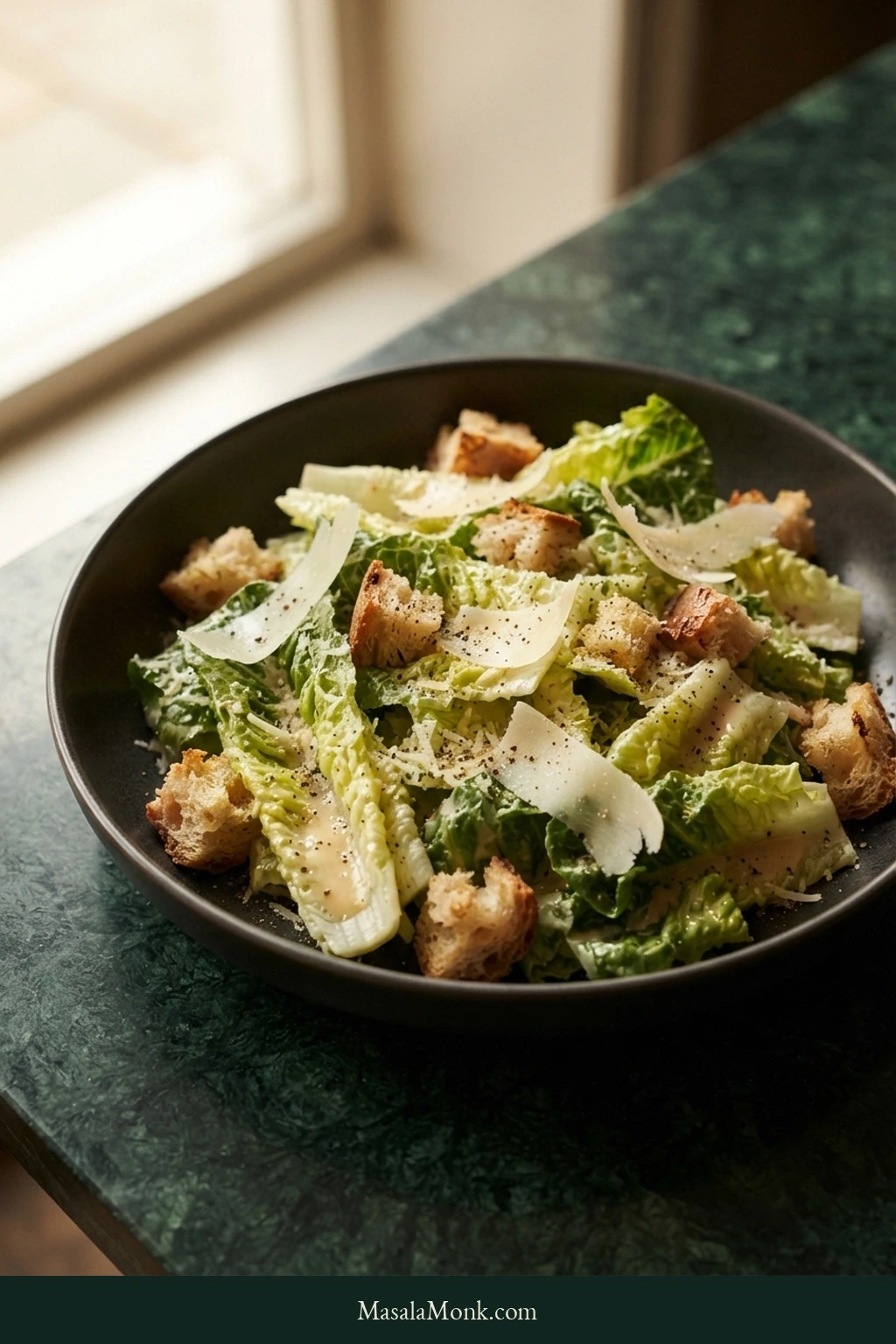
A great Caesar salad gives you cold, snappy romaine, a thin creamy layer of dressing, crunchy croutons, salty Parmesan, black pepper and enough lemon to make you want the next bite. Anchovy deepens everything without becoming the first thing you taste.
Caesar looks simple enough that a disappointing one is especially annoying. The lettuce turns watery. The croutons could break a tooth. Or everything tastes vaguely creamy because another spoonful of dressing went into a bowl that already had enough.
None of those problems needs a complicated fix. You just need to know what to look for.
The Caesar Test
| Check | What You Want |
|---|---|
| Romaine | Cold, firm and dry |
| Croutons | Golden, crunchy and easy to bite |
| Dressing | Bright and savory on romaine |
| Toss | Green, lightly glossy leaves; no puddle underneath |
What Is in Caesar Salad?
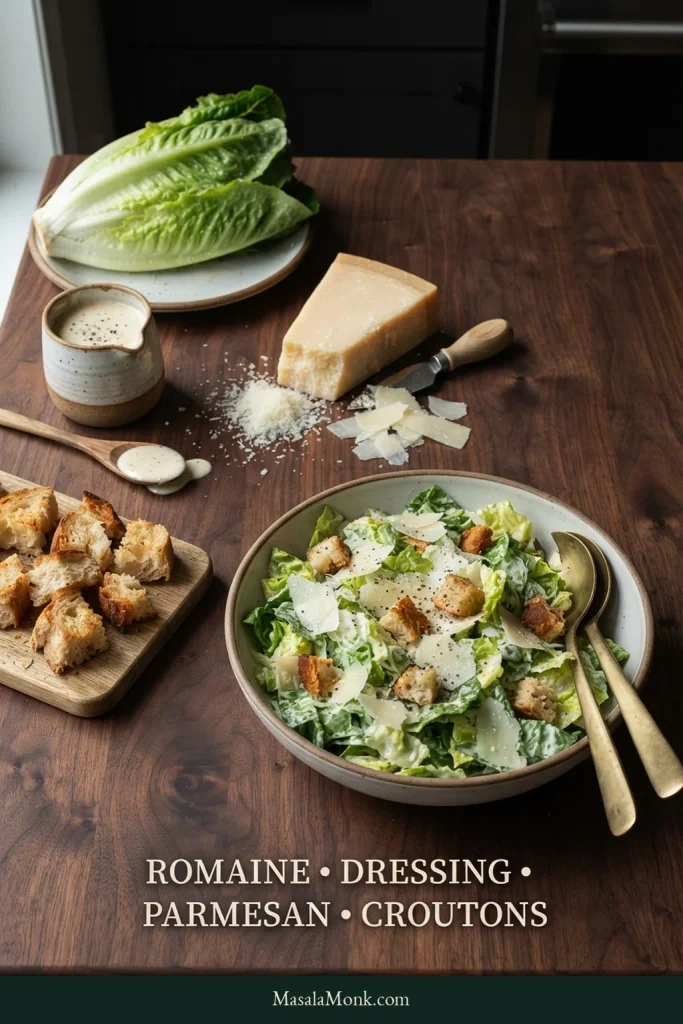
A modern Caesar salad is made with romaine lettuce, Caesar dressing, Parmesan, croutons and black pepper. Lemon, garlic, anchovy and Worcestershire are carried in the dressing, so the bowl does not need a crowd of toppings to taste complete.
Chicken, bacon, avocado and other additions can make good salads, but none is required for Caesar to taste like Caesar.
Caesar Salad Recipe
The dressing below follows the mayonnaise-based formula from our Caesar Dressing Recipe. This batch intentionally makes more than this salad usually needs, so keep the extra chilled rather than pouring it into an already dressed bowl.
Prep: 20 minutes
Cook: 10–15 minutes
Total: about 35 minutes
Serves: 4 as a generous side, or about 6 as a smaller side
Useful equipment: a salad spinner and a very large mixing bowl.
For the Salad
- 16–18 oz / 450–510 g trimmed romaine hearts, about 8–10 loosely packed cups
- ½ cup / 4 fl oz / 120 ml Caesar dressing to start, with more available if needed
- 1 oz / 28 g Parmesan, very finely grated
- ½–¾ oz / 14–21 g Parmesan, shaved for finishing
- Freshly ground black pepper
- Lemon wedges, optional
For the Croutons
- 4 oz / 115 g sturdy rustic bread, such as sourdough, country bread or baguette
- 2 tbsp / 1 fl oz / 30 ml olive oil
- ½ tsp finely grated garlic
- Small pinch of fine salt
- Freshly ground black pepper
For the Caesar Dressing
- ¾ cup / 6 fl oz / 180 ml full-fat mayonnaise
- 1 tsp / 5 ml anchovy paste, or 2 small brown oil-packed anchovy fillets, mashed smooth
- 1 small garlic clove, finely grated
- 2 tbsp / 1 fl oz / 30 ml fresh lemon juice, divided: 1½ tbsp / about 22 ml to start, the rest to finish
- 1 tsp / 5 ml Dijon mustard
- ¼ tsp freshly ground black pepper, plus more if needed
- 1 tsp / 5 ml Worcestershire sauce
- 1 oz / 28 g Parmesan, very finely grated
- Fine salt, only if needed at the end
- 1 tsp / 5 ml cold water to start, plus more 1 tsp / 5 ml at a time as needed
Dressing yield: about 1⅛ cups / 9 fl oz / 270 ml, depending on thinning.
Instructions
Prep the Romaine and Croutons
- Wash, dry and chill the romaine. Separate and wash the leaves, then spin them thoroughly. Check the pale ribs and cupped bases even if the broad parts look dry; the last drops like to hide there. Blot anything the spinner missed. Tear or cut into roughly 1½–2 inch / 4–5 cm pieces and refrigerate while you make the rest.
- Heat the oven to 375°F / 190°C. Tear the bread into irregular ¾–1 inch / 2–2.5 cm pieces. Perfect cubes are unnecessary. Toss with the olive oil, garlic, a small pinch of salt and black pepper, then spread in one layer.
- Bake the croutons for 10–15 minutes. Toss once if needed and continue until they look golden and nearly crisp. Remove the tray from the oven and leave it out while one crouton cools for 3–5 minutes. Bite it. If it crunches easily without feeling rock-hard, let the tray cool completely. A test piece that remains genuinely soft after cooling needs another 2–3 minutes in the oven before you check again.
Mix and Balance the Dressing
- Mix the dressing. Whisk the mayonnaise, anchovy, garlic, Dijon, Worcestershire, black pepper and 1½ tbsp / about 22 ml lemon juice until smooth. Then whisk in the 1 oz / 28 g Parmesan for the dressing.
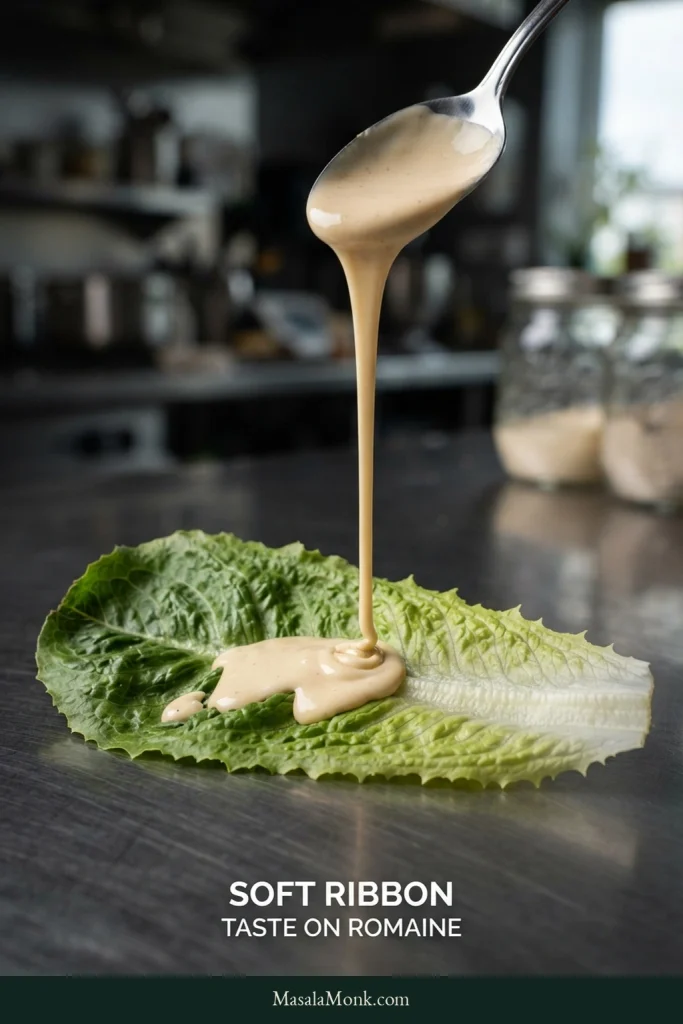
- Get the consistency right. Whisk in 1 tsp / 5 ml cold water. Lift the whisk or spoon. The dressing should fall in a soft ribbon, roughly the flow of heavy cream. If it still drops in a heavy mound, add more water 1 tsp / 5 ml at a time.
- Taste it on romaine. Dress one dry piece. Look for bright lemon, Parmesan, garlic and pepper, with anchovy adding savory depth rather than obvious fishiness. Use the reserved lemon or more pepper if needed. Taste again before reaching for salt.
Toss and Finish
- Start the toss. Put the cold romaine in your largest bowl and add ½ cup / 120 ml dressing. It may look stingy against that much lettuce. Toss before you trust your eyes. Reach underneath and lift the leaves through the dressing, add the 1 oz / 28 g finely grated Parmesan for the salad, then toss again.
- Now look. The leaves should still be green under a thin creamy sheen. Taste a full forkful. If some leaves are still barely dressed, add another 1 tbsp / 15 ml dressing, toss and check again.
- Finish and serve. Fold in the completely cooled croutons. Add ½–¾ oz / 14–21 g shaved Parmesan and plenty of freshly ground black pepper. Serve straight away, with lemon wedges if you like.
Recipe Notes
- Measure romaine after trimming. Weight is more reliable than a fixed number of heads.
- Keep extra dressing separate. Once the leaves are lightly dressed, stop. Refrigerate the rest.
- Salt last. Anchovy, Worcestershire, Parmesan and the croutons have already brought salt to the bowl.
- Making it ahead? Keep the components separate until serving.
How we developed this recipe: This version brings together established Caesar techniques, published recipes and recurring problems reported by home cooks. MasalaMonk has not independently kitchen-tested this exact formula.
Romaine: Dry, Cold & Snappy
Romaine hearts give Caesar its backbone: firm pale ribs, tender inner leaves and enough surface for dressing to cling to. Choose hearts that feel firm and crisp, with fresh-looking cut ends and no slimy edges.
Wet lettuce is the fastest way to weaken a good Caesar. Water left around the ribs thins the dressing during the toss and eventually finds its way into the croutons.
A spinner gets you most of the way there, but check a few ribs afterward. If the broad part of the leaf looks dry, check the base anyway. That’s where the last drops hide.
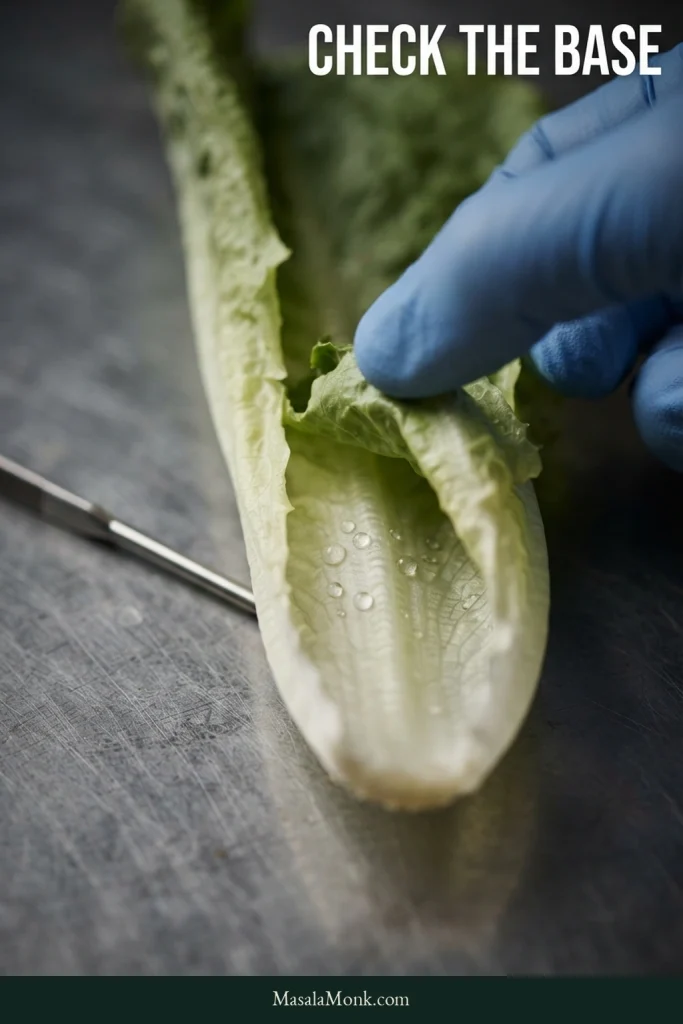
Still finding droplets? Spin again or blot them. This is one place worth being fussy.
Then chill the lettuce. Dryness helps the dressing stay put; cold gives romaine that refreshing snap. A chilled serving bowl is a nice extra if you have room for one, but good lettuce matters far more than cold crockery.
Croutons: Crunchy, Not Hard
Use bread with some structure—sourdough, country bread or baguette all work. Slightly stale bread is useful here. Torn pieces give you craggy edges that toast beautifully and catch little streaks of dressing later.
Size matters more than neatness. Pieces around ¾–1 inch / 2–2.5 cm can develop a toasted exterior without drying into pebbles.
The other trap is judging them hot. Steam can make a freshly baked crouton seem softer than it will be once cooled. That is why the test piece rests outside the oven before you decide whether the tray needs another few minutes.
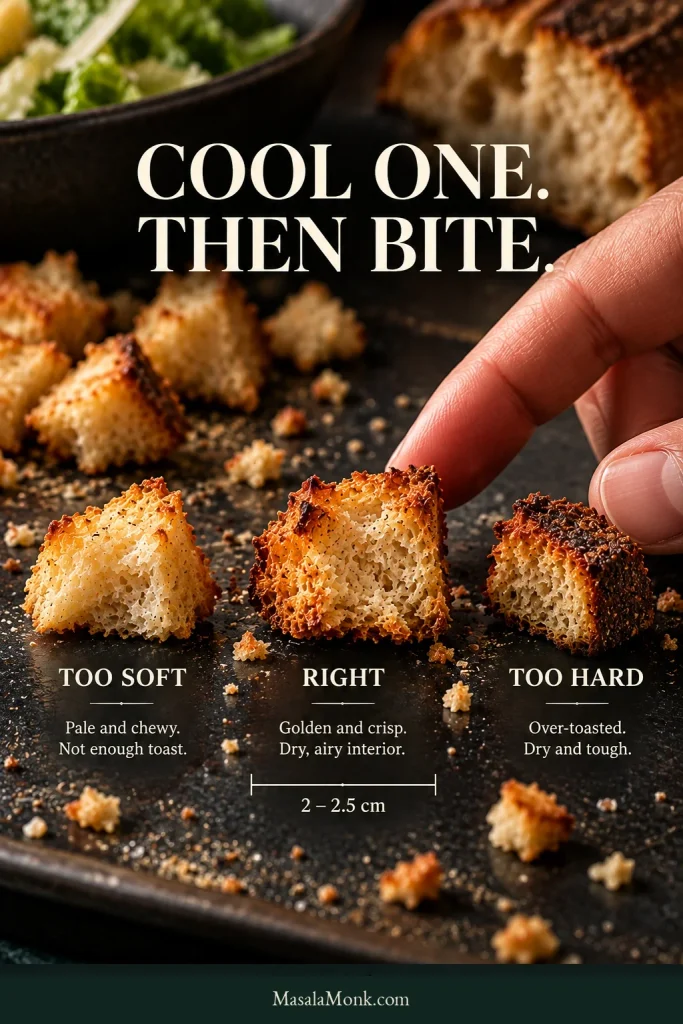
Crunch, yes. Jaw workout, no. A good Caesar crouton should break easily enough to eat with the lettuce instead of fighting it.
Parmesan Has Two Jobs
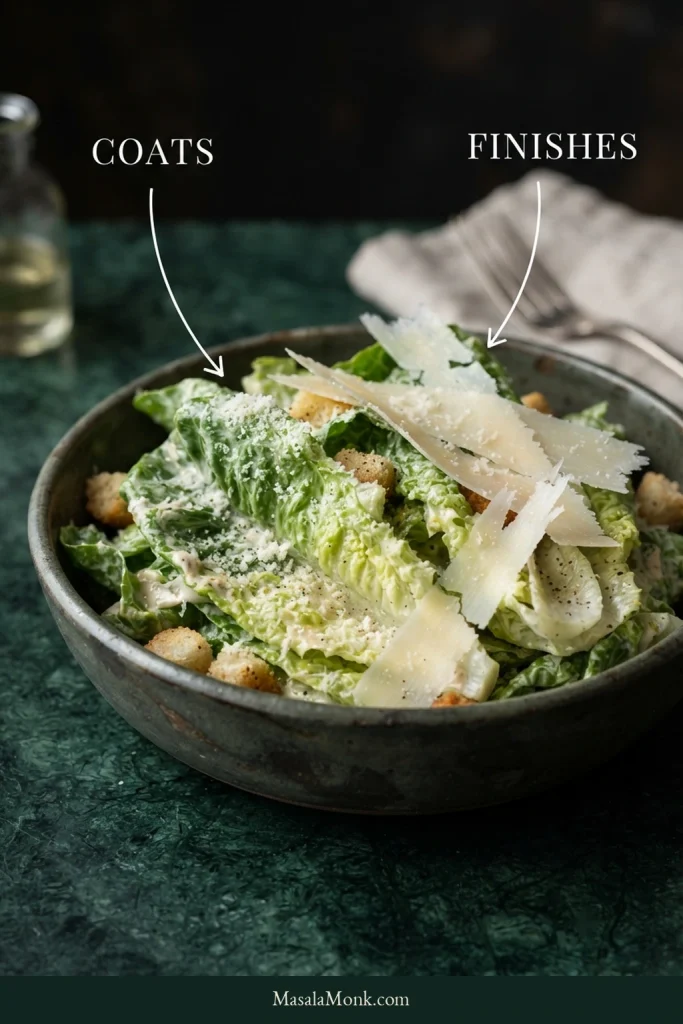
Finely grated Parmesan almost disappears into the tossed salad. That’s useful: it puts a little salt and nuttiness across the romaine instead of concentrating all the cheese in a few bites.
The larger shavings do the opposite. They stay distinct, so now and then you get a more pronounced bite of Parmesan without making the entire bowl heavy.
The Toss Is the Recipe
Most of the work is already done by the time the cold romaine reaches the mixing bowl, so don’t lose its snap in the final minute. Half a cup of dressing can look almost comically small against a mountain of romaine, and the temptation is to pour in more before tossing. Wait.
Give the salad a thorough toss and let the finely grated Parmesan work through the leaves before deciding it needs anything else.
How to Know When to Stop
Now look. Pick up a piece of romaine. It should shine without sagging, with green still visible beneath the dressing. The bottom of the bowl should be almost clean.
Then taste a full forkful. If the leaves are already nicely dressed but the flavor feels timid, don’t keep adding volume just to chase flavor. Add a little lemon or black pepper to a spoonful of dressing, taste it on romaine, then toss that through. Add salt only if the finished forkful still needs it. If some leaves are still bare, that’s different: add another 1 tbsp / 15 ml.
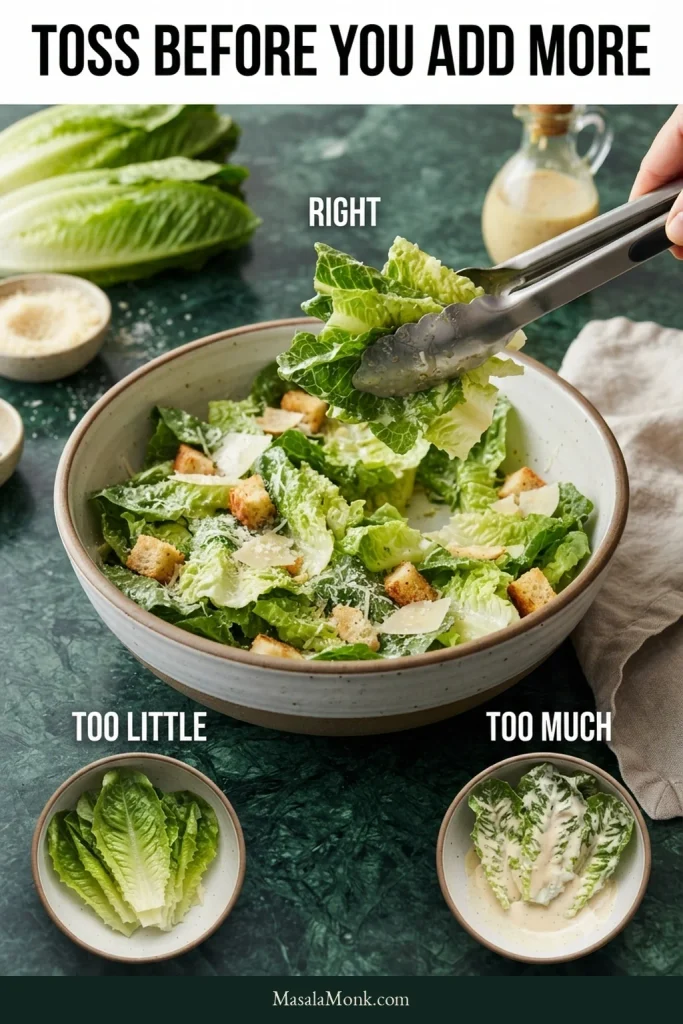
Don’t overthink the last few tablespoons. Once the lettuce is dry and the dressing tastes good on it, the bowl usually tells you when to stop.
A good forkful should crack through a cold romaine rib, pick up creamy dressing and nutty Parmesan, then finish with the toasted crunch of a crouton.
Caesar Salad Troubleshooting
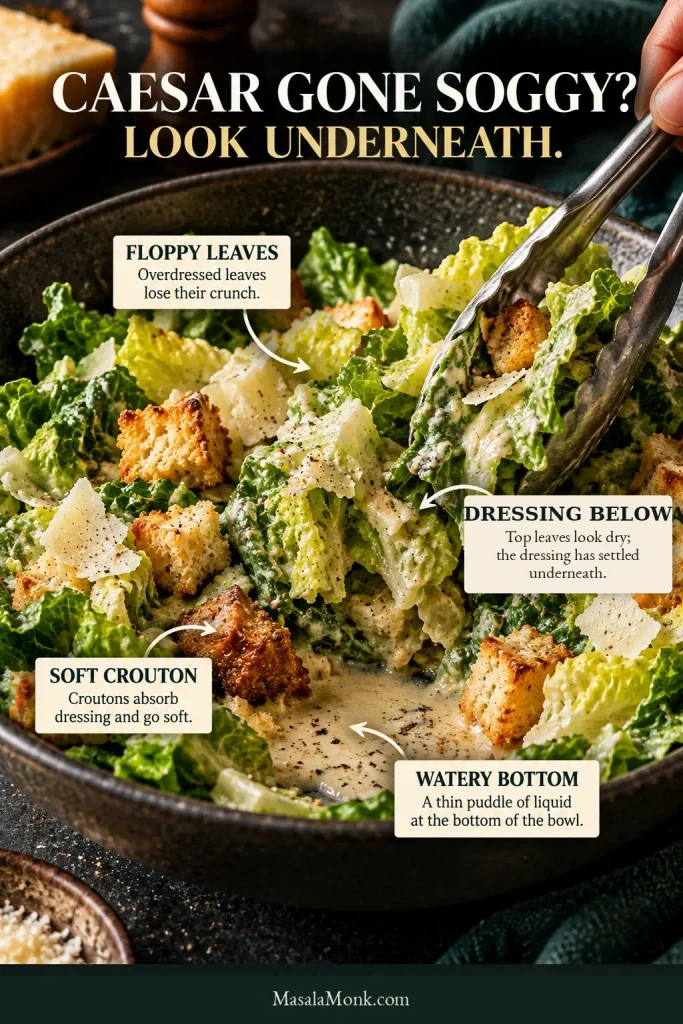
If your Caesar is already soggy, where the moisture shows up can tell you what went wrong.
There Is Watery Liquid Under the Salad
Check the romaine first. Water caught around the ribs thins the dressing during the toss. If the lettuce started dry, the dressing itself may have been loosened too far.
The Leaves Look Bare but Dressing Is Underneath
This usually points to wet lettuce, overly thin dressing or a toss that never brought the lower leaves through the bowl. Toss again from the bottom before adding another drop.
The Leaves Are Dressed but Already Floppy
The salad probably got too much dressing or waited too long after tossing. You cannot put the original snap back into softened romaine. Serve it now; next time, leave the toss until closer to the table.
The Romaine Is Fine but the Croutons Are Soft
They may have gone into the bowl warm, needed a little more baking or simply spent too long touching dressing. Cool them completely and make them one of the last things into the bowl.
If the flavor of an already-dressed salad is simply too concentrated, the cleanest dilution is more undressed romaine—not water.
| Problem | What to Do |
|---|---|
| Bland after tossing | If the leaves already have enough dressing, adjust a little dressing rather than adding more just to chase flavor. Lemon or black pepper are the first things to check. |
| Too fishy | Anchovy is dominating. Rebalance the remaining dressing before using any more. |
| Too salty | Hold back extra Parmesan and salty croutons. Rebalance any remaining dressing before adding more. |
| Too garlicky | Raw garlic is dominating. Repair the remaining dressing before using more; adding water directly to the finished salad will not solve it. |
| Heavy or flat | Add a little lemon to the dressing, taste it on romaine, then toss that through the salad. |
| Croutons too hard | There is little to rescue once bread is overdried. Use larger torn pieces next time and judge them after cooling. |
If the dressing itself needs rescuing—because the anchovy or garlic is too strong, the texture is wrong, or the flavor has slipped out of balance—our Caesar dressing guide has the more detailed fixes.
When the bowl is right, none of the parts has to fight for attention. The romaine stays cold and snappy, the dressing follows the leaves instead of collecting underneath, and the croutons still crunch when the salad reaches the table.
Back to the Caesar Salad Recipe · Back to top
Make Caesar Ahead Without Losing the Crunch
Want to get ahead? Stop before the toss.
Wash, dry and chill the romaine. Make the dressing and refrigerate it. Cool the croutons completely and keep them airtight at room temperature. Grate and shave the Parmesan, cover it and refrigerate it.
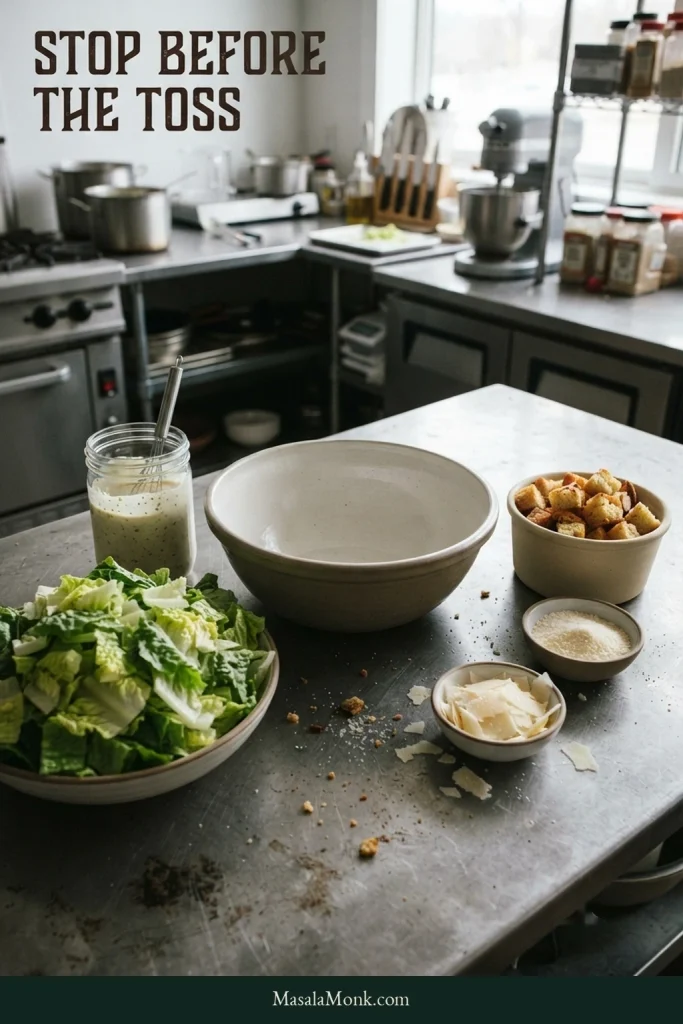
When it is time to eat, dress the leaves, add the fine Parmesan and finish with the croutons and shavings. That last-minute toss is what keeps the romaine snappy and the croutons crunchy.
Packing lunch? Keep the dressing and croutons separate and assemble the salad when you are ready to eat.
What About Leftover Dressed Caesar?
Refrigerate it promptly, but expect softer lettuce and croutons later. If you already know half the bowl is for tomorrow, don’t dress that half tonight.
Ready to cook? Back to the Caesar Salad Recipe.
What to Serve With Caesar Salad
Caesar works especially well beside a hot main because cold romaine, lemon and toasted croutons bring their own kind of contrast.
For pizza night, make the salad while the pizza bakes but wait to toss it until the pizza comes out. A Focaccia Pizza can rest for a few minutes before slicing. The Caesar can’t.
For a lighter soup-and-salad dinner, serve it with Chicken Noodle Soup. Warm broth and tender noodles play nicely against cold romaine and crunchy croutons.
Original Caesar Salad vs. Modern Caesar Salad
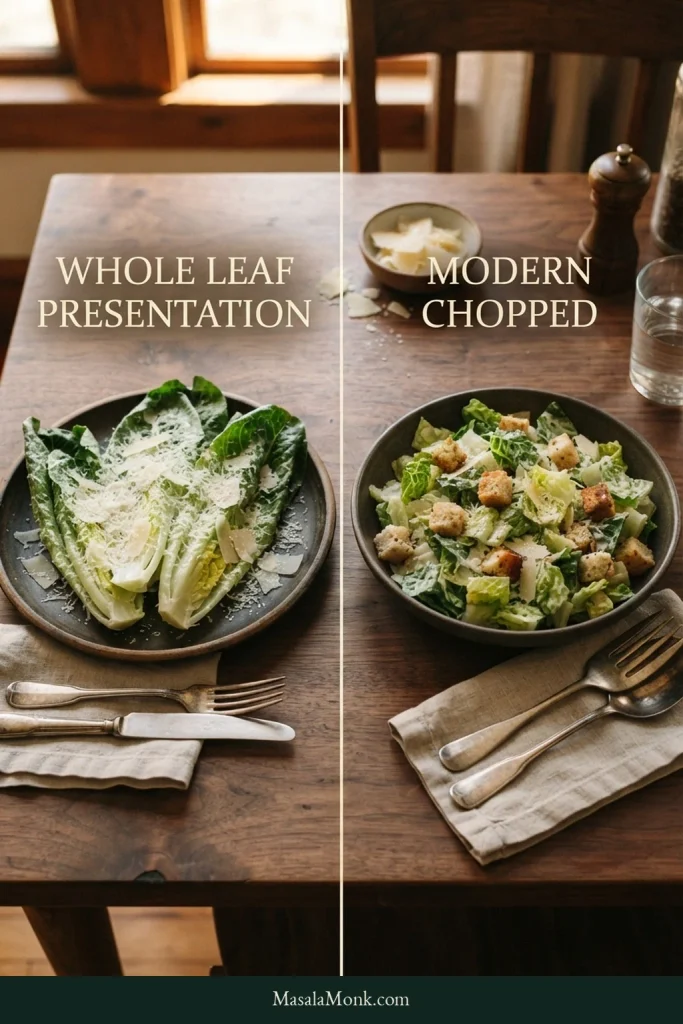
The whole romaine leaves you still see in tableside Caesars are not just restaurant theater. They’re a link to the salad’s early presentation in Tijuana, Mexico, where Caesar Cardini is associated with its creation in 1924. The Los Angeles Times’ account of Caesar’s in Tijuana traces that connection and the restaurant’s continuing tableside tradition.
Exact early formulas are less tidy than the origin story. A Cardini-attributed version documented by UCHealth uses whole romaine, egg yolk, lime, Worcestershire, olive oil, Parmesan and toasted baguette without separate anchovy fillets. Modern Caesar commonly uses explicit anchovy, while surviving accounts of earlier versions vary.
The recipe here is a modern classic Caesar: chopped romaine, anchovy in the dressing, Dijon, Parmesan and bite-size croutons. It keeps the familiar flavor while making the salad straightforward to toss and eat at home.
Whole Romaine Leaves or Chopped?
Whole tender inner leaves make a striking tableside salad and echo the older presentation. At home, 1½–2 inch / 4–5 cm pieces are easier to toss evenly, which is why this recipe uses the chopped style.
Anchovies, Eggs & Fish-Free Options
Anchovy shouldn’t shout. If you have avoided it because you don’t want a fishy salad, quantity makes the difference. In a balanced Caesar, anchovy reads as deep savoriness before it reads as fish.
For a fish-free Caesar, omit the anchovy and use a fish-free Worcestershire sauce. Leaving out the fillets or paste alone may not be enough because conventional Worcestershire commonly contains anchovy.
The main recipe uses prepared mayonnaise, so you do not have to handle an uncooked yolk yourself. It still contains egg; use egg-free mayonnaise if needed.
If you avoid animal rennet, check the cheese too and choose a suitable vegetarian Parmesan-style hard cheese. The dressing guide gives the quantities needed to keep fish-free and egg-free versions balanced.

Frequently Asked Questions
How much Caesar dressing do I need per person?
As a starting point, this recipe uses about 2 tbsp / 30 ml dressing per generous side serving. Toss before adding more. Dry lettuce, thicker dressing and a thorough toss can all change how much the bowl actually needs. For the visual stopping cues, see The Toss Is the Recipe.
Can I use bottled Caesar dressing?
Yes. Dry and chill the romaine, start with a modest amount and toss thoroughly before adding more. If the bottled dressing sits in heavy blobs, loosen the portion you plan to use with a little cold water first. The technique still matters when the dressing comes from a bottle.