This Rotel dip recipe is for the moment when the chips are open, people are hovering, and the cheese needs to stay creamy long after the first scoop. It is not fancy food. Think warm, glossy, salty, tomato-chile cheese dip that does exactly what party food should do: disappear from the table.
The best bowl should be soft enough to drag through with a chip, thick enough to cling, but not so stiff that the chip snaps. That texture comes from a few simple choices: use the Rotel undrained, melt the cheese gently, drain the meat well, and keep the finished dip warm instead of hot.
Keep it classic with Velveeta and Rotel when you need something fast. Add ground beef when you want it hearty and mild. Choose sausage when you want a bolder game-day bowl. Stir in cream cheese when you want it thicker and richer. Use the slow cooker when people are going to keep coming back for one more scoop.
To make classic Rotel dip, combine 16 oz Velveeta with one 10 oz can of Rotel, undrained. Melt gently on the stovetop, in the microwave, or in a slow cooker until smooth. For a heartier dip, add 1 lb cooked and drained sausage or ground beef.
For the best all-around party dip, use sausage. A milder, family-friendly bowl works better with ground beef. Need the fastest version? Skip the meat. Want the thickest scoop? Add cream cheese.
There is no fancy sauce technique here. The Rotel liquid loosens the cheese, Velveeta keeps it steady, and cooked meat makes it hearty. Once everything is melted, your only job is to keep it soft and stir it now and then.
Classic ratio: 16 oz Velveeta + one 10 oz can Rotel, undrained
Cream cheese version: add 4 to 8 oz cream cheese for a thicker scoop
Crock pot version: cook on low for 2 to 3 hours, then switch to warm
Main rule: melt gently; do not boil the cheese mixture
The Easy Rotel Dip Ratio
This simple ratio gives the dip enough cheese to stay creamy, enough Rotel to loosen it, and enough meat to feel like a real party bowl.
For the easiest Rotel dip ratio, use 16 oz Velveeta, one 10 oz can of Rotel, and 1 lb cooked meat for a heartier batch.
Rotel Dip Recipe Card
Rotel Dip Recipe
A creamy, scoopable cheese dip made with Velveeta, Rotel tomatoes with green chilies, and optional ground beef or sausage. Make it on the stovetop for a quick appetizer, or move it to a crock pot to keep it warm for a crowd.
Prep time: 5 minutes
Cook time: 10 to 15 minutes
Total time: 15 to 20 minutes
Servings: 10 to 12 appetizer servings
Best for: game day, potlucks, parties, movie nights, nachos, and snack boards
Ingredients
1 lb ground beef or breakfast sausage / 454 g, optional but recommended for a heartier dip
16 oz Velveeta, cubed / 454 g
1 can Rotel diced tomatoes and green chilies, undrained / 10 oz / about 283 g
1/2 tsp chili powder or 1 to 2 tbsp taco seasoning, optional
1 to 3 tbsp milk / 15 to 45 ml, optional, only if the cheese needs thinning
4 to 8 oz cream cheese / 113 to 227 g, optional, for a thicker and richer dip
Before cooking, set up each ingredient by job: Velveeta melts smoothly, Rotel adds tomato-chile flavor, meat adds body, and cream cheese makes the dip richer.
Instructions
Brown the ground beef or sausage in a large skillet over medium-high heat, breaking it into small crumbles as it cooks.
Drain the meat very well. Keep the crumbles, not the grease.
Reduce the heat to medium-low.
Add the cubed Velveeta, undrained Rotel, and chili powder or taco seasoning if using.
If using cream cheese, add it now in small cubes so it melts evenly.
Stir until the cheese melts and the mixture looks smooth, glossy, and creamy.
If it is too thick, add milk 1 tablespoon at a time until it is easy to scoop.
Taste before serving. Add a pinch of chili powder, taco seasoning, or hot sauce only if it needs more flavor.
Serve warm with tortilla chips, or transfer to a slow cooker on warm for parties.
Recipe Notes
For 2-ingredient Rotel dip, skip the meat and use only Velveeta and Rotel.
Mild breakfast sausage keeps the batch crowd-friendly, while hot sausage adds more heat.
Lean ground beef works well because it keeps the bowl hearty without adding too much grease.
Use 4 oz cream cheese for a slightly richer dip or 8 oz for a thick sausage-style batch.
If using sausage or taco seasoning, taste before adding extra salt.
Cook ground beef or sausage fully before adding the cheese. Ground meat and sausage should reach 160°F / 71°C; FoodSafety.gov has a safe minimum temperature chart if you want a reference.
Do not boil the cheese after it melts. Low, steady heat keeps the texture smoother.
Finished Rotel dip should look glossy, melted through, and thick enough to coat a chip. You should see small tomato and green chile pieces suspended in the cheese, not watery liquid around the edges.
When the dip falls from a spoon in slow ribbons, it is ready. A stiff clump needs gentle heat and a little milk. Grease pooling on top usually means the meat needed more draining. The final test is simple: a sturdy chip should scoop through without snapping.
Look for Slow Ribbons
The spoon tells you more than the clock. Smooth ribbons mean the cheese has melted evenly and the dip is ready to serve.
Once the cheese falls from the spoon in slow ribbons, the texture is right: melted through, easy to dip, and still strong enough for chips.
Which Version Should You Make?
Keep this ratio handy: 16 oz Velveeta, one 10 oz can Rotel, and 1 lb meat if you want the bowl hearty. From there, choose the version that fits the table.
Situation
Make This
Need dip in 10 minutes
2-ingredient Velveeta + Rotel
Want the best all-around party bowl
Sausage + Velveeta + Rotel
Serving kids or spice-sensitive guests
Ground beef + mild Rotel
Want thicker scoops
Add 4 to 8 oz cream cheese
Want the richest version
Sausage + cream cheese + Velveeta + Rotel
Keeping it warm for a party
Use the crock pot on warm after melting
Dip got too thick
Rewarm gently and add milk slowly
Making a bigger party batch
32 oz Velveeta + two cans Rotel + 1 to 2 lb meat
Match the Version to the Table
Use the version guide when you are choosing between fast, mild, bold, thick, or slow-cooker friendly.
Next, match the version to the table: meatless for speed, ground beef for mild flavor, sausage for game day, and cream cheese for thicker scoops.
For most parties, sausage with original Rotel is the safest bold version. A milder family bowl is easier to love with ground beef and mild Rotel.
This dip works because every ingredient has a job, and none of them ask much from you.
Velveeta melts smoothly. It gives the bowl that classic creamy texture without needing a roux or careful cheese sauce technique.
Rotel adds flavor and moisture. The tomatoes and green chilies bring tang, gentle heat, and enough liquid to loosen the cheese.
Well-drained meat keeps it clean. Ground beef or sausage makes the bowl more filling, but extra grease can float on top if the meat is not drained.
Low heat protects the texture. Cheese dip does not need to boil. It needs to melt gently until loose, glossy, and dippable.
A slow cooker solves the party problem. Once melted, the warm setting keeps the cheese soft enough for chips without constant reheating.
If you like understanding why cheese turns smooth instead of grainy, this easy cheese sauce recipe goes deeper into gentle heat and creamy texture.
What Is Rotel Dip?
Rotel dip is the quick American-style cheese dip people make when they want melted cheese, tomato-chile flavor, and almost no prep. The classic version uses Velveeta because it melts smoothly and stays creamy, while Rotel adds tomatoes, green chilies, and just enough liquid to loosen the cheese.
The familiar 10 oz can plus 16 oz cheese ratio is also the brand-style queso formula. Ro-Tel’s Famous Queso Dip uses a 10 oz can of Ro-Tel, undrained, with a 16 oz package of Velveeta.
Searchers may call this Rotel cheese dip, Velveeta Rotel dip, Rotel queso dip, sausage Rotel dip, or hamburger cheese dip, but the idea is usually the same: melted cheese, Rotel, and sometimes meat.
Once you know the basic idea, the ingredient choices are simple: cheese controls the texture, Rotel brings the tomato-chile flavor, and meat decides how filling the bowl feels.
Ingredients You’ll Need
Velveeta
Velveeta gives this recipe its familiar party texture: creamy, steady, and almost impossible to mess up if you keep the heat low. A 16 oz block gives one standard batch the texture people expect from Velveeta Rotel dip.
Regular Velveeta gives the classic flavor. Queso blanco Velveeta also works for a lighter-colored dip. Shredded cheddar alone can turn grainy, so it works better with cream cheese in the no-Velveeta option.
Rotel Tomatoes and Green Chilies
One 10 oz can is the right amount for one 16 oz block of Velveeta. Pour in the tomatoes, chilies, and liquid together; that liquid keeps the cheese from turning stiff. The tomato and green chile pieces also keep the bowl from tasting flat.
Original Rotel is the default for that familiar tomato-chile bite. Mild Rotel is better for a gentle, crowd-friendly bowl. Hot Rotel works when you want more heat.
Ground Beef or Sausage
Meat is optional, but it makes the cheese dip more filling. Ground beef brings a milder, heartier flavor. Sausage makes it bolder, saltier, and more game-day friendly.
For one standard batch, cook 1 lb of ground beef, breakfast sausage, pork sausage, or hot sausage. Break it into small crumbles, spoon off excess fat, and then add the cheese and Rotel.
Cream Cheese
A little cream cheese gives the dip more body; a full 8 oz block turns it into a thicker, richer party scoop. It works especially well with sausage and in no-Velveeta versions.
Cut it into small cubes before adding it so it melts evenly. Use 4 oz when you still want classic queso energy; go up to 8 oz when you want the chip to come up loaded.
Seasoning and Heat
You do not need much seasoning because Velveeta, Rotel, and sausage already bring flavor. For more depth, add a little chili powder, taco seasoning, garlic powder, hot sauce, or chopped jalapeños. Start light, especially with sausage or taco seasoning.
How to Make Rotel Dip
The method is simple: cook the meat if you are using it, turn the heat down, melt the cheese with Rotel, and thin only if the dip needs it.
Stovetop Method
Brown the ground beef or sausage in a large skillet over medium-high heat.
Drain the meat well and return it to the pan.
Lower the heat to medium-low.
Add cubed Velveeta and undrained Rotel.
Add cream cheese now if using it.
Stir until the cheese melts into a smooth dip.
Add a splash of milk only if the dip is too thick.
Drain the Meat Well
Draining the meat is the small step that keeps the finished dip rich instead of oily.
After browning sausage or ground beef, drain it well so the cheese dip stays savory and rich without a greasy layer on top.
Once the meat is drained, add the Rotel with its liquid. That can liquid is part of the sauce, helping the cheese loosen while carrying tomato-chile flavor through the whole pan.
Use the Rotel Liquid
Pour in the tomatoes, green chilies, and liquid together before the cheese fully melts, so the mixture has enough moisture from the start.
When adding Rotel, pour in the tomatoes, green chilies, and liquid together; that juice loosens the Velveeta and keeps the dip scoopable.
Stop when the cheese looks glossy and the dip moves slowly from the spoon, not when it starts bubbling. High heat can make the edges oily, the texture heavy, or real cheese grainy.
Melt the Velveeta Gently
Low heat gives the cheese time to melt into the Rotel liquid, so the dip stays glossy and smooth.
As the Velveeta melts, keep the heat gentle. The goal is glossy, dippable cheese, not a bubbling pot that turns heavy or oily.
Making this ahead for a crowd? Use the crock pot method. If the texture changes while it sits, the troubleshooting guide will help you bring it back.
Microwave Method
The microwave is best when you are making the fast meatless version and just need cheese dip on the table now. Add cubed Velveeta and undrained Rotel to a microwave-safe bowl. Microwave on high for 2 to 3 minutes, stir well, then continue in 30 to 60 second bursts until the cheese is melted through.
If adding ground beef or sausage, cook and drain the meat separately first, then stir it into the melted cheese mixture.
Slow Cooker Method
For parties, the slow cooker is the easiest method. Brown and drain the meat first, then add the meat, cubed Velveeta, and undrained Rotel to the slow cooker. Cook on low for 2 to 3 hours or high for 1 to 2 hours, stirring occasionally. Once smooth, switch to warm for serving.
2-Ingredient / Meatless Rotel Dip
When speed matters more than making it hearty, skip the meat and keep the bowl simple: Velveeta and Rotel. This is the fastest version and the easiest one to make at the last minute.
16 oz Velveeta, cubed / 454 g
1 can Rotel, undrained / 10 oz / about 283 g
Melt them together on the stovetop or in the microwave, stirring until smooth. It is lighter than the ground beef or sausage batch, but it still gives you that classic warm cheese-and-chile flavor. Corn or beans can make it more filling, but they move the recipe into a different style.
Ground Beef Version
Start here when you want the dip to feel like food, not just a snack, but still keep the flavor mild enough for everyone. Ground beef makes the bowl feel more like a filling snack than plain melted cheese, while still letting the tomato-chile flavor come through.
For one batch, use 1 lb ground beef, 16 oz Velveeta, and one 10 oz can Rotel. Brown the beef, break it into small crumbles, and drain it well before adding the cheese and Rotel. You may know this as hamburger Rotel dip, hamburger cheese dip, or Velveeta cheese dip with hamburger meat.
For a milder bowl, ground beef gives this dip taco-night flavor that works with chips, nachos, baked potatoes, or a mixed crowd.
Sausage Version
Sausage is the game-day version: bolder, saltier, and a little more “people keep coming back” than ground beef. The sausage version smells richer and more savory as it melts, which is why it feels especially right for game day.
A standard sausage batch needs 1 lb breakfast sausage, 16 oz Velveeta, and one 10 oz can Rotel. Mild sausage keeps the dip crowd-friendly. Hot sausage makes it spicier and pairs well with original or hot Rotel. Cook the sausage fully, drain it well, and leave the grease behind before the cheese goes in.
For a bolder party dip, sausage brings deeper savory flavor, more texture, and a stronger game-day feel than ground beef.
This is also the option that works especially well with cream cheese. Add 4 to 8 oz when you want a thicker, richer scoop.
Cream Cheese Version
Cream cheese is for the thick-scoop people. It turns the dip into a heavier, richer scoop — the kind that sits on a sturdy chip instead of sliding right off.
Add 4 oz cream cheese for extra creaminess or 8 oz cream cheese for a thick sausage-style dip. Cut it into small cubes and let it soften slightly so it melts evenly.
Add cream cheese when you want a heavier scoop; it makes the cheese dip richer, sturdier, and easier to load onto thick chips.
Because cream cheese makes the dip thicker, it pairs especially well with the chip test and the sturdy serving ideas below.
Slow Cooker / Crock Pot Rotel Dip
The slow cooker is the best choice when the cheese needs to stay soft for a party. It melts everything gently and keeps the finished bowl ready for repeat scoops.
Batch
Use This
Slow Cooker Size
Standard batch
1 lb cooked meat + 16 oz Velveeta + 1 can Rotel
3 to 5 quart
Small meatless batch
16 oz Velveeta + 1 can Rotel
2 to 3 quart
Big party batch
1 to 2 lb cooked meat + 32 oz Velveeta + 2 cans Rotel
4 to 6 quart
For parties, the crock pot is about holding as much as cooking. Once melted, the warm setting keeps each scoop soft and ready.
Cook on low for 2 to 3 hours or high for 1 to 2 hours. Once the cheese is smooth, switch to warm. A large slow cooker batch may need up to 1/4 to 1/2 cup milk as it sits, but add it slowly so the cheese does not become thin.
Do not add raw ground beef or sausage directly into the cheese dip. Cook and drain the meat first. If using 2 lb sausage, taste before adding seasoning because sausage can make the dip salty.
Serving this for a longer party? Keep the dip on warm, then use the troubleshooting section if it thickens, turns oily, or needs loosening later.
For another slow-cooker bite that can stay warm for a crowd, grape jelly meatballs fit the same potluck and game-day table.
Do You Drain the Rotel?
No, do not drain Rotel for regular cheese dip. The liquid in the can helps the cheese melt into a smooth, creamy, dippable texture. The Rotel pour visual above shows how the tomatoes, green chilies, and liquid go in together.
Drain part of the liquid only for a very thick bowl, a doubled recipe that needs more control, or a different recipe where extra moisture causes problems. For the classic dip, use the whole can.
No-Velveeta Version
Real cheese can work, but it will not behave exactly like Velveeta. The no-Velveeta version tastes more like homemade queso, with stronger cheese flavor but less foolproof texture. Keep the heat low and give it help from cream cheese so it stays smoother.
8 oz cream cheese / 227 g
1 to 1 1/2 cups freshly shredded cheddar or pepper jack
1 can Rotel, partly drained if you want a thicker dip
A splash of milk if the cheese needs loosening
Freshly shredded cheese melts better than pre-shredded cheese because bagged shredded cheese often has anti-caking ingredients. Add shredded cheese off the heat or over very low heat, and stir gently.
How to Make It Spicier
The easiest way to add heat is to use hot Rotel instead of original. For a stronger kick, add spicy sausage, chopped jalapeños, cayenne, hot sauce, pepper jack, or a little extra chili powder.
Add heat slowly. Cheese dip can become too spicy faster than expected, especially if you use hot sausage and hot Rotel together. For a brighter bowl beside all that cheese, salsa verde adds a tangy green contrast for chips, tacos, bowls, and nachos.
How to Keep It Creamy and Warm
Rotel dip is best when it stays soft enough to scoop. As it cools, the cheese naturally tightens; that is normal, and it is easy to fix.
Serve it from a slow cooker on warm.
Stir every 20 to 30 minutes during a party.
Keep the lid on when people are not serving.
Add milk slowly if it gets too thick.
Keep the heat low after the cheese melts.
Drain meat well so grease does not collect on top.
If the bowl has been sitting for a while, stir it before adding more liquid. Sometimes the top looks thick, but the inside is still creamy once stirred. The same rule applies to other dairy-heavy dips, like spinach artichoke dip: once it is hot and melted, warm is safer than high.
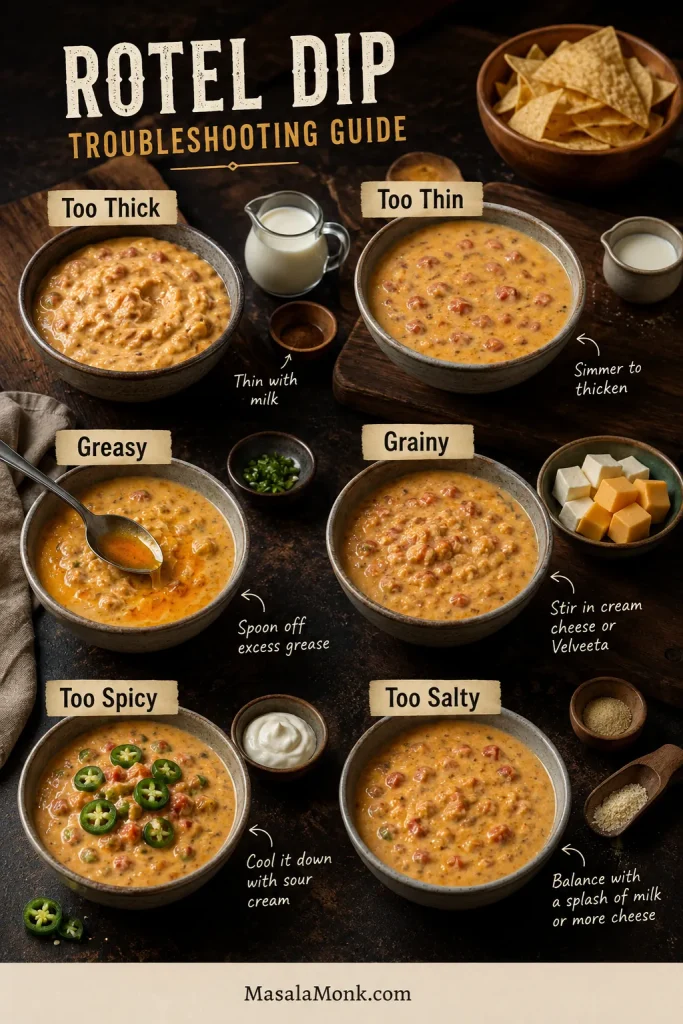
Troubleshooting
When the cheese changes while it sits, do not panic. Warm dips thicken, cool, and sometimes look oily before a quick stir brings them back. Most problems are easy to fix if you control heat, thickness, and grease.
Problem
Why It Happens
How to Fix It
Too thick
The cheese cooled, or too much liquid evaporated
Warm gently and add milk 1 tablespoon at a time
Too thin
Too much liquid or not enough cheese
Add more cubed Velveeta, or warm uncovered on low for a few minutes while stirring often
Greasy
The meat was not drained well
Spoon off excess grease or blot the surface lightly
Oily edges
The heat is too high, or the meat was greasy
Lower the heat, stir gently, and spoon off excess oil
Grainy
Heat was too high, or real cheese did not melt smoothly
Lower the heat and use Velveeta or cream cheese for a smoother base
Skin on top
It sat uncovered or unstirred for too long
Keep covered and stir every 20 to 30 minutes
Too spicy
Hot Rotel, spicy sausage, or too much hot sauce
Add more Velveeta or cream cheese to mellow it
Bland
Mild meat and mild Rotel need more seasoning
Add taco seasoning, chili powder, garlic powder, or hot sauce
Too salty
Sausage, Velveeta, or seasoning added more salt than expected
Add cream cheese, a splash of milk, or more unsalted meat if you have it
Quick Fix Guide
Most dip problems come down to heat, liquid, or grease. Fix one at a time and the bowl usually comes back quickly.
If the dip gets too thick, thin, greasy, grainy, spicy, or salty, small fixes like milk, gentle heat, cream cheese, or extra cheese can bring it back.
Once the cheese is warm and glossy, the only real question is what gets dipped first. Set out the sturdy chips first. The thin ones can wait for salsa.
Use the Chip Test Before Serving
A sturdy tortilla chip should scoop through the dip without snapping. That tells you the dip is thick enough to cling but still soft enough to serve.
Before serving, try the chip test: a sturdy tortilla chip should scoop through cleanly and bring up cheese, meat, tomato, and chile.
Best dippers: thick tortilla chips, scoop-style corn chips, Fritos Scoops, pretzels, or sturdy crackers.
Fresh contrast: celery sticks, bell pepper strips, cucumber rounds, jalapeño slices, green onion, cilantro, pico de gallo, or a little sour cream drizzle.
Load it onto: nachos, fries, tater tots, baked potatoes, tacos, rice bowls, burgers, or hot dogs.
The best scoop should bring up cheese, tomato, chile, and little bits of meat in one bite. That is why thick chips matter, especially with sausage or cream cheese versions.
Make Ahead, Storage, Reheating, and Freezing
Yes, you can make Rotel dip ahead. Let it cool, store it in the fridge, and reheat it gently on the stovetop, in the microwave, or in a slow cooker. Add a splash of milk if it has thickened.
Store leftovers in an airtight container in the fridge for 3 to 4 days. Refrigerate leftovers within 2 hours; during serving, keep the dip warm rather than letting it sit at room temperature for long stretches.
Reheating is easy; the only trick is not rushing it. Use low heat on the stovetop or short microwave intervals, stirring often so the edges do not overheat before the center is warm.
Freezing is not ideal. Cheese dips can separate, turn grainy, or lose their smooth texture after thawing. For the best texture, refrigerate leftovers and reheat them within a few days instead.
Make It a Snack Table
A good snack table needs contrast. Keep this cheese dip warm, add a cold 7 layer dip, set out something crunchy, and bring in one savory bite like wings, meatballs, or sliders. That way the Rotel dip stays the warm centerpiece without having to carry the whole table.
Build the Serving Board
Put sturdy chips closest to the warm dip, then use vegetables, jalapeños, green onion, pico, and toppings to add freshness around the rich cheese.
Finally, serve the dip with sturdy chips first, then add scoop chips, vegetables, jalapeños, green onion, pico, and toppings for contrast.
For a second warm dip, buffalo chicken dip brings a spicy, creamy option beside this cheesy one. If you are turning the snack table into dinner, slow cooker pulled pork works for sliders, nachos, rice bowls, and loaded baked potatoes.
FAQ
What is Rotel dip made of?
The classic version is Velveeta plus Rotel diced tomatoes with green chilies. Many versions also add ground beef, sausage, cream cheese, taco seasoning, or chili powder.
Do you drain Rotel before adding it?
No. Use Rotel undrained for regular cheese dip. The liquid helps the cheese melt smoothly and keeps the texture scoopable.
How much Velveeta do I need for one can of Rotel?
Use 16 oz Velveeta for one 10 oz can of Rotel. That is the classic ratio for smooth, scoopable Rotel dip.
Is Rotel dip better with sausage or ground beef?
Sausage gives the dip a bolder, saltier, more party-style flavor. Ground beef is milder and better for a crowd that does not want much spice.
How do you make Rotel dip in a crock pot?
Cook and drain the meat first, then add it to the slow cooker with cubed Velveeta and undrained Rotel. Heat on low for 2 to 3 hours or high for 1 to 2 hours, then switch to warm.
What does cream cheese do in Rotel dip?
Cream cheese makes the dip thicker, richer, tangier, and sturdier on chips. Use 4 oz for a small creamy boost or 8 oz for a thick sausage-style batch.
How do I thin Rotel dip without making it watery?
Warm it gently and add milk 1 tablespoon at a time. Stir before adding more because the center may be creamier than the top looks.
What can I use instead of Velveeta?
Use cream cheese with freshly shredded cheddar or pepper jack. It will taste more like homemade queso, but it will not be as foolproof as classic Velveeta dip.
How long does Rotel dip last in the fridge?
Leftover Rotel dip keeps well in an airtight container in the fridge for 3 to 4 days. Reheat gently and stir in a little milk if it has thickened.
Does Rotel dip freeze well?
Freezing is not the best choice because the cheese can separate or turn grainy after thawing. Refrigerate leftovers and reheat them within a few days for the best texture.
Rotel dip should make the table easier, not more complicated. Start with Velveeta and Rotel, add sausage or ground beef if the bowl needs to feel hearty, stir in cream cheese for a thicker scoop, and let the slow cooker do the quiet work while people come back for more.
Made it with sausage, ground beef, cream cheese, or just Velveeta and Rotel? Tell us which version disappeared first.
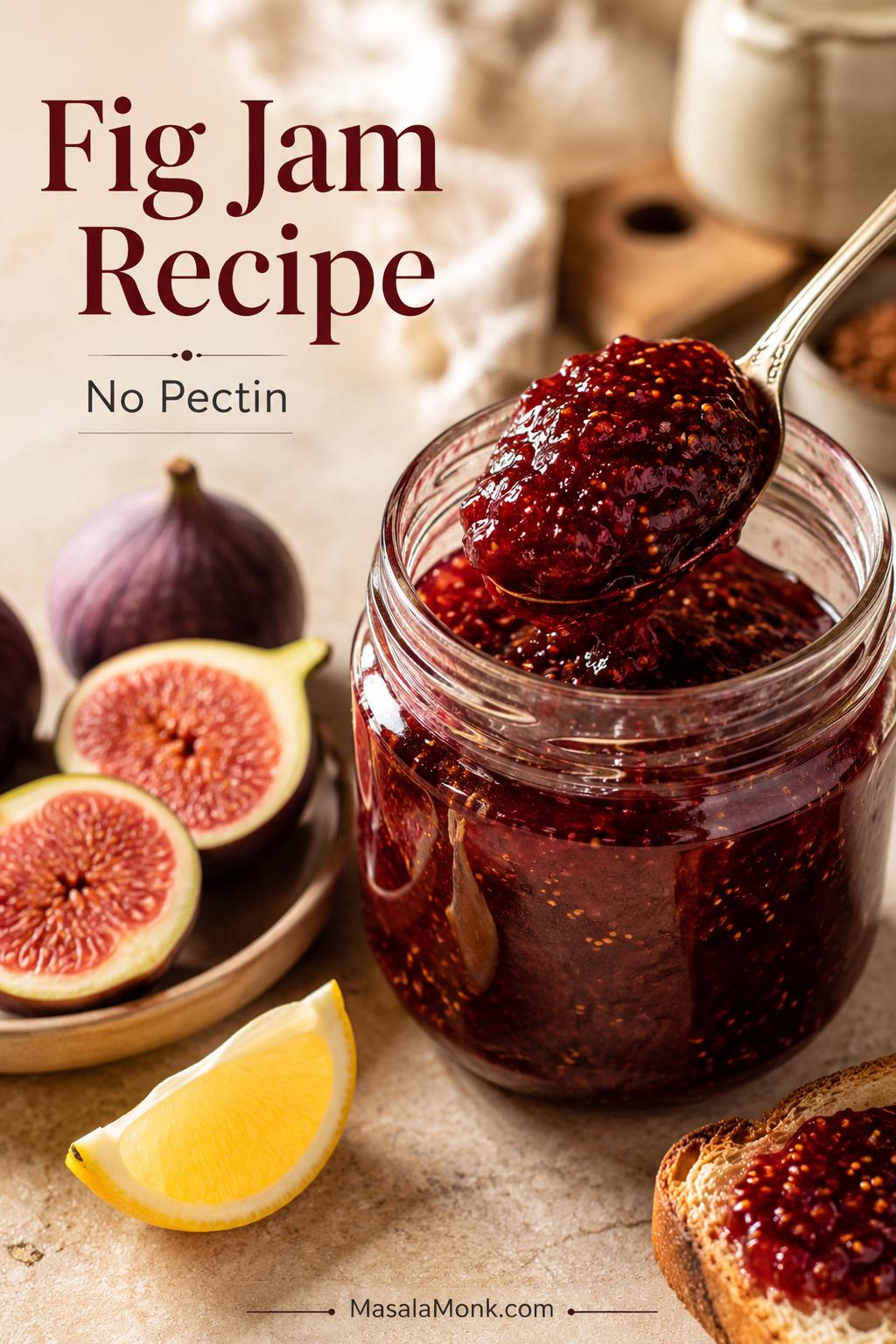
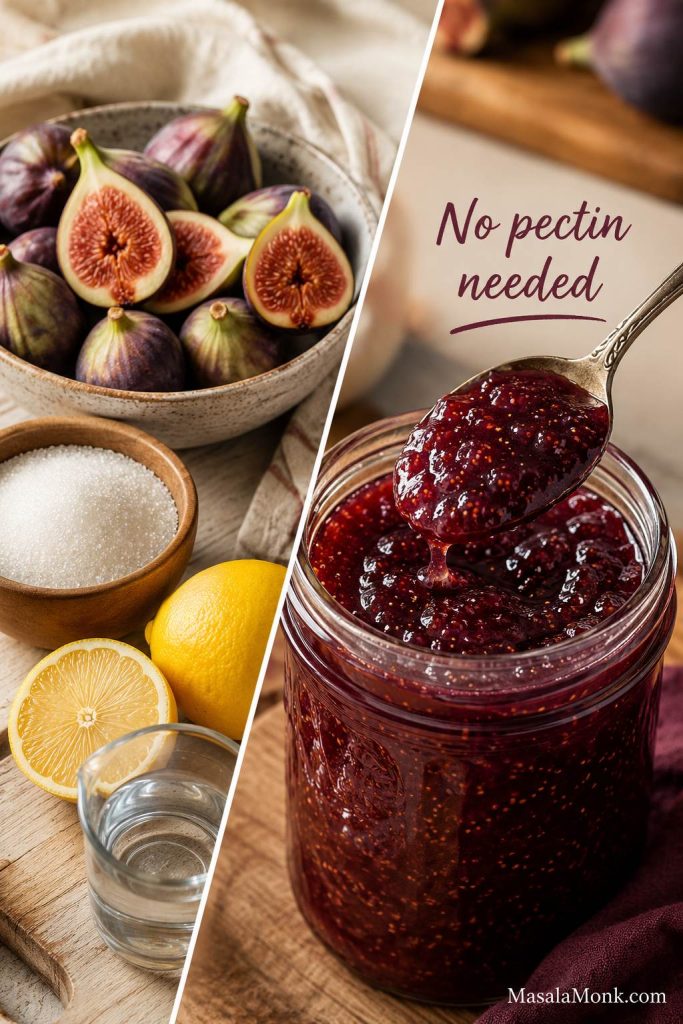
When figs are good, they do not wait. They soften quickly, bruise easily, split at the seams, and can go from perfect to overripe almost overnight. Fig jam is one of the best ways to save that short, honeyed moment before it slips away.
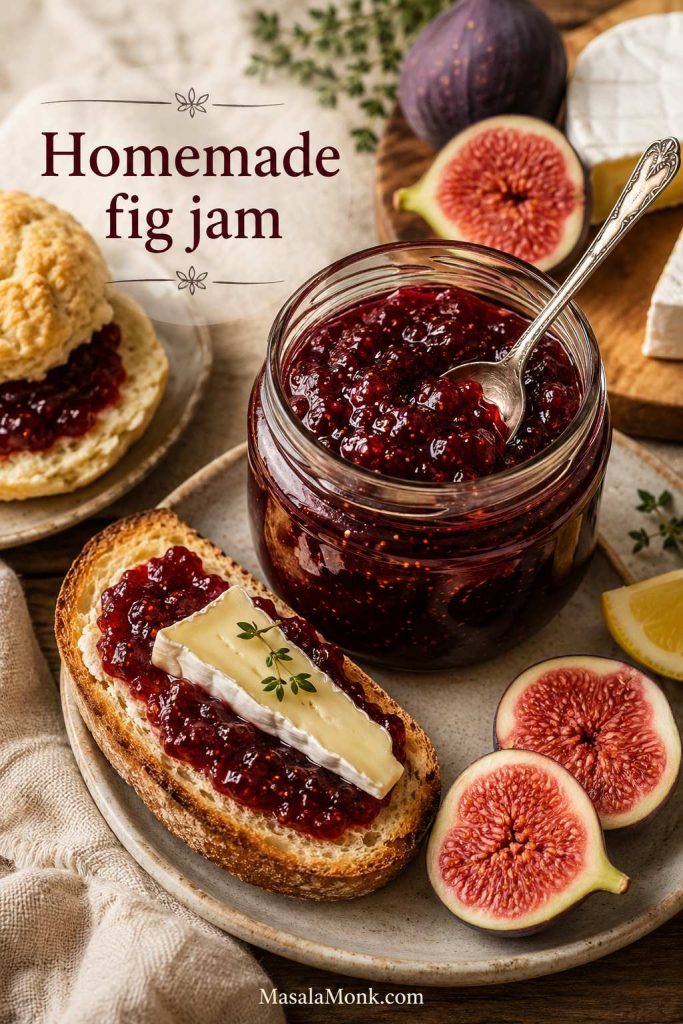
This is the recipe for the day the figs finally give in — too soft to ignore, too fragrant to waste, and exactly ready for a pot of glossy, spoonable jam. The finished jar should taste like figs first: gently sweet, lifted by lemon instead of dulled by sugar, thick enough to spread, and soft enough to spoon over toast, yogurt, brie, goat cheese, cakes, cookies, sandwiches, flatbreads, and roasted meats.
The main method stays simple: fresh figs, sugar, lemon, a little water, and no commercial pectin. This is a fresh fig jam recipe first — soft-set, fruit-forward, and written for the refrigerator or freezer. Once the main method is clear, you will find dried fig, frozen fig, low-sugar, honey, cheese-board, and canning-safe notes clearly separated so you do not have to guess your way through substitutions.
So instead of giving you only one pot of jam, this guide shows you how to choose the right version for the figs you actually have.
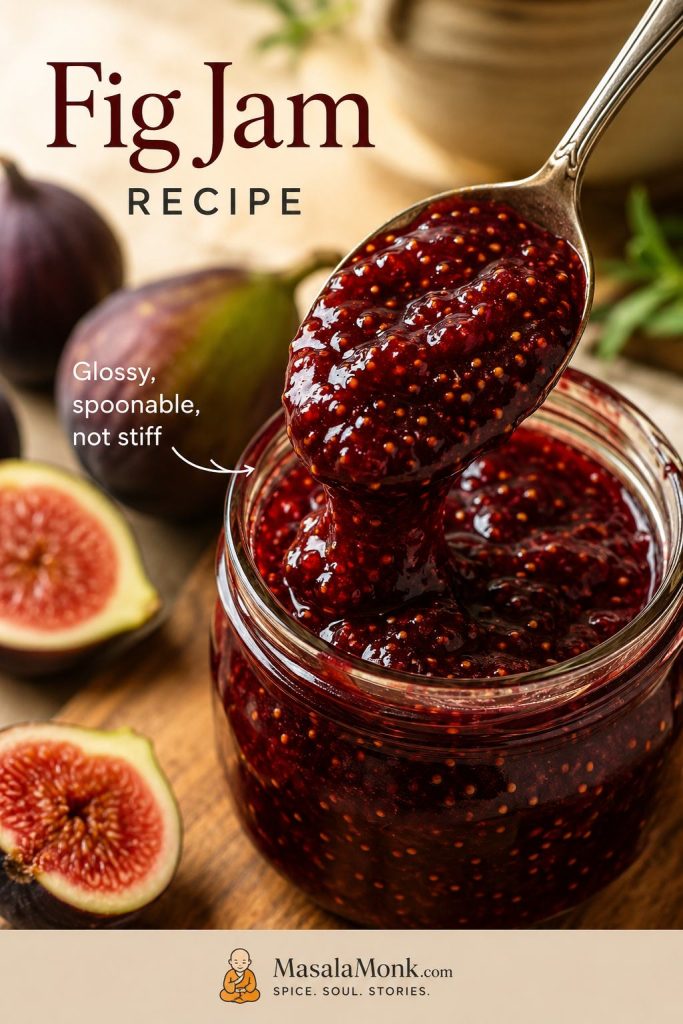
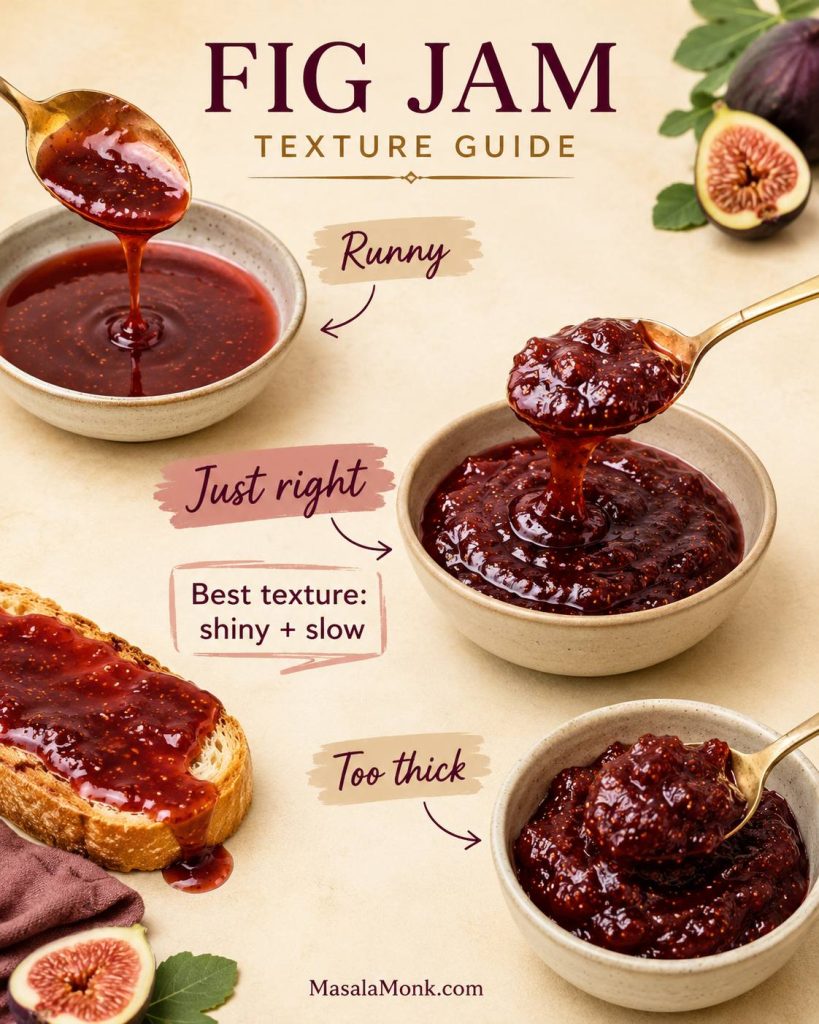
Because fig jam firms as it cools, the best stopping point is shiny, slow-moving, and spoonable rather than stiff.
Start with the quick answer, or use the deeper sections for dried figs, lower sugar, canning questions, cheese-board ideas, and quick fixes if a batch looks too loose or too thick.
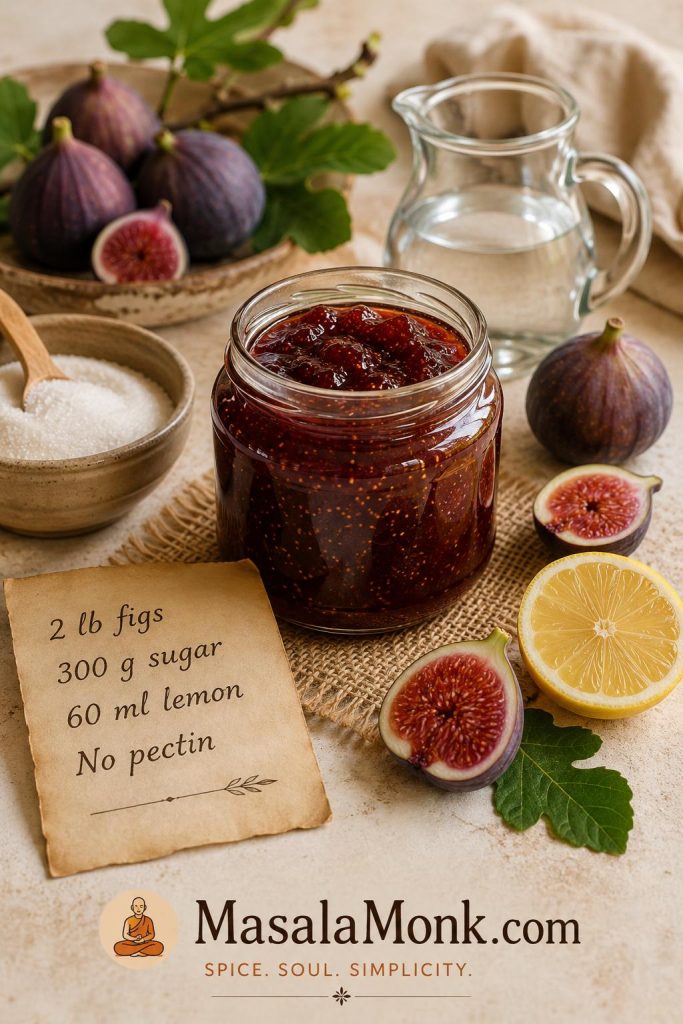
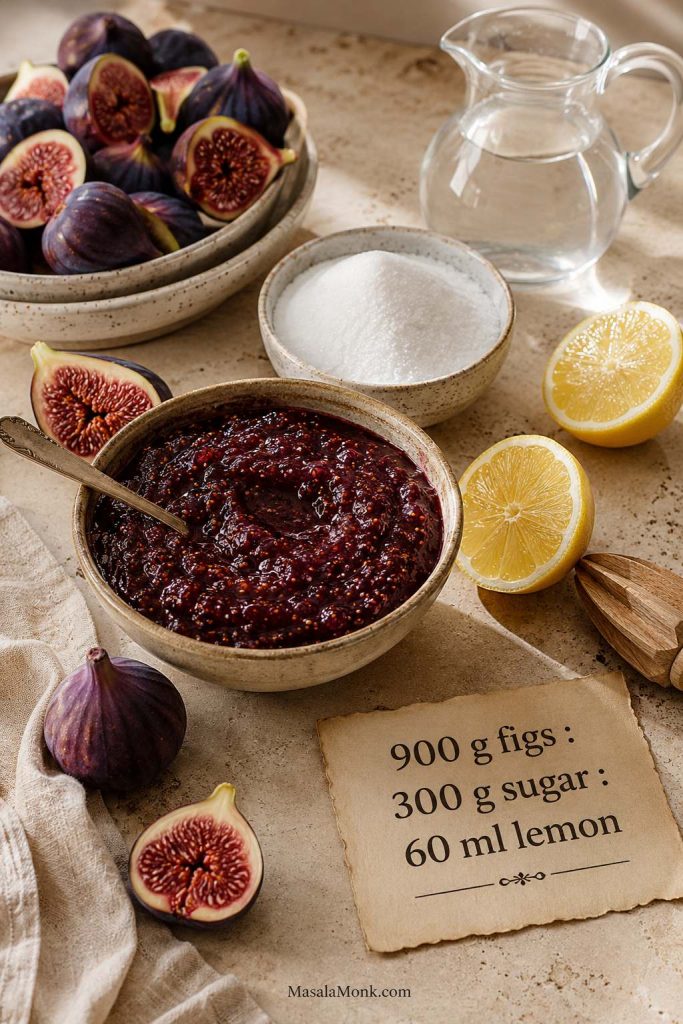
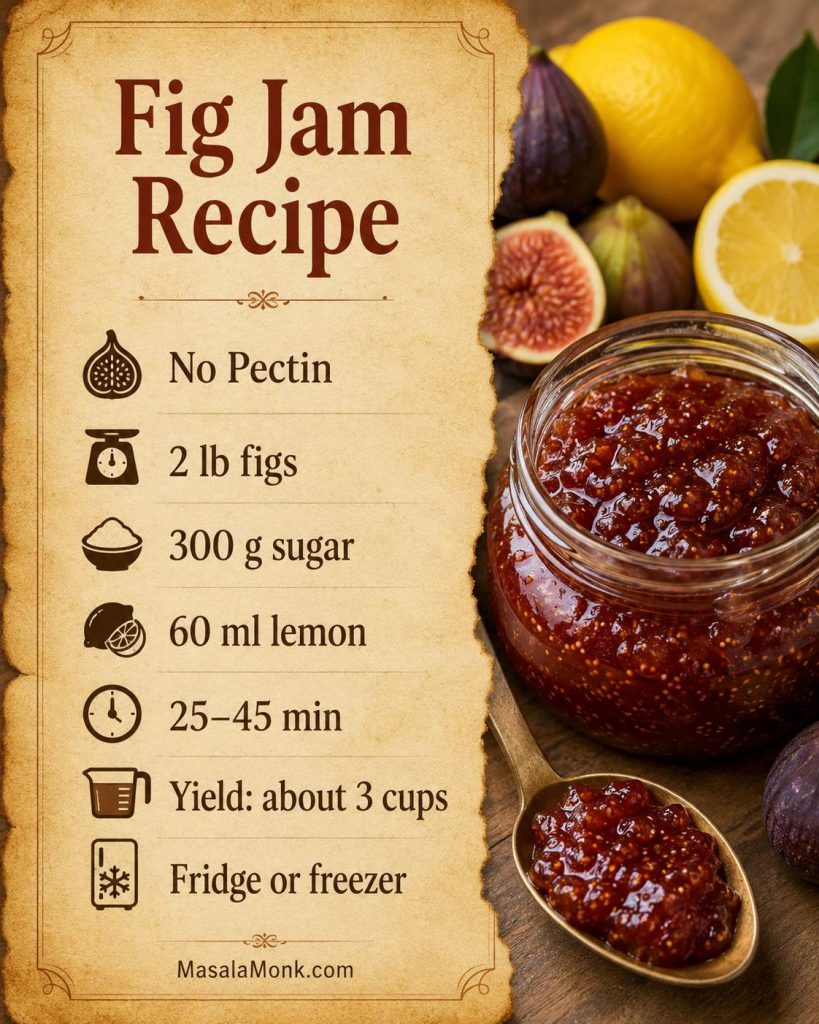
To make easy homemade fig jam, combine 2 lb / 900 g ripe fresh figs, 1½ cups / 300 g sugar, ¼ cup / 60 ml lemon juice, and ¼–½ cup / 60–120 ml water as needed. Start with the smaller amount of water.
Simmer uncovered until the figs soften, collapse, and turn shiny enough to coat the spoon, then mash or blend to your preferred texture. You do not need to peel the figs or add commercial pectin. The jam usually takes 25–45 minutes to cook, yields about 3 cups / 720 ml, and thickens more as it cools.
Keep these four things in mind as you cook: the figs should still smell sweet, the water should start low, the finish should be slow-moving rather than stiff, and this batch belongs in the fridge or freezer unless you use a tested canning recipe.
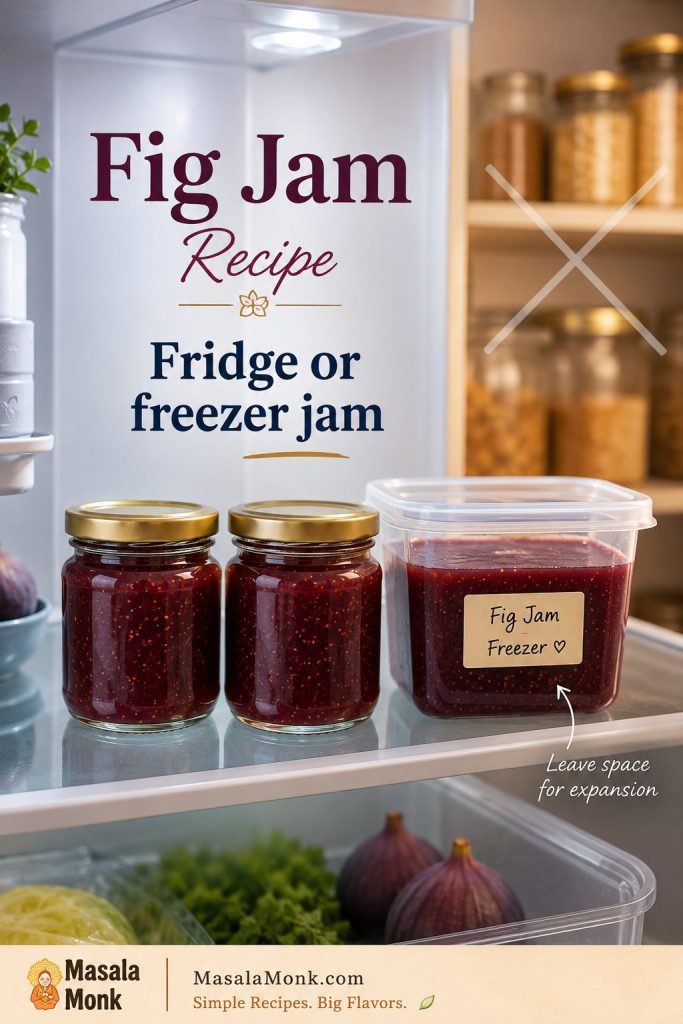
This recipe is written for the fridge or freezer. Do not water-bath can it unless you switch to a tested canning formula with exact acid, sugar, jar size, headspace, and processing instructions.
That may sound strict, but it keeps the recipe low-stress: make the jam, chill it, use it generously, and freeze the extra.
If the pan still looks loose near the end, use the doneness tests before cooking it much longer.
Recipe Snapshot
Here is the whole batch at a glance before the deeper choices begin.
The simplest fig jam recipe starts with ripe fruit, measured sugar, enough lemon for lift, and only enough water to protect the pan.
Figs to use
Ripe fresh figs that smell sweet and feel soft, but not sour, fizzy, or moldy
Base ratio
900 g figs : 300 g sugar : 60 ml lemon juice : 60–120 ml water
Pectin
Not needed for this soft-set version
Peel figs?
No. Remove stems, but leave the skins on.
Cook time
Usually 25–45 minutes, depending on fig moisture and pan width
Texture to aim for
Loose enough to spoon, thick enough to stay on toast
Storage
Refrigerator or freezer, unless using a tested canning recipe
Clear notes for dried figs, honey, and lower sugar
Not the right fit if you want…
A stiff store-bought jelly set
Shelf-stable canning as written
Traditional whole-fig preserves
No-sugar pantry storage
Peeling, deseeding, or a firm jelly finish
With that boundary clear, the actual cooking is simple. Start with ripe figs, use just enough water to protect the pan, and let the fruit tell you when it has softened into jam.
Treat this as fridge or freezer fig jam unless you are following tested canning directions with exact acid, jar size, and processing time.
What Is Fig Jam?
Fig jam is made by cooking figs with sugar and acid, usually lemon juice, until the fruit softens and the mixture thickens into a spread. Because figs are full of tiny edible seeds, the texture is naturally a little rustic. It is not usually clear or glassy like jelly. Instead, it is rich, slightly seedy, and naturally honeyed, with a texture that can lean chunky or smooth depending on how much you mash it.
It will not set like a stiff jelly, and it is not supposed to. This is a softer, fruit-forward jar — the kind that spreads on toast but still spoons over yogurt, cheese, cake, or roasted meat.
The best version has balance. Figs are naturally sweet, so lemon stops the jar from tasting like flat sugar syrup. Sugar gives body and shine. A small pinch of salt can make the fruit taste rounder, especially if you plan to serve the finished spread with cheese or savory food.
Fig Jam vs Fig Preserves vs Fig Spread
Fig jam, fig preserves, fig spread, fig jelly, and fig confiture often overlap in everyday use. Still, the texture and best use can be slightly different.
Classic jelly use, though figs are more commonly made into jam or preserves
Confiture
A French-style word often used for jam or preserves
Breakfast, pastry, cheese, gifting
Paste or butter
Thicker, denser, and more concentrated
Cookies, fig bars, cheese plates, baking fillings
The finished texture sits between classic jam and a softer fig spread: fruit-forward, spoonable, and easy to adapt. Cook it less for a softer spread, longer for a thicker set, or mash lightly for a preserve-style texture.
Fresh Figs vs Dried Figs: Which Should You Use?
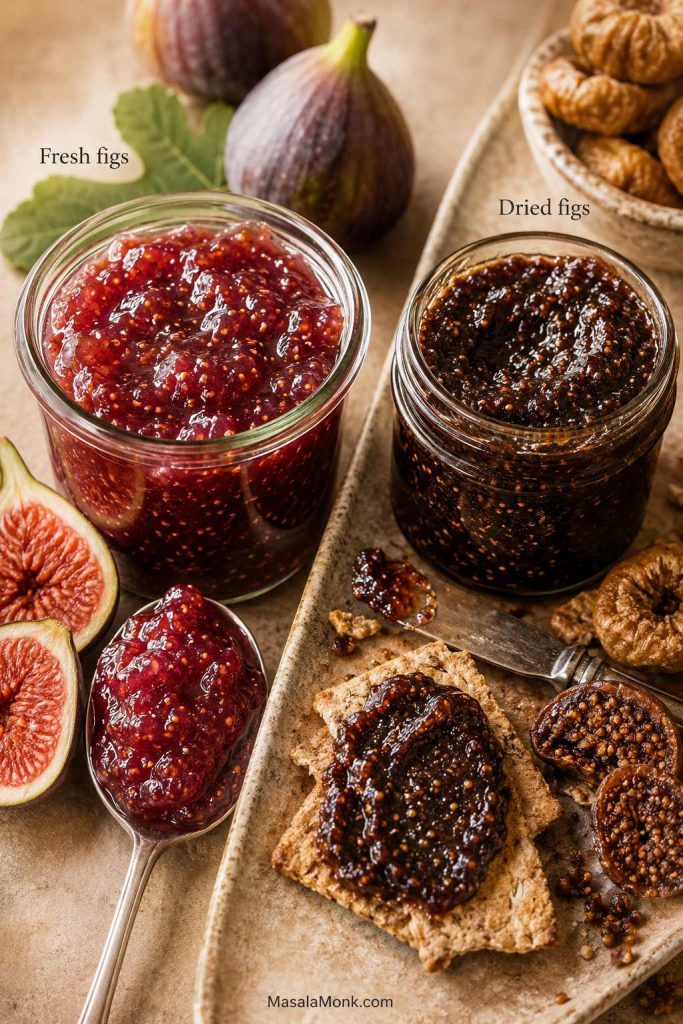
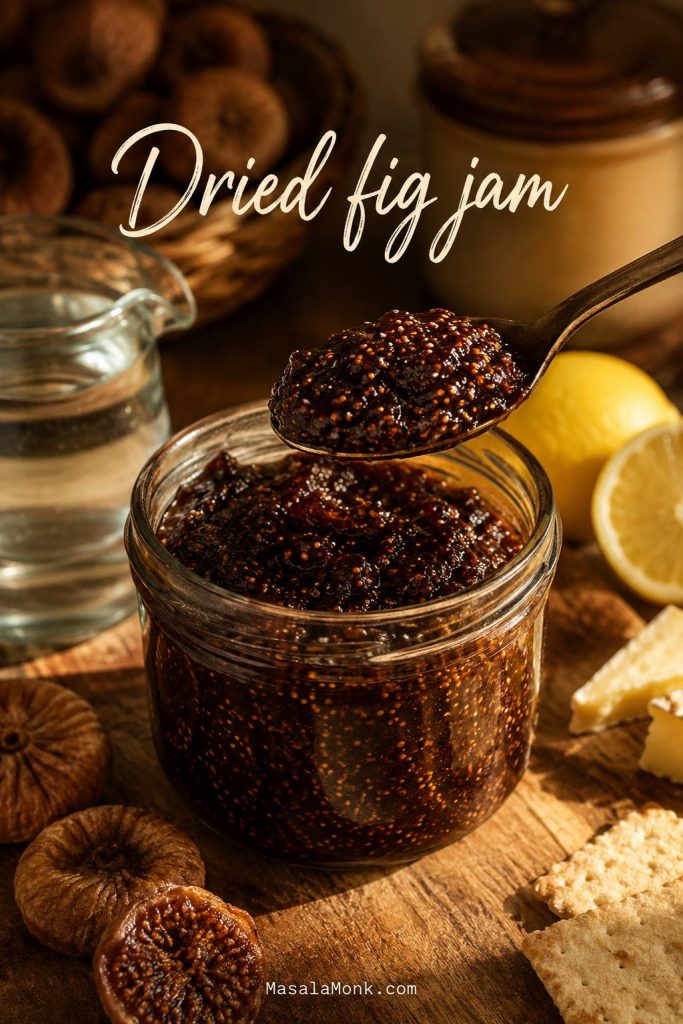
Fresh figs and dried figs both work well, but they make different jars. And then fresh figs also give you a brighter, softer, more seasonal jam. Dried figs make a deeper, denser, more concentrated spread that is useful year-round. Neither is wrong; fresh figs are for a lighter fruit-forward batch, while dried figs are especially good when you want a rich cheese-board spread.
Fresh fig jam is the version you make because the fruit is already asking for it — soft at the neck, fragrant on the counter, and too delicate to keep waiting. Dried fig jam belongs to a different mood: less about saving summer, more about building a rich pantry spread for cheese, toast, and cooler-weather boards.
Fresh fig jam tastes brighter and softer, while dried fig jam turns deeper, darker, and more spread-like for year-round use.
Use This
When
What to Expect
Fresh figs
You want a brighter, softer, seasonal jam
Quick cook time, fresh fruit flavor, soft set
Dried figs
You want a darker, thicker, year-round cheese-board spread
Deeper flavor, denser texture, more water needed
Frozen figs
You already have figs in the freezer
More released liquid and usually a longer simmer
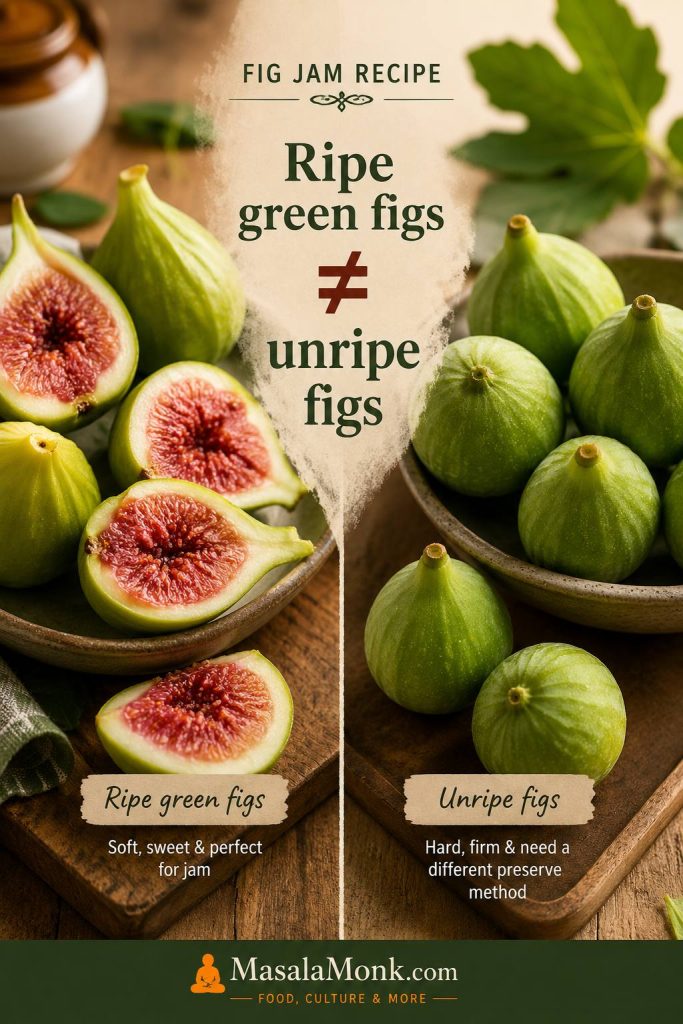
Ripe green-skinned figs
They are soft, sweet, and ripe inside
Use them like any other ripe fig
Truly unripe figs
They are hard, dry, bitter, or not sweet yet
Use a dedicated green fig preserve method instead
Using dried figs instead of fresh? Go straight to the dried fig jam variation once you understand the main texture cues.
Fresh figs
Fresh figs are the best choice for a classic, bright homemade batch. They are tender, juicy, and quick to cook down when ripe. The flavor can be floral, honeyed, berry-like, or lightly caramelized depending on the variety and ripeness.
Sweet-smelling, soft figs make the best fresh fig jam; meanwhile, hard green figs need a slower preserve-style method.
Use ripe figs that feel soft but not fermented.
Remove the stems, but do not peel the figs.
Quarter or chop them so they cook evenly.
Add water only as needed; very juicy figs may need little or none.
Dried figs
Dried figs are sweeter, denser, and lower in moisture. They need water to soften before they can become jam. Once cooked and blended, they make a thick fig spread that gives brie, goat cheese, blue cheese, crackers, toast, and sandwiches a darker, almost caramel-like contrast.
Remove any tough stems before cooking.
Chop the figs so they soften faster.
Simmer with water until very tender before blending or mashing.
Use less sugar if the dried figs are already very sweet.
Frozen figs
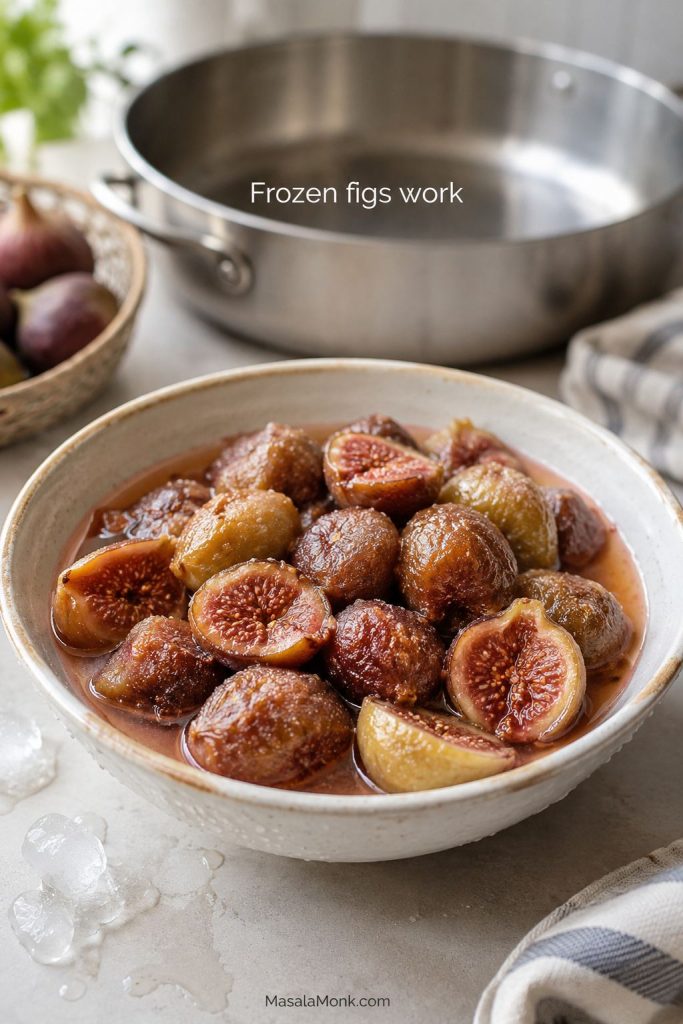
Frozen figs can work for jam. Thaw them first if possible, then use the fruit and any juices that collect. Frozen figs often release extra liquid, so the batch may need a slightly longer cook time. If you are using a weight-based recipe, weigh the figs consistently either before freezing or after thawing and draining lightly.
Frozen figs are useful for jam, although their extra thawed juices usually need more time to simmer down.
Because thawed figs release extra liquid, check the doneness tests carefully before deciding the batch is finished.
What about green or unripe figs?
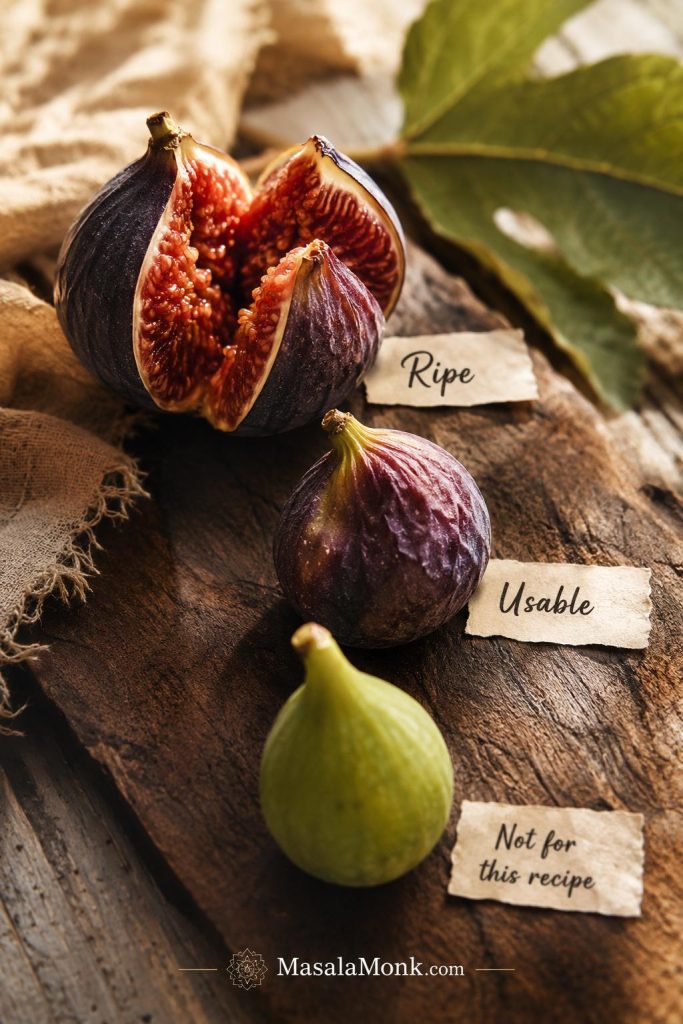
Green-skinned ripe figs are fine. Truly unripe figs are different. They can be firmer, less sweet, and sometimes bitter or latex-like. Green fig preserves are usually a separate style of recipe and often involve soaking, boiling, draining, and then cooking in syrup. If your figs are ripe but green on the outside, use them here. If they are hard and unripe, use a dedicated green fig preserve method instead.
Ripe green-skinned figs can go straight into this recipe; hard unripe figs are less sweet and belong in a different preserve.
Ingredients You Need
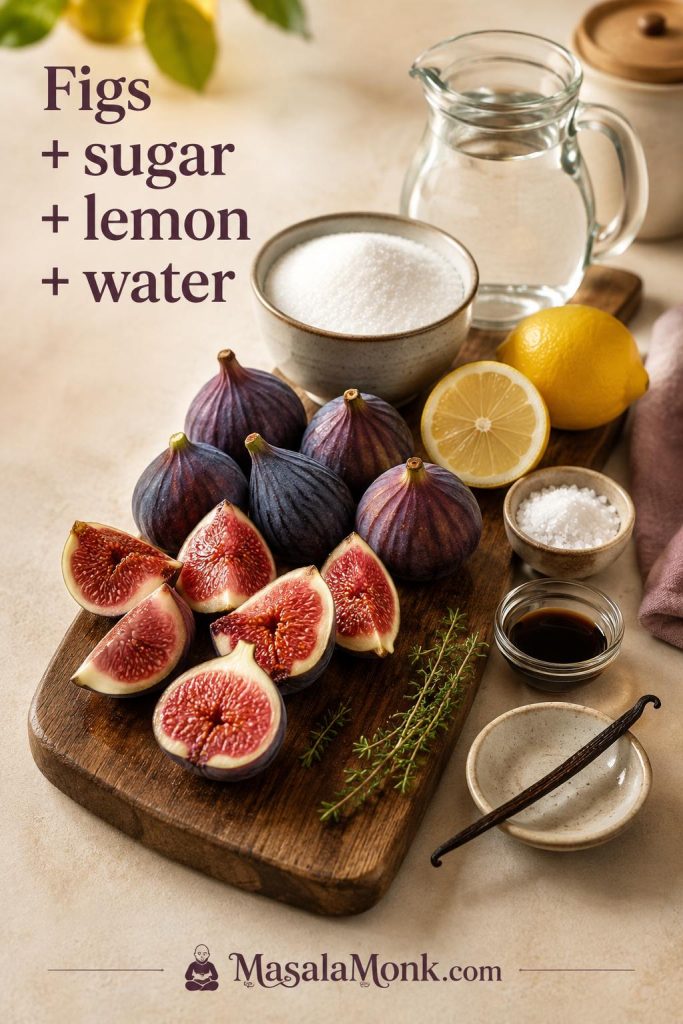
The ingredient list is short, which is part of the charm: ripe figs, enough sugar to make them shine, lemon to wake them up, and just enough water to keep the pot moving before the fruit releases its own syrup.
Figs provide body, sugar helps the jam set, lemon keeps the flavor awake, and small add-ins should stay in the background.
Fresh figs
Use ripe fresh figs for the main version. Black Mission, Brown Turkey, Kadota, Adriatic, or other edible fig varieties can all work. The exact flavor will change, but the method stays the same. Trim away the stems and any spoiled spots. The skins and seeds are edible, so there is no need to peel or deseed the fruit.
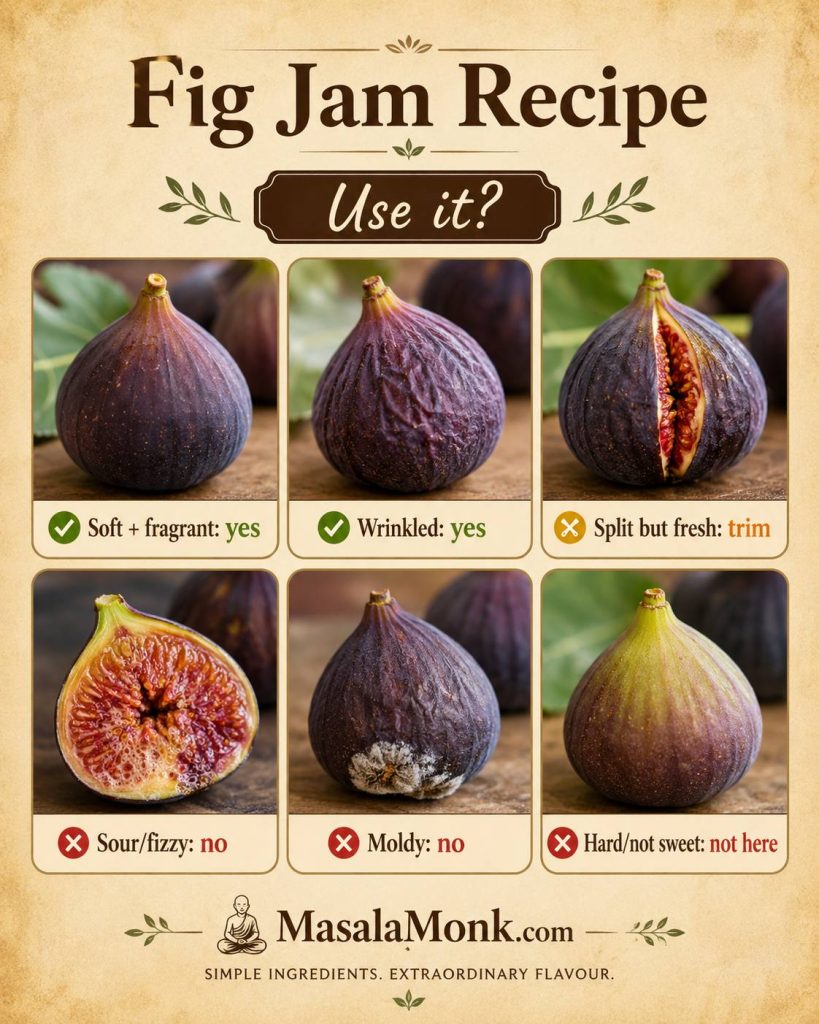
Fig condition guide: Fig jam is forgiving, but spoiled fruit is not. Use the table below when the figs are soft enough to make you wonder.
Fig Condition
Use It?
What to Do
Soft, fragrant, and sweet
Yes
Perfect for jam
Slightly wrinkled
Yes
Trim stems and use
Split but fresh-smelling
Usually
Trim dry or exposed spots first
Sour, fizzy, or fermented smell
No
Discard
Mold
No
Discard
Hard and not sweet
Not for this recipe
Use a green fig preserve method instead
Slightly wrinkled or very soft figs can still work, but sour, fizzy, or moldy fruit should be discarded before cooking.
Sugar
Sugar is not just there for sweetness; it gives the syrup its shine, helps the fruit look glossy instead of dull, and gives the finished jar a little more body. The amount here is moderate compared with many old-fashioned preserves, so the figs still lead. If your fruit is extremely sweet, you can reduce the sugar, but the batch will usually set softer, cook longer, and have a shorter refrigerator life.
Lemon juice
Lemon is what keeps the jar from tasting heavy. It lifts the fig flavor, sharpens the sweetness, and helps the mixture thicken. For refrigerator jam, fresh lemon juice works well. For pantry jars, switch to a tested preservation recipe and follow it exactly; many canning formulas call for bottled lemon juice because its acidity is standardized.
Water
Water keeps the figs from scorching before they release their own juices. Very ripe, juicy figs may need only a splash. Firmer figs, drier figs, or dried figs need more. Start with the smaller amount first; you can always add a little more if the pot looks dry.
Salt
A small pinch of salt is optional, but it makes the fig flavor taste rounder and less flat. It is especially useful if you plan to serve the jam with cheese or savory dishes.
Vanilla, citrus zest, balsamic, or herbs
These are optional, not required. Vanilla makes the jam more dessert-like. Lemon or orange zest adds fragrance. Balsamic pulls the jam into savory territory, where it tastes less like breakfast and more like something you would spoon beside brie, pork, or sharp cheese. Rosemary or thyme makes it more savory.
Equipment That Makes Fig Jam Easier
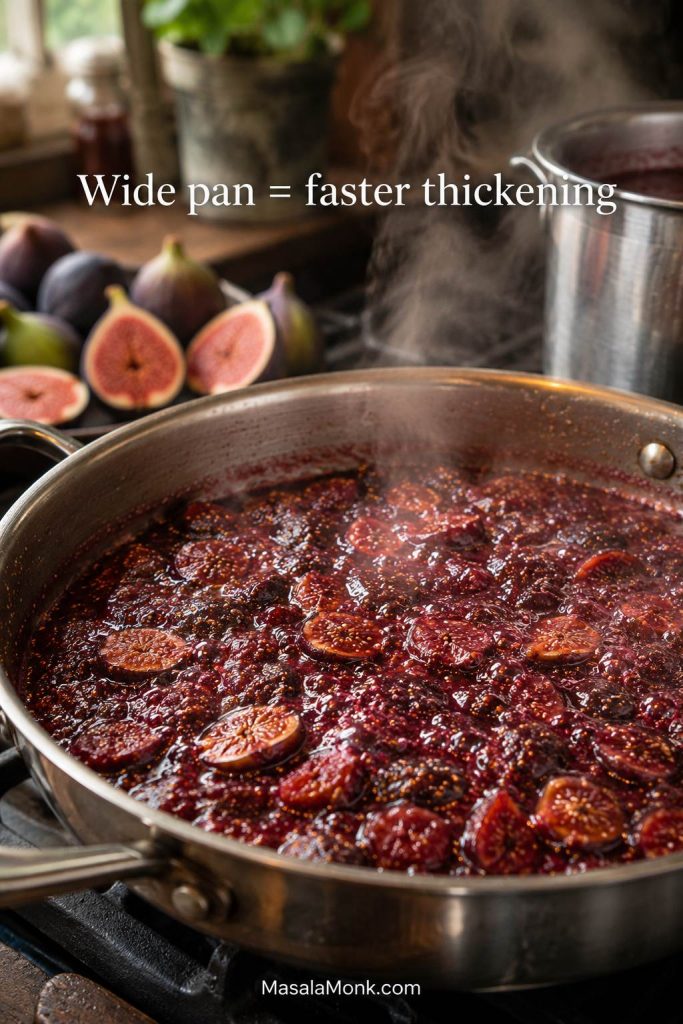
You do not need special jam gear here, but the pan matters more than most people expect. A wide pan is not fancy equipment; it lets steam escape quickly, so the figs thicken before their flavor turns dull. A masher or blender simply lets you choose whether the fruit stays chunky or turns smooth.
A wide pan gives steam room to escape, helping the jam thicken before the fig flavor turns dull.
Wide heavy-bottomed pan: a saucepan, sauté pan, or Dutch oven with enough surface area for steady evaporation.
Non-reactive material: stainless steel or enameled cast iron is best because the recipe includes lemon juice.
Wooden spoon or silicone spatula: useful for stirring and checking whether the jam leaves a trail on the bottom of the pan.
Potato masher or immersion blender: use a masher for rustic texture or an immersion blender for a smoother spread.
Small plate or spoon: chill it in the freezer for a simple doneness test.
Clean jars and a kitchen scale: clean jars help with storage, and a scale helps because figs vary so much in size.
A ladle and funnel are helpful but not essential. A narrow pot can still work, but the jam will usually need more time because evaporation is slower. If your pan is thin, keep the heat moderate and stir often so the sugar and fruit do not scorch before the mixture thickens.
The Best Fig Jam Ratio
The sweet spot is enough sugar to make the figs shine, enough lemon to keep the flavor bright, and only enough water to keep the fruit moving. This is not meant to be a stiff, candy-sweet preserve. It is a softer, fruit-forward jar you can use generously.
900 g fresh figs : 300 g sugar : 60 ml lemon juice : 60–120 ml water
A reliable fig jam ratio gives the fruit enough sugar for body, enough lemon for balance, and no excess water to cook off later.
In US kitchen measurements, that is about 2 lb fresh figs, 1½ cups sugar, ¼ cup lemon juice, and ¼–½ cup water. The result is sweet enough to feel like jam, but still fig-forward enough that you taste the fruit, not just sugar.
Because this is less sugar-heavy than many old-fashioned preserves, it is best treated as a refrigerator or freezer batch.
Batch
Fresh Figs
Sugar
Lemon Juice
Water
Approx. Yield
Small batch
1 lb / 450 g
¾ cup / 150 g
2 tbsp / 30 ml
2–4 tbsp / 30–60 ml
About 1½ cups / 360 ml
Standard batch
2 lb / 900 g
1½ cups / 300 g
¼ cup / 60 ml
¼–½ cup / 60–120 ml
About 3 cups / 720 ml
Large batch
3 lb / 1.35 kg
2¼ cups / 450 g
6 tbsp / 90 ml
⅓–¾ cup / 80–180 ml
About 4½ cups / 1 liter
The yield is approximate because figs vary in moisture. Very juicy fruit cooks down differently from firmer, drier fruit.
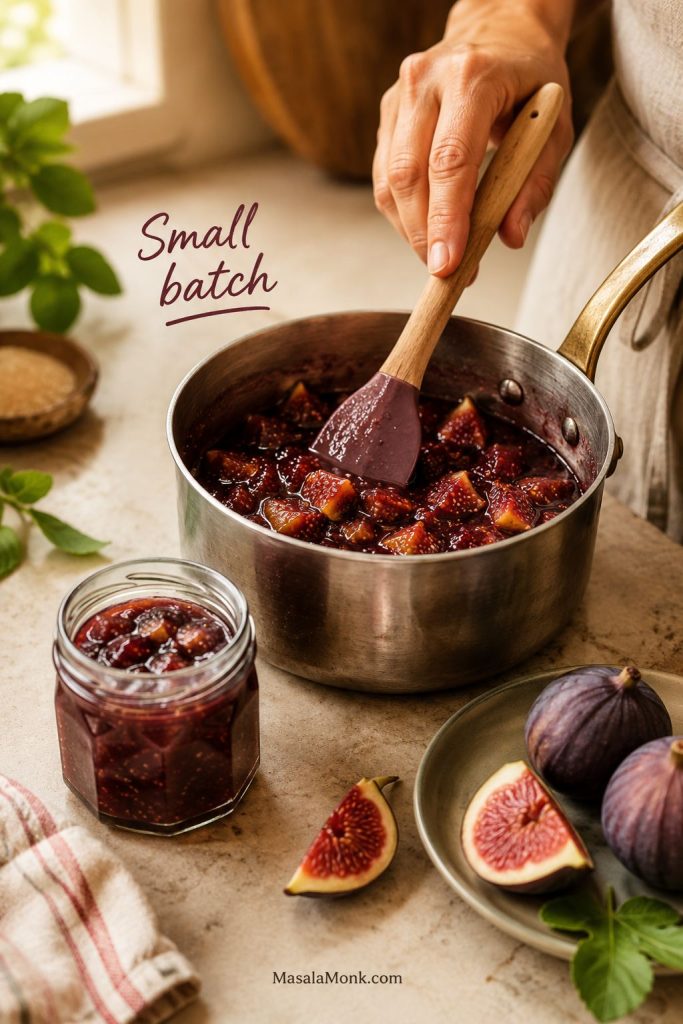
Small-Batch Fig Jam
If you only have a small basket of figs, make a half batch. Use 1 lb / 450 g fresh figs, ¾ cup / 150 g sugar, 2 tbsp / 30 ml lemon juice, and 2–4 tbsp / 30–60 ml water. A small batch usually cooks faster, often in about 20–30 minutes, especially in a wide pan.
This is a good option when you have a few ripe figs that need using immediately. It gives you enough jam for toast, yogurt, a small cheese board, or a quick baked brie without committing to several jars.
Small-batch fig jam is the right move when a few ripe figs need saving but you do not want multiple jars.
Why This Fig Jam Recipe Works
The pot does most of the work once the balance is right: enough sugar for gloss, enough lemon for brightness, and enough time for the figs to thicken naturally.
Moderate sugar keeps the fig flavor clear. The jam tastes sweet and glossy, but not like sugar syrup.
Lemon keeps the flavor bright. Without enough acid, the finished jar can taste heavy, flat, or overly sweet.
A short maceration helps the figs release juice. This makes the jam easier to start and reduces scorching risk.
A wide pan thickens the jam faster. More surface area means better evaporation and less overcooking.
No pectin keeps the texture soft and homemade. The jam thickens through cooking, but stays spoonable rather than stiff.
Stopping slightly early prevents over-thick jam. It continues to firm as it cools.
Figs are delicate. If you cook them too hard for too long, the flavor can move from honeyed and rounded to dull and sticky. The goal is to reduce the syrup, not punish the fruit.
How to Make Fig Jam
Start with ripe fresh figs and let simmering, lemon, sugar, and evaporation do the thickening. Read through the steps once before starting, especially the texture cues, because the jam thickens more after it cools.
Step 1: Prep the figs
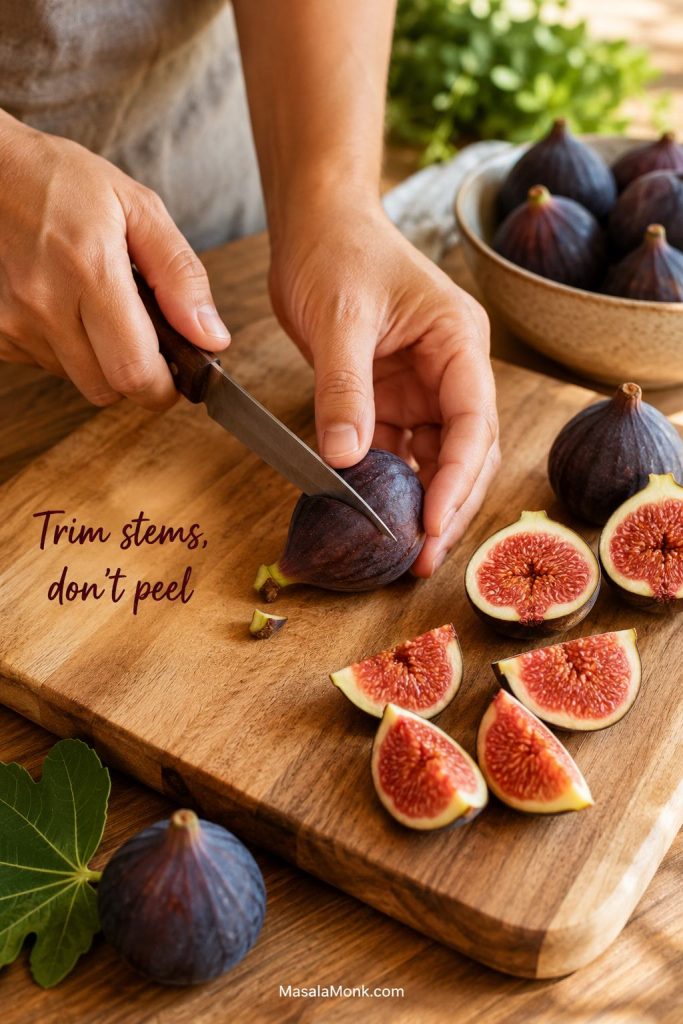
Rinse the figs gently and pat them dry. Trim off the tough stems. Quarter small figs or chop larger figs into small pieces. You do not need to peel them. The skins soften as the jam cooks, and the seeds are part of its natural texture.
Trim the stems and cut the figs evenly, but skip peeling because the skins soften into the finished jam.
Step 2: Combine figs, sugar, lemon, and water
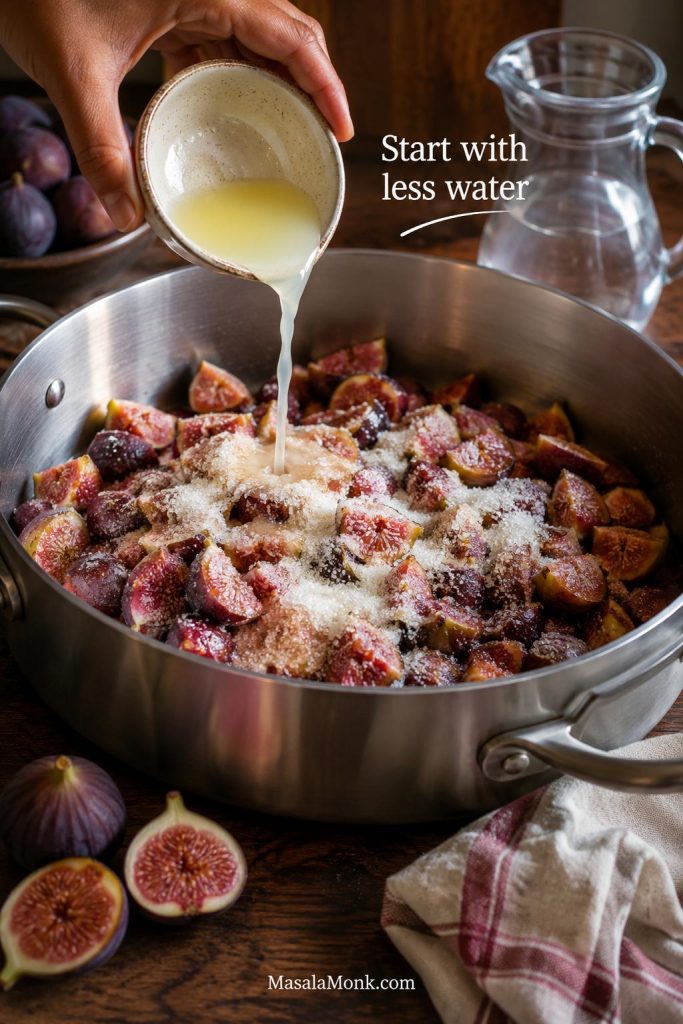
Add the figs, sugar, lemon juice, a pinch of salt if using, and ¼ cup / 60 ml water to a wide heavy pan. Stir well so the sugar, lemon, and fruit are evenly distributed before heat goes on.
Start with less water, then add a splash only if the figs stick before their own juices release.
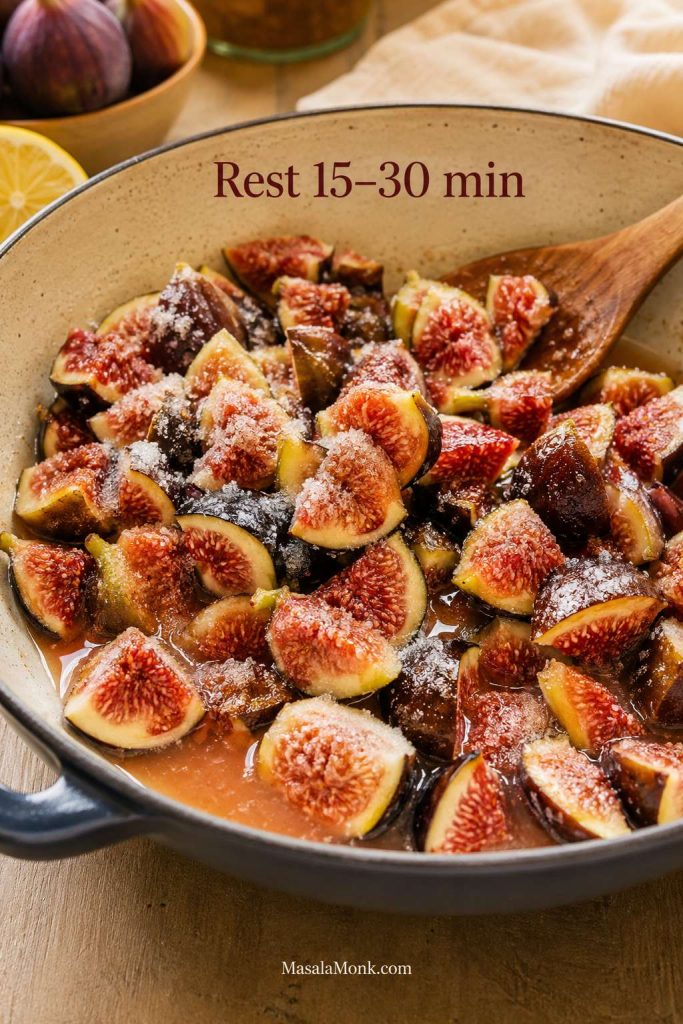
If you have time, let the mixture sit for 15–30 minutes before cooking. This short rest helps the sugar draw juice from the figs, so the fruit starts cooking in its own syrup instead of scorching against the pan.
A short rest with sugar and lemon draws juice from the figs, so the batch begins glossy instead of dry.
Add the remaining water only if the figs look dry, stick before releasing juices, or need a little help softening. Starting with less water prevents a thin batch that needs extra time to reduce.
Step 3: Bring the mixture to a simmer
Set the pan over medium heat and stir until the sugar dissolves. Once the mixture starts bubbling, reduce the heat as needed to maintain a steady simmer. You want active bubbling, but not a violent boil that splashes, scorches, or caramelizes too fast.
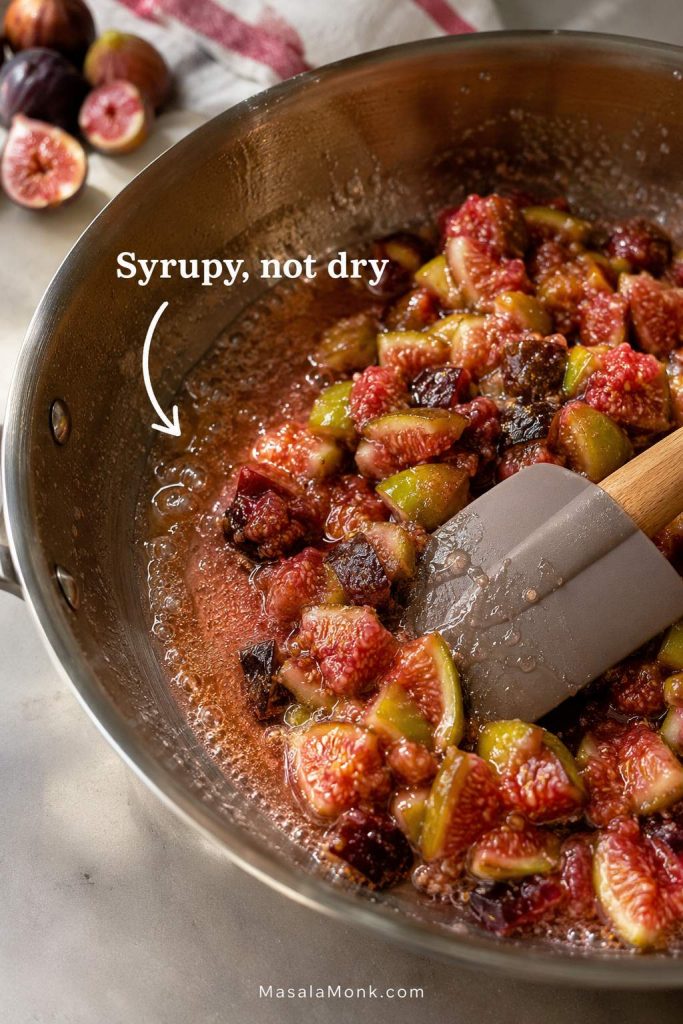
At this point the pan should look syrupy around the edges, not dry and sandy. If the figs are still sitting in dry sugar, add a splash more water and give them time.
When syrup forms around the pan edges, the figs are ready to soften evenly without scorching on dry sugar.
Cook uncovered once the figs are simmering. Covering the pan traps moisture and slows thickening.
Step 4: Cook until the figs soften and collapse
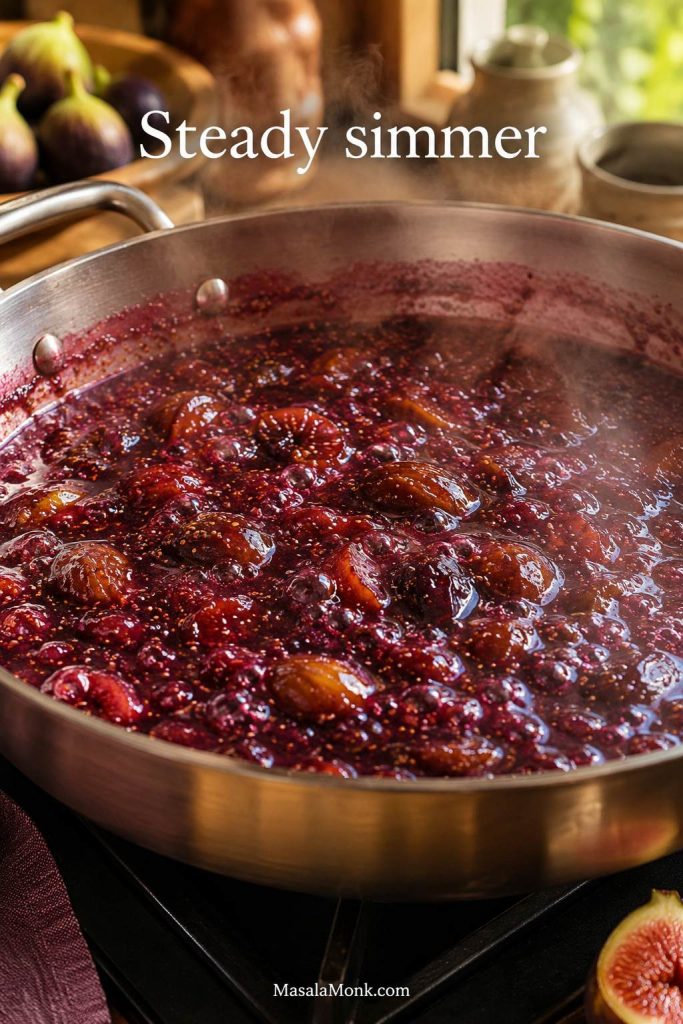
Simmer the jam, stirring often, until the figs soften, slump, and begin to collapse into the syrup. The kitchen should smell like warm figs and lemon, not burnt sugar. This usually takes 25–45 minutes. The exact time depends on fig ripeness, moisture, pan width, and heat level.
A steady simmer concentrates the syrup gently, which keeps homemade fig jam glossy, rounded, and fruit-forward.
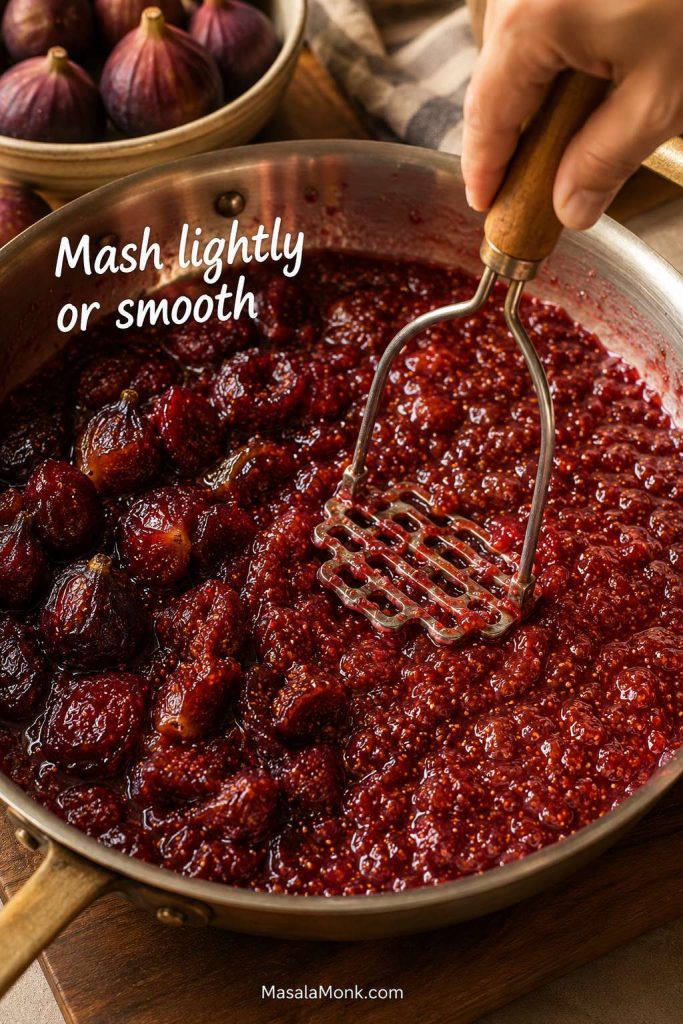
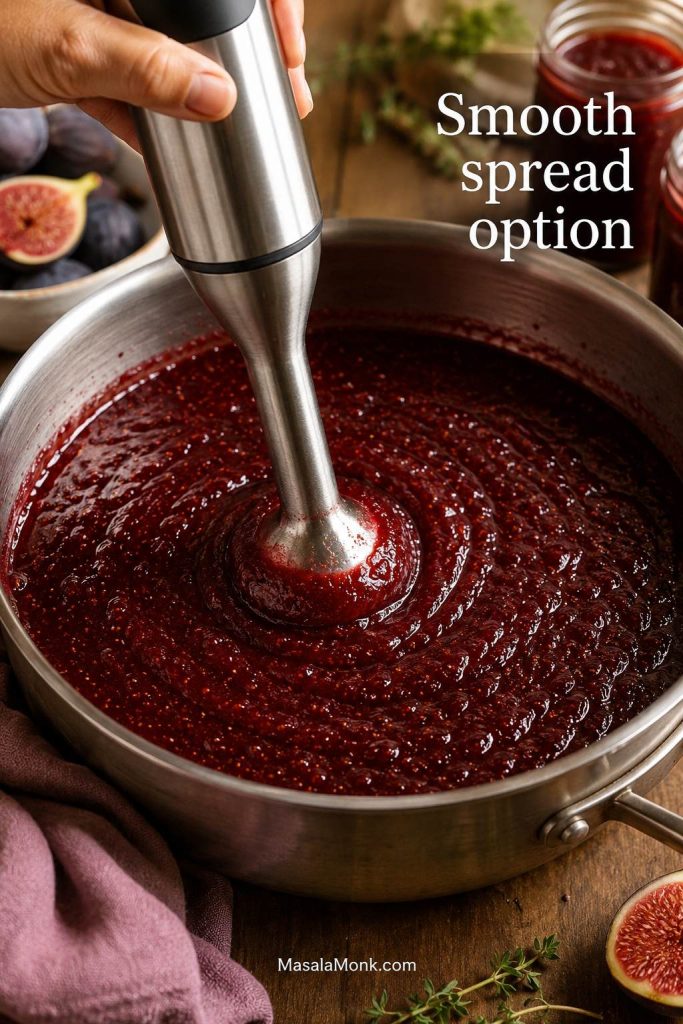
As the fruit softens, mash it with the back of a spoon or a potato masher. For a chunky preserve-style texture, mash lightly and leave some pieces intact. For a smoother spread, mash more thoroughly or blend briefly later.
Mash lightly for a chunky fig preserve feel, or mash longer when you want a smoother spoonable jam.
If foam gathers on the surface, you can skim it off for a clearer finish. A little foam is not a problem for refrigerator jam.
Step 5: Adjust the texture
If you like a rustic jam, leave it slightly chunky. For a smoother fig spread for crackers, cheese boards, sandwiches, or cookies, use an immersion blender for a few short pulses. Do not overblend unless you want a very smooth paste.
A brief blend makes fig spread smoother for crackers, cheese boards, cookies, and sandwiches without losing its homemade texture.
After blending, simmer for another few minutes so the texture settles and any extra moisture evaporates.
Step 6: Test the jam
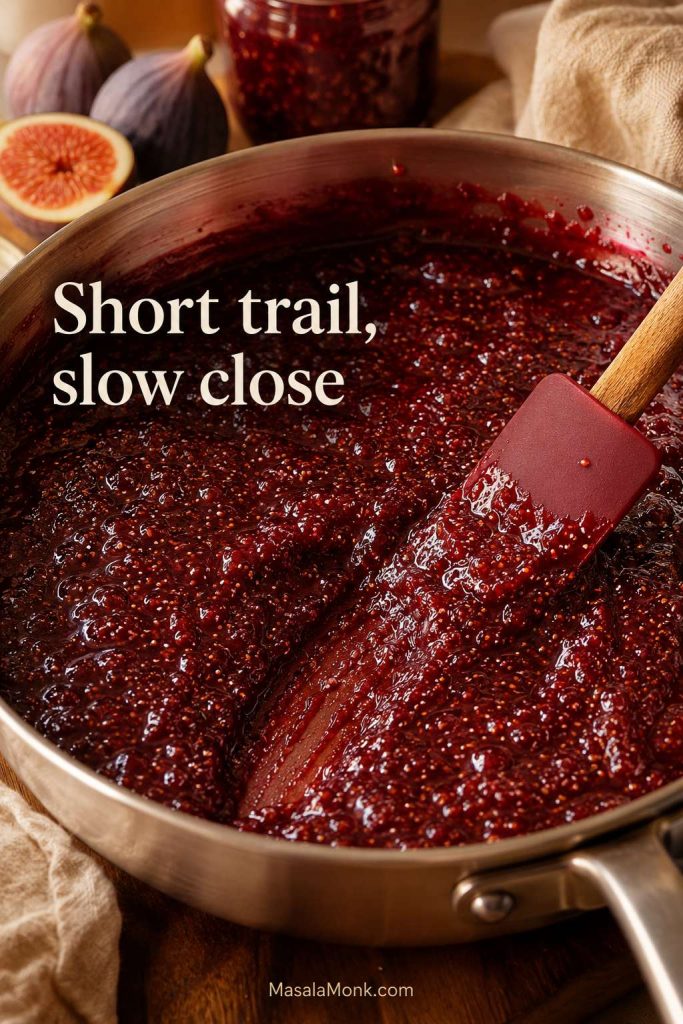
It is ready when it looks shiny, moves slowly, and mounds softly on a spoon. The syrup should bubble slowly, not splash like water. A spoonful should fall slowly, not pour like syrup or sit like paste. A spatula dragged through the pan should leave a short trail before the mixture flows back. You can also use a cold plate test or a thermometer; both are explained below.
If the jam looks too loose or too stiff at this point, use the troubleshooting guide before changing the recipe.
Step 7: Jar, cool, and store
Spoon the hot jam into clean jars. Let it cool, then refrigerate. Do not worry if it looks slightly loose while hot; it will thicken more as it cools. For longer storage, freeze it in freezer-safe containers with headspace.
Texture Target
The target is not a firm jelly set. The best texture for this recipe is thick enough to spread on toast, but loose enough to spoon over yogurt or cheese. Stop when the jam looks shiny and slow, not stiff. If it looks firm in the boiling pan, it will likely cool too thick.
Aim for a texture that clings to toast but still spoons easily over yogurt, brie, pancakes, or desserts.
How to Tell When Fig Jam Is Done
The tricky part is that jam can look loose while hot and much thicker after cooling. Look for several signs together rather than relying on one exact minute mark.
Shiny look: the liquid around the figs should look syrupy, not watery.
Soft fruit: the figs should be tender, slumped, and partly collapsed.
Slow bubbles: the bubbles become thicker and slower as water evaporates.
Spatula trail: a spoon or spatula should leave a short path through the jam before it closes.
Spoon mound: the jam should mound lightly on a spoon instead of running off like juice.
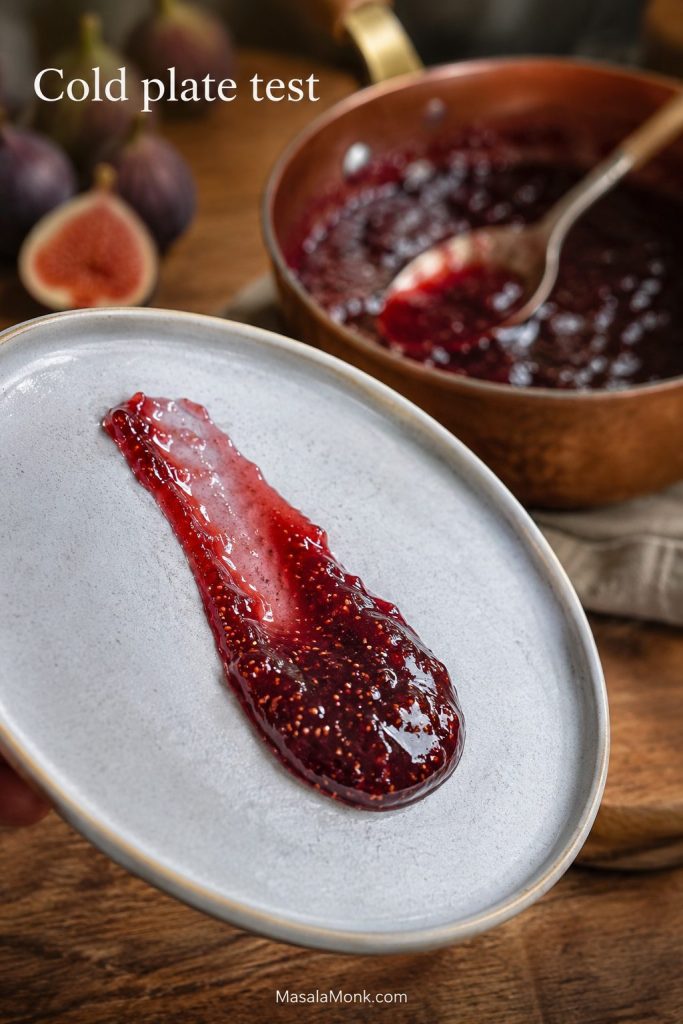
Cold plate test: a small spoonful on a chilled plate should move slowly when tilted.
Temperature cue: at sea level, a firmer jam set is often around 220°F / 104°C, but texture matters more than the thermometer reading.
Aroma: the jam should smell bright and honeyed, not burnt or overly caramelized.
Spatula Trail Test
Drag a spatula through the pan when the jam looks close. If the path opens briefly and then closes slowly, the texture is moving toward a soft set.
The spatula trail is a visual doneness cue: it should open briefly, then close slowly as the jam settles.
Cold Plate Test
Chill a small plate, add a spoonful of jam, and tilt it. The cooled jam should move slowly, which helps you avoid overcooking the hot batch.
The cold plate test shows the cooled texture, so it prevents overcooking a batch that still looks loose while hot.
Important: Stop slightly before the jam looks perfect in the pot. If it looks stiff while boiling, it may cool into something too thick or sticky. You can always simmer a loose batch a little longer, but it is much harder to undo a stiff, overcooked one.
Do You Need Pectin for Fig Jam?
No, you do not need commercial pectin for this style of fig jam. Figs, sugar, lemon juice, and evaporation can create a soft, spoonable jam on their own. The finished texture will usually be softer than a firm store-bought jelly, but that is exactly why it works so well as both a jam and a fig spread.
Do not chase a store-bought jelly wobble here. For a homemade spread, a softer set is often better because it spoons more easily over cheese, yogurt, toast, desserts, and savory dishes. A soft no-pectin set is not a failure; it is part of what makes the jar so useful.
With enough simmering and lemon balance, no-pectin fig jam thickens naturally without needing a boxed setting mix.
If you want a very firm set, commercial pectin can help, but it changes the method. Boxed pectin and products like Sure-Jell often require specific sugar and liquid ratios, so follow the instructions for that product rather than adding it casually to this recipe.
Let the pan do the work: steady simmering, a wide surface, and a few spoon tests matter more than extra thickeners.
Dried Fig Jam Variation
Dried figs are not second-best; they simply make a different kind of jar. The flavor is deeper, darker, and more concentrated, closer to a thick fig spread than a bright fresh-fruit jam. This is the version to make when fresh figs are out of season, expensive, or hard to find.
Think of it as a pantry-friendly spread with a darker mood: less fresh summer fruit, more rich fig, caramel, and cheese-board depth.
Dried fig jam is darker and denser than fresh fig jam, which makes it especially good with crackers and cheese.
Dried Fig Jam Formula
Dried figs: 12–14 oz / 340–400 g, stems removed and chopped
Water: 2 cups / 480 ml, plus more if needed
Sugar: ½–1 cup / 100–200 g to start, plus more to taste
Lemon juice: 2 tbsp / 30 ml
Optional flavorings: orange zest, vanilla, balsamic vinegar, rosemary, thyme, or a pinch of salt
To make it, simmer the chopped dried figs with water until very soft, usually 20–40 minutes depending on how dry they are. Blend or mash the softened figs, then add sugar and lemon juice. Simmer again until thick and spoonable. Add more hot water if it becomes too dense before the figs fully soften, especially before adding more sugar.
Start with ½ cup / 100 g sugar for a less-sweet fig spread, or 1 cup / 200 g sugar for a sweeter jam. Add more only after tasting. Dried figs are already concentrated, so use up to 1½ cups / 300 g sugar only if you want a very sweet, glossy jam.
The dried fig version thickens quickly after blending, so keep it slightly looser than you want while it is hot. If it looks perfect in the pot, it may cool into a paste.
Low-Sugar, Honey, and No-Added-Sugar Options
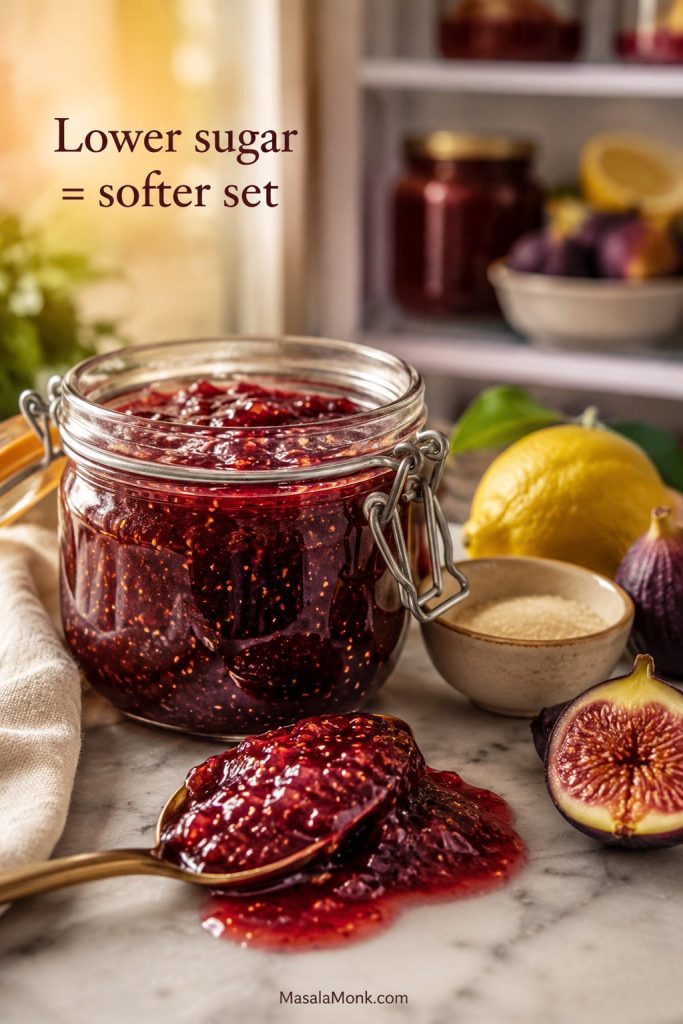
Lower sugar changes more than sweetness. It changes set, cook time, and storage life. Figs are naturally sweet, so reducing sugar can work, but the batch will usually be softer, a little less glossy, and shorter-lived in the refrigerator.
Low-sugar fig jam
For a lower-sugar version, use 150–200 g sugar per 900 g figs instead of 300 g. Cook the jam a little longer and expect a softer, more fruit-spread-like texture. A lower-sugar batch may never pass the cold-plate test as firmly as a higher-sugar jam. If it is shiny, thick, and spoonable, it can still be done.
Lower-sugar fig jam often tastes fruitier, although the softer set makes fridge or freezer storage more important.
Store low-sugar batches in the refrigerator and use within 1–2 weeks for best quality, or freeze for longer storage.
Honey fig jam
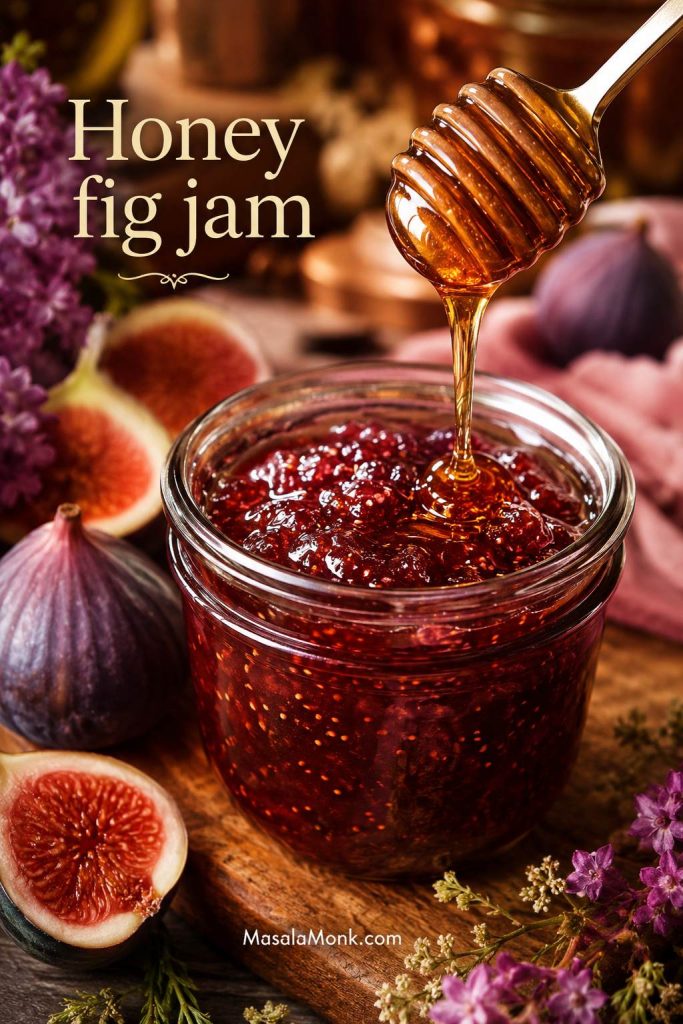
Honey adds a floral sweetness that works beautifully with figs. Replace part of the sugar with honey rather than all of it for the best texture. For example, use 200 g sugar plus ¼ cup honey for 900 g figs. Honey-sweetened jam may be softer, darker, and more aromatic than the granulated-sugar version.
Honey brings floral sweetness to fig jam, but it also softens the set and works best as a chilled variation.
Keep honey-sweetened batches refrigerated or frozen for the best texture and freshness.
No-added-sugar fig spread
If you are searching for no-sugar fig jam, think of this version as a no-added-sugar fig spread instead of a classic jam. Cook ripe figs with lemon juice and a splash of water until very soft and thick, then mash or blend. Refrigerate and use within about 5–7 days, or freeze for longer storage.
Storage note: Low-sugar, honey, and no-added-sugar versions are softer, shorter-life batches. Keep them refrigerated or frozen rather than treating them like pantry preserves.
Once you understand the base recipe, the flavor is easy to adjust. Start small with add-ins because figs are delicate and can be overwhelmed by strong spices, vinegar, or herbs.
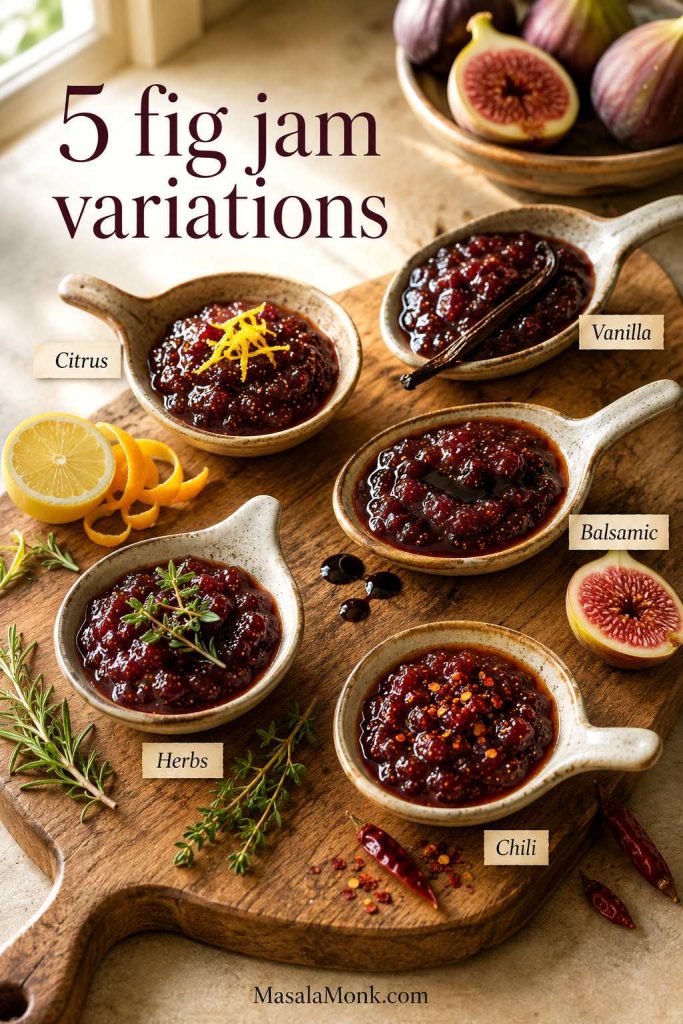
The Best First Variations
Lemon-orange: brighter and more fragrant for breakfast and desserts.
Vanilla: softer, rounder, and more dessert-like.
Balsamic: deeper and better for cheese, pork, chicken, and sandwiches.
Rosemary or thyme: savory enough for boards, baked brie, and grilled cheese.
Chili: just enough heat for cheese, flatbreads, and sandwiches.
Use fig jam flavor variations sparingly: citrus brightens, vanilla rounds, balsamic deepens, herbs turn savory, and chili adds heat.
Variation
What to Add
Where It Shines
Lemon
Extra lemon zest or a little extra lemon juice
Toast, yogurt, scones, breakfast boards
Orange
Orange zest, or a mix of orange and lemon
Croissants, cakes, desserts, cheese boards
Vanilla
Vanilla bean or vanilla extract
Pastries, cakes, ice cream, cheesecake
Balsamic
1–2 tbsp balsamic vinegar near the end
Brie, goat cheese, blue cheese, pork, chicken, sandwiches
Honey
Replace part of the sugar with honey
Soft floral jam, yogurt, toast, cheese
Brown sugar
Replace part or all of the white sugar with light brown sugar
A deeper caramel note, toast, baking, cheese boards
Ginger
Fresh grated ginger or a pinch of ground ginger
Winter breakfasts, cheese boards, roasted meats
Rosemary or thyme
A small herb sprig while cooking, removed before jarring
Savory boards, baked brie, grilled cheese
Chili
A small pinch of chili flakes
Cheese, sandwiches, flatbreads
Strawberry
Replace part of the figs with strawberries
A fruitier Southern-style jam
Fig onion-style condiment
Onions, vinegar, and savory cooking
A separate condiment, better treated as its own recipe
For cheese boards, the best directions are balsamic, rosemary, thyme, honey, orange, brown sugar, and chili. For breakfast and desserts, vanilla, lemon, orange, ginger, and strawberry are especially good.
How to Store Fig Jam
Think of this as the kind of jam you keep in the fridge and actually use: spooned over breakfast, tucked beside cheese, or frozen in small jars for later. It is flexible, lower-stress, and less sugar-heavy than a shelf-stable canning preserve.
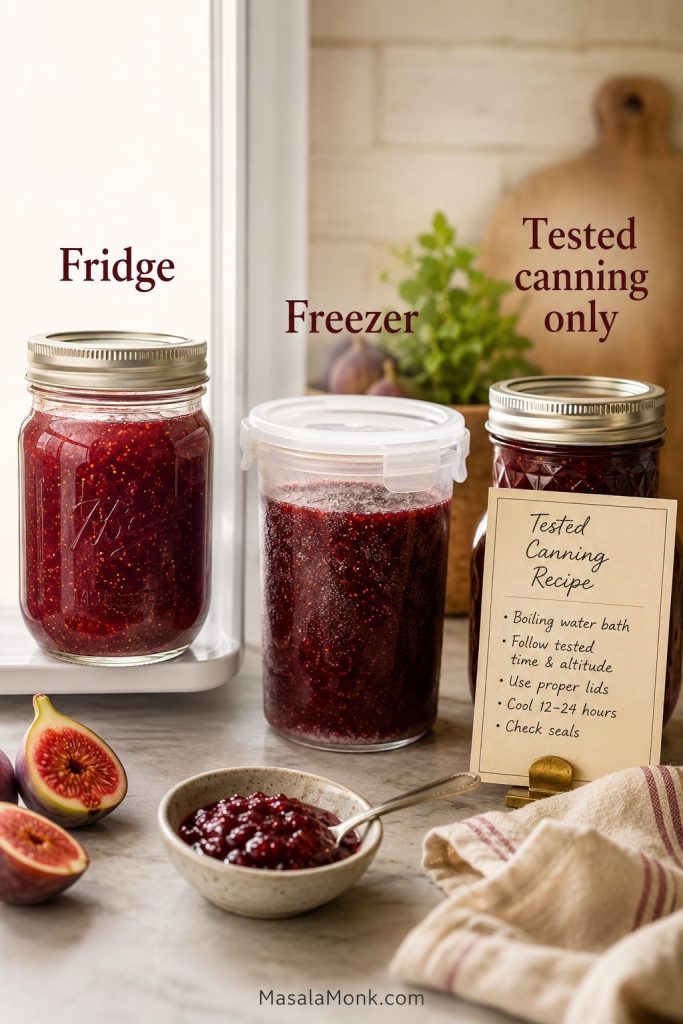
For this recipe, choose fridge or freezer storage; pantry jars need tested canning instructions, not casual adjustments.
Refrigerator storage
Cool the jam, transfer it to clean jars, and refrigerate. For best quality, use the main version within 2–3 weeks. Always use a clean spoon, keep the jar chilled, and discard it if you see mold, fermentation, off smells, or unusual bubbling.
Freezer storage
The jam freezes well. Spoon it into freezer-safe jars or containers, leaving headspace because it expands as it freezes. Freeze for up to 3 months for best quality. Thaw overnight in the refrigerator and stir before using.
Canning fig jam
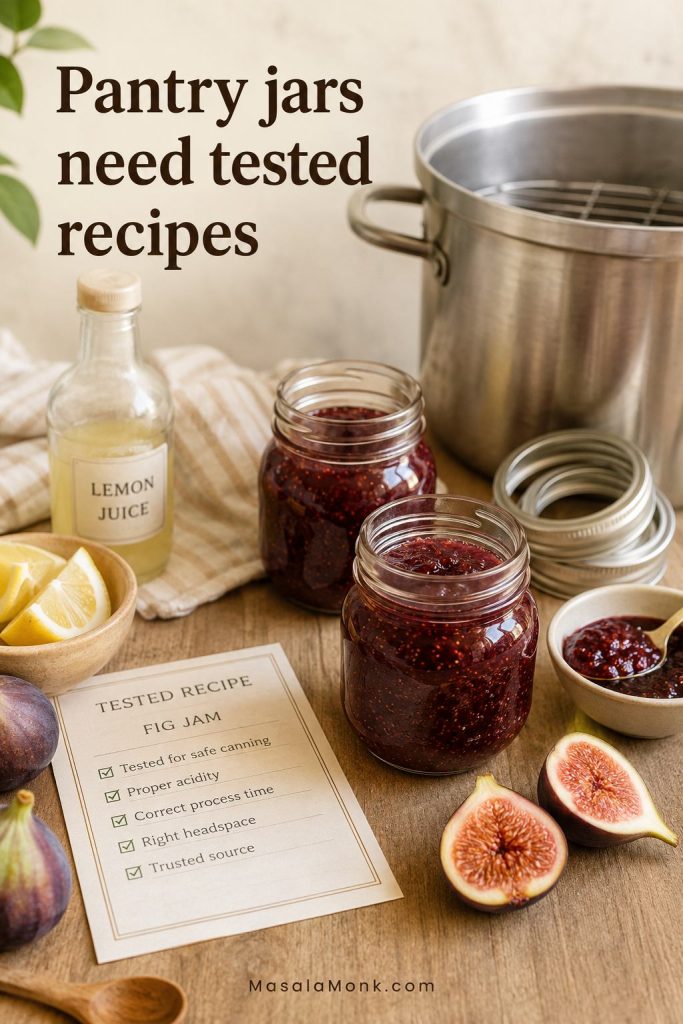
For pantry jars, switch to a tested preservation recipe and follow it exactly. Canning safety depends on the exact fruit, sugar, acid, headspace, jar size, and processing time. Figs also need proper acidification for safe boiling-water canning.
Shelf-stable fig jam depends on tested acidity, headspace, jar size, and processing time, so do not guess with canning.
Canning safety: Do not can this version as written. Sterilized jars do not make an untested refrigerator jam shelf-stable.
Do not use low-sugar, honey-sweetened, or no-added-sugar variations for room-temperature storage unless you are following a tested recipe designed for that exact style.
What to Eat With Fig Jam
This is where the jar earns its space in the fridge. A spoonful can rescue plain yogurt, make toast feel planned, or turn a last-minute cheese plate into something generous. The easiest rule: pair it with something creamy, salty, tangy, smoky, or crisp so the sweetness has contrast.
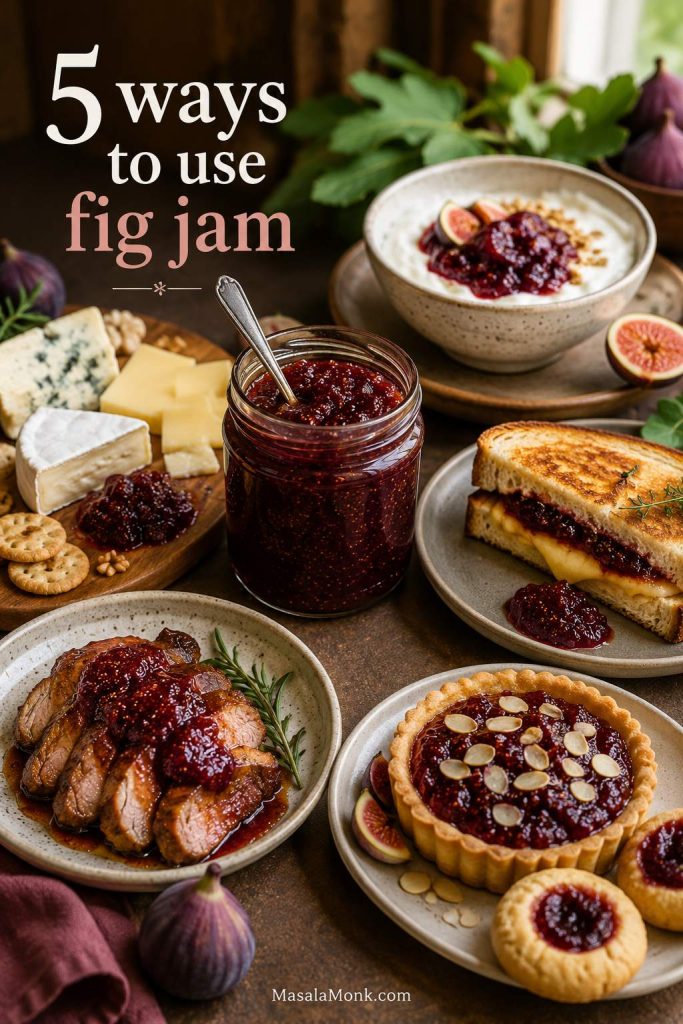
After chilling, fig jam moves easily from breakfast to cheese boards, savory glazes, sandwiches, and simple desserts.
At breakfast, use it where you would use berry jam, but expect a deeper, honeyed flavor.
Spread on toast, English muffins, biscuits, or croissants
Spoon over Greek yogurt or labneh
Swirl into oatmeal or overnight oats
Serve with pancakes, waffles, or French toast
Add to a bowl of granola, nuts, and fruit
If you like breakfast bowls, fig jam pairs naturally with nuts, oats, yogurt, and dried fruit. Spoon it into overnight oats, or serve it with a crunchy bowl of this homemade granola recipe.
It is also excellent with warm toast, biscuits, or English scones, especially when the jam is soft enough to spoon rather than slice.
Cheese and board ideas
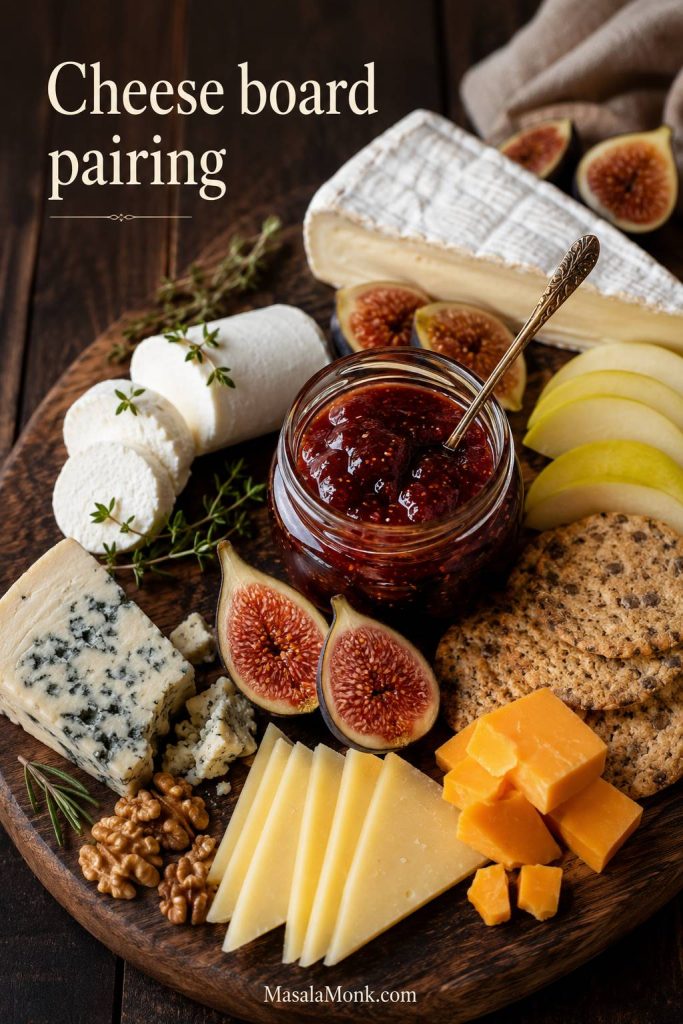
On a cheese board, fig jam gives you the sweet-tart contrast that makes salty, creamy, sharp, and funky cheeses taste better. Brie loves lemon, orange, balsamic, or rosemary. Goat cheese works beautifully with honey or vanilla. Blue cheese needs a smaller spoonful and a stronger direction like balsamic, orange, or chili.
Brie or baked brie
Goat cheese or whipped goat cheese
Blue cheese or Gorgonzola
Camembert
Manchego
Cream cheese
Sharp cheddar
Charcuterie boards with crackers, nuts, fruit, and cured meats
On a cheese board, fig jam bridges creamy, salty, sharp, and tangy cheeses with one sweet-tart spoonful.
For party boards, fig jam fits naturally into a larger spread like this charcuterie board guide.
Savory uses
In savory food, use fig jam like a sweet-tart glaze or condiment, especially with salty, smoky, roasted, or sharp flavors.
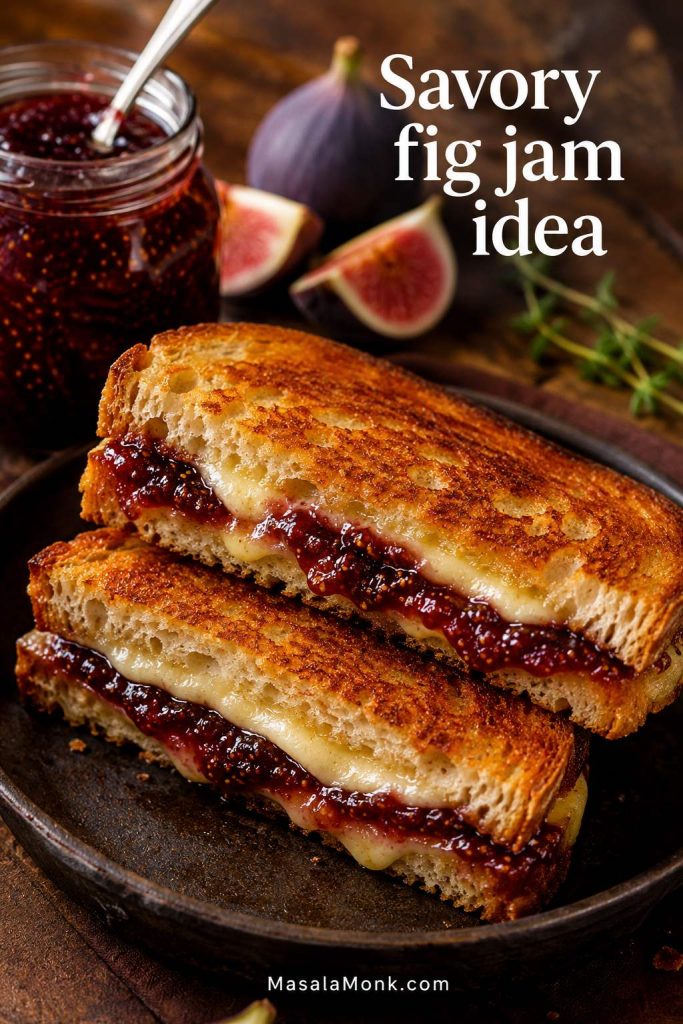
Fig jam grilled cheese: Spread a thin layer inside the sandwich so the jam melts into the salty cheese instead of overwhelming it.
Inside grilled cheese, a thin layer of fig jam melts into the salty cheese and adds sweet-tart contrast.
Use in turkey, ham, or chicken sandwiches
Brush over pork or chicken as a glaze
Spoon onto pizza or flatbread with cheese and herbs
Serve with roasted vegetables
Stir into a pan sauce with vinegar or mustard
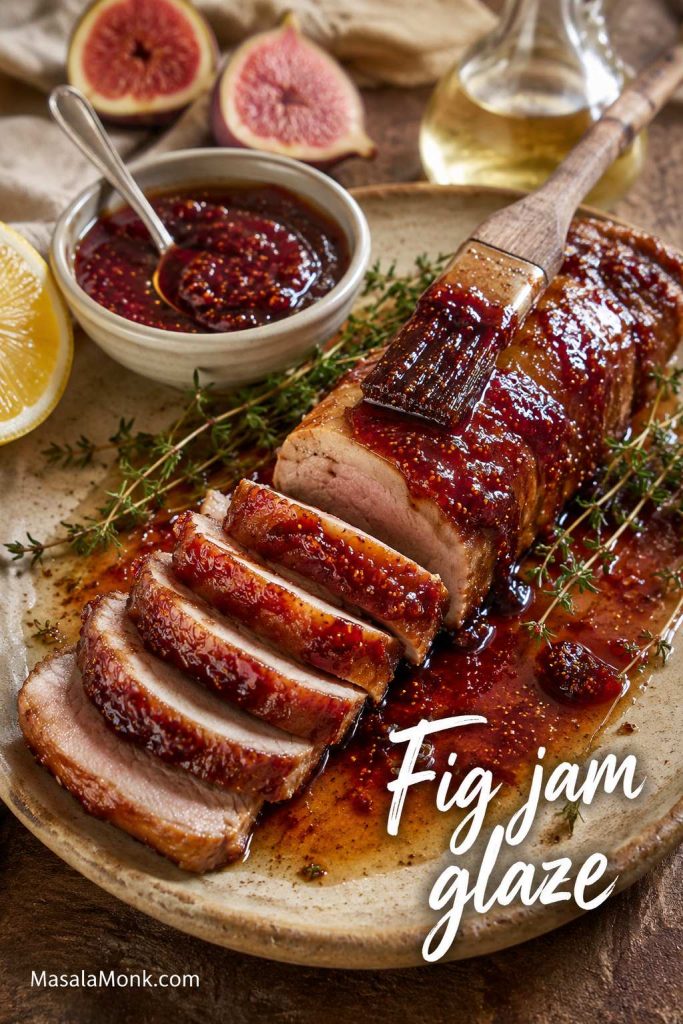
For meat, loosen the jam with lemon juice, vinegar, or pan juices and brush it over something simple like pork tenderloin in oven.
For a quick fig jam glaze, loosen the jam with lemon, vinegar, or pan juices before brushing it over pork or chicken.
Dessert uses
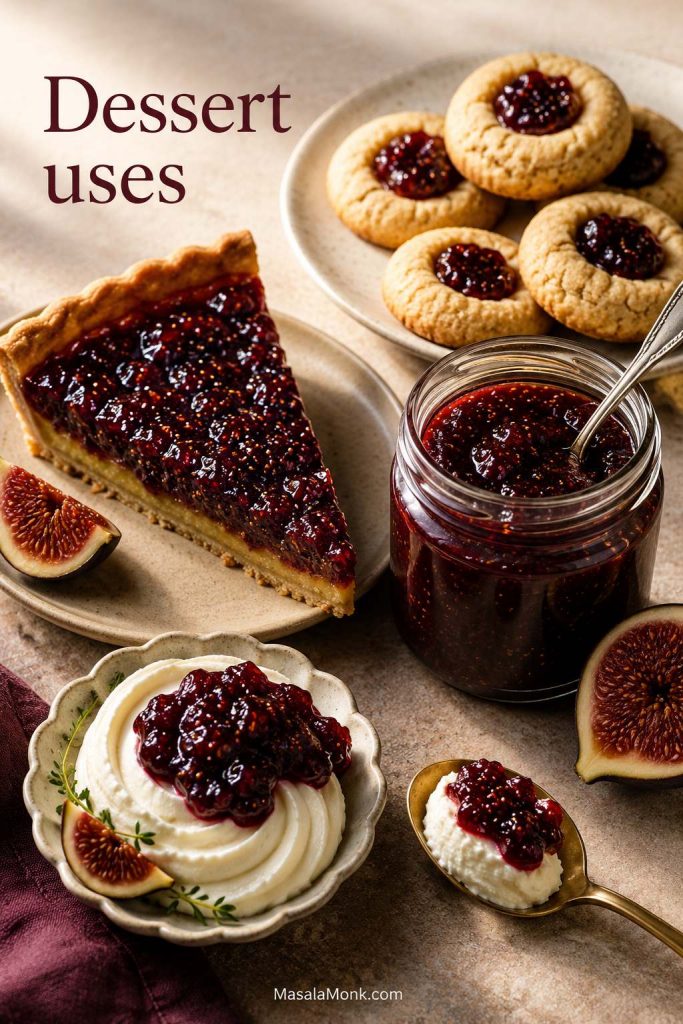
For desserts, choose a thicker batch or simmer the jam a little longer so it holds its place in cookies, cakes, and tarts.
A thicker fig jam holds its shape in cookies, tarts, and cream desserts while adding a glossy fruit center.
Fill thumbprint cookies
Use in fig bars or Fig Newton-style cookies
Layer into cakes
Spoon over cheesecake
Serve with vanilla ice cream
Use as a tart or galette filling
Swirl into whipped cream or mascarpone
For tart-style desserts, use a thicker batch the way you would use a glossy fruit layer in an apple tart recipe.
Fig Jam With Brie, Goat Cheese, and Cheese Boards
With cheese, the sweetness and texture do the heavy lifting. The jam brings fruit, acidity, and softness, while the cheese brings salt, fat, and creaminess. The combination tastes generous without needing much work.
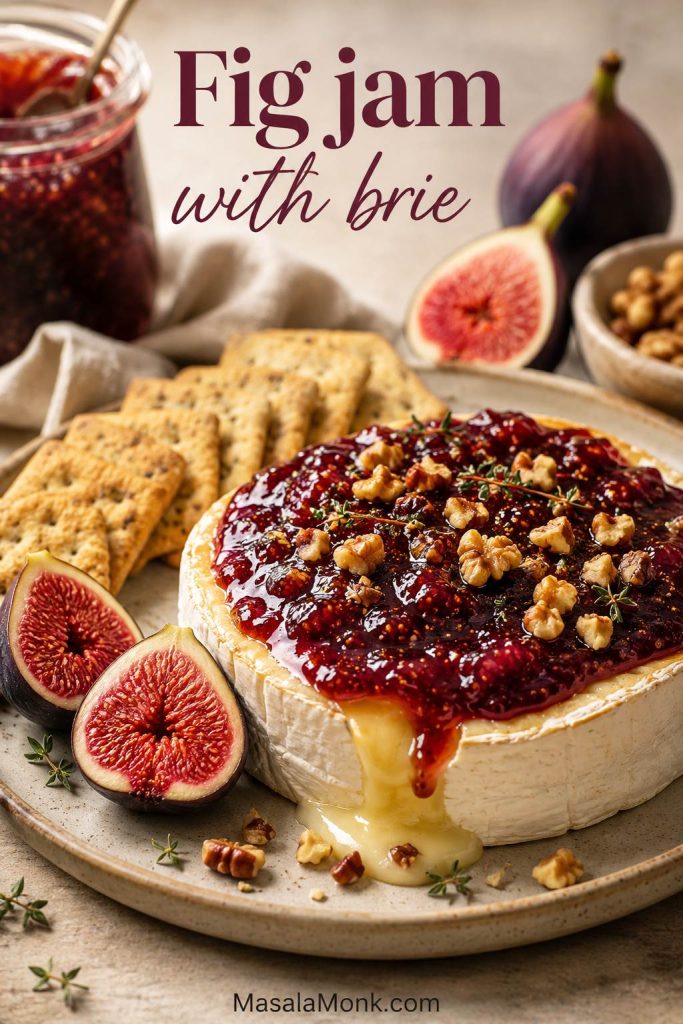
For an easy baked brie-style appetizer, use about 2–3 tablespoons per 8 oz brie wheel. Place the brie in a small oven-safe dish, warm it until soft but not completely melted and leaking, then spoon the jam over the top. Add toasted walnuts, pecans, or pistachios. Finish with honey, thyme, rosemary, orange zest, or a few drops of balsamic vinegar. Serve with crackers, baguette slices, apple slices, or pear wedges.
Fig jam with brie works because sweet fruit, lemon brightness, creamy cheese, and crunchy nuts balance one another.
If you are serving the brie as part of a drinks-and-snacks spread, a bright French 75 works well because lemon and bubbles cut through creamy cheese and sweet jam.
Add nuts after warming if you want them to stay crisp. A balsamic variation is especially good with stronger cheeses because the vinegar keeps the sweetness from becoming heavy.
Goat cheese is especially good with a spoonful of jam, cracked pepper, toasted nuts, and a drizzle of olive oil or honey. Blue cheese is stronger, so use a smaller spoonful and choose a sharper variation like balsamic, orange, or chili. Sharp cheddar and Manchego work best with a thicker batch, crackers, and crisp fruit.
Want a savory path instead? Use the fig jam glaze idea for pork or chicken.
Fig Jam Troubleshooting
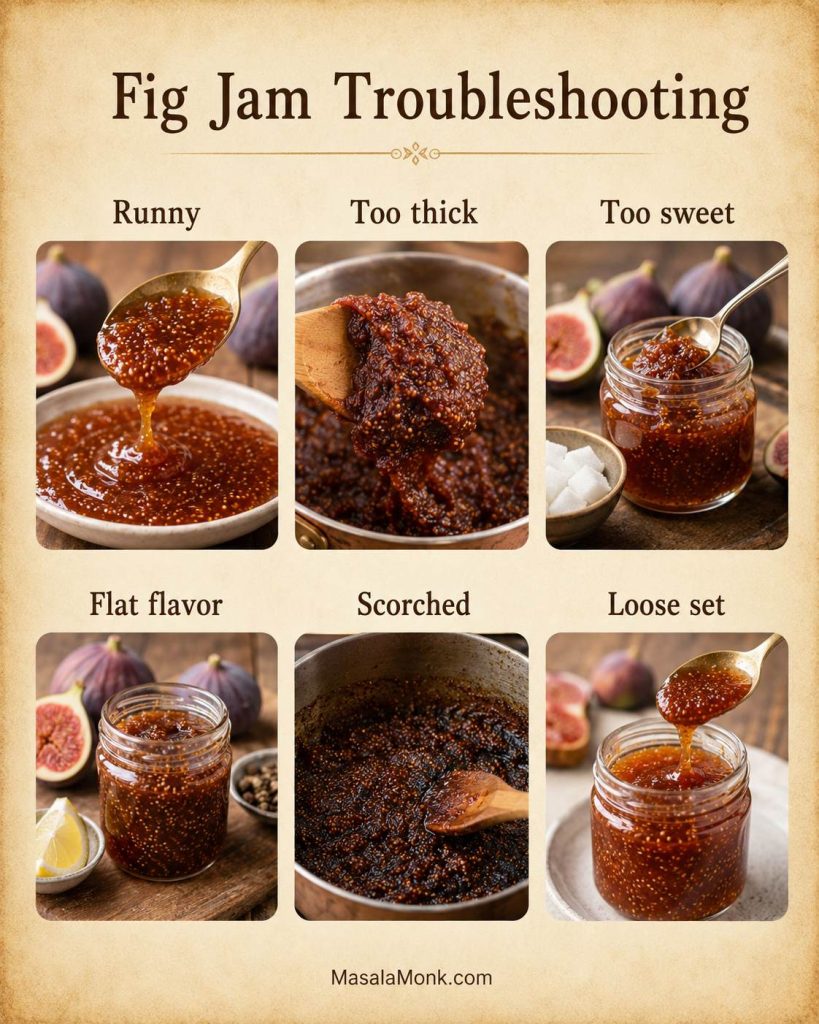
Most jam problems look dramatic while the pot is hot. Usually, they are texture problems — and texture problems can often be fixed before the jar cools. Use this table before adding thickeners or throwing anything away.
Troubleshooting fig jam is easier once you know whether the problem is moisture, heat, sweetness, acid, or cook time.
If you are unsure whether the batch is actually done, compare it with the doneness tests before making a fix.
Common Problems and Fixes
Problem
Likely Cause
Fix Now
Next Time
Runny
Too much water, undercooking, very juicy figs, or low sugar
Simmer longer in a wide pan, stirring often
Start with less water, cook to the doneness tests, and avoid rushing
Too thick
Overcooking or too much evaporation
Stir in a spoonful of hot water or lemon juice until loosened
Stop cooking when the jam is shiny and spoonable, not stiff
Too sweet
Very ripe figs or too much sugar
Add lemon juice a teaspoon at a time
Choose the lower end of the sugar range
Flat flavor
Not enough acid or salt
Add lemon juice and a tiny pinch of salt
Build in zest, lemon juice, or a small balsamic finish
Scorched
Heat too high, pan too thin, or not enough stirring
Do not scrape burnt bits into the jam; move unburnt jam to a clean pot
Keep the heat lower, use a heavier pan, and stir more often
Loose set
No pectin, low sugar, or not enough reduction
Treat it as fig spread or simmer longer
Check with the cold plate test or thermometer cue
Noticeable seeds
Figs naturally have many tiny seeds
Blend the jam smoother
Choose a smoother fig spread texture from the start
Dried fig version too dense
Dried figs absorbed too much liquid or cooked down too far
Blend in hot water a spoonful at a time
Simmer figs until fully soft before reducing hard
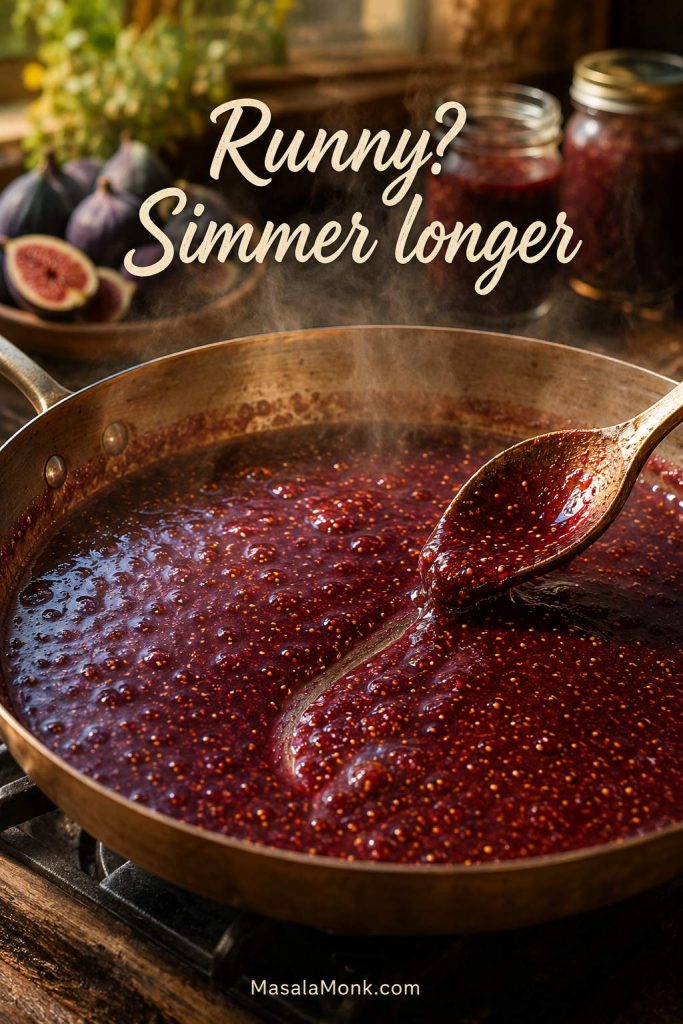
Runny Fig Jam Fix
A loose batch usually needs more evaporation before it needs anything else, so return it to a wide pan and simmer gently.
Runny fig jam usually needs patience, not cornstarch; simmer it in a wide pan until the extra moisture leaves.
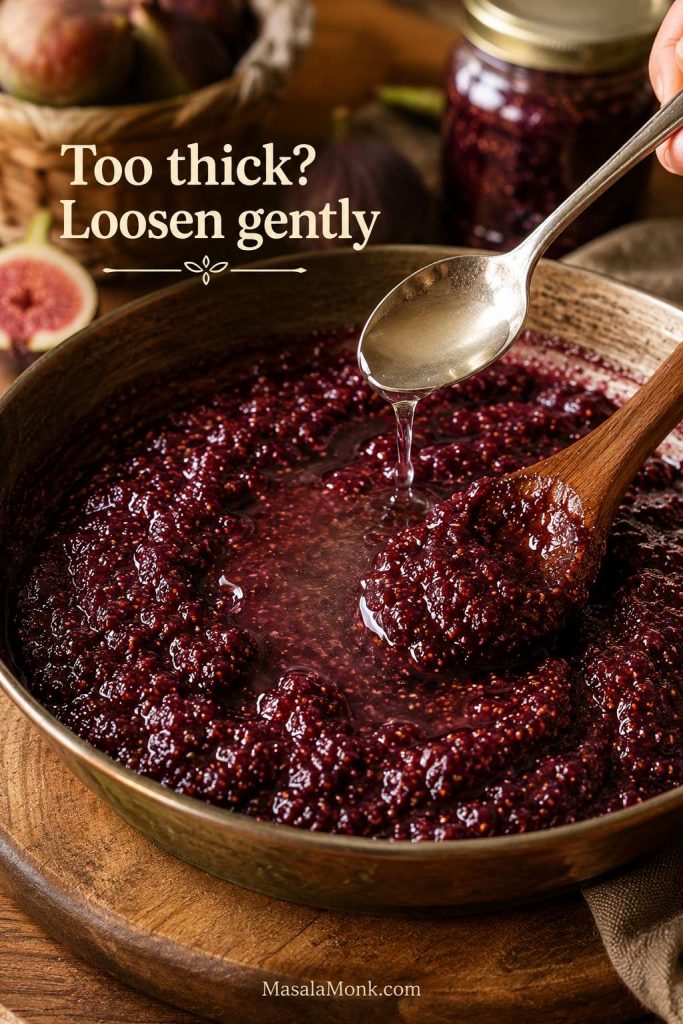
Too-Thick Fig Jam Fix
A stiff batch can often be saved while warm if you add liquid slowly and stop as soon as the jam relaxes.
If the jam becomes too thick, loosen it while warm with a small splash of hot water or lemon juice.
About cornstarch: Cornstarch can thicken many fruit sauces, but it is not the best fix for classic fig jam and should not be used in anything you plan to can. If the jam is runny, simmering longer is usually the better solution.
FAQs About Fig Jam
Do figs need to be peeled before making jam?
No. The skins are edible and soften as the fruit cooks. Remove the stems and any damaged spots, but leave the skins on for better texture, color, and flavor.
What kind of figs are best for fig jam?
Use ripe, flavorful figs. Black Mission, Brown Turkey, Kadota, Adriatic, and other edible varieties can all work. Ripeness matters more than the exact variety: the fruit should be sweet and soft, not hard, dry, sour, or spoiled.
Fresh figs or dried figs — which makes better jam?
Fresh figs make a brighter, more classic batch. Dried figs make a darker, denser spread that is available year-round and excellent with cheese. If fresh figs are in season, use them. If not, dried figs are a very good option.
Can green figs be used for fig jam?
Ripe green-skinned figs can be used. Truly unripe figs are different and usually need a separate green fig preserve method with soaking or boiling steps to reduce bitterness and firmness. If the figs are hard, dry, and not sweet yet, do not treat them like ripe figs in this quick jam.
Why is lemon juice used in fig jam?
Lemon juice balances the natural sweetness of figs, brightens the flavor, and helps the mixture thicken. It also matters in canning safety, although shelf-stable canning requires a tested recipe rather than casual adjustments.
Does fig jam need pectin?
No, not for a soft homemade version. This recipe thickens through sugar, lemon juice, and evaporation. Commercial pectin gives a firmer set, but it requires different ratios and instructions.
Why is my fig jam runny?
It may need more cooking time. Runny jam usually comes from too much water, very juicy figs, low sugar, a narrow pot, or stopping before enough moisture has evaporated. Simmer it longer in a wide pan and test again.
How long does homemade fig jam last?
For the main refrigerator version, use it within 2–3 weeks for best quality. Low-sugar batches are best within 1–2 weeks, and no-added-sugar spread is best within about 5–7 days. You can also freeze it for about 3 months. Room-temperature jars require a tested preservation method and proper processing.
Is this fig jam recipe safe for canning?
The version here is meant for refrigerator and freezer storage. For shelf-stable canning, use a tested canning formula and processing time from a trusted source. Sterilized jars alone do not make refrigerator jam safe for room-temperature storage. Do not can low-sugar, honey, or no-added-sugar versions unless the recipe is specifically tested for that method.
Can frozen figs be used for jam?
Frozen figs work well, but they usually bring extra liquid. Thaw the fruit first if possible and include the juices unless they seem excessive. The batch may need a longer simmer to thicken.
Can I double this recipe?
Yes, but use a very wide pan and expect a longer cook time. Jam thickens through evaporation, so one large deep pot can take much longer and may cook unevenly. For the best texture control, two smaller batches are usually easier than one oversized batch.
Brown sugar in fig jam — does it work?
Yes. You can replace part or all of the white sugar with light brown sugar for a deeper, warmer, slightly caramel-like flavor. The finished jar will taste less bright, so lemon juice becomes even more important.
What cheese goes best with fig jam?
Brie, goat cheese, blue cheese, Camembert, Manchego, cream cheese, sharp cheddar, and Gorgonzola all pair well with it. Use a balsamic or herb variation for a more savory board.
Final Tips Before You Make It
Do not peel the figs; the skins soften during cooking.
Start with less water and add more only if the pot looks dry.
Cook uncovered so moisture can evaporate.
Use a wide pan so the jam reduces efficiently.
Stop cooking before the jam looks stiff; it thickens as it cools.
Once the figs soften and the kitchen smells warm and lemony, the rest is patience: stir, test, stop early, and let the jar finish thickening as it cools.
Fig Jam Recipe
A soft-set fresh fig jam made without commercial pectin. It cooks down into a shiny, fruit-forward spread for toast, yogurt, cheese boards, baked brie, desserts, sandwiches, and savory glazes. Keep it refrigerated or frozen unless you switch to a tested canning recipe.
YieldAbout 3 cups / 720 ml, or three 8 oz jars
Prep Time15 minutes
Cook Time25–45 minutes
Total Time40–60 minutes, plus optional resting and cooling
Keep this no-pectin fig jam card handy for the core ratio, cook-time window, yield, and fridge-or-freezer reminder.
Fresh lemon juice: ¼ cup / 60 ml, plus more to taste
Water: ¼–½ cup / 60–120 ml, as needed
Fine salt: ⅛ tsp, optional
Lemon or orange zest: 1 tsp finely grated, optional
Vanilla: 1 tsp vanilla extract or ½ vanilla bean, optional
Balsamic vinegar: 1–2 tbsp, optional for a cheese-board variation
Instructions
Prep the figs. Rinse gently, pat dry, remove stems, and chop or quarter the figs. Do not peel them; fig skins soften during cooking.
Combine the ingredients. Add figs, sugar, lemon juice, ¼ cup / 60 ml water, and salt if using to a wide heavy-bottomed pan. Stir well. Let sit for 15–30 minutes if you have time.
Start cooking. Set the pan over medium heat and stir until the sugar dissolves and the figs begin to release juice. Add the remaining water only if the pot looks dry or the figs start sticking before they soften.
Simmer uncovered. Reduce the heat to maintain a steady simmer. Cook uncovered, stirring often, until the figs soften, slump, and begin to collapse, about 25–45 minutes.
Mash or blend. Mash lightly for fig preserves-style texture with visible pieces. Mash more for rustic jam. For a smoother fig spread, pulse briefly with an immersion blender.
Cook to thickness. Continue simmering until the jam looks shiny, mounds softly on a spoon, and moves slowly on a chilled plate. At sea level, a thermometer may read around 220°F / 104°C for a firmer set, but texture matters more than temperature alone.
Adjust flavor. Add more lemon juice if the jam tastes too sweet or flat. Stir in vanilla, zest, or balsamic vinegar near the end if using.
Jar and cool. Spoon into clean jars. Cool, then refrigerate. The jam will thicken more as it cools.
Dried Fig Variation
Use 12–14 oz / 340–400 g dried figs, 2 cups / 480 ml water, ½–1 cup / 100–200 g sugar to start, and 2 tbsp / 30 ml lemon juice. Simmer the chopped dried figs with water until very soft, 20–40 minutes. Mash or blend, add sugar and lemon, then simmer until thick and spoonable. Add more sugar only after tasting. Keep the jam slightly loose while hot because dried fig jam firms quickly as it cools.
Small-Batch Version
Use 1 lb / 450 g fresh figs, ¾ cup / 150 g sugar, 2 tbsp / 30 ml lemon juice, and 2–4 tbsp / 30–60 ml water. Cook time is usually shorter, about 20–30 minutes.
Sugar Notes
For a lower-sugar version, use 150–200 g sugar per 900 g fresh figs and expect a softer set; refrigerate and use within 1–2 weeks. For no-added-sugar fig spread, cook ripe figs with lemon juice and a splash of water until thick, then refrigerate and use within about 5–7 days or freeze.
Storage and Canning
Keep this batch refrigerated and use within 2–3 weeks for best quality, or freeze for up to 3 months. Do not can this version as written. For shelf-stable jars, switch to a tested canning formula.
Once the jars are cool, keep one where you can reach it easily. This is the spoonful that turns plain toast, cheese, or a quick dessert into something finished.
Once cooled, homemade fig jam becomes the jar you reach for at breakfast, with cheese, or when dessert needs fruit.
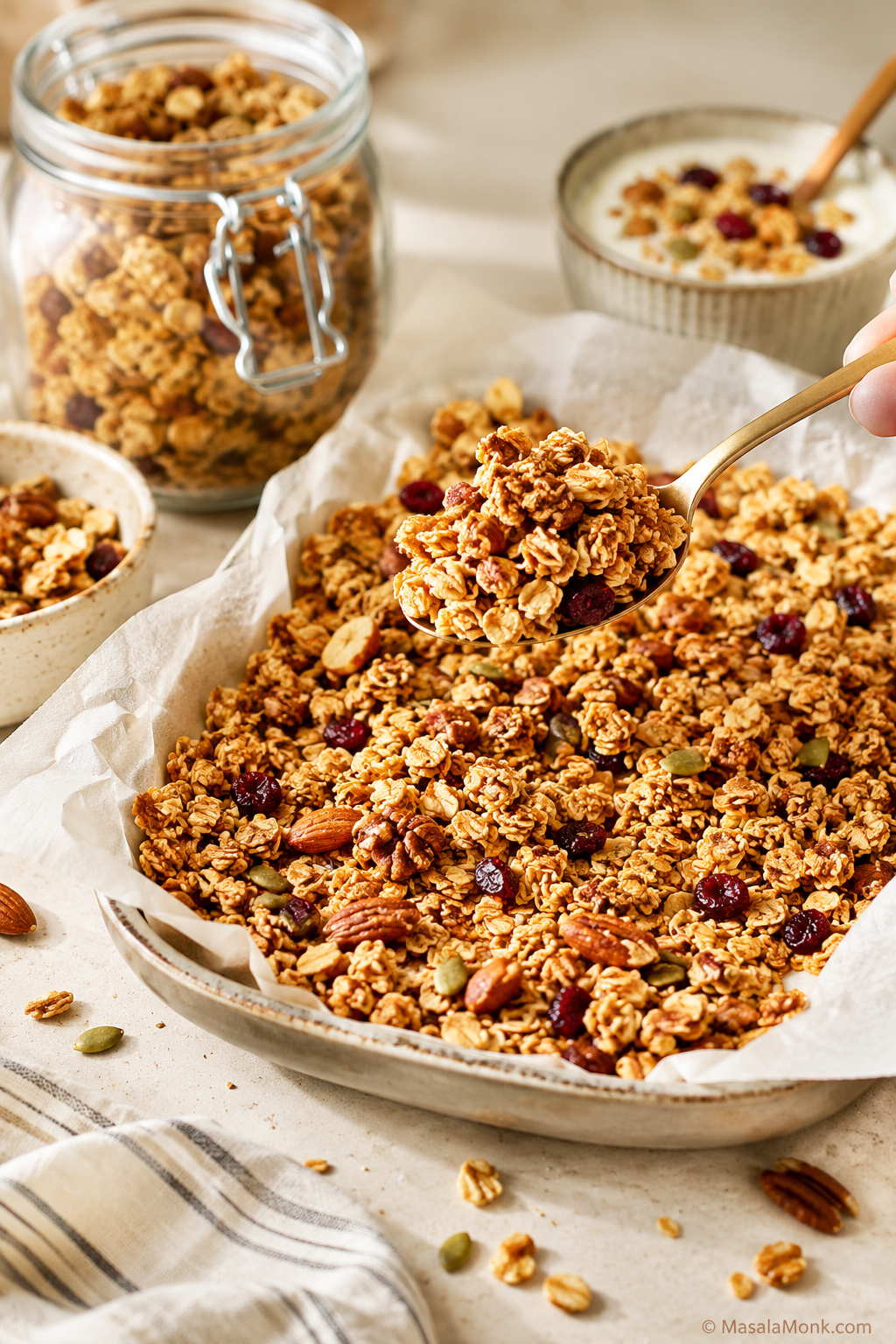
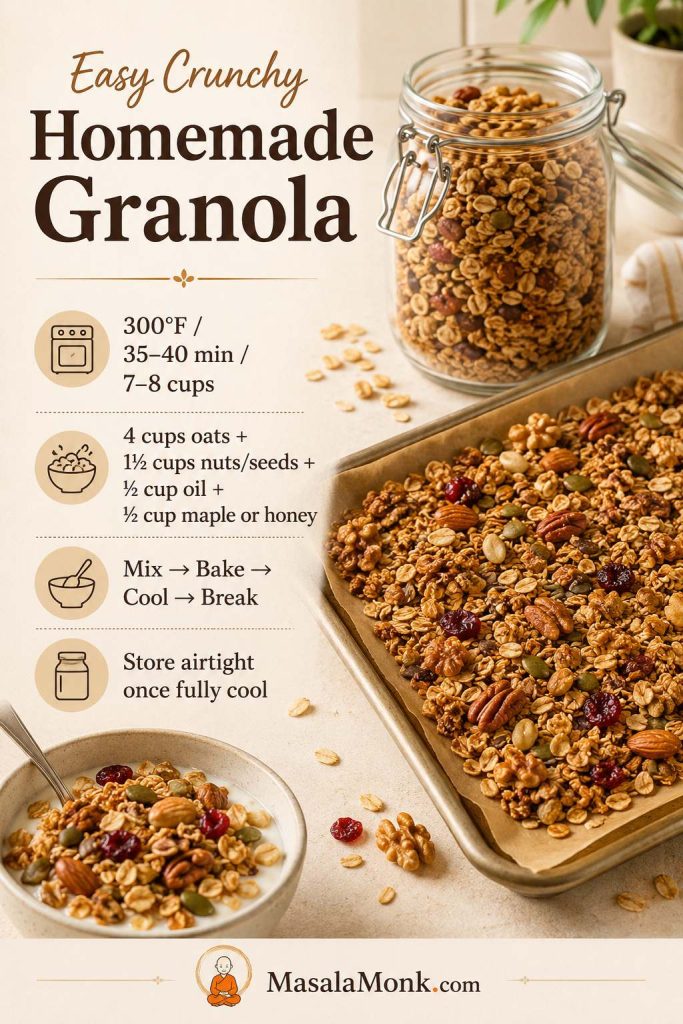
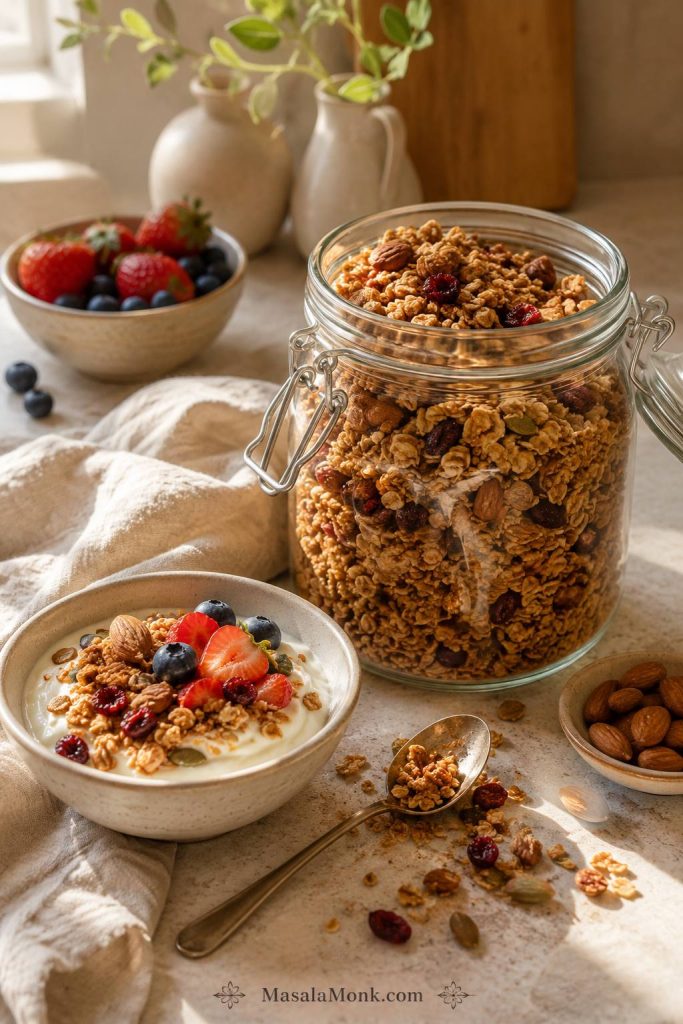
Homemade granola is one of those small kitchen wins that feels much bigger than the effort. A tray of oats, nuts, maple syrup or honey, cinnamon, and vanilla goes into the oven, and soon the kitchen smells like breakfast for the whole week.
It is especially satisfying if you have ever bought a bag of granola that looked beautiful but tasted too sweet, too bland, or too dusty by the time it reached the bowl. The goal here is simple: crunchy granola that does not burn, clusters that actually hold, and a jar you will want to use all week.
This is a base-ratio recipe first. Once you understand the method, you can make the granola crunchier, chunkier, less sweet, nut-free, vegan, gluten-free, or better for yogurt without starting from scratch.
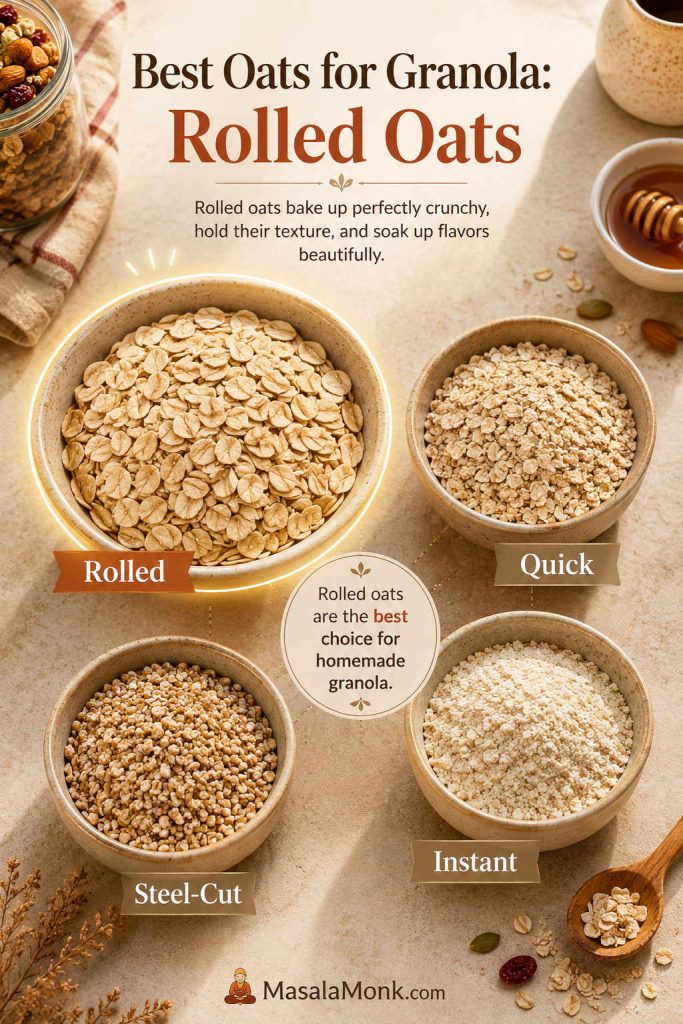
The base uses old-fashioned rolled oats, nuts or seeds, oil, maple syrup or honey, salt, cinnamon, and vanilla. It bakes low and steady at 300°F / 150°C, which gives the oats time to crisp while keeping the nuts and coconut from browning too aggressively.
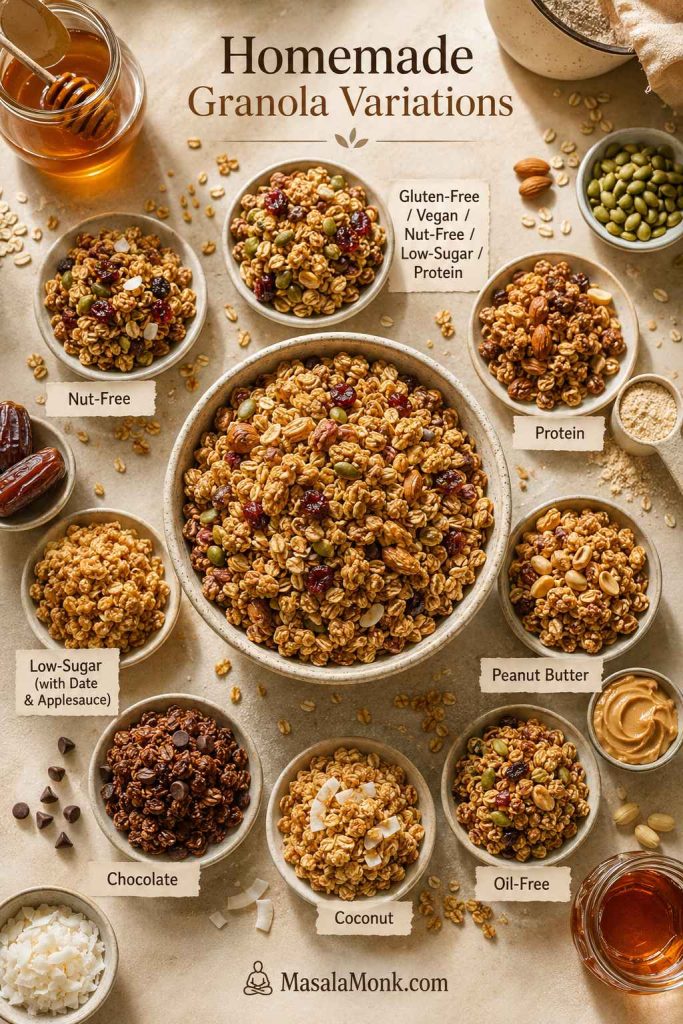
The first batch teaches the method. The second batch starts to become your house granola: almonds and cranberries one week, peanut butter and chocolate the next, or pumpkin seeds and coconut when you want something nut-free.
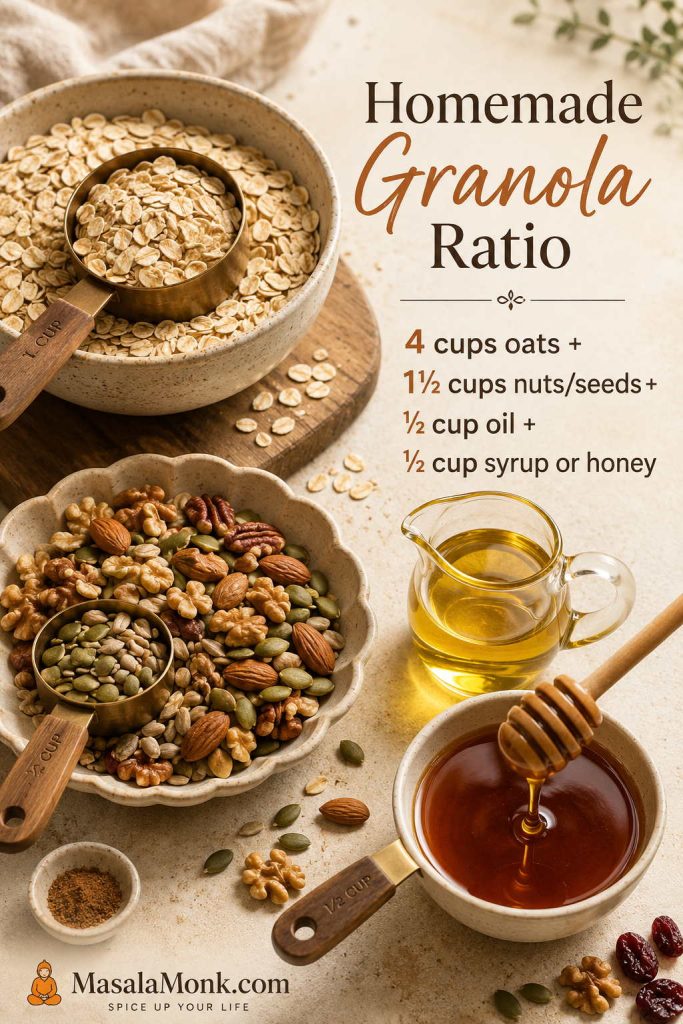
4 cups / about 320–360g rolled oats + 1½ cups / 150–180g nuts or seeds + ½ cup / 120ml oil + ½ cup / 120ml maple syrup or honey.
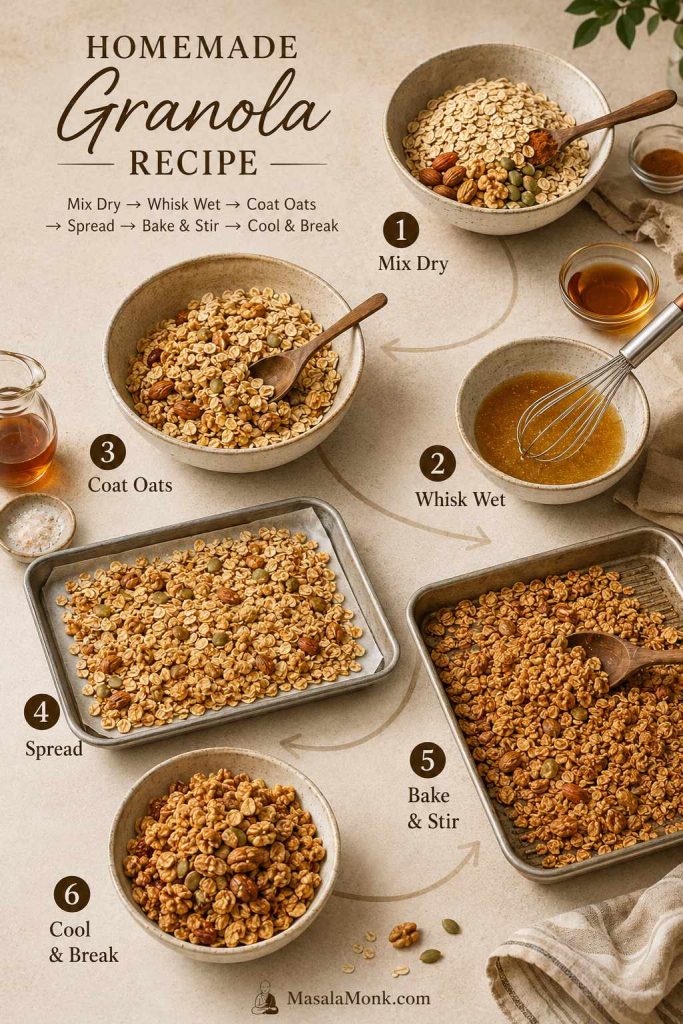
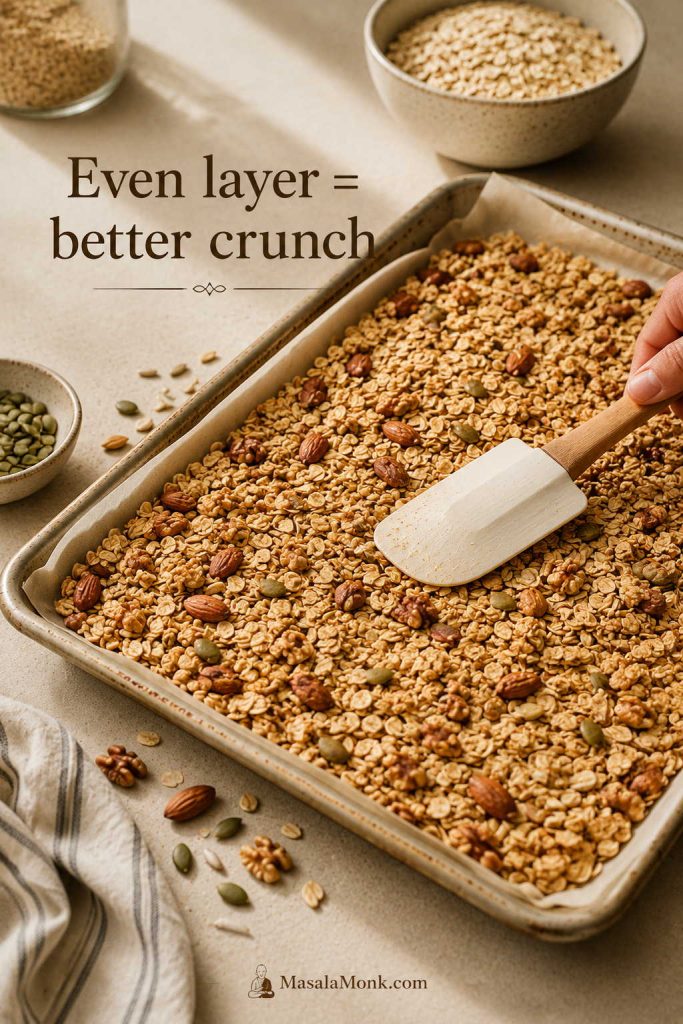
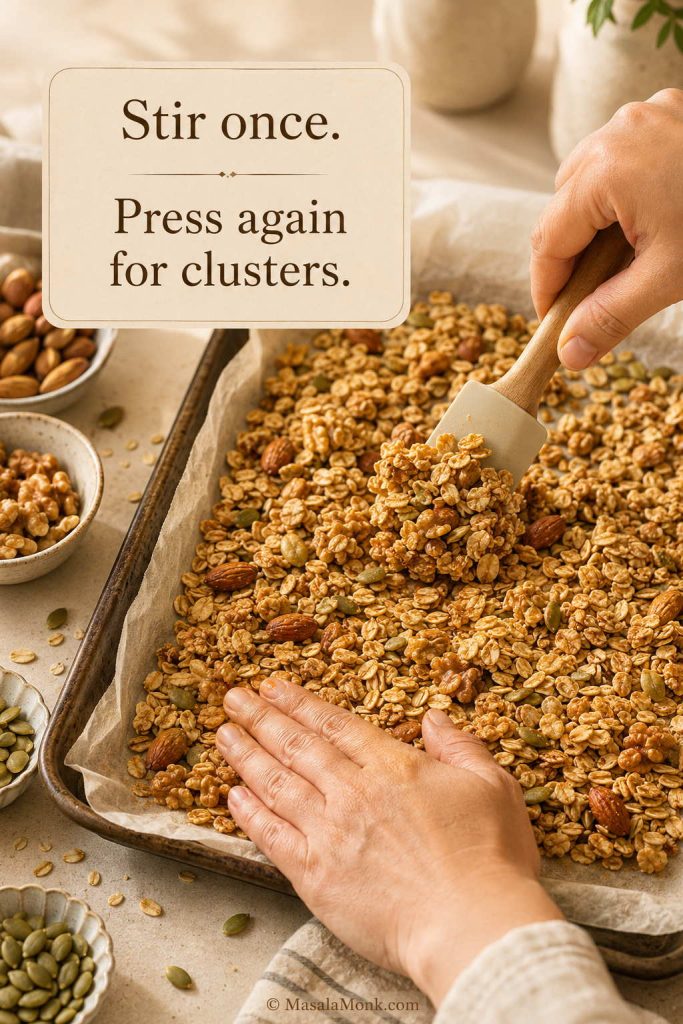
Mix that with salt, cinnamon, and vanilla, then bake it on a parchment-lined rimmed baking sheet at 300°F / 150°C for 35–40 minutes. Stir once halfway through, press it back down if you want clusters, and let it cool fully on the pan before breaking it apart.
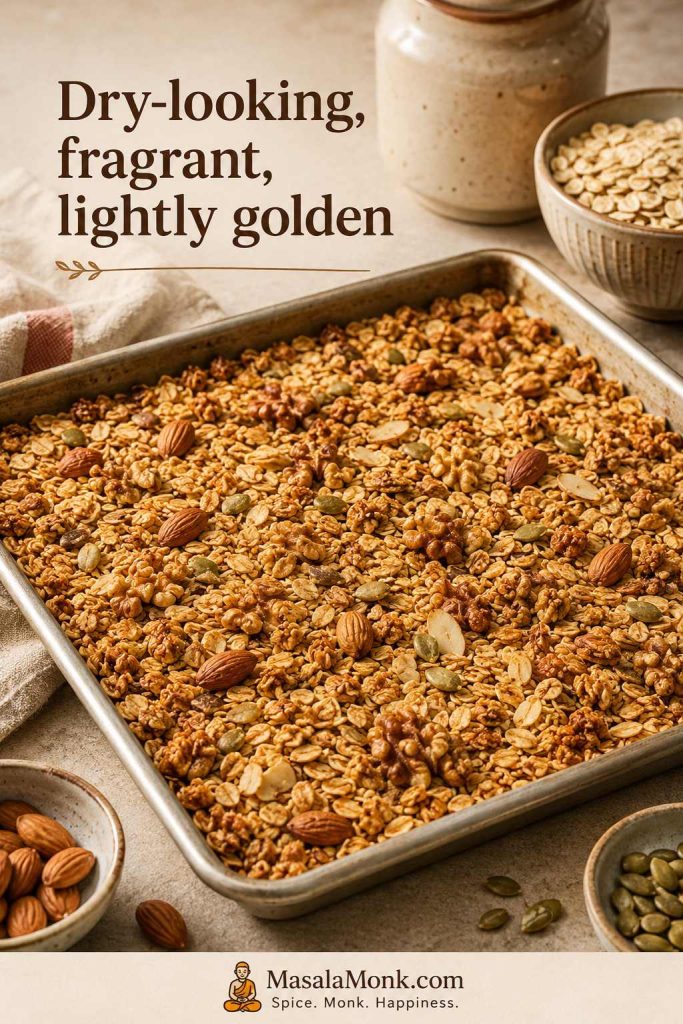
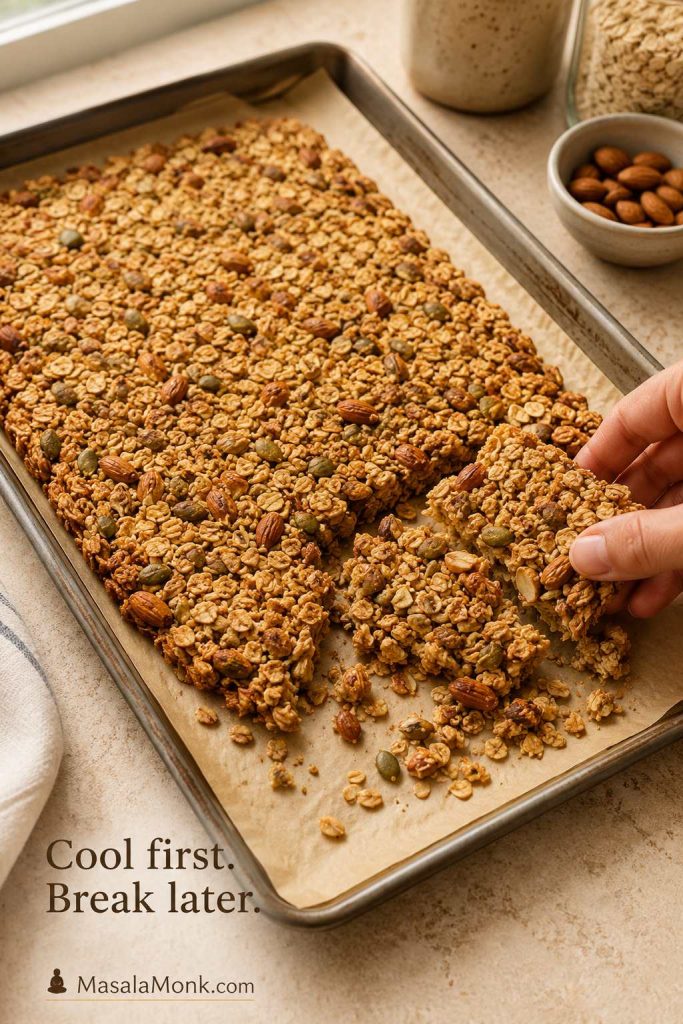
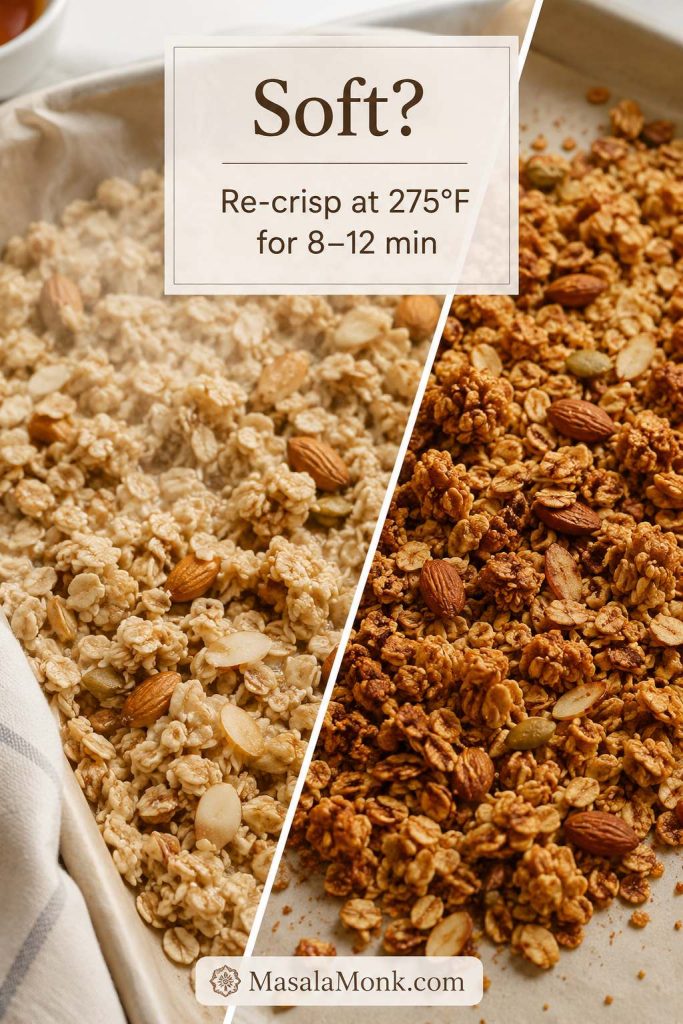
Hot granola lies a little. It often feels slightly soft when it first comes out of the oven, then crisps as it cools. If you bake it until it feels fully crunchy while hot, the edges and nuts can turn bitter.
That is the real appeal of homemade granola: one pan, one jar, and several breakfasts that feel easier before the week even starts.
Want the exact measurements without the full guide? Skip to the recipe card. If your last batch stayed soft, the troubleshooting section has the quick re-crisp fix.
Homemade granola ratio guide
Once the base granola ratio makes sense, the recipe becomes flexible: keep the oats, oil, and sweetener balanced, then change the nuts, seeds, spices, or fruit.
Why This Homemade Granola Recipe Works
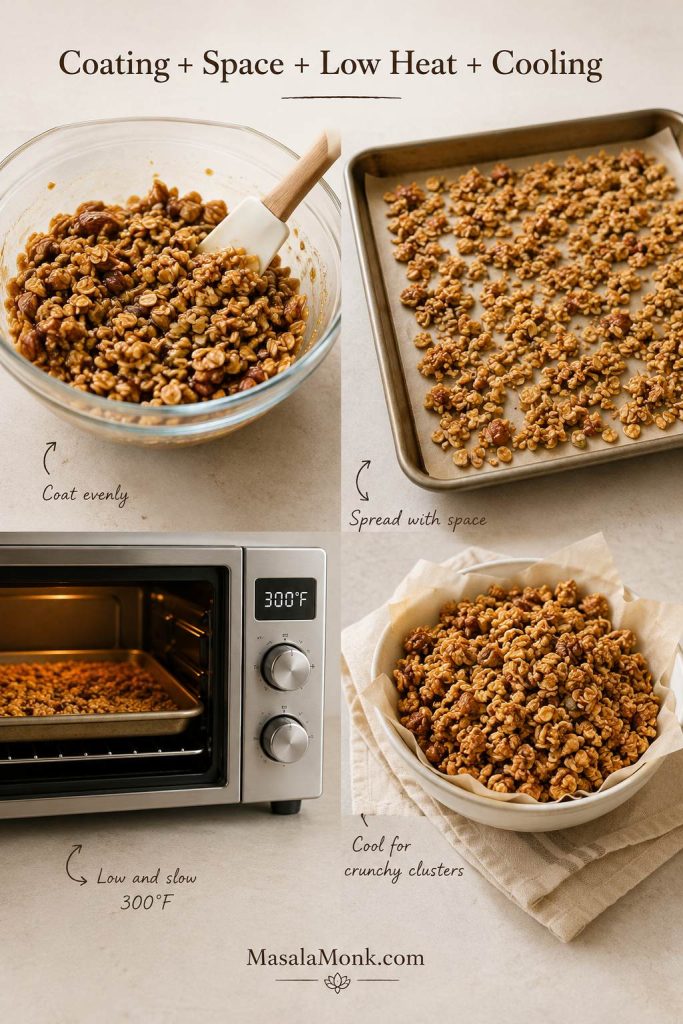
The promise here is straightforward: granola should be easy, but texture should not be left to luck. This recipe keeps the ratio steady and shows you how to read the four things that matter most: heat, coating, space on the pan, and cooling.
A lower oven protects the edges
Many granola recipes bake hotter, but nuts, coconut, and the edges of the tray can brown quickly. At 300°F / 150°C, the oats have time to dry and crisp before the mix-ins over-toast.
Oil and sweetener do different jobs
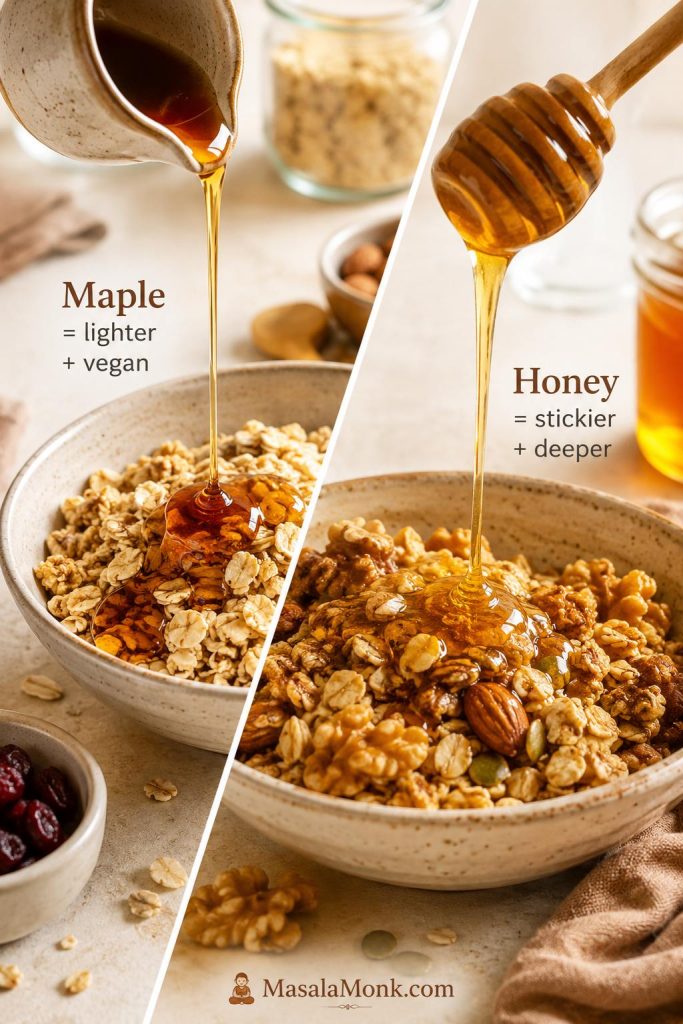
Oil helps the oats toast evenly instead of turning dry and dusty. Maple syrup or honey adds sweetness, but it also helps bind the oats into clusters. Reduce either one too much and the batch will still work, but the texture will change.
Cooling is part of the cook time
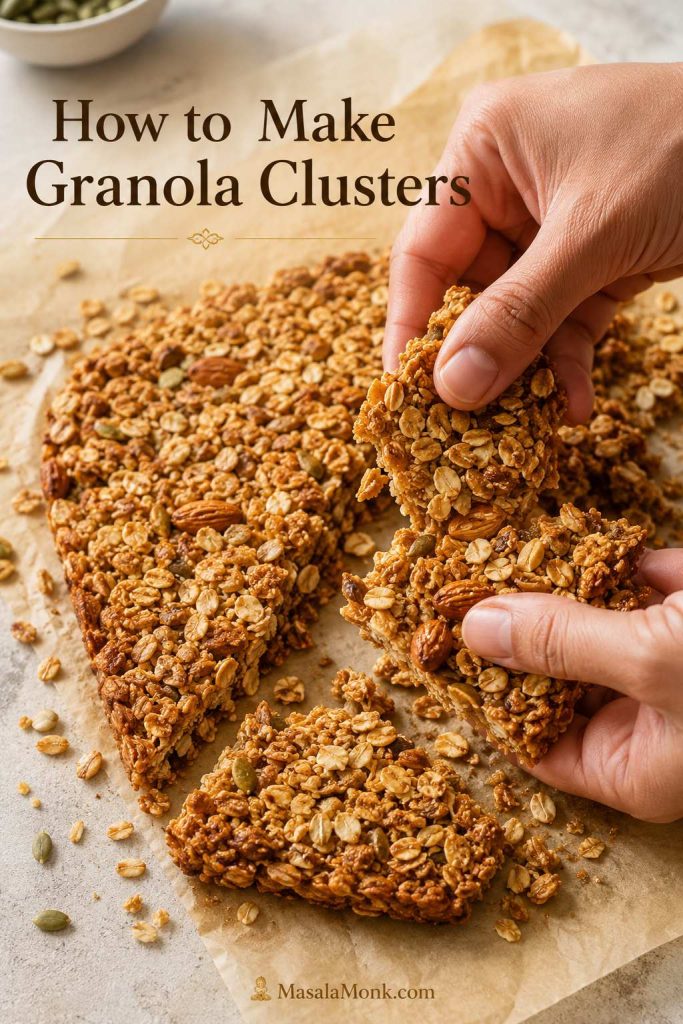
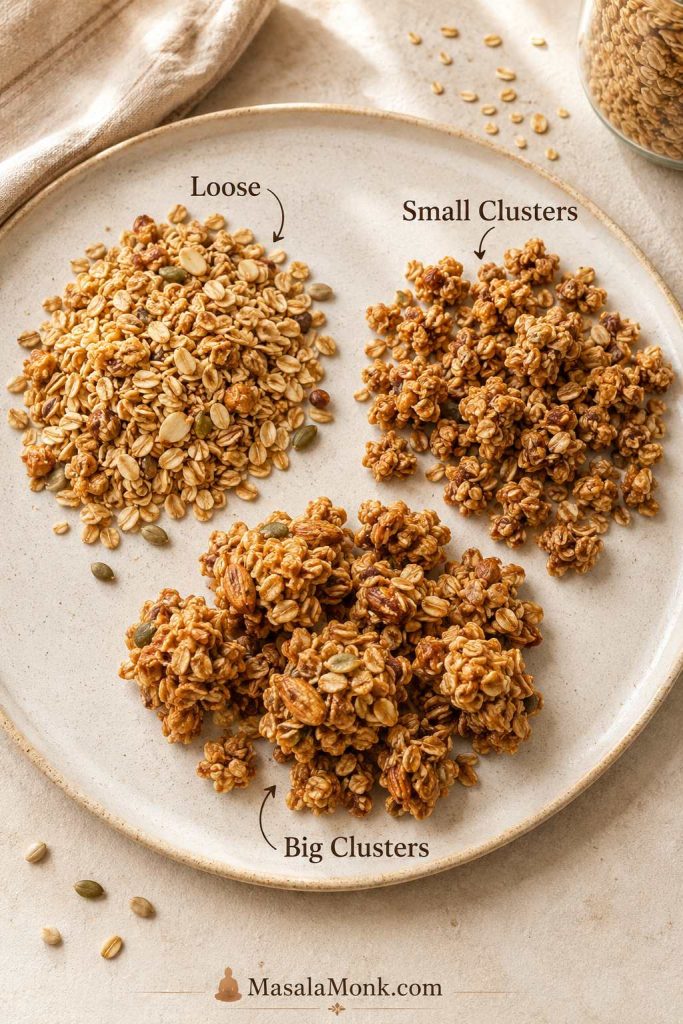
The hardest part is leaving the pan alone. If you break the granola while it is warm, you get smaller pieces. If you wait until it firms up, the clusters hold better.
The base is flexible without becoming vague
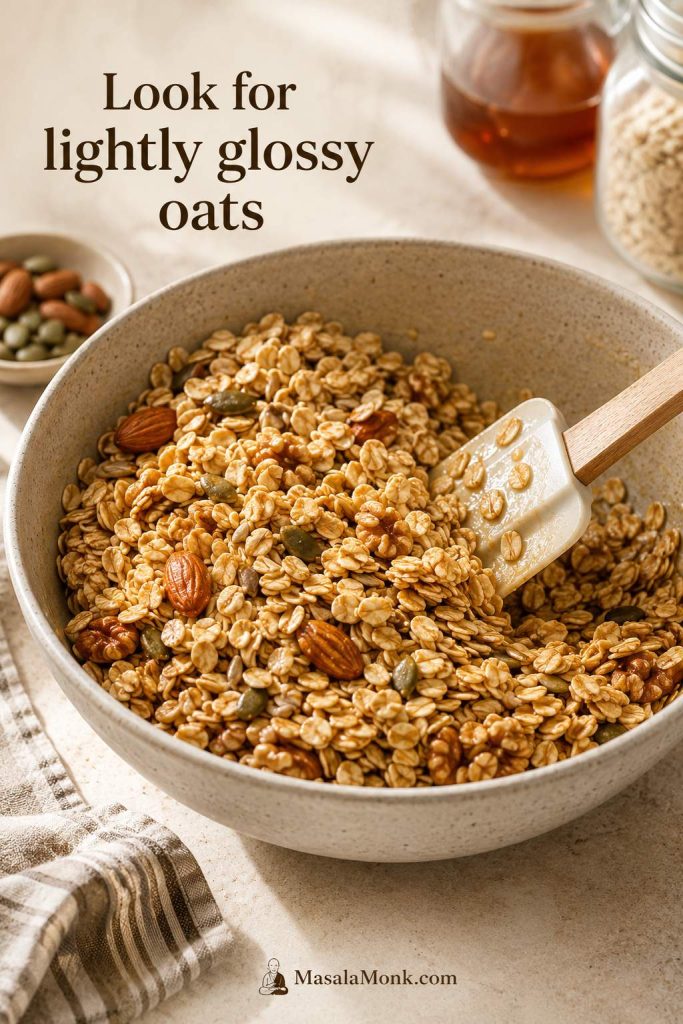
Because nuts, seeds, honey, maple syrup, and dried fruit are not ingredients you want to waste, the recipe leans on clear signs instead of guesswork: glossy coated oats, an even layer, dry-looking edges, a warm nutty smell, and a full cool-down before breaking.
Once you know those signs, you can make the batch more snack-like, more yogurt-friendly, less sweet, vegan, gluten-free, nut-free, or cluster-heavy without losing the basic structure.
Ingredients for Homemade Granola
The ingredients are simple, but each one has a job. Once you understand those jobs, granola stops feeling like a strict formula and becomes something you can adjust with confidence.
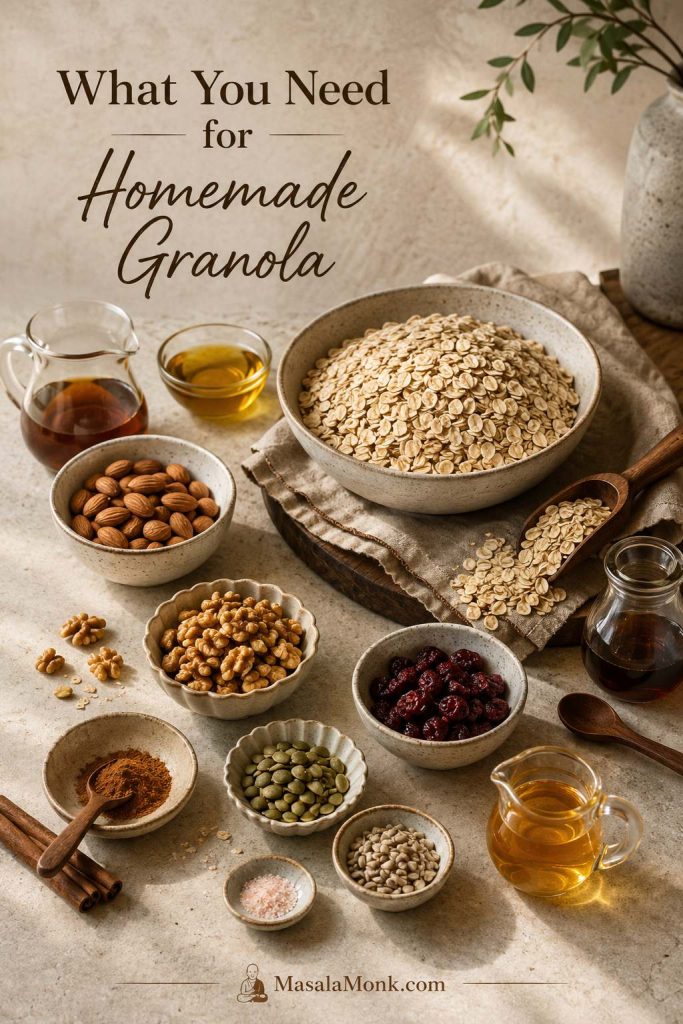
Homemade granola ingredients at a glance
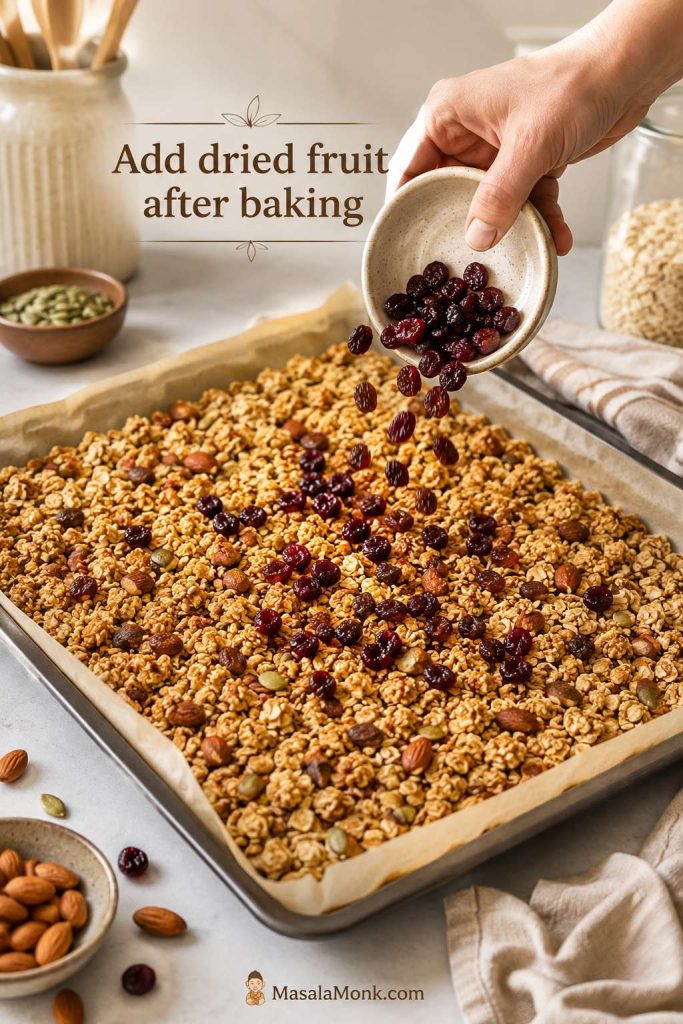
The best homemade granola starts with simple ingredients doing different jobs: oats give structure, oil helps crispness, sweetener binds, and dried fruit adds chew after baking.
Ingredient
Amount
Why it matters
Old-fashioned rolled oats
4 cups / about 320–360g
The main base. They toast well and create the best classic granola texture.
Nuts and seeds
1½ cups / 150–180g
Add crunch, richness, flavor, and a more satisfying bite.
Oil
½ cup / 120ml
Helps the oats crisp and brown evenly.
Maple syrup or honey
½ cup / 120ml
Sweetens the granola and helps bind clusters.
Fine salt
¾ teaspoon, plus more to taste
Balances the sweetness and keeps the granola from tasting flat.
Cinnamon
1–2 teaspoons / about 3–5g
Adds warm breakfast flavor.
Vanilla extract
1 teaspoon / 5ml
Rounds out the flavor and makes the granola smell bakery-like.
Dried fruit
⅔ cup / 80–100g
Add after baking so it stays chewy instead of hard or burnt.
Rolled oats or old-fashioned oats
Old-fashioned rolled oats are the best oats for homemade granola. They are sturdy enough to toast, but thin enough to become crisp. They also hold their shape, which helps the granola feel like granola instead of powdery cereal crumbs.
If you are unsure about oat types, MasalaMonk’s guide to oats explains the differences between rolled oats, quick oats, instant oats, and steel-cut oats in more detail.
Nuts and seeds
Use almost any mix you like. Almonds, walnuts, pecans, cashews, pistachios, pumpkin seeds, sunflower seeds, sesame seeds, flaxseed, chia seeds, and hemp hearts all work.
For the best texture, use both larger pieces and smaller seeds. Sliced almonds plus pumpkin seeds give you crisp flakes and deeper crunch, while a good mix of nuts and seeds makes the granola more satisfying. For nut-free granola, skip the tree nuts and use seeds, coconut, and hemp hearts instead.
Oil
Coconut oil gives a classic sweet breakfast flavor. Olive oil tastes a little more savory and grown-up. Avocado oil or a neutral oil stays quieter in the background. Melted butter is delicious too, but it makes the batch richer and more dessert-like.
Do not remove the oil completely unless you are intentionally making an oil-free version. It is one of the reasons granola becomes crisp instead of papery.
Trying to skip oil completely? Read the oil-free granola notes before swapping it out, because fruit binders change the final texture.
Maple syrup or honey
Both work, but they give slightly different results. Use maple syrup if you want vegan granola, cleaner sweetness, and a lighter flavor. Use honey if you want deeper sweetness, a more golden finish, and slightly stickier clusters.
Maple syrup gives homemade granola a lighter flavor and keeps it vegan, while honey brings a deeper sweetness and can help clusters feel slightly stickier.
Using maple syrup for a vegan batch? The variation guide shows how to keep the texture flexible without relying on honey.
Salt, cinnamon, and vanilla
These small ingredients make a big difference. Salt keeps the granola from tasting one-dimensional. Cinnamon adds warmth. Vanilla makes the finished batch smell like something you bought from a very good bakery.
Dried fruit and chocolate
Raisins, cranberries, chopped dates, apricots, figs, cherries, and dried blueberries all work well. Stir them in after baking so they stay chewy instead of turning hard or bitter.
Chocolate chips should also go in after the granola cools. Add them while the tray is hot and they will melt through the batch, which can be delicious, but it is not the same as little chocolate pieces scattered through crisp granola.
Best Oats for Granola
The best oats for granola are old-fashioned rolled oats. They toast evenly, hold their shape, and give the finished granola a crisp but hearty texture.
Rolled oats are the safest choice for crunchy homemade granola because they toast evenly, hold their shape, and avoid the soft or powdery texture of finer oats.
Oat type
Use for granola?
Best answer
Rolled oats / old-fashioned oats
Yes
Use for classic homemade granola, clusters, and crunch.
Quick oats
Only in a pinch
They make softer, less defined granola and fewer sturdy clusters.
Instant oats
No
Too fine and powdery for good granola texture.
Steel-cut oats
Not for classic granola
Too hard and not a direct swap for rolled oats.
Certified gluten-free rolled oats
Yes
Best choice for gluten-free homemade granola.
Rolled oats and old-fashioned oats are usually the same style of oat for recipe purposes, while steel-cut oats are cut pieces of the oat groat and do not behave the same way on a baking sheet. For more detail, see MasalaMonk’s guide to old-fashioned oats and rolled oats.
How to Make Homemade Granola
The method is simple, but a few small choices decide whether the tray comes out crisp and chunky or pale and soft. Think of it as controlled drying: coat the oats well, spread them evenly, bake low and steady, stir once, and let cooling do the final crisping.
Granola is less about complicated steps and more about order: coat first, spread evenly, bake gently, and let the tray cool before breaking it into clusters.
Step 1: Heat the oven and line the pan
Preheat the oven to 300°F / 150°C. Line a large rimmed baking sheet with parchment paper.
A rimmed pan keeps the granola from sliding off when you stir. Parchment prevents sticking and makes it easier to lift off bigger clusters later. If your baking sheet is small, divide the mixture between two pans. Crowded granola steams before it crisps.
If your baking sheet is very dark, start checking a few minutes early. Dark pans can brown granola faster than light-colored pans.
Step 2: Mix the dry ingredients
In a large bowl, combine the rolled oats, nuts, seeds, salt, and cinnamon. If your coconut flakes are delicate or already toasted, save them for the halfway stir so they do not brown too fast.
Step 3: Mix the wet ingredients
In a smaller bowl or measuring cup, whisk together the oil, maple syrup or honey, and vanilla. When honey is thick or coconut oil has solidified, warm the wet ingredients gently just until pourable, not hot.
Step 4: Coat the oats well
Pour the wet mixture over the oats and stir thoroughly. Every oat should look lightly glossy. Dry, dusty oats will not toast or cluster as well.
Lightly glossy oats are a good sign before baking. If the mixture looks dusty, the granola may toast unevenly and struggle to form crisp clusters.
Step 5: Spread and press
Tip the mixture onto the prepared pan and spread it into an even layer. For looser granola, spread it evenly and leave it alone. For clusters, press the mixture down gently with a spatula so the oats bake together.
Give the oats room to dry and toast. If the pan is too crowded, the granola can steam before it gets crisp.
Step 6: Bake, stir once, and press again
Bake for 20 minutes. Remove the pan, stir once, add delicate coconut now if using, spread the granola back out, and press again for clusters.
The halfway stir keeps the batch even; pressing it back down afterward helps the coated oats cool into sturdier granola clusters.
For bigger pieces, check the granola clusters section before changing the binder or stirring pattern.
Return the pan to the oven and bake for another 15–20 minutes, until the kitchen smells toasted and warm, the surface looks dry, and the edges are lightly golden. It should smell nutty, not sharp or burnt, and the granola will still feel softer than it tastes later.
What finished granola should look like
Finished granola does not need to look dark. Instead, stop when the surface looks dry, the edges are lightly golden, and the kitchen smells warm and toasted.
Step 7: Cool before breaking
Set the pan on a rack or heat-safe surface and leave it alone until the granola firms up, usually 35–45 minutes. Break it too early and the clusters will be smaller.
Cooling is part of the recipe, not a waiting penalty. Once the granola firms on the tray, it breaks into cleaner, crunchier clusters.
Step 8: Add dried fruit
Once the granola is cool or just barely warm, add dried fruit. Break the granola into the size you like, then transfer it to an airtight jar or container.
Add dried fruit after baking because the oven can turn raisins, cranberries, dates, and apricots hard or bitter before the oats are finished.
How to Make Granola Crunchy
Crunchy granola comes from four things: enough coating, enough space on the pan, low, steady heat, and a full cool-down. If one of those is missing, the batch may taste soft, dusty, steamed, or overbaked.
The four controls for crunchy granola
Crunchy granola comes from four small controls working together: glossy coating, space on the pan, gentle heat, and a full cool-down before storing.
Crunch factor
What to do
What it prevents
Good coating
Stir until the oats look lightly glossy.
Dry, papery oats.
Space on the pan
Spread in an even layer; use two pans if needed.
Steamed, soft granola.
Low heat
Bake at 300°F / 150°C.
Burnt nuts and dark edges.
Full cooling
Let the tray rest before judging texture.
Breaking clusters too soon.
Quick fix: If your granola cooled and still tastes soft, spread it back on the pan and bake it at 275°F / 135°C for 8–12 minutes. Let it cool again before storing.
Soft vs crunchy granola
Soft granola is usually fixable. Spread it back out, warm it gently at 275°F, and then cool it fully before deciding whether it needs more time.
How to Make Granola Clusters
Clusters are the pieces people pick out of the jar first. Some readers want loose, cereal-style granola they can scoop with milk; others want big crunchy chunks for yogurt, parfaits, snack jars, and smoothie bowls.
You can choose that texture instead of hoping for it.
Bigger granola clusters come from restraint: stir less, press the mixture down, and wait until the slab cools before breaking it apart.
Choose your granola cluster size
Texture you want
What to do
Loose cereal-style granola
Stir twice, spread evenly, and break into smaller pieces after cooling.
Small everyday clusters
Stir once, press down after stirring, and wait until firm before breaking.
Add almond butter or peanut butter, press into a compact layer, and let the slab set before breaking.
Extra crisp clusters
Bake 5 minutes longer if needed, then cool before breaking.
Cluster size depends on how you bake and break the batch. Loose granola suits milk, small clusters work well on yogurt, and bigger pieces are best for snack jars.
The base recipe is enough for small everyday clusters. To make larger bakery-style clusters, add 1 beaten egg white to the coated oats before baking. A vegan version can use 2 tablespoons almond butter or peanut butter in the wet mixture instead.
Why too many add-ins break clusters
If you want bigger clusters, avoid overloading the mixture with too many loose add-ins. Extra nuts, seeds, coconut, and dried fruit can taste great, but heavy mix-ins make the slab easier to break apart.
Extra mix-ins add flavor, but too many loose nuts, seeds, and coconut flakes can weaken the slab and make large granola clusters harder to keep.
If you warmed the oil and sweetener, let that mixture cool until just warm before adding egg white. Hot liquid can cook the egg white before it reaches the oats.
Loose granola is not a failure either. It is often better when you want a cereal-style bowl with milk or a lighter topping that scatters over fruit.
Homemade Granola for Yogurt, Parfaits, Bowls, and Milk
A spoonful of crunchy granola can turn plain yogurt into breakfast, make a smoothie bowl feel finished, and make a simple fruit bowl feel more satisfying. Granola is often best as the finishing crunch, not the base of the whole bowl.
Add granola to yogurt right before eating. That way, the oats stay crisp, the clusters hold longer, and the bowl keeps its contrast.
For crisp granola, timing matters: add it close to serving. Yogurt softens granola as it sits.
How much granola to use
Use
Good starting amount
Texture that works well
Tip
Yogurt bowl
¾–1 cup yogurt + ¼ cup granola + fruit
Loose granola or small clusters
Add just before eating so it stays crisp.
Parfait jar
¾ cup Greek yogurt + ¼ cup fruit + ¼ cup granola
Larger clusters
Keep granola separate until serving if making ahead.
Larger breakfast bowl
½ cup granola + milk or yogurt + fruit
Loose granola or small clusters
Use a bigger bowl when granola is the main base.
Smoothie bowl
2–4 tablespoons granola
Crunchy clusters
Sprinkle on top instead of mixing in, especially with a thick fruit base like mango, banana, or berries.
Kids snack bowl
¼ cup granola + banana or berries
Peanut butter or chocolate variation
Add chocolate chips after cooling.
High-protein bowl
Greek yogurt + ¼ cup granola + seeds
Protein granola with small clusters
Add hemp hearts, chia, flax, or nuts.
Use ¼ cup when granola is a crunchy topping and ½ cup when it is the main breakfast base. Then add yogurt, milk, fruit, or seeds around it.
Use these amounts as starting points, not rules. Granola is forgiving once you know whether you want it as a topping, a cereal-style bowl, or a snacky cluster.
Make-ahead parfaits without soggy granola
For meal-prepped yogurt parfaits, keep the granola separate unless you prefer a softer texture. If you layer it early, expect a softer, chewier granola layer rather than crisp clusters. The same rule applies to smoothie bowls: blend the fruit first, then finish with granola right before serving.
For make-ahead parfaits, prep the yogurt and fruit first, but keep the granola separate until serving so the clusters stay crisp.
If you are making a batch for the week, the storage section explains how to keep the main jar crisp.
This recipe also works beautifully as a topping for overnight oats. For a higher-protein breakfast, pair a smaller handful of granola with Greek yogurt or use it on high-protein overnight oats.
Homemade Granola Variations: Gluten-Free, Vegan, Nut-Free, Low-Sugar, and More
Homemade granola is not automatically low-calorie, but it can be a smarter everyday choice because you control the oats, nuts, seeds, oil, sweetener, and portion size. Starting with whole-grain oats gives the recipe a hearty base, while the rest of the mix-ins are up to you.
Think of granola as a flavorful crunch booster: a ¼-cup handful can make yogurt, fruit, oatmeal, or a smoothie bowl feel much more satisfying. For a fuller bowl, use ½ cup with milk or yogurt and add fresh fruit.
The same homemade granola base can move in several directions: gluten-free, vegan, nut-free, low-sugar, protein, peanut butter, chocolate, coconut, or oil-free.
Choose the variation you need
Variation
How to adjust
Texture note
Gluten-free granola
Use certified gluten-free rolled oats.
Texture stays close to the original.
Vegan granola
Use maple syrup instead of honey.
For vegan clusters, add almond butter or peanut butter.
Nut-free granola
Use pumpkin seeds, sunflower seeds, sesame seeds, coconut, or hemp hearts.
Still crunchy, but lighter than nut-based granola.
Protein granola
Add more seeds and nuts, or start with ¼ cup protein powder.
Too much protein powder can make granola dry or chalky.
Low-sugar granola
Reduce maple syrup or honey to ⅓ cup.
Less sweetener usually means fewer clusters.
Peanut butter granola
Add 2–3 tablespoons peanut butter to the wet mixture.
Better clusters and a stronger snack-like flavor.
Chocolate granola
Add 2 tablespoons cocoa powder before baking; add chocolate chips after cooling.
Do not bake chocolate chips unless you want them melted through.
Coconut granola
Add coconut flakes halfway through baking if they brown quickly.
Large coconut flakes can burn if added too early.
Oil-free granola
Replace oil with mashed banana, applesauce, date paste, or extra nut butter.
Softer and chewier than the main recipe.
No-added-sugar style
Use mashed banana or date paste instead of syrup.
Softer, less crisp, and less clumpy than the base recipe.
Use the variations as steering points, not separate recipes: a little more protein here, a little less sugar there, a different binder when you want clusters.
Gluten-free granola
Oats are naturally gluten-free, but cross-contact during processing can be an issue. For gluten-free homemade granola, use gluten-free oats and check the labels on nuts, seeds, dried fruit, chocolate, and other mix-ins.
Vegan granola
Use maple syrup instead of honey. For vegan clusters, use almond butter, peanut butter, or another nut or seed butter as the binder instead of egg white.
Protein granola
For a protein granola variation, start with ingredients that naturally improve texture: pumpkin seeds, sunflower seeds, hemp hearts, chia seeds, flaxseed, almonds, peanuts, or walnuts.
Seeds and nuts are the easiest way to make protein granola feel natural. Protein powder can work too, but start small so the texture stays crisp instead of chalky.
With protein powder, start with ¼ cup, not ½ cup. Mix it into the dry ingredients before adding the wet mixture. If the oats look dusty or dry after mixing, add 1–2 extra tablespoons of maple syrup, honey, oil, or nut butter.
Plant-based powders usually absorb more moisture, while some whey powders brown faster, so start small before scaling up. Seeds and nuts are the safer protein boost if texture matters most.
If you enjoy protein-rich oat breakfasts, this high-protein oatmeal guide has more ideas for building a satisfying bowl.
Low-sugar granola
You can reduce the maple syrup or honey to ⅓ cup. The granola will be less sweet and may form fewer clusters, but it can still be crisp and flavorful.
To make it taste fuller, keep the salt, increase the cinnamon and vanilla slightly, use flavorful toasted nuts or seeds, and add dried fruit after baking if you want little pockets of sweetness.
Peanut butter granola
Add 2–3 tablespoons peanut butter to the wet mixture. If your peanut butter is thick, warm it gently with the oil and maple syrup or honey so it mixes smoothly. A spoonful of homemade peanut butter works especially well when you want a stronger roasted-peanut flavor.
Peanut butter granola is especially good with bananas, chocolate chips, raisins, Greek yogurt, or a splash of milk.
Oil-free granola
Oil-free granola is possible, but it will not have the same crisp texture as the main recipe. Use mashed banana, applesauce, date paste, or extra nut butter to help coat the oats, and expect a softer, chewier finish.
Oil-free granola can still be delicious, but fruit binders like banana, applesauce, and date paste usually make it softer than the standard crisp base.
Fruit-based binders like banana, applesauce, and date paste add moisture, so the granola will usually be softer and less crisp than the maple or honey version. For a firmer oat-based snack that leans into fruit and dates instead of syrup, these healthy oat cookies are a better direction than trying to make this granola behave like a cookie.
Easy Homemade Granola Flavor Ideas
Once the base recipe feels familiar, the fun is in changing the flavor without changing the method. Keep the oats, oil, sweetener, and salt steady, then change the nuts, seeds, spices, fruit, or finishing mix-ins.
Pick one direction for each batch instead of adding everything at once; the best granola usually tastes intentional, not crowded.
Keep the base ratio steady, then change one flavor direction at a time. That is how maple pecan, apple cinnamon, chocolate almond, or tropical coconut mango still feel balanced.
Flavor idea
What to add
Almond cranberry granola
Sliced almonds, dried cranberries, vanilla, and a little orange zest after baking.
Maple pecan granola
Pecans, maple syrup, cinnamon, and a pinch of nutmeg.
Peanut butter banana granola
Peanut butter in the wet mixture, banana chips after baking, and optional chocolate chips once cool.
Coconut date granola
Coconut flakes, chopped dates after baking, cinnamon, and a pinch of cardamom.
Apple cinnamon granola
Extra cinnamon, walnuts, dried apple, and raisins after baking.
Chocolate almond granola
Cocoa powder before baking, almonds, and chocolate chips after cooling.
Pumpkin spice granola
Pumpkin pie spice, pecans or walnuts, pumpkin seeds, and dried cranberries after baking.
Blueberry vanilla granola
Extra vanilla, almonds or cashews, and dried blueberries after baking.
Tahini sesame granola
Tahini in the wet mixture, sesame seeds, pistachios, and a little honey or maple syrup.
Tropical coconut mango granola
Coconut flakes, cashews or macadamias, and dried mango after baking.
If you make your own version, note what went in. Granola is one of those recipes where the second batch is often even better because you learn exactly how sweet, chunky, nutty, or fruit-heavy you like it. If one batch disappears faster than the others, write that combination down; that is usually your house granola trying to announce itself.
How to Store Homemade Granola
Cool the granola before storing it. This is the storage rule that matters most.
If you close the lid while the batch is still warm, steam gets trapped in the jar and softens the oats. Let the pan sit first, then move the granola to an airtight container.
Store homemade granola only after it cools completely. Airtight jars protect the crunch, while freezer portions help a big batch last beyond the week.
For everyday use, store homemade granola in a clean airtight jar or container at room temperature. For the best texture, use it within 2 weeks. It may last longer in a sealed container, but the crunch is usually best earlier.
Once a jar is ready, it becomes the easiest breakfast helper in the kitchen: the thing that makes plain yogurt, fruit, or milk feel like you planned ahead.
For longer storage, freeze granola for up to 3 months in a freezer-safe bag or container. Let it come back to room temperature before serving, or refresh it briefly in a low oven if you want the crunch to come back more strongly.
Storage tip: If your kitchen is humid, smaller jars are better than one giant container that gets opened every day. Less air exposure helps the granola stay crisp.
Homemade Granola Troubleshooting
Most granola problems are fixable, and almost all of them come down to heat, moisture, binder, or timing. A less-than-perfect batch is rarely wasted: soft granola can usually be re-crisped, too-sweet granola can be balanced with yogurt or nuts, and a loose batch still works beautifully over fruit or milk.
Most granola problems are fixable: soft batches can be re-crisped, clusterless granola still works over yogurt, and too-sweet granola can be balanced with plain toppings.
Texture and cluster fixes
Start here if the problem is crunch, clusters, sticking, or sogginess. Most texture problems come from moisture, pan crowding, heat, or breaking the granola too soon.
Problem
Fix this batch
Adjust next time
Granola is soft
Spread it out and bake at 275°F / 135°C for 8–12 minutes, then cool fully.
Bake a few minutes longer, cool before storing, and avoid trapping steam in the jar.
Granola burned
Pick out very dark or bitter pieces if needed.
Use 300°F / 150°C, check early with dark pans, and add delicate coconut later.
No clusters
Use it as loose granola for milk, yogurt, or fruit.
Press after stirring, stir less, and add egg white or nut butter for more binding.
Granola stuck to the pan
Let it cool, then lift gently with a spatula.
Use parchment paper and avoid baking sticky sweetener directly onto the pan.
Granola got soggy in yogurt
Eat it as a softer parfait layer.
Keep granola separate and add it right before serving.
Flavor, fruit, and protein fixes
Use this section when the texture is fine but the flavor, sweetness, dried fruit, or protein add-ins need help. These fixes are mostly about balance rather than rebaking the whole batch.
Problem
Fix this batch
Adjust next time
Granola is too sweet
Serve over unsweetened Greek yogurt or add plain toasted nuts for balance.
Reduce syrup or honey slightly and use less dried fruit or chocolate.
Granola is not sweet enough
Add dried fruit, a few chocolate chips, or a light drizzle of honey when serving.
Use the full ½ cup sweetener or choose sweeter dried fruit.
It tastes bitter
Remove scorched nuts, coconut, or dark edge pieces if possible.
Lower heat, check earlier, and add coconut halfway through.
Dried fruit is hard
Pick out the hardest pieces if they bother you.
Add dried fruit after baking, not before.
Protein granola tastes chalky
Use it over yogurt or with milk to soften the dryness.
Start with ¼ cup protein powder and add extra wet binder only if needed.
By this point, the recipe is less about memorizing rules and more about knowing the signs: glossy coated oats, an even layer, dry-looking edges, a warm nutty smell, and a full cool-down before breaking.
Save the core formula first: oats, nuts or seeds, oil, maple or honey, low oven heat, and a full cool-down before storing.
Easy Crunchy Homemade Granola
Crunchy homemade granola made with rolled oats, nuts, seeds, maple syrup or honey, oil, cinnamon, and vanilla. Bake it low and steady, then let it cool on the pan so the oats turn crisp and the clusters hold together.
Prep Time10 minutes
Cook Time35–40 minutes
Cooling Time35–45 minutes
Total Time1 hour 20 minutes to 1 hour 35 minutes
Yield7–8 cups
Servings14–16 larger ½-cup servings
Topping Portions28–32 smaller ¼-cup portions
Oven300°F / 150°C
Equipment
Large rimmed baking sheet or half-sheet pan
Parchment paper
Large mixing bowl
Small bowl or measuring cup for wet ingredients
Rubber spatula or flexible spatula
Measuring cups, measuring spoons, or kitchen scale
Airtight jar or container for storage
Ingredients
4 cups old-fashioned rolled oats / about 320–360g
1½ cups chopped nuts and/or seeds / 150–180g
½ cup oil / 120ml, such as coconut oil, olive oil, avocado oil, or neutral oil
½ cup maple syrup or honey / 120ml
¾ teaspoon fine salt, plus more to taste
1–2 teaspoons ground cinnamon / about 3–5g
1 teaspoon vanilla extract / 5ml
⅔ cup dried fruit / 80–100g, added after baking
Optional: ½–1 cup coconut flakes / 40–80g
Optional for bigger clusters: 1 large egg white, beaten
Optional for vegan clusters: 2 tablespoons almond butter or peanut butter / about 32g
Instructions
Preheat the oven to 300°F / 150°C. Line a large rimmed baking sheet with parchment paper.
In a large bowl, mix the rolled oats, nuts and/or seeds, salt, and cinnamon. If using delicate coconut flakes, stir them in when you stir the granola halfway through baking instead of adding them at the beginning.
In a smaller bowl or measuring cup, whisk together the oil, maple syrup or honey, and vanilla. If using almond butter or peanut butter for vegan clusters, whisk it into this wet mixture.
Pour the wet mixture over the oats. Stir thoroughly until every oat looks lightly coated and glossy.
If using egg white for bigger clusters, make sure the oat mixture is not hot, then stir the beaten egg white into the coated oats.
Spread the granola evenly on the prepared pan. Press it lightly with a spatula if you want clusters.
Bake for 20 minutes. Stir once, spread the granola back out, and press it down again for clusters. Bake for another 15–20 minutes, until lightly golden, dry-looking, and fragrant.
Let the granola cool on the pan until firm. Break it into the size you like, then stir in dried fruit. Store in an airtight jar or container once fully cool.
Notes
Do not judge the crunch straight from the oven. Granola firms and crisps as it cools.
For clusters, press after stirring and cool fully before breaking; for very big clusters, add 1 beaten egg white.
For vegan clusters, add 2 tablespoons almond butter or peanut butter to the wet mixture.
For gluten-free granola, use certified gluten-free rolled oats.
For low-sugar granola, reduce the maple syrup or honey to ⅓ cup, but expect fewer clusters.
Add delicate coconut halfway through baking if it browns quickly.
Divide between two pans if the baking sheet is crowded.
Store only once fully cool. Use within 2 weeks at room temperature or freeze for up to 3 months.
Use the recipe card as the base, then let the rest of the guide help you steer the texture, sweetness, and mix-ins.
FAQs About Homemade Granola
What are the best oats for homemade granola?
Old-fashioned rolled oats are best because they toast evenly, hold their shape, and create a crisp texture. Quick oats are softer, instant oats are too fine, and steel-cut oats are too hard for classic granola.
Why did my homemade granola turn soft?
Soft granola is usually underbaked, stored before cooling, or exposed to moisture. Re-crisp it at 275°F / 135°C for 8–12 minutes, then cool fully before storing.
How do I get bigger granola clusters?
Press before and after the halfway stir, then cool fully before breaking. For very large clusters, add egg white; for vegan clusters, use nut butter.
Is homemade granola healthy?
Homemade granola can be a better everyday choice because you control the oats, nuts, seeds, oil, sweetener, and portion size. It is still calorie-dense, so it works especially well as a measured topping for yogurt, fruit, or oatmeal.
When should I add dried fruit?
Add dried fruit after baking. If it bakes with the oats for the full time, it can become hard, bitter, or burnt.
How long does homemade granola keep?
Homemade granola is usually best within 2 weeks at room temperature when stored fully cool in an airtight container. For longer storage, freeze it for up to 3 months.
How do I make gluten-free granola?
Use certified gluten-free rolled oats and check that your nuts, seeds, dried fruit, chocolate, and other mix-ins are also labeled gluten-free if needed.
What granola texture is best for yogurt?
Small or medium clusters are best for yogurt. Add granola just before eating if you want crunch, or layer it earlier if you like a softer, chewier parfait texture.
What changes in oil-free granola?
Oil-free granola is usually softer and chewier than the base recipe. Mashed banana, applesauce, date paste, egg white, or nut butter can help coat the oats, but the finish will not be as crisp as granola made with oil.
Can I turn this granola into bars?
This recipe is not designed to slice into bars because granola bars need more binder. For that version, use MasalaMonk’s homemade granola bars recipe.
Your house granola for the week
Once the jar is ready, breakfast gets easier: spoon homemade granola over yogurt, fruit, or milk whenever you want crunch without starting from scratch.
The first batch teaches you the method. After that, granola becomes a small weekly habit: the sweetness you like, the cluster size you reach for, and the jar that makes plain yogurt, fruit, or milk feel like breakfast without extra work.
A good healthy homemade granola bars recipe should give you bars that are chewy, sturdy, lightly sweet, and easy to pack without crumbling into oat clusters. This version starts with a simple no-bake base of oats, nut butter, a sticky sweetener, salt, and mix-ins. Once that base works, you can adjust it for peanut butter, chocolate chip, protein, low-sugar, gluten-free, vegan, nut-free, cereal-style, or baked flapjack-style bars.
The best part is that these healthy homemade granola bars can fit the way you actually snack. Keep them simple for lunchboxes, add protein powder for a more filling post-workout bar, use sunflower seed butter for a nut-free lunchbox option, or bake the mixture briefly when you want a crunchier texture. Once you know how the oat-binder-sweetener formula works, homemade granola bars become much easier to customize.
If a reader only remembers three things, it should be these: use a balanced base formula, make sure the mixture clumps when squeezed, and fix problems before chilling by adjusting binder, oats, seeds, or mix-in size.
If this is your first batch, start with the basic chewy no-bake version. Do not try to make the bars protein-rich, vegan, low-sugar, crunchy, and nut-free all at once. Instead, make one reliable batch first, learn how the mixture should feel before pressing, and then use the variations to change the flavor, sweetness, texture, or diet fit.
Start with the chewy no-bake base, then use the guides below to make the bars firmer, softer, crunchier, lower in sugar, higher in protein, vegan, gluten-free, nut-free, cereal-style, or flapjack-style.
To make chewy, healthy homemade granola bars, mix rolled oats with creamy nut butter or seed butter, a sticky sweetener such as honey, brown rice syrup, or date paste, a little salt, and small mix-ins. Then, press the mixture very firmly into a lined pan, chill until set, and slice it into bars.
The bars hold together best when the mixture looks sticky and slightly glossy before it goes into the pan. However, if it looks dusty, it will probably slice dusty. If it feels wet and loose, add more oats, seeds, or ground flaxseed. In the end, the goal is a dense mixture that clumps when squeezed in your hand.
In this recipe, the homemade oat mixture turns into chewy granola-style bars once it is pressed firmly and chilled. That texture cue matters more than any single mix-in, especially if you want a healthier bar that still slices cleanly.
In short, the formula is simple: oats give structure, nut or seed butter adds richness, sticky sweetener helps the bars hold, and small mix-ins add flavor without breaking the slab.
At a glance: These are chewy no-bake granola bars made with rolled oats, creamy peanut butter or seed butter, honey or date paste, seeds, and mini chocolate chips. You need about 15 minutes of hands-on time, then the bars chill until firm. For the most reliable first batch, use peanut butter and honey, press the mixture firmly, and chill before slicing.
Why Make Granola Bars at Home?
Making granola bars at home gives you more control over sweetness, texture, binder choice, and mix-ins. That matters because the same basic oat mixture can become a chewy snack bar, a firmer lunchbox bar, a lower-sugar seed bar, a vegan date bar, or a protein-focused bar once you know how to adjust the formula.
One of the biggest advantages of making granola bars at home is control. You decide how sweet they are, what binder to use, how chewy or firm they feel, and which real mix-ins actually go into the batch.
5-Ingredient Homemade Granola Bars
When you want the simplest possible version, use this 5-ingredient formula. It is the easiest way to make homemade granola bars without turning the recipe into a project.
Because this recipe keeps the bars homemade, you can control the granola-style base, the binder, and the final sweetness without relying on a packaged snack bar.
Because this version starts with only five ingredients, it is the easiest place to learn how the oat mixture should look before you move into protein, vegan, nut-free, or low-sugar bars.
Oats for structure and chew
Peanut butter or sunflower seed butter for richness and binding
Honey, brown rice syrup, or date paste for stickiness
Salt for balance
Mini chocolate chips, seeds, raisins, or chopped nuts for flavor
If you are making these for older kids, start with oats, peanut butter, honey, salt, and mini chocolate chips. For a nut-free version, use sunflower seed butter and seeds instead. When you want a less sweet batch, use seeds or chopped nuts as the fifth ingredient instead of chocolate or dried fruit.
For a lighter, crispier bar, replace 1/2 to 1 cup of the oats with puffed rice cereal, crisp rice cereal, or crisp oat cereal. Since cereal is lighter than oats, keep the sticky binder strong so the bars hold together.
This recipe works because homemade granola bars do not all need the same texture. A lunchbox bar, breakfast bar, protein bar, cereal bar, and crunchy bar each need slightly different handling.
Once the base recipe works, you can steer the same homemade granola bar formula toward chewy, crunchy, protein-rich, low-sugar, vegan, or nut-free versions.
You Want
Best Version to Make
What to Remember
Easiest first batch
Chewy no-bake granola bars
Use peanut butter and honey, then press hard and chill fully.
Bars that hold together best
Honey or brown rice syrup + nut butter
Brown rice syrup is especially sticky; honey is easier to find.
Prepared granola version
Ready-made granola + sticky binder
Crush large clusters first and use less added sweetener if the granola is already sweet.
Nut-free lunchbox option
Sunflower seed butter + seeds
Skip nuts and use pumpkin seeds, sunflower seeds, sesame, coconut, or mini chocolate chips.
Higher-protein bars
Protein granola bars
Start with a small amount of protein powder so the bars do not turn chalky.
Less sweet bars
Seed-heavy bars with less dried fruit and chocolate
Do not remove all sticky binder, or the bars will crumble.
Crunchy granola bars
Toasted and briefly baked bars
Cool completely before slicing; crunchy bars firm as they cool.
Cereal bars
Oats + puffed rice or crisp cereal
Use a strong binder and press firmly because cereal is lighter than oats.
Vegan granola bars
Date paste or brown rice syrup bars
Maple syrup can work, but it usually needs extra support from nut butter or flax.
Soft breakfast bars
Oat bars with banana or applesauce
These are softer and more breakfast-like than classic granola bars.
Flapjack-style oat bars
Baked granola bar variation
Use the crunchy baked method, but keep the sweetener measured for a lighter bar.
Tip: Use your browser’s print option to save this recipe card, or screenshot it if you want to keep the basic formula on your phone.
Use this base ratio as your starting point, then adjust the binder, sweetener, and mix-ins depending on whether you want softer bars, firmer lunchbox bars, or a more protein-focused batch.
Before you start: For the easiest chewy bars, use peanut butter and honey. If you have a kitchen scale, weigh the oats, nut butter, and sweetener for the most consistent texture. For vegan bars, use brown rice syrup or date paste instead of honey.
These healthy homemade granola bars are chewy, no-bake, easy to customize, and made with oats, nut butter, honey or date paste, seeds, and mini chocolate chips. Start with the base recipe, then use the variations below to change the flavor, texture, sweetness, or diet fit.
Yield12 bars
Prep Time15 minutes
Binder Warming2 minutes
Chill Time1 to 2 hours
Total TimeAbout 1 1/2 to 2 1/2 hours
Ingredients for Chewy Homemade Granola Bars
2 1/4 cups rolled oats or old-fashioned oats, about 200 g / 7 oz
3/4 cup creamy peanut butter, almond butter, sunflower seed butter, or tahini, about 190–205 g / 6.7–7.2 oz
1/2 cup honey, brown rice syrup, or thick date paste, about 160–170 g / 5.6–6 oz / 120 ml
1 teaspoon vanilla extract, 5 ml
1/2 teaspoon cinnamon, optional
1/2 teaspoon fine salt, about 3 g, or less if your nut butter is salted
1/3 cup pumpkin seeds or sunflower seeds, about 45–55 g / 1.6–2 oz
1/3 cup chopped nuts, chopped dried fruit, or extra seeds, about 40–55 g / 1.4–2 oz
1/3 cup mini chocolate chips, about 55–60 g / 2 oz, optional
1 to 2 tablespoons ground flaxseed or chia seeds, about 7–18 g, optional
Instructions for Homemade Granola Bars
Line an 8-inch / 20 cm square pan with parchment paper, leaving overhang on two sides. For thinner bars, use a 9-inch / 23 cm square pan. For thicker bars, use a 9 x 5-inch / 23 x 13 cm loaf pan or press the mixture into only part of a larger pan.
In a small saucepan over low heat, warm the nut butter and honey until smooth and pourable. Then, stir in vanilla, cinnamon, and salt. Do not boil for the basic no-bake version.
In a large bowl, mix the oats, seeds, chopped nuts or dried fruit, and flaxseed or chia seeds if using.
Pour the warm binder over the oat mixture. Stir thoroughly until every oat and mix-in is coated. At this point, the mixture should feel sticky and dense, not dry or dusty.
Let the mixture cool for 3 to 5 minutes, then fold in the mini chocolate chips.
Transfer to the lined pan. Cover with parchment and press very firmly into an even layer. Use the bottom of a measuring cup to compact the mixture into the corners.
Chill for at least 1 hour, or 2 hours for firmer bars. Before slicing, the center should feel firm when pressed.
Lift out of the pan and slice into 12 bars. Store chilled for the firmest texture.
Recipe Notes for Homemade Granola Bars
The mixture should look sticky and dense before pressing. If dry oats collect at the bottom of the bowl, add 1 tablespoon more nut butter or honey before pressing.
When the mixture crumbles before pressing, add more nut butter or honey. If it feels wet and sticky, add more oats, seeds, or ground flaxseed.
Use brown rice syrup or thick honey instead of thin maple syrup when you want firmer bars.
Vegan granola bars work best with brown rice syrup or date paste.
Nut-free bars need sunflower seed butter or tahini, plus seeds instead of nuts.
Gluten-free bars need certified gluten-free oats and checked labels on all mix-ins.
Protein granola bars work best when you replace 1/4 cup oats with protein powder and add 1 to 2 extra tablespoons nut butter if the mixture feels dry.
For a lighter crisp texture, replace 1/2 to 1 cup of the oats with puffed rice cereal, crisp rice cereal, or crisp oat cereal.
Bars made with ready-made granola need about 2 1/2 cups prepared granola in place of the oats, with less sweetener if the granola is already sweet.
A warm lunchbox needs a firmer binder, so use brown rice syrup or a short-cooked honey binder and pack with an ice pack.
Do not use honey in bars for children under 12 months old. Use date paste or another suitable sweetener instead.
Nutrition Estimate for Homemade Granola Bars
Nutrition will vary depending on the nut butter, sweetener, seeds, chocolate, dried fruit, and protein powder you use. As a rough estimate, one of 12 bars from the basic peanut butter and honey version will usually fall in the range of 180 to 230 calories, with most of the energy coming from oats, nut butter, seeds, and sweetener. For a lighter bar, cut the slab into 16 smaller squares.
How to Cut Homemade Granola Bars
Cut the slab into 12 rectangles when you want regular snack bars. For smaller lunchbox portions, slice it into 16 squares. Bite-size freezer snacks work well as 24 mini bars. In general, thicker bars hold together better, while thinner bars feel lighter and chill faster.
For the most reliable first batch, use peanut butter and honey because both help the oats stick together. Brown rice syrup makes firmer bars, especially if you need them to hold up longer outside the fridge. Maple syrup tastes good, but it usually makes softer, more fragile bars unless you add extra nut butter or ground flaxseed.
Before chilling, the mixture should look sticky, clump when squeezed, and press into a compact slab; otherwise, the bars may crumble when sliced.
The mixture should feel sticky before it goes into the pan. If dry oats are still sitting at the bottom of the bowl, do not press yet. Instead, add another spoonful of nut butter or honey, stir again, and test a small handful. Once it clumps when squeezed, it is ready to press.
Texture checkpoints: Before pressing, the mixture should look sticky, dense, and slightly glossy. After pressing, the slab should feel compact and flat, not loose or bumpy. After chilling, the center should feel firm when pressed. If the knife smears, chill longer. If the slab cracks sharply, let it sit for 5 minutes before slicing.
Best Pan Size for Homemade Granola Bars
An 8-inch / 20 cm square pan gives the best balance of thickness, chilling time, and clean slicing. A 9-inch / 23 cm square pan makes thinner bars that chill faster, but they can break more easily if the mixture is not pressed firmly. A 9 x 5-inch / 23 x 13 cm loaf pan makes thicker bars that hold together well, although the yield will be smaller.
Pan size changes the thickness of homemade granola bars more than most people expect. An 8-inch square pan usually gives the best balance, whereas a 9-inch square makes thinner bars and a loaf pan gives a thicker, taller bar.
Whatever pan you use, press the mixture into a tight, even layer before chilling. Otherwise, the slab may look set on top but crumble when sliced.
Why These Healthy Homemade Granola Bars Work
Granola bars are simple, but they can fail in frustrating ways. Sometimes they taste good but crumble as soon as you cut them. At other times, they are so sticky that they feel unfinished. Occasionally, they become hard because the binder was cooked too long.
These bars work because the oats, binder, sweetener, and mix-ins are balanced before anything goes into the pan. First, the oats give chew and structure. Then, the nut butter or seed butter adds richness and helps glue the mixture together. Meanwhile, the sticky sweetener holds the dry ingredients in place. Because small mix-ins spread through the bars instead of creating big break points, the slab cuts more cleanly. Finally, firm pressing and proper chilling turn the mixture into sliceable bars.
In other words, bars hold together because each part has a job: oats build structure, binder adds cohesion, sticky sweetener locks things in, pressing compacts the slab, and chilling firms everything up for cleaner slices.
Oats are also a strong base for a filling snack because they are a whole grain and contain beta-glucan, the main soluble fiber in oats. Harvard’s Nutrition Source notes that beta-glucan has been studied for slowing digestion and increasing satiety, which is one reason oats work so well in breakfasts and snacks. Read Harvard’s guide to oats and beta-glucan here.
Are Homemade Granola Bars Healthy?
Homemade granola bars can be a healthier everyday snack, especially when you build them around oats, nuts, seeds, and a measured amount of sweetener. Still, homemade does not automatically mean sugar-free, low-calorie, or high-protein. The real benefit is that you decide what goes in and how sweet, filling, or protein-rich the bars should be.
Homemade granola bars can be a healthier snack when they are built with balance. For example, whole oats, nuts or seeds, measured sweetener, and sensible portions make them easier to fit into everyday eating.
For a more balanced homemade granola bar, start with whole oats, a moderate amount of nut or seed butter, seeds for texture, a sticky sweetener used with restraint, and enough salt to make the flavors taste complete. If the bar is meant to replace breakfast, consider protein and fiber. However, if it is meant to be a small snack, keep the portion size realistic.
In practice, a healthy homemade granola bars recipe should not depend only on removing sugar. It should also help the bars stay satisfying, easy to portion, and sturdy enough to eat without falling apart.
Granola Bars vs Oat Bars vs Muesli Bars vs Cereal Bars
These names overlap, but they are not always used the same way. Knowing the difference helps you choose the right style instead of forcing one recipe to do everything.
Although these snack bars often get grouped together, they are not exactly the same. Granola bars are usually chewier and chunkier, oat bars are softer, muesli bars lean more toward nuts and dried fruit, and cereal bars are lighter and crispier.
Bar Type
What It Usually Means
Best For
Granola bars
Oat-based bars with nuts, seeds, dried fruit, chocolate, and a sticky binder.
In UK-style usage, usually baked oat bars made with oats, fat, sugar, and syrup.
People who want a firmer baked oat bar texture.
For this recipe, rolled oats or old-fashioned oats are the best starting point because they give homemade granola-style bars visible texture and chew. If you are still deciding which oats to use, MasalaMonk’s guide to oats, types, nutrition, and differences explains rolled oats, quick oats, instant oats, and steel-cut oats in more detail.
Ingredients for Healthy Homemade Granola Bars
This recipe uses simple homemade granola bar ingredients, but each one has a job. Once you understand what each ingredient does, it becomes much easier to make substitutions without ending up with crumbly, sticky, or dry bars.
Before you start, it helps to see the building blocks clearly. Oats provide structure, nut or seed butter adds richness, sticky sweetener helps with hold, and mix-ins bring flavor, texture, and variety.
Rolled Oats or Old-Fashioned Oats
Rolled oats are the best all-purpose choice for chewy granola bars. They are flat enough to bind into the mixture, but they still keep enough texture to feel hearty. Old-fashioned oats and rolled oats are usually the same thing, so either label works here. MasalaMonk has a full guide on substituting old-fashioned oats for rolled oats if you want the details.
Quick oats can work when you want softer bars, although the texture will be less defined. On the other hand, steel-cut oats are not ideal for this no-bake recipe because they stay too hard and do not bind well unless they are cooked or processed first.
Nut Butter or Seed Butter
Creamy peanut butter is the easiest binder for a first batch because it is thick, flavorful, and sticky. Almond butter, cashew butter, sunflower seed butter, pumpkin seed butter, and tahini can also work. If you use natural nut butter, stir it very well before measuring, since separated oil can make some parts of the bars greasy while other parts stay dry.
For peanut butter granola bars, use creamy peanut butter. For nut-free granola bars, use sunflower seed butter or tahini. If you want full control over salt, sweetness, and texture, you can also make peanut butter at home and use it as the binder.
Sticky Sweetener and Best Binders
A sticky sweetener turns oats and mix-ins into bars instead of loose granola. Honey is the easiest choice for chewy no-bake granola bars. Brown rice syrup is even stickier and can help bars hold together more firmly. Date paste works well for a no-refined-sugar version. Maple syrup tastes good, but it is thinner and less sticky, so bars made only with maple syrup can be more fragile unless you adjust the formula.
Choosing the right binder changes how your granola bars feel and slice. Honey is easy to use, brown rice syrup gives the firmest hold, date paste avoids refined sugar, and maple syrup usually makes a softer bar.
For vegan granola bars, brown rice syrup and date paste usually give a better hold than maple syrup alone. If you use maple syrup, add extra nut butter, ground flaxseed, or a slightly longer chill time. Also, if you are making bars for a baby under 12 months old, do not use honey; the CDC advises against giving honey to children younger than 12 months because of infant botulism risk. Read the CDC guidance here.
The binder is where most granola bars succeed or fail. Use this quick guide when you are choosing between honey, maple syrup, date paste, brown rice syrup, peanut butter, tahini, or seed butter.
Binder Goal
Best Choice
Why It Works
Best first batch
Peanut butter + honey
Easy, sticky, familiar, and reliable.
Firmest vegan bars
Seed butter + brown rice syrup
Brown rice syrup is thick and sticky, so it holds better than thin maple syrup.
No-refined-sugar bars
Nut butter + date paste
Thick, sweet, and caramel-like, though still naturally sweet.
Flapjack-style bars
Honey or golden syrup + butter or nut butter
Gives a firmer baked oat-bar texture.
No-peanut-butter bars
Almond butter, cashew butter, tahini, or sunflower seed butter
Useful for allergies, taste preference, and lunchbox planning.
Lunchbox-firm bars
Brown rice syrup or short-cooked honey binder
Helps bars hold up better outside the fridge.
Nuts, Seeds, Dried Fruit, and Chocolate
Mix-ins make homemade granola bars more interesting, but they can also make the bars break apart. Large almonds, whole cashews, big chunks of dates, and oversized chocolate chips create weak spots in the slab. Therefore, chop nuts and dried fruit before mixing, and use mini chocolate chips when possible.
Good mix-ins include pumpkin seeds, sunflower seeds, chia seeds, flaxseed meal, sesame seeds, chopped nuts, shredded coconut, dried cranberries, raisins, dates, mini chocolate chips, cacao nibs, and a pinch of cinnamon. In general, smaller pieces make cleaner bars because they compress more evenly into the oat mixture.
Salt, Vanilla, and Cinnamon
Do not skip the salt. A small amount keeps the bars from tasting flat and makes the nut butter, oats, and sweetener taste more complete. Vanilla adds warmth, while cinnamon gives the bars a breakfast-like flavor. You can also use cardamom, ginger, cocoa powder, orange zest, or espresso powder in specific variations.
Optional Protein Powder
Protein powder can turn this into a homemade protein granola bars recipe, but it changes the texture quickly. Whey protein usually blends more smoothly than many plant proteins. Meanwhile, plant protein powders often absorb more moisture and can make bars dry or chalky. Start small, then add more nut butter or a splash of milk if the mixture feels dry before pressing.
For a more protein-focused oat recipe, MasalaMonk already has healthy oat protein bars. If you want to understand protein powder in oats more deeply, this protein oatmeal guide explains whey, plant protein, yogurt, egg whites, paneer, tofu, and other ways to raise protein in oat-based meals.
Think of this recipe as a balance between dry structure and sticky glue. The oats and mix-ins give the bars body, while the nut butter and sweetener hold everything together. If either side gets too heavy, the texture suffers.
Once you understand the base formula, homemade granola bars become much easier to adjust. The oats build structure, while the binder and sticky sweetener help the mixture press into bars instead of crumbling apart.
Mini chips, seeds, chopped nuts, chopped dried fruit
Flavor boosters
Small amounts
Balance
Salt, vanilla, cinnamon, cocoa, cardamom
As a rule, do not keep adding dry mix-ins just because they sound good. Too many seeds, nuts, dried fruit pieces, chocolate chips, or protein powder will overwhelm the binder. Ideally, the mixture should look compact and sticky before pressing, with no dry oats collecting at the bottom of the bowl.
Can You Make Granola Bars with Ready-Made Granola?
Yes, you can make granola bars with ready-made granola, but the texture depends on what is already in the granola. If your granola is very crunchy, very sweet, or full of large clusters, crush or pulse it lightly before mixing so the bars can compact properly. Large clusters taste good in a bowl, but they can make sliced bars break apart.
Because prepared granola is often already sweetened, use less added sweetener than the main recipe. As a starting point, use 2 1/2 cups granola, 1/2 cup creamy nut or seed butter, 1/3 cup honey or brown rice syrup, and 1/4 to 1/2 cup extra seeds, mini chocolate chips, or chopped dried fruit. After that, warm the binder, mix everything well, press very firmly into a lined pan, and chill before slicing.
Ready-made granola can work, but large clusters need to be broken down first. Then, add just enough binder and press the mixture firmly so it slices more like bars than loose clusters.
With ready-made granola, the recipe still works, but homemade-style bars need smaller clusters and a strong binder. Otherwise, the slab may taste good but crumble when sliced.
Texture tip: Granola bars made with ready-made granola work best when the granola pieces are small enough to compress. If the mixture looks like loose cereal even after adding the binder, crush the granola a little more or add another spoonful of nut butter.
This step-by-step recipe shows how a homemade granola mixture becomes firm, sliceable bars after warming, mixing, pressing, chilling, and cutting.
The method is simple, although the order matters. Warm the binder first, mix until the oats are coated, press the slab firmly, and then chill before slicing for cleaner homemade granola bars.
1. Line the Pan
Line an 8-inch / 20 cm square pan with parchment paper, leaving some overhang on two sides. This makes it easier to lift the chilled slab out cleanly. For thinner bars, use a 9-inch / 23 cm square pan. For thicker bars, use a 9 x 5-inch / 23 x 13 cm loaf pan or press the mixture into only part of a larger pan.
2. Warm the Binder
Add the nut butter, honey or other sticky sweetener, vanilla, and salt to a small saucepan. Warm over low heat just until smooth and pourable. For the basic no-bake version, you are not trying to boil the mixture. Instead, you only want it loose enough to coat the oats evenly.
If you need firmer room-temperature bars, gently simmer honey for about 1 minute before mixing it with the nut butter. This creates a stickier binder, but it can also make the bars harder if cooked too long.
3. Mix the Oats and Dry Ingredients
In a large bowl, combine the rolled oats, seeds, chopped nuts, chopped dried fruit, cinnamon, and any protein powder or flaxseed meal. Keep chocolate chips aside until the binder has cooled slightly, especially if you want visible chips instead of melted chocolate streaks.
4. Combine Wet and Dry
Pour the warm binder over the oat mixture. Stir until every oat and mix-in is coated. Scrape the bottom and sides of the bowl so there are no dry pockets. The mixture should look sticky, dense, and slightly glossy. If it still looks dusty, add another spoonful of nut butter or honey.
5. Add Chocolate Chips Last
Let the mixture cool for a few minutes before folding in mini chocolate chips. Small chips work better than large chips because they spread through the bars evenly and do not create big break points. If the mixture is very warm, the chips will melt, which is fine for flavor but less tidy for slicing.
6. Press Harder Than Feels Necessary
Transfer the mixture to the lined pan. Cover the top with another piece of parchment paper and press down firmly with your hands, the bottom of a measuring cup, or a flat spatula. Push into the corners and flatten the surface. Then press again. This step is what turns a sticky oat mixture into actual bars.
Pressing is where many granola bars succeed or fail. For better structure, compact the corners, flatten the surface, and remove air gaps before the slab goes into the fridge.
7. Chill Before Slicing
Chill for at least 1 hour, or 2 hours if your kitchen is warm. Do not judge the final texture while the slab is still soft. After chilling, lift the slab out using the parchment, then slice with a sharp knife. Press straight down instead of sawing back and forth.
Even a simple homemade granola bars recipe can fail when the mixture is too dry, too wet, too chunky, or not pressed firmly enough.
Most crumbly bars come from one of three issues: the mixture is too dry, the mix-ins are too large, or the slab was not pressed firmly enough. Fortunately, each problem is easy to fix before the next batch.
Avoid overloading the mix-ins. Too many nuts, seeds, dried fruit pieces, chocolate chips, or protein powder can overwhelm the binder.
Keep large chunks out of the mixture. Big almonds, dates, chocolate pieces, and granola clusters create weak spots.
Press harder than feels necessary. Otherwise, the mixture may stay loose instead of compacting into one slab.
Wait before slicing. No-bake granola bars need chilling time before they cut cleanly.
Keep some sticky sweetener in the recipe. Sweetener is part of the structure, not just the flavor.
Let protein bars rest before judging texture. Protein powder absorbs moisture as the mixture sits.
Why Homemade Granola Bars Fall Apart
If homemade granola bars fail, they usually fail here. The recipe may taste good, but the slab slices into crumbs. Fortunately, the fix is rarely complicated: use enough sticky binder, chop the mix-ins smaller, press harder than feels necessary, and chill the slab until it is genuinely firm.
When homemade granola bars fall apart, do not guess blindly. Instead, check the texture: add binder if the mixture is dry, chop large chunks smaller, press harder, chill longer, or add oats and seeds if the mixture is too wet.
The Hand-Squeeze Test
Before pressing the mixture into the pan, squeeze a spoonful in your hand. A good mixture should hold together like a sticky cluster after a firm squeeze. When it falls apart immediately, add a little more nut butter, honey, date paste, or brown rice syrup. When it smears and feels wet, balance it with more oats, seeds, or ground flaxseed.
What to Adjust Before Pressing
Crumbly bars usually need more sticky binder, even when the homemade granola mixture looks well mixed. That is why the hand-squeeze test is so useful before everything goes into the pan. Once the mixture clumps in your hand, press it firmly into the pan instead of adding more dry mix-ins.
Clean Slicing Cues
Before slicing, press the center of the slab gently. A firm center means the bars are ready to cut. Deep dents mean they need more chilling time. Smearing on the knife usually means the bars are too warm or too wet, while sharp cracking can mean the mixture is too dry or too cold.
Quick Troubleshooting Guide
Problem
Most Likely Cause
Best Fix
Crumbles when sliced
Not enough sticky binder
Add 1 to 2 tablespoons more nut butter, honey, date paste, or brown rice syrup next time.
Breaks around nuts or fruit
Mix-ins are too large
Chop nuts and dried fruit smaller before mixing.
Falls apart after chilling
Mixture was not pressed firmly enough
Cover with parchment and press hard with a measuring cup before chilling.
Sticky and messy texture
Too much wet binder or not enough dry structure
Add more oats, seeds, shredded coconut, or ground flaxseed.
Too hard after setting
Binder was cooked too long or too much syrup was used
Warm only until smooth for chewy no-bake bars. Avoid over-boiling.
Softens in a lunchbox
No-bake bars are warmer than ideal
Pack with an ice pack, use brown rice syrup, or make the firmer cooked-binder version.
Chocolate melts into the mixture
Binder was too hot when chips were added
Cool the mixture for a few minutes, then add mini chocolate chips.
Slab cracks when cut
Mixture is too dry or too cold
Let it sit for 5 minutes before slicing, and add slightly more binder next time.
Knife smears through the bars
Bars are too warm or too wet
Chill longer, then slice with a sharp knife. Add more oats next time if needed.
Granola Bar Mixture: Too Dry, Too Wet, or Just Right
Before you ever press the mixture into the pan, texture tells you whether the bars are likely to work. The mixture should look cohesive and slightly sticky, and it should clump when squeezed instead of scattering or smearing.
This homemade recipe can make chewy, crunchy, or soft granola bars depending on how you handle the binder, oats, baking, and chilling.
Texture changes the whole experience of a homemade granola bar. For example, chilling helps create a chewier bite, baking makes bars crisper, and a slightly moister mix gives you a softer, more tender bar.
Texture
How to Get It
Best For
Chewy no-bake bars
Use nut butter + sticky sweetener, press firmly, and chill.
Use the main no-bake recipe. Keep the oats mostly whole, use creamy nut butter, choose a sticky sweetener, and chill fully. Chewy bars are the best first version because they are easy, flexible, and forgiving.
For Crunchy Granola Bars
For crunchy granola bars, toast the oats, nuts, and seeds at 325°F / 165°C until fragrant, then use slightly less wet binder than the chewy no-bake version. Press the mixture firmly into a parchment-lined pan and bake at 300°F / 150°C for 15 to 20 minutes, until the edges look lightly golden. Let the slab cool completely before slicing. If you cut while warm, the bars may bend or crumble instead of snapping cleanly.
Extra crispness comes from replacing 1/2 to 1 cup of the oats with puffed rice cereal, crisp rice cereal, or crisp oat cereal. Brown rice syrup gives a firmer bite than maple syrup because it is thicker and stickier.
For Soft Breakfast Oat Bars
Use more moisture and a baking method. Add mashed banana, applesauce, yogurt, or a flax egg to the oats. The result will be closer to oatmeal breakfast bars than classic granola bars. If you want a spoonable make-ahead breakfast instead of a sliced bar, MasalaMonk’s high protein overnight oats are a better fit.
Once the basic healthy homemade granola bars recipe works, the variations become much easier. Keep the oat-binder balance in mind, and change one or two things at a time.
Once the base recipe works, it becomes much easier to branch out. From peanut butter and protein bars to lower-sugar, nut-free, and cereal-style versions, these variations help readers adapt homemade granola bars to different needs.
Peanut Butter Granola Bars
Peanut butter is the easiest flavor to start with because it binds well, tastes familiar, and makes the bars feel richer without extra steps. Use creamy peanut butter with honey, then add mini chocolate chips, chopped roasted peanuts, or a pinch of cinnamon. If your peanut butter is very thick, warm it gently before mixing so it coats the oats instead of clumping.
To make the peanut flavor stronger, use roasted peanut butter and add chopped peanuts as part of the mix-ins. A softer bar needs finely chopped peanuts and slightly more peanut butter. When the bars need to hold up better in a lunchbox, choose honey or brown rice syrup rather than maple syrup.
Chocolate Chip Granola Bars
Mini chocolate chips are better than large chips because they spread evenly through the bars and do not create big gaps. Let the oat mixture cool for a few minutes before adding them. If you add chocolate while the binder is very hot, the chips will melt into the mixture instead of staying visible.
For a more chocolate-forward bar, stir 1 tablespoon cocoa powder into the warm binder before adding the oats. For a less sweet version, use cacao nibs or chopped dark chocolate instead of regular chocolate chips.
Protein Granola Bars
Protein granola bars need a little more care because protein powder absorbs moisture. Start by replacing 1/4 cup oats with protein powder. Then, mix the bars and check the texture before pressing. If the mixture feels dry, add 1 to 2 tablespoons more nut butter or a small splash of milk.
Protein granola bars usually work best when only part of the oats is replaced. In other words, add enough protein powder to boost nutrition, but keep enough binder so the bars stay chewy instead of dry and crumbly.
Whey protein usually blends more smoothly, while many plant protein powders make the mixture thicker and drier. Do not expect a homemade protein granola bar to feel exactly like a store-bought protein bar. The best homemade version should still taste like oats, nut butter, and real mix-ins, with extra protein added carefully.
For a simple protein version, use 2 cups oats, 1/4 cup protein powder, 3/4 cup peanut butter or almond butter, 1/2 cup honey or brown rice syrup, 1/3 cup seeds, and 1/3 cup mini chocolate chips. If the mixture feels stiff before pressing, add 1 tablespoon milk or extra nut butter at a time until it clumps when squeezed.
Low-Sugar Granola Bars
For lower-sugar granola bars, the goal is not to remove every sweet ingredient. Instead, keep the sticky binder measured, use fewer dried fruits and chocolate chips, and build more of the texture from oats, seeds, nuts, coconut, cacao nibs, or chopped dark chocolate.
Lower-sugar granola bars do not need to taste flat. Instead, leaning on seeds, oats, nut or seed butter, and carefully measured sweetener helps keep the bars satisfying while cutting back on overall sweetness.
For a lower-sugar batch, use more seeds and nuts, reduce dried fruit and chocolate, and keep the sticky binder measured. If you want a no-refined-sugar version, use date paste. For flavor without extra syrup, try cinnamon, vanilla, cocoa, orange zest, toasted coconut, or a small pinch of salt.
EatingWell’s dietitian guidance on granola bars recommends looking at added sugar, fiber, protein, whole grains, and recognizable whole-food ingredients when deciding whether a granola bar is a healthy choice. Read their granola bar health guide here.
Gluten-Free Granola Bars
For gluten-free granola bars, start with certified gluten-free oats and then check the smaller ingredients too, especially chocolate chips, protein powder, cereal-style mix-ins, and flavorings. As long as the oats and add-ins are gluten-free, the base recipe can be gluten-free too.
Gluten-Free and Vegan Granola Bar Swaps
If you need gluten-free or vegan granola bars, the easiest approach is to swap one ingredient at a time. Certified gluten-free oats, plant-based binders, seed butter, and dairy-free chocolate chips usually get you close to the original texture without rebuilding the whole recipe.
Vegan Granola Bars
For vegan granola bars, choose brown rice syrup, date paste, or maple syrup instead of honey. Brown rice syrup gives the firmest result, while date paste adds softer caramel-like sweetness. Also check that your chocolate chips are dairy-free if needed.
Nut-Free Granola Bars
For nut-free granola bars, start with sunflower seed butter, pumpkin seed butter, or tahini instead of nut butter. Then, replace nuts with pumpkin seeds, sunflower seeds, sesame seeds, chia seeds, flaxseed, dried fruit, coconut, or chocolate chips. This can be useful for lunchboxes, depending on allergy rules where the bars will be eaten.
Nut-free granola bars can still be rich, sturdy, and flavorful. For best texture, use seed butter, keep the mix-ins fairly small, and check school or allergy rules if the bars are meant for lunchboxes or sharing.
Sunflower seed butter is one of the easiest nut-free binders, and sunflower seeds also work well as crunchy mix-ins. For the best texture, keep the seeds small, use a sticky binder, and press the mixture firmly before chilling.
Muesli-Style Granola Bars
For muesli-style bars, use oats, chopped almonds, pumpkin seeds, sunflower seeds, raisins, dried cranberries, chopped dates, and a little coconut. Because fruit-and-nut bars can become chunky, keep everything chopped small and press the mixture especially firmly.
Breakfast Granola Bars
For breakfast bars, keep the chocolate light and build the flavor around oats, seeds, nut butter, cinnamon, dried fruit, and maybe protein powder. If you want something softer and more filling, use the soft oat bar variation with mashed banana or applesauce.
Date Granola Bars
Blend soft dates with a splash of warm water to make a thick date paste, then use it as part or all of the sticky sweetener. Date paste gives the bars caramel-like sweetness and helps avoid refined sugar. Even so, dates are still sweet, so balance them with salt, seeds, and unsweetened nut butter.
No-Peanut-Butter Granola Bars
If you do not want peanut butter, use almond butter, cashew butter, sunflower seed butter, tahini, or pumpkin seed butter. Almond butter gives a mild flavor, cashew butter makes the bars softer and creamier, sunflower seed butter works well for nut-free bars, and tahini gives a slightly earthy flavor that pairs well with honey, sesame, dates, and dark chocolate.
Cereal Bar Variation
For a lighter, crispier cereal bar, replace 1 cup of the oats with puffed rice cereal, toasted oat cereal, or another crisp breakfast cereal. Keep the binder sticky, because cereal is lighter than oats and can fall apart if the mixture is too dry. For chocolate chip cereal bars, use mini chocolate chips and press the mixture especially firmly before chilling.
For a stronger cereal-bar texture, use half oats and half crisp cereal. However, if you want the bars to taste more like classic granola bars, keep more oats than cereal.
No-Bake Oat Bars
If you want softer no-bake oat bars instead of classic granola bars, use quick oats for part of the oats and add a softer ingredient such as mashed banana, applesauce, or date paste. The bars will be less crisp and less granola-like, but they will feel more like breakfast bars. This is a good direction for kids, softer snacks, and make-ahead breakfasts.
For a simple no-bake oatmeal bar, use 1 cup rolled oats, 1 cup quick oats, 3/4 cup peanut butter or sunflower seed butter, 1/2 cup date paste or honey, and 1/2 cup small mix-ins. Press firmly and chill before slicing.
Healthy Granola Flapjack Variation
If you know flapjacks as baked oat bars, this recipe can move in that direction too. Use the crunchy baked variation, press the mixture into a lined tin, and bake until the edges look lightly golden. Traditional flapjacks are usually richer and sweeter because they often use butter, sugar, and syrup. This version stays closer to a healthy granola bar because it uses oats, nut or seed butter, measured sweetener, seeds, and dried fruit.
For a more flapjack-like texture, use slightly more binder and bake the slab until it looks set at the edges but still a little soft in the center. Let it cool completely before slicing, because baked oat bars firm up as they rest.
The best mix-ins depend on what you want from the bar. Crunchy batches work well with pumpkin seeds, sunflower seeds, sesame seeds, chopped almonds, cacao nibs, or toasted coconut. Chewier batches are better with raisins, chopped dates, dried cranberries, dried apricots, figs, or dried blueberries.
The best mix-ins do more than add flavor. They also shape the texture, sweetness, chew, and nutrition of your homemade granola bars, so choosing them with a purpose helps the bars taste better and hold together more reliably.
To add more protein, use hemp seeds, pumpkin seeds, peanuts, almonds, protein powder, or extra peanut butter. Meanwhile, kid-friendly bars work best when the flavor stays familiar, so try peanut butter, mini chocolate chips, cinnamon, vanilla, raisins, or dried banana chips. If you want a lower-sugar feel, lean on seeds, nuts, unsweetened coconut, cinnamon, cacao nibs, or chopped dark chocolate instead of large amounts of dried fruit.
Whatever you add, keep the pieces small. Although that sounds like a minor detail, small mix-ins make a huge difference. They help the slab compress tightly and slice cleanly.
How to Store and Freeze Homemade Granola Bars
No-bake homemade granola bars are firmest when stored cold. Once sliced, place parchment between layers so the bars do not stick together. Therefore, if your kitchen is warm, the fridge is the safest place for clean, chewy bars.
Homemade granola bars usually keep best when chilled and stored with a little separation between layers. Refrigeration helps preserve texture for the week, while freezing is the better option if you want to make a larger batch ahead.
For lunchboxes, this recipe makes homemade granola bars that slice more cleanly when chilled first. If the room is warm, pack them with an ice pack or use the firmer binder variation.
Fridge-firm vs lunchbox-firm: Most no-bake granola bars are best from the fridge. If you need bars that hold up longer at room temperature, use brown rice syrup or a short-cooked honey binder, keep mix-ins small, press very firmly, and chill before packing.
Make-Ahead Plan
For weekly meal prep, make the bars the night before you need them. Chill the whole slab overnight, then slice in the morning. After that, wrap individual bars in parchment and store them in an airtight container in the fridge or freezer. This gives the cleanest slices and the firmest texture.
Pack with parchment. Use an ice pack if the weather is warm.
To freeze, wrap bars individually or layer them with parchment in an airtight container. Thaw in the fridge or let a frozen bar sit at room temperature for a few minutes before eating. Frozen bars are especially useful in hot weather because they soften gradually instead of falling apart immediately.
As with any homemade snack, store the bars in a clean airtight container and discard them if they smell off, look moldy, or become unusually wet or sticky during storage.
Homemade granola bars are useful at several points in the day. For example, you can serve one with tea or coffee, pack one in a lunchbox, crumble one over yogurt, eat one before a workout, or keep a few in the freezer for rushed mornings.
Homemade granola bars are more versatile than just grab-and-go snacks. They can double as breakfast with yogurt and fruit, work well in lunchboxes, and even be broken up as a topping when you want a little crunch.
For a more complete breakfast, pair a bar with fruit, yogurt, eggs, cottage cheese, paneer, milk, or a smoothie. The bar gives you oats and energy; the extra protein or fruit makes the meal feel more complete.
FAQs About Healthy Homemade Granola Bars
Why do homemade granola bars fall apart?
Homemade granola bars usually fall apart because they do not have enough sticky binder, the mix-ins are too large, the mixture was not pressed firmly enough, or the bars were sliced before chilling. Use enough nut butter and sticky sweetener, chop large nuts and dried fruit, press hard, and chill fully.
What is the best binder for homemade granola bars?
A combination of creamy nut butter and honey is the easiest binder for chewy granola bars. Brown rice syrup is even stickier and works well for firm or vegan bars. Date paste is useful for no-refined-sugar bars. Maple syrup tastes good, but it is thinner and usually needs extra support from nut butter, flaxseed, or longer chilling.
Can I make granola bars without peanut butter?
Absolutely. Almond butter, cashew butter, sunflower seed butter, pumpkin seed butter, and tahini can all work. For a nut-free version, sunflower seed butter and tahini are usually the easiest swaps.
Can I use quick oats instead of rolled oats?
You can, although the texture will be softer and less defined. Rolled oats give a chewier, more classic granola bar texture, while quick oats make the bars more compact and softer for kids.
Can I use maple syrup instead of honey?
You can, but maple syrup is usually less sticky than honey or brown rice syrup. If you use maple syrup, add extra nut butter, ground flaxseed, or date paste to help the bars hold together. Chill the bars longer before slicing.
How do I make vegan granola bars?
For vegan granola bars, choose brown rice syrup, date paste, or maple syrup instead of honey. Brown rice syrup gives the firmest result, while date paste adds softer caramel-like sweetness. Also check that your chocolate chips are dairy-free if needed.
How do I make gluten-free granola bars?
Start with certified gluten-free oats, then check the labels on your chocolate chips, protein powder, cereal mix-ins, and flavorings. As long as the oats and add-ins are gluten-free, the base recipe can be gluten-free too.
How do I make nut-free granola bars?
Start with sunflower seed butter, pumpkin seed butter, or tahini instead of nut butter. Then, replace nuts with pumpkin seeds, sunflower seeds, sesame seeds, coconut, dried fruit, or chocolate chips. Depending on allergy rules where the bars will be eaten, this can be a useful lunchbox direction.
Can I add protein powder to granola bars?
Yes, but start small. Replace 1/4 cup oats with protein powder. If the mixture becomes dry or chalky, add more nut butter or a splash of milk. Plant protein powders usually absorb more moisture than whey protein.
How do I make crunchy or crispy granola bars?
Toast the oats, nuts, and seeds first, then press the mixture into a pan and bake it briefly at a low temperature. Let the slab cool completely before slicing. For a lighter crisp texture, replace part of the oats with puffed rice cereal or crisp rice cereal.
How long do homemade granola bars last?
Chewy no-bake granola bars keep best in the fridge for about 1 week. They can be frozen for up to 2 months. At room temperature, they are best eaten within a day or two unless you make a firmer cooked-binder version.
Can I freeze homemade granola bars?
Freezing works well. First, wrap bars individually or layer them with parchment in an airtight container. After that, freeze them for up to 2 months. To serve, thaw in the fridge or let a frozen bar sit at room temperature for a few minutes before eating.
Are homemade granola bars good for breakfast?
They can be, especially if they include oats, nut or seed butter, seeds, and a moderate amount of sweetener. To make breakfast more complete, pair a granola bar with fruit, yogurt, milk, eggs, cottage cheese, paneer, or another protein source.
What is the difference between granola bars and oat bars?
Granola bars are usually chewy or crunchy snack bars made with oats, nuts, seeds, dried fruit, and a sticky binder. Oat bars can be softer and more breakfast-like, especially when made with banana, applesauce, yogurt, or a baked oatmeal-style base.
Can I make granola bars with dates instead of honey?
Yes. Blend soft dates with a small amount of warm water to make a thick paste, then use it as the sticky sweetener. Date paste gives the bars a caramel-like flavor and helps avoid refined sugar, but it still adds sweetness.
Can I make granola bars with ready-made granola?
Prepared granola can work well. As a starting point, use about 2 1/2 cups prepared granola, 1/2 cup creamy nut or seed butter, and 1/3 cup honey, brown rice syrup, or date paste. Since prepared granola is often already sweetened, start with less added sweetener than you would use for plain oats.
Are granola bars the same as flapjacks?
They overlap, especially in UK-style usage. A British flapjack is usually a baked oat bar made with oats, fat, sugar, and syrup, while granola bars are often made with oats, nuts, seeds, dried fruit, and a sticky binder. This recipe is closer to a healthy homemade granola bar, but the baked variation can work like a lighter flapjack-style oat bar.
Can I add crisp rice cereal or puffed rice to granola bars?
Yes. Replace 1/2 to 1 cup of the oats with crisp rice cereal, puffed rice, crisp oat cereal, or another light breakfast cereal. This makes the bars lighter and crispier. Because cereal is less dense than oats, keep the binder sticky and press the mixture firmly before chilling.
What is the best sweetener for granola bars that hold together?
Honey and brown rice syrup are the easiest sweeteners for granola bars that hold together. Brown rice syrup is especially sticky and works well for firm or vegan bars. Date paste is useful for no-refined-sugar bars. Maple syrup tastes good, but it is thinner and usually needs extra nut butter, flaxseed, or longer chilling.
If you try this healthy homemade granola bars recipe, leave a comment with the binder, sweetener, and mix-ins you used. That helps other readers choose their own chewy, crunchy, protein, nut-free, or low-sugar version.