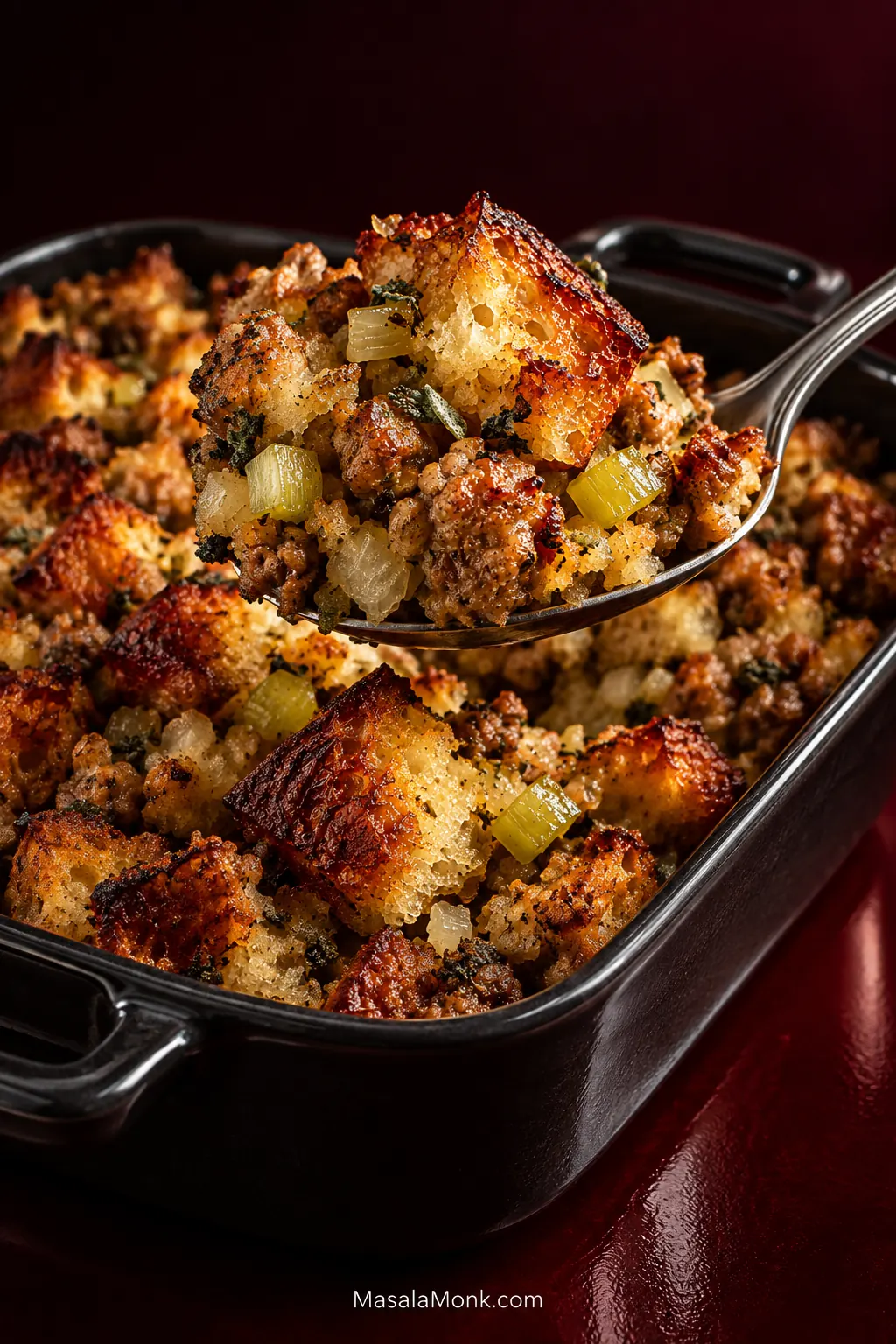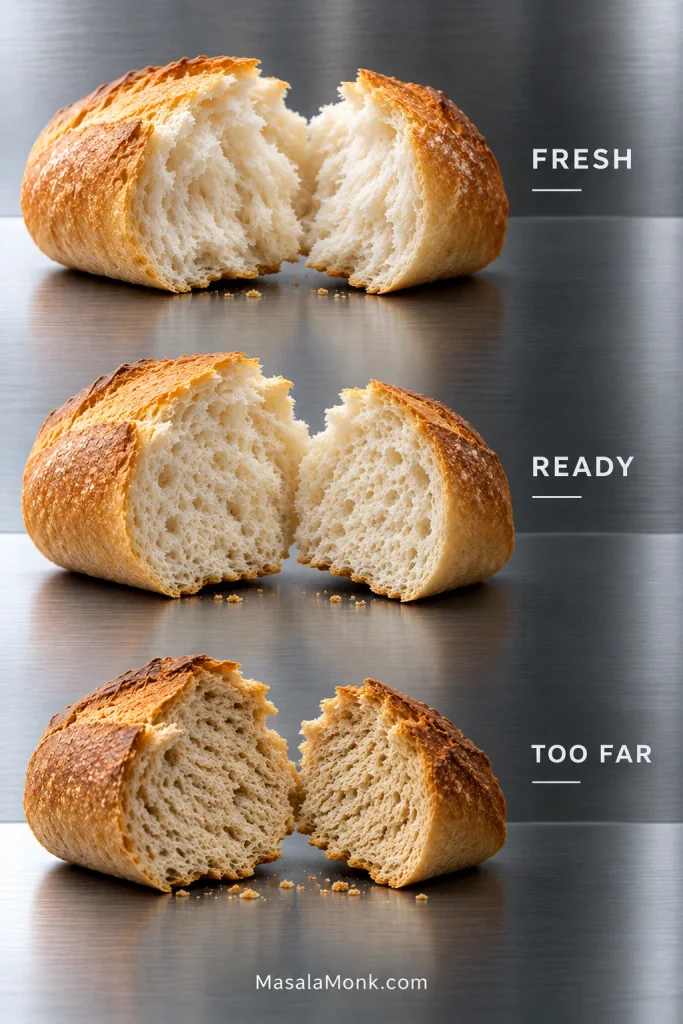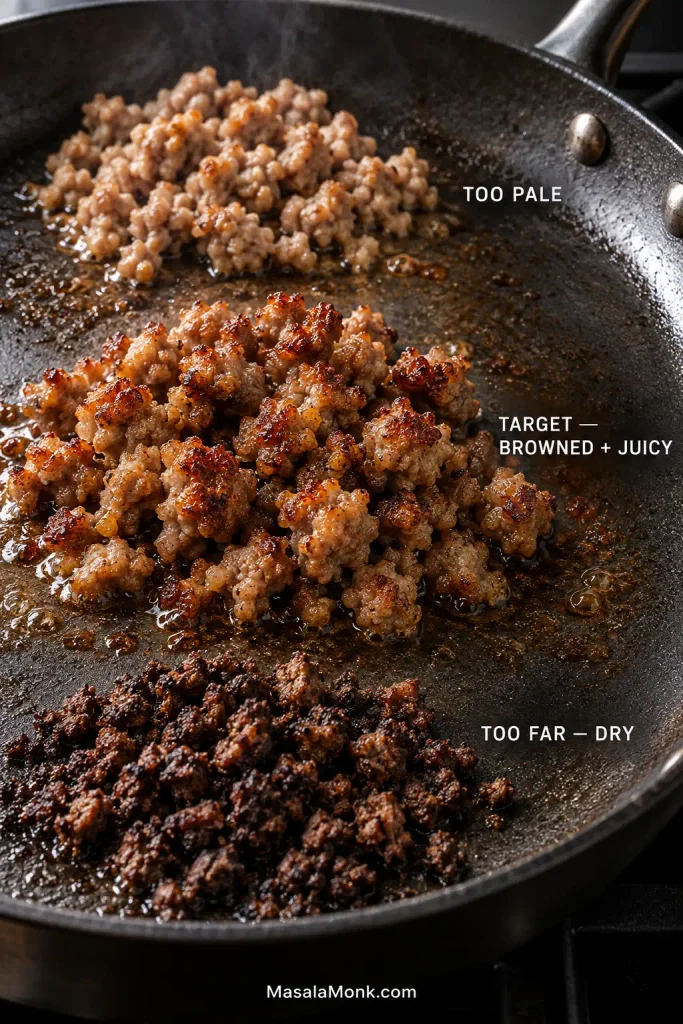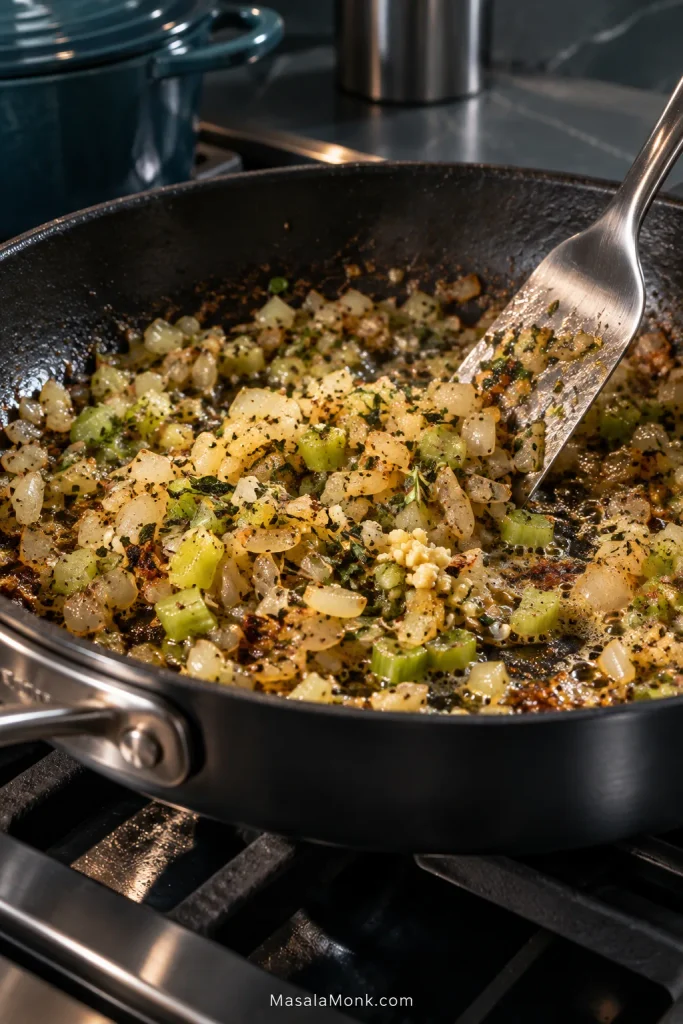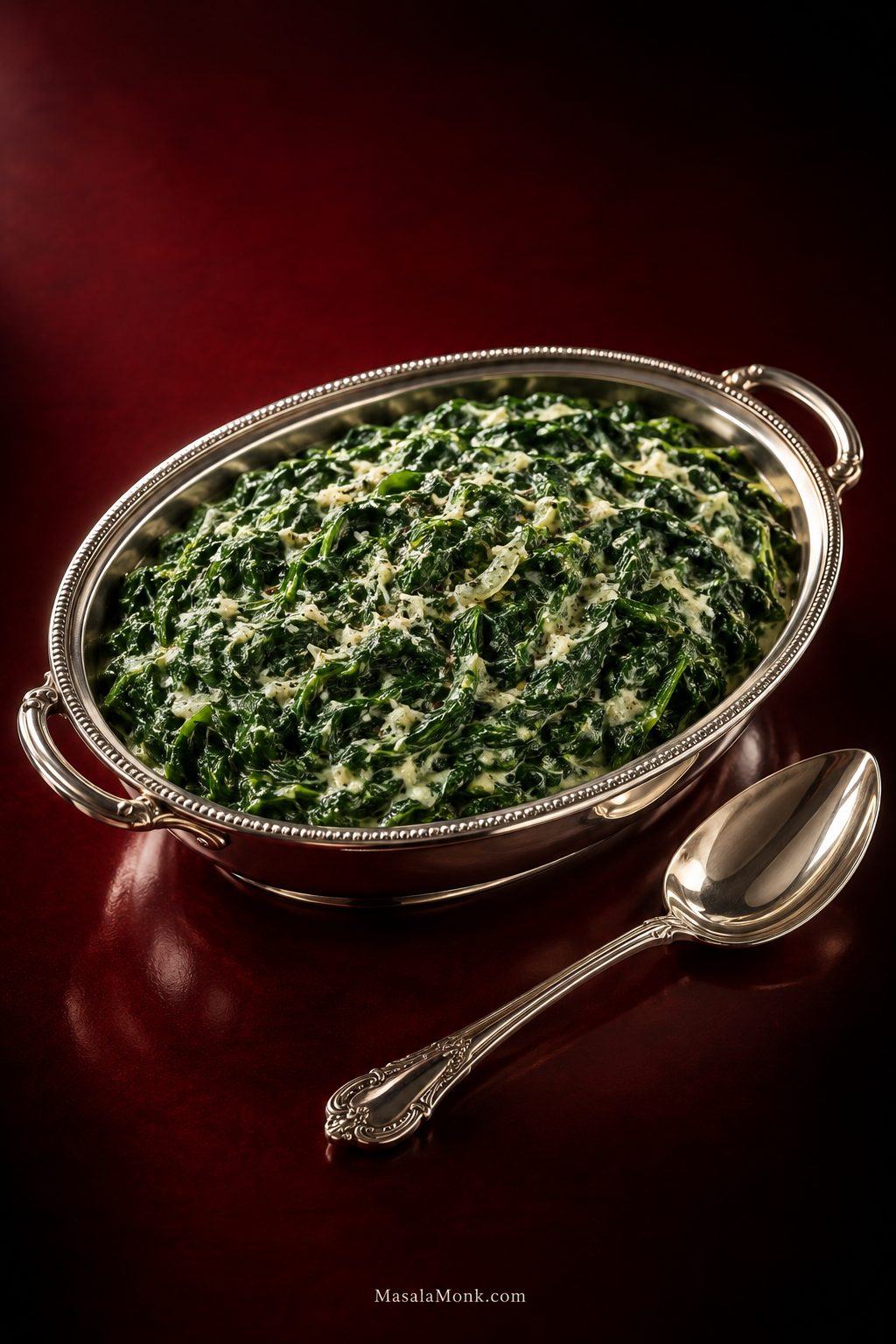
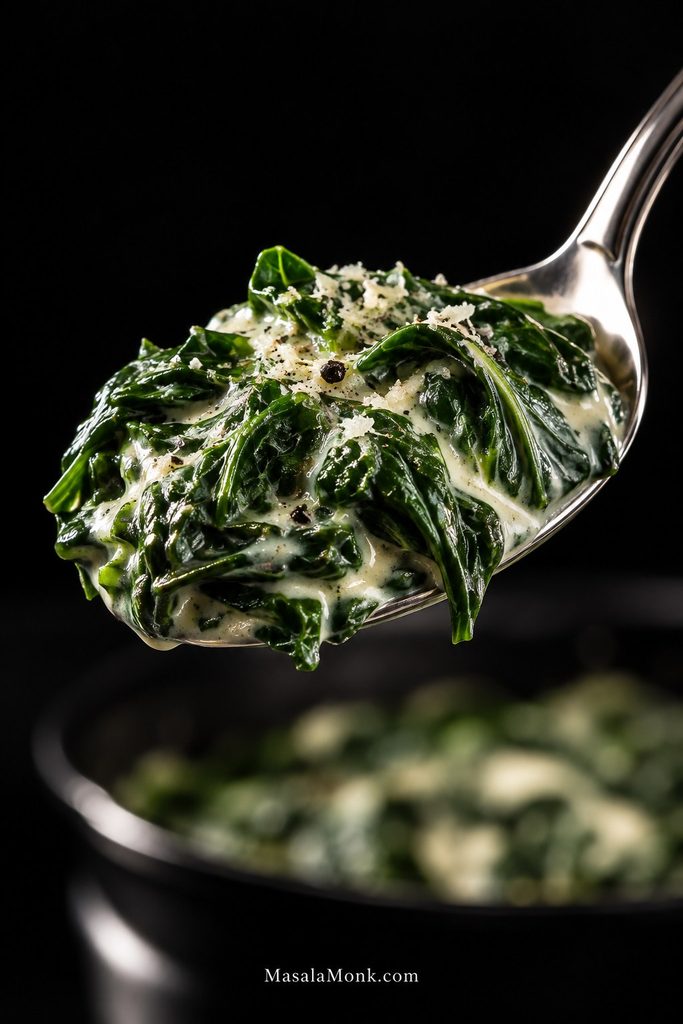
Spoon creamed spinach onto a plate and it should settle softly—not spread into a puddle or sit there like a scoop of dip. The leaves should still taste unmistakably of spinach, with butter, Parmesan, garlic, and cream wrapped around them rather than taking over.
If creamed spinach makes you picture stringy greens buried under too much dairy, that is exactly the result to avoid. Good creamed spinach tastes green and savory, with cream softening the spinach instead of smothering it.
Parmesan brings a nutty edge, while black pepper cuts through the cream. Put that beside steak, roast chicken, or a holiday dinner and the spinach feels like part of the meal rather than something green added to the side.
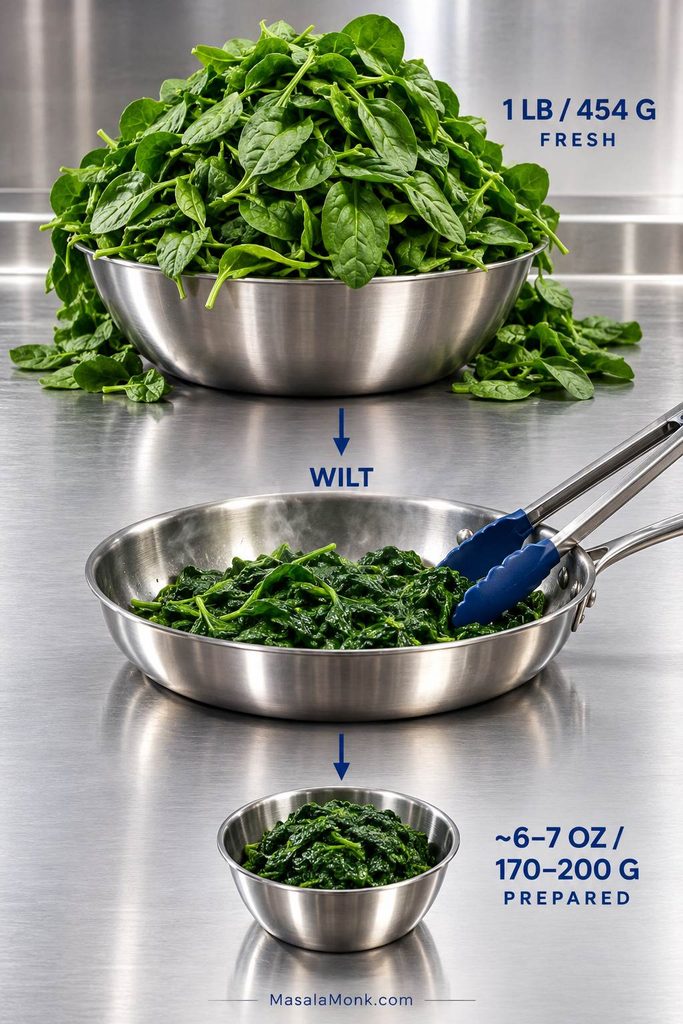
For a dependable creamed spinach recipe, use 16 oz / 1 lb / 454 g fresh spinach or 10 oz / 283 g frozen spinach. Drain it well, then add it only after the cream sauce has thickened. With prewashed fresh spinach or already-thawed frozen spinach, dinner is about 20–25 minutes away. Allow longer for bunch spinach that needs washing and trimming.
The recipe gives you times, but the checkpoints tell you when to move on. The spinach needs to lose water while the sauce gains body; once those two things meet in the skillet, the dish becomes much easier to judge by sight.
Before You Start: Two Things Matter
Drain the Spinach
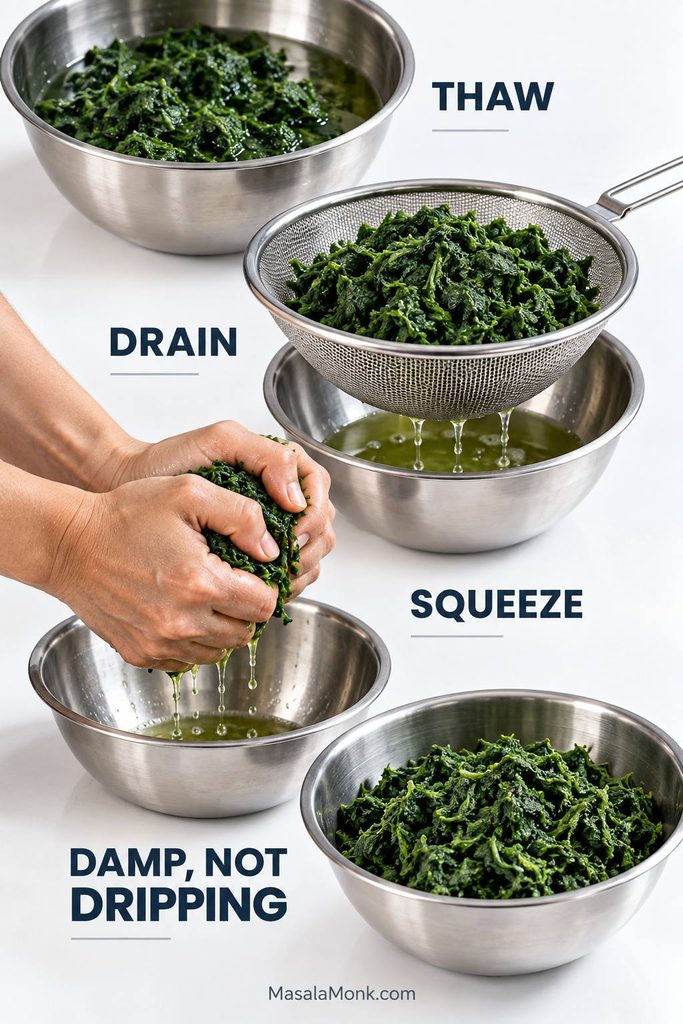
Fresh spinach releases moisture as it wilts, while frozen spinach gives up plenty once thawed. Before either reaches the cream sauce, remove enough water that the leaves feel damp, not dripping.
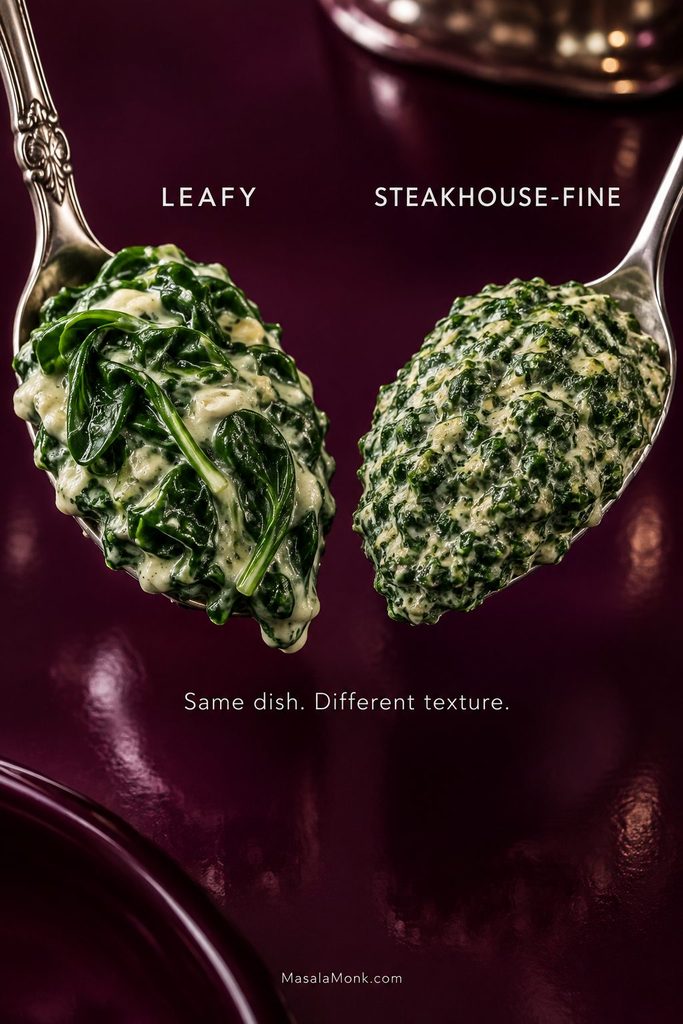
Rough chopping keeps the spinach leafier. A finer chop gives you a tighter, more steakhouse-like texture.
Thicken the Sauce First
Let the sauce thicken before the spinach goes in. It should coat the back of a spoon and look thicker than the result you want on the plate.
The spinach may loosen it briefly. That’s normal. Uncovered cooking lets the last moisture escape.
Creamed Spinach Recipe
Start here. This formula uses mostly whole milk, a modest amount of heavy cream, and just enough roux to stay silky after the spinach joins the pan. There is enough sauce to coat the greens generously, but not enough to make you hunt for them.
Easy Creamed Spinach With Fresh or Frozen Spinach
Fresh or frozen spinach in a balanced Parmesan cream sauce, with clear texture cues that keep the spinach tender and the sauce glossy—not watery or buried under dairy.
Spinach — Choose One
- Fresh: 16 oz / 1 lb / 454 g baby spinach or trimmed mature spinach
- Frozen: 10 oz / 283 g frozen spinach, fully thawed
After wilting or thawing and removing the excess water, you’ll usually have roughly 6–7 oz / 170–200 g spinach. Don’t chase the number too hard. Different leaves and frozen brands hold different amounts of moisture.
Cream Sauce
- Unsalted butter: 2 tbsp / 1 oz / 28 g
- Shallot or yellow onion: 1/3 cup / about 1.5 oz / 45 g, finely chopped
- Garlic: 2 cloves / about 6 g, finely minced
- All-purpose flour: 1 1/2 tbsp / about 12 g
- Whole milk: 3/4 cup / 6 fl oz / 180 ml
- Heavy cream: 1/4 cup / 2 fl oz / 60 ml
- Parmesan: 1/4 cup / 1 oz / 28 g, finely grated
- Ground nutmeg: 1/8 tsp
- Fine salt: 1/4 tsp to start, plus more to taste
- Freshly ground black pepper: 1/4 tsp, plus more to taste
- Cayenne: pinch, optional
- Fresh lemon juice: optional, to finish
Equipment
- 12-inch / 30-cm deep skillet or wide sauté pan
- Fine-mesh strainer or colander
- Tongs
- Whisk
- Clean kitchen towel or cheesecloth, optional
Instructions
1. Prepare the Spinach
Fresh spinach: Wash it thoroughly unless it is already washed and ready to cook. Remove thick, fibrous stems from mature bunch spinach. Tender baby-spinach stems can stay.
A pound of fresh spinach looks slightly ridiculous beside one skillet. Don’t worry—it collapses fast. Heat the pan over medium-high and add the leaves in batches as room opens up, turning them with tongs.
The leaves normally release enough moisture on their own. Add 1 tbsp / 15 ml water only when the first batch threatens to catch before it begins wilting.
Cook for about 2–4 minutes total, just until everything has collapsed and remains vivid green. Transfer to a strainer. After it cools enough to handle, press or gently squeeze away the extra water, then chop roughly or finely.
Frozen spinach: Thaw it completely, then drain off the obvious liquid. Squeeze firmly by hand, press it against a fine-mesh strainer, or wrap it in a clean towel.
It may look surprisingly compact afterward. That’s fine. Pull it apart with your fingers so it spreads through the sauce instead of landing in one dense lump.
Checkpoint 1: damp is fine; dripping is not. A firm squeeze should no longer send out a stream of water.
2. Soften the Onion and Garlic
Wipe any standing water from the skillet and return it to medium heat. Melt the butter, add the shallot or onion, and cook for 2–3 minutes until soft and translucent.
Add the garlic and cook for about 30 seconds, just until its sharp raw smell softens into the butter and onion. Deeply browned or scorched garlic can make the cream sauce bitter.
3. Add the Flour
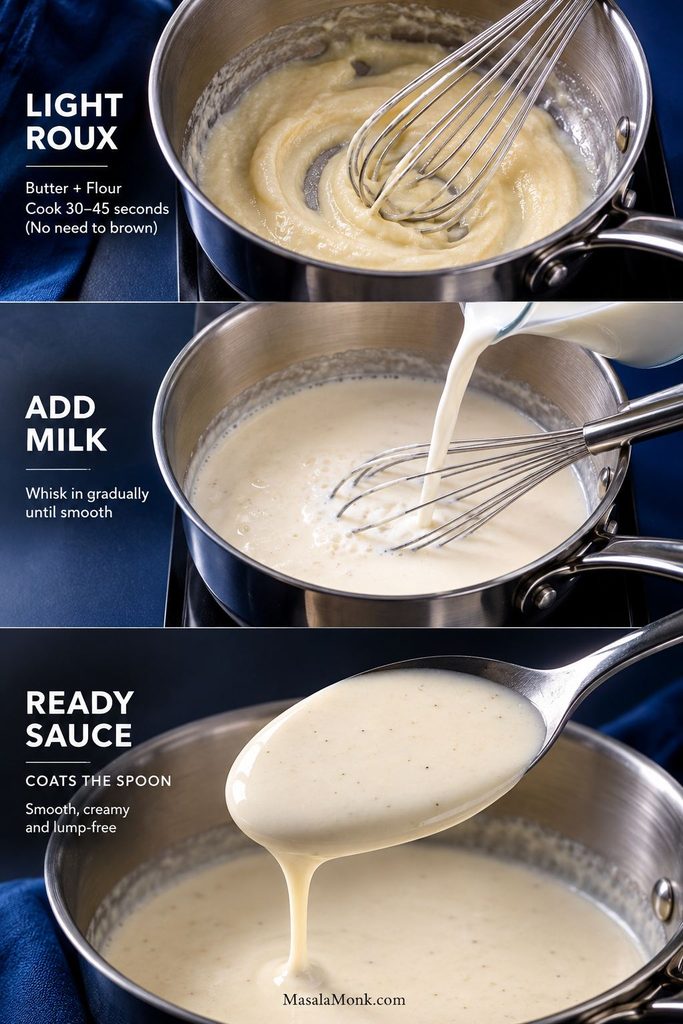
Sprinkle in the flour and stir for 30–45 seconds. It should absorb the butter and bubble gently.
There is no need to brown the roux. That small amount of flour gives the dairy enough body to cling to the spinach instead of pooling around it.
4. Whisk in the Milk and Cream
Whisk in the milk a little at a time. Add the cream once the mixture is smooth. Bring the pan to a gentle simmer and cook for about 2–4 minutes, stirring regularly.
Don’t rely on the clock alone. A broad skillet may get there quickly, while cold dairy or a gentler burner can need another minute.
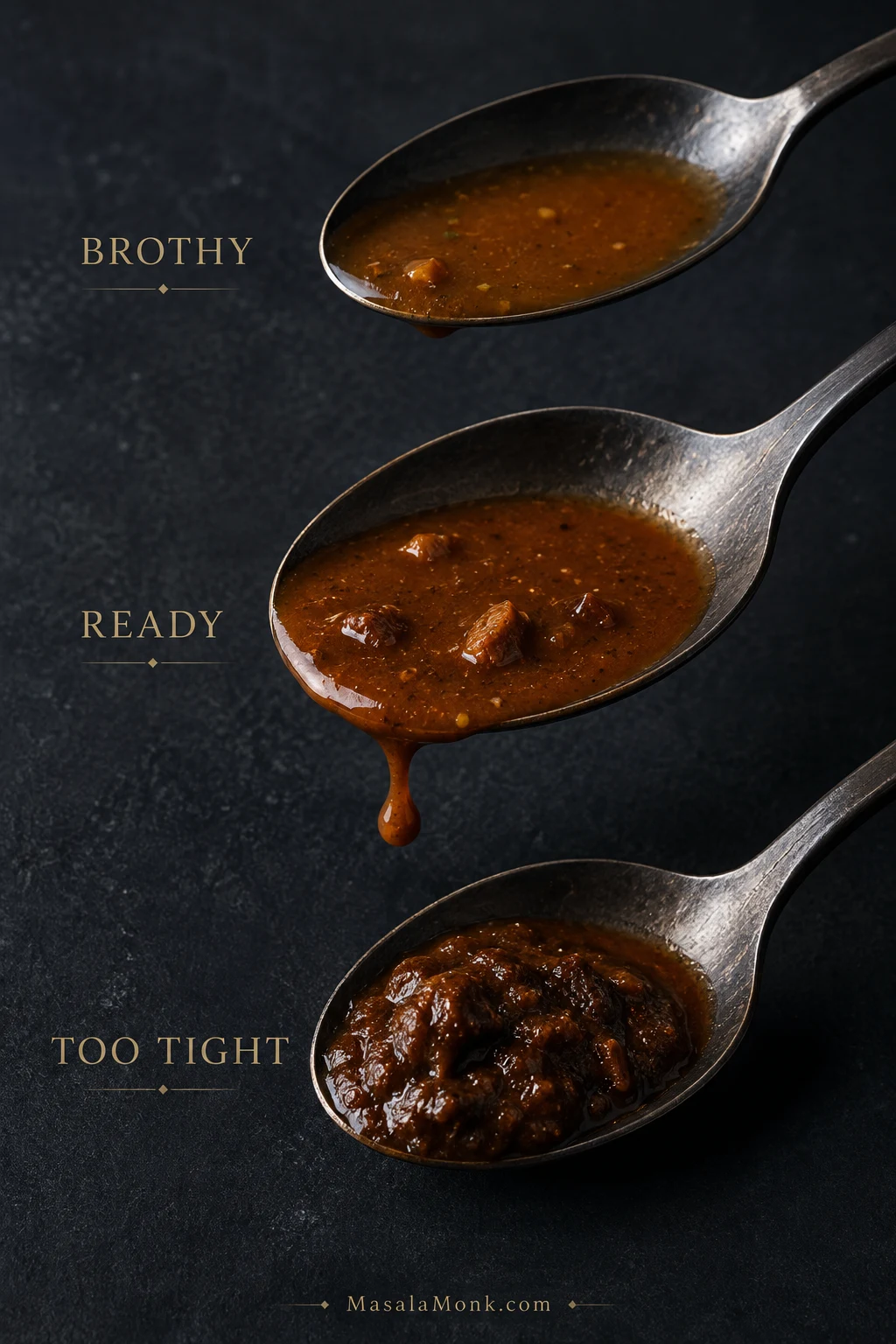
Checkpoint 2: dip in a spoon. The sauce should cling to the back instead of running straight off like milk. Let it get thicker than you want the finished spinach.
5. Add the Spinach
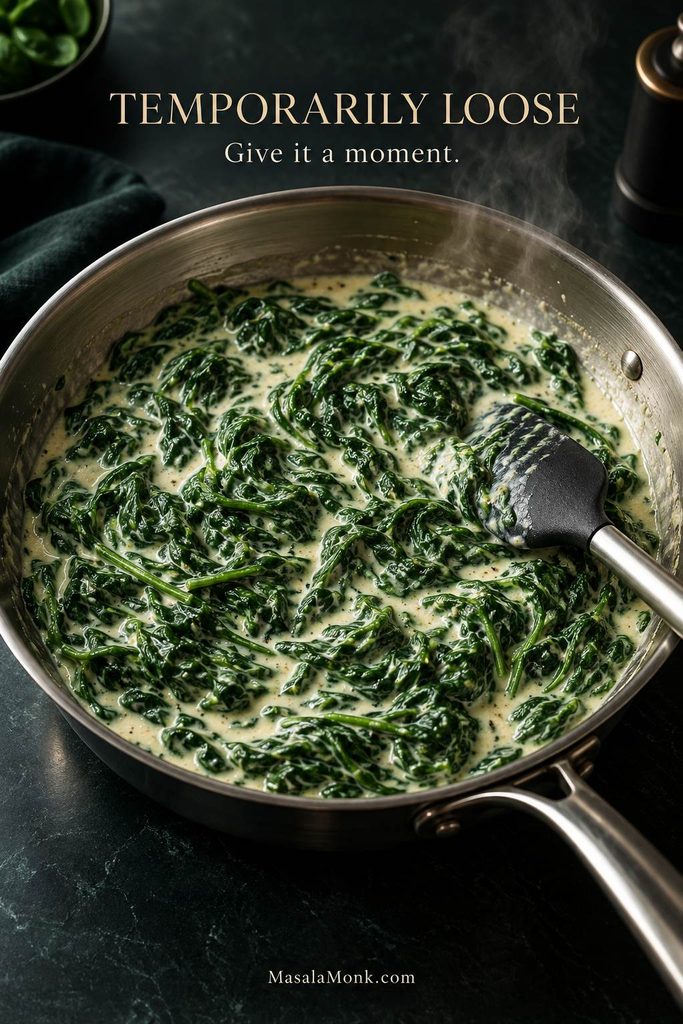
Fold in the drained spinach and lower the heat to medium-low. Cook for another 2–3 minutes.
Everything may suddenly look looser. Give it a moment. Moisture is still leaving the leaves, and an uncovered skillet lets it escape. Adding flour or more cheese immediately can leave you with a stiff pan a few minutes later.
6. Finish With Parmesan
Turn the heat to low or take the skillet off the burner. Stir in the Parmesan, black pepper, nutmeg, optional cayenne, and the first 1/4 tsp salt.
Now taste. More salt may be all it needs. Parmesan can deepen the flavor, while a few drops of lemon can lift a sauce that tastes heavy even after the seasoning is right.
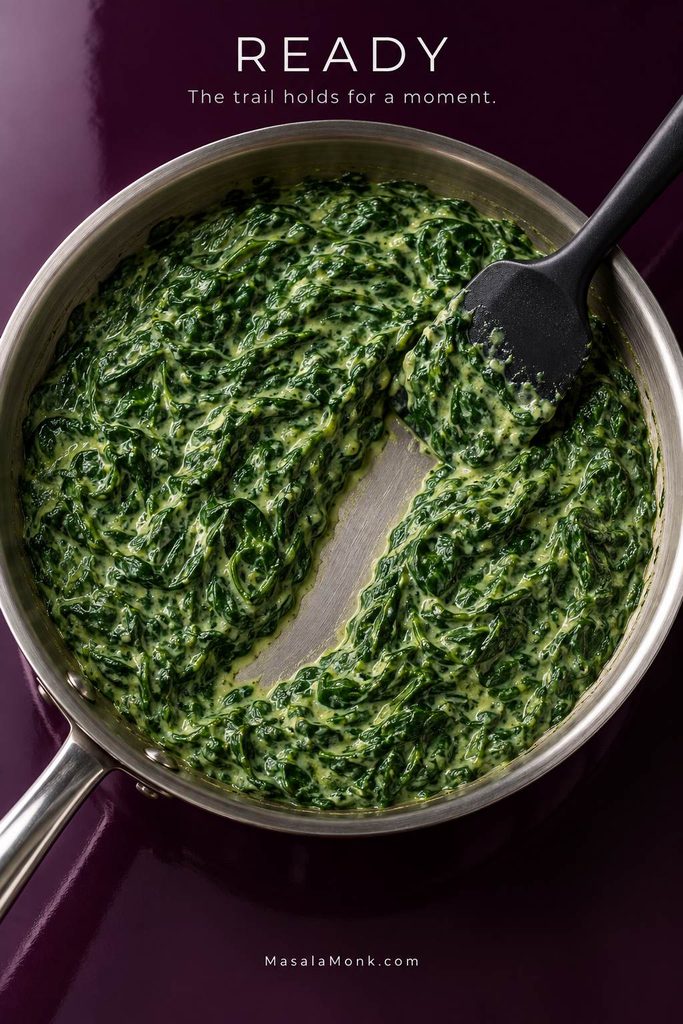
Checkpoint 3: drag a spatula across the bottom. The gap should stay open for a moment before the sauce slowly moves back in. Spoon some onto a plate; it should settle without leaking cream around the edges.
7. Adjust the Texture
Too thick? Stir in warm milk or cream 1 tbsp / 15 ml at a time. Still loose? Give it another minute or two uncovered.
Stop while it is creamy and relaxed. It will tighten on the way to the table.
Recipe Notes
- No heavy cream: use 1 cup / 240 ml whole milk total.
- Have half-and-half? Use 1 cup / 240 ml half-and-half in place of the milk and heavy cream, keeping the same roux.
- Want a finer texture? Chop the spinach more finely before adding it to the sauce.
- Once the cheese goes in: keep the heat gentle. A hard boil makes graininess more likely.
In This Creamed Spinach Guide
Fresh, Frozen or Canned Spinach?
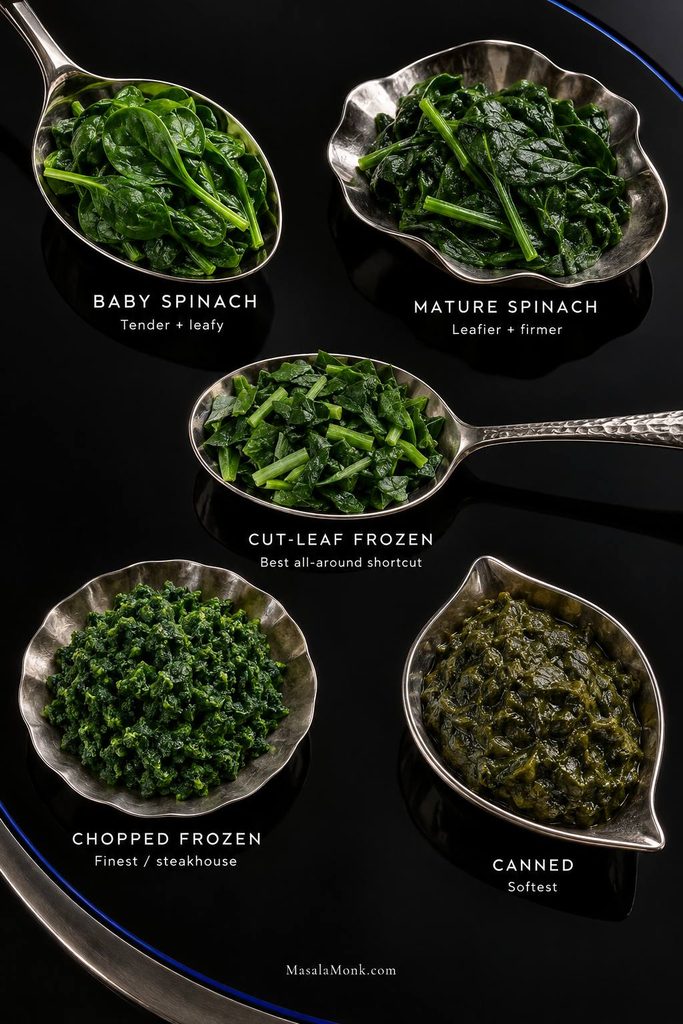
All three can work, but they don’t eat the same. Fresh baby spinach gives the leafiest result, while frozen cut-leaf is the best all-around shortcut. The table shows where the other options fit.
| Spinach | Preparation | Finished texture | Best use |
|---|---|---|---|
| Fresh baby spinach | Wilt, drain, then chop | Tender and leafy | Easiest fresh option |
| Fresh mature spinach | Wash well, remove tough stems, wilt or blanch | Leafier and slightly firmer | When you want stronger spinach character |
| Frozen cut-leaf spinach | Thaw, drain and squeeze | Soft but visibly leafy | Best all-around frozen choice |
| Frozen chopped spinach | Thaw and squeeze thoroughly | Fine and compact | Steakhouse-style texture |
| Canned spinach | Drain very well; rinse if very salty | Very soft and fine | Pantry convenience |
How Much Frozen Spinach Replaces Fresh?
For this recipe, 10 oz / 283 g frozen spinach works well in place of 1 lb / 454 g fresh spinach. Package size matters less after draining: roughly 6–7 oz / 170–200 g prepared spinach fits the main sauce nicely.

Cut-leaf is the best frozen choice when you want convenience without losing the feel of the leaves. Chopped frozen spinach is better when you deliberately want a denser, finer texture.
When Does Blanching Fresh Spinach Help?
Baby spinach does not need it; wilt it straight in the skillet. Blanching helps with a very large pile of greens or tougher mature spinach. For a finer steakhouse texture, squeeze the cooked spinach well afterward and chop it finely.
Canned spinach needs even less cooking. Drain enough to end up with roughly 6–7 oz / 170–200 g well-drained spinach for this amount of sauce. Rinse first if the packing liquid is especially salty, then fold the spinach into the sauce only after it has thickened.
Water Out, Body In
Watery creamed spinach has two main causes: excess water from the leaves or a sauce that was too thin before they met. Fresh and frozen spinach release that water differently, while a wide skillet helps steam escape faster.
If the finished pan still looks loose, the troubleshooting section shows which side needs attention.
Read the Pan: Troubleshooting Creamed Spinach
A loose skillet looks alarming when dinner is almost ready, but don’t start throwing flour into it yet. First work out whether the trouble began with the spinach or the sauce.
Why Is My Creamed Spinach Watery?
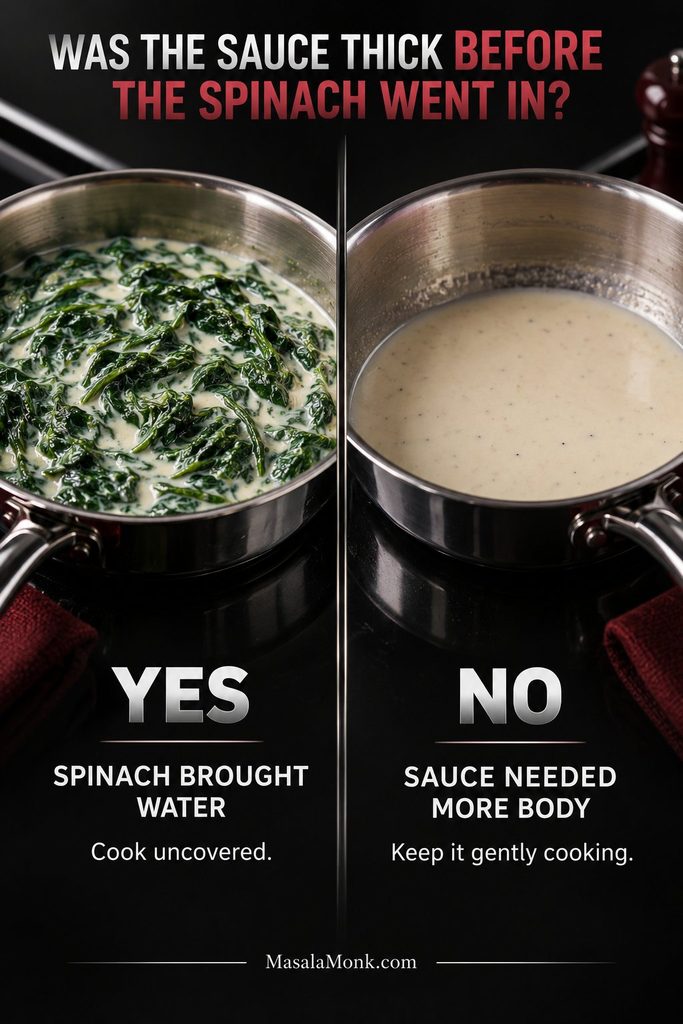
Was the sauce already thick before the spinach went in?
A sauce that looked right until the spinach joined it probably isn’t broken. The leaves simply brought more water than expected. Keep the skillet uncovered over medium-low heat and let that moisture cook away.
A pan that was thin and milky beforehand needs more cooking of its own. Roux-thickened sauce gains body as it gently simmers; flourless cream needs time to reduce.
Quick Fixes
| Problem | What probably happened | Fix / Next time |
|---|---|---|
| Too thick | Too much reduction or a cold, tightened sauce | Add warm milk or cream 1 tbsp / 15 ml at a time |
| Tastes flat | Usually under-seasoned | Fix the salt first; then consider Parmesan, pepper, cayenne, or a few drops of lemon |
| Grainy or broken | Cheese or dairy overheated | Take the pan off the heat. Warm dairy may improve it, though a badly split sauce may not become perfectly smooth again |
| Too much sauce | Not enough spinach for the dairy | Wilt and drain extra spinach separately, then fold it in |
| Too salty | Salt stacked with Parmesan or another salty ingredient | Add unsalted cooked spinach or a splash of unsalted dairy |
| Bitter | Strong mature leaves, scorched garlic, or excessive cooking | Scorched garlic and badly overcooked greens are difficult to rescue; avoid deep browning and shorten the spinach cook next time |
| Lumpy white sauce | Milk did not mix smoothly into the roux | Whisk firmly; strain before adding spinach if necessary |
| Tough or stringy | Coarse leaves or thick stems | Remove stems and chop the cooked spinach more finely |
| Soft and slimy | The spinach cooked too long | The leaf structure will not fully recover; shorten the initial wilt or blanch next time |
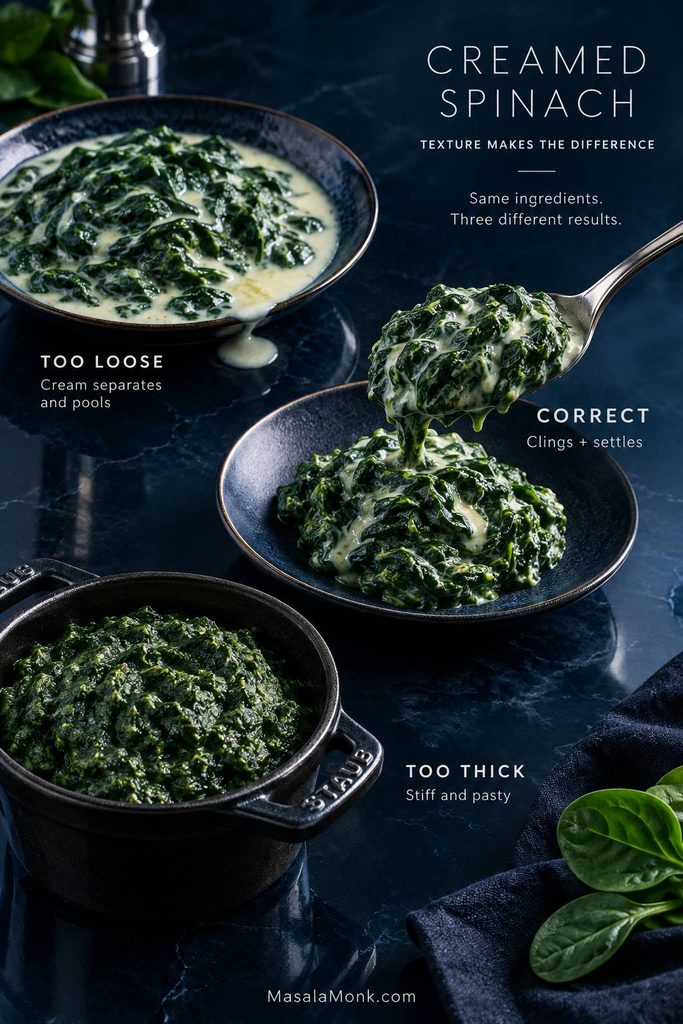
One rescue deserves special care. A dairy-heavy pan may need more spinach, but raw leaves added straight to the finished sauce release fresh water. Wilt the extra spinach separately, drain it well, then fold it in. You fix the ratio without creating another puddle.
Three Ways to Make Creamed Spinach Sauce
The choice is straightforward: use a light roux for the best all-around version, reduced heavy cream when you want no flour, or cream cheese when you want the fastest route.
| Method | What gives it body | Finished feel |
|---|---|---|
| Milk + light roux | Flour | Balanced and silky |
| Reduced heavy cream | Reduction | Softer and creamier |
| Cream cheese | Cheese | Thick and tangy |

Lighter Creamed Spinach With Milk, No Heavy Cream
Use 1 cup / 240 ml whole milk instead of the milk-and-cream combination, keeping the butter and flour exactly as written in the main recipe. The result is lighter, but the roux gives the milk the body it needs to cling to the leaves.
It’s the same basic technique behind a smooth béchamel sauce, only with much less sauce because the spinach should remain the point of the dish.
Flourless Creamed Spinach
Heavy cream is the straightforward flourless choice when you want a softer, creamier coating. Melt 1 tbsp / 14 g butter, soften the onion and garlic, then add 1/2 cup / 120 ml heavy cream.
Simmer gently for about 4–7 minutes, stirring now and then. The cream is ready when it visibly thickens and coats a spoon. Fold in the drained spinach from the main recipe, warm it through, take the pan off the heat, and stir in 1/4 cup / 28 g Parmesan.
The finished sauce is softer and richer than the roux version. If it tightens too far, loosen it with cream a tablespoon at a time.
Don’t simply remove the flour from the milk method. With that amount of milk and such a short cooking time, the sauce needs something else to thicken it. Heavy cream works because it reduces more readily.
Cream Cheese Creamed Spinach
Cream cheese is the fastest route to a thick, tangy sauce without building a roux. Use 3 oz / 85 g softened cream cheese and 1/4 cup / 60 ml whole milk instead of the flour, milk, and cream from the main sauce.
Soften the onion and garlic in 1 tbsp / 14 g butter, lower the heat, and melt in the cream cheese. Add the milk gradually, then fold in the spinach. Finish with up to 1/4 cup / 28 g Parmesan.
Three ounces keeps this firmly in side-dish territory. Push the cream cheese much higher and the pan starts drifting toward spinach dip.
3-Ingredient Creamed Spinach
If speed matters more than aromatics or a separate sauce, strip that same cream-cheese idea down to its essentials. This weeknight version uses spinach, cream cheese, and Parmesan, with salt and pepper added to taste.
- 10 oz / 283 g frozen spinach, thawed and squeezed well, or 16 oz / 454 g fresh spinach, wilted and drained
- 3 oz / 85 g cream cheese, softened
- 1/4 cup / 1 oz / 28 g finely grated Parmesan
Warm the spinach over medium-low heat and fold in the cream cheese. A stiff mixture can be loosened with 1 tbsp / 15 ml hot water. Take the pan off the heat, stir in the Parmesan, then season.

Steakhouse-Style Creamed Spinach
For steakhouse-style creamed spinach, chop the cooked spinach finely, take the sauce slightly thicker, and lean on Parmesan, black pepper, restrained nutmeg, and a fuller cream sauce.
Steakhouse character comes more from texture and seasoning than from one magic ingredient. Restaurants use different formulas, from seasoned white sauces to cream-heavy versions, so chasing one supposed “secret” matters less than getting the finish right.
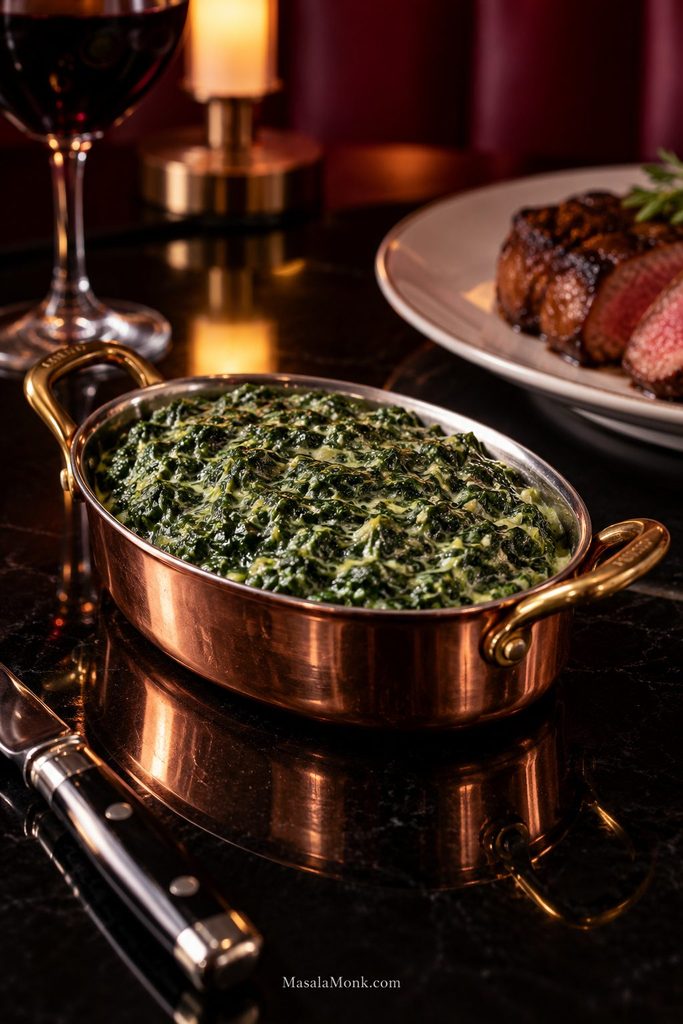
A few quick pulses in a food processor can give you the fine chop, but stop before the leaves become a smooth green purée.
For more creaminess, add another 2 tbsp / 30 ml heavy cream with the other dairy and let the sauce reach the same spoon-coating stage before adding the spinach. Or finish with another 2 tbsp finely grated Parmesan.
A pinch of cayenne gives quiet warmth, while about 1/2 tsp Dijon mustard gives the sauce a sharper edge. Keep the nutmeg subtle.
This style is especially good with steak or a prime rib roast, where peppery cream and finely chopped greens balance the browned crust of the meat.
For a Golden Top
Spoon the finished spinach into a shallow oven-safe dish, then mix 2 tbsp breadcrumbs with 2 tbsp / about 10–12 g finely grated Parmesan and scatter them over the top.
Broil until golden, usually only a minute or two depending on your broiler. Stay close. The crisp top is a good contrast to the soft spinach underneath, but breadcrumbs can go from pale to burned very quickly.
Flavor and Cheese Options
Parmesan is the best default. It brings saltiness and a nutty edge without making the dish feel cheese-heavy.
For a more noticeable Gruyère note, replace half of the Parmesan: use 1/2 oz / 14 g Parmesan + 1/2 oz / 14 g finely grated Gruyère instead of the full 1 oz / 28 g Parmesan.
Boursin is better treated as a cream-cheese variation than as an extra cheese piled onto the main sauce. Use 3 oz / 85 g Boursin in place of the cream cheese in the cream-cheese method. Taste before adding Parmesan or extra salt because Boursin is already seasoned.
For seasoning, think Parmesan and black pepper first, nutmeg quietly behind them. Cayenne adds warmth. Dijon adds sharpness. Lemon belongs at the end, and only in drops; obvious lemon flavor quickly takes over.
Whatever cheese you choose, keep the heat gentle once it goes in. The same rule matters in a smooth cheese sauce: prolonged boiling makes a glossy sauce much more likely to turn grainy.
Scaling for 2, 4, 8 or 12
Doubling the ingredients is simple. The pan is where big batches get tricky.
| Side servings | Fresh spinach | Frozen spinach | Sauce | Cookware |
|---|---|---|---|---|
| 2 | 8 oz / 227 g | 5 oz / 142 g | 1/2 recipe | 8–10 inch / 20–25 cm skillet |
| 4 | 16 oz / 454 g | 10 oz / 283 g | 1 recipe | 12-inch / 30-cm deep skillet |
| 8 | 32 oz / 907 g | 20 oz / 567 g | 2 recipes | Very wide sauté pan or two batches |
| 12 | 48 oz / 1.36 kg | 30 oz / 850 g | 3 recipes | Two wide skillets or cook in batches |
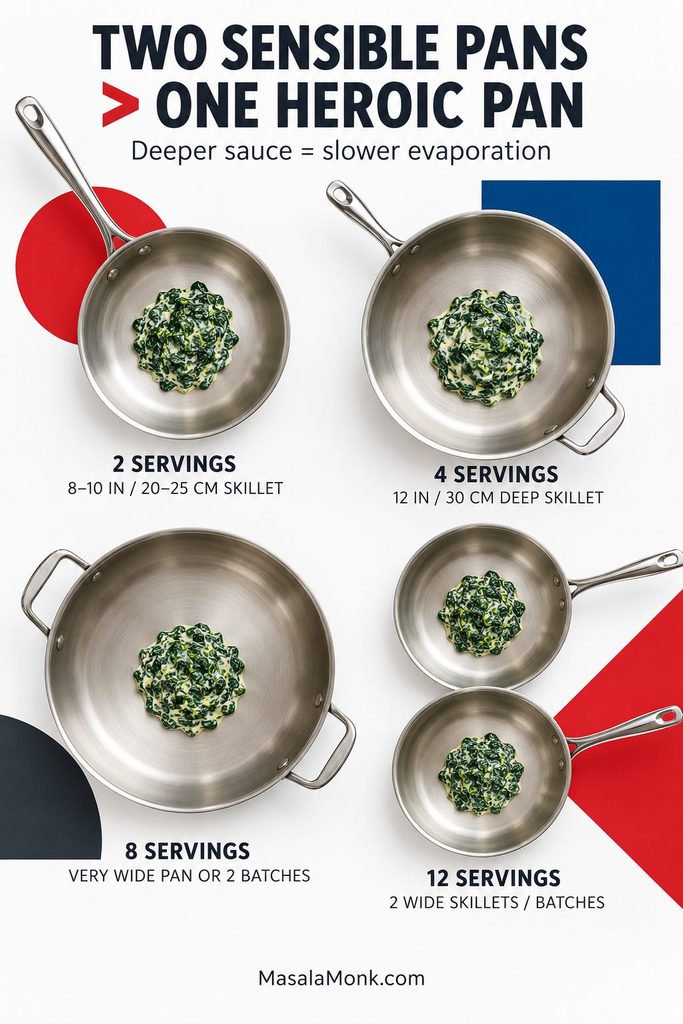
Crowd twice as much sauce into the same skillet and it sits deeper, so it takes longer to reduce. For eight or more servings, two sensible pans are often easier than one heroic pan.
Fresh spinach behaves better in batches too. Wilt it, drain it, set it aside, and keep going until the pile of leaves has collapsed into something manageable.
When this is one of several sides, plan roughly 3–4 oz / 85–115 g finished creamed spinach per person. Serve more when it is the main vegetable on the plate.
Make Ahead, Store and Reheat
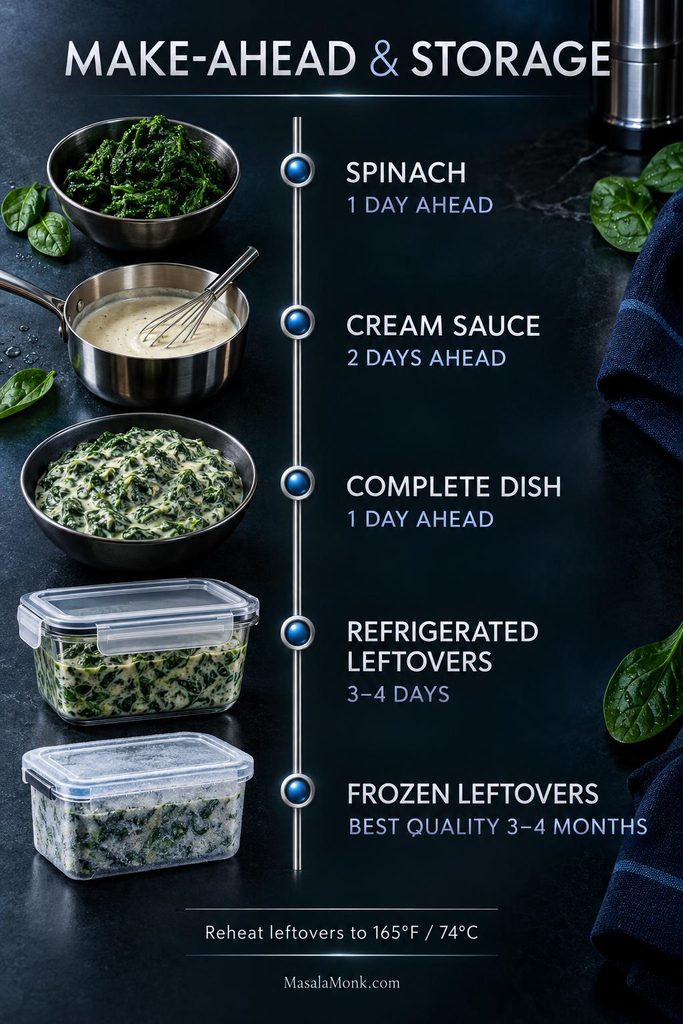
What You Can Make Ahead
Spinach: Wilt or thaw, drain, squeeze, and chop it up to 1 day ahead.
Cream sauce: Make the roux-based sauce separately up to 2 days ahead. Cool and refrigerate it, then rewarm gently before adding the spinach and Parmesan.
Complete dish: The whole pan can be made 1 day ahead. Cool it promptly, cover, and refrigerate. The sauce firms up when cold, so loosen it during reheating only if it needs it.
On a holiday table, that means one less creamy side demanding attention just as everything else needs to be carved, drained, or carried to the table.
Reheating
Stovetop: warm over low heat, stirring regularly. Loosen with warm milk or cream 1 tbsp / 15 ml at a time.
Microwave: heat in 30-second intervals and stir between them.
Oven: reheat covered at 350°F / 177°C. Start checking a chilled shallow dish around 20 minutes; deeper dishes can take longer.
Storage safety: Refrigerate promptly and use within 3–4 days. Reheat leftovers to 165°F / 74°C. Don’t leave the dish out for more than 2 hours, or more than 1 hour above 90°F / 32°C. See the USDA leftover-safety guidance for details.
Freezing Creamed Spinach
You can freeze creamed spinach, though the sauce may be less smooth after thawing. Cool it promptly, pack it airtight, thaw overnight in the refrigerator, then reheat gently.
For best quality, USDA recommends using frozen leftovers within about 3–4 months. Creamy sauces can lose smoothness during storage, so creamed spinach is usually nicest sooner.
What to Serve With Creamed Spinach
Steak and roast beef are the obvious matches, but pork chops, roast chicken, lamb, salmon, and simply cooked fish work too. The creamy greens are especially useful beside something deeply browned or crisp.
Add garlic mashed potatoes or crisp roasted potatoes for the classic plate. Browned meat, fluffy or crunchy potato, and glossy spinach each bring a different texture.
Creamed spinach also earns its place on Thanksgiving and Christmas tables. Because it is heavier than plain greens, a modest spoonful is plenty beside stuffing, potatoes, roast meat, and everything else competing for space.

Leftover Ideas
Stir leftovers through hot pasta with a splash of pasta water, spoon them over a baked potato, fold them into eggs, tuck them into stuffed mushrooms, or use a thick batch in a toasted sandwich or pastry.
For something deliberately scoopable with bread, crackers, or chips, make a proper spinach dip.
Creamed Spinach FAQs
1. Can I Use Frozen Spinach Instead of Fresh?
Absolutely. For this recipe, use about 10 oz / 283 g frozen spinach in place of 1 lb / 454 g fresh. Thaw it completely, then drain and squeeze well.
2. Can I Use Milk or Half-and-Half Instead of Heavy Cream?
Yes. Use 1 cup / 240 ml whole milk with the same roux for a lighter sauce, or 1 cup / 240 ml half-and-half for a richer one.
3. Why Is My Creamed Spinach Watery?
If the sauce was thick before the spinach went in, extra moisture from the spinach is usually responsible. Keep the skillet uncovered and let it reduce. A sauce that was already thin needs more cooking of its own.
4. Can I Make Creamed Spinach Ahead or Freeze It?
Yes. Prepare the spinach a day ahead, the roux-based sauce up to 2 days ahead, or the whole dish 1 day ahead. Leftovers can be frozen too, although the sauce may be less smooth after thawing.
5. Why Does Spinach Make My Teeth Feel Gritty or Chalky?
Thoroughly washed spinach can still leave a temporary rough or chalky sensation often called “spinach teeth.” Spinach naturally contains oxalate, which is associated with that mouthfeel. Cornell discusses the same phenomenon in its research on spinach and its gritty sensation. Actual soil or sand is different, so fresh bunch spinach still needs careful washing.
6. Is Creamed Spinach the Same as Spinach Dip?
No. Creamed spinach is a vegetable side with sauce coating the greens. Spinach dip contains a much larger proportion of creamy ingredients and is designed for scooping.
When a spoonful settles softly without leaking cream around the edges, you’re there: tender spinach that still tastes green, Parmesan and black pepper, and cream supporting the vegetable instead of hiding it.