Slow cooker lasagna tends to get into trouble after it starts smelling done. The sauce is bubbling around the edges, the mozzarella has melted, and the kitchen already smells like dinner. It is tempting to leave the lid on for another hour. Meanwhile, the noodles are still sitting in hot sauce and trapped steam, getting softer by the minute.
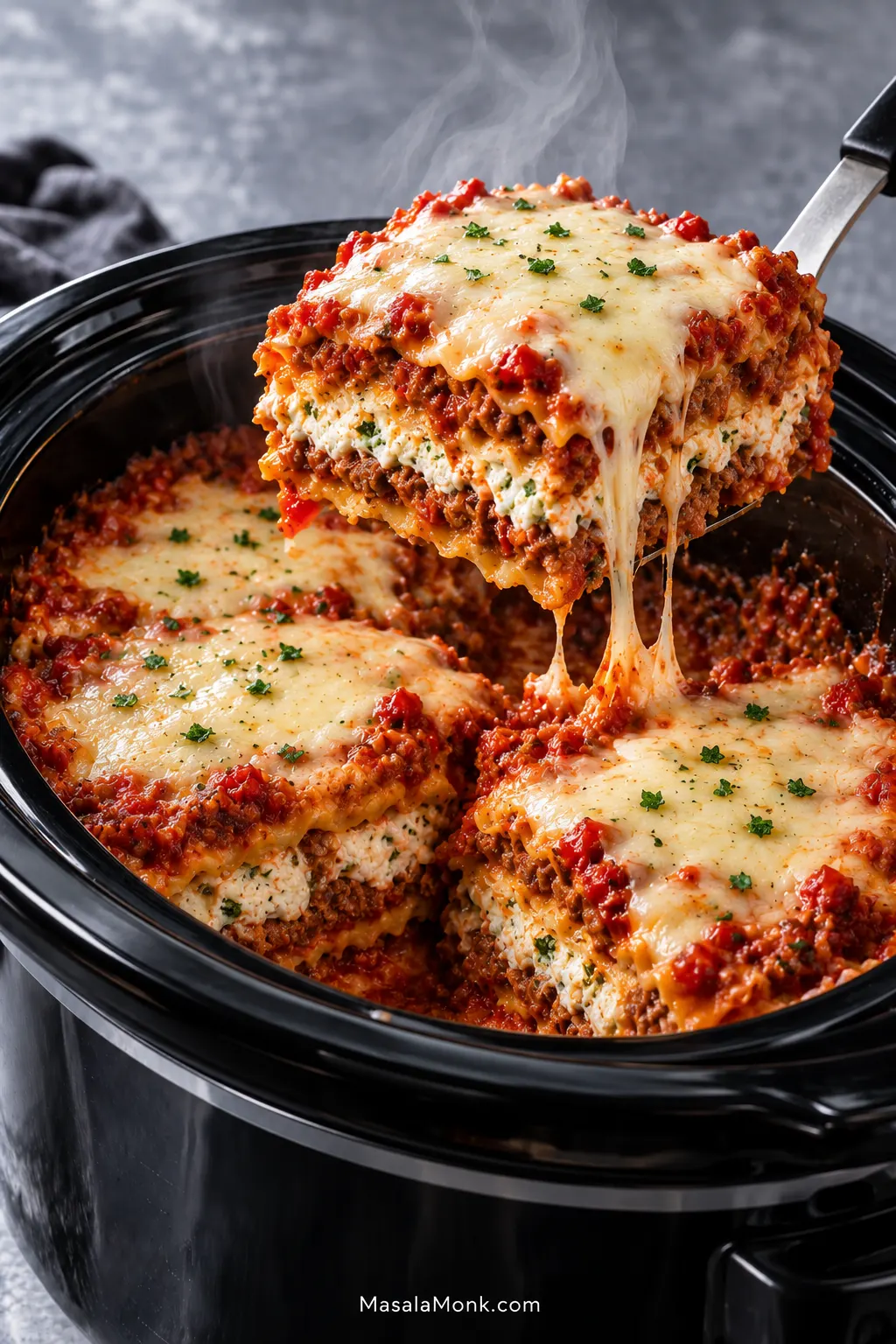
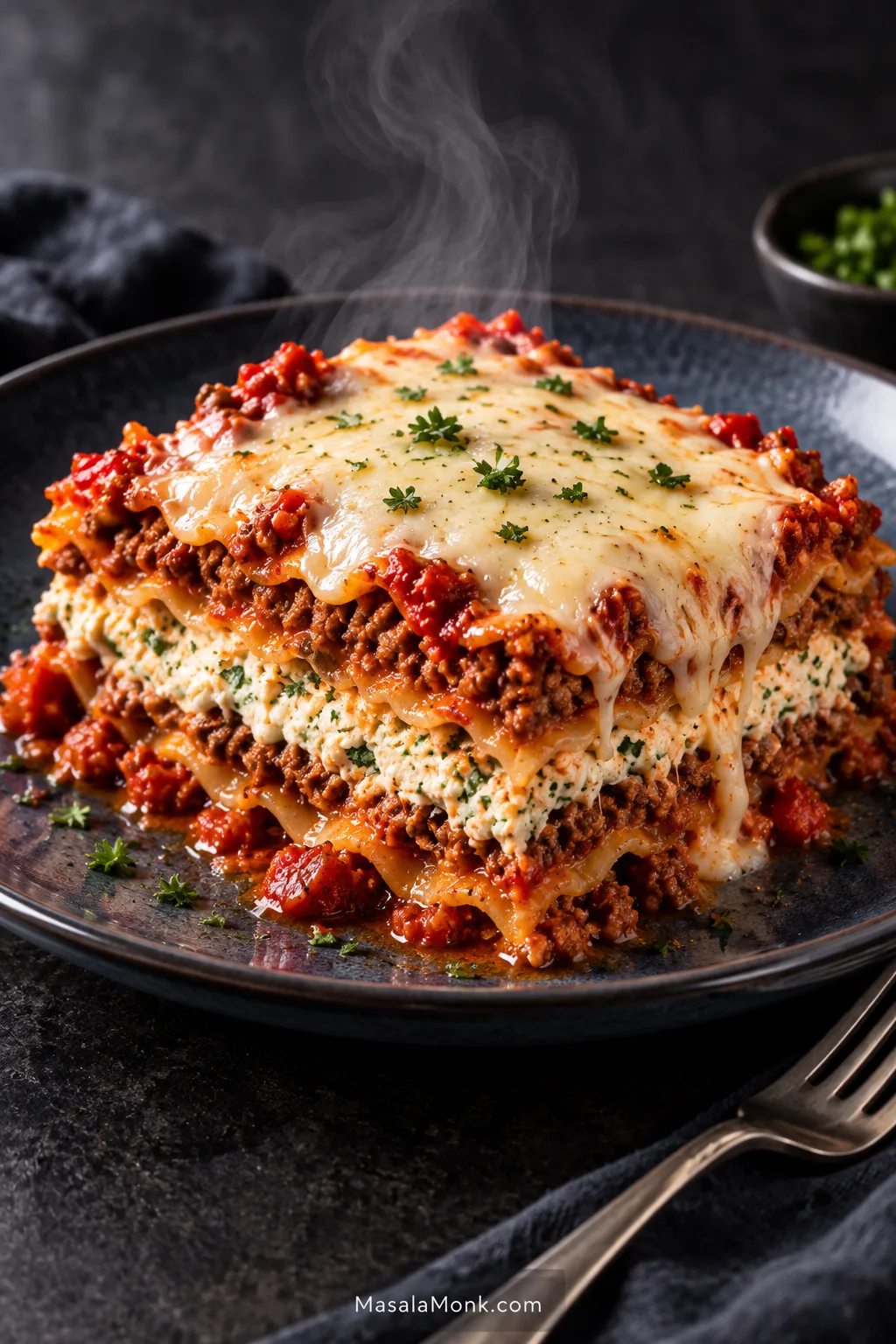
At its best, the pasta is tender all the way through but still forms layers you can see when you lift a piece. Meat sauce stays tucked between the sheets, creamy ricotta shows through the cut center, and the cheese on top remains soft and stretchy. The edges usually set a little firmer where the lasagna meets the crock.
This is where the slow cooker earns its place: no separate pot of noodles, no oven to manage, jarred marinara is completely welcome, and once the layers are assembled, most of the active work is over. It is especially useful when the oven is busy or you would rather not heat up the kitchen. Think hands-off rather than all-day. Pasta has a much narrower sweet spot than a stew or pot roast.
The assembly itself is forgiving. Noodles can break, the layers do not need to look perfect, and pre-shredded cheese is fine. Timing is the one thing worth watching closely. This slow cooker lasagna recipe keeps the convenience while aiming for the distinct layers you expect from classic oven lasagna.
Quick answer: No boiling first. Layer regular dry lasagna noodles with sauce and cheese, then cook on LOW for about 3½–4½ hours, checking from around 3 hours. Once the center noodles are tender, switch off the cooker and let the lasagna rest before serving.
Dry noodles cook directly between meat sauce, creamy ricotta and mozzarella, so there is no separate pot of pasta and no oven to manage. Jarred marinara works perfectly well here, and low-moisture mozzarella melts well without adding as much extra water.
Prep: 25 minutes
Cook: about 3½–4½ hours on LOW
Rest: 20–30 minutes
Plan ahead: about 4½–5½ hours from starting prep to serving
Yield: about 8 servings
Slow cooker: 6 qt / about 5.7 L, preferably oval
Equipment
6-qt / about 5.7-L oval slow cooker
Large skillet
Medium mixing bowl
Thin knife or skewer for checking the pasta
For the Meat Sauce
1 lb / 454 g ground beef, preferably 85–90% lean
1 medium yellow onion, about 5 oz / 140 g, finely diced
3 garlic cloves, about 9 g, minced
1 tsp Italian seasoning
½ tsp freshly ground black pepper
¼–½ tsp fine salt, or to taste
Pinch of red-pepper flakes, optional
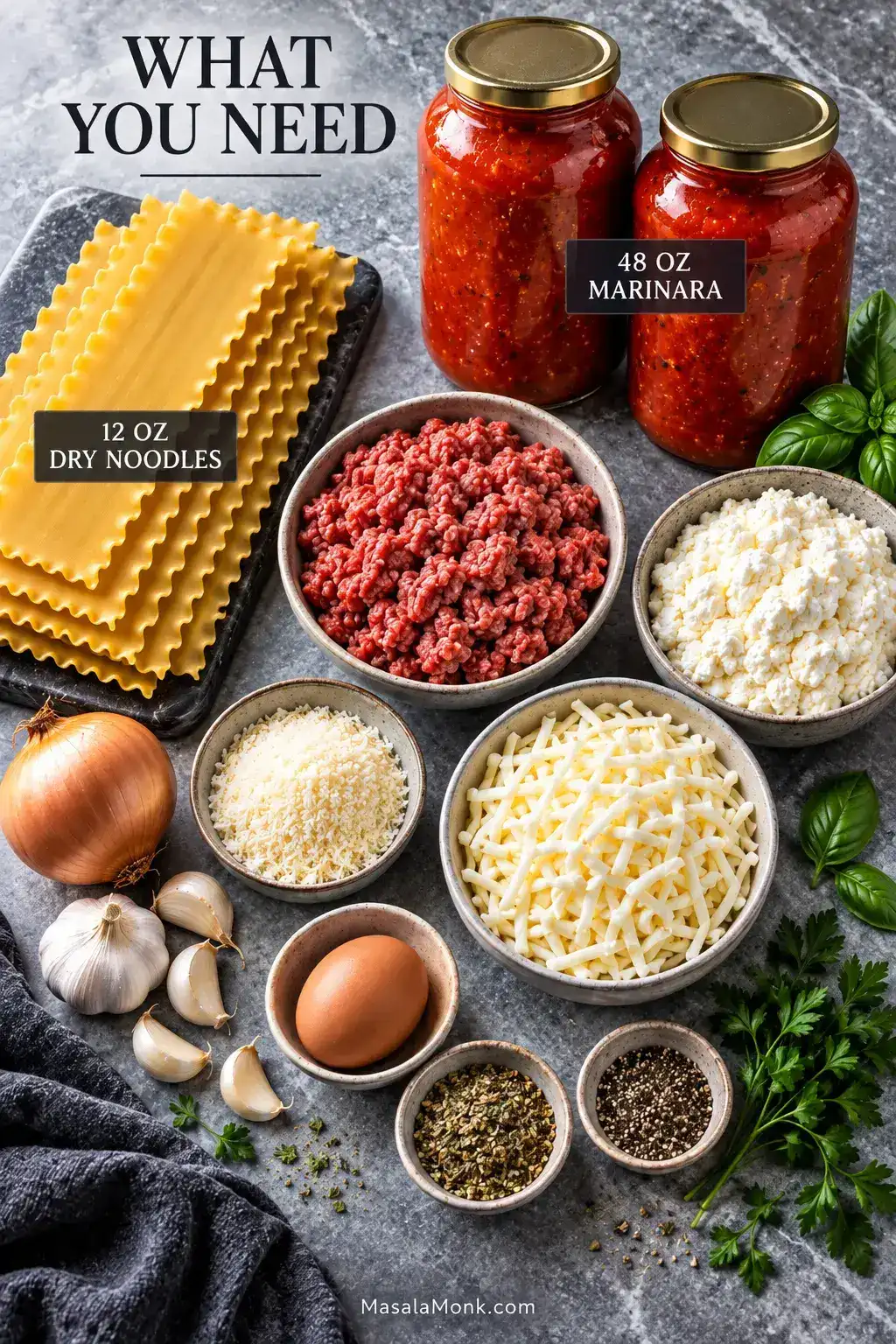
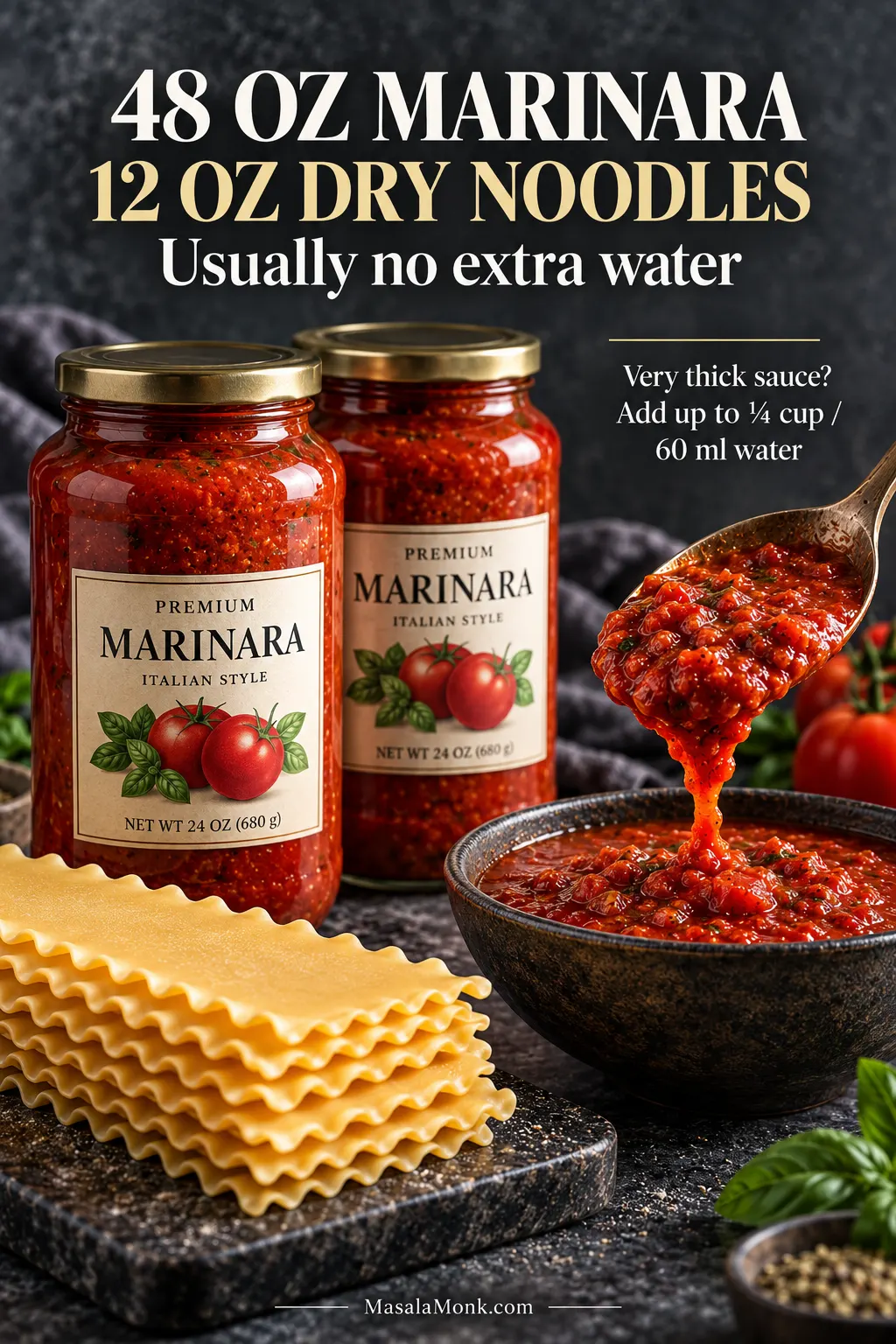
48 oz / 1.36 kg medium-thick marinara sauce (two 24-oz jars)
For more sausage flavor: use 8 oz / 227 g ground beef plus 8 oz / 227 g Italian sausage instead of all beef.
For the Cheese Filling
15 oz / 425 g whole-milk ricotta
1 large egg
⅓ cup / about 30–35 g finely grated Parmesan
2 tbsp chopped parsley or basil, optional
For Layering
12 oz / 340 g regular dry lasagna noodles, uncooked (measure 12 oz rather than automatically using a larger full box)
12 oz / 340 g shredded low-moisture mozzarella
2 tbsp / about 10–15 g finely grated Parmesan, for finishing
Neutral oil or cooking spray, for the slow-cooker insert
Two 24-oz jars make the marinara easy to measure, while weighing 12 oz of dry lasagna noodles separately prevents a larger full box from quietly changing the sauce-to-pasta balance.
Method
Brown the beef and onion. Cook over medium-high heat, breaking up the meat, until browned and the onion is soft. Drain excess fat.
Finish the meat sauce. Stir in the garlic, Italian seasoning, black pepper and optional red-pepper flakes for 30 seconds, then add the marinara and taste before salting. The sauce should pour but cling to a spoon. If it is unusually thick, loosen it with up to ¼ cup / 60 ml water.
Make the cheese filling. Mix the ricotta, egg, ⅓ cup Parmesan and optional herbs; divide roughly into thirds.
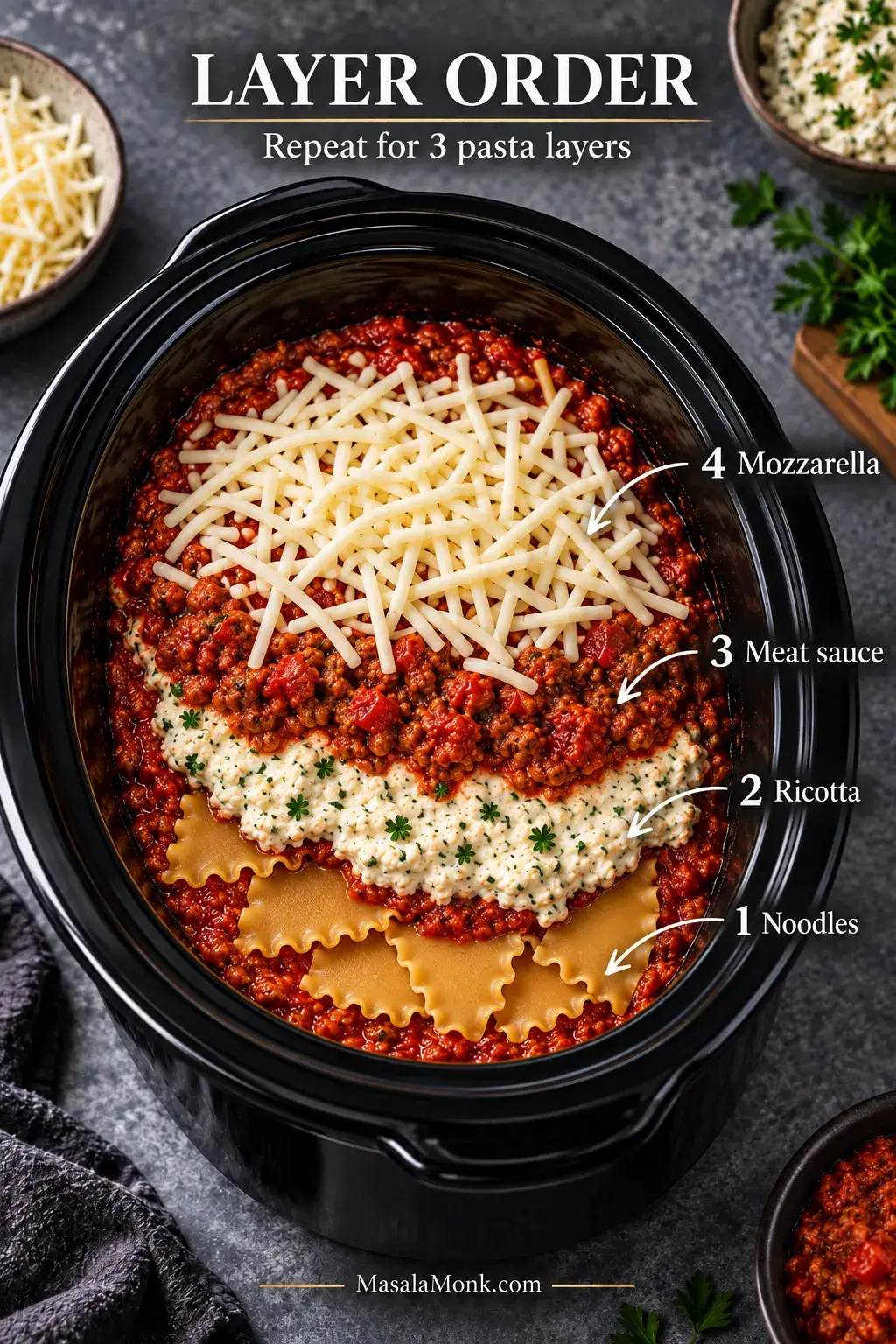
Build three layers. Grease the crock and spread about 1 cup meat sauce over the bottom. Reserve about 4 oz / 110 g mozzarella for the top. Add dry noodles, breaking them to fit, then one-third each of the ricotta, meat sauce and remaining mozzarella. Repeat for three pasta layers, keeping every noodle sauced, especially at the edges.
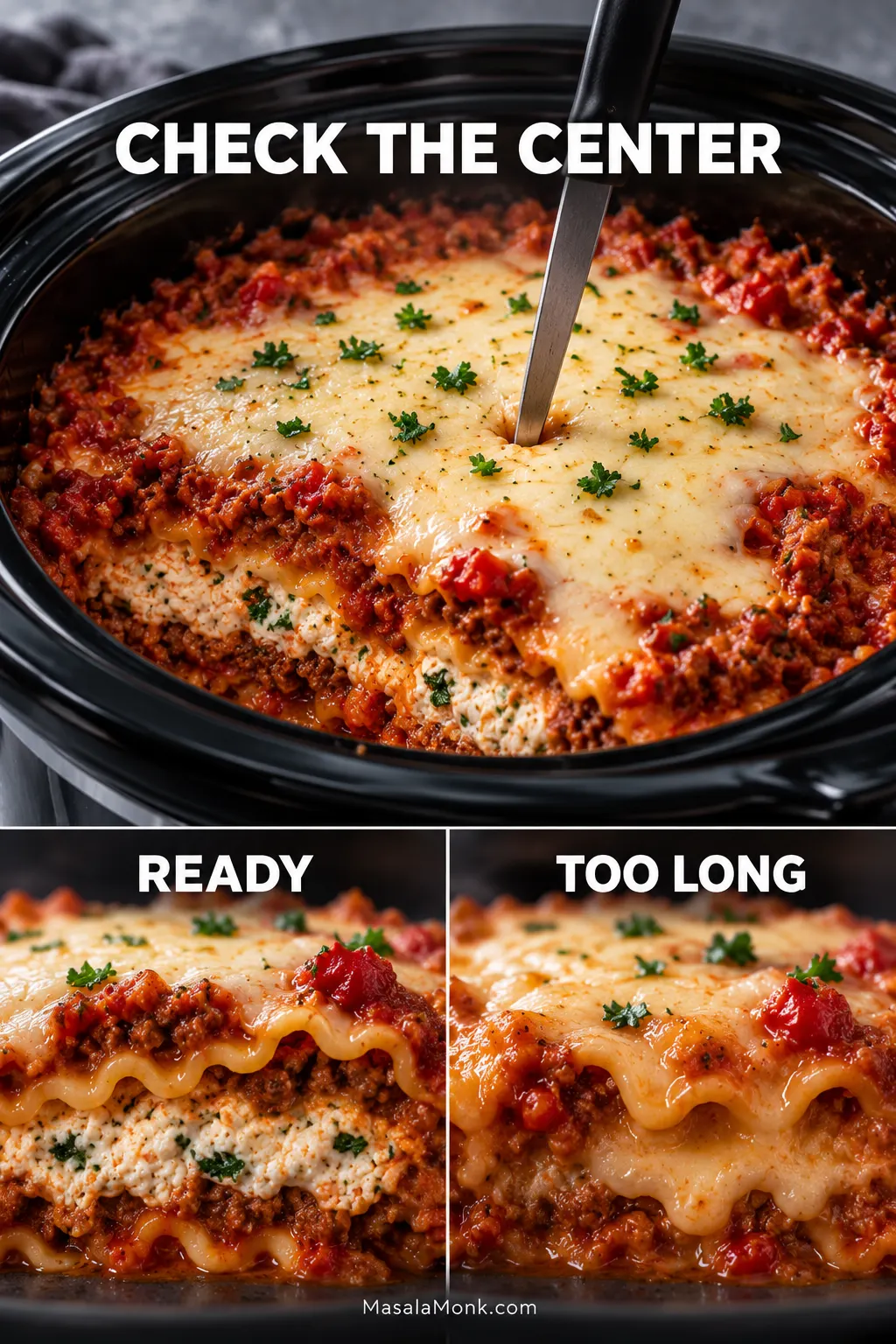
Cook on LOW and check the pasta. Begin checking around 3 hours; expect roughly 3½–4½ hours. The noodles should be fork-tender, and a thin knife or skewer should pass through the middle without a chalky core.
If it needs more time: firm pasta with plenty of moisture can cook another 20–30 minutes. For firm, dry-looking pasta, add 2–4 tbsp / 30–60 ml hot water or warm marinara around the edge.
Switch off the cooker and finish the cheese. When the pasta is tender, turn the slow cooker OFF. Add the reserved mozzarella and finishing Parmesan, cover for 5–10 minutes and let the retained heat melt the cheese.
Rest before serving. Crack or remove the lid and rest 20–30 minutes. Loosen the edge with a broad non-scratching spatula, then serve.
Recipe Notes
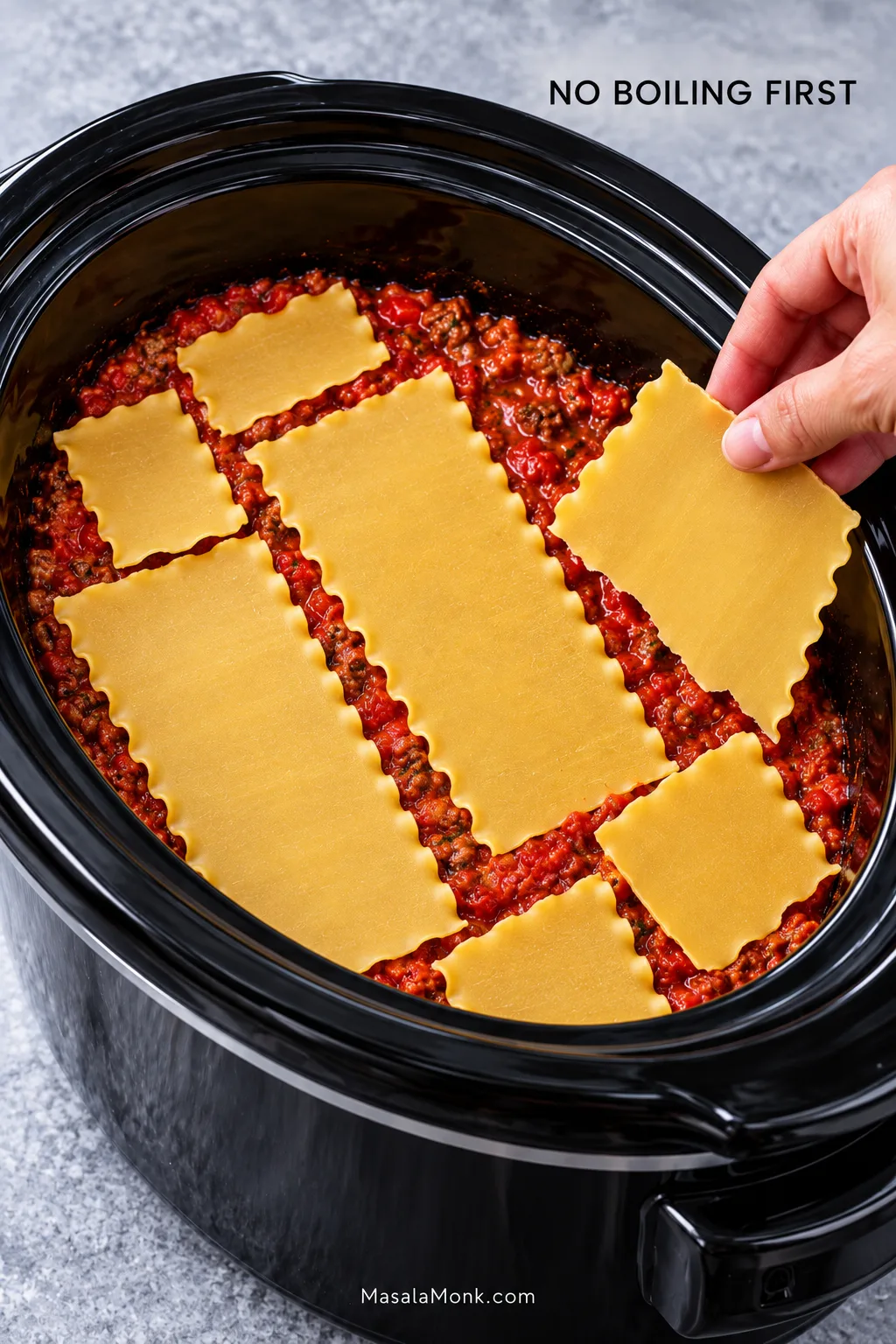
Regular dry noodles: measure 12 oz / 340 g, then add them dry—no boiling first.
Oven-ready noodles: they work too, but soften sooner, so check earlier.
Mozzarella: low-moisture mozzarella is easiest to manage here. Fresh mozzarella can release considerably more water.
Cottage cheese: 15–16 oz / 425–454 g can replace the ricotta. Drain visible whey first.
Food safety: cook ground beef or sausage to 160°F / 71°C; ground turkey to 165°F / 74°C. If checking the finished lasagna with a thermometer, the center should reach 165°F / 74°C; reheat leftovers to the same temperature. See the USDA safe-temperature chart.
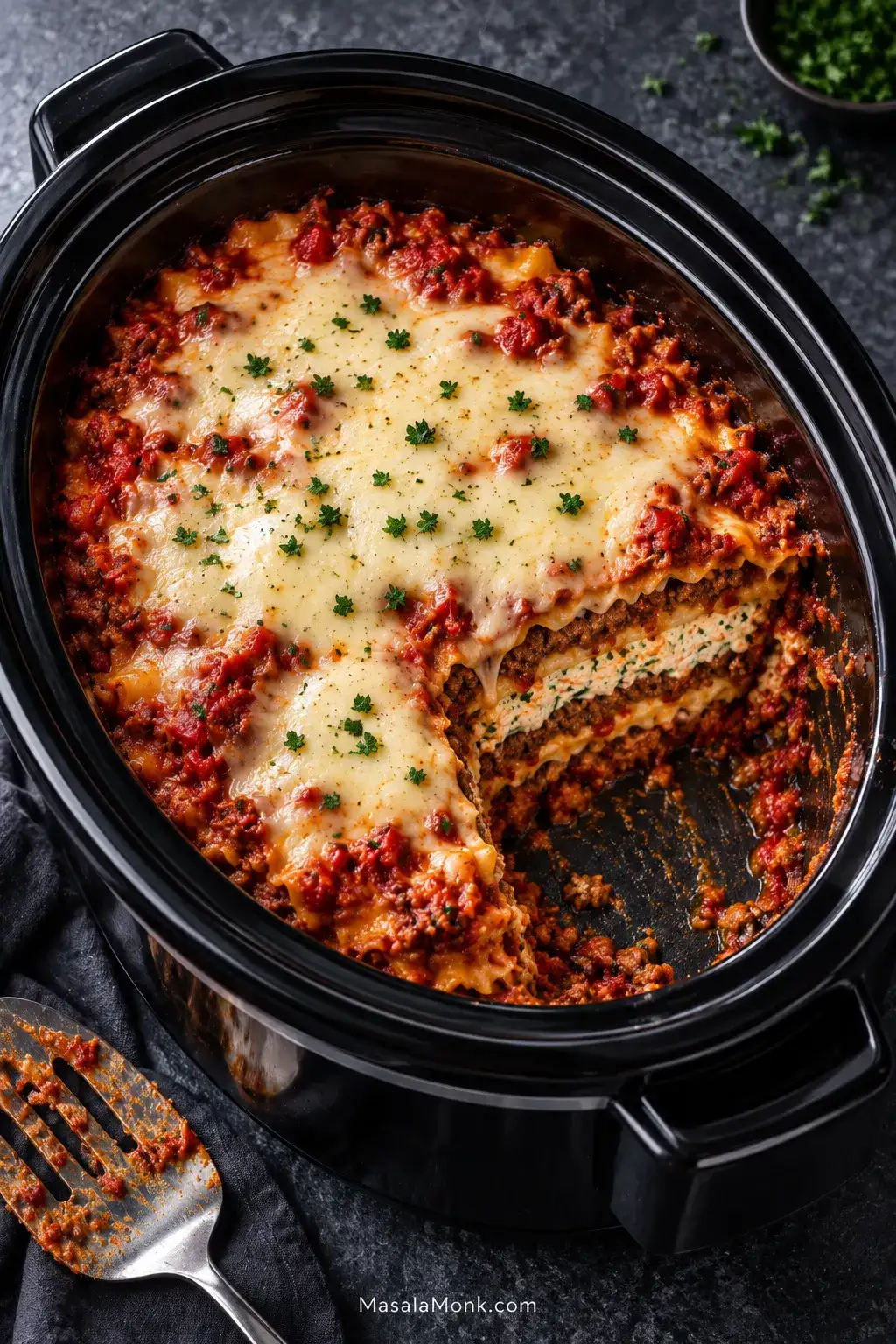
Sauce reaching the perimeter helps protect the noodle edges, while visible pasta, ricotta and a softly melted top show the texture this recipe is aiming for.
More Help With Your Lasagna
Want to understand the noodles, timing or moisture before you start? Everything below is organized so you can jump straight to what you need.
Noodles, Sauce and How Much Liquid You Actually Need
A slow cooker holds onto steam extremely well. That is what allows dry lasagna noodles to cook without a separate pot of boiling water. It also means liquid stays in the crock instead of evaporating the way it does in a hot oven.
You still want a saucy lasagna. There should be enough tomato sauce to soften every sheet and stay tucked between the layers, but not so much that the first serving leaves a puddle behind.
Can you put uncooked lasagna noodles in a slow cooker?
Yes. Regular dry lasagna noodles can go straight into the slow cooker without boiling first. They soften gradually in the sauce and give you a useful amount of time between firm and overly soft.
Oven-ready sheets work too. Because they hydrate faster, start checking them sooner.
Perfectly fitted noodles are unnecessary. Broken dry sheets work just as well when the exposed pieces are surrounded by enough sauce to soften evenly.
Do you need to add water to slow cooker lasagna?
Usually not in this recipe. The amounts matter: 48 oz / 1.36 kg marinara for 12 oz / 340 g dry noodles already gives the pasta plenty to absorb as it cooks.
This is why slow-cooker lasagna recipes can appear to contradict one another. A deeper recipe built around a full 16-oz / 454-g box of noodles may genuinely need additional liquid. With the amounts here, pouring in an automatic cup of water can leave far more moisture than the pasta needs.
If you make the sauce yourself, homemade marinara sauce works here too. Aim for one that coats the pasta generously instead of running through the crock like broth.
With 48 oz of marinara for 12 oz of dry noodles, the pasta already has plenty of moisture to work with; only a very thick sauce may need a small splash of water.
Why one corner can stay hard
Sometimes nearly the whole lasagna is tender except for one leathery corner. That piece may simply have spent the cook above the sauce or pressed dry against the crock wall. One stubborn patch does not mean the rest of the lasagna needs more water.
A little noodle overlap is fine. Several dry sheets pressed directly together are harder for moisture to reach. Before closing the lid, glance around the perimeter and cover any pale pasta still showing.
Vegetables bring their own water. Frozen spinach is a good example: thaw it and squeeze it well before layering. When zucchini, mushrooms, greens and other vegetables become the main filling, a dedicated vegetable lasagna method gives you better control over the moisture they release.
How to Build Slow Cooker Lasagna So It Cooks Evenly
The uncooked layers rarely look elegant. Noodles crack, and rectangular sheets leave awkward curved spaces in an oval crock. There is no prize for fitting them like a puzzle. Once the pasta softens, those broken pieces settle into the sauce with everything else.
Start with sauce and fit the noodles around the crock
Spread the first cup of meat sauce over the bottom before any pasta goes in. Lay the larger noodle pieces through the center, then snap smaller pieces to cover the curved spaces.
A broken noodle is not a problem; a dry noodle is.
Layer map: sauce on the bottom → dry noodles → ricotta filling → meat sauce → mozzarella. Build three pasta layers total and bury the final noodles beneath sauce.
Repeat noodles, ricotta, meat sauce and mozzarella for three pasta layers, but pay special attention to the crock wall—sauce around the perimeter helps prevent stubborn dry corners.
Keep the edges sauced and save some cheese for the top
The pasta nearest the crock wall feels the heat first, so carry the sauce all the way to the perimeter. An exposed corner can dry before the middle is ready.
Keep about a cup of mozzarella back for the finish. Under a slow-cooker lid the cheese melts pale, glossy and stretchy; it will not develop the toasted freckles and crisp bubbles you get from an oven. That’s normal.
Ricotta, Cottage Cheese, Beef or Sausage
Ricotta is the default here. Whole-milk ricotta gives you the soft, creamy layer that should still be visible between the pasta and meat sauce when you cut a piece. The egg helps the filling set during cooking, so it holds together better when served.
Ricotta vs cottage cheese: cottage cheese is a perfectly workable substitute, but it brings a little more loose moisture and a different texture. Use about 15–16 oz / 425–454 g, drain off visible whey, and blend it briefly if you prefer a smoother filling. Half ricotta and half cottage cheese is fine as well. For a version built specifically around it, see the cottage cheese lasagna guide.
All beef keeps the meat sauce familiar and straightforward. Replacing half with Italian sausage gives the tomato sauce a deeper, more savory flavor against the mild ricotta. Ground turkey works too; season it generously because it is leaner and milder. Whatever meat you choose, browning it first develops more flavor and gives you a chance to drain excess fat.
The finished slice should still show pasta, creamy ricotta and meat sauce as distinct layers, even though the lasagna stays soft and saucy.
LOW vs HIGH: How Long Does Slow Cooker Lasagna Take?
The smell of tomato sauce and melted cheese is not a reliable timer. Near the end, the edges may look thoroughly cooked while a noodle deep in the center still offers resistance when you test it.
LOW is the default: about 3½–4½ hours, with the first check around 3 hours. HIGH usually takes about 2½–3½ hours, but the noodles move through their tender stage faster, so you have less margin near the end.
When your schedule is flexible, LOW is easier to manage; HIGH is useful when dinner needs to happen sooner, but the pasta needs closer attention as it approaches tenderness.
Why LOW is the easier setting
LOW gives you the widest window for catching the pasta at the texture you want. Leave the lid closed during the first few hours, then begin checking the middle around 3 hours.
HIGH works when dinner needs to happen sooner, but check more closely near the end. The noodles soften faster, so the distance between firm and too soft gets shorter.
Why slow cooker lasagna times vary so much
Recipes vary because the pasta quantity, sauce amount and depth of the layers vary. A deeper lasagna made with more noodles and more liquid may simply need longer.
Some slow-cooker dinners genuinely suit an all-afternoon cook; a slow cooker sausage casserole is one example. Lasagna gives you a narrower window at the end because the pasta keeps taking up moisture while it stays hot.
How do you know slow cooker lasagna is done?
Trust the center noodle, not the bubbling edges. The pasta should be fork-tender, and a thin knife should slide through the middle without hitting a firm or chalky core. If you use a thermometer, the center should reach 165°F / 74°C.
The center usually finishes after the bubbling perimeter, so testing one noodle in the middle gives you a more dependable stopping point than judging the surface alone.
Once it is done, switch the cooker off. Melt the reserved cheese under the lid with the heat already stored in the crock, then uncover and rest the lasagna for 20–30 minutes. That rest is when the soft layers become easier to lift and the ricotta remains visible between the tomato-stained pasta sheets.
What size slow cooker is best for lasagna?
A 6-quart / about 5.7-L oval slow cooker is the default here. Smaller crocks make deeper layers and can take longer; larger ones spread everything more thinly and may finish sooner. Round cookers often create a deeper center. Whatever the shape, let the pasta make the final call.
If dinner is not quite ready yet: use WARM only after the lasagna is fully cooked. For the best texture, think in tens of minutes, not hours. WARM is for holding finished food, and a long hold will keep softening the noodles.
How to Fix Watery, Dry or Undercooked Slow Cooker Lasagna
Your lasagna is already in the Crock Pot. Now what? Look first at the pasta and at the moisture around it. Those two clues usually tell you the next move.
What You See
What to Do First
What Is Probably Happening
Tender noodles, liquid pooling
Turn the cooker off, vent the lid and rest
Loose sauce, extra water or simply not enough resting yet
Middle still firm, plenty of sauce
Continue on LOW for another 20–30 minutes
The pasta just needs more time
Middle firm and noticeably dry
Add 2–4 tbsp / 30–60 ml hot water or warm sauce
Very thick sauce or too little moisture reached the pasta
One edge dark, middle not ready
Stay on LOW and continue in short intervals
That side of the cooker is running hotter
Noodles getting mushy
Turn off the heat and uncover
The pasta has cooked too long or stayed hot too long
Grease pooling on top
Carefully spoon or blot it away
The meat released more fat than was drained off
Piece collapses when lifted
Give it another 10–15 minutes to rest
The layers are still too hot and soft to hold together
Why is my slow cooker lasagna watery?
If the noodles are already tender, switch the cooker off, crack or remove the lid and let the lasagna rest. More heat will keep softening pasta that is already cooked.
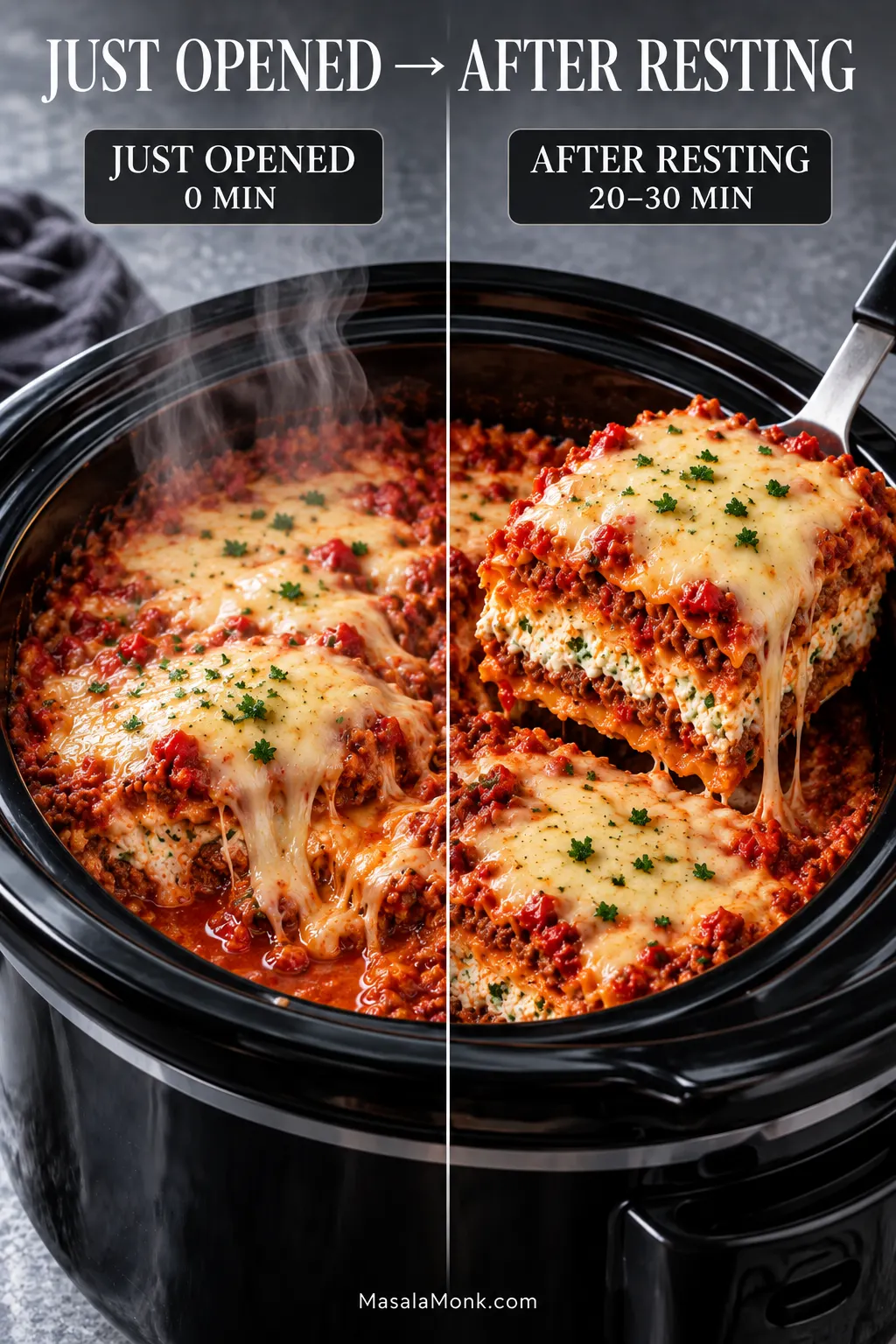
The first look under the lid can be alarming. Sauce may shimmer around the edges and a spoon pressed into the center can make everything seem loose. Ten minutes later the surface is calmer. By twenty or thirty minutes, some of that visible liquid has settled back between the layers and the cheese is holding them together more firmly.
Fresh from the cooker, the lasagna may look looser than expected. After 20–30 minutes, escaping steam and slightly firmer cheese make the layers noticeably easier to serve.
If the same thing happens next time, look first at thin marinara, unnecessary added water, cottage-cheese whey or vegetables that released a lot of liquid.
The middle is hard or one patch is dry
A firm middle surrounded by plenty of sauce can stay on LOW for another 20–30 minutes. When the center looks dry as well, add a small measured splash of hot water or warm marinara.
A single hard corner needs much less intervention. Spoon a little marinara over that spot, cover the cooker and let the pasta finish there.
The edges are ahead of the center
One dark edge usually means that side of the cooker is running hotter. Stay on LOW while the center finishes and keep future batches especially well covered along that side.
If you want a browned cheese finish, transfer individual servings to broiler-safe dishes and broil briefly. The top does not need to brown for the lasagna itself to be done.
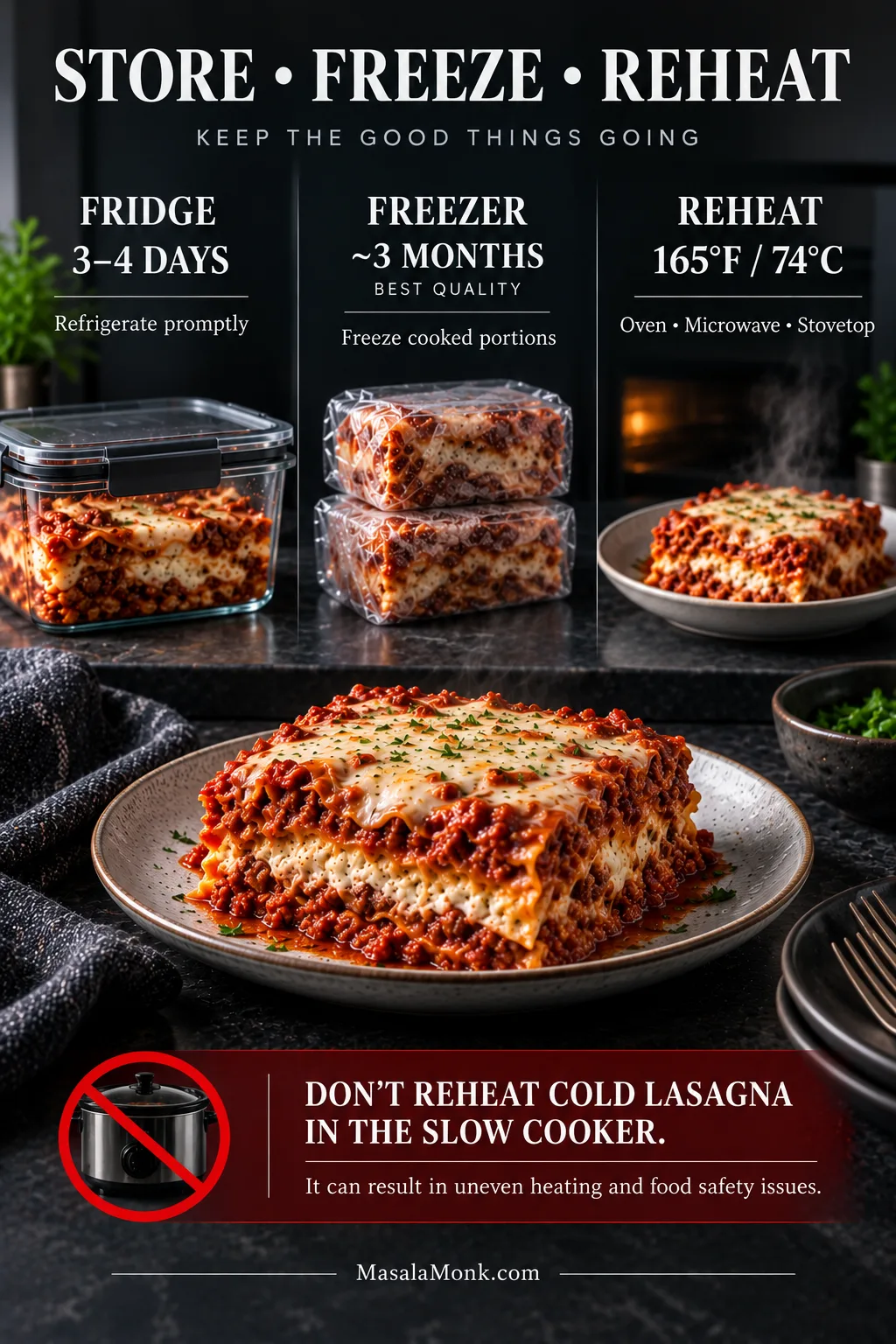
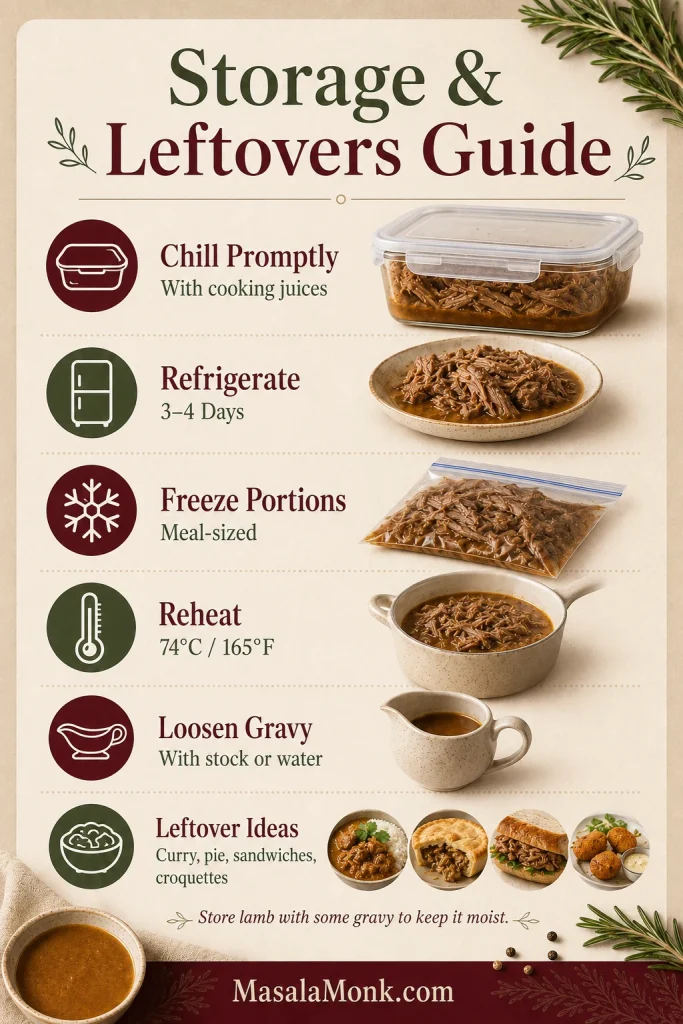
Storage at a glance: the guide below keeps the refrigerator, freezer and reheating decisions in one place; the detailed make-ahead and leftover notes follow.
Individual portions are especially practical for leftovers because they cool, freeze and reheat more evenly than one large section; use the storage times and reheat temperature shown as your quick reference.
Make the busy part ahead
Best make-ahead option: prepare the meat sauce and ricotta filling separately the day before and refrigerate them. The next day, all that is left is layering the lasagna and switching on the cooker.
You can assemble the whole lasagna ahead as well, although the dry noodles will begin taking up sauce in the refrigerator and chilled ingredients take longer to heat through. If you refrigerate it in a removable ceramic crock, follow the instructions for your particular appliance. Do not place a cold ceramic insert into a preheated slow-cooker base, allow for extra warm-up time, and check that the center reaches 165°F / 74°C.
Leftovers and freezing
Refrigerate leftovers promptly, ideally within about 2 hours, and keep them covered for 3–4 days. Individual portions reheat more evenly than one large section. The noodles continue taking up liquid in the refrigerator, so a spoonful of marinara is useful when a leftover piece looks a little dry.
Reheat cold leftovers in the oven, microwave or on the stovetop until the center reaches 165°F / 74°C. Do not use the slow cooker itself to reheat cold leftovers; it warms food too gradually for that job.
For longer storage, cool the lasagna completely and freeze individual cooked portions for about 3 months for best quality. Thaw overnight in the refrigerator when practical. Cooked portions are also the easiest freezer-prep option here—do not put a frozen assembled lasagna straight into the slow cooker.
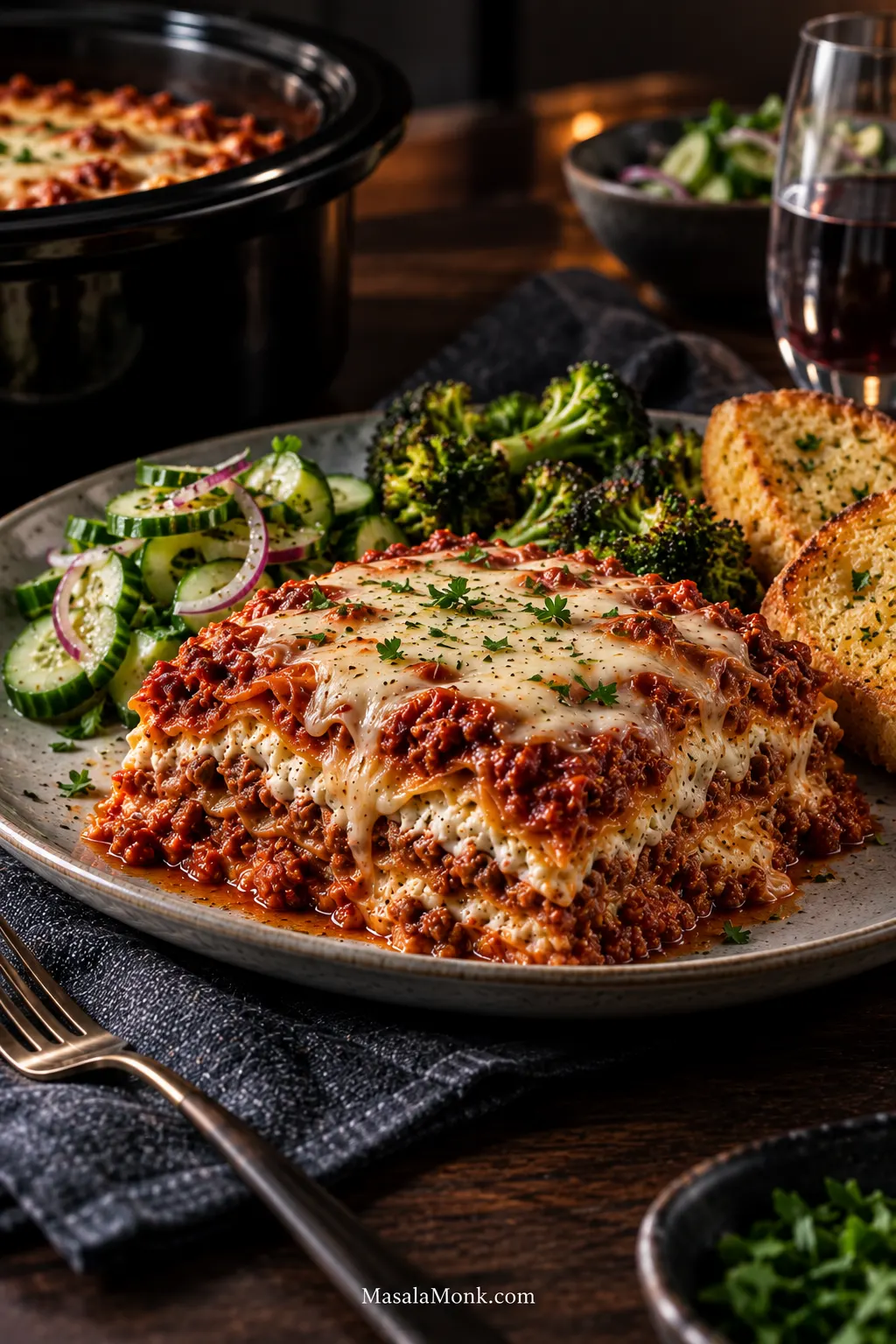
After resting, a serving should be soft and saucy while still showing its pasta, ricotta and meat-sauce layers. The first piece may lean a little as you lift it; that is lasagna, not an architecture exam. Let a little sauce slip onto the plate; that is part of the appeal.
A crisp cucumber salad brings acidity and crunch, while roasted broccoli or another simply cooked vegetable keeps the plate lighter. And if there is meat sauce left behind after the lasagna is gone, garlic bread is exactly what you want for it.
A crisp cucumber salad cuts through the rich tomato-and-cheese layers, while roasted vegetables and garlic bread round out the meal without competing with the lasagna.
If next time you want the same tomato-and-cheese comfort in a brothier, spoonable dinner, try Crock Pot Lasagna Soup.
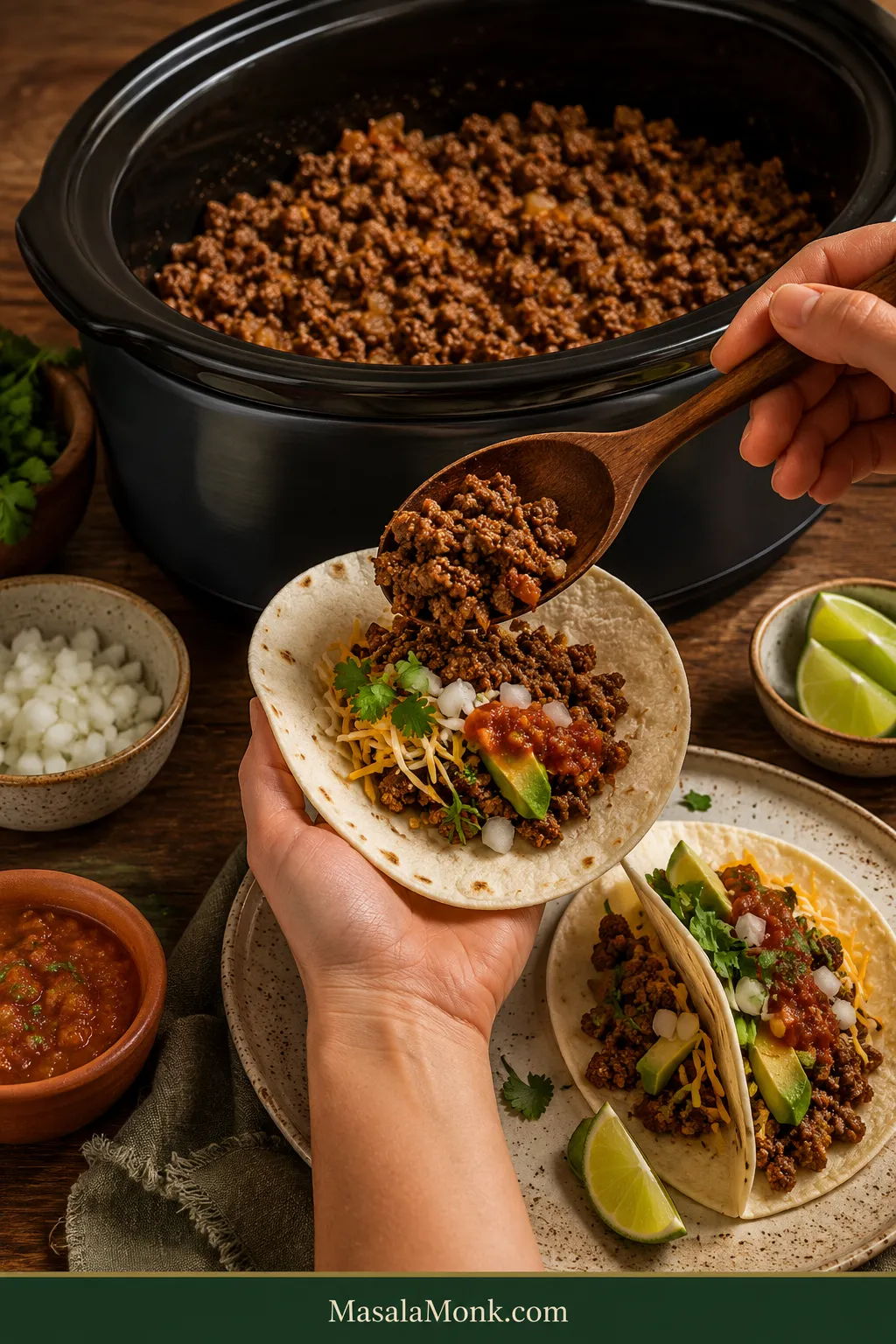
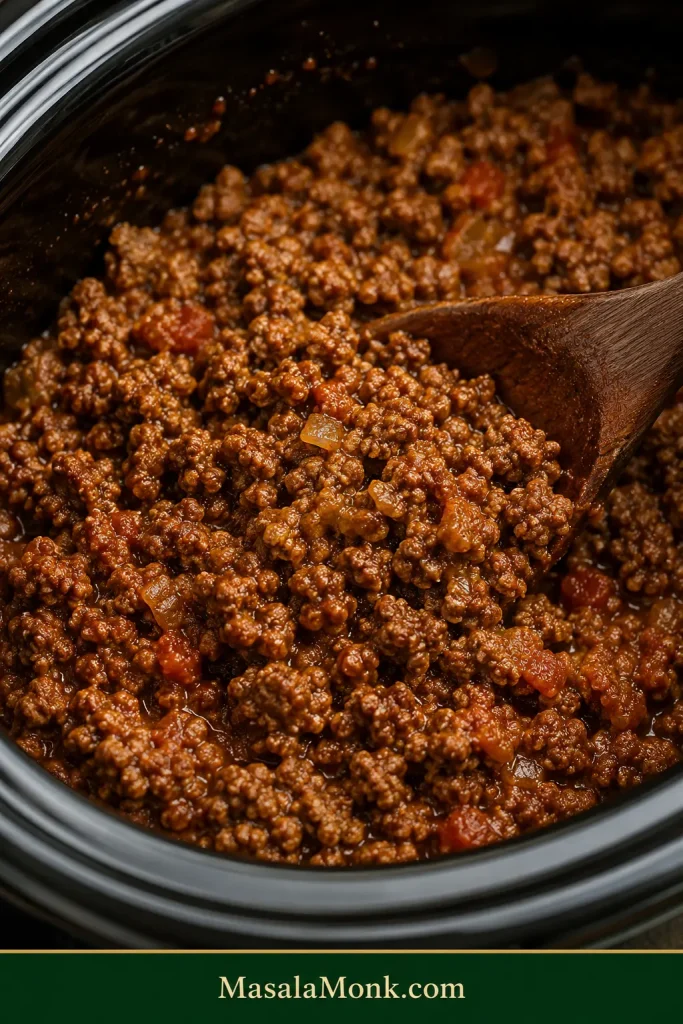
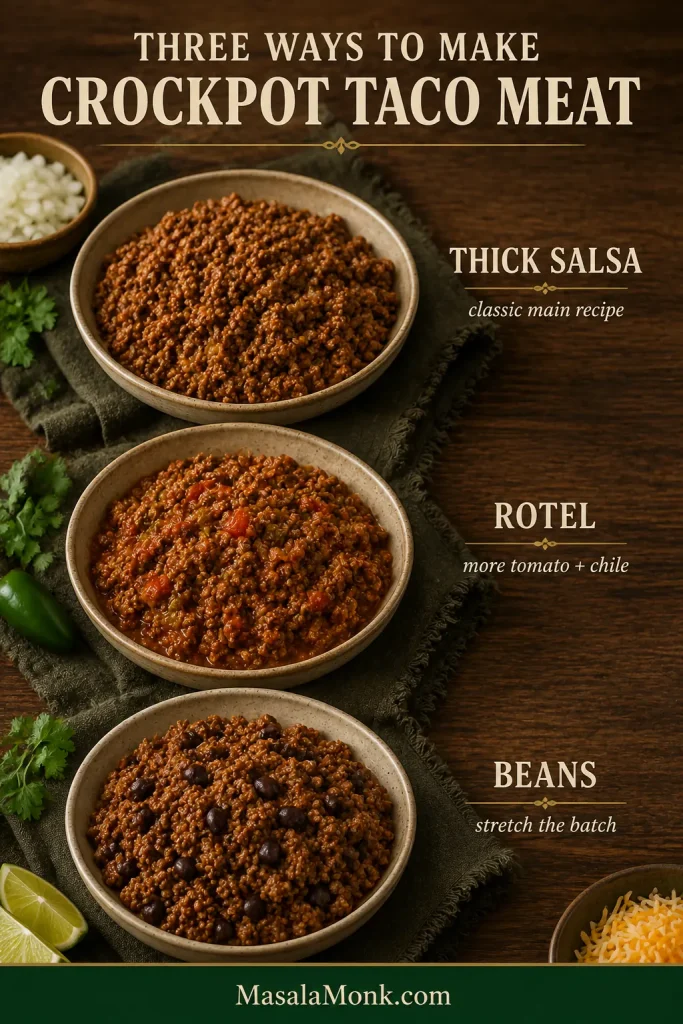
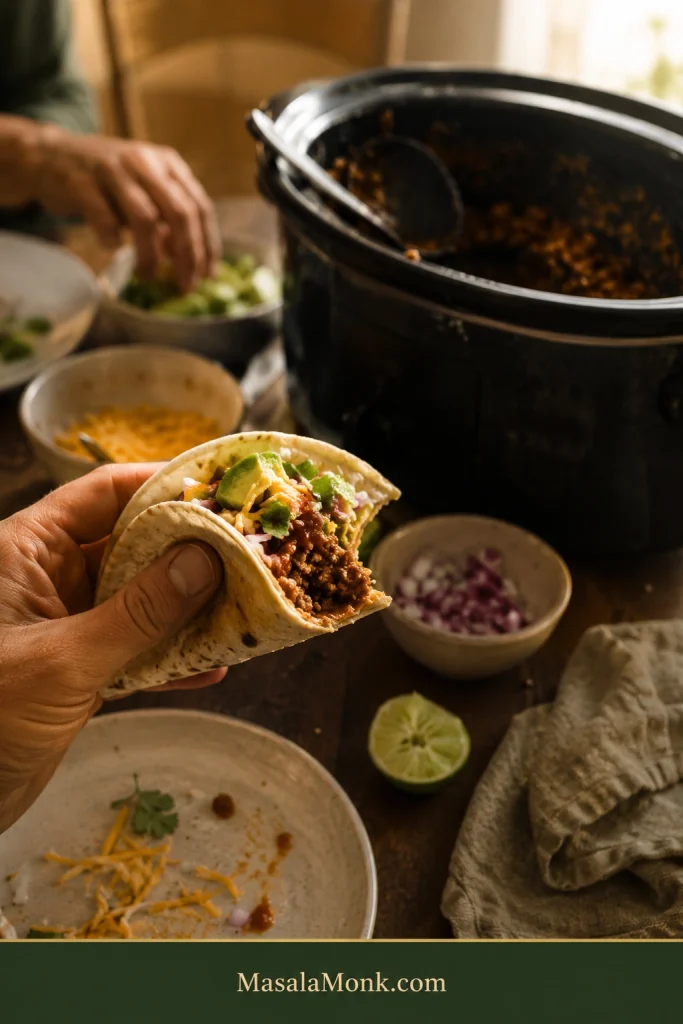
The best Crockpot taco meat has small, juicy beef crumbles coated in warm taco spices and tomato, ready to pile into soft tortillas while the cheese starts melting over the top.
And because the slow cooker does most of the work, the meat can be finished before everyone is ready to sit down. No standing over a skillet crumbling and stirring beef just as people start asking about dinner.
Ground beef has a few slow-cooker quirks. A dense block can stay clumpy, fatty beef can leave a slick of grease, thin salsa can make the filling watery, and extra hours do soft taco crumbles no favors. This method avoids most of those problems without turning an easy dinner into a project.
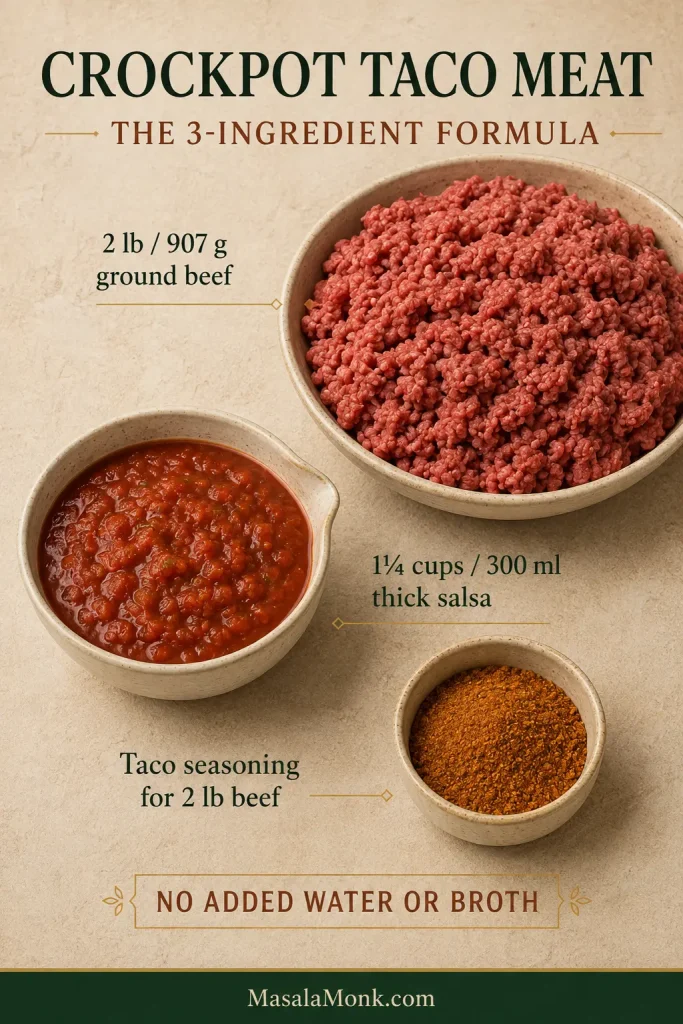
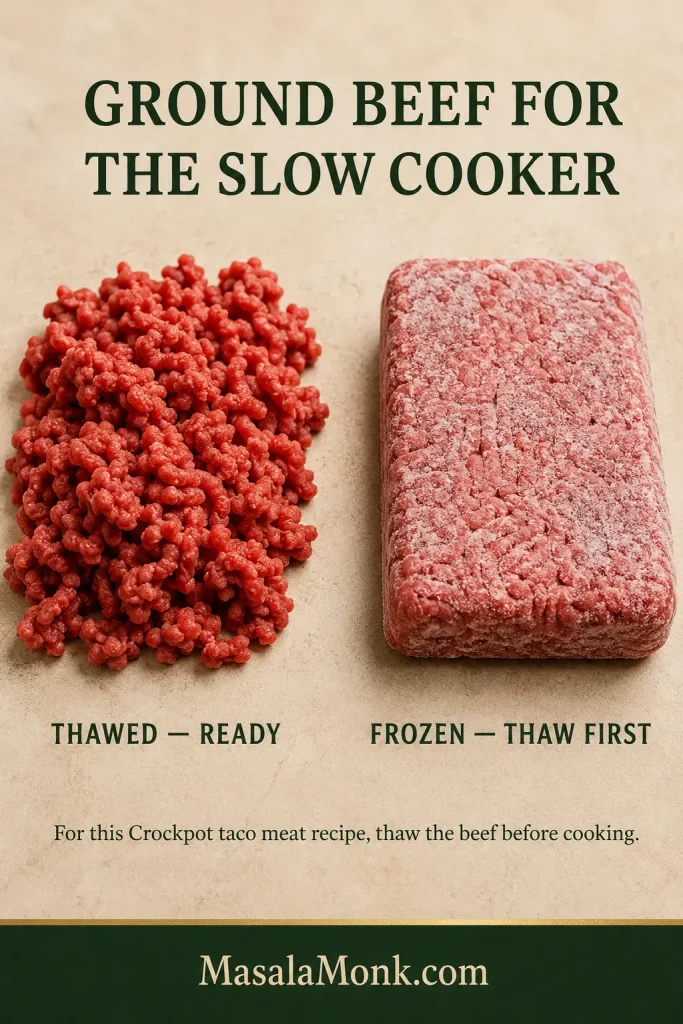
No browning or chopping is needed. For a 2-pound batch, combine 2 lb / 907 g raw, fully thawed lean ground beef with 1¼ cups / 300 ml thick salsa and taco seasoning.
Loosen the beef before cooking, then break it into the final crumble once it begins to set. Cook on HIGH for about 2½–3 hours or LOW for about 4–5 hours, starting your checks at the early end.
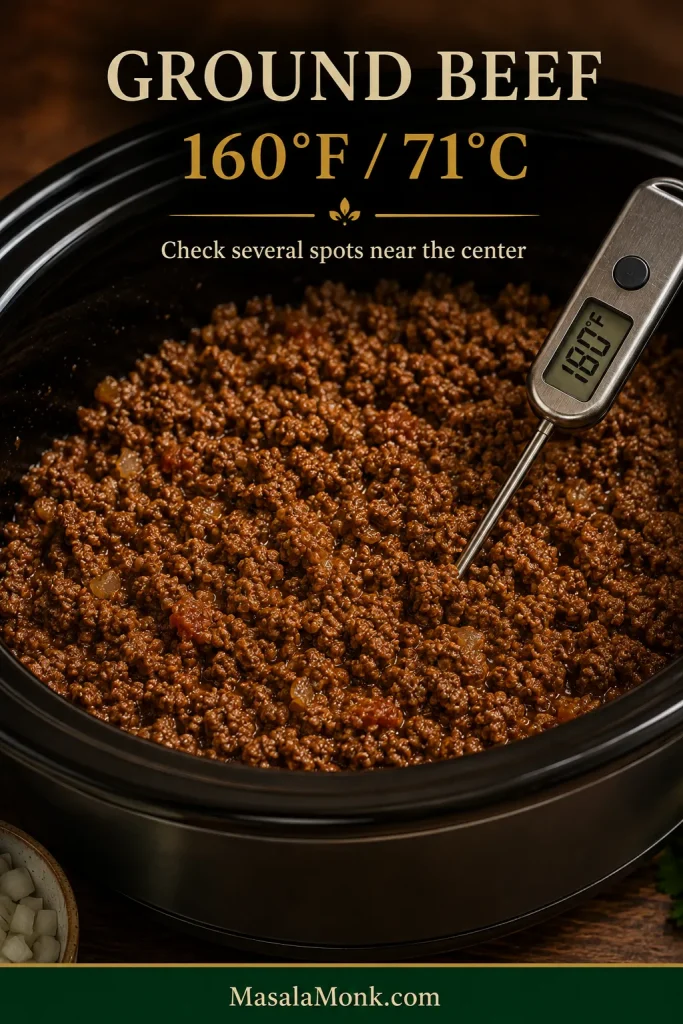
The beef is ready when it reaches at least 160°F / 71°C throughout and has the texture you want. Look for juicy, lightly glossy crumbles with very little free liquid underneath.
Added water or broth: none. Thick salsa already gives the beef the moisture it needs.
Prep: about 5 minutes with prepared taco seasoning or 10 minutes with homemade. Yield: about 8 dinner servings.
The 3-Ingredient Version
2 lb / 907 g raw, fully thawed 90/10 ground beef
1¼ cups / 300 ml thick salsa
Taco seasoning for 2 lb / 907 g beef
Using prepared taco seasoning? Use the amount your package recommends for 2 pounds of beef. If your brand’s packet is intended for 1 pound, that will usually mean two packets. Skip the packet’s stovetop water because the salsa supplies the cooking moisture here.
Thick salsa does double duty as flavor and cooking liquid, so this three-ingredient version needs no broth or packet water.
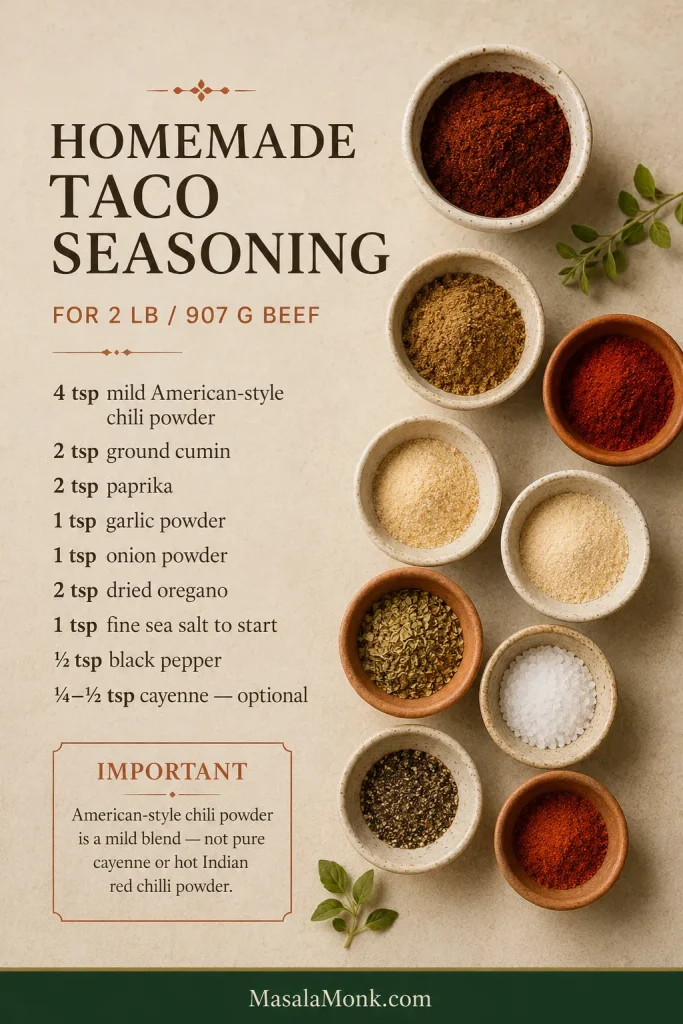
4 teaspoons mild American-style chili powder(not pure cayenne or hot Indian red chilli powder)
2 teaspoons ground cumin
2 teaspoons paprika
1 teaspoon garlic powder
1 teaspoon onion powder
2 teaspoons dried oregano
1 teaspoon fine sea salt to start, plus more if needed
½ teaspoon black pepper
¼–½ teaspoon cayenne, optional
In American taco recipes, “chili powder” usually means a relatively mild seasoning blend. Pure cayenne or a hot Indian chilli powder can be dramatically hotter, so use those much more cautiously.
Salsa can contribute plenty of sodium too. Starting with less salt gives you room to taste the cooked beef and adjust without discovering too late that the combination is overly salty.
Mix the spices before seasoning so cumin, paprika, oregano and salt distribute more evenly over the beef.
Instructions
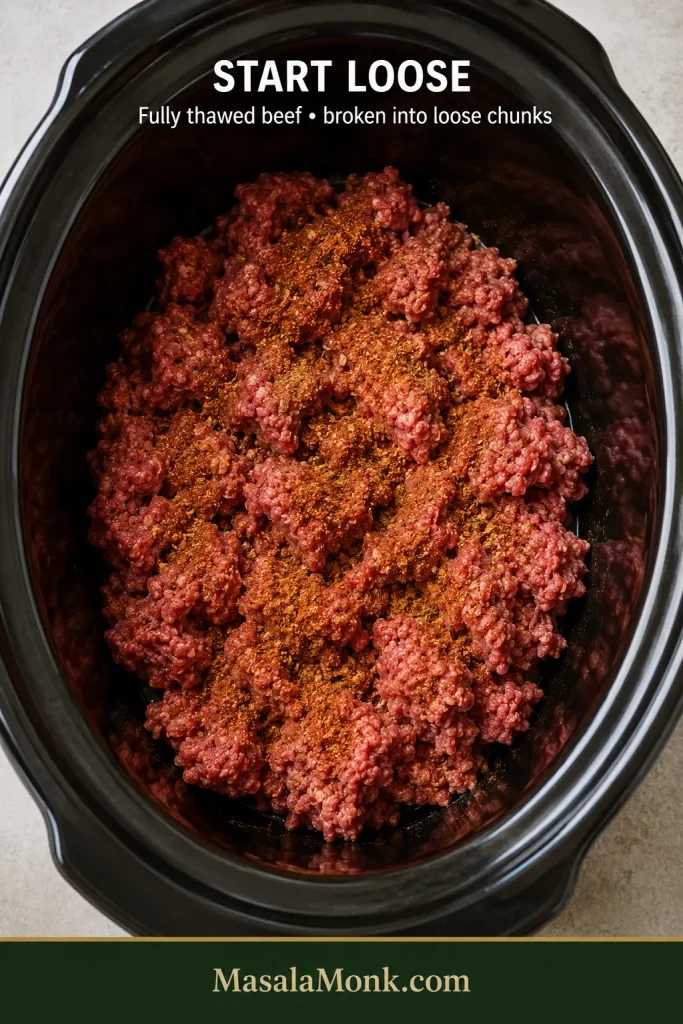
Loosen and season the beef. Put the thawed beef in the slow cooker and pull the dense block into loose chunks. Scatter the taco seasoning evenly over the meat.
Add the salsa. Spoon the thick salsa over the beef and stir lightly. Cover the slow cooker.
Cook. Cook on HIGH for about 2½–3 hours or LOW for about 4–5 hours. Begin checking at the early end because slow cookers vary, and deeper batches can take longer.
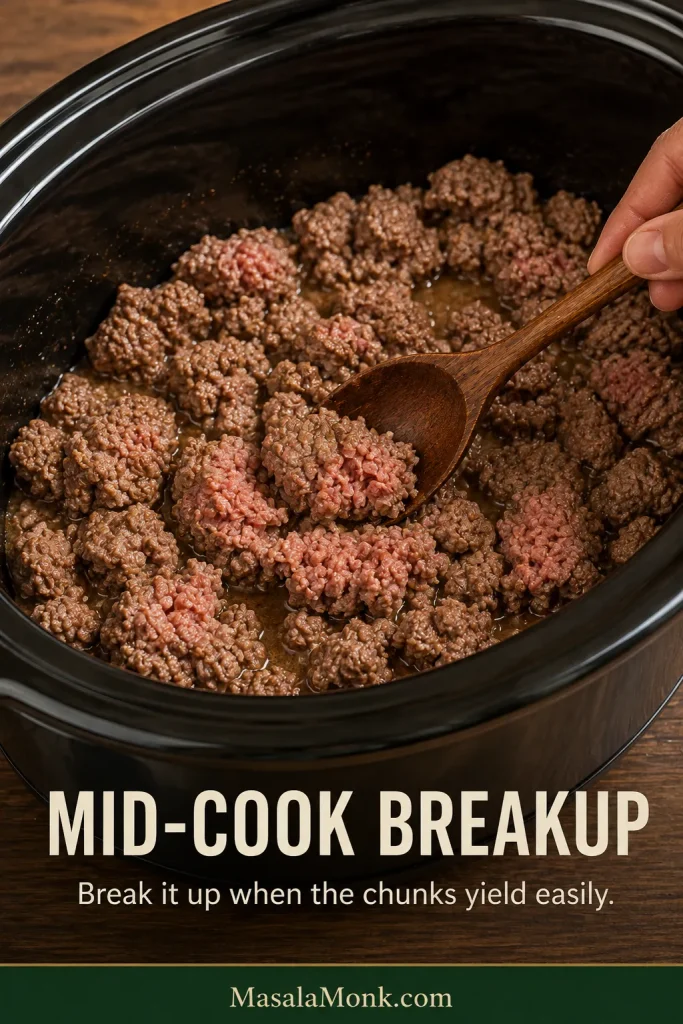
Make the crumble. Around the middle of the cooking window, start checking the beef. When the chunks have started to set and separate easily, use a wooden spoon, meat chopper or potato masher to break them into the size you like. Replace the lid and continue cooking.
Check doneness. Test several spots near the center. The beef should reach at least 160°F / 71°C throughout, with no dense raw pockets. Color alone is not a reliable doneness test.
Finish and serve. Stir well. Skim obvious grease or remove excess thin liquid only if needed, then taste and correct the salt or seasoning. If you add more dry seasoning, give it another 5–10 minutes of heat. Spoon into warm flour tortillas or soft homemade corn tortillas with cheese, onion, avocado, salsa, cilantro, jalapeños or lime.
Before You Serve
Food-safety note: if a spoon, masher or chopper touches undercooked beef, wash it or switch to a clean utensil before using it again with the fully cooked meat.
Cook’s note: can’t be there for the mid-cook breakup? Loosen the raw beef especially well at the beginning, then crumble it thoroughly once it is safely cooked. The pieces may be less uniform, but dinner still works.
When the beef is glossy, well seasoned and easy to scoop without liquid running around the crumbles, you’re done. Warm the tortillas and eat.
When the Crockpot Works Best—and When to Brown First
The Crockpot’s advantage here is timing, not tenderness. Ground beef does not need hours of slow cooking to become tender. The Crockpot cuts down the stove work, lets the meat be ready before you need it, and keeps it hot until everyone is ready to eat.
If browned edges and a faster stovetop dinner matter more, the skillet wins.
Mostly Hands-Off
Thawed raw beef goes directly into the Crockpot with salsa and seasoning.
Best for: ordinary dinner batches, minimal cleanup and softer taco crumbles.
Browned & Firmer
Brown and drain the beef in a skillet. Stir in the seasoning and enough salsa to leave it juicy rather than saucy, then transfer it to the Crockpot to stay hot for serving.
Best for: firmer pieces, deeper browned flavor or higher-fat beef.
Big Taco Bar
Cook and drain the beef in batches, then use one or more Crockpots to keep it hot for serving.
Best for: larger quantities where even cooking and easy draining matter more than dump-and-go convenience.
Prefer firmer, deeply browned stovetop crumbles? Our Ground Beef Tacos Recipe is built around that skillet texture and a much faster cook.
Which Ground Beef Works Best?
With skillet taco meat, excess fat can be poured off before the seasoning goes in. With the raw slow-cooker method, everything released by the beef stays in the pot until the end.
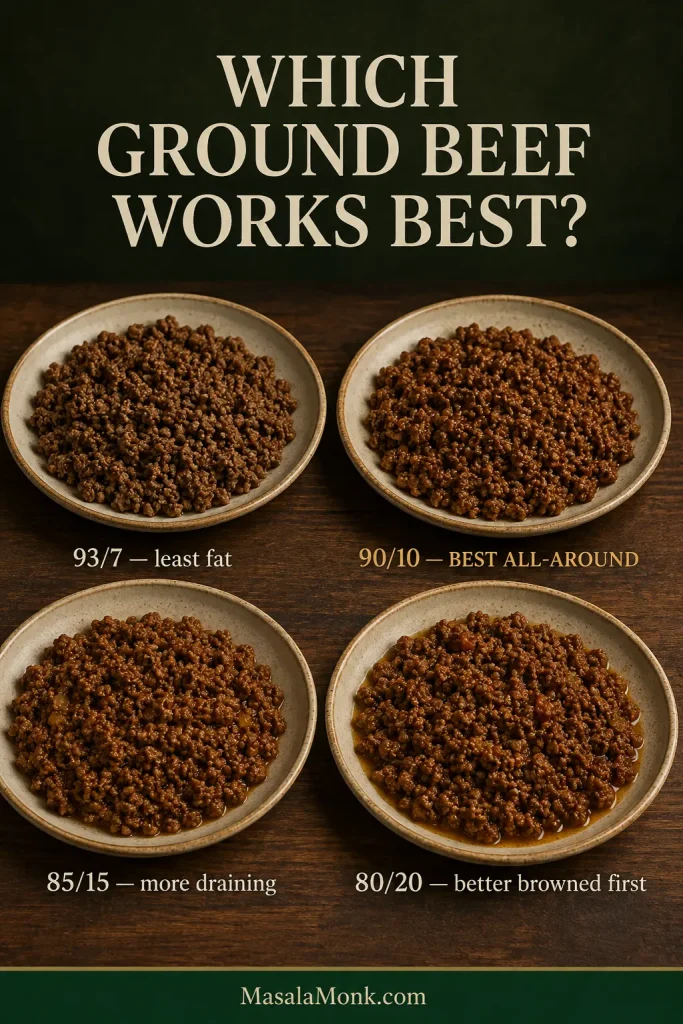
For this recipe, 90/10 hits the sweet spot: plenty of beefy flavor without leaving a large slick of fat underneath.
Ground beef
What to expect
Best use
93/7
Very little rendered fat; leaner, less rich result
Minimal draining
90/10
Good beef flavor with some fat to skim if needed
Best all-around choice
85/15
Richer, with more fat collecting at the bottom
Fine if you don’t mind draining some
80/20
Can leave a substantial grease layer
Better browned and drained first
Already have 85/15 in the refrigerator? Use it. Taco night does not require a special grocery run; just expect more fat at the end.
If your store labels it beef mince, use the same lean ratio and follow the recipe as written.
Why Salsa Consistency Matters
Salsa has a big say in how wet the taco meat becomes because it brings tomato, chile, aromatics, acidity, salt and moisture all at once.
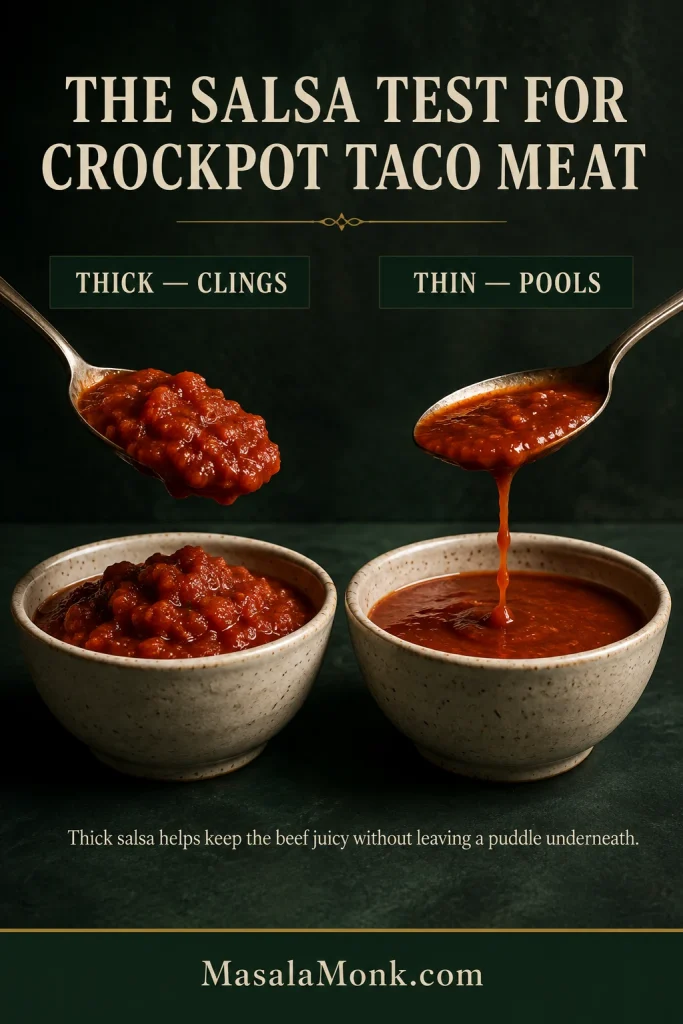
To keep the beef juicy without leaving a puddle underneath, choose a thick salsa that sits on a spoon instead of immediately running off it. Thick salsa clings to the crumbles; very thin restaurant-style or watery fresh salsa is more likely to pool around them.
Use the spoon, not the label. If salsa runs off immediately, start with less; if it holds a mound, the recipe amount is a better fit.
Thin salsa can still taste excellent. Start with less and add another spoonful after cooking if the beef needs it.
Chunky or smooth? Chunky salsa leaves visible pieces of tomato, onion and chile. A smoother salsa blends more completely into the beef and gives the filling a more uniform look. Mild, medium or hot is your call; consistency matters more to the slow-cooker method than heat level does.
For something brighter at the table, keep the finishing salsa separate. A spoonful of roasted salsa verde adds fresh acidity without making the beef wetter in the Crockpot.
Can Raw Ground Beef Go Straight Into the Slow Cooker?
Yes. Use fully thawed beef, loosen the dense block before cooking and check doneness with a food thermometer instead of relying on color.
USDA slow-cooker guidance recommends thawing meat before it goes into a slow cooker. Thawed ground beef also separates more evenly and is much easier to crumble. Read the USDA slow-cooker guidance.
What to Look for While the Beef Cooks
Start loose. Pull the raw beef into handful-size chunks before the lid goes on. They do not need to be tiny; opening up the dense block is what matters.
Expect moisture later. The pot may look surprisingly dry at first. Ground beef releases its own juices as it heats, and very little escapes from a covered slow cooker.
Break it when it yields easily. When the chunks separate with very little resistance, they are ready to crumble. Break them into the size you prefer and let the beef finish cooking.
Crush the chunks when they yield easily; if the spoon smears or drags through the meat, give them more time.
Don’t judge by color alone. Appearance can be misleading, so use the thermometer reading in the recipe as the final doneness check.
Check several dense spots near the center. 160°F / 71°C throughout is the target, not color alone.
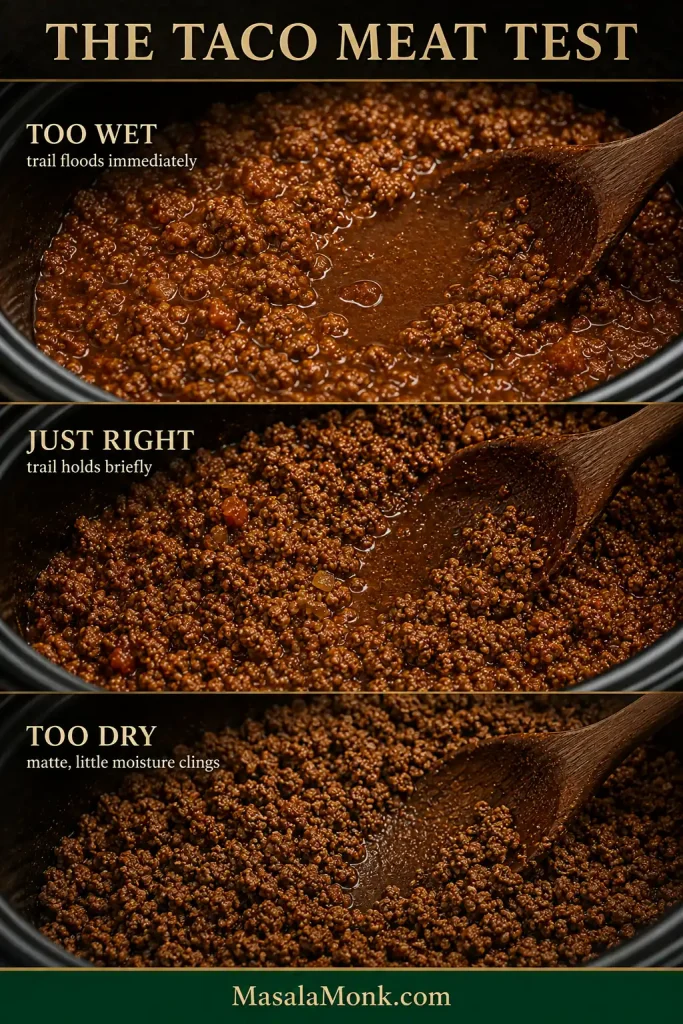
The Taco Meat Test: Too Wet, Just Right or Too Dry?
Drag a wooden spoon or spatula through the middle of the beef and watch what happens to the channel.
Use the trail after the finished taco meat has been stirred. A little juice is desirable—the speed at which the channel disappears tells you more than visible liquid alone.
Too Wet
Thin liquid immediately floods back in and the meat looks as though it is sitting in sauce.
What to do: spoon out excess liquid or leave the lid off briefly while the beef is hot.
Just Right
The crumbles look juicy and lightly glossy. The spoon trail stays visible for a moment before a thin sheen of flavorful cooking juice slowly settles back in.
Leave it alone. You’re there. A thin layer of juice at the bottom belongs with moist taco meat, and the filling should scoop neatly without soaking the tortilla underneath.
Too Dry
The beef looks matte and loose with very little moisture clinging to the crumbles.
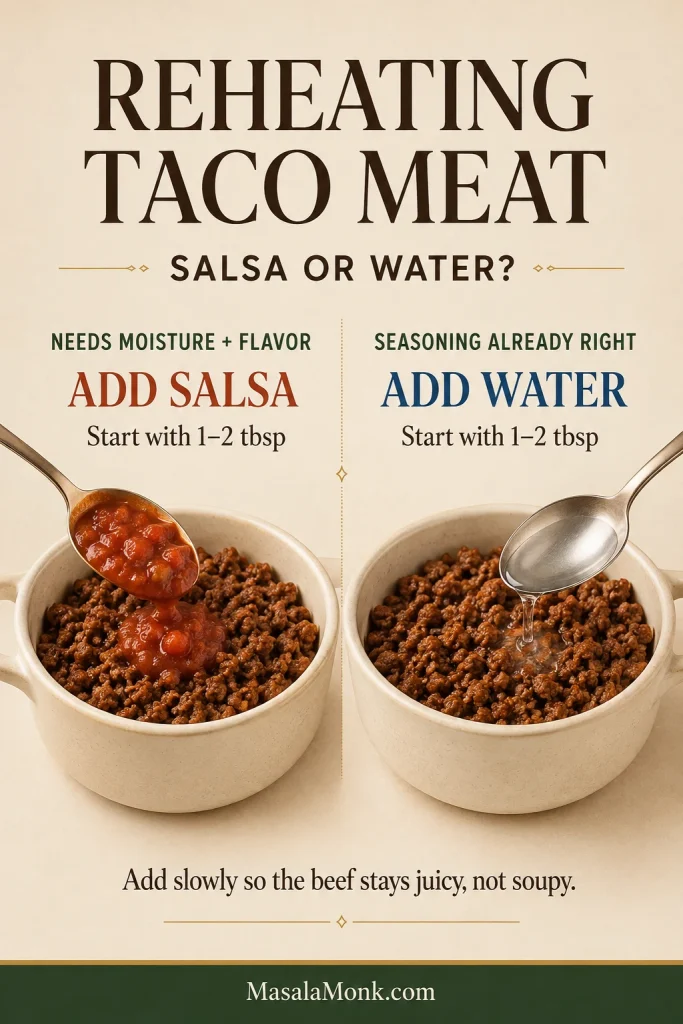
What to do: stir in 1–2 tablespoons of salsa if the beef could use more flavor as well as moisture, or water if the seasoning is already where you want it. Heat briefly, then check again before adding more.
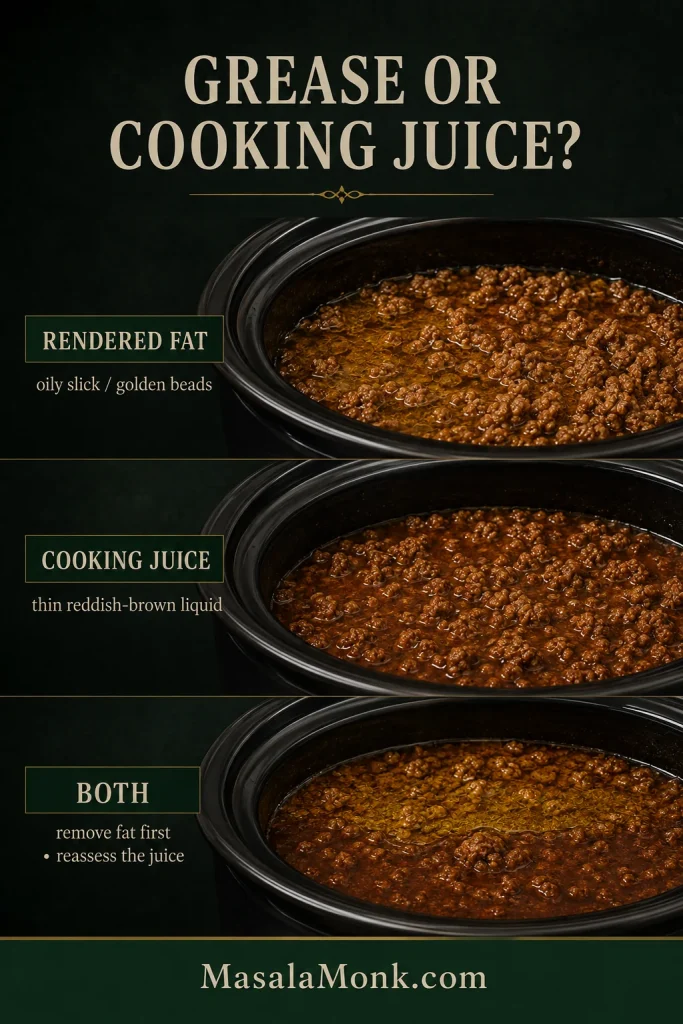
Is That Liquid Cooking Juice or Grease?
Oily slick or yellow-brown beads: mostly rendered beef fat. Skim or drain it.
Thin reddish-brown liquid: mostly beef juices and salsa moisture. Remove only what is excessive.
An oily layer over thinner liquid: remove the fat first, stir the beef, then decide whether the remaining juice actually needs reducing.
Draining every drop can leave good taco meat unnecessarily dry. Remove the fat you do not want, stir again and reassess.
If shiny oil floats over darker cooking juice, skim the top layer first, stir, then reassess. Draining everything can remove useful seasoned moisture with the fat.
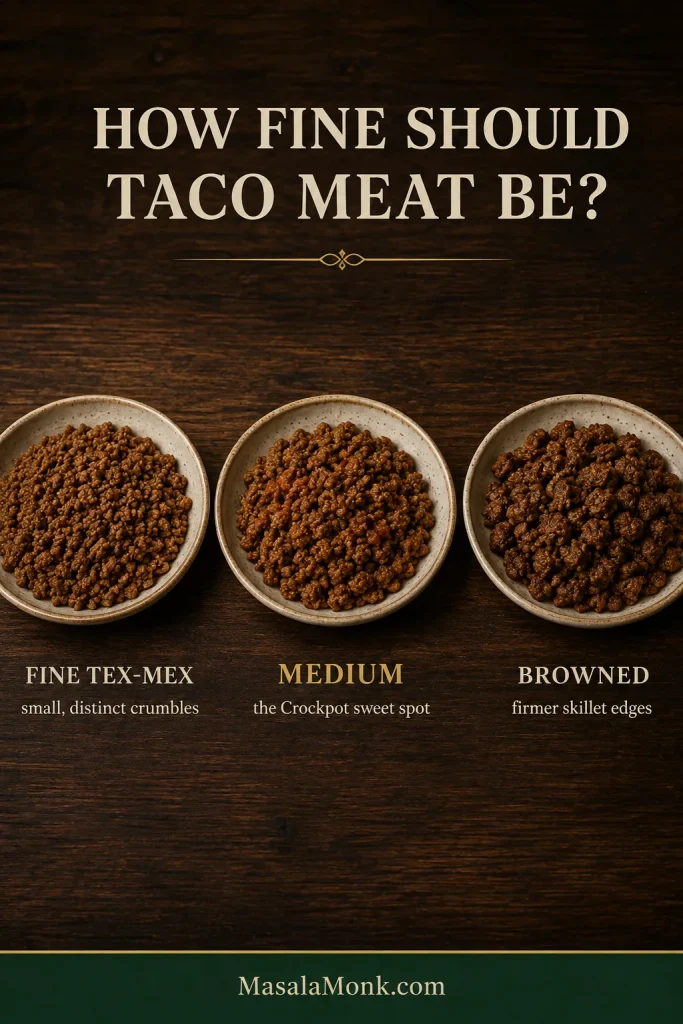
The Crockpot works well for fine and medium crumbles; deeply browned beef still belongs in a hot skillet. Choose the texture that fits the tacos you want tonight.
Use the guide as a stopping-point check: medium crumbles should still look unmistakably like ground beef rather than a uniform paste.
Fine Tex-Mex-style crumbles: use a potato masher or meat chopper and work the beef fairly fine. Stop while distinct small pieces remain. The meat should feel tender and meaty, not pasty.
Medium everyday crumbles: use a wooden spoon or sturdy spatula and stop earlier. This is what the main recipe aims for—tender, juicy and easy to scoop while still clearly feeling like ground beef.
Firm, browned crumbles: use a hot skillet for browned edges and a firmer bite. The Crockpot can then keep the cooked meat hot until everyone is ready.
Easy Variations
No-Salsa Version
For an intentionally smoother, saucier version without salsa, keep the 2 lb / 907 g ground beef and the same amount of taco seasoning. Replace the 1¼ cups / 300 ml salsa with 1 can plain tomato sauce, about 15 oz / 425 g.
Tomato sauces vary in saltiness, so hold back any extra salt until the beef is cooked and tasted. This version will not finish exactly like the thick-salsa recipe. If more sauce collects around the beef than you want, spoon off the excess or let the meat sit briefly uncovered while hot.
This skips salsa, not tomato. A completely tomato-free version needs a different moisture balance, so simply omitting the tomato is not a direct substitute.
Rotel Version
Replace the 1¼ cups / 300 ml salsa with 1 undrained 10-oz / 283 g can of Rotel. Keep the same homemade spice blend—or use enough packet seasoning for 2 pounds of beef. No added water is needed.
Rotel is thinner than the salsa used in the main recipe, so let the beef cook before deciding whether it needs anything else.
Stretch It With Beans
Drain and rinse a 15-oz / 425 g can of black beans or pinto beans, then stir them into the cooked beef for the final 20–30 minutes.
Whole beans stretch the batch without turning it into a completely different filling. Want the beans to become the meal instead of an add-in? That’s closer to our Crockpot chili.
Scaling Crockpot Taco Meat: What Changes From 1 to 4 Pounds
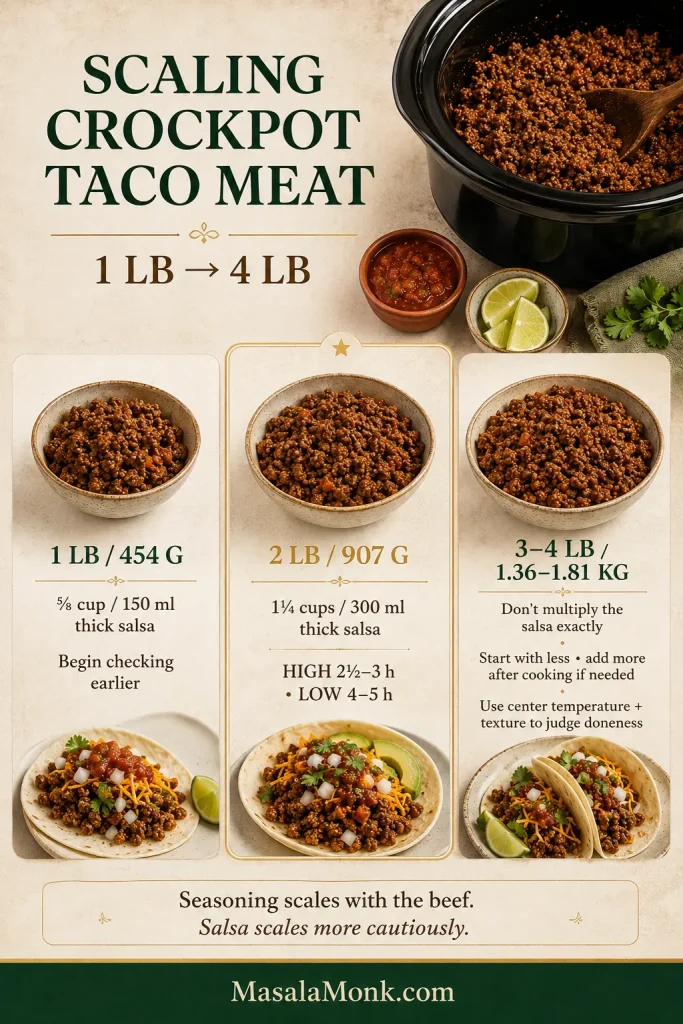
Scale the taco seasoning with the amount of beef. Salsa is different: as the batch gets larger and sits deeper in the cooker, don’t increase the salsa in exact proportion to the beef. Start with less and add more after cooking if the meat needs it.
For 3–4 lb, leave room to correct upward: adding salsa later is easy; removing excess liquid is not.
Batch
Salsa guidance
What changes
1 lb / 454 g
⅝ cup / 150 ml thick salsa
Begin checking earlier; a smaller cooker is useful if available
2 lb / 907 g
1¼ cups / 300 ml thick salsa
Main recipe: HIGH 2½–3 h or LOW 4–5 h
3–4 lb / 1.36–1.81 kg
Don’t increase the salsa in exact proportion to the beef; start with less and add more after cooking if needed
Use a roomy cooker and rely on center temperature and texture rather than adding a fixed amount of extra cooking time
When the Cooker Gets Too Full
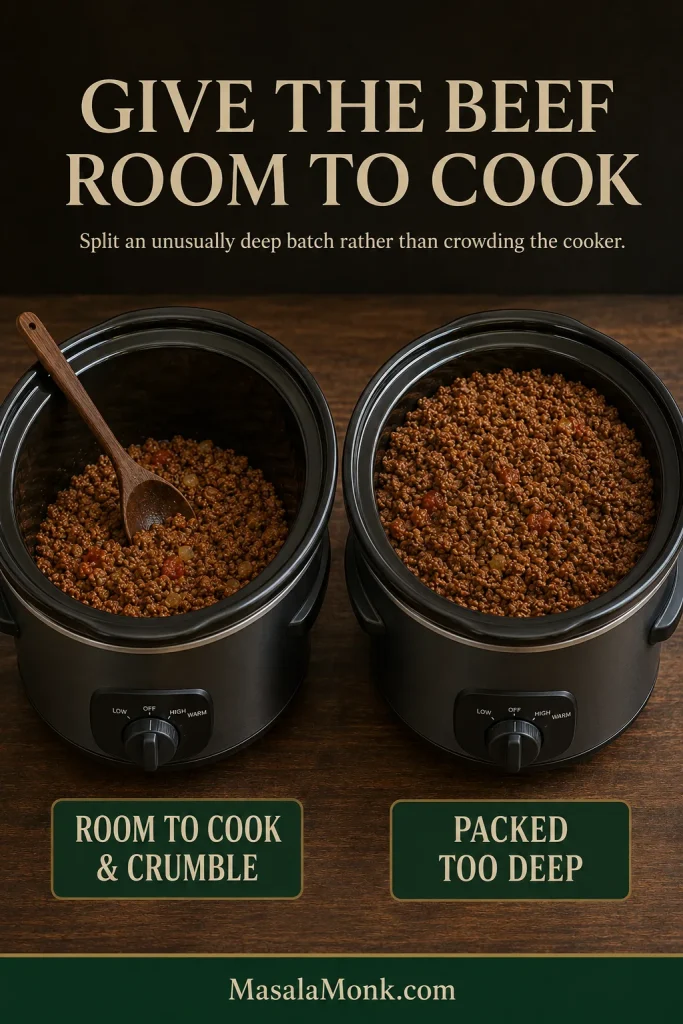
If the beef is packed unusually deep in your cooker, split the batch rather than crowding it in. The beef cooks more evenly and is easier to crumble that way. And when your cooker manual specifies a maximum fill level, follow it rather than packing the batch too deeply.
Remove excess thin liquid or briefly cook uncovered
Use thicker salsa and avoid adding extra liquid
Greasy
Skim or drain the rendered fat
Use 90/10 or 93/7 beef, or brown fattier beef first
Big clumps
Break the hot beef apart while it separates easily
Loosen the raw block and give it one mid-cook breakup
Mushy
Remove excess liquid and stop working the meat
Check sooner and stop at a larger crumble
Dry but sitting in liquid
Remove excess liquid first; taste the beef before adding any salsa
Check sooner and begin with thick salsa instead of extra liquid
Bland
Correct the salt and seasoning; if it is seasoned but still tastes flat, finish with lime for acidity
Scale the seasoning with the amount of beef
Too salty
Dilute with unseasoned cooked beef or beans
Hold back extra salt until the meat has been tasted
If the table solved your problem, you’re done. Two problems are especially easy to misread.
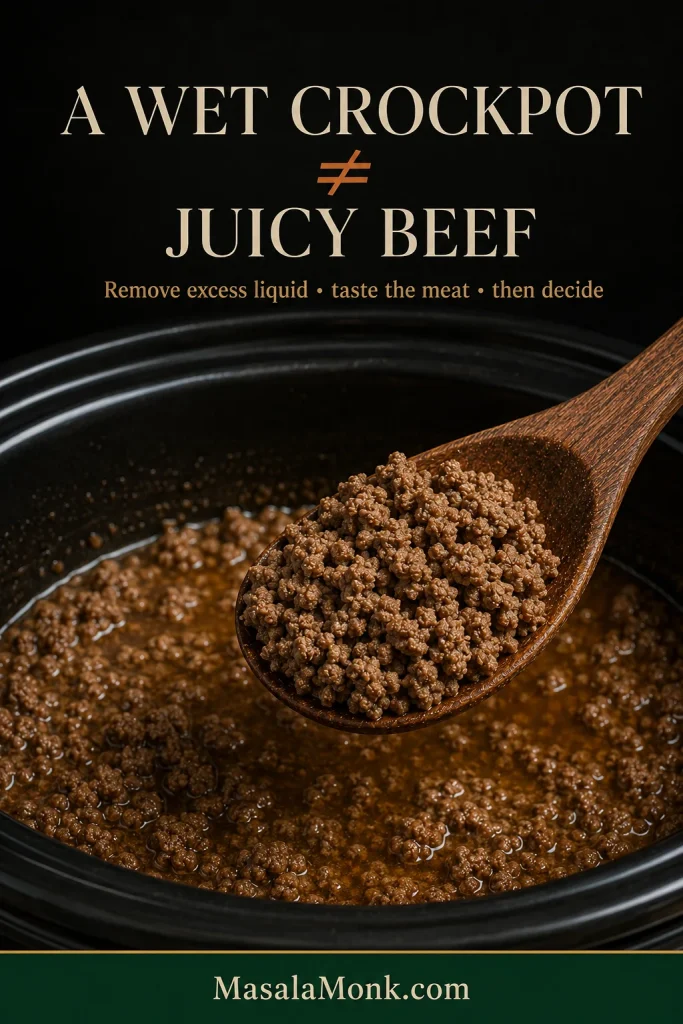
Why Is the Beef Dry When There Is Liquid in the Crockpot?
A wet Crockpot doesn’t necessarily mean juicy beef. You can have plenty of liquid around the meat while the crumbles themselves still taste dry.
The meat can continue losing moisture while sitting in released juices, fat or sauce.
Remove obvious excess liquid first and taste the meat. When extra cooking time is the real problem, pouring in a cup of broth only gives you dry-feeling beef in a wetter pot. A spoonful or two of salsa is plenty if the crumbles still need help.
Drain first, then taste. More salsa or broth will not fix overcooked, dry-feeling crumbles that are already sitting in plenty of liquid.
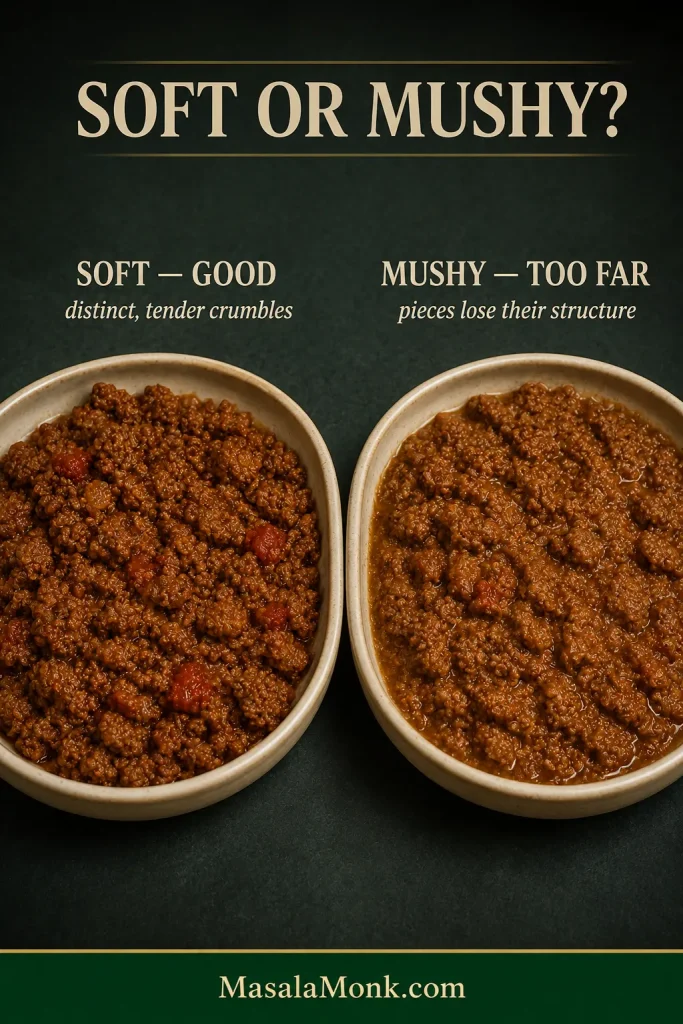
Is It Mushy—or Just Soft?
Slow-cooker taco meat is naturally softer than beef browned hard in a skillet. Tender crumbles that still hold their shape are exactly what many people want.
When the pieces lose that structure and become paste-like or waterlogged, they have moved into mushy territory. Prefer a firmer bite every time? Brown the beef first and let the Crockpot keep it hot instead.
Once the crumble size is right, stop working the meat aggressively; continued mashing can turn tender crumbles pasty.
For a family batch, that’s most of what can go wrong. Feeding a crowd changes the Crockpot’s job.
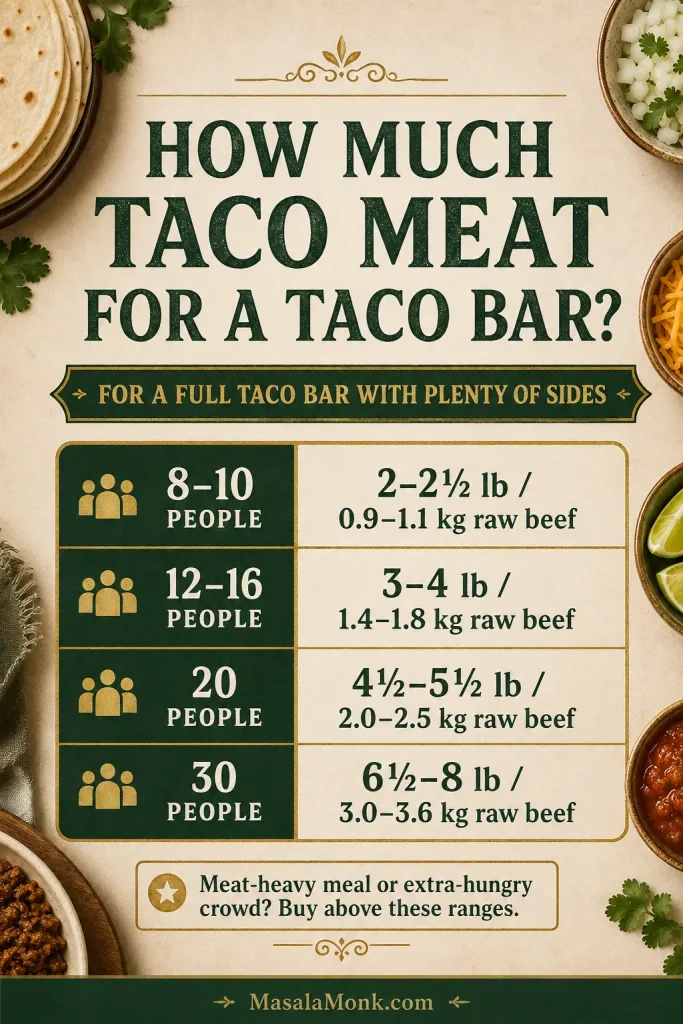
For a full taco bar with plenty of beans, cheese, vegetables, salsa and sides, plan roughly 2½–3 oz / 70–85 g cooked taco meat per person.
For a meat-heavy meal or an especially hungry crowd, move closer to 3½–4 oz / 100–115 g cooked meat per person.
The buying amounts here assume plenty of other fillings and sides. Buy above them when the meat is doing most of the work.
Crowd
Raw beef to buy
Best approach
8–10 people
about 2–2½ lb / 0.9–1.1 kg
The main slow-cooker method works well
12–16 people
about 3–4 lb / 1.4–1.8 kg
Use a roomy cooker or split the batch
20 people
about 4½–5½ lb / 2.0–2.5 kg
Cook in batches, then keep hot for serving
30 people
about 6½–8 lb / 3.0–3.6 kg
Cook in batches; two Crockpots can make serving easier
Why the Crockpot Works for a Taco Bar
A taco bar works because everyone builds exactly what they want while you only have one hot filling to keep track of. For a cold side that can be finished before people arrive, our 7 layer dip can be waiting in the refrigerator.
For 5 Pounds or More, Change the Method
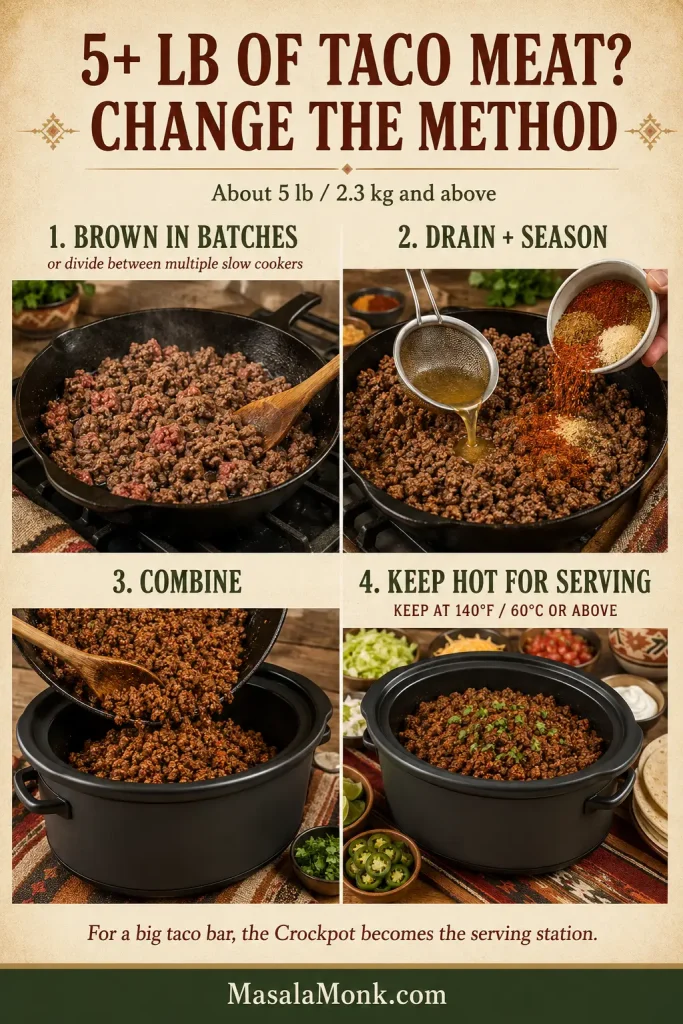
At about 5 lb / 2.3 kg and above, stop treating the meat as one giant raw slow-cooker batch. Brown the beef in batches that fit comfortably in the skillet, or divide the raw beef between multiple slow cookers. Drain excess rendered fat, season each batch, then combine the cooked meat in the Crockpot and keep it hot for serving.
Working in smaller batches keeps the crumbles distinct, makes excess fat easier to drain and helps the seasoning coat the beef evenly. For a big taco bar, the Crockpot becomes the serving station: the meat stays hot while you actually get to enjoy the gathering instead of playing line cook.
Keeping Taco Meat Warm
Use WARM only after the meat is fully cooked and already hot. Keep hot food at 140°F / 60°C or above during serving and keep the lid on between rounds.
Quick storage guide: refrigerate cooked taco meat for 3–4 days, freeze it for about 3 months for best quality, and reheat leftovers to 165°F / 74°C.
Make It the Day Before
Cook the taco meat completely and get the moisture where you want it before storing. Divide a large batch into smaller, shallow containers and refrigerate it within 2 hours. If food is sitting outdoors above 90°F / 32°C, that window drops to 1 hour.
When serving leftovers again, reheat the meat to 165°F / 74°C before transferring it to a slow cooker on WARM.
How to Freeze Taco Meat
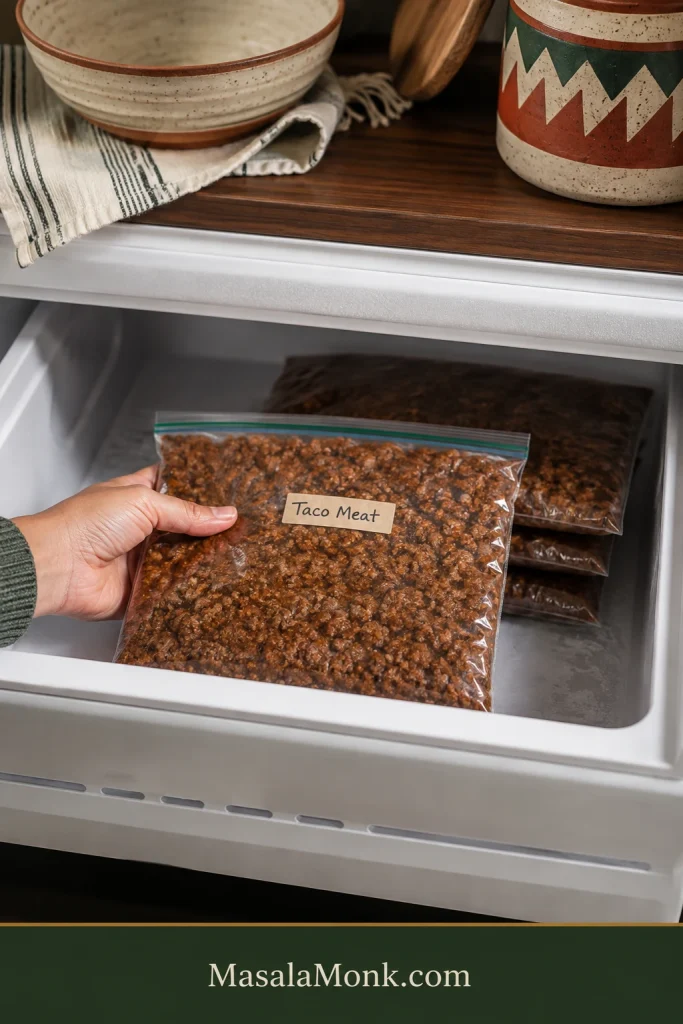
Freeze the meat in amounts that match the way you actually eat it. A dinner-size package or larger family-size package is far more useful than one giant frozen block.
Flat freezer bags stack neatly and thaw faster. For the best eating quality, use the frozen taco meat within about 3 months.
Flatten portions before they freeze solid so they stack neatly and thaw faster than one thick block.
Reheat Without Turning It Into Soup
Cold taco meat often looks firmer and drier than it really is. Heat it first, then decide whether it needs anything.
Add salsa 1–2 tablespoons at a time if the meat could use more flavor as well as moisture, or use water if the seasoning is already where you want it. Add slowly so the beef stays juicy without becoming soupy.
Ways to Use the Leftovers
The nicest part of making 2 pounds is that tomorrow’s dinner is already halfway done.
Small leftovers disappear easily into breakfast tacos or quesadillas; larger portions are worth turning into enchiladas or taco bowls.
Need dinner fastest? Make quesadillas, another round of tacos or a tray of nachos.
Want something fresher? Spoon the beef over taco salad or build burrito bowls with crisp vegetables and salsa.
Want it to feel like a different dinner? Turn the meat into enchiladas or pile it onto loaded baked potatoes.
Saving a small portion for morning? Warm it for breakfast tacos with eggs, cheese or avocado.
Leftovers heading toward enchiladas? Pair the beef with our homemade red enchilada sauce and it feels like a completely different dinner.
Frequently Asked Questions
Can I Leave Taco Meat on LOW All Day?
This is not an 8–10 hour workday Crockpot recipe. Ground beef does not need the long tenderizing time of a tough roast. Start checking the standard batch around four hours on LOW; several extra hours can soften and dry the crumbles more than you want.
Can I Put Frozen Ground Beef in the Crockpot?
For this recipe, thaw it first. USDA slow-cooker guidance recommends thawing meat before slow cooking. Thawed beef separates much more easily, which makes it simpler to crumble and check for even doneness.
Can I Use Ground Turkey?
Yes. Expect a softer crumble, and don’t be surprised if the turkey releases more or less liquid depending on how lean it is. Because ground turkey is poultry, cook it to 165°F / 74°C, then drain excess liquid if needed.
How Long Can Taco Meat Stay on WARM?
For Crock-Pot-branded slow cookers, manufacturer guidance recommends no more than about 4 hours on WARM. Other brands may differ, so check your manual. Use WARM only for food that is already fully cooked and hot.
Taco Night Is Basically Handled
Once the beef has the crumble you like and just enough moisture to stay juicy, this is where the Crockpot earns its place: dinner can sit there ready while the tortillas warm and everyone finishes whatever they were doing.
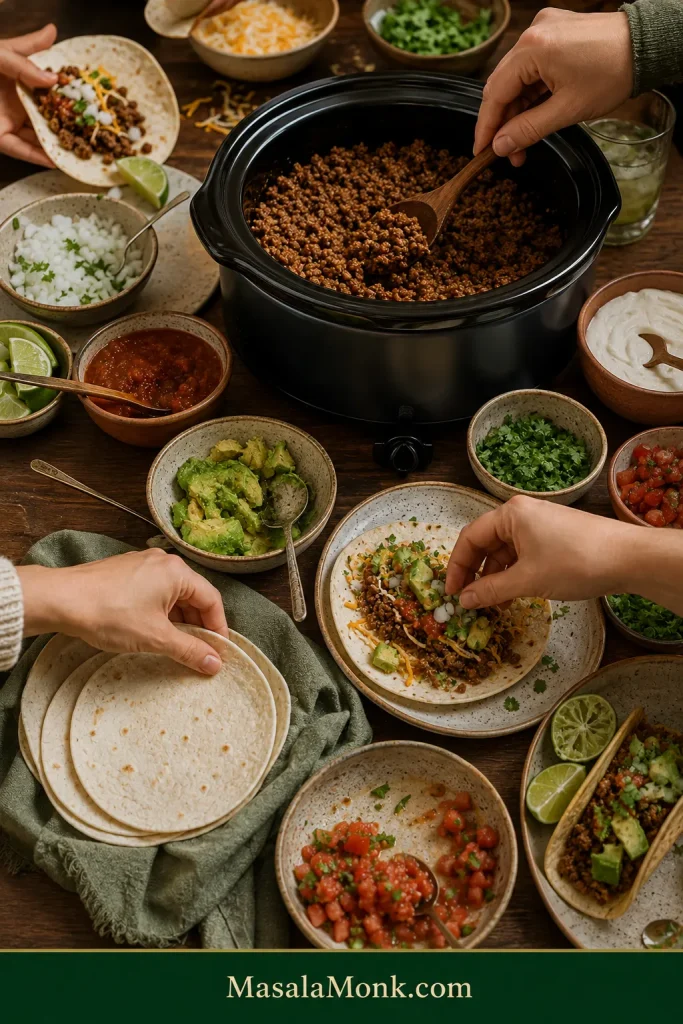
Put out whatever cheese, onion, avocado, lettuce, salsa, jalapeños or lime you already have. Leave the Crockpot where everyone can reach it and let people build their tacos the way they want them.
The meat is hot, seasoned and waiting when everyone is finally ready to eat. That’s really the whole point.
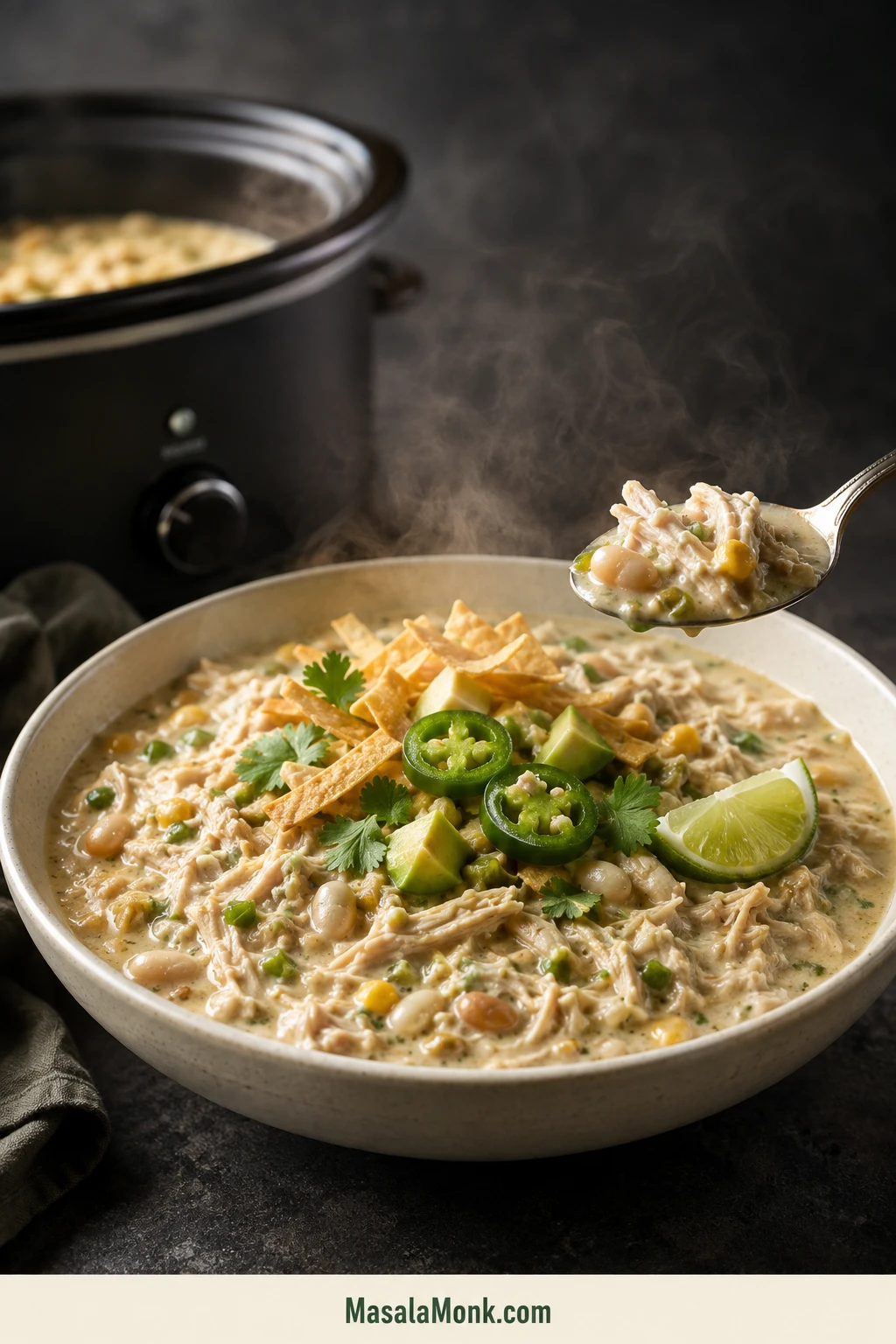
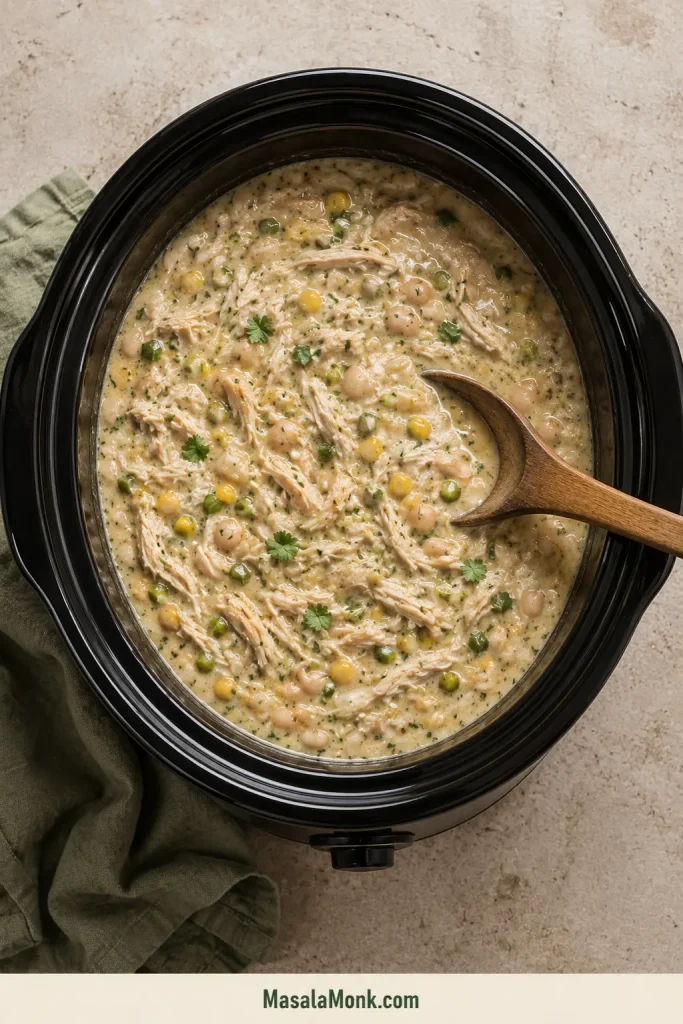
Lift the slow-cooker lid and you should find creamy white chicken chili—not pale chicken soup with beans drifting through it.
This version keeps the chicken moist and gives the broth a thick, spoon-coating texture without relying on an entire block of cream cheese. The chicken comes out as soon as it is ready, while blended white beans pull the broth together near the end.
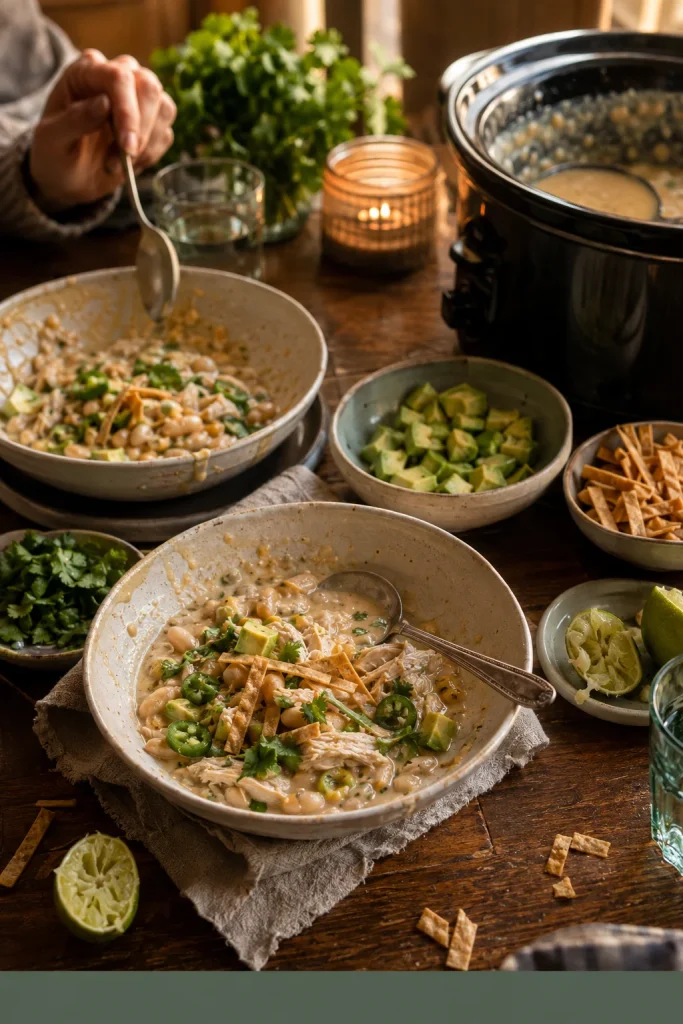
Every bowl brings tender shreds of chicken, creamy whole beans and mild green-chile warmth, with fresh lime keeping the richness lively. Set out avocado, jalapeño and tortilla chips and one mild pot can still give everyone the bowl they want.
Most of the cooking is hands-off; the useful work comes in a 10–15-minute finish.
The chicken decides when the chili is cooked. The beans and final additions decide how creamy the bowl becomes.
For a 5–6 quart slow cooker, use 1½ lb / 680 g chicken, three 15 oz / 425 g cans of white beans and 2½ cups / 590 ml broth. Two cans cook in the base. From the third, one cup is blended into the broth and the remaining beans return whole.
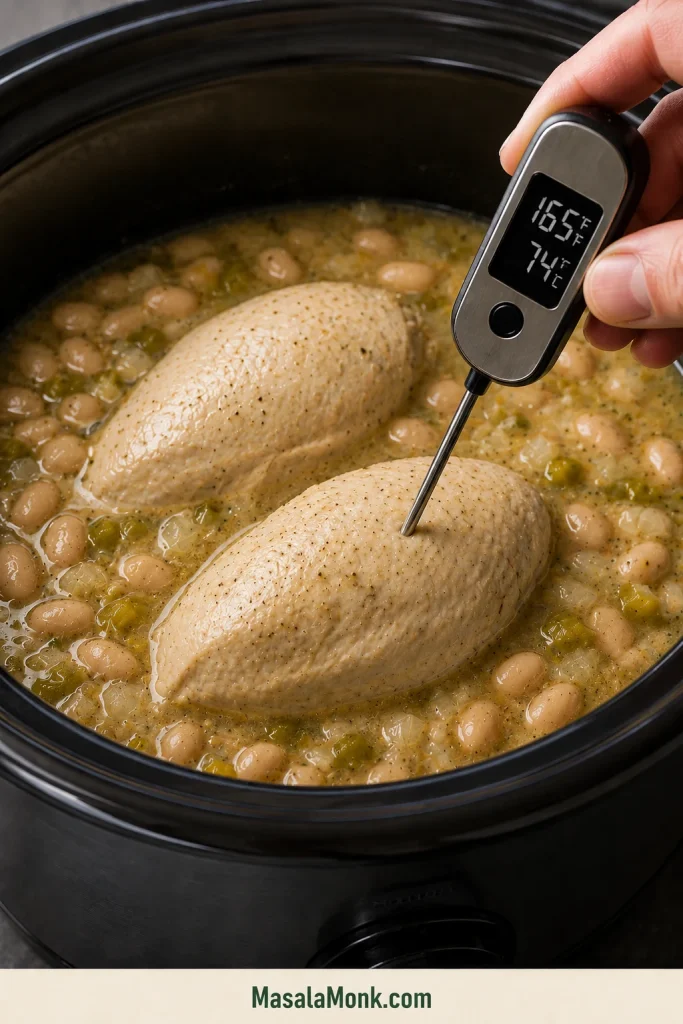
Check the chicken pieces individually and take each one out when its thickest part reaches 165°F / 74°C. Return the shredded meat with the beans, whisk softened cream cheese with hot chili liquid and let the chili rest uncovered before adding extra broth.
Initial prep 15 minutes
Active finishing 10–15 minutes
High setting Begin checking at 2½ hours
Low setting Begin checking at 4 hours
Yield About 8 servings
Cooker size 5–6 quart
Slow cookers and chicken pieces vary. Start checking at the earlier time; the thermometer and texture decide when each piece comes out.
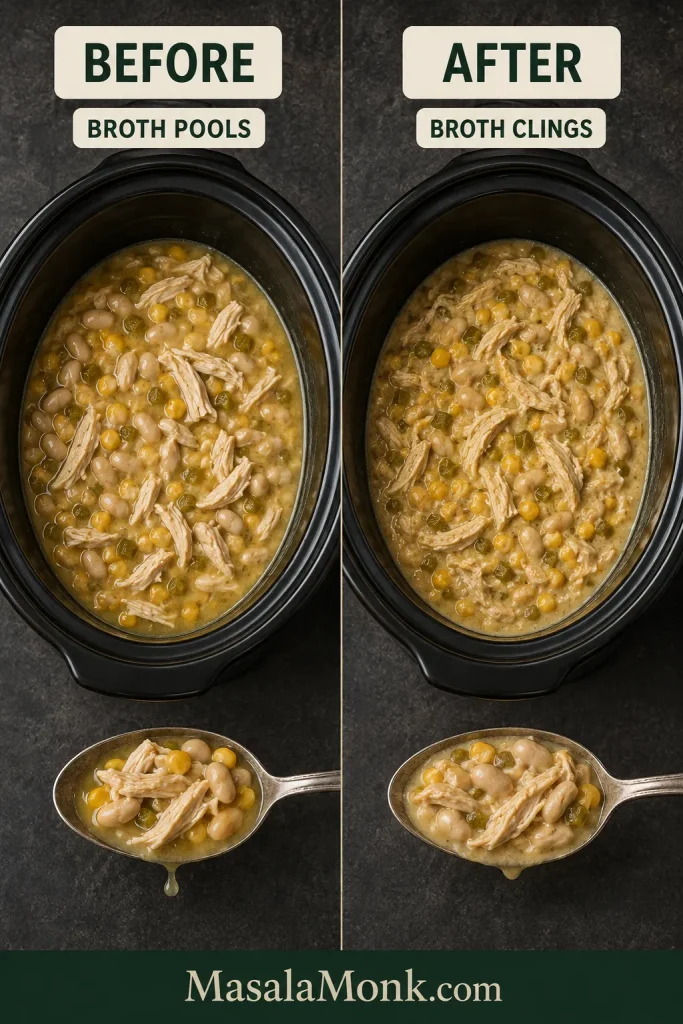
Tilt the spoon: the broth should travel briefly with the chicken and beans before slipping back into the bowl.
Slow Cooker White Chicken Chili Recipe
Most of the cooking is hands-off. The short finish leaves you with moist shredded chicken, whole creamy beans and a broth that clings rather than pools.
Prep time: 15 minutes Slow-cooker time: About 2½–3½ hours on High or 4–6 hours on Low Finishing time: 10–15 minutes Rest: 10 minutes Total time: About 3–4¼ hours on High or 4½–6¾ hours on Low Yield: About 8 main-dish servings
A finished pot should keep chicken and beans suspended through the creamy broth rather than beneath a layer of liquid.
Equipment
5–6 quart slow cooker
Instant-read food thermometer
Can opener
Cutting board and two forks
Blender, immersion blender or potato masher
Medium bowl and whisk
Ladle
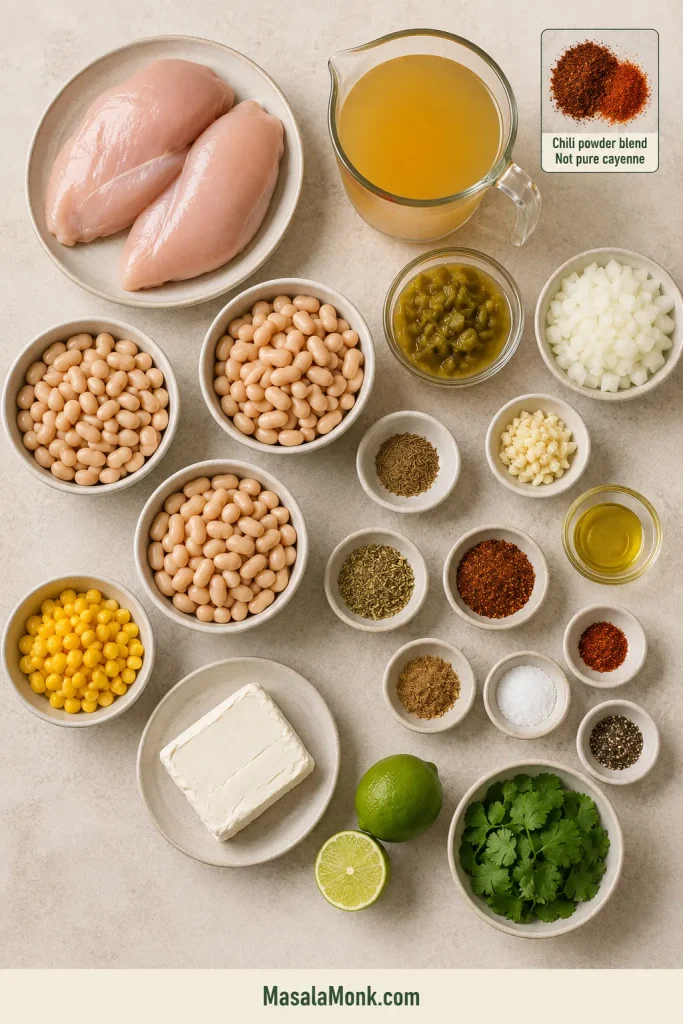
Ingredients
Low-sodium broth leaves room to adjust the final seasoning after the beans, green chiles and cream cheese are in.
For the slow-cooker base
1½ lb / 680 g boneless, skinless chicken breasts, preferably of similar thickness
2 cans white beans, 15 oz / 425 g each, drained and rinsed
1 medium yellow onion, about 6–7 oz / 170–200 g, finely diced
4 garlic cloves, minced
2 cans mild diced green chiles, 4 oz / 113 g each, undrained
2½ cups / 590 ml low-sodium chicken broth
1 teaspoon / about 1 g dried oregano
2 teaspoons / about 4 g ground cumin
1 teaspoon / about 3 g mild US-style chili powder blend, not pure cayenne
½ teaspoon / about 1 g ground coriander
¼ teaspoon cayenne pepper, optional
1 teaspoon / about 5 g fine sea salt, plus more to taste
½ teaspoon / about 1 g black pepper
2 teaspoons / 10 ml neutral oil, optional, for sautéing the onion
Kosher salt varies considerably by brand. When using it instead of fine sea salt, season by taste rather than assuming an equal-volume swap.
For thickening and finishing
1 can white beans, 15 oz / 425 g, drained and rinsed
1 cup / about 150 g frozen or well-drained canned corn, optional
4 oz / 113 g full-fat block cream cheese, softened
1–2 tablespoons / 15–30 ml fresh lime juice
¼–½ cup chopped fresh cilantro
Additional warm low-sodium chicken broth, if needed
Corn is optional. Drained canned corn only needs to heat through; frozen corn may need a few extra minutes.
Optional toppings
Diced avocado
Sliced fresh or pickled jalapeño
Chopped scallions
Monterey Jack or Pepper Jack
Sour cream or plain Greek yogurt
Crushed tortilla chips or tortilla strips
Fresh cilantro
Lime wedges
Hot sauce
Instructions
1. Build the slow-cooker base
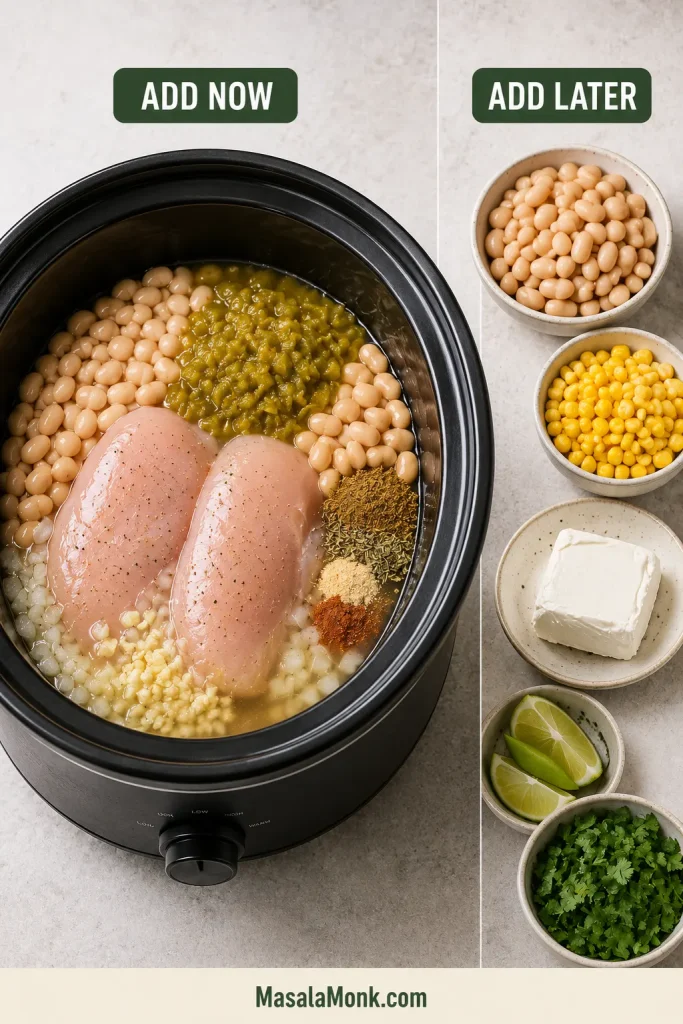
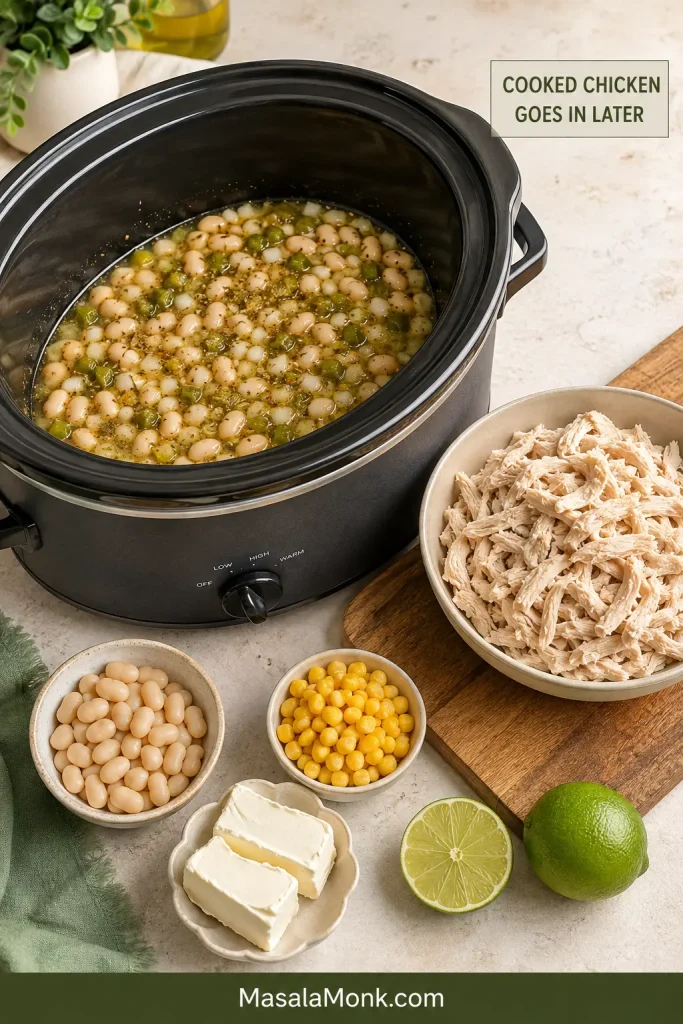
Keep the third can of beans, corn, cream cheese, lime and cilantro aside for the finishing stages.
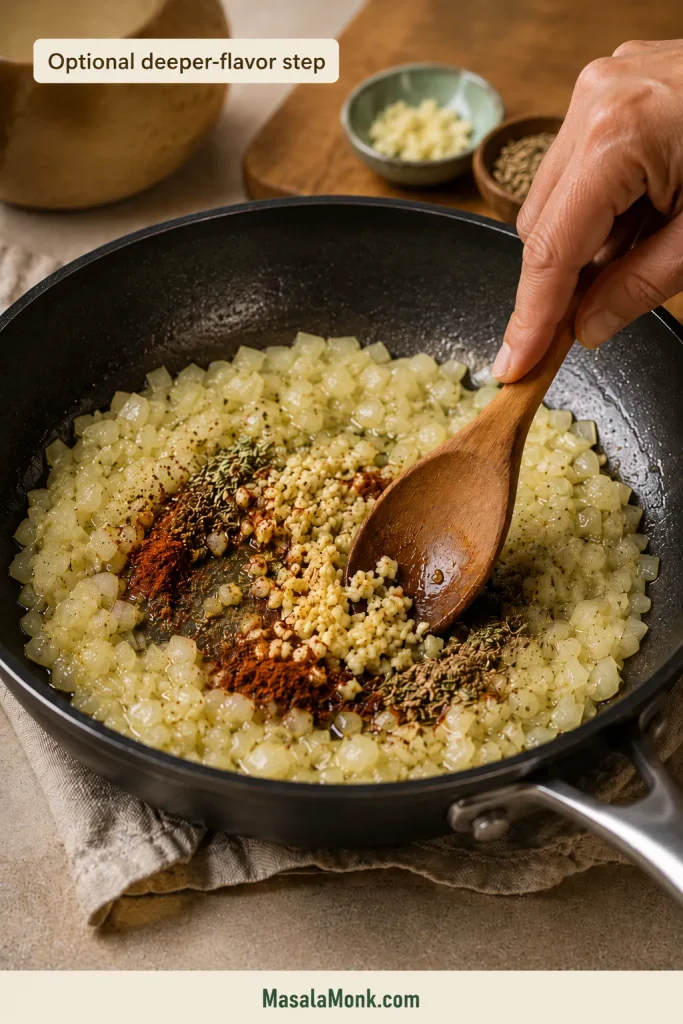
The default route is simple: use the onion, garlic and spices without sautéing them first.
For deeper flavor and especially soft onion: heat the optional oil in a small skillet. Cook the onion for 3–4 minutes, then add the garlic and dry spices for 30 seconds. Transfer the mixture to the slow cooker.
Aim for softened onion and fragrant spices with only light color; deep browning would shift the chili’s mild flavor.
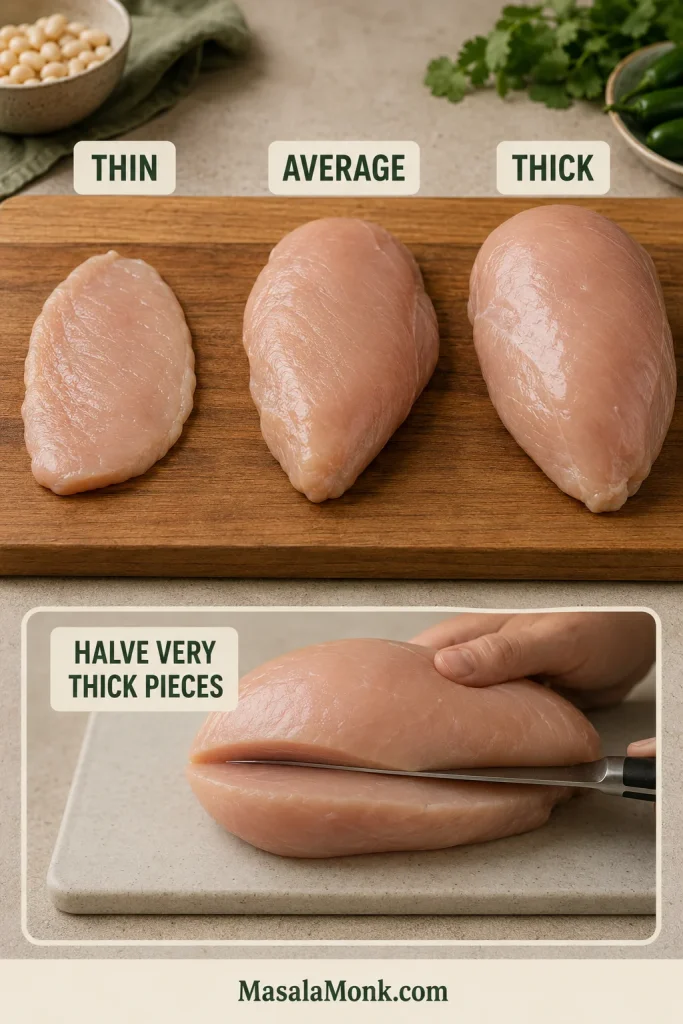
Add the raw onion and garlic—or the sautéed mixture—to the slow cooker. Place the chicken breasts over them. If one breast is much thicker than the others, halve it horizontally or expect it to finish later.
Add two cans of beans, the undrained green chiles, broth, cumin, oregano, chili powder, coriander, cayenne if using, salt and black pepper. If the spices went into the skillet, do not add them again. Stir the beans and broth around the chicken.
Keep the third can of beans, corn, cream cheese, lime and cilantro out for now.
2. Cook until the chicken is ready
Place the thermometer tip in the center of the thickest part of each chicken piece, away from the hot broth.
Cover and cook until the thickest part of each piece reaches 165°F / 74°C and separates easily under light pressure.
On High, begin checking at about 2½ hours.
On Low, begin checking at about 4 hours.
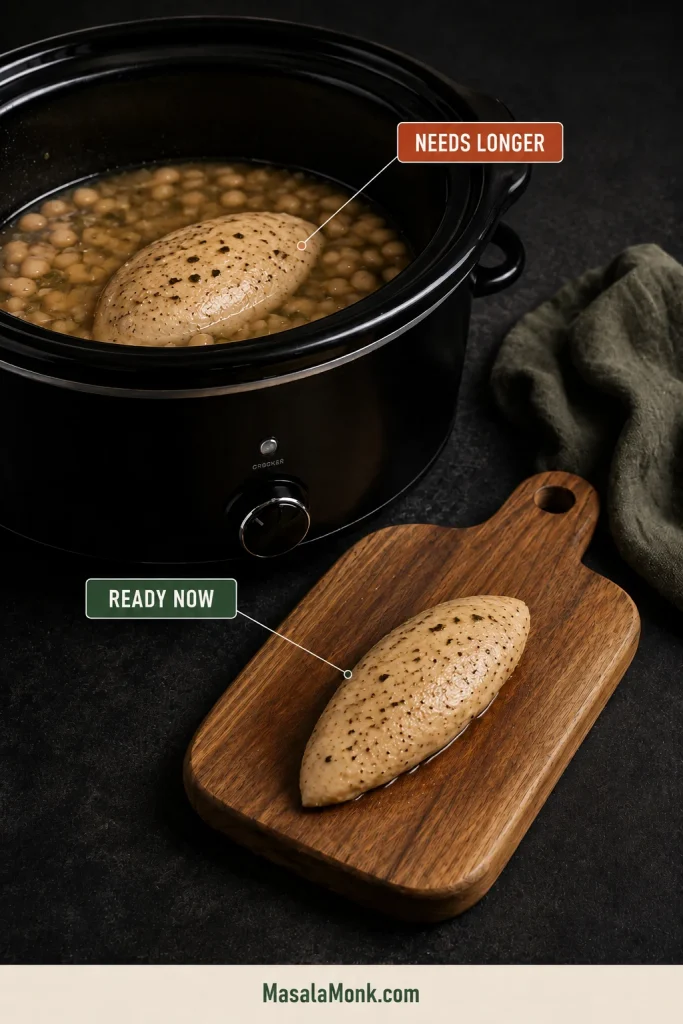
Check each piece in its thickest part, starting with the largest. Transfer pieces to a cutting board individually as they become ready. Pulling one breast out before the others can feel early, but moist shreds on the board matter more than the longest number on the timer.
Remove each chicken piece as it reaches 165°F / 74°C; thicker pieces can keep cooking while smaller ones rest.
3. Shred the chicken
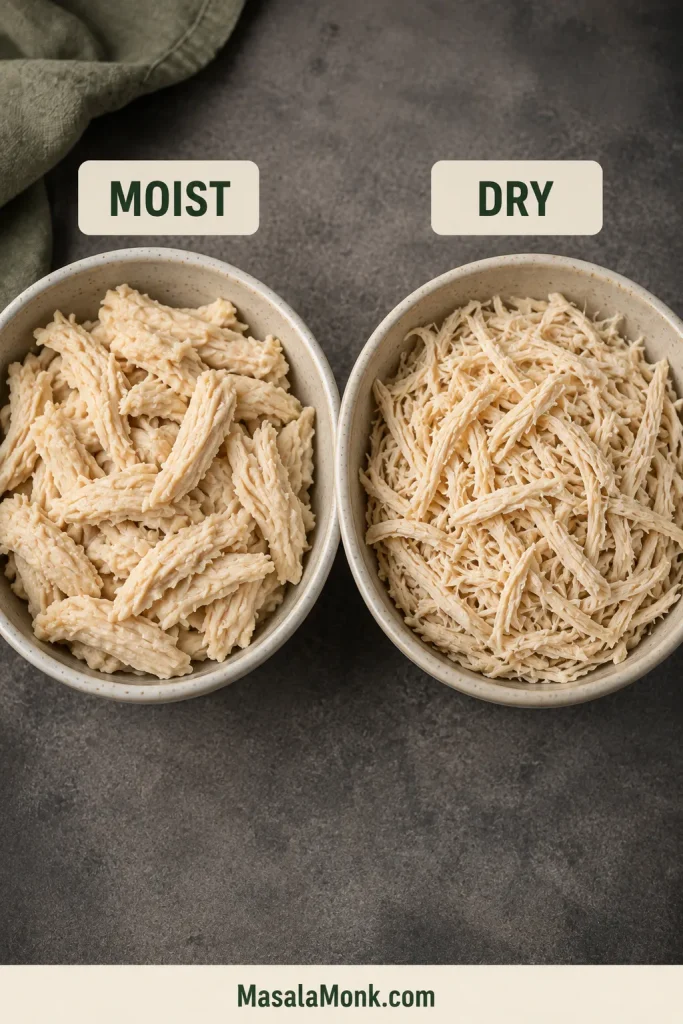
Shred the chicken with two forks. It should pull apart easily while still looking moist, not chalky or fibrous.
Shred just to broad, bite-size strands. Stopping early keeps the chicken looking moist instead of fine and stringy.
4. Blend part of the reserved beans
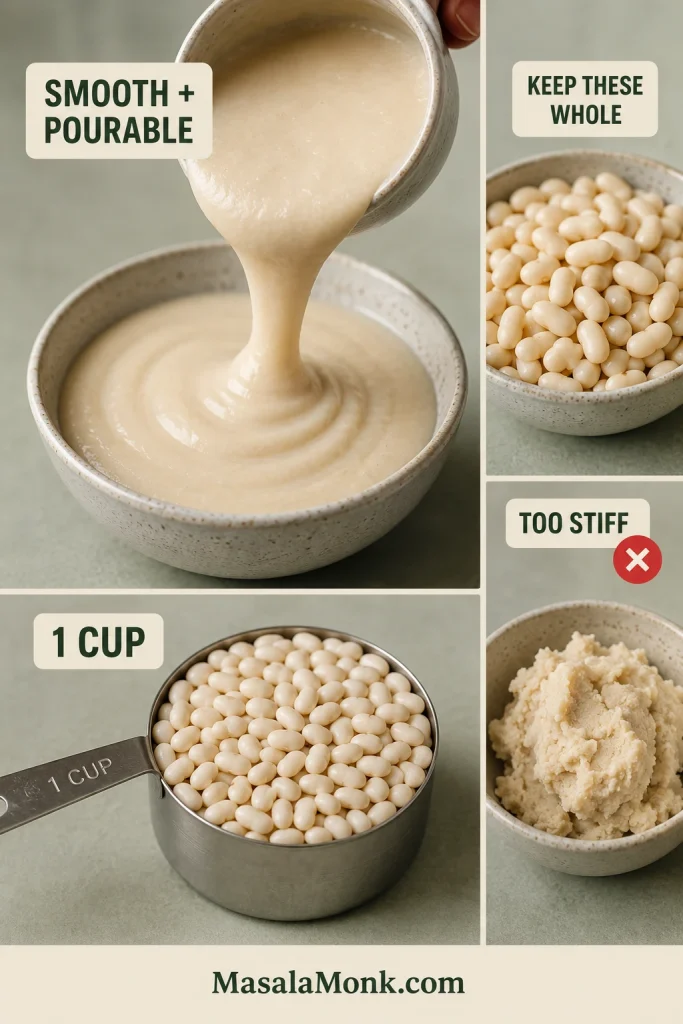
Measure 1 cup of drained beans from the third can. Blend them with ¾ cup / 180 ml hot liquid from the slow cooker until smooth and pourable.
The bean purée should pour, not mound. Loosen it with a little more hot cooking liquid if needed.
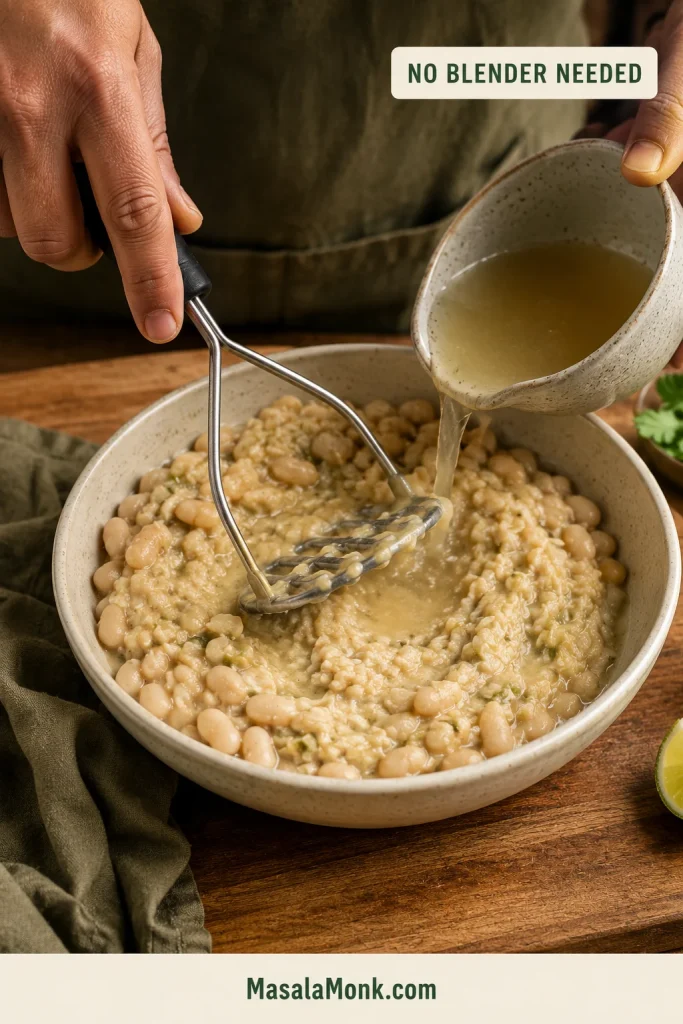
For a no-blender method, mash the measured beans and hot liquid thoroughly in a bowl. Keep the remaining beans whole.
Mash firmly enough to break the bean skins and release starch; a few visible pieces are completely fine.
When using a countertop blender, vent hot liquid according to the manufacturer’s instructions and blend only a small amount at a time.
5. Bring the chili together
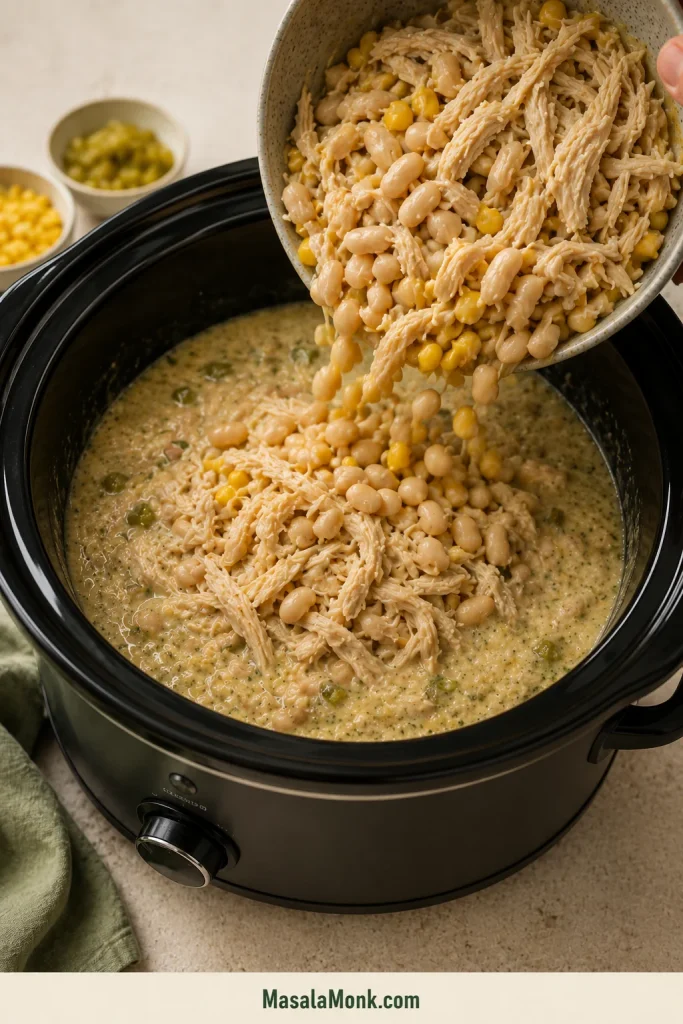
Stir in the shredded chicken, bean purée, remaining whole beans and corn.
Fold the chicken back in gently to keep broad, juicy shreds intact as the chili finishes.
Cover and cook for another 10–15 minutes, or a few minutes longer when using frozen corn. The broth should begin clinging to the chicken and beans instead of pooling beneath them.
6. Add the cream cheese gently
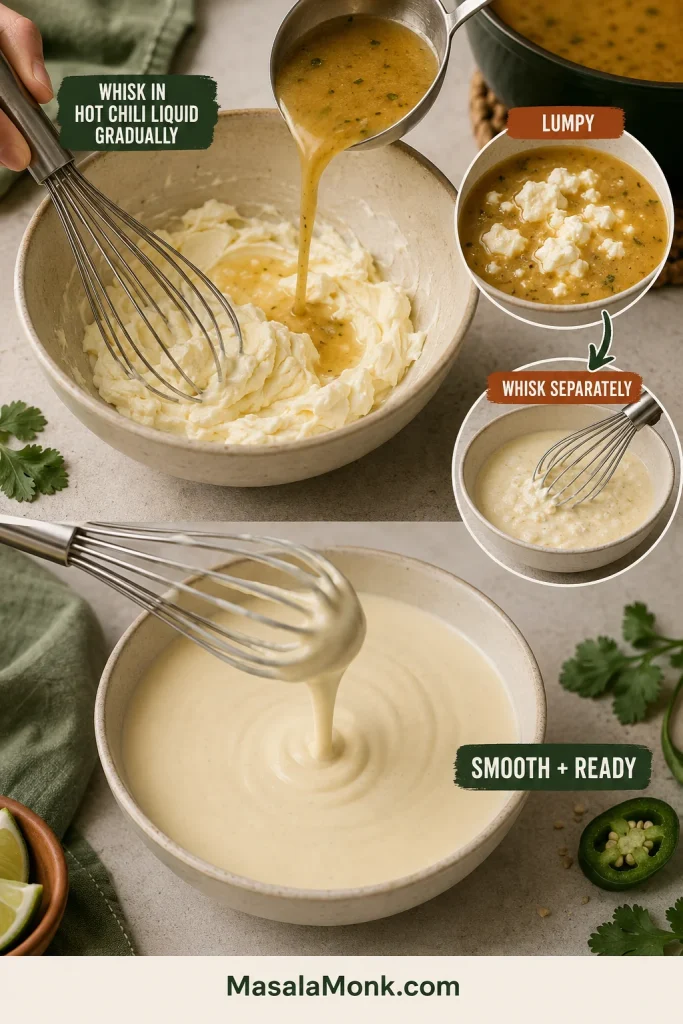
Place the softened cream cheese in a medium bowl. Add about ¾ cup / 180 ml hot chili liquid in several additions, whisking after each one until mostly smooth.
Whisk hot chili liquid into softened cream cheese first so it melts into the broth smoothly.
Stir the cream cheese mixture into the slow cooker on Low or Warm. Gentle stirring should help it melt into the broth without hard boiling.
7. Add lime, rest and taste
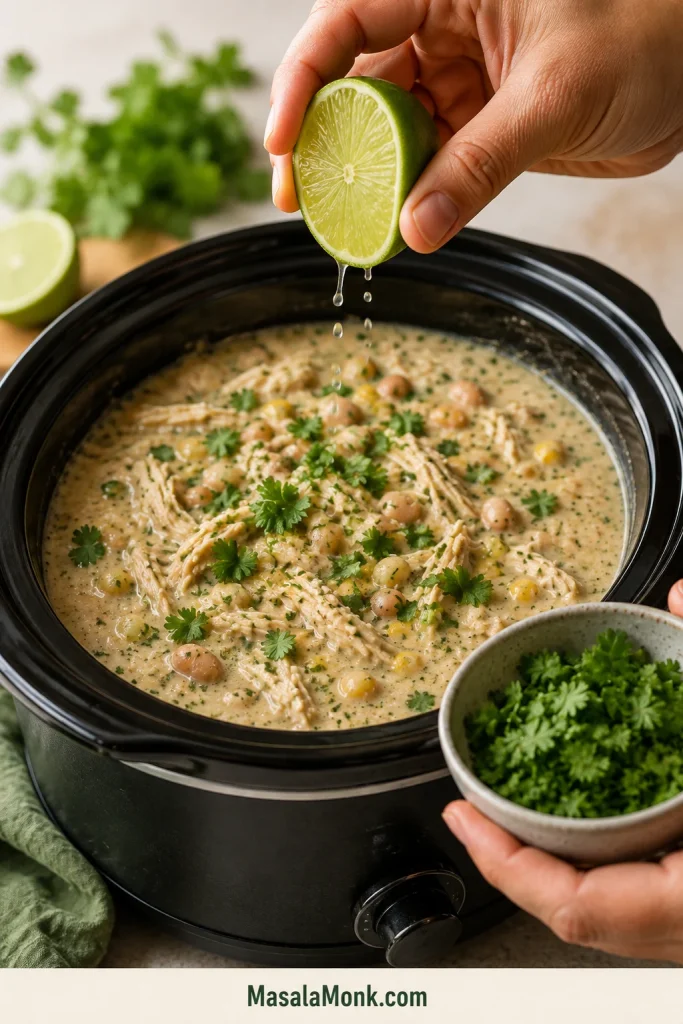
Stir in 1 tablespoon / 15 ml lime juice and the cilantro. Turn off the slow cooker and leave the lid off for 10 minutes.
Add the first lime, let the chili rest, then taste again before deciding whether it needs more.
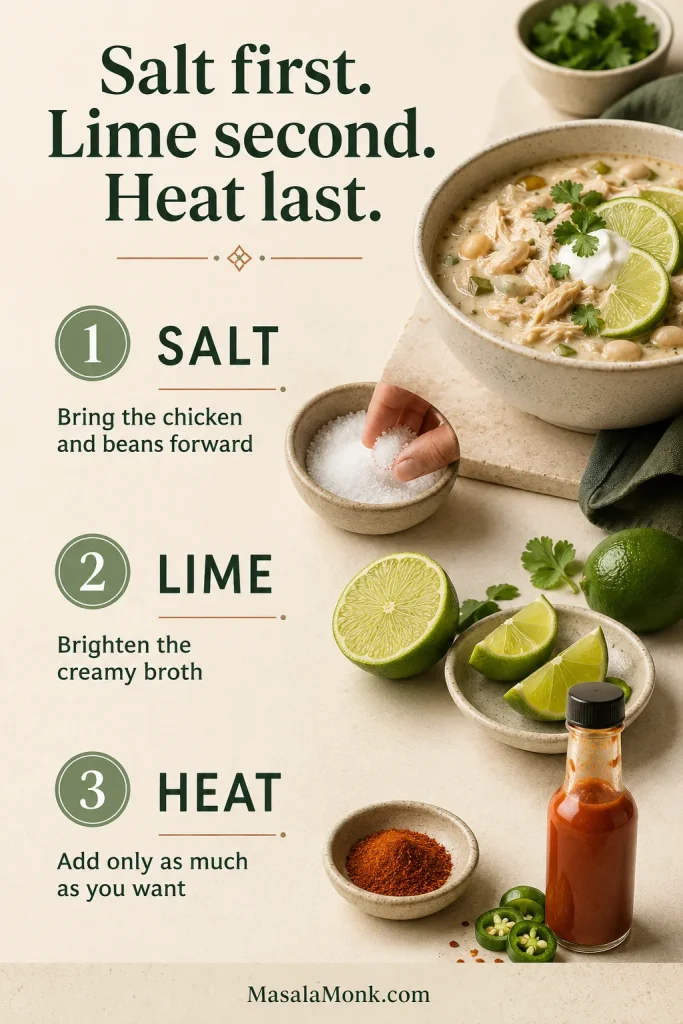
A creamy pot can taste finished before it tastes fully awake. Taste in this order: salt first, lime second and heat last. Salt brings the chicken and beans forward, lime lifts the creamy broth, and cayenne or hot sauce raises the heat without changing the whole pot.
Taste in sequence—salt first, lime second, heat last—so each adjustment has a clear purpose.
If the chili is thicker than you prefer, add warm broth a quarter cup at a time.
Full-fat block cream cheese melts more smoothly than whipped or tub-style products.
Add the green chiles with their liquid; the starting broth amount already accounts for that extra moisture.
If the onion is still firmer than you prefer when the chicken is ready, remove the chicken and let the base continue for another 10–15 minutes. Dice the onion finely or use the sautéed route next time.
The chili thickens after refrigeration, so loosen leftovers gradually while reheating.
The recipe above is all you need for dinner. Keep the guide below nearby for chicken that cooks faster than expected, a pot that looks too loose or the version you want to make next time.
Why This White Chicken Chili Stays Thick and Creamy
Very little moisture escapes beneath a slow-cooker lid. Steam condenses and falls back into the pot while the chicken, onion and green chiles release liquid of their own.
That is why white chicken chili needs a different balance from a tomato-based crockpot chili. Red chili can draw thickness from tomatoes, tomato paste, meat and reduction. Here, the beans must do more of the work.
Most of the beans remain whole. One cup is blended into the broth so it coats the chicken rather than behaving like clear stock. The cream cheese adds richness without having to do all the thickening.
Choose the Ingredients and Cook the Chicken
Chicken breasts or thighs
Chicken breasts make a leaner bowl but can dry out when left in the cooker after they are ready. Boneless thighs are juicier and more forgiving during longer cooking. Keep the total weight close to 1½ pounds whichever cut you choose.
Best beans for white chicken chili
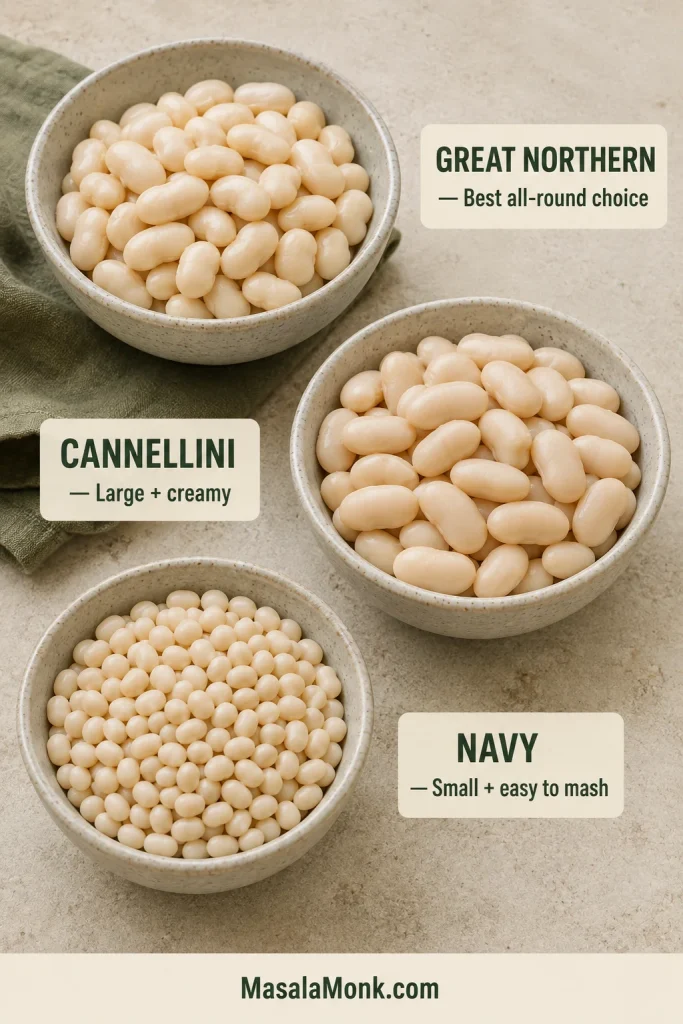
Great Northern beans are mild, medium-sized and a dependable default.
Cannellini beans are larger and especially creamy when blended.
Navy beans are smaller, softer and easy to mash.
Great Northern beans balance whole-bean texture and blending; cannellini are plumper, while navy beans mash especially easily.
Dried beans are not a direct swap because they need their own soaking, liquid and cooking-time plan.
Green chiles and lime
Two small cans of mild green chiles keep their flavor noticeable after the beans and cream cheese go in. Add jalapeño, cayenne or hot sauce separately when you want more heat.
Mild green chiles build flavor in the base; jalapeño, cayenne or hot sauce can raise the heat later.
Add lime only near the end so its brightness stays clear against the beans and cream cheese.
How long to cook white chicken chili in the slow cooker
Compare chicken from the side: similar-looking breasts can cook differently when one is much thicker through the center.
All chicken should reach 165°F / 74°C. The ranges below tell you when to begin checking; remove each piece when it reaches temperature and still looks moist.
On a phone, swipe sideways to see every column.
Chicken
Setting
Begin checking
Likely range
Texture cue
Average chicken breasts
High
2½ hours
About 2½–3½ hours
Easy to shred and still moist
Average chicken breasts
Low
4 hours
About 4–6 hours
Easy to shred and still moist
Boneless chicken thighs
High
3 hours
About 3–4 hours
Tender and separating easily
Boneless chicken thighs
Low
4½ hours
About 5–6½ hours
Tender and separating easily
Chicken first-check times for slow cooker white chicken chili.
Check every piece in its thickest part, starting with the largest. Remove pieces individually as they reach 165°F / 74°C and still look moist. USDA safe-temperature guidance gives 165°F / 74°C as the minimum internal temperature for poultry.
What the Chili Should Look Like at Each Stage
When the lid first opens
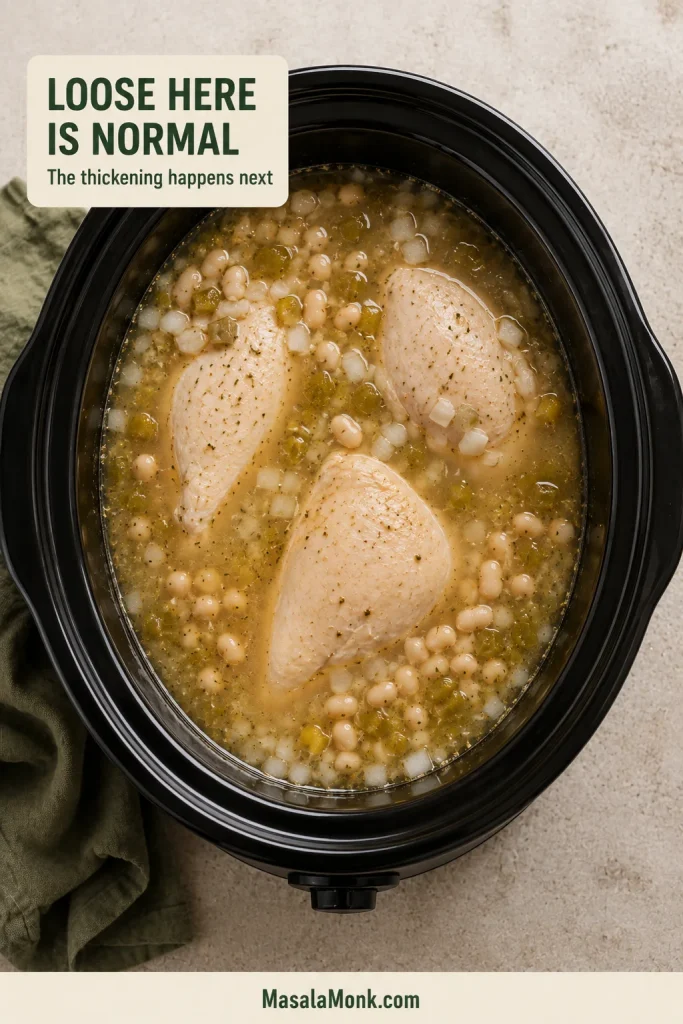
The pot may look looser than expected. The chicken is still whole, the blended beans are still outside the cooker and the final additions have not gone in. A brothier appearance here is normal.
Keep the loose liquid. It will help blend the reserved beans and temper the cream cheese before the chili thickens.
After the chicken and bean purée return
The broth becomes creamier-looking and starts clinging to the shredded chicken. The chicken and beans stop looking separate from the broth.
Watch movement more than color: after the bean purée returns, the solids should stay suspended longer while the chili still pours.
After resting
The broth should lightly coat the spoon and settle slowly when ladled. It remains looser than tomato-heavy beef chili but should be visibly thicker than chicken soup.
Once the spoon looks right, choose how rich or tangy you want the finished bowl.
Choose Your Creamy White Chicken Chili Style
Style
Use
How to add it
Result
Classic
4 oz / 113 g cream cheese
Whisk with hot chili liquid before stirring it in
Smooth and rich without hiding the beans and chiles
Lighter
2 oz / 57 g cream cheese
Add it using the same gentle method
Creamy with less dairy richness
Tangy
¼ cup / 60 g sour cream or plain Greek yogurt instead of cream cheese
Temper with hot chili liquid, then stir it in with the cooker off or set to Warm. Do not let it boil
Brighter, lighter and gently tangy
Dairy-free
No dairy
Use the bean purée; mash another ½ cup of beans only if needed after resting
Bean-forward and naturally creamy
Bean purée provides the body in every version; changing the dairy mainly changes richness and tang.
For sour cream or yogurt, use the gentle approach in this chicken paprikash recipe: warm the dairy gradually with hot liquid and avoid boiling it afterward.
How to Fix Thin or Overly Thick White Chicken Chili
Start with the least irreversible fix: rest, beans and gentle reduction before concentrated starches.
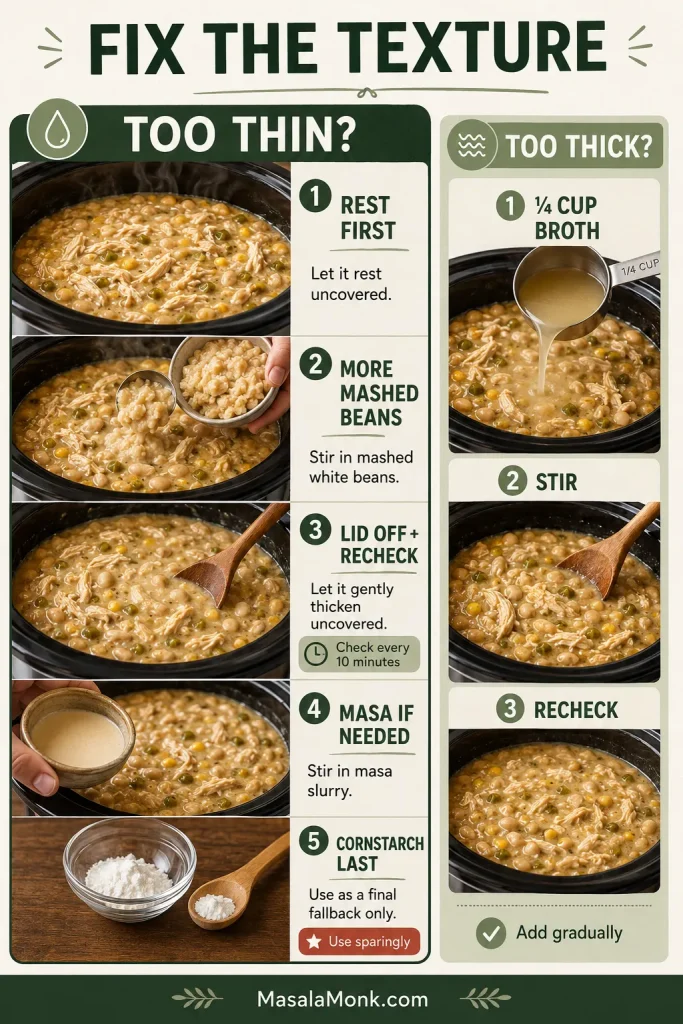
When the chili is too thin
Give the beans the first chance to fix the pot. Reach for masa or cornstarch only when they are not enough.
Finish the recipe and let the chili rest.
Mash or blend another ½ cup of beans.
Leave the lid off and continue cooking, stirring occasionally, until the broth coats the spoon more clearly. Check every 10 minutes rather than assuming one fixed reduction time.
Whisk 1 tablespoon masa harina with 2 tablespoons cool water or broth and stir it in.
Use cornstarch only as the last resort.
For a cornstarch slurry, whisk 1 tablespoon cornstarch with 1–2 tablespoons cool water. Stir it into the hot chili and allow 5–10 minutes for it to thicken.
When the chili is too thick
Add warm broth a quarter cup at a time. Stir, wait briefly and check the spoon before pouring in more.
Keep rotisserie chicken in broad shreds; it will soften further as it warms in the seasoned chili.
Use the main recipe quantities, replacing the raw chicken with 3 cups / 425–450 g cooked shredded chicken and reducing the broth to 2 cups / 473 ml.
Already-cooked chicken needs seasoned broth and enough time to become hot—not another afternoon of cooking. Leftover meat from a whole chicken cooked in the Crock Pot works as well as store-bought rotisserie chicken.
Sauté the diced onion in 2 teaspoons / 10 ml oil for 3–4 minutes. Add the garlic and spices for 30 seconds.
Transfer to the slow cooker with two cans of beans, the green chiles and 2 cups / 473 ml broth.
Cook on Low for about 2 hours, until the onion is tender.
Blend one cup of beans from the third can with hot liquid from the cooker.
Add the purée, remaining beans, corn and cooked chicken.
Cook for another 20–30 minutes, until the chili is steaming throughout and reaches 165°F / 74°C near the center of the cooker. Stir in the cream cheese mixture, lime and cilantro.
Rotisserie chicken, canned ingredients and broth can all be salty, so taste before adding any final salt.
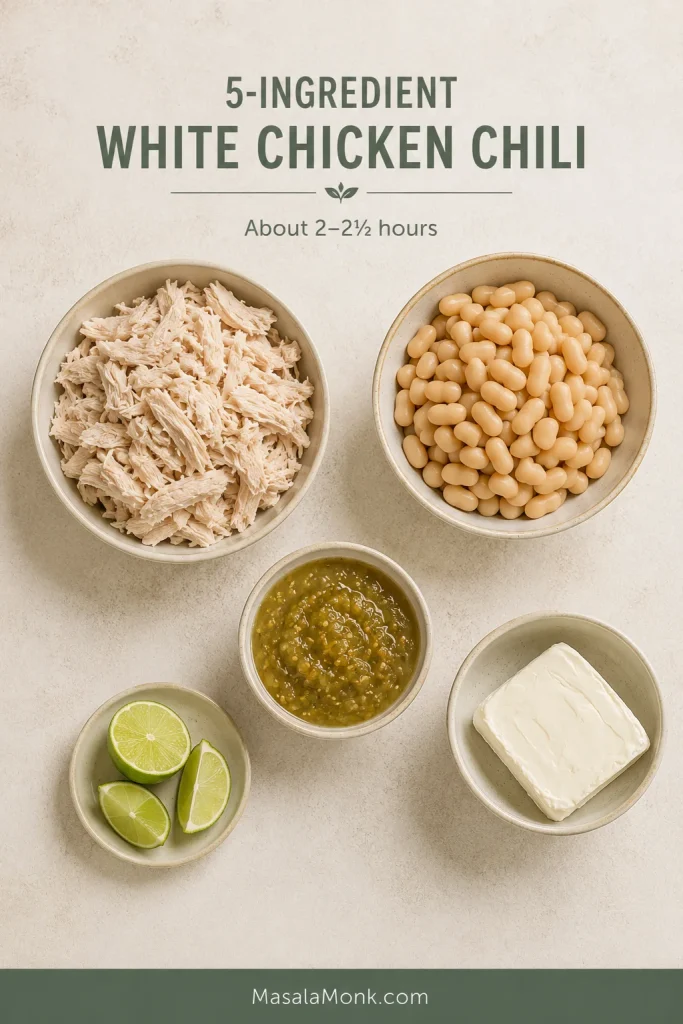
5-Ingredient White Chicken Chili With Salsa Verde
With only five ingredients, salsa verde carries most of the seasoning. Use one you already enjoy on its own.
Prep time: About 10 minutes Slow-cooker time: About 2–2½ hours Yield: About 6–8 servings
3 cups / 425–450 g cooked shredded chicken
3 cans white beans, 15 oz / 425 g each, drained and rinsed
16 oz / 454 g salsa verde
4 oz / 113 g softened cream cheese
1–2 tablespoons / 15–30 ml fresh lime juice
Add two cans of beans and the salsa verde to the slow cooker. Cook on Low for 1½–2 hours, until hot.
Blend one cup of beans from the third can with some of the hot salsa mixture. Return the purée with the remaining beans and chicken. Cover and cook for another 20–30 minutes, until steaming hot throughout.
Whisk the softened cream cheese with hot chili liquid, stir it into the pot and finish with lime. Begin without broth because salsa verde varies in thickness; add warm broth only if the chili needs loosening.
What the Salsa-Verde Shortcut Should Look Like
Jarred salsa keeps this route fast. For more control over acidity, heat and texture, use homemade roasted salsa verde.
Salsa verde changes the flavor direction; blended white beans still give the shortcut chili most of its body.
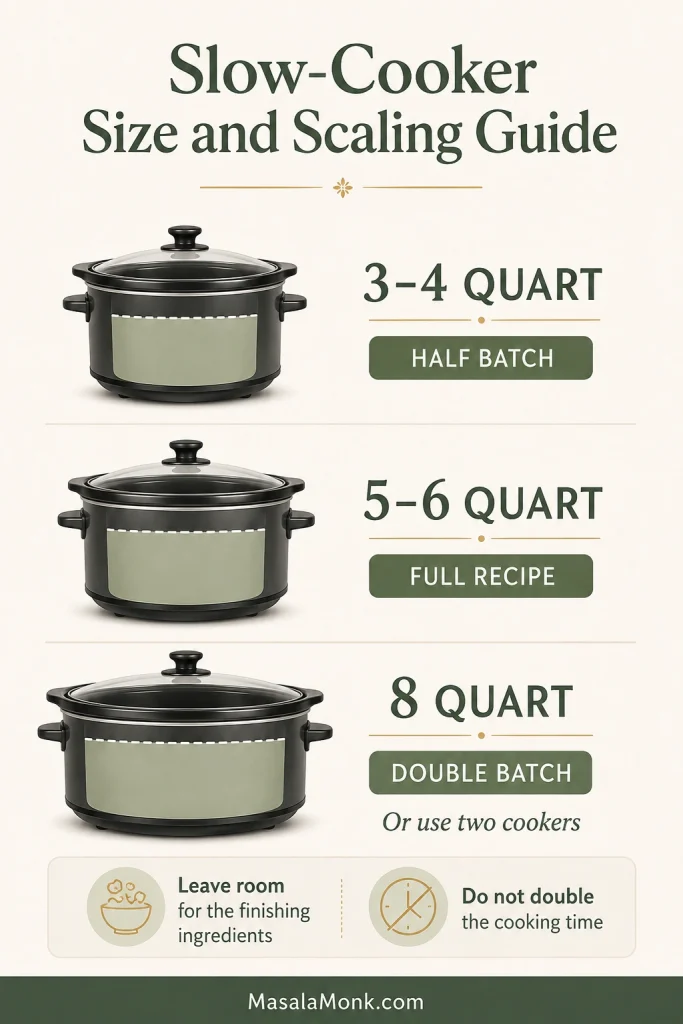
Capacity and cooking time are separate questions; a larger batch needs room, while chicken thickness and temperature still determine doneness.
Half batch: use a 3–4 quart slow cooker. Keep the chicken pieces similar in thickness and use the same early checkpoints; a smaller batch may heat faster, but temperature still decides when each piece is ready.
Full batch: use a 5–6 quart slow cooker.
Double batch: use an 8 quart cooker with comfortable stirring room, or divide the recipe between two cookers. Do not double the cooking time; a fuller cooker may simply take longer to heat.
Do not fill the cooker beyond the manufacturer’s recommended level. The uncooked mixture needs room for the shredded chicken, remaining beans and purée added near the end.
Dice the onion and measure the spices the night before. Keep the raw chicken and other perishable ingredients covered and refrigerated until the cooker is ready to start.
White Chicken Chili Troubleshooting
On a phone, swipe sideways to see every column.
Problem
Likely cause
What to do now
Dry chicken
It stayed in the cooker after it was ready
Shred it finely and stir in a little warm broth
Lumpy cream cheese
Cold cream cheese went directly into the pot
Ladle some hot liquid and the visible lumps into a bowl, whisk as smooth as possible, then return the mixture over gentle heat
Oily or grainy broth
The dairy boiled or overheated
Turn off the heat, whisk gently and add a small splash of warm broth; badly overheated dairy may not become completely smooth again
Creamy but bland
The pot needs sharper seasoning
Adjust salt first, lime second and heat last
Too spicy
Hot salsa, jalapeño or too much cayenne
Add unsalted beans or broth and serve with avocado or sour cream
Too salty
Salty broth, rotisserie chicken, beans or toppings
Dilute with unsalted beans and broth
Common white chicken chili problems and practical ways to rescue the pot.
The chili already contains chicken and beans, so one simple side and a small topping bar are usually enough.
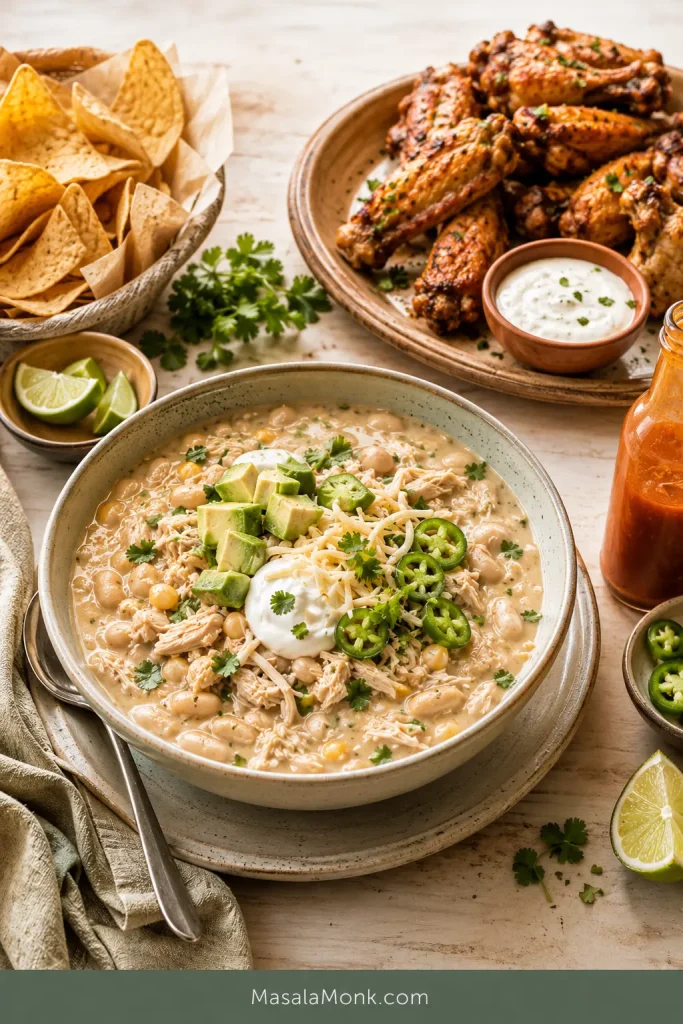
For game day, pair it with crispy air fryer chicken wings. The wings add crunch while the chili remains the warm, spoonable center of the meal.
Crisp wings and tortilla chips give a creamy bowl the texture contrast that works especially well for game day.
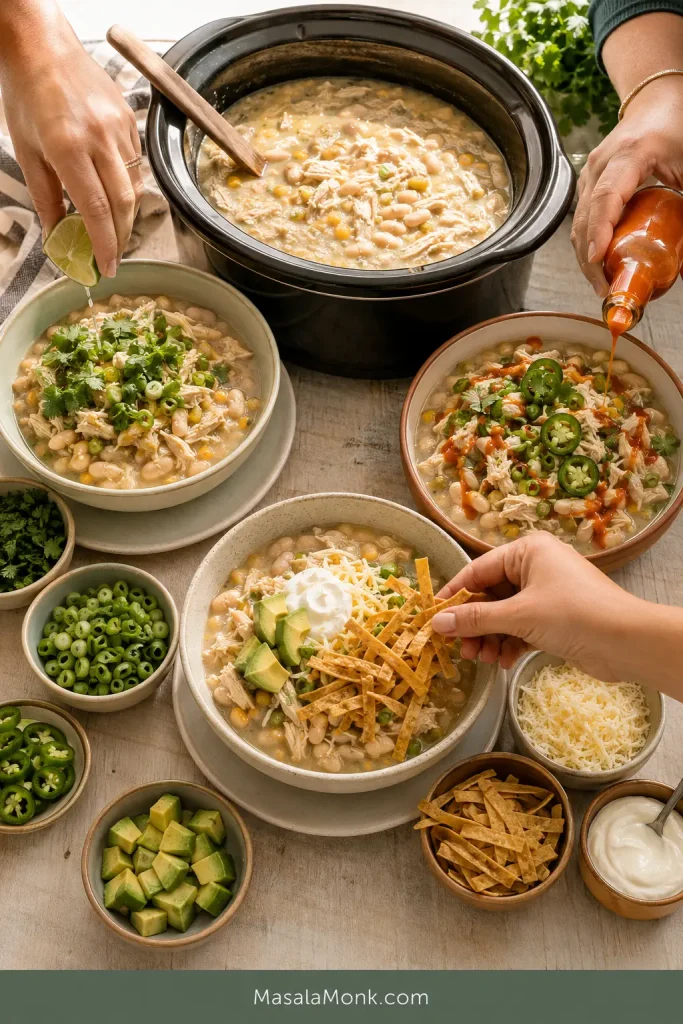
Build a White Chicken Chili Topping Bar
Freshness: lime, cilantro, scallions or diced tomato
Creaminess: avocado, sour cream or Greek yogurt
Crunch: tortilla strips, crushed tortilla chips or sliced radishes
Heat: jalapeño, cayenne or hot sauce
Richness: Monterey Jack or Pepper Jack
Simple side: cornbread, warm tortillas, a green salad or roasted vegetables
Pass the toppings around and let each bowl lean brighter, hotter, creamier or crunchier.
Serve dairy, chile, acid and crunch separately so one balanced pot can suit different appetites at the table.
The slow cooker has done the long work; dinner can now feel as relaxed as it was supposed to.
Keeping it warm for serving
Once the chili is completely cooked, switch the cooker to Warm. Stir periodically and add a small splash of broth if the beans continue tightening the pot.
Warm is for holding the finished chili rather than extending the chicken’s cooking time. Keep hot food at 140°F / 60°C or above; the USDA slow-cooker safety guidance uses the same threshold for hot holding.
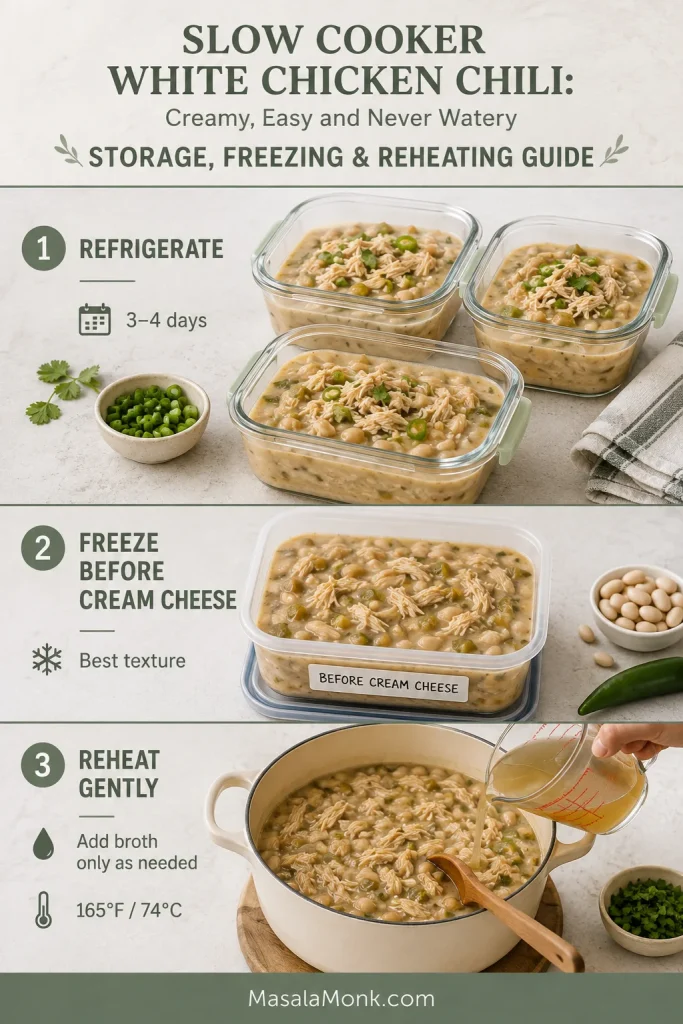
Storage, Freezing and Reheating
Shallow containers cool and portion leftovers efficiently; keep avocado, herbs and crunchy toppings separate.
Once dinner is over, the same beans that thickened the broth will keep absorbing liquid in the refrigerator.
Refrigerating
Transfer the chili to shallow airtight containers and refrigerate it within two hours. Keep avocado, herbs and crunchy toppings separate and use the chili within 3–4 days.
The next-day chili will be thicker than the first bowl. That is normal.
Freezing
For the smoothest reheated texture, freeze the chicken-and-bean base before adding cream cheese, lime and cilantro. Stir those in after reheating.
A fully finished batch can also be frozen, although the dairy may look slightly grainy after thawing. For best quality, use it within about three months.
Reheating
Reheat gently on the stovetop or in the microwave, stirring occasionally and adding broth only as needed. Bring leftovers to 165°F / 74°C.
A refrigerator-cold batch should not be reheated from scratch in the slow cooker. Reheat it promptly first, then transfer the hot chili to a preheated cooker on Warm for serving. See the USDA guidance on leftovers and food safety for further storage and reheating advice.
Thaw raw chicken before slow cooking so it heats safely and evenly. Frozen or partially frozen pieces take longer to come up to temperature and make the cooking time difficult to predict.
Can I use canned chicken?
Yes. Drain it well and add it near the end, just as you would other already-cooked chicken. Its texture will be softer, so stir gently and check the salt after it is hot.
Can I use dried beans?
Not in the same method. Dried beans need separate soaking and cooking instructions.
Is white chicken chili spicy?
The classic version is mild. The green chiles add flavor without intense heat. Add jalapeño, cayenne or hot sauce for a hotter bowl.
What makes this chili rather than chicken soup?
Chili has more bean-led thickness and less free broth than chicken soup. The liquid should cling lightly to the chicken instead of behaving like clear stock.
A Creamy Pot That Still Tastes Like Chili
There is a satisfying moment near the end when the broth begins clinging to the shredded chicken. Add the lime, leave the lid off and give the pot a few quiet minutes.
Then ladle it into bowls and set out the toppings. The chili is creamy, bright and substantial, and everyone at the table can decide how much heat, crunch or lime belongs in their bowl.
Made it? Tell us which chicken cut and slow-cooker size you used, and whether you kept the chili thick or loosened your bowl with a little more broth.
Brisket asks for most of a day, so uncertainty near the end can feel bigger than it does with an ordinary roast. One piece is broad and relatively thin. Another is tied into a thick, compact joint. Both may weigh the same, yet one can become tender noticeably earlier than the other.
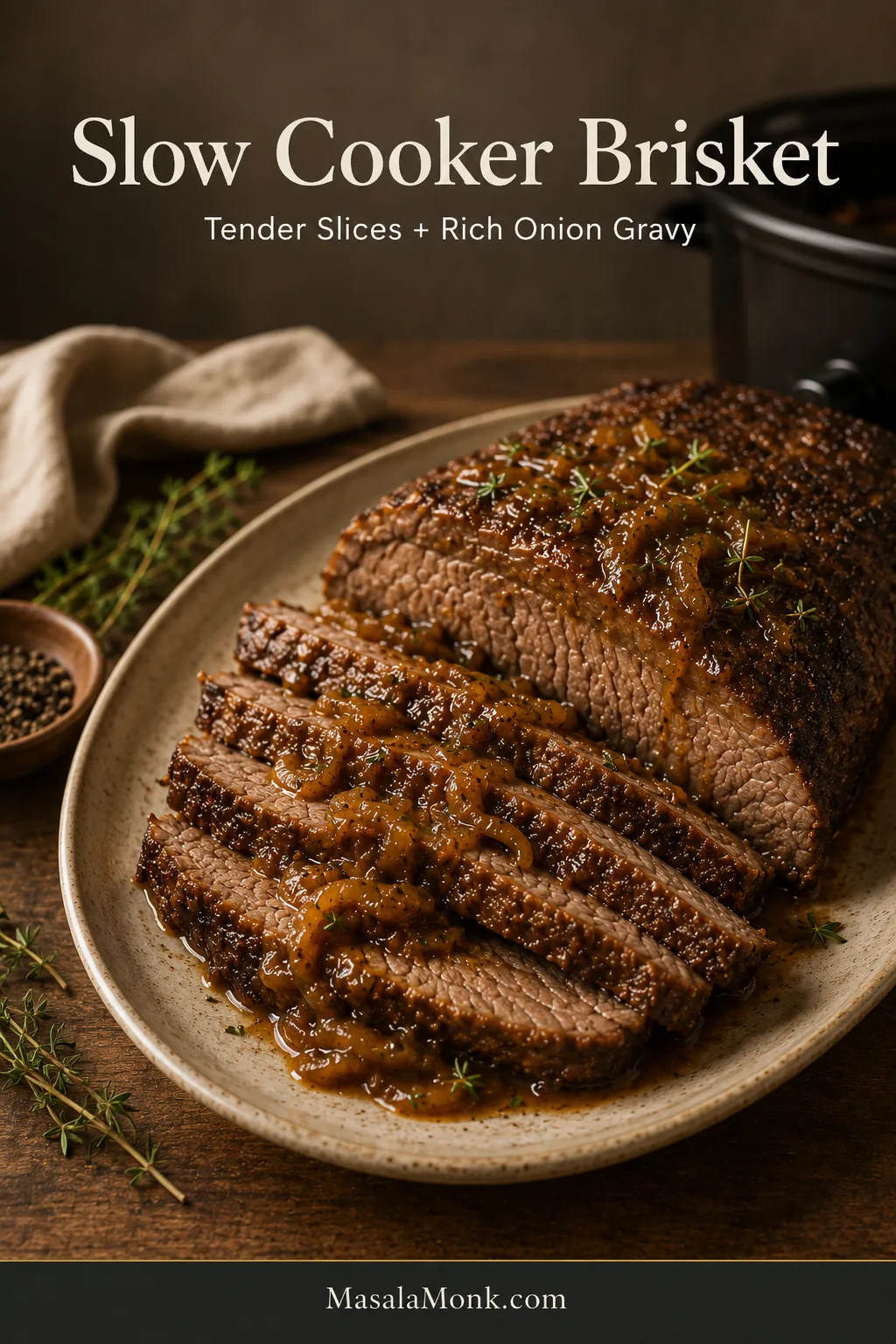
This slow cooker brisket is built for the result that suits gravy best: beef that feels deeply tender when sliced but holds together when lifted. The browned bits from the skillet deepen the cooking liquid, which is reduced into rich onion gravy rather than served as thin broth.
By the time the lid comes off, the onions should have softened into the dark cooking juices and the brisket should hold its shape. Dinner should smell as though the beef was fussed over all day, even though the slow cooker handled the long middle stretch.
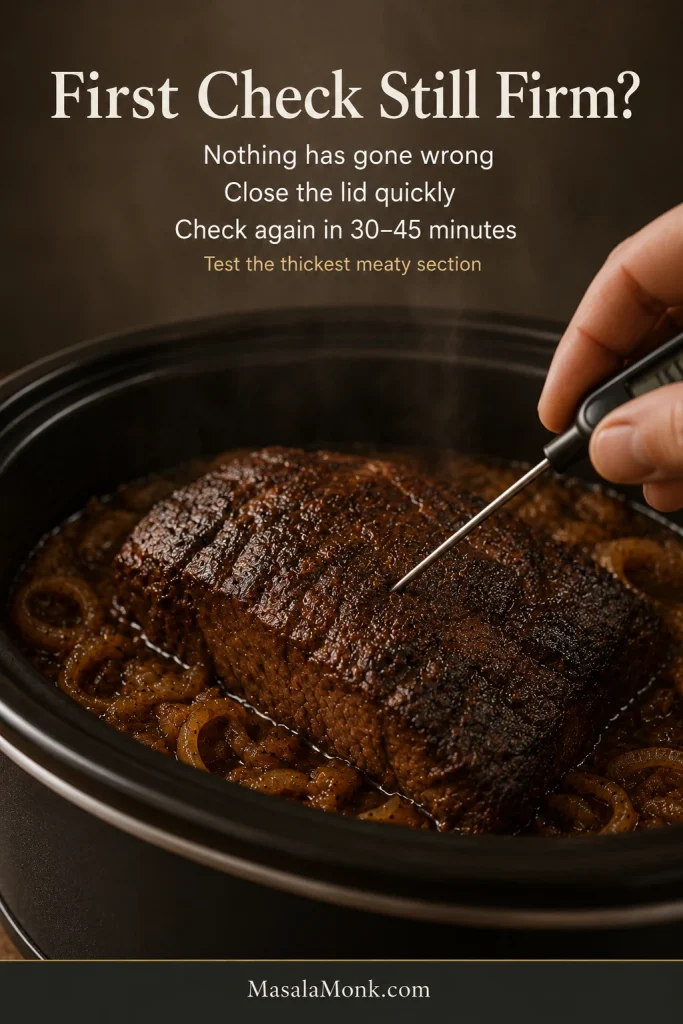
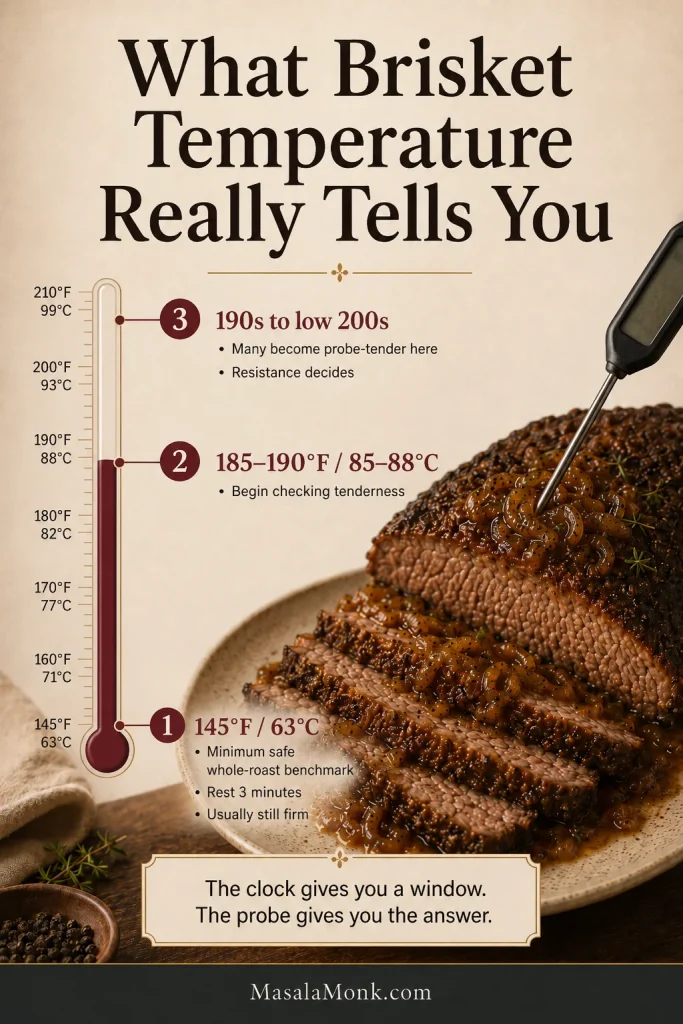
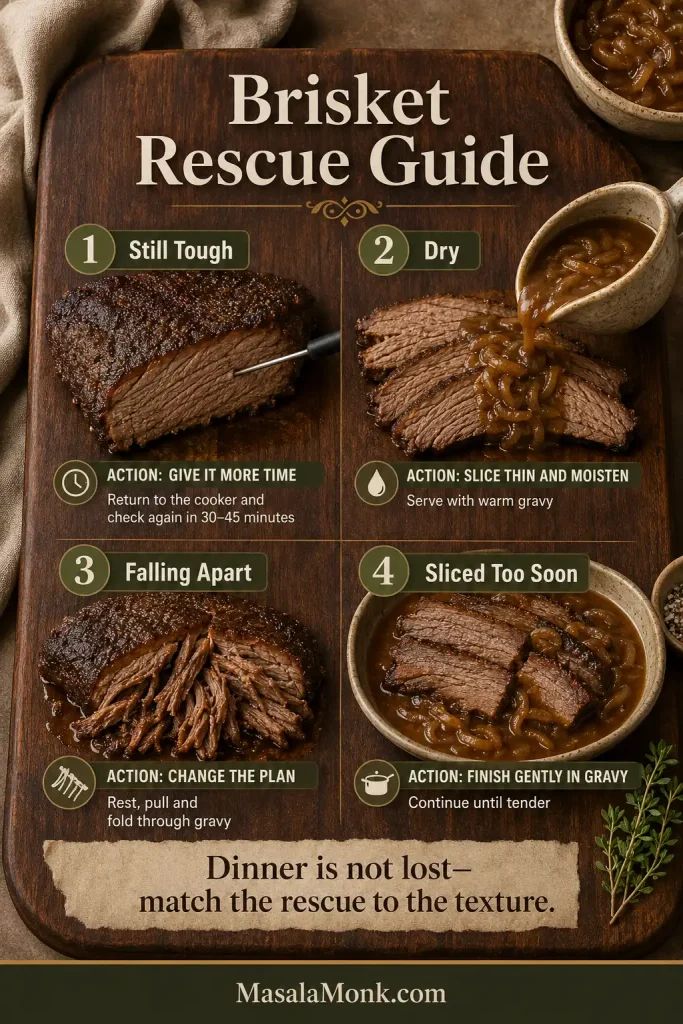
The key moment comes near the end. A probe that felt springy half an hour earlier begins to slide into the thickest part with very little resistance, yet the brisket still lifts in one piece. The clock gives you a window; the probe gives you the answer. Aim for beef that is tender enough to yield, yet structured enough to slice.
Quick Answer: How to Make Tender Slow Cooker Brisket
Use a 3–3½ lb (1.4–1.6 kg) fresh, uncured brisket flat that fits comfortably in a 5–6 quart (about 5–6 L) slow cooker. Brown the beef and soften the onions in the same skillet, then add 1 cup (240 ml) low-sodium beef stock plus ½ cup (120 ml) red wine, dark ale, or more stock.
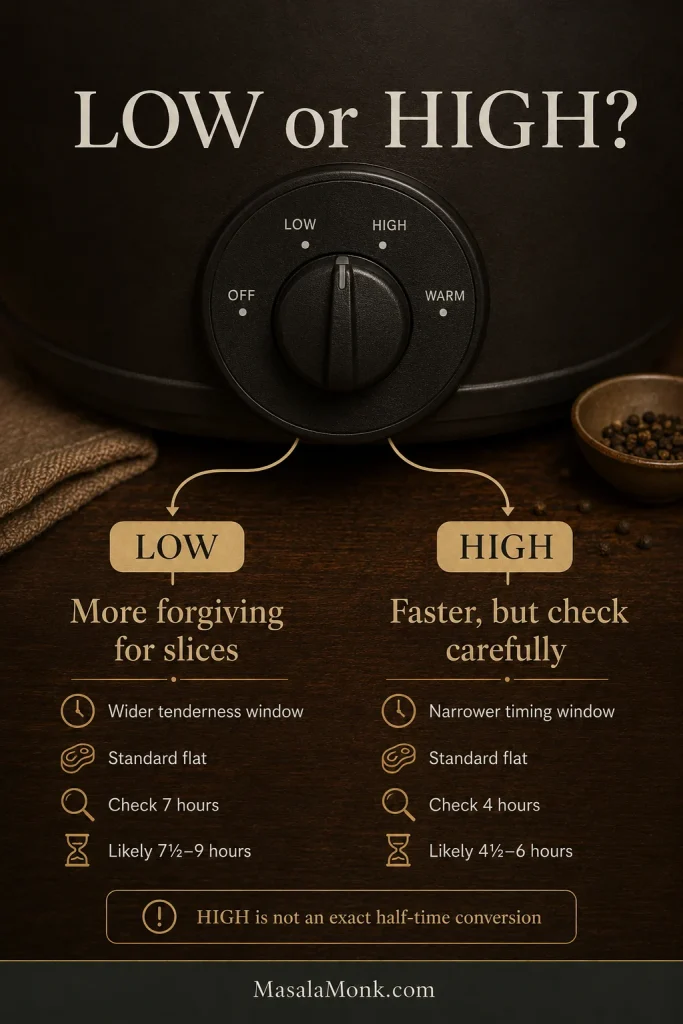
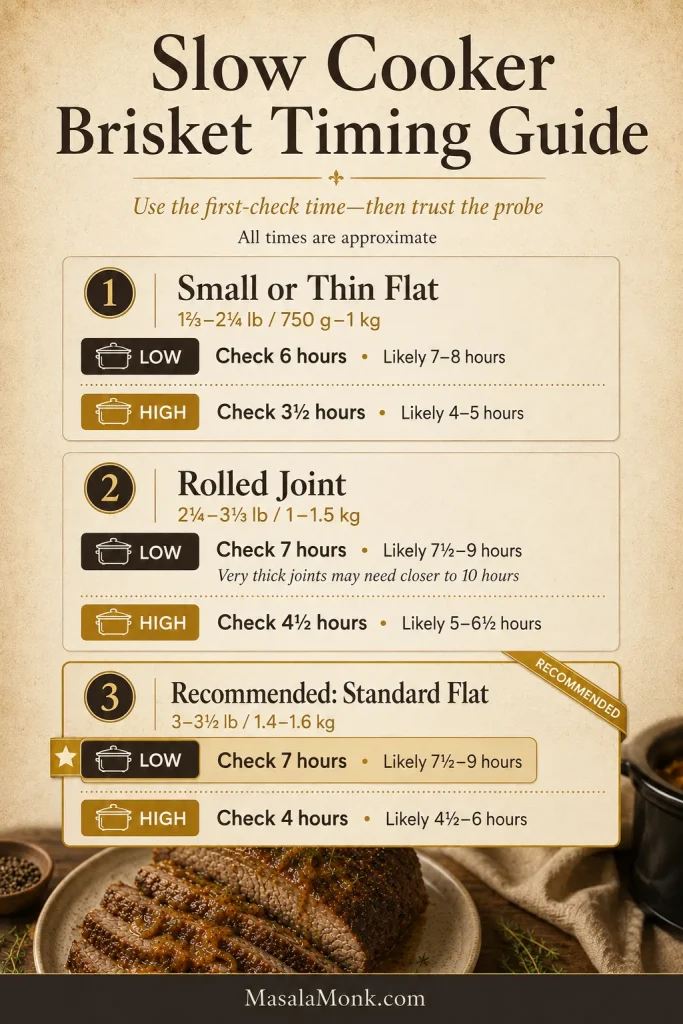
Cook on LOW for about 7½–9 hours, making the first tenderness check at 7 hours. Remove the brisket when a probe enters the thickest section easily and the meat holds together when lifted.
The three decisions that matter most: judge the brisket by thickness as well as weight, keep the starting liquid controlled, and reduce the cooking juices for flavor before using starch for texture.
Choose Your Version
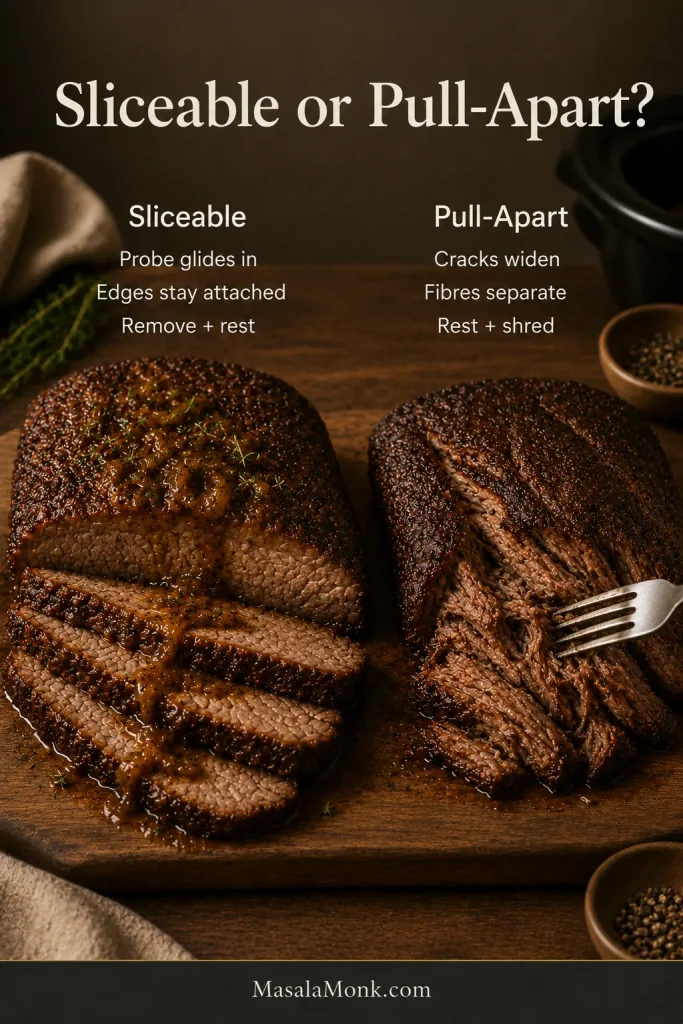
Decide whether you want neat slices, pull-apart meat, or less hands-on preparation. You can always cook sliceable brisket longer for pulling, but once it begins falling apart, it will not return to neat slices.
Your goal
How to make it
Recommended for neat slices
Use a flat-cut brisket, brown it first, cook on LOW, and remove it while it remains intact enough to slice.
Rolled brisket joint
Leave the string on, allow for the thick center, and check it later than you would a thin flat.
Pull-apart brisket
Continue cooking until the fibers separate readily, then shred and moisten with finished gravy.
No-sear shortcut
Skip the skillet work, combine everything in the slow cooker, and give the finished liquid a longer stovetop reduction.
The recipe below follows the neat-slice version.
Slow Cooker Brisket With Rich Onion Gravy
A savory brisket cooked over browned onions, garlic, stock, and herbs until tender but still sliceable. The cooking liquid is skimmed and reduced before thickening, giving you deeply flavored onion gravy instead of diluted slow cooker broth.
Prep Time
25 minutes
Skillet Time
25 minutes
Slow Cooker Time
7½–9 hours on LOW
Resting Time
15–20 minutes
Gravy Time
10–20 minutes
Hands-On Time
1–1¼ hours
Total Time
9–10½ hours
Servings
6 generous or 8 moderate servings
Cooker Size
5- to 6-quart (about 5–6 L) oval slow cooker or Crock-Pot
Texture and Finish
Tender and sliceable, with rich onion gravy
Equipment
Use an oval slow cooker or Crock-Pot, a large heavy skillet, tongs, two broad spatulas, and an instant-read thermometer. You will also need a cutting board, a sharp slicing knife, a wide saucepan, and a whisk.
A thin metal skewer helps assess resistance, but only a thermometer verifies temperature. A reliable sear or sauté function can replace the separate skillet. For the gravy, a spoon is enough to skim the fat; a separator, sieve, or immersion blender is optional.
Ingredients
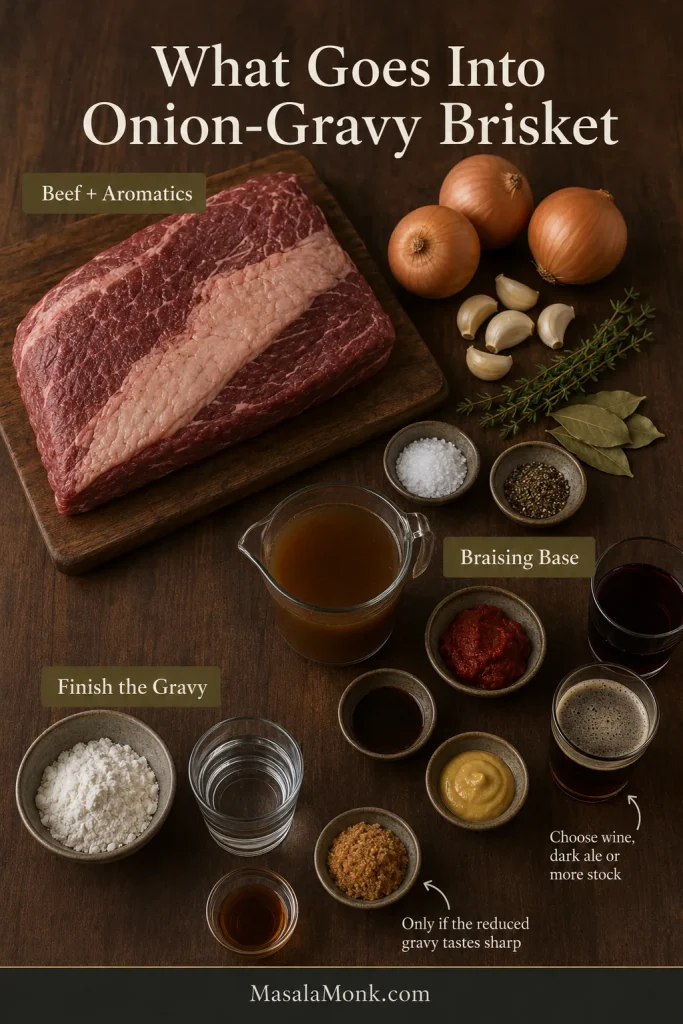
The ingredients work in layers: browning builds depth, the braising liquid carries it, and final tasting decides how much acidity or starch the gravy needs.
For the Brisket
3–3½ lb / 1.4–1.6 kg fresh, uncured beef brisket, preferably a flat or first cut for neat slices; a rolled joint also works, while a fattier point is better suited to pull-apart meat
2 teaspoons fine salt, about 10–12 g, divided
1 teaspoon coarsely ground black pepper
2 tablespoons / 30 ml neutral cooking oil, divided
For the Onion Braising Base
3 medium-large yellow or brown onions, about 16–19 oz / 450–550 g, sliced from root to tip
5 large garlic cloves, finely chopped or crushed
2 tablespoons / 34 g tomato paste
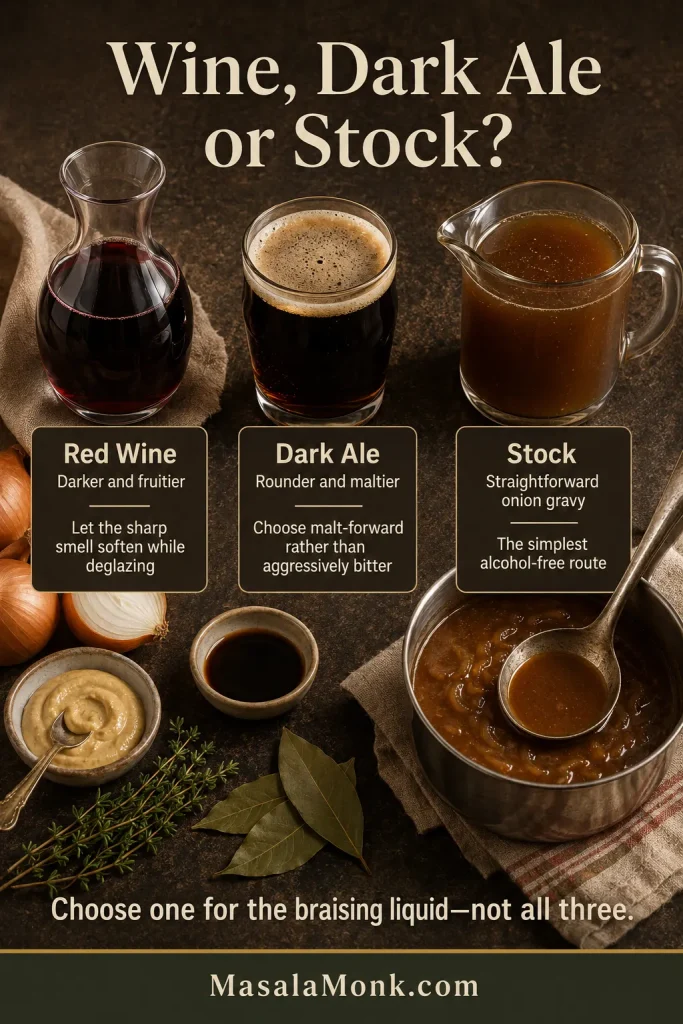
½ cup / 120 ml dry red wine, dark ale, or additional low-sodium beef stock
1 cup / 240 ml low-sodium beef stock
1½ tablespoons / 22 ml Worcestershire sauce
2 teaspoons / 10 g Dijon mustard
1 teaspoon dried thyme or 6–8 fresh thyme sprigs
2 bay leaves
And for Finishing the Gravy
Red wine vinegar: 1–2 teaspoons / 5–10 ml, as needed
Dark brown sugar: ¼–1 teaspoon, only if the reduced gravy tastes too sharp
Cornstarch: 1–2 tablespoons / 8–16 g, divided
Cold water: 1–2 tablespoons / 15–30 ml, divided
Additional salt and black pepper, as needed
Instructions
Prepare and Build the Braising Base
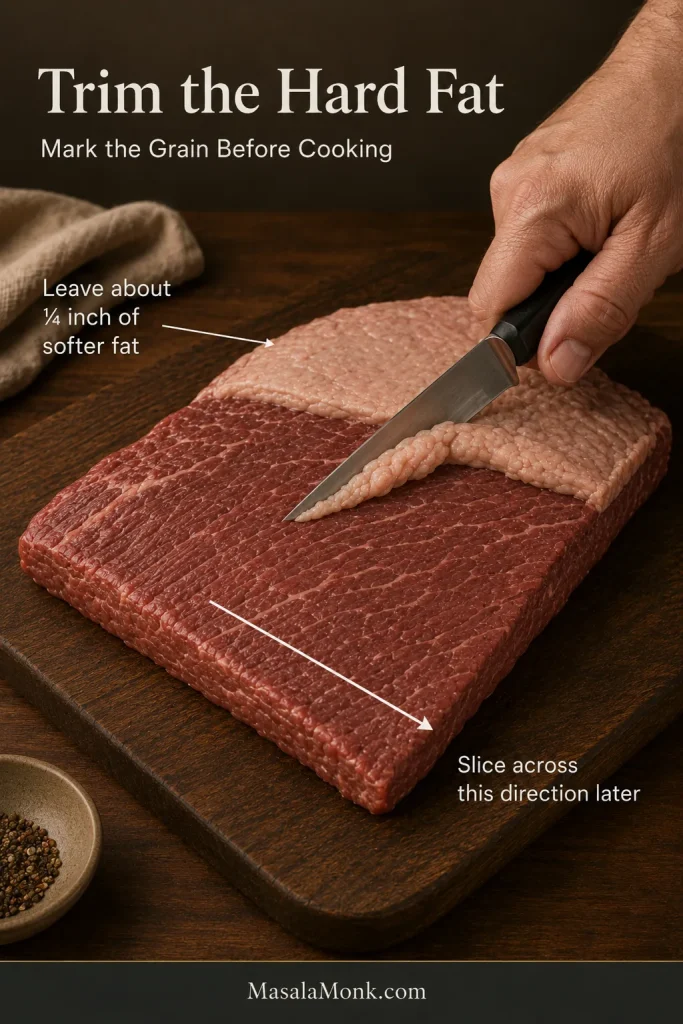
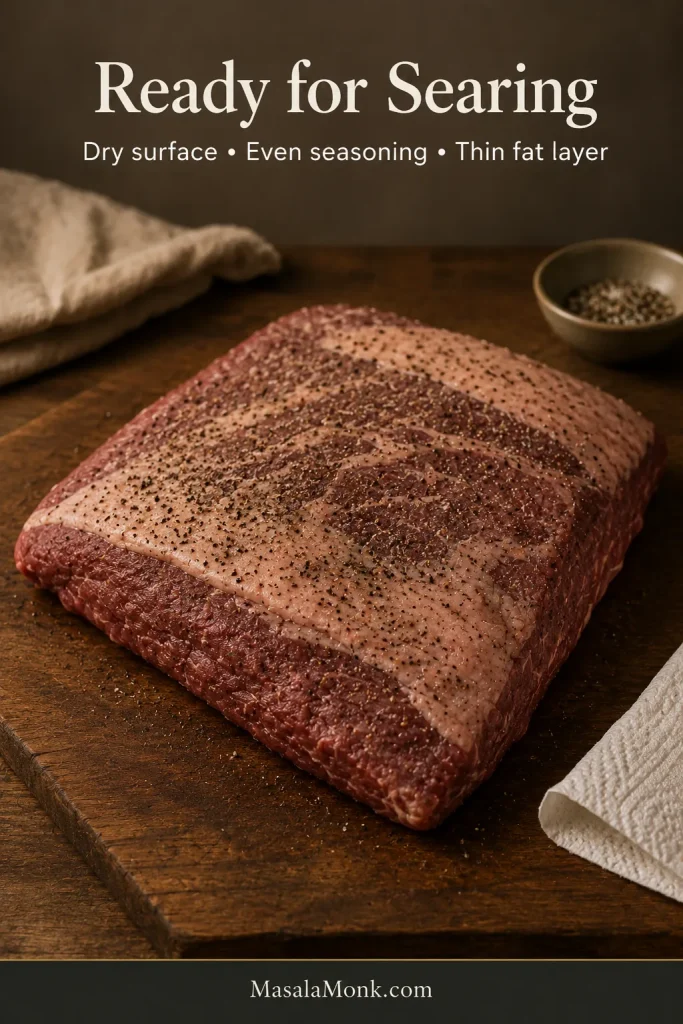
Mark, trim, and season. Note the direction of the grain with a photo or shallow corner notch. Remove hard exterior fat and reduce any very thick fat cap to about ¼ inch / 6 mm. Pat the brisket dry, then season all sides with 1½ teaspoons of the salt and all the black pepper.
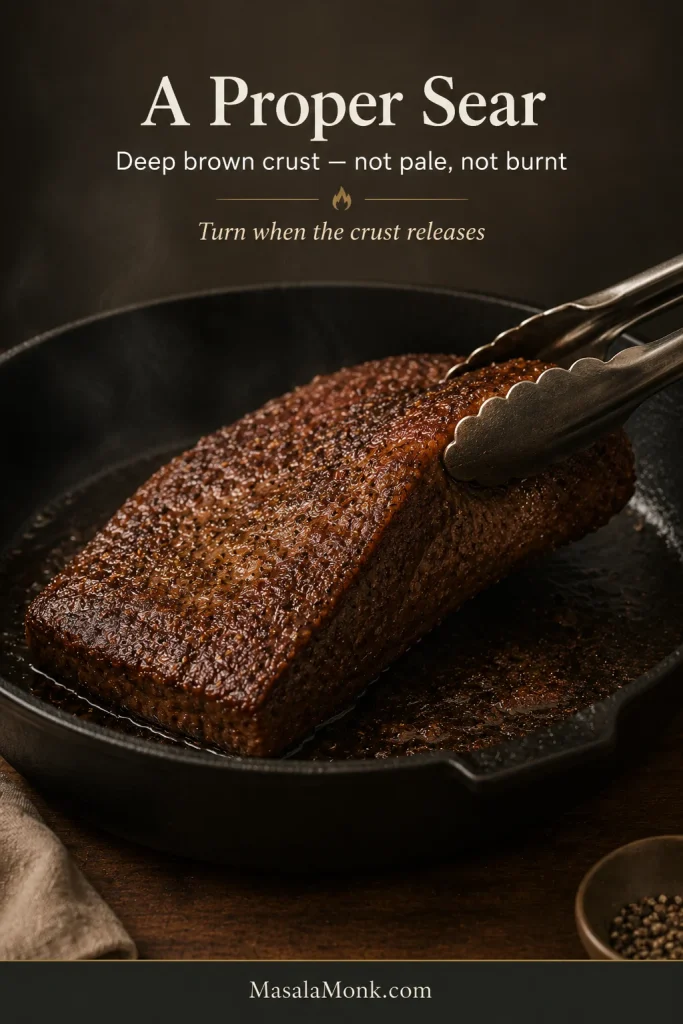
Sear the brisket. Heat 1 tablespoon oil in a large skillet over medium-high heat. Brown the broad sides for 4–5 minutes each and the thick edges briefly, then transfer the brisket to a tray.
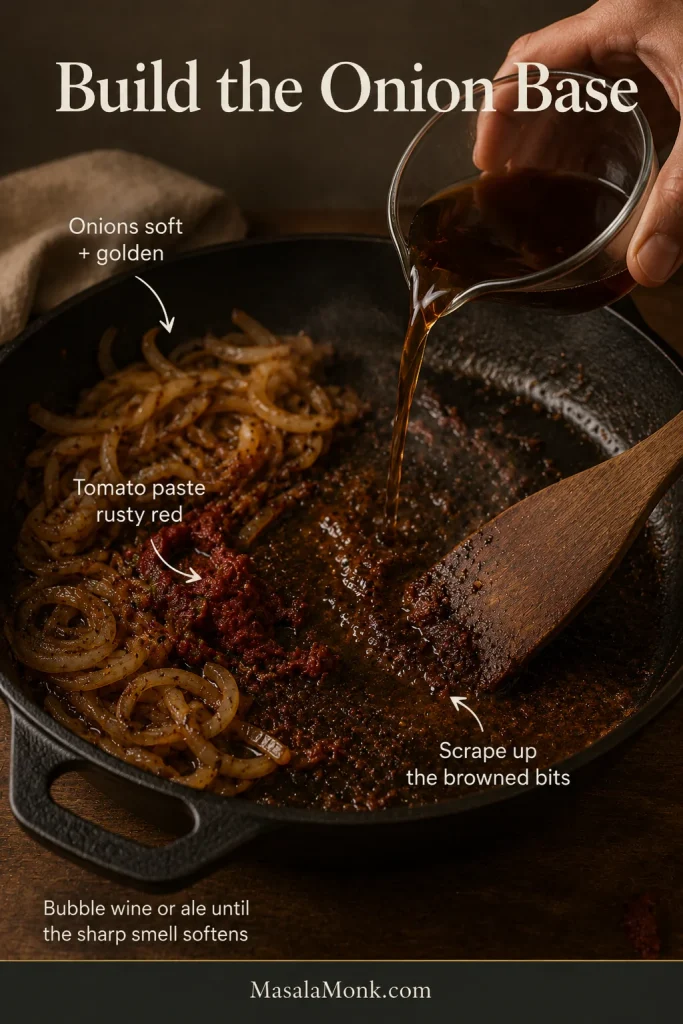
Brown the onion base. Reduce the heat to medium. Add the remaining oil if needed, followed by the onions and up to the remaining ½ teaspoon salt; hold some back if the stock or Worcestershire tastes salty. Cook for 8–10 minutes until softened with golden edges. Add the garlic for 30 seconds, then cook the tomato paste for 1–2 minutes until it deepens to a rusty red.
Deglaze and season the liquid. Add the wine, ale, or extra stock and scrape up the browned residue. If using wine or ale, let it bubble for 1–2 minutes. Stir in the 1 cup / 240 ml stock, Worcestershire sauce, Dijon, thyme, and bay leaves.
Slow Cook and Test for Tenderness
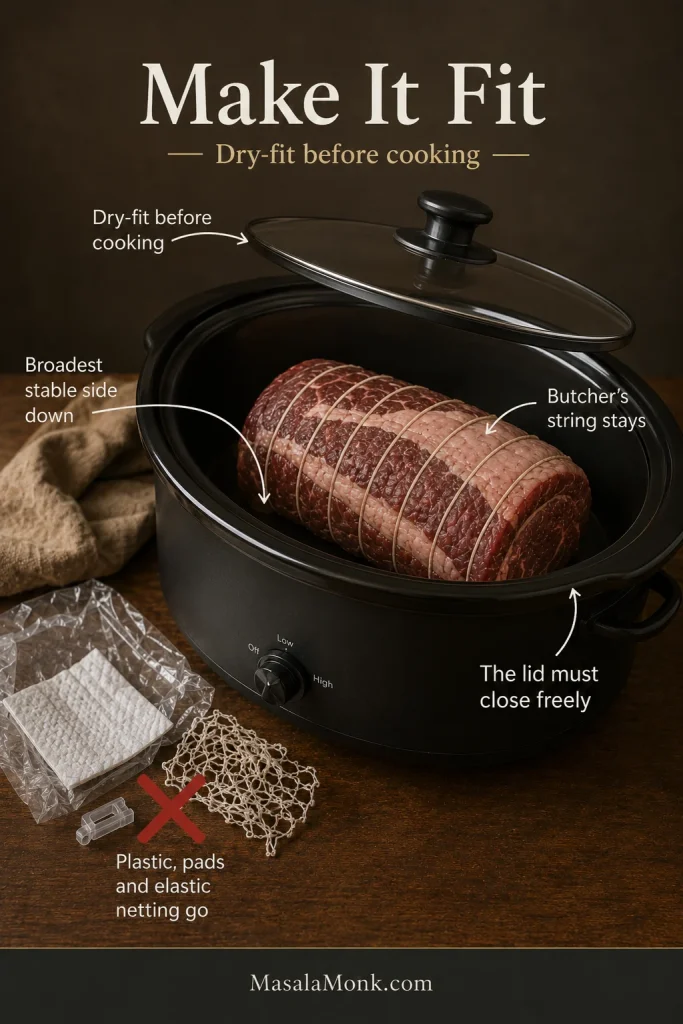
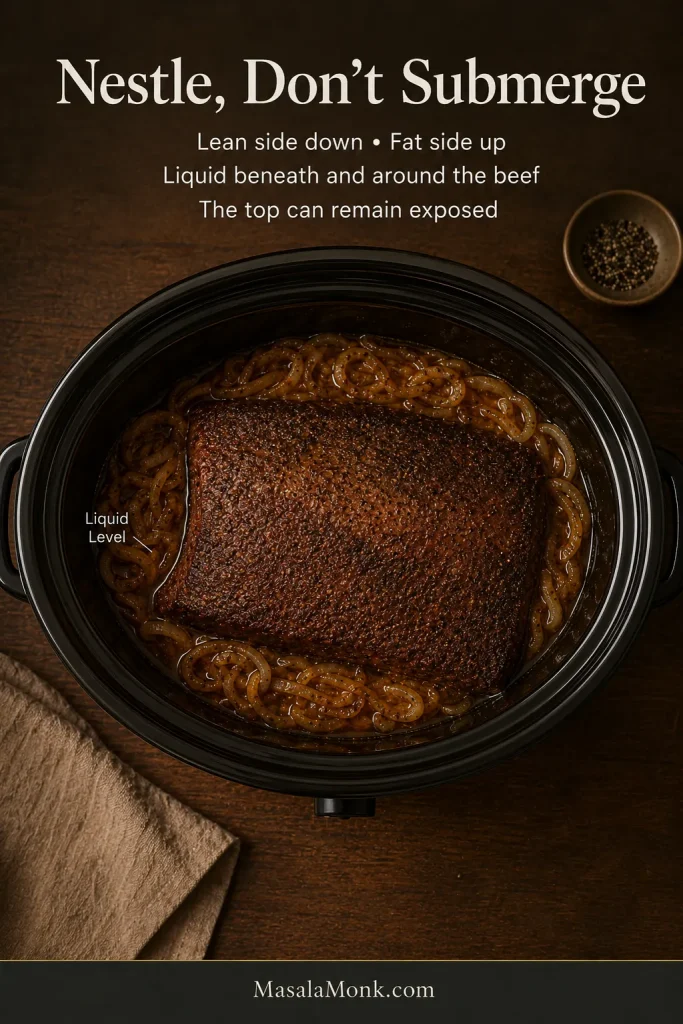
Load the slow cooker. Transfer the onions and liquid to the cooker. For a flat: nestle it into the mixture with the lean underside down and fat side up. For a rolled joint: set it on its broadest stable side and leave heat-safe butcher’s string in place. Remove plastic wrapping, absorbent pads, clips, and non-heat-safe elastic netting. The top can remain exposed; don’t add extra stock simply to submerge the meat.
Cook on LOW. Cover and cook a standard 3–3½ lb / 1.4–1.6 kg flat for about 7½–9 hours. Make the first tenderness check at 7 hours. For a tightly rolled joint, start checking around 7 hours; many finish between 7½ and 9 hours, although an especially thick joint or cooler-running cooker may need closer to 10 hours.
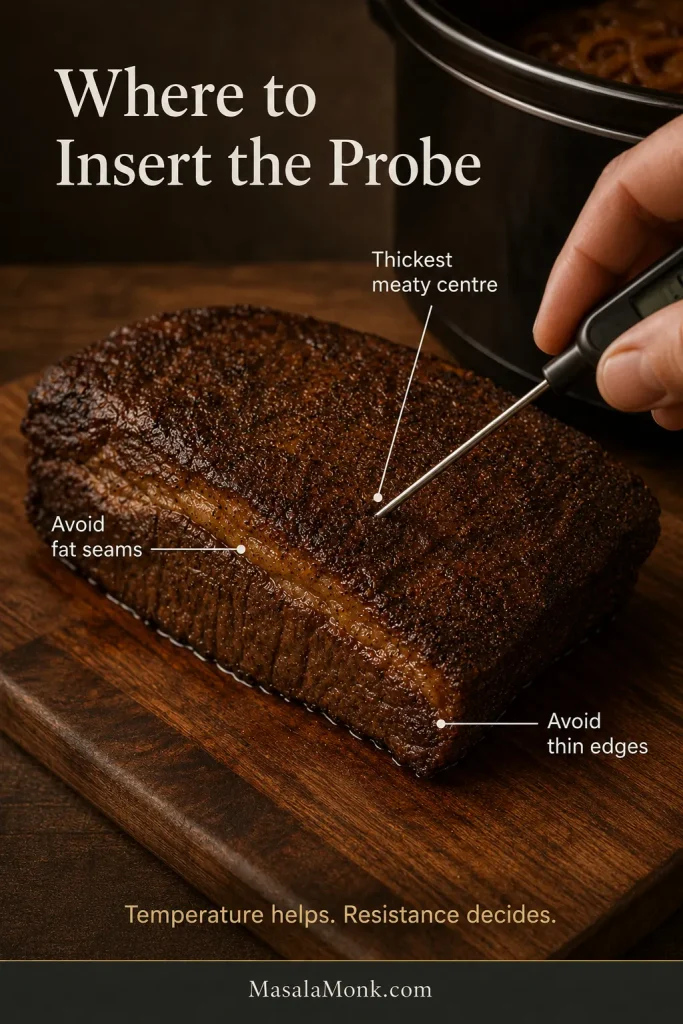
Check the texture. Insert the thermometer probe—or a thin metal skewer if you are checking texture only—into the thickest section. Only the thermometer verifies temperature. If the meat feels firm and springy, close the lid and cook for another 30–45 minutes. The brisket is ready for slicing when the probe or skewer enters easily and the roast keeps its shape as you lift it.
Rest, Finish the Gravy, and Serve
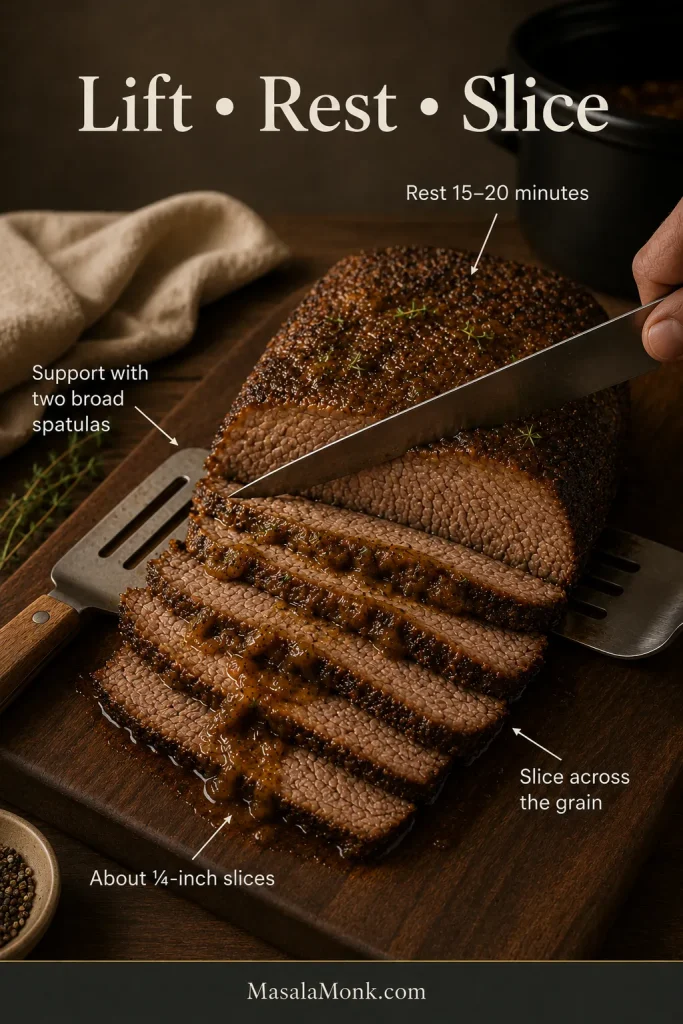
Rest the brisket. Move it to a cutting board with two broad spatulas, tent loosely with foil, and rest for 15–20 minutes.
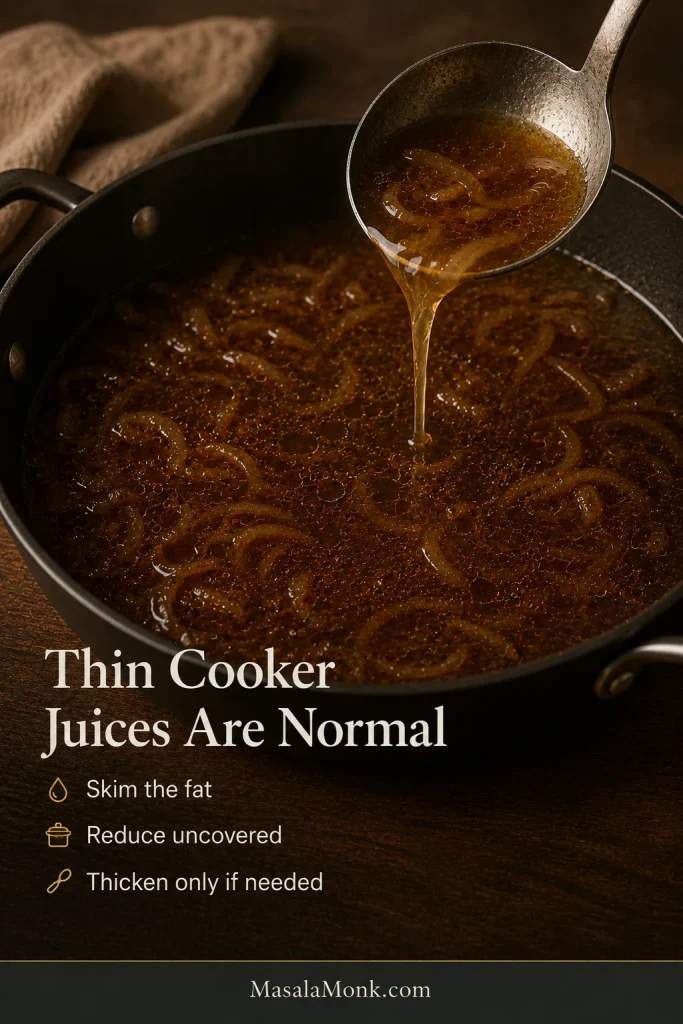
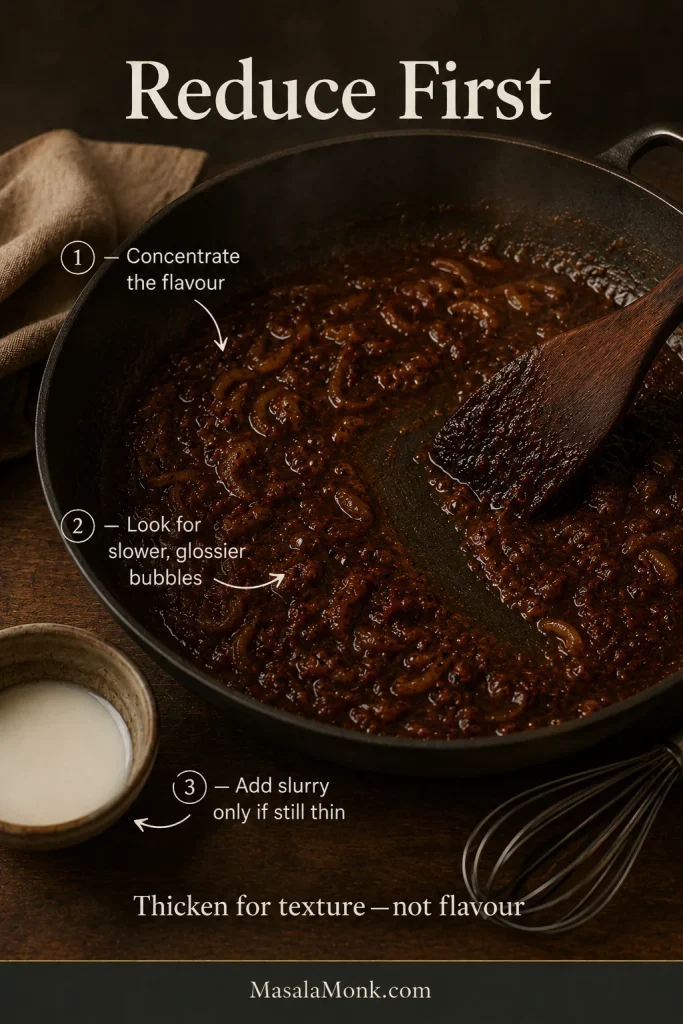
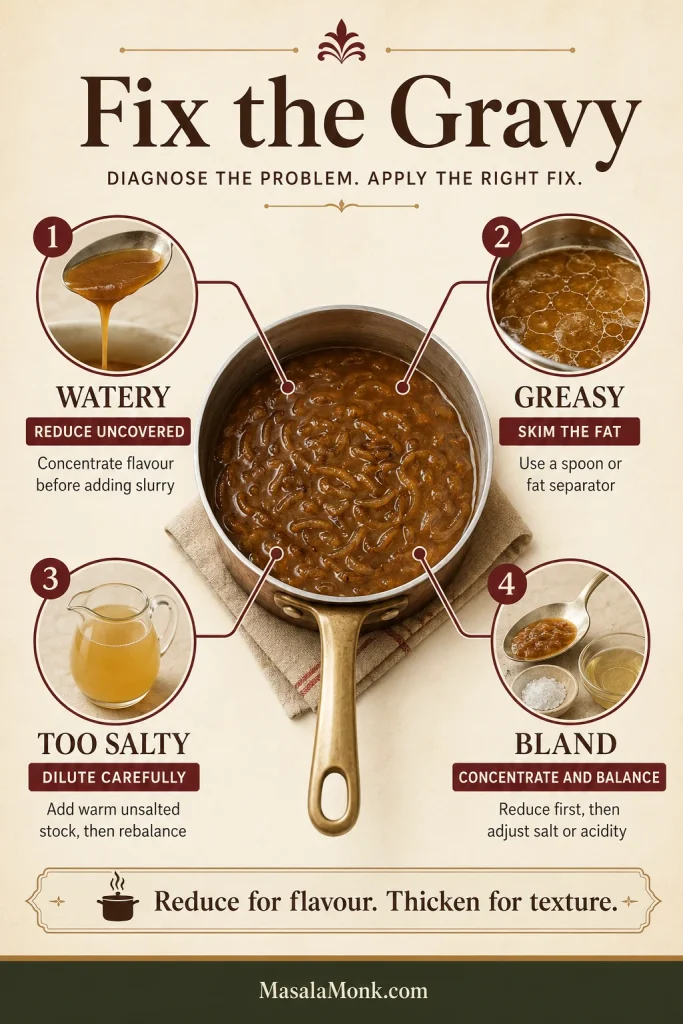
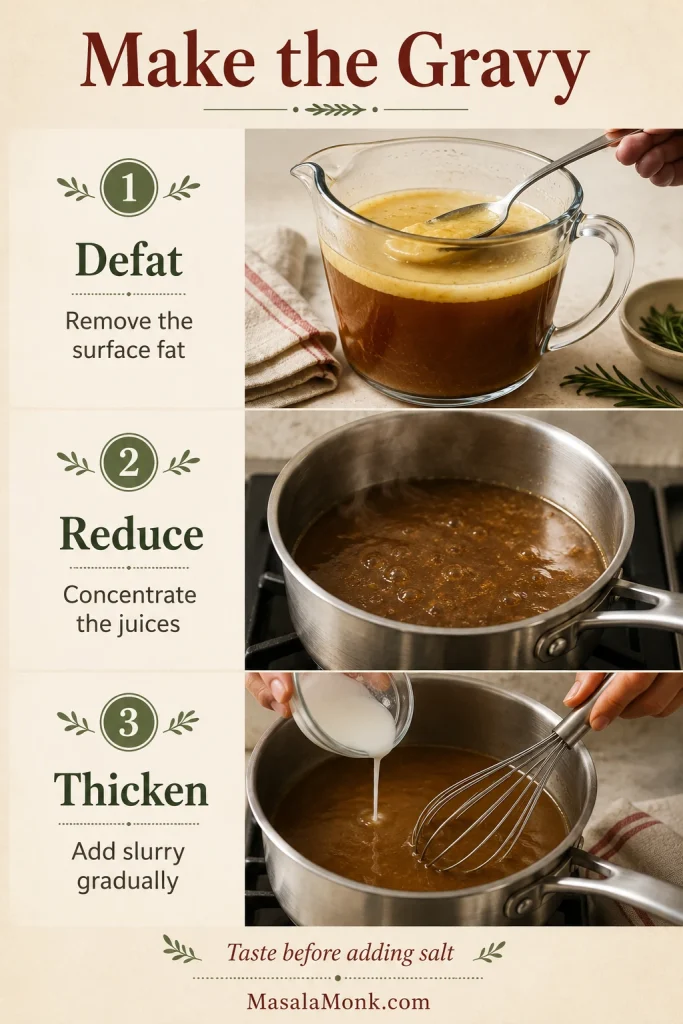
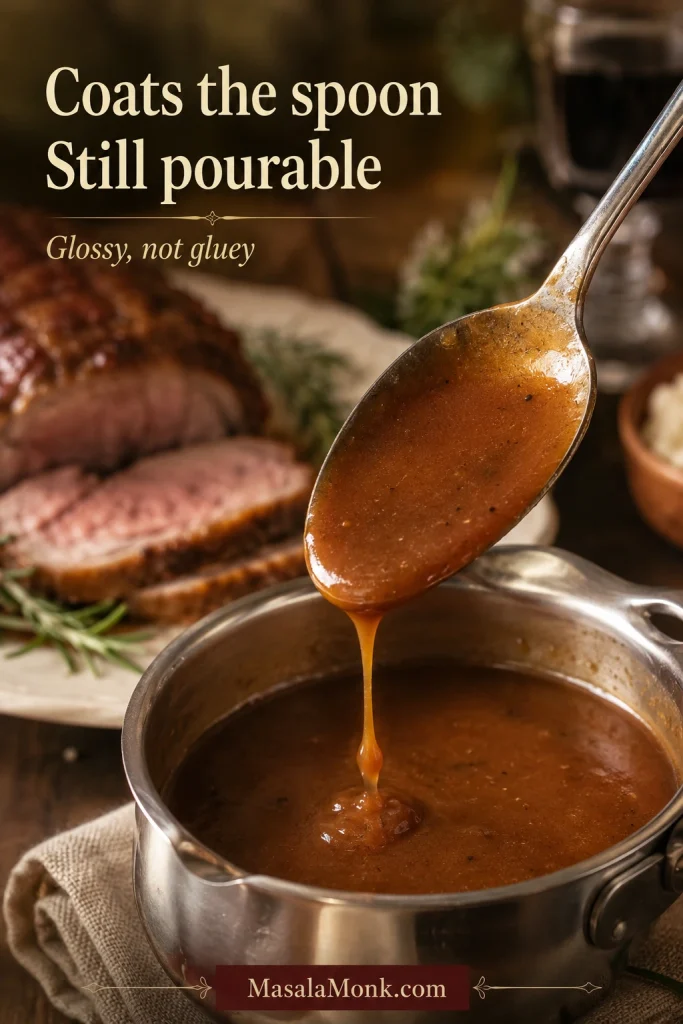
Finish the gravy. Remove the bay leaves and thyme stems, skim excess fat, and transfer the onions and liquid to a wide saucepan. Blend with an immersion blender or strain if desired, then simmer for about 10–20 minutes, until the liquid tastes richer, looks glossier, and briefly parts behind the spoon. Once the liquid tastes concentrated, taste the gravy. Add 1 teaspoon red wine vinegar if it tastes flat or heavy, then add more only if needed. Add a small pinch of brown sugar only if it tastes harsh or sharp, and adjust the salt and pepper. If the flavor is right but the gravy remains too thin, mix 1 tablespoon cornstarch with 1 tablespoon cold water. Whisk it in gradually and simmer for 1–2 minutes. If the gravy remains too thin, mix another tablespoon of cornstarch with another tablespoon of cold water and add only as much as needed.
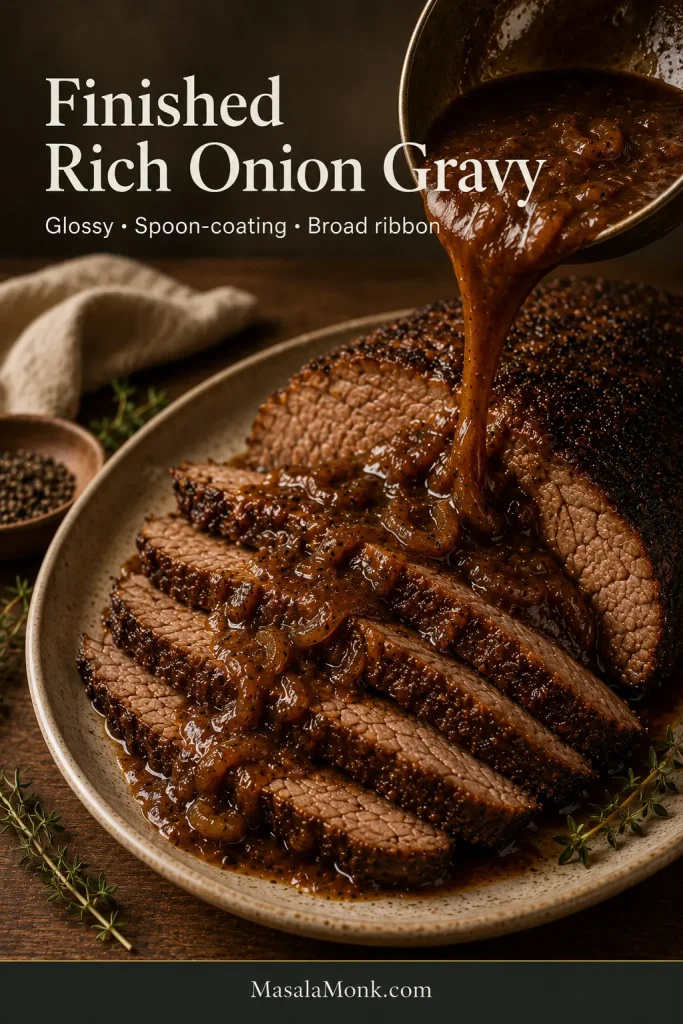
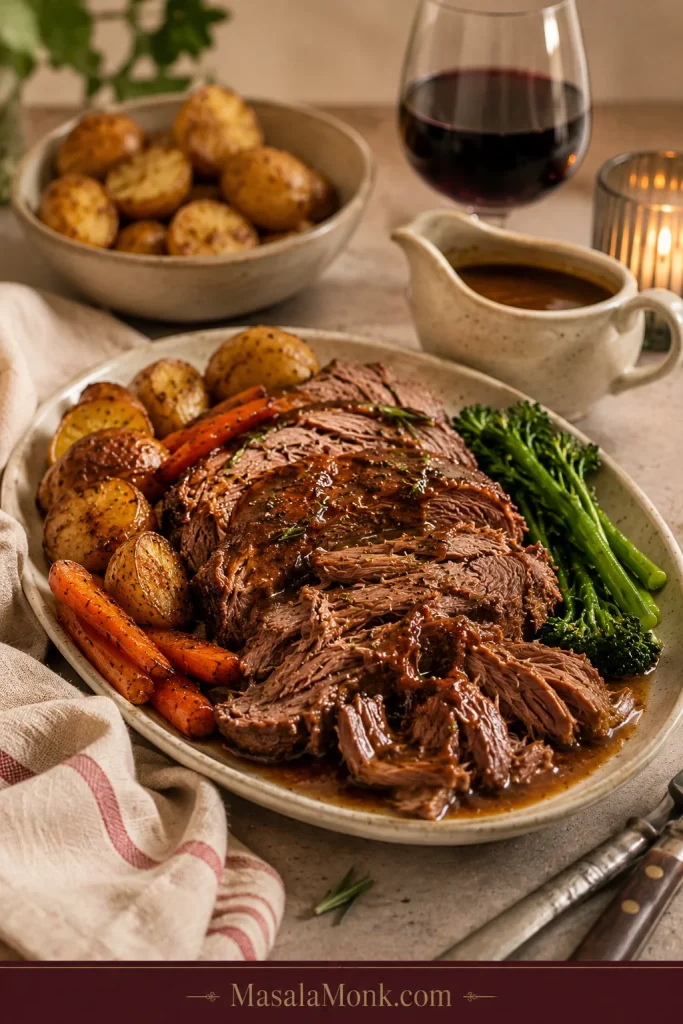
Slice and serve. Remove the string from a rolled joint. Cut the brisket about ¼ inch / 6 mm thick across the grain. Spoon over enough gravy to keep the slices glossy and serve the rest at the table.
Recipe Notes
For a 1⅔–2¼ lb / 750 g–1 kg flat: make the first check at about 6 hours on LOW. Many pieces finish around 7–8 hours, although a very thin flat may be ready sooner.
For HIGH: start testing the 3–3½ lb brisket around 4 hours and expect about 4½–6 hours.
For a no-sear version: omit the oil. Place the onions and seasoned beef directly in the cooker, whisk together the remaining braising ingredients, and pour them over the beef. Skipping the skillet saves about 25 minutes of active work, but the gravy will taste lighter and need a longer stovetop reduction.
Food-safety note: Fully thaw the brisket before slow cooking. See the USDA slow-cooker guidance for safe handling.
A slow cooker surrounds brisket with gentle heat and moisture, but it can’t create a dark sear or concentrate gravy. Browning the beef, softening the onions, and cooking the tomato paste in a skillet build the roasted flavor the covered cooker cannot.
The starting liquid stays restrained because the beef and onions release more moisture as they cook. Meanwhile, gentle heat gives the brisket’s dense collagen time to soften into gelatin. Once that work is complete, continued cooking can dry the lean muscle fibers even while the meat becomes softer.
Remove the brisket as soon as it is tender enough to slice, then finish the cooking liquid separately. That lets you remove excess fat, evaporate water, and deepen the gravy without pushing the meat beyond its best slicing point.
How quickly it reaches that point depends heavily on the shape and thickness of the cut; use the cooking-time guide to decide when checking should begin.
Which Brisket Cut Should You Buy?
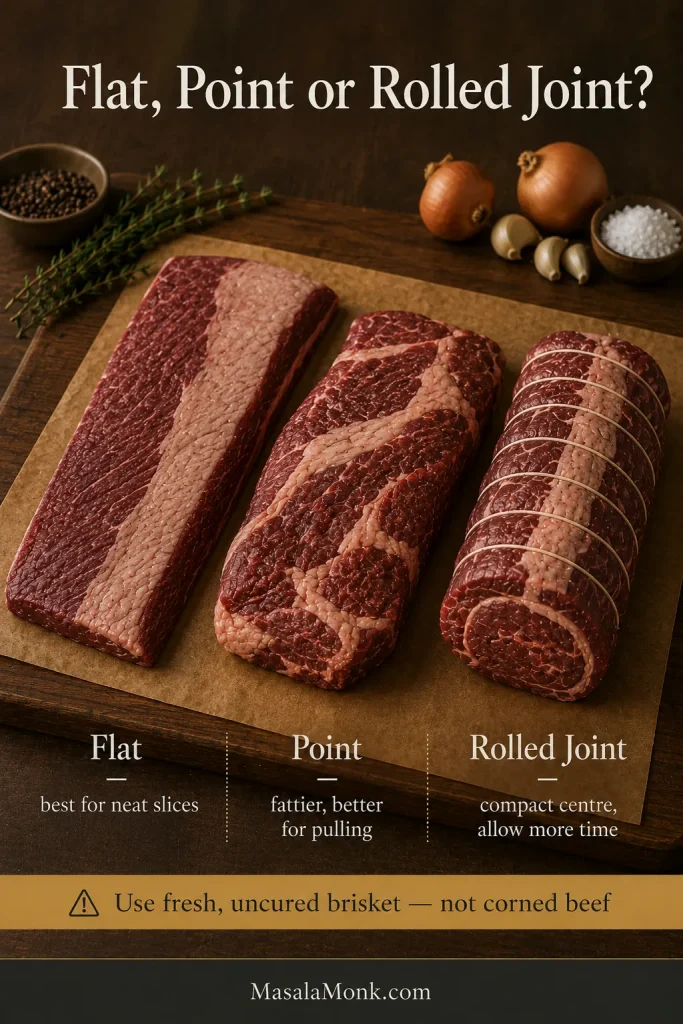
If the labels at the butcher counter are confusing, look at the shape before worrying about the name. Use fresh, uncured beef brisket—not corned beef brisket, which has already been cured in salty brine. A broad, even flat gives you the cleanest slices; a compact rolled joint simply needs more patience at the center.
Compare shape and thickness at the butcher counter, not weight alone. Two equal-weight briskets can finish at very different times.
Flat Cut Versus Point Cut
Choose a flat or first cut for neat gravy-covered slices. It is broad and comparatively lean, so remove it once the probe glides in easily and the roast holds together.
Choose a point cut for richer, fattier meat or a pull-apart finish. Trim heavy exterior fat and skim the cooking liquid carefully.
Brisket Joint or Rolled Brisket
A tightly rolled joint may take longer than a heavier flat because heat must reach its thick center. Leave heat-safe butcher’s string in place while it cooks.
If the joint will not fit beneath the lid, unroll it or divide it into two large pieces and begin checking sooner.
Whole packer brisket: It contains both the flat and point and is usually too large for a household slow cooker. Use a smoker or oven method instead.
If the label says shoulder roast, chuck shoulder, arm roast, or shoulder clod, use the beef shoulder roast crock pot guide. Those cuts behave more like pot roast than brisket.
Brisket or Pot Roast?
Choose brisket for distinct slices and a narrower finish between firm and falling apart. Chuck breaks into soft chunks more readily; brisket keeps a visible grain and rewards slicing across it. For forgiving chuck roast with potatoes and carrots in the cooker, use MasalaMonk’s slow cooker pot roast recipe.
How Much Brisket per Person?
Allow about ½ lb (225 g) raw boneless brisket per adult with substantial sides. This recipe serves six generously or eight moderately; buy extra when leftovers are part of the plan.
Prepare the Brisket Before It Goes Into the Cooker
Remove only the hard excess fat, mark the grain while it is visible, and make sure the brisket fits beneath the lid.
Trim the Fat and Mark the Grain
Remove hard, waxy lumps and heavy edge deposits. Leave a reasonably even layer—about ¼ inch (6 mm) where practical—especially on a lean flat.
Photograph the direction of the raw muscle fibers or make a shallow notch across one corner. After cooking, slice perpendicular to those fibers so each bite is easier to chew.
Trim hard surface fat now, and mark the grain while it is easy to see. Both become harder to judge once the brisket is browned and sauced.
Does Brisket Need a Rub or Marinade?
No marinade is needed for tenderness; the long cook softens the connective tissue. The browned onions, garlic, Worcestershire, Dijon, and herbs provide enough seasoning for this gravy-based version. You may season several hours or a day ahead, but a sweet barbecue rub moves the dish toward a different style.
Seasoning ahead is fine. Blot away any moisture before searing so the skillet browns the brisket instead of steaming it.
Make It Fit and Position It Correctly
The lid should close fully without resting on the meat, and the brisket should not be folded tightly against the sides. If necessary, cut it across its width into two large pieces, arrange them with little overlap, and begin checking at the standard-flat time; thinner pieces may finish first.
Set a flat fat-side up with the lean side nearer the onions and liquid. Place a rolled joint on its broadest stable side; secure placement and a closed lid matter more than exact fat-cap orientation.
A small rolled joint can cook more slowly than a heavier flat because heat must travel farther to reach its center.
Ingredients That Build the Brisket and Gravy
Three onions look generous in the skillet, but they collapse into the cooking liquid and give the finished gravy much of its body. Tomato paste adds depth, low-sodium stock leaves room for reduction, and Worcestershire, Dijon, and herbs round out the sauce without needing a packet mix.
Onions, Stock, and Tomato Paste
Slice the onions from root to tip so some texture remains through the long cook.
Low-sodium stock gives you room to reduce the gravy without making it harsh. Resist adding more simply because the top of the brisket remains exposed; the beef and onions will release additional moisture beneath the closed lid.
The exposed top still cooks in the trapped steam, while the beef and onions release enough moisture to raise the liquid level naturally.
Tomato paste adds color, savory depth, and a little body without making the gravy taste tomato-heavy. Cook it until it darkens slightly so it loses its raw edge.
The Braising Liquid
Red wine gives the gravy darker fruit and acidity. Ale adds a rounder maltiness, while extra beef stock creates the most straightforward onion gravy. Keep the amount restrained: the wine or ale should deepen the sauce without becoming its main flavor.
Worcestershire brings savory depth and gentle acidity, while Dijon rounds the liquid without making the gravy taste strongly mustardy. Both become more concentrated during reduction, so taste again before serving.
Cornstarch adds body only after reduction has concentrated the flavor. Add it gradually so the gravy stays glossy rather than becoming pasty.
What Slow Cooker Brisket Should Look and Feel Like
The cues below show what each stage should look and feel like, especially when the clock cannot tell you enough.
The Crust and Onion Base
Pat the surface dry, then leave each broad side in the hot skillet until a deep crust forms and the meat releases more easily. Cook the onions until their raw smell softens and their edges turn golden.
Pale patches usually mean lingering moisture or weak contact with the skillet. Move the brisket only when needed so a deep crust can form.
Stir in the tomato paste until it changes from bright red to rusty red and begins sticking lightly to the pan. Pour in the wine, ale, or stock and scrape up the browned layer—those sticky bits belong in the gravy. If using wine or ale, let it bubble until its sharp alcoholic smell softens, then nestle the brisket into the onions.
Brown fond belongs in the gravy; black, bitter residue does not. Smell the pan before deglazing and leave genuinely burned patches behind.
The Tenderness Change to Watch For
The first tenderness check is often the least encouraging one. At the sliceable stage, the roast flexes when lifted, its edges remain attached, and any surface cracks stay narrow. As it moves toward pull-apart tenderness, those cracks widen and the fibers begin separating under light pressure.
Narrow cracks and attached edges point to clean slices. Widening seams show the brisket moving toward a moist pull-apart finish.
How Soft Brisket Should Slice
Support the softened brisket with two broad spatulas and rest it for 15–20 minutes. Slice across the grain; the first piece should bend without crumbling. Cut exceptionally soft meat a little thicker.
Use long, gentle knife strokes. A blunt blade or heavy sawing motion can squash a very tender brisket before it reaches the plate.
For a 3–3½ lb (1.4–1.6 kg) brisket flat, cook on LOW for about 7½–9 hours or HIGH for about 4½–6 hours. Begin checking at 7 hours on LOW or 4 hours on HIGH.
Cooking time changes with thickness, shape, fat content, starting temperature, cooker size, and how hot your slow cooker runs. A small rolled joint may take longer than a heavier broad flat because heat has farther to travel through its tightly rolled center.
There is no dependable minutes-per-pound or hours-per-kilogram formula for slow cooker brisket. Use the chart to decide when to make the first check, then let the resistance of the meat decide when to stop.
Open the lid briefly, test one or two places in the thickest section, and close it again quickly if the meat resists. Check again after another 30–45 minutes.
All times are approximate. Use the “Begin checking” column for your first tenderness test.
On a phone, swipe sideways to see all columns in the timing table.
Brisket
Setting
Begin checking
Likely window
Thin or small flat, 1⅔–2¼ lb / 750 g–1 kg
LOW
6 hours
7–8 hours
Thin or small flat, 1⅔–2¼ lb / 750 g–1 kg
HIGH
3½ hours
4–5 hours
Compact or rolled joint, 2¼–3⅓ lb / 1–1.5 kg
LOW
7 hours
7½–9 hours; a very thick joint may need closer to 10 hours
Compact or rolled joint, 2¼–3⅓ lb / 1–1.5 kg
HIGH
4½ hours
5–6½ hours
Recommended standard flat, 3–3½ lb / 1.4–1.6 kg
LOW
7 hours
7½–9 hours
Standard flat, 3–3½ lb / 1.4–1.6 kg
HIGH
4 hours
4½–6 hours
For a 4–5 lb (1.8–2.3 kg) brisket: use a 7–8 quart cooker and begin checking at about eight hours on LOW. Many thick whole briskets need roughly 9–11 hours. If you divide the brisket into thinner pieces, begin near the standard-flat window and remove each piece separately when tender.
What the Probe Is Telling You
Do not judge the brisket by one check. What matters is the change from firm and springy toward easier entry each time you test.
What you feel
What it means
What to do
Firm resistance as the probe enters
Needs longer
Close the lid and check again in 30–45 minutes
The probe glides into the thickest section
Tender and sliceable
Remove the brisket and let it rest
The meat separates around the probe
Pull-apart stage
Lift carefully, rest briefly, and shred
Where to Place the Probe
When readings disagree, trust the firmest result from the thick central meat. A soft fat seam or thin edge can be misleading.
Is LOW Better Than HIGH?
LOW is the more forgiving setting because it gives a lean flat a wider window between firm and overly soft. HIGH can produce good brisket when dinner needs to happen sooner, but it isn’t an exact half-time conversion.
HIGH narrows the final checking window because tenderness can change quickly near the end. Start early and stay close once the meat begins yielding.
What Internal Temperature Is Slow Cooker Brisket Done?
Begin checking brisket for tenderness around 185–190°F (85–88°C). Many pieces become probe-tender in the 190s to low 200s, but resistance—not temperature alone—decides when to remove them.
Whole beef roasts reach the USDA minimum safety benchmark at 145°F (63°C) followed by a three-minute rest. Brisket is normally still firm at that point because its connective tissue hasn’t softened enough.
Temperature tells you when to start paying close attention. Probe feel still makes the final decision.
Can You Overcook Brisket in a Slow Cooker?
Yes. A brisket can become softer while its lean fibers become drier. Watch for these signs:
The brisket splits before it can be lifted from the cooker.
The fibers separate as soon as the surface is pressed.
Slices crumble into short strands instead of bending.
A lean flat feels soft but dry or cottony in the mouth.
The edges break down before you can carve the center.
An over-soft brisket works well shredded, moistened with finished gravy, and served in rolls, baked potatoes, or rice bowls.
Save the Slow Cooker Brisket Timing Guide
Prefer one visual reference for later? This chart brings together the first-check and likely cooking windows for flats and rolled joints on LOW or HIGH. Save it as a starting point, then let probe resistance decide the actual finish.
Save this chart as a quick starting point. Begin checking at the earlier time shown, but let thickness and probe resistance decide when the brisket is ready.
The liquid will probably look thinner than finished gravy when the lid first comes off. That is expected. It may already smell deeply savory, but its flavor and body develop in the saucepan.
Reduce for flavor. Thicken for texture. Reduction concentrates the beef and onions. Cornstarch changes only how the sauce flows.
Why Slow Cooker Brisket Juices Look Thin
A wide saucepan concentrates thin cooker juices faster than a narrow pot because more liquid is exposed to evaporation.
Remove the Fat and Choose the Texture
Let the liquid settle briefly, then spoon away the glossy fat or use a separator. A point cut or heavily capped brisket may need more attention than a lean flat. When the brisket is cooked a day ahead, the chilled fat lifts away especially cleanly.
Keep the softened onions for rustic gravy, blend them into the liquid with an immersion blender for a smooth sauce, or strain them out for a clearer finish.
Reduce Before You Thicken
Pour the liquid into a wide saucepan and simmer uncovered. At first it may taste savory but diluted. Start tasting after about 10 minutes. As the beef and onion flavors concentrate, the bubbles turn slower and glossier. The spoon also begins leaving a brief trail across the pan.
Stop when the gravy tastes deeply beefy and onion-rich, even if it looks slightly thinner than you want. Mix 1 tablespoon cornstarch with 1 tablespoon cold water, whisk it in gradually, and simmer for 1–2 minutes. If it remains too thin, mix another tablespoon of cornstarch with another tablespoon of cold water and add only as much as needed. The finished gravy should coat the back of a spoon and fall in a broad ribbon.
Let a spoonful cool for a moment before the final tasting. Very hot gravy can hide salt and acidity and tempt you to over-adjust it.
What Finished Onion Gravy Should Look Like
Gravy thickens as it cools, so stop while it looks a little looser than you want at the table.
Balance the Finished Gravy
If the gravy tastes…
Try this
Flat or heavy
Add 1 teaspoon red wine vinegar, taste, then add more only if needed. It should lift the richness without tasting vinegary.
Not savory enough
Add a small splash of Worcestershire or a pinch of salt.
Overly salty
Stop reducing and dilute with unsalted stock or water.
Too sweet
Add acidity and a little additional stock.
Harsh or sharp
Add more stock or a very small pinch of brown sugar.
Greasy
Separate more fat before making any other adjustment.
Rich but too thin
Add more slurry gradually.
Overly thick
Whisk in warm stock a little at a time.
Not enough gravy
Add warm unsalted stock, simmer briefly to integrate it, and taste again before serving.
Most brisket problems fall into two groups: the meat needs more time, or the cooking liquid needs finishing. Even an over-soft brisket can become an excellent pull-apart dinner.
Brisket Rescue at a Glance
Check tenderness and moisture separately. Moist but resistant brisket needs more heat; soft, cottony meat needs gravy, not more cooking.
My Brisket Is Still Tough
If your brisket still feels moist but the probe pushes back, nothing has gone wrong. Keep it whole, replace the lid, and cook for another 30–45 minutes. Test the thickest center, not a soft edge or a seam of fat.
If the brisket has just been sliced and is still hot, arrange the slices snugly in a covered baking dish with hot gravy or cooking liquid. Continue cooking gently at 300°F (150°C) and check every 20–30 minutes. For refrigerated brisket, use the reheating guidance below instead.
My Brisket Is Dry
Dryness can come from a very lean flat, cooking past the ideal window, or reheating uncovered. Beef can overcook even while surrounded by liquid because the muscle fibers still tighten and release their own moisture.
Spoon generous gravy over the slices or chop the meat and fold it into the sauce. The beef cannot absorb all the lost moisture again, but thicker pieces and plenty of gravy can make a satisfying dinner.
It Fell Apart Before I Could Slice It
If the brisket breaks as you lift it, dinner isn’t lost—it has simply moved from sliceable to pull-apart. Remove any large deposits of fat, shred the beef, and add enough finished gravy to coat the fibers.
When presentation matters, let the meat cool before handling. Chilled brisket firms up, making it easier to portion cleanly than delicate hot meat.
Gravy Troubleshooting at a Glance
Concentrate the gravy before seasoning it. Once it is too salty, dilute it—more reduction will only intensify the salt.
The Gravy Is Watery
The liquid may look disappointingly thin when you first open the cooker. That is often normal; it has not been reduced yet. Move it to a wide pan and simmer uncovered until the flavor concentrates, then use a slurry only if it still needs more body.
The Gravy Is Greasy
A point cut, thick fat cap, or heavy internal seams can release more fat than the sauce can comfortably hold. Let the liquid settle and skim it, use a separator, or chill it and remove the hardened layer.
The Gravy Is Too Salty
Reduction intensifies salt from stock, Worcestershire, seasoning mixes, and the beef itself. Stop reducing and add unsalted stock or water. If that makes the gravy too thin, restore its body with a little slurry rather than concentrating the salt again.
The Brisket Tastes Bland
Skipping the sear, using weak stock, beginning with too much liquid, or forgetting to taste before serving can all leave the sauce muted. Reduce it first, then taste for salt, savory depth, and acidity. A little Worcestershire or red wine vinegar can wake it up quickly.
Dinner Timing: Running Late or Finished Early
If dinner is running late and the brisket is fully hot but still tough, switch from LOW to HIGH and check again in 30 minutes.
If it finishes early, remove it from the cooker rather than letting it continue for hours. For a short delay, keep it whole and safely hot at 140°F (60°C) or above, with a little hot cooking liquid.
A long stay on WARM can soften and dry a lean flat. If safe hot holding is not practical, refrigerate the brisket within two hours and reheat the slices in gravy.
Whichever version you make, stop cooking when the brisket reaches the texture you want.
Choose Wine, Ale, or Stock—and Add Balsamic if You Like
Red wine: Use ½ cup (120 ml) dry red wine for deglazing. Cabernet Sauvignon, Merlot, or another dry medium-to-full-bodied red suits the dark onion gravy. Keep the amount restrained so the reduced sauce doesn’t become sharp.
Ale or stout: Replace the wine with ½ cup (120 ml) dark ale or stout. Choose a round, malt-forward beer rather than a heavily bitter one, because bitterness becomes more noticeable as the gravy reduces.
Balsamic: Add 1 tablespoon (15 ml) balsamic vinegar to the braising liquid. Omit the final red wine vinegar unless the reduced gravy still needs brightness.
Choose a braising liquid that already tastes balanced. Reduction magnifies bitterness, sweetness and salt along with the flavors you want.
Do You Have to Sear Brisket Before Slow Cooking?
No. Skipping the skillet saves about 25 minutes, although the meat and gravy will have less browned depth. Follow the no-sear method in the recipe notes.
Brisket With Potatoes and Carrots
The most dependable approach is to keep the cooker focused on beef and onions, then prepare the vegetables separately. A tray of roasted carrots can cook while the brisket finishes.
If the cooker has room, add up to 12 oz (340 g) waxy potatoes and 8 oz (225 g) carrots. Cut them into 1½–2 inch (4–5 cm) pieces and add them for the final 2½–3 hours on LOW.
The vegetables will be softer, take up valuable cooker space, and release extra water, so expect a longer gravy reduction.
Use waxy potatoes and large pieces in the cooker. Floury potatoes or smaller cuts can soften into the gravy.
How to Make It Pull-Apart
Continue cooking until the fibers separate readily when pressed. Rest the brisket for about 10 minutes, remove any large pockets of fat, then pull it into broad strands. Fold through enough finished gravy to coat the meat without drowning it.
What to Serve With Slow Cooker Brisket
Brisket with gravy wants something soft enough to catch the sauce or crisp enough to balance the richness. Spoon the gravy over the cut face of the beef so it settles between the slices and reaches the potatoes beneath.
A classic wedge salad brings cold crunch and sharpness beside the warm beef and gravy, keeping the plate from feeling too soft or heavy.
Cauliflower mash
Steamed or sautéed greens
Crisp cabbage salad
Roasted broccoli or Brussels sprouts
Green beans finished with lemon
Ways to Use Leftover Brisket
The second meal is one of the rewards of cooking a full brisket.
Open-faced brisket sandwiches with hot gravy
Brisket and gravy over polenta
Baked potatoes filled with chopped brisket
Rice bowls with onions and greens
Brisket hash with potatoes and eggs
Leftover brisket also works beautifully in rice bowls; use the guide to cooking fluffy rice so the grains stay separate enough to catch the gravy without turning wet or gummy.
Rice drinks up sauce quickly. Loosen chilled gravy with a splash of unsalted stock before warming the brisket.
Brisket can be served the day it cooks, but making it a day ahead is often the calmer choice for guests. The fat lifts away cleanly, the chilled meat slices neatly, and reheating it in gravy removes the pressure of timing dinner to the minute.
The Best Make-Ahead Brisket Method
Cook the brisket until tender but still intact.
Transfer it promptly from the hot cooker with enough cooking liquid to keep the surface moist.
If the brisket is especially thick, divide it into two or three large portions, then refrigerate the meat and liquid in shallow covered containers within two hours.
Lift away the solidified fat the following day.
Slice the cold brisket across the grain.
Finish or loosen the gravy as needed.
Reheat the slices gently in the gravy until the center reaches 165°F / 74°C, following one of the methods below.
Cold brisket is easier to portion neatly. Arrange the slices before reheating so the fragile warm meat only needs to be moved once.
If the side dish also needs to be prepared ahead, these garlic mashed potatoes include make-ahead and gentle reheating guidance that fits the same dinner plan.
Refrigerating Leftovers
Refrigerate cooked brisket within two hours and use it within 3–4 days. Keep sliced meat covered with gravy or cooking liquid so the exposed surfaces don’t dry out.
Freezing Brisket
Freeze meal-size portions of sliced or chopped brisket with enough gravy to coat and protect the meat. For the best texture and flavor, use it within about three months.
Thaw frozen brisket in the refrigerator before reheating.
How to Reheat Brisket Without Drying It Out
Whichever method you use, reheat the center to 165°F (74°C). Do not use a slow cooker to warm refrigerated brisket gradually from cold.
Covered oven: Arrange the slices in a baking dish with gravy, cover tightly, and reheat at 325°F (165°C).
Stovetop: Warm the brisket gently in gravy over low heat. Avoid a hard boil, which can break soft slices apart.
Microwave: Place an individual portion in a covered microwave-safe dish with gravy. Heat in short intervals and rearrange the slices as needed.
No. The top can remain exposed because the beef and onions release moisture beneath the closed lid. The measured stock carries the browned flavor and becomes the gravy.
How Long Does a 1 kg / 2.2 lb Brisket Take?
A thin flat often takes about 7–8 hours on LOW; check around 6 hours. A 2 lb (900 g) flat may finish sooner when unusually thin, while a rolled joint can take longer.
Can I Cook Brisket on HIGH Instead of LOW?
Yes. For the 3–3½ lb brisket, start testing around 4 hours and expect roughly 4½–6 hours. LOW gives a lean flat a wider tenderness window.
Can Frozen Brisket Go Straight Into a Slow Cooker?
No. Fully thaw it in the refrigerator first; a large frozen center can warm too slowly in a slow cooker.
Do I Leave the String on a Rolled Brisket?
Leave heat-safe butcher’s string on until after resting. Remove plastic, absorbent pads, clips, and non-heat-safe elastic netting before cooking.
Can I Make Slow Cooker Brisket a Day Ahead?
Yes. Chill it with some cooking liquid, remove the hardened fat, slice the meat cold, and reheat it in the finished gravy.
The Brisket Is Ready When It Stops Resisting
Once the probe slides in easily and the brisket holds together, the uncertain part is over. Move it to the board, let it rest, and finish the gravy while the meat settles.
Slice across the grain, spoon the onion gravy over the warm cut face, and bring the rest to the table. The first slice should bend without crumbling.
Was yours a flat, point, or rolled joint—and did it stay sliceable or move toward pulled beef? Share the cut, weight, setting, and approximate cooking time, especially if the result surprised you. Your experience may help the next cook recognize a brisket that looks like theirs.
Slow cooker leg of lamb should give you three things when the lid comes off: meat that yields beneath a fork, a kitchen full of garlic and rosemary, and cooking juices already halfway to becoming gravy.
That is the calm version of Sunday lunch. Leg of lamb is not something most people want to experiment with blindly, especially when several people are waiting to eat—and a compact boneless roll, bone-in half leg and large whole leg will not all behave in exactly the same way.
The recipe below gives you a dependable starting point. Then the joint-specific guide shows when to begin checking a 1 kg half leg, a rolled boneless joint or a larger bone-in leg, because shape and thickness can matter almost as much as weight.
A 1.3–1.5 kg / 2.9–3.3 lb leg of lamb generally needs about 7–8 hours on low in a slow cooker or Crock-Pot. Start checking the thickest meat at around 6½ hours. A smaller 1 kg / 2.2 lb half leg can take about 3½–4½ hours on high, with the first check at three hours.
Keep most of the lamb above the liquid. Continue cooking until it has reached a safe temperature and a fork twists through the thickest section with little resistance, then brown it briefly while turning the cooking juices into gravy.
This method produces fully cooked, fork-tender lamb. It is not the right method when you want a pink or medium-rare centre with neat carved slices.
The lamb is savoury and rosemary-scented, with mellow garlic, soft sweet onions and plenty of cooking juice for gravy. A short hot-oven finish gives the pale slow-cooked surface burnished edges without drying the tender meat underneath.
Recipe at a glance: Prep: 25 minutes Slow cooking: about 7–8 hours on low Browning and gravy: 15–20 minutes Final rest: 5–10 minutes Serves: 4 generously, or 5–6 with substantial sides Slow cooker: about 5.5–6 litres / 6 quarts
Equipment: slow cooker, meat thermometer, roasting tray, broad spatula or serving spoon, heatproof jug, fine-mesh strainer and saucepan.
Choose your finish: For the best colour and a fuller gravy, brown the lamb in the oven, then defat, reduce and thicken the cooking juices. For the easiest route, skip the oven finish and serve the pale but tender lamb with defatted cooking juices or a simple gravy.
Most of the cooking time is unattended. The active work is divided between the initial preparation and the optional browning-and-gravy finish.
Using a smaller or boneless leg? Follow the same preparation and finishing method, then use the timing guide later in the article for the cooking window.
Ingredients
Ingredient
Amount
Bone-in half leg of lamb
1.3–1.5 kg / 2.9–3.3 lb
Fine sea salt
10 g / about 1¾ teaspoons
Freshly ground black pepper
About 2 g / 1 teaspoon
Garlic, finely grated or crushed
6 cloves / about 20–24 g
Fresh rosemary, finely chopped
2 tablespoons / about 6–8 g
Olive oil, divided
30 ml / 2 tablespoons
Large onions, thickly sliced
2 / about 350–400 g
Large carrots, cut into large pieces
2 / about 200–250 g
Unsalted or low-sodium lamb, beef or chicken stock
240 ml / 1 cup
Dry red wine, or additional stock
120 ml / ½ cup
Redcurrant jelly or mint jelly, optional
2 tablespoons / about 35–40 g
For the Gravy
16 g / 2 tablespoons cornflour or cornstarch
45 ml / 3 tablespoons cold water
Hot unsalted stock or water, only if needed
Salt and black pepper, added only after tasting
The ingredient set is small, but it builds both the lamb and the gravy.
Garlic, rosemary, onion, carrot, stock and wine build both lamb flavour and gravy.
Instructions
Prepare and Load the Lamb
Thaw, trim and test the fit. Begin with fully thawed lamb and remove all outer packaging. Leave a thin, soft fat covering in place, but trim away any unusually thick or hard external fat. Put the unseasoned leg inside the clean cooker. The lid must close flat, with room underneath for the vegetables and cooking juices. Remove the lamb and pat it dry.
Trim only the heavy excess fat before seasoning.
Leave a thin fat cover for moisture; trim thick hard excess before it greases the gravy.
Season the lamb. Mix the salt, pepper, garlic, rosemary and 1 tablespoon of olive oil into a damp, coarse paste. It should cling to the meat rather than run off. Rub it over every exposed surface.
Aim for a paste that clings.
The rub should cling like a damp paste, not run into the cooker.
Build the cooker. Spread the onion and carrot over the base. Place the lamb on top with the fattier side facing upward where its shape allows.
This is the setup to copy before the lid goes on.
Set the lamb above the vegetables with the fattier side up where possible.
Add the stock and wine. Pour them around the sides rather than over the seasoning. Only the vegetables and lower part of the lamb should sit in the liquid; the cooker is not meant to look like soup.
Pour the liquid around the lamb, not over the rub.
Pour liquid around the edge to preserve the rub and keep the gravy base clean.
Cook and Check Doneness
Slow cook. Cover and cook the 1.3–1.5 kg / 2.9–3.3 lb bone-in half leg on low for about 7–8 hours. Keep the lid closed until the first check at around 6½ hours, because repeated lifting releases heat and can lengthen the cook.
Check the thickest part. Confirm safety: Insert the thermometer into the thickest meat without touching the bone. It must reach at least 63°C / 145°F, followed by a rest of at least 3 minutes. The final 5–10-minute rest in this recipe satisfies that minimum.
Then check tenderness: The fork should slide into the thickest section and twist easily. The fibres should begin to separate, and a bone-in leg should feel loose around the bone. Reaching the safe temperature does not automatically mean the lamb is tender.
Transfer and strain. By this point the leg may feel unexpectedly fragile. Support it from underneath with a broad spatula or serving spoon rather than trusting the tongs to hold it together. Move it to a lined roasting tray, then strain the cooking juices through a fine-mesh strainer into a heatproof jug. Heat the oven to 220°C / 425°F.
Lift with support underneath once the lamb is tender.
Support tender lamb from underneath so it reaches the tray intact.
Brown the lamb. Brush the surface lightly with the remaining olive oil or a thin layer of jelly. Roast for about 10–15 minutes, stopping when the garlic-and-rosemary surface looks burnished and the edges begin to darken. A hot grill or broiler can do the same job in a few minutes, but watch continuously.
Make the gravy. Remove the surface fat from the strained juices, then simmer them in a wide saucepan. Mix the cornflour or cornstarch with the cold water and whisk the slurry in gradually. Stop when the gravy coats the back of a spoon; you may not need all of it.
Rest, portion and serve. Rest the browned lamb for 5–10 minutes. Lift away the loosened bone, discard any large pieces of fat and pull the meat into generous sections rather than fine shreds. Remove the string from a boneless roll before portioning, then serve with hot gravy.
Boneless rolled leg: leave ordinary butcher’s string in place while cooking. Follow the package instructions for elastic or synthetic netting.
Skipping wine: replace it with the same amount of unsalted or low-sodium stock.
Using dried rosemary: use 1–1½ teaspoons dried rosemary, crushed between your fingers.
Extra cooking juice is normal: the liquid level usually rises as the lamb, onions and carrots release moisture.
Gravy yield: depending on the leg and how far the juices are reduced, there should be enough for roughly 4–6 servings.
Slow-cooker safety: thaw the lamb completely, load and switch on the cooker immediately, and follow your appliance manual for large cuts and fill levels. Use the hob, oven or microwave—not the slow cooker—to reheat refrigerated leftovers.
Choose the Lamb Joint You Actually Have
Best default: use a 1.3–1.5 kg bone-in half leg and cook it on low. It fits more readily than a whole leg, still looks generous on the table and gives you a useful cue near the end as the bone begins to loosen.
Compare Common Lamb Joints
Joint
Best for
Main caution
Bone-in half leg
Best all-round choice
The bone reduces the edible yield
Rolled boneless leg
Easy fit and simple portioning
Check it earlier than a long bone-in leg
Whole bone-in leg
A larger gathering
The long shank may prevent the lid from closing
Butterflied leg
Grilling or faster oven roasting
Uneven thickness makes it less suited to this method
A smaller 800 g–1 kg bone-in half leg works well on high when time is shorter, although there is less meat to protect from overcooking. A rolled boneless leg gives more edible meat at the same raw weight and is often the easiest choice for a compact cooker.
Whole Leg and Shoulder Cautions
Bought a whole leg? Test it before seasoning. When the shank is too long, ask a butcher whether it can be shortened or partly cut so the joint bends more easily.
Start by identifying the joint you actually bought.
Identify your joint first; the cut decides timing, fit and tenderness expectations.
Lamb shoulder contains more fat and connective tissue and is better treated as a separate recipe rather than assigned the leg timings in this guide.
Will the Lamb Fit Your Slow Cooker?
The slow cooker does not care how elegant the leg looked in the butcher’s case. It cares whether the lid can close.
Before seasoning, place the lamb in the clean cooker insert.
Make sure the thickest part sits below the rim.
Leave room underneath for the onion, carrot and cooking liquid.
Check that the lid closes flat without touching or pressing against the meat.
Remove the lamb before preparing the recipe.
The lid must close flat.
If the lid does not close flat, the cook becomes unpredictable.
The fit test takes less than a minute and is worth doing before your hands are covered in garlic and rosemary. A 5.5–6 litre / 6-quart oval cooker is a useful starting size for many half legs, but the appliance manual should take priority for unusually large cuts.
FoodSafety.gov also recommends checking the manufacturer’s guidance for large cuts. See its slow-cooker safety advice.
Slow Cooker Leg of Lamb Cooking-Time Guide
Two legs with the same weight can still finish at different times. These conservative planning windows bring together timings used for comparable joints. Begin checking at the stated time, then let the thermometer and fork make the final decision.
Lamb
Setting
First check
Common working window
1 kg / 2.2 lb bone-in half leg
High
3 hours
About 3½–4½ hours
1 kg / 2.2 lb bone-in half leg
Low
6½ hours
About 7–8 hours
1.3–1.5 kg / 2.9–3.3 lb bone-in half leg
Low
6½ hours
About 7–8 hours
1.3–1.5 kg / 2.9–3.3 lb rolled boneless leg
Low
6 hours
About 6½–8 hours
1.3–1.5 kg / 2.9–3.3 lb rolled boneless leg
High
3½ hours
About 4–5 hours
Approximately 2 kg / 4.4 lb leg
Low
8 hours
About 8–10 hours
Use the full timing guide for planning, not final doneness.
The table tells you when to check, not when to stop cooking.
Need to use high for a 1.3–1.5 kg bone-in half leg? Treat four hours as an early check rather than a promised finishing time. The thickest meat may need closer to five or six hours before the fork turns easily. Low remains the more forgiving route.
Use the clock to start checking. Confirm safety with the thermometer. Judge tenderness with the fork.
Three checks matter: time, temperature and tenderness.
Time starts the check; temperature confirms safety; the fork confirms tenderness.
A safe temperature may arrive before the fork agrees. When the thickest meat still pushes back, the connective tissue needs more time to soften.
Can Leg of Lamb Be Ready in Four Hours?
Yes—for a fully thawed 1 kg half leg on high. Check the thickest section from three hours and probe more than one area when the joint is thick or uneven. A larger bone-in leg may still feel firm at four hours.
The four-hour route only suits a smaller half leg.
A four-hour route is realistic only for a smaller, fully thawed half leg on High.
Choose the setting according to the joint and time available:
Low: the most forgiving setting for a larger leg and the best default for a family meal.
High: useful for a smaller half leg, compact boneless roll or late start, but with a narrower finishing window.
Warm: for holding already-cooked food, not for beginning with raw lamb.
Cooking Schedules for Dinner and Sunday Lunch
Serving plan
Suggested approach
Dinner at 7 p.m.
For the main recipe joint, start on low between about 10:30 and 11:30 a.m. Check from around 5:30–6 p.m., then brown and finish the gravy shortly before serving.
Lunch at 1 p.m.
Use a smaller half leg on high, or cook the lamb the previous day and reheat it gently.
Make it the previous day
Cook until tender, cool promptly and refrigerate with some cooking juice. Reheat covered before restoring the browned surface.
Cook overnight
Reserve this for a larger leg whose low-setting window suits the time available. A small, lean joint may become soft but dry during an extreme overnight cook.
Plan backwards from the meal and leave time for checking, browning and gravy.
If the lamb becomes tender early: remove it from the cooker. If serving soon, keep it safely hot; if the wait will be longer, cool it promptly and refrigerate it with some cooking juice. Reheat and brown it shortly before serving.
For the previous-day route, cover the lamb and reheat it in a 163°C / 325°F oven until the centre reaches 74°C / 165°F. Uncover and increase the heat briefly to restore the browned surface, then rest the meat while warming the gravy separately.
Have a safe plan if the lamb finishes early.
Serve soon, or chill with juices and reheat safely when the wait is longer.
How Much Liquid Does Leg of Lamb Need?
During cooking, the slow cooker will usually create considerably more liquid than you put into it. The lamb should therefore sit above most of the stock rather than disappear into it.
Little or no added liquid gives concentrated juices and a more roast-like result, but may leave too little for a generous gravy.
A moderate amount gives enough cooking juice for gravy without turning the dish into a stew. The main recipe uses this middle route.
A large amount creates a wetter, more fully braised result.
Enough liquid for gravy is not the same as submerging the lamb.
Use enough liquid for gravy, but keep most of the lamb above the juices.
A larger-than-expected pool of cooking juice is normal. Strain it, remove the fat and reduce it before adding cornflour or cornstarch.
Temperature answers the safety question. The fork tells you what the meat will feel like on the plate.
This slow-cooker version is about fork-tender lamb, not pink carving slices.
Slow-cooker lamb is fully cooked and fork-tender, not a pink roast for neat slices.
Probe thick meat away from bone so the reading is useful.
Temperature vs Texture
Stage
What you notice
Result
Firm but safely cooked
The meat slices cleanly and pushes back against the fork
Suitable for firm slices
Tender
The fork enters easily but the leg still holds together
Soft carved slices
Easy to separate
The fibres part with little pressure
Fork-tender serving pieces
Dry and fibrous
The meat separates but feels cottony
Cooked beyond its best point
Doneness is a texture journey, not a single moment.
Safe lamb is not always tender; keep cooking until the texture matches your goal.
Most slow-cooker cooks are aiming for the third row: lamb that still looks like a roast on the tray but separates easily when served.
Place the thermometer in the thickest meat without touching the bone or sitting inside a large seam of fat. Whole lamb roasts should reach at least 63°C / 145°F and rest for at least 3 minutes. See the FoodSafety.gov safe-temperature chart for current official guidance.
Fork Tenderness Cues
If the fork still pushes back, dinner is not ruined. The lamb is usually asking for more time, not a rescue operation.
By the time the fork turns easily, the garlic has mellowed, the rosemary has scented the cooking juices and the onions have softened into the base of the gravy. The lamb may still look pale, but most of the flavour work is already done.
The fork test tells you what the thermometer cannot.
The best texture separates in broad tender sections, not dry strands.
Brown the Lamb and Make the Gravy
When the lid first comes off, the aroma may promise roast lamb before the surface looks the part. That is normal. The slow cooker has done the tenderising; the oven finish supplies the colour.
Do not panic if the lamb looks pale when the lid lifts.
Pale lamb from the cooker can still be tender; browning supplies the colour later.
Browning changes the finish, not the tenderness.
Tenderness comes from the slow cooker; roast-style colour comes from finishing heat.
Sear First or Brown Afterwards?
Searing first adds browned flavour to the cooking juices, but the crust softens beneath the lid. Browning afterwards gives the most visible colour and avoids handling a heavy raw leg in a hot pan.
Hot oven: brown at 220°C / 425°F for about 10–15 minutes.
Grill or broiler: use intense top heat for only a few minutes and watch continuously.
No oven available: serve the lamb directly from the cooker. It will remain pale and soft, but still taste good.
Jelly glazes contain sugar, so they can move quickly from glossy to burnt. Stop when the surface looks burnished and the edges begin to darken.
Make the Gravy
Strain the cooking juices into a heatproof jug.
Let the fat rise, then remove it with a gravy separator or large spoon.
Taste the defatted liquid before adding any salt.
Simmer it in a wide saucepan until the flavour is concentrated.
Whisk in the cornflour or cornstarch slurry gradually, stopping when the gravy coats the back of a spoon.
Make the gravy in the right order.
Defat, reduce and thicken in that order for smooth lamb gravy.
Defat, reduce, then thicken. Reducing first concentrates the flavour and helps prevent a gluey gravy—the same fix that works for a watery slow cooker beef stew.
If the juices look greasy, do not panic. That is rendered fat waiting to be separated—not a failed gravy.
Stop thickening while the gravy still pours.
Stop when the gravy coats the spoon while still pouring easily.
When to Add Potatoes and Carrots
Add them at the start for flavour. Onion and large carrot pieces beneath the lamb become very soft and enrich the cooking juices.
Add them around halfway for more shape. Cut large carrots, parsnips or waxy potatoes into even 4–5 cm / 1½–2 inch pieces and test the largest piece with a knife before serving.
Cook them separately for browned edges. Vegetables underneath the lamb cannot become crisp.
Choose soft slow-cooker vegetables or firmer roasted sides.
Soft gravy vegetables go in early; firmer serving vegetables do better later or separately.
Dense potatoes can take longer than expected. Roast the vegetables separately when lunch needs to arrive on time; their doneness is much easier to control outside the slow cooker. These oven-roasted carrots can cook while the lamb browns and rests.
How to Serve Slow Cooker Leg of Lamb
This is not a roast that needs ceremonial carving. Once the bone lifts away, arrange the meat generously on a warm platter, spoon over enough gravy to make the surface shine and bring the remaining gravy separately so everyone can help themselves.
At the table, the work should feel finished: soft lamb in generous pieces, crisp sides around it and hot gravy passed separately.
This is the payoff: generous lamb, hot gravy and simple sides that make the slow cooking feel worth it.
At the table, the lamb should feel generous and easy to serve: broad tender pieces, hot gravy and simple sides that bring colour and bite.
Rich lamb and glossy gravy are at their best with something crisp, green or sharply dressed beside them. For a classic roast-dinner plate, add creamy mashed potatoes, green beans or peas and roasted carrots.
Use the same salt, oil, vegetables and cooking liquid as the main recipe. These are flexible ways to change the flavour without turning the guide into three separate recipes.
Classic rosemary and redcurrant: use the recipe as written and brush the lamb with a thin layer of redcurrant jelly before browning.
Greek lemon and oregano: use 1 tablespoon chopped rosemary, 1½ teaspoons dried oregano and the finely grated zest of 1 lemon. Finish the gravy with a small squeeze of lemon.
Sumac, mint and yogurt: add 2 teaspoons sumac and 1 teaspoon dried mint to the garlic paste, then serve with yogurt, lemon and fresh herbs. A cool cucumber salad with dill and onion adds the crispness rich lamb needs.
One method can finish three ways.
Change the finish and garnish without changing the slow-cooker method.
Slow Cooker Leg of Lamb Troubleshooting
The Meat
The lamb is tough. It has not softened enough. Continue cooking and check the thickest section again.
It is cooked but will not pull apart. It has reached a sliceable stage. Cook it longer only when you want softer meat.
It is dry and fibrous. A small or lean leg has cooked too long. Serve it with gravy and check it earlier next time.
The outside is soft but the centre is firm. The joint is thick, cold or unevenly shaped. Continue cooking and probe more than one thick area.
The Finish
The surface is pale. Slow cookers do not brown meat. Use a short oven or broiler finish.
The leg breaks during transfer. It has become very tender. Support it from underneath and arrange the meat directly on the serving platter.
The Cooker, Vegetables and Gravy
The leg will not fit. The cooker is too small or the bone is too long. Use a half leg or ask a butcher to shorten the shank.
There is too much cooking juice. The lamb released substantial moisture. Reduce the liquid before thickening it.
The gravy is greasy. Rendered fat remains in the liquid. Separate it before reducing or thickening.
The vegetables are mushy. Serving vegetables were added too early. Add them later or cook them separately.
Firm meat needs longer. Soft but dry meat has already had enough.
Use the texture first, then choose the fix.
Use the texture first. Tough lamb needs more time, dry lamb needs gravy, pale lamb needs browning, and greasy gravy needs the fat removed.
Keep a little gravy with the leftovers. It protects the meat as it reheats and makes tomorrow’s dinner much more forgiving.
Keep the storage plan simple: chill with juices, freeze in portions and reheat gently.
Store lamb with some gravy or cooking juices, then reheat gently so the leftovers stay moist instead of drying out.
Cool the lamb promptly and refrigerate it in shallow airtight containers within two hours of cooking. Use refrigerated leftovers within 3–4 days.
Freeze meal-sized portions with a little gravy for around 2–3 months for the best quality. Thaw them safely in the refrigerator.
Reheat the lamb in a saucepan with gravy, in a covered oven dish or in microwave-safe portions until it reaches 74°C / 165°F in the centre. Add a splash of stock or water if the gravy has become very thick.
Use the hob, oven or microwave for refrigerator-cold leftovers rather than warming them slowly in the slow cooker.
Ideas for Leftover Lamb
Lamb curry with some leftover gravy stirred into the sauce
Turn chopped lamb and gravy into shepherd’s pie. The gravy-first, mash-second approach in our slow cooker cottage pie guide works here too—use cooked lamb instead of beef.
Rolls or sandwiches with gravy, mint sauce, crisp lettuce or sharp pickles
Not with this method. It is designed for fully cooked, fork-tender lamb. Use a conventional oven-roasting method when you want a pink or medium-rare centre.
What if I want slices rather than pull-apart lamb?
Remove the lamb at the tender stage, when the fork enters easily but the joint still holds together. It must still reach the safe minimum temperature and complete the required rest.
Can I put frozen lamb in the slow cooker?
No. Thaw the lamb completely before slow cooking so the centre heats predictably and safely.
Can I cook the lamb the day before?
Yes. Refrigerate the cooked lamb with some of its juices, then reheat it covered until the centre reaches 74°C / 165°F. Brown the surface only after the meat is hot.
Can I cook leg of lamb without added liquid?
Some joints release enough juice to cook with little or no added liquid, but the result depends on the lamb and the appliance. The main recipe uses a moderate amount because it provides a more dependable quantity of cooking juice for gravy.
What size leg did you cook, and when did it become tender? Share the setting too—and your slow-cooker size if you know it. Those details may help the next person cooking the same joint.
When the fork meets almost no resistance, lift the lamb carefully, give it a little colour and turn the juices into gravy. That is the moment an expensive leg stops feeling risky and starts feeling like dinner is handled.