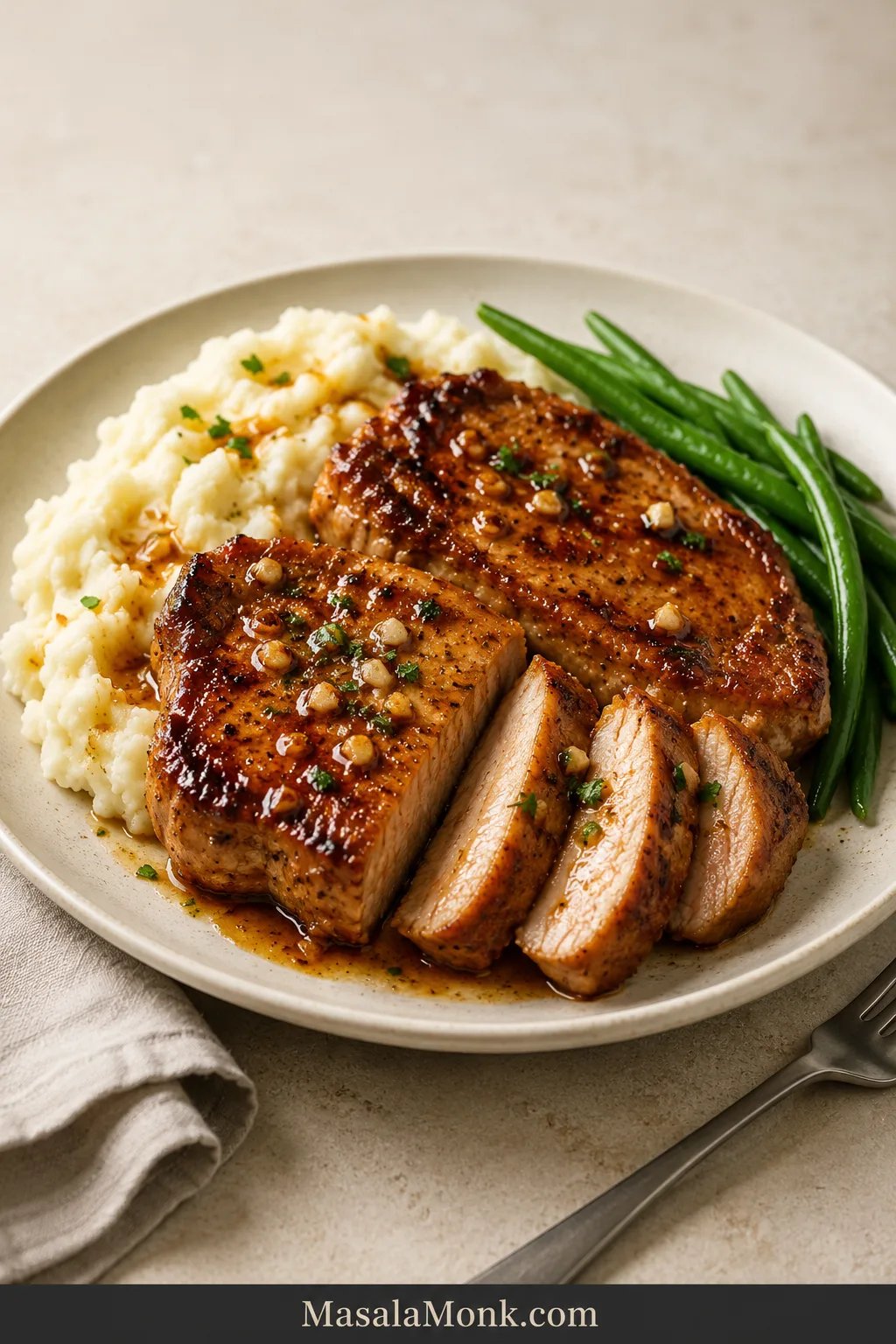
Some weeknight dinners simply get the job done. These honey garlic pork chops feel like you made an effort—golden at the edges, juicy in the center, and finished with a savory-sweet glaze that slips into the rice or mashed potatoes underneath.
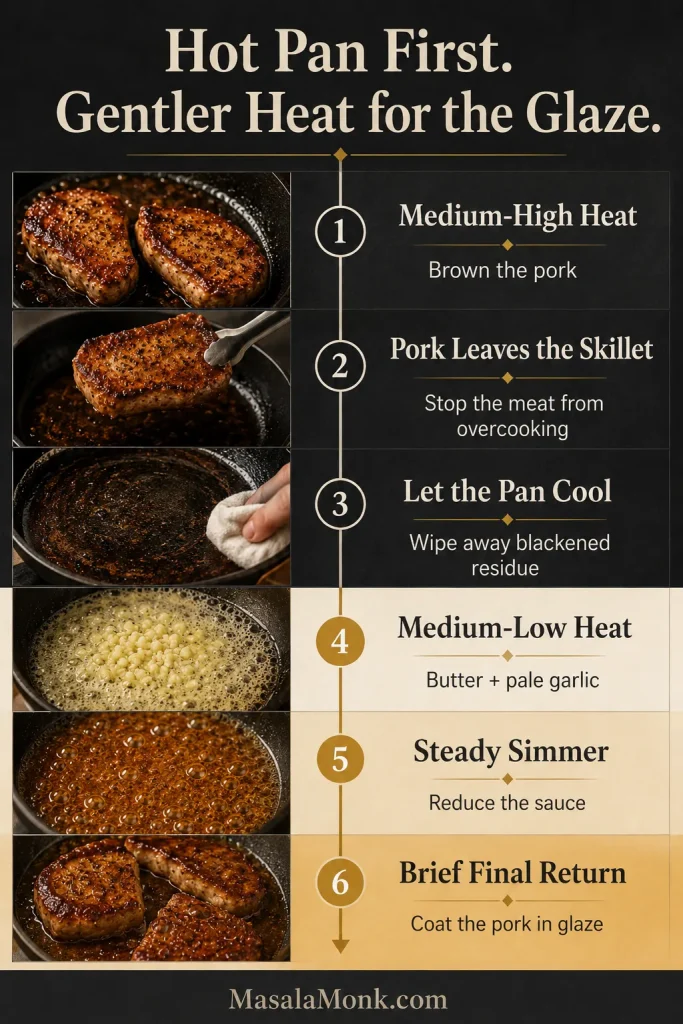
In about 30 minutes—slightly longer if the chops need to brown in batches—one skillet takes the pork from deeply browned to glossy and glazed. It starts hot enough for golden edges, then cools before the honey and garlic go in, so the sauce turns shiny instead of scorched.
Pork chops rarely come home from the store perfectly matched. Timing tells you when to check, the thermometer tells you when to stop, and thinner pieces can come out before thicker ones.
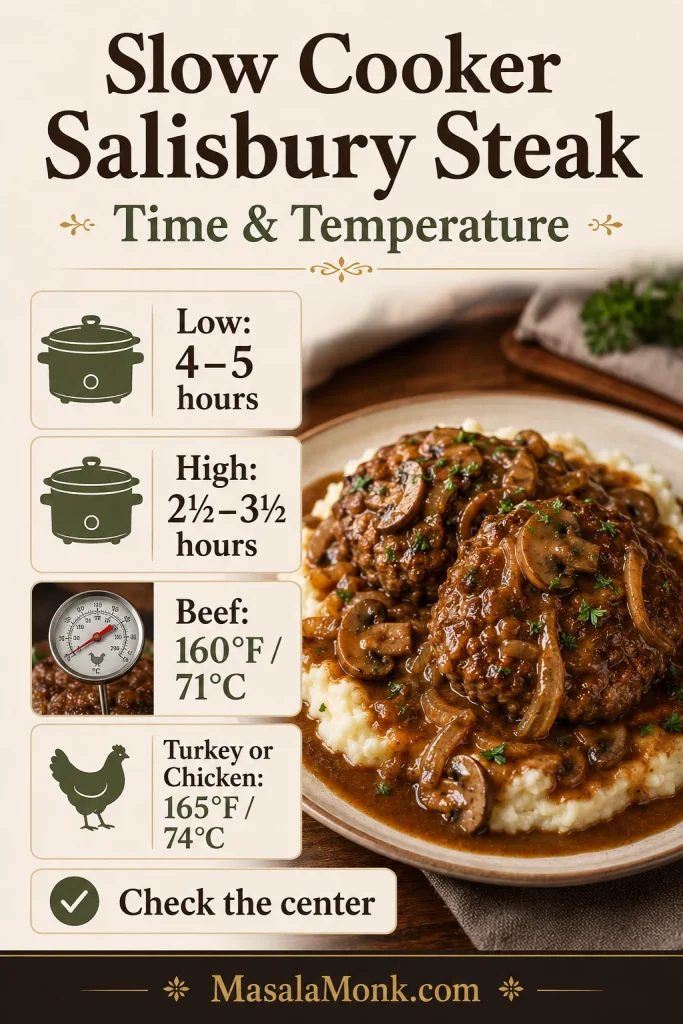
For four chops about ¾–1 inch / 19–25 mm thick, the first side commonly needs 3–4 minutes and the second 2–3 minutes. Those times tell you when to check; thickness and internal temperature tell you when to stop.
Move the pork out before it is fully done, lower the heat, and simmer the honey mixture until the bubbles become smaller and the sauce lightly coats a spoon. Return each chop only long enough to reach 145°F / 63°C, then rest for at least 3 minutes.
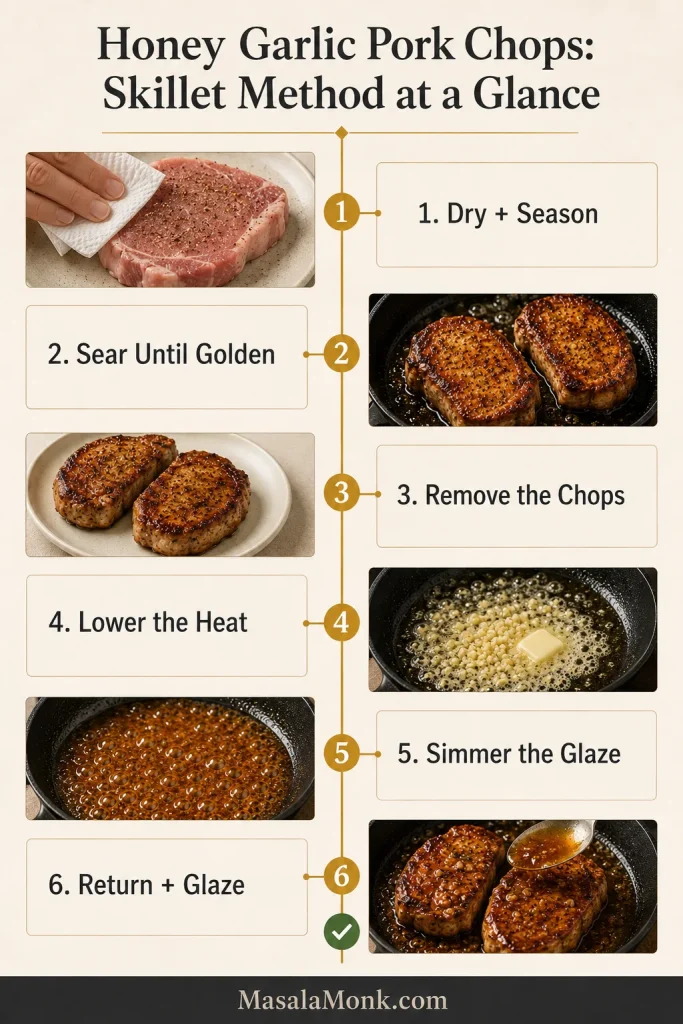
The method: sear first, lower the heat, sauce second, glaze last.
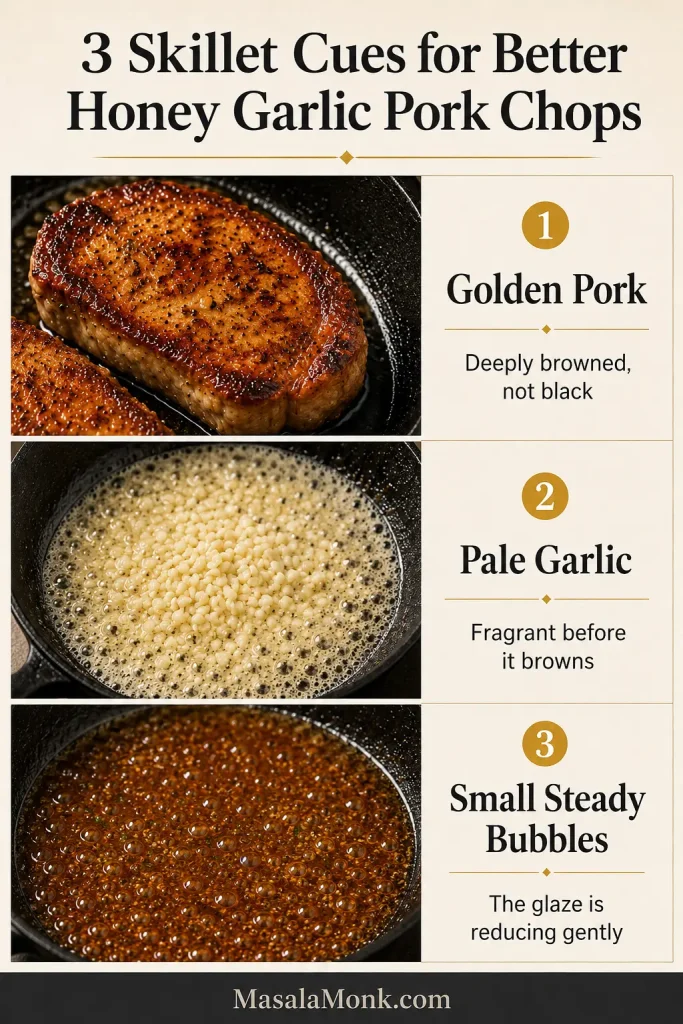
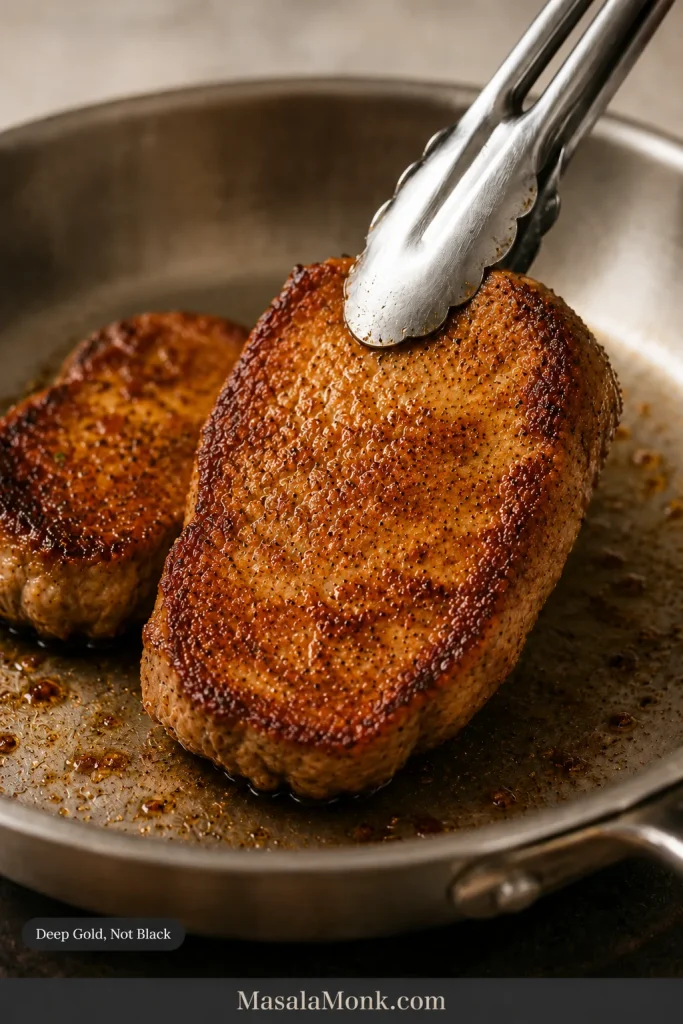
The visual cues: golden pork, pale garlic, small steady bubbles.
When one cue is missing, pause and adjust: pale pork needs more browning, darkening garlic needs a cooler pan, and large bubbles signal that the sauce still contains excess water.
Honey Garlic Pork Chops Recipe
Recipe at a Glance
Prep Time10 minutes
Cook Time15–18 minutes
Total TimeAbout 30 minutes
Servings4
Best Chop¾–1 inch / 19–25 mm
Best Pan12 inch / 30 cm skillet
Final Temperature145°F / 63°C
RestAt least 3 minutes
Equipment
12-inch / 30-cm heavy skillet
Instant-read meat thermometer
Tongs and a wooden or silicone spoon
Small bowl or liquid measuring jug
A clean plate for holding the seared pork
Ingredients
For the pork chops
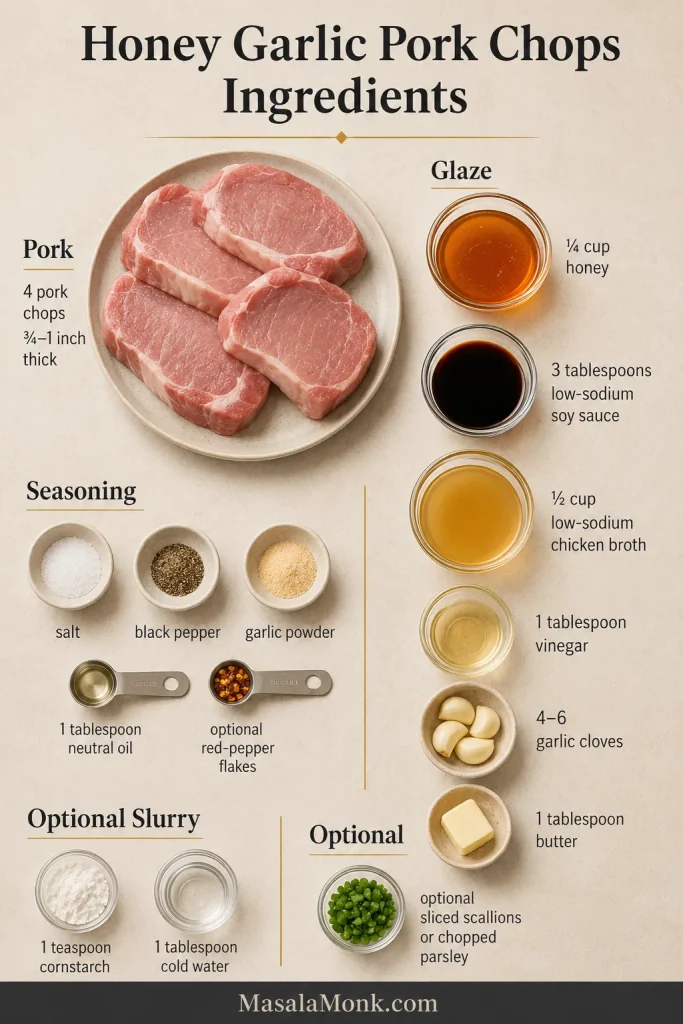
4 pork chops, preferably ¾–1 inch / 19–25 mm thick, about 6–8 oz / 170–225 g each
Fine salt: ¼ teaspoon, about 1.5 g, plus more only after tasting the reduced sauce
Black pepper: ½ teaspoon, about 1 g
Garlic powder: ½ teaspoon, about 1.5 g
Neutral cooking oil: 1 tablespoon / 15 ml, plus a little more if cooking in batches
For the sauce
¼ cup honey, about 3 oz / 85 g
3 tablespoons low-sodium soy sauce, 45 ml
½ cup low-sodium chicken broth, 4 fl oz / 120 ml
1 tablespoon apple cider vinegar or unseasoned rice vinegar, 15 ml
4–6 garlic cloves, finely chopped, about 12–18 g; use 4 for gentler garlic or 6 for a bolder glaze
1 tablespoon unsalted butter, about ½ oz / 14 g
¼ teaspoon red-pepper flakes, optional
Sliced scallions or chopped parsley, optional, for serving
Optional, for a thicker glaze
1 teaspoon cornstarch, about 3 g
1 tablespoon cold water, 15 ml
Low-sodium soy sauce and broth give the glaze room to reduce without becoming overly salty; taste only after the sauce has concentrated.
Method
The skillet method for honey garlic pork chops has two separate stopping points: temperature decides when the meat leaves, while texture decides when the glaze is ready.
Prepare and Sear
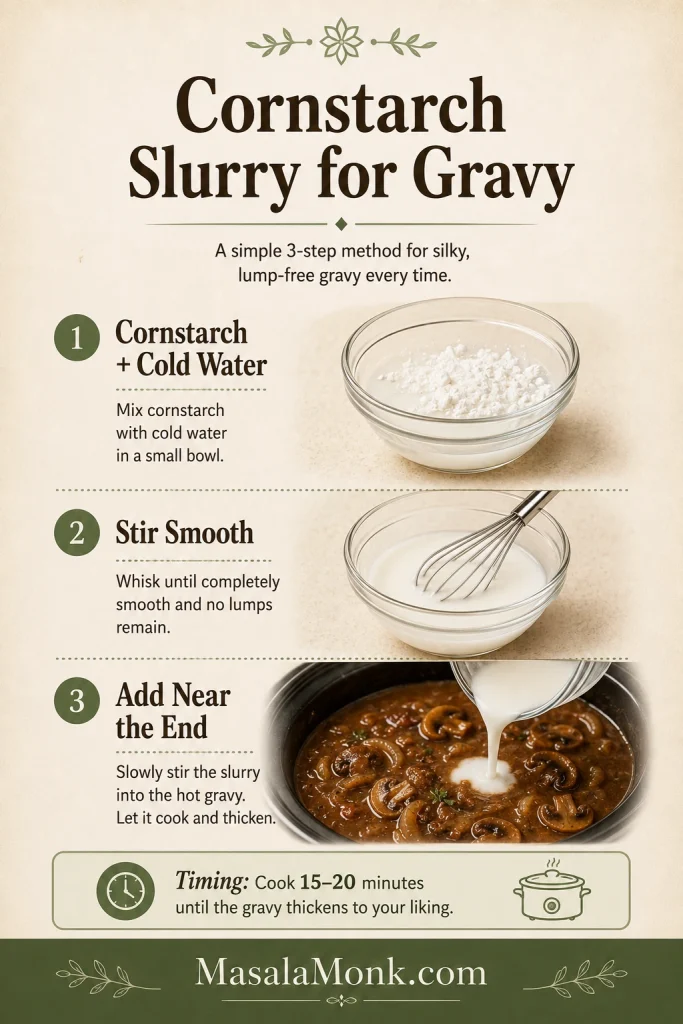
Mix the sauce. Whisk the honey, soy sauce, broth, vinegar, and optional red-pepper flakes. Keep the garlic and butter separate. If using cornstarch, stir it with the cold water in a second bowl.
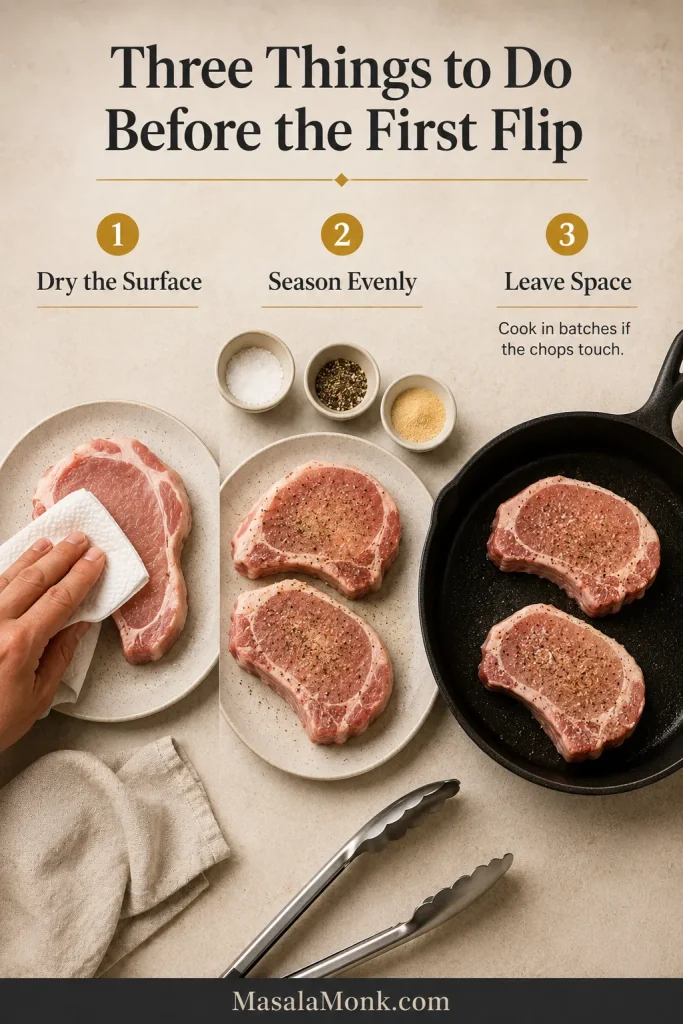
Prepare the pork. Pat the chops thoroughly dry and season both sides with salt, pepper, and garlic powder. If a chop has a firm fat rim, make two or three shallow cuts through the fat so it lies flat.
Sear the first side. Heat the skillet over medium-high for about 2 minutes, then add the oil. Add the chops with space between them and cook without moving until golden, commonly 3–4 minutes. Work in two batches if they touch.
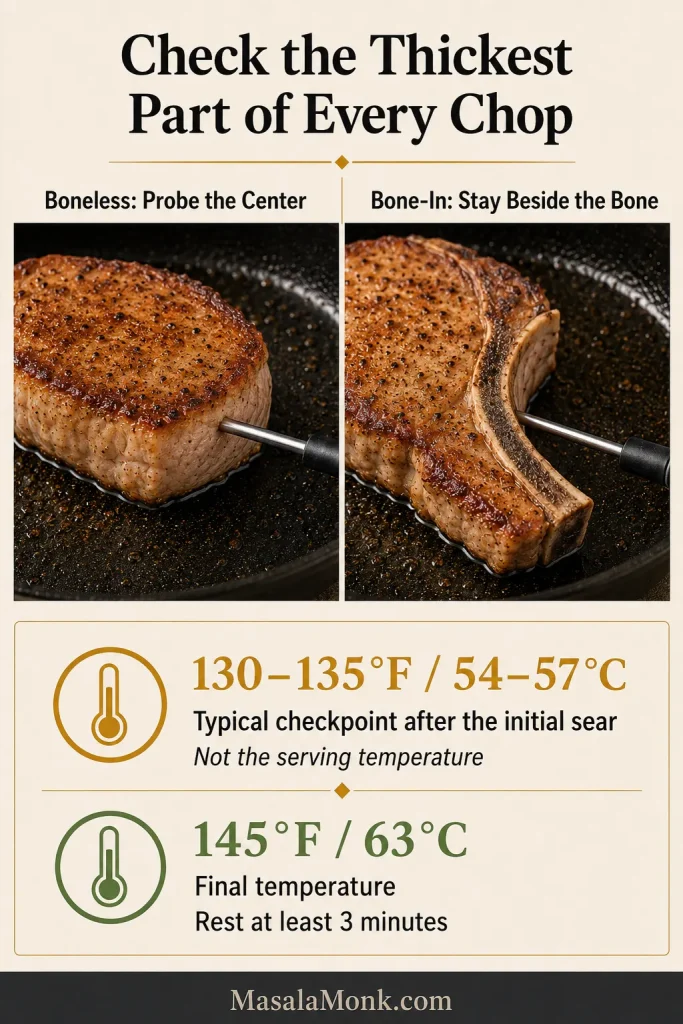
Turn, check, and remove. Cook the second side for about 2–3 minutes, checking early if the chops are thin. Remove each piece when it is roughly 10–15°F / 6–8°C below the final temperature—usually around 130–135°F / 54–57°C for standard chops. This is only an interim checkpoint, not the serving temperature.
Make the Glaze and Finish
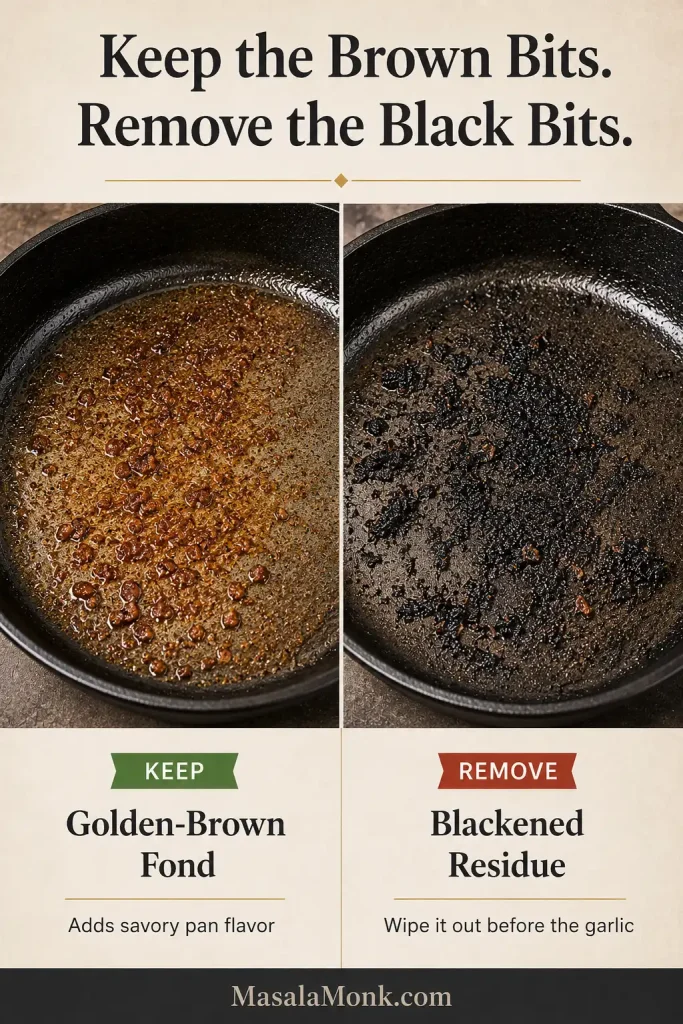
Lower the heat and check the skillet. Golden-brown residue adds flavor; black residue tastes bitter. Wipe out blackened bits, lower the heat to medium-low, and move the skillet off the burner briefly if it is still fiercely hot.
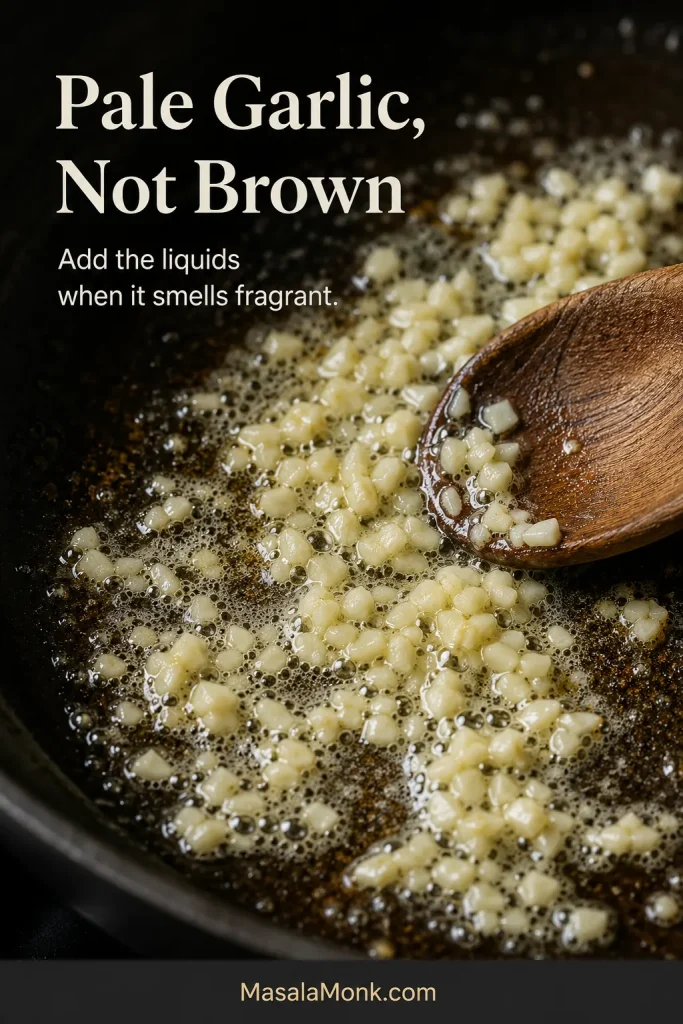
Make the pan sauce. Melt the butter and stir in the garlic for 20–30 seconds, keeping it pale. Pour in the honey mixture and scrape up the golden pan juices. Maintain a gentle, steady simmer until the bubbles tighten and the sauce leaves a brief trail behind the spoon, usually 4–6 minutes.
Glaze the pork. If the sauce remains watery, add half the cornstarch slurry and simmer for 20–30 seconds. Add more only if it still runs quickly from the spoon. Return the pork and any plate juices, turning each chop through the glaze only until its thickest part reaches 145°F / 63°C.
Rest and serve. Move the chops to a clean plate and rest for at least 3 minutes. Spoon over the glaze. If it tightens too much, loosen it with broth or water, 1 tablespoon / 15 ml at a time.
The thinnest chop is allowed to finish first. Dinner does not improve by making every piece wait for the slowest one.
Recipe Notes
Thin chops: Start checking after about 2 minutes on the first side and 1–2 minutes on the second.
Thick chops: Chops thicker than 1¼ inches / 32 mm are easier to finish in a 400°F / 200°C oven after searing.
Bone-in chops: Measure beside the bone without touching it.
Enhanced or pre-brined pork: Omit the added salt at first and adjust the finished sauce only after tasting.
Food safety: Whole pork chops should reach 145°F / 63°C and rest for at least 3 minutes.
Once the pork is browned and resting, the most time-sensitive part is over. The sauce can reduce without leaving the pork in the skillet long enough to dry out.
Why This Method Works
Removing the pork gives the skillet time to cool before the garlic goes in. The sauce can then reduce without overcooking the meat.
Heavy skillets retain heat after the burner is lowered. A brief pause off the heat can protect the butter and garlic before the sauce ingredients enter the pan.
Honey alone would taste sweet but flat. Soy sauce brings savory depth, broth loosens the browned pan juices and gives the sauce enough volume to reduce gradually, and vinegar keeps the final glaze bright. Fresh garlic leads the aroma, while garlic powder seasons the meat beneath the sauce.
Use oil for the hot sear, then add butter after the pan cools to soften and round out the sauce. Maple syrup can replace the honey for a softer maple-garlic variation, though the flavor and final texture will be different.
Choose Your Pork Chops by Thickness
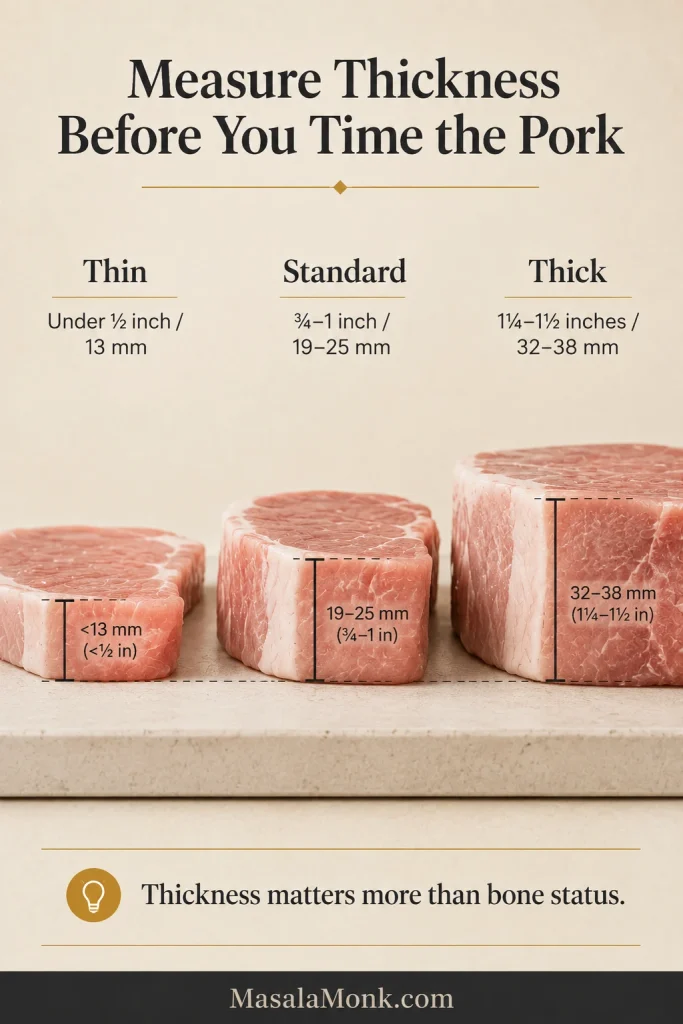
Thickness matters more than bone status. Use the package measurement as a starting point, then let the thermometer decide when each chop leaves the heat.
Sort the chops by thickness before cooking and remember where each one sits in the skillet. That makes it easier to check and remove the thinnest piece first.
Thickness
How to cook it
When to begin checking
Under ½ inch / 13 mm
Brief skillet sear; glaze off the heat if already done
After about 2 minutes on the first side
¾–1 inch / 19–25 mm
Use the main skillet method
During the second side
1¼–1½ inches / 32–38 mm
Sear, then finish in the oven
About 4 minutes after entering the oven
Boneless chops are often more uniform and may cook a little faster. Bone-in chops can be more forgiving, but place the thermometer beside the bone without touching it. Brown the batch together, then let every chop finish on its own time.
Check every chop individually rather than treating the skillet as one piece of meat; shape, thickness and pan position can produce different temperatures within the same batch.
Different cut? Pork tenderloin needs its own oven method; its long, narrow shape cooks differently from individual chops.
Read the Skillet: Golden Pork, Pale Garlic, Small Bubbles
Those three cues tell you more than the clock. They show when the pork has browned, when the pan is cool enough for garlic, and when the loose sauce is becoming a glaze.
Build the Sear
Listen after the pork enters the pan: a clear searing sound is useful, but a weak watery hiss often means surface moisture or crowding is slowing the browning.
Golden pork: Dry chops brown faster. Give them space and leave the first side alone until a real crust forms; in cast iron or stainless steel, the meat often releases more easily at that point.
Do not wait for perfectly uniform color. A real skillet crust usually combines deep-golden areas with a few darker caramelized patches and naturally lighter edges.
After the pork leaves the skillet, inspect what remains before building the sauce. Golden-brown fond can enrich the glaze, while genuinely black residue should be wiped away so it does not add bitterness.
Keep caramel-brown fond; wipe away genuinely black flakes before adding the sauce.
Control the Garlic and Glaze
Pale garlic: Let the skillet settle before the butter and garlic go in. Add the liquid when the garlic smells warm and savory but still looks pale.
Use aroma as the first signal: once the garlic loses its raw sharpness and smells warm and savory, the liquids can go in before the color changes.
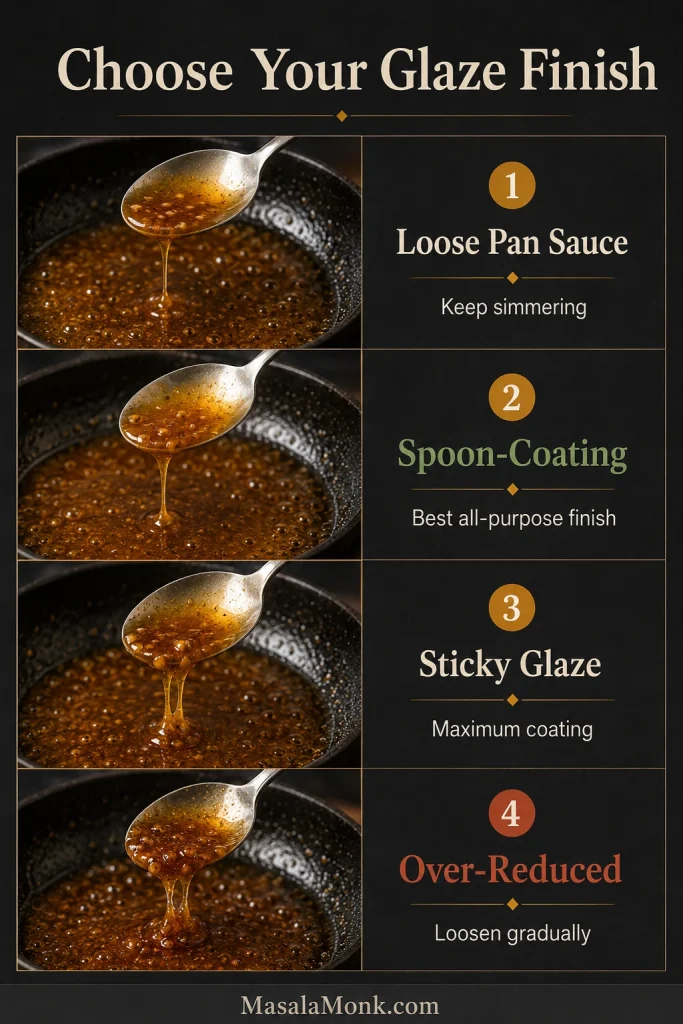
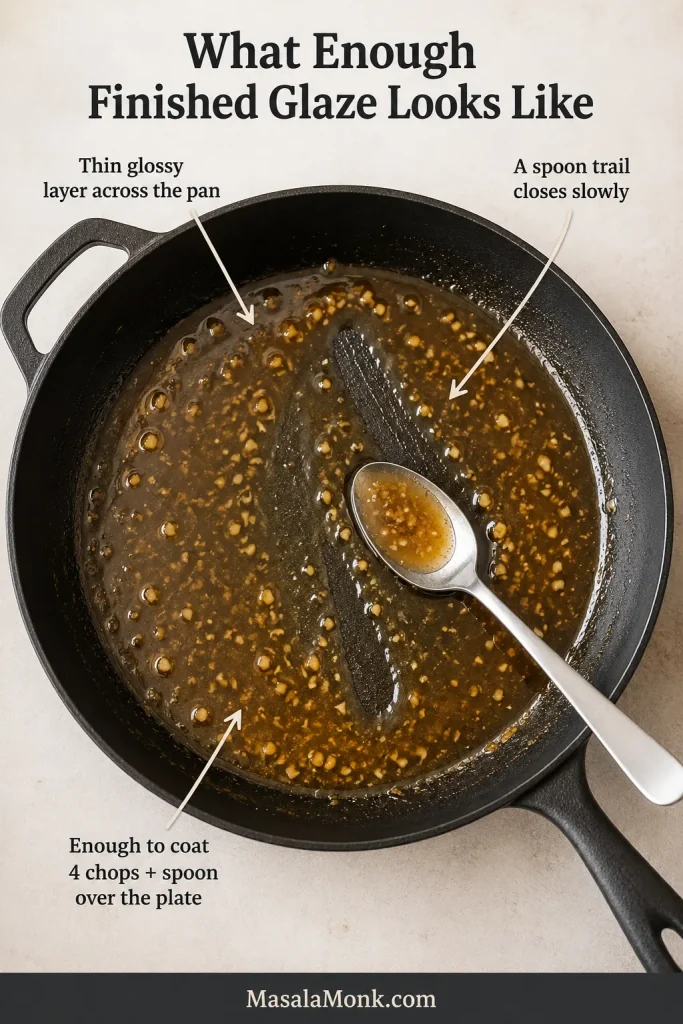
Small steady bubbles: The sauce begins loose with large bubbles. As water evaporates, the bubbles become smaller, the surface turns shiny, and a spoon leaves a short trail through the pan. When that happens, the glaze is ready to settle over the pork and whatever you have waiting underneath.
Stage
What it looks like
Best use
Loose pan sauce
Runs quickly from a spoon
Keep simmering, or use extra over rice
Spoon-coating sauce
Clings, then slides slowly
Best all-purpose finish
Sticky glaze
Holds firmly to the chops
Maximum coating on the pork
Over-reduced
Dense, tacky, or stringy
Loosen with broth or water
Choose the finish for the meal: spoon-coating sauce spreads well over rice or potatoes, while a stickier glaze keeps more flavor concentrated on the pork.
Honey tightens as it cools, so give the glaze the three-minute rest before deciding it needs more thickening. Cornstarch is optional; natural reduction is usually enough when the sauce simmers steadily. Once the glaze turns shiny, there is very little left to manage—coat the chops, let them rest, and bring the plate together.
Tilt the skillet once to judge the quantity. A finished glaze should move as a shallow glossy sheet rather than collect like a deep pool in the center.
What to Expect from the Finished Dish
Expect garlic and savory pan juices first, with honey softening the edges and vinegar keeping the finish clean. The glaze clings to the browned pork but stays loose enough to spoon over the plate.
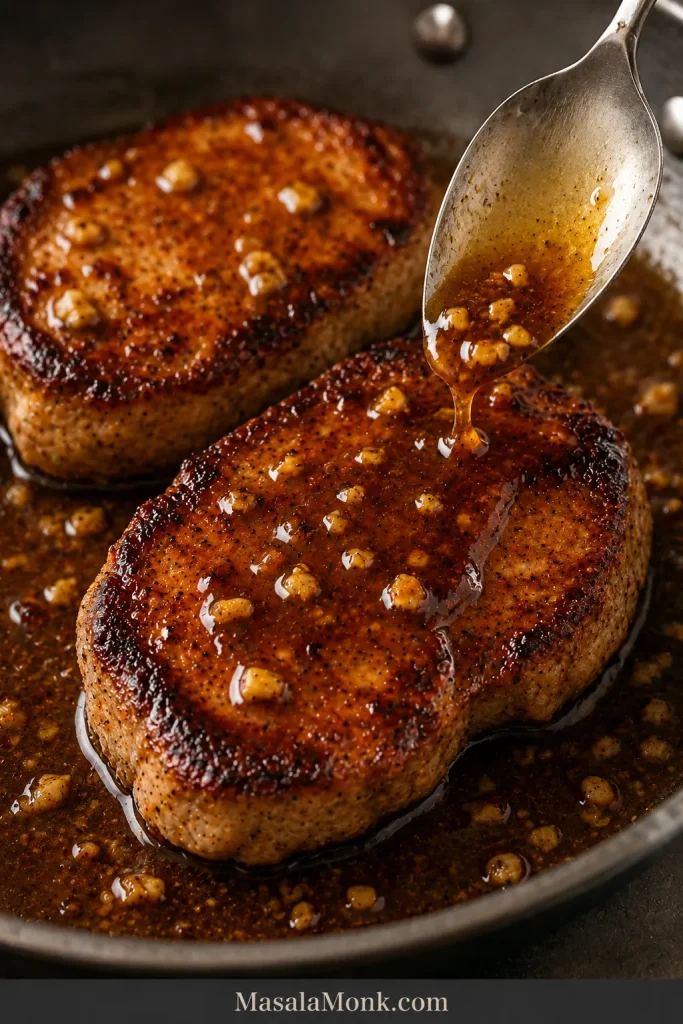
Turn each chop through the sauce once, then spoon glaze over the top. Prolonged bubbling after the pork returns adds more heat than useful flavor.
Should You Marinate the Pork?
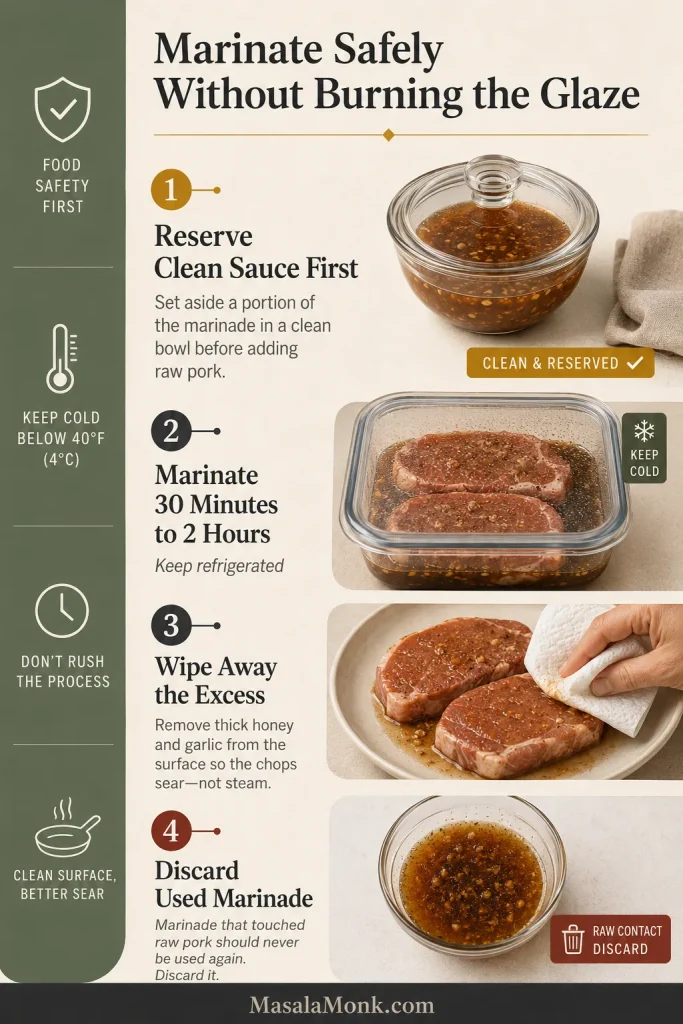
You can, but the main method is easier to control. Honey and chopped garlic left on the surface can darken quickly during the sear. To marinate, reserve a clean portion of sauce, refrigerate the pork for 30 minutes to 2 hours, wipe away excess marinade before cooking, and discard anything that touched raw meat.
Marinating changes the surface flavor, but it does not guarantee juicy pork. Thickness, internal temperature and timely removal from the heat still control the final texture.
Other Ways to Cook Honey Garlic Pork Chops
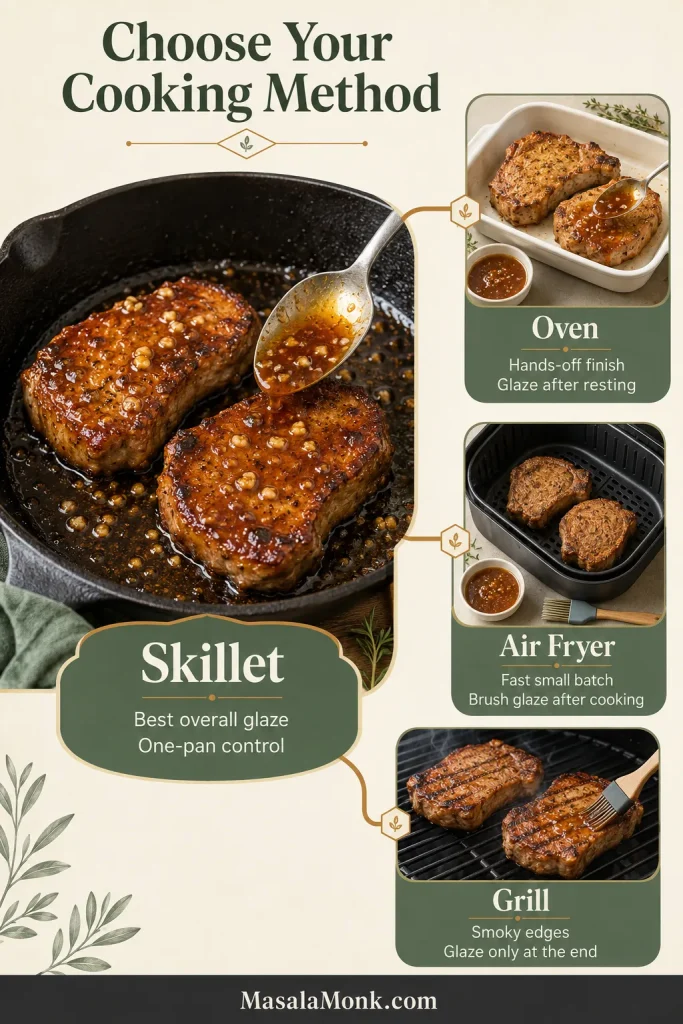
The skillet method gives the best control over browning and reduction. The same flavor still works in the oven, air fryer, and on the grill as long as the glaze arrives late.
For honey garlic pork chops, choose by batch and cut: skillet for control, oven for thick pieces, air fryer for two or three chops, and grill when smoky flavor matters most.
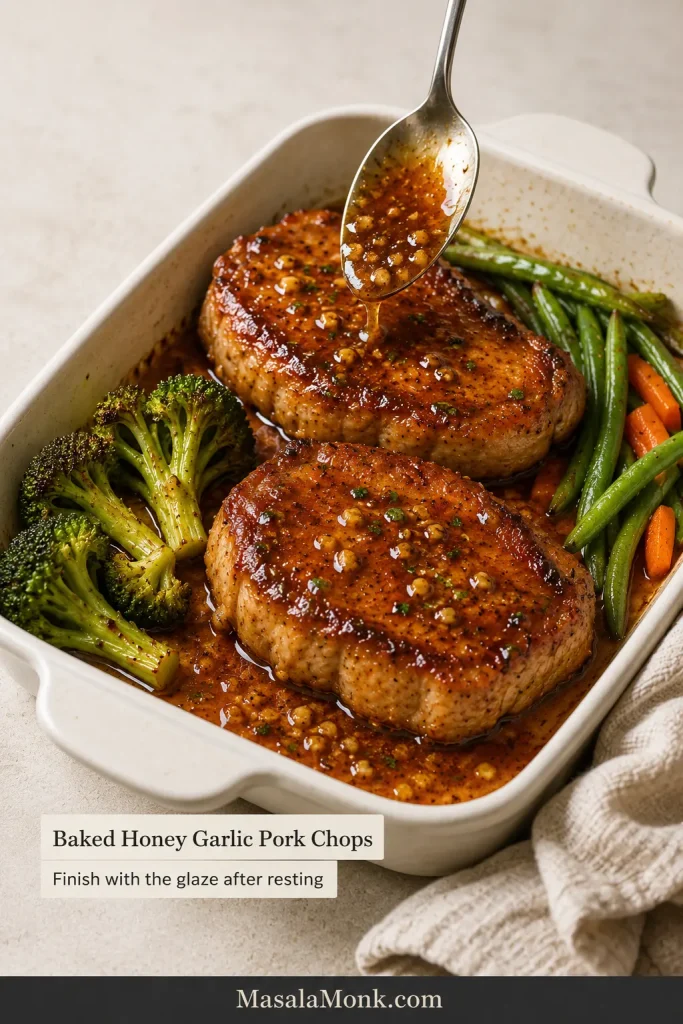
Baked Honey Garlic Pork Chops
Heat the oven to 400°F / 200°C. Sear thick chops for about 2–3 minutes per side, then move them to a small baking dish or sheet pan. Use the skillet to make the pan sauce while the pork finishes in the oven.
Begin checking the chops after about 4 minutes and remove each one at 145°F / 63°C. Rest for at least 3 minutes, then spoon on the glaze off the heat so the pork stays juicy.
Move thick chops to the oven when the crust is ready but the center still needs time. The gentler finish prevents the exterior from becoming too dark.
Oven-only option: Bake seasoned chops at 375°F / 190°C until they reach 145°F / 63°C. Make the sauce separately in a small saucepan and glaze the rested pork.
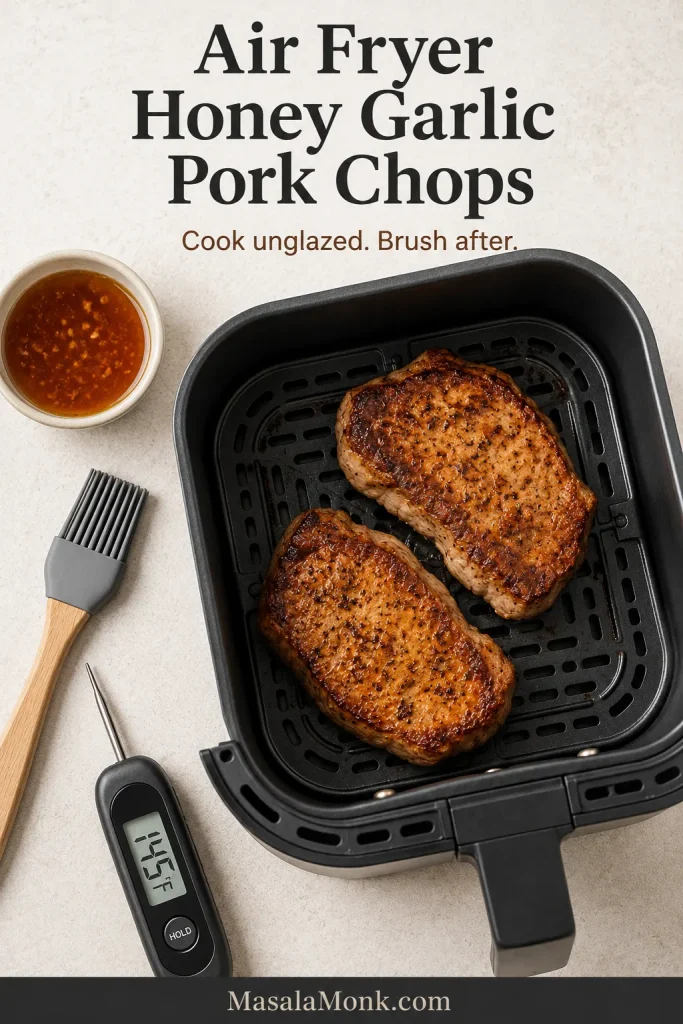
Air Fryer Honey Garlic Pork Chops
Air fry the seasoned pork first and make the sauce separately. Boneless chops around ¾–1 inch commonly take about 8–12 minutes at 380°F / 190°C, turning halfway; begin checking early because models vary. Remove each chop at 145°F / 63°C, rest for at least 3 minutes, then brush on the glaze. This air fryer timing guide handles thin and thick boneless chops separately.
Basket space matters more than squeezing in an extra portion. Two well-separated chops usually brown better than four crowded pieces surrounded by trapped moisture.
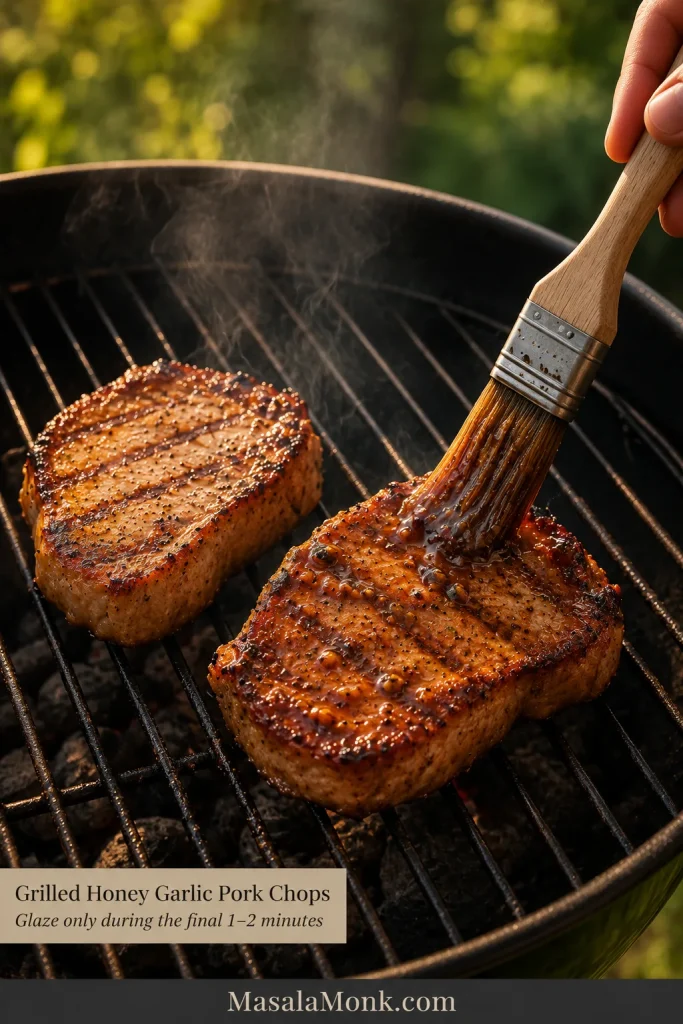
Grilled Honey Garlic Pork Chops
Heat the grill to about 400–450°F / 200–230°C. Grill 1-inch chops for roughly 4–5 minutes per side, but begin checking before the full time because thickness and temperature override the clock. Remove each chop at 145°F / 63°C, rest for at least 3 minutes, and brush on the glaze only during the final 1–2 minutes or after cooking.
Set up a cooler section of the grill before cooking. If the honey causes a flare-up, move the pork away from direct heat instead of letting the glaze burn.
About the slow cooker: This skillet glaze does not convert directly because trapped moisture keeps it thin and lean chops can dry out over several hours. A slow-cooker version needs different liquid proportions and its own timing.
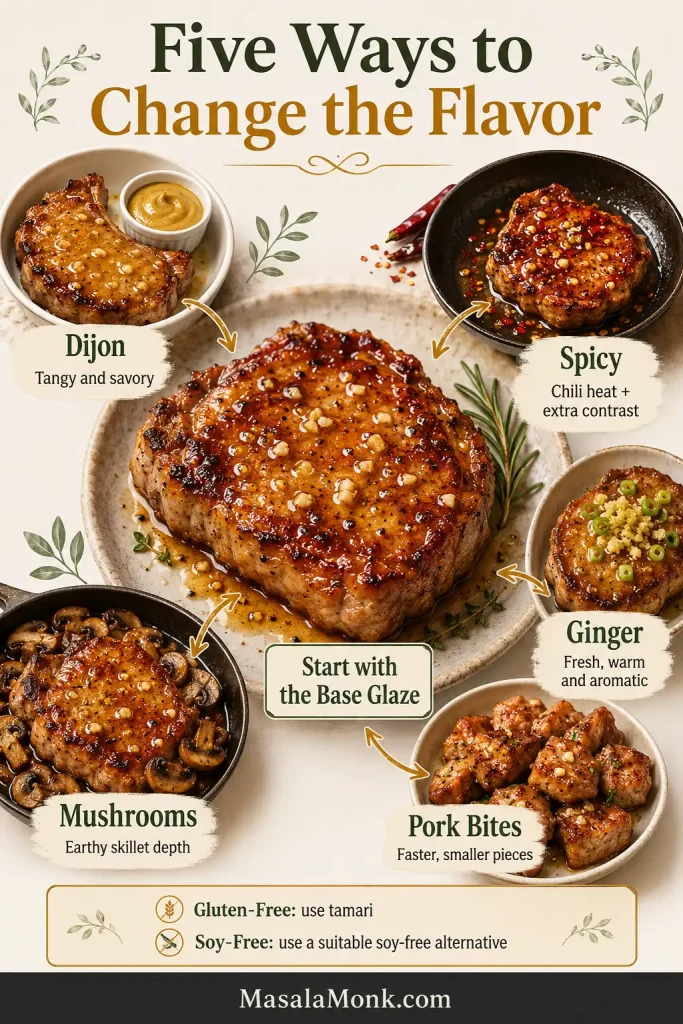
Honey Garlic Pork Chop Variations
Change one direction at a time before combining variations: acidity sharpens, chili contrasts, ginger brightens, mushrooms deepen, and smaller pork pieces alter the cooking speed.
Dijon: Whisk in 1–2 teaspoons. One teaspoon quietly sharpens the sweetness; two makes mustard more prominent.
Spicy: Add ½ teaspoon red-pepper flakes, 1–2 teaspoons sriracha, chili-garlic sauce, or a thinly sliced fresh chili.
Ginger: Stir 1 tablespoon finely grated fresh ginger in with the garlic.
Mushrooms: Brown 8 oz / 225 g sliced mushrooms after removing the pork. Let their moisture evaporate before adding the butter and garlic.
Pork bites: Cut boneless pork into even pieces and sear in batches. The smaller pieces cook much faster than chops.
Gluten-free: Use certified gluten-free tamari and check that the broth is labeled gluten-free.
Soy-free: Use verified soy-free broth in place of the soy sauce, then season the reduced sauce gradually. Suitable coconut aminos can also work but are usually sweeter.
Cooking more chops: Brown them in batches and reduce the sauce before returning the pork.
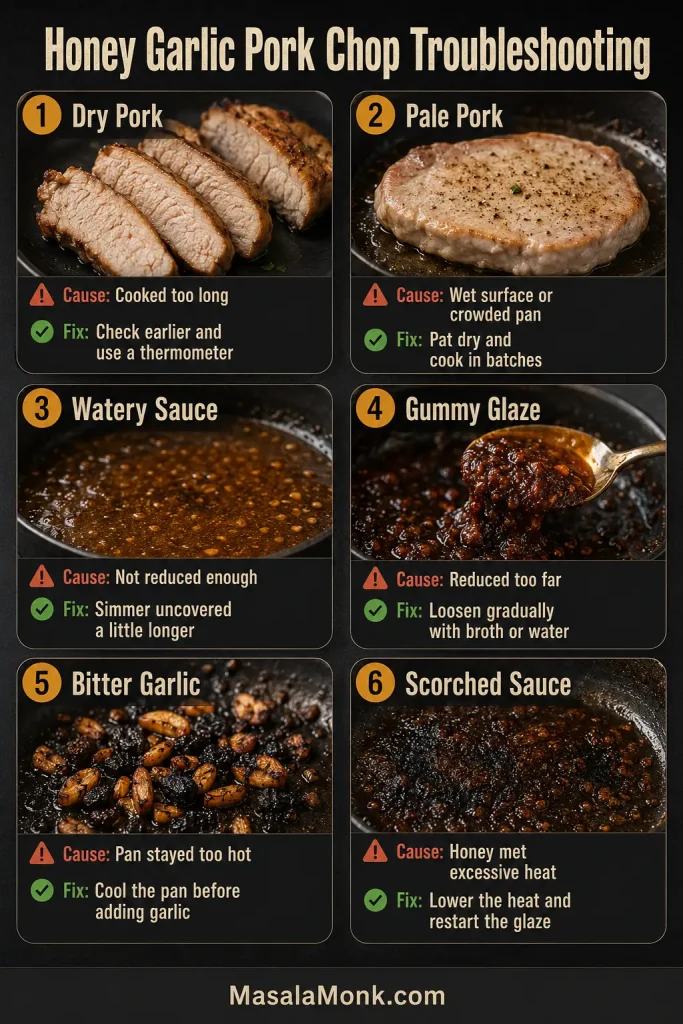
If dinner is already in the skillet, most problems are still fixable. First decide whether the pork or the sauce needs attention.
When honey garlic pork chops need rescuing, remove the meat first and troubleshoot the sauce separately. Cooked pork should not remain in the skillet while the glaze is corrected.
Pork Problems
Problem
Likely reason
What to do
Pork is dry
Thin chops or too much finishing time
Check earlier and remove each piece as soon as it reaches 145°F / 63°C
Pork is pale
Wet surface or crowded skillet
Pat it dry and brown in batches
Chops finish unevenly
Different thicknesses
Remove each chop individually instead of waiting for the batch
Sauce and Glaze Problems
Problem
Likely reason
What to do
Sauce is watery
Not enough reduction or extra pork juices
Remove the pork and simmer the sauce alone
Glaze is too thick
Reduced too far or cooled
Add broth or water 1 tablespoon at a time
Glaze is too sweet
Not enough acid
Add vinegar ½ teaspoon at a time
Glaze is too salty
Regular soy sauce or heavy reduction
Add low-sodium broth and a little honey
Glaze is gummy
Too much cornstarch
Whisk in broth gradually and simmer gently
Garlic tastes bitter
It browned too far
Remake the sauce in a cooler skillet
Sauce tastes scorched
The skillet or residue was too dark
Clean the pan and restart over gentler heat
Glaze slides off
It is still too thin
Reduce it separately before coating the pork
A thick glaze can be loosened; a scorched sauce cannot be hidden. If the pork is cooked and the sauce is not scorched, the dish is usually recoverable: broth loosens, honey softens a sharp edge, and vinegar restores brightness.
Build the Plate
Give the glaze something soft to soak into and something green or crisp on the side.
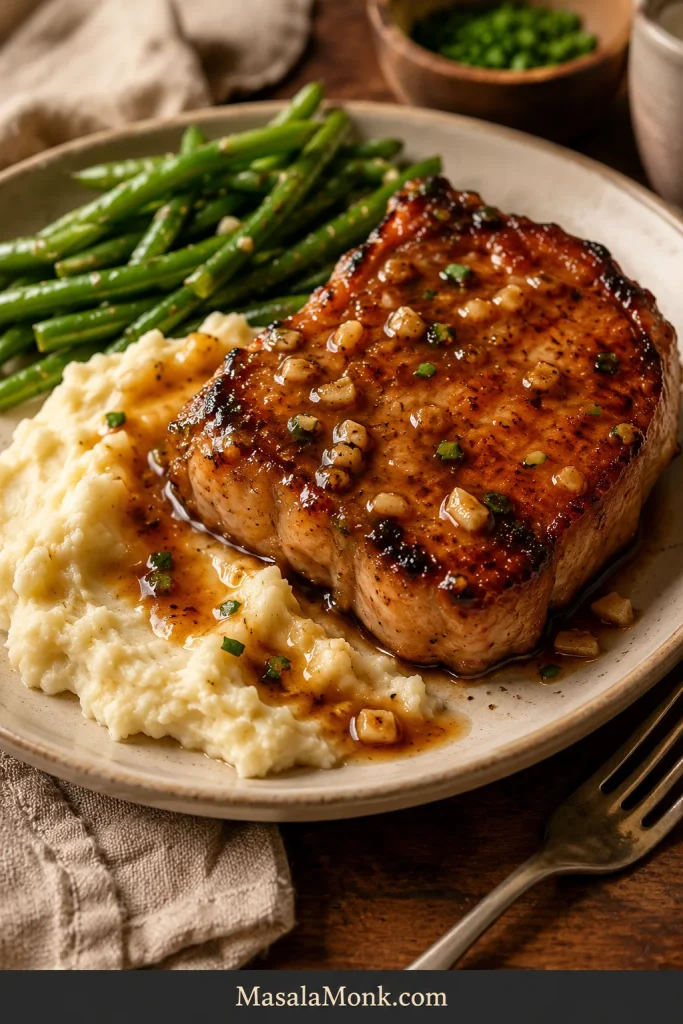
For the coziest plate, spoon the chops and glaze over garlic mashed potatoes and add green beans or broccoli.
Spoon most of the glaze beside the pork rather than covering every browned edge. The potatoes will catch the runoff while the crust keeps its texture.
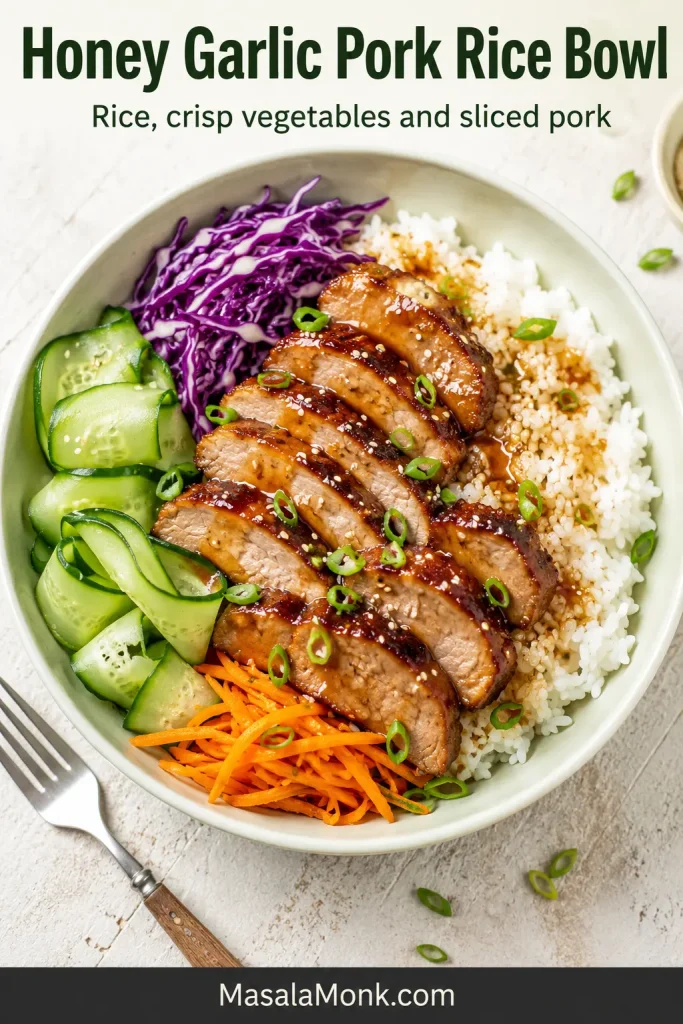
For a lighter bowl, serve the pork over rice with cucumber salad, cabbage, or sugar snap peas.
Use cool, undressed vegetables beside the warm pork for stronger contrast. Add the glaze mainly to the meat and rice so the cabbage and cucumber stay crisp.
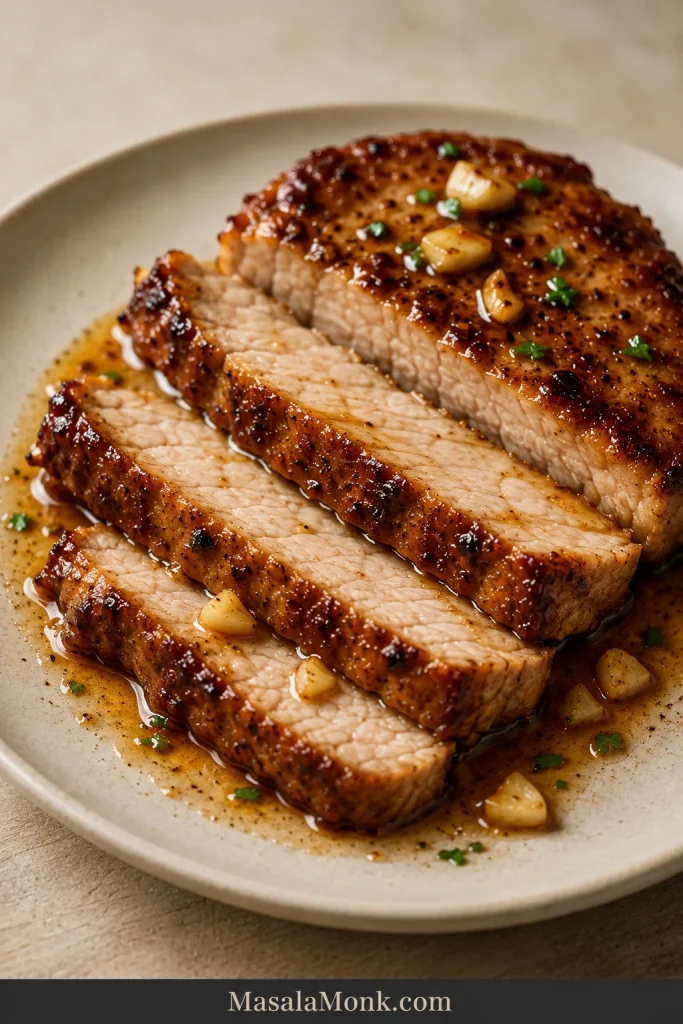
Slice the pork before adding the final spoonful of glaze so some of it catches along the freshly cut edges. Buttered noodles, soft polenta, roasted potatoes, slaw, corn, or a make-ahead potato salad can round out the plate.
Keep the serving slices reasonably thick. Thin decorative slices cool quickly and expose more surface area, whereas substantial pieces retain warmth and moisture longer.
Want a richer comfort-food direction? Smothered pork chops replace the sticky glaze with a deep onion gravy.
Storage, Reheating, and Leftovers
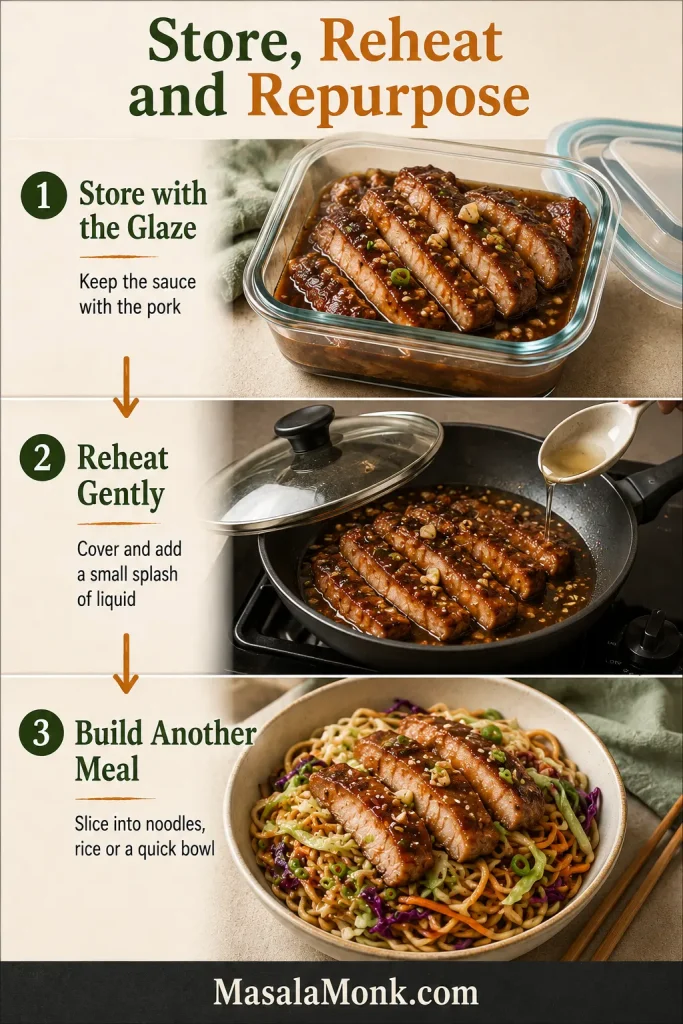
Keep the pork and glaze together so every piece has some moisture around it. That small amount of sauce makes reheating much kinder to a lean chop.
Portion leftover honey garlic pork chops before reheating so only the amount being served is warmed. Repeated heating is more likely to dry out the lean meat.
Refrigerate: Cool the pork and sauce, then store them in a covered container within 2 hours. FoodSafety.gov recommends using cooked leftovers within 3–4 days.
Freeze: Freeze individual portions with some glaze in tightly closed containers. The pork may feel slightly firmer after reheating, but the sauce helps protect it from drying out.
Reheat: Warm the pork and glaze in a covered skillet over low heat with 1–2 tablespoons / 15–30 ml broth or water until the leftovers reach 165°F / 74°C. In the microwave, use reduced power and short intervals.
Use leftovers in: rice bowls, noodles, wraps, chopped salads, fried rice, or a quick vegetable stir-fry. Slice the pork while cold and fold it into the new dish near the end.
Regular soy sauce works, but start with 2 tablespoons instead of 3 because it becomes saltier as the sauce reduces. Add more only after tasting.
Can I Make the Sauce Ahead?
Prepare the honey, soy sauce, broth, vinegar, and red-pepper flakes up to 2 days ahead and refrigerate. Keep the garlic separate so its flavor stays fresher.
Can I Make Extra Sauce?
For extra sauce, use 1½ to 2 times the listed quantities, depending on how much you want for rice or vegetables. Reduce the larger batch before returning the pork so the chops do not overcook.
Can I Start with Frozen Pork Chops?
Thawing first gives better browning and more predictable timing. Frozen pork releases water, weakens the sear, and dilutes the sauce. Thaw safely in the refrigerator and dry thoroughly.
Brown First, Glaze Last
Brown the pork while the skillet is hot, then make the sauce after the heat comes down. The edges stay golden, the center stays juicy, and the glaze tastes balanced instead of merely sweet.
It still feels like a proper plated dinner, even though the whole thing came from one skillet on an ordinary evening. Keep the glaze spoonable or reduce it until it clings to every bite—the method works either way.
If you make it, tell us what kind of chops you used—thin, thick, bone-in, or boneless—and whether you kept the glaze glossy or took it all the way to sticky.
A great Cajun étouffée recipe lands on the table as hot rice, tender shrimp or crawfish, and glossy sauce that settles into every grain. It should smell like toasted roux, sweet bell pepper, garlic, seafood, and a little vinegar heat before the first spoonful even reaches the bowl.
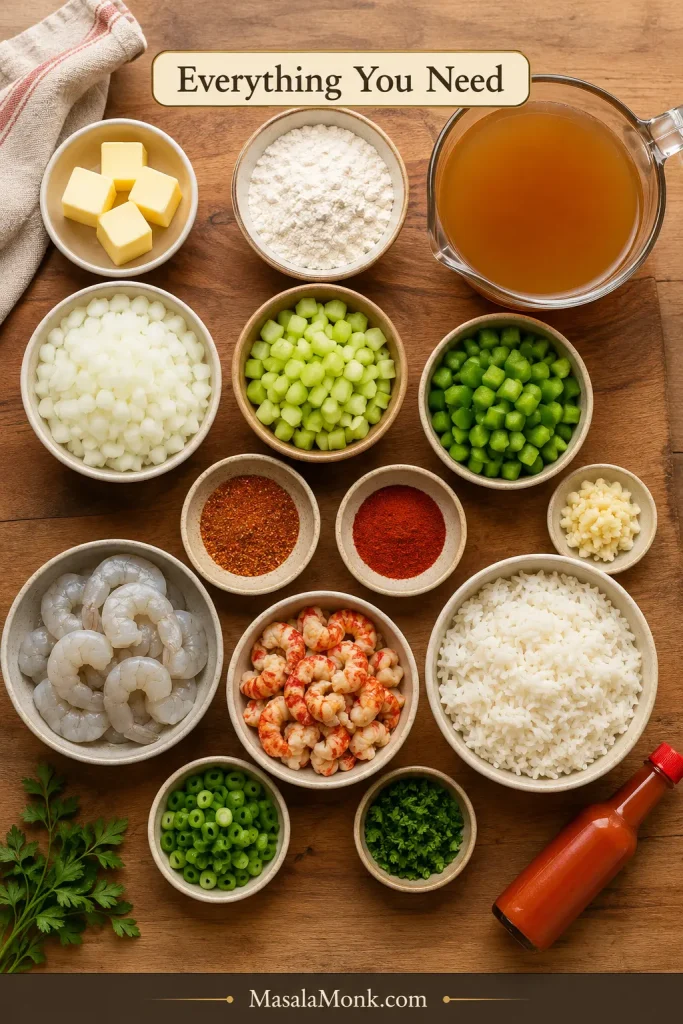
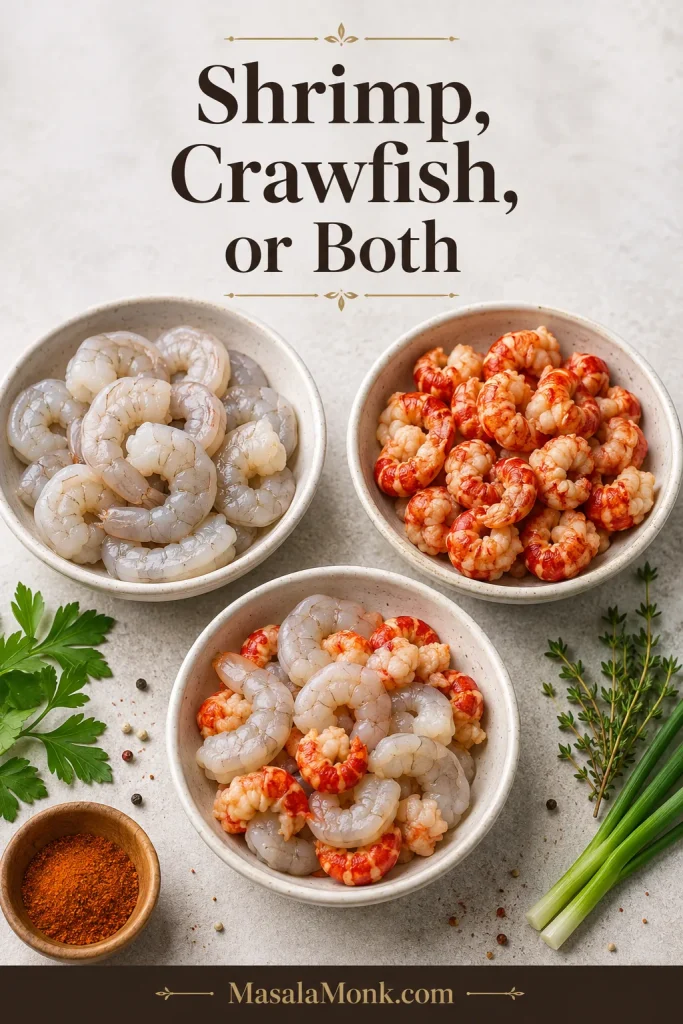
You can make this with shrimp, crawfish, or a mix of both without changing the base method. Once the vegetables are chopped and the rice is started, the rest is one steady stovetop pot: roux, holy trinity, sauce, seafood, herbs, and hot rice waiting.
The rhythm is simple: trust the roux, taste the sauce, then add the seafood. That order gives you deep flavor without rubbery shrimp, tough crawfish, or a thin sauce that disappears into the rice.
You do not need to guess your way through the roux, the sauce texture, or the seafood timing. This guide also covers frozen crawfish tails, salty Cajun seasoning, prepared roux, boxed étouffée base, cream soup shortcuts, tomato options, and the common fixes that save the pot before dinner gets stressful.
Cajun étouffée is a thick, seasoned Louisiana-style dish made with a roux, onion, celery, green bell pepper, stock, Cajun seasoning, and seafood such as crawfish or shrimp. It is served over white rice and eats more like a rich seafood gravy than a soup.
The word étouffée means “smothered,” and that is exactly how the dish should land on the plate: shrimp or crawfish smothered in a savory sauce that clings to every spoonful of rice. This version keeps the main pot roux-forward and no-tomato, with an easy tomato option if you prefer a brighter Creole-style sauce.
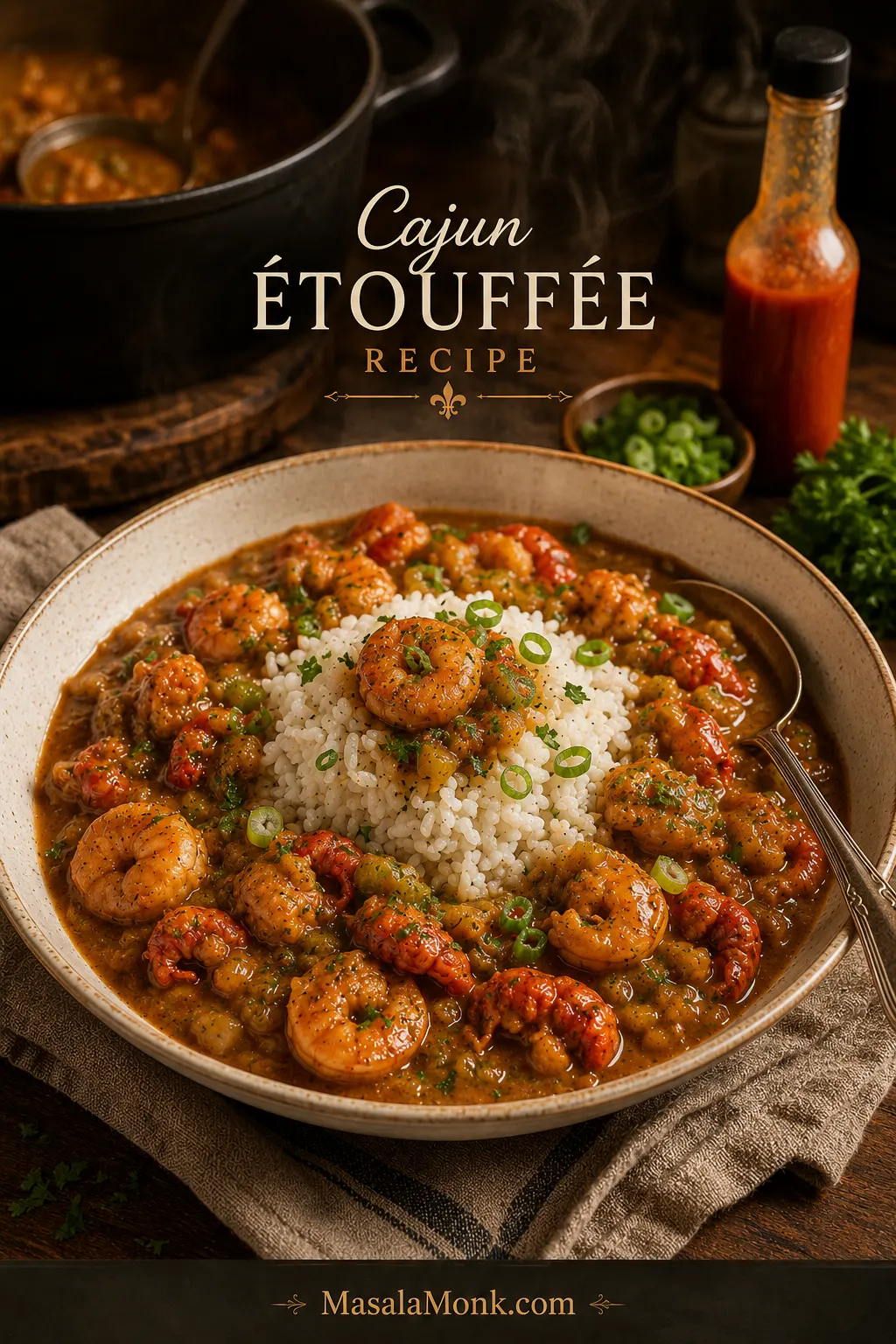
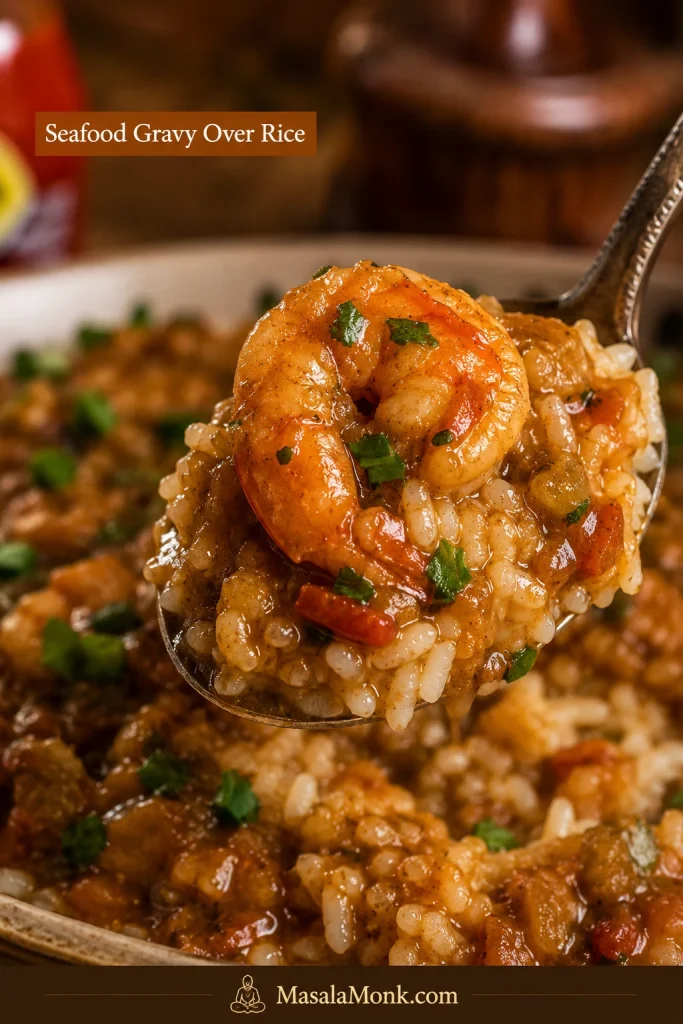
The final bowl should look rich and spoonable, with seafood and rice held together by a sauce that is thicker than broth.
A strong Cajun étouffée looks glossy and spoonable; as it settles, the sauce should hug the rice instead of flooding the bowl.
Make It Now
Ready to cook? Use this as the quick roadmap, then follow the recipe card for exact amounts. Nothing here needs to be rushed; once your prep is done, the recipe is mostly steady stirring, simmering, tasting, and finishing.
Chop the onion, celery, bell pepper, garlic, green onions, and parsley.
Start the rice early so it is hot when the étouffée is ready.
Warm the stock and cook the roux until it turns copper to peanut-butter brown.
Stir in the holy trinity, garlic, seasoning, stock, Worcestershire sauce, and a splash of hot sauce.
Simmer until the base tastes rounded and thick enough to spoon over rice.
Finish with your chosen seafood, add the final herbs, rest briefly, and serve.
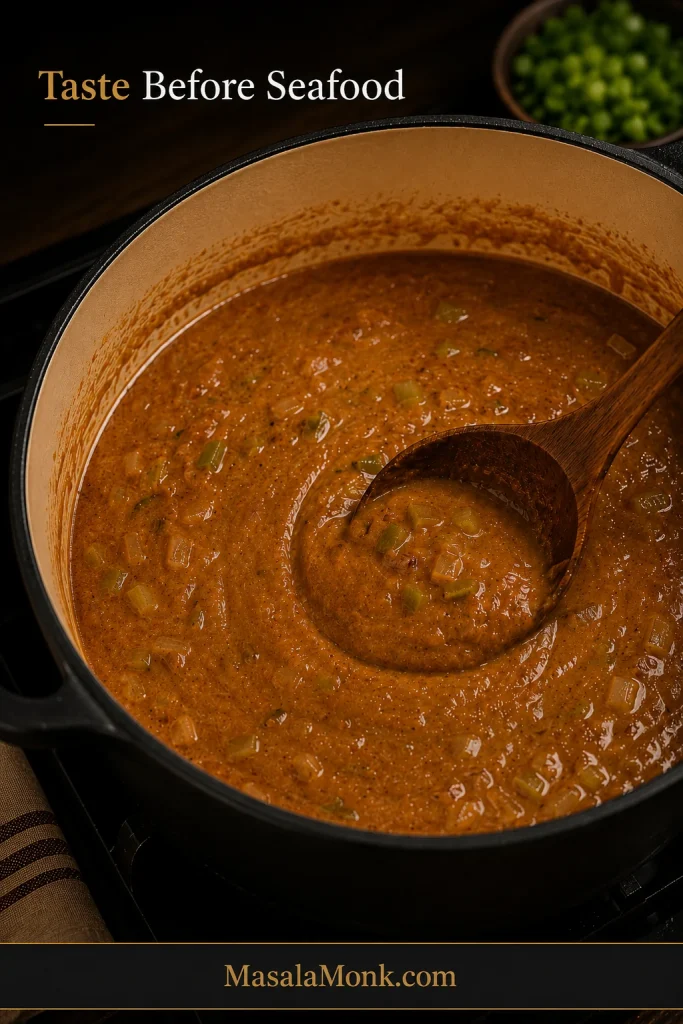
The checkpoint that saves the pot: the sauce should taste good before the seafood goes in.
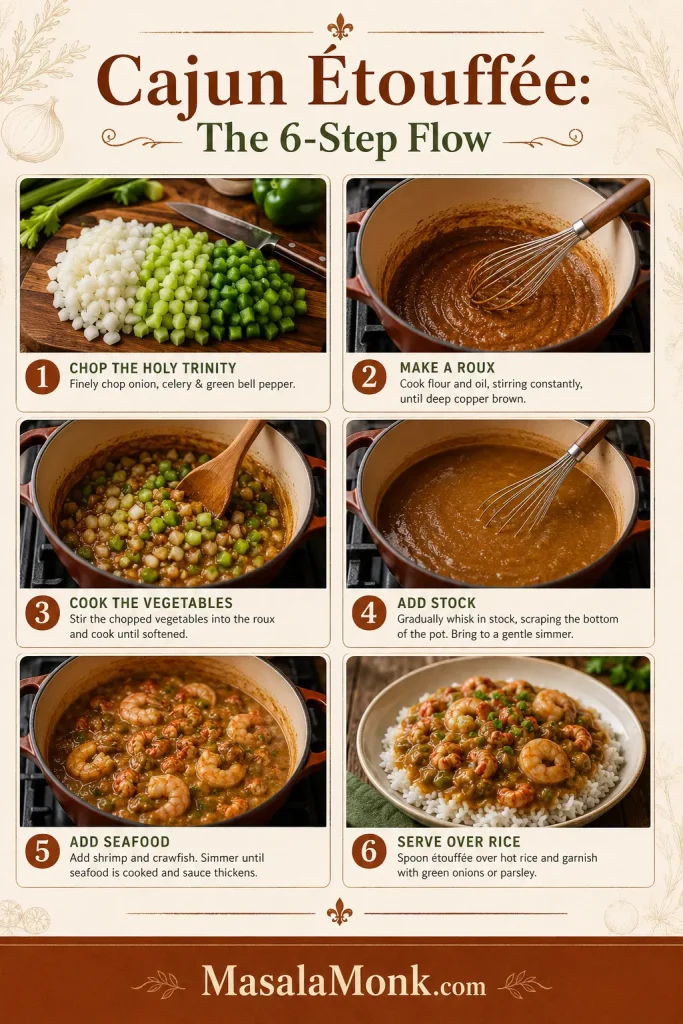
Use the quick flow to keep the method calm: roux, trinity, sauce, seafood, herbs, and rice.
Start with roux, build flavor with trinity, loosen the sauce with stock, then finish seafood gently before serving over rice.
Cajun Étouffée at a Glance
Main style
Roux-based Cajun-style étouffée, no tomato by default
Best seafood
Shrimp, crawfish tails, or a mix of both
Servings
6
Total time
About 1 hour 5 minutes
Roux target
Copper to peanut-butter brown
Sauce texture
Glossy, spoonable, thick enough to hug rice
Serve with
Long-grain white rice, fresh herbs, and table hot sauce
Best quick path
Make a light roux instead of relying only on canned soup or boxed mix
Biggest success cue
Let the base taste complete, then finish with seafood
Cajun Étouffée Recipe Card
This stovetop recipe makes a roux-based Cajun étouffée with shrimp, crawfish tails, or both. The method stays the same; the main change is when each type of seafood goes into the finished sauce.
Keep the rice hot and the seafood cold until the sauce is ready. That little bit of timing is what makes the bowl feel generous instead of rushed.
Recipe Snapshot
Prep time
20 minutes
Cook time
45 minutes
Total time
1 hour 5 minutes
Servings
6
Method
Stovetop
Cuisine
Cajun / Louisiana-style
Main equipment
Dutch oven, heavy-bottomed pot, or deep heavy skillet
Ingredients
Before cooking, notice how each ingredient has a job: roux for body, trinity for sweetness, stock for sauce, and seafood for the finish.
Even with a full ingredient board, the real flavor builders are roux, holy trinity, stock, seafood, and a fresh finish.
½ cup unsalted butter, 113 g, or 120 ml neutral oil
All-purpose flour, ½ cup, about 60–65 g
1½ cups finely chopped yellow onion, about 225 g
1 cup finely chopped green bell pepper, about 150 g
¾ cup finely chopped celery, about 100 g
4–6 garlic cloves, minced, about 15–25 g
2½–3 cups warm seafood stock, shrimp stock, crawfish stock, or chicken stock, plus more as needed, 600–720 ml
Hot sauce, 1–2 tablespoons, 15–30 ml, plus more for serving
2 lb total peeled shrimp, crawfish tails, or a mix, about 900 g
½ cup sliced green onions
¼ cup chopped parsley
Salt and black pepper, to taste
4–6 cups cooked long-grain white rice, for serving
Ingredient Notes for Salt, Seafood, and Rice
Salt note: If your Cajun seasoning already contains salt, do not add extra salt until the sauce has simmered and you have tasted it. Stock, hot sauce, boxed bases, and cream soup can all add salt too. Salt-free Cajun blends can usually be used more generously because they bring spice without adding as much sodium.
Seafood note: Use 2 lb total seafood, not 2 lb shrimp plus 2 lb crawfish. If using a mix, combine the shrimp and crawfish together to reach about 2 lb / 900 g total.
Pick the seafood before you start, because shrimp and crawfish can share the same sauce but need different finishing care.
Whether you use shrimp, crawfish tails, or both, keep the seafood amount steady so the étouffée stays balanced.
Rice note: Use 6 cups cooked rice for generous bowls, or 4 cups for lighter servings. Start the rice before the seafood goes in so everything reaches the table hot.
Equipment
Dutch oven or heavy-bottomed pot, important for steady roux heat
Deep heavy skillet, if it gives you enough room to stir safely
Wooden spoon or heat-safe spatula
Whisk
Small saucepan for warming stock
Cutting board and sharp knife
Measuring cups and spoons
Rice cooker or rice pot
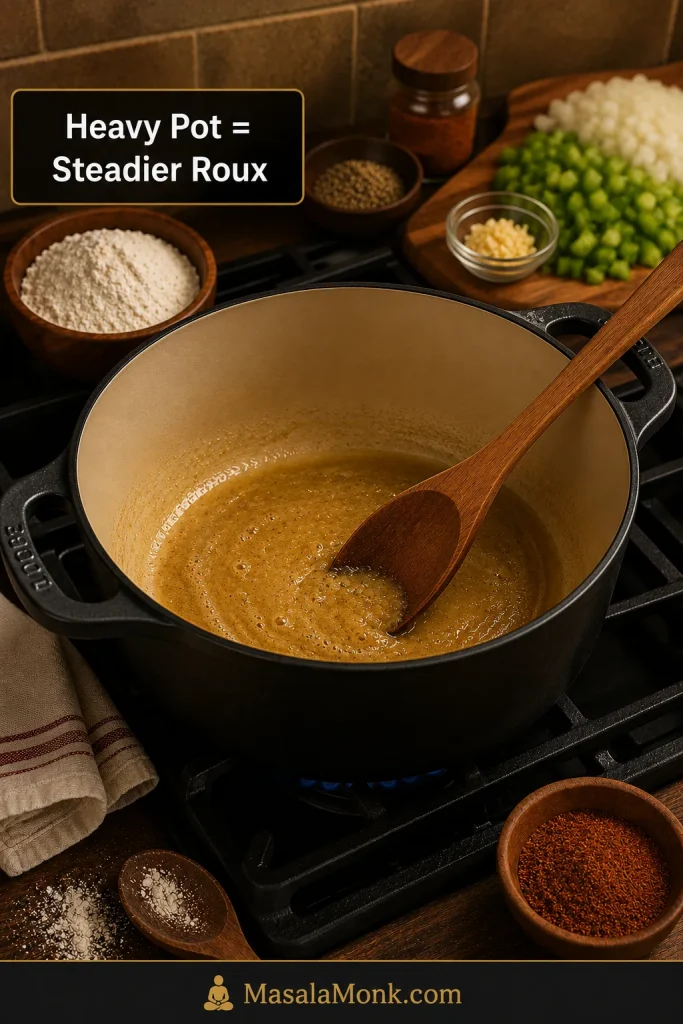
Roux can scorch quickly in thin cookware. A heavy pot gives you more control as the flour moves from pale to nutty brown. Patience beats speed here; burnt roux is not worth saving.
Steady cookware protects the roux, giving flour time to brown evenly instead of scorching in one hot spot.
A heavy pot spreads heat more evenly, which gives the roux time to brown slowly instead of scorching in hot spots.
Instructions
Prep and Roux
Prep first. Chop the onion, bell pepper, celery, garlic, green onions, and parsley before you start. Cook the rice or set it going. Thaw and drain frozen shrimp or crawfish. Pat shrimp dry if it is very wet.
Warm the stock. Keep the stock warm in a small saucepan over low heat. It should be warm, not boiling.
Make the roux. Melt the butter, warm the oil, or heat a butter-oil mix in a Dutch oven or heavy-bottomed pot over medium heat. Add the flour and stir constantly for 8–15 minutes, lowering the heat if needed, until the roux turns copper to peanut-butter brown and smells nutty. If the roux starts darkening faster than you can comfortably stir, lower the heat before you panic; roux forgives patience better than speed.
Build the Sauce
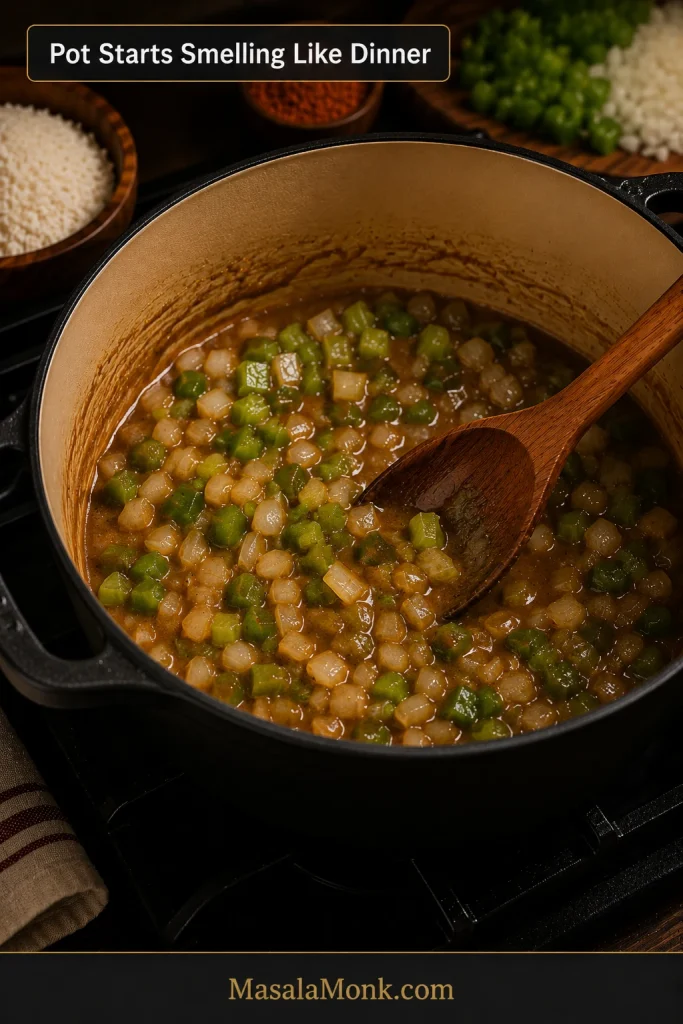
Add the holy trinity. Stir in the onion, green bell pepper, and celery. Cook for 6–8 minutes, stirring often, until the vegetables soften and the roux clings to them.
Add garlic and seasoning. Stir in the garlic, Cajun seasoning, paprika, thyme, bay leaves, and cayenne if using. Cook for 30–60 seconds, just until fragrant.
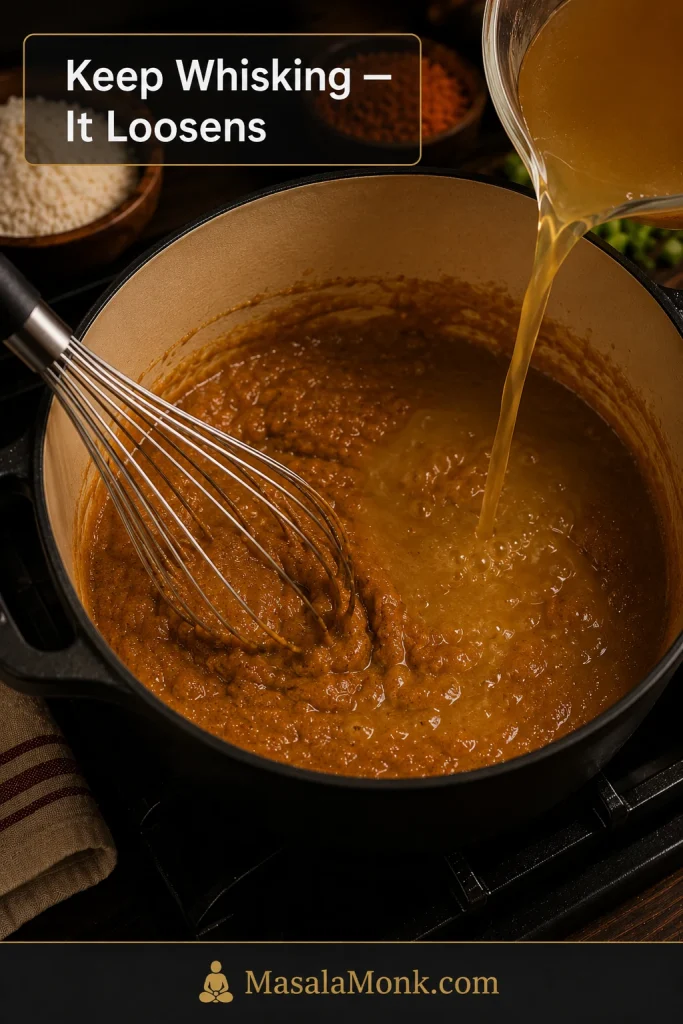
Build the sauce. Slowly whisk in 2½ cups warm stock, adding it gradually so the sauce stays smooth. The first splash may make the roux seize and thicken; keep whisking and it will loosen as the rest of the stock goes in. Stir in Worcestershire sauce and hot sauce. Bring to a gentle simmer.
Simmer until rounded. Reduce the heat to medium-low and simmer for 15–20 minutes, stirring occasionally, until the sauce thickens and tastes complete. Add more warm stock if it becomes too thick.
Add Seafood and Serve
Finish with seafood. Raw shrimp cooks gently in 3–5 minutes, just until opaque and lightly curled. Cooked crawfish tails should be stirred in and heated gently for 3–5 minutes. If using both, add shrimp first, then stir in crawfish during the final 2–3 minutes. Already-cooked shrimp only needs the final 1–2 minutes to warm through.
Season and brighten. Remove the bay leaves. Stir in most of the green onions and parsley. Taste and adjust with salt, black pepper, Cajun seasoning, a splash of acidity, or a little more stock.
Rest and serve. Turn off the heat and let the étouffée rest for 5 minutes. Spoon over hot white rice so the sauce pools around the grains, then finish with fresh herbs and extra hot sauce at the table.
Recipe Notes
Seasoning, Stock, and Roux Notes
Seasoning: If your Cajun seasoning is salty, start with less and add more only after the sauce has simmered.
Stock: Low-sodium stock is safest if your Cajun seasoning, hot sauce, or boxed base is already salty. Chicken stock works when seafood stock is unavailable; a small splash of bottled clam juice adds deeper seafood flavor if you like that taste.
Flour and roux: Spoon and level the flour if measuring by cup; a packed ½ cup can make the sauce thicker. A peanut-butter roux gives the best balance of flavor and thickening for this recipe.
Seafood, Heat, and Make-Ahead Notes
Shrimp: Medium, large, or medium-large shrimp work best. Peeled shrimp are easiest for spooning over rice. Shrimp is done when opaque and lightly curled, not tightly coiled into hard rings.
Cooked shrimp: Add cooked shrimp only in the final 1–2 minutes so it warms without turning rubbery.
Food safety: Shrimp, lobster, crab, and scallops should cook until the flesh is pearly or white and opaque, as noted by FoodSafety.gov.
Crawfish: Crawfish tails are often already cooked, so they only need gentle heating. For frozen crawfish tails, thaw and drain excess liquid. Do not rinse away flavorful crawfish fat or juices unless they smell muddy, overly fishy, or unpleasant.
Heat: Use a vinegar-forward Louisiana-style hot sauce if you want brightness, or keep the pot mild and let people add heat at the table. For more spice, add cayenne near the end so you can control it.
Resting and make-ahead: The sauce thickens as it sits. Loosen with warm stock or water if needed. Best make-ahead results come from preparing the sauce first and adding the seafood during reheating.
Half-Batch Note
To make a smaller pot, use 1 lb / 450 g total seafood, ¼ cup butter or oil, ¼ cup flour, and about 1½–2 cups stock. Keep the same method, but start checking the sauce thickness sooner because a smaller batch reduces faster. Begin with the lower amount of Cajun seasoning, especially if your blend contains salt.
The recipe card gives you the steps. These cues help you know when each stage is actually working. Once the pot is on the stove, smell, color, texture, and the way the sauce moves matter more than the exact minute on the clock.
Roux smells nutty, not raw
Smell is the first real sign. The roux stops smelling like raw flour and starts smelling warm, buttery, and nutty. Its color should move from pale flour to copper or peanut-butter brown. A sharp, scorched, or bitter smell means it is better to restart before adding the vegetables.
Vegetables soften into the base
When the onion, celery, and bell pepper hit the roux, the pot should start smelling like dinner. The vegetables cool the roux slightly, then soften into it until the base tastes sweet, savory, and rounded instead of sharp or raw.
The base tastes complete
This is the biggest checkpoint. Once the base tastes like dinner, the seafood only has to show up. It should already taste seasoned, rounded, and spoonable before shrimp or crawfish is added.
At this point, the base should carry the flavor on its own; seafood is only the final gentle finish.
Taste the sauce at this stage; once it feels rounded and spoonable, the seafood can cook quickly at the end.
Shrimp stays tender, crawfish warms gently
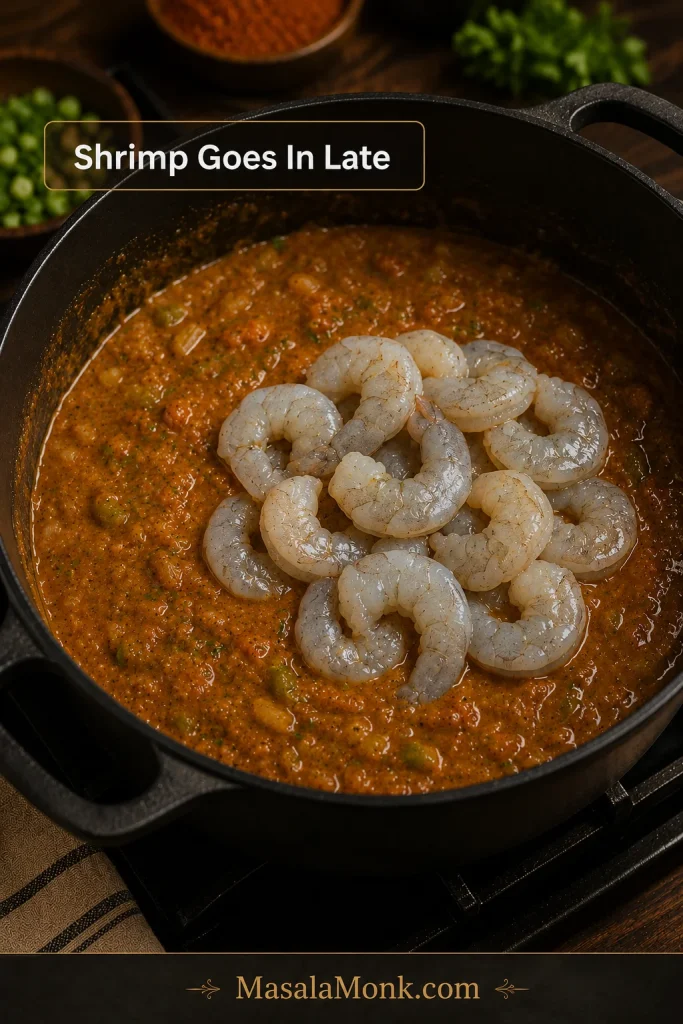
Shrimp should turn opaque and curl softly. Crawfish tails should be warmed through, not boiled hard. The pot should bubble softly after the seafood is added, not roll like a hard boil.
Raw shrimp belongs in the finished sauce, not in a long simmer, so the timing stays short and gentle.
Add raw shrimp only after the sauce is ready, so it cooks gently instead of turning rubbery.
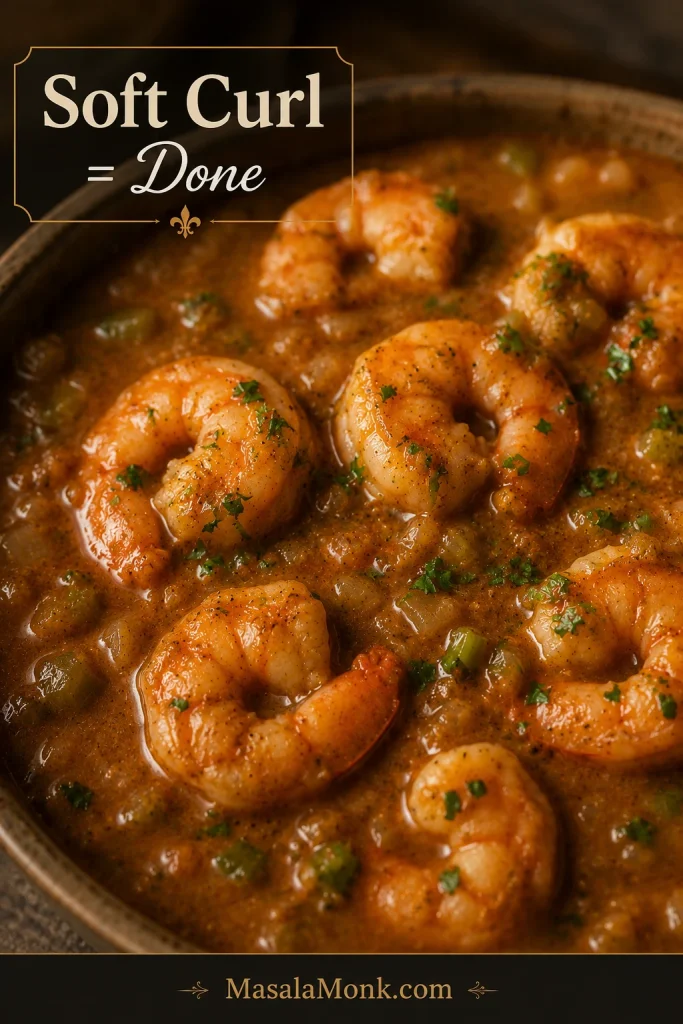
Soft curl is the shrimp signal; take the pot off hard heat before tender shrimp turns into tight rings.
Shrimp is done when it turns opaque and curls softly; tight rings usually mean it cooked too long.
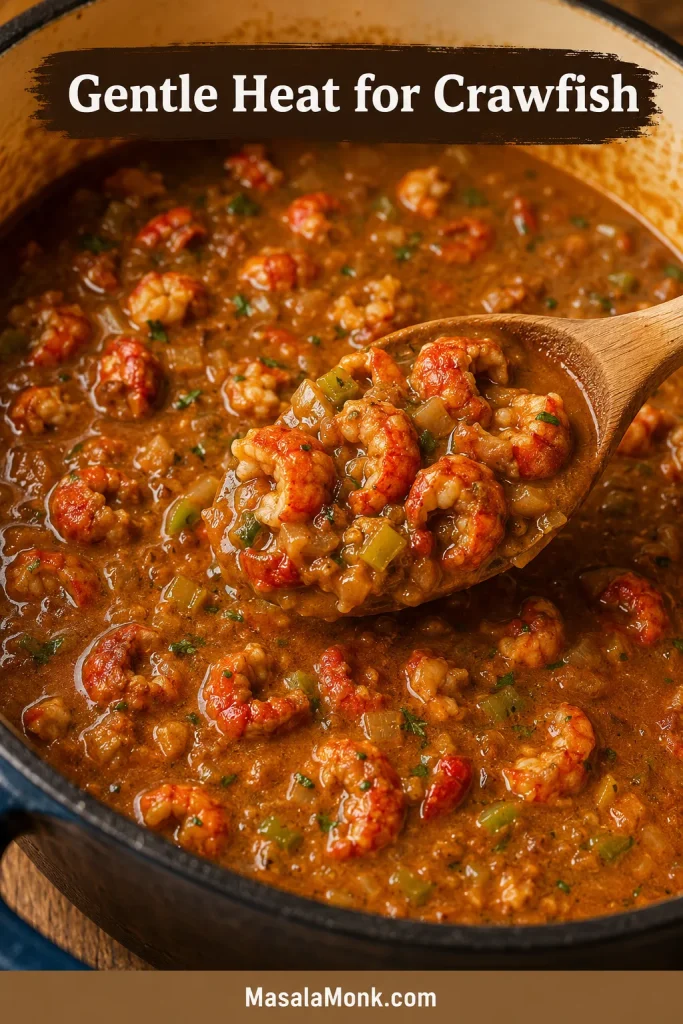
Gentle warming protects crawfish tails, especially when they are already cooked before they reach the sauce.
Crawfish tails are often already cooked, so warm them gently in the sauce instead of boiling them hard.
The rice catches a gravy, not a broth
When you spoon étouffée over rice, the sauce should settle into the grains instead of sliding away like broth or sitting on top like paste. The rice should catch a gravy, not chase a broth.
This is the bowl test: rice should hold sauce between the grains, not sit under a watery layer.
Good étouffée gravy settles between the rice grains, which keeps each spoonful saucy without turning the bowl watery.
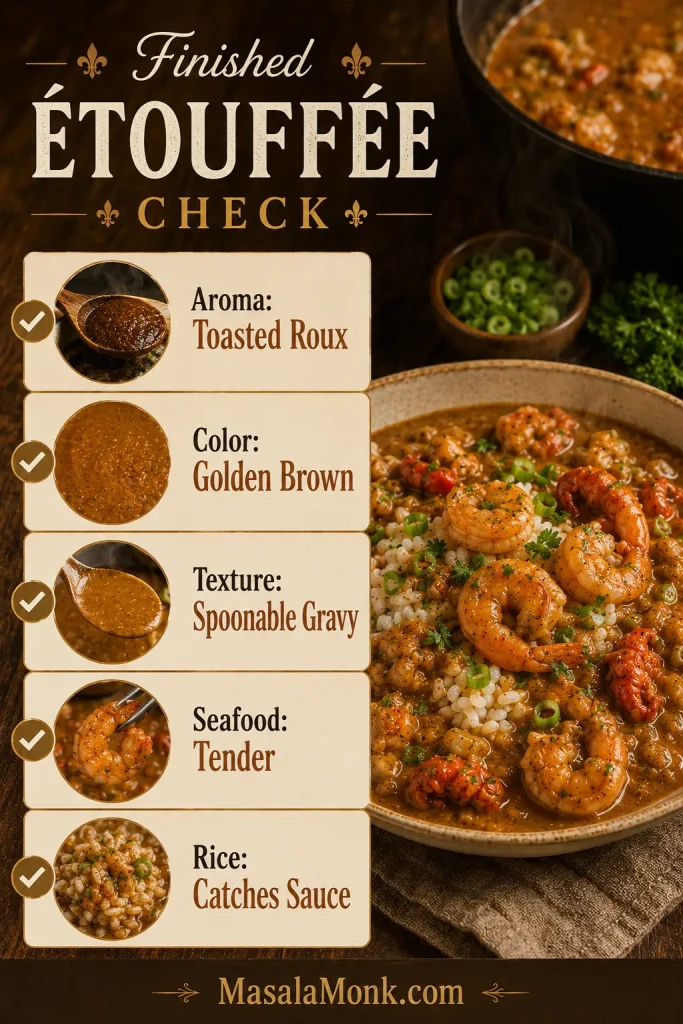
What the Finished Étouffée Should Look Like
Cue
What to look for
Aroma
Toasted roux, softened onion, bell pepper, garlic, seafood, and a little vinegar heat
Color
Golden brown to light brown, not pale beige and not burnt dark
Texture
Thick gravy that moves slowly from the spoon and spreads gently over rice
Seafood
Shrimp softly curled and opaque; crawfish warmed through, not boiled hard
Rice
Sauce settling around the grains, not watery puddles at the bottom of the bowl
Use the checklist as the final pass before serving, especially if the sauce looked uncertain earlier.
Check the pot from several angles: aroma, color, sauce body, seafood tenderness, and how well the rice holds the gravy.
Still checking the pot? Use the Roux Guide if the base looks too light or too dark, or go to Troubleshooting if the sauce feels thin, thick, salty, or floury.
Why This Cajun Étouffée Works
This pot works because the flavor is built before the seafood goes in. The roux turns nutty, the trinity softens, the seasoning settles into the stock, and the seafood only needs a short, gentle finish.
Roux builds body and flavor. It thickens the sauce and gives the dish that warm, toasted smell that makes the whole pot feel deeper.
The holy trinity makes the base taste complete. Onion, celery, and green bell pepper soften into the roux before the liquid is added.
Warm stock keeps the sauce smooth. Adding it slowly helps prevent lumps and gives you control over the final texture.
Seafood is treated gently. Shrimp and crawfish stay tender because they only need a short finish.
Tomato stays optional. The main recipe stays roux-forward, while a small tomato option gives you a brighter Creole-style variation.
Shortcuts have a place. Cream soup, boxed mix, prepared roux, and étouffée base can help on busy nights, but the from-scratch roux method gives the best flavor and control.
Choose Your Version: Shrimp, Crawfish, or Both
Before you worry about spice level, choose the seafood that makes sense for your kitchen. Crawfish gives étouffée its classic Louisiana feel, shrimp makes the recipe easier to shop for, and using both turns the pot into a fuller seafood dinner.
Version
Use it when
How to cook it
Crawfish étouffée
You have crawfish tails and want the most classic seafood flavor
Add thawed crawfish tails at the end and heat gently for 3–5 minutes
Shrimp étouffée
You want the easiest seafood version with ingredients that are easier to find
Add raw peeled shrimp at the end and cook 3–5 minutes until opaque
Shrimp and crawfish étouffée
You want a bigger seafood dinner with more texture and flavor
Add shrimp first, then stir in crawfish during the final 2–3 minutes
Chicken étouffée
You want the same sauce structure without seafood
Use cooked chicken or simmer small pieces until fully cooked and tender
Compare the versions before cooking so the pot matches your seafood, shopping, and serving plan.
The roux-based sauce stays the same, but shrimp cooks quickly while crawfish tails only need gentle warming.
Seafood Timing Notes
Good crawfish tails are worth using when you can get them. Otherwise, shrimp is not a compromise; it is a strong version of the dish on its own. Thaw frozen shrimp fully and pat it dry so extra water does not thin the pot. For another shrimp dinner where timing matters, this shrimp scampi also keeps the shrimp tender by cooking it quickly in a finished sauce.
Chosen your seafood? Return to the Recipe Card, or review Success Cues for shrimp and crawfish timing.
Ingredients You Need for Cajun Étouffée
Once the roux is under control, the rest of the ingredient list is simple. Each piece has a job, and the timing matters more than using a long list of extras.
Roux: butter or oil plus flour
The roux gives the sauce its body and toasted depth. Butter tastes richer; oil is more forgiving. Nervous about scorching? Use half butter and half oil so you get flavor with a little more stability.
The holy trinity
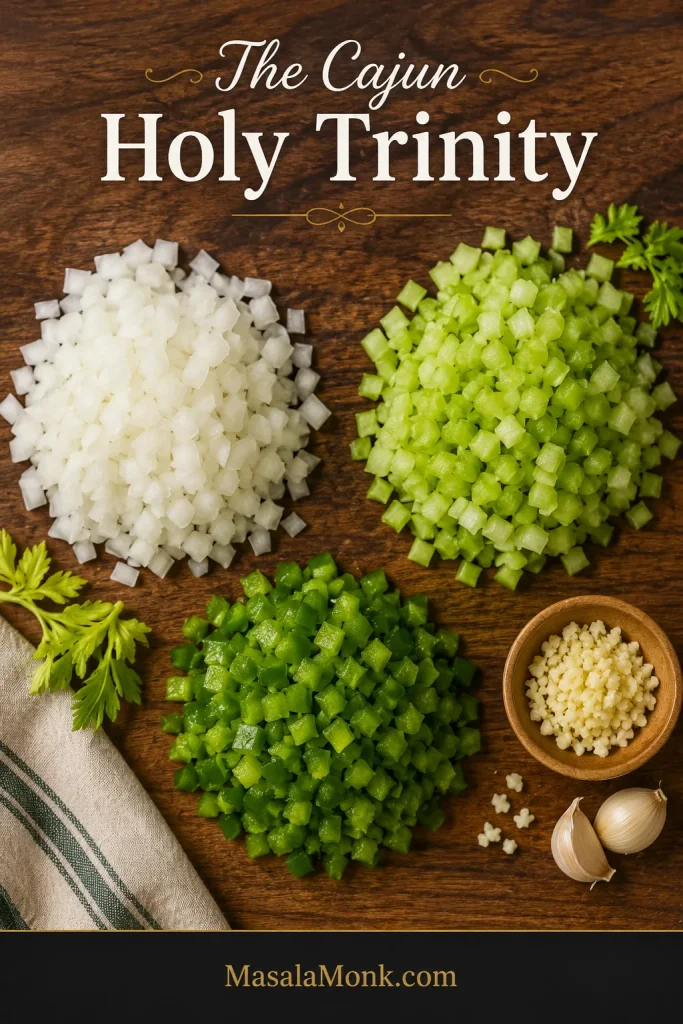
Onion, celery, and green bell pepper form the Cajun holy trinity. Green bell pepper gives the most classic flavor, but red or yellow bell pepper works when that is what you have. Chop the vegetables finely so the finished dish feels smooth and spoonable instead of chunky.
The Cajun holy trinity belongs in the ingredient notes because it shapes the sweetness and depth of the sauce.
Onion, celery, and green bell pepper form the Cajun holy trinity; garlic joins later so it does not burn.
Garlic and Cajun seasoning
Garlic adds depth, but it burns quickly, so add it after the onion, celery, and bell pepper have softened. Cajun seasoning varies a lot by brand. Some blends are mostly spice; others are very salty. Start with less if your seasoning contains salt, then adjust after the sauce simmers.
Salted seasoning, salted stock, hot sauce, and boxed bases can stack quickly. Wait until the sauce has simmered, then taste and adjust. Rice will soften saltiness on the plate, but it is much easier to add salt than remove it.
Stock
Seafood stock or shrimp stock gives the deepest flavor, but chicken stock works well for a home version. Choose low-sodium stock when your Cajun seasoning is salted. Warm stock blends into the roux more smoothly. For another seafood recipe where the base makes or breaks the final flavor, this lobster bisque uses the same idea: build the base first so the seafood tastes richer without overcooking.
Shrimp or crawfish
Use peeled raw shrimp, thawed crawfish tails, or a mix. Shrimp cooks quickly, crawfish tails are often already cooked, and both do best with gentle heat.
Green onions, parsley, and hot sauce
Green onions and parsley cut through the richness right at the end, so the bowl tastes bright instead of heavy. Hot sauce brings acidity as well as heat. Add some to the pot, then keep more on the table for anyone who wants a brighter final kick.
What Is Étouffée Sauce Made Of?
Think of étouffée sauce as a roux-thickened seafood gravy: not soup, not paste, and not a loose pan sauce. It should move slowly from the spoon, coat the seafood, and settle into hot rice.
The roux gives body, the trinity gives sweetness and depth, stock loosens everything into a spoonable base, and Cajun seasoning, Worcestershire sauce, hot sauce, green onions, and parsley finish the flavor. Crawfish tail juices, when they smell clean and sweet, can add extra seafood depth near the end.
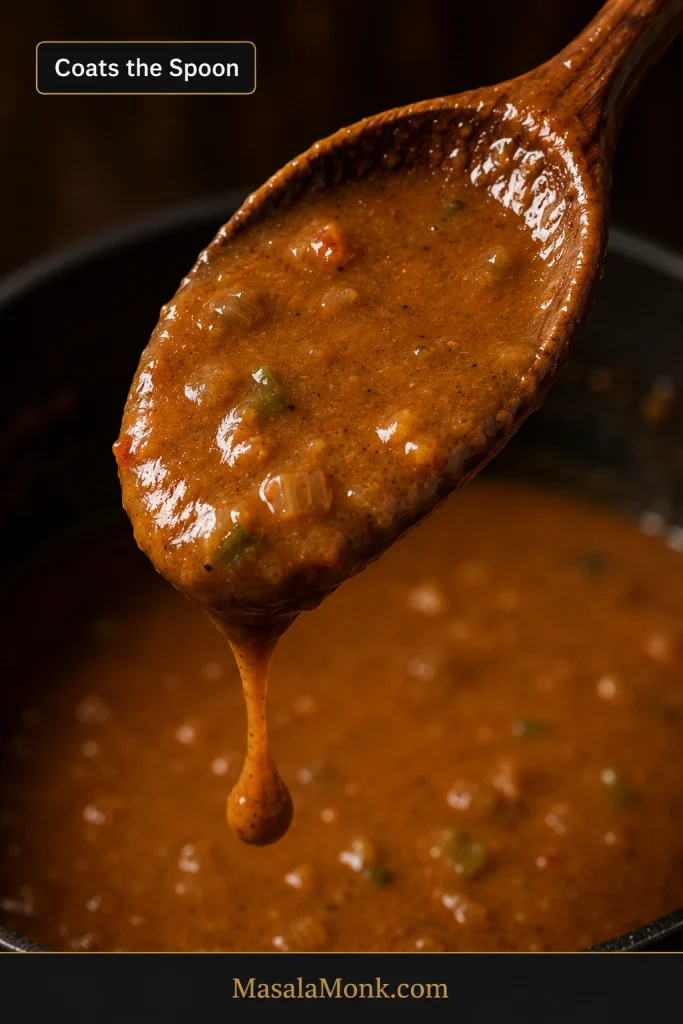
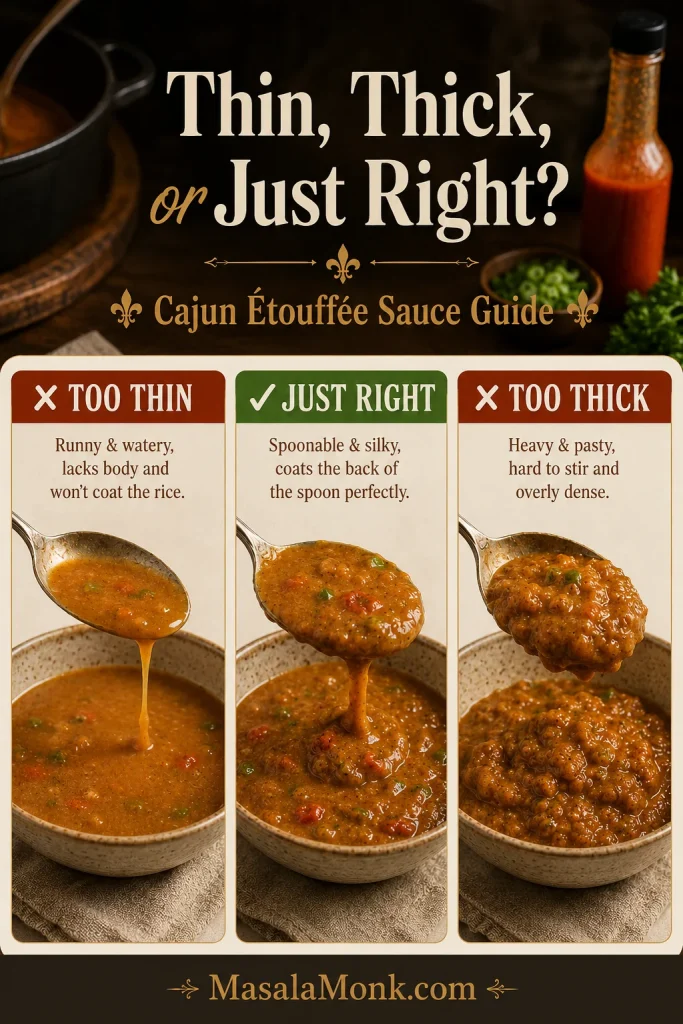
Stiff sauce needs warm stock. Watery sauce needs a few uncovered minutes before the seafood is added. The goal is simple: thick enough to coat the back of a spoon, soft enough to flow around rice.
Texture matters most here: étouffée sauce should behave like seafood gravy, not broth or paste.
This is the texture to aim for: thick seafood gravy that clings to rice, yet still feels loose enough to spoon.
Check the spoon before serving; a slow coating means the sauce has enough body without turning pasty.
Use the spoon test before serving: the sauce should coat the spoon, then move slowly back into the pot.
If you love Cajun-style seafood sauces in general, this seafood boil sauce is useful for a different kind of seafood dinner. It is more buttery and pourable than étouffée, but it works with many of the same shrimp, crab, crawfish, garlic, and Cajun seasoning flavors.
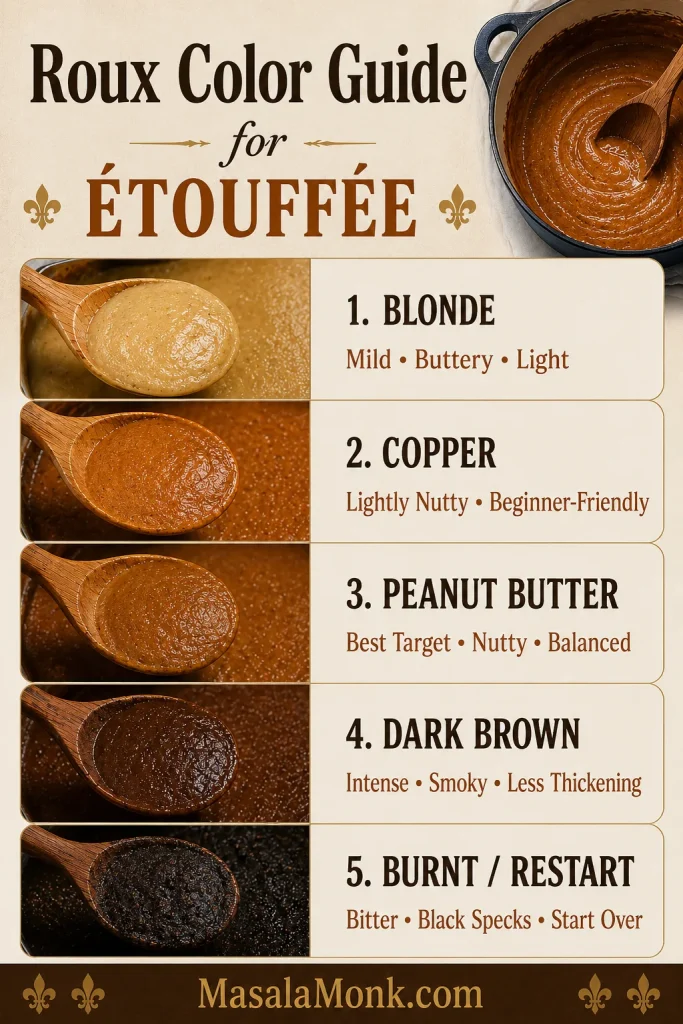
Roux Color Guide for Étouffée
The roux is the only part of this recipe that asks for your full attention, but it does not ask you to rush. You do not need a restaurant-speed roux here. A steady, slower roux is easier to control and still gives you the nutty flavor this dish needs.
Watch Color Before Time
Stir steadily, control the heat, and watch the color more than the clock. Do not judge the pot too early; the roux changes slowly at first, then deepens faster as it gets darker.
Start the roux guide with color, because the stages tell you more than the clock on the stove.
Roux moves from pale to nutty to deep brown quickly, so watch the color closely and restart if black specks appear.
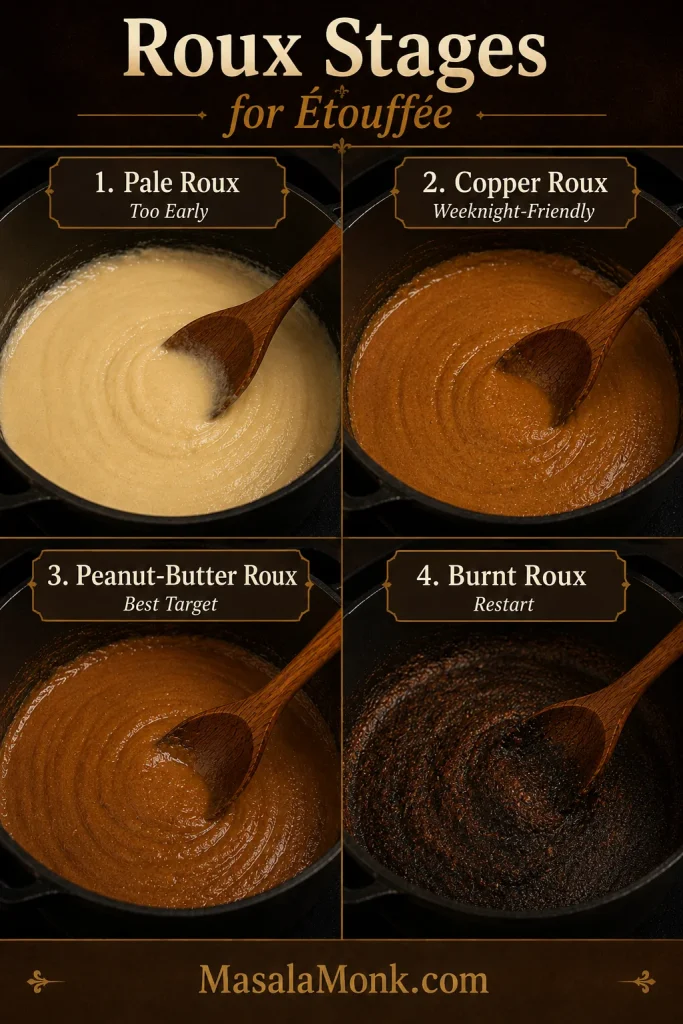
The times below are estimates. Color and smell matter more than minutes, especially if your pot runs hot or your stove is uneven. For this Cajun étouffée recipe, aim for a peanut-butter-colored roux. It gives the sauce a nutty flavor without taking as long as a very dark gumbo-style roux.
Roux Colors at a Glance
Roux color
Approximate time
Flavor
Best use
Blonde
3–5 minutes
Mild, buttery, lightly cooked
Fastest version, but less Cajun depth
Copper
6–8 minutes
Lightly nutty and beginner-friendly
Good weeknight étouffée
Peanut butter
8–15 minutes
Nutty, rounded, deeper flavor
Best balance for this recipe
Dark brown
18–25+ minutes
More intense, slightly smoky
Advanced version; thickens less and burns more easily
Burnt with black specks
Any time if heat is too high
Bitter
Discard and restart
The color guide turns roux judgment into a visual check instead of a guessing game.
Use this roux color guide to judge whether your base is still mild, ready for étouffée, or too far gone.
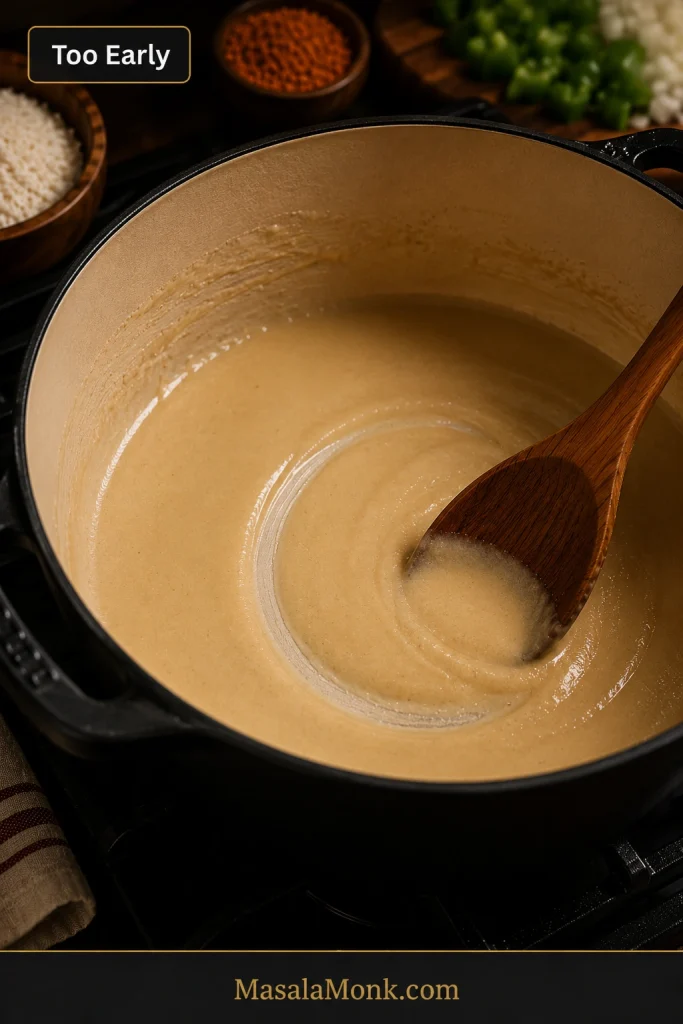
This early roux stage explains why color matters before the sauce gets its deeper Cajun flavor.
Pale roux can thicken the sauce, but it has not developed the nutty flavor Cajun étouffée needs.
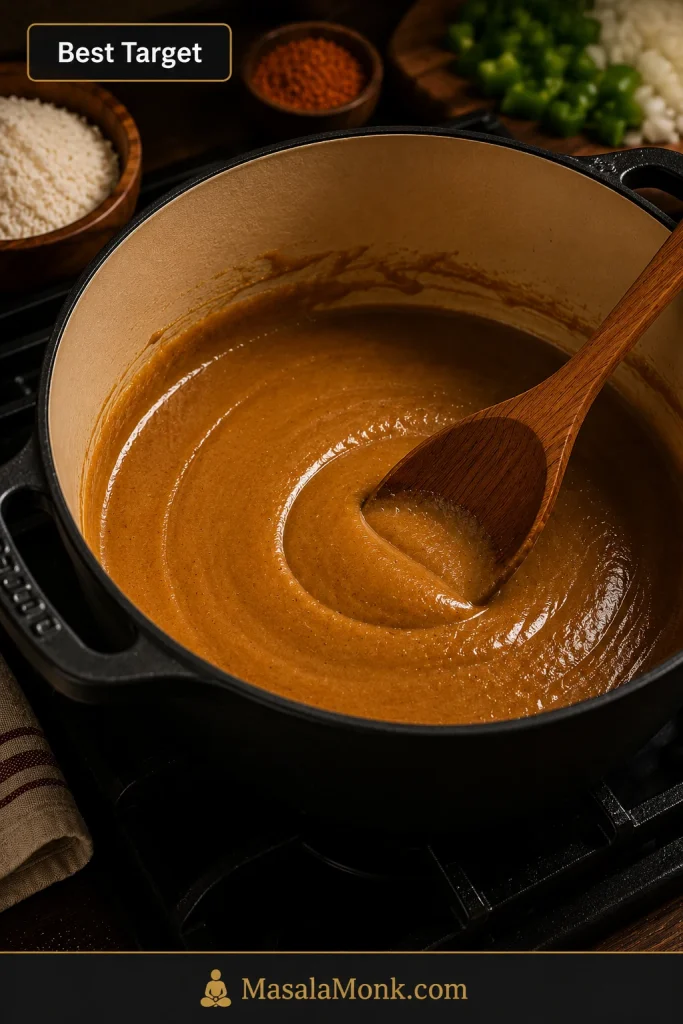
Aim for this peanut-butter shade when you want toasted flavor without losing too much thickening power.
Peanut-butter roux gives Cajun étouffée its best middle ground: warm color, toasted flavor, and enough body for the sauce.
When to Restart the Roux
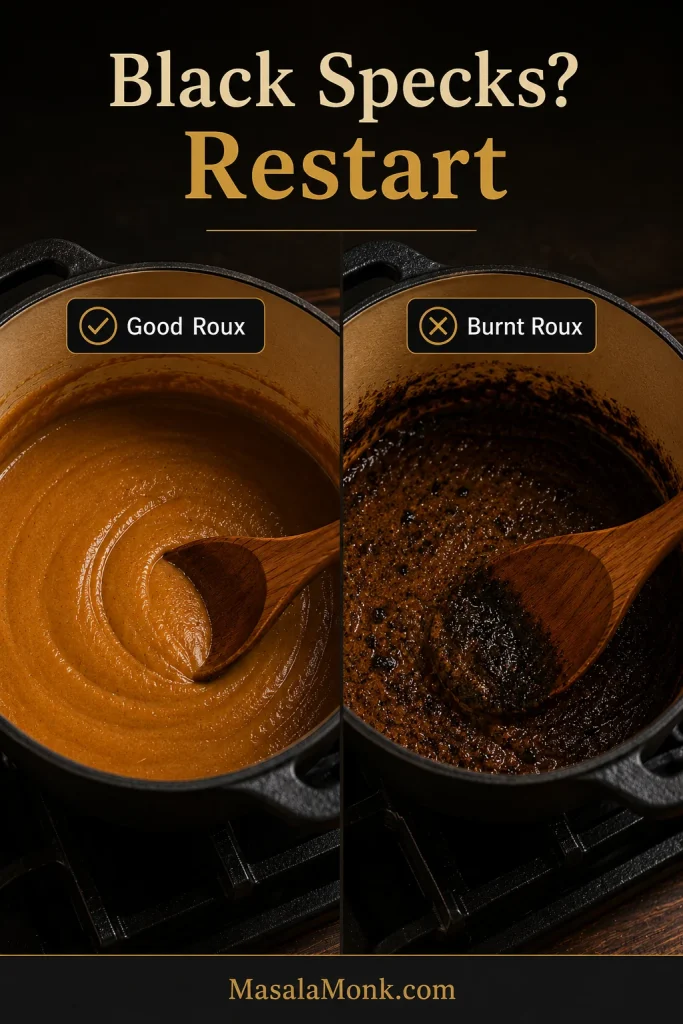
As the roux darkens, lower the heat if it starts moving too fast. Black specks or a sharp burnt aroma mean it is time to restart. Burnt roux will make the whole pot taste bitter.
Restarting is better than saving burnt roux, because scorched flavor will travel through the whole sauce.
Burnt roux will turn the whole pot bitter, so restart when you see black specks or smell scorching.
The recipe card gives the exact steps. This walkthrough is here for the cooking cues: what should be ready, what should smell right, and when the pot is safe for seafood.
1. Prep everything before the roux
Once the roux starts cooking, your attention belongs to the pot. Chop the vegetables, mince the garlic, slice the herbs, warm the stock, cook the rice, and thaw the seafood before you turn on the stove.
2. Cook the roux slowly
Melt the butter, warm the oil, or heat a butter-oil mix, then add the flour and stir constantly over medium heat. The roux will move from pale to blonde, then copper, then peanut-butter brown. Darkening too quickly is your cue to lower the heat and keep stirring.
3. Add onion, celery, and bell pepper
When the roux reaches the color you want, stir in the holy trinity. The vegetables cool the roux slightly, then turn sweet and savory as they soften into the base. This is the moment the pot starts smelling like dinner.
Once the trinity hits the roux, the pot shifts from toasted flour to a sweet, savory Cajun base.
When the trinity hits the roux, it cools the pot slightly while building a sweet, savory Cajun base.
4. Build the sauce with warm stock
After the garlic blooms, the first splash of stock will make the roux seize and thicken. Keep whisking. It loosens as the rest of the stock goes in and turns into a smooth, spoonable base.
Warm stock and steady whisking turn the roux from tight and thick into a smooth sauce.
The first splash of stock may tighten the roux, but steady whisking turns it into a smooth étouffée sauce.
5. Simmer until the base tastes complete
Let the sauce simmer until the floury edge has cooked away and the seasoning tastes balanced. The pot should already taste like dinner before the seafood arrives.
6. Finish with shrimp or crawfish
Raw shrimp only needs a few minutes. Crawfish tails are often already cooked and only need to be heated through. Treat the seafood like the finish, not the simmer.
7. Rest, garnish, and serve
Let the pot rest for a few minutes so the sauce settles and thickens slightly. Spoon it over hot white rice so the gravy pools around the grains, then serve with fresh herbs and extra hot sauce at the table.
Troubleshooting: Fix Thin, Thick, Salty, Bland, Spicy, or Floury Étouffée
Do not panic if the sauce looks wrong at first. Étouffée can look too thick, too thin, or too dark for a minute before it comes together. Most problems are easier to fix before the seafood goes in, so taste and adjust while the shrimp or crawfish is still safely waiting.
Check Texture Before Seafood
Étouffée should be thicker than soup but softer than paste. It should spoon easily over rice, coat the seafood, and settle into the grains without disappearing completely.
Diagnose the sauce before adding seafood by comparing thin, spoonable, and overly thick textures.
The ideal étouffée sauce sits between watery and pasty: spoonable, glossy, and thick enough to coat rice.
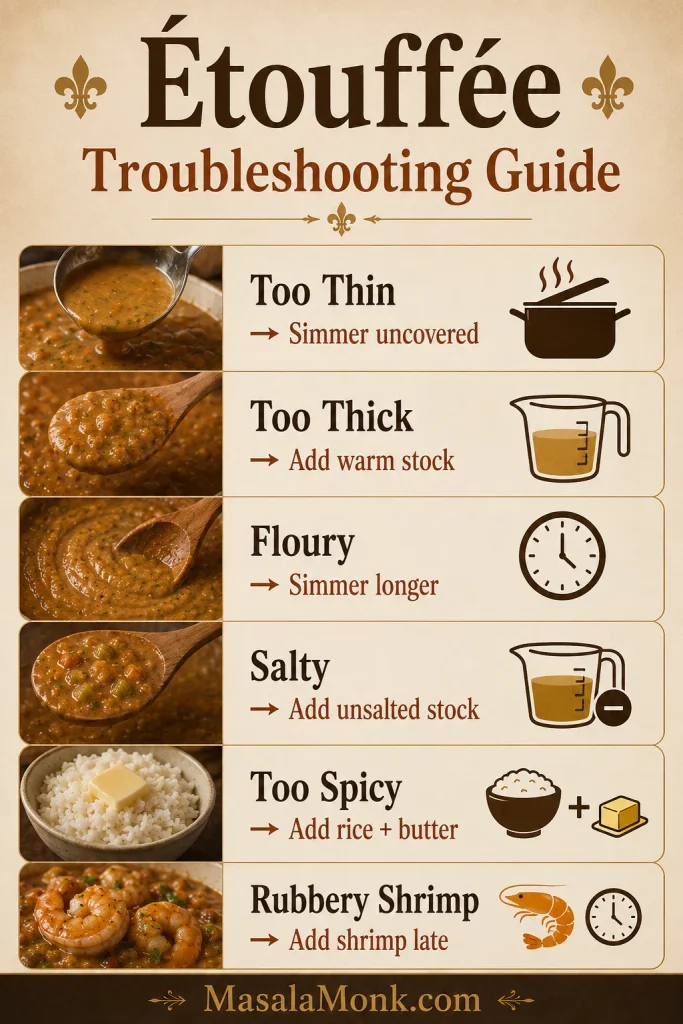
Common Étouffée Fixes
Problem
What it means
How to fix it
Too thin
Usually too much liquid or not enough simmering
Simmer uncovered for a few more minutes before adding seafood
Too thick
The roux absorbed more liquid than expected
Add warm stock a splash at a time
Floury taste
Roux was undercooked or sauce needs more time
Simmer the sauce longer before adding seafood
Too salty
Seasoning blend, stock, hot sauce, or boxed base was salty
Add unsalted stock, a little butter, and serve with plain rice
Too spicy
Often too much cayenne, hot sauce, or spicy Cajun seasoning
Add unsalted stock, a little butter, and serve with extra plain rice
Bland
Needs more spice, acid, or finishing flavor
Add Cajun seasoning, hot sauce, Worcestershire, green onion, or cayenne
Burnt roux
Roux scorched before vegetables were added
Restart the roux; burnt flavor will not cook out
Rubbery shrimp
Shrimp cooked too long or boiled too hard
Add shrimp only at the end and cook just until opaque
Watery seafood flavor
Frozen seafood released too much liquid
Thaw, drain, and pat dry before adding; simmer the sauce first so it has body
After the detailed fixes, this guide works as a quick save-the-pot reminder for common étouffée problems.
Fix sauce problems early; once shrimp or crawfish goes in, there is less time to correct thickness, salt, or floury flavor.
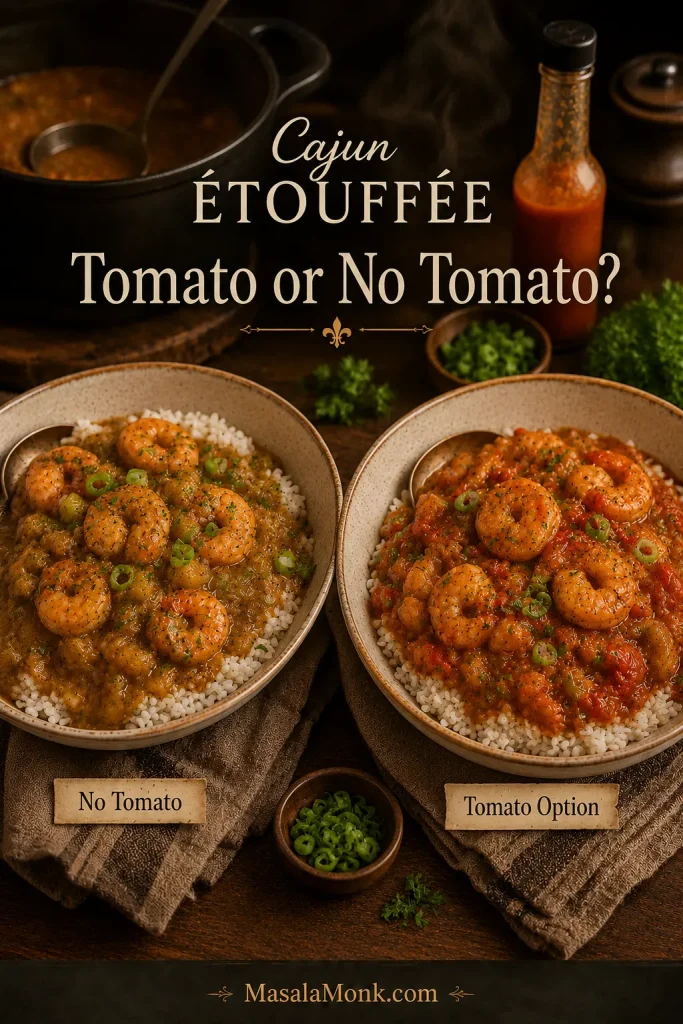
Tomato is where étouffée opinions can get loud, so this recipe keeps the choice simple. This version keeps tomato out of the main pot for a roux-forward Cajun-style flavor. Some home cooks add tomato, especially in Creole-leaning or family-style versions, so the option is included below.
For a brighter sauce, add 1 tablespoon tomato paste with the garlic and spices, or stir in ½ cup diced tomato when you add the stock. Tomato changes the flavor, but it can still make a delicious pot.
The tomato choice belongs here because roux-forward Cajun-style and brighter Creole-leaning bowls can both be delicious.
No tomato keeps the étouffée roux-forward, while a small tomato option adds a brighter Creole-style note.
Skip the tomato if you came here for a roux-forward bowl. Add a little if you like a softer, brighter sauce. Like many Louisiana-style dishes, every kitchen has its own opinion.
Étouffée Sauce, Base, Mix, and Cream Soup Shortcuts
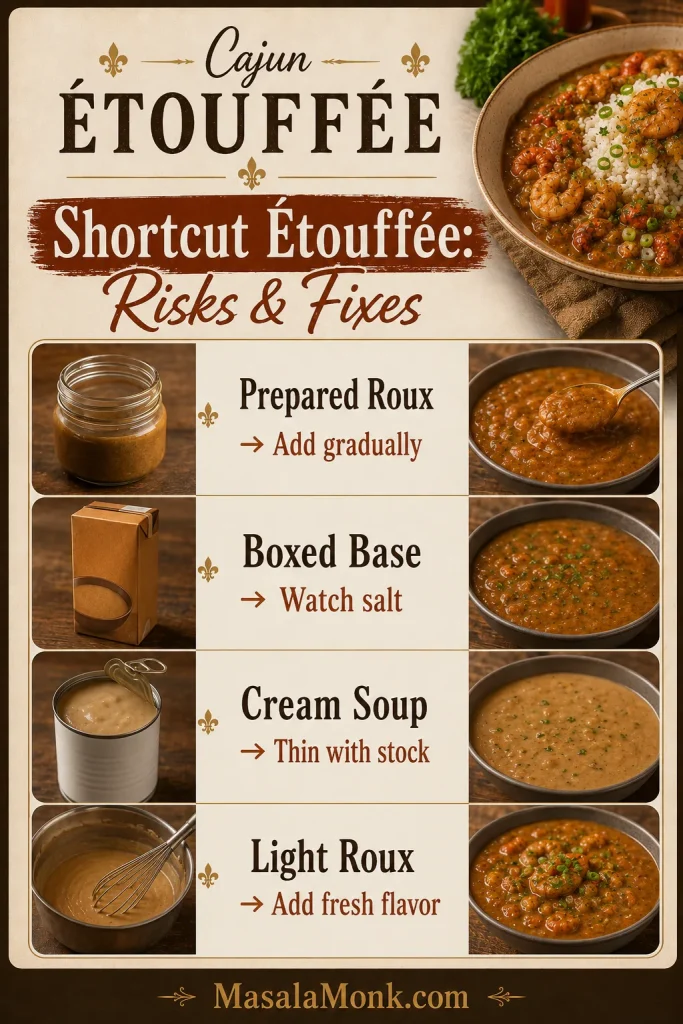
Some nights, you want the roux. On other nights, you want dinner faster. Both are real kitchens. Shortcut étouffée works best when you add freshness back: sautéed trinity, garlic, herbs, a splash of hot sauce, and gentle seafood timing.
The goal is not to pretend a shortcut tastes exactly the same as a from-scratch roux. Instead, make it balanced, creamy or saucy in the right way, and worth spooning over rice.
Shortcut
Main risk
Best fix
Prepared or jarred roux
Too intense or too dark
Add gradually and taste before adding more seasoning
Boxed étouffée mix or base
Too salty or flat
Use less seasoning and add sautéed trinity, garlic, herbs, and hot sauce
Cream soup
Too heavy, thick, or salty
Thin with stock and finish with fresh herbs and gentle seafood timing
Light roux
Less depth
Use good stock, Cajun seasoning, Worcestershire sauce, and a little acidity
For shortcut methods, keep the focus on salt control, sauce thickness, fresh trinity, and gentle seafood timing.
Shortcut étouffée tastes more homemade when you control salt, loosen heavy bases with stock, and add fresh trinity.
Using prepared or jarred roux
Prepared roux can save time if you want roux flavor without standing over the pot as long. Follow the jar’s or package’s guidance as your baseline, then add gradually rather than all at once. Build the sauce with sautéed onion, celery, bell pepper, garlic, warm stock, and seasoning. Taste before adding more Cajun seasoning because prepared roux can vary in intensity.
Using étouffée mix or base
Boxed étouffée mix or jarred base can be useful when you want dinner fast. Most mixes already contain seasoning, thickener, and salt, so taste before adding more Cajun seasoning. Add shrimp or crawfish near the end instead of boiling it hard for the whole cooking time.
To make a mix taste more homemade, sauté onion, celery, bell pepper, and garlic in a little butter before adding the mix and liquid. Finish with fresh herbs, a splash of hot sauce, and a small knob of butter.
Using cream of mushroom, cream of shrimp, or cream of celery soup
Many home cooks make a creamy shortcut étouffée with condensed soup. If this is the version you grew up with, it deserves a place too. Cream of mushroom, cream of shrimp, cream of celery, and golden mushroom soup all create an easy, comforting sauce. It will not taste exactly like a roux-based Cajun étouffée, but it can still be a cozy family-style dinner.
Cream soup shortcuts work best when stock loosens the base and seafood stays gently cooked.
When using cream soup, loosen the base with stock first, then finish with seafood gently so the sauce stays spoonable.
Condensed soup needs a lighter hand with salt and seasoning. Start with about ½ can of water or stock per can of condensed soup, then loosen the sauce more only if needed. Cream soup versions can become salty quickly, especially when combined with Cajun seasoning and table hot sauce.
For a full dinner built around the same condensed-soup comfort idea, this cream of mushroom chicken shows how much the soup-to-liquid ratio matters when you want the sauce creamy instead of watery.
The fastest from-scratch shortcut
If you have 5–8 minutes, make a light roux instead of relying only on soup or mix. Even a copper-colored roux gives the sauce more flavor and better texture than a fully instant version.
Using a shortcut tonight? Keep Troubleshooting nearby, then return to the Recipe Card for seafood timing.
What to Serve With Cajun Étouffée
Cajun étouffée is usually served over white rice, and for good reason. The rice catches the sauce, softens the heat, and turns the dish into a full meal. If rice is the part that usually lets you down, this guide on how to cook perfect rice will help you get fluffy grains before the étouffée is ready.
A shallow bowl works best here: rice in the center, sauce ladled around it, herbs on top, and table hot sauce close by. It feels generous without needing many sides.
Serving gets easier when rice is mounded first and the étouffée is ladled around it.
For a cleaner bowl, mound the rice first, then ladle the étouffée around it so the gravy pools neatly.
Long-grain white rice: the classic, clean choice.
Green onions and parsley: a fresh finish for a rich sauce.
Hot sauce: serve on the side so everyone controls the heat.
Cornbread: good for soaking up extra sauce.
Simple green salad: balances the richness.
Roasted okra or sautéed greens: adds a Southern-style vegetable side.
Red beans and rice: better as a separate meal or part of a larger Cajun/Creole spread rather than something you need on the same plate.
Cajun seafood boil: a natural next recipe if you are building a bigger seafood spread around shrimp, crawfish, crab, or potatoes.
Finish with herbs and a sharp splash of hot sauce.
Make-Ahead, Storage, Freezing, and Reheating
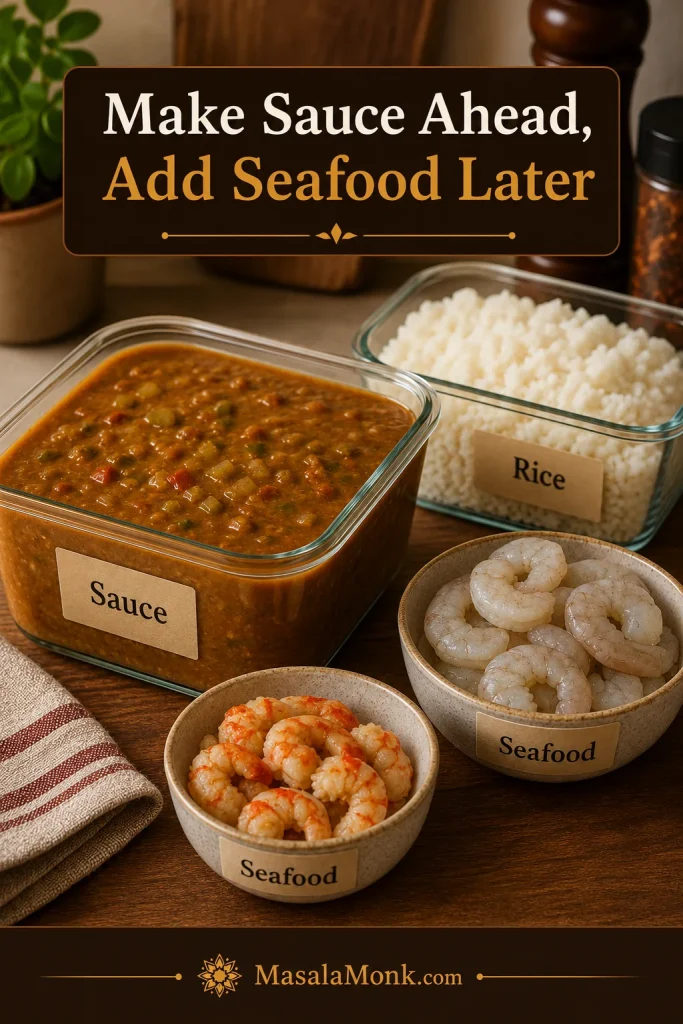
Étouffée is a good make-ahead dish when the sauce and seafood are handled separately. Prepare the sauce ahead, then add the seafood when you reheat and serve.
Make ahead
Make the sauce through the simmering step, then cool and refrigerate it. When ready to serve, warm it gently, add a splash of stock if needed, and finish with shrimp, crawfish tails, or both.
Storage works best when the sauce is made ahead and seafood is saved for reheating.
For better make-ahead texture, store the sauce separately; then add seafood during reheating so it stays tender.
Refrigerating leftovers
Store leftovers in an airtight container in the refrigerator for up to 3 days. Keep rice separate if possible so the sauce does not become too thick and starchy.
If you have extra cooked rice but not enough étouffée for another full bowl, turn the rice into a separate dinner like this shrimp fried rice instead of stretching the sauce too thin.
Freezing
You can freeze étouffée, but seafood texture may change after thawing. The best method is to freeze the sauce without seafood, then add fresh shrimp or crawfish when reheating. Leftovers with seafood already in the sauce should be cooled quickly, frozen in a sealed container, and reheated gently.
Reheating
Reheat on low heat, stirring often. Add a splash of stock or water to loosen the sauce. Avoid boiling leftovers hard because shrimp and crawfish can toughen.
Variations
Shrimp étouffée
Use 2 lb total peeled and deveined raw shrimp. Add it near the end and cook gently until opaque and softly curled.
Crawfish étouffée
Use 2 lb total thawed crawfish tails. Already cooked crawfish should be warmed gently instead of boiled hard.
Seafood étouffée
Use a mix of shrimp and crawfish, or add a little crabmeat at the end. Delicate seafood stays best when it is added late.
Chicken étouffée
Use bite-size cooked chicken or small pieces of boneless chicken thighs. Simmer until the chicken is fully cooked and tender, then finish with fresh herbs.
Gluten-free étouffée
Use a gluten-free all-purpose flour blend or rice flour for the roux. The texture may be slightly different, so add stock gradually and adjust the sauce as it thickens.
Vegetarian mushroom étouffée
Use mushrooms instead of seafood and vegetable stock instead of seafood or chicken stock. Brown the mushrooms first so they bring depth to the sauce instead of watering it down.
Extra spicy Cajun étouffée
Add more cayenne, diced jalapeño, or extra hot sauce at the table. Build spice gradually because Cajun seasoning and hot sauce can also add salt.
Creamy shortcut étouffée
Use condensed cream of mushroom, cream of shrimp, or cream of celery soup as part of the sauce base. Keep the seasoning lighter, thin with stock, and add seafood at the end.
Cajun Étouffée FAQs
How do you pronounce étouffée?
Étouffée is usually pronounced ay-too-FAY or eh-too-FAY. The word comes from French and means “smothered.”
Is shrimp okay instead of crawfish?
Yes. Use raw peeled shrimp and add it during the final 3–5 minutes so it stays tender. Shrimp is easier to find than crawfish and works very well in Cajun étouffée.
Are crawfish tails already cooked?
Many packaged crawfish tails are already cooked. Check the package, but in most cases they only need to be warmed through in the sauce for a few minutes.
How should frozen crawfish tails be handled?
Thaw frozen crawfish tails first, then drain excess liquid. Do not automatically rinse them, especially if the package has flavorful crawfish fat or juices. Muddy or overly fishy liquid should be drained more aggressively, with stock doing more of the flavor work.
What roux color is best for étouffée?
Peanut-butter brown is the best balance for this recipe. It gives the sauce nutty flavor without requiring a very dark roux. A lighter copper roux also works for an easier weeknight version.
Does Cajun étouffée need tomatoes?
No. This version does not use tomato by default. A little tomato paste or diced tomato gives the sauce a brighter Creole-style feel. Tomato changes the flavor, but it can still make a delicious pot.
Should étouffée be thick?
Yes, but not pasty. Étouffée should be thicker than soup and thin enough to spoon over rice. A thick sauce needs warm stock; a thin one needs a few more uncovered minutes.
Why does my étouffée taste floury?
The roux may not have cooked long enough, or the sauce may need more simmering time. Cook the roux until it smells nutty, then simmer the sauce until the floury taste disappears.
How do I keep shrimp from overcooking?
Build and simmer the sauce first, then add shrimp at the end. Shrimp usually needs only 3–5 minutes in a gentle simmer. Remove the pot from heat as soon as the shrimp is opaque and tender.
Cream of mushroom soup in étouffée: yes or no?
Yes, if you want a creamy home-style shortcut. Cream of mushroom soup is not the same as a roux-based Cajun étouffée, but it can be useful for a fast, comforting version. Use less salt because condensed soup and Cajun seasoning can become salty together.
Gumbo vs étouffée: what is the difference?
Gumbo is usually more soup-like and often served as a stew with rice, while étouffée is thicker and more sauce-like. Étouffée should cling to the seafood and rice rather than feel like broth. For a deeper comparison, Southern Living has a helpful étouffée vs gumbo explainer.
Make-ahead étouffée: what works best?
Best texture comes from making the sauce ahead and adding the seafood when reheating. This keeps shrimp and crawfish from becoming tough.
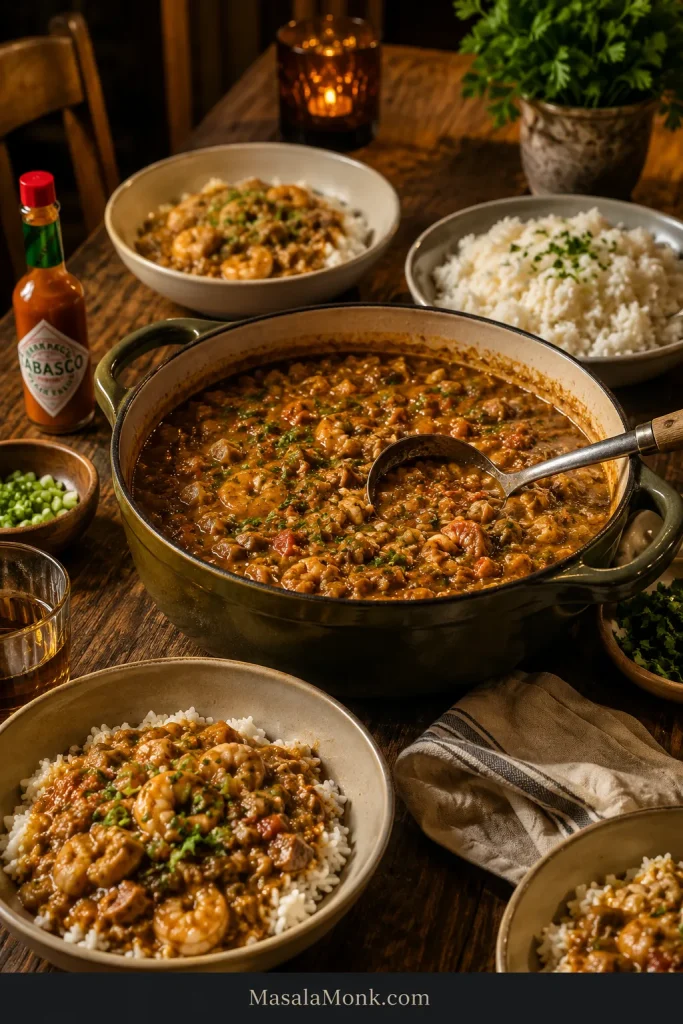
Once you know what the roux should smell like, how the sauce should move, and when the seafood should go in, Cajun étouffée stops feeling intimidating. It becomes what it should be: glossy, spicy, seafood-rich comfort poured over hot rice, finished with herbs and one more sharp splash of hot sauce.
The finished-pot target is simple: glossy sauce, hot rice, fresh herbs, and enough Cajun étouffée for the table.
Once the sauce is glossy and the rice is hot, étouffée becomes the kind of pot people gather around.
Every kitchen has an opinion on tomato, cream soup, crawfish, shrimp, or how dark the roux should be — and that is part of why étouffée is so fun to cook. If your family has a version, it probably has a reason behind it. Learn the base method, adjust the pot to your table, keep the rice hot, and serve it while the sauce is still glossy.
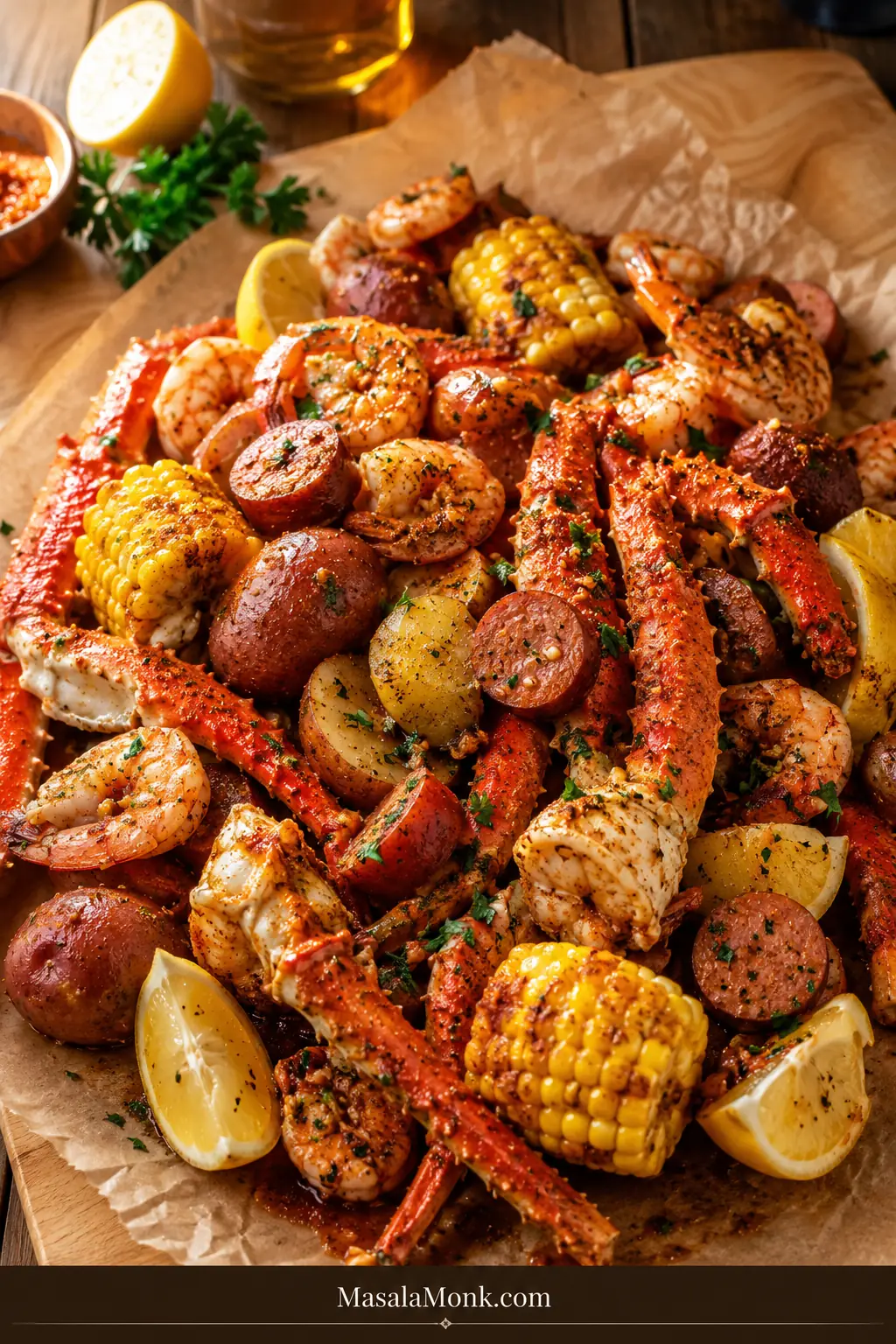
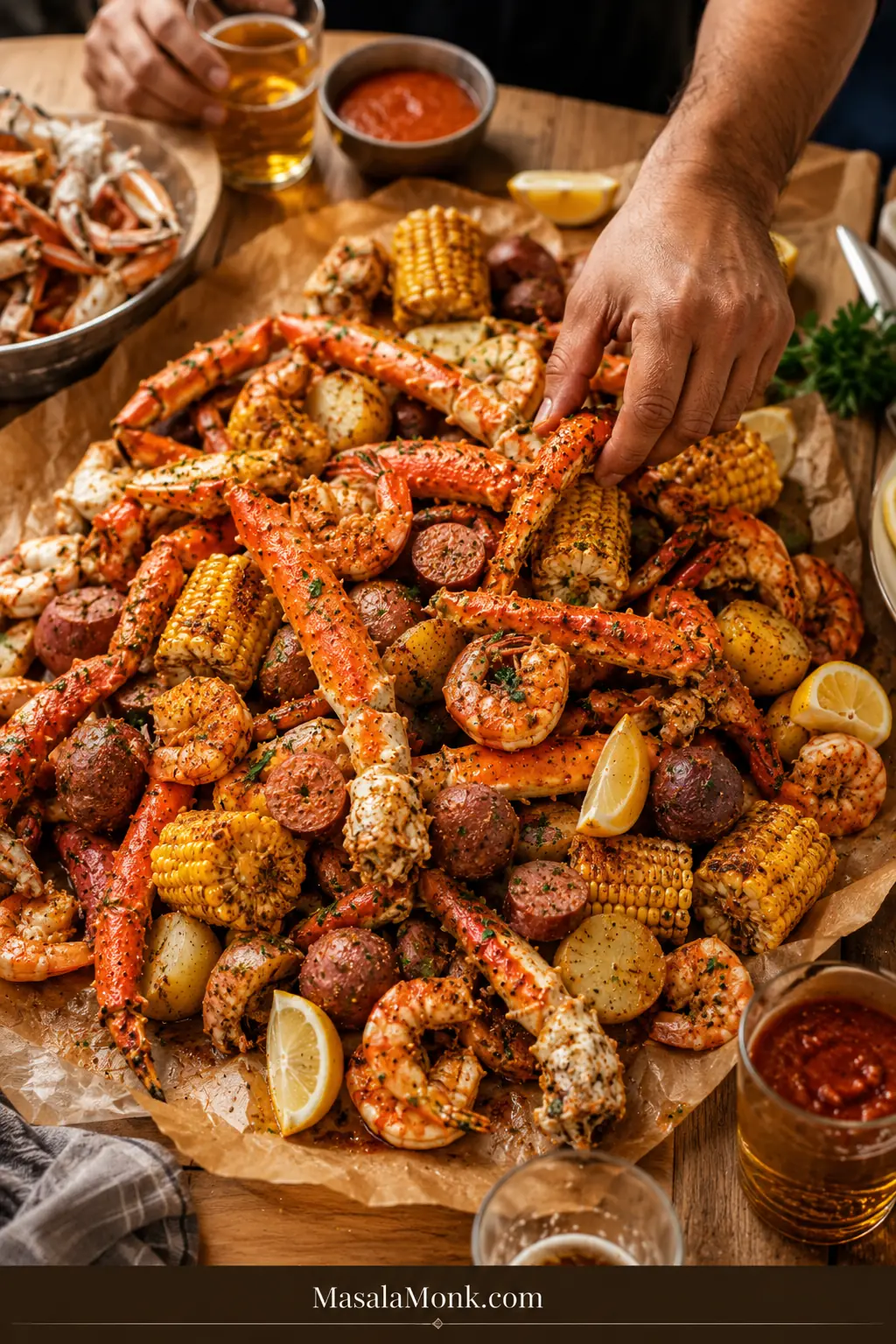
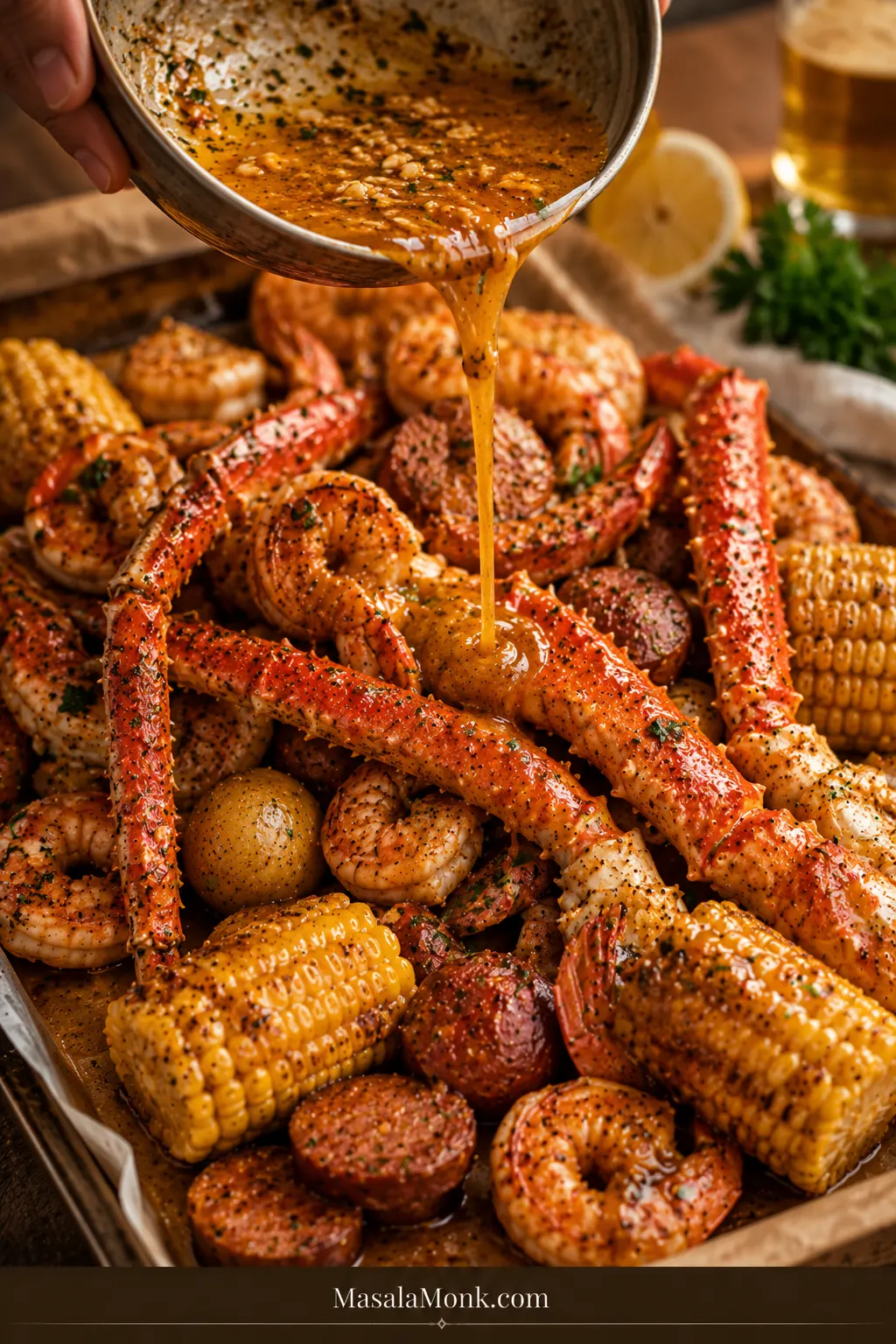
A Cajun seafood boil is the kind of dinner that turns the table into the event: sweet shrimp, juicy crab legs, smoky sausage, corn, potatoes, lemon, garlic, Cajun seasoning, and a glossy garlic butter sauce that gets into every shell, every potato, and every bite of corn.
Timing is the part that makes people nervous. Seafood is expensive, shrimp overcooks fast, crab legs are often already cooked, and potatoes need a head start if you want them seasoned all the way through.
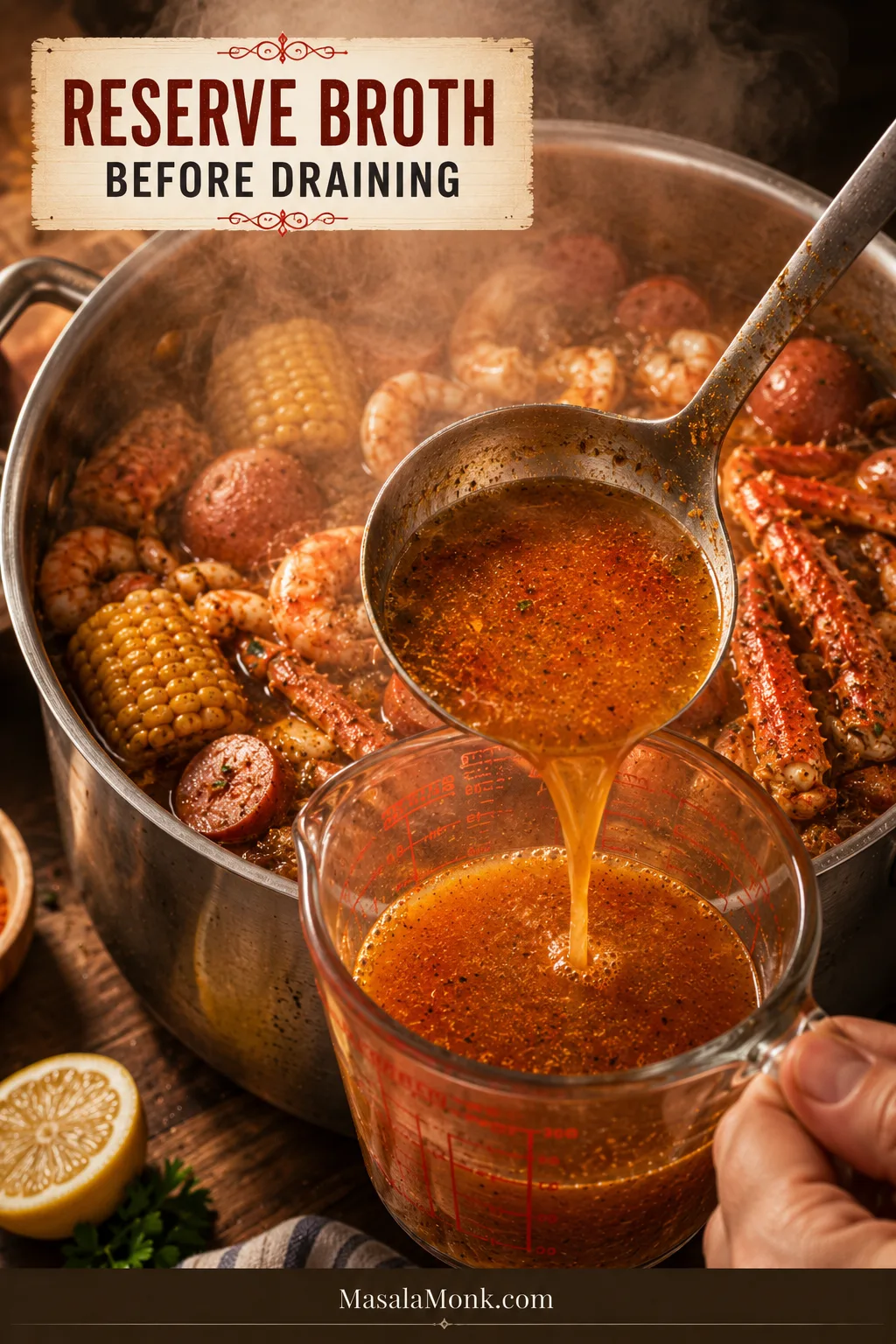
This recipe keeps the feast feeling big, but the method stays calm: build a bold broth, add everything in the right order, save a little broth for the sauce, then finish the whole tray with Cajun garlic butter.
This recipe works as your main home-kitchen seafood boil: shrimp or prawns, crab legs, smoked sausage, corn, potatoes, Cajun seasoning, and garlic butter sauce. Crawfish, lobster tails, mussels, and clams can join the pot, but they are not required for a saucy, satisfying boil.
Quick Answer: How Do You Make a Cajun Seafood Boil?
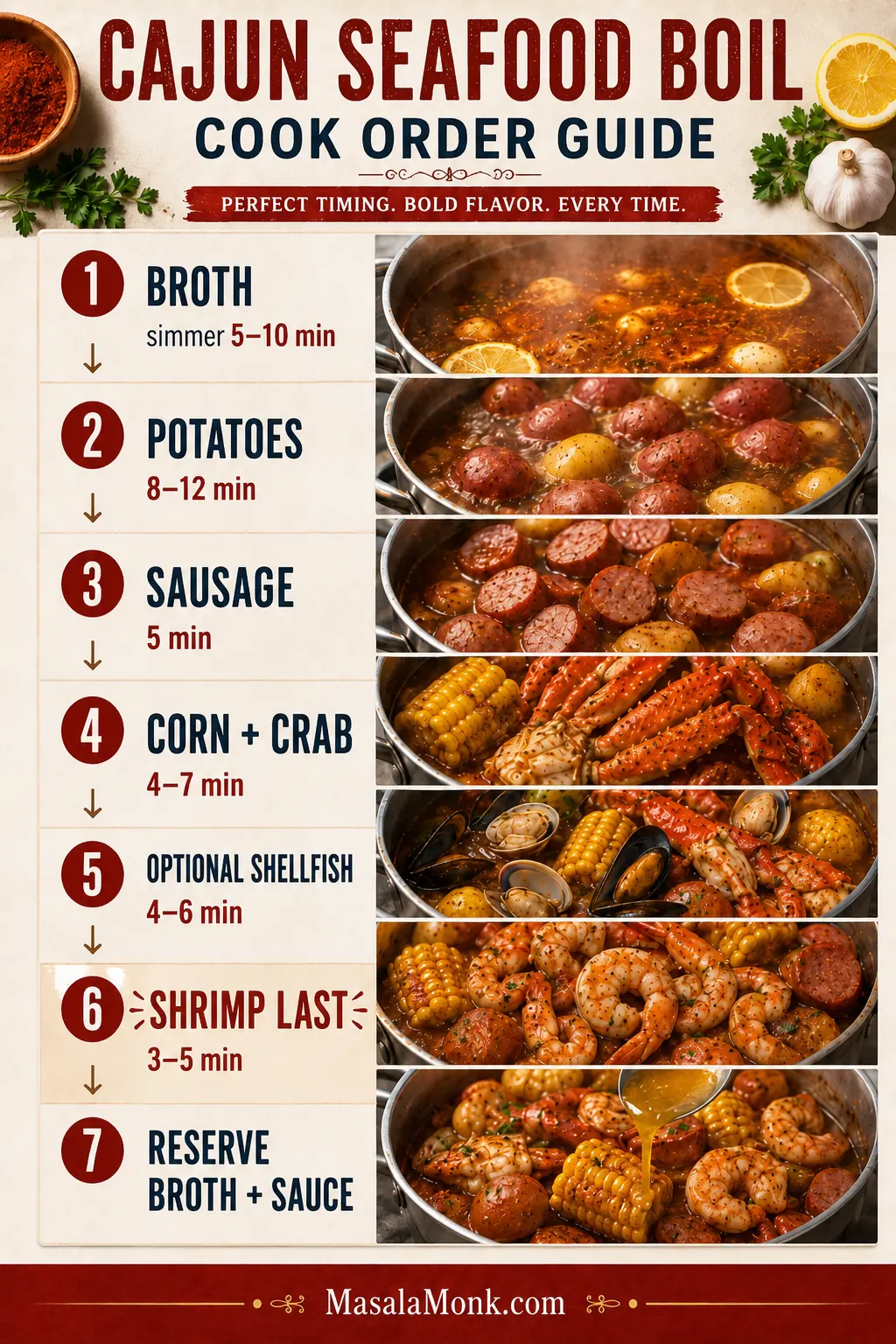
A Cajun seafood boil is made by simmering potatoes, sausage, corn, crab legs, and shrimp in a seasoned Cajun broth, then finishing everything with garlic butter sauce. Cook the ingredients in stages: potatoes first, sausage next, corn and crab after that, and shrimp last. Reserve some broth for the butter sauce before draining.
A 6-serving home version uses a 10 to 12 quart / 9.5 to 11.4 L pot, about 4 quarts / 3.8 L total liquid, 2 lb / 900 g crab legs, 1.5 to 2 lb / 680 to 900 g shrimp, 12 to 14 oz / 340 to 400 g sausage, 1.5 lb / 680 g baby potatoes, and 4 to 6 ears of corn.
Simple rule: potatoes early, shrimp last, sauce at the end. That one order keeps the potatoes flavorful, the crab sweet, and the shrimp tender instead of rubbery.
Even if this is your first seafood boil, you do not have to manage everything at once. Prep first, cook in stages, and keep the shrimp for the very end. The pot builds flavor; the sauce delivers it.
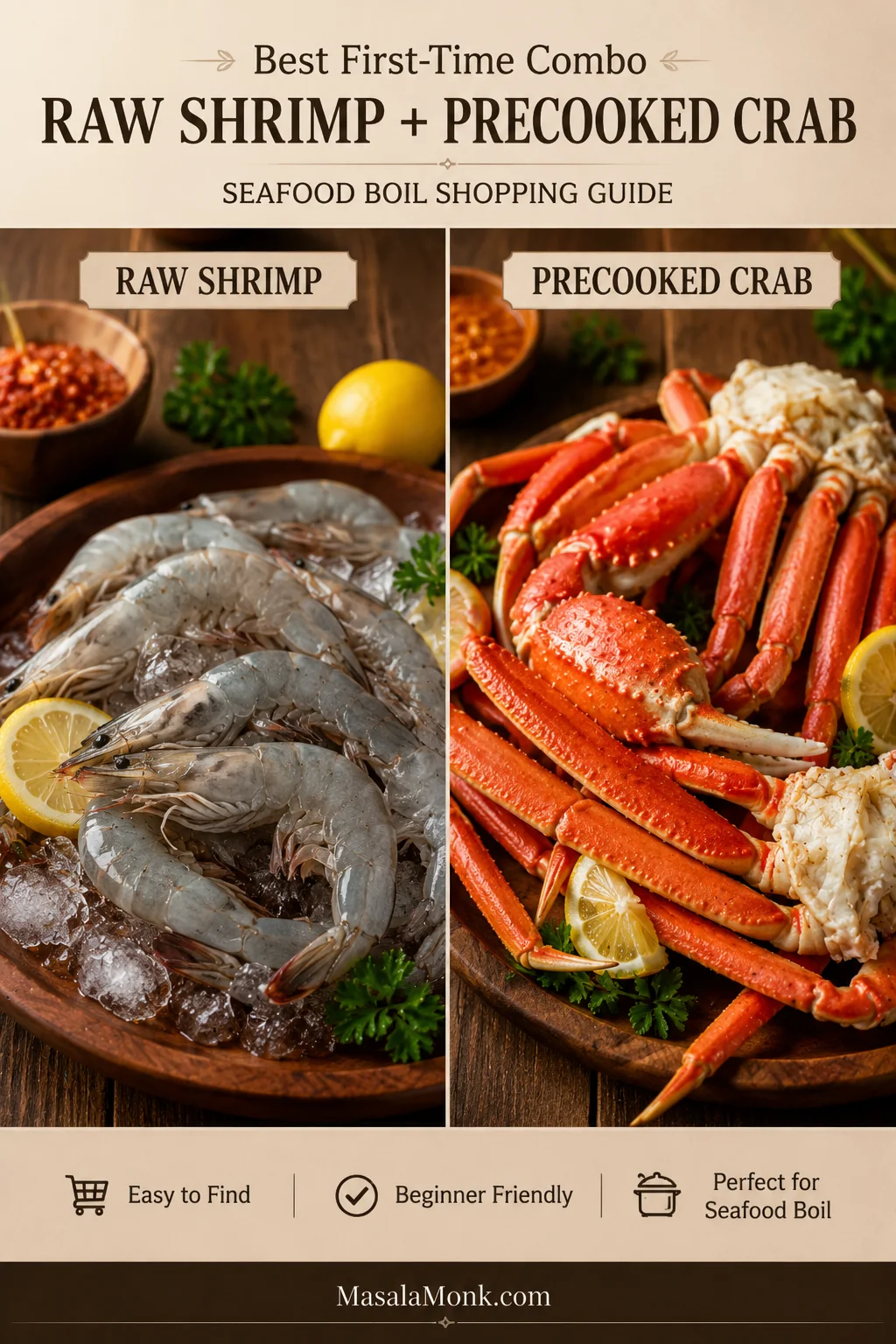
Best first-time path: make the classic shrimp-and-crab version, use the normal coating sauce, keep the heat medium, and skip a long soak. This gives you a full, saucy tray without overcomplicating the pot.
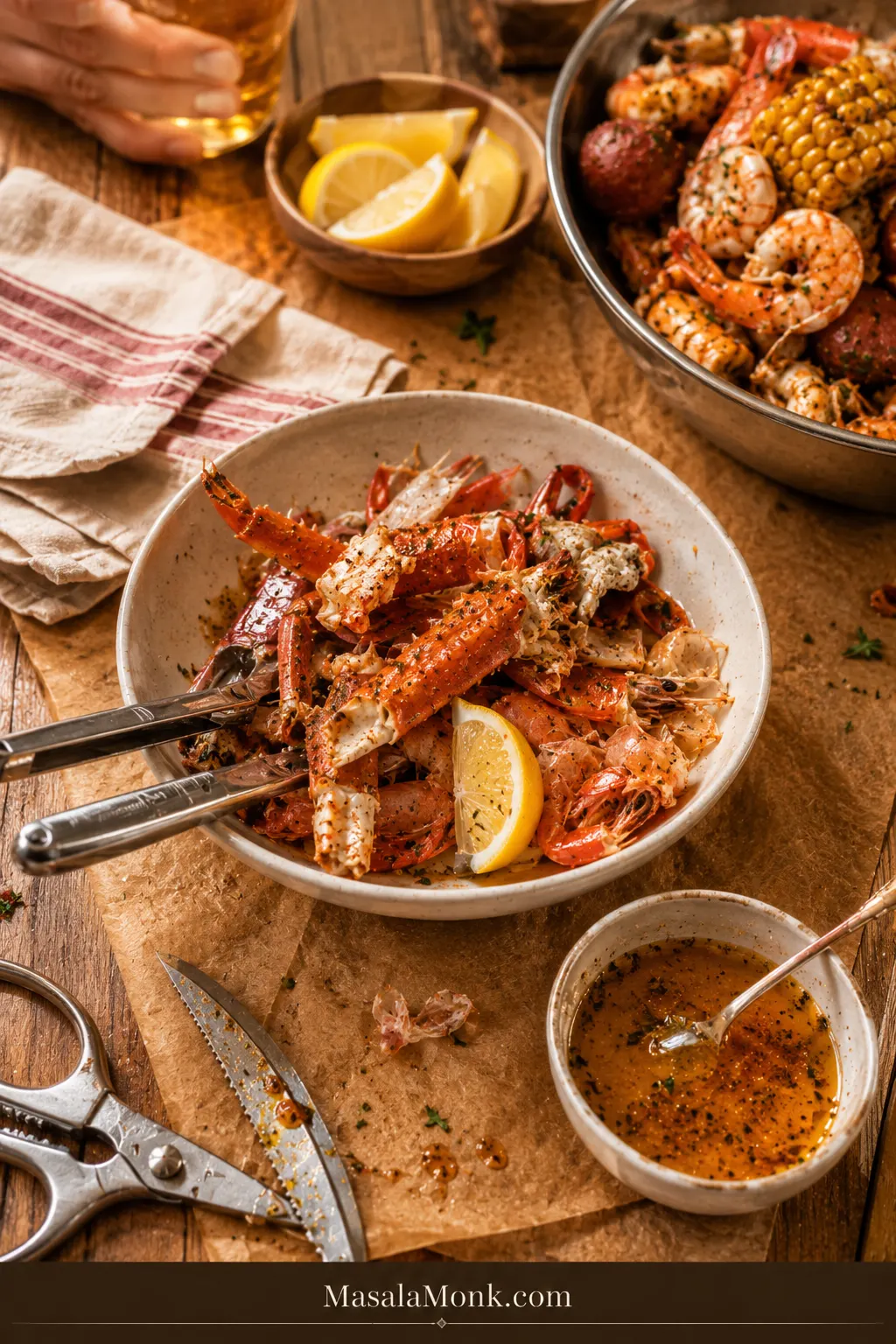
Meanwhile, this is where seafood boil turns into a meal people gather around, because the tray, the sauce bowls, and the shells all belong at the table.
Cajun Seafood Boil Recipe Card
Cajun Seafood Boil With Garlic Butter Sauce
A bold home-kitchen Cajun seafood boil with shrimp, crab legs, smoked sausage, corn, potatoes, lemon, garlic, Cajun seasoning, and buttery garlic sauce. The ingredients move in stages so the potatoes absorb the broth, the crab heats gently, and the shrimp stays tender.
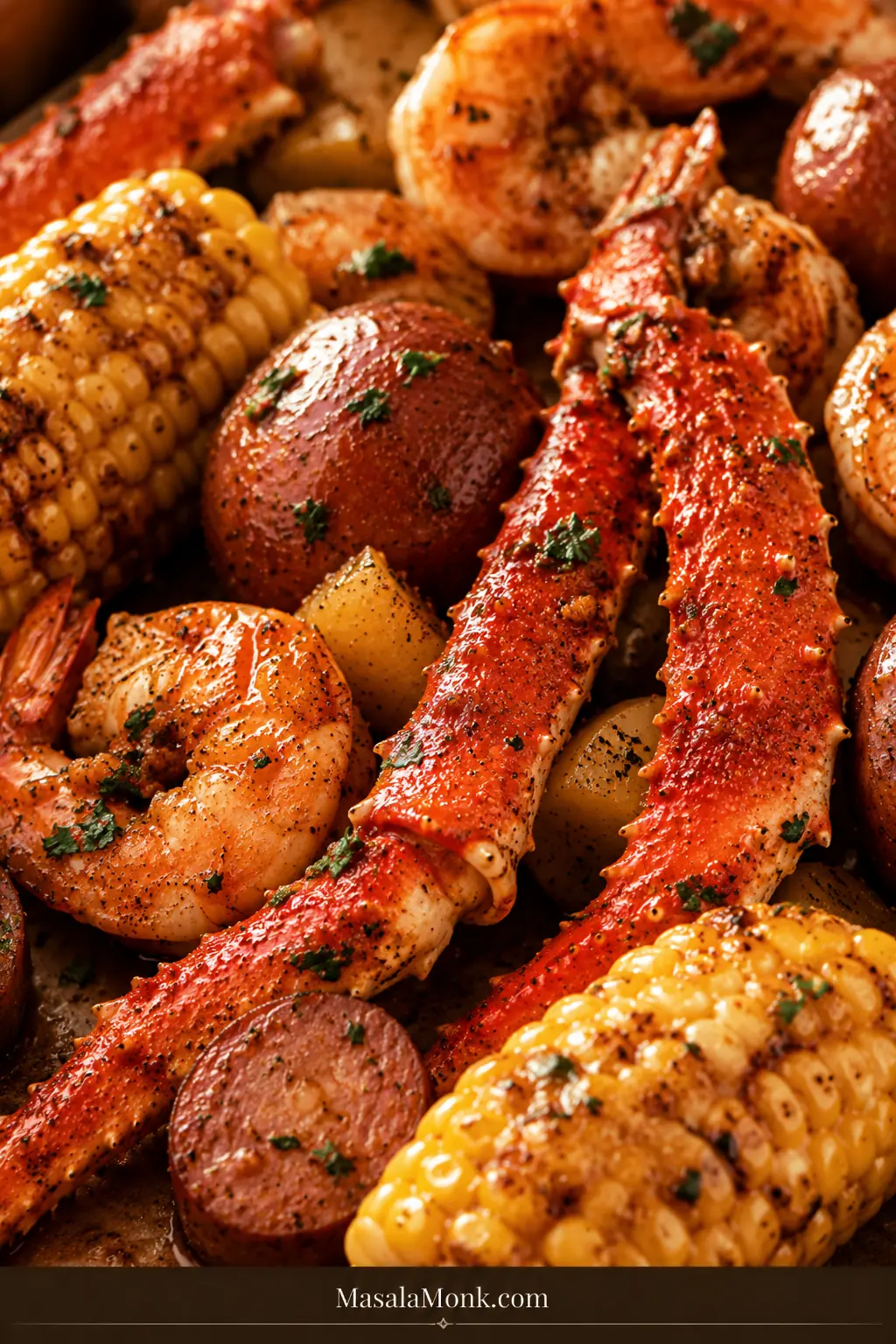
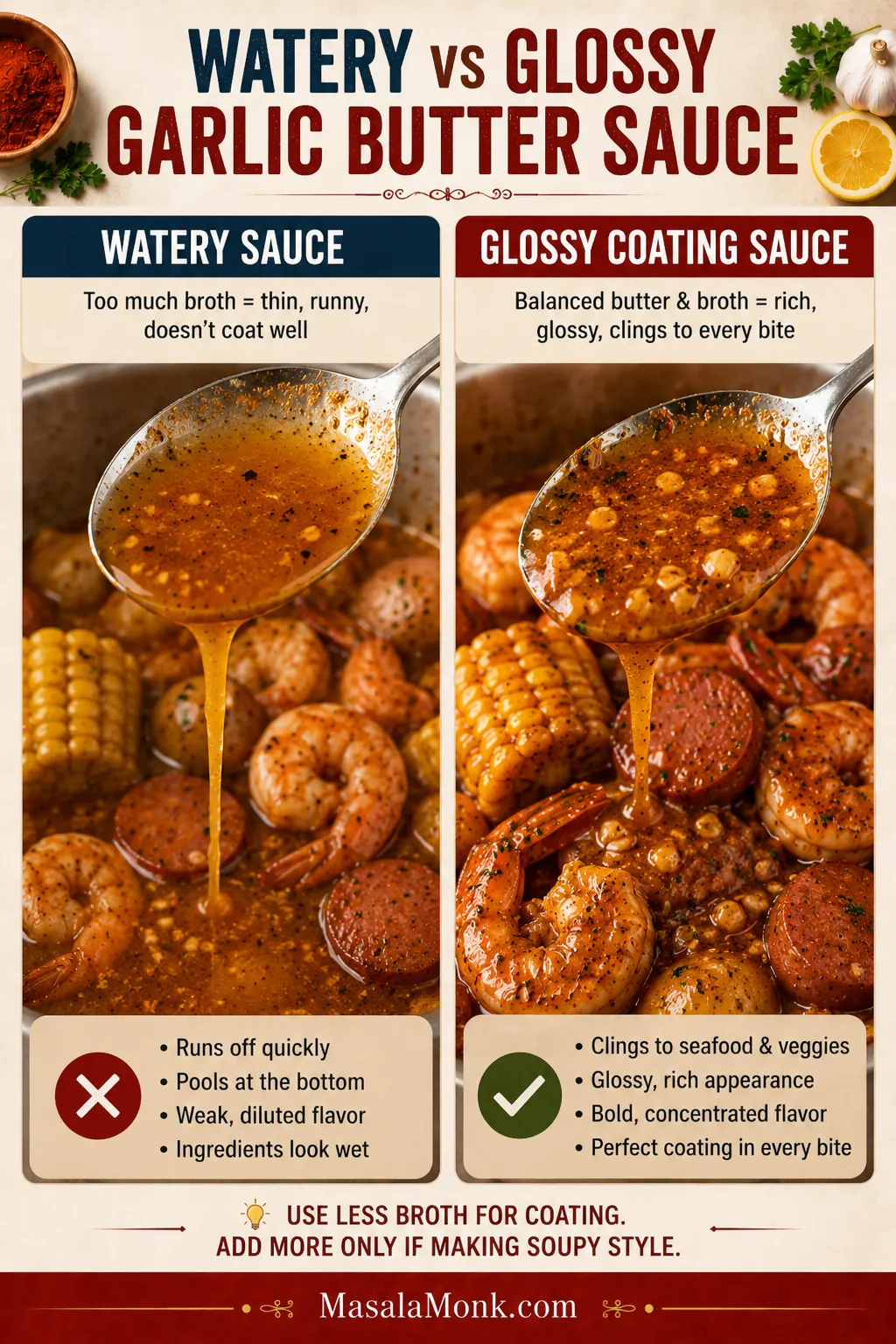
Notice how the butter clings to the shells and corn instead of pooling away; that glossy coat is what makes each bite feel richer.
Prep Time
20 minutes
Cook Time
35 minutes
Total Time
55 minutes, plus 5 to 10 minutes if soaking
Servings
6
Method
Stovetop
Pot Size
10 to 12 quart / 9.5 to 11.4 L stockpot
Best Cue
Shrimp just cooked; potatoes tender; crab heated through
Seafood Boil Ingredients
4 quarts / 3.8 L total liquid: water, or mostly water plus 12 oz / 355 ml beer
1 large onion, quartered
1 to 2 heads garlic, halved crosswise
2 lemons, halved, plus extra wedges for serving
2 to 3 bay leaves
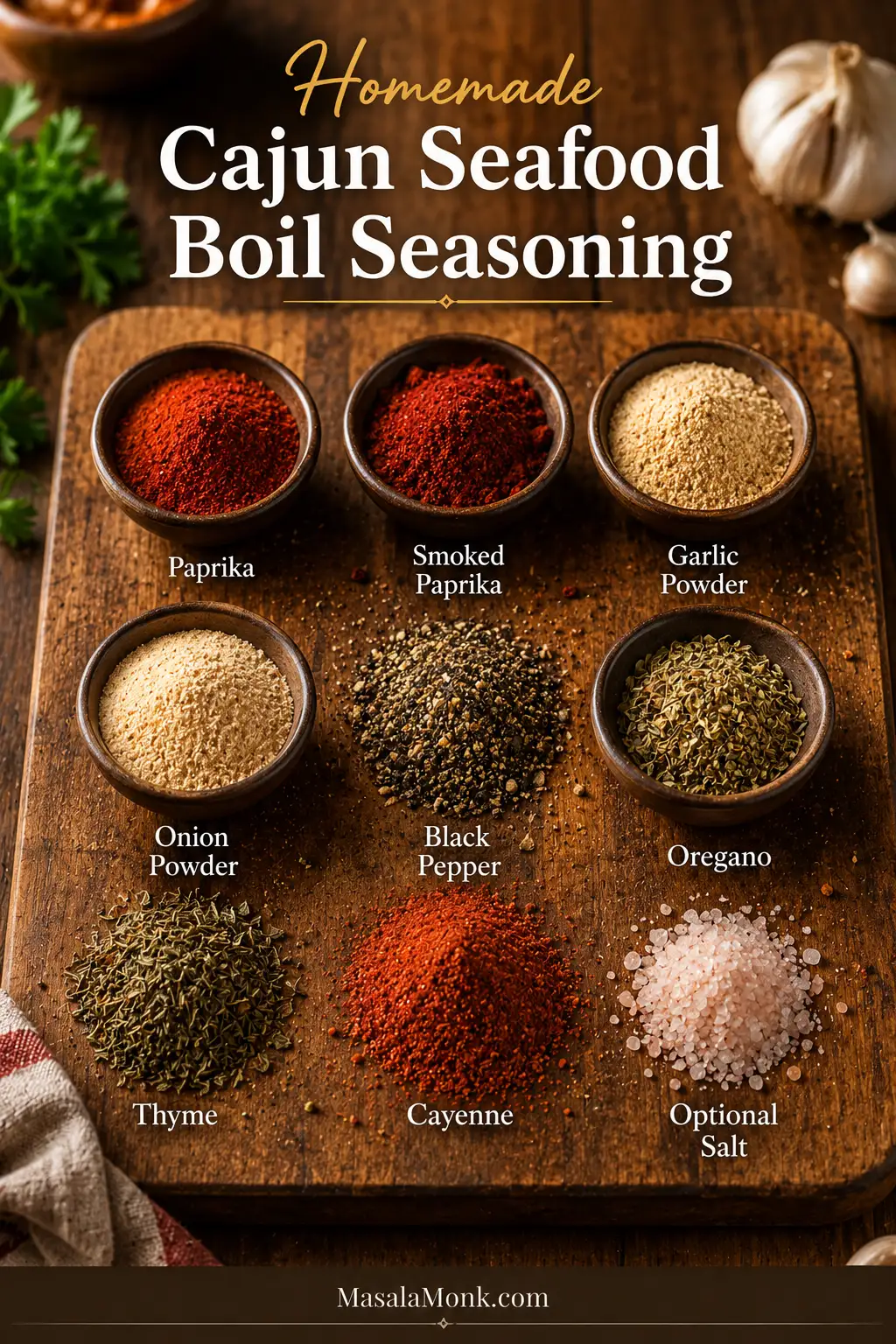
1/4 cup Cajun seasoning to start, up to 1/2 cup only if your blend is low-salt or salt-free
1 to 2 tablespoons Old Bay or seafood seasoning, optional
1.5 lb / 680 g baby potatoes
12 to 14 oz / 340 to 400 g andouille or smoked sausage, sliced into thick rounds
4 to 6 ears corn, cut into halves or thirds
2 lb / 900 g snow crab legs or crab clusters, usually precooked
1.5 to 2 lb / 680 to 900 g jumbo raw shrimp or prawns, easy-peel or deveined shell-on if possible
Salt, only if needed after tasting the broth
Fresh parsley, for serving
Why the seasoning amount looks large: this seasons the water, potatoes, corn, shells, and seafood, not just the surface of the shrimp. Start with 1/4 cup if your blend contains salt.
Optional Add-Ins
1 to 2 lb / 450 to 900 g cooked or properly prepared crawfish; for live crawfish, use crawfish-specific cleaning and cooking guidance
2 to 3 lobster tails
1 lb / 450 g mussels or clams, cleaned
4 to 6 peeled hard-boiled eggs, warm or room-temperature, added after draining
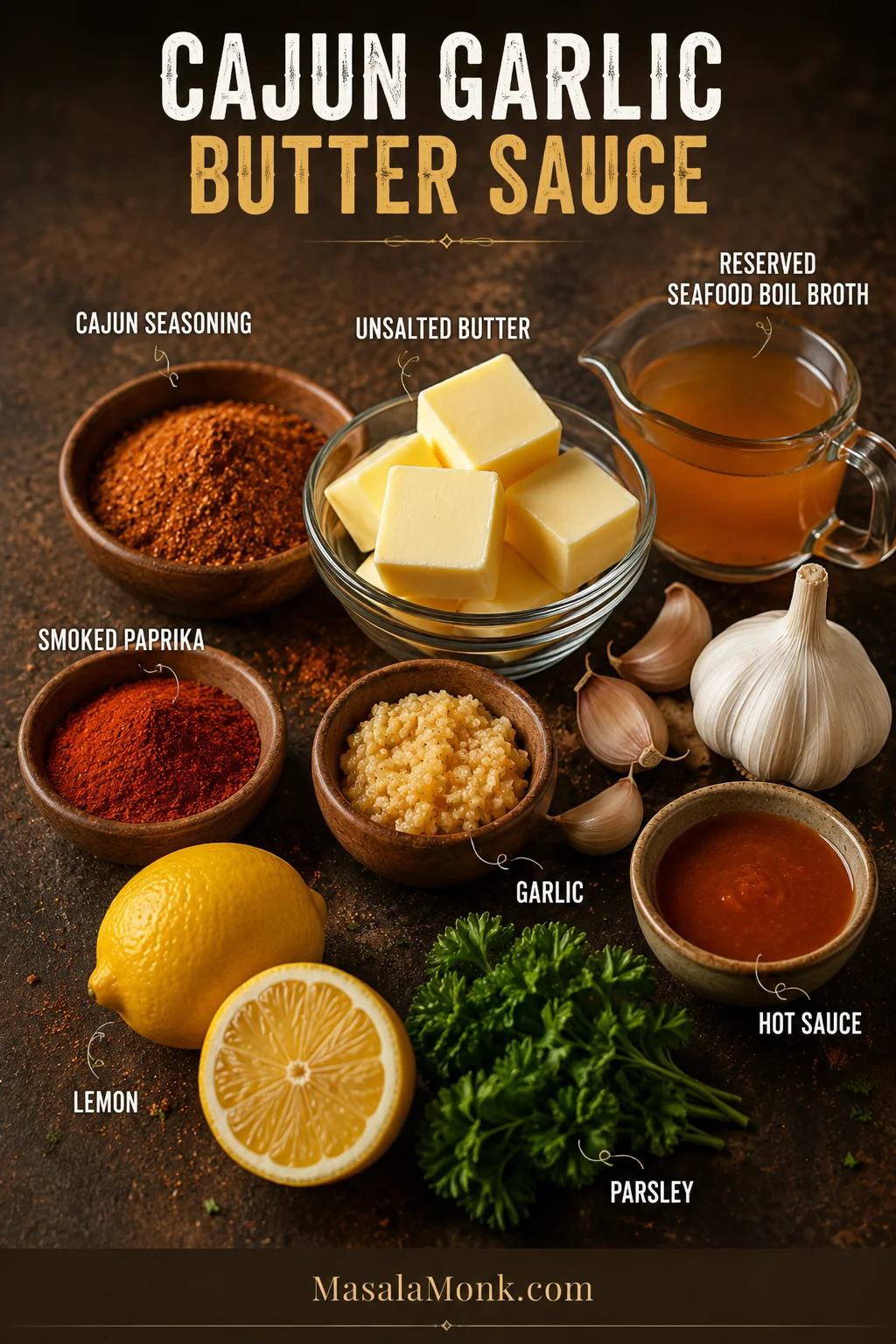
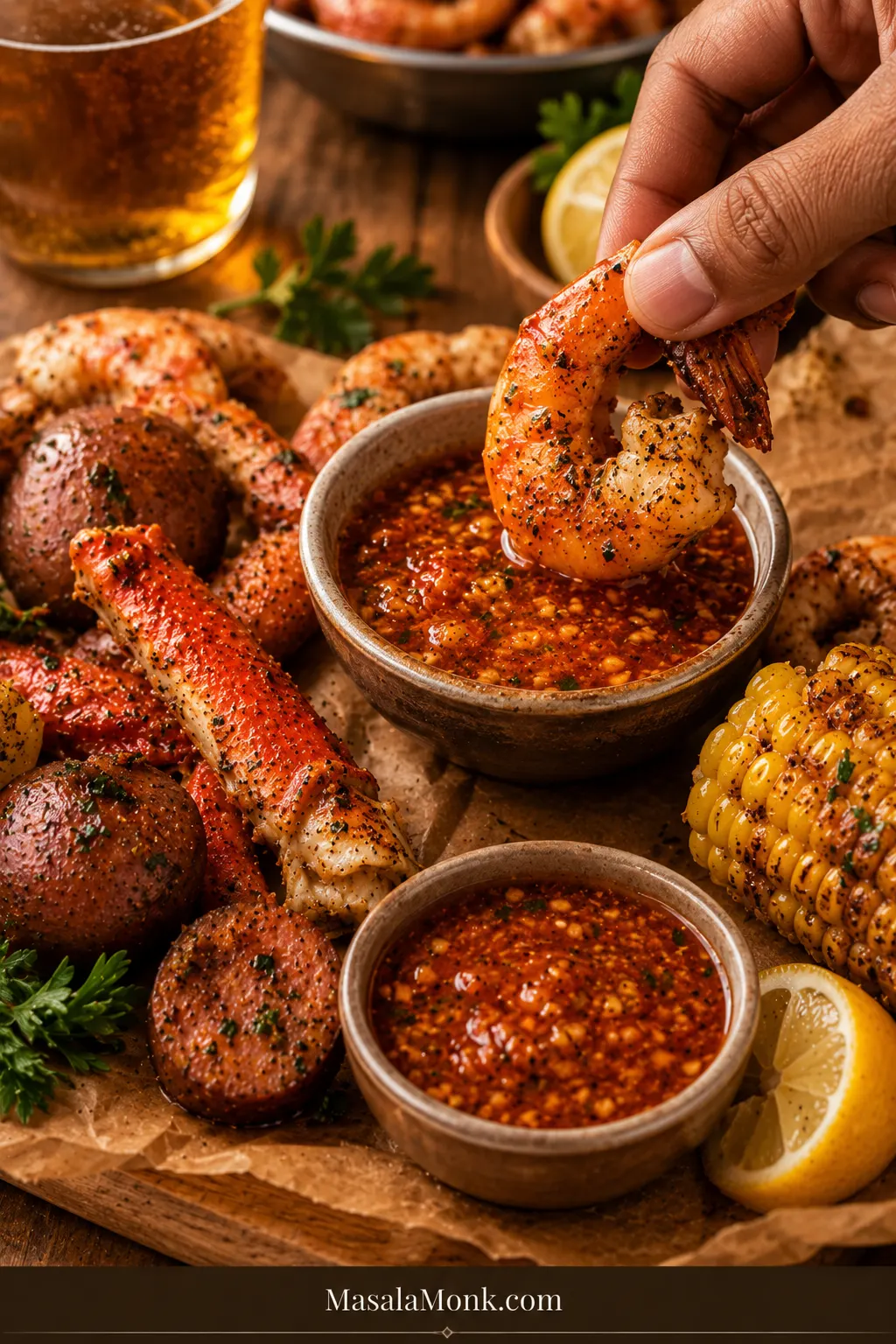
Cajun Garlic Butter Sauce
1 cup / 227 g unsalted butter
6 to 8 garlic cloves, finely minced
1 tablespoon Cajun seasoning
1 teaspoon smoked paprika
1 to 2 tablespoons lemon juice
1/4 to 1/2 cup / 60 to 120 ml reserved seafood boil broth
1 to 2 teaspoons hot sauce, optional
2 tablespoons chopped parsley
Method
Prep everything first. Cut the corn, slice the sausage, halve the lemons and garlic, rinse the seafood, and thaw frozen seafood if needed.
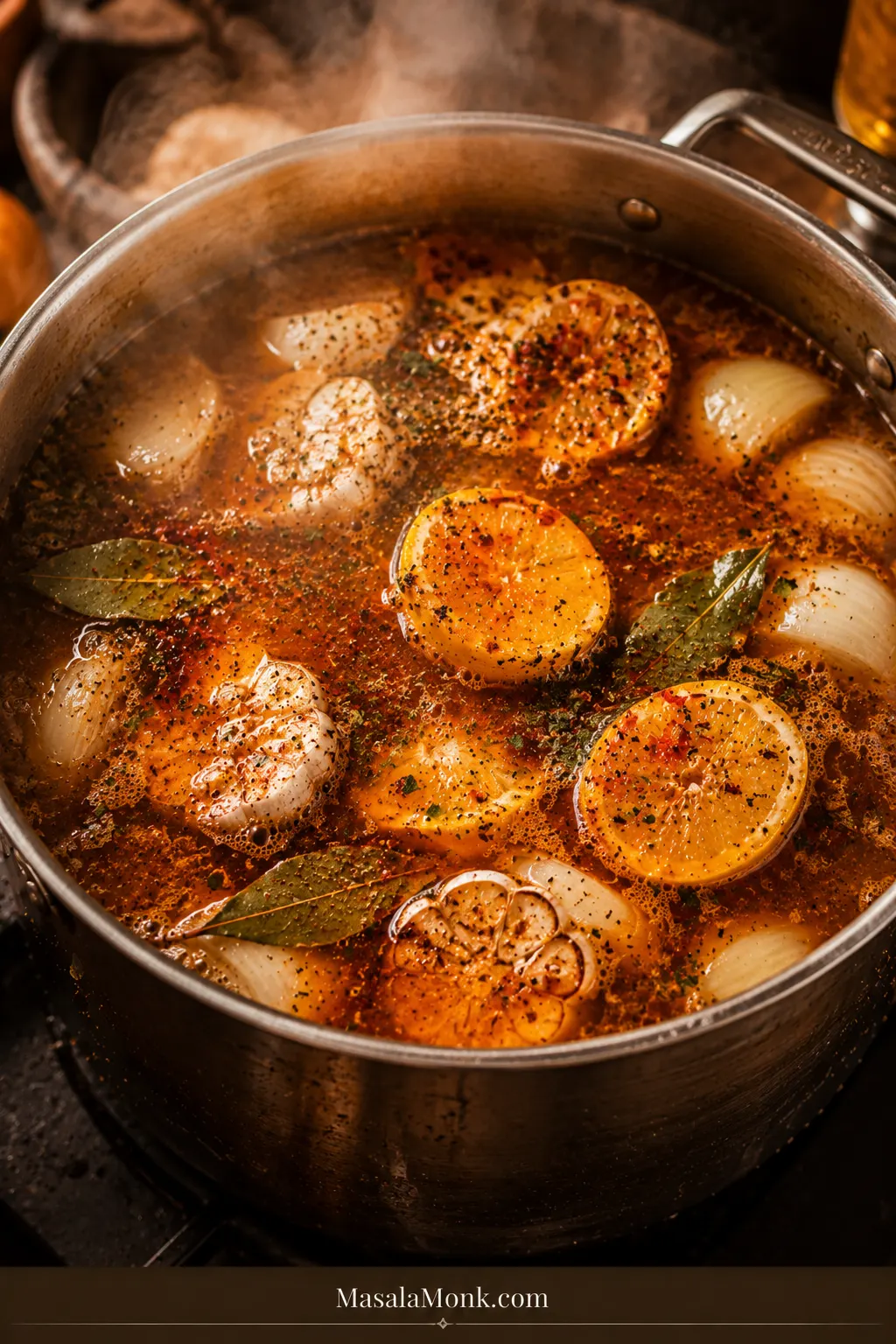
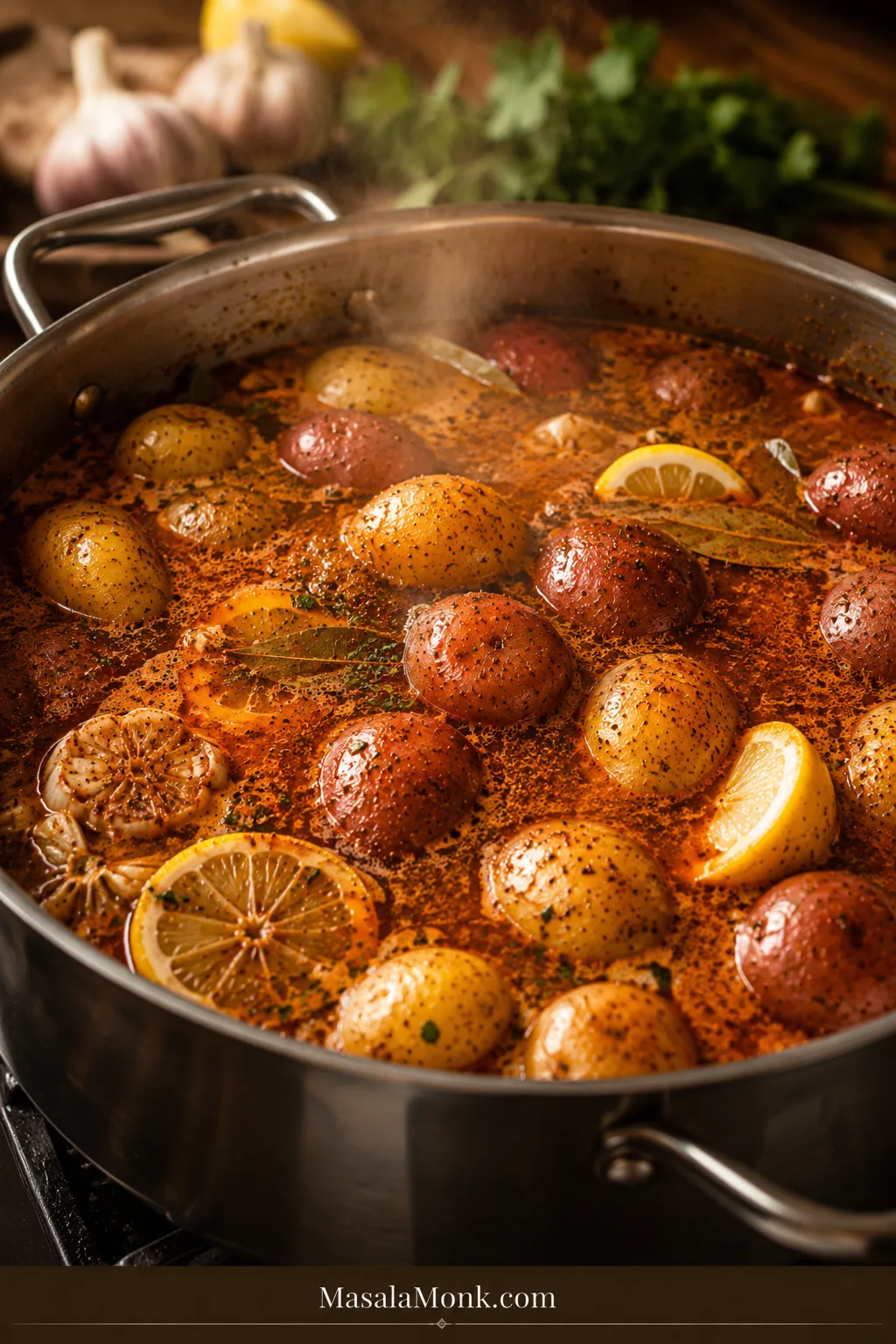
Build the broth. Add the liquid, onion, garlic, lemons, bay leaves, 1/4 cup Cajun seasoning, and optional Old Bay to a large stockpot. Bring to a rolling boil and simmer for 5 to 10 minutes, until it smells garlicky, lemony, and spicy.
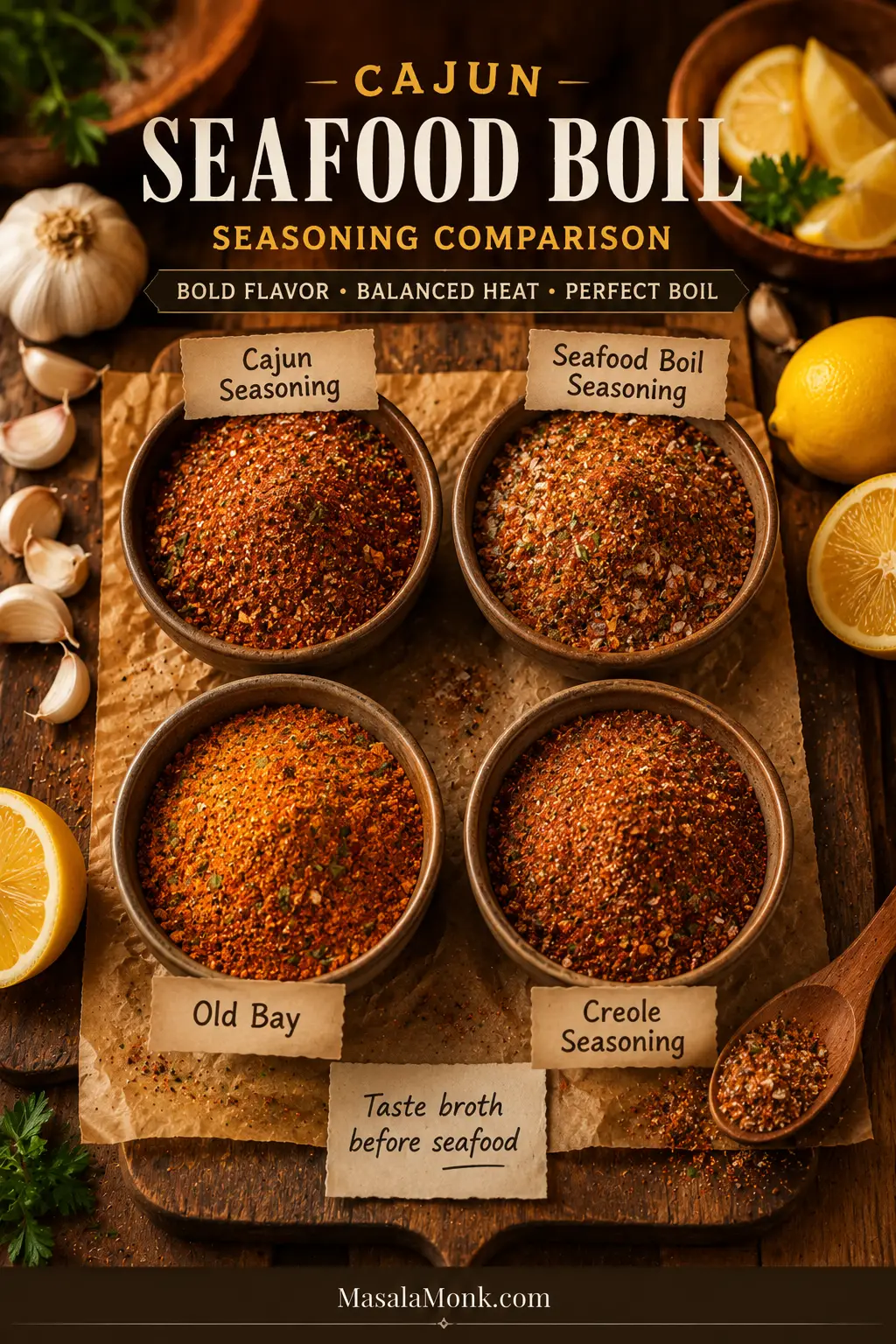
Taste the broth. It should be bold, but not harsh or unpleasantly salty. Add more seasoning only if needed.
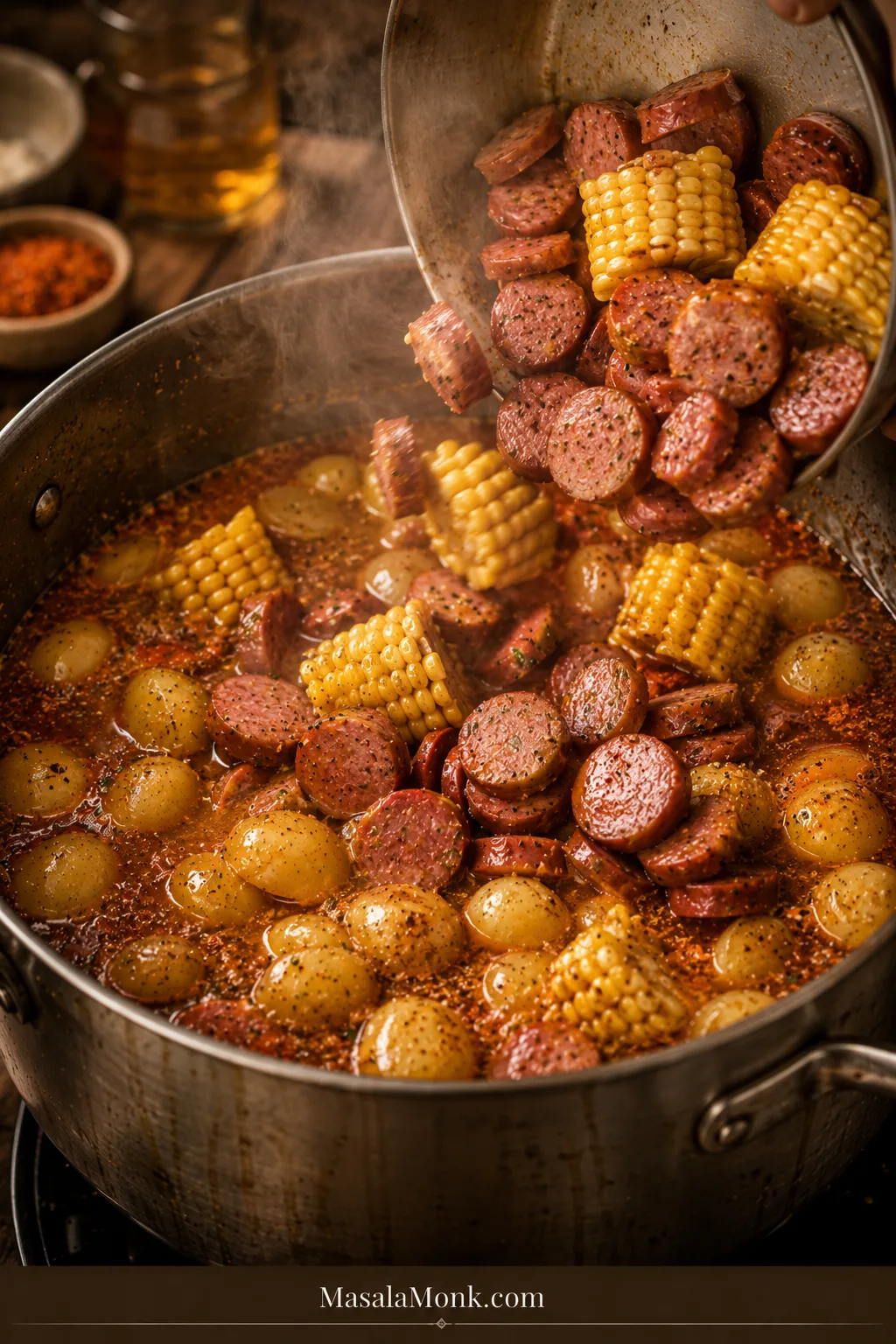
Add the potatoes and cook for 8 to 12 minutes, then add the sausage and cook for 5 minutes.
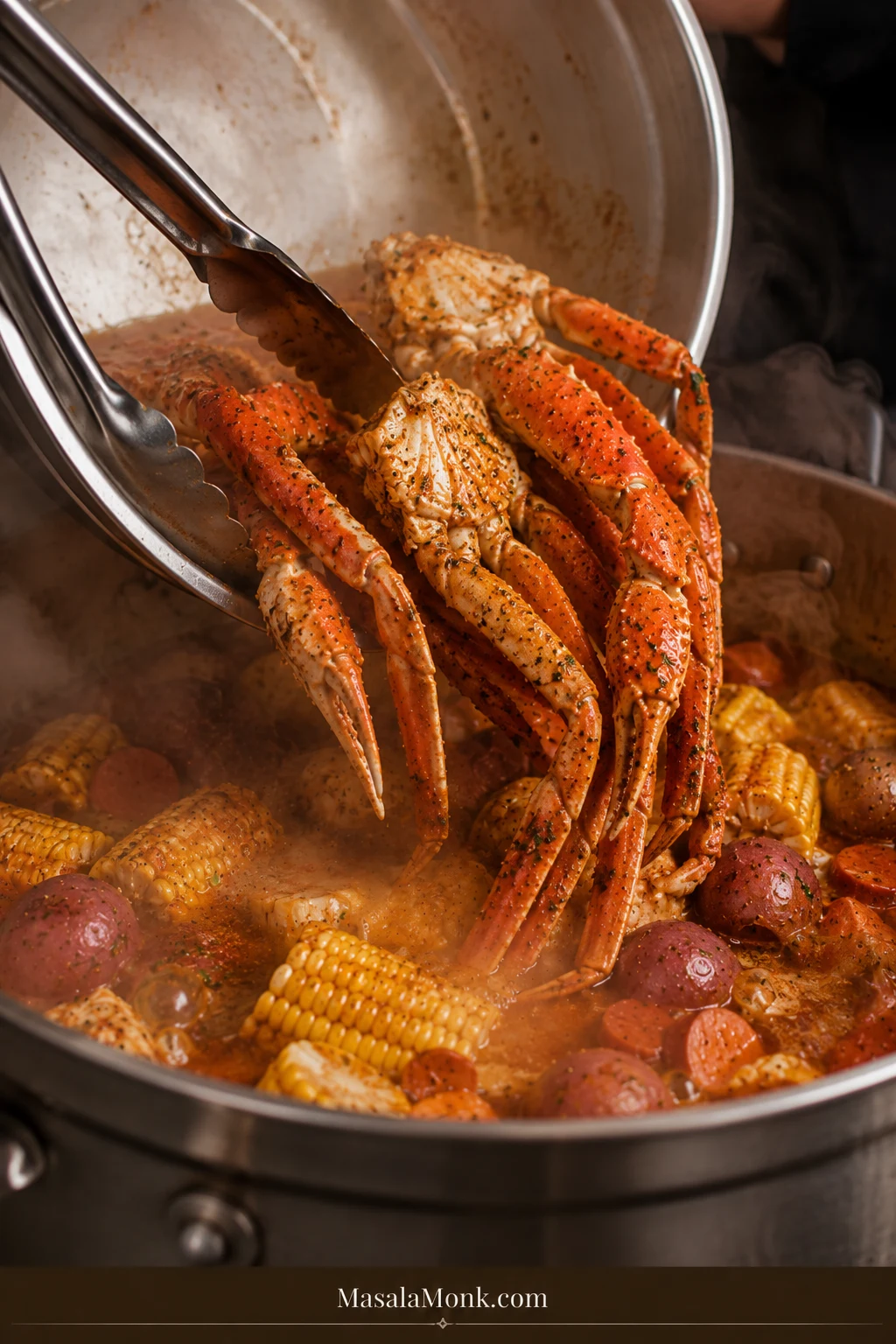
Reduce the heat slightly if the pot is violently boiling. Add corn and crab legs; cook for 4 to 7 minutes, just until the corn is tender and the crab is heated through.
Add lobster tails, mussels, or clams if using. Cook for 4 to 6 minutes, until lobster is opaque and mussels or clams have opened.
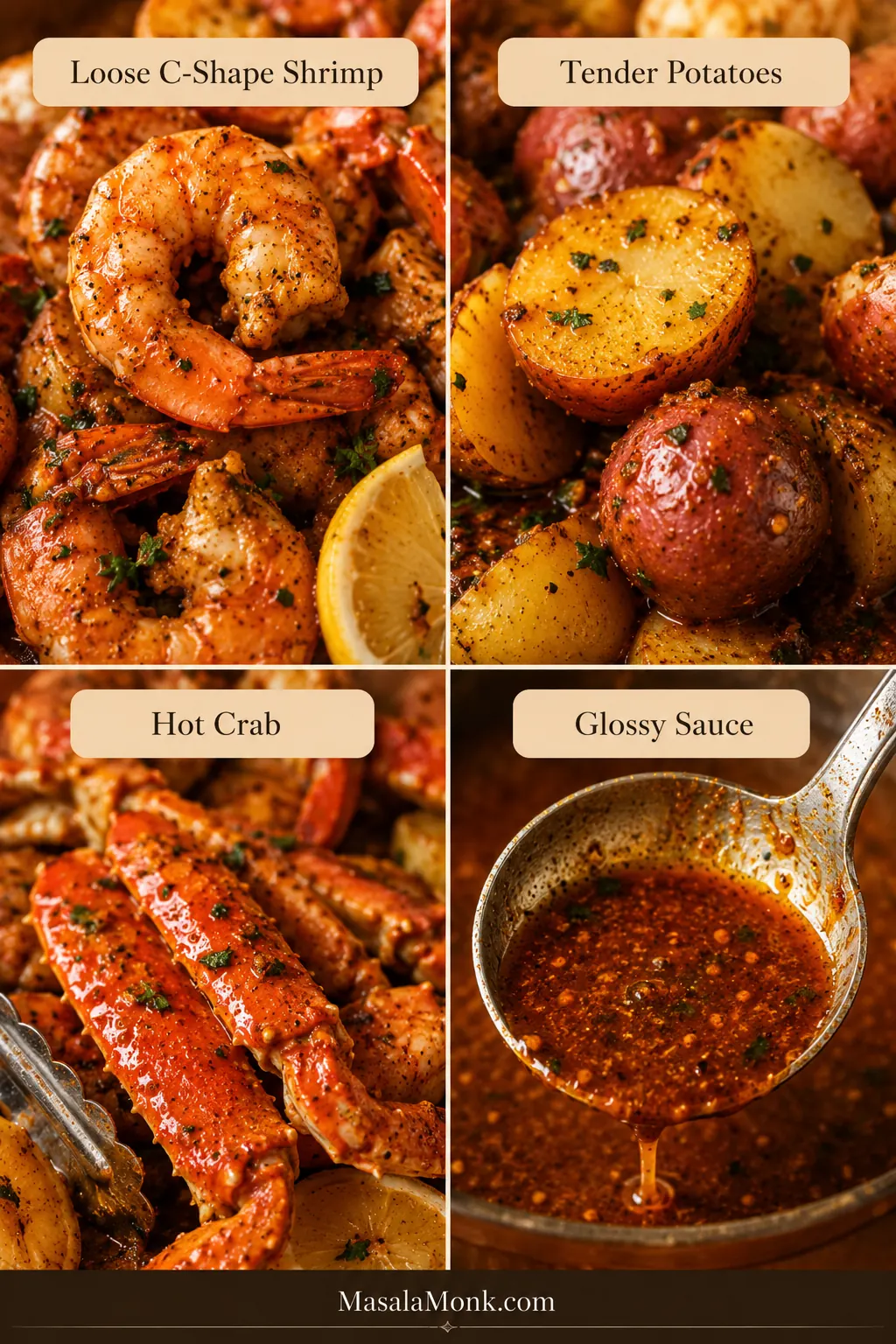
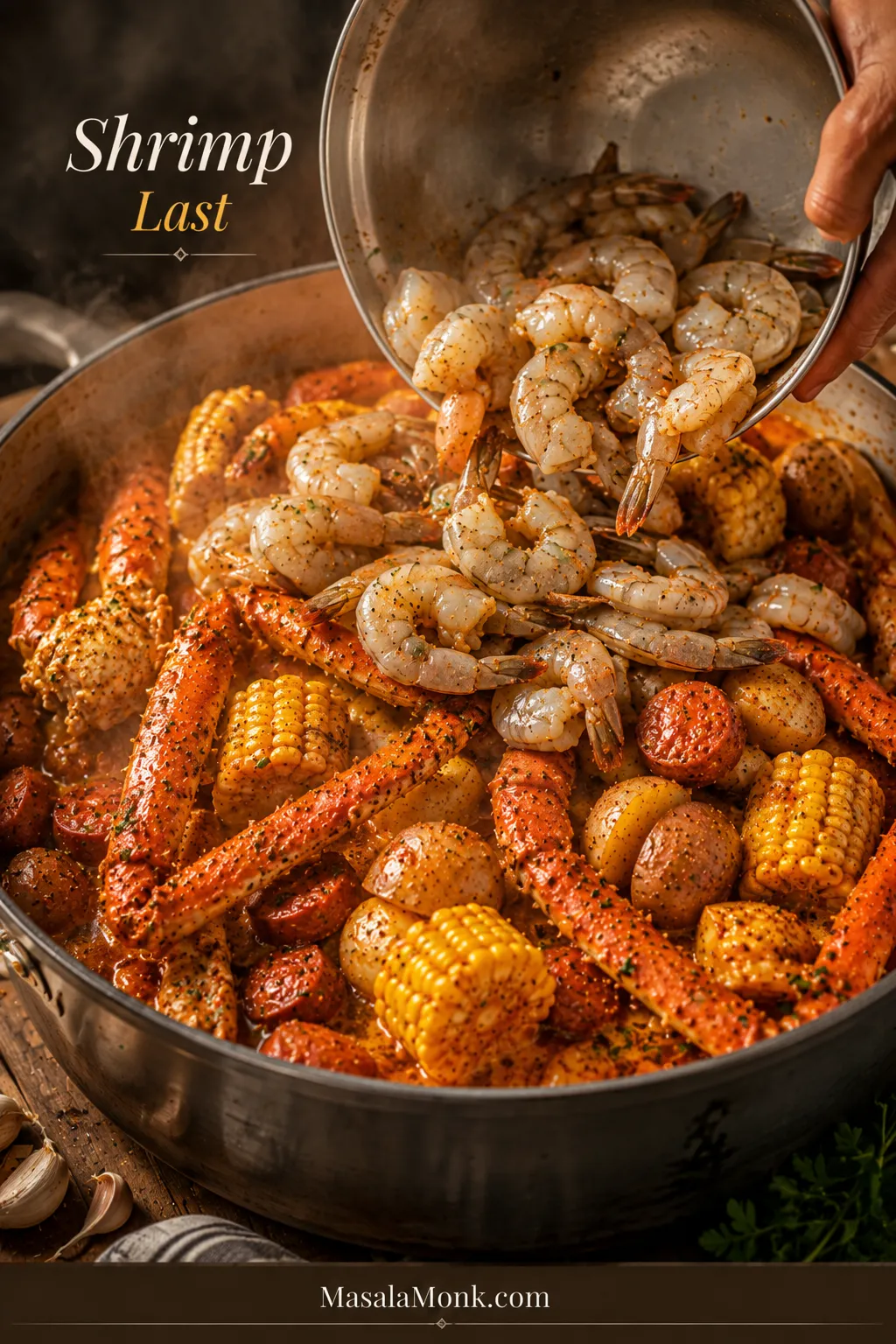
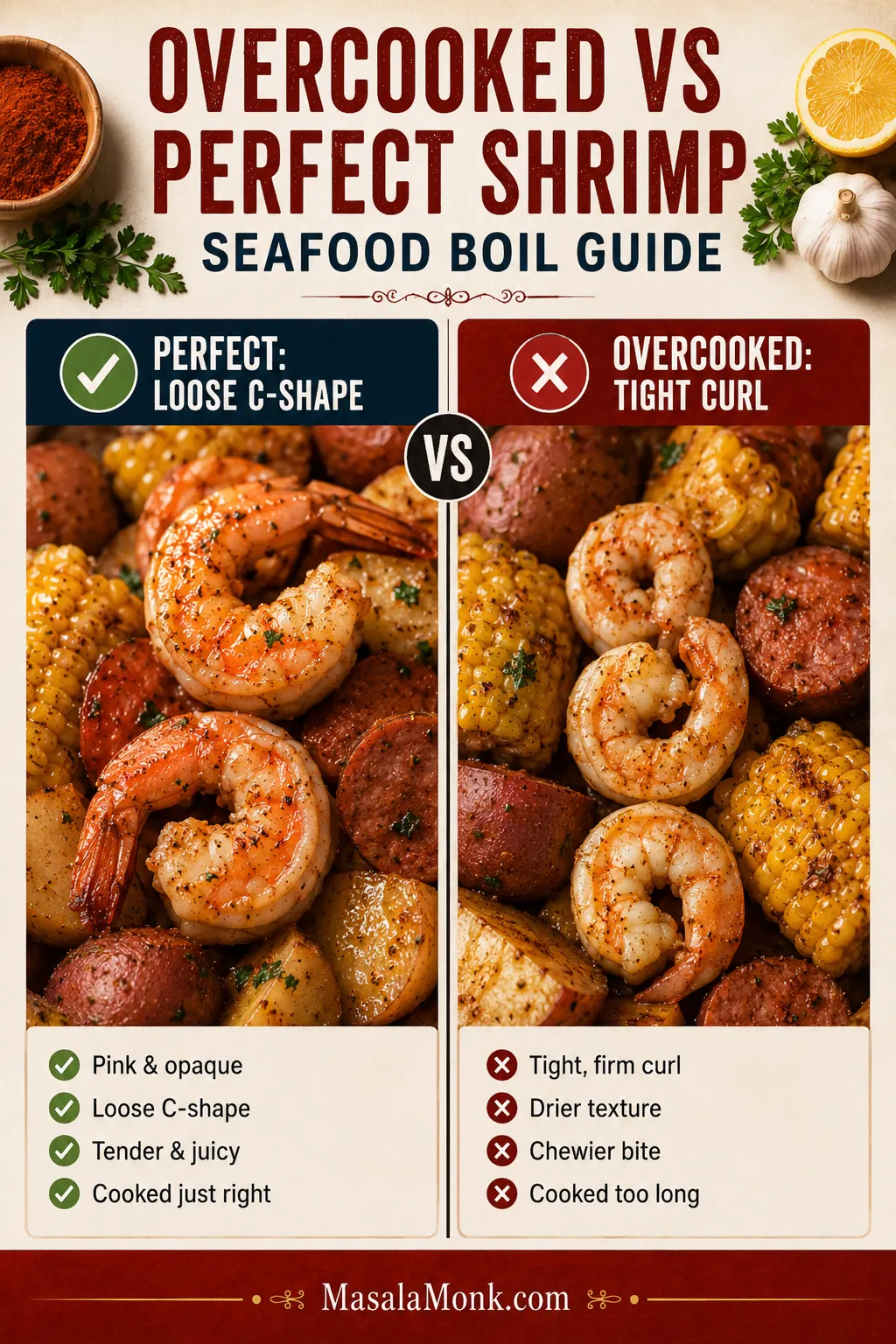
Add shrimp last. Cook for 3 to 5 minutes, just until pink, opaque, and curled into a loose C-shape. For smaller shrimp, turn off the heat and let the covered pot finish them gently.
Reserve 1 cup / 240 ml seasoned broth, then drain the boil carefully.
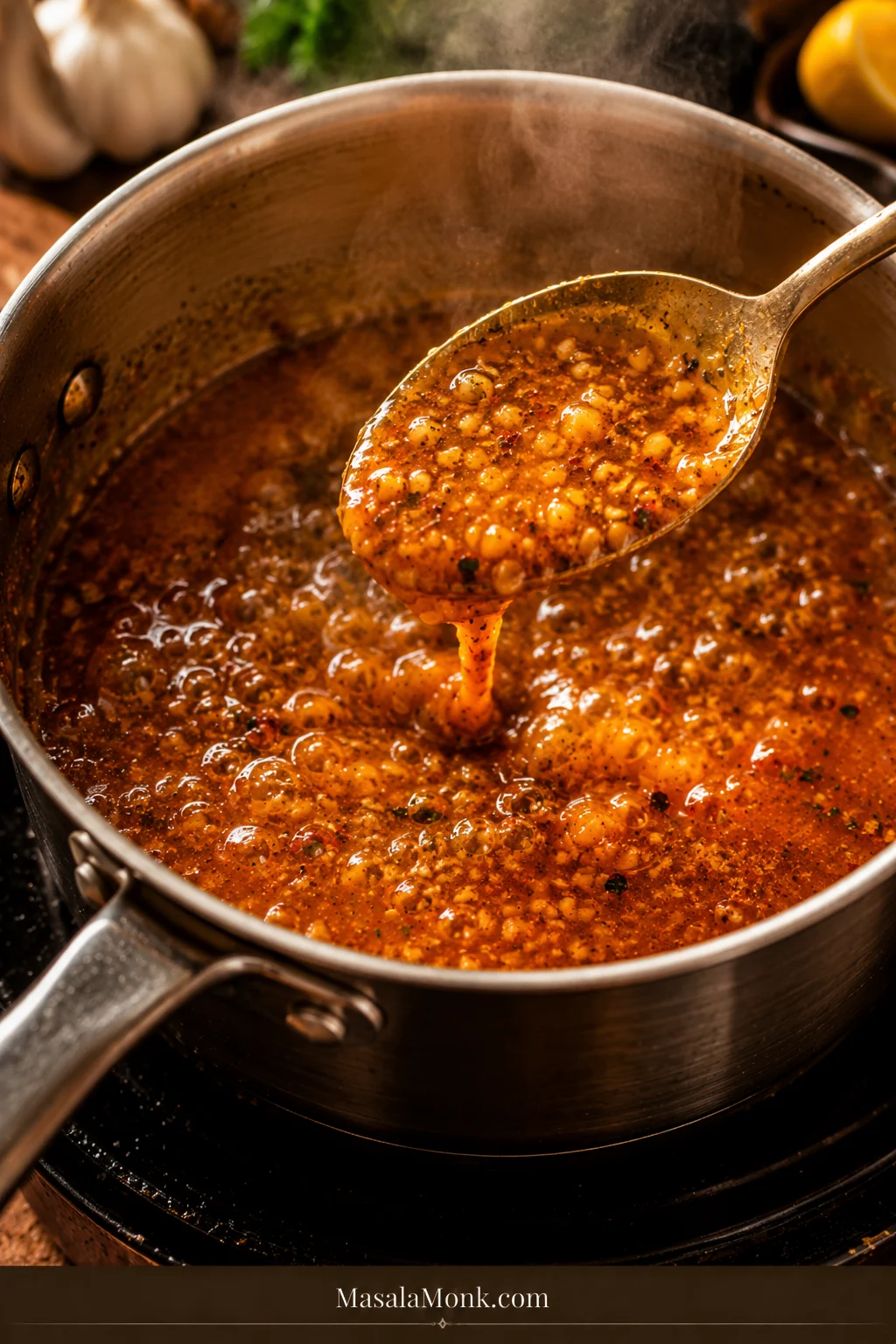
Make the sauce. Melt butter, cook garlic briefly, then stir in Cajun seasoning, paprika, lemon juice, reserved broth, hot sauce if using, and parsley.
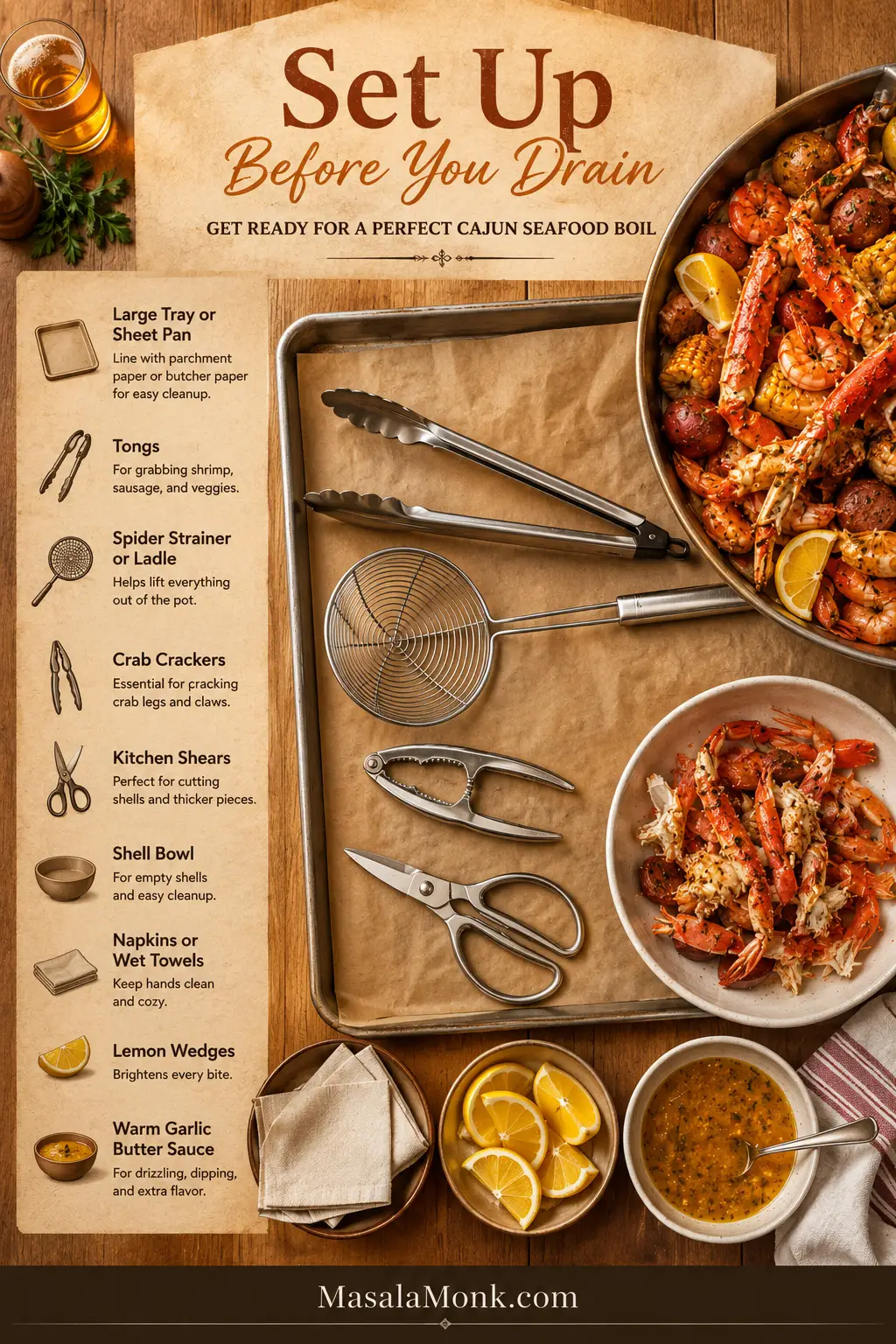
Transfer everything to a large tray or serving platter. Add boiled eggs now if using. Spoon the Cajun garlic butter over the crab joints, corn, potatoes, shrimp, sausage, and eggs, or serve extra on the side for dipping.
Salt note: Cajun seasoning, Old Bay, seafood boil seasoning, and crab boil blends can all contain salt. Start lower if your blend is salty, taste the broth before adding seafood, and adjust slowly.
Success cues:
Potatoes: tender, but not splitting apart.
Corn: bright, juicy, and tender when pierced.
Crab: steaming hot and fragrant.
Lobster: opaque and firm, not tight.
Mussels/clams: opened after cooking; discard closed ones.
Shrimp: pink and curled into a loose C-shape.
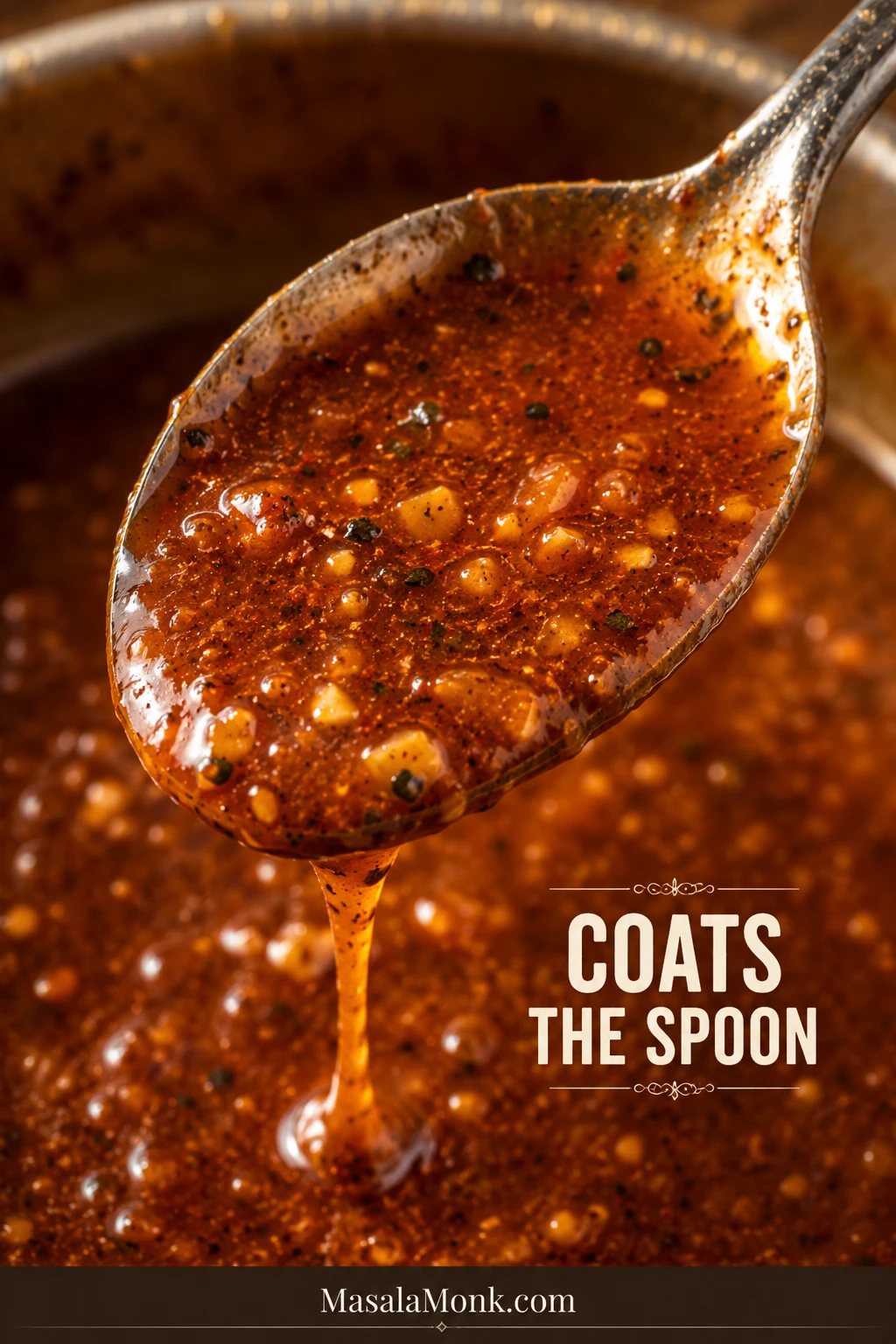
Sauce: shiny, spoonable, and coating instead of watery.
After the cook, this is the quickest way to check your timing: loose shrimp, tender potatoes, hot crab, and sauce that still looks rich.
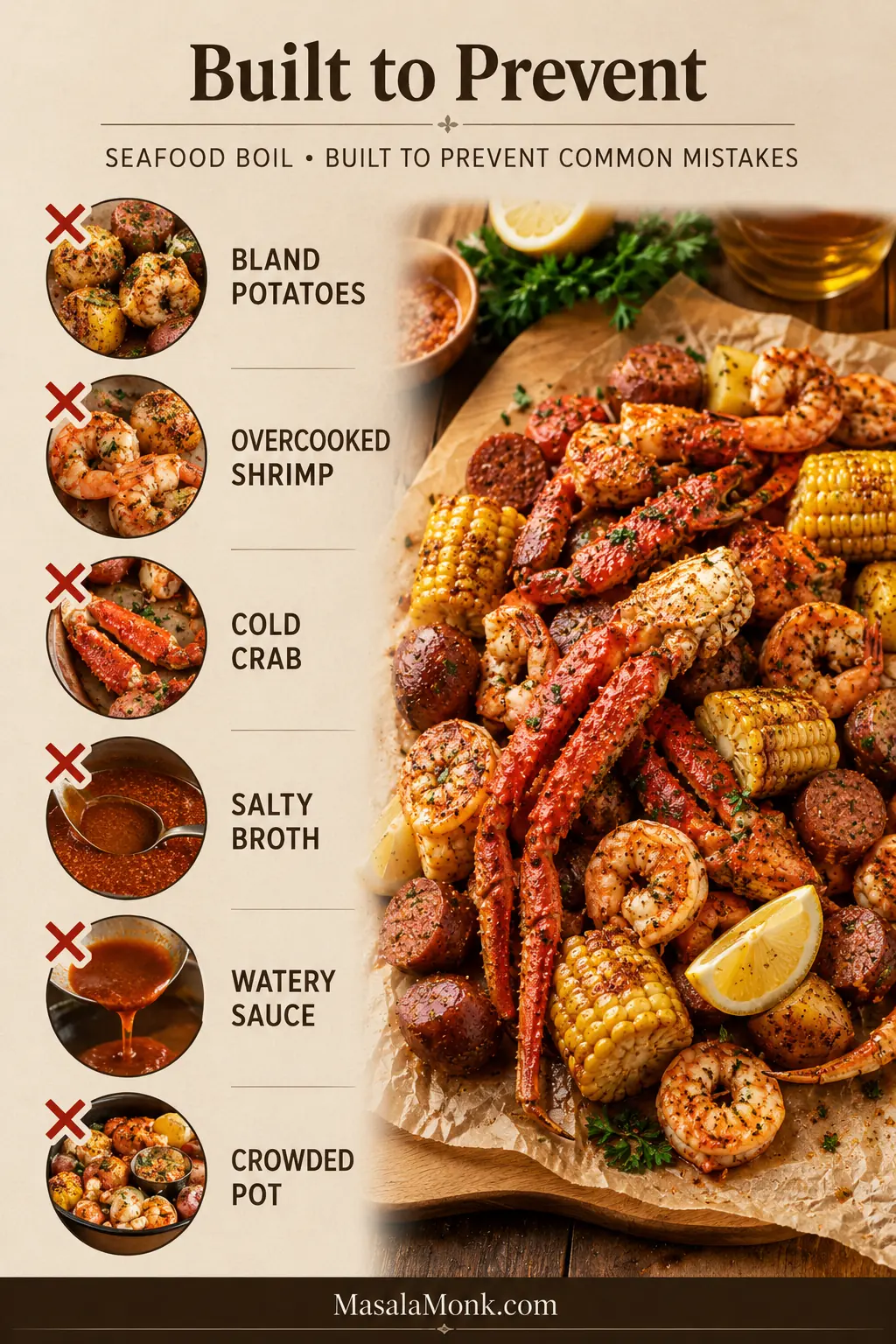
What this recipe is built to prevent: bland potatoes, overcooked shrimp, cold crab, salty broth, watery sauce, and a crowded pot. The timing is staged so the sturdy ingredients get flavor first and the delicate seafood stays tender.
Just as important as the method itself, this recipe is built to help you avoid the mistakes that make a boil feel flat or overdone.
Do not aim for a perfect-looking tray. Aim for hot crab, tender shrimp, juicy corn, potatoes that taste seasoned inside, and enough finishing butter that people start passing bowls around.
Why This Seafood Boil Works
The broth builds flavor first. Garlic, lemon, onion, bay leaves, and Cajun seasoning get time to season the water before the potatoes go in.
The pot moves in waves. Potatoes and sausage can handle time; shrimp cannot, so the delicate seafood waits.
The heat stays steady. A strong boil builds the broth and cooks the potatoes, but seafood does better with a lively simmer or controlled boil.
The sauce finishes the feast. Reserved broth ties the garlic butter back to the pot, so it tastes like the boil instead of a separate topping.
Make this when you need a messy weekend seafood dinner, a casual birthday tray, a game-day spread, or a restaurant-style boil at home without a giant pot. This is a hands-on dinner, not a quiet plated one: shells cracking, corn turning glossy, potatoes disappearing first, and sauce bowls being passed around the table.
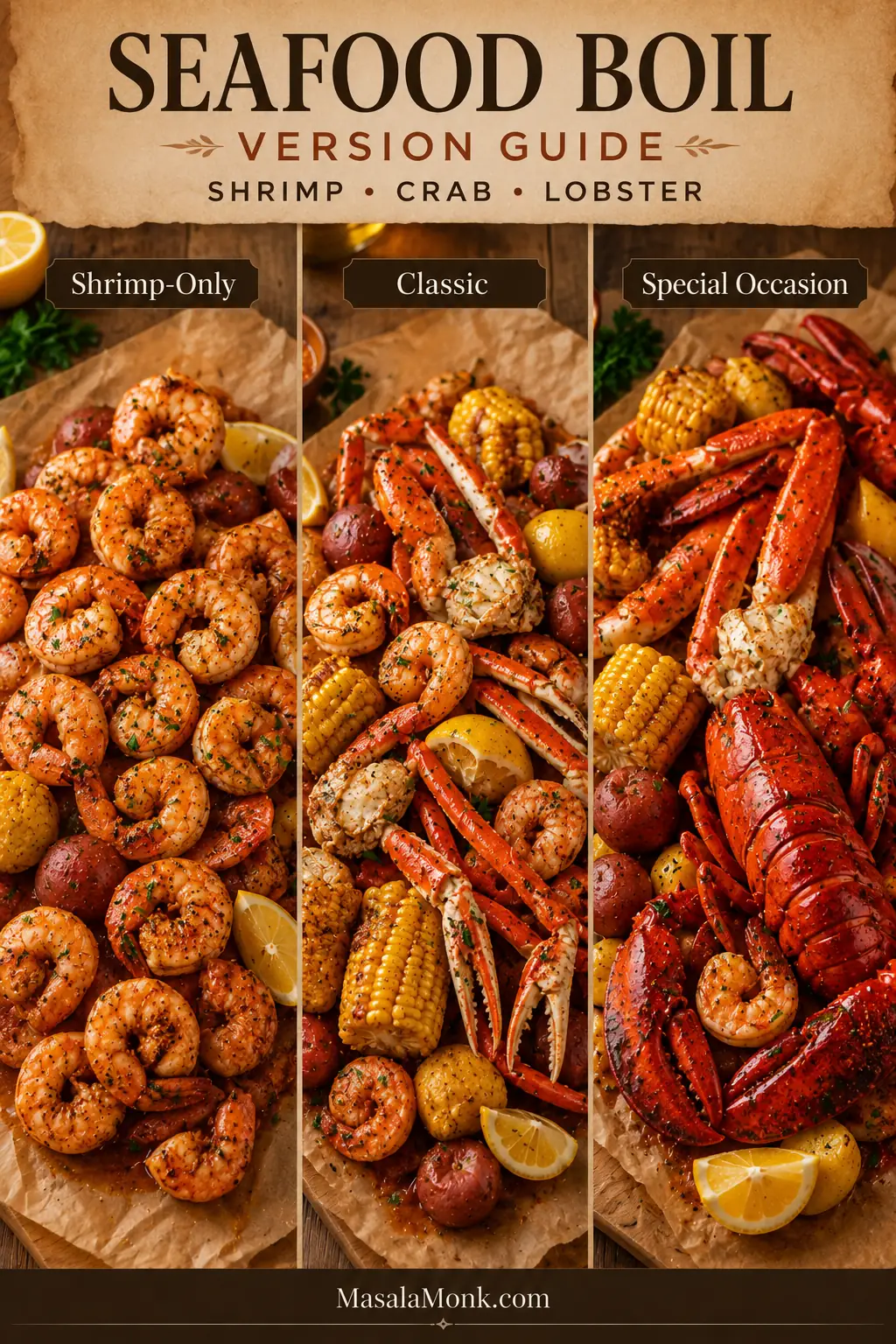
Choose Your Seafood Boil Version
Before you shop, decide what kind of tray you are making. The method stays the same, but this helps you choose the right seafood, sauce level, and pot plan.
Version
Best for
How to adjust
Classic shrimp and crab
The all-purpose family-style tray
Use the recipe as written
Shrimp-only
Fastest, easiest, most budget-friendly version
Skip crab and use 2.5 to 3 lb / 1.1 to 1.4 kg shrimp
Crab-heavy
A special-occasion platter
Use more crab legs and slightly less shrimp
Extra saucy
Restaurant-style garlic butter lovers
Use the larger butter sauce option
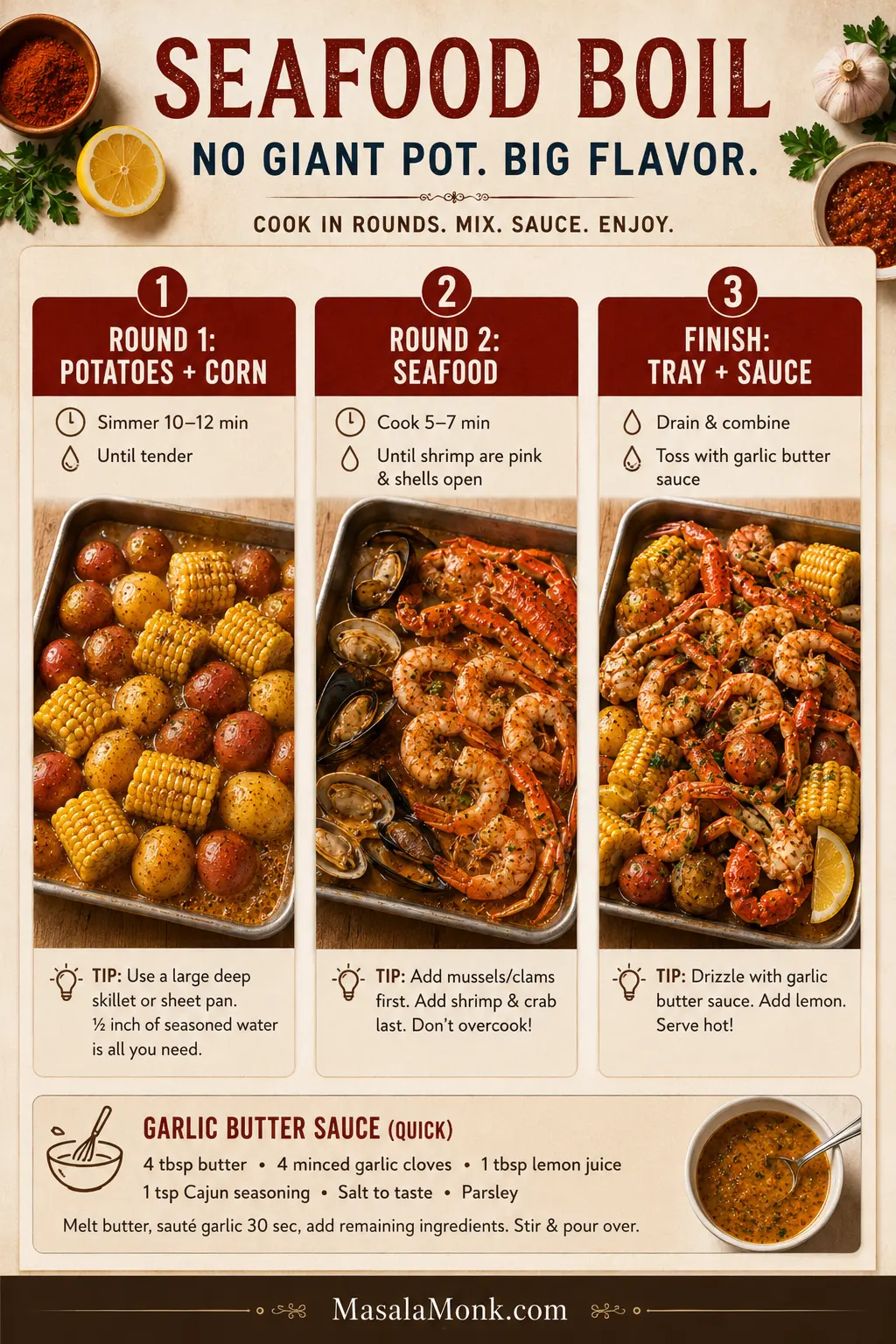
No giant pot
Apartment kitchens or smaller stockpots
Make a half batch or cook in rounds
Quick Decision Guide
If this is your situation
Do this
First seafood boil
Shrimp + precooked crab, normal sauce, no long soak
Small kitchen
Half batch or cook in rounds
Mixed spice crowd
Medium broth, hotter sauce on the side
Budget version
Shrimp-only with sausage, corn, and potatoes
Special occasion
Crab-heavy or add lobster tails
Nervous about shrimp
Add shrimp off heat and cover
Once you choose the version, the rest becomes easier: buy the right seafood, give the pot enough room, and let the sauce make the whole platter feel generous.
Once you choose the version you want, shopping gets easier too: shrimp-only is fastest, classic shrimp-and-crab is the all-purpose move, and lobster is the upgrade.
Before you shop: for the easiest version, buy raw jumbo shrimp, precooked snow crab legs, smoked sausage, baby potatoes, corn, lemons, garlic, unsalted butter, and one Cajun seasoning you like. Avoid precooked shrimp for the main boil when possible; when that is all you have, add it off heat at the very end just to warm through. Large crab clusters may need a little less total seafood or a two-pot plan.
More help below: ingredients, pot size, seafood per person, seasoning guide, cook order, setup checklist, sauce, no-giant-pot options, storage, troubleshooting, and FAQs.
How This Home Seafood Boil Works
This version is built for a normal home kitchen, not a huge outdoor crawfish pot. Shrimp and crab legs are the default because they are easy to find, quick to cook, and generous on the tray. Crawfish, lobster, mussels, clams, and eggs are optional add-ins, not requirements.
The promise is a bold, saucy seafood platter without special equipment. You season the broth, cook in stages, keep the seafood gentle, and finish everything with Cajun butter.
Ingredients You Need
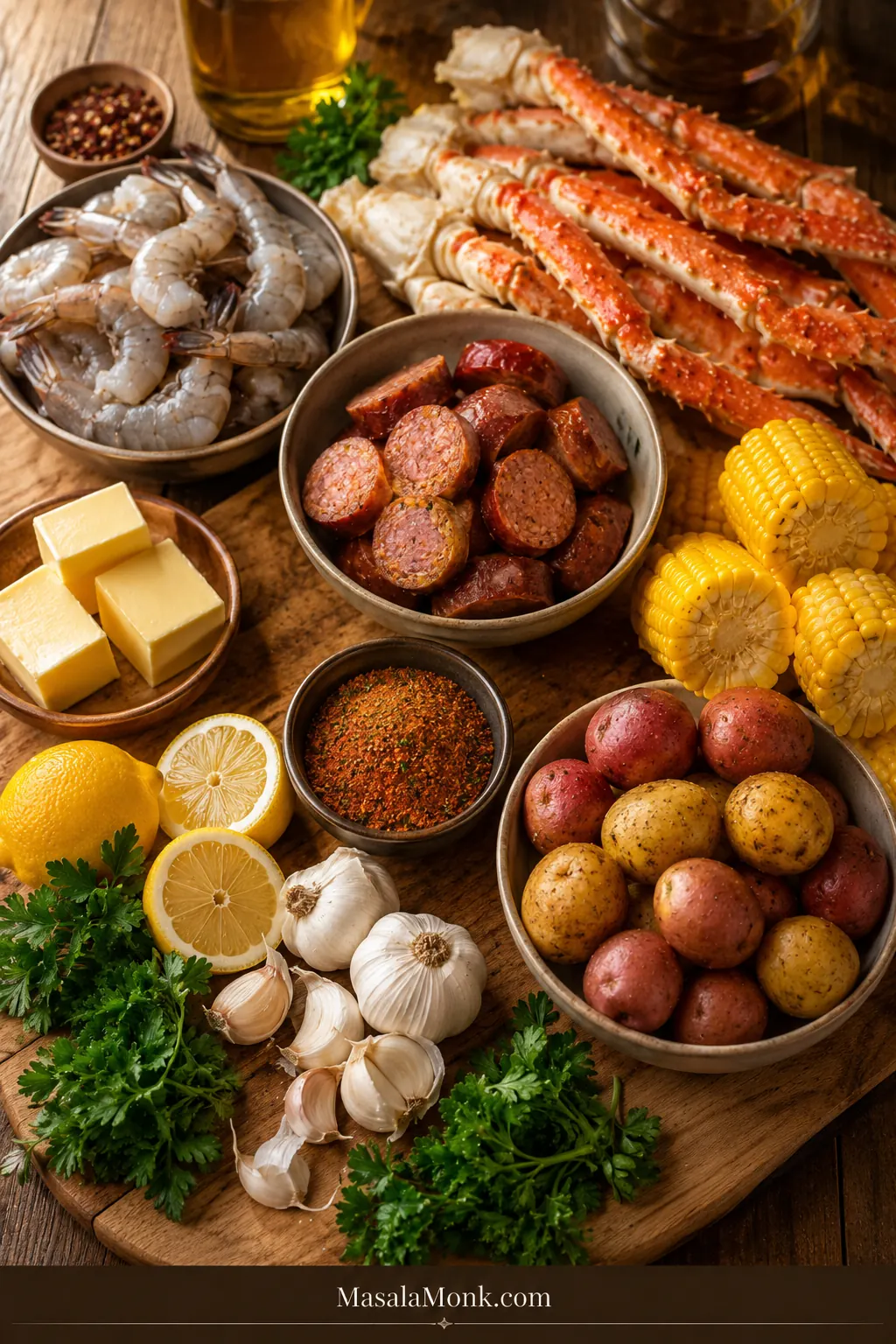
Ingredients break naturally into four groups: seafood, vegetables, sausage, and sauce. For the lowest-stress first boil, buy raw shell-on shrimp and precooked crab legs. That combination gives you the seafood boil feeling without making the timing complicated.
Before the pot starts, gather everything first so the boil can move in stages and the seafood never has to wait too long at the end.
Shrimp or Prawns
Jumbo shrimp or large prawns work best. Easy-peel or deveined shell-on shrimp are ideal because they hold their texture better, bring more flavor to the broth, and are easier to eat at the table. Peeled shrimp work too, but they cook faster, so add them right at the end.
The best cue is color and shape. Shrimp should be pink, opaque, and curled into a loose C-shape. A tight curl and bouncy texture usually mean they have gone too far. Since shrimp keeps cooking from carryover heat while you drain, sauce, and serve, it waits until the end.
If your shrimp are still frozen and you need a separate no-thaw method for another night, this frozen shrimp in air fryer guide is useful for timing, size cues, and checking whether the shrimp is raw or already cooked.
If this is your first boil, raw shrimp and precooked crab are the easiest pairing because they keep the timing simple and predictable.
Crab Legs or Crab Clusters
Snow crab legs are the easiest way to make the tray feel generous without making the cooking harder. They are sweet, easy to crack open at the table, and usually sold already cooked, which means you are mostly warming them through.
King crab legs work too, but they are larger, pricier, and need more room in the pot. Very large clusters are easier to manage in a 12-quart pot or in two rounds.
Still-icy crab legs need a head start. Add them before the corn or give them a few extra minutes before the shrimp goes in, so you do not end up choosing between cold crab and overcooked shrimp.
Raw crab needs proper cooking time. Precooked crab needs gentle reheating so the meat stays sweet instead of dry.
Crawfish, Lobster, Mussels, or Clams
Crawfish is classic in many Louisiana-style boils, but this recipe is written mainly around shrimp and crab. Add crawfish, lobster tails, mussels, or clams only when you know whether they are fresh, frozen, raw, or precooked.
For mussels and clams, discard any that stay open after a firm tap before cooking, and discard any that stay closed after cooking.
Smoked Sausage or Andouille
Andouille gives the most classic smoky Cajun-style flavor, but any good smoked sausage can work. Cut it into thick rounds so it stays juicy. As it simmers, the sausage releases smoky flavor into the broth, and the potatoes and corn pick that up.
Corn and Potatoes
Baby potatoes are ideal because they hold their shape and soak up the Cajun broth. If your potatoes are larger, cut them in half. They are ready when a knife slides in with light resistance, not when they are breaking apart.
Corn adds sweetness and gives you those buttery, spicy bites that make the tray feel complete. The potatoes are often the sleeper hit; give them enough time in the broth and they taste seasoned all the way through.
Onion, Garlic, Lemon, and Bay Leaves
These aromatics turn seasoned water into a proper boil broth. Garlic gives depth, lemon brightens the seafood, onion adds sweetness, and bay leaves bring a gentle savory background note.
When the steam smells like lemon, garlic, bay, and pepper, the pot is ready for the potatoes.
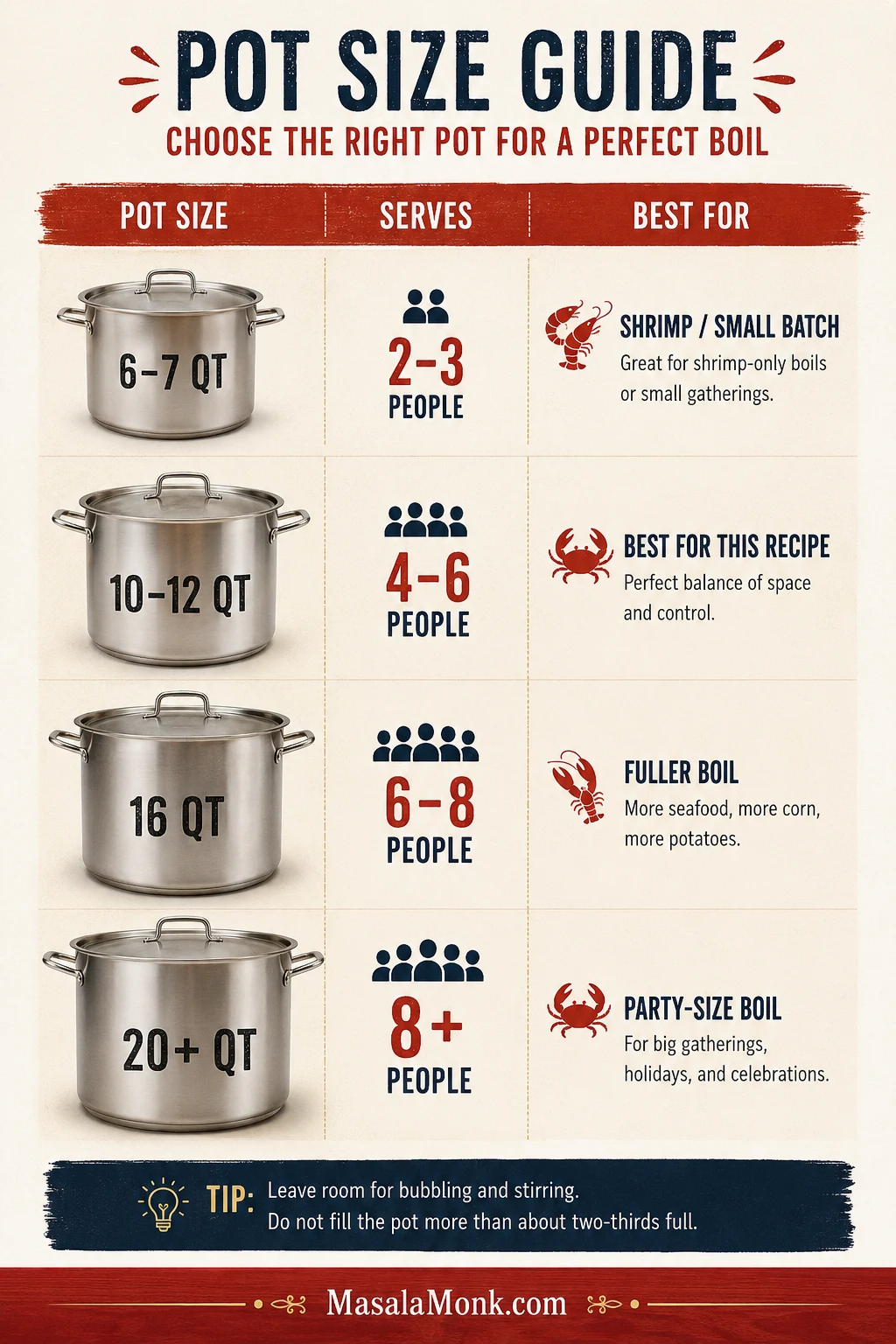
What Size Pot Do You Need for a Cajun Seafood Boil?
A 10 to 12 quart / 9.5 to 11.4 L stockpot is the best home-kitchen size for this recipe. You need enough space for liquid, potatoes, corn, sausage, crab legs, shrimp, and bubbling room.
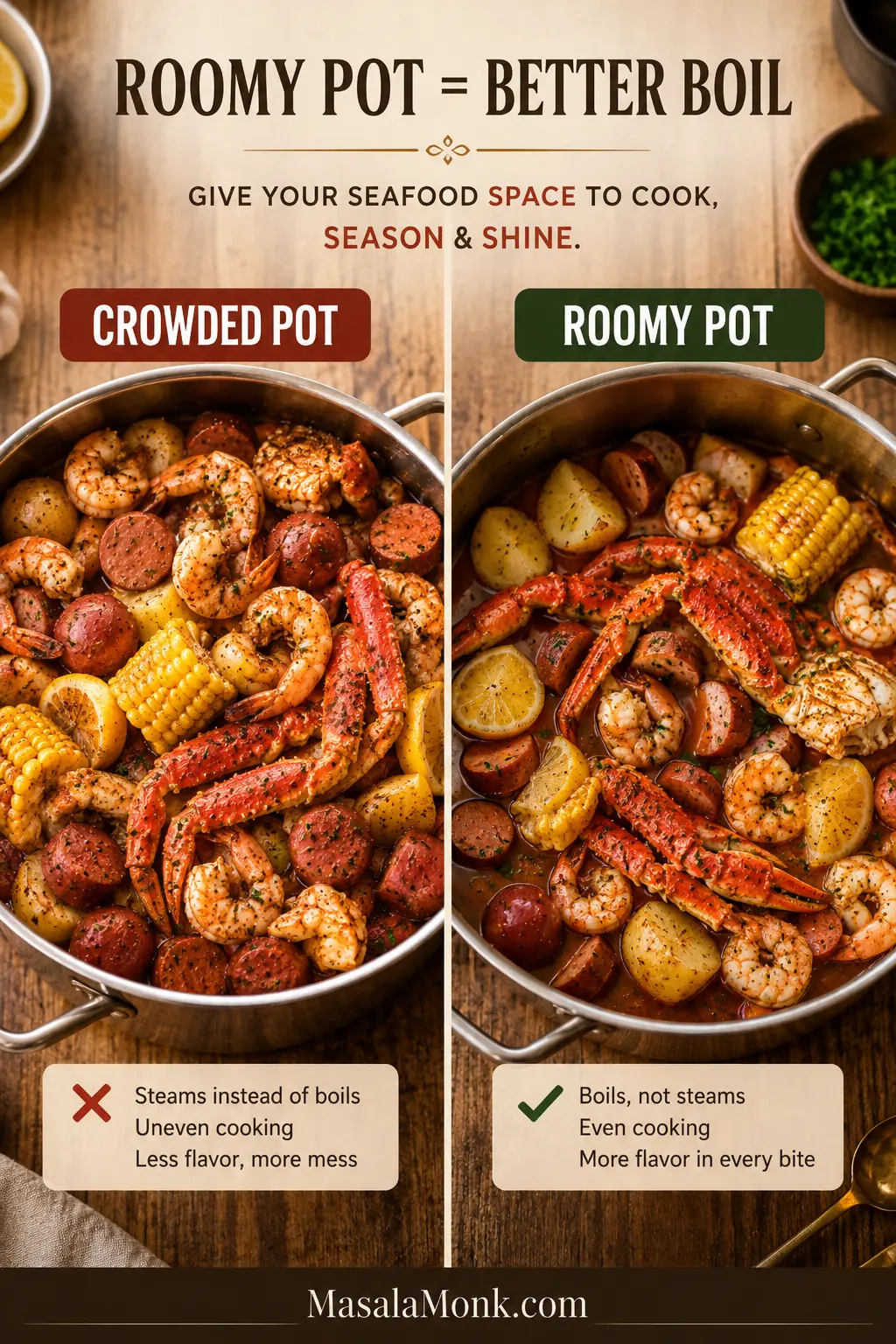
Keep the pot no more than about two-thirds full once everything is inside. A crowded pot makes the cook nervous; a roomy pot makes the tray better.
Batch size
Suggested pot size
Best for
2 to 3 people
6 to 7 qt / 5.7 to 6.6 L
Shrimp, sausage, corn, potatoes
4 to 6 people
10 to 12 qt / 9.5 to 11.4 L
Shrimp and crab legs
6 to 8 people
16 qt / about 15 L
A fuller boil with extra shellfish
8+ people
20 to 30 qt / 19 to 28 L
Party-size seafood boil or crawfish boil
A smaller pot does not mean a smaller dinner. Cook in smarter rounds and let the finishing sauce make everything feel like one big tray. You do not need outdoor equipment for this version. The tray is what makes it feel abundant, not the size of the pot.
In practice, a roomy pot is easier to manage, so match the pot to the batch instead of forcing everything into one tight space.
The difference is simple: a crowded pot fights the cook, while a roomy pot keeps the boil moving and the ingredients easier to handle.
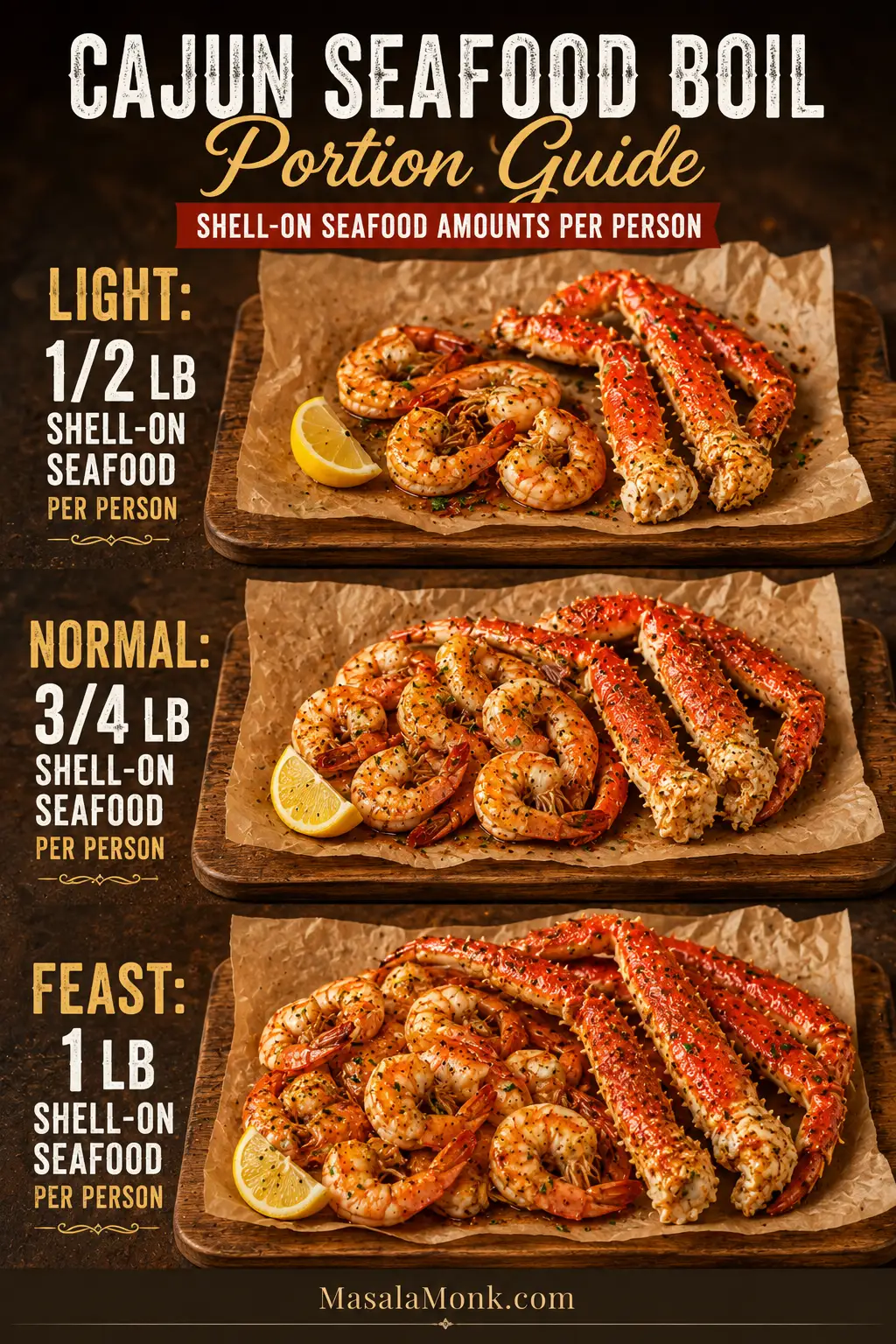
How Much Seafood Per Person?
Shell-on seafood looks generous on the tray, but the shells also count toward the weight. A pound of crab legs or shell-on shrimp does not mean a pound of edible meat.
Appetite
Seafood per person
Good for
Light meal
1/2 lb / 225 g shell-on seafood
Smaller servings with plenty of sides
Normal seafood boil
3/4 lb / 340 g shell-on seafood
Most home boils
Big feast
1 lb / 450 g shell-on seafood
Hungry guests or seafood-heavy meals
A good 6-person mix is about 2 lb / 900 g crab legs plus 1.5 to 2 lb / 680 to 900 g shrimp. Add crawfish, lobster, mussels, or clams by reducing the shrimp or crab slightly, not by overfilling the pot.
Since shell-on seafood includes shell weight, this quick guide helps you plan portions with enough room for a proper feast.
Cajun Seasoning vs Seafood Boil Seasoning vs Old Bay
Seasoning can turn too salty here. Cajun seasoning, seafood boil seasoning, Old Bay, crab boil packets, and liquid crab boil are not always interchangeable in equal amounts.
Seasoning
What it usually tastes like
How to use it here
Cajun seasoning
Paprika, garlic, onion, pepper, herbs, cayenne; salt level varies
Main seasoning base
Seafood boil seasoning
Often stronger and saltier; made for large pots of water
Use carefully and taste the broth
Old Bay
Celery salt-forward seafood seasoning with warm spices
Good as a supporting seasoning
Creole seasoning
Similar to Cajun seasoning, often herbier and sometimes milder
Can replace Cajun seasoning if needed
Liquid crab boil
Very concentrated, spicy, and aromatic
Use only a small amount if you know the product
Seasoning the water should smell exciting; it should not make you wince. Choose one main seasoning base, then build slowly. A salt-free Cajun blend may need more salt. A salted Cajun blend plus Old Bay or seafood boil seasoning may not need any extra salt.
Because seasoning blends do not all carry the same salt level, it helps to compare them before the seafood ever touches the pot.
Before adding the seafood: taste a spoonful of the broth. It should taste stronger than soup because it has to season potatoes, corn, shells, and seafood, but it should not taste harsh or unpleasantly salty.
Quick Homemade Cajun Seafood Boil Seasoning
For a quick salt-aware blend, keep the seasoning unsalted at first when using Old Bay, seafood boil seasoning, or salted stock.
If you prefer to mix your own, this blend keeps the Cajun flavor bold while still letting you control the salt and heat.
2 tablespoons paprika
1 tablespoon smoked paprika
1 tablespoon garlic powder
1 tablespoon onion powder
2 teaspoons black pepper
1 teaspoon dried oregano
1 teaspoon dried thyme
1/2 to 2 teaspoons cayenne pepper, to taste
Optional salt, only if you are not using salty seasoning elsewhere
This homemade blend works well as the Cajun seasoning base. Start with 1/4 cup in the boil broth, taste, then add more if needed. For the butter sauce, use 1 tablespoon of the blend, then adjust heat with hot sauce or cayenne.
Big Seafood Boil Mistakes to Avoid
Most seafood boil problems start before the tray ever reaches the table. Keep these habits in mind and the whole recipe becomes easier.
Add in stages, not all at once. Potatoes need time, but shrimp does not.
Build seasoning slowly. Cajun seasoning, Old Bay, crab boil, and seafood boil blends can all bring salt.
Give the pot room. Crowding drops the temperature, slows cooking, and makes stirring difficult.
Steady the boil. Use a strong boil for the broth and potatoes, then a gentler boil once seafood goes in.
Keep shrimp gentle. Add it last and stop when it is no longer translucent and has curled loosely.
Save some broth. A little seasoned broth makes the butter taste connected to the boil.
Reheat gently later. Reboiling cooked seafood usually makes it tough.
Think of the pot in waves. The sturdy things go first, the delicate things wait, and the spicy butter brings everyone together at the end.
Cajun Seafood Boil Cook Order Chart
This is the part that saves the seafood. The pot should feel organized, not rushed: potatoes first, shrimp last, and everything else in between.
The cook order is what protects the seafood: broth first, potatoes next, then sausage, corn, crab, and shrimp only at the end.
Use the chart, then trust the cues. The minutes help you plan, but the best seafood boil is still cooked by watching the pot.
Step
Add
Time
What to watch for
1
Water or water-beer mix, onion, garlic, lemon, bay leaves, seasoning
Boil 5 to 10 min
Broth smells bold, garlicky, lemony, and fragrant
2
Baby potatoes
8 to 12 min
Knife slides in with light resistance
3
Sausage
5 min
Smoky aroma begins seasoning the broth
4
Corn and precooked crab legs
4 to 7 min
Corn bright and juicy; crab steaming hot
5
Lobster tails, mussels, or clams, if using
4 to 6 min
Lobster opaque; mussels/clams opened
6
Shrimp or prawns
3 to 5 min
Pink, opaque, and curled into a loose C-shape
7
Drain, reserve broth, toss with sauce
5 min
Everything glossy, hot, and coated
Small or peeled shrimp are easier to overcook. Turn off the heat before adding them, cover the pot, and let them cook gently in the residual heat for more control.
Should You Soak Seafood Boil Before Draining?
A short soak can help seafood, potatoes, corn, and sausage absorb more flavor from the broth. The risk is shrimp sitting too long in very hot liquid.
For this home version, the safest default is to cook the shrimp until just done, reserve broth, drain, and finish with garlic butter sauce.
For deeper boil flavor, use a controlled short soak. Turn off the heat once the shrimp is nearly done and let the bubbling settle for a minute. If the broth is still very hot and active, add a handful of ice or a splash of cold water, cover the pot, and let everything sit for 5 to 10 minutes. Then reserve broth, drain, and sauce.
Best soak rule: short soak for shrimp-heavy boils, longer soak only if the pot is mostly crab, crawfish, potatoes, corn, and sausage. Avoid hot-soaking small peeled shrimp for a long time.
Set Up Before You Drain
Seafood boils move fast at the end. Set the table before you drain the pot so the tray can go out hot, glossy, and ready to eat.
Before the drain-and-toss moment, set out the tray, tools, napkins, and lemon wedges so the finish feels calm instead of rushed.
You need
Why it helps
Large tray, sheet pan, or paper-lined table
Gives the boil room to spread out
Spider strainer or tongs
Helps lift seafood without breaking it
Crab crackers or kitchen shears
Makes crab easier to eat
Shell bowl
Keeps the table usable
Napkins or wet towels
Seafood boils are messy
Extra lemon and warm butter
Lets people finish their own bites
How to Make Cajun Seafood Boil
1. Prep Everything Before You Start
Once the pot is hot, things move quickly. Cut the corn into halves or thirds, slice the sausage, halve the lemons, cut the garlic heads across the middle, rinse the seafood, and thaw frozen seafood if needed.
Check your seafood before it goes near the pot. Precooked crab legs need gentle heating. Raw lobster needs enough time to turn opaque. Peeled shrimp cook faster than shell-on shrimp. Mussels and clams should be cleaned and checked carefully.
Add the water or water-beer mix, onion, garlic, lemons, bay leaves, Cajun seasoning, and optional Old Bay to your stockpot. Bring it to a rolling boil, then let it boil for 5 to 10 minutes before adding the main ingredients.
Start with the broth, because garlic, lemon, onion, and Cajun seasoning do the real flavor-building before anything else goes in.
This short simmer wakes up the garlic, lemon, onion, bay leaves, and spices. The broth should smell garlicky, lemony, and spicy before the potatoes go in.
3. Add the Potatoes First
Add the baby potatoes and cook for 8 to 12 minutes. They should be starting to soften but not falling apart. Larger potatoes should be halved so they cook more evenly.
Potatoes need the earliest start, and that extra simmer time is what lets them taste seasoned all the way through.
Give this step its time. A knife should slide in with light resistance. When the potatoes get enough time in the broth, they become the bites people keep stealing from the tray.
4. Add the Sausage
Add the sliced sausage and cook for about 5 minutes. The broth should start smelling smoky and savory. Taste again here and adjust carefully if needed.
Next, the sausage adds smoke while the corn brings sweetness, and the broth keeps building flavor at every stage.
5. Add the Corn and Crab Legs
Add the corn and crab legs. Cook for 4 to 7 minutes, depending on size. Most frozen crab legs are already cooked, so you are heating them through rather than cooking them aggressively.
Once the crab goes in, the boil starts to feel like a feast, but the pot still needs space so everything stays tender.
Large crab clusters may need a little extra time. Smaller clusters should stay on the shorter side so they remain sweet and tender. If the pot looks angry instead of lively, lower the heat slightly before the delicate seafood goes in.
6. Add Optional Lobster, Mussels, or Clams
Lobster tails, mussels, and clams should go in after the crab has started heating. Lobster tails usually need about 4 to 6 minutes, depending on size. Mussels and clams are done when they open.
Discard any mussels or clams that do not open after cooking. Do not force them open and eat them.
7. Add the Shrimp Last
Shrimp should be the final ingredient. Add it to the hot broth and cook for 3 to 5 minutes, just until pink, opaque, and gently curled. Large shell-on shrimp can handle a few minutes of simmering. Smaller peeled shrimp should be cooked more gently.
Shrimp only needs a few minutes, so it should always go in last if you want it tender instead of tight and rubbery.
For extra control, turn off the heat, add the shrimp, cover the pot, and let the residual heat cook them. This is especially helpful for small shrimp or nervous first-time boils.
8. Reserve Broth, Drain, and Sauce
Scoop out 1 cup / 240 ml of the seasoned broth before draining. Use some of it in the garlic butter sauce. Drain the boil carefully, then transfer everything to a large tray, sheet pan, or paper-lined table.
Save the broth before draining, because that seasoned liquid is what makes the sauce taste like part of the boil.
Pour the Cajun butter over the tray and toss gently, or serve the dip on the side. Spoon extra over the crab joints, corn, potatoes, shrimp, sausage, and boiled eggs if using.
Cajun Garlic Butter Sauce
The broth gives the boil its backbone, but the butter sauce is what people remember. It catches in the crab shells, glosses the shrimp, and turns the potatoes and corn into the bites people keep reaching for.
The sauce is not just decoration here. It is the final seasoning layer, the dip, and the thing that makes the potatoes and corn disappear first.
This sauce starts simple—butter, garlic, Cajun seasoning, paprika, lemon, parsley, hot sauce, and reserved broth—and still finishes the whole dish.
A good sauce should run off a spoon in a smooth stream and leave a buttery coating behind.
If it looks thin and watery, simmer briefly or add more butter. If it feels heavy or salty, loosen it with unsalted broth or water and brighten it with lemon.
A proper Cajun butter sauce should coat the spoon first; if it runs off too quickly, it still needs a little more body.
For a coated tray, use the normal sauce. For sauce bowls and extra dipping, double it.
Normal Coating Sauce
This amount is enough to coat a 6-serving seafood tray without drowning it.
Ingredient
Amount
Unsalted butter
1 cup / 227 g
Garlic
6 to 8 cloves, minced
Cajun seasoning
1 tablespoon
Smoked paprika
1 teaspoon
Lemon juice
1 to 2 tablespoons
Reserved boil broth
1/4 to 1/2 cup / 60 to 120 ml
Hot sauce
Optional, to taste
Parsley
2 tablespoons, chopped
Extra Saucy Restaurant-Style Version
Use this version for a very buttery platter with plenty of dipping sauce.
Ingredient
Amount
Unsalted butter
2 cups / 454 g
Garlic
8 to 10 cloves, minced
Cajun seasoning
2 tablespoons
Old Bay or seafood seasoning
1 tablespoon, optional
Reserved boil broth
1/2 to 1 cup / 120 to 240 ml
Lemon juice
2 tablespoons
Hot sauce
Optional, to taste
Brown sugar
Optional pinch, for balance
Parsley
1/4 cup, chopped
How to Make the Sauce
Melt the butter in a saucepan over medium-low heat. Add the garlic and cook for 30 to 60 seconds, just until fragrant. Keep the garlic pale; deeply browned garlic can make the sauce bitter.
As the sauce simmers, keep the heat gentle so the butter stays rich and the garlic turns fragrant without burning.
Stir in Cajun seasoning, smoked paprika, lemon juice, and a little reserved broth. Add hot sauce for more heat. Simmer gently for 1 to 2 minutes, then stir in parsley. The sauce should coat the spoon before it coats the tray.
Taste the reserved broth before adding it to the sauce. If the broth is very salty, use water or unsalted stock instead. A flat sauce needs lemon; an intense sauce needs more butter or broth.
Coating Sauce vs Dipping Sauce
A coating sauce uses less broth so the butter clings to the seafood, corn, and potatoes. For a dipping sauce, add a little more broth so it stays loose and spoonable. You can also split it: toss half with the boil and serve the rest in small bowls at the table.
For the saucy restaurant-style finish, do not pour all the butter in one spot. Pour slowly, toss gently, and let it run into the crab joints, between the corn pieces, across the potatoes, and around the shrimp.
When the sauce goes over the tray, pour slowly so it reaches the crab joints, potatoes, corn, and shrimp instead of sitting in one spot.
If garlic butter shrimp is the part of the tray you love most, this shrimp scampi recipe gives you the same lemon-garlic-butter comfort in a quicker pasta-friendly format.
Make-Ahead and Leftover Sauce
You can make the butter sauce 2 to 3 days ahead. Store it in the refrigerator, then rewarm it gently over low heat. Add a splash of reserved broth, stock, or water if it thickens too much.
Leftover sauce is worth saving. Spoon it over shrimp, crab legs, lobster tails, corn, potatoes, garlic bread, roasted vegetables, rice, or pasta. Freeze extra sauce in small portions for an easy Cajun butter finish another day.
That extra bowl is also excellent with torn pieces of homemade garlic bread, especially when you need something simple to catch the spicy, lemony butter.
No Giant Pot? Here Are Your Options
The classic version can be huge, but a normal kitchen can still make a satisfying batch. The tray does not care whether everything cooked in one pot. The sauce makes it feel united.
Option 1: Split the Recipe Between Two Pots
If you have two medium stockpots, divide the broth, potatoes, corn, sausage, and seafood between them. Keep the timing the same, but watch each pot separately. This is the easiest way to make the full recipe without overcrowding one pot.
Option 2: Make a Half Batch
For 2 to 3 people, cut the recipe in half and use a 6 to 7 quart / 5.7 to 6.6 L Dutch oven or stockpot. A shrimp-and-crab version works especially well for a smaller batch.
For a quieter seafood dinner with no big pot at all, this baked haddock recipe follows the same gentle-cooking idea: season well, avoid overcooking, and let the fish stay tender.
Option 3: Boil First, Sauce Later
If your pot is too small for everything at once, cook the potatoes and corn first, remove them, then cook the seafood separately. Combine everything on a tray and pour the hot Cajun garlic butter sauce over the top. You still get the same messy, saucy feeling without needing a massive pot.
If you are cooking in a smaller kitchen, this is the easiest workaround: boil in rounds, then combine everything on the tray and finish with sauce.
What About a Seafood Boil Bag?
For a seafood boil bag, use this same seasoning and sauce logic, but treat it as a separate oven-bag method: cooked potatoes and corn, raw shrimp added late, and sauce sealed in or tossed after cooking. This stovetop version gives more classic broth flavor because everything cooks in seasoned liquid.
Seafood Swaps and Variations
Use the seafood that is fresh, available, and reasonably priced where you live. The pot does not need to look exactly like anyone else’s; it just needs to be timed well and sauced generously.
If you do not have
Use this instead
Crawfish
Shrimp, prawns, crab legs, or lobster tails
Snow crab
King crab, blue crab, local crab, or extra shrimp
Andouille
Smoked sausage, chicken sausage, or chorizo-style sausage
Old Bay
A little extra Cajun seasoning, celery salt, paprika, garlic powder, and black pepper
Mussels or clams
Skip them or add more shrimp and crab
Lemon
Lime in a pinch
Beer
More water, seafood stock, chicken stock, or vegetable stock
Boiled eggs
Skip them or add peeled hard-boiled eggs after draining
Shrimp-Only Cajun Seafood Boil
For an easier version, skip the crab and use 2.5 to 3 lb / 1.1 to 1.4 kg large shell-on shrimp. Keep the potatoes, corn, sausage, and garlic butter sauce. Add the shrimp at the very end so it does not overcook.
For another quick shrimp dinner where timing matters just as much, these shrimp tacos use the same idea: cook the shrimp hot and fast, then build the fresh parts around it.
Crab-Lovers Seafood Boil
Use 3 to 4 lb / 1.4 to 1.8 kg crab legs and reduce the shrimp slightly. Since crab legs are usually precooked, focus on heating them gently and coating them well with Cajun butter.
Crawfish-Style Boil
If crawfish is available, add it with or shortly before the shrimp, depending on whether it is fresh, frozen, raw, or precooked. Crawfish boils often use stronger seafood boil seasoning, so be extra careful with salt and spice levels.
If crawfish is already cooked, treat it more like crab and warm it gently. If it is raw or live, use crawfish-specific cleaning and cooking guidance rather than relying on the shrimp timing in this recipe. This recipe can borrow crawfish-boil flavors, but it is not a full live-crawfish boil tutorial.
Lobster Tail Upgrade
Add 2 to 3 lobster tails for a more special-occasion boil. Cut the shells slightly so the seasoning and butter can reach the meat. Lobster tails usually need only a few minutes and should be opaque, not tough.
If you end up with extra cooked lobster meat, save it for a buttery lobster roll instead of reheating it hard in the pot again.
Boiled Egg Add-In
Boiled eggs are optional, but they are great on a restaurant-style seafood tray. Add peeled hard-boiled eggs after draining and spoon Cajun butter over them. They do not need to boil with the seafood; they just need the sauce.
How Spicy Should Cajun Seafood Boil Be?
The boil should be bold, but it does not have to be painfully hot. Keep the broth flavorful and serve extra heat in the butter sauce or hot sauce on the side.
Mild: use less cayenne, skip hot sauce, and rely on paprika, garlic, lemon, and herbs.
Medium: use regular Cajun seasoning and a small amount of hot sauce in the butter.
Spicy: add cayenne, hot sauce, or crushed red pepper to the sauce.
Extra spicy: add more cayenne or a very small amount of liquid crab boil if you know its strength.
Family-style: keep the pot medium and serve spicy garlic butter separately.
For a mixed group, keep the pot medium and let people add heat at the table. It is easier to make one bowl of sauce hotter than to rescue potatoes, corn, and shrimp that are too spicy for some people to enjoy.
What to Serve With Cajun Seafood Boil
The tray already has protein, potatoes, corn, and sauce, so sides can stay simple. Think fresh, crisp, buttery, or bread-based sides that balance the spice and soak up the sauce.
A cold, crunchy side helps balance the butter and spice. This coleslaw recipe is the cleanest fit when you need something creamy, tangy, and crisp beside the seafood tray.
Garlic bread or crusty bread for soaking up sauce
Coleslaw or a crisp cabbage salad
Green salad with lemony dressing
Extra lemon wedges
Pickles or quick-pickled onions
Steamed rice, if you need to stretch the meal
Cold drinks, iced tea, lemonade, or beer
To make the meal feel heartier and more Louisiana-style, red beans and rice makes more sense than adding another heavy seafood dish beside it.
For serving, spread the drained boil on a large tray, sheet pan, or paper-lined table. Spoon the garlic butter sauce over everything while it is hot. Keep extra sauce in bowls for dipping crab, shrimp, corn, and potatoes.
Some people like the tray coated, while others prefer extra sauce for dipping; either way, the butter should stay warm and glossy.
A good seafood boil table needs a shell bowl, a few napkins, and lemon nearby, because the best trays are delicious and a little messy.
Bring the tray to the table while it is hot, saucy, and just cooked. The first crack of crab, the lemon squeezed over the shrimp, and the butter running into the corn are the whole point.
The best part is that everyone has to slow down a little: crack crab, peel shrimp, pass lemon, steal another potato, and reach for the sauce again.
Storage and Reheating
This meal is best served fresh, but leftovers can still be good if you reheat them gently. The main rule is simple: do not reboil cooked seafood. Reboiling usually makes shrimp tough and crab dry.
How to Store Leftovers
Let leftovers cool, then transfer them to airtight containers.
Refrigerate for up to 2 days.
Store extra garlic butter sauce separately if possible.
Remove seafood from shells before storing if you want easier reheating.
Do not leave cooked seafood sitting out for long.
Leftovers are where texture and safety both matter. For general leftover safety, the USDA’s leftovers and food safety guide is a useful reference. For this seafood boil, the shorter 2-day window is best for quality and texture.
Best Way to Reheat Seafood Boil
For the best texture, reheat leftovers in a covered skillet over low heat with a spoonful of butter, broth, or sauce. Warm just until heated through. A covered oven-safe dish at low heat also works for larger portions.
The microwave works in a pinch, but use short bursts and low or medium power if possible. Shrimp can go from warm to rubbery quickly.
If you shell extra shrimp before storing, turn it into shrimp fried rice the next day instead of reheating the whole tray again.
Can You Freeze Seafood Boil?
You can freeze cooked seafood, but the texture may change, especially for shrimp and potatoes. Extra sauce freezes better than the full boil, so save that separately when possible.
Troubleshooting Cajun Seafood Boil
If something feels off, do not panic. Most seafood boil problems come down to timing, salt, or heat, and all three are easier to fix when you catch them early.
Why Is My Shrimp Rubbery?
The shrimp was probably added too early, boiled too hard, or cooked too long. Add shrimp last and stop when it is pink, opaque, and gently curled. Smaller shrimp are safer with residual heat than a rolling boil.
If the shrimp looks too tight, it likely stayed in the pot too long; the better cue is a loose C-shape with a pink, opaque finish.
Why Are My Potatoes Bland?
The broth may not have been seasoned enough before the potatoes went in, or the potatoes did not spend enough time in the seasoned liquid. Potatoes need a head start so they can absorb flavor from the Cajun broth.
Why Is My Seafood Boil Too Salty?
Salt usually builds up when salted Cajun seasoning, Old Bay, seafood boil seasoning, and extra salt are all used together. Stop adding seasoning.
If the seafood is already cooked, lift it out before fixing the broth. Dilute with unsalted water or stock, taste again, and use unsalted butter and lemon in the sauce to soften the salt.
Why Is My Garlic Butter Sauce Watery?
Too much reserved broth was added. Simmer the sauce gently for a minute or add more butter to bring back richness. For a thicker coating, use less broth and spoon it over the seafood while hot.
A good coating sauce should look rich and spoonable, while a watery version usually means the broth went a little too far.
Why Did My Garlic Butter Sauce Break?
The heat was probably too high, or too much broth was added too quickly. Keep the butter over medium-low heat and stir in broth gradually. Even if the sauce separates slightly, it will still taste good spooned over the seafood.
Can I Use Frozen Seafood?
Yes. Thaw shrimp and lobster tails before cooking when possible so they cook evenly. Precooked frozen crab legs usually only need to be heated through. Frozen seafood added straight to the pot will drop the broth temperature and may change the timing.
Can I Make Seafood Boil Ahead?
You can prep the vegetables, cut the sausage, clean the seafood, and make the butter sauce ahead. For the best texture, cook the seafood close to serving time. The tray is much better freshly cooked than reheated for a crowd.
FAQs About Cajun Seafood Boil
What seafood is best for a Cajun seafood boil?
Shrimp and crab legs are the easiest home combination. Crawfish, lobster tails, mussels, and clams also work if you know whether they are raw, frozen, fresh, or precooked.
What seasoning do you use for Cajun seafood boil?
Use Cajun seasoning as the main flavor base. A little Old Bay or seafood boil seasoning can help, but check salt levels first. The broth should taste bold, not sharp or salty.
Is Cajun seasoning the same as seafood boil seasoning?
Not exactly. Cajun seasoning is usually a spice blend with paprika, garlic, onion, herbs, pepper, and cayenne. Seafood boil seasoning is often stronger and saltier because it seasons a large pot of water.
How much Cajun seasoning should I use?
For this 6-serving recipe, start with 1/4 cup. Use up to 1/2 cup only if your blend is low-salt or salt-free. Taste the broth before adding seafood.
Should I use salted or unsalted butter?
Use unsalted butter if possible. The broth and seasonings already bring salt, so unsalted butter gives you room to adjust the final sauce.
Do I need beer in a seafood boil?
No. Beer adds depth, but water works. Seafood stock, chicken stock, or vegetable stock can make the broth taste fuller.
What order do you add seafood boil ingredients?
Start with seasoned broth, then add potatoes, sausage, corn and crab, optional lobster or shellfish, and shrimp last. Think sturdy to delicate.
How long should shrimp cook in a seafood boil?
Large shrimp usually need 3 to 5 minutes. They are done when pink, opaque, and gently curled. Smaller shrimp can finish off heat in the covered pot.
Do crab legs need to be cooked or just reheated?
Most frozen crab legs sold at grocery stores are already cooked, so they only need reheating. Raw crab needs proper cooking time.
Should I thaw frozen shrimp before seafood boil?
Yes, thaw shrimp when possible. Thawed shrimp cook more evenly and are easier to time. Frozen shrimp drops the broth temperature and may cook unevenly.
Can I use precooked shrimp?
Yes, but raw shrimp is better for the main boil. Add precooked shrimp off heat at the very end and let the covered pot warm it gently.
What sausage works best?
Andouille is classic, but any smoky sausage that holds its shape can work.
How do you make Cajun garlic butter sauce?
Melt unsalted butter over medium-low heat, cook minced garlic briefly, then stir in Cajun seasoning, smoked paprika, lemon juice, a little reserved broth, hot sauce, and parsley.
How do I make seafood boil less spicy?
Use less cayenne, skip hot sauce, and choose a mild Cajun seasoning. Keep the broth medium and serve hotter butter on the side.
What can I use instead of crawfish?
Shrimp and crab legs are the easiest substitute. Lobster tails, mussels, or clams can make the tray feel fuller.
Can I add boiled eggs to seafood boil?
Yes. Add peeled hard-boiled eggs after draining and spoon Cajun garlic butter over them. They do not need to boil with the seafood.
Can I make seafood boil in a bag?
Yes, but treat it as a different method. Use cooked potatoes and corn, add raw shrimp late, and use Cajun butter as the finishing sauce. The stovetop version gives more broth flavor.
How do you keep seafood boil warm for serving?
Keep the drained seafood, potatoes, corn, and sausage on a warm tray loosely covered with foil. Hold extra butter warm separately and spoon it over right before serving.
How do you make seafood boil without a large pot?
Make a half batch, split the recipe between two pots, or cook in rounds and combine everything on a tray with hot Cajun butter.
How do you reheat seafood boil leftovers?
Reheat gently in a covered skillet with a little butter, broth, or sauce. Warm just until hot so the seafood does not cook a second time.
Final Tips for the Best Cajun Seafood Boil
The secret to a good Cajun seafood boil is calm control: bold broth, patient potatoes, gentle seafood, and butter sauce at the end. Keep extra lemon nearby, adapt the seafood based on what is available, and avoid overcrowding the pot just to make the tray look bigger.
Do not worry about making it look perfect. A seafood boil is supposed to look abundant, saucy, and a little chaotic. That is part of the fun.
When everything comes together, you get the kind of meal people lean into: crab shells cracking, shrimp dipped in spicy butter, corn dripping with sauce, potatoes soaked with Cajun broth, and a table that feels full before anyone even takes the first bite.
If you make it, tell me what went into your tray and what you changed: shrimp and crab, lobster tails, extra sausage, more spice, less spice, no giant pot, boiled eggs, or the full feast. Those details help the next reader plan their own boil.
This Salisbury steak recipe is for the night you want old-fashioned comfort without making anything complicated: tender oval beef patties, glossy mushroom onion gravy, and a plate that feels made for mashed potatoes. It cooks in about 40 minutes, all in one skillet, with enough gravy for potatoes, rice, or egg noodles.
It keeps the part people remember from TV dinners — the beef, the gravy, the mashed-potato comfort — and fixes the part nobody misses: dry meat, flat sauce, and that one-note salty taste. The first bite should feel like the Salisbury steak people remember, but the second bite should taste like the version they always wished it was.
Look for a patty that cuts cleanly with a fork but still looks moist inside. That is the texture you get when the beef is handled lightly and simmered gently.
The goal is simple: juicy patties, savory gravy, and a dinner that feels familiar in the best way — not dry, bland, salty, or fussy. The secret is not making ground beef fancy. It is getting three humble things right: tender patties, browned flavor, and gravy that tastes like it had more time than it did.
Start with the classic skillet version: browned beef patties, mushroom onion gravy, and a low, gentle finish in the pan. From there, you can take the same method wherever your kitchen needs it: no mushrooms, brown gravy mix, cream of mushroom soup, frozen hamburger patties, baked Salisbury steak, Crock Pot-style dinners, or make-ahead leftovers without ending up with dry meat or salty gravy.
To make Salisbury steak, mix ground beef with egg, breadcrumbs, grated onion, Worcestershire sauce, ketchup, mustard, salt, and pepper. Shape the mixture into oval patties, brown them in a skillet, make mushroom onion gravy in the same pan, then simmer the patties in the gravy until cooked through.
The best patties are about 3/4 inch / 2 cm thick. Brown them for 2–3 minutes per side, then simmer gently in gravy for about 8–10 minutes, or until the center reaches 160°F / 71°C.
Fast path: 1 lb / 454 g ground beef, or up to 500 g, makes 4 oval patties. Brown first, build the gravy in the same skillet, finish gently in the pan gravy, and serve with mashed potatoes, rice, or egg noodles.
This skillet view shows the core method: brown the patties, keep the flavor in the pan, and let the mushroom onion gravy finish the dinner.
One skillet gives you better gravy because the browned bits stay in the pan. After the patties sear, the mushrooms, onions, and broth pick up that flavor.
You have ground beef and want something cozier than plain burgers.
Dinner needs gravy, mashed potatoes, and an old-fashioned feel.
You want a skillet meal with pantry ingredients, not a complicated steakhouse recipe.
Your family likes hamburger steak, brown gravy, mushroom gravy, or onion gravy.
You need a recipe that includes shortcuts without losing the homemade feel.
If ground beef is doing dinner duty this week, this Korean beef bowl recipe is faster and saucier, while this American goulash recipe turns ground beef and macaroni into a one-pot comfort dinner.
Salisbury Steak Recipe Card
Salisbury Steak With Mushroom Onion Gravy
Tender old-fashioned ground beef patties browned in a skillet and simmered in rich mushroom onion gravy. Serve with mashed potatoes for the classic plate, or spoon the pan gravy over rice or egg noodles for an easy weeknight dinner.
Prep Time
15 minutes
Cook Time
25 minutes
Total Time
40 minutes
Servings
4
Yield
4 Salisbury steak patties
Course
Dinner
Cuisine
American comfort food
Method
Stovetop skillet
Finish Temp
160°F / 71°C
Equipment
Large skillet or cast-iron skillet
Mixing bowl
Box grater or sharp knife for the onion
Whisk
Wide spatula
Instant-read thermometer
For the Salisbury Steak Patties
1 lb / 454 g ground beef, or up to 500 g if that is your package size, preferably 80/20 or 85/15
1 large egg
1/2 cup panko, about 30 g, or 1/2 cup fine dry breadcrumbs, about 45–55 g
1/4 cup finely grated onion, from about 1/2 small onion, or very finely minced onion
1–2 garlic cloves, minced
1 tablespoon ketchup
1 teaspoon Worcestershire sauce
1 teaspoon Dijon mustard, or 1/2 teaspoon dry mustard
3/4 teaspoon salt
1/2 teaspoon black pepper
1 tablespoon oil, for browning
Optional: 1/2 teaspoon onion powder, garlic powder, or smoked paprika
For the Mushroom Onion Gravy
2 tablespoons butter
6–8 oz / 170–225 g mushrooms, sliced, such as cremini, baby bella, or white button mushrooms
1/2 to 1 medium onion, sliced or finely chopped
2 tablespoons all-purpose flour
2 cups / 480 ml beef broth, low-sodium if possible
1 teaspoon Worcestershire sauce
1 teaspoon Dijon mustard
1 tablespoon ketchup for classic flavor, or tomato paste for a deeper gravy
Black pepper, to taste
Salt, only if needed
Optional: 2–3 tablespoons cream for a richer gravy
Before you start: Slice the mushrooms and onion, measure the broth, and keep the flour nearby. Once the patties are browned, the gravy comes together quickly in the same skillet.
Shape and Brown the Patties
Mix the patties gently. In a large bowl, combine ground beef, egg, breadcrumbs, grated onion, garlic, ketchup, Worcestershire sauce, Dijon mustard, salt, pepper, and any optional seasoning. Mix just until combined. Do not knead or overwork the beef.
Shape the patties. Divide the mixture into 4 oval patties about 3/4 inch / 2 cm thick. Each patty should be about 4 oz / 115–125 g. If the mixture feels soft, chill the shaped patties for 10–15 minutes before browning.
Brown the patties. Heat oil in a large skillet over medium-high heat. Brown the patties for 2–3 minutes per side. They should get color but do not need to cook through yet. That is exactly what you want.
Make the Gravy and Finish
Cook the mushrooms and onions. Transfer the patties to a plate. In the same skillet, melt the butter. Add mushrooms and onion. Cook for 5–7 minutes, stirring often, until the mushrooms look smaller, darker, and no longer watery in the pan.
Make the gravy. Sprinkle flour over the mushrooms and onions. Stir for 1 minute. Slowly whisk in beef broth, scraping up the browned bits from the skillet. Add Worcestershire sauce, Dijon mustard, ketchup or tomato paste, and black pepper.
Finish in the gravy. Return the browned patties and any juices to the skillet. Spoon gravy over the top. Reduce heat to medium-low and simmer gently for 8–10 minutes, or until the patties reach 160°F / 71°C in the center.
Taste and serve. Add salt only if needed. Stir in cream at the end if using. Serve hot with mashed potatoes, rice, egg noodles, or vegetables.
Recipe Cues Before Serving
Recipe cue: The gravy should coat a spoon, the patties should feel tender when pressed, and the skillet should be at a quiet simmer rather than a hard boil.
Common mistake to avoid: Do not fully cook the patties during the browning step. They only need color on the outside. They finish cooking gently in the gravy, which keeps them more tender.
Salisbury Steak Success Check: The patties should be browned on the outside, 160°F / 71°C in the center, and tender when pressed. The gravy should coat a spoon, move slowly over mashed potatoes, and taste savory before it tastes salty. If it tastes flat, add Worcestershire sauce, Dijon, black pepper, or a little tomato paste before adding more salt.
Why this method works: Grated onion keeps the patties moist, a quick sear builds flavor without drying the beef, and finishing in gravy lets the meat cook gently while the sauce picks up the pan flavor.
Use this success check before serving so the patties, gravy, and finish temperature all line up.
Before the plate goes out, check the cues that matter: browned patties, a fully cooked center, and gravy that coats the spoon without becoming gluey.
Salisbury Steak Cooking Cues at a Glance
Best beef
80/20 or 85/15 ground beef
Patty size
4 oval patties, about 4 oz / 115–125 g each
Patty thickness
About 3/4 inch / 2 cm thick
Binder
Egg + breadcrumbs or panko
Main gravy
Mushroom onion gravy with beef broth
Browning time
2–3 minutes per side
Finish method
Low, gentle finish in the gravy
Safe temperature
160°F / 71°C in the center
Best sides
Mashed potatoes, rice, egg noodles, green beans, peas, carrots
Once the patties are shaped and the skillet is hot, the rest is mostly patience: let the meat brown, let the mushrooms cook down, and let the pan gravy finish the job.
Table of Contents
Cooking now? Use the recipe card above. Want the why, the fixes, and the shortcut versions? Use the guide below.
Most Salisbury steak starts with ground beef mixed with egg, breadcrumbs, onion, Worcestershire sauce, ketchup or mustard, and seasonings. The mixture is shaped into small oval steaks, browned in a skillet, and served with brown gravy, mushroom gravy, or onion gravy.
Despite the name, it is not cut from a whole steak. It is a ground beef dinner, closer to hamburger steak, but usually with more seasoning and binder mixed into the meat.
That is why it feels familiar before you even cook it: a browned beef patty, a pool of gravy, and something soft on the plate to catch every spoonful.
What This Recipe Is Built Around
The whole dinner works because the method stays simple: season the beef well, shape it gently, brown it properly, then let the pan gravy finish the job.
Think of it as the frozen-dinner idea rebuilt properly: better beef, better browning, and gravy that comes from the skillet instead of a tray. It keeps the familiar comfort of the old tray-dinner version, but gives you the part those dinners never really had: fresh pan flavor and gravy you can adjust at the stove.
Old-fashioned Salisbury steak works best when the nostalgia is backed by real skillet flavor. Browned patties and homemade gravy make it taste far better than the TV-dinner version people remember.
The flavor comes from small pantry ingredients that work together. Worcestershire sauce adds savoriness, ketchup gives a little sweet tang, mustard adds balance, mushrooms and onions build the gravy base, and beef broth gives it body.
Why This Salisbury Steak Recipe Works
Egg and breadcrumbs help the patties hold together while still keeping them tender.
Grated onion adds moisture without leaving large raw onion pieces in the beef.
Worcestershire, ketchup, and mustard give classic flavor with pantry ingredients.
Browning first builds flavor and helps the patties stay intact.
Same-pan gravy uses the browned bits left behind from the beef.
A quiet simmer finishes the patties without turning them tough.
Ingredients and Why They Matter
This recipe is forgiving, but the ingredients still have jobs to do. The patties need structure and moisture, while the gravy needs enough browning and seasoning to taste like more than thickened broth.
The patty ingredients and gravy ingredients do different jobs. Keep the beef mixture gentle, then let the skillet build the sauce after browning.
Ingredient
What it does
Ground beef
80/20 or 85/15 gives the best balance of flavor and tenderness.
Egg
Helps bind the patties so they do not fall apart in the skillet.
Breadcrumbs or panko
Add structure and keep the patties from becoming dense.
Grated onion
Adds moisture and old-fashioned flavor throughout the beef.
Worcestershire sauce
Adds deep savory flavor.
Ketchup
Gives a small sweet-tangy note that tastes familiar in the patties.
Dijon or dry mustard
Balances the richness of the beef and gravy.
Mushrooms
Give the gravy body, earthiness, and classic mushroom-gravy flavor.
Onion
Sweetens as it cooks and makes the pan gravy feel fuller.
Flour
Thickens the gravy into a spoonable sauce.
Beef broth
Forms the main gravy liquid.
Once those pieces are in place, the recipe is less about perfect measurements and more about good cues: do not overmix, do not rush the browning, and do not let the gravy boil hard.
Best Ground Beef for This Recipe
Use 80/20 or 85/15 ground beef if you can. The patties need some fat to stay juicy, especially because they are browned first and then finished in gravy.
Very lean beef can work, but it is less forgiving. With 90/10 beef, mix gently, avoid overcooking, and consider adding a splash of milk or a little extra grated onion to keep the centers moist.
Breadcrumbs, Panko, or Crackers?
Panko gives a slightly lighter patty. Regular breadcrumbs make the texture softer and more old-fashioned. Crushed crackers also work well, especially if you like the classic pantry-dinner style.
Start with 1/2 cup. If the mixture feels too wet after mixing, add 1–2 tablespoons more and let it sit for a few minutes before shaping.
Useful Equipment
You do not need special equipment, but a few tools make this skillet dinner easier and more reliable.
Large skillet: A 12-inch skillet gives the patties room to brown instead of steam.
Wide spatula: Helps turn soft patties without breaking them.
Whisk: Keeps the gravy smooth when broth goes into the flour.
Box grater: Useful for grating onion into the patty mixture.
Instant-read thermometer: The easiest way to check that ground beef patties reached 160°F / 71°C.
How to Make Salisbury Steak
1. Mix the beef gently
Add the ground beef, egg, breadcrumbs, grated onion, garlic, ketchup, Worcestershire sauce, mustard, salt, and pepper to a bowl. Mix just until the ingredients are evenly combined.
Do not knead the beef like dough. Overmixing makes the patties firm and springy instead of tender.
A just-combined mixture is better than a compact one. If it holds its shape without being packed hard, it is ready for patties.
Optional flavor check: Cook a teaspoon-sized piece of the beef mixture in the skillet before shaping all the patties. Taste it, then adjust salt, pepper, Worcestershire sauce, or mustard if needed.
2. Shape oval patties
Divide the mixture into 4 portions and shape them into oval patties about 3/4 inch / 2 cm thick. They should look more like small chopped steaks than thick burger patties.
Smooth the edges and keep the thickness even so each oval patty browns at the same pace and sits flat in the gravy.
They do not need to look perfect. A slightly rustic oval patty feels right here; it just needs to be even enough to cook gently in the gravy.
If the mixture feels soft, that does not mean you ruined it. Chill the shaped patties for 10–15 minutes so they firm up before they hit the pan, or add 1–2 tablespoons breadcrumbs if the mixture is still loose.
Best Patty Size
For 1 lb / 454 g ground beef, or up to 500 g, make 4 oval patties. Each patty should be about 4 oz / 115–125 g and about 3/4 inch / 2 cm thick. This size browns well, cooks evenly, and still feels like old-fashioned Salisbury steak instead of a regular burger.
Use thickness as a cooking control. Too thin dries out quickly, while too thick needs extra simmering and can tighten before the center is done.
The finished patties should be fork-tender like a soft meatball, not chewy like a dry burger.
3. Brown before simmering
Heat oil in a large skillet over medium-high heat. Brown the patties for 2–3 minutes per side. They should develop color, but they do not need to be cooked through yet.
At this stage, browning matters more than cooking through. The crust builds flavor first, then the patties finish safely and gently in the gravy.
If the patties stick, give them another 30 seconds before flipping. Meat usually releases more cleanly once a crust has formed.
Move them to a plate while you make the gravy. The browned bits left in the pan are part of the flavor base.
4. Make the gravy in the same skillet
Melt butter in the skillet, then cook the mushrooms and onions until they soften and begin to brown. This is where the dish starts to smell like dinner instead of just browned beef, so let the mushrooms and onions do their work before you rush in with the broth.
Stir in flour, then slowly whisk in beef broth with Worcestershire sauce, Dijon mustard, ketchup or tomato paste, and black pepper. As the broth goes in, scrape the bottom of the skillet to pull up the browned bits from the patties. Those bits are what make the gravy taste deeper instead of flat.
5. Finish gently in the gravy
Return the patties to the skillet and spoon gravy over them. Simmer gently for 8–10 minutes, or until the centers reach 160°F / 71°C.
Bring the gravy down to a slow bubble before adding the patties back. Then the sauce warms the meat gently instead of tightening it.
The skillet should bubble quietly. If the gravy is boiling hard, lower the heat so the meat stays tender.
Keep the bubbles small once the patties return to the skillet. Gentle simmering keeps the beef tender, while hard boiling can make it tight.
Check the temperature and serve
A thermometer helps here because color alone can be misleading. The patties may look done before the center reaches the safe finish temperature, especially if they are thick.
Color alone is not the safest guide for ground beef. Use an instant-read thermometer and cook the center of each patty to 160°F / 71°C.
The gravy is half the comfort here. It should taste savory first, then rich — thick enough to coat a spoon but loose enough to flow over mashed potatoes.
Brown the mushrooms and onions
Cook the mushrooms and onions until the mushrooms release moisture and the onions begin to soften. The mushrooms are ready when they look smaller, darker, and no longer watery in the pan.
Wait for mushroom moisture to cook off before adding broth. That gives the gravy a deeper base instead of a watery one.
Do not add broth the moment the vegetables hit the skillet. A few extra minutes here gives the pan gravy deeper flavor.
If you only have canned mushrooms, drain them well and add them after the onions soften. They will not brown like fresh mushrooms, but they still add mushroom flavor to the gravy.
Cook the flour briefly
Once the mushrooms and onions are ready, sprinkle flour over them and stir for about 1 minute. After the flour goes in, the vegetables should look lightly coated, not dry and clumpy.
Stir until no dry flour patches remain around the vegetables. A smooth coating now means smoother gravy once the broth goes in.
Whisk in broth slowly
Add the beef broth slowly while whisking. The gravy will look a little loose at first. That is normal. Once the broth is whisked in, it should look smooth; it will tighten as it simmers and becomes spoonable once the patties go back into the skillet.
The 2 tablespoons flour to 2 cups broth ratio makes a medium-thick gravy. Worcestershire sauce, Dijon, and ketchup or tomato paste round out the flavor.
Slow pouring matters more than speed here. Each splash of broth should loosen the flour mixture before the next one goes in.
Need more mushroom-sauce detail? This creamy mushroom sauce recipe goes deeper into browning, texture, and no-cream adjustments.
Adjust the texture at the end
If the gravy is too thick, add broth or water a splash at a time. If it is too thin, simmer uncovered for a few minutes or use a small cornstarch slurry. The finished sauce should move slowly, not sit stiffly.
Look for gravy that clings briefly, then flows. If it sits on the spoon like paste, add a splash of broth before serving.
Choose Your Salisbury Steak Version
This is the real-life pantry section: brown gravy mix, cream of mushroom soup, frozen hamburger patties, no mushrooms, baked Salisbury steak, and Crock Pot versions can all work if you keep the patties tender and the salt under control. Pick the route that matches your kitchen tonight, then use the main method as the base.
Shortcut Decision Table
What you have or want
Best route
You want the classic homemade version
Use the main mushroom onion gravy recipe.
You have no mushrooms
Make onion gravy instead. Cook the onions longer so the sauce still tastes deep and sweet.
You have a brown gravy packet
Use the liquid amount on the packet, but replace water with low-sodium beef broth. Taste before adding salt.
You have cream of mushroom soup
Start with 1 can condensed soup plus 1/2 cup beef broth. Add another 1/4 cup broth if it looks too thick.
You want more onion flavor
Use extra onions or a French onion-style gravy, but watch the salt if using soup mix.
You want a hands-off dinner
Brown the patties first, then use the Crock Pot section below for a softer, saucier finish.
You want to bake it
Brown the patties, cover with hot gravy, and bake until 160°F / 71°C.
You have frozen hamburger patties
Thaw first if you can. Frozen works, but fresh or thawed patties brown better.
You want a kid-friendly version
Shape the beef mixture into meatballs and simmer them in gravy.
You want a lighter dinner
Use leaner beef or turkey and serve with vegetables or cauliflower mash.
Shortcut Salt Rule
You do not have to make every version from scratch to get a good dinner. The trick is to keep the patties tender, keep the gravy balanced, and avoid stacking too much salt when using packets, canned soup, or bouillon.
Shortcut rule: If you use gravy mix, bouillon, canned soup, or onion soup mix, choose low-sodium broth and do not add extra salt until the gravy is finished.
Salisbury Steak vs Hamburger Steak
These two comfort-food dinners overlap, but they are not always exactly the same.
Dish
What it usually means
Salisbury steak
Seasoned ground beef patties mixed with egg, breadcrumbs, onion, Worcestershire sauce, ketchup or mustard, then served with gravy.
Hamburger steak
A simpler seasoned ground beef patty, often served with onion gravy or brown gravy.
Burger steak
Often used for Filipino or Jollibee-style ground beef patties with mushroom gravy, usually served with rice.
The easiest way to think about it: hamburger steak is usually closer to a seasoned burger patty, while Salisbury steak eats more like a meatball-style patty with gravy.
For a regular weeknight dinner, the important part is simple: if you want ground beef patties with mushroom gravy, onion gravy, or brown gravy, this recipe gives you the right result.
Salisbury Steak Variations and Shortcuts
The base recipe is the safest place to start. The shortcut versions are there for the nights when the pantry, the freezer, or the clock makes the choice for you.
Think of these as kitchen routes, not separate recipes. The browning-and-gravy logic stays the same; you are simply changing the sauce, cooking method, or shortcut ingredient.
Choose one route and stay with it. Mixing every shortcut at once is usually how the gravy becomes too salty or too thick.
No-Mushroom Salisbury Steak
Skip the mushrooms and make onion gravy instead. Use 1 large sliced onion, cook it in butter until soft and lightly golden, then add flour and beef broth. Worcestershire sauce, Dijon, and a small spoon of ketchup or tomato paste help the gravy taste full.
This is the easiest route for anyone who dislikes mushrooms but still wants the old-fashioned gravy dinner.
If mushrooms are not an option, onions can still carry the gravy. Cook them until soft and golden so the sauce tastes sweet, savory, and complete.
Onion Gravy Version
Want the gravy to taste more oniony and old-fashioned? Use 1 large onion or 2 medium onions, slice them thin, and cook them until soft, sweet, and lightly browned. The deeper the onions cook, the richer the pan sauce tastes.
If onion gravy is your favorite part of the plate, this smothered pork chops recipe uses the same brown-first, finish-gently logic with a rich onion gravy.
Brown Gravy Mix Shortcut
Brown gravy mix is useful when speed matters. For most packets, use the liquid amount listed on the package, but replace water with low-sodium beef broth. That keeps the shortcut easy while making the gravy taste more like dinner than a packet.
If you are also using bouillon, canned soup, or onion soup mix, start with half the packet or taste carefully before adding the full amount. These shortcuts can stack salt quickly.
For Salisbury steak with brown gravy mix, keep the packet ratio but use low-sodium beef broth instead of water. Then season only after tasting.
Cream of Mushroom Soup Version
A can of cream of mushroom soup can work when you want the old-school pantry version. Start with 1 can condensed cream of mushroom soup plus 1/2 cup beef broth. Add another 1/4 cup broth if the sauce looks too thick after simmering.
Add Worcestershire sauce and black pepper so it tastes more like a proper gravy. If you use cream soup with brown gravy mix or onion soup mix, reduce the added salt and use low-sodium broth.
Start thick and loosen slowly. One can plus 1/2 cup broth gives you control, and extra broth can be added only if the sauce needs it.
French onion Salisbury steak leans into the onion-gravy side of the dish. Use extra sliced onions and beef broth, or replace part of the broth with French onion soup. Onion soup mix can work too, but start with less because it is salty.
For deeper onion-gravy flavor ideas, this French onion soup recipe shows how cooked-down onions, broth, and savory boosters build that sweet, rich onion base.
Baked Salisbury Steak
To bake Salisbury steak, brown the patties first, then place them in a 9×13 / 13×9 baking dish. Pour hot gravy over the patties, cover with foil, and bake at 375°F / 190°C for 20–25 minutes, or until the patties reach 160°F / 71°C.
Let the dish rest for 5–10 minutes before serving so the gravy settles and the patties stay juicy.
Covering the dish traps moisture while hot gravy finishes the patties. Resting afterward lets the sauce settle before serving.
Crock Pot Salisbury Steak
The slow cooker version deserves its own method because the patties, gravy, and timing behave differently. Brown the patties first for the best flavor, place them in the slow cooker with onions, mushrooms if using, and gravy, then cook on low until tender and 160°F / 71°C in the center.
This skillet version is faster. Use this Crock Pot Salisbury steak recipe when you want the hands-off route with a softer, saucier finish, frozen patty tips, cream soup shortcuts, and slow-cooker gravy guidance.
Slow cooking makes the patties extra soft and saucy; browning first keeps the flavor from tasting steamed.
Frozen Hamburger Patties
Fresh homemade patties have the best texture, but frozen hamburger patties can work for a shortcut dinner.
Frozen patties work best when they are thawed first, patted dry, seasoned, browned, and then simmered in gravy. If cooking from frozen, use a quiet simmer and check the center with a thermometer. The patties must reach 160°F / 71°C. Expect a softer, less homemade texture than fresh patties.
For a separate burger-focused method with time, temperature, and frozen-patty cues, see this air fryer burgers recipe.
Thawing and drying the patties helps them sear instead of steam, which makes the shortcut taste much closer to homemade.
Meatball Version
For a kid-friendly twist, shape the same beef mixture into meatballs instead of oval patties. Brown the meatballs, then simmer them in mushroom gravy until cooked through. This gives you the same flavor in smaller pieces that are easy to serve over rice or noodles.
Gluten-Free Version
Use gluten-free breadcrumbs or crushed gluten-free crackers in the patties. For the gravy, skip the flour and thicken with a cornstarch slurry instead. Check the labels on Worcestershire sauce, broth, gravy packets, canned soup, and onion soup mix.
Lighter Version
Use leaner beef or ground turkey, reduce the butter slightly, and serve the patties with vegetables, cauliflower mash, or salad. Leaner meat dries out faster, so cook gently and stop once the patties reach 160°F / 71°C.
If the mixture feels imperfect, do not panic. Salisbury steak is forgiving before it hits the pan. A little more breadcrumb, a short chill, or a splash of moisture can usually bring the patties back into shape.
The fastest fix before cooking: If the mixture feels too soft, add 1–2 tablespoons breadcrumbs and chill the shaped patties for 10–15 minutes. If the mixture feels dry and crumbly, add a spoon of grated onion or a tiny splash of milk.
If the patties feel too soft, break while flipping, or fall apart in the gravy, use this troubleshooting guide before changing the whole recipe.
When Salisbury steak patties fall apart, fix the structure before blaming the pan. Add breadcrumbs, chill the mixture briefly, and flip with a wide spatula.
Why Salisbury Steak Patties Fall Apart
Problem
Likely cause
Fix
Breaks when flipping
Flipped too early or pan was not hot enough
Let the first side brown and use a wide spatula.
Mixture feels wet
Too much onion or not enough binder
Add a little more breadcrumbs and rest the mixture briefly.
Falls apart in gravy
Gravy is boiling too hard
Lower the heat to a gentle simmer.
Too soft to handle
Mixture needs time to firm up
Chill shaped patties for 10–15 minutes.
Cracks around edges
Patties are too loosely shaped or too thin
Shape gently but firmly and keep them about 3/4 inch thick.
Why Salisbury Steak Gets Tough
Overmixed beef: Mix only until combined.
Very lean beef: Use 80/20 or 85/15 for a juicier result.
Patties too thick: Thick patties take longer to cook through.
Hard simmer: Keep the gravy bubbling gently.
Overcooking: Stop once the patties reach 160°F / 71°C.
Why Salisbury Steak Turns Dry
Dry patties usually come from very lean beef, patties that are too thin, or cooking them too far past 160°F / 71°C. Use beef with a little fat, keep the patties evenly shaped, and let the gravy finish the cooking instead of leaving the meat on high heat.
Gravy Fixes: Too Thin, Too Thick, Salty, or Bland
The gravy should be thick enough to spoon over the patties but not so thick that it turns gluey. Most problems are easy to fix before serving.
Taste the gravy before you add salt. Most Salisbury steak problems are easier to fix before the patties go back into the pan.
Gravy is easiest to fix by texture. Simmer if it is thin, loosen with broth if it is thick, and aim for a spoonable sauce that still moves.
Quick Fixes for Gravy Problems
Gravy problem
How to fix it
Too thin
Simmer uncovered for a few minutes, or stir in 1 tablespoon cornstarch mixed with 1 tablespoon cold water.
Too thick
Add beef broth or water, a splash at a time.
Too salty
Add unsalted broth or water. Avoid stacking gravy mix, bouillon, and onion soup mix without tasting.
Too bland
Add Worcestershire sauce, black pepper, Dijon, tomato paste, or a little beef bouillon.
Lumpy
Whisk while adding broth slowly. If needed, strain and return the gravy to the skillet.
Not brown enough
Brown the mushrooms and onions longer and scrape up the browned bits from the pan.
Pasty
Cook the flour briefly before broth goes in, then loosen with more broth if needed.
Salt and Leftover Gravy Notes
Salt is the one thing to watch most closely. Beef broth, Worcestershire sauce, gravy packets, canned soup, bouillon, and onion soup mix can stack salt quickly, so dilute with unsalted broth or water before adding more seasoning.
Leftover gravy also thickens as it chills. Loosen it with a splash of broth or water when reheating.
This is the kind of gravy dinner where the side dish matters. Because the gravy is rich, the best plates usually have one soft side to catch the sauce and one simple vegetable to balance it.
For the most dependable plate, give the gravy somewhere soft to land and add something green for contrast. That keeps the dinner cozy without making it feel one-note.
Use gravy as the connector, not just a topping. It should reach the patty, the soft side, and the vegetable so every bite feels balanced.
Spoon the gravy over the patties at the table if you can. It is a small thing, but it makes the whole plate feel more generous without feeling expensive.
Dinner style
Best sides
Classic comfort plate
Mashed potatoes, peas, green beans, corn
Easy weeknight dinner
White rice, egg noodles, roasted carrots, simple salad
Mashed potatoes, green beans, glazed carrots, biscuits
The most classic plate is Salisbury steak, creamy mashed potatoes, and green beans. For a richer side, use garlic mashed potatoes. Rice and egg noodles are also excellent because they soak up the mushroom gravy without competing with it.
For a holiday-style green bean side, this green bean casserole recipe fits the gravy-and-comfort theme well.
Storage, Freezing, and Reheating
Leftovers are one of the quiet wins of this recipe because the gravy keeps the meat from drying out.
How to store leftovers
Store leftover Salisbury steak with the gravy in an airtight container in the refrigerator for 3–4 days. Keeping the patties in gravy helps them stay moist.
How to freeze Salisbury steak
For convenience, cool the patties and gravy completely, then freeze them together in a freezer-safe container for up to 2–3 months. For the best texture, freeze the patties and gravy separately, then reheat them together gently after thawing.
How to reheat without drying it out
Reheat gently on the stovetop over low heat with a splash of broth or water to loosen the gravy. You can also microwave in short intervals, spooning sauce over the patties between bursts.
Avoid high heat when reheating because it can make the patties firm or rubbery.
The key is moisture: store with sauce, then reheat gently with a splash of broth so the gravy loosens before the meat overcooks.
Make-Ahead Tips
You can shape the patties up to 24 hours ahead and refrigerate them covered. This can help them hold together when browning. Let the patties sit at room temperature for about 10 minutes before cooking so they are not ice-cold in the center.
The full dish also reheats well because the patties sit in gravy. If the sauce thickens in the refrigerator, add a splash of broth or water when reheating.
Ground Beef Safety Note
Because this recipe uses ground beef, cook the patties to 160°F / 71°C in the center. An instant-read thermometer keeps you from guessing or overcooking them.
Most Salisbury steak starts with ground beef mixed with egg, breadcrumbs, onion, Worcestershire sauce, ketchup or mustard, and seasonings. The mixture is shaped into oval patties, browned, and finished in gravy.
Is Salisbury steak the same as hamburger steak?
They are similar, but not always identical. Salisbury steak usually has binders and seasonings mixed into the meat, while hamburger steak is often a simpler seasoned beef patty with gravy.
Which ground beef works best?
80/20 or 85/15 ground beef gives the best flavor and tenderness. Very lean beef works, but it needs gentler cooking because it dries out faster.
Why is my Salisbury steak falling apart?
The mixture may be too wet, the patties may need more binder, or they may have been flipped before a crust formed. Use egg and breadcrumbs, shape evenly, brown before simmering, and chill soft patties for 10–15 minutes before cooking.
How do you keep the patties tender?
Use beef with some fat, mix gently, avoid overcooking, and simmer the patties gently in gravy. Do not boil the sauce hard after the patties go back into the skillet.
Does Salisbury steak need egg?
Egg helps bind the patties so they are easier to brown and simmer without falling apart. If you skip it, keep the mixture slightly firmer, chill the shaped patties, and flip them gently.
Panko, breadcrumbs, or crackers — which works best?
All three can work. Panko gives a slightly lighter texture, regular breadcrumbs make a softer old-fashioned patty, and crushed crackers give a classic pantry-style result.
Can I make Salisbury steak without mushrooms?
Yes. Skip the mushrooms and lean on onions instead. Cook them until soft and golden before building the gravy so the sauce still tastes full.
How do I use brown gravy mix for Salisbury steak?
Use the liquid amount on the packet, but replace water with low-sodium beef broth. Taste before adding salt, especially if you are also using bouillon, canned soup, or onion soup mix.
What is the best way to use cream of mushroom soup?
Start with 1 can condensed cream of mushroom soup and 1/2 cup beef broth. Add another 1/4 cup broth if the sauce looks too thick after simmering.
How thick should the patties be?
About 3/4 inch / 2 cm thick is a good target. Patties that are too thick take longer to cook and can dry out before the center reaches 160°F / 71°C.
How do I know the patties are fully cooked?
The patties should reach 160°F / 71°C in the center because they are made from ground beef. Use an instant-read thermometer for the most reliable result.
How do I bake Salisbury steak instead of simmering it?
Brown the patties first, place them in a baking dish, cover with hot gravy, and bake at 375°F / 190°C for 20–25 minutes, or until fully cooked in the center.
Do frozen hamburger patties work for Salisbury steak?
Yes. They are a useful shortcut, though fresh or thawed patties brown better and taste more homemade. If cooking from frozen, simmer gently and check that the center reaches 160°F / 71°C.
How far ahead can I make Salisbury steak?
You can shape the patties up to 24 hours ahead, or refrigerate the cooked patties and gravy for 3–4 days. The finished dish also freezes well for 2–3 months.
What sides go best with Salisbury steak?
Mashed potatoes are the classic choice. Rice, egg noodles, green beans, peas, corn, roasted carrots, broccoli, and simple salads also work well.
Final Notes
The best version does not need to be complicated. A little fat in the beef, a gentle hand with the mixing, a proper sear, and a gravy that has time to taste rich are what turn plain hamburger patties into the kind of old-fashioned dinner people actually remember.
Do not chase perfection here. A slightly uneven patty, a little extra onion, or a gravy that needs one more splash of broth is normal. This is the kind of dinner that forgives small mistakes.
Serve it with mashed potatoes for the classic plate, rice for an easy weeknight dinner, or egg noodles when you want the gravy to do most of the work. If you made the no-mushroom, frozen-patty, brown-gravy-mix, cream-of-mushroom, baked, or Crock Pot version, leave a comment with what you used and how the gravy turned out. Those real kitchen notes help the next cook choose their route.
This crock pot Salisbury steak is the slow cooker dinner you make when mashed potatoes are already on your mind. Tender ground beef patties cook in rich brown gravy with soft onions, mushrooms if you like them, and enough sauce to spoon over everything on the plate.
A good crock pot Salisbury steak is really a gravy dinner with beef patties in the middle, so the sauce has to be treated like the main event. It should taste beefy, oniony, and rich — not thin, salty, or steamed.
You also get clear shortcut options for thawed hamburger patties, cream of mushroom soup, brown gravy mix, onion soup mix, French onion soup, and meatballs, because some nights dinner starts with the pantry or freezer. The goal is not to pretend packets and cans do not exist. Instead, use them in a way that still tastes balanced, cozy, and cared for.
If you want the classic side ready too, this mashed potatoes recipe is built for creamy, fluffy potatoes that can hold a lot of gravy.
Quick Answer: Can You Make Salisbury Steak in a Crock Pot?
Yes. Salisbury steak works well in a crock pot when the patties are shaped firmly, browned first if possible, and cooked in a flavorful sauce. For homemade browned patties, cook on low for 4 to 5 hours, or on high for 2½ to 3½ hours, until the centers reach 160°F / 71°C.
The sauce will usually look thinner while it cooks because slow cookers trap moisture. Give it its final 15 to 20 minutes after the cornstarch slurry; that is when it turns from slow cooker liquid into spoonable gravy.
This is not a fussy dinner. It is the kind of meal that feels best when the gravy is generous, the potatoes are soft, and nobody is asking what else is for dinner.
Remember this: mix the beef gently, brown first if you can, cook on low when possible, and save the real thickening for the end.
Make This When
Make this when you want the slow cooker to help, but you still want the plate to feel like real comfort food.
You want an easy slow cooker dinner that still feels old-fashioned and cozy.
A sauce-heavy meal for mashed potatoes, noodles, or rice sounds right.
Pantry shortcuts need to taste balanced, not flat or too salty.
Frozen hamburger patties need to become a proper dinner.
Broken patties, watery gravy, tough beef, or bland sauce need clear fixes.
This is the kind of dinner that smells like it has been waiting for mashed potatoes all afternoon. Keep the sides simple and do not ration the gravy.
Crock Pot Salisbury Steak Recipe
Tender ground beef patties slow cooked in rich brown mushroom onion gravy until the sauce is glossy, spoonable, and ready for mashed potatoes, egg noodles, rice, or cauliflower mash.
Prep Time 15 minutes
Browning Time 6 to 8 minutes
Cook Time 4 to 5 hours on low
Thickening Time 15 to 20 minutes
Total Time About 5 to 6 hours
Servings 6 patties
Best Crock Pot 6-quart oval
Patty Size About 4 oz / 113 g each
Safe Beef Temp 160°F / 71°C
Ingredients
For the Salisbury Steak Patties
1½ lb / 680 g lean ground beef
½ cup / about 45 to 55 g plain breadcrumbs, or ⅓ cup / about 20 to 25 g panko
1 large egg
3 tbsp / 45 ml milk
1 tbsp / 15 ml Worcestershire sauce
½ tsp salt, or less if using onion soup mix
½ tsp black pepper
½ tsp garlic powder
½ tsp onion powder
1 tbsp oil, for browning
For the Brown Gravy
½ medium onion, thinly sliced, about 60 to 75 g
4 to 8 oz / 113 to 227 g mushrooms, sliced, optional
2 cups / 480 ml low-sodium beef broth
1 packet brown gravy mix, about 0.87 to 1 oz / 25 to 28 g
1 tbsp / 15 ml Worcestershire sauce
1 tbsp / 15 ml ketchup
1 tsp / 5 ml Dijon mustard
1 small garlic clove, minced, or ½ tsp garlic powder
1 to 2 tbsp / 8 to 16 g cornstarch
1 to 2 tbsp / 15 to 30 ml cold water
Optional Shortcut Add-Ins
½ packet onion soup mix, for stronger onion flavor
1 can cream of mushroom soup, usually 10.5 oz / 298 g, for a creamier gravy
1 can golden mushroom soup, usually 10.5 oz / 298 g, for deeper mushroom flavor
1 can French onion soup, usually 10.5 oz / 298 g, to replace part of the beef broth
1 can cream of chicken soup, usually 10.5 oz / 298 g, for a milder creamy shortcut
1 packet au jus mix, to use instead of brown gravy mix
Instructions
Mix the patties gently. In a large bowl, combine ground beef, breadcrumbs, egg, milk, Worcestershire sauce, salt, pepper, garlic powder, and onion powder. Mix only until combined. Avoid squeezing or overworking the meat.
Shape the patties. Divide into 6 oval patties, about 4 oz / 113 g each. Keep them even in thickness so they cook at the same pace.
Brown the patties. Heat oil in a skillet over medium-high heat. Brown patties for 2 to 3 minutes per side. They do not need to cook through.
Layer the crock pot. Add onions and mushrooms to the bottom of a 6-quart oval slow cooker. Place browned patties on top, overlapping only if needed.
Whisk the gravy. In a bowl, whisk beef broth, brown gravy mix, Worcestershire sauce, ketchup, Dijon, and garlic until smooth.
Slow cook. Pour gravy over the patties. Cover and cook on low for 4 to 5 hours, or on high for 2½ to 3½ hours, until the patties reach 160°F / 71°C.
Thicken the gravy. Mix 1 tablespoon cornstarch with 1 tablespoon cold water. Stir into the hot gravy, cover, and cook for 15 to 20 minutes. Repeat with another tablespoon of cornstarch and water if you want it thicker.
Serve. Let the patties rest in the gravy for a few minutes, then serve over mashed potatoes, egg noodles, rice, or cauliflower mash.
Recipe Notes
Low heat gives the best texture. High heat works, but the patties can become firmer.
If your slow cooker runs hot, start checking near the early end of the time range.
Keep the patties about ½ to ¾ inch thick so they hold together and cook evenly.
Do not overfill the slow cooker. The patties need enough space for heat and gravy to move around them.
Use low-sodium beef broth if adding gravy mix, onion soup mix, au jus, or canned soup.
For extra gravy, increase broth to 2½ cups / 600 ml and use extra slurry before serving.
You can shape or brown the patties up to 1 day ahead and refrigerate them covered until ready to assemble.
This finished-dish view gives readers a quick visual reference after the recipe card: tender patties, generous brown gravy, and a plate that works with potatoes, noodles, or rice.
Tender patties, rich brown gravy, and a soft side underneath make this slow cooker Salisbury steak feel like a complete comfort-food dinner.
Before You Start: Crock Pot Salisbury Steak Basics
Best beef amount
1½ lb / 680 g for 6 patties
Best patty size
About 4 oz / 113 g each
Best thickness
About ½ to ¾ inch thick
Best slow cooker
6-quart oval slow cooker
Best setting
Low for 4 to 5 hours
Fast setting
High for 2½ to 3½ hours
Safe beef temperature
160°F / 71°C in the center
Best gravy finish
Use a cornstarch slurry near the end
Best serving base
Mashed potatoes, egg noodles, or rice
Slow cookers vary, so use the time range as a guide. Thick patties, tightly stacked patties, thawed frozen patties, and smaller cookers may need more time.
The win is simple: beef that stays together, sauce that tastes deeper than a packet, and enough gravy for the potatoes to disappear under it.
Choose Your Salisbury Steak Version
Below, the main recipe branches into homemade patties, easy brown gravy, and the shortcut ingredients already in your pantry or freezer.
This version guide helps you choose the best route for your pantry: classic brown gravy, creamy mushroom, onion gravy, freezer shortcut, meatballs, or no mushrooms. After that, use temperature as the final doneness check.
Goal
Use This Route
Watch This
Classic crock pot Salisbury steak
Homemade browned patties, beef broth, brown gravy mix
Thaw raw frozen patties safely first, then brown and slow cook
Expect extra liquid if patties were frozen
Fully cooked frozen patties
Heat thoroughly in gravy according to package guidance
Pull them before they turn firm
Creamier gravy
Add cream of mushroom or golden mushroom soup
Reduce salt
Milder creamy shortcut
Add cream of chicken soup
Less beefy; add Worcestershire or au jus
Onion gravy flavor
Add onion soup mix or French onion soup
Use low-sodium broth
No mushrooms
Skip mushrooms and add extra onions
Add flavor with Worcestershire and Dijon
Meatball version
Use frozen or homemade meatballs
Cook until hot and thicken the sauce
Best Route for the First Time
For your first batch, start with the classic browned-patty version. If you came here because of freezer patties or canned soup, use the shortcut sections below and keep the salt low.
Once you know your route, the job is simple: keep the beef sturdy, keep the sauce spoonable, and keep the salt from taking over.
Slow cookers are great at tenderness, but they are not great at reducing sauce. That is why this recipe gives the beef a quick browned edge first, then waits until the end to thicken the gravy.
The beef stays tender because it is mixed gently with breadcrumbs, egg, and milk instead of being packed tight. Browning adds flavor and helps each oval hold its shape once it settles into the sauce.
The sauce starts simple — beef broth and brown gravy mix — then gets enough Worcestershire, Dijon, ketchup, onion, mushroom, and garlic to taste more like dinner than a packet.
Save the real thickening for the end. By then, the beef is cooked, the onions have softened, and you can turn the cooking liquid into glossy spoon-over-potatoes gravy without guessing.
Think of it this way: give the beef structure, give the sauce body, and keep the salt under control.
That same slow-cooker liquid-control problem shows up in slow cooker cottage pie too; the lid keeps everything tender, but it does not let sauce reduce like an open pan.
The comfort-food rule: Salisbury steak should taste browned, beefy, and gravy-rich — not steamed, watery, or packet-salty.
Ingredients You’ll Need
Nothing here is fancy. The balance is what matters: enough binder to keep the beef together, enough seasoning to make the sauce savory, and enough restraint that the shortcut ingredients do not take over.
These ingredients build flavor in stages: beef and breadcrumbs help the patties hold together, broth and gravy mix create body, and Worcestershire, Dijon, onions, and mushrooms add the deeper Salisbury steak flavor.
Ground Beef
Use lean ground beef, preferably 85/15 or 90/10. It has enough fat for flavor without making the sauce greasy. If your beef is fattier, brown the patties first and skim excess fat before tightening the sauce.
Breadcrumbs, Egg, and Milk
Breadcrumbs help the patties hold together, egg binds the mixture, and milk keeps the crumbs from making the beef dense. The mixture should feel moist and shapeable, not wet or crumbly.
Worcestershire, Dijon, and Ketchup
These small ingredients make the brown sauce taste more complete. Worcestershire adds savory depth, Dijon gives balance, and ketchup adds a little sweetness and body. In the final dish, they should blend into the gravy instead of standing out separately.
Onions and Mushrooms
Onions soften into the gravy and make it taste fuller. Mushrooms add that classic Salisbury steak flavor, but this dinner does not fall apart without them; extra onions can carry the sauce just fine.
Love a mushroom-heavy gravy? This creamy mushroom sauce goes deeper into building that rich mushroom flavor.
Beef Broth and Brown Gravy Mix
Beef broth gives the sauce a stronger base than water, especially after a few hours in the slow cooker. Brown gravy mix keeps the recipe easy and familiar, while the extra seasonings make it taste less like a packet and more like dinner.
How to Make Crock Pot Salisbury Steak
The slow cooker does the long work, but the first few minutes decide the final texture. Shape the patties gently, brown them quickly, and let the sauce carry the rest.
1. Mix the Patty Ingredients
In a large bowl, combine the ground beef, breadcrumbs, egg, milk, Worcestershire sauce, salt, pepper, garlic powder, and onion powder. Stir only until the ingredients come together. Overmixing makes the patties heavy and tough.
Mix just until the beef mixture comes together. A gentle hand keeps the Salisbury steak patties tender instead of dense.
2. Shape Even Oval Patties
Divide the mixture into 6 oval patties. Aim for about 4 oz / 113 g each. The oval shape is classic, but even thickness matters more than perfect shape.
Shape even oval patties so they fit neatly in the crock pot and cook at the same pace.
Aim for about ½ to ¾ inch thick. Very thin patties can break more easily, while very thick ones may need extra time in the center.
Thickness helps decide whether the patties stay tender or fall apart. Aim for 1/2 to 3/4 inch: thin enough to cook through, but sturdy enough to survive slow cooking in gravy.
If the mixture feels very soft, chill it for 10 to 15 minutes before browning. Cold patties are easier to lift and less likely to crack.
3. Brown the Patties
In a skillet, heat oil over medium-high heat. Brown the patties for 2 to 3 minutes per side. They should get color on the outside but do not need to cook through. Use a wide spatula and turn them gently.
Browning adds deeper flavor and helps the patties hold their shape once they simmer in the gravy.
For a slightly thicker, more old-fashioned gravy, lightly dust the patties with flour before browning. Skip this if you want the simpler version or need the recipe to stay gluten-free.
4. Build the Slow Cooker
Add onions and mushrooms to the bottom of the crock pot. Place the browned patties over them, overlapping only if needed. A little overlap is fine; a tight stack can make the middle patties cook more slowly and break more easily.
Layer onions and mushrooms under the patties so they soften into the gravy as everything cooks.
Whisk the sauce ingredients separately, then pour the mixture over the beef. You should still be able to see the patties underneath; they do not need to be completely buried.
Place browned patties gently over the vegetables, leaving a little space so heat and gravy can move around them.
The liquid should look generous at this stage. It may seem a little loose, but that is better than starting too thick and having the sauce catch around the edges before the beef is done.
The gravy starts thin on purpose. It carries flavor first, then thickens with slurry near the end.
5. Cook Low and Slow
Cook on low for 4 to 5 hours, or high for 2½ to 3½ hours. Low gives the most tender texture. High works when dinner needs to move faster, but the patties can become firmer if they cook too long.
After cooking, the patties should be tender and the onions and mushrooms soft before the final thickening step.
6. Bring the Gravy Together
When the patties are done, stir cornstarch and cold water together until smooth. Stir the slurry into the hot sauce, cover, and cook another 15 to 20 minutes. This is when thin slow cooker liquid turns into proper spoon-over-potatoes gravy.
Mix cornstarch with cold water first, then stir the slurry into hot gravy near the end until the sauce turns glossy.
At first the slurry may leave pale streaks. Stir gently and give it time; the sauce will turn darker, smoother, and glossier as it cooks.
Once the patties are cooking, the rest of the recipe is mostly about small adjustments: keeping the sauce spoonable, choosing the shortcut that fits your pantry, and knowing what to do if the slow cooker gives you more liquid than expected.
Browning vs Raw Patties: What Works Best?
Browned patties give the best flavor and the cleanest texture. Browning keeps the dish from tasting like boiled ground beef and gives the outside a sturdier edge before it sits in the sauce.
Browned patties are best for flavor and structure, while raw patties save time when convenience matters. Whichever route you choose, handle the beef gently and cook it to a safe center temperature.
Raw patties can still go into the crock pot when convenience matters. Keep them slightly thicker, avoid tight stacking, and use lean beef if possible because raw patties release more liquid and fat as they cook.
If it is one of those nights where browning feels like one pan too many, skip it without guilt. Just expect a softer patty, a little more fat to skim, and slightly less browned flavor. Check the center temperature before serving.
Slow Cooker Size, Cook Time, and Doneness
A 6-quart oval slow cooker is best because the patties have more room and do not need to be pressed into a tight pile. For 4 patties, a 4-quart cooker can work, but a narrow round crock may need more overlap and gentler handling.
As another slow-cooked beef dinner, this beef shoulder roast crock pot recipe uses the same gentle-heat logic with a tougher cut that needs time to turn tender.
Cook Time Guide
Once the patties are in the crock, time matters, but it is not the only thing that matters. Patty thickness, cooker shape, stacking, and whether the patties were previously frozen can all shift the finish.
Slow cooker timing helps you plan dinner, but temperature tells you when the meat is safe. Ground beef Salisbury steak should reach 160°F / 71°C; poultry versions should reach 165°F / 74°C.
Method
Time
Best For
Homemade browned patties on low
4 to 5 hours
Best texture and gravy flavor
Homemade browned patties on high
2½ to 3½ hours
Faster dinner
Raw homemade patties
Usually 4 to 5 hours on low
No-brown shortcut, softer texture
Raw frozen hamburger patties
Thaw safely first, then follow thawed-patty timing
Food-safety-conscious freezer shortcut
Fully cooked frozen patties
Heat thoroughly in gravy
Fastest patty shortcut
Frozen meatballs
4 to 6 hours on low, depending size and package directions
No-shaping variation
Safe Internal Temperature
Use the timer as a guide, then check the center temperature. Ground beef Salisbury steak is done at 160°F / 71°C. For turkey or chicken versions, the center should reach 165°F / 74°C.
Brown gravy can make a patty look done before the center is fully cooked, so temperature is safer than color. For reference, the USDA safe minimum internal temperature chart lists ground meats such as ground beef at 160°F / 71°C, while ground poultry should reach 165°F / 74°C.
Helpful Tools
Large skillet: for browning the patties.
Mixing bowl: for the beef mixture.
Whisk: for the gravy mixture.
Wide spatula: for moving patties without breaking them.
Instant-read thermometer: for checking doneness.
How to Make the Gravy Thick, Rich, and Not Watery
The gravy is the reason this recipe exists. It should coat the spoon, cling to the beef, and move slowly through mashed potatoes instead of running around the plate.
The best brown gravy should cling to the spoon instead of running off like broth. When it looks glossy and holds mushrooms and onions in place, it is ready for potatoes, noodles, or rice.
Slow cooker gravy often looks thin because moisture stays trapped under the lid. That does not mean the recipe failed. Let the beef cook first, then thicken the sauce near the end.
Thin gravy is usually easy to fix. Add a smooth slurry near the end, give it time to thicken, and stop when the sauce coats the spoon without turning gluey.
The same problem shows up in slow cooker beef recipes like slow cooker beef stew: tender beef is wonderful, but the sauce still needs enough body to feel like gravy instead of broth.
For Thicker Gravy
Mix 1 tablespoon cornstarch with 1 tablespoon cold water.
Stir it into the hot gravy once the patties are cooked.
Cover and cook for 15 to 20 minutes.
Repeat with another small slurry if the gravy still looks thin.
For Richer Gravy
Use beef broth instead of water.
Worcestershire sauce adds savory depth.
Dijon mustard brings balance.
Ketchup gives gentle sweetness and body.
Cook onions and mushrooms in the gravy from the start.
Browned patties add more flavor than raw patties when time allows.
When it is right, the gravy should drag slowly through the potatoes, cling to the beef, and leave the plate looking like someone already went back for seconds.
For Less Salty Gravy
Use low-sodium broth and reduce the salt in the patties when using brown gravy mix, onion soup mix, au jus, cream soup, or canned French onion soup. If the sauce tastes salty after cooking, stretch it with unsalted broth, a splash of cream, extra mushrooms or onions, or plain potatoes on the plate.
Mix cornstarch with cold water before adding it. A smooth slurry disappears into hot gravy; dry cornstarch can clump.
There is no shame in using the packet, the can, or the soup mix. The mistake is letting several salty shortcuts pile up without adjusting anything else.
Use the table below to see what each shortcut adds and what you need to watch.
Shortcut gravy ingredients can save time, but they also affect salt, thickness, and flavor. Therefore, choose one main shortcut, taste before adding extra seasoning, and adjust with broth as needed.
Shortcut
Works?
Best Use
Watch Out For
Brown gravy mix
Yes
Classic easy brown gravy
Can be salty
Au jus mix
Yes
Beefier flavor
Usually thinner
Onion soup mix
Yes
Strong onion flavor
Reduce added salt
Cream of mushroom soup
Yes
Creamier gravy
Less classic brown gravy flavor
Golden mushroom soup
Yes
Deeper mushroom flavor
Still salty
Cream of chicken soup
Yes
Milder creamy shortcut
Less beefy; add Worcestershire or au jus
French onion soup
Yes
Rich onion gravy
Needs thickening
Cream of Mushroom Version
For a creamier crock pot Salisbury steak, add 1 can of cream of mushroom soup, usually 10.5 oz / 298 g, to the gravy mixture. Use 1 can for a lighter creamy gravy or 2 cans for a thicker cream-soup style version.
Cream of mushroom Salisbury steak should taste creamy and savory, not flat. Balance the soup with broth, Worcestershire, Dijon, and mushrooms so the sauce stays rich without becoming heavy.
If you use cream of mushroom soup with brown gravy mix or onion soup mix, reduce the added salt and use low-sodium broth. Add Worcestershire and Dijon so the sauce still tastes savory instead of flat.
If cream-of-mushroom dinners are your kind of shortcut, these cream of mushroom pork chops use the same creamy mushroom-gravy idea with browned meat, rice and potato notes, baked options, and crock pot tips.
French Onion Soup Version
For a French onion soup version, replace 1 cup / 240 ml of the beef broth with canned French onion soup, usually 10.5 oz / 298 g per can. You can replace all the broth for a stronger onion flavor, but skip or reduce onion soup mix so the gravy does not become too salty.
French onion Salisbury steak works when the onions carry the flavor. Let the soft onion ribbons melt into the deep brown gravy, then spoon it generously over the mashed potatoes.
This version usually needs a cornstarch slurry near the finish because canned soup gives flavor but does not always thicken enough on its own.
For a deeper look at the onion side of the flavor, this French onion soup recipe shows how slow-cooked onions become sweet, savory, and rich.
Onion Soup Mix Version
Use ½ packet onion soup mix in the gravy or patties for a balanced onion flavor. For a stronger shortcut taste, use a full packet. Reduce added salt and choose low-sodium broth.
Brown Gravy Mix or Au Jus Version
Brown gravy mix gives the most familiar Salisbury steak gravy. Au jus mix gives a beefier flavor, but it usually makes a thinner sauce, so plan to give it body with slurry once the patties are cooked.
Can You Use Frozen Hamburger Patties?
Yes, freezer patties can still save dinner. The key is knowing whether they are raw or fully cooked, because those two need different handling.
Raw Frozen vs Fully Cooked Patties
For raw frozen hamburger patties, thaw them safely in the refrigerator before adding them to the crock pot. The USDA slow cooker safety guidance recommends thawing meat or poultry before it goes into a slow cooker. Once thawed, brown the patties if possible, then let them cook gently in the gravy until the centers reach 160°F / 71°C.
Fully cooked frozen patties are different. Follow the package directions, heat them thoroughly in the gravy, and avoid cooking them so long that they turn firm or dry. They are already cooked, so the goal is heating, flavoring, and giving the sauce body.
If the package gives a reheating temperature or stovetop/microwave timing, use that as your safety guide, then let the gravy do the flavor work.
Frozen Patty Method Table
Use this table to match the method to the patties you actually have, not the patties you wish you had thawed yesterday.
Frozen hamburger patties need the right slow cooker path. Raw frozen patties should be thawed first, while fully cooked patties can be heated through gently in the gravy.
Patty Type
Best Method
What to Watch
Raw frozen hamburger patties
Thaw in the refrigerator first, then brown and slow cook
Avoid adding raw frozen meat straight to the slow cooker
Homemade frozen raw patties
Thaw overnight in the fridge, then brown gently
They may be fragile after thawing
Thawed raw patties
Brown first, then cook in gravy
Check 160°F / 71°C in the center
Fully cooked frozen patties
Heat thoroughly in gravy according to package directions
Stop before they turn firm
Leftover cooked burger patties
Warm gently in gravy
Best added later so they do not dry out
Previously frozen patties may release more liquid than freshly shaped patties, so plan on thickening the sauce before serving. Use a wide spatula when lifting them out because thawed or reheated patties can be softer than freshly browned Salisbury steaks.
Best Method for Thawed Hamburger Patties
Thawed hamburger patties become more dinner-worthy when they are browned, layered with onions and mushrooms, and finished in gravy. Finally, thicken the sauce so the shortcut still tastes intentional.
Thaw raw frozen patties safely in the refrigerator.
Brown the thawed patties for 2 to 3 minutes per side, if possible.
Add onions, mushrooms, patties, and whisked gravy to the slow cooker.
Cook on low until the patties reach 160°F / 71°C.
Skim extra grease if needed.
Stir in slurry near the finish to give the sauce body.
Easy Variations
Once the basic method is clear, the recipe is flexible. Keep the same idea — sturdy beef, enough sauce, and salt control — then adjust the flavor around it.
Salisbury Steak Meatballs
Use frozen fully cooked meatballs or homemade meatballs with the same gravy. Meatballs are easier than patties because you do not need to shape ovals and there is less risk of breaking. Cook until hot all the way through, then thicken the sauce near the end.
Salisbury steak meatballs give you the same brown gravy comfort in an easier-to-portion form. They work especially well over egg noodles because the sauce settles into every fold.
No Mushroom Salisbury Steak
Skip the mushrooms and add extra onions. The gravy will be less earthy, but still savory and comforting. Worcestershire, Dijon, black pepper, and garlic help carry the flavor.
Extra Onion Gravy
Use a full sliced onion instead of half, and add ½ packet onion soup mix or replace part of the broth with French onion soup. This is the best route if you want onion gravy without mushrooms.
Gluten-Free Version
Use gluten-free breadcrumbs and check the labels on gravy mix, onion soup mix, canned soup, and Worcestershire sauce. Cornstarch is usually the easiest gluten-free thickener, but packet mixes vary by brand. Skip the optional flour dusting before browning.
Low-Carb or Keto Version
Use almond flour, crushed pork rinds, or another low-carb binder instead of breadcrumbs. Serve with mashed cauliflower, cauliflower rice, green beans, or sautéed cabbage. Use a low-carb thickener if cornstarch does not fit your plan.
Ground Turkey Version
For a lighter version, ground turkey works, but handle the patties gently because they are leaner and more delicate. Cook ground turkey patties to 165°F / 74°C and season the sauce well because turkey is milder than beef.
What to Serve With Crock Pot Salisbury Steak
Mashed potatoes are the classic because they catch the gravy. If you want to stretch the meal, egg noodles or rice also work beautifully.
Choose sides that make the gravy useful: mashed potatoes, egg noodles, rice, green beans, roasted carrots, or cauliflower mash. Meanwhile, a bright vegetable keeps the meal from feeling too rich.
Mashed potatoes: the best classic comfort-food pairing.
Egg noodles: good when you want a beef-and-noodles feel.
Rice: budget-friendly and excellent with extra gravy.
Green beans: simple and fresh next to rich gravy.
Roasted carrots: sweet, cozy, and easy.
Peas or corn: family-style sides that keep dinner simple.
Biscuits or dinner rolls: useful when there is extra gravy.
Cauliflower mash: a good lower-carb base.
For a garlic-forward potato side, these garlic mashed potatoes are especially good when the gravy is rich and beefy.
If the plate needs something crisp and cold beside all that gravy, a wedge salad gives you that steakhouse-style contrast.
The best plate has something plain underneath. Give the gravy somewhere to go: into potatoes, over noodles, across rice, or around cauliflower mash.
Troubleshooting Crock Pot Salisbury Steak
If your last slow cooker Salisbury steak came out thin, salty, or broken, you are not alone. None of those problems means dinner is ruined; most of them just need a small adjustment.
Most problems come from fragile patties, trapped slow-cooker moisture, or salty shortcut ingredients. Here is how to fix them.
Most Salisbury steak problems have simple fixes. Shape thicker patties if they break, use slurry for watery gravy, choose low-sodium broth for salty sauce, and cook gently for better texture.
Why Did My Patties Fall Apart?
The patties may have been too thin, too loosely shaped, moved too often, or stacked too tightly. Browning helps, but even unbrowned patties hold better when they are thick enough and moved with a wide spatula.
Why Is My Gravy Watery?
Slow cookers trap moisture, and beef releases juices as it cooks. Add a cornstarch slurry once the patties are done, cover, and let the sauce tighten. Use a second small slurry if needed.
Why Is My Gravy Too Salty?
Packets, soup mixes, canned soup, and broth can all add salt. Use low-sodium broth and reduce added salt. To fix a salty batch, add unsalted broth, a splash of cream, extra mushrooms or onions, or serve over plain potatoes or rice.
Why Are My Patties Tough?
The meat was likely overmixed, packed too tightly, or cooked too long on high. Mix gently, shape without compressing too much, and use low heat when possible.
Why Is There Grease on Top?
Ground beef releases fat as it cooks. Browning first removes some of it before the patties go into the crock pot. If grease collects on top, skim it off before thickening the sauce.
Why Does the Gravy Taste Flat?
Add Worcestershire, Dijon, black pepper, garlic, or a little more onion flavor. A small spoonful of ketchup can round out the gravy without making it taste sweet.
Why Did the Mushrooms Get Too Soft?
Mushrooms soften a lot in the slow cooker. For firmer mushrooms, use thicker slices or add half at the beginning and half during the last hour.
Can I Make the Patties Ahead?
Yes. Shape the patties up to a day ahead and refrigerate them covered. You can also brown the patties ahead, cool them, and refrigerate until you are ready to assemble the crock pot.
Storage, Freezing, and Reheating
Refrigerator: Store leftovers in an airtight container for 3 to 4 days.
Freezer: Freeze cooked patties with gravy for 2 to 3 months.
Reheating: Warm gently with a splash of broth or water to loosen the gravy.
After freezing: The gravy may thin after thawing. Simmer gently and thicken again with a small slurry if needed.
For the best freezer texture, freeze the patties with gravy instead of freezing the patties dry. The sauce protects the beef and makes leftovers feel more like dinner than a rescue mission.
FAQ
Should Salisbury steak patties be browned before slow cooking?
Browning is not required, but it gives better flavor and helps the patties hold together. If you skip it, make them slightly thicker and handle them gently.
Can frozen hamburger patties go straight into the crock pot?
For raw frozen hamburger patties, thaw them in the refrigerator first, then brown and slow cook them in the gravy. Fully cooked frozen patties are different; follow the package directions and heat them thoroughly in the sauce.
Is cream of mushroom soup a good shortcut?
Yes. Use 1 can, usually 10.5 oz / 298 g, for a lighter creamy gravy or 2 cans for a thicker cream-soup version. Reduce salt if you also use gravy mix or onion soup mix.
Can I use cream of chicken soup instead?
Yes. It makes a milder, creamier sauce. Add Worcestershire, au jus, or extra black pepper so it still tastes savory and not flat.
What does onion soup mix add?
Onion soup mix adds savory onion flavor and salt. Use ½ packet for balance or a full packet for a stronger shortcut version, then reduce added salt and use low-sodium broth.
How do you thicken slow cooker Salisbury steak gravy?
Mix cornstarch with cold water, stir it into the hot gravy once the patties are cooked, and cook for 15 to 20 minutes. Add another small slurry if you want it thicker.
What can replace mushrooms?
Use extra onions, onion gravy, French onion soup, or cream of onion soup. Brown gravy versions also work well without mushrooms.
What internal temperature should Salisbury steak reach?
Ground beef patties should reach 160°F / 71°C in the center. For ground turkey or ground chicken patties, use 165°F / 74°C.
Is Salisbury steak the same as hamburger steak?
They are closely related. Salisbury steak usually includes seasoned ground beef with a binder such as breadcrumbs or egg, then gravy. Hamburger steak is often simpler: seasoned beef patties with onion gravy or brown gravy.
Final Thoughts
Crock pot Salisbury steak does not need to be fancy to be memorable. It just needs tender beef, brown gravy, soft onions, and the kind of sauce that makes mashed potatoes disappear from the plate.
Whether you start with homemade patties or a freezer shortcut, the win is the same: tender beef, a spoonable brown sauce, and a plate of potatoes, noodles, or rice that catches every bit of it.
This final dinner scene shows the payoff: tender Salisbury steak, mashed potatoes, green beans, and glossy mushroom onion gravy. The slow cooker handles the work, while the plate still feels like a full comfort-food meal.