Slow cooker lasagna tends to get into trouble after it starts smelling done. The sauce is bubbling around the edges, the mozzarella has melted, and the kitchen already smells like dinner. It is tempting to leave the lid on for another hour. Meanwhile, the noodles are still sitting in hot sauce and trapped steam, getting softer by the minute.
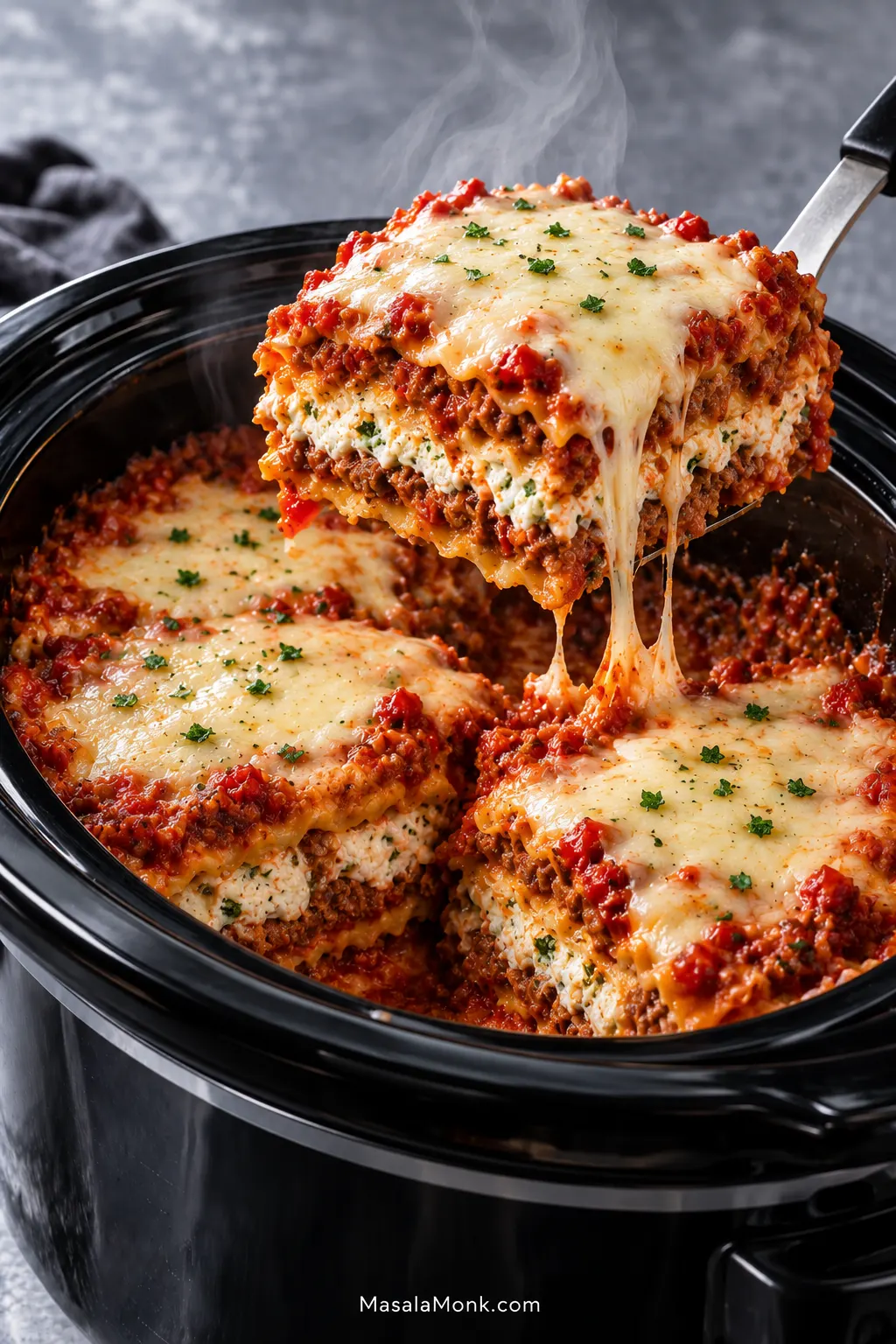
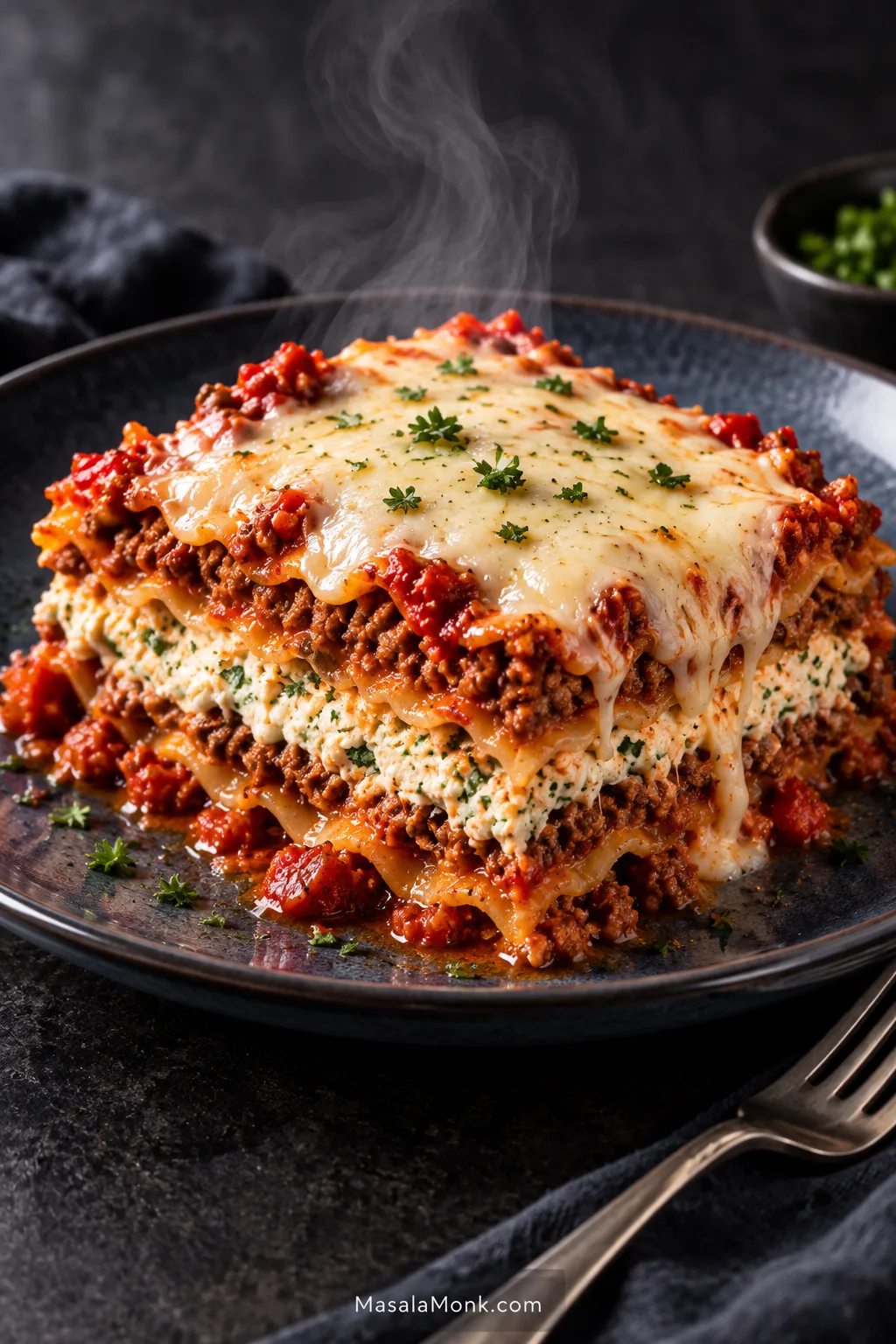
At its best, the pasta is tender all the way through but still forms layers you can see when you lift a piece. Meat sauce stays tucked between the sheets, creamy ricotta shows through the cut center, and the cheese on top remains soft and stretchy. The edges usually set a little firmer where the lasagna meets the crock.
This is where the slow cooker earns its place: no separate pot of noodles, no oven to manage, jarred marinara is completely welcome, and once the layers are assembled, most of the active work is over. It is especially useful when the oven is busy or you would rather not heat up the kitchen. Think hands-off rather than all-day. Pasta has a much narrower sweet spot than a stew or pot roast.
The assembly itself is forgiving. Noodles can break, the layers do not need to look perfect, and pre-shredded cheese is fine. Timing is the one thing worth watching closely. This slow cooker lasagna recipe keeps the convenience while aiming for the distinct layers you expect from classic oven lasagna.
Quick answer: No boiling first. Layer regular dry lasagna noodles with sauce and cheese, then cook on LOW for about 3½–4½ hours, checking from around 3 hours. Once the center noodles are tender, switch off the cooker and let the lasagna rest before serving.
Dry noodles cook directly between meat sauce, creamy ricotta and mozzarella, so there is no separate pot of pasta and no oven to manage. Jarred marinara works perfectly well here, and low-moisture mozzarella melts well without adding as much extra water.
Prep: 25 minutes
Cook: about 3½–4½ hours on LOW
Rest: 20–30 minutes
Plan ahead: about 4½–5½ hours from starting prep to serving
Yield: about 8 servings
Slow cooker: 6 qt / about 5.7 L, preferably oval
Equipment
6-qt / about 5.7-L oval slow cooker
Large skillet
Medium mixing bowl
Thin knife or skewer for checking the pasta
For the Meat Sauce
1 lb / 454 g ground beef, preferably 85–90% lean
1 medium yellow onion, about 5 oz / 140 g, finely diced
3 garlic cloves, about 9 g, minced
1 tsp Italian seasoning
½ tsp freshly ground black pepper
¼–½ tsp fine salt, or to taste
Pinch of red-pepper flakes, optional
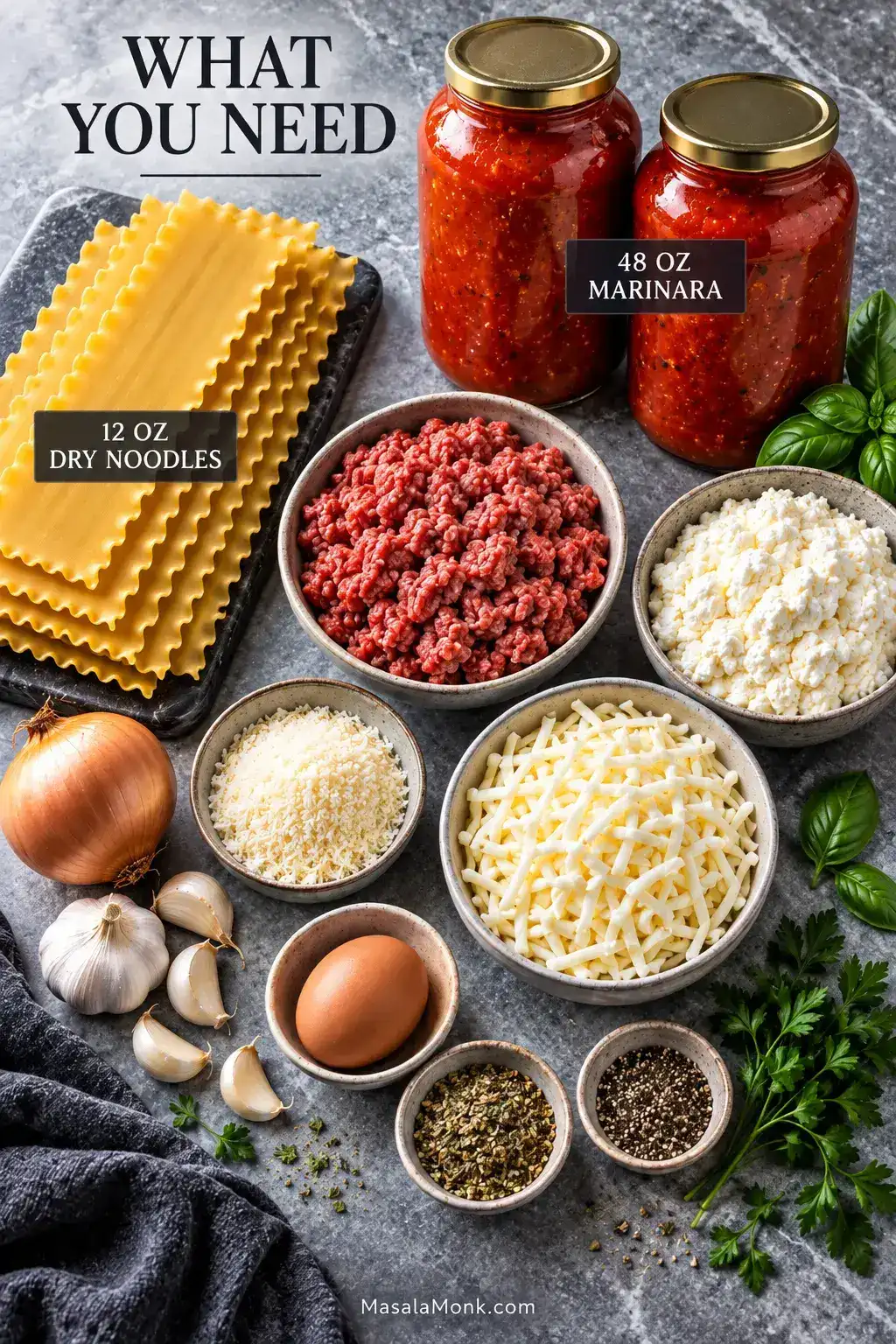
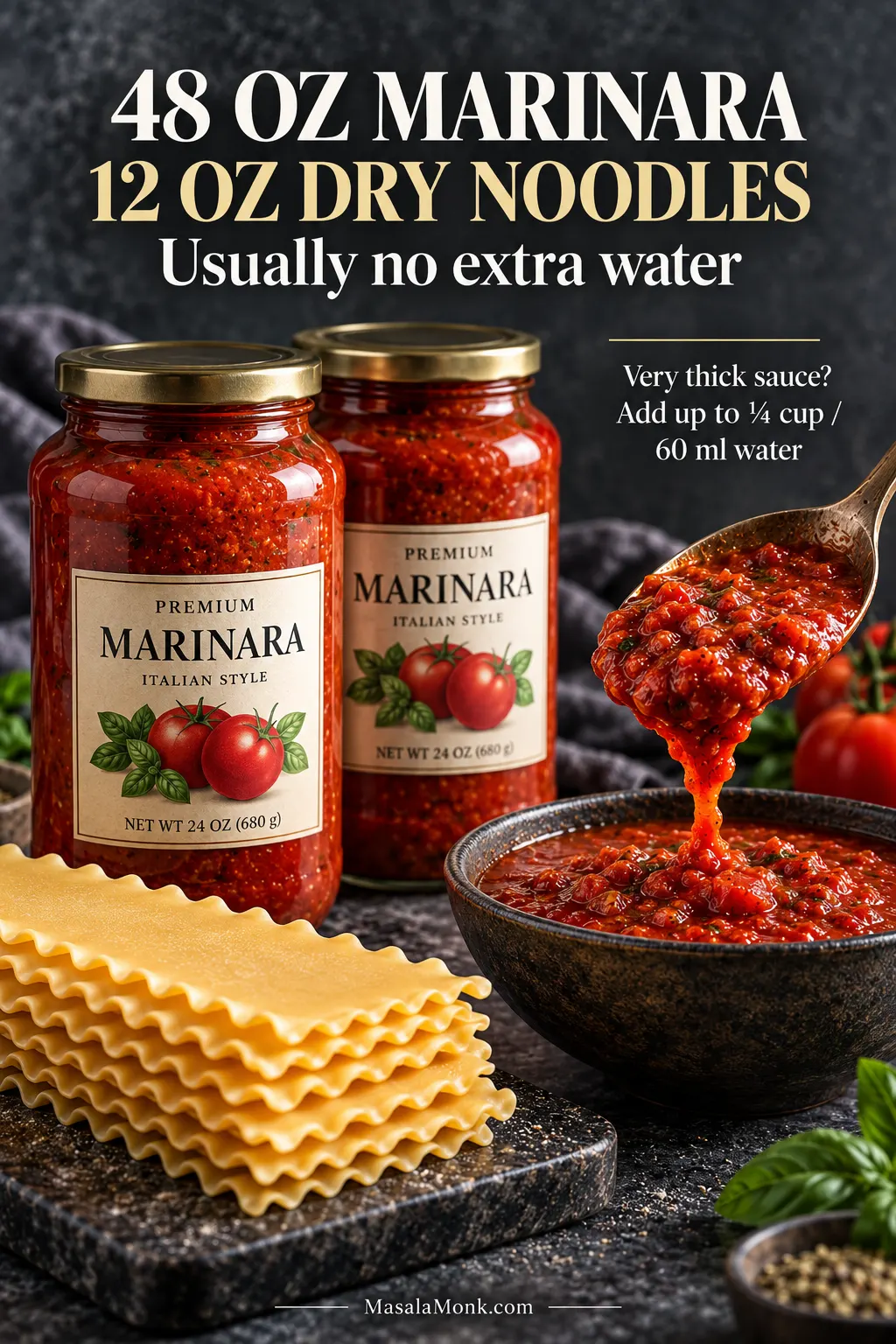
48 oz / 1.36 kg medium-thick marinara sauce (two 24-oz jars)
For more sausage flavor: use 8 oz / 227 g ground beef plus 8 oz / 227 g Italian sausage instead of all beef.
For the Cheese Filling
15 oz / 425 g whole-milk ricotta
1 large egg
⅓ cup / about 30–35 g finely grated Parmesan
2 tbsp chopped parsley or basil, optional
For Layering
12 oz / 340 g regular dry lasagna noodles, uncooked (measure 12 oz rather than automatically using a larger full box)
12 oz / 340 g shredded low-moisture mozzarella
2 tbsp / about 10–15 g finely grated Parmesan, for finishing
Neutral oil or cooking spray, for the slow-cooker insert
Two 24-oz jars make the marinara easy to measure, while weighing 12 oz of dry lasagna noodles separately prevents a larger full box from quietly changing the sauce-to-pasta balance.
Method
Brown the beef and onion. Cook over medium-high heat, breaking up the meat, until browned and the onion is soft. Drain excess fat.
Finish the meat sauce. Stir in the garlic, Italian seasoning, black pepper and optional red-pepper flakes for 30 seconds, then add the marinara and taste before salting. The sauce should pour but cling to a spoon. If it is unusually thick, loosen it with up to ¼ cup / 60 ml water.
Make the cheese filling. Mix the ricotta, egg, ⅓ cup Parmesan and optional herbs; divide roughly into thirds.
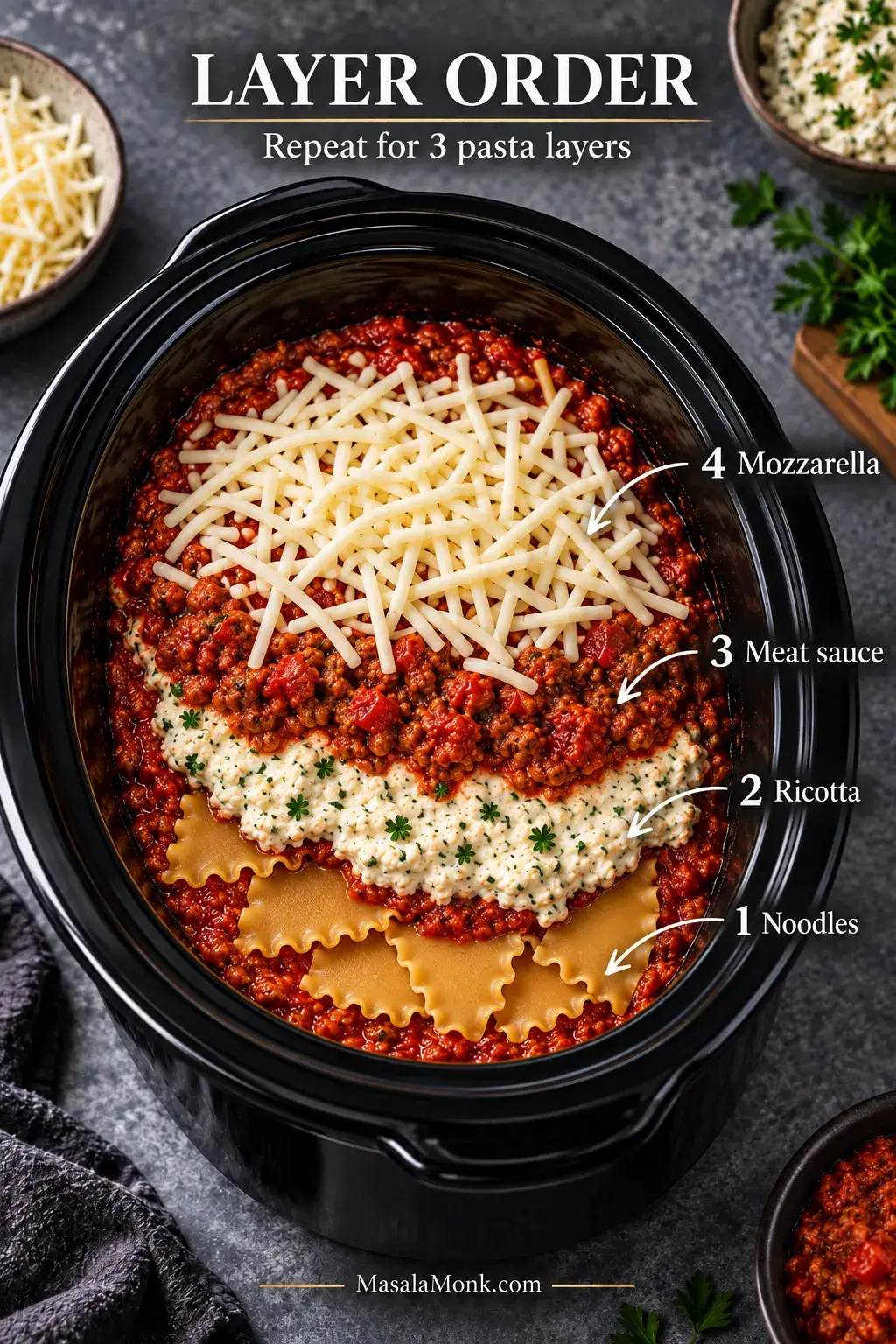
Build three layers. Grease the crock and spread about 1 cup meat sauce over the bottom. Reserve about 4 oz / 110 g mozzarella for the top. Add dry noodles, breaking them to fit, then one-third each of the ricotta, meat sauce and remaining mozzarella. Repeat for three pasta layers, keeping every noodle sauced, especially at the edges.
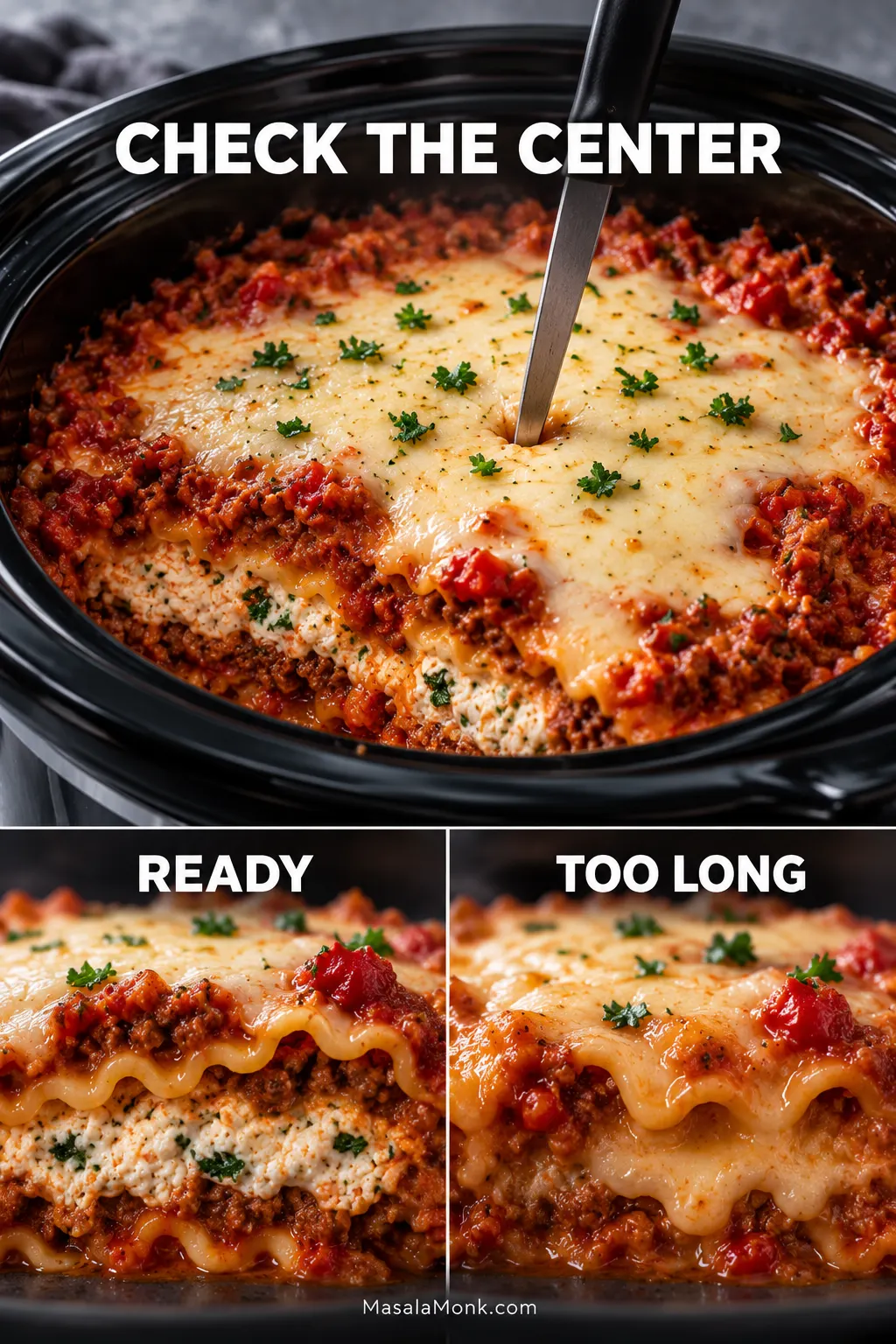
Cook on LOW and check the pasta. Begin checking around 3 hours; expect roughly 3½–4½ hours. The noodles should be fork-tender, and a thin knife or skewer should pass through the middle without a chalky core.
If it needs more time: firm pasta with plenty of moisture can cook another 20–30 minutes. For firm, dry-looking pasta, add 2–4 tbsp / 30–60 ml hot water or warm marinara around the edge.
Switch off the cooker and finish the cheese. When the pasta is tender, turn the slow cooker OFF. Add the reserved mozzarella and finishing Parmesan, cover for 5–10 minutes and let the retained heat melt the cheese.
Rest before serving. Crack or remove the lid and rest 20–30 minutes. Loosen the edge with a broad non-scratching spatula, then serve.
Recipe Notes
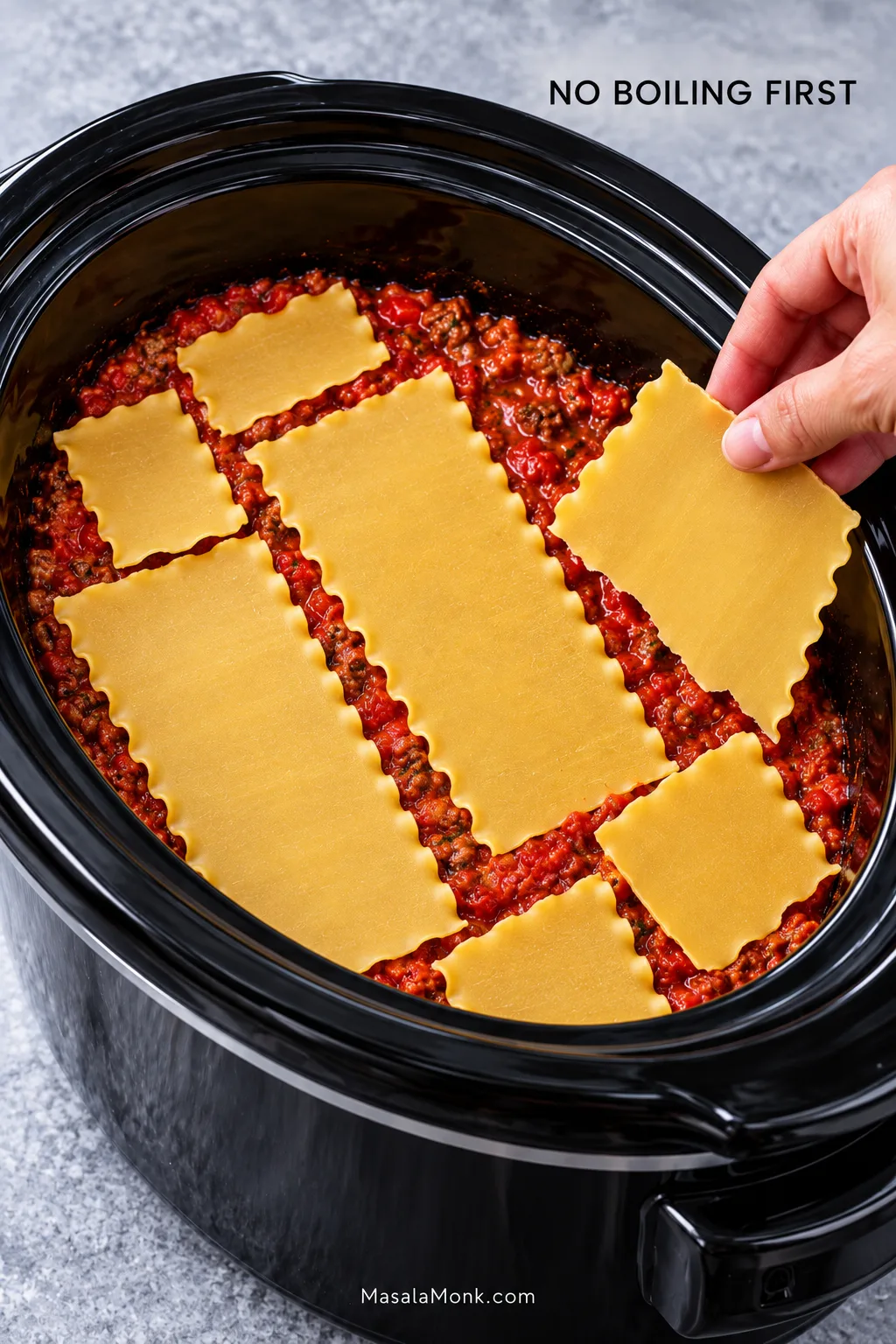
Regular dry noodles: measure 12 oz / 340 g, then add them dry—no boiling first.
Oven-ready noodles: they work too, but soften sooner, so check earlier.
Mozzarella: low-moisture mozzarella is easiest to manage here. Fresh mozzarella can release considerably more water.
Cottage cheese: 15–16 oz / 425–454 g can replace the ricotta. Drain visible whey first.
Food safety: cook ground beef or sausage to 160°F / 71°C; ground turkey to 165°F / 74°C. If checking the finished lasagna with a thermometer, the center should reach 165°F / 74°C; reheat leftovers to the same temperature. See the USDA safe-temperature chart.
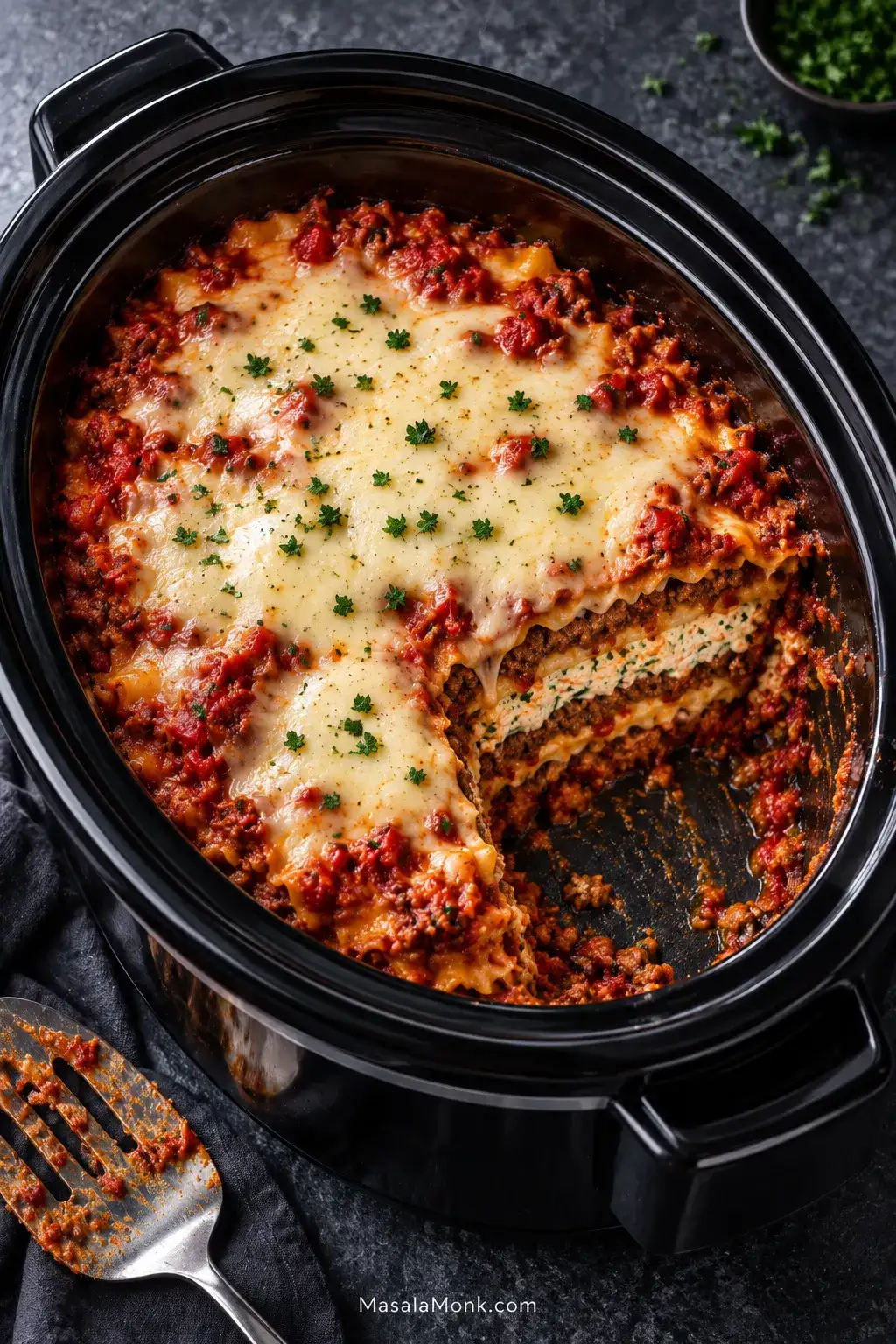
Sauce reaching the perimeter helps protect the noodle edges, while visible pasta, ricotta and a softly melted top show the texture this recipe is aiming for.
More Help With Your Lasagna
Want to understand the noodles, timing or moisture before you start? Everything below is organized so you can jump straight to what you need.
Noodles, Sauce and How Much Liquid You Actually Need
A slow cooker holds onto steam extremely well. That is what allows dry lasagna noodles to cook without a separate pot of boiling water. It also means liquid stays in the crock instead of evaporating the way it does in a hot oven.
You still want a saucy lasagna. There should be enough tomato sauce to soften every sheet and stay tucked between the layers, but not so much that the first serving leaves a puddle behind.
Can you put uncooked lasagna noodles in a slow cooker?
Yes. Regular dry lasagna noodles can go straight into the slow cooker without boiling first. They soften gradually in the sauce and give you a useful amount of time between firm and overly soft.
Oven-ready sheets work too. Because they hydrate faster, start checking them sooner.
Perfectly fitted noodles are unnecessary. Broken dry sheets work just as well when the exposed pieces are surrounded by enough sauce to soften evenly.
Do you need to add water to slow cooker lasagna?
Usually not in this recipe. The amounts matter: 48 oz / 1.36 kg marinara for 12 oz / 340 g dry noodles already gives the pasta plenty to absorb as it cooks.
This is why slow-cooker lasagna recipes can appear to contradict one another. A deeper recipe built around a full 16-oz / 454-g box of noodles may genuinely need additional liquid. With the amounts here, pouring in an automatic cup of water can leave far more moisture than the pasta needs.
If you make the sauce yourself, homemade marinara sauce works here too. Aim for one that coats the pasta generously instead of running through the crock like broth.
With 48 oz of marinara for 12 oz of dry noodles, the pasta already has plenty of moisture to work with; only a very thick sauce may need a small splash of water.
Why one corner can stay hard
Sometimes nearly the whole lasagna is tender except for one leathery corner. That piece may simply have spent the cook above the sauce or pressed dry against the crock wall. One stubborn patch does not mean the rest of the lasagna needs more water.
A little noodle overlap is fine. Several dry sheets pressed directly together are harder for moisture to reach. Before closing the lid, glance around the perimeter and cover any pale pasta still showing.
Vegetables bring their own water. Frozen spinach is a good example: thaw it and squeeze it well before layering. When zucchini, mushrooms, greens and other vegetables become the main filling, a dedicated vegetable lasagna method gives you better control over the moisture they release.
How to Build Slow Cooker Lasagna So It Cooks Evenly
The uncooked layers rarely look elegant. Noodles crack, and rectangular sheets leave awkward curved spaces in an oval crock. There is no prize for fitting them like a puzzle. Once the pasta softens, those broken pieces settle into the sauce with everything else.
Start with sauce and fit the noodles around the crock
Spread the first cup of meat sauce over the bottom before any pasta goes in. Lay the larger noodle pieces through the center, then snap smaller pieces to cover the curved spaces.
A broken noodle is not a problem; a dry noodle is.
Layer map: sauce on the bottom → dry noodles → ricotta filling → meat sauce → mozzarella. Build three pasta layers total and bury the final noodles beneath sauce.
Repeat noodles, ricotta, meat sauce and mozzarella for three pasta layers, but pay special attention to the crock wall—sauce around the perimeter helps prevent stubborn dry corners.
Keep the edges sauced and save some cheese for the top
The pasta nearest the crock wall feels the heat first, so carry the sauce all the way to the perimeter. An exposed corner can dry before the middle is ready.
Keep about a cup of mozzarella back for the finish. Under a slow-cooker lid the cheese melts pale, glossy and stretchy; it will not develop the toasted freckles and crisp bubbles you get from an oven. That’s normal.
Ricotta, Cottage Cheese, Beef or Sausage
Ricotta is the default here. Whole-milk ricotta gives you the soft, creamy layer that should still be visible between the pasta and meat sauce when you cut a piece. The egg helps the filling set during cooking, so it holds together better when served.
Ricotta vs cottage cheese: cottage cheese is a perfectly workable substitute, but it brings a little more loose moisture and a different texture. Use about 15–16 oz / 425–454 g, drain off visible whey, and blend it briefly if you prefer a smoother filling. Half ricotta and half cottage cheese is fine as well. For a version built specifically around it, see the cottage cheese lasagna guide.
All beef keeps the meat sauce familiar and straightforward. Replacing half with Italian sausage gives the tomato sauce a deeper, more savory flavor against the mild ricotta. Ground turkey works too; season it generously because it is leaner and milder. Whatever meat you choose, browning it first develops more flavor and gives you a chance to drain excess fat.
The finished slice should still show pasta, creamy ricotta and meat sauce as distinct layers, even though the lasagna stays soft and saucy.
LOW vs HIGH: How Long Does Slow Cooker Lasagna Take?
The smell of tomato sauce and melted cheese is not a reliable timer. Near the end, the edges may look thoroughly cooked while a noodle deep in the center still offers resistance when you test it.
LOW is the default: about 3½–4½ hours, with the first check around 3 hours. HIGH usually takes about 2½–3½ hours, but the noodles move through their tender stage faster, so you have less margin near the end.
When your schedule is flexible, LOW is easier to manage; HIGH is useful when dinner needs to happen sooner, but the pasta needs closer attention as it approaches tenderness.
Why LOW is the easier setting
LOW gives you the widest window for catching the pasta at the texture you want. Leave the lid closed during the first few hours, then begin checking the middle around 3 hours.
HIGH works when dinner needs to happen sooner, but check more closely near the end. The noodles soften faster, so the distance between firm and too soft gets shorter.
Why slow cooker lasagna times vary so much
Recipes vary because the pasta quantity, sauce amount and depth of the layers vary. A deeper lasagna made with more noodles and more liquid may simply need longer.
Some slow-cooker dinners genuinely suit an all-afternoon cook; a slow cooker sausage casserole is one example. Lasagna gives you a narrower window at the end because the pasta keeps taking up moisture while it stays hot.
How do you know slow cooker lasagna is done?
Trust the center noodle, not the bubbling edges. The pasta should be fork-tender, and a thin knife should slide through the middle without hitting a firm or chalky core. If you use a thermometer, the center should reach 165°F / 74°C.
The center usually finishes after the bubbling perimeter, so testing one noodle in the middle gives you a more dependable stopping point than judging the surface alone.
Once it is done, switch the cooker off. Melt the reserved cheese under the lid with the heat already stored in the crock, then uncover and rest the lasagna for 20–30 minutes. That rest is when the soft layers become easier to lift and the ricotta remains visible between the tomato-stained pasta sheets.
What size slow cooker is best for lasagna?
A 6-quart / about 5.7-L oval slow cooker is the default here. Smaller crocks make deeper layers and can take longer; larger ones spread everything more thinly and may finish sooner. Round cookers often create a deeper center. Whatever the shape, let the pasta make the final call.
If dinner is not quite ready yet: use WARM only after the lasagna is fully cooked. For the best texture, think in tens of minutes, not hours. WARM is for holding finished food, and a long hold will keep softening the noodles.
How to Fix Watery, Dry or Undercooked Slow Cooker Lasagna
Your lasagna is already in the Crock Pot. Now what? Look first at the pasta and at the moisture around it. Those two clues usually tell you the next move.
What You See
What to Do First
What Is Probably Happening
Tender noodles, liquid pooling
Turn the cooker off, vent the lid and rest
Loose sauce, extra water or simply not enough resting yet
Middle still firm, plenty of sauce
Continue on LOW for another 20–30 minutes
The pasta just needs more time
Middle firm and noticeably dry
Add 2–4 tbsp / 30–60 ml hot water or warm sauce
Very thick sauce or too little moisture reached the pasta
One edge dark, middle not ready
Stay on LOW and continue in short intervals
That side of the cooker is running hotter
Noodles getting mushy
Turn off the heat and uncover
The pasta has cooked too long or stayed hot too long
Grease pooling on top
Carefully spoon or blot it away
The meat released more fat than was drained off
Piece collapses when lifted
Give it another 10–15 minutes to rest
The layers are still too hot and soft to hold together
Why is my slow cooker lasagna watery?
If the noodles are already tender, switch the cooker off, crack or remove the lid and let the lasagna rest. More heat will keep softening pasta that is already cooked.
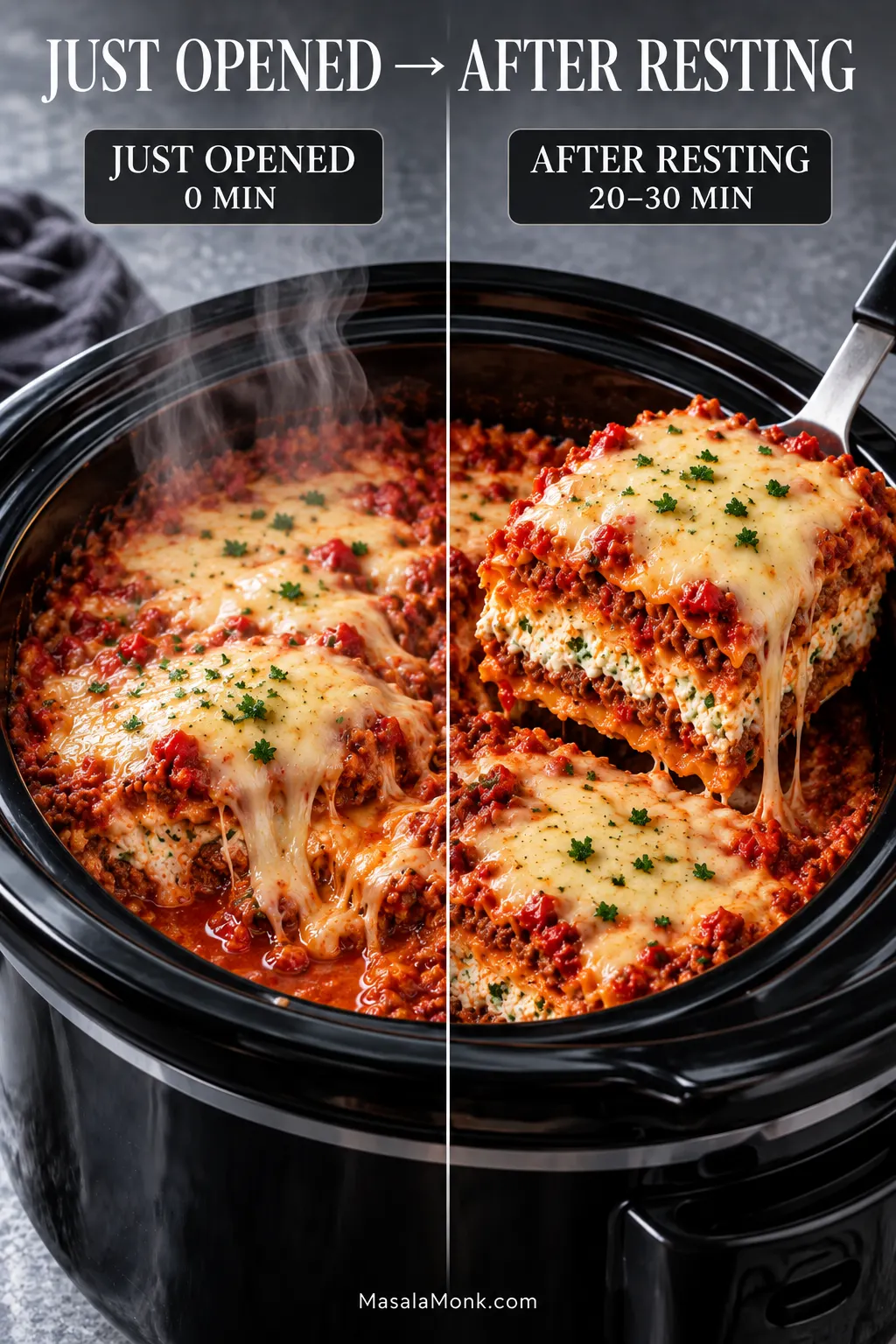
The first look under the lid can be alarming. Sauce may shimmer around the edges and a spoon pressed into the center can make everything seem loose. Ten minutes later the surface is calmer. By twenty or thirty minutes, some of that visible liquid has settled back between the layers and the cheese is holding them together more firmly.
Fresh from the cooker, the lasagna may look looser than expected. After 20–30 minutes, escaping steam and slightly firmer cheese make the layers noticeably easier to serve.
If the same thing happens next time, look first at thin marinara, unnecessary added water, cottage-cheese whey or vegetables that released a lot of liquid.
The middle is hard or one patch is dry
A firm middle surrounded by plenty of sauce can stay on LOW for another 20–30 minutes. When the center looks dry as well, add a small measured splash of hot water or warm marinara.
A single hard corner needs much less intervention. Spoon a little marinara over that spot, cover the cooker and let the pasta finish there.
The edges are ahead of the center
One dark edge usually means that side of the cooker is running hotter. Stay on LOW while the center finishes and keep future batches especially well covered along that side.
If you want a browned cheese finish, transfer individual servings to broiler-safe dishes and broil briefly. The top does not need to brown for the lasagna itself to be done.
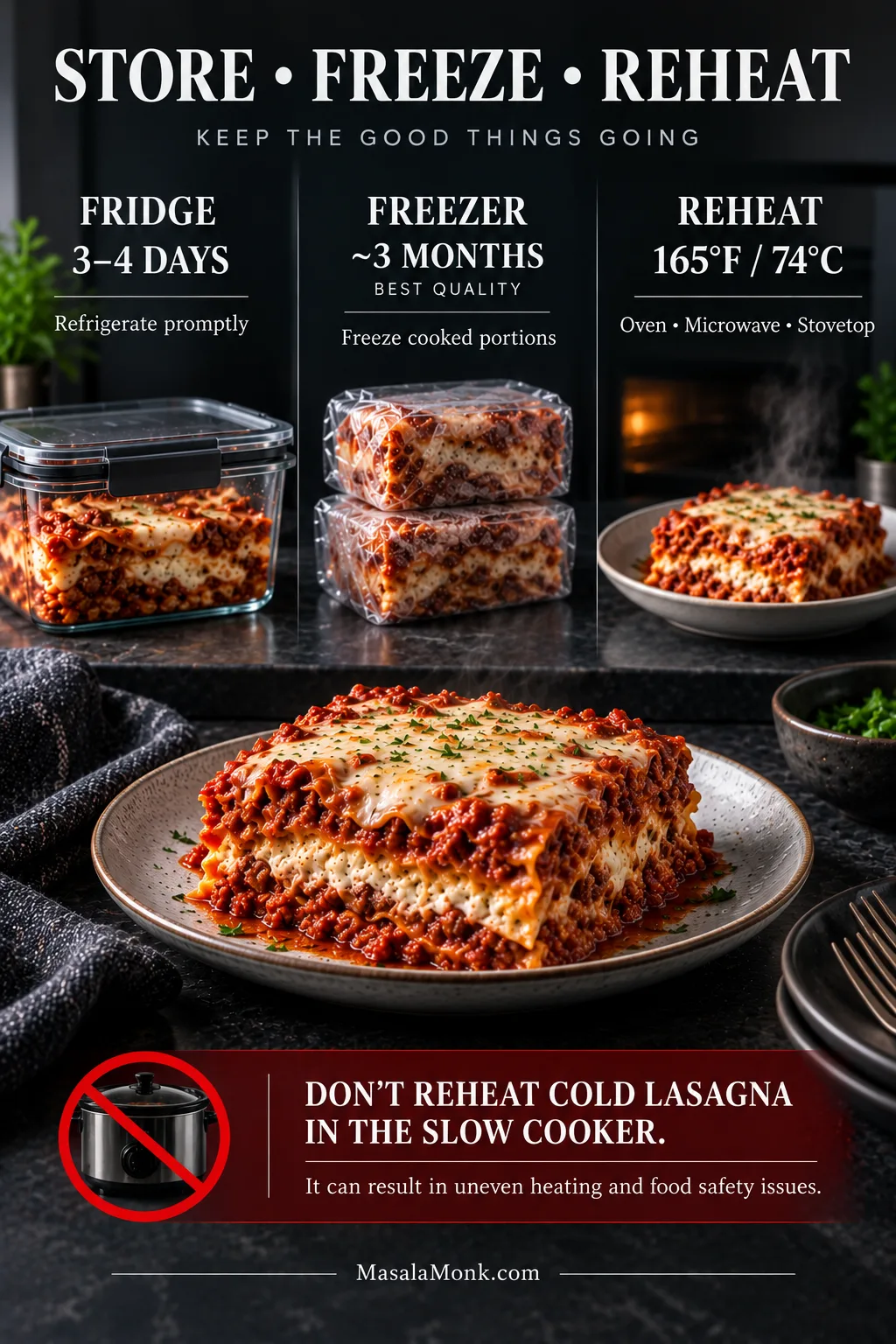
Storage at a glance: the guide below keeps the refrigerator, freezer and reheating decisions in one place; the detailed make-ahead and leftover notes follow.
Individual portions are especially practical for leftovers because they cool, freeze and reheat more evenly than one large section; use the storage times and reheat temperature shown as your quick reference.
Make the busy part ahead
Best make-ahead option: prepare the meat sauce and ricotta filling separately the day before and refrigerate them. The next day, all that is left is layering the lasagna and switching on the cooker.
You can assemble the whole lasagna ahead as well, although the dry noodles will begin taking up sauce in the refrigerator and chilled ingredients take longer to heat through. If you refrigerate it in a removable ceramic crock, follow the instructions for your particular appliance. Do not place a cold ceramic insert into a preheated slow-cooker base, allow for extra warm-up time, and check that the center reaches 165°F / 74°C.
Leftovers and freezing
Refrigerate leftovers promptly, ideally within about 2 hours, and keep them covered for 3–4 days. Individual portions reheat more evenly than one large section. The noodles continue taking up liquid in the refrigerator, so a spoonful of marinara is useful when a leftover piece looks a little dry.
Reheat cold leftovers in the oven, microwave or on the stovetop until the center reaches 165°F / 74°C. Do not use the slow cooker itself to reheat cold leftovers; it warms food too gradually for that job.
For longer storage, cool the lasagna completely and freeze individual cooked portions for about 3 months for best quality. Thaw overnight in the refrigerator when practical. Cooked portions are also the easiest freezer-prep option here—do not put a frozen assembled lasagna straight into the slow cooker.
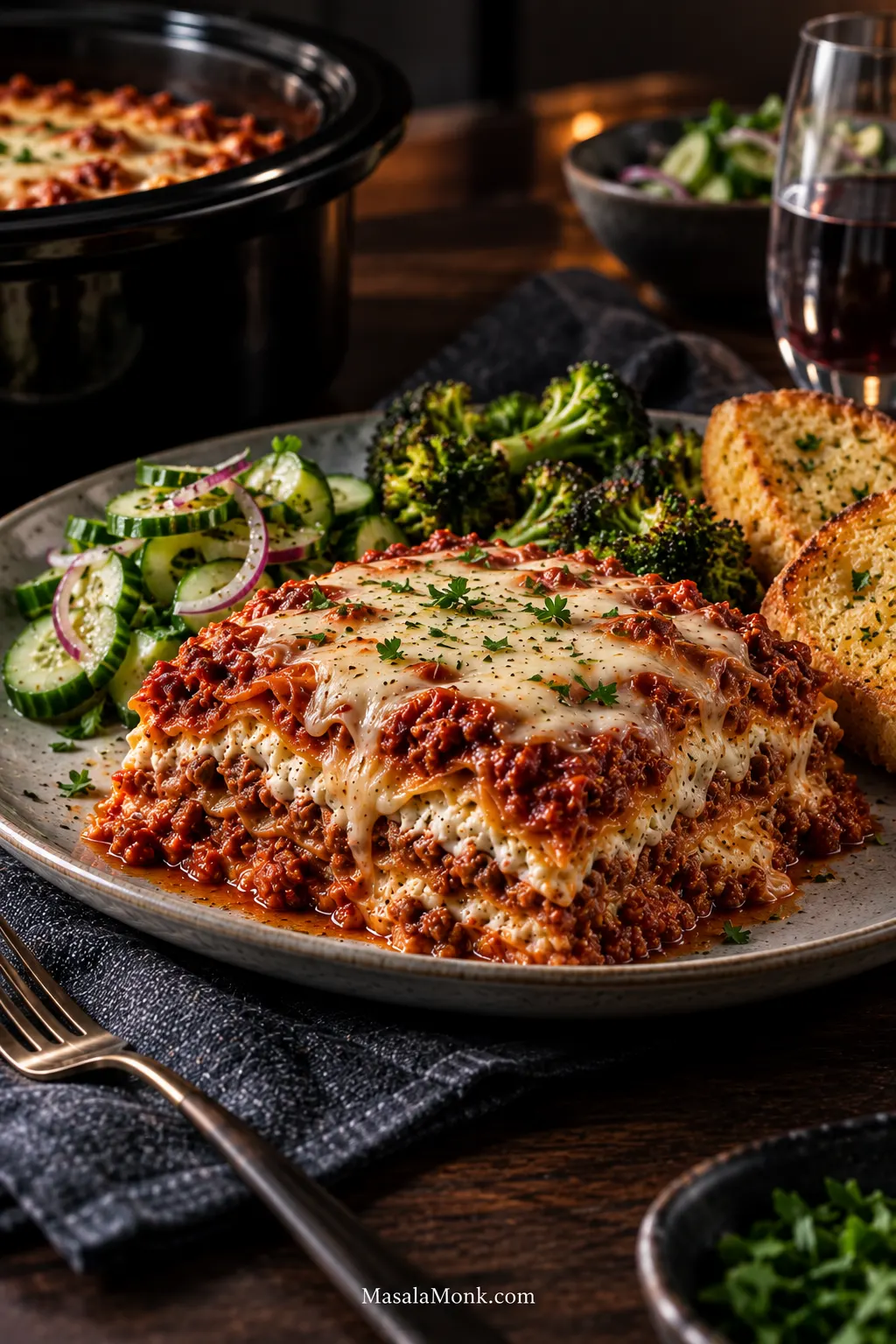
After resting, a serving should be soft and saucy while still showing its pasta, ricotta and meat-sauce layers. The first piece may lean a little as you lift it; that is lasagna, not an architecture exam. Let a little sauce slip onto the plate; that is part of the appeal.
A crisp cucumber salad brings acidity and crunch, while roasted broccoli or another simply cooked vegetable keeps the plate lighter. And if there is meat sauce left behind after the lasagna is gone, garlic bread is exactly what you want for it.
A crisp cucumber salad cuts through the rich tomato-and-cheese layers, while roasted vegetables and garlic bread round out the meal without competing with the lasagna.
If next time you want the same tomato-and-cheese comfort in a brothier, spoonable dinner, try Crock Pot Lasagna Soup.
Slow cooker pork carnitas can turn out beautifully tender and still miss the reason you wanted carnitas in the first place: dark, crisp edges around pieces that remain juicy in the middle.
Lift the lid and you may find plenty of soft pork, but no crust anywhere. Add too much liquid and it tastes like wet taco filling. Pull it into fine threads, and the broiler can dry those strands before the meat develops a proper browned edge.
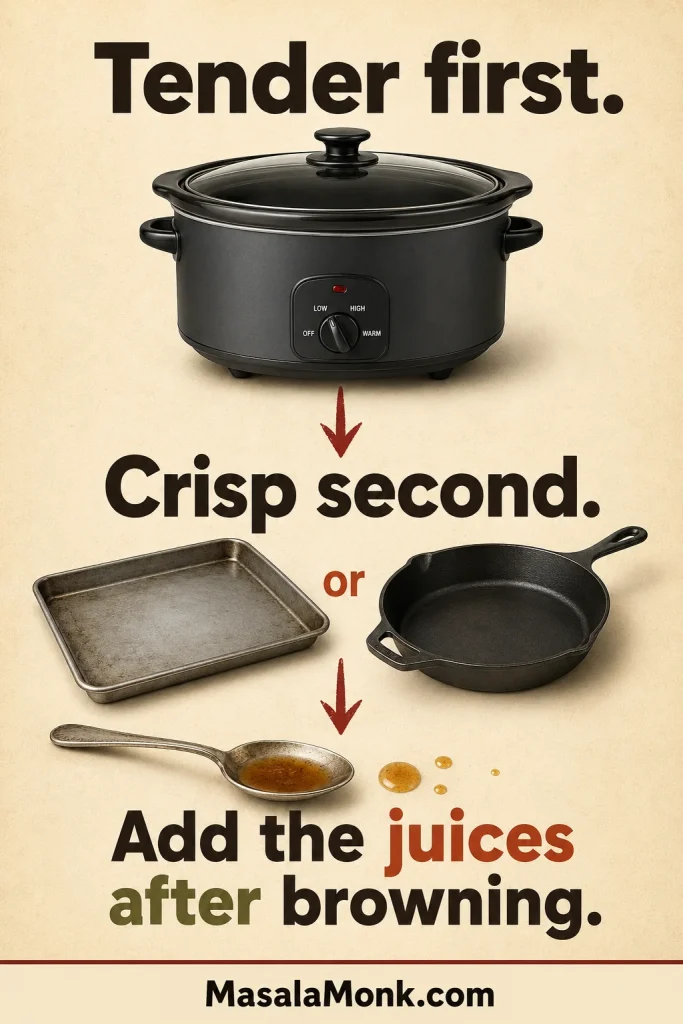
The easiest solution is to stop asking the slow cooker to do two opposite jobs. Let it soften the shoulder slowly with orange, lime, garlic, oregano, cumin and ancho chile. Once the thickest section yields easily to a fork, move the pork into dry, intense heat for the finish.
Quick Answer: How to Make Crispy Slow Cooker Carnitas
Cook large pieces of pork shoulder with a small amount of citrus until a fork turns easily through the thickest section. No initial searing or added broth is required. Lift out the pork, strain the cooking juices and reduce them only when they taste thin.
Pull the meat into broad pieces, then broil or skillet-crisp it in a loose layer. Spoon a little reserved juice over the pork only after it has browned. Leave any pork you are saving uncrisped, then brown each portion fresh when you reheat it.
Essential slow cooker pork carnitas decisions
Decision
Best starting point
Pork and cooker
4 lb / 1.8 kg trimmed pork shoulder in a 6 qt / 5.7 L slow cooker
Cooking time
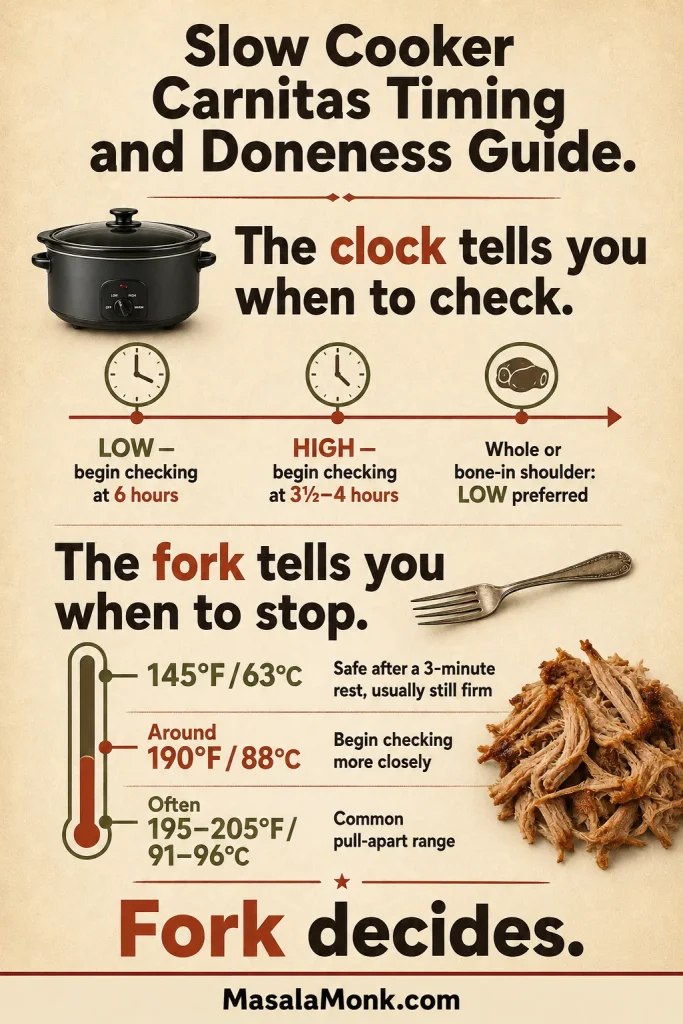
Begin checking at 6 hours on LOW or 3½–4 hours on HIGH
Doneness
A fork turns through the thickest section with little resistance
Best finish
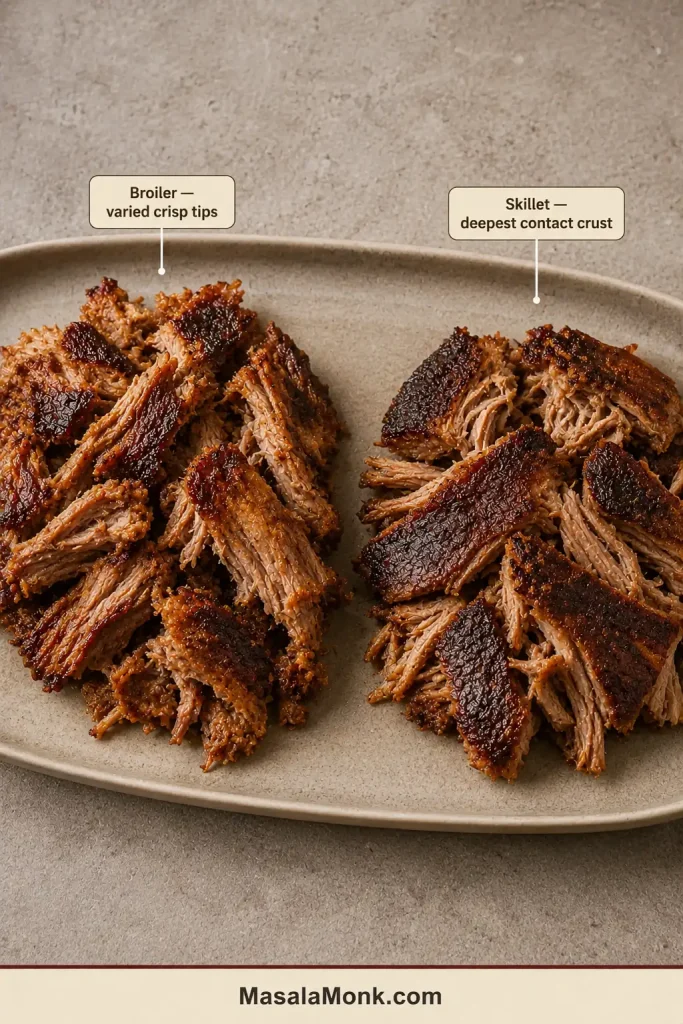
Broiler for a full batch; skillet for the deepest crust
Slow cooking builds tenderness; dry heat creates the final crust.
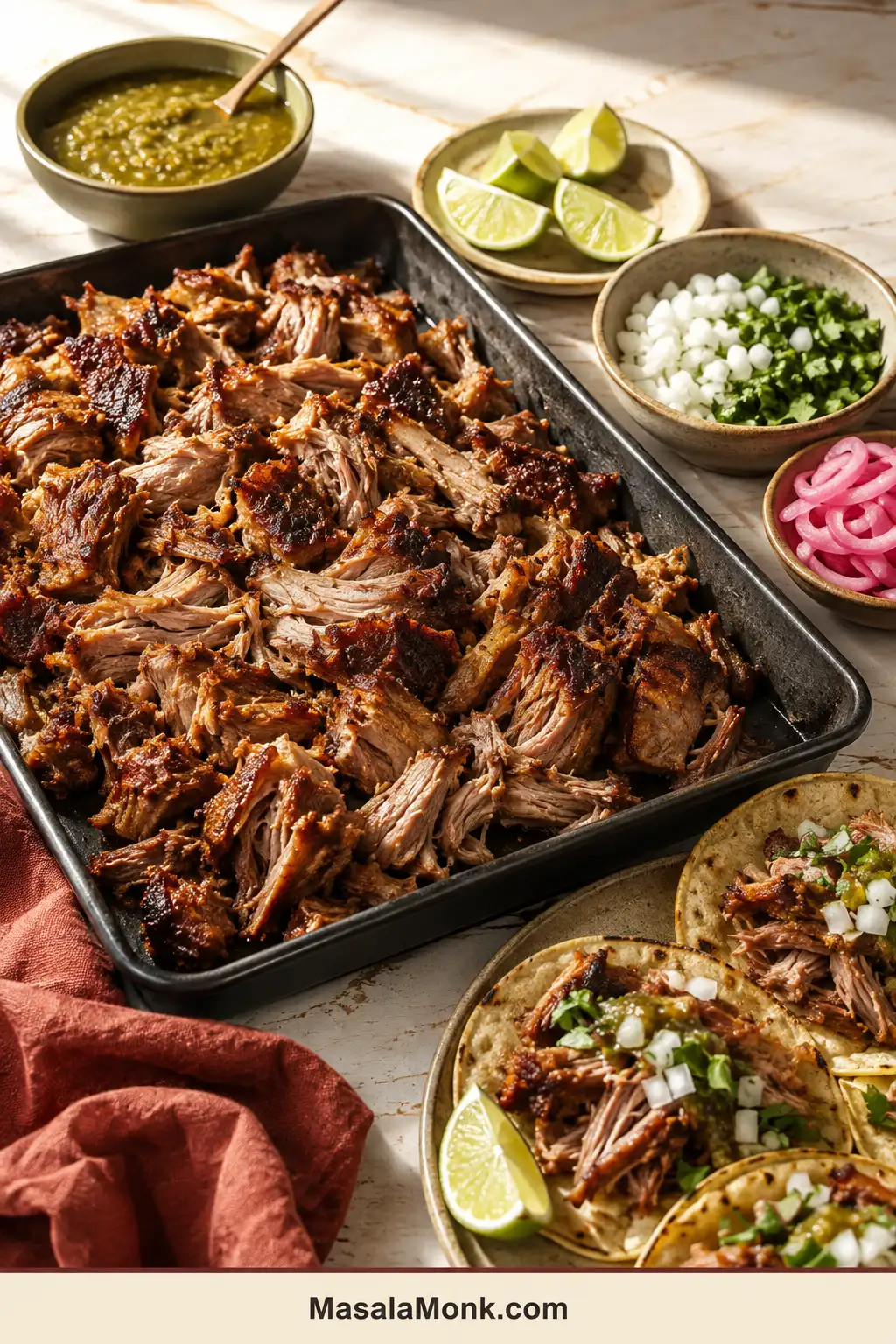
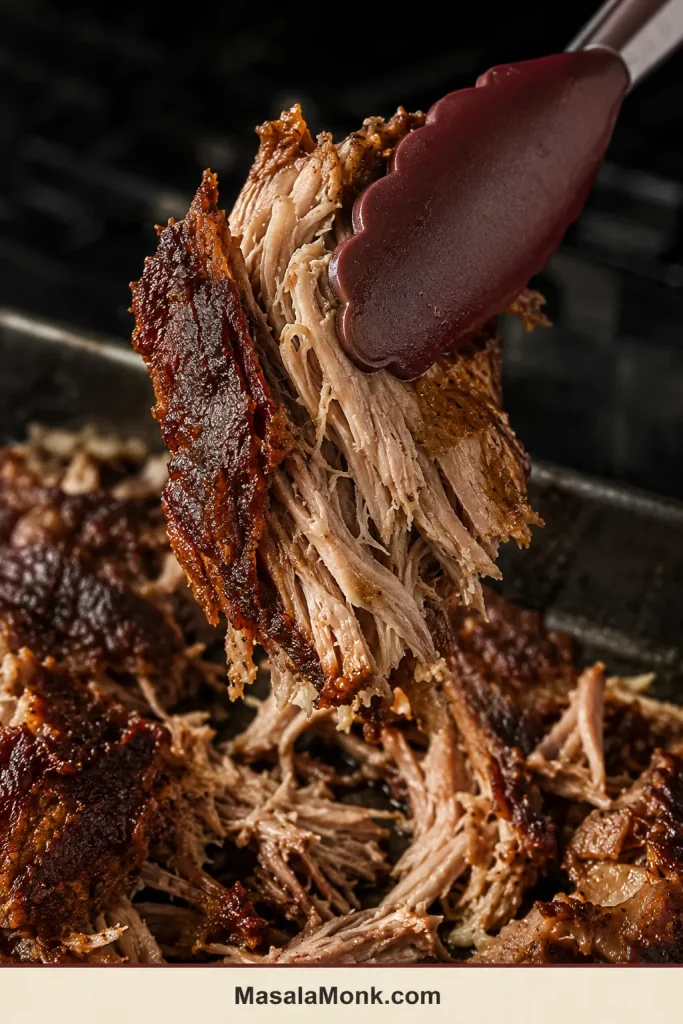
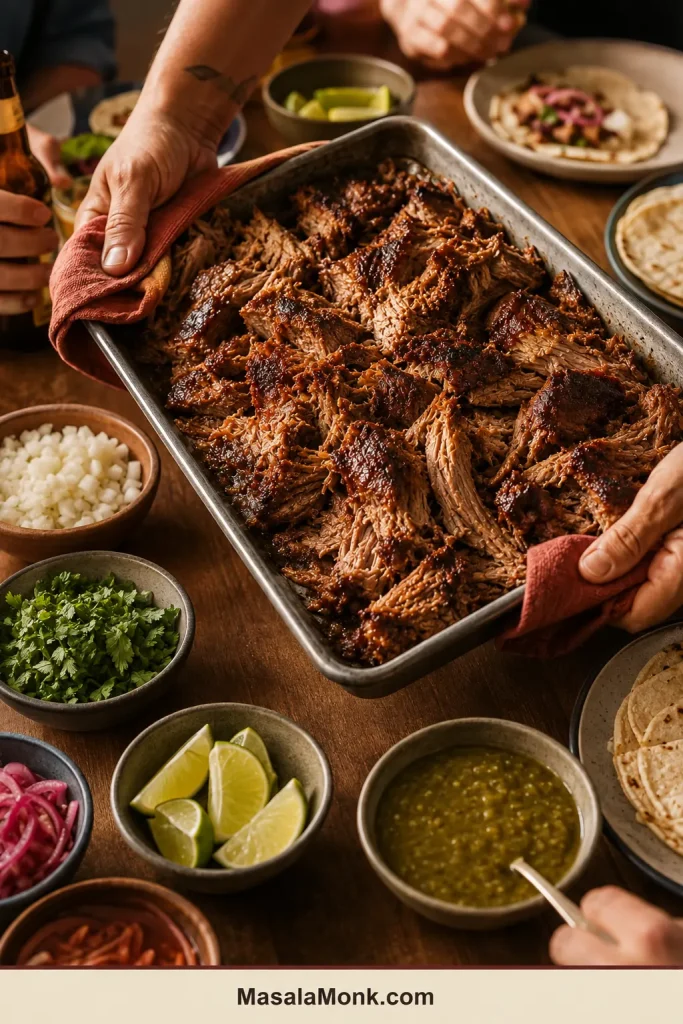
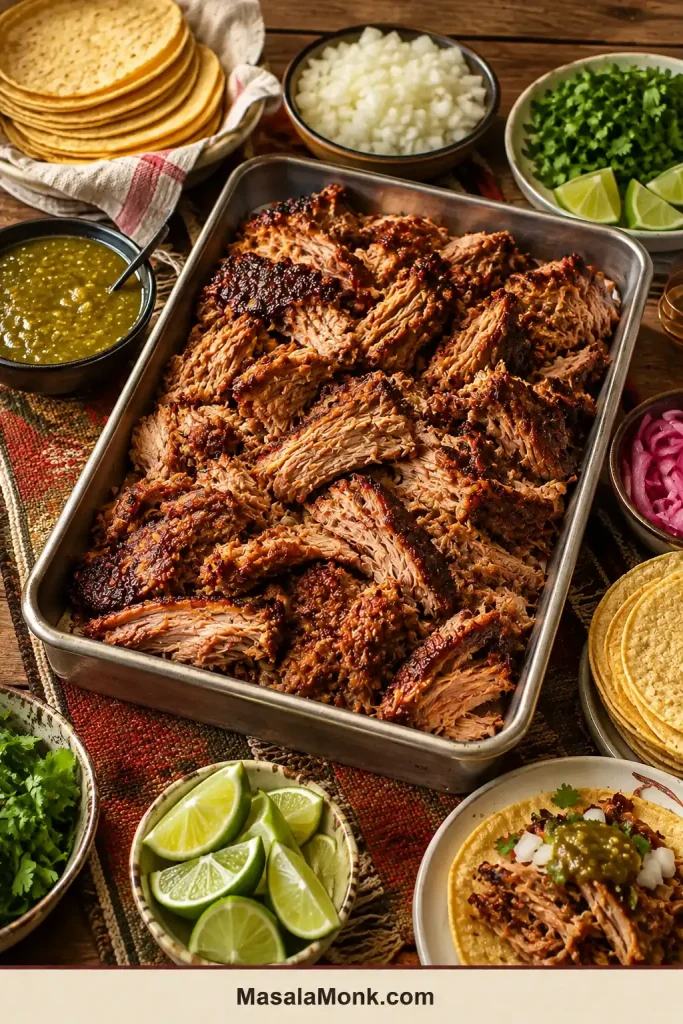
Pork shoulder cooks with a small amount of citrus, garlic, onion and warm spices until it separates easily but still holds broad pieces. The finished tray should contain deeply browned tips, crisp flat edges and thicker pieces that remain soft enough to pull apart.
Use the broiler for a full batch or a skillet for the deepest crust. Allow about 25 minutes to trim, weigh, cut and season the pork. Once the lid is closed, the long cook is hands-off.
Prep25 minutes
LOW Cook6½–8½ hours
HIGH Cook4–5½ hours
Broiler Crisping5–9 minutes per pan; 15–20 minutes for the batch
Skillet Crisping3–4 minutes per batch; 20–35 minutes for the recipe
Estimated Yield2½–3 lb / 1.15–1.35 kg cooked pork
Planning window: Allow about 7½–10 hours on LOW or 5–6¾ hours on HIGH, including preparation, resting and broiling. Allow additional time if the cooking juices need reducing.
Expect approximately 8–11 hearty servings, 10–14 taco-bar servings or 20–30 small tacos.
For serving: warm tortillas, chopped white onion, cilantro, lime wedges and roasted salsa verde or another bright salsa.
Essential Equipment
6 qt / 5.7 L slow cooker or Crock-Pot
Kitchen scale
Cutting board and chef’s knife
Tongs or a large slotted spoon
Fine-mesh strainer and wide saucepan
One or two uncoated, broiler-safe rimmed metal sheet pans
An instant-read thermometer, fat separator and heavy skillet are helpful but optional.
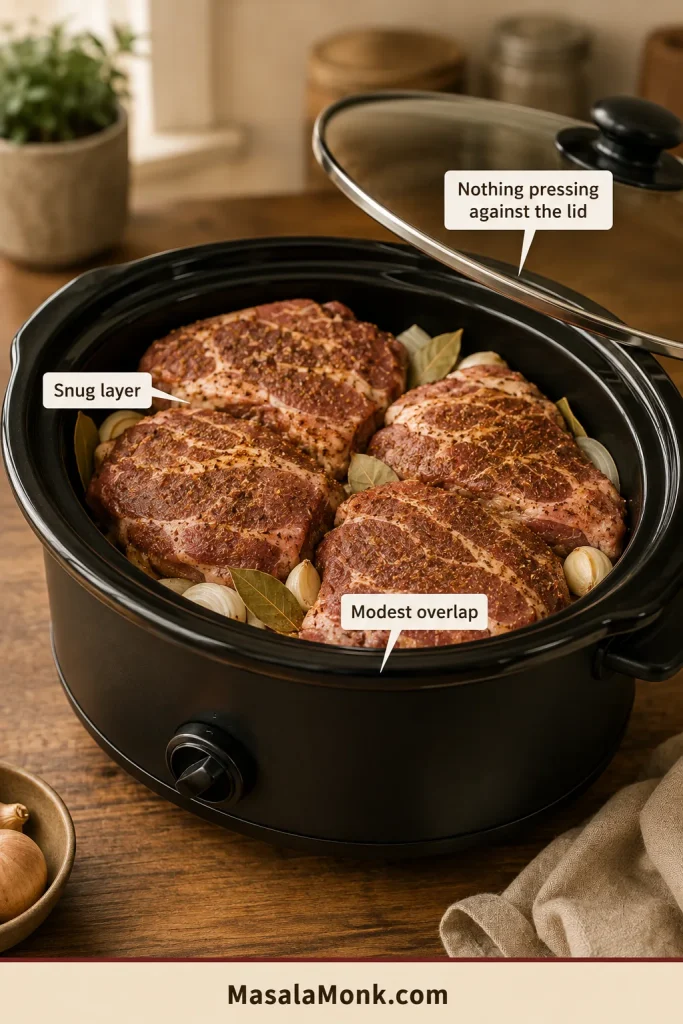
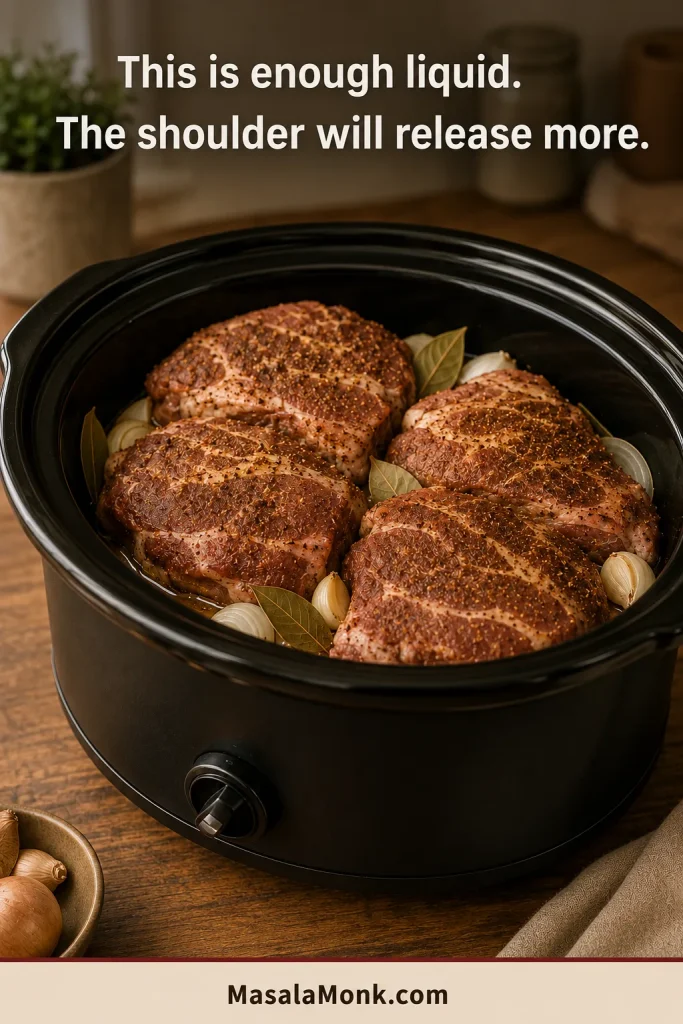
Cooker fit: Arrange the pork in a snug layer with modest overlap. It may touch the sides, but it should not press against the lid. The cooker may look almost dry at first. That is expected—the shoulder will release plenty of moisture and fat.
Modest overlap is fine; a raised lid or compressed pork is not.
Ingredients
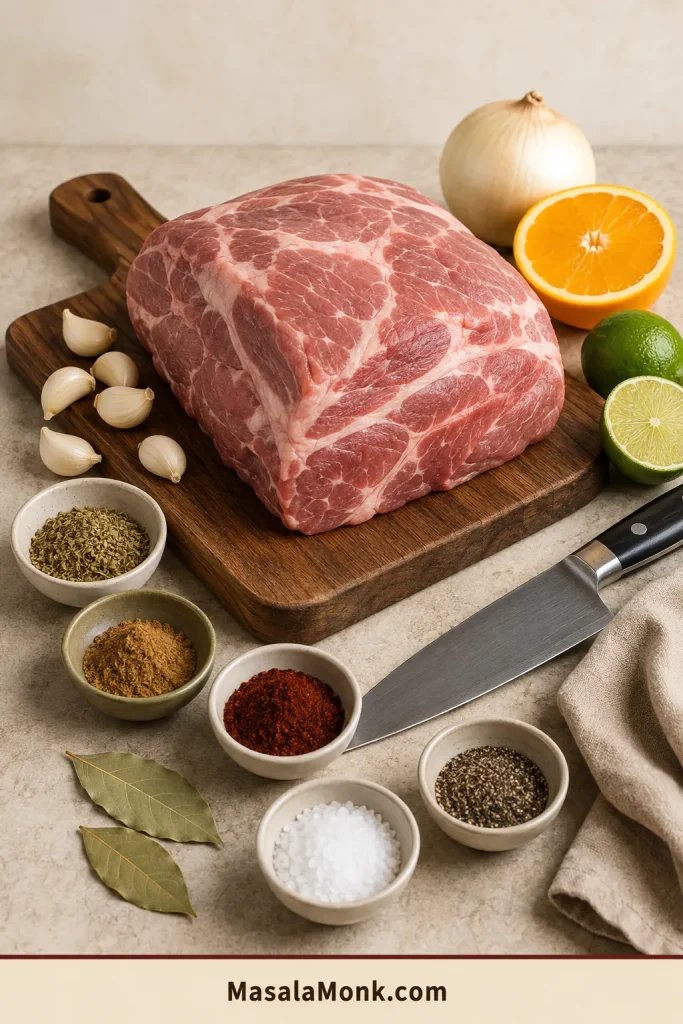
Pork shoulder provides the body; citrus, aromatics and spices shape the flavor.
4 lb / 1.8 kg boneless pork shoulder, pork butt or Boston butt, weighed after removing skin and unusually thick external fat
20 g fine sea salt
2 teaspoons dried Mexican oregano, crushed between your fingers
1½ teaspoons ground cumin
1 teaspoon freshly ground black pepper
1 teaspoon ancho chile powder
1 large yellow or white onion, about 8–9 oz / 225–250 g, cut into thick wedges
8 garlic cloves, peeled and lightly crushed
½ cup / 120 ml fresh orange juice
2 tablespoons / 30 ml fresh lime juice
2 bay leaves
Buying note: Choose a slightly larger roast when it has skin or a very thick fat cap, so approximately 4 lb / 1.8 kg remains after trimming.
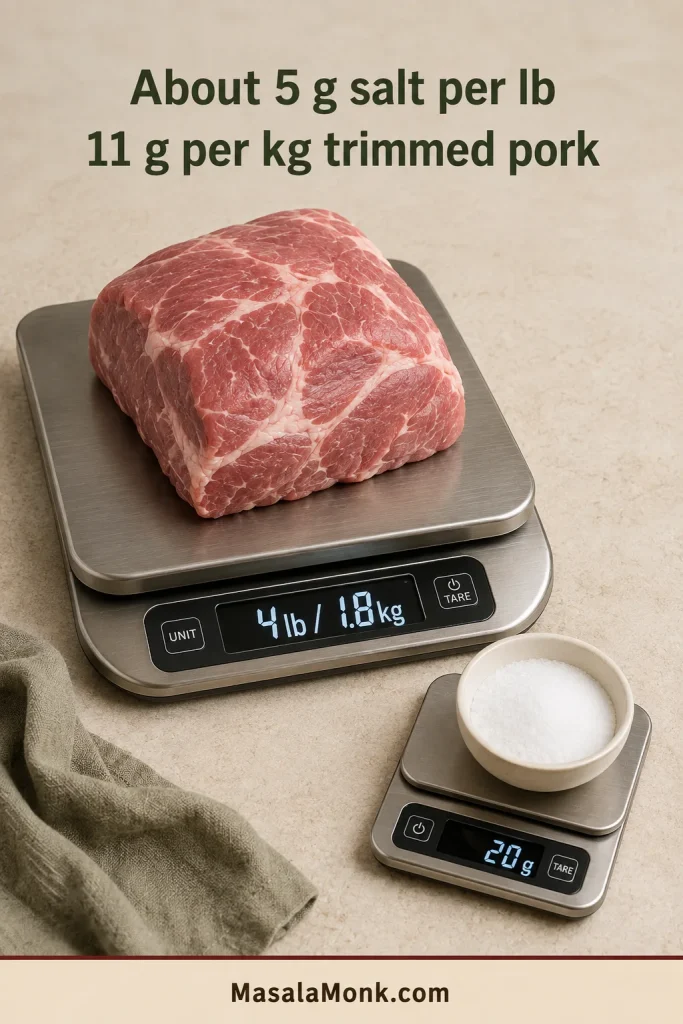
Scaling salt: Use approximately 5 g per pound or 11 g per kilogram of trimmed pork. Salt volume varies significantly by brand and crystal size.
For Crisping
Reserved cooking juices
Reserved pork fat, lard or neutral oil for skillet crisping, if needed
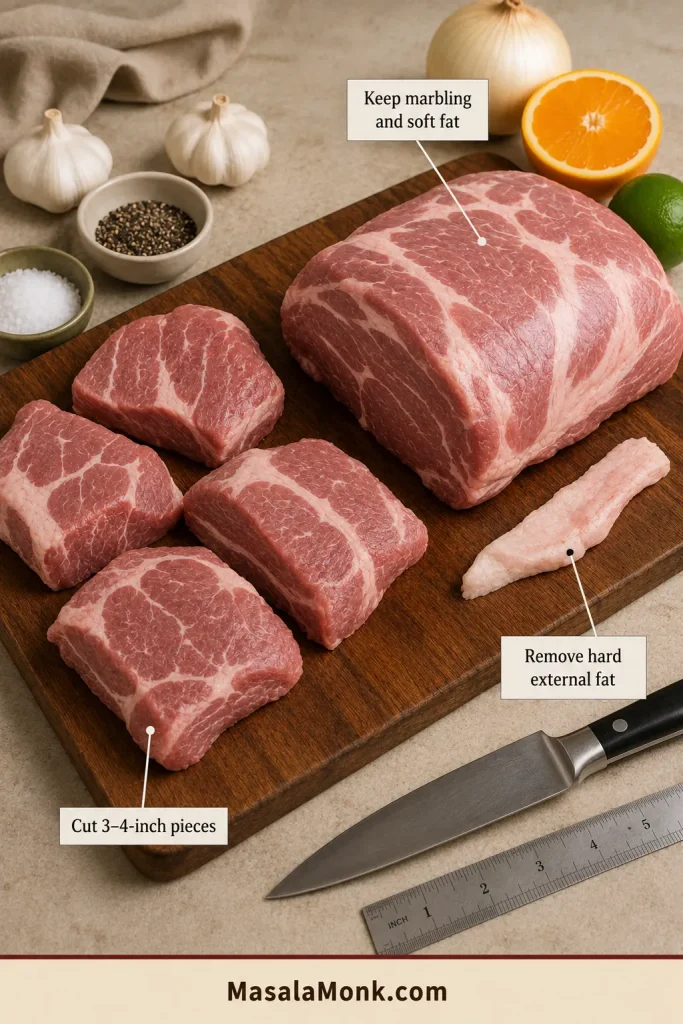
Prepare the pork. Thaw completely in the refrigerator and pat dry. Remove skin and unusually thick, hard external fat, keeping the softer fat and marbling.
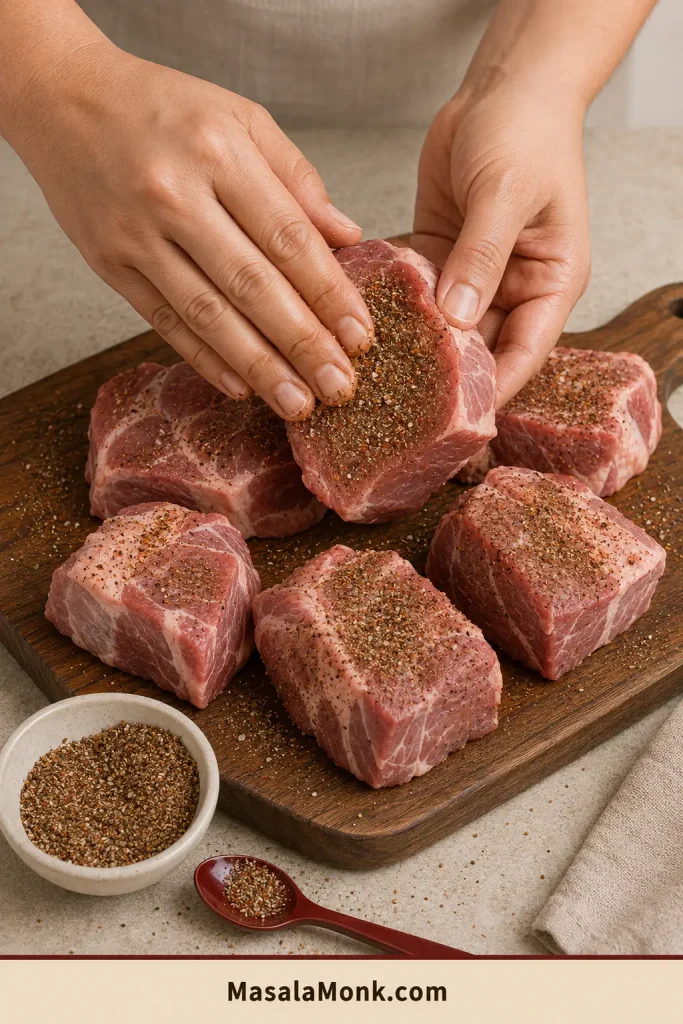
Cut and season. Divide the shoulder into roughly 3–4-inch / 7.5–10 cm pieces of similar thickness. Combine the salt, oregano, cumin, pepper and ancho chile, then coat every cut side and fold.
Load the cooker. Scatter the onion and garlic across the bottom. Arrange the pork over them, tuck in the bay leaves and pour the citrus around the meat.
Cook until tender. Cover and cook on LOW, beginning to check at 6 hours, or on HIGH, beginning to check at 3½–4 hours.
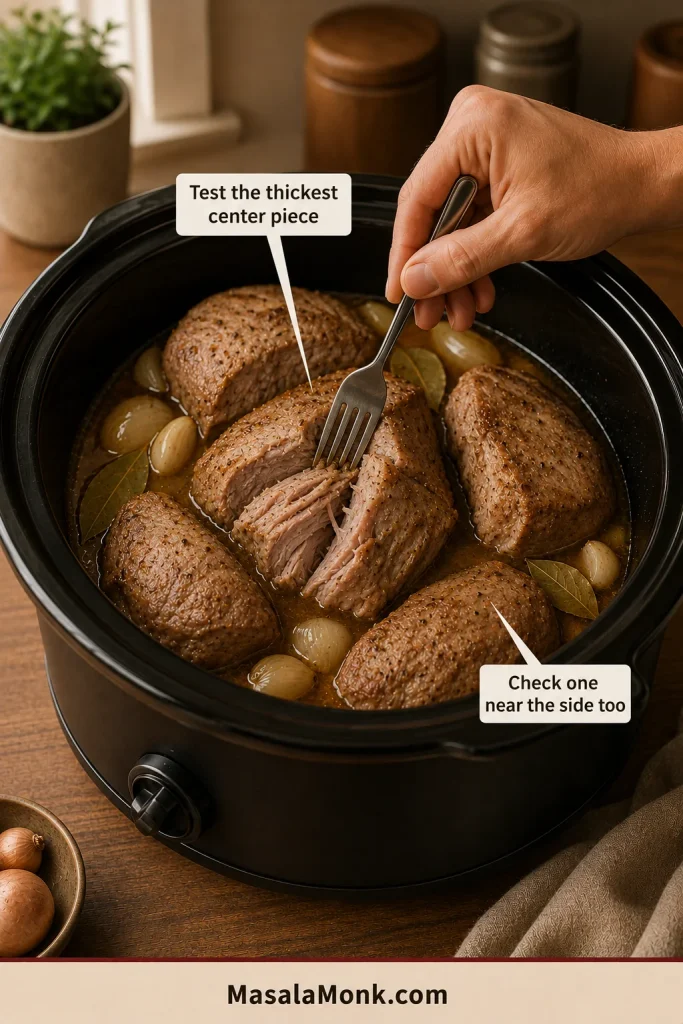
Use the fork test. Test a thick central piece and one near the side. The pork is ready when the fork turns easily and separates a broad section without force.
After the Slow Cook: Rest, Strain and Pull
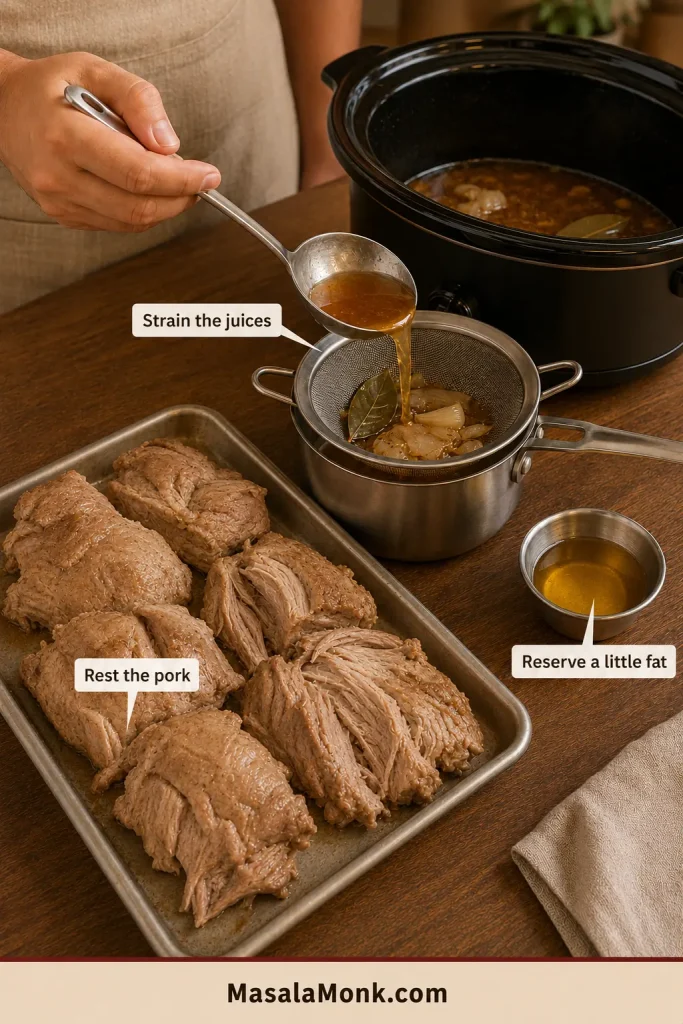
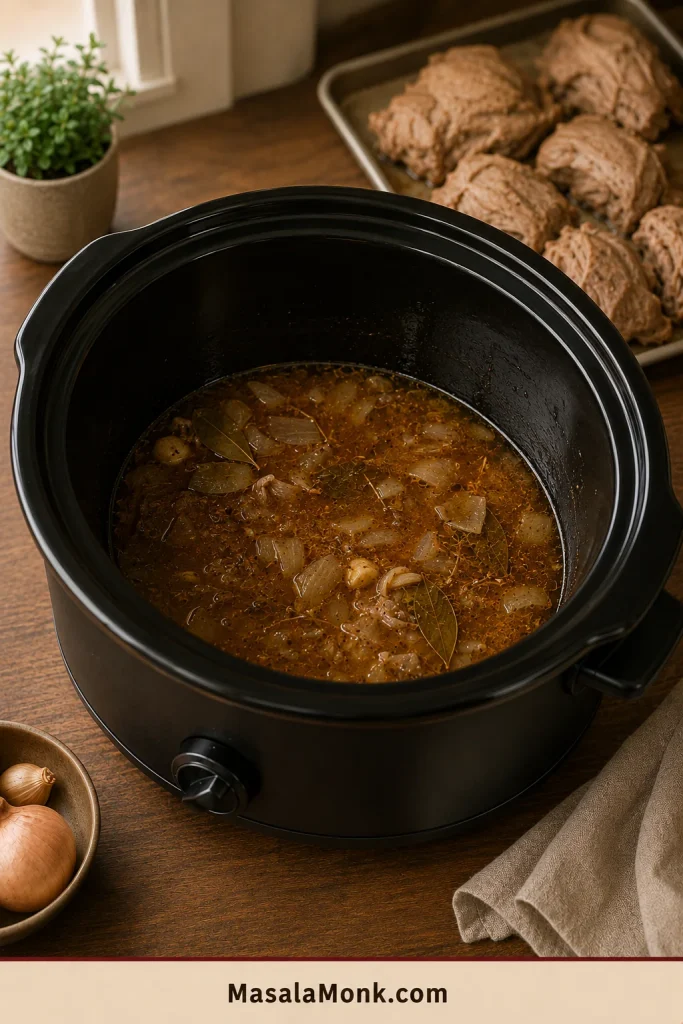
Rest and strain. Transfer the pork to a rimmed tray and let it rest for about 10 minutes while you strain the cooking liquid into a saucepan. Discard the bay leaves; discard the softened onion and garlic or save them for beans, rice or soup.
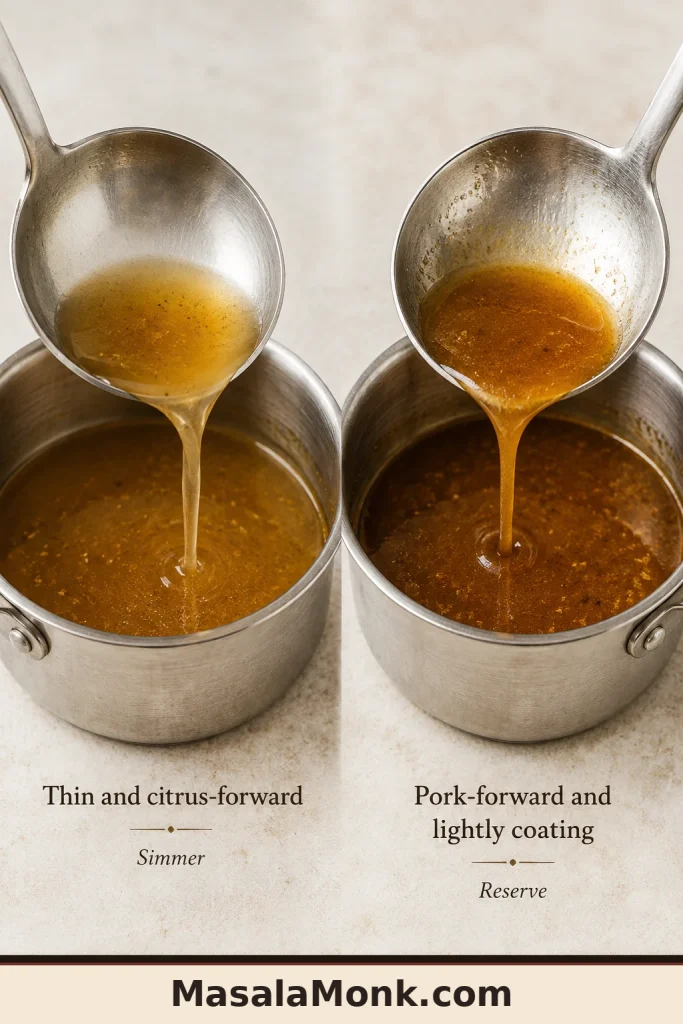
Adjust the juices. Spoon off excess fat, reserving a little for skillet crisping. Taste the strained cooking juices once they are cool enough. If they taste thin and citrusy, simmer until the orange settles into the background and the juices taste fuller and lightly coat a spoon. Set them aside as the reserved juices.
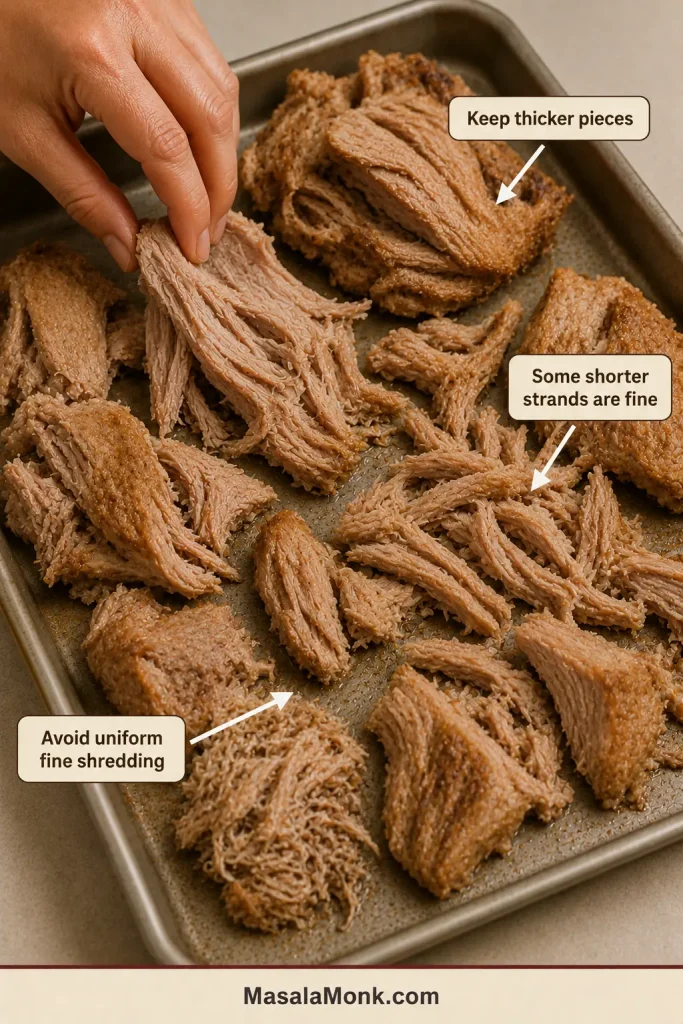
Pull the pork. Leave a mixture of meaty chunks, shorter strands and soft interior pieces.
Crisp and finish. Use the broiler for the full batch or a skillet for deeper browning. Add a measured amount of reserved juice after the crust develops. Keep the rest for serving, storage and reheating.
Use the resting window: keep the pork in broad sections while the juices are strained and a small amount of clean fat is reserved.
Rest the pork while the juices are strained, skimmed and tasted.
Broiler Finish for the Full Batch
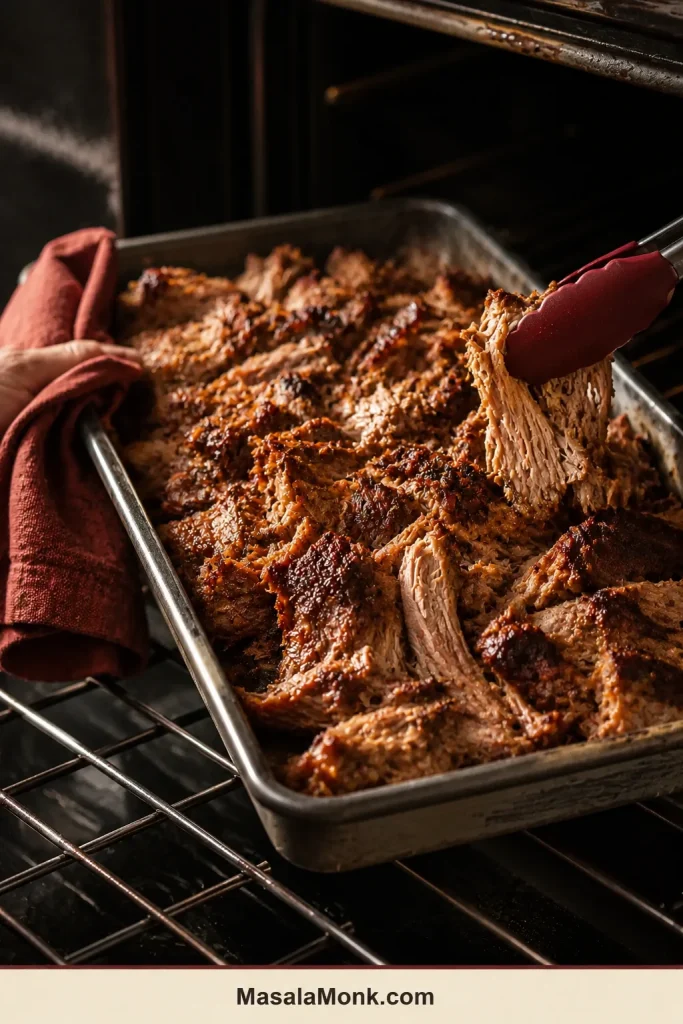
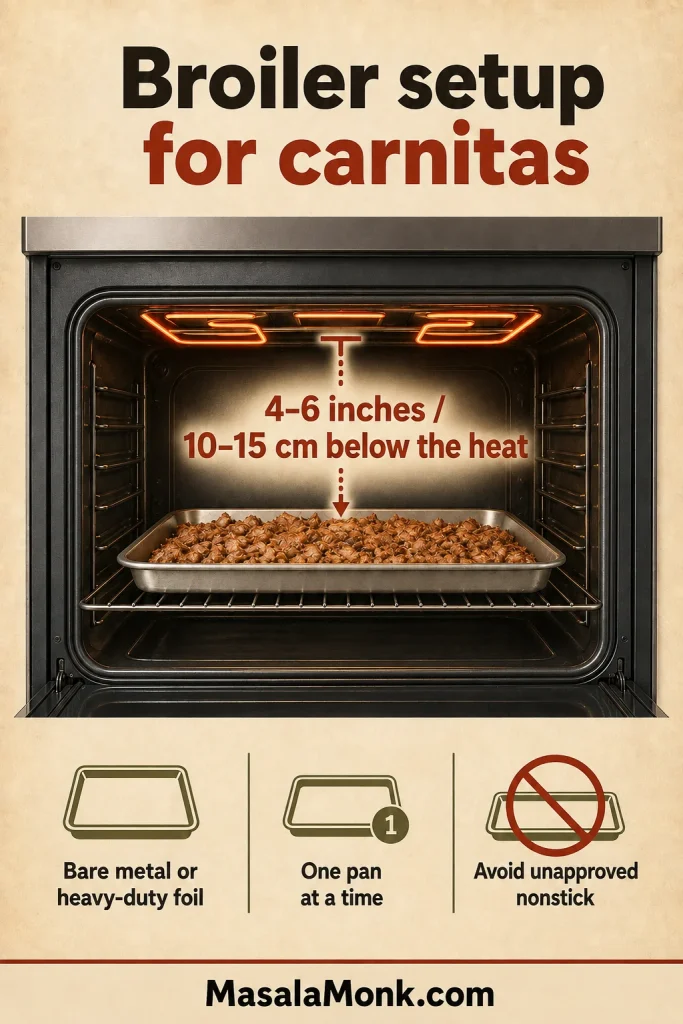
Position an oven rack so the pork will sit approximately 4–6 inches / 10–15 cm beneath the broiler. Preheat the broiler fully.
Use a bare broiler-safe metal sheet pan, or line the pan with heavy-duty foil. Avoid nonstick pans unless the manufacturer explicitly rates them for broiler use.
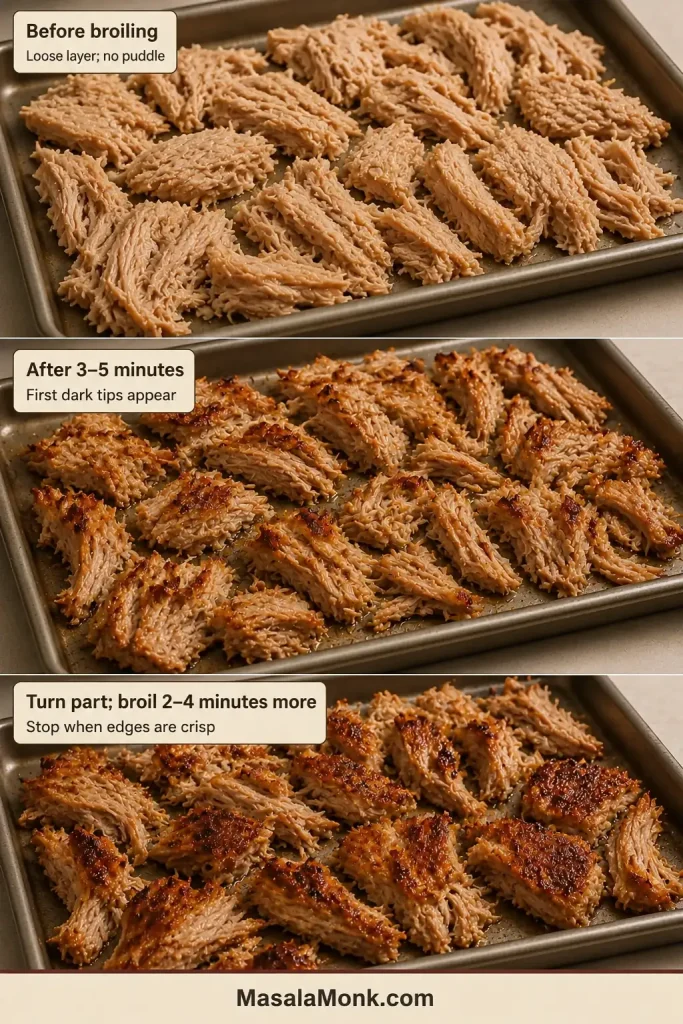
Divide the pork between two pans in loose single layers. Broil one pan at a time for the most even browning. With only one pan, work in two rounds.
If the pork already glistens, begin without adding liquid. If it looks unusually dry, drizzle with no more than 1 tablespoon / 15 ml reserved juice per pan.
Broil for 3–5 minutes. Turn roughly half the pieces, leaving some browned surfaces facing upward, then broil for another 2–4 minutes.
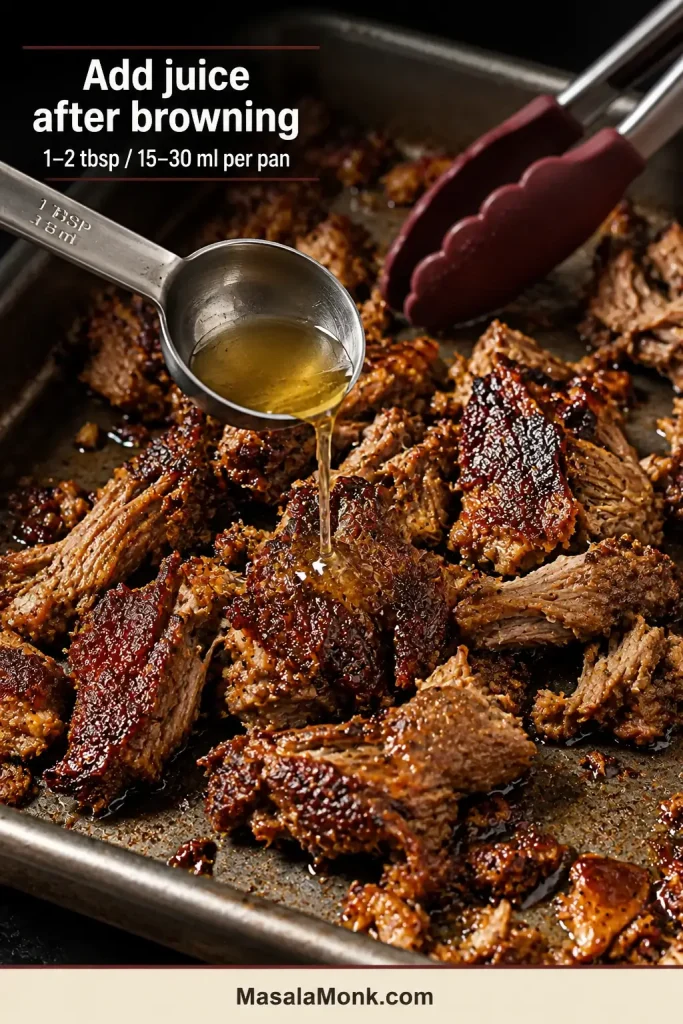
Finish each pan with 1–2 tablespoons / 15–30 ml hot reserved juices. Toss briefly and serve promptly.
Broiler Browning Cues
First dark tips mean redistribute the pork; they do not always mean stop.
The pork should already taste well seasoned before it reaches the broiler. This final step is mainly about browning.
Judge the finished tray by its range of textures rather than by one uniform shade of brown.
Stop with deeply crisp tips and thicker pieces that remain soft and juicy.
Skillet Finish for Smaller Batches
Heat a heavy skillet over medium-high heat. Add a teaspoon of reserved pork fat, lard or neutral oil if the pan is dry.
Add about 8 oz / 225 g pork to a 10-inch / 25 cm skillet, or 10 oz / 285 g to a 12-inch / 30 cm skillet.
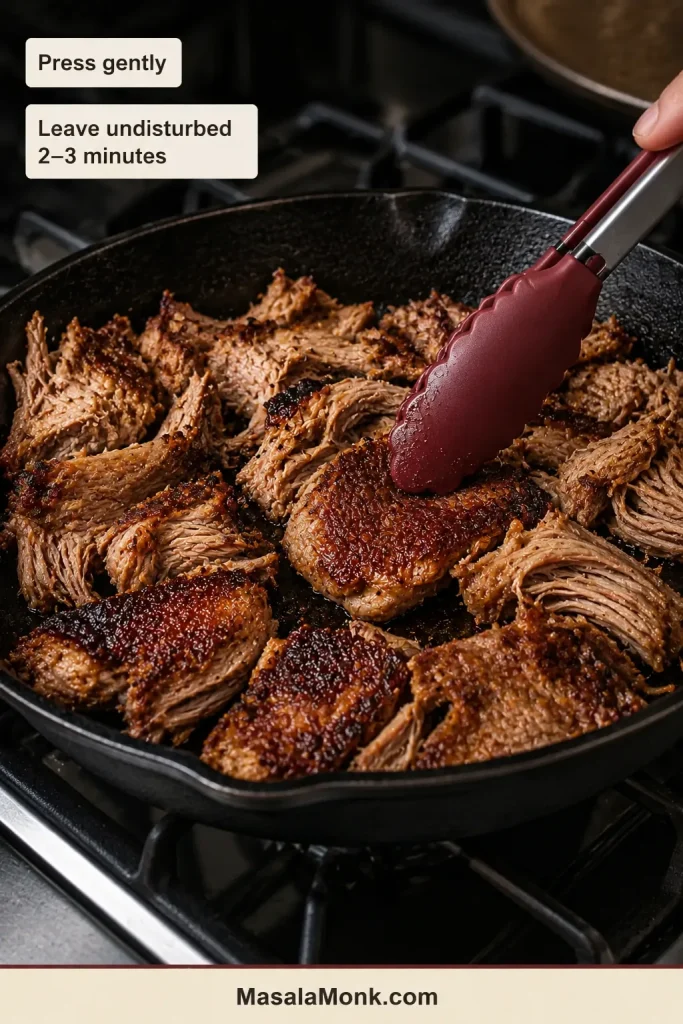
Press gently and leave undisturbed for 2–3 minutes.
Turn part of the pork and cook for another 30–60 seconds.
Remove from the heat, add about 1 tablespoon / 15 ml reserved juice and repeat with the remaining pork.
Success cue: Stop when the exposed edges are dark and crisp but the larger pieces still bend and pull apart softly. Carnitas should have contrast, not uniform crunch.
How this recipe was developed: This slow-cooker adaptation is based on established pork-shoulder cooking principles, measured salt, restrained added liquid and sensory doneness cues. Slow cookers and shoulder cuts vary, so the stated times are checking windows rather than guarantees.
Tender first. Crisp second.
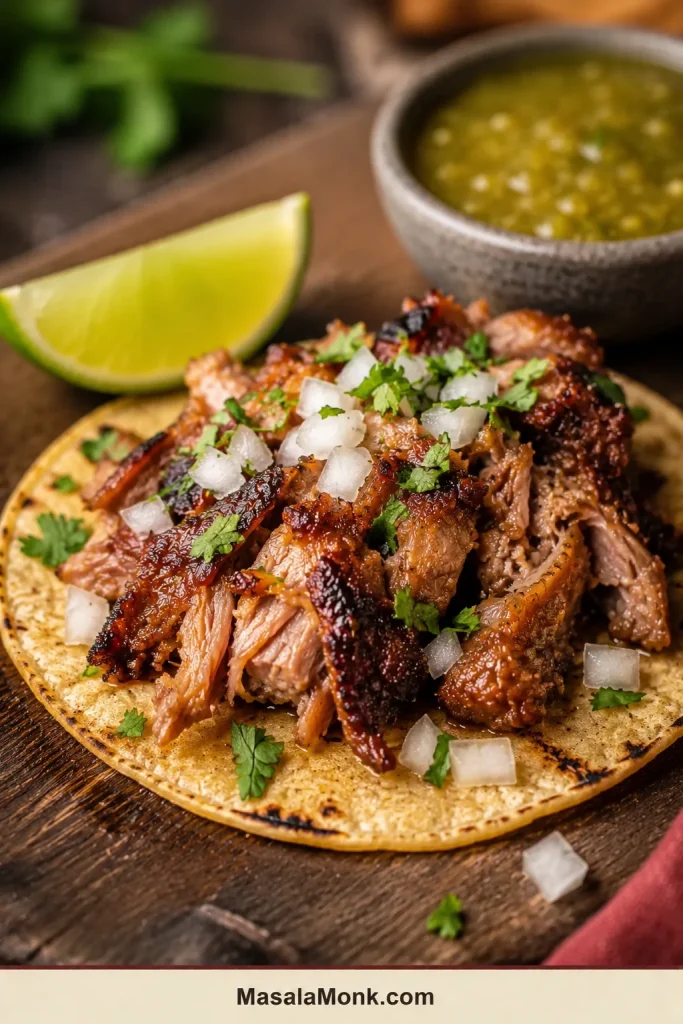
Dark crust outside, moist pork inside—the texture carnitas should keep.
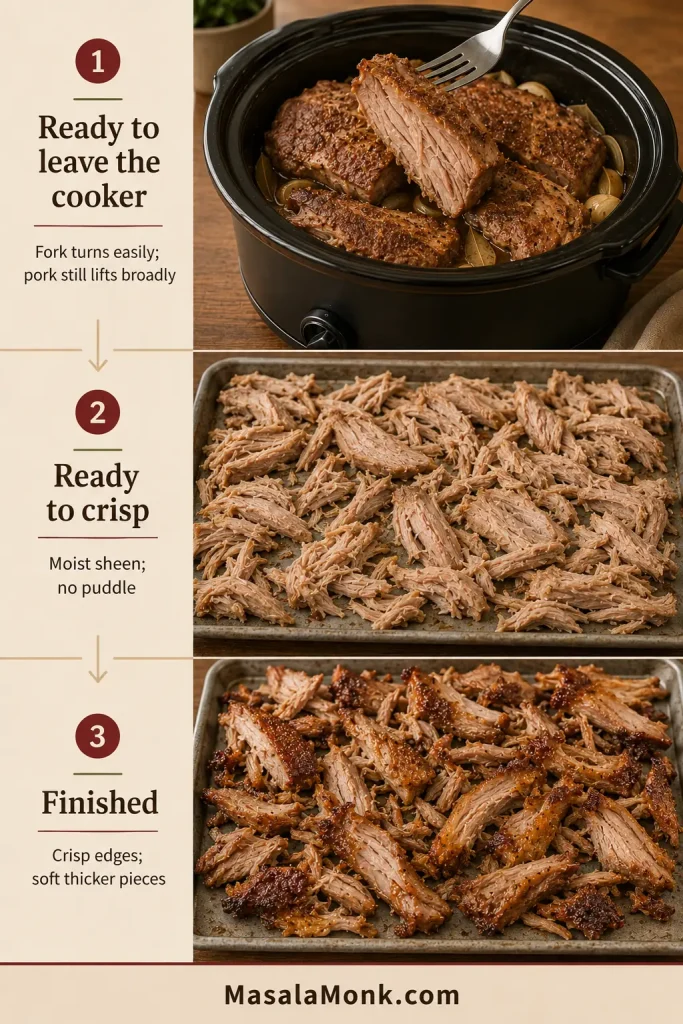
Three Signs Your Carnitas Are on Track
Watch for these three changes as the pork moves from the slow cooker to the crisping tray.
Check tenderness, surface moisture and final crust at three separate stages.
Carnitas appearance and texture checkpoints
Stage
What to look for
Ready to leave the slow cooker
A fork turns easily, but the pork still lifts in large sections
Ready to crisp
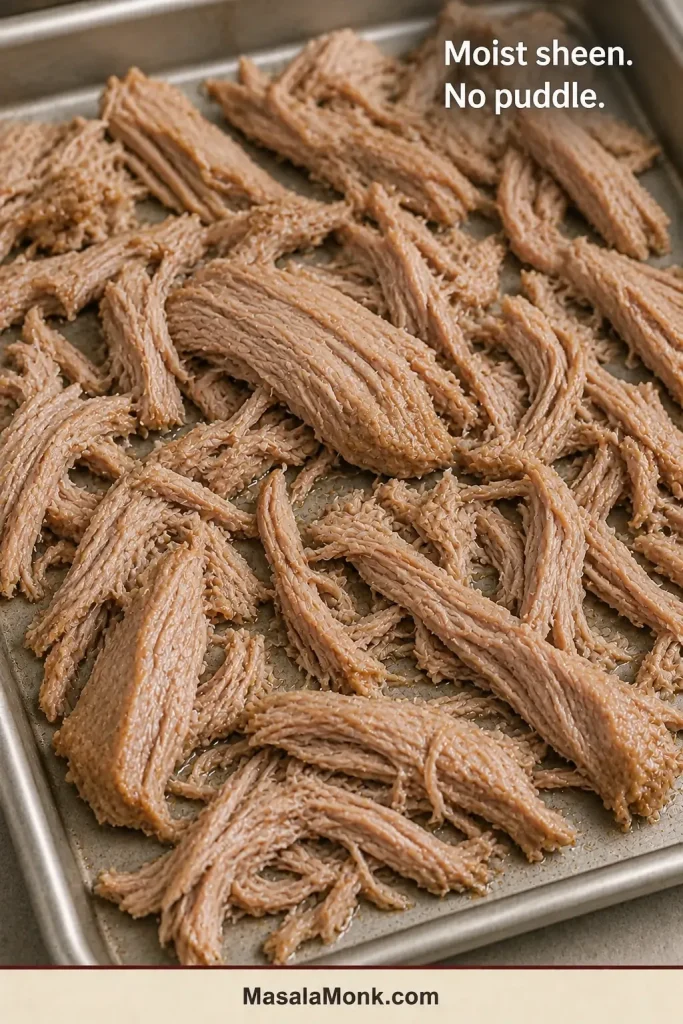
The pieces have a moist sheen, with no puddle collecting underneath
Finished
Browned undersides and crisp tips surround soft, juicy centers
Choosing the Best Pork for Carnitas
A marbled shoulder gives the slow cooker what it needs: fat for juiciness and connective tissue that softens during the long cook.
Visible marbling protects the pork through slow cooking and final crisping.
On a phone, swipe sideways to see the full table.
Pork cuts suitable for slow cooker carnitas
Pork cut
Verdict
What changes
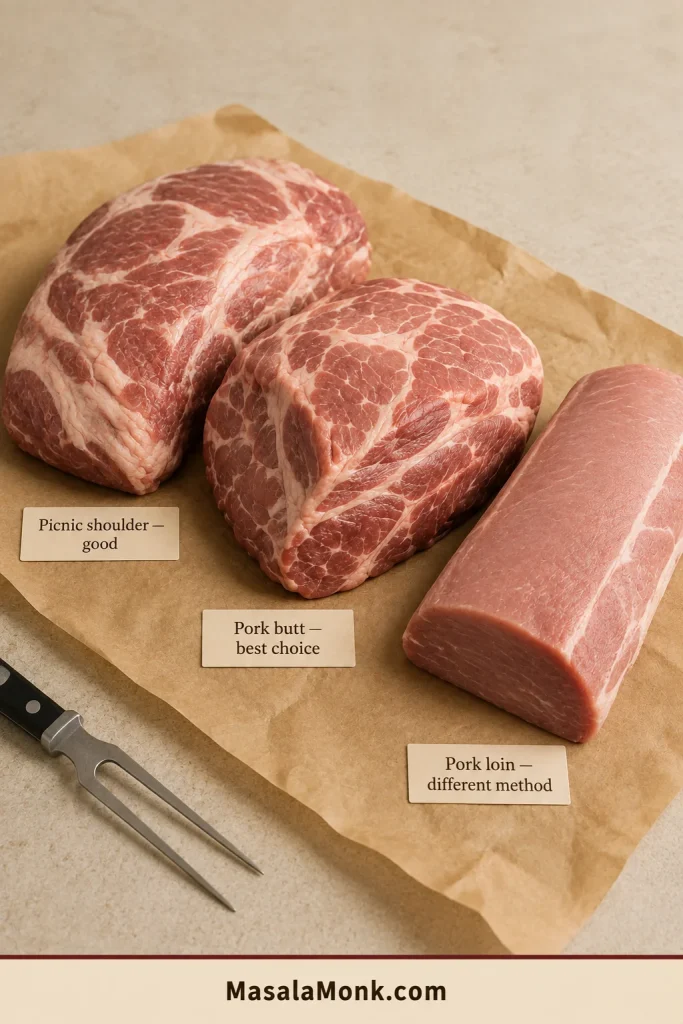
Pork butt, Boston butt or shoulder blade roast
Best choice
Well marbled, forgiving and easy to divide into large pieces
Picnic shoulder
Good
May need more trimming and can include skin or bone
Bone-in shoulder
Good but slower
Use more raw weight and expect a wider timing window
Pork loin
Separate method
Leaner and better with a shorter, gentler cook
Tenderloin or pork chops
Not suitable for this timing
Too lean and too quick-cooking for the shoulder method
Pork butt and Boston butt come from the upper shoulder. Picnic shoulder comes from lower on the front leg. Both work, but pork butt is usually more compact, well marbled and easier to prepare.
Boneless shoulder is easier to weigh, season and divide. For a roughly 5 lb / 2.25 kg bone-in shoulder, 20 g salt is a sensible starting point because part of the packaged weight is bone. Expect a later first check, and taste the reserved juices before making any final seasoning adjustment.
Remove skin and unusually thick, hard fat, but keep the softer fat and marbling.
Match the thickest sections; the pieces do not need perfect shapes.
Carnitas Ingredients and Substitutions
Salt and Seasoning
The recipe uses 20 g salt for 4 lb / 1.8 kg trimmed pork—about 1.1% by weight. Salt crystals vary too much for one universal teaspoon conversion, so a scale is the clearest option.
Salt by weight to avoid the density differences between fine, coarse and flaky crystals.
Mexican oregano brings an earthy, citrusy note. Mediterranean oregano is a practical substitute, although its flavor is more minty and herbal. Cumin stays in the background, while ancho chile adds mild warmth rather than sharp heat.
Using a carnitas seasoning packet? Check the sodium first. With a salted packet, leave out the recipe salt initially and adjust only after tasting the reserved juices.
Citrus and Added Liquid
Orange rounds out the garlic and spices without making the pork taste sweet. Lime brings a sharper edge, so most of it is better saved for the table. Fresh juice is best, and there is no need to add peel—the long cook can draw bitterness from it.
No orange juice? Replace it with the same amount of unsalted chicken broth or water. Use only 1 tablespoon / 15 ml lime juice in the cooker, then brighten the finished pork with fresh lime.
A shallow layer of liquid is enough. Starting with cups of broth gives the pork a weaker flavor and leaves much more moisture to manage before browning.
Do You Need to Sear the Pork?
No. Searing can add another layer of browned flavor, but that crust softens during hours of moist cooking. Skip it for a simpler start; the final crisping stage matters more.
Want to change the flavor?
More Pork-Forward Carnitas
Reduce the cumin to ¾ teaspoon, leave out the ancho chile powder and use only 1 tablespoon / 15 ml lime juice. Offer more lime at the table and use reserved pork fat for skillet crisping.
Smoky Chipotle Carnitas
Add 1 finely chopped chipotle pepper in adobo with 1–2 teaspoons of the sauce. Leave out the ancho chile powder at first because the chipotle will taste stronger after the juices reduce.
A spoonful of fresh mango salsa gives the smoky pork a cool, bright contrast.
Beer or Mexican Coke
Beer: Replace ¼ cup / 60 ml orange juice with the same amount of mild lager.
Mexican Coke: Replace ¼ cup / 60 ml orange juice with cane-sugar cola for a sweeter finish.
Keep the total liquid unchanged so the pork does not take longer to brown.
Half-Batch Slow Cooker Carnitas
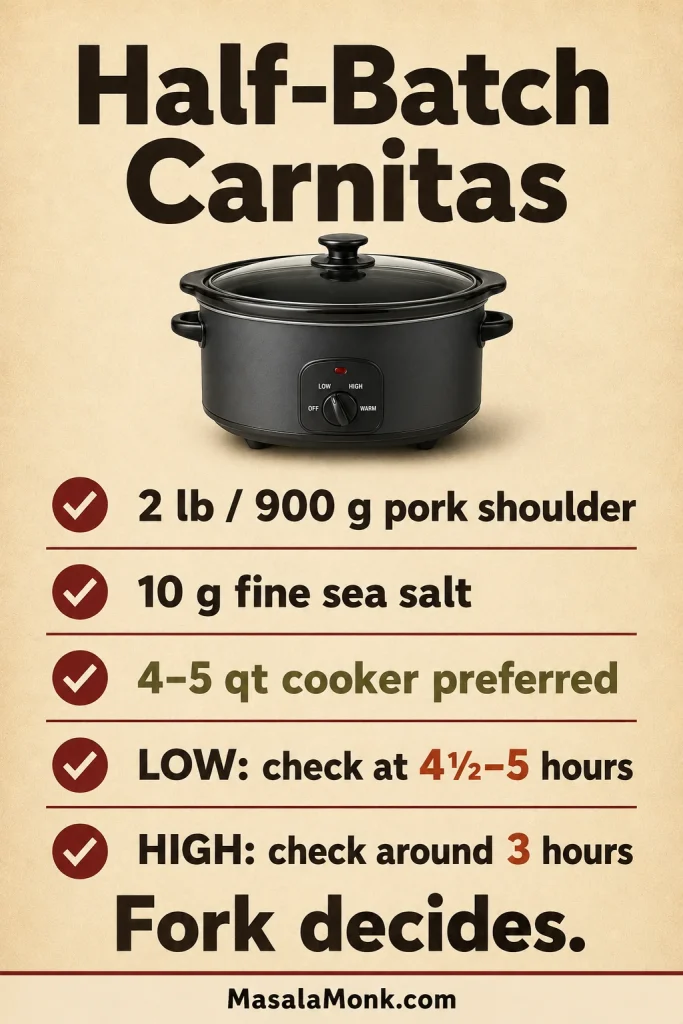
Cooking for fewer people? Make the 2 lb / 900 g half batch
A 4–5 qt / 3.8–4.7 L slow cooker gives a half batch the best fit. A 6-quart model also works, but the shallower fill may alter evaporation and timing.
2 lb / 900 g pork shoulder, weighed after major trimming
10 g fine sea salt
1 teaspoon Mexican oregano
¾ teaspoon ground cumin
½ teaspoon black pepper
½ teaspoon ancho chile powder
½ large onion, about 4–4½ oz / 110–125 g
4 garlic cloves
¼ cup / 60 ml orange juice
1 tablespoon / 15 ml lime juice
1 bay leaf
Begin checking at 4½–5 hours on LOW or around 3 hours on HIGH. A common window is 5½–7 hours on LOW or 3½–4½ hours on HIGH, but the fork still decides.
Half-batch planning: quantities scale directly, but cooker fit and the first tenderness check still need their own adjustment.
Use a smaller cooker and begin checking earlier; cooking time does not halve.
Carnitas vs Slow Cooker Pulled Pork
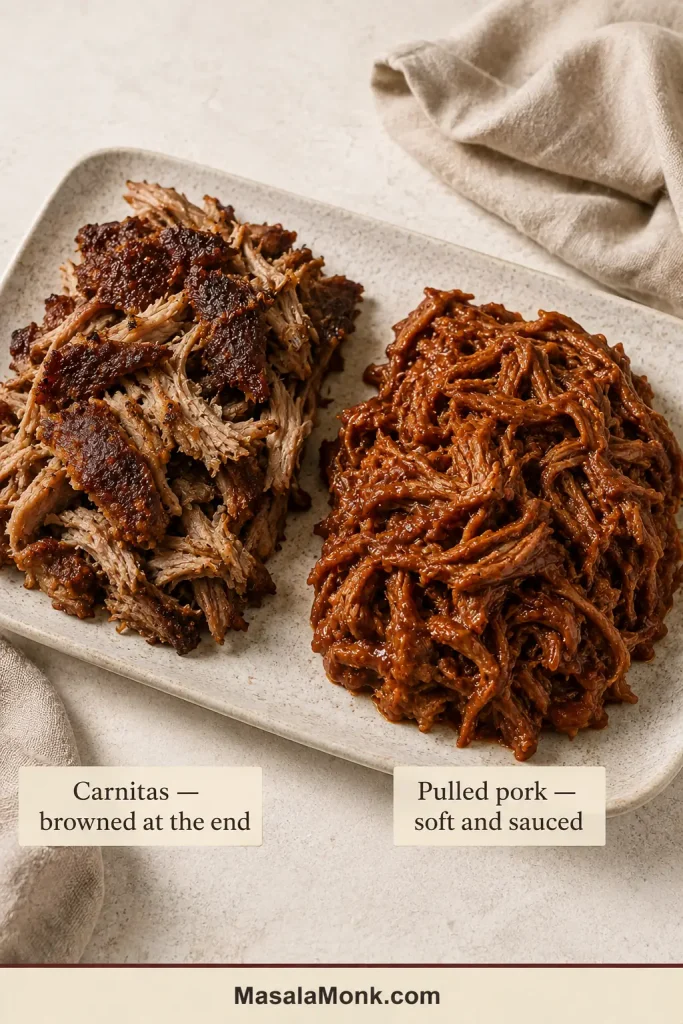
Carnitas are often described as Mexican pulled pork, but the comparison only goes so far. Both can begin with pork shoulder; the seasoning, texture and finish move in different directions.
Carnitas need exposed browned surfaces, not merely separated pork fibers.
This slow-cooker version uses citrus, oregano and restrained spices; barbecue pulled pork leans more heavily on rub, smoke, vinegar and sauce.
Broader, irregular pieces are typical of carnitas; pulled pork is usually separated into finer strands.
Dry heat gives carnitas their browned finish; pulled pork generally stays soft and coated with sauce.
Tacos, tostadas and bowls suit carnitas naturally; barbecue pork fits buns, sliders and barbecue plates.
This slow-cooker version uses moist heat for tenderness, then adds a separate browning stage for the crisp-soft finish.
Why Each Step Matters for Juicy, Crisp Carnitas
Cut and Season Large Pieces
Large pieces reach tenderness more predictably than one compact roast while keeping enough mass to stay succulent. Similar thickness matters more than perfect shape. Mix the salt and spices before applying them, then press the seasoning into the freshly cut surfaces and folds.
Season every cut face so flavor reaches beyond the original exterior.
Load the Cooker and Leave It Closed
Put the onion and garlic beneath the shoulder, where the released juices will collect. Pour the citrus around the edges. The cooker may look almost dry, but the pork will release moisture and fat as it cooks. Early stirring and repeated lid lifting only slow the process.
The liquid starts low, then rises as the shoulder releases fat and juices.
Check the Center and the Edge
Slow cookers often run hotter near the walls, so test the thickest central piece and one near the side. If the fork still meets resistance at the expected time, close the lid and give the pork another 30 minutes. Nothing has gone wrong; the connective tissue simply needs longer.
If the edge yields but the thick center resists, keep cooking.
When the fork finally turns easily, the uncertain part is over. The bright citrus aroma should have softened, and the cooker should smell much more deeply of pork, garlic and oregano. The shoulder is ready for the high-heat finish that gives carnitas their contrast.
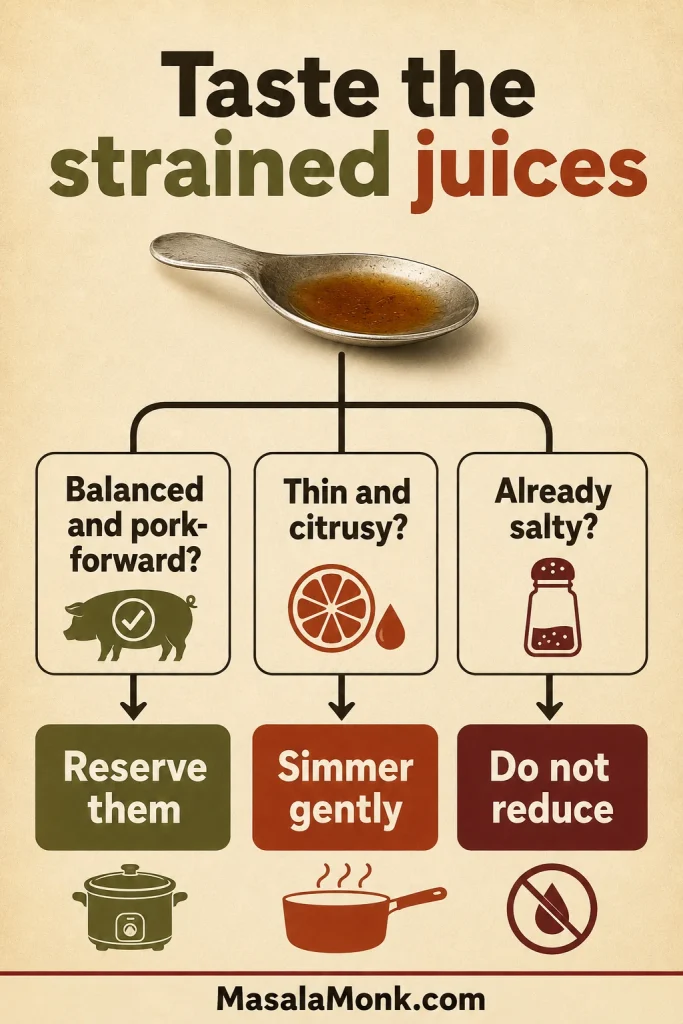
Taste the Juices Before Reducing Them
When you lift the lid, there may be far more cooking liquid than expected. Most of it came from the shoulder itself. Strain it, spoon off only the excess fat and taste once it has cooled enough.
Much of the final liquid rendered directly from the pork shoulder.
If the strained juices taste thin and citrusy, simmer until the orange settles into the background and the flavor becomes fuller and more savory. The finished juices should taste primarily of pork and garlic, with the citrus supporting the flavor rather than leading it.
Reduce for fuller flavor, stopping before the juices turn sticky or overly salty.
Stop when the liquid lightly coats a spoon. Juices that already taste balanced do not need reducing.
Reduce only thin juices; balanced or salty juices should stay as they are.
Preserve Some Thicker Pieces
Keep some meaty pieces among the shorter strands, then pull only as much as needed for the first tray or skillet batch. Their edges can brown while their centers remain soft, and larger pieces can always be separated further at the table.
Thin strands crisp first; thicker pieces protect the juicy interior.
The clock tells you when to start checking. The fork tells you when to stop.
Temperature guides the check; fork resistance decides when the shoulder is tender.
On a phone, swipe sideways to see the full table.
Slow cooker pork carnitas cooking times
Pork size and shape
Setting
Begin checking
Common working window
2 lb / 900 g large pieces
LOW
4½–5 hours
5½–7 hours
2 lb / 900 g large pieces
HIGH
About 3 hours
3½–4½ hours
4 lb / 1.8 kg large pieces
LOW
About 6 hours
6½–8½ hours
4 lb / 1.8 kg large pieces
HIGH
3½–4 hours
4–5½ hours
4 lb / 1.8 kg whole boneless roast
LOW recommended
About 8 hours
8–10 hours
Bone-in shoulder
LOW recommended
Later than equivalent boneless pieces
Depends on bone, thickness and roast shape
LOW is the better choice for whole and bone-in shoulders because their thickness makes HIGH timing less predictable. All of these times are checking guides rather than guarantees; cooker shape, starting temperature and batch depth also affect the finish.
Safe Temperature Is Not the Same as Tenderness
Whole-muscle pork is considered safe at 145°F / 63°C followed by a three-minute rest, but shoulder is normally still firm at that point. Begin checking more closely around 190°F / 88°C. Pull-apart tenderness commonly arrives around 195–205°F / 91–96°C, but the fork makes the final decision.
Thaw pork before slow cooking and keep the lid closed until the first planned check. USDA slow-cooker safety guidance also recommends reheating cold leftovers outside the slow cooker before transferring them to a cooker for hot holding.
Use the Fork Test
Not ready: The fork needs pressure, twisting feels tight, or the meat springs back.
Ready: The fork enters easily, turns with little resistance and separates a broad section.
Very soft: The pork collapses into fine strands with almost no pressure. Remove it promptly and handle it gently; it can still taste excellent, but it will not hold larger pieces as well.
How to Make Carnitas Crispy Without Drying the Pork
Once the pork is tender, its surface needs strong heat and enough space for moisture to escape.
Choose the Best Crisping Method
Broiler: Best for a full family or party batch. It handles the most pork at once and produces varied crisp edges.
Skillet: Best for smaller portions and the deepest contact browning. Work in batches so the meat fries instead of steaming.
Air fryer: Best for freshly cooked pork or a small portion of refrigerated leftovers. It can reheat and crisp the pork in the same step.
Set the broiler rack before the pork reaches the tray. Position the meat 4–6 inches / 10–15 cm below the element so the edges brown quickly without scorching.
Four to six inches balances fast browning with enough control to avoid scorching.
How Wet Should the Pork Be?
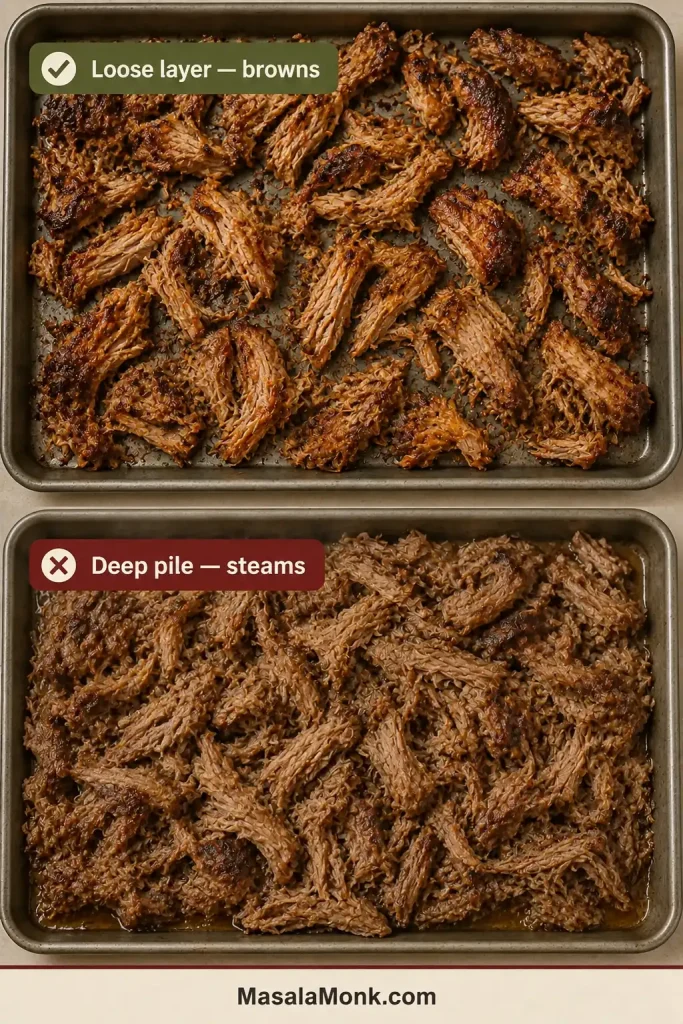
The pieces should glisten, with no puddle collecting underneath. If the tray begins looking soupy, divide the pork before giving it more heat. As the surface dries, the soft hiss of steam becomes a sharper sizzle. That is when the crust begins to form.
A light sheen is useful; a puddle traps steam and prevents browning.
A loose layer browns; a deep pile steams.
Open gaps release steam and let the pork surface grow hotter.
Reserved juices belong in the finishing stage, after dry heat has already done the work of building a crust.
Add measured juice after browning so the finished crust stays intact.
What skillet browning should look like: the deepest color develops on the flat surfaces that remain in contact with the hot pan.
Stillness against the skillet creates the deepest contact crust.
Air-Fryer Carnitas
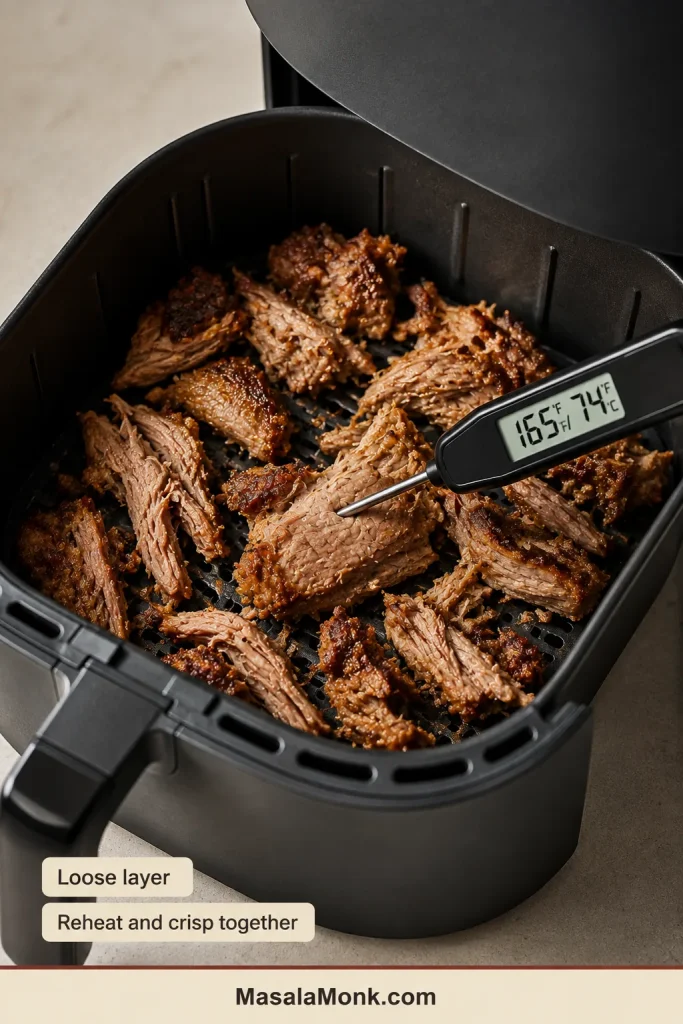
For refrigerated leftovers, use the air fryer to reheat and crisp the pork at the same time. Continue cooking until the center reaches 165°F / 74°C and the edges are browned. Cold pork may need longer than freshly cooked pork.
Preheat the air fryer to 400°F / 200°C.
Add about 8 oz / 225 g pork in a loose layer. If it looks dry, toss it with 1–2 teaspoons of reserved juice.
Air-fry for 3 minutes, then toss or turn part of the pork.
Continue until the center reaches 165°F / 74°C and the edges are crisp. Freshly cooked pork commonly needs another 1–3 minutes; refrigerated pork may need longer.
Air circulation crisps small portions quickly, so watch the thinnest strands.
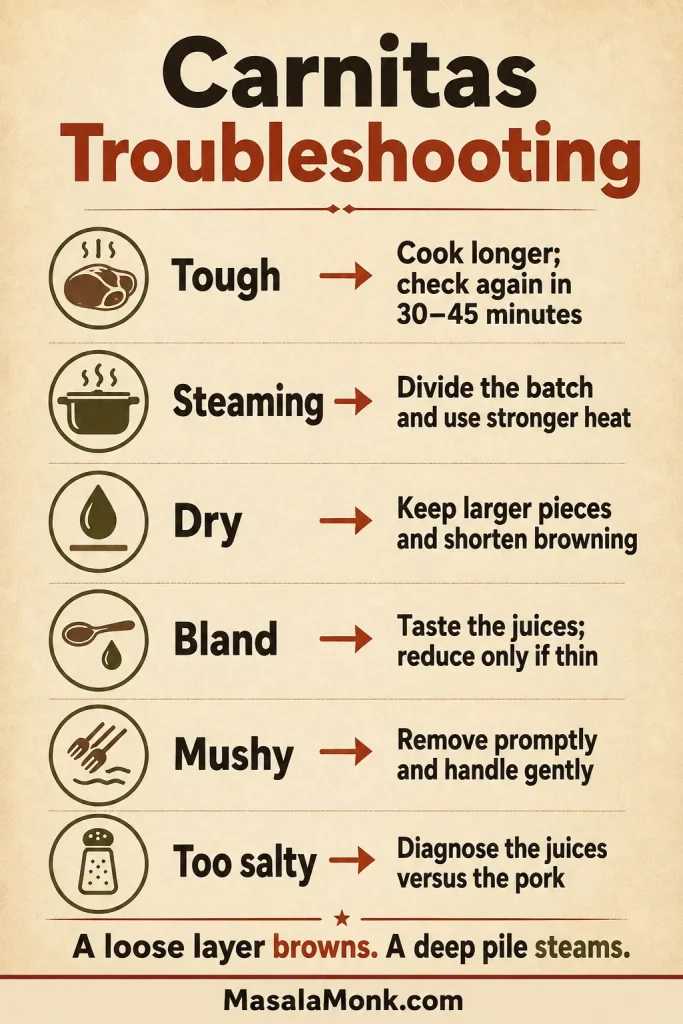
Slow Cooker Carnitas Troubleshooting
Most problems trace back to tenderness, tray moisture or high-heat timing.
On a phone, swipe sideways to see the full table.
Common slow cooker carnitas problems and fixes
Problem
Likely cause
What to do
Pork is still tough
The connective tissue has not softened
Cover and continue cooking; check again in 30–45 minutes
Pork is mushy
Small pieces, overcooking or a long hold in hot liquid
Drain promptly and crisp broad portions carefully
Too much liquid
The shoulder released moisture and fat
Strain, skim and reduce only what you need
Pork will not crisp
Wet surface, crowding or weak heat
Divide it into loose batches and fully preheat the broiler or skillet
Pork dries beneath the broiler
Pieces are too fine or the second pass is too long
Keep larger pieces and finish with a measured spoonful of juice
Carnitas taste bland
Watery juices or no final seasoning check
Reduce the strained juices if needed, then adjust salt and lime
Carnitas are too salty
The juices are too salty, or the pork itself is over-seasoned
When the juices are too salty, use less of them. Balance over-seasoned pork with plain tortillas, unsalted beans, avocado or rice
The Pork Is Still Tough
A shoulder that is hot but still stubborn simply needs more time. Fully cooked pork can remain tight before its connective tissue has softened enough to pull apart.
If the cooker also looks unusually dry, add a small amount of hot water or unsalted broth around the meat. This is most likely with a small batch in a large cooker.
The Pork Turned Mushy
Mushiness usually comes from small pieces, a long hold after tenderness, repeated stirring or leaving fine strands submerged in all the cooking liquid. Remove finished shoulder promptly and rest it in larger sections. Browning can improve a soft exterior, but it cannot rebuild the meat’s structure.
The Pork Is Steaming Instead of Browning
Move half the pork to another tray or skillet. Let pooled moisture evaporate, then leave the pieces alone long enough for a crust to form.
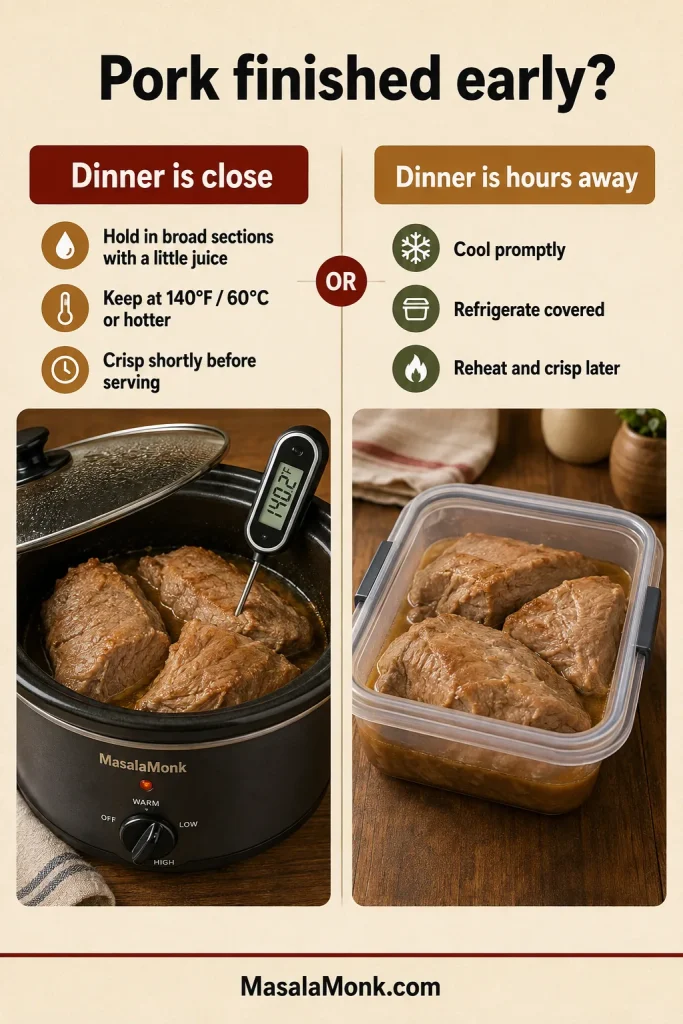
The Pork Finished Early
If dinner is close, hold the pork in large sections with a modest amount of juice on WARM only when a thermometer confirms that it remains at 140°F / 60°C or hotter. Crisp it shortly before serving.
If the meal is still several hours away, cool and refrigerate the pork promptly. Reheat and crisp it closer to dinner instead of leaving it on a long hot hold.
Hold briefly above 140°F / 60°C; chill promptly for a longer delay.
Bring the first tray straight to the table rather than covering it. Warm tortillas, chopped onion, cilantro, lime and one bright salsa are enough; the pork should still be the part everyone notices first.
Let everyone take the crispest pieces while the next batch browns. The last person to build a taco still gets pork fresh from the heat.
Serve in waves so each tray reaches the table with crisp edges.
The Simplest Carnitas Taco
Warm corn tortilla
Crisp-edged carnitas
Finely chopped white onion
Fresh cilantro
A squeeze of lime
Roasted salsa verde or a bright red salsa
Fresh, restrained toppings keep the browned pork in focus.
For a creamier taco, add one rich element rather than several. A small spoonful of fresh guacamole softens the crisp edges without burying the pork.
Build a Carnitas Taco Bar
Warm corn and flour tortillas
Pickled red onions and radish slices
Guacamole or diced avocado
Pico de gallo
Cotija or another crumbly cheese
Black beans or refried beans
Lime wedges
Separate components protect the crust and let guests build to taste.
Add black beans and a bowl of fluffy rice for guests who would rather build a carnitas bowl.
How Much Carnitas Per Person?
On a phone, swipe sideways to see the full table.
Estimated carnitas serving portions
Serving style
Pork quantity
Approximate yield
Small taco
1½–2 oz / 40–55 g per taco
20–30 tacos
Taco meal with sides
3–4 oz / 85–115 g per person
10–14 people
Hearty tacos or bowl
4–5 oz / 115–140 g per person
8–11 people
Large plated main
5–6 oz / 140–170 g per person
7–9 people
Other Ways to Use Carnitas
Use leftovers in quesadillas, burrito bowls, tostadas, breakfast hash or loaded potatoes, crisping the pork before adding it whenever the dish allows. For breakfast meal prep, the cooling and reheating approach in these breakfast burritos helps keep the tortillas from becoming wet or chewy.
Storing, Freezing and Reheating Carnitas
Carnitas are unusually good make-ahead food—as long as you save the crisping for later.
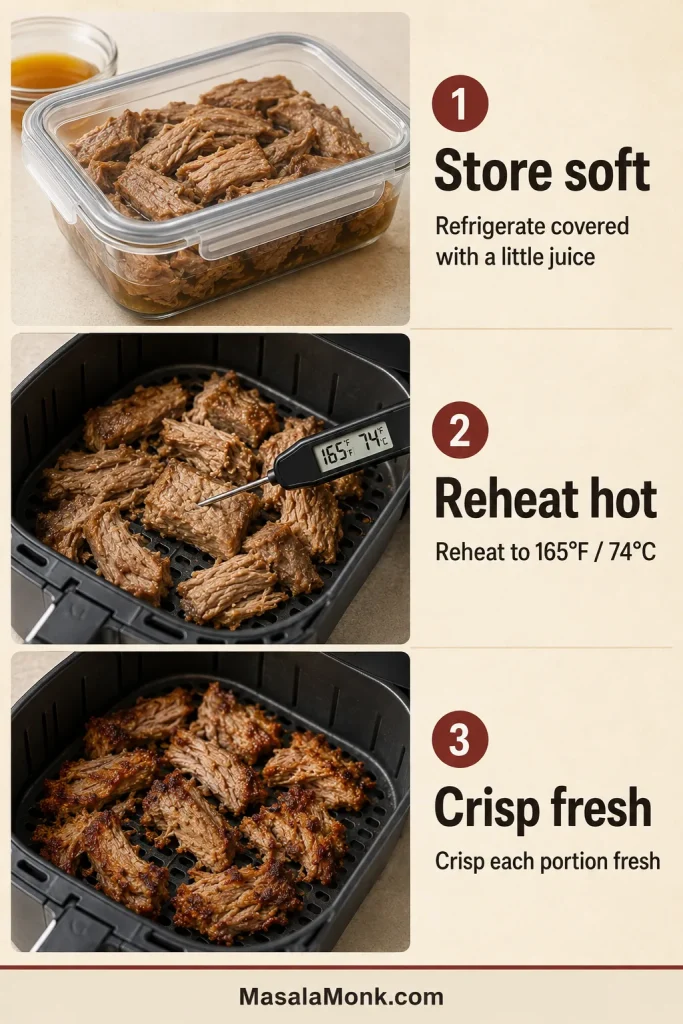
Keep any pork you are not serving soft and juicy. Tomorrow, warm one portion with a little juice, let the surface dry and crisp it fresh so the browned edges return.
Store the pork soft and juicy, then crisp each portion before serving.
Refrigerating Carnitas
Divide the pork into shallow containers and refrigerate within two hours.
Add enough reserved juice to keep it moist without submerging it.
Keep the remaining juices in a separate container.
Use refrigerated carnitas within 3–4 days.
Crisp only the portion you are about to serve.
Freezing Carnitas
Freeze the pork before crisping in practical meal portions. About 1 lb / 454 g suits a family meal, while 8 oz / 225 g works well for one or two people.
Place each portion in a freezer-safe bag or container.
Add 2–4 tablespoons / 30–60 ml reserved juice per pound / 454 g pork.
Press freezer bags flat to remove excess air.
Label each portion with its date and weight.
Freeze the remaining juices in small portions.
For best quality, use frozen carnitas within about three months.
Reheat Without Drying the Pork
Thaw frozen carnitas in the refrigerator when time allows.
Reheat with a little reserved juice on the stove, in the microwave, in a conventional oven or in the air fryer until the pork reaches 165°F / 74°C.
Allow excess surface moisture to evaporate.
Crisp the pork in a skillet, beneath the broiler or in the air fryer.
Add a small spoonful of hot juice after browning.
Reheat cold leftovers outside the slow cooker. Once fully hot, the pork can be transferred to a preheated cooker and held at 140°F / 60°C or above.
Slow Cooker Pork Carnitas FAQ
Can You Put Frozen Pork in a Slow Cooker?
Thaw pork completely in the refrigerator before slow cooking. Frozen or partly frozen meat may take too long to heat through safely in a slow cooker, and it also makes the cooking window difficult to predict.
Should the Pork Be Covered With Liquid?
No. A shallow layer is enough. The shoulder releases substantial moisture and fat as it cooks.
Can You Cook the Shoulder Whole?
Yes, as long as it fits without pressing against the lid. Place a whole boneless roast with the fattier side facing upward, season it all over and pour the citrus around it. Use LOW and expect a later first check and a wider timing window.
Is LOW or HIGH Better?
LOW gives the broadest and most forgiving window. HIGH works for large boneless pieces when time is limited, but begin checking earlier and watch closely once the meat starts separating.
Can You Halve the Recipe?
Yes. Use the 2 lb / 900 g half-batch quantities above. A 4–5-quart slow cooker gives the smaller batch the best fit, although a 6-quart cooker can also work with a wider timing window.
Tender First, Crisp Second
Serve the pork straight from the tray while the dark edges are crisp and the larger pieces still pull apart softly inside.
Made these carnitas? Tell us whether you cooked them on LOW or HIGH and which crisping method you preferred. If you noted the pork weight, cooker size or fork-tender time, include those too—they may help the next person making dinner.
Brisket asks for most of a day, so uncertainty near the end can feel bigger than it does with an ordinary roast. One piece is broad and relatively thin. Another is tied into a thick, compact joint. Both may weigh the same, yet one can become tender noticeably earlier than the other.
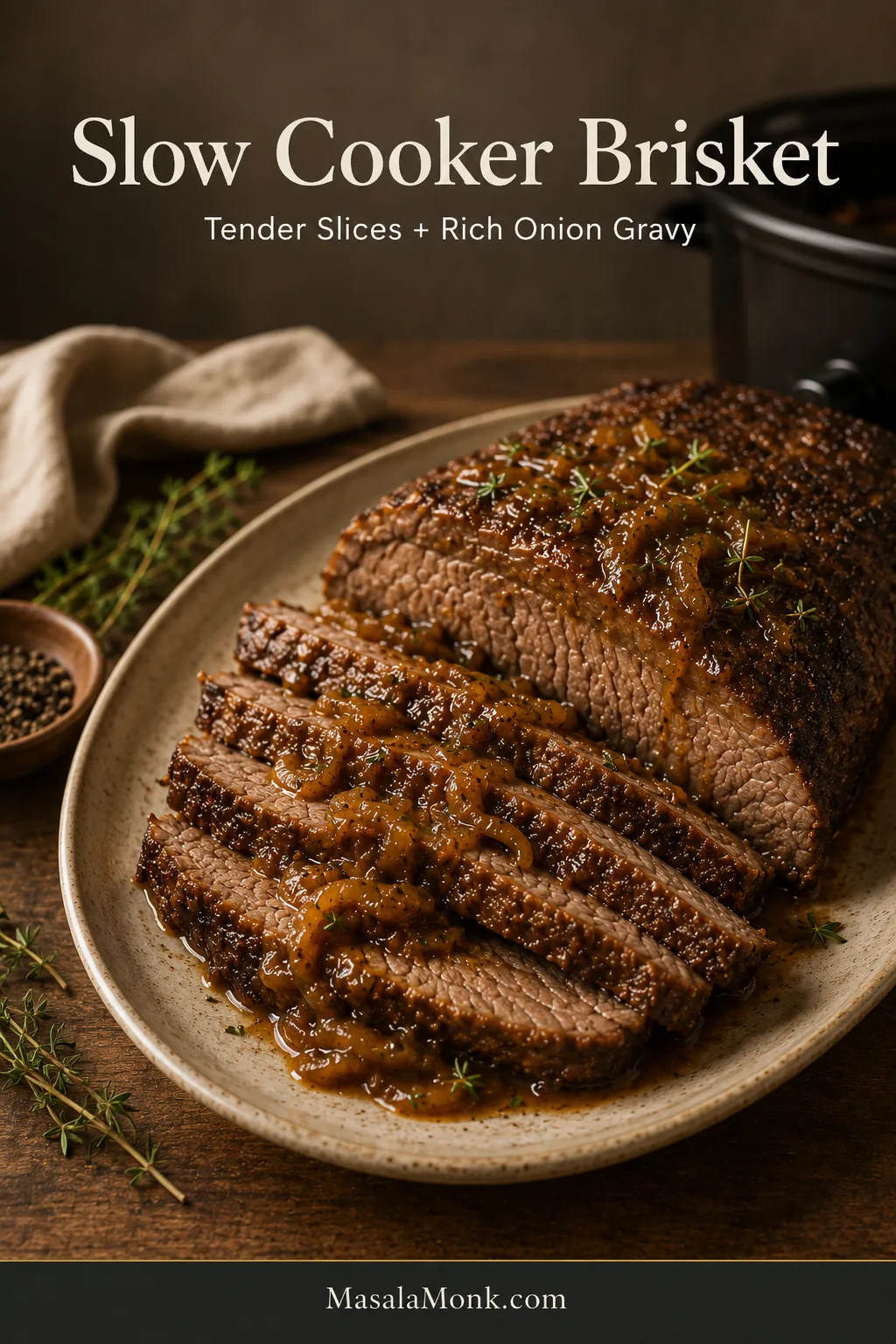
This slow cooker brisket is built for the result that suits gravy best: beef that feels deeply tender when sliced but holds together when lifted. The browned bits from the skillet deepen the cooking liquid, which is reduced into rich onion gravy rather than served as thin broth.
By the time the lid comes off, the onions should have softened into the dark cooking juices and the brisket should hold its shape. Dinner should smell as though the beef was fussed over all day, even though the slow cooker handled the long middle stretch.
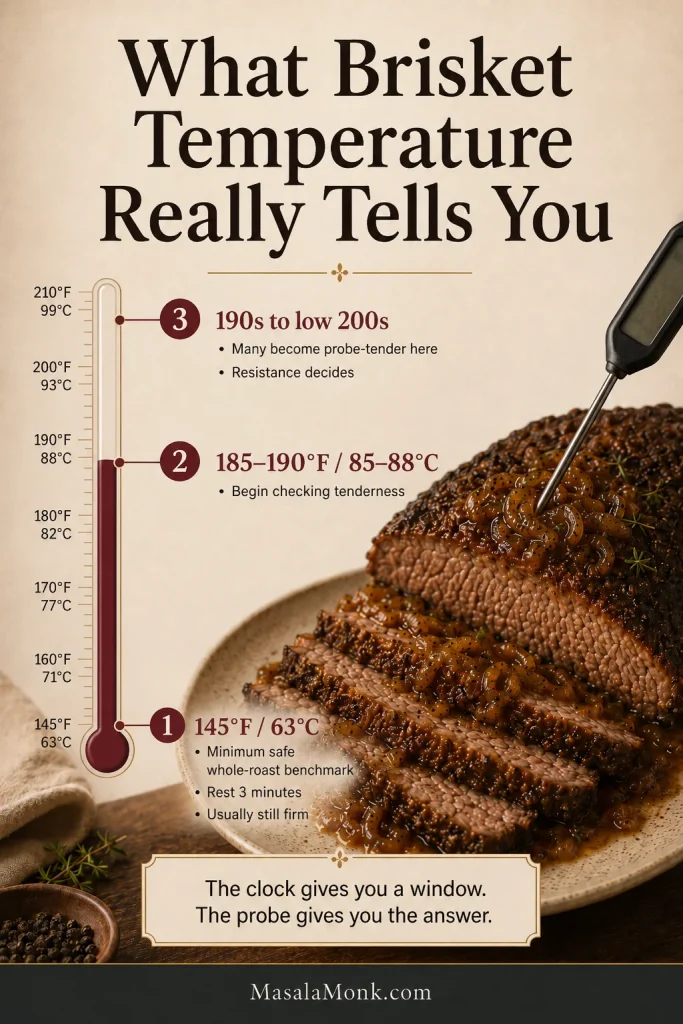
The key moment comes near the end. A probe that felt springy half an hour earlier begins to slide into the thickest part with very little resistance, yet the brisket still lifts in one piece. The clock gives you a window; the probe gives you the answer. Aim for beef that is tender enough to yield, yet structured enough to slice.
Quick Answer: How to Make Tender Slow Cooker Brisket
Use a 3–3½ lb (1.4–1.6 kg) fresh, uncured brisket flat that fits comfortably in a 5–6 quart (about 5–6 L) slow cooker. Brown the beef and soften the onions in the same skillet, then add 1 cup (240 ml) low-sodium beef stock plus ½ cup (120 ml) red wine, dark ale, or more stock.
Cook on LOW for about 7½–9 hours, making the first tenderness check at 7 hours. Remove the brisket when a probe enters the thickest section easily and the meat holds together when lifted.
The three decisions that matter most: judge the brisket by thickness as well as weight, keep the starting liquid controlled, and reduce the cooking juices for flavor before using starch for texture.
Choose Your Version
Decide whether you want neat slices, pull-apart meat, or less hands-on preparation. You can always cook sliceable brisket longer for pulling, but once it begins falling apart, it will not return to neat slices.
Your goal
How to make it
Recommended for neat slices
Use a flat-cut brisket, brown it first, cook on LOW, and remove it while it remains intact enough to slice.
Rolled brisket joint
Leave the string on, allow for the thick center, and check it later than you would a thin flat.
Pull-apart brisket
Continue cooking until the fibers separate readily, then shred and moisten with finished gravy.
No-sear shortcut
Skip the skillet work, combine everything in the slow cooker, and give the finished liquid a longer stovetop reduction.
The recipe below follows the neat-slice version.
Slow Cooker Brisket With Rich Onion Gravy
A savory brisket cooked over browned onions, garlic, stock, and herbs until tender but still sliceable. The cooking liquid is skimmed and reduced before thickening, giving you deeply flavored onion gravy instead of diluted slow cooker broth.
Prep Time
25 minutes
Skillet Time
25 minutes
Slow Cooker Time
7½–9 hours on LOW
Resting Time
15–20 minutes
Gravy Time
10–20 minutes
Hands-On Time
1–1¼ hours
Total Time
9–10½ hours
Servings
6 generous or 8 moderate servings
Cooker Size
5- to 6-quart (about 5–6 L) oval slow cooker or Crock-Pot
Texture and Finish
Tender and sliceable, with rich onion gravy
Equipment
Use an oval slow cooker or Crock-Pot, a large heavy skillet, tongs, two broad spatulas, and an instant-read thermometer. You will also need a cutting board, a sharp slicing knife, a wide saucepan, and a whisk.
A thin metal skewer helps assess resistance, but only a thermometer verifies temperature. A reliable sear or sauté function can replace the separate skillet. For the gravy, a spoon is enough to skim the fat; a separator, sieve, or immersion blender is optional.
Ingredients
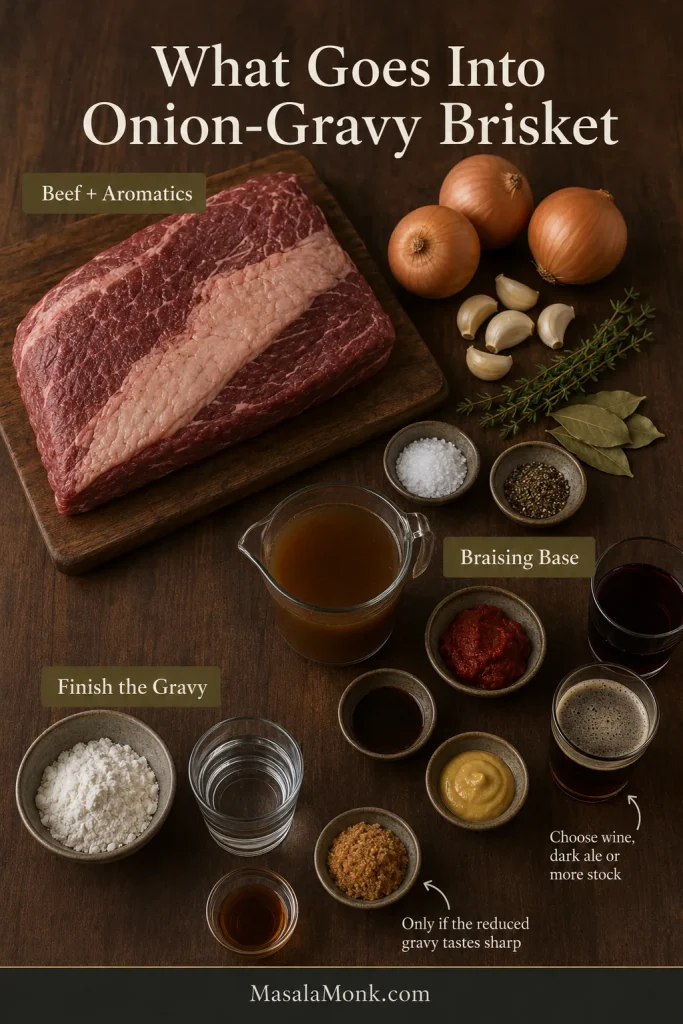
The ingredients work in layers: browning builds depth, the braising liquid carries it, and final tasting decides how much acidity or starch the gravy needs.
For the Brisket
3–3½ lb / 1.4–1.6 kg fresh, uncured beef brisket, preferably a flat or first cut for neat slices; a rolled joint also works, while a fattier point is better suited to pull-apart meat
2 teaspoons fine salt, about 10–12 g, divided
1 teaspoon coarsely ground black pepper
2 tablespoons / 30 ml neutral cooking oil, divided
For the Onion Braising Base
3 medium-large yellow or brown onions, about 16–19 oz / 450–550 g, sliced from root to tip
5 large garlic cloves, finely chopped or crushed
2 tablespoons / 34 g tomato paste
½ cup / 120 ml dry red wine, dark ale, or additional low-sodium beef stock
1 cup / 240 ml low-sodium beef stock
1½ tablespoons / 22 ml Worcestershire sauce
2 teaspoons / 10 g Dijon mustard
1 teaspoon dried thyme or 6–8 fresh thyme sprigs
2 bay leaves
And for Finishing the Gravy
Red wine vinegar: 1–2 teaspoons / 5–10 ml, as needed
Dark brown sugar: ¼–1 teaspoon, only if the reduced gravy tastes too sharp
Cornstarch: 1–2 tablespoons / 8–16 g, divided
Cold water: 1–2 tablespoons / 15–30 ml, divided
Additional salt and black pepper, as needed
Instructions
Prepare and Build the Braising Base
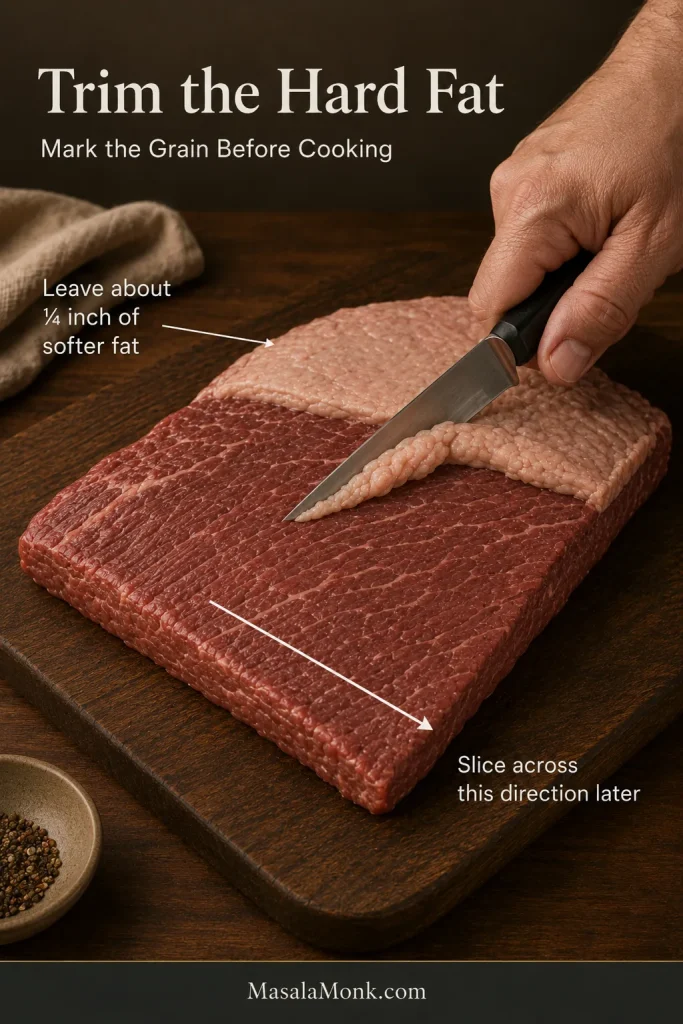
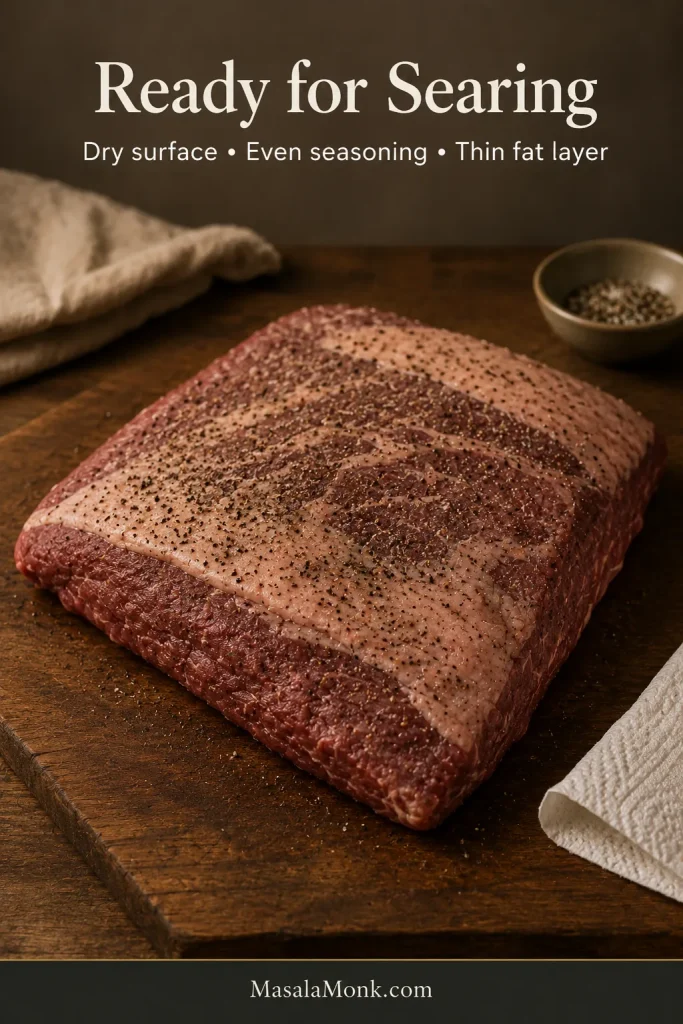
Mark, trim, and season. Note the direction of the grain with a photo or shallow corner notch. Remove hard exterior fat and reduce any very thick fat cap to about ¼ inch / 6 mm. Pat the brisket dry, then season all sides with 1½ teaspoons of the salt and all the black pepper.
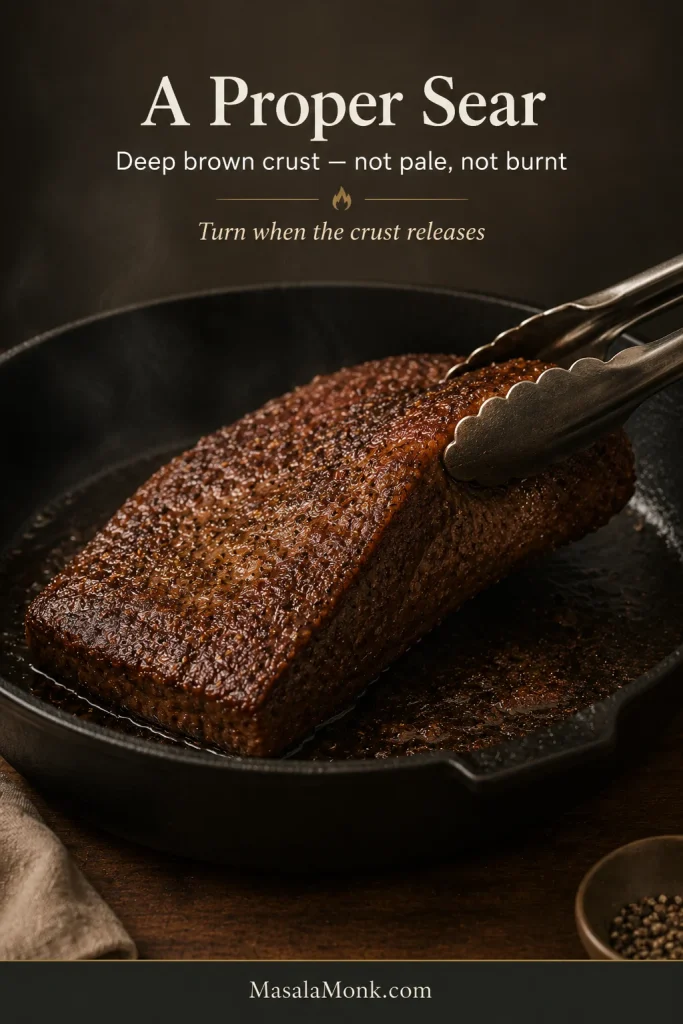
Sear the brisket. Heat 1 tablespoon oil in a large skillet over medium-high heat. Brown the broad sides for 4–5 minutes each and the thick edges briefly, then transfer the brisket to a tray.
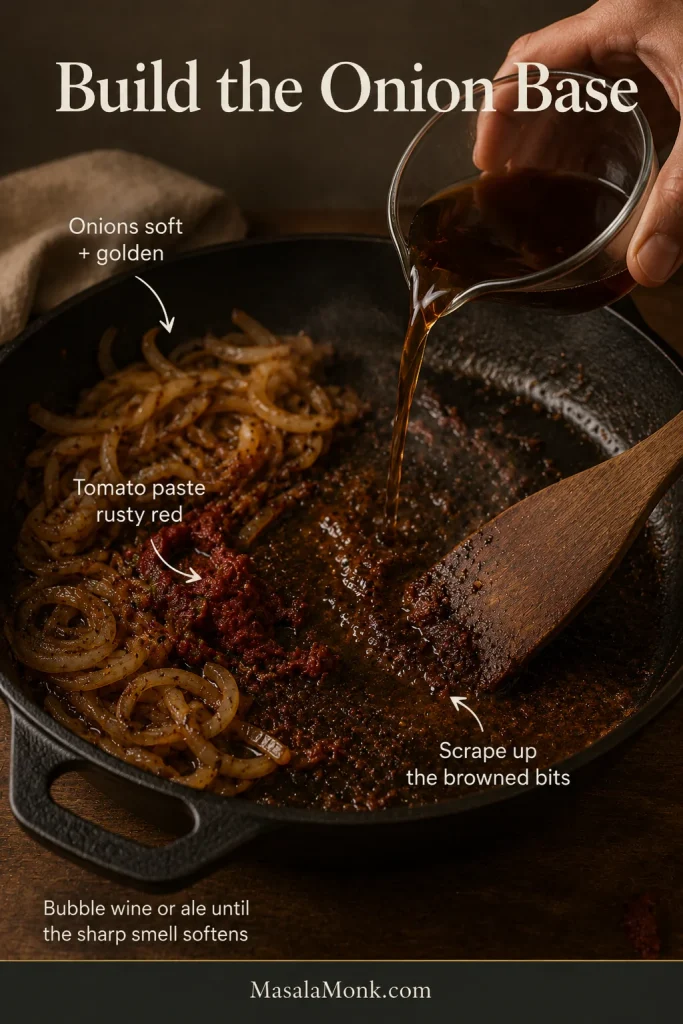
Brown the onion base. Reduce the heat to medium. Add the remaining oil if needed, followed by the onions and up to the remaining ½ teaspoon salt; hold some back if the stock or Worcestershire tastes salty. Cook for 8–10 minutes until softened with golden edges. Add the garlic for 30 seconds, then cook the tomato paste for 1–2 minutes until it deepens to a rusty red.
Deglaze and season the liquid. Add the wine, ale, or extra stock and scrape up the browned residue. If using wine or ale, let it bubble for 1–2 minutes. Stir in the 1 cup / 240 ml stock, Worcestershire sauce, Dijon, thyme, and bay leaves.
Slow Cook and Test for Tenderness
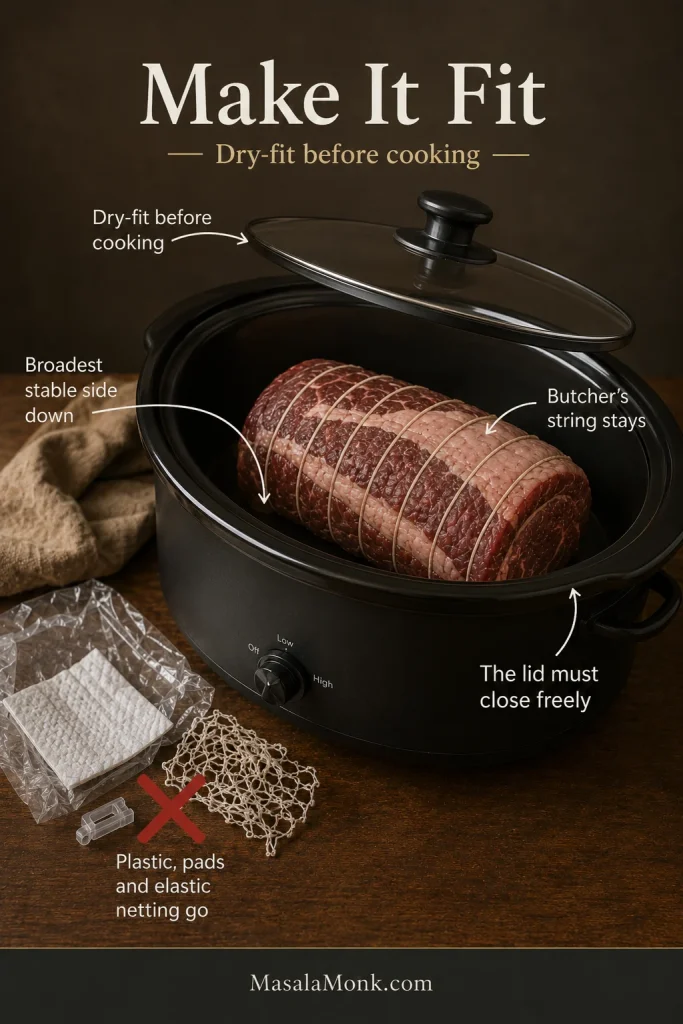
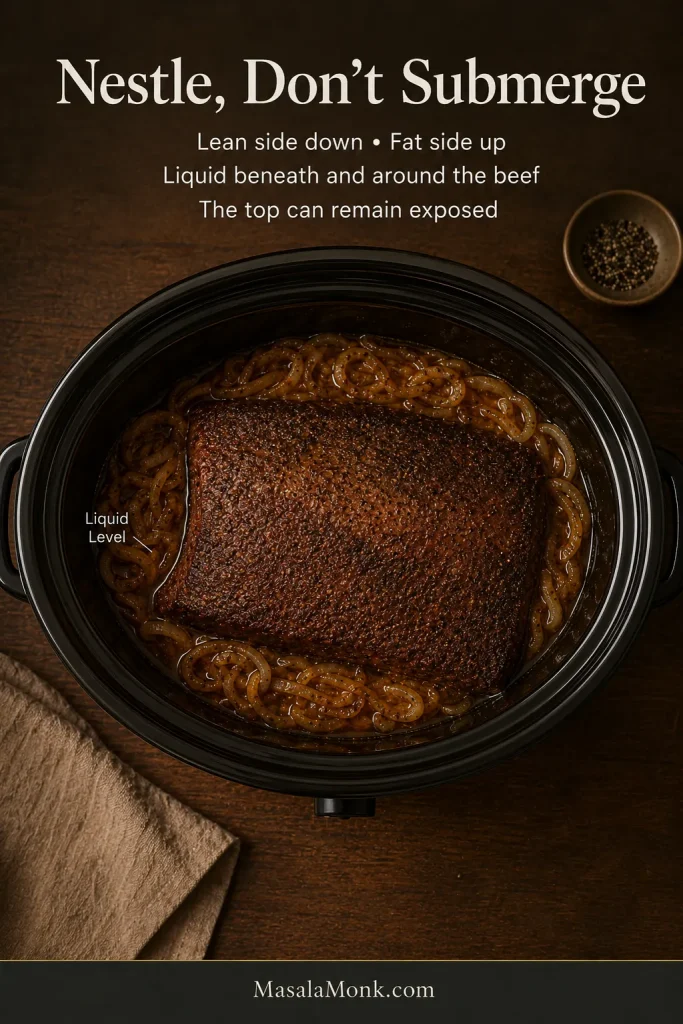
Load the slow cooker. Transfer the onions and liquid to the cooker. For a flat: nestle it into the mixture with the lean underside down and fat side up. For a rolled joint: set it on its broadest stable side and leave heat-safe butcher’s string in place. Remove plastic wrapping, absorbent pads, clips, and non-heat-safe elastic netting. The top can remain exposed; don’t add extra stock simply to submerge the meat.
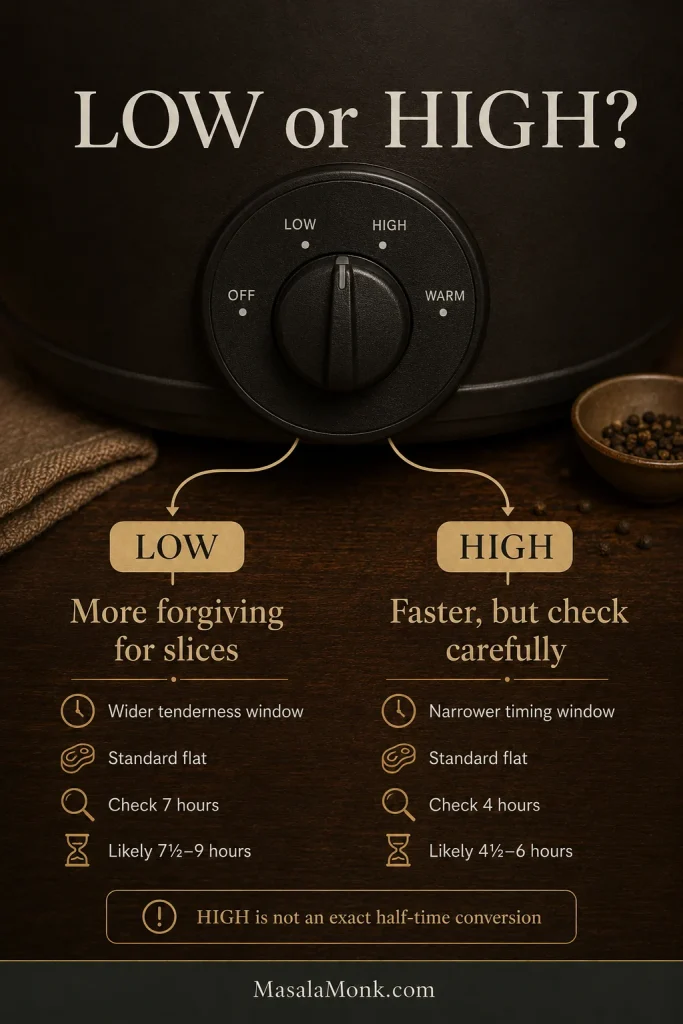
Cook on LOW. Cover and cook a standard 3–3½ lb / 1.4–1.6 kg flat for about 7½–9 hours. Make the first tenderness check at 7 hours. For a tightly rolled joint, start checking around 7 hours; many finish between 7½ and 9 hours, although an especially thick joint or cooler-running cooker may need closer to 10 hours.
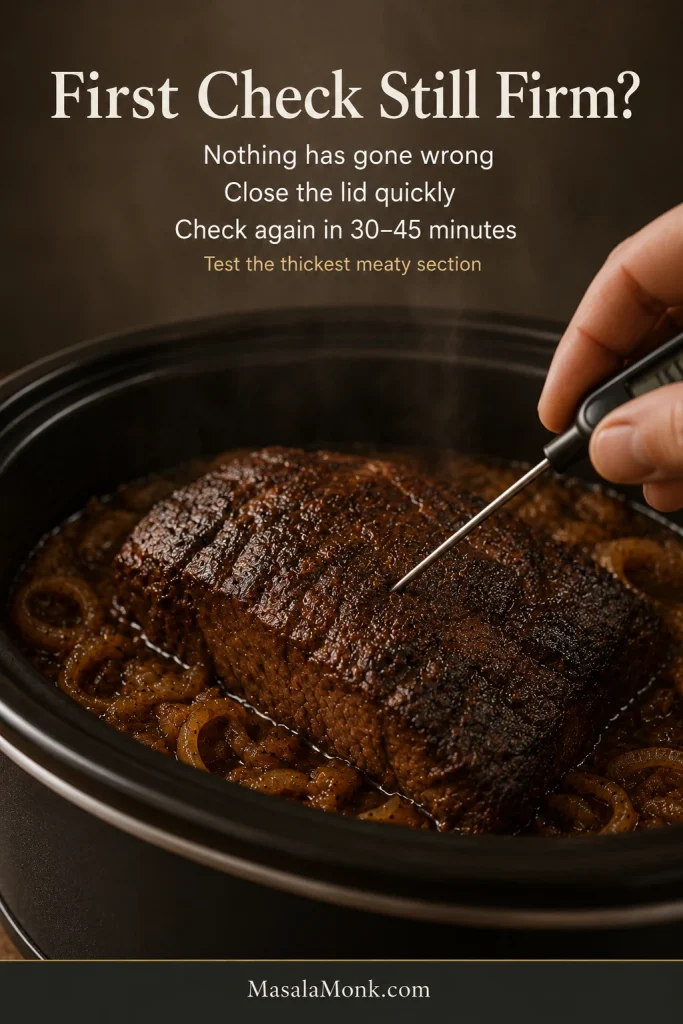
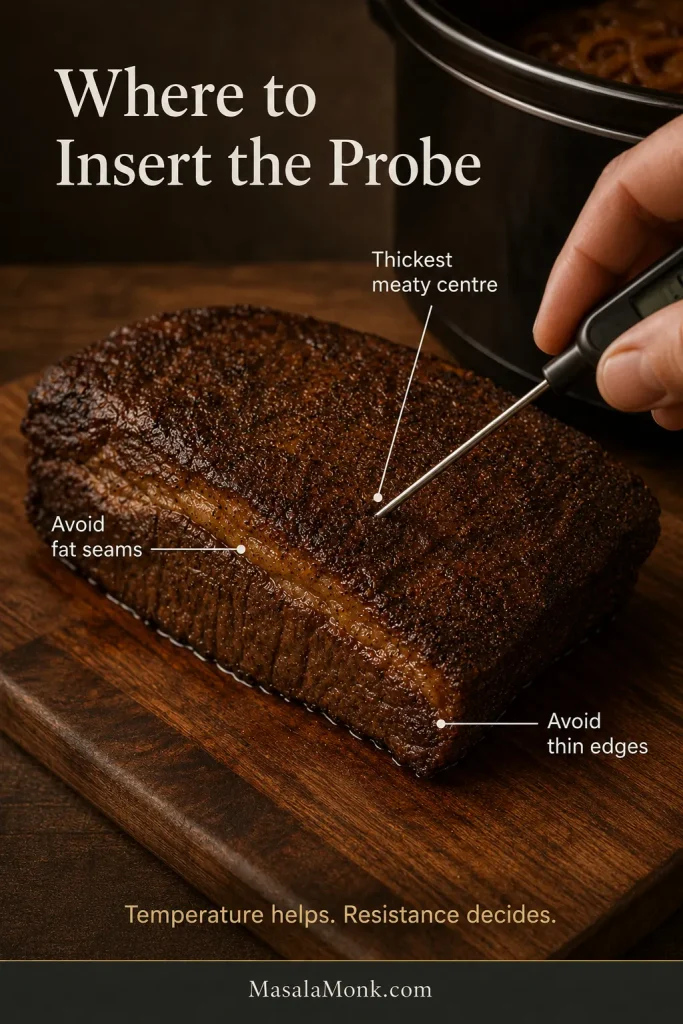
Check the texture. Insert the thermometer probe—or a thin metal skewer if you are checking texture only—into the thickest section. Only the thermometer verifies temperature. If the meat feels firm and springy, close the lid and cook for another 30–45 minutes. The brisket is ready for slicing when the probe or skewer enters easily and the roast keeps its shape as you lift it.
Rest, Finish the Gravy, and Serve
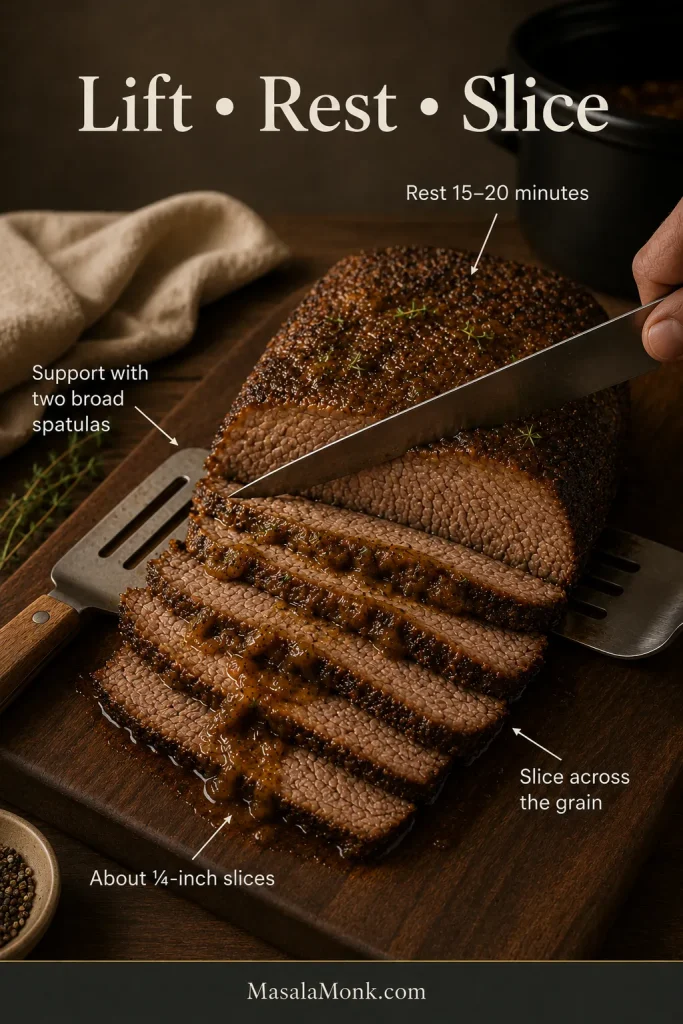
Rest the brisket. Move it to a cutting board with two broad spatulas, tent loosely with foil, and rest for 15–20 minutes.
Finish the gravy. Remove the bay leaves and thyme stems, skim excess fat, and transfer the onions and liquid to a wide saucepan. Blend with an immersion blender or strain if desired, then simmer for about 10–20 minutes, until the liquid tastes richer, looks glossier, and briefly parts behind the spoon. Once the liquid tastes concentrated, taste the gravy. Add 1 teaspoon red wine vinegar if it tastes flat or heavy, then add more only if needed. Add a small pinch of brown sugar only if it tastes harsh or sharp, and adjust the salt and pepper. If the flavor is right but the gravy remains too thin, mix 1 tablespoon cornstarch with 1 tablespoon cold water. Whisk it in gradually and simmer for 1–2 minutes. If the gravy remains too thin, mix another tablespoon of cornstarch with another tablespoon of cold water and add only as much as needed.
Slice and serve. Remove the string from a rolled joint. Cut the brisket about ¼ inch / 6 mm thick across the grain. Spoon over enough gravy to keep the slices glossy and serve the rest at the table.
Recipe Notes
For a 1⅔–2¼ lb / 750 g–1 kg flat: make the first check at about 6 hours on LOW. Many pieces finish around 7–8 hours, although a very thin flat may be ready sooner.
For HIGH: start testing the 3–3½ lb brisket around 4 hours and expect about 4½–6 hours.
For a no-sear version: omit the oil. Place the onions and seasoned beef directly in the cooker, whisk together the remaining braising ingredients, and pour them over the beef. Skipping the skillet saves about 25 minutes of active work, but the gravy will taste lighter and need a longer stovetop reduction.
Food-safety note: Fully thaw the brisket before slow cooking. See the USDA slow-cooker guidance for safe handling.
A slow cooker surrounds brisket with gentle heat and moisture, but it can’t create a dark sear or concentrate gravy. Browning the beef, softening the onions, and cooking the tomato paste in a skillet build the roasted flavor the covered cooker cannot.
The starting liquid stays restrained because the beef and onions release more moisture as they cook. Meanwhile, gentle heat gives the brisket’s dense collagen time to soften into gelatin. Once that work is complete, continued cooking can dry the lean muscle fibers even while the meat becomes softer.
Remove the brisket as soon as it is tender enough to slice, then finish the cooking liquid separately. That lets you remove excess fat, evaporate water, and deepen the gravy without pushing the meat beyond its best slicing point.
How quickly it reaches that point depends heavily on the shape and thickness of the cut; use the cooking-time guide to decide when checking should begin.
Which Brisket Cut Should You Buy?
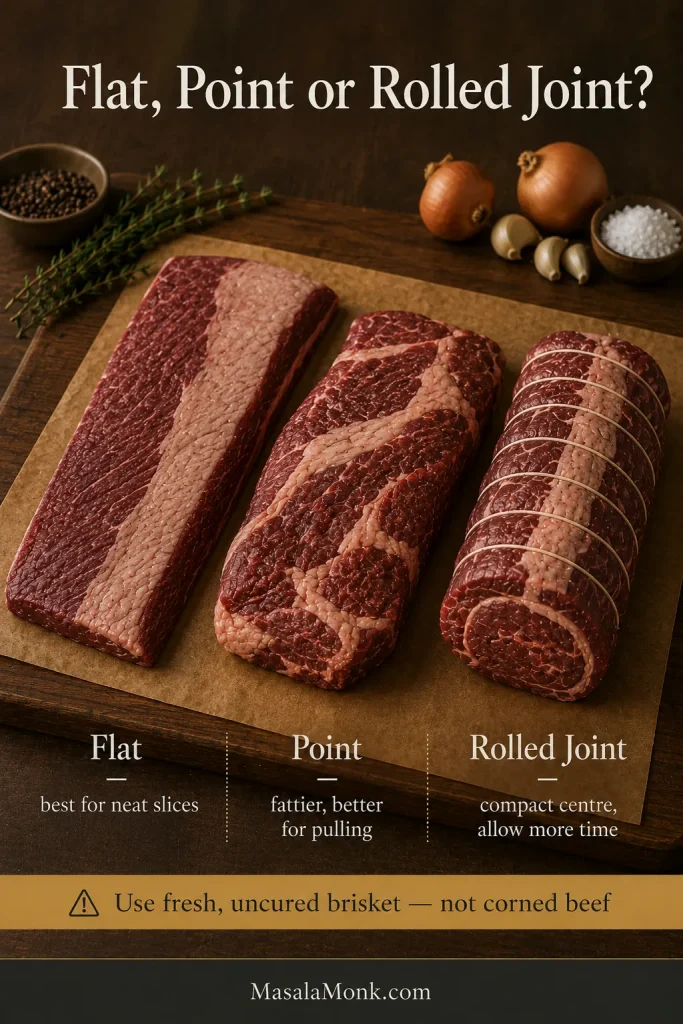
If the labels at the butcher counter are confusing, look at the shape before worrying about the name. Use fresh, uncured beef brisket—not corned beef brisket, which has already been cured in salty brine. A broad, even flat gives you the cleanest slices; a compact rolled joint simply needs more patience at the center.
Compare shape and thickness at the butcher counter, not weight alone. Two equal-weight briskets can finish at very different times.
Flat Cut Versus Point Cut
Choose a flat or first cut for neat gravy-covered slices. It is broad and comparatively lean, so remove it once the probe glides in easily and the roast holds together.
Choose a point cut for richer, fattier meat or a pull-apart finish. Trim heavy exterior fat and skim the cooking liquid carefully.
Brisket Joint or Rolled Brisket
A tightly rolled joint may take longer than a heavier flat because heat must reach its thick center. Leave heat-safe butcher’s string in place while it cooks.
If the joint will not fit beneath the lid, unroll it or divide it into two large pieces and begin checking sooner.
Whole packer brisket: It contains both the flat and point and is usually too large for a household slow cooker. Use a smoker or oven method instead.
If the label says shoulder roast, chuck shoulder, arm roast, or shoulder clod, use the beef shoulder roast crock pot guide. Those cuts behave more like pot roast than brisket.
Brisket or Pot Roast?
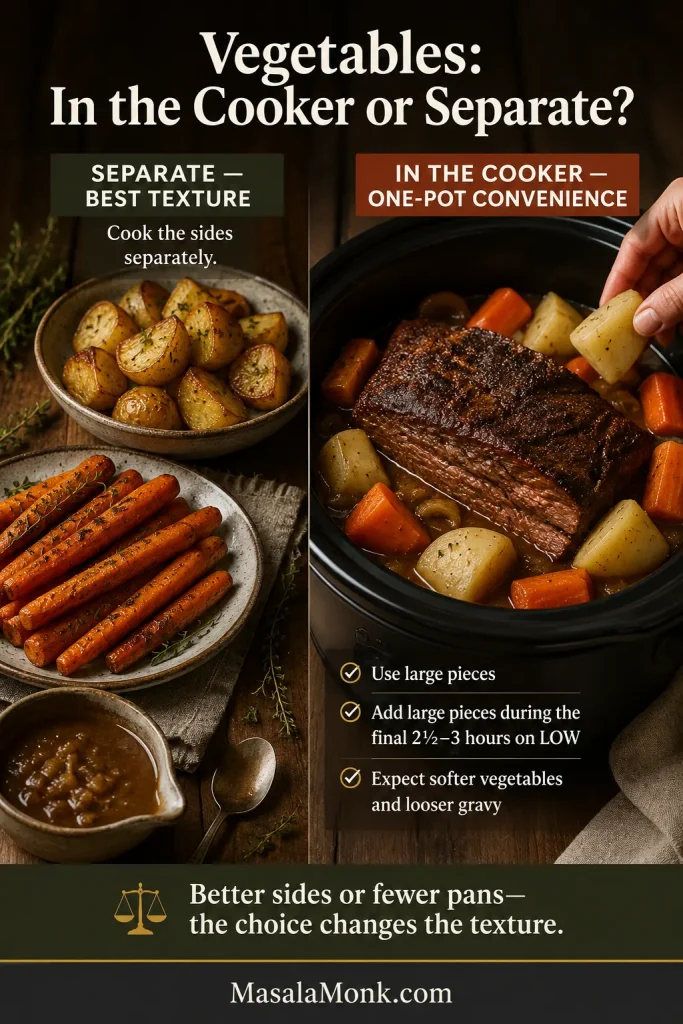
Choose brisket for distinct slices and a narrower finish between firm and falling apart. Chuck breaks into soft chunks more readily; brisket keeps a visible grain and rewards slicing across it. For forgiving chuck roast with potatoes and carrots in the cooker, use MasalaMonk’s slow cooker pot roast recipe.
How Much Brisket per Person?
Allow about ½ lb (225 g) raw boneless brisket per adult with substantial sides. This recipe serves six generously or eight moderately; buy extra when leftovers are part of the plan.
Prepare the Brisket Before It Goes Into the Cooker
Remove only the hard excess fat, mark the grain while it is visible, and make sure the brisket fits beneath the lid.
Trim the Fat and Mark the Grain
Remove hard, waxy lumps and heavy edge deposits. Leave a reasonably even layer—about ¼ inch (6 mm) where practical—especially on a lean flat.
Photograph the direction of the raw muscle fibers or make a shallow notch across one corner. After cooking, slice perpendicular to those fibers so each bite is easier to chew.
Trim hard surface fat now, and mark the grain while it is easy to see. Both become harder to judge once the brisket is browned and sauced.
Does Brisket Need a Rub or Marinade?
No marinade is needed for tenderness; the long cook softens the connective tissue. The browned onions, garlic, Worcestershire, Dijon, and herbs provide enough seasoning for this gravy-based version. You may season several hours or a day ahead, but a sweet barbecue rub moves the dish toward a different style.
Seasoning ahead is fine. Blot away any moisture before searing so the skillet browns the brisket instead of steaming it.
Make It Fit and Position It Correctly
The lid should close fully without resting on the meat, and the brisket should not be folded tightly against the sides. If necessary, cut it across its width into two large pieces, arrange them with little overlap, and begin checking at the standard-flat time; thinner pieces may finish first.
Set a flat fat-side up with the lean side nearer the onions and liquid. Place a rolled joint on its broadest stable side; secure placement and a closed lid matter more than exact fat-cap orientation.
A small rolled joint can cook more slowly than a heavier flat because heat must travel farther to reach its center.
Ingredients That Build the Brisket and Gravy
Three onions look generous in the skillet, but they collapse into the cooking liquid and give the finished gravy much of its body. Tomato paste adds depth, low-sodium stock leaves room for reduction, and Worcestershire, Dijon, and herbs round out the sauce without needing a packet mix.
Onions, Stock, and Tomato Paste
Slice the onions from root to tip so some texture remains through the long cook.
Low-sodium stock gives you room to reduce the gravy without making it harsh. Resist adding more simply because the top of the brisket remains exposed; the beef and onions will release additional moisture beneath the closed lid.
The exposed top still cooks in the trapped steam, while the beef and onions release enough moisture to raise the liquid level naturally.
Tomato paste adds color, savory depth, and a little body without making the gravy taste tomato-heavy. Cook it until it darkens slightly so it loses its raw edge.
The Braising Liquid
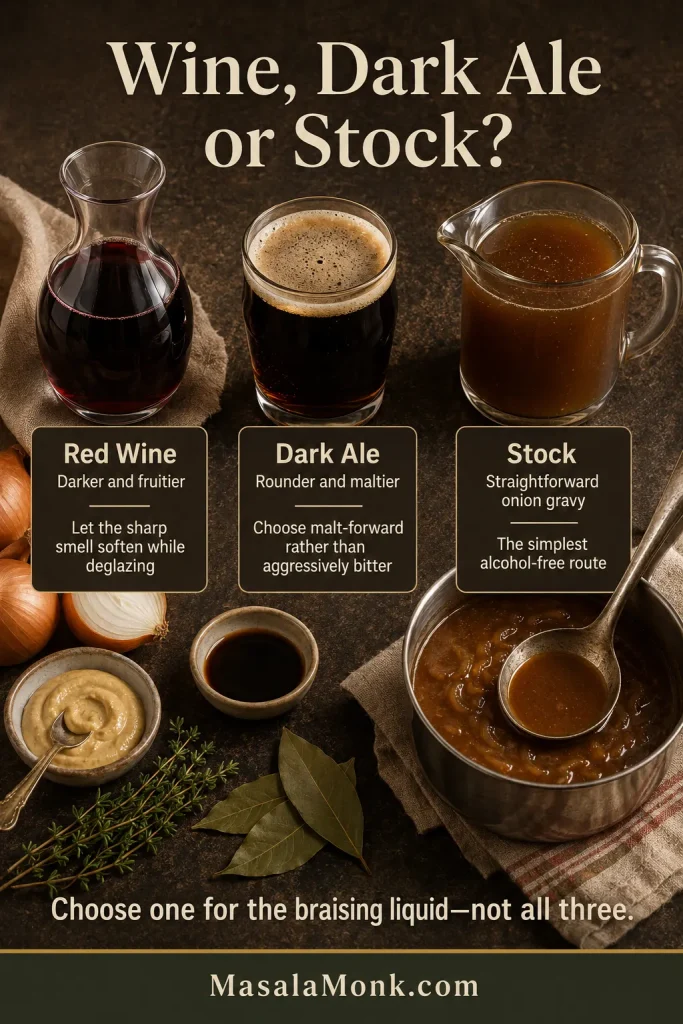
Red wine gives the gravy darker fruit and acidity. Ale adds a rounder maltiness, while extra beef stock creates the most straightforward onion gravy. Keep the amount restrained: the wine or ale should deepen the sauce without becoming its main flavor.
Worcestershire brings savory depth and gentle acidity, while Dijon rounds the liquid without making the gravy taste strongly mustardy. Both become more concentrated during reduction, so taste again before serving.
Cornstarch adds body only after reduction has concentrated the flavor. Add it gradually so the gravy stays glossy rather than becoming pasty.
What Slow Cooker Brisket Should Look and Feel Like
The cues below show what each stage should look and feel like, especially when the clock cannot tell you enough.
The Crust and Onion Base
Pat the surface dry, then leave each broad side in the hot skillet until a deep crust forms and the meat releases more easily. Cook the onions until their raw smell softens and their edges turn golden.
Pale patches usually mean lingering moisture or weak contact with the skillet. Move the brisket only when needed so a deep crust can form.
Stir in the tomato paste until it changes from bright red to rusty red and begins sticking lightly to the pan. Pour in the wine, ale, or stock and scrape up the browned layer—those sticky bits belong in the gravy. If using wine or ale, let it bubble until its sharp alcoholic smell softens, then nestle the brisket into the onions.
Brown fond belongs in the gravy; black, bitter residue does not. Smell the pan before deglazing and leave genuinely burned patches behind.
The Tenderness Change to Watch For
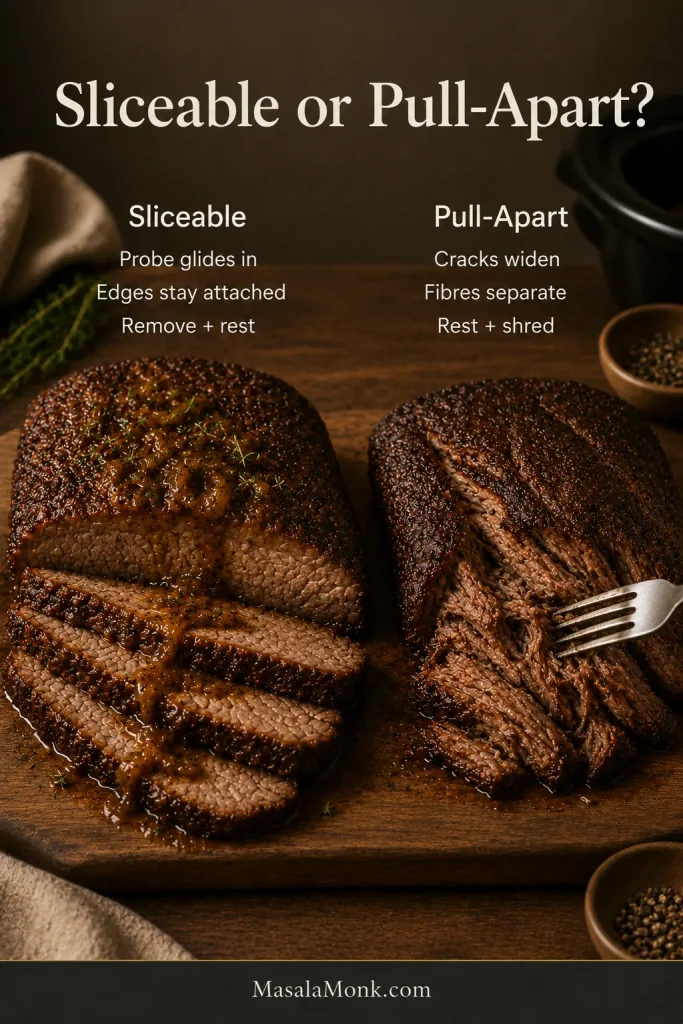
The first tenderness check is often the least encouraging one. At the sliceable stage, the roast flexes when lifted, its edges remain attached, and any surface cracks stay narrow. As it moves toward pull-apart tenderness, those cracks widen and the fibers begin separating under light pressure.
Narrow cracks and attached edges point to clean slices. Widening seams show the brisket moving toward a moist pull-apart finish.
How Soft Brisket Should Slice
Support the softened brisket with two broad spatulas and rest it for 15–20 minutes. Slice across the grain; the first piece should bend without crumbling. Cut exceptionally soft meat a little thicker.
Use long, gentle knife strokes. A blunt blade or heavy sawing motion can squash a very tender brisket before it reaches the plate.
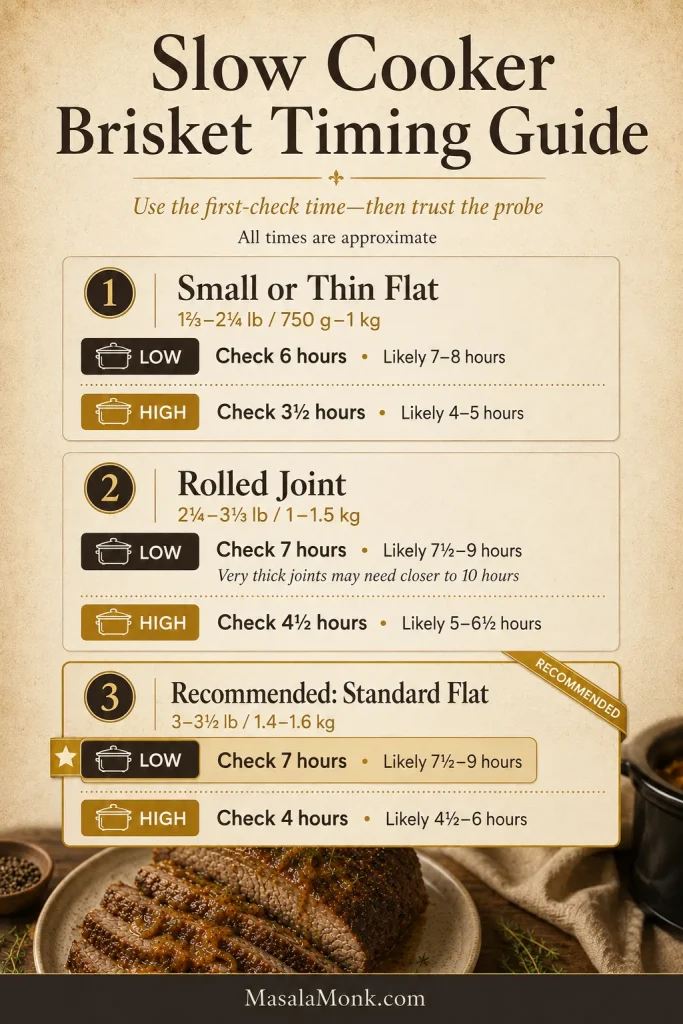
For a 3–3½ lb (1.4–1.6 kg) brisket flat, cook on LOW for about 7½–9 hours or HIGH for about 4½–6 hours. Begin checking at 7 hours on LOW or 4 hours on HIGH.
Cooking time changes with thickness, shape, fat content, starting temperature, cooker size, and how hot your slow cooker runs. A small rolled joint may take longer than a heavier broad flat because heat has farther to travel through its tightly rolled center.
There is no dependable minutes-per-pound or hours-per-kilogram formula for slow cooker brisket. Use the chart to decide when to make the first check, then let the resistance of the meat decide when to stop.
Open the lid briefly, test one or two places in the thickest section, and close it again quickly if the meat resists. Check again after another 30–45 minutes.
All times are approximate. Use the “Begin checking” column for your first tenderness test.
On a phone, swipe sideways to see all columns in the timing table.
Brisket
Setting
Begin checking
Likely window
Thin or small flat, 1⅔–2¼ lb / 750 g–1 kg
LOW
6 hours
7–8 hours
Thin or small flat, 1⅔–2¼ lb / 750 g–1 kg
HIGH
3½ hours
4–5 hours
Compact or rolled joint, 2¼–3⅓ lb / 1–1.5 kg
LOW
7 hours
7½–9 hours; a very thick joint may need closer to 10 hours
Compact or rolled joint, 2¼–3⅓ lb / 1–1.5 kg
HIGH
4½ hours
5–6½ hours
Recommended standard flat, 3–3½ lb / 1.4–1.6 kg
LOW
7 hours
7½–9 hours
Standard flat, 3–3½ lb / 1.4–1.6 kg
HIGH
4 hours
4½–6 hours
For a 4–5 lb (1.8–2.3 kg) brisket: use a 7–8 quart cooker and begin checking at about eight hours on LOW. Many thick whole briskets need roughly 9–11 hours. If you divide the brisket into thinner pieces, begin near the standard-flat window and remove each piece separately when tender.
What the Probe Is Telling You
Do not judge the brisket by one check. What matters is the change from firm and springy toward easier entry each time you test.
What you feel
What it means
What to do
Firm resistance as the probe enters
Needs longer
Close the lid and check again in 30–45 minutes
The probe glides into the thickest section
Tender and sliceable
Remove the brisket and let it rest
The meat separates around the probe
Pull-apart stage
Lift carefully, rest briefly, and shred
Where to Place the Probe
When readings disagree, trust the firmest result from the thick central meat. A soft fat seam or thin edge can be misleading.
Is LOW Better Than HIGH?
LOW is the more forgiving setting because it gives a lean flat a wider window between firm and overly soft. HIGH can produce good brisket when dinner needs to happen sooner, but it isn’t an exact half-time conversion.
HIGH narrows the final checking window because tenderness can change quickly near the end. Start early and stay close once the meat begins yielding.
What Internal Temperature Is Slow Cooker Brisket Done?
Begin checking brisket for tenderness around 185–190°F (85–88°C). Many pieces become probe-tender in the 190s to low 200s, but resistance—not temperature alone—decides when to remove them.
Whole beef roasts reach the USDA minimum safety benchmark at 145°F (63°C) followed by a three-minute rest. Brisket is normally still firm at that point because its connective tissue hasn’t softened enough.
Temperature tells you when to start paying close attention. Probe feel still makes the final decision.
Can You Overcook Brisket in a Slow Cooker?
Yes. A brisket can become softer while its lean fibers become drier. Watch for these signs:
The brisket splits before it can be lifted from the cooker.
The fibers separate as soon as the surface is pressed.
Slices crumble into short strands instead of bending.
A lean flat feels soft but dry or cottony in the mouth.
The edges break down before you can carve the center.
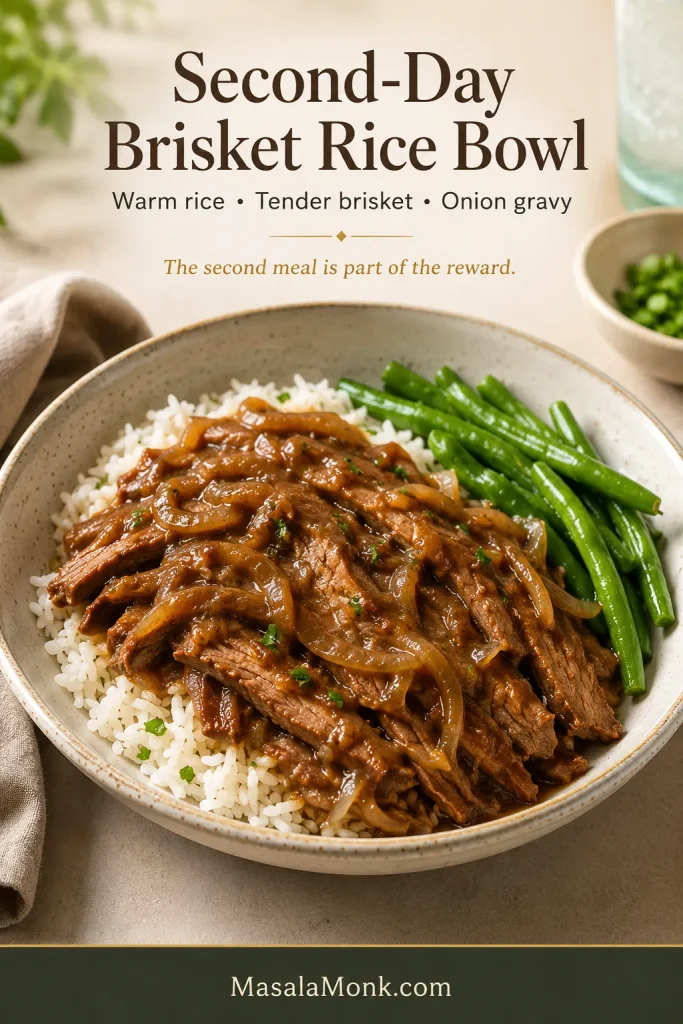
An over-soft brisket works well shredded, moistened with finished gravy, and served in rolls, baked potatoes, or rice bowls.
Save the Slow Cooker Brisket Timing Guide
Prefer one visual reference for later? This chart brings together the first-check and likely cooking windows for flats and rolled joints on LOW or HIGH. Save it as a starting point, then let probe resistance decide the actual finish.
Save this chart as a quick starting point. Begin checking at the earlier time shown, but let thickness and probe resistance decide when the brisket is ready.
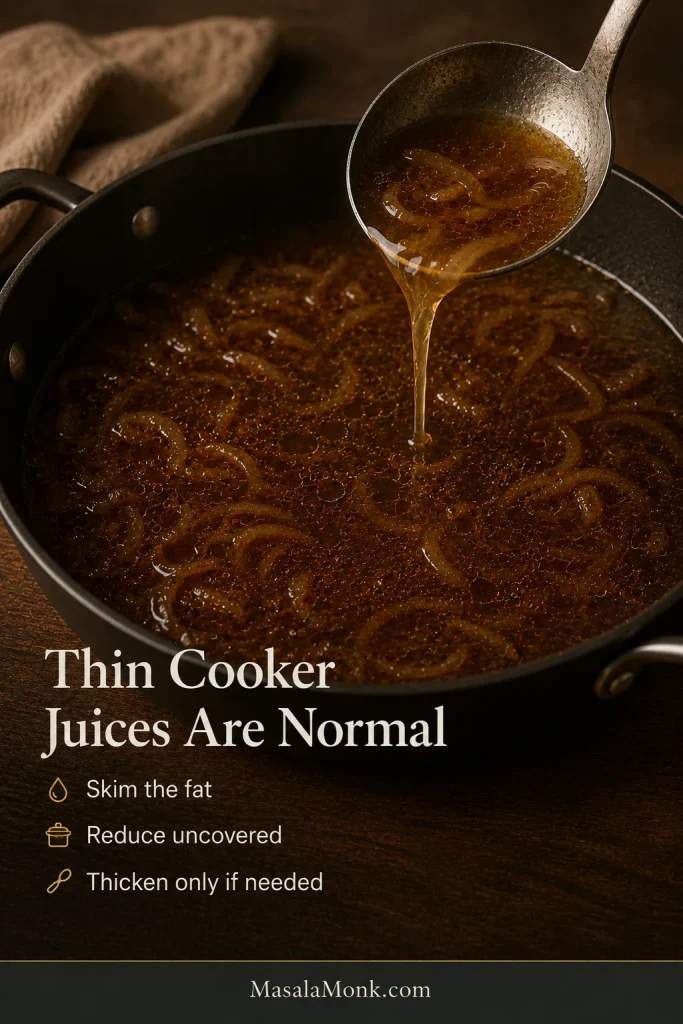
The liquid will probably look thinner than finished gravy when the lid first comes off. That is expected. It may already smell deeply savory, but its flavor and body develop in the saucepan.
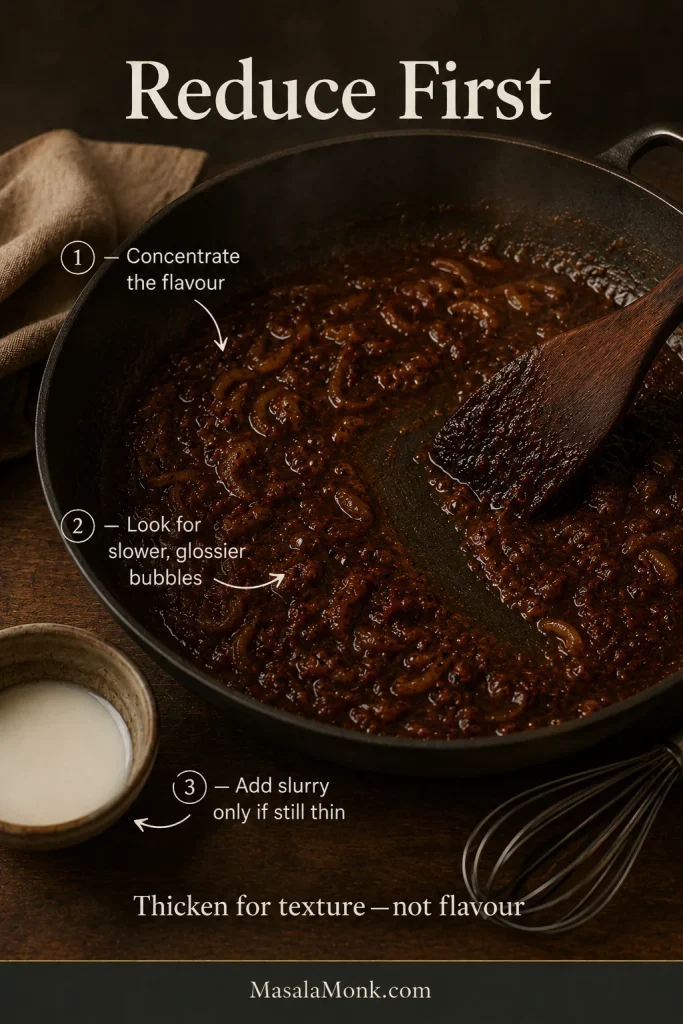
Reduce for flavor. Thicken for texture. Reduction concentrates the beef and onions. Cornstarch changes only how the sauce flows.
Why Slow Cooker Brisket Juices Look Thin
A wide saucepan concentrates thin cooker juices faster than a narrow pot because more liquid is exposed to evaporation.
Remove the Fat and Choose the Texture
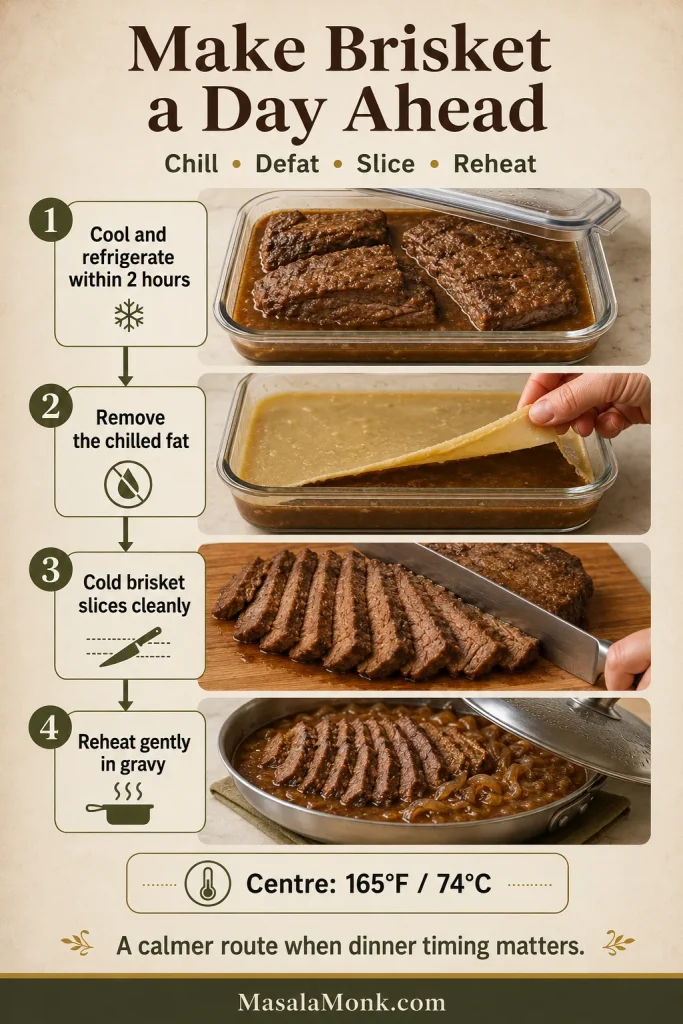
Let the liquid settle briefly, then spoon away the glossy fat or use a separator. A point cut or heavily capped brisket may need more attention than a lean flat. When the brisket is cooked a day ahead, the chilled fat lifts away especially cleanly.
Keep the softened onions for rustic gravy, blend them into the liquid with an immersion blender for a smooth sauce, or strain them out for a clearer finish.
Reduce Before You Thicken
Pour the liquid into a wide saucepan and simmer uncovered. At first it may taste savory but diluted. Start tasting after about 10 minutes. As the beef and onion flavors concentrate, the bubbles turn slower and glossier. The spoon also begins leaving a brief trail across the pan.
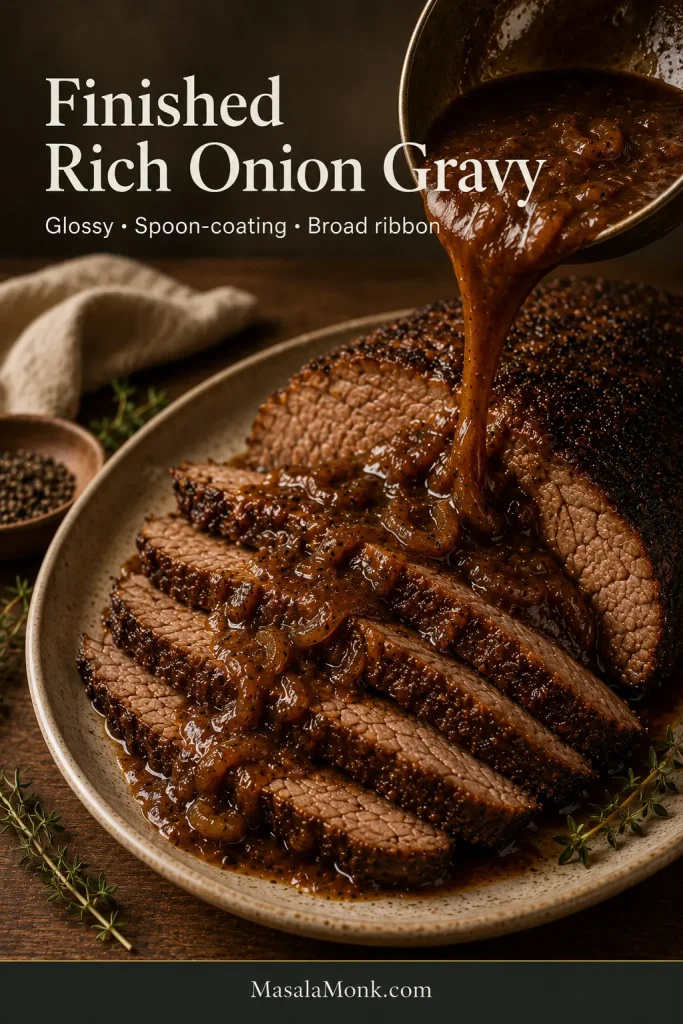
Stop when the gravy tastes deeply beefy and onion-rich, even if it looks slightly thinner than you want. Mix 1 tablespoon cornstarch with 1 tablespoon cold water, whisk it in gradually, and simmer for 1–2 minutes. If it remains too thin, mix another tablespoon of cornstarch with another tablespoon of cold water and add only as much as needed. The finished gravy should coat the back of a spoon and fall in a broad ribbon.
Let a spoonful cool for a moment before the final tasting. Very hot gravy can hide salt and acidity and tempt you to over-adjust it.
What Finished Onion Gravy Should Look Like
Gravy thickens as it cools, so stop while it looks a little looser than you want at the table.
Balance the Finished Gravy
If the gravy tastes…
Try this
Flat or heavy
Add 1 teaspoon red wine vinegar, taste, then add more only if needed. It should lift the richness without tasting vinegary.
Not savory enough
Add a small splash of Worcestershire or a pinch of salt.
Overly salty
Stop reducing and dilute with unsalted stock or water.
Too sweet
Add acidity and a little additional stock.
Harsh or sharp
Add more stock or a very small pinch of brown sugar.
Greasy
Separate more fat before making any other adjustment.
Rich but too thin
Add more slurry gradually.
Overly thick
Whisk in warm stock a little at a time.
Not enough gravy
Add warm unsalted stock, simmer briefly to integrate it, and taste again before serving.
Most brisket problems fall into two groups: the meat needs more time, or the cooking liquid needs finishing. Even an over-soft brisket can become an excellent pull-apart dinner.
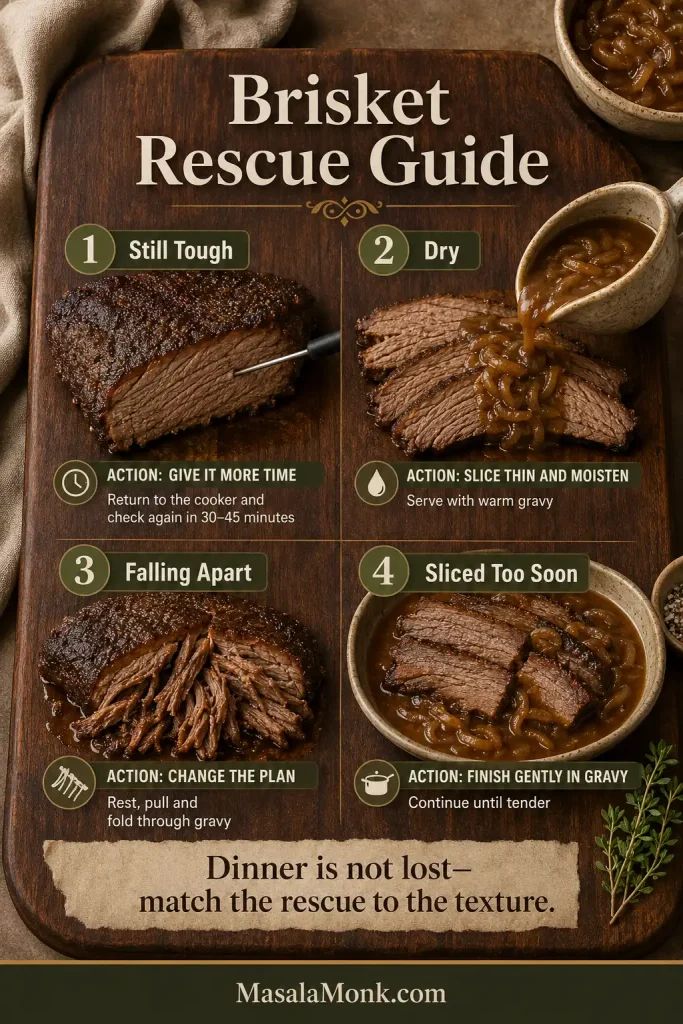
Brisket Rescue at a Glance
Check tenderness and moisture separately. Moist but resistant brisket needs more heat; soft, cottony meat needs gravy, not more cooking.
My Brisket Is Still Tough
If your brisket still feels moist but the probe pushes back, nothing has gone wrong. Keep it whole, replace the lid, and cook for another 30–45 minutes. Test the thickest center, not a soft edge or a seam of fat.
If the brisket has just been sliced and is still hot, arrange the slices snugly in a covered baking dish with hot gravy or cooking liquid. Continue cooking gently at 300°F (150°C) and check every 20–30 minutes. For refrigerated brisket, use the reheating guidance below instead.
My Brisket Is Dry
Dryness can come from a very lean flat, cooking past the ideal window, or reheating uncovered. Beef can overcook even while surrounded by liquid because the muscle fibers still tighten and release their own moisture.
Spoon generous gravy over the slices or chop the meat and fold it into the sauce. The beef cannot absorb all the lost moisture again, but thicker pieces and plenty of gravy can make a satisfying dinner.
It Fell Apart Before I Could Slice It
If the brisket breaks as you lift it, dinner isn’t lost—it has simply moved from sliceable to pull-apart. Remove any large deposits of fat, shred the beef, and add enough finished gravy to coat the fibers.
When presentation matters, let the meat cool before handling. Chilled brisket firms up, making it easier to portion cleanly than delicate hot meat.
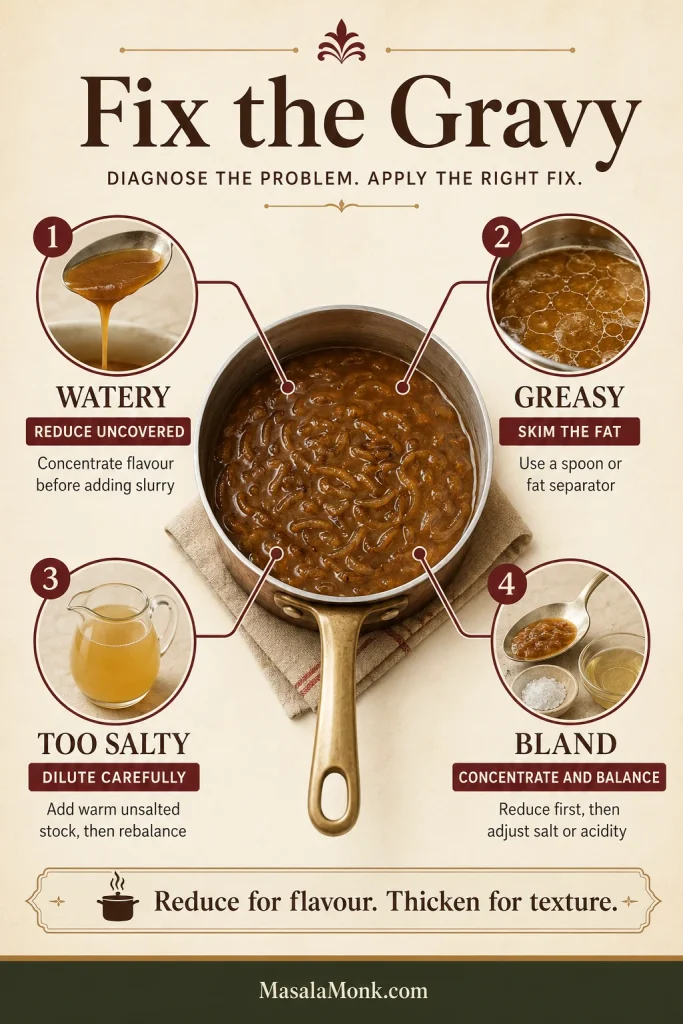
Gravy Troubleshooting at a Glance
Concentrate the gravy before seasoning it. Once it is too salty, dilute it—more reduction will only intensify the salt.
The Gravy Is Watery
The liquid may look disappointingly thin when you first open the cooker. That is often normal; it has not been reduced yet. Move it to a wide pan and simmer uncovered until the flavor concentrates, then use a slurry only if it still needs more body.
The Gravy Is Greasy
A point cut, thick fat cap, or heavy internal seams can release more fat than the sauce can comfortably hold. Let the liquid settle and skim it, use a separator, or chill it and remove the hardened layer.
The Gravy Is Too Salty
Reduction intensifies salt from stock, Worcestershire, seasoning mixes, and the beef itself. Stop reducing and add unsalted stock or water. If that makes the gravy too thin, restore its body with a little slurry rather than concentrating the salt again.
The Brisket Tastes Bland
Skipping the sear, using weak stock, beginning with too much liquid, or forgetting to taste before serving can all leave the sauce muted. Reduce it first, then taste for salt, savory depth, and acidity. A little Worcestershire or red wine vinegar can wake it up quickly.
Dinner Timing: Running Late or Finished Early
If dinner is running late and the brisket is fully hot but still tough, switch from LOW to HIGH and check again in 30 minutes.
If it finishes early, remove it from the cooker rather than letting it continue for hours. For a short delay, keep it whole and safely hot at 140°F (60°C) or above, with a little hot cooking liquid.
A long stay on WARM can soften and dry a lean flat. If safe hot holding is not practical, refrigerate the brisket within two hours and reheat the slices in gravy.
Whichever version you make, stop cooking when the brisket reaches the texture you want.
Choose Wine, Ale, or Stock—and Add Balsamic if You Like
Red wine: Use ½ cup (120 ml) dry red wine for deglazing. Cabernet Sauvignon, Merlot, or another dry medium-to-full-bodied red suits the dark onion gravy. Keep the amount restrained so the reduced sauce doesn’t become sharp.
Ale or stout: Replace the wine with ½ cup (120 ml) dark ale or stout. Choose a round, malt-forward beer rather than a heavily bitter one, because bitterness becomes more noticeable as the gravy reduces.
Balsamic: Add 1 tablespoon (15 ml) balsamic vinegar to the braising liquid. Omit the final red wine vinegar unless the reduced gravy still needs brightness.
Choose a braising liquid that already tastes balanced. Reduction magnifies bitterness, sweetness and salt along with the flavors you want.
Do You Have to Sear Brisket Before Slow Cooking?
No. Skipping the skillet saves about 25 minutes, although the meat and gravy will have less browned depth. Follow the no-sear method in the recipe notes.
Brisket With Potatoes and Carrots
The most dependable approach is to keep the cooker focused on beef and onions, then prepare the vegetables separately. A tray of roasted carrots can cook while the brisket finishes.
If the cooker has room, add up to 12 oz (340 g) waxy potatoes and 8 oz (225 g) carrots. Cut them into 1½–2 inch (4–5 cm) pieces and add them for the final 2½–3 hours on LOW.
The vegetables will be softer, take up valuable cooker space, and release extra water, so expect a longer gravy reduction.
Use waxy potatoes and large pieces in the cooker. Floury potatoes or smaller cuts can soften into the gravy.
How to Make It Pull-Apart
Continue cooking until the fibers separate readily when pressed. Rest the brisket for about 10 minutes, remove any large pockets of fat, then pull it into broad strands. Fold through enough finished gravy to coat the meat without drowning it.
What to Serve With Slow Cooker Brisket
Brisket with gravy wants something soft enough to catch the sauce or crisp enough to balance the richness. Spoon the gravy over the cut face of the beef so it settles between the slices and reaches the potatoes beneath.
A classic wedge salad brings cold crunch and sharpness beside the warm beef and gravy, keeping the plate from feeling too soft or heavy.
Cauliflower mash
Steamed or sautéed greens
Crisp cabbage salad
Roasted broccoli or Brussels sprouts
Green beans finished with lemon
Ways to Use Leftover Brisket
The second meal is one of the rewards of cooking a full brisket.
Open-faced brisket sandwiches with hot gravy
Brisket and gravy over polenta
Baked potatoes filled with chopped brisket
Rice bowls with onions and greens
Brisket hash with potatoes and eggs
Leftover brisket also works beautifully in rice bowls; use the guide to cooking fluffy rice so the grains stay separate enough to catch the gravy without turning wet or gummy.
Rice drinks up sauce quickly. Loosen chilled gravy with a splash of unsalted stock before warming the brisket.
Brisket can be served the day it cooks, but making it a day ahead is often the calmer choice for guests. The fat lifts away cleanly, the chilled meat slices neatly, and reheating it in gravy removes the pressure of timing dinner to the minute.
The Best Make-Ahead Brisket Method
Cook the brisket until tender but still intact.
Transfer it promptly from the hot cooker with enough cooking liquid to keep the surface moist.
If the brisket is especially thick, divide it into two or three large portions, then refrigerate the meat and liquid in shallow covered containers within two hours.
Lift away the solidified fat the following day.
Slice the cold brisket across the grain.
Finish or loosen the gravy as needed.
Reheat the slices gently in the gravy until the center reaches 165°F / 74°C, following one of the methods below.
Cold brisket is easier to portion neatly. Arrange the slices before reheating so the fragile warm meat only needs to be moved once.
If the side dish also needs to be prepared ahead, these garlic mashed potatoes include make-ahead and gentle reheating guidance that fits the same dinner plan.
Refrigerating Leftovers
Refrigerate cooked brisket within two hours and use it within 3–4 days. Keep sliced meat covered with gravy or cooking liquid so the exposed surfaces don’t dry out.
Freezing Brisket
Freeze meal-size portions of sliced or chopped brisket with enough gravy to coat and protect the meat. For the best texture and flavor, use it within about three months.
Thaw frozen brisket in the refrigerator before reheating.
How to Reheat Brisket Without Drying It Out
Whichever method you use, reheat the center to 165°F (74°C). Do not use a slow cooker to warm refrigerated brisket gradually from cold.
Covered oven: Arrange the slices in a baking dish with gravy, cover tightly, and reheat at 325°F (165°C).
Stovetop: Warm the brisket gently in gravy over low heat. Avoid a hard boil, which can break soft slices apart.
Microwave: Place an individual portion in a covered microwave-safe dish with gravy. Heat in short intervals and rearrange the slices as needed.
No. The top can remain exposed because the beef and onions release moisture beneath the closed lid. The measured stock carries the browned flavor and becomes the gravy.
How Long Does a 1 kg / 2.2 lb Brisket Take?
A thin flat often takes about 7–8 hours on LOW; check around 6 hours. A 2 lb (900 g) flat may finish sooner when unusually thin, while a rolled joint can take longer.
Can I Cook Brisket on HIGH Instead of LOW?
Yes. For the 3–3½ lb brisket, start testing around 4 hours and expect roughly 4½–6 hours. LOW gives a lean flat a wider tenderness window.
Can Frozen Brisket Go Straight Into a Slow Cooker?
No. Fully thaw it in the refrigerator first; a large frozen center can warm too slowly in a slow cooker.
Do I Leave the String on a Rolled Brisket?
Leave heat-safe butcher’s string on until after resting. Remove plastic, absorbent pads, clips, and non-heat-safe elastic netting before cooking.
Can I Make Slow Cooker Brisket a Day Ahead?
Yes. Chill it with some cooking liquid, remove the hardened fat, slice the meat cold, and reheat it in the finished gravy.
The Brisket Is Ready When It Stops Resisting
Once the probe slides in easily and the brisket holds together, the uncertain part is over. Move it to the board, let it rest, and finish the gravy while the meat settles.
Slice across the grain, spoon the onion gravy over the warm cut face, and bring the rest to the table. The first slice should bend without crumbling.
Was yours a flat, point, or rolled joint—and did it stay sliceable or move toward pulled beef? Share the cut, weight, setting, and approximate cooking time, especially if the result surprised you. Your experience may help the next cook recognize a brisket that looks like theirs.
This crock pot Salisbury steak is the slow cooker dinner you make when mashed potatoes are already on your mind. Tender ground beef patties cook in rich brown gravy with soft onions, mushrooms if you like them, and enough sauce to spoon over everything on the plate.
A good crock pot Salisbury steak is really a gravy dinner with beef patties in the middle, so the sauce has to be treated like the main event. It should taste beefy, oniony, and rich — not thin, salty, or steamed.
You also get clear shortcut options for thawed hamburger patties, cream of mushroom soup, brown gravy mix, onion soup mix, French onion soup, and meatballs, because some nights dinner starts with the pantry or freezer. The goal is not to pretend packets and cans do not exist. Instead, use them in a way that still tastes balanced, cozy, and cared for.
If you want the classic side ready too, this mashed potatoes recipe is built for creamy, fluffy potatoes that can hold a lot of gravy.
Quick Answer: Can You Make Salisbury Steak in a Crock Pot?
Yes. Salisbury steak works well in a crock pot when the patties are shaped firmly, browned first if possible, and cooked in a flavorful sauce. For homemade browned patties, cook on low for 4 to 5 hours, or on high for 2½ to 3½ hours, until the centers reach 160°F / 71°C.
The sauce will usually look thinner while it cooks because slow cookers trap moisture. Give it its final 15 to 20 minutes after the cornstarch slurry; that is when it turns from slow cooker liquid into spoonable gravy.
This is not a fussy dinner. It is the kind of meal that feels best when the gravy is generous, the potatoes are soft, and nobody is asking what else is for dinner.
Remember this: mix the beef gently, brown first if you can, cook on low when possible, and save the real thickening for the end.
Make This When
Make this when you want the slow cooker to help, but you still want the plate to feel like real comfort food.
You want an easy slow cooker dinner that still feels old-fashioned and cozy.
A sauce-heavy meal for mashed potatoes, noodles, or rice sounds right.
Pantry shortcuts need to taste balanced, not flat or too salty.
Frozen hamburger patties need to become a proper dinner.
Broken patties, watery gravy, tough beef, or bland sauce need clear fixes.
This is the kind of dinner that smells like it has been waiting for mashed potatoes all afternoon. Keep the sides simple and do not ration the gravy.
Crock Pot Salisbury Steak Recipe
Tender ground beef patties slow cooked in rich brown mushroom onion gravy until the sauce is glossy, spoonable, and ready for mashed potatoes, egg noodles, rice, or cauliflower mash.
Prep Time 15 minutes
Browning Time 6 to 8 minutes
Cook Time 4 to 5 hours on low
Thickening Time 15 to 20 minutes
Total Time About 5 to 6 hours
Servings 6 patties
Best Crock Pot 6-quart oval
Patty Size About 4 oz / 113 g each
Safe Beef Temp 160°F / 71°C
Ingredients
For the Salisbury Steak Patties
1½ lb / 680 g lean ground beef
½ cup / about 45 to 55 g plain breadcrumbs, or ⅓ cup / about 20 to 25 g panko
1 large egg
3 tbsp / 45 ml milk
1 tbsp / 15 ml Worcestershire sauce
½ tsp salt, or less if using onion soup mix
½ tsp black pepper
½ tsp garlic powder
½ tsp onion powder
1 tbsp oil, for browning
For the Brown Gravy
½ medium onion, thinly sliced, about 60 to 75 g
4 to 8 oz / 113 to 227 g mushrooms, sliced, optional
2 cups / 480 ml low-sodium beef broth
1 packet brown gravy mix, about 0.87 to 1 oz / 25 to 28 g
1 tbsp / 15 ml Worcestershire sauce
1 tbsp / 15 ml ketchup
1 tsp / 5 ml Dijon mustard
1 small garlic clove, minced, or ½ tsp garlic powder
1 to 2 tbsp / 8 to 16 g cornstarch
1 to 2 tbsp / 15 to 30 ml cold water
Optional Shortcut Add-Ins
½ packet onion soup mix, for stronger onion flavor
1 can cream of mushroom soup, usually 10.5 oz / 298 g, for a creamier gravy
1 can golden mushroom soup, usually 10.5 oz / 298 g, for deeper mushroom flavor
1 can French onion soup, usually 10.5 oz / 298 g, to replace part of the beef broth
1 can cream of chicken soup, usually 10.5 oz / 298 g, for a milder creamy shortcut
1 packet au jus mix, to use instead of brown gravy mix
Instructions
Mix the patties gently. In a large bowl, combine ground beef, breadcrumbs, egg, milk, Worcestershire sauce, salt, pepper, garlic powder, and onion powder. Mix only until combined. Avoid squeezing or overworking the meat.
Shape the patties. Divide into 6 oval patties, about 4 oz / 113 g each. Keep them even in thickness so they cook at the same pace.
Brown the patties. Heat oil in a skillet over medium-high heat. Brown patties for 2 to 3 minutes per side. They do not need to cook through.
Layer the crock pot. Add onions and mushrooms to the bottom of a 6-quart oval slow cooker. Place browned patties on top, overlapping only if needed.
Whisk the gravy. In a bowl, whisk beef broth, brown gravy mix, Worcestershire sauce, ketchup, Dijon, and garlic until smooth.
Slow cook. Pour gravy over the patties. Cover and cook on low for 4 to 5 hours, or on high for 2½ to 3½ hours, until the patties reach 160°F / 71°C.
Thicken the gravy. Mix 1 tablespoon cornstarch with 1 tablespoon cold water. Stir into the hot gravy, cover, and cook for 15 to 20 minutes. Repeat with another tablespoon of cornstarch and water if you want it thicker.
Serve. Let the patties rest in the gravy for a few minutes, then serve over mashed potatoes, egg noodles, rice, or cauliflower mash.
Recipe Notes
Low heat gives the best texture. High heat works, but the patties can become firmer.
If your slow cooker runs hot, start checking near the early end of the time range.
Keep the patties about ½ to ¾ inch thick so they hold together and cook evenly.
Do not overfill the slow cooker. The patties need enough space for heat and gravy to move around them.
Use low-sodium beef broth if adding gravy mix, onion soup mix, au jus, or canned soup.
For extra gravy, increase broth to 2½ cups / 600 ml and use extra slurry before serving.
You can shape or brown the patties up to 1 day ahead and refrigerate them covered until ready to assemble.
This finished-dish view gives readers a quick visual reference after the recipe card: tender patties, generous brown gravy, and a plate that works with potatoes, noodles, or rice.
Tender patties, rich brown gravy, and a soft side underneath make this slow cooker Salisbury steak feel like a complete comfort-food dinner.
Before You Start: Crock Pot Salisbury Steak Basics
Best beef amount
1½ lb / 680 g for 6 patties
Best patty size
About 4 oz / 113 g each
Best thickness
About ½ to ¾ inch thick
Best slow cooker
6-quart oval slow cooker
Best setting
Low for 4 to 5 hours
Fast setting
High for 2½ to 3½ hours
Safe beef temperature
160°F / 71°C in the center
Best gravy finish
Use a cornstarch slurry near the end
Best serving base
Mashed potatoes, egg noodles, or rice
Slow cookers vary, so use the time range as a guide. Thick patties, tightly stacked patties, thawed frozen patties, and smaller cookers may need more time.
The win is simple: beef that stays together, sauce that tastes deeper than a packet, and enough gravy for the potatoes to disappear under it.
Choose Your Salisbury Steak Version
Below, the main recipe branches into homemade patties, easy brown gravy, and the shortcut ingredients already in your pantry or freezer.
This version guide helps you choose the best route for your pantry: classic brown gravy, creamy mushroom, onion gravy, freezer shortcut, meatballs, or no mushrooms. After that, use temperature as the final doneness check.
Goal
Use This Route
Watch This
Classic crock pot Salisbury steak
Homemade browned patties, beef broth, brown gravy mix
Thaw raw frozen patties safely first, then brown and slow cook
Expect extra liquid if patties were frozen
Fully cooked frozen patties
Heat thoroughly in gravy according to package guidance
Pull them before they turn firm
Creamier gravy
Add cream of mushroom or golden mushroom soup
Reduce salt
Milder creamy shortcut
Add cream of chicken soup
Less beefy; add Worcestershire or au jus
Onion gravy flavor
Add onion soup mix or French onion soup
Use low-sodium broth
No mushrooms
Skip mushrooms and add extra onions
Add flavor with Worcestershire and Dijon
Meatball version
Use frozen or homemade meatballs
Cook until hot and thicken the sauce
Best Route for the First Time
For your first batch, start with the classic browned-patty version. If you came here because of freezer patties or canned soup, use the shortcut sections below and keep the salt low.
Once you know your route, the job is simple: keep the beef sturdy, keep the sauce spoonable, and keep the salt from taking over.
Slow cookers are great at tenderness, but they are not great at reducing sauce. That is why this recipe gives the beef a quick browned edge first, then waits until the end to thicken the gravy.
The beef stays tender because it is mixed gently with breadcrumbs, egg, and milk instead of being packed tight. Browning adds flavor and helps each oval hold its shape once it settles into the sauce.
The sauce starts simple — beef broth and brown gravy mix — then gets enough Worcestershire, Dijon, ketchup, onion, mushroom, and garlic to taste more like dinner than a packet.
Save the real thickening for the end. By then, the beef is cooked, the onions have softened, and you can turn the cooking liquid into glossy spoon-over-potatoes gravy without guessing.
Think of it this way: give the beef structure, give the sauce body, and keep the salt under control.
That same slow-cooker liquid-control problem shows up in slow cooker cottage pie too; the lid keeps everything tender, but it does not let sauce reduce like an open pan.
The comfort-food rule: Salisbury steak should taste browned, beefy, and gravy-rich — not steamed, watery, or packet-salty.
Ingredients You’ll Need
Nothing here is fancy. The balance is what matters: enough binder to keep the beef together, enough seasoning to make the sauce savory, and enough restraint that the shortcut ingredients do not take over.
These ingredients build flavor in stages: beef and breadcrumbs help the patties hold together, broth and gravy mix create body, and Worcestershire, Dijon, onions, and mushrooms add the deeper Salisbury steak flavor.
Ground Beef
Use lean ground beef, preferably 85/15 or 90/10. It has enough fat for flavor without making the sauce greasy. If your beef is fattier, brown the patties first and skim excess fat before tightening the sauce.
Breadcrumbs, Egg, and Milk
Breadcrumbs help the patties hold together, egg binds the mixture, and milk keeps the crumbs from making the beef dense. The mixture should feel moist and shapeable, not wet or crumbly.
Worcestershire, Dijon, and Ketchup
These small ingredients make the brown sauce taste more complete. Worcestershire adds savory depth, Dijon gives balance, and ketchup adds a little sweetness and body. In the final dish, they should blend into the gravy instead of standing out separately.
Onions and Mushrooms
Onions soften into the gravy and make it taste fuller. Mushrooms add that classic Salisbury steak flavor, but this dinner does not fall apart without them; extra onions can carry the sauce just fine.
Love a mushroom-heavy gravy? This creamy mushroom sauce goes deeper into building that rich mushroom flavor.
Beef Broth and Brown Gravy Mix
Beef broth gives the sauce a stronger base than water, especially after a few hours in the slow cooker. Brown gravy mix keeps the recipe easy and familiar, while the extra seasonings make it taste less like a packet and more like dinner.
How to Make Crock Pot Salisbury Steak
The slow cooker does the long work, but the first few minutes decide the final texture. Shape the patties gently, brown them quickly, and let the sauce carry the rest.
1. Mix the Patty Ingredients
In a large bowl, combine the ground beef, breadcrumbs, egg, milk, Worcestershire sauce, salt, pepper, garlic powder, and onion powder. Stir only until the ingredients come together. Overmixing makes the patties heavy and tough.
Mix just until the beef mixture comes together. A gentle hand keeps the Salisbury steak patties tender instead of dense.
2. Shape Even Oval Patties
Divide the mixture into 6 oval patties. Aim for about 4 oz / 113 g each. The oval shape is classic, but even thickness matters more than perfect shape.
Shape even oval patties so they fit neatly in the crock pot and cook at the same pace.
Aim for about ½ to ¾ inch thick. Very thin patties can break more easily, while very thick ones may need extra time in the center.
Thickness helps decide whether the patties stay tender or fall apart. Aim for 1/2 to 3/4 inch: thin enough to cook through, but sturdy enough to survive slow cooking in gravy.
If the mixture feels very soft, chill it for 10 to 15 minutes before browning. Cold patties are easier to lift and less likely to crack.
3. Brown the Patties
In a skillet, heat oil over medium-high heat. Brown the patties for 2 to 3 minutes per side. They should get color on the outside but do not need to cook through. Use a wide spatula and turn them gently.
Browning adds deeper flavor and helps the patties hold their shape once they simmer in the gravy.
For a slightly thicker, more old-fashioned gravy, lightly dust the patties with flour before browning. Skip this if you want the simpler version or need the recipe to stay gluten-free.
4. Build the Slow Cooker
Add onions and mushrooms to the bottom of the crock pot. Place the browned patties over them, overlapping only if needed. A little overlap is fine; a tight stack can make the middle patties cook more slowly and break more easily.
Layer onions and mushrooms under the patties so they soften into the gravy as everything cooks.
Whisk the sauce ingredients separately, then pour the mixture over the beef. You should still be able to see the patties underneath; they do not need to be completely buried.
Place browned patties gently over the vegetables, leaving a little space so heat and gravy can move around them.
The liquid should look generous at this stage. It may seem a little loose, but that is better than starting too thick and having the sauce catch around the edges before the beef is done.
The gravy starts thin on purpose. It carries flavor first, then thickens with slurry near the end.
5. Cook Low and Slow
Cook on low for 4 to 5 hours, or high for 2½ to 3½ hours. Low gives the most tender texture. High works when dinner needs to move faster, but the patties can become firmer if they cook too long.
After cooking, the patties should be tender and the onions and mushrooms soft before the final thickening step.
6. Bring the Gravy Together
When the patties are done, stir cornstarch and cold water together until smooth. Stir the slurry into the hot sauce, cover, and cook another 15 to 20 minutes. This is when thin slow cooker liquid turns into proper spoon-over-potatoes gravy.
Mix cornstarch with cold water first, then stir the slurry into hot gravy near the end until the sauce turns glossy.
At first the slurry may leave pale streaks. Stir gently and give it time; the sauce will turn darker, smoother, and glossier as it cooks.
Once the patties are cooking, the rest of the recipe is mostly about small adjustments: keeping the sauce spoonable, choosing the shortcut that fits your pantry, and knowing what to do if the slow cooker gives you more liquid than expected.
Browning vs Raw Patties: What Works Best?
Browned patties give the best flavor and the cleanest texture. Browning keeps the dish from tasting like boiled ground beef and gives the outside a sturdier edge before it sits in the sauce.
Browned patties are best for flavor and structure, while raw patties save time when convenience matters. Whichever route you choose, handle the beef gently and cook it to a safe center temperature.
Raw patties can still go into the crock pot when convenience matters. Keep them slightly thicker, avoid tight stacking, and use lean beef if possible because raw patties release more liquid and fat as they cook.
If it is one of those nights where browning feels like one pan too many, skip it without guilt. Just expect a softer patty, a little more fat to skim, and slightly less browned flavor. Check the center temperature before serving.
Slow Cooker Size, Cook Time, and Doneness
A 6-quart oval slow cooker is best because the patties have more room and do not need to be pressed into a tight pile. For 4 patties, a 4-quart cooker can work, but a narrow round crock may need more overlap and gentler handling.
As another slow-cooked beef dinner, this beef shoulder roast crock pot recipe uses the same gentle-heat logic with a tougher cut that needs time to turn tender.
Cook Time Guide
Once the patties are in the crock, time matters, but it is not the only thing that matters. Patty thickness, cooker shape, stacking, and whether the patties were previously frozen can all shift the finish.
Slow cooker timing helps you plan dinner, but temperature tells you when the meat is safe. Ground beef Salisbury steak should reach 160°F / 71°C; poultry versions should reach 165°F / 74°C.
Method
Time
Best For
Homemade browned patties on low
4 to 5 hours
Best texture and gravy flavor
Homemade browned patties on high
2½ to 3½ hours
Faster dinner
Raw homemade patties
Usually 4 to 5 hours on low
No-brown shortcut, softer texture
Raw frozen hamburger patties
Thaw safely first, then follow thawed-patty timing
Food-safety-conscious freezer shortcut
Fully cooked frozen patties
Heat thoroughly in gravy
Fastest patty shortcut
Frozen meatballs
4 to 6 hours on low, depending size and package directions
No-shaping variation
Safe Internal Temperature
Use the timer as a guide, then check the center temperature. Ground beef Salisbury steak is done at 160°F / 71°C. For turkey or chicken versions, the center should reach 165°F / 74°C.
Brown gravy can make a patty look done before the center is fully cooked, so temperature is safer than color. For reference, the USDA safe minimum internal temperature chart lists ground meats such as ground beef at 160°F / 71°C, while ground poultry should reach 165°F / 74°C.
Helpful Tools
Large skillet: for browning the patties.
Mixing bowl: for the beef mixture.
Whisk: for the gravy mixture.
Wide spatula: for moving patties without breaking them.
Instant-read thermometer: for checking doneness.
How to Make the Gravy Thick, Rich, and Not Watery
The gravy is the reason this recipe exists. It should coat the spoon, cling to the beef, and move slowly through mashed potatoes instead of running around the plate.
The best brown gravy should cling to the spoon instead of running off like broth. When it looks glossy and holds mushrooms and onions in place, it is ready for potatoes, noodles, or rice.
Slow cooker gravy often looks thin because moisture stays trapped under the lid. That does not mean the recipe failed. Let the beef cook first, then thicken the sauce near the end.
Thin gravy is usually easy to fix. Add a smooth slurry near the end, give it time to thicken, and stop when the sauce coats the spoon without turning gluey.
The same problem shows up in slow cooker beef recipes like slow cooker beef stew: tender beef is wonderful, but the sauce still needs enough body to feel like gravy instead of broth.
For Thicker Gravy
Mix 1 tablespoon cornstarch with 1 tablespoon cold water.
Stir it into the hot gravy once the patties are cooked.
Cover and cook for 15 to 20 minutes.
Repeat with another small slurry if the gravy still looks thin.
For Richer Gravy
Use beef broth instead of water.
Worcestershire sauce adds savory depth.
Dijon mustard brings balance.
Ketchup gives gentle sweetness and body.
Cook onions and mushrooms in the gravy from the start.
Browned patties add more flavor than raw patties when time allows.
When it is right, the gravy should drag slowly through the potatoes, cling to the beef, and leave the plate looking like someone already went back for seconds.
For Less Salty Gravy
Use low-sodium broth and reduce the salt in the patties when using brown gravy mix, onion soup mix, au jus, cream soup, or canned French onion soup. If the sauce tastes salty after cooking, stretch it with unsalted broth, a splash of cream, extra mushrooms or onions, or plain potatoes on the plate.
Mix cornstarch with cold water before adding it. A smooth slurry disappears into hot gravy; dry cornstarch can clump.
There is no shame in using the packet, the can, or the soup mix. The mistake is letting several salty shortcuts pile up without adjusting anything else.
Use the table below to see what each shortcut adds and what you need to watch.
Shortcut gravy ingredients can save time, but they also affect salt, thickness, and flavor. Therefore, choose one main shortcut, taste before adding extra seasoning, and adjust with broth as needed.
Shortcut
Works?
Best Use
Watch Out For
Brown gravy mix
Yes
Classic easy brown gravy
Can be salty
Au jus mix
Yes
Beefier flavor
Usually thinner
Onion soup mix
Yes
Strong onion flavor
Reduce added salt
Cream of mushroom soup
Yes
Creamier gravy
Less classic brown gravy flavor
Golden mushroom soup
Yes
Deeper mushroom flavor
Still salty
Cream of chicken soup
Yes
Milder creamy shortcut
Less beefy; add Worcestershire or au jus
French onion soup
Yes
Rich onion gravy
Needs thickening
Cream of Mushroom Version
For a creamier crock pot Salisbury steak, add 1 can of cream of mushroom soup, usually 10.5 oz / 298 g, to the gravy mixture. Use 1 can for a lighter creamy gravy or 2 cans for a thicker cream-soup style version.
Cream of mushroom Salisbury steak should taste creamy and savory, not flat. Balance the soup with broth, Worcestershire, Dijon, and mushrooms so the sauce stays rich without becoming heavy.
If you use cream of mushroom soup with brown gravy mix or onion soup mix, reduce the added salt and use low-sodium broth. Add Worcestershire and Dijon so the sauce still tastes savory instead of flat.
If cream-of-mushroom dinners are your kind of shortcut, these cream of mushroom pork chops use the same creamy mushroom-gravy idea with browned meat, rice and potato notes, baked options, and crock pot tips.
French Onion Soup Version
For a French onion soup version, replace 1 cup / 240 ml of the beef broth with canned French onion soup, usually 10.5 oz / 298 g per can. You can replace all the broth for a stronger onion flavor, but skip or reduce onion soup mix so the gravy does not become too salty.
French onion Salisbury steak works when the onions carry the flavor. Let the soft onion ribbons melt into the deep brown gravy, then spoon it generously over the mashed potatoes.
This version usually needs a cornstarch slurry near the finish because canned soup gives flavor but does not always thicken enough on its own.
For a deeper look at the onion side of the flavor, this French onion soup recipe shows how slow-cooked onions become sweet, savory, and rich.
Onion Soup Mix Version
Use ½ packet onion soup mix in the gravy or patties for a balanced onion flavor. For a stronger shortcut taste, use a full packet. Reduce added salt and choose low-sodium broth.
Brown Gravy Mix or Au Jus Version
Brown gravy mix gives the most familiar Salisbury steak gravy. Au jus mix gives a beefier flavor, but it usually makes a thinner sauce, so plan to give it body with slurry once the patties are cooked.
Can You Use Frozen Hamburger Patties?
Yes, freezer patties can still save dinner. The key is knowing whether they are raw or fully cooked, because those two need different handling.
Raw Frozen vs Fully Cooked Patties
For raw frozen hamburger patties, thaw them safely in the refrigerator before adding them to the crock pot. The USDA slow cooker safety guidance recommends thawing meat or poultry before it goes into a slow cooker. Once thawed, brown the patties if possible, then let them cook gently in the gravy until the centers reach 160°F / 71°C.
Fully cooked frozen patties are different. Follow the package directions, heat them thoroughly in the gravy, and avoid cooking them so long that they turn firm or dry. They are already cooked, so the goal is heating, flavoring, and giving the sauce body.
If the package gives a reheating temperature or stovetop/microwave timing, use that as your safety guide, then let the gravy do the flavor work.
Frozen Patty Method Table
Use this table to match the method to the patties you actually have, not the patties you wish you had thawed yesterday.
Frozen hamburger patties need the right slow cooker path. Raw frozen patties should be thawed first, while fully cooked patties can be heated through gently in the gravy.
Patty Type
Best Method
What to Watch
Raw frozen hamburger patties
Thaw in the refrigerator first, then brown and slow cook
Avoid adding raw frozen meat straight to the slow cooker
Homemade frozen raw patties
Thaw overnight in the fridge, then brown gently
They may be fragile after thawing
Thawed raw patties
Brown first, then cook in gravy
Check 160°F / 71°C in the center
Fully cooked frozen patties
Heat thoroughly in gravy according to package directions
Stop before they turn firm
Leftover cooked burger patties
Warm gently in gravy
Best added later so they do not dry out
Previously frozen patties may release more liquid than freshly shaped patties, so plan on thickening the sauce before serving. Use a wide spatula when lifting them out because thawed or reheated patties can be softer than freshly browned Salisbury steaks.
Best Method for Thawed Hamburger Patties
Thawed hamburger patties become more dinner-worthy when they are browned, layered with onions and mushrooms, and finished in gravy. Finally, thicken the sauce so the shortcut still tastes intentional.
Thaw raw frozen patties safely in the refrigerator.
Brown the thawed patties for 2 to 3 minutes per side, if possible.
Add onions, mushrooms, patties, and whisked gravy to the slow cooker.
Cook on low until the patties reach 160°F / 71°C.
Skim extra grease if needed.
Stir in slurry near the finish to give the sauce body.
Easy Variations
Once the basic method is clear, the recipe is flexible. Keep the same idea — sturdy beef, enough sauce, and salt control — then adjust the flavor around it.
Salisbury Steak Meatballs
Use frozen fully cooked meatballs or homemade meatballs with the same gravy. Meatballs are easier than patties because you do not need to shape ovals and there is less risk of breaking. Cook until hot all the way through, then thicken the sauce near the end.
Salisbury steak meatballs give you the same brown gravy comfort in an easier-to-portion form. They work especially well over egg noodles because the sauce settles into every fold.
No Mushroom Salisbury Steak
Skip the mushrooms and add extra onions. The gravy will be less earthy, but still savory and comforting. Worcestershire, Dijon, black pepper, and garlic help carry the flavor.
Extra Onion Gravy
Use a full sliced onion instead of half, and add ½ packet onion soup mix or replace part of the broth with French onion soup. This is the best route if you want onion gravy without mushrooms.
Gluten-Free Version
Use gluten-free breadcrumbs and check the labels on gravy mix, onion soup mix, canned soup, and Worcestershire sauce. Cornstarch is usually the easiest gluten-free thickener, but packet mixes vary by brand. Skip the optional flour dusting before browning.
Low-Carb or Keto Version
Use almond flour, crushed pork rinds, or another low-carb binder instead of breadcrumbs. Serve with mashed cauliflower, cauliflower rice, green beans, or sautéed cabbage. Use a low-carb thickener if cornstarch does not fit your plan.
Ground Turkey Version
For a lighter version, ground turkey works, but handle the patties gently because they are leaner and more delicate. Cook ground turkey patties to 165°F / 74°C and season the sauce well because turkey is milder than beef.
What to Serve With Crock Pot Salisbury Steak
Mashed potatoes are the classic because they catch the gravy. If you want to stretch the meal, egg noodles or rice also work beautifully.
Choose sides that make the gravy useful: mashed potatoes, egg noodles, rice, green beans, roasted carrots, or cauliflower mash. Meanwhile, a bright vegetable keeps the meal from feeling too rich.
Mashed potatoes: the best classic comfort-food pairing.
Egg noodles: good when you want a beef-and-noodles feel.
Rice: budget-friendly and excellent with extra gravy.
Green beans: simple and fresh next to rich gravy.
Roasted carrots: sweet, cozy, and easy.
Peas or corn: family-style sides that keep dinner simple.
Biscuits or dinner rolls: useful when there is extra gravy.
Cauliflower mash: a good lower-carb base.
For a garlic-forward potato side, these garlic mashed potatoes are especially good when the gravy is rich and beefy.
If the plate needs something crisp and cold beside all that gravy, a wedge salad gives you that steakhouse-style contrast.
The best plate has something plain underneath. Give the gravy somewhere to go: into potatoes, over noodles, across rice, or around cauliflower mash.
Troubleshooting Crock Pot Salisbury Steak
If your last slow cooker Salisbury steak came out thin, salty, or broken, you are not alone. None of those problems means dinner is ruined; most of them just need a small adjustment.
Most problems come from fragile patties, trapped slow-cooker moisture, or salty shortcut ingredients. Here is how to fix them.
Most Salisbury steak problems have simple fixes. Shape thicker patties if they break, use slurry for watery gravy, choose low-sodium broth for salty sauce, and cook gently for better texture.
Why Did My Patties Fall Apart?
The patties may have been too thin, too loosely shaped, moved too often, or stacked too tightly. Browning helps, but even unbrowned patties hold better when they are thick enough and moved with a wide spatula.
Why Is My Gravy Watery?
Slow cookers trap moisture, and beef releases juices as it cooks. Add a cornstarch slurry once the patties are done, cover, and let the sauce tighten. Use a second small slurry if needed.
Why Is My Gravy Too Salty?
Packets, soup mixes, canned soup, and broth can all add salt. Use low-sodium broth and reduce added salt. To fix a salty batch, add unsalted broth, a splash of cream, extra mushrooms or onions, or serve over plain potatoes or rice.
Why Are My Patties Tough?
The meat was likely overmixed, packed too tightly, or cooked too long on high. Mix gently, shape without compressing too much, and use low heat when possible.
Why Is There Grease on Top?
Ground beef releases fat as it cooks. Browning first removes some of it before the patties go into the crock pot. If grease collects on top, skim it off before thickening the sauce.
Why Does the Gravy Taste Flat?
Add Worcestershire, Dijon, black pepper, garlic, or a little more onion flavor. A small spoonful of ketchup can round out the gravy without making it taste sweet.
Why Did the Mushrooms Get Too Soft?
Mushrooms soften a lot in the slow cooker. For firmer mushrooms, use thicker slices or add half at the beginning and half during the last hour.
Can I Make the Patties Ahead?
Yes. Shape the patties up to a day ahead and refrigerate them covered. You can also brown the patties ahead, cool them, and refrigerate until you are ready to assemble the crock pot.
Storage, Freezing, and Reheating
Refrigerator: Store leftovers in an airtight container for 3 to 4 days.
Freezer: Freeze cooked patties with gravy for 2 to 3 months.
Reheating: Warm gently with a splash of broth or water to loosen the gravy.
After freezing: The gravy may thin after thawing. Simmer gently and thicken again with a small slurry if needed.
For the best freezer texture, freeze the patties with gravy instead of freezing the patties dry. The sauce protects the beef and makes leftovers feel more like dinner than a rescue mission.
FAQ
Should Salisbury steak patties be browned before slow cooking?
Browning is not required, but it gives better flavor and helps the patties hold together. If you skip it, make them slightly thicker and handle them gently.
Can frozen hamburger patties go straight into the crock pot?
For raw frozen hamburger patties, thaw them in the refrigerator first, then brown and slow cook them in the gravy. Fully cooked frozen patties are different; follow the package directions and heat them thoroughly in the sauce.
Is cream of mushroom soup a good shortcut?
Yes. Use 1 can, usually 10.5 oz / 298 g, for a lighter creamy gravy or 2 cans for a thicker cream-soup version. Reduce salt if you also use gravy mix or onion soup mix.
Can I use cream of chicken soup instead?
Yes. It makes a milder, creamier sauce. Add Worcestershire, au jus, or extra black pepper so it still tastes savory and not flat.
What does onion soup mix add?
Onion soup mix adds savory onion flavor and salt. Use ½ packet for balance or a full packet for a stronger shortcut version, then reduce added salt and use low-sodium broth.
How do you thicken slow cooker Salisbury steak gravy?
Mix cornstarch with cold water, stir it into the hot gravy once the patties are cooked, and cook for 15 to 20 minutes. Add another small slurry if you want it thicker.
What can replace mushrooms?
Use extra onions, onion gravy, French onion soup, or cream of onion soup. Brown gravy versions also work well without mushrooms.
What internal temperature should Salisbury steak reach?
Ground beef patties should reach 160°F / 71°C in the center. For ground turkey or ground chicken patties, use 165°F / 74°C.
Is Salisbury steak the same as hamburger steak?
They are closely related. Salisbury steak usually includes seasoned ground beef with a binder such as breadcrumbs or egg, then gravy. Hamburger steak is often simpler: seasoned beef patties with onion gravy or brown gravy.
Final Thoughts
Crock pot Salisbury steak does not need to be fancy to be memorable. It just needs tender beef, brown gravy, soft onions, and the kind of sauce that makes mashed potatoes disappear from the plate.
Whether you start with homemade patties or a freezer shortcut, the win is the same: tender beef, a spoonable brown sauce, and a plate of potatoes, noodles, or rice that catches every bit of it.
This final dinner scene shows the payoff: tender Salisbury steak, mashed potatoes, green beans, and glossy mushroom onion gravy. The slow cooker handles the work, while the plate still feels like a full comfort-food meal.
Chicken paprikash looks like a simple pot of chicken in sauce, but the magic is in a few small moments: the onions softening until they smell sweet, the paprika blooming just long enough to wake up, and the sour cream turning the sauce creamy and red-orange at the end.
Rush those moments and the sauce can taste flat, bitter, or grainy. Handle them gently and you get tender chicken in a paprika-rich sour cream sauce that begs for noodles, dumplings, rice, mashed potatoes, or a piece of crusty bread.
This easy chicken paprikash keeps the familiar Hungarian-style comfort of paprikás csirke, but makes it practical for a normal evening: no scorched paprika, no grainy sour cream, no mandatory dumplings, and enough sauce to make the whole plate feel generous.
Chicken paprikash is a Hungarian chicken dish made with chicken, onions, paprika, broth, and sour cream. The sauce is creamy, savory, red-orange, lightly tangy, and paprika-forward. It is usually mild rather than spicy, unless hot paprika or cayenne is added.
Chicken to use: boneless thighs for an easy weeknight version; bone-in thighs or legs for deeper flavor.
Paprika to use: sweet Hungarian paprika, ideally fresh and fragrant.
Key technique: bloom the paprika briefly off harsh heat, then add sour cream gently at the end.
Sides that work: nokedli, spaetzle, egg noodles, rice, mashed potatoes, cucumber salad, or crusty bread.
Main mistake to avoid: letting paprika scorch or boiling the sauce after sour cream goes in.
Make This Chicken Paprikash When
Creamy chicken sounds good, but you want more character than a plain cream sauce.
A cozy dinner needs to feel special without fancy ingredients.
You want something saucy enough for noodles, dumplings, rice, or potatoes.
Comfort food should reward careful heat, not complicated technique.
Boneless thighs keep it practical, while the important details stay protected: warm paprika, tender chicken, smooth sour cream, and enough sauce to carry the whole plate.
The 4 Details That Make or Break Chicken Paprikash
Chicken paprikash does not need many ingredients, but it does need a little care. These four details make the biggest difference.
Start with good paprika. Old paprika makes the dish taste flat, even if you use enough of it.
Protect the paprika from high heat. It only needs a short bloom, not a long fry.
Simmer gently. The chicken should cook in small, steady bubbles, not a hard boil.
Add sour cream carefully. Temper it first and stir it in after the strongest heat has passed.
This is not a fussy dish, but it does ask you to pay attention for a few small moments. Paprikash rewards patience, not perfection. Slow down for the paprika and sour cream, and the rest of the recipe is very forgiving.
Choose Your Paprikash Path
Are you making the weeknight version or the deeper traditional version? That choice decides the chicken and the side more than anything else.
Version
Use this when
What changes
Weeknight
You want dinner faster
Use boneless thighs with egg noodles, rice, or mashed potatoes
More traditional
You want deeper flavor
Use bone-in thighs or drumsticks with nokedli or spaetzle
Extra saucy
You are serving dumplings or noodles
Keep extra broth nearby and loosen as needed
Slow cooker
You want hands-off cooking
Sauté onions and bloom paprika first for better flavor
Shortcut
You have cooked chicken
Make the paprika base first, then fold chicken in at the end
Instant-read thermometer, helpful for checking chicken doneness
Ingredients
For the chicken
2 lb / 900 g boneless skinless chicken thighs, cut into large bite-size pieces
1 teaspoon fine salt
1/2 teaspoon black pepper
2 tablespoons neutral oil, chicken fat, or lard
For the paprika base
2 large yellow onions, finely chopped
1/4 teaspoon fine salt, plus more to taste
3 garlic cloves, minced
3 tablespoons sweet Hungarian paprika
1/4 teaspoon hot Hungarian paprika or cayenne, optional
1 1/4 to 1 1/2 cups / 300 to 360 ml low-sodium chicken broth, plus more if needed
To finish
3/4 cup / 180 g full-fat sour cream, set out while the chicken cooks so it is not ice-cold
1 tablespoon all-purpose flour, optional, for a thicker sauce
1 teaspoon lemon juice or a small splash of vinegar, optional, only if the sauce needs brightness
Chopped parsley, optional, for serving
For serving
Nokedli, spaetzle, egg noodles, rice, mashed potatoes, or crusty bread
Instructions
Brown, bloom and simmer
Season the chicken. Pat the chicken dry. Season with 1 teaspoon salt and the black pepper.
Brown the chicken. Heat the oil in a Dutch oven or deep skillet over medium-high heat. Brown the chicken in batches for 2 to 3 minutes per side. It does not need to cook through yet. Transfer to a plate.
Cook the onions. Reduce heat to medium. Add the chopped onions and the remaining 1/4 teaspoon salt. Cook for 8 to 10 minutes, stirring often, until soft and lightly golden. Stir in the garlic for 30 seconds.
Add the paprika carefully. Lower the heat or briefly move the pot off the burner. Stir in the sweet paprika and optional hot paprika for 20 to 30 seconds. If the pot looks dry or too hot, add a small splash of broth right away.
Simmer the chicken. Pour in 1 1/4 cups broth and scrape up the browned bits from the bottom of the pot. Return the chicken and any juices to the pot. Bring to a gentle simmer with small bubbles, not a hard boil. Partly cover and cook for 18 to 22 minutes, or until the chicken is tender and reaches 165°F / 74°C.
Finish the sauce gently
Check the sauce before adding sour cream. It should be spoonable and flavorful. A thin sauce needs a few uncovered minutes before the sour cream goes in. A tight sauce needs the remaining 1/4 cup broth, or a little more as needed.
Temper the sour cream. In a bowl, whisk the sour cream with the flour, if using. Slowly whisk in a few spoonfuls of hot sauce from the pot to warm the sour cream mixture gradually.
Finish gently. Turn the heat to very low or off. Stir the tempered sour cream mixture into the pot. Warm through for 2 to 3 minutes without boiling. Taste and adjust salt. Add lemon juice or vinegar only if the sauce tastes too heavy.
Serve. Spoon the chicken paprikash over nokedli, spaetzle, egg noodles, rice, or mashed potatoes. Garnish with parsley if you like.
Recipe Notes
Bone-in chicken: use thighs, drumsticks, or a mix. Simmer for 35 to 45 minutes, or until tender and cooked through.
Chicken breast: simmer gently and check early so it does not dry out.
Thicker sauce: use the flour in the sour cream mixture or simmer the paprika base uncovered before adding sour cream.
Gluten-free thickener: mix 1 teaspoon cornstarch with 1 tablespoon cold water, stir it into the simmering base before adding sour cream, and cook briefly until slightly thickened.
Looser sauce: skip the flour and add a splash more broth if needed.
Best paprika flavor: use fresh sweet Hungarian paprika as the base, add a small pinch of hot Hungarian paprika if you want more depth, and keep the heat gentle when blooming it.
Before serving: taste for salt, warmth, and brightness. Add salt if flat, a tiny splash of lemon juice or vinegar if heavy, or a spoonful of sour cream if too sharp.
Serving amounts: plan on about 8 oz / 225 g dry egg noodles, 3 to 4 cups cooked nokedli or spaetzle, 3 cups cooked rice, or 4 portions mashed potatoes for 4 servings.
Once the recipe is clear, the rest is about control: choosing the right paprika, keeping the sour cream smooth, and knowing what the finished dish should look and taste like.
What Is Chicken Paprikash?
Chicken paprikash, often called paprikás csirke, is a Hungarian chicken dish built around onion, paprika, liquid, and sour cream. It is sometimes called chicken paprika in English-language recipes.
What makes it different from plain creamy chicken is the paprika. The finished dish should taste warm, savory, gently sweet from the onions, lightly tangy from the sour cream, and clearly paprika-forward. If it tastes like cream sauce with a little red color, the paprika has not done its job.
Paprikash is not a dry chicken dish with a little sauce on the side. The creamy red-orange sauce is the reason the noodles, dumplings, rice, or potatoes make sense.
If you like creamy chicken dinners such as cream of mushroom chicken, this gives you the same cozy feel in a paprika, onion, and sour cream direction.
Authentic-Style vs Easy Chicken Paprikash
This is a practical home-style version of paprikás csirke, built around the essentials: chicken, onion, paprika, liquid, and sour cream. Hungarian families make paprikash in many ways, so this version keeps the core flavor while making the method easier for a normal evening.
More traditional versions often use bone-in chicken pieces, sweet Hungarian paprika, sour cream, and nokedli or spaetzle on the side. Some cooks add tomato or sweet pepper, while others keep the pot focused on onion, paprika, and sour cream.
Boneless thighs cook faster than bone-in pieces, egg noodles or rice can stand in for dumplings, and the sauce still gets the care it needs: softened onions, protected paprika, gentle simmering, and sour cream added at the end.
For a deeper, more traditional result, use bone-in thighs or drumsticks and simmer them longer. For the easiest dinner, use boneless thighs and serve the chicken over egg noodles, rice, or mashed potatoes.
Why This Recipe Works
This version gives you classic paprikash comfort without making dumplings mandatory, without using hard-to-find steps, and without making the dish grainy or bitter.
The method works because it protects the two delicate parts of the dish: paprika and sour cream. The paprika blooms briefly away from harsh heat, and the sour cream is warmed gradually before it goes into the pot.
Boneless thighs keep the chicken juicy, softened onions give the paprika base body, and the consistency is adjusted before the dairy goes in. The result is tender chicken in a dish that feels rich without being heavy, creamy without being bland, and warm with paprika in every bite.
Ingredients for Chicken Paprikash
Because this recipe uses a short ingredient list, each ingredient matters. Paprika is not just color here; it is the main flavor.
Chicken paprikash starts with a short ingredient list, so freshness matters. Good paprika brings warmth and color, while onions, broth, and full-fat sour cream build the body of the dish.
Chicken
Boneless skinless chicken thighs are the easiest choice for this version. They stay tender, cook quickly, and hold up well in the sauce. Bone-in thighs and drumsticks give more flavor, while chicken breast gives a leaner but less forgiving result.
Paprika
Use sweet Hungarian paprika if possible. Fresh paprika should smell warm, peppery, and fragrant. A small pinch of hot Hungarian paprika adds depth if you want more character without making the dish truly spicy.
Regular sweet paprika can work if it smells fresh. Smoked paprika should not be the main paprika here because it turns the dish in a smokier direction. Use it only as a small accent if you love the flavor.
Onions
Onions create the body of the sauce. Cook them until soft and lightly golden so they bring sweetness instead of raw sharpness.
Garlic
Garlic should stay in the background here. You want it to round the sauce, not pull attention away from the paprika.
Broth
Broth does two quiet jobs: it loosens the paprika base and pulls the browned bits from the pot into the sauce. Start with 1 1/4 cups and add more if the sauce reduces too much or if you are serving it with noodles or dumplings.
Sour Cream
Sour cream gives paprikash its creamy tang. Full-fat sour cream is the safest choice because it handles gentle heat better than low-fat versions. Add it at the end and keep the heat low.
Flour
Flour is optional, but helpful if you want a sauce that clings more confidently to noodles or dumplings. You can skip it for a looser result, or use the cornstarch slurry in the recipe notes if you need a gluten-free thickener.
Tomato or Pepper
Some versions include a little tomato, tomato paste, or fresh pepper. Others do not. Use 1 small chopped tomato, 1 teaspoon tomato paste, or 1/2 finely chopped bell pepper if you like, but keep it subtle so the dish still tastes like paprika and sour cream, not tomato chicken stew.
The ingredient notes above give the basics. These two choices — paprika and chicken — are where the dish changes most.
Choosing Paprika
Sweet Hungarian paprika gives chicken paprikash its red-orange color and warm pepper flavor without making it overly spicy. Before you measure it, smell it. Good paprika should smell warm and peppery, not dusty or flat.
Sweet Hungarian paprika is the main flavor in chicken paprikash, not just a color booster. Use fresh paprika for depth, add hot paprika only for gentle heat, and keep smoked paprika as an accent.
Three tablespoons of paprika may look like a lot, but paprikash needs more than a dusting. The spice is the backbone of the dish, not a garnish.
For more depth, use mostly sweet Hungarian paprika with a small pinch of hot Hungarian paprika. Cayenne can add heat, but hot Hungarian paprika keeps the flavor closer to the dish.
Paprika brings both color and flavor here, but it is delicate. A short bloom in onion fat helps it open up; a long fry on high heat makes it harsh. Once the paprika goes in, stay close to the pot. You should smell the paprika before you worry about seeing a big change. The color deepens quickly, but the aroma is the real cue.
Paprika type
Use it?
What to know
Sweet Hungarian paprika
Yes
Best default for classic paprikash flavor
Regular sweet paprika
Yes, if fresh
Works, but may taste less deep than Hungarian paprika
Hot Hungarian paprika
Yes, in small amounts
Adds warmth and depth without changing the dish too much
Smoked paprika
Only as an accent
Can taste good, but changes the dish into a smokier version
Old paprika
Avoid
Makes the finished dish taste flat and dusty
Cayenne
Optional
Useful if you want heat but not more paprika flavor
Choosing the Chicken
The right cut depends on the kind of dinner you want. Boneless thighs are the easiest all-around choice for weeknight paprikash. Bone-in chicken gives deeper flavor. Chicken breast works, but it needs a gentler hand.
Boneless thighs are the easiest choice for weeknight chicken paprikash because they stay juicy. Bone-in pieces are worth using when you want deeper flavor and have time for a longer simmer.
If chicken breast is what you have, this baked chicken breast guide is useful for understanding timing, thickness, and how to avoid dry white meat.
Chicken cut
Does it work?
Use when
Boneless thighs
Yes
You want a juicy, easy weeknight version
Bone-in thighs or drumsticks
Yes
You want deeper flavor and a longer simmer
Chicken breast
Yes
You want a leaner version and can cook gently
Rotisserie chicken
Yes
You want a shortcut and already-cooked chicken
Shredded cooked chicken
Yes
You want leftovers, bowls, noodles, or quick lunches
For rotisserie chicken, make the paprika base first, then fold in the cooked chicken just long enough to warm it through.
Once the chicken is chosen and the paprika is ready, the cooking is mostly about building the dish in the right order.
How to Make Chicken Paprikash
The recipe card gives you the full method. This section shows what to look for as you cook, because paprikash is easier when you can see and smell the right moments.
The recipe is not difficult because it has many steps. It is difficult only if the heat gets impatient. Keep the pot gentle, and the dish gives you back more comfort than the ingredient list promises.
Step 1: Brown the chicken for flavor, not doneness
The chicken should pick up color on the outside, but it does not need to cook through yet. Those browned bits on the bottom of the pot will dissolve into the paprika base later.
Brown the chicken for flavor, not doneness. Those golden edges and browned bits will later dissolve into the paprika base and make the finished dish taste richer.
Step 2: Cook the onions until they smell sweet
The onions should soften, shrink, and smell sweet instead of sharp. This is where the dish starts getting body. Rushed onions make a thinner-tasting paprikash.
Step 3: Bloom the paprika briefly
Lower the heat before the paprika goes in. The spice should hit warm fat and smell fragrant almost immediately. That is the moment to add broth. A good bloom smells warm and peppery; a scorched one smells harsh.
Let the onions turn soft and sweet before adding paprika. Once the spice smells warm and peppery, add liquid so it blooms without scorching.
Step 4: Simmer gently
The pot should bubble quietly, not aggressively. Gentle simmering keeps the chicken tender and lets the paprika base pick up flavor without reducing too fast.
Keep chicken paprikash at a quiet simmer with small bubbles. This helps the chicken stay tender while the paprika base reduces slowly.
Step 5: Fix the consistency before the sour cream goes in
The sauce should already taste savory and spoonable before the dairy is added. Reduce it if it looks watery. Loosen it with broth if it looks tight. Once sour cream goes in, you want to warm the dish, not wrestle with it.
Step 6: Temper the sour cream
Whisking hot sauce into sour cream first keeps the temperature change gentle. The mixture should look smooth in the bowl before it goes back into the pot.
Tempering sour cream protects the creamy finish. Whisk in a little hot paprika sauce first, then stir the warmed mixture back into the pot on low heat.
Step 7: Finish low and slow
Once the sour cream goes in, the sauce is no longer something to boil; it is something to warm. The finished dish should look creamy, red-orange, and ready to coat every noodle, dumpling, or spoonful of rice underneath.
How It Should Look and Taste
The finished dish should look creamy, warm, and generous. It should be red-orange from paprika, not pale beige and not tomato-red. It should coat the chicken and spoon easily over noodles, dumplings, rice, or potatoes.
The finished sauce should coat a spoon but still flow easily. Before serving, adjust it so it clings to noodles, rice, nokedli, or potatoes without turning heavy.
Color: red-orange and paprika-rich.
Texture: creamy and spoonable, not watery or paste-thick.
Chicken: tender pieces that still hold their shape.
Flavor: savory, paprika-forward, lightly tangy, and gently sweet from onions.
Heat level: mild unless you add hot paprika or cayenne.
Sauce amount: generous enough to coat whatever you serve underneath.
A good paprikash should coat a spoon and leave a brief trail when you drag the spoon through the pan, but it should still flow easily over noodles, dumplings, rice, or potatoes.
The plate should not look tidy; it should look saucy. Every noodle should catch a little red-orange cream.
If the dish tastes flat, it may need salt or a little brightness. Dull flavor from the start often points to old paprika. Bitterness usually means the paprika caught too much heat.
The sour cream is where paprikash becomes silky and comforting, as long as the heat stays gentle. If the sauce gets too hot after the sour cream goes in, the creamy finish can turn grainy.
Sour cream stays smooth when it is warmed gradually and kept away from hard boiling. Low heat is what keeps chicken paprikash silky instead of grainy.
Sour cream behaves better when it is warmed gradually. Tempering is not a fancy step; it simply narrows the temperature gap between cool dairy and hot sauce.
Use full-fat sour cream. It is more stable and gives better texture.
Do not add it ice-cold. Let it sit while the chicken cooks so it loses the refrigerator chill.
Temper it first. Whisk a little hot sauce into the sour cream before adding it to the pot.
Lower the heat. Add sour cream on very low heat or off heat.
Warm it through. Boiling is what puts the sauce at risk.
Reheat slowly. Leftovers need low heat and patience.
The dish does not need bravery here; it needs patience. If sour cream sauces make you nervous, turn the heat off before adding it. You have more control than you think.
If the sauce does split, lower the heat, add a small splash of broth, and stir gently. It may not become perfectly silky again, but it will still taste good.
Ready to cook now? Return to the recipe card and add the sour cream only after the strongest heat has passed.
Chicken Paprikash With Dumplings, Nokedli, Spaetzle or Egg Noodles
A saucy dish like this needs somewhere soft to land. In a more traditional plate, that usually means nokedli or spaetzle. On a weeknight, egg noodles, rice, or mashed potatoes still do the job beautifully.
Nokedli or spaetzle gives chicken paprikash a more traditional feel, while egg noodles make it easier for a weeknight dinner. Either way, the side should be soft enough to catch the sauce.
Want the Traditional Side Without a Project?
Nokedli are small Hungarian-style dumplings and one of the most traditional partners for this dish. Spaetzle is very similar and works beautifully. Egg noodles are the easiest weeknight option when you want the comfort of dumplings without making dumplings from scratch.
Use store-bought spaetzle, homemade nokedli, or egg noodles. For homemade nokedli, keep the batter soft and cook the dumplings separately in boiling water, then spoon the paprikash over the top. Do not simmer dumplings directly in the finished sauce unless you want a thicker, heavier pot. The shortcut version is not a failure; it is dinner moving at real-life speed.
Side
Amount for 4 servings
Use when
Nokedli
3 to 4 cups cooked
You want the most traditional serving
Spaetzle
3 to 4 cups cooked
You want an easy dumpling substitute
Egg noodles
8 oz / 225 g dry
You want a fast weeknight dinner
Rice
3 cups cooked
You want a simple gluten-free meal
Mashed potatoes
4 portions
You want full comfort food
Dumplings make the plate feel most traditional. Egg noodles make it weeknight-easy. Rice keeps it simple. Mashed potatoes make it full comfort. None of them are wrong; the only mistake is not having enough sauce.
If rice is your easiest side, this guide on how to cook perfect rice helps you time the grains while the chicken simmers. For a deeper comfort-food version, spoon the paprika sour cream sauce over creamy mashed potatoes instead.
The side is not just filler here. It is the thing that catches the red-orange cream and makes every forkful feel complete.
Because the dish is rich and creamy, the rest of the plate works best when it adds freshness, crunch, or something simple for wiping up the last spoonfuls.
Rich chicken paprikash works best with contrast. Cucumber salad and greens add freshness, while noodles, dumplings, mashed potatoes, or bread give the paprika sauce somewhere to land.
Green salad: helpful when you want the meal to feel lighter.
Roasted or steamed vegetables: green beans, cabbage, carrots, broccoli, or peas work well.
Roasted potatoes: a crispier potato option if you are not serving mashed potatoes.
Crusty bread: perfect for wiping up the last spoonfuls in the pan.
Choose noodles if you want the dish to feel lighter, dumplings if you want it to feel most traditional, and mashed potatoes if you want the plate to lean fully into comfort.
For the most balanced dinner, serve the chicken with noodles or dumplings and a crisp cucumber salad or green salad on the side.
Slow Cooker and Crock Pot Chicken Paprikash
The stovetop version gives you the best feel for the dish, but the same flavors can work in a slow cooker or Crock Pot as long as the sour cream is added at the end.
Chicken paprikash can be made in a slow cooker or Crock Pot two ways: the deepest-flavor method and the dump-and-go shortcut.
For deeper slow cooker chicken paprikash, sauté the onions and bloom the paprika before everything goes into the Crock Pot. Add sour cream at the end so it stays creamy instead of grainy.
For the deepest flavor
Sauté the onions in a skillet until soft.
Add garlic, then lower the heat and stir in the paprika for 20 to 30 seconds.
Add a splash of broth to loosen the paprika-onion mixture.
Transfer the mixture to the slow cooker with the chicken, salt, pepper, and remaining broth.
Cook boneless thighs on low for 5 to 6 hours or on high for 2 1/2 to 3 1/2 hours, until tender and cooked through.
Whisk a little hot cooking liquid into the sour cream, then stir the tempered sour cream into the slow cooker at the end.
Dump-and-go shortcut
Add chicken, onions, paprika, salt, pepper, and broth directly to the slow cooker. This works, but the flavor will be softer because the onions are not browned and the paprika is not bloomed first. Stir in tempered sour cream only at the end.
Chicken thighs are better than chicken breast for slow cooker paprikash because they stay juicier during long cooking. If you are set on using breast meat, this guide to crock pot chicken breast recipes goes deeper into keeping lean chicken tender in the slow cooker.
If the slow cooker version looks thin, transfer the liquid to a pan and simmer briefly before adding sour cream, or thicken it with a small cornstarch slurry.
Instant Pot chicken paprikash works best with boneless thighs. Keep the sour cream out until after pressure cooking.
In the Instant Pot, deglazing protects the recipe. Scrape the bottom well before pressure cooking, then add sour cream after cooking for a creamy finish.
Sauté the onions first, then add garlic.
Lower the heat briefly and stir in paprika for 20 to 30 seconds.
Add broth and scrape the bottom very well so no browned bits are stuck.
Add the chicken and pressure cook on high for 8 to 10 minutes.
Let the pressure release naturally for 5 minutes, then quick release.
Stir in tempered sour cream after pressure cooking.
Baked Chicken Paprikash
Baked chicken paprikash works best with bone-in pieces. Start the onions and paprika base on the stovetop, add the chicken, cover, and bake at 350°F / 175°C for about 35 to 45 minutes, or until the chicken is cooked through and tender. Stir in sour cream after baking so the sauce stays smoother.
One-Pot Chicken Paprikash
The stovetop version is already a one-pot chicken paprikash if you cook the chicken and paprika base in one Dutch oven or deep skillet. Cook noodles, rice, or dumplings separately so they do not soak up everything before serving.
Can You Make Chicken Paprikash Without Sour Cream?
Can you make it without sour cream? Yes. Will it taste like classic chicken paprikash? Not exactly.
Sour cream gives the dish its familiar creamy tang. Without it, the recipe becomes closer to paprika chicken stew or creamy paprika chicken, depending on what you use instead.
Substitute
How it works
Important note
Greek yogurt
Tangy and creamy
More likely to split; add off heat
Heavy cream
Rich and smooth
Less tangy than sour cream
Crème fraîche
Smooth, tangy, and rich
Usually more heat-stable but heavier
Dairy-free sour cream
Useful for dairy-free meals
Flavor and texture depend on the brand
No creamy ingredient
Lighter paprika dish
Less familiar and less creamy
For the most familiar paprikash flavor, use full-fat sour cream and add it gently at the end.
Chicken Paprikash vs Goulash
Chicken paprikash and goulash both use paprika, but they are not the same dish. The easiest difference is texture and finish: paprikash is creamy and saucy, while goulash is usually more stew-like.
Dish
Main idea
Texture
Dairy?
Chicken paprikash
Chicken in paprika sour cream sauce
Creamy and saucy
Usually finished with sour cream
Goulash
Paprika stew, often beef-based
Brothy or stew-like
Usually not finished the same creamy way
This dish should be creamy and saucy, not thin like soup. If you make it much brothier, it starts moving toward chicken paprikash soup or paprika chicken stew instead of the creamy version most people expect.
How to Store, Freeze and Reheat Chicken Paprikash
Fridge
Store leftovers in an airtight container in the fridge for 3 to 4 days. If possible, store noodles, rice, or dumplings separately so they do not soak up too much sauce.
Freezer
You can freeze chicken paprikash, but sour cream can change texture after thawing. For the smoothest result, freeze the chicken and paprika base before adding sour cream, then add sour cream after reheating.
Reheating
Leftovers are still cozy, but creamy sauces need gentle reheating to stay their best. Reheat on the stovetop over low heat and add a splash of broth if the sauce looks too thick.
Make-Ahead Tip
For guests, cook the chicken and paprika base first, then cool and refrigerate it without the sour cream. Reheat gently and stir in the sour cream right before serving so the dish tastes freshly made.
Troubleshooting the Sauce and Chicken
Paprikash is forgiving until the heat gets aggressive. A dish that is too thick, too thin, slightly split, or a little flat can usually be brought back enough for dinner. Use this table before you give up on the pot.
Most chicken paprikash problems come back to heat, paprika freshness, or texture. Fortunately, you can soften bitterness, loosen thick sauce, reduce thin sauce, and keep sour cream away from boiling.
Problem
Likely cause
Fix
Tastes bitter
Paprika scorched or heat was too high
Add a little broth or cream to soften the bitterness; next time lower heat before adding paprika
Tastes flat
Old paprika, not enough salt, or undercooked onions
Season in layers, cook onions until soft, and use fresher paprika next time
Looks pale
Not enough paprika or paprika is weak
Use fresh sweet paprika and let it bloom briefly off high heat
Tastes too tomatoey
Too much tomato or tomato paste
Add broth and sour cream to rebalance; next time keep tomato subtle
Sour cream curdled
Added cold sour cream to very hot sauce or overheated after adding
Temper sour cream first and stir it in off heat or on very low heat
Too thin
Too much broth or not enough reduction
Simmer uncovered before adding sour cream, or thicken with flour or cornstarch
Too thick
Reduced too much or used too much flour
Add chicken broth a splash at a time until smooth
Chicken is dry
Chicken breast overcooked or heat was too high
Use thighs next time, or simmer breast pieces gently and check early
Split when reheated
Reheated too hot after sour cream was added
Reheat on low and stir in a splash of broth or sour cream
FAQ About Chicken Paprikash
What is chicken paprikash made of?
Chicken paprikash is usually made with chicken, onions, paprika, broth or water, and sour cream. Some versions also include garlic, tomato, pepper, flour, hot paprika, or cayenne.
Is chicken paprikash Hungarian?
Chicken paprikash is a Hungarian dish often known as paprikás csirke. This recipe is an easy home-style version with the familiar paprika and sour cream sauce.
Can I use regular paprika if I do not have Hungarian paprika?
Regular sweet paprika works if it is fresh and fragrant. Hungarian paprika gives a deeper flavor, but regular paprika can still make a good dish if it has not gone stale.
Should chicken paprikash be spicy?
Usually, chicken paprikash is more warm and paprika-rich than hot. Use sweet paprika for the base, then add hot paprika or cayenne only if you want extra heat.
Why does my chicken paprikash taste bitter?
Bitter paprikash usually means the paprika scorched. Lower the heat or move the pot off the burner before adding paprika, stir briefly, then add broth before the spice burns.
Does chicken breast work for chicken paprikash?
Chicken breast works, but it asks for a gentler hand. Keep the simmer quiet and check it early so it stays juicy.
Why did my sour cream curdle?
Sour cream usually curdles when the sauce is too hot or the sour cream is too cold. Temper it with warm sauce first, then stir it in off heat or on very low heat.
Do I need dumplings, or are noodles okay?
You do not need dumplings. Nokedli and spaetzle are traditional choices, but egg noodles are a very good weeknight option. Rice, mashed potatoes, and bread also work well.
Can chicken paprikash be frozen?
The sauce is smoother if you freeze it before adding sour cream. Reheat the chicken and paprika base gently, then stir in sour cream just before serving.
Can I make chicken paprikash ahead of time?
For the smoothest make-ahead version, cook the chicken and paprika base ahead, then reheat gently and stir in the sour cream just before serving.
Is chicken paprikash the same as goulash?
No. Chicken paprikash is usually chicken in a paprika sour cream sauce. Goulash is usually more stew-like and often made with beef, vegetables, broth, and paprika.
Can I make chicken paprikash in a slow cooker or Crock Pot?
The slow cooker works, but the sour cream should wait until the end. For deeper flavor, sauté the onions and bloom the paprika before transferring everything to the slow cooker.
Chicken paprikash is simple food, but it pays you back for the few moments when you slow down. Let the onions sweeten, let the paprika bloom, keep the sour cream gentle, and give the sauce something soft to land on. That is the whole comfort of the dish: tender chicken, a warm red-orange sauce, and a plate that feels generous from the first spoonful.
Did you go traditional with nokedli, weeknight-easy with egg noodles, or full comfort with mashed potatoes? Leave a comment and tell us what caught the sauce.