Posted on Leave a comment

Salisbury Steak Recipe: Easy Old-Fashioned Ground Beef Patties With Mushroom Gravy

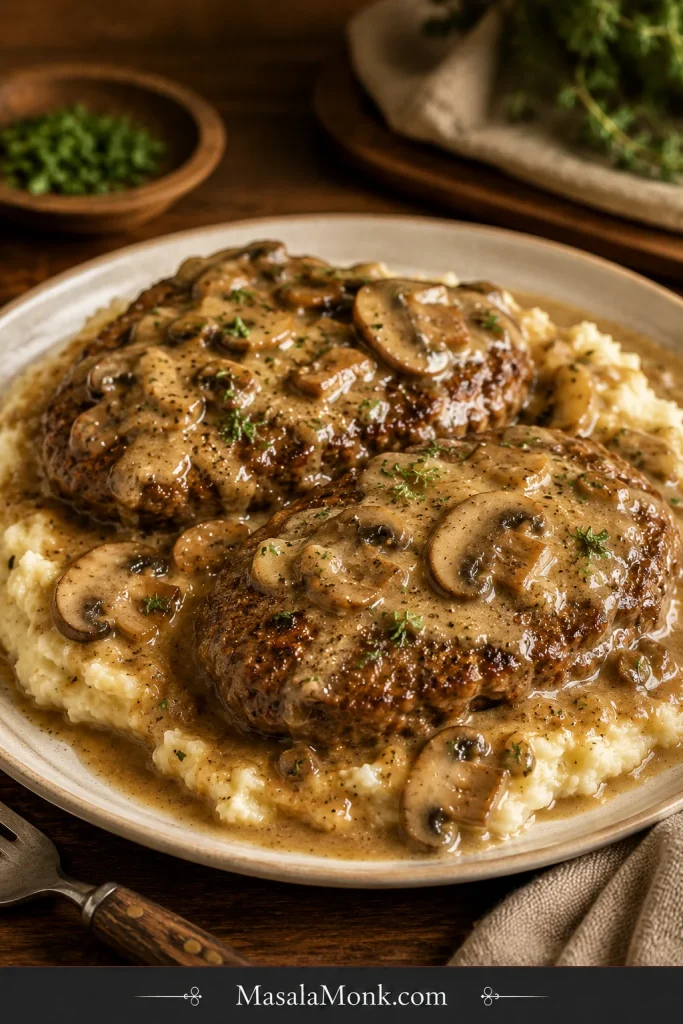
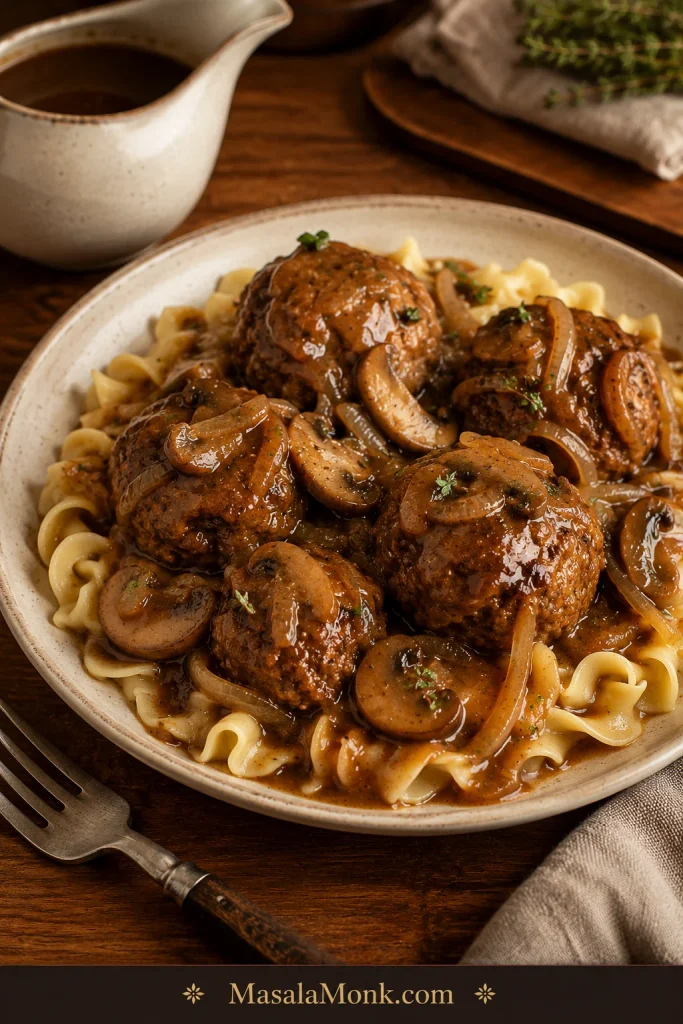
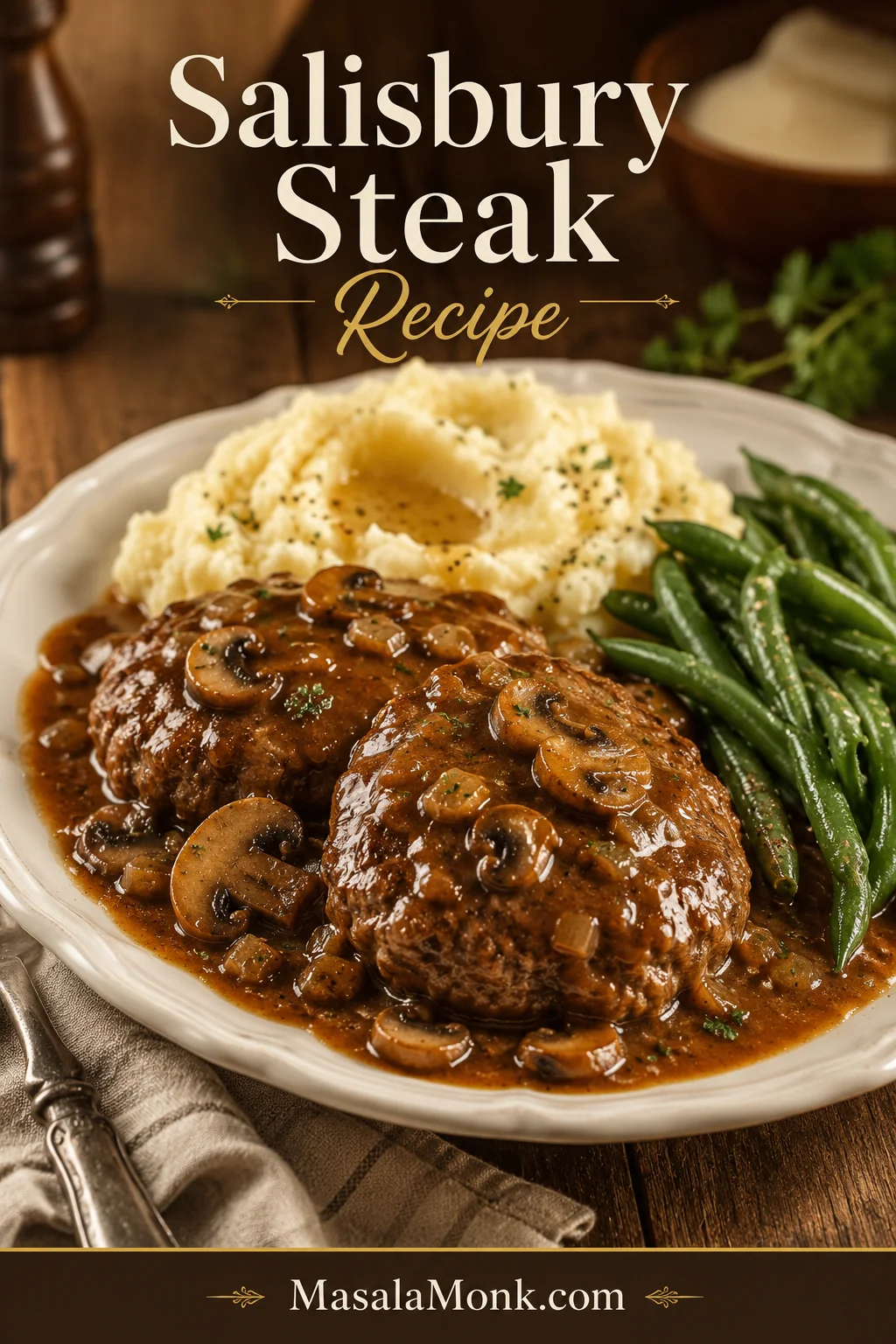
Salisbury steak patties with mushroom onion gravy, mashed potatoes, and green beans on a cream plate.

This Salisbury steak recipe is for the night you want old-fashioned comfort without making anything complicated: tender oval beef patties, glossy mushroom onion gravy, and a plate that feels made for mashed potatoes. It cooks in about 40 minutes, all in one skillet, with enough gravy for potatoes, rice, or egg noodles.

It keeps the part people remember from TV dinners — the beef, the gravy, the mashed-potato comfort — and fixes the part nobody misses: dry meat, flat sauce, and that one-note salty taste. The first bite should feel like the Salisbury steak people remember, but the second bite should taste like the version they always wished it was.
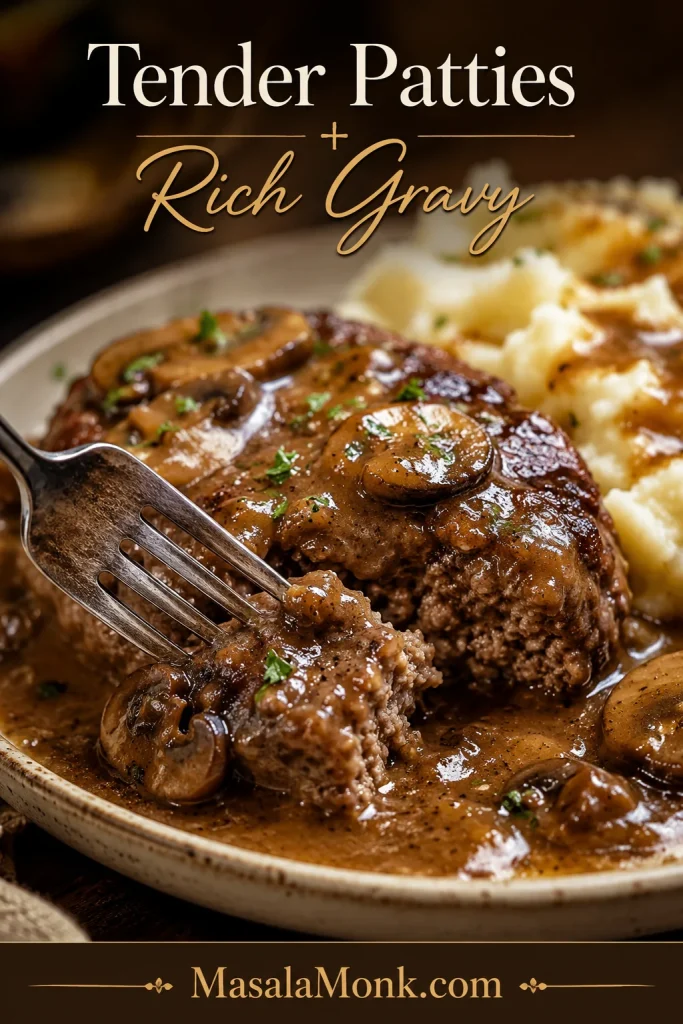
Fork cutting into Salisbury steak with mushroom gravy and mashed potatoes in the background.
Look for a patty that cuts cleanly with a fork but still looks moist inside. That is the texture you get when the beef is handled lightly and simmered gently.

The goal is simple: juicy patties, savory gravy, and a dinner that feels familiar in the best way — not dry, bland, salty, or fussy. The secret is not making ground beef fancy. It is getting three humble things right: tender patties, browned flavor, and gravy that tastes like it had more time than it did.

Start with the classic skillet version: browned beef patties, mushroom onion gravy, and a low, gentle finish in the pan. From there, you can take the same method wherever your kitchen needs it: no mushrooms, brown gravy mix, cream of mushroom soup, frozen hamburger patties, baked Salisbury steak, Crock Pot-style dinners, or make-ahead leftovers without ending up with dry meat or salty gravy.

Quick Answer: How to Make Salisbury Steak

To make Salisbury steak, mix ground beef with egg, breadcrumbs, grated onion, Worcestershire sauce, ketchup, mustard, salt, and pepper. Shape the mixture into oval patties, brown them in a skillet, make mushroom onion gravy in the same pan, then simmer the patties in the gravy until cooked through.

The best patties are about 3/4 inch / 2 cm thick. Brown them for 2–3 minutes per side, then simmer gently in gravy for about 8–10 minutes, or until the center reaches 160°F / 71°C.

Fast path: 1 lb / 454 g ground beef, or up to 500 g, makes 4 oval patties. Brown first, build the gravy in the same skillet, finish gently in the pan gravy, and serve with mashed potatoes, rice, or egg noodles.

This skillet view shows the core method: brown the patties, keep the flavor in the pan, and let the mushroom onion gravy finish the dinner.
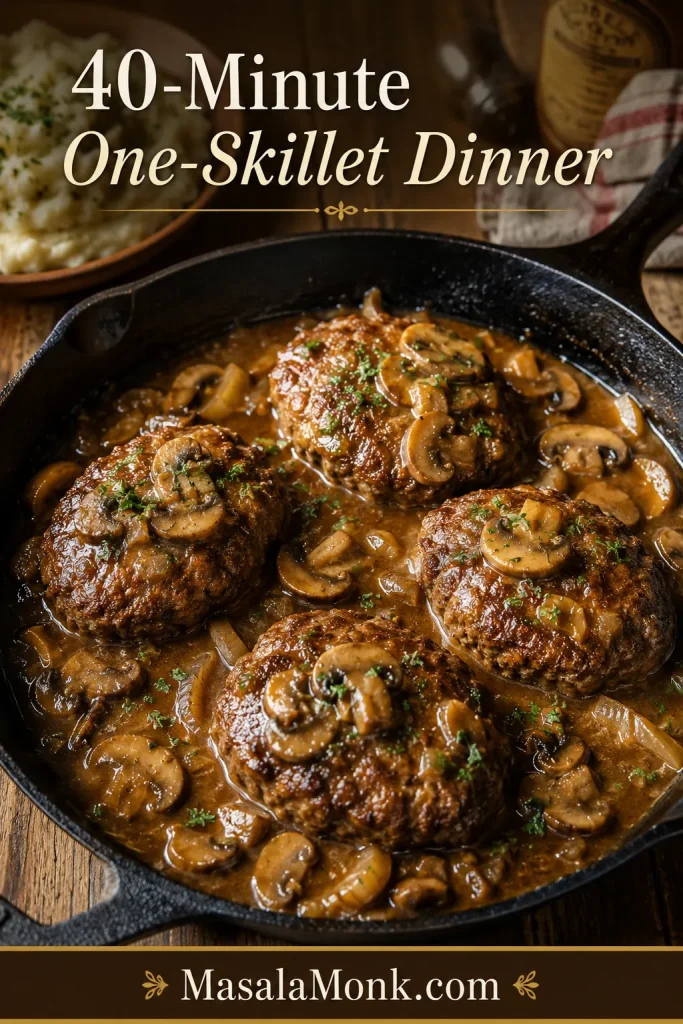
Oval Salisbury steak patties simmering in mushroom onion gravy in a black skillet.
One skillet gives you better gravy because the browned bits stay in the pan. After the patties sear, the mushrooms, onions, and broth pick up that flavor.

Need the full flow? Jump to the step-by-step method · Choosing a shortcut? Compare the versions · Patties or gravy misbehaving? Go to patty fixes or gravy fixes.

Make This Salisbury Steak When

  • You have ground beef and want something cozier than plain burgers.
  • Dinner needs gravy, mashed potatoes, and an old-fashioned feel.
  • You want a skillet meal with pantry ingredients, not a complicated steakhouse recipe.
  • Your family likes hamburger steak, brown gravy, mushroom gravy, or onion gravy.
  • You need a recipe that includes shortcuts without losing the homemade feel.

If ground beef is doing dinner duty this week, this Korean beef bowl recipe is faster and saucier, while this American goulash recipe turns ground beef and macaroni into a one-pot comfort dinner.

Salisbury Steak Recipe Card

Salisbury Steak With Mushroom Onion Gravy

Tender old-fashioned ground beef patties browned in a skillet and simmered in rich mushroom onion gravy. Serve with mashed potatoes for the classic plate, or spoon the pan gravy over rice or egg noodles for an easy weeknight dinner.

Prep Time15 minutes
Cook Time25 minutes
Total Time40 minutes
Servings4
Yield4 Salisbury steak patties
CourseDinner
CuisineAmerican comfort food
MethodStovetop skillet
Finish Temp160°F / 71°C

Equipment

  • Large skillet or cast-iron skillet
  • Mixing bowl
  • Box grater or sharp knife for the onion
  • Whisk
  • Wide spatula
  • Instant-read thermometer

For the Salisbury Steak Patties

  • 1 lb / 454 g ground beef, or up to 500 g if that is your package size, preferably 80/20 or 85/15
  • 1 large egg
  • 1/2 cup panko, about 30 g, or 1/2 cup fine dry breadcrumbs, about 45–55 g
  • 1/4 cup finely grated onion, from about 1/2 small onion, or very finely minced onion
  • 1–2 garlic cloves, minced
  • 1 tablespoon ketchup
  • 1 teaspoon Worcestershire sauce
  • 1 teaspoon Dijon mustard, or 1/2 teaspoon dry mustard
  • 3/4 teaspoon salt
  • 1/2 teaspoon black pepper
  • 1 tablespoon oil, for browning
  • Optional: 1/2 teaspoon onion powder, garlic powder, or smoked paprika

For the Mushroom Onion Gravy

  • 2 tablespoons butter
  • 6–8 oz / 170–225 g mushrooms, sliced, such as cremini, baby bella, or white button mushrooms
  • 1/2 to 1 medium onion, sliced or finely chopped
  • 2 tablespoons all-purpose flour
  • 2 cups / 480 ml beef broth, low-sodium if possible
  • 1 teaspoon Worcestershire sauce
  • 1 teaspoon Dijon mustard
  • 1 tablespoon ketchup for classic flavor, or tomato paste for a deeper gravy
  • Black pepper, to taste
  • Salt, only if needed
  • Optional: 2–3 tablespoons cream for a richer gravy

Before you start: Slice the mushrooms and onion, measure the broth, and keep the flour nearby. Once the patties are browned, the gravy comes together quickly in the same skillet.

Shape and Brown the Patties

  1. Mix the patties gently. In a large bowl, combine ground beef, egg, breadcrumbs, grated onion, garlic, ketchup, Worcestershire sauce, Dijon mustard, salt, pepper, and any optional seasoning. Mix just until combined. Do not knead or overwork the beef.
  2. Shape the patties. Divide the mixture into 4 oval patties about 3/4 inch / 2 cm thick. Each patty should be about 4 oz / 115–125 g. If the mixture feels soft, chill the shaped patties for 10–15 minutes before browning.
  3. Brown the patties. Heat oil in a large skillet over medium-high heat. Brown the patties for 2–3 minutes per side. They should get color but do not need to cook through yet. That is exactly what you want.

Make the Gravy and Finish

  1. Cook the mushrooms and onions. Transfer the patties to a plate. In the same skillet, melt the butter. Add mushrooms and onion. Cook for 5–7 minutes, stirring often, until the mushrooms look smaller, darker, and no longer watery in the pan.
  2. Make the gravy. Sprinkle flour over the mushrooms and onions. Stir for 1 minute. Slowly whisk in beef broth, scraping up the browned bits from the skillet. Add Worcestershire sauce, Dijon mustard, ketchup or tomato paste, and black pepper.
  3. Finish in the gravy. Return the browned patties and any juices to the skillet. Spoon gravy over the top. Reduce heat to medium-low and simmer gently for 8–10 minutes, or until the patties reach 160°F / 71°C in the center.
  4. Taste and serve. Add salt only if needed. Stir in cream at the end if using. Serve hot with mashed potatoes, rice, egg noodles, or vegetables.

Recipe Cues Before Serving

Recipe cue: The gravy should coat a spoon, the patties should feel tender when pressed, and the skillet should be at a quiet simmer rather than a hard boil.

Common mistake to avoid: Do not fully cook the patties during the browning step. They only need color on the outside. They finish cooking gently in the gravy, which keeps them more tender.

Cooking from the card? Keep the cooking cues handy, or jump straight to the photo-guided steps.

Salisbury Steak Success Check: The patties should be browned on the outside, 160°F / 71°C in the center, and tender when pressed. The gravy should coat a spoon, move slowly over mashed potatoes, and taste savory before it tastes salty. If it tastes flat, add Worcestershire sauce, Dijon, black pepper, or a little tomato paste before adding more salt.

Why this method works: Grated onion keeps the patties moist, a quick sear builds flavor without drying the beef, and finishing in gravy lets the meat cook gently while the sauce picks up the pan flavor.

Use this success check before serving so the patties, gravy, and finish temperature all line up.
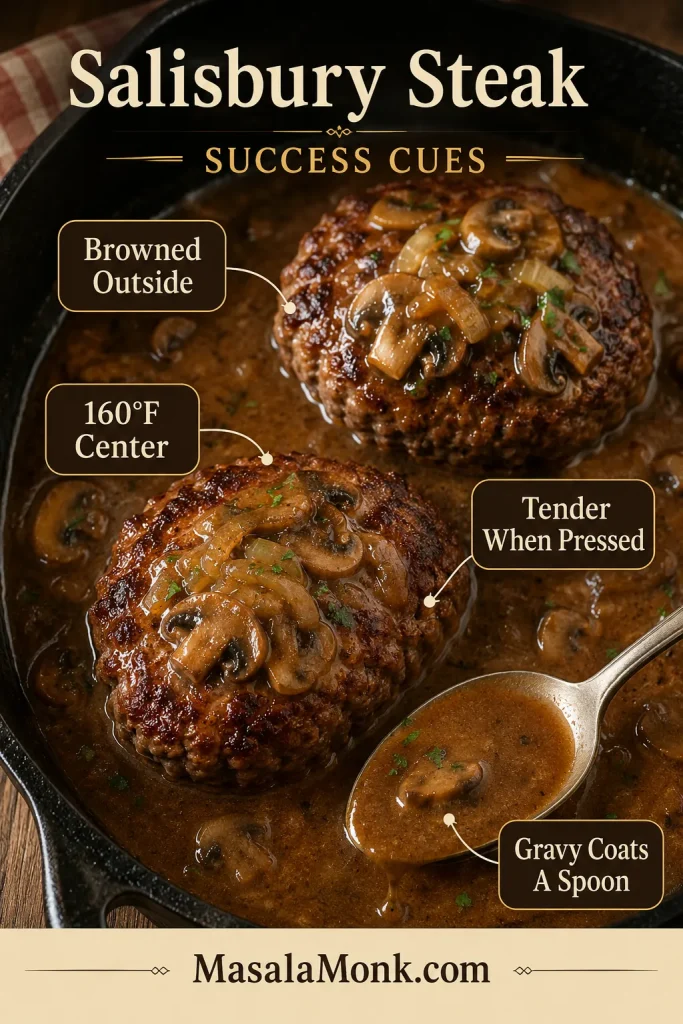
Salisbury steak success check showing browned patties, gravy, and cooking cues.
Before the plate goes out, check the cues that matter: browned patties, a fully cooked center, and gravy that coats the spoon without becoming gluey.

Salisbury Steak Cooking Cues at a Glance

Best beef80/20 or 85/15 ground beef
Patty size4 oval patties, about 4 oz / 115–125 g each
Patty thicknessAbout 3/4 inch / 2 cm thick
BinderEgg + breadcrumbs or panko
Main gravyMushroom onion gravy with beef broth
Browning time2–3 minutes per side
Finish methodLow, gentle finish in the gravy
Safe temperature160°F / 71°C in the center
Best sidesMashed potatoes, rice, egg noodles, green beans, peas, carrots

Once the patties are shaped and the skillet is hot, the rest is mostly patience: let the meat brown, let the mushrooms cook down, and let the pan gravy finish the job.

Table of Contents

Cooking now? Use the recipe card above. Want the why, the fixes, and the shortcut versions? Use the guide below.

What Is Salisbury Steak?

Most Salisbury steak starts with ground beef mixed with egg, breadcrumbs, onion, Worcestershire sauce, ketchup or mustard, and seasonings. The mixture is shaped into small oval steaks, browned in a skillet, and served with brown gravy, mushroom gravy, or onion gravy.

Despite the name, it is not cut from a whole steak. It is a ground beef dinner, closer to hamburger steak, but usually with more seasoning and binder mixed into the meat.

That is why it feels familiar before you even cook it: a browned beef patty, a pool of gravy, and something soft on the plate to catch every spoonful.

What This Recipe Is Built Around

The whole dinner works because the method stays simple: season the beef well, shape it gently, brown it properly, then let the pan gravy finish the job.

Think of it as the frozen-dinner idea rebuilt properly: better beef, better browning, and gravy that comes from the skillet instead of a tray. It keeps the familiar comfort of the old tray-dinner version, but gives you the part those dinners never really had: fresh pan flavor and gravy you can adjust at the stove.
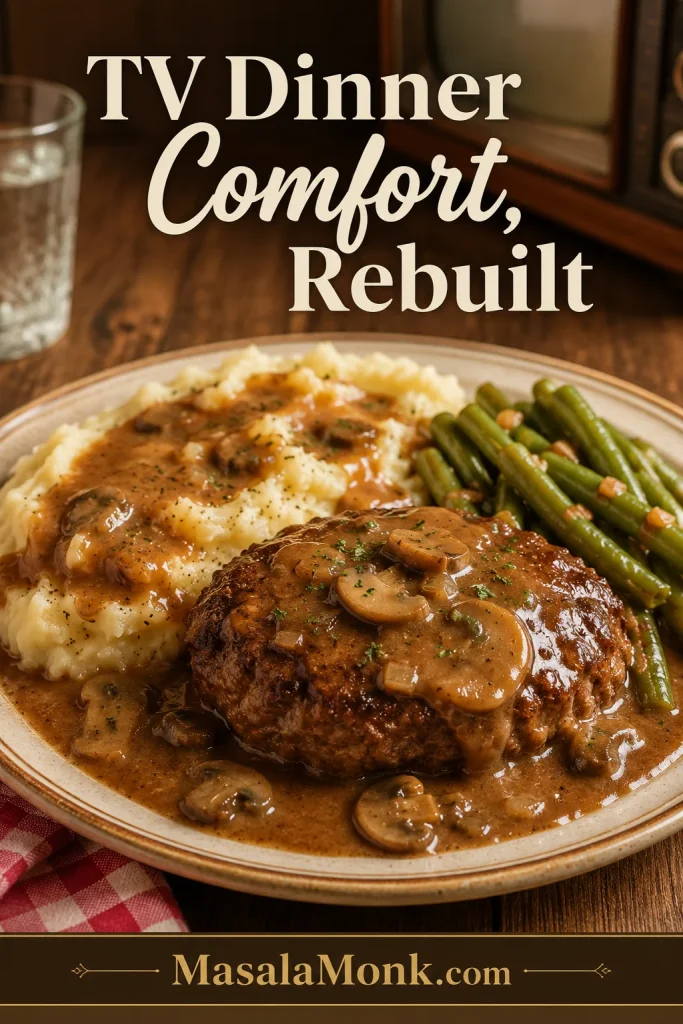
Old-fashioned Salisbury steak dinner with mushroom gravy, mashed potatoes, and green beans.
Old-fashioned Salisbury steak works best when the nostalgia is backed by real skillet flavor. Browned patties and homemade gravy make it taste far better than the TV-dinner version people remember.

The flavor comes from small pantry ingredients that work together. Worcestershire sauce adds savoriness, ketchup gives a little sweet tang, mustard adds balance, mushrooms and onions build the gravy base, and beef broth gives it body.

Why This Salisbury Steak Recipe Works

  • Egg and breadcrumbs help the patties hold together while still keeping them tender.
  • Grated onion adds moisture without leaving large raw onion pieces in the beef.
  • Worcestershire, ketchup, and mustard give classic flavor with pantry ingredients.
  • Browning first builds flavor and helps the patties stay intact.
  • Same-pan gravy uses the browned bits left behind from the beef.
  • A quiet simmer finishes the patties without turning them tough.

Ingredients and Why They Matter

This recipe is forgiving, but the ingredients still have jobs to do. The patties need structure and moisture, while the gravy needs enough browning and seasoning to taste like more than thickened broth.
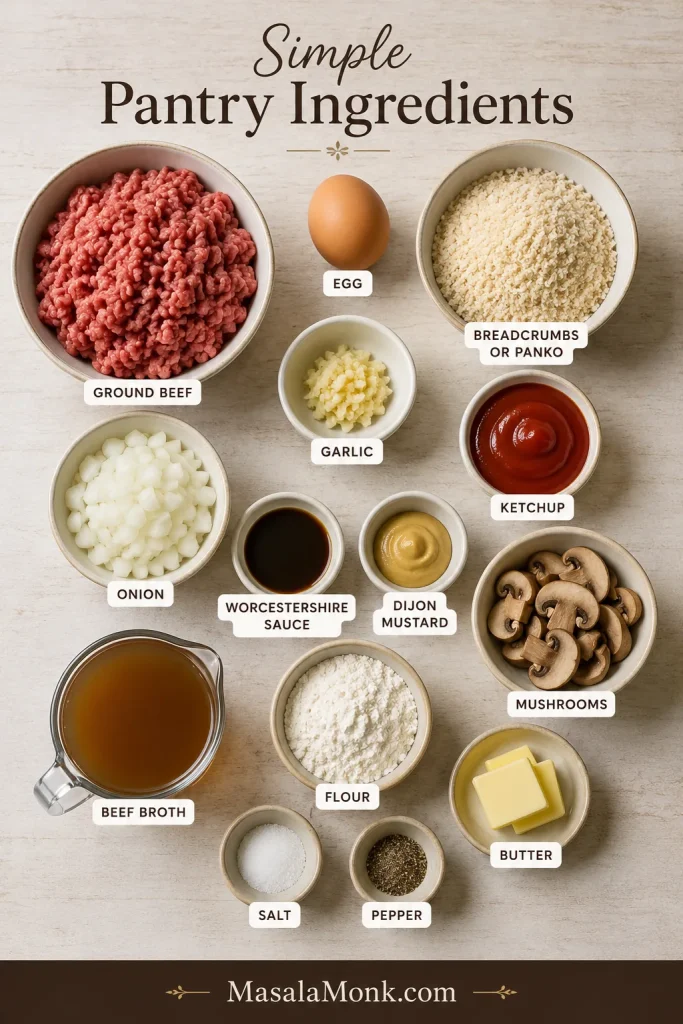
Ingredients for Salisbury steak including ground beef, egg, breadcrumbs, onion, mushrooms, broth, butter, flour, and seasonings.
The patty ingredients and gravy ingredients do different jobs. Keep the beef mixture gentle, then let the skillet build the sauce after browning.
IngredientWhat it does
Ground beef80/20 or 85/15 gives the best balance of flavor and tenderness.
EggHelps bind the patties so they do not fall apart in the skillet.
Breadcrumbs or pankoAdd structure and keep the patties from becoming dense.
Grated onionAdds moisture and old-fashioned flavor throughout the beef.
Worcestershire sauceAdds deep savory flavor.
KetchupGives a small sweet-tangy note that tastes familiar in the patties.
Dijon or dry mustardBalances the richness of the beef and gravy.
MushroomsGive the gravy body, earthiness, and classic mushroom-gravy flavor.
OnionSweetens as it cooks and makes the pan gravy feel fuller.
FlourThickens the gravy into a spoonable sauce.
Beef brothForms the main gravy liquid.

Once those pieces are in place, the recipe is less about perfect measurements and more about good cues: do not overmix, do not rush the browning, and do not let the gravy boil hard.

Best Ground Beef for This Recipe

Use 80/20 or 85/15 ground beef if you can. The patties need some fat to stay juicy, especially because they are browned first and then finished in gravy.

Very lean beef can work, but it is less forgiving. With 90/10 beef, mix gently, avoid overcooking, and consider adding a splash of milk or a little extra grated onion to keep the centers moist.

Panko gives a slightly lighter patty. Regular breadcrumbs make the texture softer and more old-fashioned. Crushed crackers also work well, especially if you like the classic pantry-dinner style.

Start with 1/2 cup. If the mixture feels too wet after mixing, add 1–2 tablespoons more and let it sit for a few minutes before shaping.

Useful Equipment

You do not need special equipment, but a few tools make this skillet dinner easier and more reliable.

  • Large skillet: A 12-inch skillet gives the patties room to brown instead of steam.
  • Wide spatula: Helps turn soft patties without breaking them.
  • Whisk: Keeps the gravy smooth when broth goes into the flour.
  • Box grater: Useful for grating onion into the patty mixture.
  • Instant-read thermometer: The easiest way to check that ground beef patties reached 160°F / 71°C.

How to Make Salisbury Steak

1. Mix the beef gently

Add the ground beef, egg, breadcrumbs, grated onion, garlic, ketchup, Worcestershire sauce, mustard, salt, and pepper to a bowl. Mix just until the ingredients are evenly combined.

Do not knead the beef like dough. Overmixing makes the patties firm and springy instead of tender.
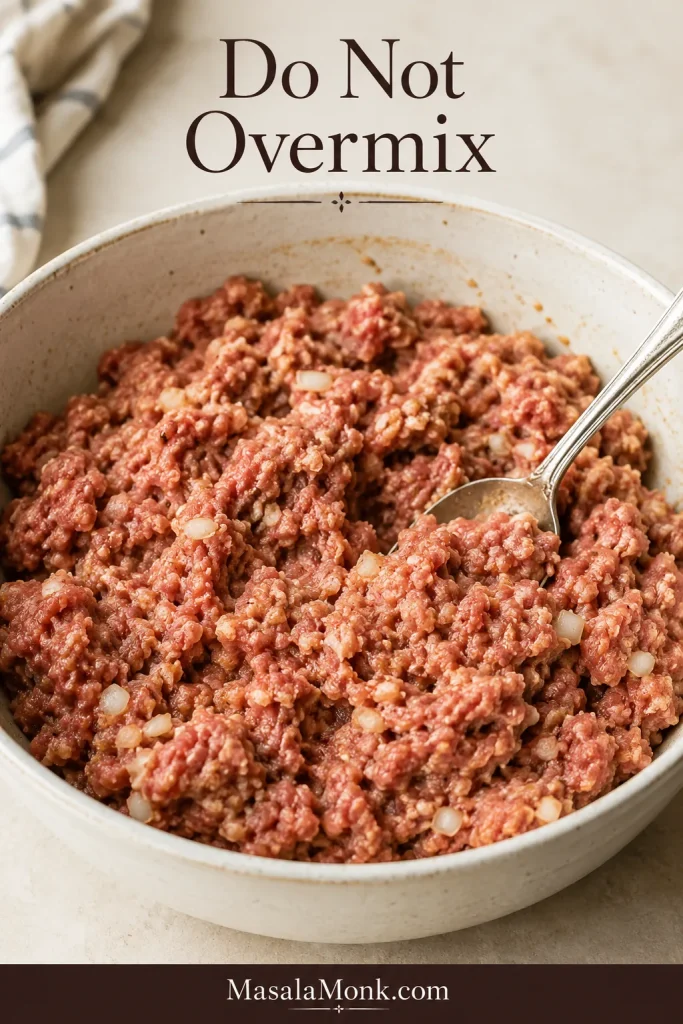
Ground beef mixture for Salisbury steak patties in a bowl with visible breadcrumbs and onion.
A just-combined mixture is better than a compact one. If it holds its shape without being packed hard, it is ready for patties.

Optional flavor check: Cook a teaspoon-sized piece of the beef mixture in the skillet before shaping all the patties. Taste it, then adjust salt, pepper, Worcestershire sauce, or mustard if needed.

2. Shape oval patties

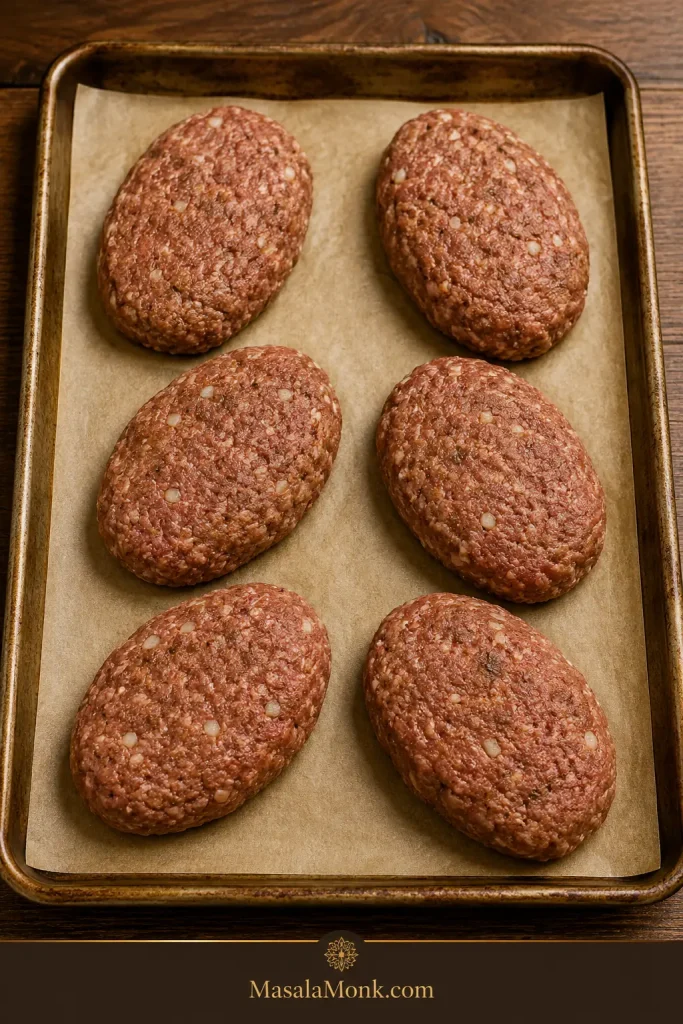
Divide the mixture into 4 portions and shape them into oval patties about 3/4 inch / 2 cm thick. They should look more like small chopped steaks than thick burger patties.
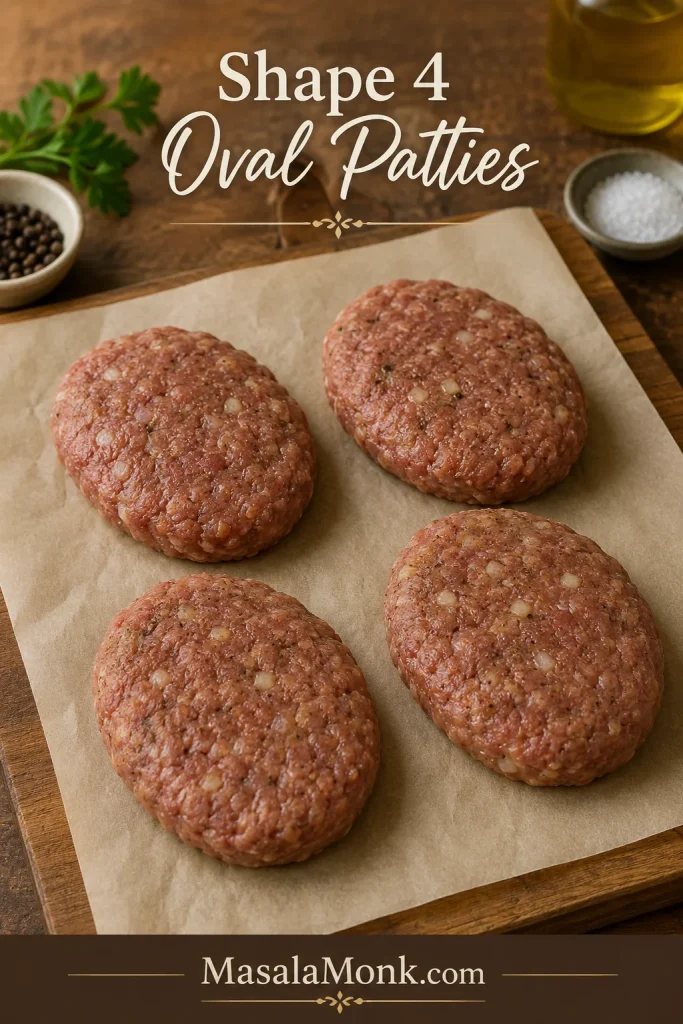
Four raw oval Salisbury steak patties shaped on parchment paper before cooking.
Smooth the edges and keep the thickness even so each oval patty browns at the same pace and sits flat in the gravy.

They do not need to look perfect. A slightly rustic oval patty feels right here; it just needs to be even enough to cook gently in the gravy.

If the mixture feels soft, that does not mean you ruined it. Chill the shaped patties for 10–15 minutes so they firm up before they hit the pan, or add 1–2 tablespoons breadcrumbs if the mixture is still loose.

Best Patty Size

For 1 lb / 454 g ground beef, or up to 500 g, make 4 oval patties. Each patty should be about 4 oz / 115–125 g and about 3/4 inch / 2 cm thick. This size browns well, cooks evenly, and still feels like old-fashioned Salisbury steak instead of a regular burger.
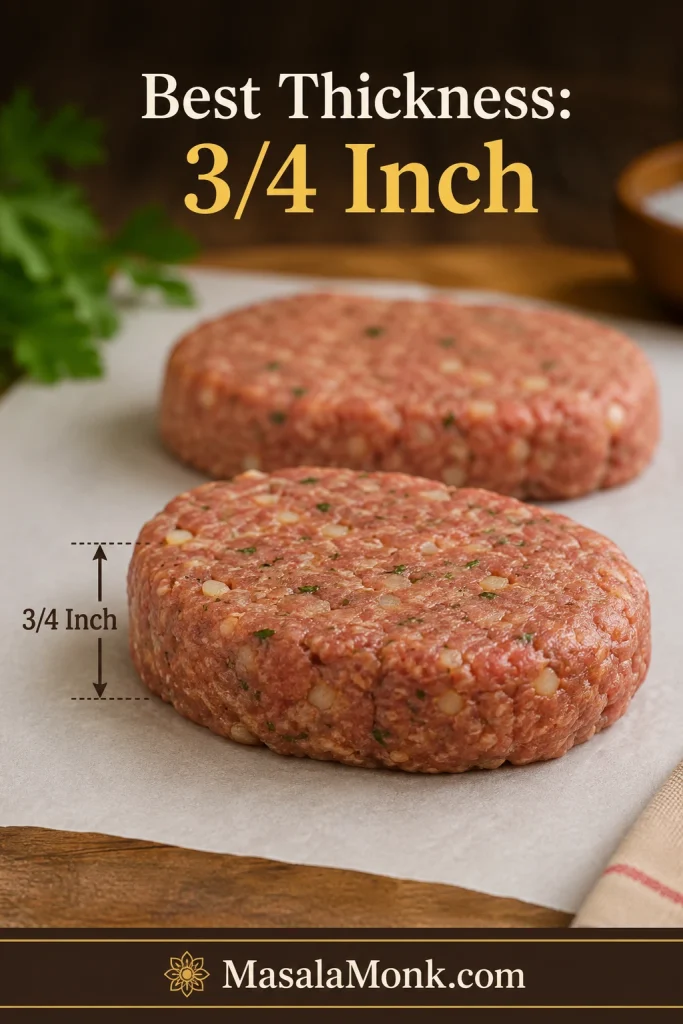
Side view of raw Salisbury steak patties showing about three quarter inch thickness.
Use thickness as a cooking control. Too thin dries out quickly, while too thick needs extra simmering and can tighten before the center is done.

The finished patties should be fork-tender like a soft meatball, not chewy like a dry burger.

3. Brown before simmering

Heat oil in a large skillet over medium-high heat. Brown the patties for 2–3 minutes per side. They should develop color, but they do not need to be cooked through yet.
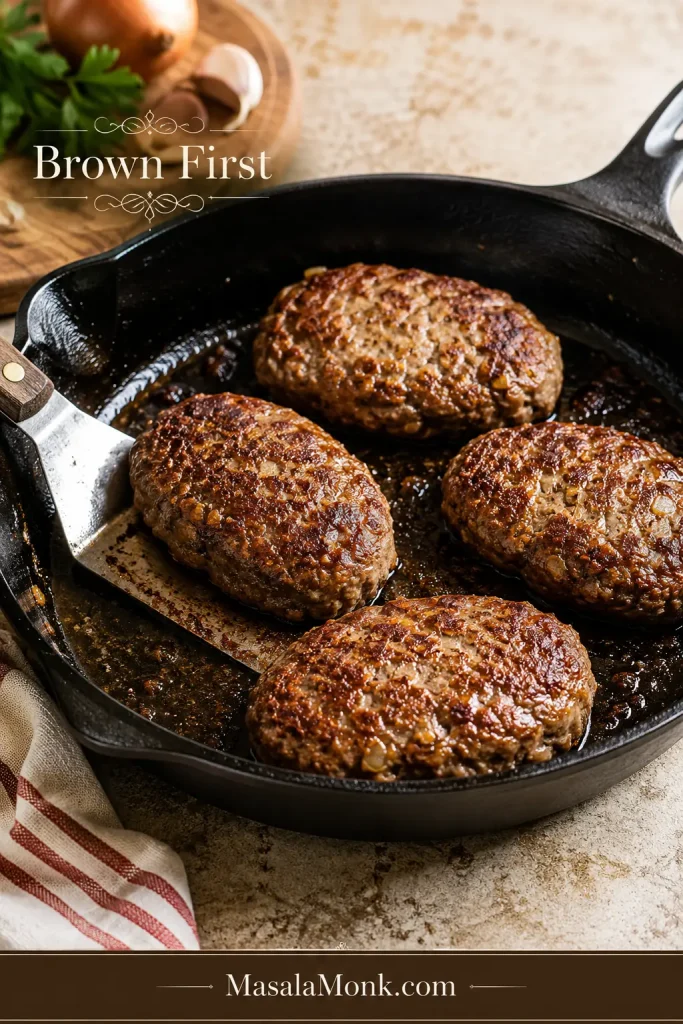
Salisbury steak patties browning in a skillet before gravy is added.
At this stage, browning matters more than cooking through. The crust builds flavor first, then the patties finish safely and gently in the gravy.

If the patties stick, give them another 30 seconds before flipping. Meat usually releases more cleanly once a crust has formed.

Move them to a plate while you make the gravy. The browned bits left in the pan are part of the flavor base.

4. Make the gravy in the same skillet

Melt butter in the skillet, then cook the mushrooms and onions until they soften and begin to brown. This is where the dish starts to smell like dinner instead of just browned beef, so let the mushrooms and onions do their work before you rush in with the broth.

Stir in flour, then slowly whisk in beef broth with Worcestershire sauce, Dijon mustard, ketchup or tomato paste, and black pepper. As the broth goes in, scrape the bottom of the skillet to pull up the browned bits from the patties. Those bits are what make the gravy taste deeper instead of flat.

5. Finish gently in the gravy

Return the patties to the skillet and spoon gravy over them. Simmer gently for 8–10 minutes, or until the centers reach 160°F / 71°C.
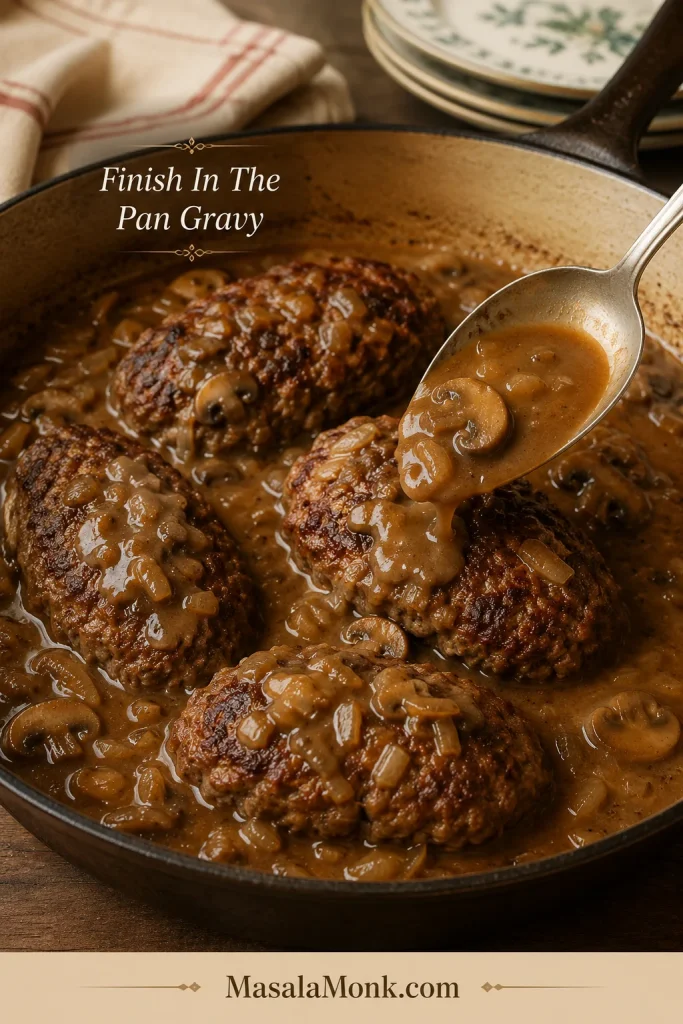
Browned Salisbury steak patties returned to mushroom gravy in a skillet.
Bring the gravy down to a slow bubble before adding the patties back. Then the sauce warms the meat gently instead of tightening it.

The skillet should bubble quietly. If the gravy is boiling hard, lower the heat so the meat stays tender.
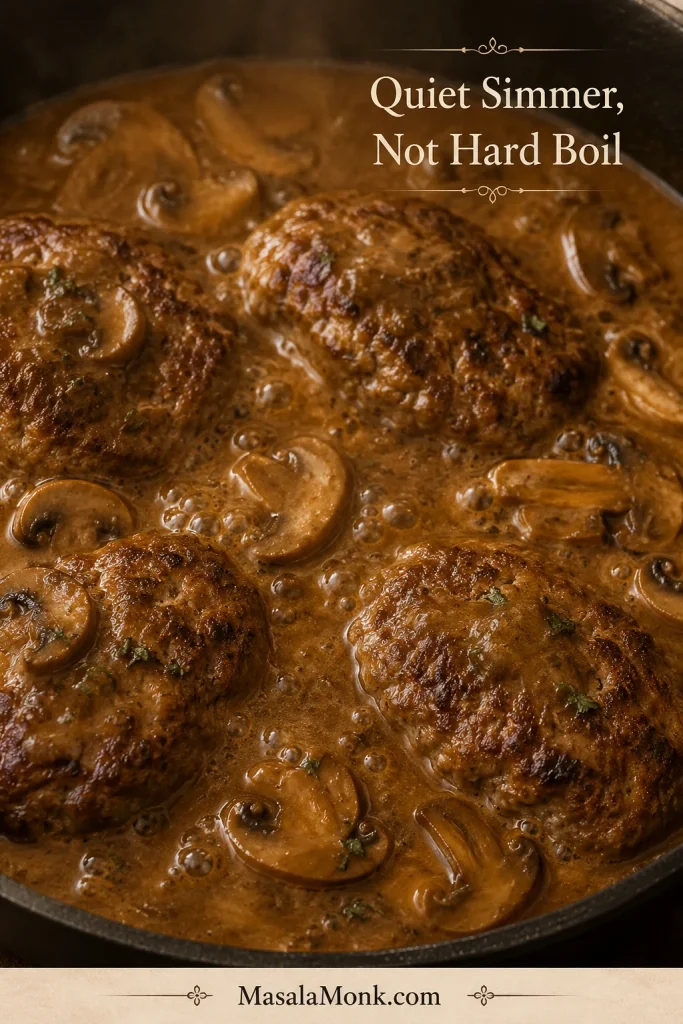
Salisbury steak patties gently simmering in mushroom gravy with small bubbles.
Keep the bubbles small once the patties return to the skillet. Gentle simmering keeps the beef tender, while hard boiling can make it tight.

Check the temperature and serve

A thermometer helps here because color alone can be misleading. The patties may look done before the center reaches the safe finish temperature, especially if they are thick.
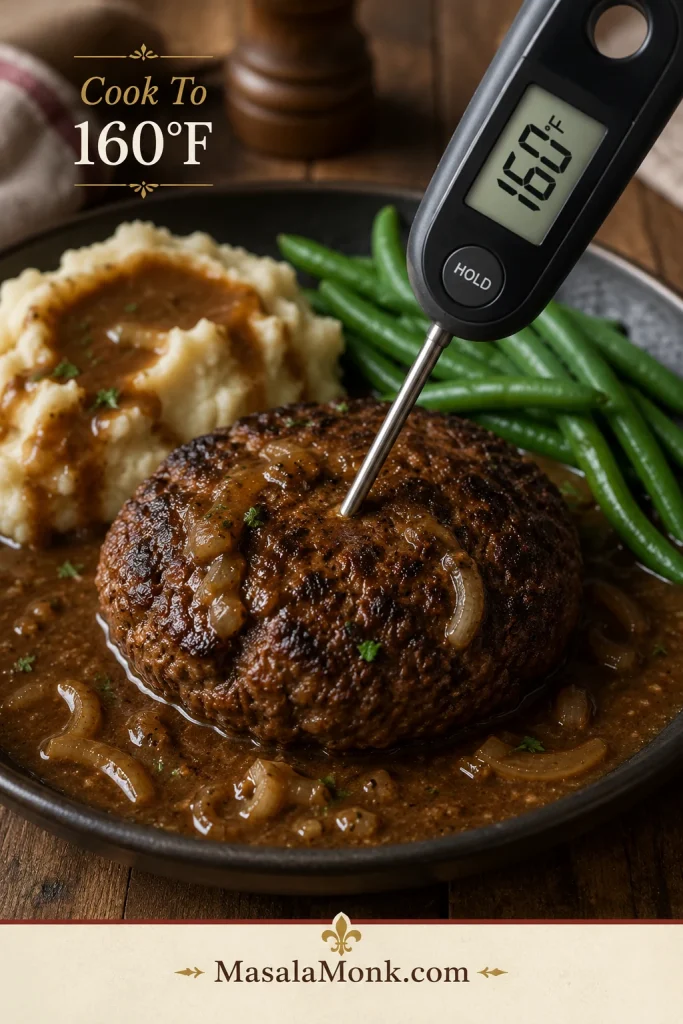
Instant-read thermometer checking the center of a Salisbury steak patty.
Color alone is not the safest guide for ground beef. Use an instant-read thermometer and cook the center of each patty to 160°F / 71°C.

Back to recipe card · Next: mushroom onion gravy · Troubleshoot gravy · Back to top

How to Make Mushroom Onion Gravy

The gravy is half the comfort here. It should taste savory first, then rich — thick enough to coat a spoon but loose enough to flow over mashed potatoes.

Brown the mushrooms and onions

Cook the mushrooms and onions until the mushrooms release moisture and the onions begin to soften. The mushrooms are ready when they look smaller, darker, and no longer watery in the pan.
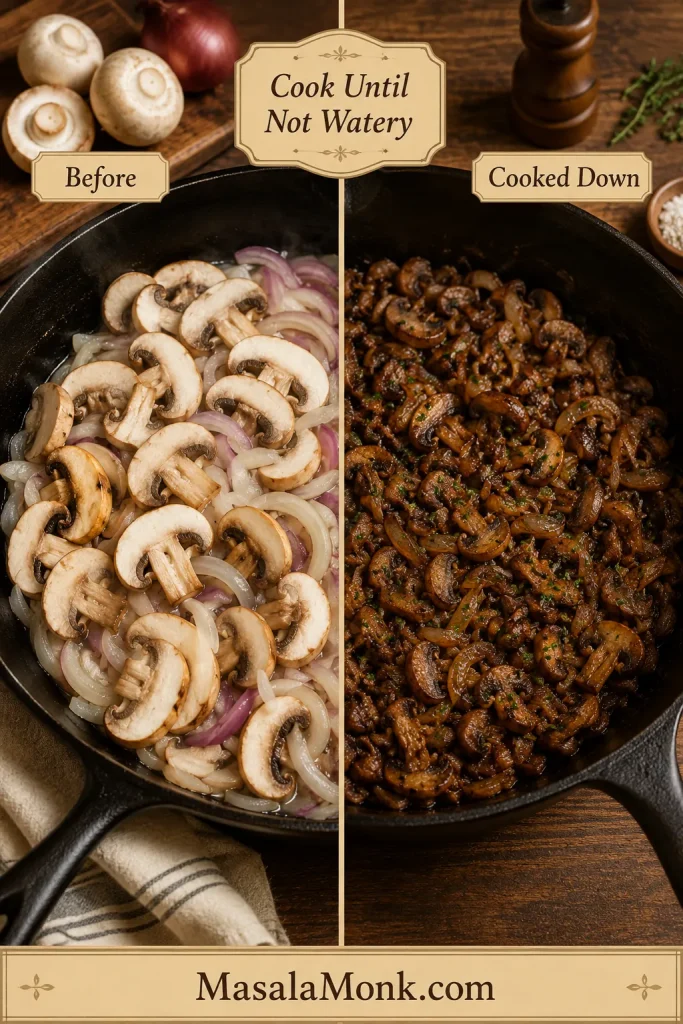
Before and after comparison of mushrooms and onions cooking down for Salisbury steak gravy.
Wait for mushroom moisture to cook off before adding broth. That gives the gravy a deeper base instead of a watery one.

Do not add broth the moment the vegetables hit the skillet. A few extra minutes here gives the pan gravy deeper flavor.

If you only have canned mushrooms, drain them well and add them after the onions soften. They will not brown like fresh mushrooms, but they still add mushroom flavor to the gravy.

Cook the flour briefly

Once the mushrooms and onions are ready, sprinkle flour over them and stir for about 1 minute. After the flour goes in, the vegetables should look lightly coated, not dry and clumpy.
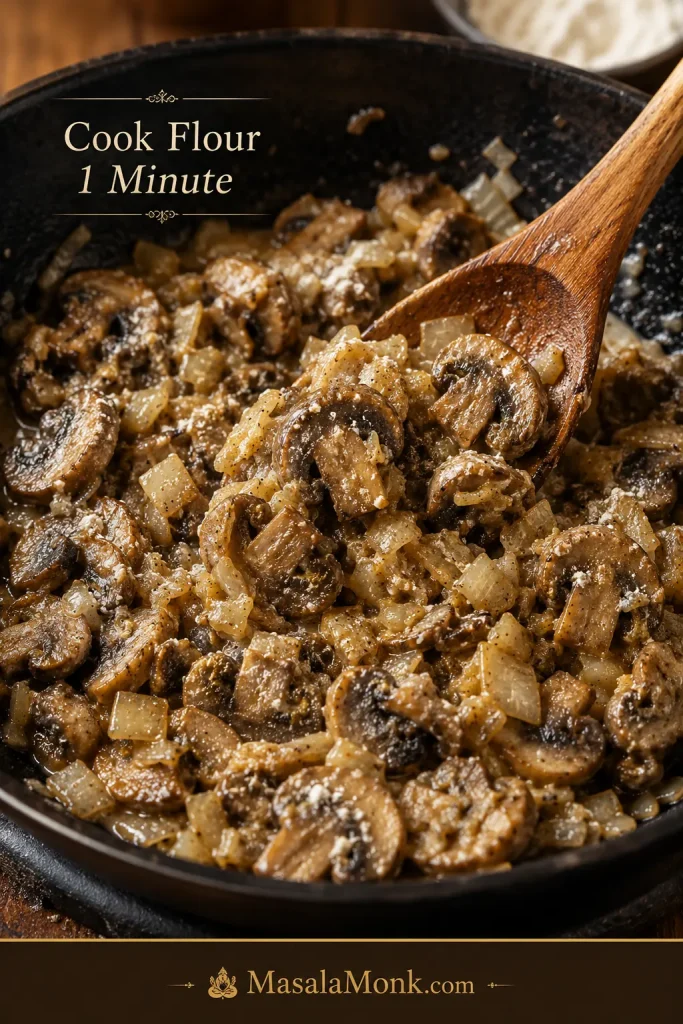
Flour stirred into cooked mushrooms and onions in a skillet before adding broth.
Stir until no dry flour patches remain around the vegetables. A smooth coating now means smoother gravy once the broth goes in.

Whisk in broth slowly

Add the beef broth slowly while whisking. The gravy will look a little loose at first. That is normal. Once the broth is whisked in, it should look smooth; it will tighten as it simmers and becomes spoonable once the patties go back into the skillet.

The 2 tablespoons flour to 2 cups broth ratio makes a medium-thick gravy. Worcestershire sauce, Dijon, and ketchup or tomato paste round out the flavor.
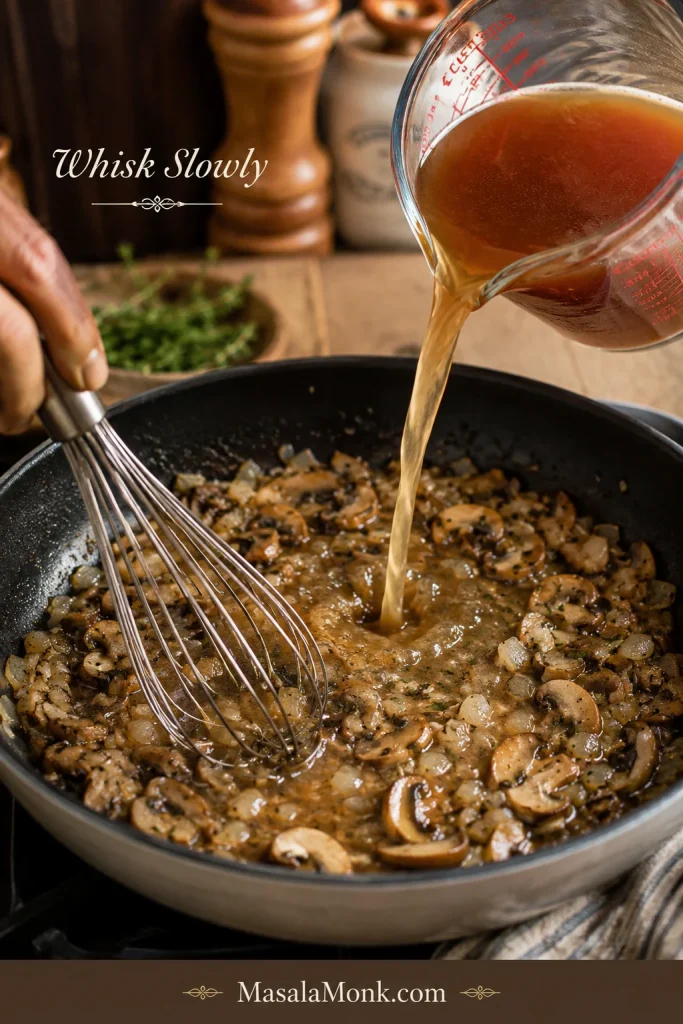
Beef broth being poured into a skillet while mushroom onion gravy is whisked.
Slow pouring matters more than speed here. Each splash of broth should loosen the flour mixture before the next one goes in.

Need more mushroom-sauce detail? This creamy mushroom sauce recipe goes deeper into browning, texture, and no-cream adjustments.

Adjust the texture at the end

If the gravy is too thick, add broth or water a splash at a time. If it is too thin, simmer uncovered for a few minutes or use a small cornstarch slurry. The finished sauce should move slowly, not sit stiffly.
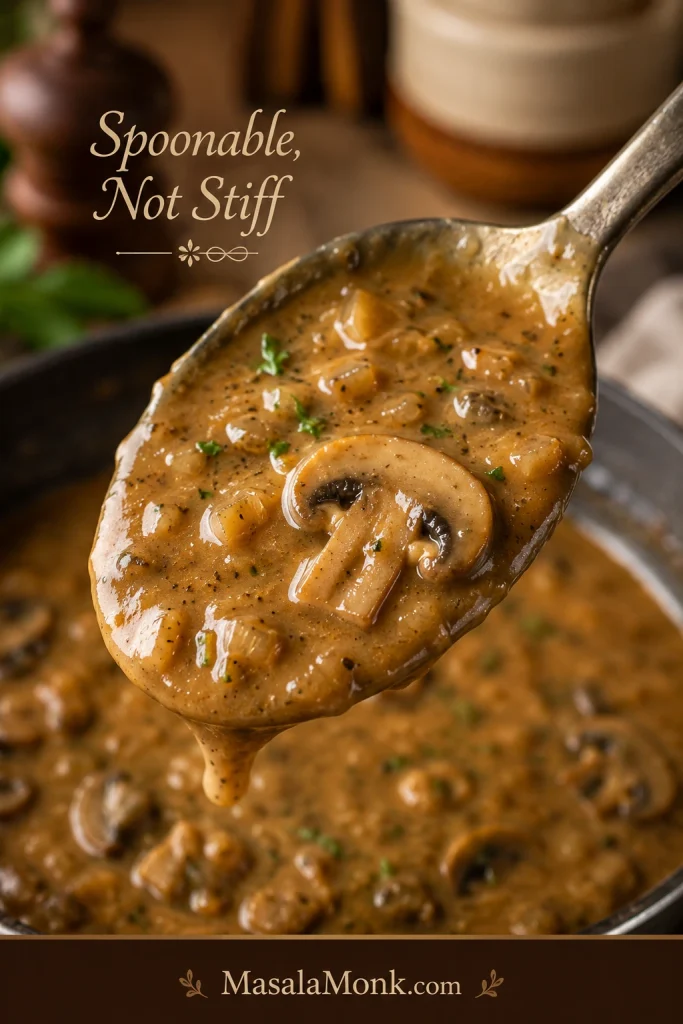
Mushroom onion gravy coating the back of a spoon.
Look for gravy that clings briefly, then flows. If it sits on the spoon like paste, add a splash of broth before serving.

Choose Your Salisbury Steak Version

This is the real-life pantry section: brown gravy mix, cream of mushroom soup, frozen hamburger patties, no mushrooms, baked Salisbury steak, and Crock Pot versions can all work if you keep the patties tender and the salt under control. Pick the route that matches your kitchen tonight, then use the main method as the base.

Shortcut Decision Table

What you have or wantBest route
You want the classic homemade versionUse the main mushroom onion gravy recipe.
You have no mushroomsMake onion gravy instead. Cook the onions longer so the sauce still tastes deep and sweet.
You have a brown gravy packetUse the liquid amount on the packet, but replace water with low-sodium beef broth. Taste before adding salt.
You have cream of mushroom soupStart with 1 can condensed soup plus 1/2 cup beef broth. Add another 1/4 cup broth if it looks too thick.
You want more onion flavorUse extra onions or a French onion-style gravy, but watch the salt if using soup mix.
You want a hands-off dinnerBrown the patties first, then use the Crock Pot section below for a softer, saucier finish.
You want to bake itBrown the patties, cover with hot gravy, and bake until 160°F / 71°C.
You have frozen hamburger pattiesThaw first if you can. Frozen works, but fresh or thawed patties brown better.
You want a kid-friendly versionShape the beef mixture into meatballs and simmer them in gravy.
You want a lighter dinnerUse leaner beef or turkey and serve with vegetables or cauliflower mash.

Shortcut Salt Rule

You do not have to make every version from scratch to get a good dinner. The trick is to keep the patties tender, keep the gravy balanced, and avoid stacking too much salt when using packets, canned soup, or bouillon.

Shortcut rule: If you use gravy mix, bouillon, canned soup, or onion soup mix, choose low-sodium broth and do not add extra salt until the gravy is finished.

Salisbury Steak vs Hamburger Steak

These two comfort-food dinners overlap, but they are not always exactly the same.

DishWhat it usually means
Salisbury steakSeasoned ground beef patties mixed with egg, breadcrumbs, onion, Worcestershire sauce, ketchup or mustard, then served with gravy.
Hamburger steakA simpler seasoned ground beef patty, often served with onion gravy or brown gravy.
Burger steakOften used for Filipino or Jollibee-style ground beef patties with mushroom gravy, usually served with rice.

The easiest way to think about it: hamburger steak is usually closer to a seasoned burger patty, while Salisbury steak eats more like a meatball-style patty with gravy.

For a regular weeknight dinner, the important part is simple: if you want ground beef patties with mushroom gravy, onion gravy, or brown gravy, this recipe gives you the right result.

Salisbury Steak Variations and Shortcuts

The base recipe is the safest place to start. The shortcut versions are there for the nights when the pantry, the freezer, or the clock makes the choice for you.

Think of these as kitchen routes, not separate recipes. The browning-and-gravy logic stays the same; you are simply changing the sauce, cooking method, or shortcut ingredient.

Choose one route and stay with it. Mixing every shortcut at once is usually how the gravy becomes too salty or too thick.

No-Mushroom Salisbury Steak

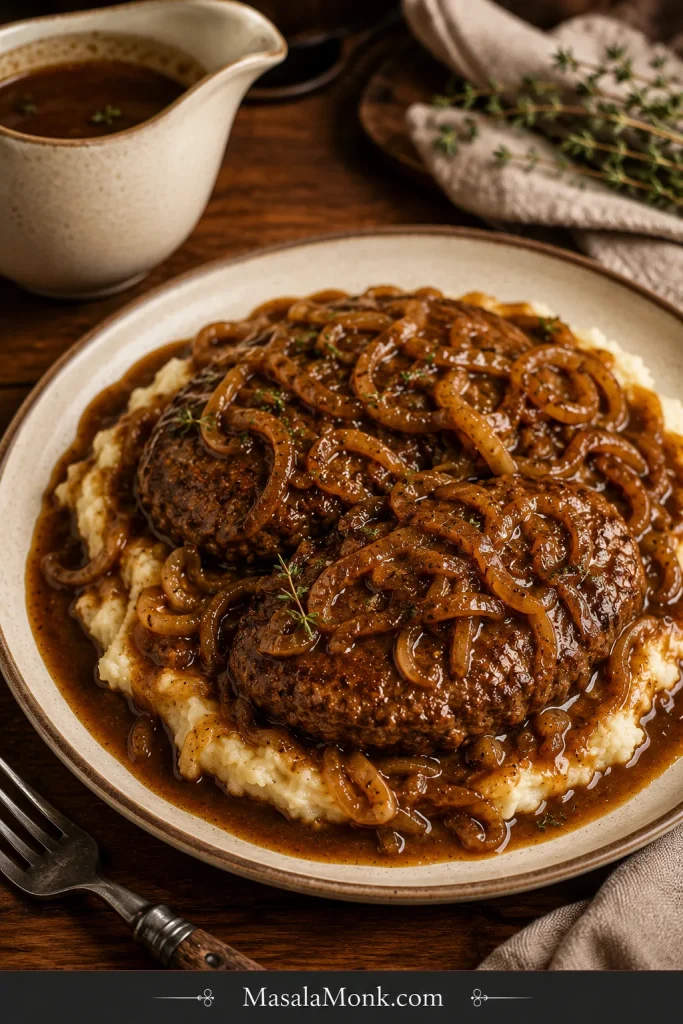
Skip the mushrooms and make onion gravy instead. Use 1 large sliced onion, cook it in butter until soft and lightly golden, then add flour and beef broth. Worcestershire sauce, Dijon, and a small spoon of ketchup or tomato paste help the gravy taste full.

This is the easiest route for anyone who dislikes mushrooms but still wants the old-fashioned gravy dinner.
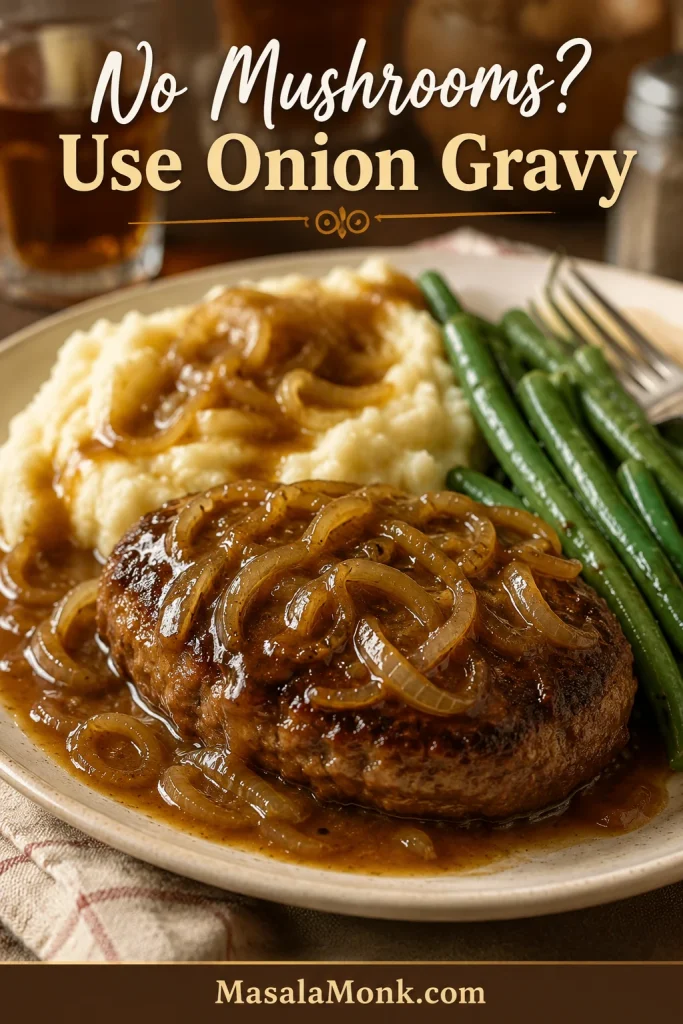
Salisbury steak with onion gravy, mashed potatoes, and green beans without mushrooms.
If mushrooms are not an option, onions can still carry the gravy. Cook them until soft and golden so the sauce tastes sweet, savory, and complete.

Onion Gravy Version

Want the gravy to taste more oniony and old-fashioned? Use 1 large onion or 2 medium onions, slice them thin, and cook them until soft, sweet, and lightly browned. The deeper the onions cook, the richer the pan sauce tastes.

If onion gravy is your favorite part of the plate, this smothered pork chops recipe uses the same brown-first, finish-gently logic with a rich onion gravy.

Brown Gravy Mix Shortcut

Brown gravy mix is useful when speed matters. For most packets, use the liquid amount listed on the package, but replace water with low-sodium beef broth. That keeps the shortcut easy while making the gravy taste more like dinner than a packet.

If you are also using bouillon, canned soup, or onion soup mix, start with half the packet or taste carefully before adding the full amount. These shortcuts can stack salt quickly.
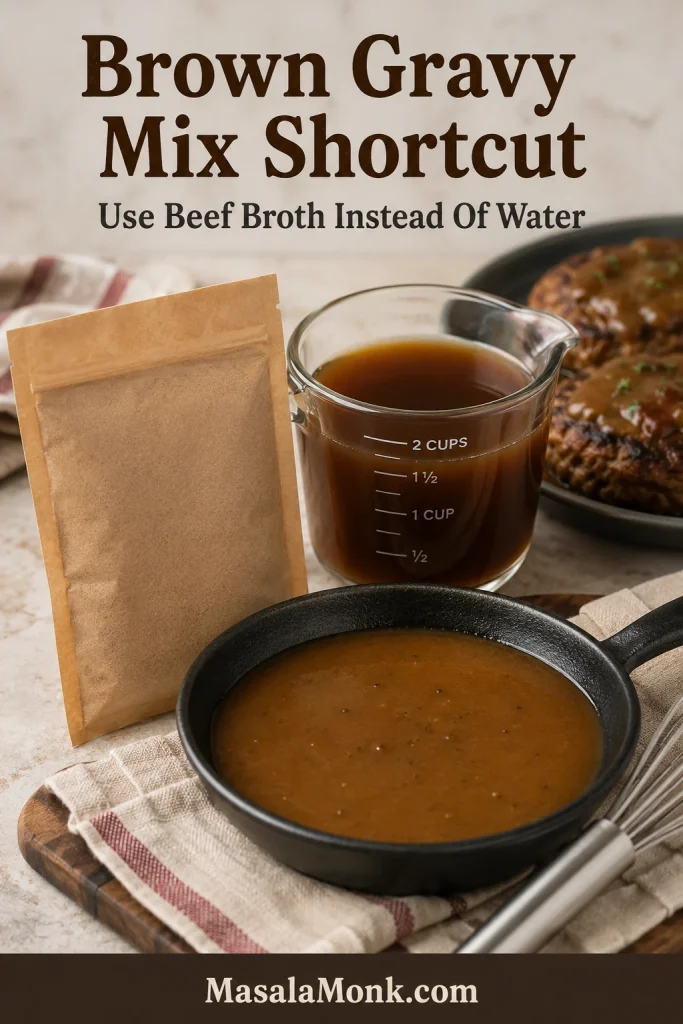
Brown gravy mix packet with beef broth and brown gravy for a Salisbury steak shortcut.
For Salisbury steak with brown gravy mix, keep the packet ratio but use low-sodium beef broth instead of water. Then season only after tasting.

Cream of Mushroom Soup Version

A can of cream of mushroom soup can work when you want the old-school pantry version. Start with 1 can condensed cream of mushroom soup plus 1/2 cup beef broth. Add another 1/4 cup broth if the sauce looks too thick after simmering.

Add Worcestershire sauce and black pepper so it tastes more like a proper gravy. If you use cream soup with brown gravy mix or onion soup mix, reduce the added salt and use low-sodium broth.
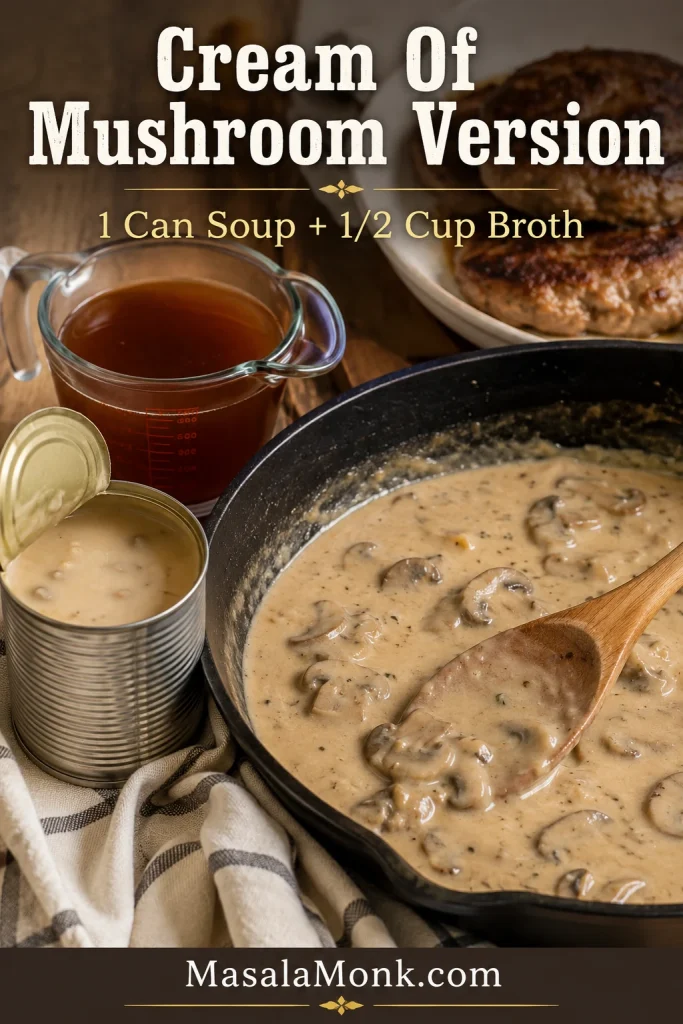
Cream of mushroom soup, beef broth, and creamy mushroom gravy for Salisbury steak.
Start thick and loosen slowly. One can plus 1/2 cup broth gives you control, and extra broth can be added only if the sauce needs it.

If you like creamy mushroom gravy dinners, this cream of mushroom pork chops recipe uses a similar pantry-friendly sauce direction.

French Onion Salisbury Steak

French onion Salisbury steak leans into the onion-gravy side of the dish. Use extra sliced onions and beef broth, or replace part of the broth with French onion soup. Onion soup mix can work too, but start with less because it is salty.

For deeper onion-gravy flavor ideas, this French onion soup recipe shows how cooked-down onions, broth, and savory boosters build that sweet, rich onion base.

Baked Salisbury Steak

To bake Salisbury steak, brown the patties first, then place them in a 9×13 / 13×9 baking dish. Pour hot gravy over the patties, cover with foil, and bake at 375°F / 190°C for 20–25 minutes, or until the patties reach 160°F / 71°C.

Let the dish rest for 5–10 minutes before serving so the gravy settles and the patties stay juicy.
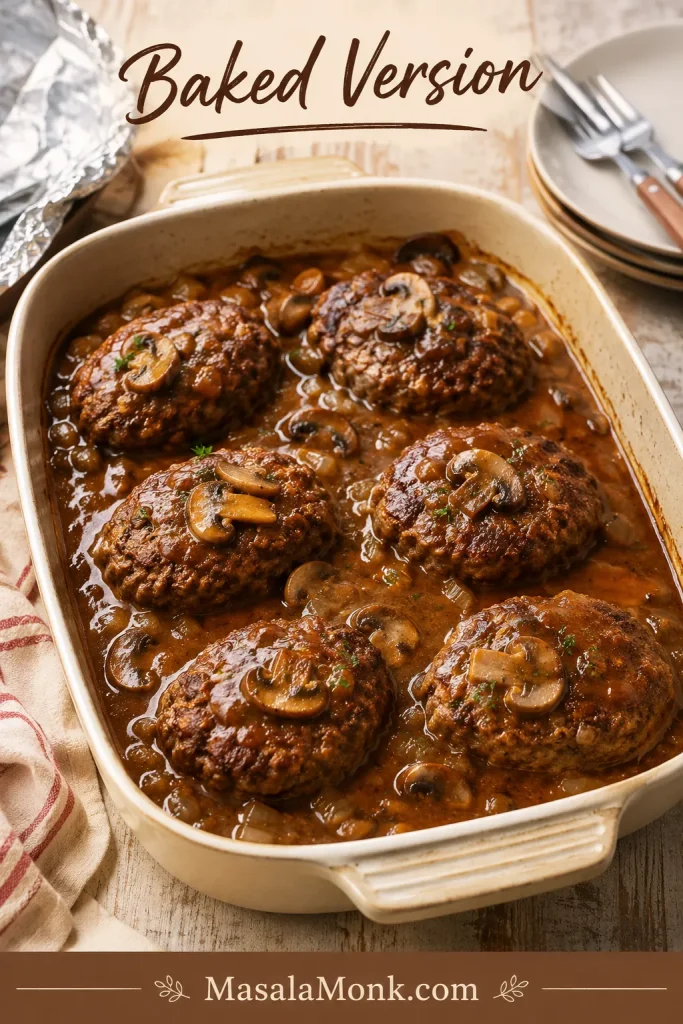
Baked Salisbury steak patties in a dish with brown mushroom gravy.
Covering the dish traps moisture while hot gravy finishes the patties. Resting afterward lets the sauce settle before serving.

Crock Pot Salisbury Steak

The slow cooker version deserves its own method because the patties, gravy, and timing behave differently. Brown the patties first for the best flavor, place them in the slow cooker with onions, mushrooms if using, and gravy, then cook on low until tender and 160°F / 71°C in the center.

This skillet version is faster. Use this Crock Pot Salisbury steak recipe when you want the hands-off route with a softer, saucier finish, frozen patty tips, cream soup shortcuts, and slow-cooker gravy guidance.
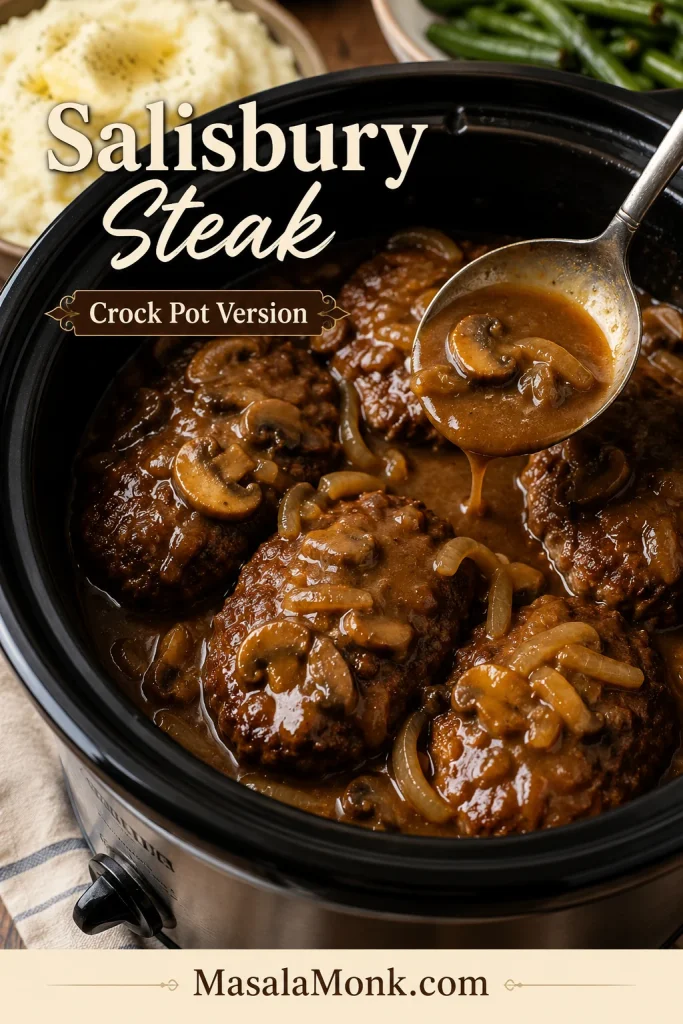
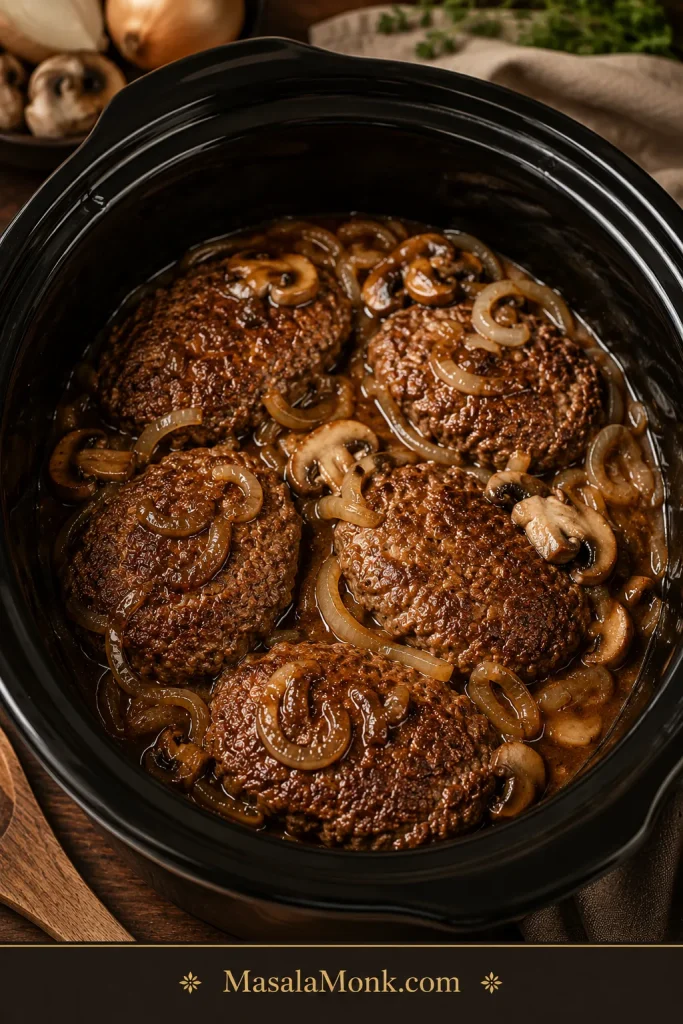
Salisbury steak patties with mushroom onion gravy in a slow cooker.
Slow cooking makes the patties extra soft and saucy; browning first keeps the flavor from tasting steamed.

Frozen Hamburger Patties

Fresh homemade patties have the best texture, but frozen hamburger patties can work for a shortcut dinner.

Frozen patties work best when they are thawed first, patted dry, seasoned, browned, and then simmered in gravy. If cooking from frozen, use a quiet simmer and check the center with a thermometer. The patties must reach 160°F / 71°C. Expect a softer, less homemade texture than fresh patties.

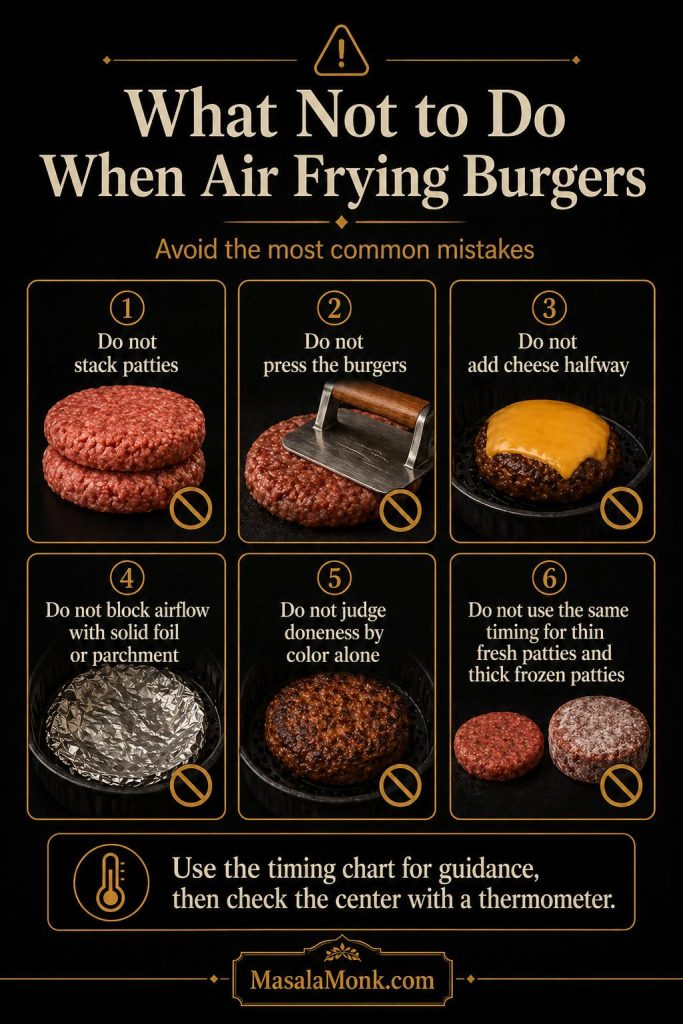
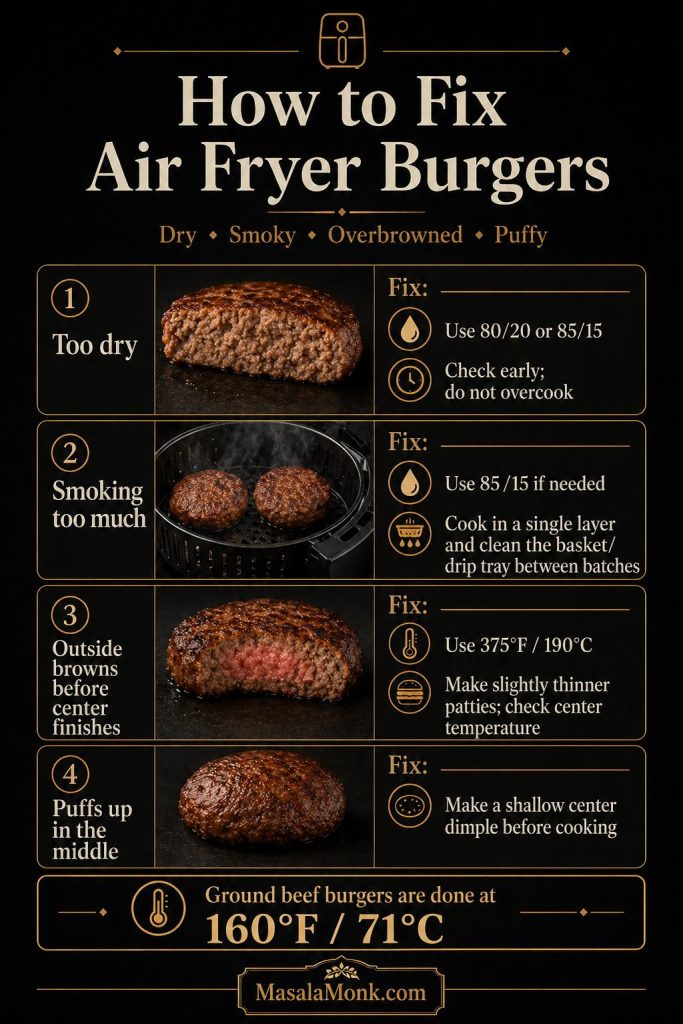
For a separate burger-focused method with time, temperature, and frozen-patty cues, see this air fryer burgers recipe.
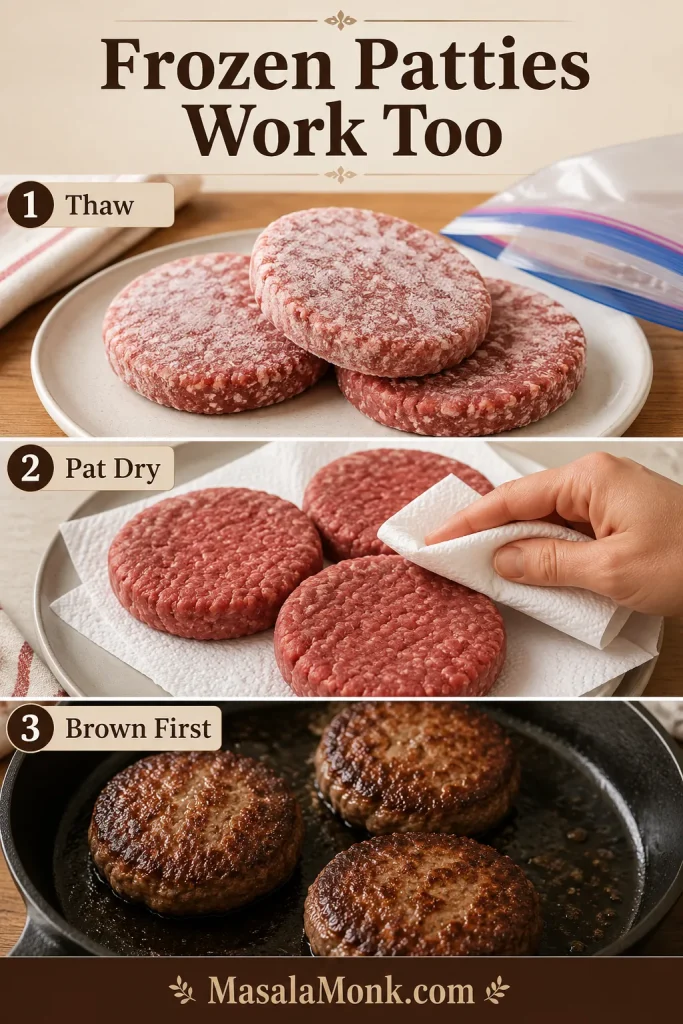
Shortcut guide showing frozen patties, thawed patties, and browned patties for Salisbury steak.
Thawing and drying the patties helps them sear instead of steam, which makes the shortcut taste much closer to homemade.

Meatball Version

For a kid-friendly twist, shape the same beef mixture into meatballs instead of oval patties. Brown the meatballs, then simmer them in mushroom gravy until cooked through. This gives you the same flavor in smaller pieces that are easy to serve over rice or noodles.

Gluten-Free Version

Use gluten-free breadcrumbs or crushed gluten-free crackers in the patties. For the gravy, skip the flour and thicken with a cornstarch slurry instead. Check the labels on Worcestershire sauce, broth, gravy packets, canned soup, and onion soup mix.

Lighter Version

Use leaner beef or ground turkey, reduce the butter slightly, and serve the patties with vegetables, cauliflower mash, or salad. Leaner meat dries out faster, so cook gently and stop once the patties reach 160°F / 71°C.

Back to choose your version · Fix patties · Fix gravy · Serving ideas · Back to top

Patty Fixes: Falling Apart, Tough, or Dry

If the mixture feels imperfect, do not panic. Salisbury steak is forgiving before it hits the pan. A little more breadcrumb, a short chill, or a splash of moisture can usually bring the patties back into shape.

The fastest fix before cooking: If the mixture feels too soft, add 1–2 tablespoons breadcrumbs and chill the shaped patties for 10–15 minutes. If the mixture feels dry and crumbly, add a spoon of grated onion or a tiny splash of milk.

If the patties feel too soft, break while flipping, or fall apart in the gravy, use this troubleshooting guide before changing the whole recipe.
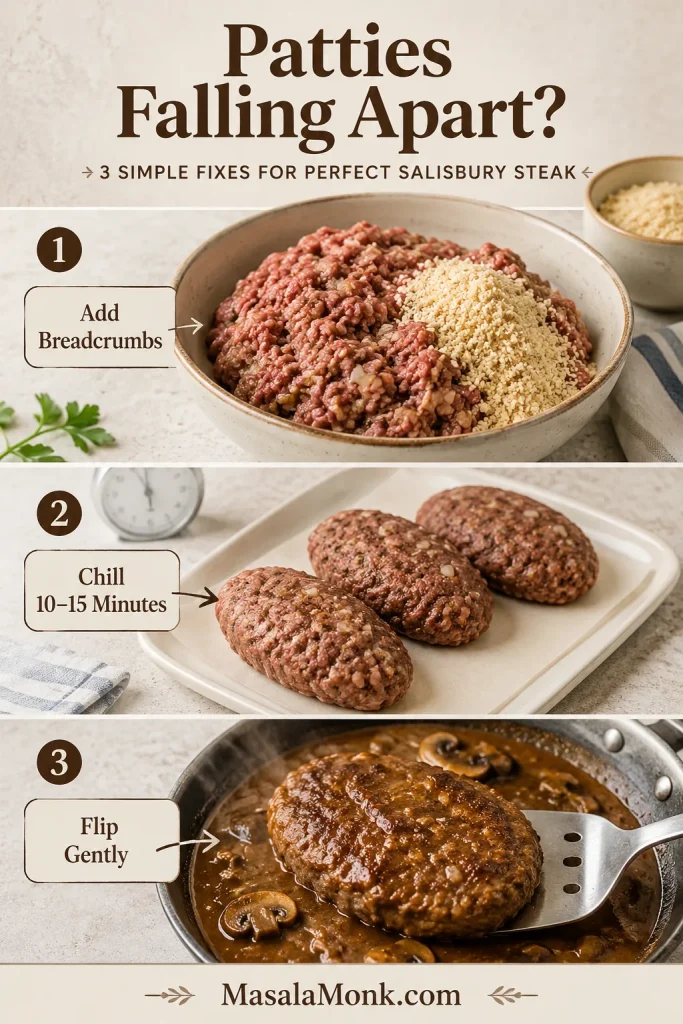
Troubleshooting guide showing how to fix Salisbury steak patties with breadcrumbs, chilling, and gentle flipping.
When Salisbury steak patties fall apart, fix the structure before blaming the pan. Add breadcrumbs, chill the mixture briefly, and flip with a wide spatula.

Why Salisbury Steak Patties Fall Apart

ProblemLikely causeFix
Breaks when flippingFlipped too early or pan was not hot enoughLet the first side brown and use a wide spatula.
Mixture feels wetToo much onion or not enough binderAdd a little more breadcrumbs and rest the mixture briefly.
Falls apart in gravyGravy is boiling too hardLower the heat to a gentle simmer.
Too soft to handleMixture needs time to firm upChill shaped patties for 10–15 minutes.
Cracks around edgesPatties are too loosely shaped or too thinShape gently but firmly and keep them about 3/4 inch thick.

Why Salisbury Steak Gets Tough

  • Overmixed beef: Mix only until combined.
  • Very lean beef: Use 80/20 or 85/15 for a juicier result.
  • Patties too thick: Thick patties take longer to cook through.
  • Hard simmer: Keep the gravy bubbling gently.
  • Overcooking: Stop once the patties reach 160°F / 71°C.

Why Salisbury Steak Turns Dry

Dry patties usually come from very lean beef, patties that are too thin, or cooking them too far past 160°F / 71°C. Use beef with a little fat, keep the patties evenly shaped, and let the gravy finish the cooking instead of leaving the meat on high heat.

Gravy Fixes: Too Thin, Too Thick, Salty, or Bland

The gravy should be thick enough to spoon over the patties but not so thick that it turns gluey. Most problems are easy to fix before serving.

Taste the gravy before you add salt. Most Salisbury steak problems are easier to fix before the patties go back into the pan.
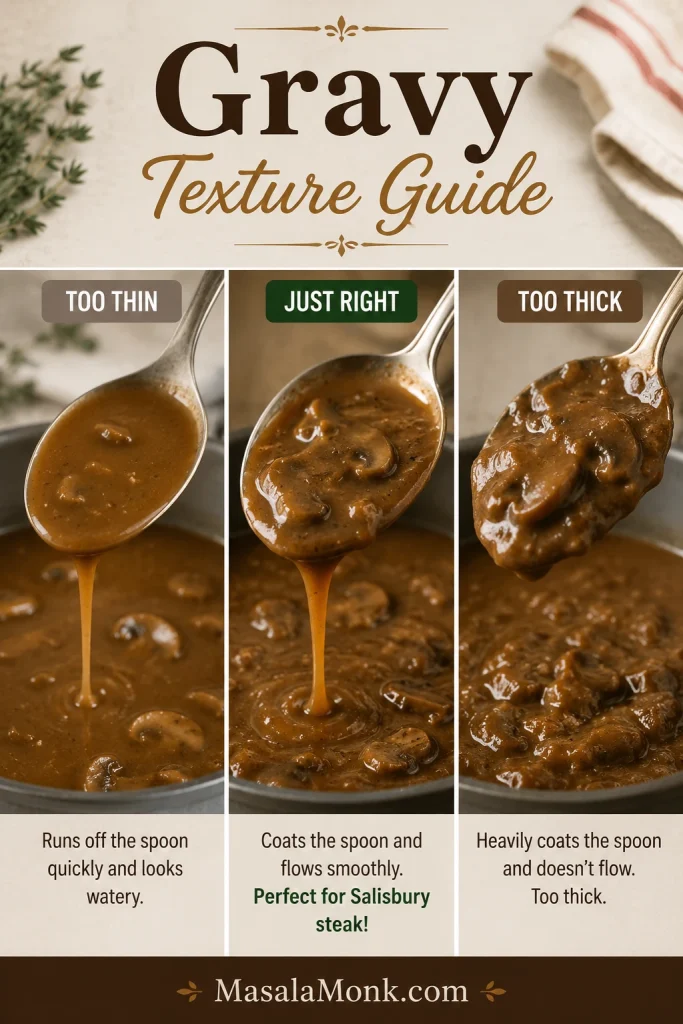
Gravy texture guide showing thin gravy, spoonable gravy, and gravy that is too thick.
Gravy is easiest to fix by texture. Simmer if it is thin, loosen with broth if it is thick, and aim for a spoonable sauce that still moves.

Quick Fixes for Gravy Problems

Gravy problemHow to fix it
Too thinSimmer uncovered for a few minutes, or stir in 1 tablespoon cornstarch mixed with 1 tablespoon cold water.
Too thickAdd beef broth or water, a splash at a time.
Too saltyAdd unsalted broth or water. Avoid stacking gravy mix, bouillon, and onion soup mix without tasting.
Too blandAdd Worcestershire sauce, black pepper, Dijon, tomato paste, or a little beef bouillon.
LumpyWhisk while adding broth slowly. If needed, strain and return the gravy to the skillet.
Not brown enoughBrown the mushrooms and onions longer and scrape up the browned bits from the pan.
PastyCook the flour briefly before broth goes in, then loosen with more broth if needed.

Salt and Leftover Gravy Notes

Salt is the one thing to watch most closely. Beef broth, Worcestershire sauce, gravy packets, canned soup, bouillon, and onion soup mix can stack salt quickly, so dilute with unsalted broth or water before adding more seasoning.

Leftover gravy also thickens as it chills. Loosen it with a splash of broth or water when reheating.

Once the gravy is right, jump to serving ideas or return to the recipe card.

What to Serve With Salisbury Steak

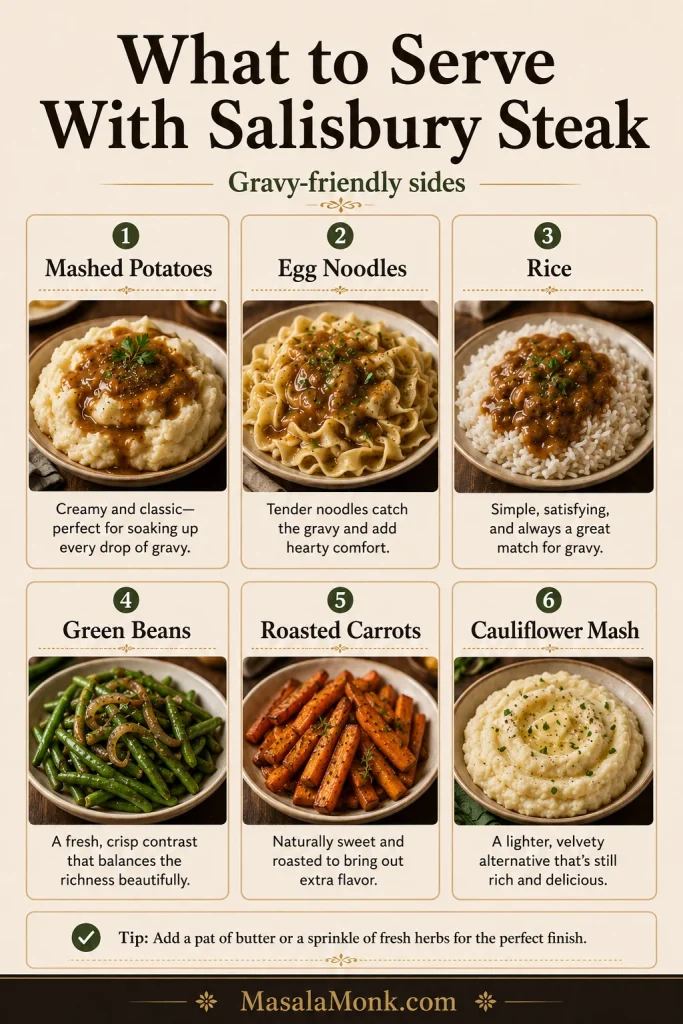
This is the kind of gravy dinner where the side dish matters. Because the gravy is rich, the best plates usually have one soft side to catch the sauce and one simple vegetable to balance it.

For the most dependable plate, give the gravy somewhere soft to land and add something green for contrast. That keeps the dinner cozy without making it feel one-note.
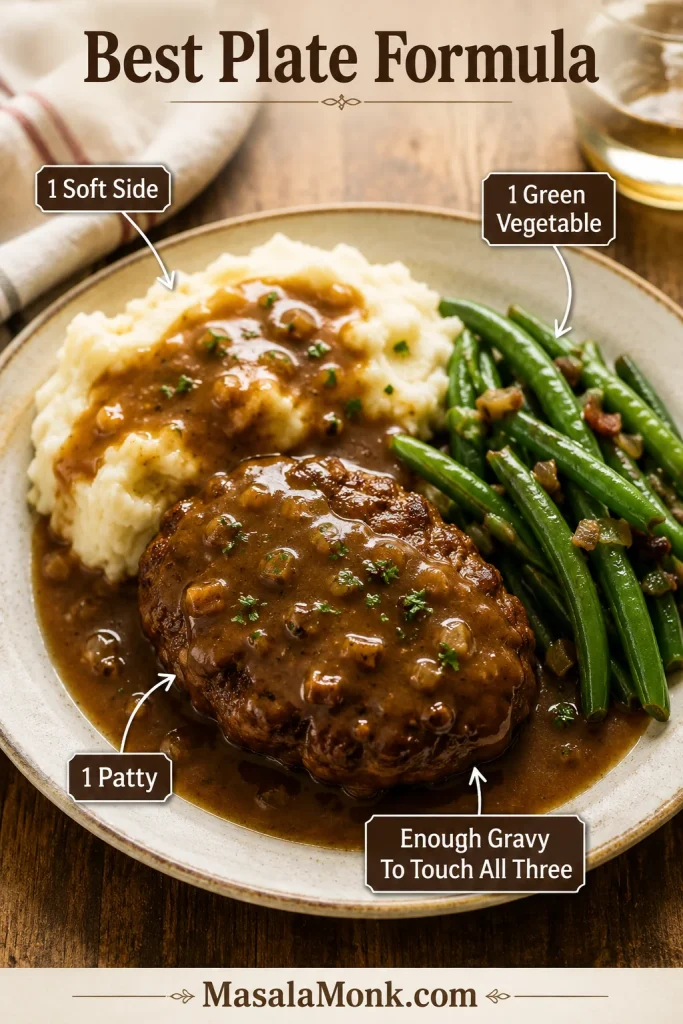
Labeled Salisbury steak plate with one patty, mashed potatoes, green beans, and gravy touching all three.
Use gravy as the connector, not just a topping. It should reach the patty, the soft side, and the vegetable so every bite feels balanced.

Spoon the gravy over the patties at the table if you can. It is a small thing, but it makes the whole plate feel more generous without feeling expensive.

Dinner styleBest sides
Classic comfort plateMashed potatoes, peas, green beans, corn
Easy weeknight dinnerWhite rice, egg noodles, roasted carrots, simple salad
Extra cozyGarlic mashed potatoes, buttered noodles, dinner rolls
Lighter plateCauliflower mash, steamed broccoli, roasted vegetables, salad
Family-style dinnerMashed potatoes, green beans, glazed carrots, biscuits

The most classic plate is Salisbury steak, creamy mashed potatoes, and green beans. For a richer side, use garlic mashed potatoes. Rice and egg noodles are also excellent because they soak up the mushroom gravy without competing with it.

For a holiday-style green bean side, this green bean casserole recipe fits the gravy-and-comfort theme well.

Storage, Freezing, and Reheating

Leftovers are one of the quiet wins of this recipe because the gravy keeps the meat from drying out.

How to store leftovers

Store leftover Salisbury steak with the gravy in an airtight container in the refrigerator for 3–4 days. Keeping the patties in gravy helps them stay moist.

How to freeze Salisbury steak

For convenience, cool the patties and gravy completely, then freeze them together in a freezer-safe container for up to 2–3 months. For the best texture, freeze the patties and gravy separately, then reheat them together gently after thawing.

How to reheat without drying it out

Reheat gently on the stovetop over low heat with a splash of broth or water to loosen the gravy. You can also microwave in short intervals, spooning sauce over the patties between bursts.

Avoid high heat when reheating because it can make the patties firm or rubbery.
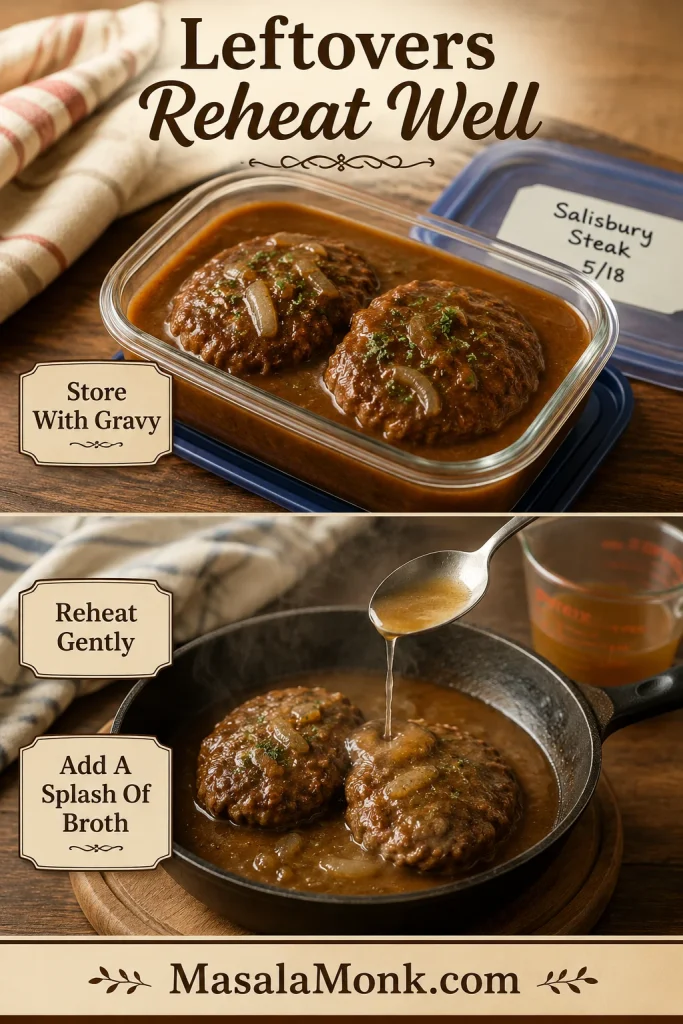
Salisbury steak leftovers stored with gravy and reheated in a skillet with broth.
The key is moisture: store with sauce, then reheat gently with a splash of broth so the gravy loosens before the meat overcooks.

Make-Ahead Tips

You can shape the patties up to 24 hours ahead and refrigerate them covered. This can help them hold together when browning. Let the patties sit at room temperature for about 10 minutes before cooking so they are not ice-cold in the center.

The full dish also reheats well because the patties sit in gravy. If the sauce thickens in the refrigerator, add a splash of broth or water when reheating.

Ground Beef Safety Note

Because this recipe uses ground beef, cook the patties to 160°F / 71°C in the center. An instant-read thermometer keeps you from guessing or overcooking them.

USDA guidance: Ground Beef and Food Safety.

FAQs About Salisbury Steak

What is Salisbury steak made of?

Most Salisbury steak starts with ground beef mixed with egg, breadcrumbs, onion, Worcestershire sauce, ketchup or mustard, and seasonings. The mixture is shaped into oval patties, browned, and finished in gravy.

Is Salisbury steak the same as hamburger steak?

They are similar, but not always identical. Salisbury steak usually has binders and seasonings mixed into the meat, while hamburger steak is often a simpler seasoned beef patty with gravy.

Which ground beef works best?

80/20 or 85/15 ground beef gives the best flavor and tenderness. Very lean beef works, but it needs gentler cooking because it dries out faster.

Why is my Salisbury steak falling apart?

The mixture may be too wet, the patties may need more binder, or they may have been flipped before a crust formed. Use egg and breadcrumbs, shape evenly, brown before simmering, and chill soft patties for 10–15 minutes before cooking.

How do you keep the patties tender?

Use beef with some fat, mix gently, avoid overcooking, and simmer the patties gently in gravy. Do not boil the sauce hard after the patties go back into the skillet.

Does Salisbury steak need egg?

Egg helps bind the patties so they are easier to brown and simmer without falling apart. If you skip it, keep the mixture slightly firmer, chill the shaped patties, and flip them gently.

Panko, breadcrumbs, or crackers — which works best?

All three can work. Panko gives a slightly lighter texture, regular breadcrumbs make a softer old-fashioned patty, and crushed crackers give a classic pantry-style result.

Can I make Salisbury steak without mushrooms?

Yes. Skip the mushrooms and lean on onions instead. Cook them until soft and golden before building the gravy so the sauce still tastes full.

How do I use brown gravy mix for Salisbury steak?

Use the liquid amount on the packet, but replace water with low-sodium beef broth. Taste before adding salt, especially if you are also using bouillon, canned soup, or onion soup mix.

What is the best way to use cream of mushroom soup?

Start with 1 can condensed cream of mushroom soup and 1/2 cup beef broth. Add another 1/4 cup broth if the sauce looks too thick after simmering.

How thick should the patties be?

About 3/4 inch / 2 cm thick is a good target. Patties that are too thick take longer to cook and can dry out before the center reaches 160°F / 71°C.

How do I know the patties are fully cooked?

The patties should reach 160°F / 71°C in the center because they are made from ground beef. Use an instant-read thermometer for the most reliable result.

How do I bake Salisbury steak instead of simmering it?

Brown the patties first, place them in a baking dish, cover with hot gravy, and bake at 375°F / 190°C for 20–25 minutes, or until fully cooked in the center.

Do frozen hamburger patties work for Salisbury steak?

Yes. They are a useful shortcut, though fresh or thawed patties brown better and taste more homemade. If cooking from frozen, simmer gently and check that the center reaches 160°F / 71°C.

How far ahead can I make Salisbury steak?

You can shape the patties up to 24 hours ahead, or refrigerate the cooked patties and gravy for 3–4 days. The finished dish also freezes well for 2–3 months.

What sides go best with Salisbury steak?

Mashed potatoes are the classic choice. Rice, egg noodles, green beans, peas, corn, roasted carrots, broccoli, and simple salads also work well.

Final Notes

The best version does not need to be complicated. A little fat in the beef, a gentle hand with the mixing, a proper sear, and a gravy that has time to taste rich are what turn plain hamburger patties into the kind of old-fashioned dinner people actually remember.

Do not chase perfection here. A slightly uneven patty, a little extra onion, or a gravy that needs one more splash of broth is normal. This is the kind of dinner that forgives small mistakes.

Serve it with mashed potatoes for the classic plate, rice for an easy weeknight dinner, or egg noodles when you want the gravy to do most of the work. If you made the no-mushroom, frozen-patty, brown-gravy-mix, cream-of-mushroom, baked, or Crock Pot version, leave a comment with what you used and how the gravy turned out. Those real kitchen notes help the next cook choose their route.

Back to recipe card · Back to table of contents · Back to top
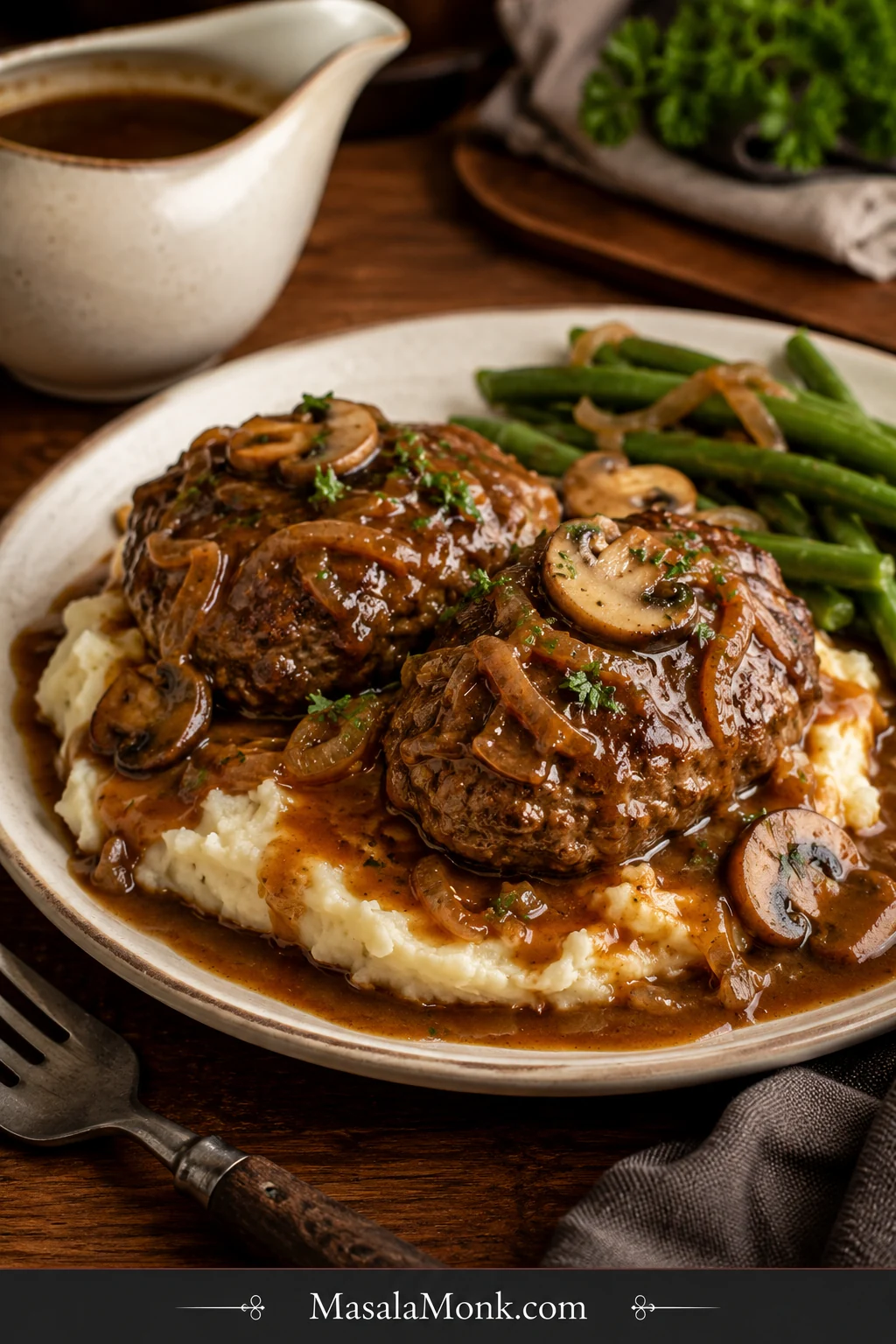
Posted on Leave a comment

Crock Pot Salisbury Steak Recipe

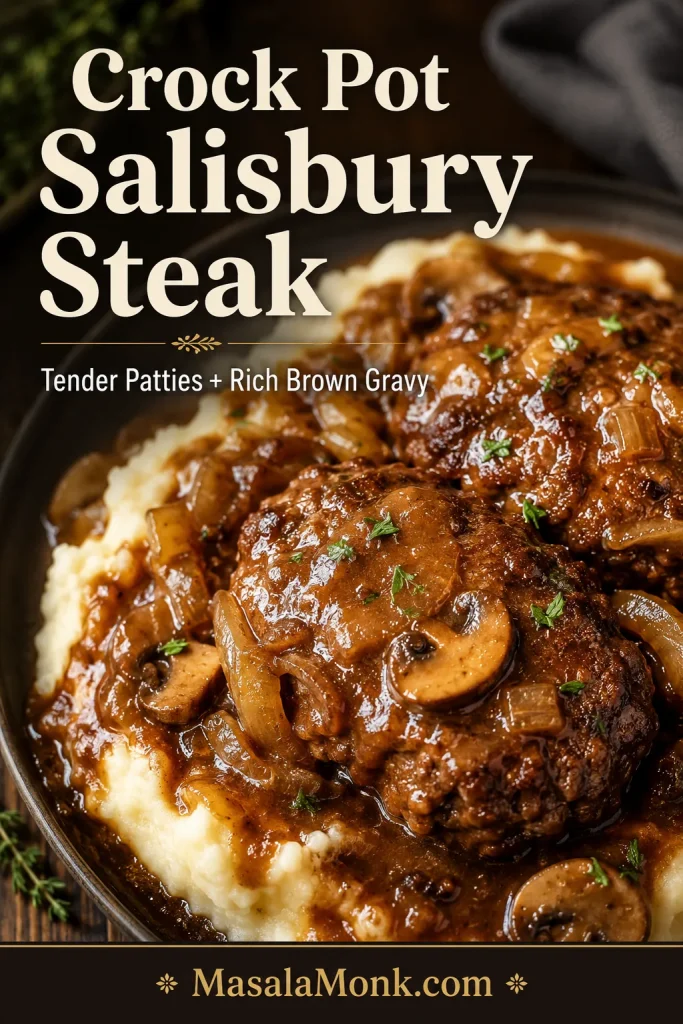
Two Salisbury steak patties covered with mushroom onion brown gravy over mashed potatoes, served with green beans on a cream plate.

This crock pot Salisbury steak is the slow cooker dinner you make when mashed potatoes are already on your mind. Tender ground beef patties cook in rich brown gravy with soft onions, mushrooms if you like them, and enough sauce to spoon over everything on the plate.

A good crock pot Salisbury steak is really a gravy dinner with beef patties in the middle, so the sauce has to be treated like the main event. It should taste beefy, oniony, and rich — not thin, salty, or steamed.

You also get clear shortcut options for thawed hamburger patties, cream of mushroom soup, brown gravy mix, onion soup mix, French onion soup, and meatballs, because some nights dinner starts with the pantry or freezer. The goal is not to pretend packets and cans do not exist. Instead, use them in a way that still tastes balanced, cozy, and cared for.

If you want the classic side ready too, this mashed potatoes recipe is built for creamy, fluffy potatoes that can hold a lot of gravy.

Quick Answer: Can You Make Salisbury Steak in a Crock Pot?

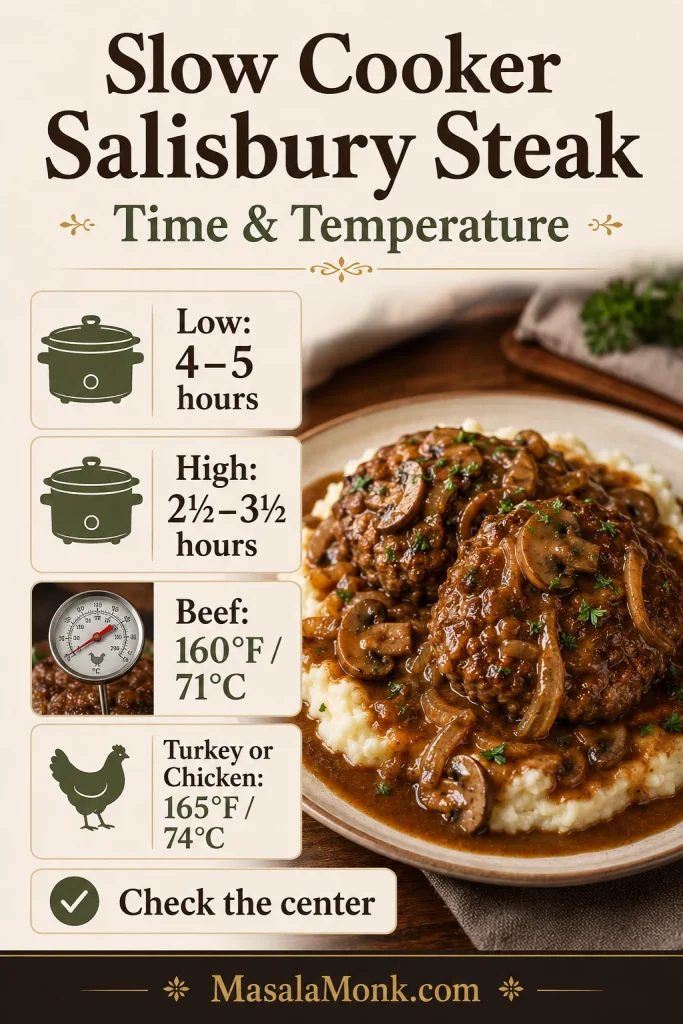
Yes. Salisbury steak works well in a crock pot when the patties are shaped firmly, browned first if possible, and cooked in a flavorful sauce. For homemade browned patties, cook on low for 4 to 5 hours, or on high for 2½ to 3½ hours, until the centers reach 160°F / 71°C.

The sauce will usually look thinner while it cooks because slow cookers trap moisture. Give it its final 15 to 20 minutes after the cornstarch slurry; that is when it turns from slow cooker liquid into spoonable gravy.

This is not a fussy dinner. It is the kind of meal that feels best when the gravy is generous, the potatoes are soft, and nobody is asking what else is for dinner.

Remember this: mix the beef gently, brown first if you can, cook on low when possible, and save the real thickening for the end.

Make This When

Make this when you want the slow cooker to help, but you still want the plate to feel like real comfort food.

  • You want an easy slow cooker dinner that still feels old-fashioned and cozy.
  • A sauce-heavy meal for mashed potatoes, noodles, or rice sounds right.
  • Pantry shortcuts need to taste balanced, not flat or too salty.
  • Frozen hamburger patties need to become a proper dinner.
  • Broken patties, watery gravy, tough beef, or bland sauce need clear fixes.

This is the kind of dinner that smells like it has been waiting for mashed potatoes all afternoon. Keep the sides simple and do not ration the gravy.

Crock Pot Salisbury Steak Recipe

Tender ground beef patties slow cooked in rich brown mushroom onion gravy until the sauce is glossy, spoonable, and ready for mashed potatoes, egg noodles, rice, or cauliflower mash.

Prep Time
15 minutes
Browning Time
6 to 8 minutes
Cook Time
4 to 5 hours on low
Thickening Time
15 to 20 minutes
Total Time
About 5 to 6 hours
Servings
6 patties
Best Crock Pot
6-quart oval
Patty Size
About 4 oz / 113 g each
Safe Beef Temp
160°F / 71°C

Ingredients

For the Salisbury Steak Patties

  • 1½ lb / 680 g lean ground beef
  • ½ cup / about 45 to 55 g plain breadcrumbs, or ⅓ cup / about 20 to 25 g panko
  • 1 large egg
  • 3 tbsp / 45 ml milk
  • 1 tbsp / 15 ml Worcestershire sauce
  • ½ tsp salt, or less if using onion soup mix
  • ½ tsp black pepper
  • ½ tsp garlic powder
  • ½ tsp onion powder
  • 1 tbsp oil, for browning

For the Brown Gravy

  • ½ medium onion, thinly sliced, about 60 to 75 g
  • 4 to 8 oz / 113 to 227 g mushrooms, sliced, optional
  • 2 cups / 480 ml low-sodium beef broth
  • 1 packet brown gravy mix, about 0.87 to 1 oz / 25 to 28 g
  • 1 tbsp / 15 ml Worcestershire sauce
  • 1 tbsp / 15 ml ketchup
  • 1 tsp / 5 ml Dijon mustard
  • 1 small garlic clove, minced, or ½ tsp garlic powder
  • 1 to 2 tbsp / 8 to 16 g cornstarch
  • 1 to 2 tbsp / 15 to 30 ml cold water

Optional Shortcut Add-Ins

  • ½ packet onion soup mix, for stronger onion flavor
  • 1 can cream of mushroom soup, usually 10.5 oz / 298 g, for a creamier gravy
  • 1 can golden mushroom soup, usually 10.5 oz / 298 g, for deeper mushroom flavor
  • 1 can French onion soup, usually 10.5 oz / 298 g, to replace part of the beef broth
  • 1 can cream of chicken soup, usually 10.5 oz / 298 g, for a milder creamy shortcut
  • 1 packet au jus mix, to use instead of brown gravy mix

Instructions

  1. Mix the patties gently. In a large bowl, combine ground beef, breadcrumbs, egg, milk, Worcestershire sauce, salt, pepper, garlic powder, and onion powder. Mix only until combined. Avoid squeezing or overworking the meat.
  2. Shape the patties. Divide into 6 oval patties, about 4 oz / 113 g each. Keep them even in thickness so they cook at the same pace.
  3. Brown the patties. Heat oil in a skillet over medium-high heat. Brown patties for 2 to 3 minutes per side. They do not need to cook through.
  4. Layer the crock pot. Add onions and mushrooms to the bottom of a 6-quart oval slow cooker. Place browned patties on top, overlapping only if needed.
  5. Whisk the gravy. In a bowl, whisk beef broth, brown gravy mix, Worcestershire sauce, ketchup, Dijon, and garlic until smooth.
  6. Slow cook. Pour gravy over the patties. Cover and cook on low for 4 to 5 hours, or on high for 2½ to 3½ hours, until the patties reach 160°F / 71°C.
  7. Thicken the gravy. Mix 1 tablespoon cornstarch with 1 tablespoon cold water. Stir into the hot gravy, cover, and cook for 15 to 20 minutes. Repeat with another tablespoon of cornstarch and water if you want it thicker.
  8. Serve. Let the patties rest in the gravy for a few minutes, then serve over mashed potatoes, egg noodles, rice, or cauliflower mash.

Recipe Notes

  • Low heat gives the best texture. High heat works, but the patties can become firmer.
  • If your slow cooker runs hot, start checking near the early end of the time range.
  • Keep the patties about ½ to ¾ inch thick so they hold together and cook evenly.
  • Do not overfill the slow cooker. The patties need enough space for heat and gravy to move around them.
  • Use low-sodium beef broth if adding gravy mix, onion soup mix, au jus, or canned soup.
  • For extra gravy, increase broth to 2½ cups / 600 ml and use extra slurry before serving.
  • You can shape or brown the patties up to 1 day ahead and refrigerate them covered until ready to assemble.

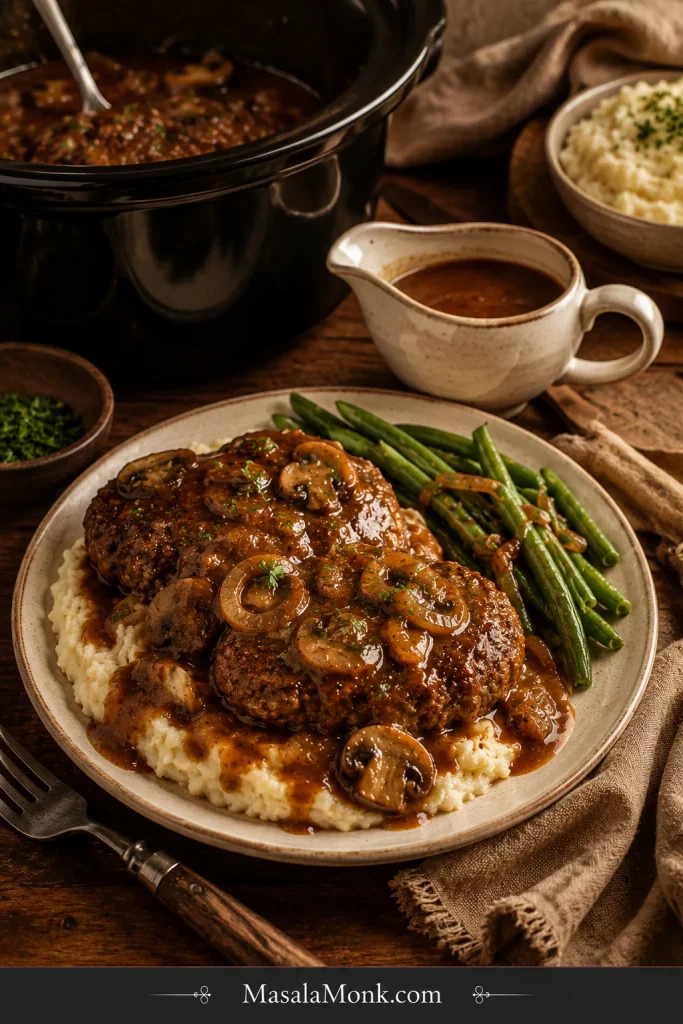
This finished-dish view gives readers a quick visual reference after the recipe card: tender patties, generous brown gravy, and a plate that works with potatoes, noodles, or rice.

Vertical recipe image showing crock pot Salisbury steak with tender patties, rich brown gravy, and mashed potatoes.
Tender patties, rich brown gravy, and a soft side underneath make this slow cooker Salisbury steak feel like a complete comfort-food dinner.

Need a specific fix? Jump to gravy thickening, frozen patties, shortcut gravy options, or troubleshooting.

Before You Start: Crock Pot Salisbury Steak Basics

Best beef amount1½ lb / 680 g for 6 patties
Best patty sizeAbout 4 oz / 113 g each
Best thicknessAbout ½ to ¾ inch thick
Best slow cooker6-quart oval slow cooker
Best settingLow for 4 to 5 hours
Fast settingHigh for 2½ to 3½ hours
Safe beef temperature160°F / 71°C in the center
Best gravy finishUse a cornstarch slurry near the end
Best serving baseMashed potatoes, egg noodles, or rice

Slow cookers vary, so use the time range as a guide. Thick patties, tightly stacked patties, thawed frozen patties, and smaller cookers may need more time.

The win is simple: beef that stays together, sauce that tastes deeper than a packet, and enough gravy for the potatoes to disappear under it.

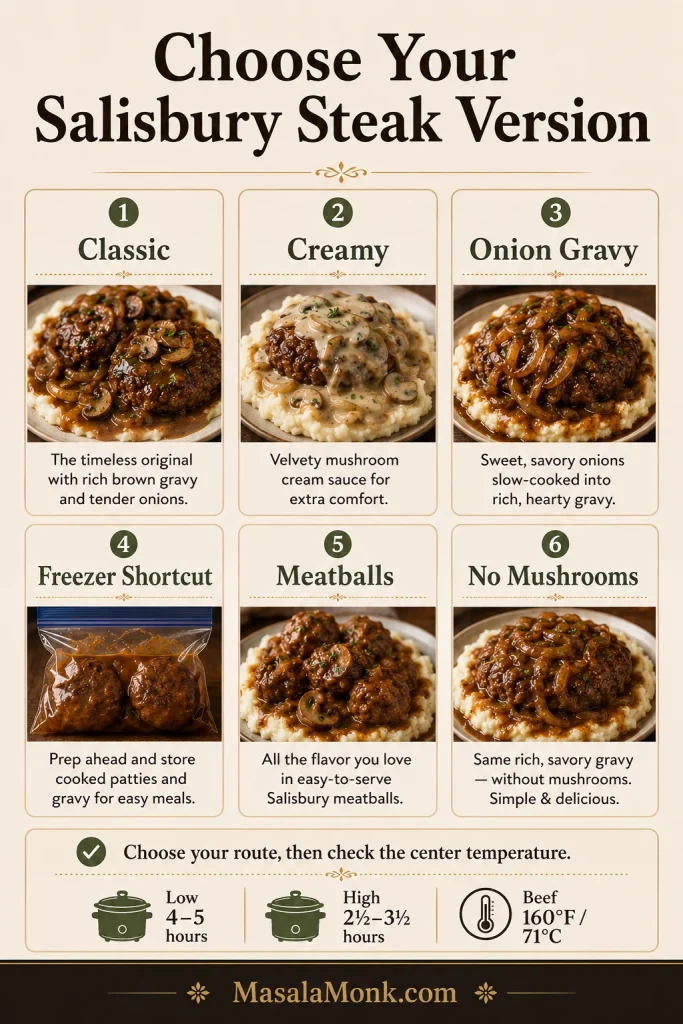
Choose Your Salisbury Steak Version

Below, the main recipe branches into homemade patties, easy brown gravy, and the shortcut ingredients already in your pantry or freezer.

Salisbury steak version guide showing six options: classic, creamy, onion gravy, freezer shortcut, meatballs, and no mushrooms, with cook time and temperature reminders.
This version guide helps you choose the best route for your pantry: classic brown gravy, creamy mushroom, onion gravy, freezer shortcut, meatballs, or no mushrooms. After that, use temperature as the final doneness check.
GoalUse This RouteWatch This
Classic crock pot Salisbury steakHomemade browned patties, beef broth, brown gravy mixThicken near the end if the sauce looks loose
More homemade flavorAdd Worcestershire, Dijon, ketchup, onions, mushrooms, garlicMix the beef gently
Frozen hamburger patty shortcutThaw raw frozen patties safely first, then brown and slow cookExpect extra liquid if patties were frozen
Fully cooked frozen pattiesHeat thoroughly in gravy according to package guidancePull them before they turn firm
Creamier gravyAdd cream of mushroom or golden mushroom soupReduce salt
Milder creamy shortcutAdd cream of chicken soupLess beefy; add Worcestershire or au jus
Onion gravy flavorAdd onion soup mix or French onion soupUse low-sodium broth
No mushroomsSkip mushrooms and add extra onionsAdd flavor with Worcestershire and Dijon
Meatball versionUse frozen or homemade meatballsCook until hot and thicken the sauce

Best Route for the First Time

For your first batch, start with the classic browned-patty version. If you came here because of freezer patties or canned soup, use the shortcut sections below and keep the salt low.

Once you know your route, the job is simple: keep the beef sturdy, keep the sauce spoonable, and keep the salt from taking over.

Choosing a shortcut? Go straight to cream of mushroom, French onion, frozen hamburger patties, or meatballs and variations.

Why This Crock Pot Salisbury Steak Works

Slow cookers are great at tenderness, but they are not great at reducing sauce. That is why this recipe gives the beef a quick browned edge first, then waits until the end to thicken the gravy.

The beef stays tender because it is mixed gently with breadcrumbs, egg, and milk instead of being packed tight. Browning adds flavor and helps each oval hold its shape once it settles into the sauce.

The sauce starts simple — beef broth and brown gravy mix — then gets enough Worcestershire, Dijon, ketchup, onion, mushroom, and garlic to taste more like dinner than a packet.

Save the real thickening for the end. By then, the beef is cooked, the onions have softened, and you can turn the cooking liquid into glossy spoon-over-potatoes gravy without guessing.

Think of it this way: give the beef structure, give the sauce body, and keep the salt under control.

That same slow-cooker liquid-control problem shows up in slow cooker cottage pie too; the lid keeps everything tender, but it does not let sauce reduce like an open pan.

The comfort-food rule: Salisbury steak should taste browned, beefy, and gravy-rich — not steamed, watery, or packet-salty.

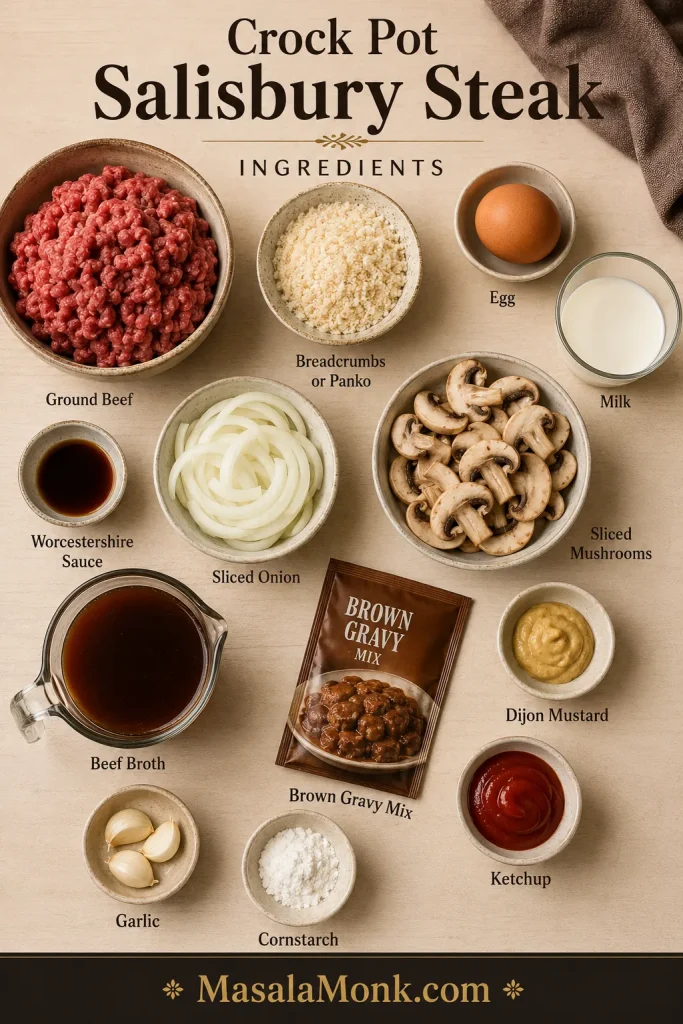
Ingredients You’ll Need

Nothing here is fancy. The balance is what matters: enough binder to keep the beef together, enough seasoning to make the sauce savory, and enough restraint that the shortcut ingredients do not take over.

Overhead ingredient board with ground beef, breadcrumbs, egg, milk, sliced onion, mushrooms, beef broth, brown gravy mix, Worcestershire sauce, Dijon, ketchup, garlic, and cornstarch.
These ingredients build flavor in stages: beef and breadcrumbs help the patties hold together, broth and gravy mix create body, and Worcestershire, Dijon, onions, and mushrooms add the deeper Salisbury steak flavor.

Ground Beef

Use lean ground beef, preferably 85/15 or 90/10. It has enough fat for flavor without making the sauce greasy. If your beef is fattier, brown the patties first and skim excess fat before tightening the sauce.

Breadcrumbs, Egg, and Milk

Breadcrumbs help the patties hold together, egg binds the mixture, and milk keeps the crumbs from making the beef dense. The mixture should feel moist and shapeable, not wet or crumbly.

Worcestershire, Dijon, and Ketchup

These small ingredients make the brown sauce taste more complete. Worcestershire adds savory depth, Dijon gives balance, and ketchup adds a little sweetness and body. In the final dish, they should blend into the gravy instead of standing out separately.

Onions and Mushrooms

Onions soften into the gravy and make it taste fuller. Mushrooms add that classic Salisbury steak flavor, but this dinner does not fall apart without them; extra onions can carry the sauce just fine.

Love a mushroom-heavy gravy? This creamy mushroom sauce goes deeper into building that rich mushroom flavor.

Beef Broth and Brown Gravy Mix

Beef broth gives the sauce a stronger base than water, especially after a few hours in the slow cooker. Brown gravy mix keeps the recipe easy and familiar, while the extra seasonings make it taste less like a packet and more like dinner.

How to Make Crock Pot Salisbury Steak

The slow cooker does the long work, but the first few minutes decide the final texture. Shape the patties gently, brown them quickly, and let the sauce carry the rest.

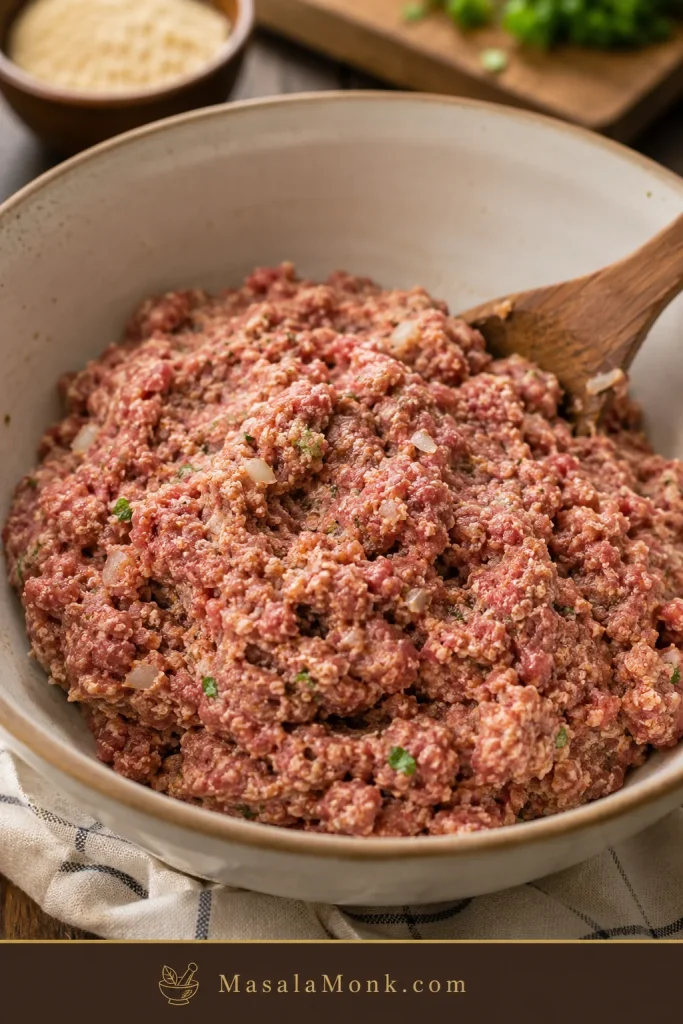
1. Mix the Patty Ingredients

In a large bowl, combine the ground beef, breadcrumbs, egg, milk, Worcestershire sauce, salt, pepper, garlic powder, and onion powder. Stir only until the ingredients come together. Overmixing makes the patties heavy and tough.

Bowl of gently mixed Salisbury steak patty mixture with ground beef, breadcrumbs, egg, milk, and seasonings.
Mix just until the beef mixture comes together. A gentle hand keeps the Salisbury steak patties tender instead of dense.

2. Shape Even Oval Patties

Divide the mixture into 6 oval patties. Aim for about 4 oz / 113 g each. The oval shape is classic, but even thickness matters more than perfect shape.

Six raw oval Salisbury steak patties arranged on parchment paper before browning.
Shape even oval patties so they fit neatly in the crock pot and cook at the same pace.

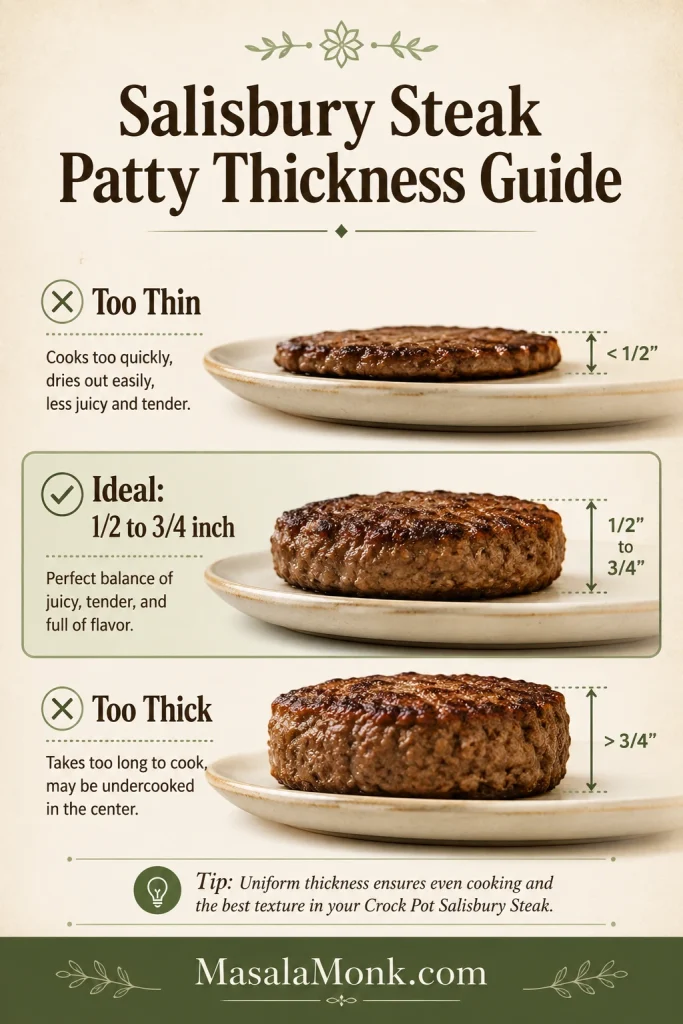
Aim for about ½ to ¾ inch thick. Very thin patties can break more easily, while very thick ones may need extra time in the center.

Salisbury steak patty thickness guide showing too-thin, ideal, and too-thick patties, with the ideal thickness labeled 1/2 to 3/4 inch.
Thickness helps decide whether the patties stay tender or fall apart. Aim for 1/2 to 3/4 inch: thin enough to cook through, but sturdy enough to survive slow cooking in gravy.

If the mixture feels very soft, chill it for 10 to 15 minutes before browning. Cold patties are easier to lift and less likely to crack.

3. Brown the Patties

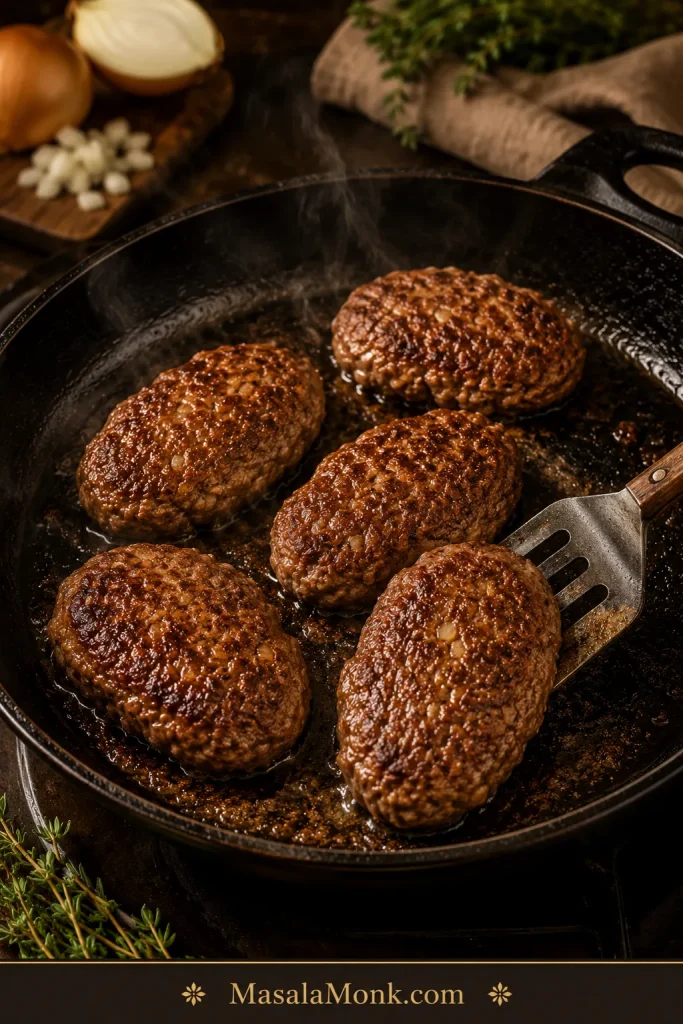
In a skillet, heat oil over medium-high heat. Brown the patties for 2 to 3 minutes per side. They should get color on the outside but do not need to cook through. Use a wide spatula and turn them gently.

Oval Salisbury steak patties browning in a skillet with a visible seared crust.
Browning adds deeper flavor and helps the patties hold their shape once they simmer in the gravy.

For a slightly thicker, more old-fashioned gravy, lightly dust the patties with flour before browning. Skip this if you want the simpler version or need the recipe to stay gluten-free.

4. Build the Slow Cooker

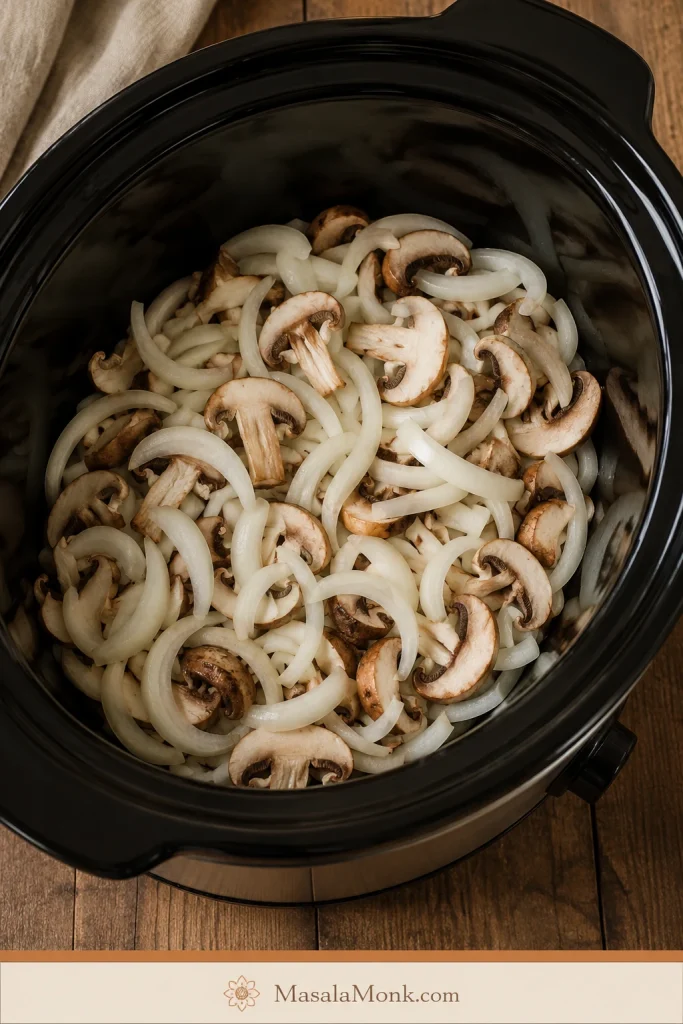
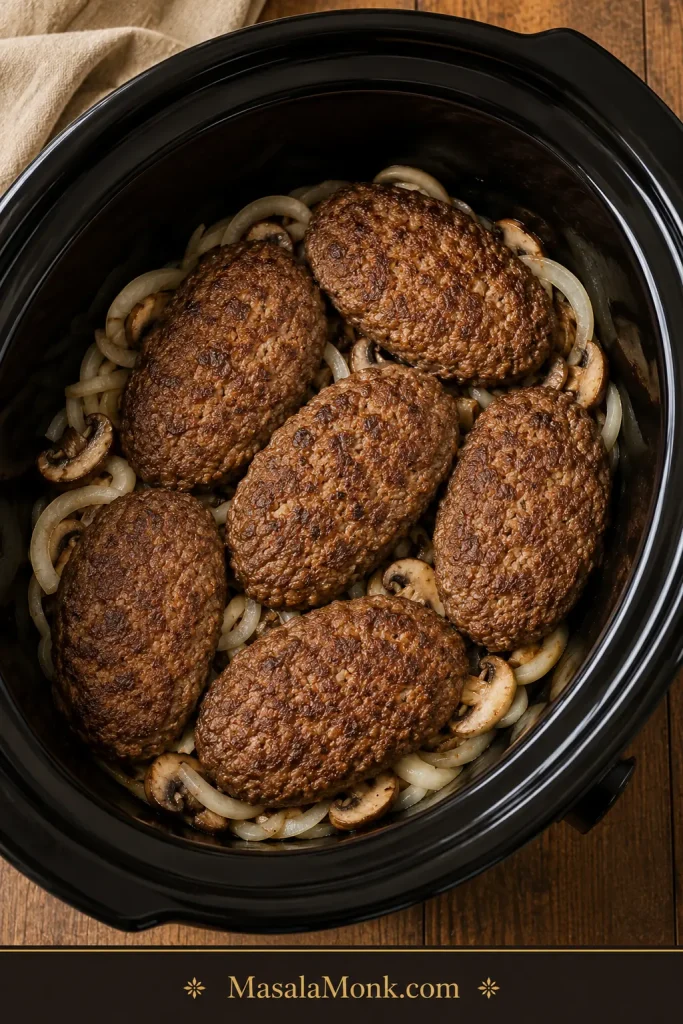
Add onions and mushrooms to the bottom of the crock pot. Place the browned patties over them, overlapping only if needed. A little overlap is fine; a tight stack can make the middle patties cook more slowly and break more easily.

Sliced onions and mushrooms spread across the bottom of a dark slow cooker insert.
Layer onions and mushrooms under the patties so they soften into the gravy as everything cooks.

Whisk the sauce ingredients separately, then pour the mixture over the beef. You should still be able to see the patties underneath; they do not need to be completely buried.

Browned oval Salisbury steak patties arranged over sliced onions and mushrooms in a slow cooker.
Place browned patties gently over the vegetables, leaving a little space so heat and gravy can move around them.

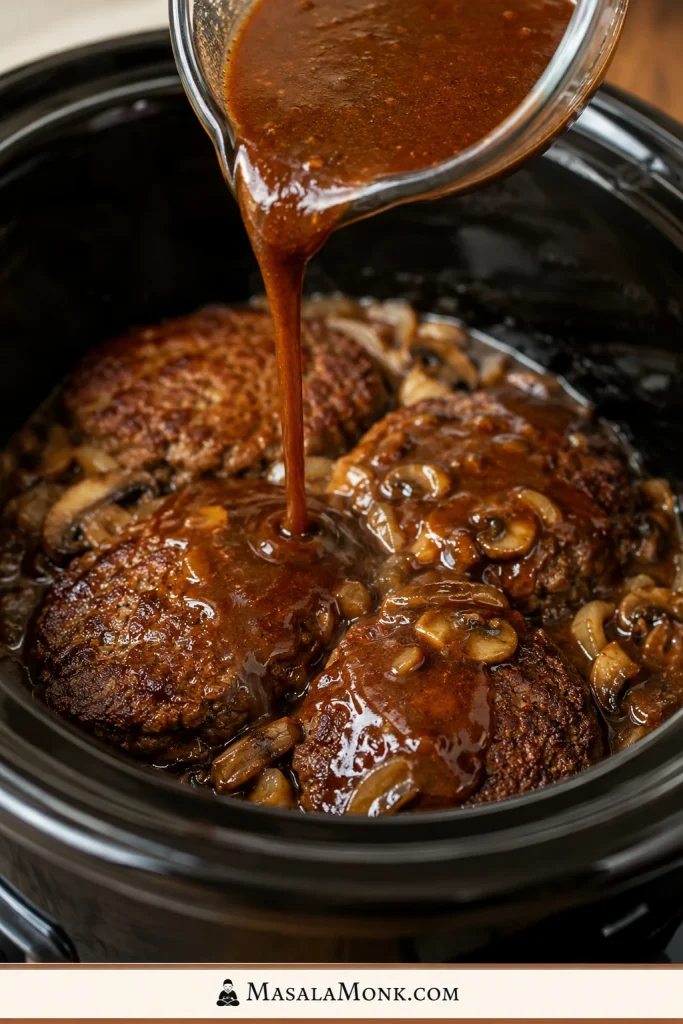
The liquid should look generous at this stage. It may seem a little loose, but that is better than starting too thick and having the sauce catch around the edges before the beef is done.

Brown gravy being poured from a glass measuring cup over Salisbury steak patties in a slow cooker.
The gravy starts thin on purpose. It carries flavor first, then thickens with slurry near the end.

5. Cook Low and Slow

Cook on low for 4 to 5 hours, or high for 2½ to 3½ hours. Low gives the most tender texture. High works when dinner needs to move faster, but the patties can become firmer if they cook too long.

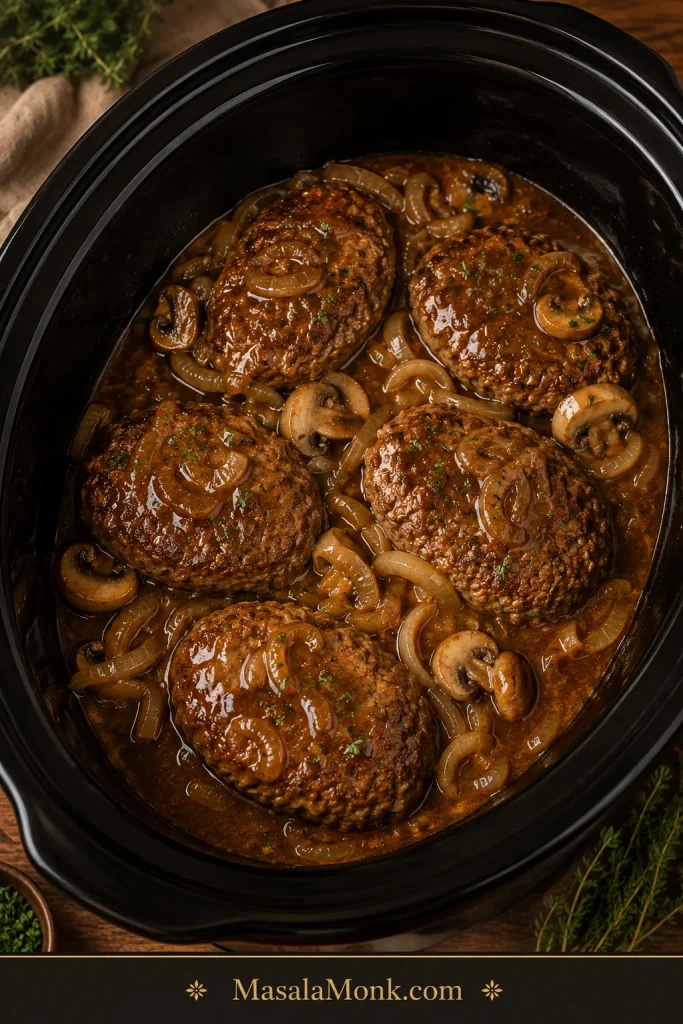
Slow cooked Salisbury steak patties in brown gravy with softened onions and mushrooms inside a dark slow cooker.
After cooking, the patties should be tender and the onions and mushrooms soft before the final thickening step.

6. Bring the Gravy Together

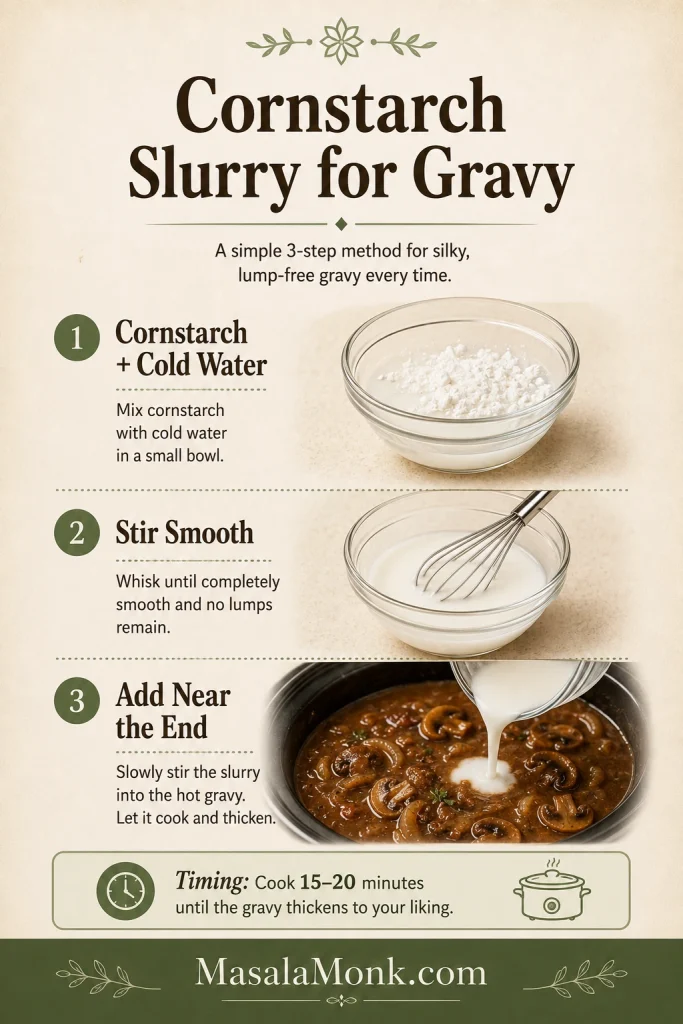
When the patties are done, stir cornstarch and cold water together until smooth. Stir the slurry into the hot sauce, cover, and cook another 15 to 20 minutes. This is when thin slow cooker liquid turns into proper spoon-over-potatoes gravy.

Three-step cornstarch slurry guide showing cornstarch with cold water, a smooth slurry, and slurry added near the end to hot gravy, with a 15 to 20 minute cook time.
Mix cornstarch with cold water first, then stir the slurry into hot gravy near the end until the sauce turns glossy.

At first the slurry may leave pale streaks. Stir gently and give it time; the sauce will turn darker, smoother, and glossier as it cooks.

Back to top
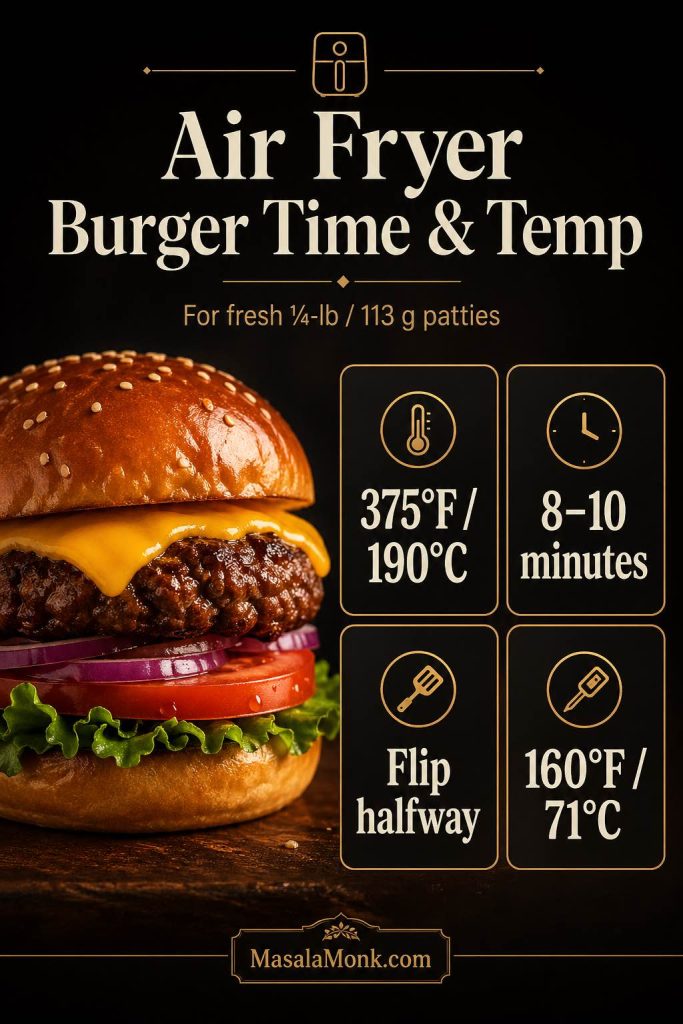
Once the patties are cooking, the rest of the recipe is mostly about small adjustments: keeping the sauce spoonable, choosing the shortcut that fits your pantry, and knowing what to do if the slow cooker gives you more liquid than expected.

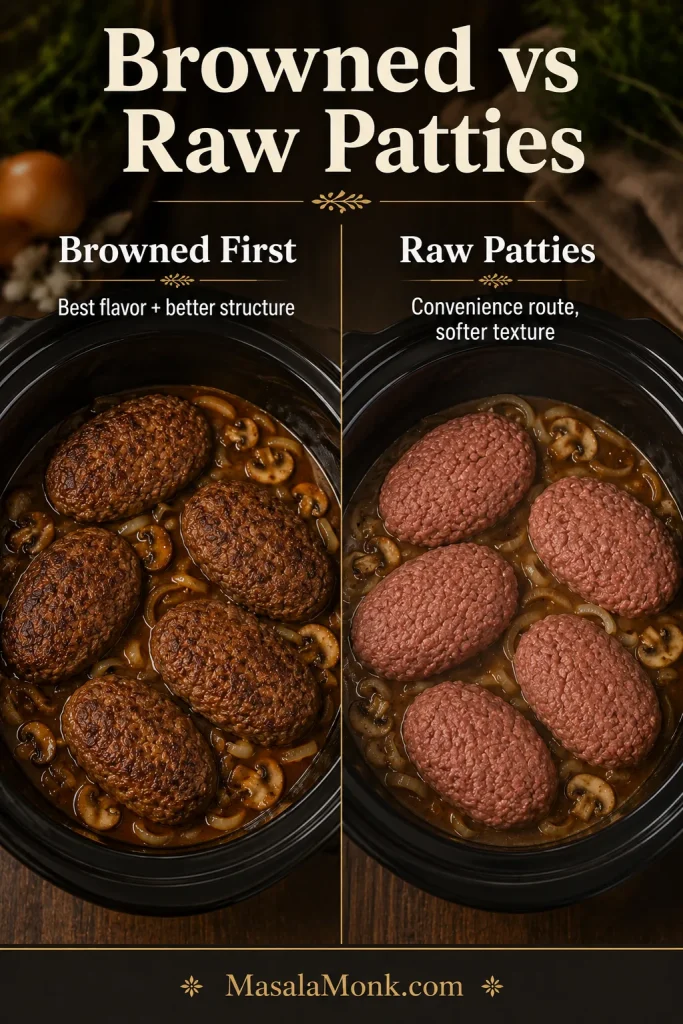
Browning vs Raw Patties: What Works Best?

Browned patties give the best flavor and the cleanest texture. Browning keeps the dish from tasting like boiled ground beef and gives the outside a sturdier edge before it sits in the sauce.

Split comparison of browned Salisbury steak patties and raw oval patties with labels about flavor, structure, and softer texture.
Browned patties are best for flavor and structure, while raw patties save time when convenience matters. Whichever route you choose, handle the beef gently and cook it to a safe center temperature.

Raw patties can still go into the crock pot when convenience matters. Keep them slightly thicker, avoid tight stacking, and use lean beef if possible because raw patties release more liquid and fat as they cook.

If it is one of those nights where browning feels like one pan too many, skip it without guilt. Just expect a softer patty, a little more fat to skim, and slightly less browned flavor. Check the center temperature before serving.

Slow Cooker Size, Cook Time, and Doneness

A 6-quart oval slow cooker is best because the patties have more room and do not need to be pressed into a tight pile. For 4 patties, a 4-quart cooker can work, but a narrow round crock may need more overlap and gentler handling.

As another slow-cooked beef dinner, this beef shoulder roast crock pot recipe uses the same gentle-heat logic with a tougher cut that needs time to turn tender.

Cook Time Guide

Once the patties are in the crock, time matters, but it is not the only thing that matters. Patty thickness, cooker shape, stacking, and whether the patties were previously frozen can all shift the finish.

Time and temperature guide for slow cooker Salisbury steak showing low for 4 to 5 hours, high for 2 and a half to 3 and a half hours, beef at 160°F, and poultry at 165°F.
Slow cooker timing helps you plan dinner, but temperature tells you when the meat is safe. Ground beef Salisbury steak should reach 160°F / 71°C; poultry versions should reach 165°F / 74°C.
MethodTimeBest For
Homemade browned patties on low4 to 5 hoursBest texture and gravy flavor
Homemade browned patties on high2½ to 3½ hoursFaster dinner
Raw homemade pattiesUsually 4 to 5 hours on lowNo-brown shortcut, softer texture
Raw frozen hamburger pattiesThaw safely first, then follow thawed-patty timingFood-safety-conscious freezer shortcut
Fully cooked frozen pattiesHeat thoroughly in gravyFastest patty shortcut
Frozen meatballs4 to 6 hours on low, depending size and package directionsNo-shaping variation

Safe Internal Temperature

Use the timer as a guide, then check the center temperature. Ground beef Salisbury steak is done at 160°F / 71°C. For turkey or chicken versions, the center should reach 165°F / 74°C.

Brown gravy can make a patty look done before the center is fully cooked, so temperature is safer than color. For reference, the USDA safe minimum internal temperature chart lists ground meats such as ground beef at 160°F / 71°C, while ground poultry should reach 165°F / 74°C.

Helpful Tools

  • Large skillet: for browning the patties.
  • Mixing bowl: for the beef mixture.
  • Whisk: for the gravy mixture.
  • Wide spatula: for moving patties without breaking them.
  • Instant-read thermometer: for checking doneness.

How to Make the Gravy Thick, Rich, and Not Watery

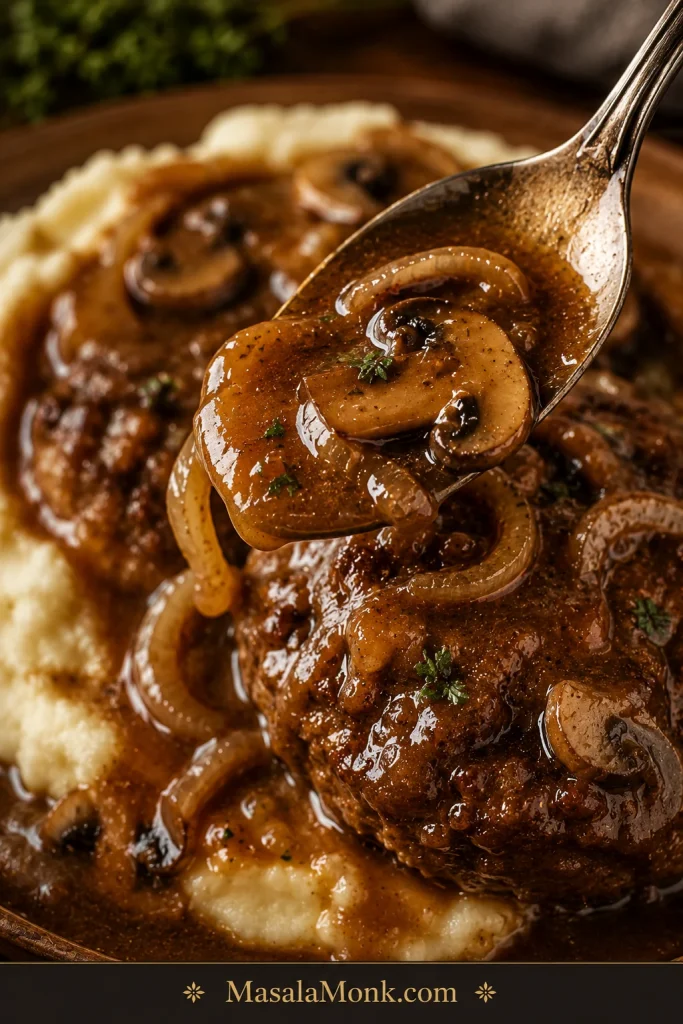
The gravy is the reason this recipe exists. It should coat the spoon, cling to the beef, and move slowly through mashed potatoes instead of running around the plate.

Close-up of thick glossy brown Salisbury steak gravy with mushrooms and onions clinging to a spoon.
The best brown gravy should cling to the spoon instead of running off like broth. When it looks glossy and holds mushrooms and onions in place, it is ready for potatoes, noodles, or rice.

Slow cooker gravy often looks thin because moisture stays trapped under the lid. That does not mean the recipe failed. Let the beef cook first, then thicken the sauce near the end.

Comparison guide showing watery gravy that needs slurry and thick spoonable gravy that is ready to serve.
Thin gravy is usually easy to fix. Add a smooth slurry near the end, give it time to thicken, and stop when the sauce coats the spoon without turning gluey.

The same problem shows up in slow cooker beef recipes like slow cooker beef stew: tender beef is wonderful, but the sauce still needs enough body to feel like gravy instead of broth.

For Thicker Gravy

  • Mix 1 tablespoon cornstarch with 1 tablespoon cold water.
  • Stir it into the hot gravy once the patties are cooked.
  • Cover and cook for 15 to 20 minutes.
  • Repeat with another small slurry if the gravy still looks thin.

For Richer Gravy

  • Use beef broth instead of water.
  • Worcestershire sauce adds savory depth.
  • Dijon mustard brings balance.
  • Ketchup gives gentle sweetness and body.
  • Cook onions and mushrooms in the gravy from the start.
  • Browned patties add more flavor than raw patties when time allows.

When it is right, the gravy should drag slowly through the potatoes, cling to the beef, and leave the plate looking like someone already went back for seconds.

For Less Salty Gravy

Use low-sodium broth and reduce the salt in the patties when using brown gravy mix, onion soup mix, au jus, cream soup, or canned French onion soup. If the sauce tastes salty after cooking, stretch it with unsalted broth, a splash of cream, extra mushrooms or onions, or plain potatoes on the plate.

Mix cornstarch with cold water before adding it. A smooth slurry disappears into hot gravy; dry cornstarch can clump.

Gravy not behaving? See watery vs thick gravy, shortcut gravy options, or common fixes.

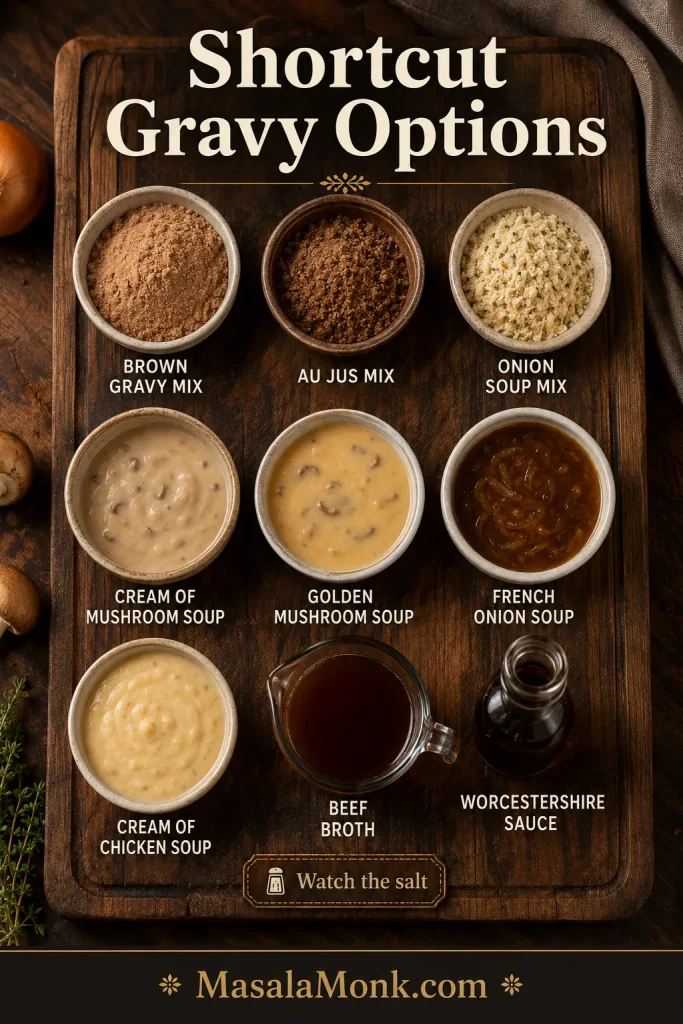
Shortcut Gravy Options

There is no shame in using the packet, the can, or the soup mix. The mistake is letting several salty shortcuts pile up without adjusting anything else.

Use the table below to see what each shortcut adds and what you need to watch.

Shortcut gravy options board showing brown gravy mix, au jus mix, onion soup mix, cream of mushroom soup, golden mushroom soup, French onion soup, cream of chicken soup, beef broth, and Worcestershire sauce.
Shortcut gravy ingredients can save time, but they also affect salt, thickness, and flavor. Therefore, choose one main shortcut, taste before adding extra seasoning, and adjust with broth as needed.
ShortcutWorks?Best UseWatch Out For
Brown gravy mixYesClassic easy brown gravyCan be salty
Au jus mixYesBeefier flavorUsually thinner
Onion soup mixYesStrong onion flavorReduce added salt
Cream of mushroom soupYesCreamier gravyLess classic brown gravy flavor
Golden mushroom soupYesDeeper mushroom flavorStill salty
Cream of chicken soupYesMilder creamy shortcutLess beefy; add Worcestershire or au jus
French onion soupYesRich onion gravyNeeds thickening

Cream of Mushroom Version

For a creamier crock pot Salisbury steak, add 1 can of cream of mushroom soup, usually 10.5 oz / 298 g, to the gravy mixture. Use 1 can for a lighter creamy gravy or 2 cans for a thicker cream-soup style version.

Cream of mushroom Salisbury steak with oval patties, creamy mushroom-brown gravy, and mashed potatoes on a cream plate.
Cream of mushroom Salisbury steak should taste creamy and savory, not flat. Balance the soup with broth, Worcestershire, Dijon, and mushrooms so the sauce stays rich without becoming heavy.

If you use cream of mushroom soup with brown gravy mix or onion soup mix, reduce the added salt and use low-sodium broth. Add Worcestershire and Dijon so the sauce still tastes savory instead of flat.

If cream-of-mushroom dinners are your kind of shortcut, these cream of mushroom pork chops use the same creamy mushroom-gravy idea with browned meat, rice and potato notes, baked options, and crock pot tips.

French Onion Soup Version

For a French onion soup version, replace 1 cup / 240 ml of the beef broth with canned French onion soup, usually 10.5 oz / 298 g per can. You can replace all the broth for a stronger onion flavor, but skip or reduce onion soup mix so the gravy does not become too salty.

French onion Salisbury steak with oval patties, mashed potatoes, glossy brown onion gravy, and caramelized onion ribbons.
French onion Salisbury steak works when the onions carry the flavor. Let the soft onion ribbons melt into the deep brown gravy, then spoon it generously over the mashed potatoes.

This version usually needs a cornstarch slurry near the finish because canned soup gives flavor but does not always thicken enough on its own.

For a deeper look at the onion side of the flavor, this French onion soup recipe shows how slow-cooked onions become sweet, savory, and rich.

Onion Soup Mix Version

Use ½ packet onion soup mix in the gravy or patties for a balanced onion flavor. For a stronger shortcut taste, use a full packet. Reduce added salt and choose low-sodium broth.

Brown Gravy Mix or Au Jus Version

Brown gravy mix gives the most familiar Salisbury steak gravy. Au jus mix gives a beefier flavor, but it usually makes a thinner sauce, so plan to give it body with slurry once the patties are cooked.

Can You Use Frozen Hamburger Patties?

Yes, freezer patties can still save dinner. The key is knowing whether they are raw or fully cooked, because those two need different handling.

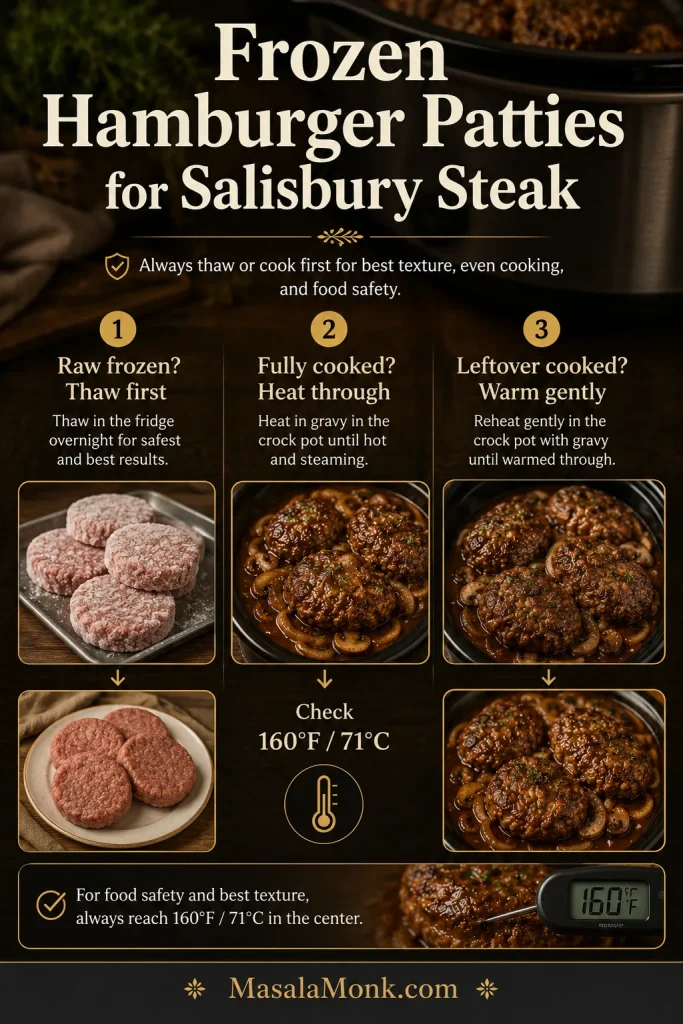
Raw Frozen vs Fully Cooked Patties

For raw frozen hamburger patties, thaw them safely in the refrigerator before adding them to the crock pot. The USDA slow cooker safety guidance recommends thawing meat or poultry before it goes into a slow cooker. Once thawed, brown the patties if possible, then let them cook gently in the gravy until the centers reach 160°F / 71°C.

Fully cooked frozen patties are different. Follow the package directions, heat them thoroughly in the gravy, and avoid cooking them so long that they turn firm or dry. They are already cooked, so the goal is heating, flavoring, and giving the sauce body.

If the package gives a reheating temperature or stovetop/microwave timing, use that as your safety guide, then let the gravy do the flavor work.

Frozen Patty Method Table

Use this table to match the method to the patties you actually have, not the patties you wish you had thawed yesterday.

Frozen hamburger patty guide for Salisbury steak showing raw frozen patties should be thawed first, fully cooked patties heated through, and leftover cooked patties warmed gently.
Frozen hamburger patties need the right slow cooker path. Raw frozen patties should be thawed first, while fully cooked patties can be heated through gently in the gravy.
Patty TypeBest MethodWhat to Watch
Raw frozen hamburger pattiesThaw in the refrigerator first, then brown and slow cookAvoid adding raw frozen meat straight to the slow cooker
Homemade frozen raw pattiesThaw overnight in the fridge, then brown gentlyThey may be fragile after thawing
Thawed raw pattiesBrown first, then cook in gravyCheck 160°F / 71°C in the center
Fully cooked frozen pattiesHeat thoroughly in gravy according to package directionsStop before they turn firm
Leftover cooked burger pattiesWarm gently in gravyBest added later so they do not dry out

Previously frozen patties may release more liquid than freshly shaped patties, so plan on thickening the sauce before serving. Use a wide spatula when lifting them out because thawed or reheated patties can be softer than freshly browned Salisbury steaks.

Best Method for Thawed Hamburger Patties

Thawed and browned hamburger-style patties arranged in a slow cooker with brown gravy, onions, and mushrooms for Salisbury steak.
Thawed hamburger patties become more dinner-worthy when they are browned, layered with onions and mushrooms, and finished in gravy. Finally, thicken the sauce so the shortcut still tastes intentional.
  1. Thaw raw frozen patties safely in the refrigerator.
  2. Brown the thawed patties for 2 to 3 minutes per side, if possible.
  3. Add onions, mushrooms, patties, and whisked gravy to the slow cooker.
  4. Cook on low until the patties reach 160°F / 71°C.
  5. Skim extra grease if needed.
  6. Stir in slurry near the finish to give the sauce body.

Easy Variations

Once the basic method is clear, the recipe is flexible. Keep the same idea — sturdy beef, enough sauce, and salt control — then adjust the flavor around it.

Salisbury Steak Meatballs

Use frozen fully cooked meatballs or homemade meatballs with the same gravy. Meatballs are easier than patties because you do not need to shape ovals and there is less risk of breaking. Cook until hot all the way through, then thicken the sauce near the end.

Salisbury steak meatballs in glossy mushroom onion brown gravy served over egg noodles in a cream bowl.
Salisbury steak meatballs give you the same brown gravy comfort in an easier-to-portion form. They work especially well over egg noodles because the sauce settles into every fold.

No Mushroom Salisbury Steak

Skip the mushrooms and add extra onions. The gravy will be less earthy, but still savory and comforting. Worcestershire, Dijon, black pepper, and garlic help carry the flavor.

Extra Onion Gravy

Use a full sliced onion instead of half, and add ½ packet onion soup mix or replace part of the broth with French onion soup. This is the best route if you want onion gravy without mushrooms.

Gluten-Free Version

Use gluten-free breadcrumbs and check the labels on gravy mix, onion soup mix, canned soup, and Worcestershire sauce. Cornstarch is usually the easiest gluten-free thickener, but packet mixes vary by brand. Skip the optional flour dusting before browning.

Low-Carb or Keto Version

Use almond flour, crushed pork rinds, or another low-carb binder instead of breadcrumbs. Serve with mashed cauliflower, cauliflower rice, green beans, or sautéed cabbage. Use a low-carb thickener if cornstarch does not fit your plan.

Ground Turkey Version

For a lighter version, ground turkey works, but handle the patties gently because they are leaner and more delicate. Cook ground turkey patties to 165°F / 74°C and season the sauce well because turkey is milder than beef.

What to Serve With Crock Pot Salisbury Steak

Mashed potatoes are the classic because they catch the gravy. If you want to stretch the meal, egg noodles or rice also work beautifully.

Serving guide for Salisbury steak showing mashed potatoes, egg noodles, rice, green beans, roasted carrots, and cauliflower mash as side dish options.
Choose sides that make the gravy useful: mashed potatoes, egg noodles, rice, green beans, roasted carrots, or cauliflower mash. Meanwhile, a bright vegetable keeps the meal from feeling too rich.
  • Mashed potatoes: the best classic comfort-food pairing.
  • Egg noodles: good when you want a beef-and-noodles feel.
  • Rice: budget-friendly and excellent with extra gravy.
  • Green beans: simple and fresh next to rich gravy.
  • Roasted carrots: sweet, cozy, and easy.
  • Peas or corn: family-style sides that keep dinner simple.
  • Biscuits or dinner rolls: useful when there is extra gravy.
  • Cauliflower mash: a good lower-carb base.

For a garlic-forward potato side, these garlic mashed potatoes are especially good when the gravy is rich and beefy.

If the plate needs something crisp and cold beside all that gravy, a wedge salad gives you that steakhouse-style contrast.

The best plate has something plain underneath. Give the gravy somewhere to go: into potatoes, over noodles, across rice, or around cauliflower mash.

Troubleshooting Crock Pot Salisbury Steak

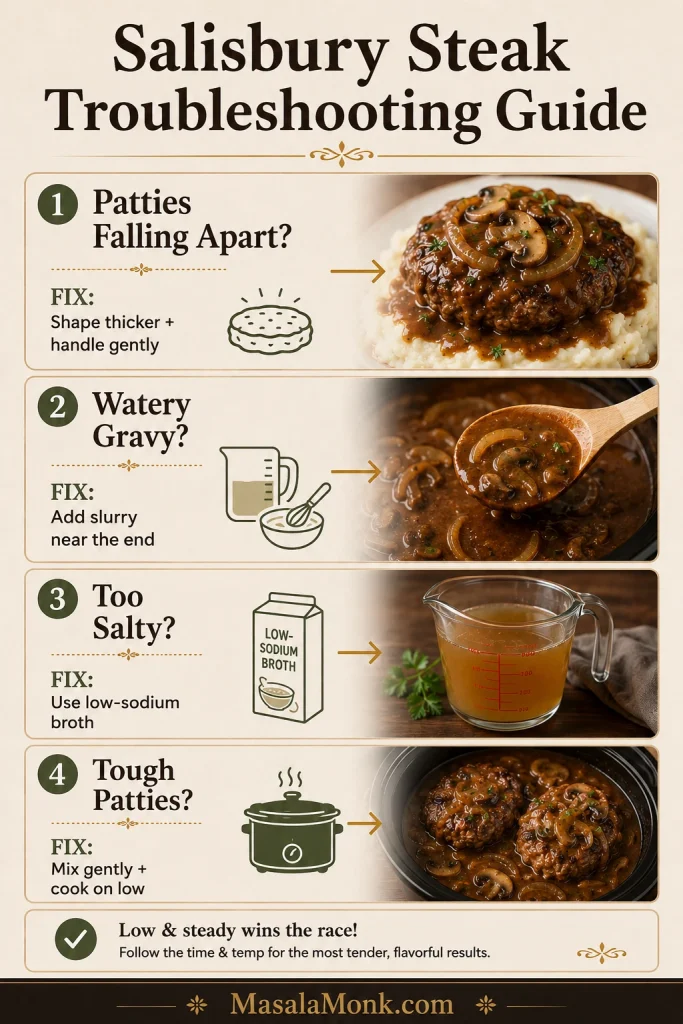
If your last slow cooker Salisbury steak came out thin, salty, or broken, you are not alone. None of those problems means dinner is ruined; most of them just need a small adjustment.

Most problems come from fragile patties, trapped slow-cooker moisture, or salty shortcut ingredients. Here is how to fix them.

Troubleshooting guide for Salisbury steak with fixes for patties falling apart, watery gravy, salty gravy, and tough patties.
Most Salisbury steak problems have simple fixes. Shape thicker patties if they break, use slurry for watery gravy, choose low-sodium broth for salty sauce, and cook gently for better texture.

Why Did My Patties Fall Apart?

The patties may have been too thin, too loosely shaped, moved too often, or stacked too tightly. Browning helps, but even unbrowned patties hold better when they are thick enough and moved with a wide spatula.

Why Is My Gravy Watery?

Slow cookers trap moisture, and beef releases juices as it cooks. Add a cornstarch slurry once the patties are done, cover, and let the sauce tighten. Use a second small slurry if needed.

Why Is My Gravy Too Salty?

Packets, soup mixes, canned soup, and broth can all add salt. Use low-sodium broth and reduce added salt. To fix a salty batch, add unsalted broth, a splash of cream, extra mushrooms or onions, or serve over plain potatoes or rice.

Why Are My Patties Tough?

The meat was likely overmixed, packed too tightly, or cooked too long on high. Mix gently, shape without compressing too much, and use low heat when possible.

Why Is There Grease on Top?

Ground beef releases fat as it cooks. Browning first removes some of it before the patties go into the crock pot. If grease collects on top, skim it off before thickening the sauce.

Why Does the Gravy Taste Flat?

Add Worcestershire, Dijon, black pepper, garlic, or a little more onion flavor. A small spoonful of ketchup can round out the gravy without making it taste sweet.

Why Did the Mushrooms Get Too Soft?

Mushrooms soften a lot in the slow cooker. For firmer mushrooms, use thicker slices or add half at the beginning and half during the last hour.

Can I Make the Patties Ahead?

Yes. Shape the patties up to a day ahead and refrigerate them covered. You can also brown the patties ahead, cool them, and refrigerate until you are ready to assemble the crock pot.

Storage, Freezing, and Reheating

  • Refrigerator: Store leftovers in an airtight container for 3 to 4 days.
  • Freezer: Freeze cooked patties with gravy for 2 to 3 months.
  • Reheating: Warm gently with a splash of broth or water to loosen the gravy.
  • After freezing: The gravy may thin after thawing. Simmer gently and thicken again with a small slurry if needed.

For the best freezer texture, freeze the patties with gravy instead of freezing the patties dry. The sauce protects the beef and makes leftovers feel more like dinner than a rescue mission.

FAQ

Should Salisbury steak patties be browned before slow cooking?

Browning is not required, but it gives better flavor and helps the patties hold together. If you skip it, make them slightly thicker and handle them gently.

Can frozen hamburger patties go straight into the crock pot?

For raw frozen hamburger patties, thaw them in the refrigerator first, then brown and slow cook them in the gravy. Fully cooked frozen patties are different; follow the package directions and heat them thoroughly in the sauce.

Is cream of mushroom soup a good shortcut?

Yes. Use 1 can, usually 10.5 oz / 298 g, for a lighter creamy gravy or 2 cans for a thicker cream-soup version. Reduce salt if you also use gravy mix or onion soup mix.

Can I use cream of chicken soup instead?

Yes. It makes a milder, creamier sauce. Add Worcestershire, au jus, or extra black pepper so it still tastes savory and not flat.

What does onion soup mix add?

Onion soup mix adds savory onion flavor and salt. Use ½ packet for balance or a full packet for a stronger shortcut version, then reduce added salt and use low-sodium broth.

How do you thicken slow cooker Salisbury steak gravy?

Mix cornstarch with cold water, stir it into the hot gravy once the patties are cooked, and cook for 15 to 20 minutes. Add another small slurry if you want it thicker.

What can replace mushrooms?

Use extra onions, onion gravy, French onion soup, or cream of onion soup. Brown gravy versions also work well without mushrooms.

What internal temperature should Salisbury steak reach?

Ground beef patties should reach 160°F / 71°C in the center. For ground turkey or ground chicken patties, use 165°F / 74°C.

Is Salisbury steak the same as hamburger steak?

They are closely related. Salisbury steak usually includes seasoned ground beef with a binder such as breadcrumbs or egg, then gravy. Hamburger steak is often simpler: seasoned beef patties with onion gravy or brown gravy.

Final Thoughts

Crock pot Salisbury steak does not need to be fancy to be memorable. It just needs tender beef, brown gravy, soft onions, and the kind of sauce that makes mashed potatoes disappear from the plate.

Whether you start with homemade patties or a freezer shortcut, the win is the same: tender beef, a spoonable brown sauce, and a plate of potatoes, noodles, or rice that catches every bit of it.

Complete crock pot Salisbury steak dinner with mashed potatoes, mushroom onion gravy, green beans, a gravy boat, and a slow cooker in the background.
This final dinner scene shows the payoff: tender Salisbury steak, mashed potatoes, green beans, and glossy mushroom onion gravy. The slow cooker handles the work, while the plate still feels like a full comfort-food meal.

Back to top
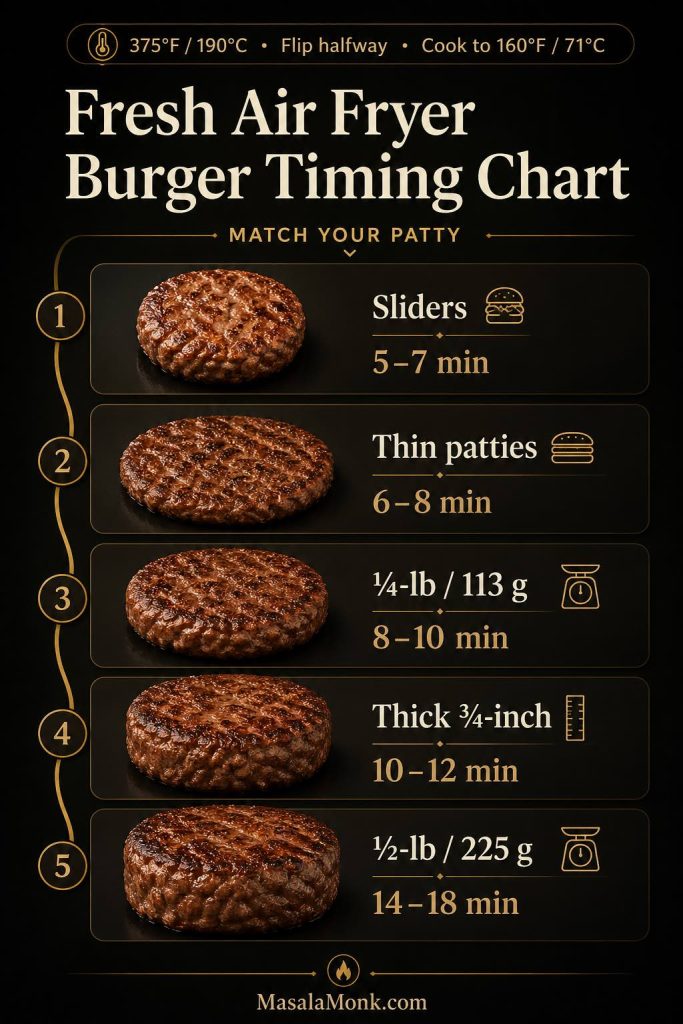
Posted on Leave a comment

Air Fryer Burgers Recipe: Juicy Hamburgers, Time & Temp

Juicy air fryer cheeseburger with melted cheddar, lettuce, tomato, red onion, pickles, and toasted bun on a dark surface, with an air fryer basket in the background.

A good air fryer burger recipe should give you juicy patties, clear timing, and a reliable way to know when the burgers are done. This guide to air fryer hamburgers starts with fresh ground beef patties, then covers thicker burgers, frozen patties, cheeseburgers, toasted buns, smoke prevention, toppings, storage, and a full recipe card with US and metric details.

The best default is simple: cook fresh ¼-lb / 113 g hamburger patties at 375°F / 190°C for 8–10 minutes, flipping halfway, until the center reaches 160°F / 71°C. From there, adjust by thickness, starting temperature, and air fryer model instead of relying on one fixed minute for every burger.

For a bunless version, the same patties can become lettuce-wrap burgers, burger bowls, or low-carb cheeseburger plates. For more ideas in that direction, see these keto hamburger recipes.

How Long to Cook Hamburgers in the Air Fryer

Best default: Use 1 lb / 454 g ground beef for 4 patties. Shape each patty about 4 oz / 113 g and ½ inch / 1.25 cm thick. Air fry at 375°F / 190°C for 8–10 minutes, flipping halfway, until the center reaches 160°F / 71°C. Add cheese only at the end.

Air fryer burger timing guide showing 375°F or 190°C, 8 to 10 minutes, flipping halfway, and a 160°F center temperature for fresh quarter-pound patties.
For most fresh ¼-lb patties, 375°F for 8–10 minutes is the best starting point; the center temperature is what confirms the burger is done.

Start checking early the first time

If you are making these for the first time, start checking at 8 minutes rather than waiting for the full range to pass. That way, you learn how your air fryer handles your patties without overcooking the first batch.

Put simply, the 8–10 minute range works best for patties that are about 4 oz / 113 g each and about ½ inch / 1.25 cm thick. Thinner patties may finish closer to 6–8 minutes, while thicker patties may need 10–12 minutes. Because air fryer baskets, patty thickness, and beef fat percentage all vary, the time range is only the starting point.

Use temperature, not color, to check doneness

For that reason, the thermometer matters more than the clock. Ground beef can look brown before it is safe, or stay slightly pink after it reaches temperature, so do not judge doneness by color alone.

For the most accurate reading, insert the thermometer through the side of the patty so the tip reaches the center instead of stopping near the surface. That way, you are checking the part of the burger that takes the longest to cook.

Food safety note: Ground beef burgers should reach 160°F / 71°C in the center. FoodSafety.gov lists 160°F as the safe minimum internal temperature for ground meat, so a thermometer is the clearest way to avoid guessing. See the safe minimum internal temperature chart.

Why this air fryer method works

In practice, the air fryer is good at burgers because it cooks fast, drains extra fat, and keeps the process cleaner than a skillet. The tradeoff is that patties can dry out if they are too lean, too thin, or cooked too long. That is why thickness, beef choice, spacing, and internal temperature matter more than chasing one exact minute.

Air Fryer Burger Time and Temperature Chart

Best default temperature

For most fresh patties, 375°F / 190°C is the best first setting. It is hot enough to cook the burgers quickly and help the outside brown. However, it is not so aggressive that the edges dry out before the center is done.

If this is your first time making burgers in the air fryer, use the quarter-pounder row as your starting point. After that, adjust by thickness instead of changing everything at once.

Fresh burger time chart

Because patty size changes the answer, start with the row that matches your burger instead of forcing every patty into the same time. Once you know how your air fryer handles one batch, adjust the next batch by 1–2 minutes rather than changing the temperature immediately.

Fresh air fryer burger timing chart comparing sliders, thin patties, quarter-pound patties, thicker three-quarter-inch patties, and half-pound patties with their cook times.
Fresh burger timing changes most with patty size and thickness, so match your patty to the closest size instead of using one fixed cook time for every batch.
Fresh burger type Air fryer temp Approx. time Flip? Internal temp
Fresh quarter-pounder / ¼-lb / 113 g patties, about ½ inch / 1.25 cm thick 375°F / 190°C 8–10 minutes Yes, halfway 160°F / 71°C
Fresh thicker patties, about ¾ inch / 2 cm thick 375°F / 190°C 10–12 minutes Yes 160°F / 71°C
Fresh ½-lb / 225 g thick patties 360–370°F / 182–188°C 14–18 minutes Yes 160°F / 71°C
Thin fresh patties 375°F / 190°C 6–8 minutes Yes 160°F / 71°C
Mini burgers or sliders 375°F / 190°C 5–7 minutes Yes 160°F / 71°C

Frozen Burger, 400°F, and Cheeseburger Timing

However, frozen burgers need a wider range because the center has to thaw before it can safely finish cooking. Before adding cheese to any burger, check the center first. Otherwise, the cheese may melt while the patty still needs more time.

Frozen air fryer burger guide showing timing for quarter-pound and third-pound patties, flipping halfway, checking for 160°F, and adding cheese at the end.
Frozen burgers need a wider timing range because the center has to thaw first; check the temperature before adding cheese.
Burger type Air fryer temp Approx. time Flip? Internal temp
Frozen ¼-lb / 113 g patties 360–375°F / 182–190°C 10–14 minutes Yes 160°F / 71°C
Frozen ⅓-lb / 150 g patties 360–375°F / 182–190°C 12–16 minutes Yes 160°F / 71°C
Thin fresh patties at 400°F / 200°C 400°F / 200°C 6–8 minutes Yes 160°F / 71°C
Frozen burgers at 400°F / 200°C 400°F / 200°C 11–15 minutes Yes 160°F / 71°C; check early because the outside may brown first
Cheeseburgers Same as burger Add cheese last 30–60 seconds 160°F / 71°C before cheese

Should you air fry burgers at 375°F or 400°F?

For most homemade patties, 375°F is the better first choice because it gives the center time to cook before the edges dry out. However, 400°F can work for thinner patties or for people who like a firmer browned outside. In that case, start checking early and use a thermometer, because the outside can look done before the center reaches 160°F.

Comparison chart for air fryer burgers showing 375°F as the best default for control and 400°F as an option for thinner patties with earlier checking.
Use 375°F as the most reliable starting point for homemade burgers, and treat 400°F as an option for thinner patties or stronger browning with an early temperature check.

In short, 375°F is the better beginner setting, while 400°F is an alternate for thinner patties or cooks who already know their air fryer runs evenly. That said, once you know how your air fryer behaves, you can fine-tune the temperature without guessing.

How to adjust the time

If your air fryer runs hot, start checking a minute early. On the other hand, if your patties are thick, cold, or crowded, they may need longer. In either case, do not press the burgers while they cook; pressing squeezes out the juices you are trying to keep.

If you are not sure which row fits your burger, choose the lower end of the time range first. Then check the center and add 1–2 minutes only if the patty has not reached 160°F / 71°C.

Back to table of contents ↑

Hamburger Patties in the Air Fryer

For your first batch, keep the patties simple: 1 lb / 454 g ground beef divided into 4 loose patties, about 4 oz / 113 g each. Shape each patty about 4–4½ inches / 10–11.5 cm wide and about ½ inch / 1.25 cm thick. That size cooks evenly, fits most air fryer baskets, and gives you a better chance of hitting 160°F without drying out the edges.

Raw air fryer burger patties showing 4-ounce portions, 4 to 4 and a half inch width, half-inch thickness, a shallow center dimple, and a bun size comparison.
Even patty size is what makes the timing chart work: aim for 4 oz patties that are about ½ inch thick, slightly wider than the bun, and gently dimpled in the center.

Because burgers shrink as they cook, shape each patty slightly wider than the bun. Then press a shallow dimple in the center so the patty stays flatter instead of puffing up into a dome.

When the patties are the same size, they finish at about the same time. Otherwise, the smaller patties can dry out while the thicker ones are still catching up.

If one patty is noticeably larger, place it where your air fryer runs hottest, or give it an extra minute after removing the smaller patties. That way, the thinner burgers do not dry out while the thickest one finishes.

This same method works for fresh beef patties, homemade burger patties, and plain hamburger patties from the butcher counter. However, the main adjustment is thickness: thin patties cook faster, while thick patties need more time to reach 160°F in the center.

For best texture, avoid mixing the beef too much. Once ground beef is overworked, the cooked patty can turn dense and springy instead of tender and juicy.

Can you cook raw ground beef patties in the air fryer?

Yes. Raw ground beef patties can go straight into the air fryer as long as they are shaped evenly, cooked in a single layer, and checked for 160°F in the center. However, loose ground beef mixtures and very wet patties can cook unevenly, so formed patties work best.

Ingredients for Air Fryer Hamburgers

You only need a few ingredients for classic burgers. Since the cooking method is simple, the beef, seasoning, patty shape, and cheese timing matter more than a long ingredient list. In other words, better patties matter more than more ingredients.

Since the ingredient list is short, each choice matters. The beef controls juiciness, the salt controls flavor, and the patty shape controls how evenly the burger cooks.

Air fryer burger ingredients including ground beef, salt, black pepper, garlic powder, onion powder, Worcestershire sauce, cheese slices, burger buns, lettuce, tomato, onion, and pickles.
The ingredient list stays simple because the success of air fryer burgers comes from good beef, even patties, enough seasoning, and adding cheese only at the end.

Ground beef

Use 1 lb / 454 g ground beef for 4 regular burgers. For the juiciest result, choose 80/20 ground beef. For a slightly leaner patty with less smoke, 85/15 is a good middle ground.

Seasoning

A simple mix of salt, black pepper, garlic powder, and onion powder is enough. If the beef is good and the patties are shaped well, the seasoning should support the burger rather than cover it up. Since kosher salt brands vary, start with a little less if you are using fine table salt. Worcestershire sauce or steak sauce is optional, but a small amount adds savory depth without turning the burger into meatloaf.

Cheese

American cheese melts the easiest. Cheddar, pepper jack, Swiss, provolone, and mozzarella also work, but thicker slices may need the full final minute to soften. Because the air fryer fan is strong, add cheese only at the end so it does not slide off, burn, or blow around inside the basket.

Buns and toppings

Use burger buns, brioche buns, potato buns, lettuce wraps, or bowls. Classic toppings include lettuce, tomato, onion, pickles, mustard, ketchup, and a creamy burger sauce. For a homemade creamy base, use this homemade mayonnaise recipe and turn it into burger sauce with ketchup, mustard, pickle juice, and a little seasoning.

Do you need oil, parchment, or foil?

Fresh 80/20 or 85/15 patties usually do not need oil because the beef has enough fat. However, if you are using very lean fresh patties or dry-surfaced frozen patties, a light oil spray can help browning.

If you use parchment, choose perforated parchment made for air fryers and never block airflow under the patties. Likewise, use foil only if your air fryer manual allows it. Otherwise, trapped grease and blocked airflow can slow cooking, create smoke, and make the burgers cook unevenly.

In short, airflow matters more than lining the basket. If a liner blocks the holes or traps grease under the patties, skip it.

Best Ground Beef for Air Fryer Burgers

If juiciness matters most, start with 80/20. If your air fryer smokes easily or you prefer a slightly lighter burger, 85/15 is the safer everyday choice. Very lean beef can work, but it needs more care because it dries out faster.

Best ground beef guide for air fryer burgers comparing 80/20 beef for juicy burgers, 85/15 beef for balanced burgers, and 90/10 or leaner beef that can dry out faster.
For the juiciest air fryer burgers, 80/20 is the most forgiving, while 85/15 is a good everyday choice when you want less smoke without losing too much moisture.
Ground beef Best for What to know
80/20 Juiciest classic burgers Rich, flavorful, and forgiving, but it can drip more fat and create more smoke in some air fryers.
85/15 Balanced everyday burgers Still juicy, usually less smoky, and a good choice for indoor air fryer cooking.
90/10 or leaner Leaner burgers Can dry out faster. Add moisture and check the temperature early.

As a result, 80/20 or 85/15 is the most reliable choice for a first batch. Shape the patties gently, keep them even in thickness, and add a center dimple so they do not puff into domes as they cook.

If you are using very lean beef, add a little moisture with Worcestershire sauce, grated onion, mustard, or a small amount of oil. Then start checking early, because lean patties can move from done to dry quickly.

For a thinner burger with a harder griddled crust instead of a thicker air fryer patty, try this classic smash burger method.

How to Make Air Fryer Hamburgers

This method is for fresh ground beef patties. Once the patties are shaped, the rest is mostly about spacing, flipping, and checking the center. After that, assembly is quick because the burgers only need a short rest.

Step-by-step air fryer burger guide showing preheating, shaping patties, making a dimple, seasoning, cooking in one layer, flipping halfway, checking the center, and resting before assembly.
The method is simple once the order is clear: shape the patties evenly, cook them in one layer, flip halfway, check the center, then rest and assemble.

1. Preheat the air fryer

Preheat the air fryer to 375°F / 190°C for about 3 minutes. Although some models heat quickly, preheating helps the patties start cooking evenly.

If you skip preheating, add 1–2 minutes and start checking at the low end of the range. Once you know your air fryer, the timing becomes easier to repeat.

2. Shape the patties gently

Divide 1 lb / 454 g ground beef into 4 loose portions, about 4 oz / 113 g each. Then shape each portion into a patty about 4–4½ inches / 10–11.5 cm wide and ½ inch / 1.25 cm thick. Because the patties shrink as they cook, starting a little wider helps them fit the bun better later.

3. Make a center dimple

Press a shallow dimple into the center of each patty with your thumb or the back of a spoon. This small step helps the burgers stay flatter instead of puffing up in the middle.

4. Season both sides

Season the outside of the patties with salt, pepper, garlic powder, and onion powder. If using Worcestershire sauce, mix it in lightly before shaping, or brush a tiny amount over the patties before seasoning.

5. Air fry in a single layer

Place the patties in the basket in a single layer. Then leave space between them so hot air can move around each burger. Do not stack patties, and do not crowd the basket.

If all 4 patties do not fit with space between them, cook in batches. Otherwise, the burgers may steam instead of brown. Later batches may cook slightly faster because the air fryer is already fully hot.

6. Flip halfway

Air fry for 8–10 minutes total, flipping halfway through. Even if your model usually cooks without flipping, turning the patties makes the result more reliable across different basket styles.

7. Check the center

Check the thickest part of each patty. The burgers are done when the center reaches 160°F / 71°C. For the cleanest reading, insert the thermometer from the side so the tip lands in the center of the patty.

Digital thermometer inserted from the side into an air fryer burger patty showing 160°F and 71°C as the internal temperature for ground beef burgers.
Color is not a reliable doneness check for ground beef, so insert the thermometer from the side and make sure the center of the patty reaches 160°F.

If one patty is thicker than the others, it may need an extra minute or two. In that case, remove the finished patties and let the thicker one continue cooking until it reaches temperature.

8. Rest and assemble

Let the patties rest for about 2 minutes before assembling. Meanwhile, toast the buns, slice the toppings, or stir together a quick sauce.

Can you toast burger buns in the air fryer?

Yes. After the patties come out, place the buns cut-side up in the basket and air fry at 350–375°F / 175–190°C for 1–2 minutes. Watch closely because buns go from toasted to dry quickly.

How to Make Air Fryer Cheeseburgers

To make cheeseburgers, cook the patties first, then add cheese at the very end. The easiest method is to place a slice of cheese on each cooked patty during the final 30–60 seconds of cooking.

Air fryer cheeseburger guide showing cheese added at the end of cooking, melted cheese on the patty, and a reminder not to add cheese halfway.
Add cheese only after the burger is almost done; the final 30–60 seconds or residual basket heat is usually enough to melt it without making a mess.

Instead of running the fan longer just to melt cheese, you can also use the heat that is already trapped in the basket. Turn the air fryer off, place cheese on the hot patties, close the basket, and let the residual heat melt the cheese for about 1 minute.

If your cheese slides, folds, or blows off, do not fight the fan. Instead, melt the cheese with leftover heat after cooking. That way, the cheese softens over the patty instead of ending up on the basket.

Do not add cheese halfway through cooking. It can melt off the burger, stick to the basket, burn at the edges, or blow around inside the air fryer.

Frozen Burgers in the Air Fryer

Frozen patties are perfect for nights when nothing was thawed. They can go straight from freezer to basket; however, they need a little more patience because the center has to thaw before it can safely finish cooking.

That is why frozen burgers usually need a lower-to-moderate temperature and a wider time range than fresh patties. In practice, smaller ¼-lb / 113 g patties finish sooner, while thicker ⅓-lb / 150 g patties need the longer end of the range.

Fresh versus frozen air fryer burger guide comparing fresh patties cooked at 375°F with frozen patties cooked from frozen, including cook times, flipping, and 160°F internal temperature.
Fresh patties give you the most control, while frozen patties need extra time because the center must thaw before the burger can safely finish cooking.

How to air fry frozen burger patties

  1. Preheat the air fryer to 360–375°F / 182–190°C.
  2. Place frozen patties in a single layer.
  3. Air fry for 10–16 minutes, depending on patty size and thickness.
  4. Flip halfway through.
  5. Season after the surface warms slightly if seasoning will not stick at the beginning.
  6. Cook until the center reaches 160°F / 71°C.
  7. Add cheese during the final 30–60 seconds if making cheeseburgers.

For exact ranges by patty size, use the frozen burger timing chart above. Before adding cheese to frozen burgers, check the center first. Otherwise, the cheese may look melted while the patty still needs more time inside.

What about Bubba-style frozen burgers?

Bubba-style frozen burgers can go straight from freezer to air fryer. However, they are often thick and fatty, so they may need the longer end of the timing range. Start at 360–375°F, flip halfway, and check for 160°F in the center.

If you cook frozen burgers at 400°F / 200°C, start checking early. The outside can brown before the center is fully done, especially with thicker frozen patties. In that case, a thermometer prevents the most common mistake: serving a burger that looks done outside but is not finished inside.

Back to table of contents ↑

Ninja Foodi, Air Fryer Oven and Basket Air Fryer Notes

The basic method is the same in most basket-style air fryers: cook fresh ¼-lb / 113 g patties at 375°F / 190°C, flip halfway, and check for 160°F / 71°C in the center. However, stronger models, smaller baskets, dual-zone air fryers, and air fryer ovens can change the timing by a minute or two.

Likewise, air fryer ovens may need slightly longer because the cooking space is larger than a compact basket. That means the best approach is to use the chart first, then adjust the next batch based on your specific model.

Air fryer model notes for burgers comparing basket air fryers, Ninja Foodi style models, and air fryer ovens with timing adjustments and 160°F internal temperature guidance.
Use the timing chart as your starting point, then adjust by model: stronger basket air fryers may finish sooner, while air fryer ovens can need a minute or two longer.
Air fryer type What to adjust Best starting point
Ninja air fryer or Ninja Foodi air crisp These can cook efficiently, so check early. 375°F / 190°C, 8 minutes, then check the center.
Ninja Foodi Grill Air crisp and grill mode behave differently. Use air crisp for this method; follow grill-plate timing if using grill mode.
Cosori, Instant Vortex, Gourmia, PowerXL, and similar basket air fryers Basket size and airflow vary. Use the chart first, then adjust by 1–2 minutes after your first batch.
Air fryer oven or toaster oven air fryer The larger cavity may cook slightly slower. Use the middle rack, flip halfway, and check the center early.

Back to table of contents ↑

How to Keep Air Fryer Burgers Juicy

These burgers stay juicy when the beef has enough fat, the patties are handled gently, and the cooking time does not run too long. As a result, a few small details make the difference between a tender burger and a dry one.

  • Use 80/20 or 85/15 beef. A little fat keeps the burger tender.
  • Do not overmix. Handle the meat gently and stop once the patties hold together.
  • Make even patties. Uneven patties cook unevenly.
  • Add a center dimple. This helps prevent puffing.
  • Do not press the burgers. Pressing forces juices out.
  • Flip once. It improves even cooking without overhandling.
  • Check temperature early. Start checking at the low end of the timing range.
  • Rest briefly. Two minutes is enough for most burgers.

In other words, juicy burgers come from control, not extra steps. Once the patties are shaped well and cooked to temperature, the air fryer does most of the work.

Finished air fryer cheeseburger with melted cheese, toasted bun, lettuce, tomato, onion, and pickles, shown with an air fryer basket in the background.
A juicy air fryer burger comes from control, not extra steps: shape the patty evenly, avoid overcooking, and stop once the center reaches temperature.

When using lean beef, add a little moisture with Worcestershire sauce, grated onion, mustard, or a small amount of oil. Also, check the temperature earlier because lean patties move from done to dry quickly.

The goal is a patty with browned edges, melted cheese, and a tender center — not a dry puck that only tastes like seasoning. So, once the burger reaches temperature, stop cooking and let it rest.

Troubleshooting Air Fryer Hamburgers

If the burgers turn out dry, smoky, uneven, or messy, do not change everything at once. In most cases, one small adjustment fixes the next batch: use slightly fattier beef, make the patties thinner, clean the basket, or add cheese later.

What not to do when air frying burgers

Before changing the recipe, check the most common mistakes first. These are the small things that usually cause dry burgers, uneven cooking, smoking, or messy cheese.

Air fryer burger mistakes to avoid, including stacking patties, pressing burgers, adding cheese too early, blocking airflow, judging doneness by color, and using one timing for every patty.
Most air fryer burger problems come from blocked airflow, uneven patties, early cheese, or guessing doneness by color instead of checking the center.
  • Do not stack patties in the basket.
  • Avoid pressing the burgers while they cook.
  • Add cheese only at the end, not halfway through cooking.
  • Never block the basket holes with solid parchment or foil.
  • Do not judge doneness by color alone.
  • Avoid using the same timing for thin fresh patties and thick frozen patties.

Air fryer burger troubleshooting chart

Once you know what went wrong, use the chart below to fix the next batch. Instead of changing the beef, temperature, timing, and basket setup all at once, adjust one thing first.

Problem Likely cause Fix
Dry burgers Lean beef or overcooking Use 80/20 or 85/15 beef, and check the temperature earlier.
Smoking air fryer Fat dripping onto a hot base, old grease, or very fatty beef Clean the basket, avoid overcrowding, and try 85/15 beef if smoke is frequent.
Burger puffed up No center dimple Press a shallow dimple in each patty before cooking.
Undercooked center Patty too thick or too cold Cook longer at 375°F and check for 160°F in the center.
Cheese blew off Cheese added too early or fan too strong Add cheese during the final 30–60 seconds, or melt it with residual heat after cooking.
Uneven cooking Basket overcrowded Cook in a single layer and leave space between patties.
Air fryer burger troubleshooting guide showing fixes for dry burgers, smoking, outside browning before the center finishes, puffing in the middle, and checking for 160°F internal temperature.
The best fix depends on the problem: dry burgers need more moisture control, smoking needs cleaner airflow, and underdone centers need a thermometer check instead of more browning.

How to fix the next batch

If you are not sure what went wrong, start with the simplest fix first. Next time, change only one thing at a time. If the burgers were dry, check earlier or use fattier beef; if they smoked, clean the basket or use a slightly leaner blend.

If smoke happens, do not panic. Usually, it means fat is hitting a very hot surface or old grease is still in the basket. Before cooking the next batch, clean the basket, avoid overcrowding, and use the lower end of the temperature range if your air fryer runs hot.

The next batch becomes easier to control because you are matching the fix to the actual problem instead of guessing.

If this happens often with air fryer recipes, it is worth checking these common air fryer mistakes. Overcrowding, blocked airflow, old grease, and wrong timing can affect burgers, fries, wings, and almost everything else you cook in the basket.

Jump to recipe card → | Back to table of contents ↑

Best Sauces and Toppings for Air Fryer Hamburgers

A good burger only needs a few toppings, but the sauce can change the whole direction of the meal. For that reason, keep the patty simple and use the sauce to make it classic, spicy, Indian-style, or bowl-friendly.

Air fryer burger sauce and topping guide showing classic burger sauce, mango habanero sauce, mango mustard sauce, green chutney, pickles, onion, tomato, and lettuce.
Keep the burger patty simple and use the sauce to change the direction: classic, spicy-sweet, tangy, or fresh and herby.

Classic burger sauce is the easiest place to start: mix mayonnaise, ketchup, mustard, finely chopped pickles or pickle juice, garlic powder, onion powder, and a little black pepper. If you want a fresh base, use this homemade mayonnaise; if you need an egg-free spread, use eggless mayonnaise.

When you want heat, brush the cooked patty lightly with mango habanero sauce or serve it on the side for fries. Meanwhile, mango mustard sauce gives the burger a tangy, fruity change from plain mustard.

An Indian-style burger works especially well with green chutney, onion, tomato, mayo, and a pinch of chaat masala. Because the chutney is bright and herb-heavy, it cuts through the richness of the patty.

Air Fryer Burger Variations

Once the basic method is set, you can change the toppings and sauces without changing the cooking technique. That way, one reliable patty method can turn into several different dinners.

Air fryer burger variations guide showing a classic cheeseburger, spicy mango habanero burger, mango mustard burger, green chutney burger, and a low-carb lettuce-wrap option.
Once the basic air fryer patty is reliable, the easiest way to change the burger is through the sauce: classic, spicy-sweet, tangy, herby, or low-carb.
  • Classic cheeseburger: American cheese, pickles, onion, lettuce, tomato, and burger sauce.
  • Spicy mango habanero burger: Cheddar, onions, pickles, and mango habanero sauce.
  • Mango mustard burger: Lettuce, pickles, onion, and mango mustard sauce.
  • Green chutney burger: Green chutney, mayo, onion, tomato, and chaat masala.
  • Low-carb burger bowl: Lettuce, pickles, cheese, onions, tomato, and sauce without the bun.
  • Pesto cheeseburger: Pesto mayo, tomato, mozzarella or provolone, and roasted peppers.

For a lower-carb plate, keep the same patty method and build the meal around lettuce, pickles, cheese, onions, tomato, and sauce instead of a bun.

What to Serve With Air Fryer Hamburgers

For an easy burger-night plate, pick one sauce, one crispy side, and something fresh to cut through the richness. That way, the meal feels complete without turning dinner into a project.

For the classic burger-and-fries plate, serve the patties with homemade fries, wedges, or potato snacks. If a make-ahead side is easier, potato salad is one of the best choices. For a party-style spread, add one or two ideas from these potato appetizers.

If the air fryer is already out, keep the sides easy. Air fryer mozzarella sticks make the meal feel like a game-day plate, while air fryer croquettes are a good option when you want something crispy that is not fries.

For something fresh, add a cabbage slaw, cucumber salad, onion-tomato salad, or raw papaya salad. A crisp fresh side helps balance the richness of the burgers and cheese.

Storage and Reheating

Make-ahead tip: You can shape the raw patties up to 24 hours ahead and refrigerate them in a covered container with parchment between layers. Keep them cold until cooking, then air fry straight from the fridge and check the center for 160°F / 71°C.

Air fryer burger storage guide showing raw patties made ahead with parchment, cooked patties stored separately from buns and toppings, and patties reheated in the air fryer.
Store patties, buns, and toppings separately so leftovers reheat cleanly; warm the patty first, then assemble the burger fresh.

Cooked hamburger patties store better than fully assembled burgers. If you know you will have leftovers, store the patties, buns, cheese, sauces, and toppings separately. Otherwise, the bun can turn soggy while the lettuce and tomato lose their texture.

Once the patties are cooked, refrigerate leftovers within 2 hours. If the room is very hot, refrigerate them within 1 hour. After that, reheat only the patties and assemble the burgers fresh so the buns and toppings stay in better shape.

  • Refrigerate: Cool cooked patties, then store in an airtight container for 3–4 days.
  • Freeze: Wrap cooked patties individually and freeze for up to 2 months.
  • Reheat in the air fryer: Reheat patties at 350°F / 175°C until warmed through.
  • Add cheese after reheating: Cheese melts better when added at the end instead of reheated from cold.
  • Avoid reheating assembled burgers: The bun can dry out while lettuce, tomato, and sauce turn soggy.

For more air fryer recipes with ground beef, this burger method is the easiest starting point because the patties cook quickly, portion neatly, and can be served on buns, in bowls, or over salad.

Air Fryer Burgers Recipe Card

Air Fryer Burgers

These air fryer burgers are built for a quick, juicy first batch: fresh ground beef, simple seasoning, 375°F heat, one flip, and cheese added only at the end.

Yield 4 burgers
Prep Time 10 minutes
Cook Time 8–10 minutes
Total Time 18–20 minutes

Ingredients

  • 1 lb / 454 g ground beef, preferably 80/20 or 85/15
  • ¾ tsp kosher salt, or to taste
  • ½ tsp black pepper
  • ½ tsp garlic powder
  • ½ tsp onion powder
  • 1 tsp / 5 ml Worcestershire sauce or steak sauce, optional
  • 4 cheese slices, about 3 oz / 85 g total, optional
  • 4 burger buns
  • Lettuce, tomato, onion, pickles, sauce, or toppings of choice

Instructions

  1. First, preheat the air fryer to 375°F / 190°C.
  2. Next, divide the beef into 4 loose portions, about 4 oz / 113 g each.
  3. Then shape each portion into a patty about 4–4½ inches / 10–11.5 cm wide and ½ inch / 1.25 cm thick.
  4. After that, press a shallow dimple into the center of each patty so the burgers stay flatter as they cook.
  5. Once the patties are shaped, season both sides with salt, pepper, garlic powder, and onion powder. If using Worcestershire sauce, mix it in gently before shaping or brush a tiny amount over the patties before seasoning.
  6. Then place the patties in the air fryer basket in a single layer, leaving space between them.
  7. As the burgers cook, flip them halfway through the 8–10 minute cooking time.
  8. Once the time is close, check the center of each patty. For the most accurate reading, insert the thermometer through the side of the patty so the tip reaches the center. The burgers are done when they reach 160°F / 71°C.
  9. If making cheeseburgers, add cheese during the final 30–60 seconds, or place cheese on the hot cooked patties and close the warm basket briefly until melted.
  10. Finally, rest the patties for 2 minutes, then assemble with buns, sauce, and toppings.

Notes

  • Best beef: Use 80/20 for the juiciest burgers or 85/15 for a slightly leaner burger with less smoke.
  • Salt: Kosher salt brands vary. If using fine table salt, start with less and adjust to taste next time.
  • Preheating: If you skip preheating, add 1–2 minutes and start checking early.
  • Batch cooking: If the patties do not fit in a single layer with space between them, cook in batches. Later batches may cook slightly faster.
  • Oil: Fresh 80/20 or 85/15 patties usually do not need oil. Use a light spray only for very lean or dry-surfaced patties.
  • Frozen patties: Cook frozen ¼-lb / 113 g patties at 360–375°F for 10–14 minutes and frozen ⅓-lb / 150 g patties for 12–16 minutes, flipping halfway.
  • Bubba-style burgers: Start at 360–375°F and use the longer end of the timing range for thick frozen patties.
  • Cheese: Add cheese at the end only. Adding it too early can make it slide off or blow around.
  • Doneness: Ground beef burgers should reach 160°F / 71°C in the center.
  • Parchment or foil: Use only if your air fryer manual allows it, and never block airflow or trap grease under the patties.
  • Storage: Refrigerate cooked patties within 2 hours, or within 1 hour if the room is very hot. Store patties separately from buns and toppings for the best leftovers.

If you are cooking a different patty size, use the recipe card as the base and the timing chart above as the adjustment guide. That way, the method stays simple while the timing changes to match the burger.

One rule matters most: timing can change, but doneness should be checked with a thermometer. Use the chart for timing, then use the center temperature to decide when the burgers are done.

Air fryer burgers time and temperature guide showing 375°F or 190°C, 8 to 10 minutes for fresh patties, flip halfway, cook to 160°F or 71°C, and adjust timing for frozen burgers.
Use this as the quick visual summary: fresh patties, frozen patties, cheeseburgers, and the center-temperature check that keeps air fryer burgers reliable.

Back to table of contents ↑

FAQs About Air Fryer Burgers and Hamburgers

Can you cook hamburgers in an air fryer?

Yes. When cooked in a single layer, hamburgers cook well in an air fryer because the hot circulating air reaches the top, bottom, and sides of each patty. For the best result, leave space between the patties and flip halfway.

What temperature do you cook hamburgers in the air fryer?

For most fresh hamburger patties, use 375°F / 190°C. This temperature gives the center enough time to cook while still helping the outside brown.

How long do hamburgers take in the air fryer?

In most cases, fresh ¼-lb / 113 g hamburger patties take 8–10 minutes at 375°F / 190°C. However, thinner patties may finish in 6–8 minutes, while thicker patties may need 10–12 minutes.

How long do you cook ½-pound burgers in the air fryer?

Fresh ½-lb / 225 g burgers usually need about 14–18 minutes at 360–370°F / 182–188°C, depending on thickness and air fryer strength. Flip halfway and check that the center reaches 160°F / 71°C.

Do you flip burgers in the air fryer?

Yes. Although some air fryers cook fairly evenly without flipping, flipping halfway gives more reliable results across different basket styles and patty thicknesses.

What internal temperature should air fryer hamburgers reach?

Ground beef burgers should reach 160°F / 71°C in the center. Since color can be misleading, use a food thermometer rather than judging by appearance alone. For the best reading, insert the thermometer from the side so the tip reaches the center of the patty.

How long do frozen burgers take in the air fryer?

Usually, frozen burger patties take 10–16 minutes. A ¼-lb / 113 g frozen patty often takes 10–14 minutes, while a thicker ⅓-lb / 150 g frozen patty may take 12–16 minutes.

Can I cook frozen burgers at 400°F in the air fryer?

Yes, but check early. At 400°F, the outside can brown before the center is fully done, especially with thick frozen patties. For more control, use 360–375°F and cook until the center reaches 160°F.

When should you add cheese to air fryer burgers?

Once the burger is almost done, add cheese during the final 30–60 seconds. If the fan blows the cheese around, turn the air fryer off and let the residual heat melt the cheese instead.

Why did my air fryer burger smoke?

Usually, smoke comes from fat dripping onto a hot base, old grease in the basket, overcrowding, or very fatty beef. To prevent it next time, clean the basket before cooking, avoid crowding, and use 85/15 beef if smoke is a recurring problem.

Can I make these burgers in a Ninja, Cosori, Instant Vortex, Gourmia, or PowerXL air fryer?

Yes. The method is the same: cook fresh ¼-lb patties at 375°F, flip halfway, and check for 160°F in the center. However, smaller or stronger air fryers may finish a minute or two faster, while crowded baskets or thicker patties may need longer. For Ninja Foodi Grill-style models, use the air-fry function unless you are intentionally using the grill plate.

Can you cook burgers in an air fryer oven?

Yes. Use the air fry setting, place the patties on a rack or tray with space between them, flip halfway, and start with the same time and temperature chart. Air fryer ovens may need 1–2 extra minutes because the cooking space is larger.

Can I cook more than four burgers at once?

Only if they fit in a single layer with space between them. Otherwise, cook in batches. Crowding the basket slows cooking, blocks airflow, and can make the burgers steam instead of brown.

Do I need to spray the air fryer basket for burgers?

Usually, no. If you are using 80/20 or 85/15 beef, the patties release enough fat as they cook. However, if your patties are very lean or your basket tends to stick, use a light spray instead of adding extra oil to the burgers.

Can I make turkey burgers this way?

Yes, but turkey burgers are leaner and need different doneness guidance. Since ground poultry should reach 165°F / 74°C, do not use the 160°F ground beef temperature for turkey burgers.

Can I use foil or parchment under air fryer burgers?

Use foil or parchment only if your air fryer manual allows it. Also, never block airflow under the patties, because blocked airflow can slow cooking, trap grease, create smoke, and make the burgers cook unevenly.

Back to table of contents ↑ | Back to top ↑