Posted on Leave a comment

Black Bean Burger Recipe: Easy Patties That Don’t Fall Apart

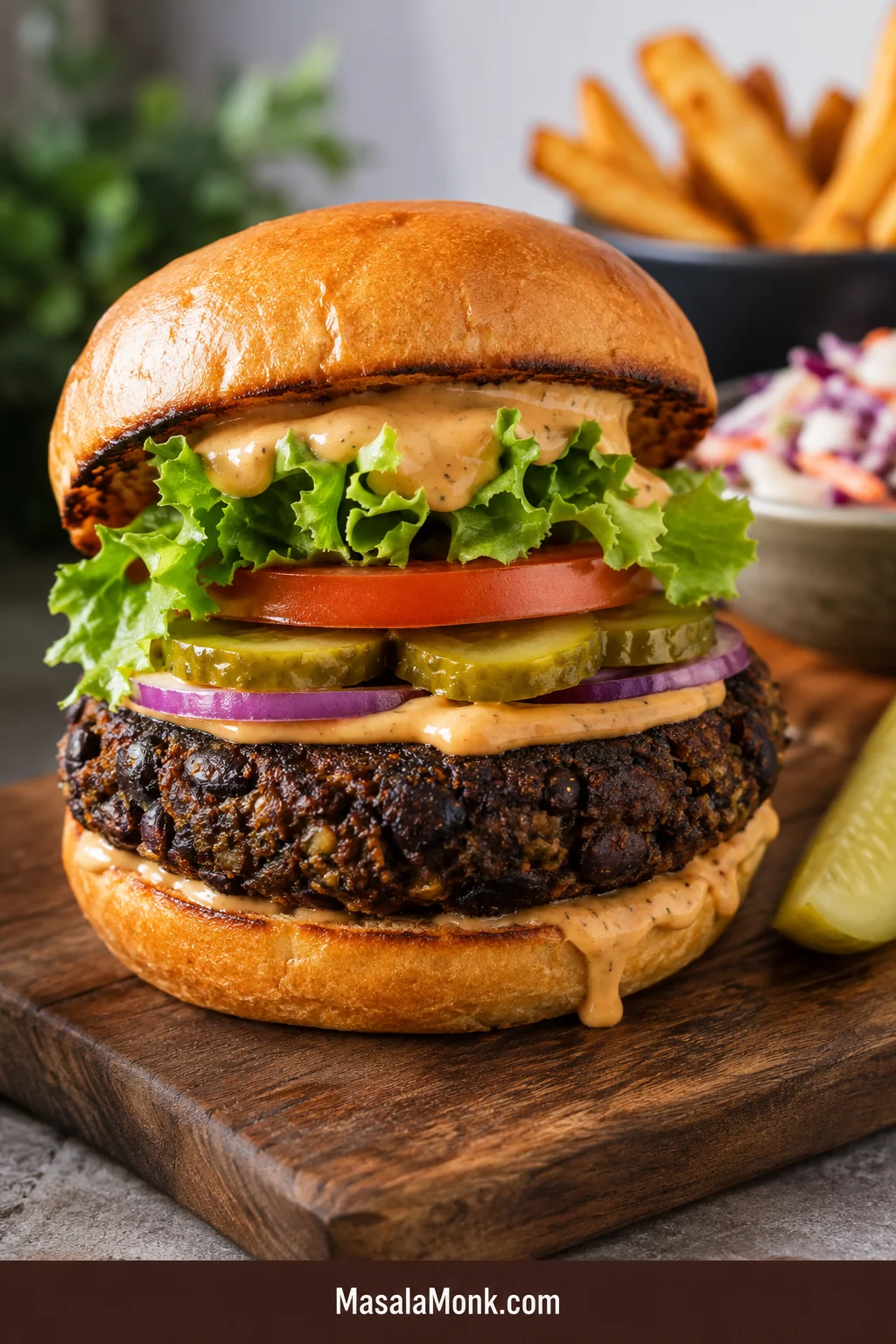
Tall black bean burger on a toasted bun with lettuce, tomato, pickles, creamy sauce, and a dark crisp-edged patty on a wooden board.

Black bean burgers are easy to love and surprisingly easy to mess up. The mixture can turn wet, the patties can crack in the pan, or the center can taste more like mashed beans than a real burger. What you want is a patty that lands on a bun without crumbling, browns at the edges, and feels hearty when you bite into it — not something you have to rescue with extra sauce.

This black bean burger recipe is built for that kind of confidence: crisp edges, smoky flavor, a tender middle, and patties that hold together without first-flip panic. It is the recipe for people tired of mushy, fragile bean burgers and ready for one that actually feels like dinner.

The main version uses canned black beans, egg, panko or oats, onion, garlic, and smoky spices. You will also find vegan, gluten-free, no-breadcrumb, oven, grill, and air fryer options, so the recipe works whether you want a classic veggie burger, a no-egg patty, or a meal-prep-friendly batch for the freezer.

Quick Answer: How to Make Black Bean Burgers That Don’t Fall Apart

To make black bean burgers that do not fall apart, dry the beans first, mash only part of them, use a real binder, and cook the first side until a crust forms before flipping. Wet beans, raw watery vegetables, too little binder, and early flipping are the main reasons homemade black bean burgers turn mushy or break.

The simple rule is: dry, bind, rest, crust. That means drying the beans, binding the mixture, resting delicate patties, and letting the crust form before flipping.

  • Dry the beans: bake drained beans briefly so the center does not turn pasty.
  • Use a binder: egg plus panko, breadcrumbs, or oats is the easiest vegetarian option.
  • Go egg-free with oats: flax egg plus oats or oat flour works well for vegan patties.
  • Leave texture: mash enough to bind, but keep some visible bean pieces.
  • Rest soft patties: a short chill makes delicate patties easier to move.
  • Wait for the crust: if a patty feels stuck, it probably needs another minute before flipping.

Even if this is your first homemade veggie burger, the cues below will help you fix the bean base before it ever touches the skillet. If it looks like bean dip, it is not ready to be a burger. A pressed handful that holds its shape means you are much closer to a clean flip.
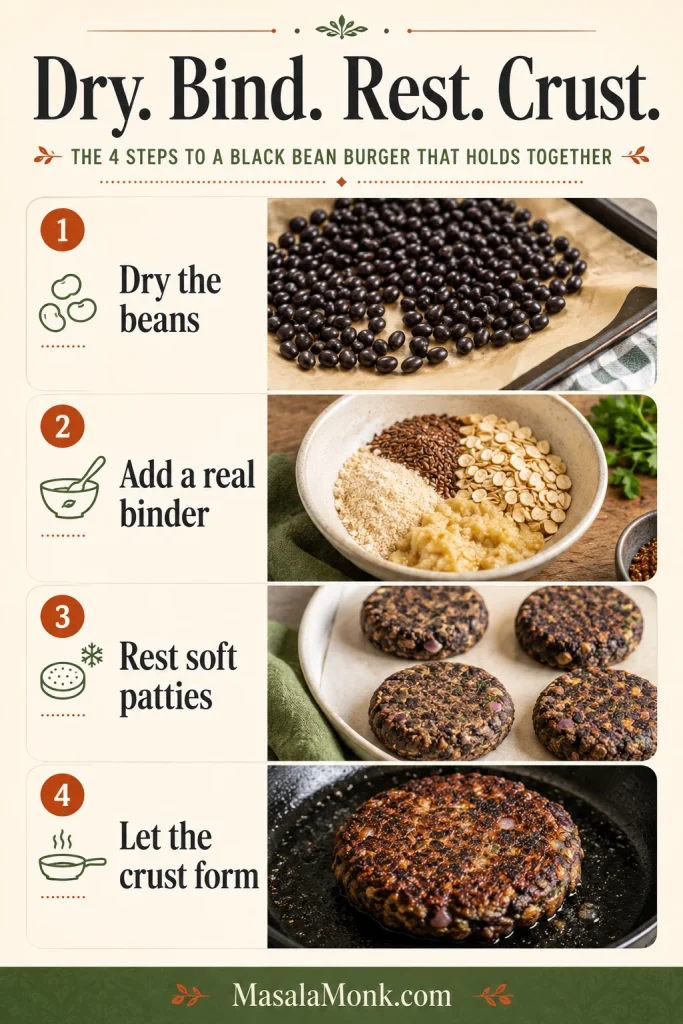
Vertical guide showing four steps for black bean burgers: dried beans, binder ingredients, resting patties, and a browned patty in a skillet.
Before cooking, follow the structure sequence: dry the beans, bind the mixture, rest soft patties, then let the crust set.

Black Bean Burgers at a Glance

Yield6 medium patties
Beans2 cans / about 3 cups drained black beans
Main texture stepDry the beans first
Default binderEgg + panko, breadcrumbs, or oats
Vegan binderFlax egg + oats or oat flour
Main methodSkillet, for crisp edges and control
Texture cueMoist and moldable, not loose like dip

Black Bean Burger Recipe Card

Smoky Black Bean Burgers That Hold Together

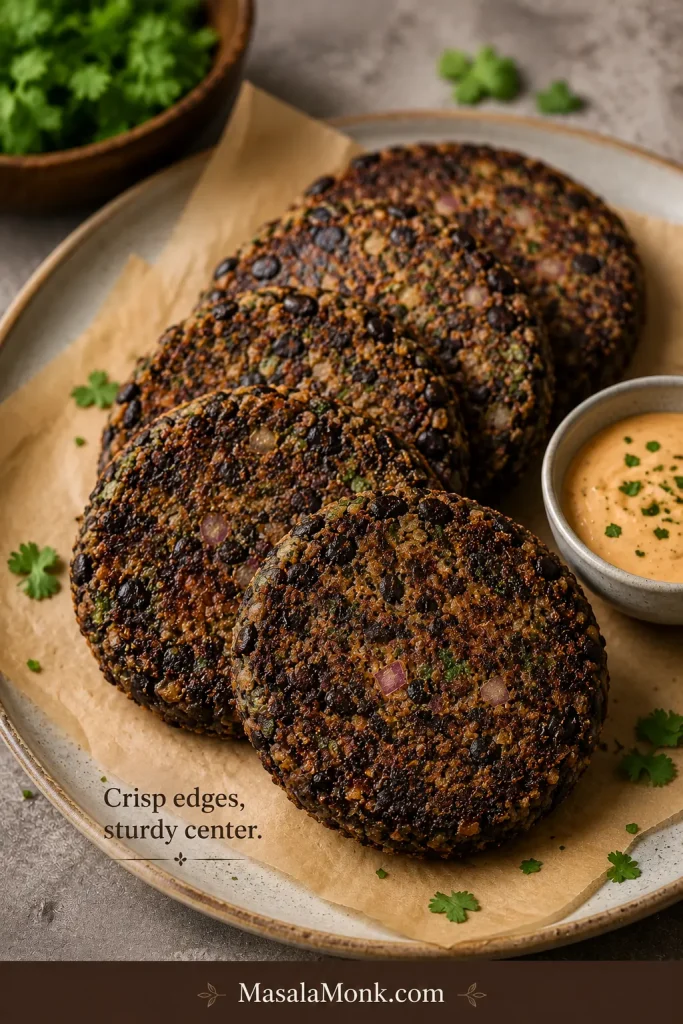
These black bean burgers are smoky, hearty, crisp-edged, and firm enough to flip. They are sturdy enough for a bun but still tender in the middle, with enough texture to feel satisfying instead of pasty.

The finished patty should have browned edges, a smoky garlic-cumin aroma, and a middle that feels hearty rather than mashed. Add a toasted bun, creamy sauce, something crunchy, and a little acidity, and it eats like a real burger.

Prep Time15 minutes
Bean-Drying Time12–15 minutes
Patty Cook Time10 minutes for skillet
Total TimeAbout 40–45 minutes
Yield6 patties
Main MethodSkillet
Other MethodsOven, grill, air fryer

If you chill the patties before cooking, add 20–30 minutes of resting time. The wait is useful when the mixture feels soft, especially for vegan, oat-based, or grill-ready patties.

Fast path: For a quicker version, towel-dry the beans very well instead of baking them. The patties will be a little softer than the oven-dried version, but still workable if you use enough binder and let the first side brown before flipping.

Make-ahead path: Shape the patties up to 24 hours ahead and refrigerate them covered. This gives the binder time to settle and makes the patties easier to cook later.

Equipment

  • Rimmed baking sheet
  • Parchment paper
  • Large mixing bowl
  • Fork, potato masher, or food processor
  • Cast-iron or nonstick skillet
  • Thin spatula
  • Optional: grill mat, foil, or air fryer basket

You do not need a food processor. A fork or potato masher gives you more control and makes it easier to leave some texture in the beans.

Ingredients

  • 2 cans black beans, 15 oz / 425 g each, drained and rinsed, about 3 cups / 500–520 g drained beans
  • 1 teaspoon oil, for cooking the onion
  • ½ cup / 75 g finely chopped onion
  • 2–3 garlic cloves, minced
  • 1 large egg
  • ¾ cup panko or breadcrumbs, about 45–55 g, or ¾ cup rolled oats, about 60 g
  • 1 tablespoon tomato paste, ketchup, or barbecue sauce
  • 1 tablespoon tamari, soy sauce, or vegan Worcestershire-style sauce for deeper burger-style flavor
  • 1 teaspoon ground cumin
  • 1 teaspoon smoked paprika
  • ½ teaspoon chili powder
  • ½ teaspoon fine salt, plus more to taste
  • ¼ teaspoon black pepper
  • 1–2 tablespoons chopped cilantro or parsley, optional
  • 1 tablespoon chopped chipotle in adobo, optional for smoky heat
  • 1–2 tablespoons oil, for cooking the patties

Using soy sauce or vegan Worcestershire-style sauce? Taste before adding extra salt because both can make the mixture saltier than expected.

With oat flour: Start with ½ cup / about 50 g oat flour instead of ¾ cup whole oats. Oat flour absorbs more quickly, so add more only when the mixture still feels loose.

Vegan Swap

Replace the egg with 1 flax egg. Mix 1 tablespoon ground flaxseed with 3 tablespoons water and let it thicken for 5–10 minutes. Use rolled oats or oat flour as the dry binder, and chill the shaped patties before cooking.

Instructions

  1. Dry the beans. Heat the oven to 350°F / 175°C. Spread the drained and rinsed black beans on a parchment-lined baking sheet. Bake for 12–15 minutes, until the beans look matte and slightly wrinkled. Cool briefly.
  2. Cook the onion and garlic. Warm 1 teaspoon oil in a skillet. Soften the onion for 3–4 minutes, stir in the garlic for 30 seconds, then cool slightly.
  3. Mash the beans. Transfer the beans to a large bowl. Mash with a fork or potato masher until partly mashed with some visible bean pieces.
  4. Add binder and seasoning. Stir in the cooked onion and garlic, egg, panko, breadcrumbs, or oats, tomato paste, tamari or soy sauce, spices, herbs, and chipotle if using.
  5. Mix until moldable. Stir and press until the mix holds when squeezed.
  6. Adjust if needed. If the bowl feels wet, add oats or breadcrumbs 1 tablespoon at a time. If it feels dry, work in a teaspoon of sauce, water, or oil.
  7. Shape the patties. Divide the bean base into 6 patties, about ½ cup each. Shape them ½–¾ inch thick and press the edges smooth.
  8. Chill soft patties. Refrigerate for 20–30 minutes when the shaped burgers feel delicate. This helps vegan or grill-ready patties.
  9. Cook in a skillet. Heat 1 tablespoon oil over medium heat. Cook 4–5 minutes per side, flipping only after the first side browns and releases. Work in batches so each patty has room to brown.
  10. Serve. Build on toasted buns with lettuce, tomato, onion, avocado, pickles, chipotle mayo, garlic aioli, or salsa.

Choose Your Version

Use this quick table if you already know what kind of black bean burger you want. The base method stays the same, but the binder and resting time change depending on your goal.

Choose This VersionUse ThisWhat to Expect
Firmest classic pattyEgg + panko or breadcrumbsClean flipping, crisp edges, sturdy bun-ready texture
Vegan pattyFlax egg + oatsSofter before cooking, firmer after resting and browning
Gluten-free pattyCertified gluten-free oats or oat flourGood structure without panko or breadcrumbs
No-breadcrumb pattyRolled oats, quick oats, or oat flourHearty texture with a little resting time
Fastest versionVery well towel-dried beansSlightly softer, but still workable
Best textureOven-dried beansFirmest patties and least mushy center
Grill versionFirm binder + chilled pattiesBetter handling on hot grates

Next, use the visual cues below to check how the bean base should look and feel before it reaches the pan.
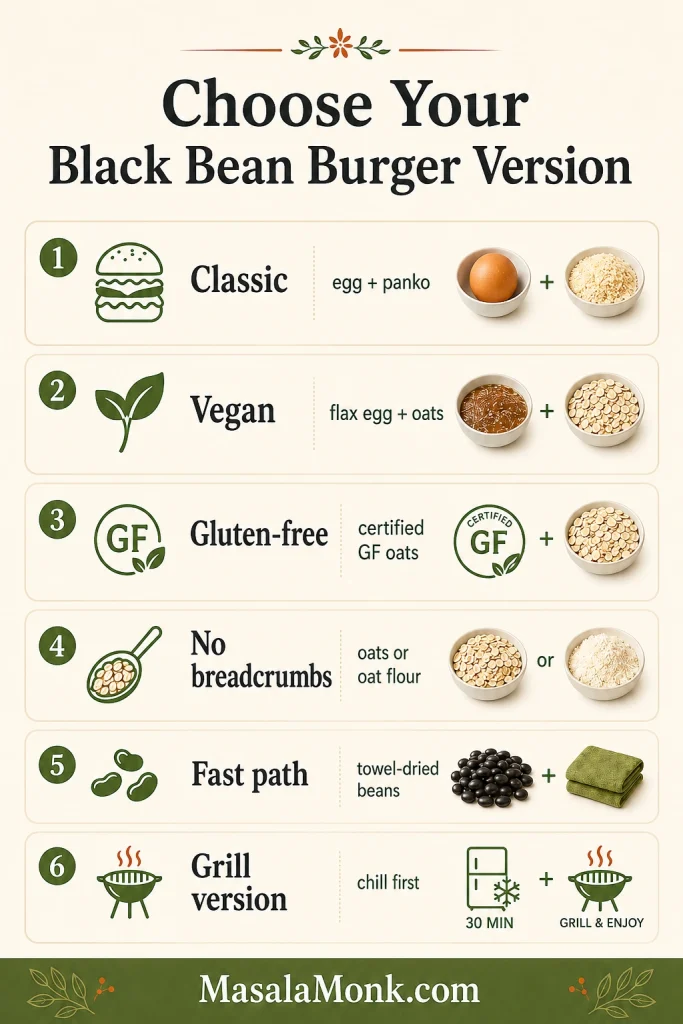
Vertical decision guide comparing classic, vegan, gluten-free, no-breadcrumb, fast, and grill versions of black bean burgers.
First choose the binder: egg and panko for firmness, flax and oats for vegan patties, and certified gluten-free oats when needed.

What Good Black Bean Burgers Should Look Like

Good bean burgers are not perfectly smooth. They should look rustic, with some bean pieces still visible, a firm edge, and enough structure to lift with a spatula. A good black bean burger should be sturdy enough for a bun and tender enough to enjoy.

  • After drying: the beans should look matte and slightly wrinkled, and a few may split open.
  • After mashing: the bowl should have both mashed beans and visible bean pieces.
  • Before shaping: a squeezed handful should hold together without oozing through your fingers.
  • After shaping: each patty should hold its edge instead of slumping on the plate.
  • In the pan: the first side should brown and release more easily once the crust sets.
  • After cooking: the outside should be crisp-edged and the middle should be tender, not wet or gummy.
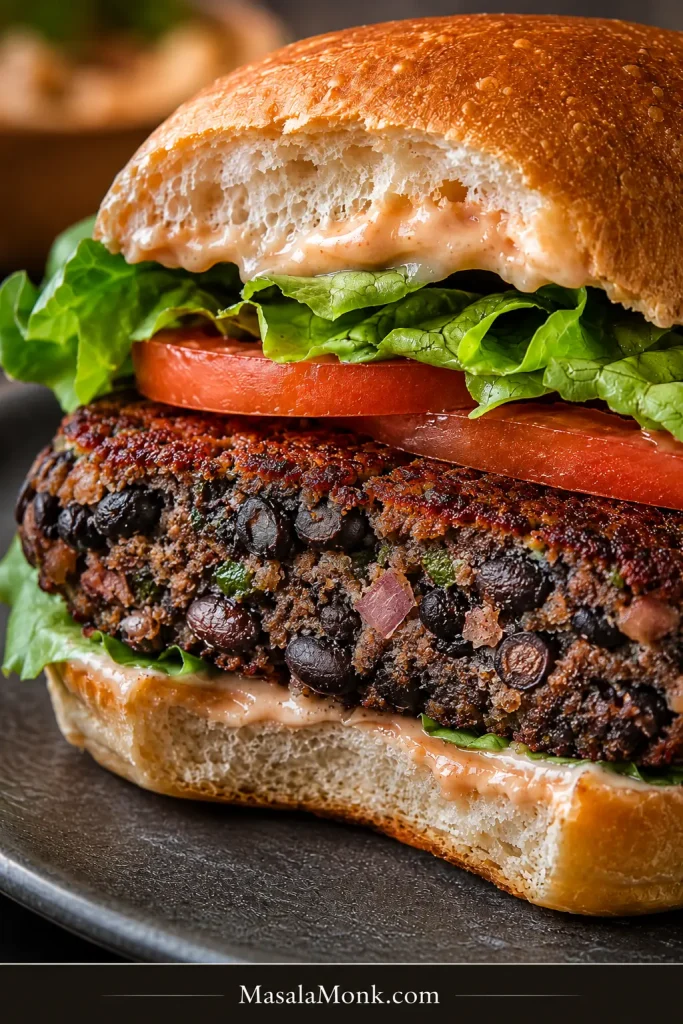
Close-up of a cut black bean burger showing a dark bean-filled interior, crisp browned edge, bun, lettuce, tomato, and sauce.
The best texture is tender inside but not pasty, with visible bean pieces and a browned exterior that gives each bite structure.

When the mixture looks like bean dip, it needs more dry binder and resting time. If it looks dusty or cracks at the edges, mash a little more or add a tiny splash of moisture. The same basic patty logic applies whether you are shaping beans or meat: control moisture, shape gently, and let the surface set. For a deeper look at patty structure, see this burger patty recipe.

Why This Black Bean Burger Recipe Works

Most black bean burgers fail because they treat beans like ground meat. Beans bring moisture, starch, and softness, so the method has to build structure before the patty ever hits the pan. This version does that with dried beans, cooked aromatics, partial mashing, and a binder that matches your diet.

Control PointWhat It Fixes
Drying the beansPrevents pasty, wet centers
Cooking the onionRemoves raw sharpness and extra water
Partial mashingCreates natural bean paste without losing bite
BinderAbsorbs moisture and helps the patty set
Chilling when neededMakes delicate patties easier to move
Surface browningCreates the crust needed for a clean flip

Do not make the beans smoother. Make the structure smarter. A fully smooth mixture can cook up dense and gummy, while a barely mashed one can crumble. The sweet spot is enough mashed beans to bind, with enough whole pieces to make the burger satisfying.

Ingredients You’ll Need

This ingredient list is short, but a few choices matter more than others: dry beans, controlled onion, a real binder, and bold seasoning. A black bean burger should taste like dinner, not a compromise.
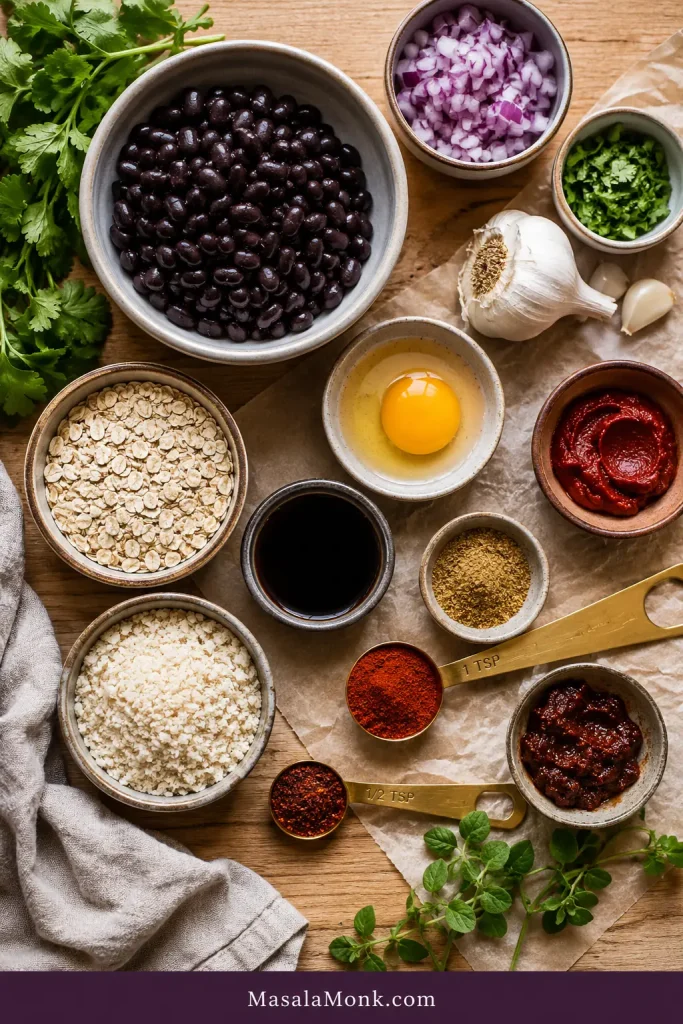
Ingredient board with black beans, onion, garlic, egg, oats, panko, tomato paste, tamari or soy sauce, spices, and herbs in small bowls.
Before shaping, build flavor into the bean base with onion, garlic, smoky spices, tomato paste, herbs, and tamari.

Black Beans

Canned black beans are the easiest choice. Drain, rinse, and dry them well before mixing. Home-cooked black beans also work, but they should be tender, well-drained, and not soupy.

Extra cooked beans do not have to sit around either; they can become a cozy bean stew later in the week.

Onion and Garlic

Onion and garlic give the patties a savory base. Cooking the onion first is worth the extra few minutes because raw onion can release water into the bean base and make the patties softer.

Egg or Flax Egg

Egg is the easiest binder for a vegetarian version because it helps the patty set as it cooks. For an egg-free version, use a flax egg or chia egg with oats.

Panko, Breadcrumbs, Oats, or Oat Flour

Panko and breadcrumbs give a lighter, firmer bite. Rolled oats are great for no-breadcrumb and gluten-free versions. Oat flour binds quickly when the patty mix feels soft, but too much can make the center dense.

Smoky Spices and Flavor Boosters

Cumin, smoked paprika, and chili powder make the burgers warm, smoky, and savory. Tomato paste, ketchup, barbecue sauce, tamari, soy sauce, or vegan Worcestershire-style sauce adds depth, so the burger does not taste like a plain bean patty.

Optional Texture Add-Ins

Chopped walnuts, cashews, sunflower seeds, corn, cooked quinoa, or cooked mushrooms can add bite. Keep add-ins modest because too many extras make the patties harder to bind.

Which Binder Should You Use?

There is no single correct binder. The right choice depends on whether you want the firmest vegetarian patty, a vegan version, or a gluten-free one. Your test is simple: press a handful together. It should hold its shape without oozing, slumping, or crumbling apart.
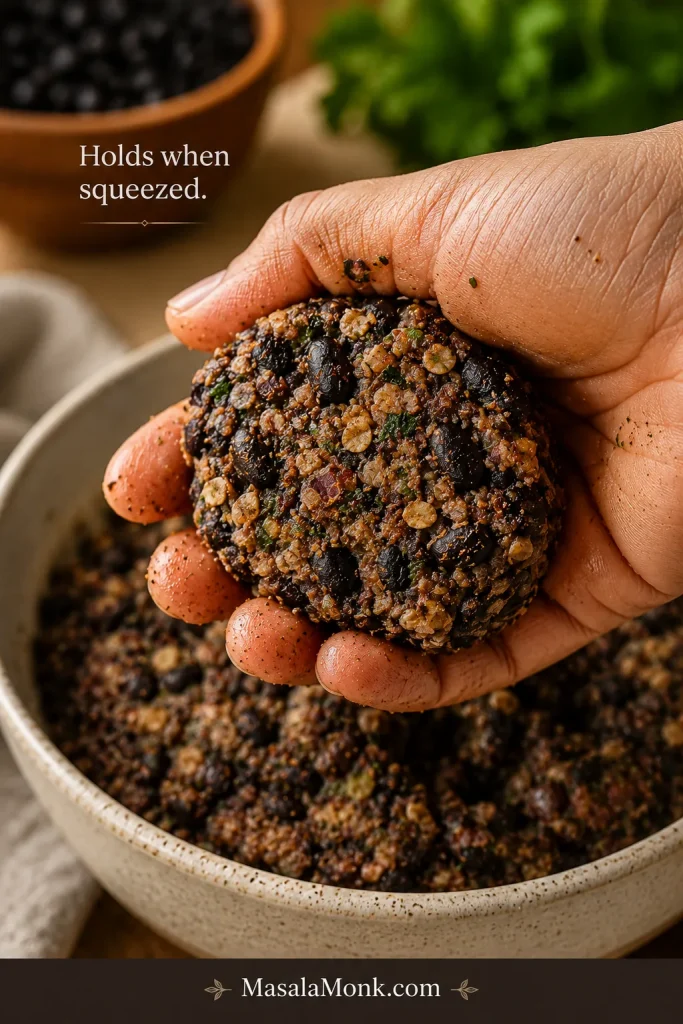
Hand squeezing black bean burger mixture into a firm clump with visible beans, oats, herbs, and spices.
Before shaping, squeeze a small handful. If it holds together without oozing or crumbling, the mixture is ready.
NeedBinderHow to Use It
Firmest vegetarian pattyEgg + panko or breadcrumbsEasiest option for clean flipping
Vegan black bean burgerFlax egg or chia egg + oatsRest and chill so the oats can settle into the mixture
Gluten-freeCertified gluten-free oats or oat flourUse oat flour when a firmer texture is needed
No breadcrumbsRolled oats, quick oats, or oat flourLet the mixture rest before shaping
Grillable pattiesStrong binder + chillingChill 30 minutes or freeze 15–20 minutes before grilling
Softer, richer pattiesAvocado, mashed sweet potato, or a little mayoAdd extra oats or crumbs to balance moisture
More biteChopped nuts, seeds, quinoa, or cornUse as add-ins, not the main binder

In the main recipe, egg plus panko, breadcrumbs, or oats is the most reliable path. For vegan patties, use a flax egg and oats. To keep the burgers gluten-free, use certified gluten-free oats or oat flour and check the sauces you add.

No Breadcrumbs? Use Oats This Way

Breadcrumbs are not required. If oats are what you have, they can do the job well — they just need a few minutes to absorb moisture. They are also useful for vegan and gluten-free versions when certified gluten-free oats are used.

Rolled oats give the most rustic texture. Quick oats blend in faster and make a softer patty. Oat flour binds the fastest and gives a firmer gluten-free patty, but too much can make the center dense.

Start with ¾ cup rolled oats or ½ cup oat flour for 2 cans of black beans. After mixing, let the patty mix rest for 5–10 minutes. Oats firm up as they absorb moisture, so a base that feels slightly soft at first may become easier to shape after resting.
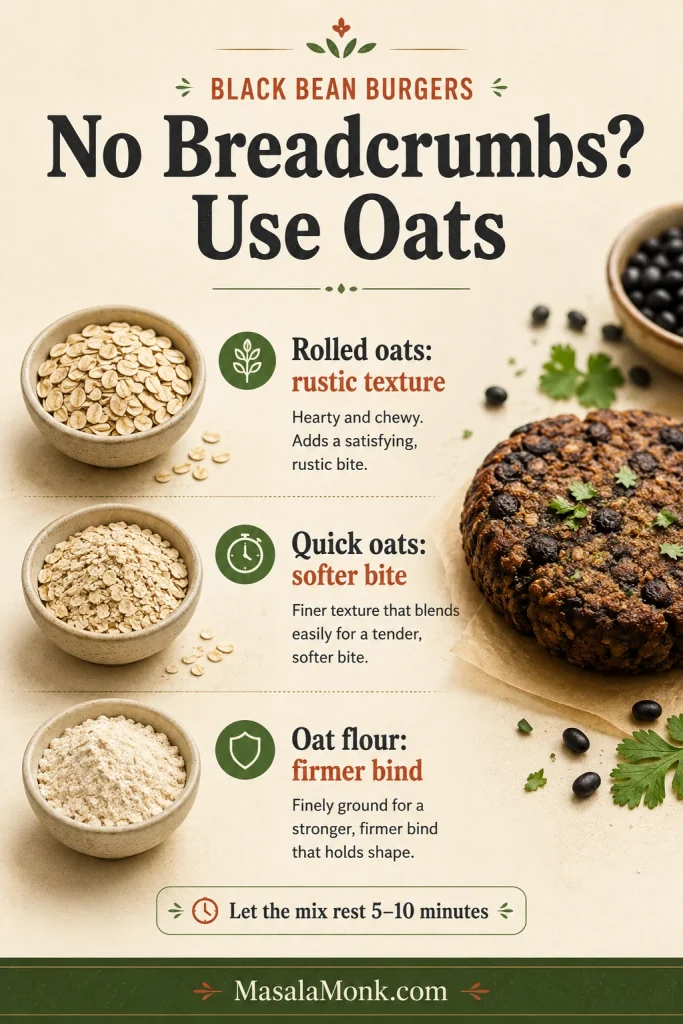
Vertical guide comparing rolled oats, quick oats, and oat flour as no-breadcrumb binders for black bean burgers.
No breadcrumbs? Use oats strategically: rolled oats add chew, quick oats blend in softly, and oat flour binds fastest.

Step-by-Step Method

The steps are simple, but the order matters. Dry the beans first, soften the aromatics, mash for texture, then add the binder and seasonings.

1. Dry the Black Beans

Heat the oven to 350°F / 175°C. Spread drained and rinsed black beans on a parchment-lined baking sheet. Bake for 12–15 minutes, until they look drier and slightly wrinkled. This one step makes the biggest difference in preventing a mushy center.

No oven available? Pat the beans very dry with a clean towel and let them sit uncovered while you prepare the rest of the ingredients. The oven method is stronger, but even towel-drying helps.
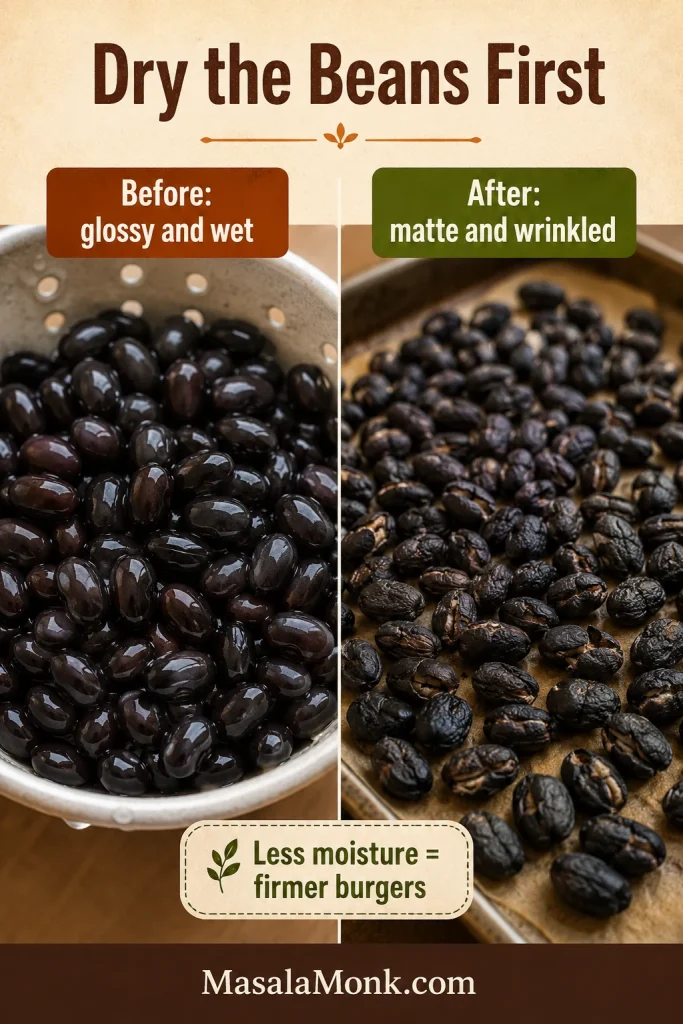
Split comparison showing glossy wet black beans before drying and matte wrinkled black beans after drying on parchment.
After drying, the beans look less glossy and hold less moisture. That small step helps the patties firm up in the pan.

2. Cook the Onion and Garlic

Cook the chopped onion in a little oil for 3–4 minutes, then add garlic for 30 seconds. This softens the sharp flavor and cooks off extra moisture. Raw onion can make the bean base wetter than expected.

3. Mash the Beans

Mash the dried beans with a fork or potato masher. Stop when the bowl is partly mashed with some whole or half beans still visible. A food processor can be used, but pulse gently and avoid turning everything into a smooth paste.
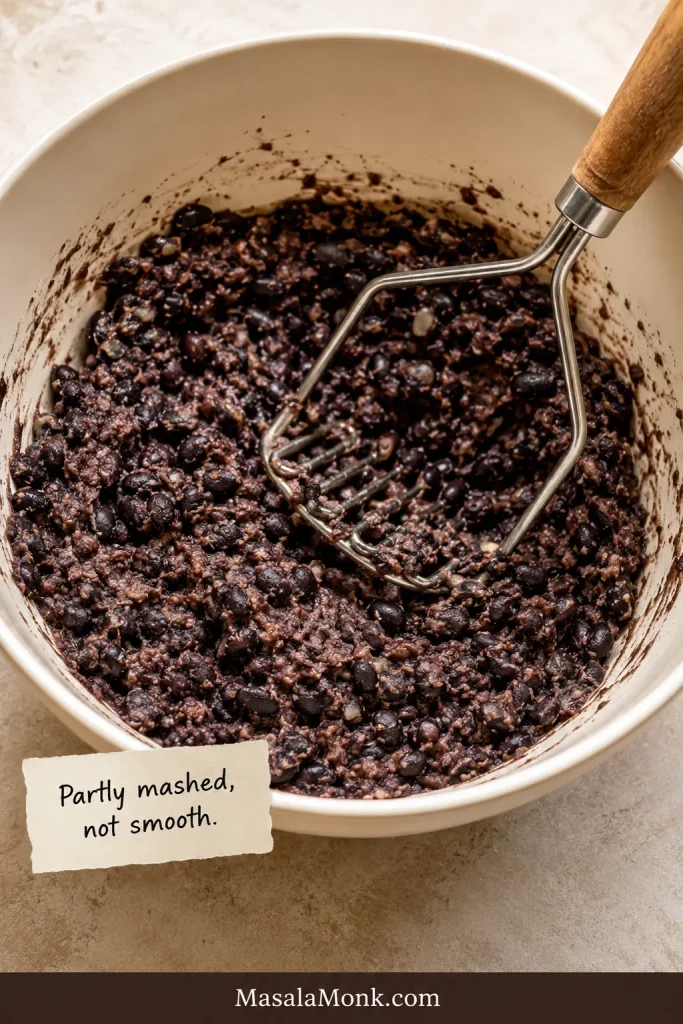
Bowl of partly mashed black beans with a fork or masher, showing some mashed beans and some whole bean pieces.
Stop mashing while some beans are still whole. The mix needs both paste for binding and pieces for texture.

4. Add the Binder and Seasonings

Add the egg, panko, breadcrumbs, or oats, cooked onion and garlic, tomato paste or ketchup, tamari or soy sauce, cumin, smoked paprika, chili powder, salt, pepper, and herbs. Stir until the mixture holds together when pressed.
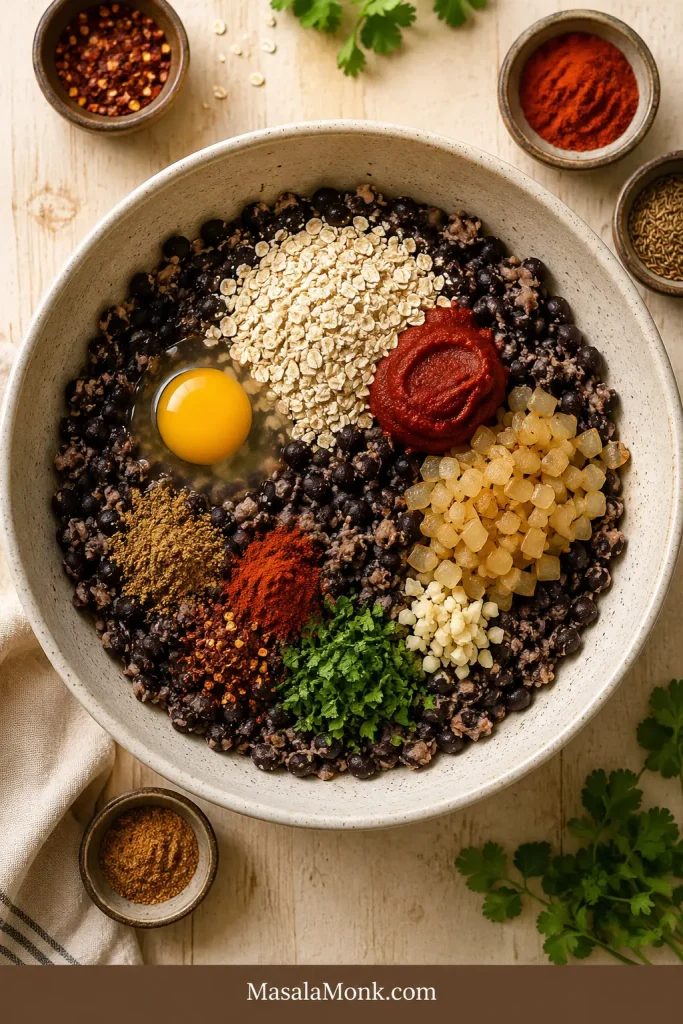
Bowl of mashed black beans topped with egg, oats or breadcrumbs, tomato paste, cooked onion, garlic, spices, and herbs before mixing.
Once the beans are partly mashed, the binder absorbs moisture and helps the patties hold together without becoming heavy.

5. Adjust the Texture

Aim for moist and moldable — closer to soft dough than bean dip. Add oats or breadcrumbs 1 tablespoon at a time when the bowl feels wet. Use a teaspoon of sauce, water, or oil when the base feels dry and cracks at the edges.
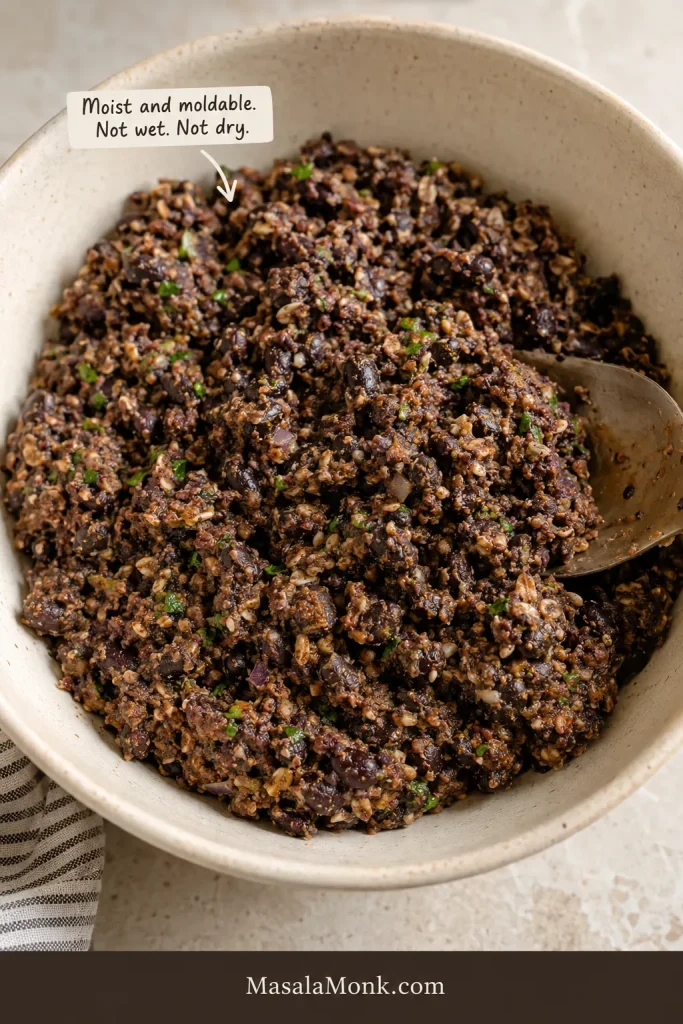
Bowl of chunky black bean burger mixture with visible black beans, oats, herbs, onion, and a spoon, labeled moist and moldable.
The ideal mix should be moist and moldable. It should scoop and press easily, not spread like dip or crumble like dry stuffing.

6. Shape the Patties

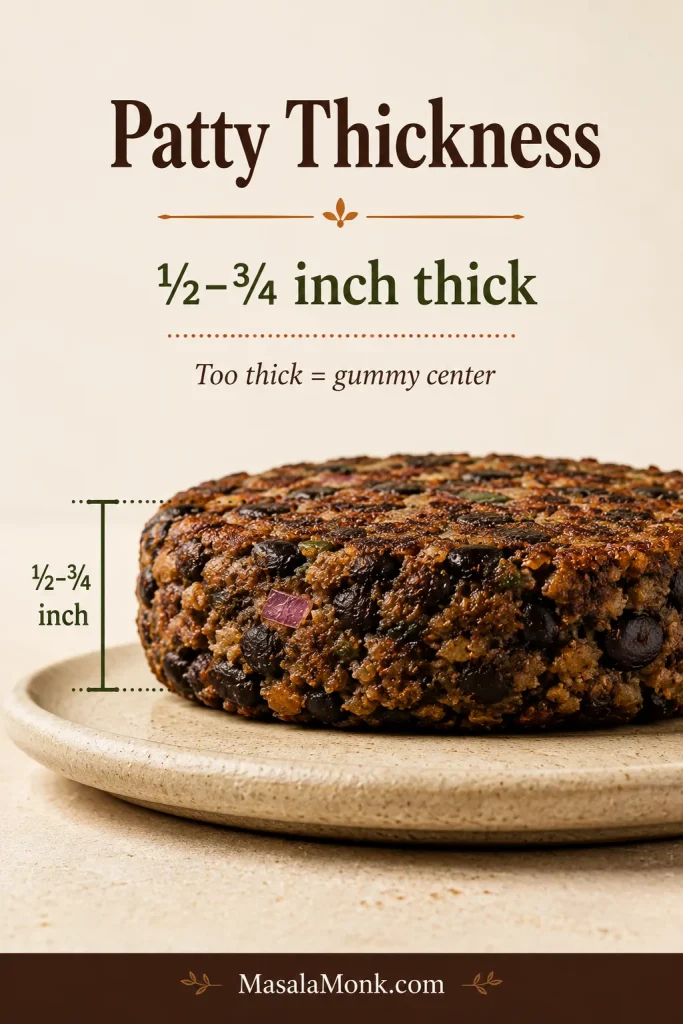
Divide the mixture into 6 patties. Aim for about ½ cup mixture per patty and keep them ½–¾ inch thick. Press the edges smooth so the shaped burgers do not crumble in the pan.
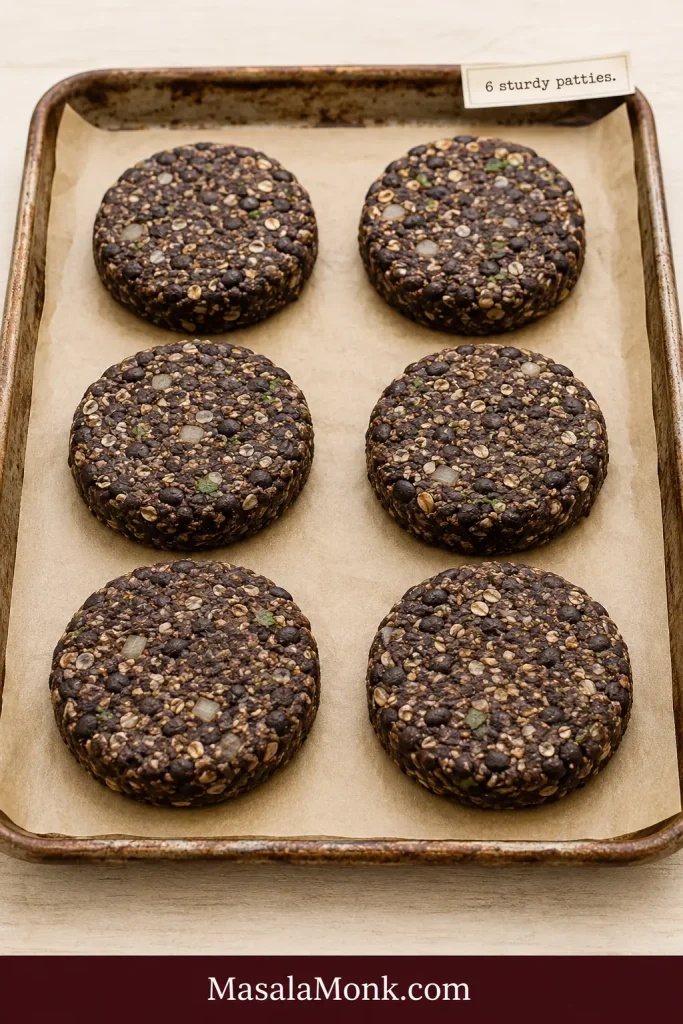
Six uncooked black bean burger patties on parchment paper on a baking tray, with visible beans, oats, herbs, and onion pieces.
After shaping, smooth the edges and keep the patties even. Clean edges help them cook and flip more reliably.
Side-view guide showing the thickness of a shaped black bean burger patty with a label for ½ to ¾ inch thickness.
Keep patties about ½ to ¾ inch thick. That size browns well without leaving the center gummy.

7. Chill When Needed

If the patties feel delicate, do not panic. Chill them for 20–30 minutes before cooking. Vegan, oat-based, and grill-ready patties benefit the most from this short rest.
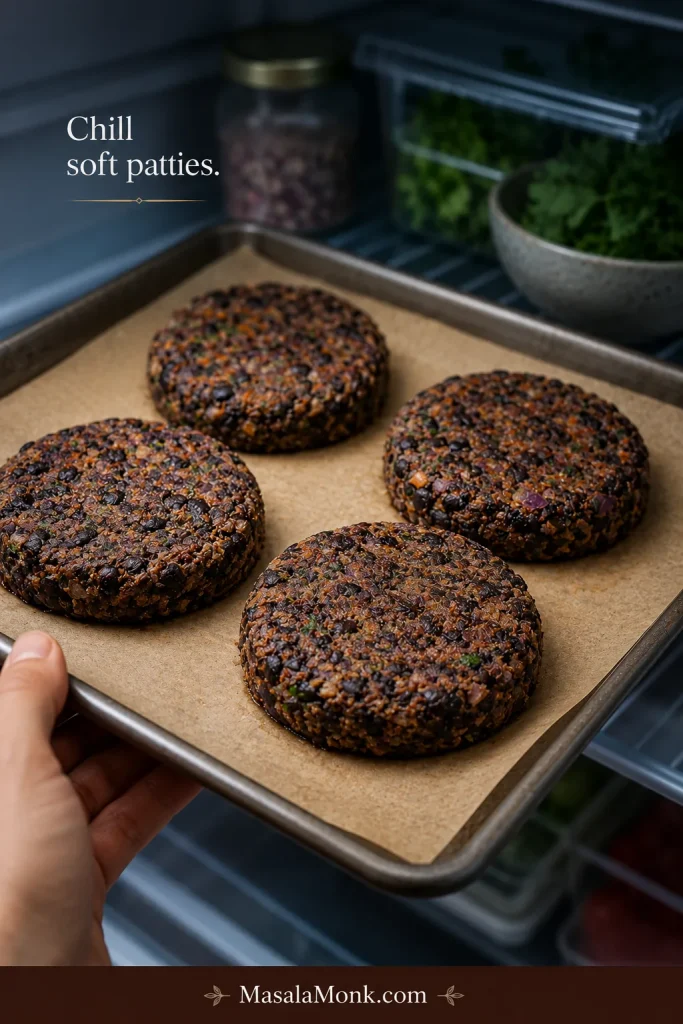
Parchment-lined tray of shaped black bean burger patties being chilled or removed from a refrigerator.
Chilling delicate patties before cooking gives the binder time to firm the mixture.

8. Cook Until the Edges Are Crisp

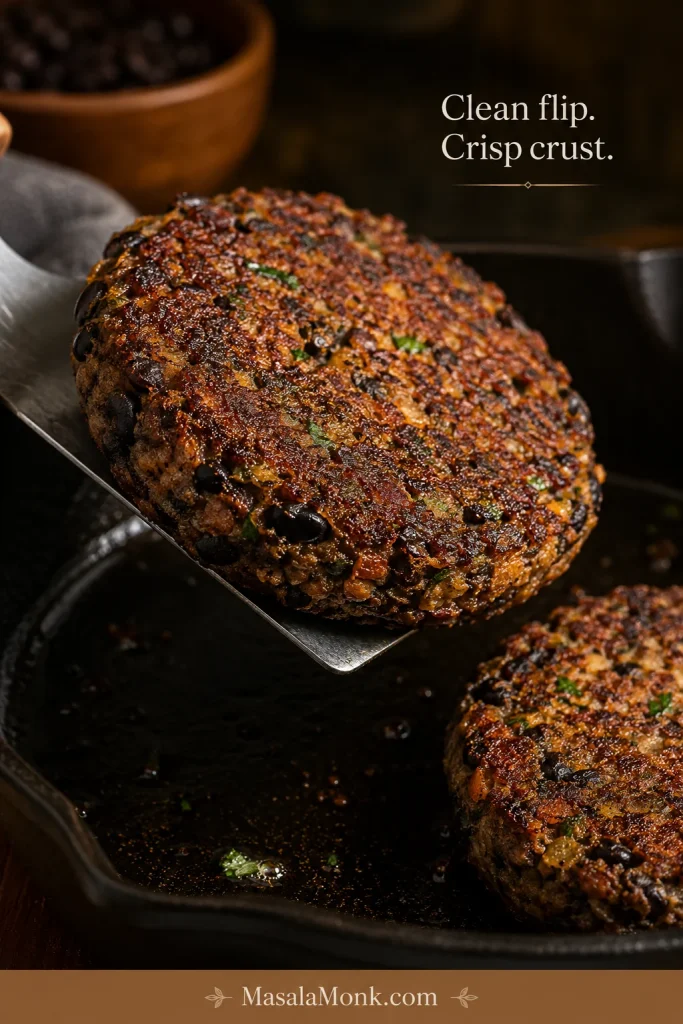
Cook the patties in a lightly oiled skillet over medium heat for 4–5 minutes per side. If a patty feels stuck, do not force it. That usually means the crust has not finished forming. Give it another minute, then slide the spatula under slowly. The patties are done when both sides are browned, the center is hot, and the patty feels set when gently pressed.

Once the crust sets, the burger stops feeling delicate. It lifts cleanly, lands on the bun in one piece, and gives you that crisp-edge, smoky-middle bite that makes a bean burger feel like dinner instead of a backup plan.
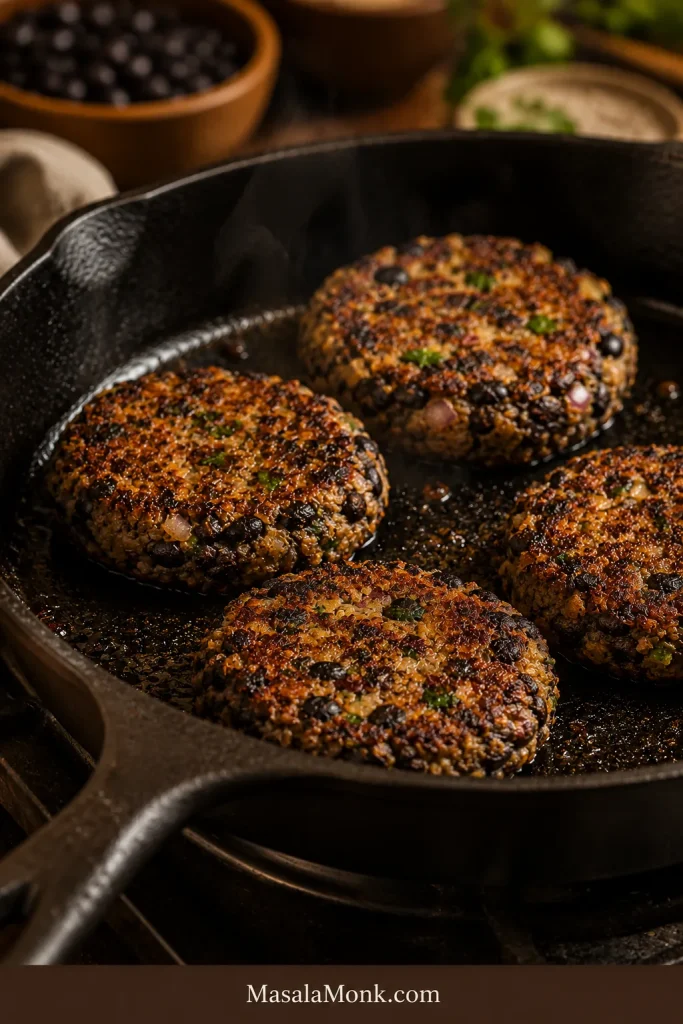
Several black bean burger patties browning in a cast iron skillet with crisp edges and an oil sheen.
For the deepest crust, cook in a skillet with space between patties. Crowding makes them steam instead of brown.
Black bean burger patty being lifted cleanly from a cast iron skillet with a metal spatula, showing a browned intact underside.
Once the first side browns, the patty releases more easily. Wait for that crust before flipping so the burger stays intact.
Stack or row of cooked black bean burger patties with browned edges, visible beans, herbs, and a small sauce bowl nearby.
Cooked patties should hold their shape for buns, bowls, wraps, or meal prep without turning soft again.

Fix the Mixture Before You Cook

Most black bean burger problems can be fixed before the patties hit the pan. A soft mixture is not a failed mixture. It usually just needs a little more binder, a little more resting time, or a gentler hand when shaping.
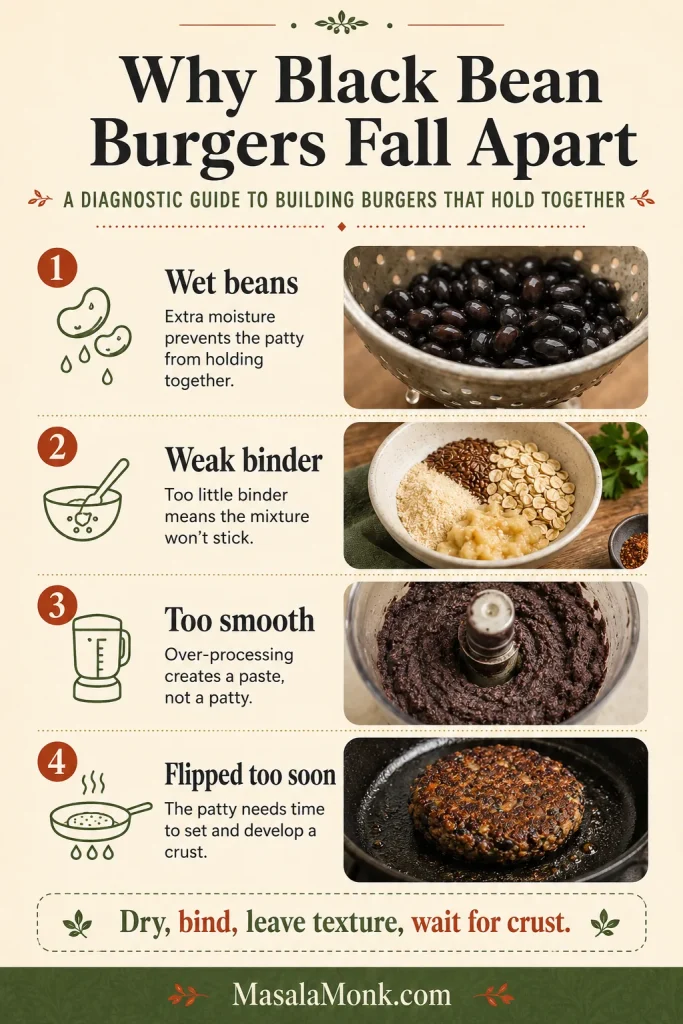
Vertical diagnostic guide listing four reasons black bean burgers fall apart: wet beans, weak binder, too smooth, and flipped too soon.
When patties break, check the cause first: wet beans, weak binder, over-smooth mash, or flipping before the crust sets.

Quick Texture Fixes

ProblemLikely ReasonFix
Mixture looks like bean dipToo much moisture or over-processingAdd oats or breadcrumbs 1 tablespoon at a time and chill
Patties fall apartNot enough binder or not enough mashingMash more beans, add binder, and rest the mixture
Patties slump on the plateMixture is too softAdd oats or crumbs, then chill 20–30 minutes
Patties crack at the edgesMixture is too dryMash more beans or add 1 teaspoon sauce, water, or oil
Patties stick to your handsMixture is moist but workableLightly wet or oil your hands while shaping
Too soft for the grillPatties need more firmnessChill 30 minutes or freeze 15–20 minutes and use foil or a grill mat
Patties stick to the panFlipped too early or surface too dryUse a lightly oiled pan and wait for a crust before flipping
Center is gummyPatties are too thick or mixture is too smoothShape thinner patties and leave more bean texture next time
Burgers taste blandBeans need stronger seasoningAdd chipotle, smoked paprika, cumin, tamari, lime, hot sauce, or more salt

Final Squeeze Test

The final test is simple: press a patty between your palms. When it holds its shape, keeps its edge, and does not feel loose, it is ready to cook.
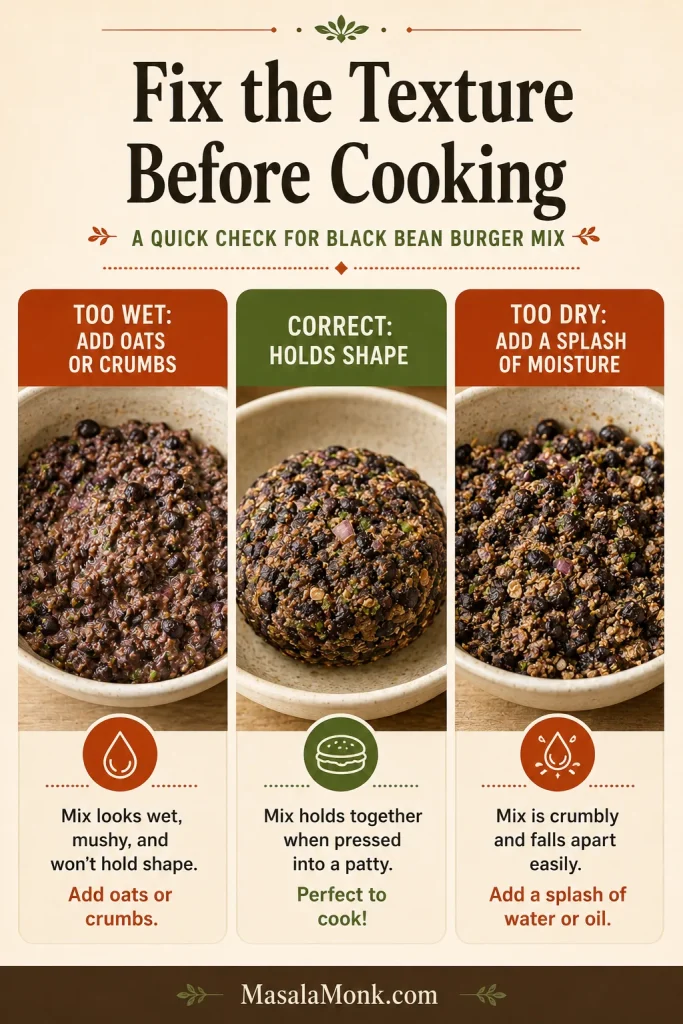
Three-panel guide showing black bean burger mixture that is too wet, correct, and too dry, with short fixing tips.
Fix texture before heat hits the pan: add oats if wet, add moisture if cracked, and shape only when it holds.

Choose Your Cooking Method: Skillet, Oven, Grill, or Air Fryer

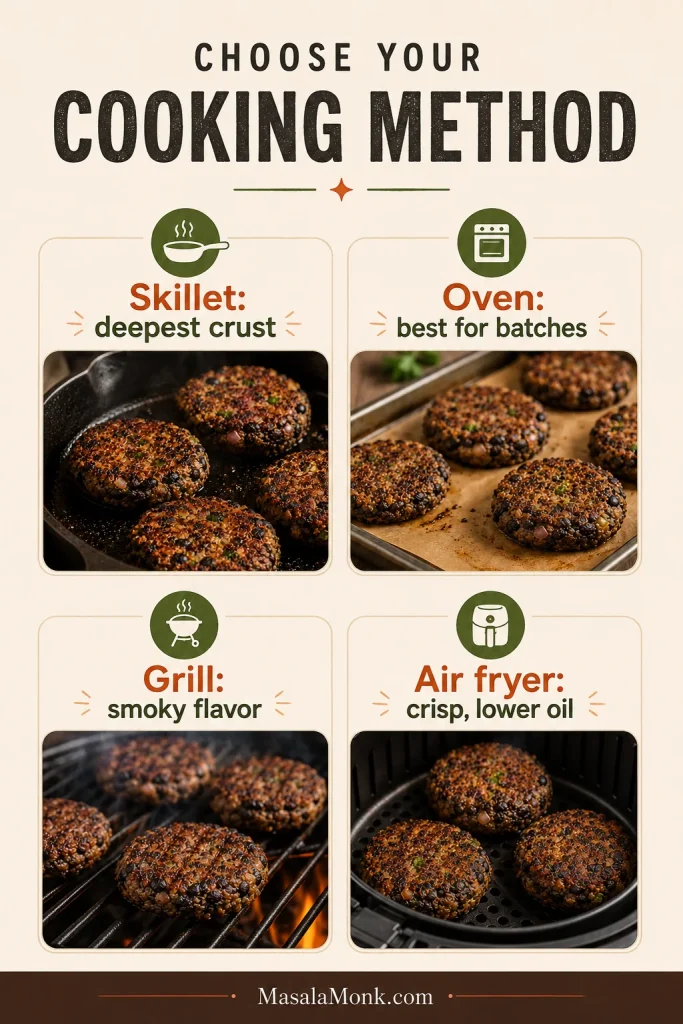
Skillet cooking gives the deepest crust, but these patties can also be baked, grilled, or air fried. A firm patty gives you more freedom: once the mixture holds together, every cooking method becomes easier.

MethodTemperatureTimeGood ForKey Tip
SkilletMedium heat4–5 minutes per sideDeepest crust and flavorLet the first side brown before turning
Oven375°F / 190°C10 minutes per sideBatch cookingRaise the oven after drying the beans
GrillMedium to medium-high5–7 minutes per sideSmoky flavorChill patties and oil the grates well
Air fryer380°F / 193°C10–12 minutes totalCrisp, lower-oil cookingFlip halfway and keep patties about ½ inch thick
Vertical cooking method guide comparing skillet, oven, grill, and air fryer methods for black bean burgers.
Choose the method by goal: skillet for crust, oven for batches, grill for smoke, and air fryer for crisp lower-oil cooking.

Skillet Black Bean Burgers

Heat a thin layer of oil in a cast-iron or nonstick skillet over medium heat. Cook for 4–5 minutes per side. This is the easiest method for crisp edges and a tender center.

Baked Black Bean Burgers

After drying the beans at 350°F / 175°C, raise the oven to 375°F / 190°C. Place shaped patties on a parchment-lined baking sheet and brush or spray lightly with oil. Bake for 10 minutes, flip carefully, then bake another 10 minutes. Baked patties are convenient for batches, though the crust is gentler than skillet-cooked ones.
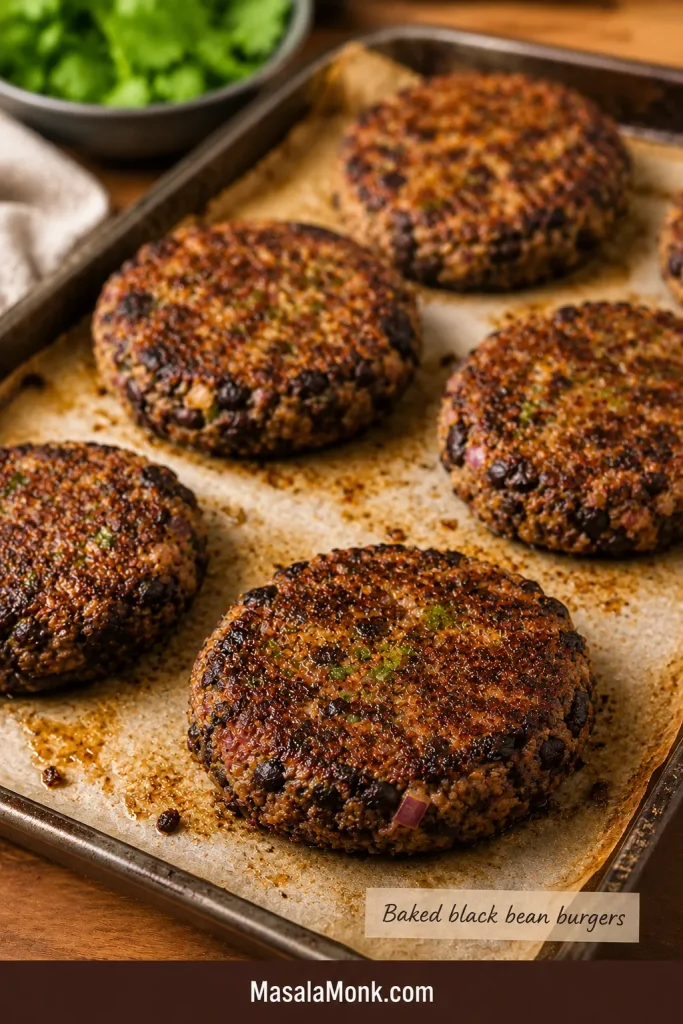
Black bean burger patties on a parchment-lined baking sheet with browned tops and a small label for baked black bean burgers.
For batch cooking, bake on parchment and brush lightly with oil so the tops brown without drying out.

Grilled Black Bean Burgers

Treat grilling as the firm-patty method. Chill the patties for at least 30 minutes, oil the grates well, and cook over medium to medium-high heat for 5–7 minutes per side. Do not grill loose or freshly mixed patties. If they feel delicate in your hand, they will feel even more delicate on hot grates.

For the safest grill version, chill the patties until firm, brush both sides with oil, and use a grill mat or foil for the first try. Once you know how your mixture behaves, you can move them directly onto well-oiled grates.
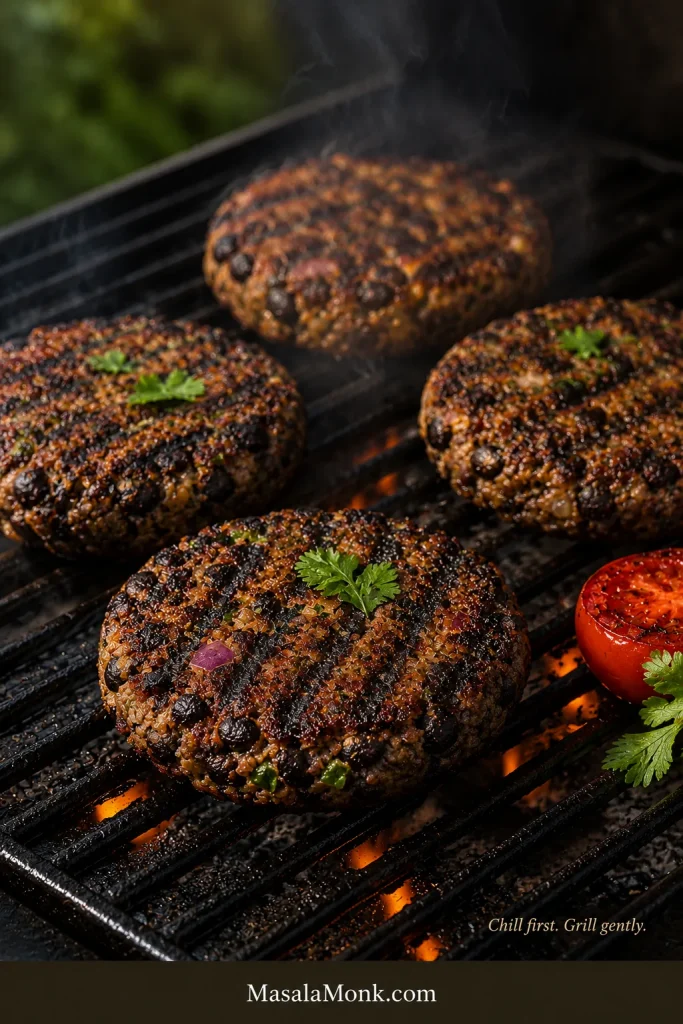
Black bean burger patties with light char marks cooking on a grill with smoke, herbs, and a grilled tomato nearby.
Grill only firm, chilled patties. Oiled grates, gentle heat, and patience help them stay intact over the fire.

Air Fryer Black Bean Burgers

Preheat the air fryer to 380°F / 193°C. Lightly spray the patties and basket with oil. Cook for 10–12 minutes total, flipping halfway. Air fryer patties should be about ½ inch thick so the center heats through before the outside dries. The same thickness-and-flip logic applies to meat burgers too; this air fryer burgers guide is useful if you use your air fryer for burger nights often.
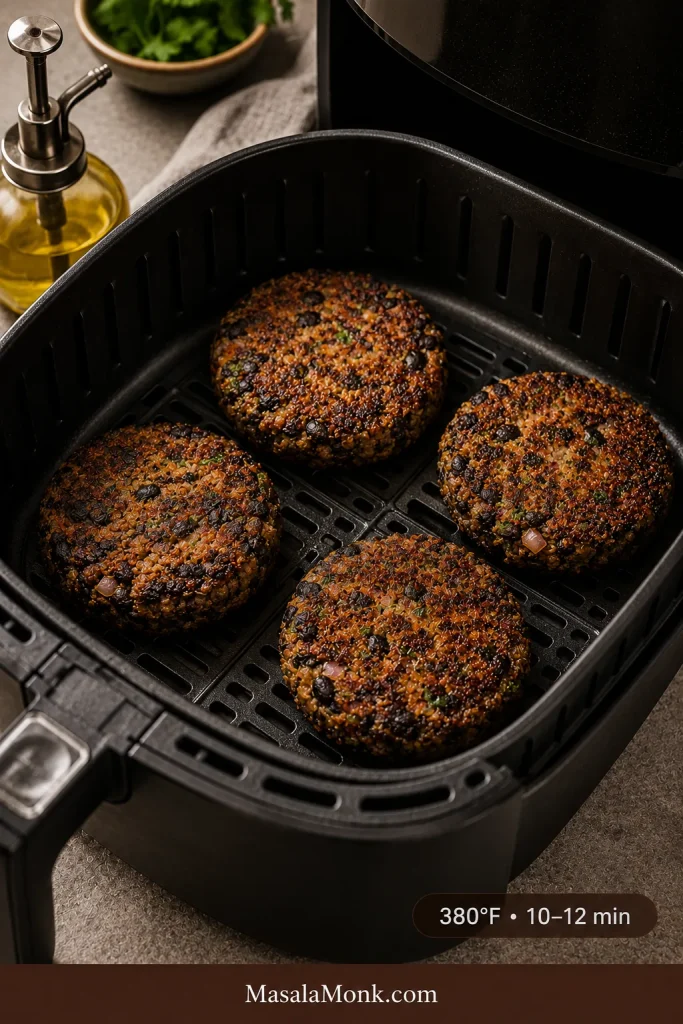
Four black bean burger patties in an air fryer basket with browned tops, an oil bottle nearby, and a 380°F 10 to 12 minute label.
In the air fryer, leave space around each patty so the edges crisp before the centers lose moisture.

Making Them Vegan

For vegan black bean burgers, replace the egg with a flax egg or chia egg and use oats or oat flour as the dry binder. They may feel softer than egg-bound patties at first, but that does not mean they will fail. A short rest and a good crust make them much easier to handle.
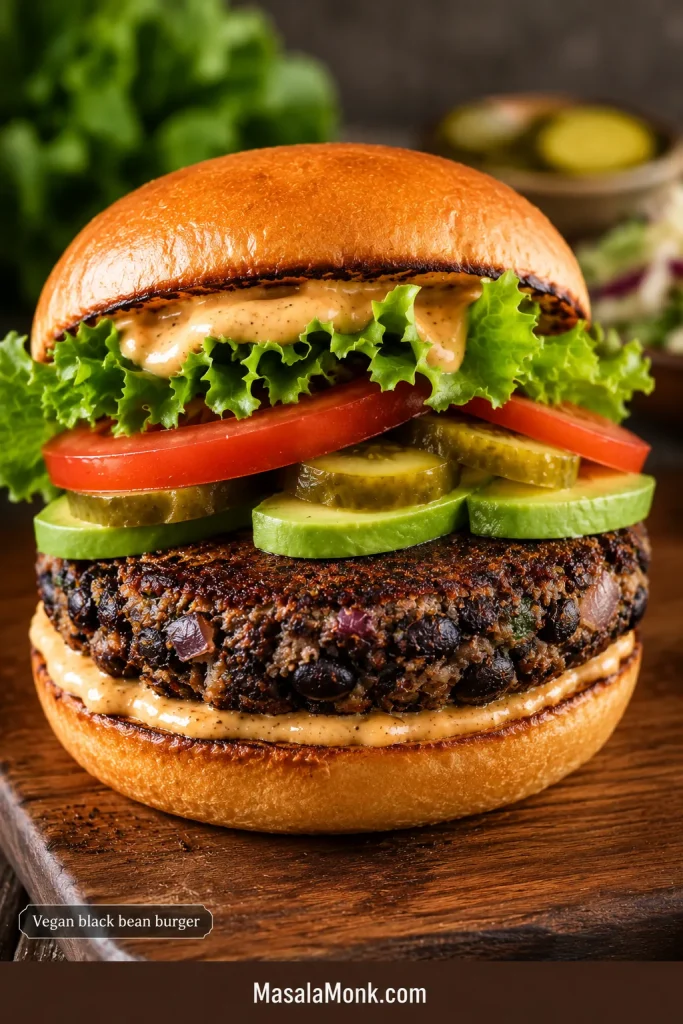
Vegan black bean burger on a bun with avocado, lettuce, tomato, pickles, sauce, and a dark black bean patty.
The vegan version should still feel hearty. Avocado, pickles, tomato, lettuce, and egg-free sauce add richness and freshness.

How to Make a Flax Egg

  • Mix 1 tablespoon ground flaxseed with 3 tablespoons water.
  • Let it sit for 5–10 minutes until slightly thickened.
  • Add it to the burger mixture in place of 1 egg.
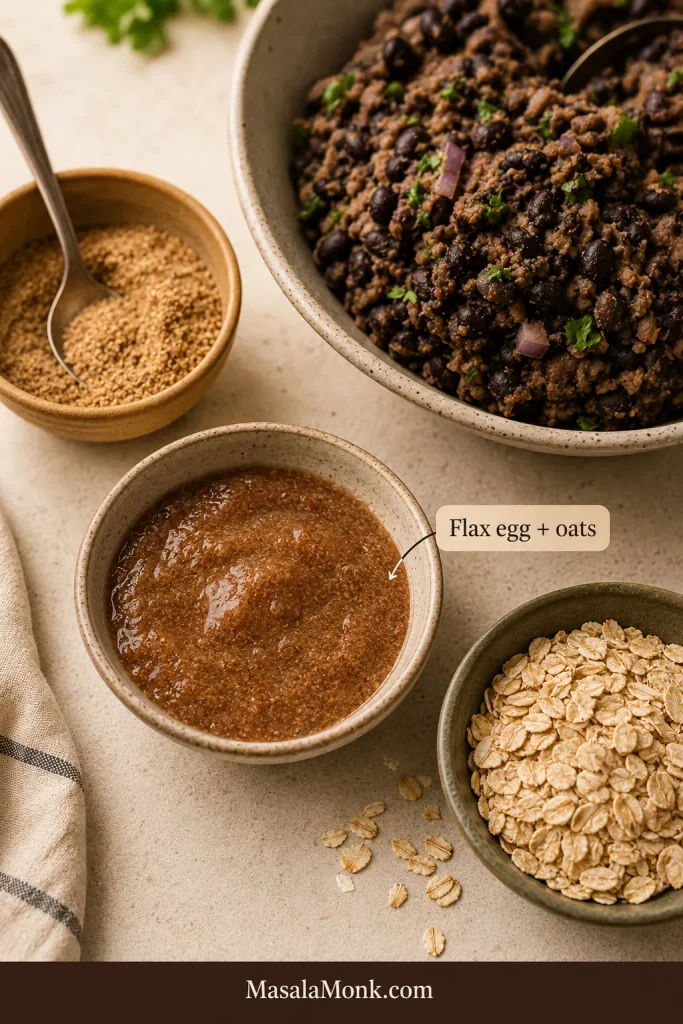
Small bowl of thickened flax egg beside rolled oats and a bowl of black bean burger mixture on a cream countertop.
For vegan patties, let the flax egg thicken first. Then it can help the oats and beans bind cleanly.

Use tamari, soy sauce, or vegan Worcestershire-style sauce when keeping the recipe fully vegan. For a creamy egg-free topping, this eggless mayonnaise recipe is a useful sauce base.

Making Them Gluten-Free

Making the burgers gluten-free is mostly about the binder and sauces. Use certified gluten-free oats or oat flour instead of panko or breadcrumbs. Check labels on soy sauce, Worcestershire-style sauce, and barbecue sauce. Tamari is a useful gluten-free swap for soy sauce.

Gluten-free patties benefit from a short rest before cooking because oats and oat flour need a few minutes to absorb moisture.
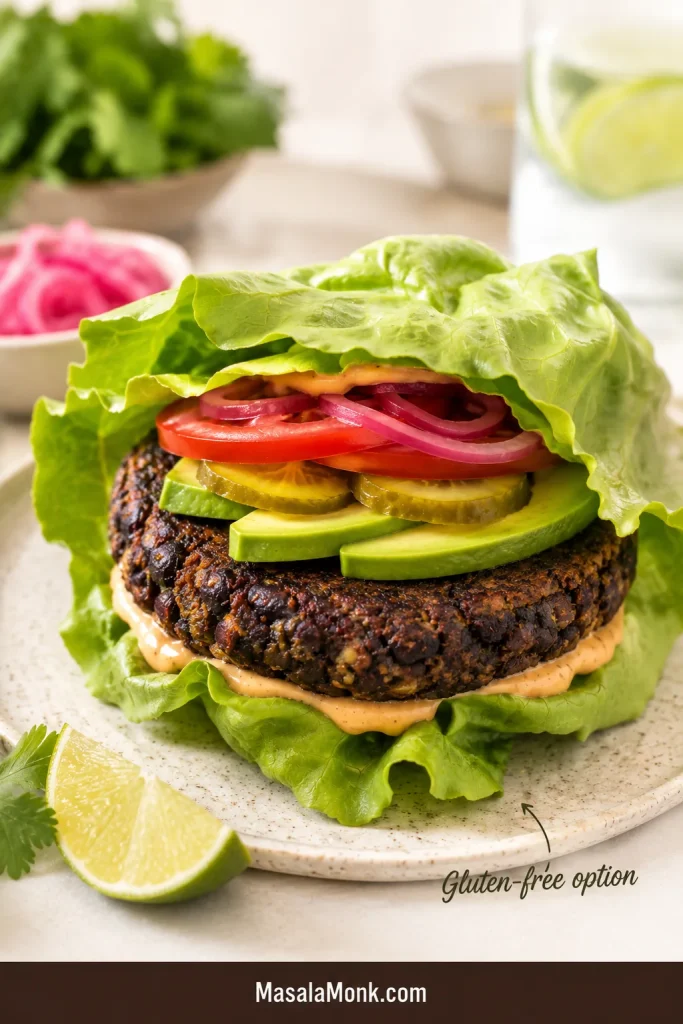
Black bean burger served in a large lettuce wrap with avocado, tomato, pickled onion, pickles, sauce, and lime on a plate.
For a gluten-free option, use a lettuce wrap to keep the bite fresh while the sturdy patty stays the focus.

Flavor Variations

Once the base mixture holds together, black bean burgers are easy to customize. Keep the same structure: beans, binder, seasoning, and a controlled amount of add-ins.

Spicy Black Bean Burger

Add chopped chipotle in adobo, jalapeño, extra chili powder, cayenne, or hot sauce for more heat. Serve with chipotle mayo, avocado, pickled onions, and lettuce. A little mango salsa adds sweet-bright contrast on top or on the side.

Sweet Potato Black Bean Burger

Mix in mashed roasted sweet potato for a softer, sweeter version. Because sweet potato brings extra moisture, balance it with a little more oats or breadcrumbs until the mixture feels sturdy again. This version pairs especially well with smoked paprika, cumin, lime, avocado, and cilantro.

Black Bean Quinoa Burger

Cooked and cooled quinoa adds chew without making the patty heavy. Keep the amount moderate; too much quinoa makes the mixture harder to hold together. It works especially well with garlic, cumin, smoked paprika, and a little lime.

Mushroom Black Bean Burger

Cook chopped mushrooms before adding them. Mushrooms add savory depth, but raw mushrooms release water and can make the patties soft. Sauté until their moisture cooks off, then cool before mixing.

Corn and Southwest Black Bean Burger

A small handful of corn, chopped cilantro, lime zest, cumin, smoked paprika, and chili powder gives the patties a Southwest-style feel. Keep the corn modest so the mixture still binds cleanly.

MasalaMonk-Style Black Bean Burger

Start with the smoky patty, then build the burger with green chutney, pickled onion, sliced tomato, lettuce, and a little yogurt-style sauce or egg-free mayo. The cumin, chili, herbs, and sharp onion make the burger brighter without turning it into a completely different recipe.
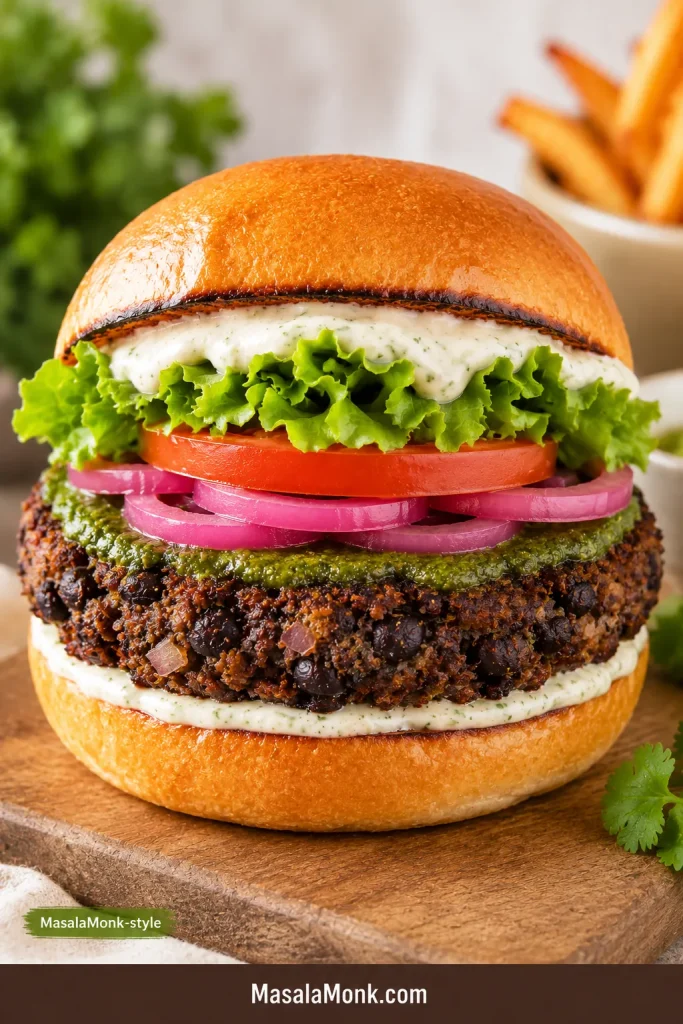
Black bean burger on a toasted bun with green chutney, pickled onions, tomato, lettuce, and creamy sauce on a wooden board.
For a brighter MasalaMonk-style burger, pair the smoky patty with green chutney, pickled onion, tomato, lettuce, and creamy sauce.

Mini Patties or Sliders

Shape smaller patties for sliders and reduce the cooking time by 1–2 minutes per side. Because mini patties dry faster, pull them once the edges are browned and the centers are hot.

Cheesy Black Bean Burger

For a vegetarian version, add a small amount of shredded cheese, feta, pepper jack, or cotija. Cheese adds salt, richness, and a little extra structure.

Toppings, Sauces, and Buns That Work Well

Because the patty is smoky and hearty, the toppings should bring contrast: creaminess, crunch, acidity, and freshness. The best bite has a warm smoky patty, cool lettuce, juicy tomato, creamy sauce, and a little sharpness from pickles, salsa, chutney, or onion.
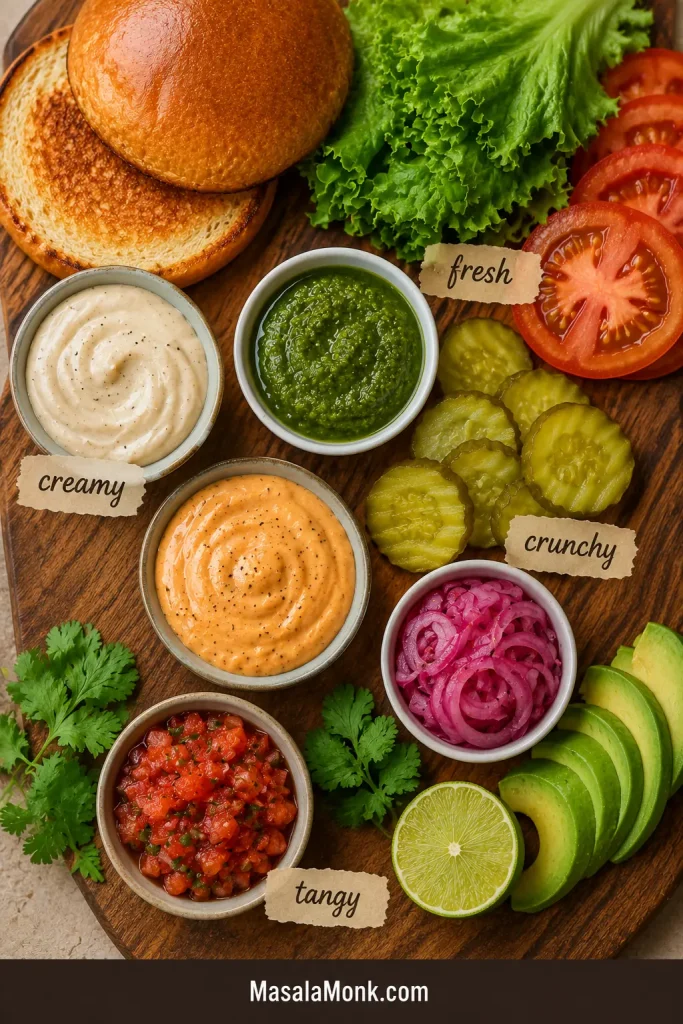
Toppings board with toasted buns, lettuce, tomato slices, pickles, pickled onions, avocado, salsa, green chutney, aioli, chipotle sauce, cilantro, and lime.
Build contrast with toppings: creamy sauce, crunchy pickles, fresh lettuce, tangy salsa, avocado, green chutney, and a toasted bun.
  • Chipotle mayo
  • Garlic aioli
  • Avocado or guacamole
  • Salsa or pico de gallo
  • Pickled onions
  • Lettuce
  • Tomato
  • Red onion
  • Jalapeños
  • Cabbage slaw
  • Lime crema
  • Barbecue sauce
  • Vegan mayo

For sauce, go creamy or sharp. Garlic aioli adds creaminess without covering up the smoky bean flavor. For a brighter MasalaMonk-style twist, use green chutney with sliced onion, tomato, lettuce, and a little mayo or yogurt-style sauce.

Use toasted burger buns, brioche-style buns, whole wheat buns, or lettuce wraps. Toasting helps protect the bun from sauce and keeps the burger from feeling soft-on-soft.

What to Serve With Black Bean Burgers

Serve black bean burgers anywhere a regular burger would feel right. They work with classic sides, fresh salads, roasted vegetables, and bowl-style meals.

  • French fries or sweet potato fries
  • Simple green salad
  • Cabbage slaw
  • Corn salad
  • Roasted vegetables
  • Rice or quinoa bowls
  • Lettuce wraps
  • Pickles and chips
  • Grilled vegetables

Pair the patties with crispy homemade French fries for a classic burger plate. If you want a colder side that cuts through the smoky burger, use this creamy coleslaw.

Roasted vegetables work better than another heavy starch for a lighter dinner plate. These roasted carrots bring sweetness, color, and browned edges without competing with the burger.

To add more protein, use cheese, a Greek-yogurt-style sauce, or serve the patty over a quinoa bowl. On a vegan plate, pair it with hummus, tofu slaw, extra beans, or a hearty salad.

Storage, Freezing, and Reheating

These patties are excellent for meal prep. They store well, freeze well, and reheat best when the crust gets a chance to crisp again.

Fridge

Cooked patties keep for 3–4 days in an airtight container in the refrigerator. Let them cool before storing so trapped steam does not soften the crust too much.

Freezer

Freeze shaped or cooked patties for up to 3 months. Place parchment between patties so they do not stick together, then store in a freezer-safe bag or container.
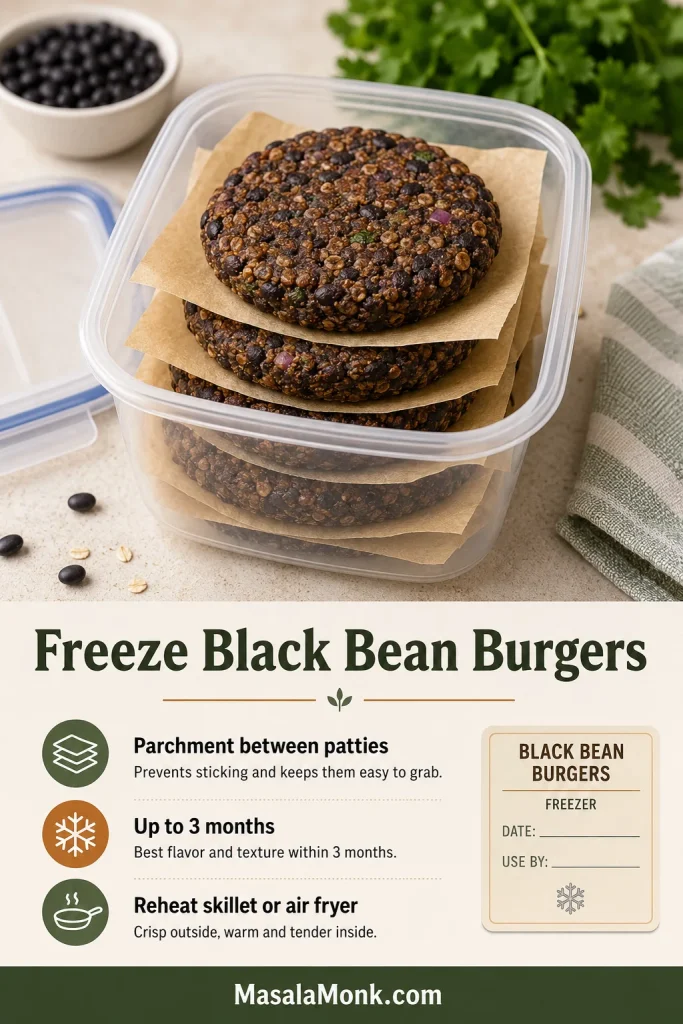
Black bean burger patties stacked in a freezer-safe container with parchment between each patty and a guide for freezing and reheating.
When freezing, place parchment between patties so they separate easily, then reheat in a skillet or air fryer to bring back the crust.

For general leftover safety, the USDA recommends using refrigerated leftovers within 3–4 days and freezing leftovers for longer storage. Their leftovers and food safety guide is helpful if you want broader storage guidance.

Reheating

Reheat the burgers in a skillet or air fryer for the best texture. A microwave works for speed, but it softens the crust. For frozen patties, start over medium-low heat so the center warms before the outside over-browns, then increase the heat briefly to crisp the edges.

Make-Ahead Patties

Shape the patties up to 24 hours ahead and refrigerate them covered. This helps the binder absorb moisture and makes the patties easier to cook.

Once you learn the feel of the mixture, black bean burgers stop being risky. You know when the beans are dry enough, when the patty is firm enough, and when the crust is ready to flip. That is the real win here: a smoky, satisfying veggie burger you can put on a bun without holding your breath.

Frequently Asked Questions

Why are my black bean burgers mushy?

Usually because the beans, onion, or add-ins brought too much moisture, or because the beans were processed too smoothly. Dry the beans, cook watery vegetables first, leave some bean texture, and add oats or breadcrumbs if the mixture feels loose.

What keeps black bean burgers from falling apart?

A good binder, enough mashing, and proper browning keep the patties from falling apart. Egg and breadcrumbs work well for vegetarian patties, while flax egg and oats work well for vegan patties.

Do black bean burgers need egg?

No. Egg helps, but you can still make a sturdy patty without it. Use a flax egg or chia egg with oats or oat flour, then give the mixture a short rest before cooking.

What can replace breadcrumbs in black bean burgers?

Rolled oats, quick oats, oat flour, crushed crackers, or potato flakes can replace breadcrumbs. Cooked quinoa can add texture, but it works best with another binder because it does not absorb moisture as strongly as oats.

Can I make black bean burgers without a food processor?

A fork or potato masher works very well and gives you more control over the texture. Mash enough beans to bind the mixture, but leave some pieces for a heartier bite.

Are canned black beans okay for black bean burgers?

Canned beans work very well because they are already cooked and consistent. Drain and rinse them well, then dry them in the oven or with a towel before mixing.

Can I use dried black beans?

Dried beans are fine once they are fully cooked, tender, drained, and cooled. They should be soft enough to mash but not watery when they go into the burger mixture.

Are black bean burgers vegan?

Some are vegan, but many recipes use egg, cheese, mayonnaise, or Worcestershire sauce. This recipe can be made vegan with flax egg, oats, and vegan-friendly sauces.

Are black bean burgers gluten-free?

They can be gluten-free; the main things to watch are the binder and sauces. Use certified gluten-free oats or oat flour instead of breadcrumbs or panko, and check sauce labels when gluten is a concern.

Can black bean burgers be grilled?

Yes, but treat grilling as the firm-patty method. Chill the patties before grilling, oil the grates well, and flip carefully. Use foil, a grill mat, or a cast-iron griddle for delicate patties.

How do you make black bean burgers taste better?

Lean on bold seasoning and a little umami. Cumin, smoked paprika, chili powder, chipotle, tamari, tomato paste, lime, garlic, and onion all help the patties taste deeper and more satisfying.

How long do black bean burgers last in the fridge?

Cooked patties last 3–4 days in an airtight container in the refrigerator. Reheat them in a skillet or air fryer for the best texture.

Can black bean burgers be frozen?

Yes. Freeze shaped or cooked patties for up to 3 months. Place parchment between patties so they do not stick together, then thaw overnight or cook with a few extra minutes from frozen.

Are black bean burgers healthy?

These burgers can be a nourishing, filling option because black beans bring plant-based protein, fiber, complex carbohydrates, vitamins, and minerals. Harvard’s Nutrition Source has a helpful overview of legumes and pulses if you want more background. The overall nutrition still depends on the binder, oil, bun, cheese, sauce, and toppings you use.
Posted on Leave a comment

Air Fryer Burgers Recipe: Juicy Hamburgers, Time & Temp

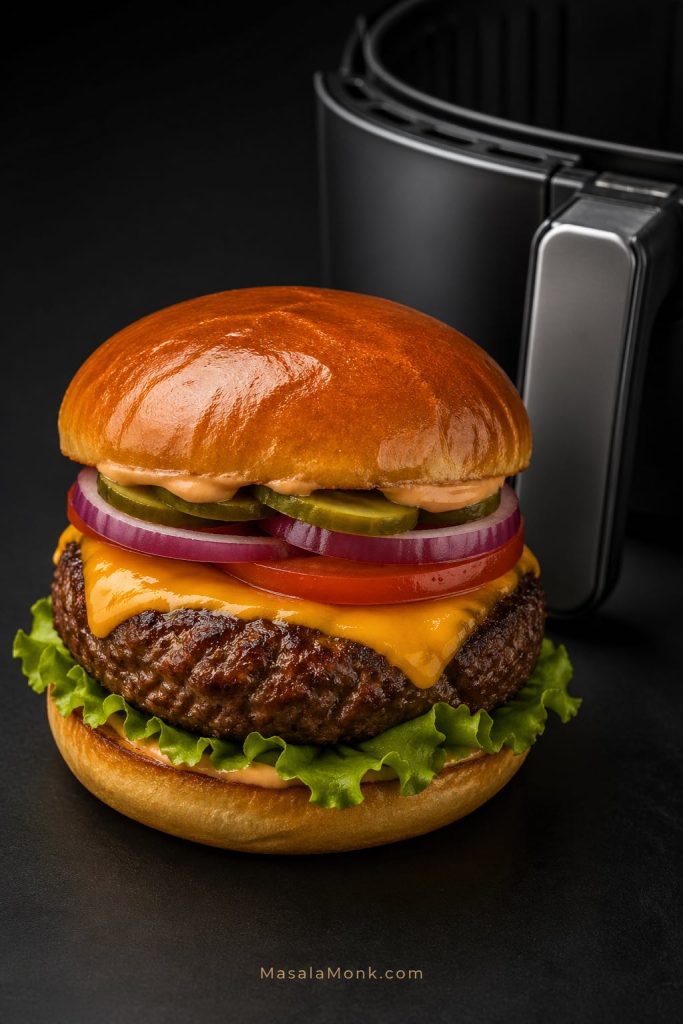
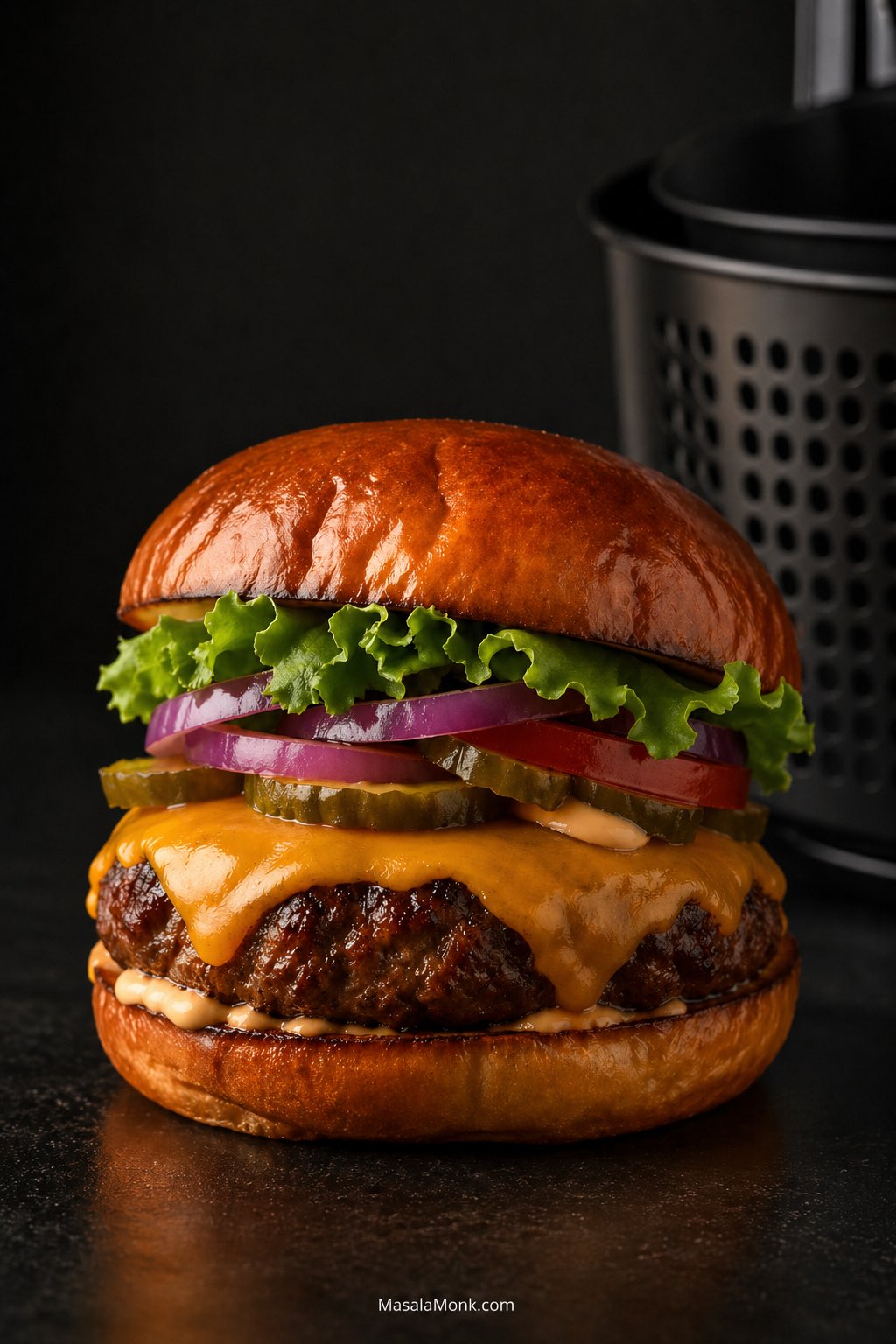
Juicy air fryer cheeseburger with melted cheddar, lettuce, tomato, red onion, pickles, and toasted bun on a dark surface, with an air fryer basket in the background.

A good air fryer burger recipe should give you juicy patties, clear timing, and a reliable way to know when the burgers are done. This guide to air fryer hamburgers starts with fresh ground beef patties, then covers thicker burgers, frozen patties, cheeseburgers, toasted buns, smoke prevention, toppings, storage, and a full recipe card with US and metric details.

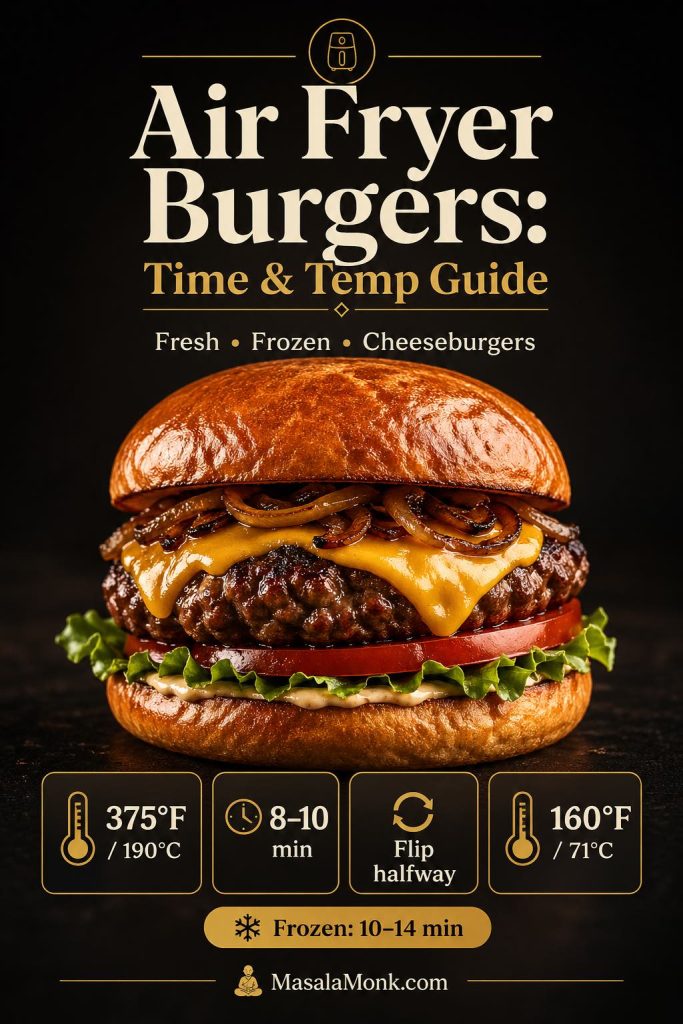
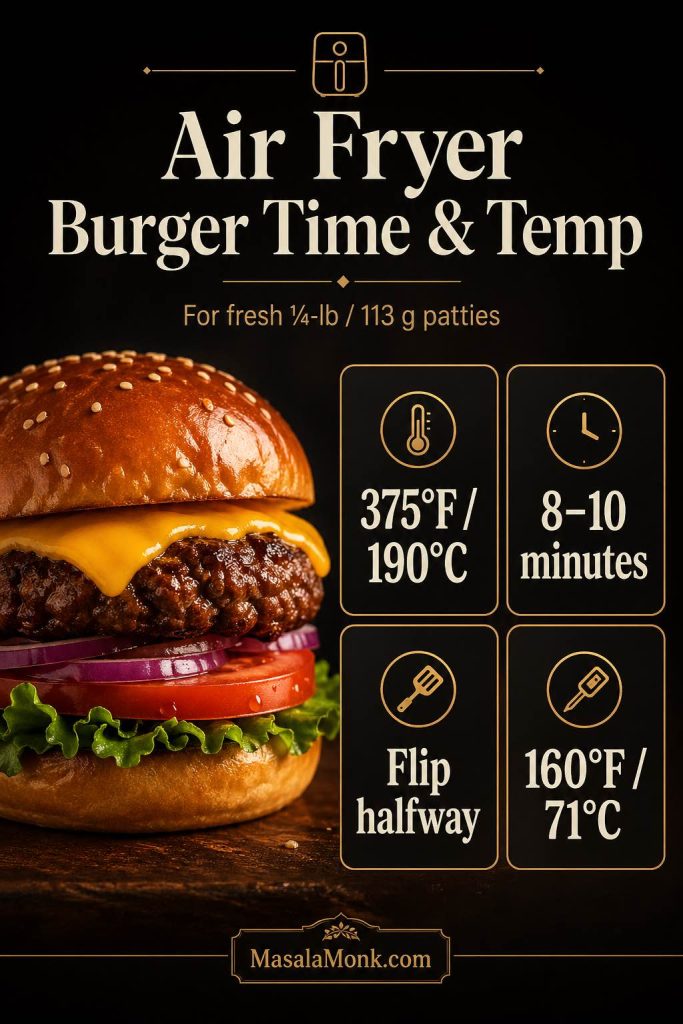
The best default is simple: cook fresh ¼-lb / 113 g hamburger patties at 375°F / 190°C for 8–10 minutes, flipping halfway, until the center reaches 160°F / 71°C. From there, adjust by thickness, starting temperature, and air fryer model instead of relying on one fixed minute for every burger.

For a bunless version, the same patties can become lettuce-wrap burgers, burger bowls, or low-carb cheeseburger plates. For more ideas in that direction, see these keto hamburger recipes.

How Long to Cook Hamburgers in the Air Fryer

Best default: Use 1 lb / 454 g ground beef for 4 patties. Shape each patty about 4 oz / 113 g and ½ inch / 1.25 cm thick. Air fry at 375°F / 190°C for 8–10 minutes, flipping halfway, until the center reaches 160°F / 71°C. Add cheese only at the end.

Air fryer burger timing guide showing 375°F or 190°C, 8 to 10 minutes, flipping halfway, and a 160°F center temperature for fresh quarter-pound patties.
For most fresh ¼-lb patties, 375°F for 8–10 minutes is the best starting point; the center temperature is what confirms the burger is done.

Start checking early the first time

If you are making these for the first time, start checking at 8 minutes rather than waiting for the full range to pass. That way, you learn how your air fryer handles your patties without overcooking the first batch.

Put simply, the 8–10 minute range works best for patties that are about 4 oz / 113 g each and about ½ inch / 1.25 cm thick. Thinner patties may finish closer to 6–8 minutes, while thicker patties may need 10–12 minutes. Because air fryer baskets, patty thickness, and beef fat percentage all vary, the time range is only the starting point.

Use temperature, not color, to check doneness

For that reason, the thermometer matters more than the clock. Ground beef can look brown before it is safe, or stay slightly pink after it reaches temperature, so do not judge doneness by color alone.

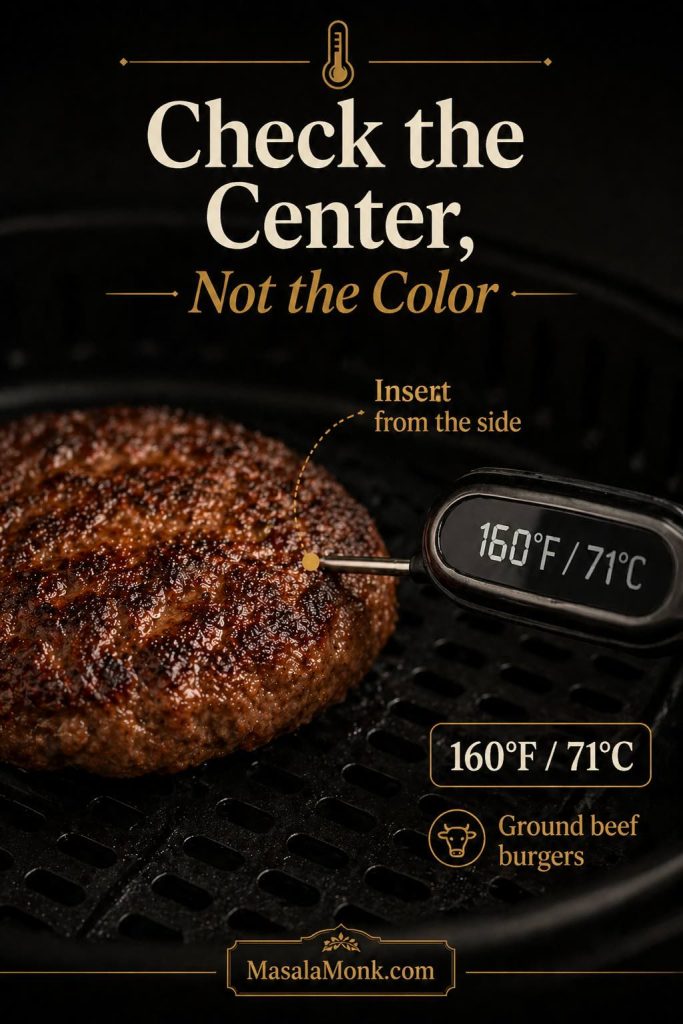
For the most accurate reading, insert the thermometer through the side of the patty so the tip reaches the center instead of stopping near the surface. That way, you are checking the part of the burger that takes the longest to cook.

Food safety note: Ground beef burgers should reach 160°F / 71°C in the center. FoodSafety.gov lists 160°F as the safe minimum internal temperature for ground meat, so a thermometer is the clearest way to avoid guessing. See the safe minimum internal temperature chart.

Why this air fryer method works

In practice, the air fryer is good at burgers because it cooks fast, drains extra fat, and keeps the process cleaner than a skillet. The tradeoff is that patties can dry out if they are too lean, too thin, or cooked too long. That is why thickness, beef choice, spacing, and internal temperature matter more than chasing one exact minute.

Air Fryer Burger Time and Temperature Chart

Best default temperature

For most fresh patties, 375°F / 190°C is the best first setting. It is hot enough to cook the burgers quickly and help the outside brown. However, it is not so aggressive that the edges dry out before the center is done.

If this is your first time making burgers in the air fryer, use the quarter-pounder row as your starting point. After that, adjust by thickness instead of changing everything at once.

Fresh burger time chart

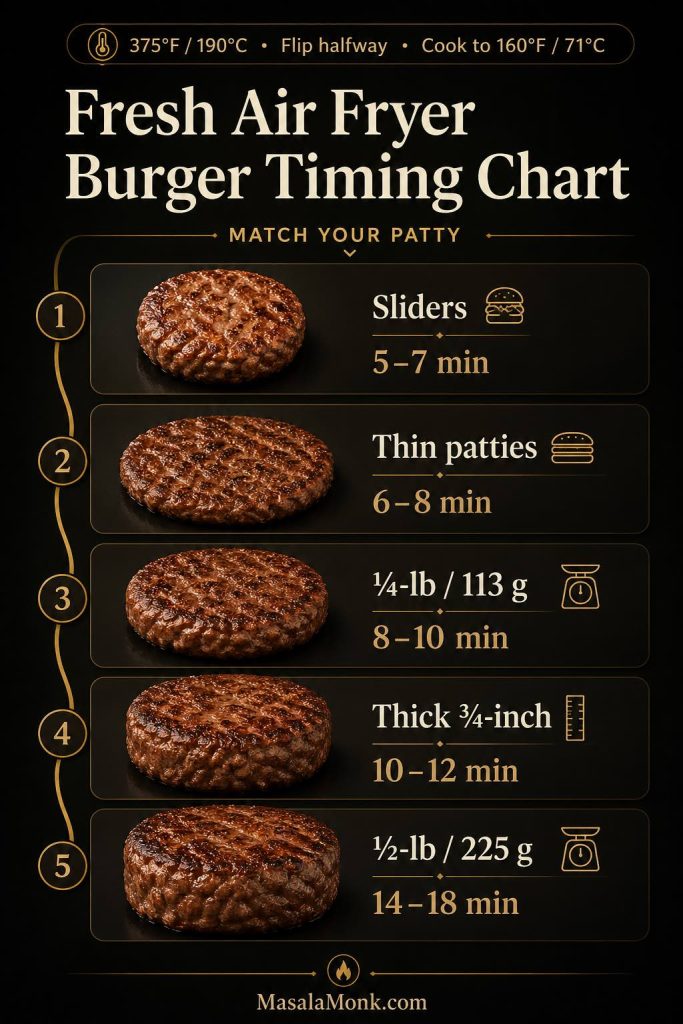
Because patty size changes the answer, start with the row that matches your burger instead of forcing every patty into the same time. Once you know how your air fryer handles one batch, adjust the next batch by 1–2 minutes rather than changing the temperature immediately.

Fresh air fryer burger timing chart comparing sliders, thin patties, quarter-pound patties, thicker three-quarter-inch patties, and half-pound patties with their cook times.
Fresh burger timing changes most with patty size and thickness, so match your patty to the closest size instead of using one fixed cook time for every batch.
Fresh burger type Air fryer temp Approx. time Flip? Internal temp
Fresh quarter-pounder / ¼-lb / 113 g patties, about ½ inch / 1.25 cm thick 375°F / 190°C 8–10 minutes Yes, halfway 160°F / 71°C
Fresh thicker patties, about ¾ inch / 2 cm thick 375°F / 190°C 10–12 minutes Yes 160°F / 71°C
Fresh ½-lb / 225 g thick patties 360–370°F / 182–188°C 14–18 minutes Yes 160°F / 71°C
Thin fresh patties 375°F / 190°C 6–8 minutes Yes 160°F / 71°C
Mini burgers or sliders 375°F / 190°C 5–7 minutes Yes 160°F / 71°C

Frozen Burger, 400°F, and Cheeseburger Timing

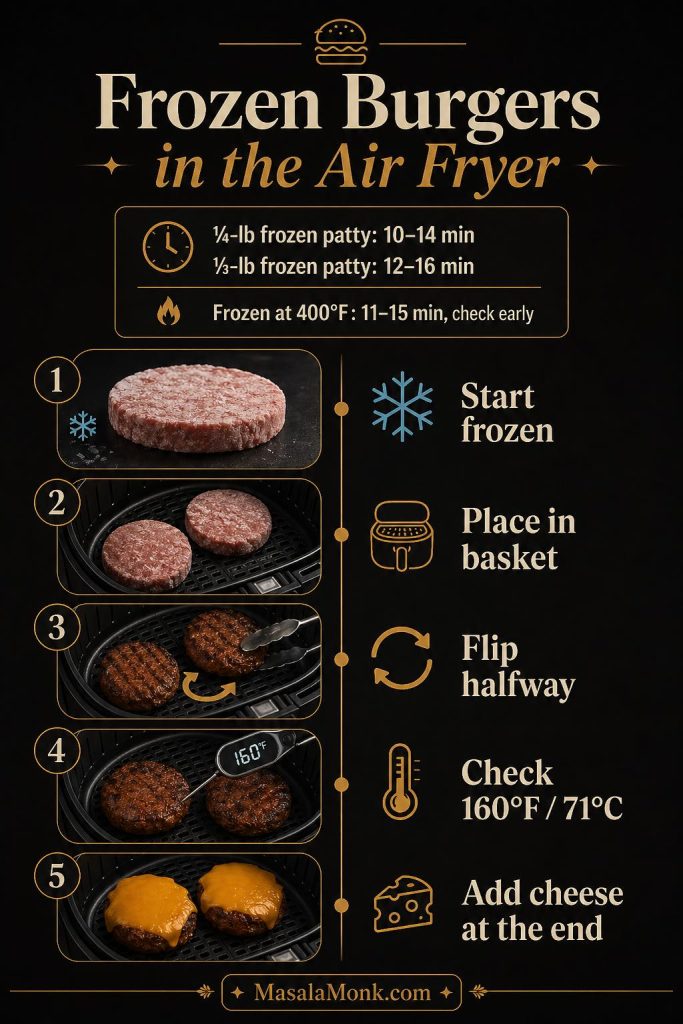
However, frozen burgers need a wider range because the center has to thaw before it can safely finish cooking. Before adding cheese to any burger, check the center first. Otherwise, the cheese may melt while the patty still needs more time.

Frozen air fryer burger guide showing timing for quarter-pound and third-pound patties, flipping halfway, checking for 160°F, and adding cheese at the end.
Frozen burgers need a wider timing range because the center has to thaw first; check the temperature before adding cheese.
Burger type Air fryer temp Approx. time Flip? Internal temp
Frozen ¼-lb / 113 g patties 360–375°F / 182–190°C 10–14 minutes Yes 160°F / 71°C
Frozen ⅓-lb / 150 g patties 360–375°F / 182–190°C 12–16 minutes Yes 160°F / 71°C
Thin fresh patties at 400°F / 200°C 400°F / 200°C 6–8 minutes Yes 160°F / 71°C
Frozen burgers at 400°F / 200°C 400°F / 200°C 11–15 minutes Yes 160°F / 71°C; check early because the outside may brown first
Cheeseburgers Same as burger Add cheese last 30–60 seconds 160°F / 71°C before cheese

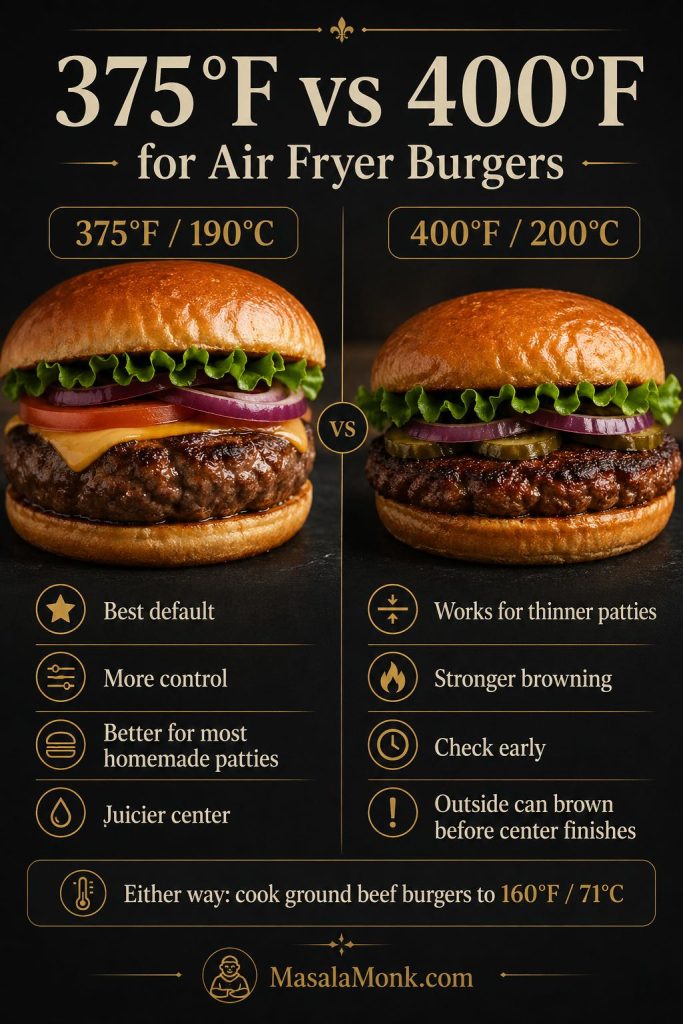
Should you air fry burgers at 375°F or 400°F?

For most homemade patties, 375°F is the better first choice because it gives the center time to cook before the edges dry out. However, 400°F can work for thinner patties or for people who like a firmer browned outside. In that case, start checking early and use a thermometer, because the outside can look done before the center reaches 160°F.

Comparison chart for air fryer burgers showing 375°F as the best default for control and 400°F as an option for thinner patties with earlier checking.
Use 375°F as the most reliable starting point for homemade burgers, and treat 400°F as an option for thinner patties or stronger browning with an early temperature check.

In short, 375°F is the better beginner setting, while 400°F is an alternate for thinner patties or cooks who already know their air fryer runs evenly. That said, once you know how your air fryer behaves, you can fine-tune the temperature without guessing.

How to adjust the time

If your air fryer runs hot, start checking a minute early. On the other hand, if your patties are thick, cold, or crowded, they may need longer. In either case, do not press the burgers while they cook; pressing squeezes out the juices you are trying to keep.

If you are not sure which row fits your burger, choose the lower end of the time range first. Then check the center and add 1–2 minutes only if the patty has not reached 160°F / 71°C.

Back to table of contents ↑

Hamburger Patties in the Air Fryer

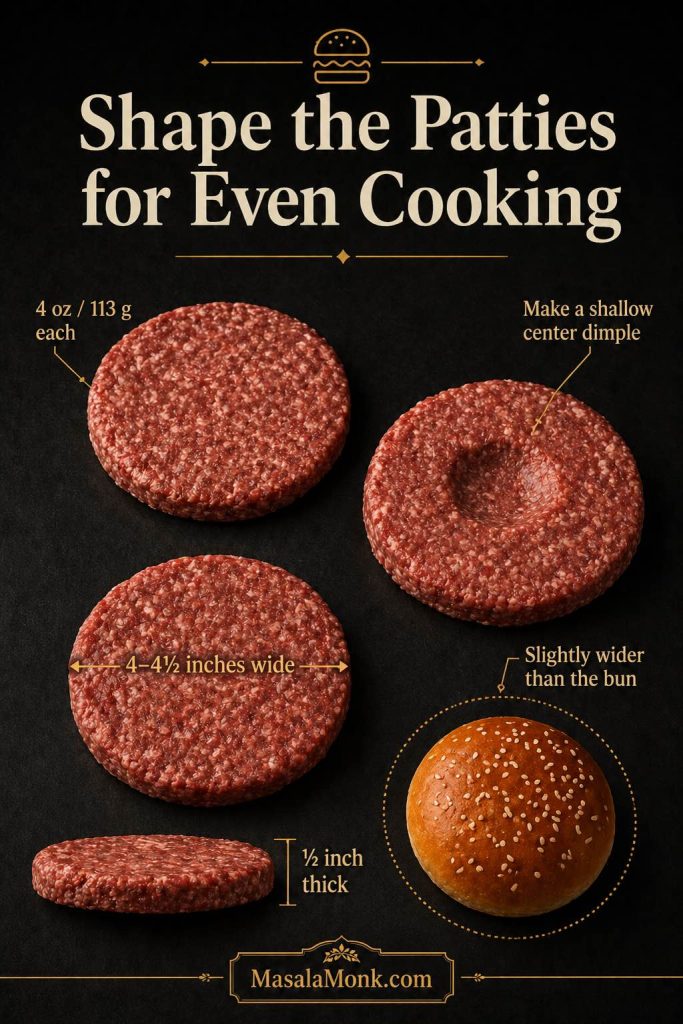
For your first batch, keep the patties simple: 1 lb / 454 g ground beef divided into 4 loose patties, about 4 oz / 113 g each. Shape each patty about 4–4½ inches / 10–11.5 cm wide and about ½ inch / 1.25 cm thick. That size cooks evenly, fits most air fryer baskets, and gives you a better chance of hitting 160°F without drying out the edges.

Raw air fryer burger patties showing 4-ounce portions, 4 to 4 and a half inch width, half-inch thickness, a shallow center dimple, and a bun size comparison.
Even patty size is what makes the timing chart work: aim for 4 oz patties that are about ½ inch thick, slightly wider than the bun, and gently dimpled in the center.

Because burgers shrink as they cook, shape each patty slightly wider than the bun. Then press a shallow dimple in the center so the patty stays flatter instead of puffing up into a dome.

When the patties are the same size, they finish at about the same time. Otherwise, the smaller patties can dry out while the thicker ones are still catching up.

If one patty is noticeably larger, place it where your air fryer runs hottest, or give it an extra minute after removing the smaller patties. That way, the thinner burgers do not dry out while the thickest one finishes.

This same method works for fresh beef patties, homemade burger patties, and plain hamburger patties from the butcher counter. However, the main adjustment is thickness: thin patties cook faster, while thick patties need more time to reach 160°F in the center.

For best texture, avoid mixing the beef too much. Once ground beef is overworked, the cooked patty can turn dense and springy instead of tender and juicy.

Can you cook raw ground beef patties in the air fryer?

Yes. Raw ground beef patties can go straight into the air fryer as long as they are shaped evenly, cooked in a single layer, and checked for 160°F in the center. However, loose ground beef mixtures and very wet patties can cook unevenly, so formed patties work best.

Ingredients for Air Fryer Hamburgers

You only need a few ingredients for classic burgers. Since the cooking method is simple, the beef, seasoning, patty shape, and cheese timing matter more than a long ingredient list. In other words, better patties matter more than more ingredients.

Since the ingredient list is short, each choice matters. The beef controls juiciness, the salt controls flavor, and the patty shape controls how evenly the burger cooks.

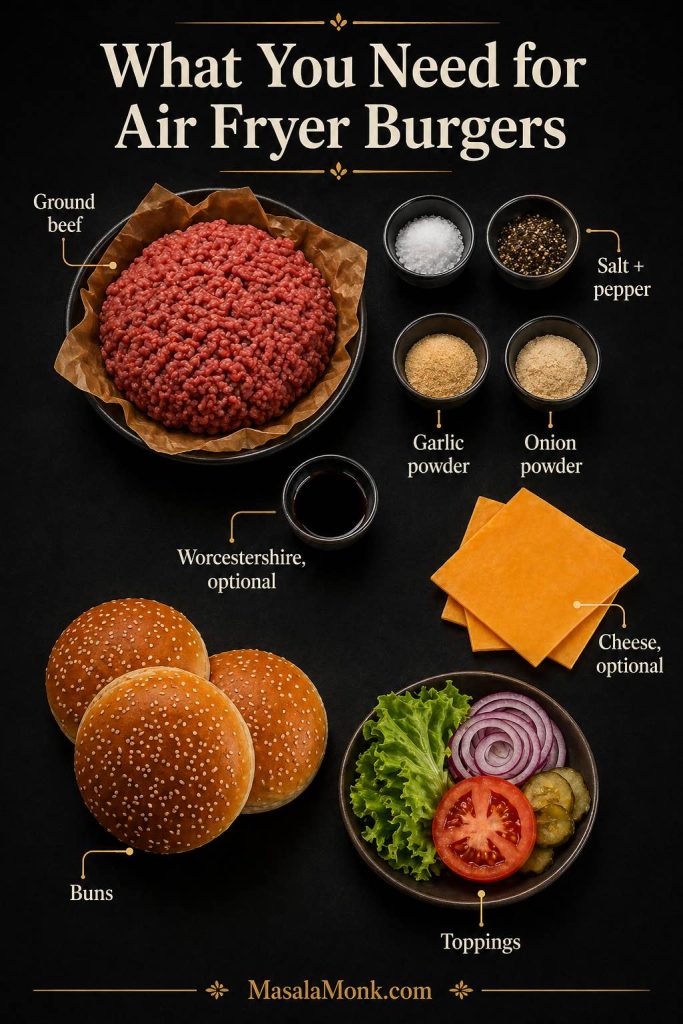
Air fryer burger ingredients including ground beef, salt, black pepper, garlic powder, onion powder, Worcestershire sauce, cheese slices, burger buns, lettuce, tomato, onion, and pickles.
The ingredient list stays simple because the success of air fryer burgers comes from good beef, even patties, enough seasoning, and adding cheese only at the end.

Ground beef

Use 1 lb / 454 g ground beef for 4 regular burgers. For the juiciest result, choose 80/20 ground beef. For a slightly leaner patty with less smoke, 85/15 is a good middle ground.

Seasoning

A simple mix of salt, black pepper, garlic powder, and onion powder is enough. If the beef is good and the patties are shaped well, the seasoning should support the burger rather than cover it up. Since kosher salt brands vary, start with a little less if you are using fine table salt. Worcestershire sauce or steak sauce is optional, but a small amount adds savory depth without turning the burger into meatloaf.

Cheese

American cheese melts the easiest. Cheddar, pepper jack, Swiss, provolone, and mozzarella also work, but thicker slices may need the full final minute to soften. Because the air fryer fan is strong, add cheese only at the end so it does not slide off, burn, or blow around inside the basket.

Buns and toppings

Use burger buns, brioche buns, potato buns, lettuce wraps, or bowls. Classic toppings include lettuce, tomato, onion, pickles, mustard, ketchup, and a creamy burger sauce. For a homemade creamy base, use this homemade mayonnaise recipe and turn it into burger sauce with ketchup, mustard, pickle juice, and a little seasoning.

Do you need oil, parchment, or foil?

Fresh 80/20 or 85/15 patties usually do not need oil because the beef has enough fat. However, if you are using very lean fresh patties or dry-surfaced frozen patties, a light oil spray can help browning.

If you use parchment, choose perforated parchment made for air fryers and never block airflow under the patties. Likewise, use foil only if your air fryer manual allows it. Otherwise, trapped grease and blocked airflow can slow cooking, create smoke, and make the burgers cook unevenly.

In short, airflow matters more than lining the basket. If a liner blocks the holes or traps grease under the patties, skip it.

Best Ground Beef for Air Fryer Burgers

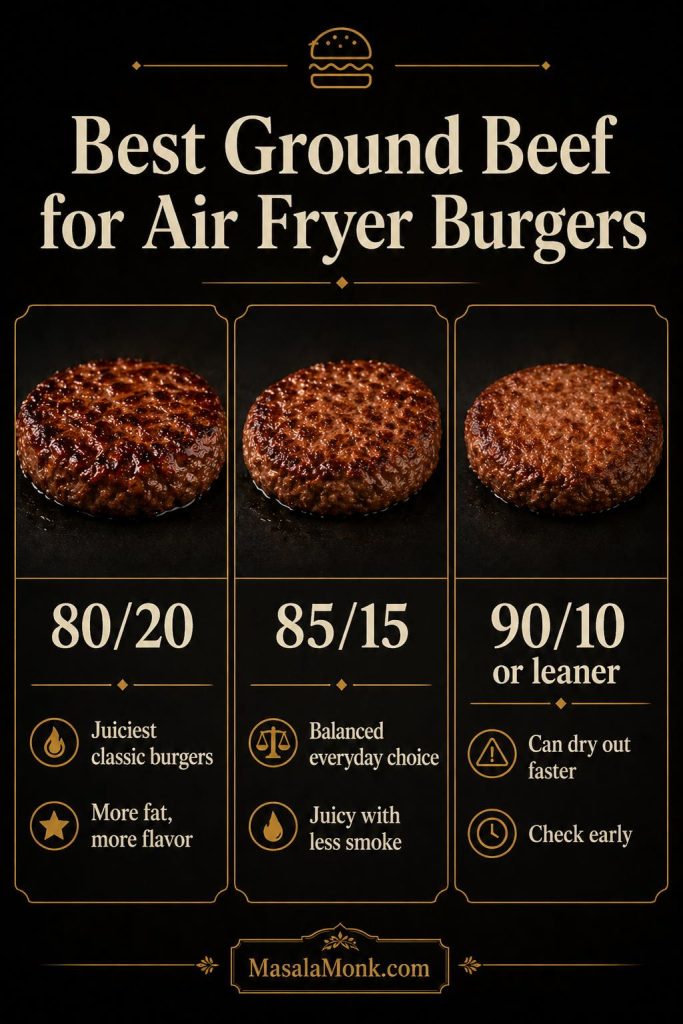
If juiciness matters most, start with 80/20. If your air fryer smokes easily or you prefer a slightly lighter burger, 85/15 is the safer everyday choice. Very lean beef can work, but it needs more care because it dries out faster.

Best ground beef guide for air fryer burgers comparing 80/20 beef for juicy burgers, 85/15 beef for balanced burgers, and 90/10 or leaner beef that can dry out faster.
For the juiciest air fryer burgers, 80/20 is the most forgiving, while 85/15 is a good everyday choice when you want less smoke without losing too much moisture.
Ground beef Best for What to know
80/20 Juiciest classic burgers Rich, flavorful, and forgiving, but it can drip more fat and create more smoke in some air fryers.
85/15 Balanced everyday burgers Still juicy, usually less smoky, and a good choice for indoor air fryer cooking.
90/10 or leaner Leaner burgers Can dry out faster. Add moisture and check the temperature early.

As a result, 80/20 or 85/15 is the most reliable choice for a first batch. Shape the patties gently, keep them even in thickness, and add a center dimple so they do not puff into domes as they cook.

If you are using very lean beef, add a little moisture with Worcestershire sauce, grated onion, mustard, or a small amount of oil. Then start checking early, because lean patties can move from done to dry quickly.

For a thinner burger with a harder griddled crust instead of a thicker air fryer patty, try this classic smash burger method.

How to Make Air Fryer Hamburgers

This method is for fresh ground beef patties. Once the patties are shaped, the rest is mostly about spacing, flipping, and checking the center. After that, assembly is quick because the burgers only need a short rest.

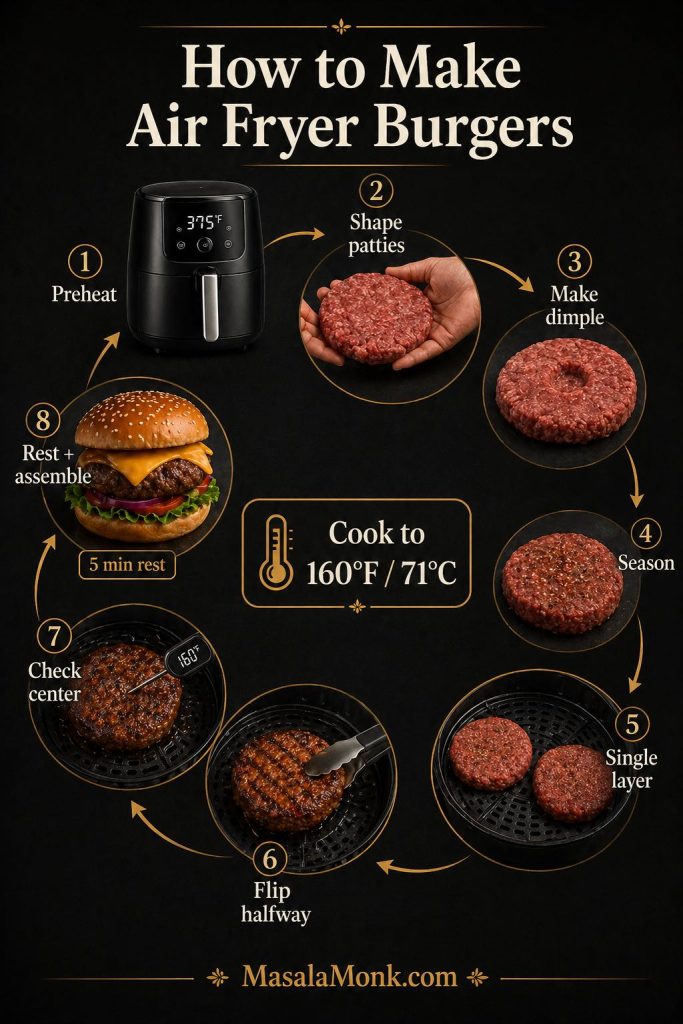
Step-by-step air fryer burger guide showing preheating, shaping patties, making a dimple, seasoning, cooking in one layer, flipping halfway, checking the center, and resting before assembly.
The method is simple once the order is clear: shape the patties evenly, cook them in one layer, flip halfway, check the center, then rest and assemble.

1. Preheat the air fryer

Preheat the air fryer to 375°F / 190°C for about 3 minutes. Although some models heat quickly, preheating helps the patties start cooking evenly.

If you skip preheating, add 1–2 minutes and start checking at the low end of the range. Once you know your air fryer, the timing becomes easier to repeat.

2. Shape the patties gently

Divide 1 lb / 454 g ground beef into 4 loose portions, about 4 oz / 113 g each. Then shape each portion into a patty about 4–4½ inches / 10–11.5 cm wide and ½ inch / 1.25 cm thick. Because the patties shrink as they cook, starting a little wider helps them fit the bun better later.

3. Make a center dimple

Press a shallow dimple into the center of each patty with your thumb or the back of a spoon. This small step helps the burgers stay flatter instead of puffing up in the middle.

4. Season both sides

Season the outside of the patties with salt, pepper, garlic powder, and onion powder. If using Worcestershire sauce, mix it in lightly before shaping, or brush a tiny amount over the patties before seasoning.

5. Air fry in a single layer

Place the patties in the basket in a single layer. Then leave space between them so hot air can move around each burger. Do not stack patties, and do not crowd the basket.

If all 4 patties do not fit with space between them, cook in batches. Otherwise, the burgers may steam instead of brown. Later batches may cook slightly faster because the air fryer is already fully hot.

6. Flip halfway

Air fry for 8–10 minutes total, flipping halfway through. Even if your model usually cooks without flipping, turning the patties makes the result more reliable across different basket styles.

7. Check the center

Check the thickest part of each patty. The burgers are done when the center reaches 160°F / 71°C. For the cleanest reading, insert the thermometer from the side so the tip lands in the center of the patty.

Digital thermometer inserted from the side into an air fryer burger patty showing 160°F and 71°C as the internal temperature for ground beef burgers.
Color is not a reliable doneness check for ground beef, so insert the thermometer from the side and make sure the center of the patty reaches 160°F.

If one patty is thicker than the others, it may need an extra minute or two. In that case, remove the finished patties and let the thicker one continue cooking until it reaches temperature.

8. Rest and assemble

Let the patties rest for about 2 minutes before assembling. Meanwhile, toast the buns, slice the toppings, or stir together a quick sauce.

Can you toast burger buns in the air fryer?

Yes. After the patties come out, place the buns cut-side up in the basket and air fry at 350–375°F / 175–190°C for 1–2 minutes. Watch closely because buns go from toasted to dry quickly.

How to Make Air Fryer Cheeseburgers

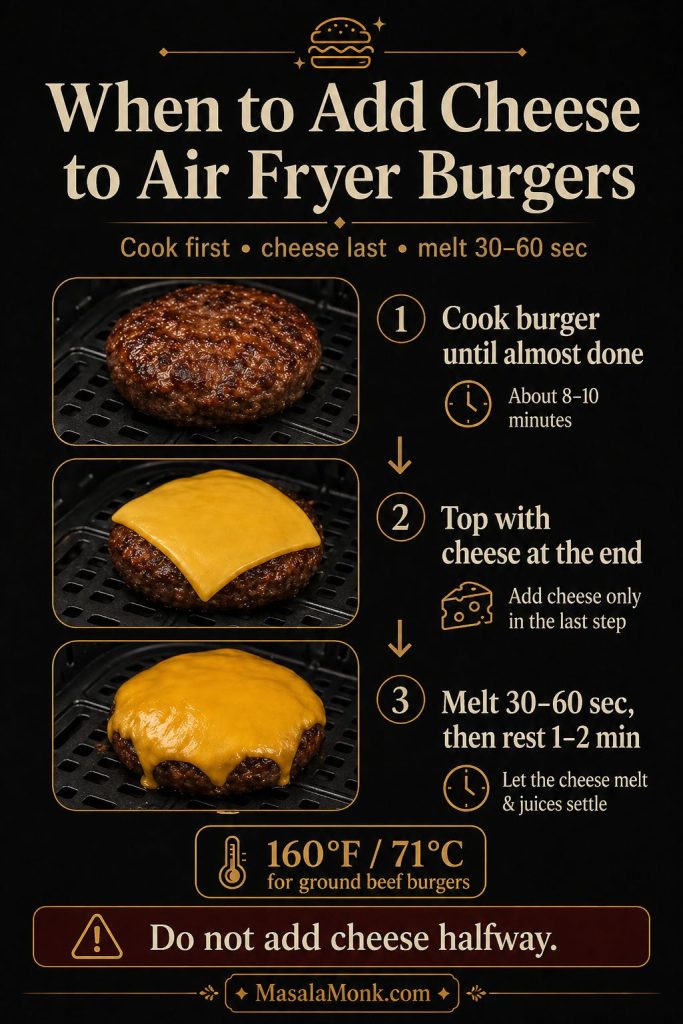
To make cheeseburgers, cook the patties first, then add cheese at the very end. The easiest method is to place a slice of cheese on each cooked patty during the final 30–60 seconds of cooking.

Air fryer cheeseburger guide showing cheese added at the end of cooking, melted cheese on the patty, and a reminder not to add cheese halfway.
Add cheese only after the burger is almost done; the final 30–60 seconds or residual basket heat is usually enough to melt it without making a mess.

Instead of running the fan longer just to melt cheese, you can also use the heat that is already trapped in the basket. Turn the air fryer off, place cheese on the hot patties, close the basket, and let the residual heat melt the cheese for about 1 minute.

If your cheese slides, folds, or blows off, do not fight the fan. Instead, melt the cheese with leftover heat after cooking. That way, the cheese softens over the patty instead of ending up on the basket.

Do not add cheese halfway through cooking. It can melt off the burger, stick to the basket, burn at the edges, or blow around inside the air fryer.

Frozen Burgers in the Air Fryer

Frozen patties are perfect for nights when nothing was thawed. They can go straight from freezer to basket; however, they need a little more patience because the center has to thaw before it can safely finish cooking.

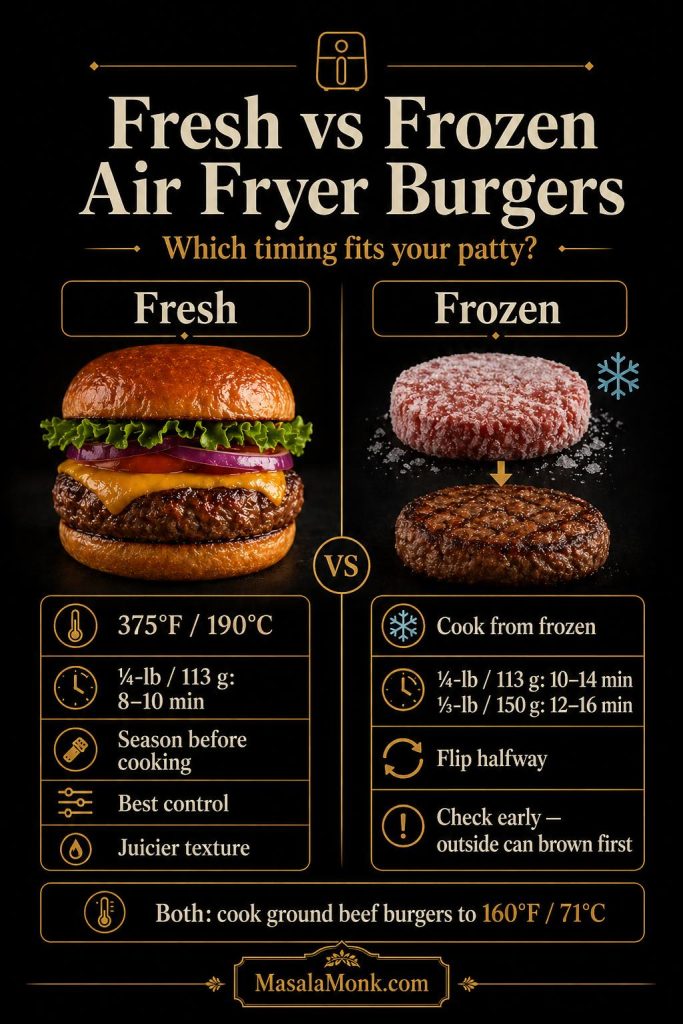
That is why frozen burgers usually need a lower-to-moderate temperature and a wider time range than fresh patties. In practice, smaller ¼-lb / 113 g patties finish sooner, while thicker ⅓-lb / 150 g patties need the longer end of the range.

Fresh versus frozen air fryer burger guide comparing fresh patties cooked at 375°F with frozen patties cooked from frozen, including cook times, flipping, and 160°F internal temperature.
Fresh patties give you the most control, while frozen patties need extra time because the center must thaw before the burger can safely finish cooking.

How to air fry frozen burger patties

  1. Preheat the air fryer to 360–375°F / 182–190°C.
  2. Place frozen patties in a single layer.
  3. Air fry for 10–16 minutes, depending on patty size and thickness.
  4. Flip halfway through.
  5. Season after the surface warms slightly if seasoning will not stick at the beginning.
  6. Cook until the center reaches 160°F / 71°C.
  7. Add cheese during the final 30–60 seconds if making cheeseburgers.

For exact ranges by patty size, use the frozen burger timing chart above. Before adding cheese to frozen burgers, check the center first. Otherwise, the cheese may look melted while the patty still needs more time inside.

What about Bubba-style frozen burgers?

Bubba-style frozen burgers can go straight from freezer to air fryer. However, they are often thick and fatty, so they may need the longer end of the timing range. Start at 360–375°F, flip halfway, and check for 160°F in the center.

If you cook frozen burgers at 400°F / 200°C, start checking early. The outside can brown before the center is fully done, especially with thicker frozen patties. In that case, a thermometer prevents the most common mistake: serving a burger that looks done outside but is not finished inside.

Back to table of contents ↑

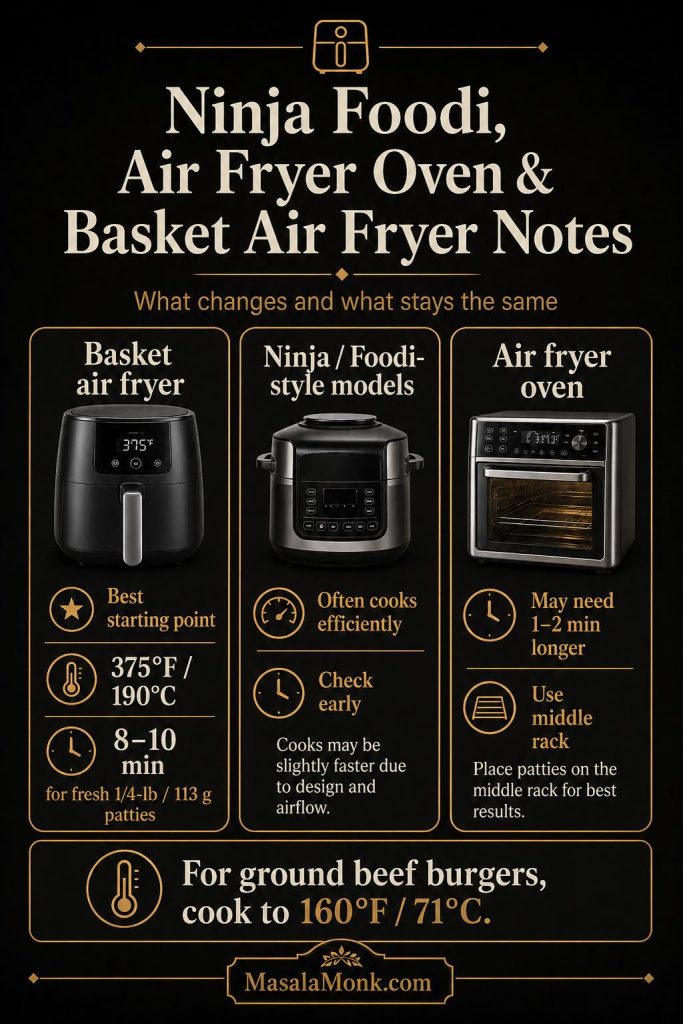
Ninja Foodi, Air Fryer Oven and Basket Air Fryer Notes

The basic method is the same in most basket-style air fryers: cook fresh ¼-lb / 113 g patties at 375°F / 190°C, flip halfway, and check for 160°F / 71°C in the center. However, stronger models, smaller baskets, dual-zone air fryers, and air fryer ovens can change the timing by a minute or two.

Likewise, air fryer ovens may need slightly longer because the cooking space is larger than a compact basket. That means the best approach is to use the chart first, then adjust the next batch based on your specific model.

Air fryer model notes for burgers comparing basket air fryers, Ninja Foodi style models, and air fryer ovens with timing adjustments and 160°F internal temperature guidance.
Use the timing chart as your starting point, then adjust by model: stronger basket air fryers may finish sooner, while air fryer ovens can need a minute or two longer.
Air fryer type What to adjust Best starting point
Ninja air fryer or Ninja Foodi air crisp These can cook efficiently, so check early. 375°F / 190°C, 8 minutes, then check the center.
Ninja Foodi Grill Air crisp and grill mode behave differently. Use air crisp for this method; follow grill-plate timing if using grill mode.
Cosori, Instant Vortex, Gourmia, PowerXL, and similar basket air fryers Basket size and airflow vary. Use the chart first, then adjust by 1–2 minutes after your first batch.
Air fryer oven or toaster oven air fryer The larger cavity may cook slightly slower. Use the middle rack, flip halfway, and check the center early.

Back to table of contents ↑

How to Keep Air Fryer Burgers Juicy

These burgers stay juicy when the beef has enough fat, the patties are handled gently, and the cooking time does not run too long. As a result, a few small details make the difference between a tender burger and a dry one.

  • Use 80/20 or 85/15 beef. A little fat keeps the burger tender.
  • Do not overmix. Handle the meat gently and stop once the patties hold together.
  • Make even patties. Uneven patties cook unevenly.
  • Add a center dimple. This helps prevent puffing.
  • Do not press the burgers. Pressing forces juices out.
  • Flip once. It improves even cooking without overhandling.
  • Check temperature early. Start checking at the low end of the timing range.
  • Rest briefly. Two minutes is enough for most burgers.

In other words, juicy burgers come from control, not extra steps. Once the patties are shaped well and cooked to temperature, the air fryer does most of the work.

Finished air fryer cheeseburger with melted cheese, toasted bun, lettuce, tomato, onion, and pickles, shown with an air fryer basket in the background.
A juicy air fryer burger comes from control, not extra steps: shape the patty evenly, avoid overcooking, and stop once the center reaches temperature.

When using lean beef, add a little moisture with Worcestershire sauce, grated onion, mustard, or a small amount of oil. Also, check the temperature earlier because lean patties move from done to dry quickly.

The goal is a patty with browned edges, melted cheese, and a tender center — not a dry puck that only tastes like seasoning. So, once the burger reaches temperature, stop cooking and let it rest.

Troubleshooting Air Fryer Hamburgers

If the burgers turn out dry, smoky, uneven, or messy, do not change everything at once. In most cases, one small adjustment fixes the next batch: use slightly fattier beef, make the patties thinner, clean the basket, or add cheese later.

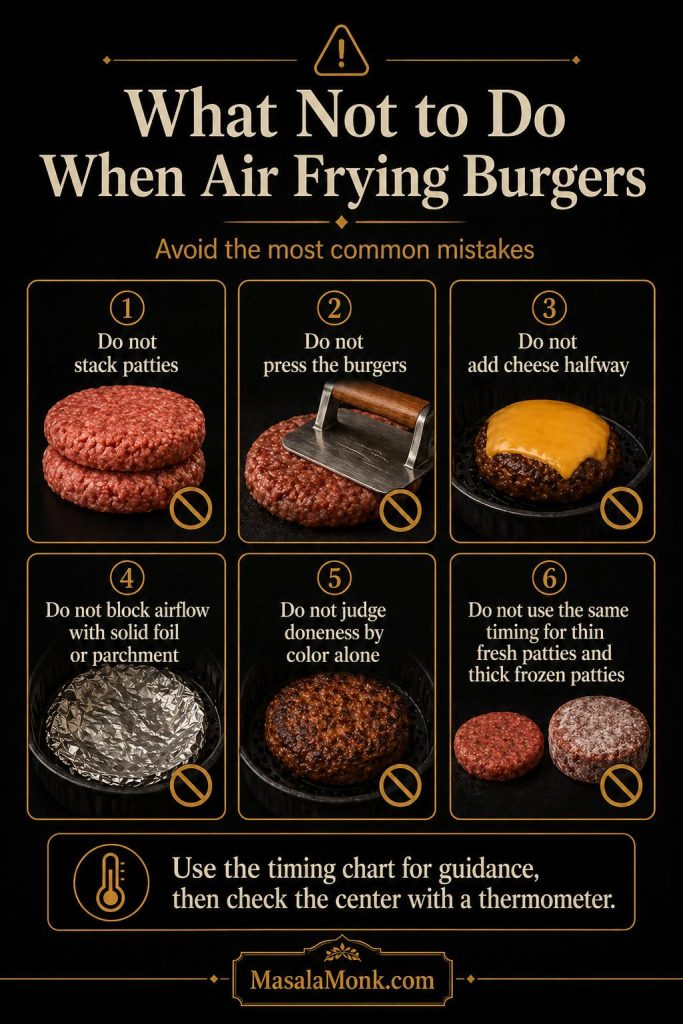
What not to do when air frying burgers

Before changing the recipe, check the most common mistakes first. These are the small things that usually cause dry burgers, uneven cooking, smoking, or messy cheese.

Air fryer burger mistakes to avoid, including stacking patties, pressing burgers, adding cheese too early, blocking airflow, judging doneness by color, and using one timing for every patty.
Most air fryer burger problems come from blocked airflow, uneven patties, early cheese, or guessing doneness by color instead of checking the center.
  • Do not stack patties in the basket.
  • Avoid pressing the burgers while they cook.
  • Add cheese only at the end, not halfway through cooking.
  • Never block the basket holes with solid parchment or foil.
  • Do not judge doneness by color alone.
  • Avoid using the same timing for thin fresh patties and thick frozen patties.

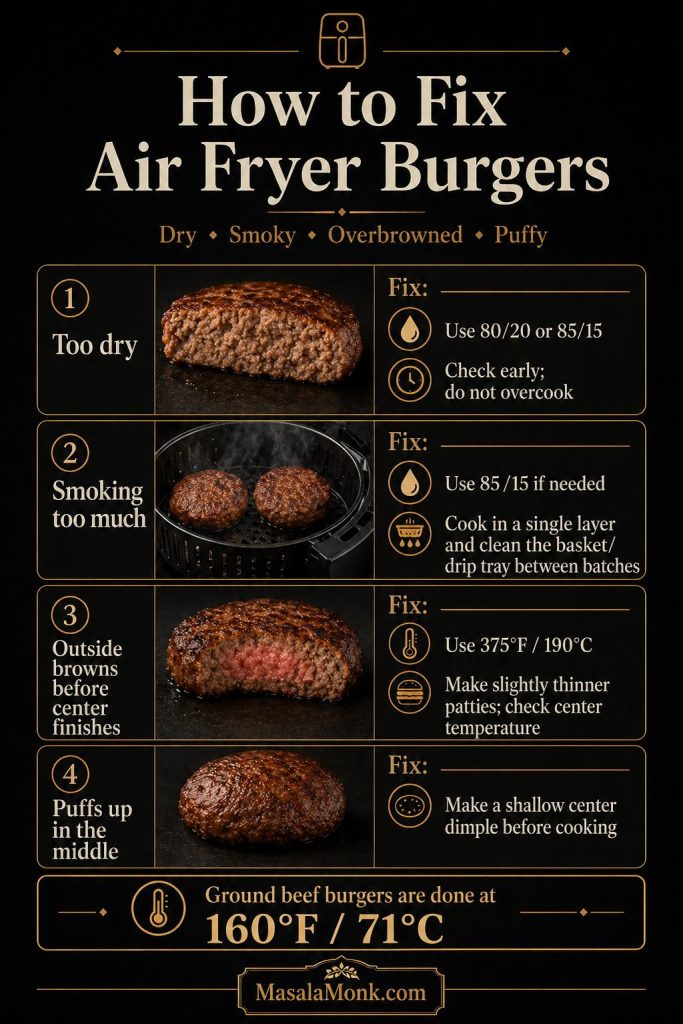
Air fryer burger troubleshooting chart

Once you know what went wrong, use the chart below to fix the next batch. Instead of changing the beef, temperature, timing, and basket setup all at once, adjust one thing first.

Problem Likely cause Fix
Dry burgers Lean beef or overcooking Use 80/20 or 85/15 beef, and check the temperature earlier.
Smoking air fryer Fat dripping onto a hot base, old grease, or very fatty beef Clean the basket, avoid overcrowding, and try 85/15 beef if smoke is frequent.
Burger puffed up No center dimple Press a shallow dimple in each patty before cooking.
Undercooked center Patty too thick or too cold Cook longer at 375°F and check for 160°F in the center.
Cheese blew off Cheese added too early or fan too strong Add cheese during the final 30–60 seconds, or melt it with residual heat after cooking.
Uneven cooking Basket overcrowded Cook in a single layer and leave space between patties.
Air fryer burger troubleshooting guide showing fixes for dry burgers, smoking, outside browning before the center finishes, puffing in the middle, and checking for 160°F internal temperature.
The best fix depends on the problem: dry burgers need more moisture control, smoking needs cleaner airflow, and underdone centers need a thermometer check instead of more browning.

How to fix the next batch

If you are not sure what went wrong, start with the simplest fix first. Next time, change only one thing at a time. If the burgers were dry, check earlier or use fattier beef; if they smoked, clean the basket or use a slightly leaner blend.

If smoke happens, do not panic. Usually, it means fat is hitting a very hot surface or old grease is still in the basket. Before cooking the next batch, clean the basket, avoid overcrowding, and use the lower end of the temperature range if your air fryer runs hot.

The next batch becomes easier to control because you are matching the fix to the actual problem instead of guessing.

If this happens often with air fryer recipes, it is worth checking these common air fryer mistakes. Overcrowding, blocked airflow, old grease, and wrong timing can affect burgers, fries, wings, and almost everything else you cook in the basket.

Jump to recipe card → | Back to table of contents ↑

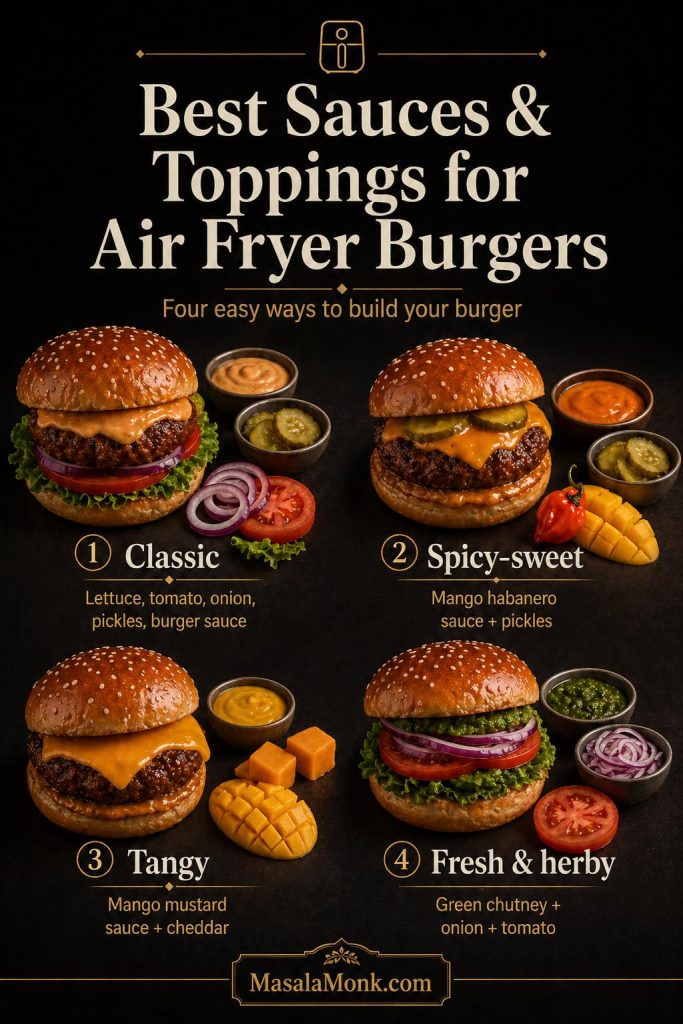
Best Sauces and Toppings for Air Fryer Hamburgers

A good burger only needs a few toppings, but the sauce can change the whole direction of the meal. For that reason, keep the patty simple and use the sauce to make it classic, spicy, Indian-style, or bowl-friendly.

Air fryer burger sauce and topping guide showing classic burger sauce, mango habanero sauce, mango mustard sauce, green chutney, pickles, onion, tomato, and lettuce.
Keep the burger patty simple and use the sauce to change the direction: classic, spicy-sweet, tangy, or fresh and herby.

Classic burger sauce is the easiest place to start: mix mayonnaise, ketchup, mustard, finely chopped pickles or pickle juice, garlic powder, onion powder, and a little black pepper. If you want a fresh base, use this homemade mayonnaise; if you need an egg-free spread, use eggless mayonnaise.

When you want heat, brush the cooked patty lightly with mango habanero sauce or serve it on the side for fries. Meanwhile, mango mustard sauce gives the burger a tangy, fruity change from plain mustard.

An Indian-style burger works especially well with green chutney, onion, tomato, mayo, and a pinch of chaat masala. Because the chutney is bright and herb-heavy, it cuts through the richness of the patty.

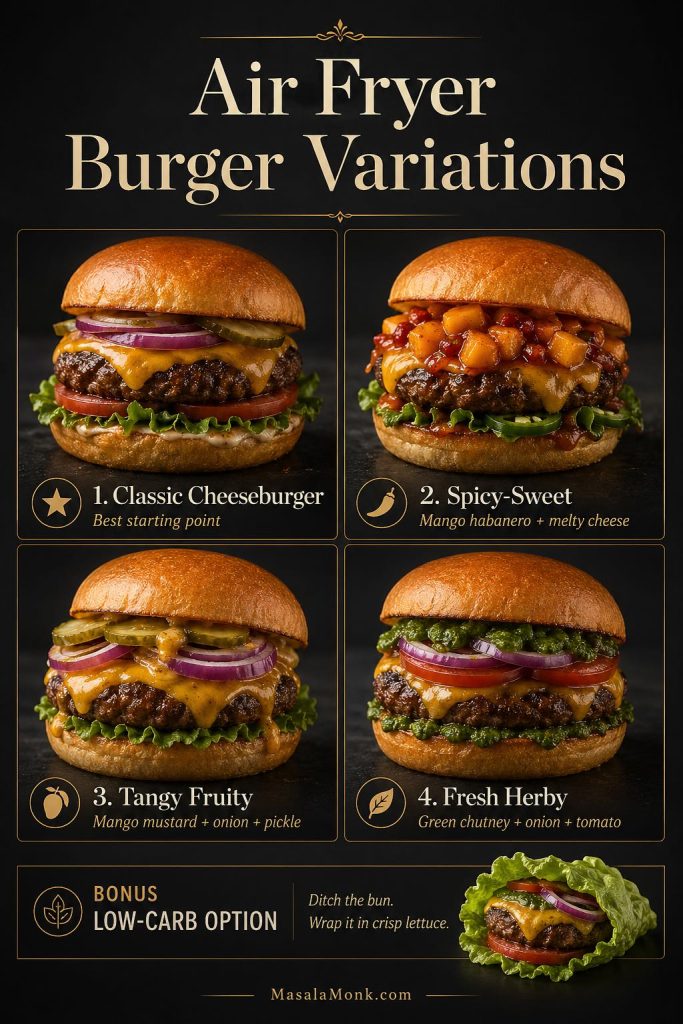
Air Fryer Burger Variations

Once the basic method is set, you can change the toppings and sauces without changing the cooking technique. That way, one reliable patty method can turn into several different dinners.

Air fryer burger variations guide showing a classic cheeseburger, spicy mango habanero burger, mango mustard burger, green chutney burger, and a low-carb lettuce-wrap option.
Once the basic air fryer patty is reliable, the easiest way to change the burger is through the sauce: classic, spicy-sweet, tangy, herby, or low-carb.
  • Classic cheeseburger: American cheese, pickles, onion, lettuce, tomato, and burger sauce.
  • Spicy mango habanero burger: Cheddar, onions, pickles, and mango habanero sauce.
  • Mango mustard burger: Lettuce, pickles, onion, and mango mustard sauce.
  • Green chutney burger: Green chutney, mayo, onion, tomato, and chaat masala.
  • Low-carb burger bowl: Lettuce, pickles, cheese, onions, tomato, and sauce without the bun.
  • Pesto cheeseburger: Pesto mayo, tomato, mozzarella or provolone, and roasted peppers.

For a lower-carb plate, keep the same patty method and build the meal around lettuce, pickles, cheese, onions, tomato, and sauce instead of a bun.

What to Serve With Air Fryer Hamburgers

For an easy burger-night plate, pick one sauce, one crispy side, and something fresh to cut through the richness. That way, the meal feels complete without turning dinner into a project.

For the classic burger-and-fries plate, serve the patties with homemade fries, wedges, or potato snacks. If a make-ahead side is easier, potato salad is one of the best choices. For a party-style spread, add one or two ideas from these potato appetizers.

If the air fryer is already out, keep the sides easy. Air fryer mozzarella sticks make the meal feel like a game-day plate, while air fryer croquettes are a good option when you want something crispy that is not fries.

For something fresh, add a cabbage slaw, cucumber salad, onion-tomato salad, or raw papaya salad. A crisp fresh side helps balance the richness of the burgers and cheese.

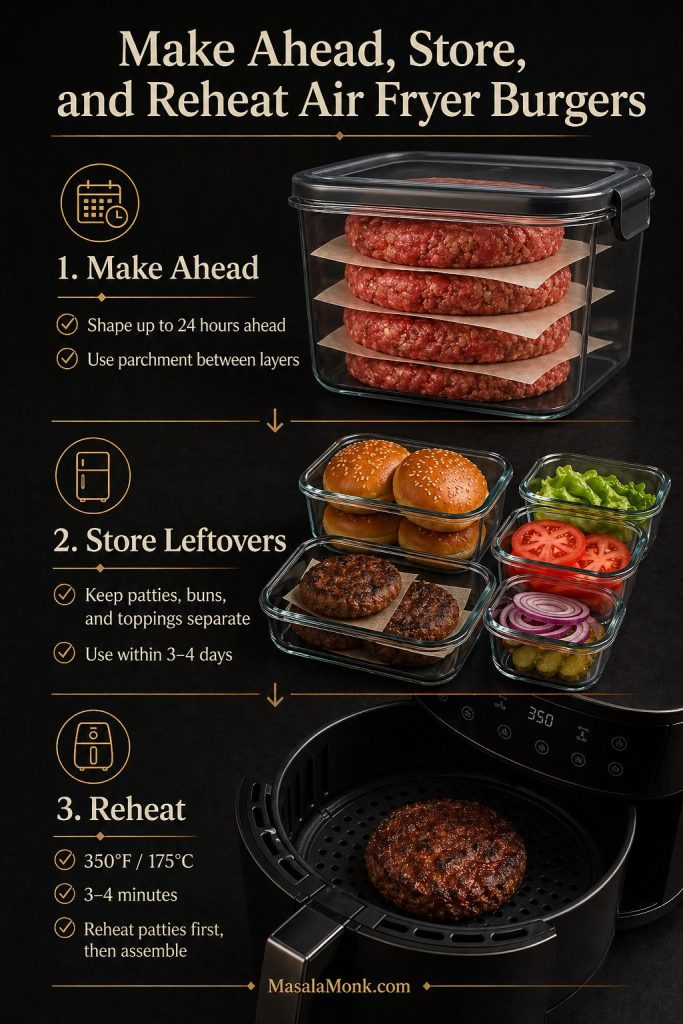
Storage and Reheating

Make-ahead tip: You can shape the raw patties up to 24 hours ahead and refrigerate them in a covered container with parchment between layers. Keep them cold until cooking, then air fry straight from the fridge and check the center for 160°F / 71°C.

Air fryer burger storage guide showing raw patties made ahead with parchment, cooked patties stored separately from buns and toppings, and patties reheated in the air fryer.
Store patties, buns, and toppings separately so leftovers reheat cleanly; warm the patty first, then assemble the burger fresh.

Cooked hamburger patties store better than fully assembled burgers. If you know you will have leftovers, store the patties, buns, cheese, sauces, and toppings separately. Otherwise, the bun can turn soggy while the lettuce and tomato lose their texture.

Once the patties are cooked, refrigerate leftovers within 2 hours. If the room is very hot, refrigerate them within 1 hour. After that, reheat only the patties and assemble the burgers fresh so the buns and toppings stay in better shape.

  • Refrigerate: Cool cooked patties, then store in an airtight container for 3–4 days.
  • Freeze: Wrap cooked patties individually and freeze for up to 2 months.
  • Reheat in the air fryer: Reheat patties at 350°F / 175°C until warmed through.
  • Add cheese after reheating: Cheese melts better when added at the end instead of reheated from cold.
  • Avoid reheating assembled burgers: The bun can dry out while lettuce, tomato, and sauce turn soggy.

For more air fryer recipes with ground beef, this burger method is the easiest starting point because the patties cook quickly, portion neatly, and can be served on buns, in bowls, or over salad.

Air Fryer Burgers Recipe Card

Air Fryer Burgers

These air fryer burgers are built for a quick, juicy first batch: fresh ground beef, simple seasoning, 375°F heat, one flip, and cheese added only at the end.

Yield 4 burgers
Prep Time 10 minutes
Cook Time 8–10 minutes
Total Time 18–20 minutes

Ingredients

  • 1 lb / 454 g ground beef, preferably 80/20 or 85/15
  • ¾ tsp kosher salt, or to taste
  • ½ tsp black pepper
  • ½ tsp garlic powder
  • ½ tsp onion powder
  • 1 tsp / 5 ml Worcestershire sauce or steak sauce, optional
  • 4 cheese slices, about 3 oz / 85 g total, optional
  • 4 burger buns
  • Lettuce, tomato, onion, pickles, sauce, or toppings of choice

Instructions

  1. First, preheat the air fryer to 375°F / 190°C.
  2. Next, divide the beef into 4 loose portions, about 4 oz / 113 g each.
  3. Then shape each portion into a patty about 4–4½ inches / 10–11.5 cm wide and ½ inch / 1.25 cm thick.
  4. After that, press a shallow dimple into the center of each patty so the burgers stay flatter as they cook.
  5. Once the patties are shaped, season both sides with salt, pepper, garlic powder, and onion powder. If using Worcestershire sauce, mix it in gently before shaping or brush a tiny amount over the patties before seasoning.
  6. Then place the patties in the air fryer basket in a single layer, leaving space between them.
  7. As the burgers cook, flip them halfway through the 8–10 minute cooking time.
  8. Once the time is close, check the center of each patty. For the most accurate reading, insert the thermometer through the side of the patty so the tip reaches the center. The burgers are done when they reach 160°F / 71°C.
  9. If making cheeseburgers, add cheese during the final 30–60 seconds, or place cheese on the hot cooked patties and close the warm basket briefly until melted.
  10. Finally, rest the patties for 2 minutes, then assemble with buns, sauce, and toppings.

Notes

  • Best beef: Use 80/20 for the juiciest burgers or 85/15 for a slightly leaner burger with less smoke.
  • Salt: Kosher salt brands vary. If using fine table salt, start with less and adjust to taste next time.
  • Preheating: If you skip preheating, add 1–2 minutes and start checking early.
  • Batch cooking: If the patties do not fit in a single layer with space between them, cook in batches. Later batches may cook slightly faster.
  • Oil: Fresh 80/20 or 85/15 patties usually do not need oil. Use a light spray only for very lean or dry-surfaced patties.
  • Frozen patties: Cook frozen ¼-lb / 113 g patties at 360–375°F for 10–14 minutes and frozen ⅓-lb / 150 g patties for 12–16 minutes, flipping halfway.
  • Bubba-style burgers: Start at 360–375°F and use the longer end of the timing range for thick frozen patties.
  • Cheese: Add cheese at the end only. Adding it too early can make it slide off or blow around.
  • Doneness: Ground beef burgers should reach 160°F / 71°C in the center.
  • Parchment or foil: Use only if your air fryer manual allows it, and never block airflow or trap grease under the patties.
  • Storage: Refrigerate cooked patties within 2 hours, or within 1 hour if the room is very hot. Store patties separately from buns and toppings for the best leftovers.

If you are cooking a different patty size, use the recipe card as the base and the timing chart above as the adjustment guide. That way, the method stays simple while the timing changes to match the burger.

One rule matters most: timing can change, but doneness should be checked with a thermometer. Use the chart for timing, then use the center temperature to decide when the burgers are done.

Air fryer burgers time and temperature guide showing 375°F or 190°C, 8 to 10 minutes for fresh patties, flip halfway, cook to 160°F or 71°C, and adjust timing for frozen burgers.
Use this as the quick visual summary: fresh patties, frozen patties, cheeseburgers, and the center-temperature check that keeps air fryer burgers reliable.

Back to table of contents ↑

FAQs About Air Fryer Burgers and Hamburgers

Can you cook hamburgers in an air fryer?

Yes. When cooked in a single layer, hamburgers cook well in an air fryer because the hot circulating air reaches the top, bottom, and sides of each patty. For the best result, leave space between the patties and flip halfway.

What temperature do you cook hamburgers in the air fryer?

For most fresh hamburger patties, use 375°F / 190°C. This temperature gives the center enough time to cook while still helping the outside brown.

How long do hamburgers take in the air fryer?

In most cases, fresh ¼-lb / 113 g hamburger patties take 8–10 minutes at 375°F / 190°C. However, thinner patties may finish in 6–8 minutes, while thicker patties may need 10–12 minutes.

How long do you cook ½-pound burgers in the air fryer?

Fresh ½-lb / 225 g burgers usually need about 14–18 minutes at 360–370°F / 182–188°C, depending on thickness and air fryer strength. Flip halfway and check that the center reaches 160°F / 71°C.

Do you flip burgers in the air fryer?

Yes. Although some air fryers cook fairly evenly without flipping, flipping halfway gives more reliable results across different basket styles and patty thicknesses.

What internal temperature should air fryer hamburgers reach?

Ground beef burgers should reach 160°F / 71°C in the center. Since color can be misleading, use a food thermometer rather than judging by appearance alone. For the best reading, insert the thermometer from the side so the tip reaches the center of the patty.

How long do frozen burgers take in the air fryer?

Usually, frozen burger patties take 10–16 minutes. A ¼-lb / 113 g frozen patty often takes 10–14 minutes, while a thicker ⅓-lb / 150 g frozen patty may take 12–16 minutes.

Can I cook frozen burgers at 400°F in the air fryer?

Yes, but check early. At 400°F, the outside can brown before the center is fully done, especially with thick frozen patties. For more control, use 360–375°F and cook until the center reaches 160°F.

When should you add cheese to air fryer burgers?

Once the burger is almost done, add cheese during the final 30–60 seconds. If the fan blows the cheese around, turn the air fryer off and let the residual heat melt the cheese instead.

Why did my air fryer burger smoke?

Usually, smoke comes from fat dripping onto a hot base, old grease in the basket, overcrowding, or very fatty beef. To prevent it next time, clean the basket before cooking, avoid crowding, and use 85/15 beef if smoke is a recurring problem.

Can I make these burgers in a Ninja, Cosori, Instant Vortex, Gourmia, or PowerXL air fryer?

Yes. The method is the same: cook fresh ¼-lb patties at 375°F, flip halfway, and check for 160°F in the center. However, smaller or stronger air fryers may finish a minute or two faster, while crowded baskets or thicker patties may need longer. For Ninja Foodi Grill-style models, use the air-fry function unless you are intentionally using the grill plate.

Can you cook burgers in an air fryer oven?

Yes. Use the air fry setting, place the patties on a rack or tray with space between them, flip halfway, and start with the same time and temperature chart. Air fryer ovens may need 1–2 extra minutes because the cooking space is larger.

Can I cook more than four burgers at once?

Only if they fit in a single layer with space between them. Otherwise, cook in batches. Crowding the basket slows cooking, blocks airflow, and can make the burgers steam instead of brown.

Do I need to spray the air fryer basket for burgers?

Usually, no. If you are using 80/20 or 85/15 beef, the patties release enough fat as they cook. However, if your patties are very lean or your basket tends to stick, use a light spray instead of adding extra oil to the burgers.

Can I make turkey burgers this way?

Yes, but turkey burgers are leaner and need different doneness guidance. Since ground poultry should reach 165°F / 74°C, do not use the 160°F ground beef temperature for turkey burgers.

Can I use foil or parchment under air fryer burgers?

Use foil or parchment only if your air fryer manual allows it. Also, never block airflow under the patties, because blocked airflow can slow cooking, trap grease, create smoke, and make the burgers cook unevenly.

Back to table of contents ↑ | Back to top ↑