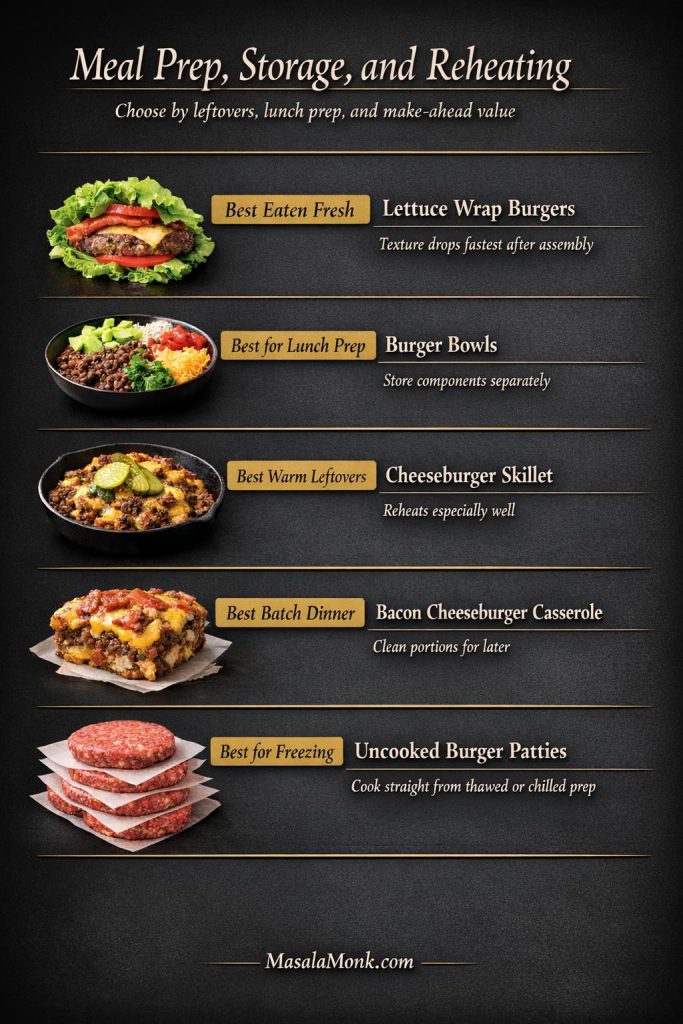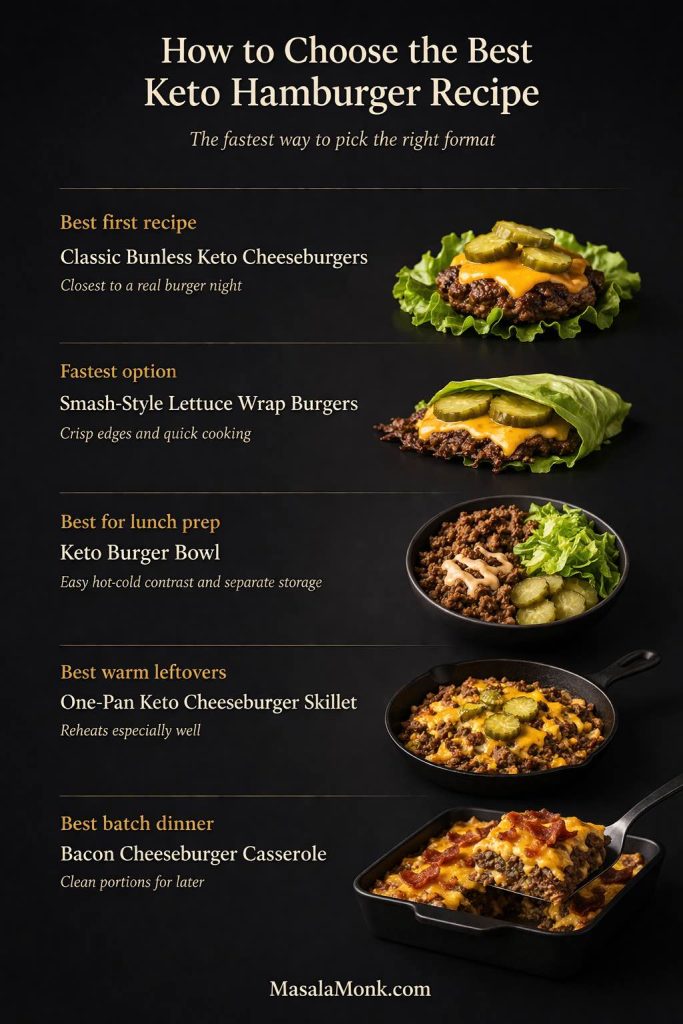
Posted on Leave a comment

Air Fryer Burgers Recipe: Juicy Hamburgers, Time & Temp

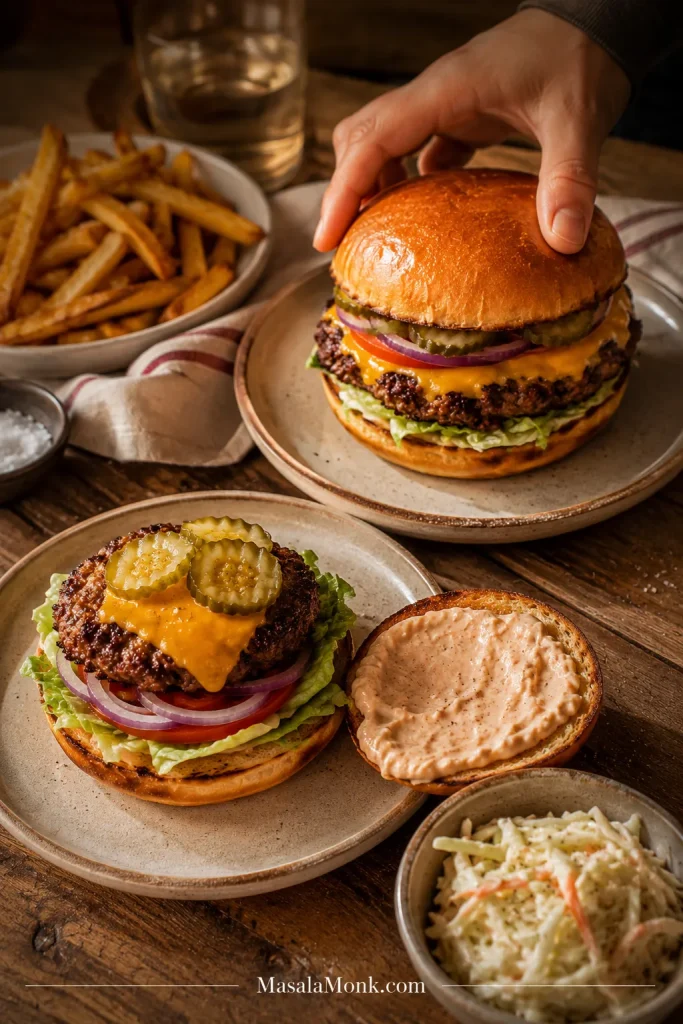
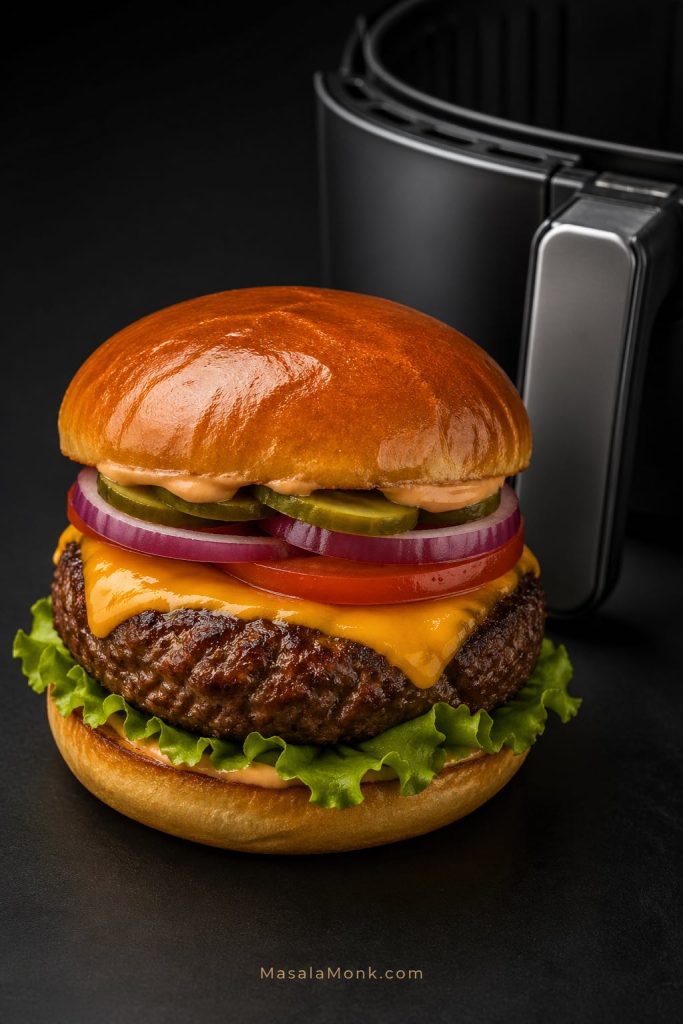
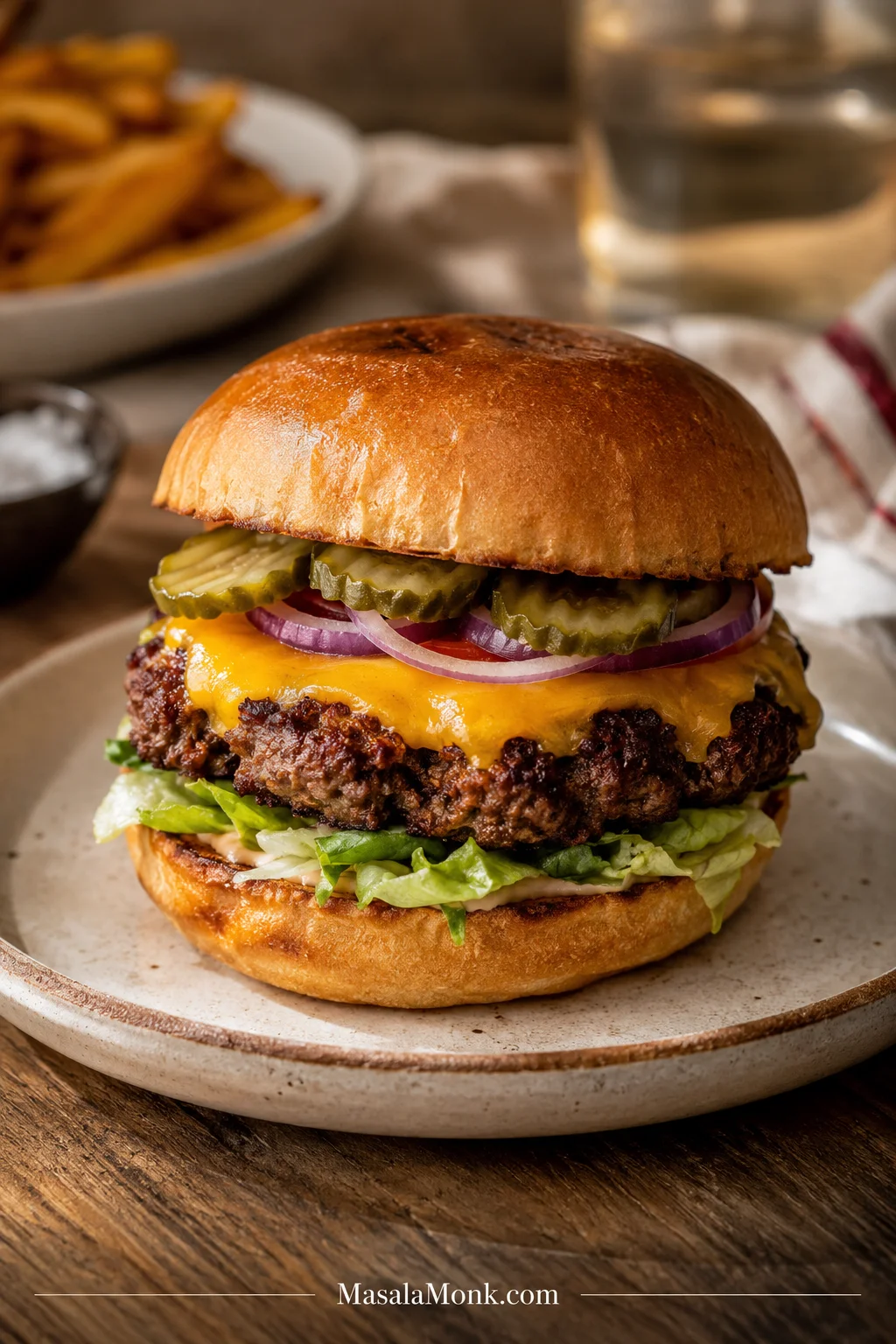
Juicy air fryer cheeseburger with melted cheddar, lettuce, tomato, red onion, pickles, and toasted bun on a dark surface, with an air fryer basket in the background.

A good air fryer burger recipe should give you juicy patties, clear timing, and a reliable way to know when the burgers are done. This guide to air fryer hamburgers starts with fresh ground beef patties, then covers thicker burgers, frozen patties, cheeseburgers, toasted buns, smoke prevention, toppings, storage, and a full recipe card with US and metric details.

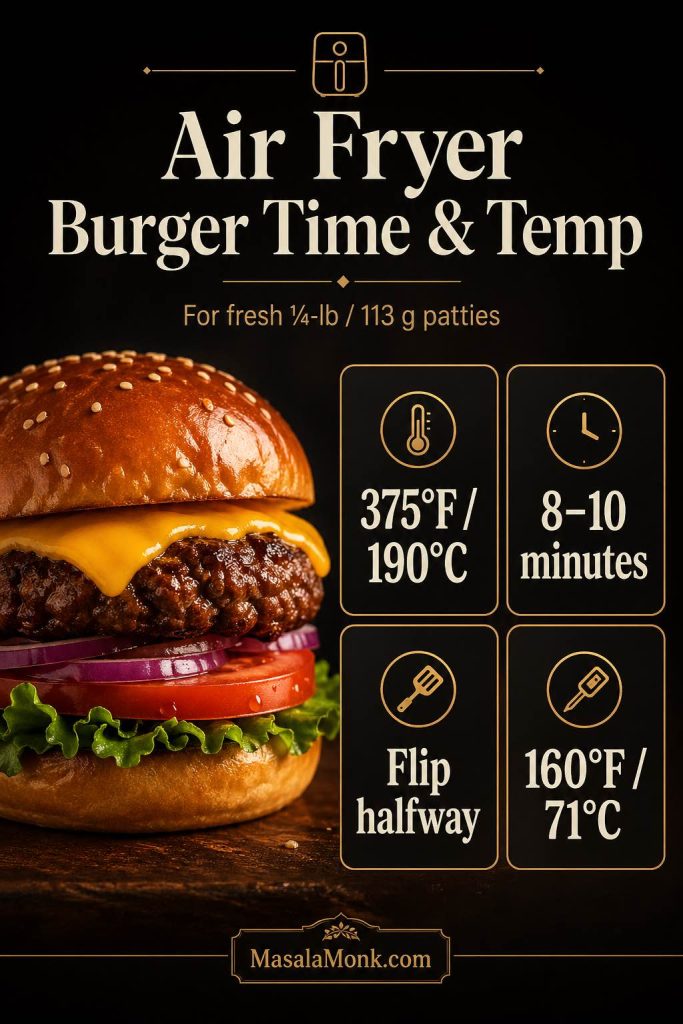
The best default is simple: cook fresh ¼-lb / 113 g hamburger patties at 375°F / 190°C for 8–10 minutes, flipping halfway, until the center reaches 160°F / 71°C. From there, adjust by thickness, starting temperature, and air fryer model instead of relying on one fixed minute for every burger.

For a bunless version, the same patties can become lettuce-wrap burgers, burger bowls, or low-carb cheeseburger plates. For more ideas in that direction, see these keto hamburger recipes.

How Long to Cook Hamburgers in the Air Fryer

Best default: Use 1 lb / 454 g ground beef for 4 patties. Shape each patty about 4 oz / 113 g and ½ inch / 1.25 cm thick. Air fry at 375°F / 190°C for 8–10 minutes, flipping halfway, until the center reaches 160°F / 71°C. Add cheese only at the end.

Air fryer burger timing guide showing 375°F or 190°C, 8 to 10 minutes, flipping halfway, and a 160°F center temperature for fresh quarter-pound patties.
For most fresh ¼-lb patties, 375°F for 8–10 minutes is the best starting point; the center temperature is what confirms the burger is done.

Start checking early the first time

If you are making these for the first time, start checking at 8 minutes rather than waiting for the full range to pass. That way, you learn how your air fryer handles your patties without overcooking the first batch.

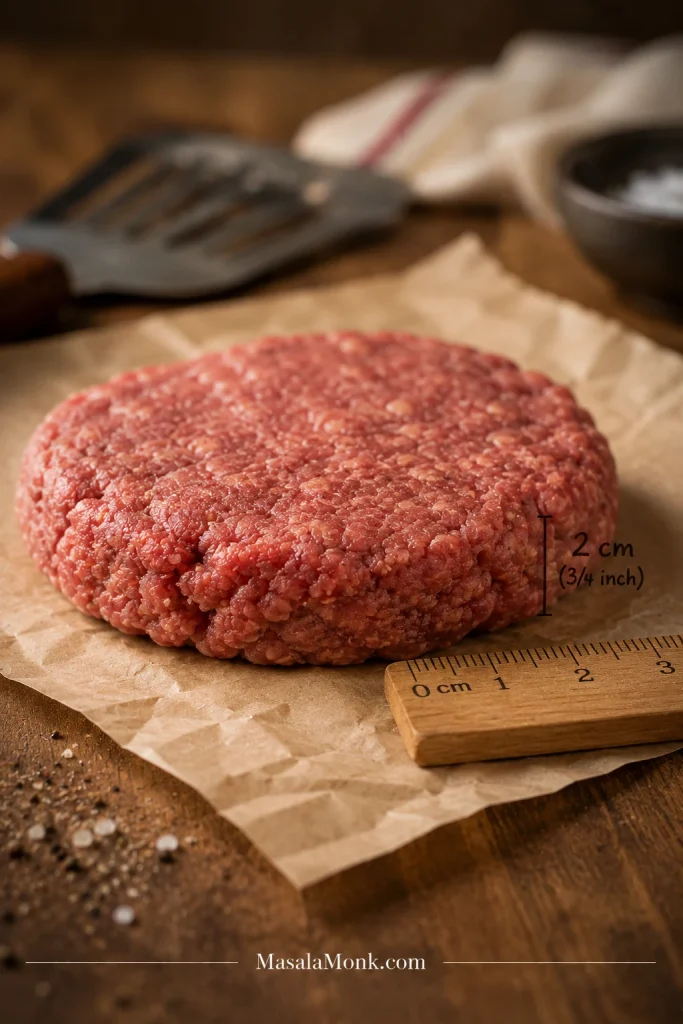
Put simply, the 8–10 minute range works best for patties that are about 4 oz / 113 g each and about ½ inch / 1.25 cm thick. Thinner patties may finish closer to 6–8 minutes, while thicker patties may need 10–12 minutes. Because air fryer baskets, patty thickness, and beef fat percentage all vary, the time range is only the starting point.

Use temperature, not color, to check doneness

For that reason, the thermometer matters more than the clock. Ground beef can look brown before it is safe, or stay slightly pink after it reaches temperature, so do not judge doneness by color alone.

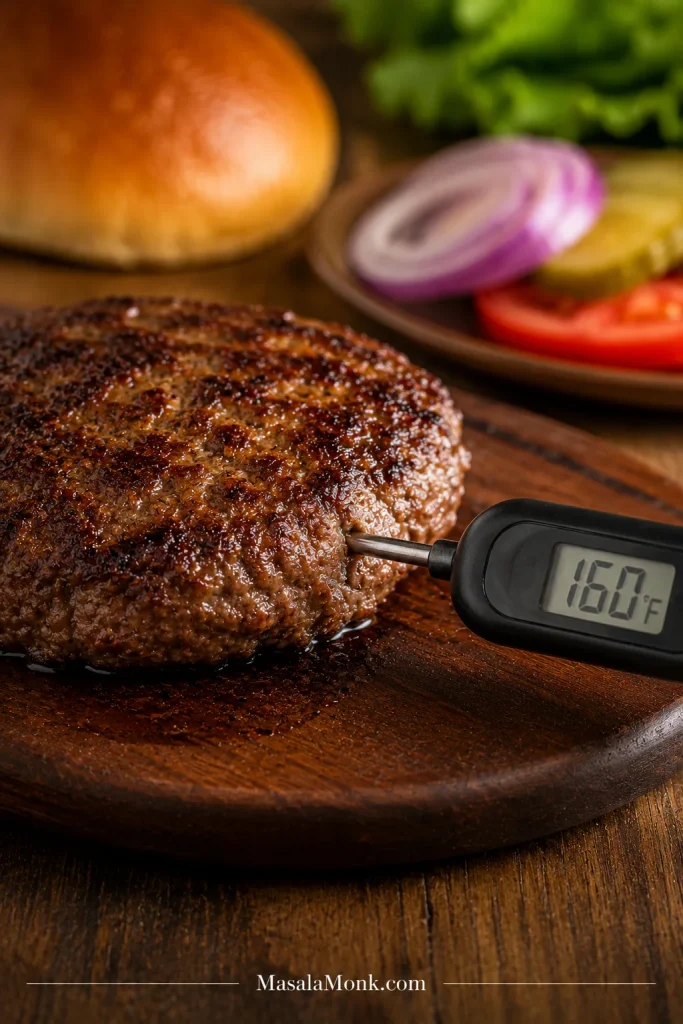
For the most accurate reading, insert the thermometer through the side of the patty so the tip reaches the center instead of stopping near the surface. That way, you are checking the part of the burger that takes the longest to cook.

Food safety note: Ground beef burgers should reach 160°F / 71°C in the center. FoodSafety.gov lists 160°F as the safe minimum internal temperature for ground meat, so a thermometer is the clearest way to avoid guessing. See the safe minimum internal temperature chart.

Why this air fryer method works

In practice, the air fryer is good at burgers because it cooks fast, drains extra fat, and keeps the process cleaner than a skillet. The tradeoff is that patties can dry out if they are too lean, too thin, or cooked too long. That is why thickness, beef choice, spacing, and internal temperature matter more than chasing one exact minute.

Air Fryer Burger Time and Temperature Chart

Best default temperature

For most fresh patties, 375°F / 190°C is the best first setting. It is hot enough to cook the burgers quickly and help the outside brown. However, it is not so aggressive that the edges dry out before the center is done.

If this is your first time making burgers in the air fryer, use the quarter-pounder row as your starting point. After that, adjust by thickness instead of changing everything at once.

Fresh burger time chart

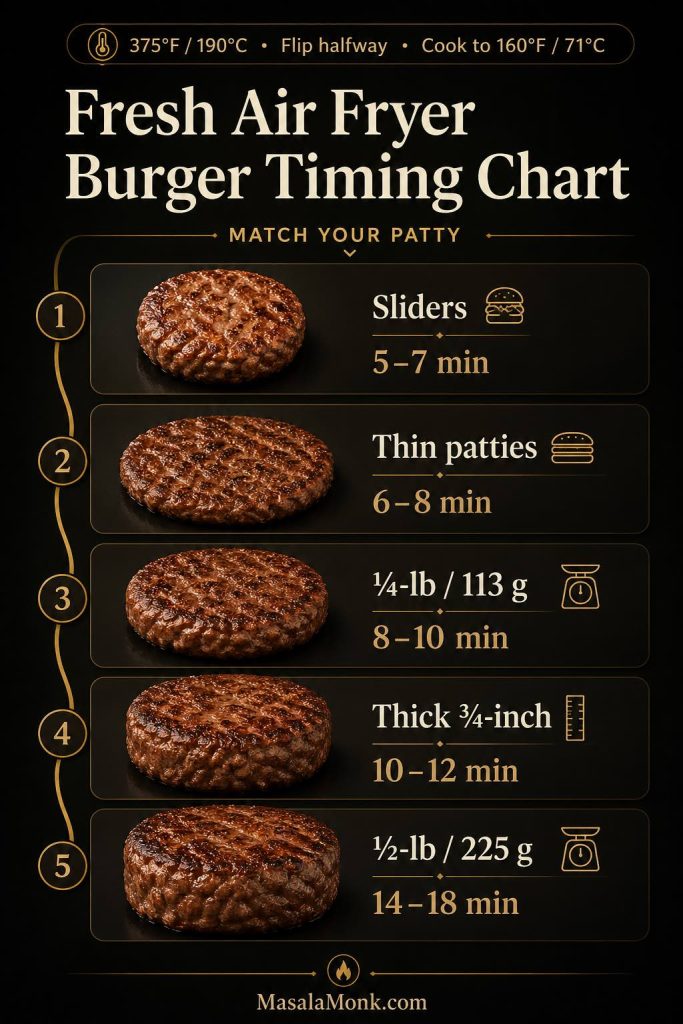
Because patty size changes the answer, start with the row that matches your burger instead of forcing every patty into the same time. Once you know how your air fryer handles one batch, adjust the next batch by 1–2 minutes rather than changing the temperature immediately.

Fresh air fryer burger timing chart comparing sliders, thin patties, quarter-pound patties, thicker three-quarter-inch patties, and half-pound patties with their cook times.
Fresh burger timing changes most with patty size and thickness, so match your patty to the closest size instead of using one fixed cook time for every batch.
Fresh burger type Air fryer temp Approx. time Flip? Internal temp
Fresh quarter-pounder / ¼-lb / 113 g patties, about ½ inch / 1.25 cm thick 375°F / 190°C 8–10 minutes Yes, halfway 160°F / 71°C
Fresh thicker patties, about ¾ inch / 2 cm thick 375°F / 190°C 10–12 minutes Yes 160°F / 71°C
Fresh ½-lb / 225 g thick patties 360–370°F / 182–188°C 14–18 minutes Yes 160°F / 71°C
Thin fresh patties 375°F / 190°C 6–8 minutes Yes 160°F / 71°C
Mini burgers or sliders 375°F / 190°C 5–7 minutes Yes 160°F / 71°C

Frozen Burger, 400°F, and Cheeseburger Timing

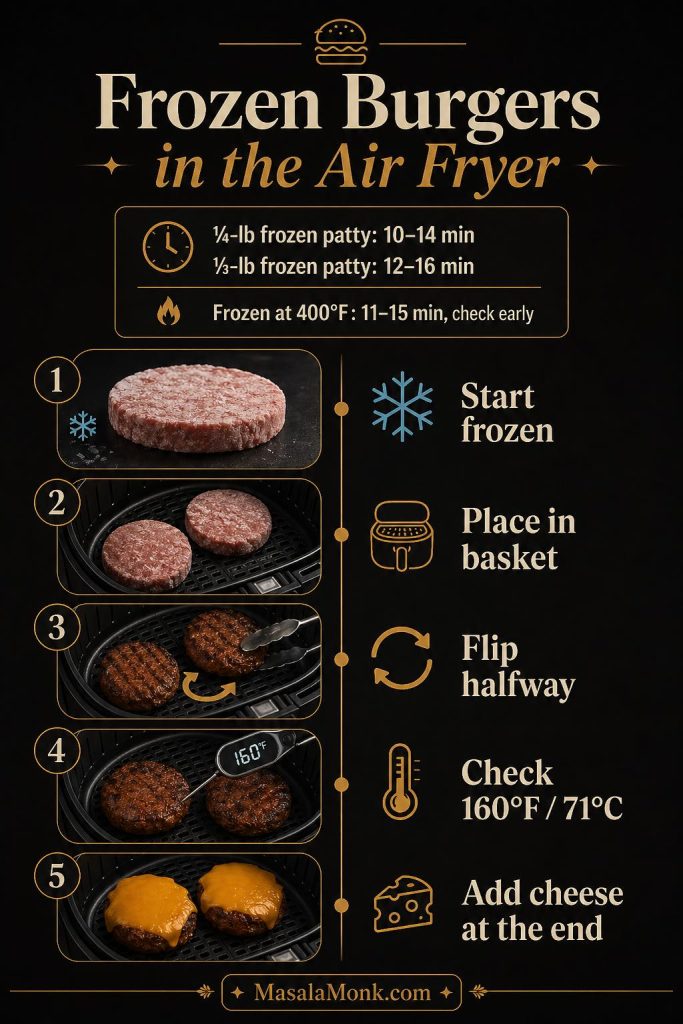
However, frozen burgers need a wider range because the center has to thaw before it can safely finish cooking. Before adding cheese to any burger, check the center first. Otherwise, the cheese may melt while the patty still needs more time.

Frozen air fryer burger guide showing timing for quarter-pound and third-pound patties, flipping halfway, checking for 160°F, and adding cheese at the end.
Frozen burgers need a wider timing range because the center has to thaw first; check the temperature before adding cheese.
Burger type Air fryer temp Approx. time Flip? Internal temp
Frozen ¼-lb / 113 g patties 360–375°F / 182–190°C 10–14 minutes Yes 160°F / 71°C
Frozen ⅓-lb / 150 g patties 360–375°F / 182–190°C 12–16 minutes Yes 160°F / 71°C
Thin fresh patties at 400°F / 200°C 400°F / 200°C 6–8 minutes Yes 160°F / 71°C
Frozen burgers at 400°F / 200°C 400°F / 200°C 11–15 minutes Yes 160°F / 71°C; check early because the outside may brown first
Cheeseburgers Same as burger Add cheese last 30–60 seconds 160°F / 71°C before cheese

Should you air fry burgers at 375°F or 400°F?

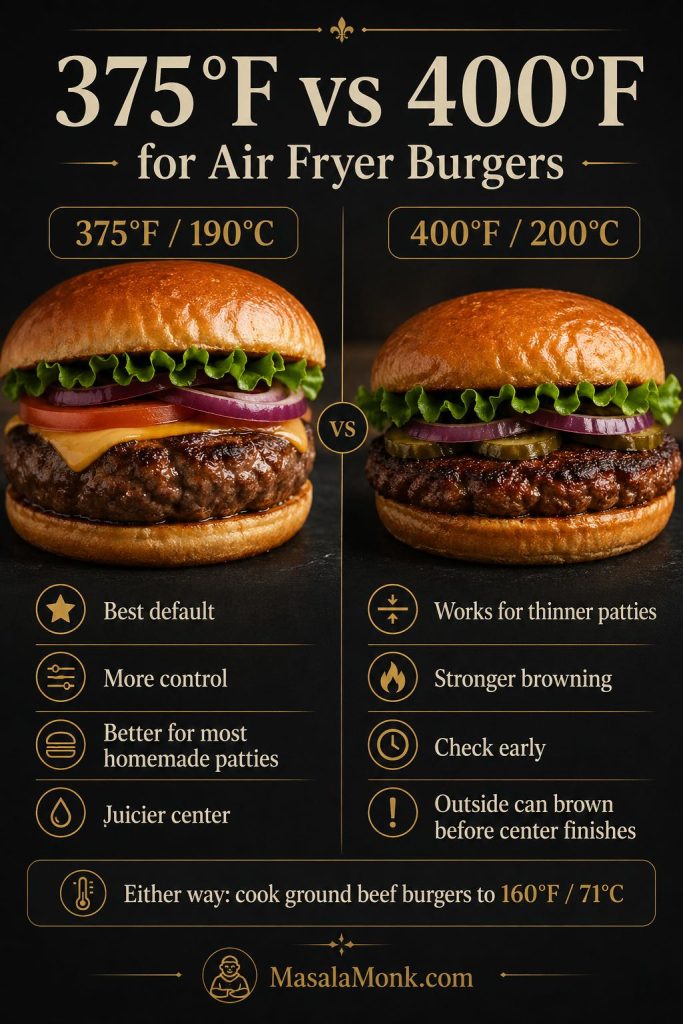
For most homemade patties, 375°F is the better first choice because it gives the center time to cook before the edges dry out. However, 400°F can work for thinner patties or for people who like a firmer browned outside. In that case, start checking early and use a thermometer, because the outside can look done before the center reaches 160°F.

Comparison chart for air fryer burgers showing 375°F as the best default for control and 400°F as an option for thinner patties with earlier checking.
Use 375°F as the most reliable starting point for homemade burgers, and treat 400°F as an option for thinner patties or stronger browning with an early temperature check.

In short, 375°F is the better beginner setting, while 400°F is an alternate for thinner patties or cooks who already know their air fryer runs evenly. That said, once you know how your air fryer behaves, you can fine-tune the temperature without guessing.

How to adjust the time

If your air fryer runs hot, start checking a minute early. On the other hand, if your patties are thick, cold, or crowded, they may need longer. In either case, do not press the burgers while they cook; pressing squeezes out the juices you are trying to keep.

If you are not sure which row fits your burger, choose the lower end of the time range first. Then check the center and add 1–2 minutes only if the patty has not reached 160°F / 71°C.

Back to table of contents ↑

Hamburger Patties in the Air Fryer

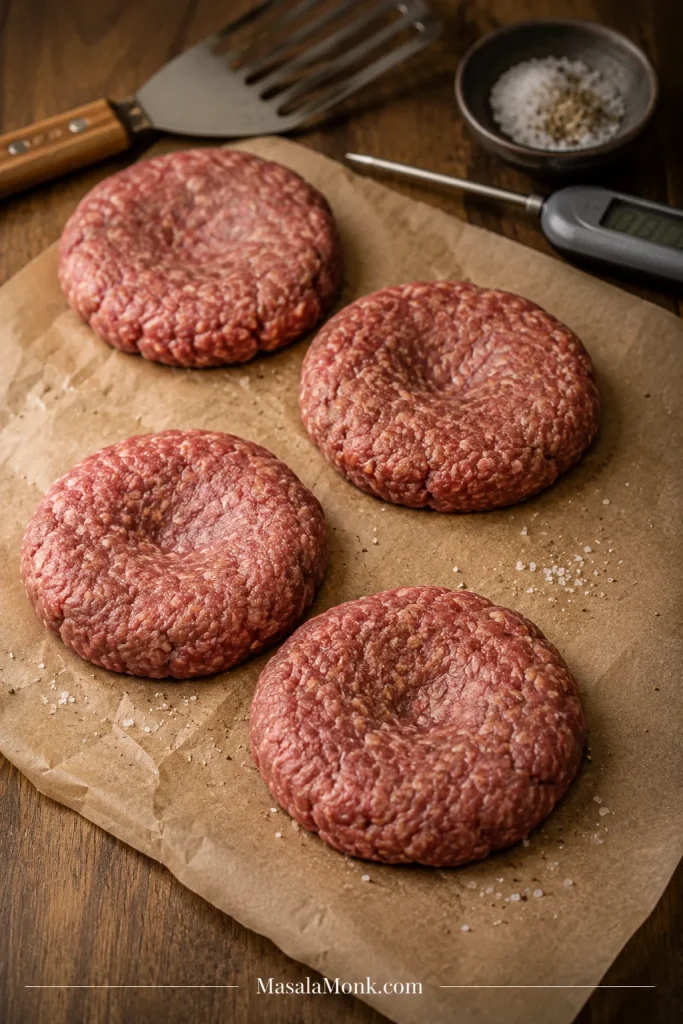
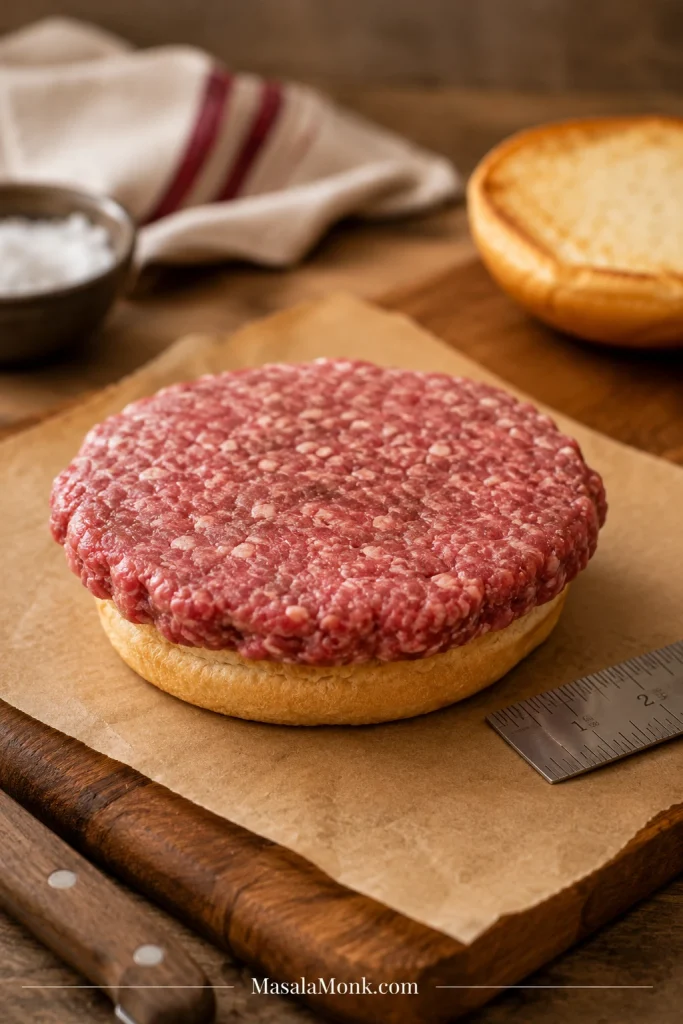
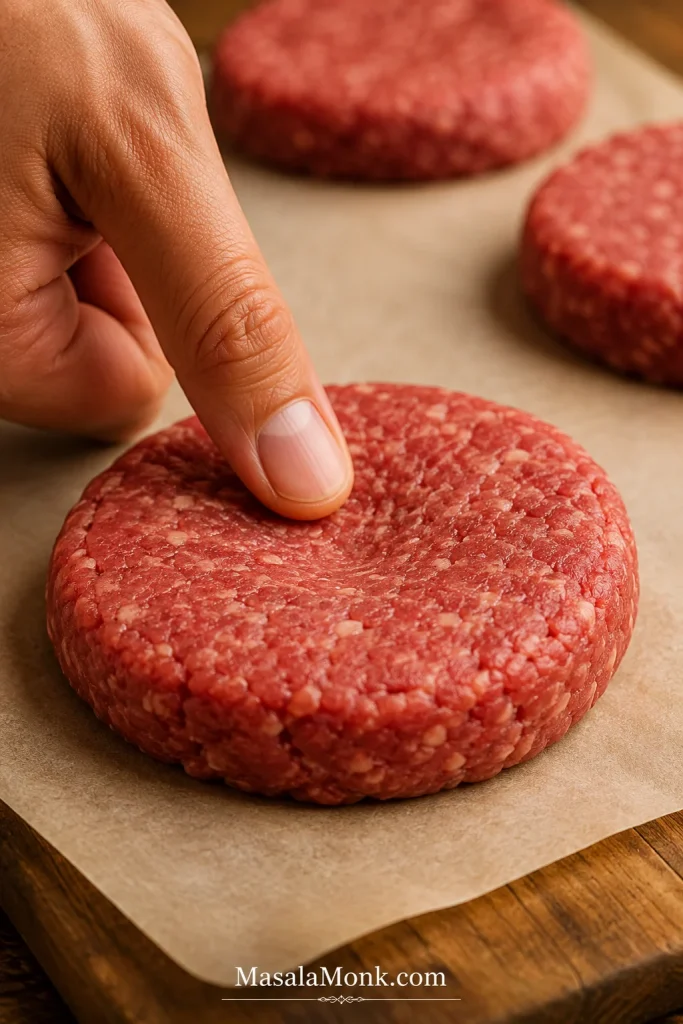
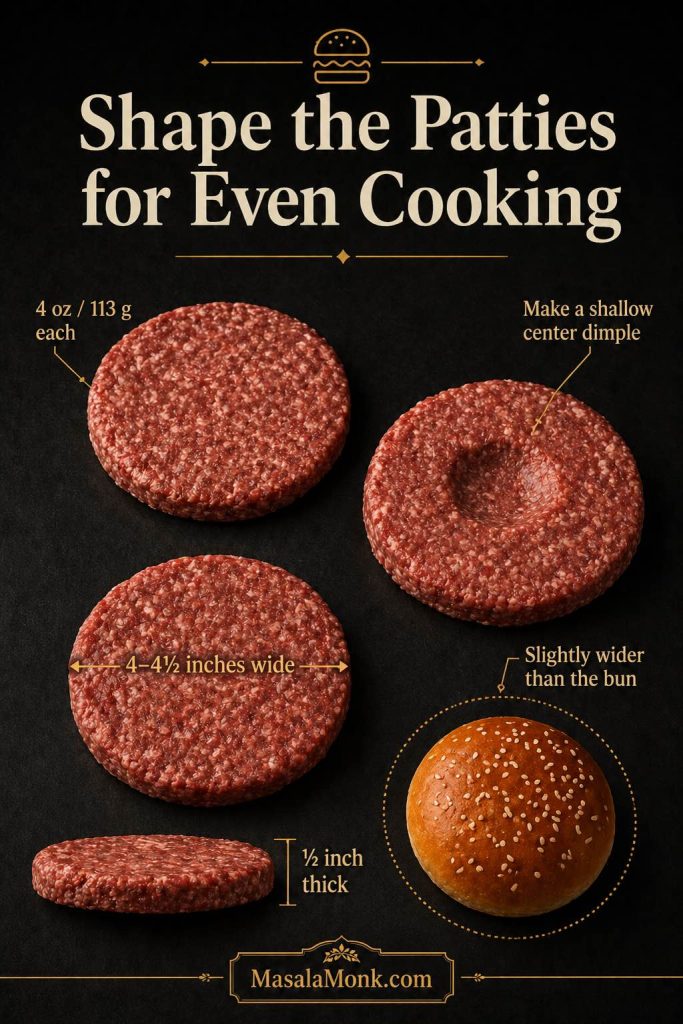
For your first batch, keep the patties simple: 1 lb / 454 g ground beef divided into 4 loose patties, about 4 oz / 113 g each. Shape each patty about 4–4½ inches / 10–11.5 cm wide and about ½ inch / 1.25 cm thick. That size cooks evenly, fits most air fryer baskets, and gives you a better chance of hitting 160°F without drying out the edges.

Raw air fryer burger patties showing 4-ounce portions, 4 to 4 and a half inch width, half-inch thickness, a shallow center dimple, and a bun size comparison.
Even patty size is what makes the timing chart work: aim for 4 oz patties that are about ½ inch thick, slightly wider than the bun, and gently dimpled in the center.

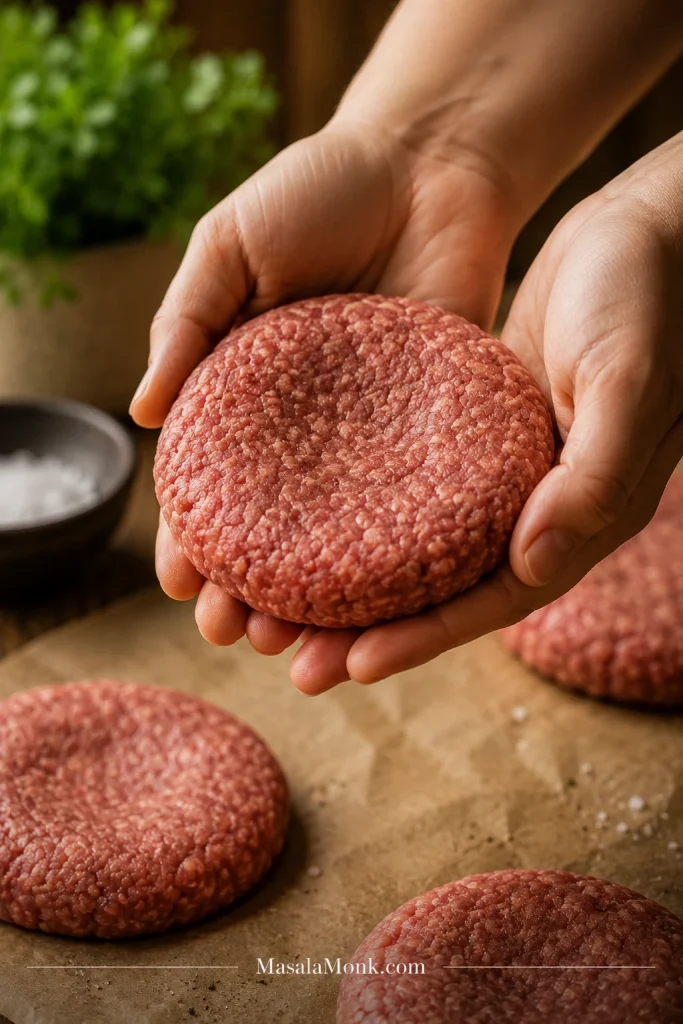
Because burgers shrink as they cook, shape each patty slightly wider than the bun. Then press a shallow dimple in the center so the patty stays flatter instead of puffing up into a dome.

When the patties are the same size, they finish at about the same time. Otherwise, the smaller patties can dry out while the thicker ones are still catching up.

If one patty is noticeably larger, place it where your air fryer runs hottest, or give it an extra minute after removing the smaller patties. That way, the thinner burgers do not dry out while the thickest one finishes.

This same method works for fresh beef patties, homemade burger patties, and plain hamburger patties from the butcher counter. However, the main adjustment is thickness: thin patties cook faster, while thick patties need more time to reach 160°F in the center.

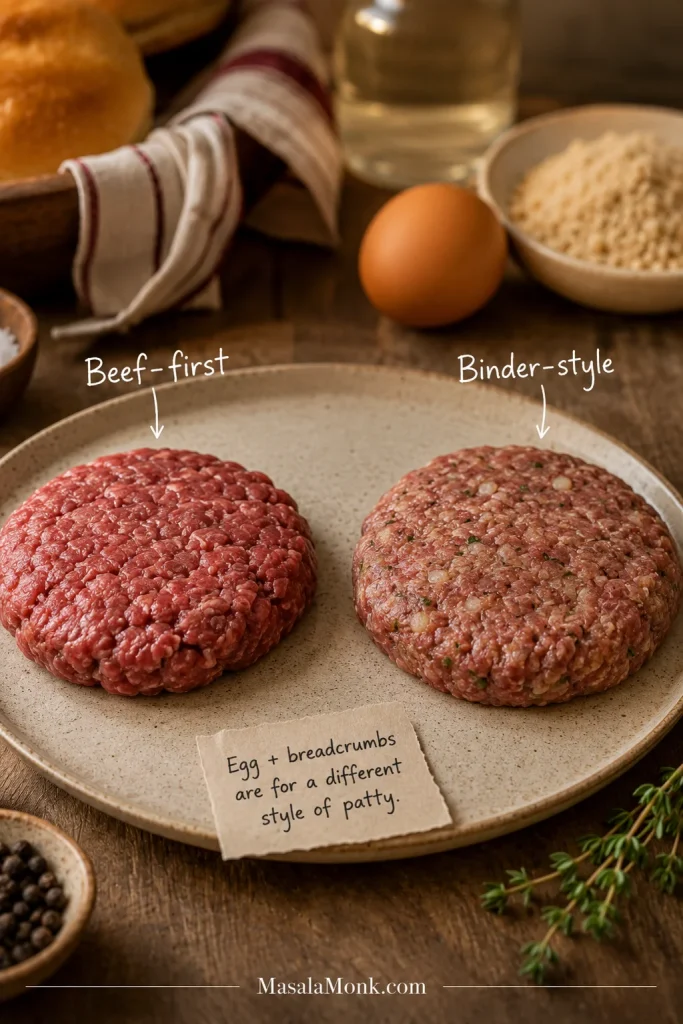
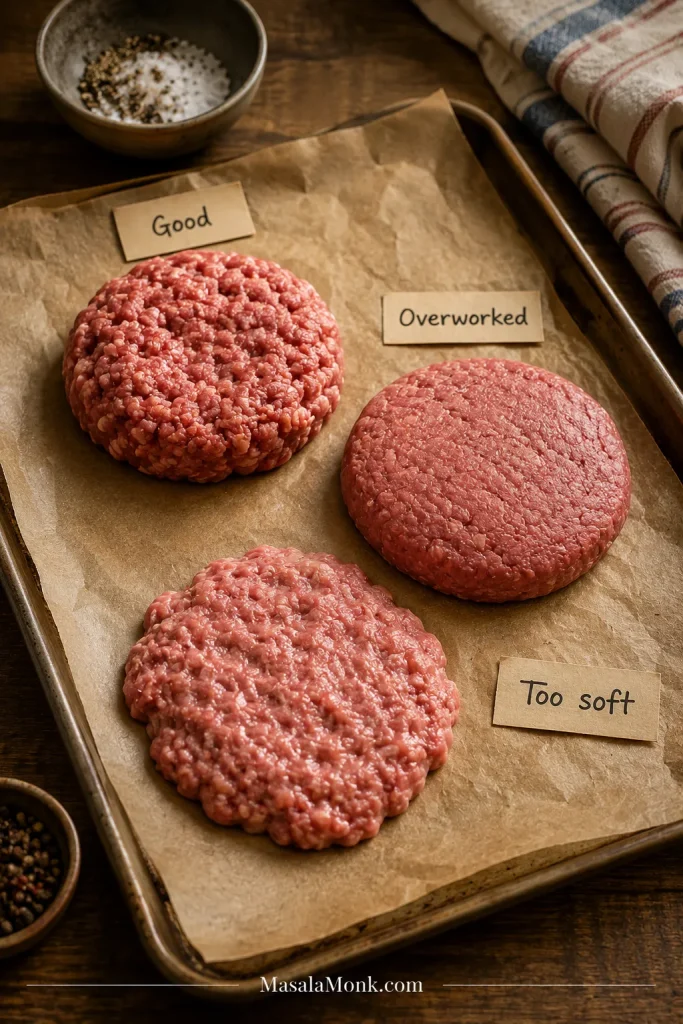
For best texture, avoid mixing the beef too much. Once ground beef is overworked, the cooked patty can turn dense and springy instead of tender and juicy.

Can you cook raw ground beef patties in the air fryer?

Yes. Raw ground beef patties can go straight into the air fryer as long as they are shaped evenly, cooked in a single layer, and checked for 160°F in the center. However, loose ground beef mixtures and very wet patties can cook unevenly, so formed patties work best.

Ingredients for Air Fryer Hamburgers

You only need a few ingredients for classic burgers. Since the cooking method is simple, the beef, seasoning, patty shape, and cheese timing matter more than a long ingredient list. In other words, better patties matter more than more ingredients.

Since the ingredient list is short, each choice matters. The beef controls juiciness, the salt controls flavor, and the patty shape controls how evenly the burger cooks.

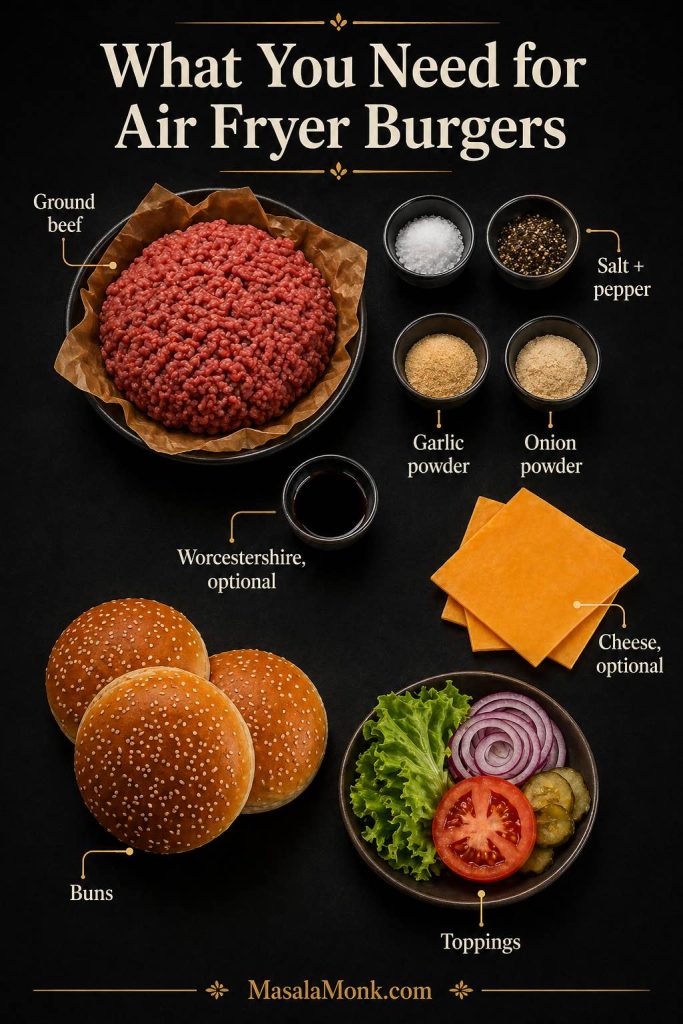
Air fryer burger ingredients including ground beef, salt, black pepper, garlic powder, onion powder, Worcestershire sauce, cheese slices, burger buns, lettuce, tomato, onion, and pickles.
The ingredient list stays simple because the success of air fryer burgers comes from good beef, even patties, enough seasoning, and adding cheese only at the end.

Ground beef

Use 1 lb / 454 g ground beef for 4 regular burgers. For the juiciest result, choose 80/20 ground beef. For a slightly leaner patty with less smoke, 85/15 is a good middle ground.

Seasoning

A simple mix of salt, black pepper, garlic powder, and onion powder is enough. If the beef is good and the patties are shaped well, the seasoning should support the burger rather than cover it up. Since kosher salt brands vary, start with a little less if you are using fine table salt. Worcestershire sauce or steak sauce is optional, but a small amount adds savory depth without turning the burger into meatloaf.

Cheese

American cheese melts the easiest. Cheddar, pepper jack, Swiss, provolone, and mozzarella also work, but thicker slices may need the full final minute to soften. Because the air fryer fan is strong, add cheese only at the end so it does not slide off, burn, or blow around inside the basket.

Buns and toppings

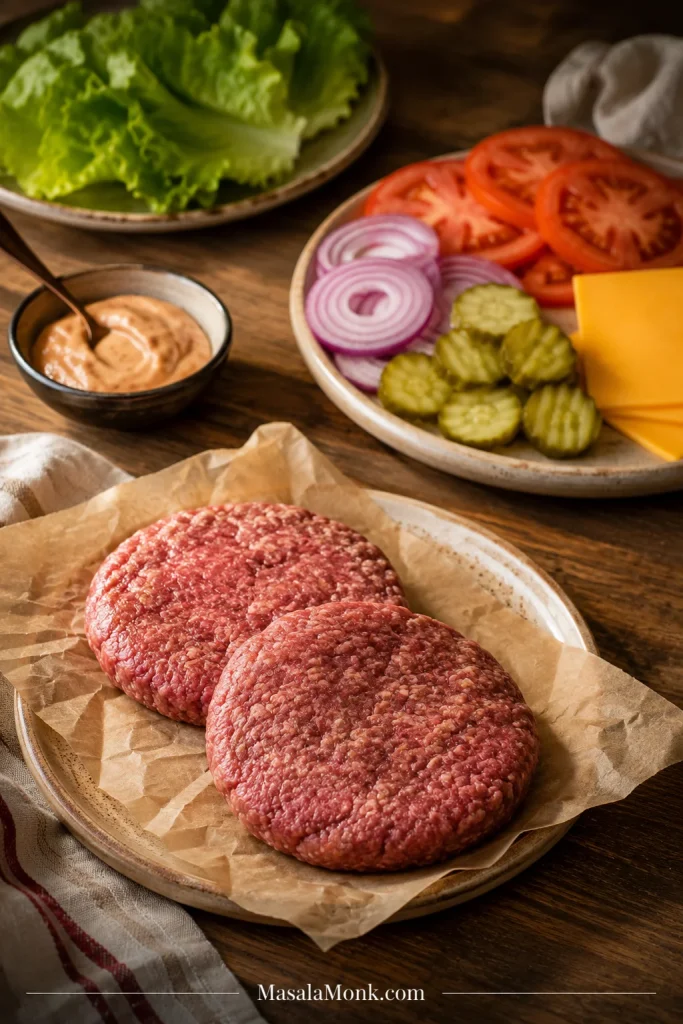
Use burger buns, brioche buns, potato buns, lettuce wraps, or bowls. Classic toppings include lettuce, tomato, onion, pickles, mustard, ketchup, and a creamy burger sauce. For a homemade creamy base, use this homemade mayonnaise recipe and turn it into burger sauce with ketchup, mustard, pickle juice, and a little seasoning.

Do you need oil, parchment, or foil?

Fresh 80/20 or 85/15 patties usually do not need oil because the beef has enough fat. However, if you are using very lean fresh patties or dry-surfaced frozen patties, a light oil spray can help browning.

If you use parchment, choose perforated parchment made for air fryers and never block airflow under the patties. Likewise, use foil only if your air fryer manual allows it. Otherwise, trapped grease and blocked airflow can slow cooking, create smoke, and make the burgers cook unevenly.

In short, airflow matters more than lining the basket. If a liner blocks the holes or traps grease under the patties, skip it.

Best Ground Beef for Air Fryer Burgers

If juiciness matters most, start with 80/20. If your air fryer smokes easily or you prefer a slightly lighter burger, 85/15 is the safer everyday choice. Very lean beef can work, but it needs more care because it dries out faster.

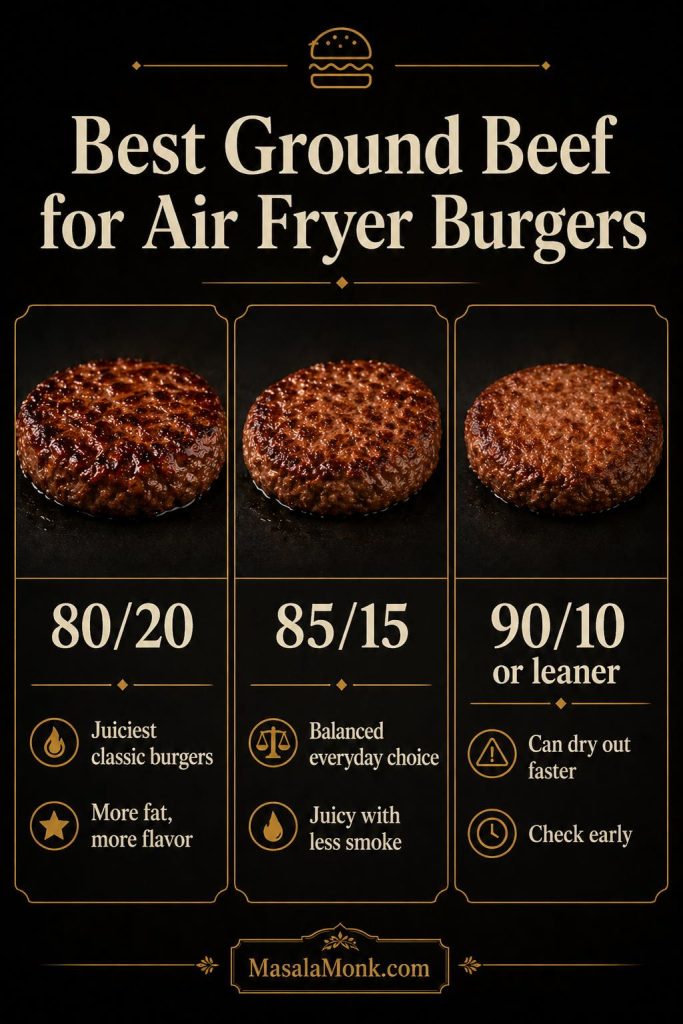
Best ground beef guide for air fryer burgers comparing 80/20 beef for juicy burgers, 85/15 beef for balanced burgers, and 90/10 or leaner beef that can dry out faster.
For the juiciest air fryer burgers, 80/20 is the most forgiving, while 85/15 is a good everyday choice when you want less smoke without losing too much moisture.
Ground beef Best for What to know
80/20 Juiciest classic burgers Rich, flavorful, and forgiving, but it can drip more fat and create more smoke in some air fryers.
85/15 Balanced everyday burgers Still juicy, usually less smoky, and a good choice for indoor air fryer cooking.
90/10 or leaner Leaner burgers Can dry out faster. Add moisture and check the temperature early.

As a result, 80/20 or 85/15 is the most reliable choice for a first batch. Shape the patties gently, keep them even in thickness, and add a center dimple so they do not puff into domes as they cook.

If you are using very lean beef, add a little moisture with Worcestershire sauce, grated onion, mustard, or a small amount of oil. Then start checking early, because lean patties can move from done to dry quickly.

For a thinner burger with a harder griddled crust instead of a thicker air fryer patty, try this classic smash burger method.

How to Make Air Fryer Hamburgers

This method is for fresh ground beef patties. Once the patties are shaped, the rest is mostly about spacing, flipping, and checking the center. After that, assembly is quick because the burgers only need a short rest.

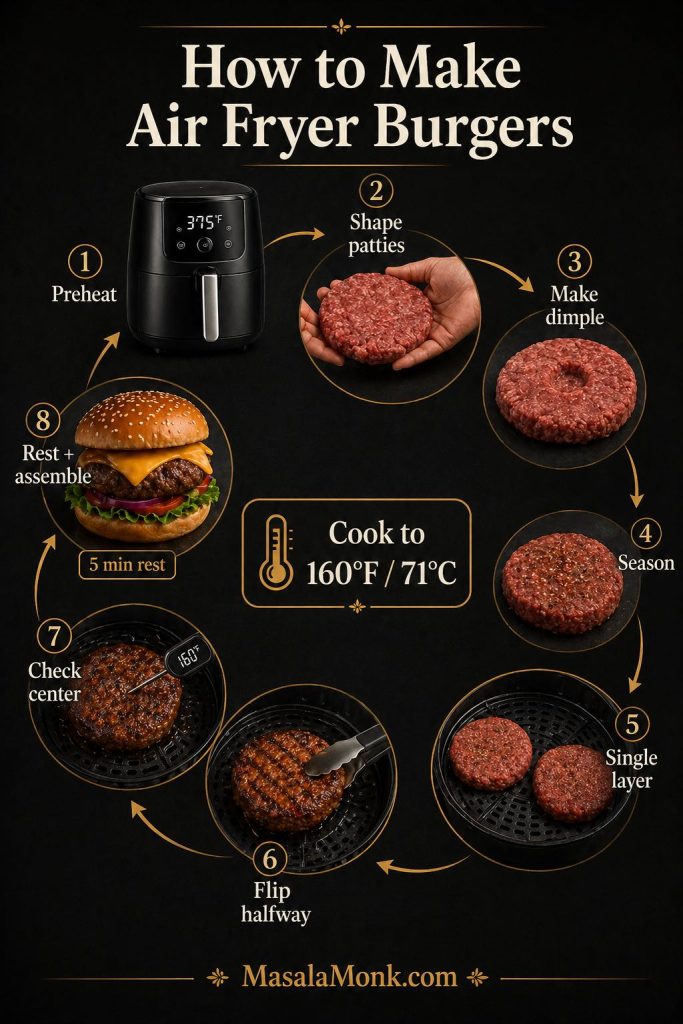
Step-by-step air fryer burger guide showing preheating, shaping patties, making a dimple, seasoning, cooking in one layer, flipping halfway, checking the center, and resting before assembly.
The method is simple once the order is clear: shape the patties evenly, cook them in one layer, flip halfway, check the center, then rest and assemble.

1. Preheat the air fryer

Preheat the air fryer to 375°F / 190°C for about 3 minutes. Although some models heat quickly, preheating helps the patties start cooking evenly.

If you skip preheating, add 1–2 minutes and start checking at the low end of the range. Once you know your air fryer, the timing becomes easier to repeat.

2. Shape the patties gently

Divide 1 lb / 454 g ground beef into 4 loose portions, about 4 oz / 113 g each. Then shape each portion into a patty about 4–4½ inches / 10–11.5 cm wide and ½ inch / 1.25 cm thick. Because the patties shrink as they cook, starting a little wider helps them fit the bun better later.

3. Make a center dimple

Press a shallow dimple into the center of each patty with your thumb or the back of a spoon. This small step helps the burgers stay flatter instead of puffing up in the middle.

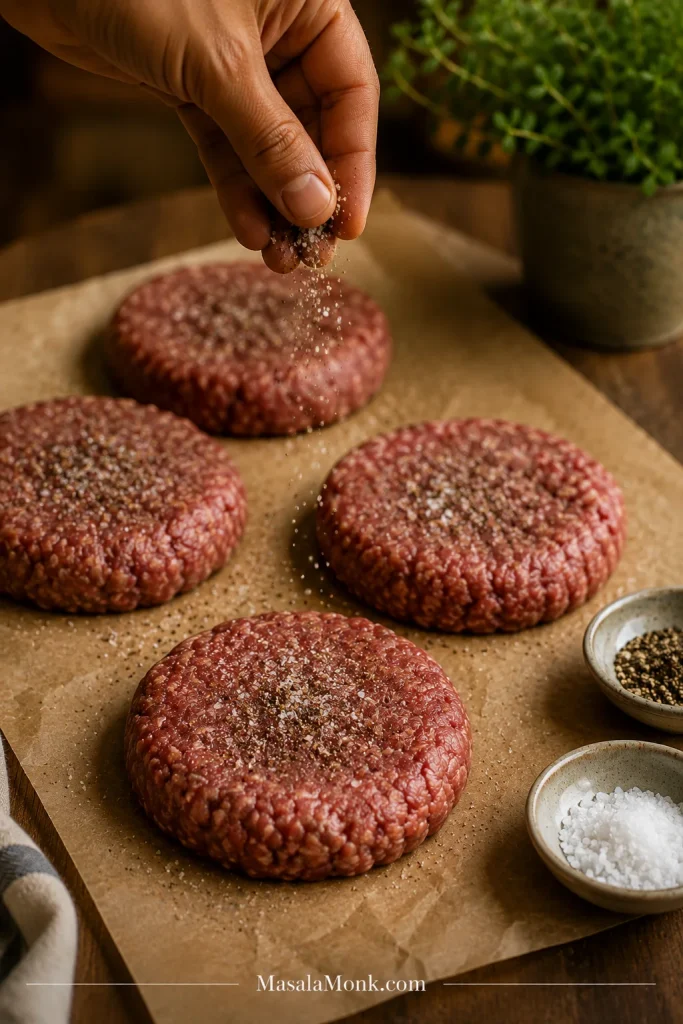
4. Season both sides

Season the outside of the patties with salt, pepper, garlic powder, and onion powder. If using Worcestershire sauce, mix it in lightly before shaping, or brush a tiny amount over the patties before seasoning.

5. Air fry in a single layer

Place the patties in the basket in a single layer. Then leave space between them so hot air can move around each burger. Do not stack patties, and do not crowd the basket.

If all 4 patties do not fit with space between them, cook in batches. Otherwise, the burgers may steam instead of brown. Later batches may cook slightly faster because the air fryer is already fully hot.

6. Flip halfway

Air fry for 8–10 minutes total, flipping halfway through. Even if your model usually cooks without flipping, turning the patties makes the result more reliable across different basket styles.

7. Check the center

Check the thickest part of each patty. The burgers are done when the center reaches 160°F / 71°C. For the cleanest reading, insert the thermometer from the side so the tip lands in the center of the patty.

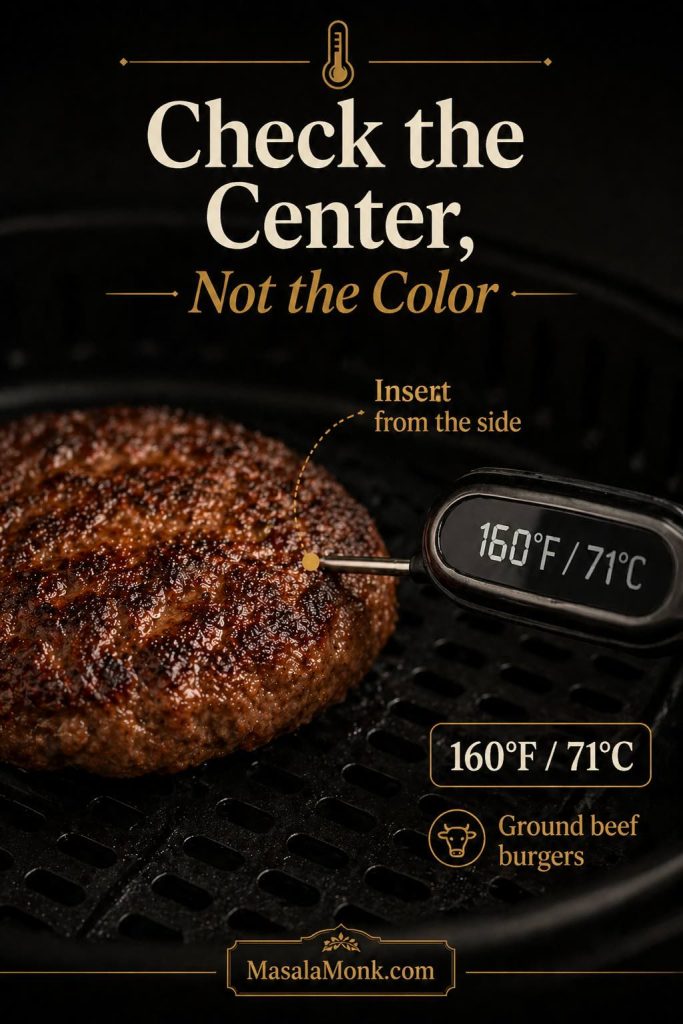
Digital thermometer inserted from the side into an air fryer burger patty showing 160°F and 71°C as the internal temperature for ground beef burgers.
Color is not a reliable doneness check for ground beef, so insert the thermometer from the side and make sure the center of the patty reaches 160°F.

If one patty is thicker than the others, it may need an extra minute or two. In that case, remove the finished patties and let the thicker one continue cooking until it reaches temperature.

8. Rest and assemble

Let the patties rest for about 2 minutes before assembling. Meanwhile, toast the buns, slice the toppings, or stir together a quick sauce.

Can you toast burger buns in the air fryer?

Yes. After the patties come out, place the buns cut-side up in the basket and air fry at 350–375°F / 175–190°C for 1–2 minutes. Watch closely because buns go from toasted to dry quickly.

How to Make Air Fryer Cheeseburgers

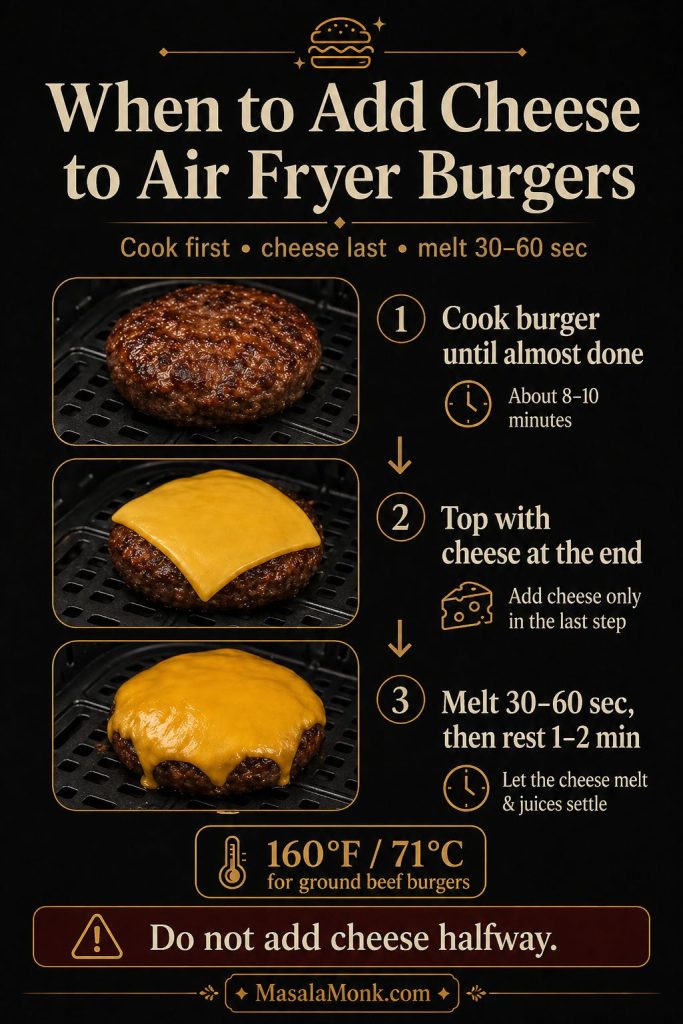
To make cheeseburgers, cook the patties first, then add cheese at the very end. The easiest method is to place a slice of cheese on each cooked patty during the final 30–60 seconds of cooking.

Air fryer cheeseburger guide showing cheese added at the end of cooking, melted cheese on the patty, and a reminder not to add cheese halfway.
Add cheese only after the burger is almost done; the final 30–60 seconds or residual basket heat is usually enough to melt it without making a mess.

Instead of running the fan longer just to melt cheese, you can also use the heat that is already trapped in the basket. Turn the air fryer off, place cheese on the hot patties, close the basket, and let the residual heat melt the cheese for about 1 minute.

If your cheese slides, folds, or blows off, do not fight the fan. Instead, melt the cheese with leftover heat after cooking. That way, the cheese softens over the patty instead of ending up on the basket.

Do not add cheese halfway through cooking. It can melt off the burger, stick to the basket, burn at the edges, or blow around inside the air fryer.

Frozen Burgers in the Air Fryer

Frozen patties are perfect for nights when nothing was thawed. They can go straight from freezer to basket; however, they need a little more patience because the center has to thaw before it can safely finish cooking.

That is why frozen burgers usually need a lower-to-moderate temperature and a wider time range than fresh patties. In practice, smaller ¼-lb / 113 g patties finish sooner, while thicker ⅓-lb / 150 g patties need the longer end of the range.

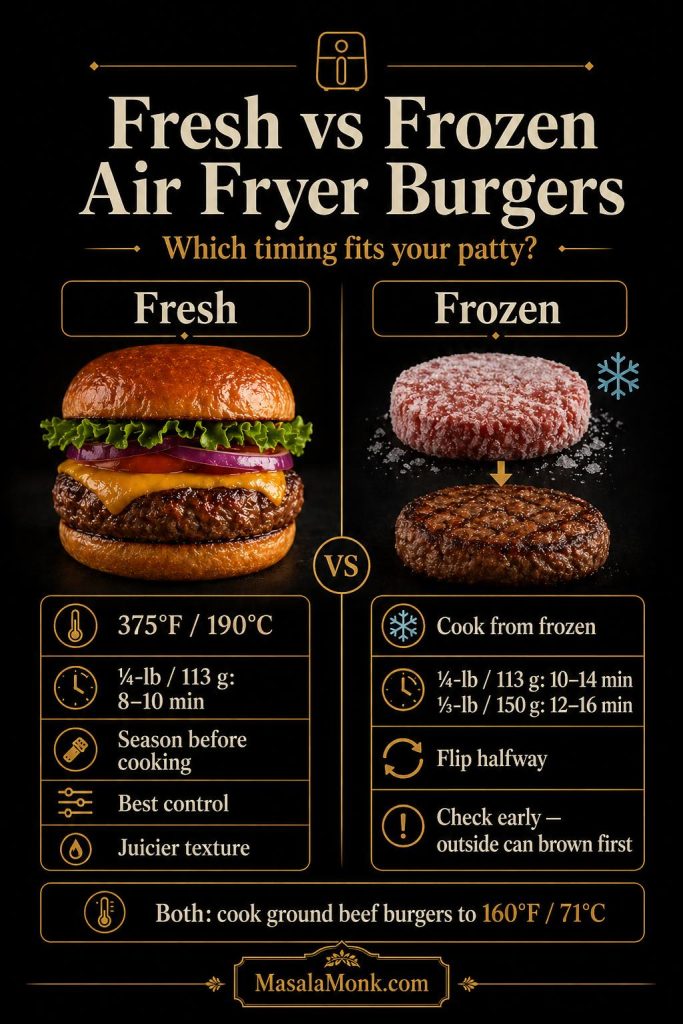
Fresh versus frozen air fryer burger guide comparing fresh patties cooked at 375°F with frozen patties cooked from frozen, including cook times, flipping, and 160°F internal temperature.
Fresh patties give you the most control, while frozen patties need extra time because the center must thaw before the burger can safely finish cooking.

How to air fry frozen burger patties

  1. Preheat the air fryer to 360–375°F / 182–190°C.
  2. Place frozen patties in a single layer.
  3. Air fry for 10–16 minutes, depending on patty size and thickness.
  4. Flip halfway through.
  5. Season after the surface warms slightly if seasoning will not stick at the beginning.
  6. Cook until the center reaches 160°F / 71°C.
  7. Add cheese during the final 30–60 seconds if making cheeseburgers.

For exact ranges by patty size, use the frozen burger timing chart above. Before adding cheese to frozen burgers, check the center first. Otherwise, the cheese may look melted while the patty still needs more time inside.

What about Bubba-style frozen burgers?

Bubba-style frozen burgers can go straight from freezer to air fryer. However, they are often thick and fatty, so they may need the longer end of the timing range. Start at 360–375°F, flip halfway, and check for 160°F in the center.

If you cook frozen burgers at 400°F / 200°C, start checking early. The outside can brown before the center is fully done, especially with thicker frozen patties. In that case, a thermometer prevents the most common mistake: serving a burger that looks done outside but is not finished inside.

Back to table of contents ↑

Ninja Foodi, Air Fryer Oven and Basket Air Fryer Notes

The basic method is the same in most basket-style air fryers: cook fresh ¼-lb / 113 g patties at 375°F / 190°C, flip halfway, and check for 160°F / 71°C in the center. However, stronger models, smaller baskets, dual-zone air fryers, and air fryer ovens can change the timing by a minute or two.

Likewise, air fryer ovens may need slightly longer because the cooking space is larger than a compact basket. That means the best approach is to use the chart first, then adjust the next batch based on your specific model.

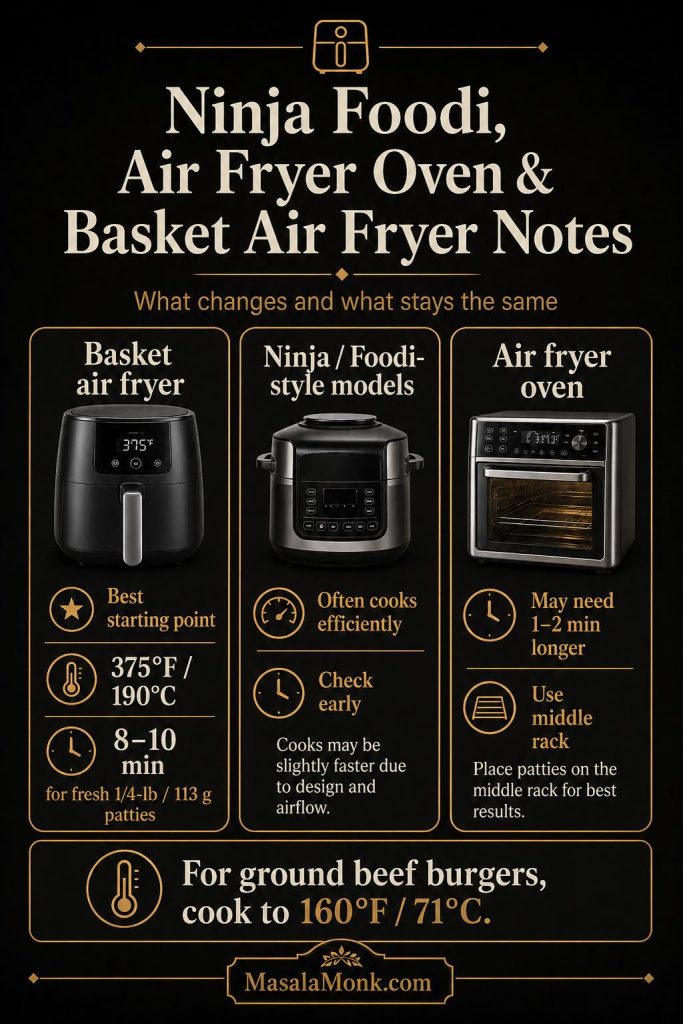
Air fryer model notes for burgers comparing basket air fryers, Ninja Foodi style models, and air fryer ovens with timing adjustments and 160°F internal temperature guidance.
Use the timing chart as your starting point, then adjust by model: stronger basket air fryers may finish sooner, while air fryer ovens can need a minute or two longer.
Air fryer type What to adjust Best starting point
Ninja air fryer or Ninja Foodi air crisp These can cook efficiently, so check early. 375°F / 190°C, 8 minutes, then check the center.
Ninja Foodi Grill Air crisp and grill mode behave differently. Use air crisp for this method; follow grill-plate timing if using grill mode.
Cosori, Instant Vortex, Gourmia, PowerXL, and similar basket air fryers Basket size and airflow vary. Use the chart first, then adjust by 1–2 minutes after your first batch.
Air fryer oven or toaster oven air fryer The larger cavity may cook slightly slower. Use the middle rack, flip halfway, and check the center early.

Back to table of contents ↑

How to Keep Air Fryer Burgers Juicy

These burgers stay juicy when the beef has enough fat, the patties are handled gently, and the cooking time does not run too long. As a result, a few small details make the difference between a tender burger and a dry one.

  • Use 80/20 or 85/15 beef. A little fat keeps the burger tender.
  • Do not overmix. Handle the meat gently and stop once the patties hold together.
  • Make even patties. Uneven patties cook unevenly.
  • Add a center dimple. This helps prevent puffing.
  • Do not press the burgers. Pressing forces juices out.
  • Flip once. It improves even cooking without overhandling.
  • Check temperature early. Start checking at the low end of the timing range.
  • Rest briefly. Two minutes is enough for most burgers.

In other words, juicy burgers come from control, not extra steps. Once the patties are shaped well and cooked to temperature, the air fryer does most of the work.

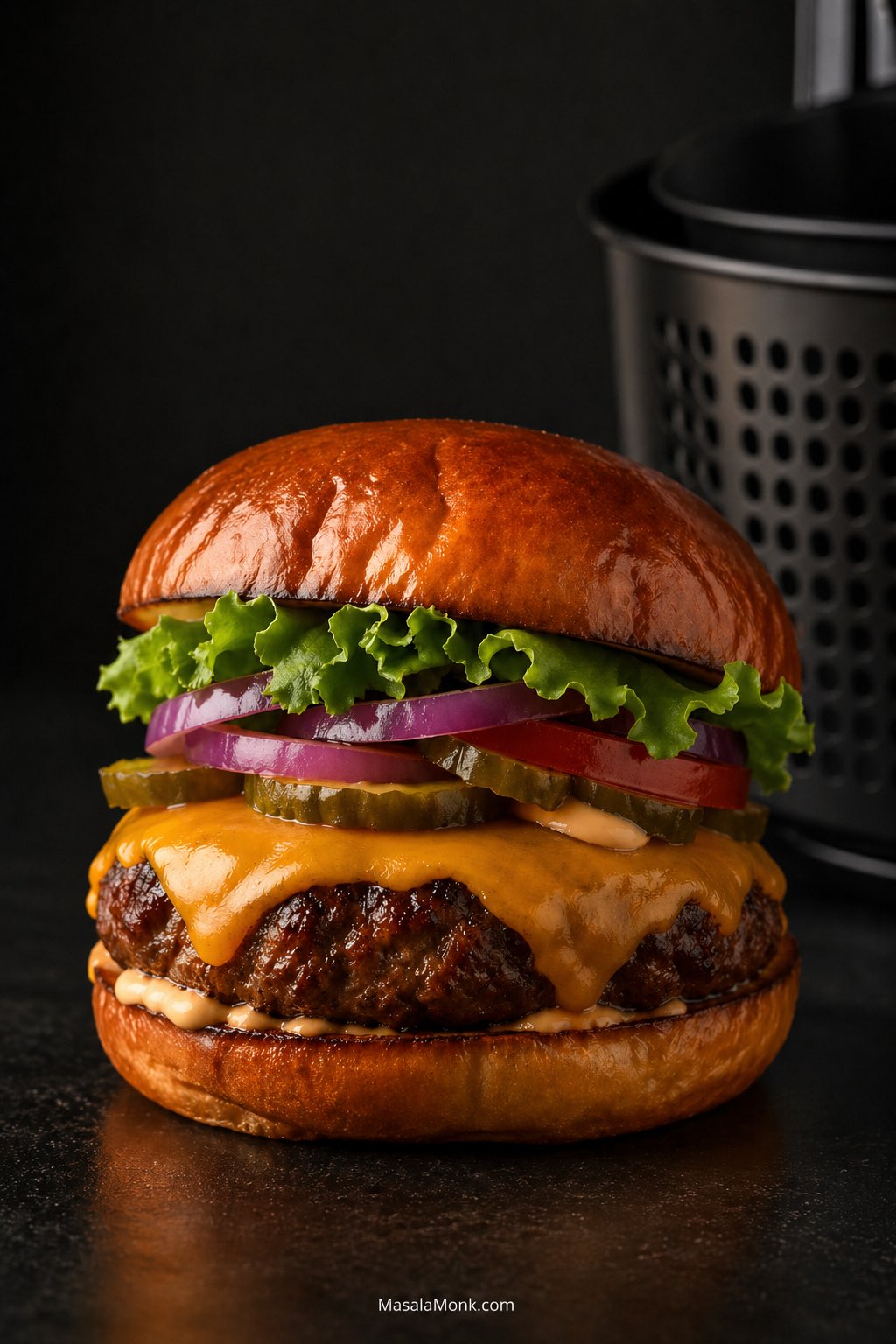
Finished air fryer cheeseburger with melted cheese, toasted bun, lettuce, tomato, onion, and pickles, shown with an air fryer basket in the background.
A juicy air fryer burger comes from control, not extra steps: shape the patty evenly, avoid overcooking, and stop once the center reaches temperature.

When using lean beef, add a little moisture with Worcestershire sauce, grated onion, mustard, or a small amount of oil. Also, check the temperature earlier because lean patties move from done to dry quickly.

The goal is a patty with browned edges, melted cheese, and a tender center — not a dry puck that only tastes like seasoning. So, once the burger reaches temperature, stop cooking and let it rest.

Troubleshooting Air Fryer Hamburgers

If the burgers turn out dry, smoky, uneven, or messy, do not change everything at once. In most cases, one small adjustment fixes the next batch: use slightly fattier beef, make the patties thinner, clean the basket, or add cheese later.

What not to do when air frying burgers

Before changing the recipe, check the most common mistakes first. These are the small things that usually cause dry burgers, uneven cooking, smoking, or messy cheese.

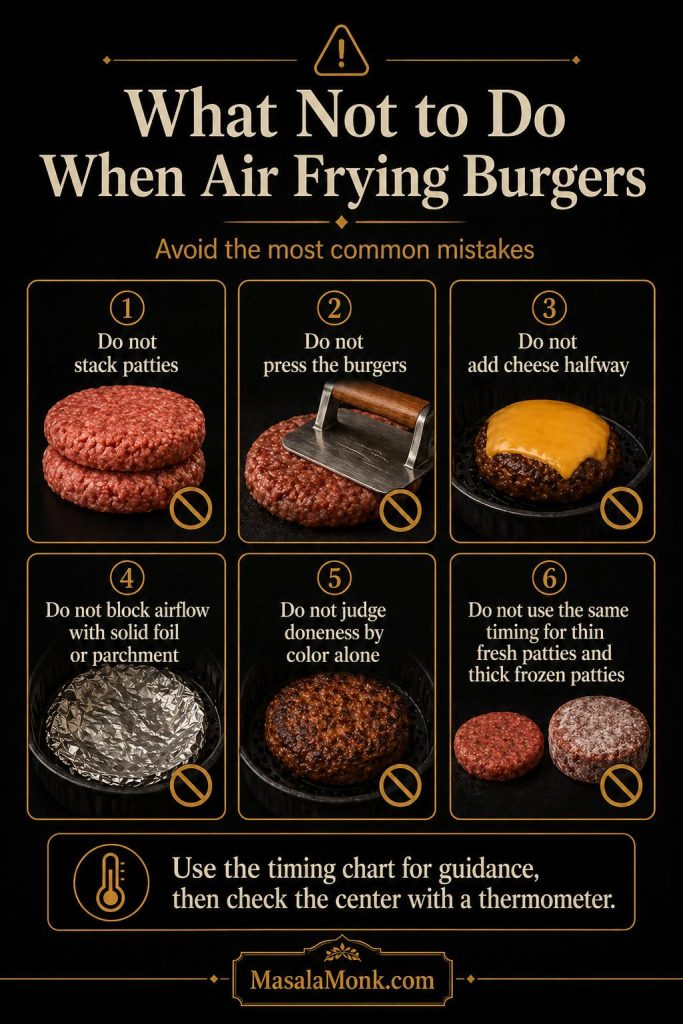
Air fryer burger mistakes to avoid, including stacking patties, pressing burgers, adding cheese too early, blocking airflow, judging doneness by color, and using one timing for every patty.
Most air fryer burger problems come from blocked airflow, uneven patties, early cheese, or guessing doneness by color instead of checking the center.
  • Do not stack patties in the basket.
  • Avoid pressing the burgers while they cook.
  • Add cheese only at the end, not halfway through cooking.
  • Never block the basket holes with solid parchment or foil.
  • Do not judge doneness by color alone.
  • Avoid using the same timing for thin fresh patties and thick frozen patties.

Air fryer burger troubleshooting chart

Once you know what went wrong, use the chart below to fix the next batch. Instead of changing the beef, temperature, timing, and basket setup all at once, adjust one thing first.

Problem Likely cause Fix
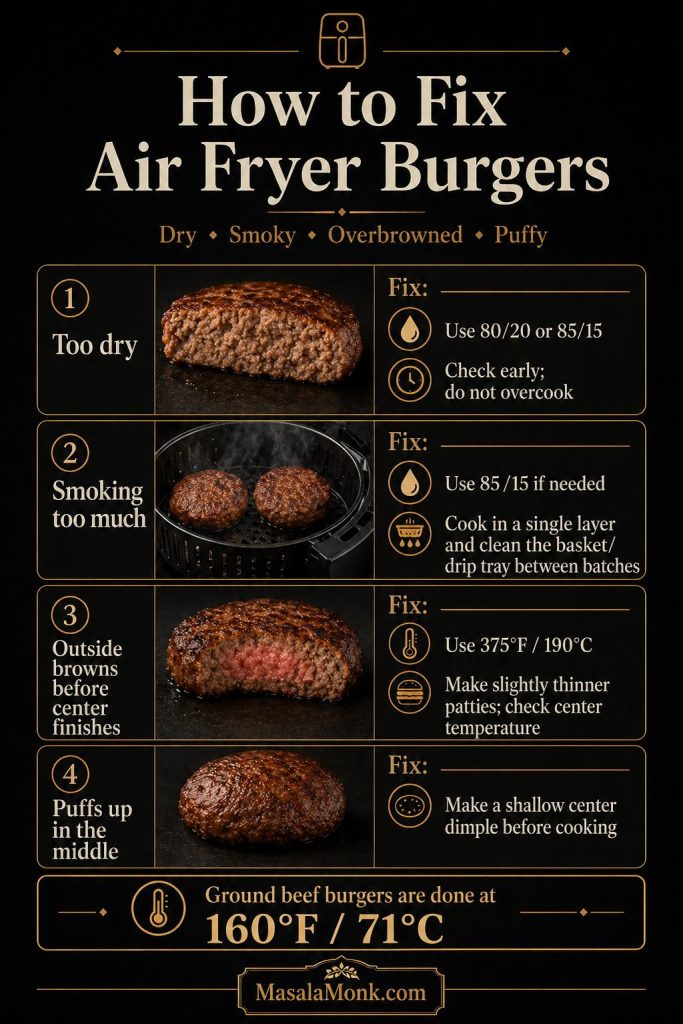
Dry burgers Lean beef or overcooking Use 80/20 or 85/15 beef, and check the temperature earlier.
Smoking air fryer Fat dripping onto a hot base, old grease, or very fatty beef Clean the basket, avoid overcrowding, and try 85/15 beef if smoke is frequent.
Burger puffed up No center dimple Press a shallow dimple in each patty before cooking.
Undercooked center Patty too thick or too cold Cook longer at 375°F and check for 160°F in the center.
Cheese blew off Cheese added too early or fan too strong Add cheese during the final 30–60 seconds, or melt it with residual heat after cooking.
Uneven cooking Basket overcrowded Cook in a single layer and leave space between patties.
Air fryer burger troubleshooting guide showing fixes for dry burgers, smoking, outside browning before the center finishes, puffing in the middle, and checking for 160°F internal temperature.
The best fix depends on the problem: dry burgers need more moisture control, smoking needs cleaner airflow, and underdone centers need a thermometer check instead of more browning.

How to fix the next batch

If you are not sure what went wrong, start with the simplest fix first. Next time, change only one thing at a time. If the burgers were dry, check earlier or use fattier beef; if they smoked, clean the basket or use a slightly leaner blend.

If smoke happens, do not panic. Usually, it means fat is hitting a very hot surface or old grease is still in the basket. Before cooking the next batch, clean the basket, avoid overcrowding, and use the lower end of the temperature range if your air fryer runs hot.

The next batch becomes easier to control because you are matching the fix to the actual problem instead of guessing.

If this happens often with air fryer recipes, it is worth checking these common air fryer mistakes. Overcrowding, blocked airflow, old grease, and wrong timing can affect burgers, fries, wings, and almost everything else you cook in the basket.

Jump to recipe card → | Back to table of contents ↑

Best Sauces and Toppings for Air Fryer Hamburgers

A good burger only needs a few toppings, but the sauce can change the whole direction of the meal. For that reason, keep the patty simple and use the sauce to make it classic, spicy, Indian-style, or bowl-friendly.

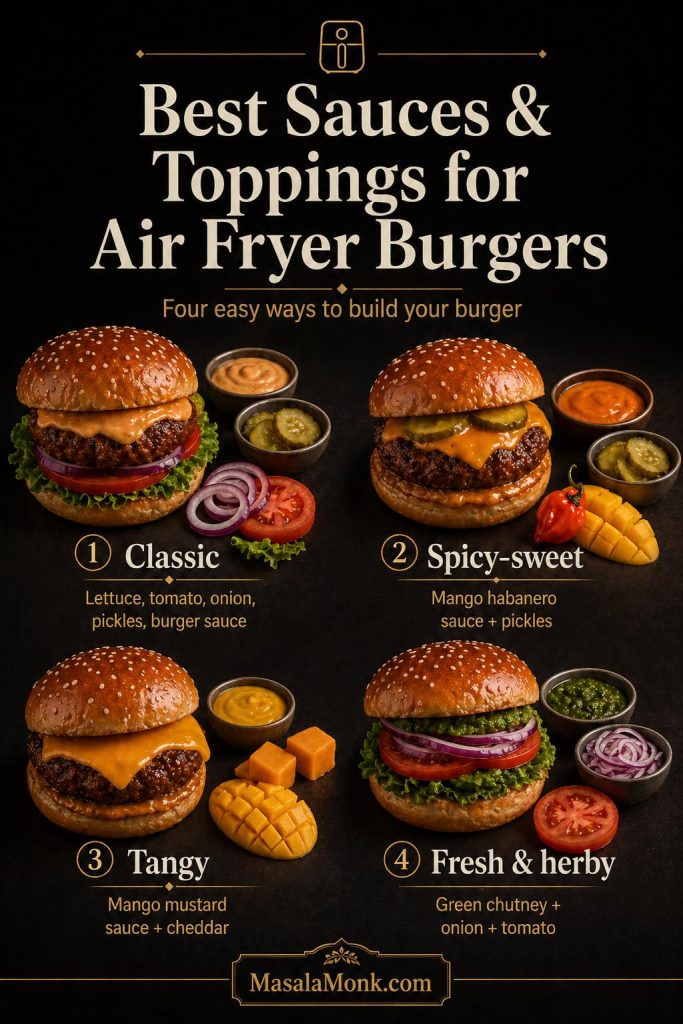
Air fryer burger sauce and topping guide showing classic burger sauce, mango habanero sauce, mango mustard sauce, green chutney, pickles, onion, tomato, and lettuce.
Keep the burger patty simple and use the sauce to change the direction: classic, spicy-sweet, tangy, or fresh and herby.

Classic burger sauce is the easiest place to start: mix mayonnaise, ketchup, mustard, finely chopped pickles or pickle juice, garlic powder, onion powder, and a little black pepper. If you want a fresh base, use this homemade mayonnaise; if you need an egg-free spread, use eggless mayonnaise.

When you want heat, brush the cooked patty lightly with mango habanero sauce or serve it on the side for fries. Meanwhile, mango mustard sauce gives the burger a tangy, fruity change from plain mustard.

An Indian-style burger works especially well with green chutney, onion, tomato, mayo, and a pinch of chaat masala. Because the chutney is bright and herb-heavy, it cuts through the richness of the patty.

Air Fryer Burger Variations

Once the basic method is set, you can change the toppings and sauces without changing the cooking technique. That way, one reliable patty method can turn into several different dinners.

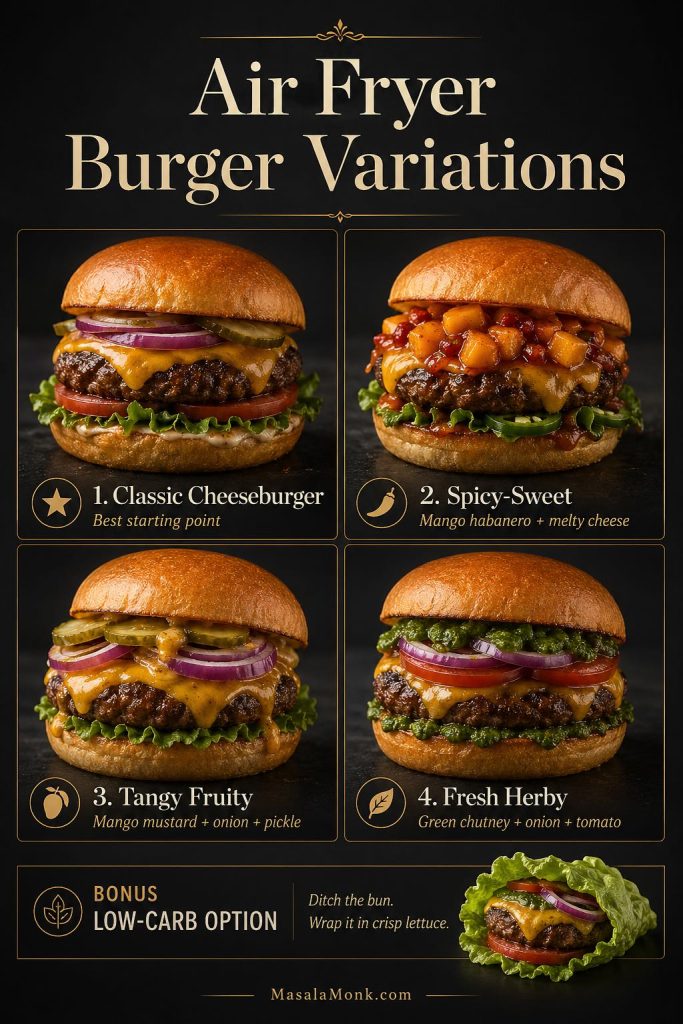
Air fryer burger variations guide showing a classic cheeseburger, spicy mango habanero burger, mango mustard burger, green chutney burger, and a low-carb lettuce-wrap option.
Once the basic air fryer patty is reliable, the easiest way to change the burger is through the sauce: classic, spicy-sweet, tangy, herby, or low-carb.
  • Classic cheeseburger: American cheese, pickles, onion, lettuce, tomato, and burger sauce.
  • Spicy mango habanero burger: Cheddar, onions, pickles, and mango habanero sauce.
  • Mango mustard burger: Lettuce, pickles, onion, and mango mustard sauce.
  • Green chutney burger: Green chutney, mayo, onion, tomato, and chaat masala.
  • Low-carb burger bowl: Lettuce, pickles, cheese, onions, tomato, and sauce without the bun.
  • Pesto cheeseburger: Pesto mayo, tomato, mozzarella or provolone, and roasted peppers.

For a lower-carb plate, keep the same patty method and build the meal around lettuce, pickles, cheese, onions, tomato, and sauce instead of a bun.

What to Serve With Air Fryer Hamburgers

For an easy burger-night plate, pick one sauce, one crispy side, and something fresh to cut through the richness. That way, the meal feels complete without turning dinner into a project.

For the classic burger-and-fries plate, serve the patties with homemade fries, wedges, or potato snacks. If a make-ahead side is easier, potato salad is one of the best choices. For a party-style spread, add one or two ideas from these potato appetizers.

If the air fryer is already out, keep the sides easy. Air fryer mozzarella sticks make the meal feel like a game-day plate, while air fryer croquettes are a good option when you want something crispy that is not fries.

For something fresh, add a cabbage slaw, cucumber salad, onion-tomato salad, or raw papaya salad. A crisp fresh side helps balance the richness of the burgers and cheese.

Storage and Reheating

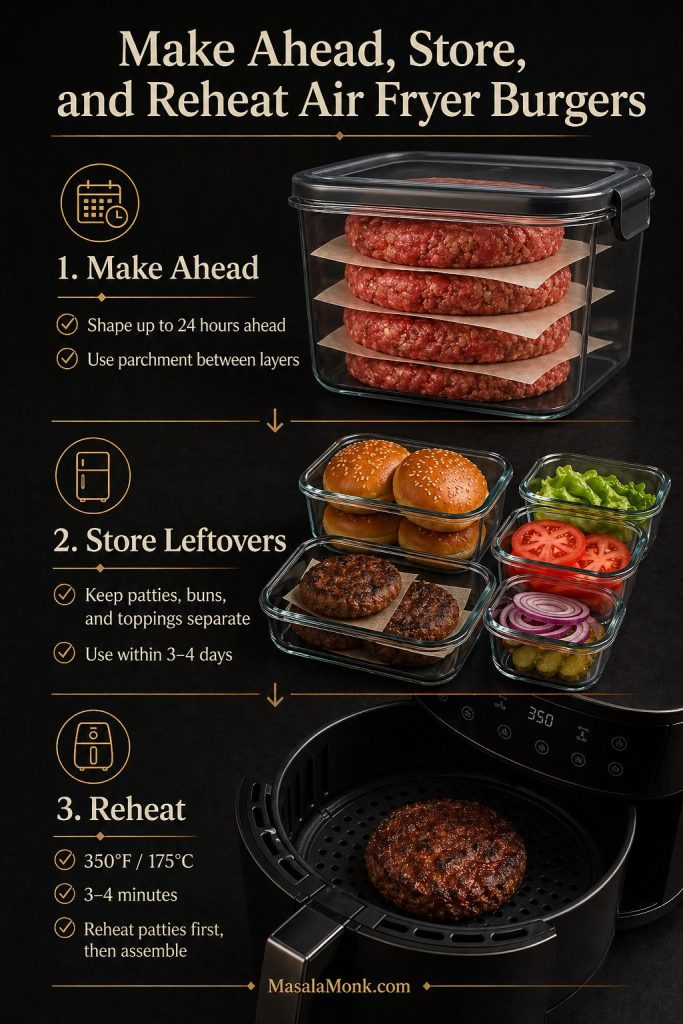
Make-ahead tip: You can shape the raw patties up to 24 hours ahead and refrigerate them in a covered container with parchment between layers. Keep them cold until cooking, then air fry straight from the fridge and check the center for 160°F / 71°C.

Air fryer burger storage guide showing raw patties made ahead with parchment, cooked patties stored separately from buns and toppings, and patties reheated in the air fryer.
Store patties, buns, and toppings separately so leftovers reheat cleanly; warm the patty first, then assemble the burger fresh.

Cooked hamburger patties store better than fully assembled burgers. If you know you will have leftovers, store the patties, buns, cheese, sauces, and toppings separately. Otherwise, the bun can turn soggy while the lettuce and tomato lose their texture.

Once the patties are cooked, refrigerate leftovers within 2 hours. If the room is very hot, refrigerate them within 1 hour. After that, reheat only the patties and assemble the burgers fresh so the buns and toppings stay in better shape.

  • Refrigerate: Cool cooked patties, then store in an airtight container for 3–4 days.
  • Freeze: Wrap cooked patties individually and freeze for up to 2 months.
  • Reheat in the air fryer: Reheat patties at 350°F / 175°C until warmed through.
  • Add cheese after reheating: Cheese melts better when added at the end instead of reheated from cold.
  • Avoid reheating assembled burgers: The bun can dry out while lettuce, tomato, and sauce turn soggy.

For more air fryer recipes with ground beef, this burger method is the easiest starting point because the patties cook quickly, portion neatly, and can be served on buns, in bowls, or over salad.

Air Fryer Burgers Recipe Card

Air Fryer Burgers

These air fryer burgers are built for a quick, juicy first batch: fresh ground beef, simple seasoning, 375°F heat, one flip, and cheese added only at the end.

Yield 4 burgers
Prep Time 10 minutes
Cook Time 8–10 minutes
Total Time 18–20 minutes

Ingredients

  • 1 lb / 454 g ground beef, preferably 80/20 or 85/15
  • ¾ tsp kosher salt, or to taste
  • ½ tsp black pepper
  • ½ tsp garlic powder
  • ½ tsp onion powder
  • 1 tsp / 5 ml Worcestershire sauce or steak sauce, optional
  • 4 cheese slices, about 3 oz / 85 g total, optional
  • 4 burger buns
  • Lettuce, tomato, onion, pickles, sauce, or toppings of choice

Instructions

  1. First, preheat the air fryer to 375°F / 190°C.
  2. Next, divide the beef into 4 loose portions, about 4 oz / 113 g each.
  3. Then shape each portion into a patty about 4–4½ inches / 10–11.5 cm wide and ½ inch / 1.25 cm thick.
  4. After that, press a shallow dimple into the center of each patty so the burgers stay flatter as they cook.
  5. Once the patties are shaped, season both sides with salt, pepper, garlic powder, and onion powder. If using Worcestershire sauce, mix it in gently before shaping or brush a tiny amount over the patties before seasoning.
  6. Then place the patties in the air fryer basket in a single layer, leaving space between them.
  7. As the burgers cook, flip them halfway through the 8–10 minute cooking time.
  8. Once the time is close, check the center of each patty. For the most accurate reading, insert the thermometer through the side of the patty so the tip reaches the center. The burgers are done when they reach 160°F / 71°C.
  9. If making cheeseburgers, add cheese during the final 30–60 seconds, or place cheese on the hot cooked patties and close the warm basket briefly until melted.
  10. Finally, rest the patties for 2 minutes, then assemble with buns, sauce, and toppings.

Notes

  • Best beef: Use 80/20 for the juiciest burgers or 85/15 for a slightly leaner burger with less smoke.
  • Salt: Kosher salt brands vary. If using fine table salt, start with less and adjust to taste next time.
  • Preheating: If you skip preheating, add 1–2 minutes and start checking early.
  • Batch cooking: If the patties do not fit in a single layer with space between them, cook in batches. Later batches may cook slightly faster.
  • Oil: Fresh 80/20 or 85/15 patties usually do not need oil. Use a light spray only for very lean or dry-surfaced patties.
  • Frozen patties: Cook frozen ¼-lb / 113 g patties at 360–375°F for 10–14 minutes and frozen ⅓-lb / 150 g patties for 12–16 minutes, flipping halfway.
  • Bubba-style burgers: Start at 360–375°F and use the longer end of the timing range for thick frozen patties.
  • Cheese: Add cheese at the end only. Adding it too early can make it slide off or blow around.
  • Doneness: Ground beef burgers should reach 160°F / 71°C in the center.
  • Parchment or foil: Use only if your air fryer manual allows it, and never block airflow or trap grease under the patties.
  • Storage: Refrigerate cooked patties within 2 hours, or within 1 hour if the room is very hot. Store patties separately from buns and toppings for the best leftovers.

If you are cooking a different patty size, use the recipe card as the base and the timing chart above as the adjustment guide. That way, the method stays simple while the timing changes to match the burger.

One rule matters most: timing can change, but doneness should be checked with a thermometer. Use the chart for timing, then use the center temperature to decide when the burgers are done.

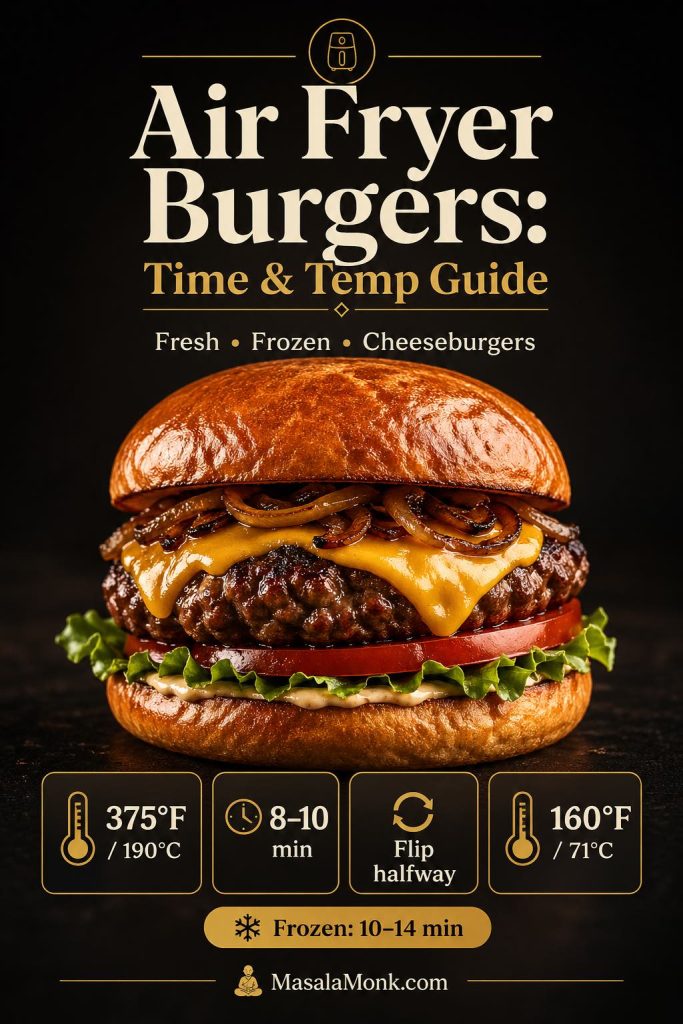
Air fryer burgers time and temperature guide showing 375°F or 190°C, 8 to 10 minutes for fresh patties, flip halfway, cook to 160°F or 71°C, and adjust timing for frozen burgers.
Use this as the quick visual summary: fresh patties, frozen patties, cheeseburgers, and the center-temperature check that keeps air fryer burgers reliable.

Back to table of contents ↑

FAQs About Air Fryer Burgers and Hamburgers

Can you cook hamburgers in an air fryer?

Yes. When cooked in a single layer, hamburgers cook well in an air fryer because the hot circulating air reaches the top, bottom, and sides of each patty. For the best result, leave space between the patties and flip halfway.

What temperature do you cook hamburgers in the air fryer?

For most fresh hamburger patties, use 375°F / 190°C. This temperature gives the center enough time to cook while still helping the outside brown.

How long do hamburgers take in the air fryer?

In most cases, fresh ¼-lb / 113 g hamburger patties take 8–10 minutes at 375°F / 190°C. However, thinner patties may finish in 6–8 minutes, while thicker patties may need 10–12 minutes.

How long do you cook ½-pound burgers in the air fryer?

Fresh ½-lb / 225 g burgers usually need about 14–18 minutes at 360–370°F / 182–188°C, depending on thickness and air fryer strength. Flip halfway and check that the center reaches 160°F / 71°C.

Do you flip burgers in the air fryer?

Yes. Although some air fryers cook fairly evenly without flipping, flipping halfway gives more reliable results across different basket styles and patty thicknesses.

What internal temperature should air fryer hamburgers reach?

Ground beef burgers should reach 160°F / 71°C in the center. Since color can be misleading, use a food thermometer rather than judging by appearance alone. For the best reading, insert the thermometer from the side so the tip reaches the center of the patty.

How long do frozen burgers take in the air fryer?

Usually, frozen burger patties take 10–16 minutes. A ¼-lb / 113 g frozen patty often takes 10–14 minutes, while a thicker ⅓-lb / 150 g frozen patty may take 12–16 minutes.

Can I cook frozen burgers at 400°F in the air fryer?

Yes, but check early. At 400°F, the outside can brown before the center is fully done, especially with thick frozen patties. For more control, use 360–375°F and cook until the center reaches 160°F.

When should you add cheese to air fryer burgers?

Once the burger is almost done, add cheese during the final 30–60 seconds. If the fan blows the cheese around, turn the air fryer off and let the residual heat melt the cheese instead.

Why did my air fryer burger smoke?

Usually, smoke comes from fat dripping onto a hot base, old grease in the basket, overcrowding, or very fatty beef. To prevent it next time, clean the basket before cooking, avoid crowding, and use 85/15 beef if smoke is a recurring problem.

Can I make these burgers in a Ninja, Cosori, Instant Vortex, Gourmia, or PowerXL air fryer?

Yes. The method is the same: cook fresh ¼-lb patties at 375°F, flip halfway, and check for 160°F in the center. However, smaller or stronger air fryers may finish a minute or two faster, while crowded baskets or thicker patties may need longer. For Ninja Foodi Grill-style models, use the air-fry function unless you are intentionally using the grill plate.

Can you cook burgers in an air fryer oven?

Yes. Use the air fry setting, place the patties on a rack or tray with space between them, flip halfway, and start with the same time and temperature chart. Air fryer ovens may need 1–2 extra minutes because the cooking space is larger.

Can I cook more than four burgers at once?

Only if they fit in a single layer with space between them. Otherwise, cook in batches. Crowding the basket slows cooking, blocks airflow, and can make the burgers steam instead of brown.

Do I need to spray the air fryer basket for burgers?

Usually, no. If you are using 80/20 or 85/15 beef, the patties release enough fat as they cook. However, if your patties are very lean or your basket tends to stick, use a light spray instead of adding extra oil to the burgers.

Can I make turkey burgers this way?

Yes, but turkey burgers are leaner and need different doneness guidance. Since ground poultry should reach 165°F / 74°C, do not use the 160°F ground beef temperature for turkey burgers.

Can I use foil or parchment under air fryer burgers?

Use foil or parchment only if your air fryer manual allows it. Also, never block airflow under the patties, because blocked airflow can slow cooking, trap grease, create smoke, and make the burgers cook unevenly.

Back to table of contents ↑ | Back to top ↑

Posted on 2 Comments

9 Keto Hamburger Recipes for Burgers, Bowls, Skillets, and Casseroles

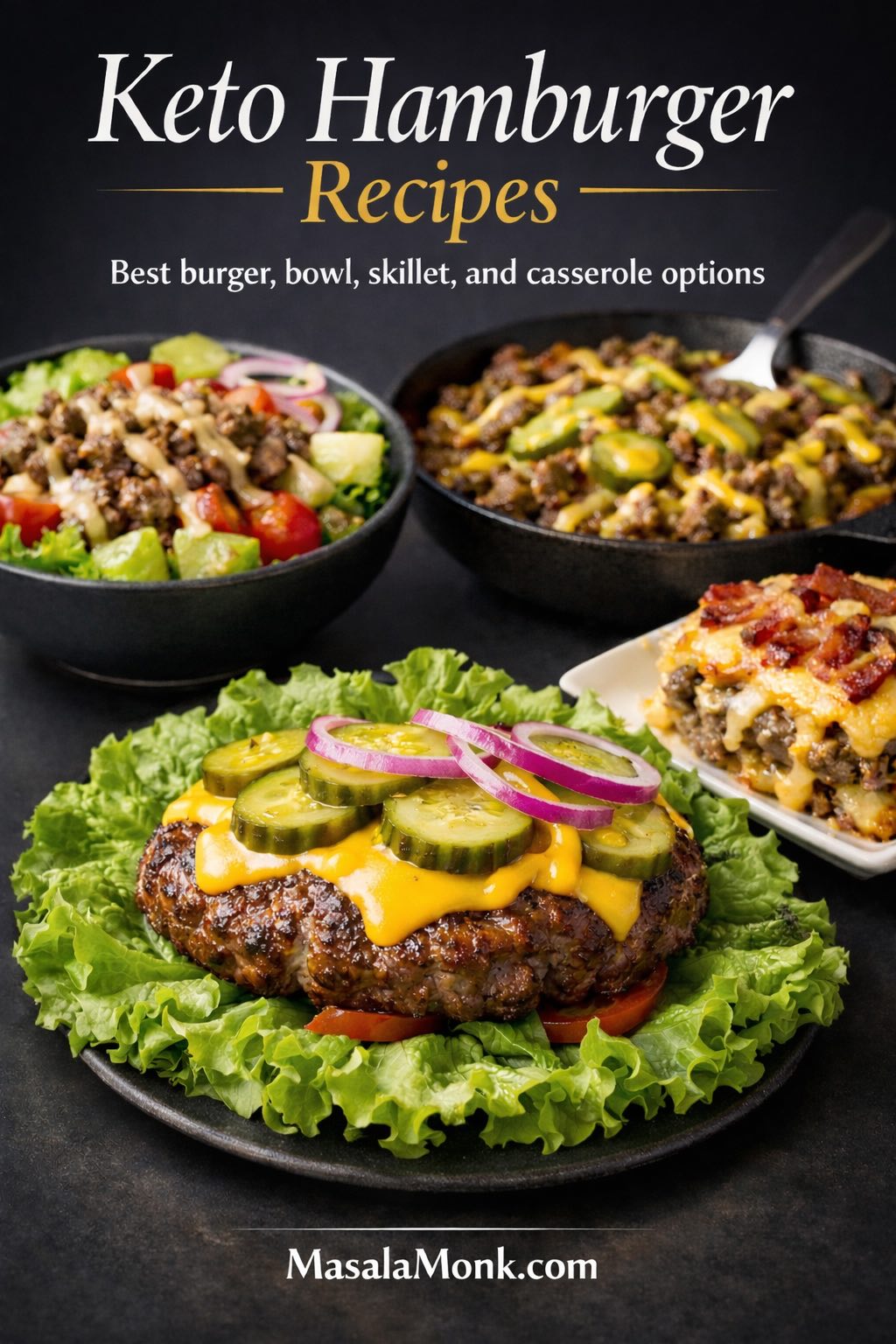
Keto hamburger recipes hero image showing a bunless cheeseburger, burger bowl, cheeseburger skillet, and bacon cheeseburger casserole

Keto hamburger recipes work best when they match the kind of dinner you actually want tonight. Sometimes that means a classic bunless cheeseburger. Other nights, a fast burger bowl, a warm cheeseburger skillet, or a bacon cheeseburger casserole makes more sense while still delivering the same savory, low-carb comfort.

Start with the best first recipe if you want the closest thing to a classic burger night, then use the comparison below to choose between a bowl, skillet, casserole, or one of the shorter variations depending on how much time you have and how well you need it to reheat. If you want extra context on why beef fits so naturally into low carb eating, MasalaMonk’s beef on keto guide is a useful companion read.

Across these formats, the same pattern shows up again and again: classic burgers need enough fat and enough sharp condiments to still feel complete without the bun, bowls need more sauce than most people expect, skillets need real browning or they slip into generic creamy beef, and casseroles need something bright on the plate so the richness does not flatten out.

For most readers, the best first recipe is the Classic Bunless Keto Cheeseburgers. It feels most like a real burger dinner, teaches the decisions that matter most, and makes it easier to decide whether you want to stay with burgers or move toward bowls, skillets, casseroles, and other burger-style formats later.

Quick Answer: Which Keto Hamburger Recipe Should You Make First?

Start with the Classic Bunless Keto Cheeseburgers if you want the closest thing to a classic burger night. Meanwhile, the Keto Burger Bowl with Homemade Burger Sauce is the fastest choice when you want a no-bun meal that still feels unmistakably like burger night. On nights when a warm hamburger-meat dinner sounds better, the One-Pan Keto Cheeseburger Skillet is the strongest pick. Finally, if you want the most filling make-ahead option, go with the Bacon Cheeseburger Casserole.

The craving may be the same, but the best answer changes with the night. Sometimes a real burger shape still matters. Sometimes speed matters more. On other nights, the smarter move is choosing the version that reheats well tomorrow instead of forcing everything into a bunless burger plate tonight.

Best First Keto Hamburger Recipe: Classic Bunless Keto Cheeseburgers

For most readers, the best first recipe is still the Classic Bunless Keto Cheeseburgers. It comes closest to a real burger dinner, teaches the decisions that matter most, and makes it easier to judge whether your next move should be a faster bowl, a warmer skillet, or a more make-ahead-friendly casserole.

  • Why start here: it stays closest to the classic burger experience while still fitting keto comfortably
  • What it teaches: beef choice, patty shaping, seasoning, cheese timing, sauce balance, and bun alternatives that actually work
  • Who it suits best: readers who want a true burger shape before branching into bowls, skillets, or casseroles
  • What to do next: stay with this if you want a burger plate, move to the burger bowl if you want speed, or shift to the skillet or casserole if you want better leftovers

Keto Hamburger Recipes Comparison Matrix

Use this matrix to choose by speed, leftovers, and how closely each option still feels like a classic burger dinner. In other words, if you already know whether you want a real burger, a fast bowl, a warm skillet, or a make-ahead casserole, this is the quickest way to land on the right recipe.

RecipeBest forTimeLeftoversHow burger-like it feels
Classic Bunless Keto CheeseburgersClosest to a real burger night20 minFairVery high
Keto Burger Bowl with Homemade Burger SauceFast lunch or easy dinner20 minVery goodHigh
One-Pan Keto Cheeseburger SkilletWarm weeknight dinner25 minExcellentMedium-high
Bacon Cheeseburger CasseroleComfort food and meal prep40 minExcellentMedium-high
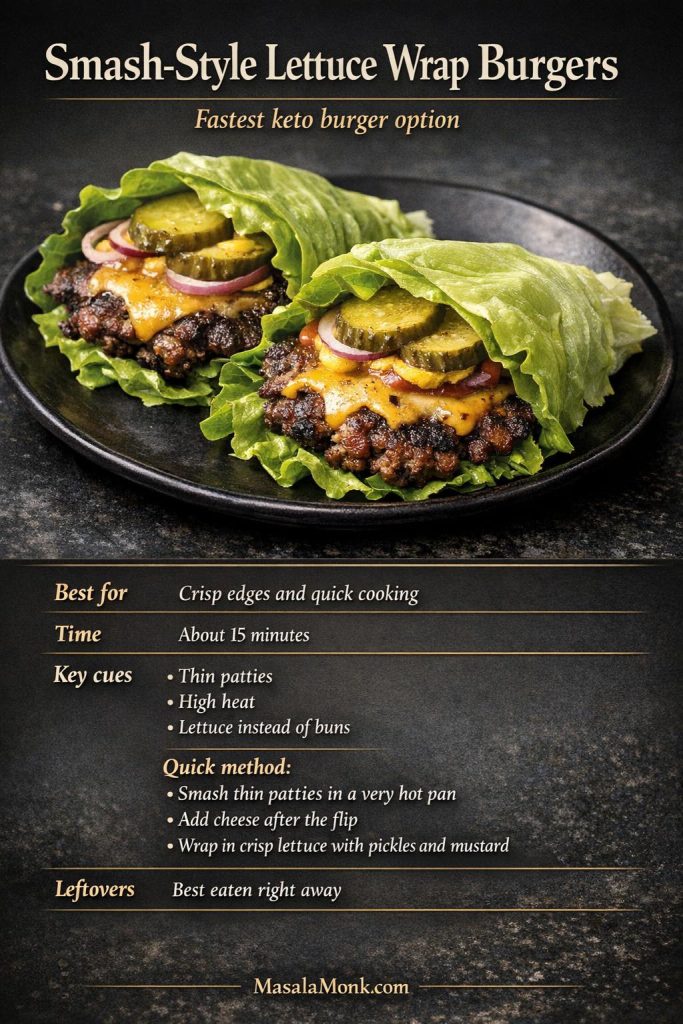
Smash-Style Lettuce Wrap BurgersCrisp edges and fast cooking15 minFairVery high
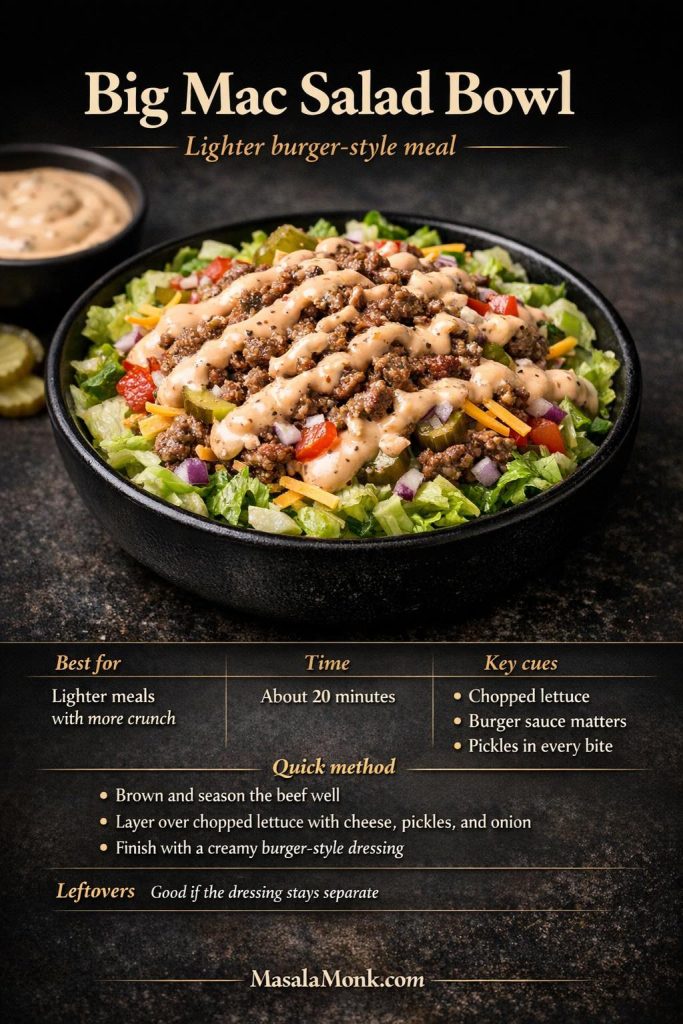
Big Mac Salad BowlLighter burger-style meal20 minGoodMedium
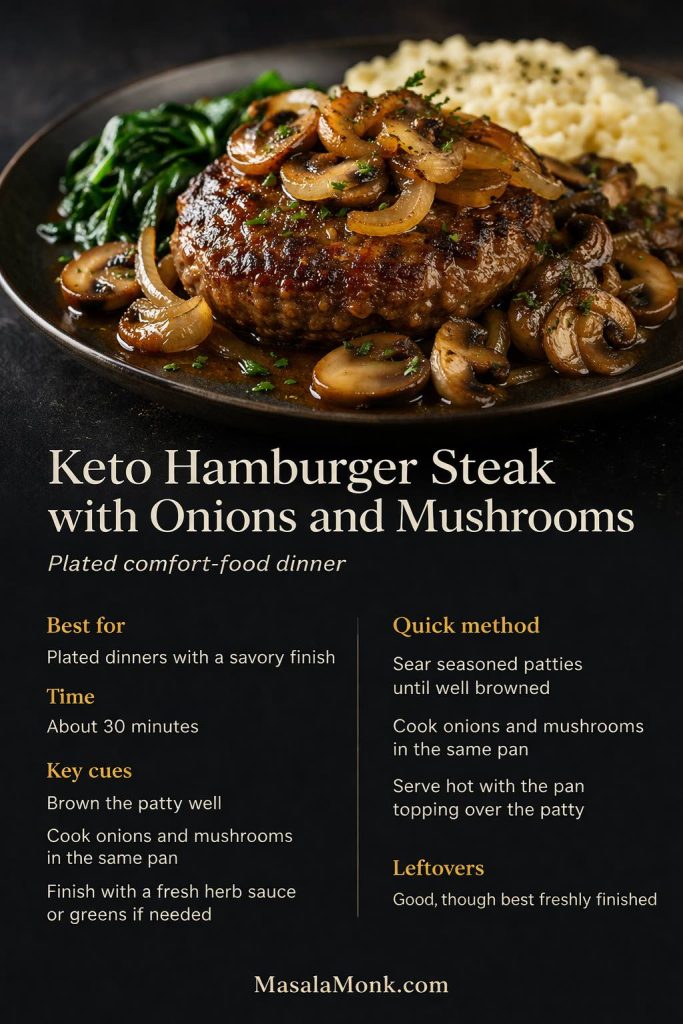
Keto Hamburger Steak with Onions and MushroomsPlated comfort-food dinner30 minGoodMedium
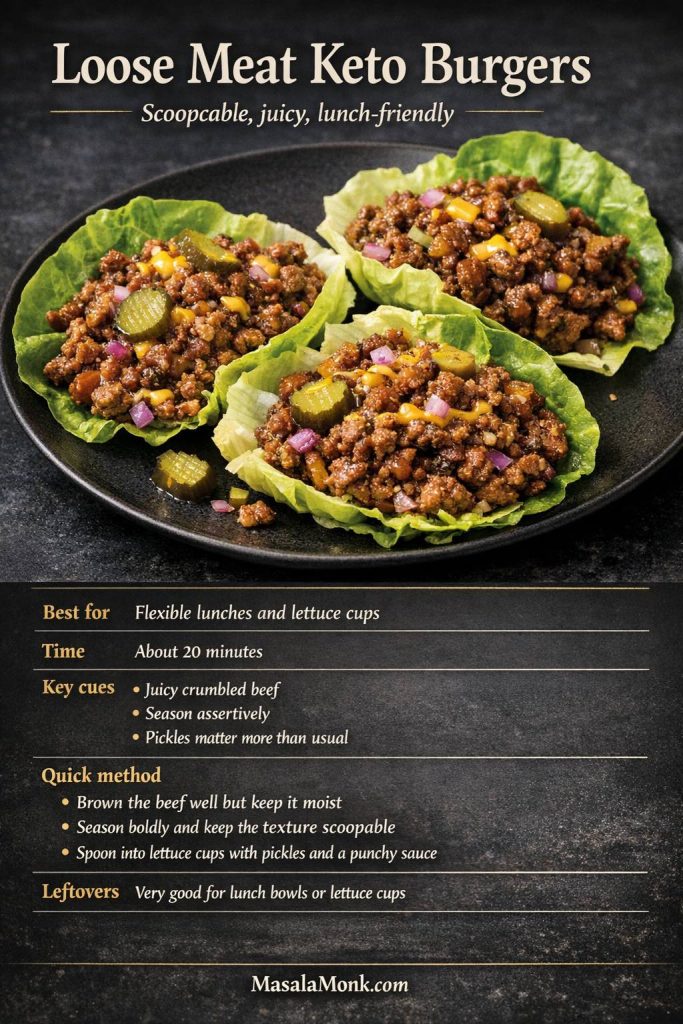
Loose Meat Keto BurgersQuick scoopable beef dinner20 minVery goodMedium
Keto Cheeseburger Stuffed PeppersPortioned make-ahead meals40 minExcellentMedium
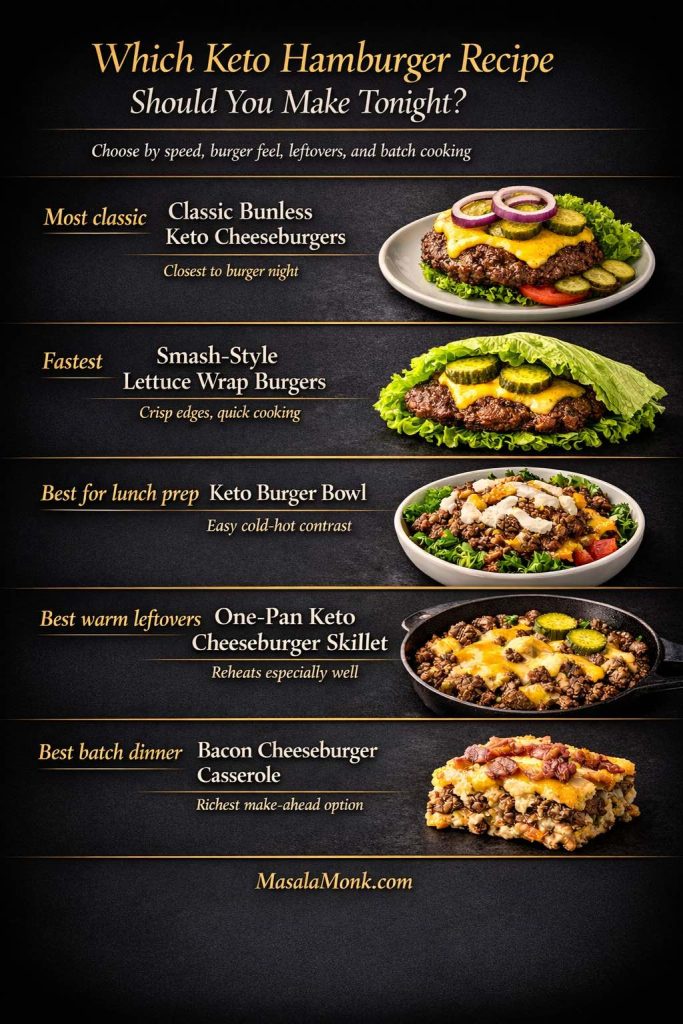
Decision guide for keto hamburger recipes showing the best option for a classic burger, fastest meal, lunch prep, warm leftovers, or batch dinner.
Use this quick chooser to decide whether tonight calls for the most classic bunless burger, the fastest lettuce-wrap option, an easy burger bowl, a reheatable skillet, or a batch-friendly casserole.

Choose Tonight’s Winner

  • Most classic: Classic Bunless Keto Cheeseburgers
  • Fastest: Smash-Style Lettuce Wrap Burgers
  • Best for lunch prep: Keto Burger Bowl with Homemade Burger Sauce
  • Best warm leftovers: One-Pan Keto Cheeseburger Skillet
  • Best batch dinner: Bacon Cheeseburger Casserole

4 Full Keto Hamburger Recipes

These four recipes cover the formats most people actually want: a classic bunless burger, a fast burger bowl, a warm cheeseburger skillet, and a richer casserole for leftovers or meal prep. So if you only cook from four sections here, start with these.

1. Classic Bunless Keto Cheeseburgers

Choose this when: you want the clearest keto burger answer and still want dinner to feel like burger night rather than a workaround.

A good bunless cheeseburger should not feel like the bun was simply removed and nothing else was adjusted. It should still eat like a full burger dinner: juicy in the center, properly seasoned, sharp from mustard and pickles, and rich enough that the missing bun stops feeling like the main story after the first bite.

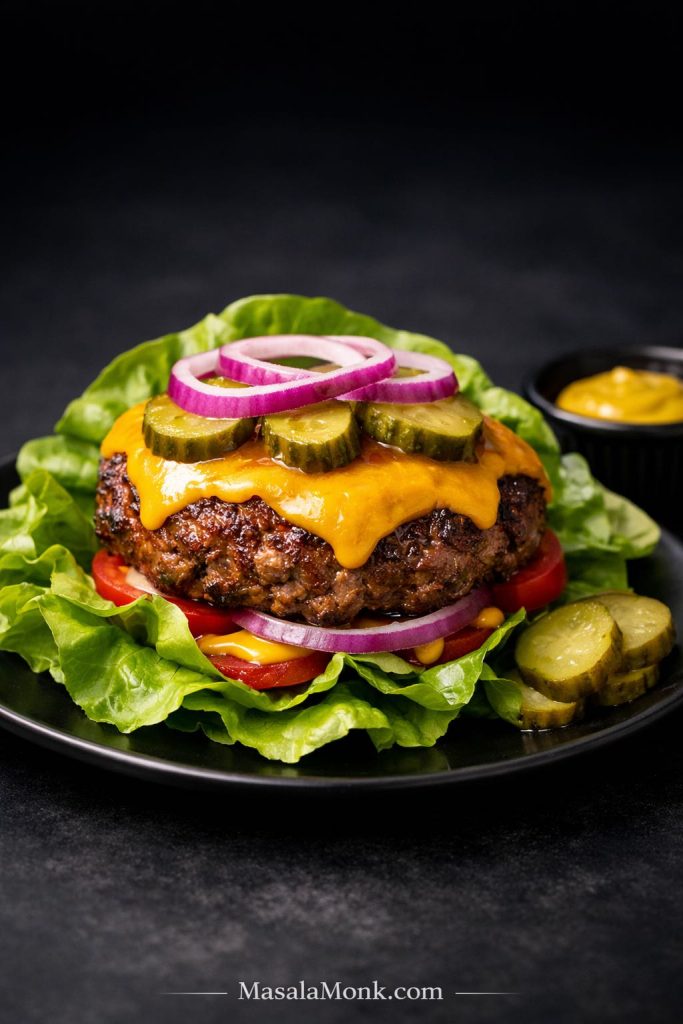
Classic bunless keto cheeseburger with melted cheddar, pickles, red onion, mustard, tomato, and lettuce leaves on a black plate.
Pickles, mustard, and onion do more of the real flavor-lifting work here than any bun substitute, which is why this bunless keto cheeseburger still feels like a full burger dinner.
  • Serves: 4
  • Prep time: 10 minutes
  • Cook time: 10 minutes
  • Estimated net carbs: about 3 to 5 grams per serving, depending on toppings and sauce
  • Best for: readers who want the clearest keto burger answer

Ingredients

  • 1 1/2 pounds ground beef, ideally 80/20 or 85/15
  • 1 1/2 teaspoons kosher salt
  • 3/4 teaspoon black pepper
  • 1 teaspoon garlic powder
  • 1 teaspoon onion powder
  • 4 slices cheddar or American cheese
  • 8 large lettuce leaves for wrapping or serving
  • 1/2 small red onion, thinly sliced
  • 8 to 12 pickle slices
  • 1 small tomato, sliced, optional
  • 2 tablespoons mustard
  • 1/4 cup burger sauce, or a mix of mayo, mustard, and finely chopped pickles

Substitutions

  • Beef: use 80/20 for a juicier burger and stronger crust, or use 85/15 if you want a slightly cleaner finish with less dripping.
  • Cheese: American melts more smoothly, while cheddar gives a sharper, more classic cheeseburger flavor.
  • Sauce: go with burger sauce for the fullest diner-style result, or keep it simpler with mustard and mayo.
  • Serving style: use lettuce wraps if you still want a hand-held burger, or plate the patties with toppings on the side if you want a less messy meal.
  • Toppings: tomato is optional, while pickles and onion do more of the real flavor-lifting work.

Method

  1. Divide the beef into 4 equal portions and shape them gently into broad patties about 1/2 to 3/4 inch thick. In a skillet, slightly flatter patties usually cook more evenly and develop better crust than very thick ones. Press a shallow dimple into the center of each one.
  2. Season both sides with salt, pepper, garlic powder, and onion powder just before cooking.
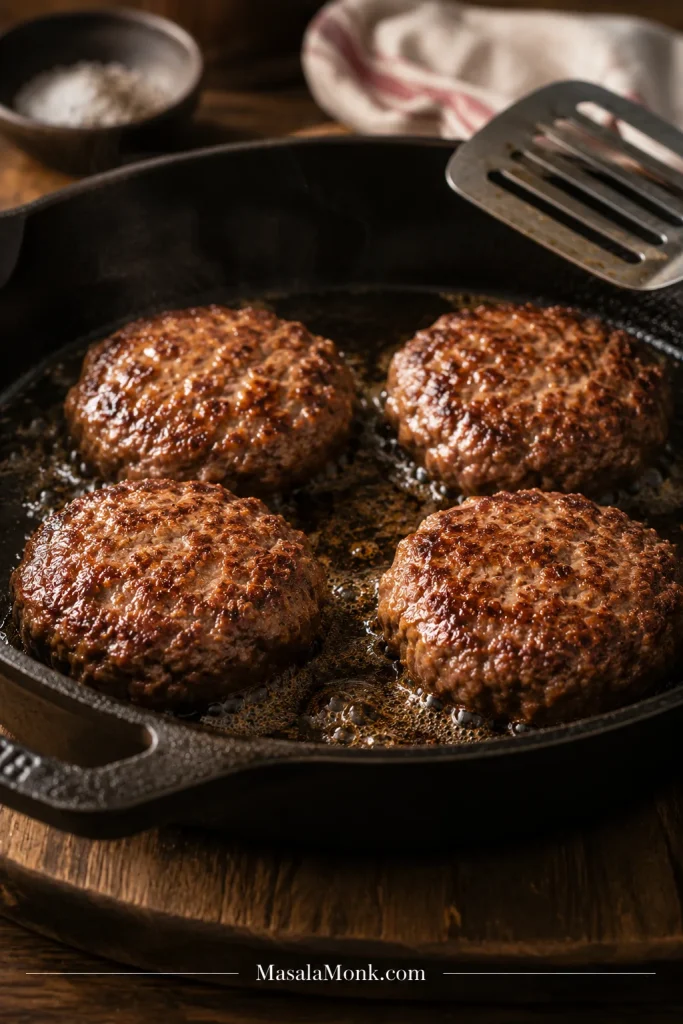
  3. Heat a cast-iron skillet or grill over medium-high heat until the surface is properly hot. Then add the patties and leave them alone long enough to develop color rather than nudging them early.
  4. Cook the patties for about 4 minutes on the first side, then flip and cook 3 to 4 minutes more depending on thickness.
  5. Add the cheese during the last minute so it melts cleanly without pushing the burgers too far.
  6. For food safety, cook the burgers to 160°F, which matches the USDA guidance for hamburgers and ground beef.
  7. Rest briefly, then serve with lettuce, onion, pickles, tomato if using, mustard, and burger sauce.

Why those small details matter: a slight center dimple helps thicker patties stay flatter, while seasoning just before cooking keeps the texture looser and juicier. If you want the deeper technique breakdown, Serious Eats has useful reads on patty shaping and salting ground beef.

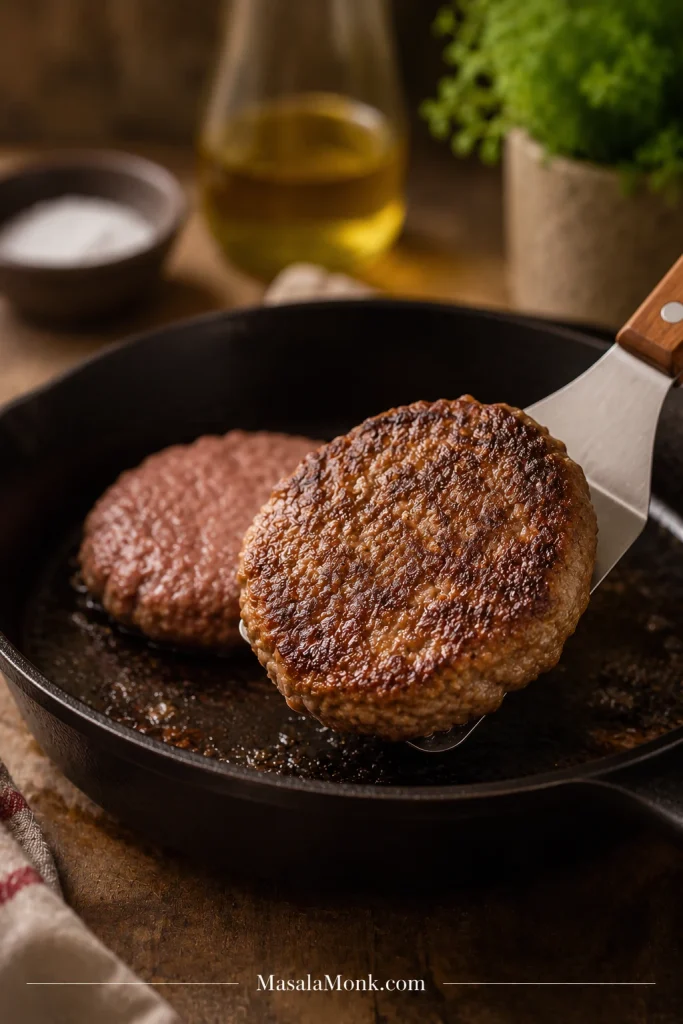
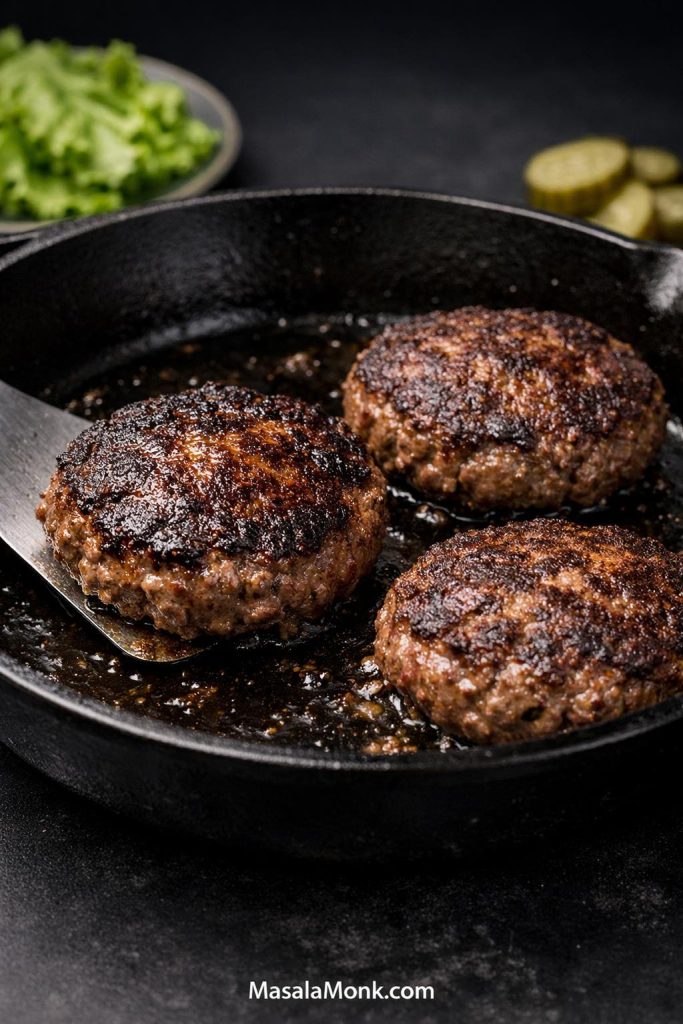
Burger patties searing in a cast-iron skillet for classic bunless keto cheeseburgers, with one patty lifted to show a deep browned crust.
The stage you want before adding cheese: a dark, even crust that keeps a classic bunless keto cheeseburger tasting like a real burger dinner instead of steamed ground beef.

Tips for Best Results

Handle the meat as lightly as possible and keep the patties cold until they hit the pan. That preserves a looser, juicier texture. Keep the topping stack restrained too. In this format, pickles usually do more flavor work than tomato, and American cheese gives a cleaner melt while cheddar gives a sharper finish.

Common Mistakes

  • Overworking the meat: that makes the patties denser and less juicy.
  • Salting too early: the texture can become tighter than you want.
  • Pressing the burgers in the pan: that pushes out the juices instead of improving browning.

Why This Format Works

What makes this one so reliable is that it keeps the classic burger logic intact instead of compensating with too many toppings. The beef stays central, the cheese rounds it out, and the pickles and mustard keep the whole thing from tasting heavy. Once that balance is right here, the bowl, skillet, and casserole versions become much easier to judge.

Best Way to Serve It

For the most classic feel, serve these as lettuce wraps or as a plated burger meal with pickles and a simple low-carb vegetable side such as sautéed cabbage or roasted broccoli.

Best with: mustard, pickles, sautéed cabbage, or roasted broccoli. Leftovers: best fresh, but patties reheat well in a covered skillet and work especially well turned into burger bowls the next day.

2. Keto Burger Bowl with Homemade Burger Sauce

Choose this when: you want the burger flavor fast, want something easier to prep ahead, or do not care about keeping a hand-held burger shape.

A burger bowl should still read clearly as a burger dinner, not just salad plus beef. That means proper browning, enough pickles and cheese, and a sauce with enough punch to keep every bite lively instead of soft and one-note.

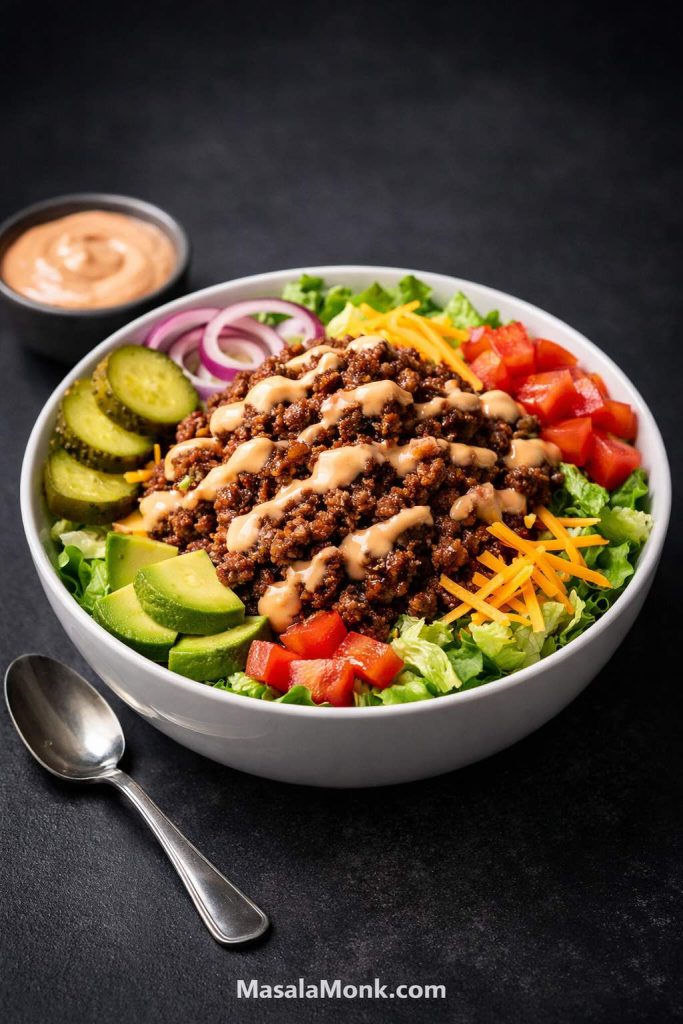
Keto burger bowl with browned ground beef, burger sauce, lettuce, pickles, red onion, cheddar, avocado, and tomato in a white bowl.
A good keto burger bowl still tastes unmistakably like burger night, which is why the browned beef, pickles, cheese, and burger sauce need to stay more prominent than the salad base.
  • Serves: 4
  • Prep time: 12 minutes
  • Cook time: 8 minutes
  • Estimated net carbs: about 5 to 7 grams per serving, depending on sauce and vegetables
  • Best for: fast dinners, lunch prep, and easy no-bun meals

Ingredients

  • 1 pound ground beef
  • 1 teaspoon kosher salt
  • 1/2 teaspoon black pepper
  • 1 teaspoon garlic powder
  • 1/2 teaspoon onion powder
  • 6 cups chopped romaine or iceberg lettuce
  • 1 cup cherry tomatoes, halved
  • 1/2 red onion, thinly sliced
  • 1/2 cup sliced pickles
  • 1 cup shredded cheddar cheese
  • 1 avocado, sliced
  • 1/2 cup burger sauce, ideally mayo-based with mustard and chopped pickles
  • Optional: 1/4 cup Greek tzatziki for a cooler variation

Substitutions

  • Greens: romaine gives more structure, while iceberg gives the cold, crunchy burger-joint feel.
  • Cheese: cheddar is the easiest default, though shredded Monterey Jack also works if you want a milder bowl.
  • Sauce: use classic burger sauce for the most familiar burger result, or switch to tzatziki if you want a cooler, tangier bowl.
  • Fat level: 85/15 often works especially well here because the beef still stays flavorful without making the bowl greasy.
  • Add-ons: avocado is optional, but pickles are harder to skip if you want the bowl to taste distinctly burger-like.

Method

  1. Brown the beef in a skillet over medium-high heat, breaking it up as it cooks.
  2. Season with salt, pepper, garlic powder, and onion powder, then cook until well browned rather than merely gray.
  3. Meanwhile, divide the lettuce among 4 bowls and top with tomatoes, onion, pickles, cheese, and avocado.
  4. Spoon the warm beef over the bowls so the cheese softens slightly and the bowl feels more like a meal than a cold salad.
  5. Finish with burger sauce. For a cooler, tangier take, add tzatziki instead of or alongside the classic burger sauce.
  6. Serve right away, or for meal prep let the beef cool slightly and store the beef, toppings, and sauce separately so the greens stay crisp.
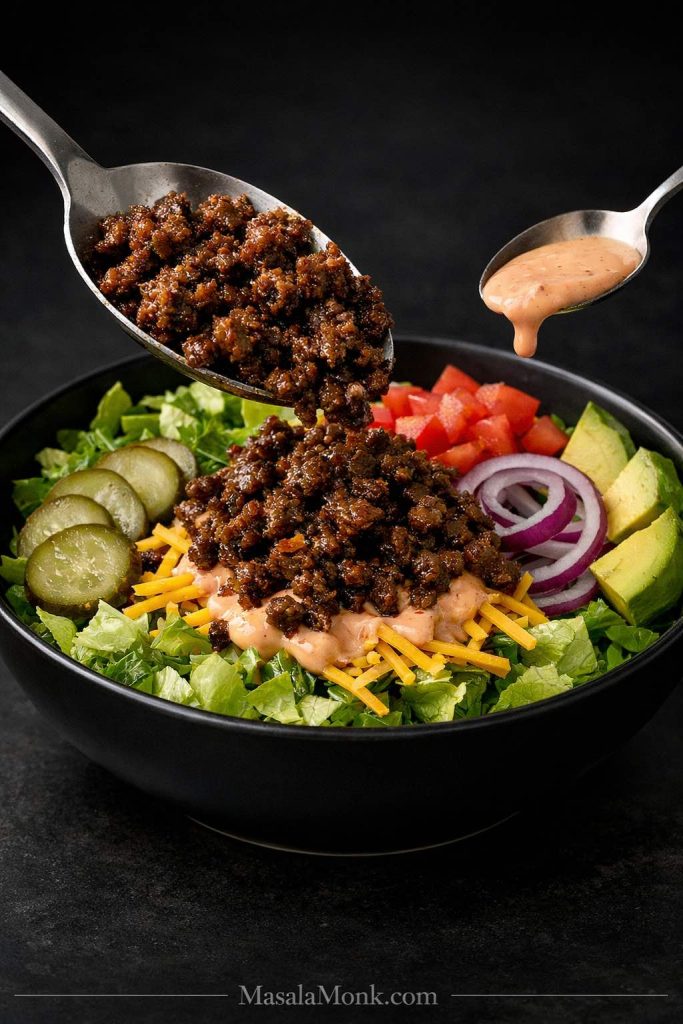
Hot browned beef and burger sauce being added to a keto burger bowl with lettuce, cheddar, pickles, red onion, tomato, and avocado.
Adding the hot browned beef and burger sauce at the end keeps this keto burger bowl tasting like burger night instead of a cold salad with beef on top.

Tips for Best Results

Keep the lettuce cold, the beef deeply browned, and the sauce slightly sharper than you think it needs to be. Burger bowls often go wrong because the components are individually fine but too quiet together. Iceberg gives the coldest burger-joint crunch, while romaine holds up better for meal prep, and a sharper sauce usually does more than extra cheese.

Common Mistakes

  • Underseasoning the beef: the bowl tastes flat even if the toppings are good.
  • Using a weak sauce: that makes the whole bowl drift toward generic salad territory.
  • Assembling too early: the lettuce softens and the bowl loses the texture contrast that makes it work.

Why This Format Works

What makes this one especially useful is that it keeps the burger profile intact while removing the part that tends to make burger meals messier to build, store, and reheat. As a result, it is one of the most practical keto hamburger recipes when you want speed and leftovers at the same time. It is also flexible enough to handle sharper sauces, more pickles, or a cooler yogurt-based topping without losing what makes the bowl satisfying.

Best Way to Serve It

Use crisp lettuce as the base, keep the sauce separate for storage, and add avocado right before serving if you want the best texture. This is one of the easiest make-ahead options because the beef, toppings, and sauce can all be stored separately and assembled in minutes.

Best with: extra pickles, avocado, or a slightly sharper burger sauce than you would use on a bunless burger. Leftovers: very good, as long as the beef, greens, and sauce stay separate until serving.

3. One-Pan Keto Cheeseburger Skillet

Choose this when: you want a warmer hamburger-meat dinner that still tastes clearly like cheeseburger dinner and holds up better than lettuce wraps in the fridge.

This is the right move on nights when a burger shape matters less than warmth, ease, and leftovers. The key is keeping the cheeseburger flavor clear. Once the beef is properly browned and the mustard, cheese, and pickles stay noticeable, the dish feels like a real burger dinner translated into spoonable form rather than a random creamy beef skillet.

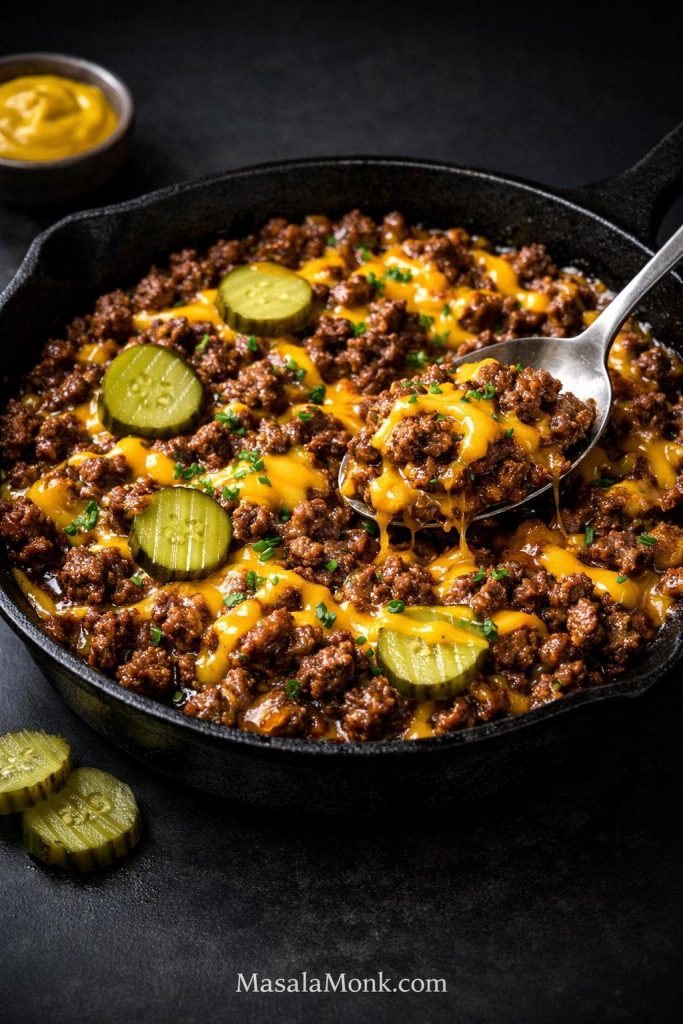
One-pan keto cheeseburger skillet with browned ground beef, melted cheddar, pickle slices, and a spoonful lifted from a cast-iron pan.
This one-pan keto cheeseburger skillet really lands when the beef is deeply browned and the cheese, pickles, and mustard cues still read clearly enough to keep the cheeseburger profile intact.
  • Serves: 4
  • Prep time: 10 minutes
  • Cook time: 15 minutes
  • Estimated net carbs: about 4 to 6 grams per serving
  • Best for: weeknight dinners and strong leftovers

Ingredients

  • 1 pound ground beef
  • 1/2 onion, diced
  • 2 cloves garlic, minced
  • 1 teaspoon kosher salt
  • 1/2 teaspoon black pepper
  • 1 teaspoon garlic powder
  • 1 tablespoon mustard
  • 2 ounces cream cheese
  • 1/2 cup heavy cream
  • 1 1/2 cups shredded cheddar cheese
  • 1/4 cup chopped pickles, optional
  • 2 tablespoons chopped parsley or chives

Substitutions

  • Beef: 85/15 is a good middle ground here, although 80/20 still works if you drain excess fat first.
  • Cheese: cheddar gives the clearest cheeseburger flavor, while pepper jack can work if you want a slightly spicier finish.
  • Cream base: use cream cheese and heavy cream for the richest version, or use a little less cream if you want the skillet tighter and meatier.
  • Flavor lift: chopped pickles are optional, but they help the skillet stay recognizably burger-like.
  • Serving shift: serve it as-is in bowls, or spoon it over sautéed cabbage if you want the meal to feel fuller.

Method

  1. Brown the beef with the onion in a large skillet over medium heat until the onion softens and the beef develops good color.
  2. If the pan looks overly greasy, drain just enough fat to keep the skillet balanced. Leave some behind, though, because that richness helps the finished dish still taste like cheeseburger instead of lean beef in sauce.
  3. Add the garlic, salt, pepper, and garlic powder, then stir briefly until fragrant.
  4. Lower the heat and stir in the mustard, cream cheese, and heavy cream until the mixture turns creamy and evenly combined.
  5. Add the cheddar and stir until melted. Fold in chopped pickles if using.
  6. Taste and adjust the salt before serving, because cheese can mute the seasoning slightly once everything comes together.
  7. Finish with parsley or chives and serve hot.
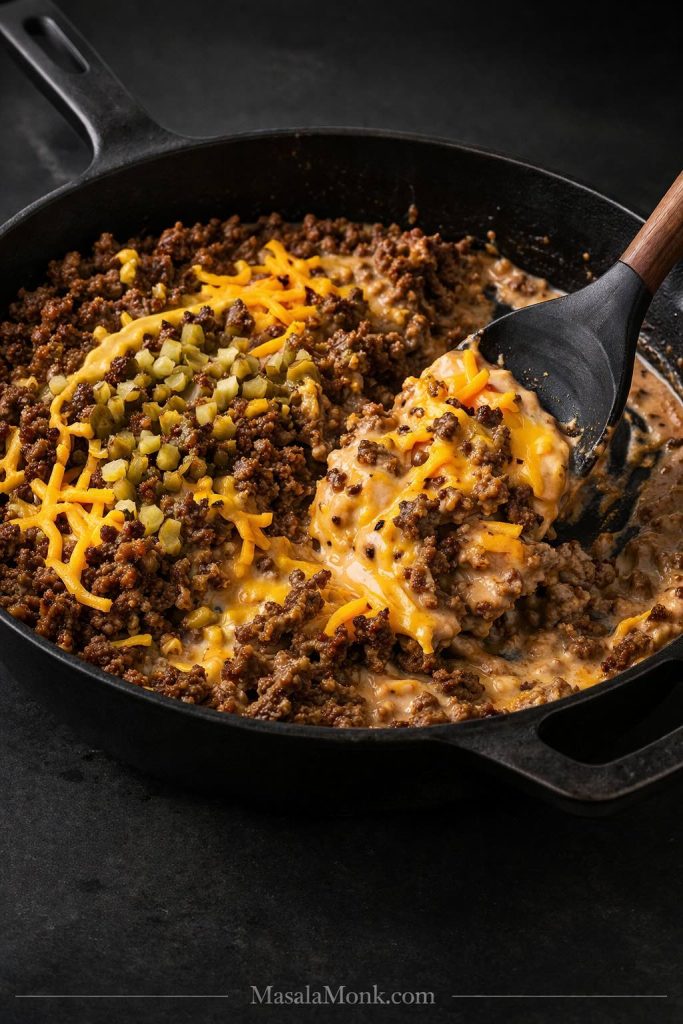
Black spatula lifting a one-pan keto cheeseburger skillet with browned ground beef, melted cheddar, chopped pickles, and creamy cheeseburger-style sauce in a cast-iron pan.
This skillet is in the right zone when the beef stays deeply browned, the cheddar melts into the pan without turning it soupy, and the pickles still cut through the richness.

Tips for Best Results

The beef needs more browning than most creamy skillet recipes ask for. That is what gives the dish backbone. Then keep the cream under control. Too much richness softens the cheeseburger profile, while a smaller amount lets the beef, mustard, cheese, and pickles stay distinct. Fold in a small amount of pickles at the end or scatter them on top, because cooked too hard into the base they lose the sharp edge that keeps the skillet tasting clearly like cheeseburger.

Common Mistakes

  • Not browning the beef enough: the skillet loses depth and starts tasting one-note.
  • Adding too much cream: the cheeseburger profile gets blurred.
  • Under-salting after the cheese goes in: the finished skillet can taste dull even though it looks rich.

Why This Format Works

What keeps this skillet satisfying is that it still reads as a cheeseburger dinner instead of drifting into generic creamy beef. The mustard, cheese, beef, and optional pickles keep the flavor profile clear, while the one-pan format makes it one of the easiest warm keto hamburger dinners to revisit during the week.

Best Way to Serve It

Serve it in bowls, over sautéed cabbage, or with a simple sharp green side. This is worth making even when you are really cooking for tomorrow as much as tonight.

Best with: sautéed cabbage, roasted mushrooms, or a simple green salad. Leftovers: excellent; reheat gently on the stove so the cheese stays smooth and the skillet does not tighten too much.

4. Bacon Cheeseburger Casserole

Choose this when: you want the richest comfort-food version, need stronger leftovers, or want a burger-style dinner that feels made for batch cooking.

This is the richest option here, so balance matters more than volume. The casserole should feel satisfying and cheesy, yet still have enough mustard, bacon, or pickle sharpness to stop the last few bites from tasting heavier than the first few. That contrast is what makes it worth baking instead of just turning dinner into another skillet.

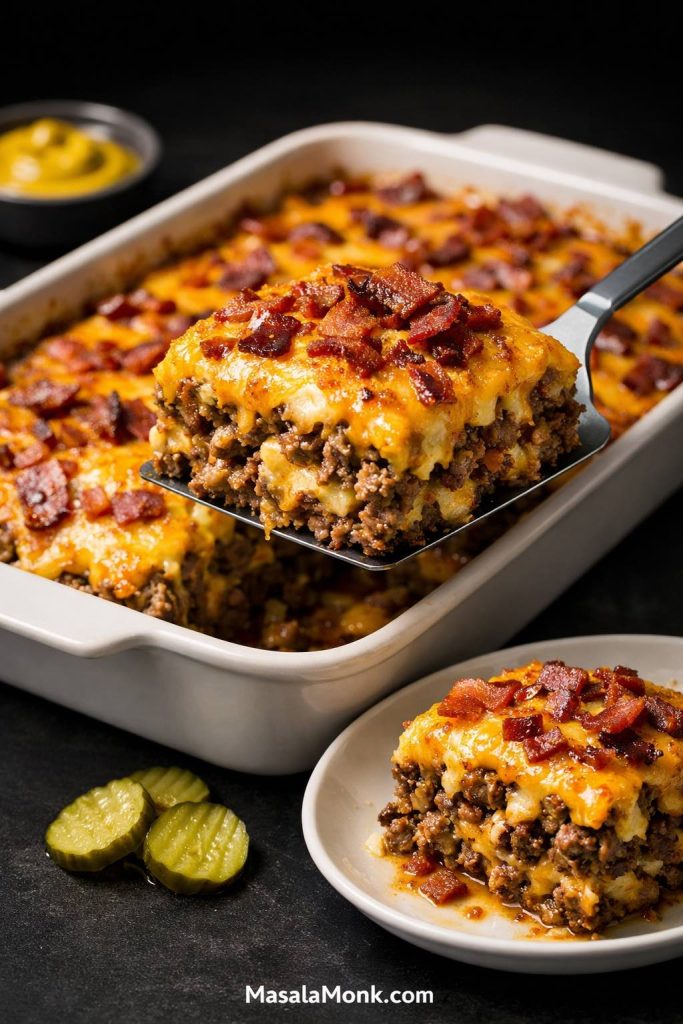
Bacon cheeseburger casserole with melted cheddar and crisp bacon, shown with a lifted square from a baking dish.
A bacon cheeseburger casserole makes the most sense when you want a richer make-ahead dinner, and the clean lifted slice shows why resting it before serving helps the texture hold together better.
  • Serves: 6
  • Prep time: 15 minutes
  • Cook time: 25 minutes
  • Estimated net carbs: about 4 to 6 grams per serving
  • Best for: meal prep, family dinners, and generous leftovers

Ingredients

  • 1 1/2 pounds ground beef
  • 6 strips bacon, cooked and crumbled
  • 1/2 onion, diced
  • 1 teaspoon kosher salt
  • 1/2 teaspoon black pepper
  • 1 teaspoon garlic powder
  • 1 tablespoon mustard
  • 4 ounces cream cheese
  • 2 large eggs
  • 1/2 cup heavy cream
  • 2 cups shredded cheddar cheese, divided
  • 2 tablespoons chopped pickles or no-sugar pickle relish, optional

Substitutions

  • Beef: 85/15 works well if you want the casserole rich but not overly heavy, while 80/20 gives the fullest comfort-food version.
  • Bacon: you can leave it out, but the casserole loses some of the smoky edge that helps it stand apart from the skillet.
  • Cheese: cheddar is the best default, though a cheddar-mozzarella mix can soften the sharpness if you want a milder finish.
  • Pickle element: chopped pickles or no-sugar relish both work, though pickles usually taste cleaner.
  • Structure: bake it in one casserole dish for family-style serving, or divide it into smaller dishes if you want easier portions for meal prep.

Method

  1. Preheat the oven to 375°F.
  2. Brown the beef with the onion, then stir in the salt, pepper, garlic powder, mustard, and cream cheese.
  3. Whisk the eggs and heavy cream in a bowl, then stir in 1 1/2 cups of the cheddar.
  4. Combine the beef mixture with the egg-cheese mixture and fold in the bacon and pickles if using.
  5. Transfer to a greased baking dish, spread it evenly, top with the remaining cheese, and bake for 20 to 25 minutes until hot and set.
  6. Pull the casserole when the center is just set rather than baking until it looks very firm. It will tighten further as it rests.
  7. Rest for 5 to 10 minutes before serving so the casserole slices more cleanly.
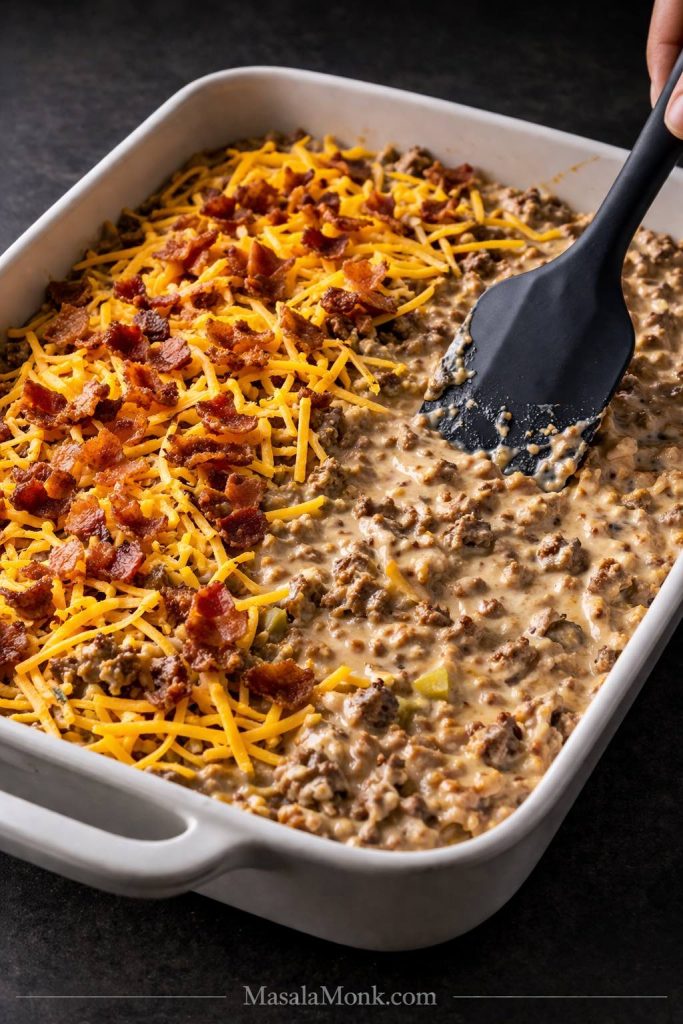
Black spatula smoothing unbaked bacon cheeseburger casserole in a baking dish, with shredded cheddar and bacon on top before baking.
Before baking, spread the casserole base evenly, then top it with cheddar and bacon so the bacon cheeseburger casserole bakes more evenly and finishes with better texture.

Tips for Best Results

Letting the casserole rest matters more than it looks on paper. A short rest firms the texture, improves the slices, and keeps the inside from feeling looser than it really is. Keep something bright nearby too. This version usually improves more from mustard, pickles, bacon, or a sharper side on the plate than from extra cheese or cream in the dish itself.

Common Mistakes

  • Overbaking: the casserole becomes tighter and less juicy than it should be.
  • Skipping the rest time: it slices messily and feels wetter than necessary.
  • Underseasoning the filling: cheese alone does not carry the whole dish.

Why This Format Works

This casserole makes the most sense when burger flavor matters more than burger shape. It portions more neatly than the skillet, survives the next day better than lettuce wraps, and feels more worth making when you already know leftovers matter. For basic fridge and freezer timing, the FoodSafety.gov cold storage chart is still the cleanest external reference to keep in mind.

Best Way to Serve It

Serve this with something sharp on the side so the richness does not flatten out.

Best with: pickles, a crisp salad, or a mustard-forward side element. Leftovers: excellent; cool fully before portioning for cleaner slices and better reheating.

5 More Keto Hamburger Recipes to Try

These shorter variations give you a few more useful ways to solve the same burger craving, especially when you want crisp edges, easier lunch prep, a plated dinner, or better portioning. So while they are shorter than the four main recipes, they should still feel like real options rather than decorative extras.

5. Smash-Style Lettuce Wrap Burgers

Choose this on nights when speed matters more than leftovers and you want the crispest crust in the group.

Use small beef balls, a very hot skillet or griddle, cheese, pickles, mustard, and sturdy lettuce leaves instead of buns. MasalaMonk’s classic smash burger method is a natural internal reference here, while Serious Eats’ smash burger technique explains why the crust develops so well.

Smash-style lettuce wrap burgers with crisp-edged beef patties, melted cheese, pickles, red onion, and a mini recipe card for quick keto burger prep.
These smash-style lettuce wrap burgers are one of the fastest keto burger options when you want crisp edges, strong burger flavor, and almost no cleanup.

Smash once right away, season, then leave the patties alone until the edges turn deeply browned and crisp before flipping. Add cheese, stack into lettuce, and serve immediately. This is one of the few burger styles here that really loses its point once it sits.

Best with: mustard, pickles, and the simplest possible toppings. Leftovers: poor; this version loses its edge once it sits.

6. Big Mac Salad Bowl

This is the lighter route, but it still needs enough sauce and pickle flavor to read as a real burger-style meal rather than merely lean.

Build it with chopped lettuce, warm seasoned beef, shredded cheese, onions, pickles, and a creamy dressing that clearly tastes like burger sauce. Chop everything fairly small so each bite lands as a real mix instead of forkfuls that swing between salad and plain beef.

Big Mac salad bowl with chopped lettuce, browned ground beef, pickles, red onion, shredded cheddar, burger-style dressing, and a mini recipe card for a lighter keto burger meal.
Big Mac salad bowl holds up best when the lettuce is chopped, the beef is well browned, and the burger-style dressing is bold enough to keep the whole bowl tasting clearly burger-inspired instead of salad-like.

One thing that matters more than it seems: this is the easiest version to over-chill into blandness, so the dressing has to do more flavor work than in a classic burger bowl.

Fast build: keep the lettuce, beef, toppings, and dressing separate until the last minute so the bowl stays crisp and the beef does not chill the whole dish too much.

Best with: extra pickles, finely chopped onions, or avocado. Leftovers: good, but only if the dressing stays separate.

7. Keto Hamburger Steak with Onions and Mushrooms

This is the better fit when dinner should feel plated, savory, and a little more old-school than burger-like in shape.

Sear seasoned patties, then cook onions and mushrooms in the same pan until they pick up color and absorb the beef flavor left behind. A spoonful of chimichurri over the top helps a lot here, because the plate can get heavy without some freshness.

Keto hamburger steak with onions and mushrooms served as a plated comfort-food dinner, with a mini recipe card showing timing and key cues.
A keto hamburger steak does best when the onions and mushrooms are cooked in the same pan as the patty, because that is what turns it from a plain bunless burger into a more savory plated dinner.

Serve it with wilted greens, sautéed cabbage, or cauliflower mash. This one reheats reasonably well, though the onion-and-mushroom finish is best when freshly made.

Best with: cauliflower mash, wilted greens, or sautéed cabbage. Leftovers: decent, though the onion-and-mushroom finish is best fresh.

8. Loose Meat Keto Burgers

This is one of the easiest versions for flexible leftovers, because the filling stores better than assembled burgers and can move between lettuce cups, bowls, and salads without much trouble.

Brown the beef well, season it assertively, and keep it moist enough to scoop rather than dry and crumbly. A little pepper sauce stirred into mayo makes a strong spicy finish here, especially when the rest of the build is fairly simple.

Loose meat keto burgers served in lettuce cups with juicy seasoned ground beef, pickles, red onion, and a mini recipe card for flexible low-carb lunches.
Loose meat keto burgers are at their best when the beef stays juicy and boldly seasoned, because this format depends more on scoopable texture, pickles, and sauce than on patty structure.

What makes or breaks it: the beef has to stay juicy enough to scoop and bold enough to stand on its own, because this format depends more on seasoning, pickles, and sauce than on patty structure.

Pickles matter more than usual in this format. Since there is no patty structure and no bun, that sharper edge is often what keeps the loose meat from tasting like ordinary seasoned ground beef.

Best with: pickles, crisp lettuce, and a punchy sauce. Leftovers: very good for lunch bowls or lettuce cups.

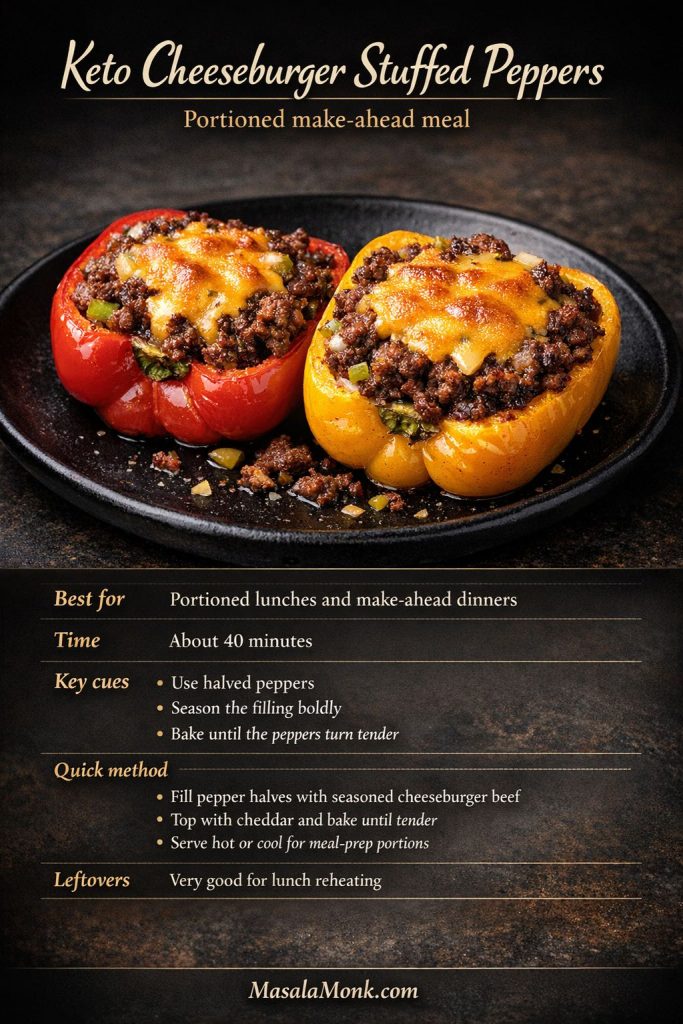
9. Keto Cheeseburger Stuffed Peppers

Choose this one when portioning and reheating matter more than speed.

Fill halved peppers with seasoned cheeseburger beef, mustard, and cheese, then bake until the peppers turn tender and the tops bubble. Because the peppers add sweetness and bulk, the filling needs more confidence than usual with salt, mustard, or pickle on the side.

Keto cheeseburger stuffed peppers with seasoned beef and melted cheddar, shown as a mini recipe card for portioned make-ahead meals.
These keto cheeseburger stuffed peppers come out best when the filling is seasoned boldly and the peppers bake until tender, because that is what makes them feel like a real make-ahead meal instead of just peppers with beef added in.

These are especially useful for make-ahead lunches. They do not hit the same fast-burger craving as the classic or smash-style versions, but they store much better and feel more complete the next day.

Make-ahead note: bake fully, cool, then refrigerate in portions so they reheat as complete lunches without any extra assembly.

Best with: pickles on the side or a sharper green salad. Leftovers: very good; one of the best short variations for lunch reheating.

How to Keep Hamburger Recipes Keto

The beef is usually the easy part. The meal drifts off course when buns, sweet sauces, breadcrumb binders, or standard diner sides start piling onto the plate. So the real skill is not making hamburger meals feel restricted. It is making them feel complete without leaning on the parts that add most of the unnecessary carbs.
Comparison guide showing how to keep hamburger recipes keto by swapping buns, sugary ketchup-heavy sauce, fries or chips, breadcrumb binder, and sweet relish for lower-carb burger options.
The easiest way to keep hamburger recipes keto is to watch the extras: skip the bun, sugary sauces, fries, breadcrumbs, and sweet relish, then use lettuce wraps, burger bowls, mustard or burger sauce, lower-carb vegetables, and dill pickles instead.

Switch the Format Instead of Forcing a Bun

Lettuce wraps work when you still want a hand-held burger feel. Meanwhile, bowls and salads work better for speed and meal prep. Skillets and casseroles make more sense when you want a warmer, more filling hamburger-meat dinner with stronger leftovers. Once you stop forcing every meal into burger form, the rest of keto burger cooking gets easier.

Common Carb Traps

  • Breadcrumb binders: these can quietly push patties away from the simple low-carb version you actually want.
  • Sugary ketchup-heavy sauces: the sauce is often where the hidden carbs arrive first.
  • Sweet relish: even small amounts can shift the meal more than expected.
  • Too much onion: onions are useful, but in skillet and casserole versions they can add up fast.
  • Heavy bun substitutes: some “keto buns” still make the meal heavier and less clean than bowls, lettuce wraps, or plated burgers.
  • Standard diner sides: fries, chips, and similar add-ons can undo the rest of the plate quickly.

Use Smarter Condiments

Mustard, mayo-based burger sauce, pickle-forward dressings, herb sauces, and spicy mayo all work well here because they add richness and sharpness without pushing the meal toward sweetness. A good keto-friendly mustard and a simple homemade mayo base cover most of what you need for burgers, bowls, and burger sauce. When you want a cooler finish, Greek tzatziki also works especially well with burger bowls and plated patties.

Quick rule: when in doubt, keep the beef simple, skip the sweet sauces, and let acid, cheese, and a sharper sauce do the heavy lifting.

Best Ground Beef for Keto Hamburger Recipes

The best beef blend depends on the format. For burgers and smash burgers, fattier beef usually works better because it browns harder and stays juicier. By contrast, skillets, casseroles, and stuffed peppers can handle slightly leaner beef when enough cheese, cream, bacon, or sauce is already doing part of the richness work.

Comparison guide showing the best ground beef for keto hamburger recipes, including 80/20 for classic and smash burgers, 85/15 for bowls, skillet, and casserole, and 90/10 for leaner bowl or casserole options.
For keto hamburger recipes, 80/20 usually gives the juiciest burgers and best crust, 85/15 is the easiest all-purpose choice, and 90/10 works best when bowls or casseroles have enough sauce, cheese, or bacon to support leaner beef.
  • 80/20: best for classic burgers and smash burgers where browning and juiciness matter most.
  • 85/15: the easiest all-purpose middle ground for bowls, burgers, skillets, and casseroles.
  • 90/10: workable for bowls or casseroles only if enough sauce, cheese, bacon, or another richness source supports it.

As a rule, 80/20 gives better crust and a juicier bite in intact patties, while 85/15 often gives a cleaner balance in bowls and skillet dinners. Leaner than that can still work, yet it usually needs extra help from sauce, cheese, bacon, or careful cooking time so the meat does not dry out.

If the beef stays in patty form, fat matters more. If it gets crumbled into bowls, skillets, or casseroles, sauce and cheese can carry more of the richness without the meal feeling dry.

For general burger technique, Serious Eats’ burger fundamentals are still useful because they reinforce the big things that matter most: keep the meat cold, handle it lightly, and resist overworking it. Meanwhile, USDA FoodData Central is a handy neutral reference if you want to compare common blends like 80/20 and 90/10.

Best Sauces for Keto Hamburger Recipes

Comparison guide showing the best keto burger sauces for bunless burgers, burger bowls, cheeseburger skillet, and casserole.
The best keto burger sauce depends on the format: classic burgers want a thicker mayo-mustard-pickle finish, bowls need a looser sharper sauce, skillets benefit from a more mustard-forward edge, and casseroles usually work better with sauce served on the side.
  • For classic burgers: a simple mix of mayo, mustard, and chopped pickles gives the cleanest burger finish.
  • For burger bowls: go slightly sharper and slightly looser so the sauce spreads easily and does more flavor work in every bite.
  • For skillet: keep it mustard-forward or finish with pickles rather than pushing in more cream.
  • For casserole: sauce usually works better on the side than baked into the dish, where it can blur the texture.
  • Best cool option: tzatziki works especially well with burger bowls and plated patties.
  • Best fresh-herb option: chimichurri fits plated patties and hamburger steak better than bowls or casseroles.

What to Serve Instead of Burger Buns

The smartest move is not always replacing the bun with another bread-like stand-in. Quite often, the cleaner answer is changing the structure of the meal and letting the burger profile carry through in a form that suits the night better. That is what makes the best versions feel satisfying rather than like a workaround.

Guide showing lettuce wraps, burger bowls, plated patties, cheeseburger salads, and stuffed peppers as keto-friendly alternatives to burger buns.
Skipping burger buns works best when you change the format, not just remove the bread: lettuce wraps stay closest to the hand-held feel, bowls and salads help with assembly, plated patties keep the burger central, and stuffed peppers are the strongest make-ahead option.
  • Lettuce wraps: best when you still want to eat with your hands
  • Burger bowls: best for easy assembly and lunch prep
  • Cheeseburger salads: best for lighter meals with crunch
  • Plated patties with vegetables: best for hamburger steak or classic burgers without the wrap
  • Cauliflower mash, green beans, roasted broccoli, and sautéed cabbage: best for turning a burger plate into a full dinner

Best Sides by Format

  • With classic burgers: roasted broccoli, green beans, or sautéed cabbage
  • With burger bowls: avocado, extra pickles, and crunchy salad vegetables
  • With skillet: sautéed cabbage, roasted mushrooms, or simple greens
  • With casserole: pickles, slaw-style salad, or sharper greens
  • With hamburger steak: mushrooms, cauliflower mash, or wilted greens

This is also where sauce choice matters. For example, chimichurri works especially well on plated patties, while tzatziki fits bowls and salads better. Meanwhile, a mayo-and-mustard burger sauce remains the most classic bridge between all of these serving styles.

The best bun replacement is often not bread-like at all. More often, it is the format that suits the meal better.

Meal Prep, Storage, and Reheating

Not every hamburger-style meal behaves the same way in the fridge. Burger bowls, skillets, casseroles, stuffed peppers, and loose meat burgers all store better than fully assembled lettuce wraps. So if tomorrow’s lunch matters almost as much as tonight’s dinner, the format should influence your choice from the start.
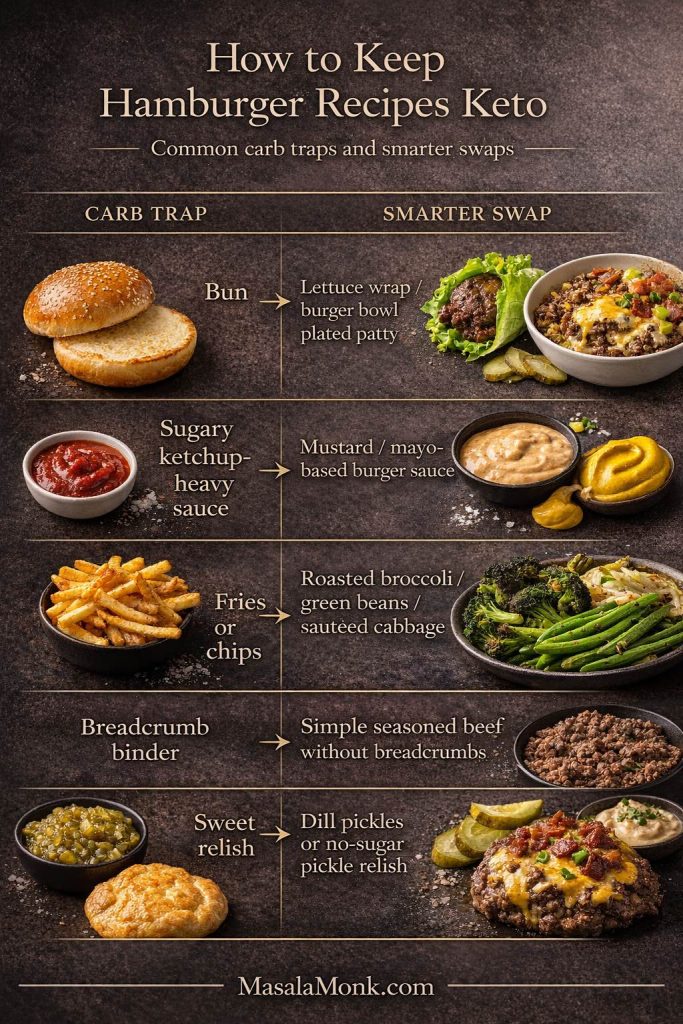
For timing, the FoodSafety.gov cold storage chart is a good general reference. Likewise, FoodSafety.gov’s leftovers guidance is worth keeping in mind when readers are batching several meals ahead.

Meal prep, storage, and reheating guide for keto hamburger recipes showing the best options for fresh eating, lunch prep, warm leftovers, batch dinners, and freezing.
Not every keto hamburger format stores the same way: lettuce wraps are best eaten fresh, burger bowls work best with separate components, skillets reheat especially well, casseroles portion neatly for later, and uncooked patties are the strongest freezer option.
  • Best for leftovers: cheeseburger skillet, casserole, stuffed peppers, loose meat burgers
  • Best frozen: uncooked patties, casserole portions, stuffed peppers
  • Best eaten fresh: lettuce wraps and fully dressed cheeseburger salads
  • Best reheated gently: burger patties in a covered skillet or low oven, skillets on the stove, casseroles covered first

Store components separately whenever texture matters. Keep burger bowl beef, greens, and sauce apart until serving; reheat patties gently; and dress lettuce-based meals at the last minute. A few extra minutes of separate storage work usually pays off with much better leftovers.

Keto Hamburger Recipes FAQ

Can you eat hamburgers on keto?

Yes. In most cases, the burger itself fits easily. The bun, sugary sauces, and higher-carb sides are usually what push the meal away from keto. That is why bowls, lettuce wraps, and plated burger meals work so well here.

What is the best first keto hamburger recipe to make?

For most readers, the best first recipe is the classic bunless keto cheeseburger because it is the clearest and most direct burger answer. From there, burger bowls and cheeseburger skillets are the easiest ways to branch out without leaving the flavor profile behind.

What temperature should a hamburger reach?

Because burgers use ground beef, the safest practical target is the USDA recommendation of 160°F. That guidance comes directly from the USDA ground beef food safety page.

Which keto hamburger recipes are best for meal prep?

Burger bowls, cheeseburger skillets, bacon cheeseburger casserole, loose meat burgers, and stuffed peppers all work well for meal prep. Lettuce wraps, however, are best eaten fresh because their texture drops off quickly once assembled.

Closing recap card showing the best keto hamburger recipe choices for first recipe, fastest option, lunch prep, warm leftovers, and batch dinner.
If you only remember five things from this guide, start with the classic bunless cheeseburger for the most burger-like result, go to smash-style lettuce wraps for speed, choose the burger bowl for lunch prep, rely on the skillet for warm leftovers, and make the casserole when batch cooking matters most.

Final Thoughts on Keto Hamburger Recipes

The strongest keto hamburger recipes page is not the one that tries to force every dinner into a single burger shape. It is the one that helps readers solve the same craving in the form that actually fits the night. Sometimes that is a classic cheeseburger with enough sharpness and richness to stand on its own. Sometimes it is a fast bowl, a skillet that reheats well, or a casserole that earns its place through leftovers. Taken together, those options give readers one clear place to start, enough depth to cook from, and enough range to stay useful after the first visit.

↑ Back to top

Posted on 17 Comments

Mayo Recipe: 15+ Homemade Mayonnaise Variations

Creamy bowl of homemade mayonnaise surrounded by lemon, egg yolk, herbs, and chilli flakes with the text The Ultimate Mayo Recipe Guide and MasalaMonk.com

Mayonnaise doesn’t shout for attention the way chilli oil or hot sauce does. It waits quietly in the background, then suddenly you notice your favourite dishes are all leaning on it: that glossy potato salad, the creamy coleslaw, the egg mayo sandwich, the burger that just feels right, the sushi with a mysterious spicy drizzle. Once you understand how a simple mayo recipe works, you realise that jar in the fridge is just the most basic version of something you can customise in dozens of directions.

In this guide, we’ll start with a classic homemade mayonnaise recipe, then use one simple mayo recipe to build a whole family of sauces:

  • Classic mayo
  • Japanese mayo
  • Eggless and “veg” mayo
  • Vegan mayo made with aquafaba and other plant-based bases
  • Spicy mayo in different flavours
  • Garlic mayo and herb mayo
  • Mayo–ketchup sauce (fry sauce / burger sauce)

We’ll also look at how to use these in real meals and link out to supporting recipes on MasalaMonk so this isn’t just theory – it’s a complete playbook you can actually cook from.


What Mayonnaise Actually Is

Before diving into any particular mayonnaise recipe, it helps to know what’s going on in the bowl.

Mayonnaise is an emulsion – specifically, an oil-in-water emulsion:

  • The water phase is mostly egg plus something acidic like lemon juice or vinegar.
  • The fat phase is oil.
  • When you blend them with enough energy and the right emulsifiers (from egg yolk and mustard), you end up with millions of tiny oil droplets held in place inside the water phase instead of separating out.

Egg yolk brings lecithin and proteins that surround each droplet and stop them clumping together. Mustard quietly helps too, adding its own emulsifiers and a bit of heat. Oil provides body and richness; the acid sharpens flavour and helps keep things stable.

Homemade mayonnaise emulsion test showing glossy ribbons that hold, indicating a stable mayo texture.
Quick check: lift a spoonful—if it falls in glossy ribbons and briefly sits on the surface before melting back, your emulsion is stable. If it looks grainy or oily, slow down and rebuild the base.

When a batch “splits”, those droplets have clumped back into visible oil, and the watery part has leaked out. That usually happens if:

  • Oil is added too quickly.
  • The mixture is too cold or too hot.
  • There isn’t enough yolk or mustard for the amount of oil.
  • The emulsion is crushed with too much liquid at the wrong time.

Once you see mayonnaise as a balance between oil, water, and emulsifier, everything about it becomes easier: making it, tweaking it, and rescuing it.

Also Read: Double Chocolate Chip Cookies – Easy Recipe with 7 Variations


Is Homemade Mayonnaise Safe?

Because many mayo recipes use raw egg, the obvious question is: is homemade mayonnaise safe to eat?

Food safety agencies like the USDA are very clear that raw or undercooked eggs can carry Salmonella, particularly risky for pregnant people, young children, older adults, and anyone with a weakened immune system. Their Q&A on homemade mayonnaise safety and their broader guide on egg products and food safety both stress the same basics.

In practice, that means:

  • Use fresh eggs from a trusted source.
  • Keep eggs refrigerated and discard cracked or suspicious ones.
  • Work with clean utensils and equipment.
  • Get homemade mayo into the fridge quickly and keep it cold.
  • Make sensible batch sizes and use them within a few days.
  • If it smells wrong or looks wrong, don’t argue with it – throw it out.
Homemade mayonnaise stored in a labeled jar in the refrigerator with guidance to chill quickly and use within a few days.
Label your jar the moment you make it. Store it in the coldest part of the fridge (not the door), and always use a clean spoon—cross-contamination spoils mayo faster than time.

If you’d like extra reassurance, you can:

  • Use pasteurised eggs or pasteurised liquid egg products.
  • Choose an eggless mayonnaise recipe or a vegan mayo recipe that uses no egg at all.

We’ll cover both egg-based and egg-free approaches so you can decide what fits your home and your guests. We also have seperate guides – How to Make Eggless Mayo at Home (Egg Free Mayonnaise Recipe) – along with – Vegan Mayo Recipe Guide: 5 Plant-Based Mayonnaise – which you can refer to and save, if those are your dietary preferences of needs.


Classic Mayo Recipe (Homemade Mayonnaise Base)

Everything else in this guide grows from this one base. Once you’re comfortable making this classic mayo recipe, you can branch out into all the flavoured versions with tiny adjustments.

Ingredients for Classic Mayo Recipe

  • 1 large egg, at room temperature
  • 1 cup (240 ml) neutral oil (sunflower, canola, grapeseed, or light vegetable oil)
  • 1–2 teaspoons fresh lemon juice or white wine vinegar
  • ½ teaspoon Dijon or yellow mustard
  • ¼ teaspoon fine salt, plus more to taste
  • A pinch of sugar (optional, just to round the acidity)

You can make this by hand with a whisk, but an immersion blender makes it almost effortless.

Immersion Blender Mayo Recipe Method

Step 1 – Pour the egg, mustard, salt, and lemon juice or vinegar into a tall, narrow jar.

Immersion blender mayonnaise step 1 showing egg mixture at the bottom and oil layered on top in a jar before blending.
This separation is intentional: the blender needs a calm oil layer to ‘grab’ and emulsify from the bottom. Stirring too early is a common reason mayo turns runny or splits.

Step 2 – Add the oil on top in one steady pour. Don’t stir; let it sit in two distinct layers.

Immersion blender mayonnaise step 2 with the blender head placed flat at the bottom of the jar to start emulsifying the egg and oil.
Starting at the bottom creates a strong ‘anchor’ emulsion first. If you begin mid-jar or lift too early, the oil can stay loose and the mayo is more likely to split.

Step 3 – Place the blender head all the way at the bottom and switch it on.

Immersion blender mayonnaise step 3 showing a pale, creamy emulsion forming at the bottom of the jar while oil remains on top.
This pale layer is your ‘anchor’ emulsion. Don’t lift the blender until you see it clearly forming—lifting too early leaves oil un-emulsified and increases the chance of splitting.

Step 4 – Hold it there, still, for 7–10 seconds. A thick, pale emulsion will start forming at the base.

Immersion blender mayonnaise step 4 showing the creamy emulsion rising upward in the jar while a layer of oil remains on top.
When the creamy zone climbs to around halfway, the emulsion is strong enough to start moving the blender. If it hasn’t risen yet, hold steady a few seconds longer before lifting.

Step 5 – Once the bottom half looks creamy, slowly draw the blender up through the jar, tilting a little to pull more oil into the blades.

Immersion blender mayonnaise step 5 showing the blender being lifted slowly to pull the top oil into the forming emulsion.
Lift in slow motion so the blades can ‘drink’ the oil. If you rush upward, you can trap a slick of oil on top and end up with runny mayo.

Step 6 – By the time you reach the top, you should have a thick, glossy mayonnaise.

Immersion blender mayonnaise step 6 showing mostly emulsified mayo in a jar as the last oil is blended in.
At this stage, blend only until the last oily streaks disappear. Over-blending isn’t necessary—stop when the texture turns uniformly pale and glossy.

Step 7 – Taste and adjust with more salt or lemon juice if needed.

Immersion blender mayonnaise step 7 showing finished homemade mayo in a jar with thick glossy texture on a spoon.
Finished mayo should fall in slow ribbons and look evenly pale with no oily sheen. Now taste and adjust: a tiny pinch of salt sharpens flavour, and a few drops of lemon/vinegar brighten it without thinning.

Step 8 – If the mayo feels too stiff, whisk in a teaspoon or two of water until the texture matches what you want.

Immersion blender mayonnaise step 8 showing a small amount of water being added to loosen homemade mayo texture.
To loosen stiff mayo, whisk in 1 teaspoon of water at a time until it turns spoonable. To make it thicker, emulsify a little more oil (slowly) once the base is already stable.

Hand-Whisk Mayo Recipe Method

If you prefer whisking:

  1. In a medium bowl, whisk together the egg, mustard, salt, and acid until the mixture is completely smooth.
  2. Begin adding oil drop by drop while whisking continuously. This slow start is what builds the initial emulsion.
  3. Once it thickens and turns paler, switch to a thin, steady stream of oil, still whisking without stopping.
  4. Continue until you’ve used all the oil and the mayo stands in soft peaks.
  5. Taste and tweak the seasoning.

From here, you can spread this homemade mayonnaise on sandwiches, stir it into potato salad, or use it as the base for garlic mayo, spicy mayo, Japanese mayo, and more.

Also Read: Katsu Curry Rice (Japanese Recipe, with Chicken Cutlet)


Customising Your Mayonnaise or Mayo Recipe

Instead of treating this base as the final product, treat it as a starting point. With a few changes to the oil, the acid, and the seasoning, you can turn one mayo recipe into many.

Choosing the Oil in Mayo Recipe

Different oils shape the flavour:

  • Neutral oils (sunflower, canola, grapeseed) keep the flavour clean and versatile.
  • Light olive oil adds some fruitiness without excessive bitterness.
  • Avocado oil gives a buttery, green note that works well in bowls and salads.

You can also blend oils: for example, half sunflower oil and half light olive oil makes a well-rounded base.

Mayonnaise flavour guide comparing oils (neutral, light olive, avocado) and acids (lemon, white vinegar, rice vinegar) for homemade mayo.
Fast rule: neutral oil + lemon = classic all-purpose mayo; avocado oil = buttery for bowls; light olive oil adds gentle fruitiness. For a softer tang (especially Japanese-style), swap in rice vinegar.

Choosing the Acid in Mayo Recipe

The acid doesn’t just brighten the taste; it affects the overall character:

  • Lemon juice gives a fresh, citrusy tang.
  • White wine vinegar is gentle and soft.
  • Apple cider vinegar adds a faint apple note.
  • Rice vinegar is slightly sweet and mild, perfect for a Japanese mayo recipe.

Combining acids gives you even more control. A tablespoon of lemon juice plus a teaspoon of rice vinegar, for instance, produces a balanced, rounded tang.

Adding Character: Salt, Sweetness, Heat and Umami

Once the base tastes good, you can layer on personality:

  • A pinch of sugar or honey softens sharp acidity.
  • A few drops of soy sauce, a spoonful of miso, or a touch of fish sauce give savoury depth.
  • Crushed garlic instantly steers you towards garlic mayo.
  • Hot sauce, chilli paste, or a spoonful of chilli sauce from the pepper sauce recipe guide transforms it into a spicy mayo recipe.

When you think of mayo as a blank canvas, all these variations become tiny, deliberate tweaks instead of separate, complicated recipes.

Mayonnaise mix-in guide showing dijon mayonnaise, dill pickle mayo, sesame mayo, and honey mayo with quick ratios.
Use these as ‘base flavours’ and adjust to taste: add more Dijon for bite, more pickle brine for tang, more sesame oil for nuttiness, or a bigger chilli pinch for heat. Each works best on different foods—Dijon for sandwiches, pickle for burgers, sesame for bowls, honey for fried snacks.

Mayo Recipe Variations (Quick Mix-In Guide)

Use this cheat sheet with ½ cup mayo (classic, eggless or vegan). Stir, taste, and adjust salt/acidity.

  • Sriracha mayo: 1–2 tbsp sriracha + ½ tsp rice vinegar
  • Spicy mayo: 1–3 tsp hot sauce/chilli paste + ½ tsp lemon juice
  • Chipotle mayo: 1 tbsp chipotle in adobo + 1 tsp lime juice
  • Wasabi mayo: ½–1 tsp wasabi paste + ½ tsp lime juice
  • Mayonnaise with garlic: 1 grated garlic clove + 1 tsp lemon juice
  • Mayo and ketchup sauce: 3 tbsp ketchup + 1 tsp mustard
  • Dijon mayonnaise: 2 tsp Dijon + ½ tsp honey
  • Dill pickle mayo: 1–2 tbsp chopped pickles + 1 tsp pickle brine + black pepper
  • Sesame mayo: 1 tsp toasted sesame oil + 1 tsp soy sauce + ½ tsp rice vinegar
  • Honey mayo: 1–2 tsp honey + pinch of chilli flakes

Mayo Made With Avocado Oil

If you want a cleaner, buttery mayo, make mayo with avocado oil exactly like the classic recipe. Use 1 cup avocado oil instead of neutral oil.

Mayo made with avocado oil recipe card showing homemade avocado oil mayonnaise and a 1:1 oil swap tip.
Avocado oil makes a clean, buttery mayo that works especially well in bowls and salads. Choose a mild avocado oil—strong/bitter oils can dominate the finished sauce.

The method stays identical; the flavour turns slightly greener and richer, great in bowls and salads.

Also Read: Crispy Homemade French Fries From Fresh Potatoes (Recipe Plus Variations)


Japanese Mayo Recipe (Kewpie-Style)

Japanese mayonnaise is richer and more savoury than standard Western mayo, with a slightly looser texture and a distinctive tang. Think about the creamy lines zig-zagged over okonomiyaki or drizzled on karaage – that’s the feeling you’re aiming for.

What Makes Japanese Mayo Different

Compared with the classic base you just made, Japanese mayonnaise:

  • Uses egg yolks only instead of whole eggs.
  • Relies on rice vinegar rather than stronger vinegars.
  • Is lightly sweetened.
  • Often includes a tiny amount of MSG or dashi for umami.

That combination gives it a custardy texture and savoury punch.

Japanese style mayo recipe card showing yolk-forward mayonnaise made with rice vinegar, a touch of sweetness, and optional umami.
For the most ‘Japanese-style’ finish, use yolks only and rice vinegar, then add sweetness in tiny pinches. This mayo shines on fried foods and sandwiches because the softer tang doesn’t overpower the filling.

Homemade Japanese Mayonnaise Recipe

Ingredients

  • 2 egg yolks, at room temperature
  • 1 cup neutral oil
  • 1½ tablespoons rice vinegar
  • 1 teaspoon sugar
  • ½ teaspoon salt
  • Optional: a pinch of MSG or a sprinkle of dashi powder

Method

  1. Add yolks, rice vinegar, sugar, and salt to a tall jar.
  2. Pour in the oil on top.
  3. Blend from the bottom up with your immersion blender just as you did for classic mayo.
  4. Taste, then adjust with more rice vinegar for extra tang or a touch more sugar if you prefer a softer profile.
Japanese-style mayo guide showing yolks, rice vinegar, tiny sweetness, and an optional umami pinch to build the signature flavour.
Think of this as a flavour blueprint: yolks bring richness, rice vinegar keeps tang soft, a small sweetness rounds edges, and the optional umami pinch adds the ‘canteen’ savouriness that makes Japanese-style mayo addictive on fried foods.

Use this Japanese mayo in all the usual ways: drizzle it over okonomiyaki, serve it with fried chicken, or smear it in sandwiches. It’s especially good with umami-focused fillings like the mushrooms and cheese in this mushroom cheese sandwich, where the richness of the yolk-based mayo and the savoury mushrooms amplify each other.

Also Read: How to Cook Perfect Rice Every Time (Recipe)


Eggless Mayo and Veg Mayo Variations

If you avoid eggs or just want an option you can serve to anyone without worrying about raw egg, eggless mayo and veg mayo are seriously useful.

MasalaMonk has a detailed guide on eggless mayonnaise that walks through several bases, including milk, curd, cashews and aquafaba. The core idea doesn’t change: you still need a water phase, a fat phase, and an emulsifier. The difference is simply that the emulsifier isn’t egg.

Eggless mayonnaise guide showing three veg mayo bases—milk, curd, and cashew—so you can choose the right texture.
If you want the closest ‘store-style’ texture, start with milk. For a lighter, tangier spread, use thick curd. For the richest dip-like mayo (great with herbs/garlic), go cashew.

Milk-Based Eggless Mayonnaise

This version uses cold milk as the water phase.

A typical pattern:

  • ½ cup cold milk
  • 1 cup neutral oil
  • 1–2 teaspoons vinegar or lemon juice
  • ½ teaspoon mustard
  • Salt and a pinch of sugar
Eggless mayonnaise (milk mayo) method showing cold milk emulsifying with oil using an immersion blender to make thick veg mayo.
Cold milk is the difference-maker. If it doesn’t thicken within 20–30 seconds, stop and chill the jar + milk, then try again while adding oil more slowly.

Blend the milk, mustard, salt and acid first, then drizzle in the oil while blending until it thickens. The proteins in the milk help bind the oil into a creamy veg mayo that feels surprisingly close to the original.

Curd- or Yogurt-Based Veg Mayo Recipe

Here, thick yogurt or hung curd does the heavy lifting.

A basic curd-based mayo might use:

  • ½ cup thick curd (drained so it’s not watery)
  • 2–4 tablespoons oil
  • Lemon juice or vinegar
  • Mustard, salt, pepper
  • Optional garlic or herbs
Veg mayo made with thick curd (yogurt) and a little oil, a lighter eggless mayonnaise option for wraps and salads.
Use thick/hung curd so it doesn’t turn watery. If it tastes too tangy, balance with a tiny pinch of sugar or a drizzle of honey—then season with pepper and herbs.

Because curd is already thick, it needs much less oil. This style tastes tangier and lighter, which makes it ideal for salads, wraps and sandwiches when you don’t want heavy richness.

Cashew-Based Eggless Mayo Recipe

Soaked cashews can be blended with water, oil, acid, mustard and salt to make a rich, smooth veg mayo. It’s naturally slightly sweet and very creamy. Once you add garlic and herbs, you get a luxurious dip for grilled vegetables, chaats and snacks.

Those three styles – milk, curd and cashew – cover most situations where you want an eggless mayonnaise recipe that still feels indulgent. You can go deeper into the Cashew Based recipes in Vegan Mayo Recipe Guide: 5 Plant-Based Mayonnaise.

Also Read: How to Make Churros (Authentic + Easy Recipe)


Vegan Mayo Recipe (Plant-Based Mayonnaise)

A vegan mayo recipe goes a step further by skipping eggs and dairy altogether. Fortunately, plants have more than one way to pull this off.

MasalaMonk’s vegan mayo recipe collection explores five different bases: soy milk, almond milk, aquafaba, cashews and even tofu. All of them rely on the same idea: you still need water, fat and an emulsifier, just from plant sources now.

Recipe for Aquafaba Vegan Mayo

Aquafaba is the thick liquid from cooked or canned chickpeas. It happens to contain enough proteins and starches to whip and emulsify oil like a surprisingly good stand-in for egg white.

A basic aquafaba vegan mayo looks like this:

Ingredients

  • 3 tablespoons aquafaba
  • 1 cup neutral oil
  • 1–2 teaspoons lemon juice or apple cider vinegar
  • ½ teaspoon mustard
  • ¼ teaspoon salt
  • Optional: 1–2 cooked chickpeas blended in for a thicker body
Vegan mayo recipe card using aquafaba (chickpea liquid) with oil and acid to make thick plant-based mayonnaise.
Aquafaba mayo often thickens even more after chilling. If yours stays loose, reduce watery aquafaba (use thicker chickpea liquid) and blend again—texture improves fast once the emulsion grabs.

Method

  1. Combine aquafaba, mustard, salt and acid in a tall container.
  2. Pour the oil on top.
  3. Blend from the bottom up until the mixture thickens and turns creamy.
  4. Chill before using; it will firm up slightly as it cools.

This vegan mayo recipe works anywhere you’d use regular mayo: in potato salad, as a sandwich spread, in creamy coleslaw, or mixed into chickpeas and vegetables for a plant-based “tuna” salad.

For example, you can fold vegan mayo into lentils and chopped vegetables to mimic tuna salad, the way it’s done in this plant-based high protein lentil meal prep.

Cashew Cream Vegan Mayo Recipe

For a richer style:

  • Soak ½ cup cashews until soft.
  • Blend with ¼–⅓ cup water, 2–3 tablespoons oil, lemon juice, mustard and salt.
Cashew mayo recipe card showing eggless mayonnaise made from soaked cashews, lemon, and salt for a rich veg mayo dip.
For the smoothest cashew mayo, soak cashews until fully soft, then blend longer than you think. If it tastes heavy, brighten it with a squeeze of lemon and a pinch of salt—those two changes make it taste ‘lighter’ without thinning.

The result is a glossy cashew mayo that’s fantastic with roasted vegetables, sandwiches, grain bowls and wraps. It’s particularly good drizzled over something colourful and satisfying like the Thai-style vegan bowl with peanut butter dressing.

Also Read: How to Cook Bacon in the Oven (Crispy, No-Mess, Crowd-Ready Recipe)


Egg Mayonnaise Sandwich Filling

Sometimes, when people look for an egg mayonnaise recipe, what they really want is the filling for an egg mayo sandwich – chopped boiled eggs bound together with mayo and seasonings.

Here’s a straightforward version you can tweak endlessly:

Ingredients

  • 3 hard-boiled eggs, peeled and cooled
  • 3–4 tablespoons mayo (classic, eggless or vegan)
  • 1 teaspoon mustard
  • 1 tablespoon finely chopped onion or chives
  • 1 tablespoon finely chopped celery, cucumber or bell pepper
  • Salt and freshly ground black pepper to taste
  • Optional: paprika, chilli flakes or herbs
Egg mayonnaise sandwich filling with chopped boiled eggs mixed with mayo, showing the ideal creamy, not-watery texture.
Cool the eggs completely before mixing—warm eggs melt the mayo and turn the filling loose. For extra bite, keep some egg chunks; for a smoother spread, mash one egg and chop the rest.

Method to make Egg Mayo Sandwich Filling

  1. Chop or mash the eggs in a bowl.
  2. Stir in mayo, mustard and the chopped vegetables.
  3. Season with salt, pepper and spices.
  4. Adjust the mayo quantity until the mixture is creamy but still holds its shape.

Pile this egg mayo onto soft white bread, whole-grain slices, brioche buns or inside pita. It keeps well as a filling for lunchboxes, and it sits nicely alongside plant-forward options like the hummus veggie sandwich or the hung curd spinach cheese sandwich.

Also Read: One-Pot Chicken Bacon Ranch Pasta (Easy & Creamy Recipe)


Spicy Mayo Ideas & Recipes

Once you have a jar of plain mayo – whether it’s classic, eggless or vegan – it takes almost no effort to turn it into spicy mayo. And because there are so many chilli sauces and pastes out there, you can build a whole collection of different spicy mayo recipes without ever getting bored.

Spicy mayo heat ladder showing sriracha mayo, chipotle mayo, wasabi mayo, and fermented chili mayo in ramekins.
Pick by flavour, not just heat: sriracha mayo is tangy for sushi and fries, chipotle mayo is smoky for burgers and tacos, wasabi mayo is sharp for seafood and tempura, and fermented chilli mayo brings deeper funk for bowls and grilled meats.

Basic Spicy Mayo Formula & Recipe

Start with this, then improvise:

  • ½ cup mayo
  • 1–3 teaspoons hot sauce, chilli paste or finely chopped chilli
  • ½ teaspoon lemon juice or rice vinegar
  • A pinch of salt and/or sugar, depending on your sauce

Stir it all together. Taste. Adjust the heat, acidity and salt until it feels right.

Sriracha Mayo Recipe (Sriracha Mayonnaise)

Use sriracha as your chilli element and rice vinegar as the acid. This version loves sushi rolls, poke bowls, fried tofu, tempura and loaded fries. It also works as a drizzle on top of crunchy, tangy salads like the vegan Som Tam raw papaya salad, where the creamy heat plays against the crisp vegetables.

Sriracha mayonnaise recipe card showing mayo and sriracha ratio with rice vinegar for a cleaner tang.
Start mild, then build: add sriracha in small increments so the sauce stays creamy (not watery). If it tastes ‘flat’, a few drops of rice vinegar or lime instantly brightens it.

Ingredients:

  • ½ cup mayo
  • 1–2 tbsp sriracha (start small)
  • ½ tsp rice vinegar or lemon juice
  • Pinch of salt (optional)

Method:
Stir until smooth. This is the classic ‘mayo sriracha’ combo people want when they ask for ‘sriracha and mayo’. Use it on sushi, fries, burgers, bowls, tempura.

Chipotle Mayo

Chipotle mayo is one of the best friends tacos ever had. Combine mayo with canned chipotle peppers in adobo sauce and lime juice. The smoke and tang make it perfect for grilled corn, quesadillas, burritos, burgers and roasted potatoes.

Chipotle mayo recipe card showing smoky chipotle mayonnaise with lime for a brighter finish.
Chipotle mayo loves anything grilled or crispy. If it tastes too smoky or heavy, add a squeeze of lime and a pinch of salt—acid + salt ‘lifts’ the flavour without thinning the sauce much.

If you feel like taking chipotle and other chillies even further, the recipes in the pepper sauce collection give you a whole menu of chilli bases to stir into mayo: jalapeño, habanero, mixed pepper sauces and more.

Peri-Peri Mayo

Peri-peri sauce plus mayo gives you a bright, lemony, garlicky burn. It’s ideal as a dip for fries and potato wedges, but also brilliant smeared on grilled chicken, paneer, and vegetable skewers.

Gochujang and Wasabi Mayo Recipe

You can easily twist spicy mayo toward different cuisines:

  • Gochujang mayo: mix gochujang with mayo and a little rice vinegar for Korean-inspired sandwiches and grain bowls.
  • Wasabi mayo: stir wasabi paste into mayo with a squeeze of lime – this is unbeatable with sushi, tempura, or seared tuna.
Wasabi mayo recipe card showing wasabi mayonnaise with lime for balance and a smooth pale-green texture.
Wasabi heat hits your nose fast, so start with ½ tsp and increase slowly. This sauce is best on sushi, tempura, and seafood—lime keeps the flavour sharp without making it feel heavy.

Because these spicy mayo recipes usually ride alongside rich or fried foods, it’s worth pairing them with something sharp and refreshing to drink. For burger nights or snack spreads, drinks from the margarita mocktail guide, the keto mocktails lineup, or the coconut water cocktails and mocktails keep things lively instead of heavy.


Garlic Mayo and Herb Mayo Recipe

If chilli isn’t your first love, garlic and herbs are another classic way to move away from plain mayo.

Garlic mayo recipe card showing mayonnaise with garlic, lemon juice, and resting tip for a smoother, mellower dip.
Pro tip: grate garlic (don’t chop) for a smoother sauce, then rest 20 minutes so the sharp bite mellows into a round, ‘restaurant’ flavour. For a lighter version, swap in 2–3 tbsp thick yogurt for part of the mayo.

How to make Garlic Mayo (Cheat’s Aioli)

Think of this as the everyday version of aioli – less traditional, but very effective.

Ingredients

  • ½ cup mayonnaise
  • 1–2 cloves garlic, finely grated or crushed
  • 1 teaspoon lemon juice
  • Salt to taste
  • Optional: a spoonful of olive oil for flavour

Stir everything together and let it rest in the fridge for 20–30 minutes so the garlic has time to mellow and spread through the sauce.

Serve garlic mayo with roasted potatoes, sweet potato wedges, grilled vegetables, kebabs, or as a burger spread. When you’d like a lighter cousin, swap to a yogurt-based dip like the cucumber-and-garlic sauces in the Greek tzatziki recipes.

How to make Herb Mayo

Herb mayo is the green, fragrant sibling of garlic mayo.

Some combinations to play with:

  • Dill and chives with lemon for fish dishes and potato salad.
  • Coriander, mint and green chilli for tikkas, kebabs and chaats.
  • Basil and parsley for tomato-heavy sandwiches and roasted vegetables.
  • Cilantro and lime with a pinch of cumin for Mexican-leaning bowls and tacos.

A basil-forward herb mayo works particularly well in sandwiches like the avocado, basil and grilled tomato sandwich, where it echoes the fresh herbs and adds creaminess.

Also Read: 10 Best Espresso Martini Recipe Variations (Bar-Tested)


Mayo–Ketchup Sauce (Fry Sauce / Burger Sauce)

Take mayonnaise, add ketchup, and you have one of the fastest condiments on earth. In Utah and nearby regions, it’s called fry sauce. While in Argentina and Uruguay, a similar mixture goes by salsa golf. While in many burger shops, it appears as a “secret sauce” that’s secretly not that complicated.

Mayo and ketchup sauce recipe card showing a 2:1 mayo-to-ketchup fry sauce ratio with a French fry dip.
Use the 2:1 ratio as your base. Want it more ‘burger-shop’? Add ½ tsp mustard and a splash of pickle brine (or finely chopped pickles) for tang and a more complex finish.

Basic Mayo–Ketchup Sauce Recipe

Ingredients

  • ½ cup mayo
  • 3 tablespoons ketchup
  • 1 teaspoon mustard
  • Optional: a spoonful of relish or finely chopped pickles
  • Optional: a dash of vinegar or pickle brine
  • Optional: a pinch of smoked paprika or chilli

Mix until smooth and taste. Adjust the mayo–ketchup ratio to suit your mood. More mayo makes it richer and creamier; more ketchup makes it sweeter and more tomato-forward.

Use this sauce:

  • As a dip for fries, wedges and tater tots
  • Inside burgers and sliders as a “house sauce”
  • As a quick dressing for shredded cabbage and carrot slaw
  • With leftover vegetable fillings like the ones in the paneer sabji sandwich

If you feel like branching out from there, it’s only a short step to Thousand Island, Russian dressing and other mayo-plus-ketchup-plus-extras sauces that show up in salads and sandwiches.

Also Read: Easy Lemon Pepper Chicken Wings (Air Fryer, Oven & Fried Recipe)


Mayo in Salads and Bowls

Because mayo is creamy, it makes salads feel like something you actually want to eat, rather than just ingredients you’re enduring. That doesn’t mean drowning everything in sauce; a few spoons often go further than you think.

Potato Salad

Potato salad is probably the most famous mayo-based salad of all. MasalaMonk’s potato salad recipes cover everything from traditional mayo-heavy versions to lighter, olive-oil-based and vegan takes.

You can:

  • Use classic mayo plus mustard, dill and gherkins for a deli-style potato salad.
  • Combine mayo and Greek yogurt for a lighter dressing.
  • Build a vegan potato salad with aquafaba mayo and beans for extra protein.

A similar approach works for pasta and grain salads: a small amount of mayo in the dressing adds body, while lemon juice and herbs keep the flavours bright.

Tuna and Legume Salads

Tuna salad is essentially a way to stretch a can of tuna into a full meal, and mayo is what helps it hold together.

MasalaMonk’s healthy tuna salad guide shows how to balance mayo with yogurt, avocado, olive oil and crunchy vegetables so the salad feels nourishing rather than heavy.

On the plant-based side, lentil and chickpea salads love a spoonful of vegan mayonnaise. Mix cooked lentils or chickpeas with chopped onion, celery, herbs, mustard, lemon juice and vegan mayo, and you get a high-protein spread that behaves a lot like tuna salad – perfect for sandwiches, wraps or lettuce cups – just like the ideas in that lentil meal prep guide.

Bowls

In bowls, mayo works best as a component, not the main event. You might:

  • Add a small dollop of spicy mayo on top of a rice and veg bowl.
  • Whisk mayo into a dressing for coleslaw that sits beside a grain bowl.
  • Stir garlic mayo through roasted vegetables and chickpeas for a warm salad.

Bowls like the Thai-style vegan peanut butter bowl already include a creamy element, but there’s nothing stopping you adding a little vegan mayo on the side for extra richness if that’s what you’re craving.

Also Read: Cheesy Chicken Broccoli Rice – 4 Ways Recipe (One Pot, Casserole, Crockpot & Instant Pot)


Sandwiches and Wraps with Mayo

Inside a sandwich, mayo plays three roles at once:

  • It adds flavour.
  • It protects bread from watery fillings.
  • It makes every bite feel soft and indulgent.

Spread a thin layer on both slices of bread and you immediately notice sandwiches taste more “finished”.

A few ways to plug your mayo recipes into sandwiches:

If you’re thinking about nutrition as well as indulgence, the ideas in boosting your fibre intake with sandwiches show how to build gut-friendly sandwiches that lean on whole grains, legumes and vegetables, while using just enough mayo to keep everything moist and delicious.

Also Read: French 75 Cocktail Recipe: 7 Easy Variations


No-Cook Meals Featuring Mayo

On days when standing over a stove feels like punishment, mayo quietly steps in as a no-cook hero. You can build whole plates out of fresh, cold ingredients and a jar of something creamy.

MasalaMonk’s no-cook recipes for hot summer days include wraps, salads, chaas and other ideas that sit perfectly alongside mayo-based dips and dressings.

Think:

  • Wraps with veg mayo, grated vegetables, cucumber, lettuce and leftover grilled paneer or tofu.
  • Chickpea salads bound with vegan mayo, lemon juice and herbs.
  • Vegetable sticks with three different mayo dips: garlic, spicy and herby.

Serve those with a jug of something ice-cold – maybe a sparkling drink from the apple juice mocktail recipes or one of the tangy apple cider vinegar mocktails – and you have dinner without turning on the gas.


Drinks That Pair Well with Mayo-Rich Dishes

Because mayo-based dishes are rich and fatty, the right drink can make or break the experience. You want something that refreshes and cuts through, not something that weighs the meal down further.

A few pairings that work especially well:

The richer the food, the brighter and more refreshing the glass should be – that’s the only rule that really matters.

Also Read: Peanut Butter Cookies (Classic Recipe & 3 Variations)


Troubleshooting Homemade Mayonnaise Recipe

Even with good technique, mayonnaise sometimes goes rogue. Instead of binning it straight away, it’s worth knowing how to fix the most common issues.

Mayo Too Thick

If your mayo has turned into something closer to putty:

  • Whisk in a teaspoon of water at a time until it loosens to your preferred consistency.
  • For dressing, add more acid plus water until it’s pourable.
Mayonnaise texture fixes showing how to thin mayo with water and thicken runny mayo by emulsifying in more oil.
Adjust in tiny steps: add water 1 teaspoon at a time to loosen stiff mayo. For runny mayo, add oil slowly (or start with a fresh yolk and whisk the runny batch into it) so the emulsion has something to hold onto.

Mayo Too Thin

Runny mayo usually means not enough oil or too much acid/water.

You can:

  • Slowly whisk in more oil, giving the emulsion a chance to thicken.
  • Chill it; some batches firm up once cold.
  • Repurpose very thin mayo as a salad dressing instead of fighting it.

Mayo Split or Curdled

A broken mayo looks grainy and oily, with liquid weeping out. It feels like a disaster, but it’s usually fixable.

How to fix split mayonnaise showing broken mayo vs fixed smooth mayo by whisking into a fresh egg yolk.
Rescue rule: treat the broken mayo like ‘oil’ in a new batch—start with a fresh yolk and whisk the broken mixture in teaspoon by teaspoon. Egg-free option: use 1 tbsp aquafaba instead of yolk as the reset.

To rescue it:

  1. Put one fresh egg yolk (or a tablespoon of aquafaba) in a clean bowl.
  2. Very slowly whisk in the broken mayo, a teaspoon at a time, treating it like the “oil” in a new batch.
  3. Once things turn smooth and creamy again, you can add the rest of the broken mixture in a slightly faster stream.

To avoid splitting next time, keep your ingredients at similar temperatures, go slowly when building the emulsion at the start, and add extra liquid only once the base is robust.

Also Read: Easy and Healthy Oat Cookies- No Sugar | No Butter | No Refined Flour


Final Thoughts: One Mayo Recipe, Many Directions

When you look back over everything, it all starts with one simple mayo recipe: egg, oil, acid and salt transformed into a creamy emulsion.

From there, you’ve seen how to turn that foundation into:

  • Classic homemade mayonnaise for everyday use
  • Japanese mayo with extra yolks and rice vinegar
  • Eggless mayonnaise using milk, curd or cashews
  • Full vegan mayo with aquafaba or plant milks
  • Spicy mayo in multiple personalities – sriracha, chipotle, peri-peri, gochujang, wasabi
  • Garlic mayo and herb mayo that taste like restaurant sauces
  • Mayo–ketchup sauce for fries, burgers and snack platters

And you’ve explored where those sauces go:

Once you understand that mayonnaise is just a technique for persuading oil and water to work together, it stops being a mystery and starts being a playground. From there, every new variation – whether it’s a Japanese mayo recipe, a vegan mayo recipe, a veg mayo, a garlic mayo or a spicy mayo – is just another small twist on a skill you already own.

Homemade mayonnaise base ratio card showing the classic mayo recipe ratio: 1 egg, 1 cup oil, and 1–2 teaspoons acid.
Keep everything at a similar temperature (room-temp egg is easiest). If your emulsion struggles, add ½ tsp mustard or start the blend at the very bottom until a pale core forms.

FAQs about Homemade Mayonnaise or Mayo Recipe

1. What is the simplest mayo recipe for beginners?

A very basic mayo recipe uses just egg, oil, lemon juice or vinegar, salt, and a little mustard. You blend or whisk one egg with mustard, salt, and acid, then slowly emulsify in about a cup of neutral oil until it turns thick and creamy. Once that works for you consistently, you can start adjusting the seasoning and texture to match your taste.


2. How is a mayonnaise recipe different from a regular sauce?

Unlike most sauces that are just mixed or reduced, a mayonnaise recipe creates an emulsion: tiny droplets of oil trapped inside a water phase made from egg and acid. Because of that structure, it becomes thick, glossy, and spreadable without needing flour, starch, or cooking.


3. Which oil is best for homemade mayonnaise?

For most people, a neutral oil like sunflower, canola, or grapeseed gives the most versatile homemade mayonnaise. These oils stay in the background so the flavour of lemon, vinegar, garlic, or herbs can shine. If you enjoy more personality, you can blend in some light olive oil or avocado oil, but it’s better to avoid using only very strong extra-virgin olive oil, as it often turns the mayo bitter.


4. Why does my mayo recipe sometimes split or go runny?

Usually, a broken mayo recipe comes from adding the oil too fast, working with ingredients that are too cold, or not having enough egg yolk or mustard for the amount of oil. Once the emulsion fails, the mixture looks oily and grainy instead of smooth. Fortunately, you can rescue it by starting a fresh yolk in a clean bowl and slowly whisking the broken mixture into it like new “oil.”


5. How long does homemade mayonnaise last in the fridge?

Typically, homemade mayonnaise lasts about three to five days in a well-sealed container in the coldest part of your fridge. Because it often uses raw egg, it’s safer to make small batches and finish them quickly. If the colour, smell, or texture changes in a strange way, it’s better to discard it and make a fresh mayo recipe rather than risk food poisoning.


6. Is mayonnaise healthy or unhealthy?

Mayonnaise is high in fat and calories, so it’s energy-dense. That said, it can still fit into a balanced diet if you treat it as a flavour booster instead of the main ingredient. When you choose oils rich in unsaturated fats, like sunflower or avocado, and use your mayo recipe sparingly in salads and sandwiches, it becomes more of a useful accent than a nutritional problem.


7. Can I make a mayo recipe without egg?

Yes, you can absolutely make a mayo recipe without egg. Eggless mayonnaise recipes often use milk, curd, cashews, or aquafaba (chickpea liquid) as the water phase and emulsifier. Once you blend those with oil, acid, and seasoning, you still get a thick, creamy veg mayo that behaves much like the traditional version.


8. What’s the difference between eggless mayonnaise and vegan mayo?

Eggless mayonnaise simply avoids eggs; it may still use milk, cream, or yogurt. Vegan mayo, on the other hand, is completely plant-based, so it contains no egg and no dairy at all. Because of that, a vegan mayo recipe usually relies on soy milk, aquafaba, cashews, or other plant milks to create the emulsion.
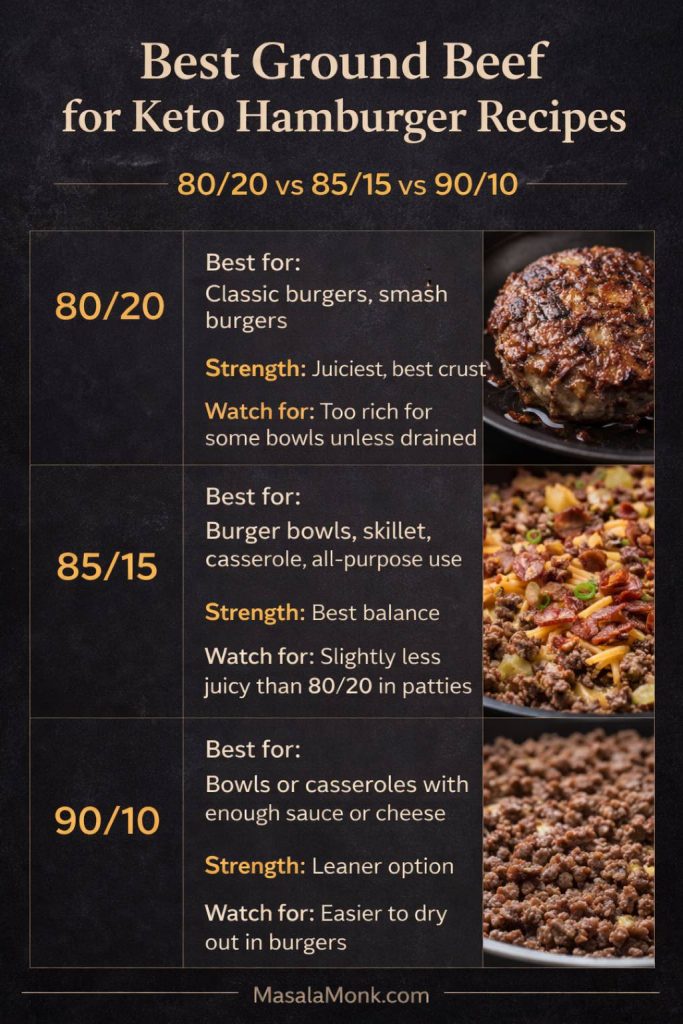

9. How do I make a vegan mayo recipe with aquafaba?

To make an aquafaba vegan mayo recipe, you start with a few tablespoons of chickpea cooking liquid in a tall jar. Then you add mustard, salt, and an acidic ingredient like lemon juice, before gradually emulsifying in a cup of neutral oil with a blender. In the end, you get a glossy, egg-free mayonnaise that works beautifully in sandwiches, salads, and bowls.


10. What makes Japanese mayo recipe versions taste different?

Japanese mayo recipes usually rely on egg yolks only, rice vinegar instead of harsh vinegars, a pinch of sugar, and sometimes a bit of MSG or dashi. Consequently, the result is richer, silkier, slightly sweeter, and more umami-packed than standard mayonnaise. That’s why it tastes so good on okonomiyaki, fried chicken, or sushi rolls.


11. Can I turn classic mayonnaise into Japanese-style mayo?

Yes, you can move your classic mayonnaise recipe in a Japanese direction by tweaking a few details. You can add extra yolk for richness, swap part of the usual acid for rice vinegar, stir in a tiny pinch of sugar, and optionally add a bit of MSG. With those changes, the flavour profile shifts noticeably closer to a Japanese mayo recipe without needing a complete overhaul.


12. How can I make a spicy mayo recipe for sushi or fries?

To create a spicy mayo recipe, you simply stir chilli into your base. Often, cooks mix mayonnaise with sriracha, gochujang, chipotle in adobo, peri-peri sauce, or finely minced fresh chillies. Then, a dash of lemon or rice vinegar brightens everything. Once you find the level of heat you like, you can spoon it over sushi, poke bowls, burgers, wraps, or loaded fries.


13. What is garlic mayo, and how is it different from aioli?

Garlic mayo is exactly what it sounds like: mayonnaise combined with fresh or roasted garlic, plus a little extra lemon juice or salt. Traditional aioli, by contrast, is made by emulsifying only garlic and olive oil with salt, often without egg. In everyday kitchens, though, people often use a garlic mayo recipe as a quick, reliable substitute for aioli because it delivers a similar flavour with much less effort.
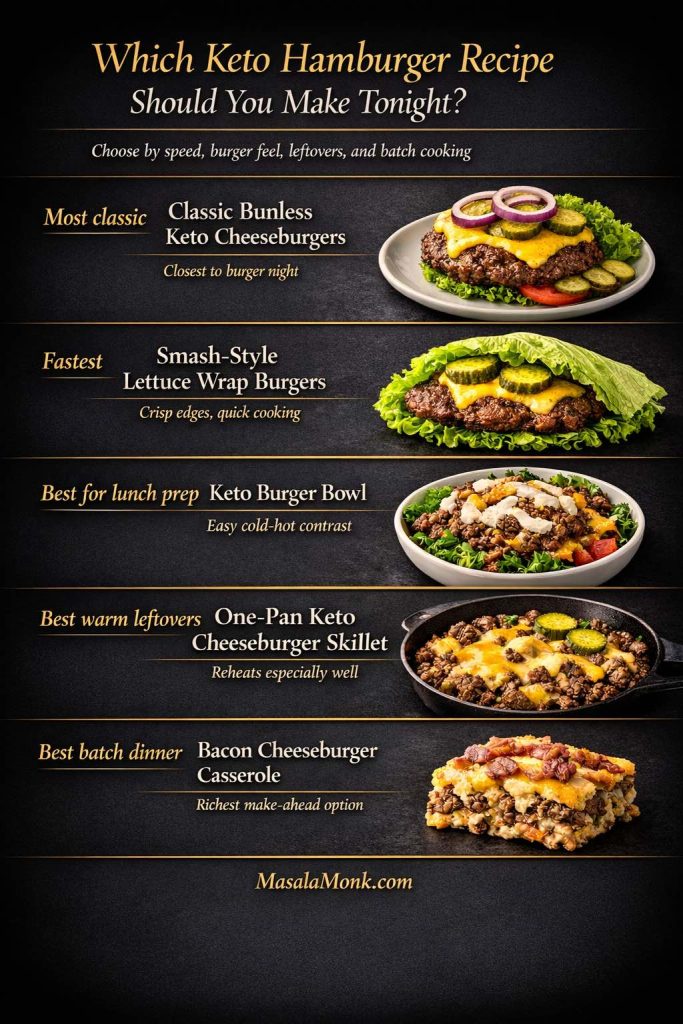
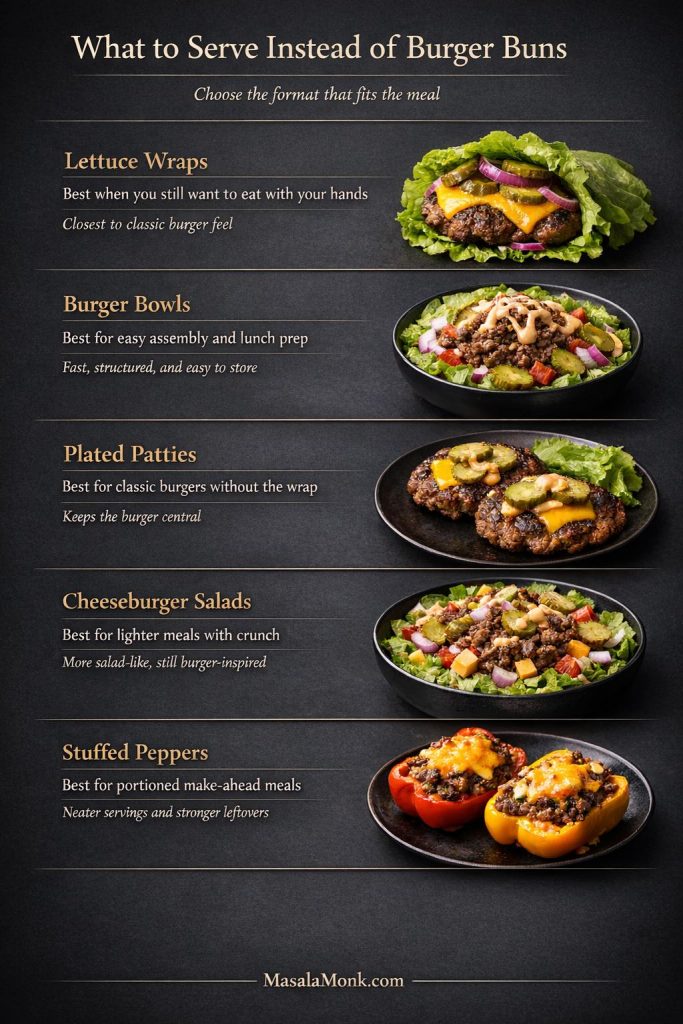

14. Can I make a lighter or low-fat mayonnaise recipe?

You can make a lighter mayonnaise by replacing part of the oil with Greek yogurt, hung curd, or even silken tofu. Naturally, the texture and taste become tangier and less rich, but they remain creamy enough to coat salads or fill sandwiches. Another approach is to use a thinner dressing that blends a little mayo with plenty of lemon juice, vinegar, and water instead of trying to mimic full-fat mayo exactly.


15. Is mayonnaise gluten-free?

Most classic mayonnaise recipes are naturally gluten-free because they use egg, oil, acid, salt, and mustard. Even so, it’s wise to double-check labels on store-bought jars and to be careful with flavoured versions, because some brands add ingredients like malt vinegar, stabilisers, or flavourings that may contain gluten.


16. Does mayonnaise need to be refrigerated all the time?

Homemade mayo, and any mayonnaise recipe made from scratch, should always be kept in the fridge once it’s made, especially if it includes raw egg. While some commercial jars are shelf-stable until opened, even those belong in the refrigerator after you break the seal. Leaving mayo out too long at room temperature raises the risk of bacterial growth and food poisoning.


17. Can I freeze mayonnaise or a mayo-based sauce?

Freezing mayonnaise is usually not a good idea. The emulsion tends to break when it thaws, leaving you with a watery, grainy mess. Instead, it’s better to prepare small batches of homemade mayonnaise recipe as you need them and finish them within a few days, rather than trying to store a huge portion in the freezer.


18. What is mayo ketchup sauce or “fry sauce”?

Mayo ketchup sauce, often called fry sauce or burger sauce, is simply a mixture of mayonnaise and ketchup, sometimes with mustard, relish, vinegar, or spices added. This combination creates a creamy, tangy, slightly sweet dip that pairs beautifully with fries, wedges, burgers, hot dogs, and even simple veggie sticks. Because it’s so easy, many people treat it as their first “extra” mayo recipe beyond the basic.


19. How do I make a simple mayo and ketchup dip at home?

For a quick mayo and ketchup dip, you can start with about two parts mayonnaise to one part ketchup, then taste and adjust. If you like it sharper, stir in a touch of mustard or vinegar. When you prefer something more complex, mix in chopped pickles, onions, smoked paprika, or a little hot sauce. In only a minute, you’ve got a custom fry sauce made from your usual mayonnaise recipe.


20. What’s the difference between an egg mayonnaise recipe and plain mayo?

In everyday language, “egg mayonnaise recipe” often refers to a sandwich filling made from chopped boiled eggs mixed with mayonnaise, not the sauce itself. Regular mayo is the creamy emulsion of raw egg, oil, and acid; egg mayo uses that sauce to bind cooked eggs with seasonings like mustard, onion, herbs, and pepper into a spreadable mixture that goes inside bread, rolls, or wraps.


21. Can I use olive oil for a mayonez recipe?

You can use olive oil, but it’s best to choose a mild one or blend it with a neutral oil. Strong extra-virgin olive oil can make a mayonez recipe taste bitter and overly intense. Consequently, many people use half neutral oil and half light olive oil. That way, you still get some character from the olive oil without overwhelming the mayo.


22. Why does my homemade mayonnaise taste bitter?

A bitter mayonnaise recipe often comes from using an aggressive extra-virgin olive oil or over-processing the oil at high speed until it oxidises. To avoid that, you can pick a gentler oil, limit blending time, or blend only part of the oil and whisk the rest in by hand. If a batch already tastes bitter, balancing it with lemon juice and a pinch of sugar helps a little, but sometimes starting again is easier.


23. How can I make my mayonnaise thicker?

If your mayo feels too thin, you can gradually whisk in more oil, which may sound backwards but actually thickens the emulsion. Additionally, you can begin with an extra yolk at the start of your mayonnaise recipe to provide more emulsifiers. Sometimes chilling the mayo in the fridge helps firm it slightly, especially in vegan mayo recipes that use aquafaba or cashew cream.


24. How do I fix a mayo recipe that is too thick and stiff?

When a mayonnaise recipe comes out closer to putty than sauce, you can loosen it very gently with water, lemon juice, or vinegar. Add liquid just a teaspoon at a time while whisking, until it reaches a soft, spoonable consistency. From there, you can taste again and tweak the seasoning so it still matches the dish you’re serving it with.


25. Is a mayo recipe suitable for keto or low-carb diets?

Most traditional mayo recipes are naturally low in carbohydrates because they’re mainly made of fat and a small amount of egg and acid. Therefore, they usually fit well into keto or low-carb approaches, as long as you don’t use mayonnaise together with sugary sauces or carb-heavy sides. For people watching carbs closely, it’s still worth checking that any added mustard, ketchup, or flavourings aren’t loaded with hidden sugars.


26. Can I use homemade mayonnaise in hot dishes?

You can add mayonnaise to warm dishes, but it doesn’t love high, direct heat. If you boil or fry it, the emulsion may split and the sauce can look oily. Instead, it’s better to stir mayo into foods after they come off the heat, or use it under a breadcrumb topping for gentle baking. For example, you might mix a mayo recipe with cheese and herbs to top chicken, then bake until just browned.


27. What is veg mayo, and how is it used in Indian-style recipes?

Veg mayo usually means a mayo recipe without eggs, designed for vegetarian kitchens. Often, it includes milk or curd, plus oil and flavourings. It’s widely used in Indian-style sandwiches, tikkas, rolls, chaats, and fusion snacks. Because it’s mild and creamy, veg mayo blends easily with coriander chutney, green chillies, onions, and masala spices without fighting them.


28. How can I flavour a basic mayonnaise recipe for different cuisines?

Once you have a simple mayonnaise recipe, you can steer it toward many cuisines just by changing the flavourings. For a Mediterranean feel, you might use garlic, lemon, and herbs like oregano or basil. For a Japanese note, you could add rice vinegar, a pinch of sugar, and a little soy. To give it a Mexican twist, you may mix in lime, cumin, coriander, and chipotle. With each variation, the structure stays the same while the personality shifts.


29. What’s the best way to use leftover mayonnaise in meals?

Leftover mayonnaise turns into dressings, dips, and spreads very easily. You can thin it with lemon juice for a quick salad dressing, stir it into chopped herbs for a last-minute dip, or blend it with ketchup for a fast mayo ketchup sauce. Beyond that, you might fold it into egg salads, tuna salads, or roasted vegetable bowls to make them more satisfying without much extra work.


30. How do I choose between classic, eggless, and vegan mayo for a recipe?

The choice depends on who you’re serving, how you feel about raw egg, and what you want the final dish to be. Classic homemade mayonnaise gives the richest flavour and texture. Eggless mayonnaise recipes suit vegetarian households that still use dairy. Vegan mayo recipes are ideal when you need something fully plant-based or want to avoid eggs completely. Once you know how each type behaves, you can swap them into sandwiches, salads, dips, or burger sauces with confidence.

Posted on 6 Comments

Vegan Mayo Recipe Guide: 5 Plant-Based Mayonnaise

Vegan mayo promotional cover for MasalaMonk.com: a stacked vegan burger and a small bowl of glossy vegan mayonnaise on a matte ceramic plate, with a hand dipping a French fry into the sauce, set against a sage and terracotta colour-block background with the text “Vegan Mayo, Reinvented – 5 Creamy Bases, Zero Eggs”.

If you love the way mayonnaise turns simple ingredients into something rich and satisfying, learning a good vegan mayo recipe might honestly change how you cook. You still get that silky texture, the comforting tang, and the way it pulls burgers, salads, and sandwiches together. Yet now everything is entirely plant-based, adaptable to allergies, and open to endless flavour experiments. Whether you tend to call it vegan mayo, vegan mayonnaise or simply egg-free mayo, the idea is the same: a rich, creamy, completely plant-based spread that behaves like classic mayo but fits vegan, dairy-free and egg-free diets.

Although store-bought vegan mayo is easy to find, homemade versions give you far more control. You decide the base, the oil, the flavour, the thickness, and even the level of richness. You can create a classic-style vegan mayonnaise recipe that tastes like the kind you grew up with, or you can build lighter, high-protein, cashew-based or avocado-based versions that fit a more whole-food approach.

In this guide, you’ll walk through:

  • What vegan mayo actually is and how it compares to regular mayonnaise
  • A classic soy milk vegan mayo recipe that behaves just like traditional mayo
  • A vegan mayo recipe with aquafaba (chickpea liquid) that feels airy and eggless
  • A tofu vegan mayo recipe for high-protein, lower-fat spreads
  • A cashew vegan mayo recipe for rich, gourmet-style creaminess
  • An avocado-based vegan mayo recipe for fresh, whole-food fat
  • Over fifteen variations and ways to twist each recipe of vegan mayo into new flavours
  • Practical ideas for using these vegan mayo recipes in real meals
  • Honest talk on whether vegan mayo is healthier than regular mayo
  • Storage, safety, and how long homemade vegan mayonnaise really lasts
  • Smart substitutes for days when you want a creamy element but not mayo at all

Along the way, you’ll see places where vegan mayo naturally plugs into other MasalaMonk recipes – such as eggless mayo, potato salad variations, spinach dips, vegan Som Tam salad, Thai-style vegan bowls, tzatziki and pesto variations.

A rustic bowl of creamy plant-based vegan mayo beside traditional mayonnaise, surrounded by soy milk, tofu, avocado, chickpeas and lemon on a wooden table.

Vegan Mayo Recipe Basics: What Exactly Is Vegan Mayonnaise?

How Classic Mayonnaise Works

Before you look at any detailed vegan mayo recipes, it really helps to understand what mayonnaise actually is. At its core, traditional mayonnaise is an emulsion: a stable mixture of oil and water-based liquid that normally don’t want to mix.

Tall glass jar showing oil and liquid mayo separating while an immersion blender sits inside, with lemon, egg yolk and mustard nearby to illustrate how a mayonnaise emulsion forms.
Seeing the layers of oil and liquid before they blend makes the idea of an emulsion real, which helps when you later switch to vegan mayo and rely on plant proteins instead of egg to hold everything together.

In regular mayo, egg yolk acts as the emulsifier. It keeps tiny droplets of oil suspended in water, which is what gives you that thick, creamy sauce that clings to a spoon.

Vegan Mayo Ingredients: What’s Really in Veg Mayonnaise?

Most vegan mayo ingredients lists look a lot like the classic ingredients of mayonnaise, just with plant-based swaps. When people look for veg mayonnaise ingredients, what they’re really asking is how to recreate that familiar mix of oil, acid, emulsifier and seasoning using soy milk, aquafaba, tofu, cashew cream or avocado instead of eggs.

To put it another way, classic mayo is basically:

  • Oil
  • A water-based liquid (often from the egg itself)
  • Acid (like lemon juice or vinegar)
  • An emulsifier (egg yolk)
  • Seasonings (salt, mustard, sometimes a touch of sugar)

When all of these elements are in balance, the mixture turns glossy and stable. However, if the ratio shifts or the oil is added too fast, the emulsion can split and turn greasy or watery.

A top-down view of vegan mayo ingredients in small bowls, including soy milk, chickpea water, tofu, cashews, avocado, lemon, white vinegar, Dijon mustard and salt arranged on a wooden surface.
These are the main building blocks you’ll mix and match for different vegan mayonnaise recipes—swap the base between soy milk, aquafaba, tofu, cashews or avocado, then keep the acid, mustard and seasoning similar to get the texture you like.

How a Vegan Mayo Recipe Recreates the Emulsion

In a vegan mayonnaise recipe, the egg disappears completely. Even so, you still need something to do the emulsifying work. Instead of egg yolk, the structure comes from plant-based ingredients such as:

  • Proteins and lecithins in soy milk
  • Starches and proteins in aquafaba – the liquid from cooked or canned chickpeas
  • The soft protein and fat structure of silken tofu
  • The smooth fat and fibre mix of cashew cream
  • The natural oils and emulsifiers inside avocado

Because of this, a good vegan mayo recipe is not simply “regular mayo without eggs.” Rather, it becomes a fresh balance of:

  • Fat – usually oil, sometimes nuts or avocado
  • Water-based liquid – from soy milk, chickpea water, tofu or nuts
  • Acid – lemon juice, vinegar, or both
  • Emulsifying compounds – plant proteins, starches and natural lecithins
  • Seasonings – mustard, garlic, herbs, salt, pepper, and occasionally sugar

When these pieces work together, your sauce thickens and turns silky. If they drift out of balance, the mixture can separate or feel oily. Even then, vegan mayo is often easier to rescue than egg-based mayo, because you can simply blend the broken emulsion into a small amount of fresh base liquid and rebuild it.

Why Vegan Mayo Is Naturally Egg-Free and Dairy-Free

There’s also an important nutritional difference. Regular mayonnaise is technically dairy-free – it doesn’t contain milk – yet it does contain eggs and therefore cholesterol. As the breakdown on mayonnaise and whether it’s dairy from WebMD explains, most classic mayo is egg-based, not milk-based.

Vegan mayo, by contrast, relies only on plant ingredients. As a result, it is:

  • Naturally egg-free
  • Automatically cholesterol-free
  • Completely dairy-free
  • Often soy-optional, depending on which base you choose

In practice, that means a vegan mayonnaise recipe can slot easily into vegan, eggless and lactose-free diets, and even stand in for a more traditional vegetarian mayo wherever you’d usually use mayonnaise. If you need a soy free vegan mayo or a completely dairy and egg free mayo, the fix is simple: choose a base like aquafaba, cashew cream or avocado instead of soy milk. That way, your dairy free mayo recipe can be tweaked to suit soy-free, nut-free or multi-allergy households without losing the creamy, tangy feel.

Also Read: How to Make Eggless Mayo at Home (Egg Free Mayonnaise Recipe)


The Emulsion Blueprint Behind Every Vegan Mayo Recipe

Because recipes can sometimes feel overwhelming, it’s useful to build a mental blueprint first. You can think of almost every vegan mayo recipe as some variation of this formula:

Base liquid + Acid + Flavour + Oil = Vegan Mayo

Where:

  • The base liquid might be soy milk, aquafaba, blended tofu, or blended cashews.
  • The acid usually comes from lemon juice, white vinegar, apple cider vinegar, or rice vinegar.
  • The flavour comes from mustard, garlic, herbs, black pepper, nutritional yeast, or spices.
  • The oil is often a neutral vegetable oil (sunflower, canola, rice bran, grapeseed), or occasionally a mild olive oil.
A wooden board holding four glass bowls of base liquid, lemon wedges, chopped herbs and neutral oil in front of a jar of creamy vegan mayo, showing the simple formula behind vegan mayonnaise.
Seeing vegan mayo broken into base liquid, acid, flavour and oil makes it easier to swap soy milk for aquafaba, tofu, cashews or avocado and still end up with a thick, reliable vegan mayonnaise recipe.

You can also switch up the oil depending on what you keep in your kitchen. Some people enjoy using avocado oil because it gives a soft, buttery flavour, while others like the mild fruitiness of light olive oil. Both options blend into the emulsion easily, so you can make a batch with avocado oil or a gentle olive-oil version whenever you want something slightly more aromatic. Once you understand that, you suddenly realise you can adapt almost any recipe of vegan mayo to your own needs. For instance:

  • If soy is a problem, you simply use aquafaba or cashew cream as the base.
  • If you want to reduce fat, you switch some of the oil for silken tofu.
  • If you prefer whole-food fats, you choose cashews or avocado instead.

Because the structure is the same, you’re free to swap and experiment while still staying within the safe, stable emulsion framework.

Also Read: Upma Recipe: 10+ Easy Variations (Rava, Millet, Oats, Semiya & More)


Classic Soy Milk Vegan Mayo Recipe (Your Everyday Base)

Let’s start with the most familiar vegan mayo recipe – the soy milk version that behaves almost exactly like standard mayonnaise. This is the one to master first, because it’s an easy vegan mayo that many people end up treating as their best vegan mayo recipe: quick to blend, reliable, and neutral enough to work anywhere you’d use regular mayo.

If you don’t usually keep soy milk at home, you can make the same recipe with other plant milks too. Almond milk creates a slightly lighter version that still emulsifies well, and oat milk gives you a smooth, mellow flavour. Both work beautifully if you ever want to try a vegan mayo made with almond milk or an oat-milk version that stays completely dairy-free and egg-free. In fact you can make both Almond and Oat milk at home, do read our posts on How to make Almond Milk at Home & Easy Homemade Oats Milk with just One Ingredient- Non Slimy, at last.

Ingredients for the Classic Soy Milk Vegan Mayo

For about 1½ cups of mayonnaise:

  • ½ cup unsweetened soy milk
  • 1–2 tablespoons lemon juice or white vinegar
  • 1 teaspoon Dijon mustard or mild yellow mustard
  • ½–¾ teaspoon salt, plus more to taste
  • 1–2 teaspoons sugar (or a mild sweetener), optional but helpful for balance
  • 1–1¼ cups neutral oil (sunflower, canola, rice bran, or grapeseed)
  • 1 small clove garlic, smashed (optional)
  • A pinch of black pepper
Recipe card for a 5-minute soy milk vegan mayo showing a jar of creamy plant-based mayonnaise with metric ingredients, quick blender steps and a pro tip about using unsweetened room-temperature soy milk.
This card gives you the base ratio for a classic soy milk vegan mayo in ml and grams, so you can scale the recipe up or down, keep the texture consistent, and quickly see why unsweetened room-temperature soy milk is essential for a thick, stable emulsion.

Step-by-Step Vegan Mayonnaise with Soy Milk

First, make sure your soy milk and lemon juice are relatively close in temperature. They don’t need to be warm, however they shouldn’t be ice-cold if the oil is room temperature.

  1. Blend the soy milk base.
    Pour the soy milk, lemon juice, mustard, salt, sugar, garlic and pepper into a tall jar or blender jug. Then blend for 10–15 seconds. The mixture will look thin, yet you’ll notice it already feels slightly thicker than plain soy milk.
  2. Slowly add the oil.
    With the blender running on low, start to drizzle in the oil in a thin, steady stream. As you continue, the mixture will gradually lighten in colour. Eventually, it will suddenly thicken and cling to the sides of the container.
  3. Check thickness and adjust.
    Stop the blender and check the texture. If it is too thin, blend in a little more oil. If it’s thicker than you like, blend in a teaspoon or two of soy milk.
  4. Taste and refine.
    Dip in a spoon and taste. Perhaps it needs more acid; maybe it wants a little more salt. Keep adjusting in small increments until it tastes balanced.
  5. Chill before serving.
    Finally, transfer the soy milk vegan mayonnaise to a clean glass jar, seal it, and refrigerate for at least one hour. It will firm up slightly as it chills.

Because this is the most neutral vegan mayonnaise recipe, it’s your best starting point for sandwiches, burgers, salads and dips. If you want to explore egg-free yet not fully vegan mayo options with curd or condensed milk versions as well, you can cross-reference MasalaMonk’s detailed guide on how to make eggless mayo at home, which covers non-vegan but egg-free methods too.

Also Read: Double Chocolate Chip Cookies – Easy Recipe with 7 Variations


Aquafaba Vegan Mayo Recipe: Eggless, Light, and Zero-Waste

Next, let’s turn to aquafaba – the liquid from cooked or canned chickpeas. At first glance it looks like something you’d pour down the sink. Yet, as many home cooks have discovered, it behaves in surprisingly egg-like ways. It can whip into meringue, foam for cocktails, and emulsify sauces.

If you’d like a broader introduction, you can read about what aquafaba is and how it works on The Vegan Society, where they explain the science behind its foaming and binding properties in eggless recipes.

Ingredients for the Aquafaba Based Vegan Mayo

For around 1¼ cups of mayo:

  • ¼ cup aquafaba (from a can of chickpeas, ideally thickened slightly by gentle reduction)
  • 1–2 tablespoons lemon juice or apple cider vinegar
  • 1 teaspoon mustard
  • ½ teaspoon salt
  • 1–2 teaspoons sugar or maple syrup
  • 1 cup neutral oil
  • A pinch of black salt (kala namak), optional, for an “eggy” aroma
Recipe card for aquafaba vegan mayo showing a jar of creamy eggless mayonnaise with metric ingredients, quick blending steps and a pro tip about thickening chickpea water for better texture.
Using chickpea water instead of eggs gives you a light, eggless mayo that’s ideal for allergy-friendly cooking; this card shows the exact aquafaba-to-oil ratio and explains why reducing very thin aquafaba first makes the flavour cleaner and the texture fluffier.

Step-by-Step Recipe of Vegan Mayo Using Aquafaba

First, strain your chickpeas and catch the liquid. If it looks very thin, simmer it gently until it coats the back of a spoon, then let it cool fully.

  1. Blend the aquafaba base.
    Combine aquafaba, lemon juice, mustard, salt and sugar in a tall jar. Then blend until slightly frothy.
  2. Drizzle in the oil.
    With the blender running, add the oil in a thin stream. Eventually, the mixture will thicken and turn into a pale, fluffy vegan mayonnaise.
  3. Season and tweak.
    Taste carefully. If it feels a little beany, add a touch more acid and sugar. If you want that classic eggy note without any actual egg, sprinkle in a pinch of black salt.
  4. Chill and use.
    Store in a jar in the fridge. It will often thicken a bit further as it cools.

Because this vegan mayo recipe with aquafaba is naturally egg-free, dairy-free and nut-free, it’s incredibly useful if you’re cooking for people with multiple allergies. Furthermore, it feels great to use an ingredient that many people treat as waste. You can also use the chickpeas themselves to make salads, patties, or hummus, so nothing is wasted.

Also Read: One-Pot Chicken Bacon Ranch Pasta (Easy & Creamy Recipe)


Tofu Vegan Mayo Recipe: High-Protein and Lower-Oil

After you’ve tried classic and aquafaba-based versions, you might start craving a vegan mayo recipe that feels a little lighter. In those moments, a tofu vegan mayonnaise recipe is a smart move. It still tastes creamy and satisfying, but the fat content usually ends up lower, which makes it a great base for a low fat vegan mayo recipe or a generally healthy vegan mayo you can use more regularly.

Ingredients for a Tofu Vegan Mayonnaise

For roughly 1½–2 cups:

  • 200 g silken tofu, drained
  • 2–3 tablespoons neutral oil or mild olive oil
  • 2–3 tablespoons lemon juice
  • 1–2 teaspoons mustard
  • 1 small clove garlic, optional
  • ½–¾ teaspoon salt
  • 1–2 teaspoons nutritional yeast, optional
  • A bit of plant milk or water if necessary
A tofu vegan mayo recipe card showing a jar of smooth high-protein mayo with metric ingredients, step-by-step blending instructions and a pro tip about draining silken tofu for a lower-oil creamy spread.
This tofu-based mayo is the one to reach for when you want a high-protein vegan mayo or a lighter, low-fat vegan mayo recipe for grain bowls, wraps and salads—the card spells out the tofu-to-acid ratio so you can tweak the texture without losing creaminess.

Step-by-Step Vegan Mayonnaise Recipe with Tofu

First, pat the tofu dry. It doesn’t need to be perfectly dry, although removing excess water helps your vegan mayo recipe thicken more reliably.

  1. Add everything to the blender.
    Combine tofu, oil, lemon juice, mustard, garlic, salt and nutritional yeast in a blender.
  2. Blend until fully smooth.
    Blitz until the mixture looks silky with no visible tofu pieces. If it’s extremely thick, add a tablespoon of plant milk or water and blend again.
  3. Taste and balance.
    Because tofu is neutral, it can handle plenty of acidity and salt. Adjust until it tastes bright, slightly tangy and savoury.
  4. Chill to firm.
    After chilling, tofu vegan mayo will set and feel somewhere between a dip and classic mayonnaise. For salad dressings, you can always thin it a bit later.

This style of vegan mayo recipe is ideal for wraps, grain bowls and salads where you want a creamy element that also contributes protein. For instance, you can use tofu mayo to dress a bowl similar to the Thai-style vegan bowl with peanut butter dressing, either mixing it into the peanut sauce or drizzling it alongside.

Also Read: Katsu Curry Rice (Japanese Recipe, with Chicken Cutlet)


Cashew Vegan Mayo Recipe: Rich, Tangy and Dairy-Free

If you enjoy sauces that feel indulgent, a cashew vegan mayo recipe may become your favourite. Soaked cashews blend into an ultra-smooth cream, which you can then season to resemble mayonnaise. The result is thick, tangy, and deeply satisfying.

Ingredients for a Cashew Vegan Mayonnaise Recipe

For around 1½ cups:

  • 1 cup raw cashews, soaked in hot water for 20–30 minutes
  • ½ cup water (plus more if needed)
  • 3 tablespoons lemon juice
  • 1 tablespoon apple cider vinegar or white vinegar
  • 1–2 tablespoons oil (optional but adds silkiness)
  • 1 teaspoon mustard
  • 1 teaspoon salt
  • ½ teaspoon garlic powder or 1 small clove garlic
A cashew vegan mayo recipe card with a jar of thick, creamy mayo on a wooden surface, listing metric ingredients, simple blending steps and a pro tip for soaking cashews to make a rich, soy-free mayonnaise.
This cashew-based mayo is the “gourmet” option in your vegan mayo toolkit—naturally soy-free, very creamy and perfect for roasted vegetables, grain bowls and sandwiches when you want a richer plant-based mayonnaise.

Step-by-Step Cashew Vegan Mayo Recipe

First, soak the cashews. That step softens them so they blend smooth.

  1. Drain and rinse the cashews.
    After soaking, drain off the hot water and rinse the cashews in cold water.
  2. Blend the cashew base.
    Add cashews, water, lemon juice, vinegar, oil, mustard, salt and garlic to a high-speed blender. Blend until absolutely smooth, scraping down sides as needed.
  3. Adjust thickness.
    If it looks too thick, add a splash of water and blend again. If it feels thin, add a couple of extra cashews (or chill it to see if it sets).
  4. Taste and refine.
    Cashews love acid and salt. Therefore, don’t hesitate to sharpen the flavour with another small squeeze of lemon or a pinch of salt.

This cashew-based vegan mayonnaise recipe is naturally soy-free, so it’s a great option when you’re avoiding soy but still want something rich and creamy. It’s excellent as a topping for roasted vegetables and as a dressing for crunchy salads. It pairs especially well with bold, spicy dishes such as the vegan Som Tam raw papaya salad, where a cool cashew mayo drizzle provides contrast.

Also Read: Green Bean Casserole Recipe Ideas (Classic, Cheesy, Dairy-Free & More)


Avocado Vegan Mayo Recipe: Fresh, Green and Whole-Food Focused

Beyond all these emulsions, there is another kind of vegan mayo recipe that relies on whole-food fat: avocado. While it doesn’t behave exactly like classic mayo, it offers incredible creaminess, beneficial fats, and a bright flavour that feels perfect in many plant-based meals.

Ingredients for an Avocado based Vegan Mayonnaise

For about 1 cup:

  • 2 ripe avocados
  • 2–3 tablespoons lemon or lime juice
  • 1–2 tablespoons olive oil or water
  • ½ teaspoon salt
  • 1 small clove garlic, minced (optional)
  • A handful of fresh coriander or parsley, chopped (optional)
A recipe card for avocado vegan mayo showing a jar of bright green creamy mayo with metric ingredients, simple blending steps and a pro tip on storing avocado-based mayonnaise to slow browning.
This avocado mayo card gives readers a whole-food vegan mayo option that skips bottled oil altogether, with exact avocado-to-acid ratios and storage tips so the sauce stays bright and green for tacos, burgers, wraps and grain bowls.

Step-by-Step Vegan Mayo Recipe with Avocado

First, choose avocados that give slightly when pressed. They should be ripe but not mushy.

  1. Scoop and mash.
    Halve the avocados, remove the pits, and scoop the flesh into a bowl. Mash with a fork until mostly smooth.
  2. Blend with flavour and acid.
    Add lemon or lime juice, olive oil or water, salt and garlic. Then blend with a small blender or whisk well until smooth and creamy.
  3. Adjust to taste.
    Because avocados vary, keep tasting. Perhaps you need more lemon to brighten things or more salt to pop the flavour. If you like herbs, stir in coriander or parsley.
  4. Use promptly.
    Avocado-based sauces brown over time, even with acid. Therefore, try to make only as much as you’ll use within a day or two and store it tightly covered in the fridge.

This avocado-focused vegan mayo recipe suits burgers, wraps, tacos, and grain bowls, especially where other ingredients are fresh and crisp. It works particularly well in meals that already lean towards guacamole-style flavours.

Also Read: Crispy Homemade French Fries From Fresh Potatoes (Recipe Plus Variations)


Vegan Mayonnaise Variations: 15+ Flavours from Any Base

Once you’re comfortable with at least one recipe of vegan mayo, you can start treating it as a blank canvas. With a few extra ingredients, you can transform a plain vegan mayo recipe into many distinct sauces. Below, assume you’re starting with 1 cup of any base vegan mayo (soy, aquafaba, tofu, cashew or avocado, as appropriate).

1. Garlic Vegan Mayonnaise (Aioli Style)

  • 1 cup vegan mayo
  • 1–2 cloves garlic, finely grated or mashed
  • 1 tablespoon lemon juice
  • 1 tablespoon chopped parsley
  • Salt and pepper

This garlic version works beautifully as a dip for fries, roasted potatoes, steamed vegetables and crusty bread.

A garlic herb vegan mayo recipe card in an aioli style, showing a jar of creamy herb-speckled mayo with ingredients, simple steps and a tip about grating the garlic finely and chilling the sauce so the flavour turns mellow.
This garlic herb vegan mayo card gives readers an easy aioli-style dip for fries, burgers, roasted vegetables and snack boards, with the garlic-to-herb ratios laid out so the sauce tastes bright and savoury instead of harsh or overpowering.

2. Herb and Dill Vegan Mayo Recipe

  • 1 cup vegan mayo
  • 2–3 tablespoons mixed fresh herbs (dill, parsley, chives, coriander)
  • 1 tablespoon lemon juice or white wine vinegar
  • ½ teaspoon garlic powder
  • Salt and pepper

This version is perfect for potato salads, pasta salads and sandwiches. You can also thin it with a bit of water to create a pourable dressing inspired by the ideas in MasalaMonk’s potato salad recipes.

3. Spicy Vegan Mayonnaise Recipe with Sriracha or Peri-Peri

  • 1 cup vegan mayo
  • 1–2 tablespoons sriracha, peri-peri, or other chilli sauce
  • ½ teaspoon smoked paprika
  • A squeeze of lime

This spicy mayo, especially when made with sriracha, is excellent on burgers, in wraps, or drizzled over roasted cauliflower and crispy tofu. It also doubles as a simple vegan spicy mayo for sushi, giving you a quick vegan sushi mayo drizzle for poke bowls, rolls and rice bowls.

A spicy vegan mayo for sushi recipe card showing a jar of creamy orange chilli mayo with metric ingredients, simple mixing steps and a pro tip about using a thicker vegan mayo base so the sauce clings to rolls, poke bowls and fries.
This variation card turns any of your base vegan mayo recipes into a quick spicy mayo for sushi, poke bowls, burgers or fries, with the sriracha-to-mayo ratio laid out so you can nudge the heat level up or down without losing that thick, clingy texture.

4. Curry Vegan Mayonnaise

  • 1 cup vegan mayo
  • 1–2 teaspoons curry powder or garam masala
  • ½ teaspoon garlic powder
  • 1 tablespoon lemon juice
  • Pinch of sugar

You can use this with chickpea salads, roasted vegetables, or baked wedges. It also tastes great spread inside sandwiches with roasted potatoes or cauliflower.

5. Tahini Vegan Mayo

  • ¾ cup vegan mayo
  • ¼ cup tahini
  • 2 tablespoons lemon juice
  • 1 clove garlic, grated
  • Cold water to thin

This Tahini-based vegan mayo recipe works wonderfully with falafel, roasted vegetables, and grain bowls. It can easily form the creamy heart of a Mediterranean-style bowl.

6. Chipotle-Style Vegan Mayo (Smoky Chipotle Version)

  • 1 cup vegan mayo
  • 1–2 teaspoons chipotle paste or smoked chilli paste
  • 1 teaspoon tomato paste
  • Lime juice to taste

This smoky chipotle version is the kind of vegan mayo that instantly lifts tacos, quesadillas, nachos and grilled vegetables, giving you a bold, warm flavour without any effort.

Recipe card for chipotle vegan mayo showing a jar of smoky orange plant-based mayo with ingredients, simple steps and a pro tip about letting the chipotle and lime flavours develop in the fridge for tacos, bowls and burgers.
This chipotle vegan mayo variation gives you a smoky, spicy sauce you can build from any of the base vegan mayonnaise recipes, with the chipotle-to-mayo ratio and resting time spelled out so it tastes bold without overpowering your tacos, burrito bowls or burgers.

7. Japanese-Style Vegan Mayo Recipe

  • 1 cup soy-based vegan mayo
  • 1–1½ tablespoons rice vinegar
  • 1 teaspoon sugar
  • A small pinch of mustard powder

This Japanese-style twist is smooth, slightly sweet and tangy. You can drizzle it over sushi bowls, shredded cabbage salads or crispy tofu.

8. Ranch-Style Vegan Mayo Recipe

  • ½ cup tofu or cashew mayo
  • ½ cup thick plant-based yogurt
  • 2 tablespoons chopped dill and parsley
  • 1 tablespoon lemon juice
  • Garlic powder, onion powder, salt and pepper

This ranch-style vegan mayo is ideal for dipping vegetables and chips, or for dressing crunchy salads.

A ranch-style vegan mayo recipe card from MasalaMonk showing a jar of creamy herb-flecked dip with ingredients, simple steps and a pro tip about using thick plant yogurt for a rich dairy-free dressing.
This ranch-style vegan mayo card shows exactly how to turn your base vegan mayonnaise into a creamy, dairy-free dip or salad dressing, with the mayo-to-yogurt ratio dialled in so it coats potatoes, pasta and crunchy vegetables without going thin or watery.

9. Lemon-Pepper Vegan Mayo Recipe

  • 1 cup vegan mayo
  • Zest of 1 lemon
  • 1–2 tablespoons lemon juice
  • ½ teaspoon coarsely ground black pepper

This version feels bright, clean and elegant. You can serve it with steamed vegetables, asparagus, or oven-baked potato wedges.

10. Green “Chimichurri” Vegan Mayo

  • ½ cup vegan mayo
  • ½ cup finely chopped fresh herbs (parsley, coriander, a little oregano)
  • Garlic, chilli flakes and lemon juice

This herb-heavy version is a great spread for sandwiches and burgers, especially when you want a punch of fresh green flavour.

11. Harissa Vegan Mayo Recipe

  • 1 cup vegan mayo
  • 1–2 tablespoons harissa paste
  • Lemon juice to taste

This North African-style twist goes beautifully with roasted carrots, chickpeas, couscous and grilled flatbreads.

12. Pesto Vegan Mayo Recipe

  • ¾ cup vegan mayo
  • ¼ cup pesto

This is a brilliant way to stretch pesto further and make it sandwich-friendly. For more ideas on flavour, you can look at MasalaMonk’s pesto recipe variations.

13. Sweet Chilli Vegan Mayo Recipe

  • 1 cup vegan mayo
  • 2–3 tablespoons sweet chilli sauce
  • 1 tablespoon lime juice

This rings all the right bells next to spring rolls, grilled corn, and vegetable fritters.

14. Mustard-Pickle “Burger Sauce” Vegan Mayo Recipe

  • ½ cup vegan mayo
  • 2 tablespoons mustard
  • 2 tablespoons ketchup
  • 1 tablespoon chopped pickles
  • 1 tablespoon pickle brine

This burger-style vegan mayo works incredibly well on plant-based patties such as the lentil patties that are better than meat.

15. Garlic-Herb Spinach Vegan Mayo

  • 1 cup vegan mayo
  • 2 cloves garlic, grated
  • 2 tablespoons chopped fresh spinach (squeezed dry)
  • 2 tablespoons parsley

This variation becomes a natural base for spinach dips. If you want more ideas around textures and mix-ins, you can explore MasalaMonk’s spinach dip recipes.


How to Use Your Vegan Mayo in Everyday Meals

Once you’ve made a few jars of sauce, the most important question becomes simple: where do you actually use them? Thankfully, vegan mayo recipes fit into everyday meals in more ways than you might expect.

Burgers, Wraps and Sandwiches

First, consider burgers and wraps. A thin layer of vegan mayonnaise on the bread not only adds flavour, but also helps create a barrier against moisture.

  • For burgers, use garlic or burger-sauce-style vegan mayo, then layer in patties, lettuce, tomatoes and onions.
  • For wraps, spread herb mayo inside, then add roasted vegetables, beans and greens.
  • For sandwiches, choose a milder vegan mayonnaise recipe and let ingredients such as tomato and cucumber shine.

Because the sauce is vegan, you can use it confidently alongside plant-based burger patties, grilled tofu or lentil patties without any clash of flavour.

Potato Salad, Coleslaw and “Creamy” Classics

Next, think about classic creamy salads. Vegan mayonnaise can replace regular mayo one-to-one in most recipes.

  • Toss boiled potato cubes in a herb-heavy vegan mayonnaise recipe, plus a little extra vinegar and mustard, to create a comforting potato salad.
  • Fold vegan mayo into shredded cabbage, carrots and onions to make coleslaw.
  • Mix tofu or aquafaba mayo into chickpea, bean or pasta salads for easy meal prep.

For quick lunches, you can also mash chickpeas with spring onions, herbs and a few spoonfuls of mayo to make an easy vegan tuna mayo–style filling. Using aquafaba or tofu-based mayo turns it into a high-protein chickpea tuna mayo that works beautifully in sandwiches and wraps.

Moreover, if you want deeper guidance and variations, MasalaMonk’s potato salad recipe collection walks through multiple styles – classic, Russian, German and vegan – that you can easily adapt by swapping in your favourite vegan mayo.

Bowls and Meal Prep

Beyond salads, vegan mayo recipes shine in meal-prep bowls.

  • Stir a spoonful of cashew or tofu mayo into a peanut dressing to make it feel extra silky for something like the Thai-style vegan bowl.
  • Toss grains like quinoa or brown rice with a little vegan mayo, lemon, and herbs for a creamy grain salad.
  • Use spicy mayo as a drizzle over roasted vegetables and beans to build quick dinner bowls.

Because the sauce keeps well for a few days, you can add it at the last moment, just before eating, so your grains and vegetables don’t get soggy.

Snack Boards and Dips

Vegan mayonnaise also works brilliantly as a base for dips on party boards.

  • Combine garlic mayo with chopped spinach and herbs for a warm or cold spinach dip.
  • Serve several flavoured vegan mayo recipes – such as garlic, spicy, and herb – in small bowls for dipping bread, chips and vegetable sticks.
  • Mix vegan mayo into creamy dips inspired by MasalaMonk’s spinach dip recipes, replacing sour cream or regular mayo where necessary.

Because you can vary the base (soy, tofu, cashew), the same flavour profile can feel lighter or richer depending on the occasion.

Mayo-Free Contrasts

While vegan mayonnaise recipes are versatile, they are not the only creamy element in your toolkit. On days when you want something lighter or sharper, you might reach for:

Those mayo-free sides balance rich, creamy dishes very nicely.


Is a Vegan Mayo Really Healthier Than Regular Mayo?

Now that you have a whole collection of recipes, it’s fair to ask whether a vegan mayo recipe is “healthier” than traditional mayonnaise. The answer isn’t as simple as yes or no.

Regular mayonnaise is usually made from oil, egg yolk and acid. It is high in fat and it contains cholesterol from the egg yolk, although it usually has no milk and is technically dairy-free. As WebMD’s overview explains, the presence of eggs makes it non-vegan but still dairy-free.

Vegan mayonnaise recipes remove the egg yolk entirely. They typically use a plant-based emulsifier like soy milk or aquafaba plus oil. Therefore:

  • They are free from cholesterol, since cholesterol comes only from animal products.
  • They may still be high in calories and fat if oil is the main ingredient.
  • They can be lighter when built around tofu, aquafaba with less oil, or avocado.

If you look at nutrition data for commercial vegan mayos, many sit in the range of 50–100 calories per tablespoon, almost all from fat. Healthline’s guide to mayonnaise substitutes notes that vegan versions often have a similar calorie count but no cholesterol and sometimes healthier fat profiles. That means a vegan mayo recipe isn’t automatically a “diet food”.

Even so, the healthiest versions tend to be the ones built on tofu, aquafaba or avocado, because they rely less on added oil and more on whole ingredients. Richer cashew-based batches often end up being the best-tasting ones for special meals, while the lighter options are ideal for everyday cooking.

How to make Vegan Mayo healthy or lighter?

That said, you can nudge things in a lighter direction if you want something closer to a low calorie vegan mayo, an almost fat free vegan mayo, or an oil free vegan mayo for everyday use. And if you ever need something even simpler—both low-oil and soy-free—you can combine aquafaba with a splash of lemon and a tiny amount of oil for a very light version that keeps the texture without relying on soy. You can make it much more aligned with your goals by:

  • Choosing tofu or thick yogurt-style bases work well when you’re chasing a low fat vegan mayo recipe that still tastes rich.
  • Using aquafaba with just a splash of oil gets you close to an oil free vegan mayonnaise.
  • Treating full-oil or cashew versions can be treated as more indulgent options for burgers and special dinners
  • Using mayonnaise as a flavour boost rather than as the main component of the meal.

If you’re following a particular way of eating, you can also adapt the base. A high-fat, low-carb blend with avocado or oil works well as a keto vegan mayo (a true vegan mayo keto option), while avocado-oil, egg-free versions without sugar can double as a paleo vegan mayo or even a vegan mayo Whole30 style sauce when you stick to compliant ingredients.

When you think about it that way, vegan mayo becomes one tool among many, rather than something you either avoid or overuse.

Also Read: What to Mix with Jim Beam: Best Mixers & Easy Cocktails


Storage, Safety and How Long Vegan Mayo Recipes Last

Even though these vegan mayo recipes are egg-free, they are still perishable. Because they contain water, plant proteins and sometimes fresh ingredients like garlic and herbs, they can spoil if left too long or stored badly.

“How Long Does Vegan Mayo Last?” storage graphic showing jars of soy, aquafaba, tofu, cashew and avocado mayo with fridge times and simple food safety tips about using clean spoons, keeping jars closed and discarding anything that smells off.
This fridge guide helps you see at a glance how long different homemade vegan mayo recipes really last—soy and aquafaba versions keep the longest, tofu and cashew sit in the middle, and avocado mayo is the one to enjoy within a day or two while it’s still fresh and bright.

How Long Is Vegan Mayo Good For in the Fridge?

Food safety advice for homemade mayonnaise made with eggs usually recommends using it within a few days if it’s kept refrigerated, since it can be a risk for food-borne illness if mishandled. In simple terms, if you’re wondering how long vegan mayo is good for or how long vegan mayo is good after opening, the answer is that it keeps surprisingly well when chilled, but it’s still a fresh, perishable sauce that deserves a bit of care.

Vegan mayo, missing raw egg, tends to be a little safer in that specific regard. However, it can still develop off flavours and microbial growth. Because of that, a cautious and practical guideline for your homemade vegan mayo recipes is:

  • 3–7 days in the refrigerator, in a tightly sealed jar
  • Shorter (3–4 days) for avocado-heavy or herb-heavy versions
  • Longer (up to a week) for plain soy or aquafaba-based versions using only dry spices

In addition, you should:

  • Always use a clean spoon to scoop mayo from the jar, never one that has touched other foods.
  • Keep jars in the coolest part of the fridge instead of the door.
  • Discard any mayo that smells sour, yeasty or odd, or that shows any sign of mould.

Because these sauces are relatively cheap and quick to blend up, it isn’t worth trying to “save” a jar that seems questionable.

Also Read: 10 Best Espresso Martini Recipe Variations (Bar-Tested)


When You Don’t Want Mayo: Creamy Vegan Alternatives

Even in a vegan mayo guide, there will be days when you’d rather skip mayonnaise completely. It’s useful then to have a go-to vegan replacement for mayo – a few creamy options that can act as a vegan mayo replacement in sandwiches, salads and bowls when you want the same comfort but a different flavour profile.

Infographic titled “Vegan Mayo Alternatives” showing hummus, mashed avocado, plant yogurt sauces, tahini dressings and herby pesto-style sauces as creamy vegan substitutes for mayo, with brief notes on when to use each.
This alternatives chart gives readers quick ideas for a vegan mayo substitute when they’d rather build creaminess from hummus, avocado, yogurt sauces, tahini or pesto, matching the spread to the dish instead of forcing mayonnaise into every recipe.

These options all work as easy replacements whenever you want a creamy spread or dressing without using mayonnaise at all.

For example:

  • Hummus delivers creaminess plus protein and fibre. It’s excellent on sandwiches, in wraps, and as a dip. Healthline’s list of mayonnaise substitutes highlights hummus as one of the best alternatives, especially when you want a more nutrient-dense spread.
  • Mashed avocado is perfect on toast or burgers. With a little lemon, salt and pepper, it often replaces mayonnaise completely in sandwiches.
  • Plant-based yogurt sauces bring tang and lightness. You can add garlic, herbs and spices to make them more complex.
  • Tahini dressings use sesame paste, lemon juice and water to produce a rich, nutty sauce. It behaves differently from mayo but plays a similar role in grain bowls and roasted vegetable dishes.
  • Tzatziki-style dips, like the variations in MasalaMonk’s Greek tzatziki master recipe, combine yogurt, cucumber and herbs to create a cooling, refreshing element that works beautifully with pita, grilled vegetables and salads.
  • Pesto-style sauces, such as those in the pesto recipe collection, give you intensely flavoured herb-based spreads that can stand in for mayonnaise in many sandwiches and bowls.

Having these alternatives in mind means you’re never forced to use mayo just because you want creaminess. Instead, you can match the sauce to the dish and your mood.

Also Read: Tres Leches – Mexican 3 Milk Cake Recipe


Bringing Your Vegan Mayo Recipe Collection Together

What You’ve Built So Far

By now, you’re holding far more than one vegan mayo recipe. In fact, you’ve built a small toolkit. You have:

  • A classic soy milk vegan mayonnaise recipe that behaves like the original
  • An aquafaba vegan mayo recipe that reuses chickpea liquid and stays eggless
  • A tofu vegan mayo recipe that leans high-protein and low-oil
  • A cashew vegan mayonnaise recipe that feels rich, tangy and gourmet
  • An avocado vegan mayo recipe that focuses on whole-food fats
Infographic titled “Which Vegan Mayo Base Should I Choose?” comparing soy milk mayo, aquafaba mayo, tofu mayo, cashew mayo and avocado mayo, with notes on which base is best for closest-to-regular flavour, egg-free and nut-free batches, higher protein, rich soy-free spreads or whole-food fats.
This comparison guide helps you quickly decide which vegan mayo base to use—soy for the closest classic flavour, aquafaba for egg-free and nut-free jars, tofu when you want higher protein and lower fat, cashew for rich soy-free spreads, and avocado when you’re chasing whole-food fats and fresh, same-day meals.

Beyond the bases, you’ve also created:

  • More than fifteen flavour variations you can apply to any recipe of vegan mayo
  • A clear picture of where vegan mayo recipes fit into real meals: burgers, wraps, salads, bowls, dips and snacks
  • A realistic sense of how vegan mayo compares nutritionally with regular mayo
  • Practical storage rules to keep your jars safe, fresh and tasty
  • Several non-mayo alternatives for days when you want creaminess from something else

At that point, it hardly matters whether you are looking for the best vegan mayonnaise, a simple vegan mayo for everyday sandwiches, or a detailed vegan mayonnaise recipe for a special occasion – you’ve built a set of bases and methods you can bend in whatever direction your week needs. Taken together, that’s not just one recipe – it’s an entire system you can lean on week after week.

Turning Your Vegan Mayo Recipes Into a Weekly Rhythm

From here, the easiest way to turn all of this from theory into daily cooking is to slide it into a simple rhythm. Instead of making vegan mayo at random, you can fold it into how you plan your meals.

For example, you might decide that each week you will:

  1. Choose one base – soy milk this week, tofu next week, cashew for a dinner party, or avocado when you want something especially fresh.
  2. Pick one or two flavours – perhaps garlic herb for everyday sandwiches, plus a spicy vegan mayo recipe for burgers, tacos or roasted potatoes.
  3. Plan two or three dishes around that batch – maybe lentil burgers with garlic mayo one night, a potato salad dressed with herb mayo the next, and a grain bowl finished with a drizzle of spicy vegan mayo later in the week.
  4. Make only as much as you’ll genuinely finish in a few days, then mix a fresh batch with a different twist the following week.

As you repeat this pattern, something subtle starts to happen. Gradually, you stop checking exact measurements for every vegan mayonnaise recipe. Instead, you begin to pour, taste, and adjust by instinct. You nudge the acid up when a sauce feels flat, ease the salt down when a dish already has salty elements, and tweak the thickness simply by feel.

Over time, vegan mayo stops feeling like a “special vegan product” you have to think about and starts behaving like what it truly is: a flexible, everyday, deeply useful part of how you cook – no eggs needed, and no stress attached.

Troubleshooting infographic titled “Fixing Split or Runny Vegan Mayo” from MasalaMonk, showing common problems like thin mayo, split emulsion, mayo not thickening and grainy tofu or cashew mayo, with simple fixes such as adding more oil, starting with fresh base liquid, matching temperatures and blending longer.
This quick troubleshooting sheet makes it easy to rescue a runny or split vegan mayo—whether the emulsion never thickened, curdled halfway or turned grainy with tofu or cashews, you can match the problem to a practical fix instead of throwing the whole batch away.

FAQs

1. What is a vegan mayo recipe?

A vegan mayo recipe is a method for making mayonnaise without eggs or dairy, using plant-based ingredients like soy milk, aquafaba, tofu, cashews or avocado. The basic vegan mayo ingredients are the same each time – a base liquid, oil, acid, seasoning and an emulsifier – but all of them come from plants. Instead of egg yolk, it relies on plant proteins and natural emulsifiers to thicken the sauce, so you still get a creamy, tangy spread that behaves very much like traditional mayonnaise.

2. How is vegan mayonnaise different from regular mayo?

Regular mayo uses egg yolks as the emulsifier, while vegan mayonnaise uses plant-based ingredients such as soy milk or aquafaba. As a result, vegan mayo is egg-free and usually cholesterol-free, yet it still has that familiar creamy texture. Even so, both versions can be rich in fat if they are oil-based.

3. Is vegan mayo healthier than regular mayonnaise?

Often, vegan mayo is free from cholesterol and may use healthier oils, which can be a plus for heart health. Even so, many vegan mayo recipes still contain a good amount of fat and calories, especially if they are oil-heavy. Therefore, the healthiest option is usually a lighter base like tofu, aquafaba, or avocado with moderate portions.

4. What ingredients do I need for a basic vegan mayo recipe?

Generally, you need a base liquid (such as unsweetened soy milk or aquafaba), a neutral oil, an acid like lemon juice or vinegar, mustard, salt and sometimes a touch of sugar. Those are the classic vegan mayo ingredients, and they mirror the usual ingredients of vegan mayonnaise, just without eggs. Together, they create a stable emulsion that tastes very close to classic mayo. Additionally, you can add garlic, herbs or spices for extra flavour.

5. Can I make vegan mayonnaise without soy?

Yes, you absolutely can make a soy free vegan mayo. Instead of soy milk, you can use aquafaba, cashew cream, silken tofu made from other legumes, or even avocado as the main base. All of these still emulsify beautifully when blended with oil and acid. Consequently, you get a vegan mayonnaise recipe that fits a soy-free diet without sacrificing texture or flavour.

6. How do I make an aquafaba vegan mayo recipe?

To make aquafaba mayo, you blend chickpea liquid with lemon juice, mustard, salt and a little sweetener until frothy. Then you gradually stream in oil while blending until the mixture thickens into a creamy vegan mayonnaise. Finally, you chill it so the texture sets and the flavours meld.

7. Why did my vegan mayo recipe split or stay runny?

Most of the time, vegan mayo splits because the oil was added too quickly or the ratio of oil to liquid was off. Sometimes, a big temperature difference between ingredients can also make the emulsion unstable. Instead of discarding it, you can often rescue it by starting with a spoon or two of fresh base liquid in a new jar and slowly blending the broken mixture into that.

8. How can I thicken a vegan mayo recipe that turned out too thin?

If your vegan mayonnaise recipe is too thin, you can blend in a little more oil slowly until it thickens. Alternatively, you can add more base ingredient, such as tofu or blended cashews, to give it more body. Afterwards, chilling the mayo in the fridge usually helps it firm up even more.

9. How long does homemade vegan mayonnaise last in the fridge?

Homemade vegan mayo is usually good for about 3–7 days in the fridge when stored in an airtight container. Shorter storage times make sense for avocado-based or fresh-herb-heavy versions, which spoil faster, while plain soy or aquafaba vegan mayo recipes can sometimes last closer to a week if handled carefully. In other words, if you’re wondering how long vegan mayo is good for after opening, treat it like any fresh sauce: keep it cold, use clean spoons only, and throw it out if the smell, taste or appearance seems off.

10. Can you freeze vegan mayo?

Freezing vegan mayo is not usually recommended, because the emulsion tends to break once it thaws. The texture often becomes grainy or watery, even if the flavour remains similar. Consequently, it’s better to make smaller batches of your favourite vegan mayonnaise recipe more frequently instead of freezing it.

11. Is vegan mayonnaise safe for people with egg allergies?

Yes, because a properly made vegan mayo recipe contains no egg at all, it is generally safe for people with egg allergies. Nevertheless, it is wise to check labels or recipe ingredients to make sure no egg-derived additives are used. In addition, cross-contamination in commercial kitchens can be an issue for very sensitive individuals.

12. Does vegan mayo taste like real mayonnaise?

A good vegan mayonnaise recipe can taste very close to regular mayo, especially when made with soy milk or aquafaba and seasoned well. Naturally, different bases bring slightly different flavours: tofu is neutral, cashews are a bit nutty, and avocado has its own distinct taste. Even so, once it’s inside a burger, salad or sandwich, most people find it just as satisfying.

13. What is the best oil to use for a vegan mayo recipe?

Neutral oils like sunflower, canola, rice bran or grapeseed work best because they let the other flavours shine. Occasionally, you can blend in a little light olive oil for aroma, although very strong olive oils may dominate the taste. Therefore, choosing a mild oil usually gives you the most versatile vegan mayonnaise recipe.

14. Can I make an oil-free vegan mayonnaise recipe?

Yes, you can create an oil-free vegan mayo recipe by relying on whole ingredients such as silken tofu, cashews or avocado instead of added oil. These ingredients provide natural fat and creaminess, so the sauce still feels rich. Of course, the texture may be slightly different from classic mayo, but many people enjoy the lighter feel.

15. How do I make a garlic vegan mayo recipe?

To make garlic mayo, you simply stir minced or grated garlic into a basic vegan mayo, along with a little extra lemon juice and perhaps some chopped herbs. Consequently, the flavour becomes bolder and more savoury, making it perfect for fries, burgers and roasted vegetables. For best results, let it sit for a while so the garlic softens and mellows.

16. Can I use vegan mayo in a potato salad recipe?

Absolutely, vegan mayo works beautifully in potato salad and other creamy salads. You just replace the regular mayonnaise with your chosen vegan mayo recipe in equal amounts, then adjust seasoning as needed. As a bonus, you can mix in herbs, mustard or pickles to match whatever style of potato salad you like.

17. How can I make a low-fat vegan mayo recipe?

To lower the fat content, you can use silken tofu or thick plant yogurt as most of the base and add only a small amount of oil. Alternatively, you can combine aquafaba with a modest splash of oil to keep calories in check. Over time, you can experiment with ratios until you find a lighter vegan mayonnaise recipe that still feels creamy enough.

18. Is vegan mayo gluten-free?

Most vegan mayo recipes are naturally gluten-free because they are based on oil, plant milks or legumes, plus acid and seasoning. Nonetheless, you should still check mustard, vinegars and any added flavourings in case they contain gluten or have been processed with gluten-containing ingredients. When in doubt, choosing certified gluten-free products keeps things safer.

19. How do I make a spicy vegan mayo recipe?

For a spicy vegan mayo recipe, you can mix chilli sauce, hot sauce, peri-peri, or sriracha into your base mayo. Additionally, you might add smoked paprika, cayenne pepper or chipotle paste for extra depth. Gradually increasing the heat lets you tailor the spice level to your own taste buds.

20. Can vegan mayo be used in baking?

Sometimes, vegan mayo can be used in baking to add moisture and richness, just like regular mayo in certain cake recipes. However, it’s best to choose a neutral-tasting vegan mayonnaise recipe so the flavour doesn’t overpower the dessert. As a guideline, start by replacing a portion of the fat or eggs in a recipe rather than all of them at once.

21. What is the difference between a vegan mayo recipe and an eggless mayo recipe?

An eggless mayo recipe may still include dairy products like milk or cream, while a vegan mayo recipe excludes all animal products completely. In other words, egg free mayonnaise isn’t always vegan, but vegan mayo is always both egg-free and dairy-free. As a result, vegan mayo is suitable for vegan and lactose-free diets, whereas eggless mayo might not be. Reading ingredient lists carefully helps you understand which category a recipe falls into.

22. How can I make a creamy vegan mayo recipe without nuts?

If you need a nut-free option, you can rely on soy milk, aquafaba or tofu as your base instead of cashews or other nuts. These ingredients still emulsify beautifully when blended with oil and acid. Therefore, you can enjoy a creamy vegan mayonnaise recipe that fits both nut-free and egg-free requirements.

23. Can I flavour vegan mayo with herbs and spices?

Yes, vegan mayo is a fantastic blank canvas for herbs and spices. You can fold in dill, parsley, coriander, basil, smoked paprika, curry powder, or garlic and onion powder to build any profile you like. Consequently, one basic vegan mayo recipe can become several different sauces without much extra work.

24. How do I make a lemon vegan mayo recipe for salads?

To make a lemon-focused vegan mayo recipe, you can increase the lemon juice, add some lemon zest, and keep the seasoning light and fresh. This style of mayo works particularly well on green salads, potato salads and grain bowls. In addition, you can thin it slightly with water or plant milk to turn it into a pourable dressing.

25. What equipment do I need for a vegan mayo recipe?

Usually, you just need a blender, immersion blender or small food processor, plus a tall jar or jug. You also need a measuring cup, a spoon, and a spatula for scraping the sides. Although you can whisk by hand, an electric tool makes the emulsion much easier and more consistent.

26. Can I make a vegan mayo recipe without mustard?

Yes, you can leave out mustard if you dislike it or are allergic, though the flavour and stability will change slightly. To compensate, you might add a bit more acid and salt, or a tiny pinch of garlic powder for complexity. Even without mustard, the vegan mayonnaise recipe can still work if the emulsion forms properly.

27. How can I make my vegan mayo recipe taste less “beany”?

If your aquafaba or tofu-based mayo tastes a bit beany, you can reduce that flavour by adding more lemon juice, a touch of sugar, and some garlic or herbs. Additionally, chilling the mayo overnight often softens any sharp notes. Over time, you can also experiment with different brands of chickpeas or tofu to find a milder base.

28. Is it possible to make a keto-friendly vegan mayo recipe?

Yes, it’s possible to create a keto-style vegan mayo recipe by focusing on high-fat, low-carb ingredients such as oil, avocado and certain nut or seed bases. However, you’ll want to avoid sugars and high-carb thickeners, using only low-carb flavourings instead. Consequently, you still get a rich, creamy sauce that fits within a keto framework.

29. Can I turn my vegan mayo into a dip or sauce for snacks?

Definitely, you can easily turn a plain vegan mayo recipe into a dip by adding garlic, herbs, roasted peppers, or caramelised onions. Then you can adjust the thickness: keep it thicker for dipping chips and veggies, or thin it slightly for drizzling over roasted potatoes and snack boards. In this way, one batch of vegan mayo can support several different snacks.

30. How do I know which vegan mayo recipe base is right for me?

Choosing a base depends on your taste, dietary needs and how you plan to use the mayo. If you want something closest to classic mayo, soy milk or aquafaba is a good starting point; if you prefer lighter or higher-protein options, tofu works well; if you enjoy richness, cashew or avocado is ideal. Eventually, trying each style once will show you which vegan mayonnaise recipe feels most at home in your own kitchen.

Posted on 9 Comments

How to Make Eggless Mayo at Home (Egg Free Mayonnaise Recipe)

Overhead view of a hand spreading thick eggless mayonnaise on toasted bread beside lettuce, tomato slices, grilled paneer, lemon wedges and a jar of mayo on a wooden board, cover image for eggless mayonnaise recipe on MasalaMonk

There’s a particular kind of satisfaction in dipping a spoon into a thick, glossy eggless mayonnaise you’ve just made yourself. When that eggless mayonnaise recipe is completely free from eggs, it suddenly becomes something you can share with almost everyone around the table – people with egg allergies, those who are pregnant and cautious about raw eggs, folks who simply don’t enjoy eggy flavours, and anyone who wants a little more control over what goes into their food.

In this guide, we’re going to explore mayonnaise without eggs from every angle. You’ll get a clear, step-by-step eggless mayonnaise recipe you can rely on every time, plus smart variations: egg free mayo, no egg mayo, and even fully vegan mayonnaise made without egg or dairy. We’ll also answer those “how to make mayonnaise without egg at home?” questions and show you how to use this eggless mayo in everyday meals without overthinking it.

As you read on, you’ll see how to put together a dependable base egg free mayo at home, how to switch between different types of mayonnaise without eggs (whether you prefer milk-based, yogurt-based or fully vegan), and how to build flavoured versions like garlic, peri-peri, herby, cheesy and more. Along the way, we’ll also look at lighter options that fit into gut-friendly, high-fibre, meal-prep-style eating, so you can figure out exactly where this simple eggless mayo belongs in your sandwiches, salads, and snack life.


What Is Eggless Mayonnaise and Why This Eggless Mayonnaise Recipe Works

If you strip mayonnaise down to its basics, it’s an emulsion: fat, water, and flavourings held together by an emulsifier (traditionally egg yolk). When you remove eggs from the equation, you still need:

  • Fat – usually a neutral oil
  • Water-based liquid – milk, curd, plant milk, aquafaba, or even a cashew base
  • Acid – lemon juice or vinegar
  • Seasoning – salt, mustard, maybe a pinch of sugar
Diagram-style photo showing a jar of eggless mayo with bowls of fat, liquid, acid and seasonings, explaining how an eggless mayonnaise recipe works without eggs.
This visual breaks down an eggless mayonnaise recipe into its four building blocks—fat, liquid, acid and seasonings—so you can see exactly what’s doing the egg’s job in a mayonnaise without egg.

So an eggless mayo or egg free mayonnaise is simply a version where the emulsifier comes from something other than egg yolk. Milk proteins, yogurt, cashew cream, soy milk, or chickpea brine can all step in to do the job.

This is why you’ll often notice people use mayo without eggs or mayonnaise without eggs interchangeably with “veg mayo” or “eggless mayo recipe”. The core idea is the same: you still get that rich, spreadable, creamy texture, but without whole eggs.

Eggless vs Vegan: Not Always the Same

It helps to clear up one common confusion early on:

  • Eggless mayonnaise – contains no egg, but might still use milk, cream, or yogurt.
  • Vegan mayonnaise – no egg and no dairy; usually built on plant milks, plant cream or aquafaba.
Side-by-side jars labelled eggless mayo and vegan mayo, showing that eggless mayonnaise is egg free but can contain milk or curd, while vegan mayo is both egg free and dairy free.
Eggless mayo simply skips eggs and can still be made with milk or curd, while vegan mayonnaise is built on soy milk, cashew or aquafaba and is completely egg free and dairy free. Use the first for vegetarian, non-veg diets that avoid eggs; save the vegan version for fully plant-based eating and dairy allergies.

A milk-based mayonnaise recipe without egg is perfect for non-veg eaters who just want to skip eggs; a cashew or soy-based version works better for vegans.

If you’re curious about nut-based versions, for instance, blogs like Veg Recipes of India share a cashew-based veg mayo that’s fully eggless. It’s a very different flavour and texture, but it proves how flexible the idea of eggless mayo can be.

Also Read: Crispy Homemade French Fries From Fresh Potatoes (Recipe Plus Variations)


Why So Many People look for Eggless Mayonnaise Recipe

When you start exploring ways to make mayo at home, it doesn’t take long before an eggless mayonnaise recipe feels essential. Maybe you want to know how to make eggless mayo for someone with an egg allergy, perhaps you’re hunting for an egg free mayo recipe that feels lighter, or you simply prefer a mayo recipe without egg because it fits your lifestyle better. Whatever the reason, the goal is the same: all the creaminess and versatility of classic mayonnaise, just without the eggs.

Glass jar labelled Eggless Mayo on a wooden surface with icons for pregnancy, allergy and lifestyle, showing why people choose egg free mayonnaise for safer, egg-free eating.
People switch to eggless mayo for more than just taste – it keeps creamy sandwiches and salads on the menu for those managing egg allergy, being careful about raw eggs in pregnancy, or simply following an egg-free, vegetarian lifestyle while still wanting that mayo texture.

1. Egg Allergies and Sensitivities

Eggs are among the most common food allergens in children, and they affect adults as well. Medical sources such as Mayo Clinic’s egg allergy overview explain that egg allergy can trigger symptoms ranging from hives and stomach upset to, in severe cases, anaphylaxis.

For families dealing with this, having a no egg mayonnaise recipe means:

  • Sandwiches and wraps stay in rotation
  • Party snacks like dips and potato salad become more inclusive
  • You’re in control of every ingredient going into the jar

2. Pregnancy and Raw Eggs

Traditional homemade mayo uses raw or barely cooked egg yolks. Food safety guidance for pregnant women consistently warns against raw-egg preparations because of the small but serious risk of salmonella. Agencies like the FDA’s “Food Safety for Moms-to-Be” specifically list homemade mayonnaise as something to avoid, while noting that commercial mayo is pasteurised and considered safe.

If that makes you nervous, using an egg free mayonnaise at home takes that particular worry off the table.

Side-by-side jars of regular mayo and eggless mayo with an infographic table comparing eggs, who each suits and texture, explaining the difference between classic mayonnaise and egg free mayonnaise.
Regular mayo relies on egg yolk as the emulsifier and works fine if you’re happy eating eggs, while an eggless mayonnaise recipe uses milk, curd or plant-based liquids instead. The texture can stay just as creamy and spreadable, but eggless mayo is a better fit for egg allergies, pregnancy precautions and egg-free vegetarian diets.

3. Taste, Texture and Convenience

There’s also the straight-up flavour and convenience factor:

  • Some people dislike the distinct taste or smell of eggs.
  • Others don’t want to crack a raw egg every time they fancy a sandwich.
  • A quick blender-based eggless mayonnaise recipe can be assembled from pantry ingredients in just a few minutes.

And because eggless mayo starts from a neutral base, it’s a gorgeous canvas for flavours like garlic, peri-peri, herbs, mustard or cheese.

Also Read: Katsu Curry Rice (Japanese Recipe, with Chicken Cutlet)


Ingredients That Make an Eggless Mayonnaise Recipe Work

You can think of eggless mayo as a simple formula:

Fat + Liquid base + Acid + Seasoning = Emulsified, creamy spread

Once that clicks, every egg free mayo recipe you see will suddenly make more sense.

The Oil: Your Main Fat

Oil is the backbone of any mayonnaise recipe without egg. Choosing the right one makes a huge difference.

  • Neutral oils like sunflower, rice bran, canola or light olive oil work best.
  • Very strong oils (unrefined mustard oil, very peppery extra-virgin olive oil) can make the mayo taste bitter or overpowering.

Nutrition-focused guides, such as Verywell Fit’s article on whether mayonnaise is healthy, point out that mayo is mostly fat and can be calorie-dense, but when it’s made with good-quality unsaturated oils, it also carries vitamin E, vitamin K and potentially some omega-3 fatty acids.

So, for a healthy eggless mayonnaise recipe, lean towards oils that are:

  • High in monounsaturated or polyunsaturated fats
  • Fresh (not repeatedly heated or reused)

The Liquid Base and Emulsifier in Eggless Mayonnaise Recipe

This is where eggless recipes get interesting. Instead of egg yolk, you use:

  • Milk – full-fat or toned; common in Indian-style eggless mayo
  • Curd or yogurt – Greek yogurt or thick hung curd for a tangy, high-protein base
  • Plant milks – soy milk, almond milk or oat milk for dairy-free versions
  • Cashew cream – soaked, blended cashews plus water for a rich vegan mayonnaise without eggs
  • Aquafaba – chickpea brine that whips and emulsifies like egg white

Milk-based eggless mayonnaise recipes are popular in Indian kitchens because you often have milk on hand, and it emulsifies beautifully with oil and acid. Yogurt bases are excellent if you also want lightness and probiotics, similar in spirit to the yogurt-based spreads in MasalaMonk’s healthy hung curd spinach cheese sandwich.

Nut and plant-based versions, on the other hand, are the go-to for vegans. A cashew-based eggless veg mayo is a great example of how cashew cream can replace both egg and dairy in a single stroke.

Acid, Salt and Extras for Eggless Mayonnaise Recipe

Finally, the flavour and balance:

  • Acid – lemon juice, lime, white vinegar or apple cider vinegar
  • Salt – brings everything to life rather than just tasting “oily”
  • Mustard – adds flavour and helps stabilise the emulsion
  • Pinch of sugar – rounds off sharpness, especially with extra lemon

You don’t have to add sugar, but a small pinch in your egg free mayonnaise recipe often makes it taste more “professional”, especially if you’re used to store-bought brands.

Also Read: Authentic Louisiana Red Beans and Rice Recipe (Best Ever)


Base Eggless Mayonnaise Recipe (Milk or Curd Based Mayo)

Let’s walk through a practical base recipe for eggless mayonnaise, using ingredients you probably already have in the fridge. This method answers questions like:

  • “How to make mayonnaise without egg at home?”
  • “How do you make mayonnaise without eggs with a blender?”
  • “How is eggless mayonnaise made in Indian-style recipes?”
Quick eggless mayonnaise recipe card showing a jar of creamy egg free mayo beside ingredients and method in ml and grams for the base milk or curd version.
This quick-reference card pulls the whole eggless mayonnaise recipe into one place—exact ml and gram measurements plus four short steps—so you can glance at it while you blend and get a perfect jar of mayonnaise without egg every time.

Ingredients You Need for an Eggless Mayonnaise Recipe

  • ½ cup chilled full-fat milk
    – or – ½ cup very thick curd / hung curd
  • 1 to 1¼ cups neutral oil (sunflower, rice bran, or light olive oil)
  • 1½–2 tablespoons lemon juice or white vinegar
  • ½–¾ teaspoon salt (adjust to taste)
  • ½ teaspoon mustard (paste or powder) – optional but helpful
  • ½ teaspoon sugar – optional, but recommended
  • A pinch of black pepper

This gives you about 1½–2 cups of eggless mayo, enough for sandwiches, salads and a couple of flavour variations.

Method: Step-by-Step Recipe & How to Make Eggless Mayonnaise

This step-by-step process is the heart of any good mayonnaise recipe without egg. The quantities will vary between recipes, but the technique stays surprisingly consistent.

1. Prepare the Jar

Choose a narrow, tall jar or jug that fits your immersion blender head. The narrower the container, the easier it is for the mixture to emulsify quickly.

Tall glass jar half filled with milk or curd beside measuring spoons of salt, sugar and mustard with an immersion blender, showing step 1 of an eggless mayonnaise recipe.
Step 1 of this eggless mayonnaise recipe is all about flavour and stability: starting with chilled milk or curd plus salt, a touch of sugar and mustard means your no egg mayo emulsifies more easily and tastes balanced from the very first blend.

Add:

  • Milk (or thick curd)
  • Salt
  • Sugar
  • Mustard
  • Half of the lemon juice/vinegar

Give it a quick stir with a spoon.

2. Blend and Stream in the Oil

Place the immersion blender at the bottom of the jar. Start blending on low speed. While the blades run, slowly pour in the oil in a thin, steady stream.

Immersion blender working inside a tall jar while oil is poured in a thin stream, showing step 2 of making eggless mayonnaise by slowly emulsifying the mixture.
In Step 2, the thin stream of oil is what turns your seasoned milk or curd into a thick egg free mayonnaise. Keep the blender steady at the bottom and pour slowly—this is the difference between a silky eggless mayo and a split, oily sauce.

This is the crucial moment for any mayo recipe without egg: you’re encouraging the fat droplets to disperse and stay hanging in the water phase. Pour too fast, and it may split.

You’ll notice:

  • At first, the mixture looks thin and milky
  • Within a minute or so, it begins to thicken
  • By the time most of the oil has gone in, it should look glossy and spoon-coating

If you’re curious about other methods, you can compare your technique with the stepwise photos on Eggless Cooking’s easy homemade eggless mayonnaise, which follows a similar emulsion logic.

3. Adjust Thickness and Flavour

Now taste:

  • Add more lemon juice or vinegar if you like it sharper
  • Add a little more salt if you feel it’s flat
  • If it’s too thick, whisk in a teaspoon or two of cold water
  • If it’s too thin, blend in a bit more oil, very slowly
Spoon lifting a glossy dollop of eggless mayonnaise from a glass jar with lemon wedges and a small bowl of salt nearby, showing step 3 of adjusting flavour and thickness.
In Step 3, you tune the eggless mayonnaise recipe to your taste—more lemon for extra tang, a pinch of salt if it feels flat, or a teaspoon of cold water if your no egg mayo is a bit thicker than you like straight from the blender.

This is the part that really answers “how to make eggless mayonnaise at home”: you keep tasting and tweaking until the texture feels right to you, not just to a recipe card.

4. Chill to Set

Transfer your finished eggless mayo into a clean glass jar, cover and refrigerate. After an hour or two, it usually thickens slightly more and the flavours settle.

Glass jar of eggless mayo with a 3–5 days label sitting on a refrigerator shelf, showing step 4 of chilling egg free mayonnaise for best texture and safe storage.
Chilling your eggless mayo for a few hours lets the emulsion firm up and the flavours round out. Treat this egg free mayonnaise like any fresh dairy-based spread—keep it refrigerated, use clean spoons, and aim to finish the jar within 3–5 days.

At this point, you’ve made a simple, classic no egg mayo that can be spread, whisked into dressings, or turned into flavoured versions.

Also Read: High Protein Overnight Oats | 5 Recipes (Low Calorie, Vegan, Bulking & More)


Different Types of Eggless Mayo (By Base)

One of the joys of mastering a base egg free mayo recipe is that you can shift the base to suit your diet and mood.

Milk-Based Eggless Mayo

This version is ideal if you’re searching for a milk-based eggless mayonnaise recipe that tastes like café mayo.

  • Tastes the closest to commercial mayo
  • Has a smooth, lightly creamy flavour
  • Works brilliantly for burgers, wraps and grilled toasties

If you like the idea of multiple flavours from a single batch, it’s worth browsing Hebbars Kitchen’s eggless mayonnaise recipe – 4 flavours, which uses milk as the base and spins off different variants like garlic and herb mayo.

Curd or Yogurt-Based Eggless Mayonnaise

Curd-based no egg mayo works well for people who want a slightly lighter spread. Using hung curd or Greek yogurt gives you:

  • A thicker, tangier eggless mayo recipe
  • Bonus protein and beneficial cultures
  • A lower fat profile compared to pure oil-based versions

This style is ideal for people who already like yogurt-based spreads. It slots effortlessly into sandwiches similar to MasalaMonk’s hung curd spinach cheese sandwich, where you might blend a spoon or two of egg free mayo into the curd filling for extra creaminess without losing the protein punch.

Four small bowls of eggless mayo made with milk, curd or yogurt, cashew and soy or aquafaba, arranged in a grid to show different base options for egg free mayonnaise.
Once you understand the basic method, you can swap the base to match your diet—classic milk or curd for Indian-style veg mayo, or cashew and soy/aquafaba when you want a fully vegan eggless mayonnaise that’s both egg free and dairy free.

Cashew or Nut-Based Vegan Mayo

For vegan readers or anyone who is both egg- and dairy-free, a cashew base works beautifully:

  • Soak cashews, blend with water and oil, then season
  • The texture is rich, slightly sweet and very spreadable
  • It’s great with roasted vegetables, wraps, and grain bowls

You’ll see this approach in cashew-based veg mayonnaise recipes like those on Veg Recipes of India mentioned earlier.

Soy Milk and Aquafaba Egg Free Mayonnaise

Finally, there are the classic plant-based emulsifiers:

  • Soy milk – often used in blender mayo recipes; when combined with oil and acid, it emulsifies very much like egg yolk
  • Aquafaba – chickpea brine that whips up like egg white and can form the base for a very light, airy no egg mayonnaise

These versions are especially attractive to vegans and to those who love experimenting. They also double as a nice party trick: most people won’t guess chickpea water was involved.

Also Read: Béchamel Sauce for Lasagna: Classic, Vegan & Ricotta Sauce Recipe


Flavoured Egg Free Mayo Variations (Garlic, Peri-Peri, Herby & More)

Once you have your base egg free mayonnaise recipe, it’s time to play. Instead of making four separate batches, you can:

  1. Prepare one large jar of plain eggless mayo
  2. Divide it into smaller bowls
  3. Stir in flavourings to create several variants at once

This is exactly the approach in many “4 flavours from 1 mayo” tutorials such as Hebbars Kitchen’s recipe referred earlier.

Here are some ideas you can easily replicate at home.

Garlic Eggless Mayonnaise Recipe

For garlic lovers, this variation is a staple.

Stir into ½ cup of base eggless mayo:

  • 1–2 cloves of finely minced or roasted garlic
  • A squeeze of lemon
  • Freshly ground black pepper

Use this garlic mayo without eggs on:

  • Grilled sandwiches
  • Potato wedges
  • Veggie wraps

It pairs nicely with Mediterranean-style fillings: for example, you can drizzle a bit over a hummus veggie sandwich for an extra creamy, garlicky layer alongside the chickpea spread.

Four small bowls of flavoured eggless mayo—garlic, peri-peri, herby and smoky—arranged on a wooden board with a jar of plain eggless mayo in the background, showing how one egg free mayonnaise base creates multiple flavours.
Start with one jar of plain eggless mayo, then split it into small bowls and stir in garlic, peri-peri spice, fresh herbs, cheese or smoked chilli. In minutes you’ve got café-style flavoured no egg mayonnaise ready for burgers, wraps, wedges and party snacks—without making four separate recipes.

Recipe of Spicy or Peri-Peri Eggless Mayonnaise

For something with a kick:

  • ½ cup eggless mayo
  • ½–1 teaspoon peri-peri spice blend or chilli flakes
  • ½ teaspoon smoked paprika
  • A pinch of sugar to balance the heat

Use this spicy egg free mayo with:

  • Burgers and sliders
  • Roasted potatoes
  • Grilled corn or veggie skewers

It’s also a clever way to serve mayo in places where raw-egg-based mayonnaise has been considered a high-risk food and gradually replaced with safer alternatives.

Herb and Cheese Eggless Recipe of Mayonnaise

If you love café-style sandwiches, this version is for you.

Mix into ½ cup of base mayo:

  • 1–2 tablespoons grated cheese
  • ½ teaspoon Italian mixed herbs or fresh coriander
  • A little extra pepper

Spread this herby, cheesy no egg mayo inside grilled vegetable sandwiches, baked casseroles, or as a base layer in snacky toasts.

Cheat sheet for eggless mayo flavour ideas over a bowl of mayo, listing garlic eggless mayo, peri-peri no egg mayo, herb and cheese mayo, smoky chipotle mayo and a yogurt-blend light mayo.
Keep this eggless mayo flavour cheat sheet handy whenever you have a jar of plain no egg mayonnaise in the fridge—just add garlic, peri-peri spice, herbs, cheese, smoked chilli or Greek yogurt to spin it into café-style spreads in minutes.

Smoky Mustard or Chipotle Style

If you lean towards smoky flavours:

  • ½ cup eggless mayo
  • 1 teaspoon mustard (Dijon or grainy)
  • ½ teaspoon smoked paprika or chipotle powder
  • Optional: a few drops of liquid smoke

It’s excellent with potato wedges, grilled chicken, or veggie burgers.

Also Read: Vegan French Toast: 6 Easy Recipes (Pan, Air Fryer, GF & High-Protein)


Is Eggless Mayo Actually Healthy?

Whether you’re swirling a classic egg-based mayo or an eggless mayonnaise recipe, the big picture is similar: it’s mostly oil, so it’s calorie-dense, but can still fit into a balanced way of eating.

According to nutrition analysis like Verywell Fit’s breakdown of mayonnaise, one tablespoon of mayo typically contains around 90–100 calories, most of it from fat.

On the other hand, mayo can bring some nutritional positives:

  • It often contains vitamin E, which supports heart health
  • It provides vitamin K, involved in blood clotting
  • When made with good oils, it can offer unsaturated fats that support brain and heart function

Indian-focused resources, such as Netmeds’ article on whether mayonnaise is good or bad for health, highlight many of the same themes: mayo isn’t “poison”, but it’s easy to overuse.

So how do you keep your healthy eggless mayonnaise recipe genuinely “healthy” in day-to-day life?

Spoonful of eggless mayo in sharp focus with a wholegrain sandwich and salad in the background, illustrating that egg free mayonnaise should be used in small portions alongside fibre-rich foods.
A small spoonful of eggless mayo is usually enough when the rest of the plate is doing the work—wholegrain bread, salad greens and protein. Used like this, egg free mayonnaise becomes a creamy accent instead of turning every sandwich into a calorie bomb.

Smarter Ways to Use Eggless Mayo

  1. Prioritise good oils
    Use oils that are high in unsaturated fats and avoid repeatedly reheated or rancid oils.
  2. Watch portion size
    Spread a thin layer on sandwiches rather than piling it on. A tablespoon or two can be plenty.
  3. Pair with fibre and protein
    Combine mayo-heavy spreads with high-fibre breads and fillings – an approach you can see in MasalaMonk’s high-fibre sandwich ideas for gut health, where the focus is on whole grains, legumes and vegetables.
  4. Mix with yogurt or hummus
    In fillings like tuna salad or chickpea mash, you can combine a little egg free mayo with Greek yogurt or hummus for a lighter, tangier blend. MasalaMonk’s healthy tuna salad guide leans into this kind of balance with yogurt + a spoon of mayo instead of all-mayo bowls.

Used thoughtfully, eggless mayonnaise can sit comfortably alongside salads, sandwiches and wraps instead of overwhelming them.

Also Read: Strawberry Mojito Mocktails – 10 Easy Variations


Eggless Mayonnaise in Pregnancy and for Egg Allergies

Because so many people want to know how to make mayonnaise without egg, in relation to pregnancy and allergies, it’s worth pulling those strands together clearly.

Pregnancy

Most mainstream guidance comes down to this:

An egg free mayonnaise removes eggs from the recipe entirely, which can be especially reassuring for:

  • Home cooks who make mayo in small batches regularly
  • People hosting pregnant guests and wanting a safe default
  • Those living in regions where raw-egg mayonnaise has been officially flagged as high-risk in food safety inspections

If there are any specific concerns, it’s always best to talk to a healthcare professional, but from a cooking perspective, eggless mayo gives you a comfortable, practical option.

Pregnant woman assembling a sandwich beside a jar labelled eggless mayo and a child’s lunchbox, highlighting egg free mayonnaise as a safer option for pregnancy and egg allergy households.
In homes navigating pregnancy or egg allergies, switching to a trusted eggless mayonnaise recipe removes raw eggs from the picture while keeping creamy sandwiches and lunchbox snacks on the menu. You still store it chilled and use small batches, but the “is this safe with eggs?” question disappears.

Egg Allergy

For families dealing with egg allergies, eggless mayo can be more than just a taste preference; it’s a way to make everyday food feel normal and inclusive.

Trusted sources such as Mayo Clinic and Cleveland Clinic describe egg allergy as an immune reaction to proteins in egg white and yolk, with symptoms ranging from hives and stomach upset to, in rare cases, anaphylaxis.

In that context, having a reliable no egg mayonnaise recipe allows you to:

  • Pack egg-free sandwiches that still feel “creamy and indulgent”
  • Make potato salads, coleslaw and creamy dips without relying on eggs
  • Avoid the anxiety of wondering whether a store-bought jar is truly egg-free

Eggless mayo isn’t a substitute for medical advice, of course, but it’s a useful everyday tool for making food feel less restrictive.

Also Read: Egg Intolerance Symptoms


How to Use Eggless Mayo in Everyday Food

Once you’ve mastered a base eggless mayonnaise recipe, the big question is: what now? Luckily, eggless mayo behaves almost exactly like regular mayo in most dishes. Anywhere you’d normally use regular mayo in sandwiches, you can comfortably swap in egg free mayonnaise.

Sandwiches and Toasties

This is where eggless mayo shines.

  • Spread a thin layer inside an authentic grilled Bombay sandwich before adding chutney, vegetables and masala. The mayo cushions the fillings and adds richness under the classic green chutney.
  • Swap the burger mayo in MasalaMonk’s mushroom cheese sandwich for your egg free mayonnaise; the layers of mushroom, cheese and mayo are an ideal playground for an eggless spread.
  • Combine a spoonful of eggless mayo with the hung curd filling in the healthy spinach cheese sandwich to make the texture slightly richer without losing the high-protein yogurt base.
  • For brunch, pair a swipe of mayo with the avocado topping in MasalaMonk’s avocado, basil and grilled tomato sandwich, especially if you like a café-style breakfast toast with a bit more indulgence.
  • On leftover nights, bind the stuffing inside the paneer sabji sandwich with a spoon of no egg mayonnaise so the filling holds together when grilled.

Because your mayo is eggless, you can serve these sandwiches confidently at mixed gatherings where not everyone eats eggs. This mayonnaise without eggs behaves almost exactly like classic mayo in potato salad, coleslaw and creamy dips.

Salads and Bowls

Creamy salads get upgraded immediately with a homemade egg free mayo recipe.

Bowl of creamy eggless mayo surrounded by grilled sandwiches, a mayo-based salad and veggie sticks on a wooden board, showing different everyday ways to use egg free mayonnaise.
A single jar of eggless mayo can work hard across your day—spread inside toasted sandwiches, folded into potato or chickpea salad, or turned into a quick dip for veggie sticks. Anywhere you’d usually reach for regular mayo, this no egg mayonnaise can quietly step in.
  • Use it to dress boiled potatoes, herbs and crunchy vegetables in a potato salad inspired by MasalaMonk’s potato salad guide, which covers classic, Russian, German and vegan-leaning combinations. Just swap in your mayonnaise without eggs wherever regular mayo is called for.
  • Stir a spoon or two into one of the builds in the healthy tuna salad collection if you’re not strictly no-mayo, but still want the focus to be on lean protein and yogurt.
  • Mix eggless mayo with a splash of water or lemon juice and whisk it into shredded cabbage and carrots for a quick slaw to serve alongside grilled food.

If you’re building high-fibre, gut-friendly plates using ideas from MasalaMonk’s high-fibre sandwich article or our probiotic-rich sandwich guide, a thin layer of eggless mayo can complement the fermented and fibre-rich ingredients rather than overwhelm them.

Open school lunchbox filled with eggless mayo vegetable sandwiches, veggie sticks and a small bowl of creamy egg free mayo, with a jar labelled Eggless Mayo in the background.
For kids’ tiffins, eggless mayo sandwiches keep the creamy factor without relying on eggs, especially useful in schools where some children have egg allergies. Pack them with raw veggie sticks and a small pot of no egg mayonnaise for dipping to make the lunchbox feel fun as well as filling.

Dips and Dressings

Eggless mayo also transforms easily into dips and dressings:

  • Whisk together mayo, lemon juice, chopped herbs and a bit of garlic for a quick dip for raw vegetables or roasted potatoes.
  • Blend a spoonful of mayo into fruity dressings – for instance, you could adapt MasalaMonk’s sweet and spicy mango salad dressing by adding a little egg free mayonnaise when you want it to cling more luxuriously to salad leaves.

Because your base is neutral, you can go in whichever direction your pantry and mood suggest—Mediterranean, desi, smoky, tangy, spicy or even a mix.


Troubleshooting Recipe of Eggless Mayonnaise

Even if you follow every step, a mayonnaise recipe without egg can occasionally misbehave. Fortunately, most issues are fixable.

Why Did My Eggless Mayo Split?

A split mayo looks grainy or watery, with oil separating from the base. Common culprits:

  • Oil poured too quickly
  • Base and oil at very different temperatures
  • Not enough emulsifier (milk/curd/aquafaba) for the amount of oil

To rescue it:

  1. Start with a fresh 2–3 tablespoons of milk or curd in a clean jar.
  2. Blend on low speed, then slowly trickle in the split mayo as if it were the oil.
  3. The mixture often comes together into a smoother emulsion.
Two glass jars of eggless mayo side by side, one split with oily separation and one smooth and creamy, labelled Split and Fixed, illustrating how broken no egg mayonnaise compares to a rescued batch.
If your eggless mayonnaise looks like the jar on the left—oily and grainy—it usually means the emulsion broke. To get back to the smooth no egg mayo on the right, start with a few tablespoons of fresh milk or curd in a clean jar and slowly blend the split mayo into it until it thickens again.

My Egg Free Mayonnaise Is Too Thin

If your eggless mayo looks more like salad dressing than spread, try:

  • Blending in a little more oil, just a teaspoon at a time, until it thickens
  • Using slightly thicker curd or chilling the batch to help it firm up
  • Checking that you didn’t add too much acid or water up front

Eggless Mayonnaise Recipe is Too Thick and Won’t Spread

This one is easy to fix:

  • Whisk in a teaspoon of cold water or extra lemon juice at a time
  • Stop as soon as it becomes spreadable again

Remember, it’s perfectly normal for home-style eggless mayonnaise to be thicker when chilled and looser when left out at room temperature for a few minutes.

Also Read: Double Chocolate Chip Cookies – Easy Recipe with 7 Variations


Storage and Food Safety for Eggless Mayonnaise / Egg Free Mayo

Even though a no egg mayonnaise recipe avoids raw eggs, you still need to treat it as a fresh, perishable food.

Jar of eggless mayo on a refrigerator shelf with a label saying use within 3–5 days, next to fresh vegetables and bread, showing how to store homemade egg free mayonnaise safely.
Homemade eggless mayo still behaves like a fresh, perishable spread—keep it in the fridge door or on a cold shelf, use clean spoons every time and aim to finish it within 3–5 days rather than treating it like a long-life commercial jar of mayo.
  • Always refrigerate eggless mayo in a clean, airtight jar.
  • Use a clean spoon each time to avoid contamination.
  • As a rule of thumb, most homemade egg free mayo is best within 3–5 days, especially if it contains dairy.
  • Discard it if you notice an off smell, mould, or severe separation that doesn’t fix with whisking.

The same principles that apply to any creamy, oil-rich condiment apply here as well: keep it cold, keep it clean, and don’t stretch it for weeks “just because it looks okay”.


Pulling It All Together

Making your own eggless mayonnaise is one of those small kitchen skills that pay off in many directions at once. Once you’ve mastered a base eggless mayonnaise recipe, you can:

  • Answer those “how to make mayonnaise without egg” and “how do you make mayonnaise without eggs” questions with confidence
  • Whip up flexible, flavourful spreads and dips in minutes
  • Create lighter or dairy-free versions when you want a healthy eggless mayonnaise recipe
  • Make sandwiches, salads and snacks friendlier for people who avoid eggs because of allergies, preferences or pregnancy

From veggie-stuffed toasties to high-fibre, gut-friendly lunches and creamy picnic salads, a good egg free mayo quietly unlocks a lot of meals. Once a jar is sitting in your fridge, it becomes as natural to reach for as chutney or yogurt – and that’s exactly the kind of everyday usefulness that makes a recipe worth learning by heart.

Also Read: Peanut Butter Cookies (Classic Recipe & 3 Variations)

Eggless mayo FAQ snapshot graphic in front of a jar of creamy eggless mayonnaise, listing short answers about what eggless mayo is, whether it is vegan, its shelf life and if it is safe in pregnancy.
This eggless mayo FAQ snapshot pulls together the answers readers search for most often—what eggless mayo is, when it counts as vegan, how long homemade egg free mayonnaise lasts in the fridge and why it’s often chosen as a safer option in pregnancy.

FAQs about Eggless Mayonnaise Recipe

1. What is eggless mayonnaise and how is it different from regular mayo?

Eggless mayonnaise is a creamy spread made without eggs, usually using milk, yogurt, cashew cream or plant milk as the emulsifier instead of egg yolks. Regular mayo relies on raw or lightly cooked eggs to hold the oil and water together. As a result, an eggless mayonnaise recipe is often more inclusive for people with egg allergies, pregnancy concerns or those who simply don’t eat eggs, while still giving that familiar rich, smooth texture.


2. How do you make mayonnaise without eggs at home?

To make mayonnaise without eggs at home, you blend a liquid base like chilled milk, thick curd or soy milk with lemon juice or vinegar, salt and a bit of mustard, then slowly drizzle in neutral oil while blending until it thickens. The gradual addition of oil is crucial, because that’s what creates the emulsion in any mayonnaise recipe without egg. Once it looks glossy and spoon-coating, you can chill it to set and season it further if you like.


3. What is the basic eggless mayonnaise recipe?

A simple eggless mayonnaise recipe usually starts with about half a cup of chilled milk or thick yogurt, one to two tablespoons of lemon juice or vinegar, salt, a pinch of sugar and a teaspoon of mustard. While blending that mixture, you gradually add around one to one-and-a-quarter cups of neutral oil until the texture becomes thick and creamy. After that, you taste and adjust the seasoning, then refrigerate the eggless mayo so the flavours and consistency stabilise.


4. Can I make eggless mayo without a blender?

You can make eggless mayo without a blender, although it takes more patience. In that case, you whisk the liquid base, acid and seasoning together in a bowl, then pour in the oil drop by drop at first, whisking constantly until you see it start to thicken. Once the emulsion forms, you can add the oil a little faster; however, the result may be slightly less fluffy than a blender-based egg free mayo recipe.


5. Is eggless mayonnaise vegan?

Not always. Many eggless mayonnaise recipes still use milk, cream or yogurt, which makes them vegetarian but not vegan. If you want vegan egg free mayonnaise, choose a base like cashew cream, soy milk or aquafaba and skip any dairy, using only plant-based ingredients from start to finish.


6. What is the best oil to use for egg free mayo?

Generally, neutral-tasting oils are best for egg free mayo, because they let the tangy, savoury flavours shine without bitterness. Sunflower, rice bran, canola and light olive oil are all popular options in an egg free mayo recipe. Stronger oils like raw mustard oil or very peppery extra-virgin olive oil can overpower the taste and sometimes make the mayonnaise without eggs taste harsh.


7. Why did my eggless mayo split or become watery?

When eggless mayo splits, it usually means the emulsion didn’t form properly. This can happen if you poured the oil in too quickly, used very warm ingredients or didn’t have enough emulsifier in the base. To rescue it, start with a small amount of fresh milk or curd in a clean jar and slowly blend the broken mixture into it, essentially treating the split mayo like you would treat the oil in a new no egg mayonnaise recipe.


8. How can I thicken a runny egg free mayonnaise recipe?

If your egg free mayonnaise is too thin, there are a few things you can try. First, blend in a bit more oil, but do this gradually so the emulsion has time to strengthen. Alternatively, you can whisk in a spoonful of thick yogurt or hung curd if you’re not aiming for a vegan version; this changes the flavour slightly, yet often saves an otherwise runny eggless mayo recipe.


9. How can I make my eggless mayonnaise recipe lighter and healthier?

To create a healthier eggless mayonnaise recipe, you can use oils higher in unsaturated fats, such as sunflower or rice bran, and then replace part of the oil with Greek yogurt or hung curd. On top of that, you can keep portions modest and pair the spread with whole grains, vegetables and lean proteins. In this way, eggless mayo becomes a flavourful accent instead of the main source of calories in a meal.


10. Is it safe to eat egg free mayonnaise during pregnancy?

Yes, egg free mayonnaise is generally safe in pregnancy because it contains no raw eggs at all. That said, it still needs to be made and stored hygienically, kept chilled and consumed within a few days. Because food safety in pregnancy can be more sensitive, many people find an egg free mayo recipe reassuring compared to homemade raw-egg mayo.


11. Is eggless mayo good for people with egg allergies?

Eggless mayo is often a helpful option for people with egg allergies, since it removes egg proteins from the recipe entirely. However, someone with severe allergies should still check every ingredient on the label or recipe, as cross-contamination is always a possibility. For families dealing with allergy issues, learning a dependable eggless mayonnaise recipe can make everyday sandwiches and salads feel much more inclusive.


12. What is the difference between eggless mayo and egg free mayonnaise?

In everyday use, eggless mayo and egg free mayonnaise usually mean the same thing: mayonnaise without eggs. Some brands or recipes might use “eggless” to signal a vegetarian-friendly product, while “egg free” highlights the absence of egg due to allergies or dietary preferences. In practice, both phrases point to a mayonnaise recipe without egg yolks or whites.


13. How long does homemade mayonnaise without eggs last in the fridge?

Homemade mayonnaise without eggs generally keeps well for about three to five days in the refrigerator, assuming you store it in a clean, airtight container. Because many eggless mayo recipes still use dairy or fresh plant ingredients, they can spoil if kept too long. Therefore, it’s better to make smaller batches regularly rather than one huge jar that sits for weeks.


14. Can I freeze eggless mayonnaise?

Freezing eggless mayonnaise is not usually recommended. Once thawed, the emulsion often breaks, turning grainy or watery, and it can be difficult to bring it back to the original texture. Rather than freezing, it’s more practical to prepare a modest quantity of eggless mayo recipe that you know you’ll finish within a few days.


15. How can I make a spicy egg free mayo at home?

To make spicy egg free mayo, you start with a plain eggless mayonnaise base and stir in spices like chilli flakes, peri-peri powder, smoked paprika or finely chopped green chillies. A touch of lemon juice and a pinch of sugar help balance the heat. This approach lets you customise the spice level while still relying on the same basic egg free mayonnaise recipe.



16. Can I make garlic eggless mayo from the same base recipe?

Absolutely. Once you’ve prepared a batch of plain mayo without eggs, you can take a portion and mix in finely minced garlic or roasted garlic, plus extra lemon juice and black pepper. This turns your original eggless mayo recipe into a robust garlic spread that works beautifully in sandwiches, wraps and as a dip for fries or roasted vegetables.


17. How do I prepare mayonnaise without egg that is also dairy-free?

To prepare mayonnaise without egg that is also free from dairy, you can use a plant-based base like soy milk, almond milk or aquafaba, then blend it with oil, acid and seasoning. Cashew cream is another popular choice: you soak cashews, blend them smooth with water, and then emulsify that mixture with oil and lemon or vinegar. With these methods, your no egg mayo becomes fully vegan as well.


18. Can I use olive oil in an eggless mayo recipe?

You can use olive oil in an eggless mayo recipe, but it’s better to choose a light or refined olive oil, or mix a small amount of extra-virgin with a more neutral oil. Strong, peppery olive oil can make the flavour quite intense, which some people enjoy and others find overwhelming. Starting with a half-and-half blend is a reasonable way to gauge your own taste.


19. Why does my egg free mayonnaise taste bitter?

Bitterness in egg free mayonnaise usually comes from the oil, the mustard, or from blending too aggressively with a very strong oil. Extra-virgin olive oil and some mustard oils can turn bitter when overprocessed, even in a no egg mayonnaise recipe. Switching to a milder oil, reducing mustard, and blending only as long as necessary to emulsify often solves this problem.


20. Can I make an eggless mayo recipe with curd or yogurt?

Yes, curd or yogurt works extremely well in an eggless mayo recipe. Thick curd or hung curd acts as both the liquid base and part of the emulsifier, giving you a tangy, creamy texture. You still add oil slowly while whisking or blending, along with lemon juice, salt and other seasonings, but the result is slightly lighter and more refreshing than a purely milk-and-oil version.


21. How do I make a healthy eggless mayonnaise recipe for weight-conscious eating?

For a healthier eggless mayonnaise recipe, you can reduce the oil and mix in more Greek yogurt or hung curd, then focus on using heart-friendly oils like sunflower or rice bran. In addition, you can treat the mayo as a condiment rather than a main ingredient—so you use a thin layer on high-fibre sandwiches or dilute it into dressings for large salad bowls. This way, you still enjoy the flavour of eggless mayo without letting it dominate the calorie count.


22. Can I make eggless mayo without mustard?

Yes, you can leave out mustard in an eggless mayo recipe, although it does slightly help with emulsification and adds a subtle sharpness. If you omit it, you may need to blend a bit longer and rely more on the acid and salt to keep the flavour interesting. You might also experiment with alternatives like a pinch of hing or finely grated garlic for a different kind of kick.


23. What is the difference between eggless mayo and no egg mayo?

In practical terms, “eggless mayo” and “no egg mayo” are just two ways of saying the same thing: a mayonnaise recipe without egg. Some people lean toward “eggless” in vegetarian contexts, while “no egg mayo” often shows up in allergy or food-safety conversations. Regardless of wording, both refer to an egg free mayo recipe that uses some other emulsifier instead of egg yolk.


24. How can I use eggless mayonnaise in salads?

Eggless mayonnaise is excellent in salads because it coats ingredients smoothly and brings a creamy richness. You can toss it with boiled potatoes, peas and herbs for a potato salad, mix it into chickpeas and veggies for a protein-rich bowl, or thin it slightly with lemon juice to create a dressing for crunchy slaw. When you base your salads on whole grains and vegetables, egg free mayonnaise becomes a flavour accent rather than the main component.


25. How do I make an eggless mayo recipe suitable for kids’ lunchboxes?

To make an eggless mayo recipe child-friendly, keep the flavours mild and the texture smooth. You can skip strong garlic or very spicy ingredients, focus on gentle seasonings like a little pepper and lemon, and then combine the mayonnaise without eggs with familiar fillings such as paneer, potatoes or grated carrots. Because there are no eggs, it may also feel more comfortable for school days in warm weather, provided the lunchbox is insulated and the time gap isn’t too long.


26. Can I turn my egg free mayonnaise into a dip for snacks?

Very easily. Once you have a batch of egg free mayonnaise, you can stir in chopped herbs, garlic, spring onions, chilli flakes or even a spoon of ketchup or hot sauce to create customised dips. Adjust the thickness with a few drops of water or lemon juice so it clings nicely to chips, wedges or vegetable sticks. In doing so, one basic eggless mayo recipe becomes the base for several different party-style snacks.


27. How do I make eggless mayonnaise without vinegar?

If you don’t want to use vinegar, you can rely on lemon or lime juice as the acidic component in your eggless mayonnaise recipe. The process stays the same: blend the milk or yogurt with lemon juice, salt and other seasonings, then drizzle in oil slowly while blending. Lemon provides a fresher, more citrusy tang, which many people find especially suitable for sandwiches and salads.


28. Can I use eggless mayo in baked dishes?

Yes, eggless mayo can be used in baked dishes as a creamy layer or mix-in. You can spread a thin coat over bread before topping it with vegetables and cheese for baked open sandwiches, or combine it with boiled potatoes and veggies for a gratin-style bake. Since an eggless mayonnaise recipe doesn’t rely on egg for structure, it behaves more like a rich sauce than a binding agent in the oven.


29. How can I flavour a basic eggless mayo recipe with herbs and spices?

Once your basic eggless mayo is ready, you can divide it into smaller bowls and flavour each one differently. For instance, stir dried Italian herbs into one portion, coriander and green chilli into another, and smoked paprika into a third. By doing that, a single mayonnaise recipe without egg transforms into an assortment of herby, spicy and smoky spreads, all tailored to whatever you plan to cook that week.


30. Which is better, eggless mayo or regular mayonnaise?

Whether eggless mayo or regular mayonnaise is “better” depends entirely on what you need. If you have no issues with eggs and love the classic flavour, regular mayo is perfectly fine in moderation. On the other hand, if you’re dealing with allergies, pregnancy, or simply want a vegetarian or vegan-friendly condiment, an eggless mayonnaise recipe offers the same creamy satisfaction with ingredients that match your situation. In the end, the best choice is the one that fits your health, ethics and taste buds.