

Whole branzino comes out of the oven with browned skin, tender white flesh, lemon and herbs tucked inside, and olive oil mingling with the juices on the tray. It looks like a restaurant dinner, but the whole thing takes about 30 minutes.
The head and bones are usually what make a first whole fish feel intimidating. Fortunately, the fishmonger can handle most of the awkward work. At home, you dry and season the fish, roast it without flipping, check the thickest part, and lift the flesh away from the backbone once it is cooked.
Jump to Recipe · Fishmonger Guide · Cooking Time · Check Doneness · Debone & Serve
Before You Start: Choosing Branzino at the Fish Counter
Branzino is European sea bass, also commonly called Mediterranean sea bass. The flavor is mild and subtly sweet, with tender, fine flakes. The seafood counter can also handle most of the preparation that makes a whole fish seem intimidating: scaling, gutting and removing the gills.

For this branzino recipe, look for whole fish around 1–1¼ lb / 450–570 g each. If you are buying two, choose similar sizes so one does not finish well before the other.

A good branzino should smell mild and clean, never sour, strongly fishy or ammonia-like. Look for firm, shiny flesh, clear eyes that bulge slightly and bright red gills. If the fish smells genuinely unpleasant before cooking, lemon and garlic will not rescue it.

The fishmonger can handle the scaling, gutting and gill removal. Leave the backbone in place; it is much easier to remove once the fish is cooked.
At the seafood counter, say: “I’d like two whole branzino, scaled and gutted, gills removed, with the head and tail left on.”
Prefer not to serve a head-on fish? Ask for the head to be removed. The recipe still works. Butterflying is a more meaningful change because opening the fish exposes much more flesh directly to the heat.

The timing in this recipe is for an intact whole fish. If yours has been butterflied, start checking earlier rather than assuming it will need the full 16–20 minutes.

Ready to cook? Whole Roasted Branzino Recipe →
Whole Roasted Branzino Recipe
The flavor is simple and Mediterranean: extra-virgin olive oil, lemon and fresh herbs on the fish, with garlic and oregano in an optional sauce. The idea is to taste the branzino, not bury it.
- Prep: about 10 minutes
- Cook: about 16–20 minutes for fish this size
- Total: about 30 minutes
- Oven: 425°F / 220°C
- Serves: 2 generously, or 3–4 with substantial sides
- Safe internal temperature: 145°F / 63°C in the thickest flesh
Ingredients
- 2 whole branzino, about 1–1¼ lb / 450–570 g each, scaled, gutted and gills removed
- 2 tablespoons / 30 ml extra-virgin olive oil
- 2 medium lemons — 1 thinly sliced and 1 reserved for serving and the optional sauce
- 6–8 sprigs fresh parsley and/or thyme
- 1 teaspoon fine sea salt, about 5–6 g, plus more if needed
- ½ teaspoon freshly ground black pepper
You’ll need: a rimmed sheet pan, parchment or oil for the pan, paper towels, a sharp knife, an instant-read thermometer and a wide spatula.
How to Roast the Branzino
- Heat the oven. Set a rack in the center and preheat to 425°F / 220°C. Line the rimmed sheet pan with parchment or lightly oil it.
- Check the scales. Run your fingertips from tail toward head and scrape away any rough patches with a fish scaler or the dull side of a knife.

- Dry the fish. Pat the skin and cavity thoroughly with paper towels. The surface should feel dry rather than slick before you add the oil and seasoning.

- Score, oil and season. Make 2–3 shallow diagonal cuts on each side, just through the skin and into the flesh. Keep the cuts shallow; you are not trying to reach the backbone. Rub the olive oil over the fish and lightly inside the cavity, then season inside and out with salt and pepper.

- Add the lemon and herbs. Slip 2–3 thin lemon slices and a few herb sprigs into each cavity. Keep them loose rather than packing the cavity full.

- Roast without flipping. Arrange the fish with room between them and begin checking at about 16 minutes. Fish this size typically take about 16–20 minutes. If your oven has a hot side, rotate the tray front-to-back. Don’t flip the fish.

- Check for doneness. Insert an instant-read thermometer into the thickest flesh near the head end, without touching the backbone. The fish is ready at 145°F / 63°C. The flesh should look opaque and moist and begin to separate with gentle pressure.
- Serve. Transfer the fish to a platter and bring it to the table whole, or debone it first if you don’t want everyone dealing with bones at the table. Serve with lemon wedges, or spoon over the optional lemon-herb sauce below.
Cooking four fish? Use two trays so the fish aren’t crowded. Rotate the trays and swap their oven positions if one is cooking faster.
About the skin: whole branzino can brown beautifully in the oven, but it will not always have the brittle crispness of a fillet seared directly against a hot pan. Moist flesh is the better trade.

Optional Lemon-Herb Sauce
If you are using the sauce, whisk it together while the fish is in the oven. It gives you something bright and garlicky to spoon over the flesh at the table, but the fish is perfectly good with lemon alone.
- 3 tablespoons / 45 ml extra-virgin olive oil
- 1 tablespoon / 15 ml fresh lemon juice, plus more to taste
- 1 small garlic clove, finely grated or minced
- 2 tablespoons finely chopped fresh parsley
- ½ teaspoon dried oregano, or about 1 teaspoon chopped fresh oregano
- A small pinch of fine sea salt
- Freshly ground black pepper, to taste
Whisk everything together and taste. You should still taste olive oil and herbs, not just lemon. Add another squeeze only if it needs it, then spoon the sauce over the cooked fish or pass it at the table.

Cooking now? You have everything you need above. The rest is there if you want extra help with timing, doneness, troubleshooting or bones.
Cooking Time · Doneness · Troubleshooting · Deboning
When to Start Checking Whole Branzino at 425°F
At 425°F / 220°C, start checking a 1–1¼ lb / 450–570 g whole branzino at about 16 minutes. Smaller fish can finish sooner; larger or thicker fish will need longer.

Weight is only part of the story. Body shape, thickness and oven accuracy all affect the finish time. Once the fish is close, check again every couple of minutes; don’t simply add another large block of time.
The timer tells you when to start looking. The fish tells you when to stop.
Next: How to Tell When Branzino Is Done →
How to Tell When Branzino Is Done
Check the thickest flesh near the head end, keeping the thermometer probe off the backbone. If the reading seems surprisingly high or low, reposition the thermometer and check a second spot in the same thick area. The FDA recommends cooking fin fish to 145°F / 63°C.
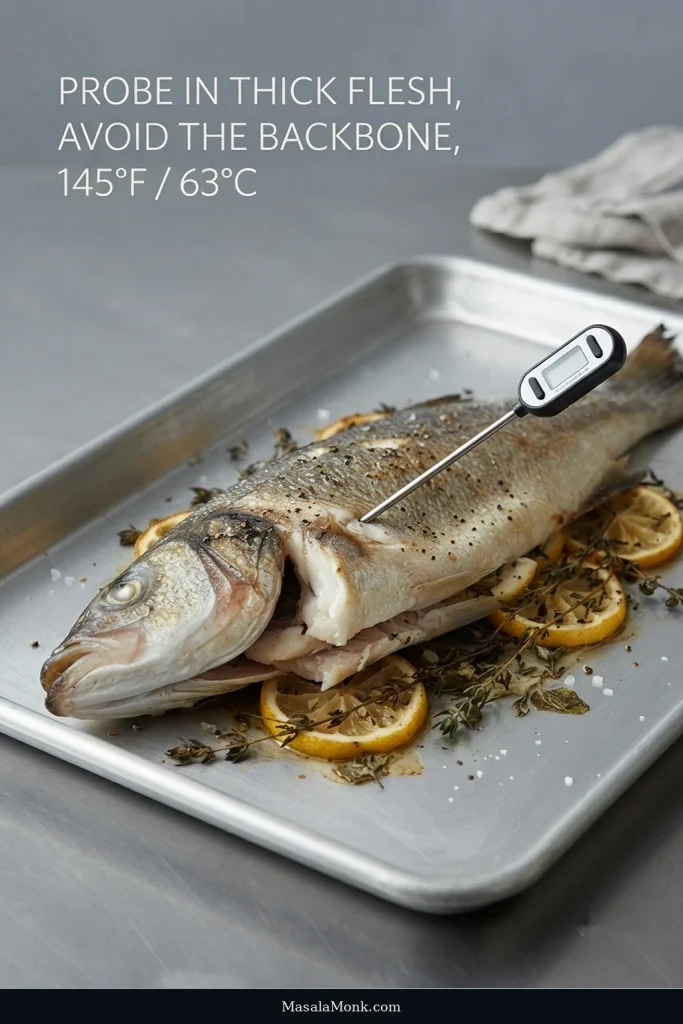
Raw-looking flesh is translucent and glassy; cooked branzino turns opaque and begins to separate readily. It should still look moist, and you should not have to scrape it away from the bones.

Overcook the fish and the flesh becomes tighter and drier. “Flaky” does not mean it needs to collapse into little shreds.

↑ Back to Recipe · Troubleshooting if Needed · Debone & Serve →
If Your Branzino Isn’t Behaving
If the fish has reached the right internal temperature but the skin is still pale, take it out. Browning is not a reason to keep cooking already-done flesh.

| What you see | What to do |
|---|---|
| Skin stays pale | Next time, dry the fish thoroughly, preheat the oven fully and leave more space around it so moisture does not collect around the skin. |
| The tail is getting very dark | Loosely cover just the tail with a small piece of foil and let the thicker part of the fish finish cooking. |
| The fish falls apart | It may be overcooked or have been moved repeatedly. Start checking earlier and leave it alone until serving. |
| Flesh near the backbone is still underdone | It needs a little longer. Return the fish to the oven briefly and recheck the thickest flesh near the head. |
| The flesh is dry | It cooked too long. Start checking earlier next time and use temperature and texture as your guide. |
| One fish finishes first | Take it out. There is no reason to dry out the smaller fish just to make both finish together. |
↑ Back to Recipe · Next: Debone & Serve →
How to Debone and Serve a Whole Branzino
To debone a cooked branzino, lift off the top fillet, expose and remove the backbone, then check both fillets for any stray rib or pin bones.
If you have been worrying more about the bones than the roasting, this is the reassuring part. Cooked branzino is much more cooperative than raw fish, and once the first fillet lifts away, the anatomy stops looking mysterious.
1. Clear the fins. Remove the dorsal and belly fins before lifting the top fillet.

2. Lift the top fillet. Run a fish spatula, serving spoon or blunt knife along the backbone and gently lift the upper flesh away. It may come off in one piece or a few neat sections.

3. Remove the skeleton. Once the upper fillet is off, the backbone is sitting right underneath. Lift it away from the lower fillet. The backbone and tail—and often the head, if you left it on—may lift away together.

4. Check for stray bones. Removing the backbone doesn’t remove every bone. Look and feel for stray rib or pin bones before serving, especially for children. The browned skin can stay with the fillets if you enjoy eating it.

There is a little theatre in carrying a whole roasted fish to the table, and that is part of its appeal. Serve it that way if everyone is comfortable with the presentation. For a more relaxed dinner, debone it in the kitchen and bring out the fillets instead.

↑ Back to Recipe · What to Serve With Branzino →
What to Serve With Branzino
You don’t need to make the rest of dinner complicated. The fish already brings lemon, herbs and olive oil to the table, so simple sides work particularly well around it.

Start with a crisp salad; add bread, potatoes, rice or couscous if you want something more substantial. A cool yogurt-based sauce can add contrast without weighing the fish down.

Warm homemade pita is handy for the lemony olive oil and fish juices left on the plate.
Fattoush works well because its lemon, herbs and crisp pita echo the flavors of the fish without making the meal heavier. A cucumber salad, fennel salad or simply dressed greens work too.
For something cold and creamy alongside the hot fish, Greek tzatziki is an easy choice.
Quick-cooking vegetables such as cherry tomatoes, thinly sliced onion and sliced fennel can share the roasting tray. Scatter them around the fish and leave some breathing room so steam does not collect around the skin.
Potatoes, carrots and thick squash need a head start. Parboil or partially roast them first. Greek lemon potatoes carry the same lemon-and-olive-oil flavors; just get them well underway before the branzino goes into the oven.
Easy Variations · Store Leftovers · ↑ Back to Recipe
A Few Easy Variations
The base method does not need much tinkering. For a brinier version, roast the fish with cherry tomatoes and olives, then add a few capers. Dill can replace the parsley. A few thin orange slices can replace some of the lemon for sweeter citrus.

Branzino fillets can use the same seasonings, but they cook much faster; for a boneless oven-fish method with more detail on fillet timing, see our baked cod recipe.
Store and Reheat Leftovers
Branzino is at its best straight from the oven. For leftovers, lift the edible flesh from the skeleton before refrigerating it.
Refrigerate cooked fish within 2 hours—or within 1 hour if the ambient temperature is above 90°F / 32°C—and keep it covered. USDA guidance recommends using refrigerated leftovers within 3–4 days.
If reheating leftovers, USDA guidance uses 165°F / 74°C as the reheating target.
That much reheating can be hard on delicate white fish, so leftovers are often better flaked into a salad or rice bowl, or turned into crispy fish cakes.

Frequently Asked Questions About Branzino
Branzino, bronzino or branzini—which is correct?
Branzino is the familiar Italian-derived singular name widely used for European sea bass. Branzini is the Italian plural. You may also see bronzino on seafood counters, menus and recipe searches; in this context, it generally refers to the same fish.
Is branzino the same as sea bass?
Yes. Branzino is specifically European sea bass; “sea bass” is a broader name used for several other fish as well.
Does branzino have a lot of bones?
Whole branzino has a central backbone, ribs and sometimes a few stray pin bones. Once cooked, the fillets usually lift away from the main skeleton quite cleanly, but check each portion for remaining bones before serving.
Can I cook frozen whole branzino?
Thaw it first. Refrigerator thawing is easiest. For a quicker option, keep the fish sealed in a leak-proof bag and submerge it in cold water, then cook it promptly. Dry the thawed fish thoroughly before seasoning.
What can I substitute for branzino?
Small whole sea bream, red snapper, trout and other similarly sized whole fish can take the same lemon-and-herb treatment. Match the substitute by size as closely as you can, then start checking early instead of assuming the same cooking time.
How much whole branzino should I buy per person?
For this recipe, two whole branzino around 1–1¼ lb / 450–570 g each make two generous main-course servings. With substantial sides or several courses, the same two fish can serve 3–4 lighter eaters. Remember that whole-fish weight includes the head and skeleton.
The first whole branzino is the one that feels unusual. Once you have lifted away the first fillet and seen the backbone sitting neatly underneath, the whole thing makes much more sense.
If you make it, tell us how much your fish weighed, how long it took in your oven, and whether you served it whole or deboned it first. Those details are genuinely helpful to the next person trying a whole fish for the first time.








