Posted on Leave a comment

Grape Jelly Meatballs Recipe | Crockpot, Chili Sauce, BBQ & Ketchup

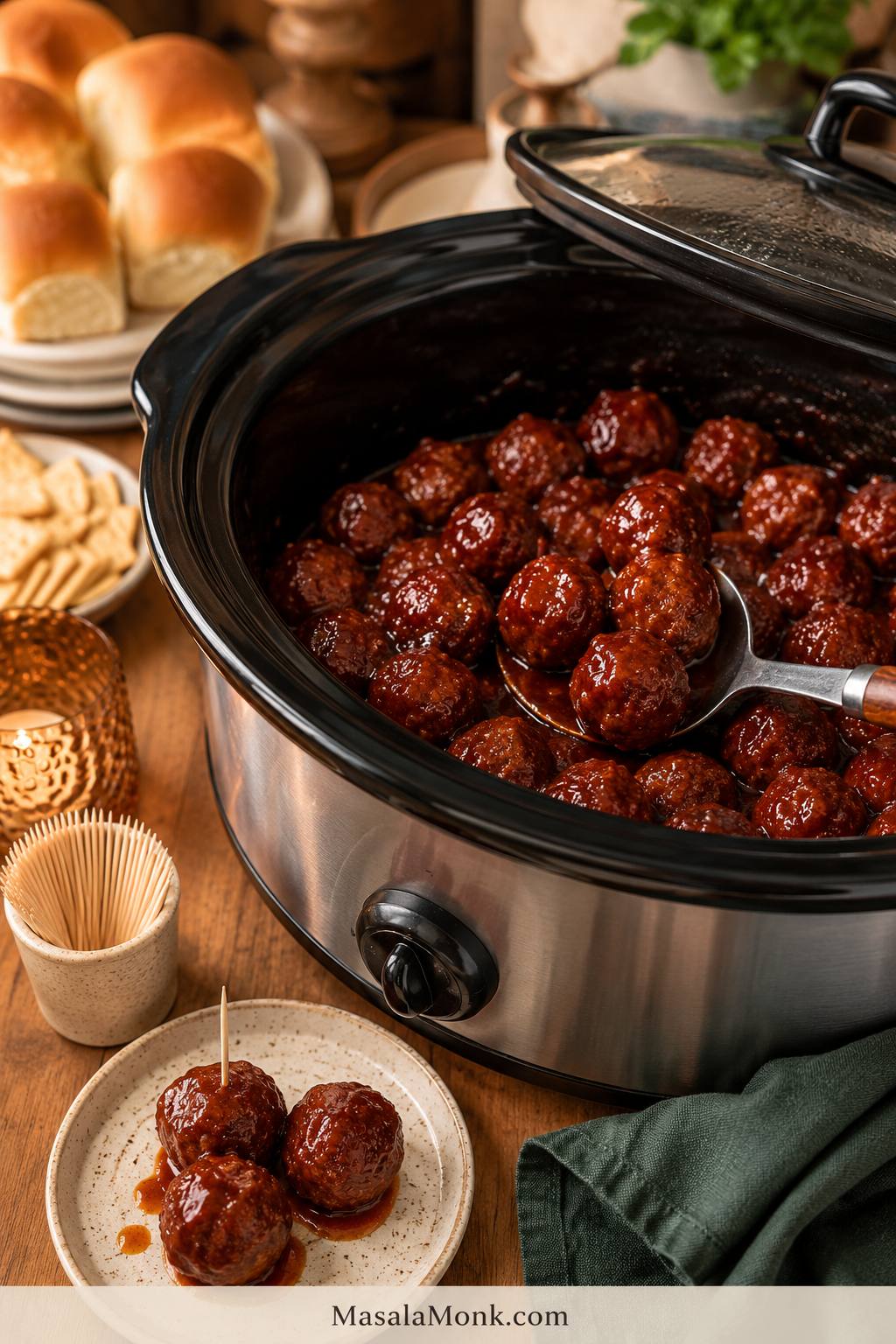
Slow cooker filled with glossy red-brown meatballs, with a serving spoon, toothpicks, small plates, slider buns, and folded napkins on a party table.

Grape jelly meatballs are the kind of party food that makes people suspicious for about five seconds, then sends them back for another toothpick. The ingredient list sounds strange until the sauce starts bubbling: sweet grape jelly, tangy chili sauce, and tender meatballs turning glossy in the slow cooker while you finish the rest of the table.

Keep the classic version simple: fully cooked meatballs, grape jelly, and bottled chili sauce in the crockpot. As the batch warms, the jelly melts into the sauce, the chili sauce balances the sweetness, and the slow cooker holds everything until people are ready to serve themselves.

It is old-school, low-stress, and very good at doing what party food should do: stay warm, taste familiar, and disappear quietly while people keep talking. Once the lid goes on, you get a hot appetizer that can take care of itself while you finish the rest of the food.

Quick Answer: The 3 Ingredients for Grape Jelly Meatballs

To make grape jelly meatballs, combine 2 lb / 900 g fully cooked frozen meatballs, 10–12 oz / 280–340 g grape jelly, and 12 oz / 340 g bottled chili sauce, the tomato-based kind usually found near ketchup, in a slow cooker. Cook on HIGH for 2–3 hours or LOW for 4–5 hours, stirring once or twice, until the sauce has melted together, the coating clings, and the meatballs are heated through.

IngredientAmountRole
Fully cooked frozen homestyle meatballs32 oz / 2 lb / 900 gEasy party base, usually about 48–50 small meatballs.
Grape jelly10–12 oz / 280–340 gSweetness, shine, and sticky body.
American-style bottled chili sauce12 oz / 340 gTangy tomato balance.

What the three ingredients do

This is the moment where the recipe looks stranger than it tastes. Seeing the ingredients together makes the grape jelly less confusing before the sauce melts.

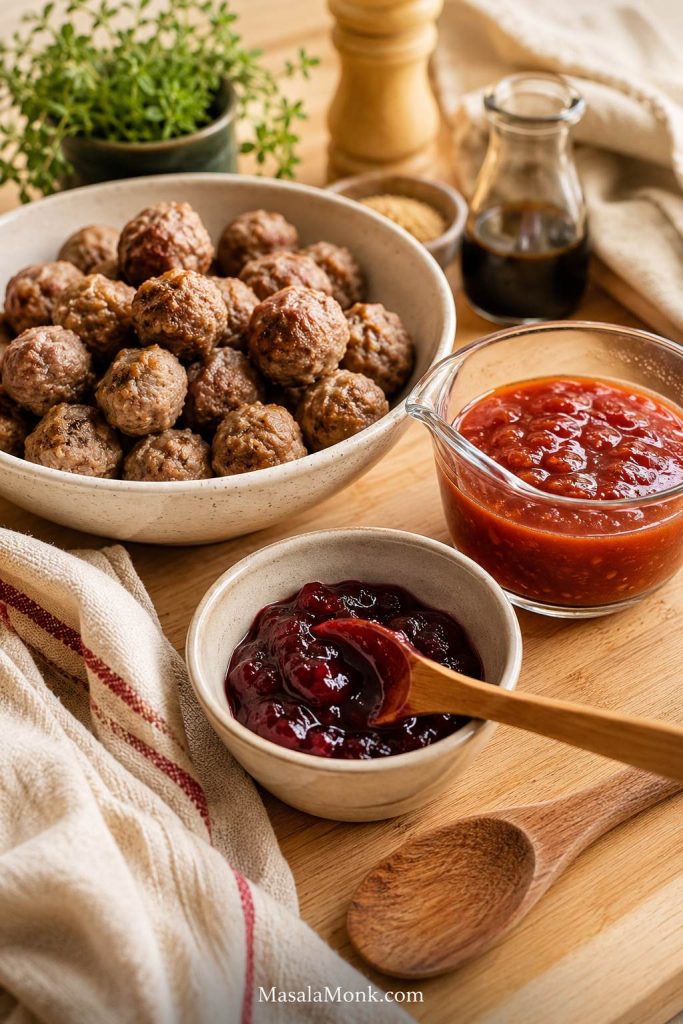
Ingredients for grape jelly meatballs with cooked meatballs, grape jelly, chili sauce, Worcestershire sauce, and seasonings on a wooden surface.
The base is simple: cooked meatballs, grape jelly, and bottled chili sauce. Once warm, Worcestershire, pepper, vinegar, or mustard can fine-tune the flavor.

Increase the grape jelly to 18–20 oz / 510–565 g for a sweeter, stickier potluck glaze. Go with BBQ sauce for a smoky version. For the mildest pantry batch, ketchup works too, especially with a splash of Worcestershire sauce or vinegar.

At a glance: 5 minutes prep, 2–3 hours on HIGH or 4–5 hours on LOW, 12–16 appetizer servings, best with fully cooked frozen homestyle meatballs.
A quick reassurance: The mixture may look lumpy, separated, or too thin before it heats. That is normal. The jelly melts slowly, the chili sauce turns it savory, and the final sauce should taste balanced rather than candy-sweet. Taste only after everything has warmed together.

Choose Your Sauce Version

You can keep the meatballs exactly the same and change only the sauce to fit the crowd. Start with the classic chili sauce version if this is your first time. Choose BBQ sauce for game day. Use ketchup when you want the mildest, most pantry-friendly version.

SituationBest versionWhat to use
First time making theseClassic chili sauce version2 lb meatballs + 10–12 oz grape jelly + 12 oz chili sauce
Sweet potluck glazeExtra grape jelly version2 lb meatballs + 18–20 oz grape jelly + 12 oz chili sauce
Game day or BBQ crowdBBQ version2 lb meatballs + 1 cup grape jelly + 1 1/2 to 2 cups BBQ sauce
Pantry-only versionKetchup version2 lb meatballs + 3/4 to 1 cup grape jelly + 1 1/2 cups ketchup
Less sweet / more balancedClassic ratio + sharpenerAdd vinegar, Dijon, Worcestershire, black pepper, or hot sauce after tasting

Sauce comparison: chili sauce, BBQ, or ketchup

The meatballs stay the same; the sauce decides whether the batch tastes classic, smoky, or mild.

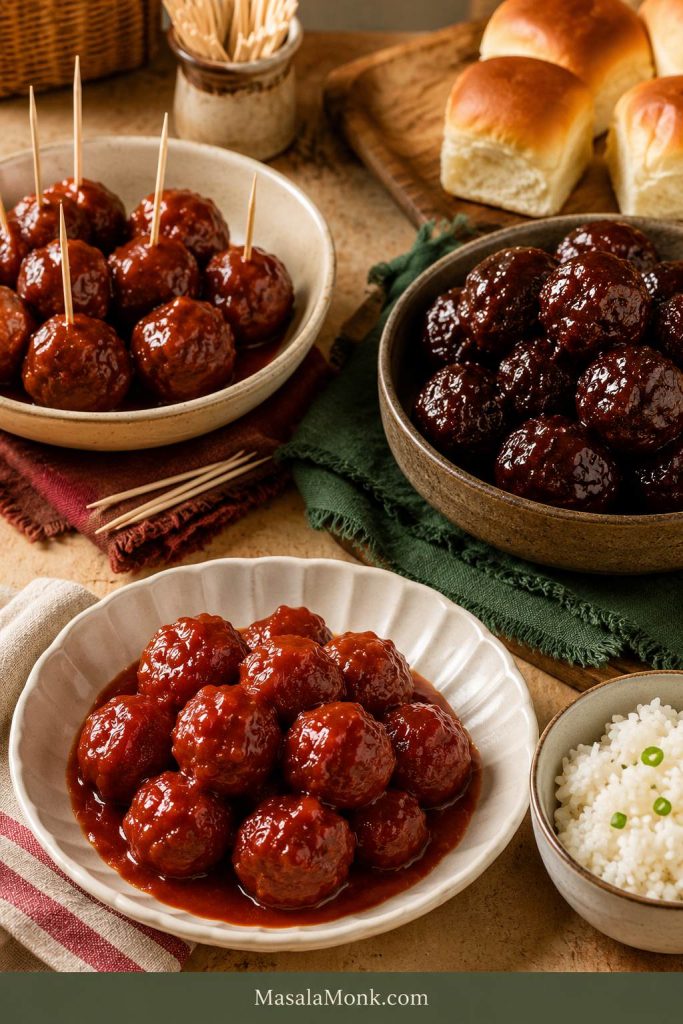
Three grape jelly meatball sauce versions with chili sauce, BBQ sauce, and ketchup served with party sides.
Choose the sauce by the crowd: chili sauce for classic tang, BBQ sauce for smoky game-day flavor, and ketchup for a milder family batch.
Best default: First time making these? Use 2 lb fully cooked homestyle meatballs, 10–12 oz grape jelly, and 12 oz bottled chili sauce. It is the safest balance for most parties: sweet enough to feel classic, tangy enough to avoid tasting like candy.

BBQ sauce gives the friendliest game-day flavor. BBQ sauces vary a lot, so if yours is already sweet and thick, start with less grape jelly and add more only after tasting. Ketchup is not a failure version; it is simply softer, sweeter, and milder. Add vinegar or Worcestershire if you want it closer to the tang of chili sauce.

The chili sauce version tastes most classic, but BBQ sauce is the one many families grew up with. This is exactly the kind of recipe where the “right” version depends on whose slow cooker you remember.

The Best Ratio for Grape Jelly Meatballs

The best all-purpose ratio is 2 lb / 900 g fully cooked meatballs, 10–12 oz / 280–340 g grape jelly, and 12 oz / 340 g bottled chili sauce. It gives you enough sauce to coat the meatballs without turning the slow cooker into a bowl of syrup.

You will see two common versions: a balanced version with 10–12 oz grape jelly and a sweeter potluck version with an 18–20 oz jar. Neither is wrong. Use the smaller amount when you want savory-sweet balance; use the larger jar when you want the sticky retro party glaze.

Save this ratio: 2 lb meatballs + 12 oz chili sauce + 10–12 oz grape jelly for balance.

The Visual Ratio: Balanced First, Sweeter Later

Start balanced first. You can always make the glaze sweeter, but pulling back too much jelly is harder once the whole jar is in the pot.

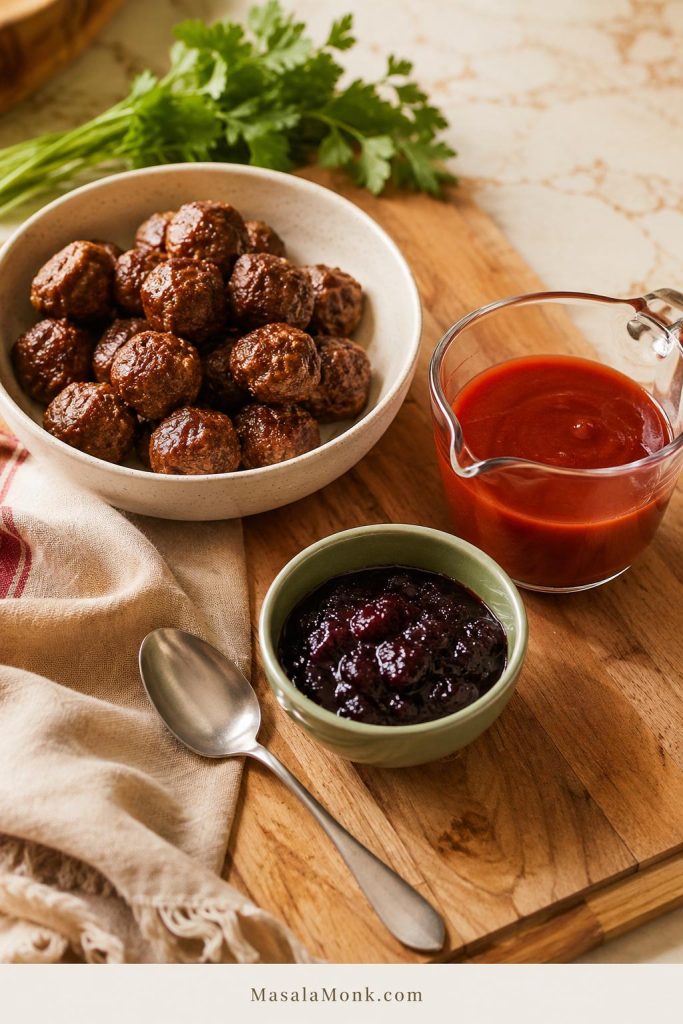
Measured ingredients for the best grape jelly meatball ratio with grape jelly, chili sauce, cooked meatballs, and a spoon.
Start with 2 lb meatballs, 10–12 oz grape jelly, and 12 oz chili sauce; add more jelly only if you want a sweeter potluck glaze.

Recipe Card: Grape Jelly Meatballs

Grape Jelly Meatballs Recipe

Glossy, sweet-tangy grape jelly meatballs made in the slow cooker with fully cooked meatballs, grape jelly, and bottled chili sauce. Easy to keep warm for parties, potlucks, holidays, and game day, with notes for BBQ sauce, ketchup, stovetop, oven, and Instant Pot versions.

Prep Time
5 minutes
Cook Time
2–3 hours HIGH or 4–5 hours LOW
Total Time
About 2 hr 5 min to 5 hr 5 min
Yield
12–16 appetizer servings

Ingredients

  • 32 oz / 2 lb / 900 g fully cooked frozen homestyle meatballs
  • 10–12 oz / 280–340 g grape jelly
  • 12 oz / 340 g American-style bottled chili sauce
  • Add 1 teaspoon Worcestershire sauce, optional
  • Use 1/2 teaspoon garlic powder, optional
  • Finish with 1/4 to 1/2 teaspoon black pepper, optional

Instructions

  1. Add grape jelly and chili sauce to a 4–5 quart slow cooker.
  2. Stir lightly. The jelly does not need to be fully melted yet.
  3. Add the fully cooked meatballs and turn them through the mixture.
  4. Cover and cook on HIGH for 2–3 hours or LOW for 4–5 hours.
  5. Stir once or twice while the meatballs heat.
  6. When the sauce has melted together and the meatballs are hot, switch to WARM and serve.

Notes

  • For a sweeter party glaze, increase grape jelly to 18–20 oz / 510–565 g.
  • BBQ version: combine 1 1/2 to 2 cups BBQ sauce with 1 cup grape jelly.
  • Ketchup version: combine 1 1/2 cups ketchup with 3/4 to 1 cup grape jelly.
  • Use American-style bottled chili sauce, not chili garlic sauce, Thai sweet chili sauce, or sriracha as a direct replacement.
  • If using homemade meatballs, cook them fully before adding them to the sauce.
  • The sauce is ready when there are no streaks of jelly left and the coating clings to the meatballs.

What the Finished Sauce Should Look Like

After the recipe card, use this as the visual target: saucy, spoonable, and glossy without being watery.

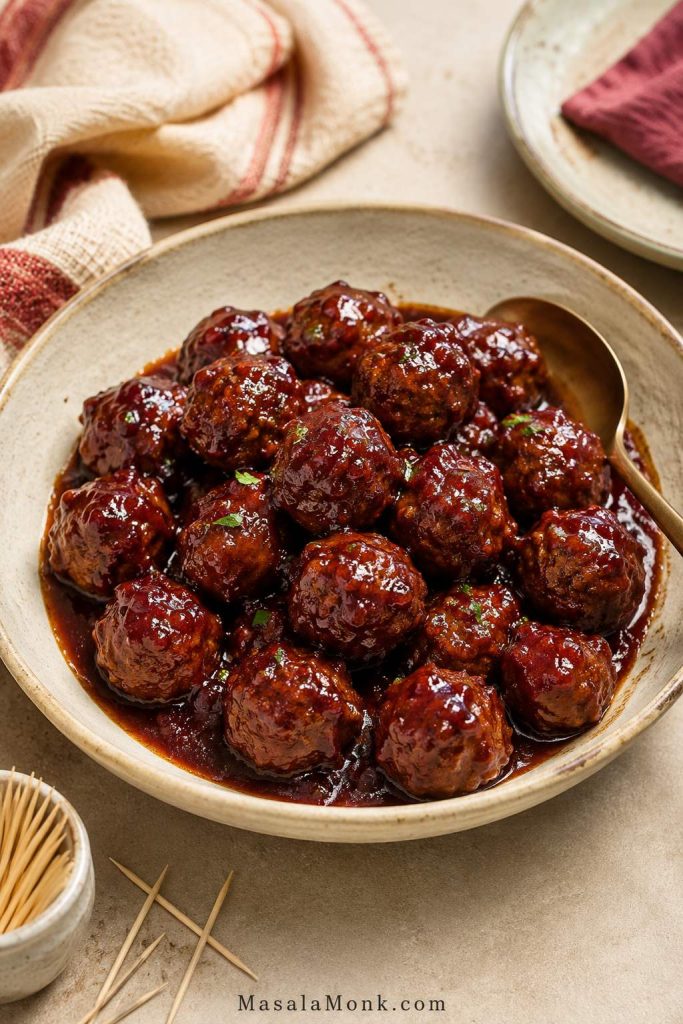
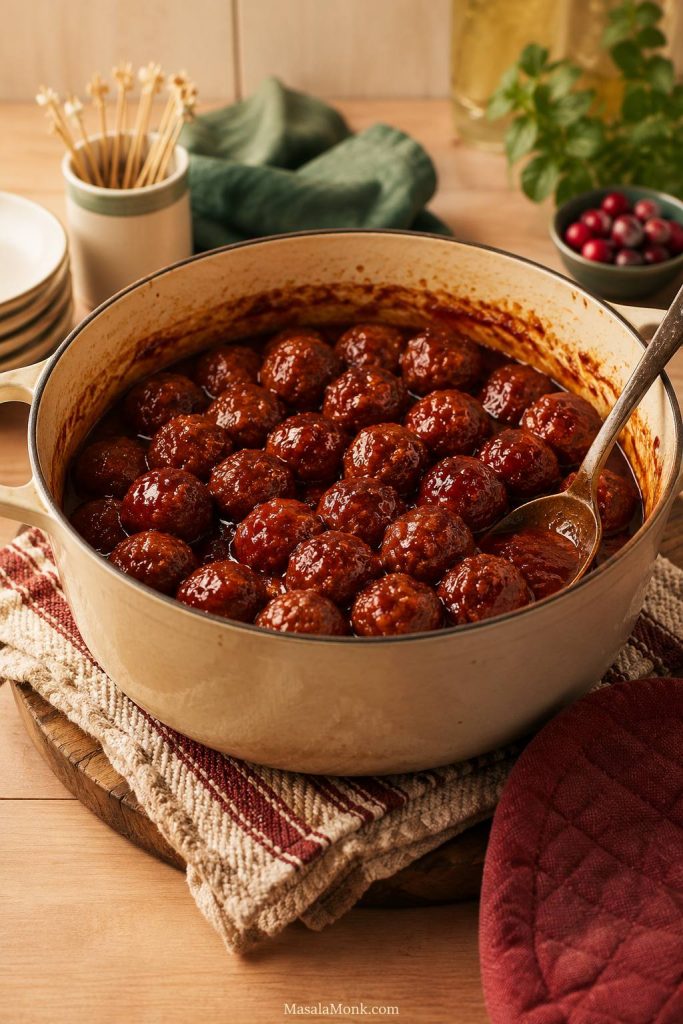
Finished grape jelly meatballs in a serving bowl with sauce, toothpicks, a spoon, folded napkins, and a small plate.
The finished sauce should lightly pool without turning soupy, so the meatballs are easy to spoon or hold warm in a crockpot.

That is the whole basic recipe. From here, use only what you need: scale the batch for a party, choose the sauce version your crowd will like best, make it without a crockpot, or fix the sauce if it tastes too sweet, too thin, or too sharp.

Back to top ↑

Ingredients You Need

Fully cooked meatballs

A 32 oz / 2 lb / 900 g bag of fully cooked frozen homestyle meatballs is the easiest choice. Most bags this size contain around 48–50 small meatballs, though the exact count depends on the brand.

For the most classic flavor, choose plain homestyle cocktail meatballs rather than strongly seasoned Italian meatballs. Beef, pork, turkey, chicken, or mixed meatballs can all work, but the sauce tastes most familiar with mild beef or beef-pork style meatballs.

If your bag is closer to 26–28 oz instead of 32 oz, you can still use the recipe. Hold back a few spoonfuls of sauce at first, then add more if the meatballs need extra coating. If your meatballs are larger than cocktail-size, give them more time to heat through.

For crowds, it is worth checking the meatball label for breadcrumbs, egg, dairy, soy, or gluten, since frozen meatballs vary by brand.

Grape jelly

Grape jelly gives the sauce sweetness, shine, and thickness. Concord grape jelly has the most familiar flavor, but any regular grape jelly works.

The grape jelly is the part that makes people pause, but it is also the part that makes the sauce work. It melts into sweetness and body, not a grape-flavored coating.

For a balanced sauce, use 10–12 oz / 280–340 g. For a sweeter, extra-saucy version, use 18–20 oz / 510–565 g.

If your jar is 10 oz, use the whole thing for a balanced batch. If your jar is 18–20 oz, start with about half to two-thirds of the jar, then add more after tasting if you want the sweeter potluck glaze.

Bottled chili sauce

Choose American-style bottled chili sauce, the tomato-based sauce usually sold near ketchup. The bottle may say “chili sauce,” but the flavor should be tangy and mildly spiced, not fiery hot.

Important chili sauce note: For this recipe, chili sauce means American-style bottled chili sauce, usually found near ketchup. Heinz chili sauce is a common reference point, but store brands are fine as long as the sauce is smooth, tomatoey, tangy, and mildly spiced. It is not the same as Asian chili garlic sauce, Thai sweet chili sauce, or sriracha.

If you cannot find it, BBQ sauce or ketchup can still make a good batch. The flavor changes, but the method stays simple.

Optional flavor boosters

The basic 3-ingredient version works on its own. Use these only if the warm sauce tastes like it needs a little more depth, sharpness, or heat:

  • Add 1 teaspoon Worcestershire sauce for savory depth
  • Use 1/2 teaspoon garlic powder for a rounder flavor
  • Sprinkle in 1/4 to 1/2 teaspoon black pepper for mild heat
  • Stir in 1 teaspoon Dijon mustard if the sauce is too sweet
  • Brighten with 1 teaspoon vinegar or lemon juice if it needs brightness
  • Hot sauce or sriracha if you want more heat

How to Make Grape Jelly Meatballs in the Crockpot

A 4–5 quart slow cooker works well for a standard 2 lb batch. For a double batch, use a 6 quart slow cooker so the meatballs heat evenly and you still have room to stir.

Before cooking: why the sauce looks uneven

Do not worry if the slow cooker looks patchy at the start. Heat is what turns the separate sauce pockets into one coating.

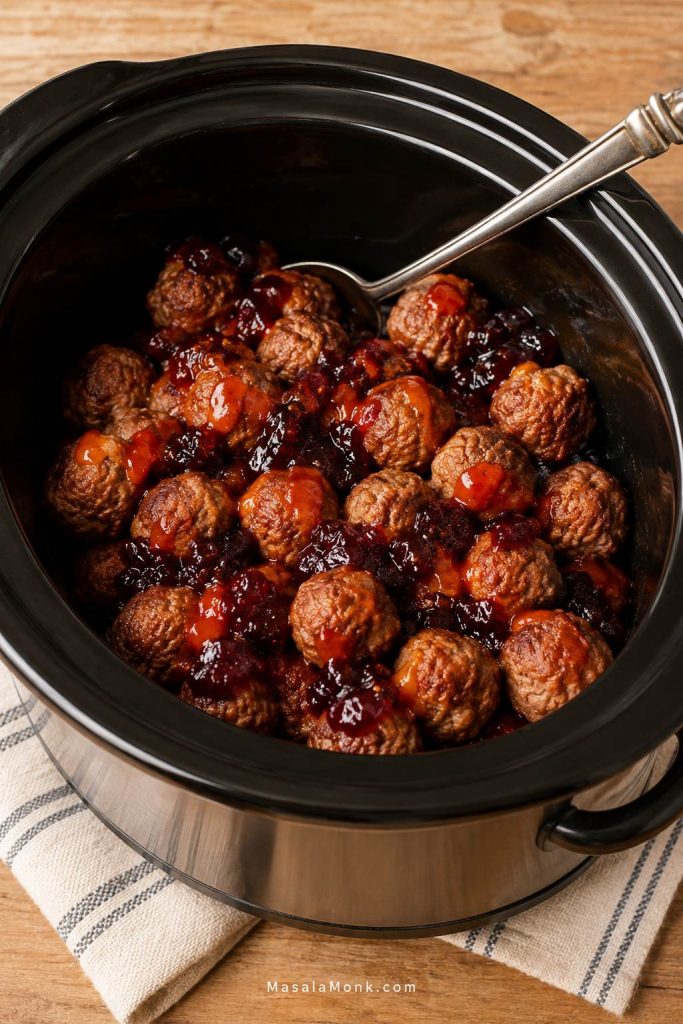
Cooked meatballs in a slow cooker with grape jelly and chili sauce before the sauce has melted together.
This uneven start is normal. Heat turns the separate jelly and chili sauce into a smooth coating.
  1. Add the grape jelly and chili sauce to the slow cooker.
  2. Stir roughly. The jelly does not need to be fully smooth yet.
  3. Add the fully cooked meatballs.
  4. Turn them through the mixture until coated.
  5. Cover and cook on HIGH for 2–3 hours or LOW for 4–5 hours.
  6. Stir once or twice during cooking.
  7. When the meatballs are hot and there are no streaks of jelly left, switch the slow cooker to WARM for serving.
Texture cue: The sauce is ready when it coats the spoon and clings to the meatballs instead of sitting in separate streaks of jelly and chili sauce. If the edges of the slow cooker start getting sticky, stir and add a splash of water or broth.

If the mixture looks thin halfway through, do not panic. It thickens as the jelly melts, the meatballs warm through, and the edges of the slow cooker begin to bubble.

Halfway through: wait before adjusting

This is the stage where people often adjust too early. Wait until the jelly melts before adding more sweetness, tang, or thickener.

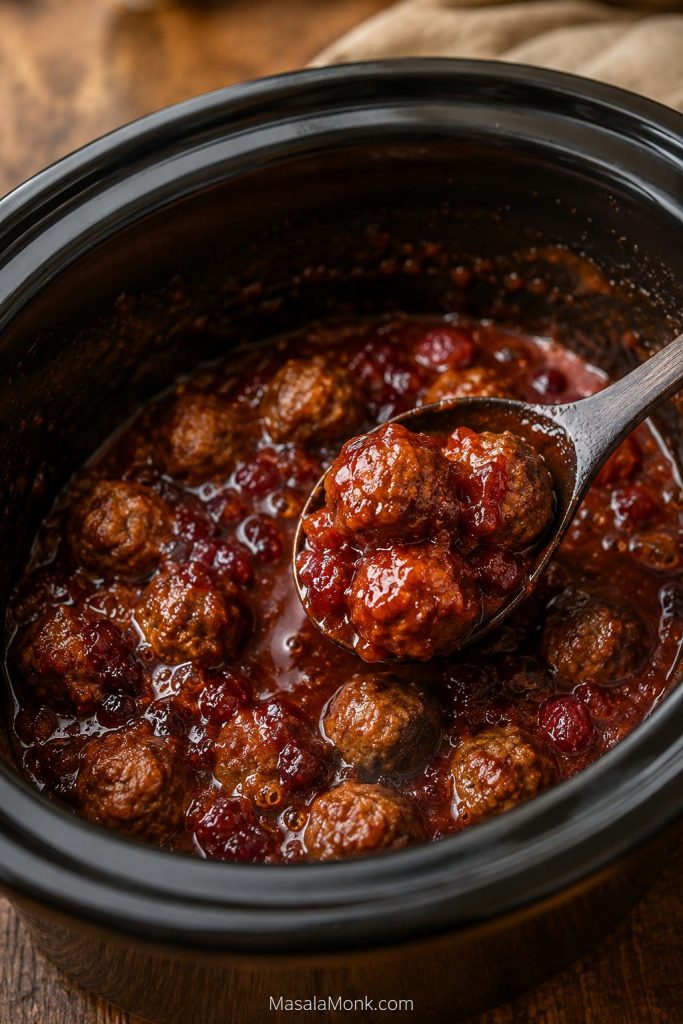
A spoon lifting grape jelly meatballs from a slow cooker while the sauce is partly melted and uneven.
At the halfway point, look for partial coating rather than perfect gloss; the sauce smooths out as the jelly melts.

Once the meatballs are hot, avoid leaving them on HIGH for too long. The sauce can reduce around the edges, become overly sticky, and make the meatballs taste drier. WARM is the better setting for serving.

How to know the meatballs are done

The meatballs are ready when the sauce has fully melted, the coating looks unified, and the meatballs are heated through. Around the edges of the slow cooker, the mixture may bubble gently and thicken slightly.

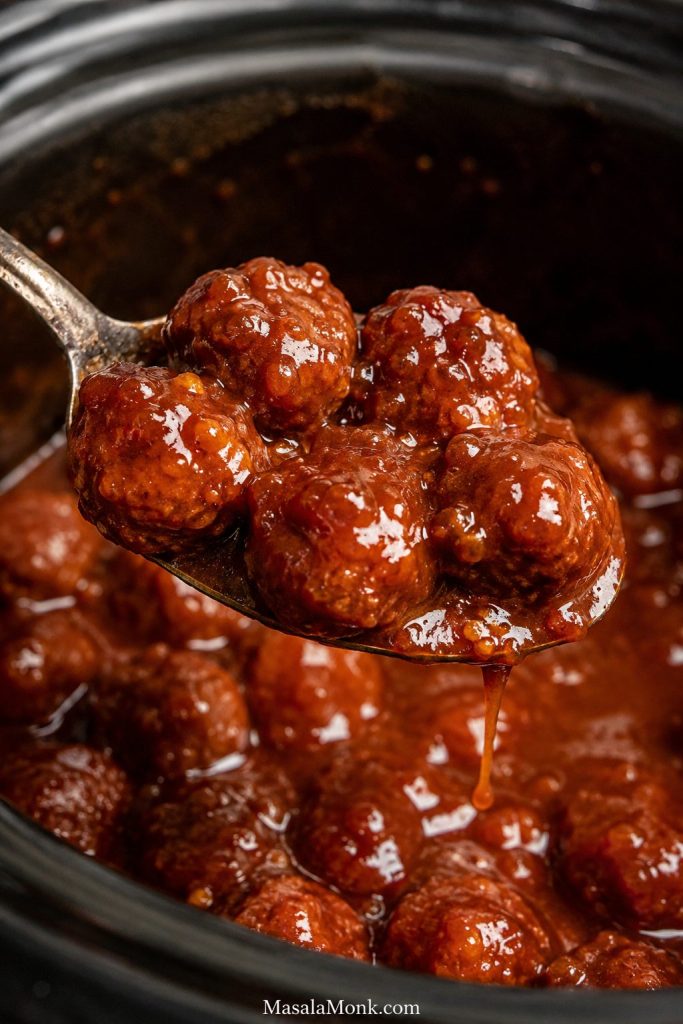
Finished grape jelly meatballs lifted on a spoon with glossy red-brown sauce clinging to them.
Look for an even coating on the spoon; that means the sauce has come together and the meatballs are heated through.

If you use homemade meatballs, cook them through before adding them to the sauce. Some homemade slow-cooker meatball recipes cook raw meatballs in sauce, but this party version is easier to control when the meatballs are cooked first. You get better texture, simpler timing, and less guesswork.

Why This Ratio Works

This version starts with 10–12 oz grape jelly instead of a full 18–20 oz jar, so the sauce still tastes like a savory appetizer instead of a candy glaze. It is also easier to adjust: if the sauce needs more sweetness, you can add it, but if it starts too sweet, you have fewer ways to pull it back.

What Balanced Sauce Should Look Like

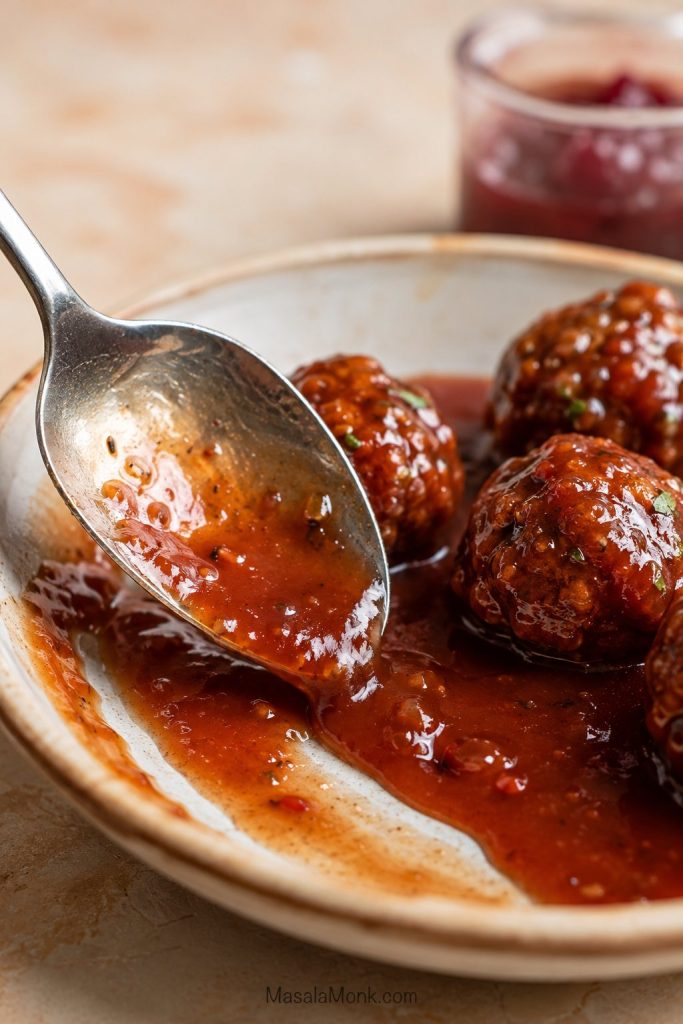
This is the sauce check: it should move easily from the spoon while still holding onto the meatballs.

Spoon dragging through grape jelly meatball sauce to show sauce that is thick enough to cling but still pourable.
A good sauce should flow but still cling. Starting with moderate jelly gives you more control than dumping in a full jar.

The method stays honest to what this recipe is supposed to be: one slow cooker, fully cooked meatballs, and no extra pan unless you want to thicken the sauce faster. The result is glossy, sweet-tangy, and easy to hold warm without turning the edges into syrup.

When These Meatballs Work Best

These meatballs work three ways: as cocktail meatballs with toothpicks, as a slow cooker appetizer for game day, or as a saucy dinner over rice or mashed potatoes. They are built for fully cooked meatballs, a warm sauce, and a slow cooker that can hold everything on a buffet table.

They are small, warm, saucy, and easy to take without committing to a full plate. That is why they disappear slowly at first, then suddenly all at once.

Once the meatballs are heated through, the crockpot keeps them warm while people serve themselves. If you like this kind of hands-off party food, this slow cooker pulled pork recipe works for the same reason: the slow cooker handles the timing, and the sauce does the heavy lifting.

The recipe works because the sauce pulls in two directions at once: grape jelly gives sweetness and shine, while chili sauce, BBQ sauce, or ketchup keeps it from tasting one-note. A little vinegar, mustard, Worcestershire, or hot sauce can fine-tune the flavor once everything is warm.

Why the Jelly and Chili Sauce Work

The jelly melts into a glossy glaze

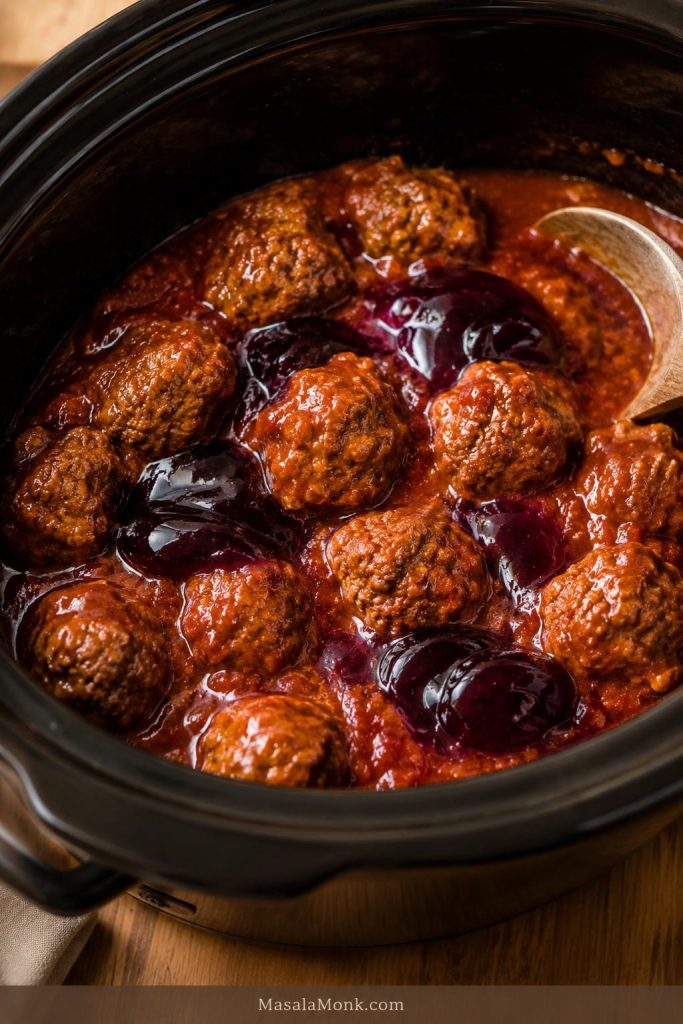
At first, the grape jelly may sit in thick spoonfuls beside the chili sauce. That is normal. Give it heat and time, and it melts into a spoon-coating sauce instead of tasting like meatballs in jam. The mixture may look separated for the first 20–30 minutes, so do not judge it too early.

Grape jelly melting into chili sauce around cooked meatballs in a black slow cooker.
Those dark jelly pockets melt into the chili sauce, building shine and sweetness without leaving a jammy coating.

Chili sauce keeps the sweetness in check

Grape jelly alone would be too sweet. Bottled chili sauce brings tomato, vinegar, mild spice, and enough tang to make the sauce taste savory. If it smells sharp at first, wait until everything warms through before adjusting.

Fully cooked meatballs make it party-proof

Frozen fully cooked meatballs are already shaped, cooked, and ready to heat. You do not need to thaw, sear, or fuss with anything if the package says they can be heated from frozen.

The crockpot holds everything without babysitting

The slow cooker warms the meatballs gently, melts the jelly into the sauce, and holds everything ready until people start serving themselves. Once the batch is hot, switch to WARM so the coating stays saucy instead of reducing too far around the edges.

Crockpot Time Chart

Slow cookers do vary, so use the times below as a guide and the visual cues as your final check. You are looking for hot meatballs, melted sauce, and a coating that clings instead of pooling at the bottom.

Batch sizeSlow cooker sizeHIGHLOW
1 lb / 450 g meatballs2–3 quart1.5–2 hours3–4 hours
2 lb / 900 g meatballs4–5 quart2–3 hours4–5 hours
4 lb / 1.8 kg meatballs6 quart3–4 hours5–6 hours

Stir occasionally, but avoid lifting the lid too often. Once the meatballs are fully hot, switch to WARM for serving.

Serving safety note: The slow cooker is great for keeping hot food warm, but it should not be used to reheat cold leftovers straight from the fridge. USDA slow cooker food safety guidance recommends reheating leftovers first on the stovetop, in the oven, or in the microwave, then moving them to the slow cooker for serving.

Before You Start: Sauce Mistakes to Avoid

  • Use the right chili sauce. Bottled tomato-based chili sauce is not the same as chili garlic sauce, Thai sweet chili sauce, or sriracha.
  • Let the jelly melt before judging the flavor. The sauce tastes different once the jelly has fully melted into the chili sauce.
  • Switch from HIGH to WARM once the meatballs are hot. This keeps the edges from over-thickening.
  • Mix cornstarch with cold water first. Adding dry cornstarch directly to hot sauce can make it clump.
  • Cook homemade meatballs before saucing. This version is for heating and coating fully cooked meatballs, not cooking raw meat from scratch.

Chili Sauce vs BBQ Sauce vs Ketchup

If you already picked a version above, use this section to fine-tune it. Chili sauce keeps things classic and balanced, BBQ sauce brings smoke, and ketchup needs a little sharpening when you want a pantry-only batch.

Chili sauce tastes like a tangier, bolder ketchup-style sauce. Ketchup makes the meatballs softer and sweeter, while chili sauce gives the classic version more tomato tang and mild spice.

VersionMeatballsSauceFlavor
Classic chili sauce2 lb / 900 g10–12 oz grape jelly + 12 oz chili sauceTangy, classic, balanced
Sweeter party glaze2 lb / 900 g18–20 oz grape jelly + 12 oz chili sauceStickier, sweeter, extra saucy
BBQ version2 lb / 900 g1 cup grape jelly + 1 1/2 to 2 cups BBQ sauceSmoky and sweet
Ketchup version2 lb / 900 g3/4 to 1 cup grape jelly + 1 1/2 cups ketchupMild and sweet-tangy

If using ketchup, add Worcestershire sauce, vinegar, mustard, black pepper, or chili powder if the sauce tastes flat. If using BBQ sauce, start with the lower amount of jelly and add more only if you want a sweeter coating.

No Crockpot? Make Them on the Stovetop, in the Oven, or in the Instant Pot

The crockpot is still the easiest choice when guests are coming, but you are not stuck if it is already full. The same grape jelly mixture works on the stovetop, in the oven, and in the Instant Pot with a few small adjustments.

Stovetop method

  1. Add grape jelly and chili sauce to a Dutch oven, deep skillet, or large saucepan.
  2. Warm over medium-low heat until the jelly melts into the chili sauce.
  3. Add the meatballs and stir to coat.
  4. Cover and simmer for 15–20 minutes, stirring occasionally.
  5. If the meatballs are large or still very frozen, allow 25–30 minutes.

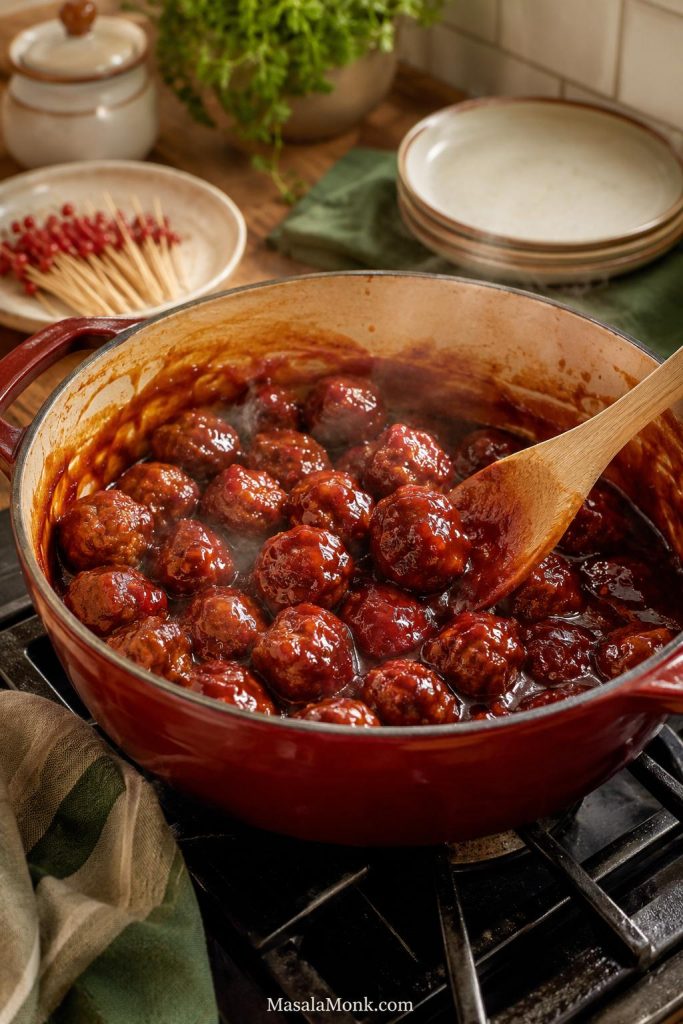
Use the stovetop when you need them faster or when the sauce needs a few extra minutes to tighten into a thicker coating.

Grape jelly meatballs simmering in glossy red sauce in a red Dutch oven on a stovetop with a wooden spoon.
On the stovetop, gentle simmering melts the jelly and tightens the sauce faster than a slow cooker.

Oven method

  1. Heat the oven to 350°F / 175°C.
  2. Add meatballs, grape jelly, and chili sauce to a covered baking dish or Dutch oven.
  3. Stir to coat.
  4. Cover and bake for 45–60 minutes.
  5. Stir halfway through.
  6. Uncover for the last 10 minutes if the coating looks too thin.

Reach for the oven when the slow cooker is already busy or when a wide baking dish is easier than stirring a crowded crockpot.

Oven-baked grape jelly meatballs in a cream-colored baking dish with a spoon, oven mitt, folded towel, and kitchen counter.
A covered baking dish keeps the meatballs saucy when the slow cooker is already busy.

Instant Pot method

The Instant Pot works, but it is not the best method for the glossiest sauce or for holding meatballs during a party. Use it when speed matters, then transfer the meatballs to a slow cooker on WARM or to a serving dish.

  1. Add the meatballs, grape jelly, chili sauce, and 1/2 to 3/4 cup water to the Instant Pot.
  2. Pressure cook for 5–10 minutes, depending on meatball size.
  3. Quick release carefully.
  4. Use the sauté function to simmer uncovered until the mixture thickens and coats the spoon.

Do not skip the sauté step if you want a sticky coating. The mixture will look thinner at first because of the added water.

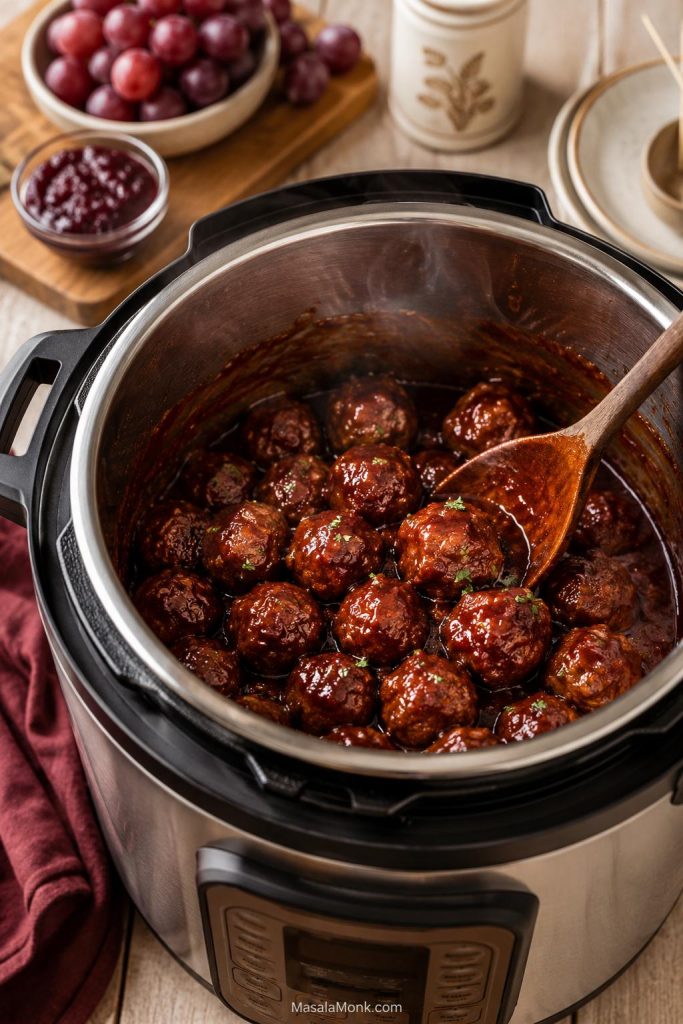
Grape jelly meatballs inside a pressure cooker insert with steam rising and a wooden spoon stirring the sauce.
After pressure cooking, use sauté to reduce the sauce from loose to spoon-coating.

Can You Use Homemade Meatballs?

You do not need homemade meatballs for this recipe to work. Frozen fully cooked meatballs are the point when you need an easy party appetizer. Homemade meatballs are simply an upgrade if you have the time.

Cooked meatballs before sauce

Homemade meatballs are an upgrade, but they should be cooked first so the sauce is only heating and coating them, not cooking raw meat.

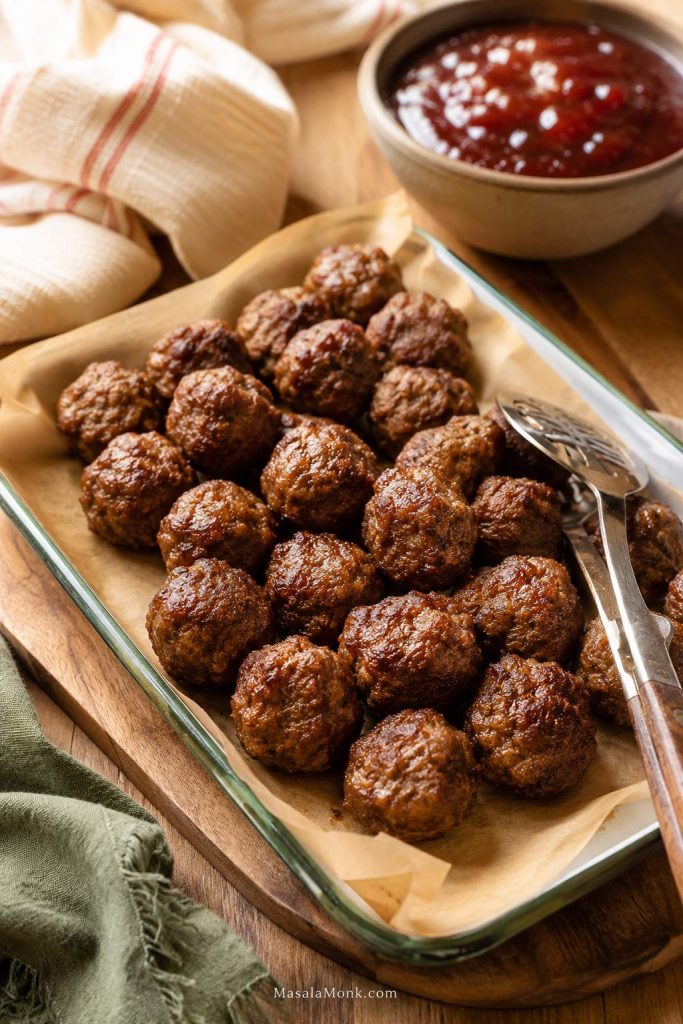
Cooked homemade meatballs on parchment paper in a glass baking dish with tongs and a bowl of red sauce in the background.
Cook homemade meatballs first, then sauce them; the texture stays firmer and timing is easier.

For a simple homemade batch, use:

  • Ground beef or beef-pork mix, 2 lb / 900 g
  • Breadcrumbs or panko, 1 cup
  • Milk, 1/2 cup
  • Eggs, 2
  • Finely chopped onion, 1/2 cup
  • Garlic powder, 1 teaspoon
  • Salt, 1 teaspoon
  • Black pepper, 1/2 teaspoon

Mix gently, shape into 1-inch meatballs, then bake or brown them before adding them to the sauce. Ground beef or pork meatballs should be cooked through to 160°F / 71°C. Poultry meatballs should reach 165°F / 74°C.

Best practical choice: Use frozen fully cooked meatballs for parties. Choose homemade meatballs when you want better texture and have time to cook them before saucing.

How Much to Make for a Party

A 2 lb bag usually gives about 48–50 small meatballs. If you are serving several appetizers, people will take fewer. If these are the main hot snack, plan for more.

Use caseAmount to plan
Light appetizer with other snacks3–4 meatballs per person
Heavier appetizer5–6 meatballs per person
Dinner over rice, noodles, or potatoes6–8 meatballs per person
2 lb / 900 g bagAbout 12–16 appetizer servings
4 lb / 1.8 kg double batchAbout 24–32 appetizer servings

What a Double Batch Looks Like

Use this as the capacity check: the slow cooker can look full, but it still needs room for stirring.

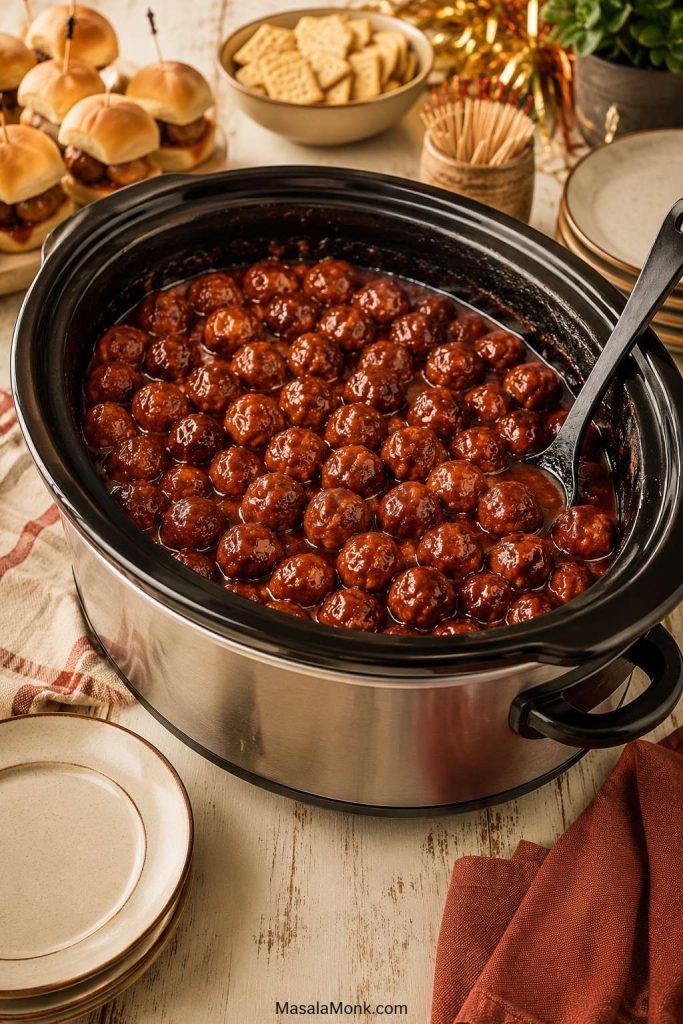
Large slow cooker filled with a double batch of grape jelly meatballs on a party table with slider buns, crackers, toothpicks, and plates.
A double batch needs room to stir. Crowding slows heating and makes the sauce harder to manage.

If you are not sure how much your crowd will eat, make the double batch. These are exactly the kind of appetizers people keep taking one at a time until the slow cooker is suddenly empty.

Sauce Scaling Chart

Use this chart when your bag size is smaller, larger, or when you want a sweeter party-style batch. The standard batch is saucy enough for a party bowl, but not so heavy that the meatballs swim in sauce.

BatchMeatballsGrape jellyChili sauce
Small bag26–28 oz / 740–800 g8–10 oz / 225–280 g10–12 oz / 280–340 g
Half batch1 lb / 450 g5–6 oz / 140–170 g6 oz / 170 g
Standard balanced batch2 lb / 900 g10–12 oz / 280–340 g12 oz / 340 g
Sweeter party batch2 lb / 900 g18–20 oz / 510–565 g12 oz / 340 g
Double balanced batch4 lb / 1.8 kg20–24 oz / 560–680 g24 oz / 680 g
Double sweeter batch4 lb / 1.8 kg36–40 oz / about 1–1.1 kg, or roughly two 18–20 oz jars24 oz / 680 g

Simple Party Timeline

If you are serving these for a party, start the slow cooker about 3 hours before guests arrive if cooking on HIGH, or 5 hours before if cooking on LOW. That gives the meatballs time to heat through and gives you a little buffer before serving.

WhenWhat to do
Night beforeMix the grape jelly and chili sauce, or cook the full batch and refrigerate it after cooling.
Before serving a refrigerated batchReheat on the stovetop, in the oven, or in the microwave until hot, then move to the slow cooker on WARM.
3–5 hours before serving a fresh batchCook the meatballs in the slow cooker, depending on HIGH or LOW timing.
When guests arriveSwitch to WARM, stir, and set out toothpicks plus a spoon for extra sauce.
During servingStir occasionally and loosen the sauce with a splash of water or broth if the edges thicken.

Taking Them to a Potluck

If you are taking grape jelly meatballs to another house, the easiest option is to cook or reheat them before you leave, keep the slow cooker covered during the trip, then plug it in as soon as you arrive and keep the meatballs on WARM.

How to Hold Them Warm at a Potluck

The covered slow cooker shines as a holding tool. For best texture and safety, bring the meatballs hot before you rely on WARM.

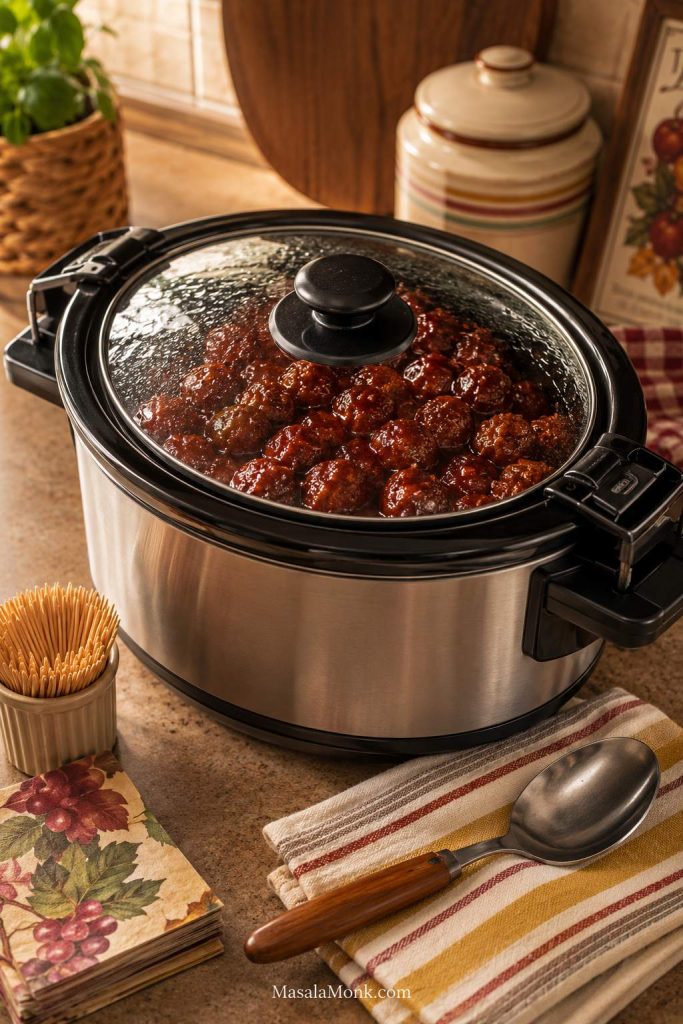
Covered slow cooker with grape jelly meatballs visible through the lid beside a spoon, napkins, toothpicks, and towels.
Bring the meatballs hot, then use the covered slow cooker to hold them warm once you arrive.

For a longer trip, transport the meatballs chilled in a sealed container, reheat them until hot when you arrive, then move them to the slow cooker for serving. Do not rely on a cold slow cooker full of refrigerated meatballs to reheat the batch quickly.

How to Fix Grape Jelly Meatball Sauce

If your first taste makes you think, “this is too sweet,” do not start over. Wait until the jelly has melted, then adjust the hot sauce in the direction it needs to go.

The good news is that this sauce is forgiving. Once it is warm, small adjustments make a big difference.

ProblemFix
Too sweetAdd more chili sauce, Dijon, vinegar, lemon juice, Worcestershire sauce, black pepper, or hot sauce.
Too tangyAdd more grape jelly or a spoonful of BBQ sauce.
Too thinSimmer uncovered or add a cornstarch slurry.
Too thickAdd water, broth, pineapple juice, or a little BBQ sauce.
Flat flavorAdd Worcestershire sauce, Dijon, black pepper, vinegar, hot sauce, or a pinch of salt.
Coating not clingingCook longer, stir well, or reduce slightly.
Too spicyAdd more grape jelly or BBQ sauce.
Meatballs drying outAdd a splash of water and keep them on WARM, not HIGH.

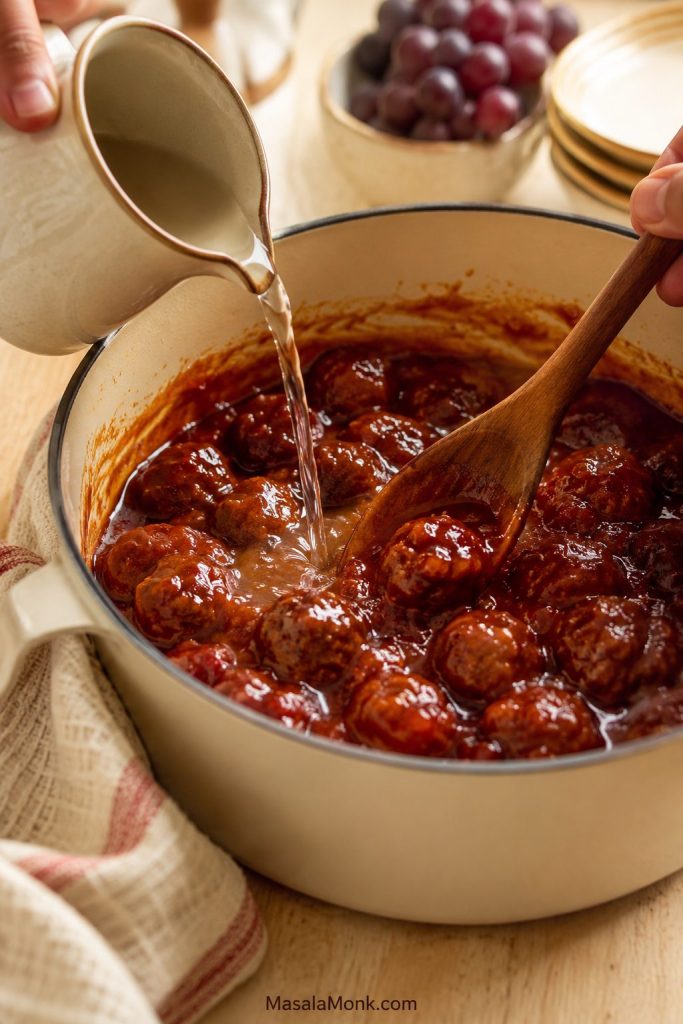
If the sauce gets too thick

Sauce that drags instead of spoons needs loosening before serving, especially after sitting on WARM or thickening around the slow cooker edges.

Clear liquid being poured into thick grape jelly meatball sauce while a wooden spoon stirs the meatballs.
If the sauce thickens around the edges, loosen it with a small splash of water or broth so the glaze stays spoonable.

If the sauce drags instead of pours, loosen it before serving. These meatballs should feel glossy and easy to spoon, not sticky enough to fight with.

How to thicken the sauce

For light thickening, mix 1 teaspoon cornstarch with 1 teaspoon cold water. For a thicker glaze, mix 2 teaspoons cornstarch with 2 teaspoons cold water.

Stir the slurry into the hot mixture and cook until it turns shiny and coats the spoon. In a slow cooker, add the slurry near the end and cook on HIGH for another 15–20 minutes. For faster thickening, transfer the sauce to a saucepan and simmer for a few minutes.

How to make the sauce less sweet

Add something tangy, savory, or spicy. A splash of vinegar, a little Dijon mustard, extra chili sauce, Worcestershire sauce, black pepper, lemon juice, or hot sauce can pull the sauce back into balance.

Start small, stir, taste, and adjust again. It is much easier to add more sharpness than to fix a sauce that has gone too sour.

Substitutions: Grape Jelly, Chili Sauce, and Meatballs

Grape jelly substitutes

Grape jelly is classic, but other fruit preserves can work with the same sweet-savory idea. The mixture may look less smooth if you use jam or preserves with fruit pieces.

SubstituteFlavor result
Cranberry sauceTangier, holiday-style, and good with chili sauce.
Apricot preservesLighter, fruity, and good with BBQ sauce.
Orange marmaladeCitrus-sweet with a slight bitter edge.
Raspberry preservesSweeter berry flavor.
Hot pepper jellySpicy-sweet and stronger in flavor.
Strawberry jellyWorks, but tastes sweeter and less classic.
Grape jamSimilar flavor, but thicker and less smooth than jelly.

For a holiday-style version, cranberry sauce is the most natural swap. If you already like sweet-tart cranberry sauce with savory food, that same flavor direction works beautifully with cocktail meatballs. This cranberry sauce with orange juice has the kind of bright, tangy-sweet profile that pairs well with warm appetizers.

Chili sauce substitutes

Go with BBQ sauce when you want a smoky, game-day flavor. Use ketchup when you want the mildest pantry version, then add Worcestershire sauce, vinegar, Dijon, black pepper, or chili powder if it tastes flat.

Meatball substitutes

Turkey, chicken, beef, pork, beef-pork, and plant-based meatballs can all work as long as they are fully cooked before going into the sauce. Choose mild meatballs if you want the classic party flavor.

Can you use low-sugar or sugar-free grape jelly?

Yes, but the sauce may be thinner, less shiny, or slightly sharper depending on the sweetener. Taste after the jelly melts before adding vinegar, mustard, or hot sauce. If the coating looks thin, use the cornstarch slurry method to help it cling to the meatballs.

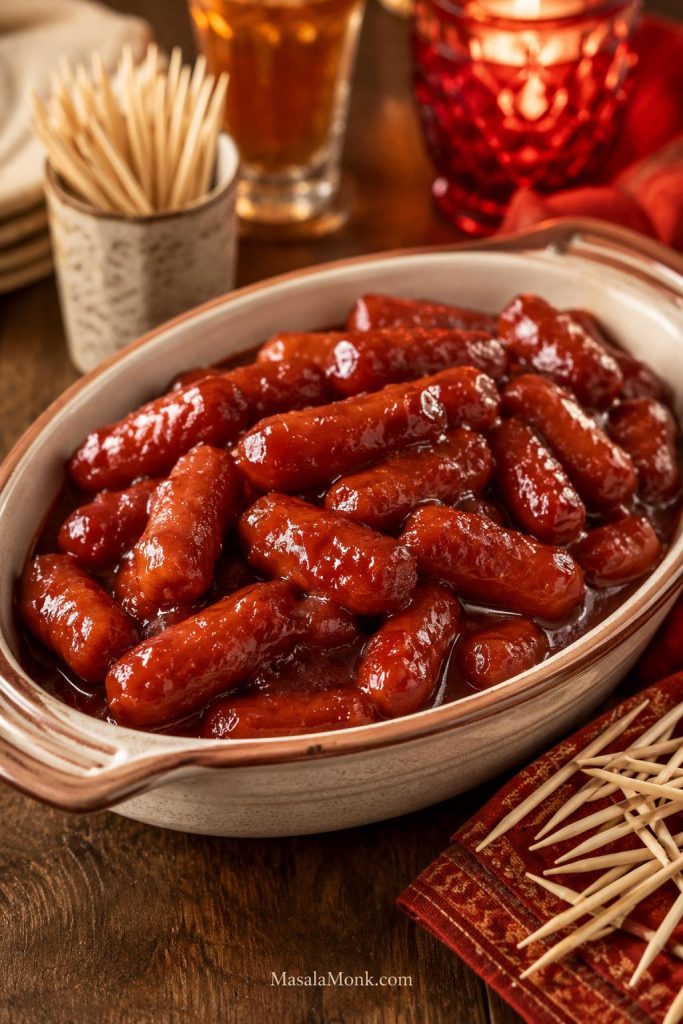
Can You Use Little Smokies Instead of Meatballs?

Little Smokies can go straight into this sauce too. Use 2–3 lb cocktail sausages with the same grape jelly and chili sauce mixture, then cook until hot and well coated.

How the Little Smokies Version Looks

Use this version when you want the same sauce but a snappier cocktail-sausage bite instead of soft meatballs.

Little Smokies cocktail sausages coated in glossy grape jelly chili sauce in a shallow bowl with toothpicks nearby.
Little Smokies turn the same glaze into a saltier, snappier cocktail-sausage appetizer.

What to Serve with Grape Jelly Meatballs

For parties, let these be the warm, saucy anchor on the table. Surround them with something crunchy, something creamy, and something easy to grab.

For a slow-cooker setup, set out toothpicks plus a small spoon or ladle. Toothpicks are easy for grabbing meatballs, but a spoon helps people get enough sauce.

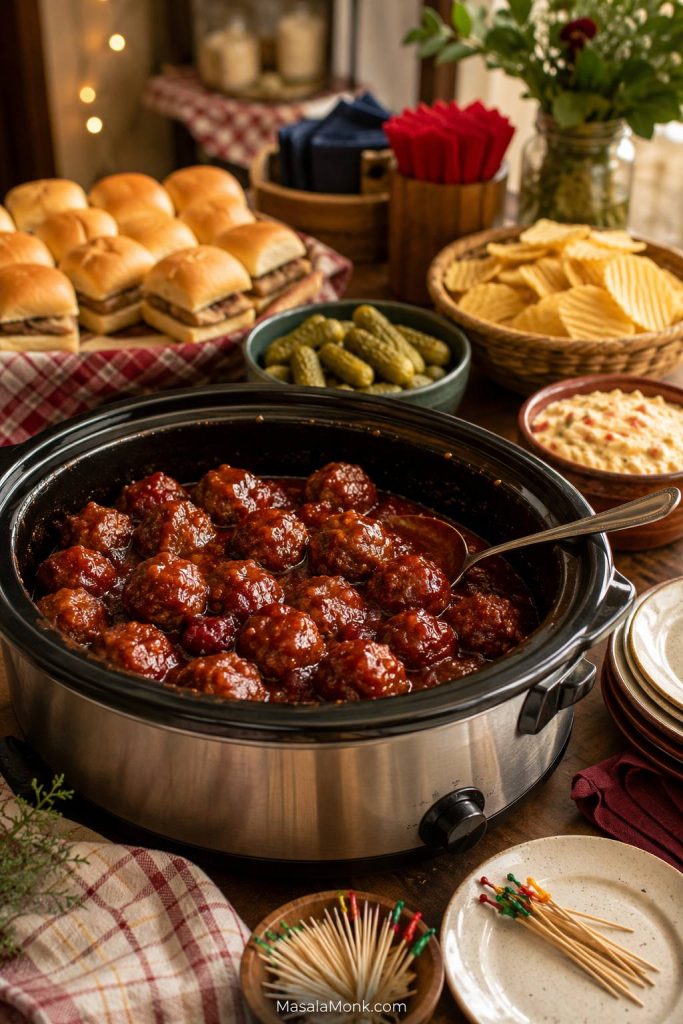
What to Serve With Party Meatballs

A good party spread gives the warm meatballs contrast: something soft, something crunchy, something tangy, and something creamy.

Grape jelly meatballs on a party table with slider buns, pickles, chips, dip, toothpicks, napkins, and small plates.
Balance the warm saucy meatballs with soft buns, crunchy chips, tangy pickles, and a creamy dip.

For parties

  • Toothpicks or cocktail forks
  • Slider buns
  • Pull-apart bread
  • Cheese ball with crackers or pretzels
  • 7 layer dip with sturdy chips
  • Pickles
  • Raw vegetables and dip

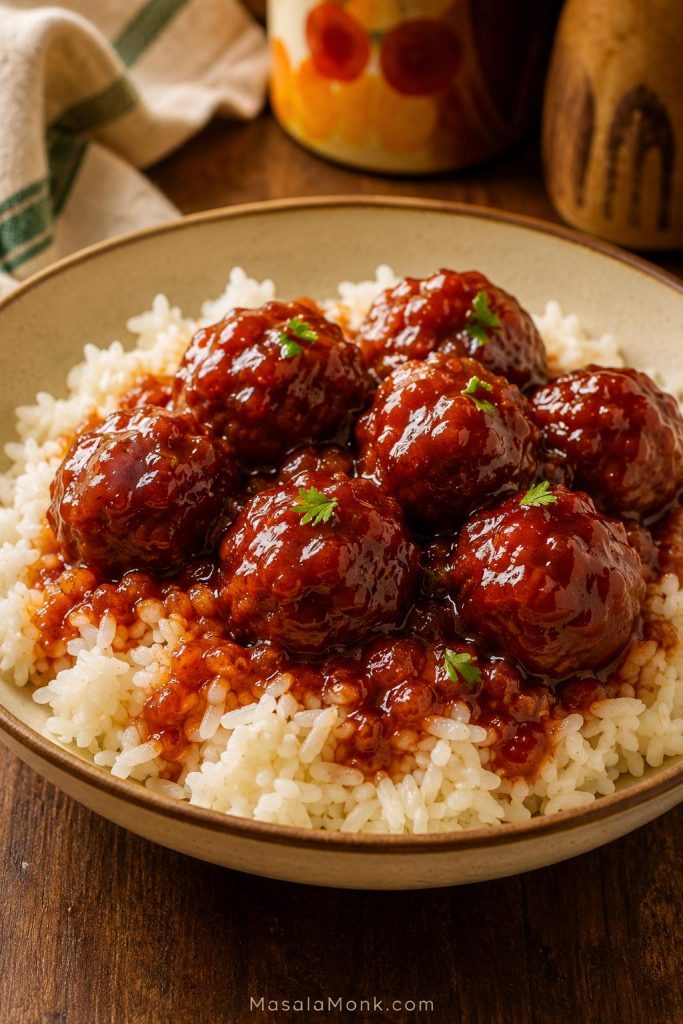
Turn Them Into Dinner

To make this feel like a main dish, give the sauce something soft to land on instead of serving the meatballs alone.

Grape jelly meatballs served over steamed white rice in a shallow bowl with sauce soaking into the rice.
Rice, noodles, or mashed potatoes turn the appetizer into a simple main dish by catching the sweet-tangy sauce.

Because the sauce is bold and a little sweet, it pairs best with something simple and starchy. Rice, potatoes, and noodles all work because they soak it up without competing with it.

Can You Make Grape Jelly Meatballs Ahead?

Yes. You can make grape jelly meatballs ahead for parties, holidays, and game day. Cook the meatballs in the sauce, let them cool, then store them in an airtight container in the fridge.

Before serving, reheat them on the stovetop, in the oven, or in the microwave until hot. Once reheated, move them to the slow cooker on WARM. If the sauce has thickened in the fridge, stir in a splash of water, broth, or BBQ sauce until it loosens again.

Do not ask the slow cooker to bring cold leftovers up to temperature. Reheat first, then use the slow cooker to hold them warm for serving.

You can also mix the grape jelly and chili sauce ahead of time and keep the sauce refrigerated. When ready to cook, add the sauce and meatballs to the slow cooker and continue with the recipe.

For a cold make-ahead appetizer beside the hot meatballs, this cheese ball recipe works well because it can chill while the slow cooker handles the warm food.

Storage, Freezing, and Reheating

Leftovers keep well because the sauce thickens around the meatballs as it chills. Store them in an airtight container in the fridge for 3–4 days.

To freeze, cool the meatballs completely, then freeze them with the sauce in a freezer-safe container for up to 2–3 months. Thaw overnight in the fridge before reheating.

Reheat on the stovetop, in the microwave, or in the oven until hot. The sauce thickens when cold, so do not panic if leftovers look stiff from the fridge. Add a splash of water if needed, then move the meatballs to a slow cooker on WARM if you want to serve them at a party.

FAQs

What are grape jelly meatballs made of?

Classic grape jelly meatballs use fully cooked meatballs, grape jelly, and bottled chili sauce. The jelly gives sweetness and shine, while the chili sauce keeps the sauce tangy instead of candy-sweet.

Why do people put grape jelly in meatballs?

Grape jelly melts into the sauce and acts like the sweet part of a sweet-and-sour glaze. Once it mixes with chili sauce, it tastes more savory-sweet than fruity.

Do grape jelly meatballs taste like grape jelly?

Not exactly. The jelly adds sweetness, shine, and body, but the chili sauce turns the flavor sweet, tangy, and savory instead of jammy.

What kind of chili sauce do you use?

Use American-style bottled chili sauce, usually found near ketchup. It is tomato-based, tangy, and mildly spiced. Do not use chili garlic sauce, Thai sweet chili sauce, or sriracha as a direct replacement.

What is the difference between chili sauce and ketchup in this recipe?

Chili sauce tastes like a tangier, bolder ketchup-style sauce. Ketchup makes the meatballs softer and sweeter, while chili sauce gives the classic version more tomato tang and mild spice.

Can BBQ sauce replace chili sauce?

Yes. Use 1 1/2 to 2 cups BBQ sauce and 1 cup grape jelly for 2 lb / 900 g meatballs. The flavor will be smokier and sweeter.

Does ketchup work instead of chili sauce?

Yes. Use 1 1/2 cups ketchup and 3/4 to 1 cup grape jelly for 2 lb / 900 g meatballs. Add Worcestershire sauce, vinegar, mustard, or chili powder if it tastes too sweet or flat.

Is grape jam okay instead of grape jelly?

Yes. Grape jam has a similar flavor, but it may be thicker and less smooth because it contains more fruit pulp. Add a splash of water if needed.

What can I use instead of grape jelly?

Cranberry sauce, apricot preserves, orange marmalade, raspberry preserves, hot pepper jelly, strawberry jelly, or grape jam can work. Jam and preserves may make the sauce less smooth than jelly.

Do I thaw frozen meatballs first?

Most fully cooked frozen meatballs can go straight into the slow cooker, but check the package instructions. If a brand recommends thawing first, follow the package.

Do Italian meatballs work?

Yes, but homestyle meatballs taste more like the classic party version. Italian meatballs can work, though the herbs and cheese may make the sauce taste more dinner-style.

Should raw meatballs go into this recipe?

This recipe assumes the meatballs are already cooked. Cook raw or homemade meatballs first, then add them to the sauce for heating and coating.

What size slow cooker do I need?

A 4–5 quart slow cooker works well for 2 lb / 900 g meatballs. Use a 6 quart slow cooker for a double batch.

How long do grape jelly meatballs cook in the crockpot?

For a standard 2 lb / 900 g batch, cook on HIGH for 2–3 hours or LOW for 4–5 hours, until the meatballs are hot and the sauce has melted together.

How do I double grape jelly meatballs?

Yes. Use 4 lb / 1.8 kg fully cooked meatballs, 20–24 oz / 560–680 g grape jelly, and 24 oz / 680 g chili sauce. Use a 6 quart slow cooker and stir once or twice.

How do I keep them warm for a party?

Once the meatballs are fully hot, switch the slow cooker to WARM and stir occasionally. If the sauce thickens around the edges, add a splash of water or broth.

How long can grape jelly meatballs stay on WARM?

Once fully hot, they can sit on WARM as long as the slow cooker keeps them hot, ideally at 140°F / 60°C or above. For best texture, serve within 2–4 hours.

How do I make them without a crockpot?

Yes. Simmer them on the stovetop for 15–20 minutes, or bake covered at 350°F / 175°C for 45–60 minutes. You can also use an Instant Pot with added water, then reduce the sauce after pressure cooking.

How do I thicken grape jelly meatball sauce?

Mix 1 teaspoon cornstarch with 1 teaspoon cold water, then stir it into the hot sauce. For a thicker glaze, use 2 teaspoons cornstarch with 2 teaspoons cold water.

How do I make grape jelly meatballs less sweet?

Add chili sauce, vinegar, lemon juice, Dijon mustard, Worcestershire sauce, hot sauce, black pepper, or chili flakes. Add a little at a time and taste before adding more.

Does low-sugar or sugar-free grape jelly work?

Yes, but the sauce may be thinner, less shiny, or slightly sharper. Taste after the jelly melts, then thicken with a cornstarch slurry if needed.

Do homemade meatballs work?

Yes. Cook homemade meatballs first, then add them to the grape jelly sauce. Frozen fully cooked meatballs are easier for parties, but homemade meatballs give you more control over texture.

Can Little Smokies replace the meatballs?

Yes. Use 2–3 lb Little Smokies or cocktail sausages with the same sauce, then cook until hot and coated. They will taste saltier and snappier than meatballs.

What do you serve with grape jelly meatballs?

For parties, serve them with toothpicks, slider buns, chips and dip, pickles, raw vegetables, or a cheese board. For dinner, spoon them over rice, mashed potatoes, egg noodles, or macaroni and cheese.

Can you freeze grape jelly meatballs?

Yes. Cool them completely, then freeze with the sauce in a freezer-safe container for up to 2–3 months. Thaw overnight in the fridge and reheat until hot.

Final Thoughts

The easiest ratio to remember is simple: 2 lb meatballs, 10–12 oz grape jelly, and 12 oz bottled chili sauce. Let the jelly melt fully, then taste before adjusting.

Once you know that base, the rest is easy: more jelly for sweetness, BBQ sauce for smoke, vinegar or mustard for tang, and a splash of water if the sauce gets too thick. It is not a fancy appetizer, and that is exactly why it works: people know what to do with it, the slow cooker keeps it ready, and the bowl usually empties before anyone admits how simple it was.

Back to top ↑

Posted on Leave a comment

Wedge Salad Recipe: Classic Iceberg Wedge with Blue Cheese, Bacon & Ranch Variations

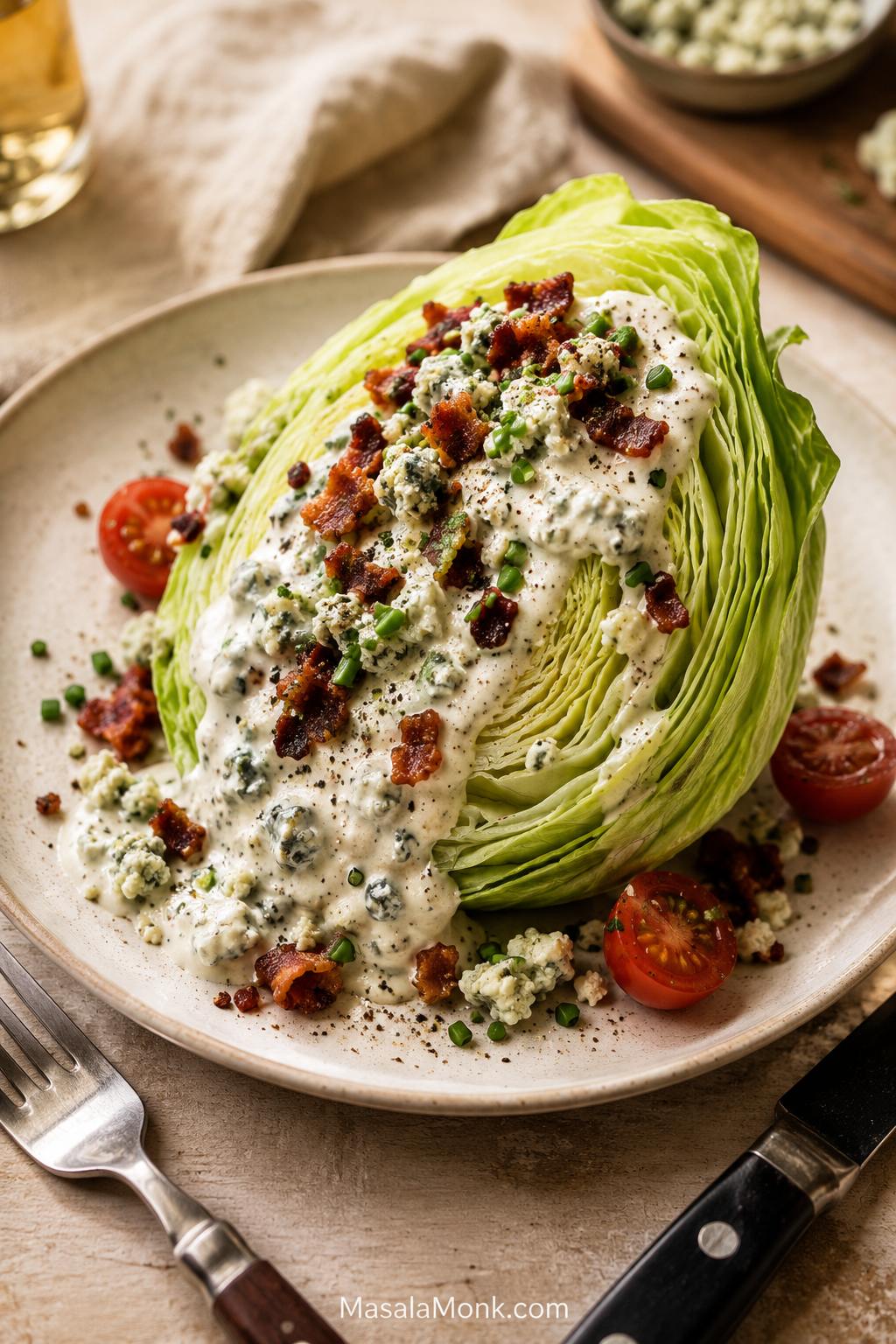
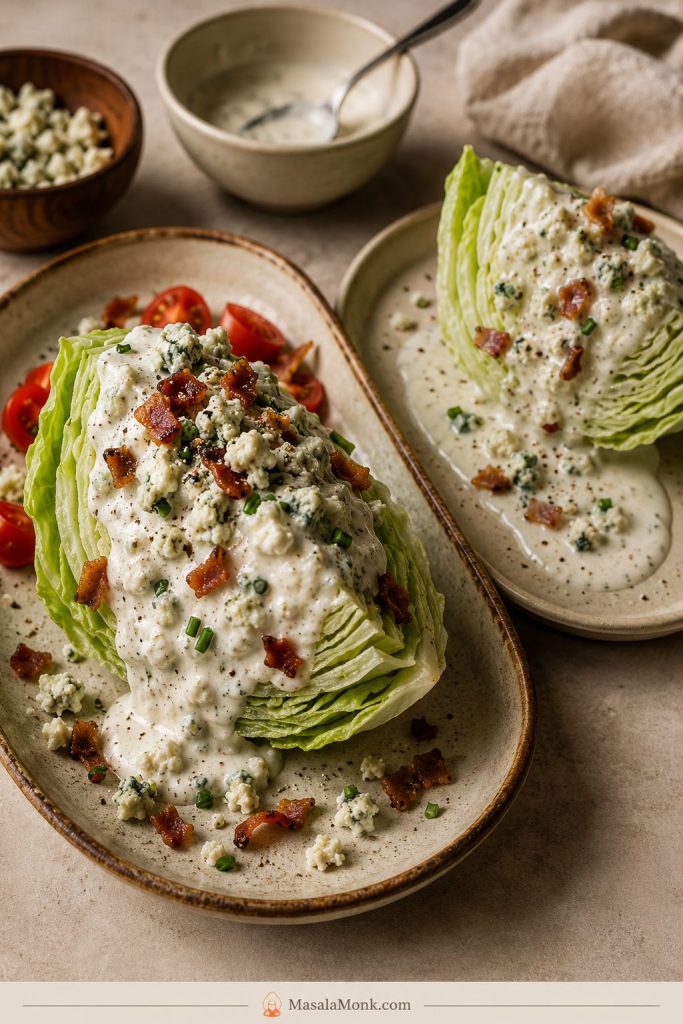
Iceberg lettuce wedge on a cream plate with blue cheese dressing, bacon, cherry tomatoes, chives, blue cheese crumbles, black pepper, and a fork and knife nearby.

A wedge salad is funny because it looks almost too simple: a quarter of iceberg lettuce, a spoonful of dressing, and a few toppings. Then you cut into it and remember why steakhouses never let it disappear.

The lettuce snaps cold under the knife, the dressing settles into the layers, the bacon hits salty and crisp, and suddenly the plainest lettuce in the fridge feels like the best side on the table.

A wedge salad is not a tossed salad. It is a cold, knife-and-fork salad where the details matter: dry lettuce, thick dressing, crisp bacon, and toppings small enough to stay put. The trick is not doing more; it is doing those simple things properly.

What Makes a Good Wedge Salad?

Most disappointing wedge salads fail for the same reason: wet lettuce, thin dressing, warm bacon, and toppings that slide off. This version fixes those small things first, so the salad stays crunchy, creamy, and easy to eat.

This is the kind of recipe to keep in your back pocket for nights when you want a salad that feels special without making the meal harder. Start with the blue cheese wedge salad, then use the ranch, Outback-style, chopped, grilled, keto, vegetarian, no-bacon, and no-blue-cheese options whenever you want a slightly different version.

It also looks more impressive than the work it takes, which is exactly why it is such a good starter for guests, burger nights, steak dinners, and summer meals from the grill.

Make it now: Cut 1 cold iceberg head into 4 wedges. Make or choose a thick blue cheese or ranch dressing, then top each wedge with crisp cooled bacon, small tomatoes, fine onion or chives, blue cheese crumbles, and black pepper. Keep a little core attached, dry the lettuce well, and dress just before serving. Serves: 4 large wedges. Total time: about 30–40 minutes.
What matters most: Dry lettuce, spoonable dressing, cooled bacon, and toppings chopped small enough to stay on the wedge. That is the difference between a crisp steakhouse-style salad and a plate that slides apart.

If you are building a fresh salad spread, this sits nicely next to a crisp cucumber salad or a colorful beet salad.

Quick Answer: What Is a Wedge Salad?

A wedge salad is a cold quarter of iceberg lettuce topped with creamy dressing, crisp bacon, tomatoes, onion or chives, blue cheese crumbles, and black pepper. It is usually served as a knife-and-fork salad, which is part of its old-school charm.

Blue cheese dressing is traditional, while ranch is the easiest milder swap. Iceberg works because it stays crunchy and sturdy under creamy dressing and toppings.

Start here: Choose the blue cheese version for steakhouse flavor, ranch for a milder family version, and balsamic glaze when you want that sweet-tangy Outback-style finish.

Why This Recipe Works

The salad works because the textures stay in balance: crisp iceberg, creamy dressing, salty bacon, juicy tomatoes, and a sharp little finish from onion and blue cheese.

That is why a good wedge salad never feels like a sad side salad. It is fresh enough to reset the plate and rich enough to belong beside burgers, steak, grilled chicken, or a baked potato.

  • Iceberg brings the snap. Its tight layers hold the wedge shape and stand up to a rich dressing.
  • The dressing grips the layers. It should fall from a spoon in thick ribbons, not pour like milk.
  • Crisp bacon gives salty crunch. Soft bacon disappears, but crisp bits make every bite better.
  • The toppings are small on purpose. Think confetti, not chunks.
  • Everything comes together at the end. Last-minute assembly keeps the wedge fresh instead of soggy.
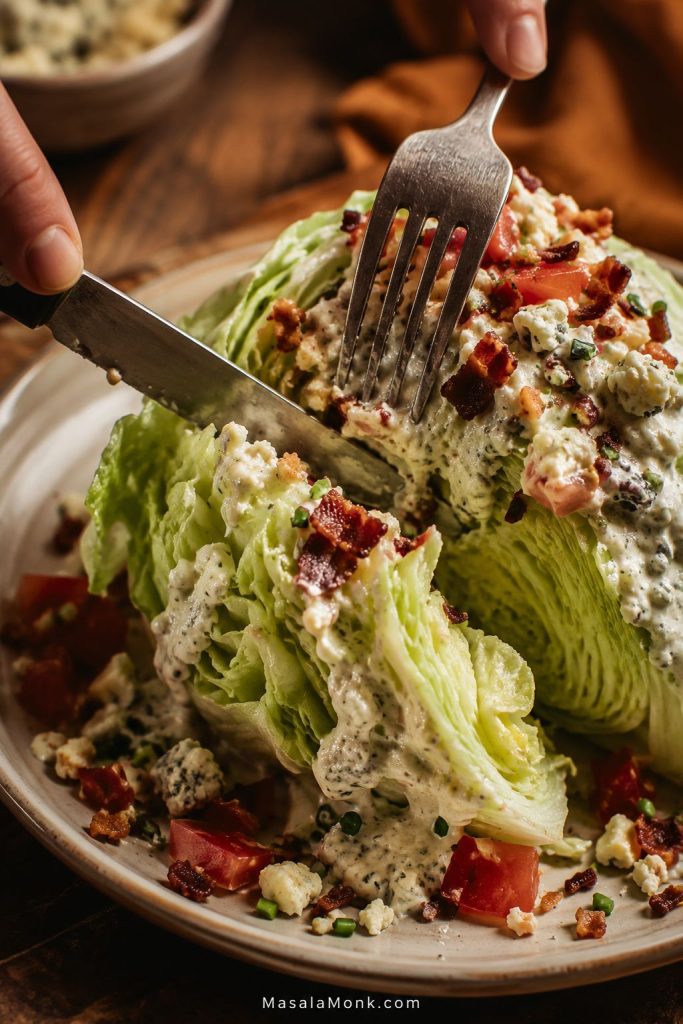
Fork and knife cutting into a dressed iceberg wedge salad with visible lettuce layers, blue cheese dressing, bacon, tomatoes, and crumbles.
Cut straight down through the iceberg layers so each bite gets cold lettuce, creamy dressing, bacon, tomato, and blue cheese together.

What Makes It Taste Like the One You’d Order Out?

A great wedge salad is cold, neat, generous, and balanced. The lettuce is chilled, the dressing is thick enough to coat, the bacon is crisp but not hot, and the toppings stay where they belong.

  • Use cold plates if you can. They help the iceberg stay crisp longer.
  • Dress the cut sides, not just the top. A little dressing in the layers makes better bites.
  • Add toppings after the dressing. The dressing helps hold bacon, tomatoes, onion, and crumbles in place.
  • Finish with black pepper. It cuts through the creamy dressing and sharpens the whole salad.

Wedge Salad Ingredients

The ingredient list is short, so each part has to earn its place.

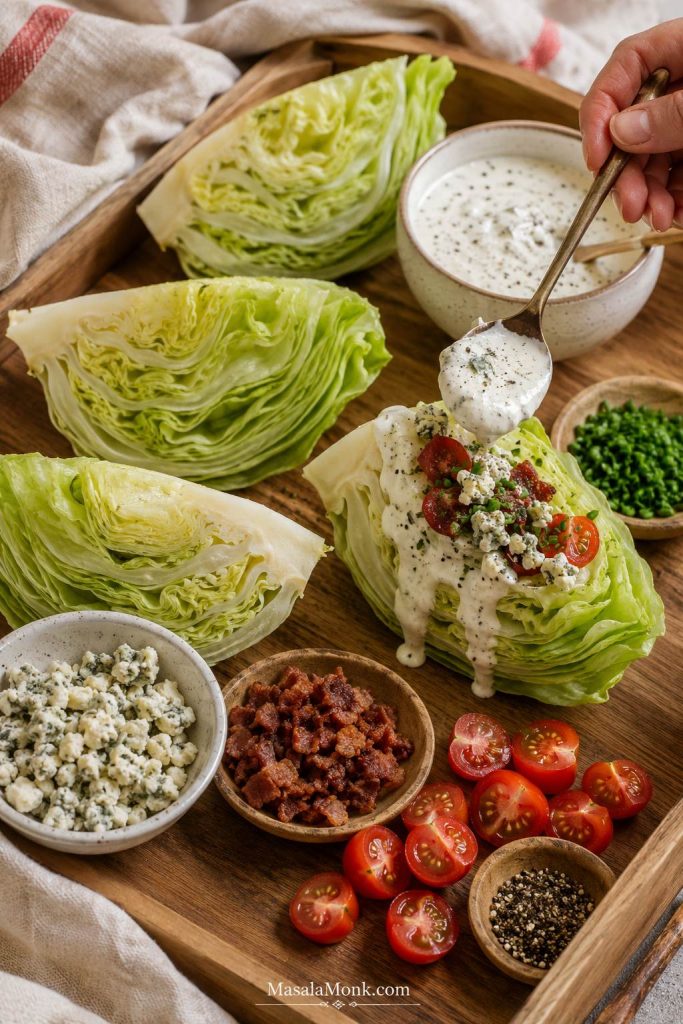
Iceberg lettuce wedges on a wooden tray with blue cheese dressing, bacon bits, cherry tomatoes, chives, blue cheese crumbles, black pepper, and one wedge being dressed.
Prep the wedge salad ingredients like a small station: dry iceberg wedges, thick dressing, crisp bacon, tomatoes, chives, blue cheese crumbles, and pepper. Then assembly stays fast and clean.

Iceberg Lettuce

Iceberg is the heart of the recipe. It is crisp, mild, refreshing, and sturdy enough to cut into wedges. One medium head gives you 4 large wedges or 6 smaller starter wedges.

Look for a head that feels heavy for its size, with tight leaves and no slimy or brown patches.

Bacon

Thick-cut bacon gives the strongest salty crunch. Cook it until crisp, drain it well, and chop it small so the bits catch in the dressing instead of sliding off the plate.

You can also cook the bacon in the oven. Arrange it on a lined sheet pan and bake at 400°F / 200°C until crisp, usually 15–20 minutes depending on thickness.

Let the bacon cool before adding it. Warm bacon fat can soften the lettuce and loosen the dressing.

Tomatoes

Cherry or grape tomatoes are the easiest win here: sweet, tidy, easy to halve, and less likely to flood the plate than large chopped tomatoes.

If they are very juicy, sprinkle them lightly with salt and let them drain for 5–10 minutes before adding them to the salad. This keeps the finished plate fresher and cleaner.

Red Onion, Chives, or Scallions

Red onion gives a sharp bite, but it can be strong. Dice it finely, or soak it briefly in cold water for a milder flavor.

Chives are the gentlest option. Scallions are fresh and easy, with a little more bite than chives but less intensity than red onion.

Blue Cheese Dressing

Blue cheese, sometimes written as bleu cheese on steakhouse menus, is the classic flavor for a wedge. For the best version, the dressing should sit on the lettuce, not run away from it.

Blue Cheese Crumbles

Extra crumbles make the salad feel richer and more old-school. Use a creamy, tangy blue cheese if you like a smoother bite, or a sharper blue cheese if you want more punch. Either way, use it lightly so the flavor stays balanced.

Shopping note: If you are making the dressing and adding extra crumbles on top, buy about 3–4 oz / 85–115 g blue cheese total.

Black Pepper

Freshly cracked black pepper cuts through the creamy dressing and gives the finished salad a little bite.

Optional Toppings

Balsamic glaze, avocado, hard-boiled egg, cucumber, crispy breadcrumbs, fried shallots, grilled chicken, steak strips, shrimp, croutons, roasted chickpeas, and toasted nuts all work well.

Easy topping rule: Choose one creamy element, one salty or crunchy element, one juicy element, and one sharp or fresh element. That is usually enough.

The Best Lettuce to Use

Iceberg is the classic choice because it has tight layers, clean crunch, and enough structure to hold dressing and toppings. Softer greens can taste good, but they collapse faster.

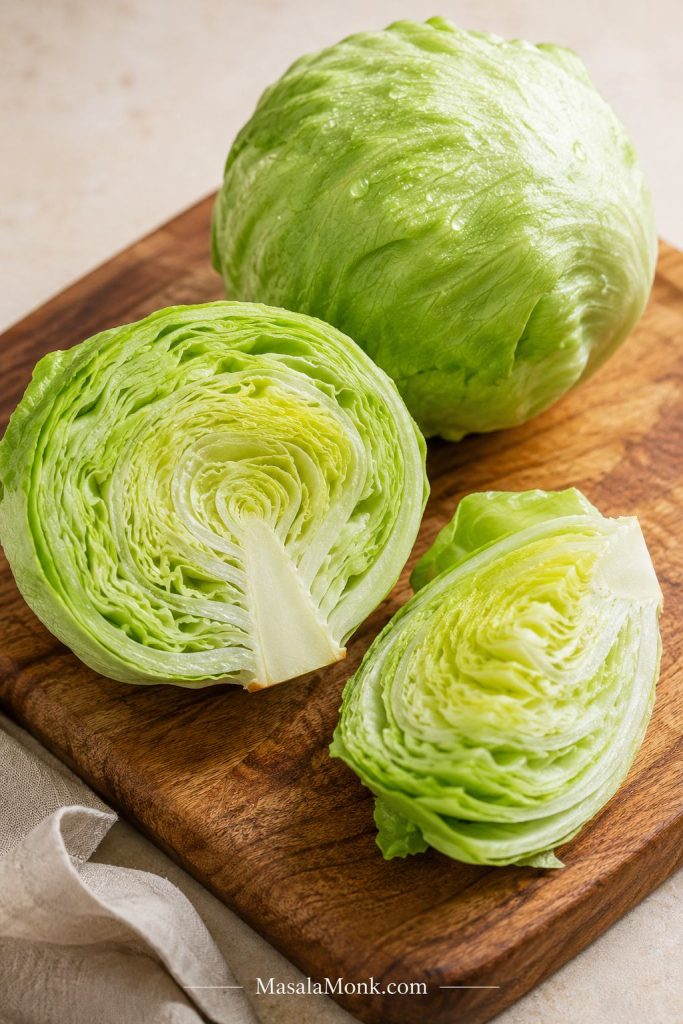
Whole iceberg lettuce, a halved iceberg head, and a quarter wedge on a wooden board showing the tight inner layers and core.
Iceberg lettuce works best because it stays cold, crisp, and structured. Softer greens collapse faster under creamy dressing and toppings.
  • Iceberg lettuce: the most reliable choice because it is crisp, sturdy, and tightly layered.
  • Romaine hearts: good for grilled wedge salads or Caesar-style wedges.
  • Little gem lettuce: useful for mini wedges or appetizer-style servings.
  • Butter lettuce or green leaf lettuce: better for tossed salads than wedge salads because they are softer.

For the main version, iceberg is still the one to buy. Romaine can work if you want a grilled or Caesar-style variation, but iceberg gives the true chilled crunch.

How to Wash and Cut Iceberg Lettuce for Wedge Salad

The wedge holds together because you cut through the core, not around it. Remove the core too early and the leaves can fall apart before they ever reach the plate.

Hands using a chef’s knife to cut iceberg lettuce through the core on a wooden cutting board.
When cutting iceberg lettuce, slice through the core first. That small anchor keeps each wedge from opening up before it reaches the plate.
  1. Remove damaged or wilted outer leaves.
  2. Rinse the outside of the iceberg head under cold water.
  3. Pat the outside dry with a clean towel.
  4. Trim only the brown end of the stem if needed.
  5. Place the lettuce on a cutting board with the core facing down.
  6. Cut the head in half through the core.
  7. Cut each half through the core again to make 4 wedges.
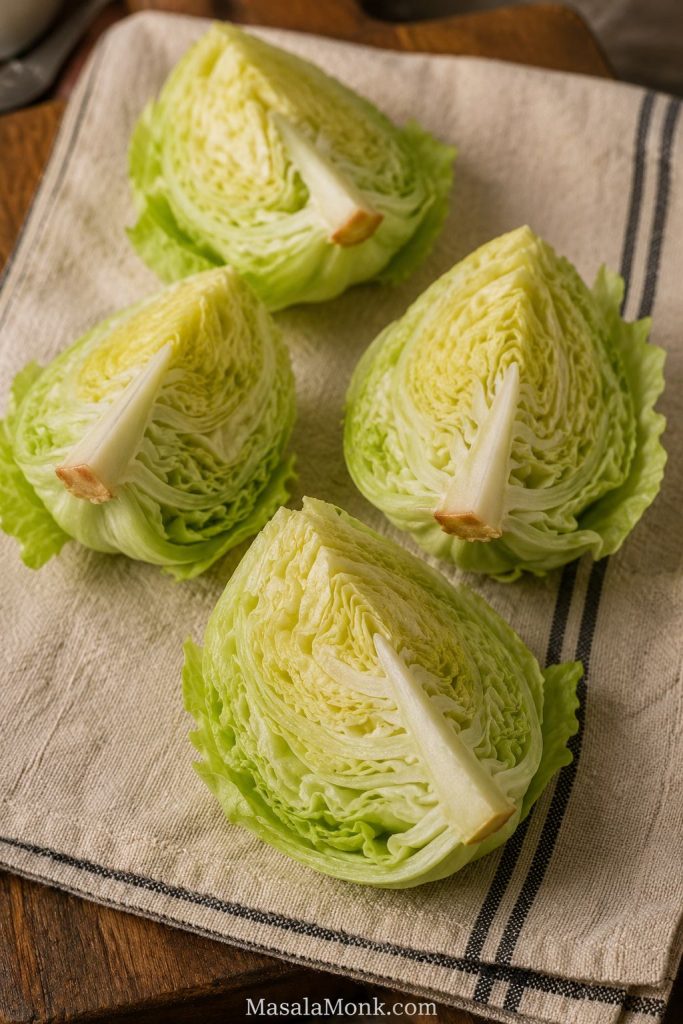
  8. Keep a small part of the core attached so each wedge holds together.
  9. Gently rinse between the layers only if needed.
  10. Drain the wedges cut-side down.
  11. Pat very dry with paper towels or a clean kitchen towel.
  12. Chill until you are ready to assemble.
Important: Keep a little core attached while cutting the wedges. Once each wedge is on the plate, you can trim away the hard inner piece if needed.

Core Attached Cue

Use this visual check after cutting: each iceberg wedge should still have enough core to hold the layers together, but not so much that the hard center dominates the bite.

Four iceberg lettuce wedges resting on a towel with a small piece of core still attached to each wedge.
Leave a little core attached until serving. It keeps the iceberg wedge neat while you dry the lettuce, move it, and add dressing.

If the lettuce already looks clean inside, avoid forcing water deep between every layer. Rinse what needs rinsing, dry it well, and keep the wedges cold.

Quick produce note: rinse lettuce under plain running water. The FDA also advises skipping soap or produce wash for fruits and vegetables.

The Dressing Should Be Thick, Not Runny

Blue cheese dressing gives this version its creamy, tangy steakhouse flavor. Texture matters as much as taste here.

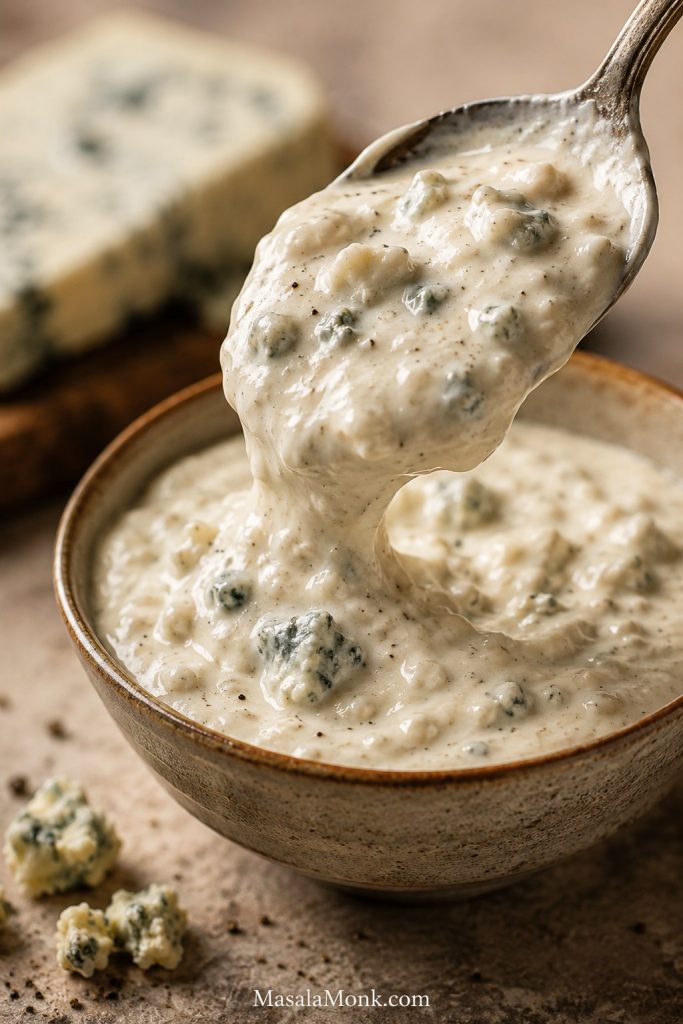
Think creamy dressing, not pourable dressing. It should fall from a spoon in thick ribbons. Add milk or buttermilk one tablespoon at a time, because it is much easier to thin a thick dressing than rescue a watery one.

Spoon lifting thick, chunky blue cheese dressing from a ceramic bowl with visible blue cheese pieces.
For blue cheese wedge salad, texture matters as much as flavor. Thick, spoonable dressing coats the lettuce instead of running off.

Blue Cheese Dressing Ingredients

Ingredient US Measure Metric
Sour cream ½ cup 120 g
Mayonnaise ¼ cup 55 g
Buttermilk or milk 2–3 tbsp 30–45 ml
Lemon juice or red wine vinegar 1½–2 tsp 7–10 ml
Worcestershire sauce ½ tsp 2–3 ml
Garlic powder ¼ tsp About 1 g
Freshly cracked black pepper ¼–½ tsp 1–2 g
Blue cheese, crumbled 2 oz 56 g
Salt To taste, optional To taste

How to Make the Dressing

Whisk together the sour cream, mayonnaise, buttermilk or milk, lemon juice or vinegar, Worcestershire sauce, garlic powder, and black pepper. Stir in the crumbled blue cheese.

For a smoother dressing, mash some of the cheese into the mixture with the back of a spoon. For a chunkier version, fold the crumbles in gently at the end.

Chill the dressing for 20–30 minutes before serving. If it becomes too thick in the fridge, loosen it with a small splash of buttermilk or milk.

To soften a sharp dressing, add a spoonful more sour cream. For a flat dressing, add a little more lemon juice or black pepper. Taste before adding salt, because blue cheese varies a lot; add only a small pinch if needed.

This makes about 1 to 1¼ cups dressing. Start with ¾ cup for the salad and serve extra on the side if needed.

If you use store-bought dressing, choose a thick one, preferably refrigerated. To make it taste fresher, stir in black pepper, a squeeze of lemon, and a spoonful of blue cheese crumbles. Thin bottled dressing is better served on the side; a wedge needs dressing with some body.

No buttermilk? Use regular milk with a small squeeze of lemon juice, or use milk alone and adjust the tang with lemon juice or vinegar.
No blue cheese? Use ranch, creamy garlic dressing, buttermilk herb dressing, green goddess, or Caesar dressing instead.

How to Make Wedge Salad

Once the lettuce, dressing, bacon, and toppings are ready, assembly takes only a few minutes.

1. Make the Dressing

Whisk together the blue cheese dressing ingredients and chill the dressing for 20–30 minutes. This gives it better flavor and a colder, creamier texture.

2. Cook the Bacon

Cook the bacon in a skillet over medium heat until crisp, about 8–10 minutes. Transfer it to paper towels to drain, then chop or crumble it. Let it cool before it touches the lettuce.

3. Prepare the Toppings

Halve the tomatoes, finely dice the onion, chop the chives, and crumble the blue cheese. If the tomatoes are juicy, salt and drain them for a few minutes.

4. Wash, Dry, and Cut the Lettuce

Cut the iceberg through the core into wedges. Rinse only as needed, drain well, pat dry, and keep the wedges chilled until serving.

5. Plate the Wedges

Place one cold wedge on each plate. Trim the hard core if needed, but keep the wedge intact.

6. Add Dressing and Toppings

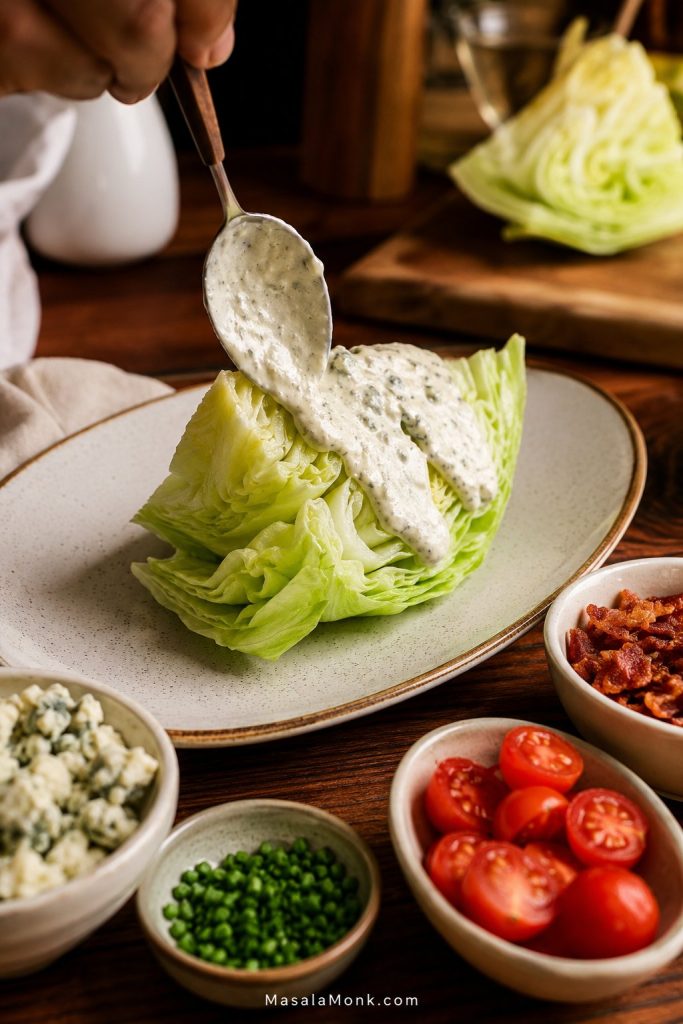
Spoon the dressing over each wedge. Add bacon, tomatoes, red onion or chives, blue cheese crumbles, and black pepper.

Hand spooning thick blue cheese dressing over an iceberg wedge before adding bacon, tomatoes, chives, and blue cheese crumbles.
Add dressing first, then toppings. The creamy layer catches bacon, tomatoes, onion, chives, and blue cheese crumbles before they slide away.

7. Serve Immediately

Serve as soon as it is dressed, before the lettuce starts to soften.

How to Plate It So It Looks Good

Place each wedge with one cut side facing up. Spoon dressing over the top and into the layers, then add toppings while the dressing is still sitting on the lettuce. Finish with pepper and chives.

Recipe Card: Wedge Salad Recipe

Wedge Salad with Iceberg Lettuce, Bacon & Blue Cheese Dressing

A crisp steakhouse-style wedge salad with cold iceberg lettuce, thick blue cheese dressing, smoky bacon, juicy tomatoes, chives, and extra crumbles — simple enough for weeknights, polished enough for steak night.

Servings:
4 large side salads
Active Prep Time:
About 20 minutes
Cook Time:
8–10 minutes
Chill Time:
20–30 minutes, while you prep
Total Time:
About 30–40 minutes
Course:
Salad, Side Dish, Starter
Cuisine:
American, Steakhouse-style
Serve It:
Cold and freshly assembled

Equipment

  • Chef’s knife
  • Cutting board
  • Mixing bowl
  • Whisk
  • Skillet or sheet pan for bacon
  • Paper towels or clean kitchen towel
  • Serving plates
  • Optional: small saucepan for balsamic glaze

Ingredients for the Salad

Ingredient US Measure Metric
Iceberg lettuce 1 medium head About 500–700 g
Thick-cut bacon 4–6 strips About 115–170 g raw
Cherry or grape tomatoes, halved 1–1½ cups 150–225 g
Red onion, finely diced ¼ cup 35–40 g
Chives or scallions, chopped 2 tbsp About 6 g
Blue cheese crumbles 1–2 oz 28–56 g
Blue cheese dressing, recipe below ¾–1 cup 180–240 ml
Freshly cracked black pepper To taste To taste

Ingredients for the Blue Cheese Dressing

Ingredient US Measure Metric
Sour cream ½ cup 120 g
Mayonnaise ¼ cup 55 g
Buttermilk or milk 2–3 tbsp 30–45 ml
Lemon juice or red wine vinegar 1½–2 tsp 7–10 ml
Worcestershire sauce ½ tsp 2–3 ml
Garlic powder ¼ tsp About 1 g
Freshly cracked black pepper ¼–½ tsp 1–2 g
Blue cheese, crumbled 2 oz 56 g
Salt To taste, optional To taste

Instructions

  1. Make the dressing. In a bowl, whisk together sour cream, mayonnaise, buttermilk or milk, lemon juice or vinegar, Worcestershire sauce, garlic powder, and black pepper. Stir in the crumbled blue cheese.
  2. Chill the dressing. Refrigerate for 20–30 minutes. If it becomes too thick, loosen it with a small splash of buttermilk or milk. Taste before adding salt.
  3. Cook the bacon. Cook bacon in a skillet over medium heat until crisp, about 8–10 minutes, or bake at 400°F / 200°C until crisp, about 15–20 minutes. Drain, crumble, and let it cool.
  4. Prep the toppings. Halve the tomatoes, finely dice the onion, chop the chives, and crumble extra blue cheese. If the tomatoes are very juicy, salt and drain them for 5–10 minutes.
  5. Prepare the lettuce. Remove damaged outer leaves from the iceberg. Rinse, dry, and cut through the core into 4 wedges. Keep a little core attached so each wedge holds together.
  6. Plate the wedges. Place one cold lettuce wedge on each plate. Trim the hard core if needed.
  7. Add dressing. Spoon blue cheese dressing over each wedge and into the layers.
  8. Add toppings. Sprinkle with bacon, tomatoes, onion or chives, blue cheese crumbles, and black pepper.
  9. Serve immediately. Serve while the lettuce is still cold and crisp.

Recipe Notes

  • Use thick ranch instead of blue cheese dressing for a milder version.
  • Add a light drizzle of balsamic glaze for the Outback-style finish.
  • Chop the iceberg for bowls, potlucks, or easier eating.
  • Briefly grill the wedges for a smoky summer side.
  • For keto, skip sweet glaze or use only a tiny drizzle.
  • For vegetarian, replace bacon with crispy chickpeas, fried onions, smoked almonds, or toasted breadcrumbs.

How to Keep the Salad from Getting Watery

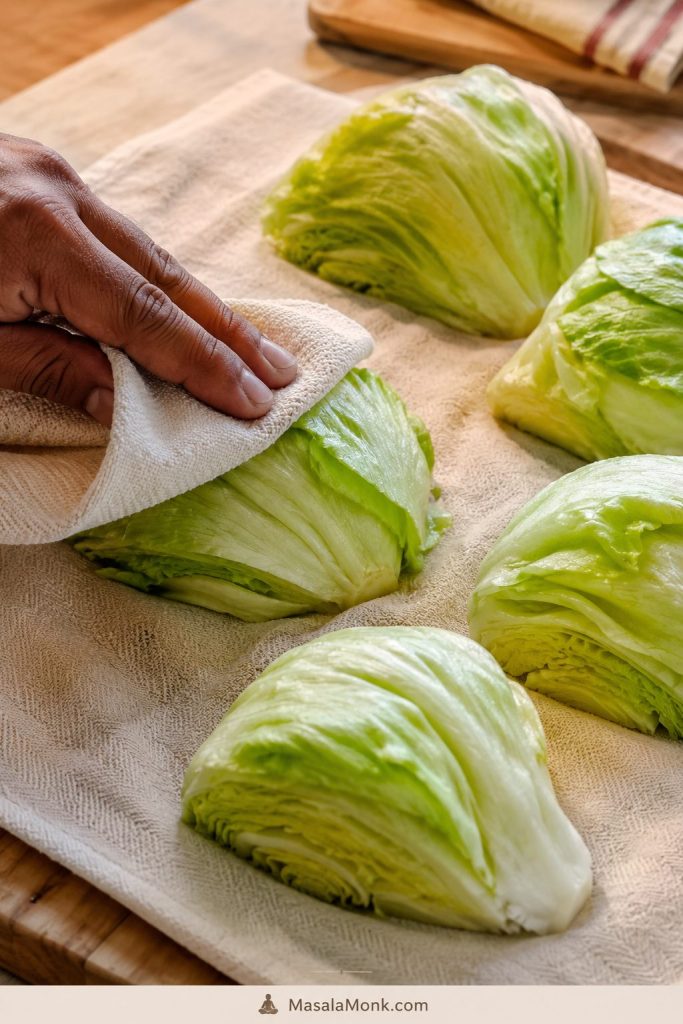
The fastest way to make a wedge salad disappointing is to let water sneak in. Wet lettuce, juicy tomatoes, and thin dressing all work against that cold crunch.

Cut iceberg lettuce wedges drying on a cream towel while a hand pats one wedge dry.
Dry iceberg is the quiet trick behind a better wedge salad. Water between the layers thins the dressing and makes the plate messy.
Problem Likely Cause Fix
Dressing slides off Lettuce is wet Pat the wedges dry and chill them before serving.
Salad tastes watery Tomatoes are too juicy Salt and drain tomatoes for 5–10 minutes.
Wedge falls apart Core was removed too early Cut through the core and trim only after plating if needed.
Toppings roll off Pieces are too large Chop bacon, onion, and tomatoes smaller.
Bacon softens Salad was assembled too early or bacon was added warm Cool the bacon and add it right before serving.
Dressing pools on the plate Dressing is too thin Use less milk or buttermilk, or stir in more sour cream.

Thick vs Thin Dressing Test

Use this cue before serving: thick dressing should sit on the iceberg wedge, while thin dressing will run down the layers and collect on the plate.

Two plated iceberg wedge salads showing thick dressing clinging to one wedge and thinner dressing pooling around another wedge.
Use this dressing test: thick dressing sits on the wedge, while thin dressing runs down the sides. Add milk or buttermilk slowly.

Get those details right and the salad stays crisp instead of sliding apart on the plate.

Simple rule: Make the components ahead, but do not dress the lettuce until you are ready to serve.

Toppings That Actually Stay Put

This is where the wedge becomes fun. Keep it old-school with bacon and blue cheese, make it fresher with cucumber and avocado, or turn it into lunch with chicken, shrimp, egg, or crispy chickpeas.

Choose one direction first: steakhouse, fresh, crunchy, meal-worthy, lighter, or spicy. That keeps the salad balanced instead of overloaded.

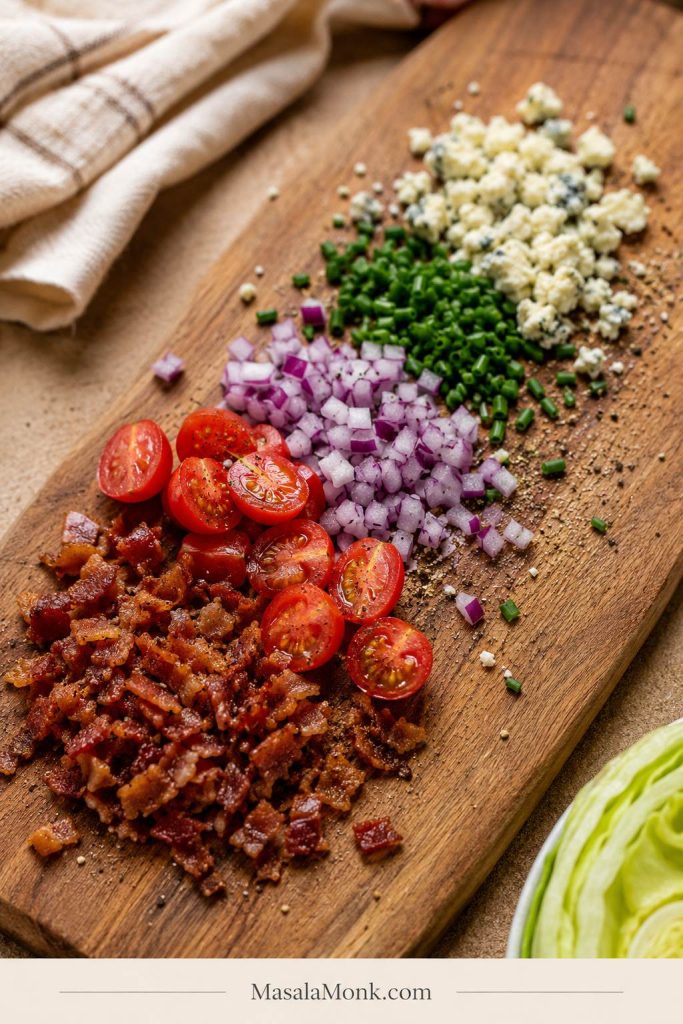
Small bacon bits, halved cherry tomatoes, diced red onion, chopped chives, blue cheese crumbles, and black pepper arranged on a wooden board.
For wedge salad toppings, smaller is better. Bacon bits, halved tomatoes, diced onion, chives, and crumbles cling better than large pieces.
Style Topping Ideas
Classic Bacon, tomatoes, red onion, chives, blue cheese crumbles
Steakhouse Balsamic glaze, cracked pepper, fried shallots, extra blue cheese
Crunchy Croutons, toasted breadcrumbs, fried onions, smoked almonds
Make it a meal Grilled chicken, steak strips, shrimp, hard-boiled egg
Fresh Cucumber, avocado, radish, herbs, scallions
Vegetarian Crispy chickpeas, toasted nuts, avocado, roasted corn
Lighter Greek yogurt dressing, turkey bacon, extra tomatoes, cucumber
Spicy Jalapeños, spicy ranch, chili crisp, hot honey drizzle

The goal is not to pile on everything. The goal is to make each bite feel complete: creamy, crunchy, juicy, salty, and fresh.

If you want the salad to eat more like lunch, chickpeas are an easy add-in. For that direction, this chickpea salad recipe is a useful companion.

Wedge Salad Variations

The main version is the one to learn first. After that, the variations are just swaps: change the dressing, add glaze, chop the lettuce, grill the cut sides, or build everything on a platter.

Not sure which version to make? Make blue cheese for the classic steakhouse flavor, ranch for a milder family version, chopped for easier eating, grilled for smoky edges, and Outback-style when you want a sweet-tangy balsamic finish.

Ranch Wedge Salad

Ranch is the easiest alternative if you do not like blue cheese. Start with a thicker ranch base and loosen it slowly; thin ranch slips off before you get a good bite.

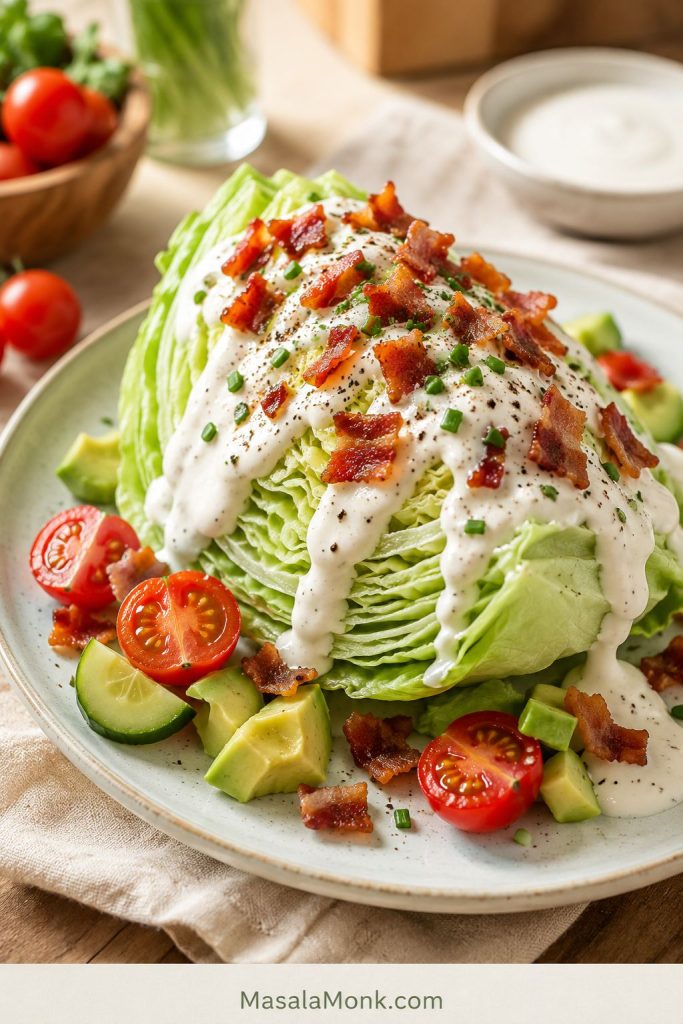
Iceberg wedge salad with ranch dressing, bacon, cherry tomatoes, cucumber, chives, avocado pieces, and black pepper on a light plate.
Ranch wedge salad is the easy no-blue-cheese version. Use thick ranch, then add bacon, tomatoes, cucumber, chives, avocado, and pepper.
Quick Ranch Ingredient US Measure Metric
Sour cream ½ cup 120 g
Mayonnaise ¼ cup 55 g
Buttermilk ¼ cup, plus more as needed 60 ml, plus more as needed
Lemon juice 2 tsp 10 ml
Garlic powder 1 tsp 3 g
Dried dill 1–1½ tsp 1–2 g
Chives 2 tbsp About 6 g
Salt ½ tsp 3 g
Black pepper To taste To taste

Whisk everything together and chill before using. Add more buttermilk one tablespoon at a time until the ranch is spoonable. For a fresh ranch version, top the iceberg with bacon, tomatoes, chives, cucumber, black pepper, and optional avocado.

Outback-Style Blue Cheese Wedge Salad with Balsamic Glaze

This is not the official restaurant recipe. It is a home-style version built around the same steakhouse idea: iceberg lettuce, blue cheese dressing, bacon, tomatoes, red onion, crumbles, and a light balsamic glaze drizzle.

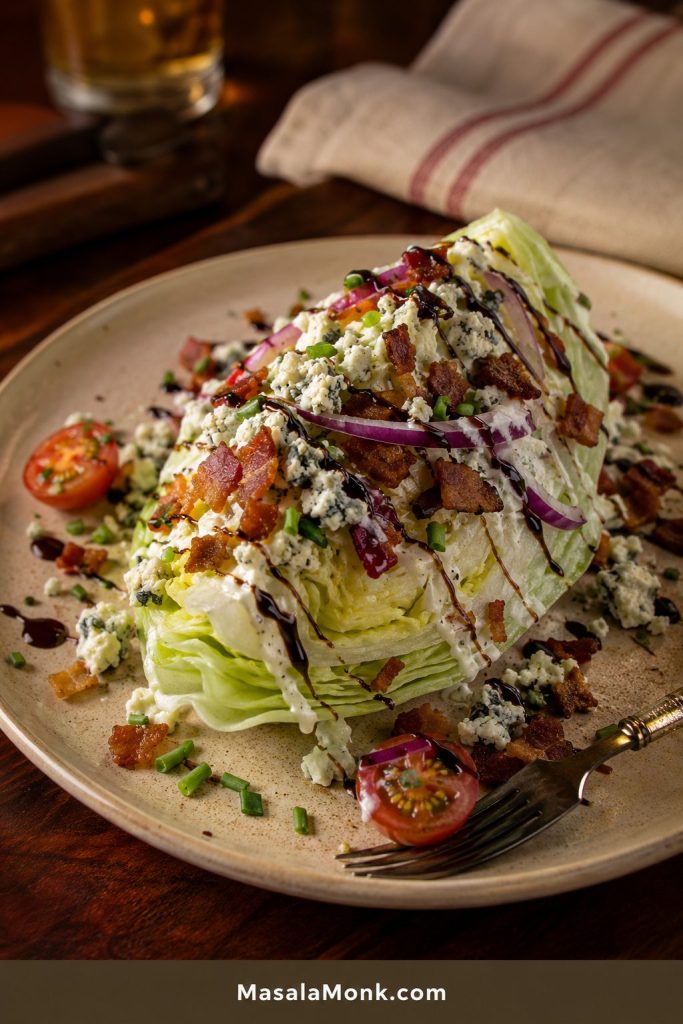
Outback-style iceberg wedge salad with blue cheese dressing, bacon, tomatoes, red onion, blue cheese crumbles, chives, and thin balsamic glaze lines.
An Outback-style wedge salad gets its steakhouse finish from balsamic glaze. Keep the drizzle thin so it brightens the blue cheese dressing without taking over.
Balsamic Glaze Ingredient US Measure Metric
Balsamic vinegar ½ cup 120 ml
Brown sugar or honey 2 tbsp 25 g brown sugar or 30 ml honey
Salt Pinch Pinch

Simmer the balsamic vinegar, sugar or honey, and salt over medium-low heat for 5–8 minutes, until it lightly coats the back of a spoon. Let it cool for a few minutes, then drizzle lightly over the finished salad.

This makes more glaze than you need for 4 wedges. Drizzle it last in thin lines, not a heavy pour. Balsamic glaze is a drizzle, not a sauce; too much makes the salad sweet, sticky, and heavy.

Chopped Wedge Salad

A chopped version uses the same ingredients but cuts the iceberg into bite-size pieces. It is easier to eat, easier to pack into bowls, and often the better choice if a full wedge feels awkward.

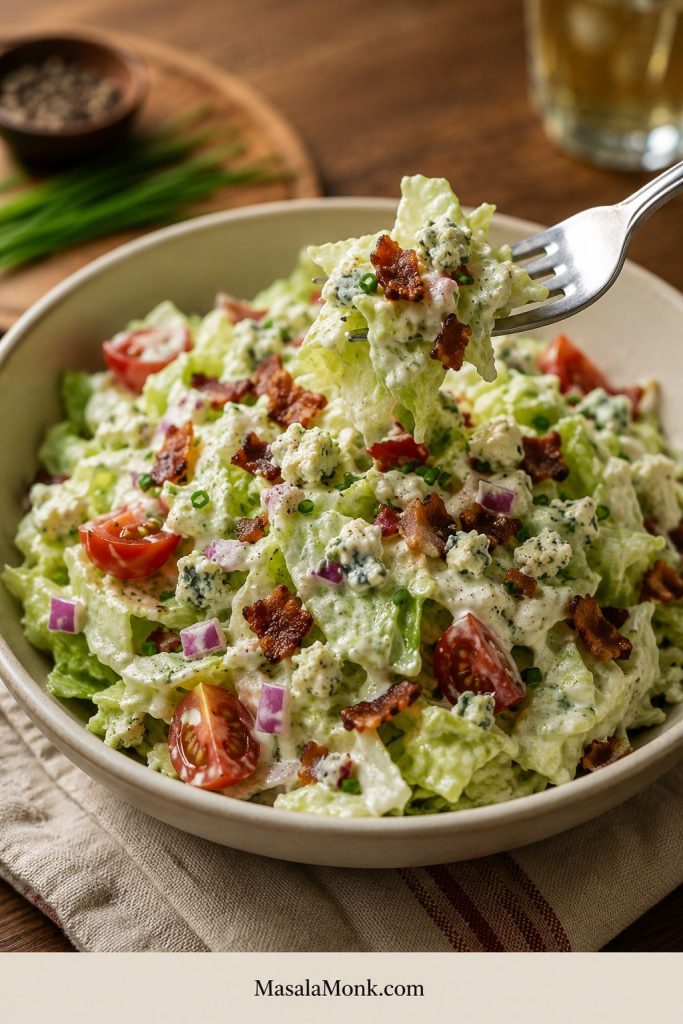
Chopped wedge salad in a shallow bowl with iceberg lettuce, bacon, tomatoes, red onion, chives, blue cheese crumbles, dressing, and a fork lifting a bite.
A chopped wedge salad keeps the steakhouse flavor but makes it easier to eat. It works well for lunches, potlucks, meal prep, and casual bowls.

Chop the lettuce into large pieces, then add bacon, tomatoes, red onion, chives, blue cheese crumbles, and dressing. Toss lightly or drizzle the dressing over the top. Add hard-boiled egg, grilled chicken, avocado, cucumber, or crispy breadcrumbs if you want it to feel more like a meal.

Grilled Wedge Salad

A grilled version gives the lettuce a smoky edge. Romaine hearts are easiest to grill, but iceberg can work if you keep the core attached and dry the wedges well.

  1. Cut the lettuce into wedges through the core.
  2. Dry the cut sides very well.
  3. Brush the cut sides lightly with oil.
  4. Place the wedges cut-side down on the grill.
  5. Grill just until the edges pick up color.
  6. Serve immediately with blue cheese dressing, ranch, or spicy ranch.

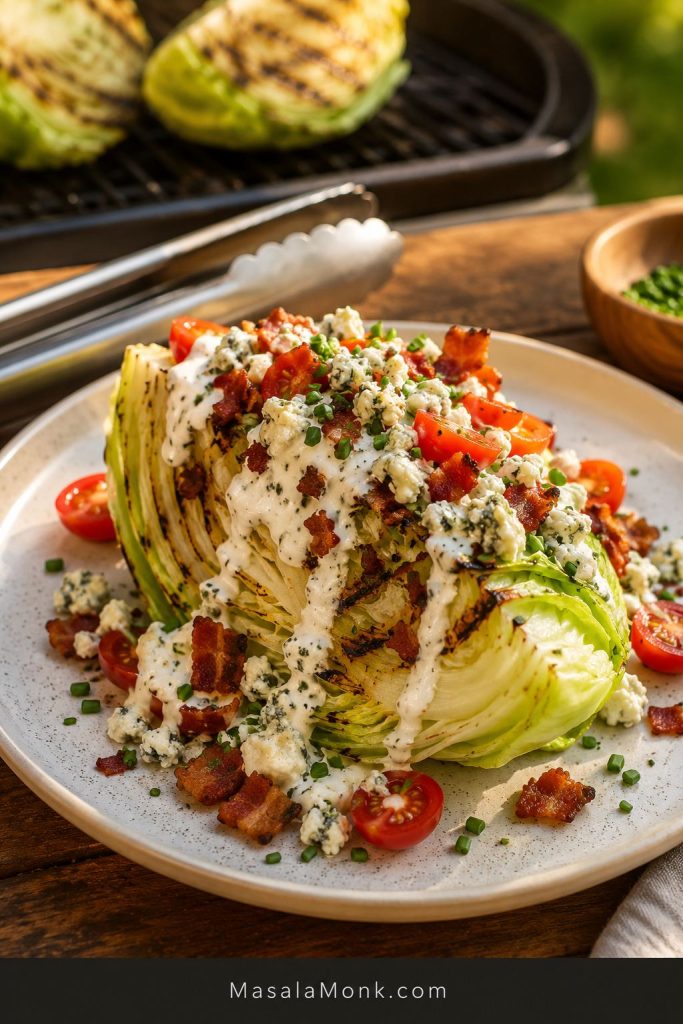
Grill only the cut sides. Leave the rounded outside mostly untouched so the wedge keeps some cool crunch. If your grill is very hot, start with 30–45 seconds per cut side. If it is medium-hot, 1–2 minutes may be enough. The wedges should pick up color at the edges, not wilt all the way through. Grill them last, after the rest of the meal is ready.

Grilled iceberg wedge salad with light char marks, creamy dressing, bacon, tomatoes, chives, blue cheese crumbles, and grill tongs nearby.
Briefly char the cut sides for grilled wedge salad, then stop. You want smoky edges, not cooked lettuce.

Loaded Wedge Salad for a Crowd

For parties, cut the iceberg into 6 smaller wedges and arrange them on a chilled platter. Put dressing in a bowl and toppings in small piles or bowls so guests can build their own plates without the lettuce wilting.

Loaded wedge salad platter with several iceberg wedges, blue cheese dressing, bacon, tomatoes, red onion, chives, blue cheese crumbles, and a dressing bowl.
Serving wedge salad for a crowd is easier with smaller wedges on a platter. Keep dressing and toppings nearby so the lettuce stays fresh.

Good loaded toppings include bacon, cherry tomatoes, red onion, chives, blue cheese crumbles, hard-boiled egg, avocado, cucumber, crispy breadcrumbs, fried onions, grilled chicken, steak strips, shrimp, ranch, blue cheese dressing, and balsamic glaze.

Lighter, Keto, Vegetarian, and No-Blue-Cheese Options

The blue cheese version is rich, but it is easy to adjust without losing the point of the salad: cold crunch, dressing that grips the layers, and toppings with texture.

Lighter Wedge Salad

For a lighter-feeling wedge salad, use a Greek yogurt-based dressing, reduce the bacon, and add more fresh toppings like tomatoes, cucumber, radish, herbs, or grilled chicken. Keep the dressing creamy enough that the salad still feels satisfying.

For a simple protein to turn it into a fuller plate, slice in some juicy baked chicken breast.

Keto Wedge Salad

The main version can be keto-friendly with iceberg lettuce, full-fat blue cheese dressing, bacon, blue cheese, and low-carb toppings. Skip sweet balsamic glaze or use only a tiny drizzle.

Check bottled dressing labels if you are strict keto, and keep tomatoes, onions, and any balsamic glaze modest.

For a fuller low-carb meal, serve it with bunless burgers or burger bowls from these keto burger ideas.

Vegetarian Wedge Salad

Skip the bacon and add crunch with crispy chickpeas, smoked almonds, toasted walnuts, fried onions, roasted corn, or crispy breadcrumbs. Avocado adds richness if you are also skipping blue cheese.

For a strict vegetarian version, use vegetarian Worcestershire or skip it, and choose a vegetarian-friendly blue cheese if needed.

Wedge Salad Without Blue Cheese

Go with ranch, creamy garlic dressing, green goddess, buttermilk herb dressing, Caesar dressing, or a vinaigrette. Ranch is the closest creamy substitute.

Wedge Salad Without Bacon

Replace bacon with crispy chickpeas, croutons, toasted breadcrumbs, fried shallots, toasted nuts, roasted seeds, or smoked almonds for crunch.

Dairy-Free Wedge Salad

Choose a dairy-free ranch or a vinaigrette-style dressing. Skip the blue cheese crumbles and add avocado, crispy chickpeas, or nuts for richness.

What to Serve with Wedge Salad

This is the salad to make when dinner is already rich and hot, but you still want something cold, crisp, and a little showy on the plate.

It is especially good beside a burger, steak, baked potato, roast chicken, or anything smoky from the grill.

  • Steakhouse-style dinners: steak, grilled shrimp, mashed potatoes, and anything finished with a rich creamy mushroom sauce.
  • Casual meals: burger patties, air fryer burgers, and barbecue meals.
  • Comfort dinners: roast chicken, pork chops, casseroles, baked potatoes, and slow-cooked mains.
  • Lighter plates: baked chicken, roasted vegetables, soups, or simple pasta dinners.

For lunch, a cold wedge also works well beside sandwiches, especially when you want something fresher than chips.

Make-Ahead and Storage Tips

The finished salad is best assembled right before serving, but the parts can be prepared ahead.

Component Make Ahead? Notes
Blue cheese dressing Yes, 2–3 days Keep refrigerated and stir before using.
Ranch dressing Yes, 2–3 days Keep cold and thin slightly if needed before serving.
Bacon Yes, 1–2 days Store chilled and re-crisp briefly if needed.
Lettuce wedges Same day ideal Wash, dry, wrap, and chill.
Tomatoes and onion Same day ideal Store separately so they do not water down the lettuce.
Fully assembled salad No Dress right before serving.

A simple prep schedule works best: make the dressing and cook the bacon earlier in the day, wash and dry the wedges about an hour before serving, then assemble the plates just before serving.

Once dressed, the lettuce wilts, the bacon softens, and the dressing becomes watery.

This make-ahead style works well when the main dish is already taking care of itself, like a slow cooker pork loin.

For broader cold-storage guidance beyond this salad, FoodSafety.gov has a helpful cold food storage chart.

Common Mistakes

Most wedge salad problems come from water, weak texture, or assembling too early. Use this as a final checklist.

  • Wet lettuce: dressing slides off instead of sitting on the wedge.
  • Core removed too early: the wedge falls apart.
  • Thin dressing: it pools on the plate.
  • Warm bacon: it softens the lettuce and loosens the dressing.
  • Large toppings: they roll off instead of sticking to the wedge.
  • Early assembly: the salad turns watery before serving.
  • Too much balsamic glaze: the plate becomes sweet and sticky.

How to Eat a Wedge Salad

This is a knife-and-fork salad, so do not fight it. Cut down through the wedge so each bite has lettuce, dressing, bacon, tomato, onion, and blue cheese.

If the large wedge feels awkward, make the chopped version instead. It has the same flavor but is easier to eat from a bowl.

FAQs

These quick answers cover dressing swaps, cutting iceberg, make-ahead timing, toppings, and ways to keep the salad crisp.

What is a wedge salad?

It is a cold quarter of iceberg lettuce topped with creamy dressing, bacon, tomatoes, onion or chives, blue cheese, and black pepper. It is usually served as a knife-and-fork side salad or starter.

Why is it called a wedge salad?

It is called a wedge salad because the lettuce is served as a wedge, usually a quarter of a head of iceberg, instead of being chopped or tossed.

How many wedge salads does one head of iceberg make?

One medium head of iceberg makes 4 large wedges or 6 smaller starter wedges.

What lettuce is best for wedge salad?

Iceberg is the classic choice because it is crisp, sturdy, and tightly layered. It holds its shape under dressing better than softer greens.

Why is iceberg lettuce used?

Iceberg has a mild flavor, high crunch, and compact structure, which is why it holds up so well as a wedge.

How do you cut iceberg lettuce for wedge salad?

Remove damaged outer leaves, rinse and dry the head, then cut it in half through the core. Cut each half through the core again to make 4 wedges.

Why does my wedge salad fall apart?

It usually falls apart because the core was removed too early or the lettuce was cut across the head. Cut through the core, keep a small piece attached, and trim the hard part only after plating.

Do you wash iceberg lettuce before making this salad?

Yes. Rinse the head or wedges under cold water, drain well, and pat very dry. Wet lettuce makes the dressing slide off.

What dressing goes on wedge salad?

Blue cheese dressing is traditional. Ranch is the easiest milder swap. Creamy garlic, buttermilk herb, green goddess, Caesar, or vinaigrette can also work.

Can I use store-bought blue cheese dressing?

Yes. Choose a thick dressing, preferably refrigerated. To improve it, stir in extra black pepper, lemon juice, and a spoonful of blue cheese crumbles.

What can I use instead of buttermilk?

Use regular milk with a small squeeze of lemon juice, or use milk alone and adjust the tang with lemon juice or vinegar.

Is wedge salad better with blue cheese or ranch?

Blue cheese gives the traditional steakhouse flavor: tangy, rich, and sharp. Ranch is milder and easier for a crowd. Serve both if you are not sure.

Can I make it with ranch?

Yes. Ranch works well if you want a milder dressing. Choose a thick ranch so it stays on the lettuce.

What toppings go on wedge salad?

Classic toppings include bacon, tomatoes, red onion, chives, blue cheese crumbles, and black pepper. Avocado, egg, cucumber, fried onions, crispy breadcrumbs, chicken, steak, shrimp, and balsamic glaze also work.

Can I cook the bacon in the oven?

Yes. Bake bacon on a lined sheet pan at 400°F / 200°C until crisp, usually 15–20 minutes depending on thickness.

What is in an Outback-style wedge salad?

An Outback-style version usually includes iceberg lettuce, blue cheese dressing, bacon, grape or cherry tomatoes, red onion, blue cheese crumbles, and balsamic glaze.

Is this an Outback copycat wedge salad?

No. It is not an official restaurant recipe, but the Outback-style variation uses the same general idea: iceberg, blue cheese dressing, bacon, tomatoes, red onion, crumbles, and a light balsamic glaze drizzle.

Can I make it without blue cheese?

Yes. Use ranch, creamy garlic dressing, buttermilk herb dressing, green goddess, Caesar, or vinaigrette. Skip the crumbles or add avocado for richness.

Can I make it without bacon?

Yes. Use crispy chickpeas, toasted breadcrumbs, fried shallots, smoked almonds, croutons, roasted seeds, or toasted nuts for crunch.

Is wedge salad keto?

It can be keto-friendly with iceberg lettuce, full-fat blue cheese dressing, bacon, blue cheese, and low-carb toppings. Check bottled dressing labels and keep tomatoes, onions, and balsamic glaze modest if you are strict keto.

Is wedge salad healthy?

It can be lighter or richer depending on the dressing and toppings. For a fresher version, use less bacon, choose a lighter dressing, and add cucumber, tomatoes, herbs, or grilled chicken.

Can I make it ahead of time?

You can make the dressing, cook the bacon, and prep toppings ahead. Wash, dry, and chill the lettuce the same day, then assemble just before serving.

How long does wedge salad last after dressing?

It is best served immediately. Once dressed, the lettuce softens, the bacon loses crunch, and the plate can become watery.

How do I keep it from getting watery?

Dry the lettuce well, use thick dressing, drain juicy tomatoes, and dress the wedges right before serving.

How do you eat a wedge salad?

Use a knife and fork. Cut the wedge into bite-size pieces on the plate so each bite gets lettuce, dressing, bacon, tomatoes, onion, and cheese.

What do you serve with it?

Serve it with steak, burgers, grilled chicken, roast chicken, barbecue meals, baked potatoes, pasta, sandwiches, soups, or grilled shrimp.

Once the lettuce is cold and dry, the dressing has body, and the toppings are crisp and small, wedge salad becomes what steakhouses know it can be: simple, dramatic, refreshing, and far more satisfying than a quarter of iceberg has any right to be.

Posted on Leave a comment

Air Fryer Burgers Recipe: Juicy Hamburgers, Time & Temp

Juicy air fryer cheeseburger with melted cheddar, lettuce, tomato, red onion, pickles, and toasted bun on a dark surface, with an air fryer basket in the background.

A good air fryer burger recipe should give you juicy patties, clear timing, and a reliable way to know when the burgers are done. This guide to air fryer hamburgers starts with fresh ground beef patties, then covers thicker burgers, frozen patties, cheeseburgers, toasted buns, smoke prevention, toppings, storage, and a full recipe card with US and metric details.

The best default is simple: cook fresh ¼-lb / 113 g hamburger patties at 375°F / 190°C for 8–10 minutes, flipping halfway, until the center reaches 160°F / 71°C. From there, adjust by thickness, starting temperature, and air fryer model instead of relying on one fixed minute for every burger.

For a bunless version, the same patties can become lettuce-wrap burgers, burger bowls, or low-carb cheeseburger plates. For more ideas in that direction, see these keto hamburger recipes.

How Long to Cook Hamburgers in the Air Fryer

Best default: Use 1 lb / 454 g ground beef for 4 patties. Shape each patty about 4 oz / 113 g and ½ inch / 1.25 cm thick. Air fry at 375°F / 190°C for 8–10 minutes, flipping halfway, until the center reaches 160°F / 71°C. Add cheese only at the end.

Air fryer burger timing guide showing 375°F or 190°C, 8 to 10 minutes, flipping halfway, and a 160°F center temperature for fresh quarter-pound patties.
For most fresh ¼-lb patties, 375°F for 8–10 minutes is the best starting point; the center temperature is what confirms the burger is done.

Start checking early the first time

If you are making these for the first time, start checking at 8 minutes rather than waiting for the full range to pass. That way, you learn how your air fryer handles your patties without overcooking the first batch.

Put simply, the 8–10 minute range works best for patties that are about 4 oz / 113 g each and about ½ inch / 1.25 cm thick. Thinner patties may finish closer to 6–8 minutes, while thicker patties may need 10–12 minutes. Because air fryer baskets, patty thickness, and beef fat percentage all vary, the time range is only the starting point.

Use temperature, not color, to check doneness

For that reason, the thermometer matters more than the clock. Ground beef can look brown before it is safe, or stay slightly pink after it reaches temperature, so do not judge doneness by color alone.

For the most accurate reading, insert the thermometer through the side of the patty so the tip reaches the center instead of stopping near the surface. That way, you are checking the part of the burger that takes the longest to cook.

Food safety note: Ground beef burgers should reach 160°F / 71°C in the center. FoodSafety.gov lists 160°F as the safe minimum internal temperature for ground meat, so a thermometer is the clearest way to avoid guessing. See the safe minimum internal temperature chart.

Why this air fryer method works

In practice, the air fryer is good at burgers because it cooks fast, drains extra fat, and keeps the process cleaner than a skillet. The tradeoff is that patties can dry out if they are too lean, too thin, or cooked too long. That is why thickness, beef choice, spacing, and internal temperature matter more than chasing one exact minute.

Air Fryer Burger Time and Temperature Chart

Best default temperature

For most fresh patties, 375°F / 190°C is the best first setting. It is hot enough to cook the burgers quickly and help the outside brown. However, it is not so aggressive that the edges dry out before the center is done.

If this is your first time making burgers in the air fryer, use the quarter-pounder row as your starting point. After that, adjust by thickness instead of changing everything at once.

Fresh burger time chart

Because patty size changes the answer, start with the row that matches your burger instead of forcing every patty into the same time. Once you know how your air fryer handles one batch, adjust the next batch by 1–2 minutes rather than changing the temperature immediately.

Fresh air fryer burger timing chart comparing sliders, thin patties, quarter-pound patties, thicker three-quarter-inch patties, and half-pound patties with their cook times.
Fresh burger timing changes most with patty size and thickness, so match your patty to the closest size instead of using one fixed cook time for every batch.
Fresh burger type Air fryer temp Approx. time Flip? Internal temp
Fresh quarter-pounder / ¼-lb / 113 g patties, about ½ inch / 1.25 cm thick 375°F / 190°C 8–10 minutes Yes, halfway 160°F / 71°C
Fresh thicker patties, about ¾ inch / 2 cm thick 375°F / 190°C 10–12 minutes Yes 160°F / 71°C
Fresh ½-lb / 225 g thick patties 360–370°F / 182–188°C 14–18 minutes Yes 160°F / 71°C
Thin fresh patties 375°F / 190°C 6–8 minutes Yes 160°F / 71°C
Mini burgers or sliders 375°F / 190°C 5–7 minutes Yes 160°F / 71°C

Frozen Burger, 400°F, and Cheeseburger Timing

However, frozen burgers need a wider range because the center has to thaw before it can safely finish cooking. Before adding cheese to any burger, check the center first. Otherwise, the cheese may melt while the patty still needs more time.

Frozen air fryer burger guide showing timing for quarter-pound and third-pound patties, flipping halfway, checking for 160°F, and adding cheese at the end.
Frozen burgers need a wider timing range because the center has to thaw first; check the temperature before adding cheese.
Burger type Air fryer temp Approx. time Flip? Internal temp
Frozen ¼-lb / 113 g patties 360–375°F / 182–190°C 10–14 minutes Yes 160°F / 71°C
Frozen ⅓-lb / 150 g patties 360–375°F / 182–190°C 12–16 minutes Yes 160°F / 71°C
Thin fresh patties at 400°F / 200°C 400°F / 200°C 6–8 minutes Yes 160°F / 71°C
Frozen burgers at 400°F / 200°C 400°F / 200°C 11–15 minutes Yes 160°F / 71°C; check early because the outside may brown first
Cheeseburgers Same as burger Add cheese last 30–60 seconds 160°F / 71°C before cheese

Should you air fry burgers at 375°F or 400°F?

For most homemade patties, 375°F is the better first choice because it gives the center time to cook before the edges dry out. However, 400°F can work for thinner patties or for people who like a firmer browned outside. In that case, start checking early and use a thermometer, because the outside can look done before the center reaches 160°F.

Comparison chart for air fryer burgers showing 375°F as the best default for control and 400°F as an option for thinner patties with earlier checking.
Use 375°F as the most reliable starting point for homemade burgers, and treat 400°F as an option for thinner patties or stronger browning with an early temperature check.

In short, 375°F is the better beginner setting, while 400°F is an alternate for thinner patties or cooks who already know their air fryer runs evenly. That said, once you know how your air fryer behaves, you can fine-tune the temperature without guessing.

How to adjust the time

If your air fryer runs hot, start checking a minute early. On the other hand, if your patties are thick, cold, or crowded, they may need longer. In either case, do not press the burgers while they cook; pressing squeezes out the juices you are trying to keep.

If you are not sure which row fits your burger, choose the lower end of the time range first. Then check the center and add 1–2 minutes only if the patty has not reached 160°F / 71°C.

Back to table of contents ↑

Hamburger Patties in the Air Fryer

For your first batch, keep the patties simple: 1 lb / 454 g ground beef divided into 4 loose patties, about 4 oz / 113 g each. Shape each patty about 4–4½ inches / 10–11.5 cm wide and about ½ inch / 1.25 cm thick. That size cooks evenly, fits most air fryer baskets, and gives you a better chance of hitting 160°F without drying out the edges.

Raw air fryer burger patties showing 4-ounce portions, 4 to 4 and a half inch width, half-inch thickness, a shallow center dimple, and a bun size comparison.
Even patty size is what makes the timing chart work: aim for 4 oz patties that are about ½ inch thick, slightly wider than the bun, and gently dimpled in the center.

Because burgers shrink as they cook, shape each patty slightly wider than the bun. Then press a shallow dimple in the center so the patty stays flatter instead of puffing up into a dome.

When the patties are the same size, they finish at about the same time. Otherwise, the smaller patties can dry out while the thicker ones are still catching up.

If one patty is noticeably larger, place it where your air fryer runs hottest, or give it an extra minute after removing the smaller patties. That way, the thinner burgers do not dry out while the thickest one finishes.

This same method works for fresh beef patties, homemade burger patties, and plain hamburger patties from the butcher counter. However, the main adjustment is thickness: thin patties cook faster, while thick patties need more time to reach 160°F in the center.

For best texture, avoid mixing the beef too much. Once ground beef is overworked, the cooked patty can turn dense and springy instead of tender and juicy.

Can you cook raw ground beef patties in the air fryer?

Yes. Raw ground beef patties can go straight into the air fryer as long as they are shaped evenly, cooked in a single layer, and checked for 160°F in the center. However, loose ground beef mixtures and very wet patties can cook unevenly, so formed patties work best.

Ingredients for Air Fryer Hamburgers

You only need a few ingredients for classic burgers. Since the cooking method is simple, the beef, seasoning, patty shape, and cheese timing matter more than a long ingredient list. In other words, better patties matter more than more ingredients.

Since the ingredient list is short, each choice matters. The beef controls juiciness, the salt controls flavor, and the patty shape controls how evenly the burger cooks.

Air fryer burger ingredients including ground beef, salt, black pepper, garlic powder, onion powder, Worcestershire sauce, cheese slices, burger buns, lettuce, tomato, onion, and pickles.
The ingredient list stays simple because the success of air fryer burgers comes from good beef, even patties, enough seasoning, and adding cheese only at the end.

Ground beef

Use 1 lb / 454 g ground beef for 4 regular burgers. For the juiciest result, choose 80/20 ground beef. For a slightly leaner patty with less smoke, 85/15 is a good middle ground.

Seasoning

A simple mix of salt, black pepper, garlic powder, and onion powder is enough. If the beef is good and the patties are shaped well, the seasoning should support the burger rather than cover it up. Since kosher salt brands vary, start with a little less if you are using fine table salt. Worcestershire sauce or steak sauce is optional, but a small amount adds savory depth without turning the burger into meatloaf.

Cheese

American cheese melts the easiest. Cheddar, pepper jack, Swiss, provolone, and mozzarella also work, but thicker slices may need the full final minute to soften. Because the air fryer fan is strong, add cheese only at the end so it does not slide off, burn, or blow around inside the basket.

Buns and toppings

Use burger buns, brioche buns, potato buns, lettuce wraps, or bowls. Classic toppings include lettuce, tomato, onion, pickles, mustard, ketchup, and a creamy burger sauce. For a homemade creamy base, use this homemade mayonnaise recipe and turn it into burger sauce with ketchup, mustard, pickle juice, and a little seasoning.

Do you need oil, parchment, or foil?

Fresh 80/20 or 85/15 patties usually do not need oil because the beef has enough fat. However, if you are using very lean fresh patties or dry-surfaced frozen patties, a light oil spray can help browning.

If you use parchment, choose perforated parchment made for air fryers and never block airflow under the patties. Likewise, use foil only if your air fryer manual allows it. Otherwise, trapped grease and blocked airflow can slow cooking, create smoke, and make the burgers cook unevenly.

In short, airflow matters more than lining the basket. If a liner blocks the holes or traps grease under the patties, skip it.

Best Ground Beef for Air Fryer Burgers

If juiciness matters most, start with 80/20. If your air fryer smokes easily or you prefer a slightly lighter burger, 85/15 is the safer everyday choice. Very lean beef can work, but it needs more care because it dries out faster.

Best ground beef guide for air fryer burgers comparing 80/20 beef for juicy burgers, 85/15 beef for balanced burgers, and 90/10 or leaner beef that can dry out faster.
For the juiciest air fryer burgers, 80/20 is the most forgiving, while 85/15 is a good everyday choice when you want less smoke without losing too much moisture.
Ground beef Best for What to know
80/20 Juiciest classic burgers Rich, flavorful, and forgiving, but it can drip more fat and create more smoke in some air fryers.
85/15 Balanced everyday burgers Still juicy, usually less smoky, and a good choice for indoor air fryer cooking.
90/10 or leaner Leaner burgers Can dry out faster. Add moisture and check the temperature early.

As a result, 80/20 or 85/15 is the most reliable choice for a first batch. Shape the patties gently, keep them even in thickness, and add a center dimple so they do not puff into domes as they cook.

If you are using very lean beef, add a little moisture with Worcestershire sauce, grated onion, mustard, or a small amount of oil. Then start checking early, because lean patties can move from done to dry quickly.

For a thinner burger with a harder griddled crust instead of a thicker air fryer patty, try this classic smash burger method.

How to Make Air Fryer Hamburgers

This method is for fresh ground beef patties. Once the patties are shaped, the rest is mostly about spacing, flipping, and checking the center. After that, assembly is quick because the burgers only need a short rest.

Step-by-step air fryer burger guide showing preheating, shaping patties, making a dimple, seasoning, cooking in one layer, flipping halfway, checking the center, and resting before assembly.
The method is simple once the order is clear: shape the patties evenly, cook them in one layer, flip halfway, check the center, then rest and assemble.

1. Preheat the air fryer

Preheat the air fryer to 375°F / 190°C for about 3 minutes. Although some models heat quickly, preheating helps the patties start cooking evenly.

If you skip preheating, add 1–2 minutes and start checking at the low end of the range. Once you know your air fryer, the timing becomes easier to repeat.

2. Shape the patties gently

Divide 1 lb / 454 g ground beef into 4 loose portions, about 4 oz / 113 g each. Then shape each portion into a patty about 4–4½ inches / 10–11.5 cm wide and ½ inch / 1.25 cm thick. Because the patties shrink as they cook, starting a little wider helps them fit the bun better later.

3. Make a center dimple

Press a shallow dimple into the center of each patty with your thumb or the back of a spoon. This small step helps the burgers stay flatter instead of puffing up in the middle.

4. Season both sides

Season the outside of the patties with salt, pepper, garlic powder, and onion powder. If using Worcestershire sauce, mix it in lightly before shaping, or brush a tiny amount over the patties before seasoning.

5. Air fry in a single layer

Place the patties in the basket in a single layer. Then leave space between them so hot air can move around each burger. Do not stack patties, and do not crowd the basket.

If all 4 patties do not fit with space between them, cook in batches. Otherwise, the burgers may steam instead of brown. Later batches may cook slightly faster because the air fryer is already fully hot.

6. Flip halfway

Air fry for 8–10 minutes total, flipping halfway through. Even if your model usually cooks without flipping, turning the patties makes the result more reliable across different basket styles.

7. Check the center

Check the thickest part of each patty. The burgers are done when the center reaches 160°F / 71°C. For the cleanest reading, insert the thermometer from the side so the tip lands in the center of the patty.

Digital thermometer inserted from the side into an air fryer burger patty showing 160°F and 71°C as the internal temperature for ground beef burgers.
Color is not a reliable doneness check for ground beef, so insert the thermometer from the side and make sure the center of the patty reaches 160°F.

If one patty is thicker than the others, it may need an extra minute or two. In that case, remove the finished patties and let the thicker one continue cooking until it reaches temperature.

8. Rest and assemble

Let the patties rest for about 2 minutes before assembling. Meanwhile, toast the buns, slice the toppings, or stir together a quick sauce.

Can you toast burger buns in the air fryer?

Yes. After the patties come out, place the buns cut-side up in the basket and air fry at 350–375°F / 175–190°C for 1–2 minutes. Watch closely because buns go from toasted to dry quickly.

How to Make Air Fryer Cheeseburgers

To make cheeseburgers, cook the patties first, then add cheese at the very end. The easiest method is to place a slice of cheese on each cooked patty during the final 30–60 seconds of cooking.

Air fryer cheeseburger guide showing cheese added at the end of cooking, melted cheese on the patty, and a reminder not to add cheese halfway.
Add cheese only after the burger is almost done; the final 30–60 seconds or residual basket heat is usually enough to melt it without making a mess.

Instead of running the fan longer just to melt cheese, you can also use the heat that is already trapped in the basket. Turn the air fryer off, place cheese on the hot patties, close the basket, and let the residual heat melt the cheese for about 1 minute.

If your cheese slides, folds, or blows off, do not fight the fan. Instead, melt the cheese with leftover heat after cooking. That way, the cheese softens over the patty instead of ending up on the basket.

Do not add cheese halfway through cooking. It can melt off the burger, stick to the basket, burn at the edges, or blow around inside the air fryer.

Frozen Burgers in the Air Fryer

Frozen patties are perfect for nights when nothing was thawed. They can go straight from freezer to basket; however, they need a little more patience because the center has to thaw before it can safely finish cooking.

That is why frozen burgers usually need a lower-to-moderate temperature and a wider time range than fresh patties. In practice, smaller ¼-lb / 113 g patties finish sooner, while thicker ⅓-lb / 150 g patties need the longer end of the range.

Fresh versus frozen air fryer burger guide comparing fresh patties cooked at 375°F with frozen patties cooked from frozen, including cook times, flipping, and 160°F internal temperature.
Fresh patties give you the most control, while frozen patties need extra time because the center must thaw before the burger can safely finish cooking.

How to air fry frozen burger patties

  1. Preheat the air fryer to 360–375°F / 182–190°C.
  2. Place frozen patties in a single layer.
  3. Air fry for 10–16 minutes, depending on patty size and thickness.
  4. Flip halfway through.
  5. Season after the surface warms slightly if seasoning will not stick at the beginning.
  6. Cook until the center reaches 160°F / 71°C.
  7. Add cheese during the final 30–60 seconds if making cheeseburgers.

For exact ranges by patty size, use the frozen burger timing chart above. Before adding cheese to frozen burgers, check the center first. Otherwise, the cheese may look melted while the patty still needs more time inside.

What about Bubba-style frozen burgers?

Bubba-style frozen burgers can go straight from freezer to air fryer. However, they are often thick and fatty, so they may need the longer end of the timing range. Start at 360–375°F, flip halfway, and check for 160°F in the center.

If you cook frozen burgers at 400°F / 200°C, start checking early. The outside can brown before the center is fully done, especially with thicker frozen patties. In that case, a thermometer prevents the most common mistake: serving a burger that looks done outside but is not finished inside.

Back to table of contents ↑

Ninja Foodi, Air Fryer Oven and Basket Air Fryer Notes

The basic method is the same in most basket-style air fryers: cook fresh ¼-lb / 113 g patties at 375°F / 190°C, flip halfway, and check for 160°F / 71°C in the center. However, stronger models, smaller baskets, dual-zone air fryers, and air fryer ovens can change the timing by a minute or two.

Likewise, air fryer ovens may need slightly longer because the cooking space is larger than a compact basket. That means the best approach is to use the chart first, then adjust the next batch based on your specific model.

Air fryer model notes for burgers comparing basket air fryers, Ninja Foodi style models, and air fryer ovens with timing adjustments and 160°F internal temperature guidance.
Use the timing chart as your starting point, then adjust by model: stronger basket air fryers may finish sooner, while air fryer ovens can need a minute or two longer.
Air fryer type What to adjust Best starting point
Ninja air fryer or Ninja Foodi air crisp These can cook efficiently, so check early. 375°F / 190°C, 8 minutes, then check the center.
Ninja Foodi Grill Air crisp and grill mode behave differently. Use air crisp for this method; follow grill-plate timing if using grill mode.
Cosori, Instant Vortex, Gourmia, PowerXL, and similar basket air fryers Basket size and airflow vary. Use the chart first, then adjust by 1–2 minutes after your first batch.
Air fryer oven or toaster oven air fryer The larger cavity may cook slightly slower. Use the middle rack, flip halfway, and check the center early.

Back to table of contents ↑

How to Keep Air Fryer Burgers Juicy

These burgers stay juicy when the beef has enough fat, the patties are handled gently, and the cooking time does not run too long. As a result, a few small details make the difference between a tender burger and a dry one.

  • Use 80/20 or 85/15 beef. A little fat keeps the burger tender.
  • Do not overmix. Handle the meat gently and stop once the patties hold together.
  • Make even patties. Uneven patties cook unevenly.
  • Add a center dimple. This helps prevent puffing.
  • Do not press the burgers. Pressing forces juices out.
  • Flip once. It improves even cooking without overhandling.
  • Check temperature early. Start checking at the low end of the timing range.
  • Rest briefly. Two minutes is enough for most burgers.

In other words, juicy burgers come from control, not extra steps. Once the patties are shaped well and cooked to temperature, the air fryer does most of the work.

Finished air fryer cheeseburger with melted cheese, toasted bun, lettuce, tomato, onion, and pickles, shown with an air fryer basket in the background.
A juicy air fryer burger comes from control, not extra steps: shape the patty evenly, avoid overcooking, and stop once the center reaches temperature.

When using lean beef, add a little moisture with Worcestershire sauce, grated onion, mustard, or a small amount of oil. Also, check the temperature earlier because lean patties move from done to dry quickly.

The goal is a patty with browned edges, melted cheese, and a tender center — not a dry puck that only tastes like seasoning. So, once the burger reaches temperature, stop cooking and let it rest.

Troubleshooting Air Fryer Hamburgers

If the burgers turn out dry, smoky, uneven, or messy, do not change everything at once. In most cases, one small adjustment fixes the next batch: use slightly fattier beef, make the patties thinner, clean the basket, or add cheese later.

What not to do when air frying burgers

Before changing the recipe, check the most common mistakes first. These are the small things that usually cause dry burgers, uneven cooking, smoking, or messy cheese.

Air fryer burger mistakes to avoid, including stacking patties, pressing burgers, adding cheese too early, blocking airflow, judging doneness by color, and using one timing for every patty.
Most air fryer burger problems come from blocked airflow, uneven patties, early cheese, or guessing doneness by color instead of checking the center.
  • Do not stack patties in the basket.
  • Avoid pressing the burgers while they cook.
  • Add cheese only at the end, not halfway through cooking.
  • Never block the basket holes with solid parchment or foil.
  • Do not judge doneness by color alone.
  • Avoid using the same timing for thin fresh patties and thick frozen patties.

Air fryer burger troubleshooting chart

Once you know what went wrong, use the chart below to fix the next batch. Instead of changing the beef, temperature, timing, and basket setup all at once, adjust one thing first.

Problem Likely cause Fix
Dry burgers Lean beef or overcooking Use 80/20 or 85/15 beef, and check the temperature earlier.
Smoking air fryer Fat dripping onto a hot base, old grease, or very fatty beef Clean the basket, avoid overcrowding, and try 85/15 beef if smoke is frequent.
Burger puffed up No center dimple Press a shallow dimple in each patty before cooking.
Undercooked center Patty too thick or too cold Cook longer at 375°F and check for 160°F in the center.
Cheese blew off Cheese added too early or fan too strong Add cheese during the final 30–60 seconds, or melt it with residual heat after cooking.
Uneven cooking Basket overcrowded Cook in a single layer and leave space between patties.
Air fryer burger troubleshooting guide showing fixes for dry burgers, smoking, outside browning before the center finishes, puffing in the middle, and checking for 160°F internal temperature.
The best fix depends on the problem: dry burgers need more moisture control, smoking needs cleaner airflow, and underdone centers need a thermometer check instead of more browning.

How to fix the next batch

If you are not sure what went wrong, start with the simplest fix first. Next time, change only one thing at a time. If the burgers were dry, check earlier or use fattier beef; if they smoked, clean the basket or use a slightly leaner blend.

If smoke happens, do not panic. Usually, it means fat is hitting a very hot surface or old grease is still in the basket. Before cooking the next batch, clean the basket, avoid overcrowding, and use the lower end of the temperature range if your air fryer runs hot.

The next batch becomes easier to control because you are matching the fix to the actual problem instead of guessing.

If this happens often with air fryer recipes, it is worth checking these common air fryer mistakes. Overcrowding, blocked airflow, old grease, and wrong timing can affect burgers, fries, wings, and almost everything else you cook in the basket.

Jump to recipe card → | Back to table of contents ↑

Best Sauces and Toppings for Air Fryer Hamburgers

A good burger only needs a few toppings, but the sauce can change the whole direction of the meal. For that reason, keep the patty simple and use the sauce to make it classic, spicy, Indian-style, or bowl-friendly.

Air fryer burger sauce and topping guide showing classic burger sauce, mango habanero sauce, mango mustard sauce, green chutney, pickles, onion, tomato, and lettuce.
Keep the burger patty simple and use the sauce to change the direction: classic, spicy-sweet, tangy, or fresh and herby.

Classic burger sauce is the easiest place to start: mix mayonnaise, ketchup, mustard, finely chopped pickles or pickle juice, garlic powder, onion powder, and a little black pepper. If you want a fresh base, use this homemade mayonnaise; if you need an egg-free spread, use eggless mayonnaise.

When you want heat, brush the cooked patty lightly with mango habanero sauce or serve it on the side for fries. Meanwhile, mango mustard sauce gives the burger a tangy, fruity change from plain mustard.

An Indian-style burger works especially well with green chutney, onion, tomato, mayo, and a pinch of chaat masala. Because the chutney is bright and herb-heavy, it cuts through the richness of the patty.

Air Fryer Burger Variations

Once the basic method is set, you can change the toppings and sauces without changing the cooking technique. That way, one reliable patty method can turn into several different dinners.

Air fryer burger variations guide showing a classic cheeseburger, spicy mango habanero burger, mango mustard burger, green chutney burger, and a low-carb lettuce-wrap option.
Once the basic air fryer patty is reliable, the easiest way to change the burger is through the sauce: classic, spicy-sweet, tangy, herby, or low-carb.
  • Classic cheeseburger: American cheese, pickles, onion, lettuce, tomato, and burger sauce.
  • Spicy mango habanero burger: Cheddar, onions, pickles, and mango habanero sauce.
  • Mango mustard burger: Lettuce, pickles, onion, and mango mustard sauce.
  • Green chutney burger: Green chutney, mayo, onion, tomato, and chaat masala.
  • Low-carb burger bowl: Lettuce, pickles, cheese, onions, tomato, and sauce without the bun.
  • Pesto cheeseburger: Pesto mayo, tomato, mozzarella or provolone, and roasted peppers.

For a lower-carb plate, keep the same patty method and build the meal around lettuce, pickles, cheese, onions, tomato, and sauce instead of a bun.

What to Serve With Air Fryer Hamburgers

For an easy burger-night plate, pick one sauce, one crispy side, and something fresh to cut through the richness. That way, the meal feels complete without turning dinner into a project.

For the classic burger-and-fries plate, serve the patties with homemade fries, wedges, or potato snacks. If a make-ahead side is easier, potato salad is one of the best choices. For a party-style spread, add one or two ideas from these potato appetizers.

If the air fryer is already out, keep the sides easy. Air fryer mozzarella sticks make the meal feel like a game-day plate, while air fryer croquettes are a good option when you want something crispy that is not fries.

For something fresh, add a cabbage slaw, cucumber salad, onion-tomato salad, or raw papaya salad. A crisp fresh side helps balance the richness of the burgers and cheese.

Storage and Reheating

Make-ahead tip: You can shape the raw patties up to 24 hours ahead and refrigerate them in a covered container with parchment between layers. Keep them cold until cooking, then air fry straight from the fridge and check the center for 160°F / 71°C.

Air fryer burger storage guide showing raw patties made ahead with parchment, cooked patties stored separately from buns and toppings, and patties reheated in the air fryer.
Store patties, buns, and toppings separately so leftovers reheat cleanly; warm the patty first, then assemble the burger fresh.

Cooked hamburger patties store better than fully assembled burgers. If you know you will have leftovers, store the patties, buns, cheese, sauces, and toppings separately. Otherwise, the bun can turn soggy while the lettuce and tomato lose their texture.

Once the patties are cooked, refrigerate leftovers within 2 hours. If the room is very hot, refrigerate them within 1 hour. After that, reheat only the patties and assemble the burgers fresh so the buns and toppings stay in better shape.

  • Refrigerate: Cool cooked patties, then store in an airtight container for 3–4 days.
  • Freeze: Wrap cooked patties individually and freeze for up to 2 months.
  • Reheat in the air fryer: Reheat patties at 350°F / 175°C until warmed through.
  • Add cheese after reheating: Cheese melts better when added at the end instead of reheated from cold.
  • Avoid reheating assembled burgers: The bun can dry out while lettuce, tomato, and sauce turn soggy.

For more air fryer recipes with ground beef, this burger method is the easiest starting point because the patties cook quickly, portion neatly, and can be served on buns, in bowls, or over salad.

Air Fryer Burgers Recipe Card

Air Fryer Burgers

These air fryer burgers are built for a quick, juicy first batch: fresh ground beef, simple seasoning, 375°F heat, one flip, and cheese added only at the end.

Yield 4 burgers
Prep Time 10 minutes
Cook Time 8–10 minutes
Total Time 18–20 minutes

Ingredients

  • 1 lb / 454 g ground beef, preferably 80/20 or 85/15
  • ¾ tsp kosher salt, or to taste
  • ½ tsp black pepper
  • ½ tsp garlic powder
  • ½ tsp onion powder
  • 1 tsp / 5 ml Worcestershire sauce or steak sauce, optional
  • 4 cheese slices, about 3 oz / 85 g total, optional
  • 4 burger buns
  • Lettuce, tomato, onion, pickles, sauce, or toppings of choice

Instructions

  1. First, preheat the air fryer to 375°F / 190°C.
  2. Next, divide the beef into 4 loose portions, about 4 oz / 113 g each.
  3. Then shape each portion into a patty about 4–4½ inches / 10–11.5 cm wide and ½ inch / 1.25 cm thick.
  4. After that, press a shallow dimple into the center of each patty so the burgers stay flatter as they cook.
  5. Once the patties are shaped, season both sides with salt, pepper, garlic powder, and onion powder. If using Worcestershire sauce, mix it in gently before shaping or brush a tiny amount over the patties before seasoning.
  6. Then place the patties in the air fryer basket in a single layer, leaving space between them.
  7. As the burgers cook, flip them halfway through the 8–10 minute cooking time.
  8. Once the time is close, check the center of each patty. For the most accurate reading, insert the thermometer through the side of the patty so the tip reaches the center. The burgers are done when they reach 160°F / 71°C.
  9. If making cheeseburgers, add cheese during the final 30–60 seconds, or place cheese on the hot cooked patties and close the warm basket briefly until melted.
  10. Finally, rest the patties for 2 minutes, then assemble with buns, sauce, and toppings.

Notes

  • Best beef: Use 80/20 for the juiciest burgers or 85/15 for a slightly leaner burger with less smoke.
  • Salt: Kosher salt brands vary. If using fine table salt, start with less and adjust to taste next time.
  • Preheating: If you skip preheating, add 1–2 minutes and start checking early.
  • Batch cooking: If the patties do not fit in a single layer with space between them, cook in batches. Later batches may cook slightly faster.
  • Oil: Fresh 80/20 or 85/15 patties usually do not need oil. Use a light spray only for very lean or dry-surfaced patties.
  • Frozen patties: Cook frozen ¼-lb / 113 g patties at 360–375°F for 10–14 minutes and frozen ⅓-lb / 150 g patties for 12–16 minutes, flipping halfway.
  • Bubba-style burgers: Start at 360–375°F and use the longer end of the timing range for thick frozen patties.
  • Cheese: Add cheese at the end only. Adding it too early can make it slide off or blow around.
  • Doneness: Ground beef burgers should reach 160°F / 71°C in the center.
  • Parchment or foil: Use only if your air fryer manual allows it, and never block airflow or trap grease under the patties.
  • Storage: Refrigerate cooked patties within 2 hours, or within 1 hour if the room is very hot. Store patties separately from buns and toppings for the best leftovers.

If you are cooking a different patty size, use the recipe card as the base and the timing chart above as the adjustment guide. That way, the method stays simple while the timing changes to match the burger.

One rule matters most: timing can change, but doneness should be checked with a thermometer. Use the chart for timing, then use the center temperature to decide when the burgers are done.

Air fryer burgers time and temperature guide showing 375°F or 190°C, 8 to 10 minutes for fresh patties, flip halfway, cook to 160°F or 71°C, and adjust timing for frozen burgers.
Use this as the quick visual summary: fresh patties, frozen patties, cheeseburgers, and the center-temperature check that keeps air fryer burgers reliable.

Back to table of contents ↑

FAQs About Air Fryer Burgers and Hamburgers

Can you cook hamburgers in an air fryer?

Yes. When cooked in a single layer, hamburgers cook well in an air fryer because the hot circulating air reaches the top, bottom, and sides of each patty. For the best result, leave space between the patties and flip halfway.

What temperature do you cook hamburgers in the air fryer?

For most fresh hamburger patties, use 375°F / 190°C. This temperature gives the center enough time to cook while still helping the outside brown.

How long do hamburgers take in the air fryer?

In most cases, fresh ¼-lb / 113 g hamburger patties take 8–10 minutes at 375°F / 190°C. However, thinner patties may finish in 6–8 minutes, while thicker patties may need 10–12 minutes.

How long do you cook ½-pound burgers in the air fryer?

Fresh ½-lb / 225 g burgers usually need about 14–18 minutes at 360–370°F / 182–188°C, depending on thickness and air fryer strength. Flip halfway and check that the center reaches 160°F / 71°C.

Do you flip burgers in the air fryer?

Yes. Although some air fryers cook fairly evenly without flipping, flipping halfway gives more reliable results across different basket styles and patty thicknesses.

What internal temperature should air fryer hamburgers reach?

Ground beef burgers should reach 160°F / 71°C in the center. Since color can be misleading, use a food thermometer rather than judging by appearance alone. For the best reading, insert the thermometer from the side so the tip reaches the center of the patty.

How long do frozen burgers take in the air fryer?

Usually, frozen burger patties take 10–16 minutes. A ¼-lb / 113 g frozen patty often takes 10–14 minutes, while a thicker ⅓-lb / 150 g frozen patty may take 12–16 minutes.

Can I cook frozen burgers at 400°F in the air fryer?

Yes, but check early. At 400°F, the outside can brown before the center is fully done, especially with thick frozen patties. For more control, use 360–375°F and cook until the center reaches 160°F.

When should you add cheese to air fryer burgers?

Once the burger is almost done, add cheese during the final 30–60 seconds. If the fan blows the cheese around, turn the air fryer off and let the residual heat melt the cheese instead.

Why did my air fryer burger smoke?

Usually, smoke comes from fat dripping onto a hot base, old grease in the basket, overcrowding, or very fatty beef. To prevent it next time, clean the basket before cooking, avoid crowding, and use 85/15 beef if smoke is a recurring problem.

Can I make these burgers in a Ninja, Cosori, Instant Vortex, Gourmia, or PowerXL air fryer?

Yes. The method is the same: cook fresh ¼-lb patties at 375°F, flip halfway, and check for 160°F in the center. However, smaller or stronger air fryers may finish a minute or two faster, while crowded baskets or thicker patties may need longer. For Ninja Foodi Grill-style models, use the air-fry function unless you are intentionally using the grill plate.

Can you cook burgers in an air fryer oven?

Yes. Use the air fry setting, place the patties on a rack or tray with space between them, flip halfway, and start with the same time and temperature chart. Air fryer ovens may need 1–2 extra minutes because the cooking space is larger.

Can I cook more than four burgers at once?

Only if they fit in a single layer with space between them. Otherwise, cook in batches. Crowding the basket slows cooking, blocks airflow, and can make the burgers steam instead of brown.

Do I need to spray the air fryer basket for burgers?

Usually, no. If you are using 80/20 or 85/15 beef, the patties release enough fat as they cook. However, if your patties are very lean or your basket tends to stick, use a light spray instead of adding extra oil to the burgers.

Can I make turkey burgers this way?

Yes, but turkey burgers are leaner and need different doneness guidance. Since ground poultry should reach 165°F / 74°C, do not use the 160°F ground beef temperature for turkey burgers.

Can I use foil or parchment under air fryer burgers?

Use foil or parchment only if your air fryer manual allows it. Also, never block airflow under the patties, because blocked airflow can slow cooking, trap grease, create smoke, and make the burgers cook unevenly.

Back to table of contents ↑ | Back to top ↑

Posted on 7 Comments

Air Fryer Hard-Boiled Eggs (No Water, Easy Peel Recipe)

Top view of a person holding toast topped with a halved air fryer hard boiled egg, next to an open air fryer basket filled with eggs, a bowl of eggs in ice water, and text reading "Air Fryer Hard Boiled Eggs – Time & temp guide inside".

If there’s one tiny kitchen trick that quietly changes your weekly routine, it might be this: making air fryer hard boiled eggs instead of dragging out a pot of water every time you want a few eggs. You lay them gently in the basket, set the time, walk away, and come back to perfectly cooked eggs that slide out of their shells with almost no effort.

No hovering over the stove. No pan to scrub. Just reliable, easy-peel eggs you can eat on toast, turn into deviled eggs, throw into salads, or stash in the fridge for busy days.


What Are Air Fryer Hard Boiled Eggs, Really?

The phrase “hard boiled eggs” is a bit of a lie here, because there’s no actual boiling. Instead of simmering in water, the eggs sit in the dry, circulating heat of the air fryer. The shells protect the whites and yolks, and the hot air cooks them kind of like a tiny oven.

The result is surprisingly close to classic boiled eggs:

  • Whites set and firm
  • Yolks as soft, jammy, or firm as you like, depending on time
  • Shells that usually peel very cleanly after a cold plunge

Curious about how other recipe developers handle it too? It’s interesting later to compare this method with recipes like Feel Good Foodie’s air fryer hard boiled eggs, but first it’s helpful to get your own timing dialed in.


Why Bother With Air Fryer Hard Boiled Eggs?

You might already have a foolproof stovetop method. So why move to the air fryer?

Less watching, more living

On the stove, you need to:

  • Bring water to a boil
  • Lower in the eggs gently
  • Track the timing
  • Adjust the heat to maintain a gentle simmer

With an air fryer, you:

  1. Preheat
  2. Put the eggs in
  3. Set the time
  4. Walk away

That makes it incredibly convenient if you’re also juggling toast, coffee, kids, or work messages in the morning.

Easily scale up or down

Some days you just need one egg for a snack. Other days you want a whole batch for meal prep. Either way, air fryer hard boiled eggs handle it effortlessly:

  • One egg cooks just as easily as eight
  • The method stays the same; you may only tweak the time by a minute if you pack the basket

It’s especially handy if you’re prepping a full week’s worth of eggs for breakfast boxes or high-protein snacks. If you’re tracking macros or protein intake, it’s useful to know exactly how much protein two boiled eggs give you, so a weekly batch practically becomes a pre-portioned protein stash in the fridge.

Great for meal prep and snacking

Because hard cooked eggs store well, they’re perfect for:

  • Lunchboxes
  • Salad toppers
  • Quick snacks with just a pinch of salt and spice
  • Deviled eggs for parties

The USDA notes that once eggs are hard-cooked and refrigerated, they can be safely stored for up to one week. That guideline, explained in their note on how long you can keep hard cooked eggs, makes a weekly egg-prep session genuinely worthwhile.


Ingredients and Equipment

You might already have everything you need.

Ingredients

  • Eggs – any number that fits in a single layer in your air fryer basket
  • Ice and cold water – for an ice bath to stop cooking and help with peeling

That’s all. No oil, no vinegar, no baking soda tricks required.

Equipment

  • Air fryer – basket or drawer style
  • Tongs or a spoon – to lift hot eggs safely
  • Large bowl – to hold the ice water bath

If you’re new to air fryers in general, it’s worth giving a quick read to 12 common air fryer mistakes and how to fix them. Simple things like overcrowding, skipping preheating, or using the wrong temperature can make a big difference with eggs too.


Step-by-Step Recipe: Air Fryer Hard Boiled Eggs

Let’s walk through the whole process from cold eggs to easy-peel perfection.

Step 1: Preheat the air fryer for Hard Boiled Eggs

Begin by preheating your air fryer to 270°F (about 130–135°C) for 3–5 minutes.

Step 1 for making air fryer hard boiled eggs – hand pressing the start button on a black air fryer preheated to 270°F (130–135°C).
Step 1: For perfectly cooked air fryer hard boiled eggs, preheat the air fryer to 270°F (130–135°C) for 3–5 minutes so the eggs go into evenly hot air, not a cold basket.

This short preheat helps ensure the eggs start cooking in a stable, even environment. If you’ve ever had eggs with slightly undercooked whites or overcooked yolks, a proper preheat alone can fix a lot of that inconsistency.

Step 2: Arrange the eggs in the basket

Once the air fryer is hot, carefully place the eggs in the basket:

  • Lay them in a single layer
  • Leave a little space between each egg so hot air can circulate
  • Avoid stacking or using multiple racks for this method
Step 2 for air fryer hard boiled eggs – eight brown eggs arranged in a single layer inside a black air fryer basket with space between each egg.
Step 2: Arrange the eggs in a single layer in the air fryer basket with a little space between them. This helps every egg cook evenly and reduces the chance of shells cracking while they “boil” in the air fryer.

Packing too many eggs too tightly can cause uneven cooking, especially at the edges of the basket. A little breathing room gives you more consistent results.

Step 3: Set the time and temperature

Now comes the key part: the timing.

At 270°F (about 132°C), these ranges work well:

  • Soft “boiled” eggs with runny yolks:
    About 11–12 minutes
  • Jammy eggs with custardy yolks:
    Around 13–14 minutes
  • Fully hard boiled eggs with firm yolks:
    Roughly 15–17 minutes
Step 3 for making air fryer hard boiled eggs – close-up of an air fryer set to 270°F and 15 minutes, with sliced eggs in the background showing soft, jammy, and hard yolks.
Step 3: Set the timer based on how you like your air fryer hard boiled eggs – about 11–12 minutes for soft eggs, 13–14 minutes for jammy centers, and 15–17 minutes for fully hard yolks, then adjust by a minute to match your own air fryer.

As a starting point, many people enjoy hard boiled eggs at about 15 minutes, then adjust slightly up or down on the next batch. Air fryers vary a bit in intensity, so once you test your machine, you’ll know your own perfect “house timing”.

If you’re curious how other cooks adapt the same idea, recipes like Skinnytaste’s air fryer hard boiled eggs or Cook At Home Mom’s air fryer eggs use similar combinations of temperature and timing, which can reassure you that you’re in a safe, sensible range.

Step 4: Shock the eggs in an ice bath

As soon as the timer beeps, move quickly:

  1. Carefully lift the eggs from the basket with tongs or a spoon.
  2. Transfer them straight into a bowl filled with ice and cold water.
  3. Let them rest there for at least 5–10 minutes.
Step 4 for air fryer hard boiled eggs – hand lowering a cooked egg into a glass bowl filled with ice water to cool the eggs quickly.
Step 4: Transfer the cooked eggs straight into an ice bath and let them cool for 5–10 minutes. Rapid chilling stops the cooking and makes air fryer hard boiled eggs much easier to peel.

This “shock” does two important things:

  • It stops the cooking instantly, so your yolks don’t overcook and turn chalky.
  • It helps the membrane pull away from the shell, making the eggs significantly easier to peel.

The FDA’s egg safety guidance on what you need to know about egg safety also emphasizes proper chilling and refrigeration to minimize foodborne risk, which is another good reason not to skip the ice bath.

Step 5: Peel or store Air Fryer Hard Boiled Eggs

After the eggs have cooled down:

  • Crack each egg gently on the counter, then roll it to create a network of cracks.
  • Start peeling from the wider end; there’s often a little air pocket there that makes it easier to get under the shell.
  • If the shell clings in spots, peel under a gentle stream of running water to loosen it.
Step 5 for air fryer hard boiled eggs – hands peeling a hard boiled egg on a countertop with eggshells scattered and a bowl of whole eggs in the background.
Step 5: Gently crack and roll each egg, then peel from the wider end where the air pocket sits. This helps the shell slip off cleanly so your air fryer hard boiled eggs look smooth and photo-ready.

You can now:

  • Eat the eggs right away
  • Store them whole and unpeeled in the fridge
  • Peel them all at once and keep them in an airtight container for quick snacks

For food safety, the USDA’s note on how long to keep hard cooked eggs clearly states they can be refrigerated for up to one week. That applies whether the eggs are peeled or still in their shells, as long as they’ve been chilled promptly.

Also Read: Negroni Recipe: Classic Cocktail & Its Variation Drinks


Air Fryer Hard Boiled Eggs: Soft, Jammy, and Hard

The beauty of this method is how easy it is to fine-tune the yolks.

How to make Soft air fryer eggs

If you love a runny yolk for dipping toast, try:

  • 11–12 minutes at 270°F, followed by the same ice bath
Soft air fryer egg sliced in half to show a runny yolk, with text indicating 11–12 minutes at 270°F and serving ideas over toast, ramen, and roasted veggies.
Soft air fryer eggs: Cook for 11–12 minutes at 270°F for a set white and runny yolk that’s perfect for dipping toast, topping hot ramen, or serving with roasted veggies on the side.

The white should be set while the center stays liquid or very soft. These are gorgeous served:

  • Over toast with butter and black pepper
  • On top of hot ramen or noodle soup
  • Alongside roasted veggies and bread

Also Read: How to Cook Perfect Rice Every Time (Recipe)

How to make Jammy air fryer eggs

Jammy eggs fall right in the middle: the yolk is thick and creamy rather than runny or crumbly.

  • Aim for 13–14 minutes at 270°F, then chill in ice water
Jammy air fryer egg sliced in half with a thick, creamy yolk, with text showing 13–14 minutes at 270°F and serving ideas for grain salads, rice bowls, and snack plates with hummus.
Jammy air fryer eggs: Cook for 13–14 minutes at 270°F to get a thick, custardy yolk that’s perfect for grain salads, rice or quinoa bowls, and snack plates with hummus and veggies.

This texture shines in:

  • Salads (especially grain-based ones)
  • Rice and quinoa bowls
  • Snack plates with vegetables, hummus, and a few olives

How to make Classic Air Fryer Hard Boiled Eggs

For air fryer hard boiled eggs that slice cleanly and mash well:

  • Go with 15–17 minutes at 270°F, depending on how firm you prefer the yolk
Hard air fryer egg sliced in half with a fully set yolk, with text showing 15–17 minutes at 270°F and serving ideas like egg salad, deviled eggs, and sandwiches.
Hard air fryer eggs: Cook for 15–17 minutes at 270°F for firm yolks that hold their shape. These hard boiled air fryer eggs are perfect for egg salad, deviled eggs, and slices on sandwiches or buttery toast.

These are ideal for:

  • Egg salad
  • Deviled eggs
  • Sliced eggs on sandwiches or toast
  • Protein-packed lunch boxes

Once you’ve tested your air fryer, you can even jot down separate timings for “soft,” “jammy,” and “hard” on a sticky note and keep it near the machine.

Also Read: Whiskey Sour Recipe: Classic Cocktail, Best Whiskey & Easy Twists


Ways to Use Air Fryer Hard Boiled Eggs

Having a container of air fryer hard boiled eggs in the fridge is like having a little protein toolkit ready whenever hunger hits.

Deviled eggs and party platters

Perhaps the most classic way to dress up hard boiled eggs is to turn them into deviled eggs. After you cook and chill your eggs in the air fryer, you can follow the fillings and flavor variations from this deviled eggs recipe with eight delicious twists.

Because air fryer hard boiled eggs usually have:

  • Evenly cooked yolks
  • Shells that peel cleanly

they’re perfect for deviled eggs that look neat enough to take to potlucks, brunches, or holiday tables.

Everyday breakfasts (and special brunches)

It’s very easy to build breakfast around a couple of eggs:

  • Slice them over buttered toast with a sprinkle of chilli flakes.
  • Pair them with a small fruit bowl and coffee.
  • Serve them alongside sautéed greens or leftover veggies.

On weekends or special mornings, you can go further and pair your air fryer hard boiled eggs with something sweet from the same appliance, such as french toast sticks that work in both the oven and the air fryer.

If you’re cooking for someone who avoids eggs but still loves brunch, you could switch them to vegan french toast with air fryer options or eggless french toast that’s crispy and fluffy while you enjoy your eggs on the side.

High-protein snacks

Hard boiled eggs are basically ready-made high-protein snacks. Two eggs alone make a surprisingly satisfying mini-meal. For more detailed macro info, you can peek at this breakdown of protein in three scrambled eggs, then adapt the numbers for your boiled eggs.

For a snack plate, try combining:

  • A couple of egg halves
  • Some cut vegetables
  • A handful of nuts or seeds
  • A little hummus or yogurt dip

When you’d rather keep things plant-based, it’s nice to still lean on the air fryer. For example, high-protein vegan meal prep ideas using an air fryer offer plenty of tofu and legume-based options to enjoy alongside, or instead of, eggs.

Salads, bowls, and sandwiches

Because they slice and chop so neatly, hard boiled eggs slot beautifully into:

  • Green salads
  • Pasta salads
  • Grain bowls with roasted vegetables
  • Sandwiches and wraps

For a slightly more global twist, you might draw inspiration from a list of popular Mediterranean breakfasts, adding olives, cucumbers, tomatoes, olive oil, and fresh herbs around your eggs.


Simple Seasoning Ideas (and a Deep Dive if You Want One)

Plain boiled eggs with just a pinch of salt are comforting. Still, once you start sprinkling on spices and toppings, they get much more exciting.

If you want a full playground of ideas, there’s a dedicated guide to seasoning options that make eggs come alive, but here are a few easy combinations you can try immediately:

  • Classic: Sea salt, black pepper, a drizzle of olive oil
  • Desi-inspired: Chaat masala, red chilli powder, a squeeze of lime
  • Smoky: Smoked paprika, garlic powder, a tiny bit of butter
  • Crunchy: Toasted sesame seeds, soy sauce, chopped spring onions
  • Herby: Fresh coriander or parsley, lemon zest, cracked pepper

You can also slice eggs onto toasted buns or pav and spoon over a light hollandaise or yoghurt-based sauce if you’d like to riff on some of the ideas from a desi twist on Eggs Benedict.


Nutrition and Health: Are Air Fryer Hard Boiled Eggs Good for You?

Eggs are one of those foods that look simple but come with a lot of nutrition and a lot of opinions.

What’s inside an egg?

Each egg contains:

  • High-quality protein
  • Fat (mostly in the yolk)
  • A mix of vitamins and minerals, including B vitamins, choline, and some fat-soluble vitamins

For a closer look at what each part gives you, you can check:

Together, those explain why egg whites are popular in weight loss diets, while yolks carry their own valuable nutrients.

How many eggs are okay per day?

That question comes up constantly. The answer depends on your health profile, cholesterol levels, and the rest of your diet. However, modern research tends to be kinder to eggs than older headlines suggested.

If you’d like a nuanced, readable explanation, this article on eggs and daily consumption walks through what studies actually say instead of relying on myths. It’s a great companion if you’re eating eggs regularly and want to understand where they fit in.

For people following low-carb or keto-style eating, eggs are almost a foundation food. There’s even a separate deep dive on why eggs are such a keto staple, which is useful if you’re combining this air fryer method with keto meal prep.

Are air fryers themselves healthy?

The air fryer is often marketed as a “healthy” appliance because it lets you cook crispy foods with much less oil than deep frying. That’s mostly true, but there are a couple of details worth knowing:

  • For starchy foods like fries, research has shown air frying can sometimes lead to higher acrylamide levels than boiling or steaming. Acrylamide is a compound formed in browned, carbohydrate-rich foods. A research summary on air frying and acrylamide in foods goes into detail on this.
  • However, eggs are not starchy, and they don’t contain the sugars and amino acids in the same way that potatoes or bread do, so acrylamide isn’t really a concern when you’re making air fryer hard boiled eggs.

For a balanced look at the broader question, you can read a practical overview in “Do Air Fryers Cause Cancer?” on Poison.org, which essentially concludes that moderation, variety, and proper cooking habits matter far more than any single appliance.

Also Read: 10 High Calorie Protein Shakes & Smoothie Recipes for Healthy Weight Gain


Storage, Safety, and Freshness

It’s easy to get excited about convenience and forget the boring-but-important part: food safety.

How long do hard boiled eggs last?

As mentioned earlier, the USDA has a clear answer: hard cooked eggs, once cooled and refrigerated, are safe to eat for up to one week. Their short note on how long you can keep hard cooked eggs is worth reading if you’re prepping a big batch.

In addition:

  • Don’t leave cooked eggs at room temperature for more than two hours. The FDA’s egg safety page on what you need to know about egg safety emphasizes that time window to reduce the risk of bacteria growing.
  • Store eggs in the refrigerator, not on the counter, once they’re cooked.

Storing raw eggs before cooking

It also helps to start with fresh eggs. For raw eggs, USDA guidance on how long eggs can be stored in the fridge explains that whole eggs in their shells typically keep for several weeks when refrigerated promptly.

If you’re curious about egg quality, cost, and labels, it can be useful to read whether expensive eggs are truly worth your money. That guide walks through cage-free, organic, and other terms so you can decide whether the premium is worthwhile for you.


Troubleshooting: Common Air Fryer Hard Boiled Eggs Issues

Even though the method is simple, questions do pop up. Fortunately, most problems have easy fixes.

My shells have brown spots

Sometimes, you’ll see little brown or tan spots on the shells after cooking in the air fryer. This usually happens where the hot air or heating element browned the shell. The inside is almost always fine.

If it bothers you aesthetically, you can:

  • Lower the temperature slightly and cook a bit longer, or
  • Experiment with moving the basket further from the top element if your machine allows

Once peeled, the egg usually looks completely normal.

I’m getting a greenish ring around the yolk

That green or grey ring around the yolk is a classic sign of overcooking. It’s safe to eat, but the texture can be a bit chalky.

To prevent it:

  • Shorten the cooking time by 1–2 minutes next time
  • Make sure you’re using a prompt, cold ice bath to stop the cooking

If it happens occasionally, don’t worry; you’re still very close to the right timing, and a tiny adjustment usually fixes it.

Some eggs cracked in the air fryer

Small hairline cracks can happen when:

  • Eggs are packed too tightly
  • There are tiny existing cracks you didn’t notice
  • The temperature in your air fryer is very intense in one spot

To reduce cracking:

  • Space the eggs out
  • Avoid dropping them into the basket
  • Try starting with room-temperature eggs if you consistently see cracks coming from fridge-cold eggs

Minor cracks are mostly cosmetic; as long as you chill and store the eggs properly, they’re usually fine to eat.

Also Read: High Protein Overnight Oats | 5 Recipes (Low Calorie, Vegan, Bulking & More)


Variations and Related Air Fryer Recipes

Once you’re comfortable knocking out air fryer hard boiled eggs, it’s only natural to cast around for more things to cook in there—especially for breakfasts, snacks, and meal prep.

Chicken wings and party snacks

For game nights or casual gatherings, a tray of eggs alone feels a bit bare. Adding something crispy and shareable works beautifully. That’s where super crispy air fryer chicken wings with no baking powder come in. They’re crunchy, flavorful, and much easier than dragging out a deep fryer.

On the side, you can offer more nibbles like:

Those snacky ideas turn a simple batch of eggs into part of a full spread.

Plant-based air fryer inspiration

Just as eggs are a powerhouse for omnivores, the air fryer is also a great ally for plant-based meal prep. On days when you want to rely less on animal protein, you can reach for:

Those resources make it easy to keep your air fryer busy even when you’re giving eggs a rest.

Beyond breakfast: falafel, potatoes, and more

As your confidence with the air fryer grows, it’s fun to explore more adventurous recipes, such as:

Add a few air fryer hard boiled eggs on the side, and you suddenly have mezze-style spreads, brunch boards, and snack platters that feel far more impressive than the effort required.


Bringing It All Together

In the end, air fryer hard boiled eggs are one of those quiet, unflashy techniques that earn their spot in your regular routine simply because they work so well:

  • The method is straightforward and hands-off.
  • The results are consistent once you know your air fryer’s timing.
  • The eggs themselves are endlessly versatile—breakfasts, snacks, salads, deviled trays, and everything in between.

As you start making them week after week, you’ll probably find your own little twists: a preferred level of doneness, a favorite seasoning, or a go-to way to serve them. And once the air fryer is already hot and humming, you might find yourself adding a few wings, potatoes, or plant-based bites to the basket as well.

All from the simple idea of “boiling” eggs without ever boiling water.

Also Read: Tres Leches – Mexican 3 Milk Cake Recipe

FAQs for Air Fryer Hard Boiled Eggs

1. What are air fryer hard boiled eggs, exactly?

Air fryer hard boiled eggs are whole eggs cooked in their shells using the hot, circulating air of an air fryer instead of boiling water on the stove. The heat gently cooks the whites and yolks until they reach your preferred level of doneness—soft, jammy, or fully hard—so you get the same result as traditional boiled eggs, just with a much simpler, hands-off method. In short, it’s a no-water way to make “boiled” eggs in an air fryer.


2. How long does it take to make air fryer hard boiled eggs?

To begin with, timing depends on how you like your yolks. For most air fryer hard boiled eggs, a good range is 15–17 minutes at a moderate temperature like 270°F (about 130–135°C). If you prefer softer centers, you can drop that to around 11–12 minutes for soft “boiled” eggs or 13–14 minutes for jammy yolks. After cooking, an ice bath finishes the job and helps them peel easily.


3. What is the best temperature for hard boiled eggs in the air fryer?

For reliable results, a medium temperature usually works best. Rather than cranking the heat all the way up, aim for about 270°F (around 132°C) when making air fryer hard boiled eggs. This gentler heat cooks the eggs evenly from shell to center and reduces the risk of rubbery whites or overcooked yolks. You can adjust a little up or down based on how powerful your specific air fryer feels.


4. Do I need water to make boiled eggs in the air fryer?

Interestingly, no water is needed at all for air fryer boiled eggs. The eggs sit directly in the basket in their shells, and the hot air does the cooking. Water baths, simmering, and boiling are replaced by a simple timer plus an ice bath afterward. The only water you really want is in the bowl for cooling the eggs quickly once they’re done.


5. Can I cook soft, jammy, and hard eggs in the air fryer using the same method?

Yes, you can use the same basic method and simply change the time. Soft air fryer eggs with runny yolks usually need around 11–12 minutes. Jammy eggs with a creamy, custardy center often do well at about 13–14 minutes. Finally, truly hard boiled air fryer eggs typically sit in the basket for 15–17 minutes. Everything else about the process—preheating, arranging the eggs, and chilling them—stays the same.
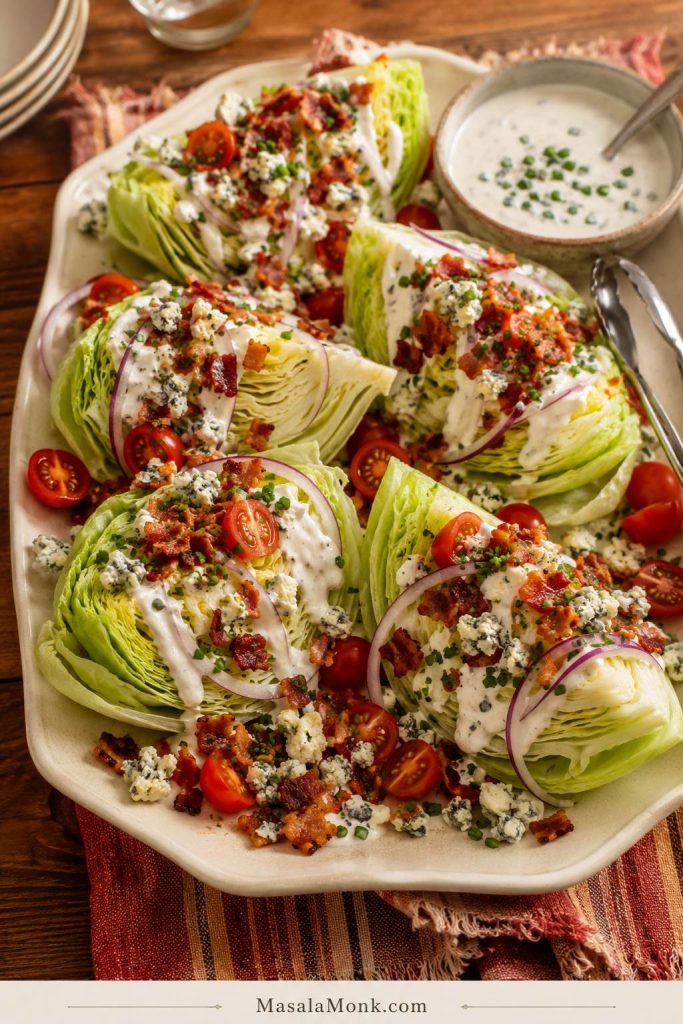

6. How many eggs can I cook in an air fryer at once?

Generally, you can cook as many eggs as fit in a single layer in your air fryer basket. They should sit comfortably without stacking or crowding so that the hot air can move around them. If your basket is big, you might easily handle a dozen eggs; if it’s smaller, you might cook six or eight. When the basket is very full, you might add a minute or so to your usual time for fully hard boiled eggs in the air fryer.


7. Why do my eggs crack or “explode” in the air fryer?

Every so often, eggs in an air fryer can crack, and occasionally a little egg white leaks out. Frequently, this happens when the eggs are packed too tightly, dropped into the basket, or have tiny hairline cracks already. In addition, a very high temperature can make pressure build up quickly inside the shell. To reduce cracking, space the eggs out, handle them gently, and stick to a moderate temperature instead of blasting them on maximum.


8. How do I make air fryer hard boiled eggs easier to peel?

Peeling is all about two key steps. First, don’t overcook the eggs; overdone eggs tend to cling to their shells. Second, transfer the eggs straight into an ice bath as soon as they come out of the air fryer. The sudden chill helps the egg pull away from the membrane inside the shell, which makes air fryer hard boiled eggs peel with far less frustration. Rolling the egg on the counter to crack the shell all over before peeling also helps.


9. Can I cook eggs in an air fryer without the shell?

Absolutely, you can cook eggs in an air fryer without the shell by using ramekins or silicone cups. For example, you can crack an egg into a greased ramekin for a baked or “boiled” style result, whisk eggs with milk and cheese for scrambled eggs in the air fryer, or pour a seasoned mixture into silicone molds for egg cups or egg bites. In each case, the air fryer becomes a tiny oven for your eggs, rather than just a replacement for boiling.


10. Is it safe to cook eggs in an air fryer?

Yes, cooking eggs in an air fryer is safe as long as you treat it like any other cooking method and follow basic food safety. Eggs should be cooked until the whites are fully set and yolks reach your chosen level of doneness, and any mixed egg dishes like egg bites or air fryer omelettes should be cooked until firm and steaming hot. Once they’re done, they need to be cooled and refrigerated promptly if you’re not eating them right away.


11. How long do air fryer boiled eggs last in the fridge?

Once you’ve cooled them down, air fryer boiled eggs keep well in the refrigerator. Typically, they can be stored for up to one week in a covered container. You can keep them in their shells or peel them in advance; either way, the key is to chill them promptly after cooking and then keep them cold. If they’ve been sitting at room temperature for more than a couple of hours, it’s safer to discard them.


12. Can I make scrambled eggs in the air fryer?

Yes, scrambled eggs in the air fryer are very doable. Instead of putting eggs straight in the basket, you whisk them in a bowl with a splash of milk, seasonings, and perhaps cheese, then pour the mixture into a greased, oven-safe dish or ramekin. After that, you cook the eggs at a moderate temperature, stirring once or twice if you like smaller curds, until they’re just set. The result is a gentle, baked-style scramble that pairs nicely with toast or vegetables.


13. Can I cook poached-style eggs in an air fryer?

You can’t poach eggs in the traditional sense inside an air fryer basket, but you can get a very similar result in cups. To create an air fryer poached egg effect, you grease a small ramekin or silicone cup, add a spoonful of water, and gently crack in an egg. Then, you cook it at a moderate heat until the whites are set and the yolk is still soft. The texture won’t be identical to a water-poached egg, yet it comes pleasantly close and works well for toast or brunch dishes.


14. How do I make air fryer egg bites or egg cups?

For air fryer egg bites, you whisk eggs with a little milk or cream, then stir in extras like cheese, chopped vegetables, herbs, or cooked meats. Next, you pour this mixture into greased silicone molds, muffin cups, or small ramekins, filling them about three-quarters full. After that, you cook them in the air fryer at a gentle temperature until they’re puffed and set in the center. These egg cups are easy to refrigerate and reheat, which makes them perfect for quick breakfasts.


15. Can I make an omelette or frittata in an air fryer?

Yes, an air fryer omelette or frittata is a great way to use the same appliance for a heartier dish. You simply whisk eggs with milk or cream, season well, and fold in fillings like vegetables, cheese, or leftover meats. Then, you pour everything into a greased, oven-safe pan that fits in the basket. Once it’s in, you cook the mixture until the center is set and the top is lightly golden. Thinner mixtures resemble an omelette, while thicker ones turn into a frittata-style bake.


16. Are air fryer hard boiled eggs healthier than regular boiled eggs?

Nutritionally, air fryer hard boiled eggs and classic stovetop boiled eggs are very similar. In both cases, you’re cooking the egg in its shell without added fat, and the protein, vitamins, and minerals remain largely the same. The main advantage of the air fryer method is convenience and ease rather than a big shift in nutrition. As always, how healthy your meal is overall depends more on what else is on the plate alongside those eggs.
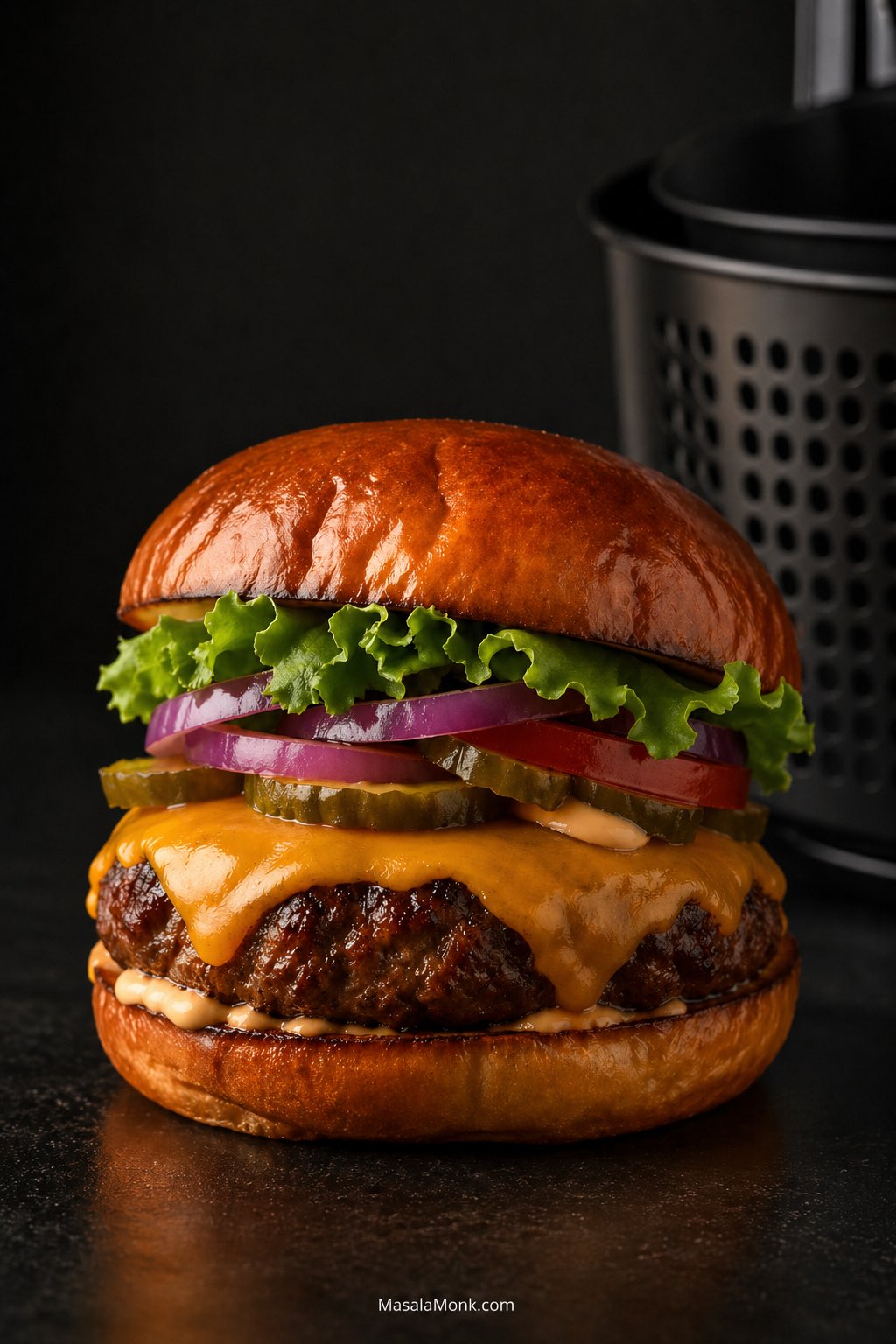

17. Why do my air fryer boiled eggs sometimes have a green ring around the yolk?

When you see a green or grey ring around the yolk, it’s usually a sign that the eggs have been slightly overcooked. In an air fryer, this often means the temperature was a bit high or the time a little long. To fix it next time, you can reduce the cooking time by a minute or two and make sure the eggs go straight into an ice bath at the end. Even with the ring, the eggs are still safe to eat; the change is mainly cosmetic and affects texture more than anything else.
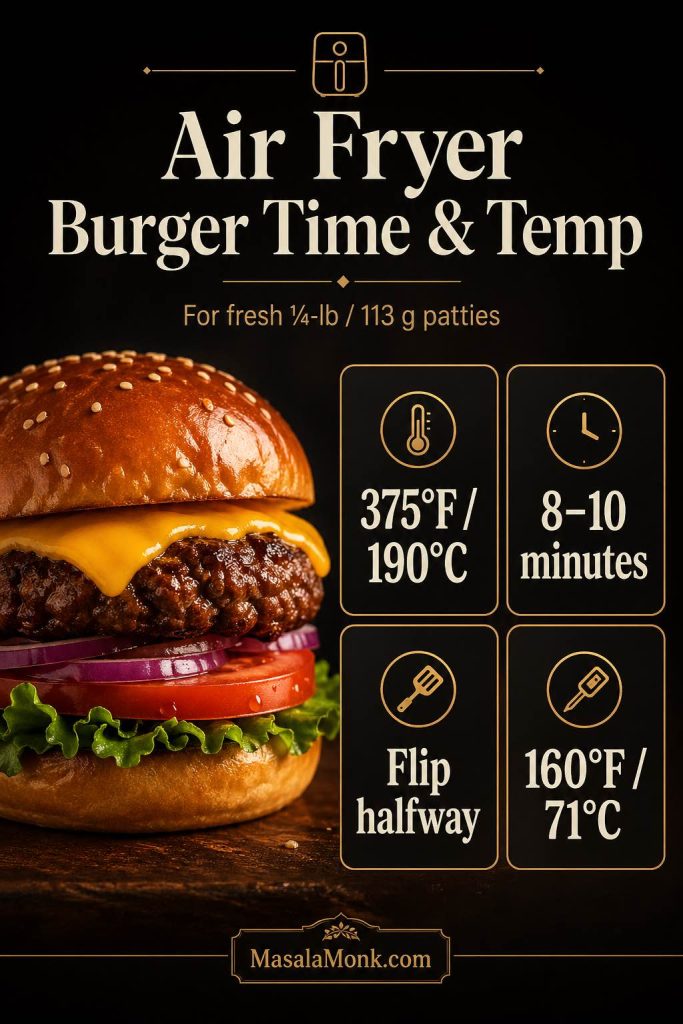

18. Can I use air fryer hard boiled eggs for deviled eggs?
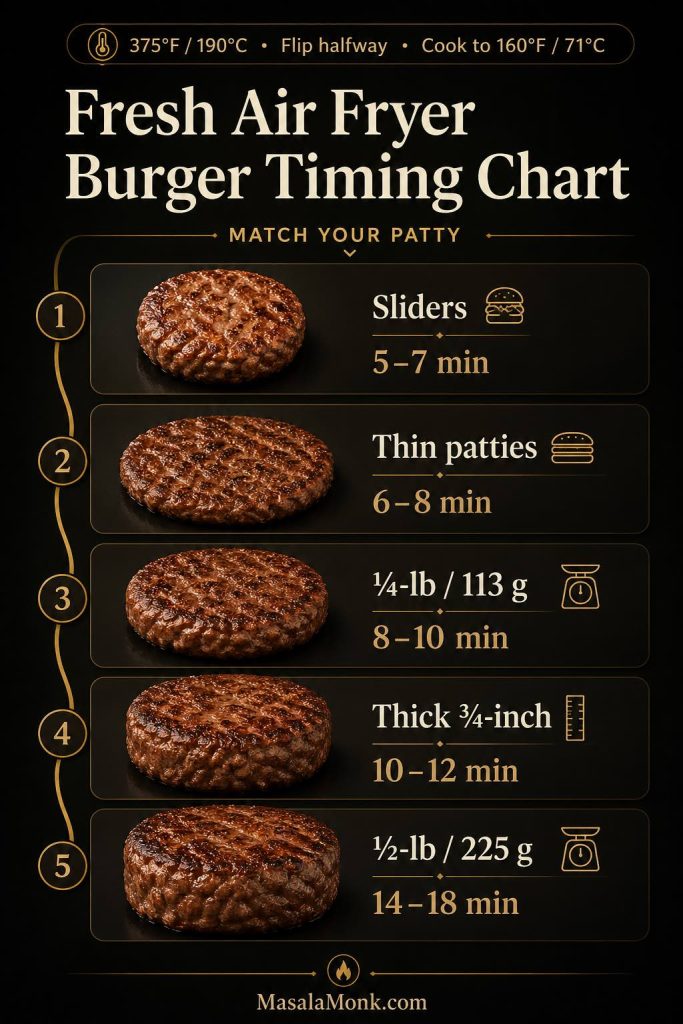
Definitely, air fryer hard boiled eggs are excellent for deviled eggs. In fact, once you dial in the timing, the whites tend to be evenly cooked and the yolks nicely centered, which makes them ideal for neat deviled halves. After cooking and cooling, you simply peel the eggs, slice them, and mash the yolks with your chosen ingredients to make the filling. From there, you can keep things classic or experiment with spices, herbs, and toppings to create a tray of deviled eggs that really stands out.

Posted on Leave a comment

5 Keto-Friendly Salami Dishes That Promote Weight Loss

Keto-Friendly Salami Dishes

If you’re following a keto lifestyle and want variety, satisfaction, and simplicity in your meals, salami can be your secret weapon. Salami isn’t just for charcuterie boards—it’s a high-protein, high-fat, ultra-low-carb ingredient that can transform everyday keto cooking. But there’s more to it than just taste: let’s explore the latest science, answer common questions, and discover 5 delicious keto-friendly salami dishes that support real, sustainable weight loss.


Why Salami on Keto? Science & Nutrition Breakdown

Salami is a cured sausage made primarily from pork or beef, salt, and spices. For keto eaters, it offers:

  • Very low net carbs: Typically <1g per 100g.
  • High in fat & protein: 31g fat and 21g protein per 100g, supporting ketosis and satiety.
  • B-vitamins, iron, and zinc: Supporting metabolism and immune health.
  • Convenience: No cooking required for most recipes; portable and satisfying.

Recent studies and nutritionists agree: Foods that are high in protein and fat, but low in carbs, help suppress appetite and preserve muscle mass during weight loss. Salami fits these macros perfectly. The key is moderation and ingredient quality—look for nitrate/nitrite-free options, and don’t rely solely on processed meats.


1. Salami & Cheese Crisps (The Ultimate Keto Snack)

Why this works:
Baking salami and cheese together creates crunchy, flavorful crisps that curb cravings for chips—without the carbs or guilt. They’re perfect for snacking or party platters.

How to make it:

  • Preheat oven to 400°F (200°C).
  • Lay thin salami slices on a parchment-lined tray.
  • Top each with shredded Parmesan or mozzarella.
  • Bake for 5-8 minutes, or until golden and crisp.
  • Cool and enjoy!

Macros:
<1g net carb per serving. High in protein and fat.

Practical tip:
Store in an airtight container for grab-and-go snacks. Kids love them, too!


2. Salami Egg Muffins (Easy Keto Breakfast Meal Prep)

Why this works:
Eggs and salami provide protein, fat, and micronutrients—keeping you full for hours and helping avoid mid-morning cravings.

How to make it:

  • Preheat oven to 375°F (190°C).
  • Line muffin tin cups with salami slices.
  • Crack in one egg per cup (or scramble if preferred).
  • Add spinach, herbs, and a sprinkle of cheese.
  • Bake 12-15 minutes, until eggs are set.

Macros:
~2g net carbs per muffin (varies by add-ins).

Practical tip:
Make ahead for busy mornings—these store well in the fridge for up to 4 days.


3. Zoodle Salami Alfredo (Pasta Without the Guilt)

Why this works:
Zucchini noodles (“zoodles”) swap out high-carb pasta for fiber and hydration. Creamy Alfredo sauce and savory salami add richness and flavor—making this dish deeply satisfying.

How to make it:

  • Spiralize 2-3 zucchini and sauté briefly in olive oil.
  • Add 1/4 cup heavy cream, 2 tbsp butter, and 1/2 cup Parmesan for Alfredo sauce.
  • Toss in sliced salami (about 2 oz per serving) and cook until warmed through.
  • Season with pepper, garnish with parsley.

Macros:
~4g net carbs per bowl (mainly from zucchini).

Practical tip:
For extra nutrition, toss in spinach, mushrooms, or chopped olives.


4. Mini Keto Salami “Pizza” Bites

Why this works:
Mini salami “pizzas” capture all the flavor of your favorite slice—without dough, gluten, or carbs.

How to make it:

  • Arrange salami slices on a baking sheet.
  • Spread each with a teaspoon of low-carb marinara or tomato paste.
  • Add shredded mozzarella and a sprinkle of Italian herbs.
  • Broil for 2-3 minutes, until bubbly.

Macros:
~1g net carb per pizza bite (depends on sauce).

Practical tip:
Perfect for party trays or kid-friendly snacks!


5. Salami, Olive & Cheese Keto Platter (Lunch or Snack Box)

Why this works:
This balanced “charcuterie box” provides protein, fat, and fiber—excellent for lunchboxes, travel, or office snacks. Olives add healthy fats and micronutrients.

How to make it:

  • Arrange 4-6 slices of salami, 2 oz cubed cheese, a handful of olives, and sliced cucumber or celery on a plate or in a bento box.
  • Optionally add nuts (macadamia or almonds) for extra crunch.

Macros:
~2-3g net carbs per serving (from veggies/olives).

Practical tip:
Pre-pack several boxes at the start of the week for “keto fast food” on busy days.


The Latest Science: Does Salami Help With Weight Loss?

  • Keto diets work by reducing carbs, so your body burns fat for fuel. Salami supports this with high fat and protein, nearly zero carbs, and high satiety.
  • Appetite control: Research shows that protein- and fat-rich foods like salami, eggs, and cheese can help reduce hunger, making it easier to maintain a calorie deficit for weight loss.
  • Portion control is key: While keto-friendly, salami is also calorie-dense and high in sodium. Use as part of a balanced plate, not the sole protein source.

Tip: Always choose the highest-quality, minimally processed salami you can find—ideally organic, nitrate/nitrite-free, and with clear labeling.


Practical Tips for Including Salami in a Healthy Keto Diet

  • Balance processed meats with fresh vegetables and whole-food fats (avocado, olives, nuts).
  • Stay hydrated: Keto and salty foods can increase water loss.
  • Watch sodium and portion size: Too much can stall weight loss for some people.
  • Mix and match: Pair salami with a variety of cheeses, veggies, and sauces for endless combinations.

Conclusion: Salami Can Be Keto Gold—With the Right Approach

When used mindfully, salami is a versatile, satisfying ingredient that fits perfectly into a keto weight loss plan. The five recipes above are just the start—experiment, enjoy, and keep your meals interesting and convenient.

Remember: Keto works best when it’s sustainable, balanced, and delicious. Let salami add flavor and variety, but always aim for a colorful, nutrient-dense plate.


Want More Recipes or Tips?

Let me know if you want printable recipes, weekly meal plans, or a shopping guide for the best keto-friendly salami brands. Your keto journey should be tasty, practical, and full of real results!


Have you tried any keto salami dishes? Which is your favorite? Share your tips or questions below!

10 FAQs for Keto-Friendly Salami Dishes

1. Is salami really keto-friendly?
Yes, most traditional salami is very low in carbohydrates—often less than 1 gram per serving—making it a great fit for keto. Always check the label for added sugars or fillers.

2. How much salami can I eat on keto?
Moderation is key. While salami is low in carbs, it is calorie-dense and high in sodium. A reasonable serving is 1–2 ounces (about 4–6 slices) as part of a balanced meal.

3. What should I look for when buying salami for keto?
Choose nitrate/nitrite-free, minimally processed options with simple ingredients (meat, salt, spices). Avoid salamis with added sugars or starches.

4. Is it okay to eat salami every day on keto?
It’s best to enjoy salami a few times a week and not as your main protein source. Combine it with a variety of other proteins and plenty of non-starchy vegetables.

5. Does eating salami help with weight loss?
Salami’s high protein and fat content can boost satiety and help control appetite. However, weight loss depends on overall calorie intake and lifestyle habits.

6. Can I eat pre-sliced packaged salami?
Yes, but check the ingredients list for added sugars or unnecessary additives. When possible, buy from the deli counter for fresher, cleaner options.

7. What are some good foods to pair with salami on keto?
Cheese, olives, avocado, nuts, leafy greens, and low-carb veggies like cucumbers and bell peppers all pair well with salami and keep meals balanced.

8. How can I reduce sodium intake when eating salami?
Balance your diet with fresh, unsalted foods like vegetables and drink plenty of water. If sodium is a concern, choose lower-sodium brands or limit portion sizes.

9. Are there vegetarian or vegan alternatives to salami for keto?
There are plant-based deli slices made from tofu or seitan, but check carb counts and ingredients, as many contain higher carbs and added fillers.

10. Can I meal prep with salami?
Absolutely! Salami keeps well and is perfect for prepping snack boxes, wraps, or egg muffins ahead of time. Store in an airtight container in the fridge.