Posted on Leave a comment

Protein Cookie Dough Recipe

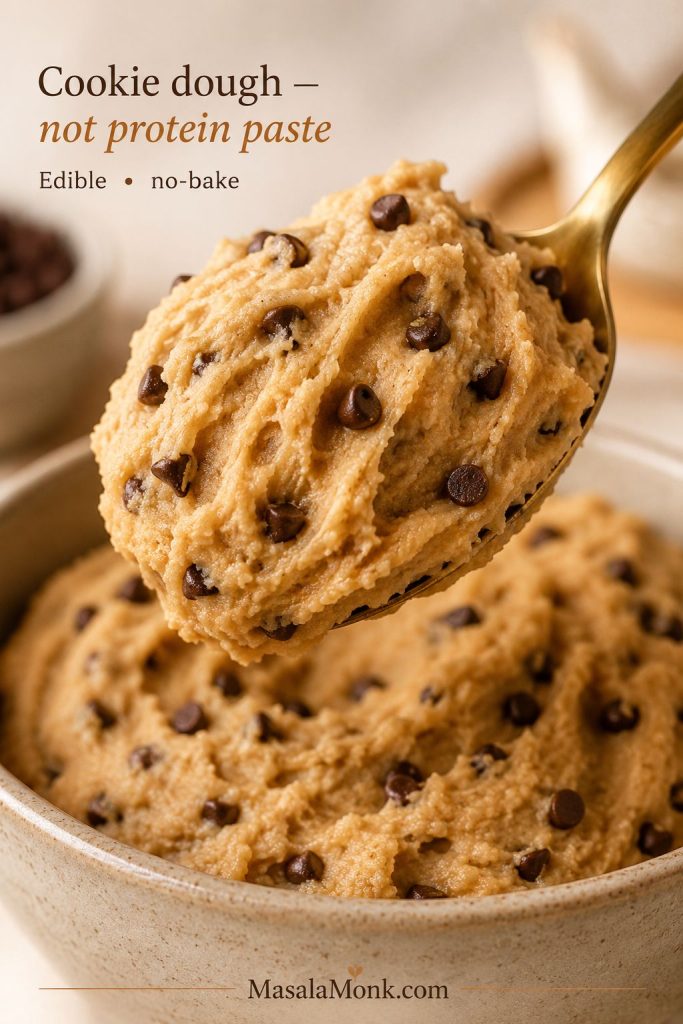
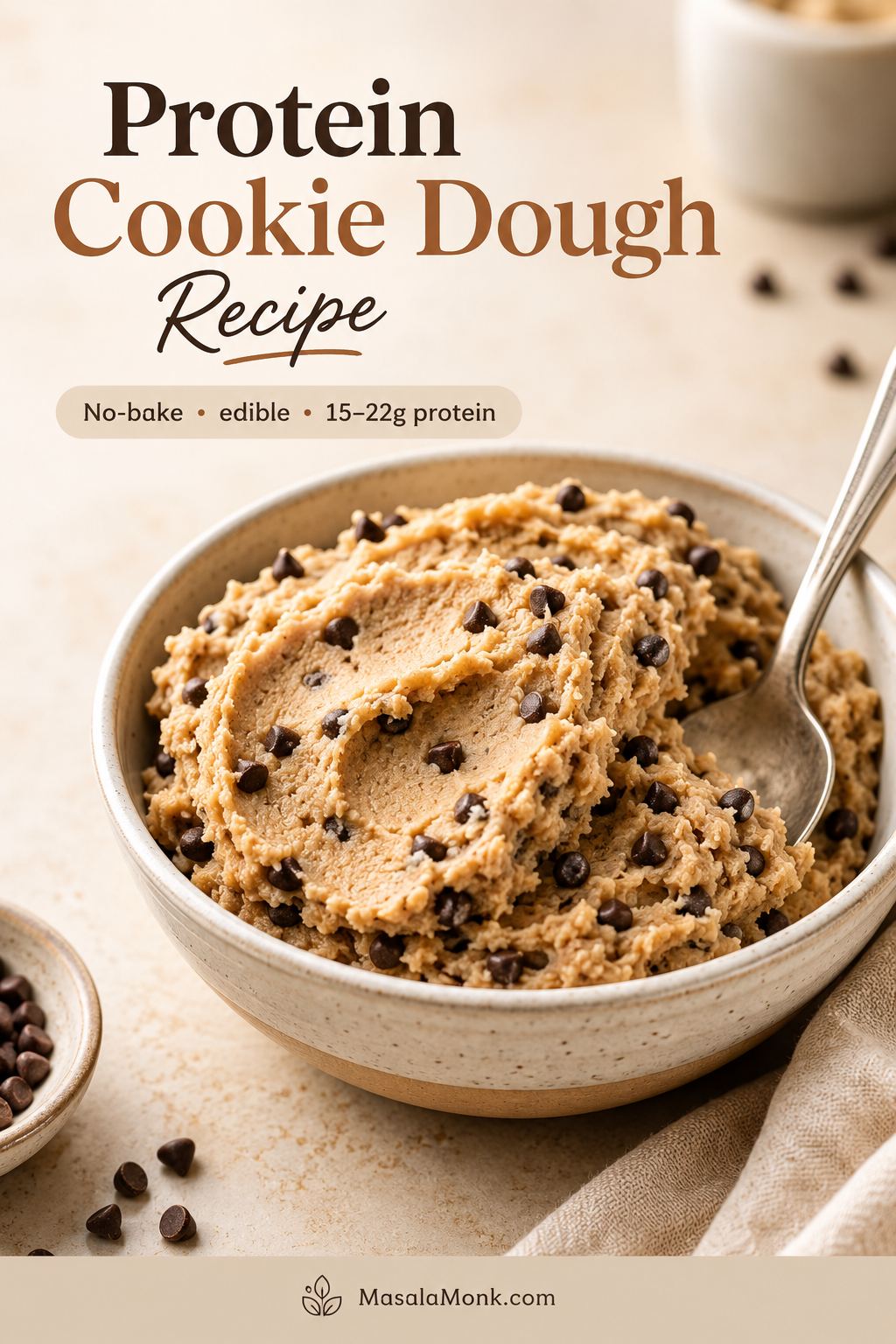
Thick protein cookie dough recipe in a bowl with mini chocolate chips, spoon marks, and a scoopable texture.

This protein cookie dough recipe is edible, no-bake, ready in about 5 minutes, and built to taste like cookie dough — not protein paste. It is egg-free, made without raw all-purpose flour, and gives you a scoopable, chocolate-studded dough with about 15–22g protein per serving when divided into 3–4 portions.

No oven, no mixer, no waiting for cookies to cool — just one bowl, a spoon, and a sweet snack that feels more like dessert than a protein shake.

The difference between good protein cookie dough and chalky protein paste is balance. Protein powder adds structure, nut butter gives richness, Greek yogurt softens the dough, and almond flour or oat flour makes it thick enough to scoop. Then vanilla, salt, and mini chocolate chips bring it closer to a real cookie dough bite. If you like this kind of high-protein dessert, this dough gives you the same treat-like feeling without needing a freezer or blender.

It should feel like sneaking a spoonful of cookie dough from the bowl, only with enough protein to make it feel more satisfying than a random bite of dessert.

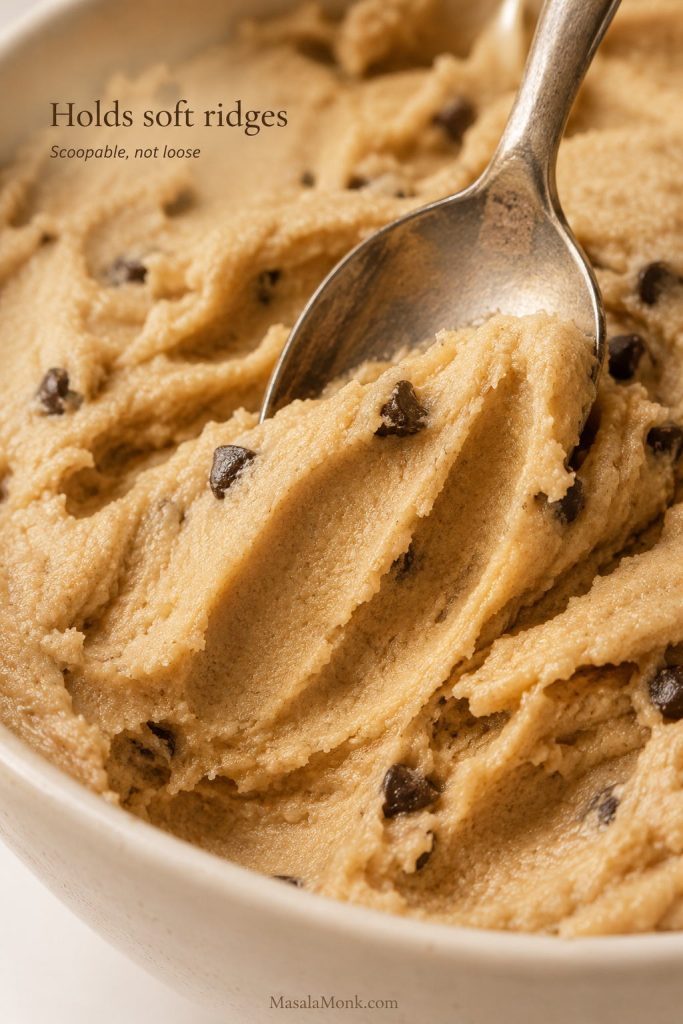
Spoon lifting edible protein cookie dough with mini chocolate chips and soft ridges showing the scoopable texture
This spoon-lift shows the texture you want: creamy, sturdy, and able to hold its shape without turning stiff.

Quick Answer: The Best Protein Cookie Dough Ratio

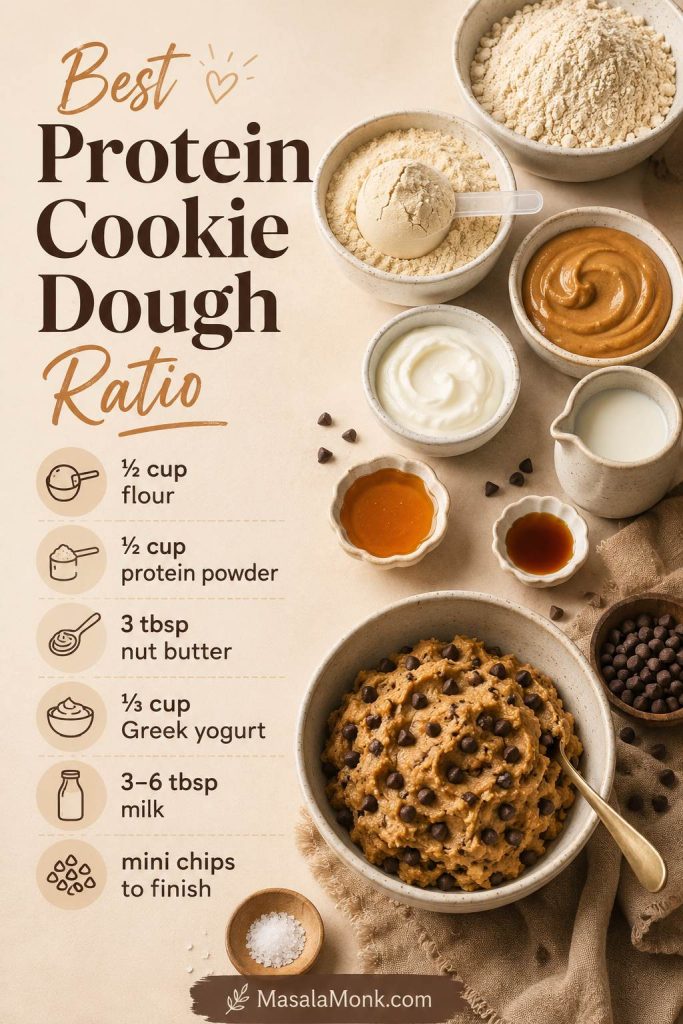
Protein cookie dough ratio board with protein powder, flour, nut butter, Greek yogurt, milk, and mini chocolate chips
This quick ratio works because the dry base, creamy ingredients, and milk are balanced before the chocolate chips go in.

Use less milk for a firmer dough and more milk for a softer, scoop-and-eat texture. Divide the batch into 3 portions for a higher-protein snack, or 4 portions for smaller dessert-style servings.

Best first version: Use a vanilla whey-casein blend if you have one, almond flour for a softer rich dough, and mini chocolate chips for the most cookie-dough-like bite.
Do not add all the milk at once. Protein powders absorb moisture differently, and a dough that looks dry at first can loosen quickly after mixing. Add liquid gradually and stop as soon as the dough holds together.

Not sure how your powder will behave? See the protein powder guide before adding all the milk.

Protein Cookie Dough at a Glance

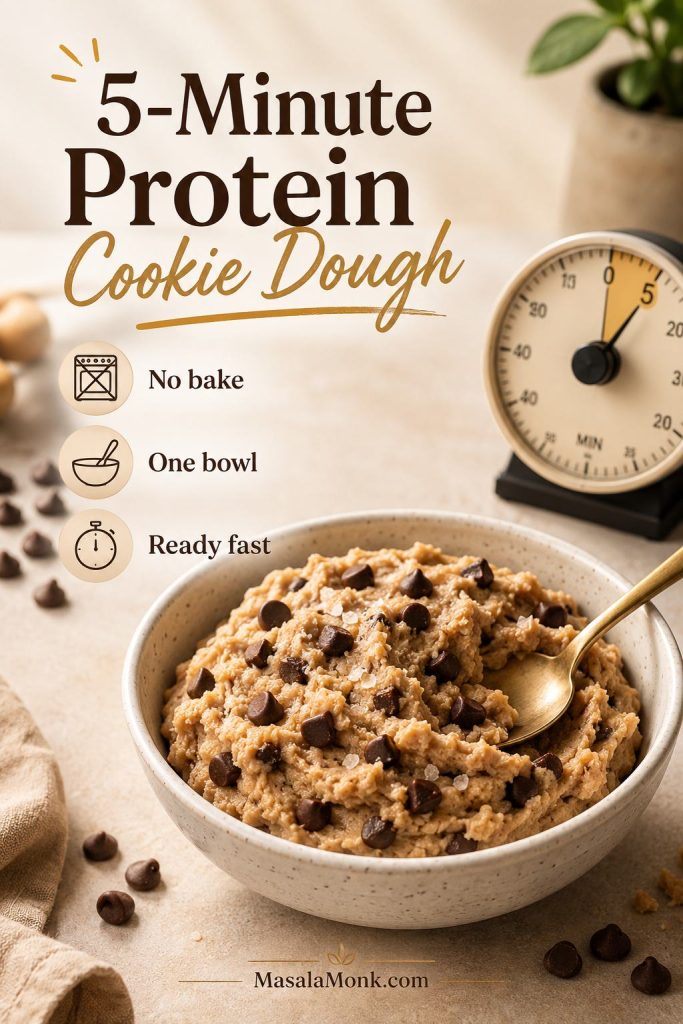
One-bowl five-minute no-bake protein cookie dough with a timer, spoon, and thick chocolate chip dough
Since this is a 5-minute no-bake recipe, the key is adjusting texture in the bowl instead of relying on baking time.
Prep time 5 minutes
Cook time 0 minutes
Chill time Optional 20–30 minutes for firmer dough
Servings 3–4 servings
Protein estimate About 15–22g per serving, depending on powder and serving size
Best texture Scoopable, sturdy, and easy to eat with a spoon
Best flour Almond flour for soft/rich, oat flour for more cookie-like
Main fix Add liquid slowly, then fine-tune the texture in small spoonfuls
Storage 4–5 days in the fridge or 2–3 months frozen in portions

The best part is that the recipe is forgiving. If the first mix looks too dry, too sticky, or too thick, you do not have to start over — you just adjust the bowl in small steps.

Estimated Protein, Calories, and Serving Size

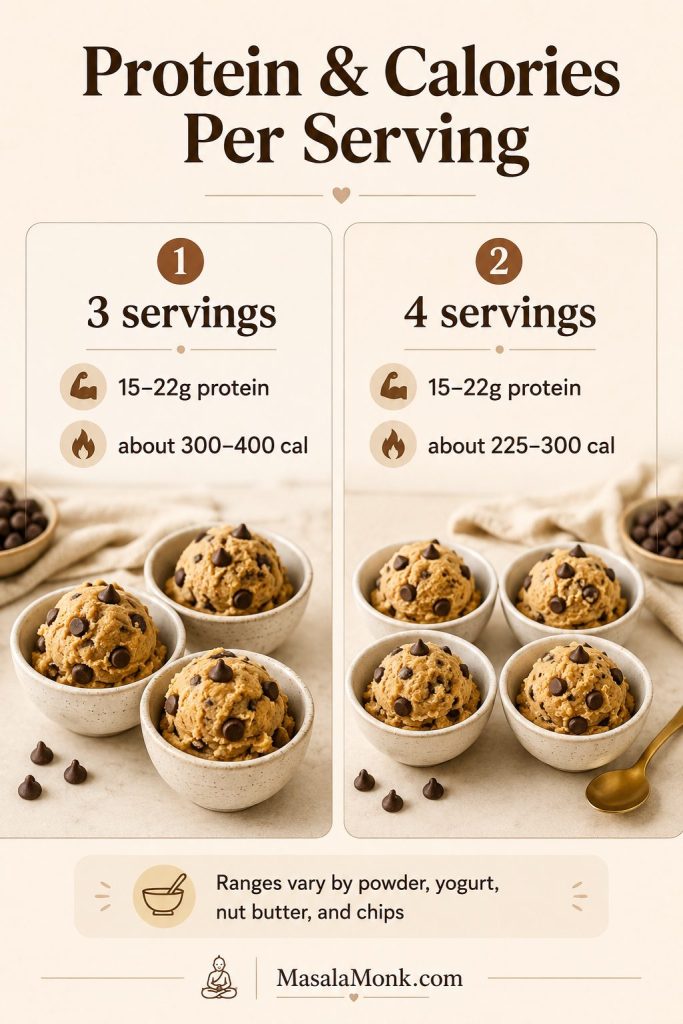
Protein and calorie guide for protein cookie dough showing three-serving and four-serving portion estimates
For macro tracking, portion size matters: three larger servings feel more snack-like, while four smaller servings keep the calories lighter.

As a rough range, the full batch often lands around 900–1,200 calories, depending on the protein powder, nut butter, yogurt, milk, syrup, and chocolate chips used. That works out to about 300–400 calories if divided into 3 larger servings, or about 225–300 calories if divided into 4 smaller servings. Use your own ingredient labels for the most accurate number.

Calories vary most from the nut butter, chocolate chips, protein powder, syrup, and yogurt you use. A richer dessert bowl usually comes from regular nut butter, maple syrup or honey, and the full chocolate chip amount. If you want a lighter version, use powdered peanut butter, nonfat Greek yogurt, almond milk, and fewer mini chocolate chips.

To keep the bowl lighter without making it taste flat, jump to the low-calorie protein cookie dough version and use the swaps there.

Why This Protein Cookie Dough Works

A good high-protein cookie dough has to solve the real problem: it needs enough protein to feel worth making, but it still has to satisfy the part of you that wanted cookie dough in the first place. When the balance is off, the texture changes quickly. Extra protein powder can make the dough dry or chalky, too much liquid can turn it sticky, and not enough fat can make it taste like sweet paste instead of cookie dough.

This version works because each ingredient protects the dough from the usual protein-dessert problems: dry, sticky, chalky, or bland. Protein powder gives the snack its purpose, almond flour or oat flour keeps it from turning loose, nut butter makes it taste richer, and Greek yogurt softens the bite so it feels more like dessert than a scoop of powder. Vanilla, salt, and mini chocolate chips finish the flavor so it tastes more like cookie dough and less like a protein shake in a bowl.

When that balance is right, the dough tastes sweet and familiar instead of “healthy” in the disappointing way.

The finished dough should hold ridges when stirred, scoop cleanly, and firm up slightly after chilling. It should not pour like batter, crumble like dry powder, or cling aggressively to the spoon.

Why readers usually love this: It gives you the cookie-dough feeling without turning into a full baking project. No oven, no mixer, no waiting for cookies to cool — just a thick, sweet, chocolate-studded bowl you can adjust until it tastes right.

Ingredients You Need

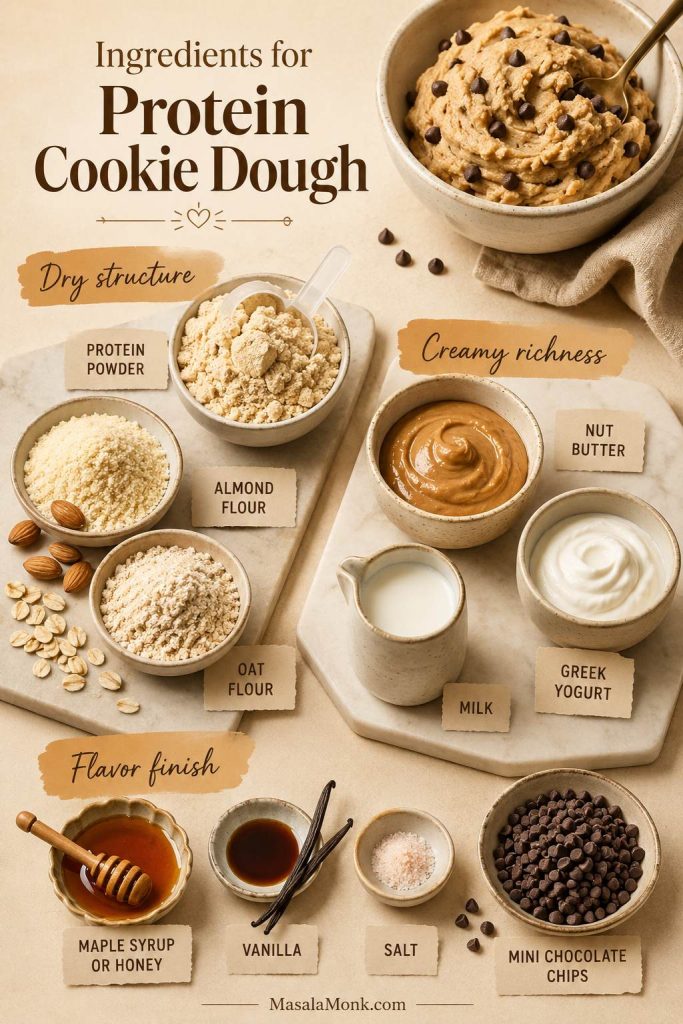
Protein cookie dough ingredients arranged by texture role, including protein powder, flour, yogurt, nut butter, and chocolate chips
Each ingredient controls something important: body, creaminess, sweetness, flavor, or chocolate in every bite.

Protein powder

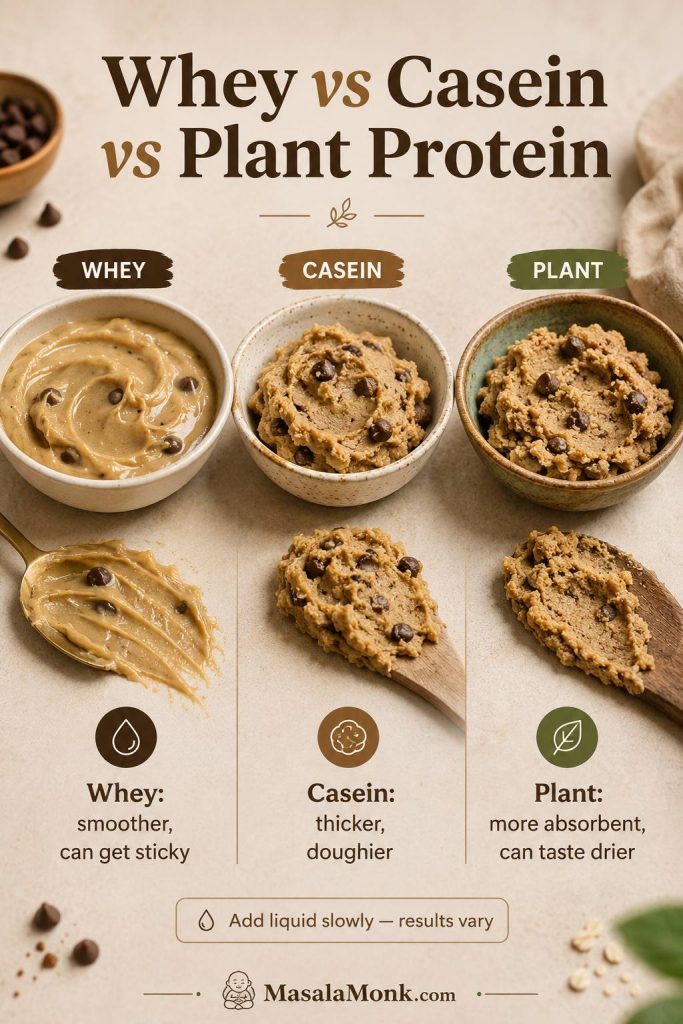
Vanilla protein powder is the easiest choice because it already brings sweetness and dessert flavor. Whey protein can make a smoother dough, but it may become sticky if you add too much liquid. Casein and plant protein usually thicken more aggressively, so they often need extra milk or yogurt. A whey-casein blend is often the easiest option for a classic cookie dough texture.

Almond flour or oat flour

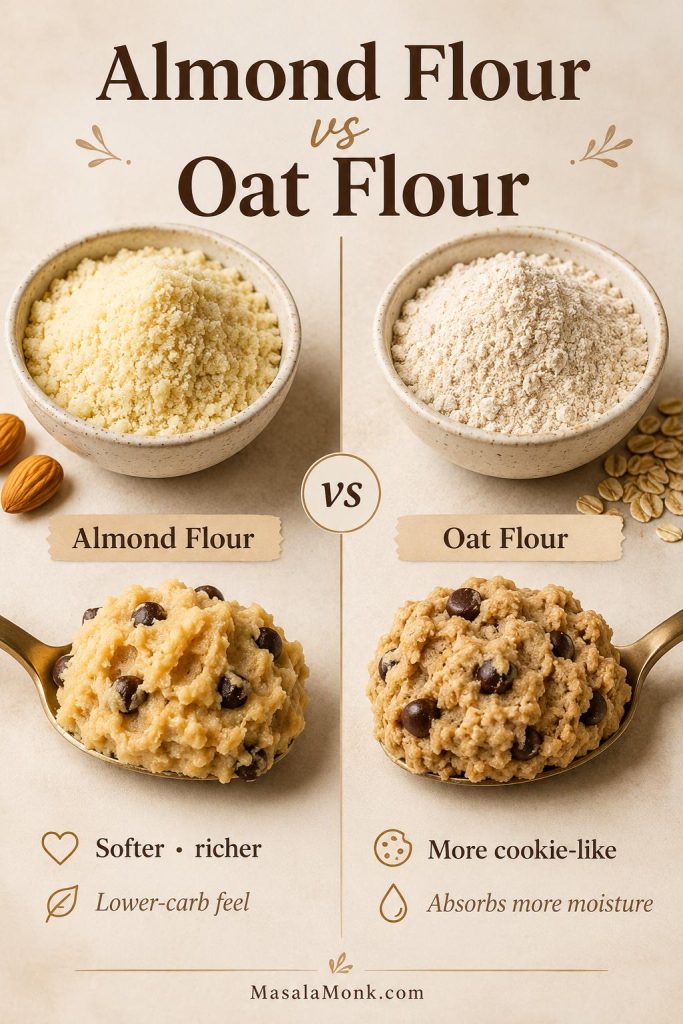
Almond flour versus oat flour comparison for protein cookie dough showing softer rich dough and more cookie-like dough
Almond flour gives a softer, richer dough; meanwhile, oat flour brings a more cookie-like chew and usually needs a little more moisture.

Do not use regular raw all-purpose flour in this no-bake recipe. The safety section below explains why.

For the raw-dough details, read the edible cookie dough safety section before swapping flours.

Nut butter

Peanut butter gives the strongest flavor and the richest dough. Almond butter is milder. Cashew butter gives a softer, almost bakery-style sweetness. Sunflower seed butter works if you need a nut-free option, though it has a more noticeable flavor.

Greek yogurt

Greek yogurt keeps the dough creamy while adding more protein. Thick plain Greek yogurt works best. If your yogurt is thin or watery, start with less milk. If your yogurt is very thick, you may need an extra spoonful of milk to bring the dough together.

Maple syrup or honey

Maple syrup and honey do more than sweeten the dough. They also add moisture and help the texture feel less powdery. Sugar-free syrup can work, but the texture may be thinner or less rich depending on the brand.

Vanilla, salt, and mini chocolate chips

These small ingredients make a big difference. Vanilla gives the dough a dessert-like aroma, salt keeps the flavor from tasting flat, and mini chocolate chips spread more evenly than large chips, especially in a single-serving bowl.

Is Protein Cookie Dough Safe to Eat Raw?

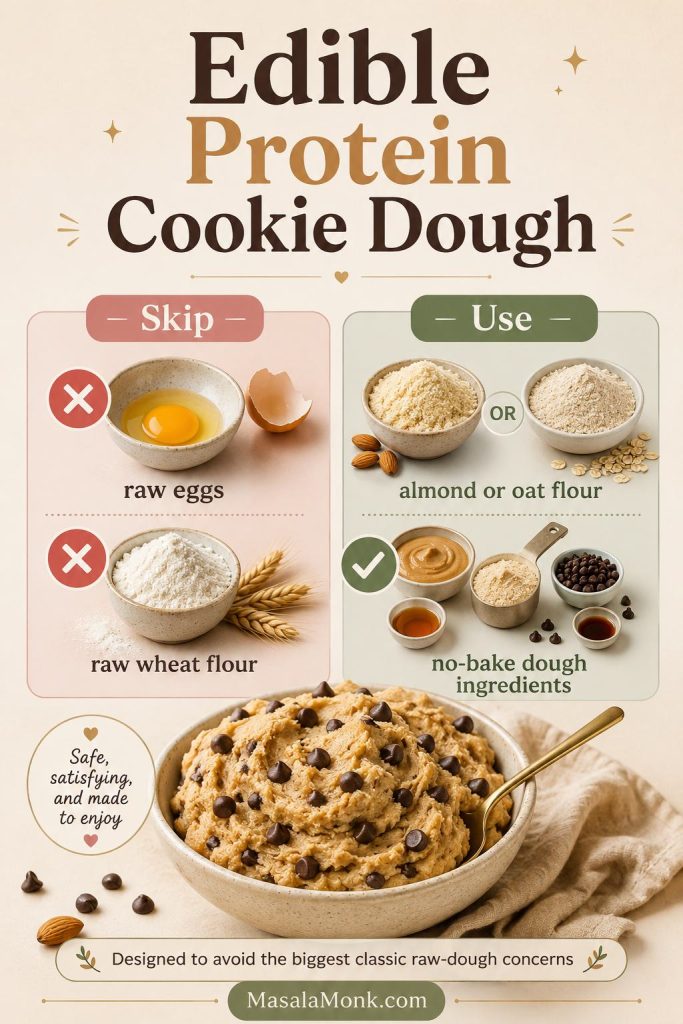
Edible protein cookie dough safety board showing no raw eggs, no raw wheat flour, and almond or oat flour instead
Edible protein cookie dough works best when the no-bake base avoids raw eggs and raw wheat flour from the start.

The FDA explains that most flour is raw and has not been treated to kill germs. The CDC also warns against eating raw dough made with uncooked flour because flour can carry germs that are killed only when the flour is baked or cooked.

For this no-bake dough, use fresh almond flour, oat flour from a trusted package, or a flour product specifically labeled for edible dough. Do not swap in regular raw wheat flour.

If you want the classic version without protein powder, this edible cookie dough recipe follows the same no-bake, spoonable dessert idea with a more traditional cookie-dough flavor.

Important: This recipe avoids raw all-purpose wheat flour. Keep the finished dough chilled, use fresh ingredients, and do not leave yogurt-based cookie dough sitting out for long.

Best Protein Powder for Cookie Dough

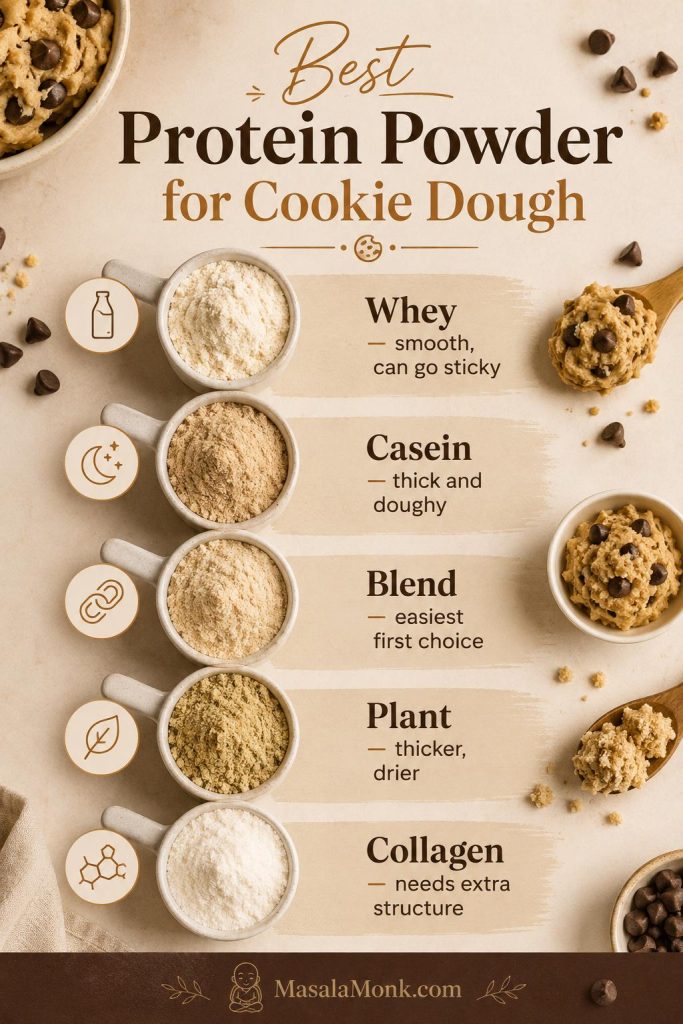
Best protein powder for cookie dough guide comparing whey, casein, blended, plant, and collagen protein powders
The best powder depends on texture as much as flavor, because each type thickens the bowl differently.

Texture matters just as much as flavor. Whey, casein, plant protein, collagen, and blends all absorb moisture at a different pace, which is why the recipe gives a range for milk instead of one fixed amount.

This is why two people can use the same recipe and get different results. The recipe may not be the problem — the powder may simply need more or less moisture.

Protein powder texture guide

Protein powder Texture in cookie dough Best fix
Whey protein Smooth, but can become sticky or wet if overhydrated. Add milk slowly. Thicken with almond flour, oat flour, or a little more protein powder.
Casein protein Thick, doughy, and very absorbent. Add milk or Greek yogurt 1 teaspoon at a time until spoonable.
Whey-casein blend Usually the most balanced cookie dough texture. Best first choice for a balanced, cookie-dough-like texture.
Plant protein Thick, sometimes chalky or earthy. Add nut butter, yogurt, vanilla, salt, and enough milk to soften the texture.
Collagen powder Adds protein but does not give much dough structure. Use it with almond flour or oat flour, not as the only dry ingredient.
Powdered peanut butter Lower in fat, peanut-forward, and slightly dry. Pair with Greek yogurt or milk to keep the dough creamy.
Whey, casein, and plant protein cookie dough comparison showing smoother, thicker, and more absorbent dough textures
Whey, casein, and plant protein can all work, but each one changes how much liquid the bowl needs before it becomes scoopable.

For the first batch, use the recipe as written but hold back some of the milk. Once you see how your protein powder thickens, the recipe becomes easy to repeat.

If your dough already turned dry, sticky, or loose, go straight to the texture fixes instead of guessing.

How to Make Protein Cookie Dough

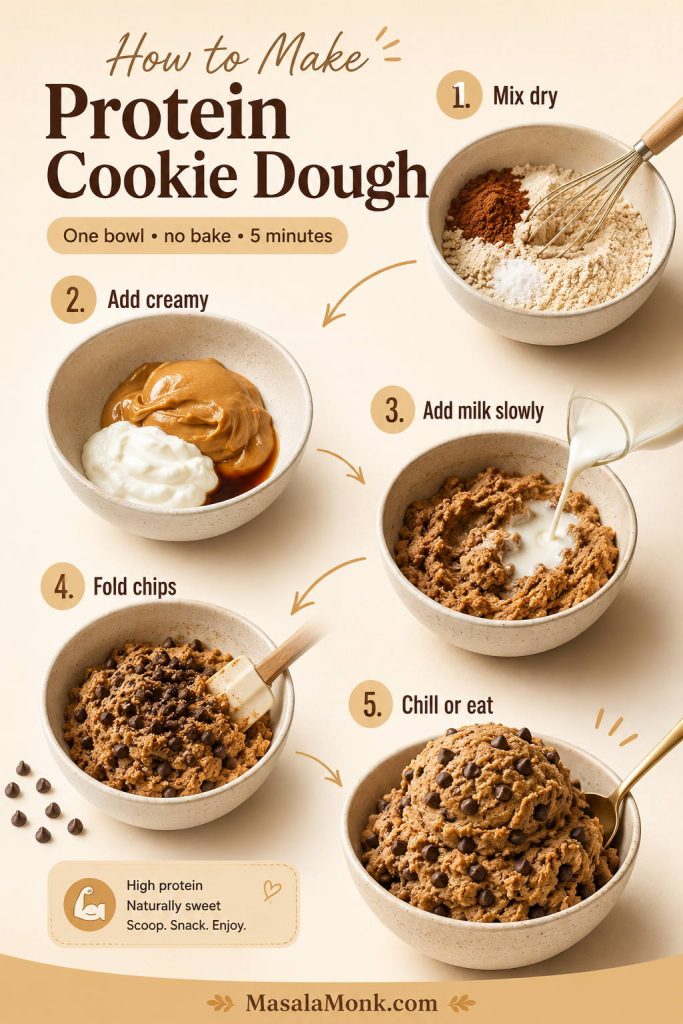
Step-by-step protein cookie dough method showing dry ingredients, creamy ingredients, slow milk addition, chocolate chips, and finished dough
The method stays simple: build the dry base, add richness, loosen carefully, fold in chocolate, then chill only if you want a firmer bite.

Step 1: Mix the dry ingredients

Place the almond flour or oat flour, protein powder, and salt in a medium bowl. Stir them together first so the protein powder is evenly distributed before the wet ingredients go in.

Step 2: Add the creamy ingredients

Stir in the nut butter, Greek yogurt, maple syrup or honey, and vanilla. The dough may start to clump together and look too thick at this point, which is fine.

Pour in milk or almond milk 1 tablespoon / 15ml at a time. Mix well after each addition and stop when the dough is soft but sturdy. You may not need all the milk, especially if your yogurt is loose or your protein powder is whey-based.
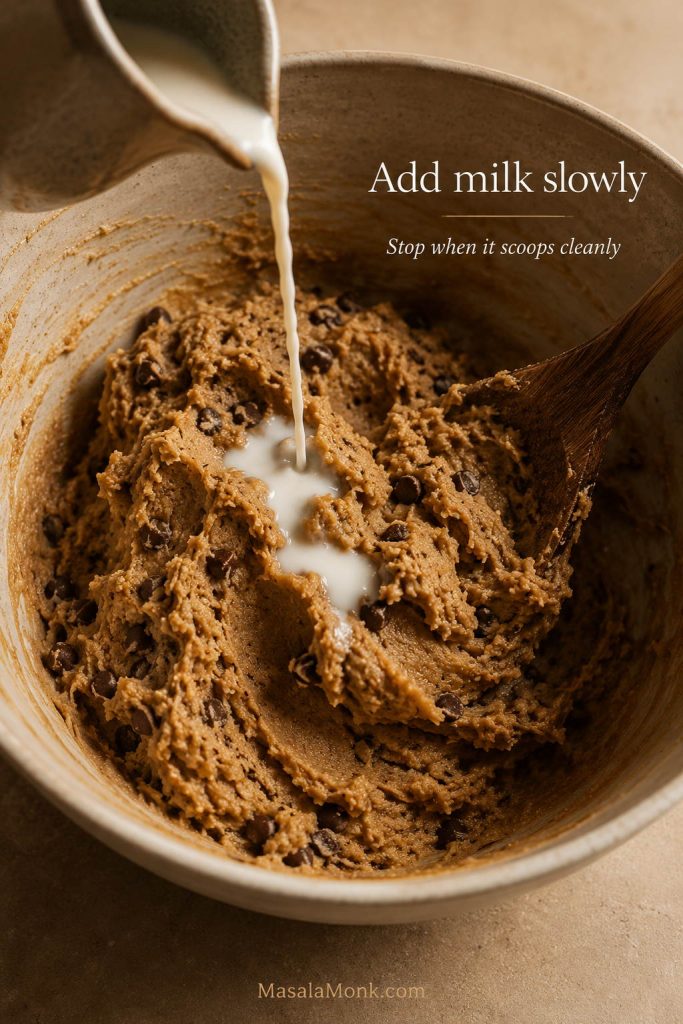
Milk being added slowly to thick protein cookie dough in a mixing bowl to control the final texture
Add milk slowly so the dough softens gradually; otherwise, a small bowl can turn loose before the protein powder has time to absorb it.
Close-up of protein cookie dough holding soft spoon ridges to show the ideal thick but scoopable texture
Look for spoon marks that stay visible for a moment; that is the easiest sign your protein cookie dough is thick enough without being dry.

If your dough does not look like this yet, use the texture guide to fix it before folding in the chocolate chips.

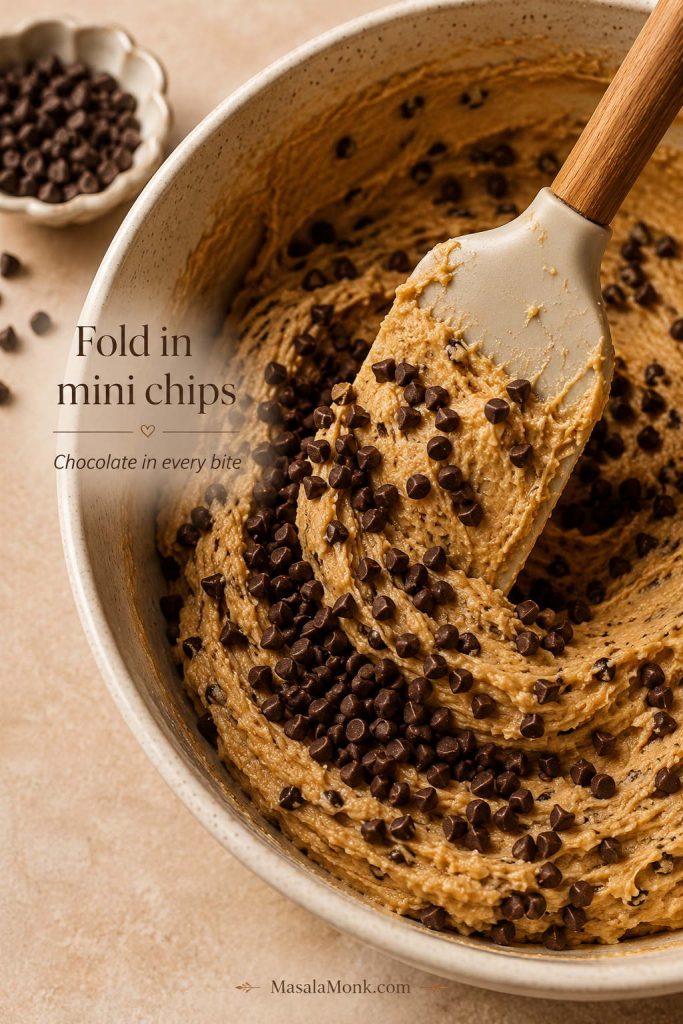
Step 4: Fold in mini chocolate chips

Mini chocolate chips being folded into thick protein cookie dough so the chips spread evenly through the bowl
Mini chocolate chips work better than larger chips because they spread through the dough evenly and make each spoonful taste more like dessert.

Step 5: Eat right away or chill

You can eat the dough immediately if you like a softer, freshly mixed texture. For a firmer, more classic cookie dough feel, cover the bowl and chill it for 20–30 minutes.

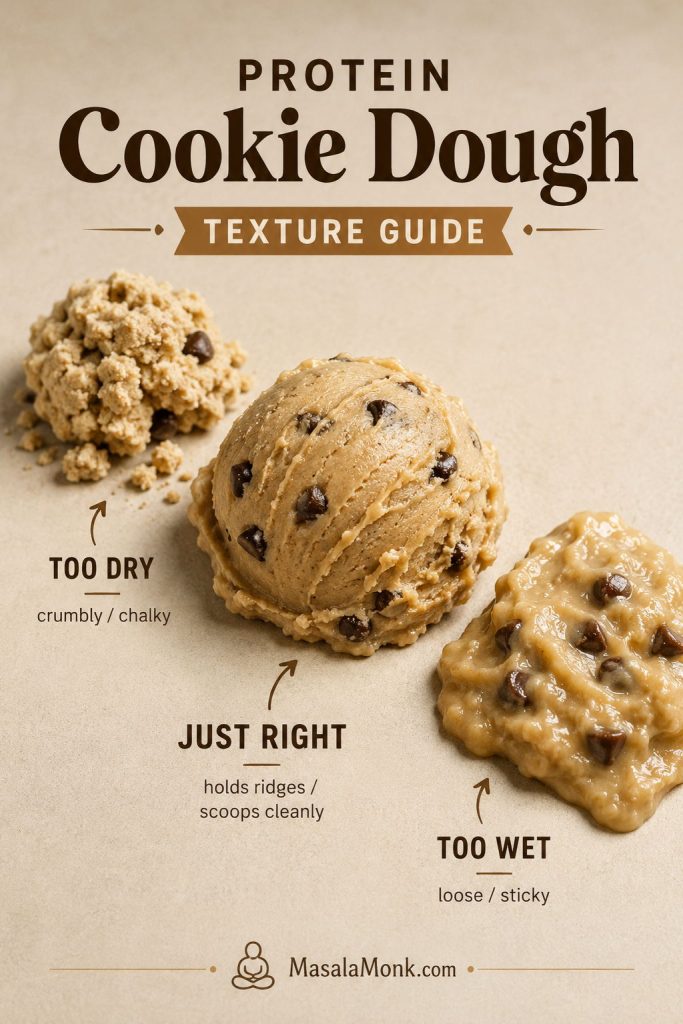
Protein Cookie Dough Texture Guide

Protein cookie dough texture guide comparing crumbly dry dough, scoopable just-right dough, and loose wet dough
Once you recognize the difference between crumbly, scoopable, and loose, fixing the texture becomes much easier.
Problem Why it happened How to fix it
Too wet Too much milk, loose yogurt, or a whey protein that does not absorb much liquid. Stir in 1 teaspoon almond flour, oat flour, or protein powder at a time.
Too dry Casein or plant protein absorbed the liquid quickly. Loosen it with 1 teaspoon milk or Greek yogurt at a time.
Chalky Too much protein powder, plant protein, or not enough fat/moisture. Work in 1–2 teaspoons nut butter or Greek yogurt, plus vanilla and a pinch of salt.
Too sticky Too much syrup, nut butter, or liquid. Chill 20–30 minutes, or sprinkle in a little almond/oat flour.
Not sweet enough Unsweetened protein powder or not enough syrup. Sweeten with 1 teaspoon maple syrup, honey, or your preferred sweetener.
Too protein-y The protein powder flavor is too strong. Balance it with vanilla, salt, mini chocolate chips, or a better-tasting vanilla protein powder next time.
Best texture rule: Adjust slowly. One teaspoon can change a small batch more than you expect.

Once the texture is right, the bowl stops feeling like a protein workaround and starts feeling like what you actually wanted: cold, sweet cookie dough with little pockets of chocolate in every spoonful.

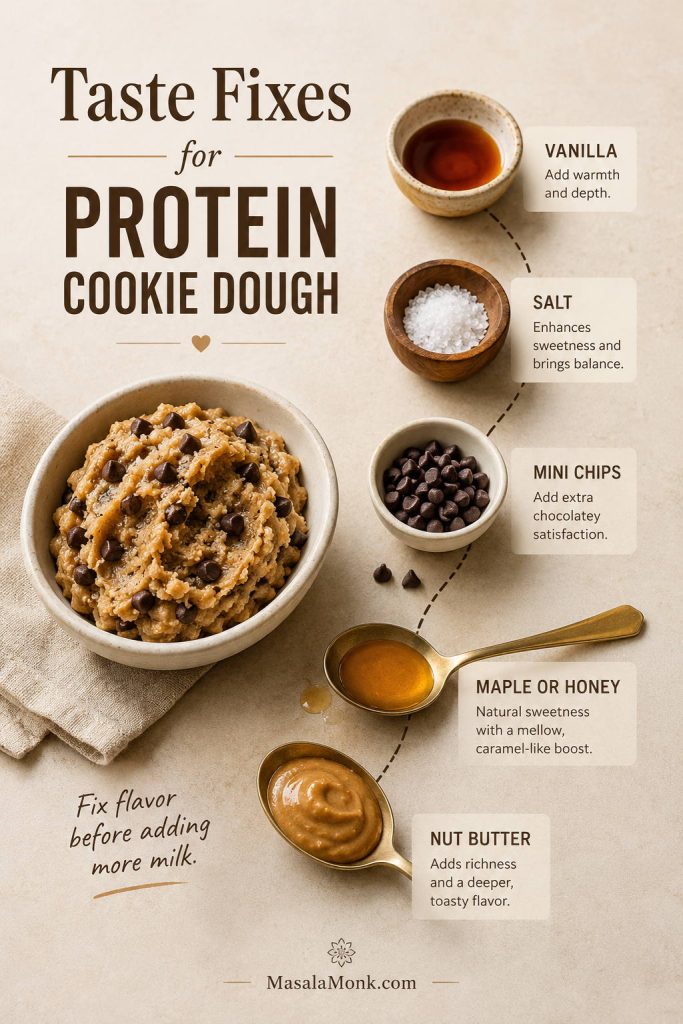
How to Make It Taste More Like Cookie Dough

Protein cookie dough taste-fix board with vanilla, salt, chocolate chips, syrup, and nut butter for better flavor
If the flavor feels too protein-heavy, vanilla, salt, nut butter, syrup, and mini chips can improve the dough without making it runnier.
  • Add a little more vanilla if the flavor tastes flat.
  • Add a tiny pinch of salt if the dough tastes too sweet, bland, or protein-heavy.
  • Use mini chocolate chips so every spoonful gets chocolate.
  • Add 1 teaspoon maple syrup or honey if your protein powder is not very sweet.
  • Add 1 teaspoon nut butter if the dough tastes chalky or thin.
  • Chill the dough for 20–30 minutes if the flavor feels sharp right after mixing.
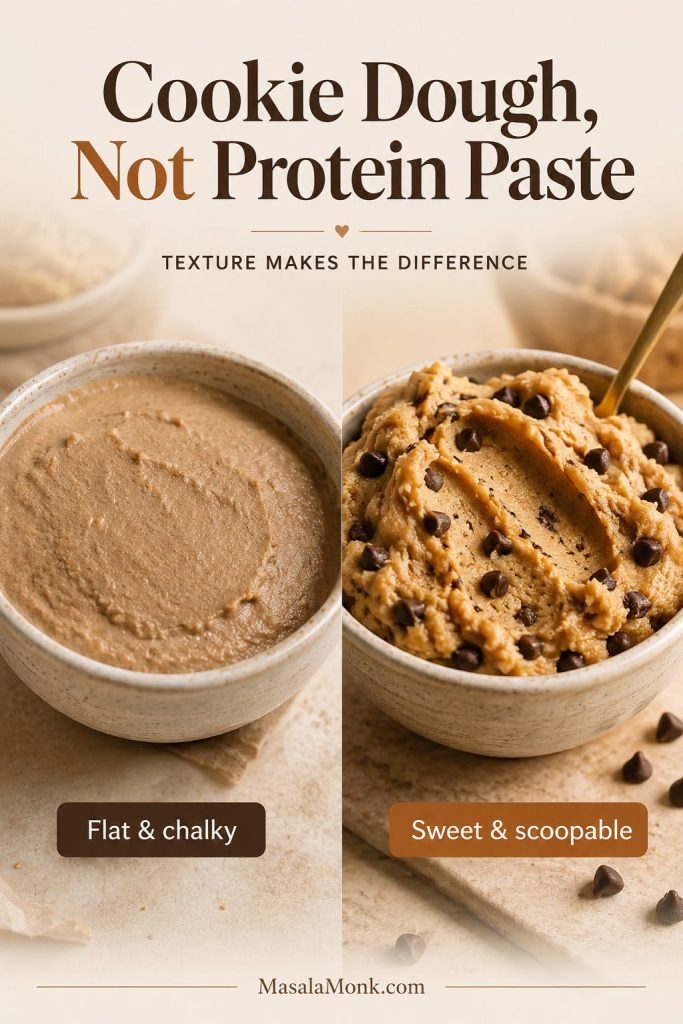
Cookie dough versus protein paste comparison showing dull chalky dough beside sweet scoopable chocolate chip dough
The best high-protein cookie dough still needs dessert appeal, so texture and flavor matter just as much as the protein number.

Once the base flavor tastes right, try one of the flavor variations to make the dough more dessert-like.

Protein Cookie Dough Flavor Variations

Protein cookie dough flavor variation board with peanut butter chip, birthday cake, double chocolate, cookies and cream, and cinnamon roll
Once the base dough is balanced, small mix-ins can take it toward peanut butter chip, birthday cake, double chocolate, cookies and cream, or cinnamon roll.
  • Peanut butter chocolate chip: Use peanut butter as the nut butter and keep the mini chocolate chips.
  • Birthday cake: Use vanilla protein powder, cashew butter, and a small spoonful of sprinkles.
  • Double chocolate: Add 1 tablespoon cocoa powder and a little extra milk if the dough gets too thick.
  • Cookies and cream: Fold in crushed chocolate sandwich cookies or a lighter cookie-style mix-in.
  • Cinnamon roll: Add cinnamon, vanilla, and a tiny pinch more salt.

For any dry mix-in like cocoa powder or crushed cookies, add a tiny splash of milk only after the dough is mixed so you do not accidentally make it loose.

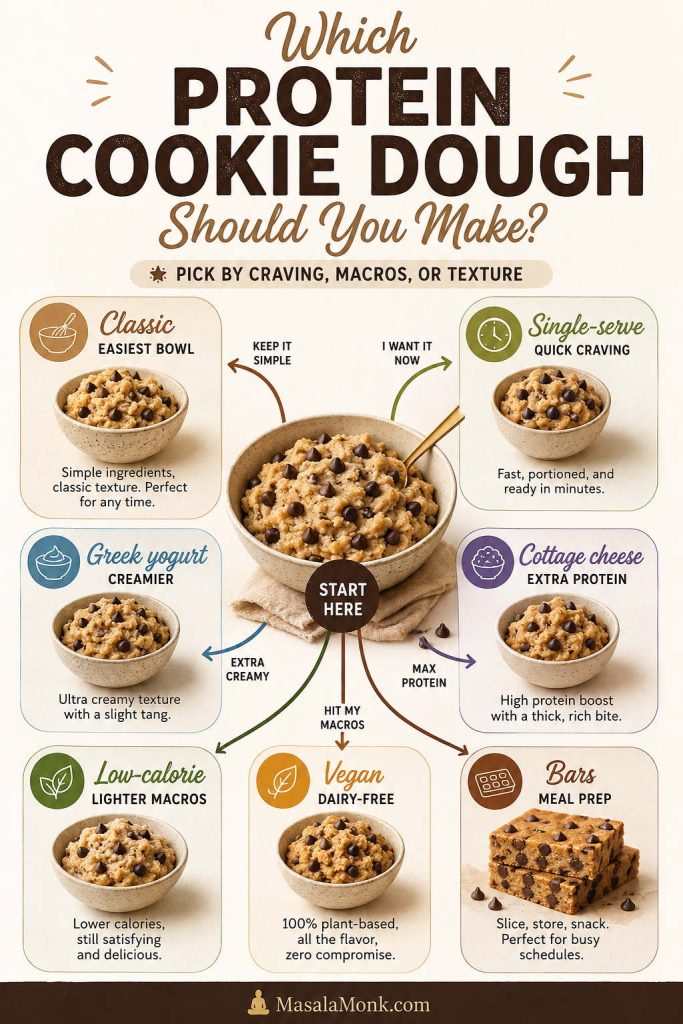
Which Protein Cookie Dough Version Should You Make?

Protein cookie dough version chooser showing classic, single-serve, Greek yogurt, cottage cheese, low-calorie, vegan, and bars
Use this guide by need: single-serve for speed, Greek yogurt or cottage cheese for creaminess, low-calorie for lighter macros, vegan for dairy-free, or bars for meal prep.
Version Best for Texture Use this base
Classic protein cookie dough Best overall Thick enough to scoop, soft enough to eat with a spoon Protein powder + flour + nut butter + Greek yogurt
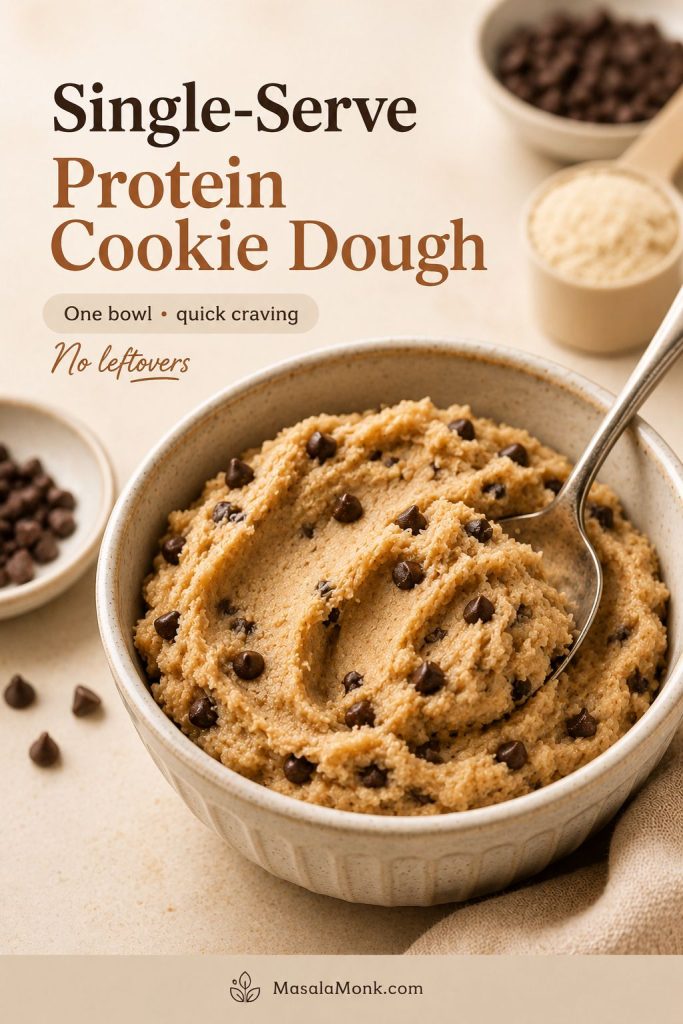
Single serve Quick craving Small-batch dough 30g protein powder + nut butter
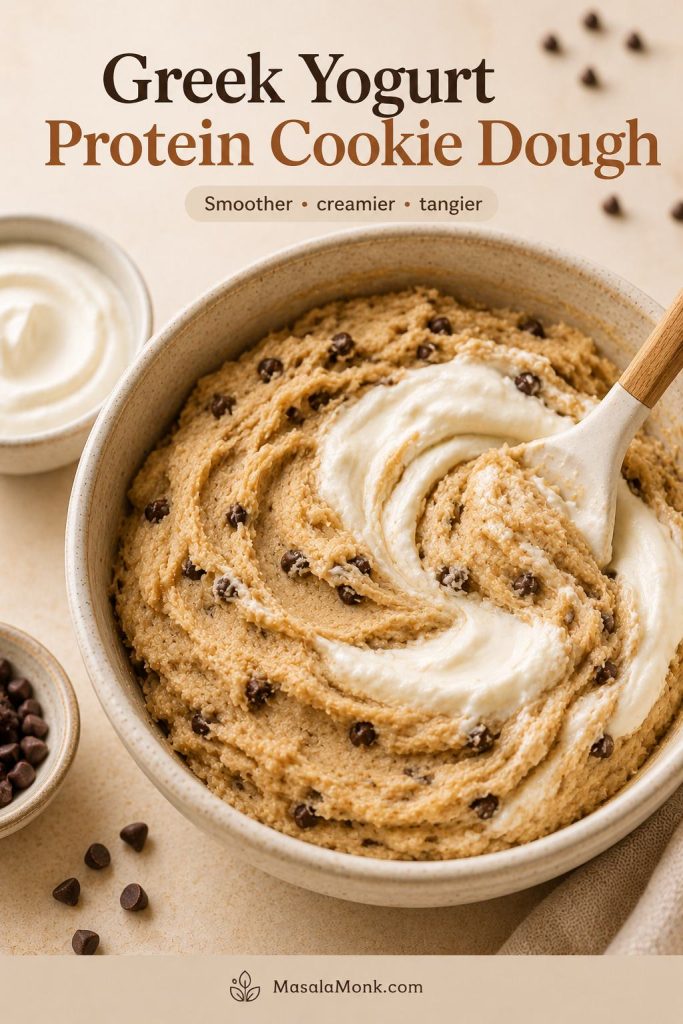
Greek yogurt Creamier snack Smoother, tangier, and more spoonable Greek yogurt + protein powder
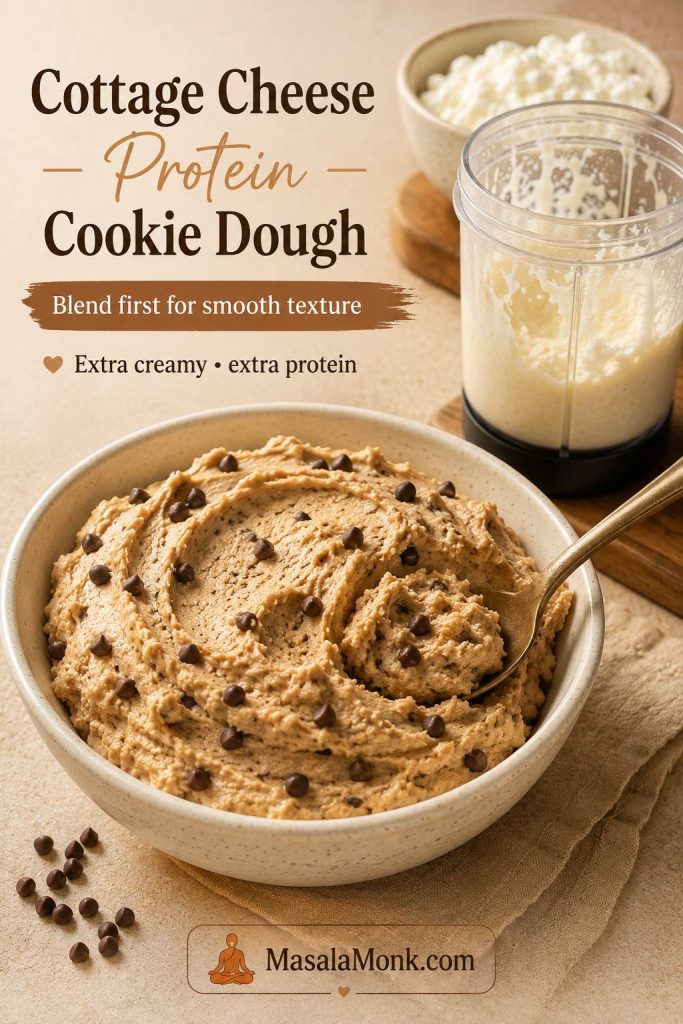
Cottage cheese Extra creamy, higher-protein variation Smooth and creamy when blended first Blended cottage cheese
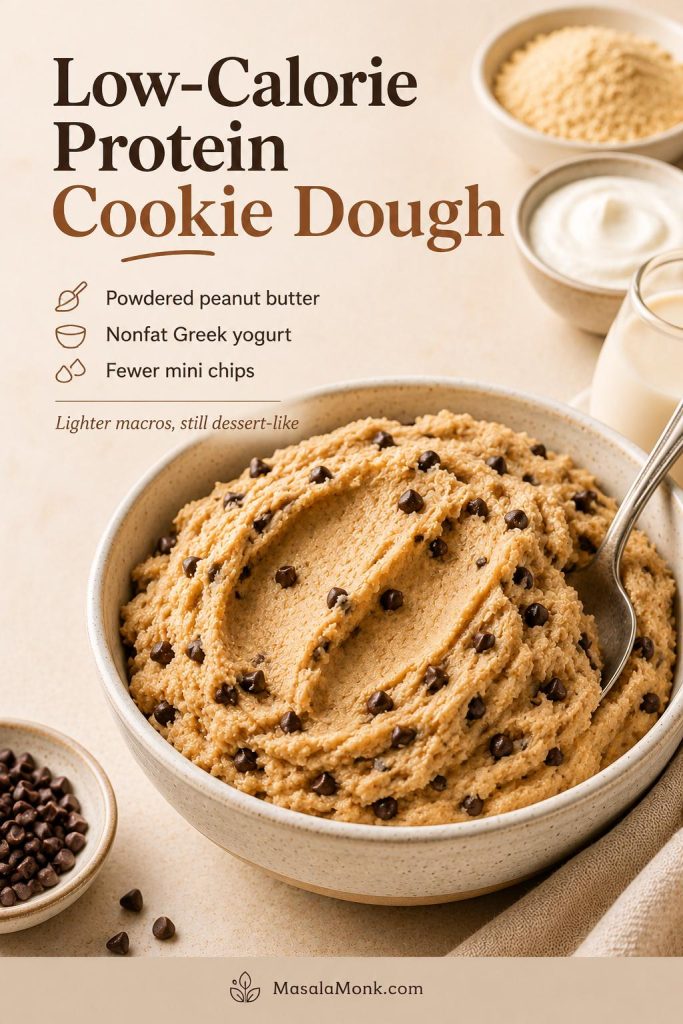
Low calorie Macro-friendly snack Lighter and less rich Powdered peanut butter + nonfat Greek yogurt
Vegan Dairy-free version Thick, sometimes chalkier Plant protein + dairy-free milk
Chickpea Plant-based/fiber-rich Thicker and dip-like Chickpeas + protein powder
Bars Meal prep Firm and sliceable Thicker dough + pan chill

Single-Serve Protein Cookie Dough

Single-serve protein cookie dough in a small bowl with mini chocolate chips, spoon, and quick snack portion
The single-serve version is ideal when you want one quick bowl now, especially if you do not want extra dough waiting in the fridge.
Ingredient Amount
Vanilla protein powder 30g
Almond flour or oat flour 2–3 tablespoons
Nut butter 1½ tablespoons
Greek yogurt or milk 1–2 tablespoons
Maple syrup or honey 1–2 teaspoons, optional
Vanilla extract ¼ teaspoon
Salt Pinch
Mini chocolate chips 1–2 tablespoons

Mix the dry ingredients first, stir in the nut butter and yogurt, then adjust with tiny splashes of milk until the dough is scoopable but not loose. This version can be higher in protein than the main recipe because it uses a full scoop of protein powder in one serving.

Greek Yogurt Protein Cookie Dough

Greek yogurt protein cookie dough with thick Greek yogurt being mixed in for a smoother and creamier texture
Greek yogurt gives the dough a softer, tangier bite, which helps balance the dryness some protein powders can bring.

To make the Greek yogurt version, increase the Greek yogurt to ½ cup and reduce the milk. Stir the dough well, then chill it for 20–30 minutes so the flour and protein powder can absorb the moisture. If the yogurt is very thick, add milk 1 teaspoon at a time. If the yogurt is loose, add a little more almond flour or oat flour.

Cottage Cheese Protein Cookie Dough

Cottage cheese protein cookie dough showing blended cottage cheese, finished dough, and the smooth texture after blending
The cottage cheese version depends on one important step: blend the cottage cheese smooth before mixing it into the dry base.

For a cottage cheese version, blend ½ cup cottage cheese with vanilla and 2–3 teaspoons maple syrup until smooth. Then stir it by hand into the protein powder, almond flour or oat flour, nut butter, salt, and chocolate chips. Add the chips after blending, not before.

If your blended cottage cheese is very loose, start with less milk or skip the milk completely until the dough is mixed.

Cottage cheese texture tip: Blend the cottage cheese first, then mix by hand after the dry ingredients go in. Over-blending the full dough can make it runnier.

If you enjoy creamy low-carb desserts, this keto cheesecake recipe is another good one to keep nearby, especially when you want something chilled and richer than a snack bowl.

Low-Calorie Protein Cookie Dough

Low-calorie protein cookie dough with powdered peanut butter, nonfat Greek yogurt, almond milk, and fewer mini chocolate chips
A lighter bowl should still taste satisfying, so use macro-friendly swaps without removing all the creaminess and chocolate.
Swap What it does
Powdered peanut butter Reduces fat and calories while keeping peanut flavor.
Nonfat Greek yogurt Adds creaminess and protein with fewer calories.
Mini chocolate chips Gives more chocolate in every bite with a smaller amount.
Sugar-free syrup, carefully Can reduce sugar, but may make the dough thinner or less rich.
Single-serving batch Helps with portion control and avoids extra leftovers.

For one lighter serving, start with 30g vanilla protein powder, 2 tablespoons powdered peanut butter, ¼ cup nonfat Greek yogurt, 1–2 teaspoons syrup or sweetener, vanilla, salt, and 1 tablespoon mini chocolate chips. Add almond milk 1 teaspoon at a time until the dough becomes scoopable.

For another creamy dessert with a lighter, healthier feel, this avocado chocolate mousse is a good next option when you want chocolate without baking.

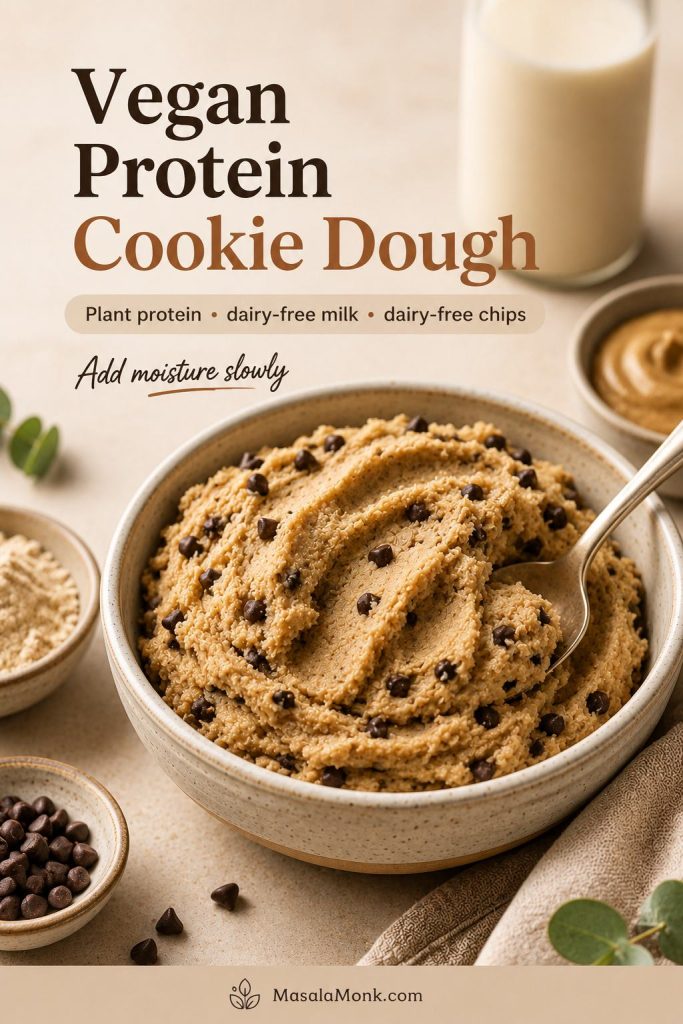
Vegan Protein Cookie Dough

Vegan protein cookie dough with plant protein powder, dairy-free milk, nut butter, and dairy-free chocolate chips
The vegan version usually needs a little more moisture and fat because plant protein can thicken quickly as it sits.

For a vegan batch, use ½ cup almond or oat flour, ½ cup plant protein powder, 2–3 tablespoons almond or cashew butter, 2–3 teaspoons maple syrup, vanilla, salt, dairy-free milk as needed, and dairy-free mini chocolate chips. Add the milk slowly because plant protein often thickens fast.

When plant protein tastes earthy, extra vanilla, a tiny pinch of salt, and mini chocolate chips help a lot. A little more nut butter can also soften the chalky edge without making the dough too loose.

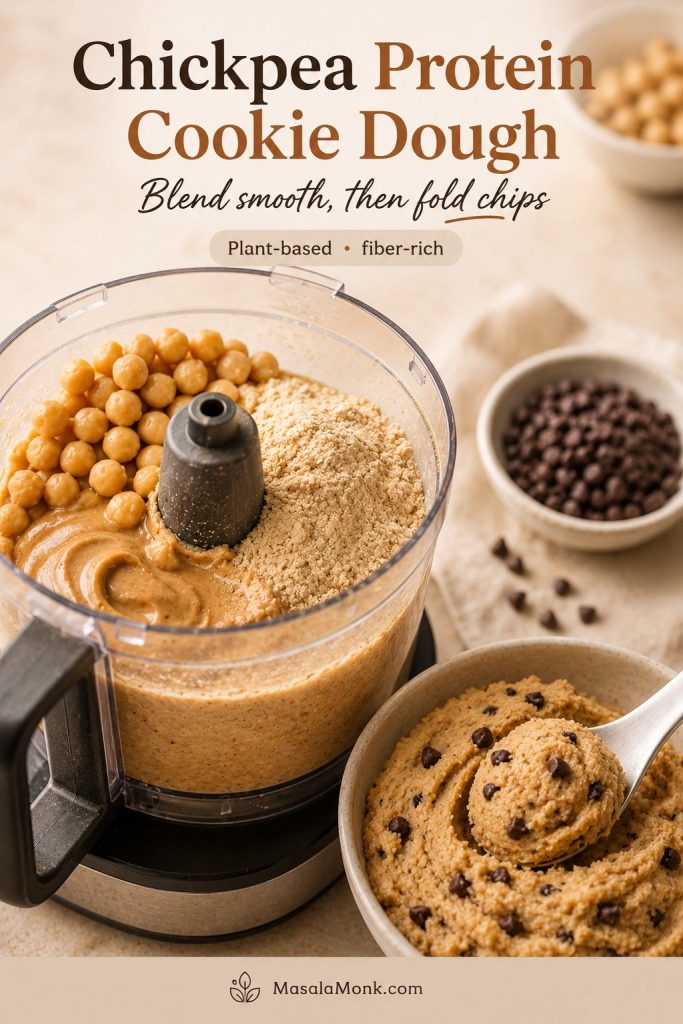
Chickpea Protein Cookie Dough

Chickpea protein cookie dough being made in a food processor with chickpeas, protein powder, nut butter, and chocolate chips
The chickpea version works best as a blended variation, since a food processor gives the base a smoother, dip-like texture.

For a chickpea version, start with 1 cup well-rinsed chickpeas, 30g vanilla protein powder, 2 tablespoons nut butter or sunflower seed butter, 1–2 tablespoons maple syrup, vanilla, salt, and 1–2 tablespoons milk as needed. Blend everything except the chocolate chips until smooth, then fold in the chips.

For the smoothest texture, rinse the chickpeas very well and remove the skins if you have time. Chilling the dough for 20–30 minutes also helps the flavor mellow and the texture thicken.

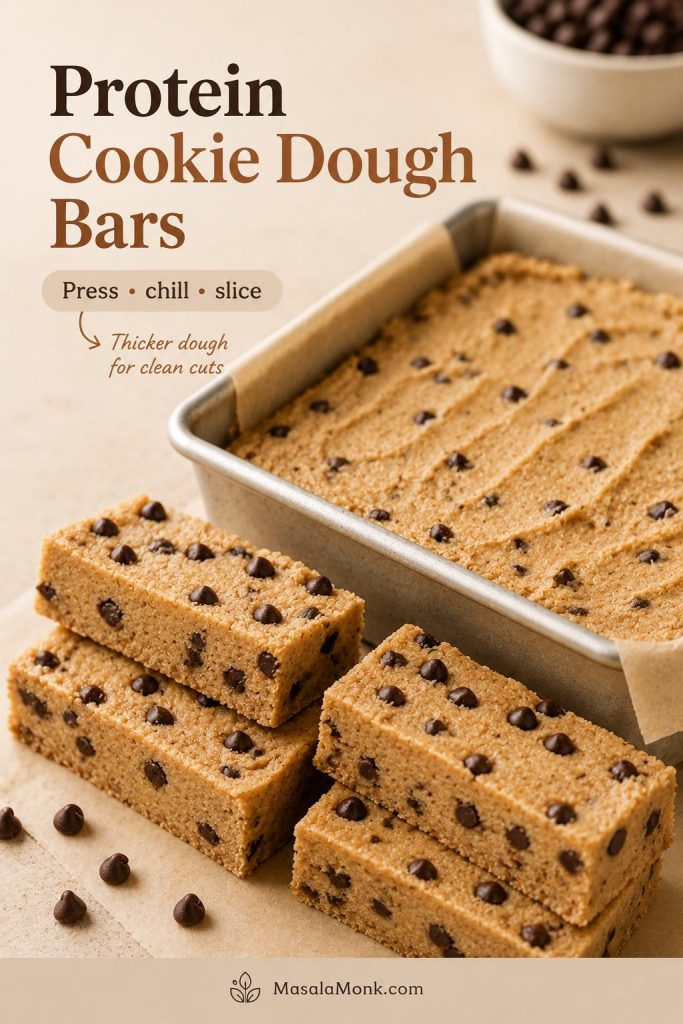
No-bake protein cookie dough bars sliced from a chilled parchment-lined loaf pan with mini chocolate chips visible
Protein cookie dough bars need a firmer base than the spoonable version, so they can chill, hold their shape, and slice cleanly.

After slicing, use the storage guide so the bars stay firm instead of drying out.

A loaf pan works well for a thicker small batch. Use an 8-inch square pan only if you are doubling the recipe, otherwise the bars may be too thin.

For a more dessert-like bar, spread melted chocolate over the chilled dough and chill again until set. For a softer snack bar, skip the chocolate coating and keep the chocolate chips mixed into the dough.

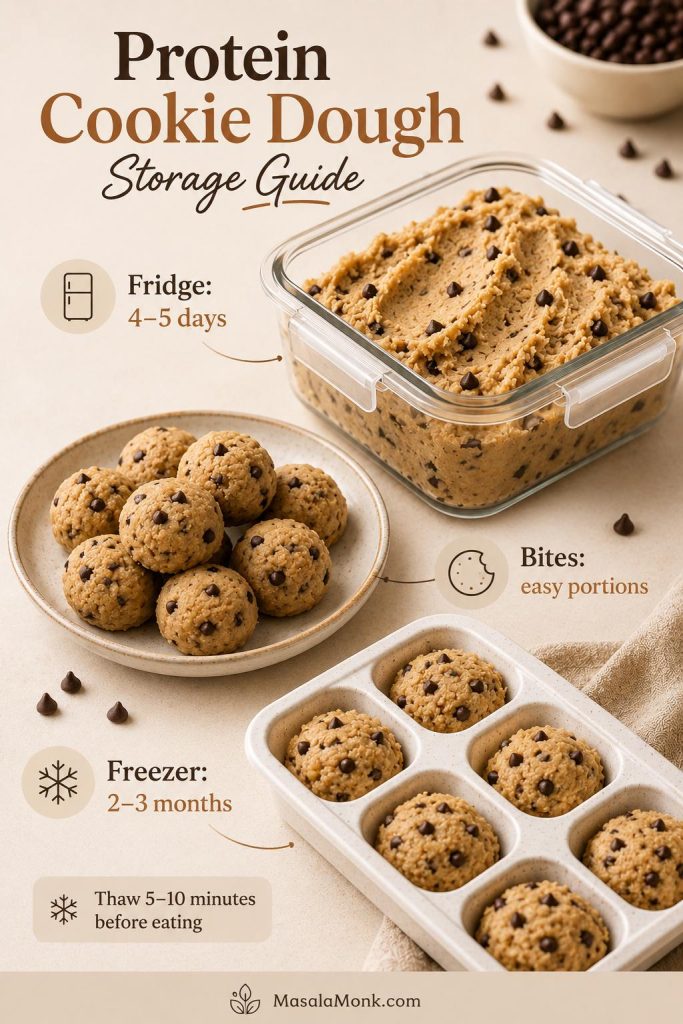
Storage and Freezer Tips

Protein cookie dough storage guide showing an airtight fridge container, rolled snack bites, and freezer portions
For easy snack prep, keep protein cookie dough chilled in a container or freeze small portions that soften after a few minutes.
Storage method How long Best tip
Airtight container in the fridge 4–5 days Stir before serving if it firms up.
Rolled balls in the fridge 4–5 days Use a small cookie scoop for even portions.
Freezer portions 2–3 months Freeze on a tray first, then move to a container.
Cookie dough bars Up to 1 week chilled Keep parchment between layers if stacking.

For bites, chill the dough until it is firm enough to scoop, then roll it into small balls and store them in the fridge or freezer. They are easier to portion than a full bowl and work well for snack prep.

Frozen portions taste best after sitting at room temperature for 5–10 minutes. They should soften slightly but still hold their shape.

What to Eat With Protein Cookie Dough

You can absolutely eat this straight from the bowl. That is the point. But if you make extra, it also turns into an easy topping, dip, or freezer snack.

Think of it as a spoonable snack first, then use leftovers anywhere you would normally want a sweet, cookie-dough-style topping.

  • Scoop it into small snack balls.
  • Serve it with apple slices.
  • Swirl it into Greek yogurt.
  • Crumble it over smoothie bowls.
  • Press it into bars.
  • Freeze it into bite-size portions.
  • Use it as a high-protein dessert dip.

Once you understand the texture, this becomes the kind of recipe you can make by feel: a little more milk for spoonable, a little more flour for scoopable, and a little more vanilla and salt when the protein powder tries to take over.

Different protein powders can change this dough a lot. If you try it with whey, casein, collagen, or plant protein, note how much milk it needed and whether the final texture turned out scoopable, sticky, dry, or firm. That is the kind of detail other readers actually want before they open a new tub of protein powder, so it is worth sharing if your powder behaved differently.

After one batch, you will probably know exactly how your protein powder behaves. From there, this becomes an easy fridge snack you can make by feel — thicker for cookie dough bites, softer for spooning, sweeter when it is dessert, and lighter when you just want a quick protein treat.

Ready to make it now? Jump to the full protein cookie dough recipe card.

FAQs About Protein Cookie Dough

Why is my protein cookie dough dry?

Your protein powder probably absorbed more liquid than expected. Casein and plant-based protein powders are especially thirsty, so add milk or Greek yogurt 1 teaspoon at a time until the dough softens.

Why did my protein cookie dough turn sticky?

Sticky dough usually means too much syrup, nut butter, or milk. First, chill it for 20–30 minutes. After that, add almond flour or oat flour 1 teaspoon at a time if the mixture still feels too loose.

Which protein powder tastes best in cookie dough?

A good vanilla whey-casein blend is usually the easiest choice for a balanced dough texture. Whey can be smooth but sticky, casein can be thick and dry, and plant protein may need more moisture and flavor support.

Best peanut butter substitutes for protein cookie dough

Peanut butter is not required. Almond butter, cashew butter, sunflower seed butter, tahini, or a mix of Greek yogurt and powdered peanut butter can all work. The flavor and texture will change slightly, but the recipe still holds together.

Using powdered peanut butter in protein cookie dough

Powdered peanut butter works best in the low-calorie version because it keeps peanut flavor while reducing fat. Since it can taste drier than regular nut butter, pair it with Greek yogurt and add milk slowly until the dough is scoopable.

No Greek yogurt? Use this texture fix

Greek yogurt helps with creaminess, but the recipe can work without it. Replace it with more nut butter and a little milk, or use dairy-free yogurt for a vegan version. Since yogurt also adds thickness, add the liquid slowly so the dough does not become loose.

Is almond flour safe in no-bake cookie dough?

This recipe avoids raw all-purpose wheat flour, which is the main flour concern in classic raw cookie dough. Use fresh almond flour or oat flour from a reputable source, keep the finished dough chilled, and do not swap in regular raw wheat flour unless it is specifically labeled for edible dough.

Freezing protein cookie dough without ruining the texture

Roll the dough into balls or portion it into small scoops, freeze on a tray, then transfer to an airtight container. Let frozen portions sit for 5–10 minutes before eating so they soften slightly without turning mushy.

Should you bake this dough into cookies?

This recipe is designed as edible no-bake dough. Protein powder behaves differently when baked, so a dedicated protein cookie recipe will give you a better baked texture.

Lower-calorie protein cookie dough swaps that still taste good

Use powdered peanut butter, nonfat Greek yogurt, sugar-free syrup if you like it, and a smaller amount of mini chocolate chips. A single-serving batch is usually the easiest way to keep the calories controlled without making a large bowl of leftovers.

Vegan protein cookie dough: what changes?

Plant-based protein powder usually thickens more and can taste earthier than whey. Use almond or oat flour, nut butter, maple syrup, dairy-free milk, and dairy-free chocolate chips, then add extra milk or nut butter if the dough tastes chalky.

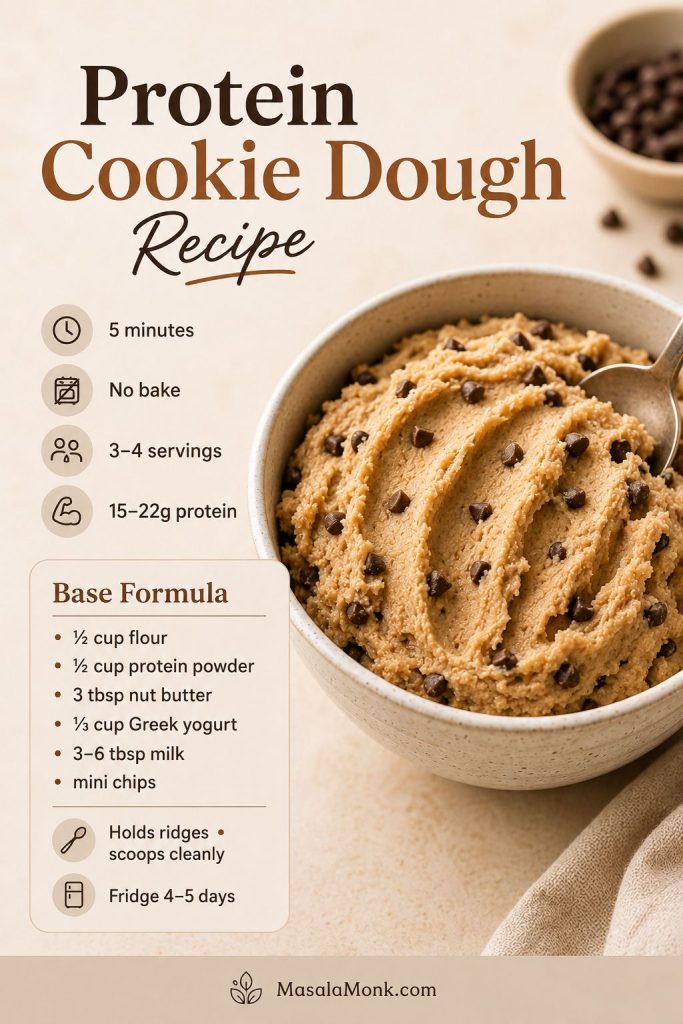
Protein cookie dough recipe card showing the base formula, five-minute prep time, protein estimate, texture target, and storage
Save the base formula as a texture guide: equal parts flour and protein powder, creamy ingredients for richness, then milk only until scoopable.

Protein Cookie Dough Recipe Card

This edible protein cookie dough is no-bake, egg-free, creamy, and ready in about 5 minutes. Chill it for a firmer cookie-dough bite, or eat it right away while it is softer and freshly mixed.

Texture target: The dough should hold ridges when stirred, scoop cleanly, and feel thick but not dry. Pourable dough needs more dry structure, while crumbly dough needs a little more moisture.

Servings 3–4
Prep Time 5 minutes
Chill Time Optional 20–30 minutes
Cook Time 0 minutes

Equipment

  • Medium mixing bowl
  • Spatula or sturdy spoon
  • Measuring cups and spoons
  • Kitchen scale, optional but helpful
  • Airtight container for storage

Ingredients

Ingredient US amount Metric amount
Almond flour or oat flour ½ cup 50–56g
Vanilla protein powder ½ cup 50–60g
Creamy peanut, almond, or cashew butter 3 tablespoons About 48g
Plain thick Greek yogurt ⅓ cup About 80g
Maple syrup or honey 2–3 teaspoons 10–15ml
Milk or almond milk 3–6 tablespoons, added gradually 45–90ml
Vanilla extract ½ teaspoon 2.5ml
Fine salt ¼ teaspoon About 1.5g
Mini chocolate chips 3 tablespoons 30–40g

Instructions

  1. Stir the almond flour or oat flour, protein powder, and salt together in a medium bowl.
  2. Mix in the nut butter, Greek yogurt, maple syrup or honey, and vanilla until a thick dough starts to form.
  3. Add milk or almond milk 1 tablespoon / 15ml at a time, mixing well after each addition, until the dough holds ridges when stirred and scoops cleanly.
  4. Fold in the mini chocolate chips.
  5. Eat immediately for a softer dough, or cover and chill for 20–30 minutes for a firmer cookie-dough bite.

Notes

  • Protein powders absorb liquid differently, so start with less milk and add more gradually.
  • Chilling is optional, but it improves both texture and flavor because the flour and protein powder have time to hydrate.
  • Divide the batch into 3 servings for a higher-protein snack or 4 servings for smaller dessert portions.
  • Use 3 teaspoons maple syrup or honey for a sweeter dessert-style dough, or start with 2 teaspoons for a less sweet snack.
  • When the dough is wet, build it back up with almond flour, oat flour, or protein powder 1 teaspoon at a time.
  • For dry dough, add milk or Greek yogurt 1 teaspoon at a time until it softens.
  • Strong protein-powder flavor usually improves with extra vanilla, a tiny pinch of salt, or 1 teaspoon nut butter before adding more milk.
  • Do not use regular raw all-purpose flour in this no-bake recipe.

Storage

Store protein cookie dough in an airtight container in the fridge for 4–5 days. For longer storage, portion it into balls or scoops and freeze for 2–3 months. Let frozen portions sit for 5–10 minutes before eating.

Estimated Protein and Calories

Protein and calories will vary by powder, yogurt, flour, nut butter, milk, syrup, chocolate chips, and serving size. As a rough guide, this batch usually lands around 15–22g protein per serving when divided into 3–4 portions, with about 225–400 calories per serving depending on portion size and ingredients. Use your own labels for the most accurate numbers.
Posted on 7 Comments

Air Fryer Hard-Boiled Eggs (No Water, Easy Peel Recipe)

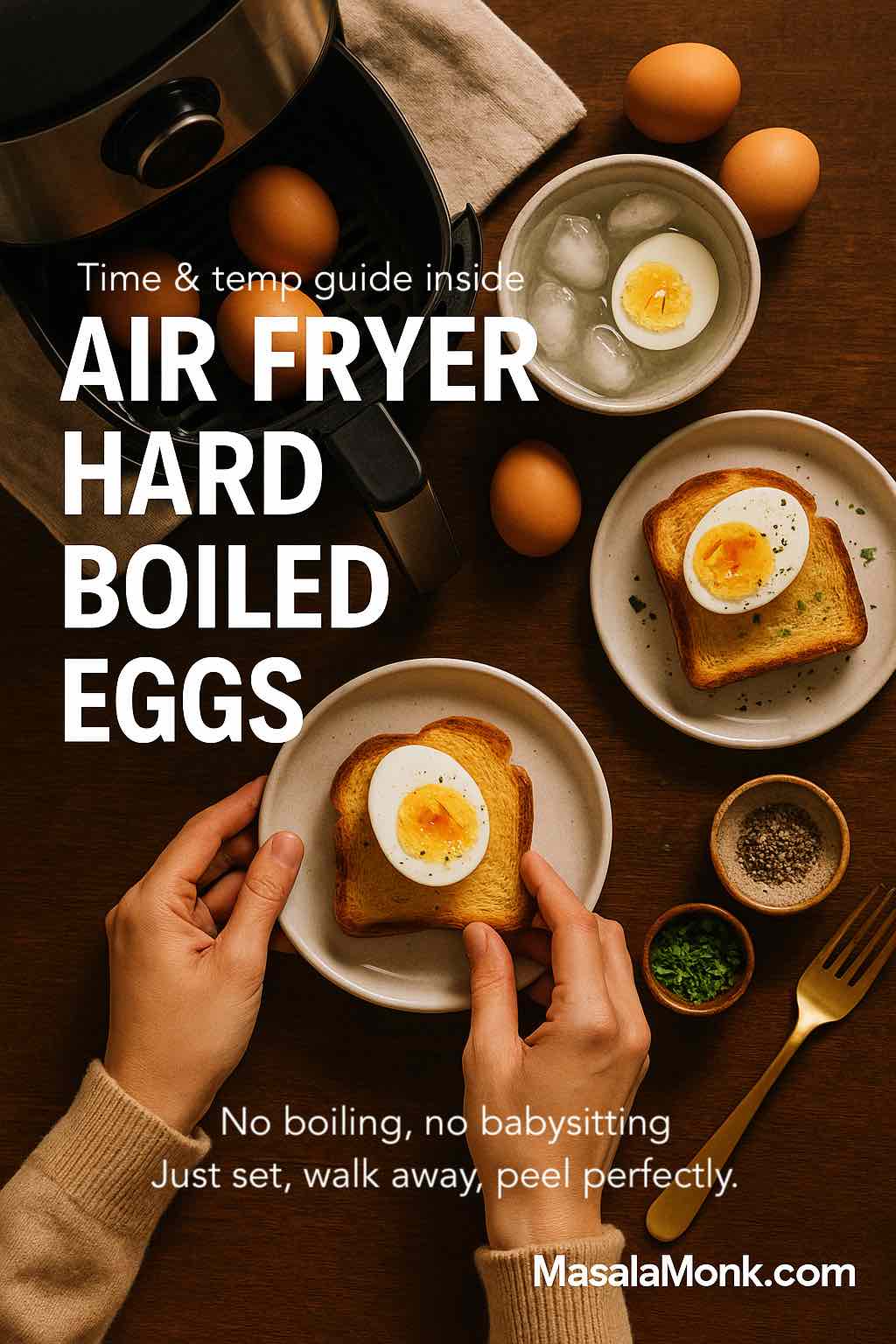
Top view of a person holding toast topped with a halved air fryer hard boiled egg, next to an open air fryer basket filled with eggs, a bowl of eggs in ice water, and text reading "Air Fryer Hard Boiled Eggs – Time & temp guide inside".

If there’s one tiny kitchen trick that quietly changes your weekly routine, it might be this: making air fryer hard boiled eggs instead of dragging out a pot of water every time you want a few eggs. You lay them gently in the basket, set the time, walk away, and come back to perfectly cooked eggs that slide out of their shells with almost no effort.

No hovering over the stove. No pan to scrub. Just reliable, easy-peel eggs you can eat on toast, turn into deviled eggs, throw into salads, or stash in the fridge for busy days.


What Are Air Fryer Hard Boiled Eggs, Really?

The phrase “hard boiled eggs” is a bit of a lie here, because there’s no actual boiling. Instead of simmering in water, the eggs sit in the dry, circulating heat of the air fryer. The shells protect the whites and yolks, and the hot air cooks them kind of like a tiny oven.

The result is surprisingly close to classic boiled eggs:

  • Whites set and firm
  • Yolks as soft, jammy, or firm as you like, depending on time
  • Shells that usually peel very cleanly after a cold plunge

Curious about how other recipe developers handle it too? It’s interesting later to compare this method with recipes like Feel Good Foodie’s air fryer hard boiled eggs, but first it’s helpful to get your own timing dialed in.


Why Bother With Air Fryer Hard Boiled Eggs?

You might already have a foolproof stovetop method. So why move to the air fryer?

Less watching, more living

On the stove, you need to:

  • Bring water to a boil
  • Lower in the eggs gently
  • Track the timing
  • Adjust the heat to maintain a gentle simmer

With an air fryer, you:

  1. Preheat
  2. Put the eggs in
  3. Set the time
  4. Walk away

That makes it incredibly convenient if you’re also juggling toast, coffee, kids, or work messages in the morning.

Easily scale up or down

Some days you just need one egg for a snack. Other days you want a whole batch for meal prep. Either way, air fryer hard boiled eggs handle it effortlessly:

  • One egg cooks just as easily as eight
  • The method stays the same; you may only tweak the time by a minute if you pack the basket

It’s especially handy if you’re prepping a full week’s worth of eggs for breakfast boxes or high-protein snacks. If you’re tracking macros or protein intake, it’s useful to know exactly how much protein two boiled eggs give you, so a weekly batch practically becomes a pre-portioned protein stash in the fridge.

Great for meal prep and snacking

Because hard cooked eggs store well, they’re perfect for:

  • Lunchboxes
  • Salad toppers
  • Quick snacks with just a pinch of salt and spice
  • Deviled eggs for parties

The USDA notes that once eggs are hard-cooked and refrigerated, they can be safely stored for up to one week. That guideline, explained in their note on how long you can keep hard cooked eggs, makes a weekly egg-prep session genuinely worthwhile.


Ingredients and Equipment

You might already have everything you need.

Ingredients

  • Eggs – any number that fits in a single layer in your air fryer basket
  • Ice and cold water – for an ice bath to stop cooking and help with peeling

That’s all. No oil, no vinegar, no baking soda tricks required.

Equipment

  • Air fryer – basket or drawer style
  • Tongs or a spoon – to lift hot eggs safely
  • Large bowl – to hold the ice water bath

If you’re new to air fryers in general, it’s worth giving a quick read to 12 common air fryer mistakes and how to fix them. Simple things like overcrowding, skipping preheating, or using the wrong temperature can make a big difference with eggs too.


Step-by-Step Recipe: Air Fryer Hard Boiled Eggs

Let’s walk through the whole process from cold eggs to easy-peel perfection.

Step 1: Preheat the air fryer for Hard Boiled Eggs

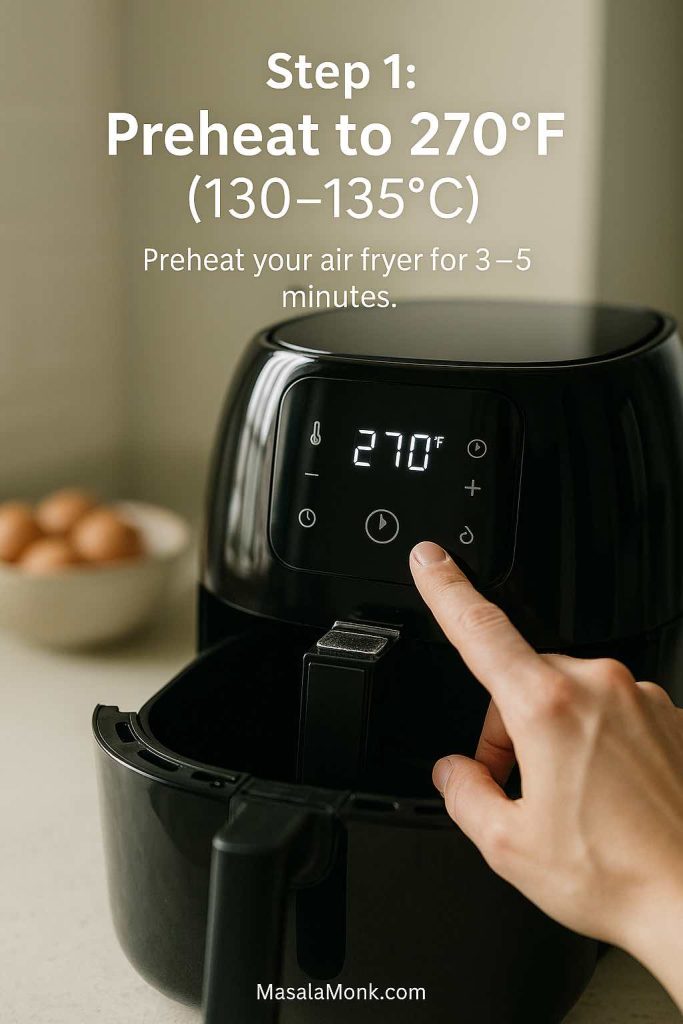
Begin by preheating your air fryer to 270°F (about 130–135°C) for 3–5 minutes.

Step 1 for making air fryer hard boiled eggs – hand pressing the start button on a black air fryer preheated to 270°F (130–135°C).
Step 1: For perfectly cooked air fryer hard boiled eggs, preheat the air fryer to 270°F (130–135°C) for 3–5 minutes so the eggs go into evenly hot air, not a cold basket.

This short preheat helps ensure the eggs start cooking in a stable, even environment. If you’ve ever had eggs with slightly undercooked whites or overcooked yolks, a proper preheat alone can fix a lot of that inconsistency.

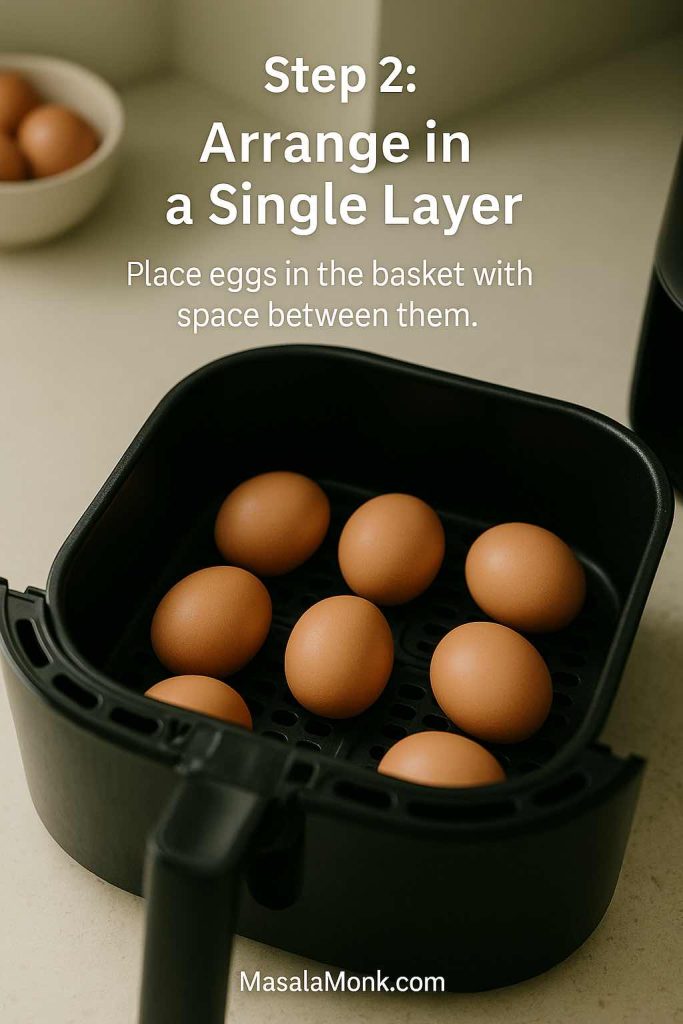
Step 2: Arrange the eggs in the basket

Once the air fryer is hot, carefully place the eggs in the basket:

  • Lay them in a single layer
  • Leave a little space between each egg so hot air can circulate
  • Avoid stacking or using multiple racks for this method
Step 2 for air fryer hard boiled eggs – eight brown eggs arranged in a single layer inside a black air fryer basket with space between each egg.
Step 2: Arrange the eggs in a single layer in the air fryer basket with a little space between them. This helps every egg cook evenly and reduces the chance of shells cracking while they “boil” in the air fryer.

Packing too many eggs too tightly can cause uneven cooking, especially at the edges of the basket. A little breathing room gives you more consistent results.

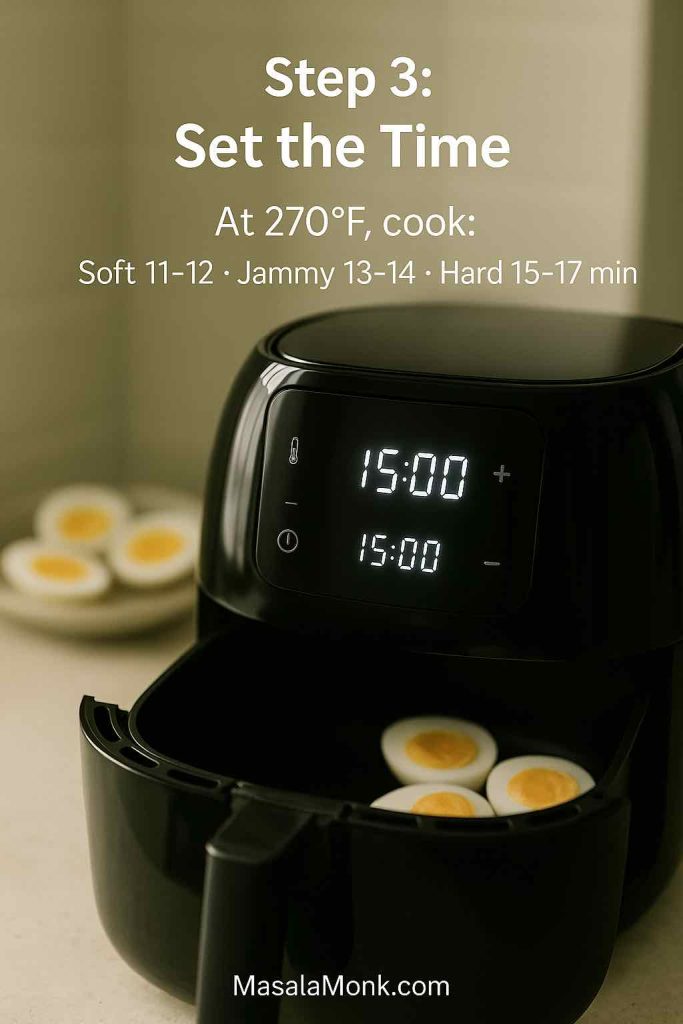
Step 3: Set the time and temperature

Now comes the key part: the timing.

At 270°F (about 132°C), these ranges work well:

  • Soft “boiled” eggs with runny yolks:
    About 11–12 minutes
  • Jammy eggs with custardy yolks:
    Around 13–14 minutes
  • Fully hard boiled eggs with firm yolks:
    Roughly 15–17 minutes
Step 3 for making air fryer hard boiled eggs – close-up of an air fryer set to 270°F and 15 minutes, with sliced eggs in the background showing soft, jammy, and hard yolks.
Step 3: Set the timer based on how you like your air fryer hard boiled eggs – about 11–12 minutes for soft eggs, 13–14 minutes for jammy centers, and 15–17 minutes for fully hard yolks, then adjust by a minute to match your own air fryer.

As a starting point, many people enjoy hard boiled eggs at about 15 minutes, then adjust slightly up or down on the next batch. Air fryers vary a bit in intensity, so once you test your machine, you’ll know your own perfect “house timing”.

If you’re curious how other cooks adapt the same idea, recipes like Skinnytaste’s air fryer hard boiled eggs or Cook At Home Mom’s air fryer eggs use similar combinations of temperature and timing, which can reassure you that you’re in a safe, sensible range.

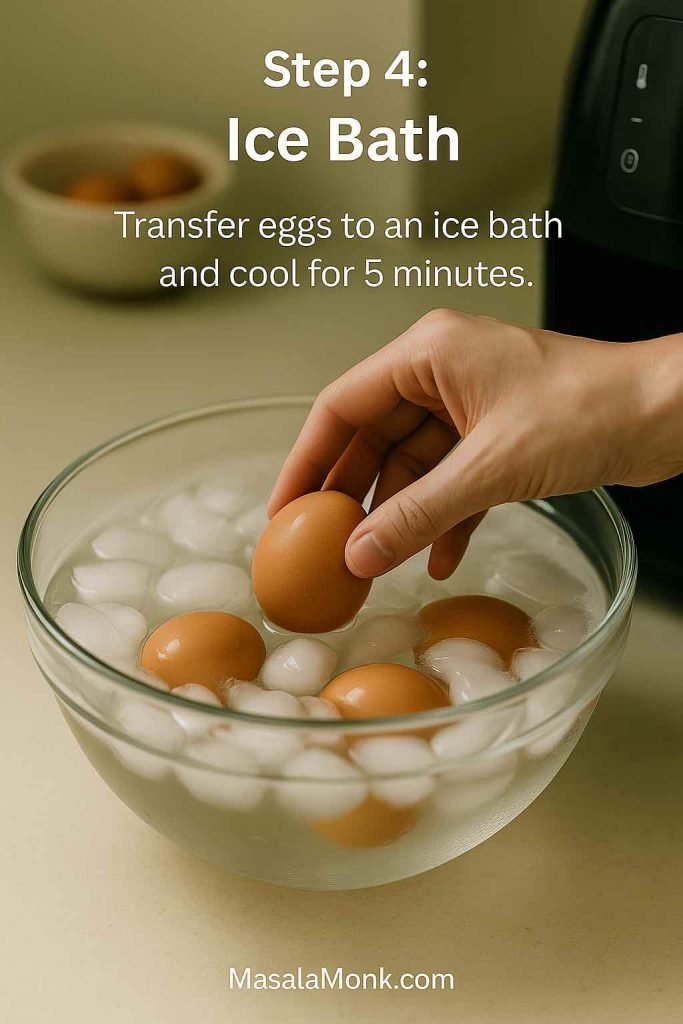
Step 4: Shock the eggs in an ice bath

As soon as the timer beeps, move quickly:

  1. Carefully lift the eggs from the basket with tongs or a spoon.
  2. Transfer them straight into a bowl filled with ice and cold water.
  3. Let them rest there for at least 5–10 minutes.
Step 4 for air fryer hard boiled eggs – hand lowering a cooked egg into a glass bowl filled with ice water to cool the eggs quickly.
Step 4: Transfer the cooked eggs straight into an ice bath and let them cool for 5–10 minutes. Rapid chilling stops the cooking and makes air fryer hard boiled eggs much easier to peel.

This “shock” does two important things:

  • It stops the cooking instantly, so your yolks don’t overcook and turn chalky.
  • It helps the membrane pull away from the shell, making the eggs significantly easier to peel.

The FDA’s egg safety guidance on what you need to know about egg safety also emphasizes proper chilling and refrigeration to minimize foodborne risk, which is another good reason not to skip the ice bath.

Step 5: Peel or store Air Fryer Hard Boiled Eggs

After the eggs have cooled down:

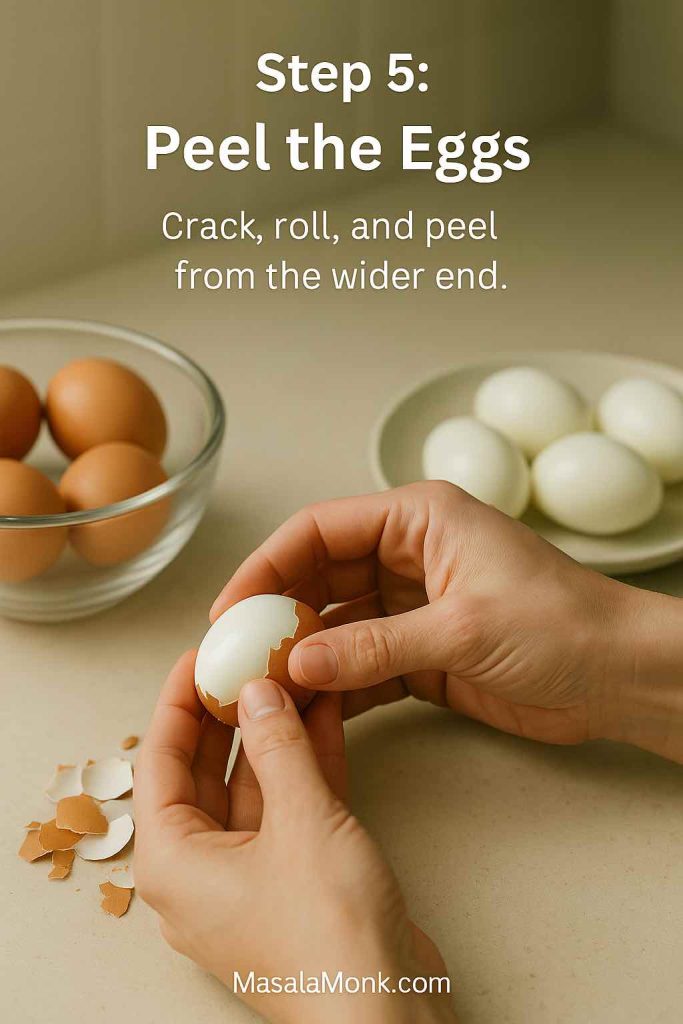
  • Crack each egg gently on the counter, then roll it to create a network of cracks.
  • Start peeling from the wider end; there’s often a little air pocket there that makes it easier to get under the shell.
  • If the shell clings in spots, peel under a gentle stream of running water to loosen it.
Step 5 for air fryer hard boiled eggs – hands peeling a hard boiled egg on a countertop with eggshells scattered and a bowl of whole eggs in the background.
Step 5: Gently crack and roll each egg, then peel from the wider end where the air pocket sits. This helps the shell slip off cleanly so your air fryer hard boiled eggs look smooth and photo-ready.

You can now:

  • Eat the eggs right away
  • Store them whole and unpeeled in the fridge
  • Peel them all at once and keep them in an airtight container for quick snacks

For food safety, the USDA’s note on how long to keep hard cooked eggs clearly states they can be refrigerated for up to one week. That applies whether the eggs are peeled or still in their shells, as long as they’ve been chilled promptly.

Also Read: Negroni Recipe: Classic Cocktail & Its Variation Drinks


Air Fryer Hard Boiled Eggs: Soft, Jammy, and Hard

The beauty of this method is how easy it is to fine-tune the yolks.

How to make Soft air fryer eggs

If you love a runny yolk for dipping toast, try:

  • 11–12 minutes at 270°F, followed by the same ice bath
Soft air fryer egg sliced in half to show a runny yolk, with text indicating 11–12 minutes at 270°F and serving ideas over toast, ramen, and roasted veggies.
Soft air fryer eggs: Cook for 11–12 minutes at 270°F for a set white and runny yolk that’s perfect for dipping toast, topping hot ramen, or serving with roasted veggies on the side.

The white should be set while the center stays liquid or very soft. These are gorgeous served:

  • Over toast with butter and black pepper
  • On top of hot ramen or noodle soup
  • Alongside roasted veggies and bread

Also Read: How to Cook Perfect Rice Every Time (Recipe)

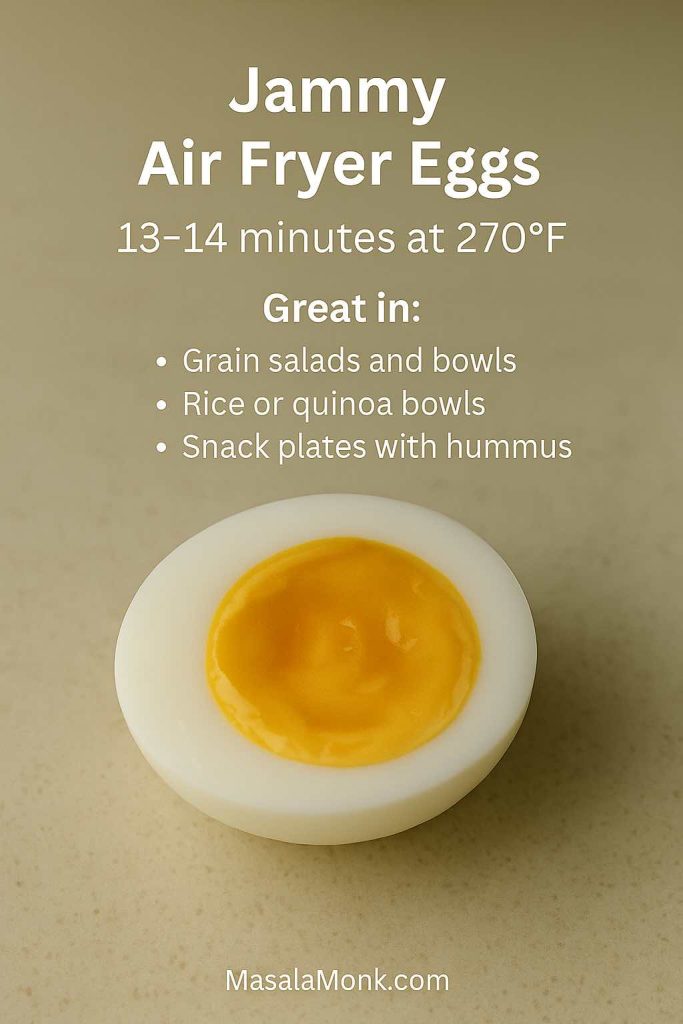
How to make Jammy air fryer eggs

Jammy eggs fall right in the middle: the yolk is thick and creamy rather than runny or crumbly.

  • Aim for 13–14 minutes at 270°F, then chill in ice water
Jammy air fryer egg sliced in half with a thick, creamy yolk, with text showing 13–14 minutes at 270°F and serving ideas for grain salads, rice bowls, and snack plates with hummus.
Jammy air fryer eggs: Cook for 13–14 minutes at 270°F to get a thick, custardy yolk that’s perfect for grain salads, rice or quinoa bowls, and snack plates with hummus and veggies.

This texture shines in:

  • Salads (especially grain-based ones)
  • Rice and quinoa bowls
  • Snack plates with vegetables, hummus, and a few olives

How to make Classic Air Fryer Hard Boiled Eggs

For air fryer hard boiled eggs that slice cleanly and mash well:

  • Go with 15–17 minutes at 270°F, depending on how firm you prefer the yolk
Hard air fryer egg sliced in half with a fully set yolk, with text showing 15–17 minutes at 270°F and serving ideas like egg salad, deviled eggs, and sandwiches.
Hard air fryer eggs: Cook for 15–17 minutes at 270°F for firm yolks that hold their shape. These hard boiled air fryer eggs are perfect for egg salad, deviled eggs, and slices on sandwiches or buttery toast.

These are ideal for:

  • Egg salad
  • Deviled eggs
  • Sliced eggs on sandwiches or toast
  • Protein-packed lunch boxes

Once you’ve tested your air fryer, you can even jot down separate timings for “soft,” “jammy,” and “hard” on a sticky note and keep it near the machine.

Also Read: Whiskey Sour Recipe: Classic Cocktail, Best Whiskey & Easy Twists


Ways to Use Air Fryer Hard Boiled Eggs

Having a container of air fryer hard boiled eggs in the fridge is like having a little protein toolkit ready whenever hunger hits.

Deviled eggs and party platters

Perhaps the most classic way to dress up hard boiled eggs is to turn them into deviled eggs. After you cook and chill your eggs in the air fryer, you can follow the fillings and flavor variations from this deviled eggs recipe with eight delicious twists.

Because air fryer hard boiled eggs usually have:

  • Evenly cooked yolks
  • Shells that peel cleanly

they’re perfect for deviled eggs that look neat enough to take to potlucks, brunches, or holiday tables.

Everyday breakfasts (and special brunches)

It’s very easy to build breakfast around a couple of eggs:

  • Slice them over buttered toast with a sprinkle of chilli flakes.
  • Pair them with a small fruit bowl and coffee.
  • Serve them alongside sautéed greens or leftover veggies.

On weekends or special mornings, you can go further and pair your air fryer hard boiled eggs with something sweet from the same appliance, such as french toast sticks that work in both the oven and the air fryer.

If you’re cooking for someone who avoids eggs but still loves brunch, you could switch them to vegan french toast with air fryer options or eggless french toast that’s crispy and fluffy while you enjoy your eggs on the side.

High-protein snacks

Hard boiled eggs are basically ready-made high-protein snacks. Two eggs alone make a surprisingly satisfying mini-meal. For more detailed macro info, you can peek at this breakdown of protein in three scrambled eggs, then adapt the numbers for your boiled eggs.

For a snack plate, try combining:

  • A couple of egg halves
  • Some cut vegetables
  • A handful of nuts or seeds
  • A little hummus or yogurt dip

When you’d rather keep things plant-based, it’s nice to still lean on the air fryer. For example, high-protein vegan meal prep ideas using an air fryer offer plenty of tofu and legume-based options to enjoy alongside, or instead of, eggs.

Salads, bowls, and sandwiches

Because they slice and chop so neatly, hard boiled eggs slot beautifully into:

  • Green salads
  • Pasta salads
  • Grain bowls with roasted vegetables
  • Sandwiches and wraps

For a slightly more global twist, you might draw inspiration from a list of popular Mediterranean breakfasts, adding olives, cucumbers, tomatoes, olive oil, and fresh herbs around your eggs.


Simple Seasoning Ideas (and a Deep Dive if You Want One)

Plain boiled eggs with just a pinch of salt are comforting. Still, once you start sprinkling on spices and toppings, they get much more exciting.

If you want a full playground of ideas, there’s a dedicated guide to seasoning options that make eggs come alive, but here are a few easy combinations you can try immediately:

  • Classic: Sea salt, black pepper, a drizzle of olive oil
  • Desi-inspired: Chaat masala, red chilli powder, a squeeze of lime
  • Smoky: Smoked paprika, garlic powder, a tiny bit of butter
  • Crunchy: Toasted sesame seeds, soy sauce, chopped spring onions
  • Herby: Fresh coriander or parsley, lemon zest, cracked pepper

You can also slice eggs onto toasted buns or pav and spoon over a light hollandaise or yoghurt-based sauce if you’d like to riff on some of the ideas from a desi twist on Eggs Benedict.


Nutrition and Health: Are Air Fryer Hard Boiled Eggs Good for You?

Eggs are one of those foods that look simple but come with a lot of nutrition and a lot of opinions.

What’s inside an egg?

Each egg contains:

  • High-quality protein
  • Fat (mostly in the yolk)
  • A mix of vitamins and minerals, including B vitamins, choline, and some fat-soluble vitamins

For a closer look at what each part gives you, you can check:

Together, those explain why egg whites are popular in weight loss diets, while yolks carry their own valuable nutrients.

How many eggs are okay per day?

That question comes up constantly. The answer depends on your health profile, cholesterol levels, and the rest of your diet. However, modern research tends to be kinder to eggs than older headlines suggested.

If you’d like a nuanced, readable explanation, this article on eggs and daily consumption walks through what studies actually say instead of relying on myths. It’s a great companion if you’re eating eggs regularly and want to understand where they fit in.

For people following low-carb or keto-style eating, eggs are almost a foundation food. There’s even a separate deep dive on why eggs are such a keto staple, which is useful if you’re combining this air fryer method with keto meal prep.

Are air fryers themselves healthy?

The air fryer is often marketed as a “healthy” appliance because it lets you cook crispy foods with much less oil than deep frying. That’s mostly true, but there are a couple of details worth knowing:

  • For starchy foods like fries, research has shown air frying can sometimes lead to higher acrylamide levels than boiling or steaming. Acrylamide is a compound formed in browned, carbohydrate-rich foods. A research summary on air frying and acrylamide in foods goes into detail on this.
  • However, eggs are not starchy, and they don’t contain the sugars and amino acids in the same way that potatoes or bread do, so acrylamide isn’t really a concern when you’re making air fryer hard boiled eggs.

For a balanced look at the broader question, you can read a practical overview in “Do Air Fryers Cause Cancer?” on Poison.org, which essentially concludes that moderation, variety, and proper cooking habits matter far more than any single appliance.

Also Read: 10 High Calorie Protein Shakes & Smoothie Recipes for Healthy Weight Gain


Storage, Safety, and Freshness

It’s easy to get excited about convenience and forget the boring-but-important part: food safety.

How long do hard boiled eggs last?

As mentioned earlier, the USDA has a clear answer: hard cooked eggs, once cooled and refrigerated, are safe to eat for up to one week. Their short note on how long you can keep hard cooked eggs is worth reading if you’re prepping a big batch.

In addition:

  • Don’t leave cooked eggs at room temperature for more than two hours. The FDA’s egg safety page on what you need to know about egg safety emphasizes that time window to reduce the risk of bacteria growing.
  • Store eggs in the refrigerator, not on the counter, once they’re cooked.

Storing raw eggs before cooking

It also helps to start with fresh eggs. For raw eggs, USDA guidance on how long eggs can be stored in the fridge explains that whole eggs in their shells typically keep for several weeks when refrigerated promptly.

If you’re curious about egg quality, cost, and labels, it can be useful to read whether expensive eggs are truly worth your money. That guide walks through cage-free, organic, and other terms so you can decide whether the premium is worthwhile for you.


Troubleshooting: Common Air Fryer Hard Boiled Eggs Issues

Even though the method is simple, questions do pop up. Fortunately, most problems have easy fixes.

My shells have brown spots

Sometimes, you’ll see little brown or tan spots on the shells after cooking in the air fryer. This usually happens where the hot air or heating element browned the shell. The inside is almost always fine.

If it bothers you aesthetically, you can:

  • Lower the temperature slightly and cook a bit longer, or
  • Experiment with moving the basket further from the top element if your machine allows

Once peeled, the egg usually looks completely normal.

I’m getting a greenish ring around the yolk

That green or grey ring around the yolk is a classic sign of overcooking. It’s safe to eat, but the texture can be a bit chalky.

To prevent it:

  • Shorten the cooking time by 1–2 minutes next time
  • Make sure you’re using a prompt, cold ice bath to stop the cooking

If it happens occasionally, don’t worry; you’re still very close to the right timing, and a tiny adjustment usually fixes it.

Some eggs cracked in the air fryer

Small hairline cracks can happen when:

  • Eggs are packed too tightly
  • There are tiny existing cracks you didn’t notice
  • The temperature in your air fryer is very intense in one spot

To reduce cracking:

  • Space the eggs out
  • Avoid dropping them into the basket
  • Try starting with room-temperature eggs if you consistently see cracks coming from fridge-cold eggs

Minor cracks are mostly cosmetic; as long as you chill and store the eggs properly, they’re usually fine to eat.

Also Read: High Protein Overnight Oats | 5 Recipes (Low Calorie, Vegan, Bulking & More)


Variations and Related Air Fryer Recipes

Once you’re comfortable knocking out air fryer hard boiled eggs, it’s only natural to cast around for more things to cook in there—especially for breakfasts, snacks, and meal prep.

Chicken wings and party snacks

For game nights or casual gatherings, a tray of eggs alone feels a bit bare. Adding something crispy and shareable works beautifully. That’s where super crispy air fryer chicken wings with no baking powder come in. They’re crunchy, flavorful, and much easier than dragging out a deep fryer.

On the side, you can offer more nibbles like:

Those snacky ideas turn a simple batch of eggs into part of a full spread.

Plant-based air fryer inspiration

Just as eggs are a powerhouse for omnivores, the air fryer is also a great ally for plant-based meal prep. On days when you want to rely less on animal protein, you can reach for:

Those resources make it easy to keep your air fryer busy even when you’re giving eggs a rest.

Beyond breakfast: falafel, potatoes, and more

As your confidence with the air fryer grows, it’s fun to explore more adventurous recipes, such as:

Add a few air fryer hard boiled eggs on the side, and you suddenly have mezze-style spreads, brunch boards, and snack platters that feel far more impressive than the effort required.


Bringing It All Together

In the end, air fryer hard boiled eggs are one of those quiet, unflashy techniques that earn their spot in your regular routine simply because they work so well:

  • The method is straightforward and hands-off.
  • The results are consistent once you know your air fryer’s timing.
  • The eggs themselves are endlessly versatile—breakfasts, snacks, salads, deviled trays, and everything in between.

As you start making them week after week, you’ll probably find your own little twists: a preferred level of doneness, a favorite seasoning, or a go-to way to serve them. And once the air fryer is already hot and humming, you might find yourself adding a few wings, potatoes, or plant-based bites to the basket as well.

All from the simple idea of “boiling” eggs without ever boiling water.

Also Read: Tres Leches – Mexican 3 Milk Cake Recipe

FAQs for Air Fryer Hard Boiled Eggs

1. What are air fryer hard boiled eggs, exactly?

Air fryer hard boiled eggs are whole eggs cooked in their shells using the hot, circulating air of an air fryer instead of boiling water on the stove. The heat gently cooks the whites and yolks until they reach your preferred level of doneness—soft, jammy, or fully hard—so you get the same result as traditional boiled eggs, just with a much simpler, hands-off method. In short, it’s a no-water way to make “boiled” eggs in an air fryer.


2. How long does it take to make air fryer hard boiled eggs?

To begin with, timing depends on how you like your yolks. For most air fryer hard boiled eggs, a good range is 15–17 minutes at a moderate temperature like 270°F (about 130–135°C). If you prefer softer centers, you can drop that to around 11–12 minutes for soft “boiled” eggs or 13–14 minutes for jammy yolks. After cooking, an ice bath finishes the job and helps them peel easily.


3. What is the best temperature for hard boiled eggs in the air fryer?

For reliable results, a medium temperature usually works best. Rather than cranking the heat all the way up, aim for about 270°F (around 132°C) when making air fryer hard boiled eggs. This gentler heat cooks the eggs evenly from shell to center and reduces the risk of rubbery whites or overcooked yolks. You can adjust a little up or down based on how powerful your specific air fryer feels.


4. Do I need water to make boiled eggs in the air fryer?

Interestingly, no water is needed at all for air fryer boiled eggs. The eggs sit directly in the basket in their shells, and the hot air does the cooking. Water baths, simmering, and boiling are replaced by a simple timer plus an ice bath afterward. The only water you really want is in the bowl for cooling the eggs quickly once they’re done.


5. Can I cook soft, jammy, and hard eggs in the air fryer using the same method?

Yes, you can use the same basic method and simply change the time. Soft air fryer eggs with runny yolks usually need around 11–12 minutes. Jammy eggs with a creamy, custardy center often do well at about 13–14 minutes. Finally, truly hard boiled air fryer eggs typically sit in the basket for 15–17 minutes. Everything else about the process—preheating, arranging the eggs, and chilling them—stays the same.


6. How many eggs can I cook in an air fryer at once?

Generally, you can cook as many eggs as fit in a single layer in your air fryer basket. They should sit comfortably without stacking or crowding so that the hot air can move around them. If your basket is big, you might easily handle a dozen eggs; if it’s smaller, you might cook six or eight. When the basket is very full, you might add a minute or so to your usual time for fully hard boiled eggs in the air fryer.


7. Why do my eggs crack or “explode” in the air fryer?

Every so often, eggs in an air fryer can crack, and occasionally a little egg white leaks out. Frequently, this happens when the eggs are packed too tightly, dropped into the basket, or have tiny hairline cracks already. In addition, a very high temperature can make pressure build up quickly inside the shell. To reduce cracking, space the eggs out, handle them gently, and stick to a moderate temperature instead of blasting them on maximum.


8. How do I make air fryer hard boiled eggs easier to peel?

Peeling is all about two key steps. First, don’t overcook the eggs; overdone eggs tend to cling to their shells. Second, transfer the eggs straight into an ice bath as soon as they come out of the air fryer. The sudden chill helps the egg pull away from the membrane inside the shell, which makes air fryer hard boiled eggs peel with far less frustration. Rolling the egg on the counter to crack the shell all over before peeling also helps.


9. Can I cook eggs in an air fryer without the shell?

Absolutely, you can cook eggs in an air fryer without the shell by using ramekins or silicone cups. For example, you can crack an egg into a greased ramekin for a baked or “boiled” style result, whisk eggs with milk and cheese for scrambled eggs in the air fryer, or pour a seasoned mixture into silicone molds for egg cups or egg bites. In each case, the air fryer becomes a tiny oven for your eggs, rather than just a replacement for boiling.


10. Is it safe to cook eggs in an air fryer?

Yes, cooking eggs in an air fryer is safe as long as you treat it like any other cooking method and follow basic food safety. Eggs should be cooked until the whites are fully set and yolks reach your chosen level of doneness, and any mixed egg dishes like egg bites or air fryer omelettes should be cooked until firm and steaming hot. Once they’re done, they need to be cooled and refrigerated promptly if you’re not eating them right away.


11. How long do air fryer boiled eggs last in the fridge?

Once you’ve cooled them down, air fryer boiled eggs keep well in the refrigerator. Typically, they can be stored for up to one week in a covered container. You can keep them in their shells or peel them in advance; either way, the key is to chill them promptly after cooking and then keep them cold. If they’ve been sitting at room temperature for more than a couple of hours, it’s safer to discard them.


12. Can I make scrambled eggs in the air fryer?

Yes, scrambled eggs in the air fryer are very doable. Instead of putting eggs straight in the basket, you whisk them in a bowl with a splash of milk, seasonings, and perhaps cheese, then pour the mixture into a greased, oven-safe dish or ramekin. After that, you cook the eggs at a moderate temperature, stirring once or twice if you like smaller curds, until they’re just set. The result is a gentle, baked-style scramble that pairs nicely with toast or vegetables.


13. Can I cook poached-style eggs in an air fryer?

You can’t poach eggs in the traditional sense inside an air fryer basket, but you can get a very similar result in cups. To create an air fryer poached egg effect, you grease a small ramekin or silicone cup, add a spoonful of water, and gently crack in an egg. Then, you cook it at a moderate heat until the whites are set and the yolk is still soft. The texture won’t be identical to a water-poached egg, yet it comes pleasantly close and works well for toast or brunch dishes.


14. How do I make air fryer egg bites or egg cups?

For air fryer egg bites, you whisk eggs with a little milk or cream, then stir in extras like cheese, chopped vegetables, herbs, or cooked meats. Next, you pour this mixture into greased silicone molds, muffin cups, or small ramekins, filling them about three-quarters full. After that, you cook them in the air fryer at a gentle temperature until they’re puffed and set in the center. These egg cups are easy to refrigerate and reheat, which makes them perfect for quick breakfasts.


15. Can I make an omelette or frittata in an air fryer?

Yes, an air fryer omelette or frittata is a great way to use the same appliance for a heartier dish. You simply whisk eggs with milk or cream, season well, and fold in fillings like vegetables, cheese, or leftover meats. Then, you pour everything into a greased, oven-safe pan that fits in the basket. Once it’s in, you cook the mixture until the center is set and the top is lightly golden. Thinner mixtures resemble an omelette, while thicker ones turn into a frittata-style bake.


16. Are air fryer hard boiled eggs healthier than regular boiled eggs?

Nutritionally, air fryer hard boiled eggs and classic stovetop boiled eggs are very similar. In both cases, you’re cooking the egg in its shell without added fat, and the protein, vitamins, and minerals remain largely the same. The main advantage of the air fryer method is convenience and ease rather than a big shift in nutrition. As always, how healthy your meal is overall depends more on what else is on the plate alongside those eggs.


17. Why do my air fryer boiled eggs sometimes have a green ring around the yolk?

When you see a green or grey ring around the yolk, it’s usually a sign that the eggs have been slightly overcooked. In an air fryer, this often means the temperature was a bit high or the time a little long. To fix it next time, you can reduce the cooking time by a minute or two and make sure the eggs go straight into an ice bath at the end. Even with the ring, the eggs are still safe to eat; the change is mainly cosmetic and affects texture more than anything else.


18. Can I use air fryer hard boiled eggs for deviled eggs?

Definitely, air fryer hard boiled eggs are excellent for deviled eggs. In fact, once you dial in the timing, the whites tend to be evenly cooked and the yolks nicely centered, which makes them ideal for neat deviled halves. After cooking and cooling, you simply peel the eggs, slice them, and mash the yolks with your chosen ingredients to make the filling. From there, you can keep things classic or experiment with spices, herbs, and toppings to create a tray of deviled eggs that really stands out.

Posted on 3 Comments

Oat Bars: The Perfect Snack or Breakfast, Tastier than Candy, No Sugar, No Baking, Ready in 5 Minutes!

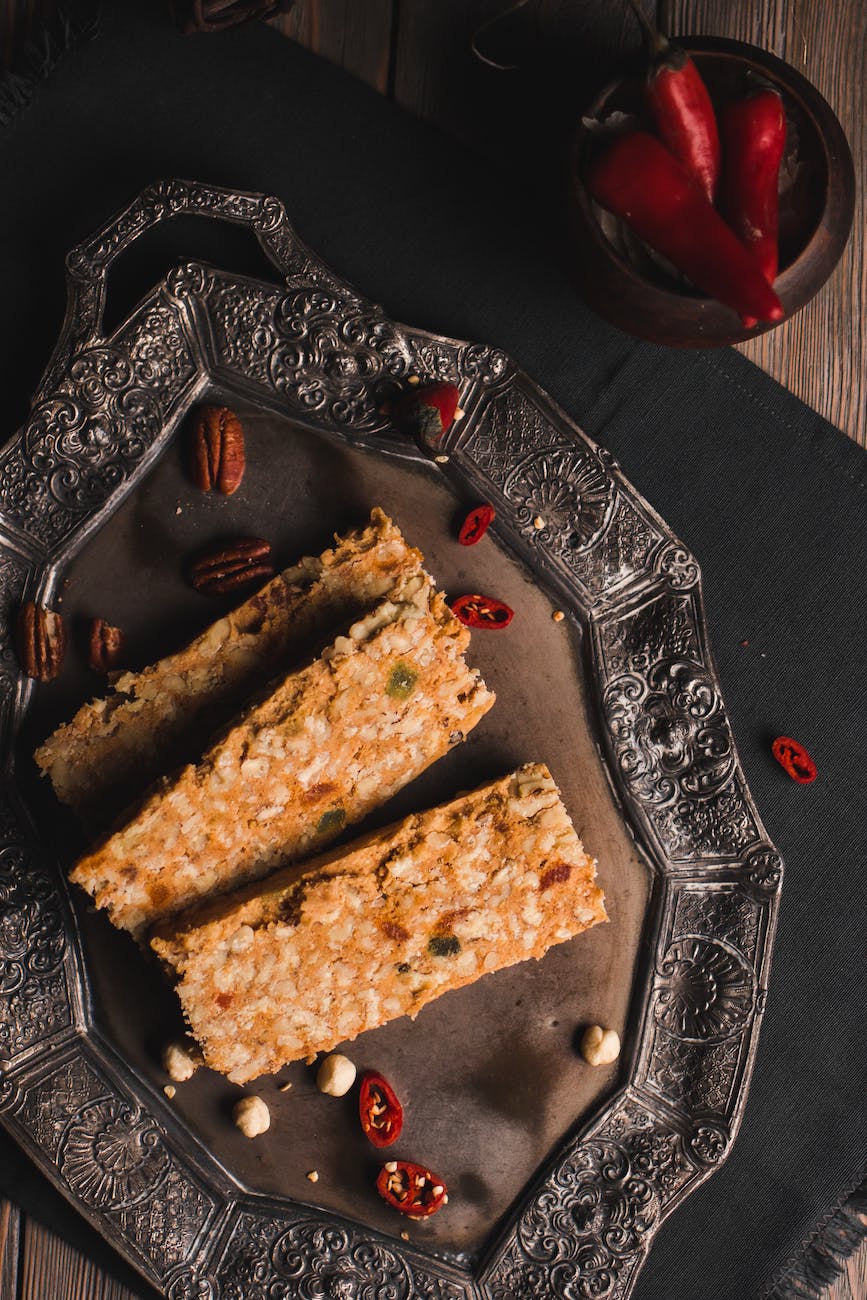
oat bars on a tray

Hello, health-conscious foodies! 🥗💪 Today, we’re diving into the world of quick, easy, and nutritious snacks. We’re talking about Oat Bars that are not only healthier than your average candy bar but also incredibly delicious. These bars require no baking, contain no sugar, and can be prepared in just 5 minutes! This fantastic recipe comes from the YouTube channel Felu – Fit by Cooking, a treasure trove of quick and easy recipes that don’t compromise on taste.

🌟 The Magic of Oat Bars 🌟

Oat bars have become a staple snack among fitness enthusiasts and health-conscious individuals. They’re packed with oats, a source of complex carbohydrates that provide sustained energy. Plus, they’re incredibly convenient, making them a perfect on-the-go snack for those busy days when sitting down for a full meal isn’t an option. The Oat Bars from Felu – Fit by cooking are a prime example of a snack that’s not only nutritious but also tantalizingly tasty!

🥜 The Star Ingredient: Peanut Paste 🥜

Peanut paste takes center stage in these oat bars, providing a rich and creamy base that’s packed with protein. In this recipe, 50 grams of creamy peanut butter is used, which not only imparts a delicious nutty flavor but also significantly contributes to the high protein content of the bars. Peanut paste is a versatile ingredient that’s not only great in oat bars but also in a variety of other dishes, from savory sauces to delicious desserts.

🍫 The Cocoa Touch 🍫

To elevate these oat bars to the next level, 30 grams of cocoa powder is added to the mix. This adds a sweet and indulgent touch to the bars, making them feel more like a decadent treat than a healthy snack. The cocoa powder not only adds flavor but also provides a dose of antioxidants, making these bars even more nutritious.

🍽️ Making the Oat Bars 🍽️

The process of making these oat bars is incredibly straightforward and quick, making it a perfect recipe for those with a busy schedule. After mixing the peanut paste with 150 grams of oats, 30 grams of cocoa powder, 60 grams of casein vanilla protein powder, and a pinch of salt, the mixture is combined with 150 grams of skimmed milk and some water to form a thick, fudgy mixture. The mixture is then pressed into a mold and refrigerated for 2-3 hours until they’re set. In just a few simple steps, you have a batch of delicious and healthy oat bars ready to enjoy!

🎉 Join the Food Lovers Community 🎉

If you’re a food enthusiast who loves experimenting with new recipes and sharing your culinary creations, consider joining the Vibrant Engaging Food Lovers community on Facebook. It’s a place where food lovers from around the world can share their favorite recipes, cooking tips, and foodie adventures. Whether you’re a seasoned chef or a beginner in the kitchen, you’re sure to find inspiration and camaraderie in this vibrant community.

🙏 Credits 🙏

A big thank you to Felu – Fit by cooking for sharing this fantastic Oat Bar recipe. Their commitment to creating quick, easy, and delicious recipes is truly inspiring. Be sure to check out their YouTube channel for more culinary inspiration.