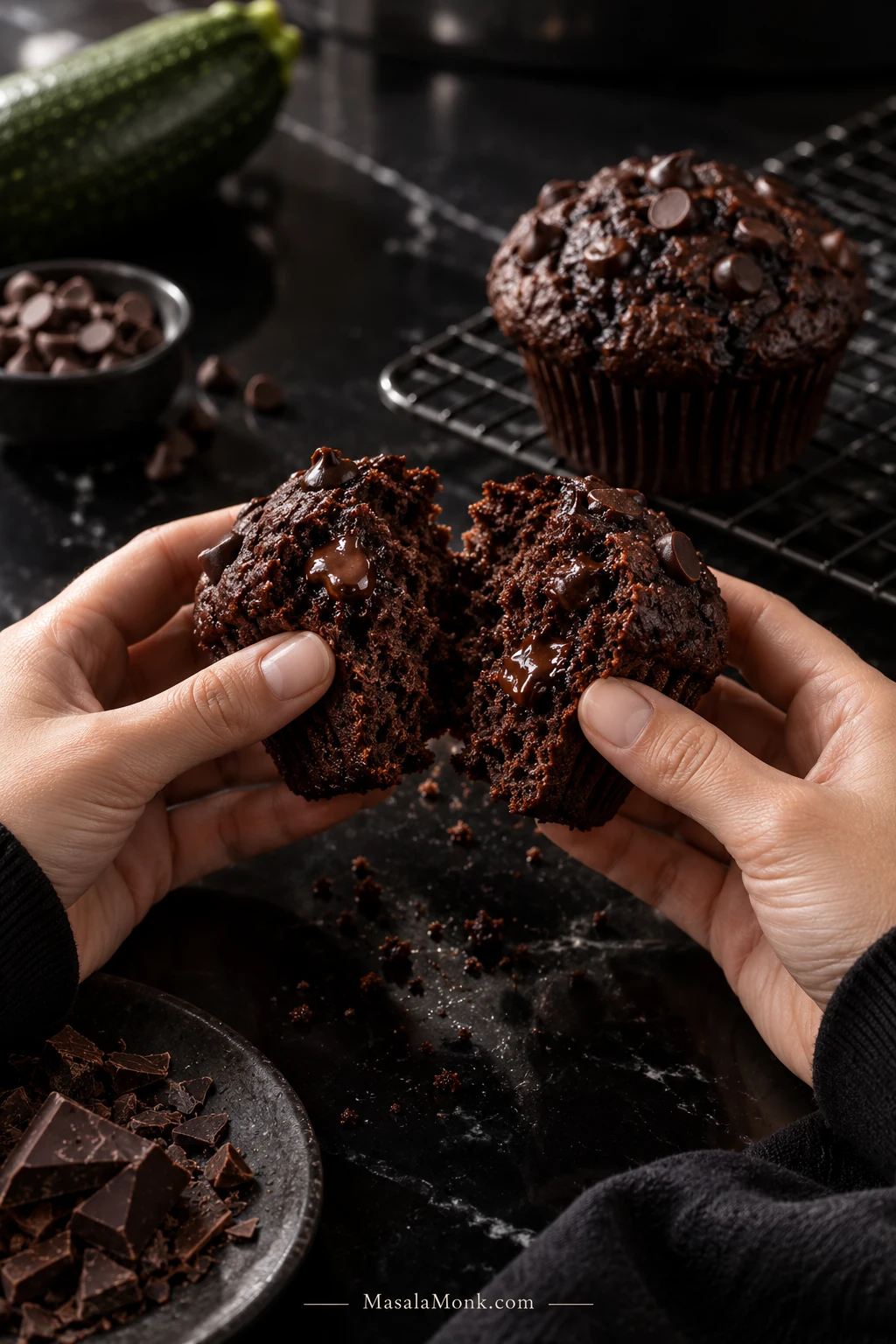
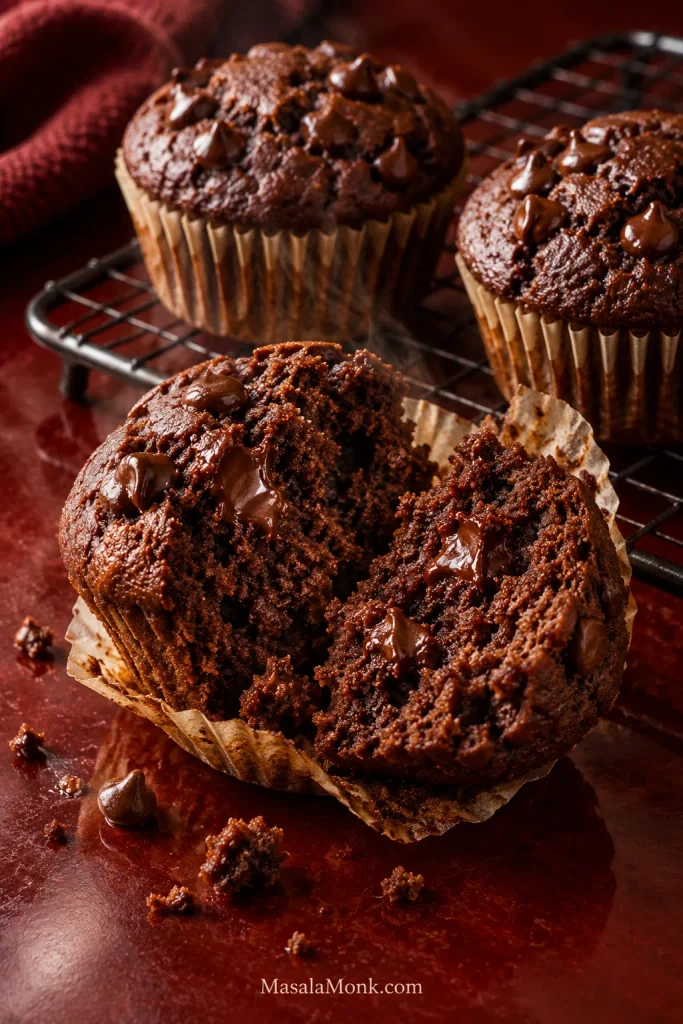
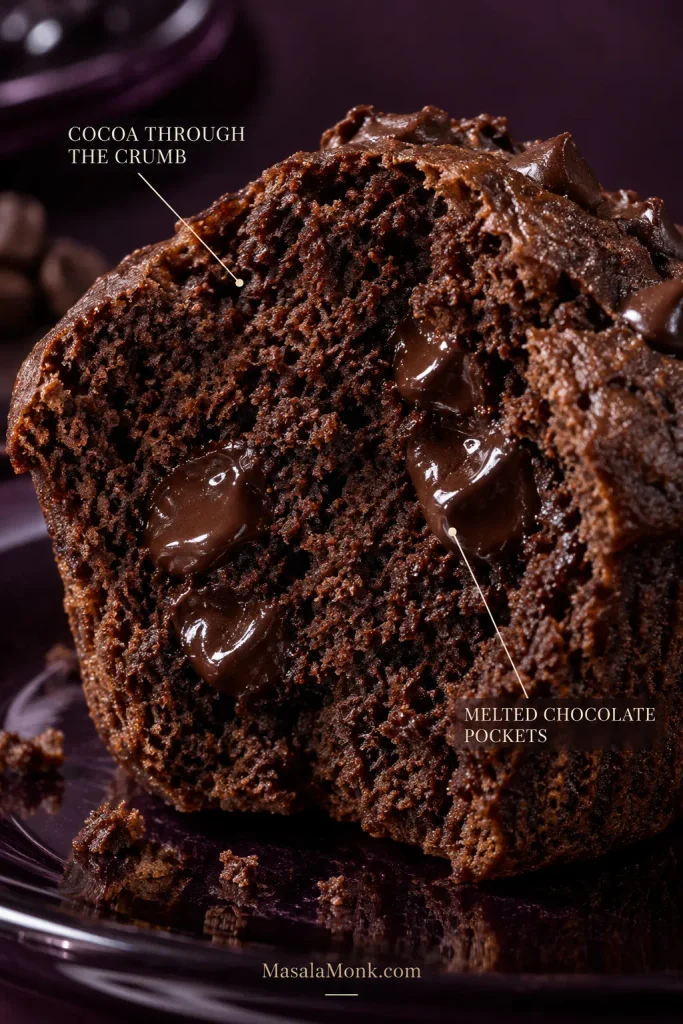
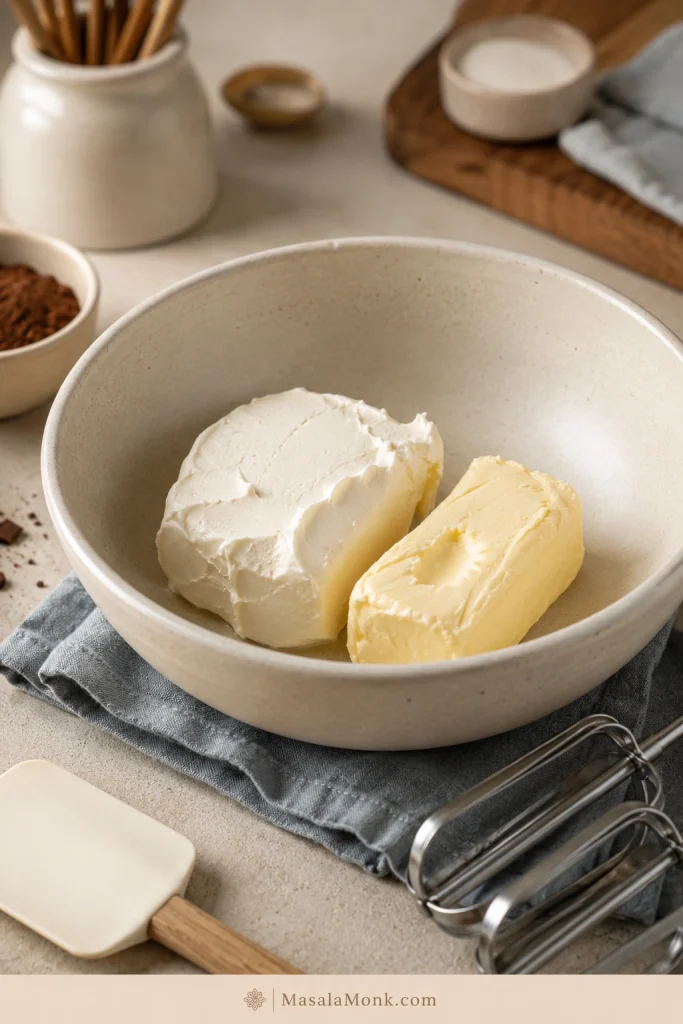
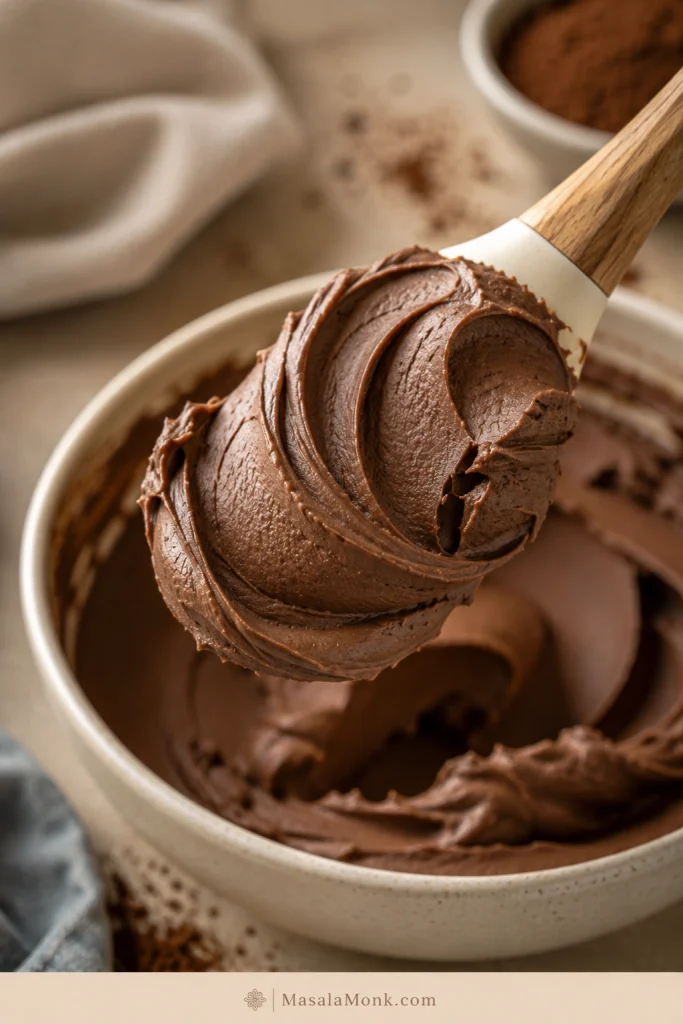
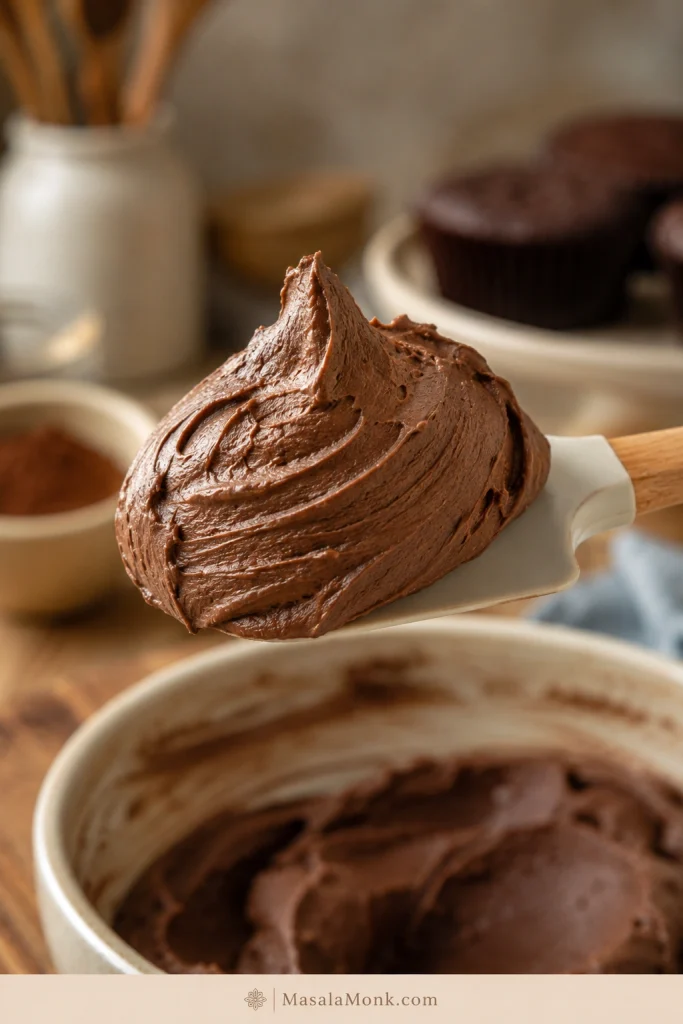
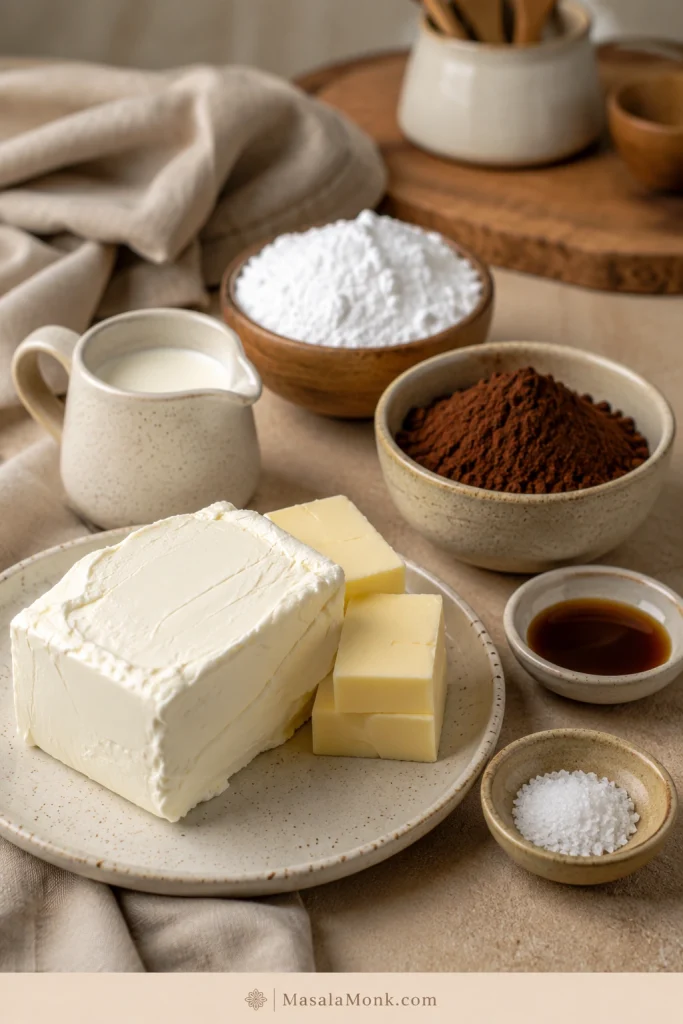
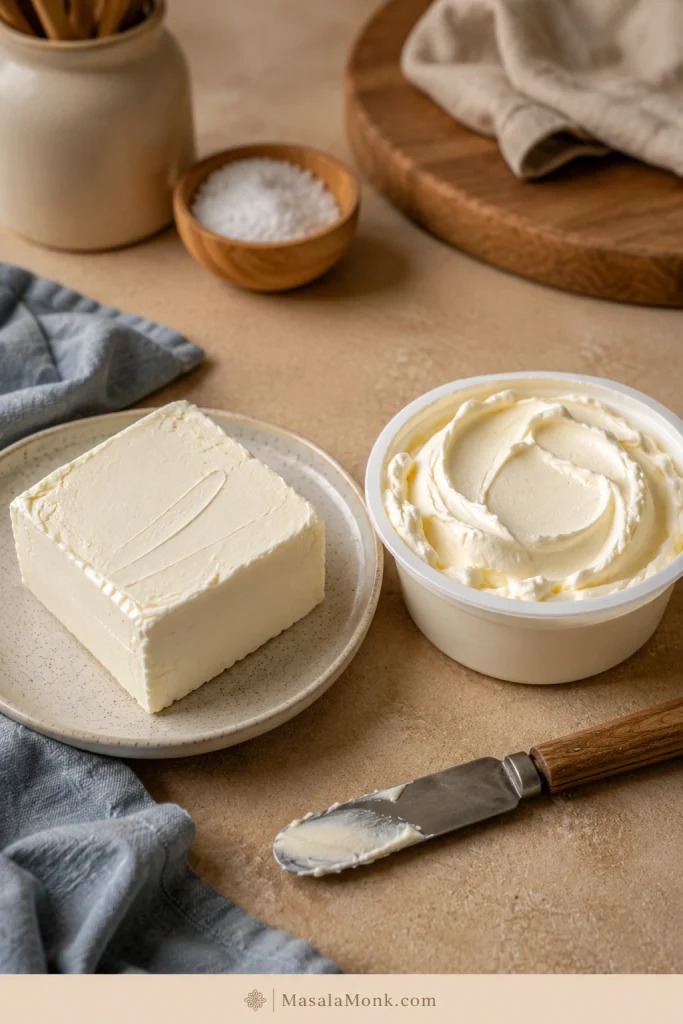
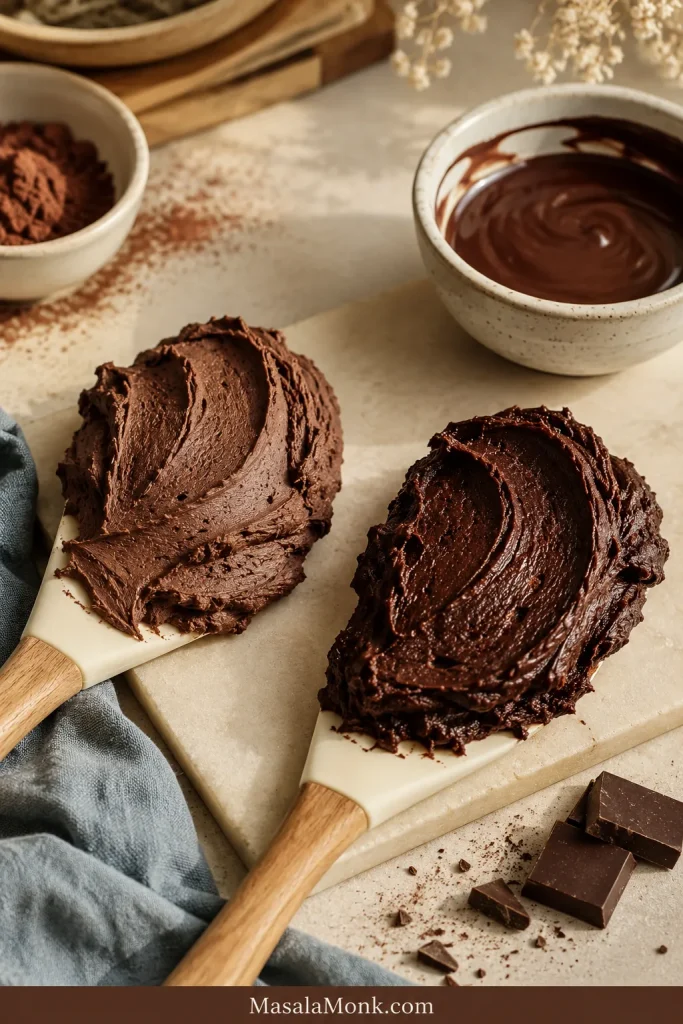
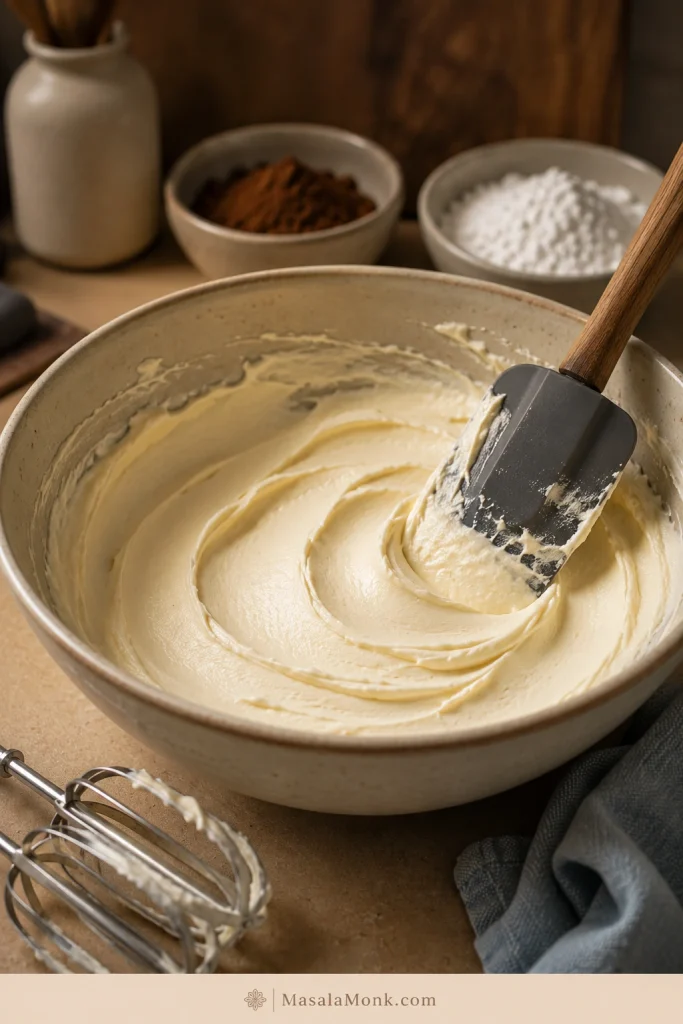
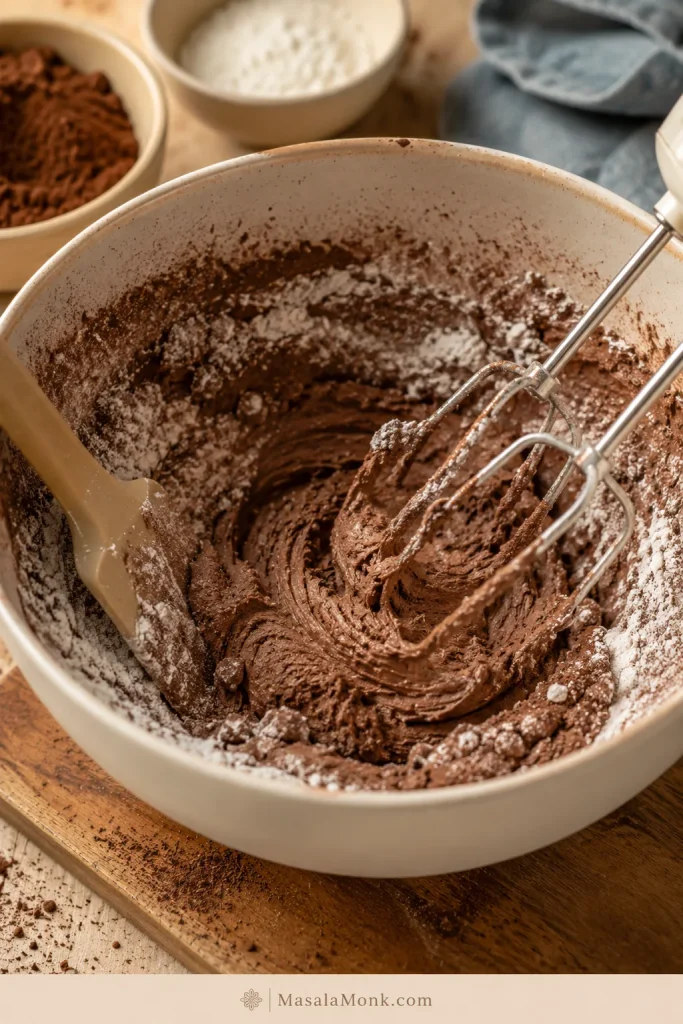
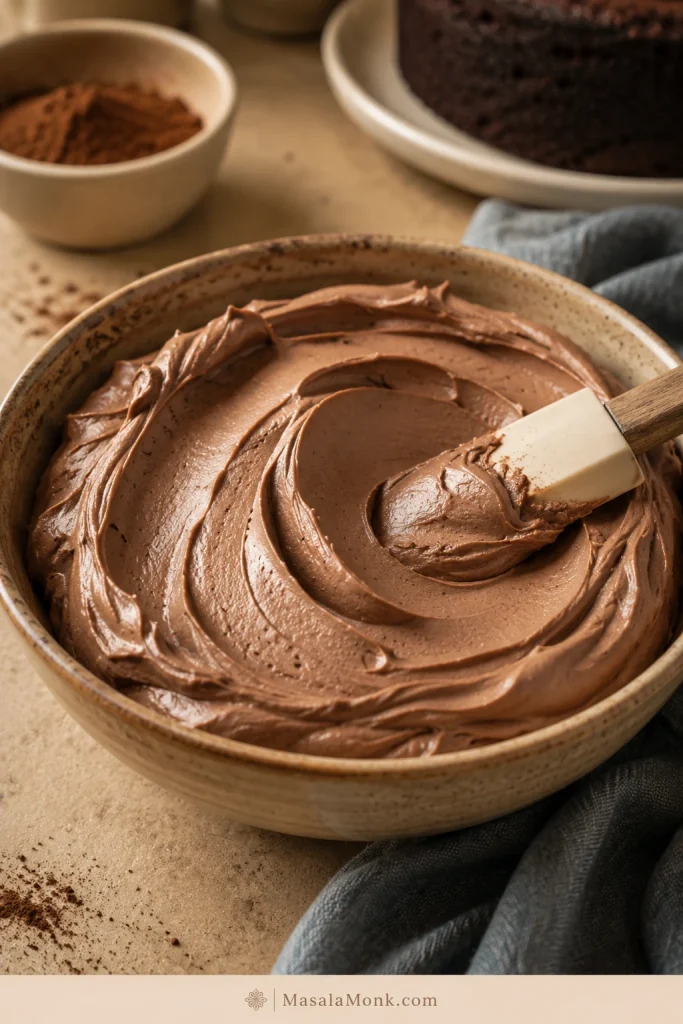
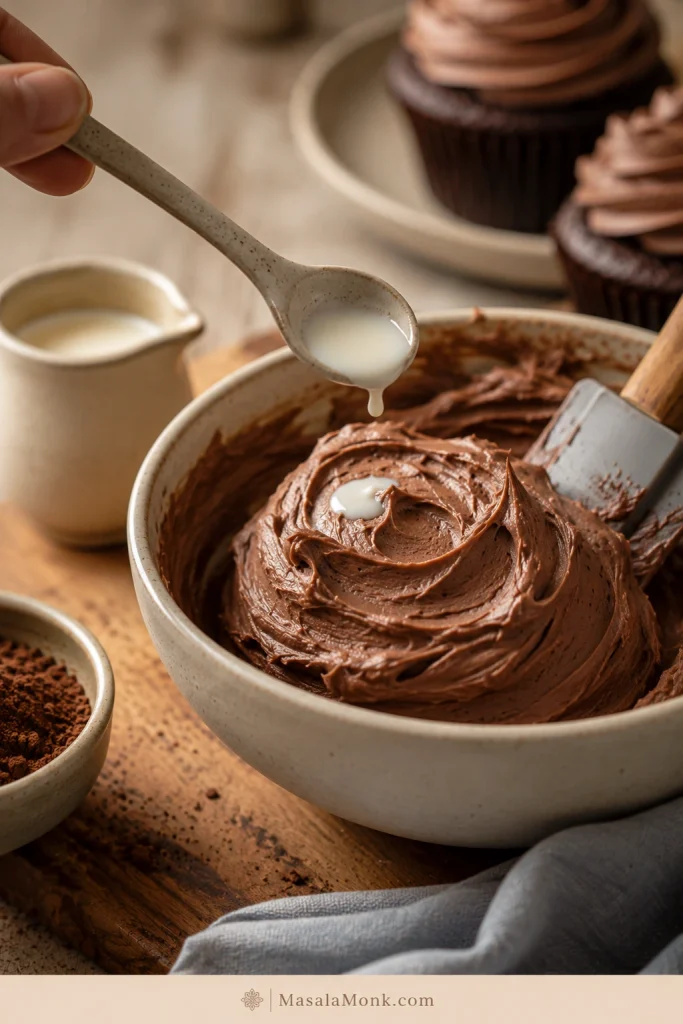
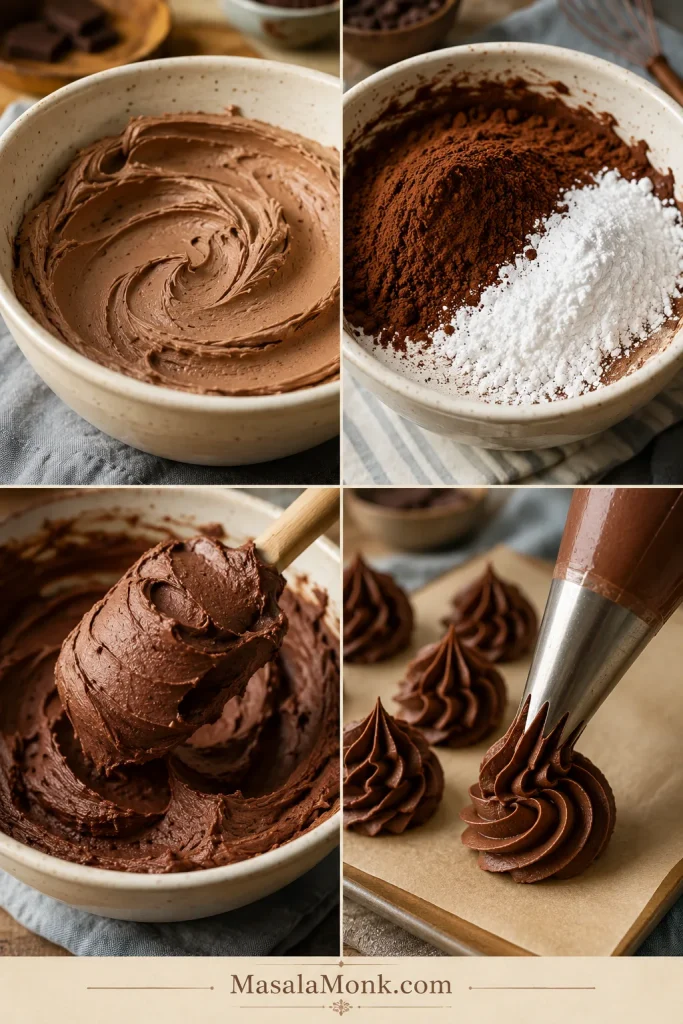
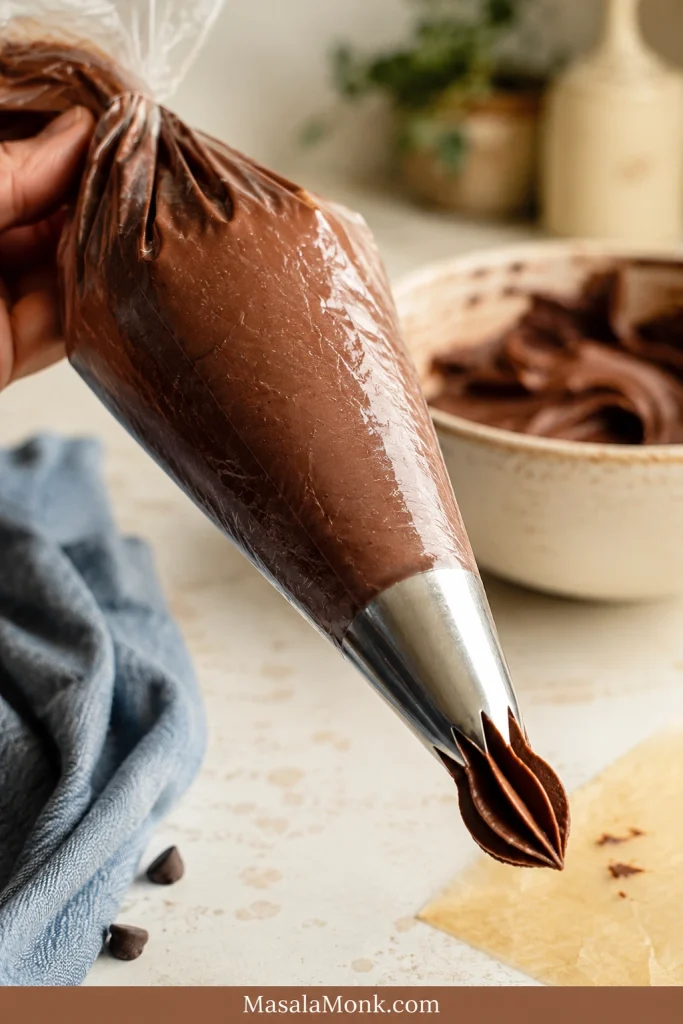
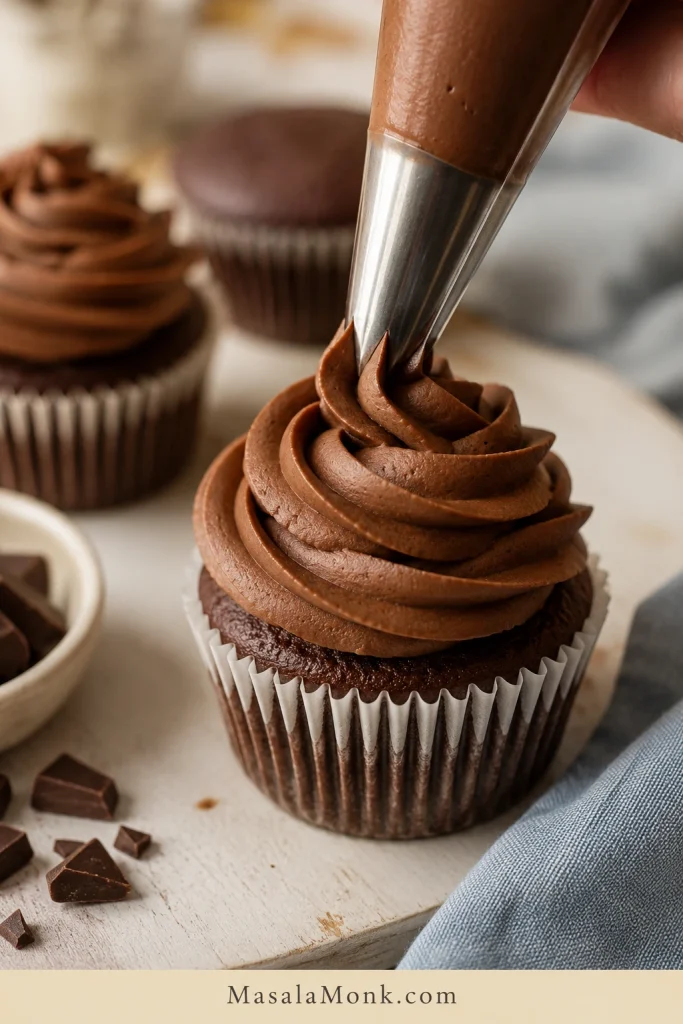
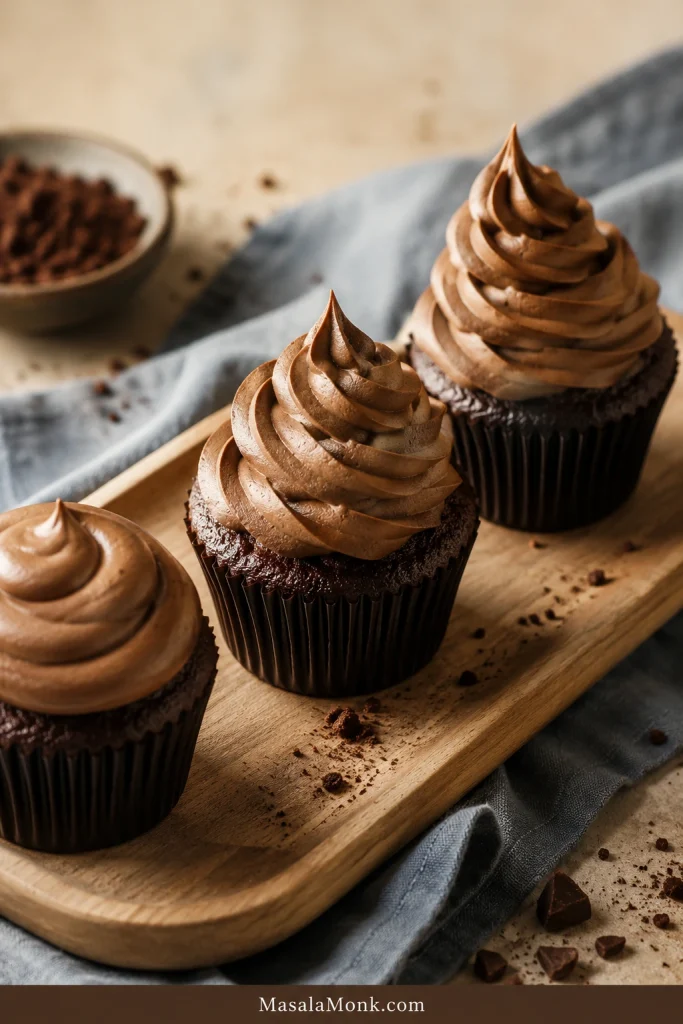
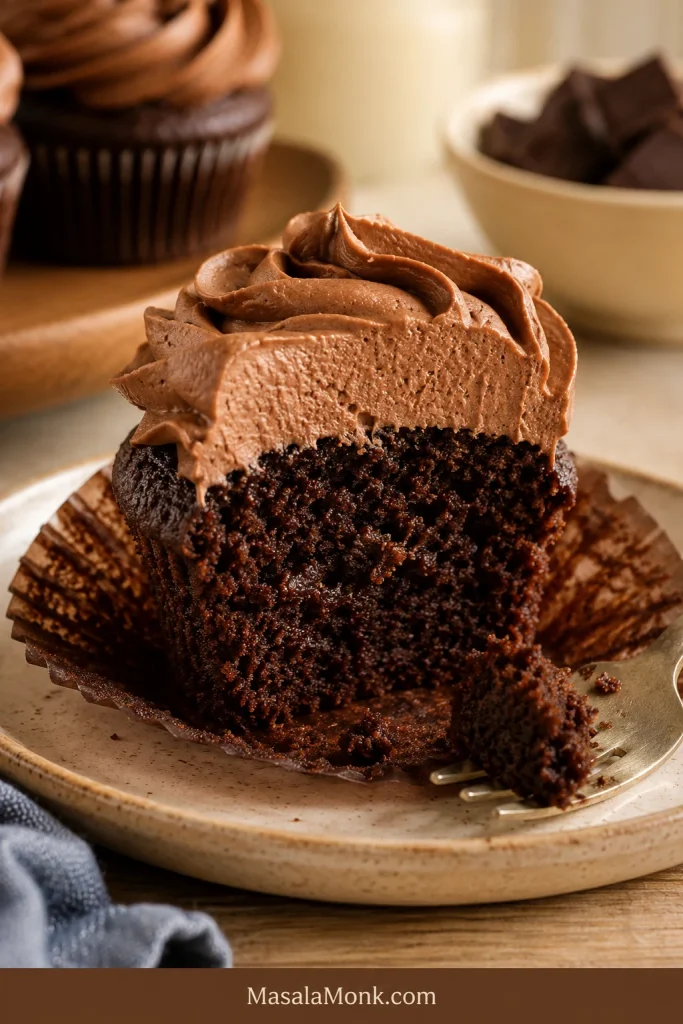
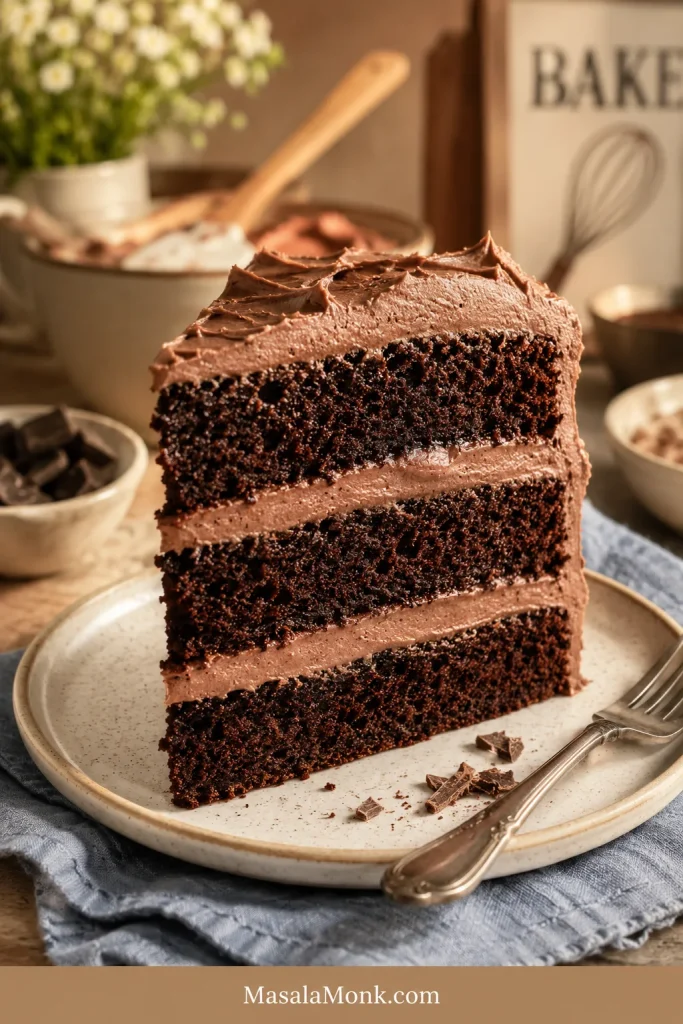
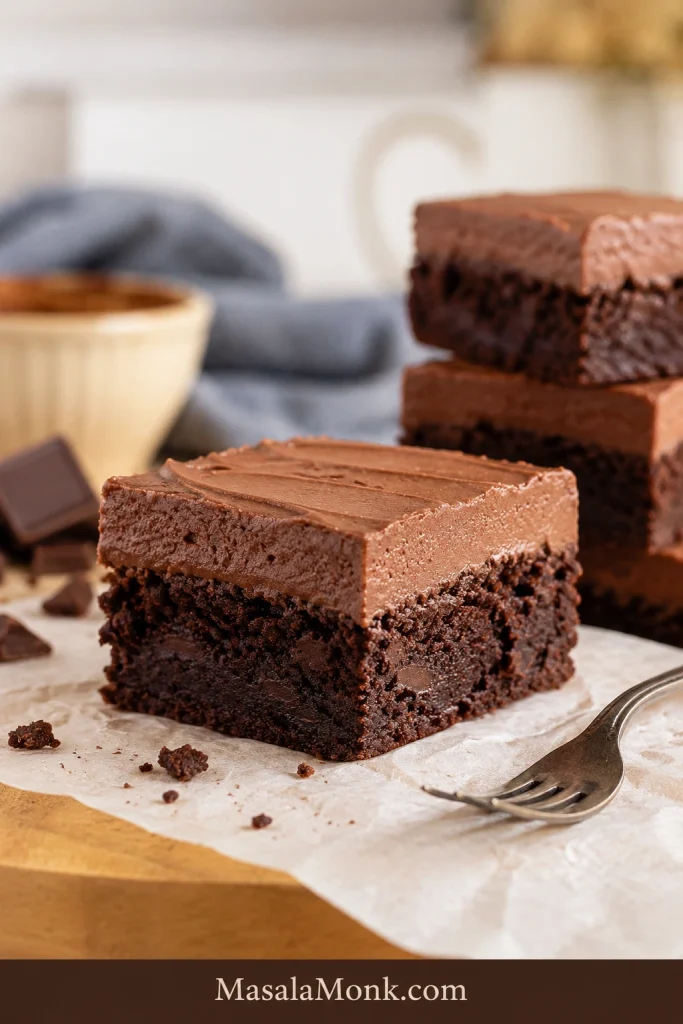
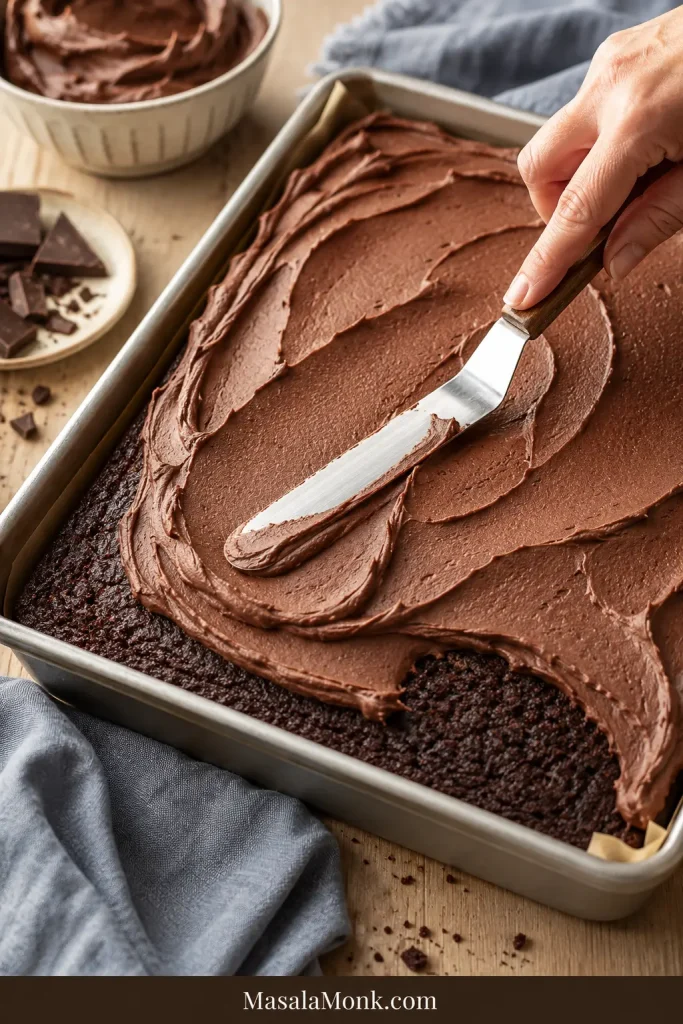
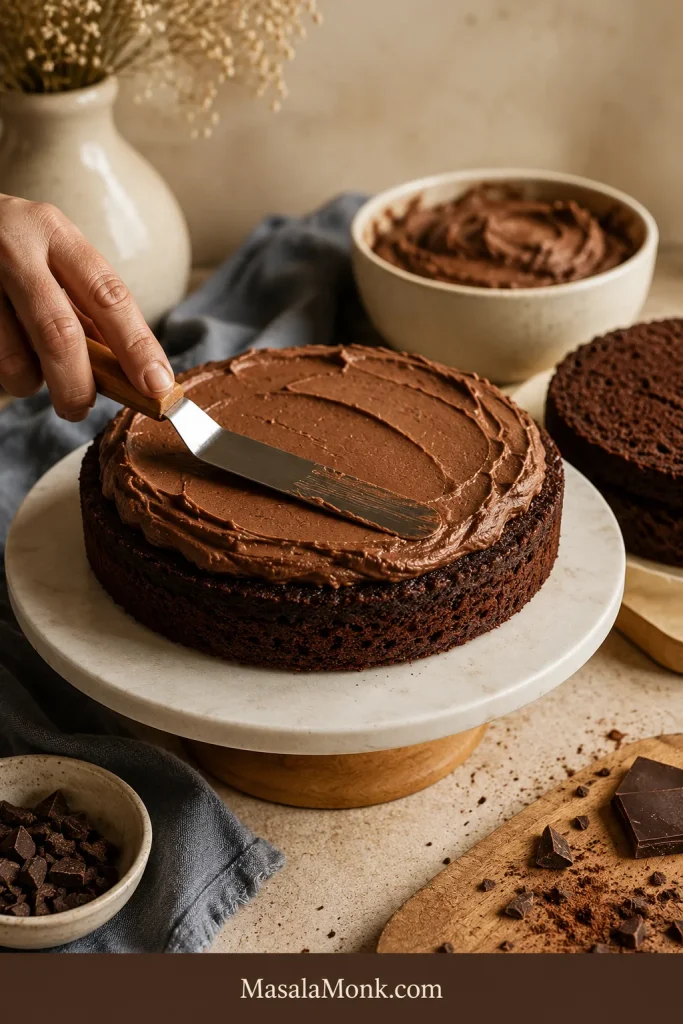
These chocolate zucchini muffins should eat like rich chocolate muffins that happen to contain zucchini—not vegetable muffins that happen to contain cocoa. Break one open and the center should be dark, soft and tender, with melted chocolate tucked through the crumb.
The double chocolate comes from cocoa baked through the crumb and semisweet chips that stay soft and melty while the muffins are warm. Finely shredded zucchini works quietly underneath, keeping the center tender while contributing very little flavor of its own.
The one part worth watching is the zucchini’s water. Exceptionally juicy zucchini or an extra handful of shreds can leave the middle heavy. Squeeze the zucchini bone-dry, though, and you give up some of the softness it brings to the crumb.
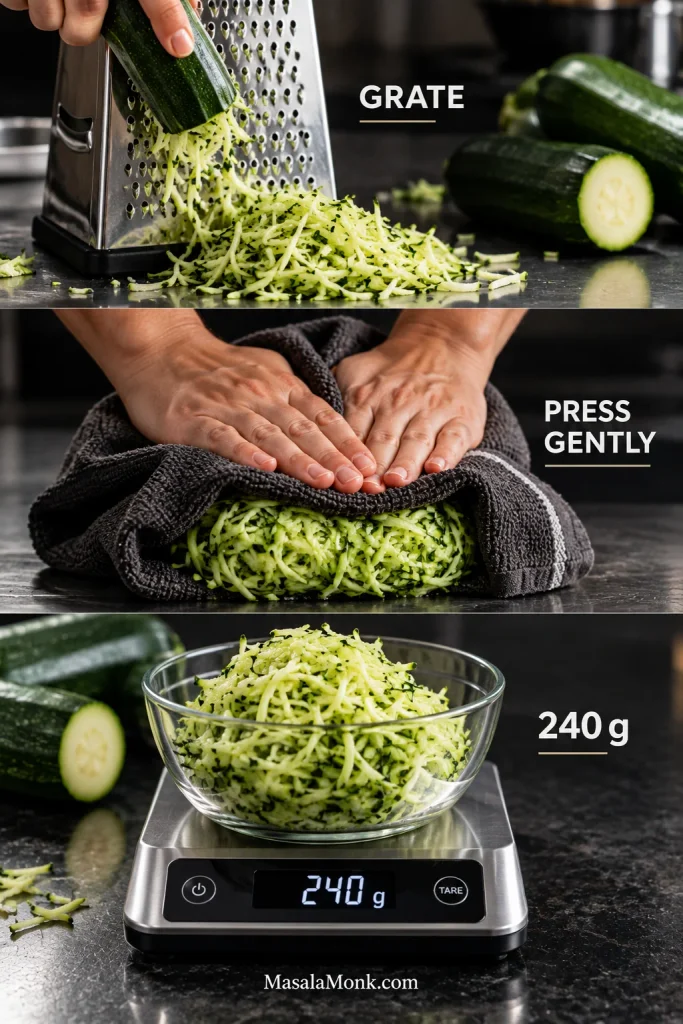
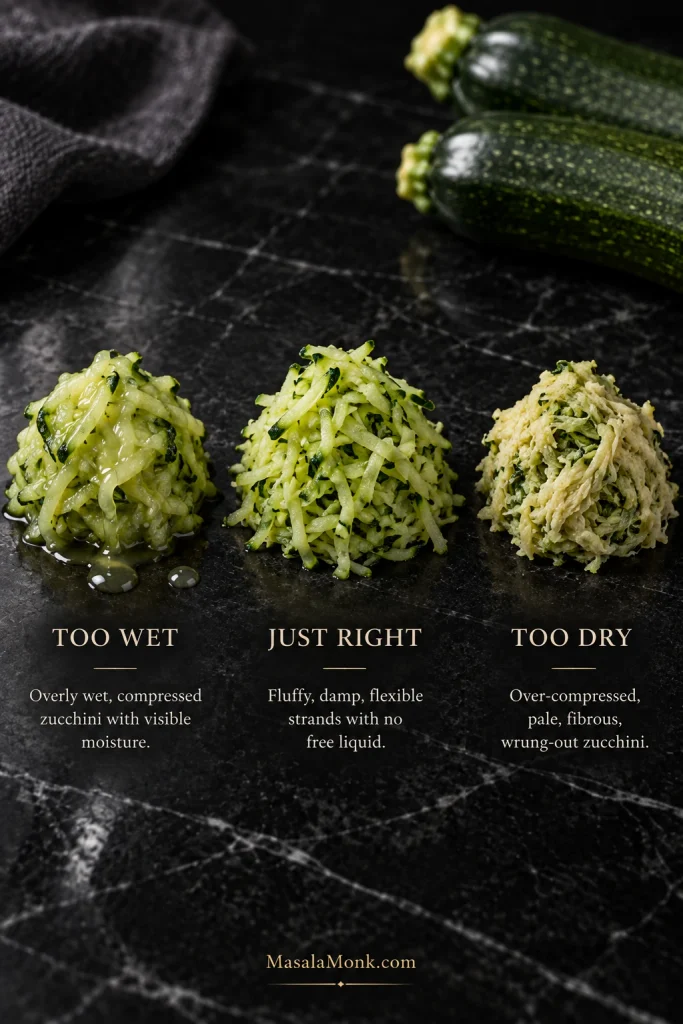
Finely shredded, with loose surface water pressed away while the shreds remain damp.
Batter
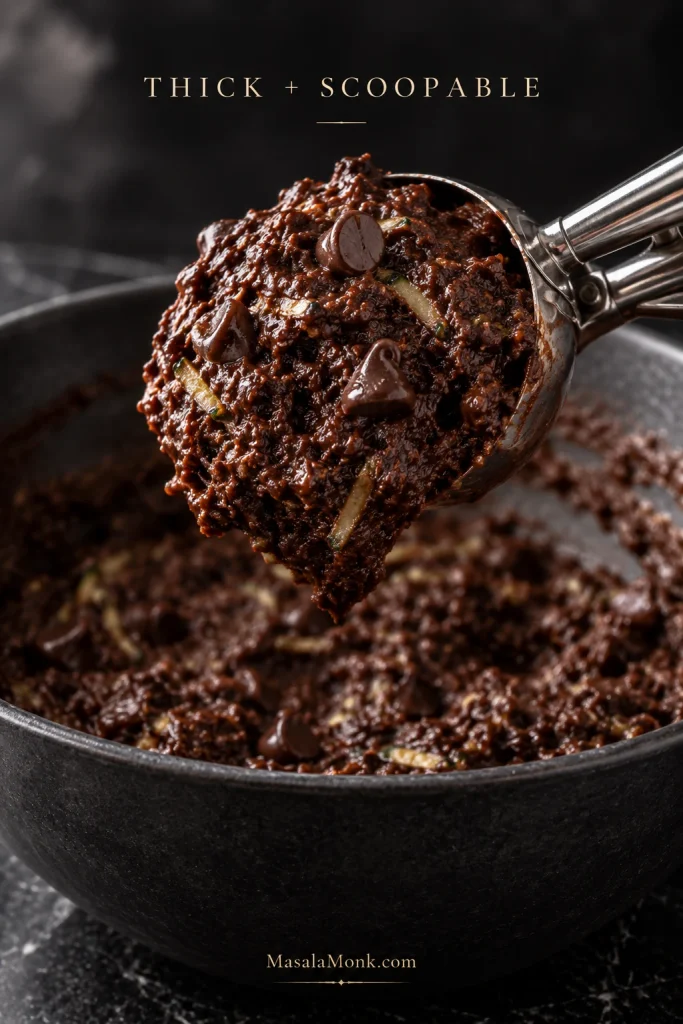
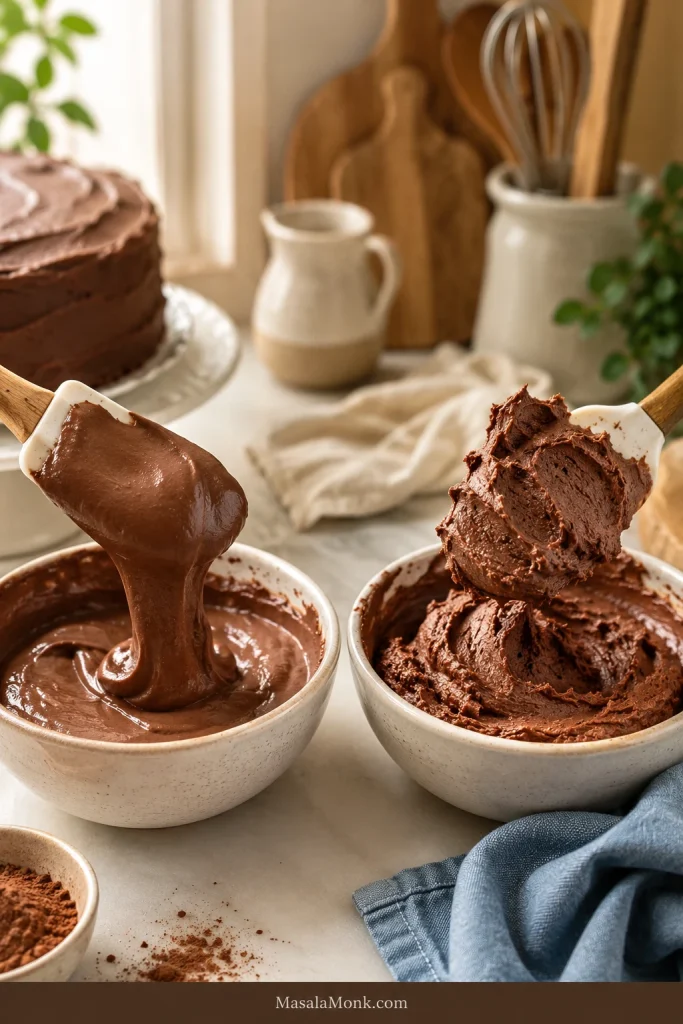
Thick + scoopable
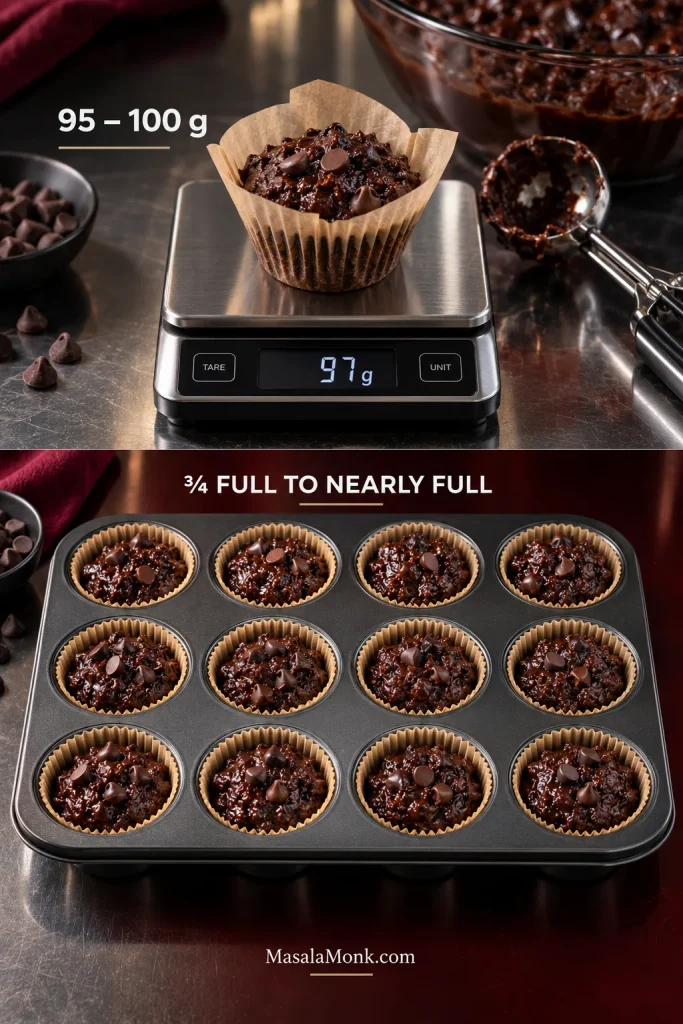
About 95–100 g / 3.4–3.5 oz in each standard muffin cup.
Baked Center
Moist + fully set
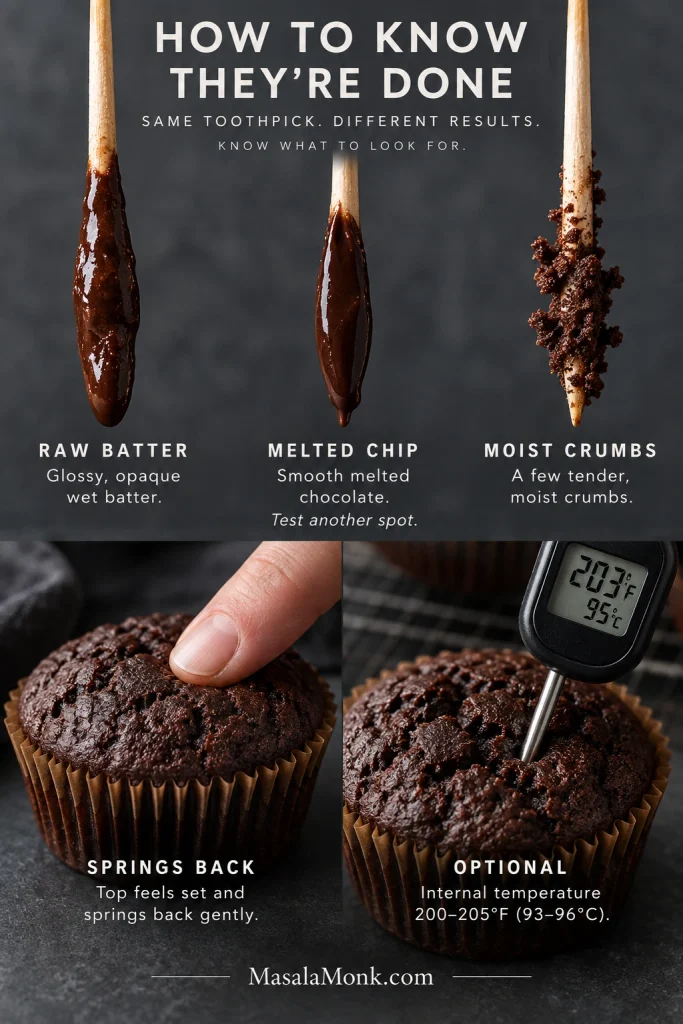
The top springs back and a tester shows tender crumbs with no raw batter.
Chocolate Zucchini Muffins Recipe
No mixer is needed—a whisk and spatula are enough.
Yield12 standard muffins
PrepAbout 20 minutes
TotalAbout 45–50 minutes
Oven375°F / 190°C
BakeAbout 20–24 minutes
Cool5 minutes in pan
Useful equipment: a standard 12-cup muffin pan, parchment-style liners, box grater, two mixing bowls, whisk, flexible spatula and wire rack. A digital kitchen scale is strongly recommended for the zucchini and portioning; an instant-read thermometer is optional.
Use the small shredding holes of the box grater. The tiny rasp or zester face tends to turn zucchini into wet pulp. A light-colored metal muffin pan works well here; dark nonstick pans brown the bottoms and sides faster, so check them earlier.
Ingredients
Dry Ingredients
200 g / 7 oz all-purpose flour, about 1⅔ cups when spooned and leveled
40 g / 1.4 oz Dutch-process unsweetened cocoa powder, about ½ cup
1½ teaspoons baking powder
½ teaspoon baking soda
½ teaspoon fine salt
1 teaspoon instant espresso powder, optional
Wet Ingredients
150 g / 5.3 oz light or dark brown sugar, a scant ¾ cup packed
50 g / 1.8 oz granulated sugar, about ¼ cup
2 large eggs, about 100 g without shells
110 g / 120 ml neutral oil (½ cup / 4 fl oz)
80 g / 2.8 oz sour cream, about ⅓ cup
10 ml / 2 teaspoons vanilla extract
Zucchini & Chocolate
240 g / 8.5 oz prepared zucchini, finely shredded and weighed after pressing away loose surface water. No scale? Expect roughly 1¾–2 cups after pressing, and use the damp, no-drip cue in the method as your final check.
170 g / 6 oz semisweet chocolate chips, about 1 cup, divided
Method
Prep and Mix
Heat the oven to 375°F / 190°C. Put a rack in the middle and line a standard 12-cup muffin pan with parchment-style liners. Let the oven fully preheat before the batter goes in.
Prepare the zucchini. Leave the tender peel on and shred it on the small shredding holes of a box grater. Spread the shreds over a clean kitchen towel, fold another section over the top and press firmly with flat hands. Lift the towel and check them. Press again if there is still loose water on the surface. The zucchini should feel damp and flexible. If you can, weigh 240 g / 8.5 oz.
Weigh the zucchini after pressing, not before, so the 240 g target controls both the amount of zucchini and how much loose water reaches the batter.
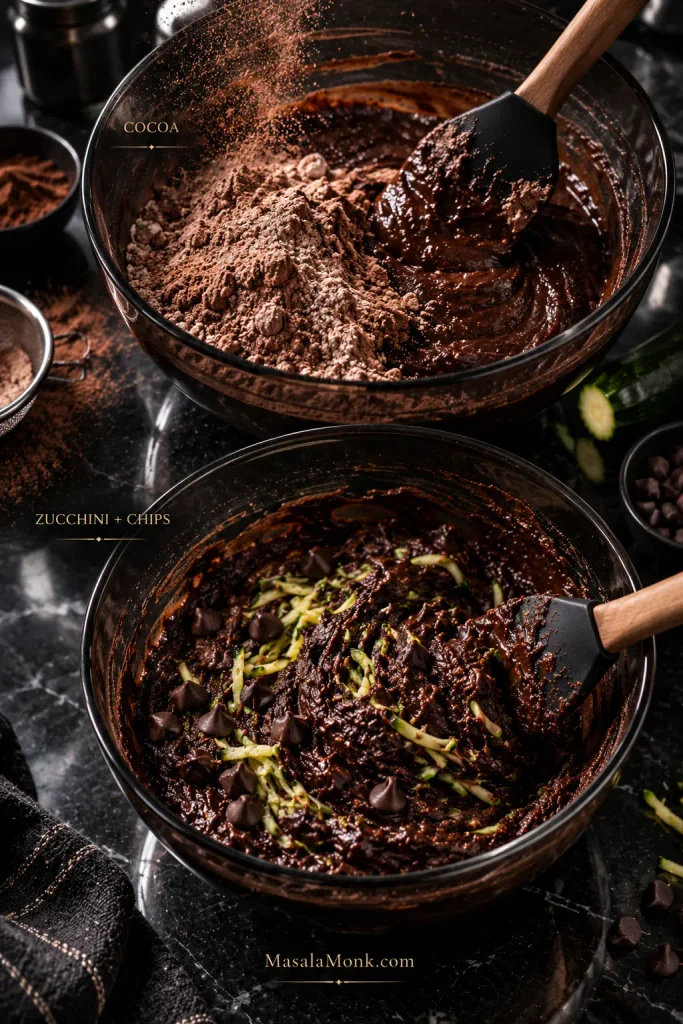
Mix the dry ingredients. Whisk the flour, cocoa powder, baking powder, baking soda, salt and optional espresso powder until the cocoa is evenly dispersed and no obvious lumps remain.
Mix the wet ingredients. In a large bowl, whisk the brown sugar, granulated sugar and eggs until evenly combined. Whisk in the oil, sour cream and vanilla until smooth.
Bring the batter together gently. Add the dry mixture to the wet mixture and fold until only a few flour or cocoa streaks remain. Then add the prepared zucchini and 140 g / 5 oz chocolate chips, folding just until combined. The batter should look dark, thick and slightly glossy.
A few faint flour streaks before the final fold are preferable to overmixing; the zucchini and chocolate chips finish distributing everything as they go in.
Check, Portion and Bake
Still looks almost too thick? That is okay. The batter should be thick enough to scoop. It may loosen as the zucchini releases moisture, so don’t add milk just because it looks thick. If yours already looks loose, leave the flour alone and move on.
Watch how the batter behaves, not just how thick it looks: a scoop should leave soft ridges that relax slowly rather than disappearing immediately.
Portion evenly. Divide the batter among the 12 muffin cups, aiming for about 95–100 g / 3.4–3.5 oz per cup. Without a scale, fill the cups roughly ¾ full to nearly full. Scatter the remaining 30 g / 1 oz chocolate chips over the tops.
Even portions help synchronize doneness across the pan, so weighing roughly 95–100 g per standard cup can keep smaller muffins from drying out while larger ones are still setting.
Bake for about 20–24 minutes. Start checking at 19 minutes. Pan color, zucchini moisture and individual ovens can shift the timing.
Check the center. The tops should look set and spring back gently. A tester should show moist crumbs with no raw batter. Hit a pocket of melted chocolate? Test another spot. If you use a thermometer, about 200–205°F / 93–96°C is another useful check.
With chocolate muffins, use several doneness cues together: a springy top, moist crumbs and a second toothpick spot are more reliable than one chocolate-streaked test.
Cool Before Judging the Crumb
Cool for 5 minutes in the pan, then move to a wire rack. Give the crumb a few more minutes to settle before deciding whether the middle is fully set. A muffin cut open piping hot will look softer than one that has cooled slightly.
Making them ahead? Measure the dry ingredients and chocolate in advance, but mix the batter close to baking time. Once the zucchini is in the bowl and the leaveners are wet, the batter is better off heading for the oven.
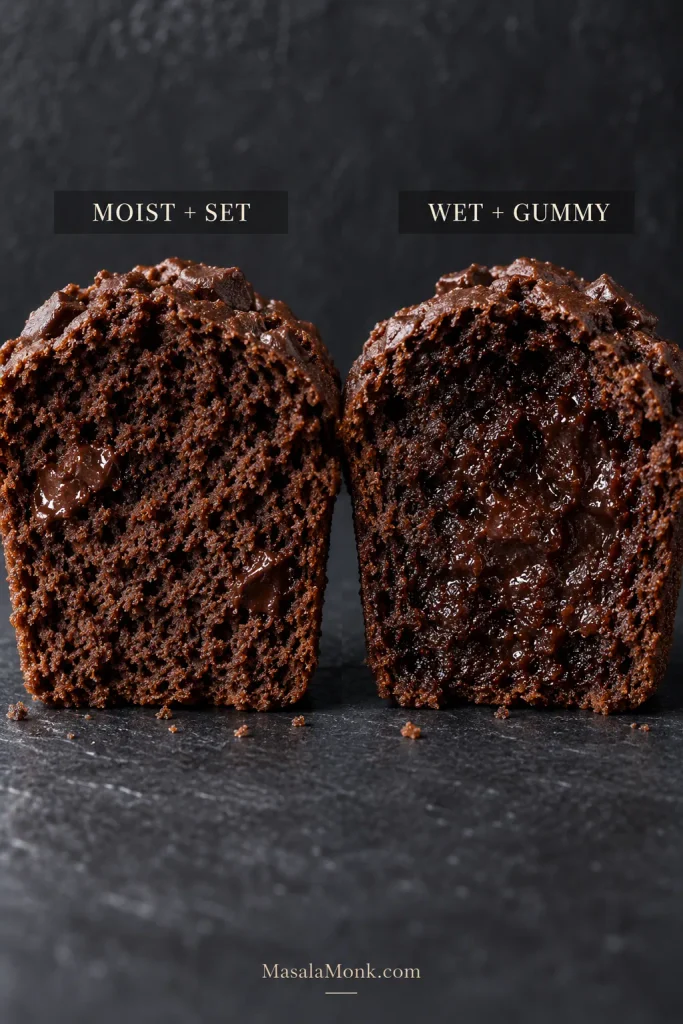
Let one cool long enough for the crumb to settle, then pull it apart. The center should be soft and dark, with little pockets of chocolate still yielding where the muffin is warm.
This is the texture to look for once the crumb has set: visible aeration and a mostly matte interior, with gloss confined mainly to actual pockets of melted chocolate.
For the Next Batch
If the muffins are already in the oven, you have everything you need. Come back here when you want to handle a different kind of zucchini, change an ingredient, make minis or work out what happened to the crumb.
So, should you squeeze zucchini for muffins? For this recipe, yes—but gently. Pick up a small handful of the shredded zucchini and squeeze. Nothing should drip, but the strands should still feel soft, damp and flexible. That’s the state you want before weighing the 240 g / 8.5 oz for this recipe.
The goal is not dry zucchini; it is zucchini without free water. Damp, flexible shreds still carry the moisture that helps the finished muffins stay tender.
No liquid should drip when you gently squeeze a handful
Very large mature zucchini
Remove tough developed seeds if needed, then shred the firmer flesh
The large central seed area can be wetter and coarser than young zucchini
Frozen, then thawed zucchini
Thaw fully, drain well, press away the released liquid, then weigh
Thawed zucchini releases considerably more water, so drain and press it before weighing
Why Extra Zucchini Can Make the Centers Gummy
That last handful may look harmless, but it still brings water into the batter. Add enough and the middle can lag behind while the outside keeps baking.
Have enough left for another bake? Save it for the Zucchini Bread Recipe instead of adding more here.
The goal is depth without drying the crumb. Cocoa absorbs water as well as adding flavor, so simply piling in more doesn’t automatically make a better chocolate muffin.
Cocoa Flavors the Whole Crumb
The recipe uses 40 g / 1.4 oz cocoa powder. That’s enough for a dark, unmistakably chocolate crumb while leaving room for the zucchini, oil and sour cream to keep it soft.
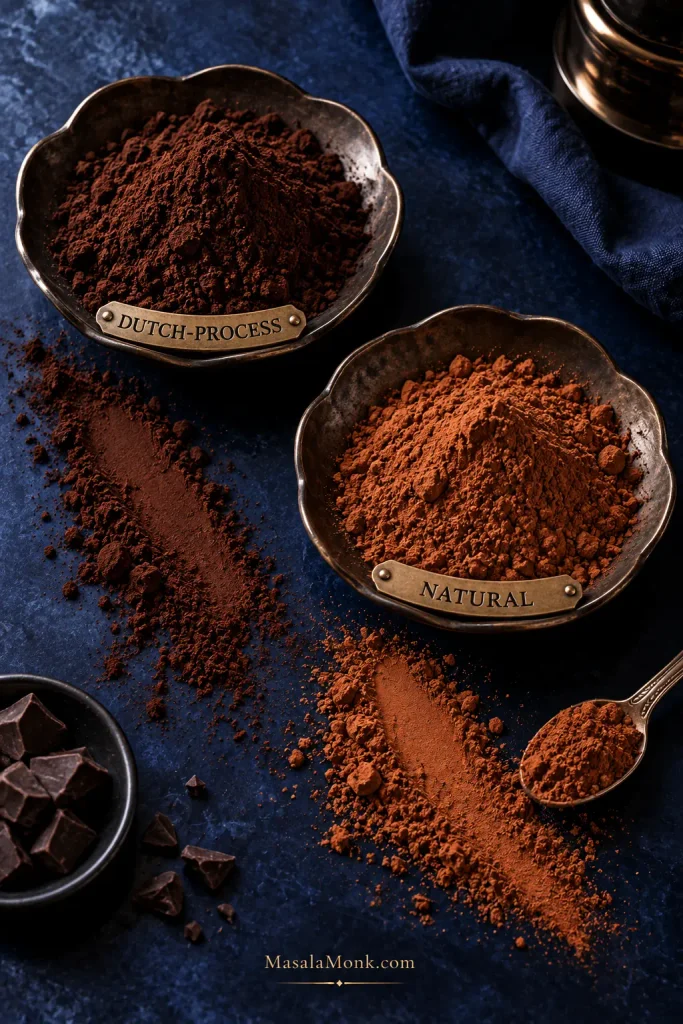
Dutch-process cocoa is the intended choice for its dark color and smooth chocolate flavor. Natural unsweetened cocoa can also be used here; expect a lighter color and a slightly sharper cocoa taste.
Cocoa choice changes the chocolate profile, but quantity changes the batter too; adding extra cocoa simply for darker color can also make the crumb drier.
Keep the baking soda and baking powder as written if you change cocoa. Their balance belongs to the whole batter, not the cocoa alone.
Chocolate Chips Make It Double Chocolate
The chips add what cocoa cannot: pockets of actual melted chocolate. Pull a muffin apart while it is still warm and those pockets stay softer and richer than the surrounding cocoa crumb.
Semisweet keeps the sweetness balanced. Dark chocolate makes the muffins more intense, while milk chocolate pushes them further toward dessert. Reserve a few chips for the tops so the finished muffins look as chocolatey as they taste.
Look for a mostly matte cocoa crumb interrupted by glossier pockets where the chocolate chips have melted.
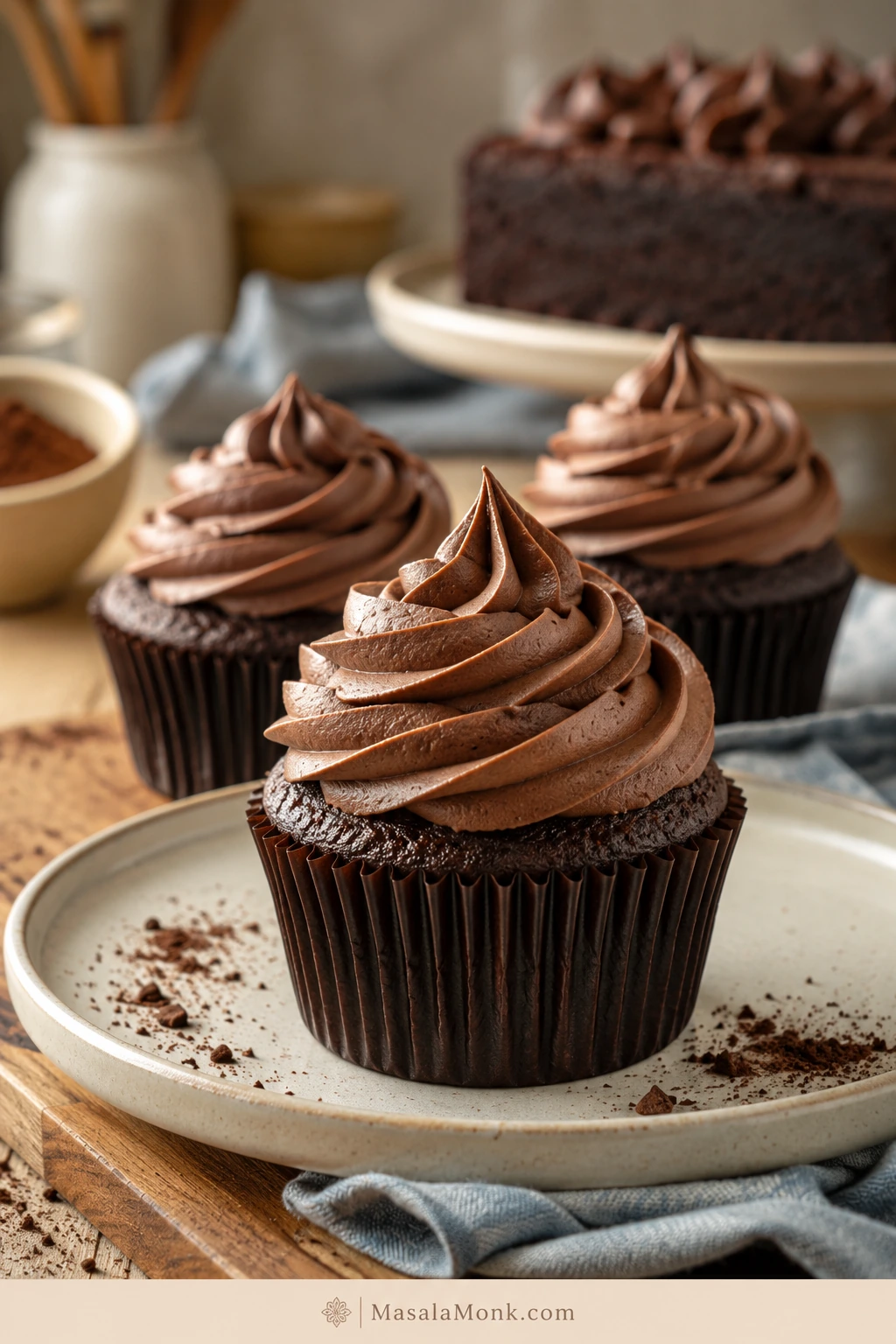
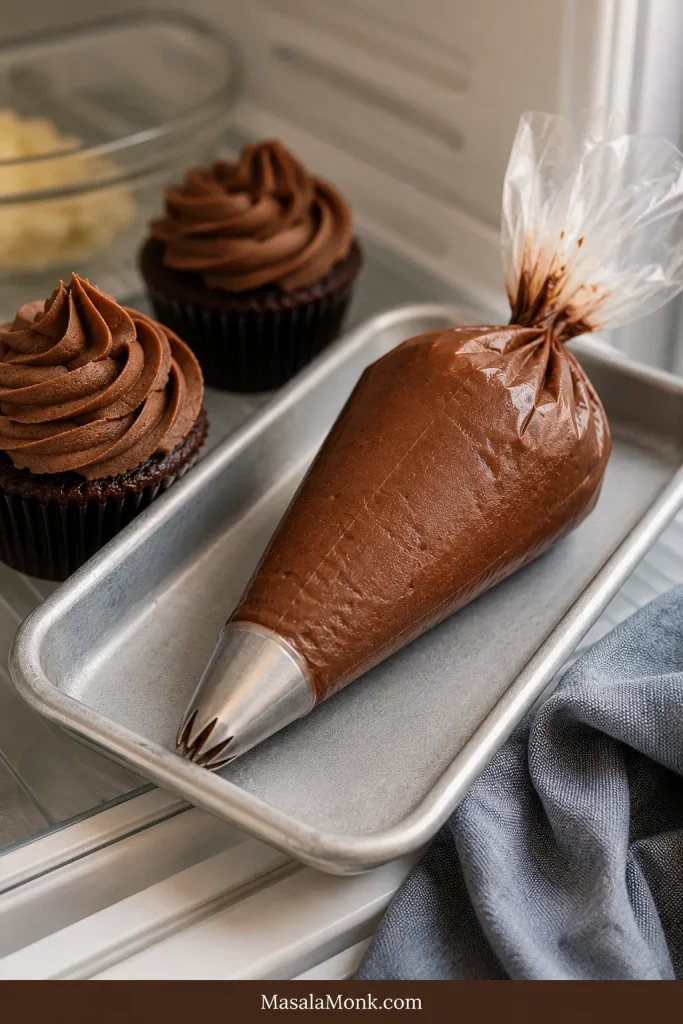
For a frosted muffin-style cupcake, cool the standard-size muffins completely and top them with Chocolate Cream Cheese Frosting. If you want a lighter, finer cake crumb, start with a cupcake-specific batter.
Substitutions Without Wrecking the Batter
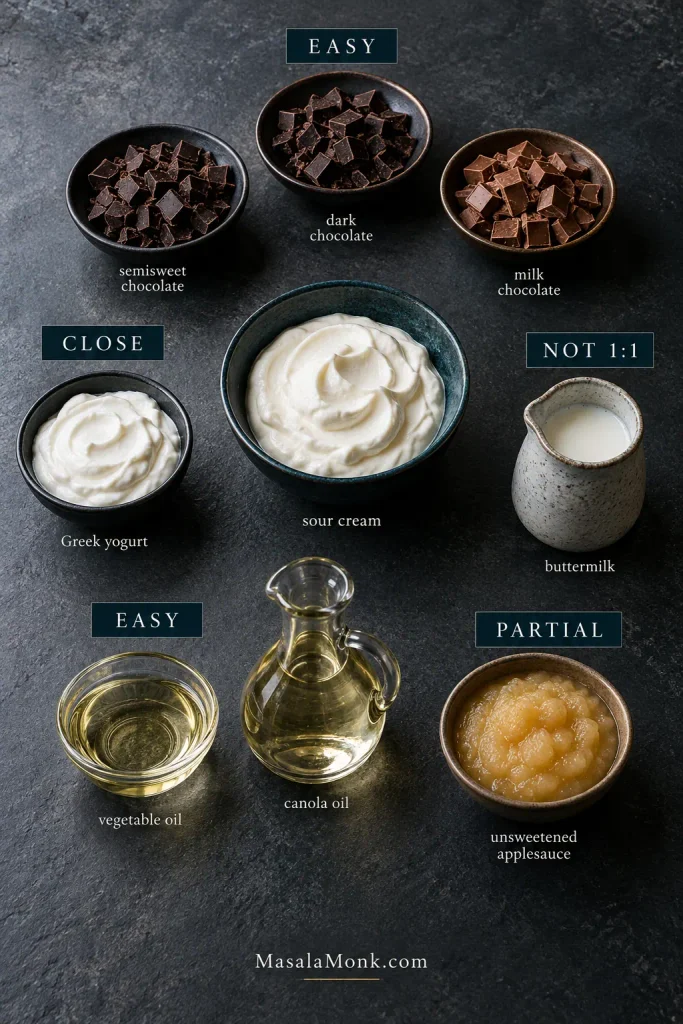
You do not need to treat the recipe as untouchable. A different chocolate or another mild neutral oil is easy. Changes to cultured dairy or flour affect the batter more, so keep the experiments simple.
Replacing part of the oil with unsweetened applesauce is one of the gentler changes. Replace no more than about half the oil. The crumb will be less rich and a bit heavier, but it should remain soft. For a bake where applesauce is built in from the start, Banana Bread With Applesauce takes that approach deliberately.
Easy Swaps That Keep the Batter Close
Chocolate: dark or milk chocolate chips can replace semisweet directly. Dark makes the muffins more intense; milk makes them sweeter.
Neutral oil: another mild neutral oil is an easy swap.
Greek yogurt: thick full-fat Greek yogurt is a reasonable substitute for the sour cream, with a tangier and slightly less rich result.
Buttermilk: it is considerably thinner than sour cream, so it is not a straight 1:1 swap. Greek yogurt is the closer substitute.
1:1 gluten-free baking blend: a true cup-for-cup blend may work, but absorption, texture and bake time vary between brands.
For chocolate zucchini muffin substitutions, judge a swap by what it does to batter thickness, fat and water—not merely by whether two ingredients seem similar.
When a Swap Becomes a Different Recipe
Want the muffins less sweet? Reduce the sugar conservatively. Bigger cuts change tenderness and moisture as well as sweetness. For a much lower-sugar muffin, start with a recipe designed around that change.
One substitution is a variation. Replacing the flour, fat, sugar and egg at the same time is a new recipe.
Once you’re replacing the flour entirely, removing the eggs or switching to specialty sweeteners, those changes need a different formula. If higher protein is the goal, use High Protein Muffins instead of forcing extra protein into this batter.
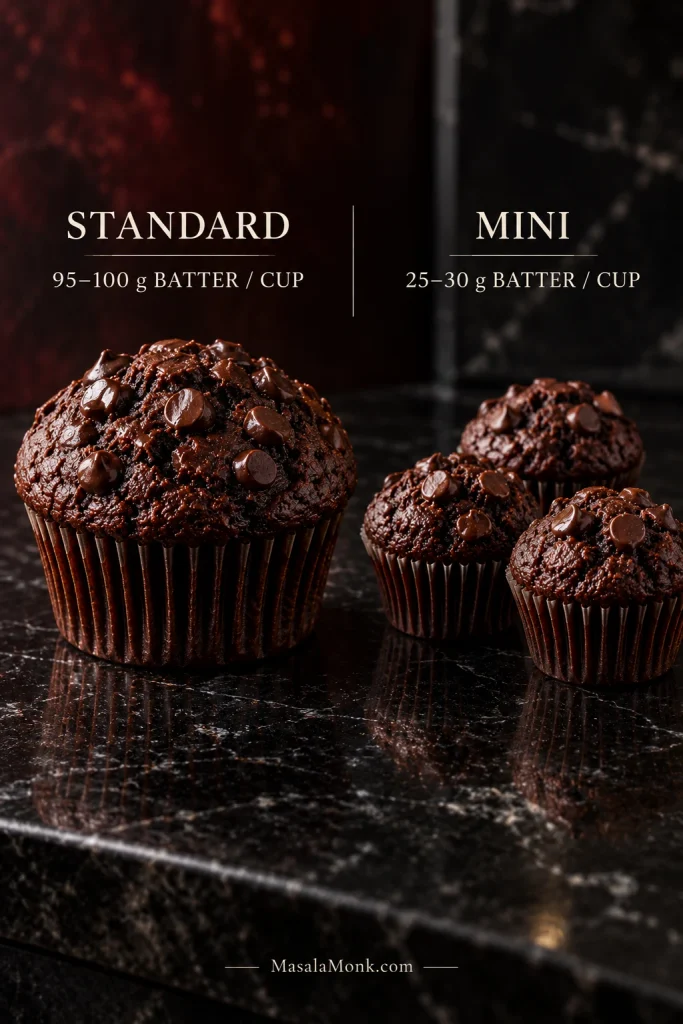
For minis, use about 25–30 g / 0.9–1.1 oz batter per cup and start checking around 9 minutes. Expect roughly 40 minis, give or take a few, because mini pans vary more than standard muffin tins.
Bake them at 375°F / 190°C for about 9–12 minutes. They move from moist to dry quickly, so use the same doneness cues and check early.
Because mini chocolate zucchini muffins hold only 25–30 g of batter per cup, the window between moist and dry is narrower; start checking early rather than scaling the standard bake time proportionally.
For Taller Muffin Tops
Fully preheat the oven, use fresh leaveners, portion the cups evenly and fill them generously. Those basics already give the batter a strong start.
Some bakery-style methods begin with a burst of higher heat and then finish cooler. That can create a more dramatic crown, but it also makes browning and oven hot spots more influential.
This recipe stays at 375°F / 190°C from start to finish. If taller bakery-style crowns are the priority, the Blueberry Muffin Recipe goes further with generous filling and a hot-start method.
Why Are My Chocolate Zucchini Muffins Gummy, Dry, Dense or Flat?
Most texture problems are easiest to troubleshoot one likely cause at a time. Find the symptom closest to yours, change that first, and leave the rest of the recipe alone on the next batch.
Problem
Likely cause
What to do
Wet or gummy center
Very wet zucchini, extra zucchini, moisture-heavy substitutions, oversized portions or underbaking
Check the zucchini amount and preparation first; extra oven time cannot always rescue a batter carrying too much water
Dense or rubbery
Overmixing, protein powder or a flour swap that absorbs differently
Fold only until combined and change one major ingredient at a time
Dry
Too much flour, zucchini pressed extremely dry, large sugar/fat reductions or overbaking
Weigh the flour and start checking sooner
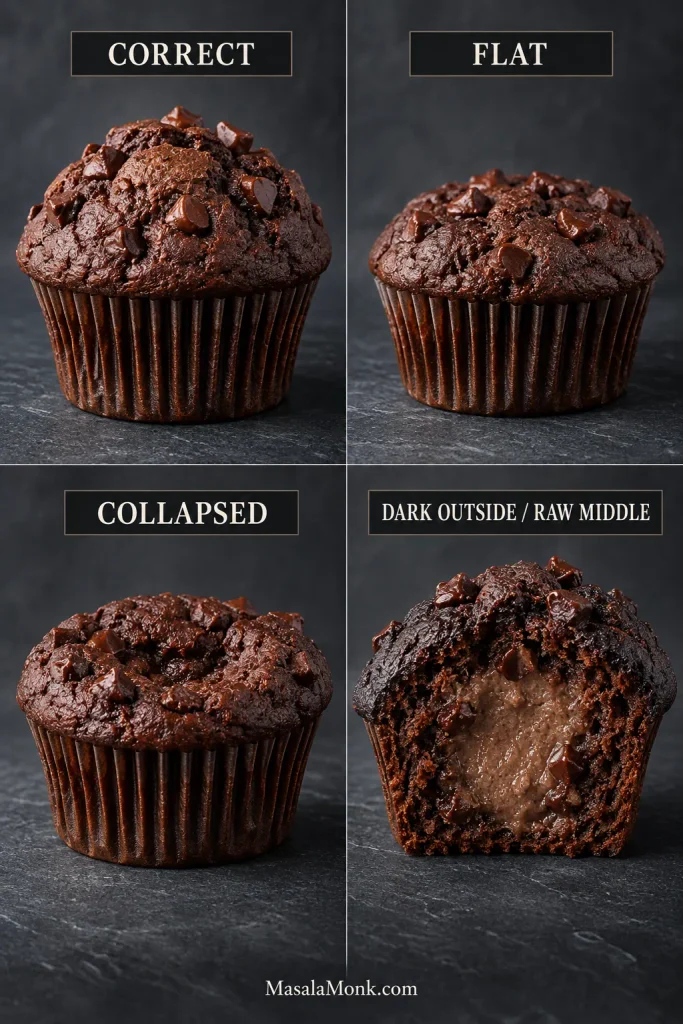
Rose, then collapsed
Wet batter, several major substitutions at once, too much leavener or a center that had not set
Correct the batter before adding more baking powder
Flat tops
Old leavener, underheated oven, heavy batter or underfilled cups
Use fresh leaveners, fully preheat and portion consistently
Dark outside, raw middle
Oversized portions, dark pan, oven running hot or excess batter moisture
Check the pan, oven, portion size and zucchini before simply extending the bake
Bitter or chemical
Too much baking soda or baking powder, or an improvised leavener swap
Measure carefully and keep the leaveners as written
Tester looks wet
You may have pierced a melted chocolate chip
Test another spot before deciding the center is raw
Treat the muffin’s shape as a clue rather than a verdict: flat, collapsed and raw-centered muffins point you toward different moisture, heat, leavening or portioning checks.
Wet or Gummy in the Middle
Extra zucchini, a large applesauce substitution, a different flour or unusually large portions can all leave the center struggling to set before the outside is ready. A genuinely underbaked muffin may only need a few more minutes. When the batter itself carries too much water, however, the edges can dry while the middle stays sticky.
A moist crumb still has structure—visible pores, clean separation and a mostly matte surface—whereas a gummy center compresses into shiny, paste-like crumb away from the chocolate pockets.
Bitter or Chemical Taste
Chemical or metallic bitterness usually points to too much baking soda or baking powder, or an incorrect swap between the two. Very dark cocoa can also taste harsher after a large sugar reduction.
How to Store and Freeze Chocolate Zucchini Muffins
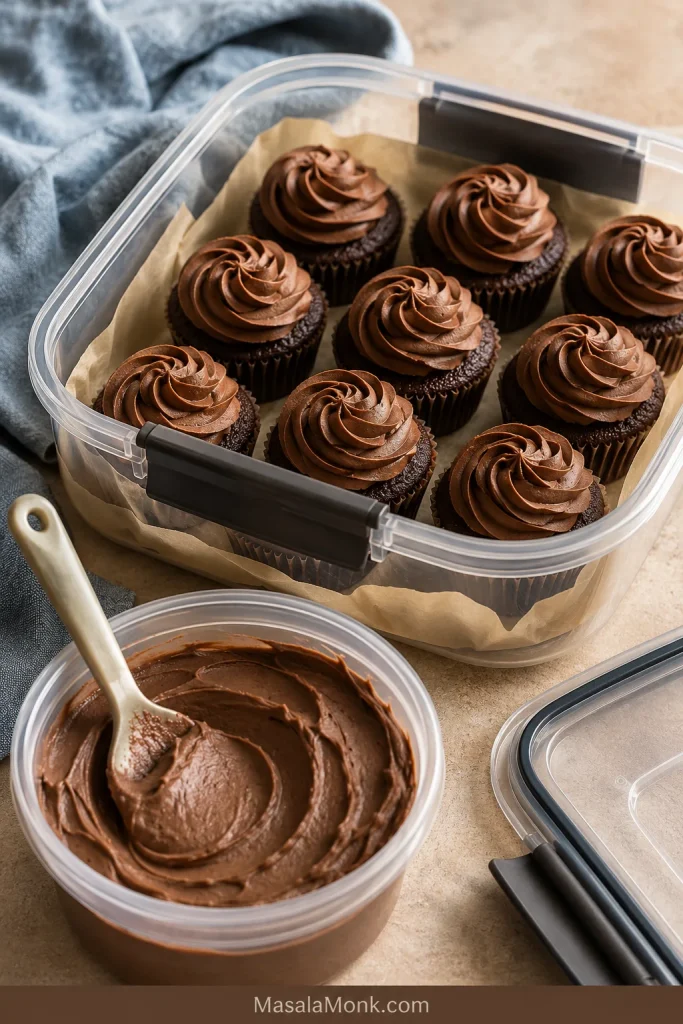
Cool the muffins completely before sealing them up. They are at their best for about 2–3 days at room temperature; packing them while warm traps steam and can make the tops sticky.
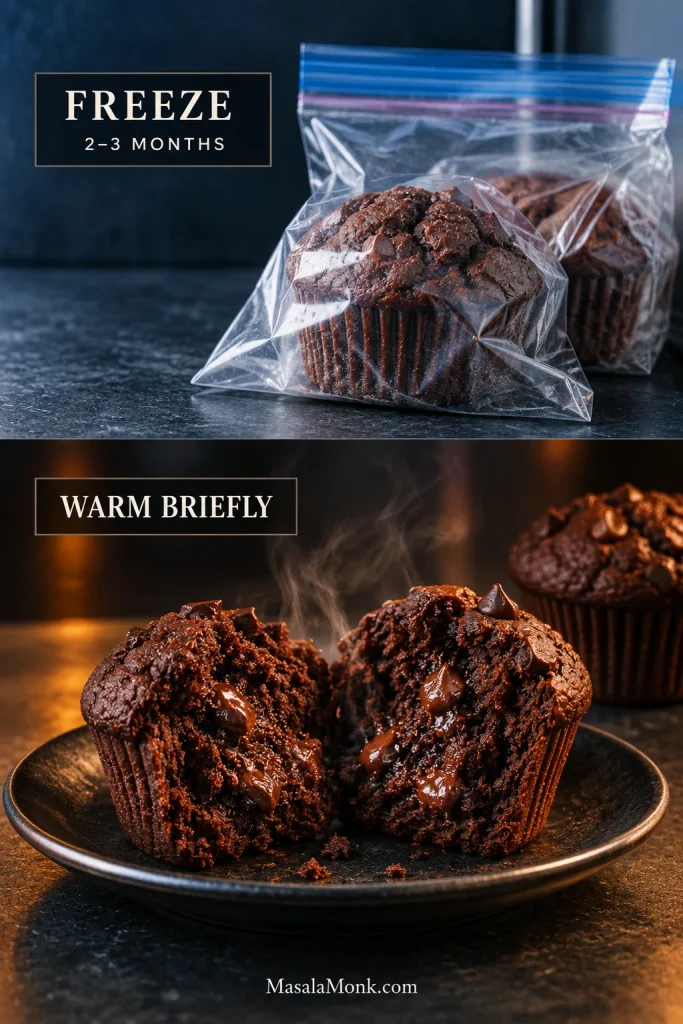
For longer storage, refrigerate them in an airtight container for about 5–6 days, or freeze them for about 2–3 months. To freeze them, cool them fully and wrap them individually or transfer them to a well-sealed freezer bag or container.
Thaw at room temperature or warm one briefly in the microwave. The crumb softens again, and the chocolate chips turn melty at the edges.
Individual wrapping turns a frozen batch into single servings: take out one muffin, warm it briefly, and leave the rest sealed until you need them.
Baking a big garden-zucchini batch? If the centers seemed borderline, cut one muffin open after it has cooled before freezing the entire batch. It is much better to catch a wet middle before thirty muffins disappear into the freezer. If the crumb looks compressed or shiny, compare it with Wet or Gummy in the Middle before storing the batch.
Discard muffins with visible mold, an off smell or an unusual slimy texture.
Warm one just enough for the chips to soften again, and the thing you notice first is still the chocolate: a dark, tender crumb with the zucchini quietly doing the work that keeps it soft.
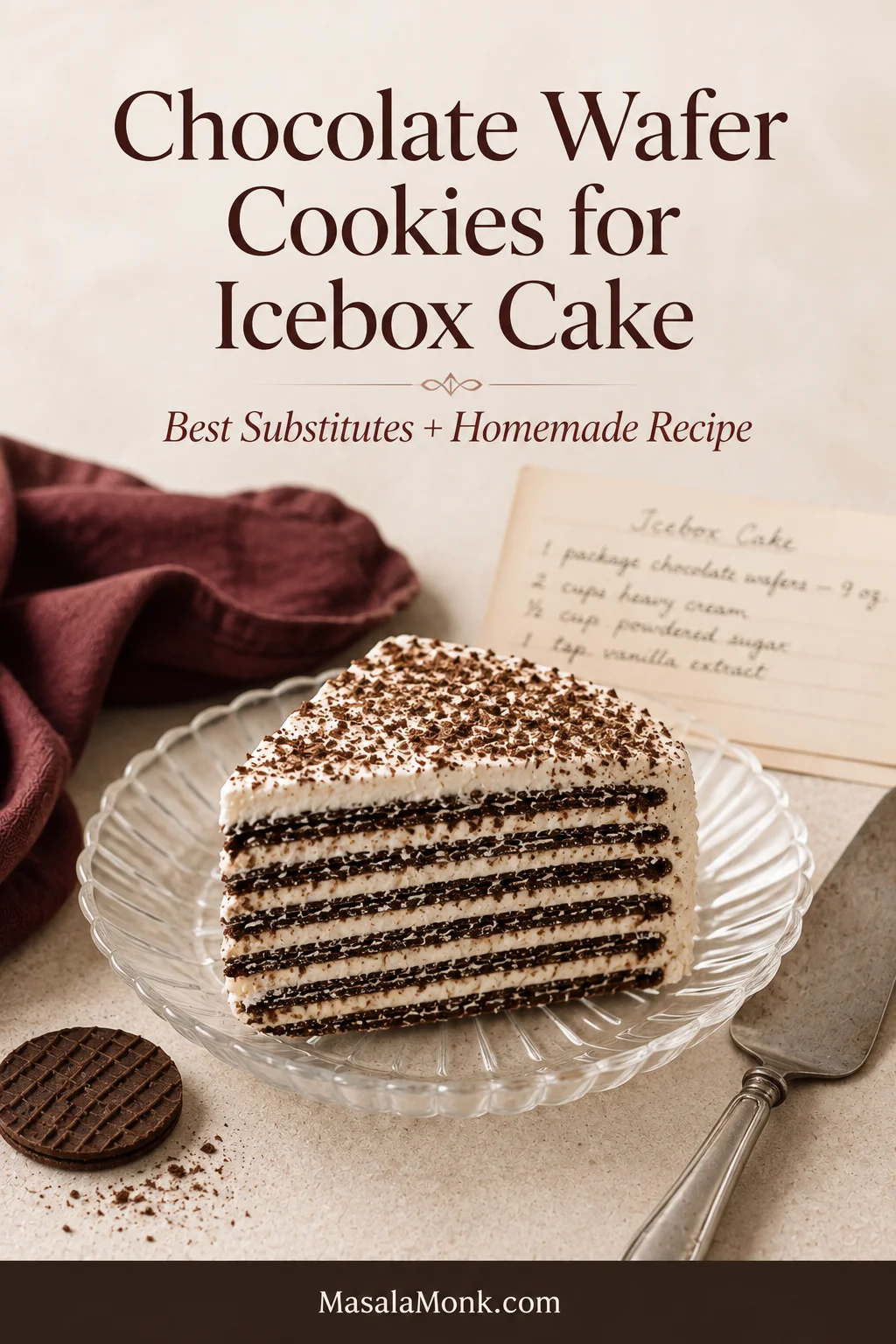
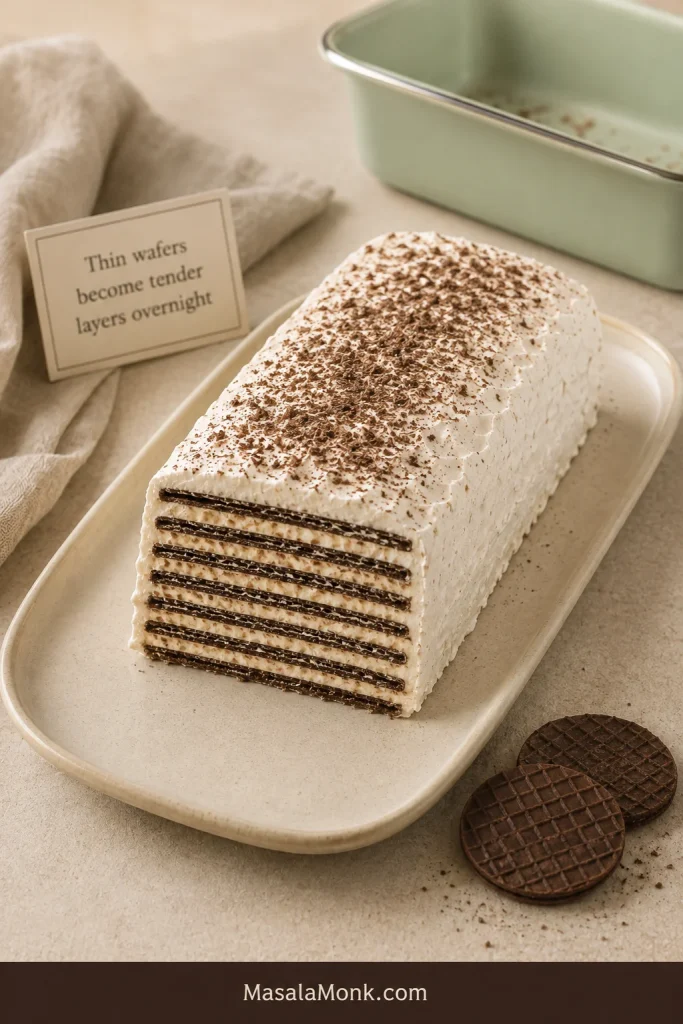
Icebox cake is supposed to be the easy dessert: crisp chocolate cookies, whipped cream, and enough refrigerator time to turn the two into tender striped slices. Then an inherited recipe tells you to open one 9-ounce package of Famous Chocolate Wafers—a product that disappeared from store shelves.
The best chocolate wafer cookies for icebox cake have a surprisingly specific job. They cannot merely taste chocolatey. They need to start thin and crisp, take in moisture without collapsing into paste, and soften all the way through while leaving a clear dark line in every slice.
Choose a store-bought substitute or make the wafers below, then use our complete classic chocolate wafer icebox cake recipe for the whipped cream, assembly, chilling, clean slicing, and finished-cake storage.
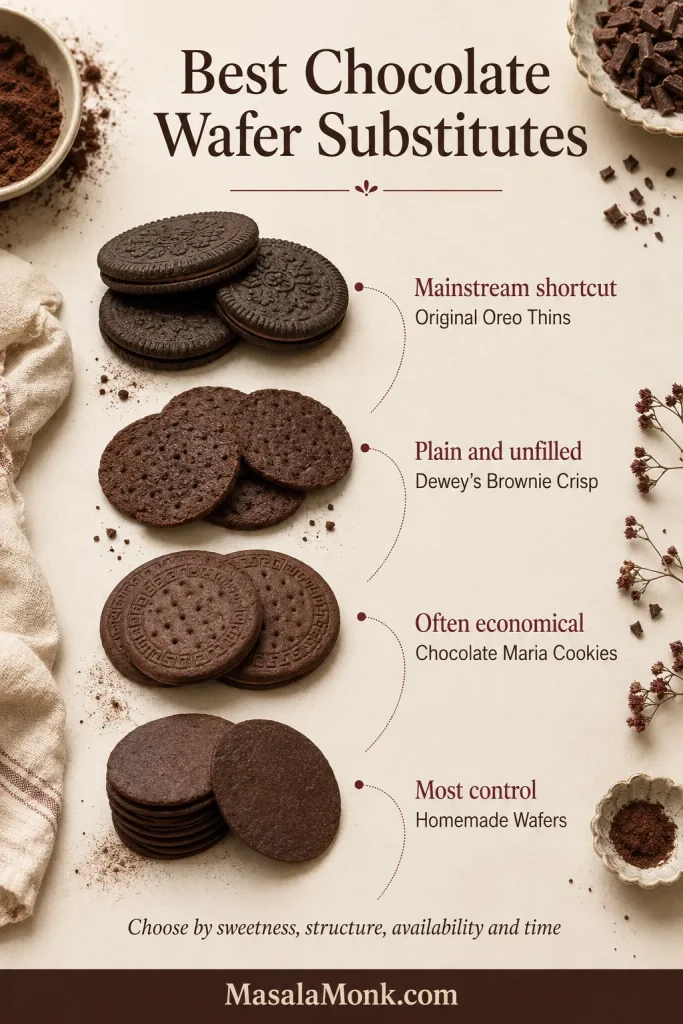
Quick Answer: What Can Replace Chocolate Wafers in Icebox Cake?
Most practical mainstream option: Original Oreo Thins with lightly sweetened cream.
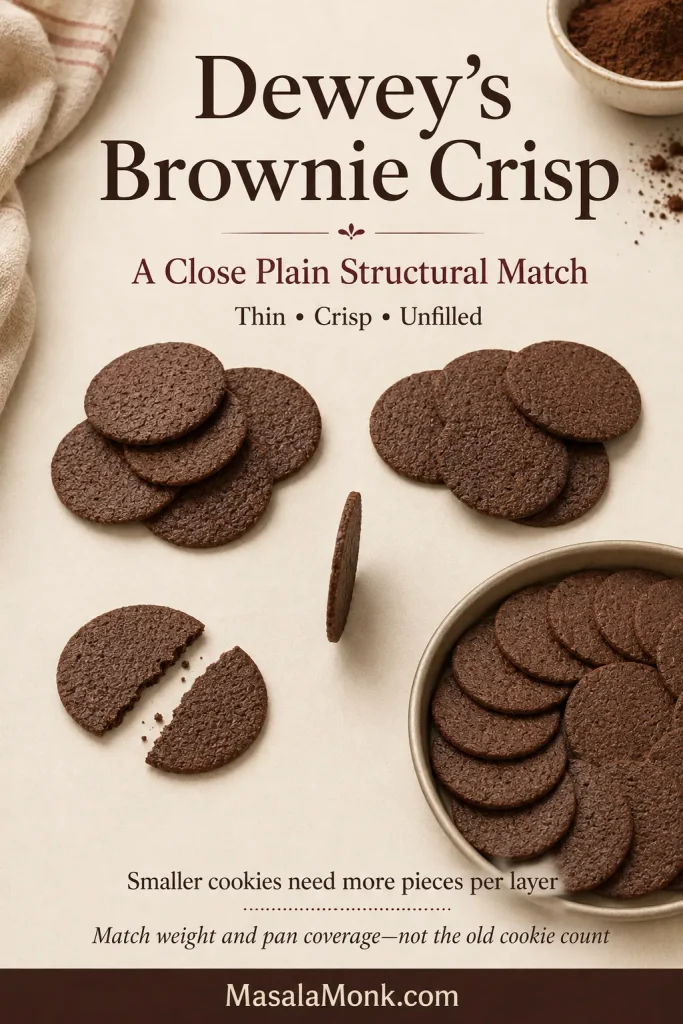
Closest plain structural match covered here: Dewey’s Brownie Crisp, when available.
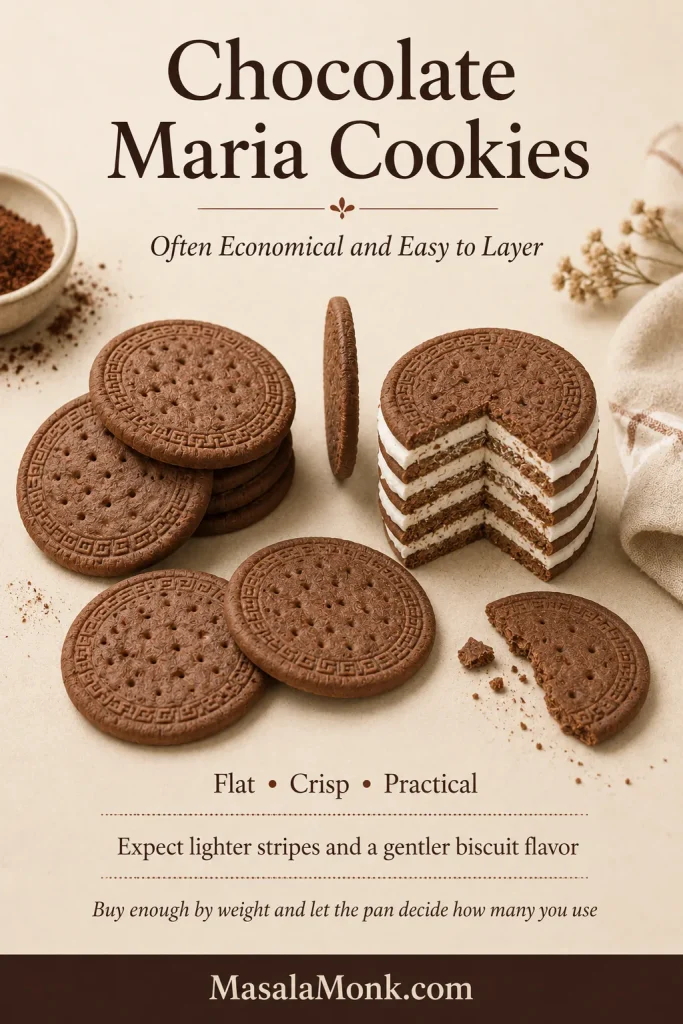
Often the economical option: Chocolate Maria cookies.
Most control: homemade wafers rolled to about 3 mm—just under ⅛ inch.
Match the cookie’s job, not the missing brand name.
For a plain-wafer result, look for a cookie that is thin, completely crisp, reasonably flat, and uncoated. Match the weight and the way the cookies cover the pan before worrying about an old piece count.
One cook needs a cake tonight; another is trying to recreate the birthday or holiday dessert they remember. Choose by the trade-off that matters least: added sweetness, cost, shape, availability, or time.
On a phone, swipe sideways to see all columns.
Your situation
Start with
Plan for
You need a mainstream shortcut
Original Oreo Thins
A sweeter, cookies-and-cream-style slice
You want a plain, unfilled cookie
Dewey’s Brownie Crisp, when available
Many small cookies; match weight and pan coverage
You want an economical, easy-to-layer option
Chocolate Maria cookies
A milder cocoa flavor; buy enough by weight
You are building in a loaf pan or baking dish
Chocolate graham crackers
Broad rectangular layers and a clear graham flavor
You want control over flavor and thickness
Homemade wafers
Cool completely, then set aside the amount your old recipe needs
Choose by the result and trade-off that matter most to your cake.
Whichever route you choose, the goal is the same: enough cream contact to turn every crisp cookie into a tender stripe without erasing the layers.
Regular wafer sizes leave fewer gaps, improving cream contact and producing cleaner slices across a loaf pan.
Homemade Chocolate Wafer Cookies for Icebox Cake
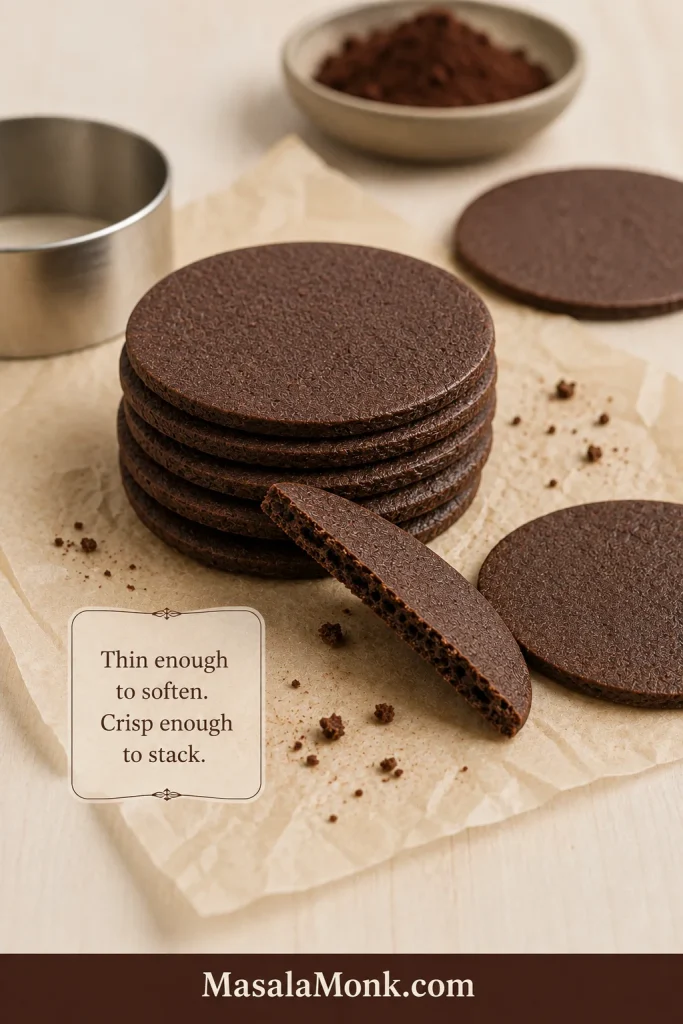
These are not thick chocolate refrigerator cookies. They are dark, dry, thin wafers built for one particular change: crisp enough to snap today, then tender enough to cut after a night between layers of cream. They may look plain when they leave the oven, but that clean snap gives the refrigerator exactly what it needs to create a tender striped slice.
Recipe note: The ingredient proportions and parchment-rolling method are adapted from King Arthur Baking’s chocolate wafers. The guidance here applies that dough specifically to icebox-cake thickness, old-package conversion, chilling, and troubleshooting.
For one old 9-ounce package, set aside 9 oz (255 g) of fully cooled wafers. Use enough to cover the intended layers; keep any extras for gaps, crumbs, or another dessert.
Cool the wafers completely before stacking; trapped warmth can soften them before the cream ever does.
Recipe at a Glance
Prep time
About 30 minutes
Chilling
30 minutes
Bake time
14–17 minutes per batch
Cooling
About 15–20 minutes, until completely cool
Total elapsed time
About 1½–2 hours, depending on tray capacity and whether scraps need another bake
Oven
325°F (163°C)
Thickness
About 3 mm—just under ⅛ inch
Expected yield
Roughly 40 large rounds or 90 smaller squares; see the note below
For one old package
Set aside 9 oz (255 g) of fully cooled wafers
Yield note: The source recipe estimates about 40 rounds at 2½ inches or 90 smaller squares. Your count will change with thickness, cutter size, tray space, and rerolled scraps.
Equipment
Use a digital scale, medium mixing bowl, hand or stand mixer, rolling pin, parchment paper, and a 2½-inch (6.5 cm) cutter. You need at least two baking sheets, although three or four make the process smoother because the batch produces several trays and the wafers cool completely on the pans. A pizza wheel works well for squares; a separate cooling rack is unnecessary.
Useful extras include 3 mm rolling guides or spacer rings, a small offset spatula, and an oven thermometer.
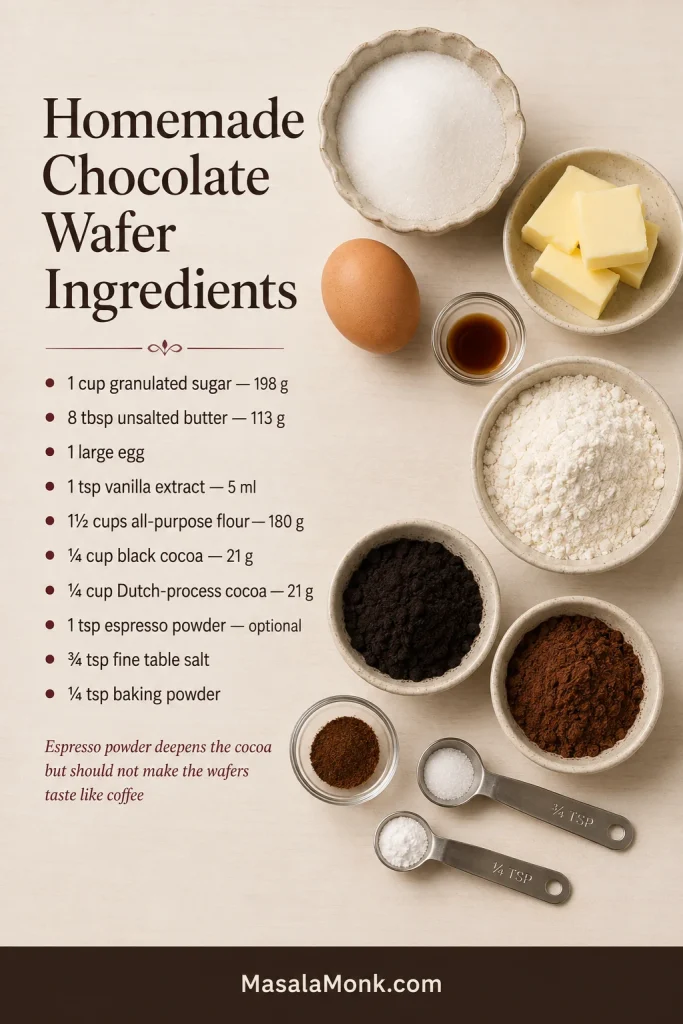
Ingredients
1 cup granulated sugar — 198 g
8 tablespoons unsalted butter, softened — 113 g
Espresso powder, optional — 1 teaspoon
Fine table salt — ¾ teaspoon
Baking powder — ¼ teaspoon
1 large egg
1 teaspoon vanilla extract — 5 ml
1½ cups all-purpose flour — 180 g
¼ cup black cocoa powder — 21 g
¼ cup Dutch-process cocoa powder — 21 g
Weigh the flour and cocoa powders; packed cups can make the wafers thicker and tougher.
Instructions
Mix, Roll, and Chill the Dough
Make a smooth butter base. Beat the sugar, softened butter, optional espresso powder, salt, and baking powder on medium-low until smooth, about 1–2 minutes. The mixture only needs to look even; it does not need to become pale or fluffy.
Add the egg and vanilla. Beat until the mixture is smooth, scraping the bowl so no streaks of butter remain.
Mix in the flour and cocoa. Add the flour, black cocoa, and Dutch cocoa. Mix on low until no pale flour streaks remain and the dough looks evenly dark from edge to edge.
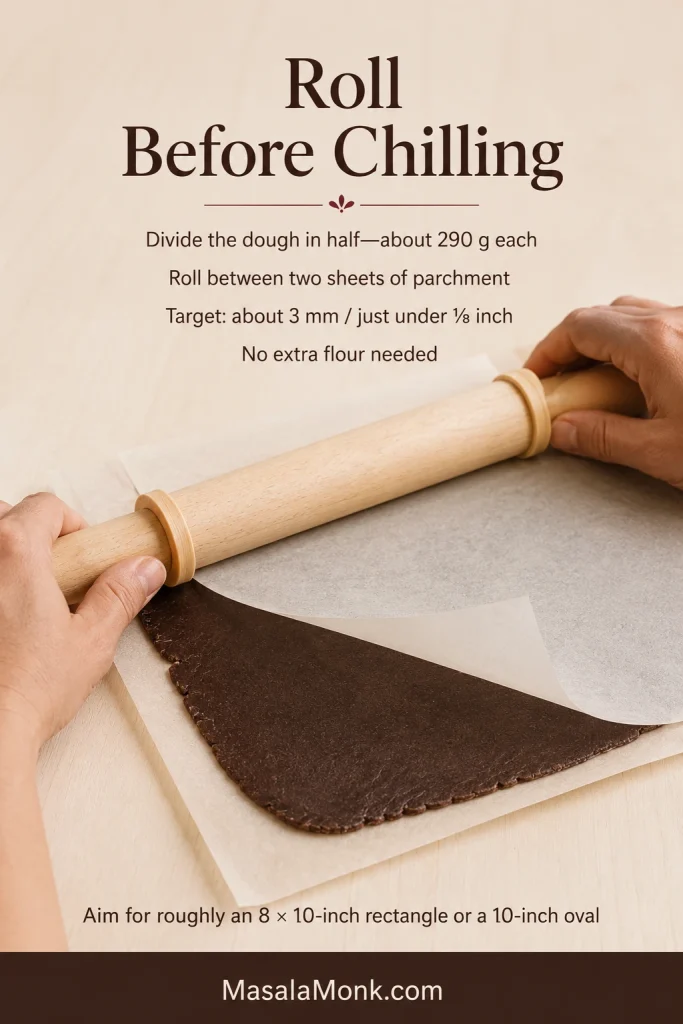
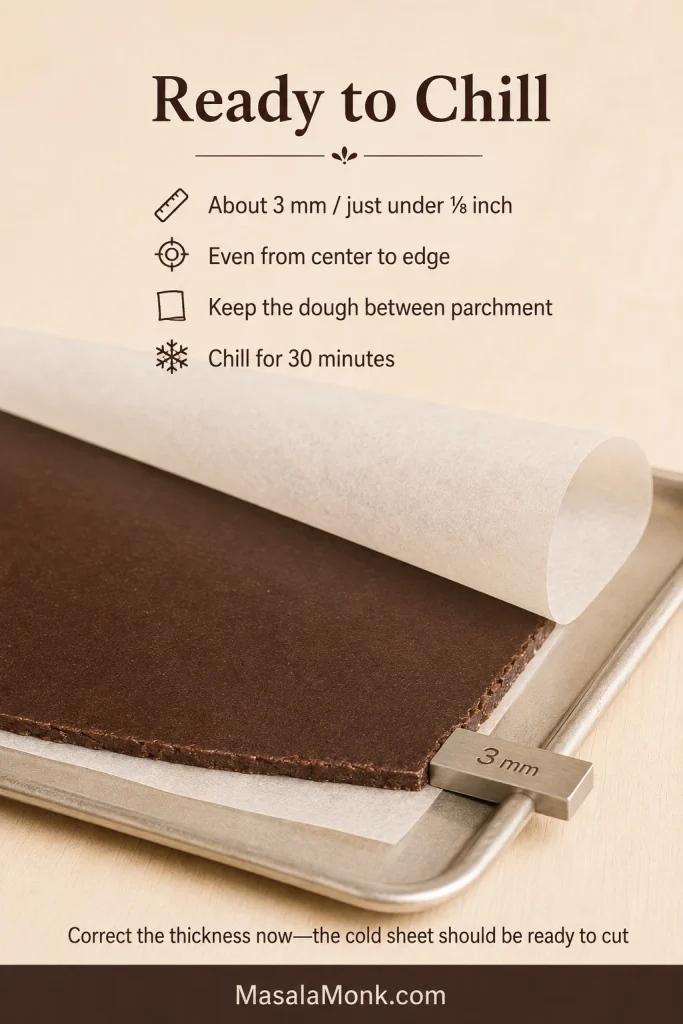
Roll before chilling. Divide the dough in half, about 290 g per piece. Roll each piece between two sheets of parchment to about 3 mm—just under ⅛ inch—aiming for an 8 × 10-inch (20 × 25 cm) rectangle or a 10-inch (25 cm) oval.
Rotate the parchment packet as you roll; repeated pressure in one direction can leave the center thicker than the edges.
Chill the sheets. Refrigerate the dough, still between parchment, for 30 minutes. Meanwhile, heat the oven to 325°F (163°C) with racks in the upper and lower thirds.
Chilling firms the dough but cannot correct uneven thickness, so level the sheet first.
Cut, Bake, and Cool the Wafers
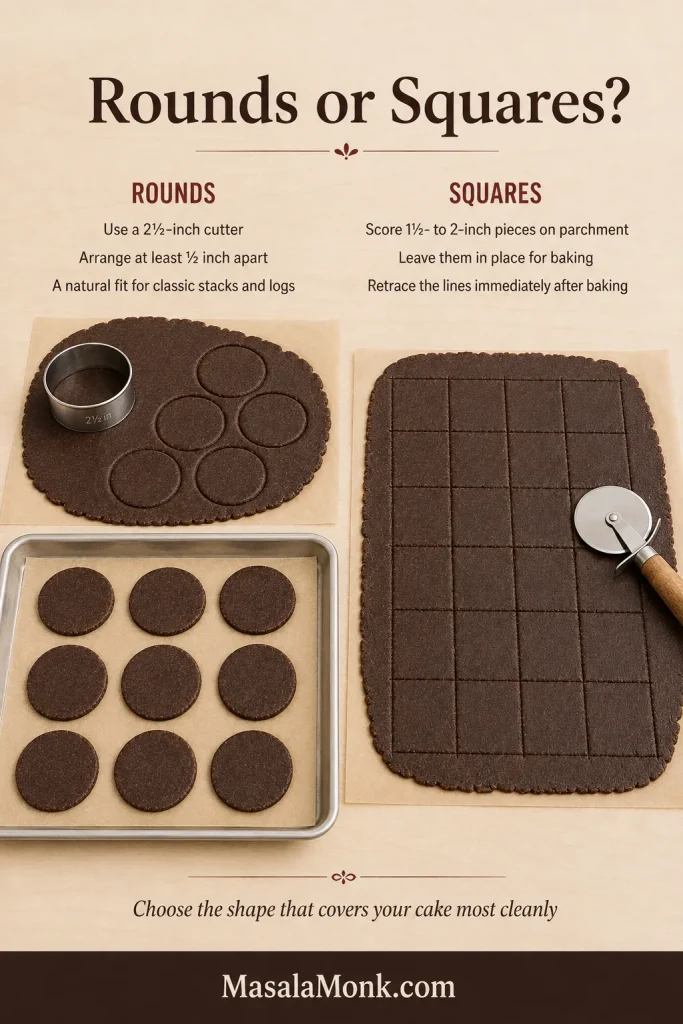
Cut the wafers. Peel away the top sheet of parchment, leaving the chilled dough on the bottom sheet, then cut 2½-inch rounds. Arrange them at least ½ inch apart. For squares, score 1½- to 2-inch pieces directly on the parchment and leave them in place.
Squares minimize rerolling; handle round-cookie scraps gently because repeated working can toughen the final wafers.
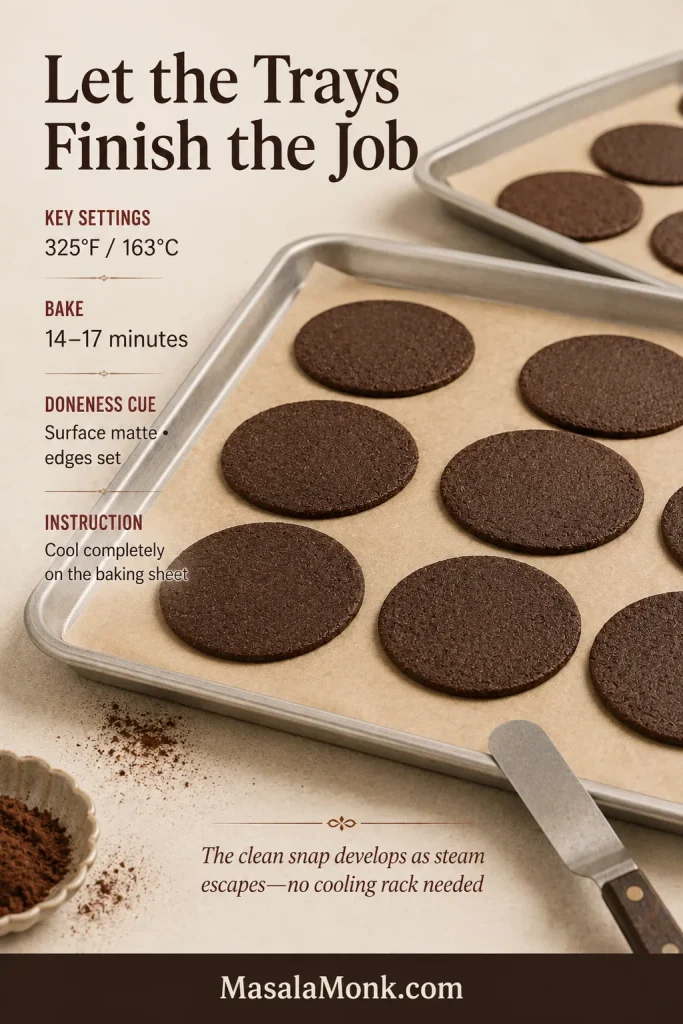
Bake until dry and set. Bake two trays at a time for 14–17 minutes, rotating and switching their positions halfway through. The surface should look matte and the edges should feel set.
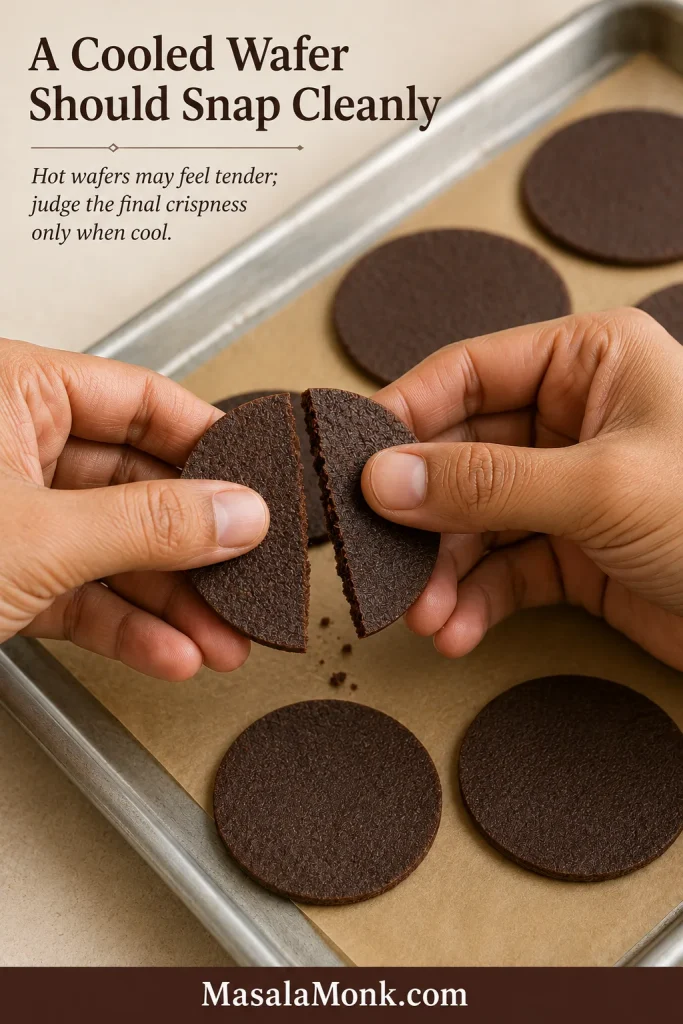
Let the trays finish the job. If you made squares, retrace the cut lines immediately. Leave either shape on the baking sheets until completely cool; the clean snap develops as steam escapes.
Let thin edges firm before lifting; hot wafers are fragile and do not yet show their final texture.
Use every piece. Reroll scraps while the first trays bake, chilling the dough briefly if it becomes soft. Once everything is cool, set aside 9 oz (255 g) for one old package and save the remaining whole or broken wafers for another use.
Recipe Notes
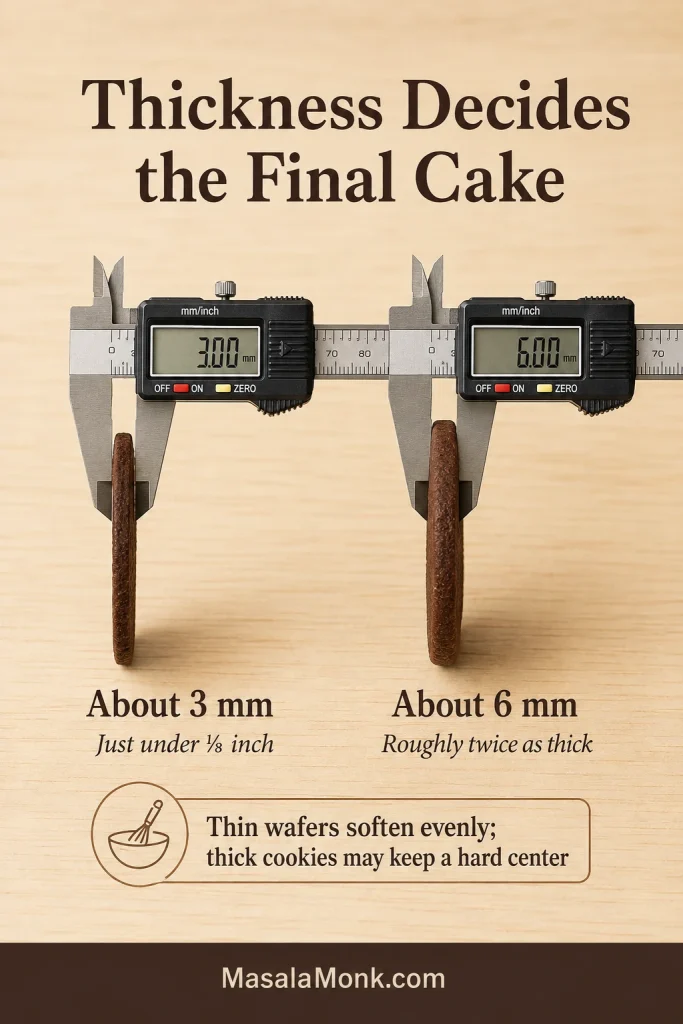
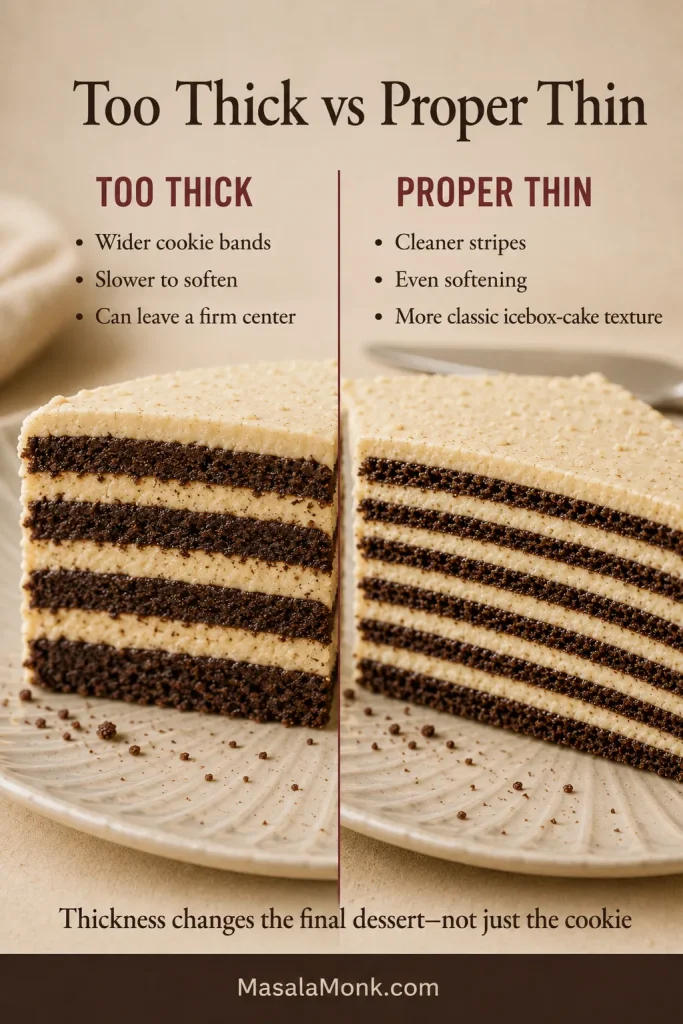
Thickness decides the final cake. A ¼-inch (6 mm) refrigerator cookie is roughly twice as thick and may keep a hard center.
Judge crispness only when cool. The hot wafers are tender; their snap appears as they cool on the trays.
Espresso powder is optional. At this amount, it is intended to deepen the cocoa without making the wafers taste distinctly of coffee.
Test several cooled wafers when a tray baked unevenly; edge and center cookies may crisp at different times.
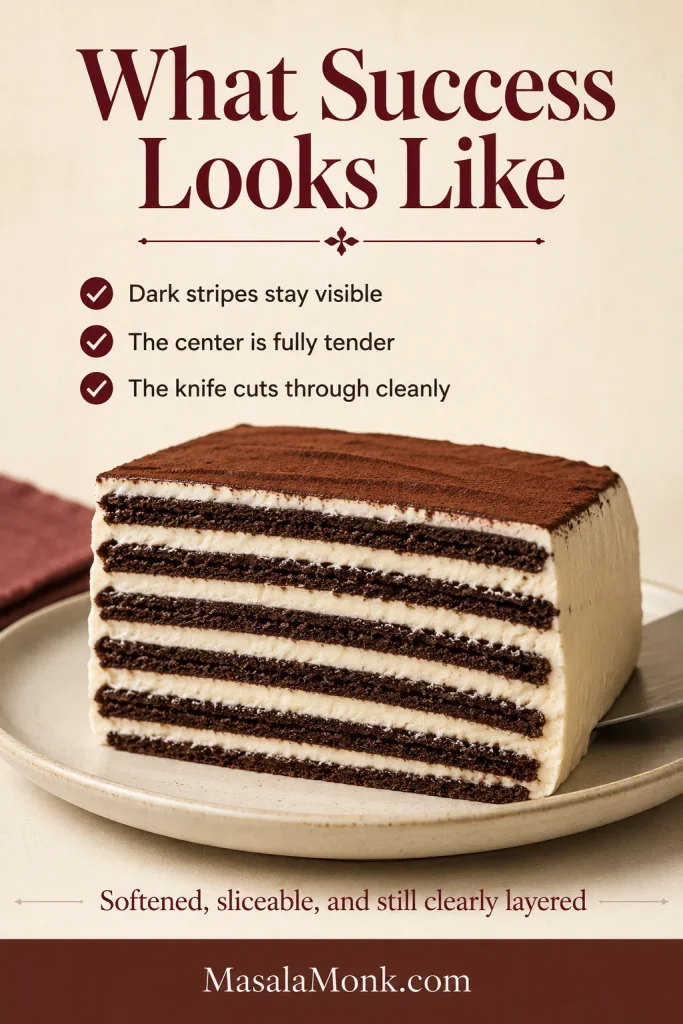
What Success Looks Like
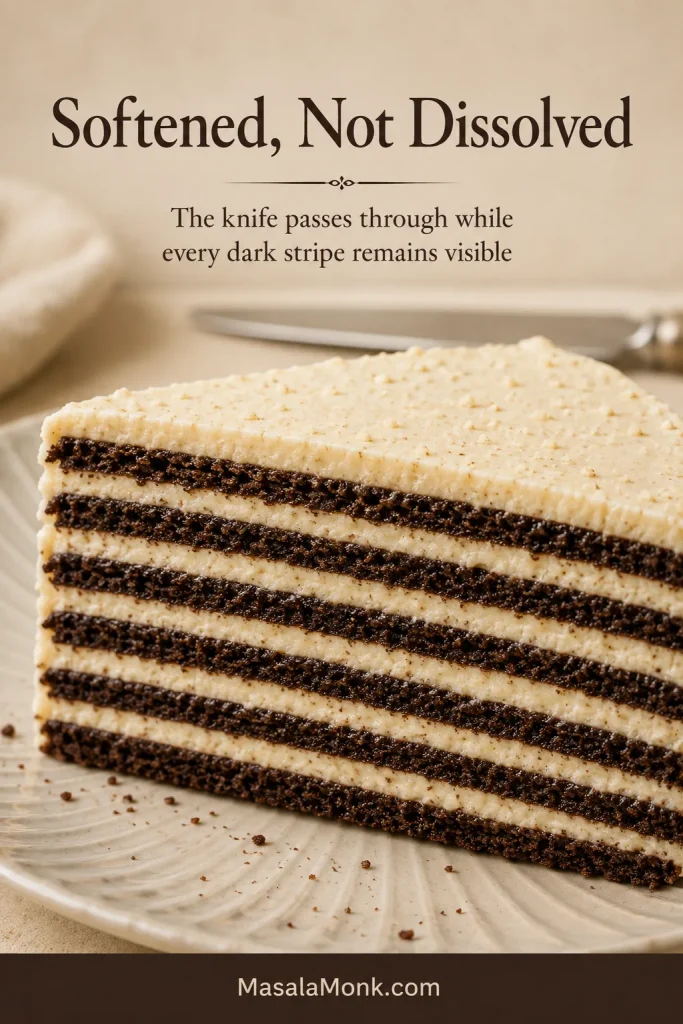
Before assembly, a cooled wafer should look dry, snap cleanly, and taste dark but not aggressively bitter. After an overnight rest with cream, a thin knife should pass through the center without a crack. Each wafer should still leave a distinct chocolate stripe instead of dissolving into a gray-brown blur.
Slightly wavy stripes are fine; look for a tender center, visible dark layers, and cream that still holds.
Making the wafers yourself lets you control both their chocolate flavor and, crucially, their thickness. Rolled thin, cooled to a clean snap, and kept low in leavener, they hold together during assembly and soften evenly in the refrigerator.
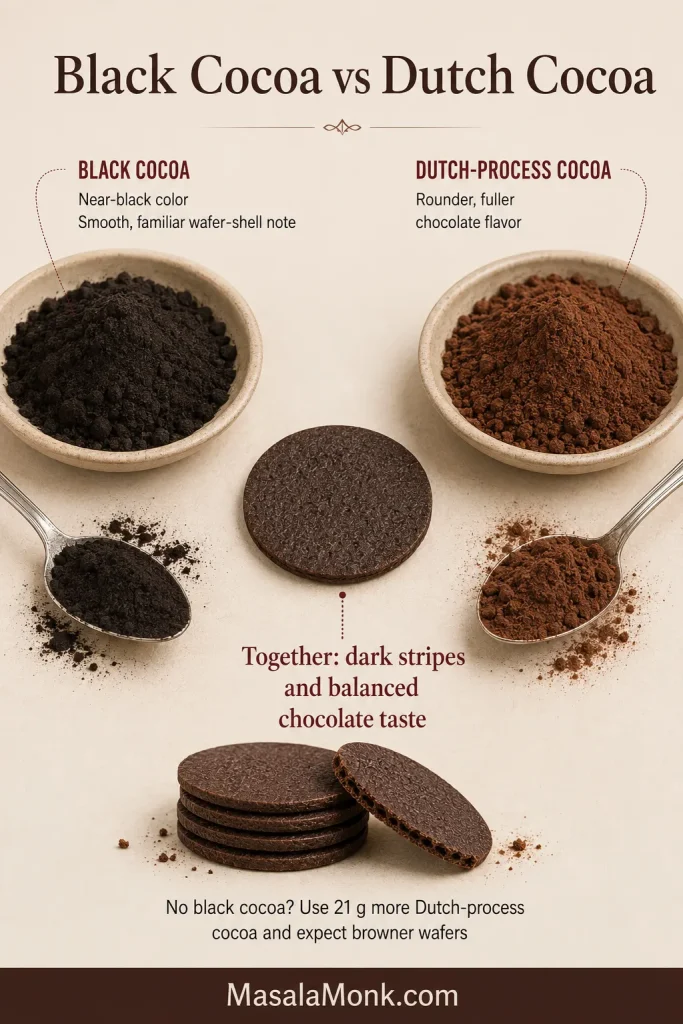
Black and Dutch cocoa share the work: one supplies the near-black color; the other keeps the chocolate flavor round and familiar.
The dough uses a straightforward butter base: the thin roll and full tray cooling produce the crisp finish.
A small amount of baking powder limits puffing: the wafers stay flat enough to stack and soften evenly.
Parchment keeps the dough clean and even: no extra flour is worked into the sheet while rolling.
Tray cooling completes the texture: the fragile hot cookies firm as steam escapes.
Black Cocoa, Dutch Cocoa, and the Flavor You Want
Black cocoa gives the wafer its near-black color and a smooth, familiar note associated with Oreo-style shells. It contributes more color than deep cocoa flavor. Dutch-process cocoa supplies the rounder chocolate character that black cocoa can lack on its own.
The split keeps the cookie dark enough to draw sharp stripes through white cream without making color the only thing you taste. If the labels themselves feel confusing, our cacao, cocoa, and chocolate guide explains the broader terminology; for this dough, stay with the black-cocoa and Dutch-process choices given here.
Equal weights balance black cocoa’s near-black color with Dutch cocoa’s fuller chocolate flavor.
Can You Make the Wafers Without Black Cocoa?
Yes. Replace the 21 g black cocoa with 21 g additional Dutch-process cocoa. The wafers will be brown instead of nearly black and taste more like a traditional chocolate biscuit, while the thin roll and crisp finish still make them suitable for icebox cake.
Natural cocoa can work in a pinch, but the wafers will be lighter, tangier, and may behave somewhat differently. Replacing the black cocoa with additional Dutch-process cocoa stays closer to the intended color and rounded chocolate flavor.
Rolled Versus Slice-and-Bake Wafers
Rolled to about 3 mm: gives the most even thickness and the most dependable icebox-cake result.
A log sliced to about 3 mm: is faster and naturally round, but uneven slices and cracking are harder to avoid.
A log sliced to about 6 mm: is easier to handle but roughly twice the target thickness; save those cookies for snacking, sandwich cookies, or crumbs.
Rolling is the safer method because every part of the sheet can be checked against the same guide. Slice-and-bake works only when the slices are genuinely thin and even.
What Kind of Chocolate Cookie Works in Icebox Cake?
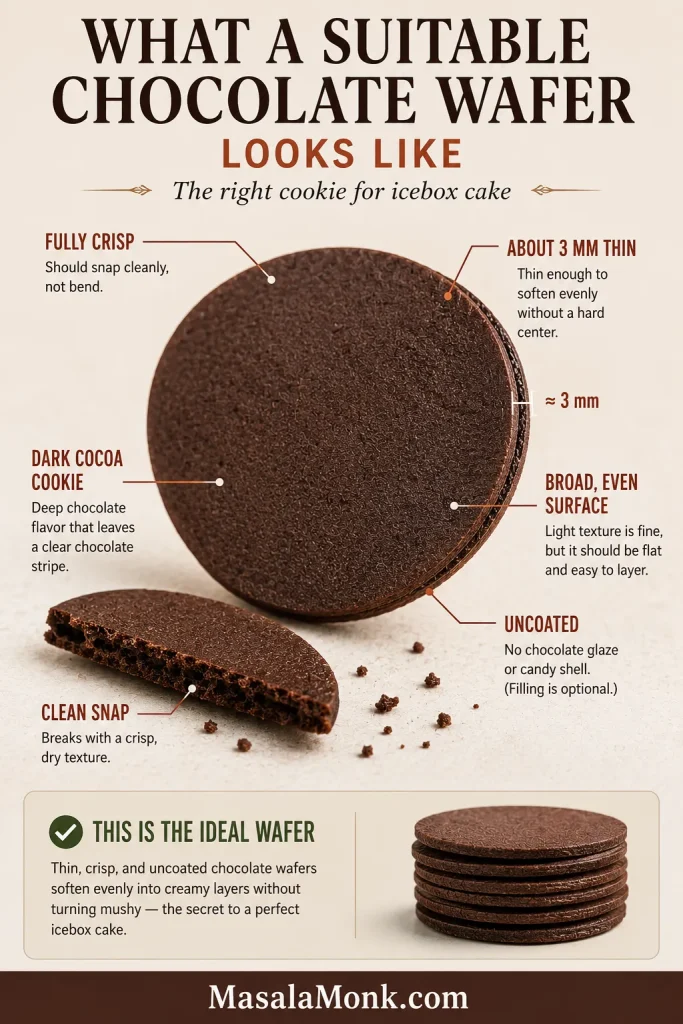
For this dessert, “wafer” means a thin, dry, crisp chocolate cookie—not a candy melt and not a layered wafer biscuit. It must be sturdy enough to spread with cream today and porous enough to become tender by tomorrow.
Whipped cream does more than fill the gaps. During refrigeration, moisture moves into the cookies, so the right replacement softens all the way through while keeping a visible chocolate stripe.
The 30-Second Package Test
Thin: ideally about 3 mm—just under ⅛ inch. Thick sandwich cookies soften much more slowly.
Crisp: look for thin, snappy, crisp, or crunchy—not soft-baked or chewy.
Mostly plain: a thin sandwich filling can work; a thick filling changes the cake substantially.
Uncoated: chocolate shells and glazes slow the moisture that needs to enter the cookie.
Flat: broad, even surfaces are easier to layer and soften more predictably.
At home, snap one before committing the package. It should break cleanly. A cookie that bends, feels cakey, or leaves a greasy coating on your fingers is less likely to form neat layers.
Perfectly smooth faces are unnecessary; broad, flat cream contact matters more.
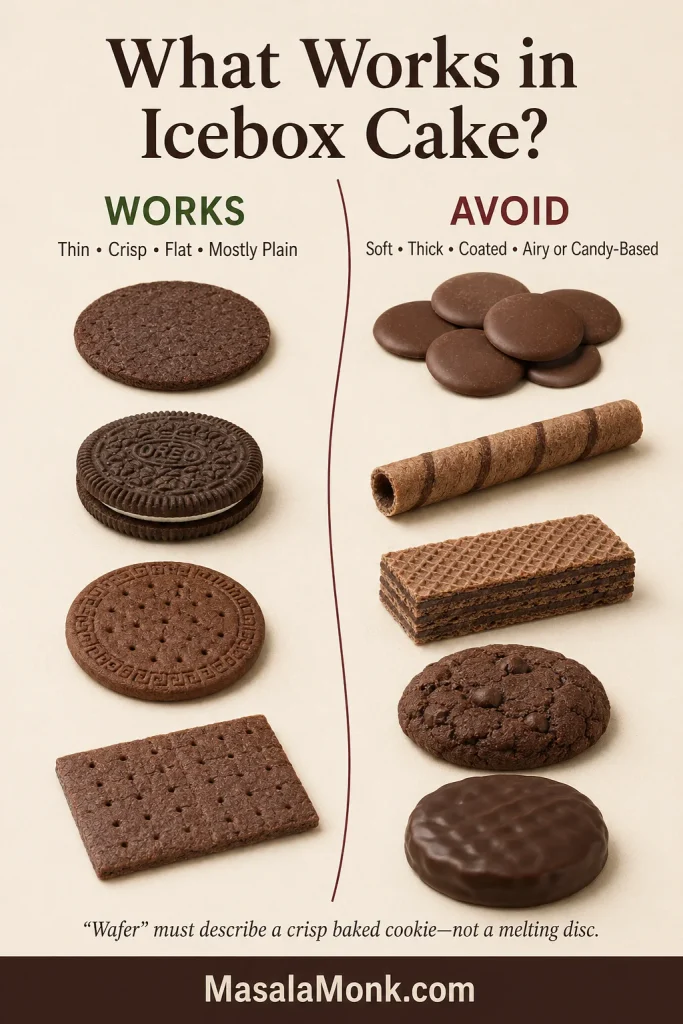
What Works—and What Does Not
Swipe on mobile to view the full comparison.
Cookie style
Use it?
Likely result
Thin, crisp, plain chocolate cookie
Yes
The closest route to classic cake-like layers
Thin chocolate sandwich cookie
Usually
Softens well but adds filling and sweetness
Chocolate Maria biscuit or graham cracker
Yes, as a variation
Easy layers with a milder or graham-style flavor
Thick or soft-baked cookie
Poor fit
May stay hard in the center or turn pasty
Coated, airy layered, or rolled wafer biscuit
Avoid
Coating or internal air gaps cause uneven softening
Candy-melting wafer or coating disc
No
It is confectionery coating, not a baked cookie
Inspect the cross-section and coating, not the word “wafer”; many products with that name are structurally wrong.
Fastest way to avoid the wrong product: if it sits beside candy melts or coating discs, it is not the wafer cookie your icebox cake needs.
Vanilla wafers can make a perfectly good but entirely different icebox cake. They are not a close replacement when dark chocolate stripes are the point.
Thickness, Crispness, Sweetness, and Pan Coverage
Thickness and crispness: Roll homemade dough to about 3 mm—just under ⅛ inch. A ¼-inch (6 mm) cookie is roughly twice as thick and often softens at the edges before the center is ready. Every cookie should begin fully crisp; humidity-softened wafers can lose definition too quickly.
Check the edge and center of the sheet; dough can hide extra thickness in the middle.
Cool before judging: Homemade wafers can feel tender while hot. Let them cool completely before deciding whether the bake was long enough.
Sweetness and filling: Filled cookies bring sugar into every layer, so pair them with lightly sweetened cream. Plain wafers leave more room to sweeten the cream itself. Our homemade whipped cream recipe explains sugar levels and the peak stages to watch.
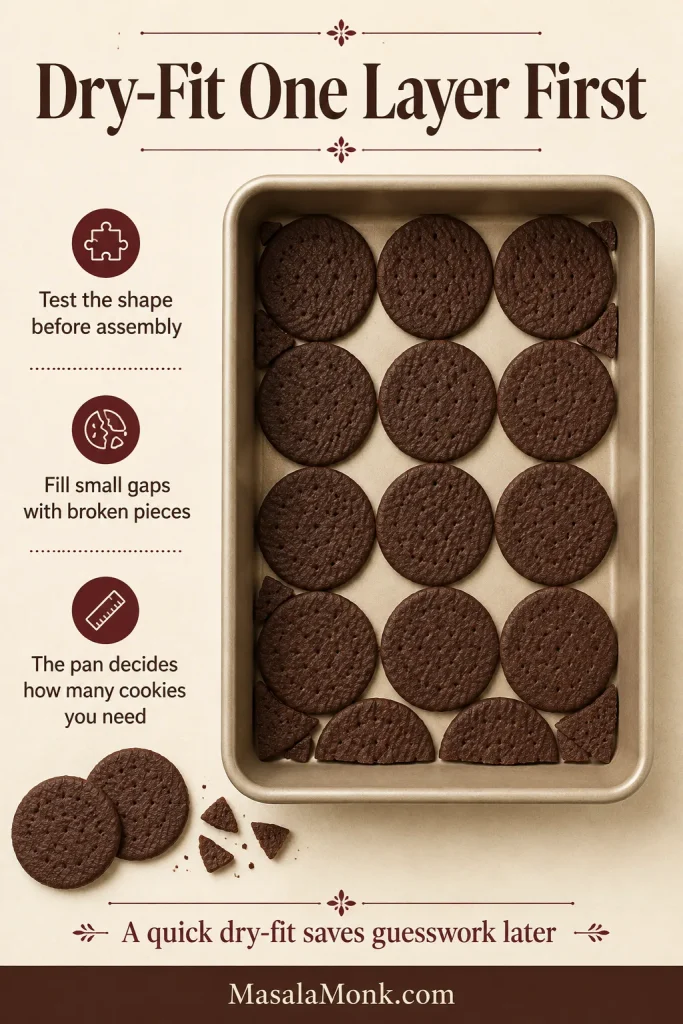
Shape and coverage: Rounds suit classic logs and circular stacks. Squares and rectangles reduce gaps in loaf pans and baking dishes, while broken pieces neatly fill edges and open spaces. Covering the layer matters more than recreating an old cookie count.
Read the finished texture
Crunchy center: the cookie is too thick, dense, coated, or has not chilled long enough.
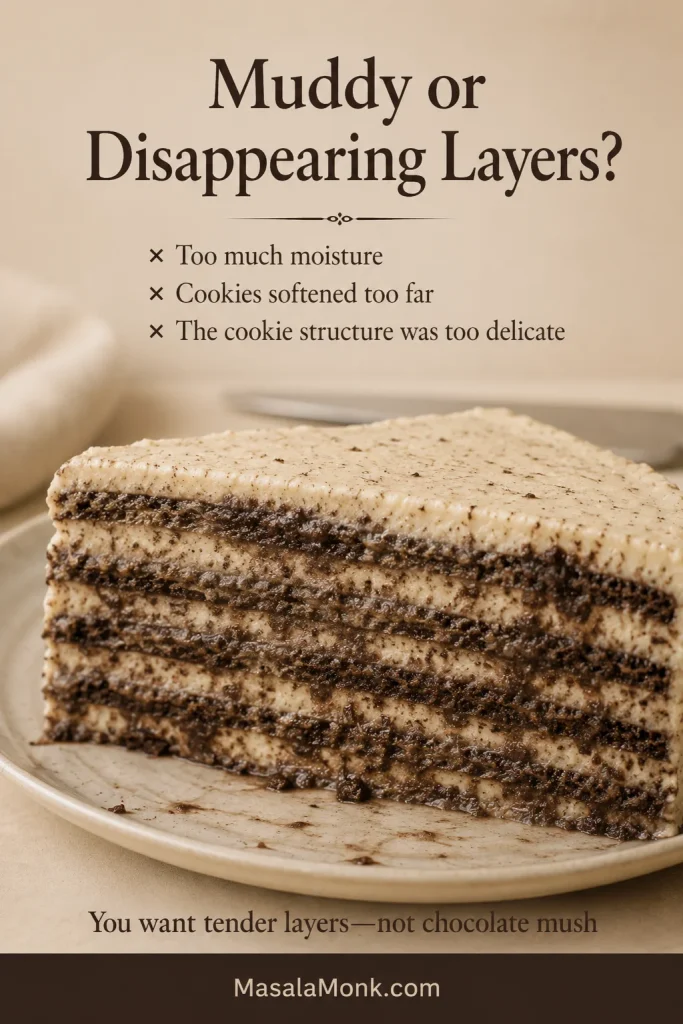
Muddy layer: the cookie began soft or dissolved faster than the cream could set.
Vanishing stripe: the cookie was too fragile to remain distinct.
Clean knife and visible stripe: the cookie softened at the right rate.
What Happened to Nabisco Famous Chocolate Wafers?
Nabisco Famous Chocolate Wafers were discontinued in 2023 after generations of refrigerator-roll, pie-crust, cheesecake, and icebox-cake recipes had been written around them. The Washington Post’s replacement comparison documented both the discontinuation and the scramble for modern alternatives.
Canadian readers may remember Christie or Mr Christie chocolate wafers. Old Canadian retailer pages can remain searchable after a product disappears, so the familiar regional name alone does not confirm fresh stock or current production. Check the actual package, manufacturer, and date.
For many families, the goal is not to invent a new dessert. It is to recreate the birthday or holiday cake they remember without letting one discontinued package end the tradition.
What were Famous Chocolate Wafers like? Very thin, dry, crisp, dark but not candy-sweet, flat enough to spread with cream, and porous enough to soften while keeping a clean chocolate stripe. A modern replacement needs those same qualities, even if the cookie looks completely different.
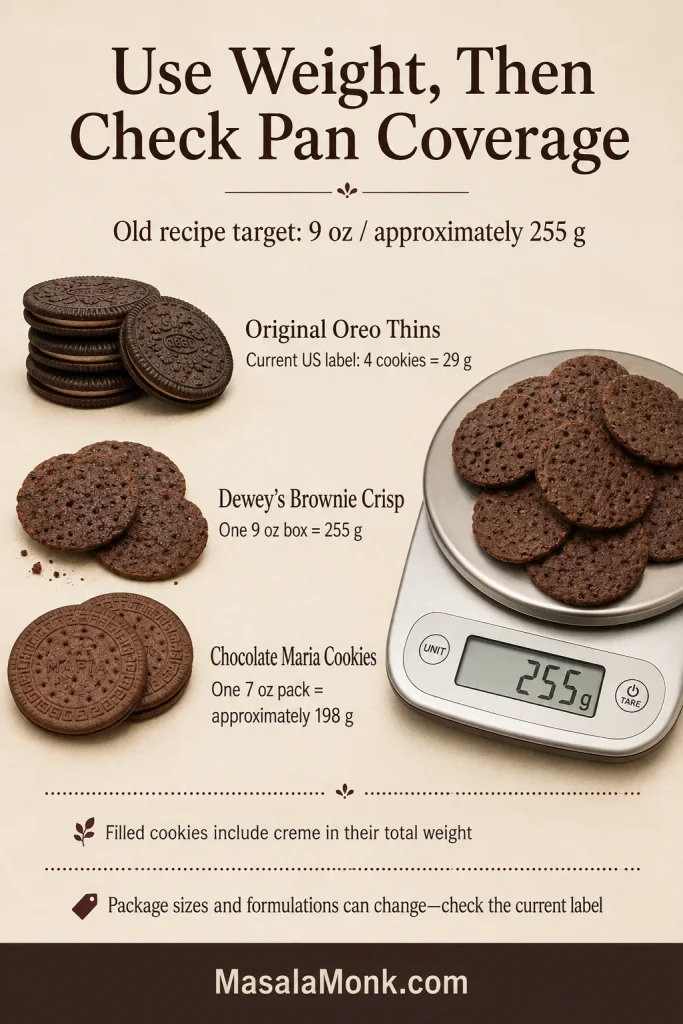
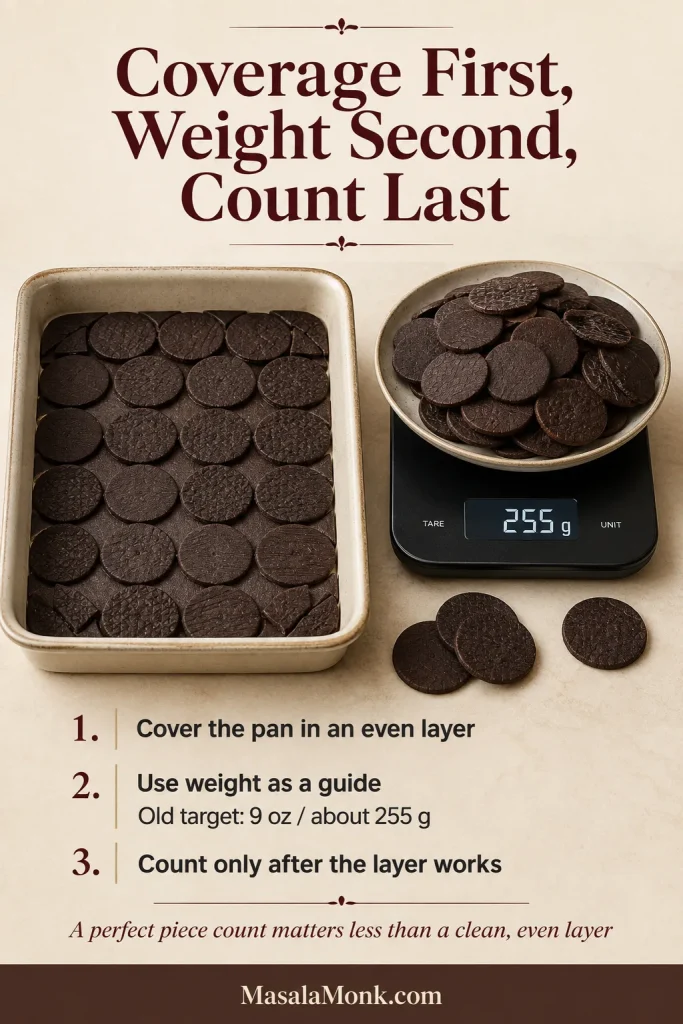
The old box still gives us one useful number: 9 ounces (about 255 g) of thin chocolate cookies. Weight transfers more reliably than an old piece count because modern substitutes vary in size, thickness, and filling.
Should you buy an old package online?
Usually, no. A fresh cookie with the right structure is a better baking ingredient than an expensive discontinued package with uncertain heat, humidity, and storage history.
Look for a photograph of the actual sealed package, not only an archived product image.
Look for a readable best-before date and current ingredient label.
Identify the manufacturer and seller before trusting claims of a “revived” equivalent.
The box was convenient. The real standard is the finished slice: dark layers that soften cleanly without disappearing.
Best Store-Bought Chocolate Wafer Substitutes
Once you know the qualities that matter, the store-bought choice becomes simpler. Each option solves a different problem involving availability, sweetness, shape, or cost.
Compare filling, thickness, cocoa strength, and diameter—not availability alone—because each changes sweetness, coverage, and softening.
Before buying: Package sizes, formulations, and availability were checked in August 2026 and can change. Read the current label, then compare thickness, filling, coating, and package weight before choosing. The product visuals are illustrative comparison guides rather than package photography or controlled test results.
Where to Buy Chocolate Wafer Cookies Now
Start in the ordinary cookie aisle, where Original Oreo Thins are a practical mainstream option in many US stores. Check Hispanic or international foods for chocolate Maria cookies and specialty-cookie shelves for thin cocoa snaps.
Shopping online? Search for thin chocolate cookies, chocolate cookie thins, chocolate snaps, or plain chocolate thins. The broader phrase “chocolate wafers” often returns candy melts and filled wafer bars, so check the filling, coating, thickness, and package weight before ordering.
Current package guide, checked August 2026:
Original Oreo Thins: the current US label lists 4 cookies as 29 g. Weigh out approximately 255 g and dry-fit one layer because the creme contributes to the total and the number needed depends on the pan.
Dewey’s Brownie Crisp: one 9-ounce box matches the old package weight, but the smaller cookies require more pieces to cover each layer.
Goya Chocolate Maria: one 7-ounce pack is about 198 g, roughly 57 g short. Buy two and use only what the pan needs.
Oreo Thins, Plain Shells, and Regular Oreos
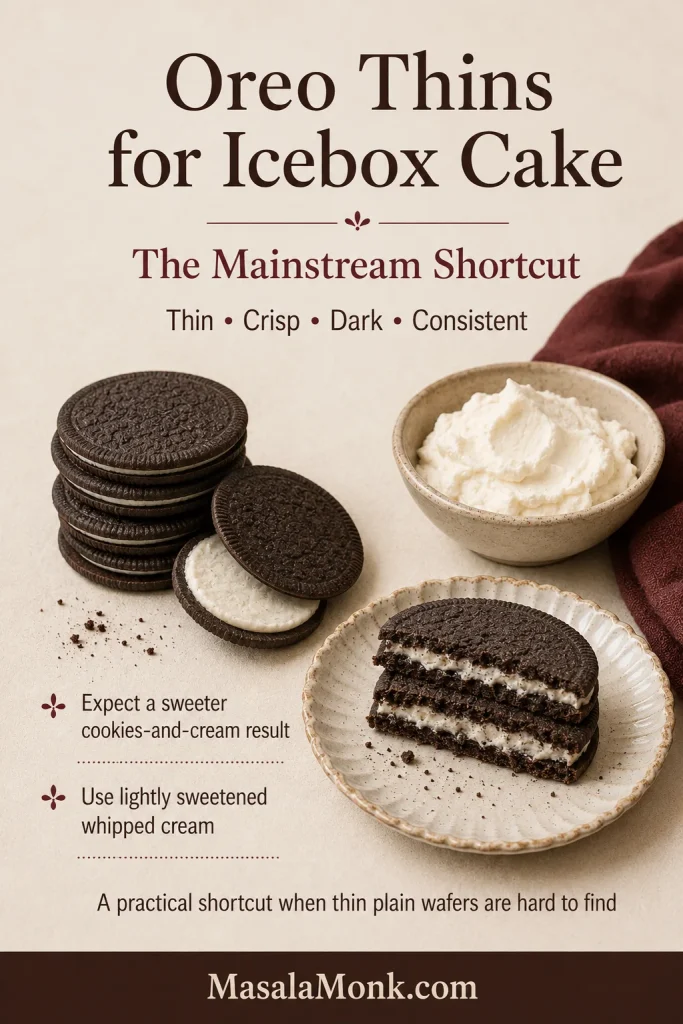
Original chocolate Oreo Thins are thin, crisp, dark, and consistent. Their light creme filling softens into the whipped cream, creating a sweeter, more cookies-and-cream-like slice with a faint white line between the dark shells. Choose the original version unless another filling flavor is part of the plan.
Taste one Oreo Thin with prepared cream before stacking; sweetness is easiest to correct at this stage.
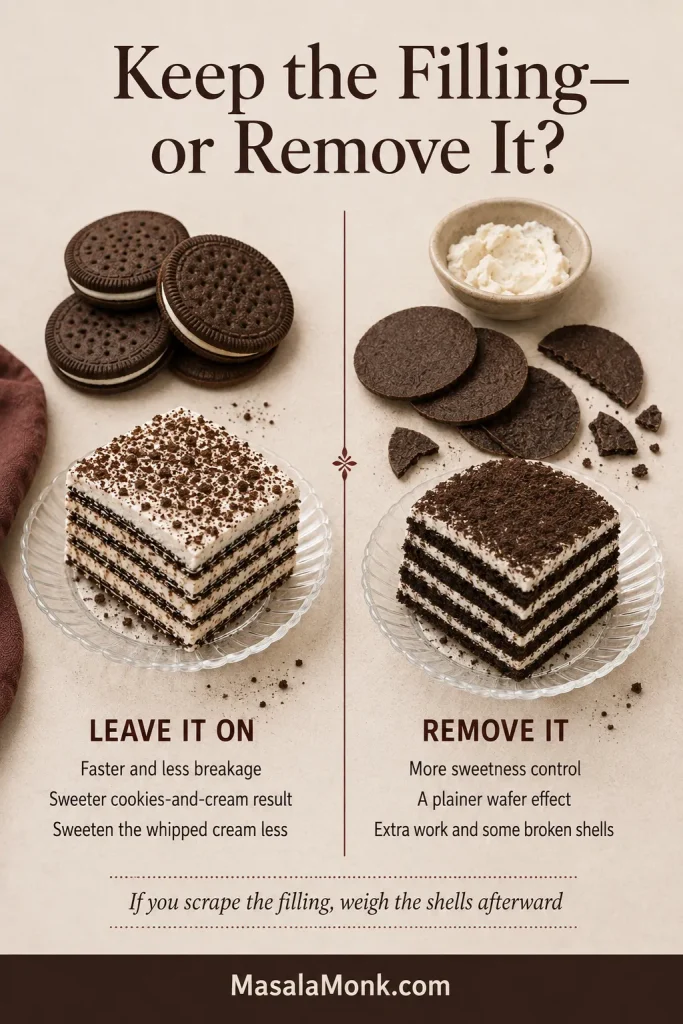
Route
Choose it when
Result
Leave the filling
Speed matters and you like a sweeter cake
Easy, cohesive, and clearly cookies-and-cream
Remove the filling
You want more sweetness control
A plainer wafer effect, with extra work and some breakage
Most consumer Oreo packages include filling. For a plain-shell route, separate Original Oreo Thins at home and allow a few extras for shells that crack.
After removing the creme, weigh the shells and allow extras for breakage.
What about regular Oreos? Whole regular Oreos make a thicker, sweeter Oreo icebox cake and usually need a longer rest. Separated shells behave better, though they remain thicker than Oreo Thin shells and the old Famous Wafers.
Dewey’s Brownie Crisp: A Close Plain Structural Match
Dewey’s Brownie Crisp is thin, crisp, and unfilled. Among the products covered here, those qualities make it a close plain structural match when it is available.
The cookies are smaller than the discontinued wafers, so arrange enough pieces to cover every layer rather than chasing the old count. Their unfilled form may produce darker-looking layers than a sandwich cookie and will not add a separate line of creme.
Smaller cookies create more seams, so dry-fit one layer before estimating the quantity.
Chocolate Maria Cookies: Economical and Easy to Layer
Flat, crisp, often economical, and easy to arrange, chocolate Maria cookies are a practical alternative. Their cocoa flavor is usually lighter and more biscuit-like than the discontinued wafers, so the finished cake has lighter chocolate stripes and a gentler biscuit flavor beside the cream.
These cookies are commonly sold in packages smaller than the old 9-ounce box. Check the current package guide above, buy enough to cover the planned layers, and let the pan determine how much you use.
Broad rounds cover efficiently, and broken edges can fill narrow gaps without building thicker spots.
Chocolate Graham Crackers: A Natural Fit for Rectangular Cakes
Chocolate graham crackers are not a flavor replica, but their broad rectangular shape makes them easy to layer in loaf pans, square dishes, and 9 × 13-inch baking dishes. Expect fewer gaps, less fiddly arrangement, and a finished dessert that tastes unmistakably like chocolate graham crackers—delicious in its own right, but different from the old wafer cake.
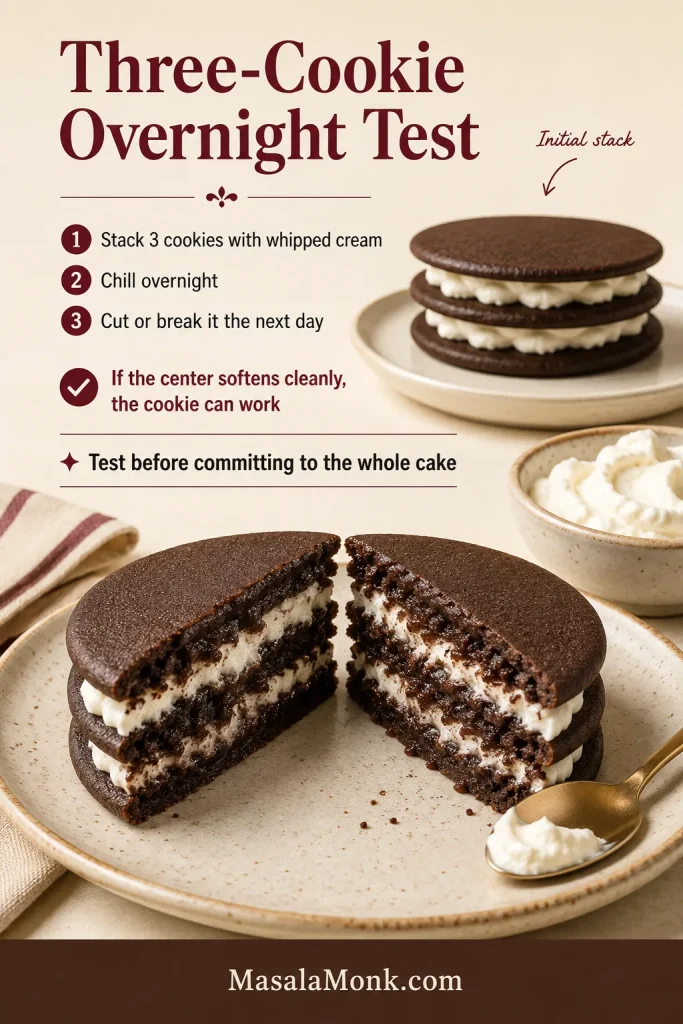
Unsure whether a cookie will work?
Build a three-cookie stack with cream tonight. Chill it overnight and cut through the center tomorrow. If the knife glides through while the chocolate layers remain visible, the cookie is ready for the full cake. A hard center, muddy layer, or vanished stripe tells you what to change before risking the whole dessert.
A clean result means you can build the full cake confidently. If the center is still firm, give the test stack more time before changing the cookie or adding extra cream.
Use the exact cream and chill time planned for the cake; changing either can mislead the test.
Thick or dense cookies take longer to soften, and deeper cakes usually need more time. Refrigerator temperature and the amount of cream can shift the finish too, so use these as starting checks rather than fixed guarantees.
Very thin plain wafers: begin checking after about 6–8 hours.
Thin filled sandwich cookies: plan on an overnight rest.
Flat biscuits and graham crackers: plan on an overnight rest.
Thicker cookies or regular sandwich cookies: allow closer to 12–24 hours.
Any unfamiliar cookie: run the three-cookie test before assembling the full cake.
The center decides: Let the clock guide you, then confirm readiness with a thin knife through the middle. The blade should pass through without meeting a hard cookie center, while the dark layers remain visible in the slice.
How to Convert and Adapt One Old 9-Ounce Package
One dependable number remains from the old box: 9 ounces (about 255 g). Begin with that weight, then dry-fit one cookie layer in the pan before whipping the cream. The test shows whether the cookies can cover the layer and where broken pieces will help.
The same package weight can cover a pan differently when filling, diameter, and shape change.
Dry-fit one complete layer after weighing the cookies. The same 255 g can cover a pan differently when filling, cookie diameter, and shape change.
Photograph or count the test layer before removing it so final assembly moves quickly.
Coverage first, weight second, count last.
A filled sandwich cookie spends part of its weight on creme. Small cookies need more pieces to cover the pan, while broad rectangular crackers need fewer. Both the scale and the pan matter.
Weighing one completed dry-fit layer gives a useful total estimate; keep a reserve for gaps, breakage, and uneven edges.
Old-Package Conversion Table
Swipe on mobile to view the full conversion table.
Old recipe wording
Initial guide
Check before assembly
1 package or box, 9 oz
Set aside 255 g cookies
Dry-fit a layer and confirm full coverage
2 packages, 9 oz each
Set aside about 510 g cookies
Use weight, not the old piece count
36 Famous Wafers
Match the old recipe’s coverage and approximate weight
Modern cookie sizes can make 36 too many or too few
Original Oreo Thins
Weigh 255 g from the package
The filling contributes part of that weight
One 7 oz (198 g) Maria-cookie package
It is about 57 g short
Buy a second package and use only what the layers need
Homemade full batch
Set aside 255 g after the wafers cool
Keep the remaining whole and broken wafers
If you remove sandwich-cookie filling, weigh the shells after scraping. The unopened package includes filling you will discard, so its weight overstates the cookie left for the cake.
Running a little short does not mean the recipe is lost. Fill the final spaces with compatible pieces and let the finished slice—not an inherited cookie count—judge the replacement.
Adjust Only What the New Cookie Changes
The old recipe assumed one predictable wafer. A modern substitute usually changes sweetness, thickness, size, or cocoa flavor. Adjust only what the new cookie changes.
What changed
Adjust this
What to expect
Sweeter or filled cookie
Sweeten the cream less; taste one cookie with a spoonful of cream
A balanced cake without an overly sugary finish
Thicker cookie
Spread cream against both sides and allow more chilling time
A heavier, more cookie-forward slice
Smaller cookie
Use more pieces to cover each layer and fill gaps with broken pieces
A different count but the same cake shape
Milder cocoa flavor
Accept the variation or finish with unsweetened cocoa or grated dark chocolate
Lighter stripes with a deliberate chocolate accent
Do not add a large amount of extra cream simply to force thick cookies to soften; the cake can slump before the centers are ready.
Thin wafers leave less room for measuring and temperature errors than thick drop cookies, but the symptoms are usually clear. Start with what the dough or cooled wafer is doing, then change the most likely cause on the next tray. The visuals below are diagnostic guides; actual softening still varies with cookie thickness, cream consistency, pan depth, and refrigerator temperature.
Dough Problems
Dry and crumbly: Too much flour or cocoa is the most common cause, and cocoa brands vary in absorbency. Continue mixing and press a handful together before adding liquid. If it still falls apart, add milk ½ teaspoon at a time and stop as soon as the dough holds.
Sticky while rolling: Keep the dough between parchment and chill the sheet before peeling away the top layer. Repeated dusting with flour or cocoa changes the formula and dries later cookies.
Baking Problems
Puffing or bubbling: Excess aeration, too much leavener, warm dough, or uneven thickness are the usual causes. Mix the butter and sugar only until smooth and roll evenly. If cut wafers become soft or greasy while you reroll scraps, chill that tray briefly before baking.
Spreading: Use a cool baking sheet for each batch, keep the butter cool and pliable, and chill only trays whose cut dough has become soft or greasy. Measure the flour and any added liquid carefully.
Soft after cooling: Let the wafers cool completely before judging them. If they still bend, use that tray for crumbs and bake the next tray a little longer, checking within the 14–17-minute range. Dark cocoa makes overbrowning difficult to see, so extend the bake cautiously.
Bitter flavor: Too much black cocoa, packed cocoa measurements, overbaking, or missing salt and vanilla are the likely causes. Black cocoa contributes darkness and a distinctive flavor; a larger amount can make the wafer harsher.
Assembly and Chilling Problems
Breaking during assembly: Overbaking, an unevenly thin sheet, moving the wafers while warm, or pressing too firmly with the spatula can all cause breakage. Place a small spoonful of cream on each wafer and ease it outward with short, gentle strokes.
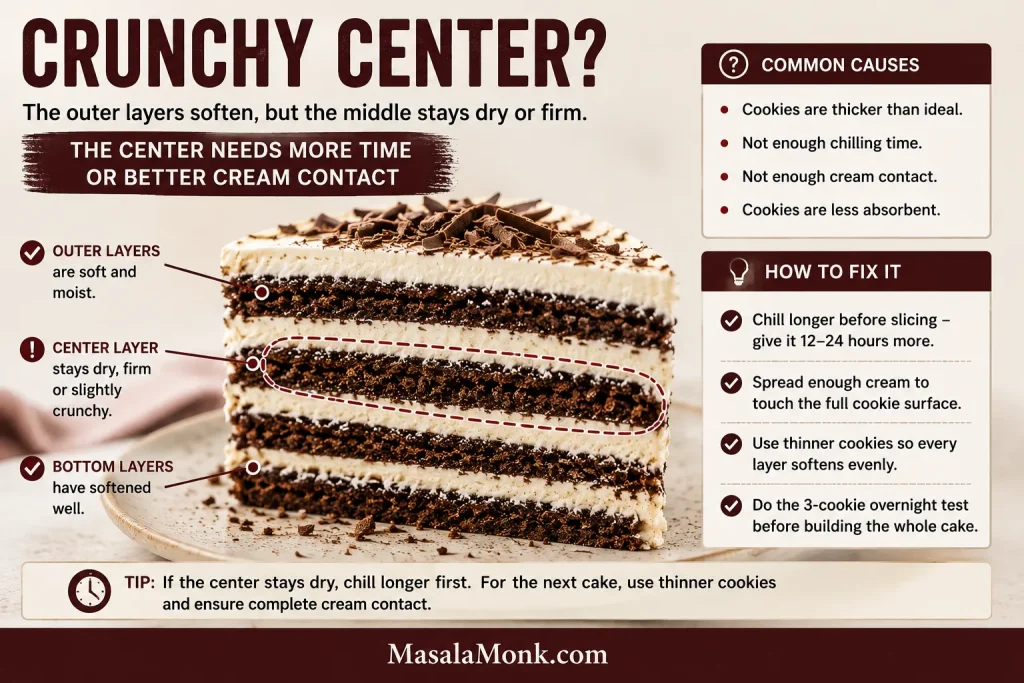
A crunchy cake center: The replacement is probably too thick, too dense, short on cream contact, or simply not chilled long enough. Return the cake to the refrigerator and test the middle again later.
Check the cookie’s cross-section: a thicker cookie creates a wider moisture path, so the edges can soften while the center remains firm.
A thicker cookie widens the stripe and slows the moisture path to the center.
Then check the cake itself: if the middle still resists after more chilling, use the dry center and softened edges as the deciding cues.
If 12–24 more hours do not soften the center, the cookie is probably too thick or insufficiently absorbent.
Muddy or disappearing layers: The cookies may have begun soft, the cream may be unusually loose, or the cookie may dissolve too readily. A suitable wafer begins crisp and softens without losing its identity completely.
Serve an over-softened cake very cold; chilling can firm the cream but cannot restore dissolved stripes.
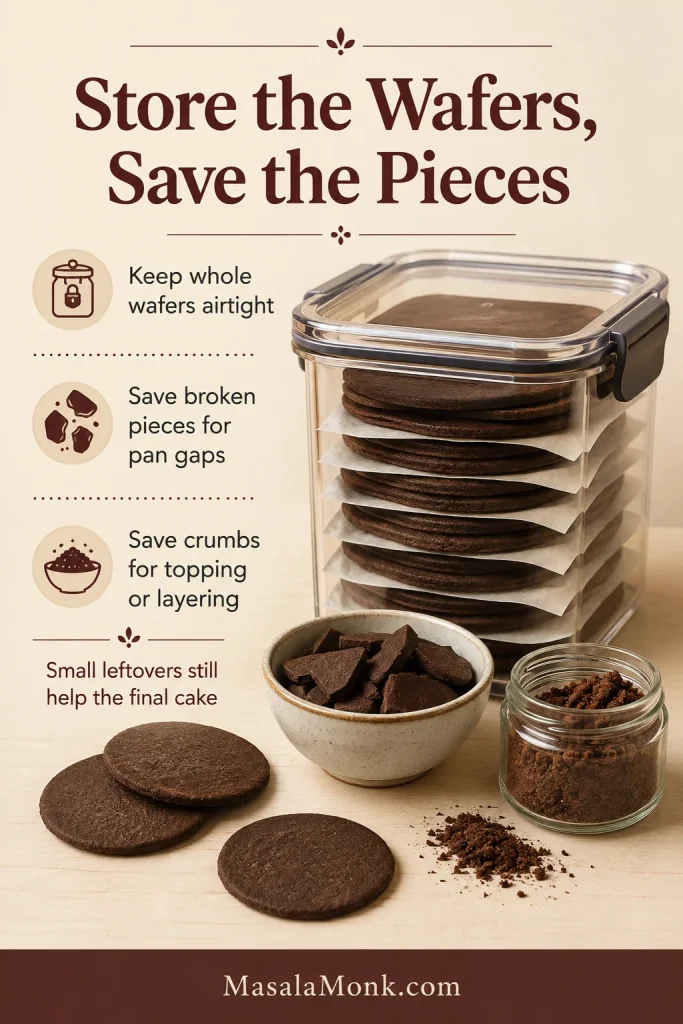
Cool baked wafers completely, then keep them in an airtight container at room temperature with parchment between fragile layers. Protect them from steam and humidity; for best texture, use them within several days or freeze them for longer storage. Room temperature is best for unassembled wafers because refrigerator humidity can soften the snap you worked to create.
A rigid airtight container controls humidity while protecting thin wafers from bending and breakage.
For make-ahead dough, freeze flat rolled sheets between parchment, wrapped dough portions, or a carefully shaped log for a thin slice-and-bake variation. Thaw in the refrigerator until firm but cuttable.
Fully cooled baked wafers can also be frozen in a rigid airtight container with parchment between layers. Thaw them in the closed container so condensation collects on the container instead of the wafers, then check crispness before assembly.
If stored wafers lose their snap, save them for crumbs rather than putting softened cookies into the cake.
Save broken or extra wafers for cake gaps, ice cream, or chocolate crumbs. For a crust, follow the pan and butter guidance in our no-bake cheesecake recipe and add butter gradually because plain wafers do not contain sandwich filling.
Gluten-Free, Vegan, and Lower-Sugar Options
Dietary needs do not end the dessert, but they change which shortcut is safest. When the cake is needed soon, a commercially made thin chocolate cookie with the dietary certification you need is usually more dependable than rebuilding this precise wafer formula one ingredient at a time.
For a gluten-free cake, choose a clearly labelled thin chocolate cookie that begins fully crisp, check all nut, seed, coconut, and sesame warnings, and run the three-cookie overnight test before building the cake.
For a vegan cake, use a commercially made thin vegan chocolate cookie and a plant-based whipping cream you already trust. Replacing the butter and egg in the homemade formula requires a separately developed recipe.
For a lower-sugar version, start with plain unfilled cookies and reduce the sweetness of the cream. Large changes to the cookie sugar affect spread, crispness, browning, and dough handling.
For any unfamiliar dietary cookie, the small overnight test is the safest way to check whether it becomes tender without dissolving.
Frequently Asked Questions
Are Nabisco Famous Chocolate Wafers still made?
No. They were discontinued in 2023. Old recipes and archived retailer pages may still name them, but they are no longer a dependable store-bought ingredient.
Are Famous Chocolate Wafers back?
As of August 2026, the original Nabisco wafers had not returned. Some websites and marketplace listings use the familiar name or nostalgic package imagery, so check the named manufacturer, ingredient label, package date, and seller before assuming the original product is back.
What is the closest substitute for Famous Chocolate Wafers?
Dewey’s Brownie Crisp is the closest plain structural match covered here when available. Original Oreo Thins are easier to find, but their filling makes the cake sweeter and more Oreo-like.
Do I need to remove the filling from Oreo Thins?
No. Leave the filling in for the easiest route and sweeten the whipped cream lightly. Remove it when you want a plainer chocolate-wafer effect and more control over sweetness. If you scrape it out, weigh the shells afterward because the package weight includes the creme.
What if my replacement package is only 7 ounces?
A 7-ounce package weighs about 198 g, roughly 57 g short of the old 9-ounce box. Buy a second package and use only as much as the cake needs.
Can I use vanilla wafers?
Yes, but they create a vanilla icebox cake without the dark chocolate stripes. They are a different flavor route, not a close Famous Wafer replacement.
Are chocolate melting wafers the same as wafer cookies?
No. Melting wafers are chocolate or candy coating designed to liquefy. Icebox cake needs a thin, crisp baked cookie.
How long do replacement cookies need to soften?
Overnight is the safest general plan. Very thin plain wafers may be ready sooner, while thicker cookies or whole Oreos can need closer to 12–24 hours. Use the clock as a guide and confirm the center with a thin knife.
The Cookie Should Disappear Into the Cake—But Not Completely
A good chocolate wafer starts with a snap and ends with a fork. Today it should be dark, dry, and sturdy enough to spread. Tomorrow it should be tender all the way through, yet still draw a clean chocolate line across the slice.
A crisp wafer should soften into the cake while leaving a visible dark stripe and enough structure for a clean slice.
That is what an old family recipe was really preserving—not a particular cardboard box, but the quiet transformation that happens overnight and the familiar striped piece placed on the plate the next day.
If you use a replacement, leave a comment with the exact cookie, package weight, cake shape, whether you kept any filling, and how long the center needed to soften. Those details can help the next reader standing in the same cookie aisle.
These are the brownies for the person who does not want chocolate cake pretending to be a brownie. The knife should crack through a thin shiny top, the edges should have a little pull, and the center should stay dense, soft, and deeply chocolatey without tasting raw.
If you have ever pulled a pan from the oven and wondered whether the middle was still underbaked or already past fudgy, this recipe is for that exact moment. It is a no-guesswork brownie guide: one bowl, no mixer, clear batter cues, and a simple way to know when to stop baking.
The rule is this: pull the brownies before they look completely finished. A toothpick should show crumbs or a light chocolate smear — not wet batter, and not a completely dry stick. Cooling turns that soft center into a fudgy slice.
This homemade brownie recipe from scratch uses melted chocolate, cocoa powder, butter, sugar, eggs, and a small amount of flour to give you boxed-brownie comfort with deeper chocolate flavor, chewy edges, and fewer last-minute doubts at the oven.
Fudgy brownies come from more fat and chocolate, less flour, no leavening, gentle mixing after flour, and a bake that stops before the center looks fully done. Use an 8-inch / 20 cm light metal pan, bake at 350°F / 175°C, and start checking early. The best cue is crumbs clinging to the toothpick, not a clean, dry one.
Best pan
8-inch / 20 cm light metal square pan
Oven
350°F / 175°C, or about 160°C fan-forced
Texture goal
Thin crackly top, chewy edges, dense chocolate center
Best cue
Crumbs or a light smear on the toothpick, not wet batter
If this is your first time baking brownies from scratch, do not try to memorize every detail. Remember one thing: the right moment looks slightly early.
Use this close-up before you slice the pan. the middle should look compact and set, not loose like batter.
A properly baked fudgy brownie looks moist and compact inside; if it looks loose, shiny, or batter-like, it needs more time.
Fudgy Brownie Recipe Card
Fudgy Brownies
A from-scratch batch of brownies with a thin shiny crust, chewy edges, and a dense chocolate center that firms as it cools. The key is simple: stop before the toothpick comes out clean, then let the brownies cool before slicing.
Prep Time
15 minutes
Bake Time
27–31 minutes
Cooling Time
At least 1 hour
Active + Bake Time
About 45 minutes
Yield
16 brownies
Difficulty
Easy to moderate
Pan
8-inch / 20 cm square metal pan
Oven
350°F / 175°C conventional, or about 160°C fan-forced
Equipment
8-inch / 20 cm square metal baking pan
Parchment paper
Heatproof mixing bowl or saucepan
Whisk
Rubber spatula
Fine mesh sieve
Digital kitchen scale, recommended
Sharp knife for slicing
No mixer is needed. The batter comes together in one main bowl: melt, whisk, fold, bake.
Ingredients
Ingredient
Amount
Unsalted butter
170g / 6 oz / 12 tbsp
Semi-sweet or dark chocolate, chopped
100–113g / 3.5–4 oz
Granulated or caster sugar
250g / 1¼ cups
Large eggs
2 whole eggs + 1 egg yolk
Vanilla extract
2 tsp / 10ml
Unsweetened cocoa powder
50g / about ½ cup, spooned and leveled
All-purpose flour / maida
65g / ½ cup, spooned and leveled
Fine salt
½–¾ tsp
Chocolate chips or chopped chocolate
100–120g / 3.5–4.25 oz
Instant coffee or espresso powder, optional
½–1 tsp
Instructions
Prepare the pan. Preheat the oven to 350°F / 175°C. Line an 8-inch / 20 cm square metal pan with parchment paper, leaving overhang on two sides for lifting.
Melt the butter and chocolate. Add the butter and chopped chocolate to a heatproof bowl. Melt gently in short microwave bursts, stirring between each, or use a bowl over barely simmering water. Stir until smooth and glossy, then let it stand until warm, not hot.
Whisk in the sugar. Add the sugar while the chocolate-butter mixture is still warm. Whisk for 45–60 seconds. It may look slightly grainy at first, then heavier and shinier as you whisk.
Add the eggs, yolk, and vanilla. Whisk in the 2 whole eggs, extra yolk, and vanilla until the batter looks smoother, thicker, and glossier. You want shine and structure, not cake-like air.
Fold in the dry ingredients. Sift in the cocoa powder, flour, salt, and optional coffee powder. Fold gently just until the dry streaks disappear.
Add more chocolate. Fold in the chocolate chips or chopped chocolate. The batter should be thick, slow-moving, and glossy when it falls from the spatula.
Bake. Spread the batter evenly into the prepared pan. Bake for 27–31 minutes, checking from 24 minutes. Look for set edges, a dry-shiny top with fine cracks, and a middle that still looks a touch underfinished. Do not wait for a clean toothpick.
Cool before slicing. Let the brownies cool for at least 1 hour. The soft middle turns sliceable as it rests. For the cleanest squares, cool completely, chill for 30–60 minutes, and cut with a sharp knife.
Recipe Notes
For best texture, use grams for the flour and cocoa powder. Brownies are sensitive to small changes in dry ingredients. The King Arthur Baking ingredient weight chart is useful if you often convert cups to grams.
Use maida as the all-purpose flour if baking in India.
A light metal pan gives the most reliable texture. Glass and dark pans can change the timing.
Use baking chocolate or a good dark/semi-sweet chocolate bar, not filled chocolate candy. Compound chocolate can behave differently because it uses different fats.
Do not reduce the sugar heavily on the first bake. Sugar helps moisture, chew, and the delicate top crust.
If your oven runs hot or your pan is dark, start checking around 22–23 minutes. For an OTG, preheat fully and bake on the middle rack.
First-bake non-negotiables: keep the flour low, use granulated or caster sugar, include the melted chocolate, skip leaveners, and pull the brownies before they look fully done. Once you know the texture, you can experiment more safely.
Quick bake targets: bake 27–31 minutes, start checking at 24 minutes, and cool at least 1 hour before judging the final texture. For hot ovens or dark pans, start checking at 22–23 minutes.
If you are baking right now, the recipe card has everything you need. The rest of this guide helps you read the cues in the bowl, in the pan, and on the toothpick, especially that strange little moment when the brownies look slightly underdone but are actually ready.
A good brownie is a balancing act: enough structure to slice, enough fat to stay fudgy, and enough sugar to give that thin top crust. The flour stays low compared with the chocolate, cocoa, butter, and eggs, so the brownies set dense instead of fluffy.
A little extra flour, a wider pan, or two extra minutes in the oven can change the whole bite. That is why this recipe leans on visual cues instead of asking you to trust the timer alone.
The finished square should feel dense in your fingers, bend slightly before it breaks, and taste like soft chocolate rather than cake.
What Makes Brownies Fudgy?
Fudgy brownies come from more fat and chocolate, less flour, no leavening, gentle mixing after the flour, and a bake that stops while the center is still soft-set. The texture finishes as the brownies cool.
Low Flour Keeps the Center Dense
Flour gives structure, but extra flour quickly moves the texture toward cake. This recipe uses just enough to hold the squares together while keeping the crumb compact and tender.
Butter, Chocolate, and Cocoa Build the Flavor
Melted butter and chocolate create the rich base. Butter makes the chocolate taste full and rounded, while cocoa powder gives the flavor depth. Chocolate chips or chopped chocolate add soft pockets through the batch, especially when served slightly warm.
The Extra Egg Yolk Helps With Chew
The extra yolk adds richness without adding too much lift. It helps the center feel softer and gives the edges a little more pull.
Sugar Helps Moisture and Shine
Sugar is not only there for sweetness. It helps the batch stay moist and supports the thin shiny crust on top. These taste sweetest while warm; once the brownies cool and set, the salt, cocoa, and darker chocolate balance the sugar better.
No Baking Powder or Baking Soda
A brownie is not trying to rise like cake. That is the whole point. Skipping baking powder and baking soda keeps the texture dense, rich, and compact.
Fudgy vs Chewy vs Cakey Brownies
Brownie texture sits on a spectrum. Some batches are almost like chocolate fudge, some are chewy like a boxed mix, and some are light enough to feel like cake. This version sits between fudge and chew: dense through the center, with enough edge pull to make each square satisfying.
Brownie Style
Texture
What Creates It
Fudgy brownies
Dense, moist, rich center
More fat and chocolate, less flour, shorter bake
Chewy brownies
Set edges with a little pull
Sugar, eggs, egg yolk, and enough structure
Cakey brownies
Lighter, taller, more open crumb
More flour, more air, leavening, longer bake
A brownie can be both fudgy and chewy. If you came here looking for a chewy brownie recipe, this version still gives you edge chew without giving up the dense chocolate middle.
Start by choosing the texture you actually want. because small changes in flour, fat, mixing, and bake time push brownies in different directions.
Before changing the recipe, choose the texture you want: fudgy brownies bake dense, chewy brownies pull slightly, and cakey brownies rise lighter.
Ingredients That Shape the Texture
Once you understand the texture goal, the ingredient choices make more sense. Butter and chocolate bring richness, eggs help the brownies set, sugar helps shine and chew, and flour decides whether the brownie stays dense or drifts toward cake.
Before the ingredient notes get detailed. this visual shows why each item matters to the final brownie texture.
Every ingredient has a job: fat adds richness, sugar helps the crust, eggs bind the batter, and flour decides how firm the brownie crumb becomes.
Butter
Butter is what makes the chocolate taste round instead of sharp. Melt it with the chopped chocolate so the batter starts smooth and glossy. Unsalted butter gives the most control, but salted butter can work if you reduce the added salt slightly.
Chocolate
Use semi-sweet or dark baking chocolate for the melted base. If you want brownies that taste nostalgic and sweet, choose semi-sweet chocolate. For a darker, more grown-up batch, choose chocolate closer to 70%. If cocoa, cacao, and dark chocolate labels ever feel confusing, MasalaMonk’s cacao vs chocolate vs dark chocolate guide is a useful companion.
Sugar
Granulated sugar or caster sugar both work. Caster sugar dissolves more easily, which can help the top bake up shinier. Brown sugar gives a softer, more caramel-like result, but it can make the crust less crackly. If the sweetness worries you, go darker with the chocolate before you start cutting sugar.
Eggs and Extra Yolk
The whole eggs help the brownies set, while the extra yolk adds richness and softness without making the batter too airy. Whisk until the mixture looks glossy before adding the dry ingredients.
Cocoa Powder
Unsweetened cocoa powder deepens the chocolate flavor. Natural cocoa gives a classic brownie taste; Dutch-process cocoa usually gives a darker color and smoother flavor. Sifting matters more here than fussing over the cocoa. Since the batter already contains melted chocolate and butter, the cocoa blends into a rich base; sifting simply prevents dry pockets.
All-Purpose Flour or Maida
Use all-purpose flour or maida. This is the ingredient to measure most carefully. A packed half cup can push the texture toward cake, so use grams when possible. If using cups, spoon the flour into the cup and level it instead of scooping straight from the bag. Do not use self-rising flour here.
Salt
Salt sharpens the chocolate flavor and keeps the sweetness from feeling flat. Use ½ teaspoon for a softer balance or ¾ teaspoon for a deeper bakery-style flavor.
Chocolate Chips or Chopped Chocolate
Chocolate chips give you little set pockets of chocolate. Chopped chocolate melts more lazily into the batter, which is lovely if you want soft streaks when the brownie is still slightly warm.
Coffee or Espresso Powder
A little instant coffee or espresso powder is optional. It does not make the brownies taste like coffee when used lightly; it simply makes the chocolate taste deeper.
Cocoa Powder vs Melted Chocolate in Brownies
Brownies can be cocoa-based, melted-chocolate based, or both. Cocoa powder brings strong chocolate flavor and keeps the recipe pantry-friendly; melted chocolate brings richness and a softer, more fudge-like center. This recipe uses both, and the visual below makes that split easier to understand before you compare the methods.
Look at the role of each chocolate ingredient first. cocoa brings intensity, while melted chocolate helps the brownie set softer.
For a deeper chocolate brownie, use cocoa for intensity and melted chocolate for softness; together, they build flavor without making the crumb cakey.
Brownie Method
Best For
Result
Cocoa powder only
Simple pantry brownies
Deep cocoa flavor, slightly lighter body
Melted chocolate only
Rich dessert-style brownies
Softer, denser, more fudge-like
Cocoa + melted chocolate
Classic fudgy brownies
Rich, balanced, chocolatey, reliable
Cocoa + chocolate chips
Easy chocolate pockets
Extra texture and melted chocolate bits
A cocoa-only brownie can still be excellent, but this recipe is designed for the deeper flavor and softer set that come from cocoa powder and melted chocolate together. For this version, keep the melted chocolate. If you want a cocoa-only brownie, it is better to use a recipe built for that style.
How to Make Fudgy Brownies
Now that the texture pieces are clear, the method is mostly about keeping the batter glossy, folding gently, and stopping the bake at the right moment.
1. Prepare the Pan and Oven
Preheat the oven to 350°F / 175°C. Line an 8-inch / 20 cm square metal pan with parchment paper, leaving overhang on two sides. A light metal pan gives the most predictable edge-to-center contrast.
2. Melt the Butter and Chocolate
Melt the butter and chopped chocolate gently until smooth. The mixture should look glossy and fluid. Let it stand briefly before adding eggs; warm is good, hot is not.
This is the foundation stage: smooth, glossy chocolate and butter before sugar, eggs, cocoa, or flour change the batter.
Once the chocolate and butter look smooth and glossy, stop heating; overheating can dull the flavor and make the base separate.
3. Whisk in the Sugar
Add the sugar while the chocolate mixture is still warm and whisk for 45–60 seconds. It may still look a little grainy, but it should feel heavier and shinier. This helps the surface bake into a thin crust.
The shiny-top work starts here. while the chocolate mixture is still warm enough to help the sugar begin dissolving.
While the chocolate mixture is still warm, whisk in the sugar so it starts dissolving and helps form that shiny crackly brownie top.
4. Add the Eggs, Yolk, and Vanilla
Whisk in the eggs, extra yolk, and vanilla until the batter looks smoother and slightly thicker. You are not trying to whip in cake-like air; you are trying to make the mixture glossy and well combined.
Before adding dry ingredients, look for a cohesive glossy base. that shine tells you the eggs and chocolate mixture are properly combined.
After the eggs go in, the batter should turn smoother and glossier; that change tells you the base is properly combined.
5. Fold in the Cocoa, Flour, and Salt
Sift in the cocoa powder, flour, salt, and optional coffee powder. Fold with a spatula until the last dry streaks disappear. Stop there. Overmixing at this stage can make the texture tougher and more cake-like.
Once flour enters the bowl. switch from whisking to gentle folding so the batter stays dense and tender.
Sift first, then fold gently; this keeps cocoa pockets out of the batter and protects the dense, tender brownie bite.
6. Add Chocolate Chips or Chopped Chocolate
Fold in the chocolate chips or chopped chocolate. When you lift the spatula, the batter should fall slowly, not pour like cake batter.
Lift the spatula before filling the pan. the way the batter falls tells you whether it is thick enough for fudgy brownies.
When the batter falls in a slow heavy ribbon, it has the thickness you want for fudgy brownies, not a light cake-style pour.
7. Bake Until the Center Is Soft-Set
Spread the batter evenly into the prepared pan. Bake for 27–31 minutes, checking from 24 minutes. Look for set edges, a thin shiny top, and a center that still looks slightly underfinished. Wet batter means it needs more time. If the toothpick is dry, do not panic; the brownies will still be good, but next time you can pull them a few minutes earlier.
Level the batter from corner to corner so timing. pan material, and toothpick checks can do their job fairly.
Spread the batter into the corners and level the surface; uneven batter thickness can make the edges dry before the middle sets.
The hardest part is that the right moment can look a little wrong. That softness becomes the dense chocolate middle later, once the brownies have cooled.
Let the brownies cool for at least 1 hour. Warm brownies lie; cooled brownies tell the truth. For clean bakery-style squares, cool completely, chill briefly, then slice with a sharp knife.
How to Get the Shiny Crackly Top
The shiny crackly top comes from sugar, eggs, fat, and heat working together. It is not just decoration; it is a sign that the batter was mixed well before the flour went in and baked hot enough for the surface to set into a thin crust.
Use enough sugar. Heavy sugar reduction can make the top dull and the texture drier.
Whisk sugar while the chocolate mixture is warm. Warm fat helps the sugar begin dissolving.
Whisk the eggs until the batter looks glossy. The mixture should look thicker before the dry ingredients go in.
Choose caster sugar if you have it. It dissolves more easily than coarse granulated sugar.
Fold gently after flour. Once flour is added, more mixing will not improve the top.
Preheat the oven fully. A properly hot oven helps the surface set at the right time.
Read the surface first: set edges and a dry-shiny top mean it is time to check the inside instead of baking by color alone.
First check the surface: a dry-shiny top and set edges mean it is time to test the inside, not keep baking by color alone.
Do not chase perfection here. A shiny crust is lovely, but it is not the only sign of a good brownie. Even a slightly duller top can still hide a beautiful fudgy middle.
How to Tell When Fudgy Brownies Are Done
Fudgy brownies are done when the edges are set, the top looks dry and lightly crackled, and a toothpick near the center comes out with crumbs or a light chocolate smear rather than wet batter.
This is the most important part of the recipe, especially if you usually second-guess brownies at the oven. You are pulling them while they still look a little soft, then trusting the cooling time to finish the texture. Test near the center, or halfway between the edge and center if the brownies look very soft. Do not test only at the edge, because the edge sets first.
Use this toothpick guide before adding more oven time. the sweet spot is a few crumbs with a light chocolate smear.
For the brownie toothpick test, aim for crumbs with a light chocolate smear; wet batter is underdone, but a clean pick often means overbaked.
Toothpick Result
Texture Result
What to Do
Wet raw batter
Raw middle
Bake 2–3 minutes more and check again
Thick chocolate smear, no raw batter
Softer middle
Remove if you like a softer middle, then cool fully
Crumbs with a light smear
Classic fudgy brownie
Best default point to remove from the oven
Mostly crumbs, little smear
Firmer square
Good for cleaner packed brownies
Completely dry toothpick
Likely overbaked
Still edible; next time, check earlier
Do not cut the pan right away to check if it is done. Freshly baked brownies can look too soft while warm, then set into clean squares once cooled. If your first slice is messy, the batch probably needed more time to firm up, not a different recipe.
Gooey vs Fudgy vs Underbaked Brownies
This is where many brownie mistakes happen. A fudgy center can look soft when warm, but raw batter is different. Use the visual first, then the table when you are not sure whether to pull the brownies or give them a few more minutes.
When softness makes you second-guess the pan, compare structure first: set brownies hold shape, raw batter does not.
The easiest clue is structure: gooey and fudgy brownies still hold shape, while underbaked brownies collapse or smear like batter.
State
What It Looks Like
What To Do
Gooey
Soft, sticky, and rich, but not liquid
Cool fully or chill before slicing
Fudgy
Dense, moist, sliceable, with a soft-set center
Ideal for this recipe
Underbaked
Wet batter, unstable middle, or liquid streaks
Bake a few minutes longer
Overbaked
Dry interior, hard edges, clean toothpick
Serve warm with sauce or ice cream
If the center looks slightly underfinished but not wet, you are usually in the fudgy window. When it looks liquid, it needs more time. This is the moment when the edges chew, the top cracks, and the inside still eats like chocolate fudge.
Pan Size, Oven Temperature, and Bake Time Guide
Best Pan and Size
A light metal 8×8-inch pan is the safest choice for this recipe because it gives set edges without overcooking the middle.
Pan size changes texture quickly. A wider pan spreads the batter thinner and bakes faster. With a smaller pan, the squares are thicker and need more time.
If your timing feels inconsistent, check the pan material before blaming the recipe. heat transfer changes the edge-to-center balance.
If your brownies overbake at the edges, check the pan first; light metal is usually the best pan for even fudgy brownies.
Timing Changes by Pan and Oven
Pan or Oven Setup
What Happens
What to Do
8×8-inch / 20 cm light metal pan
Best default texture
Use the recipe as written
9×9-inch metal pan
Thinner brownies, faster bake
Start checking 3–5 minutes earlier
7×7-inch pan
Thicker brownies
Bake slightly longer and check the center carefully
8×8-inch glass pan
Slower heat transfer, softer edges
Expect timing differences and watch the center
Dark metal pan
Edges can bake faster
Check early and avoid overbaking
9×13-inch pan
Different thickness and timing
Use a properly scaled version instead of guessing
Fan-forced oven
Stronger heat movement
Use about 160°C and check early
OTG
Heat can vary by rack and rod setting
Preheat fully and bake on the middle rack
In an OTG. rack position matters because the top and bottom rods can heat the pan unevenly if it sits too high or too low.
For OTG brownies, the middle rack gives steadier heat so the top does not overcook before the inside reaches the right set.
If a 9×9-inch pan is all you have, the recipe will still work, but the squares will be thinner and less plush. Start checking early.
For extra-thick bakery-style brownies, do not simply overfill the pan or guess the bake time. Use a smaller pan only if you are ready to bake longer and check carefully near the center.
Time is a range, not a command. Your pan, oven, chocolate, and batter thickness all affect the final bake. The best square should feel dense in your fingers, not springy like cake.
Homemade Brownies With Boxed-Brownie Comfort
Boxed brownies are not the enemy. They train us to expect chew, shine, sweetness, and a predictable center. The real frustration is spending more time on homemade brownies and ending up with dry chocolate cake.
This recipe keeps those comforts — set edges, soft center, and a crackly top — but builds deeper flavor with real chocolate and cocoa powder. The trick is not to imitate the box exactly; it is to keep the comfort while learning the one cue the box cannot teach you: when to stop baking.
You get the comfort of the box, but with a darker, fuller chocolate bite. For another easy cut-and-share dessert, MasalaMonk’s sweetened condensed milk fudge leans more candy-like while still giving you neat chocolatey squares.
Why Brownies Turn Cakey, Dry, or Too Gooey
When a batch goes wrong, it is usually not mysterious. It is almost always flour, mixing, pan size, chocolate temperature, or a few extra minutes in the oven.
Common Brownie Problems and Fixes
Problem
Likely Reason
Fix Next Time
Brownies turned cakey
Too much flour, overmixing, leaveners, or overbaking
Measure flour carefully, fold gently, skip leaveners, and check earlier
Brownies are dry
Overbaked, pan too large, or too much flour
Pull the brownies before the toothpick is completely dry
Brownies are too soft
Underbaked or sliced while warm
Cool fully; bake a few minutes longer next time if the center was truly raw
No crackly top
Sugar was not whisked well or was reduced too much
Whisk sugar well into the warm mixture and avoid heavy sugar cuts
Brownies sank in the middle
Center was underbaked or the pan was moved too early
Bake until the edges are set and the center is soft-set
Hard edges
Overbaking, dark pan, or strong side heat
Use a light metal pan and start checking earlier
Brownies look oily
Chocolate mixture was too hot or batter did not emulsify smoothly
Let melted chocolate stand briefly and whisk eggs in well before adding flour
Top looks done but center is raw
Oven heat too high, dark pan, or pan too small
Use a light metal pan, test nearer the center, and lower the oven slightly next time if needed
Brownies crumble when cut
Cut too warm or flour/fat balance changed
Cool completely and chill briefly before slicing
Brownies taste too sweet
Chocolate was mild or salt/cocoa balance was low
Use darker chocolate, add salt, or add a little espresso powder instead of cutting sugar heavily
When in doubt, protect two things: the flour measurement and the bake time. Those details decide whether the finished squares stay dense and soft or drift into dry cake territory.
Even a batch that did not bake exactly as planned can usually be served well. Brownies are forgiving once you know how to use the texture you have.
If the center is liquid batter rather than soft brownie, return the pan to the oven for a few minutes if it is still warm. Once the pan has cooled, serve it only if the texture is set, not raw.
Problem After Baking
Save It Today
Too soft to slice
Cool fully, then chill 1–2 hours before cutting
Slightly underbaked but set
Serve chilled in small squares or warm as dessert bowls
Dry edges
Trim the edges and serve the softer center pieces
Overbaked batch
Warm slightly and serve with chocolate syrup, ice cream, or whipped cream
Messy cuts
Chill, wipe the knife between cuts, and cut smaller squares
Too sweet
Serve with unsweetened whipped cream, coffee, or a pinch of flaky salt
Before you write off the batch, match the fix to the problem you have. soft, dry, and overbaked brownies each need a different save.
If the batch is not perfect, adjust the serving: chill soft brownies, trim dry edges, or warm an overbaked piece with sauce.
A slightly imperfect batch is still dessert. Sometimes the save is not a new recipe; it is more chilling time, a sharper knife, or a scoop of ice cream.
Easy Brownie Variations
Once the base recipe works for you, use simple mix-ins and toppings. Keep the batter formula the same so the texture stays reliable.
Walnut brownies: fold in ¾ cup chopped toasted walnuts with the chocolate chips.
Double chocolate brownies: use both chocolate chips and chopped dark chocolate for extra pockets of melted chocolate. For a cookie version of that same deep chocolate mood, try these double chocolate chip cookies.
Espresso brownies: add 1 teaspoon instant espresso powder to deepen the chocolate flavor.
Sea salt brownies: sprinkle flaky salt on top just before baking or right after the brownies come out.
Orange chocolate brownies: rub a little fresh orange zest into the sugar before whisking it into the chocolate mixture.
Peanut butter swirl brownies: swirl a few spoonfuls of softened peanut butter into the top before baking. If that salty-sweet flavor is what you are craving, MasalaMonk’s peanut butter fudge guide is another easy square-cut dessert to try.
Avoid heavy wet toppings on the first try. Extra moisture changes the bake time and makes the center harder to judge.
Need Eggless Brownies?
Do not simply remove the eggs from this recipe. Eggs affect structure, shine, and the way the center sets. Without them, the batter needs a different balance of moisture and binding, usually from yogurt, curd, milk, or another tested substitute.
A proper eggless brownie needs its own formula, not just one missing ingredient. For general egg-substitute ratios in baking, MasalaMonk’s flax egg guide is useful, but brownies need more care than a simple one-for-one swap because the texture is so dependent on how the center sets.
How to Serve These as Hot Fudge Brownies
These brownies are excellent at room temperature, but they also make a rich hot fudge brownie dessert. Warm one square gently, place it in a bowl, add vanilla ice cream, and spoon over hot fudge sauce or MasalaMonk’s 3-minute homemade chocolate syrup. A pinch of flaky salt or chopped toasted nuts makes the chocolate taste even deeper.
Use this serving idea when a square tastes better warm than perfectly neat. sauce and ice cream turn softness into an advantage.
To make hot fudge brownies, warm the square gently first, then add ice cream and sauce so the dessert stays creamy, rich, and soft.
For chilled frosted brownies, let the pan cool completely, then spread a thin layer of chocolate cream cheese frosting over the top before slicing.
To serve it sizzling-style, warm the brownie and sauce separately, then bring them together in a heated skillet or dessert plate. The brownie should be warm and soft, not reheated so long that the edges dry out.
How to Store and Freeze Brownies
Room Temperature
Store brownies in an airtight container at room temperature for 3–4 days. Place parchment between layers if stacking them.
Refrigerator
Refrigerating makes the squares firmer and even fudgier. Chilled brownies become denser and almost truffle-like, which is why some people like them even better the next day. Bring them back to room temperature before serving if you want a softer bite.
Freezer
Freeze individual squares. Wrap each piece tightly, then place them in a freezer-safe container or bag. Thaw at room temperature, or warm gently for a softer dessert-style brownie.
Separate the squares before freezing so the brownies stay easy to pull apart. thaw, and serve later.
Before you freeze brownies, separate the squares with parchment; this prevents sticking and lets you thaw one fudgy piece at a time.
Make-Ahead Tip
This is one dessert that rewards patience. Bake the pan earlier in the day, chill briefly for clean cuts, then bring the squares back to room temperature before serving. They also travel well once fully cooled, which makes them easy for lunch boxes, potlucks, or gifting.
Serving Temperature
Warm: soft, melty, and messier; best for dessert bowls, ice cream, and hot fudge.
Room temperature: balanced, fudgy, and sliceable; best for everyday serving.
Chilled: firmest, neatest, and extra dense; best for clean squares and packed desserts.
Clean Cutting Tip
For neat squares, cool completely, chill briefly, and slice with a sharp knife. Wipe the blade between cuts so the edges stay clean. Warm serving gives softer edges; chilled brownies give neater squares.
Fudgy Brownie FAQs
Why did my brownies turn cakey instead of fudgy?
A cakey batch usually comes from too much flour, overmixing, leavening, or overbaking. Measure flour carefully, fold only until combined, skip baking powder and baking soda, and check earlier next time.
What cocoa powder works best for brownies?
Use unsweetened cocoa powder. Natural cocoa gives a classic brownie flavor, while Dutch-process cocoa gives a darker color and smoother chocolate taste. Either works in this recipe.
How soft should brownies be when they come out?
The center should be soft but not raw. If the toothpick comes out covered in wet batter, bake a little longer. When only crumbs and a light smear cling to it, the brownies are ready to cool.
Do brownies continue baking as they cool?
Yes. The center continues to set from residual heat after the brownies leave the oven. That is why they can look slightly soft at first but slice cleanly after cooling.
What pan is best for fudgy brownies?
A light metal 8-inch / 20 cm square pan is the best default. It gives reliable heat, set edges, and a soft middle. Glass pans can work, but they heat differently and may change the timing.
How do you cut clean brownie squares?
Cool completely, then chill for 30–60 minutes if needed. Lift the brownies out with the parchment overhang and cut with a sharp knife, wiping the blade between cuts.
Is melted chocolate necessary for fudgy brownies?
No, but it matters in this recipe. Cocoa-only brownies can also be fudgy, but this formula uses melted chocolate for a richer, softer center and a more dessert-like flavor. For this version, keep it. If you want a cocoa-only brownie, use a recipe built for that style.
Brown sugar or oil: are those swaps okay?
Brown sugar can make brownies softer and more caramel-like, but it may reduce the shiny crackly top. Oil can add moisture, but butter gives this recipe its rounded flavor and structure. Try the recipe as written before experimenting.
What makes the top of brownies crackly?
The crackly top comes from sugar, eggs, fat, and proper whisking. Whisk the sugar into the warm butter-chocolate mixture, then whisk the eggs in until the batter looks glossy before adding the flour.
Final Brownie Success Checklist
Look for batter that is thick, glossy, and slower than cake batter.
Fold only until the flour disappears; do not beat the batter heavily.
Use a light metal pan if possible.
Check for crumbs or a light chocolate smear on the toothpick, not wet batter and not a dry stick.
Cool the brownies before the first serious cut.
Wipe the knife between slices for clean edges.
Use this final visual check to keep the recipe simple at the oven: batter, pan, toothpick, and cooling time.
Before slicing, remember the winning cues: thick batter, a light metal pan, crumbs or a light smear on the toothpick, and enough cooling time.
The best fudgy brownies are a small exercise in stopping at the right moment. Stop mixing when the flour disappears. Pull the pan while the middle still looks a little underfinished. Hold back from cutting too soon. Give the brownies that little bit of patience, and you get the square people actually hope for: a thin crackly top, a soft chocolate middle, and edges that make every piece feel like the corner.
Frosting is the part everyone sees first, which is why it can make even a simple cake feel a little high-pressure. This chocolate cream cheese frosting keeps that final step calm: smooth enough to spread, thick enough to chill and pipe, and chocolatey without tasting like straight sugar.
The finished topping is thick and creamy, with deep cocoa flavor, a gentle cream cheese tang, and a soft matte finish. At its best, each bite tastes like chocolate first, cream cheese second, and sugar last.
This version is built for the frosting problems people actually run into: cream cheese that turns loose, chocolate that tastes flat, cupcake swirls that slump, and “not-too-sweet” frosting that still needs enough structure to behave.
It is not sugar-free, and it is not trying to be. It is balanced instead of candy-sweet: less sugary than classic chocolate buttercream, with enough powdered sugar to stay smooth, spreadable, and pipeable.
Use it right away when you want a spreadable frosting. A short chill turns the same bowl from creamy and spreadable to swirl-ready. The recipe itself takes about 10 minutes; the extra time is only for cleaner cupcake swirls or a firmer layer-cake finish.
It is especially useful for birthday cupcakes, simple sheet cakes, bake-sale brownies, red velvet cake, and casual layer cakes where you want chocolate frosting that tastes rich but not candy-sweet.
This recipe makes a smooth, chocolatey cream cheese frosting for cupcakes, brownies, 9×13 cakes, and simple layer cakes. It spreads as soon as it is mixed and becomes firm enough for soft swirls after 15 to 30 minutes in the refrigerator.
The mixing is quick; the chill is only there when you want cleaner piping. For a generously frosted 9-inch layer cake or bakery-style cupcake swirls, make extra because piping always uses more than it looks like.
Choose your texture: 3 cups powdered sugar gives a softer, tangier frosting. 3½ cups gives firmer swirls. Chill before piping, and reach for milk or cream only when the frosting is truly too thick. For visual checkpoints, see the Success Cues.
Recipe Ingredients
8 oz / 226 g full-fat brick cream cheese, softened but still cool
½ cup / 113 g unsalted butter, softened but not melted
3 to 3½ cups / 360 to 420 g powdered sugar / icing sugar, sifted if lumpy
½ cup / about 50 g unsweetened cocoa powder, natural or Dutch-process
1 teaspoon vanilla extract
¼ teaspoon fine salt, plus a tiny pinch more to taste
1 to 4 teaspoons milk or cream, only when the mixture is too thick; many batches need none
Note: Depending on the brand and how tightly it is packed, ½ cup cocoa powder may weigh around 45 to 55 g. About 50 g is a reliable working amount here.
Optional: For a fudgier version, beat in 3 to 4 oz / 85 to 115 g cooled melted dark chocolate after the base is smooth.
Before Mixing Checkpoint
The cream cheese should press in but still hold its block shape. The butter should dent but not shine. If either one looks greasy, chill it briefly before starting.
Before mixing, the cream cheese should press in but still hold shape, while the butter should dent without looking greasy.
Recipe Instructions
Add the softened cream cheese and softened butter to a large mixing bowl. Beat on medium speed until completely smooth and creamy, about 1 to 2 minutes. Scrape down the sides and bottom of the bowl.
Add the cocoa powder, 3 cups powdered sugar, salt, and vanilla. Mix on low speed until the dry ingredients are mostly absorbed.
Increase to medium-low or medium speed and beat just until smooth. Scrape again so no cocoa, sugar, or cream cheese is hiding at the bottom or sides.
Beat until the cocoa and sugar disappear and the mixture turns creamy. Add milk or cream only when it still feels too thick.
Taste before adding the last ½ cup powdered sugar. Add it only for a sweeter or stiffer texture. When the mixture tastes sweet but flat, add a tiny pinch more salt.
Use it right away when you want a spreadable frosting. To pipe soft swirls, chill it for 15 to 30 minutes before filling the bag.
To make the optional fudgy version, mix in the cooled melted chocolate after the base is smooth. Beat briefly, just until combined.
If the mixture is fridge-firm, let it sit for 10 to 15 minutes so it softens enough to mix smoothly before re-beating.
Recipe Notes
Full-fat block-style cream cheese gives the frosting its most reliable structure.
Sift cocoa powder and powdered sugar when they look lumpy, especially for piping.
Milk or cream should go in slowly. Most batches need little or no added liquid.
The mixture is ready when it looks smooth, thick, and holds soft ridges from the beaters.
On a spatula, it should mound softly instead of running off.
Let cakes, cupcakes, and brownies cool completely so the chocolate layer sits on top instead of melting in.
When spread thinner over brownies or sheet cakes, some bakers call this chocolate cream cheese icing. In everyday use, frosting usually means a thicker topping that can be spread or piped, while icing often means something thinner. This recipe sits on the frosting side, but the same creamy, tangy topping may be called icing when it is spread over a pan dessert.
Before You Start
This is a simple recipe, but texture matters. Soft frosting is not a disaster. Most of the time, you are adjusting temperature, not rescuing a ruined batch.
The biggest difference in testing was not the cocoa or the mixer. It was temperature. When the cream cheese and butter were cool-soft, the frosting turned thick and smooth without much help. When either one was warm, the same recipe softened quickly and needed chilling before it behaved again.
The mixture should look thick before you decide it needs liquid. Many batches look too stiff at first and then turn creamy once the sugar and cocoa fully mix in.
The Thick Swoop Test
Before you decide the frosting needs more sugar or liquid, lift a small amount with a spatula. A good batch should mound softly and hold a clean swoop for a moment.
Before you spread or pipe, look for a thick frosting swoop that lifts cleanly instead of sliding back into the bowl.
The Texture Rule: Spread, Chill, or Fix
Chocolate cream cheese frosting changes with temperature. Before adding more sugar or liquid, look at the bowl and decide what you need it to do next.
When the frosting mounds softly on the spatula, it is usually ready for spreading, filling, or a short chill before piping.
If it looks like this
Do this
Why it works
Thick, creamy, and mounds on a spatula
Use it for spreading
It is ready for brownies, sheet cakes, and simple cakes
Smooth but too soft for swirls
Chill 15 to 30 minutes
Cold firms the butter and cream cheese without adding sweetness
Dry or stiff after mixing
Add milk or cream 1 teaspoon at a time
Small amounts loosen the texture without making it runny
Loose even after chilling
Add powdered sugar or cocoa gradually
Only adjust after temperature has had a chance to help
The whole recipe comes down to one rhythm: mix until smooth, pause before adding liquid, chill before fixing softness, and stop once it holds its shape.
Is This the Right Frosting for You?
Think of it as the middle ground between chocolate buttercream and cheesecake: richer than whipped cream, tangier than buttercream, and softer than ganache.
It is made for soft swirls, creamy layers, and tangy chocolate balance. For sharp decorative edges, tiny detailed piping, or long room-temperature display cakes, a firmer buttercream or ganache will be easier to manage.
Use this frosting for cupcakes, brownies, sheet cakes, yellow cake, chocolate cake, red velvet cake, and casual layer cakes.
Choose buttercream frosting when you want a sweeter, firmer, classic birthday-cake topping.
Use homemade whipped cream when pies, fruit desserts, hot chocolate, or no-bake desserts need something lighter.
Reach for ganache when you need a glossy drip or smooth cake covering.
Pick royal icing when cookie icing needs to dry hard for stacking.
Ingredients You Need
Good frosting starts before the mixer turns on. The texture is mostly decided by the cream cheese, butter, and how quickly you add liquid.
Start with firm cream cheese, cool-soft butter, sifted dry ingredients, and only a small amount of liquid when needed.
Cream Cheese for Frosting
Full-fat brick cream cheese gives the topping body and stability, mixes smoothly with butter and powdered sugar, and helps the finished texture hold after chilling.
Outside the US, look for full-fat block-style cream cheese or the firmest full-fat cream cheese available. Avoid whipped, spreadable, low-fat, or very soft cream cheese when you want piping.
Block-style cream cheese gives better structure; in contrast, softer tub cream cheese can make frosting loosen faster.
If your cream cheese comes in a tub but feels firm and dense rather than airy or spread-like, keep it cold, skip extra liquid, and chill the frosting before piping. The issue is moisture and structure: spreadable cream cheese is usually softer, so the mixture can loosen before it ever gets cold enough to hold a swirl.
The same full-fat cream cheese logic shows up in chilled desserts too. This no bake cheesecake recipe is a good example of how cream cheese structure and chilling decide the final texture.
Butter
Butter makes the mixture smoother, richer, and more stable. It should dent when pressed but should not look oily. Overly warm butter makes the bowl soft before you even start.
Unsalted butter gives you the cleanest control over flavor. If using salted butter, reduce the added salt to a small pinch and taste before adding more.
Powdered Sugar / Icing Sugar
Powdered sugar, also called icing sugar in many countries, does more than sweeten here. It helps the cream cheese hold a swirl, gives the chocolate layer body, and keeps the finished texture from sliding.
Three cups gives a tangier, less sweet result. Closer to 3½ cups gives firmer cupcake swirls, borders, or layer-cake decorating. Sift it first when it looks clumpy.
Cocoa Powder
Unsweetened cocoa powder gives the chocolate flavor and helps thicken the texture. Natural cocoa gives a familiar, slightly sharper flavor and a lighter brown color. Dutch-process cocoa tastes smoother, darker, and less sharp.
Both work here because this is frosting, not cake batter. The more important step is sifting the cocoa when it looks lumpy. Cocoa lumps can hide in the bowl and show up later as dry specks.
Vanilla, Salt, and Liquid
Vanilla rounds out the chocolate. Salt makes the chocolate taste stronger and keeps the sweetness from feeling flat. Milk or cream is optional and should be added only after the mixture has fully come together.
Heavy cream gives a richer finish, while milk thins the texture more quickly. Sweetened whipped topping and non-dairy topping belong to a different frosting style.
Equipment You Need
A hand mixer or stand mixer gives the smoothest texture, but you can still make this with a sturdy spatula if the ingredients are properly softened and the dry ingredients are sifted.
Electric mixer: Best for the smoothest result.
Rubber spatula: Essential for scraping the bowl.
Fine-mesh sieve: Helpful for cocoa and powdered sugar.
Offset spatula or piping bag: Use for spreading or soft swirls.
When using a stand mixer, choose the paddle attachment over the whisk. It keeps the mixture creamy without whipping in too much extra air.
Why This Frosting Works
This frosting works because it balances water, fat, sugar, and temperature. Cream cheese gives tang, but it also brings softness. Butter adds body. Cocoa thickens while deepening the chocolate flavor. Powdered sugar stabilizes the mixture, but too much can make the taste flat and overly sweet.
That is why this recipe uses enough powdered sugar to hold shape, then relies on cocoa, salt, and chilling for balance. You get a frosting that tastes chocolate-first and cream-cheese-tangy, not one that is dominated by powdered sugar.
The most reliable batches came from controlling temperature before changing ingredients. Cool-soft cream cheese mixed smoothly without turning loose; butter that dented but did not look oily gave the frosting body; and waiting before adding milk kept the mixture from thinning too early.
Cocoa Powder vs Melted Chocolate
Use cocoa powder for the easiest, steadiest batch. Add cooled melted chocolate when you want a deeper, fudgier version.
Cocoa powder keeps the base simple, stable, and deeply chocolatey. Melted chocolate makes the topping silkier and richer, but the chocolate needs to be cool enough that it does not melt the butter.
Chocolate Option
Result
Best For
Cocoa powder only
Quick, stable, chocolatey, easy to pipe after chilling
Everyday cupcakes, cakes, brownies
Melted chocolate only
Smooth, silky, richer, slightly more delicate
Bakery-style frosting and fillings
Cocoa powder + melted chocolate
Deepest and fudgiest chocolate flavor
Special cakes, brownies, richer desserts
Compared with cocoa powder, cooled melted chocolate gives a darker, fudgier frosting, while cocoa keeps the texture steadier.
For the most reliable version, make the cocoa powder base first. For a darker, fudgier finish, add cooled melted dark chocolate at the end. A 55% to 70% dark chocolate works well; very bitter chocolate can taste harsh, while very sweet chocolate can push the frosting closer to buttercream sweetness. Want the richer path? Use the dark chocolate variation below.
Need something pourable instead of creamy? This 3-minute homemade chocolate syrup is better for drizzling over cake, ice cream, pancakes, or dessert plates.
How to Make Chocolate Cream Cheese Frosting
For the smoothest frosting, beat the cream cheese and butter first, then mix in the cocoa, powdered sugar, salt, and vanilla before making any texture adjustments.
Not sure whether to chill, thicken, or loosen it? Use the Texture Rule before changing the ingredients.
1. Beat the Cream Cheese and Butter First
Add the softened cream cheese and softened butter to a mixing bowl. Beat on medium speed until smooth before adding anything else. Scrape more than you think you need to; cream cheese likes to hide under the paddle and along the sides of the bowl.
The base should look creamy, pale, and smooth before you move on.
A smooth cream cheese and butter base keeps tiny lumps from hiding once the cocoa and powdered sugar go in.
2. Add Cocoa Powder and Powdered Sugar Gradually
Add the cocoa powder, powdered sugar, salt, and vanilla. Start the mixer on low speed so the dry ingredients do not puff out of the bowl.
If it looks dusty for a minute, stay with it. That dry stage is normal before the frosting turns creamy. Keep mixing on low, scrape the bowl, and give it a moment before adding liquid.
At this stage, the mixture can look dry and dusty; keep mixing before deciding it needs milk or cream.
3. Mix Until Smooth
Once the dry ingredients disappear, increase to medium-low or medium speed and beat only until smooth.
Once the dry ingredients disappear, look for smooth chocolate frosting with soft ridges and no dusty cocoa streaks.
4. Adjust the Texture Carefully
Once the base is made, the rest is adjustment. Use the Texture Rule above: spread it when it mounds, chill it when it is too soft, loosen it only when it is truly stiff, and thicken it only after temperature has had a chance to help.
A soft, spreadable finish works best with 3 cups powdered sugar and little or no chill.
Cleaner swirls usually need closer to 3½ cups powdered sugar plus a short chill.
Cooled melted dark chocolate makes the texture darker, smoother, and more fudgy.
Dutch cocoa, salt, and the lower sugar amount create a more balanced, less sugary result.
To thicken the frosting, add powdered sugar 2 tablespoons at a time.
To soften the frosting, add milk or cream 1 teaspoon at a time.
At the right texture, the frosting should look like soft chocolate cheesecake filling: creamy, cool, and thick enough to sit in a mound on the spatula.
Use teaspoons of milk or cream only after the frosting is fully mixed, because extra liquid softens cream cheese frosting quickly.
Success Cues
This is the section to check when you are staring into the bowl wondering if it looks right.
Stage
What you should see
After beating cream cheese and butter
Smooth, pale, creamy, with no visible lumps
After adding cocoa and powdered sugar
Dry at first, then creamy as it mixes
Ready to spread
Thick, smooth, and mounding on a spatula
Ready to pipe
Cool, firm but squeezable, and holding soft ridges
Too soft
Glossy, loose, and sliding off the spatula
Use these visual cues to decide whether your chocolate cream cheese frosting needs more mixing, chilling, or piping time.
How to Make It Pipeable
For soft, reliable swirls, use full-fat block-style cream cheese, the higher amount of powdered sugar, and chill the frosting for 15 to 30 minutes before piping.
This is a soft-swirl frosting, not a sharp-edge decorating buttercream. After chilling, it works well for cupcake swirls, simple borders, filling a casual layer cake, and generous swoops.
It is not the best choice for flowers, tiny detailed piping, or a cake that has to sit warm for hours. For tall cupcake swirls, sift the cocoa and sugar well, and choose a large star tip, open star tip, or large round tip.
When it is ready to pipe, the bag should feel cool in your hands and the frosting should move with pressure, not pour. A short chill gives you soft matte swirls that look finished without turning stiff or crusty.
Before piping, the filled bag should feel cool, full, and steady, with frosting that moves under pressure but does not flow.
Once the mixture looks smooth and holds soft ridges, stop mixing. It can look perfect, then loosen if you keep beating.
How the Frosting Should Pipe on Cupcakes
Use a large star tip or large round tip for soft swirls. The frosting should move with steady pressure and keep rounded ridges after you lift the tip.
After chilling, the frosting pipes into rounded cupcake swirls that look finished without turning stiff, crusty, or overly sweet.
How to Make It Less Sweet
This is not a low-sugar frosting. It is less sugary than classic chocolate buttercream because cream cheese, cocoa, and salt keep the sweetness balanced.
Adjustment
What it changes
Add salt first
Makes chocolate taste fuller without changing the texture
Add 1 to 2 tablespoons cocoa
Deepens flavor and slightly thickens the mixture
Use Dutch-process cocoa
Makes the chocolate taste smoother and darker
Use 3 cups powdered sugar
Tangier, softer, less sweet
Use 3½ cups powdered sugar
Firmer, sweeter, better for tall swirls
For tall cupcake swirls, avoid reducing the powdered sugar too far. Powdered sugar is not only for sweetness; it also gives structure.
How Much Frosting Do You Need?
The right amount depends less on the cake and more on how generous you want the finished dessert to look. If you love big cupcake swirls, make more than you think; piping always eats frosting faster than spreading.
This recipe makes about 3½ to 4 cups of chocolate cream cheese frosting, depending on how much powdered sugar you use and whether you add melted chocolate.
Dessert
Amount Needed
Notes
12 cupcakes with tall swirls
3 to 3½ cups
One batch works well
24 cupcakes with light swirls
3½ to 4 cups
Pipe modestly
9×13 sheet cake
About 3 cups
Spread with an offset spatula
8×8 or 9×9 brownies
1½ to 2 cups
Half batch is usually enough
8-inch 2-layer cake
3½ to 4 cups
Enough for filling and outside
9-inch 2-layer cake
4 to 5 cups
Make 1.25x when decorating heavily
3-layer cake
4½ to 5 cups
Make extra for safety
Use a half batch for brownies, a small cake, or 6 to 8 cupcakes. Use the full batch for 12 tall cupcake swirls, 24 lighter cupcake swirls, or a 9×13 sheet cake. Make 1.25x for a 9-inch two-layer cake with decoration, or 1.5x for a heavily frosted layer cake.
Where This Frosting Tastes Best
Use this frosting when you want chocolate flavor without the heavy sweetness of buttercream. It works especially well on desserts that are already sweet and need a little tang to balance them.
The best matches are soft cakes, fudgy brownies, and cupcakes that need a cool, creamy swoop instead of a stiff sugar crust.
Chocolate Cupcakes
On chocolate cupcakes, the tang keeps the cocoa from feeling heavy. The swirl should taste like a cool chocolate cheesecake cap on top of soft cake, not a pile of powdered sugar.
From modest swirls to taller chilled swirls, this is the realistic range for pipeable cream cheese frosting on cupcakes.
What the Frosting Should Feel Like on a Cupcake
The best bite is cool, creamy, and lightly tangy against the cake. It should feel like a soft cap of chocolate cheesecake, not a hard sugar crust.
Because cream cheese adds tang, the frosting should taste like a cool chocolate cheesecake cap rather than a hard sugar crust.
Yellow Cake with Chocolate Cream Cheese Frosting
This is where the frosting really shines: soft yellow cake, cool tangy chocolate, and just enough cocoa bitterness to keep the bite from turning candy-sweet.
Yellow cake works especially well because tangy chocolate cream cheese frosting balances the sweet, buttery crumb.
Chocolate Layer Cake with Chocolate Cream Cheese Frosting
Use it on chocolate cake when you want a deeper, less sugary finish than chocolate buttercream. The cream cheese tang keeps the cocoa from feeling too heavy, so the slice still tastes rich without becoming overwhelming.
A moderate frosting layer keeps chocolate layer cake rich and creamy without making the slice feel heavy.
Red Velvet or Spice Cake
Cream cheese already belongs with red velvet, and cocoa makes it a stronger chocolate version. That same tang works beautifully with warm spices too. This spice cake recipe uses cream cheese frosting to balance brown sugar and baking spices.
Brownies with Chocolate Cream Cheese Frosting
On brownies, it tastes like a thin chocolate cheesecake layer over a fudgy base. Let the pan cool fully before frosting, because brownies hold heat longer than they look.
Here, the frosting sets into a smooth chocolate cheesecake-style layer over the dense fudgy base.
Sheet Cake with Chocolate Cream Cheese Frosting
A 9×13 sheet cake is one of the easiest places to use this frosting. It spreads smoothly, chills into clean slices, and gives a simple pan cake enough tang to balance the sweetness. For another soft pan cake that benefits from cream cheese frosting, this applesauce cake recipe is a better match than a delicate sponge.
Spread the frosting into soft swoops, then chill until the top settles into a neat sliceable layer.
How Much Filling to Use in a Layer Cake
For a casual layer cake, chill the frosting and use a moderate filling. It gives the cake a creamy chocolate layer that cuts through sweetness without making the slice feel heavy.
Keep the filling moderate and level so the cake stacks cleanly instead of squeezing frosting out the sides.
Make sure the cake layers are completely cool.
Chill the frosting for 15 to 30 minutes before filling if it feels soft.
Add a moderate layer between the cakes. Very thick, soft filling can squeeze out when the top layer goes on.
For a taller cake, pipe a thicker ring around the edge before filling the center.
Apply a thin crumb coat, chill for 20 to 30 minutes, then add the final coat.
Refrigerate the finished cake until closer to serving.
For cleaner slices, chill the finished cake before cutting, then let slices sit briefly before serving so the texture becomes creamy again.
Cookies
This frosting works for soft sandwich cookies or chilled frosted cookies, but it does not dry hard like royal icing. Use it when the cookies will be served chilled or kept in a single layer.
Troubleshooting
If something looks off, start with temperature before assuming the recipe has gone wrong. Cream cheese frosting often looks loose before chilling brings it back.
Quick fix: when the texture is too soft, refrigerate the bowl for 20 minutes before changing anything else.
Use this order when the texture feels off: chill first, re-beat briefly, add powdered sugar for structure, add cocoa for thickness and chocolate flavor, and add liquid only when the mixture is too stiff.
Problem
Likely Cause
Fix
Runny texture
Tub cream cheese, warm butter, overmixing, too much liquid, or warm melted chocolate
Chill 20 to 30 minutes, then re-beat briefly. Add powdered sugar only when needed.
Lumps
Cream cheese was too cold or cocoa/sugar was not sifted
Beat cream cheese and butter smooth before adding dry ingredients. Sift cocoa and powdered sugar next time.
Grainy texture
Powdered sugar lumps, overmixing, or melted chocolate added badly
Sift powdered sugar. When using melted chocolate, cool it before adding.
Too thick
Too much powdered sugar or cocoa
Add milk or cream 1 teaspoon at a time.
Too sweet
Too much powdered sugar or weak cocoa flavor
Add a pinch of salt or a little more cocoa.
Not chocolatey enough
Mild cocoa or too little cocoa
Add 1 to 2 tablespoons more cocoa, or add cooled melted dark chocolate.
Will not hold piping
Too warm, too soft, or not enough powdered sugar
Chill the mixture and piping bag. Add more powdered sugar only when chilling does not help.
Split or loosened
Overbeaten cream cheese or warm melted chocolate
Chill until firmer, then re-beat gently on low speed.
Why Did My Frosting Turn Runny?
Chocolate cream cheese frosting usually turns runny because the cream cheese or butter was too warm, the cream cheese was too soft, too much liquid was added, or the mixture was overbeaten. Start with chilling before changing the recipe.
Instead of adding more sugar right away, chill soft frosting first; temperature often fixes the texture without making it too sweet.
How to Thicken It Without Making It Too Sweet
To thicken chocolate cream cheese frosting without making it too sweet, chill it first, then add a little cocoa powder before adding more powdered sugar. Add powdered sugar 2 tablespoons at a time only when the frosting still feels too soft after chilling.
How to Fix Lumps for a Smoother Texture
Lumps usually start at the beginning. Cream cheese that is too cold does not beat smoothly, and once powdered sugar and cocoa are added, the lumps become harder to remove. Beat the cream cheese and butter until completely smooth before adding anything else, and sift dry ingredients when they look clumpy.
6 Small Mistakes That Make Frosting Soft
Using tub cream cheese when you want clean piping.
Letting the butter become oily or melted.
Adding milk or cream before the mixture has fully come together.
Adding warm melted chocolate.
Keeping the mixer running after the texture is smooth.
Frosting warm cakes, cupcakes, or brownies.
Storage, Freezing, and Making Ahead
Because this has cream cheese in it, keep the frosting and frosted desserts refrigerated. It tastes best cool but not cold-hard.
How to Store Chocolate Cream Cheese Frosting
As a practical rule, do not leave it at room temperature for more than about 2 hours, or more than about 1 hour when the room is very warm, such as above 90°F / 32°C. The FDA’s two-hour rule for refrigerated foods is a good safety reference here.
For leftovers, transfer the mixture to an airtight container and refrigerate for up to 5 days. Before using, let it sit at cool room temperature until it softens slightly, then re-beat gently until smooth.
For frosted cakes, cupcakes, or brownies, refrigerate the finished dessert in a covered container. Cover it well so the surface does not dry out or pick up fridge odors.
Covered cupcakes stay fresher in the refrigerator, but the best bite comes after the frosting loses its hard chill.
Serve cool, not cold-hard. For the best texture, take frosted cupcakes or cake slices out of the refrigerator about 15 to 25 minutes before serving, depending on room temperature.
You can make the frosting 1 to 2 days ahead. On decorating day, let it soften slightly, re-beat gently, and chill again if it feels too soft for piping. The chocolate flavor often tastes a little more rounded after a night in the fridge.
Decorating in a warm kitchen? Use the chill reset whenever the bag or swirls start to soften.
Can You Freeze It?
Yes. Chocolate cream cheese frosting freezes well in an airtight container for up to 2 to 3 months. Thaw overnight in the refrigerator, then let it soften slightly and re-beat gently before spreading or piping.
Warm Weather Chill Reset
Warm hands, warm rooms, and sunny tables soften this frosting faster than the recipe itself does.
Start with chilled frosting before piping.
Rest the filled piping bag in the refrigerator when it starts feeling soft in your hands.
Keep frosted cake or cupcakes cold until closer to serving.
Avoid direct sunlight and long outdoor buffet conditions.
Transport cakes cold when possible.
Choose a firmer chocolate buttercream or ganache when a cake must sit outside for hours.
A short chill helps pipeable chocolate cream cheese frosting hold soft ridges again when hands or the room are warm.
Variations
Dark Chocolate Version for Rich Cakes
Choose this when you want the frosting to taste more like a bakery chocolate layer than a simple cocoa frosting. Add 3 to 4 oz / 85 to 115 g melted dark chocolate, cooled until barely warm.
Chocolate bars usually melt more smoothly than chocolate chips, but chips work when melted gently. Compound chocolate also works in a pinch, though the flavor and texture will be slightly different from real dark chocolate.
Mocha Version for Deeper Chocolate Flavor
Use this when the frosting tastes chocolatey but a little flat. Espresso powder makes the cocoa taste deeper without turning the frosting into coffee frosting. Add ½ to 1 teaspoon instant espresso powder with the cocoa.
Extra Tangy Version for Sweet Cakes
This version works best with yellow cake, vanilla cake, red velvet cake, or very sweet cupcakes that need balance. Use the lower amount of powdered sugar and skip extra liquid.
Stiffer Version for Cupcake Swirls
Choose this when looks matter as much as flavor: birthday cupcakes, party trays, or anything that needs to hold a soft swirl. Use the full 3½ cups powdered sugar, skip extra milk or cream, and chill for 20 to 30 minutes before piping.
Softer Brownie Frosting
Choose this when you want the frosting to eat like a creamy chocolate layer, not a tall decoration. Use 3 cups powdered sugar and add 1 to 2 teaspoons cream only when needed. Make sure the brownies are completely cool before frosting.
A whipped chocolate cream cheese frosting is a different style made with cream. It is lighter and softer. This butter-based version is the one to use when you want a topping that spreads cleanly, chills well, and holds soft swirls. For that softer spreadable style in a natural context, this cinnamon roll recipe shows how cream cheese icing behaves when it is meant to be looser.
Save watery flavorings and fruit purees for another frosting style; they can loosen this one faster than you expect.
FAQs
Can chocolate cream cheese frosting be piped?
Yes. Use full-fat block-style cream cheese, softened butter, enough powdered sugar, and chill for 15 to 30 minutes before piping. A large star tip works especially well for cupcakes.
Why did my frosting turn runny?
Usually, it is too warm, overmixed, made with very soft cream cheese, or loosened with too much liquid. Chill first; add powdered sugar only when it still feels loose after 20 to 30 minutes.
What is the fastest way to thicken it?
Chill it for 20 to 30 minutes first. If it is still soft, beat briefly and add powdered sugar 2 tablespoons at a time. For a less sweet fix, add a little cocoa powder first.
Is tub cream cheese okay?
Tub cream cheese is not ideal when you want piping because it is usually softer. If it is firm and dense, keep it cold, skip extra liquid, and chill before piping.
Can I make it without an electric mixer?
You can, but the texture will be smoother with a mixer. If mixing by hand, use very soft but not warm butter, cool-soft cream cheese, sifted cocoa and powdered sugar, and a sturdy spatula. Beat the cream cheese and butter completely smooth before adding dry ingredients.
Does it need to be refrigerated?
Yes. Because it contains cream cheese, store it in the refrigerator. Let refrigerated cake or cupcakes sit briefly before serving so the topping tastes creamy, not fridge-hard.
How long can frosted cupcakes sit out?
Keep them out for no more than about 2 hours, or about 1 hour in very warm conditions above 90°F / 32°C. Refrigerate covered cupcakes until closer to serving.
When should I add melted chocolate?
Add melted chocolate only after the base is already smooth. Cool it until barely warm first, because warm chocolate can loosen the texture.
What happens if I skip the butter?
You can make a softer spread-style version without butter, but it will not behave like this recipe. Butter is strongly recommended for piping or holding shape.
Can I make it less sweet and still pipe it?
Yes, but do not reduce the powdered sugar too far if you want tall swirls. Use 3 cups powdered sugar for a tangier, less sweet frosting, then rely on Dutch cocoa, salt, and chilling for balance. For the firmest cupcake swirls, use closer to 3½ cups.
What happens without powdered sugar?
Powdered sugar thickens and stabilizes this style of frosting. Granulated sugar can make it gritty; for a no-powdered-sugar chocolate frosting, use a cooked ermine-style frosting instead.
How well does it freeze?
It freezes well in an airtight container for up to 2 to 3 months. Thaw overnight in the refrigerator, then let it soften slightly and re-beat gently before using.
If you make it, I’d love to know where you used it: cupcakes, brownies, a sheet cake, or a layer cake. Also tell me whether you stayed with cocoa only or added melted chocolate for the fudgier version.
The best version of this frosting comes from not rushing the bowl. Let the cream cheese and butter stay cool-soft, let the dry stage turn creamy before adding liquid, and let a short chill do its work before you reach for more sugar.
Once you know that rhythm, chocolate cream cheese frosting becomes easy to trust: creamy, tangy, chocolate-first, and firm enough to sit where you put it.
This tiramisu recipe gives you creamy, coffee-soaked layers with rich mascarpone cream, firm savoiardi, deep espresso flavor, and a cocoa finish that cuts through the sweetness. The main version uses cooked yolks and whipped cream, so it does not rely on raw eggs for structure, and it is built for a generous 9×13-inch pan that slices cleanly after an overnight chill.
Here, the goal is not the fastest 10-minute shortcut. It is a reliable make-ahead tiramisu you can serve to guests tomorrow: soft but visible layers, coffee-soaked ladyfingers that are not wet, and a cream filling that holds on the plate without turning stiff or heavy.
Think of it as a modern home-kitchen tiramisu built around the classic structure: savoiardi, mascarpone, eggs, coffee, and cocoa, with a cooked-yolk cream method for more confidence.
You will also get a smaller 8×8 half-batch, a no-alcohol option, a more traditional no-cream direction, mascarpone substitute notes, pan-size guidance, and practical fixes for tiramisu that turns wet, dry, bitter, grainy, or too loose to slice.
Good tiramisu feels quietly luxurious: the spoon meets soft cream, the coffee has soaked into the ladyfingers without leaking into the dish, and the cocoa gives each bite a slightly bitter finish. Once the layers are built, the fridge does most of the work.
To make tiramisu, quickly dip firm ladyfingers in cooled espresso or strong coffee, layer them with mascarpone cream, chill until set, and dust the top with cocoa before serving. This cooked-yolk version gives you classic coffee-mascarpone flavor without relying on raw eggs in the main recipe.
For a full 9×13-inch pan, use about 40–45 firm ladyfingers, 500 g mascarpone, 4 egg yolks, 100–120 g sugar, 360 ml heavy cream, 300–360 ml strong cooled coffee, optional alcohol, and cocoa. Then dip the ladyfingers quickly rather than soaking them, and chill the finished tiramisu overnight for the cleanest slices.
Tiramisu at a Glance
Detail
Use this
Best dish
9×13-inch / 33×23 cm dish for the full recipe
Best ladyfingers
Firm dry savoiardi, not soft cake-style fingers
Best coffee
Strong espresso, moka coffee, or bold brewed coffee, fully cooled
Egg method
Cooked yolks in the main version; pasteurized eggs for raw-egg variations
Alcohol
Optional; rum, Marsala, brandy, coffee liqueur, or no alcohol all work
Chill time
8 hours minimum; overnight is best
Texture goal
Creamy, soft, coffee-rich, and sliceable
Biggest mistake
Soaking the ladyfingers too long
If you are nervous about wet layers, start with the ladyfinger dip test before you assemble the pan.
What This Tiramisu Should Look Like
This cooked-yolk version gives you the familiar coffee, mascarpone, and cocoa flavor of tiramisu while keeping the main method more comfortable for a home kitchen.
The cooked-yolk method keeps the familiar coffee, mascarpone, and cocoa flavor while giving the main tiramisu recipe a more confident home-kitchen structure.
For a full 9×13 pan, the goal is a generous make-ahead tiramisu that chills overnight and lifts into clean, guest-friendly squares.
Because the dessert is built in a 9×13 pan, it is easier to serve clean squares for guests, holidays, and make-ahead dessert tables.
Before you move deeper into the method, it helps to know the texture target: creamy layers, coffee-soaked ladyfingers, and no liquid pooling at the bottom.
The best tiramisu texture is creamy but controlled: the ladyfingers taste coffee-soaked, yet the bottom of the dish should not look flooded.
Why This Tiramisu Recipe Works
Tiramisu looks simple, but small details decide whether it slices cleanly or turns soft and wet. Because the yolks are gently cooked, the cream is folded carefully, and the dessert chills overnight, the flavor stays familiar while the texture becomes more reliable for a home kitchen.
Cooked yolks give richness without making fully raw eggs the only option.
Mascarpone keeps the cream layer thick, smooth, and lightly sweet.
Whipped cream adds stability for clean slices.
A quick coffee dip keeps the ladyfingers soft but not soggy.
Overnight chilling lets the dessert set instead of collapsing into a loose spoon dessert.
Choose Your Method
There is no single tiramisu method that suits every kitchen. The right choice depends on how traditional you want the texture to be, how comfortable you are with eggs, and whether you need the dessert to slice neatly for guests.
If you want…
Use this path
Classic lightness
Pasteurized eggs and whipped egg whites
Stable guest-friendly slices
Cooked yolks and whipped cream
No alcohol
Strong coffee plus vanilla in the cream
No eggs at all
Use an eggless tiramisu method
This version is slightly more work than a no-egg shortcut, but it tastes more classic and gives you a creamier, more stable dessert that can be sliced cleanly the next day.
If you like make-ahead desserts that set in the fridge, MasalaMonk’s no bake cheesecake recipe follows a similar patience-first logic.
What Is Tiramisu?
Tiramisu is a no-bake Italian dessert made with coffee-soaked ladyfingers layered with mascarpone cream and finished with cocoa powder. It should taste creamy, lightly sweet, coffee-rich, and just bitter enough at the end.
This version keeps that coffee-mascarpone-cocoa structure, but adapts the cream method for a modern home kitchen. Instead of relying on fully raw eggs, it uses gently cooked yolks and whipped cream for a filling that is rich, stable, and easier to slice.
Tiramisu Ingredients: What Matters Most
The ingredient list is short, so every choice matters. Tiramisu is not a dessert where you can hide weak coffee, watery mascarpone, or soggy biscuits under decoration. The flavor and texture come directly from the basics.
Mascarpone gives body, savoiardi hold structure, coffee drives flavor, and cocoa adds the bitter finish that keeps tiramisu balanced.
Mascarpone
Mascarpone gives tiramisu its rich, creamy body. Look for mascarpone that is thick, smooth, and spoonable, not watery or loose. A little separated liquid can usually be stirred back in gently. Mascarpone that still looks pourable after stirring is more risky, because the finished dessert may not slice cleanly.
Thick mascarpone helps the cream layer hold softly; however, watery mascarpone can loosen the filling before the tiramisu has time to set.
Meanwhile, keep mascarpone cold until you are ready to mix, but do not beat it aggressively. Once mascarpone loosens, overmixing can make it grainy or split. In this method, you only need to smooth it briefly before folding in the cooked yolk mixture and whipped cream.
Mascarpone is worth using when you can find it because it gives tiramisu that soft, rich, almost cloud-like cream that tangier substitutes cannot fully copy.
Cream cheese, ricotta, and Greek yogurt can all make tiramisu-style desserts, but they are not one-for-one replacements. Cream cheese is tangier and denser, ricotta can be grainy unless blended very smooth, and Greek yogurt creates a lighter, tangier dessert rather than classic tiramisu. For a dessert where cream cheese is meant to be the star instead of a substitute, MasalaMonk’s New York cheesecake recipe is the better direction.
Ladyfingers / Savoiardi
Firm dry savoiardi are the best choice because they soften slowly and help the layers hold together. They absorb coffee quickly, soften during the chill, and still give the dessert structure. Soft sponge fingers can work, but they need an even faster dip because they collapse more easily.
Firm dry savoiardi are ideal because they absorb coffee quickly, then soften gradually while the tiramisu chills.
If the package says savoiardi, that is usually what you want. They should feel dry and crisp before dipping. If your ladyfingers are soft and cake-like, treat them more gently: brush or barely dip them instead of dunking them like firm savoiardi.
For a 9×13-inch tiramisu, you will usually need 40–45 ladyfingers. Do not worry if you have to trim a few pieces to fill the corners of the dish; neat layers matter more than perfect whole biscuits.
Coffee or Espresso
Espresso is ideal, but moka coffee, bold brewed coffee, or strong instant espresso can also work. The coffee should taste a little too strong on its own because the mascarpone cream will soften it into balance. Weak coffee disappears under the cream and makes tiramisu taste flat.
Use coffee that tastes slightly stronger than usual because the mascarpone cream will soften the bitterness and bring it into balance.
When the coffee is right, you should smell it as soon as the tiramisu is sliced. It should support the cream, not disappear under it. The first forkful should taste creamy first, then coffee, then cocoa bitterness at the end.
Before dipping, let the coffee cool completely. Otherwise, hot coffee can make the biscuits soften too quickly, and it can also loosen the cream if the dessert is assembled while everything is warm.
Eggs
Classic tiramisu uses eggs. This cooked-yolk version gives the filling richness without making fully raw yolks the default. The yolks are heated gently with sugar over a double boiler, then folded into mascarpone and whipped cream.
Once the yolks look pale, glossy, and ribbony, they are ready to enrich the mascarpone cream without making it loose.
Heavy cream is a modern home-kitchen choice, not the strict Treviso-style path. Here, it helps the mascarpone layer stay stable and sliceable while still keeping the familiar coffee, cocoa, and mascarpone flavor profile.
For a more traditional no-cream direction, use pasteurized egg whites instead of whipped cream. That option is lighter and closer to old-school tiramisu, but it needs more care because the egg whites are not cooked.
Sugar, Salt, Cocoa, and Alcohol
Sugar softens the bitterness of coffee and cocoa. Use 100 g if you prefer a balanced, less-sweet tiramisu, or up to 120 g if you want a rounder dessert.
A small pinch of salt helps the mascarpone cream taste fuller rather than simply sweet. It should not make the dessert salty; instead, it should make the coffee and cream taste more complete.
Use unsweetened cocoa powder for the top. Dust it shortly before serving if you want the cleanest finish. If you dust it before a long chill, the cocoa will darken and hydrate into the surface, which some people enjoy but others find less polished.
Alcohol is optional. Dark rum, Marsala, brandy, coffee liqueur, amaretto, or Grand Marnier can all work, but coffee-only tiramisu is completely valid.
Temperature Cues That Prevent Problems
Ingredient or layer
Best temperature
Why it matters
Coffee
Fully cooled before dipping
Hot coffee softens ladyfingers too fast and can loosen the cream.
Mascarpone
Cold but stirrable
Too warm can turn loose; too cold can stay lumpy.
Yolk mixture
Warm, not hot, before folding
Hot yolks can loosen the mascarpone layer.
Heavy cream
Cold before whipping
Cold cream whips better and holds structure.
Finished tiramisu
Fully chilled before slicing
Cold layers cut more cleanly and hold on the plate.
Once those temperatures are right, the recipe becomes much calmer. The cream folds more smoothly, the ladyfingers behave better, and the finished tiramisu sets with less drama.
Cool coffee protects the ladyfingers, cold cream whips better, and warm-not-hot yolks keep the mascarpone filling smooth.
How to Make This Tiramisu Step by Step
Once the coffee is cooled and the cream is ready, tiramisu is mostly assembly. The only technical step is the cooked yolk base, and even that is simple if you keep the heat gentle.
Move slowly through the cream, then quickly through the dipping. That is the rhythm of good tiramisu: gentle mixing, fast dipping, patient chilling.
Most tiramisu problems are avoided before assembly: cool the coffee, build a stable cream, dip briefly, and give the pan time to chill.
1. Brew and Cool the Coffee
Make espresso, moka coffee, or bold brewed coffee. Pour it into a shallow bowl and let it cool completely. If using rum, Marsala, brandy, or coffee liqueur, stir it in after the coffee has cooled.
2. Cook the Egg Yolks and Sugar
Set a heatproof bowl over a saucepan of barely simmering water. The bottom of the bowl should not touch the water. Add the egg yolks and sugar, then whisk constantly.
Gentle heat and steady whisking turn yolks and sugar into a smooth base, which gives the mascarpone filling richness and stability.
Whisk for 3–5 minutes, until the mixture becomes pale, thick, and ribbony. When you lift the whisk, the mixture should fall back into the bowl in a thick ribbon for a second before disappearing. For extra confidence, aim for about 160°F / 71°C while keeping the heat gentle.
Remove the bowl from the heat and let the mixture cool until warm, not hot. If the yolk mixture is too hot when it meets the mascarpone, the cream can loosen.
3. Loosen the Mascarpone
In a large bowl, beat the mascarpone only until it looks smooth and spreadable. Stop as soon as the lumps disappear. If you keep beating after it loosens, the cream can turn grainy later.
4. Whip the Cream
In another bowl, whip the cold heavy cream to medium-stiff peaks. The cream should hold a soft point on the whisk, but the surface should still look smooth and glossy. If it looks rough, dry, or clumpy, it has gone too far.
5. Fold the Cream Together
Fold the cooled yolk mixture into the mascarpone. Then fold in the whipped cream in two additions. Fold slowly until no obvious white streaks remain, then stop. The goal is a filling that looks thick, smooth, and airy, not something stirred until it turns loose or pourable.
When you lift the spatula, the cream should mound softly before settling. If it runs like sauce, chill it briefly before assembly and check that the whipped cream reached medium-stiff peaks.
Before you start assembling, use the texture checkpoint below to make sure the filling is thick, smooth, and airy rather than pourable.
Texture Target Before You Layer
The cream should be thick enough to mound on a spatula, the dipped ladyfingers should still lift without bending, and the chilled tiramisu should cut into soft but visible layers.
This is the texture checkpoint before assembly: thick enough to spread, light enough to fold, and stable enough to support two layers.
6. Dip the Ladyfingers
Working one at a time, dip each ladyfinger into the cooled coffee for about one second per side. Arrange the dipped ladyfingers in a single layer in the dish. Trim pieces as needed to fill gaps.
Leave any extra coffee behind instead of adding it to the pan. Too much added liquid is one of the main causes of soggy tiramisu.
Ladyfingers should be dipped, not soaked; as a result, they soften during chilling without releasing excess coffee into the pan.
7. Layer the Tiramisu
Spread half of the mascarpone cream over the first ladyfinger layer. Add a second layer of dipped ladyfingers, then spread the remaining cream over the top. Smooth the surface with an offset spatula.
Even layers help the coffee, cream, and savoiardi settle together, so the finished tiramisu cuts more neatly after chilling.
8. Chill Until Set
Cover the dish and refrigerate for at least 8 hours. Overnight is best. During this time, the ladyfingers soften, the coffee flavor settles, and the mascarpone cream firms enough to slice.
9. Dust with Cocoa and Serve
Just before serving, sift unsweetened cocoa powder over the top. Slice the tiramisu cold, wiping the knife between cuts for cleaner pieces.
Fresh cocoa should sit lightly on top, so add it after chilling rather than letting it hydrate into a dark, damp layer.
Recipe Card: Tiramisu with Cooked Yolks
This saveable tiramisu recipe card keeps the essential assembly details close: 9×13 pan, cooked-yolk cream, quick dipping, and overnight chilling.
Creamy Tiramisu Recipe
This tiramisu gives you soft coffee-soaked ladyfingers, cooked-yolk mascarpone cream, and a cocoa-dusted top that slices cleanly after an overnight chill. It is rich and creamy without relying on raw eggs in the main version, with notes for no alcohol, an 8×8 half-batch, and a more traditional no-cream option.
Quick Texture Rule
Dip each ladyfinger for about 1 second per side. It should be damp outside but still firm enough to lift into the dish.
Yield12 servings
Dish9×13 inch / 33×23 cm
Prep Time40 minutes
Cook Time5 minutes
Chill Time8 hours minimum
Total Time8 hr 45 min+
Equipment
9×13-inch / 33×23 cm dish
Hand mixer or stand mixer
Heatproof bowl and small saucepan for double boiler
Shallow bowl for coffee dipping
Rubber spatula
Offset spatula
Fine mesh sieve
Kitchen scale, recommended
Instant-read thermometer, optional
Ingredients
Coffee Dip
300–360 ml / 1¼–1½ cups strong espresso or very strong coffee, cooled
30–45 ml / 2–3 tablespoons dark rum, Marsala, brandy, or coffee liqueur, optional
1–2 teaspoons sugar, optional, only if the coffee tastes very bitter
Mascarpone Cream
4 large egg yolks
100 g / ½ cup granulated sugar for a balanced tiramisu, or up to 120 g / ½ cup plus 2 tablespoons for a sweeter version
500 g / 17.6 oz mascarpone, cold but stirrable
360 ml / 1½ cups heavy cream, cold
1 teaspoon vanilla extract, optional
⅛–¼ teaspoon fine salt
Assembly Ingredients
40–45 firm savoiardi ladyfingers / about 300–350 g
2–3 tablespoons unsweetened cocoa powder, for dusting
Instructions
Make the Coffee and Cream
Make and cool the coffee. Brew strong espresso, moka coffee, or very strong coffee. Pour into a shallow bowl and cool completely. Stir in optional alcohol once cool.
Cook the yolks and sugar. Set a heatproof bowl over a saucepan of barely simmering water, making sure the bowl does not touch the water. Add egg yolks and sugar. Whisk constantly for 3–5 minutes, until pale, thick, and ribbony. For extra confidence, aim for about 160°F / 71°C.
Cool slightly. Remove the yolk mixture from the heat and let it cool until warm, not hot.
Loosen the mascarpone. In a large bowl, beat the mascarpone briefly until smooth. Stop as soon as it is spreadable.
Add the yolk mixture. Fold the cooled yolk mixture into the mascarpone until smooth.
Whip the cream. In a separate bowl, whip cold heavy cream to medium-stiff peaks. It should hold shape but still look smooth.
Fold the filling. Fold the whipped cream into the mascarpone mixture in two additions. Add vanilla and salt if using. The filling should look thick and airy, not pourable.
Layer the Tiramisu
Dip the ladyfingers. Dip each ladyfinger into the cooled coffee for about 1 second per side. Keep the dip brief; the biscuit should still lift easily into the dish.
Build the first layer. Arrange dipped ladyfingers in a single layer in the dish, trimming pieces to fit if needed.
Add cream. Spread half of the mascarpone cream over the ladyfingers.
Repeat. Add a second layer of dipped ladyfingers, then spread the remaining cream over the top.
Leave extra coffee behind. Once the ladyfingers are dipped and arranged, do not pour leftover coffee into the dish. Extra liquid is one of the main causes of soggy tiramisu.
Chill, Finish, and Serve
Chill. Cover and refrigerate for at least 8 hours, preferably overnight.
Finish. Just before serving, sift unsweetened cocoa powder over the top.
Serve cold. Slice straight from the fridge, wiping the knife between cuts for cleaner pieces.
8×8 Half-Batch
For an 8×8-inch / 20 cm dish, use 20–24 ladyfingers, 250 g mascarpone, 2 egg yolks, 50–60 g sugar, 180 ml / ¾ cup heavy cream, 180 ml / ¾ cup strong coffee, 15–22 ml / 1–1½ tablespoons optional alcohol, and cocoa as needed.
The 8×8 half-batch keeps the same tiramisu structure in a smaller dish, which is useful when you want fewer servings.
Skip the alcohol and use strong coffee only. Add 1 teaspoon vanilla to the mascarpone cream for a rounder flavor.
More Traditional No-Cream Option
For a lighter, more traditional-style version, replace the 360 ml / 1½ cups heavy cream with 4 large pasteurized egg whites. Whip the egg whites to stiff but glossy peaks, then fold them gently into the mascarpone-yolk mixture. Use pasteurized eggs because the whites are not cooked.
Storage
Keep tiramisu covered and refrigerated. It is best within 2–3 days. Do not leave it at room temperature for more than 2 hours. Freeze only if needed, preferably before the final cocoa dusting.
This is the kind of dessert that rewards patience. It looks simple when it goes into the fridge, then comes out the next day with softer layers, deeper coffee flavor, and a cleaner slice. That first lifted piece may never be the neatest, but once the pan opens up, the layers show beautifully.
Raw Eggs, Cooked Eggs, or No Eggs?
This is one of the most important decisions in tiramisu. Raw eggs are traditional in many versions, but not every guest is comfortable with them. Pregnant people, young children, older adults, and anyone with a weakened immune system should be especially careful with raw or undercooked eggs.
The cooked-yolk method gives the filling richness without making fully raw yolks the default. The yolks and sugar are whisked over gentle heat into a simple zabaglione-style base until pale, thick, and ribbony.
While you whisk, keep the heat gentle. If the bowl gets too hot or the mixture starts steaming heavily, lift it off the pan for a few seconds. That way, the yolks thicken into a glossy ribbon instead of scrambling into bits.
If you prefer the more traditional raw-egg method, use pasteurized eggs. To avoid eggs completely, use an eggless tiramisu method rather than simply leaving the eggs out of this recipe, because the cream structure will change.
Choose the egg method around your kitchen needs: cooked yolks for stability, pasteurized eggs for a classic path, or eggless cream for no-egg needs.
Which Egg Method Should You Use?
Method
Egg-safety note
Texture
Best use
Raw yolks and raw whites
Use pasteurized eggs
Light and classic
Traditional-style tiramisu
Cooked yolks + whipped cream
Higher confidence if yolks are heated properly
Creamy and stable
Main recipe
Cooked yolks + pasteurized egg whites
Use pasteurized whites because they are not cooked
Lighter and more traditional
No-cream variation
No eggs
No raw eggs, but the cream structure changes
Creamier, less classic
Eggless tiramisu
Important egg note
If you serve tiramisu made with raw or lightly cooked eggs, use pasteurized eggs or pasteurized egg products. That is especially important when serving higher-risk guests.
Classic vs Easy Tiramisu: Which Method Should You Use?
The biggest difference between classic Italian tiramisu and many easy versions is the cream layer. Traditionally, tiramisu relies on mascarpone, eggs, sugar, coffee, ladyfingers, and cocoa. Easier modern versions often use whipped cream for stability or skip eggs completely.
If you are looking for the strictest traditional version, use mascarpone, eggs, sugar, coffee, savoiardi, and cocoa without heavy cream. The version here keeps that flavor structure, but uses whipped cream for a more stable filling that many home cooks find easier to serve.
Both approaches have a place. A traditional egg-white version gives a lighter cream, while the cooked-yolk and whipped-cream method is more predictable when you want neat slices for guests.
Style
Uses
Best for
Tradeoff
Traditional raw/pasteurized egg tiramisu
Mascarpone, yolks, whipped whites
Classic lightness
Raw egg concern unless pasteurized eggs are used
Cooked-yolk modern classic
Mascarpone, cooked yolks, whipped cream
Reliable home tiramisu
Modern, stable, and guest-friendly
Easy no-egg tiramisu
Mascarpone and whipped cream
Speed and no raw eggs
Creamier and simpler, but less traditional
Eggless tiramisu
Cream, mascarpone, or substitutes
No-egg dietary needs
Needs its own method
Classic tiramisu leans lighter, while the cooked-yolk version gives more predictable slices for guests and make-ahead serving.
Best Ladyfingers for Tiramisu
The best ladyfingers for tiramisu are firm, dry savoiardi. They are crisp enough to absorb coffee without falling apart immediately, then they soften during the fridge rest.
Firm savoiardi are the safest first choice because they can take a quick coffee dip without falling apart before the tiramisu sets.
Soft cake-style ladyfingers are more delicate. They can still work, but you should barely touch them to the coffee rather than giving them a full dip. If you use sponge cake instead of ladyfingers, brush it with coffee rather than dunking it.
The Ladyfinger Dip Test
After dipping, a ladyfinger should feel damp on the outside but still firm enough to lift without bending. If it starts sagging before it reaches the dish, it has absorbed too much coffee. If it still feels completely dry and chalky, the dip was too shallow.
A good rule is one second per side for firm savoiardi. For softer sponge fingers, touch them to the coffee and lift immediately. For sponge cake, do not dip at all; brush the coffee over the surface instead.
Do not worry if the first one feels awkward; after two or three ladyfingers, the rhythm becomes obvious.
Finally, remember the simplest rule: dip, do not soak. Each ladyfinger should touch the cooled coffee briefly and come out before it softens in your hand.
Because tiramisu needs time, a short chill may taste fine but rarely gives the same soft, sliceable texture. For the best result, make it the day before serving.
You can serve tiramisu the same day if it has at least 8 hours to chill, but it is noticeably better the next day. The coffee flavor settles, the ladyfingers soften evenly, and the cream cuts more cleanly.
This is why tiramisu is such a good hosting dessert: you are not rushing around while people are at the table. The hard work is already done, and all that is left is cocoa, a cold knife, and the first clean slice.
Chill time
Result
2–4 hours
Edible, but often loose or uneven
6 hours
Better set, but not always ideal
8 hours
Reliable minimum for this recipe
Overnight
Best flavor and cleanest texture
2–3 days
Still good if covered, but softer
The fridge turns separate layers into one dessert; therefore, overnight chilling gives tiramisu its cleanest texture and deeper coffee flavor.
That same patience matters in other make-ahead desserts too. MasalaMonk’s no bake mango cheesecake recipe is another good example, especially because fruit can make a chilled filling softer if the texture is not controlled.
How to Keep Tiramisu from Getting Soggy
In most cases, soggy tiramisu comes from too much liquid, weak structure, or not enough chill time. Fortunately, the fix starts before the dessert goes into the fridge.
Soft ladyfingers are not the problem; wet ladyfingers are. A good tiramisu should have tender layers after chilling, but the bottom of the pan should not be swimming in coffee. If you see liquid pooling, the ladyfingers were soaked too long or too much coffee was added to the dish.
Soggy tiramisu usually comes from too much liquid; instead, aim for tender coffee-soaked layers that still hold their shape.
How to Prevent Soggy Tiramisu
Choose firm dry savoiardi instead of soft cake-style fingers.
Cool the coffee completely before dipping.
Dip one ladyfinger at a time for about one second per side, then move it straight into the dish.
Leave any extra coffee behind instead of adding it to the pan.
Keep the mascarpone thick, cold, and smooth.
Whip the cream to medium-stiff peaks.
Chill the tiramisu for at least 8 hours.
Soggy tiramisu is usually a liquid-control problem, so the safest path is dry savoiardi, cooled coffee, a fast dip, and patience.
If you love a wetter tiramisu, you can dip slightly longer, but be careful. A few extra seconds can turn firm ladyfingers into a soft pudding layer.
Alcohol, Coffee, and Cocoa: How to Balance the Flavor
Tiramisu should taste like cream, coffee, cocoa, and a little bitterness. It should not taste like plain whipped cream, wet cake, or a glass of liqueur.
The best version should not taste like sugar first. It should open with cold cream, move into coffee, and finish with enough cocoa bitterness to make the next bite feel tempting.
A balanced tiramisu should taste creamy first, then coffee-rich, and finally just bitter enough from cocoa to make the next bite tempting.
Does Tiramisu Need Alcohol?
No. Alcohol is optional. Marsala, dark rum, brandy, coffee liqueur, amaretto, or Grand Marnier can add aroma and depth, but the dessert works beautifully with coffee only.
For a family-friendly tiramisu, skip the alcohol and add 1 teaspoon vanilla to the mascarpone cream. You can also stir a teaspoon of sugar into the coffee if it tastes too bitter.
Flavor goal
What to use
Classic and clean
Strong coffee only
Warm and traditional
Marsala or dark rum
Coffee-shop style
Coffee liqueur
Nutty
Amaretto or Frangelico
Brighter and citrusy
Grand Marnier or orange liqueur
Family-friendly
No alcohol, plus vanilla in the cream
What Coffee Works Best?
Espresso is ideal, but moka coffee, bold brewed coffee, or strong instant espresso can also work. The coffee should taste a little stronger than something you would casually drink, because the mascarpone cream softens its bitterness.
Avoid weak coffee. It makes tiramisu taste flat and sweet instead of balanced.
Can You Make Tiramisu Without Coffee?
You can, but it becomes a tiramisu-style dessert rather than classic tiramisu. For a no-coffee version, use hot chocolate, matcha, chai, or a fruit syrup as the soak. Keep the liquid strong and not too sweet, and dip even more carefully because many non-coffee soaks are thinner or sweeter than espresso.
When to Add Cocoa Powder
Dust cocoa just before serving if you want a clean, powdery finish. Dust it earlier if you prefer a darker, hydrated cocoa top. Both are acceptable, but the just-before-serving version looks fresher.
Tiramisu Pan Sizes: 9×13, 8×8, and Metric Baking Dishes
One reason tiramisu recipes feel confusing is that different recipes use different dish sizes. A small 8×8 tiramisu and a large 9×13 tiramisu cannot use the same number of ladyfingers or the same amount of mascarpone cream.
Dish size
Serves
Ladyfingers
Mascarpone
Coffee
Best use
9×13 inch / 33×23 cm
12
40–45
500 g
300–360 ml
Full recipe, parties, holidays
8×8 inch / 20 cm
6–8
20–24
250 g
180 ml
Small batch
20×30 cm / about 8×12 inch
8–10
About 30
500 g
300 ml
Medium, slightly taller tiramisu
Pan size affects the number of ladyfingers, cream depth, and serving yield, so choose the dish before dipping and layering.
A 9×13-inch dish is the easiest default here because it gives you a generous dessert for guests and enough room for two clean layers. Use the half-batch note in the recipe card for an 8×8 pan.
A dish that is slightly larger or smaller is workable. Build two even layers, keep the coffee controlled, and prioritize balance over forcing every last drop into the pan.
Tiramisu Without Mascarpone
Mascarpone is best for classic tiramisu. It is rich, lightly sweet, and less tangy than cream cheese. If you replace it, the dessert can still be good, but it will not taste exactly the same.
When mascarpone is missing, you can still make a good layered coffee dessert, but it is better to be honest about the result: it will be tiramisu-style, not the same classic texture.
As a practical backup, cream cheese plus cream is the closest option. For something lighter, Greek yogurt works better as a healthy variation. Very smooth ricotta can give a more Italian-adjacent dairy flavor, but it will not create the same silky cream.
Mascarpone gives tiramisu its classic soft richness; meanwhile, cream cheese, ricotta, and Greek yogurt can work only as texture-changing substitutes.
If the lighter dairy angle is what interests you most, MasalaMonk’s cottage cheese cheesecake recipe is a better fit than forcing cottage cheese or yogurt into classic tiramisu.
Substitute
What changes
Best use
Cream cheese
Tangier, denser, less classic
Emergency substitute
Ricotta
Lighter but can be grainy unless blended smooth
Ricotta-style tiramisu
Greek yogurt
Tangy, lighter, more “healthy dessert” than classic tiramisu
Healthy tiramisu variation
Cream cheese + cream
Closer body, still tangier
Better than plain cream cheese
Homemade mascarpone
Closest replacement if made well
Best planned substitute
How to Fix Runny or Soggy Tiramisu
Most tiramisu problems come from the same few places: thin mascarpone, too much coffee, underwhipped cream, overmixed filling, or not enough time in the fridge.
Although some tiramisu problems can be improved after assembly, they cannot always be fully reversed. For example, a runny tiramisu can often be chilled longer and served in softer scoops or cups, but it will not magically become a firm slice if the cream was too loose or the ladyfingers were oversoaked. The real fix is usually in the next batch.
Most tiramisu problems trace back to cream texture, coffee control, mixing, or chill time, so troubleshooting starts with the structure of the layers.
If the issue is wet layers, revisit the dip test. If the cream is loose or grainy, the temperature cues are usually the better place to start.
Tiramisu Troubleshooting Guide
Problem
Likely cause
Fix now
Fix next time
Runny cream
Loose mascarpone, underwhipped cream, or warm yolk mixture
Chill longer; serve in cups if it still will not slice
Use thick mascarpone and medium-stiff whipped cream
Grainy cream
Overmixed mascarpone or overheated egg mixture
Do not try to beat it smooth after assembly
Mix mascarpone briefly and use gentle heat
Wet bottom
Ladyfingers soaked too long or extra coffee added
Chill well and serve as a softer spoon dessert
Use a 1-second dip per side and never pour coffee into the pan
Dry ladyfingers
Dip was too quick or chill time was too short
Chill longer
Dip slightly deeper next time
Too bitter
Coffee too harsh or too much cocoa
Serve with lightly sweetened cream or reduce cocoa on top
Use smoother coffee and a lighter cocoa dusting
Too sweet
Too much sugar or sweet liqueur
Add a heavier cocoa dusting and serve with unsweetened coffee
Use 100 g sugar instead of 120 g
Won’t slice cleanly
Under-chilled or too much liquid
Chill longer
Rest overnight and reduce soaking
Flat flavor
Weak coffee
Serve with espresso
Use stronger coffee next time
Grainy mascarpone cream
Overmixed mascarpone, overheated yolks, or temperature shock
Chill and serve gently; do not keep beating it
Mix mascarpone briefly and fold only after the yolks cool
Most tiramisu mistakes are not dramatic failures. They usually become softer, spoonable desserts instead of clean slices. That is still delicious, but the next batch will be better once you know which detail caused the problem.
Make Ahead, Storage, and Freezing
Tiramisu is one of the best make-ahead desserts because it improves as it rests. The ladyfingers soften, the cream sets, and the coffee flavor becomes more even.
Best make-ahead timing: assemble the tiramisu the day before serving.
Fridge storage: keep it covered and refrigerated.
Best quality: eat within 2–3 days.
Serving: keep chilled until close to serving time.
Freezing: freeze only if needed; texture may soften after thawing.
Freezing tip: freeze before the final cocoa dusting, then dust after thawing.
Make tiramisu ahead for better texture, but keep it covered, cold, and cocoa-free until serving for the cleanest finish.
Do not leave tiramisu at room temperature for more than 2 hours. In hot weather or warm rooms, keep the serving window shorter and return leftovers to the refrigerator promptly.
After freezing, thaw tiramisu overnight in the refrigerator and dust with fresh cocoa after thawing. Do not thaw it at room temperature.
For the more traditional version with raw pasteurized egg whites, be stricter with storage. Keep it chilled the entire time and serve it within 24–48 hours for best quality.
For another chilled dessert that depends on layer structure, MasalaMonk’s banoffee pie recipe is a no-bake style dessert where the base, cream, and filling need to hold together before serving.
Tiramisu Variations
Once you understand the basic structure, tiramisu is easy to adapt. The trick is to keep the balance: a creamy layer, a soaked base, a bitter or bright finish, and enough chill time to bring everything together.
If you are changing the flavor, change only one major thing at a time: the soak, the cream, or the topping. Changing all three can make the dessert stop feeling like tiramisu.
Before changing flavors, it helps to understand the cream, coffee, and cocoa balance so the variation still tastes like tiramisu.
For the best tiramisu variations, change only one major element at a time so the dessert still tastes layered, creamy, and balanced.
Eggless Tiramisu
Use mascarpone and whipped cream without eggs. This is the best direction for readers who want no raw eggs and no cooked yolks at all, but the dessert will taste creamier and less classic than the cooked-yolk version.
No-Alcohol Tiramisu
Skip the rum or liqueur and use strong coffee only. Add vanilla to the cream if you want a rounder flavor.
For another family-friendly layered dessert, MasalaMonk’s no-bake banana pudding has a softer vanilla-banana profile built around cookies, cream, fruit, and chill time.
Pistachio Tiramisu
For pistachio tiramisu, fold a small amount of pistachio cream into the mascarpone layer and keep the coffee dip brief. Pistachio paste is rich, so start modestly and taste before adding more. Finish with chopped pistachios for texture.
Lemon or Limoncello Tiramisu
Use lemon syrup, lemon curd, or limoncello instead of a coffee-heavy profile. Keep the soak controlled so the dessert does not turn watery, and balance the lemon with enough mascarpone cream so it still feels lush.
Strawberry Tiramisu
Use a thick strawberry sauce or roasted strawberry layer rather than very juicy fresh berries. Fresh strawberries release liquid as they sit, so the fruit layer needs to be controlled if you want clean slices.
Matcha Tiramisu
Replace the coffee dip with a matcha soak and dust the top with matcha or a cocoa-matcha blend. Keep the matcha balanced so it does not taste bitter.
Cake-Style Tiramisu
A cake-style version is usually built with cake layers, mascarpone filling, coffee syrup, and cocoa instead of dipped savoiardi.
FAQs
Does tiramisu have raw eggs?
Traditional tiramisu often uses raw eggs, but this version uses cooked egg yolks for a more comfortable home method. If you make a raw-egg version, use pasteurized eggs.
What is a safer way to make tiramisu at home?
Use cooked yolks or pasteurized eggs, keep the dessert refrigerated, and do not leave it at room temperature for more than 2 hours. The cooked-yolk method gives you a good balance of classic flavor, texture, and home-kitchen confidence.
How long should tiramisu chill before serving?
Chill tiramisu for at least 8 hours. Overnight is best because the ladyfingers soften evenly and the mascarpone cream sets enough to slice.
Can I make tiramisu the same day?
Yes, if you can give it at least 8 hours in the refrigerator. However, overnight tiramisu usually tastes better and slices more cleanly because the coffee flavor settles and the layers soften evenly.
Why did my tiramisu turn runny?
Runny tiramisu usually comes from watery mascarpone, underwhipped cream, warm filling, oversoaked ladyfingers, or too little chill time. Chill it longer if it is already assembled, and use thicker mascarpone next time.
How do I stop ladyfingers from getting soggy?
Use firm dry savoiardi, cool the coffee completely, and dip each ladyfinger for about one second per side. Keep the dip brief and leave extra coffee behind instead of pouring it into the dish.
Why is my mascarpone cream grainy?
Grainy mascarpone cream usually comes from overmixing mascarpone, overheating the yolk mixture, or folding ingredients together at very different temperatures. Mix mascarpone briefly, cool the yolks until warm rather than hot, and fold gently.
Can I use instant coffee for tiramisu?
Yes. Instant espresso is better than weak brewed coffee. Make it strong, let it cool completely, and taste it before dipping the ladyfingers.
Can kids eat tiramisu?
For a kid-friendly tiramisu, skip the alcohol, use the cooked-yolk version or pasteurized eggs, and consider decaf coffee or a lighter coffee dip. Keep in mind that classic tiramisu still has a coffee flavor.
Does tiramisu need alcohol?
No. Alcohol is optional. Coffee-only tiramisu is valid and works well for a family-friendly version.
What alcohol is best in tiramisu?
Dark rum, Marsala, brandy, coffee liqueur, amaretto, and Grand Marnier can all work. Use only a small amount so the alcohol supports the coffee rather than overpowering it.
What can replace mascarpone in tiramisu?
Cream cheese, ricotta, or Greek yogurt can be used in tiramisu-style desserts, but they change the flavor and texture. Mascarpone is still the best choice for classic tiramisu.
Are ladyfingers and savoiardi the same thing?
Savoiardi are Italian ladyfingers. They are usually firm and dry, which makes them ideal for tiramisu. Some soft sponge-style ladyfingers are more delicate and need a much quicker dip.
Should cocoa powder go on before or after chilling?
Dust cocoa just before serving for the cleanest finish. If you dust before chilling, the cocoa will darken and hydrate into the top layer.
How long does tiramisu last in the fridge?
Tiramisu is best within 2–3 days when covered and refrigerated. It becomes softer as it sits. If you use raw pasteurized egg whites in the traditional option, serve it within 24–48 hours for best quality.
Is tiramisu better the next day?
Yes. Tiramisu is usually better the next day because the layers have time to soften, set, and absorb the coffee flavor evenly.