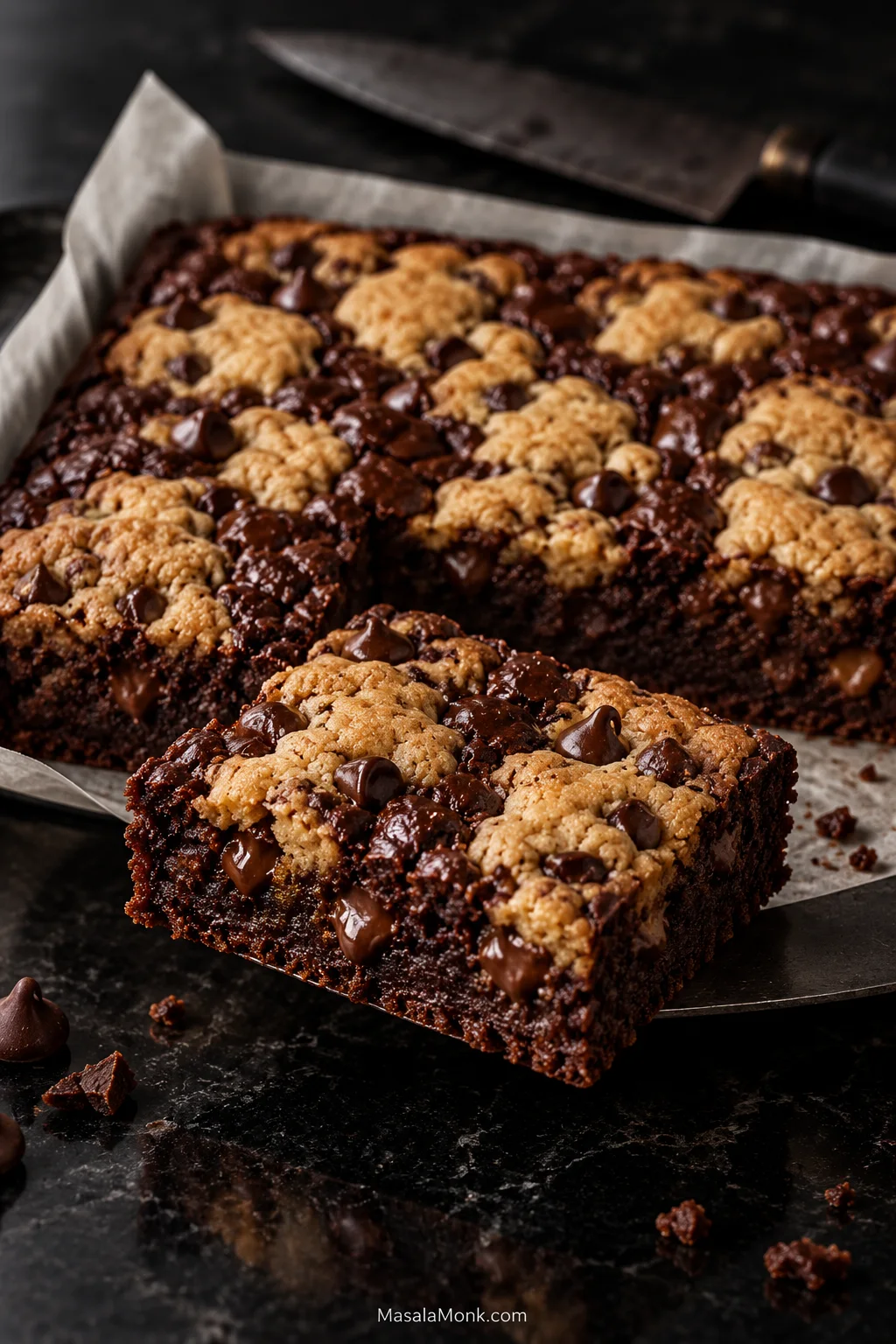
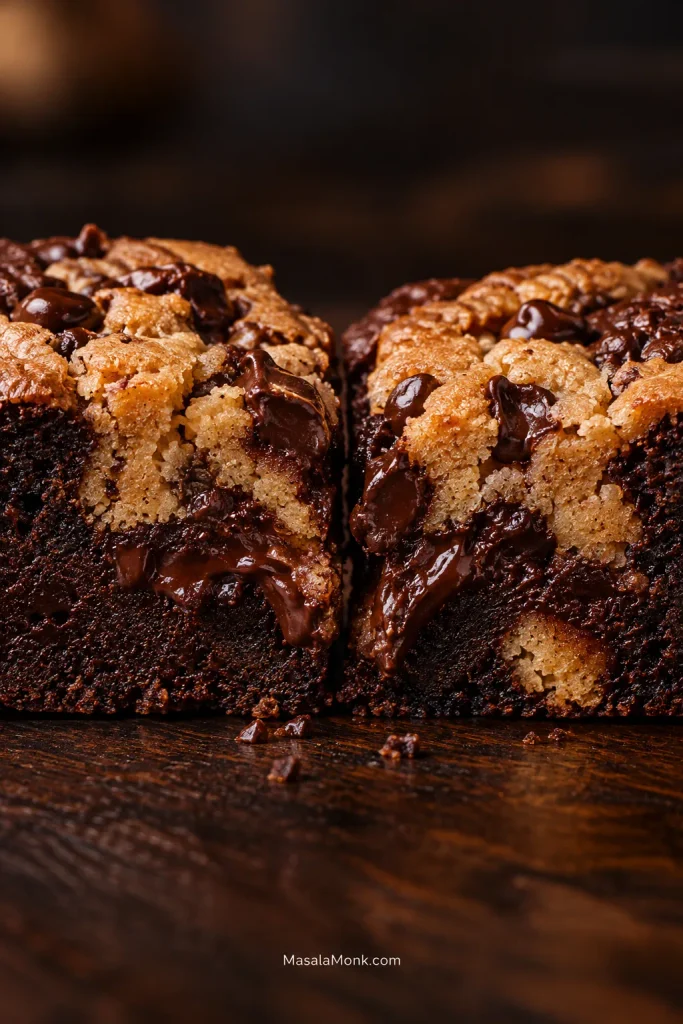
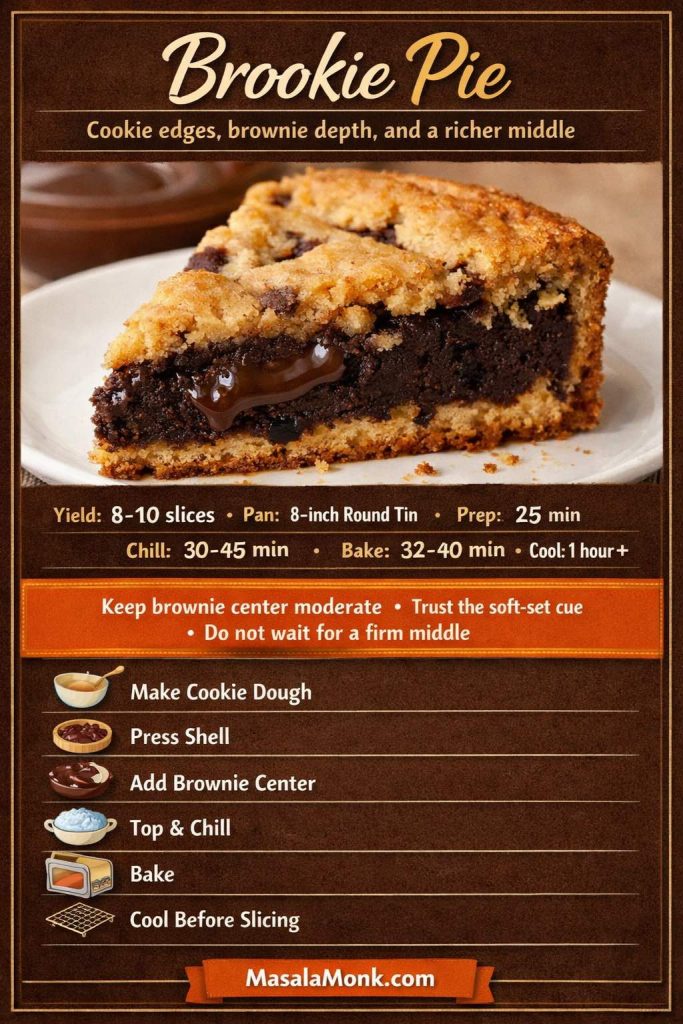
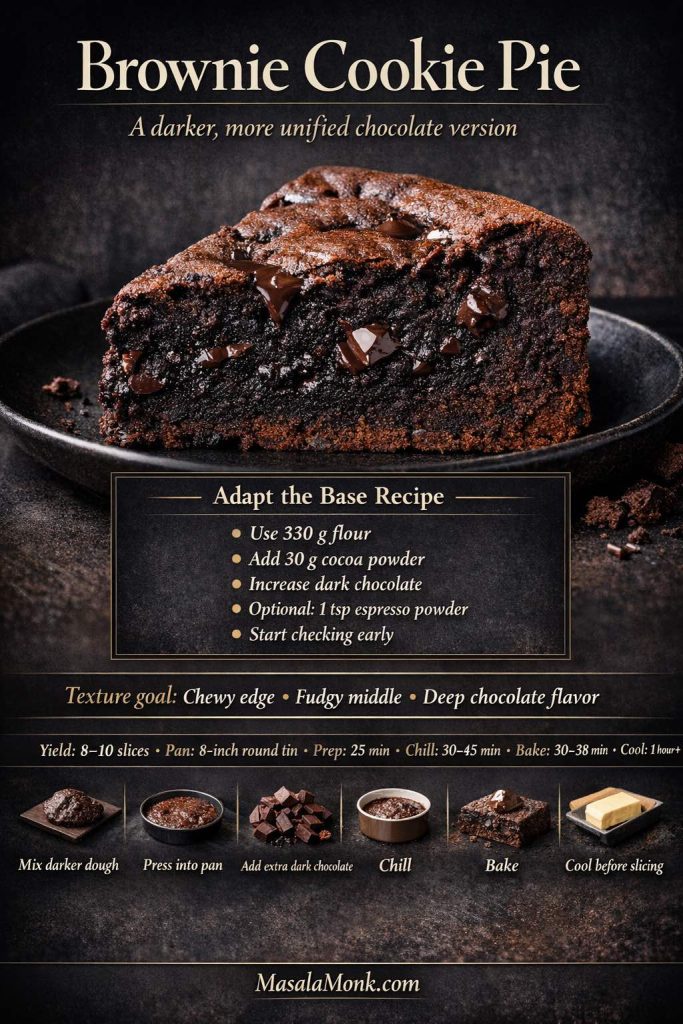
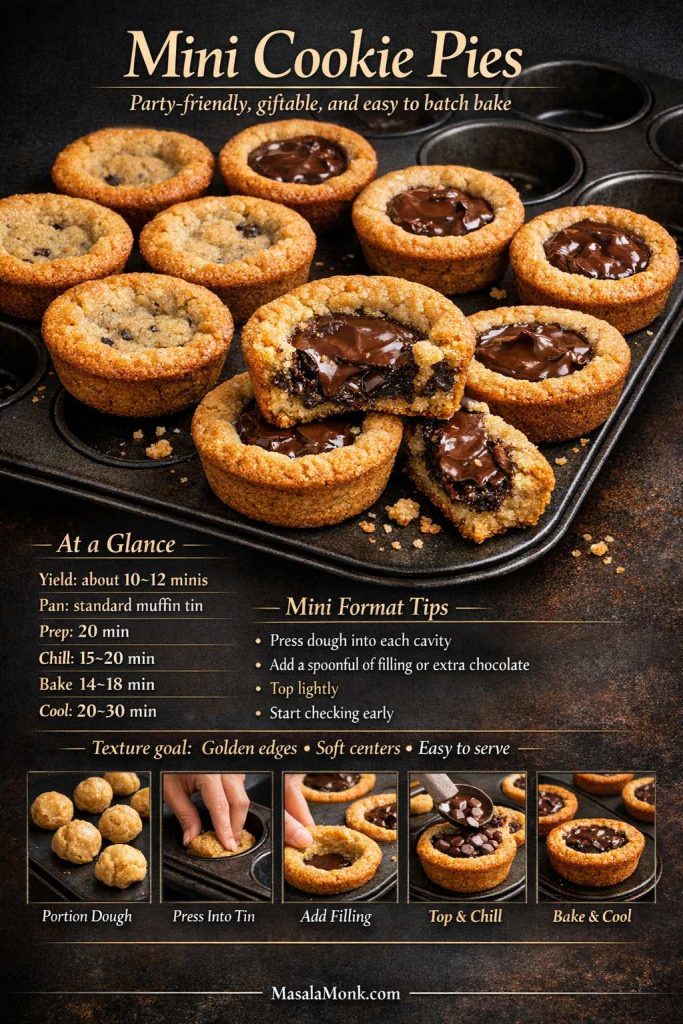
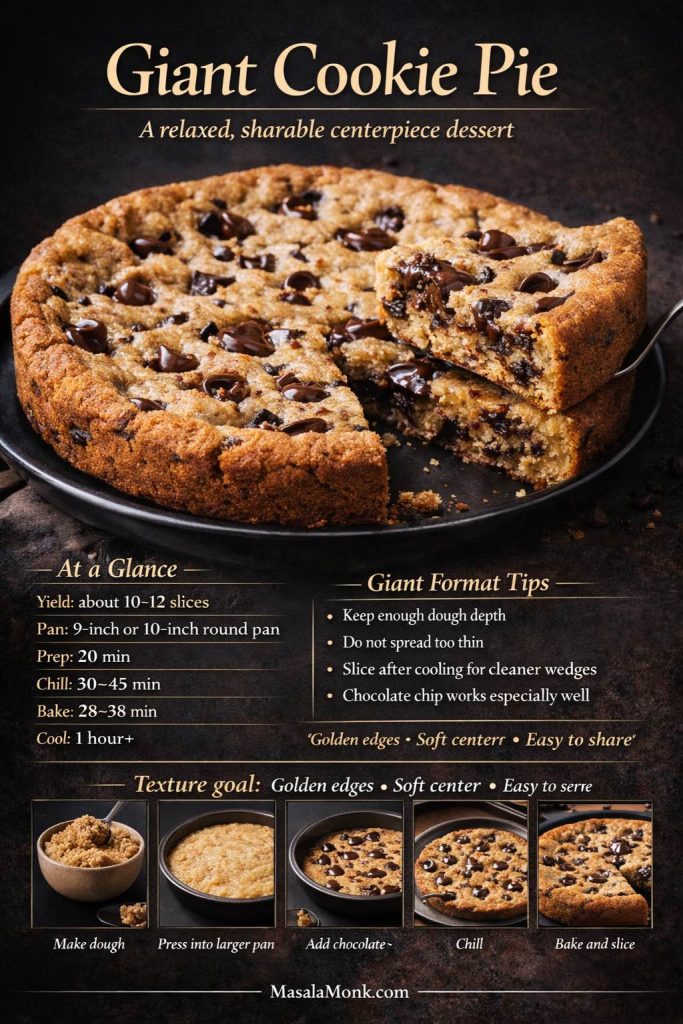
A good brookie should give you chewy chocolate chip cookie, dense fudgy brownie and melted chocolate in the same bite—not a finished cookie sitting over a brownie that is still raw underneath.
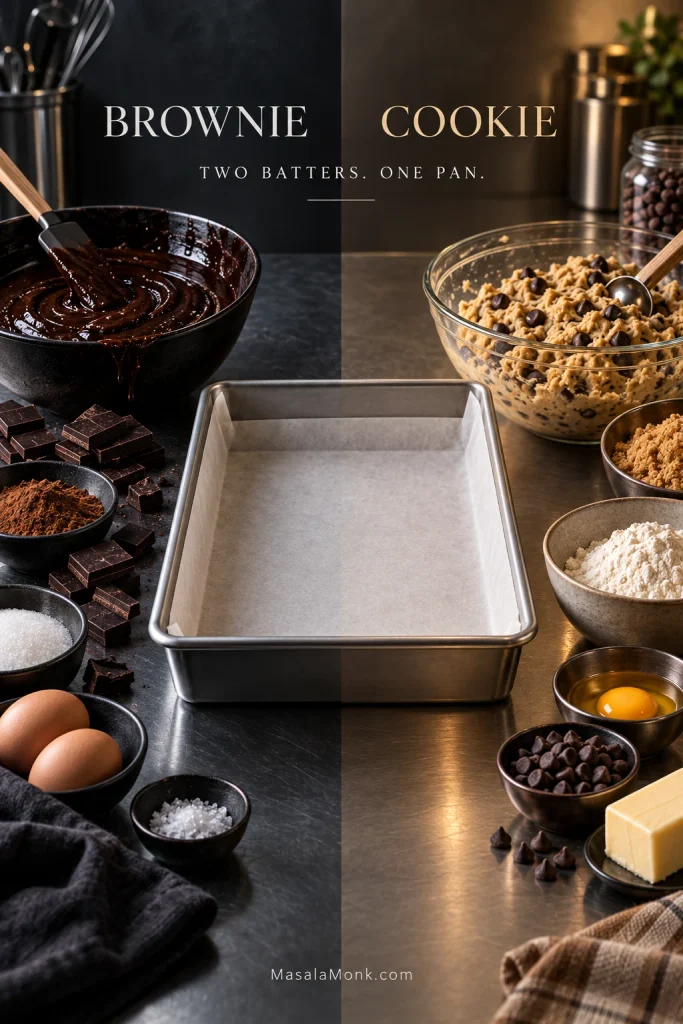
Brookies are brownie-cookie bars made by baking brownie batter and chocolate chip cookie dough together in one pan. The tricky part is getting both ready at the same time. This version keeps the brownie fairly shallow and scatters flattened cookie dough over the top, leaving dark brownie visible between the pieces.
Those open patches darken and turn glossy in the oven as the cookie picks up golden edges around them. The brownie should finish fudgy rather than fluid: soft while warm, dense after cooling, and sturdy enough to pick up without losing that moist center.
The Brookie Control Panel
Pan
9 × 13-inch (23 × 33 cm) light-colored metal pan
Oven
350°F / 175°C conventional / 160°C fan
Cookie coverage
20 flattened pieces with plenty of brownie still visible
Bake
Start checking around 28 minutes; expect about 30–36 minutes
Ready when
Cookie edges are lightly golden and brownie near the middle gives moist crumbs, not wet batter
Cooling
About 1 hour for fudgy squares; longer for especially neat cuts
Measure the brownie and cookie ingredients separately. Grams are the most dependable measure for flour, cocoa and chocolate; volume measures are included as a practical backup.
For the fudgy brownie
113 g (½ cup) unsalted butter, melted
40 mL (about 2 tablespoons + 2 teaspoons) neutral oil, such as sunflower or canola oil
200 g (1 cup) granulated sugar
50 g (¼ cup packed) light brown sugar
2 large eggs + 1 large egg yolk
2 teaspoons vanilla extract
50 g (about ½ cup + 1½ tablespoons) unsweetened cocoa powder
75 g (about ½ cup + 2 tablespoons) all-purpose flour (plain flour)
½ teaspoon fine salt
140 g (5 oz / about ¾ cup + 1 tablespoon) semisweet or bittersweet chocolate chips or chopped chocolate
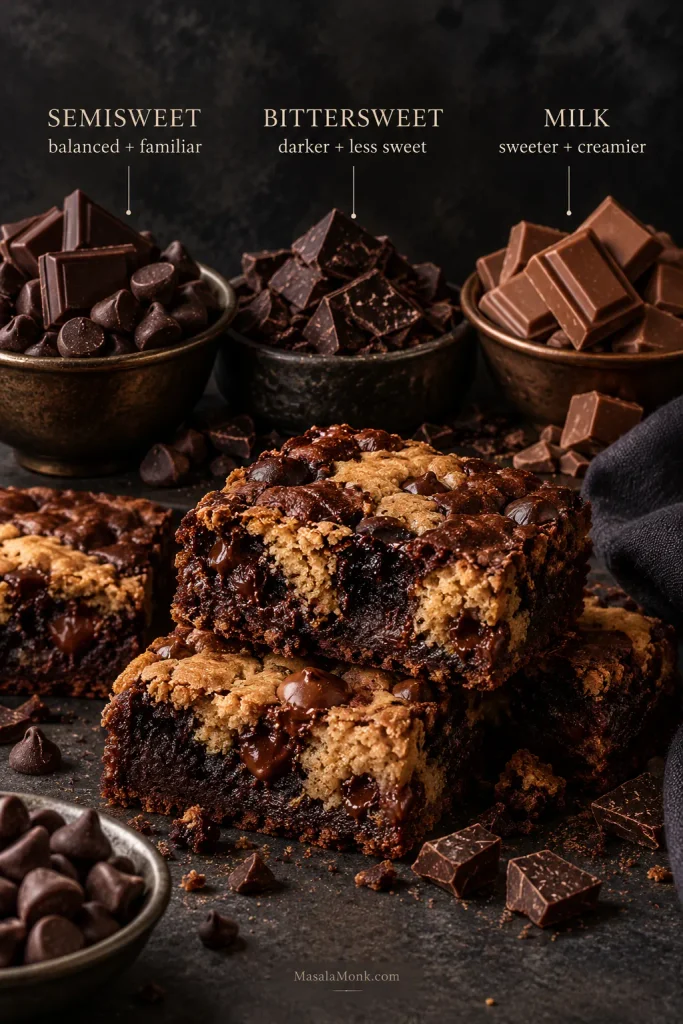
The modest amount of flour keeps the brownie dense. The extra yolk adds richness, and the oil helps it stay soft after cooling. Semisweet chocolate gives you a sweeter, more familiar bar; bittersweet takes the flavor darker and reins in some of the sweetness from the brownie and cookie together.
Use unsweetened cocoa powder, not drinking chocolate.
For the chewy chocolate chip cookie
85 g (6 tablespoons) unsalted butter, softened
100 g (½ cup packed) light brown sugar
50 g (¼ cup) granulated sugar
1 large egg
1 teaspoon vanilla extract
160 g (about 1⅓ cups) all-purpose flour (plain flour)
½ teaspoon baking soda / bicarbonate of soda
½ teaspoon fine salt
115 g (4 oz / about ⅔ cup) semisweet chocolate chips or chopped chocolate
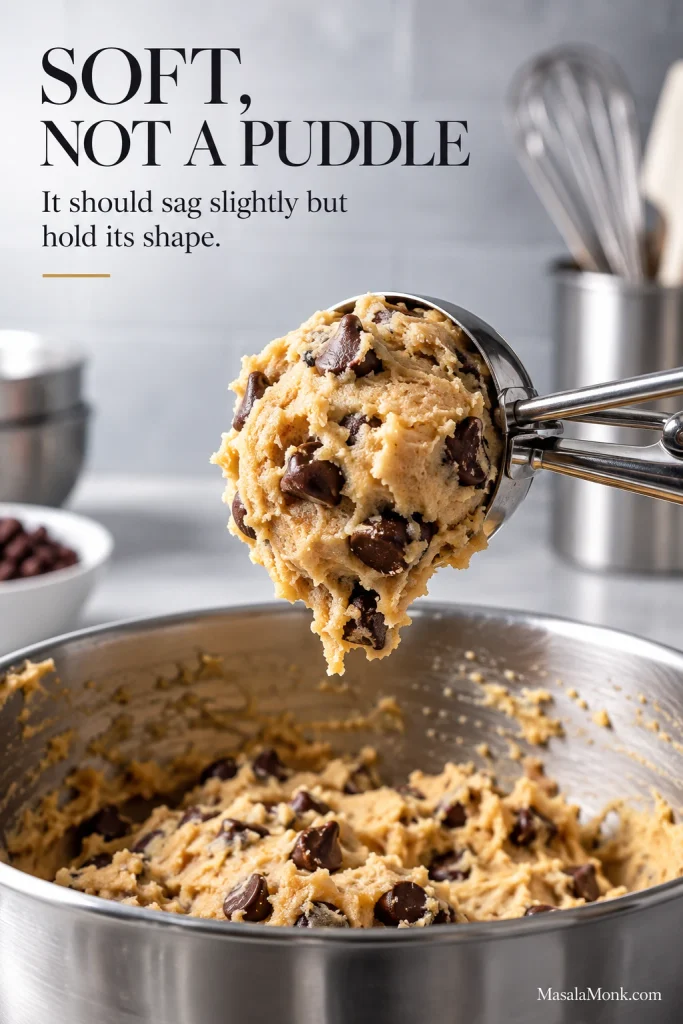
The two mixtures start differently: use melted butter in the brownie and softened butter in the cookie dough. The finished cookie dough should sag slightly when scooped but hold its shape rather than spreading immediately.
Brookies only become one dessert at assembly. Until then, the brownie needs to stay spreadable while the cookie dough needs enough body to portion and place—two textures heading toward the same finish line by different routes.
How to Make Brookies
1. Prepare the pan and oven
Heat the oven to 350°F / 175°C conventional / 160°C fan. Line a light-colored metal 9 × 13-inch (23 × 33 cm) pan with parchment, leaving enough overhang on two sides to lift out the cooled slab. Lightly grease any exposed sides.
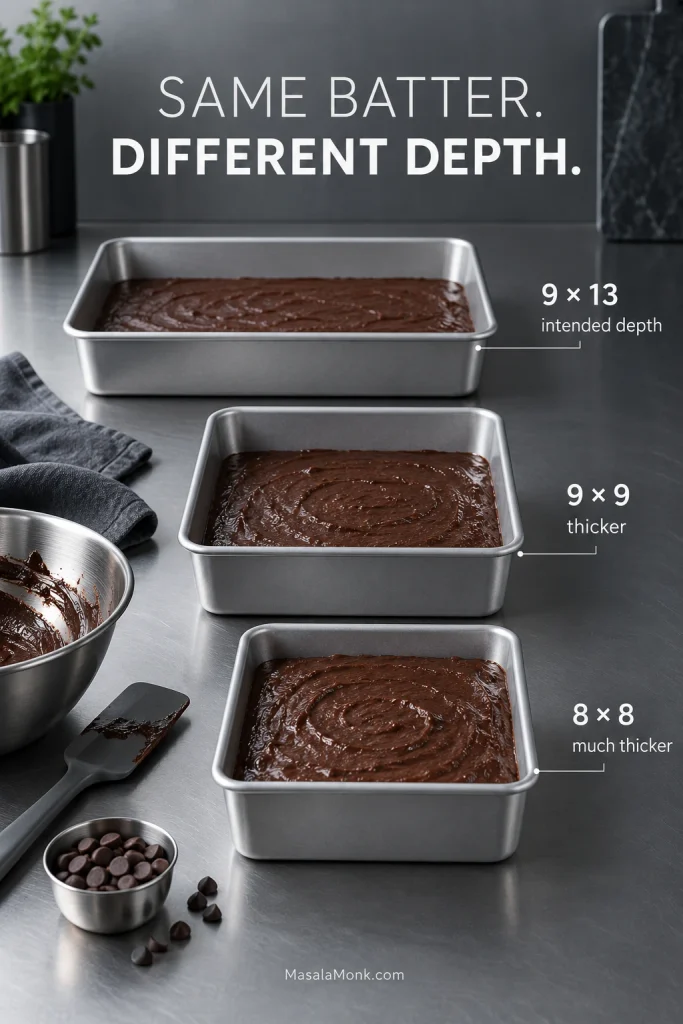
Use the stated pan size for this batch. In a smaller square pan, the brownie becomes much thicker and takes longer to set while the exposed cookie keeps browning.
2. Make the brownie batter
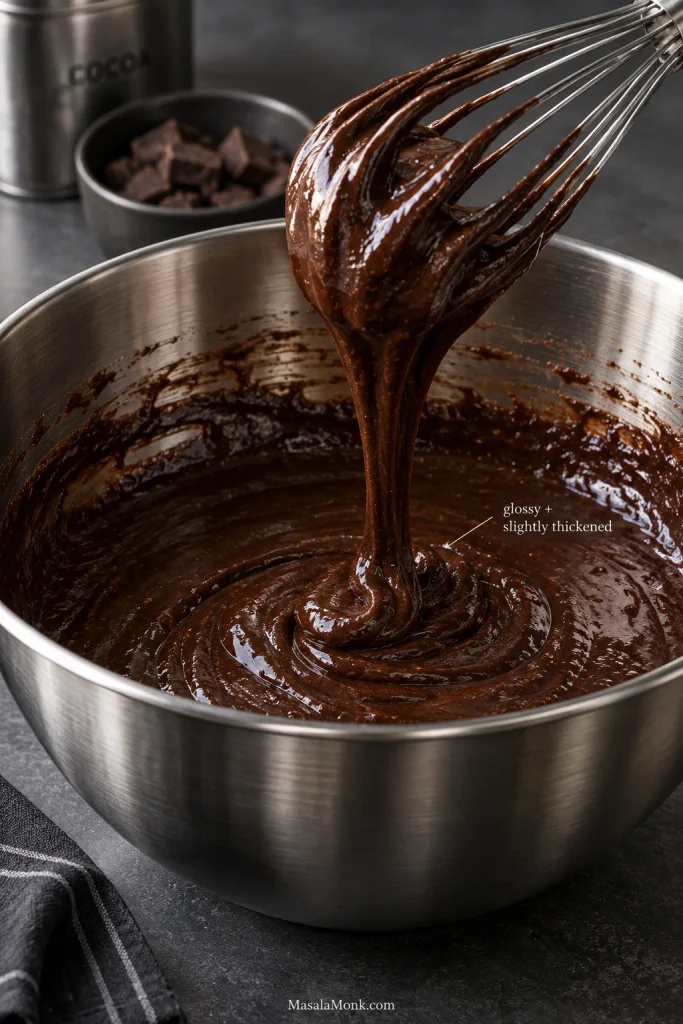
Whisk the melted butter, oil and both sugars until glossy and evenly combined. Add the eggs, extra yolk and vanilla and whisk vigorously for 60–90 seconds, until the mixture looks smoother and slightly thicker.
Use the sheen and the thick ribbon from the whisk as your checkpoint here. Once the dry ingredients go in, the goal changes from building the batter to folding only until the flour disappears.
Add the cocoa, flour and salt. Fold until the last dry streaks disappear, then fold in the chocolate. Stop there.
Spread the batter evenly through the pan, right into the corners. One thicker pocket can remain soft after the brownie around it is ready.
3. Make the cookie dough
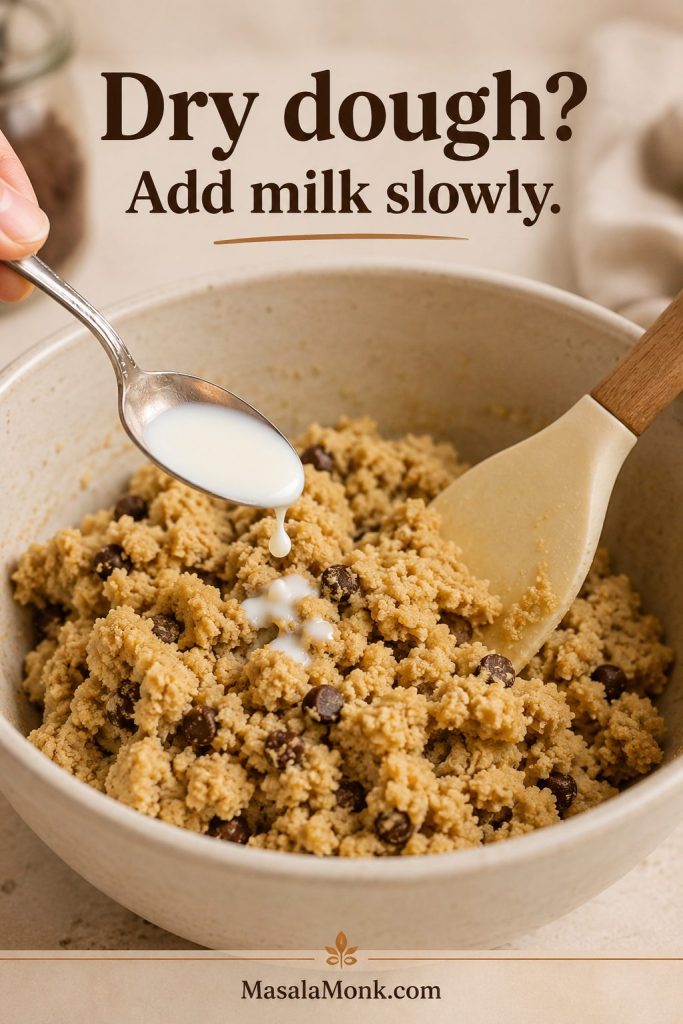
Mix the softened butter with both sugars for 1–2 minutes, until creamy. A hand mixer is convenient, though a sturdy spoon or spatula works too. Mix in the egg and vanilla, followed by the flour, baking soda and salt. Fold in the chocolate as soon as the flour disappears.
If a scoop of dough immediately slumps flat, refrigerate the bowl for about 10 minutes. You want soft dough, not a puddle.
Meanwhile, the dough needs enough structure to stay where you place it. A soft mound can spread into the brownie during baking; a loose dough can spread too far and close the gaps you deliberately left between the cookie pieces.
4. Add the cookie dough
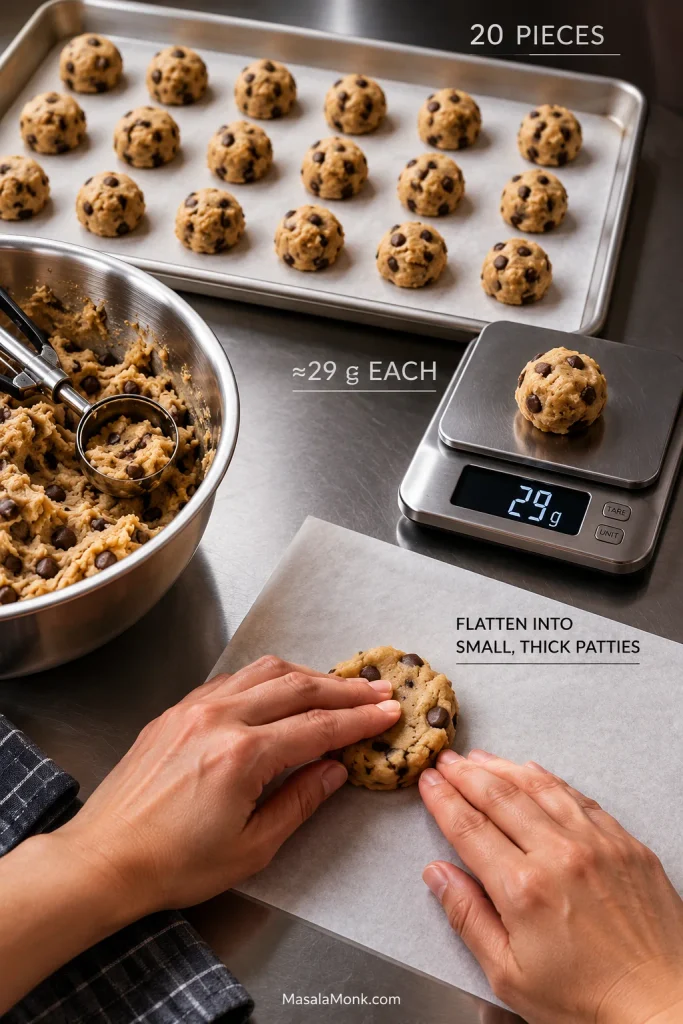
Divide the dough into 20 portions, about 28–30 g each, and flatten them into small, thick patties. They do not need to be identical.
Portioning before assembly keeps the cookie load distributed across the pan instead of concentrating it in a few heavy spots. Roughly 28–30 g per piece gives you a repeatable starting point without requiring perfectly identical patties.
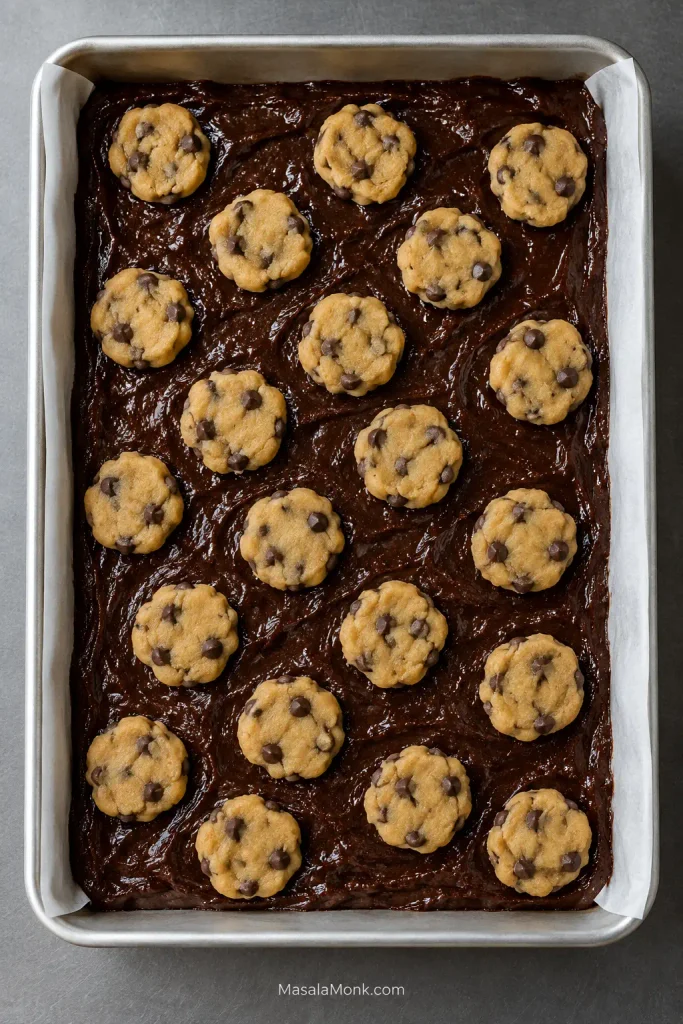
Scatter them across the brownie so cookie reaches every part of the pan while plenty of dark brownie remains visible.
Before baking, those dark channels of exposed brownie are doing useful work. They give you unobstructed places to watch the surface change, insert a tester and judge the brownie itself rather than relying on the cookie color above it.
The surface may look slightly unfinished. Leave it that way.
5. Bake
Bake on the center rack. Start checking at about 28 minutes; expect about 30–36 minutes in a light-colored metal pan.
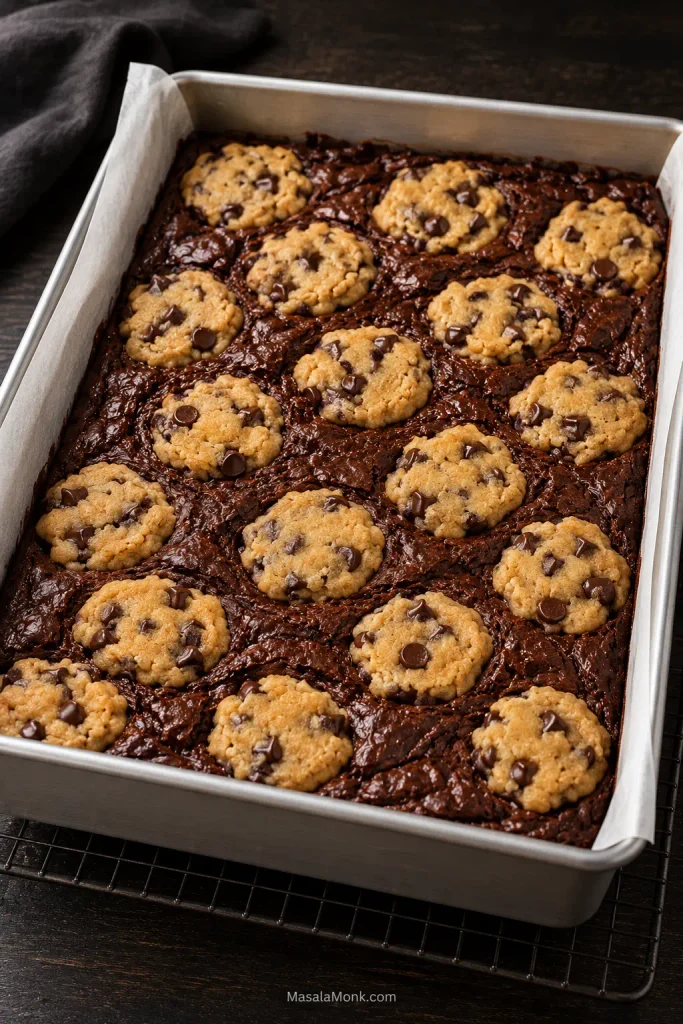
As the pan bakes, the pale cookie pieces spread and pick up color. Brownie showing between them turns darker and glossy; melted chocolate gathers along the places where the two meet.
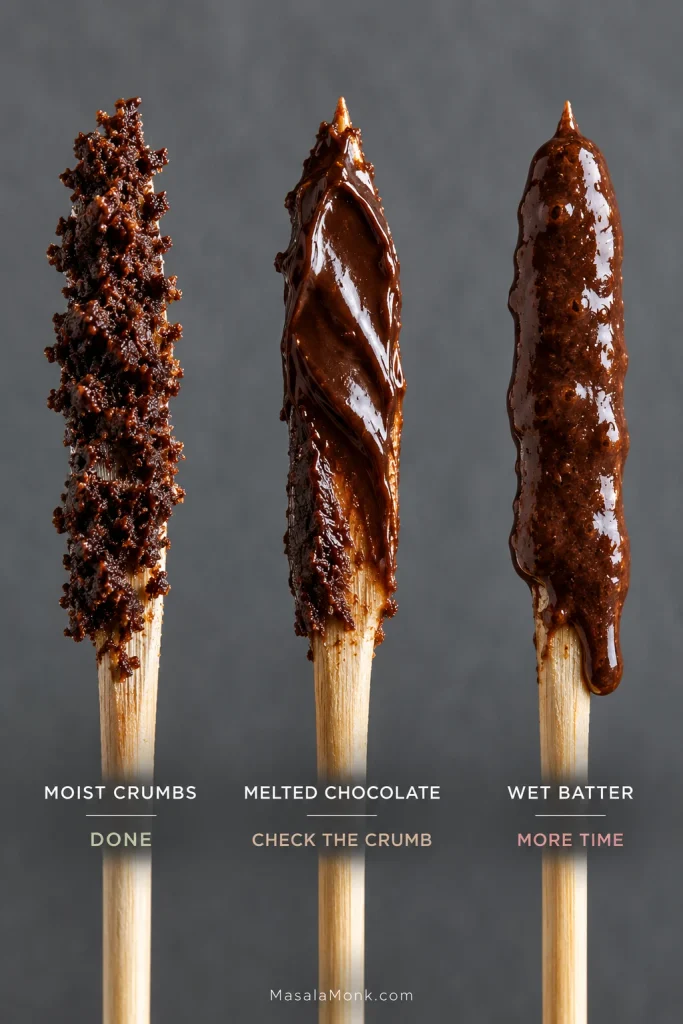
The cookie edges should look set and lightly golden, and the brownie between them should no longer look fluid. Push a tester into one of the brownie patches near the middle: you want moist crumbs, not wet batter. A small tremble is fine; a loose wave through the middle needs more time.
Compare this with the pre-bake pan: the cookie islands have widened, but the brownie windows have not disappeared. That mottled surface is more useful than waiting for the top to become one uniformly browned layer.
If the cookie already has enough color, lay foil loosely over the pan and keep baking. Leave the sides open so steam can escape, and rotate the pan late in the bake if one side of your oven consistently browns faster.
Set the pan on a wire rack. Straight from the oven, the chocolate is molten and the brownie is fragile; even a properly baked middle will look much softer than it does later. About an hour gives you fudgy squares that hold together well enough to pick up. Going in sooner is completely reasonable when what you want is a warm brookie and a fork.
How to Tell When Brookies Are Done
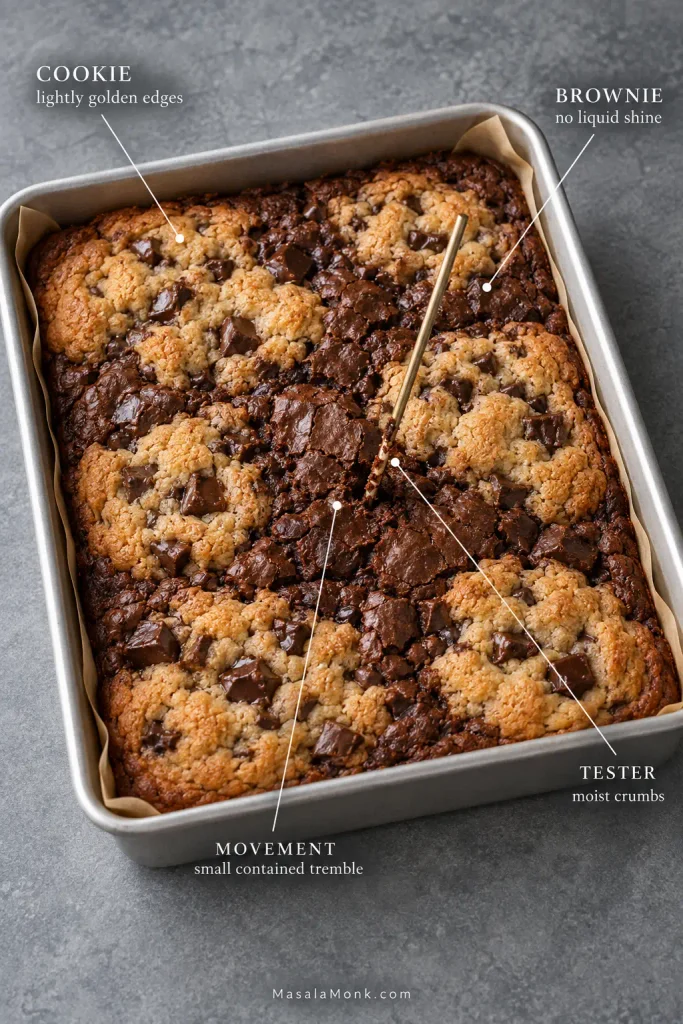
Brookies are done when the cookie edges are lightly golden, the brownie between them has lost its liquid shine, the middle gives only a small contained tremble, and a tester inserted into brownie brings up moist crumbs rather than wet batter.
Read the signals together rather than letting one overrule the others. Start with the surface, check how the center moves, then use a tester in an exposed brownie patch to confirm what the pan is already telling you.
The timer tells you when to start looking. The cookie and brownie tell you when to stop.
Cookie: the edges look set and lightly golden; the middle of each patch can remain soft.
Brownie: a little gloss is fine, but there should be no loose batter between the cookie pieces.
Movement: a contained tremble is fine. A loose wave through the middle needs more time.
Tester: use a brownie patch near the middle and avoid an obvious pool of melted chocolate.
Fudgy, gooey or actually raw?
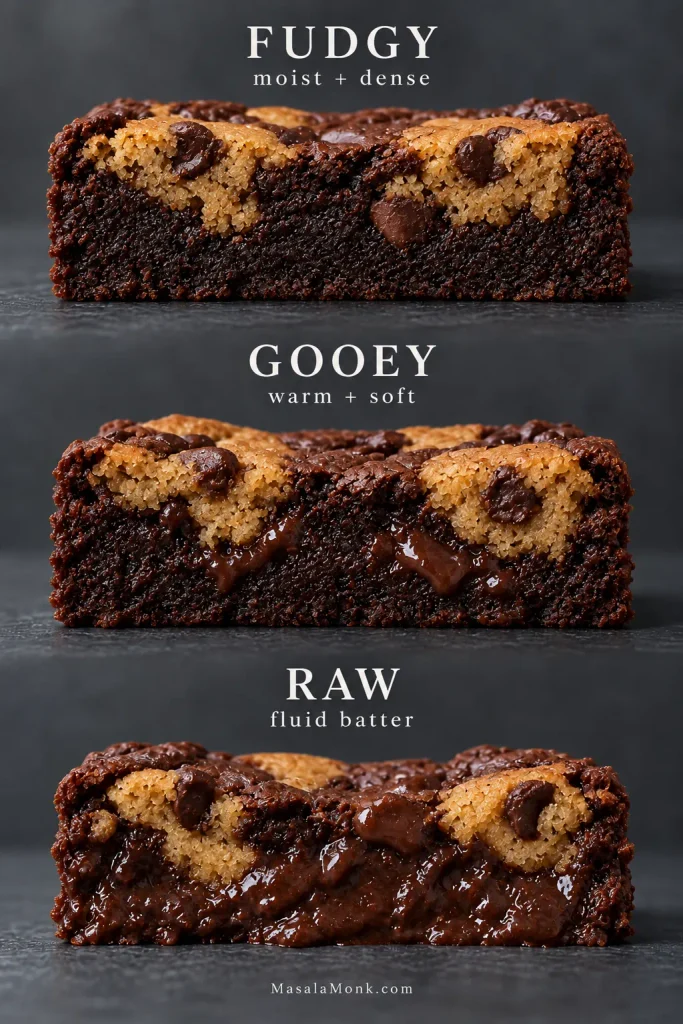
Fudgy brookies are moist and dense, but the brownie itself is baked. They may look very soft while hot and become properly sliceable as they cool.
Gooey brookies are softer when served warm: the brownie is very moist, melted chocolate runs through the crumb, and the bar is messy without behaving like batter.
Raw brookies are different. The brownie remains fluid, leaves obvious batter on the tester and can collapse or flow instead of firming up.
Cooling can firm a properly baked fudgy or gooey center, but it cannot turn fluid batter into crumb. If the middle still flows rather than holding structure, waiting longer on the counter is not the fix.
How to Read the Tester
Melted chocolate can smear across a tester or knife even when the brownie is baked. Look at the crumb around that chocolate before deciding the pan needs longer.
If your tester lands in melted chocolate, move a little and test an exposed brownie patch again. A second location is more useful than adding several unnecessary minutes simply because the first tester came out dark and glossy.
If your cookie repeatedly reaches the right color well before the brownie, the pan is the first thing worth examining.
What Pan Should You Use for Brookies?
Use a light-colored metal 9 × 13-inch (23 × 33 cm) pan for this recipe.
The same batch becomes much thicker in an 8 × 8 or 9 × 9-inch pan, which means the brownie needs more oven time underneath cookie dough already exposed directly to the heat.
Surface area drops faster than the side lengths suggest: a 9 × 13-inch pan gives 117 square inches, 9 × 9 gives 81, and 8 × 8 only 64. With the same batter, that makes the brownie substantially deeper in a square pan.
Very dark metal can brown the bottom and edges faster. Glass and ceramic may not follow the same timing either, so watch the brownie rather than assuming the clock transfers unchanged.
Thick square-pan brookies can be excellent. They just need a recipe developed for that deeper pan.
If the batch in front of you already has hard edges, a wet middle or one strangely soft patch, the pattern can usually tell you what happened.
Brookies Troubleshooting
Raw Centers
Why are my brookies raw in the middle?
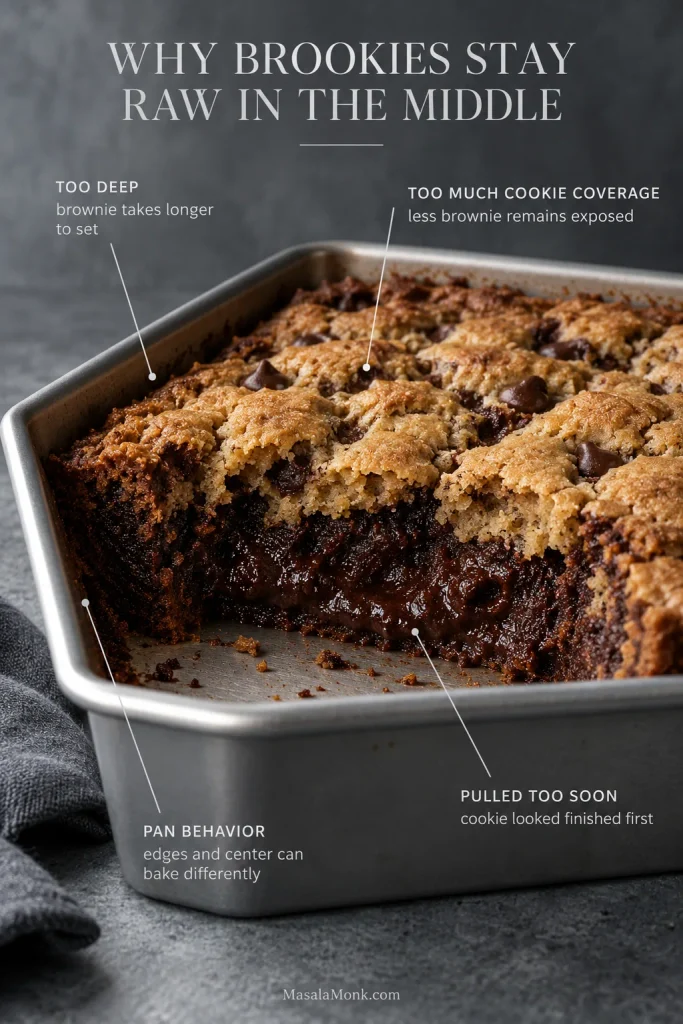
The usual causes are too much brownie depth, very heavy cookie coverage, bakeware that leaves the middle lagging behind, or simply taking the pan out because the cookie looked finished first.
Golden cookie over wet brownie still needs more oven time. Cover the top loosely with foil and continue in short intervals.
The cookie is exposed directly to oven heat while the brownie center has to set underneath and between it. As a result, a golden top can arrive before a deep or heavily covered middle has finished baking.
The edges are hard but the middle is raw
This is frustrating because the pan can look completely finished around the outside. A thick brownie layer, dark or glass bakeware, or an oven running hot can all push the perimeter ahead.
Protect anything already browned and give the middle more time. If cakes and brownies behave this way in your oven too, check the actual oven temperature with a thermometer.
Uneven Baking
Only one part of the pan is underbaked
One soft patch usually means the batter was thicker there, a large cookie piece covered that spot, or the oven has a hot or cool area. The whole pan may not need more time.
Spread the brownie carefully into the corners next time, and rotate late in the bake if your oven has a familiar hot side.
Texture, Sinking and Cutting Problems
The cookie dough sank into the brownie
A little sinking is exactly what you want—the brownie and cookie should meet.
If the cookie dough almost disappears, it was probably very warm or divided into pieces that were too small. A short chill gives it more body.
They look raw as soon as I cut them
Warm brookies are supposed to be messy. An early slice can look alarmingly soft while the chocolate is molten.
Leave the rest of the slab alone for a while. A brownie that firms into a dense slice was still setting; one that continues to flow was underbaked.
The brownie is cakey, dry or crumbly
Start with the flour measurement and bake time. Extra flour and a few unnecessary minutes can move the brownie away from fudgy surprisingly quickly.
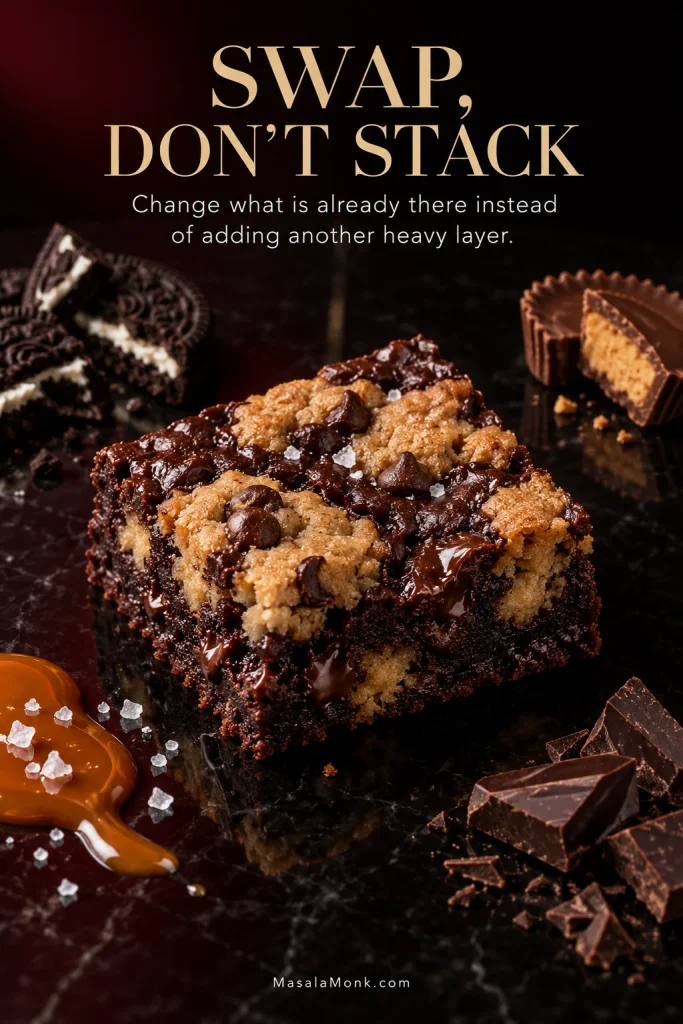
There is already plenty happening in this pan. The safest changes replace part of what is already there instead of adding another heavy layer: swap, do not stack.
For Brookie variations, think about structure before flavor: is the new ingredient replacing something already in the dough, or adding extra mass or moisture? A replacement usually preserves the original bake more predictably than another full layer.
Oreos or Peanut Butter Cups
Replace part of the chocolate in the cookie dough with chopped Oreos or peanut butter cups, keeping the overall quantity of chunky add-ins about the same. You still want the cookie dough to spread normally and leave brownie showing between the pieces.
Caramel and Flaky Salt
Caramel is easier to control after baking. Drizzle a little over the cooled slab and add flaky salt instead of putting a wet caramel layer through the middle before it goes into the oven.
Change the Chocolate
Bittersweet chocolate gives the bars a darker, less sweet finish; milk chocolate takes them in the other direction. Chopped chocolate mixed with chips gives you larger melted pockets alongside smaller pieces running through the crumb.
There are really two chocolate decisions here. Chocolate type changes sweetness and cocoa intensity, while chocolate form changes the pockets you bite into—chips tend to stay smaller, whereas chopped chocolate can melt into broader streaks.
Changes That Need Their Own Recipe
Brown butter changes more than flavor because some of its water disappears during browning. That affects the way cookie dough spreads, so it is not a casual one-for-one swap. Our brown butter chocolate chip cookies go deeper into the moisture loss and what it does to the dough.
Brownie mix and refrigerated cookie dough need their own quantities and timing too. Box sizes, fat levels and intended pan sizes vary enough that dropping random packaged products into this method would be guesswork.
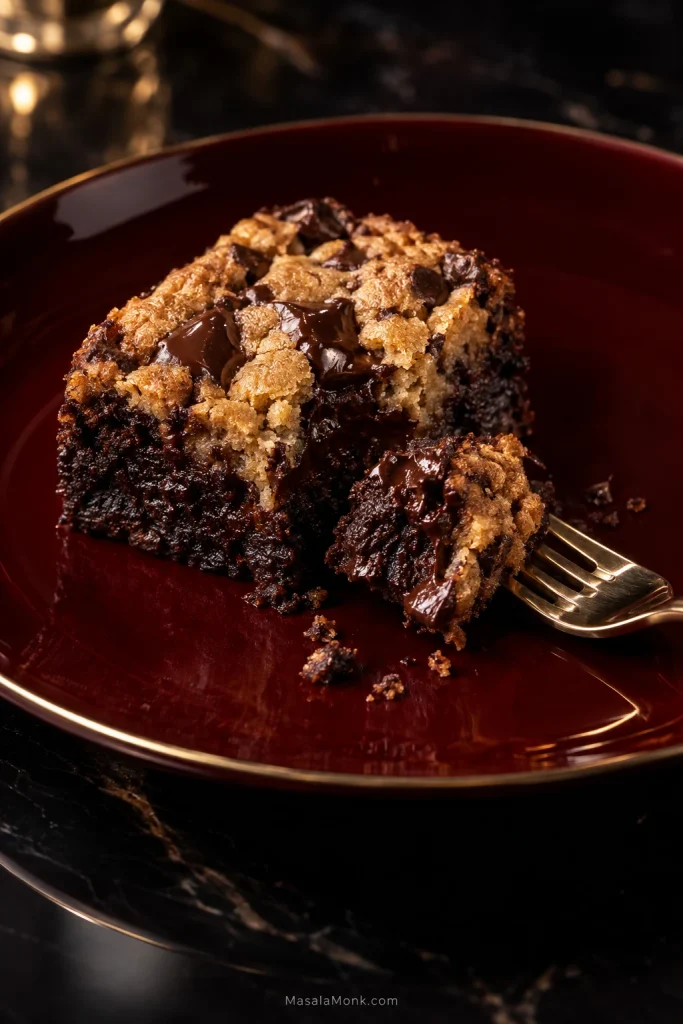
Give the pan about 30–45 minutes. The brownie will have started to firm, but the chocolate will still be soft and the middle deliberately messy. This is the fork version: tender cookie, brownie at its softest and melted chocolate running through the places where the two meet.
Warm serving is a texture choice, not a shortcut around doneness. Bake the Brookies fully first; the 30–45 minute rest simply catches them while the brownie is especially soft and the chocolate is still loose enough for a fork.
For neat fudgy squares
Wait about an hour, or until the slab feels stable enough to lift with the parchment. Move it to a board and cut with a large sharp knife.
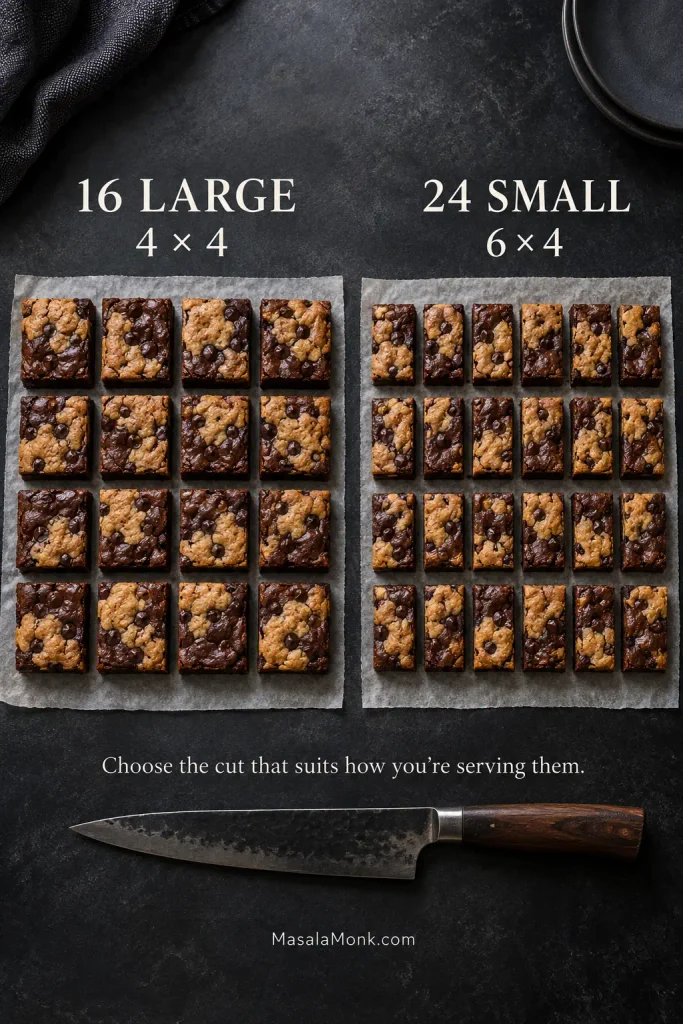
A little chocolate on the blade is perfectly normal. Cut into 16 larger squares for dessert portions or 24 smaller bars for sharing, wiping the knife between cuts when clean edges matter.
For serving, choose the grid before making the first cut: 4 × 4 gives 16 larger squares, while 6 × 4 gives 24 smaller pieces. Planning the pattern first also helps avoid narrow leftover strips at the edge.
For very clean cuts tomorrow
Cool the slab completely and chill it briefly before slicing. Bring the bars back toward room temperature before serving for a softer brownie and less-firm chocolate.
That also makes brookies easy to prepare a day ahead: bake the slab, let it cool, and save the cutting for when everything is firm and easy to handle.
Storage and freezing
Once the brookies are cool, keep them in an airtight container at room temperature for about 3–4 days. Refrigerated bars keep for roughly a week, though the brownie and chocolate both become firmer when cold.
For longer storage, wrap individual bars well and freeze them airtight for up to about 2 months. Thaw at room temperature.
At room temperature, the cookie stays chewy against a soft, fudgy brownie.
Cool enough to cut cleanly, the Brookie still keeps both textures visible: chewy cookie folded into fudgy brownie, with softened chocolate at the seam.
Warm a square just enough for the chocolate to loosen and the boundary between the two almost disappears again. Both are good—it simply depends whether you want a neat bar in your hand or the softer version that needs a fork.
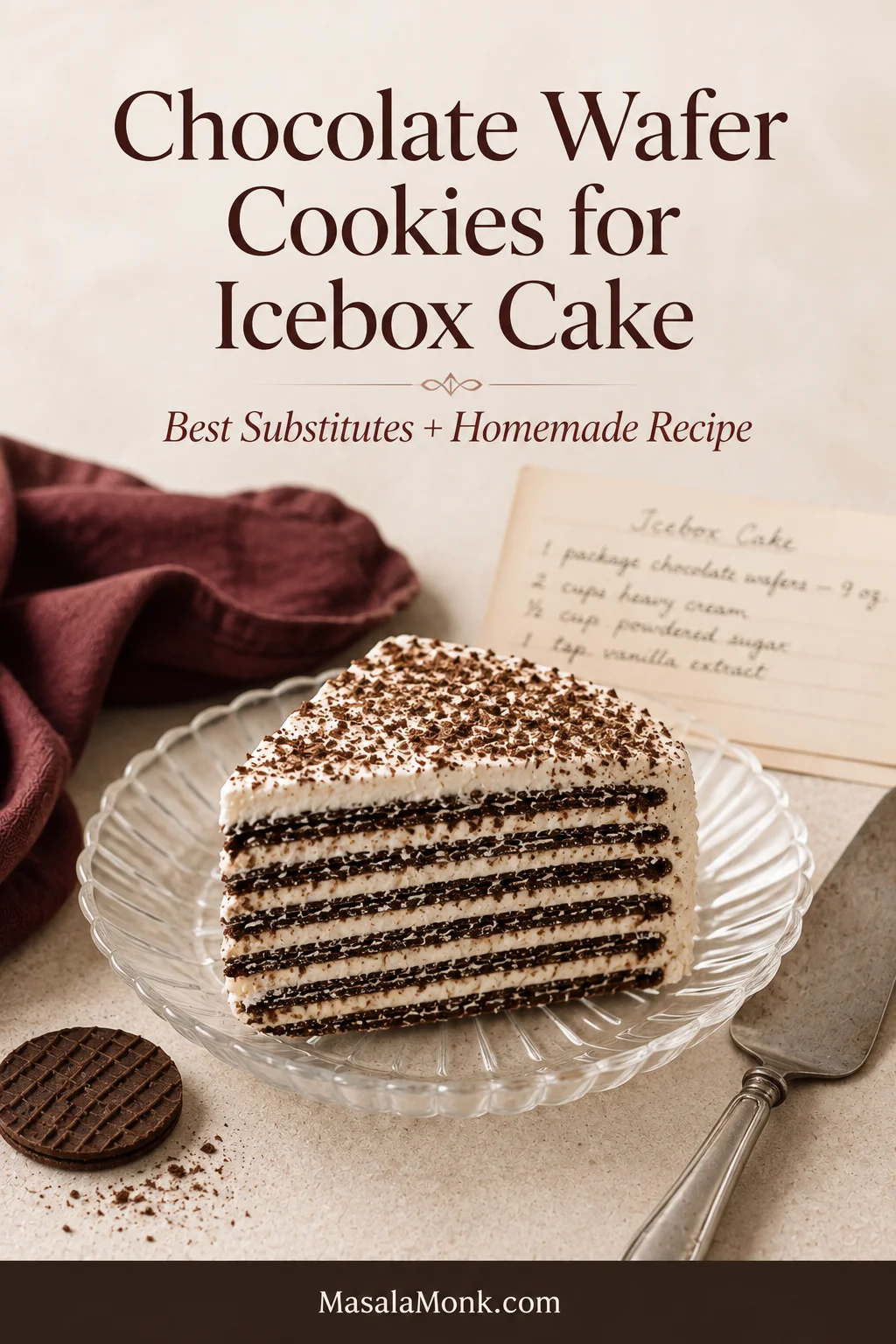
Icebox cake is supposed to be the easy dessert: crisp chocolate cookies, whipped cream, and enough refrigerator time to turn the two into tender striped slices. Then an inherited recipe tells you to open one 9-ounce package of Famous Chocolate Wafers—a product that disappeared from store shelves.
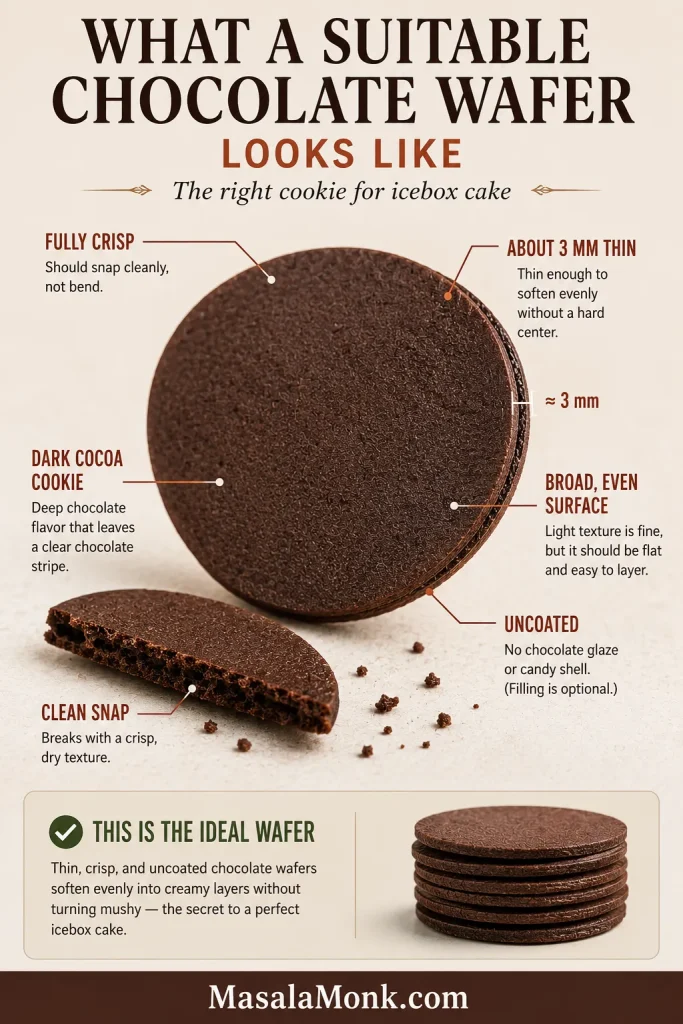
The best chocolate wafer cookies for icebox cake have a surprisingly specific job. They cannot merely taste chocolatey. They need to start thin and crisp, take in moisture without collapsing into paste, and soften all the way through while leaving a clear dark line in every slice.
Choose a store-bought substitute or make the wafers below, then use our complete classic chocolate wafer icebox cake recipe for the whipped cream, assembly, chilling, clean slicing, and finished-cake storage.
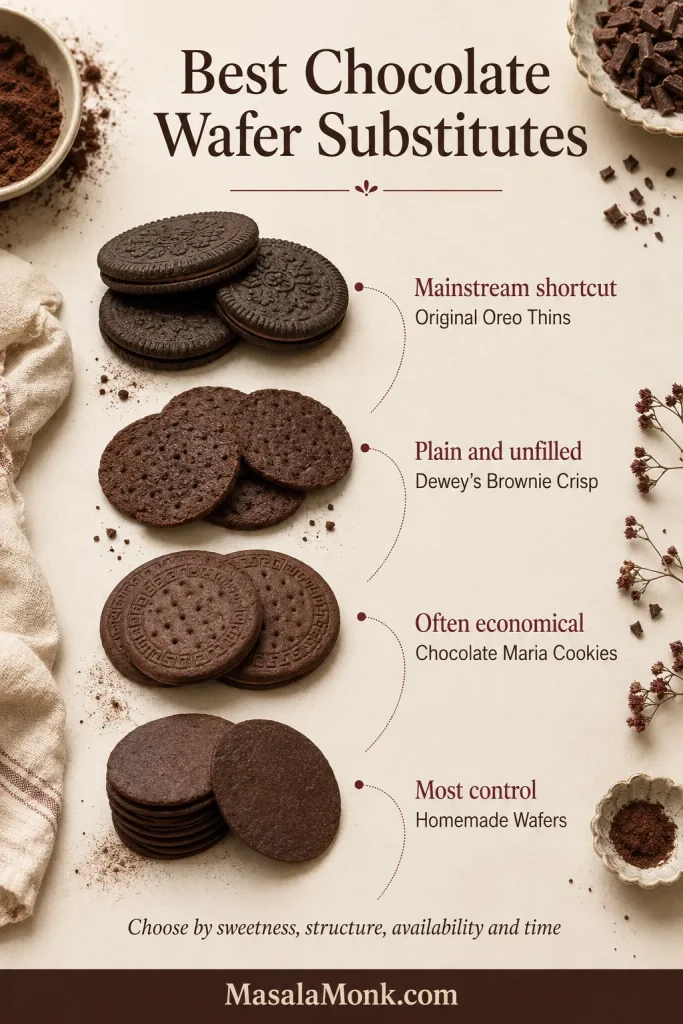
Quick Answer: What Can Replace Chocolate Wafers in Icebox Cake?
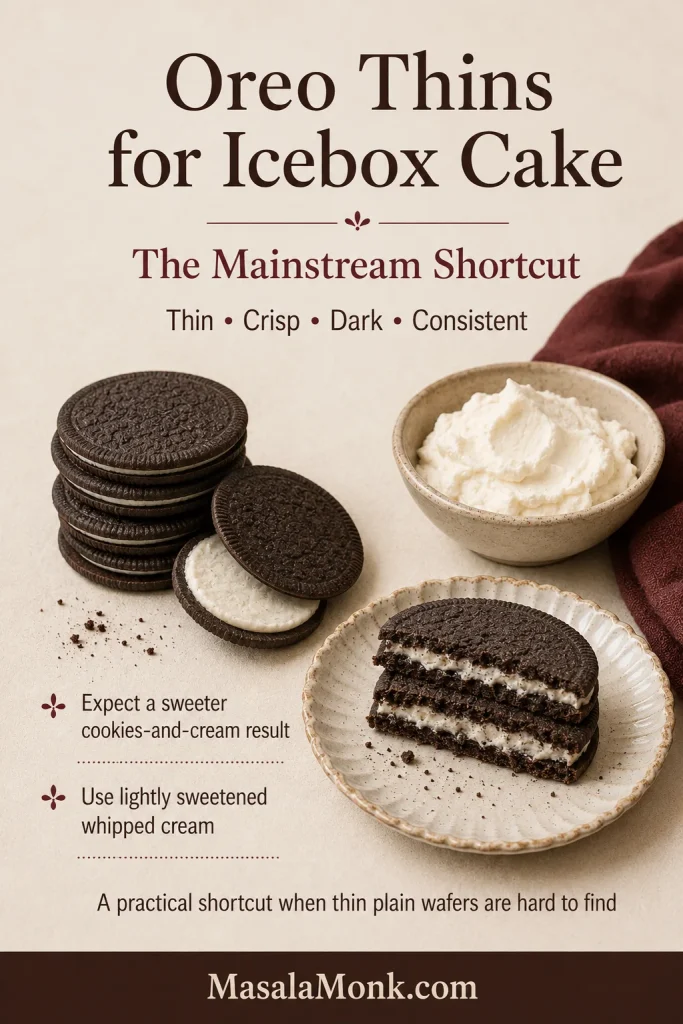
Most practical mainstream option: Original Oreo Thins with lightly sweetened cream.
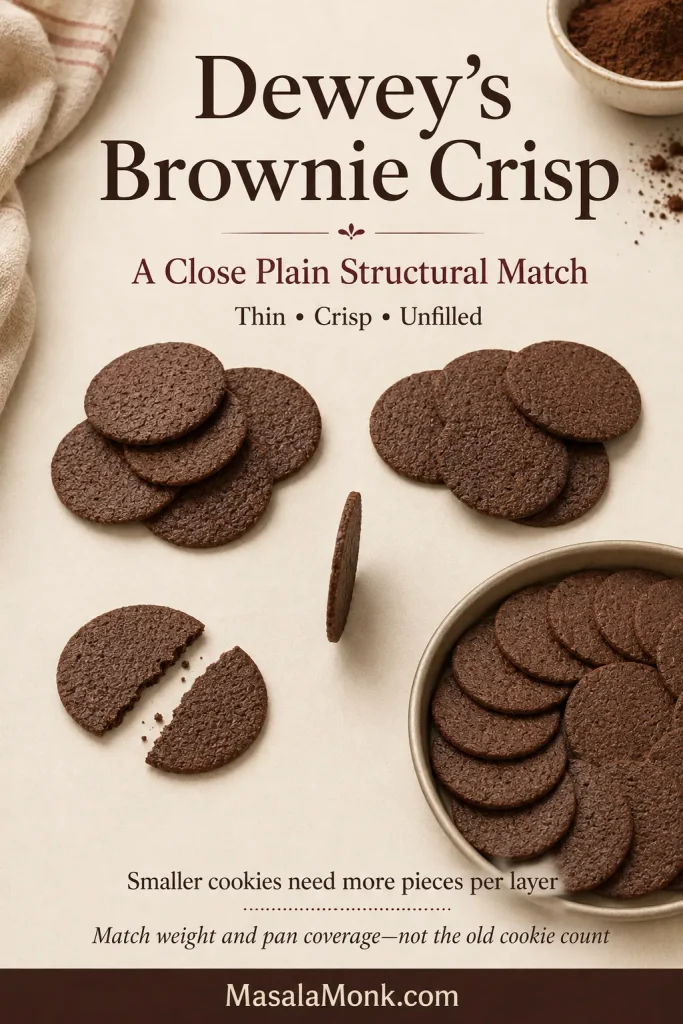
Closest plain structural match covered here: Dewey’s Brownie Crisp, when available.
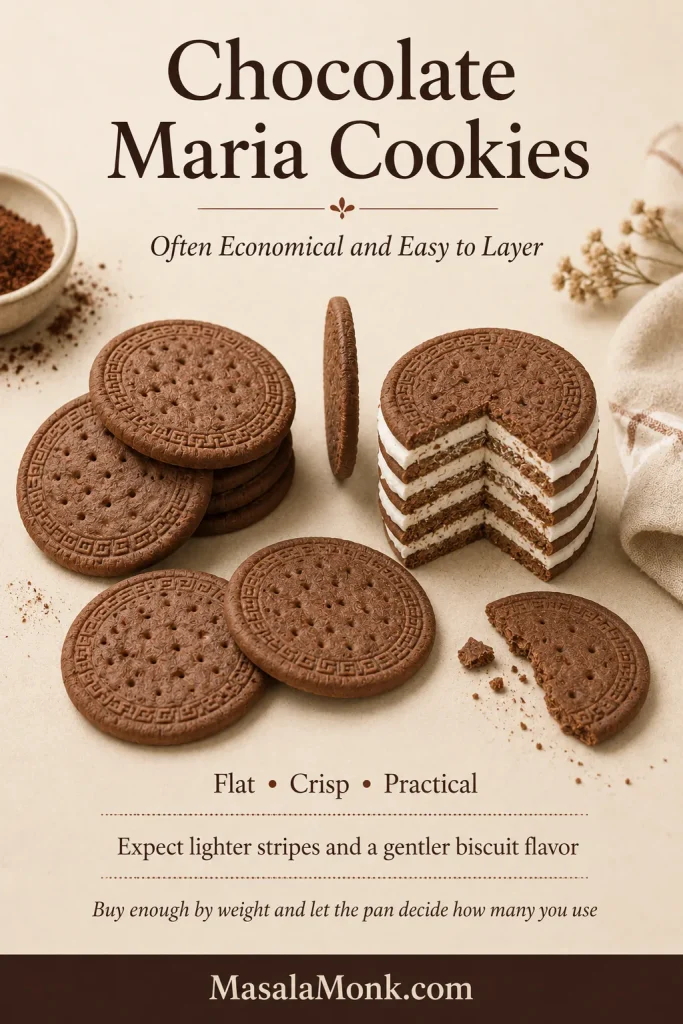
Often the economical option: Chocolate Maria cookies.
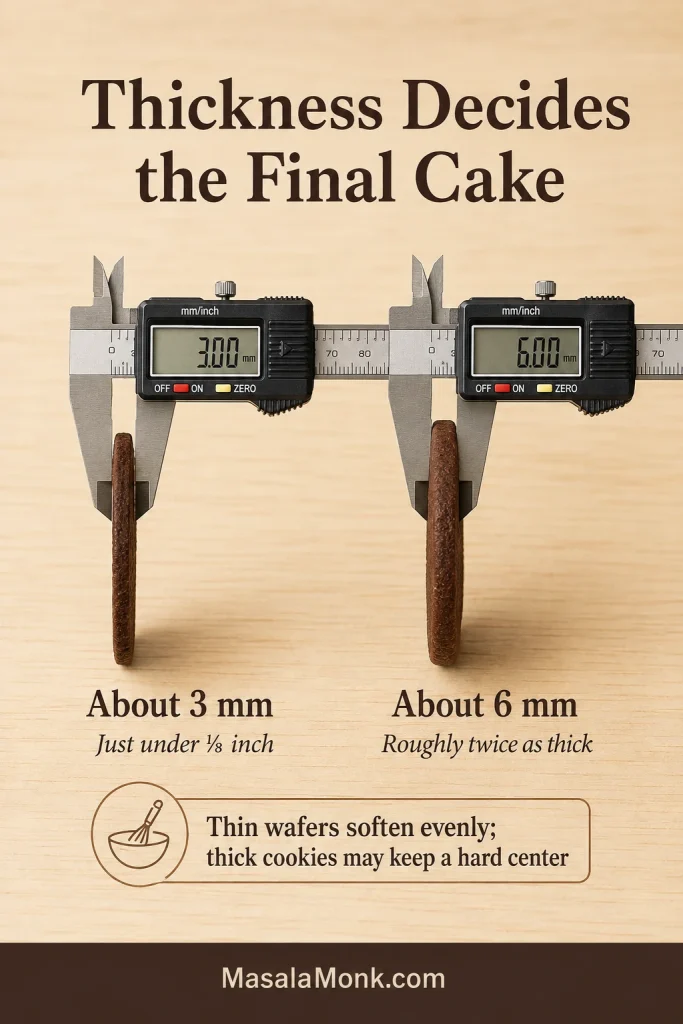
Most control: homemade wafers rolled to about 3 mm—just under ⅛ inch.
Match the cookie’s job, not the missing brand name.
For a plain-wafer result, look for a cookie that is thin, completely crisp, reasonably flat, and uncoated. Match the weight and the way the cookies cover the pan before worrying about an old piece count.
One cook needs a cake tonight; another is trying to recreate the birthday or holiday dessert they remember. Choose by the trade-off that matters least: added sweetness, cost, shape, availability, or time.
On a phone, swipe sideways to see all columns.
Your situation
Start with
Plan for
You need a mainstream shortcut
Original Oreo Thins
A sweeter, cookies-and-cream-style slice
You want a plain, unfilled cookie
Dewey’s Brownie Crisp, when available
Many small cookies; match weight and pan coverage
You want an economical, easy-to-layer option
Chocolate Maria cookies
A milder cocoa flavor; buy enough by weight
You are building in a loaf pan or baking dish
Chocolate graham crackers
Broad rectangular layers and a clear graham flavor
You want control over flavor and thickness
Homemade wafers
Cool completely, then set aside the amount your old recipe needs
Choose by the result and trade-off that matter most to your cake.
Whichever route you choose, the goal is the same: enough cream contact to turn every crisp cookie into a tender stripe without erasing the layers.
Regular wafer sizes leave fewer gaps, improving cream contact and producing cleaner slices across a loaf pan.
Homemade Chocolate Wafer Cookies for Icebox Cake
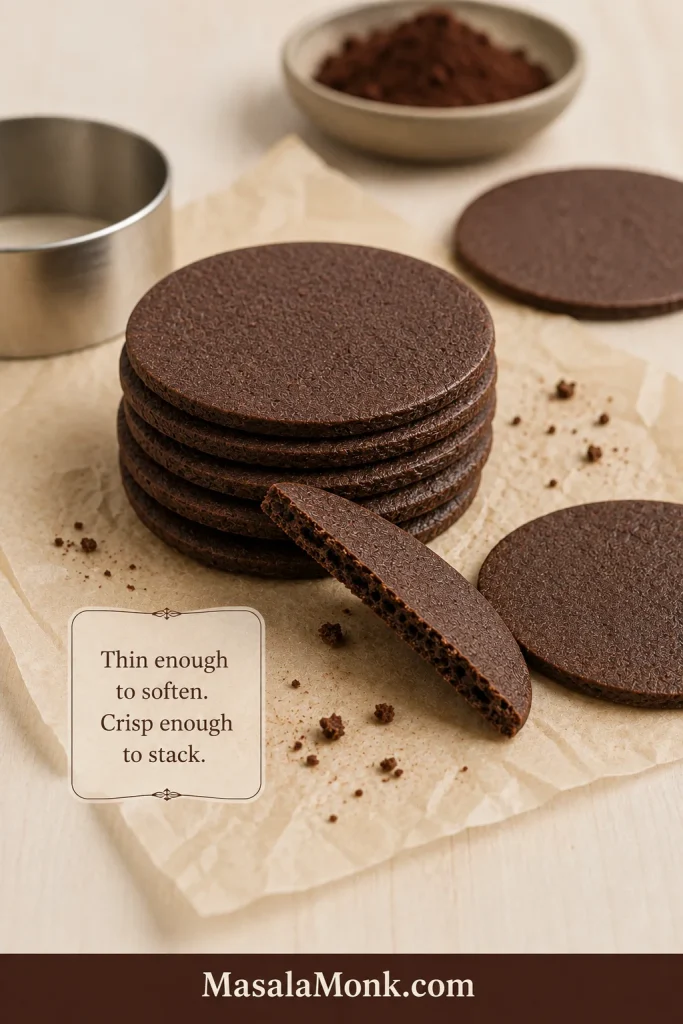
These are not thick chocolate refrigerator cookies. They are dark, dry, thin wafers built for one particular change: crisp enough to snap today, then tender enough to cut after a night between layers of cream. They may look plain when they leave the oven, but that clean snap gives the refrigerator exactly what it needs to create a tender striped slice.
Recipe note: The ingredient proportions and parchment-rolling method are adapted from King Arthur Baking’s chocolate wafers. The guidance here applies that dough specifically to icebox-cake thickness, old-package conversion, chilling, and troubleshooting.
For one old 9-ounce package, set aside 9 oz (255 g) of fully cooled wafers. Use enough to cover the intended layers; keep any extras for gaps, crumbs, or another dessert.
Cool the wafers completely before stacking; trapped warmth can soften them before the cream ever does.
Recipe at a Glance
Prep time
About 30 minutes
Chilling
30 minutes
Bake time
14–17 minutes per batch
Cooling
About 15–20 minutes, until completely cool
Total elapsed time
About 1½–2 hours, depending on tray capacity and whether scraps need another bake
Oven
325°F (163°C)
Thickness
About 3 mm—just under ⅛ inch
Expected yield
Roughly 40 large rounds or 90 smaller squares; see the note below
For one old package
Set aside 9 oz (255 g) of fully cooled wafers
Yield note: The source recipe estimates about 40 rounds at 2½ inches or 90 smaller squares. Your count will change with thickness, cutter size, tray space, and rerolled scraps.
Equipment
Use a digital scale, medium mixing bowl, hand or stand mixer, rolling pin, parchment paper, and a 2½-inch (6.5 cm) cutter. You need at least two baking sheets, although three or four make the process smoother because the batch produces several trays and the wafers cool completely on the pans. A pizza wheel works well for squares; a separate cooling rack is unnecessary.
Useful extras include 3 mm rolling guides or spacer rings, a small offset spatula, and an oven thermometer.
Ingredients
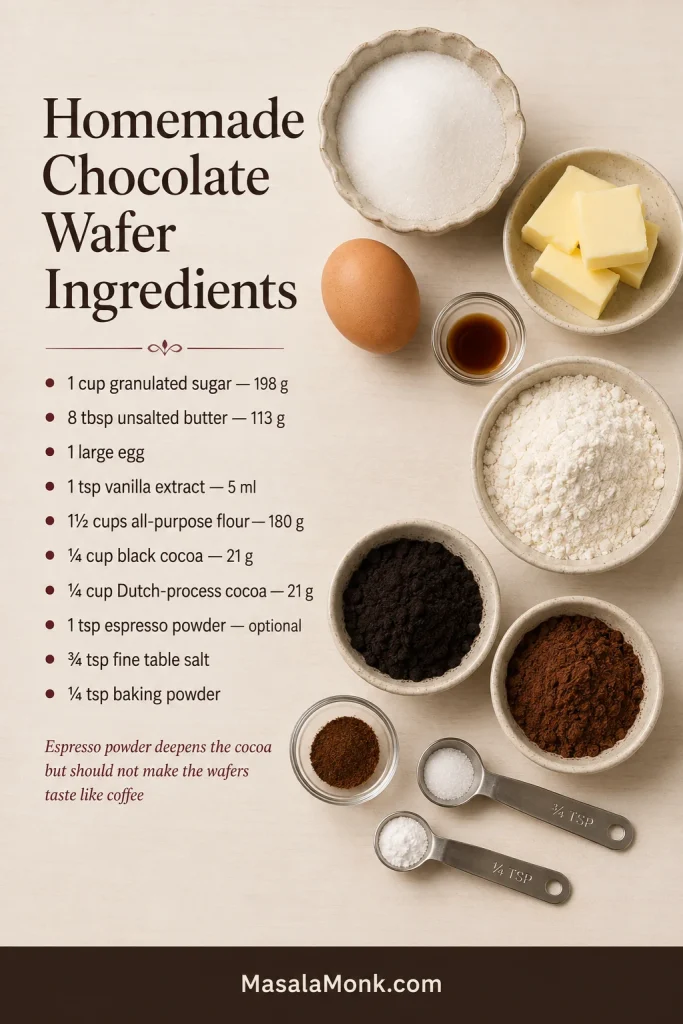
1 cup granulated sugar — 198 g
8 tablespoons unsalted butter, softened — 113 g
Espresso powder, optional — 1 teaspoon
Fine table salt — ¾ teaspoon
Baking powder — ¼ teaspoon
1 large egg
1 teaspoon vanilla extract — 5 ml
1½ cups all-purpose flour — 180 g
¼ cup black cocoa powder — 21 g
¼ cup Dutch-process cocoa powder — 21 g
Weigh the flour and cocoa powders; packed cups can make the wafers thicker and tougher.
Instructions
Mix, Roll, and Chill the Dough
Make a smooth butter base. Beat the sugar, softened butter, optional espresso powder, salt, and baking powder on medium-low until smooth, about 1–2 minutes. The mixture only needs to look even; it does not need to become pale or fluffy.
Add the egg and vanilla. Beat until the mixture is smooth, scraping the bowl so no streaks of butter remain.
Mix in the flour and cocoa. Add the flour, black cocoa, and Dutch cocoa. Mix on low until no pale flour streaks remain and the dough looks evenly dark from edge to edge.
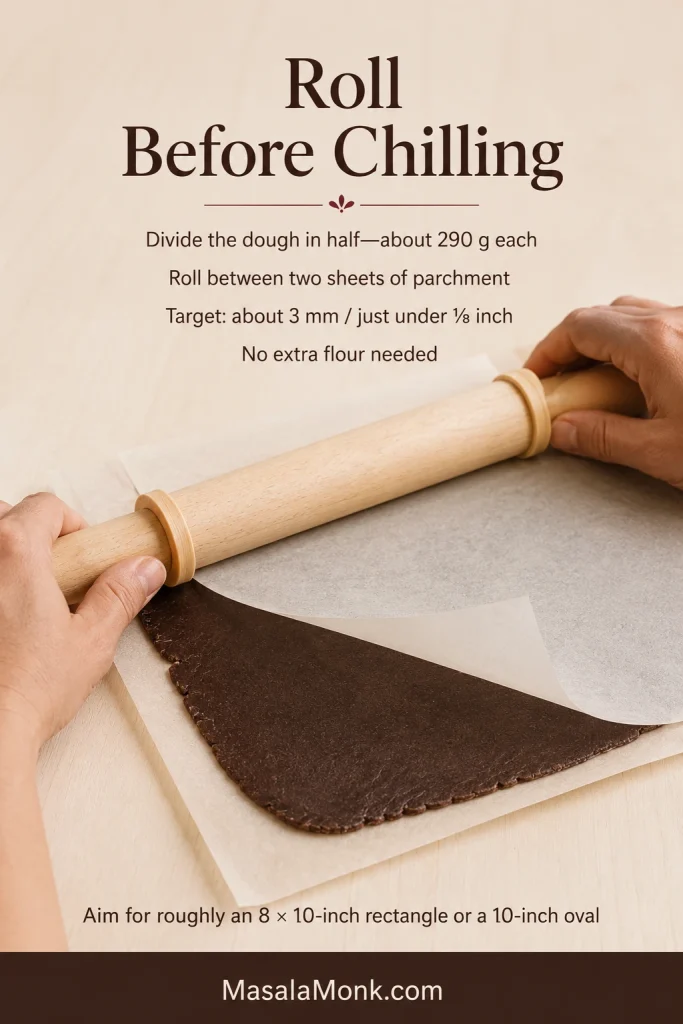
Roll before chilling. Divide the dough in half, about 290 g per piece. Roll each piece between two sheets of parchment to about 3 mm—just under ⅛ inch—aiming for an 8 × 10-inch (20 × 25 cm) rectangle or a 10-inch (25 cm) oval.
Rotate the parchment packet as you roll; repeated pressure in one direction can leave the center thicker than the edges.
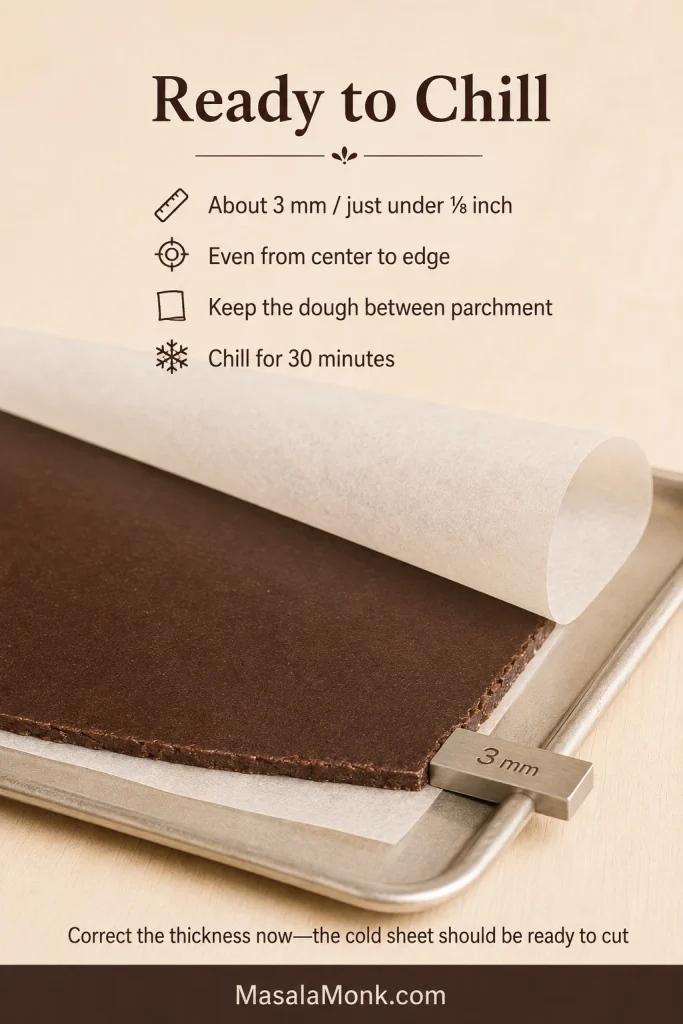
Chill the sheets. Refrigerate the dough, still between parchment, for 30 minutes. Meanwhile, heat the oven to 325°F (163°C) with racks in the upper and lower thirds.
Chilling firms the dough but cannot correct uneven thickness, so level the sheet first.
Cut, Bake, and Cool the Wafers
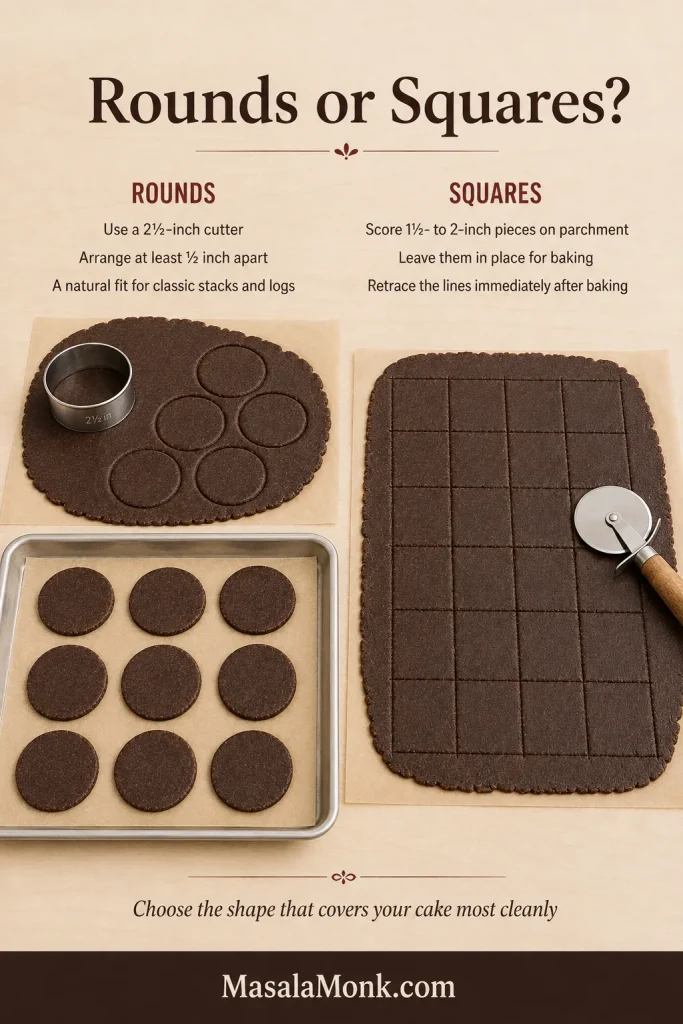
Cut the wafers. Peel away the top sheet of parchment, leaving the chilled dough on the bottom sheet, then cut 2½-inch rounds. Arrange them at least ½ inch apart. For squares, score 1½- to 2-inch pieces directly on the parchment and leave them in place.
Squares minimize rerolling; handle round-cookie scraps gently because repeated working can toughen the final wafers.
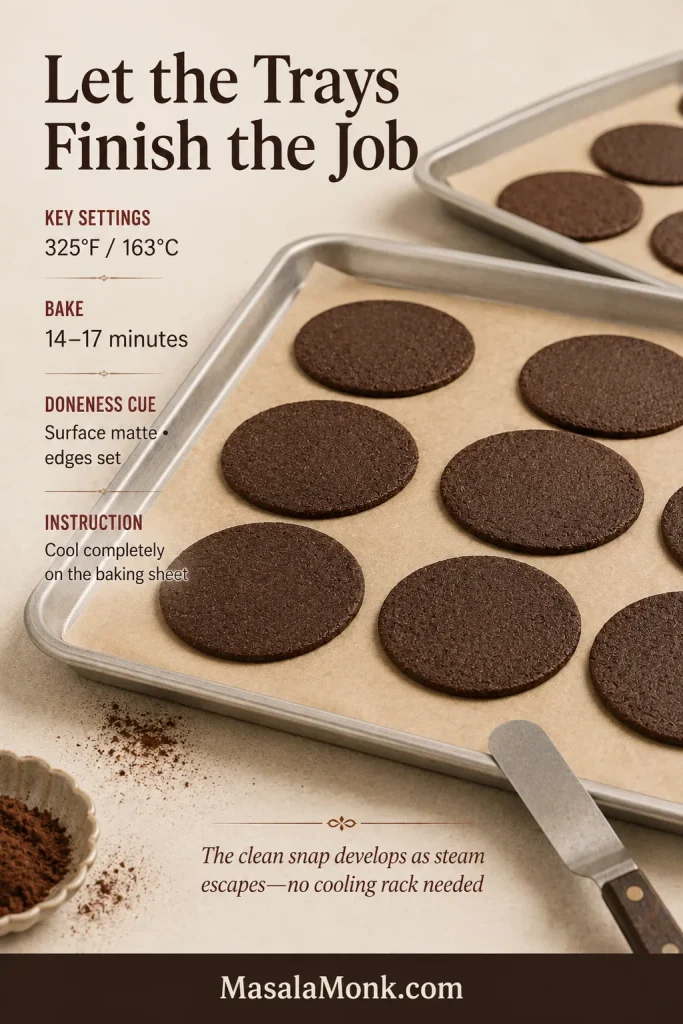
Bake until dry and set. Bake two trays at a time for 14–17 minutes, rotating and switching their positions halfway through. The surface should look matte and the edges should feel set.
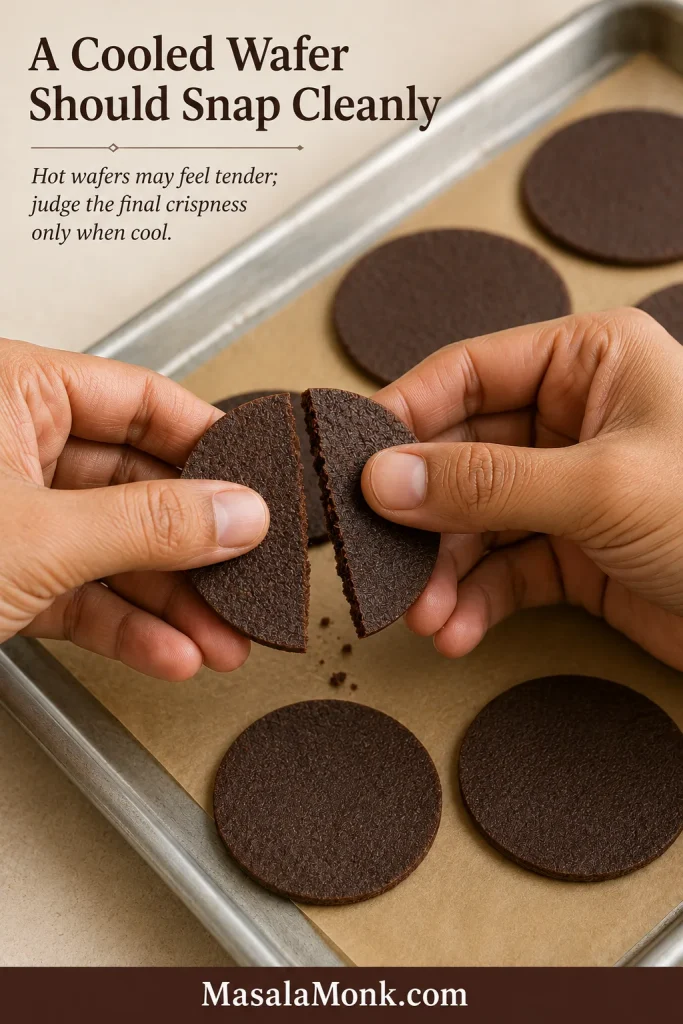
Let the trays finish the job. If you made squares, retrace the cut lines immediately. Leave either shape on the baking sheets until completely cool; the clean snap develops as steam escapes.
Let thin edges firm before lifting; hot wafers are fragile and do not yet show their final texture.
Use every piece. Reroll scraps while the first trays bake, chilling the dough briefly if it becomes soft. Once everything is cool, set aside 9 oz (255 g) for one old package and save the remaining whole or broken wafers for another use.
Recipe Notes
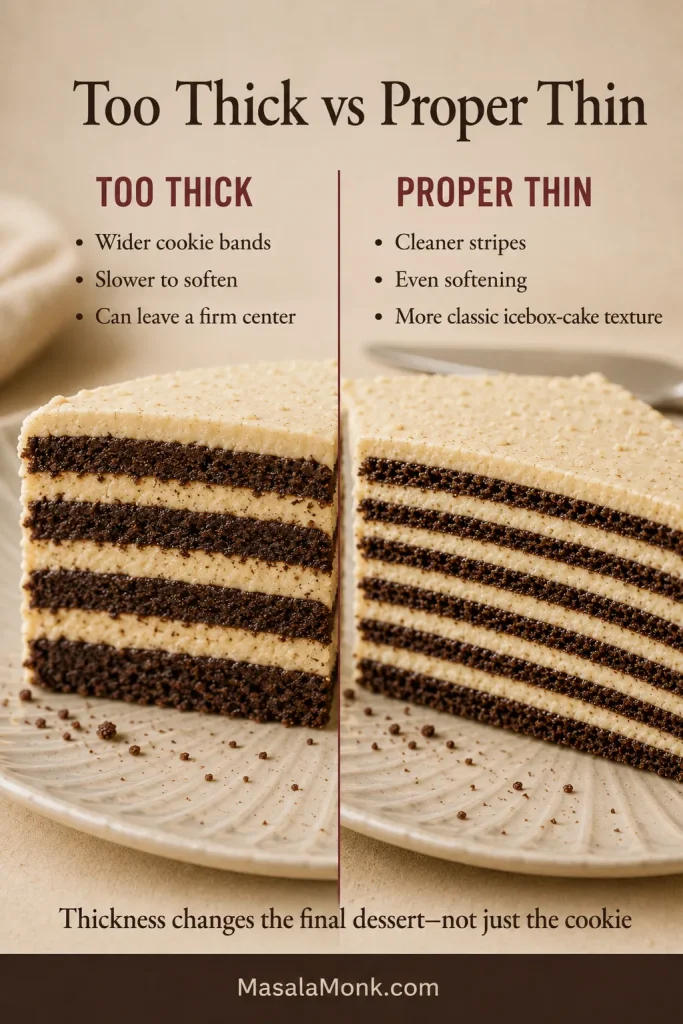
Thickness decides the final cake. A ¼-inch (6 mm) refrigerator cookie is roughly twice as thick and may keep a hard center.
Judge crispness only when cool. The hot wafers are tender; their snap appears as they cool on the trays.
Espresso powder is optional. At this amount, it is intended to deepen the cocoa without making the wafers taste distinctly of coffee.
Test several cooled wafers when a tray baked unevenly; edge and center cookies may crisp at different times.
What Success Looks Like
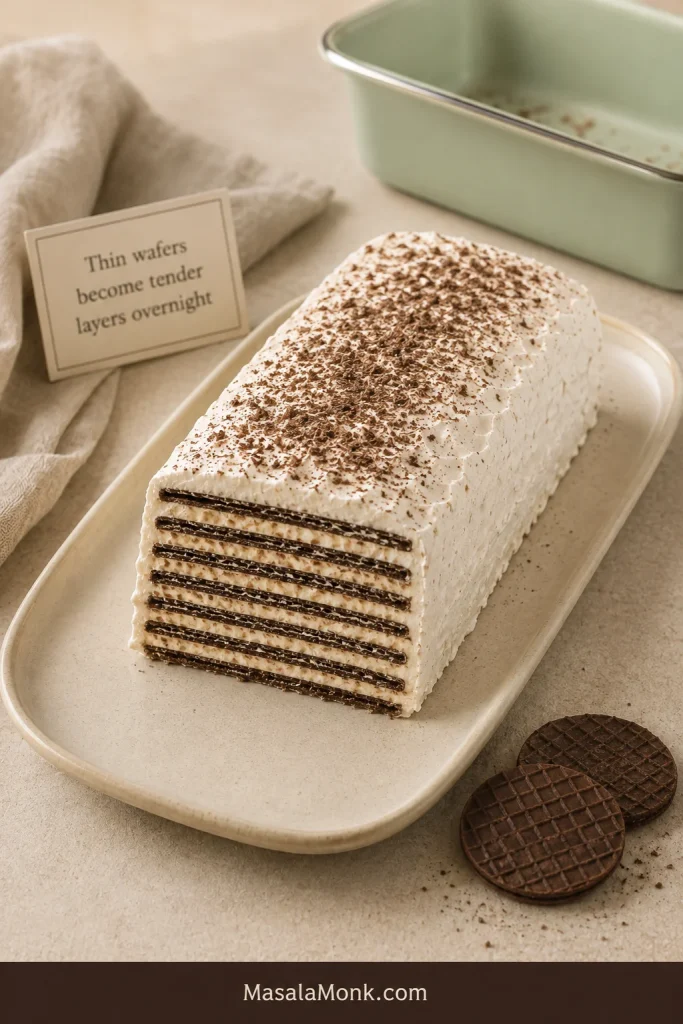
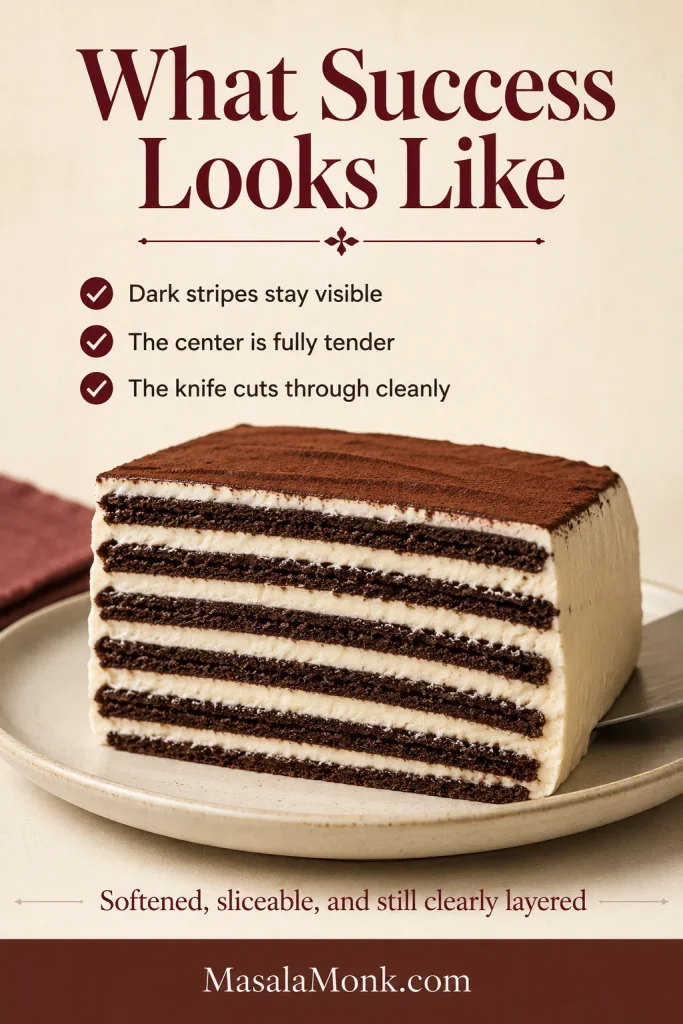
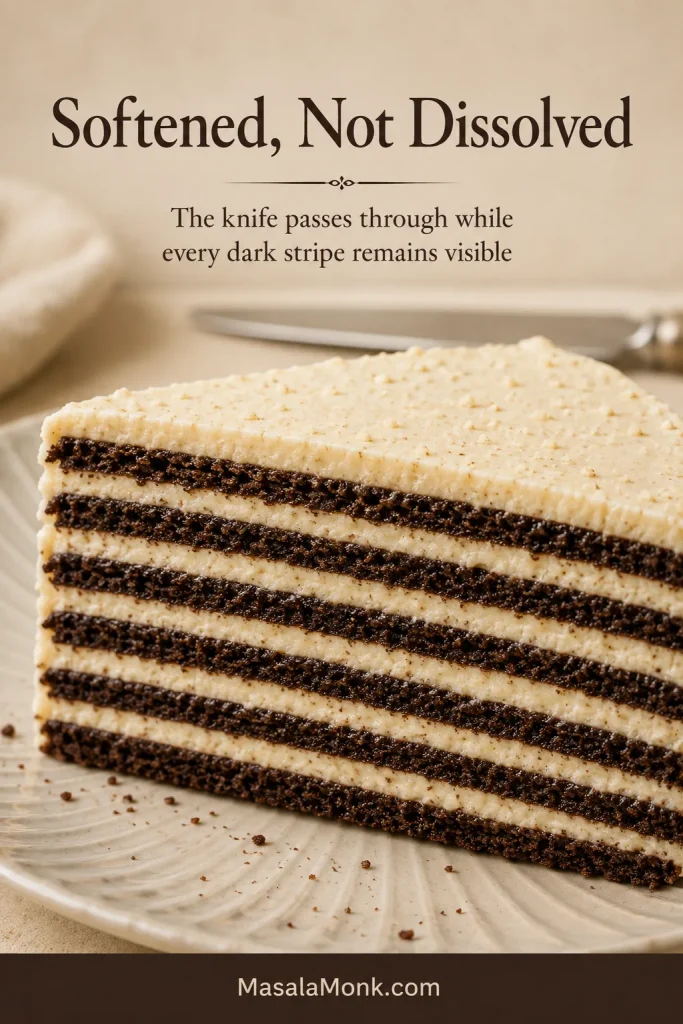
Before assembly, a cooled wafer should look dry, snap cleanly, and taste dark but not aggressively bitter. After an overnight rest with cream, a thin knife should pass through the center without a crack. Each wafer should still leave a distinct chocolate stripe instead of dissolving into a gray-brown blur.
Slightly wavy stripes are fine; look for a tender center, visible dark layers, and cream that still holds.
Making the wafers yourself lets you control both their chocolate flavor and, crucially, their thickness. Rolled thin, cooled to a clean snap, and kept low in leavener, they hold together during assembly and soften evenly in the refrigerator.
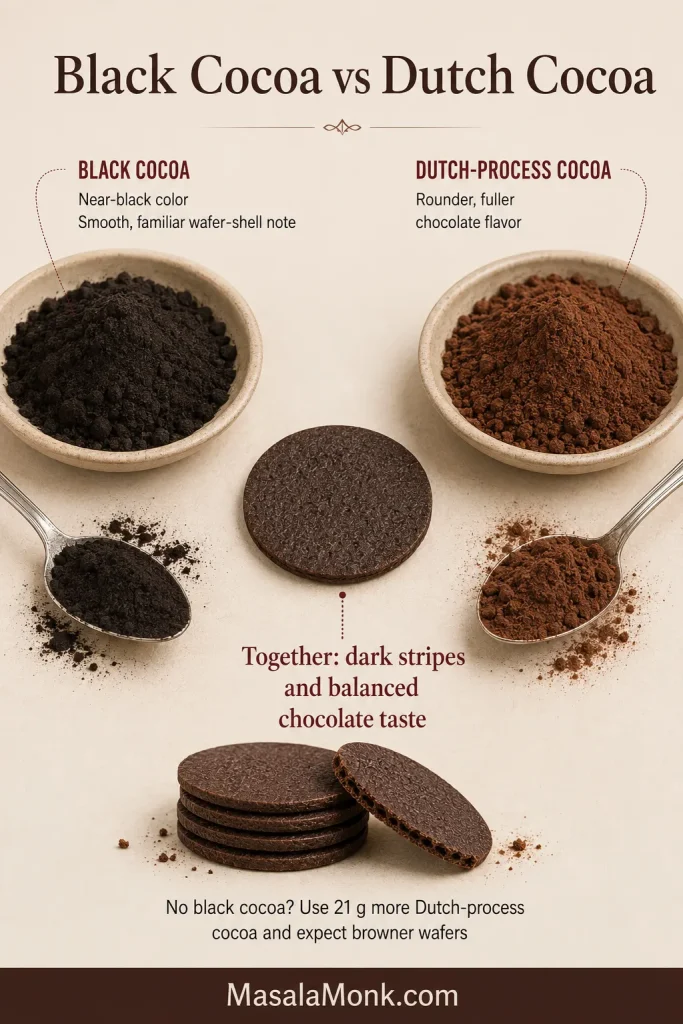
Black and Dutch cocoa share the work: one supplies the near-black color; the other keeps the chocolate flavor round and familiar.
The dough uses a straightforward butter base: the thin roll and full tray cooling produce the crisp finish.
A small amount of baking powder limits puffing: the wafers stay flat enough to stack and soften evenly.
Parchment keeps the dough clean and even: no extra flour is worked into the sheet while rolling.
Tray cooling completes the texture: the fragile hot cookies firm as steam escapes.
Black Cocoa, Dutch Cocoa, and the Flavor You Want
Black cocoa gives the wafer its near-black color and a smooth, familiar note associated with Oreo-style shells. It contributes more color than deep cocoa flavor. Dutch-process cocoa supplies the rounder chocolate character that black cocoa can lack on its own.
The split keeps the cookie dark enough to draw sharp stripes through white cream without making color the only thing you taste. If the labels themselves feel confusing, our cacao, cocoa, and chocolate guide explains the broader terminology; for this dough, stay with the black-cocoa and Dutch-process choices given here.
Equal weights balance black cocoa’s near-black color with Dutch cocoa’s fuller chocolate flavor.
Can You Make the Wafers Without Black Cocoa?
Yes. Replace the 21 g black cocoa with 21 g additional Dutch-process cocoa. The wafers will be brown instead of nearly black and taste more like a traditional chocolate biscuit, while the thin roll and crisp finish still make them suitable for icebox cake.
Natural cocoa can work in a pinch, but the wafers will be lighter, tangier, and may behave somewhat differently. Replacing the black cocoa with additional Dutch-process cocoa stays closer to the intended color and rounded chocolate flavor.
Rolled Versus Slice-and-Bake Wafers
Rolled to about 3 mm: gives the most even thickness and the most dependable icebox-cake result.
A log sliced to about 3 mm: is faster and naturally round, but uneven slices and cracking are harder to avoid.
A log sliced to about 6 mm: is easier to handle but roughly twice the target thickness; save those cookies for snacking, sandwich cookies, or crumbs.
Rolling is the safer method because every part of the sheet can be checked against the same guide. Slice-and-bake works only when the slices are genuinely thin and even.
What Kind of Chocolate Cookie Works in Icebox Cake?
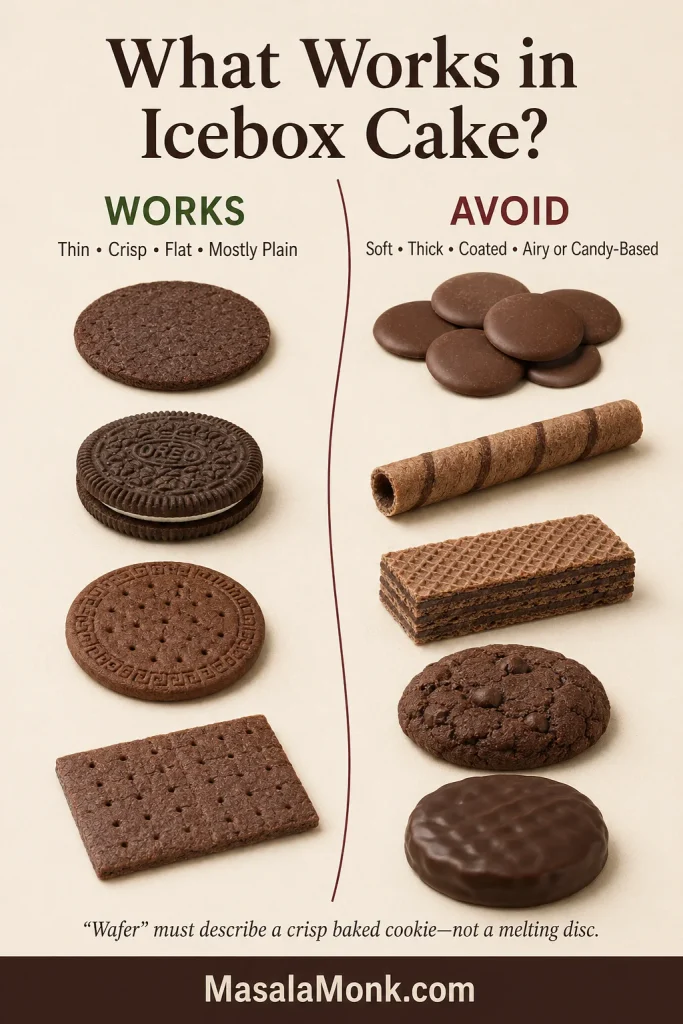
For this dessert, “wafer” means a thin, dry, crisp chocolate cookie—not a candy melt and not a layered wafer biscuit. It must be sturdy enough to spread with cream today and porous enough to become tender by tomorrow.
Whipped cream does more than fill the gaps. During refrigeration, moisture moves into the cookies, so the right replacement softens all the way through while keeping a visible chocolate stripe.
The 30-Second Package Test
Thin: ideally about 3 mm—just under ⅛ inch. Thick sandwich cookies soften much more slowly.
Crisp: look for thin, snappy, crisp, or crunchy—not soft-baked or chewy.
Mostly plain: a thin sandwich filling can work; a thick filling changes the cake substantially.
Uncoated: chocolate shells and glazes slow the moisture that needs to enter the cookie.
Flat: broad, even surfaces are easier to layer and soften more predictably.
At home, snap one before committing the package. It should break cleanly. A cookie that bends, feels cakey, or leaves a greasy coating on your fingers is less likely to form neat layers.
Perfectly smooth faces are unnecessary; broad, flat cream contact matters more.
What Works—and What Does Not
Swipe on mobile to view the full comparison.
Cookie style
Use it?
Likely result
Thin, crisp, plain chocolate cookie
Yes
The closest route to classic cake-like layers
Thin chocolate sandwich cookie
Usually
Softens well but adds filling and sweetness
Chocolate Maria biscuit or graham cracker
Yes, as a variation
Easy layers with a milder or graham-style flavor
Thick or soft-baked cookie
Poor fit
May stay hard in the center or turn pasty
Coated, airy layered, or rolled wafer biscuit
Avoid
Coating or internal air gaps cause uneven softening
Candy-melting wafer or coating disc
No
It is confectionery coating, not a baked cookie
Inspect the cross-section and coating, not the word “wafer”; many products with that name are structurally wrong.
Fastest way to avoid the wrong product: if it sits beside candy melts or coating discs, it is not the wafer cookie your icebox cake needs.
Vanilla wafers can make a perfectly good but entirely different icebox cake. They are not a close replacement when dark chocolate stripes are the point.
Thickness, Crispness, Sweetness, and Pan Coverage
Thickness and crispness: Roll homemade dough to about 3 mm—just under ⅛ inch. A ¼-inch (6 mm) cookie is roughly twice as thick and often softens at the edges before the center is ready. Every cookie should begin fully crisp; humidity-softened wafers can lose definition too quickly.
Check the edge and center of the sheet; dough can hide extra thickness in the middle.
Cool before judging: Homemade wafers can feel tender while hot. Let them cool completely before deciding whether the bake was long enough.
Sweetness and filling: Filled cookies bring sugar into every layer, so pair them with lightly sweetened cream. Plain wafers leave more room to sweeten the cream itself. Our homemade whipped cream recipe explains sugar levels and the peak stages to watch.
Shape and coverage: Rounds suit classic logs and circular stacks. Squares and rectangles reduce gaps in loaf pans and baking dishes, while broken pieces neatly fill edges and open spaces. Covering the layer matters more than recreating an old cookie count.
Read the finished texture
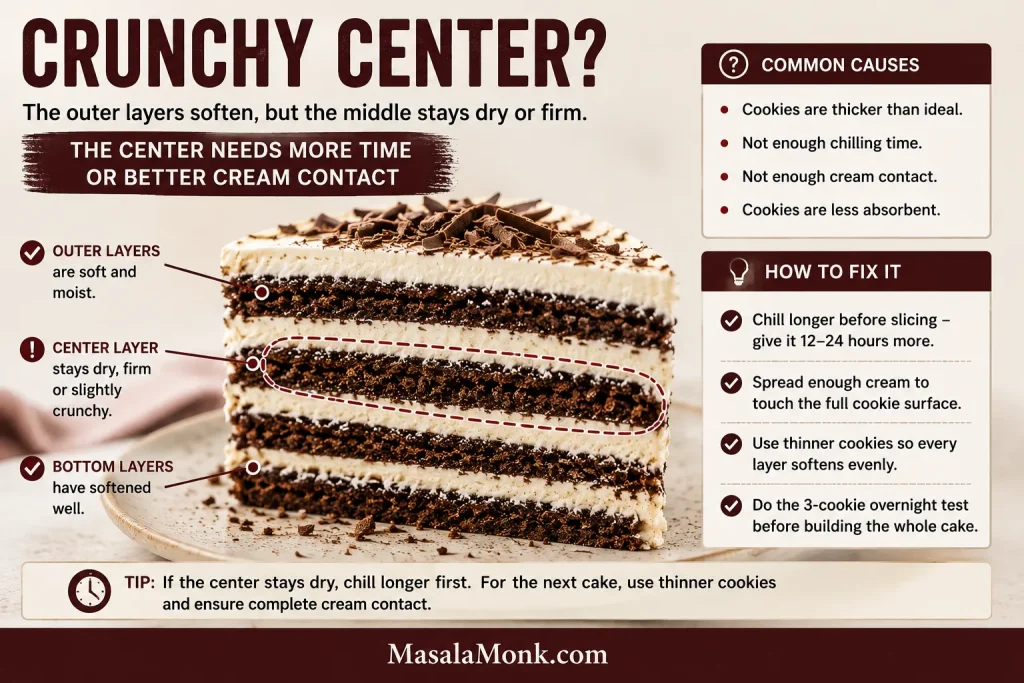
Crunchy center: the cookie is too thick, dense, coated, or has not chilled long enough.
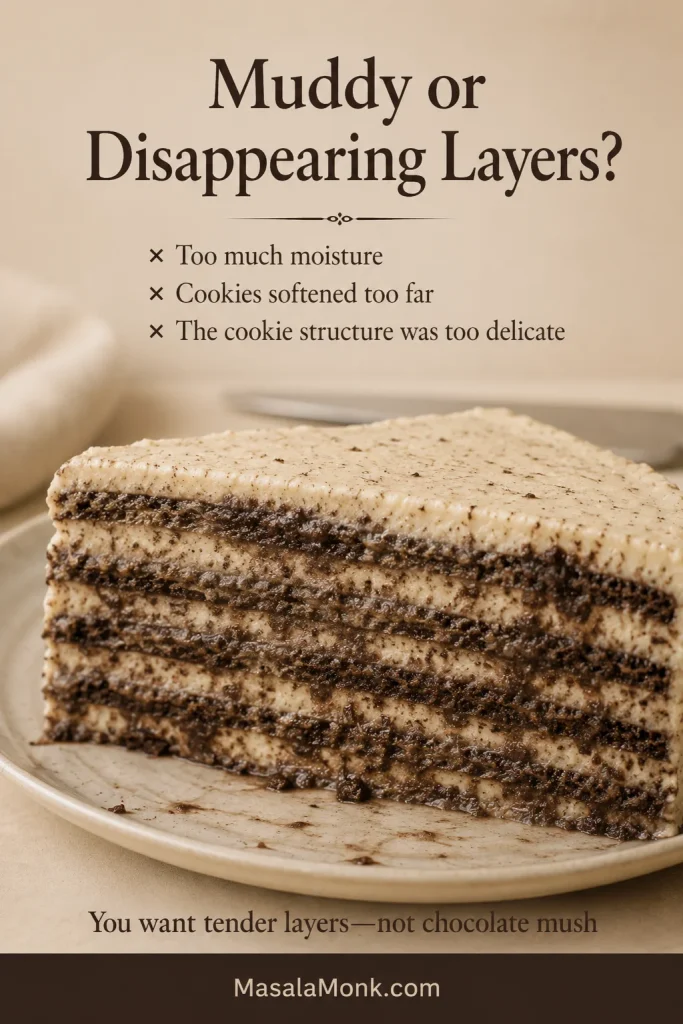
Muddy layer: the cookie began soft or dissolved faster than the cream could set.
Vanishing stripe: the cookie was too fragile to remain distinct.
Clean knife and visible stripe: the cookie softened at the right rate.
What Happened to Nabisco Famous Chocolate Wafers?
Nabisco Famous Chocolate Wafers were discontinued in 2023 after generations of refrigerator-roll, pie-crust, cheesecake, and icebox-cake recipes had been written around them. The Washington Post’s replacement comparison documented both the discontinuation and the scramble for modern alternatives.
Canadian readers may remember Christie or Mr Christie chocolate wafers. Old Canadian retailer pages can remain searchable after a product disappears, so the familiar regional name alone does not confirm fresh stock or current production. Check the actual package, manufacturer, and date.
For many families, the goal is not to invent a new dessert. It is to recreate the birthday or holiday cake they remember without letting one discontinued package end the tradition.
What were Famous Chocolate Wafers like? Very thin, dry, crisp, dark but not candy-sweet, flat enough to spread with cream, and porous enough to soften while keeping a clean chocolate stripe. A modern replacement needs those same qualities, even if the cookie looks completely different.
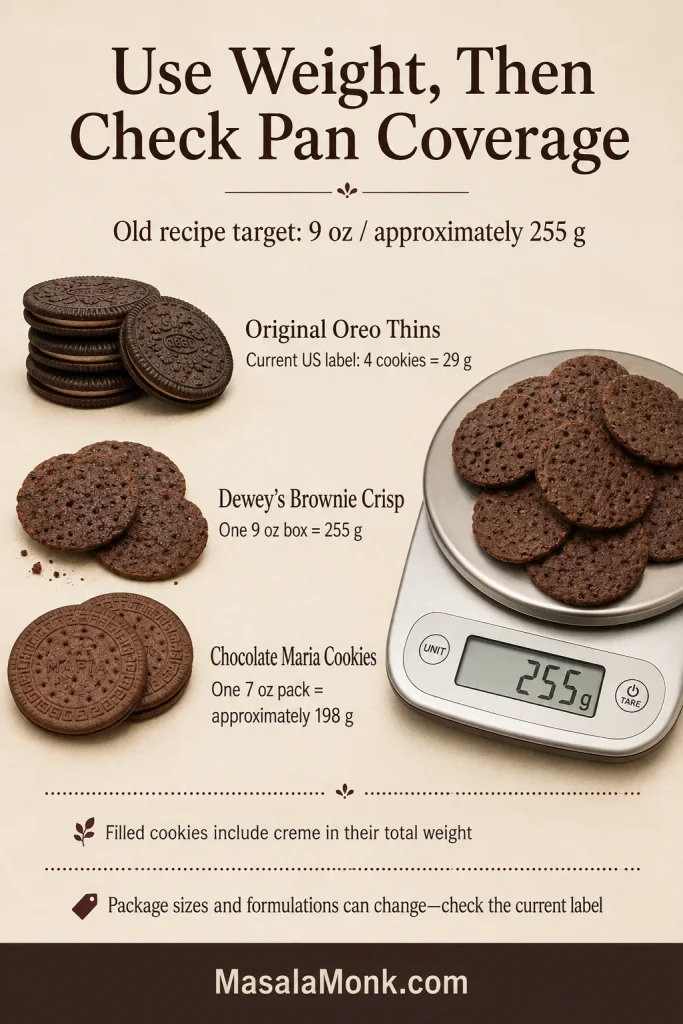
The old box still gives us one useful number: 9 ounces (about 255 g) of thin chocolate cookies. Weight transfers more reliably than an old piece count because modern substitutes vary in size, thickness, and filling.
Should you buy an old package online?
Usually, no. A fresh cookie with the right structure is a better baking ingredient than an expensive discontinued package with uncertain heat, humidity, and storage history.
Look for a photograph of the actual sealed package, not only an archived product image.
Look for a readable best-before date and current ingredient label.
Identify the manufacturer and seller before trusting claims of a “revived” equivalent.
The box was convenient. The real standard is the finished slice: dark layers that soften cleanly without disappearing.
Best Store-Bought Chocolate Wafer Substitutes
Once you know the qualities that matter, the store-bought choice becomes simpler. Each option solves a different problem involving availability, sweetness, shape, or cost.
Compare filling, thickness, cocoa strength, and diameter—not availability alone—because each changes sweetness, coverage, and softening.
Before buying: Package sizes, formulations, and availability were checked in August 2026 and can change. Read the current label, then compare thickness, filling, coating, and package weight before choosing. The product visuals are illustrative comparison guides rather than package photography or controlled test results.
Where to Buy Chocolate Wafer Cookies Now
Start in the ordinary cookie aisle, where Original Oreo Thins are a practical mainstream option in many US stores. Check Hispanic or international foods for chocolate Maria cookies and specialty-cookie shelves for thin cocoa snaps.
Shopping online? Search for thin chocolate cookies, chocolate cookie thins, chocolate snaps, or plain chocolate thins. The broader phrase “chocolate wafers” often returns candy melts and filled wafer bars, so check the filling, coating, thickness, and package weight before ordering.
Current package guide, checked August 2026:
Original Oreo Thins: the current US label lists 4 cookies as 29 g. Weigh out approximately 255 g and dry-fit one layer because the creme contributes to the total and the number needed depends on the pan.
Dewey’s Brownie Crisp: one 9-ounce box matches the old package weight, but the smaller cookies require more pieces to cover each layer.
Goya Chocolate Maria: one 7-ounce pack is about 198 g, roughly 57 g short. Buy two and use only what the pan needs.
Oreo Thins, Plain Shells, and Regular Oreos
Original chocolate Oreo Thins are thin, crisp, dark, and consistent. Their light creme filling softens into the whipped cream, creating a sweeter, more cookies-and-cream-like slice with a faint white line between the dark shells. Choose the original version unless another filling flavor is part of the plan.
Taste one Oreo Thin with prepared cream before stacking; sweetness is easiest to correct at this stage.
Route
Choose it when
Result
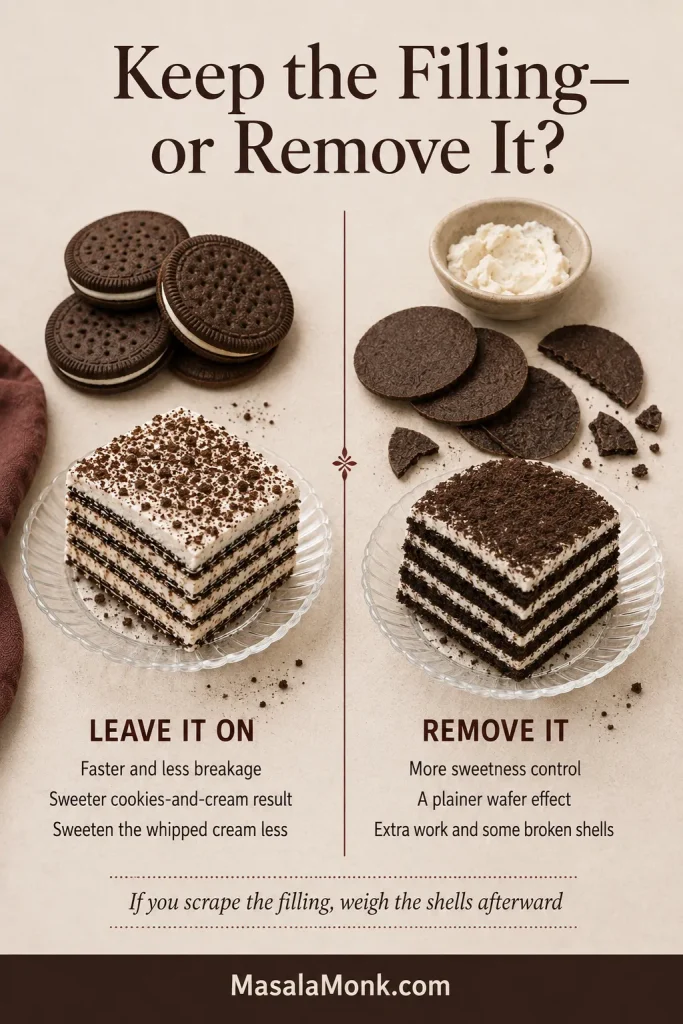
Leave the filling
Speed matters and you like a sweeter cake
Easy, cohesive, and clearly cookies-and-cream
Remove the filling
You want more sweetness control
A plainer wafer effect, with extra work and some breakage
Most consumer Oreo packages include filling. For a plain-shell route, separate Original Oreo Thins at home and allow a few extras for shells that crack.
After removing the creme, weigh the shells and allow extras for breakage.
What about regular Oreos? Whole regular Oreos make a thicker, sweeter Oreo icebox cake and usually need a longer rest. Separated shells behave better, though they remain thicker than Oreo Thin shells and the old Famous Wafers.
Dewey’s Brownie Crisp: A Close Plain Structural Match
Dewey’s Brownie Crisp is thin, crisp, and unfilled. Among the products covered here, those qualities make it a close plain structural match when it is available.
The cookies are smaller than the discontinued wafers, so arrange enough pieces to cover every layer rather than chasing the old count. Their unfilled form may produce darker-looking layers than a sandwich cookie and will not add a separate line of creme.
Smaller cookies create more seams, so dry-fit one layer before estimating the quantity.
Chocolate Maria Cookies: Economical and Easy to Layer
Flat, crisp, often economical, and easy to arrange, chocolate Maria cookies are a practical alternative. Their cocoa flavor is usually lighter and more biscuit-like than the discontinued wafers, so the finished cake has lighter chocolate stripes and a gentler biscuit flavor beside the cream.
These cookies are commonly sold in packages smaller than the old 9-ounce box. Check the current package guide above, buy enough to cover the planned layers, and let the pan determine how much you use.
Broad rounds cover efficiently, and broken edges can fill narrow gaps without building thicker spots.
Chocolate Graham Crackers: A Natural Fit for Rectangular Cakes
Chocolate graham crackers are not a flavor replica, but their broad rectangular shape makes them easy to layer in loaf pans, square dishes, and 9 × 13-inch baking dishes. Expect fewer gaps, less fiddly arrangement, and a finished dessert that tastes unmistakably like chocolate graham crackers—delicious in its own right, but different from the old wafer cake.
Unsure whether a cookie will work?
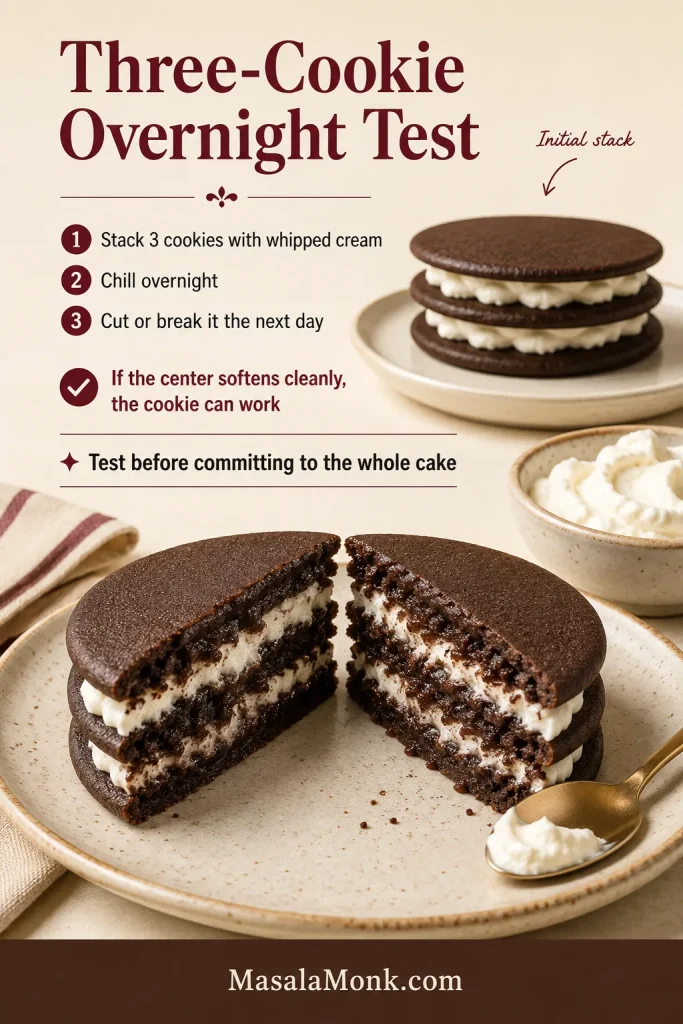
Build a three-cookie stack with cream tonight. Chill it overnight and cut through the center tomorrow. If the knife glides through while the chocolate layers remain visible, the cookie is ready for the full cake. A hard center, muddy layer, or vanished stripe tells you what to change before risking the whole dessert.
A clean result means you can build the full cake confidently. If the center is still firm, give the test stack more time before changing the cookie or adding extra cream.
Use the exact cream and chill time planned for the cake; changing either can mislead the test.
Thick or dense cookies take longer to soften, and deeper cakes usually need more time. Refrigerator temperature and the amount of cream can shift the finish too, so use these as starting checks rather than fixed guarantees.
Very thin plain wafers: begin checking after about 6–8 hours.
Thin filled sandwich cookies: plan on an overnight rest.
Flat biscuits and graham crackers: plan on an overnight rest.
Thicker cookies or regular sandwich cookies: allow closer to 12–24 hours.
Any unfamiliar cookie: run the three-cookie test before assembling the full cake.
The center decides: Let the clock guide you, then confirm readiness with a thin knife through the middle. The blade should pass through without meeting a hard cookie center, while the dark layers remain visible in the slice.
How to Convert and Adapt One Old 9-Ounce Package
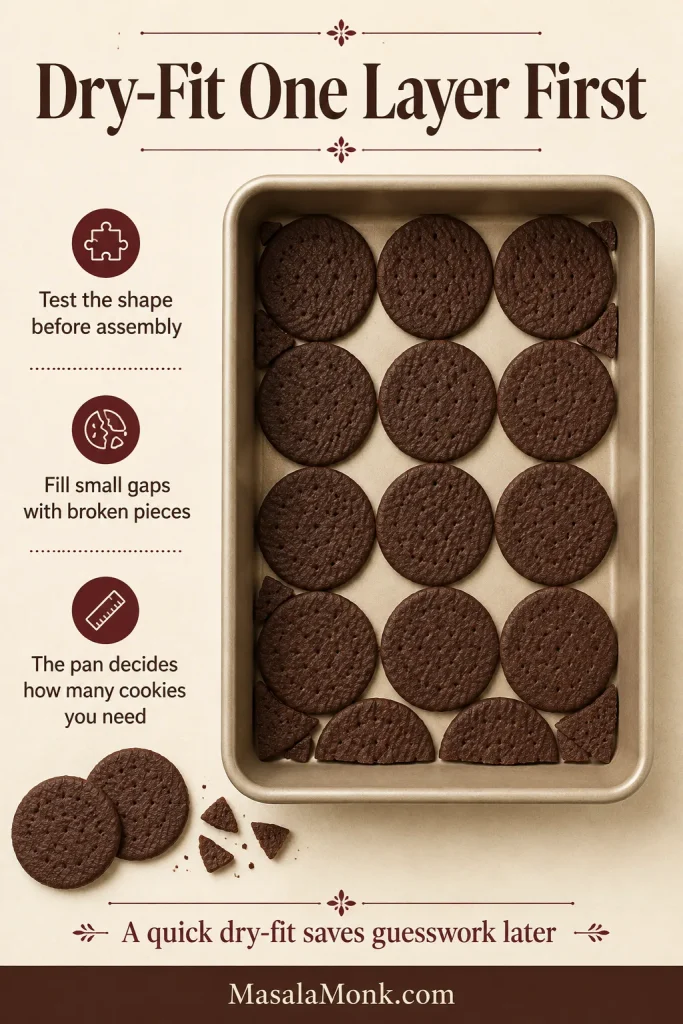
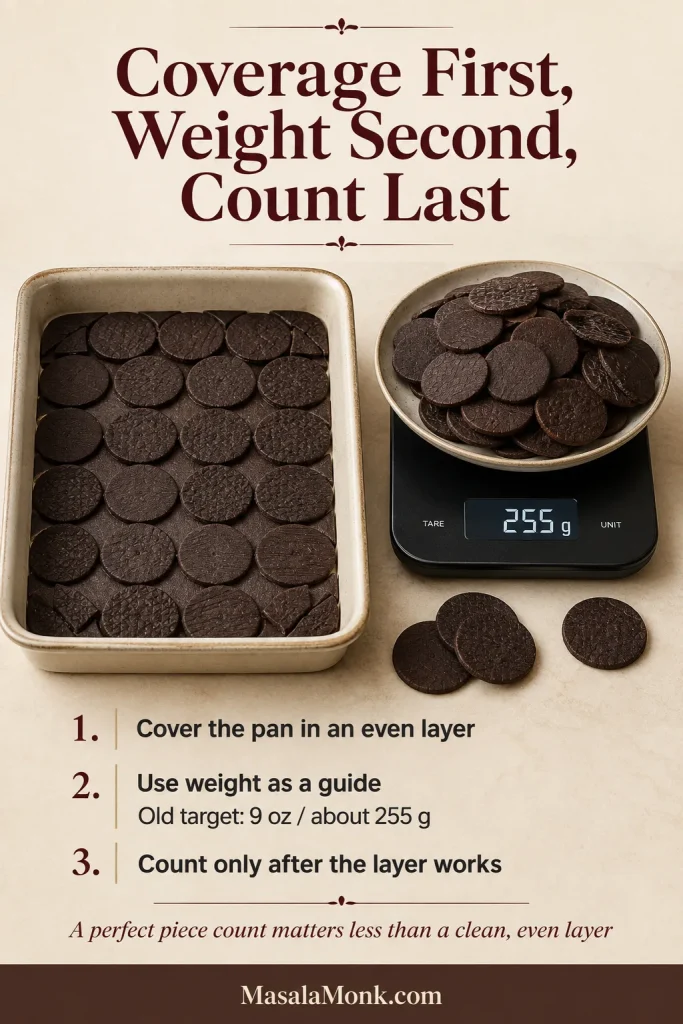
One dependable number remains from the old box: 9 ounces (about 255 g). Begin with that weight, then dry-fit one cookie layer in the pan before whipping the cream. The test shows whether the cookies can cover the layer and where broken pieces will help.
The same package weight can cover a pan differently when filling, diameter, and shape change.
Dry-fit one complete layer after weighing the cookies. The same 255 g can cover a pan differently when filling, cookie diameter, and shape change.
Photograph or count the test layer before removing it so final assembly moves quickly.
Coverage first, weight second, count last.
A filled sandwich cookie spends part of its weight on creme. Small cookies need more pieces to cover the pan, while broad rectangular crackers need fewer. Both the scale and the pan matter.
Weighing one completed dry-fit layer gives a useful total estimate; keep a reserve for gaps, breakage, and uneven edges.
Old-Package Conversion Table
Swipe on mobile to view the full conversion table.
Old recipe wording
Initial guide
Check before assembly
1 package or box, 9 oz
Set aside 255 g cookies
Dry-fit a layer and confirm full coverage
2 packages, 9 oz each
Set aside about 510 g cookies
Use weight, not the old piece count
36 Famous Wafers
Match the old recipe’s coverage and approximate weight
Modern cookie sizes can make 36 too many or too few
Original Oreo Thins
Weigh 255 g from the package
The filling contributes part of that weight
One 7 oz (198 g) Maria-cookie package
It is about 57 g short
Buy a second package and use only what the layers need
Homemade full batch
Set aside 255 g after the wafers cool
Keep the remaining whole and broken wafers
If you remove sandwich-cookie filling, weigh the shells after scraping. The unopened package includes filling you will discard, so its weight overstates the cookie left for the cake.
Running a little short does not mean the recipe is lost. Fill the final spaces with compatible pieces and let the finished slice—not an inherited cookie count—judge the replacement.
Adjust Only What the New Cookie Changes
The old recipe assumed one predictable wafer. A modern substitute usually changes sweetness, thickness, size, or cocoa flavor. Adjust only what the new cookie changes.
What changed
Adjust this
What to expect
Sweeter or filled cookie
Sweeten the cream less; taste one cookie with a spoonful of cream
A balanced cake without an overly sugary finish
Thicker cookie
Spread cream against both sides and allow more chilling time
A heavier, more cookie-forward slice
Smaller cookie
Use more pieces to cover each layer and fill gaps with broken pieces
A different count but the same cake shape
Milder cocoa flavor
Accept the variation or finish with unsweetened cocoa or grated dark chocolate
Lighter stripes with a deliberate chocolate accent
Do not add a large amount of extra cream simply to force thick cookies to soften; the cake can slump before the centers are ready.
Thin wafers leave less room for measuring and temperature errors than thick drop cookies, but the symptoms are usually clear. Start with what the dough or cooled wafer is doing, then change the most likely cause on the next tray. The visuals below are diagnostic guides; actual softening still varies with cookie thickness, cream consistency, pan depth, and refrigerator temperature.
Dough Problems
Dry and crumbly: Too much flour or cocoa is the most common cause, and cocoa brands vary in absorbency. Continue mixing and press a handful together before adding liquid. If it still falls apart, add milk ½ teaspoon at a time and stop as soon as the dough holds.
Sticky while rolling: Keep the dough between parchment and chill the sheet before peeling away the top layer. Repeated dusting with flour or cocoa changes the formula and dries later cookies.
Baking Problems
Puffing or bubbling: Excess aeration, too much leavener, warm dough, or uneven thickness are the usual causes. Mix the butter and sugar only until smooth and roll evenly. If cut wafers become soft or greasy while you reroll scraps, chill that tray briefly before baking.
Spreading: Use a cool baking sheet for each batch, keep the butter cool and pliable, and chill only trays whose cut dough has become soft or greasy. Measure the flour and any added liquid carefully.
Soft after cooling: Let the wafers cool completely before judging them. If they still bend, use that tray for crumbs and bake the next tray a little longer, checking within the 14–17-minute range. Dark cocoa makes overbrowning difficult to see, so extend the bake cautiously.
Bitter flavor: Too much black cocoa, packed cocoa measurements, overbaking, or missing salt and vanilla are the likely causes. Black cocoa contributes darkness and a distinctive flavor; a larger amount can make the wafer harsher.
Assembly and Chilling Problems
Breaking during assembly: Overbaking, an unevenly thin sheet, moving the wafers while warm, or pressing too firmly with the spatula can all cause breakage. Place a small spoonful of cream on each wafer and ease it outward with short, gentle strokes.
A crunchy cake center: The replacement is probably too thick, too dense, short on cream contact, or simply not chilled long enough. Return the cake to the refrigerator and test the middle again later.
Check the cookie’s cross-section: a thicker cookie creates a wider moisture path, so the edges can soften while the center remains firm.
A thicker cookie widens the stripe and slows the moisture path to the center.
Then check the cake itself: if the middle still resists after more chilling, use the dry center and softened edges as the deciding cues.
If 12–24 more hours do not soften the center, the cookie is probably too thick or insufficiently absorbent.
Muddy or disappearing layers: The cookies may have begun soft, the cream may be unusually loose, or the cookie may dissolve too readily. A suitable wafer begins crisp and softens without losing its identity completely.
Serve an over-softened cake very cold; chilling can firm the cream but cannot restore dissolved stripes.
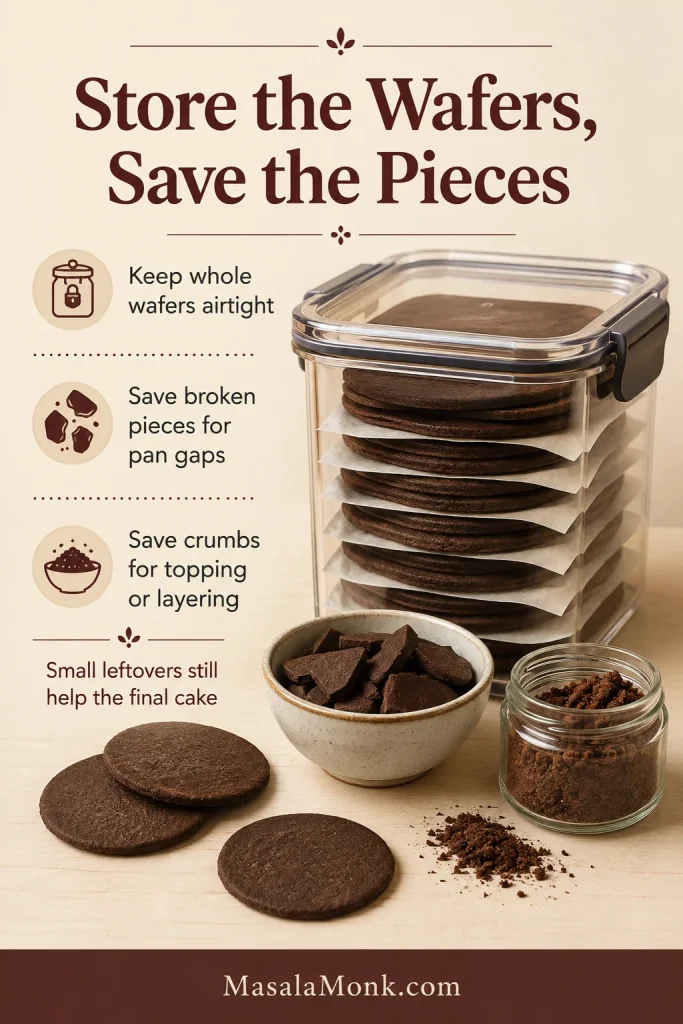
Cool baked wafers completely, then keep them in an airtight container at room temperature with parchment between fragile layers. Protect them from steam and humidity; for best texture, use them within several days or freeze them for longer storage. Room temperature is best for unassembled wafers because refrigerator humidity can soften the snap you worked to create.
A rigid airtight container controls humidity while protecting thin wafers from bending and breakage.
For make-ahead dough, freeze flat rolled sheets between parchment, wrapped dough portions, or a carefully shaped log for a thin slice-and-bake variation. Thaw in the refrigerator until firm but cuttable.
Fully cooled baked wafers can also be frozen in a rigid airtight container with parchment between layers. Thaw them in the closed container so condensation collects on the container instead of the wafers, then check crispness before assembly.
If stored wafers lose their snap, save them for crumbs rather than putting softened cookies into the cake.
Save broken or extra wafers for cake gaps, ice cream, or chocolate crumbs. For a crust, follow the pan and butter guidance in our no-bake cheesecake recipe and add butter gradually because plain wafers do not contain sandwich filling.
Gluten-Free, Vegan, and Lower-Sugar Options
Dietary needs do not end the dessert, but they change which shortcut is safest. When the cake is needed soon, a commercially made thin chocolate cookie with the dietary certification you need is usually more dependable than rebuilding this precise wafer formula one ingredient at a time.
For a gluten-free cake, choose a clearly labelled thin chocolate cookie that begins fully crisp, check all nut, seed, coconut, and sesame warnings, and run the three-cookie overnight test before building the cake.
For a vegan cake, use a commercially made thin vegan chocolate cookie and a plant-based whipping cream you already trust. Replacing the butter and egg in the homemade formula requires a separately developed recipe.
For a lower-sugar version, start with plain unfilled cookies and reduce the sweetness of the cream. Large changes to the cookie sugar affect spread, crispness, browning, and dough handling.
For any unfamiliar dietary cookie, the small overnight test is the safest way to check whether it becomes tender without dissolving.
Frequently Asked Questions
Are Nabisco Famous Chocolate Wafers still made?
No. They were discontinued in 2023. Old recipes and archived retailer pages may still name them, but they are no longer a dependable store-bought ingredient.
Are Famous Chocolate Wafers back?
As of August 2026, the original Nabisco wafers had not returned. Some websites and marketplace listings use the familiar name or nostalgic package imagery, so check the named manufacturer, ingredient label, package date, and seller before assuming the original product is back.
What is the closest substitute for Famous Chocolate Wafers?
Dewey’s Brownie Crisp is the closest plain structural match covered here when available. Original Oreo Thins are easier to find, but their filling makes the cake sweeter and more Oreo-like.
Do I need to remove the filling from Oreo Thins?
No. Leave the filling in for the easiest route and sweeten the whipped cream lightly. Remove it when you want a plainer chocolate-wafer effect and more control over sweetness. If you scrape it out, weigh the shells afterward because the package weight includes the creme.
What if my replacement package is only 7 ounces?
A 7-ounce package weighs about 198 g, roughly 57 g short of the old 9-ounce box. Buy a second package and use only as much as the cake needs.
Can I use vanilla wafers?
Yes, but they create a vanilla icebox cake without the dark chocolate stripes. They are a different flavor route, not a close Famous Wafer replacement.
Are chocolate melting wafers the same as wafer cookies?
No. Melting wafers are chocolate or candy coating designed to liquefy. Icebox cake needs a thin, crisp baked cookie.
How long do replacement cookies need to soften?
Overnight is the safest general plan. Very thin plain wafers may be ready sooner, while thicker cookies or whole Oreos can need closer to 12–24 hours. Use the clock as a guide and confirm the center with a thin knife.
The Cookie Should Disappear Into the Cake—But Not Completely
A good chocolate wafer starts with a snap and ends with a fork. Today it should be dark, dry, and sturdy enough to spread. Tomorrow it should be tender all the way through, yet still draw a clean chocolate line across the slice.
A crisp wafer should soften into the cake while leaving a visible dark stripe and enough structure for a clean slice.
That is what an old family recipe was really preserving—not a particular cardboard box, but the quiet transformation that happens overnight and the familiar striped piece placed on the plate the next day.
If you use a replacement, leave a comment with the exact cookie, package weight, cake shape, whether you kept any filling, and how long the center needed to soften. Those details can help the next reader standing in the same cookie aisle.
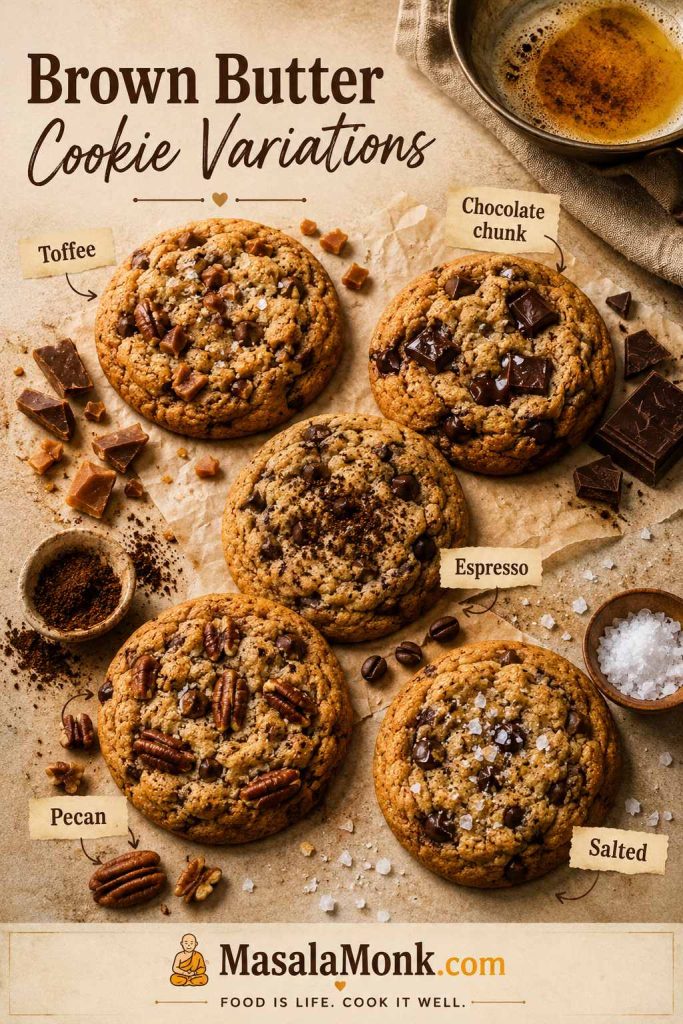
The first sign these brown butter chocolate chip cookies are going to be good is the smell: butter turning nutty in the pan, brown sugar and vanilla hitting that toasted base, then chopped chocolate folding into a dough that already tastes deeper than a regular cookie.
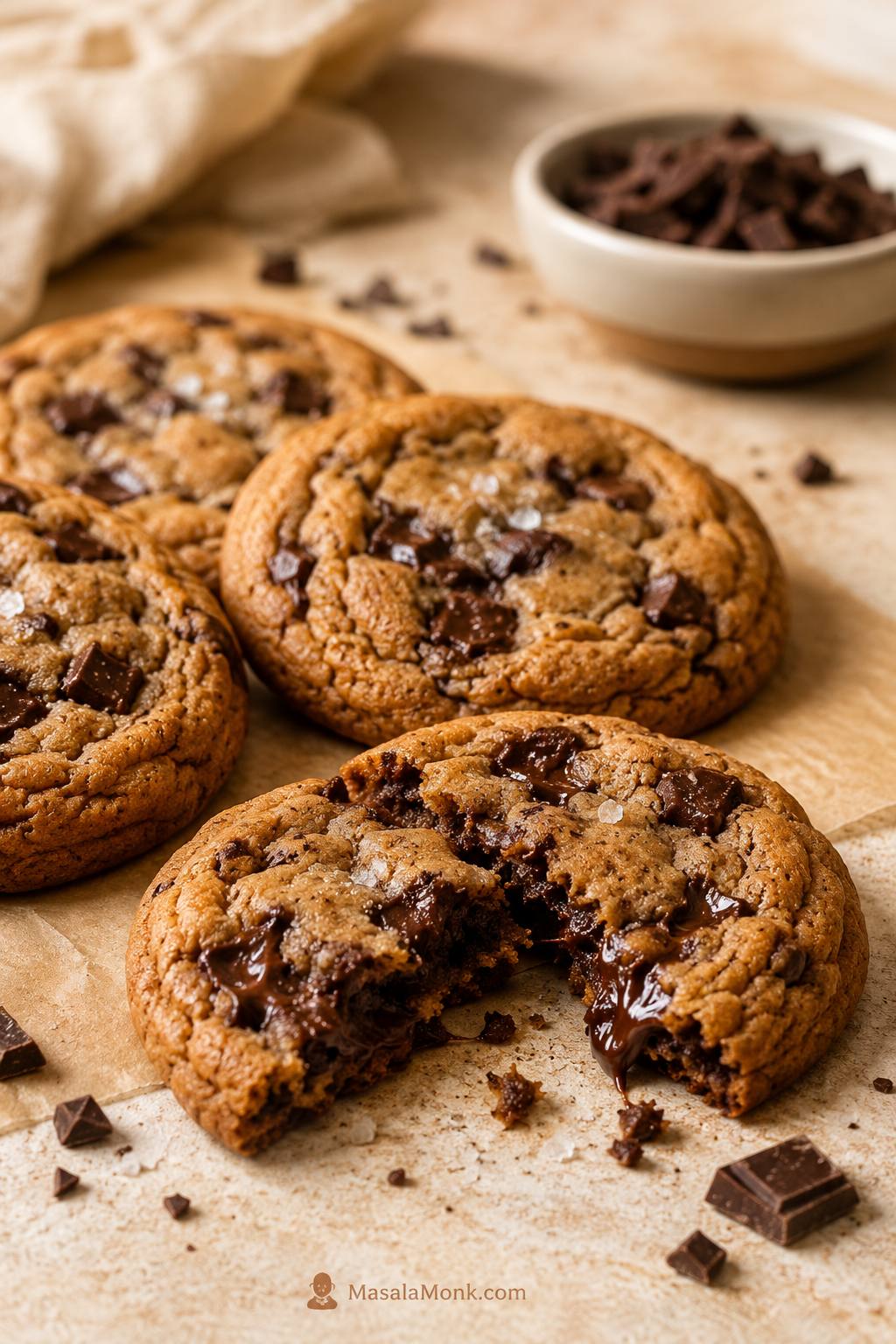
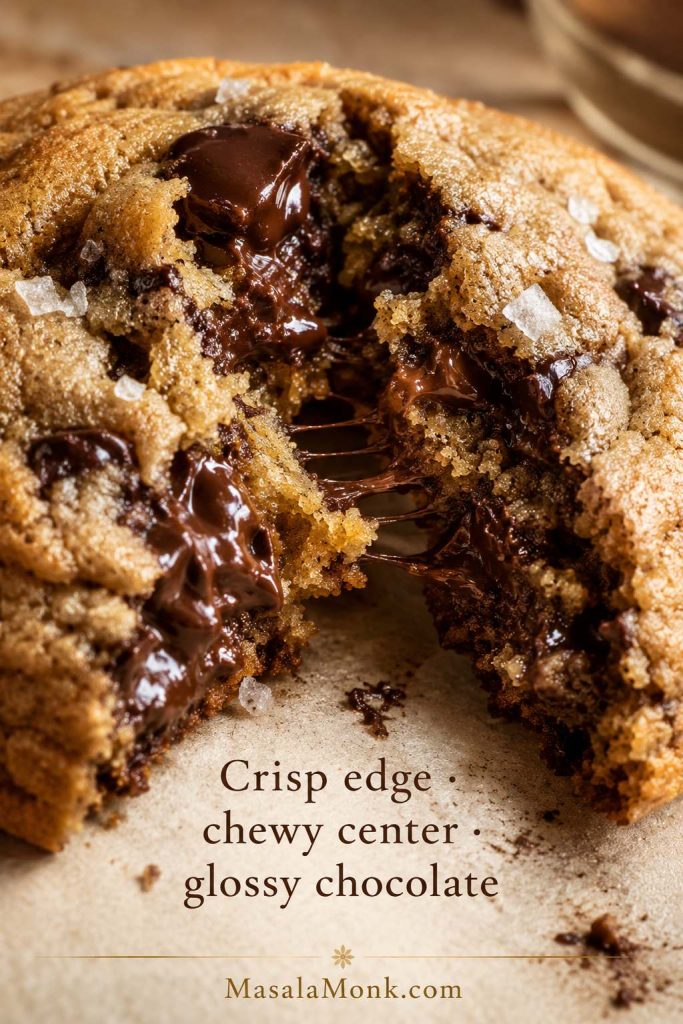
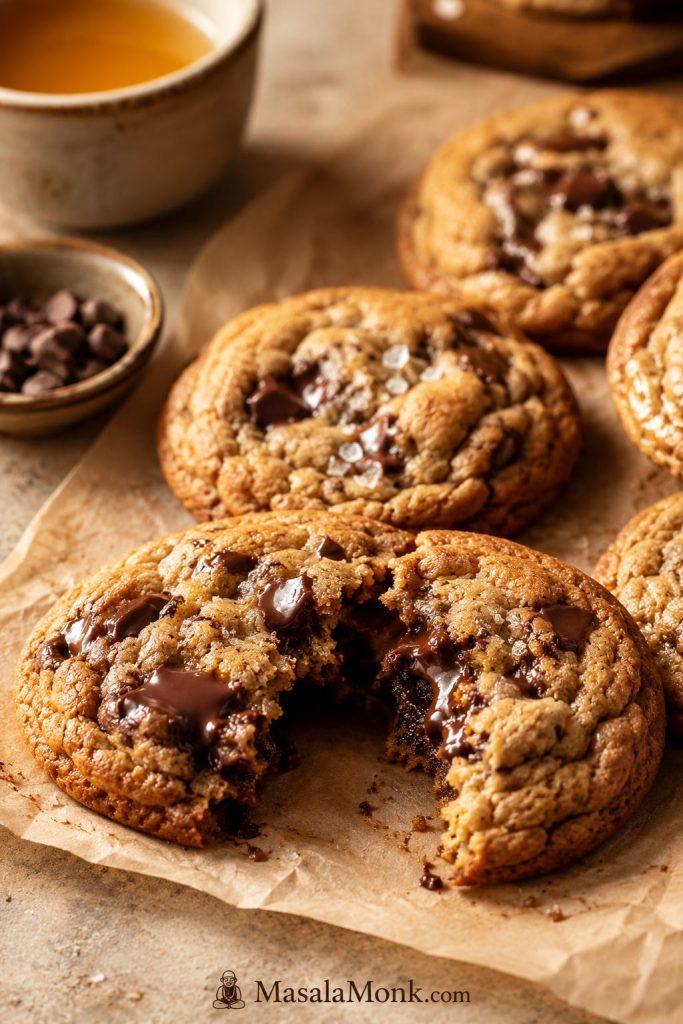
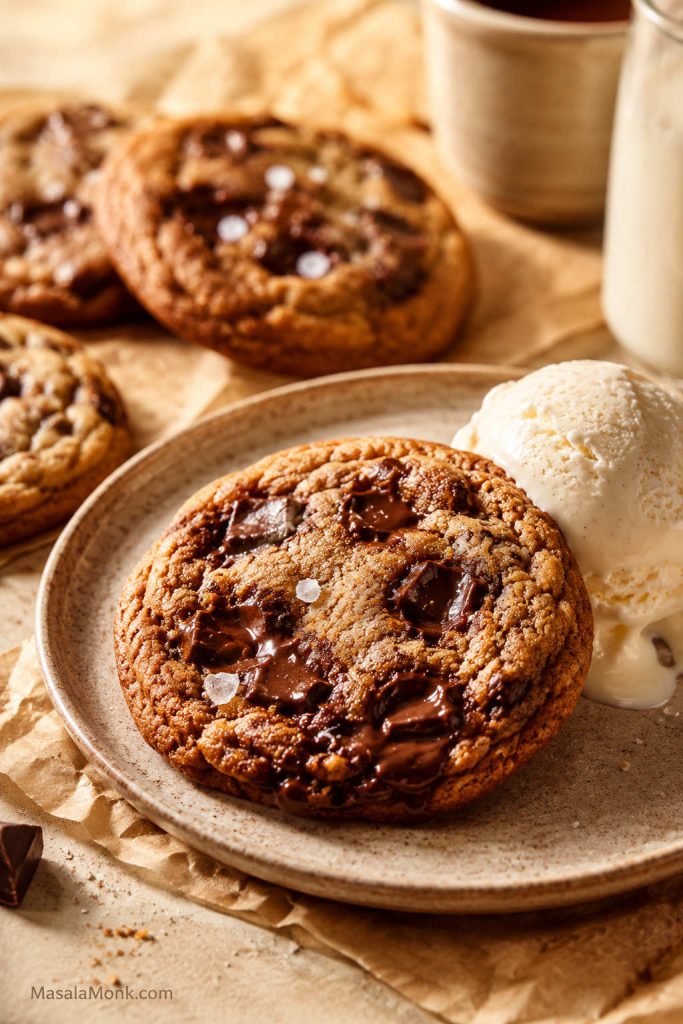
They bake with crisp edges, chewy centers, glossy chocolate pockets, and the kind of warm toasted flavor that makes a regular chocolate chip cookie taste a little plain by comparison.
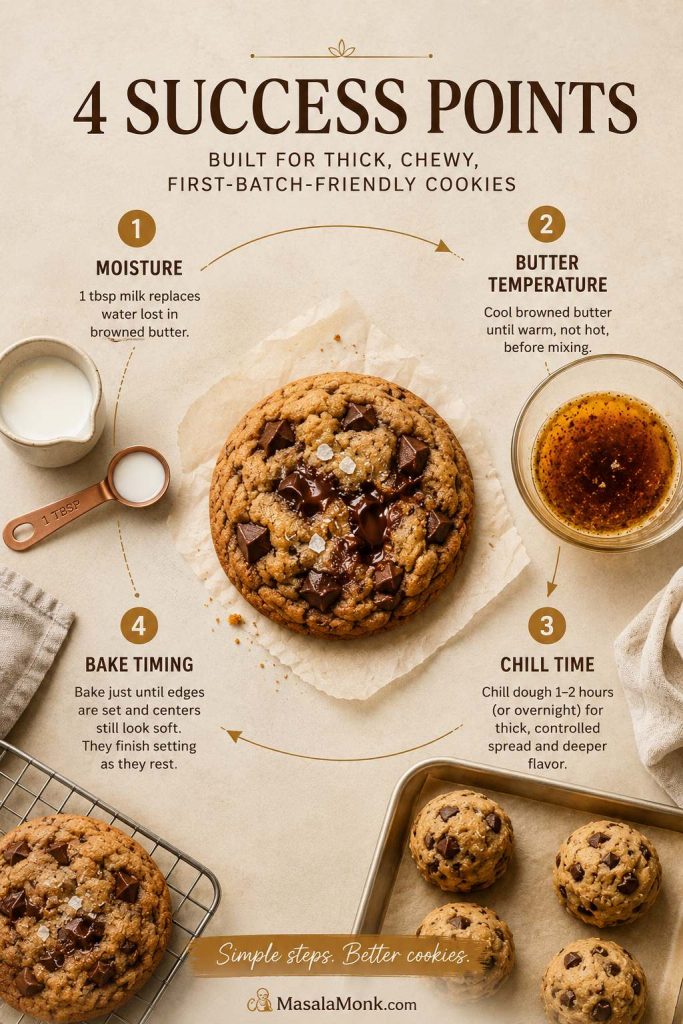
The trick is not only browning the butter. It is cooling it properly, adding back a little moisture, shaping the dough before chilling, and baking the cookies just until the centers still look soft. That is how you get the cookie most people hope for when they brown butter: crisp at the edge, chewy in the center, full of melted chocolate, and sturdy enough that it does not bake into a flat greasy puddle.
This is a first-batch-friendly brown butter cookie: deep toasted flavor, thick chewy centers, and enough small safeguards to keep the dough from turning flat, greasy, dry, or weak-flavored. If you have ever made brown butter cookies that tasted good but did not bake right, this guide is built to help.
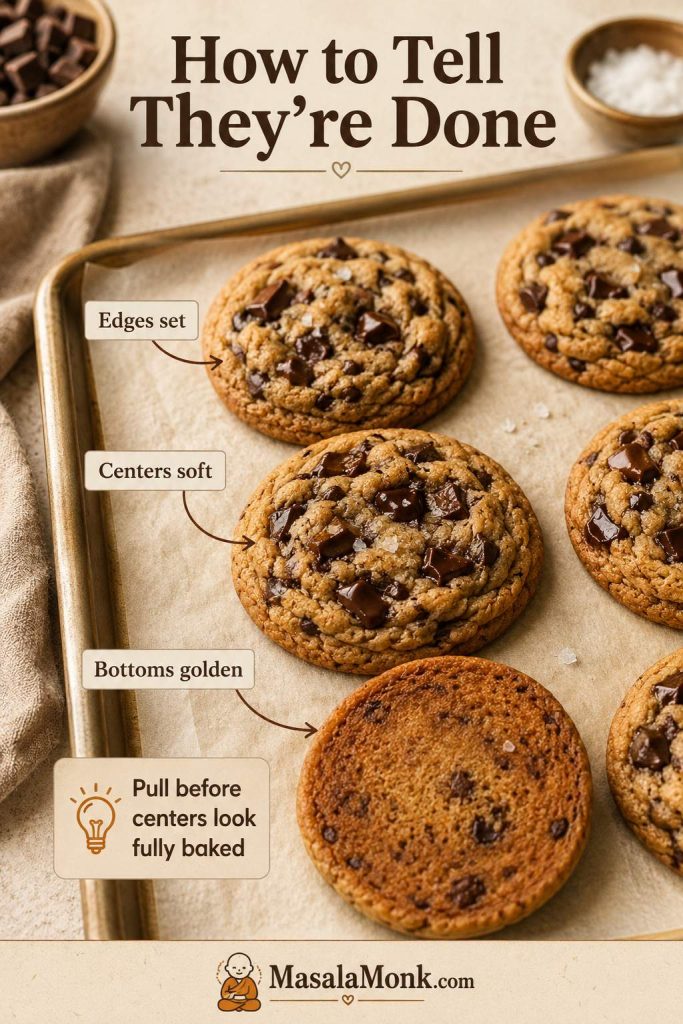
A brown butter cookie should look just a little soft in the middle when it leaves the oven. Because it finishes setting as it cools, that slightly underdone look is what keeps the center bendy instead of dry.
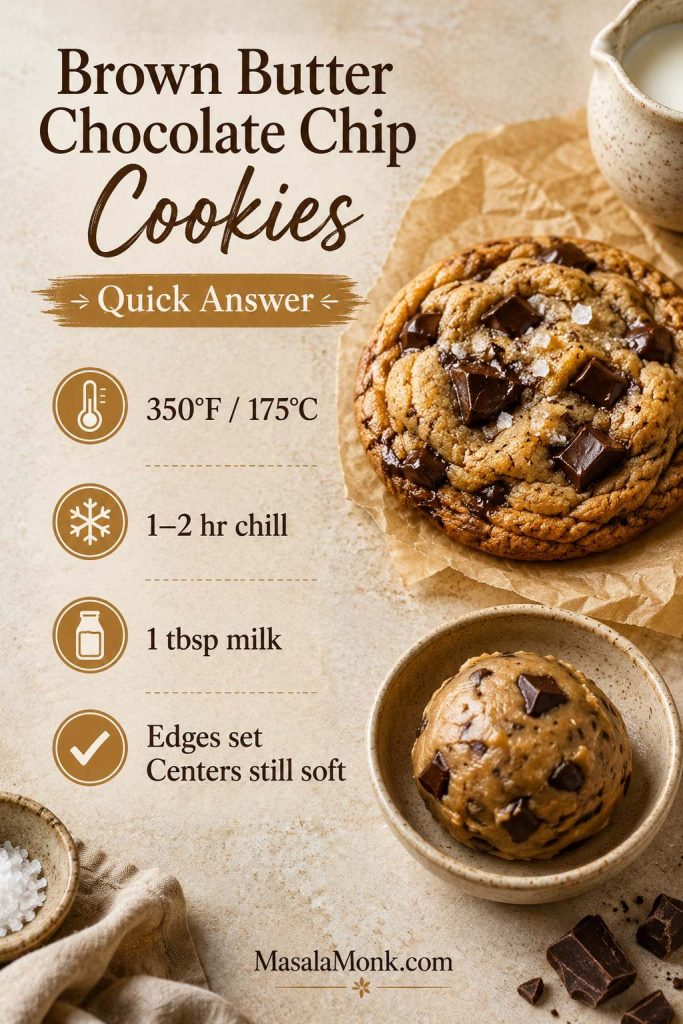
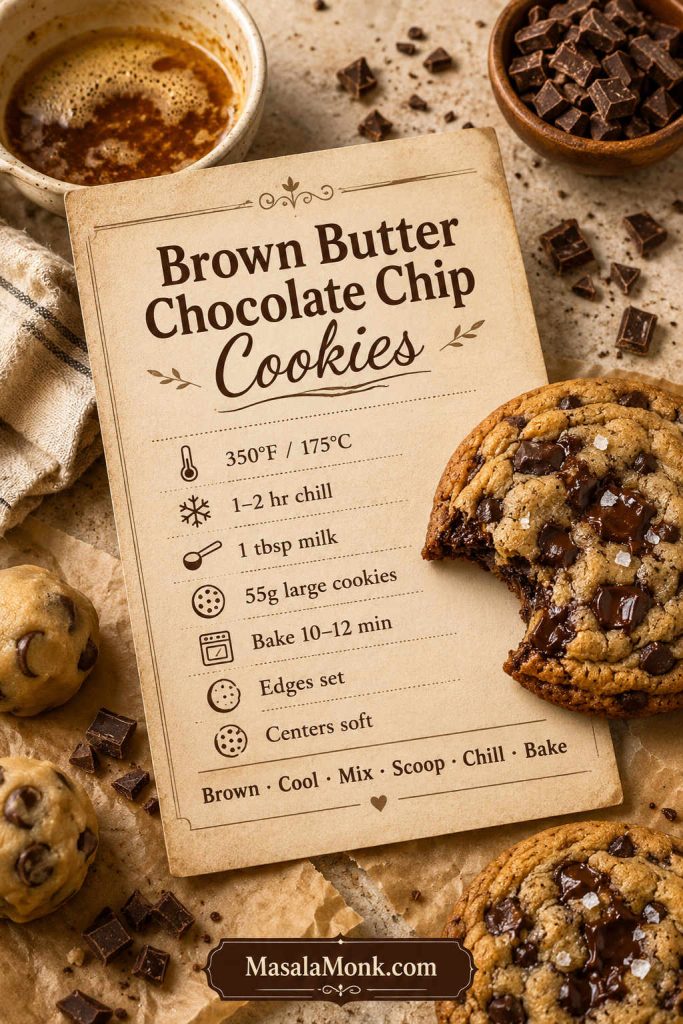
For chewy brown butter chocolate chip cookies that stay thick instead of flat, brown the butter until amber and nutty, then let it cool before adding the egg. Mix in 1 tablespoon milk, scoop before chilling, and bake at 350°F / 175°C until the edges are set but the centers still look slightly underdone.
Default oven temperature
350°F / 175°C for the most even first batch
Hotter option
375°F / 190°C for well-chilled dough and slightly thicker edges
Bake time
10 to 12 minutes for large cookies; 8 to 10 minutes for smaller cookies
Recommended chill time
1 to 2 hours after scooping
Dough size
55g for large cookies, 45g for medium cookies, or 35g for smaller cookies
Yield
About 16 large, 20 to 22 medium, or 26 to 28 smaller cookies
A mix of chopped semi-sweet or dark chocolate and chocolate chips
What This First-Batch Setup Controls
The quick answer is really a control system: replace lost moisture, firm the shaped dough, and stop the bake while the middle can still finish on the tray. That is what keeps brown butter chocolate chip cookies thick instead of dry or flat.
For your first batch: skip the overnight chill and hotter oven. Use the 1 to 2 hour chill and 350°F / 175°C bake so you can learn the dough texture, spread, and doneness cues first.
If your main worry is spread, dryness, or greasy dough, jump to the troubleshooting guide before baking the full batch.
You do not need a mixer for this dough. A whisk, spatula, and a little patience while the butter cools are enough.
The goal is a cookie that feels generous without being messy: edges that hold, centers that bend, chocolate that stays glossy for a few minutes after baking, and enough toasted butter flavor that the dough smells caramel-like before it even reaches the oven.
Why This Recipe Works
This version is built around the four places brown butter cookies usually fail: moisture loss, butter temperature, dough chill, and bake timing. Brown butter tastes better after browning, but it also loses moisture. A splash of milk restores just enough liquid, the extra yolk keeps the centers rich, and chilling the shaped dough helps the cookies bake thick instead of spreading too fast.
Browned butter gives the cookies their nutty, caramel-like flavor.
Brown sugar and egg yolk keep the centers chewy and soft.
Milk replaces some of the moisture lost while browning butter.
Scooping before chilling makes the dough easier to handle and helps the cookies bake evenly.
Soft-center doneness keeps the final cookie chewy after it cools.
If a brown butter cookie fails, one of these four points is usually the reason. Moisture keeps it chewy, cooler butter prevents greasiness, chilling controls spread, and early pulling protects the soft center.
Why Brown Butter Makes Chocolate Chip Cookies Better
Brown butter is regular butter that has been cooked until the milk solids toast. Instead of tasting only creamy and buttery, it becomes nutty, caramel-like, and almost toffee-scented. In chocolate chip cookies, that flavor works beautifully with brown sugar, vanilla, chocolate, and a little salt.
That is why brown butter cookies often taste more layered than standard chocolate chip cookies. The flavor is not just sweet. It has a warm toasted edge, a deeper bakery smell, and a finish that makes the chocolate taste richer.
That is the reason brown butter is worth the extra few minutes. It gives the cookie a toasted, caramel-edged base before the chocolate even melts.
Brown butter changes the flavor before the dough even comes together. Its toasted milk solids add a caramel-like base that makes the chocolate taste richer without adding extra sugar.
The key idea: Brown butter is not just melted butter. It gives you deeper flavor; the moisture and texture adjustments come next.
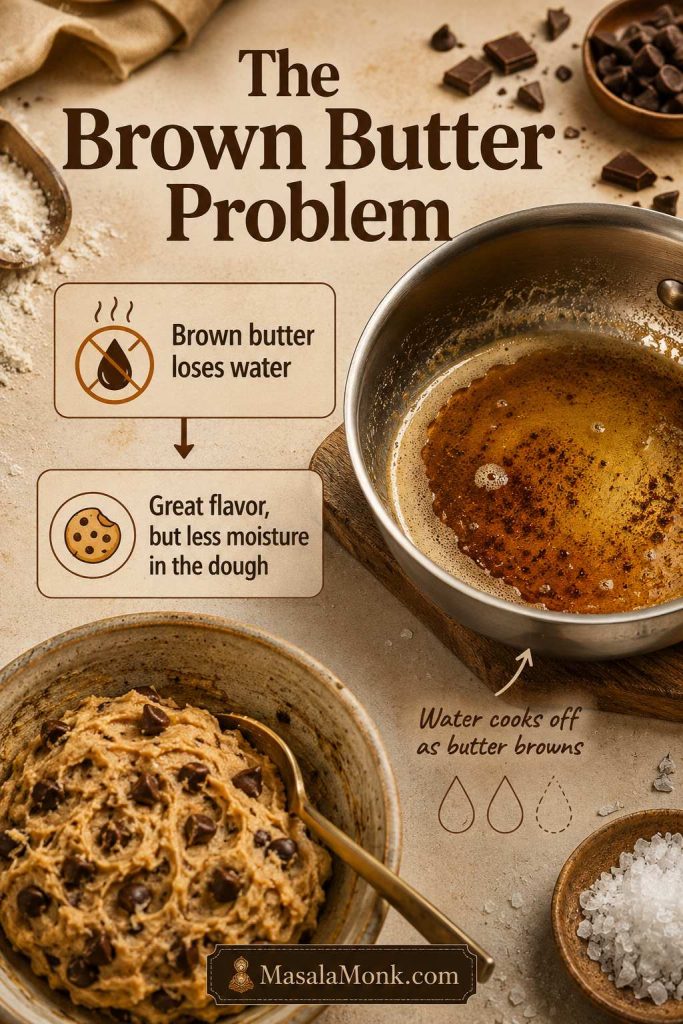
The Brown Butter Problem: Moisture Loss
What Moisture Loss Does to the Dough
Brown butter gives you flavor with a catch: it brings toffee-like depth, but it takes water with it. This is the part that turns brown butter from a delicious risk into a reliable cookie dough.
The same heat that creates brown-butter flavor also drives off water. That is why this dough needs a measured moisture adjustment instead of treating browned butter like plain melted butter.
Add the Moisture Back Carefully
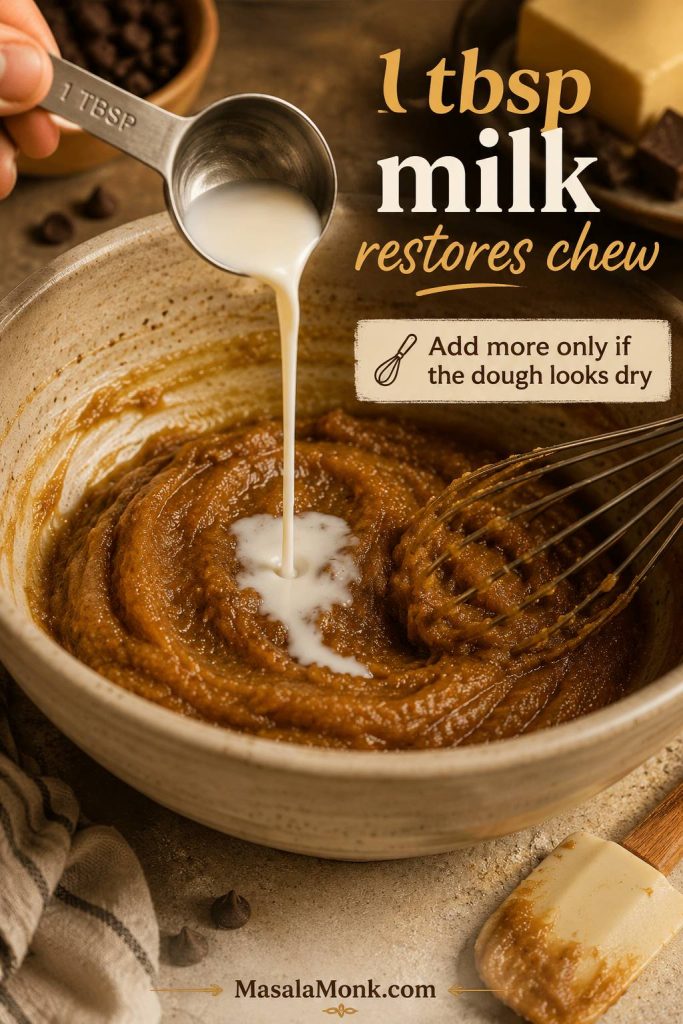
In this recipe, the butter is weighed before browning. After browning, you will have a little less liquid because water has cooked off. That is expected. The fix is to scrape every browned bit into the bowl, cool the butter, and add a small amount of milk to bring moisture back into the dough.
Use 1 tablespoon of milk by default. Keep up to 1 tablespoon more nearby and add it only if the butter cooked longer than usual or the dough does not come together after a short rest.
Add the first tablespoon of milk as part of the formula, not as a rescue afterthought. Then, if the dough still looks dry after resting, adjust with tiny splashes instead of pouring freely.
What goes wrong
Why it happens
How this recipe fixes it
Cookies spread too much
The butter was too warm, dough was not chilled, or the tray was hot
Cool the butter, scoop the dough, chill before baking, and use a cool tray
Cookies taste dry
Too much moisture evaporated or too much flour was used
Use 1 tablespoon milk by default, add more only if needed, and weigh flour
Dough feels greasy
The butter was still hot when mixed
Let the butter cool before adding the egg
Cookies are cakey
Too much flour, overmixing, or too much leavener
Weigh the flour and mix only until the dough comes together
Flavor is not nutty
The butter was only melted, not browned enough
Cook until amber specks form and the aroma turns toasted
What the Dough Should Feel Like
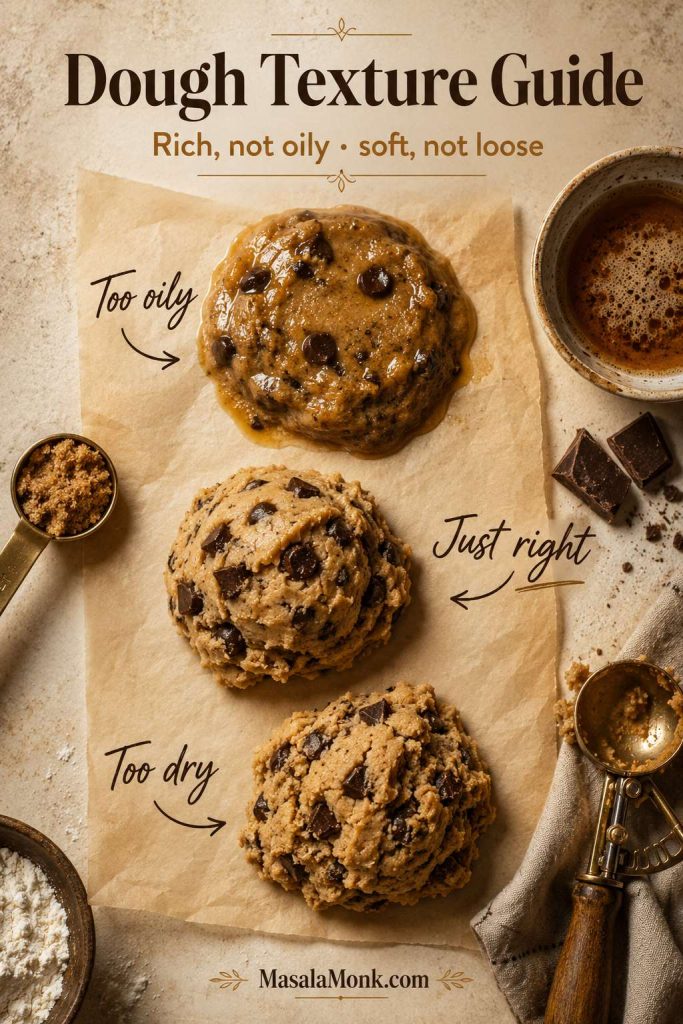
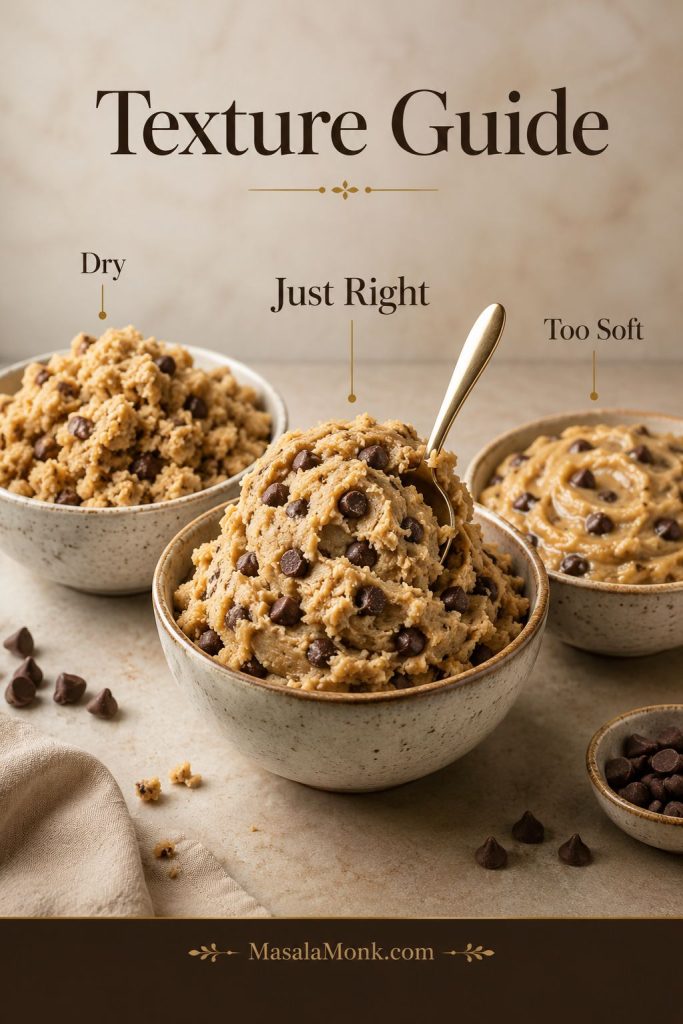
A good dough should feel rich, not oily; soft, not loose. It should scoop cleanly, hold its shape on the tray, and still feel tender enough that the centers will stay chewy after baking.
The dough should be thick enough to scoop but soft enough to press. Shiny dough usually needs time to cool, while crumbly dough usually needs a little more moisture.
You still get the nutty flavor, but the dough scoops cleaner, holds its shape, and bakes with more control.
Ingredients You Need
The ingredient list is simple, but the balance matters. The goal is not just a sweet cookie; it is a cookie where the toasted butter still comes through after the sugar, flour, and chocolate join the bowl.
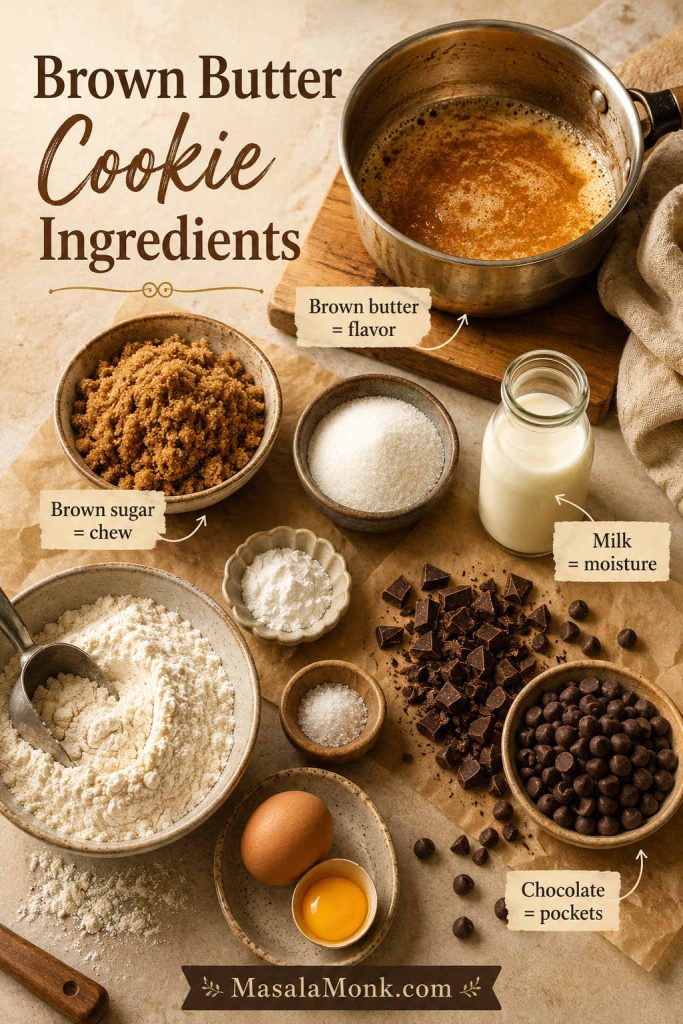
Browned butter gives the dough its deep flavor, brown sugar keeps the center soft, white sugar encourages crisp edges, and the extra yolk adds the richness that makes the cookie feel bakery-style.
This ingredient balance is what separates chewy brown butter cookies from dry ones. Brown sugar and yolk add richness, milk restores moisture, and chocolate brings pockets without hiding the toasted butter.
Unsalted Butter
Use 170g / 6 oz / 3/4 cup unsalted butter, weighed before browning. Unsalted butter gives you better control over the final salt level, especially because these cookies also use chocolate and optional flaky salt on top.
Salted butter can work, but reduce the fine salt in the dough. If your salted butter is very salty, skip the flaky salt on the first test batch and add it only after tasting.
Brown Sugar and White Sugar
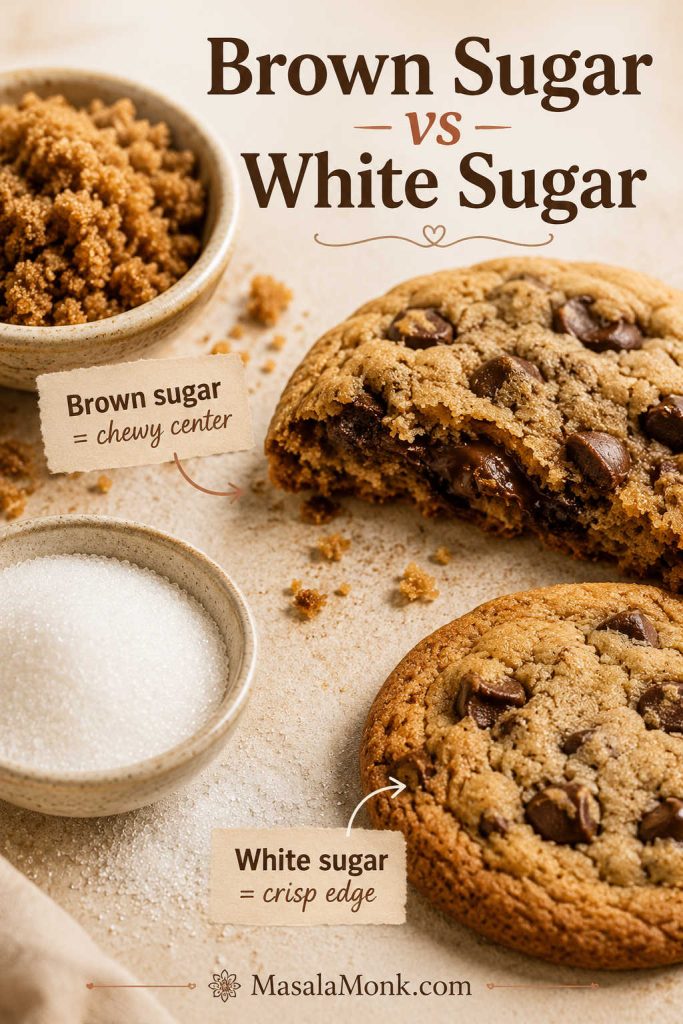
Brown sugar is the backbone of the chewy texture. It brings moisture, caramel notes, and a softer center. White sugar helps the edges crisp and encourages just enough spread.
Both sugars matter here. Brown sugar helps the middle stay soft and caramel-like, while white sugar gives the cookie enough edge crispness to balance the chewy center.
If you are out of brown sugar, this is one of the rare swaps worth skipping. This dough depends on brown sugar for chew, moisture, and caramel flavor, so a no-brown-sugar cookie needs a different balance.
Egg and Egg Yolk
One whole egg gives structure. One extra yolk gives richness, chew, and a softer center without adding too much extra liquid. It is one of the easiest ways to make the cookies feel bakery-style without using complicated ingredients.
Milk
Use 1 tablespoon / 15 ml milk by default. Keep up to 1 tablespoon / 15 ml more nearby and add it only if the dough looks dry after mixing. That small amount restores chew without making the dough loose.
For the full reason milk matters in brown butter cookie dough, see the moisture-loss explanation above.
All-Purpose Flour
Use 220g all-purpose flour, which is about 1 3/4 cups plus 1 tablespoon when spooned and leveled. Weighing is best because too much flour is one of the fastest ways to turn chewy cookies into cakey cookies. King Arthur Baking’s ingredient weight chart is a useful reference if you bake often and want more consistent cup-to-gram conversions.
Baking Soda and Baking Powder
Baking soda helps with browning, spread, and classic cookie chew. A small amount of baking powder gives a little lift so the cookies do not feel dense. Keep both amounts modest; too much leavener pushes the cookies toward cakey.
Chocolate
For dramatic melted pockets, chopped chocolate is the better choice. Chips are more predictable: they hold their shape, spread evenly through the dough, and give the cookies a familiar chocolate-chip look. For the easiest everyday batch, use a mix of both.
Semi-sweet chocolate is the safest choice. Dark chocolate makes the cookies more intense, while milk chocolate makes them sweeter and softer. Chopped chocolate makes the cookie feel more bakery-style because every bite gets both big melted pockets and tiny chocolate flecks. For a deeper chocolate dough rather than a brown-butter-forward dough, try our double chocolate chip cookies.
Equipment That Makes These Cookies Easier
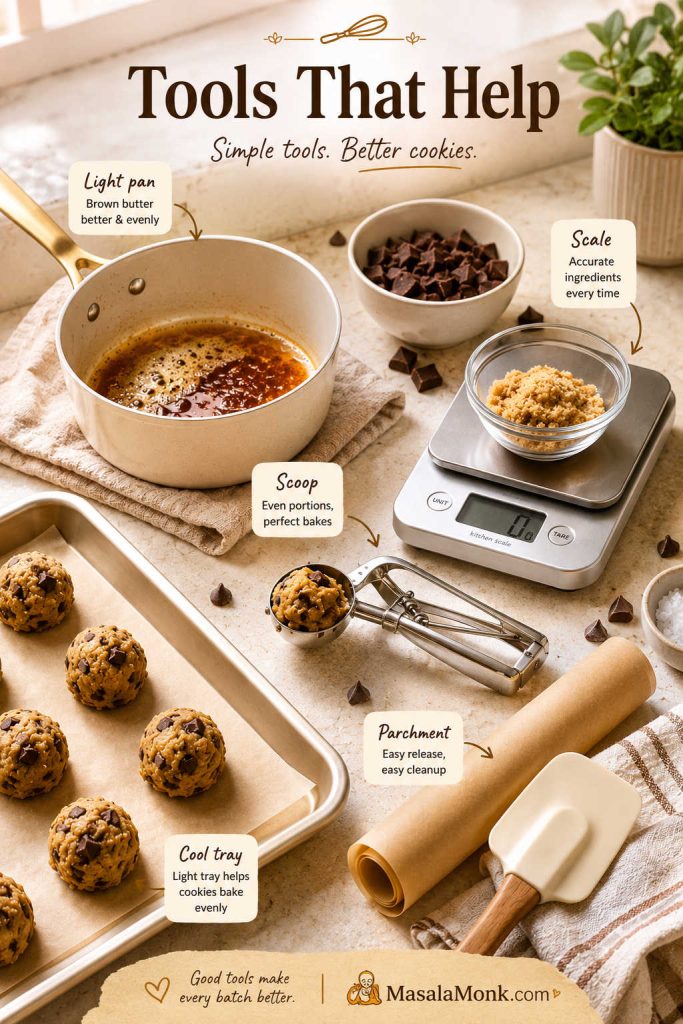
You do not need special equipment, but a few tools make the recipe more forgiving: a light-colored pan for seeing the butter brown, a digital scale for flour and dough portions, parchment for controlled spread, and a cool light-colored baking sheet for gentler bottoms.
The most useful tools are the ones that reduce guessing. A light pan shows butter color clearly, a scale keeps flour accurate, and a scoop makes every cookie bake at the same pace.
Light-colored skillet or saucepan: helps you see when the butter turns amber instead of burnt.
Digital scale: prevents too much flour and keeps cookie size consistent.
Cookie scoop or kitchen scale: makes it easier to portion 55g, 45g, or 35g cookies evenly.
Parchment paper and a cool baking sheet: help control spread and protect the bottoms.
Round cutter or glass: lets you scoot warm cookies into rounder shapes if they spread unevenly.
How to Brown Butter for Cookies
Browning butter is easy once you know what to watch for. Use color, smell, sound, and the little brown specks at the bottom of the pan.
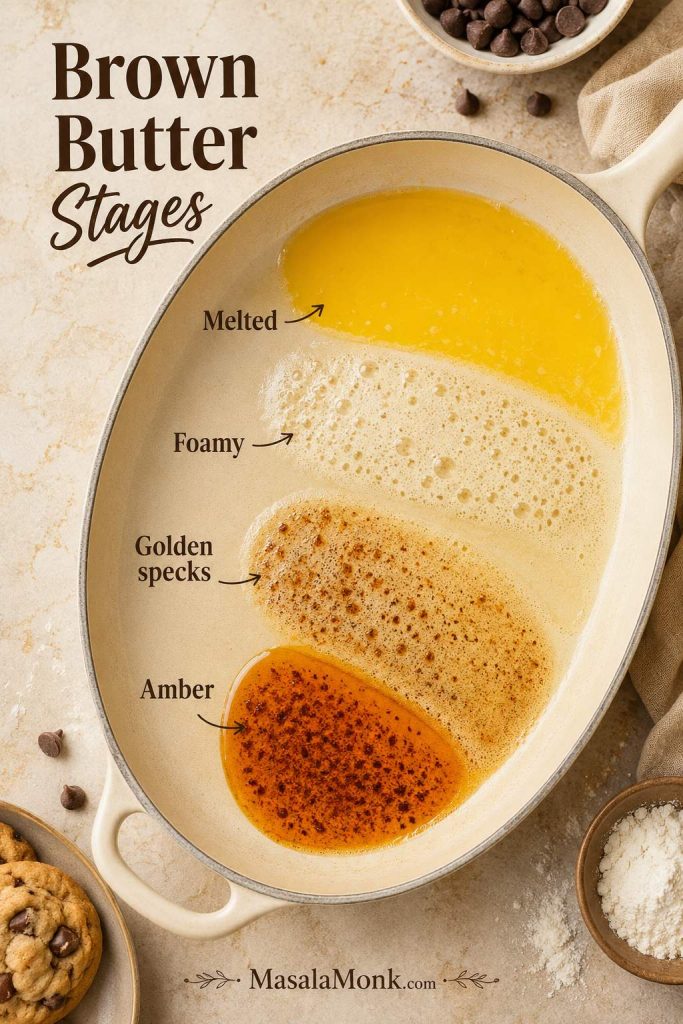
Do not stop when the butter is simply melted. Wait for foam, amber specks, and a nutty smell; then remove the pan before those specks turn dark and bitter.
Step-by-Step Browning Cues
Cut the butter into pieces. Smaller pieces melt more evenly.
Use medium heat. Too much heat can burn the milk solids before the butter browns evenly.
Let it melt, foam, and crackle. The crackling sound is moisture cooking off.
Stir often. Scrape the bottom so the milk solids brown evenly.
Watch for amber specks. The butter should smell nutty and toasted, not bitter.
Remove from heat quickly. It keeps cooking from residual heat.
Scrape everything into the bowl. Do not leave the brown bits behind.
Cool before mixing. The butter should be liquid but no longer steaming before it meets the egg.
Stage
What you see
What to do
Melted butter
Yellow liquid, no brown specks
Keep cooking
Foamy butter
Foam and crackling sounds
Stir and watch closely
Golden specks
Light brown bits forming at the bottom
You are close
Amber brown butter
Brown specks, nutty smell, golden liquid
Remove from heat
Burnt butter
Black bits, sharp bitter smell
Start over for best flavor
Once you catch that amber stage a few times, it becomes familiar. The smell changes first, then the specks darken quickly, so stay close to the pan once the butter starts foaming.
Do not strain the brown butter. Those toasted brown bits are browned milk solids, and they carry much of the flavor.
The browned bits at the bottom of the pan are toasted milk solids, not burnt crumbs. Scraping them into the bowl gives the dough its strongest brown-butter flavor.
Once the butter reaches the amber stage, continue with the step-by-step method so it cools before the egg goes in.
Brown Butter vs Melted Butter
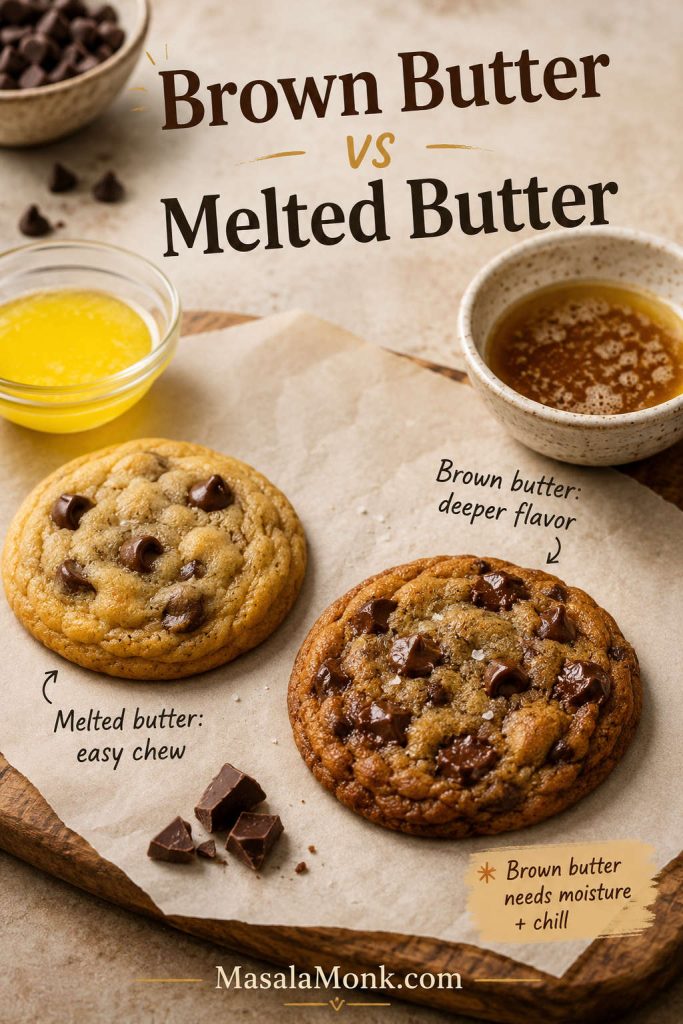
Melted butter gives you easy, chewy cookies. Brown butter gives you something deeper: toasted milk solids, a nutty smell, and a flavor that leans caramel and toffee. The tradeoff is moisture. Because browned butter has cooked longer, this dough needs a little added milk and time to chill before baking.
Melted butter makes a fast chewy cookie, but brown butter adds toasted complexity. Because it behaves differently, the brown-butter version needs better control over moisture, temperature, and rest time.
If speed matters most, melted butter can be useful. If you want the cookie to taste more toasted, caramel-like, and bakery-style, brown butter is worth the extra few minutes.
How to Make Brown Butter Chocolate Chip Cookies
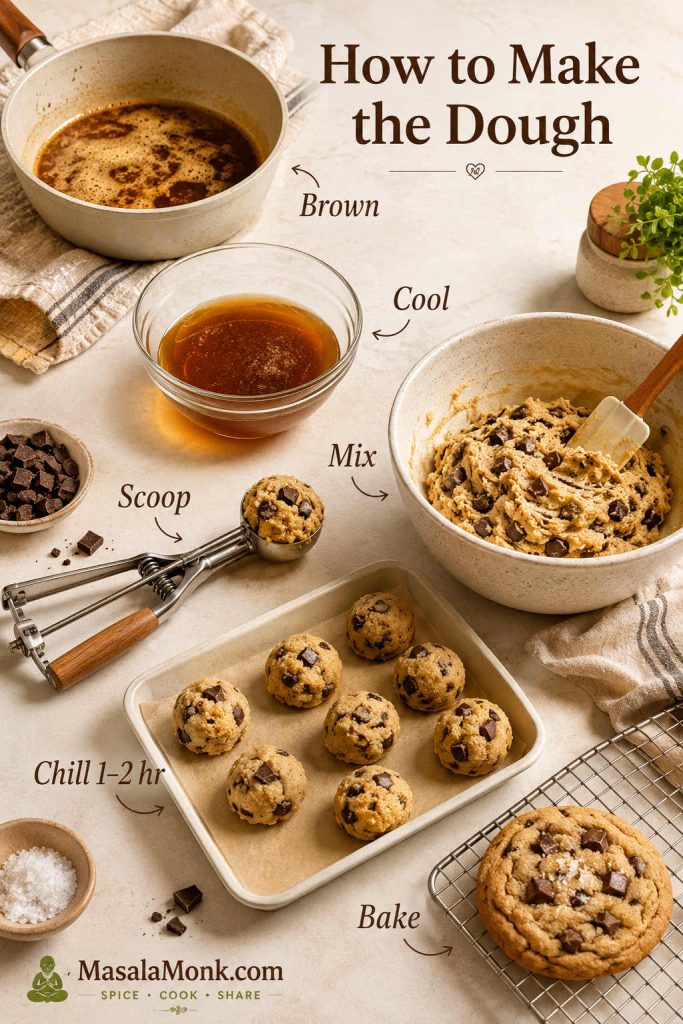
Once the butter is ready, the dough comes together without complicated mixing. The main workflow is simple: brown, cool, mix, scoop, chill, bake.
Once the butter is browned and cooled, the recipe becomes a simple flow: mix the dough, portion it while soft, chill the scoops, then bake from cold for better shape control.
1. Brown and Cool the Butter
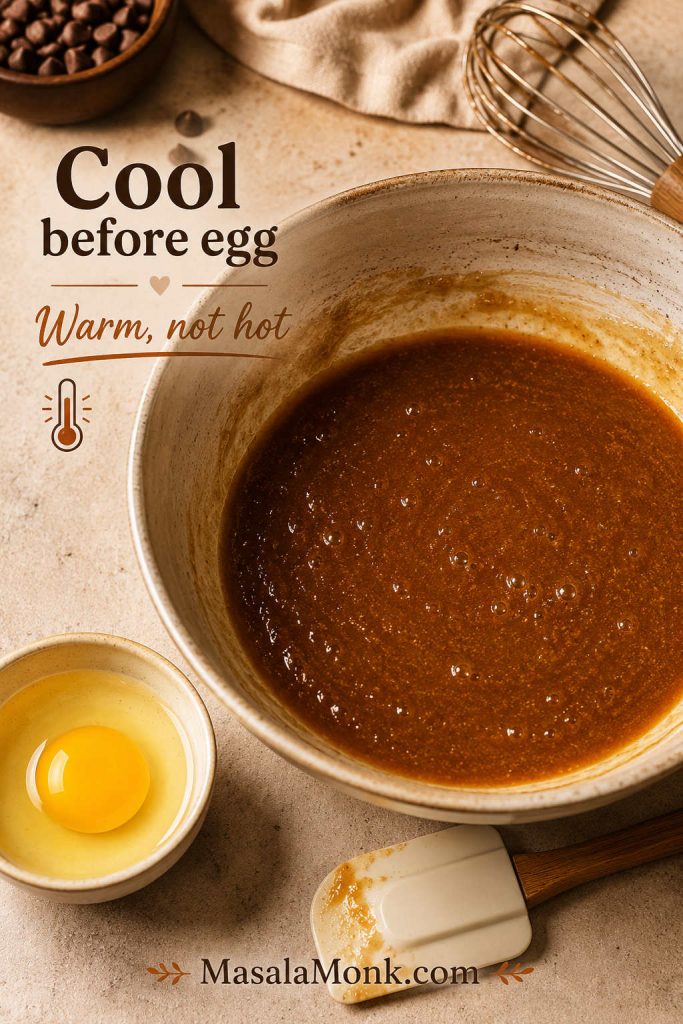
Brown the butter until amber specks form and the kitchen smells nutty. Pour it into a heat-safe mixing bowl, scraping in all the browned bits. Let it cool for 15 to 25 minutes, until liquid and warm, not hot.
The egg should meet warm butter, not hot butter. This small pause helps prevent greasy dough and keeps the mixture smooth before the flour goes in.
If the butter becomes completely solid, let it soften slightly before mixing. If it is still steaming, give it more time before adding the egg.
2. Whisk in the Sugars
Add the brown sugar and granulated sugar to the cooled butter. Whisk until the mixture looks glossy and thick. It does not need to become fluffy like creamed butter and sugar.
3. Add Egg, Yolk, Vanilla, and Milk
Add the whole egg, egg yolk, vanilla extract, and 1 tablespoon milk. Whisk until smooth. Hold back the extra tablespoon unless the finished dough looks dry later.
4. Mix the Dry Ingredients Separately
In another bowl, whisk together the flour, baking soda, baking powder, and fine salt. A quick separate whisk keeps the leaveners from landing in one bitter or puffy pocket.
5. Fold the Dough Together
Add the dry ingredients to the wet ingredients and fold just until a few flour streaks remain. Add the chocolate and fold again until combined.
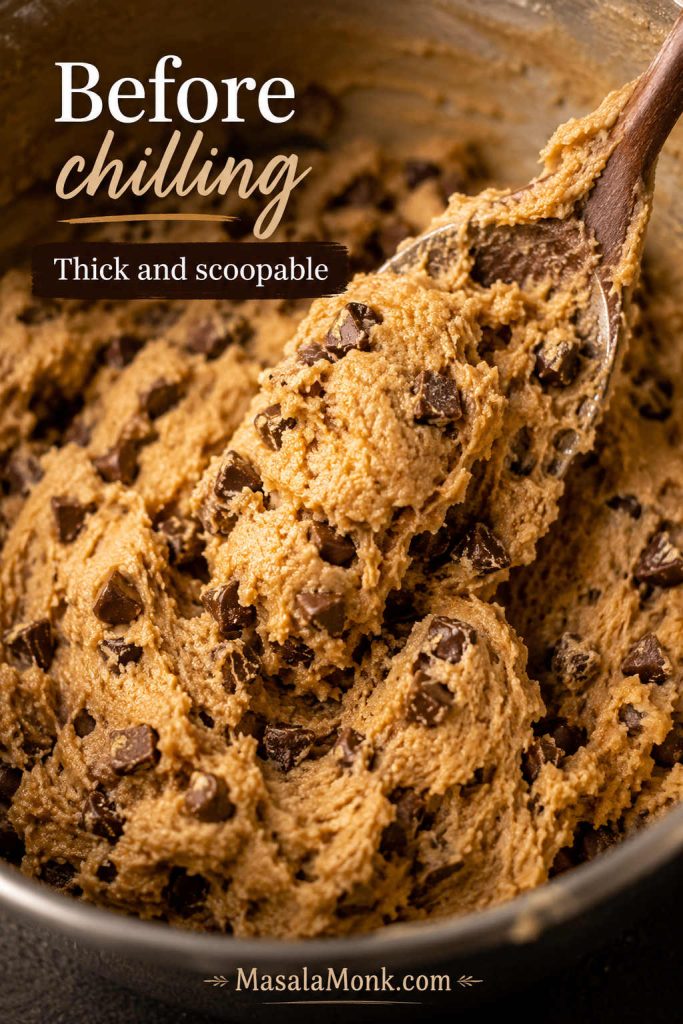
Aim for dough that is thick and scoopable: not shiny-loose, not dry-crumbly. If it looks too soft, rest it for 10 minutes before scooping. If it looks dry, add the extra milk a little at a time.
Before chilling, the dough should already look like cookie dough, not batter. If it holds a scoop and the chocolate stays suspended, it is ready for the refrigerator.
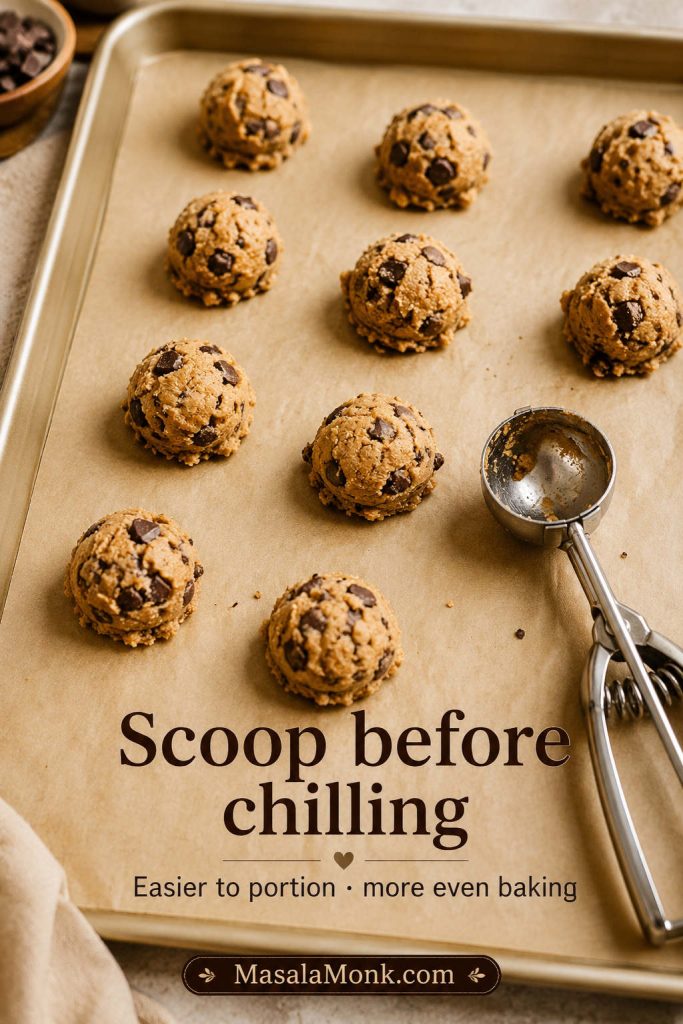
6. Scoop Before Chilling
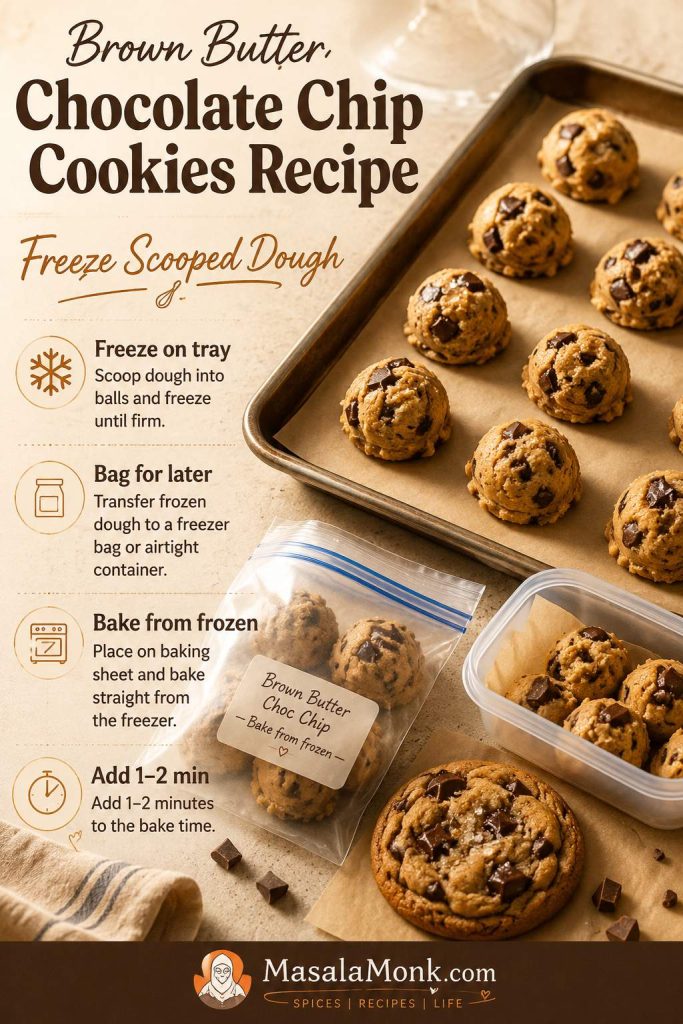
Scoop the dough before chilling. This is easier than trying to scoop a cold, firm bowl of dough later, and it helps the cookies bake more evenly.
Scooping first gives you even portions before the butter firms up. As a result, the chilled dough goes straight from tray to oven with less handling and more consistent spread.
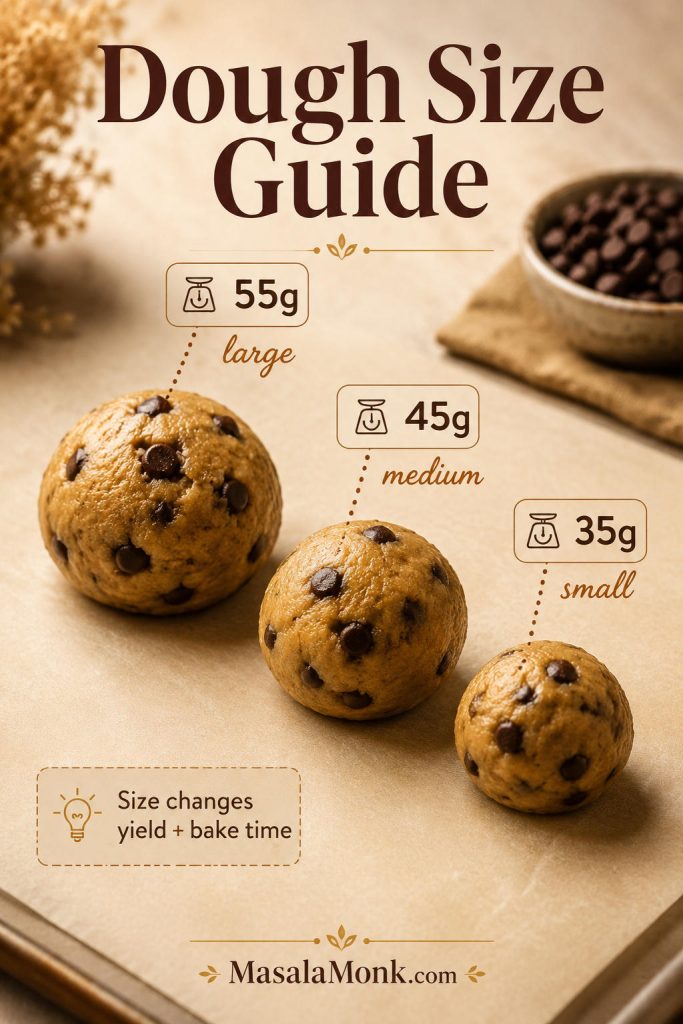
Use 55g portions for about 16 large cookies, 45g portions for about 20 to 22 medium cookies, or 35g portions for about 26 to 28 smaller cookies. Place them on a lined tray, cover, and chill for 1 to 2 hours.
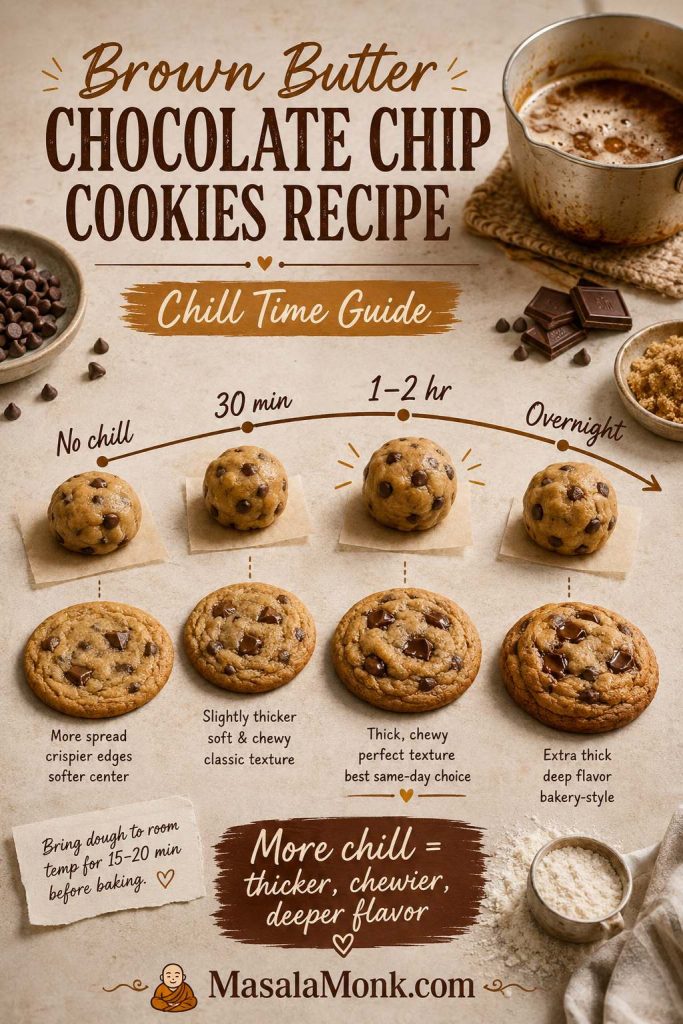
If you are deciding between no chill, 30 minutes, 1 to 2 hours, or overnight, use the chill time guide before baking.
Dough size changes more than yield. Larger portions stay softer in the middle, while smaller portions bake faster and give more crisp edge in each cookie.
7. Bake Until the Centers Look Soft
Heat the oven to 350°F / 175°C. Place the chilled portions on a parchment-lined baking sheet with room to spread. Bake 55g cookies for 10 to 12 minutes, 45g cookies for 9 to 11 minutes, or 35g cookies for 8 to 10 minutes. The edges should be set and the centers should still look slightly soft.
8. Shape and Finish While Warm
If the cookies spread unevenly, use a round cutter or glass to gently scoot them into shape while they are still hot. Finish with flaky salt if you like. Let the cookies rest on the baking sheet for 5 to 10 minutes before moving them to a rack.
At this point, the cookies should smell like toasted butter, vanilla, brown sugar, and chocolate. That is the moment the chill time starts to feel worth it.
Chill Time Guide: No Chill vs 30 Minutes vs 2 Hours vs Overnight
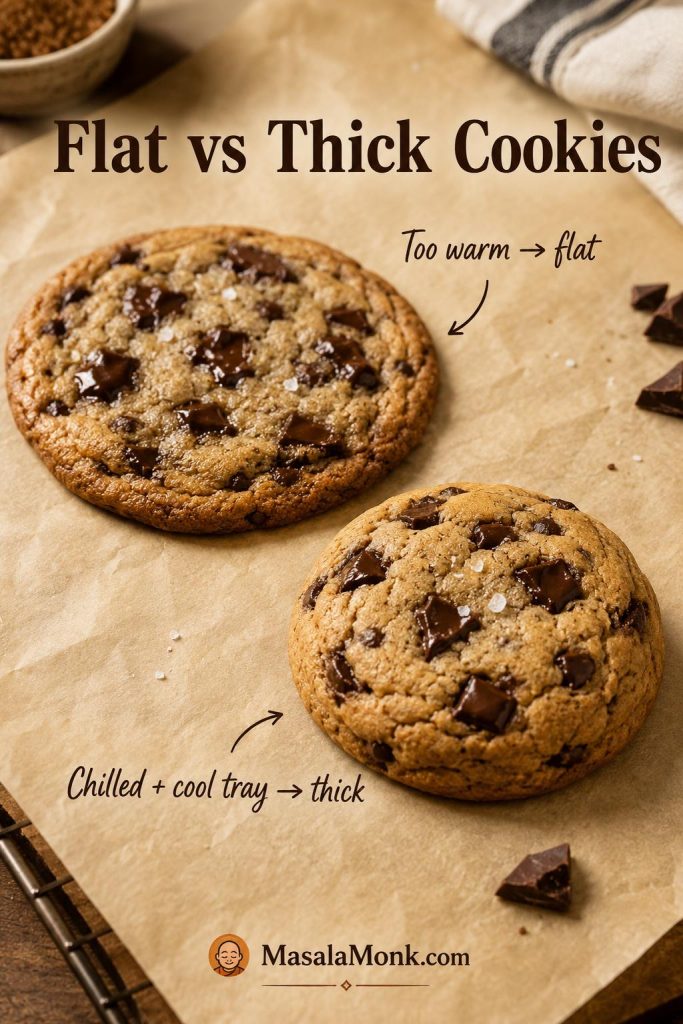
Chill time is one of the biggest differences between an okay cookie and a great one. Chilling firms the butter, hydrates the flour, deepens flavor, and slows spread in the oven.
You can bake the dough without chilling, but the cookies will usually spread more, bake thinner, and have crispier edges. That is not automatically bad, but it is a different result.
If You Need to Bake Right Away
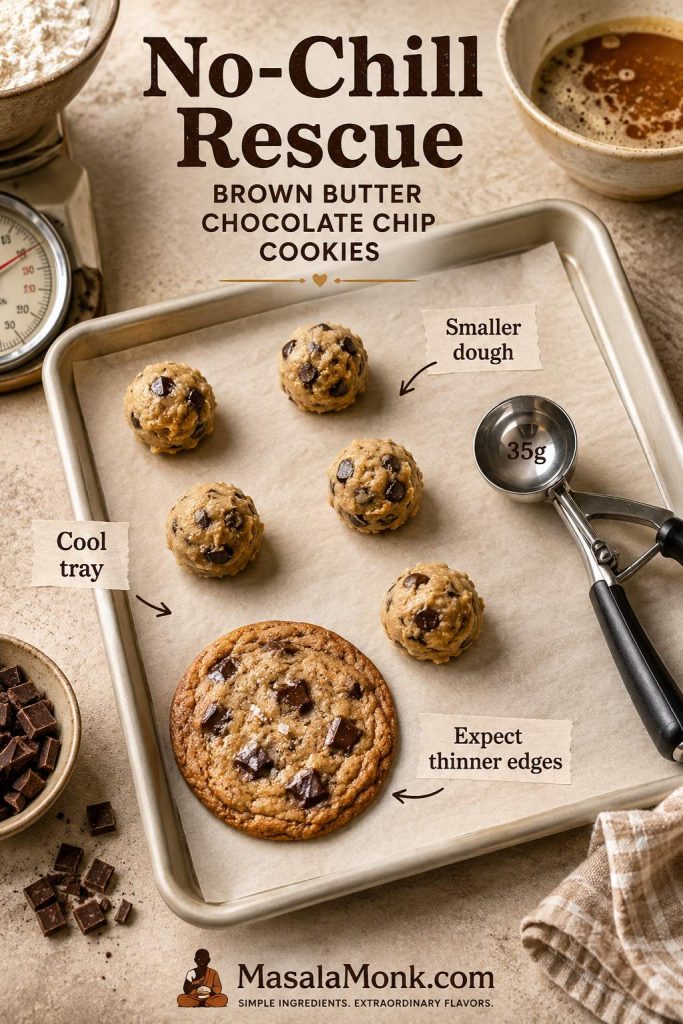
No-chill rescue: If you need to bake immediately, make smaller 35g portions and use a cool parchment-lined tray. The cookies will bake thinner with crispier edges, which can still be delicious. If the dough looks shiny, loose, or greasy, chill it for even 20 to 30 minutes first.
When you cannot chill the dough properly, go smaller and keep the tray cool. The cookies will spread more, but the smaller size keeps them from turning into oversized flat rounds.
If the first tray still spreads more than expected, use the troubleshooting section to adjust the next tray before baking the rest.
Choose the Right Chill Time
Choose the chill time based on the cookie you want today: fast and crisp-edged, thicker and chewier, deeper-flavored, or ready to bake later.
Chill time is a texture choice, not just waiting. No chill gives thinner cookies, 30 minutes helps in a pinch, 1 to 2 hours is the best same-day default, and overnight deepens flavor.
Chill time
What happens
Best for
No chill
More spread, thinner cookies, crispier edges
Fast craving cookies
30 minutes
Some control, still slightly spread-prone
Same-day baking when short on time
1 to 2 hours
Thicker cookies, chewier centers, better flavor
Most reliable balance of flavor, texture, and same-day baking
Planning ahead; let the dough sit briefly before baking if very hard
Reliable same-day result: Chill the shaped dough for 1 to 2 hours. This gives you better texture without turning the recipe into a next-day project.
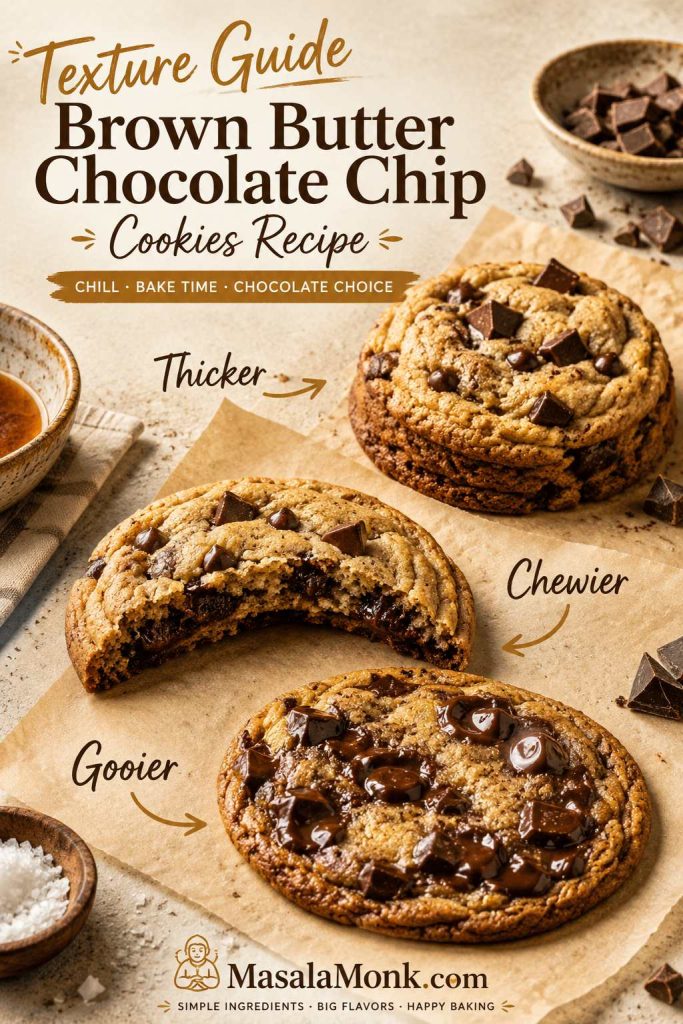
How to Get Thicker, Chewier, or Gooier Cookies
Start with the base recipe once, then adjust from a place of control. A longer chill, a shorter bake, or a different chocolate can shift the cookie without turning it into a new recipe.
Small changes create different cookie personalities. For thicker cookies, chill longer; for chewier cookies, pull them sooner; for gooier cookies, use more chopped chocolate or wafers.
How to Adjust the Texture
What you want
What to do
Why it works
Thicker cookies
Chill shaped dough for 2 hours and bake cold
Cold dough spreads more slowly
Chewier centers
Use the egg yolk, enough brown sugar, and avoid overbaking
Yolk and brown sugar keep the center soft
Crispier edges
Bake 1 minute longer or use slightly smaller portions
More edge exposure gives more crispness
Gooier chocolate pockets
Use chopped chocolate or wafers instead of chips alone
Flat pieces melt into larger pockets
More toasted-butter flavor
Brown until amber, scrape in every bit, and do not drown the dough in too much chocolate
The toasted milk solids carry the nutty flavor
Less spread
Cool butter fully, chill before baking, use parchment, and avoid hot trays
Warm fat spreads faster in the oven
More spread
Use a shorter chill or gently flatten the portions before baking
Flatter dough spreads sooner
Softer cookies
Pull the cookies when the centers still look soft
They finish setting on the hot baking sheet
You do not need to change everything at once. Try the base recipe first, then adjust one thing next time: chill longer for thickness, bake a minute less for softer centers, or switch to chopped chocolate for bigger melted pockets.
First batch tip: Make the base recipe as written before changing the flour. Later, you can replace 40g of the all-purpose flour with bread flour for more chew, or add 1 teaspoon cornstarch for a slightly softer, thicker cookie.
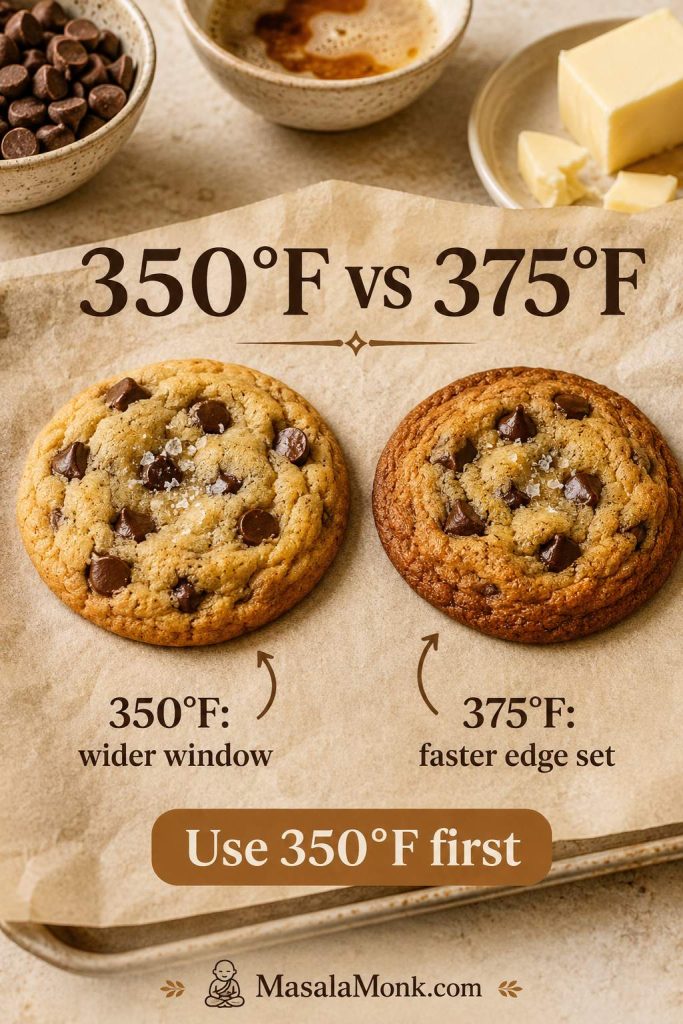
350°F vs 375°F for Brown Butter Cookies
Use 350°F / 175°C as the default because it gives first-time bakers a wider doneness window. The cookies have time to spread slightly, melt the chocolate, and set without over-browning the bottoms.
Use 350°F when you want a forgiving first tray. After you understand the dough, 375°F can give a quicker edge set and slightly deeper browning on well-chilled portions.
Temperature tip: Use 350°F / 175°C for the most even first batch. Use 375°F / 190°C only with well-chilled dough if you want slightly thicker edges and more browning.
If your oven uses round Celsius markings, 180°C is close enough for the default bake; just watch the first tray carefully. Once you know how your oven and trays behave, try 375°F / 190°C for a slightly taller, faster-setting cookie.
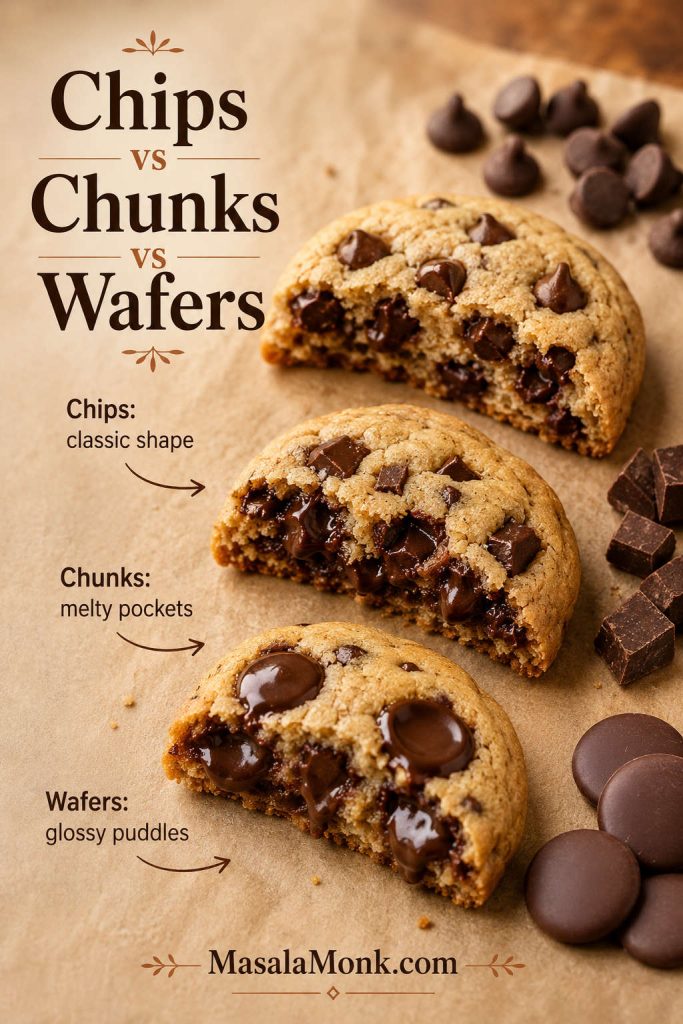
Chocolate Chips vs Chunks vs Wafers
The chocolate changes the personality of the cookie. The dough can be the same, but chips, chopped chocolate, and wafers melt differently.
Choose chocolate based on the bite you want. Chips give a classic cookie look, chunks create uneven melted pockets, and wafers make larger glossy pools of chocolate.
Chocolate type
What it gives
Best use
Chocolate chips
Classic look, neat pieces, less melting
Easy pantry cookies
Chopped chocolate
Melty pockets and tiny chocolate shards through the dough
Bakery-style cookies
Chocolate wafers or fèves
Large glossy puddles
Premium dramatic cookies
Mixed chips and chunks
Shape from chips, melt from chunks
Best everyday version
Chocolate chips are perfectly fine here. The cookies will still taste excellent; they will simply have fewer dramatic melted pockets than a chopped-chocolate batch.
How to Know When the Cookies Are Done
The best cookie moment happens before the tray looks fully finished. If you wait until the centers look completely baked in the oven, the cookies are often overbaked after cooling.
The edges should look set and lightly golden.
The centers should still look soft and slightly puffed.
The tops should no longer look wet, but they should not look firm all the way through.
The bottoms should be golden, not dark brown.
The cookies should smell buttery, nutty, and chocolatey.
The center should not look finished when the cookies come out. If the edges are set and the bottoms are golden, the hot tray will finish the soft middle without drying it out.
Pull them when they still look a little too soft. The baking sheet finishes what the oven started.
Let the cookies rest on the hot baking sheet for 5 to 10 minutes, then move them to a rack. When the batch is right, the cookies settle into soft ripples, the centers still bend slightly, and the chocolate stays glossy enough that breaking one open feels like the reward for waiting through the chill time.
Soft ripples show that the cookies spread, settled, and set at the right pace. The best ones look relaxed on top but still hold together when lifted.
Good cookie rule: If the whole cookie looks completely done in the oven, it may taste overbaked after cooling.
Troubleshooting Brown Butter Cookies
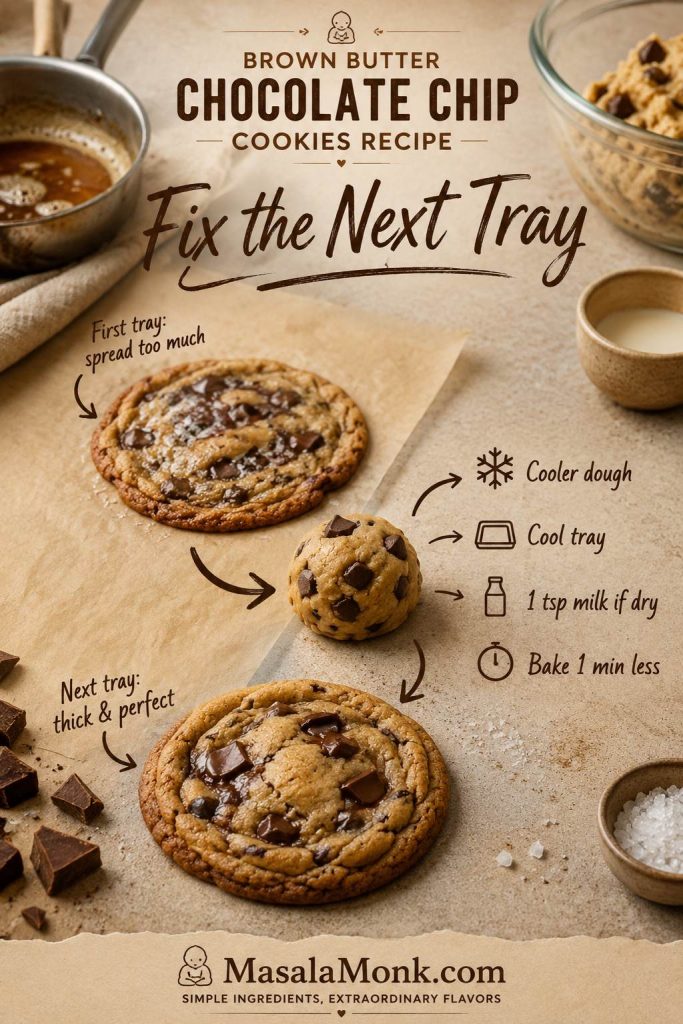
Fix the Next Tray
If the first tray tells you something is off, adjust the next one before baking the whole batch. Most fixes are small: cooler dough, a cooler pan, 1 teaspoon more milk, or 1 minute less in the oven.
A good tray starts before the oven: cooled butter, shaped dough, cold portions, and a cool pan. Most problems come from one of those places.
Treat the first tray like a test batch. If the cookies spread, turn the next tray into the fix: colder dough, cooler metal, or a tiny moisture adjustment if the dough feels dry.
What to Change on the Next Tray
What you see
Likely cause
What to change on the next tray
Cookies spread too much
Dough was too warm, butter was too hot, dough was not chilled, or tray was hot
Cool the butter, chill the shaped dough, and bake on a cool parchment-lined tray
Cookies look greasy
Butter was still hot when mixed
Cool it before adding the egg
Cookies taste dry
Too much flour or too much moisture lost from the butter
Weigh the flour and use the milk adjustment
Cookies bake cakey
Too much flour, overmixing, or too much leavener
Mix gently and measure flour by weight
Cookies barely spread
Dough was over-chilled or flour was overmeasured
Let the shaped dough sit at room temperature for 10 minutes before baking
Brown butter tastes bitter
The milk solids burned
Use medium heat, stir often, and remove at amber brown
Brown-butter flavor feels weak
Butter was not browned deeply enough or brown bits were left in the pan
Cook until nutty and scrape every browned bit into the bowl
Chocolate burned on the bottom
Chocolate pieces sat directly against the hot tray
Fold chocolate evenly and bake on parchment
Cookies look pale
Oven runs cool or dough was too cold and underbaked
Add 1 minute bake time or test 375°F / 190°C with chilled dough
Use this comparison when your first tray spreads too much. A flatter cookie usually points to warm dough, hot butter, or a warm tray; a thicker cookie usually comes from colder portions and cooler metal.
Flat cookies are usually a temperature problem, not a total recipe failure. Chilled dough and a cool tray give the butter time to set before the cookie spreads too far.
Check the Dough Before Baking
Before baking, aim for dough that is thick and scoopable. Shiny-loose dough needs a short rest or a chill. Dry-crumbly dough needs milk, 1 teaspoon at a time, until it comes together.
Variations to Try
Once you have baked the base version once, the dough is easy to adapt. Start with small changes so the brown-butter flavor still comes through.
Start with the base dough, then change one flavor direction at a time. Toffee adds caramel crunch, espresso sharpens the chocolate, pecans add toastiness, and flaky salt makes the butter taste deeper.
Easy Variations That Work with This Dough
Brown Butter Toffee Chocolate Chip Cookies
Add 1/2 cup chopped toffee or toffee bits with the chocolate. Chill the dough well because toffee can make cookies spread and caramelize faster.
Brown Butter Chocolate Chunk Cookies
Use chopped dark or semi-sweet chocolate instead of chips for more melted pockets and a more dramatic bakery look.
Espresso Brown Butter Chocolate Chip Cookies
Add 1 teaspoon espresso powder to the dry ingredients. It deepens the chocolate and toasted-butter flavor without making the cookies taste strongly like coffee.
Brown Butter Pecan or Walnut Cookies
Add 1/2 cup toasted chopped pecans or walnuts. Toasting the nuts first helps them stand up to the browned butter.
Salted Brown Butter Chocolate Chip Cookies
Use salted butter and reduce the fine salt in the dough to 1/4 teaspoon. Finish with only a small pinch of flaky salt, or skip it if your chocolate is already salty.
Variations That Need More Adjustment
Brown Butter Oatmeal Chocolate Chip Cookies
Treat oatmeal as its own formula rather than a quick stir-in. Oats absorb moisture and change spread, so a proper oatmeal cookie needs a slightly different balance.
Gluten-Free Brown Butter Chocolate Chip Cookies
A good 1:1 gluten-free baking flour can work, but the spread and chew may change. Let the dough rest before baking so the flour can hydrate. For a cookie built specifically around gluten-free flour alternatives, start with our almond flour cookies instead.
Eggless Brown Butter Chocolate Chip Cookies
This recipe is not a simple eggless swap because the egg and yolk affect structure, chew, and moisture. If you are learning egg-free baking, our flax egg guide is useful background, but this cookie deserves its own tested eggless formula.
Storage and Freezing
These cookies are excellent warm, but they also store well if you protect them from drying out.
Form
How to store
Timing
Baked cookies
Airtight container at room temperature
3 to 4 days
Chilled shaped dough
Covered in the refrigerator
Up to 3 days
Frozen shaped dough
Freeze on a tray, then transfer to a freezer bag
2 to 3 months
Baking from frozen
Bake straight from frozen or thaw briefly
Add 1 to 2 minutes to bake time
Reheating
Microwave briefly or warm in a low oven
Just until the chocolate softens
If you are freezing shaped dough, use the recipe card for bake times and add 1 to 2 minutes when baking from frozen.
Freeze dough portions on a tray before bagging them so they keep their shape. Later, you can bake straight from frozen and add a minute or two for a fresh-cookie shortcut.
If you want a cookie-style dessert that bakes as one sliceable centerpiece instead, our cookie pie recipe is a better direction than pressing this chilled dough into a deep pan.
This is the kind of dough worth freezing because one warm cookie later still tastes like you made the whole batch from scratch. The kitchen gets the brown-butter-cookie smell again, and the chocolate softens like a fresh tray.
Serving Ideas
These cookies are best when the centers are still soft and the chocolate is a little melty. Serve them warm with milk, coffee, or a scoop of homemade mint chocolate chip ice cream for a simple cookie-and-ice-cream dessert.
A warm cookie and a small scoop of vanilla ice cream make the brown-butter flavor feel even richer. Serve it while the chocolate is still soft, but before the crisp edge disappears.
Once you understand the butter color, dough texture, and soft-center bake cue, the recipe becomes much less intimidating. The recipe below is written for a reliable first batch, not just a dramatic photo batch; start there, then use the texture notes later when you want the cookies thicker, softer, or more chocolate-heavy.
Brown Butter Chocolate Chip Cookies Recipe Card
Save this as the short memory cue for the recipe: brown the butter, cool it, add the milk, scoop before chilling, and judge the bake by set edges and soft centers rather than minutes alone.
These cookies bake with crisp edges, chewy centers, glossy chocolate pockets, and brown butter flavor you can actually taste. The method keeps the dough thick, controlled, and soft in the center instead of flat, greasy, or dry.
Prep Time
25 minutes
Chill Time
1 to 2 hours
Bake Time
8 to 12 minutes per tray
Total Time
About 1 hour 35 minutes to 2 hours 40 minutes, plus extra time for multiple trays
Yield: About 16 large cookies, 20 to 22 medium cookies, or 26 to 28 smaller cookies
Ingredients
170g / 6 oz / 3/4 cup unsalted butter, weighed before browning
165g / 3/4 cup packed brown sugar, light or dark
65g / 1/3 cup granulated sugar
1 large egg, room temperature if possible
1 large egg yolk
1 tablespoon / 15 ml milk, plus up to 1 tablespoon / 15 ml more only if the dough looks dry
2 teaspoons / 10 ml vanilla extract
220g all-purpose flour / about 1 3/4 cups plus 1 tablespoon, spooned and leveled
1/2 teaspoon baking soda
1/4 teaspoon baking powder
3/4 teaspoon fine salt
200 to 225g / 7 to 8 oz semi-sweet or dark chocolate, chopped, chips, or a mix
Flaky salt, optional, for finishing
Instructions
Brown and Mix the Dough
Brown the butter. Add butter to a light-colored skillet or saucepan over medium heat. Let it melt, foam, and crackle, stirring often. Continue cooking until amber brown specks form at the bottom and the butter smells nutty.
Cool the butter. Pour it into a large mixing bowl, scraping in all the browned bits. Cool for 15 to 25 minutes, until liquid and warm, not hot.
Add the sugars. Whisk the brown sugar and granulated sugar into the cooled butter until glossy and thick.
Add wet ingredients. Whisk in the egg, egg yolk, vanilla, and 1 tablespoon milk. Hold back the extra tablespoon unless the dough looks dry later.
Mix dry ingredients. In a separate bowl, whisk together flour, baking soda, baking powder, and fine salt.
Make the dough. Fold the dry ingredients into the wet ingredients until a few flour streaks remain. Add the chocolate and fold just until combined. If the dough looks dry after resting for a few minutes, add milk 1 teaspoon at a time.
Scoop, Chill, and Bake
Scoop. Scoop 55g portions for about 16 large cookies, 45g portions for about 20 to 22 medium cookies, or 35g portions for about 26 to 28 smaller cookies. Place on a lined tray.
Chill. Cover and chill the shaped dough for 1 to 2 hours. For overnight dough, let it sit at room temperature for 10 minutes before baking if very firm.
Preheat. Heat oven to 350°F / 175°C. Line baking sheets with parchment paper.
Bake. Arrange chilled portions on the baking sheet with room to spread. Bake 55g cookies for 10 to 12 minutes, 45g cookies for 9 to 11 minutes, or 35g cookies for 8 to 10 minutes, until the edges are set and the centers still look soft.
Shape and finish. If needed, scoot cookies into rounder shapes with a large round cutter or glass while warm. Sprinkle with flaky salt.
Cool. Rest cookies on the baking sheet for 5 to 10 minutes, then move to a rack.
Notes
Use 1 tablespoon milk by default. Add more only if the dough looks dry.
For thicker cookies, chill the shaped dough closer to 2 hours.
For faster cookies, chill for 30 minutes and expect a little more spread.
For no-chill cookies, use smaller 35g portions and a cool baking sheet.
If using salted butter, reduce the fine salt to 1/4 teaspoon.
If baking from frozen, add 1 to 2 minutes to the bake time.
For a hotter test batch, bake well-chilled dough at 375°F / 190°C and start checking early.
FAQs
Why did my cookies spread?
Usually, something was too warm: the butter, the tray, or the dough itself. Bake chilled portions on a cool parchment-lined tray for the most reliable shape.
Is brown butter the same as melted butter?
No. Brown butter starts as melted butter, but it is cooked longer until the milk solids toast and turn amber. That extra cooking gives the cookies their nutty, caramel-like flavor.
Should brown butter be hot or cooled before making cookie dough?
Cool it first. The butter should be liquid and warm, not hot, before you add the egg.
Do I have to chill the dough?
Yes, for the best texture. Even 30 minutes helps, but 1 to 2 hours gives the most reliable thick, chewy cookie.
What chocolate works best?
Use chopped semi-sweet or dark chocolate for dramatic melted pockets, and chips for a neater classic cookie. A mix gives you familiar chocolate-chip texture plus glossy puddles.
Can I use salted butter?
Yes. Use salted butter if that is what you have, but reduce the fine salt in the dough to about 1/4 teaspoon. Taste the first baked cookie before adding flaky salt to the rest.
Why add milk to brown butter cookie dough?
Browning butter cooks off some water while deepening the flavor. The milk gives a little moisture back, so the cookies stay chewy instead of turning dry or sandy.
Can I make these without brown sugar?
This specific dough depends on brown sugar for chew, moisture, and caramel flavor. A white-sugar-only version will spread and crisp differently, so it needs its own recipe balance.
Are these the same as brown butter toffee chocolate chip cookies?
Not exactly. Toffee is a variation of this base dough. It makes the cookies sweeter and more caramelized, so the dough benefits from a good chill before baking.
Why are my cookies cakey instead of chewy?
The most common reason is too much flour. The dough should be thick and scoopable, not stiff, dry, or crumbly. Weigh the flour if possible; if using cups, spoon it in and level it off instead of packing it down.
How do I freeze the cookie dough?
Scoop the dough, freeze the portions on a tray, then transfer them to a freezer bag. Bake from frozen and add 1 to 2 minutes to the bake time.
What changes for smaller cookies?
Use about 35g dough per cookie and start checking around 8 to 10 minutes. Smaller cookies bake faster and can overbake quickly.
Once you learn the butter color, dough texture, chill-time cue, and soft-center bake point, these cookies stop feeling fussy. You get nutty brown-butter flavor, chewy centers, glossy chocolate, and cookies that hold their shape instead of spreading into disappointment.
For another classic cookie, our peanut butter cookies are a good next bake when you want something simple, nostalgic, and deeply flavored in a different way.
This edible cookie dough recipe is for the spoonful you wanted before the cookies ever reached the oven: soft brown-sugar dough, creamy butter, vanilla, a little salt, and tiny chocolate chips in every bite. It tastes like classic chocolate chip cookie dough, but it is made for eating straight from the bowl — no baking tray, no waiting, no pretending you only wanted “one taste.”
The important difference is safety. This version skips raw eggs and treats flour as something that needs attention, not an ingredient to casually stir in raw. For the most cautious batch, use commercially heat-treated flour labeled ready-to-eat; if you use a home flour-heating method, the notes below explain the limits clearly.
Before You Start: Texture and Safety
The good news is that edible cookie dough does not need to be complicated. Once you understand the flour piece, the rest is simple: cream butter and sugar, add vanilla and salt, mix in the flour, then adjust the texture until it tastes like the middle of a chocolate chip cookie.
Once the base is right, you can keep it classic with mini chocolate chips, make a single-serving bowl, turn it into sugar cookie dough, add peanut butter, roll it into bites, or chill little pieces for ice cream. Start with the chocolate chip version first; it teaches you what the texture should feel like.
Before you start mixing, use the texture cue below as your visual target: the dough should look thick, creamy, and spoonable, not dry, runny, or frosting-soft.
For the smoothest result, the dough should look dense but not dry; in other words, it should stay on the spoon without turning crumbly, stiff, or frosting-soft.
If the craving is really for warm cookies from the oven, use a proper cookie recipe like MasalaMonk’s double chocolate chip cookies instead. This one is built for one job: cookie dough you can enjoy by the spoonful.
What You’ll Find in This Edible Cookie Dough Guide
Use the quick answer if you already know the basics, or go straight to the safety notes if you want to understand the flour and egg issue before mixing.
Quick Answer: How to Make This Edible Cookie Dough Recipe
To make this edible cookie dough recipe, start with ready-to-eat flour or handle the flour using the safety notes below. Let the flour cool completely, then sift it so the dough does not taste lumpy or floury. Cream softened butter with brown sugar and a little granulated sugar, mix in vanilla and salt, add the flour, loosen the dough with milk or cream, and fold in mini chocolate chips.
The texture should be soft and scoopable, like the center of chocolate chip cookie dough before baking. It should not be runny, greasy, sandy, or crumbly. If it feels too thick, add milk one teaspoon at a time. If it feels too soft, chill it for 15 to 20 minutes before serving.
Quick texture cue: the dough should hold on a spoon, but still press easily when you scoop it. If it cracks apart, it needs a little more milk. If it slumps like frosting, it needs chilling or a spoonful of sifted flour.
Edible Cookie Dough Recipe at a Glance
Best flour option: commercially heat-treated flour labeled ready-to-eat
Eggs: none
Texture: creamy, spoonable, and thick enough to hold on a spoon
Best chips: mini semisweet chocolate chips
Chill time: optional, 10–20 minutes if the dough feels soft
Storage: 4–5 days refrigerated, 1–2 months frozen
If you only remember the essentials, keep these in mind first: no eggs, ready-to-eat flour preferred, mini chips for a better bite, and short cold storage for the best texture.
Why This Edible Cookie Dough Works
A good edible cookie dough recipe should not taste like sweet flour paste. It should taste like the spoonful you wanted from a real chocolate chip cookie batch: buttery, brown-sugary, vanilla-scented, lightly salty, and soft enough to scoop.
No eggs: the dough is made for eating, not baking, so eggs are left out completely.
Better flour handling: ready-to-eat flour is the cleanest choice, and the home flour-heating note is explained honestly.
Brown sugar leads: it gives the deeper chocolate chip cookie flavor that plain white sugar cannot.
Softened butter, not melted: softened butter keeps the texture creamy instead of greasy or loose.
Mini chips: smaller chips spread through the dough better, so every spoonful tastes balanced.
Adjustable milk: flour behaves differently after heating, so milk is added slowly instead of dumped in all at once.
Is Edible Cookie Dough Safe to Eat?
The safety piece gets much less confusing once you remember one thing: regular cookie dough is meant to be baked, and this dough is not. A safer edible cookie dough recipe starts with no raw eggs and a better flour choice from the beginning.
According to the CDC, raw dough and batter should not be eaten because uncooked flour and raw eggs can contain germs that may cause food poisoning. Commercial edible dough products, the CDC notes, are made with heat-treated flour and pasteurized eggs or no eggs.
So, is this kind of dough safer than sneaking a spoonful from a regular cookie batch? Yes, when it is made without raw eggs and with ready-to-eat flour. The safest route is commercially heat-treated flour labeled ready-to-eat. Home flour-heating methods are common in recipes, but they are not the same as validated commercial heat-treatment.
Why This Recipe Has No Eggs
Eggs stay out because the bowl is not going into the oven. They help baked cookies with structure, richness, and spread, but raw or lightly cooked eggs can carry food-safety risks. Since this is a spoonable dessert, the simplest direction is to leave eggs out completely.
That also means the dough will not bake like regular cookie dough. It has no eggs for structure and no leavening for lift, so treat it as a no-bake dessert rather than a shortcut cookie recipe.
What to Know About Raw Flour
Flour is easy to overlook because it does not look like a risky ingredient. However, the FDA explains that most flour is a raw food and has not been treated to kill bacteria. Baking or cooking is what normally makes flour-containing doughs safe to eat.
That is why the flour choice matters here. If you can get commercially heat-treated flour labeled ready-to-eat, use it. It gives you the cleanest safety story and keeps the method simple.
That does not mean homemade edible cookie dough is off the table; it just means the flour step deserves a little honesty. Ready-to-eat flour is the strongest option. If you choose to heat flour yourself, treat that step as risk reduction rather than the same thing as commercially processed flour.
Commercially heat-treated ready-to-eat flour keeps the no-bake dough approach cleaner, especially because regular flour is normally made safer through baking or cooking.
About Heating Flour at Home
Many edible cookie dough recipes include a home flour-heating step, but this should be framed carefully. The most cautious choice is still commercially heat-treated flour labeled ready-to-eat. The FDA notes that home flour treatments may not reliably kill all bacteria or make raw flour safe to eat, so treat any home method as a recipe-blog risk-reduction step rather than a validated food-safety process.
For readers who still choose to follow a home flour-heating method, use an instant-read thermometer, spread the flour thinly, stir it during heating, check more than one spot, cool it completely, and sift before mixing.
If you heat flour at home, use the thermometer cue as a careful kitchen step, not a promise; the safest route is still flour processed for ready-to-eat use.
Oven Method Used by Many Recipe Blogs
Preheat the oven to 350°F / 175°C. Spread a little more flour than you need in a thin layer on a parchment-lined rimmed baking sheet. Bake for 7 to 10 minutes, stirring once or twice, until the flour reaches 165°F / 74°C when checked in multiple spots with an instant-read thermometer. Cool completely, sift, then measure or weigh the amount needed for the dough.
Microwave Method Used by Many Recipe Blogs
Place flour in a wide microwave-safe bowl. Microwave for 30 seconds, stir well, then continue in 15-second bursts, stirring and checking the temperature in more than one spot. Let it cool completely and sift before using.
Simple takeaway: use ready-to-eat flour if you can find it. If not, read the home-heating note carefully and understand that it is a common recipe-blog risk-reduction step, not the same as commercial heat treatment.
Ingredients for Edible Cookie Dough
The ingredient list stays close to classic chocolate chip cookie dough, but each item has a job. Since the dough is not baked, little details matter more than usual: softened butter works better than melted butter, mini chips are easier to eat than large chips, and milk should be added slowly.
Because this no-bake dough is eaten as-is, the ingredient balance matters more than usual: softened butter keeps it creamy, brown sugar adds depth, and milk helps fine-tune the consistency.
Ready-to-Eat or Properly Handled Flour
Flour gives the dough its familiar body. Use 1¼ cups / 150g commercially heat-treated all-purpose flour if you can find it. If you use a home flour-heating method, cool the flour completely, sift it, and then measure the final amount into the bowl.
Softened Butter
Use ½ cup / 113g / 4 oz unsalted butter, softened but not melted. Softened butter creams into the sugar and gives the dough a classic texture. Melted butter can make it greasy, loose, or frosting-like.
Brown Sugar and Granulated Sugar
Brown sugar gives the dough that deep chocolate chip cookie flavor. Granulated sugar adds familiar sweetness, but too much can make the texture gritty. This recipe uses mostly brown sugar with just a small amount of granulated sugar for balance.
Vanilla and Salt
Vanilla makes the dough taste like dessert instead of sweet butter and flour. Salt is just as important because it keeps the sweetness from feeling flat. Do not skip it, especially if you are using unsalted butter.
Milk or Cream
Milk or cream loosens the dough after the flour goes in. Start with 1 tablespoon and add more only if needed. Flour can absorb differently after heating, so the best amount is the one that gives you a scoopable texture.
Mini Chocolate Chips
Mini chocolate chips work better than large chips because this dough is eaten soft, not baked. They distribute evenly, so each spoonful has chocolate without turning the bowl into mostly hard chunks.
Optional Baking Soda for Flavor Only
A tiny pinch of baking soda can make the dough taste more like classic cookie dough, but it is optional. If you use it, add only ⅛ teaspoon. It is there for flavor, not because the dough should be baked.
Tools That Make the Texture Better
You can make this with a bowl and spatula, so do not let the tool list make the recipe feel fussy. A few extras simply make the result more reliable: an instant-read thermometer for the flour if you are using a home-heating method, a fine-mesh sieve for lumps, and a scale so the dough does not turn dry from too much flour.
Rimmed baking sheet
Parchment paper
Instant-read thermometer
Mixing bowl
Electric hand mixer or stand mixer
Rubber spatula
Fine-mesh sieve
Digital scale, strongly recommended
Small cookie scoop, optional
Airtight container for storage
A scale is especially useful because flour gets compacted easily. If you scoop too much into the bowl, the dough can turn dry, chalky, or too thick before you even start troubleshooting.
How to Make This Edible Cookie Dough Recipe
The method is easy, but the order makes a big difference. Handle the flour first, let it cool, then build the dough slowly. Warm flour and melted butter are two of the fastest ways to turn a good bowl of cookie dough into something greasy.
The method works best in sequence: prepare the flour first, cream the butter and sugars well, then mix, adjust, and fold in the chips once the texture already feels close.
Step 1: Prepare the Flour
If you are using commercially heat-treated flour, measure or weigh it and move on. If you are using a home flour-heating method, follow the note above, cool the flour completely, and sift it before mixing. Do not add warm flour to the butter mixture.
Step 2: Cream the Butter and Sugars
Add softened butter, brown sugar, and granulated sugar to a bowl. Beat until the mixture looks creamy, lighter, and slightly fluffy. You should still see a thick butter-sugar mixture, not melted butter pooling around the edges. This step helps soften the sugar crystals and gives the dough a smoother bite.
Step 3: Add Vanilla, Salt, and Flour
Mix in the vanilla and salt, then add the cooled, sifted flour. Add the flour gradually if you are mixing by hand. At first, the mixture may look a little thick; that is normal.
Step 4: Adjust the Texture
Add milk or cream one teaspoon at a time. Stir, pause, and check the texture before adding more. The dough should hold its shape on a spoon but still press easily when you scoop it. Stop before it starts looking like frosting.
Add milk slowly, then stir before deciding on more; the dough often softens after a few turns, so patience helps keep it thick and spoonable.
Step 5: Fold in Mini Chocolate Chips
Fold in the mini chocolate chips with a spatula. Taste and adjust with a tiny pinch of salt if it tastes too sweet, or a few extra drops of vanilla if it tastes flat.
Serving cue: this dough is best after a 10-minute rest. That short pause lets the sugar soften slightly and the flour hydrate, so each spoonful tastes smoother.
Spoon test: The dough should lift cleanly and still look creamy before you move to the recipe card.
The spoon test is one of the easiest checks in the whole recipe: if the dough lifts cleanly and still looks creamy, you are usually very close to the ideal finish.
Edible Cookie Dough Recipe Card
This edible cookie dough recipe is a classic chocolate chip version made without eggs and with a safer flour approach. It is designed for eating by the spoonful, rolling into bites, or folding into desserts.
YieldAbout 2½ cups
Servings12–16 small servings
Prep Time10 minutes
Total Time20–25 minutes
Ingredients
1¼ cups / 150g commercially heat-treated all-purpose flour, preferred; or flour handled using the home-heating note above, cooled completely and sifted
½ cup / 113g / 4 oz unsalted butter, softened
½ cup / 100–110g packed light brown sugar
2 tablespoons / 25g granulated sugar
1½ teaspoons / 7ml vanilla extract
½ teaspoon fine salt, or to taste
1–2 tablespoons / 15–30ml milk or cream, added as needed
¾ cup / 120–130g mini semisweet chocolate chips
Optional: ⅛ teaspoon baking soda, for classic cookie-dough flavor only
Method
Prepare the flour. Use commercially heat-treated flour if available. If using a home flour-heating method, follow the safety note above, cool the flour completely, sift it, then measure 150g for the recipe.
Cream the butter and sugars. In a mixing bowl, beat softened butter, brown sugar, and granulated sugar until creamy and slightly fluffy.
Add flavor. Mix in vanilla, salt, and optional baking soda if using.
Add flour. Add the cooled, sifted flour and mix until a thick dough forms.
Adjust texture. Add milk or cream 1 teaspoon at a time until the dough is soft and scoopable.
Add chocolate. Fold in mini chocolate chips. Let the dough rest for about 10 minutes before serving for the smoothest texture.
Notes
This dough is for eating as edible cookie dough, not for baking into cookies.
For the most cautious version, use commercially heat-treated flour labeled ready-to-eat.
If you choose to heat flour at home, use an instant-read thermometer, stir well, check multiple spots, cool completely, and sift before mixing.
If the dough is too dry, add milk 1 teaspoon at a time. If it is too sticky, chill it for 15–20 minutes.
Store refrigerated in an airtight container for 4–5 days, or freeze portions for 1–2 months.
Use the recipe card as your baseline, then adjust only the milk or chill time first; those two small changes usually fix the texture without changing the flavor.
Which Batch Size Should You Make?
Choose the batch based on the kind of cookie dough moment you want. The single-serve version is best for one quick craving, the for-two version is perfect for a small dessert, and the full edible cookie dough recipe works better when you want cookie dough bites, ice cream mix-ins, dessert cups, or a make-ahead treat in the fridge.
Batch size changes the experience as much as flavor does: a single serve suits one craving, a for-two version feels more dessert-like, while a full batch works better for bites or mix-ins.
Make This
Best For
Texture Tip
Single serve
One craving, no leftovers
Add milk slowly because small bowls loosen fast.
For two
Movie night, date night, small dessert
Rest 10 minutes before eating for a smoother bite.
The single-serve version is the bowl to make when you want cookie dough now and do not want leftovers calling your name from the fridge. Because the batch is small, measure the flour and milk carefully; a tiny extra splash can change the texture quickly.
Choose the single-serve bowl when you want cookie dough for one and nothing left over, but add milk carefully because small batches loosen faster than larger ones.
Single-Serve Formula
6 tablespoons / 48g ready-to-eat flour, preferred; or flour handled using the safety note above
2 tablespoons / 28g / 1 oz softened butter
2 tablespoons / 25–28g light brown sugar
1 tablespoon / 12g granulated sugar
¼–½ teaspoon vanilla extract
Small pinch of fine salt
½–1 tablespoon / 7–15ml milk or cream
2 tablespoons / 20–25g mini chocolate chips
Mix it the same way as the main batch: cream the softened butter and sugars, add vanilla and salt, stir in the flour, loosen with milk, and fold in the chips. If you want a firmer scoop, chill it for 10 minutes before eating.
Edible Cookie Dough for Two
This small-batch version makes enough for two dessert portions without leaving a full container in the fridge. That size works especially well for a movie night, date night, or quick no-bake dessert when you want something sweet without baking a tray of cookies.
This small batch is a practical middle ground: enough for a shared dessert, yet still easy to mix without committing to a full container in the fridge.
For-Two Formula
½ cup + 1 tablespoon / about 68g ready-to-eat flour, preferred; or flour handled using the safety note above
4 tablespoons / 56g / 2 oz softened butter
¼ cup / 50–55g light brown sugar
1½–2 tablespoons / 18–25g granulated sugar
½–1 teaspoon vanilla extract
⅛–¼ teaspoon fine salt
1–1½ tablespoons / 15–22ml milk or cream
¼ cup / 40–45g mini chocolate chips
Start with the lower amount of milk, then add more only if the mixture feels too thick. Small batches can go from crumbly to loose quickly, so adjust slowly and give the bowl a minute before adding another splash.
Edible Cookie Dough Variations
Once the base is right, the dough is easy to customize. Keep the same safety logic: no raw eggs, avoid regular raw flour, and adjust the texture slowly because different add-ins change how soft or thick the mixture feels.
Not sure where to start? Make the classic chocolate chip version first, then decide what you want more of next time: extra vanilla, more chocolate, a salty peanut butter edge, a firmer bite for rolling, or a lighter dairy-free version.
Once the base recipe feels right, use the variations to choose your next direction, whether that means sweeter, nuttier, dairy-free, higher-protein, or lower-carb.
If You Want…
Make This Variation
Small Adjustment
Classic chocolate chip flavor
Chocolate chip edible cookie dough
Use mostly brown sugar and mini chips.
A sweeter bakery-style bowl
Sugar cookie dough
Use more granulated sugar and add sprinkles at the end.
A richer, saltier bite
Peanut butter cookie dough
Add creamy peanut butter and reduce the milk slightly.
A firmer bite for rolling
Cookie dough bites
Chill before scooping or dipping.
A lighter dairy-free option
Vegan edible cookie dough
Use vegan butter, dairy-free milk, and dairy-free chips.
Chocolate Chip Edible Cookie Dough
Start here if you want the classic chocolate chip version. Brown sugar, vanilla, salt, softened butter, and mini chocolate chips give you the familiar cookie dough flavor without needing to bake anything.
Classic chocolate chip remains the best place to start, since brown sugar, vanilla, and mini chips come closest to the flavor most people expect from cookie dough.
For deeper chocolate flavor, add 1 to 2 tablespoons of cocoa powder and a splash more milk. For a chunkier bowl, use a mix of mini chips and finely chopped chocolate.
Edible Sugar Cookie Dough
Choose this variation when you want the vanilla-sprinkle side of cookie dough instead of the brown-sugar chocolate chip side. It tastes lighter, sweeter, and more bakery-style.
Use more granulated sugar and less brown sugar. You can replace the brown sugar with granulated sugar for a cleaner vanilla flavor, then add a tiny splash of almond extract if you like bakery-style sugar cookies. Sprinkles, white chocolate chips, and a little extra vanilla work well here. Add sprinkles at the end so they do not bleed too much color into the dough.
Peanut Butter Edible Cookie Dough
This is the richer, saltier variation — the one that tastes like peanut butter cookie dough met chocolate chip cookie dough in the same bowl. Mix ¼ cup creamy peanut butter into the butter and sugar mixture, then reduce the milk slightly. Peanut butter adds richness and salt, so taste before adding extra salt.
Meanwhile, the peanut butter version turns richer and slightly firmer, so it is a smart choice when you want a saltier edge and a more substantial bite.
Mini chocolate chips are great here, but chopped roasted peanuts also work if you want crunch. For a baked version of this flavor, MasalaMonk’s peanut butter cookies are the better route.
Gluten-Free Edible Cookie Dough
For a gluten-free version, use a gluten-free flour blend you already like in no-bake or raw-style applications. Different blends behave differently when they are not baked, so texture matters more than usual here.
If the dough tastes gummy, try a gum-free gluten-free blend next time. If it tastes grainy, let it rest for 10 to 15 minutes before serving. Almond flour can also work, but it gives a softer, nuttier dough rather than a classic all-purpose-flour texture.
Vegan and Dairy-Free Edible Cookie Dough
To make the dough vegan or dairy-free, use vegan butter, dairy-free milk, and dairy-free chocolate chips. The same method works, but the mixture may soften faster depending on the vegan butter you use.
The dairy-free version should still feel like dessert first: creamy, scoopable, and close to the original texture, just made with vegan butter, dairy-free milk, and dairy-free chips.
If you want a dairy-free frozen dessert to pair with cookie dough bites, MasalaMonk’s coconut ice cream is a natural next recipe.
Protein Edible Cookie Dough
The protein version goes in a different direction from the classic butter-and-brown-sugar dough, but it is useful when you want the cookie dough idea in a higher-protein snack. For a quick version, blend cottage cheese until completely smooth, then stir it with almond flour or oat flour, vanilla protein powder, a little maple syrup or sweetener, vanilla, salt, and mini chocolate chips.
Protein cookie dough goes in a different direction from the classic bowl; still, it can be useful when you want the same dessert idea in a more filling, snack-like version.
Chill it before eating so the texture firms up. If you like high-protein desserts, MasalaMonk’s protein ice cream goes deeper into protein powder, Greek yogurt, dairy-free, low-calorie, and sugar-free frozen dessert options.
Keto or Sugar-Free Edible Cookie Dough
Expect a nuttier, softer dough than the classic chocolate chip version. For a keto-style bowl, use almond flour instead of wheat flour, a low-carb sweetener instead of sugar, and sugar-free chocolate chips. Because almond flour has more fat and less starch than all-purpose flour, start with less added milk and adjust slowly.
Because almond flour behaves differently from all-purpose flour, keto edible cookie dough usually turns out softer and nuttier, with a flavor that feels less classic but still satisfying.
For another low-carb dessert direction, MasalaMonk’s keto hot chocolate is a good companion recipe.
How to Fix Edible Cookie Dough Texture
If your first spoonful is not perfect, do not panic. Edible cookie dough is one of the easiest desserts to adjust because nothing has been baked yet. Most texture problems come down to flour, butter temperature, or adding the milk too quickly.
The easiest way to fix the dough is to change only one thing at a time. Add milk slowly, chill before adding more flour, and taste again after a short rest.
Look at the texture before changing the recipe: crumbly dough needs slow moisture, loose dough needs chilling, and the best bowl sits somewhere in between.
Problem
Likely Cause
Fix
Dry or crumbly texture
Too much flour, packed flour, or not enough milk
Add milk or cream 1 teaspoon at a time until scoopable.
Sticky dough
Butter too warm or too much milk
Chill 15–20 minutes, or add 1 tablespoon sifted flour.
Gritty bite
Sugar has not softened into the butter enough
Cream the butter and sugars longer, or let the dough rest 10 minutes.
Floury flavor
Flour was overmeasured or not sifted after heating
Use grams, sift after heating, and add a little vanilla or salt to balance.
Overly sweet dough
Too much sugar or too many chips
Add a pinch of salt and 1–2 tablespoons flour.
Greasy or soupy texture
Butter was melted instead of softened
Chill, then stir. Next time, use softened butter.
Very firm after chilling
Butter hardened in the fridge
Let the dough sit at room temperature for 10–15 minutes before serving.
How to Fix Dry or Crumbly Dough
Start with a teaspoon of milk or cream, then stir before adding more. Small corrections work better here because dry dough can move from crumbly to loose surprisingly quickly.
If the dough turns dry or crumbly, fix it gradually rather than all at once; a teaspoon of milk or cream is usually enough to start bringing it back together.
How to Fix Sticky or Too-Soft Dough
Chill first so the butter firms up before you add more flour. After a short rest in the fridge, the same bowl often becomes scoopable without turning heavy or floury.
Chilling gives the butter time to firm up again; as a result, soft dough often becomes scoopable without needing extra flour.
Can You Bake Edible Cookie Dough?
No, this edible cookie dough is made for spooning, scooping, and rolling into bites — not for baking. It has no eggs and no leavening, so it will not behave like regular cookie dough in the oven. Instead of turning into chewy cookies, it may spread, turn greasy, stay dense, or bake up flat.
Edible cookie dough is made for spooning and scooping, not for baking; therefore, use a proper cookie recipe whenever the goal is warm cookies from the oven.
Think of this as a no-bake dessert, not a shortcut cookie dough. If the craving is really for warm cookies from the oven, use a recipe designed for baking, like MasalaMonk’s double chocolate chip cookies. If you want a roll-and-cut dough, MasalaMonk’s gingerbread cookies are a better example of dough built for shaping and baking.
Ways to Use Edible Cookie Dough
Eating it by the spoonful is the obvious answer, but this dough can do more. Because it is eggless and made with a safer flour approach, you can use it as a no-bake dessert component instead of treating it like leftover raw cookie dough.
Easy No-Bake Ways to Serve It
Eat it by the spoonful after a 10-minute rest for smoother texture.
Roll it into bites and chill until firm.
Dip the bites in melted chocolate and finish with flaky salt.
Fold chilled pieces into ice cream for homemade cookie dough ice cream.
Blend a spoonful into a milkshake for cookie dough flavor.
Use it as a brownie topping after brownies have cooled.
Layer it into dessert cups with whipped cream, chocolate sauce, or berries.
Press it into mini tart shells for a no-bake cookie dough dessert.
Beyond the spoonful, this dough can become bites, brownie topping, milkshake flavor, or ice cream mix-ins, so one batch can stretch into several no-bake dessert ideas.
Cookie Dough Ice Cream and Mix-In Safety
Ice cream note: only use dough made with ready-to-eat ingredients for ice cream mix-ins. Do not fold regular raw cookie dough into ice cream; the pieces should be made without raw eggs and with a safer flour approach.
Small chilled pieces are especially good folded into homemade ice cream. For a chocolate-chip frozen dessert direction, see MasalaMonk’s mint chocolate chip ice cream.
If you want another no-bake spoonable dessert, MasalaMonk’s avocado chocolate mousse gives you a chocolate-rich option with a completely different texture.
How to Store and Freeze Edible Cookie Dough
Because the dough contains butter and milk or cream, it should be stored cold. Do not leave it sitting out for long serving windows, especially in a warm kitchen.
Refrigerator: Store in an airtight container for 4–5 days.
Freezer: Freeze portioned balls or scoops for 1–2 months.
To serve from the fridge: Let it sit at room temperature for 10 minutes so the butter softens slightly.
To freeze neatly: Scoop into balls, freeze on a lined tray until firm, then transfer to a freezer-safe container.
Cold storage firms the butter, so let refrigerated scoops rest briefly before serving; meanwhile, freezing in portions makes later dessert bowls much easier.
If you are making cookie dough bites for a party, keep them chilled until close to serving time. For the best texture, portion them small enough that people can eat them in one or two bites.
Protein versions made with cottage cheese or yogurt should be treated as more perishable. Keep them refrigerated, use clean utensils, and aim to eat them within 2–3 days rather than keeping them as long as the classic butter-based version.
FAQs
Is this edible cookie dough recipe safe to eat?
Edible cookie dough is safest when it is made without raw eggs and with commercially heat-treated flour labeled ready-to-eat. Regular raw cookie dough is not meant to be eaten because it usually contains raw flour and raw eggs. Home flour-heating methods are common in recipes, but they are not the same as commercially validated heat treatment.
What is the safest flour for edible cookie dough?
The safest flour choice is commercially heat-treated flour labeled ready-to-eat. Regular all-purpose flour is raw and is normally made safe through baking or cooking, not by being stirred directly into a no-bake dessert.
Why does edible cookie dough need safer flour handling?
Most flour is raw and has not been treated to kill bacteria. Regular cookie dough becomes safer when baked, but edible cookie dough is not baked. That is why this recipe uses ready-to-eat flour guidance instead of asking you to stir plain raw flour into dessert.
How do I make edible cookie dough without eggs?
This recipe is eggless by design. Eggs are useful in baked cookies, but they are not needed here because the dough is made for spooning, not for going into the oven.
How does almond flour change the texture?
Almond flour makes a softer, nuttier dough and works best in keto, gluten-free, or vegan-style edible cookie dough. It will not taste exactly like classic chocolate chip cookie dough made with all-purpose flour, so start with less milk and adjust slowly.
How do I make this edible cookie dough recipe gluten-free?
Use a gluten-free flour blend you already like in no-bake applications, or use almond flour for a softer variation. If your gluten-free dough feels gummy, try a gum-free blend next time. If it feels grainy, let it rest for 10 to 15 minutes before eating.
How do I make a vegan version?
For a vegan version, use vegan butter, dairy-free milk, and dairy-free chocolate chips. The dough may soften more quickly depending on the vegan butter, so chill it if it feels too loose.
How do I make edible cookie dough for one?
For one serving, use 6 tablespoons / 48g ready-to-eat flour, preferred; or flour handled using the safety note above, plus 2 tablespoons softened butter, 2 tablespoons brown sugar, 1 tablespoon granulated sugar, vanilla, salt, ½ to 1 tablespoon milk, and 2 tablespoons mini chocolate chips. Mix, adjust the texture, and chill briefly if needed.
Why should this dough not be baked?
This dough is made for eating, not baking. It has no eggs and no leavening, so it can bake up flat, greasy, dense, or crumbly. Use a real cookie recipe if you want baked cookies.
How long does edible cookie dough last in the fridge?
Store edible cookie dough in an airtight container in the refrigerator for 4–5 days. Let it sit at room temperature for about 10 minutes before eating if it becomes too firm.
How should you freeze edible cookie dough?
Freezing works best when the dough is portioned first. Scoop it into small balls, freeze them on a lined tray until firm, then move them to a freezer-safe container. Use within 1–2 months for the best texture.
Once you have the base texture right, this edible cookie dough recipe becomes the kind of dessert you can make your own: extra vanilla, darker chocolate, sprinkles, peanut butter, or chilled bite-size scoops tucked into ice cream. Start with the classic chocolate chip version first, then let the next batch follow your craving.
Make a quick note of what you changed — more salt, less milk, extra chips, longer chill time. The best edible cookie dough is the one you can repeat exactly when the craving hits again.
A truly great cookie pie recipe gives you something a regular cookie often cannot: crisp edges, a thick soft center, generous slices, and that unmistakable contrast between structure and richness. It has the comfort of cookie dough, the shape and drama of a pie, and the kind of richness that feels just right for birthdays, dinner parties, holidays, or simply a weekend when you want dessert to feel a little more special.
That balance is a large part of the dessert’s appeal. It feels more substantial than a tray of cookies, yet it is far less fussy than a layered cake or a plated dessert with multiple components. With the base recipe in hand, you can move from a classic chocolate chip cookie pie to a stuffed Biscoff cookie pie, a rich Nutella cookie pie, a dark brookie pie, a shareable giant cookie pie, or even mini cookie pies without relearning the whole category from scratch.
This guide is meant to help you bake well, not merely skim the idea. You will find the practical details that matter in a dessert like this: pan guidance, filling amounts, dough feel, chilling time, doneness cues, texture goals, variation strategy, storage, and the most common mistakes that throw the result off. If rich chocolate bakes are already part of your comfort zone, these double chocolate chip cookies are a natural next stop. Likewise, if alternative flour blends matter in your kitchen, this guide to keto flour for baking will be useful when you reach the gluten free section later on.
Quick Cookie Pie Recipe Snapshot
Before getting into the full method, here is the quick-glance view so you can see the shape of the bake at once.
Before you get into the full method, this cookie pie recipe snapshot gives you the key setup at a glance: pan size, yield, timing, texture goal, and the best starting variation for the easiest first bake.
Yield and Pan Size
This base makes one deep 8-inch cookie pie, which usually gives you 8 to 10 slices depending on how generously you cut it. If you adapt the dough to a muffin tin, you can also turn it into about 10 to 12 mini cookie pies, although the exact number depends on the cavity size and how heavily you fill them.
For the main version, an 8-inch deep round cake tin or an 8-inch springform pan works best. Both give you enough depth for a properly soft center while still allowing the edges to brown cleanly. A shallower pan can still work, but the dessert will move closer to cookie cake territory and lose some of the thick, bakery-style feel that makes cookie pie so satisfying.
Timing, Bake Window, and Texture Goal
Plan for about 20 minutes of prep, 30 to 45 minutes of chilling, 32 to 40 minutes of baking, and at least 1 hour of cooling. In practice, that means a little over 2 hours from start to finish if you include the rest that allows the center to settle properly before slicing.
The texture target is simple, although it matters enormously: golden edges, a top that looks set rather than wet, and a center that still appears slightly softer than the outer ring. Once cooled, each slice should feel thick, rich, and tender without collapsing.
Best First Version to Bake
If this is your first time making cookie pie, start with Chocolate Chip Cookie Pie. It is the clearest version, the easiest to read in the oven, and the most forgiving in terms of structure and bake cues.
If a gooier, stuffed center is the main attraction, move next to Biscoff Cookie Pie. If your priority is darker, deeper chocolate, Brookie Pie is where the payoff becomes especially dramatic.
A strong cookie pie only becomes truly good when it balances three things at once: structure, softness, and flavor. The dough has to be strong enough to hold a thick center or a filling, yet still soft enough to feel richer and more indulgent than a standard cookie. At the same time, the dough itself has to feel complete in flavor. Otherwise, the dessert becomes overly dependent on the filling to carry the experience.
For that reason, this version leans on softened butter, brown sugar, enough flour for body, and a baking window that protects the middle from drying out. Brown sugar keeps the middle softer and more flavorful. Butter brings richness and helps the edges brown attractively. Flour gives the dough the strength it needs, although too much will quickly make the texture dull, heavy, or bready.
Just as importantly, this base is flexible. A plain chocolate chip cookie pie can use it almost exactly as written, while a stuffed Nutella cookie pie or Biscoff cookie pie only asks for a few handling changes rather than an entirely different formula. Once the structure makes sense, the whole category becomes much easier to navigate.
What Is Cookie Pie?
Cookie pie is a thick, sliceable dessert made by baking cookie dough in pie form. Sometimes that means a thick, deep dessert with a bottom shell, a filling, and a top layer of dough. At other times, it means a large, soft, pie-shaped cookie baked in a round tin and sliced at the table. Both styles sit comfortably under the cookie pie umbrella, although the texture and visual impact vary a little.
Part of its appeal is that it sits in a very pleasing middle ground. It is more substantial than ordinary cookies, less elaborate than cake, and easier to adapt than many classic desserts. As a result, it can feel just as natural at a celebration as it does on an ordinary evening when you simply want something warm, rich, and satisfying.
Cookie pie sits in a useful middle ground: deeper and softer than cookie cake, very different from pie-inspired cookies, and flexible enough to be made as either a classic dough-forward bake or a more dramatic stuffed version.
Cookie Pie vs Cookie Cake
A cookie cake is usually flatter and more focused on the top. Very often, it is decorated with frosting, writing, borders, or celebration-style details. Cookie pie, by contrast, is more interested in depth and internal texture. Even when the surface looks simple, the interior is where the payoff sits.
That is especially true in a giant cookie pie. Even though the format is large and shareable, the goal is still a soft center and thick slice rather than a broad flat cookie with decorations.
Cookie Pie vs Pie Cookies
These terms sound close, but they refer to different ideas. Pie cookies usually means cookies inspired by pie flavors, such as apple pie cookies or pecan pie cookies. A true cookie pie, on the other hand, is built from cookie dough and baked as one sliceable dessert.
That distinction matters because it changes both the method and the expectation. This guide is about the real cookie pie format: dough-forward, thick, sliceable, and centered on the texture of a rich baked middle.
The Two Main Cookie Pie Styles
Before you begin, it helps to separate the two main styles.
The first is the classic style, where the dough itself is the main event. Think of a deep chocolate chip cookie pie with a rich center and no dramatic stuffed filling. The second is the stuffed style, where the dough forms a shell and a separate middle goes inside. This is the route for Biscoff cookie pie, Nutella cookie pie, and some brownie-based versions.
Both are excellent, but they reward slightly different approaches. The classic version is easier to read and easier to learn on. The stuffed version offers a more dramatic slice, although it asks for better chilling, a more controlled filling border, and a little more patience.
How to Choose the Best Cookie Pie Version for Your Needs
One of the nicest things about this dessert is that it suits very different dessert moods without requiring a completely new skill set. Even so, choosing the right version at the beginning makes the process smoother and the final result more satisfying.
Not every cookie pie is aiming for the same result. This quick chooser helps you match the version to the kind of bake you want most, whether that means an easier first attempt, a gooier center, deeper chocolate flavor, or a format that is easier to share.
Best Cookie Pie for First-Time Bakers
For the easiest place to begin, bake Chocolate Chip Cookie Pie. It asks the least from the baker, needs no separate filling disc, and gives you the best feel for how the dough should behave. The doneness cues are also easier to read because you are not evaluating a stuffed center at the same time.
Best Cookie Pie for a Gooey Center
For a dramatic, visibly gooey middle, Biscoff Cookie Pie and Nutella Cookie Pie are the strongest options. “Both give you that dramatic cross-section where the center looks noticeably different from the shell.
Biscoff is slightly easier to control because it stays thicker when chilled. Nutella is softer and more molten, which can be wonderful, although it also means the structure needs a little more care.
Best Cookie Pie for Chocolate Lovers
For a deeper chocolate direction, you have two especially strong choices. Brookie Pie gives you the contrast of cookie and brownie in the same slice, which makes the texture more layered and the chocolate flavor more varied.
Brownie Cookie Pie, by comparison, pushes the whole dessert in one darker, denser direction. It feels more unified, more intense, and slightly more serious in flavor.
Best Cookie Pie for Sharing, Gifting, or Parties
When ease of serving matters most, go with Mini Cookie Pies or Giant Cookie Pie. Mini versions are ideal for dessert trays, edible gifts, and testing multiple fillings in one batch. Giant cookie pie, meanwhile, is excellent when you want a relaxed centerpiece dessert that still feels generous once it lands on the table.
This base holds the whole post together. Once this version works for you, the rest of the variations become much easier because you are adjusting a structure you already understand rather than improvising through a completely different dessert every time.
What makes this version dependable is that it aims for the texture most people actually want: lightly crisp edges, a tender-set middle, enough depth to feel generous when sliced, and enough strength to support fillings without turning dense or cakey.
This is the base cookie pie recipe the rest of the post builds from. From here, it becomes much easier to branch into stuffed, darker, mini, or party-style variations without losing the texture that makes cookie pie worth baking in the first place.
At a Glance
Yield: 1 deep 8-inch cookie pie, about 8 to 10 slices
Best pan: 8-inch deep round cake tin or 8-inch springform pan
Prep time: about 20 minutes
Chill time: 30 to 45 minutes
Bake time: 32 to 40 minutes
Cooling time: at least 1 hour
Texture goal: golden edges, set top, soft center
Best first version: Chocolate Chip Cookie Pie
Best stuffed version: Biscoff Cookie Pie
Yield, Pan, and Texture Expectations
This recipe makes one deep 8-inch cookie pie with 8 to 10 slices. The ideal result is a dessert that feels lightly crisp at the outer edge, tender within, and thick through the middle without ever tasting raw.
For the best result, use an 8-inch deep round tin or springform pan. A shallower pan can still work, but the pie will bake flatter and edge closer to cookie cake territory. A deeper pan gives the dough enough height to stay tender through the middle while still browning well around the edges.
Ingredients
You will need:
225 g unsalted butter, softened
180 g light brown sugar
90 g caster sugar
2 large eggs
2 teaspoons vanilla extract
360 g all-purpose flour
1 teaspoon baking soda
1 teaspoon fine salt
250 g chocolate chips or chopped chocolate
Optional, depending on the version:
180 to 220 g filling such as Biscoff or Nutella
extra chocolate chunks for the top
white chocolate chips
chopped hazelnuts
brownie filling
cream cheese-style filling
Equipment
Keep the setup straightforward:
large mixing bowl
medium bowl
hand mixer or stand mixer
spatula
digital scale
8-inch deep round tin or springform pan
parchment paper
cooling rack
A digital scale helps more than many bakers expect here, because even a modest excess of flour can make the center heavier and drier than intended.
A few ingredients shape this dessert more noticeably than they would in an ordinary batch of cookies. Because the dough is thicker, deeper, and sometimes asked to hold a filling, small ingredient choices show up clearly in the final texture.
A great cookie pie starts feeling right long before it goes into the oven. Softened butter, the right sugar balance, enough structure from the eggs and flour, and a well-chilled filling all work together to give you a softer center, better browning, and cleaner slices.
Butter
Use softened butter, not melted butter. Softened butter creams properly with the sugars and helps the dough keep its structure. Melted butter makes the mixture looser, greasier, and harder to control, especially in stuffed versions.
You want butter that yields when pressed but is not shiny or oily. If it is too cold, it will not cream well. If it is too warm, the dough will lose some of its shape before it ever reaches the oven.
Brown Sugar and White Sugar
Brown sugar is one of the main reasons the center stays soft and chewy. It brings moisture, depth, and that darker caramel-like cookie flavor that makes a thick slice feel rich rather than flat.
White sugar still matters. It sharpens the sweetness, supports browning, and helps the outer structure bake more cleanly. Using both gives you a much better balance than relying on only one.
Eggs
Eggs do more than bind the dough. They help the pie set through the center, support sliceability, and add richness. In a dessert like this, where the center needs to stay soft without collapsing, the eggs do a great deal of structural work.
That is why it is worth using large eggs as written. Smaller eggs can leave the dough a little tighter, while oversize eggs can soften it more than intended.
Flour
Flour provides the body that lets the pie stay thick without sinking. Even so, too much flour will quickly push the texture toward dry, dull, and overly bready.
For that reason, weighing the flour is one of the simplest ways to improve your result. If you want a reliable refresher, King Arthur’s guide on how to measure flour correctly is worth reading.
Baking Soda and Salt
Baking soda gives the dough lift and helps it bake with tenderness rather than staying heavy all the way through. Salt is just as important. In a rich dessert like this, it keeps the sweetness from tasting flat and gives the chocolate, brown sugar, and fillings more definition.
Chocolate
Chocolate is not just a mix-in here. It helps shape the eating experience of the whole slice. A mix of chopped chocolate and chips usually gives a better result than chips alone, because chopped chocolate melts into softer streaks while chips stay more distinct.
That contrast makes the finished pie feel more layered and more polished once sliced.
Fillings
Stuffed versions work best when the filling is thick and cold before assembly. Biscoff, Nutella, brownie filling, and cream cheese-style centers all behave better when chilled first. Warm or loose fillings are far more likely to spread into the shell and blur the middle.
Chilling
Chilling is not optional if clean structure is the goal. It firms the dough, helps the shell hold its shape, slows spreading, and makes stuffed versions noticeably easier to bake well.
In plain versions, chilling improves control. In stuffed versions, it often makes the difference between a distinct center and a muddy one.
The method is straightforward, but the feel of the dough matters just as much as the order of the steps does.
Step 1: Cream the Butter and Sugars
Beat the softened butter, brown sugar, and caster sugar together until the mixture looks creamy and slightly lighter. You do not need huge volume here. You are looking for smoothness, evenness, and a texture that no longer looks grainy or uneven.
Step 2: Add the Eggs and Vanilla
Add the eggs one at a time, mixing well after each addition. Then stir in the vanilla. At this stage, the mixture should still look thick and cohesive rather than loose or split.
Step 3: Mix the Dry Ingredients
In a separate bowl, whisk together the flour, baking soda, and salt. This may seem like a minor step, but it helps the leavening and seasoning distribute more evenly through the dough.
Step 4: Bring the Dough Together
Add the dry ingredients to the butter mixture and mix just until combined. Once the flour disappears, fold in the chocolate. The finished dough should feel thick and scoopable, not runny and not cake-like.
Step 5: Prepare the Pan
Line the base of the pan with parchment and lightly grease the sides. This small piece of preparation makes it much easier to release the finished pie without tearing the edges or losing the clean round shape.
Assembling cookie pie becomes much easier once you can see the order clearly: line the pan, press the dough into a shell, keep the filling centered, then top and chill the pie before baking.
Step 6: Build the Shell
Divide the dough so that about 60 percent is used for the base and sides, while the remaining 40 percent becomes the top. Press the larger portion into the base and slightly up the sides of the pan, keeping the thickness as even as you can.
That evenness matters more than it may seem at first. If the shell is thick in some places and thin in others, the bake can turn uneven once the filling or top layer goes in.
Step 7: Add the Filling if Using
If you are making a stuffed version, place the filling in the center and leave a border of about 1.5 cm around the edge. This gap helps contain the middle and keeps the filling from leaking outward during baking.
As a guide, use around 180 to 200 g for Biscoff or Nutella, about 150 g for brownie filling, or around 180 g for a cream cheese-style center.
Step 8: Add the Top
Flatten the remaining dough in portions and place it over the center. Seal the edges gently. Do not mash the top down hard. You want it enclosed, but still loose enough to bake tenderly rather than compactly.
Once the cookie pie is assembled, the last part is mostly about patience. Chill it first so the dough holds its shape, bake until the edges are golden and the top is set, then cool fully before slicing so the center can settle and the wedges hold more cleanly.
Step 9: Chill the Assembled Pie
Chill the pie for 30 to 45 minutes before baking. The dough should feel cooler, firmer, and less sticky at the surface. That is a better signal than the clock alone, because room temperature changes how quickly the pie firms up.
Step 10: Bake
Bake at 175°C / 350°F until the edges are golden and the top looks set. Most versions take 32 to 40 minutes in an 8-inch deep pan.
If the top browns too quickly while the center still needs time, loosely tent with foil and continue baking.
Step 11: Cool Properly
Let the pie cool in the pan for at least 1 hour before slicing. For the cleanest and most stable slices, cool it for closer to 2 hours. Warm slices will always be looser and messier, especially in filled versions, so do not judge the final texture too early.
This is one of the most important parts of the entire bake, because the line between soft and underbaked can feel confusing at first. The aim is not a dry, fully firm middle straight from the oven. Instead, you want a pie that looks set around the edges and on top while the middle still looks a little more relaxed and finishes settling as it cools.
A good cookie pie should not look wet or liquid in the center. At the same time, it should not look hard and fully dry all the way across the surface. The best way to think about it is this: the pie should look baked rather than raw, while still staying tender through the middle.
Because the line between soft and underbaked can be easy to misread, this visual guide shows what cookie pie should look like at each stage so you can pull it from the oven with more confidence.
Visual Signs to Trust
the edges look set and lightly golden
the top no longer looks glossy-wet
the center still looks slightly softer than the outer ring
the pie gives a little when nudged, but does not ripple like batter
the whole surface looks settled rather than shiny and loose
Properly Baked
Look for edges that are clearly golden and set, a top that no longer looks wet, and a center that yields slightly when nudged but still holds its shape. The pie should continue setting as it cools.
Slightly Underbaked but Still Fine
If the middle feels looser than expected, yet the edges are done and the top is set, do not panic. Many cookie pies finish settling during cooling, especially when the filling or chocolate content is high.
Truly Underdone
If the center still looks glossy and loose, sinks dramatically, or spills like batter when sliced after proper cooling, it needed more baking time. Too much filling can also cause this.
Overbaked
If the top looks dry all over, the edges darken too far, and the middle loses its soft character after cooling, the pie has gone too far. It may still taste good, but it will lose the texture that makes cookie pie special.
Texture Guide
Gooey: best for stuffed versions, very soft center, more dramatic slices
Soft-set: ideal for classic chocolate chip cookie pie
Fully set: firmer slices, easier for transport, less molten character
Most people are happiest somewhere between gooey and just set.
If you want the clearest and most reliable version of the whole format, chocolate chip cookie pie is it. This is the variation that most clearly shows what a great slice should feel like: thick, buttery, soft through the middle, and generous with chocolate without needing a separate stuffed filling to make its point.
Because it uses the base dough almost exactly as written, it is also the easiest place to build confidence. You are not judging an extra center, managing a filling border, or wondering whether the pie is done because of two different textures. You are simply learning how the dough bakes and what the pie should look like when it is ready to come out.
Chocolate chip cookie pie is the easiest version to learn on because the dough itself does the work. This recipe card keeps the process simple, shows the chocolate balance that gives the best texture contrast, and helps you focus on the soft center without the extra variable of a stuffed filling.
Best Chocolate Balance
A particularly good mix is 150 g dark or semi-sweet chopped chocolate plus 100 g milk chocolate chips. That combination gives you contrast in both sweetness and texture. Chopped dark chocolate melts into softer streaks, while the milk chocolate chips stay more distinct.
If you prefer, you can also lean toward dark and white chocolate for stronger visual contrast. Either way, using more than one kind of chocolate makes the final slice feel more layered.
Easiest Way to Get It Right
Do not overcomplicate this first version. Skip the filling, keep the dough thickness even, chill properly, and trust the soft-center bake cue. That is enough to give you a dependable result.
If you want to push the chocolate flavor slightly further without changing the structure, a drizzle of homemade chocolate syrup over a warm slice can be lovely.
After the base clicks into place, the fun part begins. This is where the format starts showing how flexible it really is.
With the base dough in place, you can take the same cookie pie recipe in several directions. Use this variation guide to compare classic, stuffed, mini, giant, vegan, and gluten free options before choosing the version that best matches the texture, flavor, and baking style you want.
Biscoff Cookie Pie
Biscoff cookie pie is one of the best stuffed versions because the filling is flavorful, thick, and comparatively stable. Freeze or chill the Biscoff spread in a disc before assembly if you want the cleanest center and the most obvious stuffed effect in the final slice.
If you want to try a stuffed cookie pie without starting with the trickiest version, Biscoff is usually the smartest place to begin. Its thicker filling is easier to control, so you get a cleaner center, a more defined shell, and a bakery-style slice without fighting a filling that runs too quickly.
The overall result is caramelised, spiced, warm, and deeply indulgent. For a first filled version, this is usually the smartest one to choose.
Nutella Cookie Pie
Nutella cookie pie is looser and more dramatic. The hazelnut-chocolate center melts more easily than Biscoff, so chilling matters even more here.
Nutella cookie pie is softer and more molten than Biscoff, so this version rewards a little more care. Chilling the center well and keeping it away from the edges helps you get the dramatic middle you want without letting the filling run too far as the pie bakes.
For a richer finish, add a few chopped hazelnuts to the dough or scatter them over the top. Just keep the filling away from the edges, because Nutella is quick to travel once warm.
Brookie Pie
Brookie pie gives you the appeal of both desserts at once. Part of the pie stays firmly in the cookie world, while the center or one layer leans brownie. That contrast is what makes each slice especially memorable.
Brookie pie works best when the contrast stays clear: cookie around the edges, brownie depth through the middle, and a center that looks soft-set rather than fully firm. This version is richest when you let the brownie layer stay dense and fudgy without overbaking the whole pie.
Because brownie filling is denser, this version benefits from careful baking. The edges can be done before the very middle looks fully ready, so trust the just-set cue rather than waiting for a completely firm middle.
Brownie Cookie Pie
Brownie cookie pie is darker and more unified than brookie pie. Instead of building contrast between two layers, it pushes the whole dessert in one deeper chocolate direction.
Brownie cookie pie works best when you treat it as a darker adaptation of the base recipe rather than a stuffed variation. The aim here is a deeper chocolate crumb, a fudgier middle, and enough structure at the edge to keep the slice rich without turning dry.
To adapt the base, reduce the flour slightly to about 330 g, add 30 g cocoa powder, increase the dark chocolate, and optionally include 1 teaspoon espresso powder. The finished pie should feel chewy at the edge and almost fudgy in the middle. Because cocoa-heavy dough dries out quickly once overbaked, start checking early.
Mini Cookie Pies
Mini cookie pies are one of the most practical adaptations in the entire format. Use a muffin tin, press dough into each cavity, add a spoonful of filling or extra chocolate, top with more dough, and chill briefly before baking.
Mini cookie pies are one of the easiest ways to turn the same idea into something more flexible. They bake faster, portion more neatly, and make it much easier to serve a crowd, test different fillings, or build a dessert tray without committing to one large pie.
They usually bake in about 14 to 18 minutes, so start checking early. These are especially useful for parties, gifting, or trying several fillings from one batch. They also sit very nicely alongside softer desserts such as no-bake banana pudding if you are building a mixed dessert table.
Giant Cookie Pie
A giant cookie pie is ideal for a relaxed, shareable centrepiece dessert. Use a 9-inch or 10-inch round cake pan, but keep enough dough depth that the center still stays soft. If you spread the dough too thin, the dessert will drift toward cookie cake rather than a proper pie-style slice.
A giant cookie pie works best when it still feels like cookie pie in the middle rather than drifting into cookie cake. Keeping enough dough depth is what gives you those thicker, softer wedges that feel generous when sliced and much more satisfying to share at the table.
Chocolate chip works especially well here, although a light Nutella swirl or mixed chocolate chunks can also be lovely.
Vegan Cookie Pie
A vegan cookie pie works best with a firm plant-based baking block, flax eggs, and dairy-free chocolate. If you need a reference for the egg swap, this guide on how to make a flax egg is helpful.
A good vegan cookie pie should still feel like real cookie pie when you slice into it. The key is choosing swaps that protect structure as well as richness, so the finished pie stays thick, soft in the center, and satisfying enough that it never feels like a compromise version.
Start with a plain chocolate chip version before moving into heavier fillings. That makes the adapted dough easier to judge on its own.
Gluten Free Cookie Pie
A gluten free cookie pie is easiest with a dependable cup-for-cup baking blend and a lighter first filling, or no filling at all. Extra chilling also helps if the dough feels softer than usual.
Gluten free cookie pie becomes much easier once the structure feels predictable. A dependable cup-for-cup blend, a little extra chilling when the dough runs soft, and a lighter first version all make it easier to get a slice that holds cleanly without losing the soft center that makes cookie pie feel worth baking.
Once the structure feels dependable, stuffed versions become much easier to attempt with confidence.
Choose spread fillings when you want a gooey, bakery-style center, chunky mix-ins when you want easier structure, and brownie or cream cheese-style fillings only when you want a more dramatic texture shift.
That simple distinction makes the whole category easier to navigate. A strong dough can handle several fillings, but the best choice depends on how you want the slice to feel once cut.
Spread fillings such as Biscoff, Nutella, thick peanut butter, and chocolate hazelnut spread give you the most obvious stuffed-center effect. They are especially useful in deep cookie pies and mini versions, provided they are chilled first.
Chunkier mix-ins are easier to control. Dark chocolate chunks, milk chocolate chips, chopped hazelnuts, and a modest amount of biscuit crumbs work especially well in classic and giant versions because they add interest without changing the overall structure.
Different fillings change cookie pie more than most bakers expect. This guide helps you compare which centers give you the gooey, rich, creamy, or more structured result you want before you commit to one version.
Then there are the more specific fillings, such as brownie mixture for brookie pie or a cream cheese-style center. These can be excellent, but they change the texture more dramatically, so they need a steadier hand and a little more restraint.
Biscoff
Flavor payoff: caramelized, spiced, warm
Texture behavior: thick and stable when chilled
Difficulty: easier
Best use: gooey center with reliable control
Nutella
Flavor payoff: rich hazelnut chocolate
Texture behavior: softer, melts faster
Difficulty: moderate
Best use: indulgent dessert-style center
Brownie Layer or Brownie Filling
Flavor payoff: deep chocolate
Texture behavior: dense and fudgy
Difficulty: moderate
Best use: brookie pie or brownie cookie pie
Cream Cheese-Style Filling
Flavor payoff: creamy, tangy, balanced
Texture behavior: softer and lighter
Difficulty: moderate
Best use: cheesecake-leaning variations
Extra Chocolate Only
Flavor payoff: classic and dependable
Texture behavior: no separate center, just richer dough throughout
Difficulty: easiest
Best use: beginner-friendly baking and cleaner slicing
A good rule is simple: if the filling feels loose at room temperature, it probably needs more chilling before it goes into the pie.
A few habits make this dessert noticeably easier to get right. None of them are difficult, but together they improve the final result noticeably.
The Most Helpful Things to Remember
Keep these points in mind:
use softened butter, not melted
weigh the flour if possible
start checking before you think you need to
chill the assembled pie before baking
use a deeper pan for stuffed versions
keep the filling away from the edges
do not overmix after adding flour
do not overfill just because it looks tempting
cool for 1 hour minimum, 2 hours for cleaner slices
use a metal pan when you want better structure control
These are small decisions, yet together they make the difference between a pie that merely tastes good and one that slices, bakes, and cools the way it should.
Where Bakers Usually Go Wrong
Most problems come from excess rather than lack. Too much enthusiasm with the filling makes the center unstable. Too much baking dries the pie. And then too much flour makes the crumb heavy.
By contrast, a slightly softer center is often correct and will settle as the pie cools.
Even a strong method can go off track if the handling slips. Fortunately, most problems are easy to read once you know what caused them.
Even when the dough is right, cookie pie can still go off track at the baking stage. Use these quick checkpoints to work out whether the problem came from warmth, filling placement, baking time, or structure, so the next pie comes out closer to the texture you wanted.
Sinking, Leaking, and Dryness
If the pie sinks heavily, the usual reasons are too much filling, not enough chilling, uneven shell thickness, or underbaking. If the filling leaks, it was probably too close to the edge, too warm, or not sealed well enough under the top dough. In both cases, the fix is usually simple: chill more, leave a cleaner border, and keep the shell more even.
If the pie turns out dry, the cause is usually too much flour, too much baking time, or a pan that spreads the dough too thin. In that case, weigh the flour, start checking earlier, and use a deeper pan next time.
The pie sank
This usually means the dough or filling was too warm, or the center needed a little longer in the oven. Chill more thoroughly and check doneness more carefully next time.
The filling leaked
This almost always comes down to one of three things: the filling sat too close to the edges, the filling was too warm, or the top was not sealed properly. Keep the center contained and leave a visible dough border around it.
The pie turned dry
This usually means it baked too long, the pan was too wide, or the flour was slightly heavy. Check earlier and keep the bake deeper rather than flatter whenever possible.
Raw Middle, Overbaked Minis, and Crumbly Gluten Free Versions
A tender center is not automatically raw. If the middle is clearly shiny and wet, it needs more time. If it is simply soft but structured, it may just need cooling.
Mini cookie pies, meanwhile, often overbake because bakers leave them in on full-pie timing. Start checking them around 14 minutes and let carryover heat do the rest.
For gluten free cookie pie, crumbliness usually comes from the flour blend, not enough chilling, or trying an ambitious filling too early. Start with the plain chocolate chip format first, then build outward when the dough starts to feel reliable.
The middle seemed raw
A proper center should be soft, but not liquid. If it stayed truly loose after cooling, it either needed more time or had too much filling for the size of pan.
The top browned too fast
Tent loosely with foil and keep baking. This is especially common in stuffed versions.
The dough was too soft to shape
Chill it briefly. Ten to fifteen minutes can make a surprising difference.
Mini cookie pies overbaked
Check them early. The smaller format gives you much less margin for error than a full-size pie.
Gluten free cookie pie crumbled
Use a better all-purpose blend, chill thoroughly, and do not slice before it has fully cooled.
One of the most practical things about cookie pie is how easily you can spread the work out. The dough can be made a day ahead and chilled. In fact, a short rest often improves both flavor and handling.
You can also assemble the pie ahead and refrigerate it before baking. If you do that, remember that a colder pie may need a little extra time in the oven. Stuffed pies can be frozen before baking as well, which often helps them hold their shape more neatly once the heat hits the filling.
That flexibility makes this dessert especially useful for parties, birthdays, and weekends when you want the dessert mostly ready before guests arrive.
Cookie pie stores well, which is one of the reasons it deserves a place in a regular baking rotation. Plain versions such as chocolate chip cookie pie, brownie cookie pie, and giant cookie pie can usually stay tightly covered at room temperature for up to 2 days, provided the filling is stable.
Cookie pie keeps well, but the best storage method depends on the filling. Use this guide to decide when to keep it covered at room temperature, when to refrigerate or freeze it, and how to warm it gently without losing the soft center.
Stuffed versions such as Biscoff cookie pie, Nutella cookie pie, or anything with a cream cheese-style center are better kept in the fridge. Even then, they usually taste best once brought closer to room temperature or gently warmed before serving.
The dough can be frozen, the assembled unbaked pie can be frozen, and baked slices can be frozen too. When reheating, go gently. The aim is to warm the middle and bring back some of the chocolate melt, not rebake the dessert. For broader leftover guidance, Foodsafety.gov’s food safety guidance for leftovers is a practical reference.
Because cookie pie is rich, the best pairings are usually the ones that cool it down or bring in contrast. Vanilla ice cream is the obvious favorite for a reason, although softly whipped cream, cold milk, iced coffee, or even a latte can all work beautifully.
Cookie pie is richest at the center, so the best pairings either cool it down or balance it with contrast. Use this guide when deciding whether to serve it warm with ice cream, simply with coffee or milk, or as part of a fuller dessert spread.
If you are building a fuller dessert table, it helps to pair it with something texturally different. No-bake banana pudding gives you a softer spoon dessert, while avocado chocolate mousse offers a colder, smoother chocolate contrast. For a more casual party setup, even a bright party punch with pineapple juice can balance the richness surprisingly well.
Which Cookie Pie Should You Bake First?
If you bake only one version first, make it Chocolate Chip Cookie Pie. It teaches you the structure most clearly, gives you the easiest bake cues to read, and makes every later variation easier to handle.
If you want the most obviously bakery-style stuffed result, bake Biscoff Cookie Pie. If deep chocolate is the whole point, choose Brookie Pie or Brownie Cookie Pie. For gifting and sharing, go with Mini Cookie Pies. For a centerpiece, bake a Giant Cookie Pie.
Meanwhile, if you are working around dietary needs, start with a simple Vegan Cookie Pie or Gluten Free Cookie Pie before moving into heavier filled versions. That way, you learn the behavior of the adapted dough first instead of managing too many variables at once.
The best part of learning one strong cookie pie method is that it gives you much more than a single dessert recipe. It gives you a format you can return to and reshape depending on the mood, the season, the occasion, or the ingredients already in your kitchen.
On one day, it can be a warm chocolate chip cookie pie served with melting vanilla ice cream. On another, it can become a thick Biscoff cookie pie, a softer Nutella cookie pie, a rich brookie pie, or a shareable giant cookie pie cut into generous wedges. When you know how the dough should feel, how the middle should look, and when the bake is done, the whole category opens up in a way that feels genuinely practical rather than overwhelming.
A cookie pie recipe is a dessert made by baking cookie dough in pie form, usually in a deep round pan so the center stays thicker and softer than a standard cookie. Unlike a cookie cake, it is less focused on decoration and more focused on texture.
2. Is cookie pie the same as cookie cake?
Not exactly. A cookie pie is usually deeper, softer in the center, and more likely to include a filling or a thicker middle. A cookie cake, by comparison, is often flatter and more surface-focused.
3. What is the difference between cookie pie and pie cookies?
Pie cookies usually means cookies inspired by pie flavors, such as apple pie cookies or pecan pie cookies. Cookie pie, by contrast, is built from cookie dough and baked as one large dessert.
4. What is the best cookie pie version for beginners?
For most bakers, the easiest starting point is chocolate chip cookie pie. It gives you the clearest feel for how the dough should look, how the center should bake, and when the pie is ready to come out of the oven.
5. How do I know when cookie pie is done?
It is usually done when the edges are set, the top no longer looks wet, and the center still appears slightly soft. If the middle looks shiny, loose, or obviously raw, it needs more time.
6. Should cookie pie be gooey in the middle?
Yes, but only to a point. Ideally, the center should feel soft, rich, and slightly gooey after cooling. It should not be wet or underbaked.
7. What pan is best for cookie pie?
An 8-inch deep round cake tin or an 8-inch springform pan is usually the best choice. That depth helps the dessert keep its soft center without spreading too thin.
8. Can I make cookie pie in a pie dish?
Yes, you can. However, the result will usually be shallower than a deep-pan version, so the texture may feel closer to a thick cookie than a stuffed bakery-style slice.
9. Can I make mini cookie pies instead of one large pie?
Absolutely. Mini cookie pies are one of the easiest ways to turn the same base dough into something more party-friendly. A muffin tin usually works best.
10. How long do mini cookie pies take to bake?
Most mini cookie pies bake in about 14 to 18 minutes, depending on the tin, the dough depth, and whether they include filling.
11. What are the best cookie pie fillings?
If you want a bakery-style stuffed center, Biscoff and Nutella are excellent options. If you want a more classic result, mixed chocolate chunks, chips, or chopped nuts are often better choices. Brownie filling also works beautifully for brookie pie.
12. How much filling should I use?
Generally, around 180 to 200 grams of spread-style filling is enough for an 8-inch deep pie. That gives you a visible, rich center without overwhelming the structure.
13. Why did my cookie pie sink in the middle?
A little sinking is normal, especially in filled versions. A major collapse usually points to too much filling, not enough chilling, uneven dough thickness, or underbaking.
14. Why did my cookie pie turn out dry?
Usually, dryness comes from too much flour, too much baking time, or using a pan that spreads the dough too thin.
15. Why did the filling leak out?
Filling tends to leak when it is too close to the edge, too warm during assembly, or not properly sealed under the top layer of dough.
16. Can I freeze cookie pie dough?
Yes. You can freeze the dough before assembly, freeze shaped dough for mini cookie pies, or even freeze the fully assembled unbaked pie. Colder dough often gives you cleaner structure, especially in stuffed versions.