Posted on 1 Comment

Almond Flour Cookies Recipe

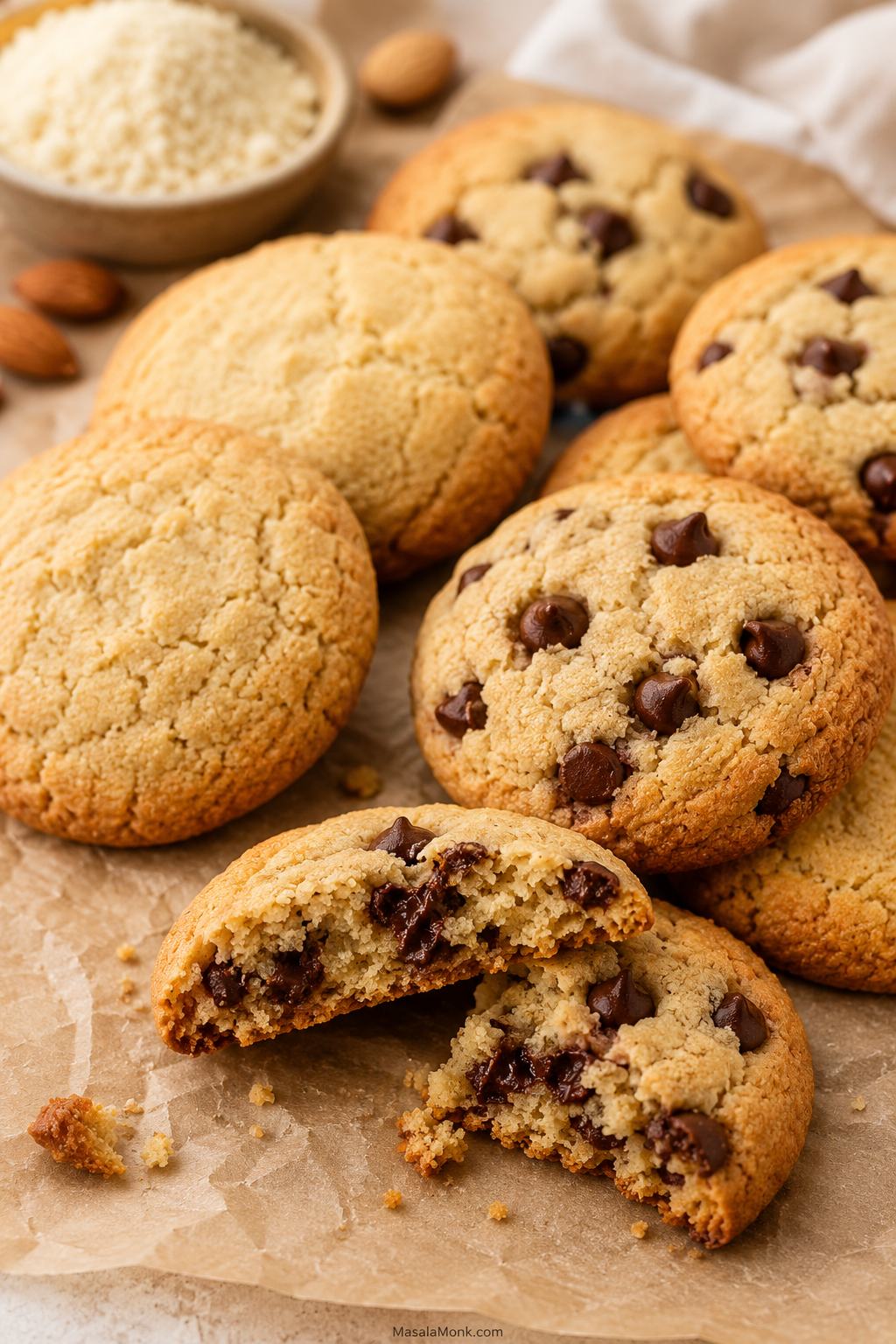
Almond flour cookies with golden edges, chocolate chips, and a soft broken center on parchment.

Good almond flour cookies should not taste like a gluten-free compromise. They should be soft in the middle, lightly golden at the edges, rich with vanilla and butter, and sturdy enough to pick up once cooled. This one-bowl almond flour cookies recipe gives you that texture without a long chill.
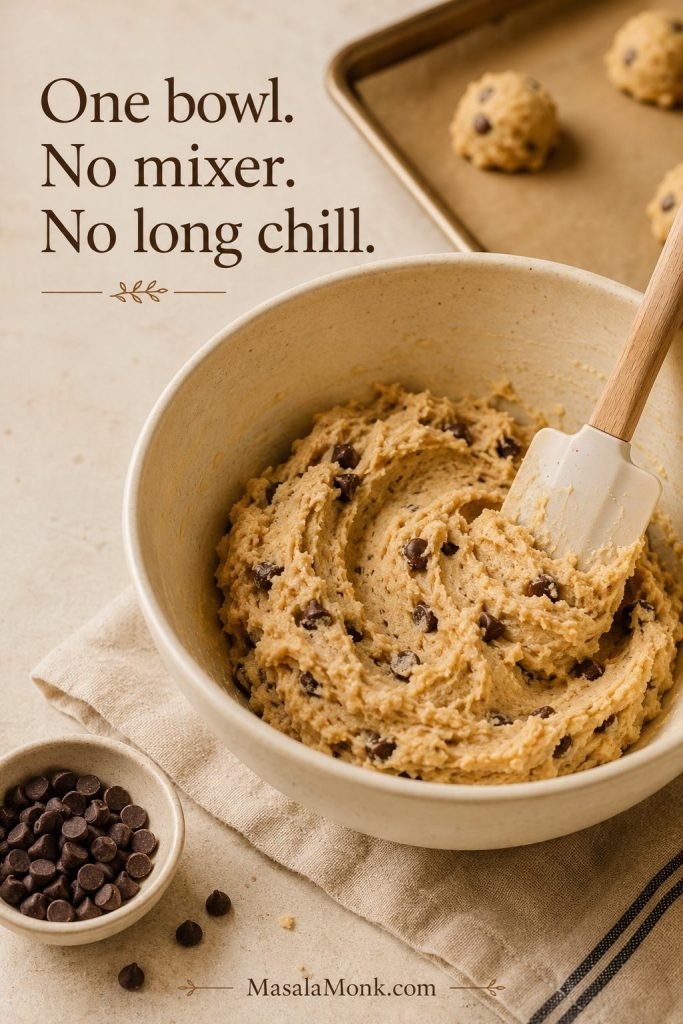
Almond flour cookie dough being mixed in one bowl with a spatula and chocolate chips nearby.
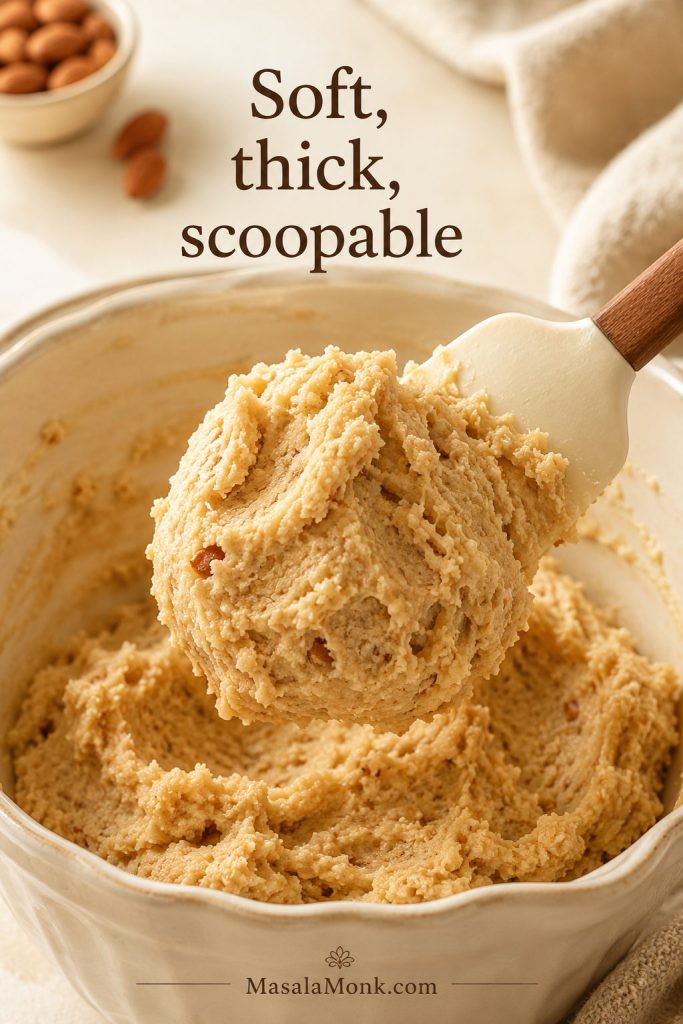
This one-bowl dough should look thick and scoopable, never runny, before you shape it.

Make them plain when you want the warm almond-vanilla flavor to shine, or fold in chocolate chips for the familiar bakery-style version most people picture first. Either way, the dough is simple, scoopable, and built around the small details that make almond flour baking work.
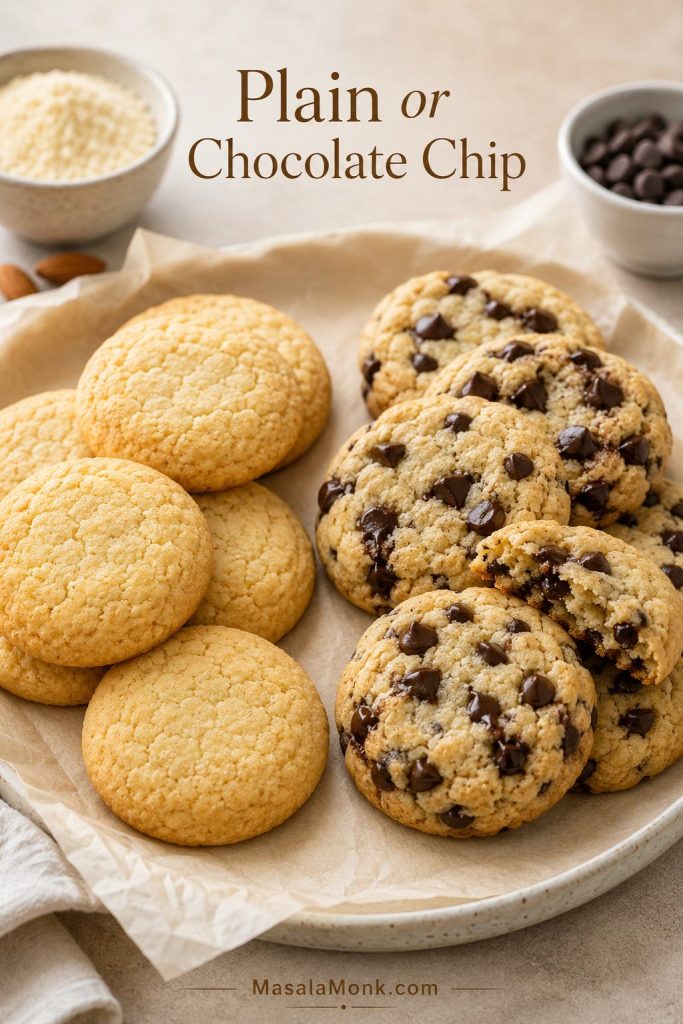
Plain almond flour cookies beside chocolate chip almond flour cookies from the same base dough.
Use the same almond flour cookie dough plain for a warmer almond-vanilla bite, or add chocolate chips for a familiar bakery-style version.

The payoff is a batch of cookies that smell warm and buttery, break softly once cooled, and feel just as welcome with coffee in the afternoon as they do with a few extra chocolate chips after dinner.

The main recipe is the one to start with when you want cookies that hold together, taste smooth instead of gritty, and still feel soft in the center. It is built for the almond-flour problems readers run into most often: oily dough, low spread, fragile cookies, and centers that need time to set.

Use the main recipe first if you want the most reliable batch. Then use the variation notes for 3-ingredient, vegan, keto-style, chocolate chip, and crispier cookies once you know how the dough should feel.

Almond Flour Cookies at a Glance

  • Active time: about 12 minutes
  • Bake time: 10–12 minutes for soft cookies, 13–14 minutes for firmer edges
  • Dough rest: 10 minutes while the oven heats
  • Tray set time: 10–15 minutes before moving
  • No long chill: chill only if the dough feels greasy, sticky, or too soft
  • Yield: about 16 cookies, plain or with chocolate chips
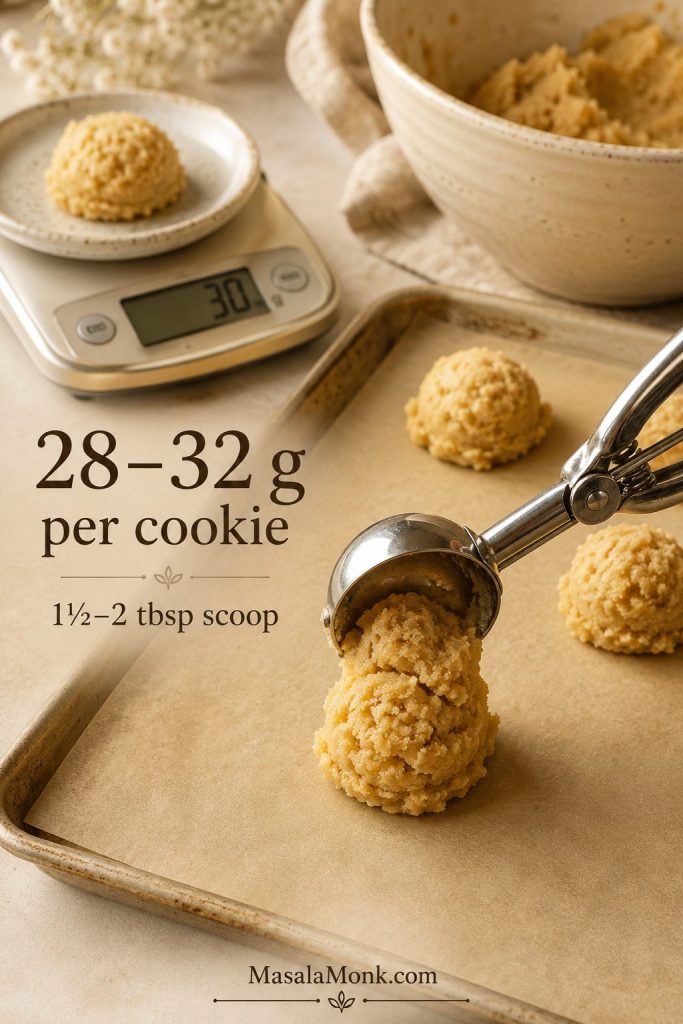
  • Scoop size: 1 1/2 to 2 tablespoons, about 28–32 g dough per cookie
  • Best flour: fine blanched almond flour, not coarse almond meal
  • Most important step: shape before baking, then let the cookies set on the warm tray before lifting

Quick Answer: How to Make Almond Flour Cookies

To make almond flour cookies, mix fine blanched almond flour with brown sugar, melted butter, egg, vanilla, baking soda, salt, and a little cornstarch or arrowroot if you want a softer, thicker cookie. Fold in chocolate chips for the most familiar bakery-style version, or leave the dough plain for a warmer almond-vanilla cookie. Scoop, press each mound into a thick disc, and bake at 350°F / 175°C for 10–12 minutes, until the edges look lightly golden and the centers still look tender.

The two steps that matter most are simple: shape the cookies before baking and let them set on the baking sheet before moving them. This dough does not spread as much as regular cookie dough, and the baked cookies are delicate while hot. Once they cool, they firm up into soft, tender cookies that lift cleanly from the tray.

If this style of cookie has disappointed you before, this recipe is designed to take the guesswork out of the tray. The dough is supposed to feel softer than regular cookie dough, the centers are supposed to look slightly tender when they come out of the oven, and the cookies are supposed to finish setting as they cool. Once you know those cues, the recipe becomes much easier.

If you need quick fixes while baking, jump to the troubleshooting section; if you are ready to mix, go straight to the recipe card.

Why almond flour cookies fail

Most failed batches come down to four things: coarse almond meal, dough left too round before baking, cookies moved while hot, or centers judged before they had time to set. This recipe builds those fixes into the method, so the cookies lift cleanly and taste tender instead of gritty or crumbly.

For step-by-step help, use the method cues first, then check the troubleshooting table if the dough or baked cookies still seem off.
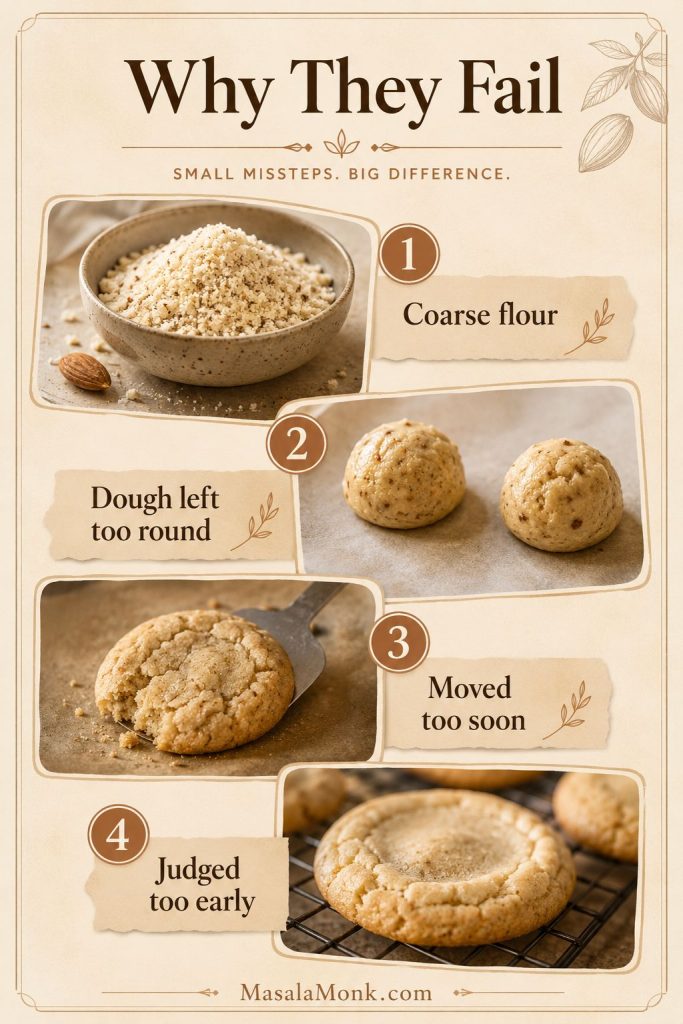
Common almond flour cookie problems including coarse almond meal, unpressed dough, fragile cookies, and soft centers.
If almond flour cookies have failed before, start by checking the flour texture, dough shape, bake cues, and cooling time.

Why You’ll Like This Batch

  • It feels like a real cookie: soft middle, golden edge, and rich almond-vanilla flavor.
  • It is easy enough for a weeknight: one bowl, no mixer, and no long chill.
  • It is flexible: bake them plain, add chocolate chips, or try the 3-ingredient version later.
  • It is built for almond flour: the recipe tells you when to shape, when to pull the tray, and when the cookies are sturdy enough to move.

Why This Almond Flour Cookies Recipe Works

Most problems with this dough do not come from flavor. Almond flour already tastes rich, nutty, and buttery. The challenge is helping the cookies hold together, bake evenly, and set without becoming gritty, oily, or too soft.

The fix starts with fine blanched almond flour, then a few small choices that help the cookies bake up tender instead of sandy or fragile: one egg for lift, brown sugar for a gentle chew, a short dough rest for better hydration, and optional cornstarch or arrowroot for a softer, thicker bite.

The biggest difference is not a complicated technique. The best batches come from dough that is pressed before baking, pulled while the centers still look slightly soft, and left alone long enough for the bottoms to firm on the tray.

  • Fine blanched almond flour keeps the bite smoother and less gritty.
  • Brown sugar gives more familiar chew than dry sweeteners alone.
  • One egg helps the cookies lift cleanly from the tray once cooled.
  • A short rest makes the dough easier to scoop and shape.
  • Gentle handling keeps the cookies intact while they finish setting.

Best first-batch version

For the most reliable first tray, use fine blanched almond flour, brown sugar, butter, the egg, and the cornstarch or arrowroot. This version gives the best balance of tenderness, browning, and cookies that lift cleanly after cooling. Try the 3-ingredient, keto, or vegan variations after you know how the base dough should feel.

The one habit that changes the batch

Treat almond flour cookies gently while they are hot. Give them a few quiet minutes on the tray, and they go from fragile to tender, sturdy, and easy to lift.

Before You Start: 5 Almond Flour Cookie Rules

This dough is easy, but it does not behave like regular cookie dough. Keep these rules in mind before you mix the bowl, especially if this is your first batch.

  • Use fine almond flour. Coarse almond meal can make the cookies gritty and fragile.
  • Press the dough before baking. The shape you make is close to the shape you get.
  • Mix gently. Almond flour has natural fat, so overmixing can make the dough oily.
  • Move them only after they set. Hot cookies are delicate; cooled cookies lift cleanly.
  • Judge texture after cooling. Warm centers can seem too soft even when baked correctly.

What These Almond Flour Cookies Taste Like

These almond flour cookies have a warm vanilla-almond flavor, buttery edges, and a soft, tender bite. They are not meant to be stretchy like wheat-flour chocolate chip cookies. Instead, they break softly, taste rich from the almond flour, and become sturdy enough to lift once fully cooled.

Chocolate chips make them feel more classic and dessert-like, while the plain version lets the almond flavor come through more clearly. Either way, the goal is a cookie that feels homemade and satisfying, not dry, sandy, or like a gluten-free compromise.

For crispier edges, press the dough a little flatter and bake the cookies until the edges are deeper golden. For softer centers, keep the dough slightly thicker and avoid overbaking.

Ingredients You Need

This recipe keeps the ingredient list simple, but every ingredient has a job. You want a tender cookie that tastes warm and satisfying, not like a dry gluten-free compromise. If you plan to change sweeteners, fat, eggs, or flour, check the substitution guide before mixing.
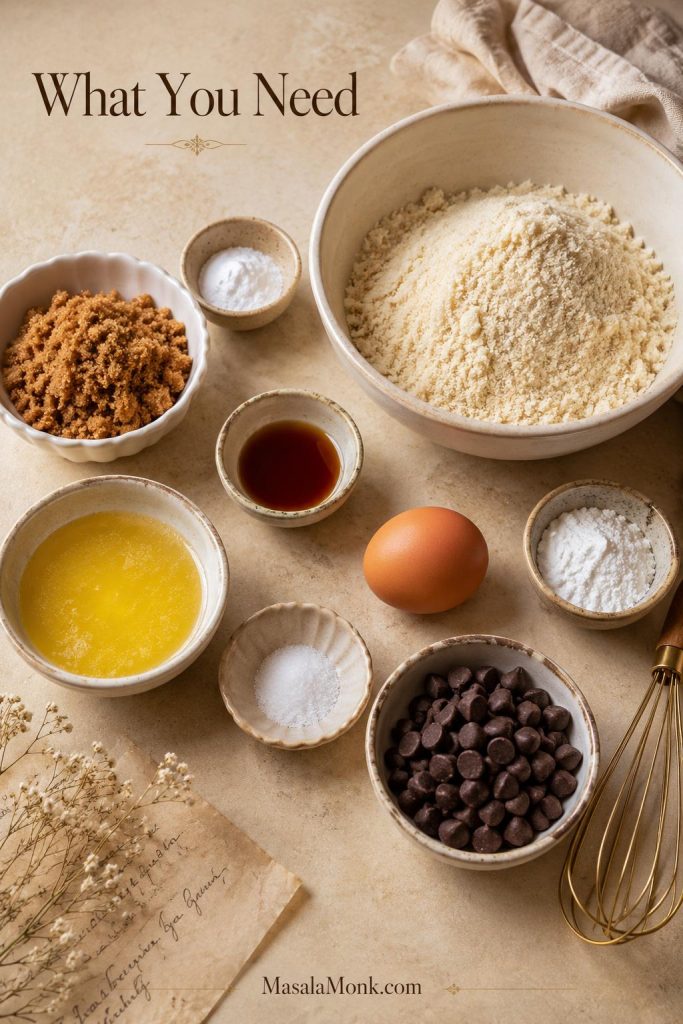
Ingredients for almond flour cookies including almond flour, brown sugar, butter, egg, vanilla, starch, and chocolate chips.
Each ingredient has a clear job: almond flour brings richness, brown sugar helps chew, and optional starch makes the cookies a little softer.

Fine blanched almond flour

Use fine blanched almond flour for the softest texture. It gives the cookies a pale golden color, tender crumb, and smoother bite. Coarse almond meal can work in a pinch, but the batch may taste grainier, darker, and more fragile.

Brown sugar or coconut sugar

Brown sugar gives these cookies a softer, chewier feel and a warmer flavor. Coconut sugar also works, but it weighs a little differently and gives a deeper, more caramel-like taste. For keto-style cookies, use the notes in the variation section because low-carb sweeteners change browning, spread, and chew.

Butter

Melted butter gives the cookies classic flavor and helps the dough come together easily. Let it cool slightly before mixing so it does not scramble the egg or make the dough oily. For a dairy-free version, coconut oil can work, but the cookies will taste a little different and may be slightly softer.

Egg

One egg helps the cookies lift cleanly from the tray after cooling. Egg-free versions are possible, but they need a different formula because almond flour has no gluten to help the dough hold together.

Vanilla, baking soda, and salt

Vanilla is not just background here. It rounds the almond flavor and makes the cookies taste warmer. Baking soda gives a little lift and helps the edges brown, while salt keeps the sweetness from tasting flat.

Recommended starch for softer cookies

A tablespoon of cornstarch or arrowroot helps the cookies bake softer, thicker, and a little less fragile. Use cornstarch for the most familiar cookie texture, arrowroot if you prefer a grain-free option, or skip it for keto-style cookies. Without it, the cookies still work, but they will be slightly more delicate.
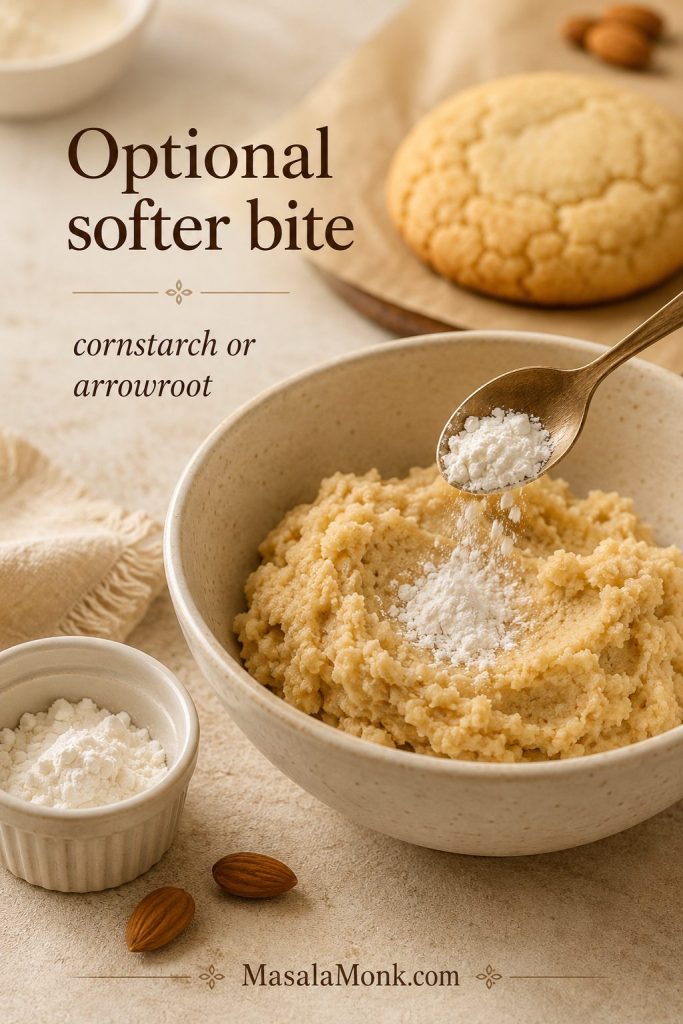
Cornstarch or arrowroot being added to almond flour cookie dough for a softer texture.
A small amount of cornstarch or arrowroot is optional, but it helps the cookies bake thicker, softer, and less delicate.

Chocolate chips

Chocolate chips are optional, but they turn this base dough into an easy chocolate chip version. Mini chocolate chips distribute especially well through the dough, while regular chips give bigger pockets of chocolate.

A note on strict gluten-free baking

Almond flour is naturally gluten-free, but if you are baking for someone who needs strict gluten-free food, use almond flour, chocolate chips, and starch that are labeled gluten-free. The FDA’s gluten-free labeling rule sets a clear standard for foods that carry a gluten-free claim.

Almond Flour vs Almond Meal for Cookies

For the best texture, use fine blanched almond flour. It is usually made from almonds without their skins, so the texture is finer and the color is lighter. This helps the cookies bake up soft, even, and tender.

Almond meal is usually coarser and may include almond skins. It can make cookies darker, grainier, and more rustic. That is not always bad, but it is not ideal when you want a soft, smooth cookie that holds together neatly.
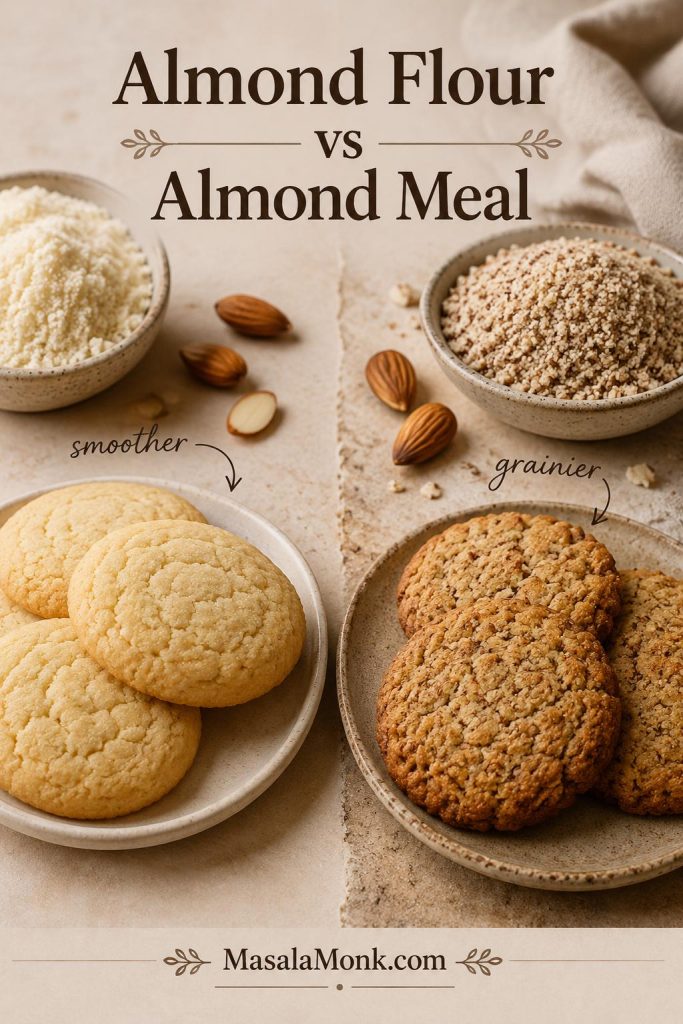
Fine almond flour and almond meal compared with smoother and grainier cookies.
Fine blanched almond flour gives a smoother cookie, while almond meal can make the texture darker, grainier, and more fragile.
Ingredient Best for Cookies? What to Expect
Fine blanched almond flour Best choice Soft, even texture with less grittiness and a cleaner bite.
Almond meal Works, with tradeoffs Darker, grainier cookies that may feel more delicate.
Coarse homemade almond flour Risky Can make the dough uneven, oily, or gritty if the grind is too coarse.

For a deeper baking-focused explanation of almond flour texture and grind, King Arthur Baking has a helpful almond flour guide that explains how finely ground almond flour behaves in baked goods.

If you want to see almond flour behaving in a batter instead of a dough, our almond flour pancakes guide shows why almond-based recipes brown quickly and feel more delicate than wheat-flour versions.

Once you have the right flour, the next important cue is what the dough should look like before baking.

Ingredient Substitutions and What Changes

Substitutions can work, but they are not all equal. Because almond flour has no gluten and contains natural fat, small changes can affect how the cookies spread, brown, and set.
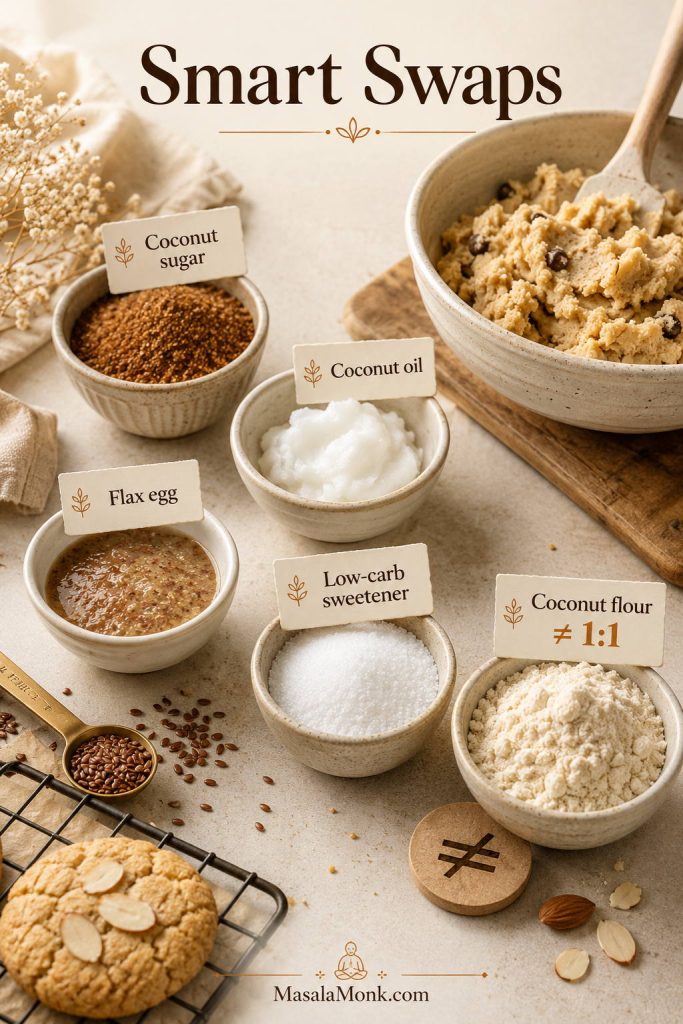
Substitution guide for almond flour cookies with coconut sugar, coconut oil, flax egg, low-carb sweetener, and coconut flour warning.
Some swaps are easy, but coconut flour is not one of them because it absorbs far more liquid than almond flour.
Swap Will It Work? What Changes
Almond meal instead of almond flour Yes, with tradeoffs Cookies may be darker, grainier, and more fragile.
Coconut oil instead of butter Yes Good for dairy-free cookies, but the flavor is less classic and the texture can be softer.
Coconut sugar instead of brown sugar Yes Use 1/2 cup, about 95 g. It gives a deeper flavor and slightly less classic chew.
Maple syrup instead of sugar Not as a direct swap It adds liquid and changes the dough. Use the 3-ingredient variation instead.
Low-carb sweetener instead of sugar Yes, with texture changes Use a 1:1 granular baking sweetener. The cookies may brown less, spread less, and feel less chewy.
Flax egg instead of egg Sometimes The cookies become softer and more delicate. The vegan variation is the safer starting point.
Coconut flour instead of almond flour No Coconut flour absorbs much more liquid and cannot be swapped 1:1.
All-purpose flour instead of almond flour No This recipe is balanced for almond flour’s fat and moisture behavior.
Gluten-free flour blend instead of almond flour No, not directly Most blends behave more like wheat flour and need a different cookie formula.

For the first batch, stay close to the main recipe. Once you know how the dough should feel, it is much easier to adjust sweeteners, fats, or add-ins without losing the soft, tender texture. Then compare the almond flour cookie variations to choose the best next batch.

This recipe is built for almond flour

Other flours need their own formulas. Coconut flour, oat flour, all-purpose flour, and gluten-free flour blends absorb liquid and fat differently, so they cannot replace almond flour directly in this recipe.

Equipment You Need

You do not need a mixer or special equipment. A bowl, spatula, baking sheet, parchment paper, and a cookie scoop are enough for this one-bowl dough.

  • Baking sheet: one large sheet pan or two smaller trays.
  • Parchment paper: best for clean release and even browning.
  • Mixing bowl and spatula: enough for this no-mixer, one-bowl dough.
  • Cookie scoop: a 1 1/2 to 2 tablespoon scoop keeps the cookies even.
  • Wire rack: useful after the cookies set on the tray.
  • Kitchen scale, optional: best for measuring almond flour accurately.
Almond flour cookie dough portioned with a cookie scoop at 28 to 32 grams per cookie.
Even scoops help the cookies bake at the same pace, so the centers stay tender while the edges turn lightly golden.

Parchment paper gives the cleanest release and slightly better browning. A silicone baking mat also works, but the bottoms may brown a little less.

How to Make Almond Flour Cookies

This is a one-bowl style cookie dough. The method is simple, but a few small cues make the difference between cookies that lift cleanly and cookies that crumble when you pick them up. If you already know the dough basics, you can skip ahead to doneness or the texture guide.

1. Mix the wet ingredients

In a large bowl, whisk the melted butter, brown sugar, egg, and vanilla until smooth and glossy. The butter should be melted but not hot. If it feels hot to the touch, let it cool for a few minutes before adding the egg.
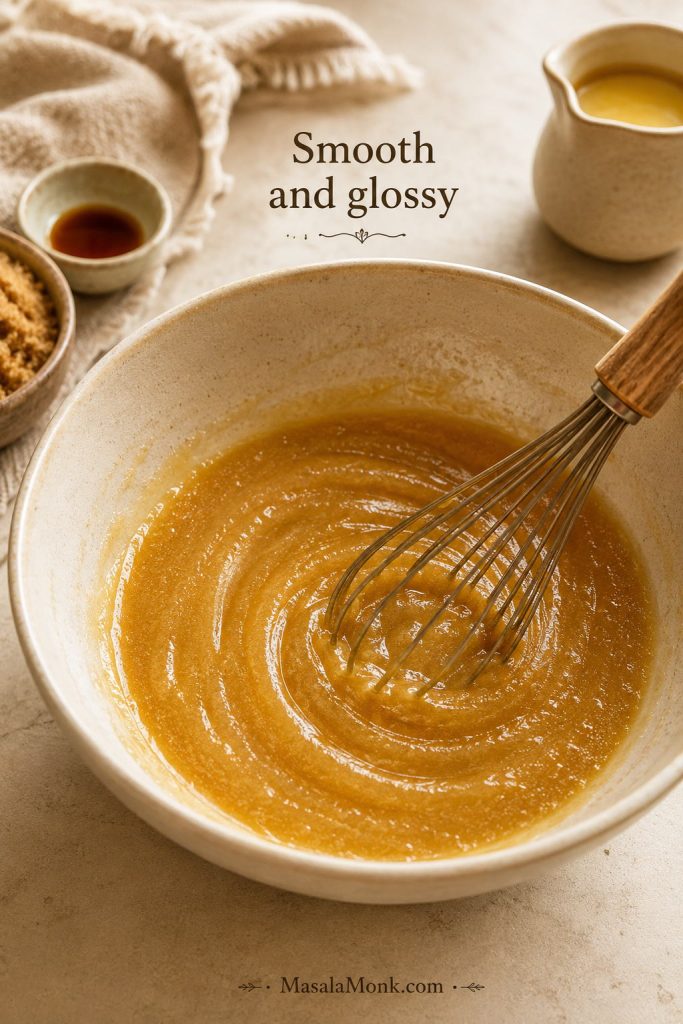
Melted butter, brown sugar, egg, and vanilla being whisked smooth in a ceramic bowl.
Let the melted butter cool slightly before adding the egg; otherwise, the wet mixture can turn greasy or uneven.

2. Add the dry ingredients

Soft thick almond flour cookie dough lifted with a spatula from a mixing bowl.
The dough should look moist and scoopable, not runny like batter or dry like crumbs, before you shape the cookies.
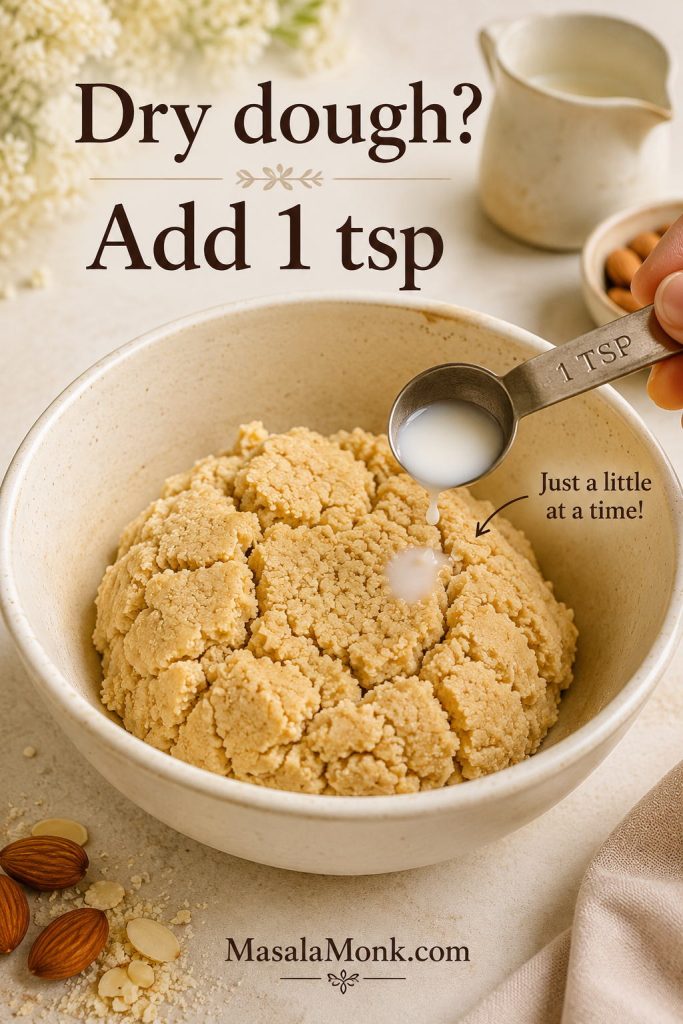
A teaspoon adding water or milk to slightly dry cracked almond flour cookie dough.
If the dough cracks badly when pressed, add water or milk one teaspoon at a time instead of overcorrecting.

For a chocolate chip version, fold in the chocolate chips now. For a prettier finish, save a few chips and press them onto the tops of the dough before baking.
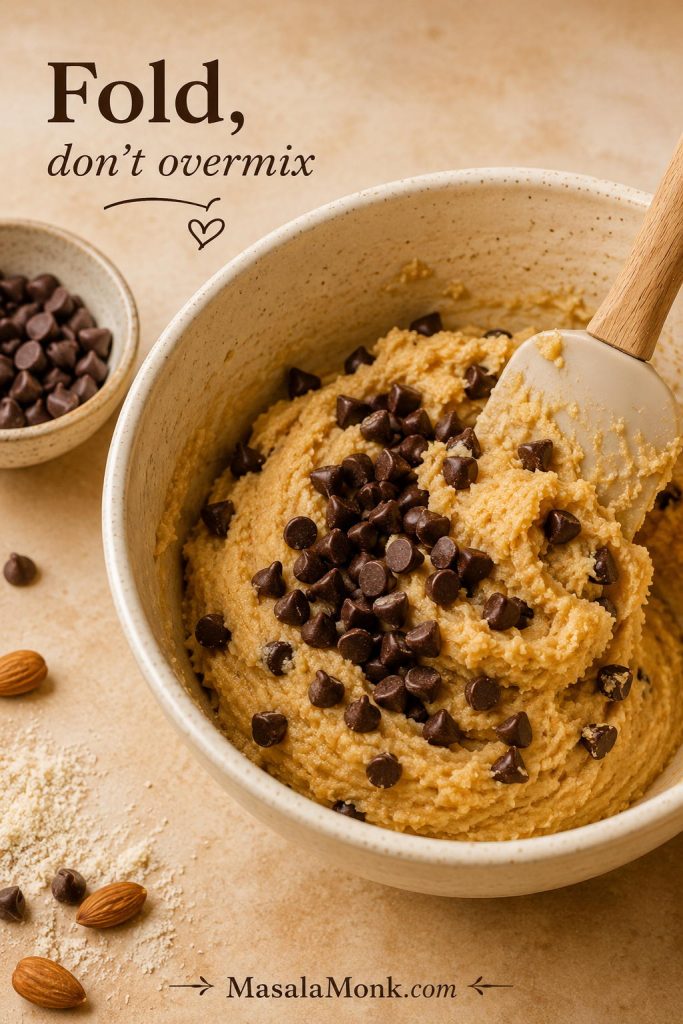
Chocolate chips being folded into almond flour cookie dough with a spatula.
Fold the chocolate chips in gently, because too much mixing can make almond flour dough oily instead of tender.

Let the dough sit for about 10 minutes while the oven heats. This short rest helps the almond flour absorb moisture and makes the dough easier to scoop. If your kitchen is warm and the bowl feels very soft, chill it for 15–20 minutes.
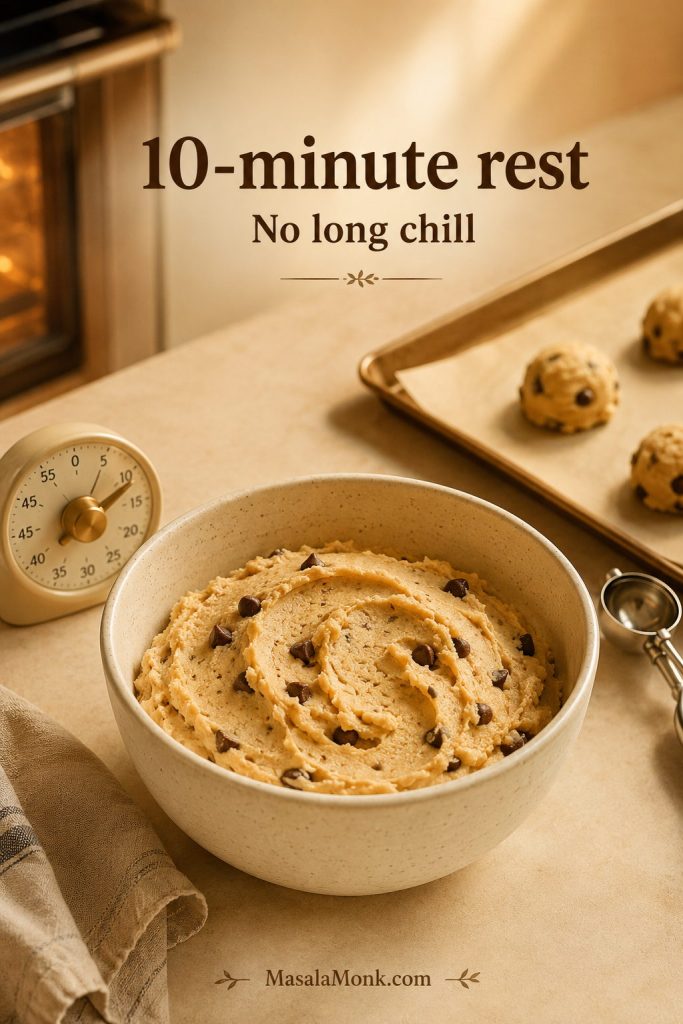
Almond flour cookie dough resting in a bowl near a timer and parchment-lined tray.
After a short rest, the dough feels easier to scoop because the almond flour has had time to absorb moisture.

5. Scoop and shape

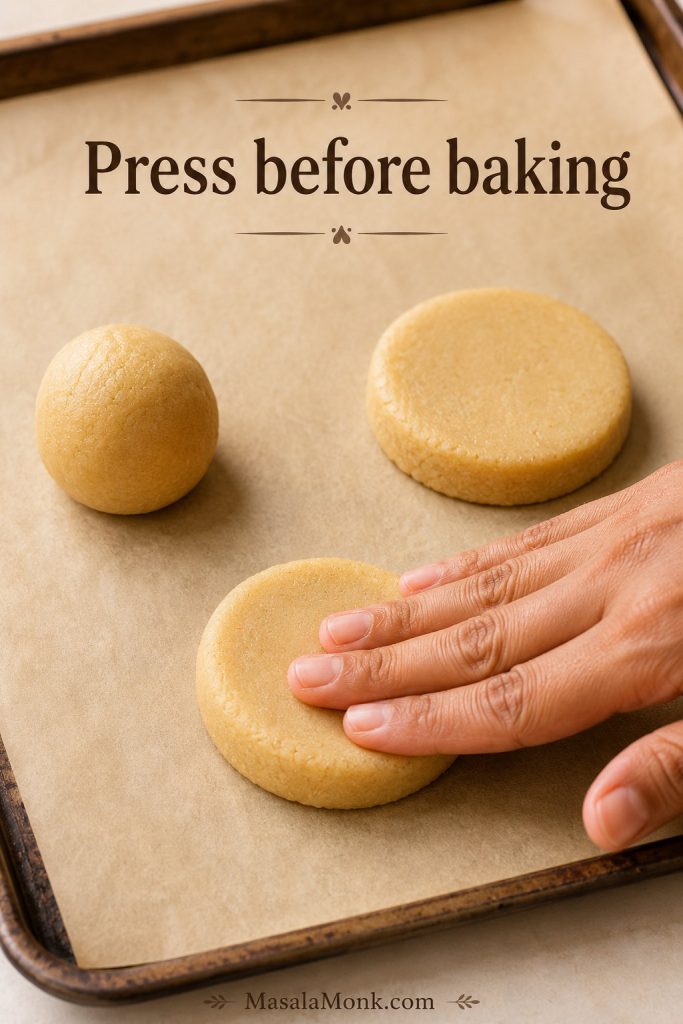
Almond flour cookie dough mound being pressed into a thick disc on a parchment-lined baking tray.
Press each mound into a thick disc before baking; otherwise, almond flour dough can stay too tall in the oven.
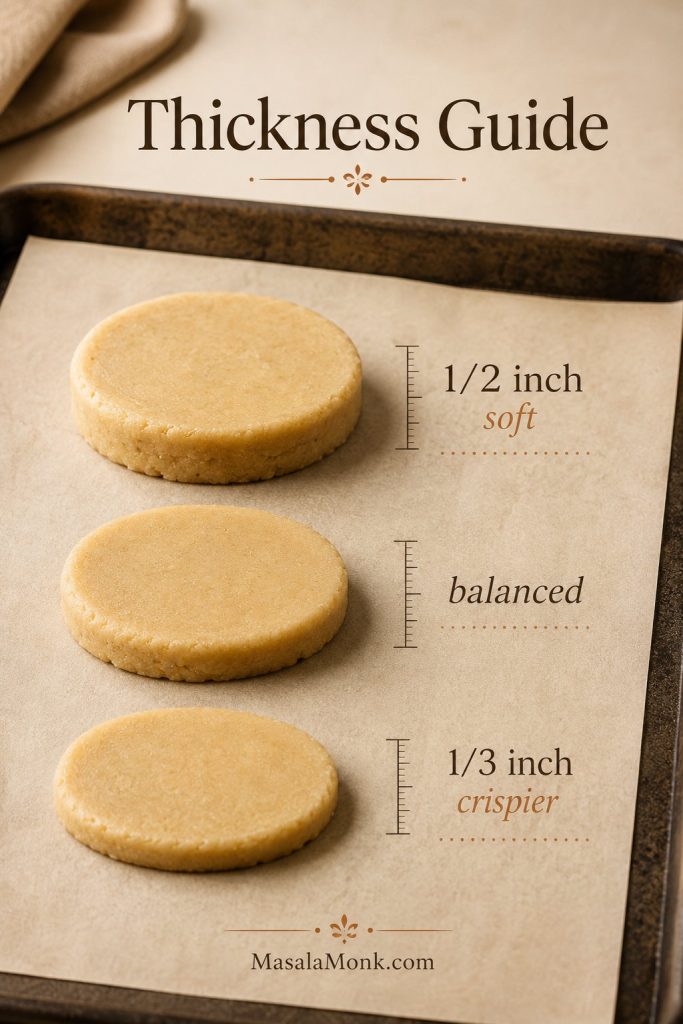
Three almond flour cookie dough discs showing different thicknesses for soft, balanced, and crispier cookies.
Thickness changes the final bite: keep the dough thicker for soft centers, or press it flatter for more golden edge.

Use one large baking sheet or divide the dough between two sheets. For the most even baking, bake one tray at a time in the center of the oven.

6. Bake until the edges are lightly golden

Bake at 350°F / 175°C, or about 160°C fan, for 10–12 minutes. The edges should look lightly golden, but the centers should still look soft. If your oven runs hot, check at 9 minutes because almond flour can brown quickly at the edges.
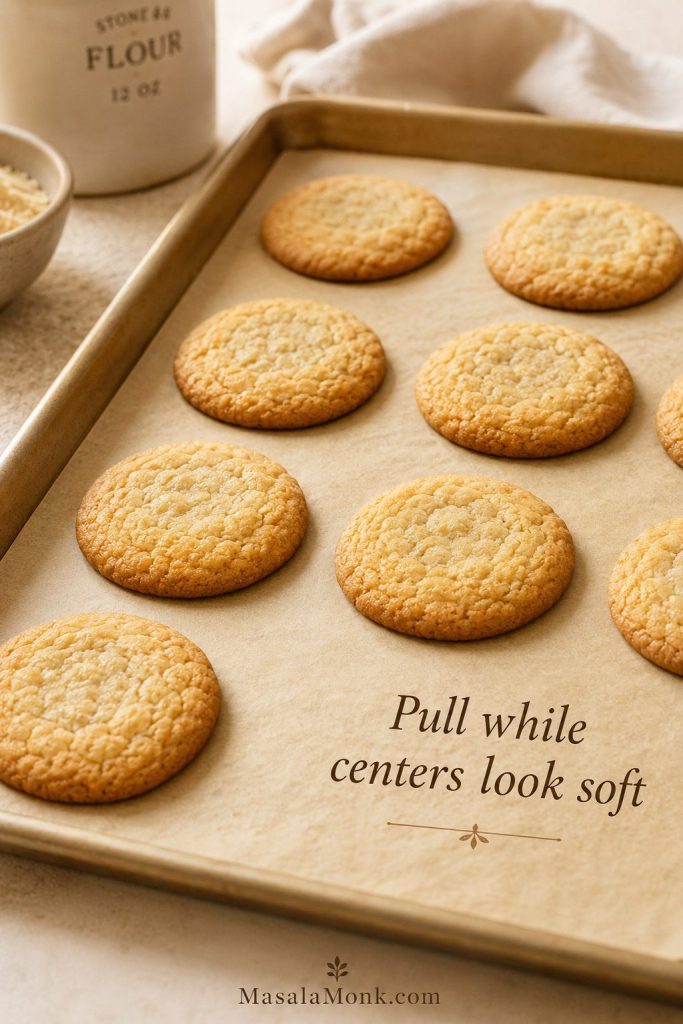
Freshly baked almond flour cookies with golden edges and soft centers on a parchment-lined tray.
Look for set, lightly golden edges rather than firm centers; the middle should still look a little tender.

7. Let the cookies set on the tray

Let the cookies cool on the baking sheet for at least 10 minutes before moving them. They are delicate when hot, but they firm as they cool. After that, transfer them to a wire rack and let them cool completely.

Almond flour cookies cooling on a baking sheet with a spatula lifting one cookie.
A clean spatula lift is the sign to wait for; if the cookie bends or breaks, give the tray a few more minutes.

The cookies may look a little softer than you expect when they first come out. That is normal. The edges should be set, but the centers finish firming as the tray cools.

Do You Need to Chill Almond Flour Cookie Dough?

You do not need a long chill for this dough. A 10-minute rest is enough for most batches because it gives the almond flour time to absorb moisture and makes the dough easier to scoop.

Chill the dough for 15–20 minutes only if it feels sticky, greasy, or too soft to shape. This usually happens when the butter is too warm, the kitchen is hot, or the almond flour is very fine and fresh. Even after chilling, press the dough into discs before baking so the cookies do not stay too thick.

How to Know When Almond Flour Cookies Are Done

The cookies are done when the edges look lightly golden and set, but the centers still look a little soft. Do not wait for the centers to look firm in the oven, or the cookies may turn dry after cooling.

When in doubt, pull the tray when the edges are set and the centers still look slightly soft. Overbaked almond flour cookies can taste dry once cooled.

The cookies should look lightly golden at the edges, soft in the center, and slightly fragile when they first come out. After 10–15 minutes on the tray, they should lift cleanly with a spatula and break softly when you bite into them.
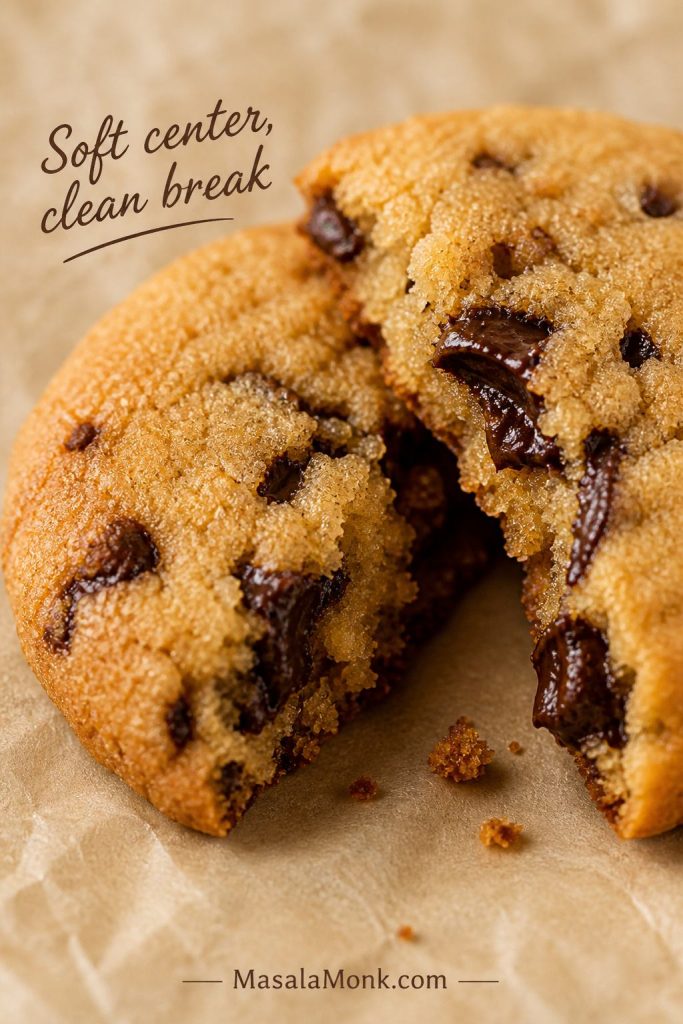
Broken chocolate chip almond flour cookie showing a soft center and melted chocolate pockets.
The finished cookie should break softly, not crumble into sand, which tells you the dough and bake time worked together.

Soft, Chewy, or Crispy Almond Flour Cookies

Before you bake, decide what kind of cookie you want. A thicker cookie gives you the softest center. A slightly flatter cookie gives you more golden edge. The recipe is flexible, but the shape you choose before baking matters.

Texture Goal How to Shape Bake Time Best Cue
Soft almond flour cookies Keep thicker, about 1/2 inch 10–11 minutes Edges barely golden, centers soft
Chewy almond flour cookies Flatten slightly, but not thin 11–12 minutes Light golden edges, tender centers
Crispier almond flour cookies Flatten more, about 1/3 inch 13–14 minutes Deeper golden edges, fully cooled before serving
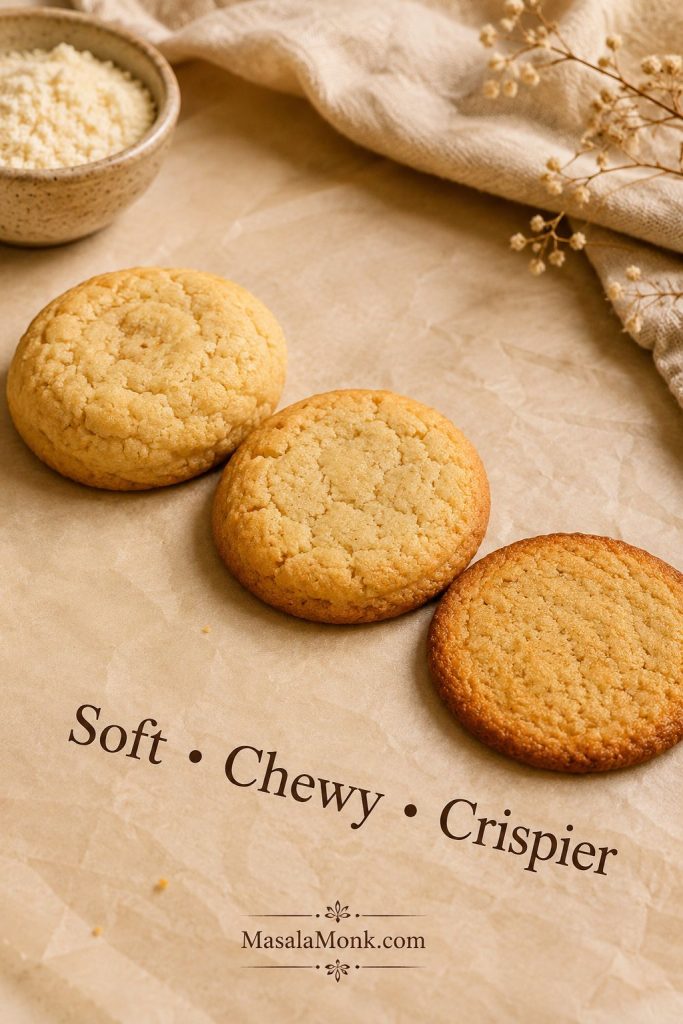
Soft, chewy, and crispier almond flour cookies shown side by side on parchment.
The same dough can bake soft, chewy, or crispier depending on how thickly you shape it and how long it stays in the oven.

For the chewiest result, use brown sugar, keep the egg, and avoid overbaking. For crispier cookies, press the dough flatter and give the tray an extra minute or two in the oven. Either way, wait until the cookies cool before judging the final texture. If your cookies came out dry, crumbly, oily, or too thick, the troubleshooting section will help you adjust the next tray.
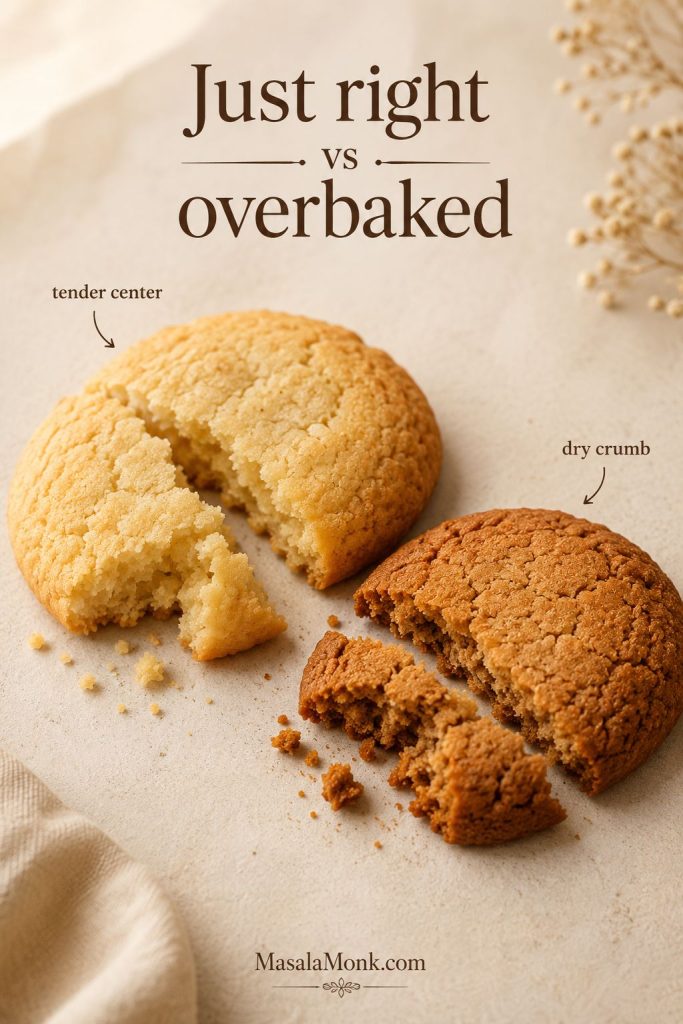
Just-right almond flour cookie with tender center compared with a darker overbaked cookie with dry crumb.
Instead of waiting for firm centers, look for golden edges; overbaked almond flour cookies can taste dry after cooling.

Almond Flour Cookie Variations

Think of the base recipe as the dependable version. Once you know how the dough behaves, the variations below let you move toward simpler, richer, lower-carb, dairy-free, or more chocolate-forward cookies without starting from scratch. Need the base formula first? Use the recipe card, then come back here to choose a version.

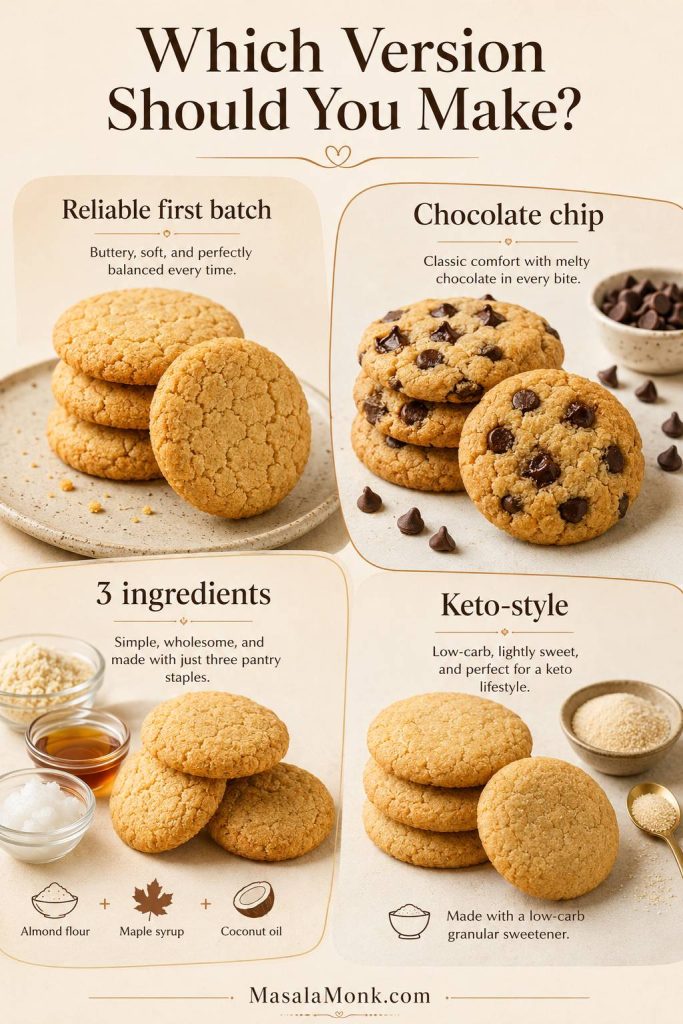
If You Want… Make This Version Why
The most reliable first batch Main recipe with egg and starch Best balance of softness, browning, and cookies that lift cleanly.
The most familiar cookie Chocolate chip version Classic flavor, melty pockets, and broadest appeal.
The simplest egg-free cookie 3-ingredient version Quick, small-batch, and dairy-free if you use coconut oil.
Lower sugar Keto-style version Works with a 1:1 granular low-carb baking sweetener, but browns less.
Almond flour cookie version chooser showing reliable first batch, chocolate chip, 3 ingredient, and keto-style cookies.
Start with the reliable first batch when texture matters most, then choose chocolate chip, 3-ingredient, or keto-style based on your needs.

If you are baking for people who do not usually choose gluten-free cookies, start with the chocolate chip version. It feels familiar first, then quietly happens to be almond-flour based.

If you want something simpler with coffee or tea, keep them plain. If you need egg-free or dairy-free cookies, use the 3-ingredient version as its own small-batch formula rather than forcing swaps into the main dough.

3 Ingredient Almond Flour Cookies

Choose the 3-ingredient version when you want a quick, simple, egg-free cookie with very little prep. It will be softer and more delicate than the main recipe, but it works well for a snack-style cookie when you keep the cookies small, shape them before baking, and let them cool fully on the tray.
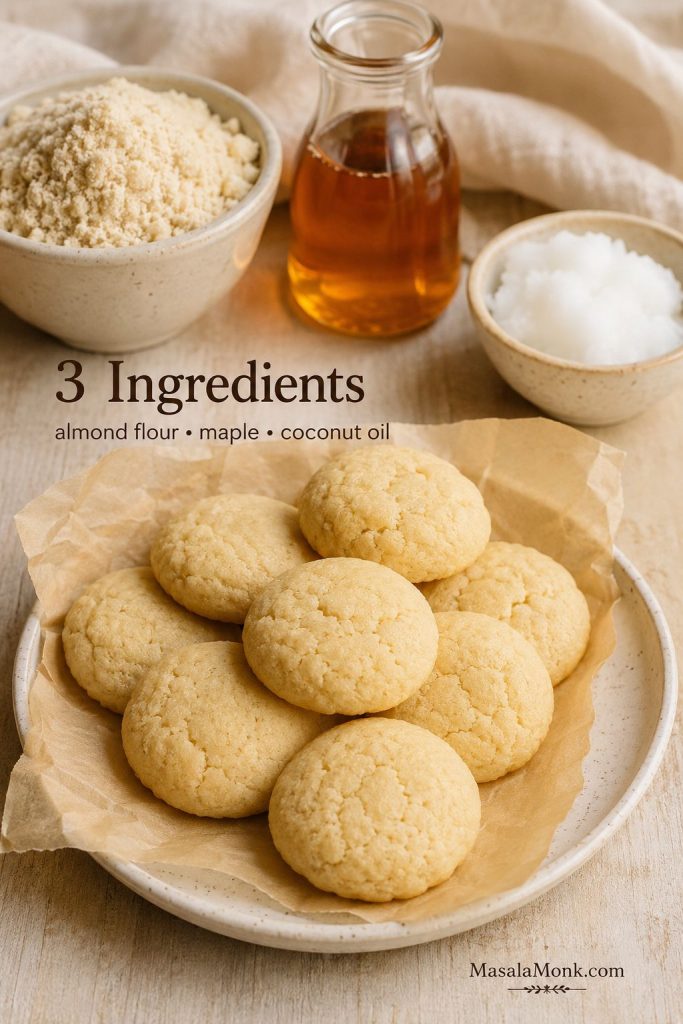
Three ingredient almond flour cookies with almond flour, maple syrup, and coconut oil nearby.
The 3-ingredient version is quick and egg-free, but it bakes softer and more delicate than the main recipe.

For a small batch of about 8 small cookies, mix 1 cup fine almond flour, 3 tablespoons maple syrup, and 2 tablespoons melted coconut oil or butter. Add a pinch of salt if possible. Scoop into small 1-tablespoon portions, press into discs, and bake at 350°F / 175°C for 8–10 minutes, or closer to 10–12 minutes if you make them larger. Let them set fully on the tray before moving.

If the 3-ingredient dough feels dry or cracks heavily, add water or milk 1 teaspoon at a time. If it feels sticky, let it rest for 5–10 minutes before shaping.

Choose the 3-ingredient version for speed and simplicity. Choose the main recipe when you want more classic browning, chew, and lift.

Chocolate Chip Almond Flour Cookies

For a chocolate chip version, add 1/2 cup / 85 g chocolate chips to the main dough. Mini chocolate chips spread through the dough evenly, while regular chips give bigger pockets of chocolate. Press a few extra chips on top before baking for a bakery-style finish.
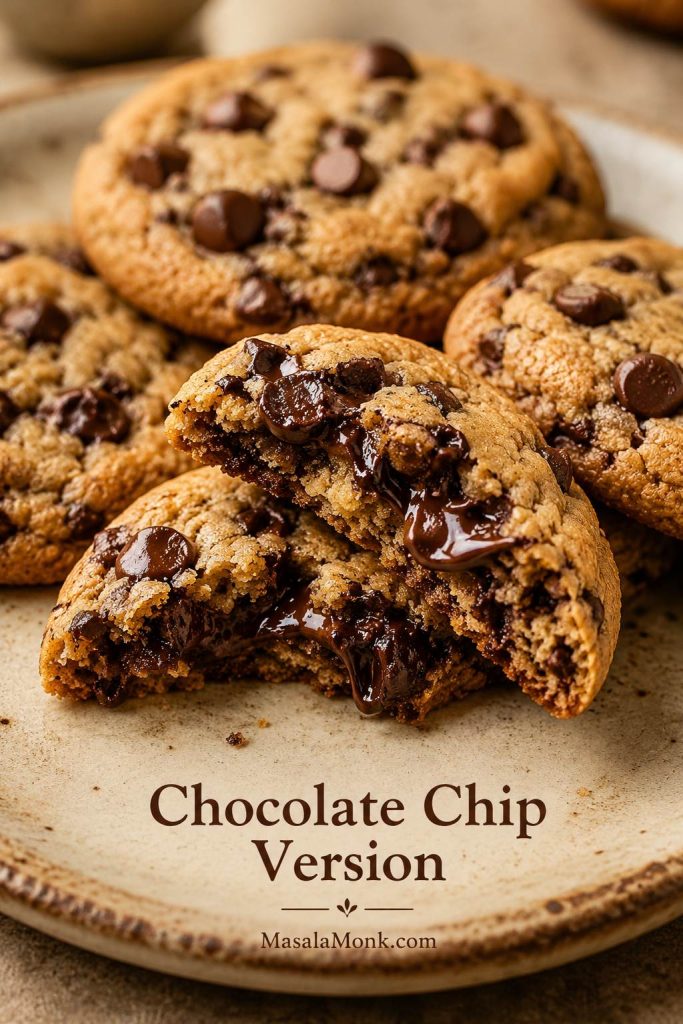
Chocolate chip almond flour cookies with a broken cookie showing melted chocolate and a soft center.
Chocolate chip almond flour cookies feel familiar first, which helps when you are baking for both gluten-free and regular-cookie eaters.

If you like deep chocolate cookies, you can also visit our double chocolate chip cookies for a richer chocolate-cookie direction.

More Wholesome Almond Flour Cookies

For a more wholesome version, use coconut sugar, dark chocolate chips, and keep the cookies slightly thicker so they stay tender. They are still cookies, but this version leans less sweet and lets the almond flavor come through more clearly.

Vegan Almond Flour Cookies

For vegan almond flour cookies, start with the 3-ingredient version: almond flour, maple syrup, and coconut oil. It gives you a softer, simpler cookie without needing an egg replacer. A flax egg can work in some almond flour doughs, but it often makes the cookies more delicate, so cool the cookies completely before moving them.
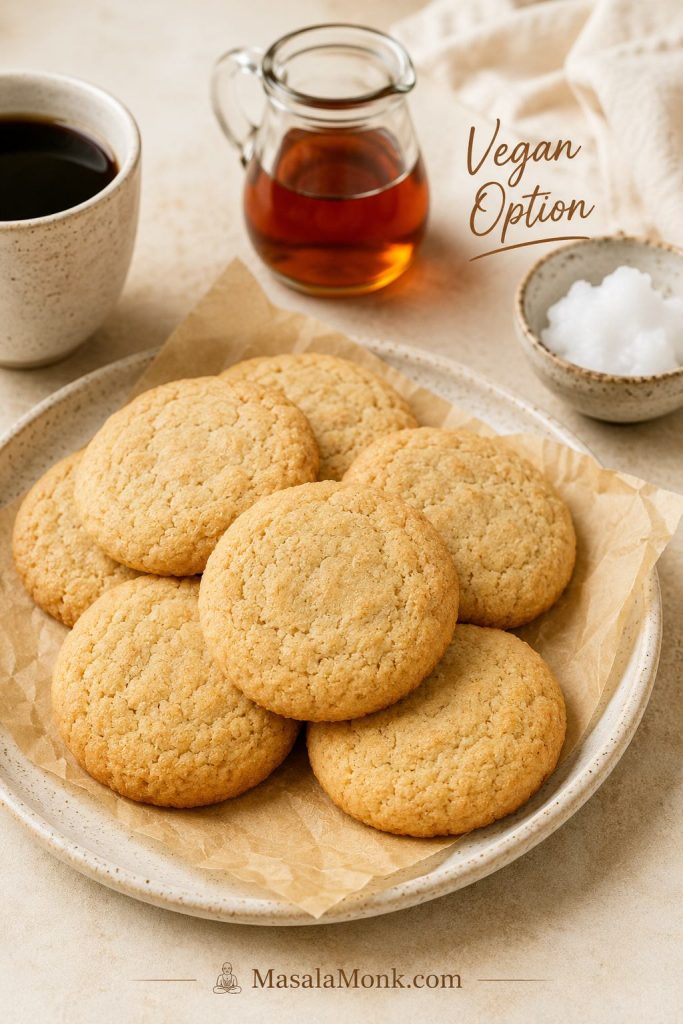
Vegan almond flour cookies served with maple syrup, coconut oil, and black coffee.
For vegan almond flour cookies, use maple syrup and coconut oil as the base rather than forcing a direct egg swap.

Keto Almond Flour Cookies

Choose the keto-style version when lower sugar matters more than classic brown-sugar chew. Use a 1:1 granular low-carb baking sweetener, not pure stevia or a liquid sweetener. Skip the cornstarch, shape the dough before baking, and expect cookies that brown less and spread less than the brown-sugar version.
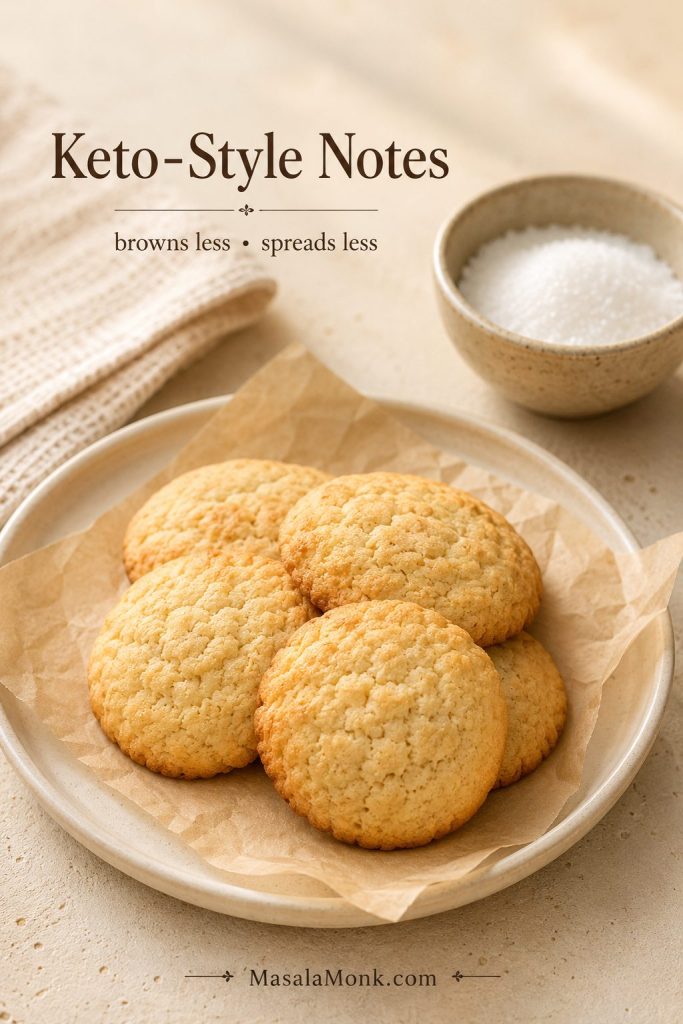
Keto-style almond flour cookies on parchment with a bowl of granular low-carb sweetener nearby.
Keto-style almond flour cookies usually brown less and spread less, so judge them by texture and edge set rather than deep color.

If you are doing more low-carb baking, our keto-friendly flours guide explains how almond flour behaves compared with other low-carb flours.

Peanut Butter Almond Flour Cookies

For a light peanut butter direction, replace 2 tablespoons of the butter with creamy peanut butter and add a pinch more salt. This gives the base cookie a nutty peanut-butter note, but a true almond flour peanut butter cookie works best as its own formula because peanut butter changes the dough’s fat and moisture balance.

A full peanut-butter-first cookie is better handled as its own recipe. See our peanut butter cookies recipe, which includes classic, 3-ingredient, chocolate chip, and oatmeal versions.

Almond Flour Shortbread Cookies

For a shortbread-style cookie, skip the egg and use almond flour, softened butter, powdered sugar, vanilla, and salt. Shape the cookies flatter and bake until the edges are deeper golden. This style is more delicate, so tray cooling matters even more.

Almond Flour Oatmeal or Sugar Cookies

Oatmeal and sugar-cookie versions are better as their own formulas because oats, extra sugar, and decorating needs all change the dough. From this base, you can experiment with a small handful of oats, but keep sugar-cookie versions as drop cookies rather than cut-out cookies unless you are using a recipe built for rolling.

Why Did My Almond Flour Cookies Crumble?

If a batch does not come out perfectly, do not throw the recipe away. This dough is sensitive to flour texture, measuring, shaping, and cooling time, so one small change can make a big difference in the next tray. Most problems are easy to fix once you know what caused them.

Troubleshooting guide for almond flour cookies showing crumbly cookies, gritty flour, oily dough, and no-spread dough.
Troubleshooting is easier when you match the problem to the cause: flour texture, fat temperature, dough shape, or cooling time.
Problem Likely Cause Fix
Crumbling when lifted The cookies had not set yet Let them cool on the baking sheet for 10–15 minutes before moving.
Gritty texture Almond meal or coarse almond flour Use fine blanched almond flour for the smoothest texture.
Oily-feeling cookies Too much fat, hot butter, or heavy mixing Cool melted butter slightly and mix only until the dough comes together.
No spreading in the oven This dough spreads less than wheat-flour dough Press the dough into discs before baking.
Centers too soft The centers need more time to set Bake 1–2 minutes longer next time and cool fully before serving.
Dry or sandy cookies Flour may have been packed, or the cookies baked too long Weigh the almond flour or spoon and level it; reduce bake time slightly.
Sticky dough Warm kitchen or warm butter Rest the dough for 10 minutes or chill for 15–20 minutes.
Dough cracks badly when pressed The almond flour is dry or the dough needs a little moisture Add 1 teaspoon water or milk and mix gently.
Cakey texture Too much egg, too much leavening, or cookies shaped too thick Flatten slightly more next time and bake until the edges are more golden.
Pale cookies Low-carb sweetener or underbaking Bake 1–2 minutes longer and rely on edge color, not center firmness.

Fix crumbly almond flour cookies

If the cookies break when you lift them, let the tray sit longer before moving the next batch. A clean spatula lift usually means the bottoms have set enough.

Almond flour cookie lifting cleanly with a spatula after setting on the baking sheet.
If almond flour cookies crumble when lifted, they often needed more tray time, not more baking time.

If the dough looks shiny or greasy, pause before scooping. Slightly cooled butter and gentle mixing usually give you a thicker, more scoopable dough.
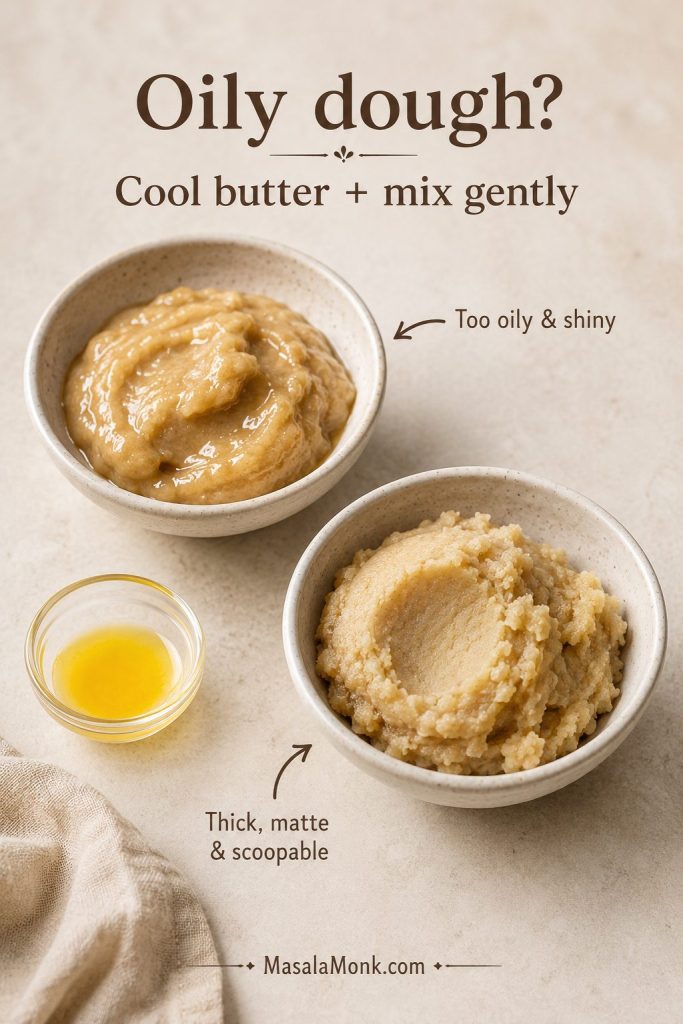
Oily almond flour cookie dough compared with properly mixed thick scoopable dough.
Shiny dough usually means the butter was too warm or the mixture was worked too much, so cool the butter and mix gently.

Fix almond flour cookies that do not spread

If the dough stays in tall mounds, press each portion into a thick disc before baking. That one shaping step gives the cookies a better final form.
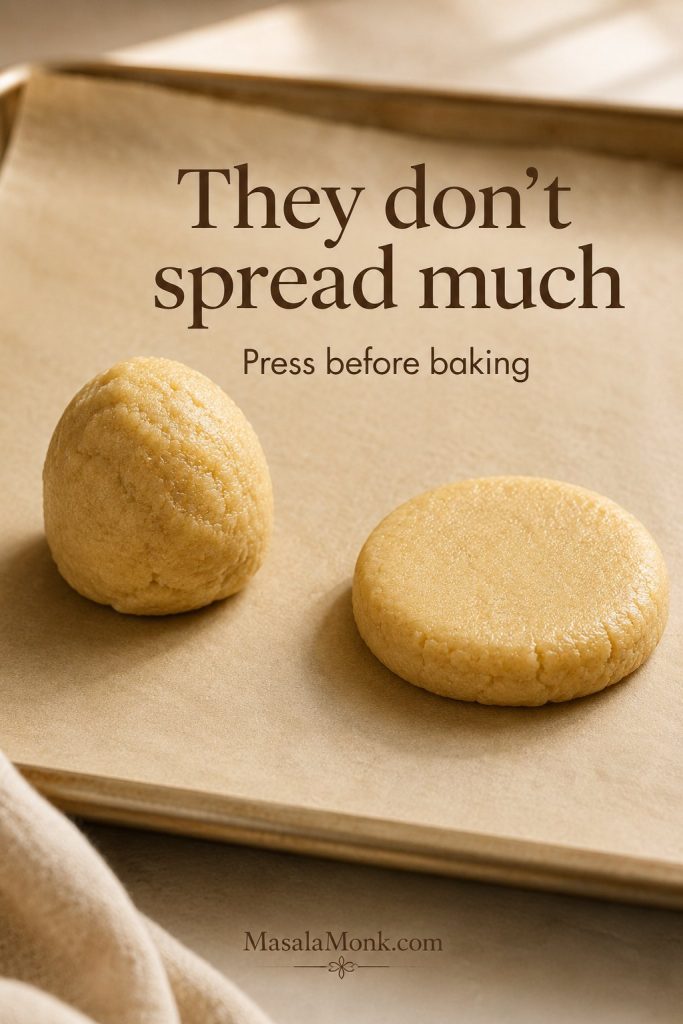
Tall unpressed almond flour cookie dough mound beside a pressed thick disc on parchment.
If the dough goes in as a tall mound, it may come out too thick; press it first for a better cookie shape.

How to Store and Freeze Almond Flour Cookies

These cookies keep well once they are fully cooled. Because they are tender, stack them gently and use parchment between layers if you are storing a large batch.
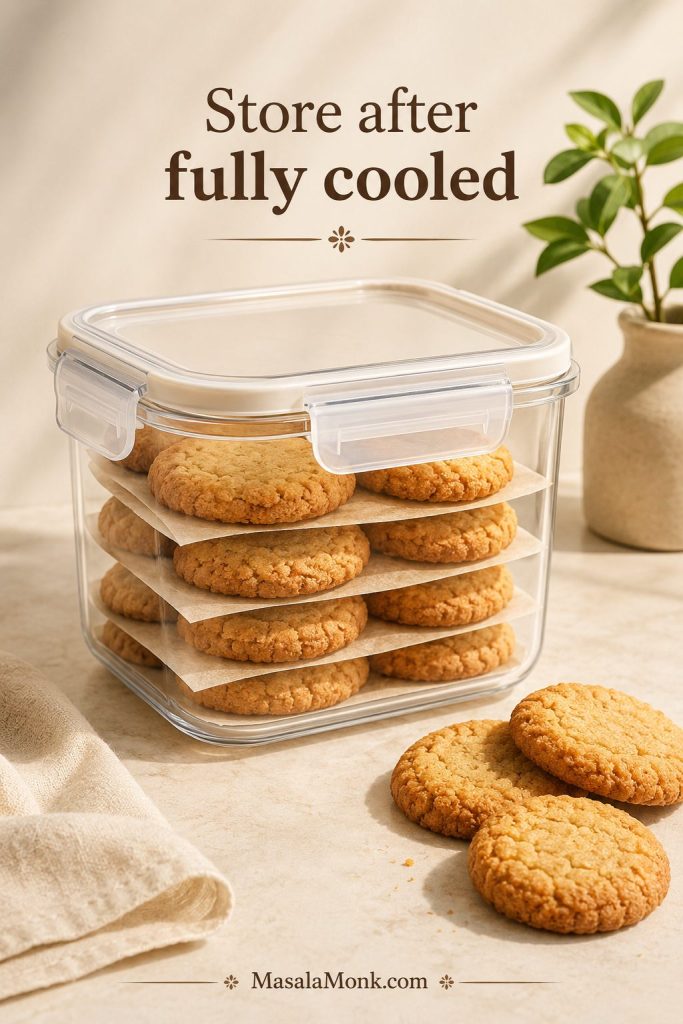
Almond flour cookies stored in an airtight container with parchment between the layers.
Store almond flour cookies only after they are fully cool, and use parchment between layers to protect their soft texture.
Storage Method How Long Best Tip
Room temperature 3–4 days Store airtight after cookies are completely cool.
Refrigerator Up to 1 week Let cookies come closer to room temperature before serving.
Freezer, baked cookies 2–3 months Freeze in a single layer first, then transfer to a freezer bag.
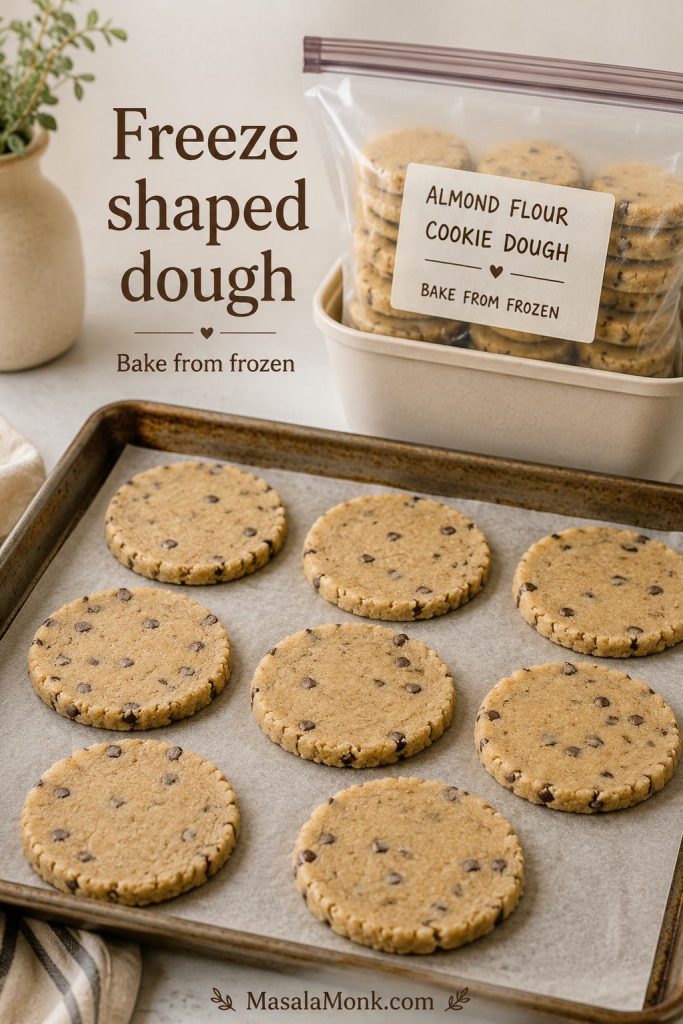
Freezer, dough portions 2–3 months Shape and flatten before freezing; bake from frozen with 1–2 extra minutes.
Flattened almond flour cookie dough portions on a tray with a labeled freezer bag behind them.
Freeze the dough after shaping and flattening, so the portions bake more evenly later without needing to thaw first.

Once cooled, the cookies should lift cleanly, bend slightly before they break, and taste rich enough that no one has to think about them as a gluten-free substitute. That is the batch you are aiming for.

Almond Flour Cookies Recipe Card

Almond Flour Cookies Recipe

Soft, tender almond flour cookies with lightly golden edges, a gentle chew, and a warm vanilla-almond flavor. Keep them plain, add chocolate chips, or bake them a little longer for crispier edges.

Prep Time 12 minutes
Rest Time 10 minutes
Bake Time 10–12 minutes
Set Time 10–15 minutes

Active Time: about 12 minutes

Bake + Rest Time: about 20–22 minutes before tray cooling

Ready to Move: about 35–40 minutes, including dough rest and tray set time

Yield: about 16 cookies, plain or with chocolate chips

Ingredients

  • 2 cups fine blanched almond flour, 200 g / about 7 oz
  • 1/2 cup packed light brown sugar, 110 g / about 3.9 oz, or 1/2 cup coconut sugar, about 95 g
  • 1/4 cup unsalted butter, melted and slightly cooled, 56 g / 2 oz
  • 1 large egg
  • 1 teaspoon vanilla extract, 5 ml
  • 1/2 teaspoon baking soda
  • 1/4 teaspoon fine salt
  • 1 tablespoon cornstarch or arrowroot starch, about 8 g, recommended for softer, thicker cookies; optional, and skip for keto-style cookies
  • 1/2 cup chocolate chips, 85 g / 3 oz, optional

Instructions

  1. Preheat the oven to 350°F / 175°C, or about 160°C fan. Line a baking sheet with parchment paper.
  2. In a large bowl, whisk together the melted butter, brown sugar, egg, and vanilla until smooth.
  3. Add the almond flour, baking soda, salt, and cornstarch or arrowroot, if using. Stir until a soft, scoopable cookie dough forms.
  4. The dough should look moist and thick, not runny. If it cracks badly when pressed, add 1 teaspoon water or milk and mix gently.
  5. Fold in the chocolate chips, if using.
  6. Let the dough rest for 10 minutes while the oven heats. If it feels very sticky, greasy, or too soft to scoop after resting, chill it for 15–20 minutes.
  7. Scoop into 1 1/2 to 2 tablespoon portions, about 28–32 g each, and place on the prepared baking sheet, leaving about 2 inches between cookies.
  8. Press each mound gently into a thick disc. This dough does not spread much, so shape it before baking.
  9. Bake for 10–12 minutes, until the edges are lightly golden and the centers still look soft. For firmer edges, bake 1–2 minutes longer.
  10. Cool on the baking sheet for 10–15 minutes before moving. Transfer to a wire rack and cool completely.

Notes

  • Use fine blanched almond flour, not coarse almond meal, for the smoothest texture.
  • If measuring by cups, spoon the almond flour into the cup and level it off. Do not pack it tightly.
  • The dough should be soft but scoopable. If it looks shiny or greasy, chill it briefly before baking.
  • Flatten cookies to about 1/2 inch for soft cookies or closer to 1/3 inch for crispier edges.
  • The centers should look slightly soft when the cookies come out of the oven. They finish setting as they cool.
  • Let the cookies rest on the tray before transferring; they are fragile while hot.
  • You can skip the starch, but the cookies will be slightly more delicate.
  • For a dairy-free version, use melted coconut oil instead of butter.
  • For chocolate chip almond flour cookies, use 1/2 cup / 85 g chocolate chips.

What to Bake Next with Almond Flour

Once you are comfortable with this dough, almond flour becomes much easier to bake with. The next best cookie recipes to build are the ones with stronger identities — peanut butter, oatmeal, shortbread, sugar cookies, and chocolate chip — because each one needs its own balance of fat, sweetness, moisture, and structure.

  • Richer direction: build a dedicated peanut butter almond flour cookie.
  • Heartier option: try an almond flour oatmeal cookie with the right oat-to-flour balance.
  • Best for gifting: shortbread-style almond flour cookies are the better direction.
  • Decorating route: almond flour sugar cookies need a dough made for shaping, chilling, or dropping.

For no-bake cookie-style desserts, you can also see our edible cookie dough and protein cookie dough recipes.

FAQs About Almond Flour Cookies

Can I use almond meal instead of almond flour?

Almond meal works in a pinch, but it changes the cookie. Because it is usually coarser and may include almond skins, the cookies can bake darker, taste grainier, and feel more fragile than cookies made with fine blanched almond flour.

Do almond flour cookies spread?

They spread less than wheat-flour cookies, so press the dough into the shape you want before baking. Thicker discs stay softer; flatter discs bake with more golden edge.

Why did my almond flour cookies fall apart?

They were probably moved too soon. Almond flour cookies are delicate when hot and firm as they cool, so wait at least 10 minutes before lifting them from the baking sheet.

Why are my almond flour cookies greasy?

Greasy cookies usually come from too much added fat, butter that was too hot, or dough that was mixed too heavily. Use slightly cooled melted butter and stop mixing once the dough comes together.

Should I chill almond flour cookie dough?

A long chill is not needed for this recipe. A 10-minute rest is usually enough. Chill the dough for 15–20 minutes only if it feels very soft, sticky, or greasy.

Can I make almond flour cookies without eggs?

Egg-free versions work best when the formula is designed for them. The 3-ingredient variation with almond flour, maple syrup, and coconut oil is a good starting point. It makes a softer, more delicate cookie than the main recipe.

Can I make almond flour cookies with maple syrup?

Maple syrup works best in a recipe designed around it, such as the 3-ingredient variation. In the main recipe, swapping it directly for brown sugar adds extra liquid and can make the centers too soft.

How do I make almond flour cookies crispy?

Press the dough flatter and bake for 13–14 minutes, until the edges are deeper golden. Cool fully before serving, because the cookies firm more as they sit.

Can I make almond flour cookies keto?

Keto-style cookies need a 1:1 granular low-carb sweetener made for baking. Skip the cornstarch, avoid liquid sweeteners, and expect cookies that brown less and feel less chewy than brown-sugar cookies.

Is almond flour a 1:1 replacement for all-purpose flour in cookies?

A direct 1:1 swap usually does not work well. Almond flour has no gluten and more natural fat than wheat flour, so it needs a recipe built around its own texture and moisture behavior.

Will coconut flour work in this recipe?

Coconut flour absorbs far more liquid than almond flour, so it cannot replace almond flour in this recipe. Use a cookie recipe written specifically for coconut flour instead.

Are almond flour cookies gluten-free?

Almond flour is naturally gluten-free, but check labels if you are baking for someone who needs strict gluten-free food. Some almond flour, chocolate chips, or starches may be processed in facilities that also handle wheat.

Can I freeze almond flour cookie dough?

Yes. Scoop and shape the dough first, then freeze the portions on a tray. Once firm, transfer them to a freezer bag. Bake from frozen at 350°F / 175°C, adding 1–2 extra minutes as needed.
Back to top ↑

Posted on 30 Comments

Double Chocolate Chip Cookies – Easy Recipe with 7 Variations

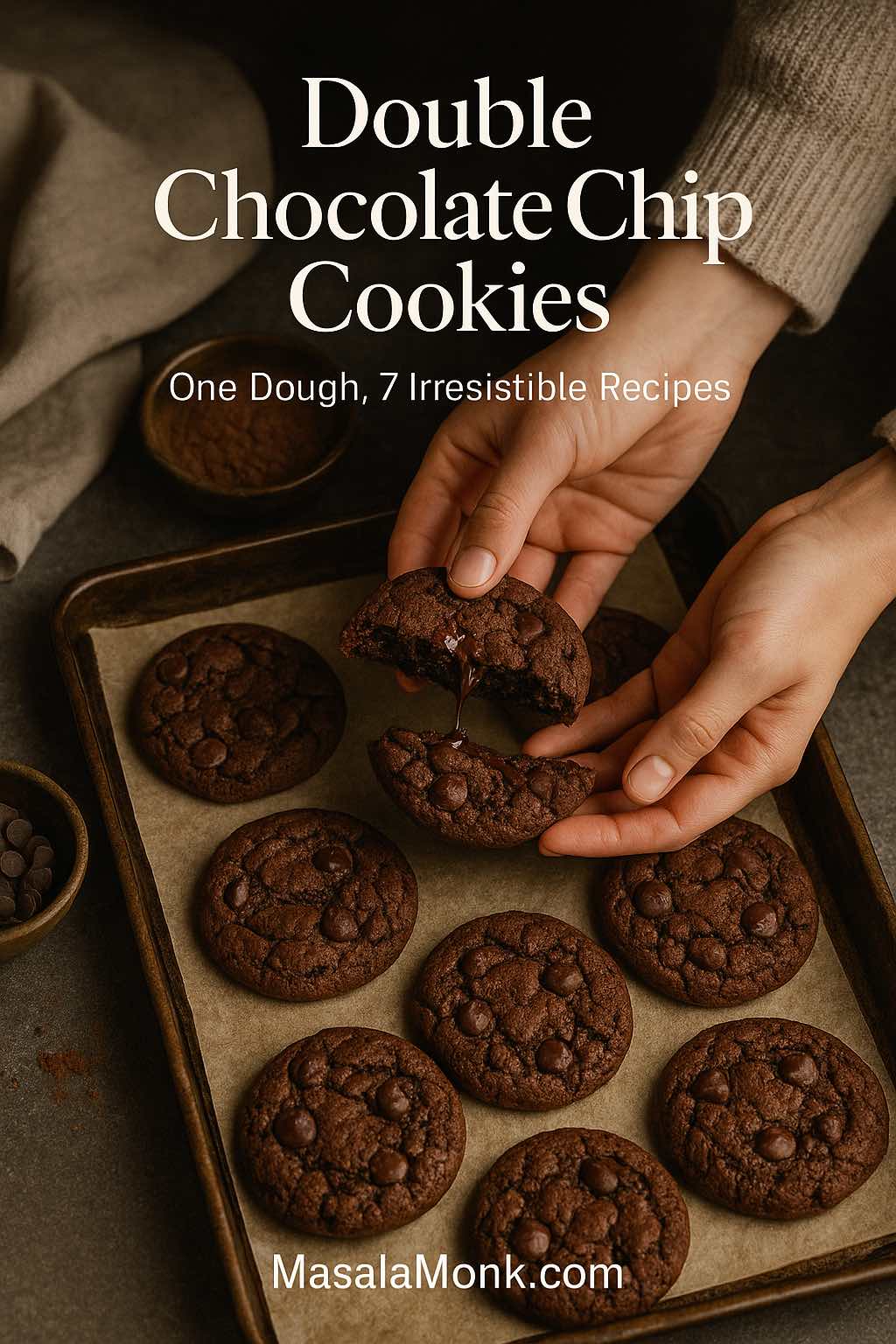
Hands breaking a warm double chocolate chip cookie over a tray of cookies, with text reading Double Chocolate Chip Cookies – One Dough, 7 Irresistible Recipes.

There’s something almost unfair about a good tray of double chocolate chip cookies. They’re small, they’re simple, and yet they manage to taste like the richest dessert in the room. When you add cocoa powder to a classic chocolate chip cookie and then fold in plenty of chocolate chips or chunks, you get that deep, fudgy flavor with all the comfort of a familiar cookie.

This recipe takes that idea and stretches it as far as it will go. You’ll start with one reliable base dough for Double Chocolate Chip Cookies. From there, you’ll turn it into seven different treats:

  • classic bakery-style double chocolate chocolate chip cookies
  • extra intense double dark chocolate cookies
  • vegan double chocolate chip cookies
  • gluten-free double chocolate cookies
  • almond flour double chocolate chip cookies
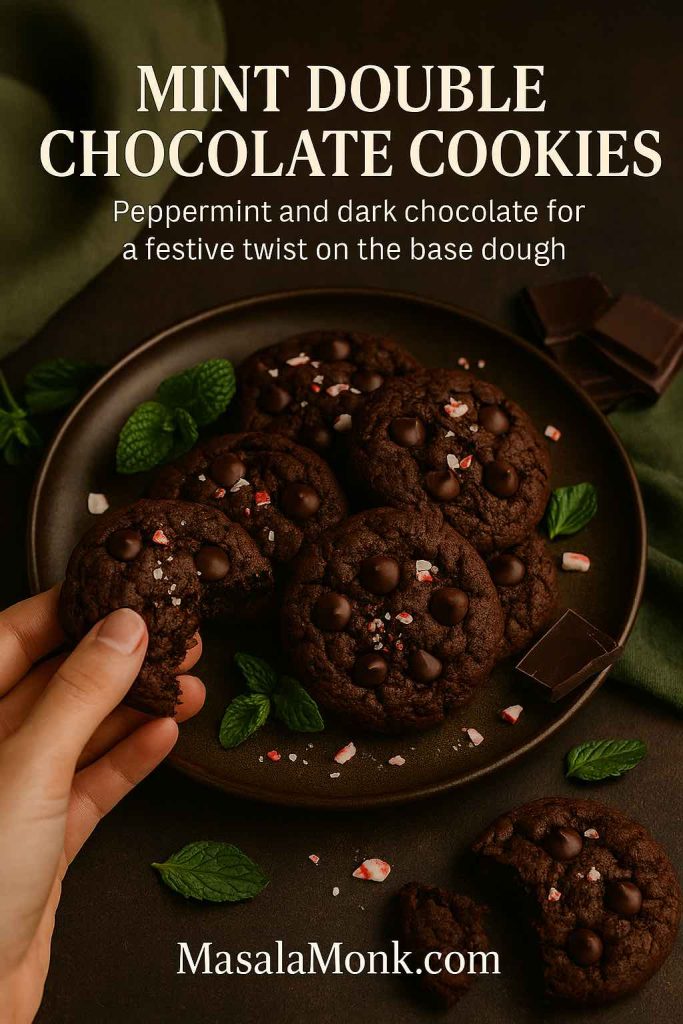
  • mint double chocolate chip cookies
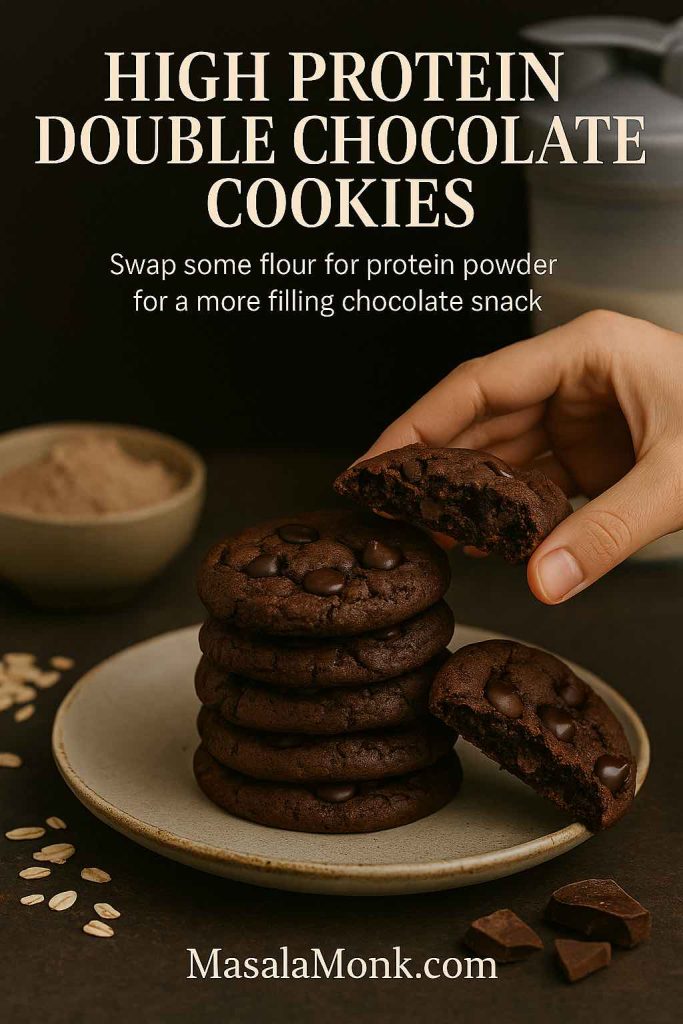
  • a high protein double chocolate cookie variation
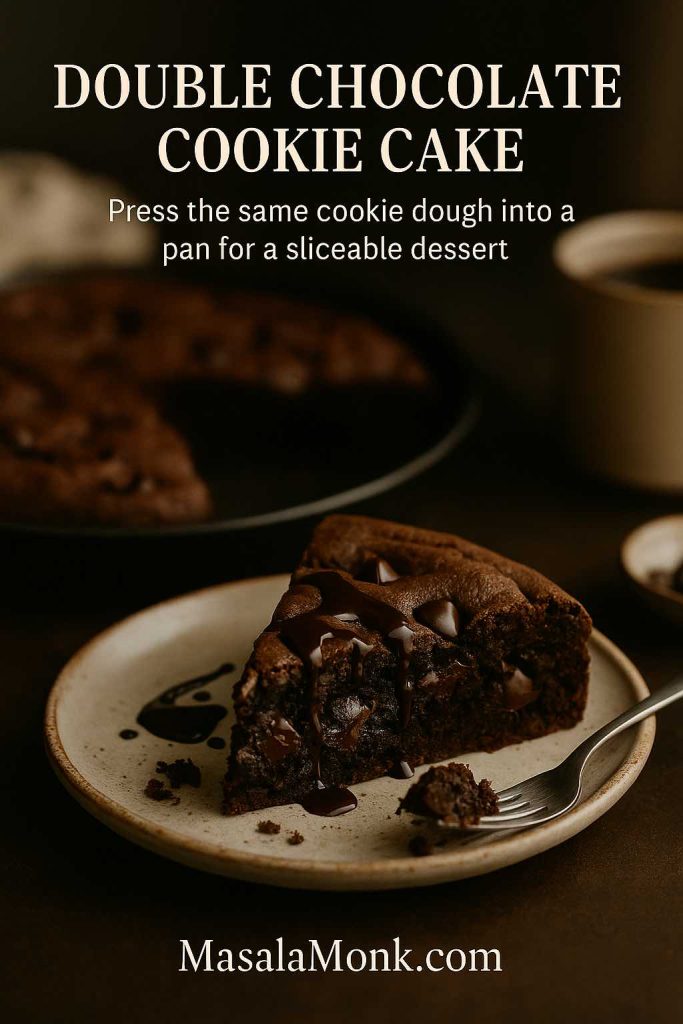
  • plus a double chocolate cookie cake and freezer-friendly cookie dough

Think of it as your chocolate cookie toolkit. Once you know the base recipe, it becomes very easy to tweak texture, ingredients and flavor without feeling like you’re starting from scratch every time. And if you fall in love with the “one dough, many options” mindset, you can keep playing with it in other bakes too, much like the format over at MasalaMonk’s own Peanut Butter Cookies (Classic Recipe & 3 Variations).


What makes this double chocolate chip cookie dough special

Before we get into measuring and mixing, it helps to understand what this particular dough is designed to do.

First, you’re using cocoa powder in the dry ingredients and chocolate chips in the dough itself. That’s what earns the “double” in double chocolate chip cookies. The cocoa brings an evenly distributed chocolate flavor, while the chips or chunks create pockets of melted chocolate.

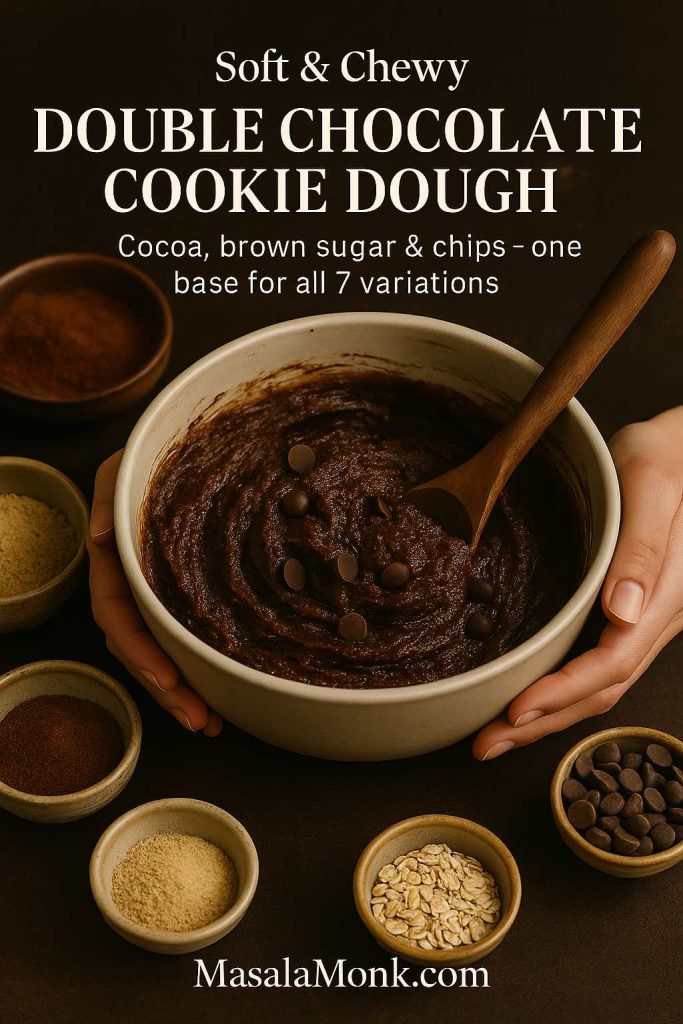
Bowl of soft and chewy double chocolate cookie dough with chocolate chips, surrounded by small bowls of cocoa, sugars, oats and almond flour, with hands holding the bowl and MasalaMonk.com in the footer.
Soft and chewy double chocolate cookie dough made with cocoa, brown sugar and chocolate chips – the flexible base for all seven cookie variations in this recipe.

Second, the sugar balance leans slightly toward brown sugar. That gives you a hint of caramel, a slightly chewier center, and a more forgiving bake if your oven runs a little hot or cool. Instead of a crisp, snappy biscuit, you get cookies that stay soft and slightly fudgy in the middle.

Third, this dough is formulated to cope with variations. A touch of extra moisture here, a little more cocoa there, some almond flour in one batch and a scoop of protein powder in another—none of those things break the dough, as long as you follow the basic structure.

Finally, there’s the chilling step. Letting cookie dough rest in the fridge isn’t just fussy chef behavior. When you rest dough, the butter firms up, the flour hydrates, and the flavors have time to deepen. King Arthur’s breakdown of why chilling cookie dough makes a difference shows that even a short chill shifts both spread and flavor in a noticeable way.

This means one recipe can serve as your base for every version in this post: chewy, dark, vegan, gluten-free, almond flour heavy, minty, high-protein, or pressed into a pan for a cookie cake.

Also Read: 10 Spinach Dip Recipes: Cold, Baked, Artichoke & More


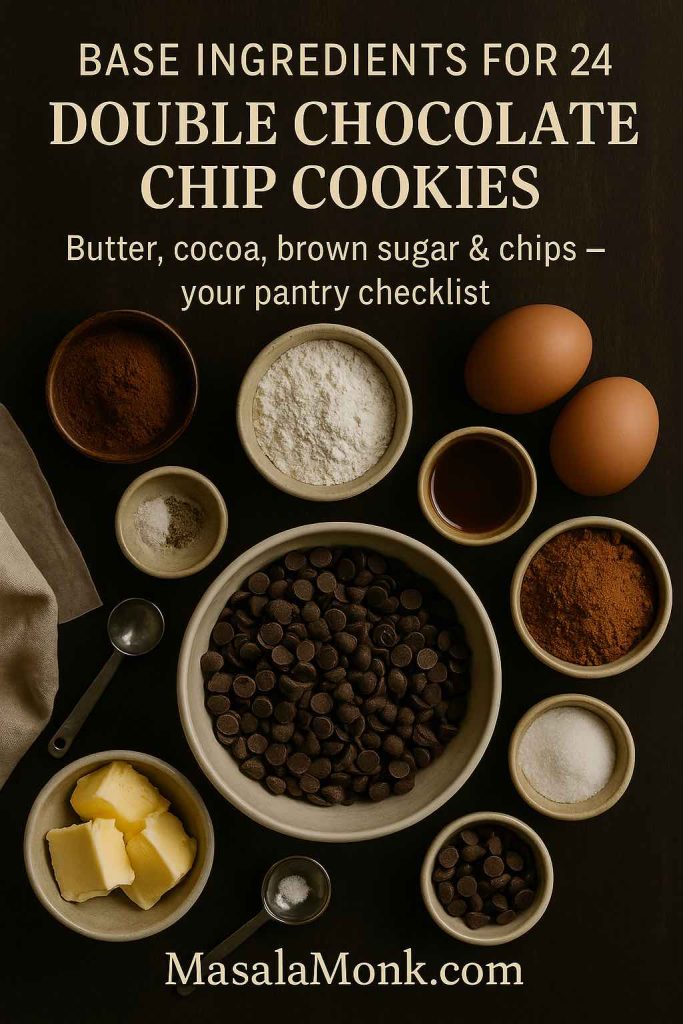
Ingredients for the base double chocolate chip cookies

For about 24 medium cookies, you’ll need:

  • 170 g (¾ cup) unsalted butter, softened
  • 150 g (¾ cup) packed brown sugar
  • 100 g (½ cup) white sugar
  • 2 large eggs, at room temperature
  • 2 teaspoons vanilla extract
  • 250 g (2 cups) all-purpose flour, spooned and leveled
  • 40 g (about ½ cup) unsweetened cocoa powder
  • 1 teaspoon baking soda
  • ½ teaspoon fine salt
  • 250 g (1½–2 cups) chocolate chips or chopped chocolate

You can use either natural or Dutch-process cocoa here. Natural cocoa tastes a bit brighter and is slightly more acidic; Dutch-process will give you a darker color and a smoother, rounder chocolate flavor. For this recipe, both work because the leavening is baking soda and you’re not relying on the cocoa for the entire rise.

Flat lay of base ingredients for 24 double chocolate chip cookies on a dark wooden surface, including butter, cocoa powder, brown sugar, white sugar, eggs, flour, vanilla, salt and chocolate chips, with text describing them as a pantry checklist.
All the base ingredients you need for a 24-cookie batch: butter, cocoa, brown sugar, flour, eggs, vanilla and plenty of chocolate chips, ready to become your double chocolate chip cookie dough.

Choosing your chocolate

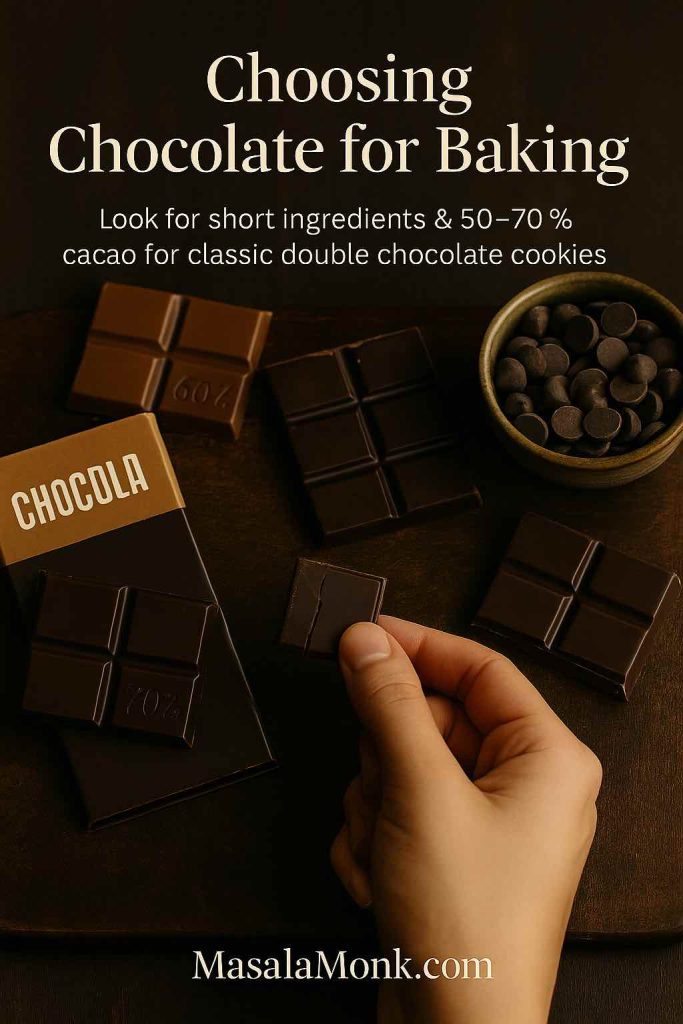
Since the chocolate is doing so much work, it’s worth picking a decent one. When you buy chocolate for baking, don’t just look at “dark” versus “milk.” Pay attention to the ingredient list and the cacao percentage.

A good bar usually has a short ingredient list with cocoa mass, cocoa butter, sugar, and maybe a little lecithin or vanilla, but not a lot of extra fats or artificial flavors. A Food & Wine explainer on what to look for on a chocolate label suggests checking for cocoa butter as the primary fat and a clear cacao percentage, then tasting a few brands to find the flavor profile you like.

Hand holding a square of dark chocolate above several chocolate bars marked 60% and 70% cacao, with a small bowl of chocolate chips, illustrating how to choose chocolate for baking double chocolate chip cookies.
Choose chocolate with a short ingredient list and around 50–70% cacao to get deep flavor without bitterness in your double chocolate chip cookies.

If you’re curious about the difference between cacao, cocoa and dark chocolate more generally, MasalaMonk’s What is Cacao?: Cacao vs. Chocolate vs. Dark Chocolate walks through processing, nutrition and flavor in more detail.

For classic double chocolate chip cookies, something in the 50–70% range works beautifully. You’ll still get that big chocolate flavor without pushing things into bitter territory.

Also Read: Baked Jalapeño Poppers (Oven) — Time, Temp & Bacon Tips


Step-by-step: base double chocolate chip cookies

Once you’ve gathered everything, the process is straightforward and rhythmical. You can even do it by hand with a sturdy whisk and spatula if you don’t feel like hauling out a mixer.

1. Cream the butter and sugars

Beat the softened butter with the brown and white sugar until the mixture looks a little lighter and feels fluffy. This usually takes 2–3 minutes with a hand mixer on medium speed.

Creaming does a couple of things at once: it disperses the sugar, traps a bit of air in the butter, and starts building the structure that keeps the cookies from turning into thin puddles. Proper creaming is part of why these double chocolate cookies bake up with soft centers and more defined edges.

Person holding a hand mixer over a large bowl of pale, fluffy creamed butter and sugars, with small bowls of ingredients around, illustrating the first step in making soft, chewy double chocolate chip cookies.
Cream butter and both sugars until the mixture turns pale and fluffy—this first step builds the soft, chewy texture in every double chocolate chip cookie.

2. Add eggs and vanilla

Crack in the eggs one at a time, mixing well after each addition, then stir in the vanilla.

At this point, the mixture should look glossy and a little thick. Scrape down the sides of the bowl so you don’t have streaks of butter hiding underneath.

Hands whisking an egg into a thick yellow batter in a ceramic bowl, with vanilla in a small dish beside it, showing the step of beating in eggs one at a time for double chocolate chip cookies.
Beat in the eggs one at a time, then add vanilla and whisk until the batter turns thick and glossy before you add the dry ingredients.

3. Whisk the dry ingredients

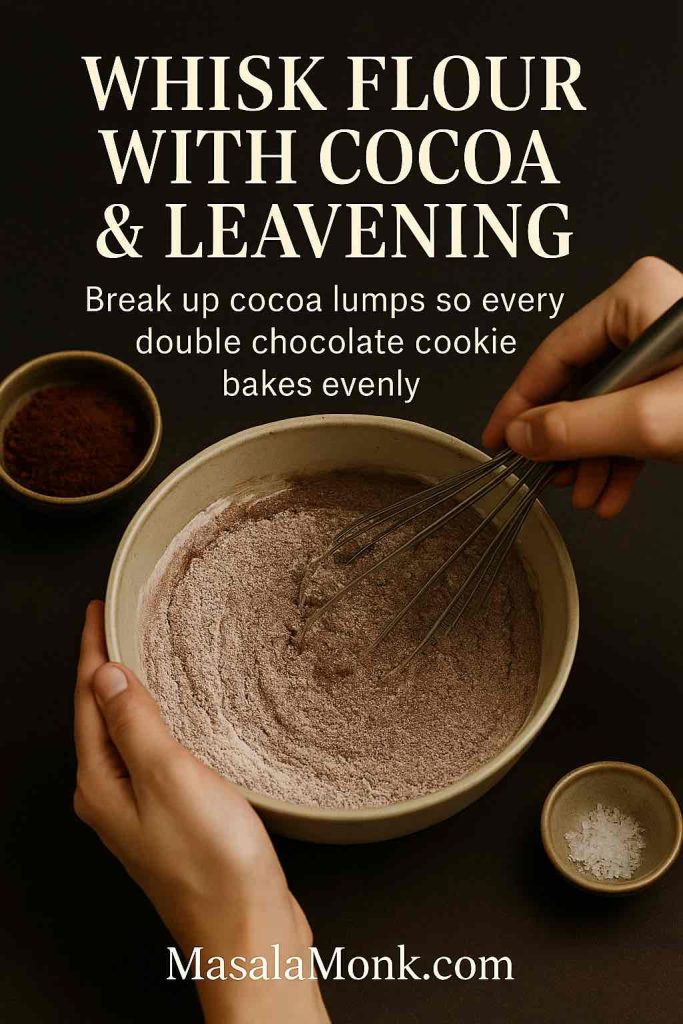
In a separate bowl, combine the flour, cocoa powder, baking soda and salt. Whisk until the cocoa looks evenly distributed and you’re not seeing clumps.

Cocoa, especially if it’s been packed tightly into a container, likes to form lumps. Whisking with flour breaks those up and means you won’t end up with bitter, dusty pockets in the finished cookies.

Hands whisking flour, cocoa powder, baking soda and salt together in a ceramic bowl, breaking up cocoa lumps to prepare the dry mix for double chocolate cookies.
Whisk flour, cocoa, baking soda and salt until the color is even and there are no cocoa lumps left—this dry mix keeps every double chocolate cookie tasting smooth, not bitter.

4. Bring the dough together

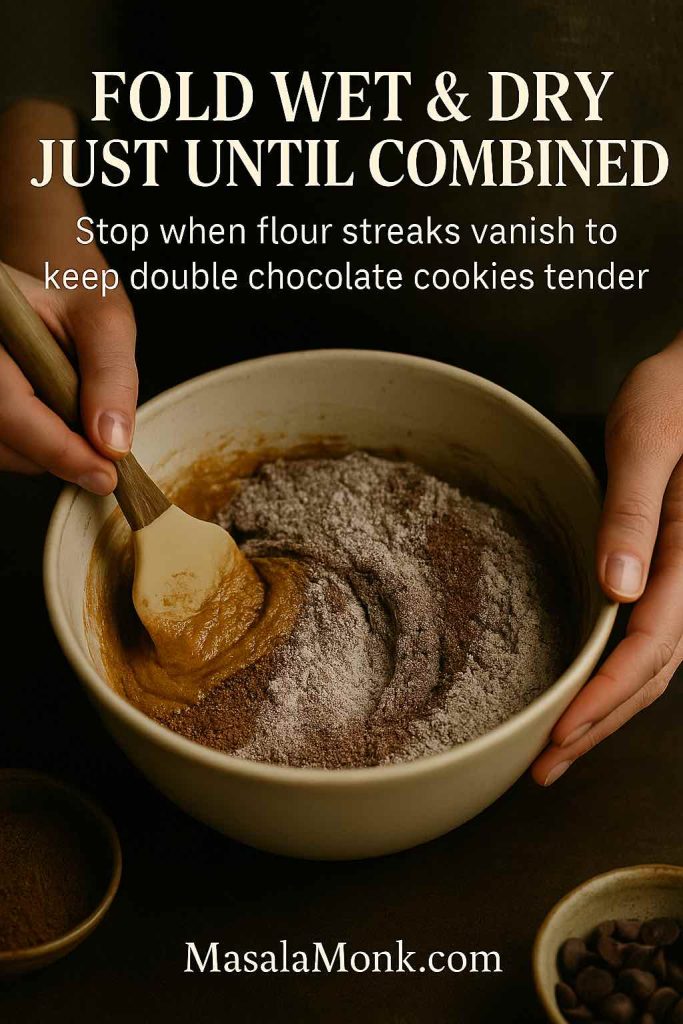
Add the dry ingredients to the wet mixture in two or three portions. Use a spatula or the mixer on low speed, and stop as soon as there are no streaks of flour left.

Over-mixing at this stage can make cookies tough, because it develops more gluten than you really need. You’re aiming for a thick, scoopable double chocolate chip cookie dough that holds its shape on a spoon.

Hands using a spatula to fold cocoa and flour into a golden batter in a ceramic bowl, with text reminding to stop when flour streaks disappear to keep double chocolate cookies tender.
Gently fold the cocoa-flour mix into the butter batter just until the flour streaks vanish so your double chocolate cookies stay soft, not tough.

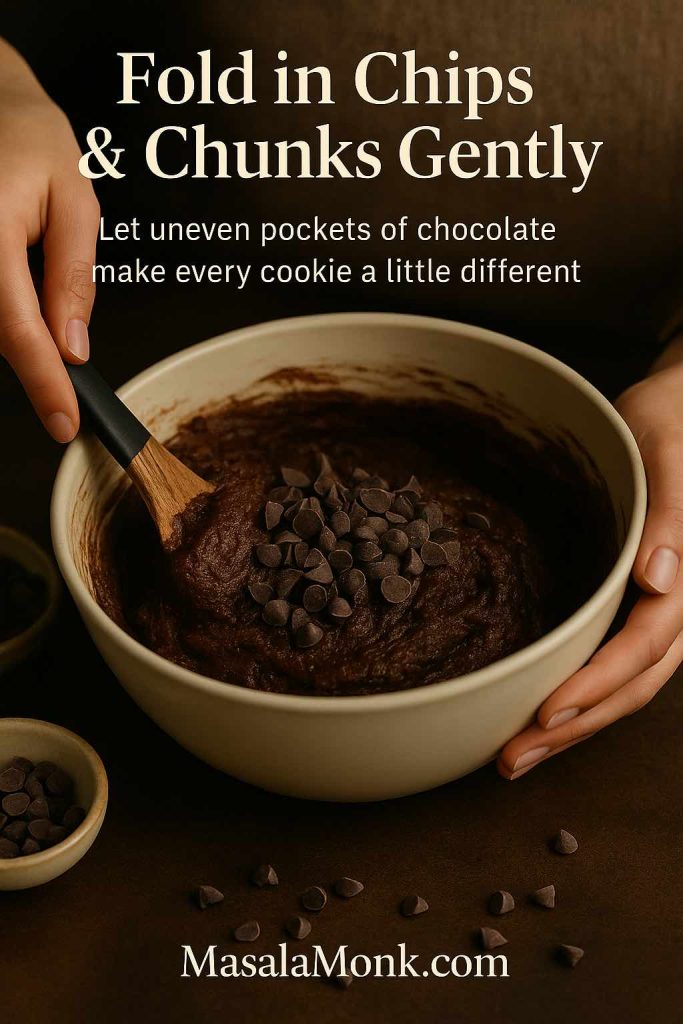
5. Fold in the chocolate

Tip in the chocolate chips or chopped chocolate and fold them through gently. You want them dispersed, but you don’t need to chase perfection here. Some cookies with more chocolate than others is very much the point of double chocolate chocolate chip cookies.

If you prefer more chocolate in every bite, use a mix of chips and finely chopped chocolate. The tiny shards melt into the dough and create that slightly gooey, almost brownie-like crumb.

Hands folding a pile of chocolate chips into thick double chocolate cookie dough in a cream bowl, with extra chips scattered on the table, showing how to add chocolate to the cookie base.
Gently fold plenty of chocolate chips and chunks into the rich double chocolate cookie dough so every cookie bakes with its own melty pockets of chocolate.

6. Chill the dough

Cover the bowl and chill the dough for at least 30 minutes. An hour is even better if you can spare the time.

Bakers and food writers have been testing this for years, and the consensus is remarkably consistent: resting cookie dough helps. King Arthur’s tests, along with more recent pieces such as Simply Recipes’ article on when chilling cookie dough is actually worth it, point out that even a short chill lets the flour hydrate and the butter firm up, which means less spreading, more flavor, and better browning.

If you’re in a hurry, take the edge off at least by popping the dough in the freezer for 15–20 minutes while you preheat the oven and line your baking trays.

Hands placing a covered bowl of double chocolate cookie dough into the fridge, with baked cookies on a tray above, illustrating the chilling step before baking double chocolate chip cookies.
Chill the double chocolate cookie dough for at least 30 minutes so the butter firms up, the flour hydrates and each cookie bakes with less spread and deeper flavor.

7. Bake

When you’re ready to bake:

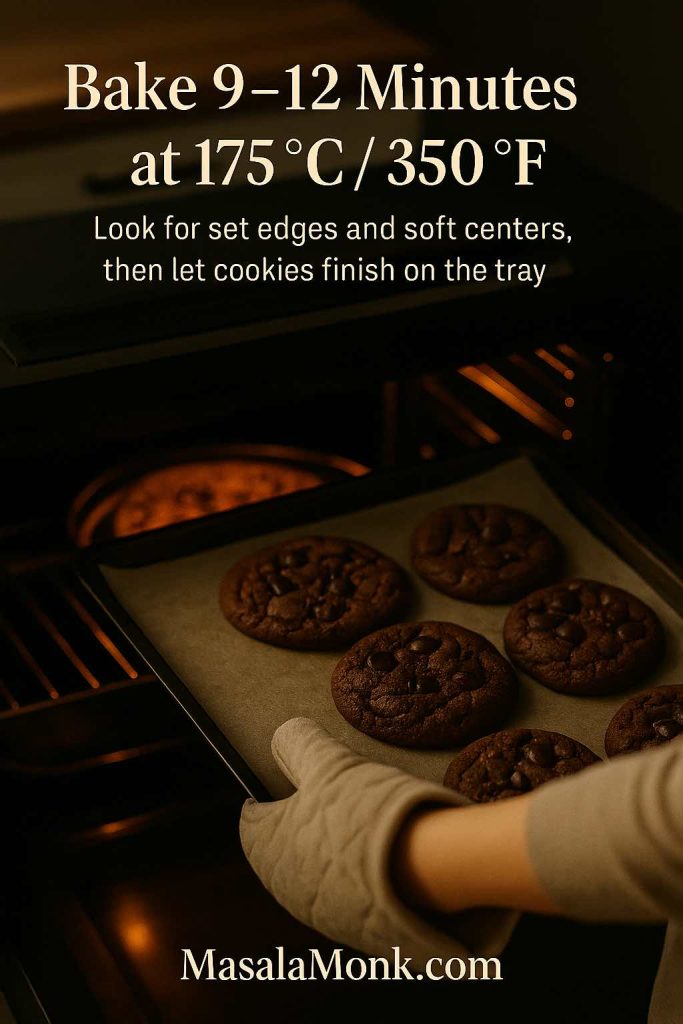
  1. Preheat the oven to 175°C / 350°F.
  2. Line two baking trays with parchment.
  3. Scoop about 2 tablespoons of dough per cookie, spacing them well apart.
  4. Bake for 9–12 minutes, depending on size and your oven.

You’re looking for set edges and slightly soft centers. The cookies will continue to firm up as they cool on the tray. Once they’ve sat for about 5 minutes, transfer them to a rack.

Hands in quilted oven mitts pulling a tray of freshly baked double chocolate chip cookies from the oven, with on-image text showing to bake 9–12 minutes at 175°C or 350°F and look for set edges and soft centers.
Bake the double chocolate chip cookies for 9–12 minutes at 175°C / 350°F until the edges are set and the centers still look soft, then let them finish on the tray for the perfect texture.

At this point, you’ve got a tray of rich, classic double chocolate chip cookies. You can stop here and call it a day—or you can divide the dough and explore the variations.

Also Read: Carbonara Recipe: Italian Pasta (Creamy, Veggie, Chicken, Shrimp, Tuna & Keto)


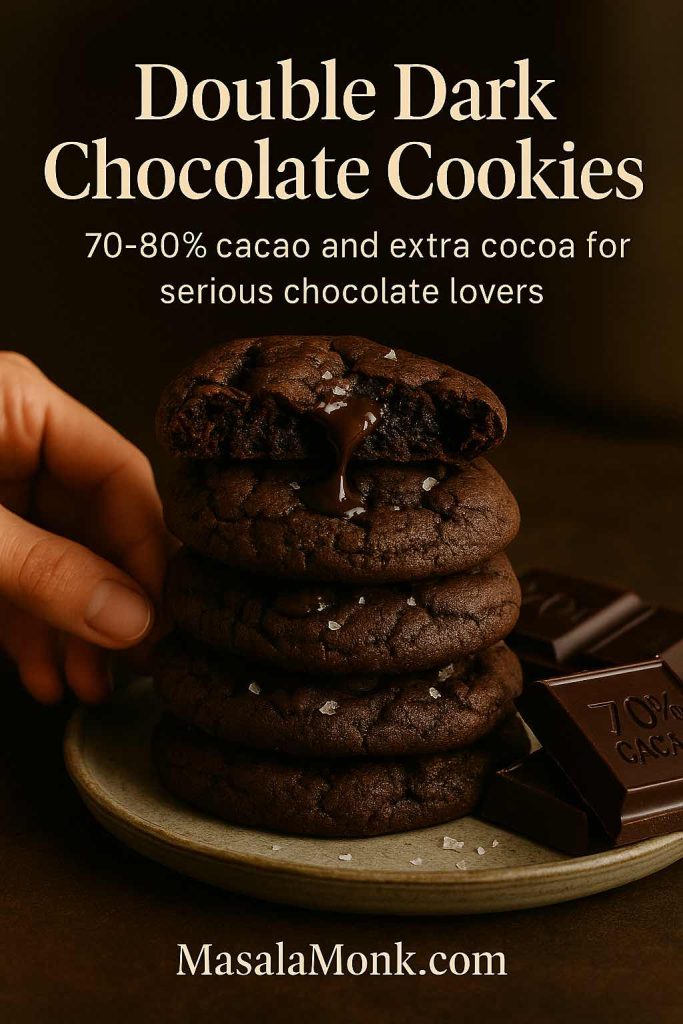
Double Dark Chocolate Cookies

When you want a cookie that tastes like the inside of a very grown-up chocolate bar, a double dark chocolate version is the way to go.

To transform a portion of the base dough into double dark chocolate cookies:

  • Replace about ¼ of the chocolate chips with chopped dark chocolate in the 70–80% range.
  • Add 1–2 tablespoons extra cocoa powder.
  • Reduce the white sugar by 1–2 tablespoons to keep the sweetness balanced.

Because darker chocolate has a higher cocoa content and less sugar, it naturally tastes more intense and slightly bitter. Cutting the sugar just a touch prevents the cookies from feeling cloying, while the extra cocoa pushes them into that deep, almost brownie-like zone.

Stack of double dark chocolate cookies topped with flaky salt, with a broken cookie oozing melted dark chocolate and 70% cacao chocolate bars beside it, showing the richer variation of the recipe.
Double dark chocolate cookies made with 70–80% cacao and extra cocoa powder for a richer, less sweet variation that’s perfect for serious chocolate lovers.

If you’ve ever wondered how to judge a bar of dark chocolate before you bake with it, chocolate makers and tasting guides suggest checking both the cacao percentage and the aroma. A recent Food & Wine piece on choosing high-quality chocolate recommends looking for a distinct cocoa smell and a clear note—fruity, nutty, or toasty—when you snap a square. That same bar will usually make a fantastic add-in for your double dark chocolate cookies.

Bake this variation exactly like the base recipe, though you may find they benefit from a minute or so longer in the oven, as the extra cocoa slightly changes how they set.

Also Read: Mimosa Recipe: 10 Easy Versions from Classic to Caramel Apple


Vegan Double Chocolate Chip Cookies

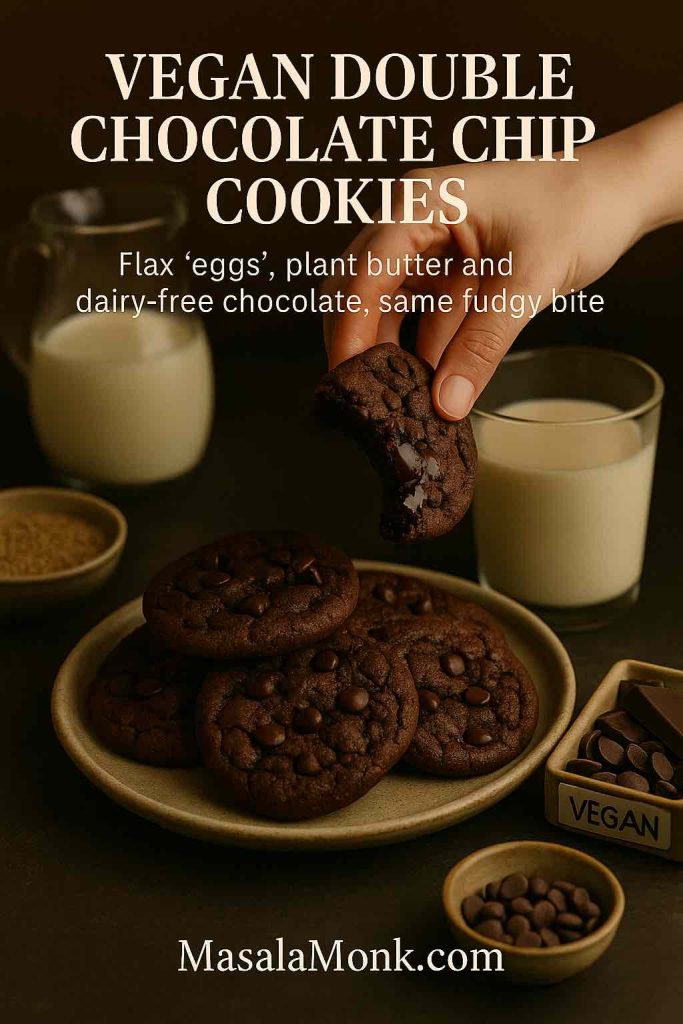
Next, let’s adapt the dough into a version without eggs or dairy. Vegan double chocolate chip cookies still need structure, moisture and fat; you’re just getting those from different sources.

For a vegan batch, you’ll:

  • Swap the butter for a vegan butter block or coconut oil (use a solid-but-soft fat, not liquid oil).
  • Replace each egg with a flax “egg”: 1 tablespoon ground flaxseed mixed with 2½ tablespoons water, rested until gel-like.
  • Use dairy-free chocolate chips or chopped dark chocolate that’s labeled vegan.

The method stays the same: cream the vegan butter with the sugars, stir in the flax eggs and vanilla, then fold in the dry ingredients and chocolate.

Hand dipping a fudgy vegan double chocolate chip cookie into a glass of plant milk, with more cookies on a plate and bowls of dairy-free chocolate chips and flaxseed around it.
Vegan double chocolate chip cookies made with flax “eggs”, plant butter and dairy-free chocolate, served with a glass of creamy plant milk for the same rich, fudgy bite without eggs or dairy.

Flax eggs work especially well in denser, fudgier bakes like brownies and cookies. A detailed guide to egg alternatives from Rainbow Plant Life sets out the basic ratio—1 tablespoon flax meal to 2½ tablespoons water per egg—and explains that this mixture adds binding and moisture rather than lift, which is exactly what you want here.

If you’re curious about other options, vegan pastry chefs and dietitians often mention chia seeds, aquafaba, mashed banana and applesauce as workable egg substitutes, each with slightly different strengths. Articles such as Eater’s exploration of egg replacements in baking describe how bakers match the substitute to the role of the egg—binding, moisture, fat, or aeration—before they adjust the recipe.

Once baked, these vegan double chocolate chip cookies are slightly less chewy than the original, but every bit as satisfying. Let them cool fully before moving them; plant-based fats tend to feel softer while warm.

Also Read: Vegan French Toast: 6 Easy Recipes (Pan, Air Fryer, GF & High-Protein)


Gluten-Free Double Chocolate Cookies

For gluten-free readers, the goal is to keep that soft, fudgy center without the wheat. The easiest way to manage that is to lean on a good gluten-free flour blend that’s meant to be swapped 1:1 for all-purpose flour.

To make gluten-free double chocolate cookies from the base dough:

  • Replace the all-purpose flour with a gluten-free “measure for measure” blend.
  • Make sure your cocoa powder, chocolate chips and other add-ins are labeled gluten-free if you need to avoid cross-contamination.
  • Add a tablespoon or two of milk or water if the dough feels unusually stiff; gluten-free blends sometimes absorb a bit more liquid.

King Arthur’s guide to how to bake gluten-free notes that for non-yeasted recipes like cookies, brownies and many cakes, you can usually swap all-purpose flour for a well-formulated 1:1 gluten-free flour without changing anything else, as long as the blend contains a binder such as xanthan gum.

Hand picking up a gluten-free double chocolate cookie from a dark plate of cookies, with bowls of gluten-free flour and millet and a handwritten gluten-free label in the background.
Gluten-free double chocolate cookies made with a 1:1 GF blend or millets so you still get soft, fudgy cookies without any wheat.

If you prefer to lean into naturally gluten-free grains rather than blends, you can also experiment with millet and oat flour. Millets in particular are a versatile, gluten-free group of grains with a gentle flavor and good nutrition. MasalaMonk’s piece on Millets: The Gluten-Free Superfood explains how they fit into gluten-free eating and why they’re a strong alternative to wheat for people with celiac disease or intolerance.

For a partly millet-based version, try replacing ¼–⅓ of the flour with very finely ground millet flour while still using a gluten-free blend for the rest. Chill the dough well to help the structure set before it hits the oven.

Expect gluten-free double chocolate cookies to spread a little differently and to feel slightly more delicate while hot. Let them cool on the tray for a few extra minutes before transferring them.

Also Read: All About Gluten: Symptoms, Testing, Diet & 7-Day Gluten-Free Meal Plan


Almond Flour Double Chocolate Chip Cookies

Almond flour double chocolate chip cookies sit somewhere between a classic cookie and a brownie. They’re tender and a little denser, with a rich, nutty aroma that works beautifully with dark chocolate.

To adapt part of the base dough:

  • Replace 1 cup (125 g) of the all-purpose flour with fine almond flour.
  • If the dough looks very loose, add an extra tablespoon or two of flour or cocoa powder.
  • Chill for at least 45–60 minutes to help the dough firm up before scooping.

Almond flour adds both fat and protein, so these cookies bake up with a slightly more cake-like crumb, but still feel fudgy because of the cocoa and chocolate. If you enjoy bakes that pull a little closer to the “better for you” side without turning into a health food project, this variation is a nice middle ground.

Hand sprinkling almond slices over a stack of almond flour double chocolate cookies on a dark plate, with a bowl of almond flour and whole almonds around it, showing the nutty gluten-free variation.
Almond flour double chocolate cookies with a nutty, tender crumb and melty chocolate chips, finished with sliced almonds for a naturally gluten-free twist on the base dough.

Because almond flour is naturally gluten-free, you can also combine this approach with the gluten-free version above: use a gluten-free blend for part of the flour and almond flour for the rest. That way you get a cookie that works for more people but doesn’t sacrifice texture.

To balance out richer desserts on other days, you might appreciate building some higher-protein breakfasts into your week. MasalaMonk’s High Protein Overnight Oats 5 Ways and the more recent Protein Oatmeal: Turn Plain Oats into a High-Protein Meal show how simple additions like yogurt, egg whites, paneer, nuts and seeds can transform oats into a very satisfying meal.


Mint Double Chocolate Chip Cookies

Mint and chocolate share the kind of friendship that tends to divide people—some adore the combination, others avoid it entirely. If you’re in the first camp, mint double chocolate chip cookies will probably disappear even faster than the plain ones.

To turn a portion of dough minty:

  • Add ½ teaspoon peppermint extract to the dough along with the vanilla. If your extract is very strong, start with ¼ teaspoon.
  • Swap ¼ of the chocolate chips for chopped mint chocolate or chocolate filled with mint cream.
  • Optionally, press a few extra chips or tiny shards of mint chocolate onto the top of each cookie before baking.
Hand holding a mint double chocolate cookie from a dark plate of cookies topped with chocolate chips, crushed peppermint and fresh mint leaves, with dark chocolate pieces around the plate.
Mint double chocolate cookies made with dark chocolate, fresh mint and crushed peppermint for a festive twist on the base double chocolate chip cookie dough.

Peppermint extract is powerful, so it’s better to begin modestly and adjust next time than to overshoot and feel like you’re eating toothpaste. Once you find your sweet spot, you can use that same ratio in brownies, hot chocolate and other chocolate desserts.

These mint double chocolate chip cookies are especially lovely in colder months. They pair naturally with a hot drink, and they look beautifully festive on a dessert table next to something creamy like a trifle or a slice of Tres Leches Cake with its many variations.


High Protein Double Chocolate Cookies

Sometimes you want a cookie that leans a bit more toward snack than dessert—still indulgent, but with enough protein to keep you satisfied for a while. High protein double chocolate cookies handle that nicely.

Here’s a simple way to adjust the base dough:

  • Replace ¼–⅓ cup of the flour with a scoop of protein powder. Whey, casein or a good plant-based blend all work, though the texture will vary slightly.
  • Use chocolate or vanilla protein powder, depending on how strong you want the chocolate flavor to be.
  • Add 1–2 tablespoons extra liquid (milk, water or plant milk) if the dough seems dry or crumbly, because protein powder absorbs a lot of moisture.
  • Chill thoroughly so the dough can hydrate and so the cookies don’t spread too much.
Hand lifting a high protein double chocolate cookie from a stack on a plate, with a bowl of chocolate protein powder, scattered oats and a shaker bottle in the background.
High protein double chocolate cookies made by swapping some flour for protein powder so you get a richer, more filling chocolate snack from the same base dough.

When bakers and food technologists work on high-protein cookie recipes for commercial products, they tend to talk about the same challenges over and over: dryness, excessive spread, and a slightly chalky texture if the protein percentage is pushed too far. Research and trade articles on formulating high-protein cookies emphasize balancing protein powder with enough fat and moisture, then keeping the bake time a little on the shorter side so the cookies stay tender rather than turning tough.

In your own kitchen, the easiest way to approach this is to treat the high-protein version as one of several options rather than the only batch of cookies you bake. Mix the protein variation with some classic cookies on a platter, or serve it after a workout alongside a bowl of protein oats. The idea isn’t to turn dessert into a diet food; it’s simply to give you a slightly more substantial option when you want one.

Also Read: 10 High Calorie Protein Shakes & Smoothie Recipes for Healthy Weight Gain


Double Chocolate Cookie Cake

Once you’ve fallen in love with the flavor of this dough, it’s almost inevitable that someone will ask for a giant cookie. A double chocolate cookie cake is really just a thick cookie baked in a pan and sliced into wedges, but it feels far more celebratory.

To make one:

  1. Line or grease a 9-inch round or square pan.
  2. Press chilled dough evenly into the pan. Take a moment to smooth the surface; it makes the finished cookie cake look more polished.
  3. Bake at 175°C / 350°F for 18–24 minutes.
  4. Begin checking around the 18-minute mark. The edges should look firm and slightly crisp, while the center still looks a tiny bit soft.
  5. Cool completely in the pan before slicing.
Slice of double chocolate cookie cake with gooey chocolate drizzle on a ceramic plate, with the rest of the cookie cake blurred in the background and text explaining it is made from the same cookie dough
Turn your double chocolate chip cookie dough into a gooey, sliceable cookie cake by pressing it into a pan and baking it as a rich dessert to serve with coffee or hot chocolate.

You can leave the cookie cake plain, decorate it with swirls of buttercream, or drizzle over something glossy. MasalaMonk’s 3 Minutes Homemade Chocolate Syrup – Dairy and Gluten Free works really well as a drizzle here, especially if you want to keep the topping lactose-free or suitable for guests avoiding gluten.

For birthdays or celebrations, you can dot the top with extra chocolate chips, chopped nuts, or even a few mint pieces if you like that flavor. Once you’ve baked a cookie cake once, you’ll probably find yourself repeating the trick whenever you need something festive but don’t feel like layering and frosting a full cake.

Also Read: 10 Best Espresso Martini Recipe Variations (Bar-Tested)


Freezing and baking double chocolate chip cookie dough safely

Since this dough holds up to chilling and freezing, it makes sense to set aside at least part of each batch for later.

To freeze:

  1. Scoop the dough into balls onto a lined tray.
  2. Freeze until firm, then transfer the frozen dough balls to a container or zip bag.
  3. Label with the date and bake temperature so you don’t have to dig around for the recipe later.

When you’re craving cookies, you can bake these from frozen at the same temperature, adding a minute or two to the bake time. They’ll be slightly thicker because the centers start out colder, which works nicely for double chocolate chip cookies.

Hands sliding a tray of double chocolate cookie dough balls labeled Double Chocolate Cookie Dough into the freezer, with on-image text explaining they can be baked straight from frozen for fresh cookies anytime.
Scoop your double chocolate cookie dough into balls, freeze them on a tray and bake straight from frozen whenever a fresh batch of cookies sounds good.

One thing to keep in mind is that raw cookie dough made with untreated flour and raw eggs isn’t safe to eat. The U.S. Centers for Disease Control and Prevention has clear guidance on raw flour and dough, explaining that both flour and eggs can carry germs like E. coli and Salmonella and that outbreaks have been linked to raw cookie dough in recent years. The FDA echoes the same message in its update on flour as a raw food, emphasizing that flour is not treated to kill germs and should always be cooked.

If you want to make an “edible” double chocolate dough for snacking, heat-treat the flour in the oven and skip the eggs entirely, using milk, cream, or a plant-based alternative for moisture instead. Keep that version clearly labeled so you don’t accidentally bake it later.

Also Read: Homemade Hot Chocolate with Cocoa Powder Recipe


How to serve your double chocolate chip cookies

Once you have a box or tin full of cookies, it’s surprisingly fun to start thinking in pairings.

One very obvious partner is hot chocolate, and a good one makes both the drink and the cookies feel special. The Homemade Hot Chocolate with Cocoa Powder Recipe at MasalaMonk walks through a simple ratio that uses cocoa powder, sugar and milk in a way that lets you adjust how dark or sweet your mug feels, with options for dairy-free or lower-sugar tweaks. A tray of double chocolate chip cookies next to a pot of that hot chocolate is an instant winter evening.

Hands holding a mug of hot chocolate next to a stack of double chocolate cookies on a wooden tray, with a chia pudding jar dessert and a small cake slice in the background, showing how to serve the cookies.
Serve your double chocolate cookies with a steaming mug of hot chocolate, a chilled jar dessert or a mini dessert board so everyone can mix and match their favourite textures.

On days when you want something a little lighter but still comforting, you can pair a cookie or two with a small glass jar dessert such as Chia Pudding – Steel Cut Oats, Mango, Chia Seeds, Fox Nuts. That way you get both crunch and creaminess in the same snack.

If you’re hosting, it’s also fun to build a small dessert spread built around the same chocolate theme. Your double chocolate chip cookies can sit alongside a slice of Tres Leches Cake with its 10 variations, or even next to a plate of those peanut butter cookies mentioned earlier. Different textures and flavors make it more likely that everyone finds something they’re happy to reach for.


Making the recipe your own

By this point, you’ve seen just how far one simple dough can go. Out of the same bowl, you can bake:

  • a straightforward tray of double chocolate chip cookies
  • richer double dark versions
  • vegan double chocolate chip cookies with flax eggs and plant-based chocolate
  • gluten-free double chocolate cookies using blend flours or millets
  • almond flour double chocolate chip cookies with a nutty, tender crumb
  • mint double chocolate chip cookies for the holidays
  • high protein double chocolate cookie experiments
  • and even a double chocolate cookie cake for the days when only a giant cookie will do

Once you’ve tried a couple of these variations, the dough stops feeling like a fixed recipe and starts feeling more like a flexible template you can bend to your own moods and pantry.

Also Read: Sheet Pan Chicken Fajitas Recipe (Easy One-Pan Oven Fajitas)


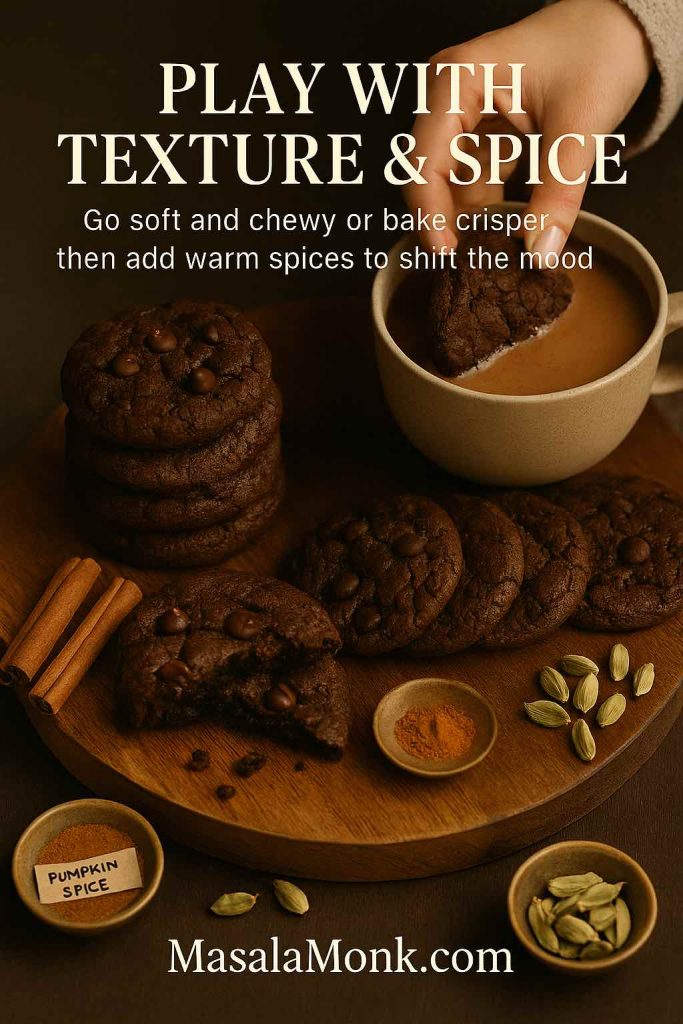
Playing with texture and spice

After you’re comfortable with the base, it becomes very easy to nudge the cookies in different textural directions.

If you like them softer and chewier, keep the centers slightly underbaked and let them finish setting on the tray. For a crisper result, flatten the scoops a little more before baking and leave the cookies in the oven for an extra minute or two. That simple change alone can push them closer to double chocolate chip biscuits, perfect for dunking into coffee or hot chocolate.

Hand dipping a double chocolate cookie into a cup of chai on a wooden board with soft and crisp cookies, cinnamon sticks, pumpkin spice and cardamom pods, showing how to change texture and add warm spices.
Go soft and chewy or bake your double chocolate cookies a little crisper, then add warm spices like cinnamon, cardamom or pumpkin spice to match your favourite cozy drink.

Beyond texture, small flavor tweaks go a long way. A pinch of cinnamon, a touch of cardamom, or a sprinkle of pumpkin pie spice folded into part of the dough can shift the whole experience. Suddenly the same double chocolate cookie feels warm and autumnal, or gently spiced in a way that makes it sit neatly alongside masala chai or a spiced latte. You don’t need much—often just ½ teaspoon of spice in a half-batch is enough to give a clear personality without overpowering the chocolate.

Also Read: Katsu Curry Rice (Japanese Recipe, with Chicken Cutlet)


Exploring different chocolates

Another easy way to keep things interesting is to change the chocolate itself. Instead of using the exact same chips every time, try:

  • a swirl of milk and dark chocolate together
  • chopped bars with nuts, coffee, or dried fruit
  • single-origin dark chocolate for a more complex, grown-up flavor
Assorted milk chocolate bars, 60% and 70% dark chocolate, nut-studded chocolate pieces and double chocolate cookies on a wooden board, with a hand picking up a cookie and text reading Explore Different Chocolates – Mix milk, dark and add-ins for new double chocolate cookie moods.
Mix milk and dark chocolate, then add nuts, coffee or dried fruit to create new double chocolate cookie moods from the same base dough.

Nutrition writers and dietitians often point out that darker chocolate brings more cocoa solids and flavanols, while milk chocolate leans creamier and sweeter. A Verywell Health comparison of dark chocolate vs. milk chocolate explains that dark chocolate usually has a higher cocoa content and more of those beneficial plant compounds, whereas milk chocolate comes with more sugar and milk solids and a softer flavor profile.

In a cookie, that translates into bolder, slightly more bitter pockets when you use a high-percentage dark bar, and gentler, almost hot-chocolate-like bites when you lean on milk chocolate. Neither is wrong; they’re just different moods. One batch might suit a late-night dessert board, while the other feels perfect for a relaxed afternoon with kids.

Also Read: French 75 Cocktail Recipe: 7 Easy Variations


Conclusion

The real magic of having a reliable base recipe is that it gives you room to relax. Once you trust that the dough will behave, you no longer have to obsess over every tiny adjustment. Instead, you can focus on the fun decisions: which flour to reach for today, how dark you want the chocolate to be, whether you’re in the mood for biscuits or a cookie cake, and if this is the week for a vegan, gluten-free or high-protein twist—or for none of those at all.

Every batch becomes a small, low-stakes experiment. Sometimes you’ll discover a new favorite combination; other times you’ll simply circle back to the classic tray of double chocolate chip cookies that started it all. In both cases, the process stays comforting and familiar, which is part of why baking feels so grounding.

And as that unmistakable smell of cocoa, butter and caramelizing sugar fills your kitchen, it’s hard to imagine anyone complaining that you’ve made too many versions. If anything, the real “problem” with this dough is that once you know how easily it can turn into eight different treats, there’s always one more double chocolate cookie idea worth trying.

Also Read: What to Mix with Jim Beam: Best Mixers & Easy Cocktails

Assortment of double chocolate cookies and a cookie cake slice arranged on a wooden board and labeled classic, vegan, almond flour, high protein and frozen, with a hand reaching for one cookie and text reading One Dough, Endless Double Chocolate Cookies.
One base double chocolate cookie dough, turned into classic, vegan, almond flour, high-protein, frozen and cookie cake variations so you can keep experimenting without changing the recipe from scratch.

FAQs

1. What makes a cookie a double chocolate chip cookie?

A double chocolate chip cookie uses cocoa powder in the dough and chocolate chips or chunks mixed in. So the chocolate flavor comes from two places. That is why it is called “double chocolate.”


2. Can I use both chips and chunks in this double chocolate cookies recipe?

Yes, you can mix them. Chips hold their shape more. Chunks melt into bigger pockets of chocolate. Using both gives great texture in double chocolate chip cookies.


3. How do I stop my double chocolate chip cookies from spreading too much?

Chill the dough before baking. Make sure the butter is not melted, only softened. Do not over-grease the tray. Also, measure flour accurately so the dough is not too wet.


4. How do I make double chocolate cookies more chewy instead of cakey?

Use more brown sugar than white sugar. Do not overbake; take them out when the centers still look soft. Let them cool on the tray for a few minutes. That keeps double chocolate chip cookies chewy.


5. Can I make small batch double chocolate chip cookies with this recipe?

Yes, you can. Simply divide all ingredients by two or four. Keep the method and baking time almost the same. Watch the cookies closely near the end.


6. How do I turn this into vegan double chocolate chip cookies?

Swap butter for vegan butter or coconut oil. Replace each egg with a flax or chia “egg.” Use dairy-free chocolate chips. Follow the same mixing order as the original recipe.


7. Will vegan double chocolate chip cookies taste different?

They will taste slightly different but still rich and chocolatey. The texture may be a bit softer. Some people even prefer the gentle chew of vegan double chocolate cookies.


8. What is the best way to make gluten free double chocolate cookies?

Use a good gluten-free 1:1 baking flour blend. Chill the dough so the cookies hold shape. Avoid overbaking because gluten-free cookies dry faster. Let them cool on the tray before moving.


9. Can I mix gluten-free flour and almond flour in one batch?

Yes, you can combine them. Use a gluten-free blend as the base and replace part of it with almond flour. The double chocolate cookies will be tender and slightly nutty.


10. What does almond flour do in double chocolate chip cookies?

Almond flour adds fat, flavor, and a soft crumb. The cookies feel richer and more moist. They can spread a little more, so chilling is helpful.


11. How can I make double dark chocolate cookies from this dough?

Use darker chocolate with higher cocoa percentage. Add a spoon or two more cocoa powder. Reduce the sugar slightly if you like a deeper, less sweet flavor.


12. Can I add mint to make mint double chocolate chip cookies?

Yes, you can add peppermint extract. Start with a small amount and taste next time if you want more. You may also use chopped mint chocolate in place of part of the chips.


13. How do I make high protein double chocolate cookies?

Replace a portion of the flour with protein powder. Add a little extra liquid if the dough feels dry. Bake for slightly less time so the cookies stay soft.


14. Can I make a double chocolate cookie cake with this recipe?

Yes, press the dough into a lined pan instead of scooping. Bake longer than normal cookies, until the edges are set. Cool before slicing into wedges.


15. How long can I chill double chocolate chip cookie dough in the fridge?

You can chill it for up to three days. The flavor gets deeper as it rests. Cover the bowl or wrap the dough tightly so it does not dry out.


16. Can I freeze double chocolate chip cookie dough?

Yes, freeze scooped dough balls on a tray. Then store them in a container or bag. Bake from frozen and add a minute or two to the baking time.


17. Why do my double chocolate cookies crack on top?

Cracks can happen when the outside sets faster than the inside. This often gives a nice, bakery-style look. If you want fewer cracks, shape the dough smoothly and avoid very high heat.


18. How do I know when double chocolate cookies are done baking?

Look for set edges and a center that is just barely soft. The cookies will firm up as they cool. If they look fully firm in the oven, they may end up dry.


19. Can I make double chocolate chip biscuits instead of soft cookies?

Yes, flatten the scoops more and bake a little longer. Use slightly less brown sugar and a bit more white sugar. Let them cool fully so they crisp up.


20. Are double chocolate chip cookies better with milk chocolate or dark chocolate?

Both work well. Milk chocolate gives a sweeter, creamier taste. Dark chocolate adds stronger cocoa flavor and less sweetness. Choose based on what you and your guests enjoy most.