Posted on Leave a comment

Almond Cake Recipe

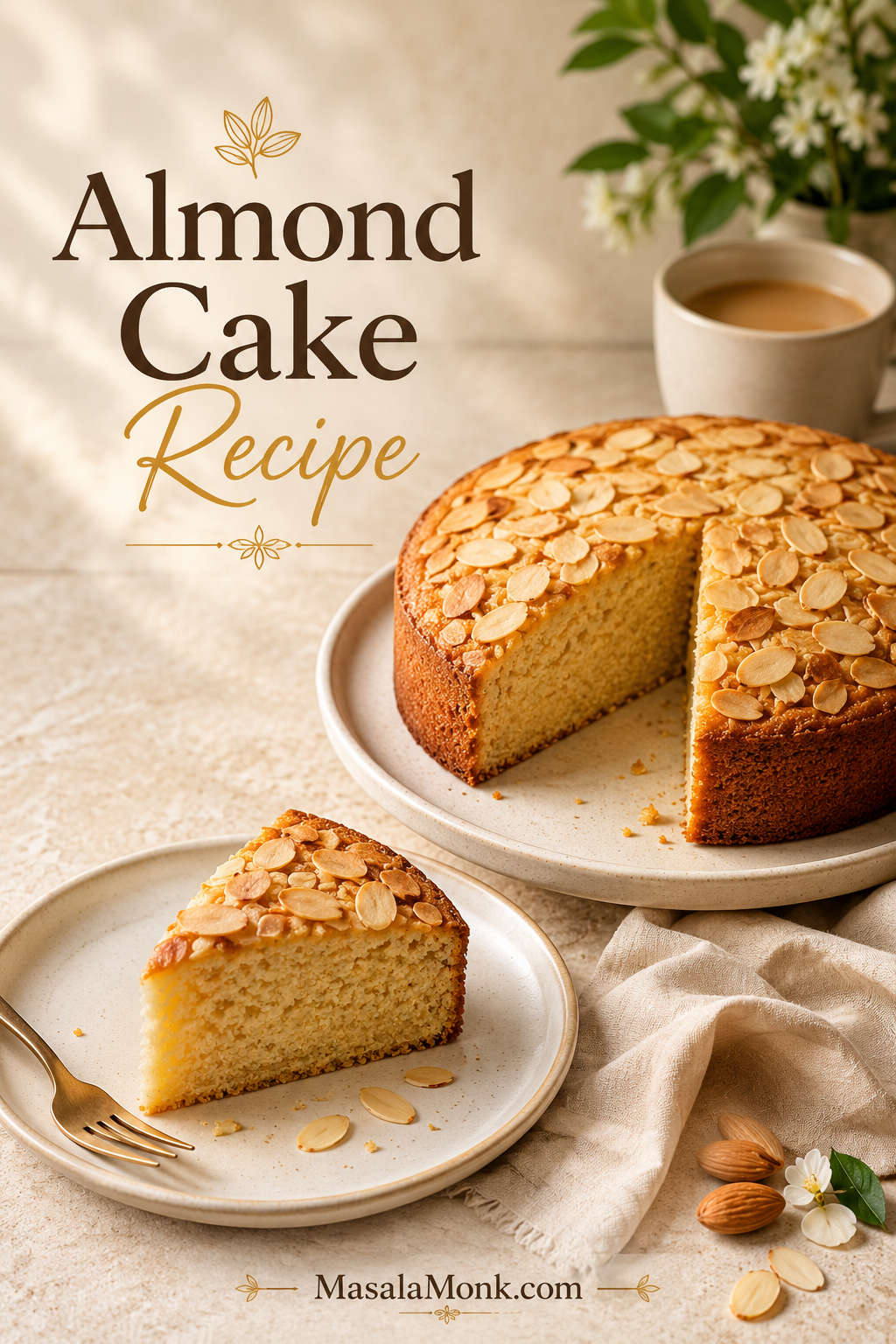
Whole almond cake with sliced almonds on top and one slice removed on a cream plate.

This almond cake recipe is for the moment when you want a golden, tender dessert that feels elegant without frosting. It has a sliced-almond top, a gently rich middle, and just enough lemon or orange zest to keep every bite bright. Once cooled, it cuts cleanly and looks simple, polished, and special on the table without needing much decoration.

Almond flour cakes can be beautiful, but they reward a lighter hand than wheat cakes. Packed flour makes the batter heavy. Cold eggs do not whip as well. A thin pan can brown the edges before the middle is ready. And if you cut the cake while it is still warm, the slice can look damp even when the bake was close.

This version is built around those common almond cake problems: dense centers, oily texture, gritty almond meal, overheated edges, weak egg whites, and cakes that look golden before they are fully baked. The goal is a single-layer almond flour cake that is naturally gluten-free when made with certified gluten-free ingredients, easy enough for tea or brunch, and reliable enough for a guest dessert with berries and cream.

Quick warning for Indian shoppers: if your packet says badam powder, check the label carefully. This recipe needs plain ground almonds, not sweetened badam drink mix, malted almond powder, or milk-powder blends. For the full comparison, see almond flour vs almond meal vs badam powder.

The finished cake should smell like toasted almonds and citrus, feel delicate without falling apart, and settle into clean slices after a few hours. It is the kind of cake that works with powdered sugar, coffee, fruit, cream, or nothing at all.

Quick Answer: How to Make a Tender Almond Flour Cake

To make a tender almond flour cake, use fine blanched almond flour, room-temperature eggs, sugar, baking powder, salt, vanilla, a little almond extract, and lemon or orange zest. Separate the eggs, beat the yolks with sugar, fold in the almond flour, then fold in softly whipped egg whites. Bake in a lined 8-inch / 20 cm round pan at 180°C / 350°F until the top is golden, the middle no longer wobbles, and a toothpick shows moist crumbs rather than wet batter.

The two most important success points are measuring the almond flour lightly, preferably by weight, and letting the cake cool before slicing. Those two details prevent most dense, oily, or fragile results.

QuestionBest answer for this recipe
Best ground almond productFine blanched almond flour for the cleanest, most delicate result.
Almond mealWorks by weight, but the cake will be darker, nuttier, and more rustic.
Almond powderUse only plain unsweetened ground almonds, never badam drink mix.
Best pan8-inch / 20 cm round for a taller cake; 9-inch / 23 cm for a thinner cake.
Oven temperature180°C / 350°F conventional or OTG; 160°C / 320°F fan.
Bake time26–32 minutes in an 8-inch pan; 23–28 minutes in a 9-inch pan.
Gluten-free statusNaturally gluten-free if every ingredient is certified gluten-free.
Eggless swapNot a direct swap; this batter needs eggs to rise, set, and slice cleanly.

Quick success cue: the batter will be thicker than wheat cake batter, the top should bake to a soft gold, and the toothpick should show moist crumbs, not shiny wet batter. Near the end, the cake should smell lightly toasty and citrusy.

Need help choosing the right ground almond product? Jump to almond flour vs almond meal before mixing.

Almond Cake Recipe Snapshot
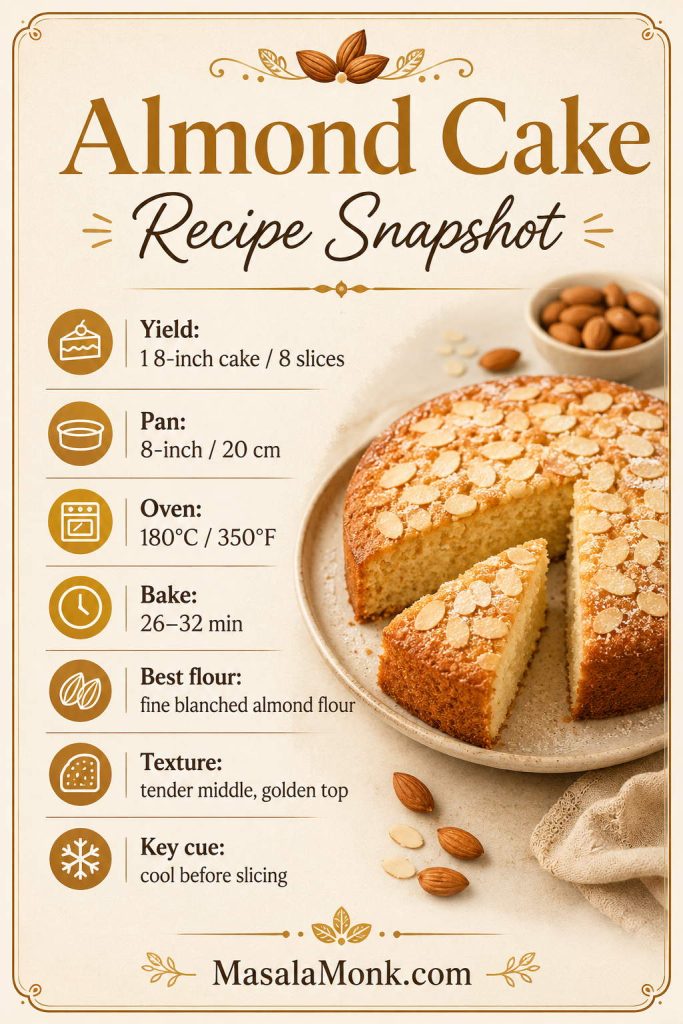
Best for
Tea, coffee, brunch, or a simple gluten-free dessert
Best first pan
8-inch / 20 cm light-colored metal round pan
Best flour
Fine blanched almond flour
Oven
180°C / 350°F conventional; 160°C / 320°F fan
Make-ahead note
Flavor and texture improve after resting
Texture target
Tender middle, golden top, clean-cut slices
Watch out for
Packed flour, weak whites, hot pans, early slicing
Flavor choice
Choose lemon for brightness, orange for warmth
Almond cake recipe snapshot board with yield, pan size, oven temperature, bake time, flour choice, texture target, and cooling cue.
Use this almond cake snapshot as a pre-bake check: pan size, oven temperature, flour choice, and cooling time all affect the final texture.

Keep these details in mind before you start. The safest first bake uses fine almond flour, a sturdy 8-inch pan, and a full cooling time. For ingredient confusion, jump to flour vs meal; for timing doubts, use the doneness cues.

What Kind of Almond Cake Is This?

This is a simple, single-layer almond flour cake made mainly with ground almonds instead of wheat flour. It is closer to a tender tea cake than a tall sponge cake or frosted celebration cake.

If you want…This recipe gives you…
A simple almond flour cakeYes — a single-layer cake with a tender, clean-cut center.
A naturally gluten-free dessertYes, when all ingredients are certified gluten-free.
A tea cake, brunch cake, or coffee cakeYes — this is where the recipe works best.
A frosted birthday-style almond cakeUse a bakery-style layer cake instead.
A whole-orange almond cakeUse a whole-orange method with boiled oranges and a longer bake.
An eggless almond cakeUse a separate eggless formula rather than removing the eggs here.

Almond cake can mean several different things. Some versions are wheat cakes flavored with almond extract; others use boiled oranges, yogurt, or mixed flours. This one stays focused on a dependable almond flour base, so the final texture is easier to predict.

What This Almond Cake Tastes Like

The slice should feel tender and gently rich, not airy like a sponge cake and not dense like almond paste. Almond flour gives the middle a plush, nutty texture, while the sliced almonds on top add a light crackle. Lemon zest makes the cake brighter and more tea-cake-like; orange zest makes it warmer and more dessert-like.

Almond Cake Slice Texture

The slice should bend tender rather than crumble apart. If it looks wet in the center, the cake may be underbaked or cut too warm; if it falls apart, the batter may have been overmeasured, overbaked, or sliced before cooling.
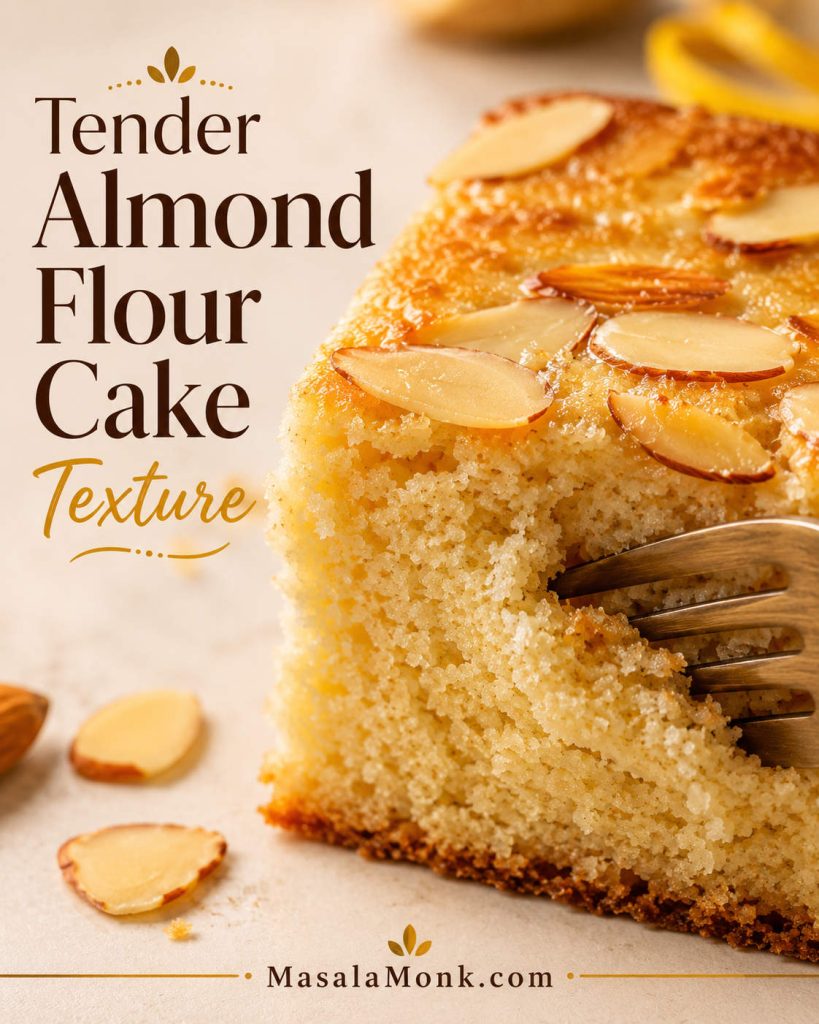
Close-up almond flour cake slice with sliced almonds on top, browned edge, and fork near the crumb.
The best almond flour cake slice should feel gently rich, not wet or pasty; the cut edge should still look neat enough to serve cleanly.

Texture Target for Almond Flour Cake

As the cake cools, the center settles and the flavor rounds out. That resting time is part of why the slice cuts neatly instead of crumbling. The best bite has a fragrant almond top, a clean-cut center, and enough citrus lift to keep the richness from feeling heavy.
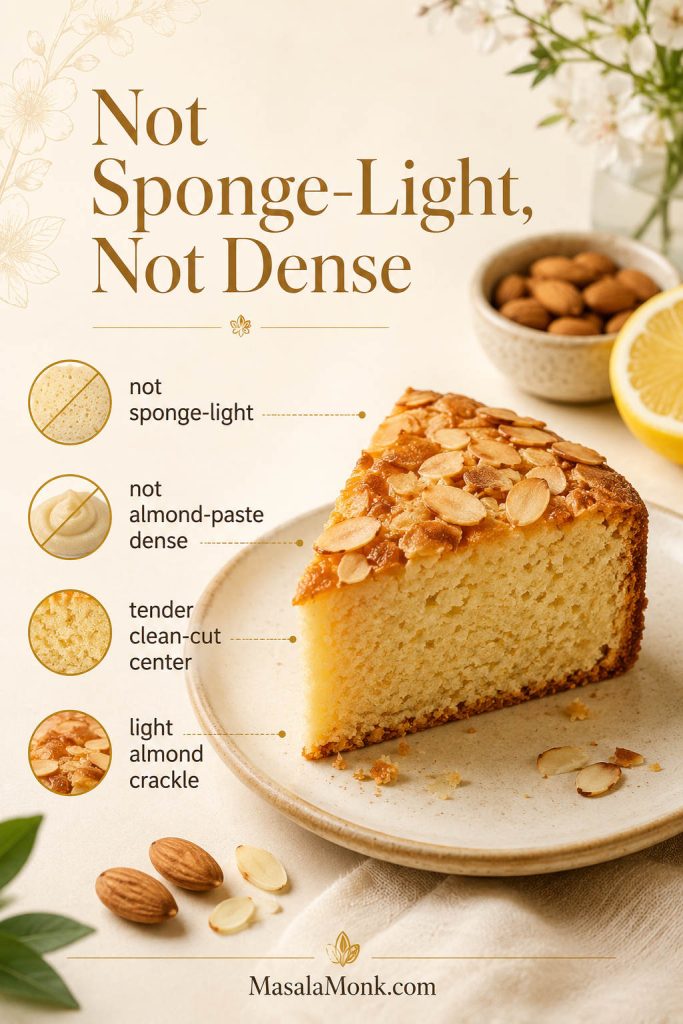
Almond cake texture guide showing a slice with notes about tender center, almond top, and not-too-dense texture.
Almond flour naturally makes cake richer than wheat flour; therefore, the goal is a plush tea-cake bite, not a heavy almond-paste dessert.

A light dusting of powdered sugar is enough. Add berries and cream if you want dessert, or serve it plain with coffee and let the toasted almond top do the work.

When to Make This Almond Cake

Make it when you need a cake that feels special without frosting: a weekend coffee slice, a brunch cake with berries, or a simple gluten-free dessert that does not taste like a compromise. It is also a good choice when frosting feels like too much work but you still want something polished enough for guests.

This is a useful make-ahead cake because it slices better after resting. Bake it in the morning, carry it without worrying about frosting, and serve it later with powdered sugar, fruit, yogurt, or cream. It works for quiet tea, a dessert plate, or the kind of table where you want the cake to look pretty without needing much decoration.
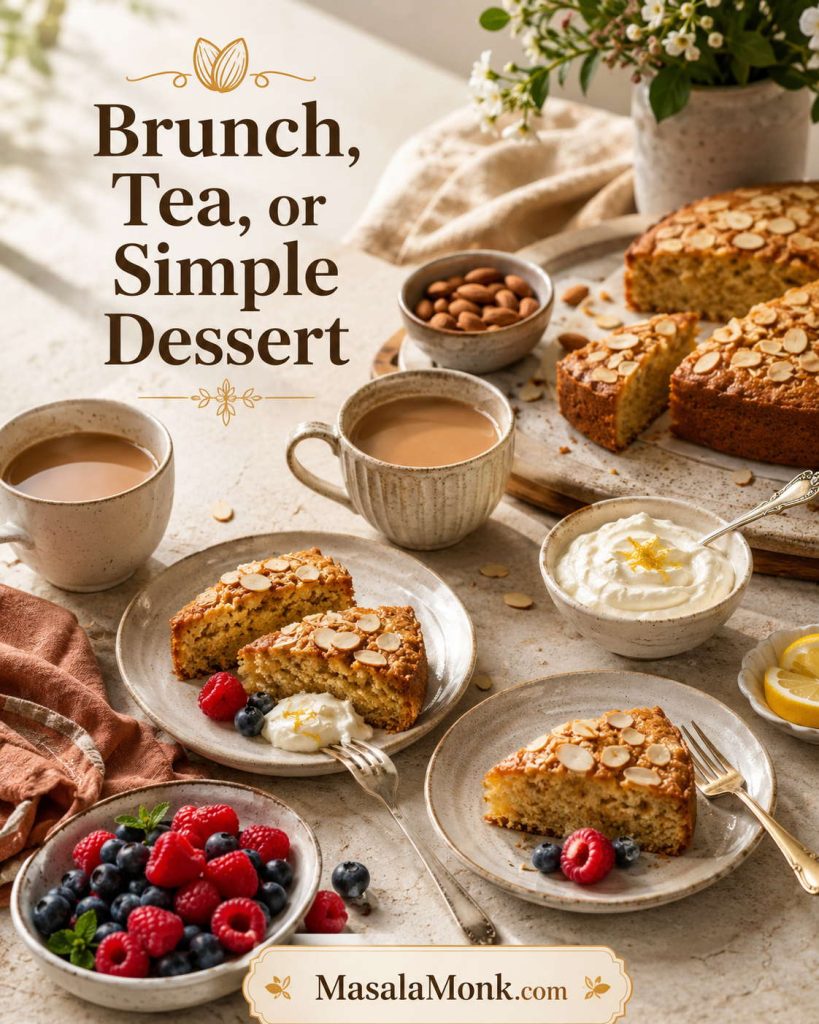
Almond cake served with tea, berries, and cream on a warm table setting.
This is a useful make-ahead cake for brunch, tea, coffee, or a gluten-free dessert plate because it feels finished with only fruit or cream.

Before You Bake: 5 Things That Matter

  1. Weigh the almond flour if you can. If using cups, spoon it lightly and level it.
  2. Use room-temperature eggs. They whip better and blend more smoothly.
  3. Keep the egg-white bowl clean and grease-free. Even a little yolk or oil can stop the whites from whipping properly.
  4. Line the pan with parchment. Almond cakes are delicate and need help releasing cleanly.
  5. Cool before slicing. The center firms as it rests, so warm slices can look damp or broken.

Think of cooling as part of the recipe, not just waiting. A lined pan, a steady oven, and a full rest make the difference between a fragile cake and one that lifts, cuts, and serves cleanly. Already worried about timing or pan size? Check pan size and bake time before you preheat.

Recipe Card: Tender Almond Flour Cake

A tender almond flour cake with a golden sliced-almond top, clean-cut center, and bright lemon or orange zest. This cake is naturally gluten-free when made with certified gluten-free ingredients.

Yield
1 8-inch cake / 8 slices
Prep Time
15 minutes
Bake Time
26–32 minutes
Total Time
About 1 hour 30 minutes, including cooling

Equipment

  • 8-inch / 20 cm light-colored metal round cake pan
  • Parchment paper
  • Two mixing bowls
  • Hand mixer or balloon whisk
  • Flexible spatula
  • Kitchen scale, strongly recommended
  • Wire rack

Ingredients

  • 150 g / 5.3 oz fine blanched almond flour, about 1 1/2 cups lightly spooned and leveled
  • 1 teaspoon / 4 g baking powder
  • 1/4 teaspoon fine salt
  • 4 large eggs, room temperature, separated
  • 100 g / 3.5 oz granulated sugar, about 1/2 cup
  • 1 teaspoon / 5 ml vanilla extract
  • 1/4 teaspoon / 1.25 ml almond extract, optional but useful
  • 1 tablespoon finely grated lemon zest or orange zest
  • 25 g / 0.9 oz sliced almonds, about 1/4 cup, for topping
  • 1 tablespoon powdered sugar, optional, for serving

Method

  1. Preheat the oven to 180°C / 350°F. For fan or convection ovens, use 160°C / 320°F. Grease an 8-inch / 20 cm round cake pan, line the base with parchment paper, and lightly grease the sides.
  2. Whisk together the almond flour, baking powder, salt, and citrus zest. Break up any clumps so the mixture looks loose, not packed.
  3. Separate the eggs. Put the yolks in one large bowl and the whites in a clean, dry, grease-free bowl.
  4. Beat the yolks with the sugar, vanilla, and almond extract for 2–3 minutes, until paler, creamy, and slightly thickened.
  5. Fold the almond flour mixture into the yolk mixture. The batter will look thick, almost like a soft almond paste. That is normal.
  6. Beat the egg whites until they hold soft peaks. They should look glossy, and the peaks should bend slightly when you lift the whisk.
  7. Fold one-third of the whites into the almond batter first to loosen it. Gently fold in the remaining whites in two additions. The final batter should be thick, airy, and spreadable, with no large white streaks.
  8. Spread the batter into the prepared pan and smooth the top. Scatter sliced almonds over the surface.
  9. Bake for 26–32 minutes, until the top is golden, the center feels set, and a toothpick inserted into the middle comes out with moist crumbs but no wet batter.
  10. Cool in the pan for 15 minutes, then remove carefully and cool fully on a wire rack before slicing. A slight settling on top is normal.
  11. Dust lightly with powdered sugar before serving, if you like.

Recipe Notes

  • For a 9-inch / 23 cm pan, start checking around 23 minutes. The cake will be thinner.
  • Almond meal can be used by weight, but the result will be coarser and more rustic.
  • If using an instant-read thermometer, the center should be about 93–96°C / 200–205°F.
  • This batter makes about 9–10 standard cupcakes; bake them for 13–17 minutes.
  • If the sliced almonds brown too quickly, tent the cake loosely with foil near the end of baking.

For visual cues while baking, use the step-by-step method and doneness guide below.

Why This Almond Cake Recipe Works

Almond flour brings flavor, tenderness, and natural richness, but it does not bring gluten. That means the cake depends on eggs, gentle folding, the right pan, and cooling time to hold a clean slice.

  • Almond flour keeps the middle tender without needing a butter-heavy batter.
  • Egg yolks add richness, while the whites help lighten the batter.
  • Whipped egg whites prevent the center from feeling heavy when they are folded in gently.
  • Sugar supports browning and texture, not just sweetness.
  • Lemon or orange zest lifts the almond flavor so the cake does not taste flat or oily.

Added fat stays low on purpose. Ground almonds already contain natural oils, so extra butter or oil can push the texture toward greasy. In this recipe, moisture comes from the almonds and eggs; lightness comes from the whipped whites; and the clean slice comes from baking the center fully, then letting it rest.

What shaped this version: the structure is built around the places almond flour cakes usually go wrong — packed flour, cold eggs, weak whites, hot pans, and slicing before the center has settled. That is why the recipe focuses less on adding more liquid or fat and more on measurement, egg structure, pan heat, and cooling time.

If you enjoy almond flour in other bakes, almond flour cookies are a useful comparison because the same ingredient can turn crisp, chewy, tender, or heavy depending on the formula.

Ingredients for Almond Cake

The ingredient list is short, so each item has a real job. Keep the base steady on the first bake; once you know how the batter should feel, the flavor variations are easier.

Almond Cake Ingredients at a Glance

Before you start, check that your almond flour is plain and finely ground, your eggs are at room temperature, and your citrus zest is ready. With a short ingredient list, small details affect the final cake more than they would in a heavier wheat-flour batter.
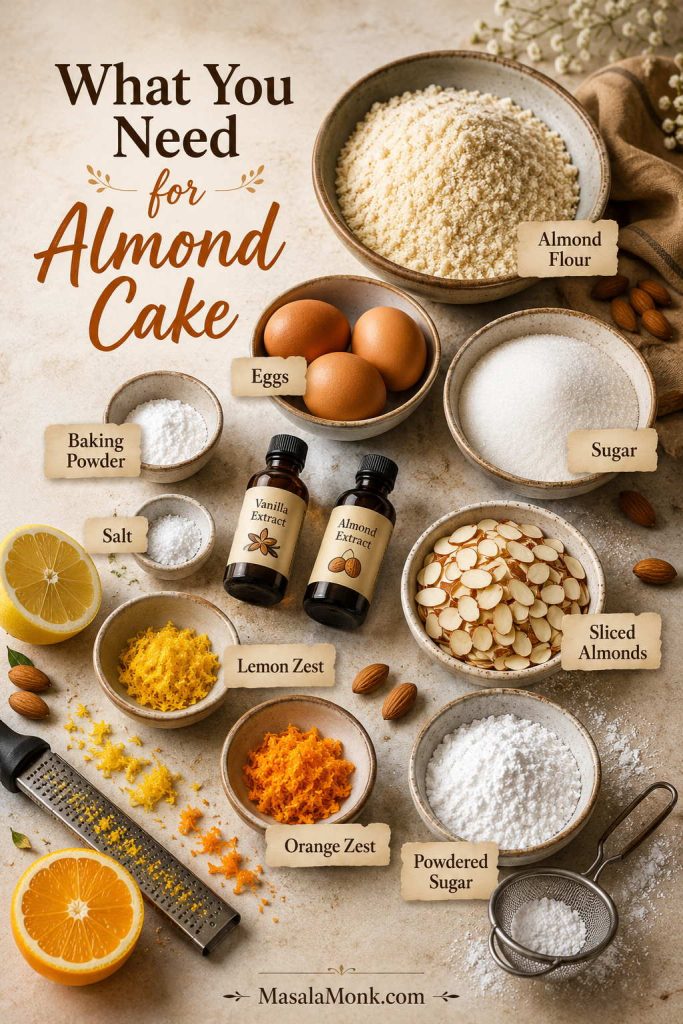
Almond cake ingredients in bowls, including almond flour, eggs, sugar, citrus zest, extracts, baking powder, salt, and sliced almonds.
Short ingredient lists need more precision, not less: each bowl here affects lift, browning, almond flavor, or how neatly the cake slices.

Almond Flour

Fine blanched almond flour gives the most delicate result. It is made from almonds without skins and is usually ground more finely than almond meal. If measuring by volume, spoon it lightly into the cup and level it rather than scooping from the bag. For a broader baking reference, King Arthur Baking’s ingredient weight chart lists almond flour and almond meal separately.

If you have extra almond flour after making this cake, use it in almond flour pancakes, where the same ingredient gives a softer breakfast-style texture.

Eggs

Eggs do the main structural work here. They help the cake rise, set, and hold together without wheat flour. Room-temperature eggs whip more easily; if you forget to take them out early, place the whole eggs in a bowl of warm water for 5–10 minutes before cracking them.
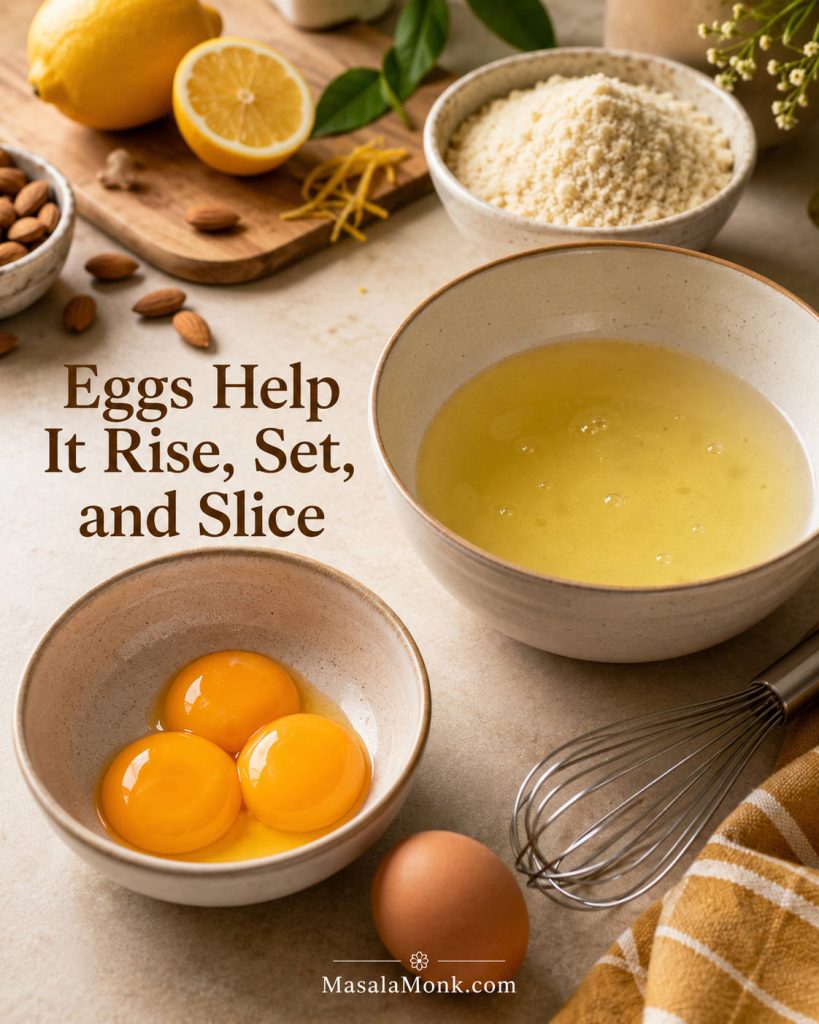
Separated egg yolks and egg whites in bowls with a whisk and almond flour nearby.
In this almond flour cake, separated eggs are doing structure work: yolks enrich the base, while whipped whites help the batter lift.

Need an egg-free version? Read the eggless almond cake note before trying a flax, chia, or yogurt swap.

Sugar

Sugar is not only for sweetness. It helps the top brown, supports the texture, and keeps the cake from tasting flat. Coconut sugar or light brown sugar can work, although the cake will bake darker and taste more caramel-like. Honey or maple syrup need a different formula because liquid sweeteners change the moisture balance.

Vanilla and Almond Extract

Vanilla makes the flavor rounder. Almond extract is optional, but a tiny amount makes the almond note more noticeable. Use it carefully; a few drops can taste bakery-like, while too much can turn bitter, artificial, or perfume-like.

Lemon Zest or Orange Zest

Use lemon zest for a brighter tea-cake flavor or orange zest for a warmer dessert-style cake. In both cases, zest only the colored part of the peel, not the bitter white pith underneath.

Lemon and orange zest flavor board for almond cake with citrus halves and small cake slices.
Lemon keeps the almond cake brighter and tea-friendly; orange makes the same base warmer and more dessert-like.

Baking Powder and Salt

Baking powder supports the lift from the eggs. Salt balances the sweetness and makes the almond flavor taste fuller. If you need a strictly gluten-free cake, check that your baking powder is labeled gluten-free.

Sliced Almonds

Sliced almonds give the top a classic look and a delicate crunch. They also make the cake feel finished without frosting. If they brown too quickly, loosely tent the pan with foil near the end of baking.

Almond Flour vs Almond Meal vs Almond Powder for Almond Cake

Almond flour, almond meal, ground almonds, and almond powder are often used loosely, but they do not always behave the same way in cake.
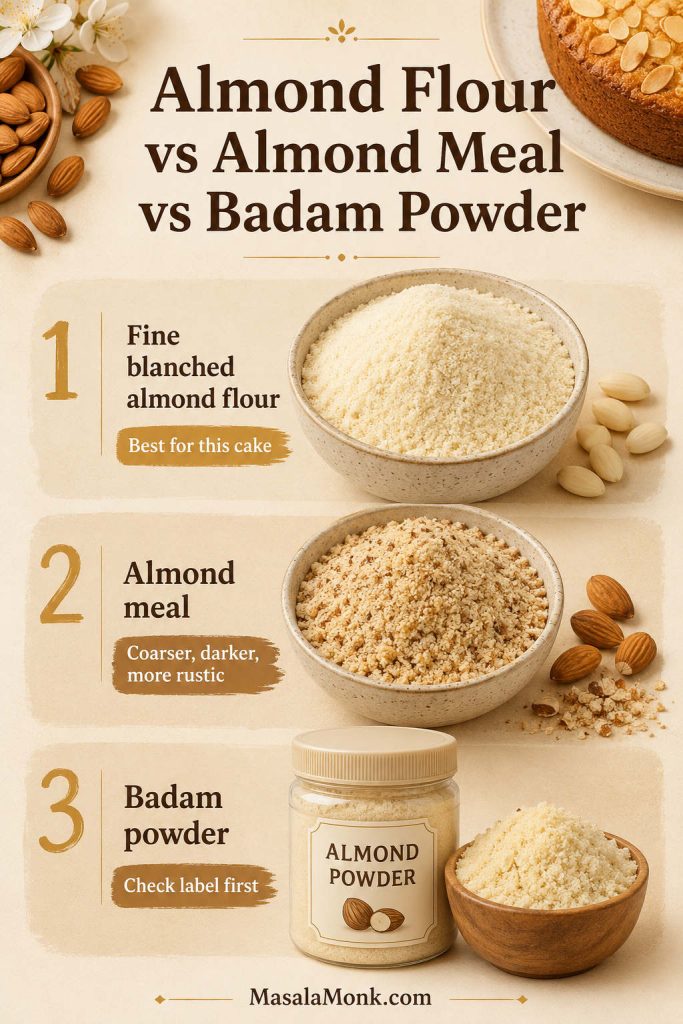
Comparison board showing fine blanched almond flour, almond meal, and badam powder for almond cake.
For almond cake, the grind matters as much as the name; fine flour bakes smoother, almond meal bakes heartier, and badam powder needs checking.
IngredientWhat it usually meansBest use in this cakeTexture result
Fine blanched almond flourAlmonds without skins, ground finelyBest choice for the recipeLightest, most delicate result
Almond meal / ground almondsOften coarser; may include almond skinsWorks by weight, but gives a rustic cakeDarker, nuttier, slightly grainier texture
Almond powder / badam powderCan mean ground almonds, but sometimes means sweetened drink mixUse only if unsweetened and finely groundDepends on grind; sift if clumpy

For the cleanest first bake, use fine blanched almond flour. If you use almond meal, use the same weight, not a packed cup-for-cup swap. Almond meal is often heavier by volume, and it may include skins, so the finished cake will be darker and more textured.

Badam Powder Check for Almond Cake

Almond powder needs extra caution. If you are in India and buying “badam powder,” read the label carefully. You want plain unsweetened ground almonds, not badam milk mix, malted almond drink powder, milk-powder blend, or sweetened beverage mix. Those mixes can make a warm badam drink taste rich, but they do not behave like plain ground almonds in cake batter.
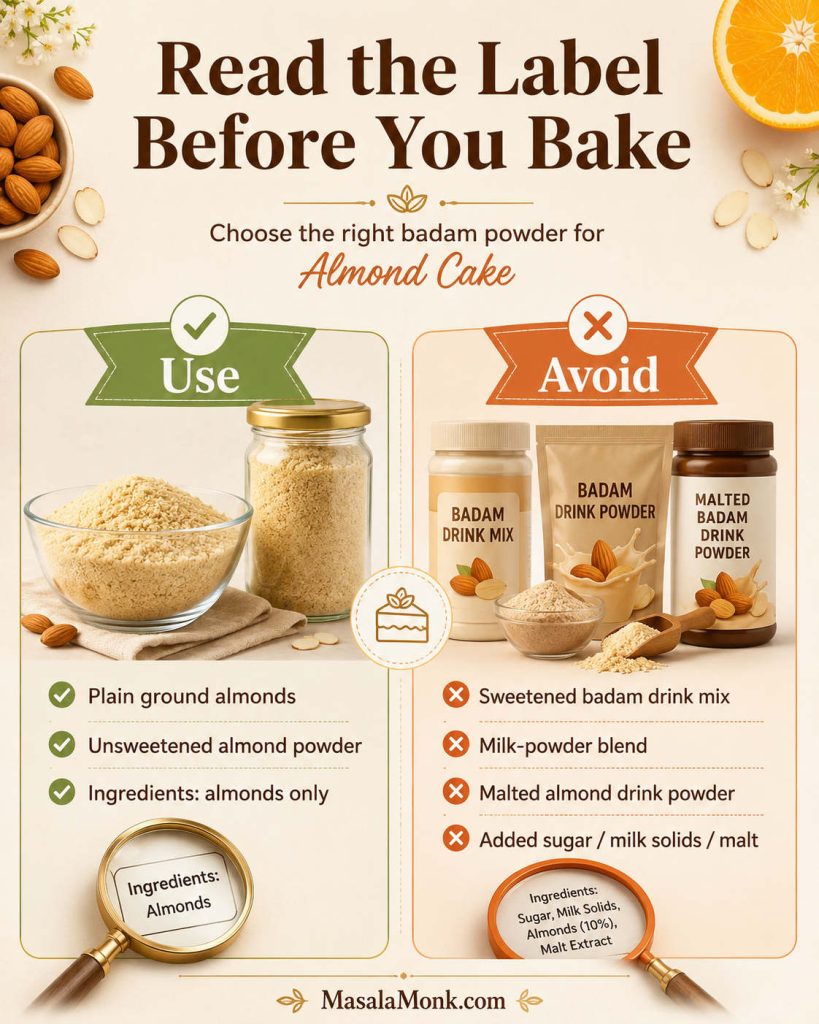
Guide showing plain ground almonds to use and sweetened badam drink mixes to avoid for almond cake.
Before using badam powder in almond cake, check that almonds are the main ingredient; otherwise, sugar, milk solids, or malt can throw off the batter.

Simple rule: fine almond flour gives the cleanest cake. Almond meal gives a rustic cake. Sweetened badam drink mix does not belong in this recipe.

How to Make Almond Cake

The recipe card gives the short method. These cues show what the mixture should look and feel like at each stage, which matters more with almond flour than with a regular wheat batter.

1. Prepare the pan first

Grease the pan and line the base with parchment before you start mixing. A light-colored metal 8-inch / 20 cm round pan gives the most even result. Glass and ceramic hold heat differently and may need extra time, so metal is the safest first choice.
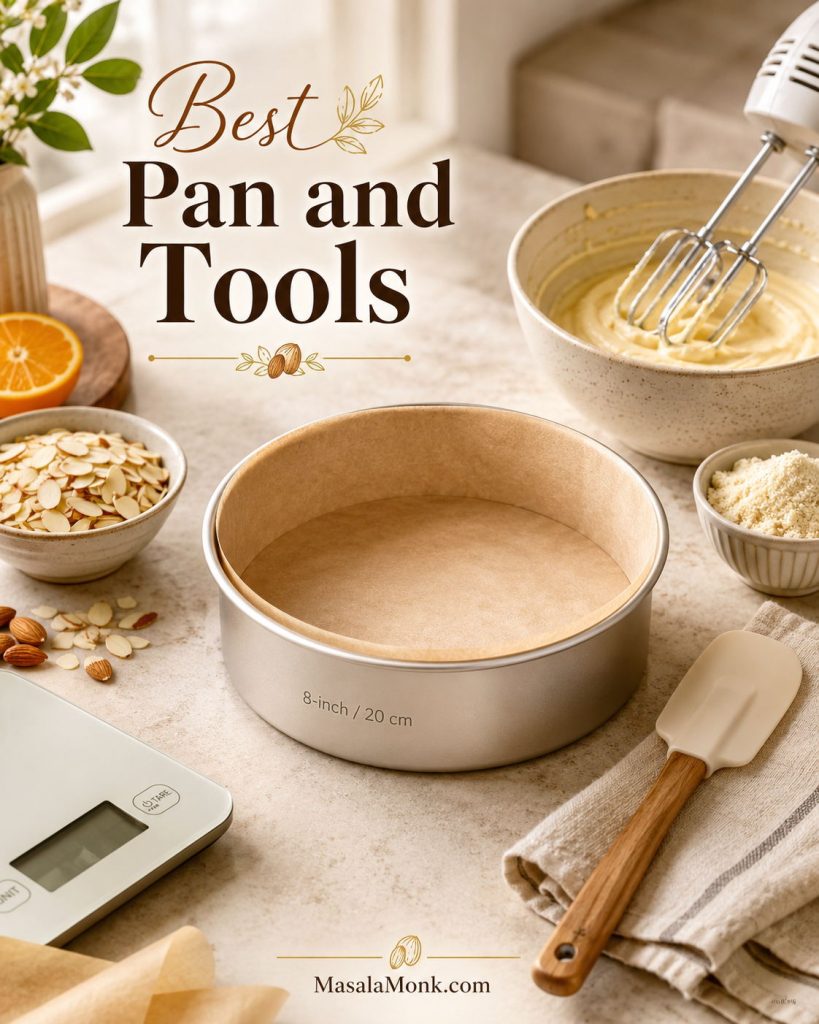
Almond cake equipment with parchment-lined round pan, whisk, spatula, bowls, kitchen scale, and sliced almonds.
A lined metal pan is not just cleanup insurance; it helps this delicate almond cake release cleanly after the edges set.

2. Mix the dry ingredients

Whisk almond flour, baking powder, salt, and citrus zest together. The mixture should look loose and clump-free, not compacted. If the flour has small lumps, break them up now so the finished texture is smoother.
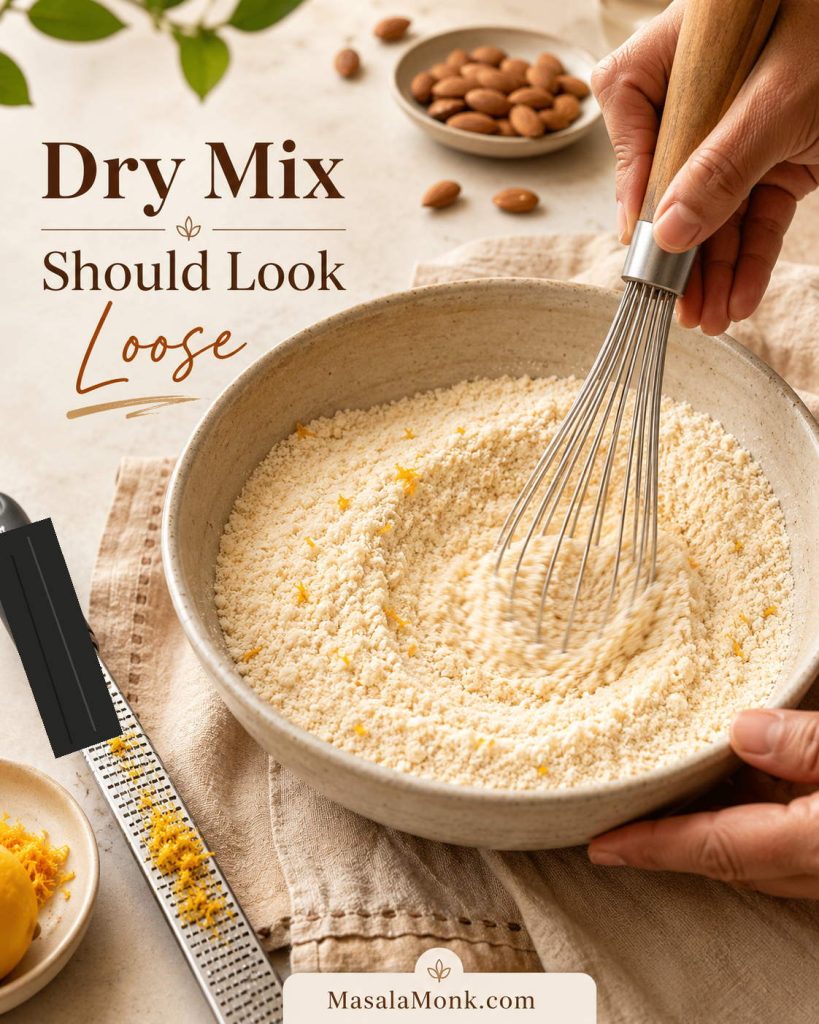
Almond flour dry mixture being whisked with citrus zest until loose and clump-free.
Break up almond flour clumps while the mix is still dry; once wet ingredients go in, those clumps are harder to smooth out.

3. Beat the yolks with sugar

Beat the egg yolks with sugar, vanilla, and almond extract for 2–3 minutes, until the mixture looks paler, creamy, and slightly thick. It does not need to be fluffy like whipped cream, but it should no longer look dry or grainy.
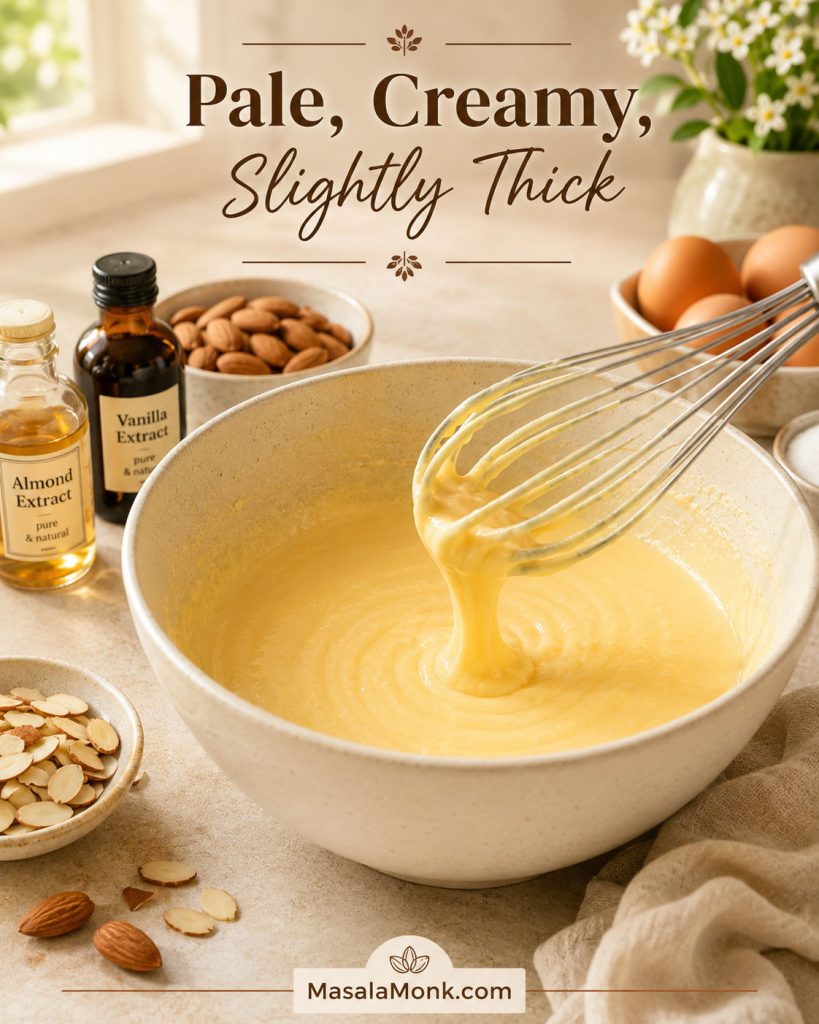
Pale creamy egg yolk and sugar mixture in a bowl with a whisk.
The yolk mixture should look pale and creamy before the almond flour goes in, so the batter starts smoother and blends more evenly.

4. Fold in the almond flour

Add the dry mixture to the yolks and fold until combined. The batter will look thick, almost like a soft almond paste. That is normal; do not loosen it with milk or water. The egg whites will lighten it in the next step.
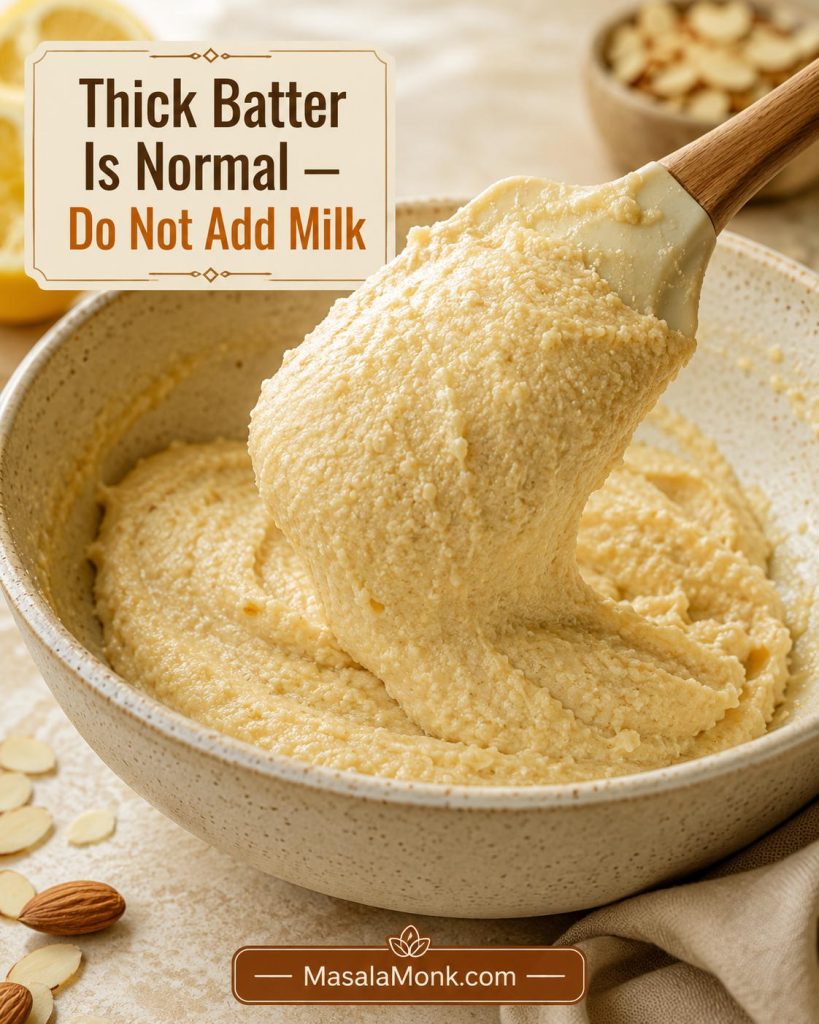
Thick almond cake batter lifted with a spatula before whipped egg whites are folded in.
Thick batter is expected with almond flour, so resist adding milk or water; the next fold with egg whites is what loosens it properly.

5. Whip the egg whites to soft peaks

Beat the egg whites until they hold soft peaks. The whites should look glossy, and the peak should bend slightly when you lift the whisk. Stop before the whites become stiff, dry, or clumpy.
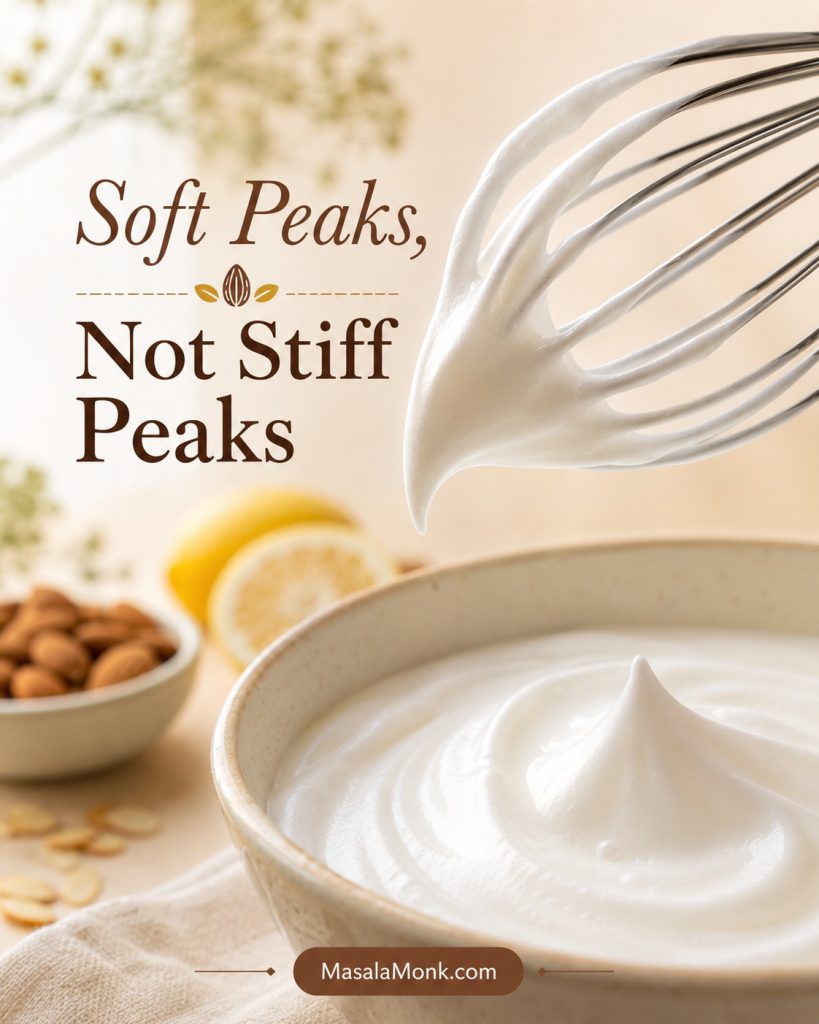
Glossy whipped egg whites holding a soft bending peak on a whisk.
Stop at soft peaks because they fold into almond cake batter more easily than stiff whites and help prevent dry, clumpy pockets.

6. Fold until the batter is thick, airy, and spreadable

Fold one-third of the whites into the thick batter first; it should visibly loosen. Then fold in the rest gently until the mixture is thick, airy, and spreadable, with no large white streaks. Do not beat the batter at this point.
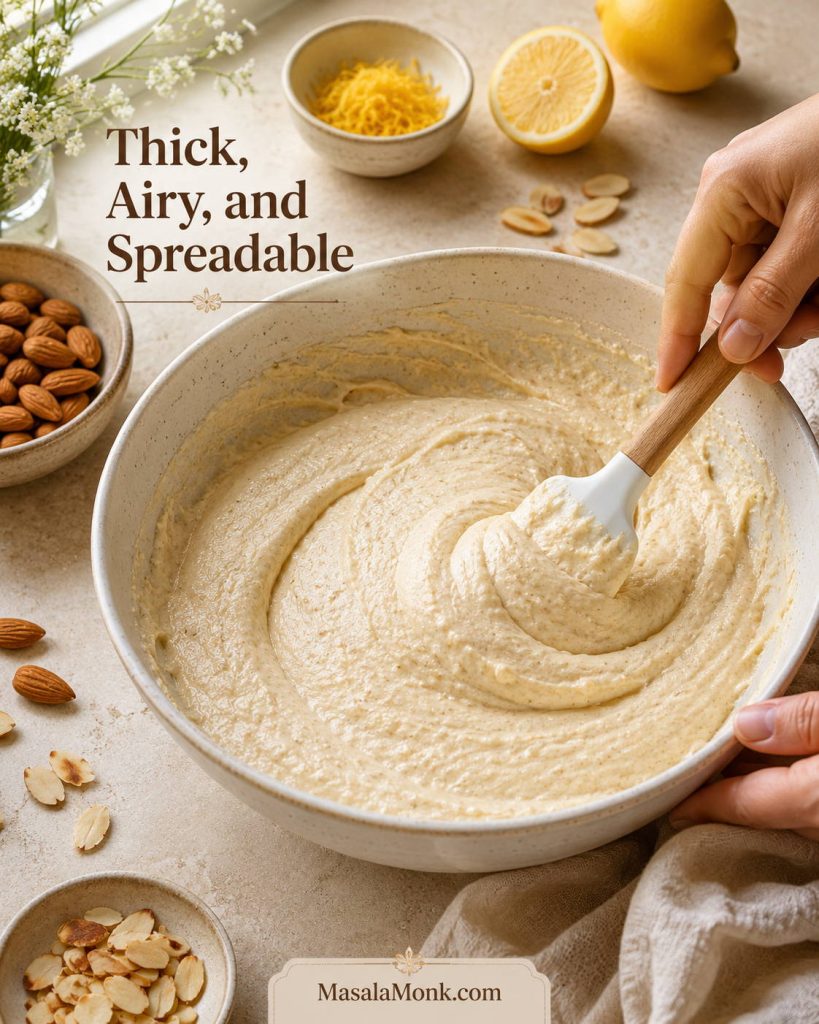
Final almond cake batter being folded with a spatula until thick, airy, and spreadable.
After folding, the batter should look lighter but not runny; that balance helps the almond cake rise while still keeping its rich texture.

7. Fill the pan and bake

Spread the batter into the pan, add sliced almonds, and bake on the middle rack. The top may settle slightly as the cake cools; that is normal. Let it rest in the pan for 15 minutes, then move it to a wire rack. The slice will be cleaner once the center has fully settled.
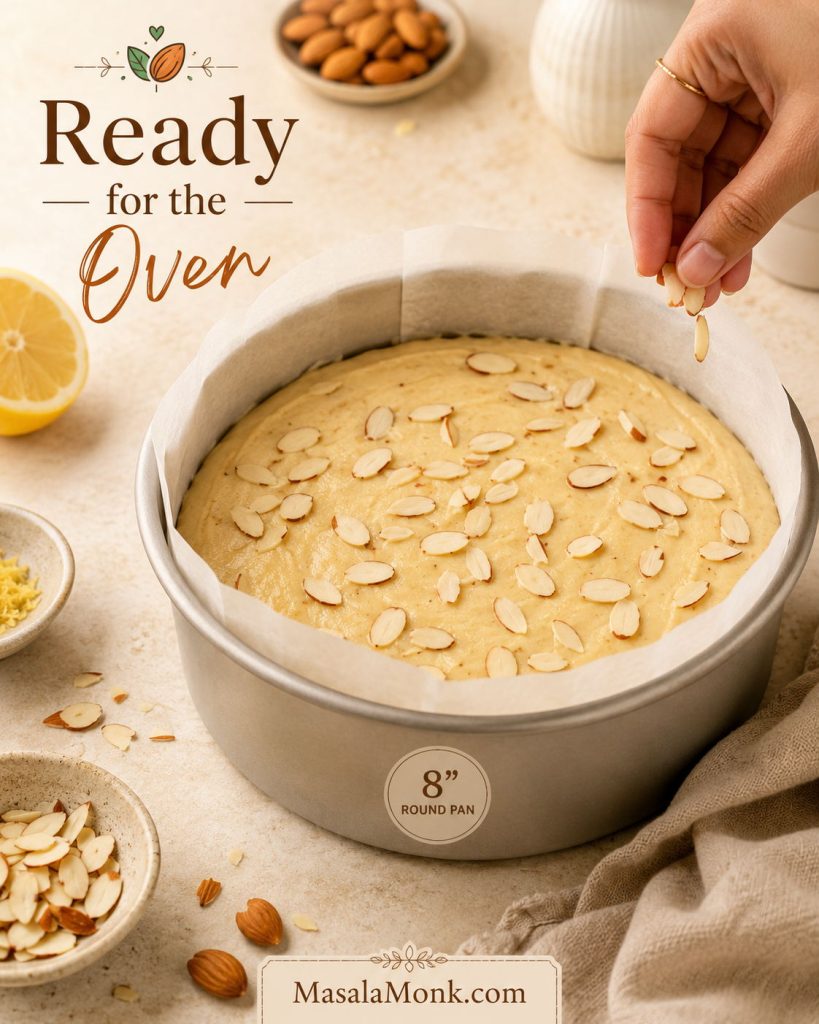
Almond cake batter in a parchment-lined round pan topped with sliced almonds before baking.
Scatter the sliced almonds after smoothing the batter so they toast on the surface instead of disappearing into the cake.

Pan Size, Oven Temperature, and Bake Time

Pan size matters because the edges can brown before the center finishes baking. A deeper cake needs more time; a wider cake bakes faster and can dry out if you use the same timing.

8-Inch vs 9-Inch Pan for Almond Cake

The 8-inch pan is the safest first choice because it gives the cake a little height. A 9-inch pan still works, but it spreads the batter thinner, so the cake finishes sooner and needs earlier checking.
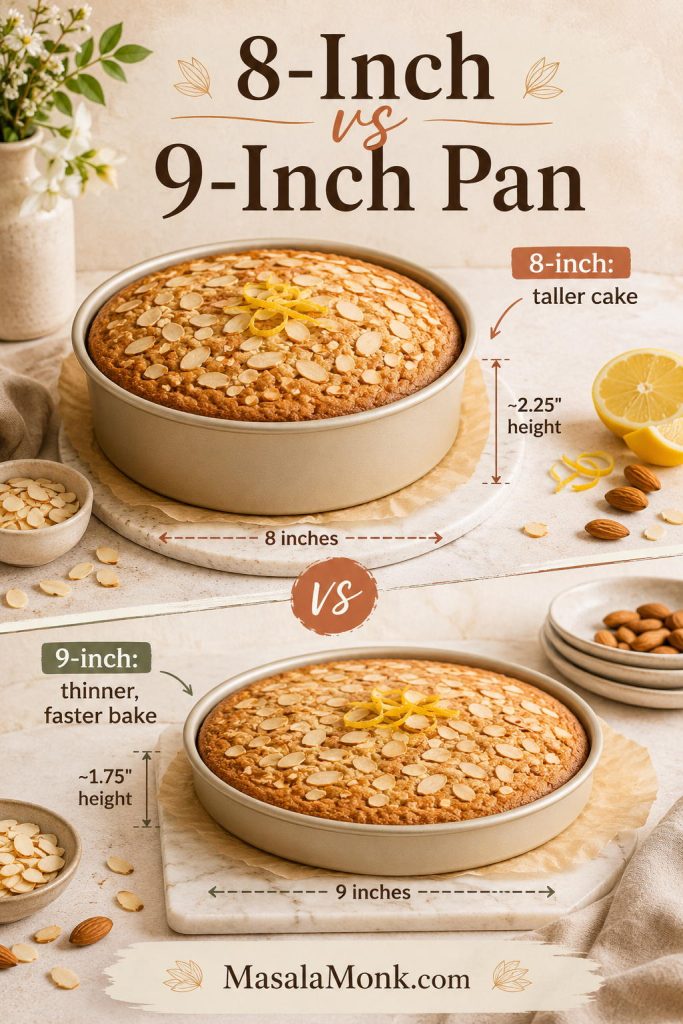
Comparison of almond cake baked in 8-inch and 9-inch pans, showing taller and thinner results.
A 9-inch pan spreads the batter thinner, so the cake bakes faster. Start checking earlier than you would with an 8-inch pan.

Best first pan: use an 8-inch / 20 cm light-colored metal round pan. A 9-inch pan works, but the cake will be thinner and will bake faster.

PanResultApproximate bake timeNotes
8-inch / 20 cm roundTaller cake with a tender center26–32 minutesBest default for this recipe.
9-inch / 23 cm roundThinner cake, slightly faster bake23–28 minutesStart checking early.
8-inch squareEasy square slices24–30 minutesGood for snack-cake style serving.
Cupcake panAbout 9–10 small cakes13–17 minutesFill cups about two-thirds full.
Loaf panDeeper centerNot ideal for this exact batterHigher risk of dark edges and underbaked middle.

For a conventional oven or OTG, use 180°C / 350°F. For fan or convection ovens, use 160°C / 320°F and start checking early. Bake on the middle rack so the top does not brown before the center is ready.

If you use a springform pan, choose a sturdy one. Very thin pans can overbake the edges while leaving the middle slightly underdone. If your oven runs hot or the almond topping browns too fast, loosely tent the cake with foil for the final 5–10 minutes.

Once you choose the pan, use the doneness section rather than bake time alone.

How to Know Almond Cake Is Done

The top may look golden before the middle is fully baked, so use more than color as your guide.
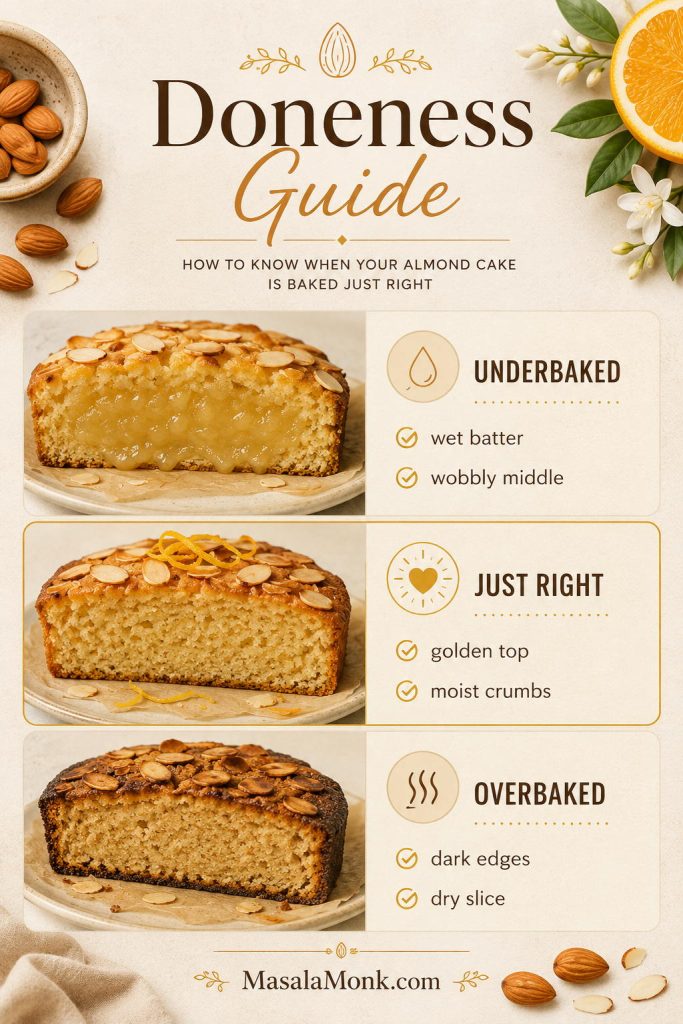
Doneness guide comparing underbaked, just-right, and overbaked almond cake slices with toothpick cues.
Almond cake can look golden before the center is ready, so use the toothpick and the middle of the cake together, not color alone.
  • The top is golden and the sliced almonds are lightly toasted.
  • The center feels set when touched gently.
  • The edges pull slightly away from the pan.
  • A toothpick inserted into the center comes out with moist crumbs, not shiny batter.
  • The cake does not wobble in the middle when the pan is gently moved.

A few damp-looking crumbs are fine. Shiny wet batter means the cake needs more time. If the top is already brown, tent it loosely with foil and continue baking. For extra precision, the center should be about 93–96°C / 200–205°F on an instant-read thermometer.

Toothpick Test for Almond Cake

Insert the toothpick into the center, not the edge. The edge sets first, so it can make the cake seem done while the middle still needs a few more minutes.

Toothpick pulled from almond cake with moist crumbs and no wet batter.
Moist crumbs on the toothpick are the sweet spot. Shiny batter means underbaked; a bone-dry toothpick can mean overbaked.

The cake does not need to look dramatic when it comes out of the oven. A softly golden surface, lightly toasted almonds, and a middle that no longer wobbles are enough. The finished texture shows after cooling, when the center has had time to settle.

Almond Cake Variations

Keep the first bake simple, then change flavorings and toppings in small ways. That way the cake stays familiar even when you shift the flavor.
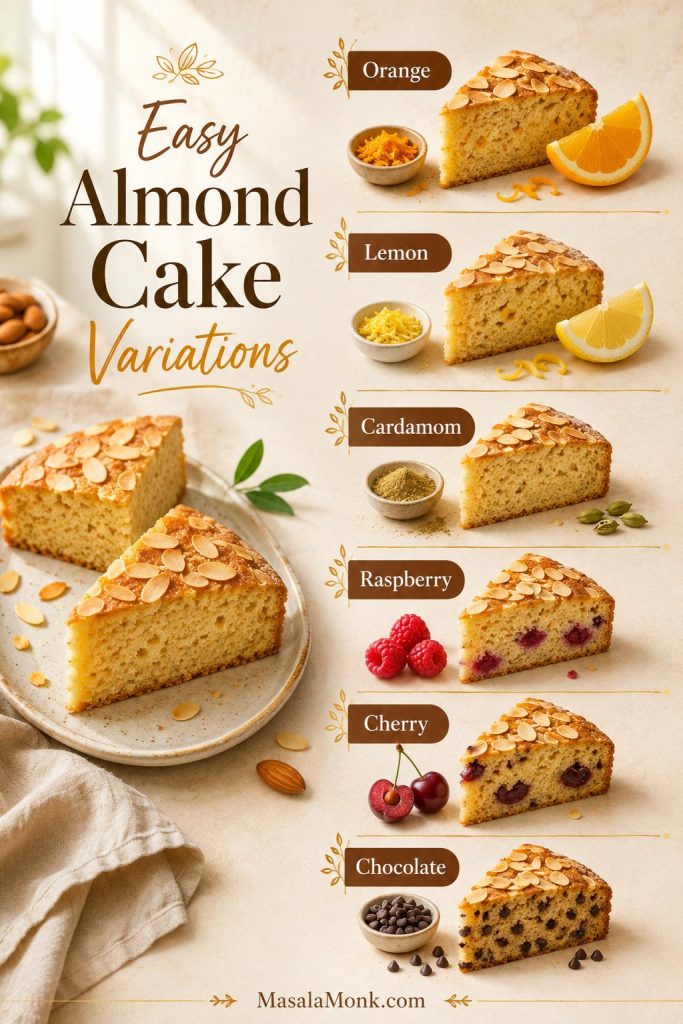
Almond cake variation board with orange, lemon, cardamom, raspberry, cherry, and chocolate options.
Once the base almond cake is reliable, small add-ins work best; start with zest, spice, berries, cherries, or a few chocolate chips rather than changing the whole formula.
VariationHow to do itImportant note
Orange almond cakeUse 1 tablespoon orange zest. Optional glaze: 60 g powdered sugar + 1–2 teaspoons orange juice.Warmer and more dessert-like than lemon.
Lemon almond cakeUse 1 tablespoon lemon zest. Optional glaze: 60 g powdered sugar + 1–2 teaspoons lemon juice.Best first variation because it adds brightness without much moisture.
Cardamom almond cakeAdd 1/4 teaspoon ground cardamom with the dry ingredients.Good for a badam-style note; do not overdo it.
Raspberry almond cakeScatter 1/3 cup raspberries over the top before baking.Too many berries can make the center sink.
Cherry almond cakeUse 1/3 cup pitted, halved cherries on top of the batter.Keep cherries near the top because they release moisture.
Chocolate almond cakeFold in 1/4 cup mini chocolate chips after the egg whites are mostly incorporated.For a true chocolate cake, use a separate cocoa-based formula.
Almond meal cakeUse 150 g almond meal instead of fine almond flour.Expect a darker, nuttier, more rustic result.
Olive oil almond cakeAdd 1 tablespoon mild olive oil to the yolk mixture.Do not add more on the first attempt; ground almonds already contain fat.

Orange Almond Cake Variation

For orange almond cake, use orange zest instead of lemon zest. A very light glaze can work after cooling, but do not cover the sliced-almond top so heavily that the cake turns sticky.
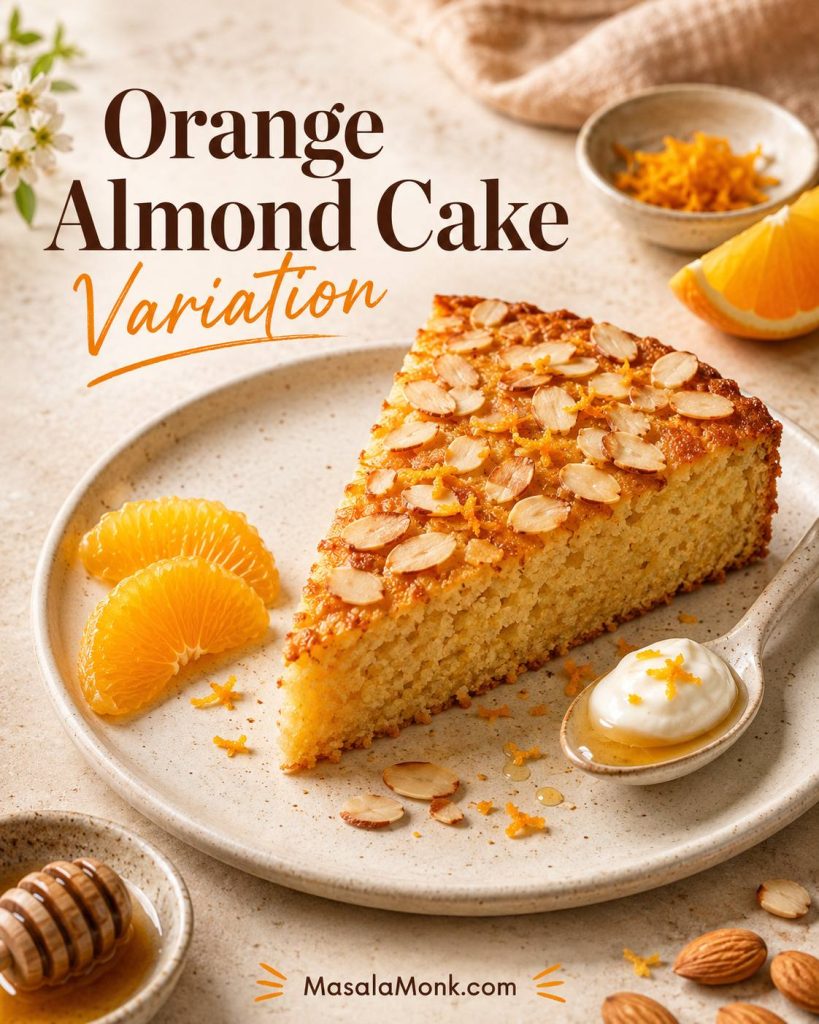
Orange almond cake slice with sliced almonds, orange zest, orange segments, honey, and yogurt.
Orange almond cake works best when the citrus stays fragrant, not heavy; a little honey or yogurt adds dessert energy without covering the almond top.

Lemon Almond Cake with Berries

For lemon almond cake, use lemon zest and keep the serving style bright. Berries and cream make the cake feel fresh without adding extra moisture to the batter itself.
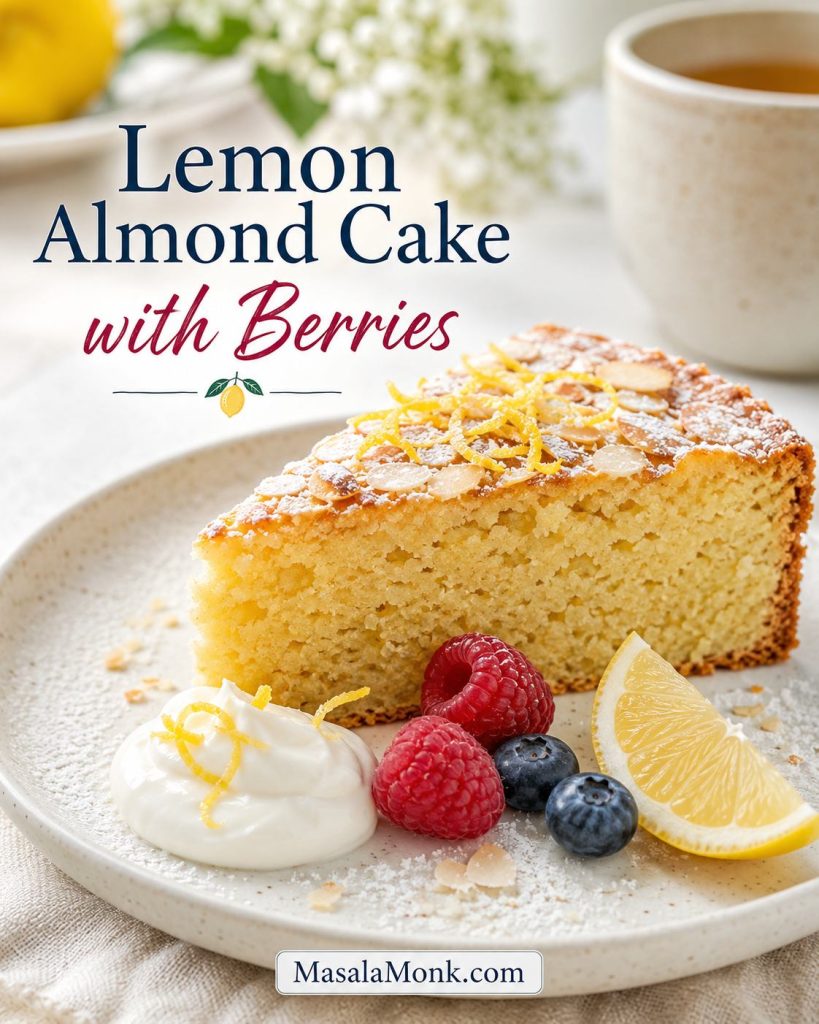
Lemon almond cake slice with berries, cream, lemon zest, and a lemon wedge.
Lemon almond cake with berries is the brightest serving route, especially when you want a slice that feels fresh enough for brunch.

Whole-orange almond cake is different: that style usually uses boiled whole oranges, almond meal, eggs, sugar, and a longer, lower bake. It has a damp, marmalade-like texture and often needs a blender or food processor.

Can This Almond Cake Be Made Eggless?

For this exact cake, eggs are structural. They help the almond flour rise, set, and hold a clean slice, so flax eggs, chia eggs, or only yogurt will not behave like a simple one-for-one swap.

Eggless almond cake usually needs a recipe built differently from the start. It often uses yogurt, all-purpose flour or a gluten-free flour blend, extra leavening, and sometimes milk or oil to help the cake rise, set, and cut cleanly. A 100% almond flour eggless cake is especially difficult because ground almonds do not have enough starch or gluten-like binding on their own.

Honest baking note: if you need an eggless almond cake, use a recipe built for that job. A yogurt-based version with some flour support will usually perform better than removing the eggs from this batter.

Is This a Keto Almond Cake?

This recipe uses almond flour, but it is not a keto cake because it uses regular sugar. Almond flour lowers the wheat-flour load, but sugar still makes this a standard dessert. Sugar also affects browning, moisture, and structure, so a keto version needs its own sweetener formula rather than a direct cup-for-cup swap.

For low-carb baking context, this guide to keto-friendly flours explains how almond flour behaves compared with other low-carb flour options. If blood sugar is a concern, dessert still needs portion awareness; this guide on almond flour and diabetes covers the ingredient side in more detail.

How to Serve Almond Cake

This cake does not need frosting. A light dusting of powdered sugar is enough for a simple tea cake, but you can dress it up depending on the occasion.
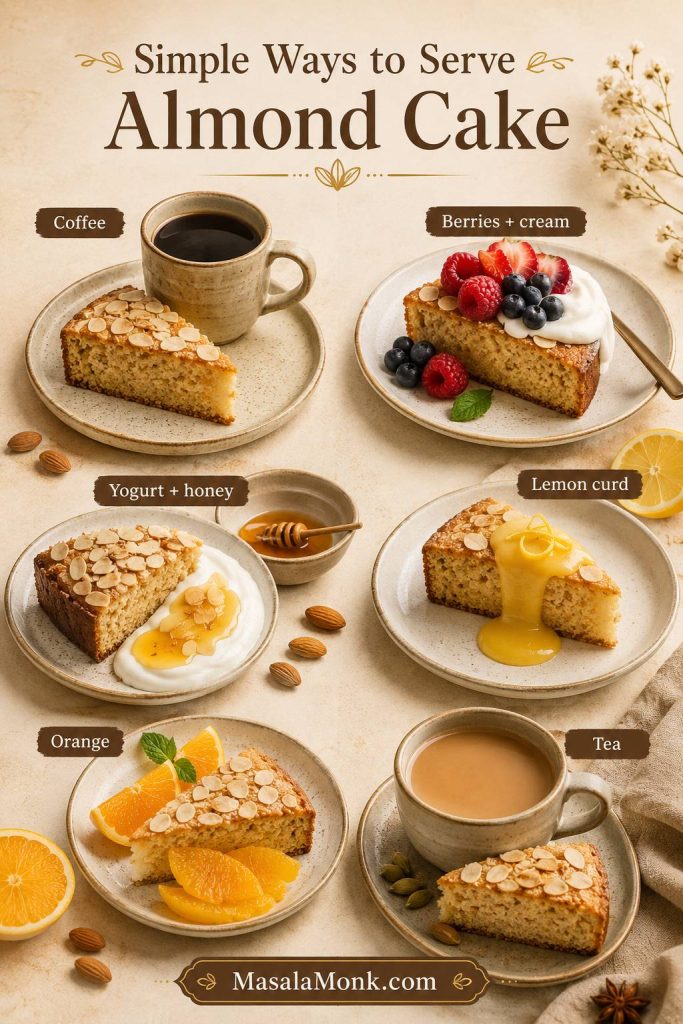
Serving ideas board for almond cake with coffee, berries and cream, yogurt and honey, lemon curd, orange segments, and tea.
Pair almond cake with light toppings instead of heavy frosting; coffee, tea, fruit, yogurt, honey, citrus, and lemon curd all support the almond flavor.
  • Serve plain with tea, coffee, or masala chai.
  • Add powdered sugar and fresh berries.
  • Serve with Greek yogurt or lightly whipped cream.
  • Add orange segments and a little honey for an orange almond dessert plate.
  • Pair lemon almond cake with lemon curd.
  • Serve cardamom almond cake with saffron cream or vanilla ice cream.
  • Toast leftover slices lightly and serve with homemade almond milk or coffee.

Because the middle is already rich and tender, keep toppings light. A little cream, fruit, citrus, or honey works better than heavy frosting and keeps the toasted almond flavor in front. Choose lemon with berries and cream for a brighter tea-cake finish; choose orange with honey or yogurt for a warmer dessert plate.

Choosing between lemon and orange? The variation table gives the easiest flavor adjustments.

How to Store Almond Cake

Almond cake keeps well because ground almonds naturally hold moisture. In fact, the cake often tastes better after a few hours of resting because the texture settles and the flavor becomes rounder.
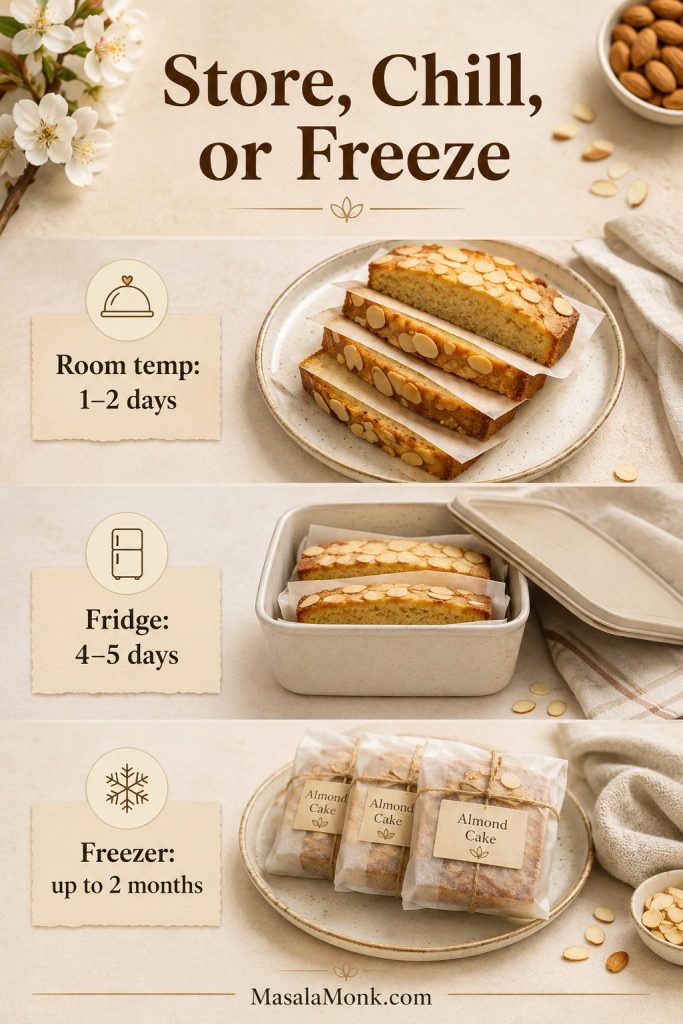
Almond cake storage guide showing room temperature slices, fridge container, and freezer-wrapped portions.
Store almond cake only after it cools completely; then parchment between slices keeps make-ahead portions clean, separate, and easy to serve.
  • Room temperature: store in an airtight container for 1–2 days.
  • Fridge: store for 4–5 days. Bring slices to room temperature before serving.
  • Freezer: freeze slices for up to 2 months. Place parchment between slices so they do not stick together.
  • Make-ahead: bake the cake one day ahead, cool completely, wrap well, and dust with powdered sugar just before serving.

If the cake has been refrigerated, let it sit at room temperature for 20–30 minutes before serving. Cold almond cake can taste firmer and less fragrant than a room-temperature slice.

If a stored slice tastes dry, the troubleshooting guide has quick serving fixes.

Almond Cake Troubleshooting

Most almond cake problems come from too much almond flour, an underbaked center, or cutting the cake before the middle has settled. If you are still mixing, check the step-by-step cues; if the cake is already in the oven, go straight to doneness.
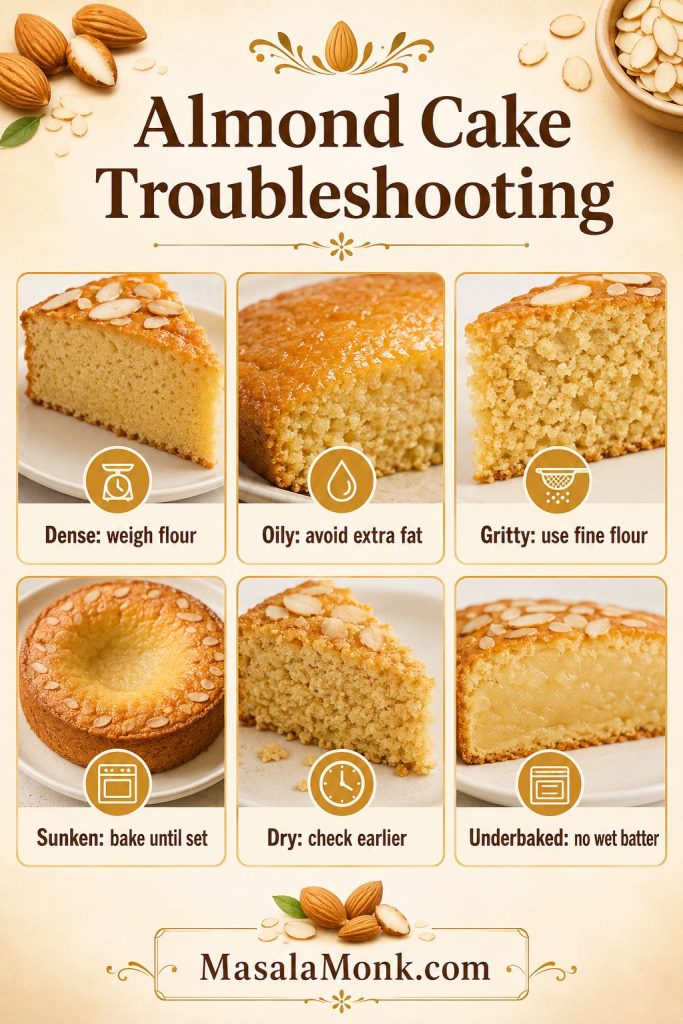
Almond cake troubleshooting board showing dense, oily, gritty, sunken, dry, and underbaked cake problems with fixes.
When almond cake fails, start with the basics first: flour weight, egg-white structure, pan heat, bake time, and cooling before slicing.

Fix-now mindset: if the cake is already baked, cool it fully, dust with powdered sugar, serve with yogurt or cream, or cut smaller slices. For the next bake, focus on flour weight, egg whites, pan size, oven heat, and cooling time.

Texture Problems: Dense, Oily, Gritty, or Dry Almond Cake

ProblemLikely reasonFix nowFix next time
Cake is denseToo much almond flour, deflated whites, or overmixed batter.Serve thin slices with cream, yogurt, or berries.Weigh the flour, whip whites to soft peaks, and fold gently.
Cake is oilyCoarse/oily almond flour, packed flour, or too much added fat.Chill briefly and serve small slices.Use fresh fine almond flour and avoid extra oil in the base recipe.
Cake is grittyCoarse almond meal or clumpy almond powder.Serve with whipped cream or yogurt to soften the bite.Use fine blanched almond flour or sift almond powder before mixing.
Cake is dryOverbaked, too wide a pan, or fan oven too hot.Serve with yogurt, cream, honey, or fruit.Check earlier, use an 8-inch pan, and reduce fan oven temperature.
Cake smells eggySlightly underbaked, weak flavor balance, or served too warm.Cool fully and serve with citrus or cream.Bake fully, use zest and vanilla, and cool before serving.
Cake tastes bitterToo much almond extract, citrus pith, old almond flour, or burnt sliced almonds.Serve with sweetened cream or powdered sugar.Use only 1/4 teaspoon almond extract, zest lightly, and tent the top if needed.

Baking and Cooling Problems: Sunken, Raw, Cracked, or Stuck Cake

ProblemLikely reasonFix nowFix next time
Center sankUnderbaked center, early oven opening, or overmixed batter.Dust with powdered sugar or cover with berries.Bake until the middle is set and avoid opening the oven too soon.
Edges browned but center stayed rawPan too thin, oven too hot, or cake baked too high in the oven.Return to oven loosely covered with foil if still very wet.Use a sturdy pan, bake on the middle rack, and tent with foil if needed.
Almond slices burnedOven runs hot or cake was baked too high.Brush off the darkest almonds before serving.Bake on the middle rack and tent once the top is golden.
Top crackedOven heat was strong or batter rose quickly.Dust with powdered sugar; a small crack is normal.Use the correct temperature and avoid overbeating the whites.
Cake is too flatWide pan, deflated whites, or old baking powder.Serve as a thin tea cake.Use an 8-inch pan, fresh baking powder, and fold gently.
Cake stuck to the panNo parchment or cake was removed too hot.Serve rustic pieces with cream or fruit.Line the base with parchment and cool 15 minutes before removing.
Bottom feels wetUnderbaked, cooled too long in the pan, or stored before fully cool.Let slices air out briefly before serving.Bake until set, cool 15 minutes in pan, then move to a wire rack.

FAQs About Almond Cake

Is almond cake the same as almond flour cake?

Often, yes. In this recipe, almond cake means a cake made mainly with almond flour instead of wheat flour. Some bakery-style almond cakes use wheat flour and almond extract, so they have a different texture.

Almond meal instead of almond flour: what changes?

Use the same weight of almond meal, but expect a darker, nuttier, more rustic cake. Fine blanched almond flour gives the most delicate result.

Is almond powder the same as almond flour?

Sometimes. Plain finely ground almonds can work. Sweetened badam drink mix, malted almond powder, or milk-powder blends should not be used for this cake.

Is this almond cake gluten-free?

It is naturally gluten-free if every ingredient is gluten-free. Check baking powder, extracts, toppings, and cross-contact if you are baking for someone with strict gluten-free needs. The Celiac Disease Foundation’s gluten-free foods guide is a helpful reference.

Why did my almond cake sink in the middle?

The center was likely underbaked, the oven was opened too early, or the egg whites deflated during mixing. Bake until the middle feels set and the toothpick shows moist crumbs, not wet batter.

Why is my almond cake oily?

Almond flour contains natural fat, so the cake can feel oily if the flour is packed, the almond meal is coarse, or extra fat is added. Use fresh fine almond flour, avoid extra oil in the base recipe, and measure by weight when possible.

Why eggs matter in this almond flour cake

Eggs are doing the structure work here. They help the almond flour batter lift, set, and hold a clean slice. That is why a flax, chia, or yogurt swap will not behave the same way.

How to turn this into orange almond cake

Use orange zest instead of lemon zest for a simple orange almond cake. You can also drizzle the cooled cake with a light orange glaze. A whole-orange almond cake is a different recipe with a longer bake time.

Best pan size if you do not have an 8-inch pan

A 9-inch pan works, but the cake will be thinner and bake faster. Start checking around 23 minutes and remove it when the center is set.

Freezing almond cake without drying it out

Freeze the cake only after it has cooled completely. Slice it first, place parchment between the slices, and store airtight for up to 2 months.

Back to top

Final Notes

Once the cake has cooled, the reward is in its simplicity: a golden almond top, a clean slice, and a citrus-almond flavor that works with coffee, berries, cream, or nothing at all. It does not need frosting or complicated decoration to feel finished.

Give the batter a light hand, give the cake enough time to settle, and the result is a tender almond flour cake that feels special without trying too hard.
Posted on 1 Comment

Almond Flour Cookies Recipe

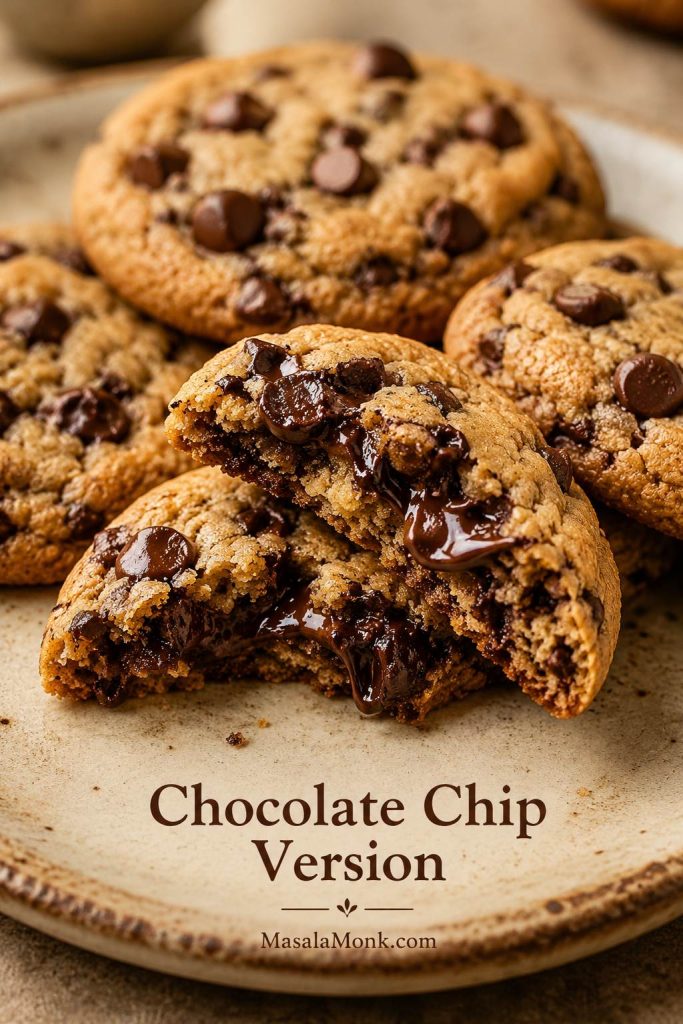
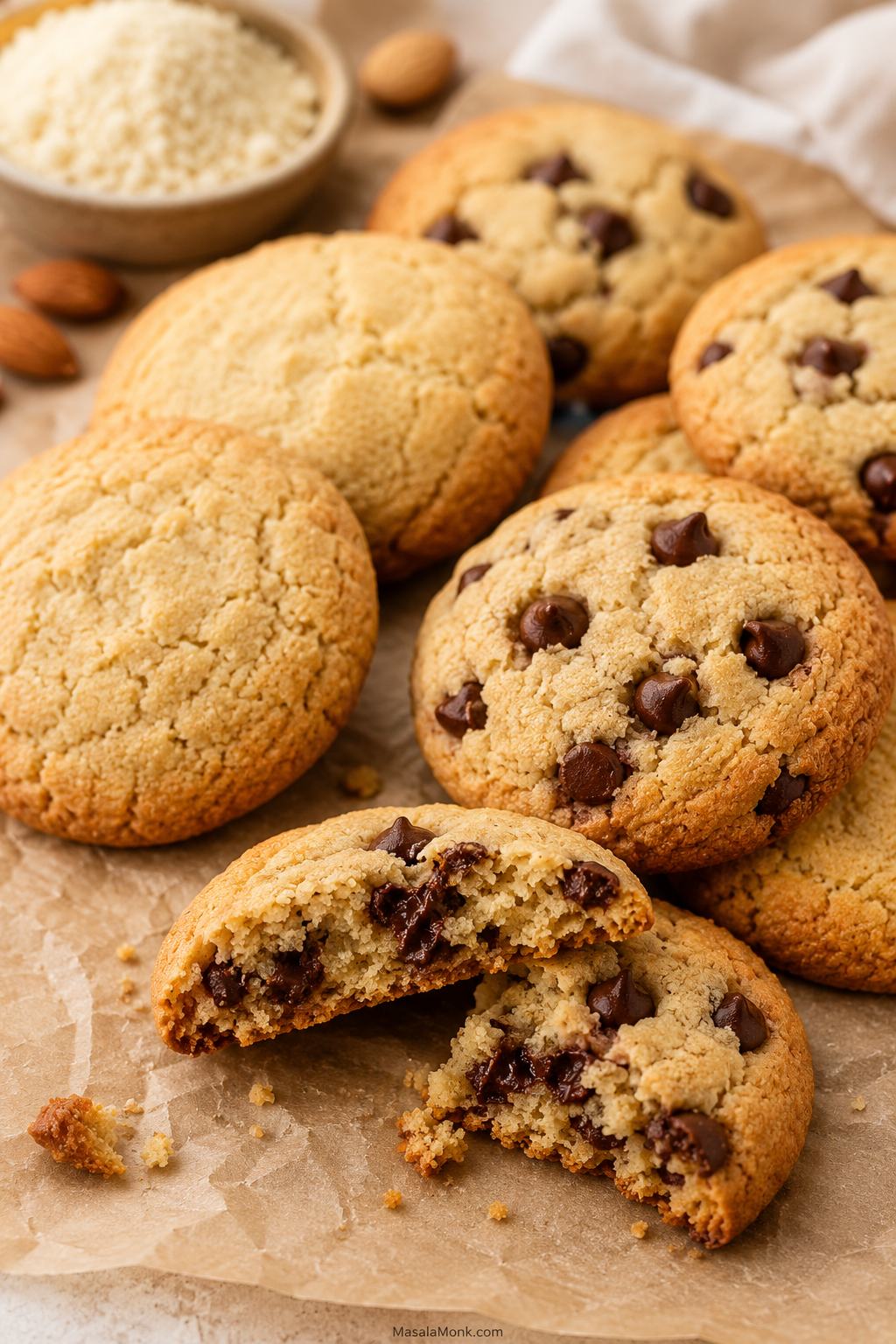
Almond flour cookies with golden edges, chocolate chips, and a soft broken center on parchment.

Good almond flour cookies should not taste like a gluten-free compromise. They should be soft in the middle, lightly golden at the edges, rich with vanilla and butter, and sturdy enough to pick up once cooled. This one-bowl almond flour cookies recipe gives you that texture without a long chill.

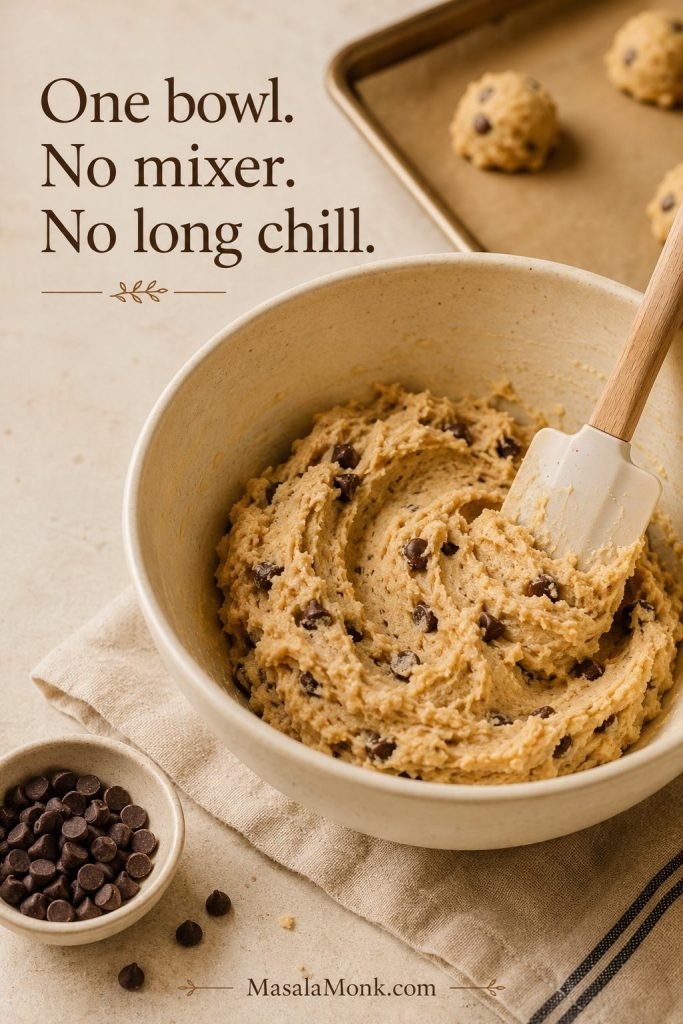
Almond flour cookie dough being mixed in one bowl with a spatula and chocolate chips nearby.
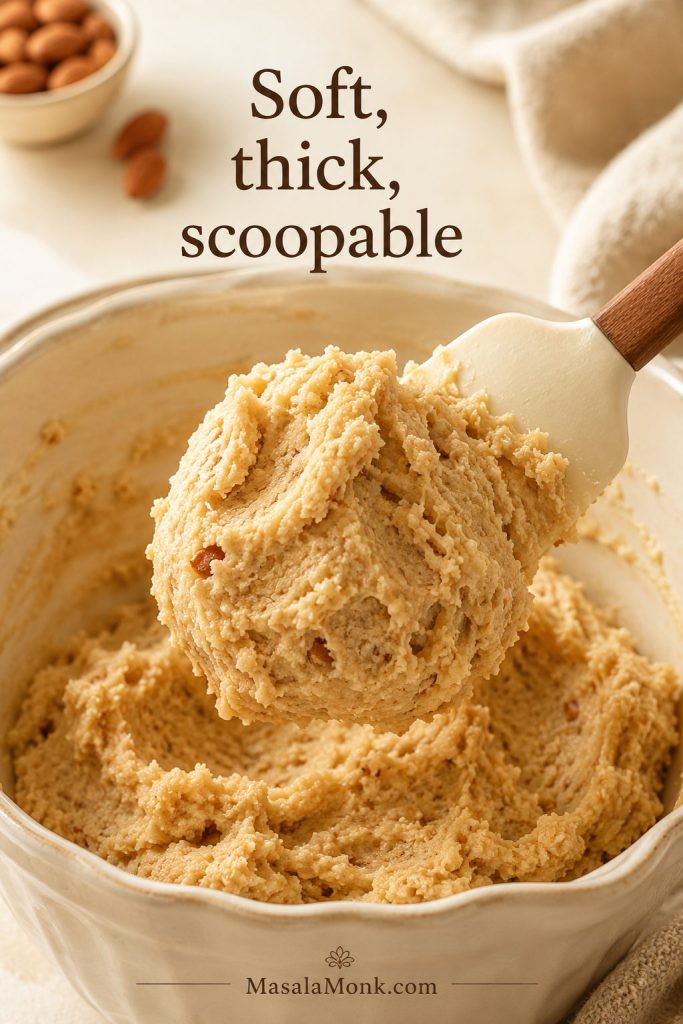
This one-bowl dough should look thick and scoopable, never runny, before you shape it.

Make them plain when you want the warm almond-vanilla flavor to shine, or fold in chocolate chips for the familiar bakery-style version most people picture first. Either way, the dough is simple, scoopable, and built around the small details that make almond flour baking work.

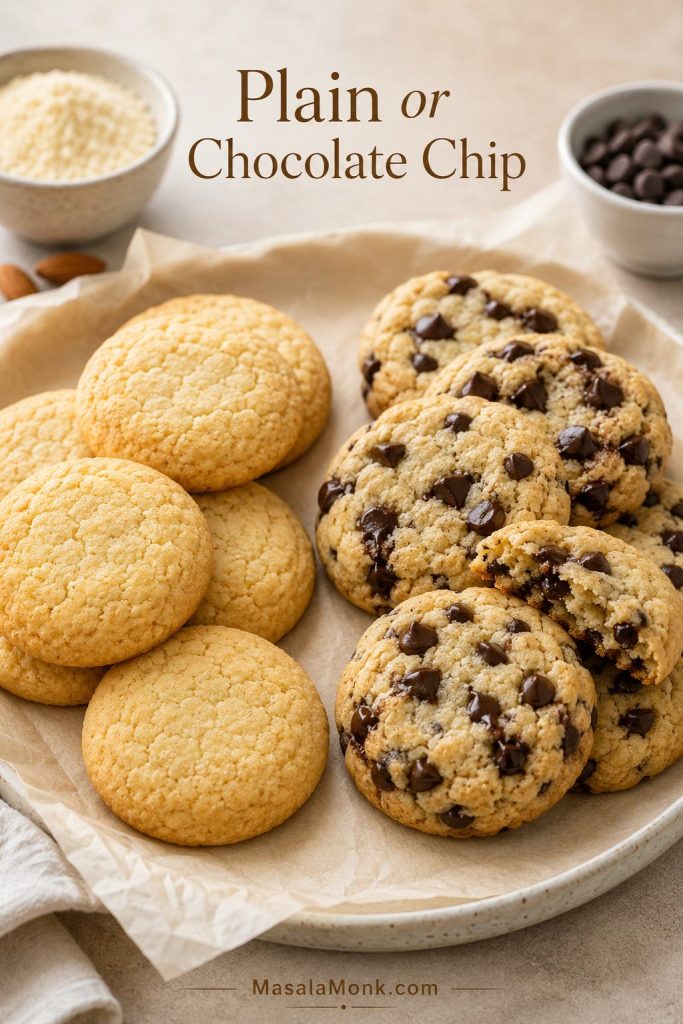
Plain almond flour cookies beside chocolate chip almond flour cookies from the same base dough.
Use the same almond flour cookie dough plain for a warmer almond-vanilla bite, or add chocolate chips for a familiar bakery-style version.

The payoff is a batch of cookies that smell warm and buttery, break softly once cooled, and feel just as welcome with coffee in the afternoon as they do with a few extra chocolate chips after dinner.

The main recipe is the one to start with when you want cookies that hold together, taste smooth instead of gritty, and still feel soft in the center. It is built for the almond-flour problems readers run into most often: oily dough, low spread, fragile cookies, and centers that need time to set.

Use the main recipe first if you want the most reliable batch. Then use the variation notes for 3-ingredient, vegan, keto-style, chocolate chip, and crispier cookies once you know how the dough should feel.

Almond Flour Cookies at a Glance

  • Active time: about 12 minutes
  • Bake time: 10–12 minutes for soft cookies, 13–14 minutes for firmer edges
  • Dough rest: 10 minutes while the oven heats
  • Tray set time: 10–15 minutes before moving
  • No long chill: chill only if the dough feels greasy, sticky, or too soft
  • Yield: about 16 cookies, plain or with chocolate chips
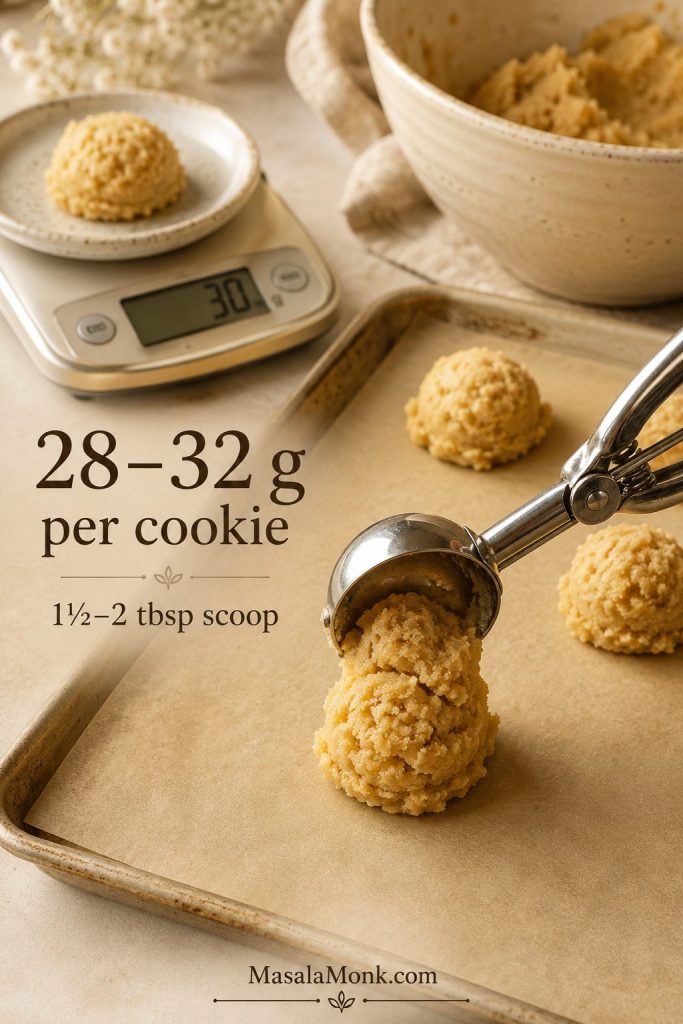
  • Scoop size: 1 1/2 to 2 tablespoons, about 28–32 g dough per cookie
  • Best flour: fine blanched almond flour, not coarse almond meal
  • Most important step: shape before baking, then let the cookies set on the warm tray before lifting

Quick Answer: How to Make Almond Flour Cookies

To make almond flour cookies, mix fine blanched almond flour with brown sugar, melted butter, egg, vanilla, baking soda, salt, and a little cornstarch or arrowroot if you want a softer, thicker cookie. Fold in chocolate chips for the most familiar bakery-style version, or leave the dough plain for a warmer almond-vanilla cookie. Scoop, press each mound into a thick disc, and bake at 350°F / 175°C for 10–12 minutes, until the edges look lightly golden and the centers still look tender.

The two steps that matter most are simple: shape the cookies before baking and let them set on the baking sheet before moving them. This dough does not spread as much as regular cookie dough, and the baked cookies are delicate while hot. Once they cool, they firm up into soft, tender cookies that lift cleanly from the tray.

If this style of cookie has disappointed you before, this recipe is designed to take the guesswork out of the tray. The dough is supposed to feel softer than regular cookie dough, the centers are supposed to look slightly tender when they come out of the oven, and the cookies are supposed to finish setting as they cool. Once you know those cues, the recipe becomes much easier.

If you need quick fixes while baking, jump to the troubleshooting section; if you are ready to mix, go straight to the recipe card.
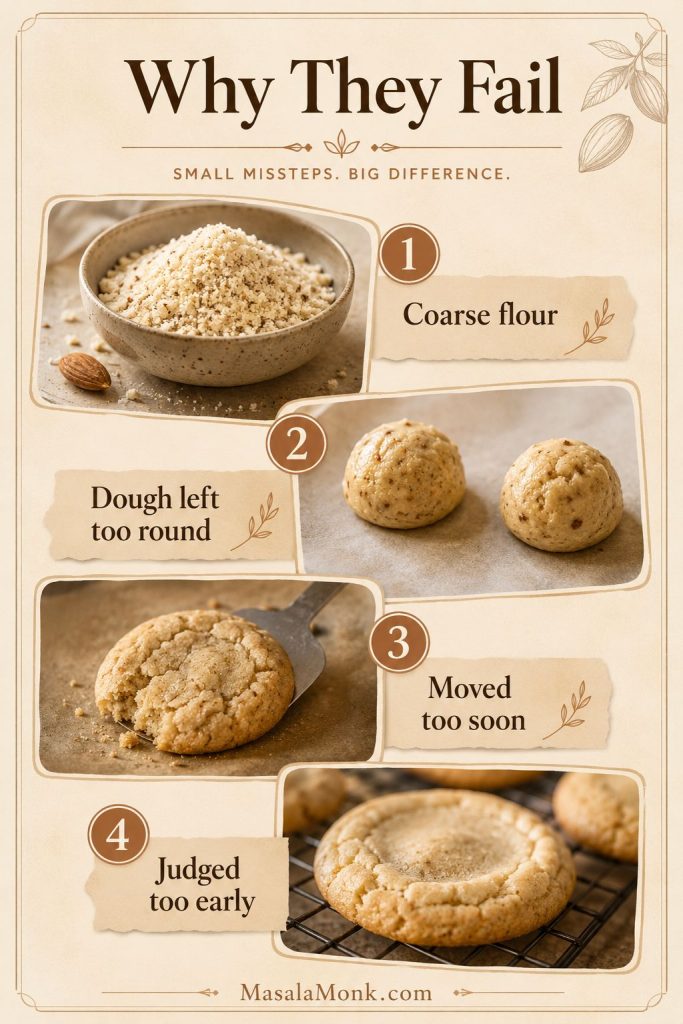
Why almond flour cookies fail

Most failed batches come down to four things: coarse almond meal, dough left too round before baking, cookies moved while hot, or centers judged before they had time to set. This recipe builds those fixes into the method, so the cookies lift cleanly and taste tender instead of gritty or crumbly.

For step-by-step help, use the method cues first, then check the troubleshooting table if the dough or baked cookies still seem off.

Common almond flour cookie problems including coarse almond meal, unpressed dough, fragile cookies, and soft centers.
If almond flour cookies have failed before, start by checking the flour texture, dough shape, bake cues, and cooling time.

Why You’ll Like This Batch

  • It feels like a real cookie: soft middle, golden edge, and rich almond-vanilla flavor.
  • It is easy enough for a weeknight: one bowl, no mixer, and no long chill.
  • It is flexible: bake them plain, add chocolate chips, or try the 3-ingredient version later.
  • It is built for almond flour: the recipe tells you when to shape, when to pull the tray, and when the cookies are sturdy enough to move.

Why This Almond Flour Cookies Recipe Works

Most problems with this dough do not come from flavor. Almond flour already tastes rich, nutty, and buttery. The challenge is helping the cookies hold together, bake evenly, and set without becoming gritty, oily, or too soft.

The fix starts with fine blanched almond flour, then a few small choices that help the cookies bake up tender instead of sandy or fragile: one egg for lift, brown sugar for a gentle chew, a short dough rest for better hydration, and optional cornstarch or arrowroot for a softer, thicker bite.

The biggest difference is not a complicated technique. The best batches come from dough that is pressed before baking, pulled while the centers still look slightly soft, and left alone long enough for the bottoms to firm on the tray.

  • Fine blanched almond flour keeps the bite smoother and less gritty.
  • Brown sugar gives more familiar chew than dry sweeteners alone.
  • One egg helps the cookies lift cleanly from the tray once cooled.
  • A short rest makes the dough easier to scoop and shape.
  • Gentle handling keeps the cookies intact while they finish setting.

Best first-batch version

For the most reliable first tray, use fine blanched almond flour, brown sugar, butter, the egg, and the cornstarch or arrowroot. This version gives the best balance of tenderness, browning, and cookies that lift cleanly after cooling. Try the 3-ingredient, keto, or vegan variations after you know how the base dough should feel.

The one habit that changes the batch

Treat almond flour cookies gently while they are hot. Give them a few quiet minutes on the tray, and they go from fragile to tender, sturdy, and easy to lift.

Before You Start: 5 Almond Flour Cookie Rules

This dough is easy, but it does not behave like regular cookie dough. Keep these rules in mind before you mix the bowl, especially if this is your first batch.

  • Use fine almond flour. Coarse almond meal can make the cookies gritty and fragile.
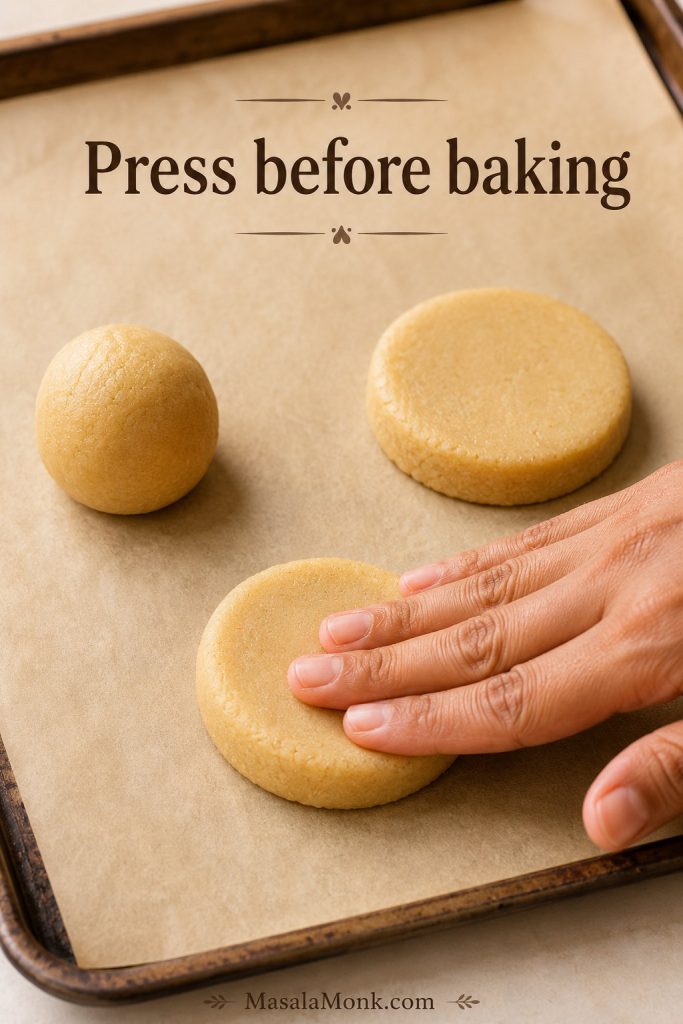
  • Press the dough before baking. The shape you make is close to the shape you get.
  • Mix gently. Almond flour has natural fat, so overmixing can make the dough oily.
  • Move them only after they set. Hot cookies are delicate; cooled cookies lift cleanly.
  • Judge texture after cooling. Warm centers can seem too soft even when baked correctly.

What These Almond Flour Cookies Taste Like

These almond flour cookies have a warm vanilla-almond flavor, buttery edges, and a soft, tender bite. They are not meant to be stretchy like wheat-flour chocolate chip cookies. Instead, they break softly, taste rich from the almond flour, and become sturdy enough to lift once fully cooled.

Chocolate chips make them feel more classic and dessert-like, while the plain version lets the almond flavor come through more clearly. Either way, the goal is a cookie that feels homemade and satisfying, not dry, sandy, or like a gluten-free compromise.

For crispier edges, press the dough a little flatter and bake the cookies until the edges are deeper golden. For softer centers, keep the dough slightly thicker and avoid overbaking.

Ingredients You Need

This recipe keeps the ingredient list simple, but every ingredient has a job. You want a tender cookie that tastes warm and satisfying, not like a dry gluten-free compromise. If you plan to change sweeteners, fat, eggs, or flour, check the substitution guide before mixing.

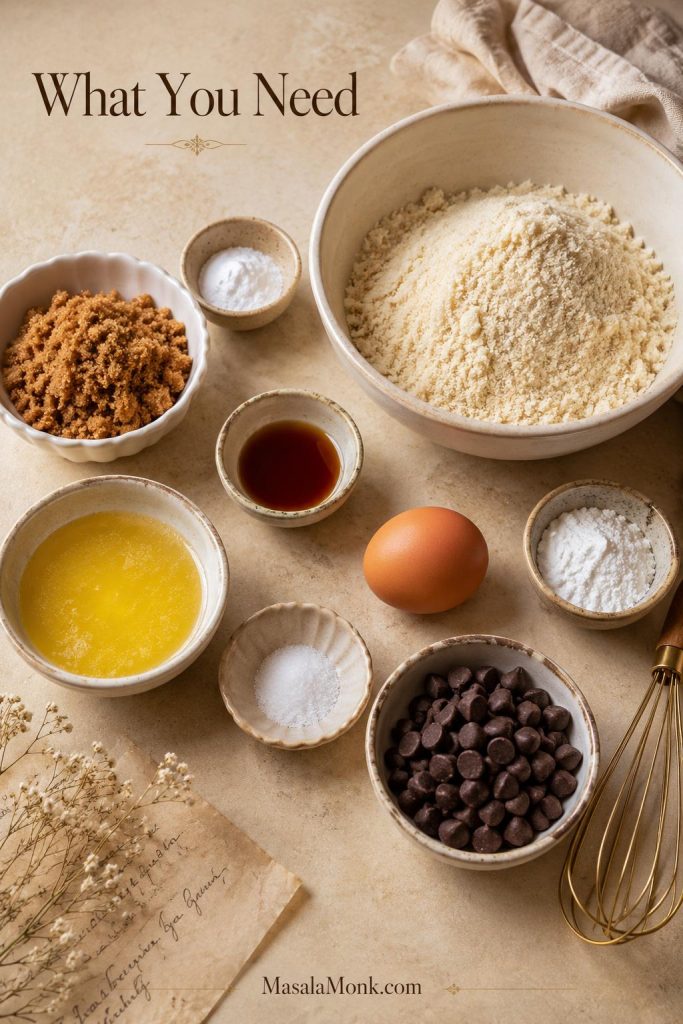
Ingredients for almond flour cookies including almond flour, brown sugar, butter, egg, vanilla, starch, and chocolate chips.
Each ingredient has a clear job: almond flour brings richness, brown sugar helps chew, and optional starch makes the cookies a little softer.

Fine blanched almond flour

Use fine blanched almond flour for the softest texture. It gives the cookies a pale golden color, tender crumb, and smoother bite. Coarse almond meal can work in a pinch, but the batch may taste grainier, darker, and more fragile.

Brown sugar or coconut sugar

Brown sugar gives these cookies a softer, chewier feel and a warmer flavor. Coconut sugar also works, but it weighs a little differently and gives a deeper, more caramel-like taste. For keto-style cookies, use the notes in the variation section because low-carb sweeteners change browning, spread, and chew.

Butter

Melted butter gives the cookies classic flavor and helps the dough come together easily. Let it cool slightly before mixing so it does not scramble the egg or make the dough oily. For a dairy-free version, coconut oil can work, but the cookies will taste a little different and may be slightly softer.

Egg

One egg helps the cookies lift cleanly from the tray after cooling. Egg-free versions are possible, but they need a different formula because almond flour has no gluten to help the dough hold together.

Vanilla, baking soda, and salt

Vanilla is not just background here. It rounds the almond flavor and makes the cookies taste warmer. Baking soda gives a little lift and helps the edges brown, while salt keeps the sweetness from tasting flat.

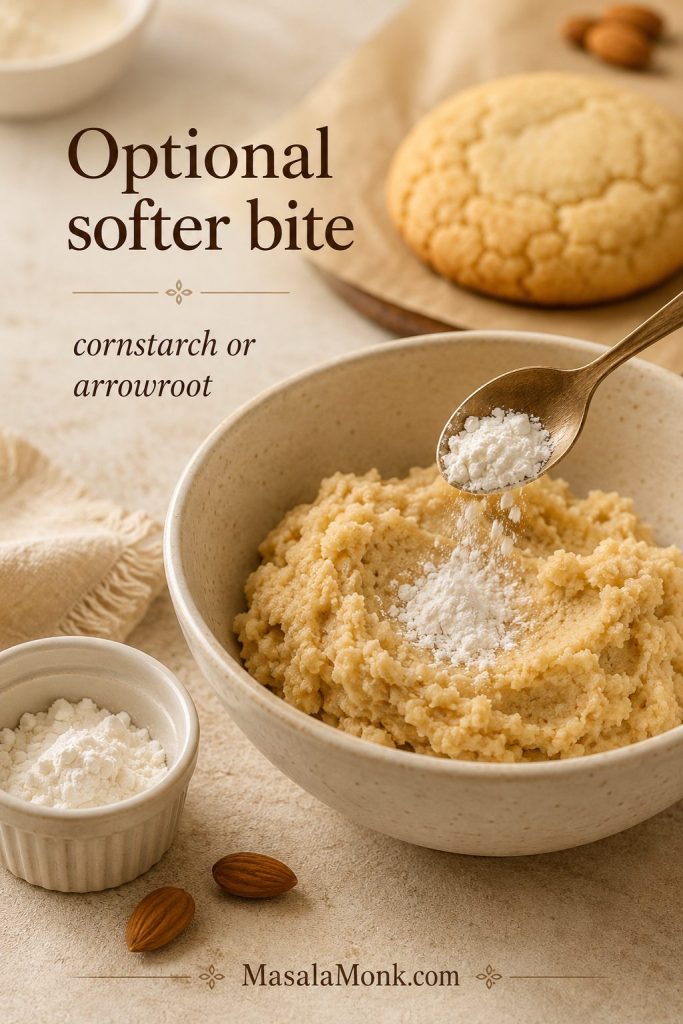
Recommended starch for softer cookies

A tablespoon of cornstarch or arrowroot helps the cookies bake softer, thicker, and a little less fragile. Use cornstarch for the most familiar cookie texture, arrowroot if you prefer a grain-free option, or skip it for keto-style cookies. Without it, the cookies still work, but they will be slightly more delicate.

Cornstarch or arrowroot being added to almond flour cookie dough for a softer texture.
A small amount of cornstarch or arrowroot is optional, but it helps the cookies bake thicker, softer, and less delicate.

Chocolate chips

Chocolate chips are optional, but they turn this base dough into an easy chocolate chip version. Mini chocolate chips distribute especially well through the dough, while regular chips give bigger pockets of chocolate.

A note on strict gluten-free baking

Almond flour is naturally gluten-free, but if you are baking for someone who needs strict gluten-free food, use almond flour, chocolate chips, and starch that are labeled gluten-free. The FDA’s gluten-free labeling rule sets a clear standard for foods that carry a gluten-free claim.

Almond Flour vs Almond Meal for Cookies

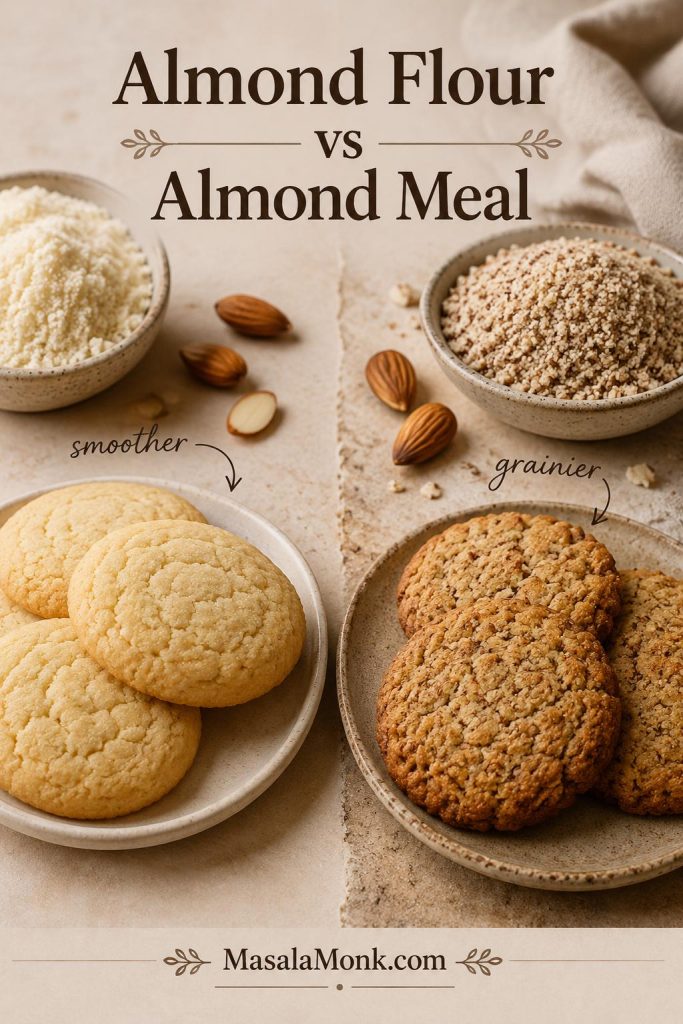
For the best texture, use fine blanched almond flour. It is usually made from almonds without their skins, so the texture is finer and the color is lighter. This helps the cookies bake up soft, even, and tender.

Almond meal is usually coarser and may include almond skins. It can make cookies darker, grainier, and more rustic. That is not always bad, but it is not ideal when you want a soft, smooth cookie that holds together neatly.

Fine almond flour and almond meal compared with smoother and grainier cookies.
Fine blanched almond flour gives a smoother cookie, while almond meal can make the texture darker, grainier, and more fragile.
Ingredient Best for Cookies? What to Expect
Fine blanched almond flour Best choice Soft, even texture with less grittiness and a cleaner bite.
Almond meal Works, with tradeoffs Darker, grainier cookies that may feel more delicate.
Coarse homemade almond flour Risky Can make the dough uneven, oily, or gritty if the grind is too coarse.

For a deeper baking-focused explanation of almond flour texture and grind, King Arthur Baking has a helpful almond flour guide that explains how finely ground almond flour behaves in baked goods.

If you want to see almond flour behaving in a batter instead of a dough, our almond flour pancakes guide shows why almond-based recipes brown quickly and feel more delicate than wheat-flour versions.

Once you have the right flour, the next important cue is what the dough should look like before baking.

Ingredient Substitutions and What Changes

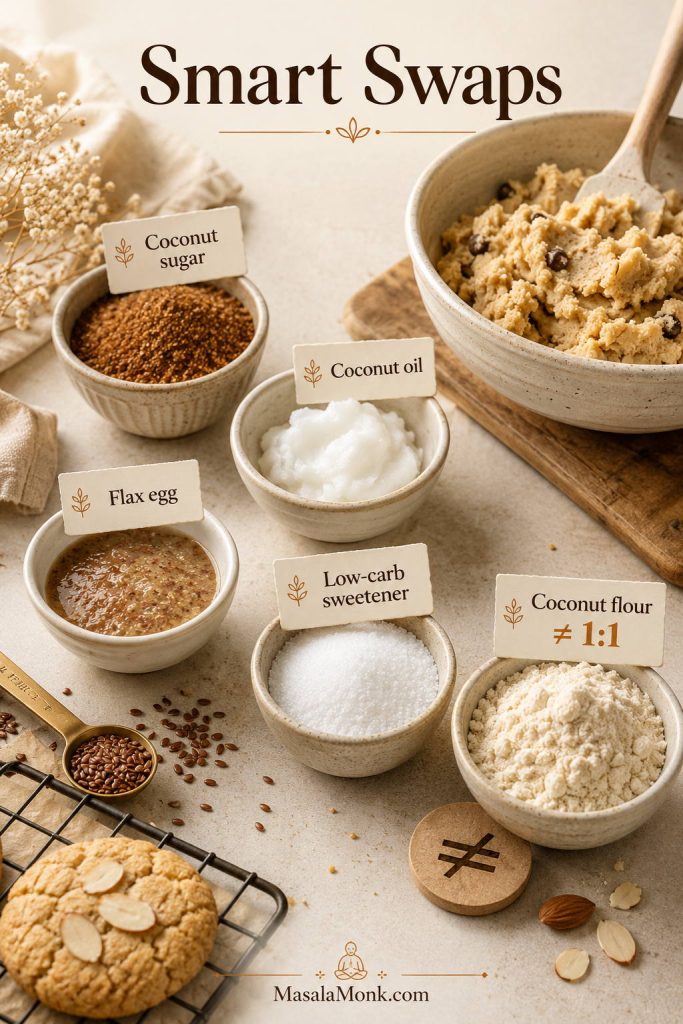
Substitutions can work, but they are not all equal. Because almond flour has no gluten and contains natural fat, small changes can affect how the cookies spread, brown, and set.

Substitution guide for almond flour cookies with coconut sugar, coconut oil, flax egg, low-carb sweetener, and coconut flour warning.
Some swaps are easy, but coconut flour is not one of them because it absorbs far more liquid than almond flour.
Swap Will It Work? What Changes
Almond meal instead of almond flour Yes, with tradeoffs Cookies may be darker, grainier, and more fragile.
Coconut oil instead of butter Yes Good for dairy-free cookies, but the flavor is less classic and the texture can be softer.
Coconut sugar instead of brown sugar Yes Use 1/2 cup, about 95 g. It gives a deeper flavor and slightly less classic chew.
Maple syrup instead of sugar Not as a direct swap It adds liquid and changes the dough. Use the 3-ingredient variation instead.
Low-carb sweetener instead of sugar Yes, with texture changes Use a 1:1 granular baking sweetener. The cookies may brown less, spread less, and feel less chewy.
Flax egg instead of egg Sometimes The cookies become softer and more delicate. The vegan variation is the safer starting point.
Coconut flour instead of almond flour No Coconut flour absorbs much more liquid and cannot be swapped 1:1.
All-purpose flour instead of almond flour No This recipe is balanced for almond flour’s fat and moisture behavior.
Gluten-free flour blend instead of almond flour No, not directly Most blends behave more like wheat flour and need a different cookie formula.

For the first batch, stay close to the main recipe. Once you know how the dough should feel, it is much easier to adjust sweeteners, fats, or add-ins without losing the soft, tender texture. Then compare the almond flour cookie variations to choose the best next batch.

This recipe is built for almond flour

Other flours need their own formulas. Coconut flour, oat flour, all-purpose flour, and gluten-free flour blends absorb liquid and fat differently, so they cannot replace almond flour directly in this recipe.

Equipment You Need

You do not need a mixer or special equipment. A bowl, spatula, baking sheet, parchment paper, and a cookie scoop are enough for this one-bowl dough.

  • Baking sheet: one large sheet pan or two smaller trays.
  • Parchment paper: best for clean release and even browning.
  • Mixing bowl and spatula: enough for this no-mixer, one-bowl dough.
  • Cookie scoop: a 1 1/2 to 2 tablespoon scoop keeps the cookies even.
  • Wire rack: useful after the cookies set on the tray.
  • Kitchen scale, optional: best for measuring almond flour accurately.
Almond flour cookie dough portioned with a cookie scoop at 28 to 32 grams per cookie.
Even scoops help the cookies bake at the same pace, so the centers stay tender while the edges turn lightly golden.

Parchment paper gives the cleanest release and slightly better browning. A silicone baking mat also works, but the bottoms may brown a little less.

How to Make Almond Flour Cookies

This is a one-bowl style cookie dough. The method is simple, but a few small cues make the difference between cookies that lift cleanly and cookies that crumble when you pick them up. If you already know the dough basics, you can skip ahead to doneness or the texture guide.

1. Mix the wet ingredients

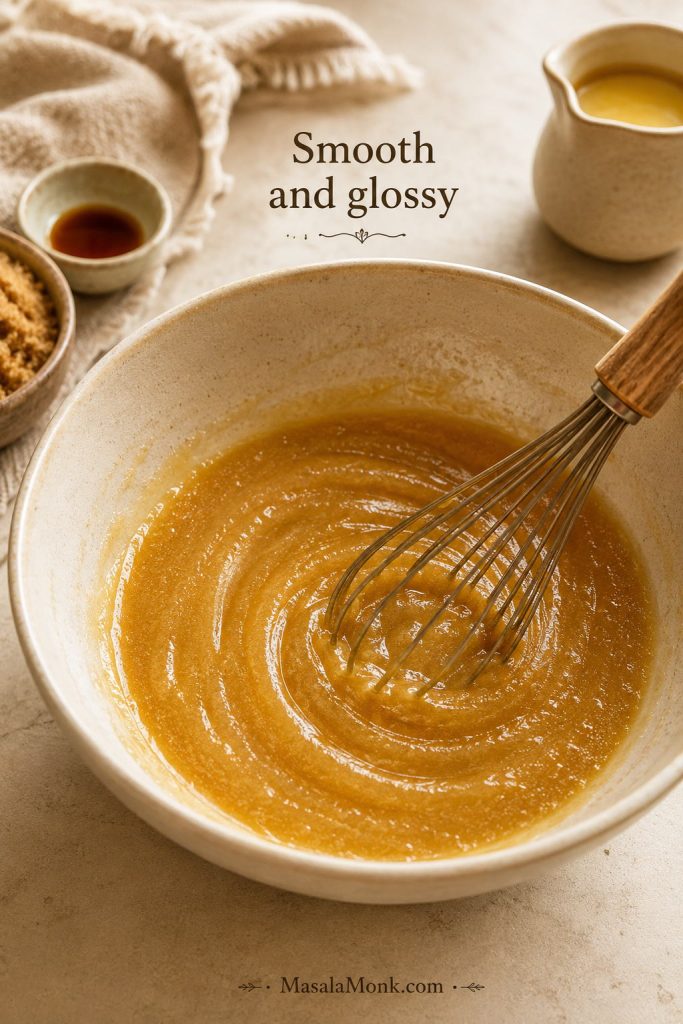
In a large bowl, whisk the melted butter, brown sugar, egg, and vanilla until smooth and glossy. The butter should be melted but not hot. If it feels hot to the touch, let it cool for a few minutes before adding the egg.

Melted butter, brown sugar, egg, and vanilla being whisked smooth in a ceramic bowl.
Let the melted butter cool slightly before adding the egg; otherwise, the wet mixture can turn greasy or uneven.

2. Add the dry ingredients

Soft thick almond flour cookie dough lifted with a spatula from a mixing bowl.
The dough should look moist and scoopable, not runny like batter or dry like crumbs, before you shape the cookies.
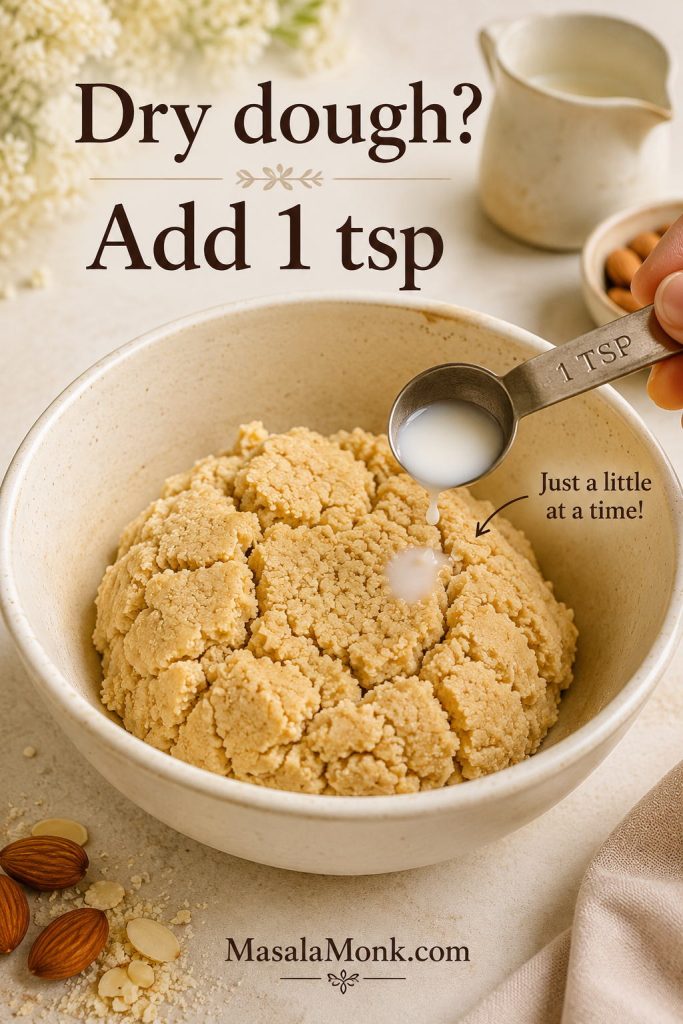
A teaspoon adding water or milk to slightly dry cracked almond flour cookie dough.
If the dough cracks badly when pressed, add water or milk one teaspoon at a time instead of overcorrecting.

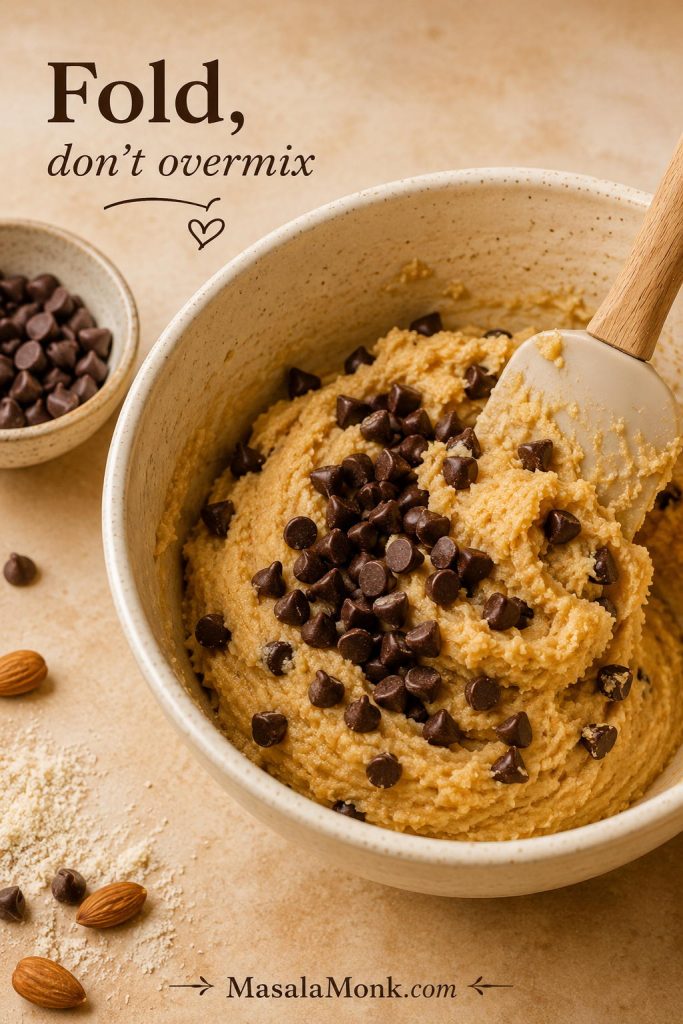
For a chocolate chip version, fold in the chocolate chips now. For a prettier finish, save a few chips and press them onto the tops of the dough before baking.

Chocolate chips being folded into almond flour cookie dough with a spatula.
Fold the chocolate chips in gently, because too much mixing can make almond flour dough oily instead of tender.

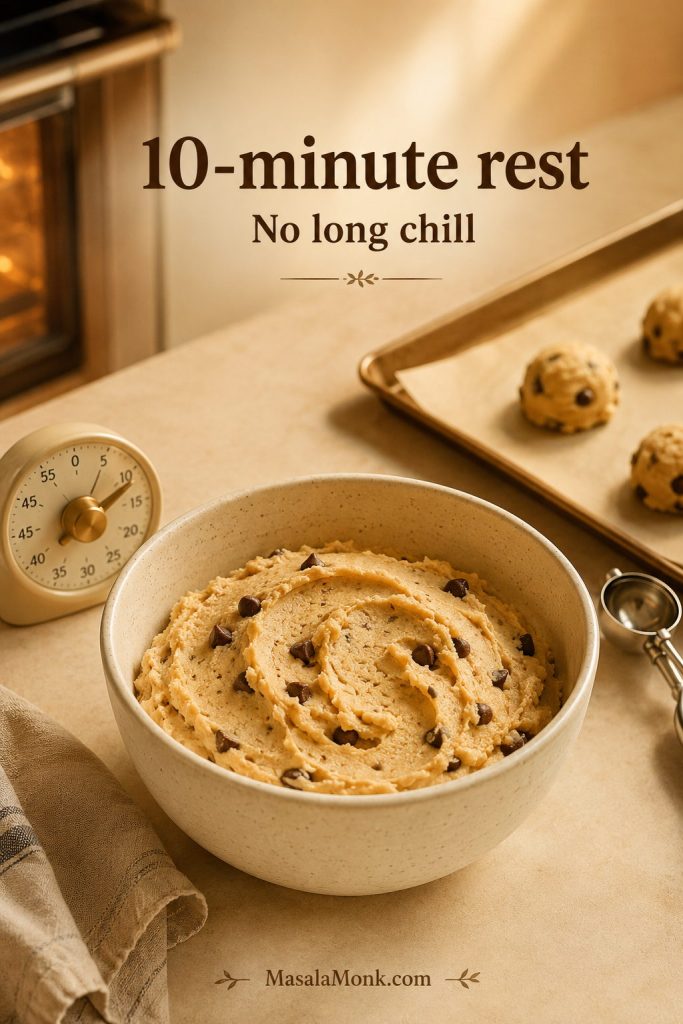
Let the dough sit for about 10 minutes while the oven heats. This short rest helps the almond flour absorb moisture and makes the dough easier to scoop. If your kitchen is warm and the bowl feels very soft, chill it for 15–20 minutes.

Almond flour cookie dough resting in a bowl near a timer and parchment-lined tray.
After a short rest, the dough feels easier to scoop because the almond flour has had time to absorb moisture.

5. Scoop and shape

Almond flour cookie dough mound being pressed into a thick disc on a parchment-lined baking tray.
Press each mound into a thick disc before baking; otherwise, almond flour dough can stay too tall in the oven.
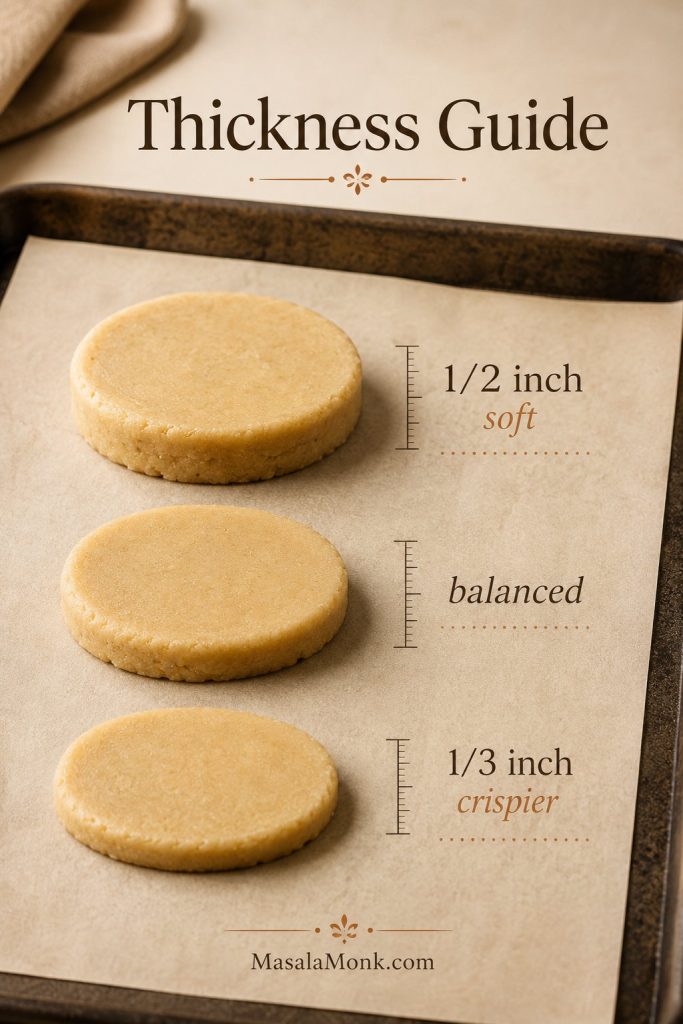
Three almond flour cookie dough discs showing different thicknesses for soft, balanced, and crispier cookies.
Thickness changes the final bite: keep the dough thicker for soft centers, or press it flatter for more golden edge.

Use one large baking sheet or divide the dough between two sheets. For the most even baking, bake one tray at a time in the center of the oven.

6. Bake until the edges are lightly golden

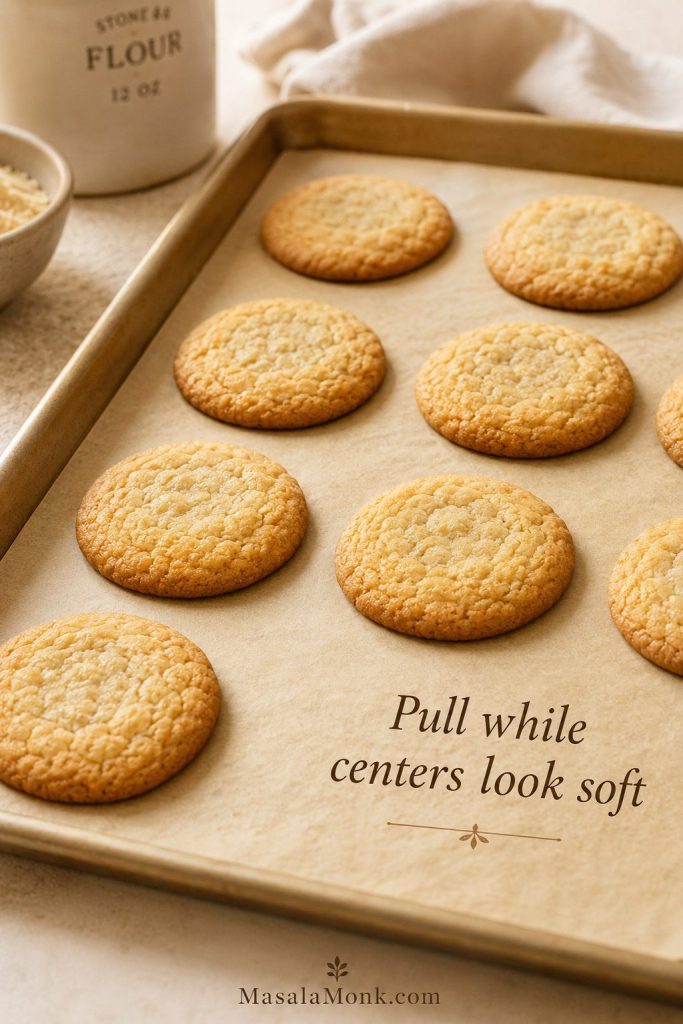
Bake at 350°F / 175°C, or about 160°C fan, for 10–12 minutes. The edges should look lightly golden, but the centers should still look soft. If your oven runs hot, check at 9 minutes because almond flour can brown quickly at the edges.

Freshly baked almond flour cookies with golden edges and soft centers on a parchment-lined tray.
Look for set, lightly golden edges rather than firm centers; the middle should still look a little tender.

7. Let the cookies set on the tray

Let the cookies cool on the baking sheet for at least 10 minutes before moving them. They are delicate when hot, but they firm as they cool. After that, transfer them to a wire rack and let them cool completely.

Almond flour cookies cooling on a baking sheet with a spatula lifting one cookie.
A clean spatula lift is the sign to wait for; if the cookie bends or breaks, give the tray a few more minutes.

The cookies may look a little softer than you expect when they first come out. That is normal. The edges should be set, but the centers finish firming as the tray cools.

Do You Need to Chill Almond Flour Cookie Dough?

You do not need a long chill for this dough. A 10-minute rest is enough for most batches because it gives the almond flour time to absorb moisture and makes the dough easier to scoop.

Chill the dough for 15–20 minutes only if it feels sticky, greasy, or too soft to shape. This usually happens when the butter is too warm, the kitchen is hot, or the almond flour is very fine and fresh. Even after chilling, press the dough into discs before baking so the cookies do not stay too thick.

How to Know When Almond Flour Cookies Are Done

The cookies are done when the edges look lightly golden and set, but the centers still look a little soft. Do not wait for the centers to look firm in the oven, or the cookies may turn dry after cooling.

When in doubt, pull the tray when the edges are set and the centers still look slightly soft. Overbaked almond flour cookies can taste dry once cooled.

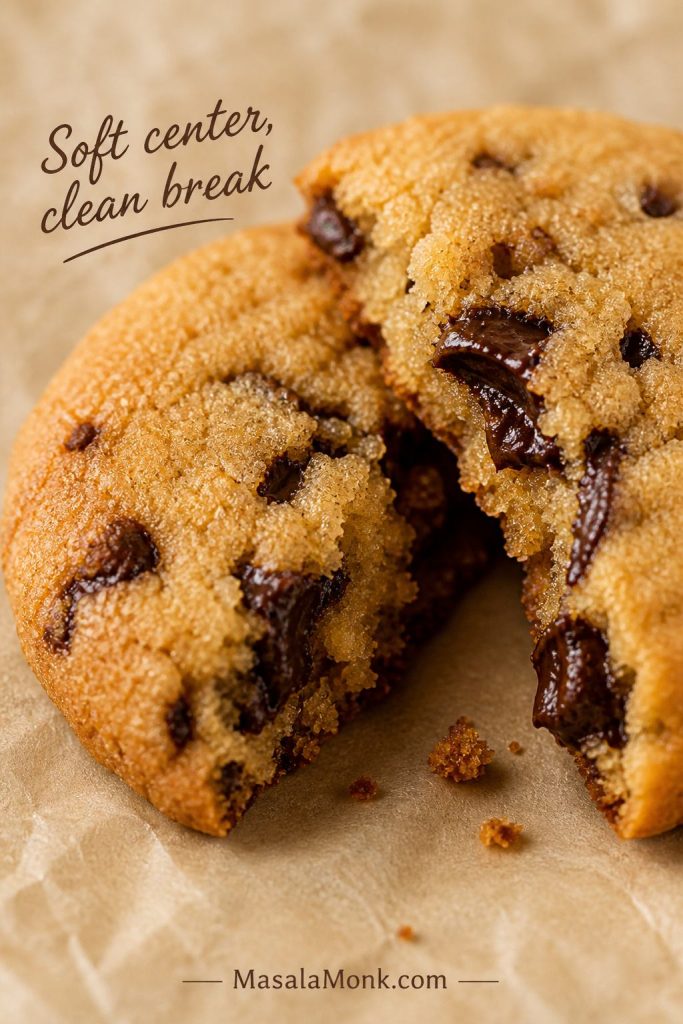
The cookies should look lightly golden at the edges, soft in the center, and slightly fragile when they first come out. After 10–15 minutes on the tray, they should lift cleanly with a spatula and break softly when you bite into them.

Broken chocolate chip almond flour cookie showing a soft center and melted chocolate pockets.
The finished cookie should break softly, not crumble into sand, which tells you the dough and bake time worked together.

Soft, Chewy, or Crispy Almond Flour Cookies

Before you bake, decide what kind of cookie you want. A thicker cookie gives you the softest center. A slightly flatter cookie gives you more golden edge. The recipe is flexible, but the shape you choose before baking matters.

Texture Goal How to Shape Bake Time Best Cue
Soft almond flour cookies Keep thicker, about 1/2 inch 10–11 minutes Edges barely golden, centers soft
Chewy almond flour cookies Flatten slightly, but not thin 11–12 minutes Light golden edges, tender centers
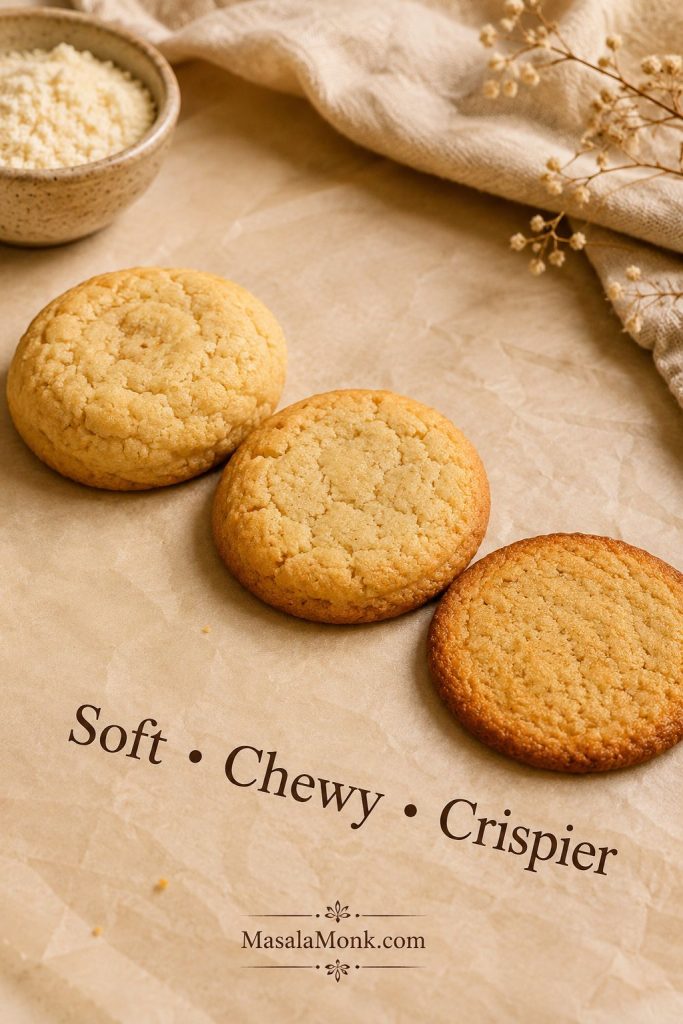
Crispier almond flour cookies Flatten more, about 1/3 inch 13–14 minutes Deeper golden edges, fully cooled before serving
Soft, chewy, and crispier almond flour cookies shown side by side on parchment.
The same dough can bake soft, chewy, or crispier depending on how thickly you shape it and how long it stays in the oven.

For the chewiest result, use brown sugar, keep the egg, and avoid overbaking. For crispier cookies, press the dough flatter and give the tray an extra minute or two in the oven. Either way, wait until the cookies cool before judging the final texture. If your cookies came out dry, crumbly, oily, or too thick, the troubleshooting section will help you adjust the next tray.

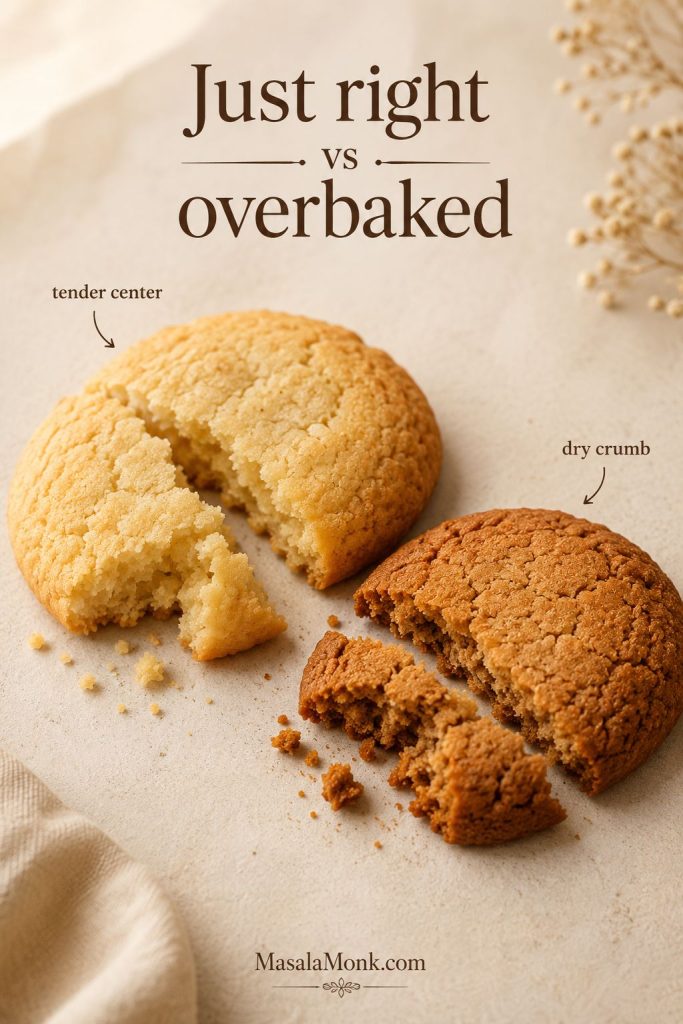
Just-right almond flour cookie with tender center compared with a darker overbaked cookie with dry crumb.
Instead of waiting for firm centers, look for golden edges; overbaked almond flour cookies can taste dry after cooling.

Almond Flour Cookie Variations

Think of the base recipe as the dependable version. Once you know how the dough behaves, the variations below let you move toward simpler, richer, lower-carb, dairy-free, or more chocolate-forward cookies without starting from scratch. Need the base formula first? Use the recipe card, then come back here to choose a version.

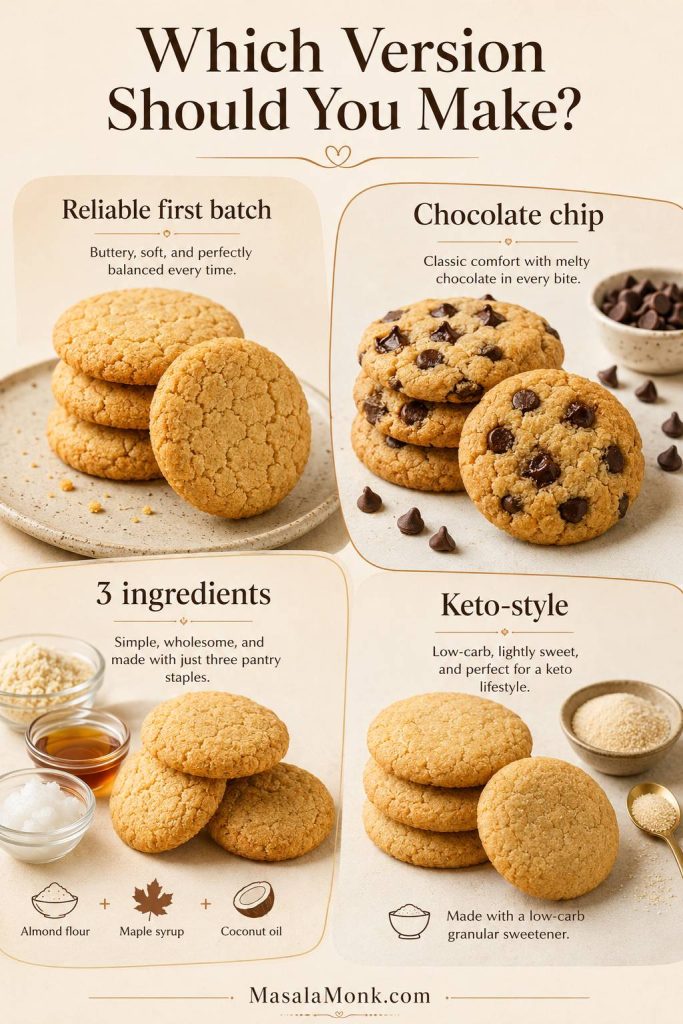
If You Want… Make This Version Why
The most reliable first batch Main recipe with egg and starch Best balance of softness, browning, and cookies that lift cleanly.
The most familiar cookie Chocolate chip version Classic flavor, melty pockets, and broadest appeal.
The simplest egg-free cookie 3-ingredient version Quick, small-batch, and dairy-free if you use coconut oil.
Lower sugar Keto-style version Works with a 1:1 granular low-carb baking sweetener, but browns less.
Almond flour cookie version chooser showing reliable first batch, chocolate chip, 3 ingredient, and keto-style cookies.
Start with the reliable first batch when texture matters most, then choose chocolate chip, 3-ingredient, or keto-style based on your needs.

If you are baking for people who do not usually choose gluten-free cookies, start with the chocolate chip version. It feels familiar first, then quietly happens to be almond-flour based.

If you want something simpler with coffee or tea, keep them plain. If you need egg-free or dairy-free cookies, use the 3-ingredient version as its own small-batch formula rather than forcing swaps into the main dough.

3 Ingredient Almond Flour Cookies

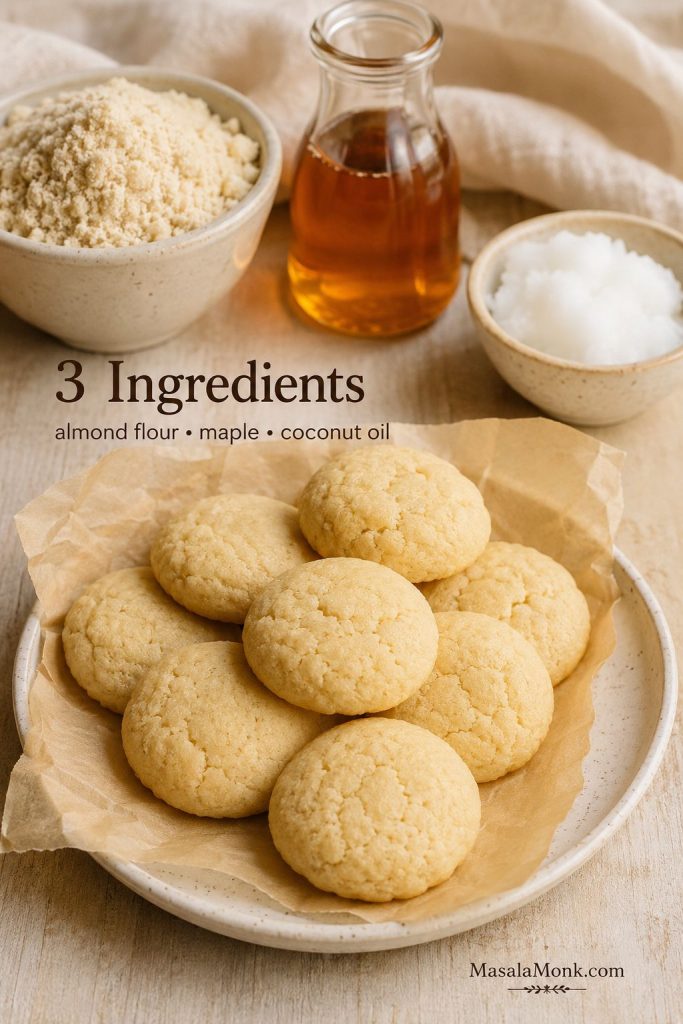
Choose the 3-ingredient version when you want a quick, simple, egg-free cookie with very little prep. It will be softer and more delicate than the main recipe, but it works well for a snack-style cookie when you keep the cookies small, shape them before baking, and let them cool fully on the tray.

Three ingredient almond flour cookies with almond flour, maple syrup, and coconut oil nearby.
The 3-ingredient version is quick and egg-free, but it bakes softer and more delicate than the main recipe.

For a small batch of about 8 small cookies, mix 1 cup fine almond flour, 3 tablespoons maple syrup, and 2 tablespoons melted coconut oil or butter. Add a pinch of salt if possible. Scoop into small 1-tablespoon portions, press into discs, and bake at 350°F / 175°C for 8–10 minutes, or closer to 10–12 minutes if you make them larger. Let them set fully on the tray before moving.

If the 3-ingredient dough feels dry or cracks heavily, add water or milk 1 teaspoon at a time. If it feels sticky, let it rest for 5–10 minutes before shaping.

Choose the 3-ingredient version for speed and simplicity. Choose the main recipe when you want more classic browning, chew, and lift.

Chocolate Chip Almond Flour Cookies

For a chocolate chip version, add 1/2 cup / 85 g chocolate chips to the main dough. Mini chocolate chips spread through the dough evenly, while regular chips give bigger pockets of chocolate. Press a few extra chips on top before baking for a bakery-style finish.

Chocolate chip almond flour cookies with a broken cookie showing melted chocolate and a soft center.
Chocolate chip almond flour cookies feel familiar first, which helps when you are baking for both gluten-free and regular-cookie eaters.

If you like deep chocolate cookies, you can also visit our double chocolate chip cookies for a richer chocolate-cookie direction.

More Wholesome Almond Flour Cookies

For a more wholesome version, use coconut sugar, dark chocolate chips, and keep the cookies slightly thicker so they stay tender. They are still cookies, but this version leans less sweet and lets the almond flavor come through more clearly.

Vegan Almond Flour Cookies

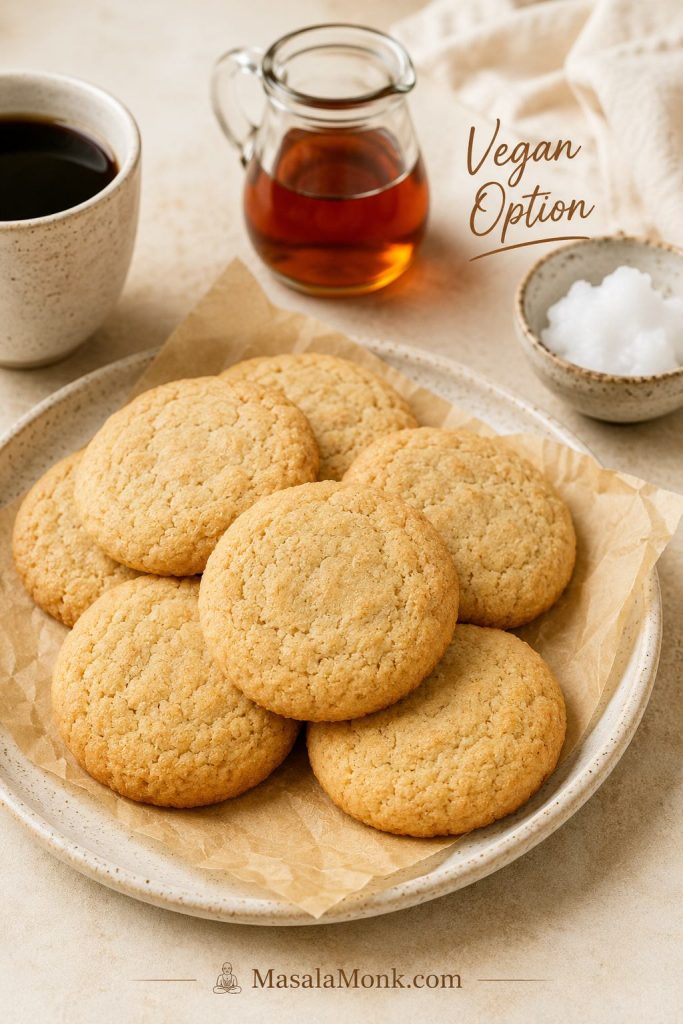
For vegan almond flour cookies, start with the 3-ingredient version: almond flour, maple syrup, and coconut oil. It gives you a softer, simpler cookie without needing an egg replacer. A flax egg can work in some almond flour doughs, but it often makes the cookies more delicate, so cool the cookies completely before moving them.

Vegan almond flour cookies served with maple syrup, coconut oil, and black coffee.
For vegan almond flour cookies, use maple syrup and coconut oil as the base rather than forcing a direct egg swap.

Keto Almond Flour Cookies

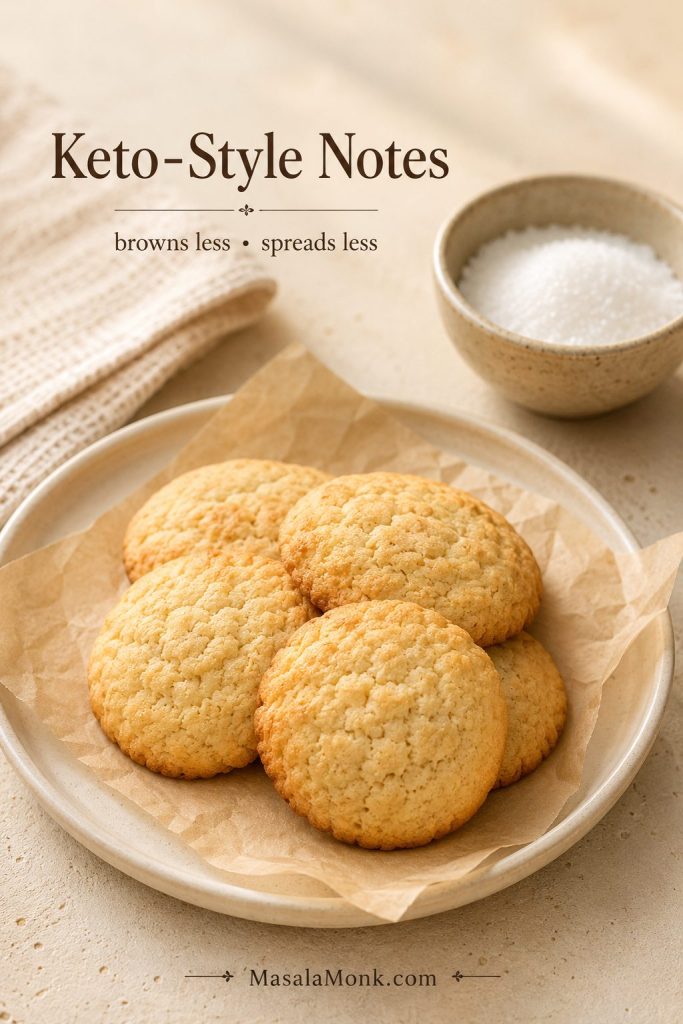
Choose the keto-style version when lower sugar matters more than classic brown-sugar chew. Use a 1:1 granular low-carb baking sweetener, not pure stevia or a liquid sweetener. Skip the cornstarch, shape the dough before baking, and expect cookies that brown less and spread less than the brown-sugar version.

Keto-style almond flour cookies on parchment with a bowl of granular low-carb sweetener nearby.
Keto-style almond flour cookies usually brown less and spread less, so judge them by texture and edge set rather than deep color.

If you are doing more low-carb baking, our keto-friendly flours guide explains how almond flour behaves compared with other low-carb flours.

Peanut Butter Almond Flour Cookies

For a light peanut butter direction, replace 2 tablespoons of the butter with creamy peanut butter and add a pinch more salt. This gives the base cookie a nutty peanut-butter note, but a true almond flour peanut butter cookie works best as its own formula because peanut butter changes the dough’s fat and moisture balance.

A full peanut-butter-first cookie is better handled as its own recipe. See our peanut butter cookies recipe, which includes classic, 3-ingredient, chocolate chip, and oatmeal versions.

Almond Flour Shortbread Cookies

For a shortbread-style cookie, skip the egg and use almond flour, softened butter, powdered sugar, vanilla, and salt. Shape the cookies flatter and bake until the edges are deeper golden. This style is more delicate, so tray cooling matters even more.

Almond Flour Oatmeal or Sugar Cookies

Oatmeal and sugar-cookie versions are better as their own formulas because oats, extra sugar, and decorating needs all change the dough. From this base, you can experiment with a small handful of oats, but keep sugar-cookie versions as drop cookies rather than cut-out cookies unless you are using a recipe built for rolling.

Why Did My Almond Flour Cookies Crumble?

If a batch does not come out perfectly, do not throw the recipe away. This dough is sensitive to flour texture, measuring, shaping, and cooling time, so one small change can make a big difference in the next tray. Most problems are easy to fix once you know what caused them.

Troubleshooting guide for almond flour cookies showing crumbly cookies, gritty flour, oily dough, and no-spread dough.
Troubleshooting is easier when you match the problem to the cause: flour texture, fat temperature, dough shape, or cooling time.
Problem Likely Cause Fix
Crumbling when lifted The cookies had not set yet Let them cool on the baking sheet for 10–15 minutes before moving.
Gritty texture Almond meal or coarse almond flour Use fine blanched almond flour for the smoothest texture.
Oily-feeling cookies Too much fat, hot butter, or heavy mixing Cool melted butter slightly and mix only until the dough comes together.
No spreading in the oven This dough spreads less than wheat-flour dough Press the dough into discs before baking.
Centers too soft The centers need more time to set Bake 1–2 minutes longer next time and cool fully before serving.
Dry or sandy cookies Flour may have been packed, or the cookies baked too long Weigh the almond flour or spoon and level it; reduce bake time slightly.
Sticky dough Warm kitchen or warm butter Rest the dough for 10 minutes or chill for 15–20 minutes.
Dough cracks badly when pressed The almond flour is dry or the dough needs a little moisture Add 1 teaspoon water or milk and mix gently.
Cakey texture Too much egg, too much leavening, or cookies shaped too thick Flatten slightly more next time and bake until the edges are more golden.
Pale cookies Low-carb sweetener or underbaking Bake 1–2 minutes longer and rely on edge color, not center firmness.

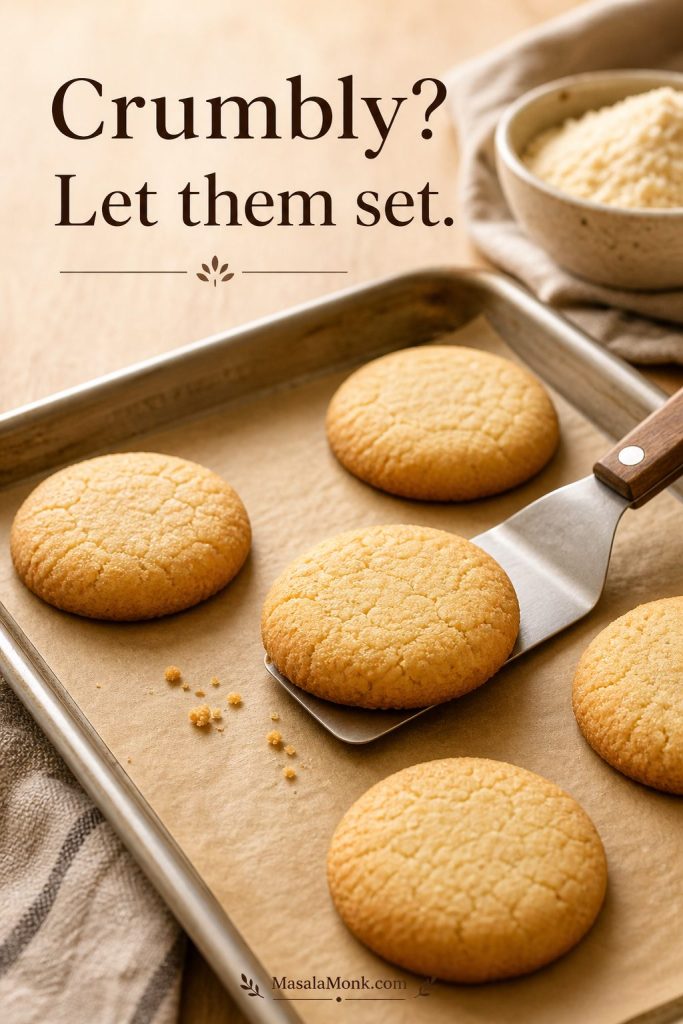
Fix crumbly almond flour cookies

If the cookies break when you lift them, let the tray sit longer before moving the next batch. A clean spatula lift usually means the bottoms have set enough.

Almond flour cookie lifting cleanly with a spatula after setting on the baking sheet.
If almond flour cookies crumble when lifted, they often needed more tray time, not more baking time.

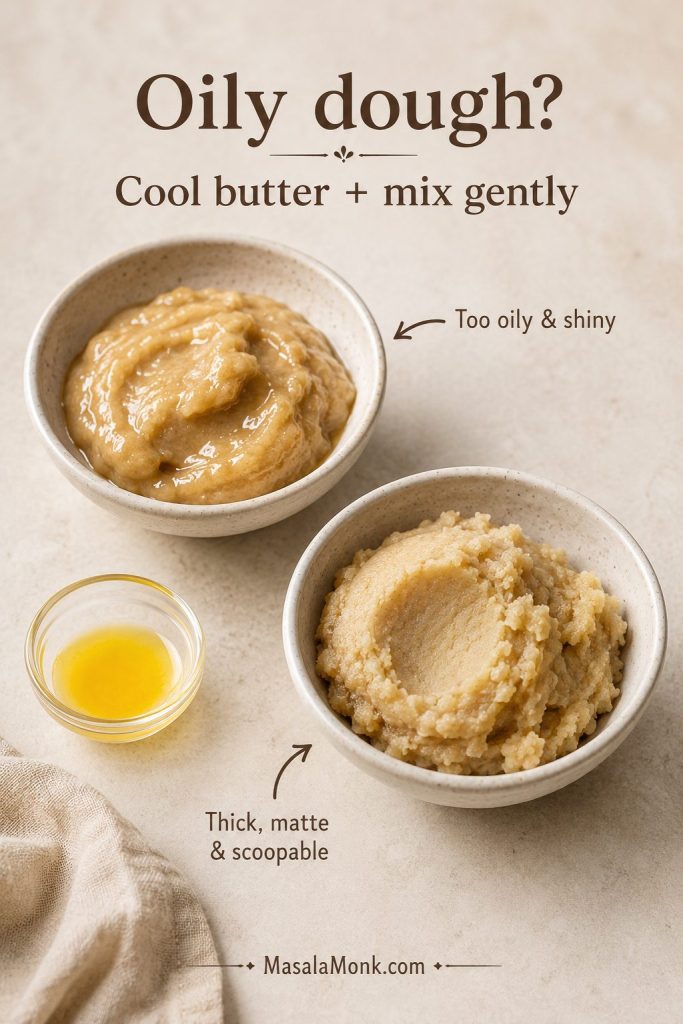
If the dough looks shiny or greasy, pause before scooping. Slightly cooled butter and gentle mixing usually give you a thicker, more scoopable dough.

Oily almond flour cookie dough compared with properly mixed thick scoopable dough.
Shiny dough usually means the butter was too warm or the mixture was worked too much, so cool the butter and mix gently.

Fix almond flour cookies that do not spread

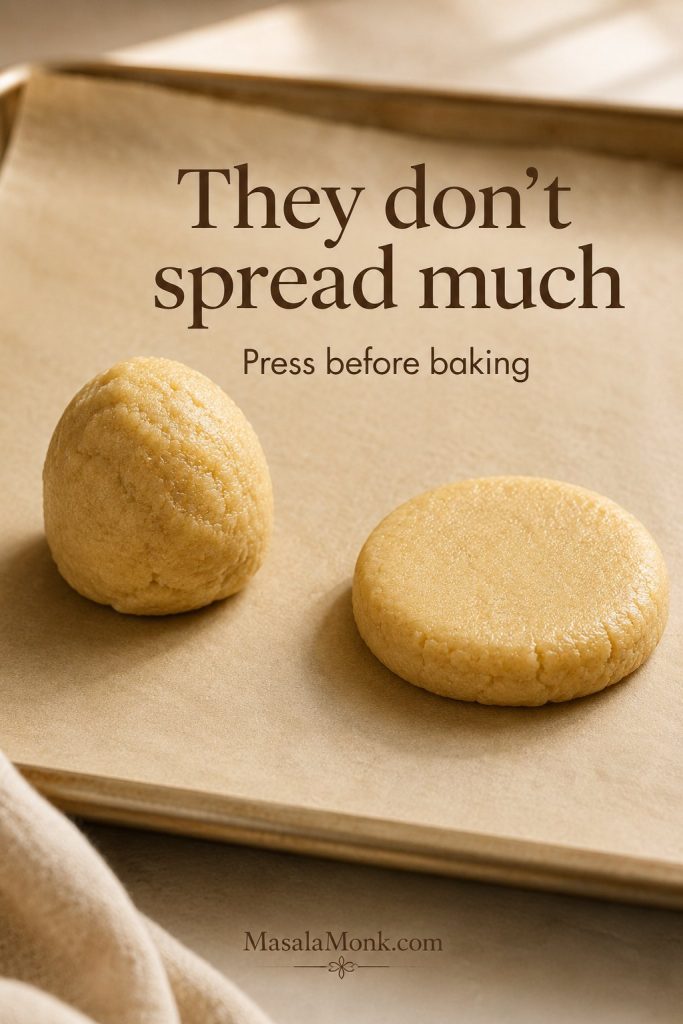
If the dough stays in tall mounds, press each portion into a thick disc before baking. That one shaping step gives the cookies a better final form.

Tall unpressed almond flour cookie dough mound beside a pressed thick disc on parchment.
If the dough goes in as a tall mound, it may come out too thick; press it first for a better cookie shape.

How to Store and Freeze Almond Flour Cookies

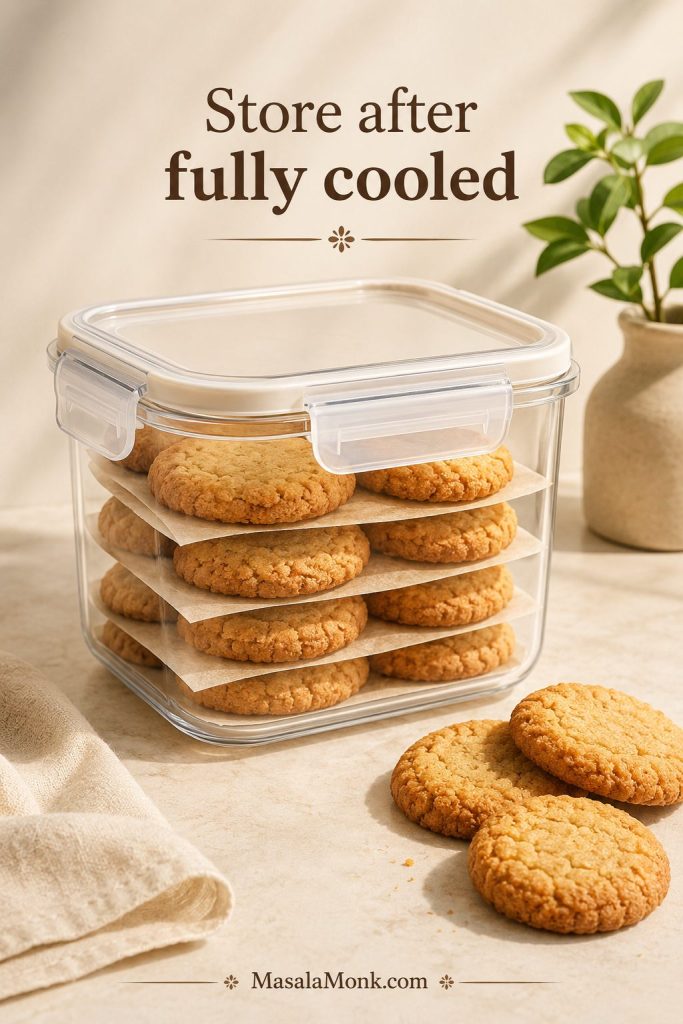
These cookies keep well once they are fully cooled. Because they are tender, stack them gently and use parchment between layers if you are storing a large batch.

Almond flour cookies stored in an airtight container with parchment between the layers.
Store almond flour cookies only after they are fully cool, and use parchment between layers to protect their soft texture.
Storage Method How Long Best Tip
Room temperature 3–4 days Store airtight after cookies are completely cool.
Refrigerator Up to 1 week Let cookies come closer to room temperature before serving.
Freezer, baked cookies 2–3 months Freeze in a single layer first, then transfer to a freezer bag.
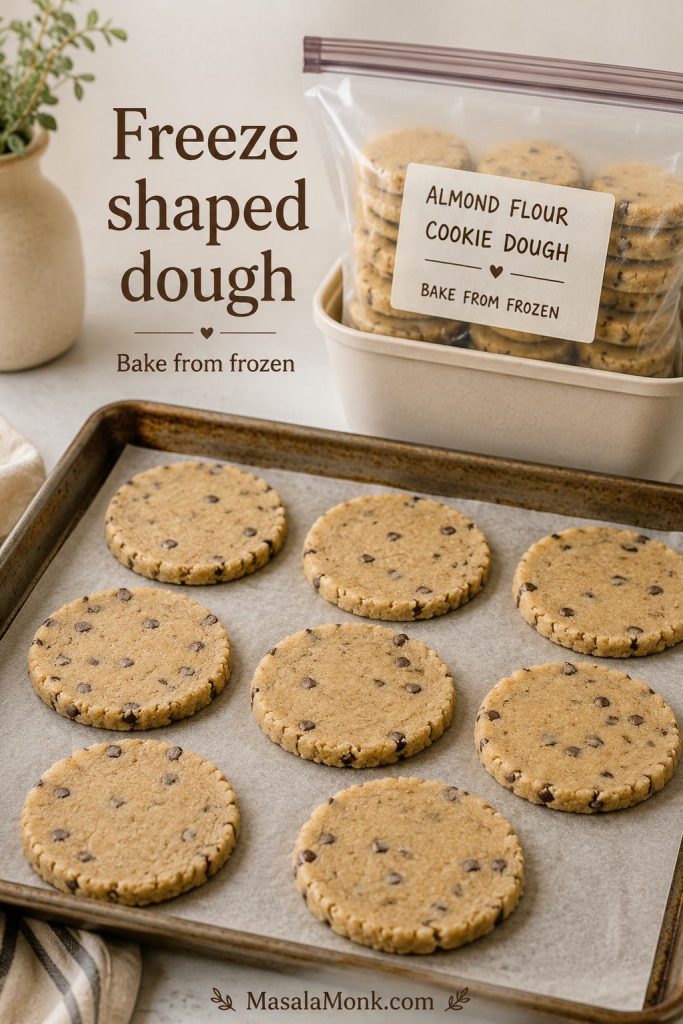
Freezer, dough portions 2–3 months Shape and flatten before freezing; bake from frozen with 1–2 extra minutes.
Flattened almond flour cookie dough portions on a tray with a labeled freezer bag behind them.
Freeze the dough after shaping and flattening, so the portions bake more evenly later without needing to thaw first.

Once cooled, the cookies should lift cleanly, bend slightly before they break, and taste rich enough that no one has to think about them as a gluten-free substitute. That is the batch you are aiming for.

Almond Flour Cookies Recipe Card

Almond Flour Cookies Recipe

Soft, tender almond flour cookies with lightly golden edges, a gentle chew, and a warm vanilla-almond flavor. Keep them plain, add chocolate chips, or bake them a little longer for crispier edges.

Prep Time 12 minutes
Rest Time 10 minutes
Bake Time 10–12 minutes
Set Time 10–15 minutes

Active Time: about 12 minutes

Bake + Rest Time: about 20–22 minutes before tray cooling

Ready to Move: about 35–40 minutes, including dough rest and tray set time

Yield: about 16 cookies, plain or with chocolate chips

Ingredients

  • 2 cups fine blanched almond flour, 200 g / about 7 oz
  • 1/2 cup packed light brown sugar, 110 g / about 3.9 oz, or 1/2 cup coconut sugar, about 95 g
  • 1/4 cup unsalted butter, melted and slightly cooled, 56 g / 2 oz
  • 1 large egg
  • 1 teaspoon vanilla extract, 5 ml
  • 1/2 teaspoon baking soda
  • 1/4 teaspoon fine salt
  • 1 tablespoon cornstarch or arrowroot starch, about 8 g, recommended for softer, thicker cookies; optional, and skip for keto-style cookies
  • 1/2 cup chocolate chips, 85 g / 3 oz, optional

Instructions

  1. Preheat the oven to 350°F / 175°C, or about 160°C fan. Line a baking sheet with parchment paper.
  2. In a large bowl, whisk together the melted butter, brown sugar, egg, and vanilla until smooth.
  3. Add the almond flour, baking soda, salt, and cornstarch or arrowroot, if using. Stir until a soft, scoopable cookie dough forms.
  4. The dough should look moist and thick, not runny. If it cracks badly when pressed, add 1 teaspoon water or milk and mix gently.
  5. Fold in the chocolate chips, if using.
  6. Let the dough rest for 10 minutes while the oven heats. If it feels very sticky, greasy, or too soft to scoop after resting, chill it for 15–20 minutes.
  7. Scoop into 1 1/2 to 2 tablespoon portions, about 28–32 g each, and place on the prepared baking sheet, leaving about 2 inches between cookies.
  8. Press each mound gently into a thick disc. This dough does not spread much, so shape it before baking.
  9. Bake for 10–12 minutes, until the edges are lightly golden and the centers still look soft. For firmer edges, bake 1–2 minutes longer.
  10. Cool on the baking sheet for 10–15 minutes before moving. Transfer to a wire rack and cool completely.

Notes

  • Use fine blanched almond flour, not coarse almond meal, for the smoothest texture.
  • If measuring by cups, spoon the almond flour into the cup and level it off. Do not pack it tightly.
  • The dough should be soft but scoopable. If it looks shiny or greasy, chill it briefly before baking.
  • Flatten cookies to about 1/2 inch for soft cookies or closer to 1/3 inch for crispier edges.
  • The centers should look slightly soft when the cookies come out of the oven. They finish setting as they cool.
  • Let the cookies rest on the tray before transferring; they are fragile while hot.
  • You can skip the starch, but the cookies will be slightly more delicate.
  • For a dairy-free version, use melted coconut oil instead of butter.
  • For chocolate chip almond flour cookies, use 1/2 cup / 85 g chocolate chips.

What to Bake Next with Almond Flour

Once you are comfortable with this dough, almond flour becomes much easier to bake with. The next best cookie recipes to build are the ones with stronger identities — peanut butter, oatmeal, shortbread, sugar cookies, and chocolate chip — because each one needs its own balance of fat, sweetness, moisture, and structure.

  • Richer direction: build a dedicated peanut butter almond flour cookie.
  • Heartier option: try an almond flour oatmeal cookie with the right oat-to-flour balance.
  • Best for gifting: shortbread-style almond flour cookies are the better direction.
  • Decorating route: almond flour sugar cookies need a dough made for shaping, chilling, or dropping.

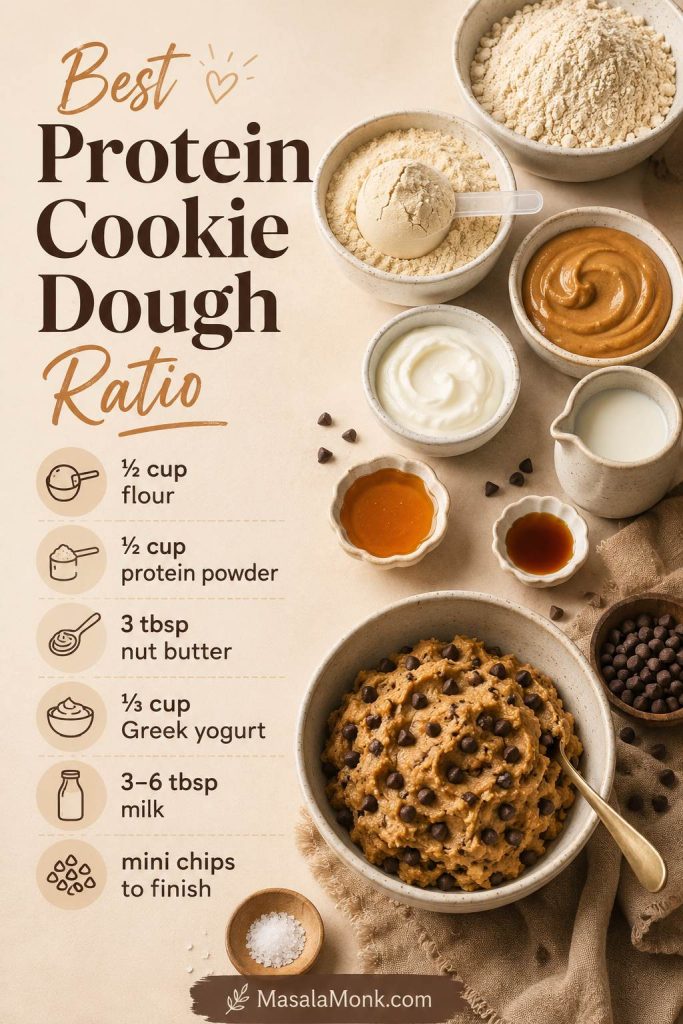
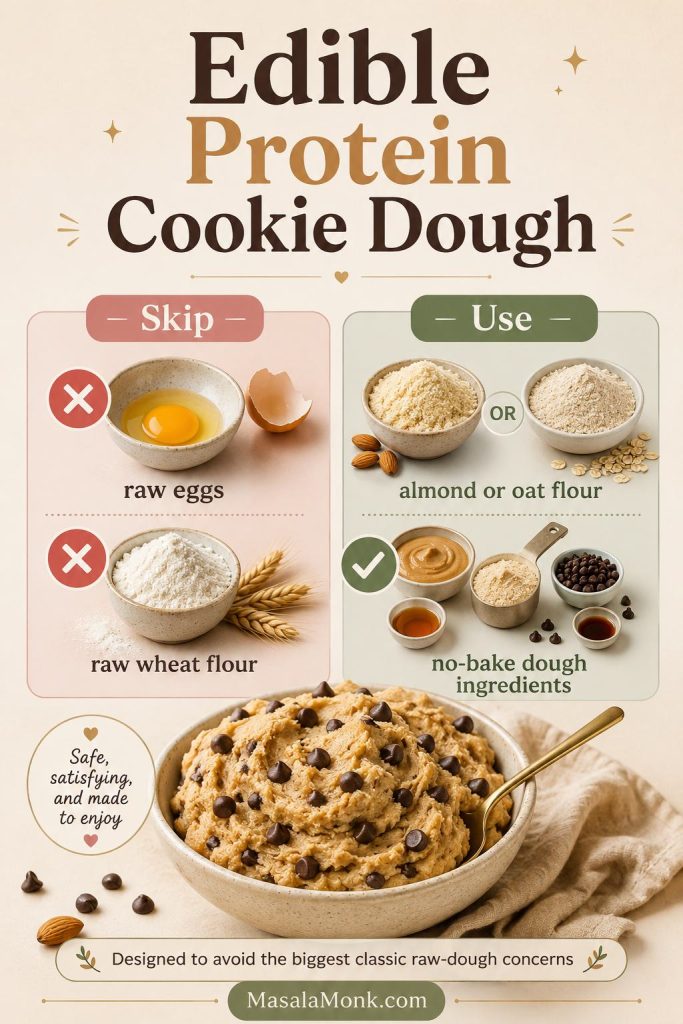
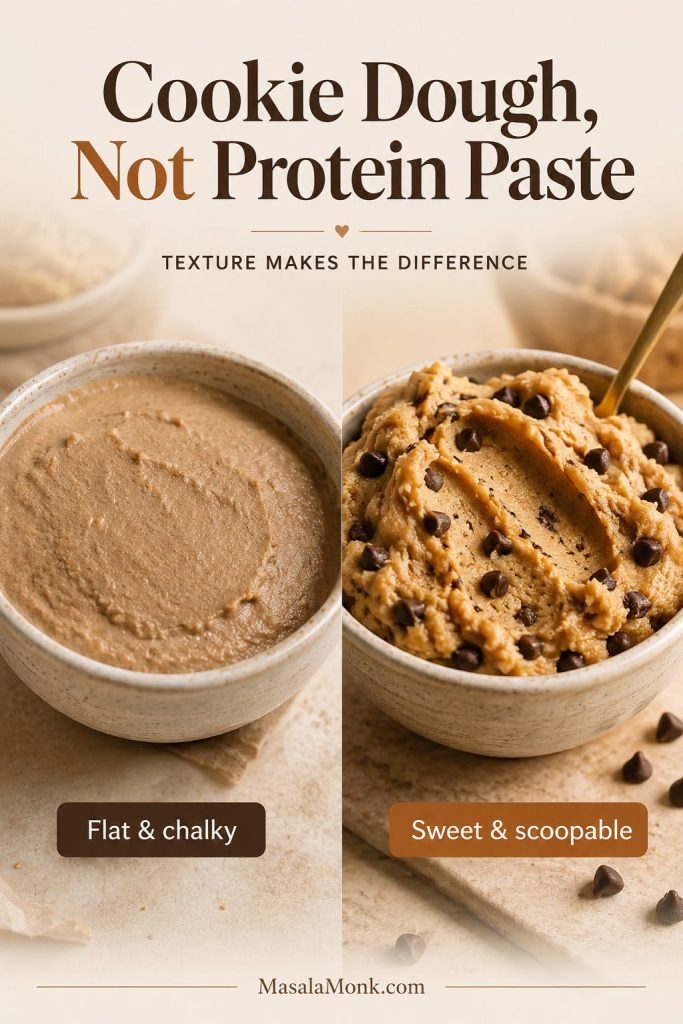
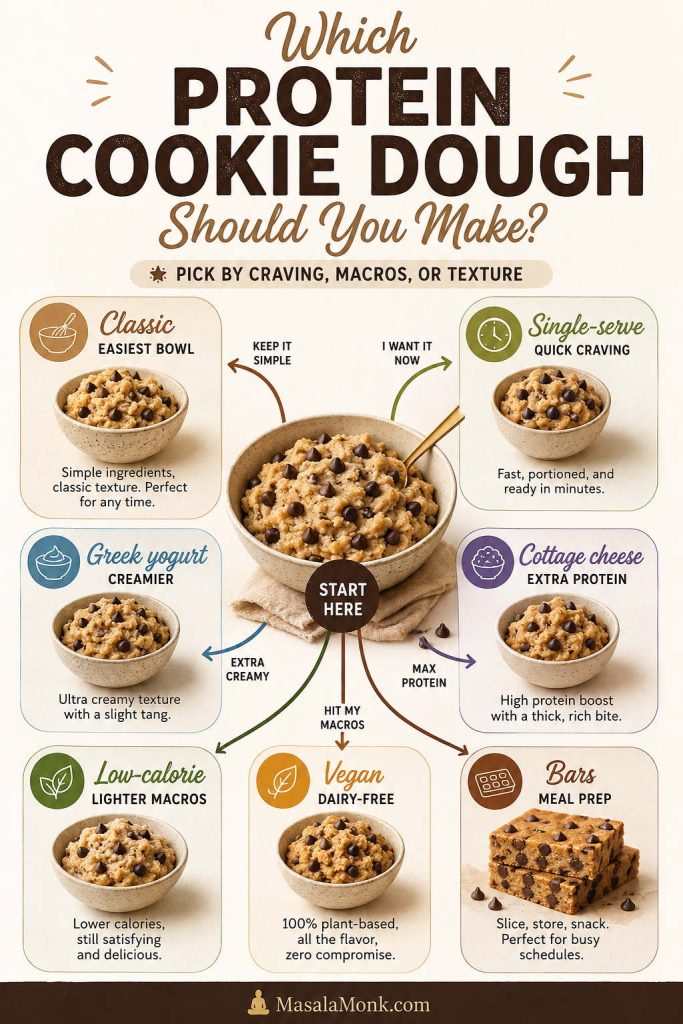
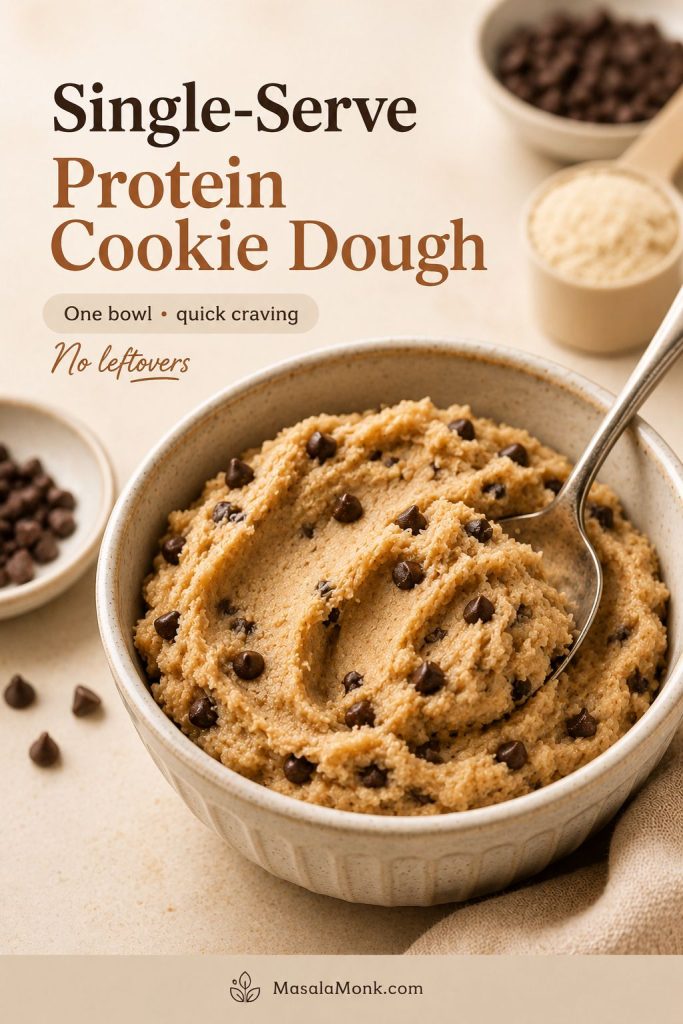
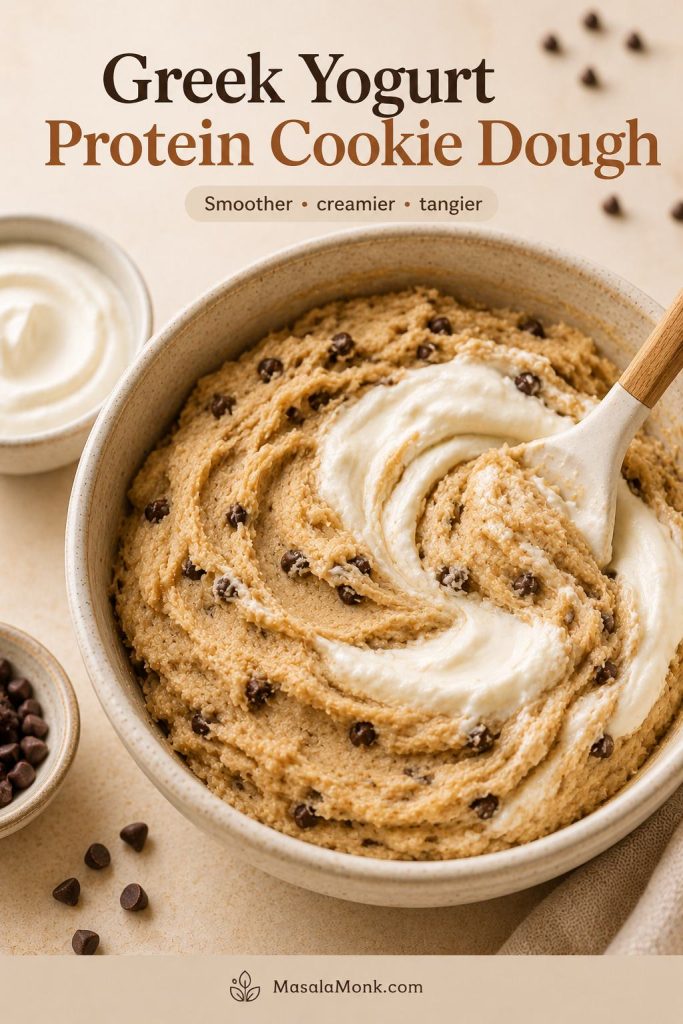
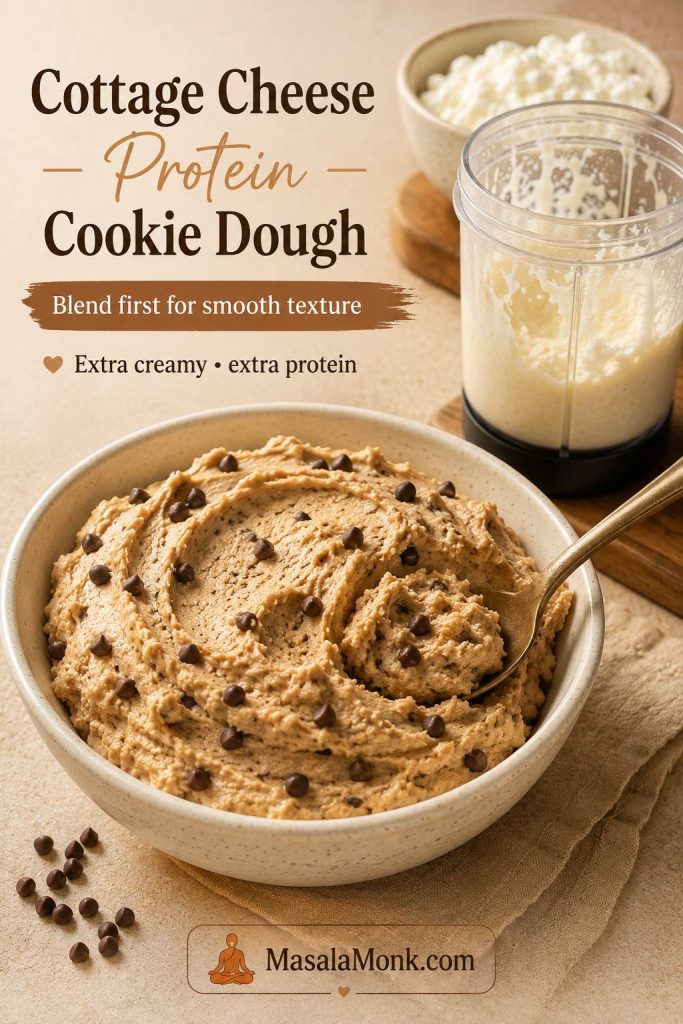
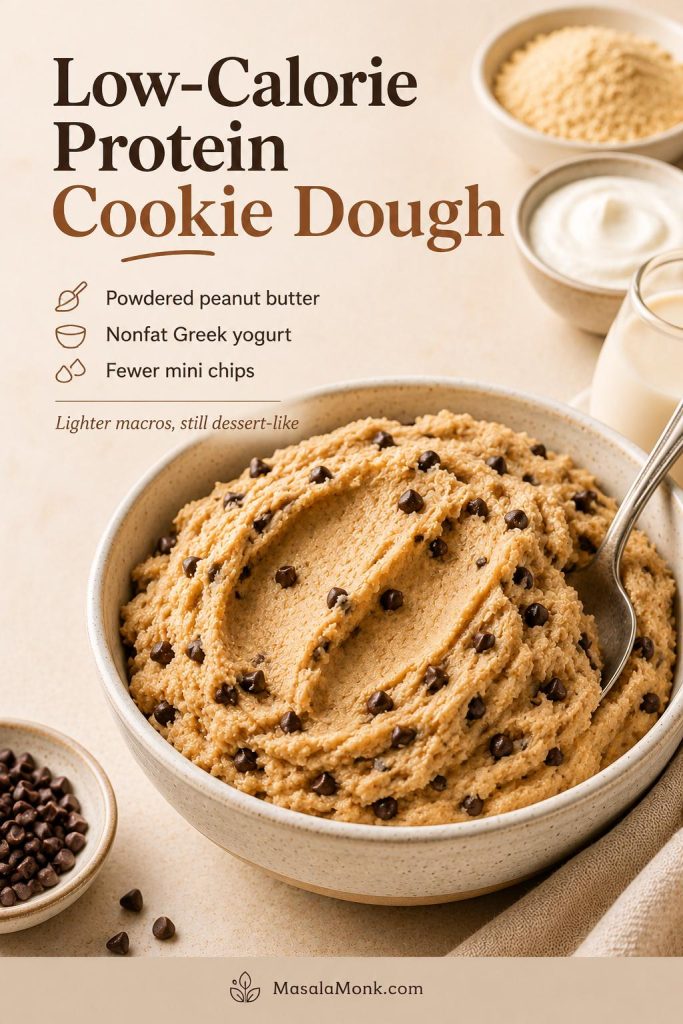
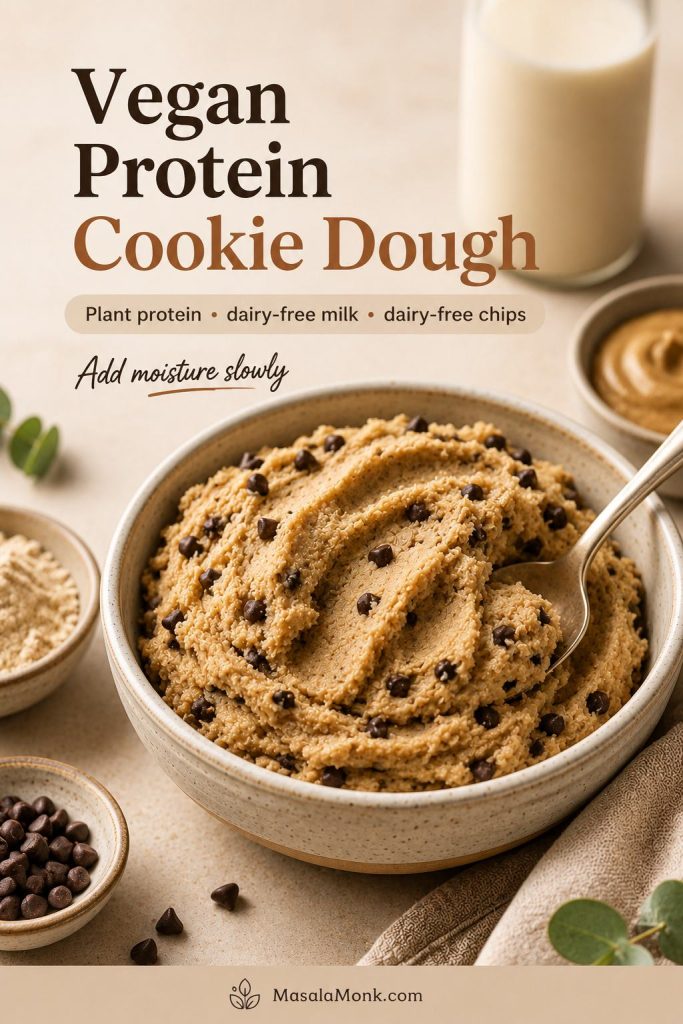
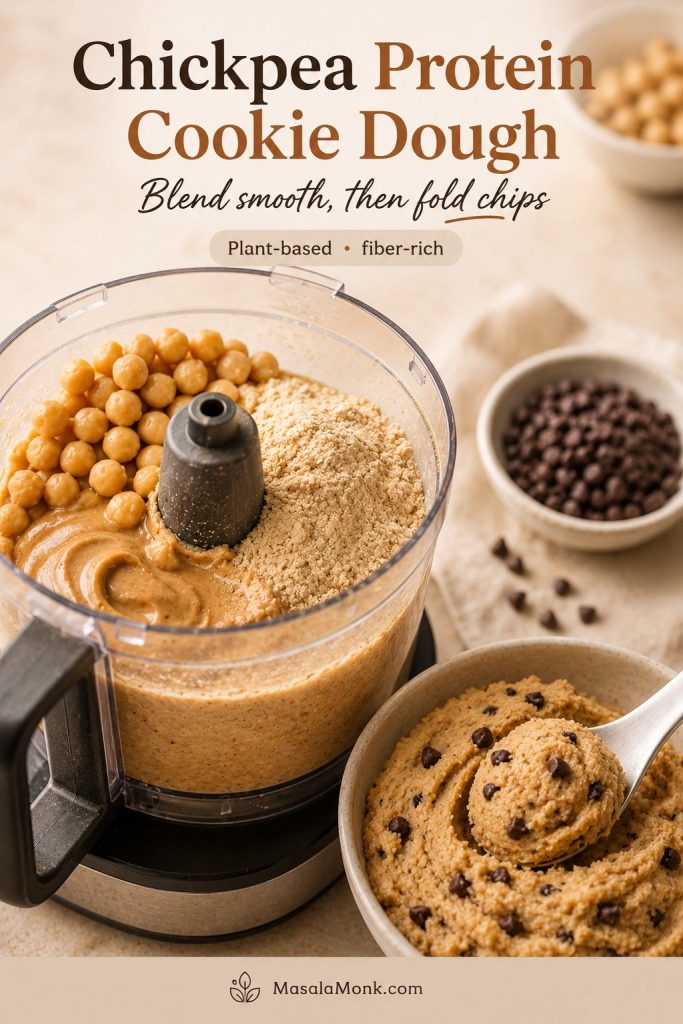
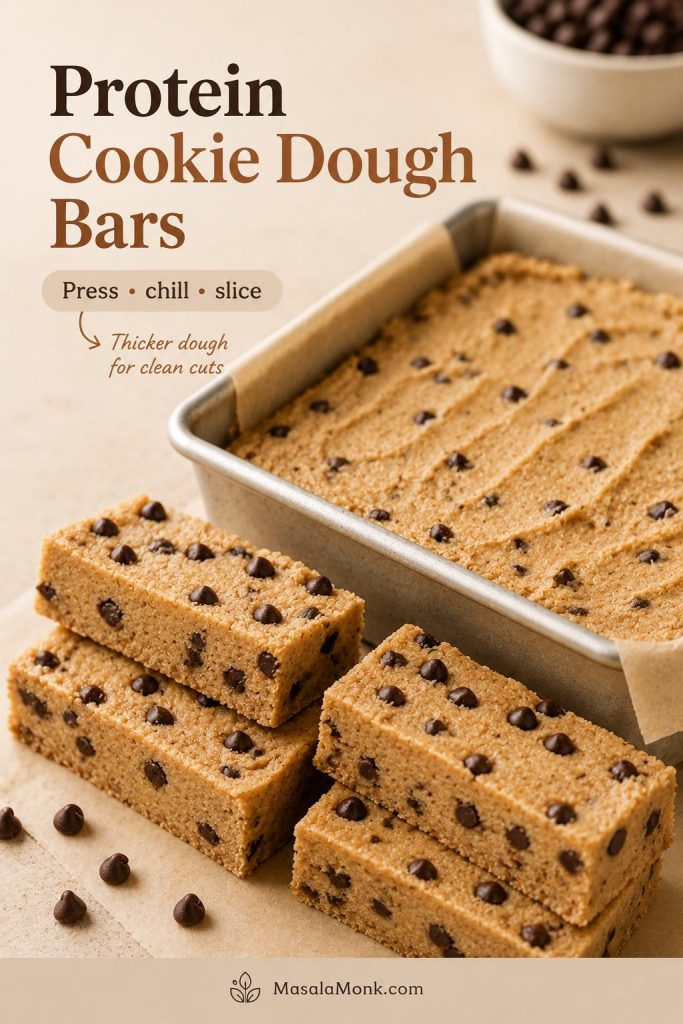
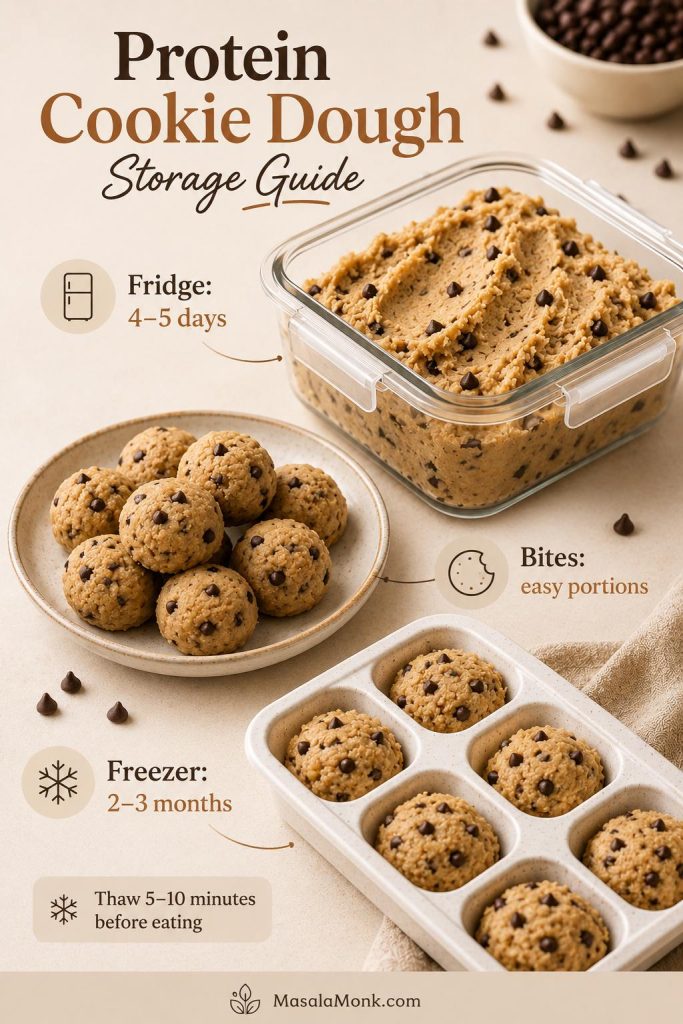
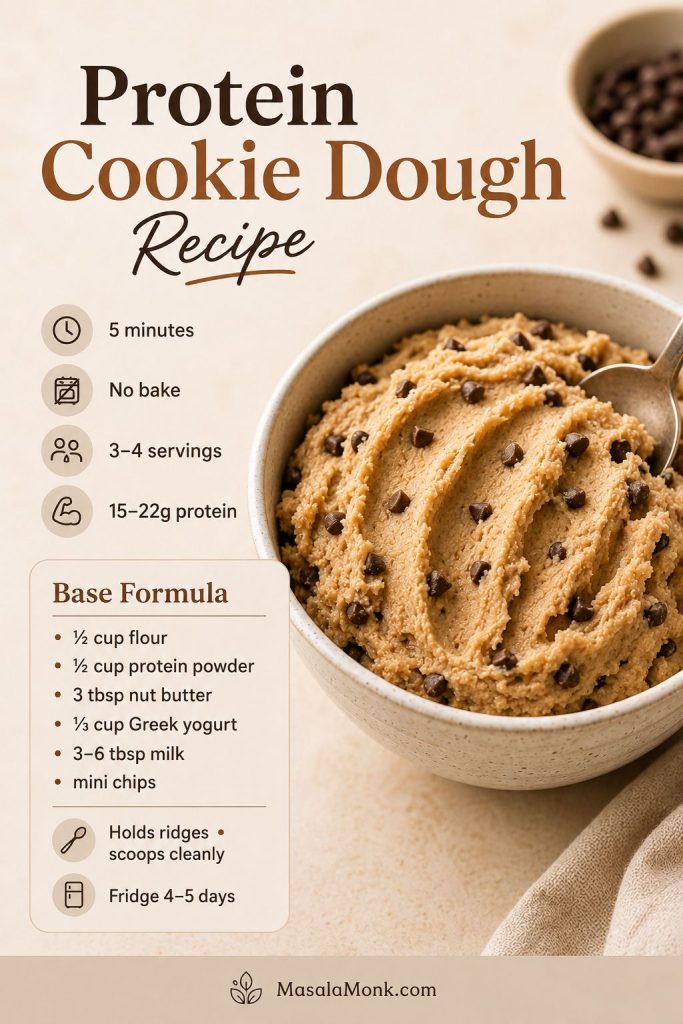
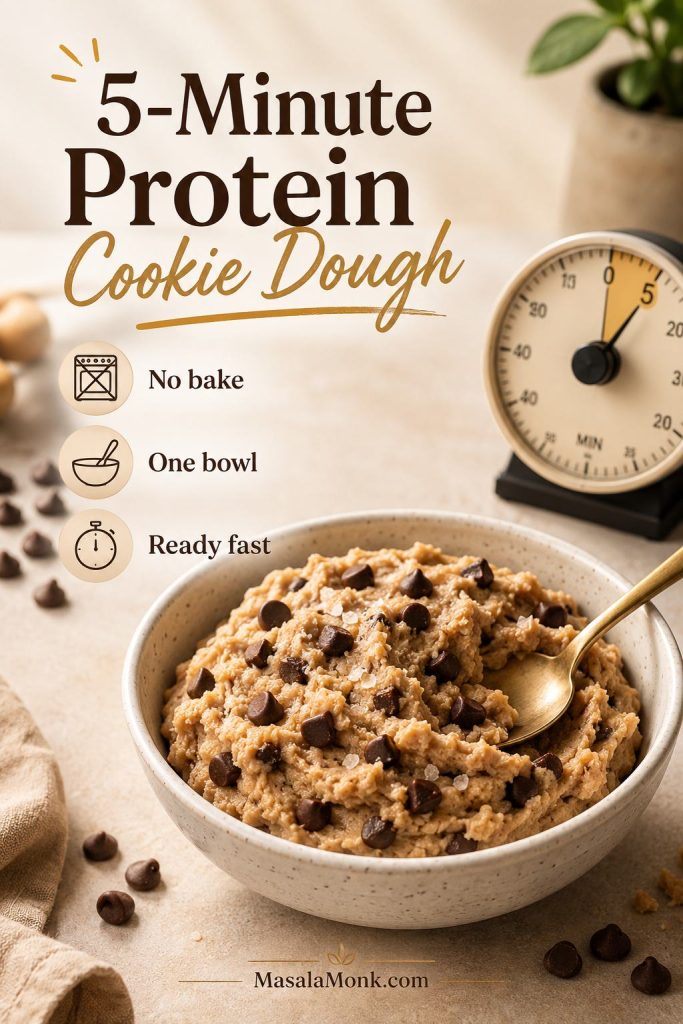
For no-bake cookie-style desserts, you can also see our edible cookie dough and protein cookie dough recipes.

FAQs About Almond Flour Cookies

Can I use almond meal instead of almond flour?

Almond meal works in a pinch, but it changes the cookie. Because it is usually coarser and may include almond skins, the cookies can bake darker, taste grainier, and feel more fragile than cookies made with fine blanched almond flour.

Do almond flour cookies spread?

They spread less than wheat-flour cookies, so press the dough into the shape you want before baking. Thicker discs stay softer; flatter discs bake with more golden edge.

Why did my almond flour cookies fall apart?

They were probably moved too soon. Almond flour cookies are delicate when hot and firm as they cool, so wait at least 10 minutes before lifting them from the baking sheet.

Why are my almond flour cookies greasy?

Greasy cookies usually come from too much added fat, butter that was too hot, or dough that was mixed too heavily. Use slightly cooled melted butter and stop mixing once the dough comes together.

Should I chill almond flour cookie dough?

A long chill is not needed for this recipe. A 10-minute rest is usually enough. Chill the dough for 15–20 minutes only if it feels very soft, sticky, or greasy.

Can I make almond flour cookies without eggs?

Egg-free versions work best when the formula is designed for them. The 3-ingredient variation with almond flour, maple syrup, and coconut oil is a good starting point. It makes a softer, more delicate cookie than the main recipe.

Can I make almond flour cookies with maple syrup?

Maple syrup works best in a recipe designed around it, such as the 3-ingredient variation. In the main recipe, swapping it directly for brown sugar adds extra liquid and can make the centers too soft.

How do I make almond flour cookies crispy?

Press the dough flatter and bake for 13–14 minutes, until the edges are deeper golden. Cool fully before serving, because the cookies firm more as they sit.

Can I make almond flour cookies keto?

Keto-style cookies need a 1:1 granular low-carb sweetener made for baking. Skip the cornstarch, avoid liquid sweeteners, and expect cookies that brown less and feel less chewy than brown-sugar cookies.

Is almond flour a 1:1 replacement for all-purpose flour in cookies?

A direct 1:1 swap usually does not work well. Almond flour has no gluten and more natural fat than wheat flour, so it needs a recipe built around its own texture and moisture behavior.

Will coconut flour work in this recipe?

Coconut flour absorbs far more liquid than almond flour, so it cannot replace almond flour in this recipe. Use a cookie recipe written specifically for coconut flour instead.

Are almond flour cookies gluten-free?

Almond flour is naturally gluten-free, but check labels if you are baking for someone who needs strict gluten-free food. Some almond flour, chocolate chips, or starches may be processed in facilities that also handle wheat.

Can I freeze almond flour cookie dough?

Yes. Scoop and shape the dough first, then freeze the portions on a tray. Once firm, transfer them to a freezer bag. Bake from frozen at 350°F / 175°C, adding 1–2 extra minutes as needed.

Back to top ↑

Posted on Leave a comment

Protein Cookie Dough Recipe

Thick protein cookie dough recipe in a bowl with mini chocolate chips, spoon marks, and a scoopable texture.

This protein cookie dough recipe is edible, no-bake, ready in about 5 minutes, and built to taste like cookie dough — not protein paste. It is egg-free, made without raw all-purpose flour, and gives you a scoopable, chocolate-studded dough with about 15–22g protein per serving when divided into 3–4 portions.

No oven, no mixer, no waiting for cookies to cool — just one bowl, a spoon, and a sweet snack that feels more like dessert than a protein shake.

The difference between good protein cookie dough and chalky protein paste is balance. Protein powder adds structure, nut butter gives richness, Greek yogurt softens the dough, and almond flour or oat flour makes it thick enough to scoop. Then vanilla, salt, and mini chocolate chips bring it closer to a real cookie dough bite. If you like this kind of high-protein dessert, this dough gives you the same treat-like feeling without needing a freezer or blender.

It should feel like sneaking a spoonful of cookie dough from the bowl, only with enough protein to make it feel more satisfying than a random bite of dessert.

Spoon lifting edible protein cookie dough with mini chocolate chips and soft ridges showing the scoopable texture
This spoon-lift shows the texture you want: creamy, sturdy, and able to hold its shape without turning stiff.

Quick Answer: The Best Protein Cookie Dough Ratio

Protein cookie dough ratio board with protein powder, flour, nut butter, Greek yogurt, milk, and mini chocolate chips
This quick ratio works because the dry base, creamy ingredients, and milk are balanced before the chocolate chips go in.

Use less milk for a firmer dough and more milk for a softer, scoop-and-eat texture. Divide the batch into 3 portions for a higher-protein snack, or 4 portions for smaller dessert-style servings.

Best first version: Use a vanilla whey-casein blend if you have one, almond flour for a softer rich dough, and mini chocolate chips for the most cookie-dough-like bite.
Do not add all the milk at once. Protein powders absorb moisture differently, and a dough that looks dry at first can loosen quickly after mixing. Add liquid gradually and stop as soon as the dough holds together.

Not sure how your powder will behave? See the protein powder guide before adding all the milk.

Protein Cookie Dough at a Glance

One-bowl five-minute no-bake protein cookie dough with a timer, spoon, and thick chocolate chip dough
Since this is a 5-minute no-bake recipe, the key is adjusting texture in the bowl instead of relying on baking time.
Prep time 5 minutes
Cook time 0 minutes
Chill time Optional 20–30 minutes for firmer dough
Servings 3–4 servings
Protein estimate About 15–22g per serving, depending on powder and serving size
Best texture Scoopable, sturdy, and easy to eat with a spoon
Best flour Almond flour for soft/rich, oat flour for more cookie-like
Main fix Add liquid slowly, then fine-tune the texture in small spoonfuls
Storage 4–5 days in the fridge or 2–3 months frozen in portions

The best part is that the recipe is forgiving. If the first mix looks too dry, too sticky, or too thick, you do not have to start over — you just adjust the bowl in small steps.

Estimated Protein, Calories, and Serving Size

Protein and calorie guide for protein cookie dough showing three-serving and four-serving portion estimates
For macro tracking, portion size matters: three larger servings feel more snack-like, while four smaller servings keep the calories lighter.

As a rough range, the full batch often lands around 900–1,200 calories, depending on the protein powder, nut butter, yogurt, milk, syrup, and chocolate chips used. That works out to about 300–400 calories if divided into 3 larger servings, or about 225–300 calories if divided into 4 smaller servings. Use your own ingredient labels for the most accurate number.

Calories vary most from the nut butter, chocolate chips, protein powder, syrup, and yogurt you use. A richer dessert bowl usually comes from regular nut butter, maple syrup or honey, and the full chocolate chip amount. If you want a lighter version, use powdered peanut butter, nonfat Greek yogurt, almond milk, and fewer mini chocolate chips.

To keep the bowl lighter without making it taste flat, jump to the low-calorie protein cookie dough version and use the swaps there.

Why This Protein Cookie Dough Works

A good high-protein cookie dough has to solve the real problem: it needs enough protein to feel worth making, but it still has to satisfy the part of you that wanted cookie dough in the first place. When the balance is off, the texture changes quickly. Extra protein powder can make the dough dry or chalky, too much liquid can turn it sticky, and not enough fat can make it taste like sweet paste instead of cookie dough.

This version works because each ingredient protects the dough from the usual protein-dessert problems: dry, sticky, chalky, or bland. Protein powder gives the snack its purpose, almond flour or oat flour keeps it from turning loose, nut butter makes it taste richer, and Greek yogurt softens the bite so it feels more like dessert than a scoop of powder. Vanilla, salt, and mini chocolate chips finish the flavor so it tastes more like cookie dough and less like a protein shake in a bowl.

When that balance is right, the dough tastes sweet and familiar instead of “healthy” in the disappointing way.

The finished dough should hold ridges when stirred, scoop cleanly, and firm up slightly after chilling. It should not pour like batter, crumble like dry powder, or cling aggressively to the spoon.

Why readers usually love this: It gives you the cookie-dough feeling without turning into a full baking project. No oven, no mixer, no waiting for cookies to cool — just a thick, sweet, chocolate-studded bowl you can adjust until it tastes right.

Ingredients You Need

Protein cookie dough ingredients arranged by texture role, including protein powder, flour, yogurt, nut butter, and chocolate chips
Each ingredient controls something important: body, creaminess, sweetness, flavor, or chocolate in every bite.

Protein powder

Vanilla protein powder is the easiest choice because it already brings sweetness and dessert flavor. Whey protein can make a smoother dough, but it may become sticky if you add too much liquid. Casein and plant protein usually thicken more aggressively, so they often need extra milk or yogurt. A whey-casein blend is often the easiest option for a classic cookie dough texture.

Almond flour or oat flour

Almond flour versus oat flour comparison for protein cookie dough showing softer rich dough and more cookie-like dough
Almond flour gives a softer, richer dough; meanwhile, oat flour brings a more cookie-like chew and usually needs a little more moisture.

Do not use regular raw all-purpose flour in this no-bake recipe. The safety section below explains why.

For the raw-dough details, read the edible cookie dough safety section before swapping flours.

Nut butter

Peanut butter gives the strongest flavor and the richest dough. Almond butter is milder. Cashew butter gives a softer, almost bakery-style sweetness. Sunflower seed butter works if you need a nut-free option, though it has a more noticeable flavor.

Greek yogurt

Greek yogurt keeps the dough creamy while adding more protein. Thick plain Greek yogurt works best. If your yogurt is thin or watery, start with less milk. If your yogurt is very thick, you may need an extra spoonful of milk to bring the dough together.

Maple syrup or honey

Maple syrup and honey do more than sweeten the dough. They also add moisture and help the texture feel less powdery. Sugar-free syrup can work, but the texture may be thinner or less rich depending on the brand.

Vanilla, salt, and mini chocolate chips

These small ingredients make a big difference. Vanilla gives the dough a dessert-like aroma, salt keeps the flavor from tasting flat, and mini chocolate chips spread more evenly than large chips, especially in a single-serving bowl.

Is Protein Cookie Dough Safe to Eat Raw?

Edible protein cookie dough safety board showing no raw eggs, no raw wheat flour, and almond or oat flour instead
Edible protein cookie dough works best when the no-bake base avoids raw eggs and raw wheat flour from the start.

The FDA explains that most flour is raw and has not been treated to kill germs. The CDC also warns against eating raw dough made with uncooked flour because flour can carry germs that are killed only when the flour is baked or cooked.

For this no-bake dough, use fresh almond flour, oat flour from a trusted package, or a flour product specifically labeled for edible dough. Do not swap in regular raw wheat flour.

If you want the classic version without protein powder, this edible cookie dough recipe follows the same no-bake, spoonable dessert idea with a more traditional cookie-dough flavor.

Important: This recipe avoids raw all-purpose wheat flour. Keep the finished dough chilled, use fresh ingredients, and do not leave yogurt-based cookie dough sitting out for long.

Best Protein Powder for Cookie Dough

Best protein powder for cookie dough guide comparing whey, casein, blended, plant, and collagen protein powders
The best powder depends on texture as much as flavor, because each type thickens the bowl differently.

Texture matters just as much as flavor. Whey, casein, plant protein, collagen, and blends all absorb moisture at a different pace, which is why the recipe gives a range for milk instead of one fixed amount.

This is why two people can use the same recipe and get different results. The recipe may not be the problem — the powder may simply need more or less moisture.

Protein powder texture guide

Protein powder Texture in cookie dough Best fix
Whey protein Smooth, but can become sticky or wet if overhydrated. Add milk slowly. Thicken with almond flour, oat flour, or a little more protein powder.
Casein protein Thick, doughy, and very absorbent. Add milk or Greek yogurt 1 teaspoon at a time until spoonable.
Whey-casein blend Usually the most balanced cookie dough texture. Best first choice for a balanced, cookie-dough-like texture.
Plant protein Thick, sometimes chalky or earthy. Add nut butter, yogurt, vanilla, salt, and enough milk to soften the texture.
Collagen powder Adds protein but does not give much dough structure. Use it with almond flour or oat flour, not as the only dry ingredient.
Powdered peanut butter Lower in fat, peanut-forward, and slightly dry. Pair with Greek yogurt or milk to keep the dough creamy.
Whey, casein, and plant protein cookie dough comparison showing smoother, thicker, and more absorbent dough textures
Whey, casein, and plant protein can all work, but each one changes how much liquid the bowl needs before it becomes scoopable.

For the first batch, use the recipe as written but hold back some of the milk. Once you see how your protein powder thickens, the recipe becomes easy to repeat.

If your dough already turned dry, sticky, or loose, go straight to the texture fixes instead of guessing.

How to Make Protein Cookie Dough

Step-by-step protein cookie dough method showing dry ingredients, creamy ingredients, slow milk addition, chocolate chips, and finished dough
The method stays simple: build the dry base, add richness, loosen carefully, fold in chocolate, then chill only if you want a firmer bite.

Step 1: Mix the dry ingredients

Place the almond flour or oat flour, protein powder, and salt in a medium bowl. Stir them together first so the protein powder is evenly distributed before the wet ingredients go in.

Step 2: Add the creamy ingredients

Stir in the nut butter, Greek yogurt, maple syrup or honey, and vanilla. The dough may start to clump together and look too thick at this point, which is fine.

Pour in milk or almond milk 1 tablespoon / 15ml at a time. Mix well after each addition and stop when the dough is soft but sturdy. You may not need all the milk, especially if your yogurt is loose or your protein powder is whey-based.

Milk being added slowly to thick protein cookie dough in a mixing bowl to control the final texture
Add milk slowly so the dough softens gradually; otherwise, a small bowl can turn loose before the protein powder has time to absorb it.
Close-up of protein cookie dough holding soft spoon ridges to show the ideal thick but scoopable texture
Look for spoon marks that stay visible for a moment; that is the easiest sign your protein cookie dough is thick enough without being dry.

If your dough does not look like this yet, use the texture guide to fix it before folding in the chocolate chips.

Step 4: Fold in mini chocolate chips

Mini chocolate chips being folded into thick protein cookie dough so the chips spread evenly through the bowl
Mini chocolate chips work better than larger chips because they spread through the dough evenly and make each spoonful taste more like dessert.

Step 5: Eat right away or chill

You can eat the dough immediately if you like a softer, freshly mixed texture. For a firmer, more classic cookie dough feel, cover the bowl and chill it for 20–30 minutes.

Protein Cookie Dough Texture Guide

Protein cookie dough texture guide comparing crumbly dry dough, scoopable just-right dough, and loose wet dough
Once you recognize the difference between crumbly, scoopable, and loose, fixing the texture becomes much easier.
Problem Why it happened How to fix it
Too wet Too much milk, loose yogurt, or a whey protein that does not absorb much liquid. Stir in 1 teaspoon almond flour, oat flour, or protein powder at a time.
Too dry Casein or plant protein absorbed the liquid quickly. Loosen it with 1 teaspoon milk or Greek yogurt at a time.
Chalky Too much protein powder, plant protein, or not enough fat/moisture. Work in 1–2 teaspoons nut butter or Greek yogurt, plus vanilla and a pinch of salt.
Too sticky Too much syrup, nut butter, or liquid. Chill 20–30 minutes, or sprinkle in a little almond/oat flour.
Not sweet enough Unsweetened protein powder or not enough syrup. Sweeten with 1 teaspoon maple syrup, honey, or your preferred sweetener.
Too protein-y The protein powder flavor is too strong. Balance it with vanilla, salt, mini chocolate chips, or a better-tasting vanilla protein powder next time.
Best texture rule: Adjust slowly. One teaspoon can change a small batch more than you expect.

Once the texture is right, the bowl stops feeling like a protein workaround and starts feeling like what you actually wanted: cold, sweet cookie dough with little pockets of chocolate in every spoonful.

How to Make It Taste More Like Cookie Dough

Protein cookie dough taste-fix board with vanilla, salt, chocolate chips, syrup, and nut butter for better flavor
If the flavor feels too protein-heavy, vanilla, salt, nut butter, syrup, and mini chips can improve the dough without making it runnier.
  • Add a little more vanilla if the flavor tastes flat.
  • Add a tiny pinch of salt if the dough tastes too sweet, bland, or protein-heavy.
  • Use mini chocolate chips so every spoonful gets chocolate.
  • Add 1 teaspoon maple syrup or honey if your protein powder is not very sweet.
  • Add 1 teaspoon nut butter if the dough tastes chalky or thin.
  • Chill the dough for 20–30 minutes if the flavor feels sharp right after mixing.
Cookie dough versus protein paste comparison showing dull chalky dough beside sweet scoopable chocolate chip dough
The best high-protein cookie dough still needs dessert appeal, so texture and flavor matter just as much as the protein number.

Once the base flavor tastes right, try one of the flavor variations to make the dough more dessert-like.

Protein Cookie Dough Flavor Variations

Protein cookie dough flavor variation board with peanut butter chip, birthday cake, double chocolate, cookies and cream, and cinnamon roll
Once the base dough is balanced, small mix-ins can take it toward peanut butter chip, birthday cake, double chocolate, cookies and cream, or cinnamon roll.
  • Peanut butter chocolate chip: Use peanut butter as the nut butter and keep the mini chocolate chips.
  • Birthday cake: Use vanilla protein powder, cashew butter, and a small spoonful of sprinkles.
  • Double chocolate: Add 1 tablespoon cocoa powder and a little extra milk if the dough gets too thick.
  • Cookies and cream: Fold in crushed chocolate sandwich cookies or a lighter cookie-style mix-in.
  • Cinnamon roll: Add cinnamon, vanilla, and a tiny pinch more salt.

For any dry mix-in like cocoa powder or crushed cookies, add a tiny splash of milk only after the dough is mixed so you do not accidentally make it loose.

Which Protein Cookie Dough Version Should You Make?

Protein cookie dough version chooser showing classic, single-serve, Greek yogurt, cottage cheese, low-calorie, vegan, and bars
Use this guide by need: single-serve for speed, Greek yogurt or cottage cheese for creaminess, low-calorie for lighter macros, vegan for dairy-free, or bars for meal prep.
Version Best for Texture Use this base
Classic protein cookie dough Best overall Thick enough to scoop, soft enough to eat with a spoon Protein powder + flour + nut butter + Greek yogurt
Single serve Quick craving Small-batch dough 30g protein powder + nut butter
Greek yogurt Creamier snack Smoother, tangier, and more spoonable Greek yogurt + protein powder
Cottage cheese Extra creamy, higher-protein variation Smooth and creamy when blended first Blended cottage cheese
Low calorie Macro-friendly snack Lighter and less rich Powdered peanut butter + nonfat Greek yogurt
Vegan Dairy-free version Thick, sometimes chalkier Plant protein + dairy-free milk
Chickpea Plant-based/fiber-rich Thicker and dip-like Chickpeas + protein powder
Bars Meal prep Firm and sliceable Thicker dough + pan chill

Single-Serve Protein Cookie Dough

Single-serve protein cookie dough in a small bowl with mini chocolate chips, spoon, and quick snack portion
The single-serve version is ideal when you want one quick bowl now, especially if you do not want extra dough waiting in the fridge.
Ingredient Amount
Vanilla protein powder 30g
Almond flour or oat flour 2–3 tablespoons
Nut butter 1½ tablespoons
Greek yogurt or milk 1–2 tablespoons
Maple syrup or honey 1–2 teaspoons, optional
Vanilla extract ¼ teaspoon
Salt Pinch
Mini chocolate chips 1–2 tablespoons

Mix the dry ingredients first, stir in the nut butter and yogurt, then adjust with tiny splashes of milk until the dough is scoopable but not loose. This version can be higher in protein than the main recipe because it uses a full scoop of protein powder in one serving.

Greek Yogurt Protein Cookie Dough

Greek yogurt protein cookie dough with thick Greek yogurt being mixed in for a smoother and creamier texture
Greek yogurt gives the dough a softer, tangier bite, which helps balance the dryness some protein powders can bring.

To make the Greek yogurt version, increase the Greek yogurt to ½ cup and reduce the milk. Stir the dough well, then chill it for 20–30 minutes so the flour and protein powder can absorb the moisture. If the yogurt is very thick, add milk 1 teaspoon at a time. If the yogurt is loose, add a little more almond flour or oat flour.

Cottage Cheese Protein Cookie Dough

Cottage cheese protein cookie dough showing blended cottage cheese, finished dough, and the smooth texture after blending
The cottage cheese version depends on one important step: blend the cottage cheese smooth before mixing it into the dry base.

For a cottage cheese version, blend ½ cup cottage cheese with vanilla and 2–3 teaspoons maple syrup until smooth. Then stir it by hand into the protein powder, almond flour or oat flour, nut butter, salt, and chocolate chips. Add the chips after blending, not before.

If your blended cottage cheese is very loose, start with less milk or skip the milk completely until the dough is mixed.

Cottage cheese texture tip: Blend the cottage cheese first, then mix by hand after the dry ingredients go in. Over-blending the full dough can make it runnier.

If you enjoy creamy low-carb desserts, this keto cheesecake recipe is another good one to keep nearby, especially when you want something chilled and richer than a snack bowl.

Low-Calorie Protein Cookie Dough

Low-calorie protein cookie dough with powdered peanut butter, nonfat Greek yogurt, almond milk, and fewer mini chocolate chips
A lighter bowl should still taste satisfying, so use macro-friendly swaps without removing all the creaminess and chocolate.
Swap What it does
Powdered peanut butter Reduces fat and calories while keeping peanut flavor.
Nonfat Greek yogurt Adds creaminess and protein with fewer calories.
Mini chocolate chips Gives more chocolate in every bite with a smaller amount.
Sugar-free syrup, carefully Can reduce sugar, but may make the dough thinner or less rich.
Single-serving batch Helps with portion control and avoids extra leftovers.

For one lighter serving, start with 30g vanilla protein powder, 2 tablespoons powdered peanut butter, ¼ cup nonfat Greek yogurt, 1–2 teaspoons syrup or sweetener, vanilla, salt, and 1 tablespoon mini chocolate chips. Add almond milk 1 teaspoon at a time until the dough becomes scoopable.

For another creamy dessert with a lighter, healthier feel, this avocado chocolate mousse is a good next option when you want chocolate without baking.

Vegan Protein Cookie Dough

Vegan protein cookie dough with plant protein powder, dairy-free milk, nut butter, and dairy-free chocolate chips
The vegan version usually needs a little more moisture and fat because plant protein can thicken quickly as it sits.

For a vegan batch, use ½ cup almond or oat flour, ½ cup plant protein powder, 2–3 tablespoons almond or cashew butter, 2–3 teaspoons maple syrup, vanilla, salt, dairy-free milk as needed, and dairy-free mini chocolate chips. Add the milk slowly because plant protein often thickens fast.

When plant protein tastes earthy, extra vanilla, a tiny pinch of salt, and mini chocolate chips help a lot. A little more nut butter can also soften the chalky edge without making the dough too loose.

Chickpea Protein Cookie Dough

Chickpea protein cookie dough being made in a food processor with chickpeas, protein powder, nut butter, and chocolate chips
The chickpea version works best as a blended variation, since a food processor gives the base a smoother, dip-like texture.

For a chickpea version, start with 1 cup well-rinsed chickpeas, 30g vanilla protein powder, 2 tablespoons nut butter or sunflower seed butter, 1–2 tablespoons maple syrup, vanilla, salt, and 1–2 tablespoons milk as needed. Blend everything except the chocolate chips until smooth, then fold in the chips.

For the smoothest texture, rinse the chickpeas very well and remove the skins if you have time. Chilling the dough for 20–30 minutes also helps the flavor mellow and the texture thicken.

No-bake protein cookie dough bars sliced from a chilled parchment-lined loaf pan with mini chocolate chips visible
Protein cookie dough bars need a firmer base than the spoonable version, so they can chill, hold their shape, and slice cleanly.

After slicing, use the storage guide so the bars stay firm instead of drying out.

A loaf pan works well for a thicker small batch. Use an 8-inch square pan only if you are doubling the recipe, otherwise the bars may be too thin.

For a more dessert-like bar, spread melted chocolate over the chilled dough and chill again until set. For a softer snack bar, skip the chocolate coating and keep the chocolate chips mixed into the dough.

Storage and Freezer Tips

Protein cookie dough storage guide showing an airtight fridge container, rolled snack bites, and freezer portions
For easy snack prep, keep protein cookie dough chilled in a container or freeze small portions that soften after a few minutes.
Storage method How long Best tip
Airtight container in the fridge 4–5 days Stir before serving if it firms up.
Rolled balls in the fridge 4–5 days Use a small cookie scoop for even portions.
Freezer portions 2–3 months Freeze on a tray first, then move to a container.
Cookie dough bars Up to 1 week chilled Keep parchment between layers if stacking.

For bites, chill the dough until it is firm enough to scoop, then roll it into small balls and store them in the fridge or freezer. They are easier to portion than a full bowl and work well for snack prep.

Frozen portions taste best after sitting at room temperature for 5–10 minutes. They should soften slightly but still hold their shape.

What to Eat With Protein Cookie Dough

You can absolutely eat this straight from the bowl. That is the point. But if you make extra, it also turns into an easy topping, dip, or freezer snack.

Think of it as a spoonable snack first, then use leftovers anywhere you would normally want a sweet, cookie-dough-style topping.

  • Scoop it into small snack balls.
  • Serve it with apple slices.
  • Swirl it into Greek yogurt.
  • Crumble it over smoothie bowls.
  • Press it into bars.
  • Freeze it into bite-size portions.
  • Use it as a high-protein dessert dip.

Once you understand the texture, this becomes the kind of recipe you can make by feel: a little more milk for spoonable, a little more flour for scoopable, and a little more vanilla and salt when the protein powder tries to take over.

Different protein powders can change this dough a lot. If you try it with whey, casein, collagen, or plant protein, note how much milk it needed and whether the final texture turned out scoopable, sticky, dry, or firm. That is the kind of detail other readers actually want before they open a new tub of protein powder, so it is worth sharing if your powder behaved differently.

After one batch, you will probably know exactly how your protein powder behaves. From there, this becomes an easy fridge snack you can make by feel — thicker for cookie dough bites, softer for spooning, sweeter when it is dessert, and lighter when you just want a quick protein treat.

Ready to make it now? Jump to the full protein cookie dough recipe card.
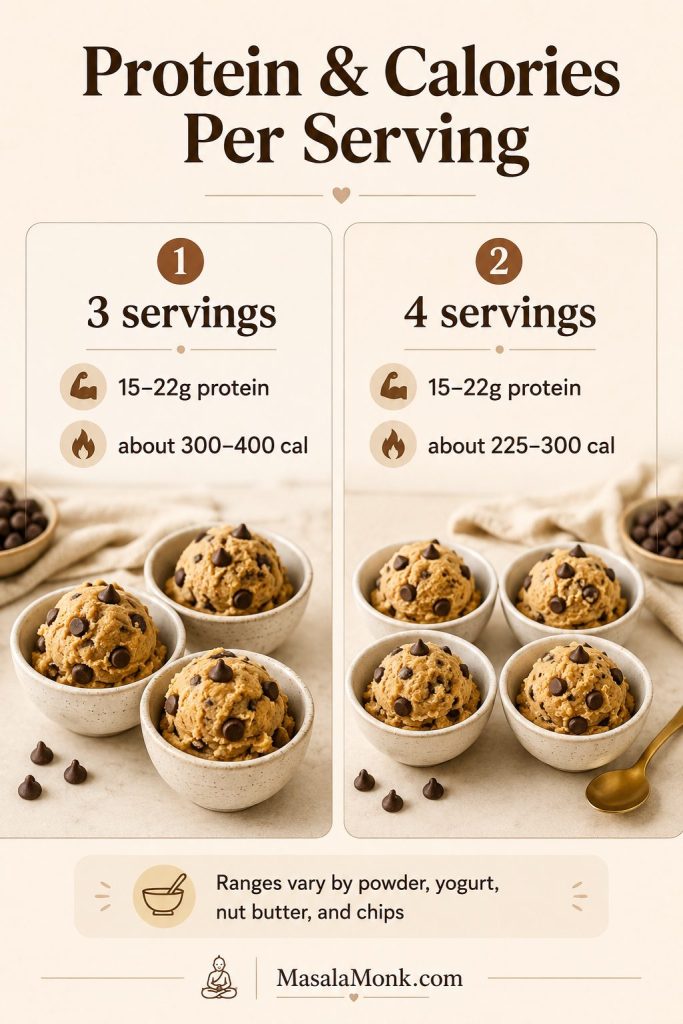
FAQs About Protein Cookie Dough

Why is my protein cookie dough dry?

Your protein powder probably absorbed more liquid than expected. Casein and plant-based protein powders are especially thirsty, so add milk or Greek yogurt 1 teaspoon at a time until the dough softens.
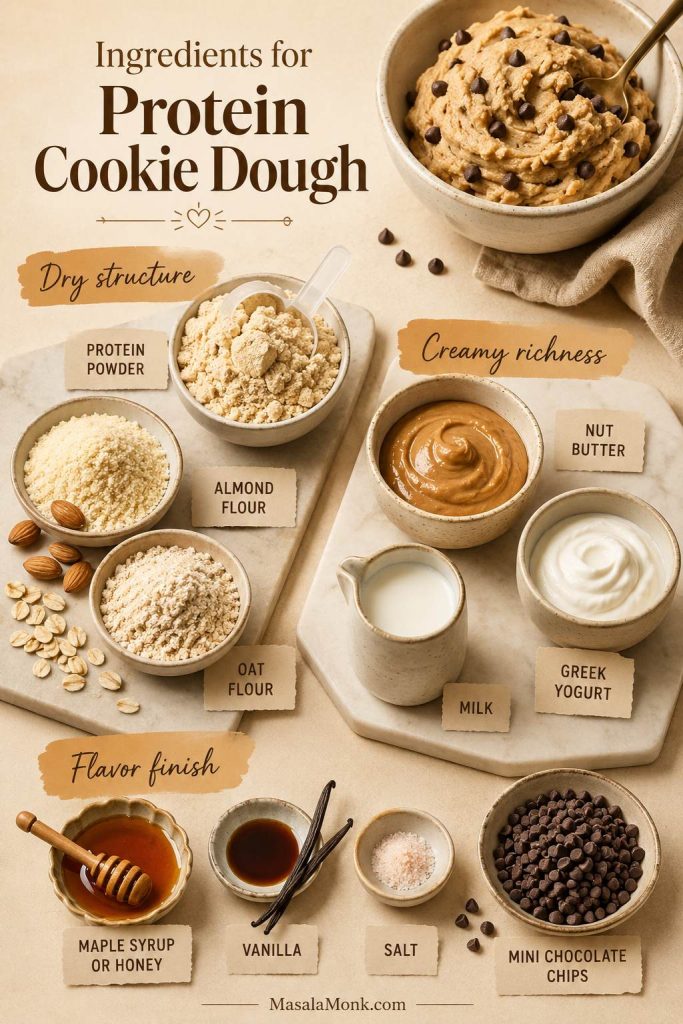
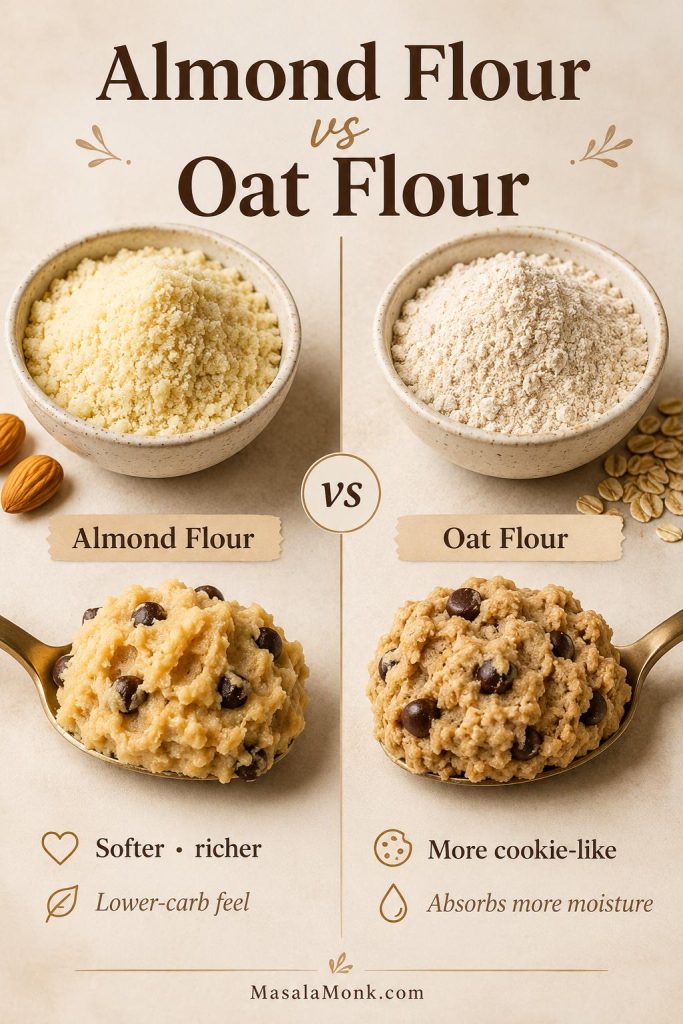
Why did my protein cookie dough turn sticky?

Sticky dough usually means too much syrup, nut butter, or milk. First, chill it for 20–30 minutes. After that, add almond flour or oat flour 1 teaspoon at a time if the mixture still feels too loose.

Which protein powder tastes best in cookie dough?

A good vanilla whey-casein blend is usually the easiest choice for a balanced dough texture. Whey can be smooth but sticky, casein can be thick and dry, and plant protein may need more moisture and flavor support.

Best peanut butter substitutes for protein cookie dough

Peanut butter is not required. Almond butter, cashew butter, sunflower seed butter, tahini, or a mix of Greek yogurt and powdered peanut butter can all work. The flavor and texture will change slightly, but the recipe still holds together.

Using powdered peanut butter in protein cookie dough

Powdered peanut butter works best in the low-calorie version because it keeps peanut flavor while reducing fat. Since it can taste drier than regular nut butter, pair it with Greek yogurt and add milk slowly until the dough is scoopable.

No Greek yogurt? Use this texture fix

Greek yogurt helps with creaminess, but the recipe can work without it. Replace it with more nut butter and a little milk, or use dairy-free yogurt for a vegan version. Since yogurt also adds thickness, add the liquid slowly so the dough does not become loose.

Is almond flour safe in no-bake cookie dough?

This recipe avoids raw all-purpose wheat flour, which is the main flour concern in classic raw cookie dough. Use fresh almond flour or oat flour from a reputable source, keep the finished dough chilled, and do not swap in regular raw wheat flour unless it is specifically labeled for edible dough.

Freezing protein cookie dough without ruining the texture

Roll the dough into balls or portion it into small scoops, freeze on a tray, then transfer to an airtight container. Let frozen portions sit for 5–10 minutes before eating so they soften slightly without turning mushy.

Should you bake this dough into cookies?

This recipe is designed as edible no-bake dough. Protein powder behaves differently when baked, so a dedicated protein cookie recipe will give you a better baked texture.

Lower-calorie protein cookie dough swaps that still taste good

Use powdered peanut butter, nonfat Greek yogurt, sugar-free syrup if you like it, and a smaller amount of mini chocolate chips. A single-serving batch is usually the easiest way to keep the calories controlled without making a large bowl of leftovers.

Vegan protein cookie dough: what changes?

Plant-based protein powder usually thickens more and can taste earthier than whey. Use almond or oat flour, nut butter, maple syrup, dairy-free milk, and dairy-free chocolate chips, then add extra milk or nut butter if the dough tastes chalky.

Protein cookie dough recipe card showing the base formula, five-minute prep time, protein estimate, texture target, and storage
Save the base formula as a texture guide: equal parts flour and protein powder, creamy ingredients for richness, then milk only until scoopable.

Protein Cookie Dough Recipe Card

This edible protein cookie dough is no-bake, egg-free, creamy, and ready in about 5 minutes. Chill it for a firmer cookie-dough bite, or eat it right away while it is softer and freshly mixed.

Texture target: The dough should hold ridges when stirred, scoop cleanly, and feel thick but not dry. Pourable dough needs more dry structure, while crumbly dough needs a little more moisture.

Servings 3–4
Prep Time 5 minutes
Chill Time Optional 20–30 minutes
Cook Time 0 minutes

Equipment

  • Medium mixing bowl
  • Spatula or sturdy spoon
  • Measuring cups and spoons
  • Kitchen scale, optional but helpful
  • Airtight container for storage

Ingredients

Ingredient US amount Metric amount
Almond flour or oat flour ½ cup 50–56g
Vanilla protein powder ½ cup 50–60g
Creamy peanut, almond, or cashew butter 3 tablespoons About 48g
Plain thick Greek yogurt ⅓ cup About 80g
Maple syrup or honey 2–3 teaspoons 10–15ml
Milk or almond milk 3–6 tablespoons, added gradually 45–90ml
Vanilla extract ½ teaspoon 2.5ml
Fine salt ¼ teaspoon About 1.5g
Mini chocolate chips 3 tablespoons 30–40g

Instructions

  1. Stir the almond flour or oat flour, protein powder, and salt together in a medium bowl.
  2. Mix in the nut butter, Greek yogurt, maple syrup or honey, and vanilla until a thick dough starts to form.
  3. Add milk or almond milk 1 tablespoon / 15ml at a time, mixing well after each addition, until the dough holds ridges when stirred and scoops cleanly.
  4. Fold in the mini chocolate chips.
  5. Eat immediately for a softer dough, or cover and chill for 20–30 minutes for a firmer cookie-dough bite.

Notes

  • Protein powders absorb liquid differently, so start with less milk and add more gradually.
  • Chilling is optional, but it improves both texture and flavor because the flour and protein powder have time to hydrate.
  • Divide the batch into 3 servings for a higher-protein snack or 4 servings for smaller dessert portions.
  • Use 3 teaspoons maple syrup or honey for a sweeter dessert-style dough, or start with 2 teaspoons for a less sweet snack.
  • When the dough is wet, build it back up with almond flour, oat flour, or protein powder 1 teaspoon at a time.
  • For dry dough, add milk or Greek yogurt 1 teaspoon at a time until it softens.
  • Strong protein-powder flavor usually improves with extra vanilla, a tiny pinch of salt, or 1 teaspoon nut butter before adding more milk.
  • Do not use regular raw all-purpose flour in this no-bake recipe.

Storage

Store protein cookie dough in an airtight container in the fridge for 4–5 days. For longer storage, portion it into balls or scoops and freeze for 2–3 months. Let frozen portions sit for 5–10 minutes before eating.

Estimated Protein and Calories

Protein and calories will vary by powder, yogurt, flour, nut butter, milk, syrup, chocolate chips, and serving size. As a rough guide, this batch usually lands around 15–22g protein per serving when divided into 3–4 portions, with about 225–400 calories per serving depending on portion size and ingredients. Use your own labels for the most accurate numbers.