Posted on Leave a comment

Almond Cake Recipe

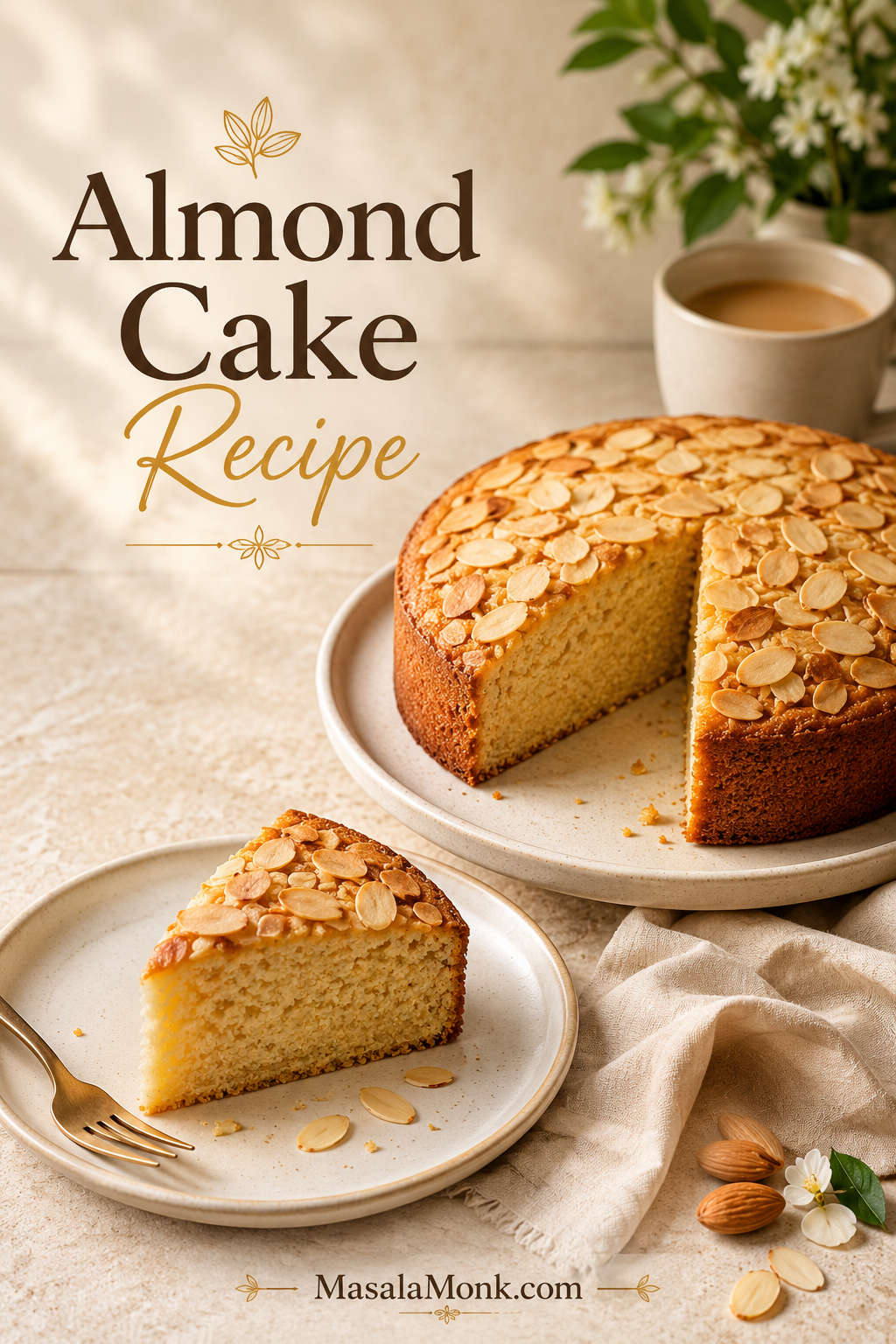
Whole almond cake with sliced almonds on top and one slice removed on a cream plate.

This almond cake recipe is for the moment when you want a golden, tender dessert that feels elegant without frosting. It has a sliced-almond top, a gently rich middle, and just enough lemon or orange zest to keep every bite bright. Once cooled, it cuts cleanly and looks simple, polished, and special on the table without needing much decoration.

Almond flour cakes can be beautiful, but they reward a lighter hand than wheat cakes. Packed flour makes the batter heavy. Cold eggs do not whip as well. A thin pan can brown the edges before the middle is ready. And if you cut the cake while it is still warm, the slice can look damp even when the bake was close.

This version is built around those common almond cake problems: dense centers, oily texture, gritty almond meal, overheated edges, weak egg whites, and cakes that look golden before they are fully baked. The goal is a single-layer almond flour cake that is naturally gluten-free when made with certified gluten-free ingredients, easy enough for tea or brunch, and reliable enough for a guest dessert with berries and cream.

Quick warning for Indian shoppers: if your packet says badam powder, check the label carefully. This recipe needs plain ground almonds, not sweetened badam drink mix, malted almond powder, or milk-powder blends. For the full comparison, see almond flour vs almond meal vs badam powder.

The finished cake should smell like toasted almonds and citrus, feel delicate without falling apart, and settle into clean slices after a few hours. It is the kind of cake that works with powdered sugar, coffee, fruit, cream, or nothing at all.

Quick Answer: How to Make a Tender Almond Flour Cake

To make a tender almond flour cake, use fine blanched almond flour, room-temperature eggs, sugar, baking powder, salt, vanilla, a little almond extract, and lemon or orange zest. Separate the eggs, beat the yolks with sugar, fold in the almond flour, then fold in softly whipped egg whites. Bake in a lined 8-inch / 20 cm round pan at 180°C / 350°F until the top is golden, the middle no longer wobbles, and a toothpick shows moist crumbs rather than wet batter.

The two most important success points are measuring the almond flour lightly, preferably by weight, and letting the cake cool before slicing. Those two details prevent most dense, oily, or fragile results.

QuestionBest answer for this recipe
Best ground almond productFine blanched almond flour for the cleanest, most delicate result.
Almond mealWorks by weight, but the cake will be darker, nuttier, and more rustic.
Almond powderUse only plain unsweetened ground almonds, never badam drink mix.
Best pan8-inch / 20 cm round for a taller cake; 9-inch / 23 cm for a thinner cake.
Oven temperature180°C / 350°F conventional or OTG; 160°C / 320°F fan.
Bake time26–32 minutes in an 8-inch pan; 23–28 minutes in a 9-inch pan.
Gluten-free statusNaturally gluten-free if every ingredient is certified gluten-free.
Eggless swapNot a direct swap; this batter needs eggs to rise, set, and slice cleanly.

Quick success cue: the batter will be thicker than wheat cake batter, the top should bake to a soft gold, and the toothpick should show moist crumbs, not shiny wet batter. Near the end, the cake should smell lightly toasty and citrusy.

Need help choosing the right ground almond product? Jump to almond flour vs almond meal before mixing.

Almond Cake Recipe Snapshot
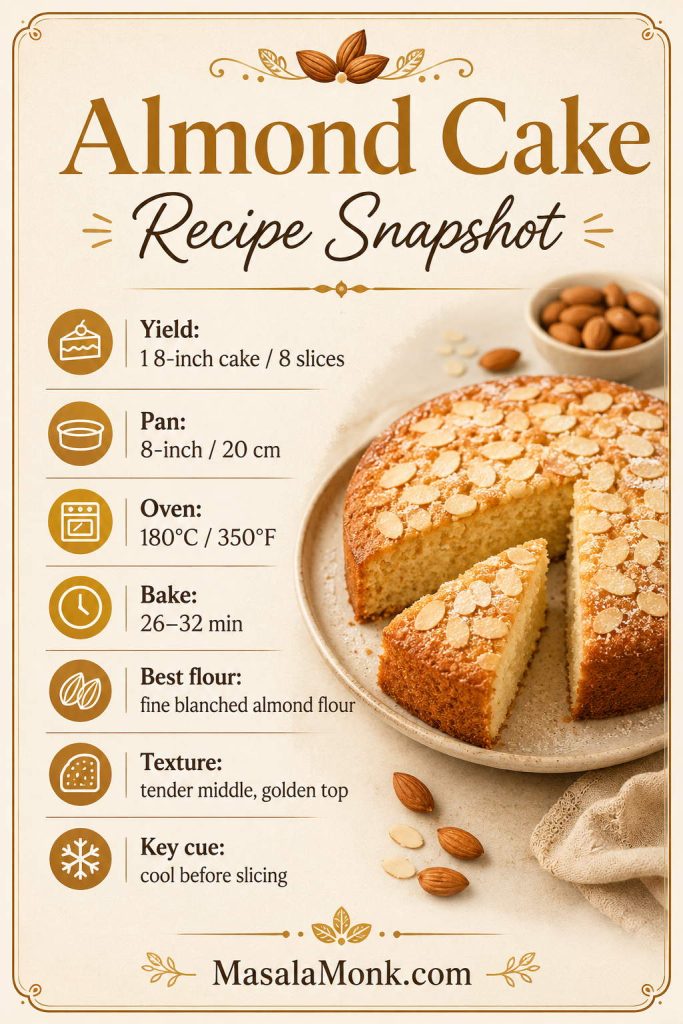
Best for
Tea, coffee, brunch, or a simple gluten-free dessert
Best first pan
8-inch / 20 cm light-colored metal round pan
Best flour
Fine blanched almond flour
Oven
180°C / 350°F conventional; 160°C / 320°F fan
Make-ahead note
Flavor and texture improve after resting
Texture target
Tender middle, golden top, clean-cut slices
Watch out for
Packed flour, weak whites, hot pans, early slicing
Flavor choice
Choose lemon for brightness, orange for warmth
Almond cake recipe snapshot board with yield, pan size, oven temperature, bake time, flour choice, texture target, and cooling cue.
Use this almond cake snapshot as a pre-bake check: pan size, oven temperature, flour choice, and cooling time all affect the final texture.

Keep these details in mind before you start. The safest first bake uses fine almond flour, a sturdy 8-inch pan, and a full cooling time. For ingredient confusion, jump to flour vs meal; for timing doubts, use the doneness cues.

What Kind of Almond Cake Is This?

This is a simple, single-layer almond flour cake made mainly with ground almonds instead of wheat flour. It is closer to a tender tea cake than a tall sponge cake or frosted celebration cake.

If you want…This recipe gives you…
A simple almond flour cakeYes — a single-layer cake with a tender, clean-cut center.
A naturally gluten-free dessertYes, when all ingredients are certified gluten-free.
A tea cake, brunch cake, or coffee cakeYes — this is where the recipe works best.
A frosted birthday-style almond cakeUse a bakery-style layer cake instead.
A whole-orange almond cakeUse a whole-orange method with boiled oranges and a longer bake.
An eggless almond cakeUse a separate eggless formula rather than removing the eggs here.

Almond cake can mean several different things. Some versions are wheat cakes flavored with almond extract; others use boiled oranges, yogurt, or mixed flours. This one stays focused on a dependable almond flour base, so the final texture is easier to predict.

What This Almond Cake Tastes Like

The slice should feel tender and gently rich, not airy like a sponge cake and not dense like almond paste. Almond flour gives the middle a plush, nutty texture, while the sliced almonds on top add a light crackle. Lemon zest makes the cake brighter and more tea-cake-like; orange zest makes it warmer and more dessert-like.

Almond Cake Slice Texture

The slice should bend tender rather than crumble apart. If it looks wet in the center, the cake may be underbaked or cut too warm; if it falls apart, the batter may have been overmeasured, overbaked, or sliced before cooling.
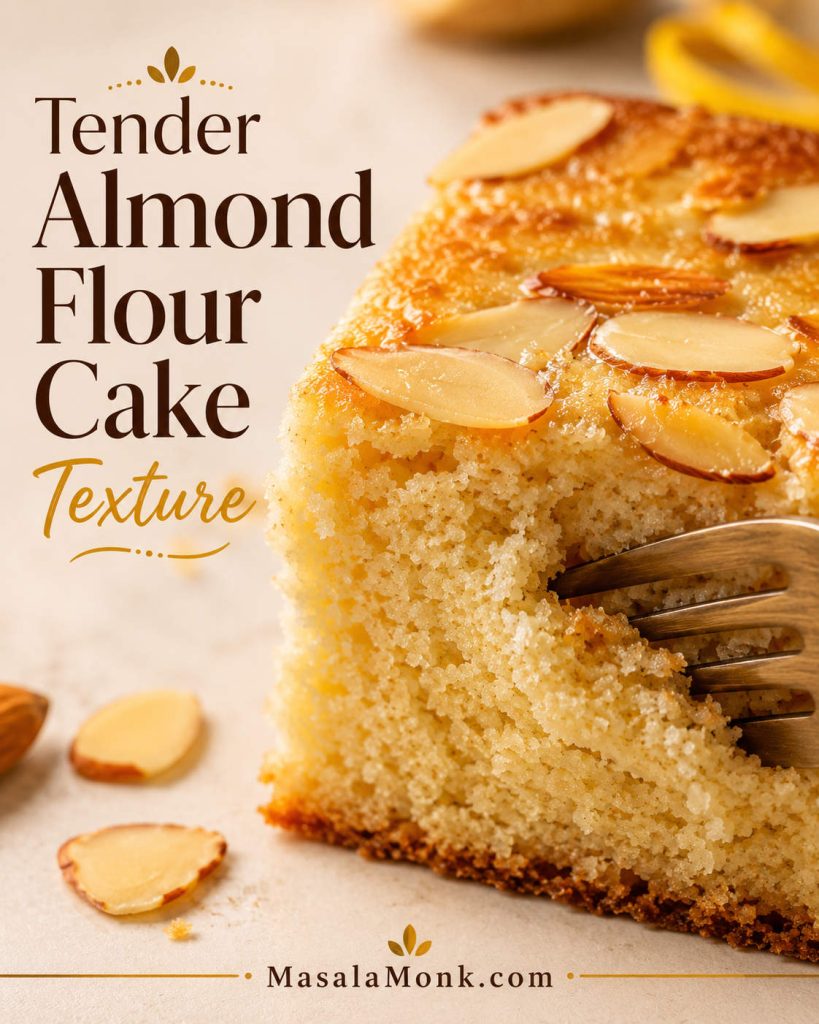
Close-up almond flour cake slice with sliced almonds on top, browned edge, and fork near the crumb.
The best almond flour cake slice should feel gently rich, not wet or pasty; the cut edge should still look neat enough to serve cleanly.

Texture Target for Almond Flour Cake

As the cake cools, the center settles and the flavor rounds out. That resting time is part of why the slice cuts neatly instead of crumbling. The best bite has a fragrant almond top, a clean-cut center, and enough citrus lift to keep the richness from feeling heavy.
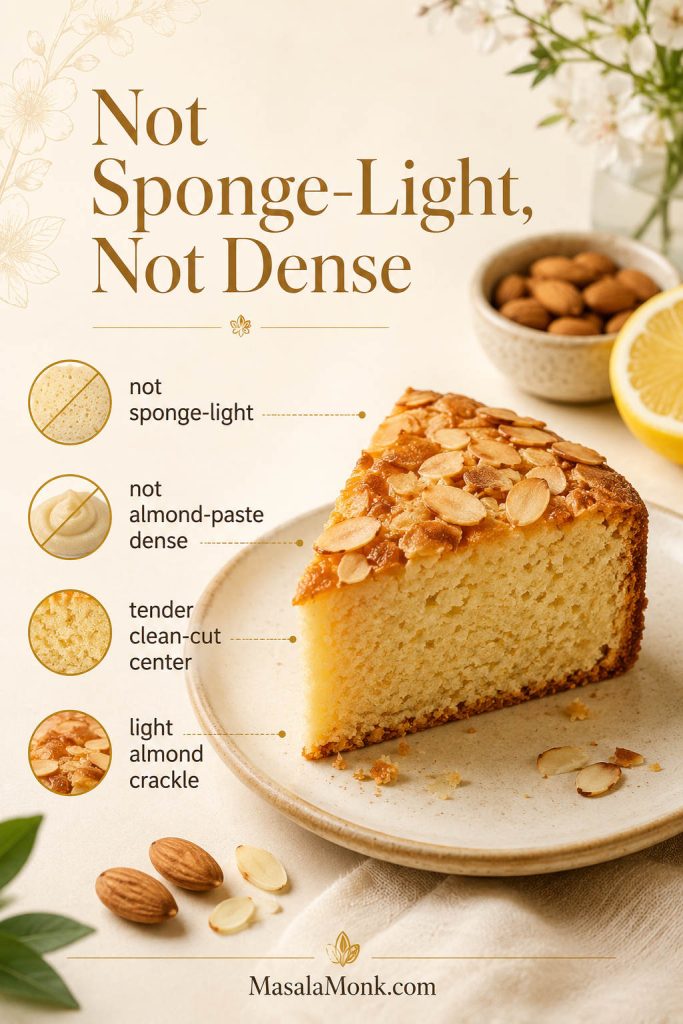
Almond cake texture guide showing a slice with notes about tender center, almond top, and not-too-dense texture.
Almond flour naturally makes cake richer than wheat flour; therefore, the goal is a plush tea-cake bite, not a heavy almond-paste dessert.

A light dusting of powdered sugar is enough. Add berries and cream if you want dessert, or serve it plain with coffee and let the toasted almond top do the work.

When to Make This Almond Cake

Make it when you need a cake that feels special without frosting: a weekend coffee slice, a brunch cake with berries, or a simple gluten-free dessert that does not taste like a compromise. It is also a good choice when frosting feels like too much work but you still want something polished enough for guests.

This is a useful make-ahead cake because it slices better after resting. Bake it in the morning, carry it without worrying about frosting, and serve it later with powdered sugar, fruit, yogurt, or cream. It works for quiet tea, a dessert plate, or the kind of table where you want the cake to look pretty without needing much decoration.
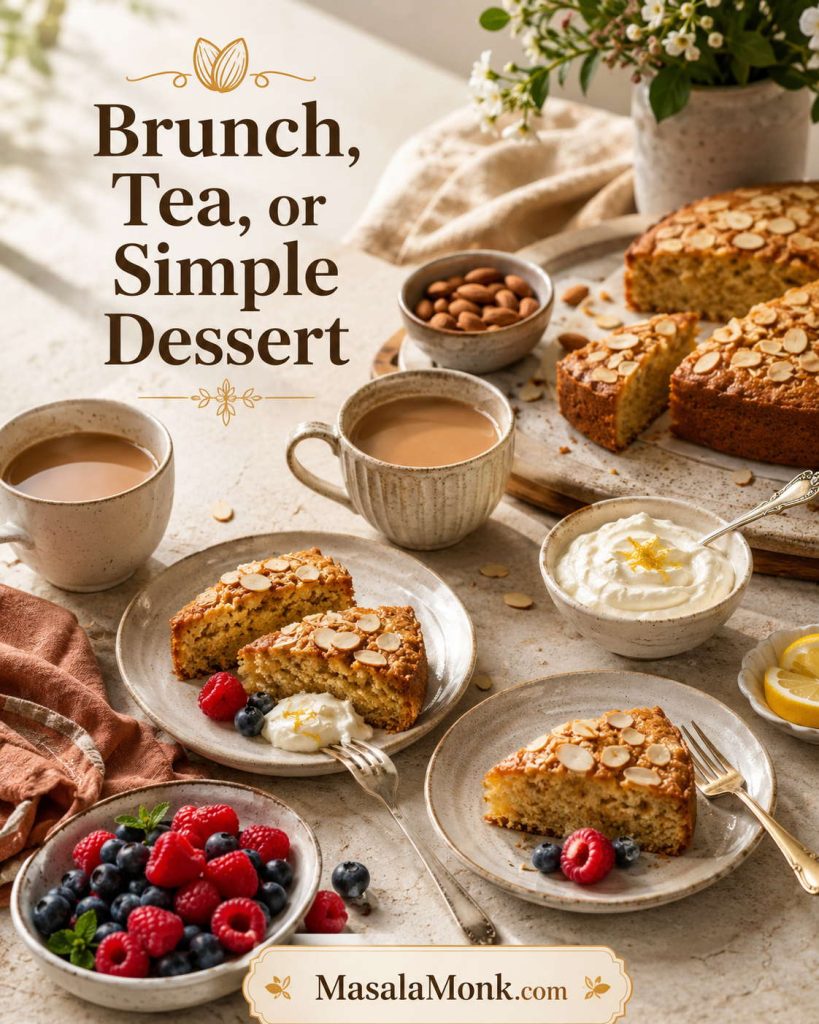
Almond cake served with tea, berries, and cream on a warm table setting.
This is a useful make-ahead cake for brunch, tea, coffee, or a gluten-free dessert plate because it feels finished with only fruit or cream.

Before You Bake: 5 Things That Matter

  1. Weigh the almond flour if you can. If using cups, spoon it lightly and level it.
  2. Use room-temperature eggs. They whip better and blend more smoothly.
  3. Keep the egg-white bowl clean and grease-free. Even a little yolk or oil can stop the whites from whipping properly.
  4. Line the pan with parchment. Almond cakes are delicate and need help releasing cleanly.
  5. Cool before slicing. The center firms as it rests, so warm slices can look damp or broken.

Think of cooling as part of the recipe, not just waiting. A lined pan, a steady oven, and a full rest make the difference between a fragile cake and one that lifts, cuts, and serves cleanly. Already worried about timing or pan size? Check pan size and bake time before you preheat.

Recipe Card: Tender Almond Flour Cake

A tender almond flour cake with a golden sliced-almond top, clean-cut center, and bright lemon or orange zest. This cake is naturally gluten-free when made with certified gluten-free ingredients.

Yield
1 8-inch cake / 8 slices
Prep Time
15 minutes
Bake Time
26–32 minutes
Total Time
About 1 hour 30 minutes, including cooling

Equipment

  • 8-inch / 20 cm light-colored metal round cake pan
  • Parchment paper
  • Two mixing bowls
  • Hand mixer or balloon whisk
  • Flexible spatula
  • Kitchen scale, strongly recommended
  • Wire rack

Ingredients

  • 150 g / 5.3 oz fine blanched almond flour, about 1 1/2 cups lightly spooned and leveled
  • 1 teaspoon / 4 g baking powder
  • 1/4 teaspoon fine salt
  • 4 large eggs, room temperature, separated
  • 100 g / 3.5 oz granulated sugar, about 1/2 cup
  • 1 teaspoon / 5 ml vanilla extract
  • 1/4 teaspoon / 1.25 ml almond extract, optional but useful
  • 1 tablespoon finely grated lemon zest or orange zest
  • 25 g / 0.9 oz sliced almonds, about 1/4 cup, for topping
  • 1 tablespoon powdered sugar, optional, for serving

Method

  1. Preheat the oven to 180°C / 350°F. For fan or convection ovens, use 160°C / 320°F. Grease an 8-inch / 20 cm round cake pan, line the base with parchment paper, and lightly grease the sides.
  2. Whisk together the almond flour, baking powder, salt, and citrus zest. Break up any clumps so the mixture looks loose, not packed.
  3. Separate the eggs. Put the yolks in one large bowl and the whites in a clean, dry, grease-free bowl.
  4. Beat the yolks with the sugar, vanilla, and almond extract for 2–3 minutes, until paler, creamy, and slightly thickened.
  5. Fold the almond flour mixture into the yolk mixture. The batter will look thick, almost like a soft almond paste. That is normal.
  6. Beat the egg whites until they hold soft peaks. They should look glossy, and the peaks should bend slightly when you lift the whisk.
  7. Fold one-third of the whites into the almond batter first to loosen it. Gently fold in the remaining whites in two additions. The final batter should be thick, airy, and spreadable, with no large white streaks.
  8. Spread the batter into the prepared pan and smooth the top. Scatter sliced almonds over the surface.
  9. Bake for 26–32 minutes, until the top is golden, the center feels set, and a toothpick inserted into the middle comes out with moist crumbs but no wet batter.
  10. Cool in the pan for 15 minutes, then remove carefully and cool fully on a wire rack before slicing. A slight settling on top is normal.
  11. Dust lightly with powdered sugar before serving, if you like.

Recipe Notes

  • For a 9-inch / 23 cm pan, start checking around 23 minutes. The cake will be thinner.
  • Almond meal can be used by weight, but the result will be coarser and more rustic.
  • If using an instant-read thermometer, the center should be about 93–96°C / 200–205°F.
  • This batter makes about 9–10 standard cupcakes; bake them for 13–17 minutes.
  • If the sliced almonds brown too quickly, tent the cake loosely with foil near the end of baking.

For visual cues while baking, use the step-by-step method and doneness guide below.

Why This Almond Cake Recipe Works

Almond flour brings flavor, tenderness, and natural richness, but it does not bring gluten. That means the cake depends on eggs, gentle folding, the right pan, and cooling time to hold a clean slice.

  • Almond flour keeps the middle tender without needing a butter-heavy batter.
  • Egg yolks add richness, while the whites help lighten the batter.
  • Whipped egg whites prevent the center from feeling heavy when they are folded in gently.
  • Sugar supports browning and texture, not just sweetness.
  • Lemon or orange zest lifts the almond flavor so the cake does not taste flat or oily.

Added fat stays low on purpose. Ground almonds already contain natural oils, so extra butter or oil can push the texture toward greasy. In this recipe, moisture comes from the almonds and eggs; lightness comes from the whipped whites; and the clean slice comes from baking the center fully, then letting it rest.

What shaped this version: the structure is built around the places almond flour cakes usually go wrong — packed flour, cold eggs, weak whites, hot pans, and slicing before the center has settled. That is why the recipe focuses less on adding more liquid or fat and more on measurement, egg structure, pan heat, and cooling time.

If you enjoy almond flour in other bakes, almond flour cookies are a useful comparison because the same ingredient can turn crisp, chewy, tender, or heavy depending on the formula.

Ingredients for Almond Cake

The ingredient list is short, so each item has a real job. Keep the base steady on the first bake; once you know how the batter should feel, the flavor variations are easier.

Almond Cake Ingredients at a Glance

Before you start, check that your almond flour is plain and finely ground, your eggs are at room temperature, and your citrus zest is ready. With a short ingredient list, small details affect the final cake more than they would in a heavier wheat-flour batter.
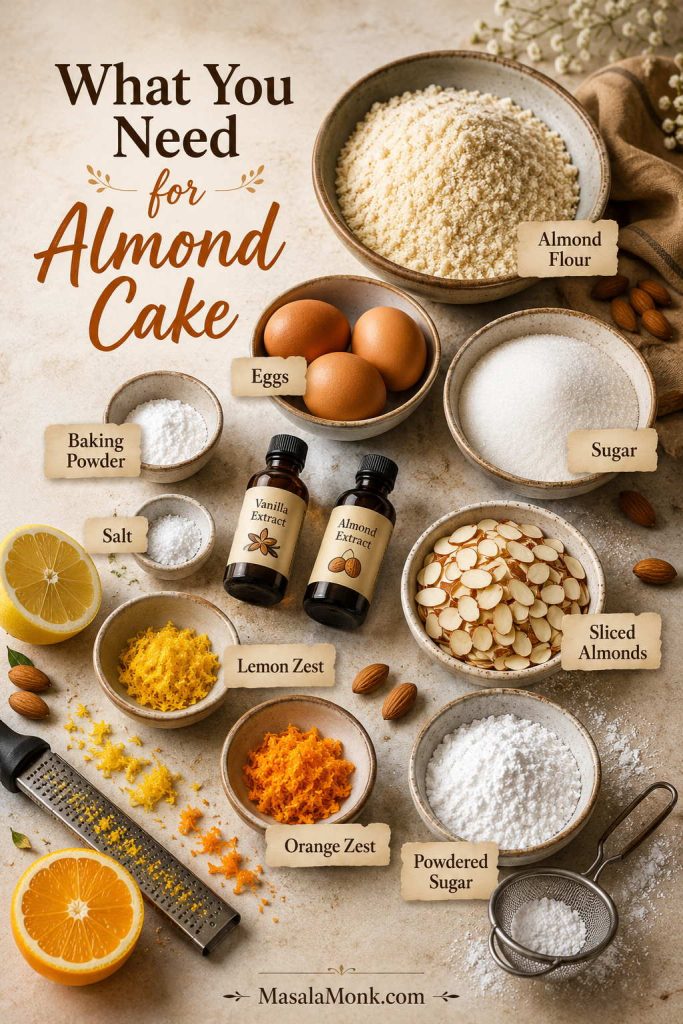
Almond cake ingredients in bowls, including almond flour, eggs, sugar, citrus zest, extracts, baking powder, salt, and sliced almonds.
Short ingredient lists need more precision, not less: each bowl here affects lift, browning, almond flavor, or how neatly the cake slices.

Almond Flour

Fine blanched almond flour gives the most delicate result. It is made from almonds without skins and is usually ground more finely than almond meal. If measuring by volume, spoon it lightly into the cup and level it rather than scooping from the bag. For a broader baking reference, King Arthur Baking’s ingredient weight chart lists almond flour and almond meal separately.

If you have extra almond flour after making this cake, use it in almond flour pancakes, where the same ingredient gives a softer breakfast-style texture.

Eggs

Eggs do the main structural work here. They help the cake rise, set, and hold together without wheat flour. Room-temperature eggs whip more easily; if you forget to take them out early, place the whole eggs in a bowl of warm water for 5–10 minutes before cracking them.
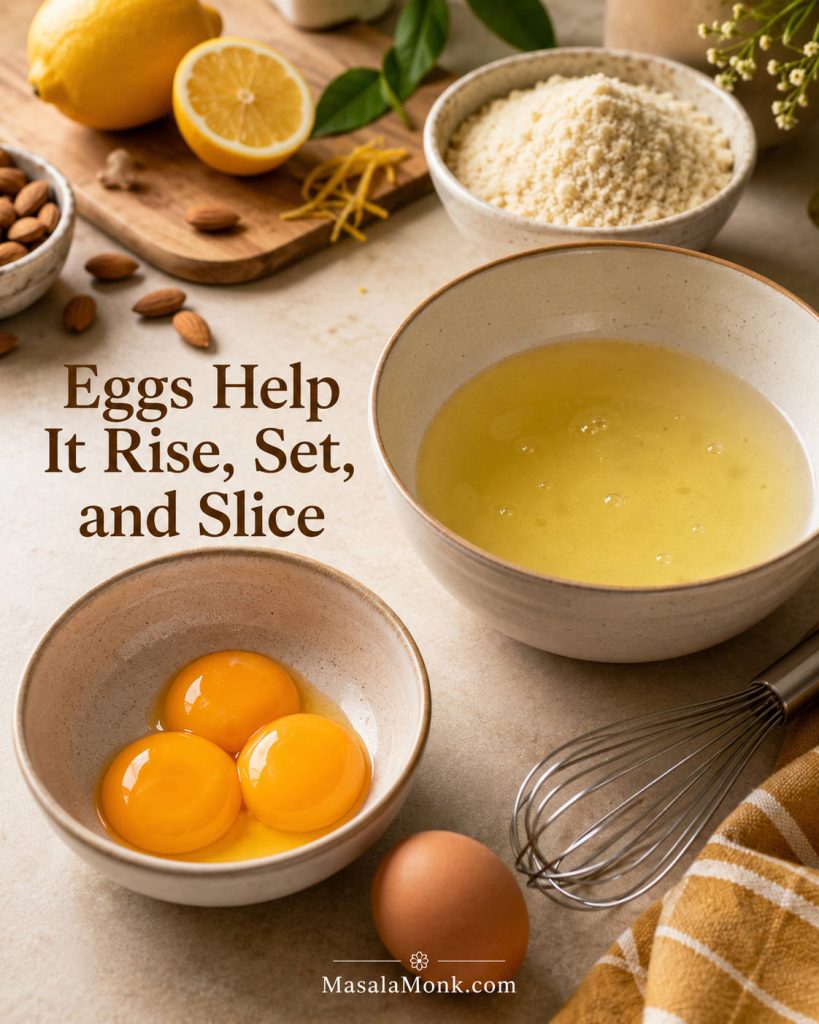
Separated egg yolks and egg whites in bowls with a whisk and almond flour nearby.
In this almond flour cake, separated eggs are doing structure work: yolks enrich the base, while whipped whites help the batter lift.

Need an egg-free version? Read the eggless almond cake note before trying a flax, chia, or yogurt swap.

Sugar

Sugar is not only for sweetness. It helps the top brown, supports the texture, and keeps the cake from tasting flat. Coconut sugar or light brown sugar can work, although the cake will bake darker and taste more caramel-like. Honey or maple syrup need a different formula because liquid sweeteners change the moisture balance.

Vanilla and Almond Extract

Vanilla makes the flavor rounder. Almond extract is optional, but a tiny amount makes the almond note more noticeable. Use it carefully; a few drops can taste bakery-like, while too much can turn bitter, artificial, or perfume-like.

Lemon Zest or Orange Zest

Use lemon zest for a brighter tea-cake flavor or orange zest for a warmer dessert-style cake. In both cases, zest only the colored part of the peel, not the bitter white pith underneath.

Lemon and orange zest flavor board for almond cake with citrus halves and small cake slices.
Lemon keeps the almond cake brighter and tea-friendly; orange makes the same base warmer and more dessert-like.

Baking Powder and Salt

Baking powder supports the lift from the eggs. Salt balances the sweetness and makes the almond flavor taste fuller. If you need a strictly gluten-free cake, check that your baking powder is labeled gluten-free.

Sliced Almonds

Sliced almonds give the top a classic look and a delicate crunch. They also make the cake feel finished without frosting. If they brown too quickly, loosely tent the pan with foil near the end of baking.

Almond Flour vs Almond Meal vs Almond Powder for Almond Cake

Almond flour, almond meal, ground almonds, and almond powder are often used loosely, but they do not always behave the same way in cake.
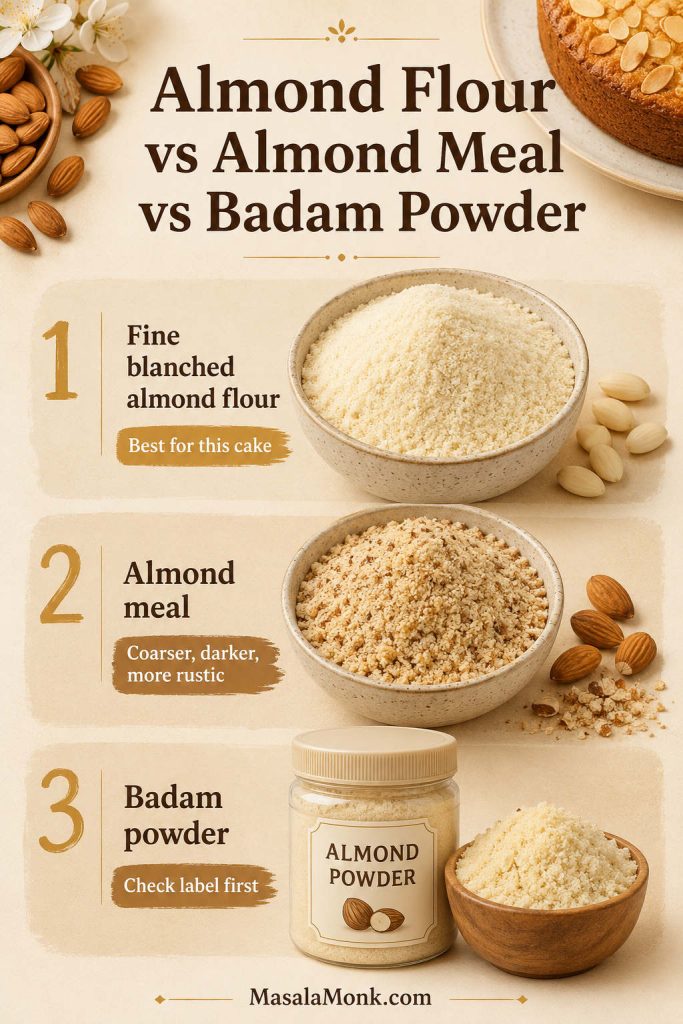
Comparison board showing fine blanched almond flour, almond meal, and badam powder for almond cake.
For almond cake, the grind matters as much as the name; fine flour bakes smoother, almond meal bakes heartier, and badam powder needs checking.
IngredientWhat it usually meansBest use in this cakeTexture result
Fine blanched almond flourAlmonds without skins, ground finelyBest choice for the recipeLightest, most delicate result
Almond meal / ground almondsOften coarser; may include almond skinsWorks by weight, but gives a rustic cakeDarker, nuttier, slightly grainier texture
Almond powder / badam powderCan mean ground almonds, but sometimes means sweetened drink mixUse only if unsweetened and finely groundDepends on grind; sift if clumpy

For the cleanest first bake, use fine blanched almond flour. If you use almond meal, use the same weight, not a packed cup-for-cup swap. Almond meal is often heavier by volume, and it may include skins, so the finished cake will be darker and more textured.

Badam Powder Check for Almond Cake

Almond powder needs extra caution. If you are in India and buying “badam powder,” read the label carefully. You want plain unsweetened ground almonds, not badam milk mix, malted almond drink powder, milk-powder blend, or sweetened beverage mix. Those mixes can make a warm badam drink taste rich, but they do not behave like plain ground almonds in cake batter.
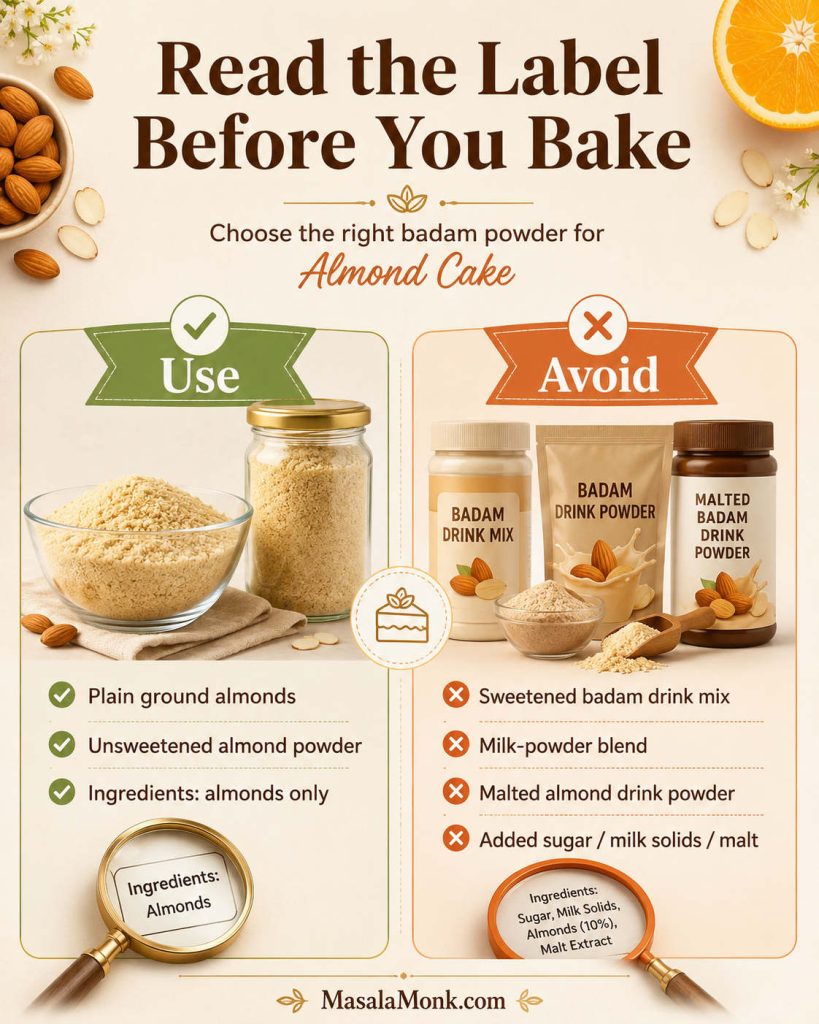
Guide showing plain ground almonds to use and sweetened badam drink mixes to avoid for almond cake.
Before using badam powder in almond cake, check that almonds are the main ingredient; otherwise, sugar, milk solids, or malt can throw off the batter.

Simple rule: fine almond flour gives the cleanest cake. Almond meal gives a rustic cake. Sweetened badam drink mix does not belong in this recipe.

How to Make Almond Cake

The recipe card gives the short method. These cues show what the mixture should look and feel like at each stage, which matters more with almond flour than with a regular wheat batter.

1. Prepare the pan first

Grease the pan and line the base with parchment before you start mixing. A light-colored metal 8-inch / 20 cm round pan gives the most even result. Glass and ceramic hold heat differently and may need extra time, so metal is the safest first choice.
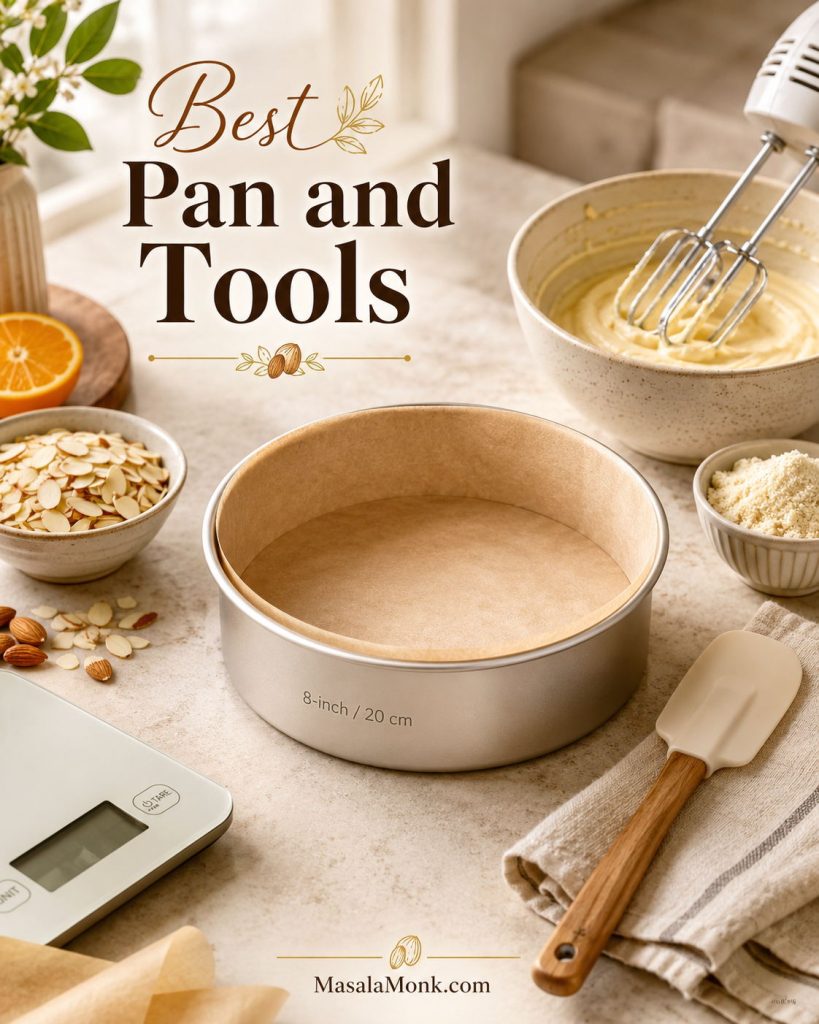
Almond cake equipment with parchment-lined round pan, whisk, spatula, bowls, kitchen scale, and sliced almonds.
A lined metal pan is not just cleanup insurance; it helps this delicate almond cake release cleanly after the edges set.

2. Mix the dry ingredients

Whisk almond flour, baking powder, salt, and citrus zest together. The mixture should look loose and clump-free, not compacted. If the flour has small lumps, break them up now so the finished texture is smoother.
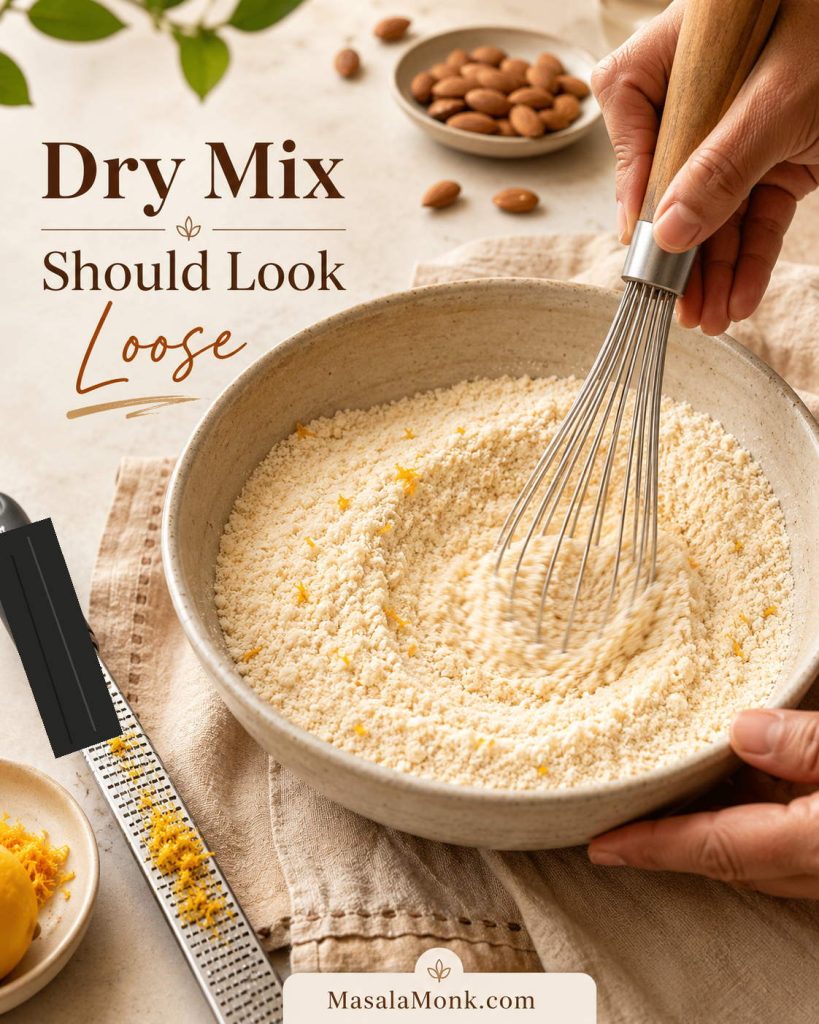
Almond flour dry mixture being whisked with citrus zest until loose and clump-free.
Break up almond flour clumps while the mix is still dry; once wet ingredients go in, those clumps are harder to smooth out.

3. Beat the yolks with sugar

Beat the egg yolks with sugar, vanilla, and almond extract for 2–3 minutes, until the mixture looks paler, creamy, and slightly thick. It does not need to be fluffy like whipped cream, but it should no longer look dry or grainy.
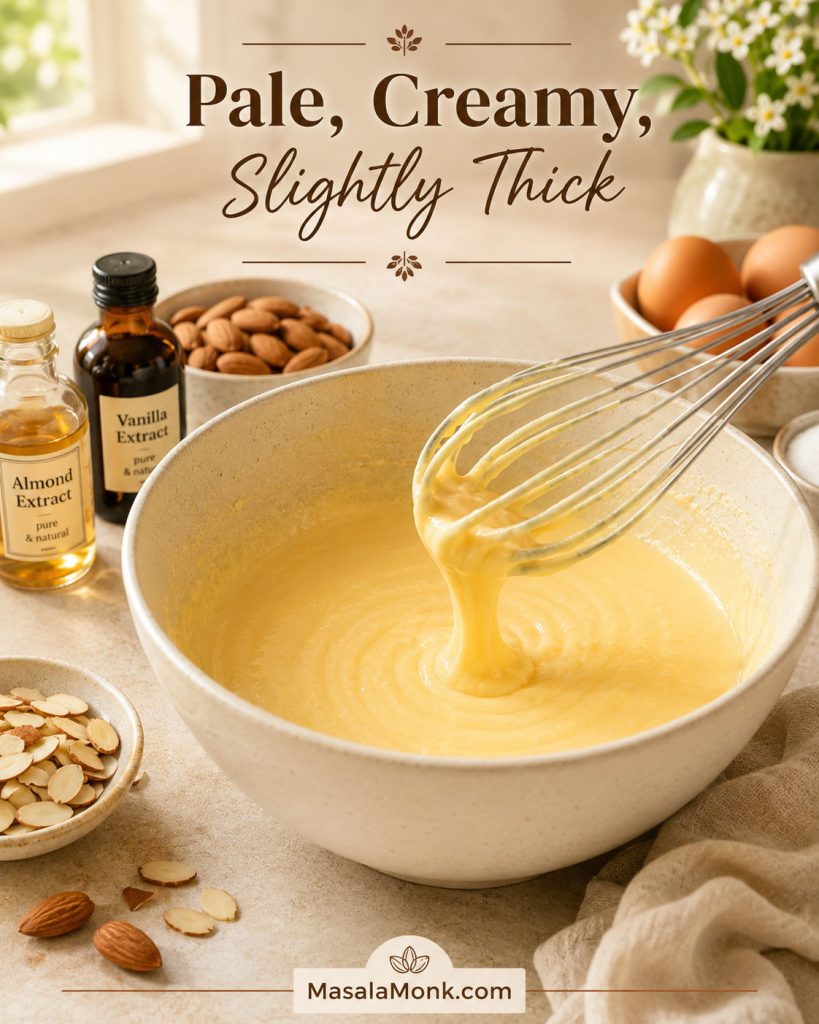
Pale creamy egg yolk and sugar mixture in a bowl with a whisk.
The yolk mixture should look pale and creamy before the almond flour goes in, so the batter starts smoother and blends more evenly.

4. Fold in the almond flour

Add the dry mixture to the yolks and fold until combined. The batter will look thick, almost like a soft almond paste. That is normal; do not loosen it with milk or water. The egg whites will lighten it in the next step.
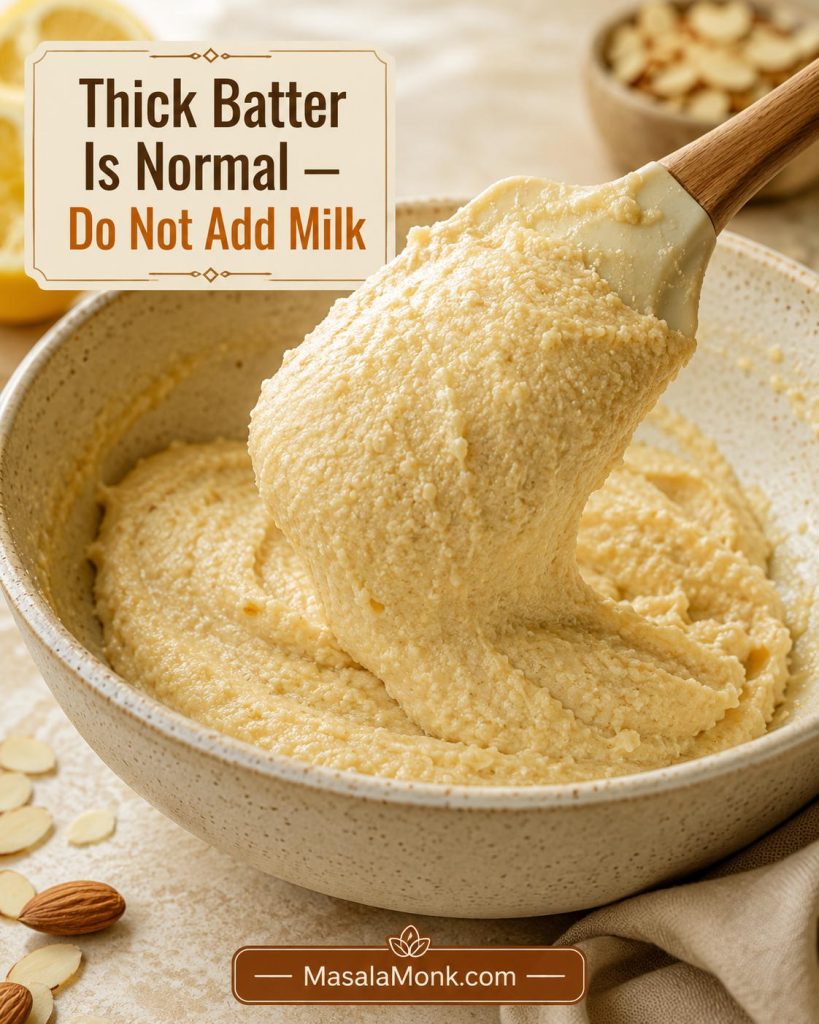
Thick almond cake batter lifted with a spatula before whipped egg whites are folded in.
Thick batter is expected with almond flour, so resist adding milk or water; the next fold with egg whites is what loosens it properly.

5. Whip the egg whites to soft peaks

Beat the egg whites until they hold soft peaks. The whites should look glossy, and the peak should bend slightly when you lift the whisk. Stop before the whites become stiff, dry, or clumpy.
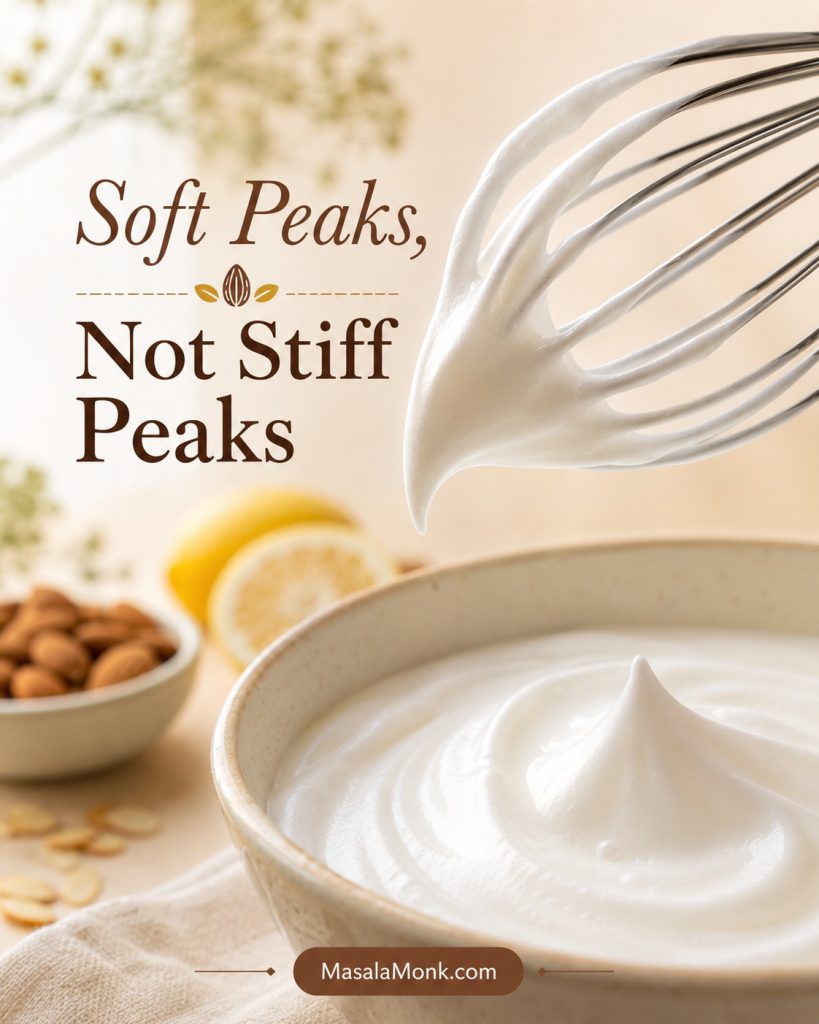
Glossy whipped egg whites holding a soft bending peak on a whisk.
Stop at soft peaks because they fold into almond cake batter more easily than stiff whites and help prevent dry, clumpy pockets.

6. Fold until the batter is thick, airy, and spreadable

Fold one-third of the whites into the thick batter first; it should visibly loosen. Then fold in the rest gently until the mixture is thick, airy, and spreadable, with no large white streaks. Do not beat the batter at this point.
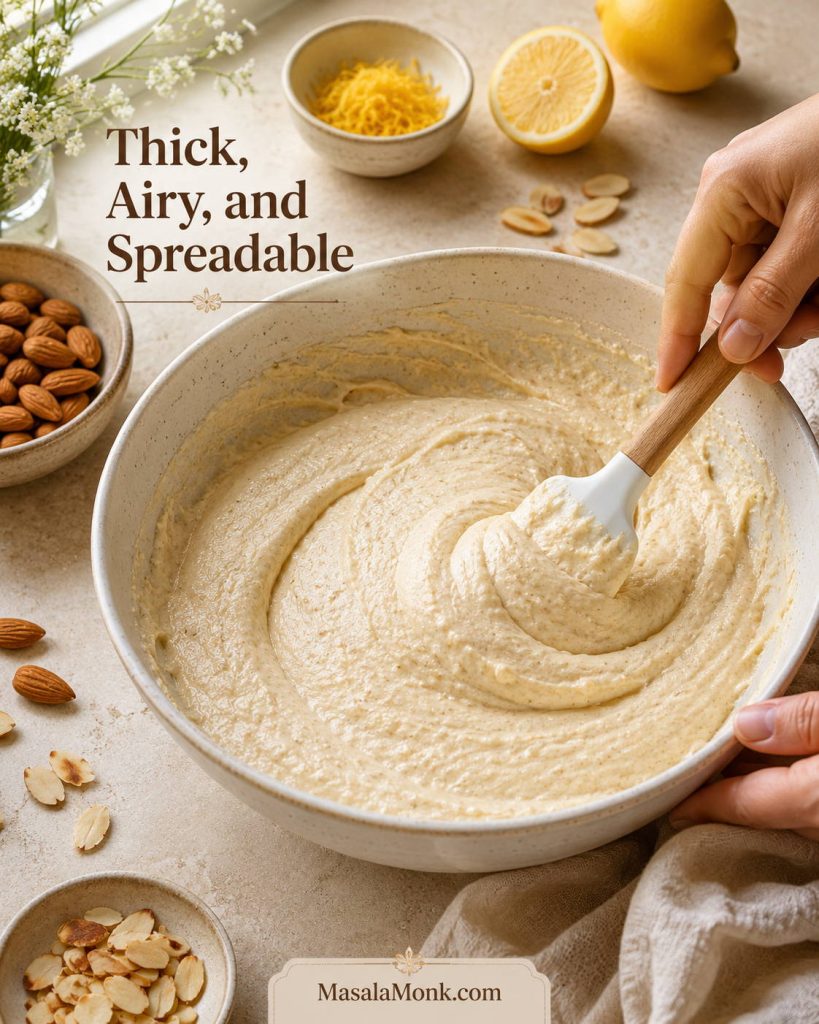
Final almond cake batter being folded with a spatula until thick, airy, and spreadable.
After folding, the batter should look lighter but not runny; that balance helps the almond cake rise while still keeping its rich texture.

7. Fill the pan and bake

Spread the batter into the pan, add sliced almonds, and bake on the middle rack. The top may settle slightly as the cake cools; that is normal. Let it rest in the pan for 15 minutes, then move it to a wire rack. The slice will be cleaner once the center has fully settled.
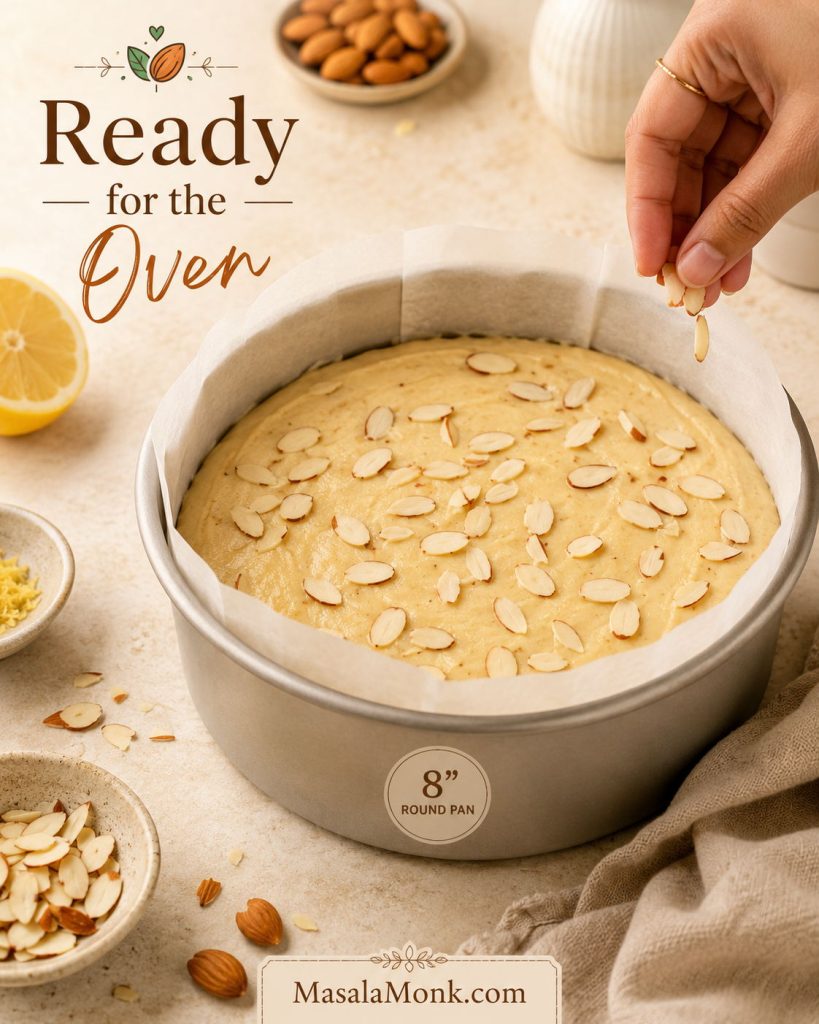
Almond cake batter in a parchment-lined round pan topped with sliced almonds before baking.
Scatter the sliced almonds after smoothing the batter so they toast on the surface instead of disappearing into the cake.

Pan Size, Oven Temperature, and Bake Time

Pan size matters because the edges can brown before the center finishes baking. A deeper cake needs more time; a wider cake bakes faster and can dry out if you use the same timing.

8-Inch vs 9-Inch Pan for Almond Cake

The 8-inch pan is the safest first choice because it gives the cake a little height. A 9-inch pan still works, but it spreads the batter thinner, so the cake finishes sooner and needs earlier checking.
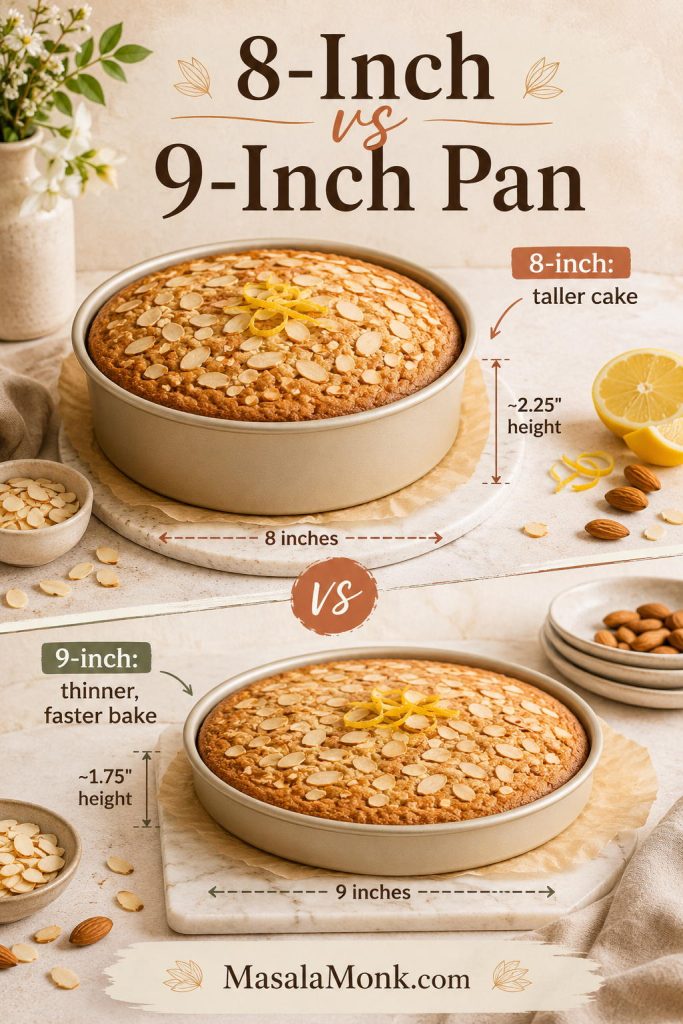
Comparison of almond cake baked in 8-inch and 9-inch pans, showing taller and thinner results.
A 9-inch pan spreads the batter thinner, so the cake bakes faster. Start checking earlier than you would with an 8-inch pan.

Best first pan: use an 8-inch / 20 cm light-colored metal round pan. A 9-inch pan works, but the cake will be thinner and will bake faster.

PanResultApproximate bake timeNotes
8-inch / 20 cm roundTaller cake with a tender center26–32 minutesBest default for this recipe.
9-inch / 23 cm roundThinner cake, slightly faster bake23–28 minutesStart checking early.
8-inch squareEasy square slices24–30 minutesGood for snack-cake style serving.
Cupcake panAbout 9–10 small cakes13–17 minutesFill cups about two-thirds full.
Loaf panDeeper centerNot ideal for this exact batterHigher risk of dark edges and underbaked middle.

For a conventional oven or OTG, use 180°C / 350°F. For fan or convection ovens, use 160°C / 320°F and start checking early. Bake on the middle rack so the top does not brown before the center is ready.

If you use a springform pan, choose a sturdy one. Very thin pans can overbake the edges while leaving the middle slightly underdone. If your oven runs hot or the almond topping browns too fast, loosely tent the cake with foil for the final 5–10 minutes.

Once you choose the pan, use the doneness section rather than bake time alone.

How to Know Almond Cake Is Done

The top may look golden before the middle is fully baked, so use more than color as your guide.
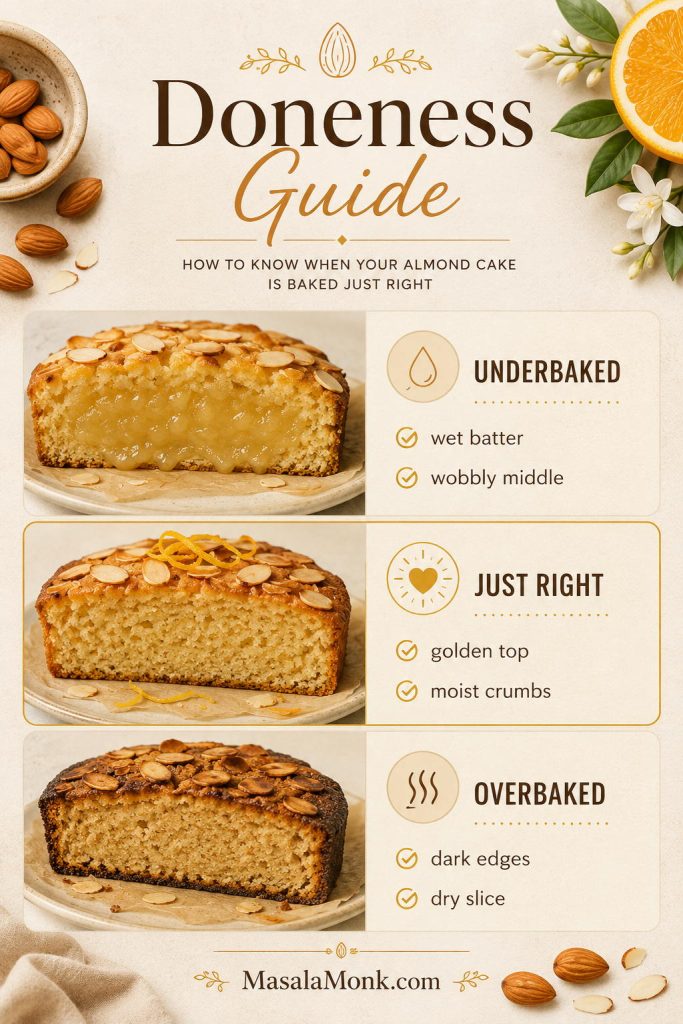
Doneness guide comparing underbaked, just-right, and overbaked almond cake slices with toothpick cues.
Almond cake can look golden before the center is ready, so use the toothpick and the middle of the cake together, not color alone.
  • The top is golden and the sliced almonds are lightly toasted.
  • The center feels set when touched gently.
  • The edges pull slightly away from the pan.
  • A toothpick inserted into the center comes out with moist crumbs, not shiny batter.
  • The cake does not wobble in the middle when the pan is gently moved.

A few damp-looking crumbs are fine. Shiny wet batter means the cake needs more time. If the top is already brown, tent it loosely with foil and continue baking. For extra precision, the center should be about 93–96°C / 200–205°F on an instant-read thermometer.

Toothpick Test for Almond Cake

Insert the toothpick into the center, not the edge. The edge sets first, so it can make the cake seem done while the middle still needs a few more minutes.
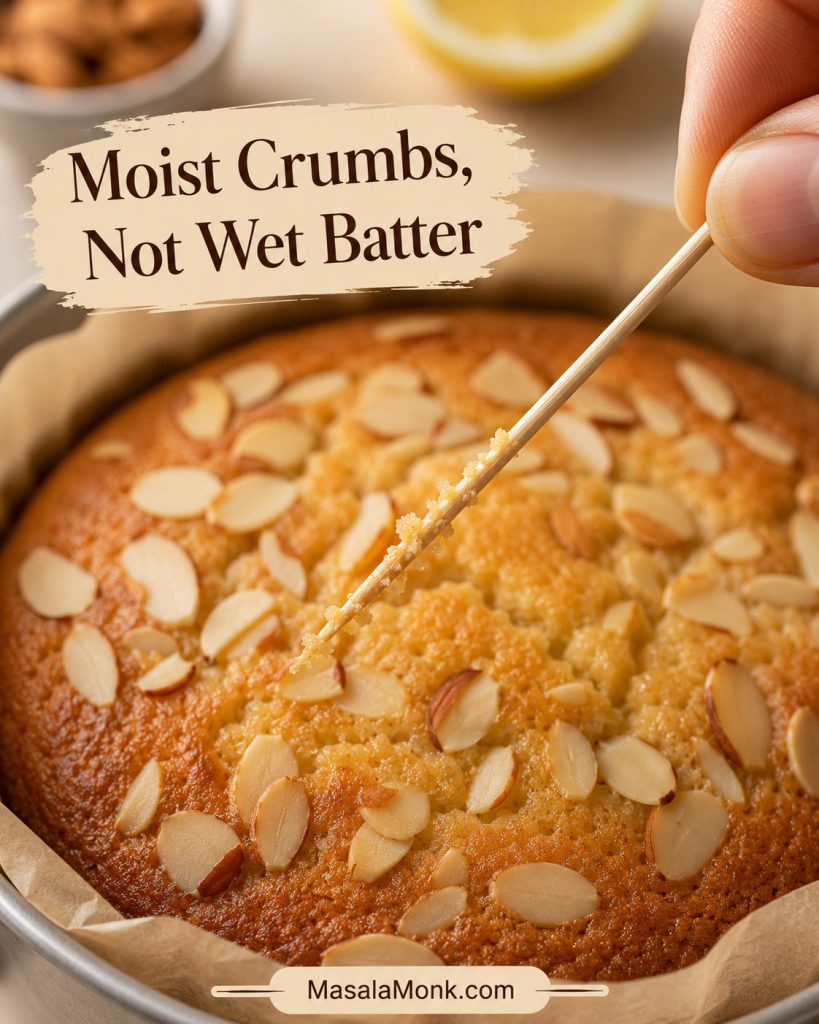
Toothpick pulled from almond cake with moist crumbs and no wet batter.
Moist crumbs on the toothpick are the sweet spot. Shiny batter means underbaked; a bone-dry toothpick can mean overbaked.

The cake does not need to look dramatic when it comes out of the oven. A softly golden surface, lightly toasted almonds, and a middle that no longer wobbles are enough. The finished texture shows after cooling, when the center has had time to settle.

Almond Cake Variations

Keep the first bake simple, then change flavorings and toppings in small ways. That way the cake stays familiar even when you shift the flavor.
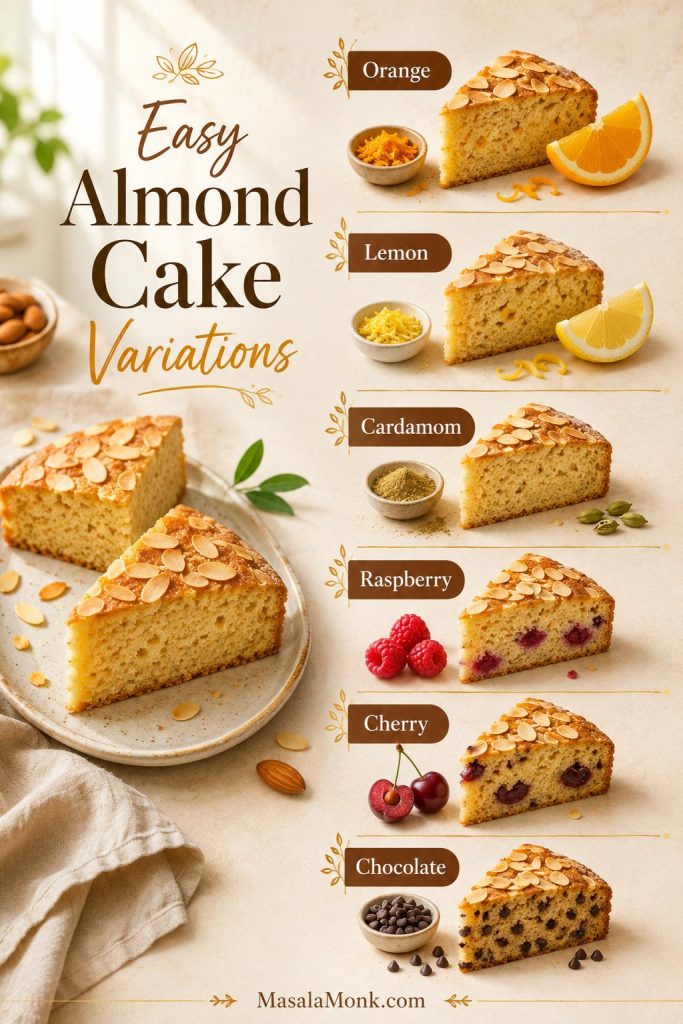
Almond cake variation board with orange, lemon, cardamom, raspberry, cherry, and chocolate options.
Once the base almond cake is reliable, small add-ins work best; start with zest, spice, berries, cherries, or a few chocolate chips rather than changing the whole formula.
VariationHow to do itImportant note
Orange almond cakeUse 1 tablespoon orange zest. Optional glaze: 60 g powdered sugar + 1–2 teaspoons orange juice.Warmer and more dessert-like than lemon.
Lemon almond cakeUse 1 tablespoon lemon zest. Optional glaze: 60 g powdered sugar + 1–2 teaspoons lemon juice.Best first variation because it adds brightness without much moisture.
Cardamom almond cakeAdd 1/4 teaspoon ground cardamom with the dry ingredients.Good for a badam-style note; do not overdo it.
Raspberry almond cakeScatter 1/3 cup raspberries over the top before baking.Too many berries can make the center sink.
Cherry almond cakeUse 1/3 cup pitted, halved cherries on top of the batter.Keep cherries near the top because they release moisture.
Chocolate almond cakeFold in 1/4 cup mini chocolate chips after the egg whites are mostly incorporated.For a true chocolate cake, use a separate cocoa-based formula.
Almond meal cakeUse 150 g almond meal instead of fine almond flour.Expect a darker, nuttier, more rustic result.
Olive oil almond cakeAdd 1 tablespoon mild olive oil to the yolk mixture.Do not add more on the first attempt; ground almonds already contain fat.

Orange Almond Cake Variation

For orange almond cake, use orange zest instead of lemon zest. A very light glaze can work after cooling, but do not cover the sliced-almond top so heavily that the cake turns sticky.
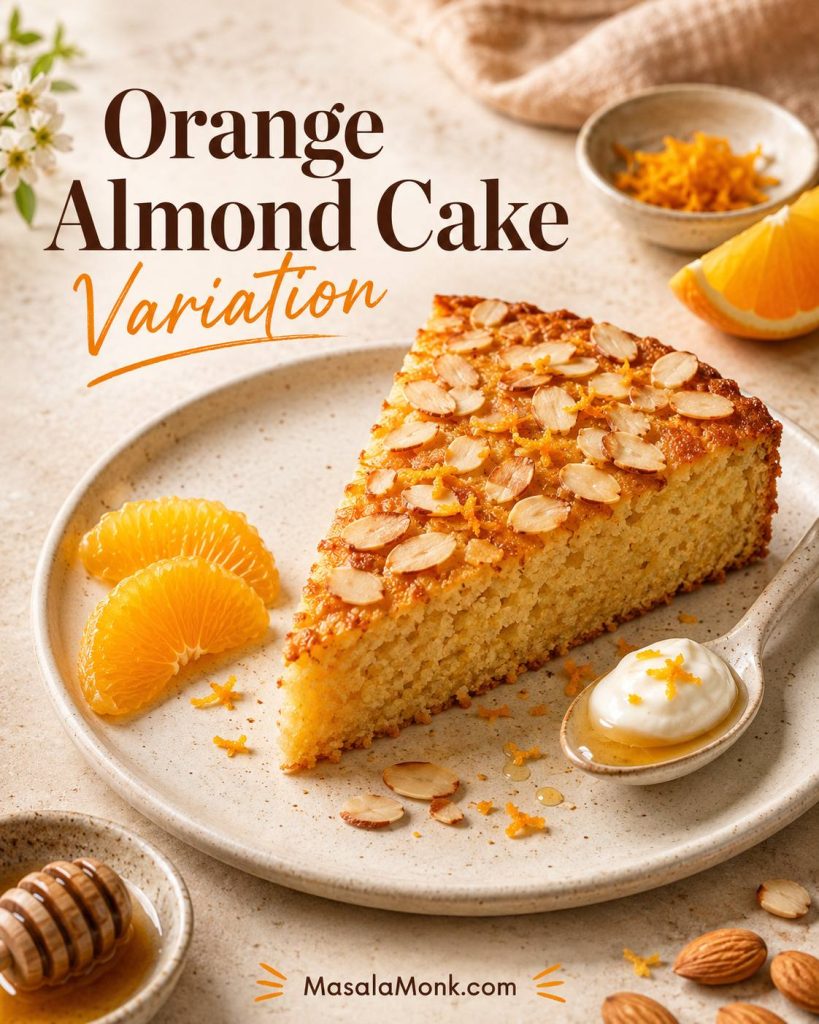
Orange almond cake slice with sliced almonds, orange zest, orange segments, honey, and yogurt.
Orange almond cake works best when the citrus stays fragrant, not heavy; a little honey or yogurt adds dessert energy without covering the almond top.

Lemon Almond Cake with Berries

For lemon almond cake, use lemon zest and keep the serving style bright. Berries and cream make the cake feel fresh without adding extra moisture to the batter itself.
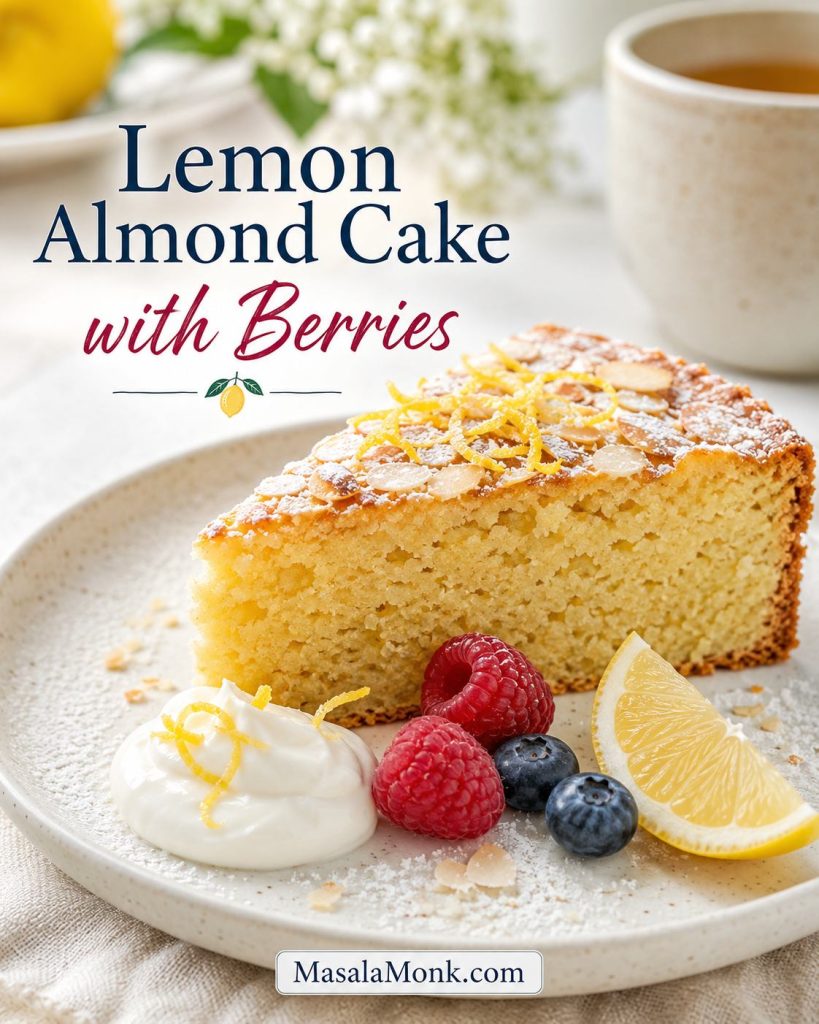
Lemon almond cake slice with berries, cream, lemon zest, and a lemon wedge.
Lemon almond cake with berries is the brightest serving route, especially when you want a slice that feels fresh enough for brunch.

Whole-orange almond cake is different: that style usually uses boiled whole oranges, almond meal, eggs, sugar, and a longer, lower bake. It has a damp, marmalade-like texture and often needs a blender or food processor.

Can This Almond Cake Be Made Eggless?

For this exact cake, eggs are structural. They help the almond flour rise, set, and hold a clean slice, so flax eggs, chia eggs, or only yogurt will not behave like a simple one-for-one swap.

Eggless almond cake usually needs a recipe built differently from the start. It often uses yogurt, all-purpose flour or a gluten-free flour blend, extra leavening, and sometimes milk or oil to help the cake rise, set, and cut cleanly. A 100% almond flour eggless cake is especially difficult because ground almonds do not have enough starch or gluten-like binding on their own.

Honest baking note: if you need an eggless almond cake, use a recipe built for that job. A yogurt-based version with some flour support will usually perform better than removing the eggs from this batter.

Is This a Keto Almond Cake?

This recipe uses almond flour, but it is not a keto cake because it uses regular sugar. Almond flour lowers the wheat-flour load, but sugar still makes this a standard dessert. Sugar also affects browning, moisture, and structure, so a keto version needs its own sweetener formula rather than a direct cup-for-cup swap.

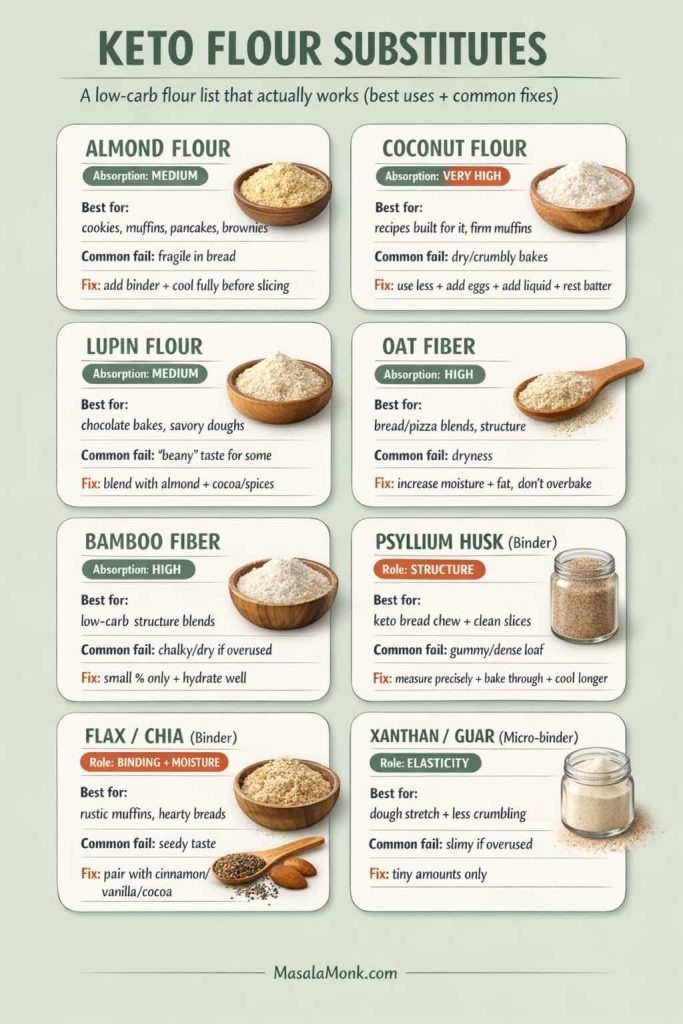
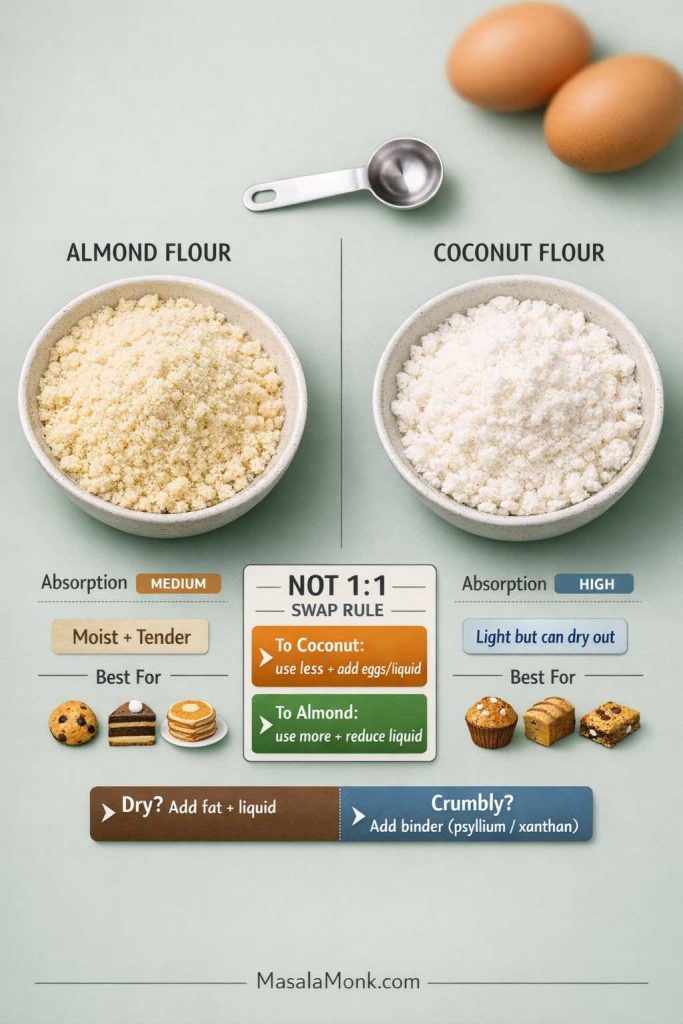
For low-carb baking context, this guide to keto-friendly flours explains how almond flour behaves compared with other low-carb flour options. If blood sugar is a concern, dessert still needs portion awareness; this guide on almond flour and diabetes covers the ingredient side in more detail.

How to Serve Almond Cake

This cake does not need frosting. A light dusting of powdered sugar is enough for a simple tea cake, but you can dress it up depending on the occasion.
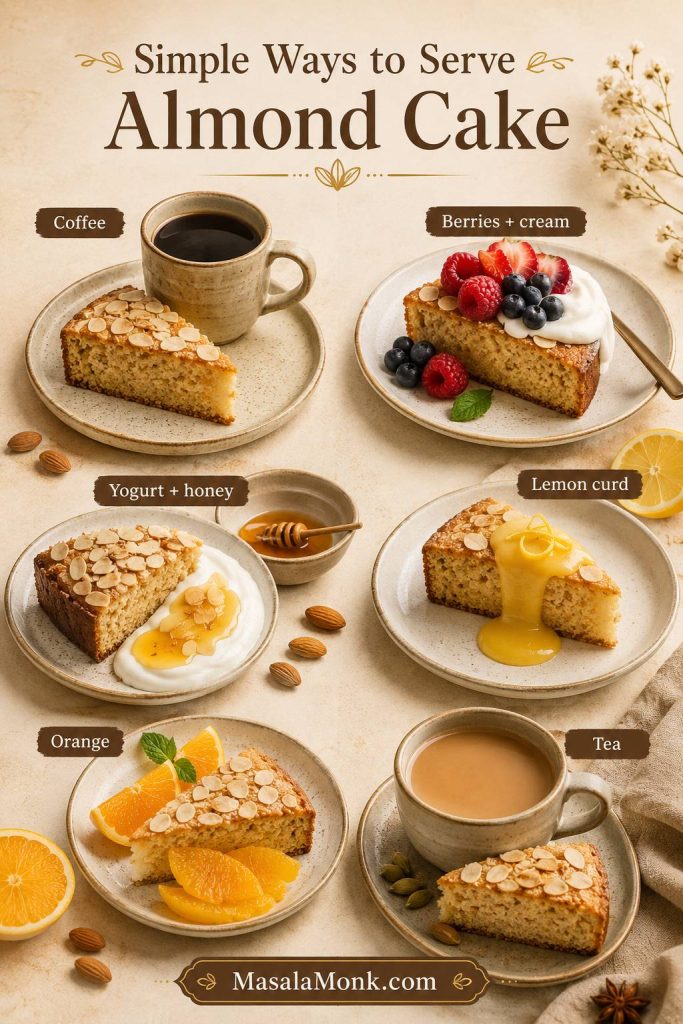
Serving ideas board for almond cake with coffee, berries and cream, yogurt and honey, lemon curd, orange segments, and tea.
Pair almond cake with light toppings instead of heavy frosting; coffee, tea, fruit, yogurt, honey, citrus, and lemon curd all support the almond flavor.
  • Serve plain with tea, coffee, or masala chai.
  • Add powdered sugar and fresh berries.
  • Serve with Greek yogurt or lightly whipped cream.
  • Add orange segments and a little honey for an orange almond dessert plate.
  • Pair lemon almond cake with lemon curd.
  • Serve cardamom almond cake with saffron cream or vanilla ice cream.
  • Toast leftover slices lightly and serve with homemade almond milk or coffee.

Because the middle is already rich and tender, keep toppings light. A little cream, fruit, citrus, or honey works better than heavy frosting and keeps the toasted almond flavor in front. Choose lemon with berries and cream for a brighter tea-cake finish; choose orange with honey or yogurt for a warmer dessert plate.

Choosing between lemon and orange? The variation table gives the easiest flavor adjustments.

How to Store Almond Cake

Almond cake keeps well because ground almonds naturally hold moisture. In fact, the cake often tastes better after a few hours of resting because the texture settles and the flavor becomes rounder.
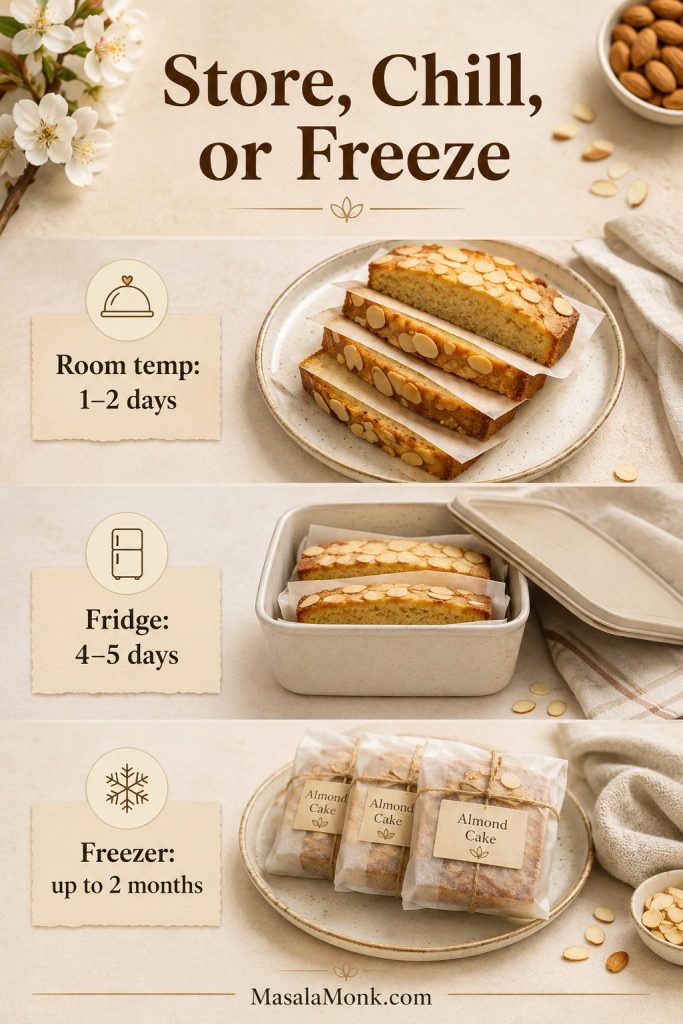
Almond cake storage guide showing room temperature slices, fridge container, and freezer-wrapped portions.
Store almond cake only after it cools completely; then parchment between slices keeps make-ahead portions clean, separate, and easy to serve.
  • Room temperature: store in an airtight container for 1–2 days.
  • Fridge: store for 4–5 days. Bring slices to room temperature before serving.
  • Freezer: freeze slices for up to 2 months. Place parchment between slices so they do not stick together.
  • Make-ahead: bake the cake one day ahead, cool completely, wrap well, and dust with powdered sugar just before serving.

If the cake has been refrigerated, let it sit at room temperature for 20–30 minutes before serving. Cold almond cake can taste firmer and less fragrant than a room-temperature slice.

If a stored slice tastes dry, the troubleshooting guide has quick serving fixes.

Almond Cake Troubleshooting

Most almond cake problems come from too much almond flour, an underbaked center, or cutting the cake before the middle has settled. If you are still mixing, check the step-by-step cues; if the cake is already in the oven, go straight to doneness.
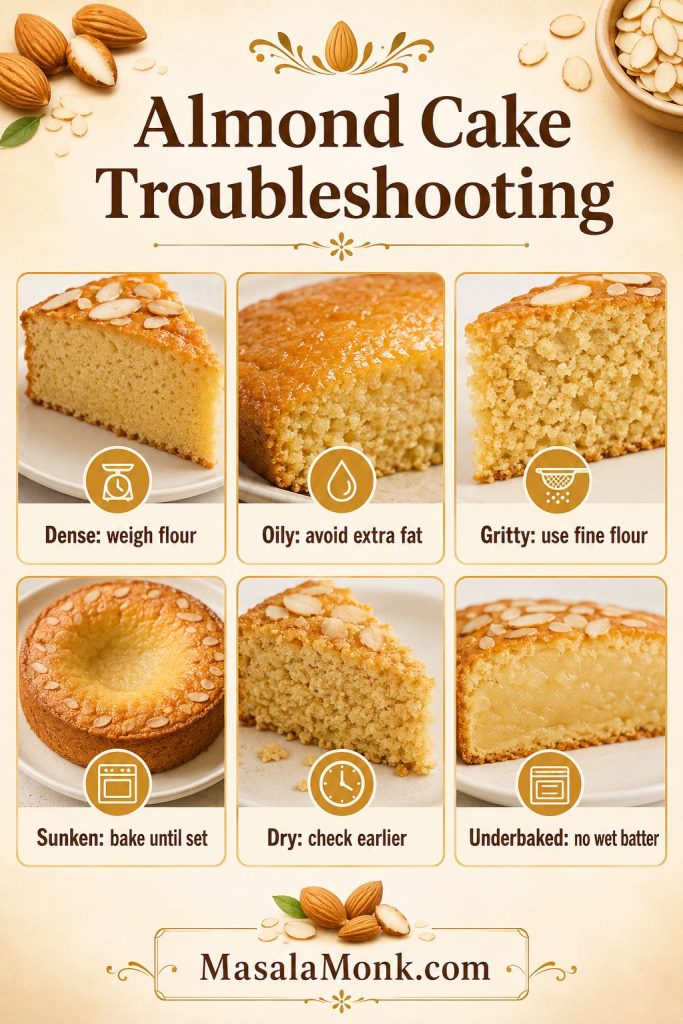
Almond cake troubleshooting board showing dense, oily, gritty, sunken, dry, and underbaked cake problems with fixes.
When almond cake fails, start with the basics first: flour weight, egg-white structure, pan heat, bake time, and cooling before slicing.

Fix-now mindset: if the cake is already baked, cool it fully, dust with powdered sugar, serve with yogurt or cream, or cut smaller slices. For the next bake, focus on flour weight, egg whites, pan size, oven heat, and cooling time.

Texture Problems: Dense, Oily, Gritty, or Dry Almond Cake

ProblemLikely reasonFix nowFix next time
Cake is denseToo much almond flour, deflated whites, or overmixed batter.Serve thin slices with cream, yogurt, or berries.Weigh the flour, whip whites to soft peaks, and fold gently.
Cake is oilyCoarse/oily almond flour, packed flour, or too much added fat.Chill briefly and serve small slices.Use fresh fine almond flour and avoid extra oil in the base recipe.
Cake is grittyCoarse almond meal or clumpy almond powder.Serve with whipped cream or yogurt to soften the bite.Use fine blanched almond flour or sift almond powder before mixing.
Cake is dryOverbaked, too wide a pan, or fan oven too hot.Serve with yogurt, cream, honey, or fruit.Check earlier, use an 8-inch pan, and reduce fan oven temperature.
Cake smells eggySlightly underbaked, weak flavor balance, or served too warm.Cool fully and serve with citrus or cream.Bake fully, use zest and vanilla, and cool before serving.
Cake tastes bitterToo much almond extract, citrus pith, old almond flour, or burnt sliced almonds.Serve with sweetened cream or powdered sugar.Use only 1/4 teaspoon almond extract, zest lightly, and tent the top if needed.

Baking and Cooling Problems: Sunken, Raw, Cracked, or Stuck Cake

ProblemLikely reasonFix nowFix next time
Center sankUnderbaked center, early oven opening, or overmixed batter.Dust with powdered sugar or cover with berries.Bake until the middle is set and avoid opening the oven too soon.
Edges browned but center stayed rawPan too thin, oven too hot, or cake baked too high in the oven.Return to oven loosely covered with foil if still very wet.Use a sturdy pan, bake on the middle rack, and tent with foil if needed.
Almond slices burnedOven runs hot or cake was baked too high.Brush off the darkest almonds before serving.Bake on the middle rack and tent once the top is golden.
Top crackedOven heat was strong or batter rose quickly.Dust with powdered sugar; a small crack is normal.Use the correct temperature and avoid overbeating the whites.
Cake is too flatWide pan, deflated whites, or old baking powder.Serve as a thin tea cake.Use an 8-inch pan, fresh baking powder, and fold gently.
Cake stuck to the panNo parchment or cake was removed too hot.Serve rustic pieces with cream or fruit.Line the base with parchment and cool 15 minutes before removing.
Bottom feels wetUnderbaked, cooled too long in the pan, or stored before fully cool.Let slices air out briefly before serving.Bake until set, cool 15 minutes in pan, then move to a wire rack.

FAQs About Almond Cake

Is almond cake the same as almond flour cake?

Often, yes. In this recipe, almond cake means a cake made mainly with almond flour instead of wheat flour. Some bakery-style almond cakes use wheat flour and almond extract, so they have a different texture.

Almond meal instead of almond flour: what changes?

Use the same weight of almond meal, but expect a darker, nuttier, more rustic cake. Fine blanched almond flour gives the most delicate result.

Is almond powder the same as almond flour?

Sometimes. Plain finely ground almonds can work. Sweetened badam drink mix, malted almond powder, or milk-powder blends should not be used for this cake.

Is this almond cake gluten-free?

It is naturally gluten-free if every ingredient is gluten-free. Check baking powder, extracts, toppings, and cross-contact if you are baking for someone with strict gluten-free needs. The Celiac Disease Foundation’s gluten-free foods guide is a helpful reference.

Why did my almond cake sink in the middle?

The center was likely underbaked, the oven was opened too early, or the egg whites deflated during mixing. Bake until the middle feels set and the toothpick shows moist crumbs, not wet batter.

Why is my almond cake oily?

Almond flour contains natural fat, so the cake can feel oily if the flour is packed, the almond meal is coarse, or extra fat is added. Use fresh fine almond flour, avoid extra oil in the base recipe, and measure by weight when possible.

Why eggs matter in this almond flour cake

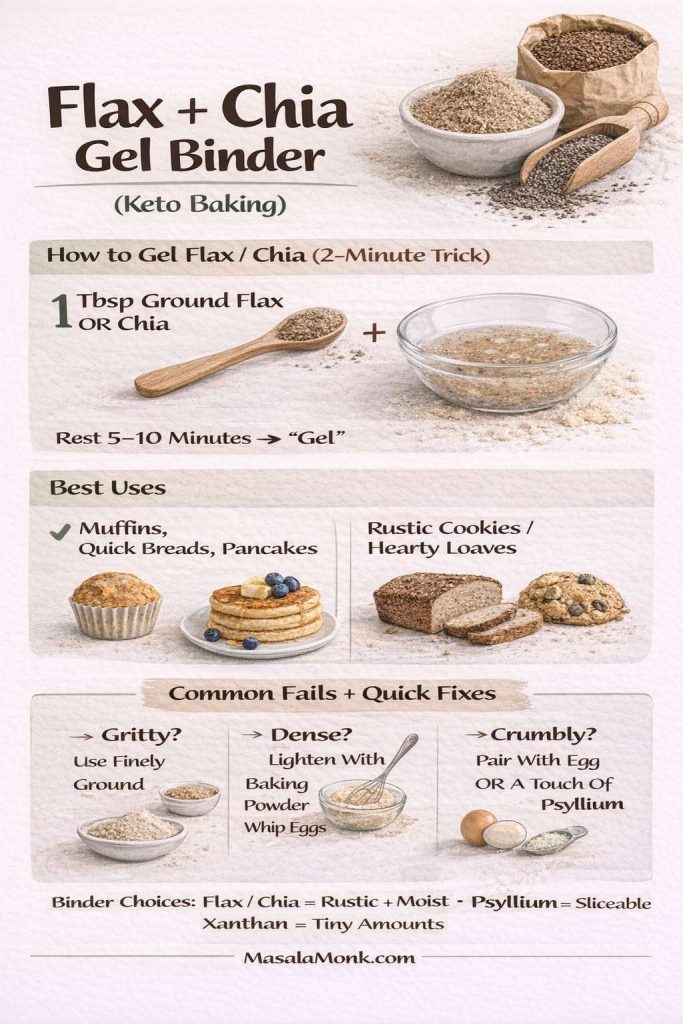
Eggs are doing the structure work here. They help the almond flour batter lift, set, and hold a clean slice. That is why a flax, chia, or yogurt swap will not behave the same way.

How to turn this into orange almond cake

Use orange zest instead of lemon zest for a simple orange almond cake. You can also drizzle the cooled cake with a light orange glaze. A whole-orange almond cake is a different recipe with a longer bake time.

Best pan size if you do not have an 8-inch pan

A 9-inch pan works, but the cake will be thinner and bake faster. Start checking around 23 minutes and remove it when the center is set.

Freezing almond cake without drying it out

Freeze the cake only after it has cooled completely. Slice it first, place parchment between the slices, and store airtight for up to 2 months.

Back to top

Final Notes

Once the cake has cooled, the reward is in its simplicity: a golden almond top, a clean slice, and a citrus-almond flavor that works with coffee, berries, cream, or nothing at all. It does not need frosting or complicated decoration to feel finished.

Give the batter a light hand, give the cake enough time to settle, and the result is a tender almond flour cake that feels special without trying too hard.
Posted on 2 Comments

Keto Cheesecake Recipe

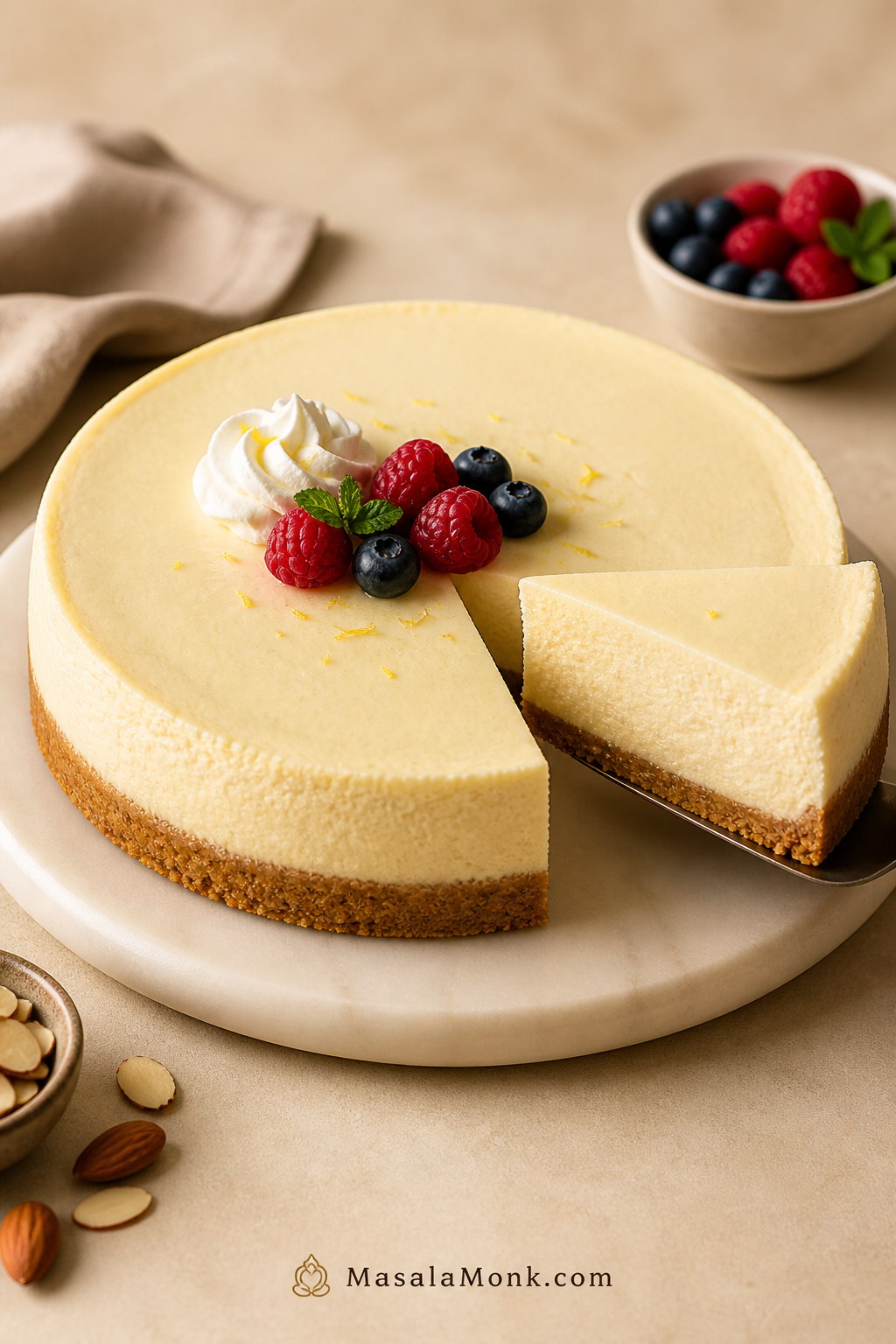
Finished keto cheesecake with one slice removed, showing creamy filling and a golden almond flour crust with berries nearby.

This keto cheesecake recipe gives you the kind of slice people actually want from cheesecake: cool, creamy, rich, smooth, and firm enough to cut cleanly. It has a buttery almond flour crust, a full-fat cream cheese filling, and a slow-cooling method that helps prevent cracks without needing a complicated water bath.

The flavor is classic first and keto second. You get the tang of cream cheese and sour cream, the warmth of vanilla, a little brightness from lemon juice, and a low-carb crust that feels much closer to a traditional cheesecake base than a dry “diet dessert” crust.

Use this as your classic baked cheesecake base. You will also find a crustless option, a no-bake option, sweetener guidance, pan-size help, storage tips, and fixes for common problems like cracks, grainy filling, soggy crust, and a runny center.

Quick Answer: The Best Keto Cheesecake Recipe

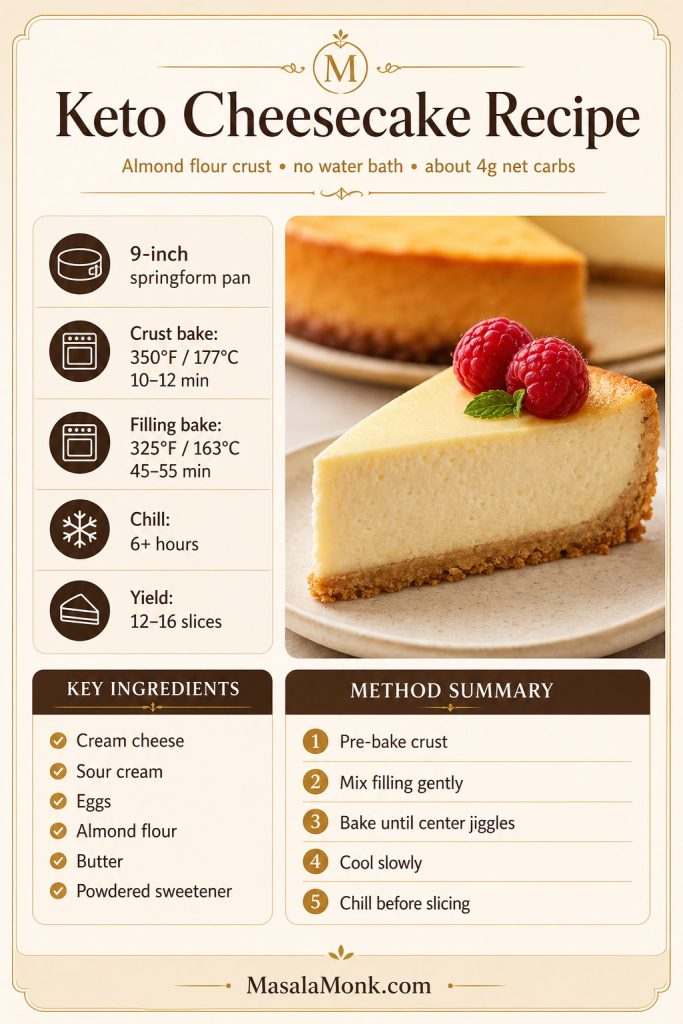
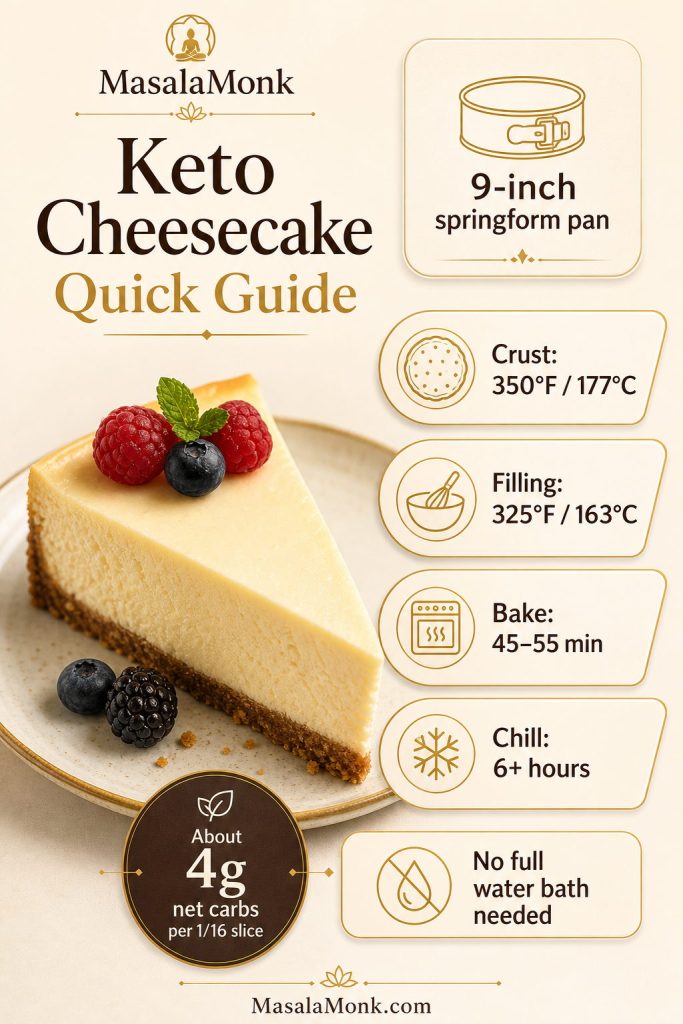
For the best keto cheesecake, make a baked full-fat cream cheese filling in a 9-inch springform pan with a pre-baked almond flour crust. Bake the crust at 350°F / 177°C for 10–12 minutes, then lower the oven to 325°F / 163°C and bake the cheesecake for 45–55 minutes, until the edges are set and the center still has a soft jiggle.

Let it cool slowly, then chill for at least 6 hours or overnight before slicing. A powdered allulose or monk fruit/allulose blend gives the smoothest texture because it dissolves better than coarse granulated sweeteners.

Pan 9-inch springform pan
Crust Almond flour crust
Crust Bake 350°F / 177°C for 10–12 minutes
Filling Bake 325°F / 163°C for 45–55 minutes
Chill Time 6 hours minimum, overnight best
Yield 12 generous or 16 smaller slices
Net Carbs About 4g per 1 of 16 slices
Water Bath Not required
Texture Cool, creamy, dense, and sliceable
Keto cheesecake quick guide showing a cheesecake slice with baking temperature, pan size, chill time, and net carb notes.
Start here if you want the main numbers before baking: pan size, oven temperature, chill time, and approximate net carbs all shape the final keto cheesecake texture.

Need the full formula? Jump to recipe card · Back to guide

Before you start: Soften the cream cheese fully, bring the eggs and sour cream to room temperature, line the springform pan with parchment, use powdered sweetener for the filling, and plan for at least 6 hours of chilling. These five details matter more than any fancy technique.
Texture tip: The cheesecake should not look fully firm when it comes out of the oven. If the center is completely set in the oven, it is more likely to be overbaked after chilling.

Why This Keto Cheesecake Works

A good keto cheesecake has to solve three problems at once: it needs to taste like classic cheesecake, avoid a gritty sweetener texture, and hold together without flour or sugar. This version uses full-fat brick cream cheese for structure, sour cream for a smooth tangy finish, eggs for setting, and powdered keto sweetener so the filling stays creamy.

The almond flour crust is pre-baked before the filling goes in. That gives it a warmer, nuttier flavor and helps it hold together under the cheesecake layer. The filling bakes low and slow at 325°F / 163°C, then cools gradually so the center can finish setting without a dramatic temperature shock.

That slow method is what makes this sugar free cheesecake more reliable. You do not need a full water bath, but you do need room-temperature ingredients, gentle mixing, and enough chill time.

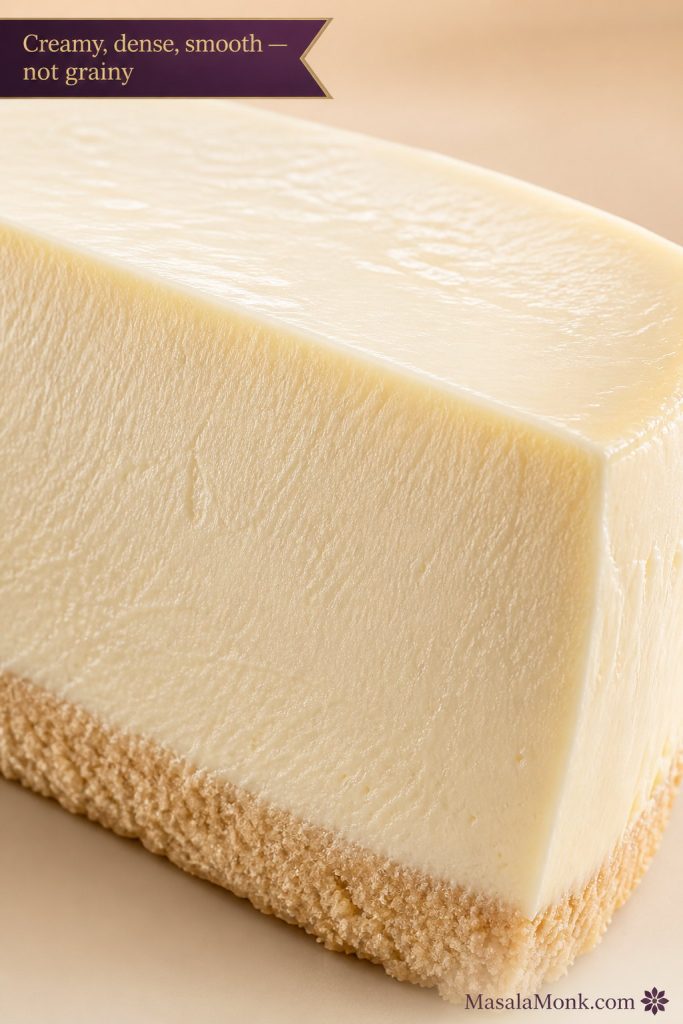
Close-up of a creamy keto cheesecake slice with smooth dense filling and a visible almond flour crust.
This is the texture goal: creamy, dense, and cleanly cut. If the filling looks grainy, the issue usually starts with cold cream cheese or coarse sweetener.

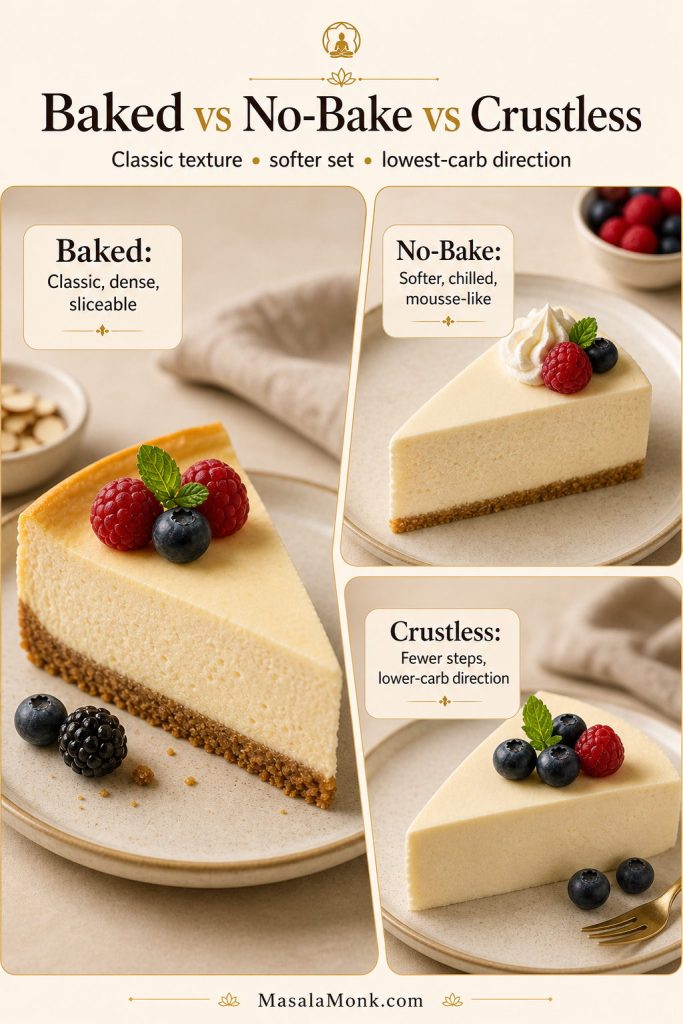
Baked vs No-Bake vs Crustless Versions

Before you start, choose the right style. A baked cheesecake gives the most classic texture, a no-bake version is easier and lighter, and a crustless cheesecake is the simplest way to reduce carbs and skip the almond flour crust.

Comparison board showing baked keto cheesecake, no-bake keto cheesecake, and crustless keto cheesecake slices with texture notes.
Before choosing a method, decide what texture you want. Baked keto cheesecake is classic, no-bake cheesecake is softer, and crustless cheesecake keeps things simpler.
Version Best For Texture Main Watch-Out
Baked keto cheesecake Classic cheesecake flavor and clean slices Dense, creamy, rich Do not overbake; cool slowly to prevent cracks
No-bake keto cheesecake Easy summer dessert or oven-free prep Lighter, softer, mousse-like Needs enough chill time to set properly
Crustless keto cheesecake Lower carbs, fewer steps, no almond flour Creamy and simple Pan lining matters so it releases cleanly

The baked version is the focus here because it gives the most traditional cheesecake texture. The crustless and no-bake sections below show how to adapt the base without turning the main recipe into three different desserts at once.

Is Keto Cheesecake Low Carb or No Carb?

Keto cheesecake is low carb, but it is usually not truly zero carb. Cream cheese, sour cream, eggs, almond flour, lemon juice, and even some keto sweeteners can contribute small amounts of total carbs depending on the brands you use.

Think of this as a low carb cheesecake or sugar free cheesecake, not a misleading zero-carb dessert. If you want the lowest-carb version, make the crustless option and cut the cheesecake into 16 smaller slices. That gives you the creamy filling with fewer carbs from the almond flour crust.

Lowest-carb direction: Make it crustless, use a powdered sweetener that fits your carb target, and keep toppings simple. Fresh berries are usually a better choice than thick sauces if you are watching carbs closely.

If you like make-ahead low-carb desserts, this keto chia pudding with almond milk is another easy no-sugar option with simple net-carb math.

Equipment You Need

You do not need complicated bakery equipment, but a few tools make this cheesecake much easier and cleaner.

  • 9-inch springform pan: The best standard size for this recipe.
  • Parchment paper: Helps the crust release and makes slicing easier.
  • Mixing bowls: One for the crust and one large bowl for the filling.
  • Hand mixer or stand mixer: Helps make the filling smooth without lumps.
  • Rubber spatula: Useful for scraping the bowl and smoothing the top.
  • Flat-bottom cup or measuring cup: Presses the almond flour crust firmly into the pan.
  • Baking sheet: Makes the springform pan easier to move in and out of the oven.
  • Sharp knife: For clean slices after the cheesecake is fully chilled.
Optional but helpful: Place a pan of hot water on the lower oven rack while the cheesecake bakes. This is not a full water bath, but it adds a little humidity and can help the cheesecake bake more gently.

Ingredients for Keto Cheesecake

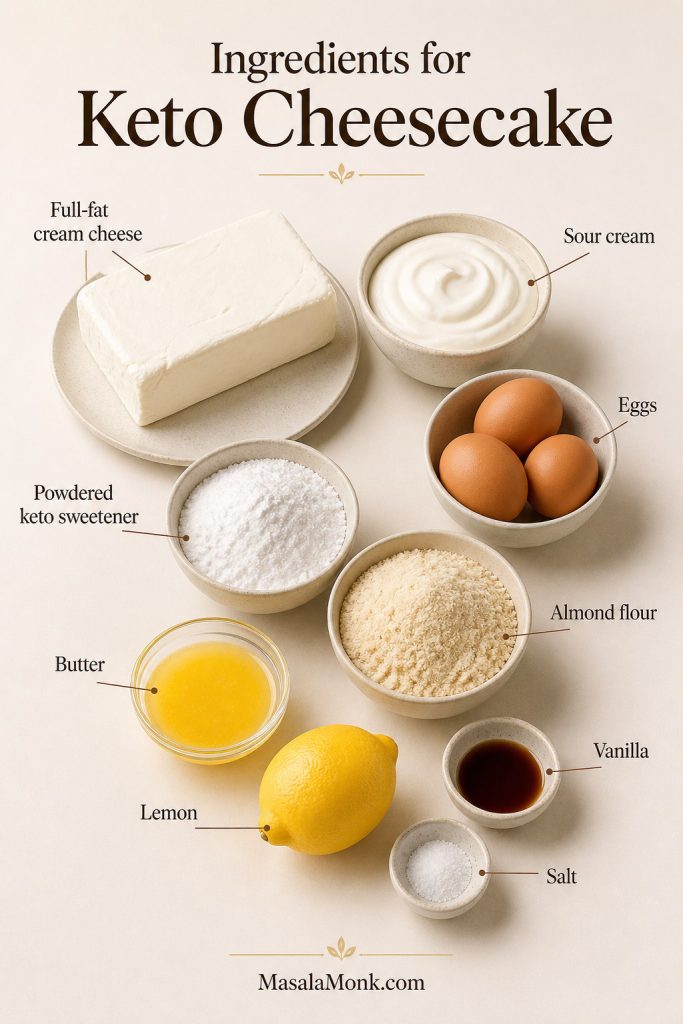
The ingredient list is simple, but the details matter. For the smoothest low carb cheesecake, use full-fat dairy, room-temperature ingredients, almond flour for the crust, and a powdered sweetener rather than a coarse granulated one.

Labeled keto cheesecake ingredients including cream cheese, sour cream, eggs, powdered sweetener, almond flour, butter, lemon, vanilla, and salt.
Keto cheesecake uses simple ingredients, but they need to behave well together. Therefore, full-fat dairy, powdered sweetener, and room-temperature eggs matter more than extra add-ins.

Next step: choose sweetener · make the crust

Cream Cheese

Use 32 oz / 907 g full-fat brick cream cheese, softened to room temperature. Brick-style cream cheese gives the cheesecake body and structure. Tub-style spreadable cream cheese is usually softer and can make the filling looser.

The cream cheese should be soft enough to beat smoothly, but not melted or oily. If it is too cold, the filling can turn lumpy. If it is too warm, the batter can become loose and overmixed.

Sour Cream

Sour cream adds a classic tang and softens the richness of the cream cheese. Use 1/2 cup / 120 g sour cream at room temperature. Full-fat sour cream works best here because low-fat versions can make the texture thinner and less creamy.

Eggs

Use 3 large eggs, also at room temperature. Eggs help the cheesecake set, but they should be mixed in gently. Once the eggs go in, do not whip the batter aggressively. Too much air can make the cheesecake puff up in the oven and crack as it cools.

Sweetener

Use 1 cup to 1 1/4 cups powdered keto sweetener. The exact amount depends on how sweet you like cheesecake and how sweet your specific sweetener tastes. A powdered allulose or monk fruit/allulose blend gives the smoothest texture.

If you use a strong erythritol-heavy sweetener, the cheesecake may have a cooling finish. If you use a coarse granulated sweetener, the filling can taste slightly grainy.

Lemon Juice, Vanilla, and Salt

Fresh lemon juice brightens the filling and makes the cheesecake taste more classic. Vanilla rounds out the sweetness, while salt keeps the flavor from tasting flat.

  • Lemon juice: 1 tablespoon fresh lemon juice
  • Vanilla extract: 2 teaspoons
  • Fine salt: 1/4 teaspoon

Best Sweetener for a Smooth Cheesecake Filling

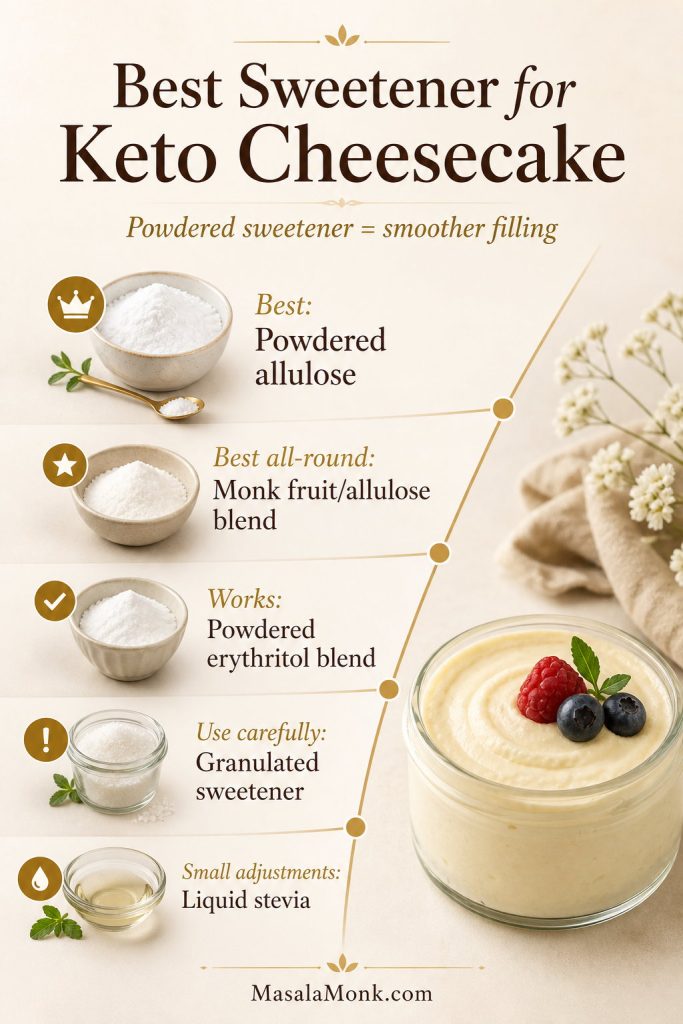
The best sweetener for keto cheesecake is one that dissolves smoothly and does not leave the filling gritty. Powdered sweetener is usually better than granulated sweetener for the filling because it blends more evenly into the cream cheese. For a broader baking overview, this low-carb baking guide explains why ingredient choice can affect texture, browning, and aftertaste.

The sweetener matters even more after chilling. Some erythritol-heavy blends can recrystallize in cold desserts, which is why a cheesecake may taste smooth on day one but slightly gritty after a night in the fridge.

Keto cheesecake sweetener guide comparing powdered allulose, monk fruit allulose blend, erythritol blend, granulated sweetener, and liquid stevia.
The best sweetener for keto cheesecake is not only about sweetness. Powdered allulose or a monk fruit/allulose blend helps the filling stay smoother after chilling.

Using the right sweetener? Continue to crust · fix grainy texture

Sweetener Best Use What to Know
Powdered allulose Smoothest filling texture Less likely to taste grainy; may brown slightly faster in some baked goods
Powdered monk fruit/allulose blend Best all-round choice Good sweetness and smooth texture when powdered
Powdered erythritol blend Works if you like the taste Can leave a cooling effect or slight crystallized texture
Granulated keto sweetener Better for crust than filling Can make the filling grainy unless blended very well
Liquid stevia Small sweetness adjustment Does not add bulk; too much can taste bitter
Best choice for this recipe: Use powdered allulose or a powdered monk fruit/allulose blend in the filling. For the crust, powdered or finely granulated keto sweetener both work.

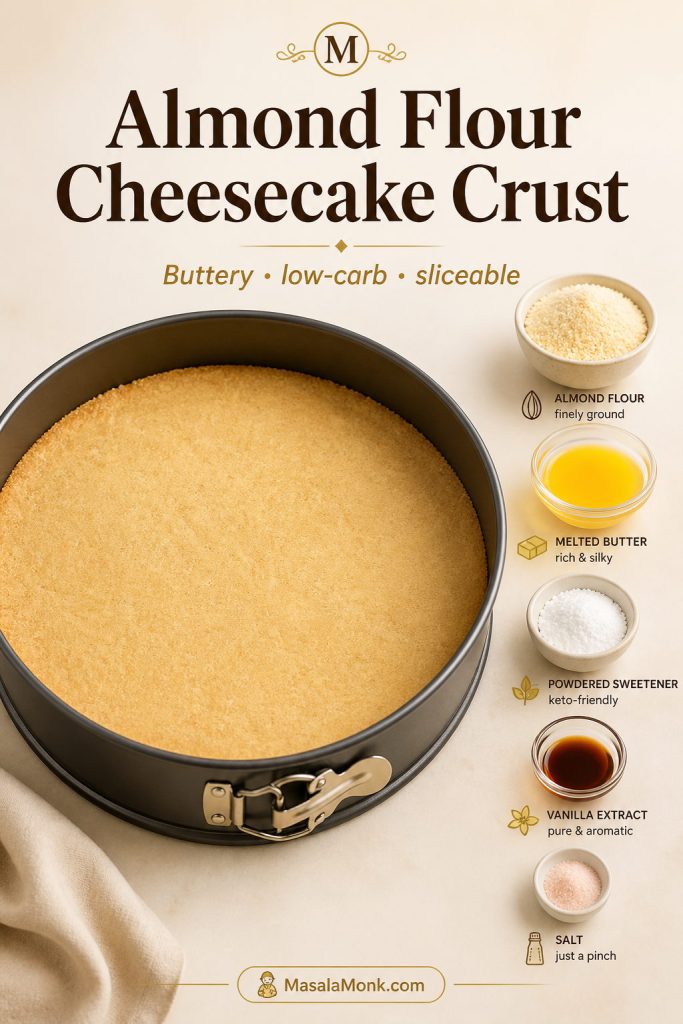
Almond Flour Cheesecake Crust

The almond flour cheesecake crust is one of the most important parts of this recipe. A good cheesecake crust with almond flour should still taste buttery, hold together under the filling, and slice cleanly after chilling.

It replaces the usual graham cracker crust with a gluten-free, low-carb base that still feels like a real cheesecake crust.

Pressed almond flour cheesecake crust in a springform pan with almond flour, melted butter, powdered sweetener, vanilla, and salt.
A good almond flour cheesecake crust should feel compact before it goes into the oven. Pressing firmly helps the low-carb crust bake into a sliceable base.

Need sizing help? See crust ratios · continue to method

For the crust, use:

  • 2 cups / about 224 g blanched almond flour
  • 1/3 cup / 75 g unsalted butter, melted
  • 2 tablespoons powdered keto sweetener
  • 1 teaspoon vanilla extract
  • 1/4 teaspoon fine salt

Mix everything until the almond flour looks evenly moistened. It should feel like damp sand and hold together when pressed. Press it firmly into the bottom of a parchment-lined 9-inch springform pan, then bake at 350°F / 177°C for 10–12 minutes, until lightly golden and fragrant.

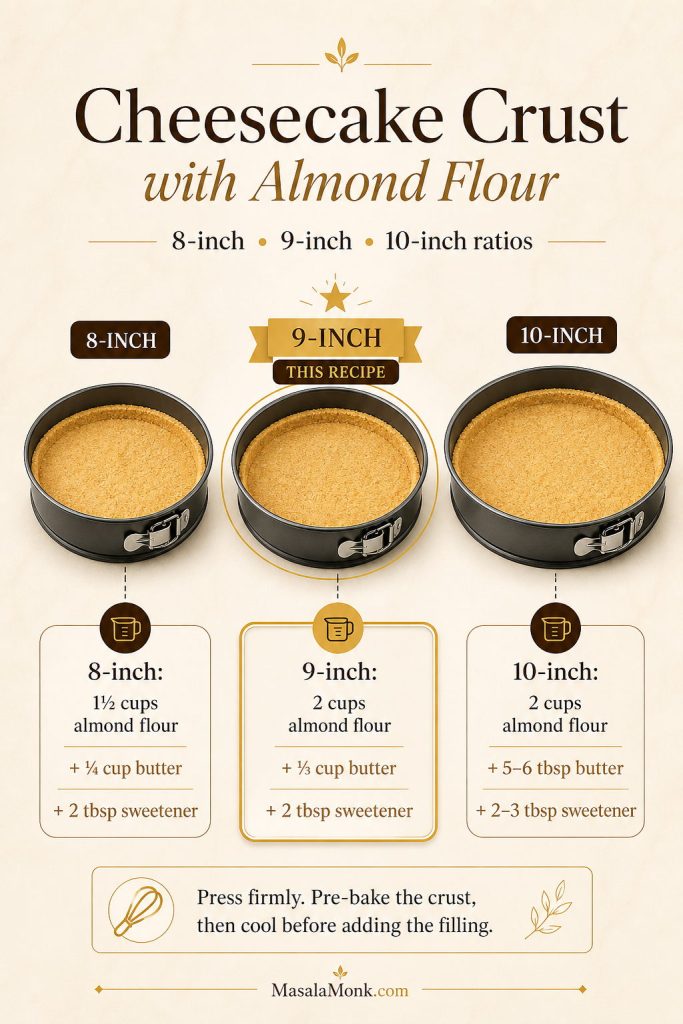
Almond Flour Crust Ratio Guide

The same almond flour cheesecake crust does not behave the same in every pan. A smaller pan makes the crust feel thicker, while a wider pan spreads the mixture thinner and may need a little more butter to stay sliceable.

Use the 9-inch ratio for this keto cheesecake recipe as written. If you change pan size, press the crust firmly, pre-bake it until lightly golden, and let it cool before adding the filling.

Pan Size Almond Flour Butter Sweetener Best Use
8-inch 1 1/2 cups / about 168 g 1/4 cup / 57 g 2 tbsp Thicker cheesecake or smaller batch
9-inch 2 cups / about 224 g 1/3 cup / 75 g 2 tbsp This recipe as written
10-inch 2 cups / about 224 g 5–6 tbsp / 70–85 g 2–3 tbsp Thinner, wider cheesecake
Almond flour cheesecake crust ratio guide for 8-inch, 9-inch, and 10-inch pans with butter and sweetener amounts.
When making cheesecake crust with almond flour, pan size changes everything. As a result, the right butter-to-flour ratio keeps the crust from turning greasy or crumbly.

Crust ready? check pan size · start the method

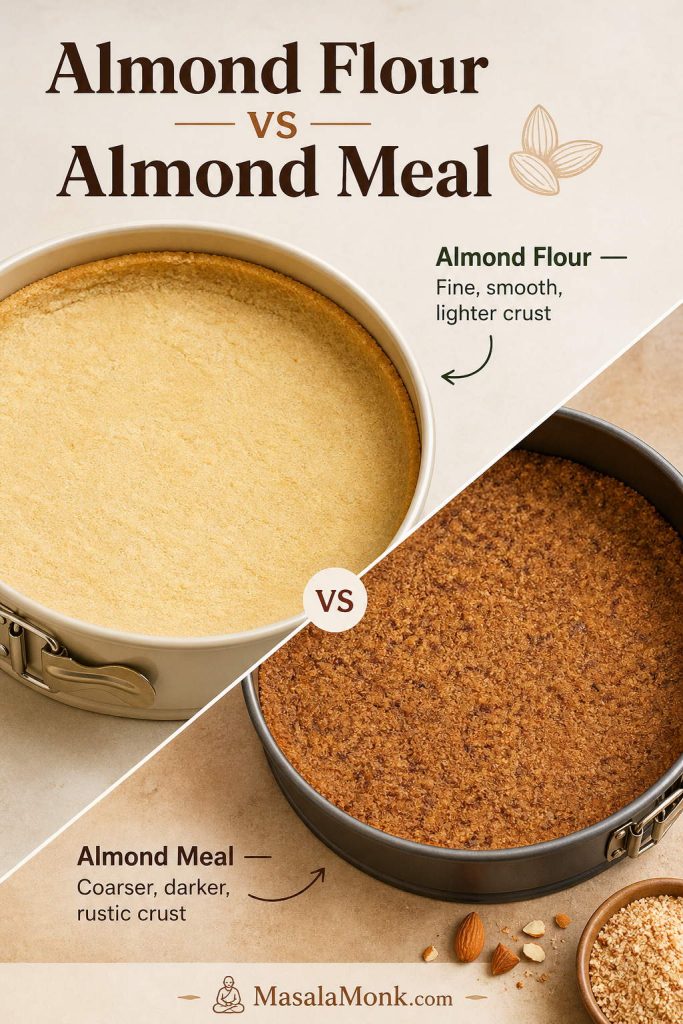
Almond Flour vs Almond Meal

Blanched almond flour gives the neatest crust because it is finer and lighter. Almond meal can work, but it is usually coarser and may make the crust more rustic or crumbly. For a smooth, classic cheesecake look, use fine blanched almond flour.

If you are searching for an almond meal crust for cheesecake, the same basic idea works, but the texture will be darker, coarser, and more rustic. Fine blanched almond flour gives a smoother shortbread-style crust, while almond meal gives a nuttier, more graham-cracker-like look.

Comparison of almond flour cheesecake crust and almond meal cheesecake crust, showing a smoother lighter crust and a darker coarser crust.
Almond flour and almond meal are not identical in cheesecake crust. Almond flour gives a smoother finish, while almond meal creates a darker, more rustic bite.

Chosen your flour? Check crust ratios · jump to recipe

How to Keep the Crust from Crumbling

A crumbly keto cheesecake crust usually means one of three things: not enough butter, not enough pressing, or not enough baking. The crust should be pressed firmly with the bottom of a cup, especially around the edges. After baking, let it cool for a few minutes before adding the filling.

If the crust still seems loose, add 1 extra tablespoon melted butter next time. If it seems greasy, reduce the butter slightly or bake the crust a minute or two longer.

How to Avoid a Soggy Almond Flour Crust

Pre-baking is the easiest fix. A lightly golden crust holds up better under the filling than a raw almond flour crust. You should also avoid pouring very warm or loose filling onto the crust. The cream cheese filling should be smooth and room temperature, not runny.

Cheesecake Crust Without Almond Flour

You can make the crust without almond flour, but do not swap coconut flour 1:1. Coconut flour absorbs much more liquid and will make the crust dry and dense if used in the same amount.

For a nut-free direction, use a tested sunflower seed flour crust or skip the crust completely and make the crustless option below.

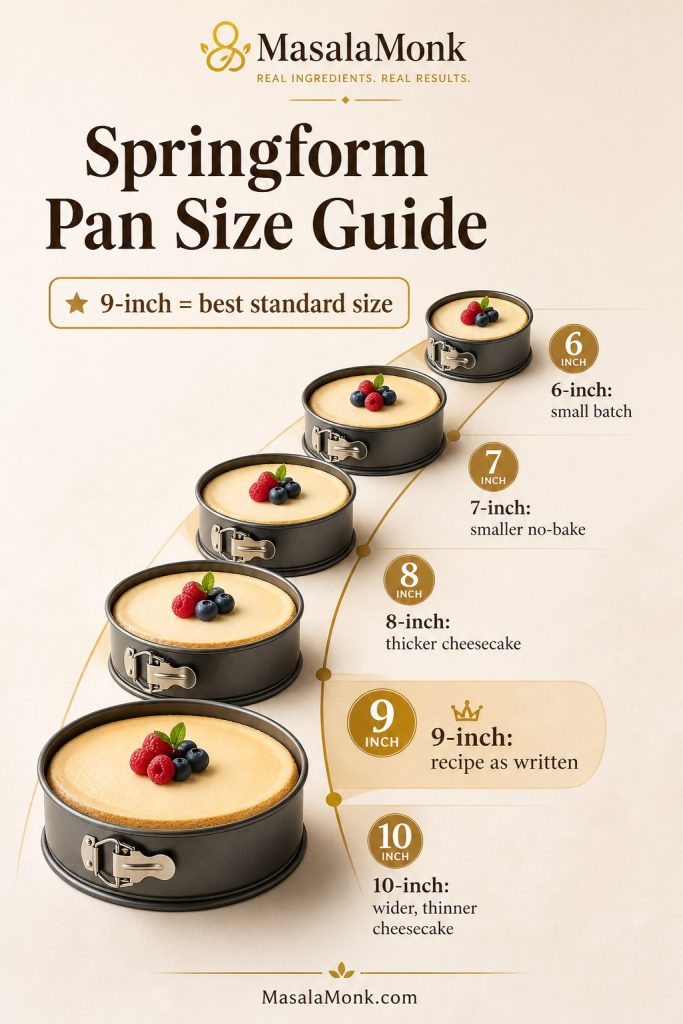
Springform Pan Size Guide

This recipe is designed for a 9-inch springform pan. Different pan sizes change the height, bake time, and texture, so use the table below if you need to adjust.

Springform pan size guide for keto cheesecake showing 6-inch, 7-inch, 8-inch, 9-inch, and 10-inch pan options.
A 9-inch springform pan is the safest standard for this keto cheesecake recipe. Smaller pans create more height, while larger pans bake thinner and faster.

Using a 9-inch pan? Start baking · see exact recipe

Pan Size Best Use What Changes
6-inch Small batch or shortcut cheesecake Use a scaled-down recipe; bake time will be shorter
7-inch Taller no-bake cheesecake Works well for smaller no-bake versions
8-inch Thicker baked cheesecake May need a little more bake time because the filling is deeper
9-inch Best standard size Use the recipe as written
10-inch Wider, slightly thinner cheesecake May bake faster; watch the center jiggle carefully

How to Make Keto Cheesecake

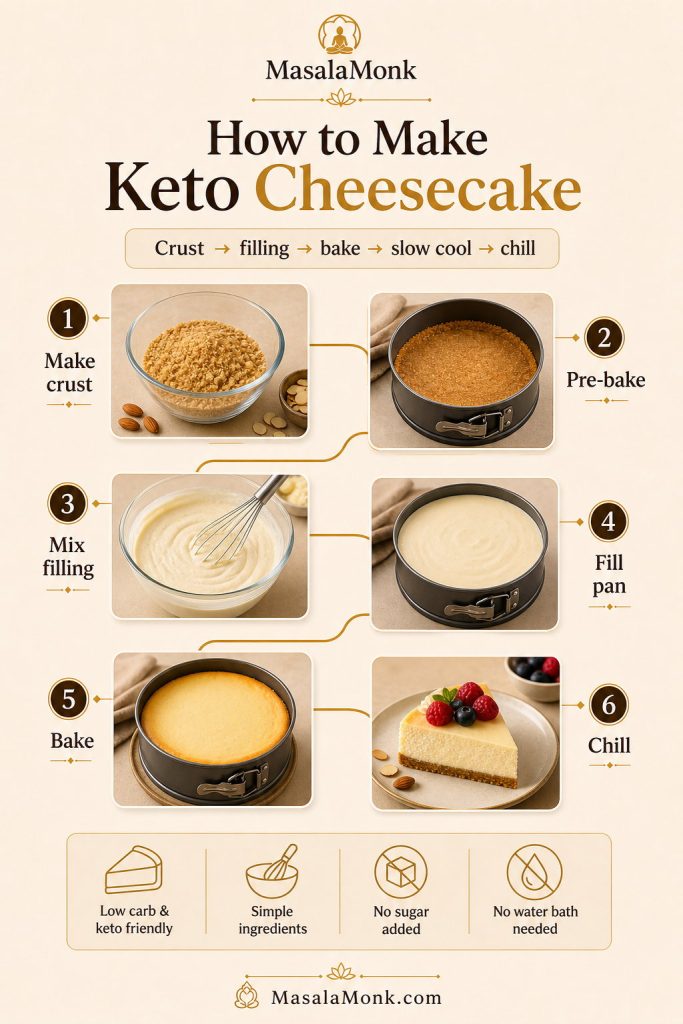
The method is simple, but the order matters. Make the crust first, reduce the oven temperature, mix the filling gently, then cool the cheesecake slowly.

Step-by-step keto cheesecake guide showing crust mixing, pre-baking, filling, baking, cooling, and chilling.
The best keto cheesecake method is not rushed. First build the crust, then mix the filling gently, bake until softly set, cool slowly, and chill before slicing.

Mixing the filling? check texture cues · see doneness

Step 1: Prepare the Pan

Line the bottom of a 9-inch springform pan with parchment paper. Lightly grease the sides. If your springform pan is older or tends to leak butter, place it on a baking sheet before it goes into the oven.

Step 2: Make the Almond Flour Crust

In a bowl, stir together almond flour, melted butter, sweetener, vanilla, and salt. The mixture should look like damp crumbs. Press it firmly into the bottom of the prepared pan. Use a flat-bottom cup to compact it evenly.

Bake the crust at 350°F / 177°C for 10–12 minutes, until it smells nutty and looks lightly golden at the edges. Remove it from the oven and let it cool slightly while you make the filling.

Step 3: Mix the Cheesecake Filling

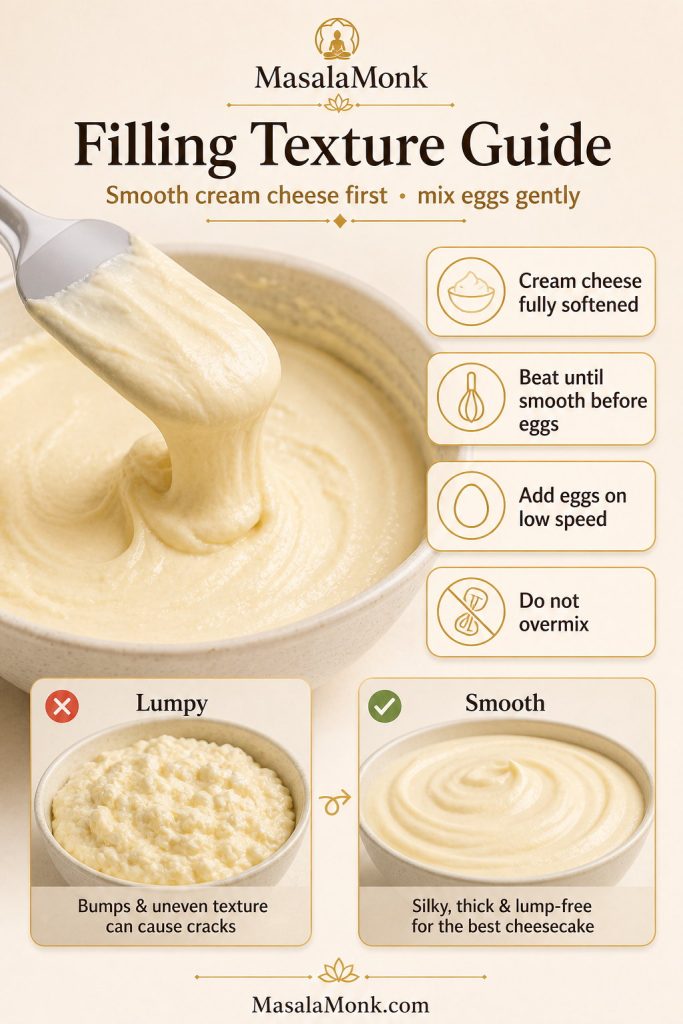
Lower the oven to 325°F / 163°C. Beat the softened cream cheese on medium-low speed until smooth. Add the powdered sweetener and beat again until combined. Scrape the bowl well so no dense pockets of cream cheese remain.

Add the sour cream, lemon juice, vanilla, and salt. Mix until smooth. Add the eggs one at a time, mixing on low speed just until each egg disappears into the batter.

Keto cheesecake filling texture guide showing smooth batter, lumpy filling, and reminders to soften cream cheese and mix eggs gently.
Smooth cheesecake filling starts before the eggs are added. Once the cream cheese is fully beaten, switch to gentle mixing so the batter does not trap excess air.

Ready to bake? check doneness · avoid cracks

Do not overmix after adding eggs. Extra air can make the cheesecake rise too much in the oven and crack as it cools.

Step 4: Fill the Pan

Pour the filling over the cooled almond flour crust. Smooth the top with a spatula. Tap the pan gently on the counter once or twice to release large air bubbles, but do not bang it aggressively.

Step 5: Bake Low and Slow

Bake at 325°F / 163°C for 45–55 minutes. The edges should look set and slightly puffed, while the center should still wobble gently when the pan is nudged.

If the center looks liquid and sloshes, bake for another 5 minutes and check again. If the entire cheesecake looks fully firm in the oven, it is likely overbaked.

Step 6: Cool Slowly

Turn off the oven. Crack the oven door open and leave the cheesecake inside for 20–30 minutes. Then move it to the counter and let it cool to room temperature.

Once cool, cover and refrigerate for at least 6 hours. Overnight chilling gives the cleanest slices and best texture.

How to Know When the Cheesecake Is Done

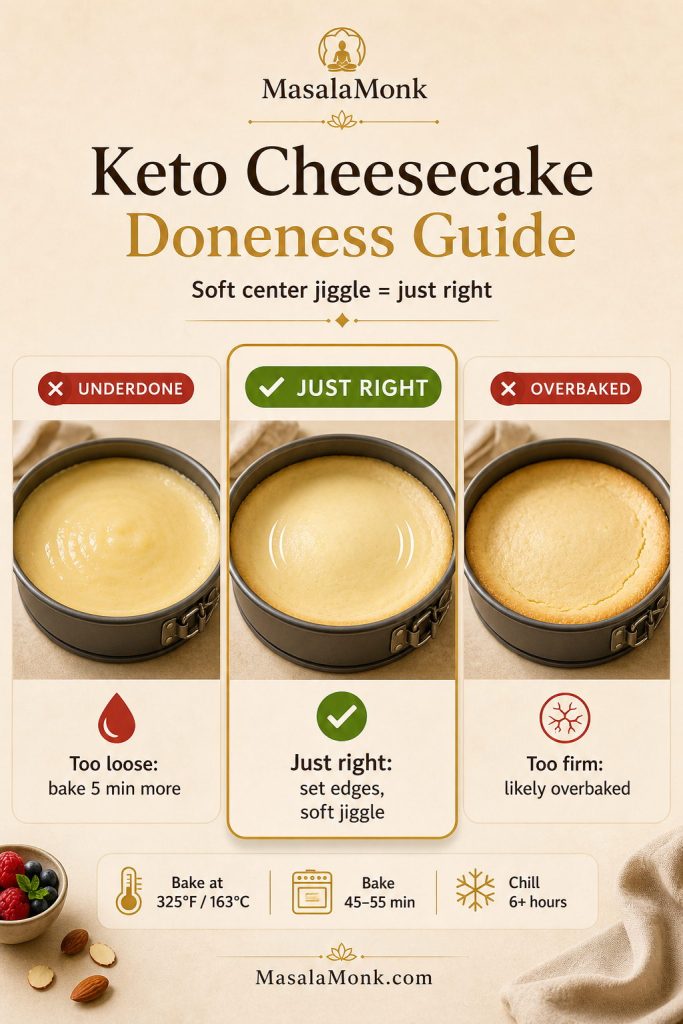
The most reliable doneness cue is the jiggle test. The outer 2–3 inches should look set, while the center should still wobble like soft gelatin. It should not look wet, soupy, or liquid, but it should not be completely firm either.

Cheesecake keeps setting as it cools. That is why a slightly jiggly center is correct. If you bake until the center is completely firm, the final chilled cheesecake can turn dense, dry, or cracked.

Doneness guide showing underbaked, just right, and overbaked keto cheesecake centers with a soft jiggle cue.
A softly jiggly center is not a mistake. Instead, it means the cheesecake can finish setting as it cools, which helps prevent a dry or cracked texture.

Center still jiggly? cool without cracks · store it right

What You See What It Means What to Do
Edges set, center softly jiggles Done Turn off oven and begin slow cooling
Center sloshes like liquid Underdone Bake 5 more minutes, then check again
Top is puffed and fully firm Likely overbaked Cool slowly; serve with topping if cracked
Top has deep cracks before cooling Too much heat, air, or bake time Use troubleshooting tips next time

How to Prevent Cracks

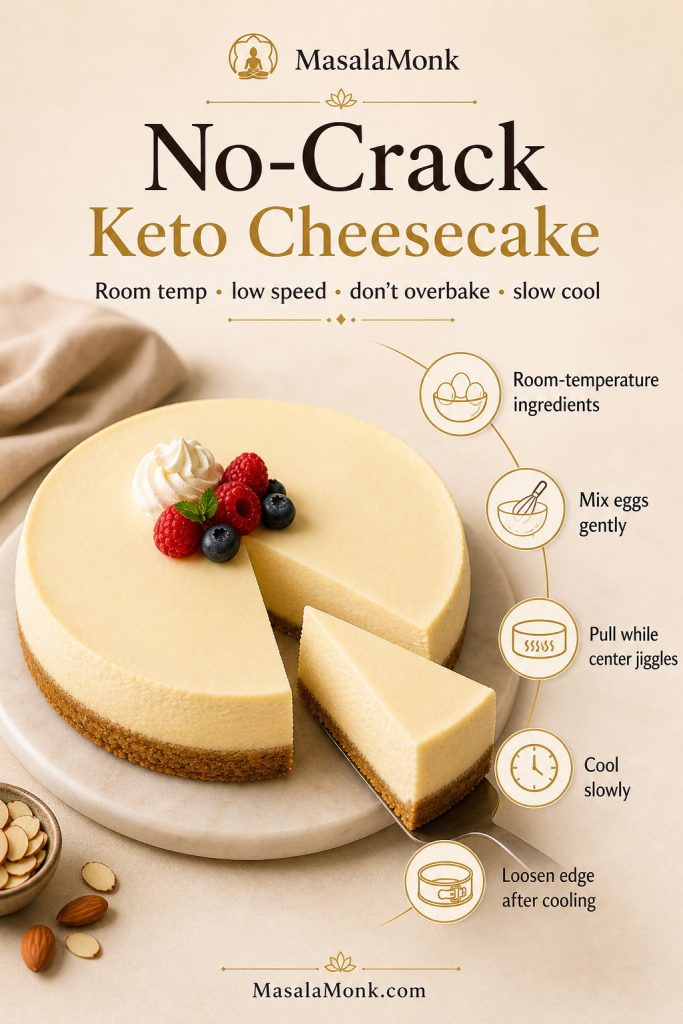
Cracks do not ruin cheesecake, but they are easy to reduce. Most cracks come from cold ingredients, overmixing, overbaking, or cooling too quickly.

  • Use room-temperature ingredients: Cold cream cheese creates lumps, and cold eggs can make the batter harder to mix evenly.
  • Mix gently after adding eggs: Eggs trap air quickly. Too much air makes the cheesecake puff and collapse.
  • Do not overbake: The center should still jiggle softly when the cheesecake comes out.
  • Cool gradually: Leave the cheesecake in the turned-off oven with the door cracked before moving it to the counter.
  • Loosen the edge: After cooling slightly, run a thin knife around the edge so the cheesecake does not pull against the pan as it contracts.
No-crack keto cheesecake guide with a smooth cheesecake top and tips for room-temperature ingredients, low-speed mixing, and slow cooling.
No-crack keto cheesecake depends on temperature control. Room-temperature ingredients, low-speed mixing, and slow cooling give the filling a better chance to settle evenly.

Want extra insurance? compare water bath options · fix common issues

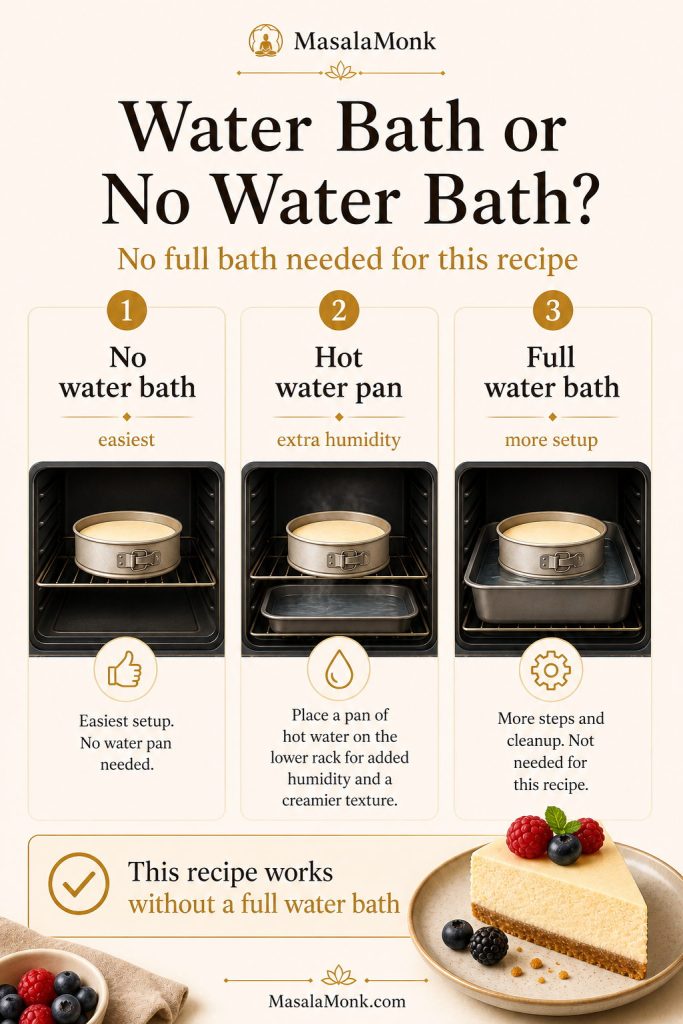
No water bath required: This recipe is written to work without a full water bath. If your oven runs hot or you want extra insurance, place a pan of hot water on the lower rack for gentle humidity.

Water Bath or No Water Bath?

You do not need a full water bath for this keto cheesecake recipe. The slow bake at 325°F / 163°C, room-temperature ingredients, gentle mixing, and gradual cooling are enough for a smooth cheesecake in most ovens.

A full water bath can help cheesecakes bake gently, but it also adds extra steps and can leak into a springform pan if the wrapping is not secure. King Arthur Baking explains that a water bath can help reduce cracks, but for this recipe the easier option is to place a pan of hot water on the lower oven rack. It adds a little humidity without putting the cheesecake pan directly in water.

Water bath comparison for keto cheesecake showing no water bath, hot water pan, and full water bath baking setups.
You can make this keto cheesecake without a full water bath. However, a hot water pan on the lower rack can add humidity if your oven tends to run dry.

No full bath needed? Use the recipe card · check doneness cues

Method Best For Downside
No water bath Simplest method; works well with slow cooling Needs careful bake time and cooling
Pan of hot water on lower rack Easy extra insurance against drying Still not a guarantee if the cheesecake is overbaked
Full water bath Very gentle baking More setup; springform pans can leak

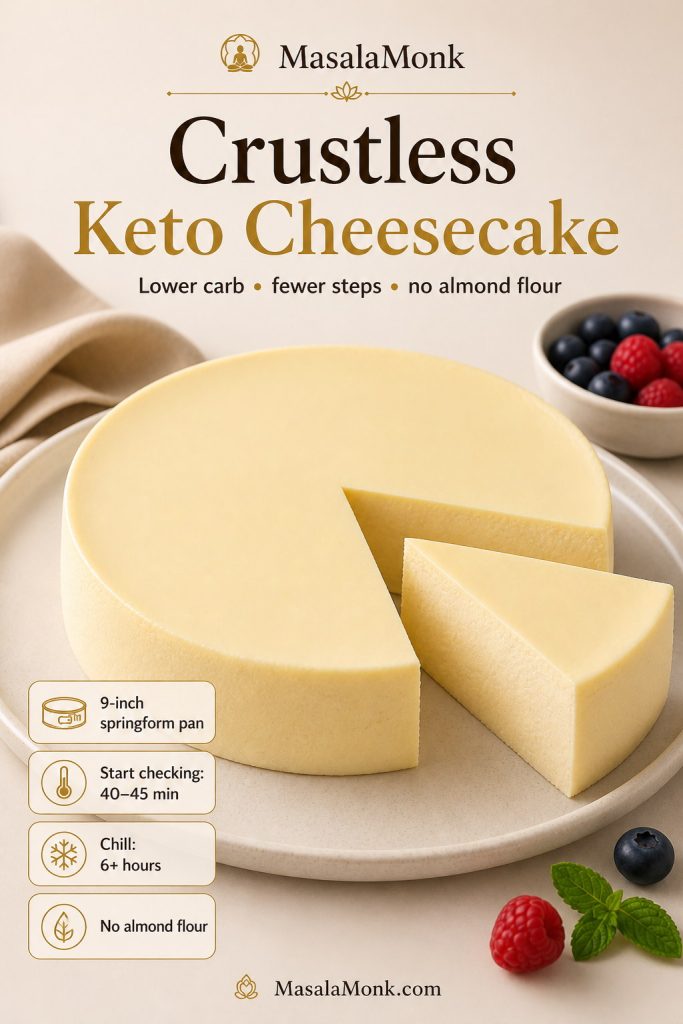
Crustless Keto Cheesecake Option

You can make this cheesecake without the almond flour crust. A crustless keto cheesecake is slightly lower in carbs, simpler to prepare, and useful if you are avoiding nuts.

To make it crustless, skip the crust ingredients and line the bottom of the springform pan with parchment. Grease the sides well. Pour the filling directly into the pan and bake at 325°F / 163°C until the edges are set and the center still jiggles softly.

The bake time may be slightly shorter because there is no crust layer. Start checking around 40–45 minutes. Chill completely before slicing, because crustless cheesecake needs time to firm up for clean edges.

Crustless keto cheesecake with a clean slice removed, smooth filling, and notes for checking bake time and chilling.
Crustless keto cheesecake removes the almond flour base, so the pan matters more. Line it well, chill fully, and slice cold for the cleanest edges.

Skipping crust? adapt the recipe · chill and store properly

Best crustless tip: Do not skip the parchment. Without a crust, the filling sits directly against the pan, so lining and chilling are what help the slices release cleanly.

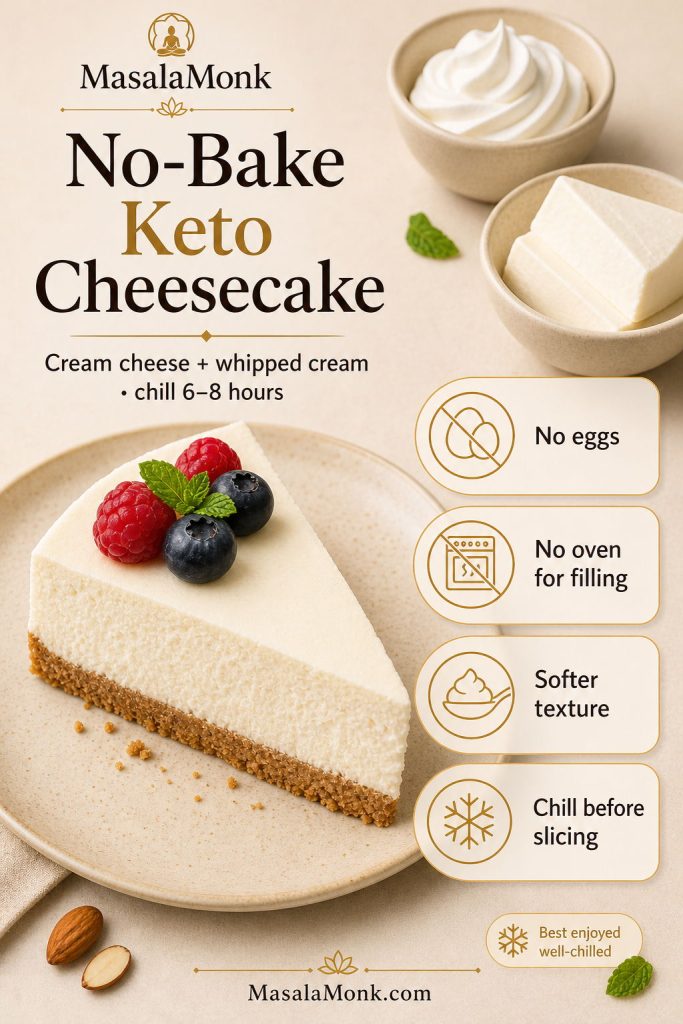
No-Bake Keto Cheesecake Option

A no-bake keto cheesecake is a different style of cheesecake. It is lighter, softer, and more mousse-like because it sets in the refrigerator instead of baking with eggs.

For a 9-inch no-bake keto cheesecake, use the almond flour crust as written, then chill or briefly bake the crust before adding the filling. For the filling, beat 24 oz / 680 g softened full-fat cream cheese with 3/4 to 1 cup powdered keto sweetener, 2 teaspoons vanilla, 1 tablespoon lemon juice, and a pinch of salt until smooth. In a separate bowl, whip 1 cup / 240 ml heavy cream to soft peaks, then fold it into the cream cheese mixture.

No-bake keto cheesecake slice with cream cheese, whipped cream, chilling time, and no-egg filling notes.
No-bake keto cheesecake is a separate style, not just an unbaked version of the main filling. It relies on whipped cream and long chilling instead of eggs.

Making it no-bake? choose pan size · compare with baked recipe

This makes a slightly lower 9-inch no-bake cheesecake. For a taller no-bake keto cheesecake, use an 8-inch springform pan and chill it overnight before slicing.

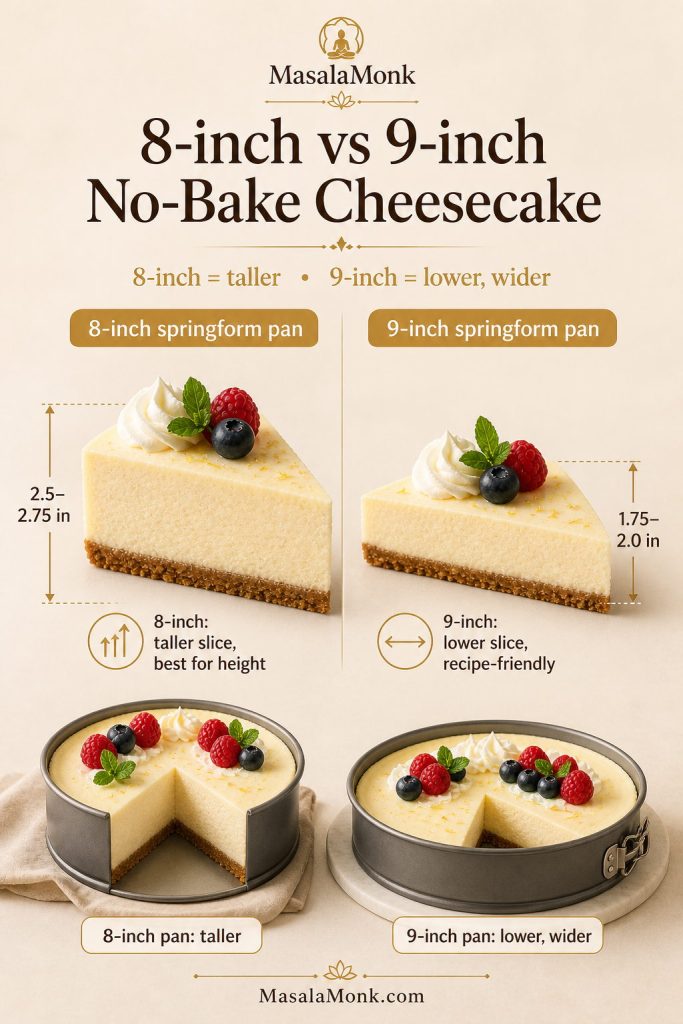
8-Inch vs 9-Inch No-Bake Keto Cheesecake

No-bake cheesecake height depends heavily on pan width because the filling sets in the refrigerator instead of rising or firming in the oven. An 8-inch pan gives a taller, more bakery-style slice, while a 9-inch pan gives a wider cheesecake with a slightly lower profile.

Both pan sizes work, but the chilling time matters more in the taller version. If you use an 8-inch pan, chill overnight before slicing so the center has enough time to set cleanly.

Comparison of 8-inch and 9-inch no-bake keto cheesecakes showing a taller cheesecake and a lower wider cheesecake.
For no-bake keto cheesecake, pan width changes the look of the slice. An 8-inch pan gives height, while a 9-inch pan gives a lower, wider cheesecake.

Picked your pan? return to no-bake method · see variations

Spread the filling over the crust, smooth the top, cover, and refrigerate for at least 6–8 hours. Overnight is better. If the cheesecake is sliced too soon, it can look soft or collapse at the edges.

Important: Do not use the baked filling from the recipe card for the no-bake version. The baked filling relies on eggs and oven heat to set. The no-bake version needs whipped cream and long chilling instead.

If you want the classic non-keto version with a sweeter filling and regular crumb crust, use this no bake cheesecake recipe instead.

Best use: Choose baked keto cheesecake when you want classic dense cheesecake texture. Choose the no-bake version when you want an easier, lighter, oven-free dessert.

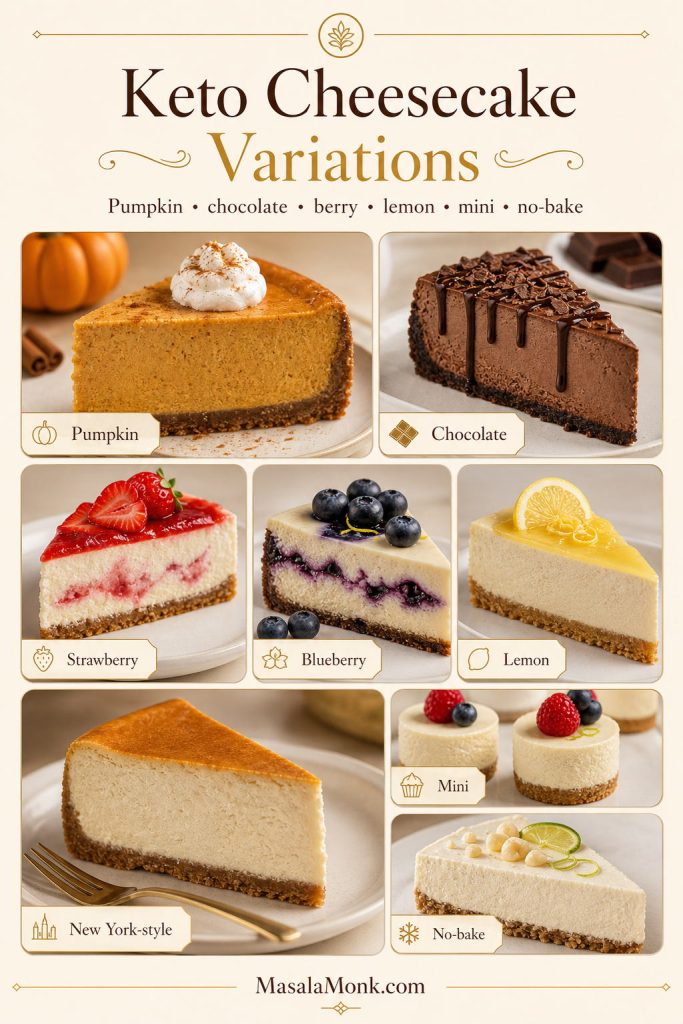
Keto Cheesecake Variations

Once you understand the base, you can use it for other low carb cheesecake flavors. Keep the structure the same, then adjust carefully so the filling still sets properly. In most cases, toppings are safer than mix-ins because they add flavor without loosening the cheesecake.

Keto cheesecake variations board with pumpkin, chocolate, strawberry, blueberry, lemon, New York-style, mini, and no-bake cheesecake options.
Keto cheesecake variations work best when the base stays stable. Therefore, toppings and small flavor accents are safer than adding too much liquid to the filling.

Need a classic slice first? Jump to recipe · see New York-style

Keto Pumpkin Cheesecake

Pumpkin cheesecake needs pumpkin puree, pumpkin pie spice, and a little cinnamon in the filling. Since pumpkin adds moisture, it works better as a dedicated variation than as a casual stir-in. With this base cheesecake, a spoonful of pumpkin spice whipped cream on top gives you the flavor without changing the bake.

Keto Chocolate Cheesecake

A chocolate version works best with melted sugar-free chocolate or cocoa powder in the filling. Chocolate changes both sweetness and texture, so taste the filling before adding eggs and adjust the sweetener if needed. If you want a separate creamy chocolate dessert instead, this avocado chocolate mousse stays in the same rich, spoonable dessert lane.

Keto Strawberry Cheesecake

The cleanest strawberry version keeps the filling vanilla and adds a sugar-free strawberry topping after baking. Fresh berry toppings are easier to control than mixing watery fruit into the batter. Cooked and cooled strawberry sauce gives stronger flavor without making the cheesecake soft.

Keto Blueberry Cheesecake

A thick low-carb blueberry sauce works best as a topping or light swirl. If using a swirl, keep it concentrated and spoon it lightly over the top before baking. Too much fruit sauce can make the center loose.

Keto Lemon Cheesecake

To make the cheesecake brighter, add lemon zest to the filling. Zest gives strong lemon flavor without adding much liquid. Avoid adding too much extra lemon juice because excess liquid can soften the filling.

Mango Cheesecake and Keto Limits

Mango is not usually the easiest strict-keto cheesecake flavor because it brings natural sugar and extra moisture. If you are not keeping the dessert strictly keto and want a fruit-forward no-bake version, this no bake mango cheesecake recipe is the better fit.

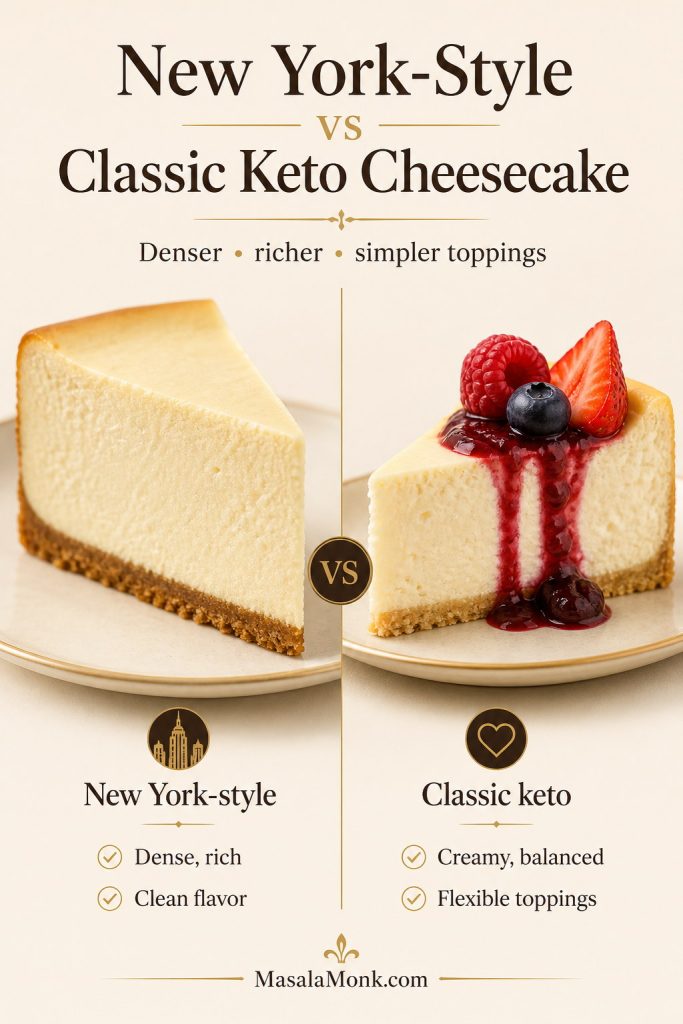
Keto New York Cheesecake

For a New York-style keto cheesecake, keep the flavor simple and focus on a dense, creamy texture. Use full-fat brick cream cheese, sour cream, eggs, vanilla, lemon juice, and the almond flour crust. Avoid fruit puree or chocolate in the filling because those move it away from the classic New York-style profile.

The biggest difference is texture. A New York-style keto cheesecake should feel rich, smooth, and slightly dense rather than fluffy. Chill it overnight before slicing, and serve toppings on the side so the clean cheesecake flavor stays central.

Comparison of New York-style keto cheesecake and classic keto cheesecake slices, showing a denser plain slice and a berry-topped slice.
New York-style keto cheesecake should feel denser and cleaner, while classic keto cheesecake is more flexible. Keep toppings lighter if you want that rich bakery-style texture.

Prefer smaller portions? See mini cheesecakes · return to recipe

Keto Ricotta Cheesecake

Ricotta gives keto cheesecake a lighter, slightly more Italian-style texture. It is less dense than an all-cream-cheese filling and can taste a little grainier unless blended very smooth. Use full-fat ricotta, drain excess liquid if it looks wet, and blend it with cream cheese rather than using ricotta alone.

For the most reliable result, treat ricotta cheesecake as a separate variation rather than a direct one-for-one swap. If you are experimenting, replace only part of the cream cheese with smooth ricotta and keep the eggs, lemon, vanilla, and sweetener balanced so the cheesecake still sets.

High-Protein Keto Cheesecake

For a higher-protein direction, cottage cheese, Greek yogurt, ricotta, or protein powder can be used in separate cheesecake styles. For a breakfast-style version of that idea, these high-protein low-carb pancakes use similar cottage cheese and low-carb logic.

Protein powder needs care in cheesecake because it can make the filling dry, chalky, or rubbery if added casually. If using cottage cheese, blend it completely smooth before adding it to a cheesecake filling. A high-protein low carb cheesecake works best as its own tested variation rather than a direct swap inside this classic baked version.

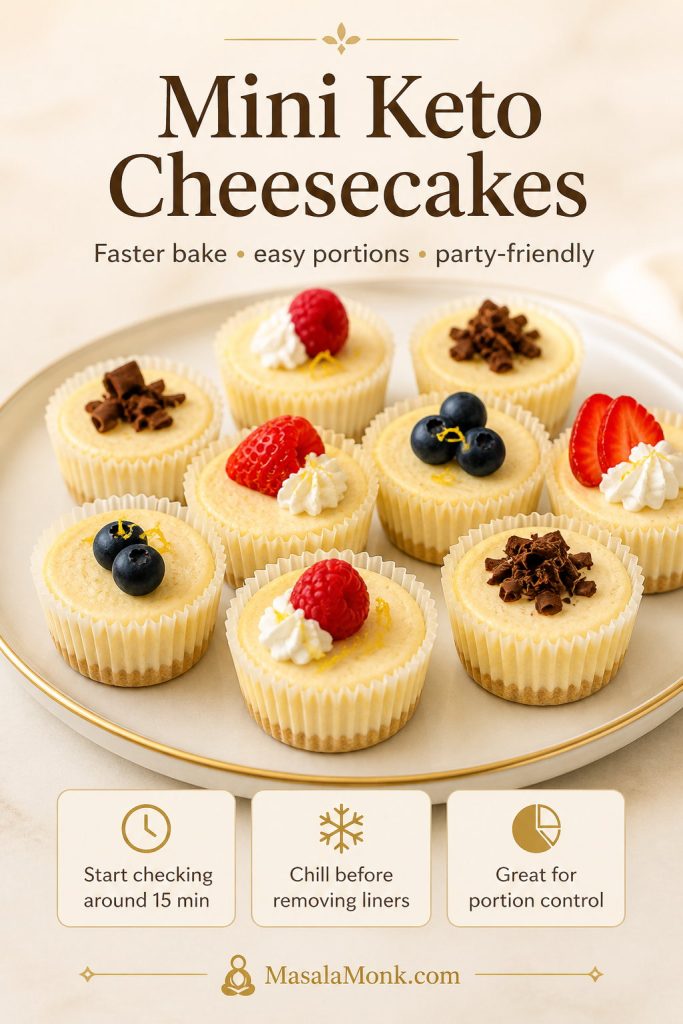
Mini Keto Cheesecakes, Cups, and Bites

You can turn the same flavor idea into mini keto cheesecakes by baking the crust and filling in a lined muffin pan. Mini versions bake faster, chill faster, and are easier to portion for parties, lunch boxes, or meal prep.

Start checking mini cheesecakes around 15 minutes. They are done when the edges look set and the centers still have a slight wobble. Chill them fully before removing the liners. For true keto cheesecake bites or fat bombs, use a separate no-bake cream cheese mixture instead of this baked filling.

Mini keto cheesecakes in paper liners topped with berries, whipped cream, lemon zest, and chocolate shavings.
Mini keto cheesecakes are great for portion control, but they still need proper chilling. Since they bake faster, start checking early and let them set before serving.

Baking minis? use the same doneness cues · store leftovers

3 Ingredient Keto Cheesecake Shortcut

A 3 ingredient keto cheesecake is usually a no-bake shortcut made with cream cheese, keto sweetener, and another creamy ingredient such as whipped cream, Greek yogurt, or keto vanilla yogurt. It is useful for a quick dessert, but it will not have the same baked cheesecake texture as this full recipe.

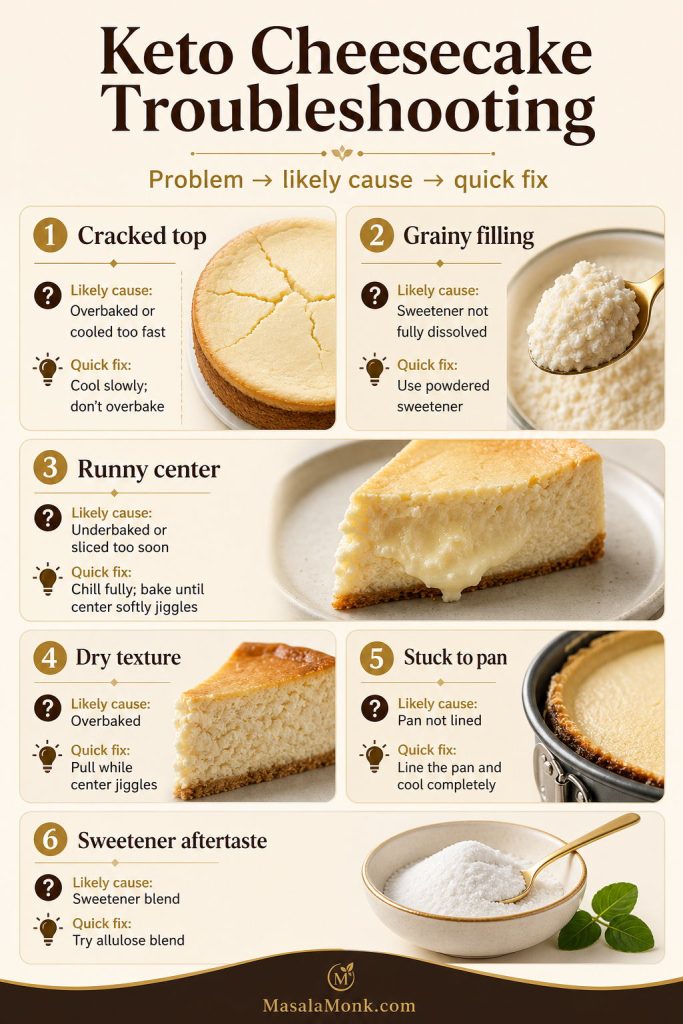
Keto Cheesecake Troubleshooting

Most keto cheesecake problems are easy to diagnose. Use this table to fix the current cheesecake if possible and prevent the issue next time.

Keto cheesecake troubleshooting board showing cracked top, grainy filling, runny center, dry texture, stuck pan, and sweetener aftertaste fixes.
Troubleshooting keto cheesecake is easier when you match the problem to the cause. Cracks, graininess, runny centers, and stuck slices each need a different fix.

Need a crust fix too? See crust fixes · retry with recipe card

Problem Likely Cause Fix
Cracked top Overbaking, too much air, or fast cooling Cool slowly next time; serve current cheesecake with whipped cream or berry topping
Lumpy filling Cream cheese was too cold Use fully softened cream cheese and beat it smooth before adding eggs
Grainy texture Coarse sweetener or crystallizing sweetener Use powdered allulose or powdered monk fruit/allulose blend
Soggy crust Crust was not pre-baked enough or filling was too loose Pre-bake crust until lightly golden and let it cool before filling
Crumbly crust Not enough butter or not pressed firmly Add 1 extra tablespoon melted butter next time and press with a flat-bottom cup
Runny center Underbaked or sliced too soon Bake until softly jiggly, then chill at least 6 hours before slicing
Dry texture Overbaked cheesecake Pull it from the oven while the center still jiggles
Cheesecake stuck to pan No parchment or not enough chilling Line the pan and chill fully before removing the springform ring
Sweetener aftertaste Sweetener blend does not suit your taste Try allulose or a monk fruit/allulose blend; add lemon and vanilla for balance

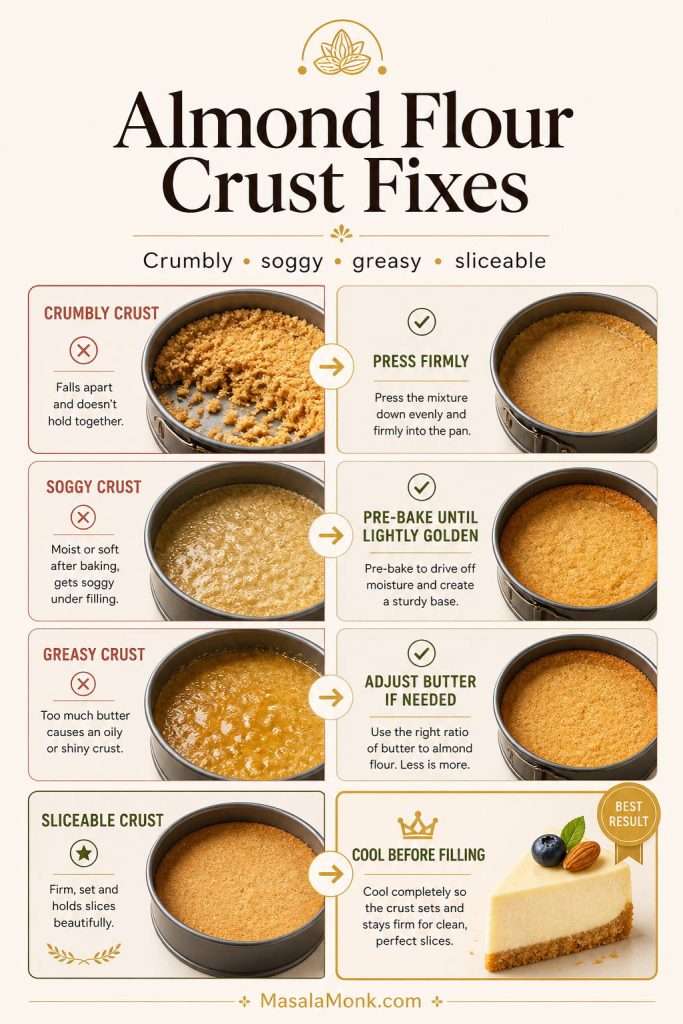
Almond Flour Crust Fixes

Almond flour crust problems usually come from pressure, butter balance, or bake time. If the crust crumbles, it often needed firmer pressing or a touch more butter. If it turns soggy, it usually needed a longer pre-bake or more cooling time before the filling went in.

The goal is a crust that feels compact, lightly golden, and sturdy enough to lift with the cheesecake slice. Fixing the crust separately is useful because the filling can be perfect while the base still needs adjustment.

Almond flour crust fixes board showing crumbly, soggy, greasy, and sliceable cheesecake crust results with correction tips.
Almond flour crust problems usually come down to pressure, butter, or baking time. Press firmly, pre-bake until lightly golden, and cool before adding filling.

Crust sorted? continue method · jump to recipe

What the Finished Cheesecake Should Be Like

After chilling, the cheesecake should slice cleanly, hold its shape on a plate, and feel dense but creamy when you cut through it. The center should not be runny, the filling should not taste grainy, and the almond flour crust should stay firm enough to lift with the slice.

The flavor should be rich and tangy, not flat or overly sweet. If your cheesecake tastes slightly muted when cold, let slices sit at room temperature for 10–15 minutes before serving.

Storage and Freezing

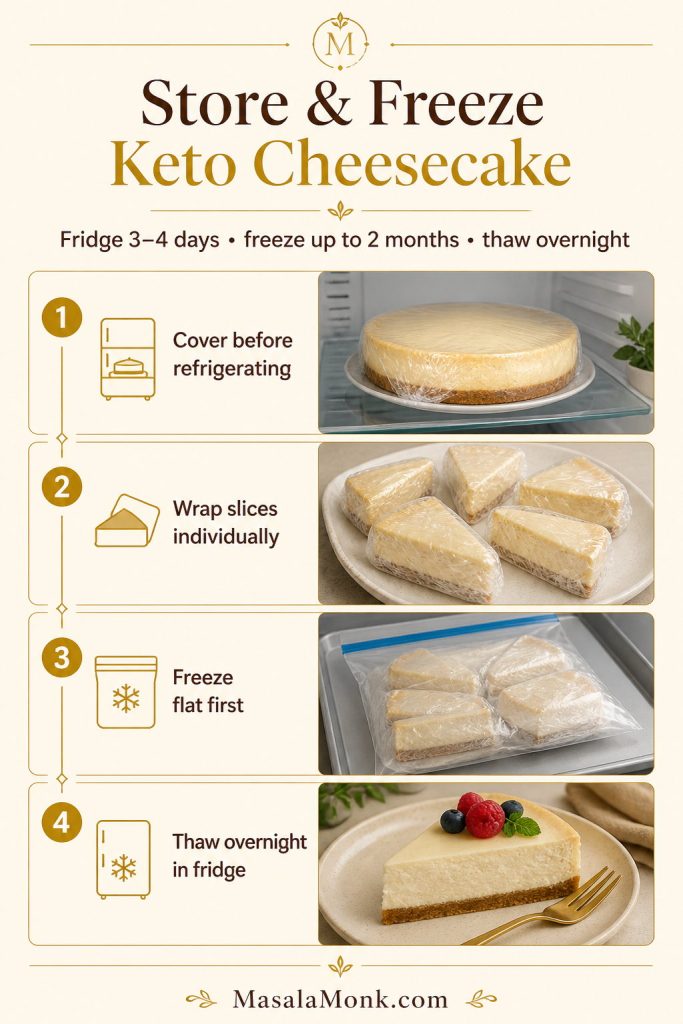
Keto cheesecake is an excellent make-ahead dessert because the texture improves after chilling. Keep it covered in the refrigerator until ready to serve. For food safety, the USDA recommends using refrigerated leftovers within 3–4 days or freezing them for longer storage.

Storage guide showing covered keto cheesecake in the refrigerator, wrapped slices, frozen slices, and a thawed slice ready to serve.
Keto cheesecake is one of the better make-ahead desserts. For the best texture, refrigerate covered, freeze slices individually, and thaw overnight before serving.

Serving later? slice cleanly · add toppings

  • Refrigerator: Store covered for 3–4 days for the best balance of texture and food safety.
  • Freezer: Freeze slices or the whole cheesecake for up to 2 months for best quality.
  • Thawing: Thaw overnight in the refrigerator for the best texture.
  • Serving: Slice cold, then let slices sit at room temperature for 10–15 minutes if you prefer a softer texture.

For freezing, place chilled slices on a parchment-lined tray until firm, then wrap individually. This keeps the slices from sticking together and makes it easier to thaw only what you need.

How to Slice Cheesecake Cleanly

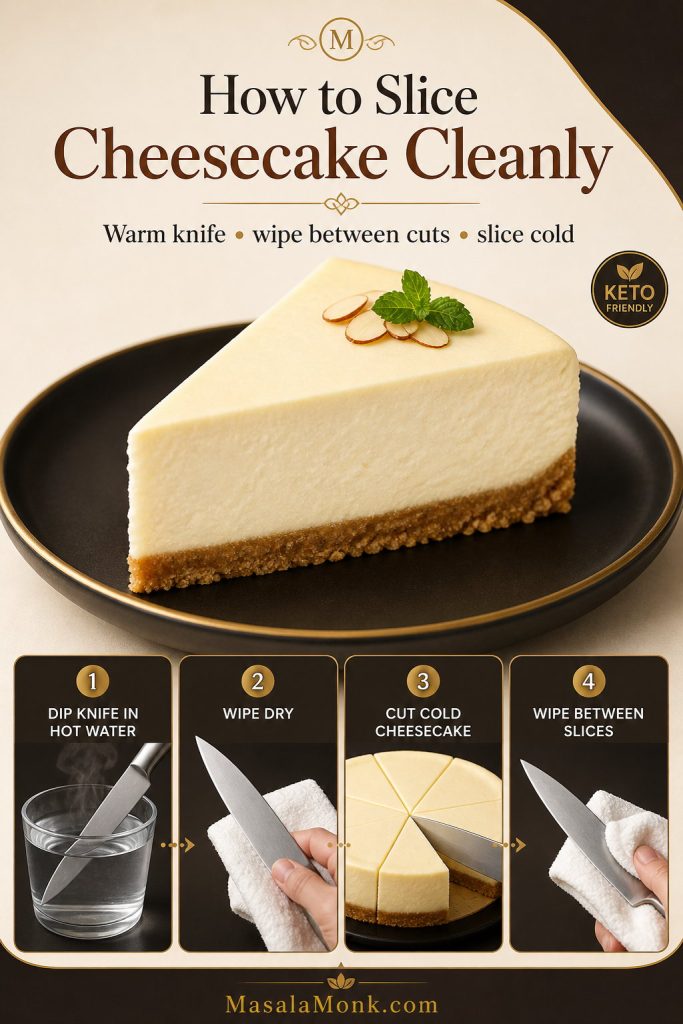
For clean slices, chill the cheesecake fully before cutting. Use a sharp knife, dip it in hot water, wipe it dry, then cut one slice. Wipe the knife between cuts so the filling stays smooth and the almond flour crust does not drag through the slice.

Clean cheesecake slicing guide showing a hot knife, wiping the blade, cutting cold cheesecake, and a neat slice on a plate.
Clean cheesecake slices come from cold cheesecake and a warm knife. Wipe between cuts so the creamy filling and almond flour crust stay neat.

Ready to serve? see toppings · save the recipe

Serving Ideas

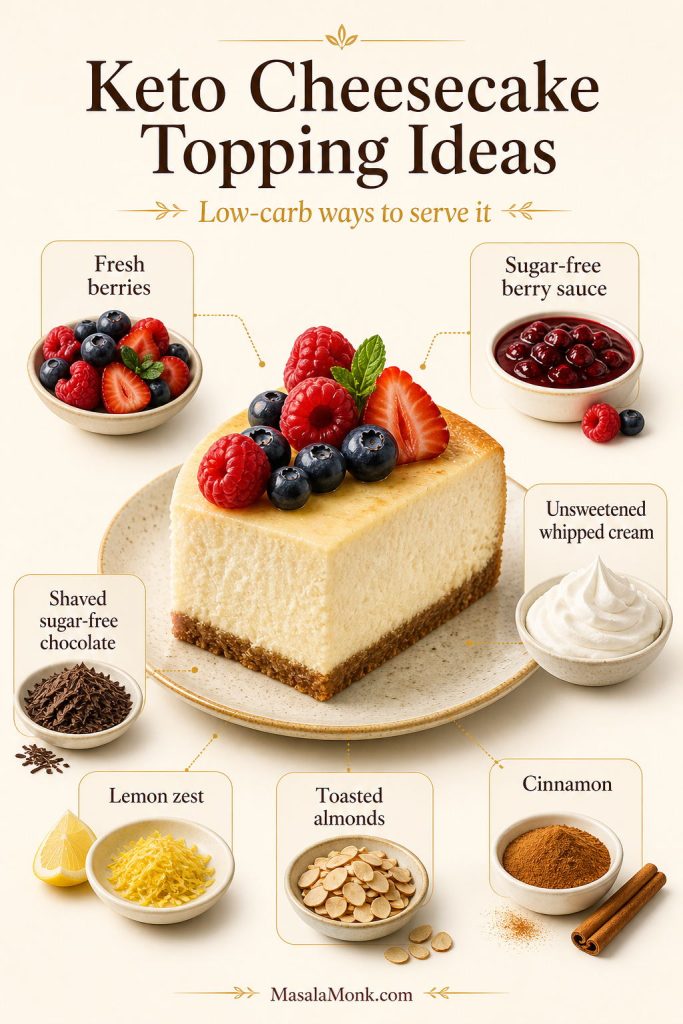
This keto cheesecake is rich enough to serve plain, but toppings can make it feel more special without adding much sugar.

  • Fresh strawberries, raspberries, or blueberries
  • Sugar-free berry sauce
  • Unsweetened whipped cream
  • Shaved sugar-free chocolate
  • Lemon zest
  • Toasted sliced almonds
  • A light dusting of cinnamon for a warmer flavor
Keto cheesecake topping ideas with fresh berries, sugar-free berry sauce, whipped cream, shaved chocolate, lemon zest, toasted almonds, and cinnamon.
Low-carb toppings should support the cheesecake, not bury it. Fresh berries, whipped cream, lemon zest, shaved chocolate, toasted almonds, and cinnamon all keep the flavor balanced.

Want exact amounts? Jump to recipe card · check FAQs

Keep toppings simple if you want the cheesecake texture to stay the focus. Watery fruit sauces should be cooked down and cooled before adding.

For a cozy pairing, serve a small slice with keto hot chocolate instead of a sugary drink.

Keto Cheesecake Recipe Card

This creamy keto cheesecake has a buttery almond flour crust, smooth sugar-free cream cheese filling, and a slow-cooling method that helps prevent cracks. It is rich, low carb, gluten-free, and made without a water bath.

Prep Time 25 minutes
Crust Bake 10–12 minutes
Cheesecake Bake 45–55 minutes
Cooling Time 1½–2 hours
Chill Time 6 hours minimum, overnight best
Total Time About 9 hours, plus overnight chill if preferred
Yield 12–16 slices
Pan 9-inch springform
Net Carbs About 4g per 1 of 16 slices
Water Bath Not required
Method Baked cheesecake
Difficulty Easy with slow cooling

Ingredients

For the Almond Flour Crust

  • 2 cups / about 224 g blanched almond flour
  • 1/3 cup / 75 g unsalted butter, melted
  • 2 tablespoons powdered keto sweetener
  • 1 teaspoon vanilla extract
  • 1/4 teaspoon fine salt

For the Cheesecake Filling

  • 32 oz / 907 g full-fat brick cream cheese, softened
  • 1 cup to 1 1/4 cups powdered keto sweetener, preferably allulose or monk fruit/allulose blend
  • 1/2 cup / 120 g sour cream, room temperature
  • 3 large eggs, room temperature
  • 1 tablespoon fresh lemon juice
  • 2 teaspoons vanilla extract
  • 1/4 teaspoon fine salt

Instructions

  1. Prepare the pan. Line the bottom of a 9-inch springform pan with parchment paper and lightly grease the sides.
  2. Heat the oven for the crust. Preheat the oven to 350°F / 177°C.
  3. Make the crust. Stir almond flour, melted butter, sweetener, vanilla, and salt until the mixture looks like damp crumbs.
  4. Press and bake the crust. Press the crust firmly into the pan using the bottom of a cup. Bake for 10–12 minutes, until lightly golden. Let it cool slightly.
  5. Lower the oven temperature. Reduce the oven to 325°F / 163°C.
  6. Beat the cream cheese. In a large bowl, beat softened cream cheese until smooth. Scrape the bowl well.
  7. Add sweetener. Add 1 cup powdered keto sweetener and beat until smooth. Taste before adding eggs and add up to 1/4 cup more sweetener if you prefer a sweeter cheesecake.
  8. Add sour cream and flavorings. Mix in sour cream, lemon juice, vanilla, and salt until smooth.
  9. Add eggs gently. Add eggs one at a time on low speed, mixing only until each egg is incorporated. Do not overmix.
  10. Fill the pan. Pour the filling over the cooled crust and smooth the top.
  11. Bake. Bake at 325°F / 163°C for 45–55 minutes, until the edges are set and the center still jiggles softly.
  12. Cool slowly. Turn off the oven, crack the door open, and leave the cheesecake inside for 20–30 minutes.
  13. Cool at room temperature. Move the cheesecake to the counter and cool completely.
  14. Chill. Cover and refrigerate for at least 6 hours, preferably overnight.
  15. Slice and serve. Run a thin knife around the edge before releasing the springform ring. Slice cold with a sharp knife.

Recipe Notes

  • For the smoothest filling, use powdered sweetener rather than coarse granulated sweetener.
  • Do not overbake. The center should still wobble gently when the cheesecake comes out of the oven.
  • For a crustless version, skip the crust, line and grease the pan well, and start checking the bake around 40–45 minutes.
  • For a more New York-style texture, chill the cheesecake overnight and serve toppings on the side rather than mixing fruit into the filling.
  • For the lowest-carb version, make the cheesecake crustless and slice it into 16 smaller portions.
  • Nutrition will vary by brand of sweetener, cream cheese, sour cream, and almond flour.

Approximate Nutrition

Approximate per 1 of 16 slices: 330–360 calories, 7–9 g protein, 32–35 g fat, and about 4 g net carbs. For 12 larger slices, net carbs are closer to about 5 g per slice. Exact values depend on the brands used.

Keto cheesecake recipe card with a cheesecake slice, almond flour crust, no water bath note, baking temperatures, chill time, and key ingredients.
Save this keto cheesecake recipe card for the key numbers: almond flour crust, 9-inch pan, gentle bake, slow cooling, and at least 6 hours of chilling.

Still deciding? Read FAQs · Back to guide

FAQs

Is cheesecake keto?

Traditional cheesecake is usually not keto because the filling contains sugar and the crust is often made with graham crackers. This version uses an almond flour crust and keto sweetener to keep the carbs low.

Is keto cheesecake zero carb?

No. It is usually low carb, not zero carb. Dairy, eggs, almond flour, lemon juice, and some sweeteners can all add small amounts of carbs. For the lowest-carb version, make it crustless and keep toppings simple.

How many net carbs are in keto cheesecake?

This recipe has about 4 g net carbs per slice if cut into 16 slices, or about 5 g net carbs if cut into 12 larger slices. The exact number depends on the almond flour, cream cheese, sour cream, and sweetener brands you use.

What can I use instead of almond flour?

The easiest option is to make the crustless version. You can also use a tested nut-free crust, but coconut flour should not be swapped 1:1 for almond flour because it absorbs much more moisture.

How do I make keto cheesecake no crust?

For keto cheesecake no crust, skip the almond flour base, line the pan with parchment, grease the sides well, and pour the filling directly into the pan. Start checking the cheesecake a little earlier because there is no crust layer.

How is no-bake keto cheesecake different?

A no-bake version uses a different filling structure. It usually sets with whipped cream and long chilling instead of eggs and baking, so the texture is softer and more mousse-like.

Do I need a water bath for keto cheesecake?

A full water bath is not required. This recipe uses room-temperature ingredients, gentle baking at 325°F / 163°C, careful mixing after the eggs go in, and slow cooling. For extra insurance, place a pan of hot water on the lower oven rack.

What is the best sweetener for keto cheesecake?

Powdered allulose or a powdered monk fruit/allulose blend gives the smoothest filling. Coarse granulated sweeteners can taste gritty, and some erythritol-heavy blends can leave a cooling finish.

Why did my keto cheesecake crack?

Cracks usually happen because the filling was overmixed, the cheesecake was overbaked, or it cooled too quickly. Use room-temperature ingredients, mix gently after adding eggs, pull it from the oven while the center still jiggles, and cool it slowly.

Why is my cheesecake grainy?

Grainy cheesecake often comes from coarse sweetener or a sweetener that crystallizes as it chills. Use powdered sweetener in the filling and avoid overmixing once the eggs are added.

Does coconut flour work for the crust?

Not as a direct swap. Coconut flour is much more absorbent than almond flour, so it needs a different ratio of fat and liquid. For this recipe, almond flour is the better choice unless you are using a tested coconut flour crust.

Ricotta vs cottage cheese: do they work?

Both can work in separate cheesecake styles, but the texture will be different. Ricotta gives a lighter, slightly grainier cheesecake, while cottage cheese needs blending until completely smooth. For this classic version, brick cream cheese gives the best result.

How long do mini keto cheesecakes bake?

Mini cheesecakes usually bake faster than a full cheesecake, often around 15–22 minutes depending on size. Use a muffin pan with liners, watch for set edges and slightly wobbly centers, then chill well before serving.

How do you freeze keto cheesecake?

Freeze it only after the cheesecake has chilled completely. Wrap slices individually or freeze them on a parchment-lined tray first, then store them in an airtight container. Thaw overnight in the refrigerator for the best texture.

Posted on 6 Comments

Keto Flour: Guide to Low-Carb Flours That Bakes Like the Real Thing

A reliable keto flour isn’t one ingredient—it’s the right flour (or blend) for the job. Use this guide to choose low-carb flours that behave like “real” flour in the oven, so bread slices clean, bakes stay tender, and pie crust holds together without turning dry or crumbly.

There’s a moment in low carb baking that feels almost universal: you pull something warm from the oven—maybe a tray of brownies, maybe a “simple keto bread,” maybe a batch of cookies—and the first bite tells you the truth. Keto flour can still deliver something genuinely delicious, yet the texture often feels different at first. Drier than you hoped. More fragile than you expected. Sometimes oddly eggy. Occasionally too dense, as if the batter never learned how to lift.

That moment isn’t failure. It’s feedback.

Regular flour is predictable because gluten does so much of the heavy lifting. Keto flour, on the other hand, asks you to be a little more intentional. Once you understand what each flour brings—bulk, tenderness, moisture, chew, browning—your results get calmer and more repeatable. In fact, you can go from “random experiments” to a pantry that reliably turns out low carb brownies, keto pancakes, keto pie crust, muffins, and even sandwich-style bread that doesn’t crumble into confetti.

So think of this as your reset: not a lecture, not a set of rules, but a cooking-minded guide to choosing a keto flour substitute that actually works.

Also Read: A Guide to Keto Diet for Beginners


Keto flour basics: why low carb baking plays by different rules

Traditional wheat flour is a whole system. When it meets liquid and mixing, gluten forms a stretchy network that traps air, holds moisture, and gives bread that familiar tear. Consequently, even a “just okay” recipe can still turn out fine because gluten forgives a lot.

Keto flour cheat sheet comparing almond flour and coconut flour for baking. Shows two bowls labeled almond flour and coconut flour with guidance for brownies, pancakes, pie crust, bread, and pizza. Notes almond flour works well for fudgy brownies and easy-start pancakes, while coconut flour is best only in recipes built for it. Reminds flours aren’t one-bag-fits-all and gives fixes: dry add fat/liquid, crumbly add binder like psyllium or xanthan.
Choosing keto flour gets easier when you pick by texture, not the label. This cheat sheet shows when almond flour shines (fudgy brownies, easiest-start pancakes, buttery pie crust) and when coconut flour should only be used in recipes designed for it. It also covers the “structure first” mindset for bread and the crisp vs foldable decision for pizza. Keep the bottom fixes handy too: if it turns dry, add fat + liquid; if it crumbles, add a binder like psyllium or xanthan. Save this for your next bake.

Keto flour alternatives rarely have that safety net. Instead, low carb baking is built from smaller pieces that you assemble on purpose:

  • A base for bulk and tenderness (almond flour, coconut flour, some wheat-based keto blends, or a low carb all purpose flour mix)
  • A binder for structure (eggs, psyllium husk, flax, xanthan/guar)
  • A moisture plan (fat, dairy, extra liquid, or a sweetener that helps retain softness)
  • A lift plan (fresh baking powder, baking soda plus acid, or whipped egg whites)
Infographic titled “Low-Carb Baking = 4-Part System (Stop Guessing).” A 2x2 grid explains the keto flour “system”: Base (almond flour, coconut flour—recipe-built, blends) for bulk/tenderness; Binder (eggs, psyllium, xanthan/guar, flax/chia) for structure; Moisture (butter/oil, yogurt/sour cream, cream cheese/extra liquid) for softness; Lift (baking powder, baking soda + acid, whipped eggs) for rise. Bottom strip shows quick fixes for dry, crumbly, gummy, and eggy results. MasalaMonk.com footer.
Low-carb baking gets way easier when you stop treating “keto flour” like one magic bag. Think in four parts: a base for tenderness, a binder for structure, a moisture plan to keep bakes soft, and a lift plan so they don’t turn dense. The bottom row is your rescue kit for the most common problems (dry, crumbly, gummy, eggy). Save this as your “preheat-the-oven checklist” before brownies, muffins, pancakes, pie crust, or keto bread.

That’s why one “keto flour” doesn’t do everything. A flour that makes an incredible cookie can make a sad loaf. Similarly, a bread-focused mix can feel tough in brownies. Once you accept that each bake wants a slightly different toolkit, your kitchen gets easier.

Also Read: The Must-Have Condiment for Keto: Mustard – Flavorful, Low-Carb, and Versatile


Keto flour labels: how to read carbs on mixes, tortillas, and “net carb” claims

Low carb packaged products—especially tortillas, wraps, and baking mixes—often lean on “net carbs.” Net carbs can be a useful shorthand, but it isn’t a standardized number on the Nutrition Facts label. The label gives you total carbohydrate, and under that, it breaks down fiber and sugars; your “net” number is a calculation people do from the label.

A “Net Carbs Checklist (Keto Baking + Tortillas)” infographic showing a checklist: start with serving size, read total carbs, check fiber, check sugar alcohols, and choose your net-carb rule. A nutrition label example and a simple formula are shown: total carbs minus fiber minus sugar alcohols equals net carbs. MasalaMonk.com is printed at the bottom.
Net carbs look simple… until you flip the package around. This checklist is a quick way to read tortillas, baking mixes, and “keto” cookies without getting tricked by the front label. Start with serving size, then total carbs, then fiber and sugar alcohols — but here’s the key: net carbs aren’t officially standardized, and sugar alcohols aren’t all the same (maltitol often hits harder than erythritol). When in doubt, check the ingredient list + type of sugar alcohol, and trust the full nutrition panel over the bold claims. Save this for your next grocery run. MasalaMonk.com

The FDA explains how to interpret the Nutrition Facts label and why serving size matters, because every number on the label is tied to that serving size. That alone changes the story more than most people realize. See: How to understand and use the Nutrition Facts label.

Meanwhile, the American Diabetes Association notes that net carbs are commonly calculated by subtracting fiber and sugar alcohols from total carbohydrate; however, that calculation isn’t always accurate because different fibers and sugar alcohols can be partially absorbed and still affect blood glucose in some people. See: ADA: Get to know carbs.

If you’re counting carbs for any reason—keto goals, blood sugar management, or simple preference—this is the practical takeaway:

Use the label as the source of truth, then decide how you personally interpret it. Don’t let marketing language do the math for you.

For additional clarity, the FDA’s Interactive Nutrition Facts Label PDF on “Total Carbohydrate” breaks down what that line includes and how fiber fits into the definition: Interactive Nutrition Facts Label: Total Carbohydrate (PDF).

Also Read: How to make No-Bake Banana Pudding: No Oven Required Recipe


Best keto flour for baking: a quick chooser by what you’re making

Before you choose any low carb flour substitute, pick the result you want. Then you can choose the flour that behaves that way.

Infographic titled “Best Keto Flour for Baking: Quick Chooser.” Four panels: Brownies & bars (almond flour = fudgy; blends = cakey); Pancakes & waffles (almond flour easiest; coconut flour only in recipes built for it); Pie crust & cookies (almond flour tender; coconut flour in small doses; binders add structure); Bread & pizza (use a flour system with binders). Bottom fixes: dry add fat+liquid; crumbly add binder; gummy bake through+cool longer. MasalaMonk.com footer.
This “pick your result first” cheat sheet is the fastest way to stop guessing with keto flour. Choose the quadrant that matches what you’re baking (brownies & bars, pancakes & waffles, pie crust & cookies, or bread & pizza), then follow the one-line rule for the texture you want. The bottom strip is your rescue plan: dry = add fat + liquid, crumbly = add a binder (psyllium/xanthan/flax), gummy/dense = bake through + cool longer. Save it to your keto baking board so the next batch turns out calm and repeatable.

Brownies and bars: fudgy vs cakey

Brownies are where keto baking can feel either magical or tragic.

  • If you want fudgy brownies, you typically want a flour that stays tender and doesn’t drink every drop of moisture. Almond flour often shines here.
  • If you want a more cakey brownie, you’ll usually need more structure—either from a blend designed to mimic wheat flour, or from careful binder choices (and sometimes a touch of coconut flour).
When keto brownies turn out too dry, too crumbly, or weirdly dense, it’s usually a flour-system issue—not “bad baking.” This quick chooser helps you decide fudgy vs cakey first, then pick the right approach: almond-flour-forward for tender/fudgy brownies, or a more structured blend for cakey, clean-slice bars. The bottom “quick fixes” strip is the real lifesaver: dry = add fat + a splash of liquid; crumbly = add a tiny binder (psyllium/xanthan); too dense = reduce binder and cool fully before judging texture.

If you’re using a keto brownies mix or low carb brownie mix, the best question isn’t “Is it good?” but “What kind of flour system is it?” Almond-based mixes and wheat-style keto blends can both work, yet they produce different textures.

Pancakes and waffles: the fastest way to learn your flour

Waffles & Pancakes are a low-risk training ground: quick feedback, easy to tweak, forgiving enough to repeat.

Infographic titled “Keto Pancakes & Waffles: The Fastest Way to Learn Your Flour” comparing three bases: almond flour (pourable but thick; medium-low heat; browns fast), coconut flour (thickens as it sits; rest 10–12 minutes; not a 1:1 swap; needs more eggs/liquid), and cottage cheese/high-protein (blend smooth; lower, slower heat; add 1 egg or tiny binder). Includes “Fix it fast” tips for eggy, rubbery, breaking, and too-dark results. MasalaMonk.com footer.
Pancakes (and waffles) are the quickest way to “feel” how keto flour behaves—because you get instant feedback. This one-page guide helps you choose the right base (almond, coconut, or cottage-cheese/high-protein), spot the key batter cues, and cook with the right heat so you don’t end up with an eggy, rubbery stack. Keep the “Fix it fast” strip in mind too: it gives simple, realistic tweaks for the most common failures—breaking, over-browning, or a texture that tightens up as it cools.

If you want a gentle on-ramp, start with a dependable keto approach like Keto Pancakes: almond flour, coconut flour, and cottage cheese methods.
Then, if you want a broader “this is how pancakes behave with different bases” baseline, Blueberry Pancakes (6 recipes + homemade pancake mix) gives you a useful reference point for batter rest, browning, and texture.

Pie crust and cookies: crisp vs tender

A keto pie crust needs to slice cleanly, so structure matters. On the cookie side, you may want crisp edges and a tender middle, or you may want chewy softness. Those are different jobs.

  • Almond flour tends to give a tender, rich crumb.
  • Coconut flour can firm and tighten texture, but it can also dry things out if you push it too far.
  • Psyllium husk and certain fibers can help crusts hold together, although too much can make things gummy.

Bread and pizza: structure first, tenderness second

Bread is where low carb baking stops being “swap flour, hope for the best” and becomes “choose a system.” Keto bread usually needs binders, hydration control, and a flour blend that can hold gas.

For a reminder of how much structure matters in conventional bread, Sourdough Bread Recipes: 10 easy bread bakes (loaves, rolls & bagels) is a helpful example of how fermentation, hydration, and timing shape the crumb—even if you’re not baking sourdough on keto.

Also Read: Chicken Adobo — Step-by-Step Recipe — Classic Filipino Adobong Manok


Keto flour substitutes: the low carbohydrate flour list that actually earns its space

You’ll see endless “low carb flour” lists online. The problem is that many of them treat these flours as interchangeable. They aren’t.

Here’s the kitchen-reality version—what each keto flour does well, what it does poorly, and how to use it without wasting a weekend.

Keto flour substitutes infographic comparing almond flour, coconut flour, lupin flour, oat fiber, bamboo fiber, psyllium husk, flax/chia, and xanthan/guar. Each card lists absorption or role, best uses, common baking failures (dry, crumbly, gummy, strong taste), and quick fixes like adding eggs/liquid, resting batter, measuring binders carefully, and cooling fully before slicing. MasalaMonk.com footer.
Keto baking gets easier when you stop forcing one “keto flour” to do every job. Save this cheat sheet for the moment a bake turns dry, crumbly, or gummy—it shows what each option is best for (brownies, muffins, bread, pizza, doughs) and the simplest fix to try next (rest the batter, add moisture, use a binder, cool longer). Coconut flour is powerful but picky, almond flour is the easiest all-rounder, and psyllium/xanthan are the quiet heroes for clean slices and structure. Full keto flour guide on MasalaMonk.com.

Almond flour: the most versatile keto friendly flour

Almond flour is popular for a reason: it’s forgiving. It browns nicely, tastes rich, and tends to produce tender baked goods without advanced technique.

Where it shines

  • Cakes, muffins, pancakes, waffles
  • Cookies (especially chewy styles)
  • Brownies, bars, crumb toppings
  • Coating and breading jobs (especially when you want a crisp outside)

Where it struggles

  • Yeasted breads that need chew and lift
  • Ultra-crisp pastry unless you blend for more structure
Infographic titled “Almond Flour: The Most Versatile Keto-Friendly Flour.” Shows almond flour in a jar and bowl with keto bakes (pancakes, brownie, muffin). Lists where almond flour shines: cakes and muffins, pancakes and waffles, chewy cookies, brownies and bars, crisp breading/coatings. Lists where it struggles: yeasted breads needing chew and lift, ultra-crisp pastry needing added structure. Includes quick fixes: if crumbly add binder (psyllium or xanthan) or extra egg; if dry add fat plus dairy/moisture; if too soft chill batter and cool fully before slicing. Notes almond flour vs almond meal: meal is coarser and rustic; flour is finer and better for baking. MasalaMonk.com at bottom.
Almond flour is usually the easiest “starter” keto flour because it browns well, tastes rich, and stays tender—especially in pancakes, muffins, cookies, and brownies. Use this card as a quick chooser: if your bake turns crumbly, add a binder (psyllium/xanthan) or an extra egg; if it turns dry, add fat + dairy/moisture; if it’s too soft, chill the batter and let the bake cool completely before slicing. Bottom reminder: almond flour vs almond meal matters—meal is coarser and rustic, while fine almond flour is smoother and more reliable for baking.

If you want a practical internal guide that frames almond flour in everyday cooking (including a diabetes/blood sugar perspective), Almond Flour and Diabetes: a low-carb swap for better blood sugar is a relevant read.

And if you want a straightforward “make it taste good fast” use case, Almond Flour Pancakes is an easy entry point for batter thickness, browning control, and fluffiness without turning it into a science project.

A note on almond flour vs almond meal
Almond meal is coarser, which can make bakes feel heavier or more rustic. Sometimes that’s exactly what you want. Other times, it’s the reason your cookie feels gritty. When in doubt, choose almond flour for baking and save almond meal for breading and hearty muffins.

Two bowls on a sage background labeled “Almond Flour” and “Coconut Flour.” Almond flour shows medium absorption and “moist + tender”; coconut flour shows high absorption and “light but can dry out.” Center box says “Not 1:1 swap rule” with tips for swapping between them. Bottom tips: “Dry? add fat + liquid” and “Crumbly? add binder (psyllium/xanthan).” MasalaMonk.com footer.
Almond flour vs coconut flour in keto baking isn’t a 1:1 swap—this quick guide shows why coconut flour absorbs far more, how that changes texture, and what to fix when bakes turn dry or crumbly. Use it as a fast reference before making low carb brownies, muffins, pancakes, or pie crust.

Coconut flour: extremely absorbent, powerful in small doses

Coconut flour is one of the most misunderstood keto flour alternatives. People love it because it’s compact and can be very low net carb in small quantities. Then they treat it like all-purpose flour and wonder why everything turns to sand.

Coconut flour is high in fiber, which means it absorbs a lot of liquid during baking. Bob’s Red Mill emphasizes that you should follow coconut flour recipes closely and not make additional substitutions, because dough will often be much thicker than expected—and the absorbency changes everything. See: Bob’s Red Mill on coconut flour baking.

Iowa State University Extension notes that coconut flour shouldn’t be substituted 1:1 for wheat flour and can hold up to four times its weight in liquid, which helps explain why “just swap it” usually fails. See: Coconut flour (Iowa State Extension PDF).

Infographic titled “Coconut Flour: The Absorbency Rules” explaining that coconut flour is highly absorbent and not a 1:1 swap. Shows an absorbency meter (high), a bowl of coconut flour, where it shines (cake-like quick breads, firmer muffins, small amounts in blends), where it struggles (chewy bakes without binders, free-form cookies), and quick fixes for sandy/dry, dense, or crumbly results. MasalaMonk.com footer.
Coconut flour is powerful because it’s extremely absorbent—so the biggest mistake is treating it like all-purpose flour. This quick card shows when coconut flour works best (recipe-built quick breads, firmer muffins, and small amounts in blends), when it tends to disappoint (chewy bakes without binders, free-form cookies), and the first fixes to try if your batter turns sandy, tight, or crumbly. Use it as a “before you bake” reference so your results feel intentional.

Where coconut flour shines

  • “Cake-like” quick breads when the recipe is designed for it
  • Muffins that need a firmer set
  • Blends, where a small amount adds structure

Where coconut flour struggles

  • Anything you want chewy unless you pair it with the right binders
  • Free-form cookies (it can over-tighten and dry)

If you love coconut flour, treat it like a concentrated ingredient. Use it with intention, not as a general-purpose low carb flour replacement.

Lupin flour: protein-forward structure with a distinct personality

Lupin flour can be a useful keto flour substitute because it brings protein and structure. It can also bring a flavor that some people notice more than others, especially in lightly flavored bakes.

Where lupin flour shines

  • Chocolate bakes (the flavor hides well)
  • Savory bakes and crackers
  • Blends designed for more structure

Where lupin flour struggles

  • Delicate cakes unless blended thoughtfully
  • Light, buttery cookies where you want clean sweetness

Oat fiber, bamboo fiber, and other fiber flours: bulk without traditional starch

If you’ve seen “0 carb flour,” “zero net carb flour,” or “carb free flour substitute,” it’s often tied to fiber-heavy ingredients. These can be helpful, particularly in bread and pizza systems where you want bulk and structure without starch. Still, they can also turn baked goods dry if you overdo them.

Fiber choices vary widely, and not all “added fiber” behaves the same. If you want a grounded, label-oriented reminder that fiber type matters, it’s useful to keep the ADA’s note about net carb calculations in mind: ADA: net carbs aren’t always fully accurate.

Where fiber flours shine

  • Bread and pizza systems when paired with binders and hydration
  • Thick batters (mug cakes, pancakes) where you can control moisture

Where fiber flours struggle

  • Cookies and cakes when they’re used as the primary “flour”
  • Anything where you want a soft, bouncy crumb without gumminess

Psyllium husk: the binder that makes keto bread behave like bread

Psyllium isn’t “flour” in the classic sense, yet in keto baking it functions like architecture. It can provide elasticity, moisture retention, and a more bread-like chew, especially when paired with eggs and the right hydration.

Vertical infographic titled “Psyllium Husk: The Binder That Makes Keto Bread Slice.” Shows what psyllium does (elasticity, moisture retention, structure), common fails with fixes (crumbly: add a tiny bit more binder + rest; gummy/dense: reduce binder slightly + bake through + cool longer; purple/gray tint: try different brands/types), best uses (bread, rolls, pizza dough, tortillas/flatbreads), and a reminder that cooling sets the crumb before slicing. MasalaMonk.com footer.
If keto bread keeps crumbling or turning gummy, psyllium husk is usually the missing “structure” piece. This quick card shows exactly what it does (elasticity + moisture retention), where it works best (bread, rolls, pizza dough, tortillas), and the fastest fixes when things go wrong—especially the underrated step: cool fully before slicing. Save it as your binder reference the next time a loaf feels fragile.

The trick is balance. Too little and your loaf crumbles. Too much and the texture can turn dense or slightly gummy. When it’s right, though, it’s one of the main reasons keto bread can slice.

Flax meal and chia: binding, moisture, and a rustic crumb

Flax and chia add structure and moisture control. They also add flavor, so they’re often better in spiced bakes, nutty muffins, and hearty breads than in a delicate vanilla cake.

Flax + chia gel binder infographic for keto baking. Shows how to make a flax/chia “egg” (1 tbsp ground flax or chia + water, rest 5–10 minutes), best uses (muffins, quick breads, pancakes; rustic cookies/hearty loaves), and common fails with fixes (gritty = grind finer, dense = add lift/whip eggs, crumbly = pair with egg or a touch of psyllium). MasalaMonk.com footer.
Flax and chia aren’t “flour,” but they’re powerful structure tools in low carb baking—especially when you want moisture + binding without turning a batter into rubber. Use this card as a quick reference: gel your flax/chia first, then choose the right bake (pancakes, muffins, rustic cookies). If the result goes gritty, dense, or crumbly, the bottom fixes tell you what to adjust next—so you don’t waste a whole batch.

“Pork rind flour” and seed crumbs: the crunch category

Sometimes you don’t need flour at all—you need texture. For breading, coating, and crisp topping jobs, pork rind crumbs and crushed seeds can do what flour would do, without pretending to be something else.

That’s how you keep keto cooking satisfying: by choosing the tool that matches the task.

Also Read: Keto Mocktails: 10 Low-Carb Recipes for Guilt-Free Happy Hour Indulgence


Keto all purpose flour: what it can do, and what it can’t

A keto all purpose flour sounds like a dream: one bag, every bake, no guesswork. In practice, it depends on what that “all purpose” blend is made to mimic.

Some blends aim to behave like wheat flour in a one-to-one swap. Others aim for a gluten-free style. Some focus on fiber bulk. Each approach can work. The only problem is expecting a cookie blend to behave like a bread blend.

Infographic titled “Keto All-Purpose Flour System” showing 3 jars: Tender Jar (best for brownies, muffins, cookies, pancakes; almond flour base + minimal fiber; common fail fragile slices; fix add small binder or chill + cool fully), Structure Jar (best for bread, pizza, rolls; blend + psyllium + optional fiber; common fail gummy/dense; fix reduce binder or bake through + cool longer), and Nut-Free Jar (best for nut-free cakes, muffins, pancakes; coconut flour system + eggs + extra liquid; common fail dry/crumbly; fix use less flour + add liquid + rest batter). Bottom: dry add fat+liquid; crumbly add binder; gummy bake through + cool longer. MasalaMonk.com footer.
If you’ve ever bought a “keto flour” and still ended up with dry muffins, crumbly slices, or a gummy loaf—this is the shortcut. Instead of chasing one magic bag, build three simple jars based on the texture you want: Tender (brownies/cookies/pancakes), Structure (bread/pizza/rolls), and Nut-Free (coconut-flour bakes made recipe-built). The bottom strip is your quick fix: dry = add fat + liquid, crumbly = add a binder, gummy = bake through + cool longer. Save this for your next bake.

Store-bought wheat-style keto blends (the “1:1” promise)

A well-known example is King Arthur’s Keto Wheat Flour, described as a 1:1 swap for recipes calling for all-purpose flour, with a traditional wheat taste and low net carbs per serving. See: King Arthur Keto Wheat Flour.

That kind of flour can be appealing if you want wheat-like structure for bread, rolls, or yeasted bakes, and you’re not aiming for gluten-free baking.

DIY low carb flour mix: why it’s often better

Even if you love a store blend, it’s worth having a simple DIY approach, because your baking goals change. Some days you want brownies that stay fudgy. Other days you want a pizza crust that can be picked up. Those are different recipes, so it helps to have different “default blends.”

DIY Keto Flour Mix infographic showing three labeled blend cards: “Tender Blend” for cakes/muffins/brownies (almond-flour-forward, minimal fiber), “Structure Blend” for bread/pizza/rolls (includes psyllium, optional fiber; hydrate + rest; bake through; cool fully), and “Nut-Free Blend” coconut-flour system (coconut flour + binders, extra liquid/eggs; not 1:1; batter rests; tiny amounts matter). Bottom notes: choose by texture goal; dry add fat + liquid; gummy bake through + cool longer. MasalaMonk.com footer.
If “keto flour” keeps giving you random results, this is the fix: stop chasing one magic bag and build three simple blends you label once—Tender (brownies/muffins/cakes), Structure (bread/pizza/rolls), and Nut-Free (coconut-flour recipes built for absorbency). Use it like a decision card: pick the texture goal first, then choose the blend that behaves that way. And keep the bottom strip handy—dry = add fat + liquid, gummy = bake through + cool longer—because most keto baking “fails” are just hydration + structure mismatches.

A practical way to think about DIY blends is:

  • Tender blend for cakes, muffins, and brownies: almond flour-forward, minimal fiber
  • Structure blend for bread and pizza: includes psyllium and/or fiber components, with careful hydration
  • Nut-free blend when needed: coconut flour plus binders, used in recipes designed around its absorbency

Once you label your jars that way—tender, structure, nut-free—you stop expecting one bag to do everything. Then your baking suddenly feels easier.

Also Read: Creamy Cauliflower Soup—Keto-Friendly, Ultra-Comforting (Vegan Option)


Keto baking mixes and keto flour blends: what changes in the bake

Keto baking products have expanded quickly. There are keto baking mixes for brownies, pancakes, biscuits, cakes, and even “shake and bake” style coatings. You’ll also see brand-specific products such as Atkins bake mixes, Carbquik baking mix, Lakanto baking mix, and specialty companies offering cookies and brownie mixes.

Vertical infographic titled “Keto Baking Mix Decoder” with a keto flour bag illustration and the subtitle “4 Things to Check Before You Buy/Bake.” Four numbered panels explain: (1) Primary flour system—almond-based = tender, coconut-based = firms fast, wheat-style = more breadlike; (2) What provides structure—fiber/gums need rest time; egg-heavy can taste eggy unless flavored; (3) Sweetener profile—affects aftertaste, browning, moisture, and “stays soft” factor; (4) Serving size reality check—net carbs depend on serving size plus fiber/sugar alcohols. Bottom “Fix It Fast” strip: Dry add fat/dairy; Gritty rest batter longer; Eggy add vanilla + salt + cocoa/espresso; Dense bake through + cool fully. MasalaMonk.com at the footer.
Keto mixes can be great—when the mix matches the texture you want. Use this “decoder” before you bake: identify the primary flour system, how the mix gets structure, what the sweetener is likely to do, and whether the serving size makes the “net carb” claim feel realistic. The bottom “Fix It Fast” strip is your quick rescue guide for the most common outcomes (dry, gritty, eggy, dense) so you can adjust once and get a better second bake.

These products can be helpful, especially when you want consistency or when you’re new to low carb baking. Still, mixes vary hugely in results, so it helps to evaluate them using a simple lens:

  1. What’s the primary flour system?
    Almond flour-based mixes tend to be tender. Coconut flour-based mixes tend to firm quickly. Wheat-style keto blends tend to mimic flour-like structure.
  2. What’s providing structure?
    If the mix relies on added fiber and gums, it may need extra resting time for hydration. If it relies heavily on egg, it may risk an eggy finish unless flavor is boosted.
  3. What’s the sweetener profile?
    Sweetener choice affects aftertaste, browning, moisture, and how soft the bake stays after cooling.
  4. How is “serving size” defined?
    The FDA’s label guidance is useful here because serving sizes can make products look more “carb friendly” than they feel in real life. See: FDA Nutrition Facts Label basics.

If you’ve tried a few mixes and felt disappointed, it’s often not because keto baking is doomed. Instead, it’s because the mix wasn’t designed for the texture you wanted.

Also Read: Green Tea for Weight Loss: The No-Hype, Done-For-You Guide


Keto flour for brownies: how to get that rich, not-dry finish

Brownies are the emotional center of keto baking. They’re what people want to feel “normal” again. The good news is that brownies are also one of the easiest places to win—provided you choose the right flour approach.

Vertical infographic titled “Keto Brownie Mix Makeover.” Shows a brownie pan photo and three columns: Flavor Boosters (vanilla + pinch of salt, espresso powder ½–1 tsp, extra cocoa), Moisture Boosters (1–2 tbsp melted butter/oil, 2 tbsp sour cream or Greek yogurt, optional chopped nuts), and Texture Control (rest batter 10–15 min, don’t overbake, cool fully). Bottom section lists doneness cues and quick fixes.
If your keto brownie mix turns out dry, eggy, or dense, this quick “makeover” card gives you the simplest upgrades that actually change texture. Use vanilla + a pinch of salt for a fuller chocolate flavor, add a little espresso powder for depth, and boost moisture with a small spoon of butter/oil or sour cream/Greek yogurt. Then control texture the smart way: rest fiber-heavy batters, pull brownies when the edges are set but the center is still slightly soft, and cool fully for clean, fudgy slices. (Save-worthy, but also meant to be used mid-bake.)

Pick your brownie style first

A “best keto brownies” goal can mean three different things:

  • Fudgy and dense (almost truffle-like)
  • Soft and cakey (more like a snack cake)
  • Chewy with crisp edges (classic pan brownie energy)

Each style wants a different flour strategy.

The fudgy path: almond flour plus moisture control

Almond flour tends to be your friend here because it stays tender. To keep brownies from drying out, focus on:

  • Enough fat (butter, coconut oil, or a neutral oil)
  • A sweetener that doesn’t turn the crumb dusty
  • Not overbaking—pull them when the center is set but still soft

If you like learning by contrast, it can help to taste a conventional brownie and pay attention to what flour contributes: structure, yes, but also how it holds moisture in place. Keto brownies replicate that by balancing almond flour with eggs and fat, then keeping bake time gentle.

The “clean slice” path: tiny amounts of coconut flour or fiber support

If your almond flour brownies feel too soft or fall apart, you can add a small amount of coconut flour or a touch of fiber/binder support. This is where restraint matters. Coconut flour is powerful; too much turns brownies dry. Used lightly, it tightens the structure and helps slices hold.

Mixes: how to make a keto brownie mix taste homemade

A low carb brownie mix can be excellent, although it often benefits from a few simple upgrades:

  • Add a pinch of salt if it tastes flat
  • Add vanilla or espresso powder for depth
  • Add extra fat if the mix bakes up dry
  • Rest the batter briefly if it includes fiber-heavy ingredients

In other words, treat the mix like a base. You’re still the baker.

Also Read: A Guide to Choosing Keto-Friendly Milk Alternatives: Exploring Nutritional Profiles and Tips for Selection


Keto flour for pie crust: the butter + structure balance

Pie crust is the place where people chase unicorns: “no carb pie crust,” “sugar free low carb pie crust,” “keto pie crust that tastes like bakery pastry.” You can get close, but only if you accept what makes classic crust work.

Classic crust is about fat layers, controlled hydration, and just enough structure to hold a slice.

Keto crusts often use almond flour because it tastes good and handles butter well. However, almond flour crust can be fragile, particularly when warm. That fragility is not a flaw; it’s a clue that you need a bit more structure.

Vertical infographic titled “Keto Pie Crust Blueprint” with subtitle “Butter + Structure = Clean Slices (No Crumble).” Shows a slice of pie and a crisp vs tender finish toggle. Explains almond flour for tenderness, butter for flake and flavor, plus structure helpers: egg for cleaner slices, psyllium for strongest hold, and a tiny amount of coconut flour to firm quickly. Includes crisp (cookie-like) vs tender (pastry-like) tips, best-use notes, and troubleshooting: crumbly add structure or chill and press; dry add butter/dairy and don’t overbake; too soft bake longer and cool fully; flat add salt. MasalaMonk.com footer.
If your keto pie crust tastes great but falls apart the moment you slice it, this is the fix: almond flour for tenderness + butter for flavor + a small “structure helper” for clean slices. Use the crisp vs tender guide to match your crust to the filling (cookie-like for creamy pies, pastry-like for fruit/custard), then lean on the quick troubleshooting strip when something turns crumbly, dry, or too soft. Bookmark this “keto pie crust blueprint” before your next bake.

A reliable keto pie crust strategy

  • Almond flour for tenderness and richness
  • Butter for flavor and flake-like feel
  • A small structure helper for sliceability (egg, psyllium, or a small amount of coconut flour, depending on your preferred texture)
  • Salt, always—otherwise the crust tastes like “health food,” even when it isn’t

Crisp vs tender crust: choose your finish

If you want a crisp, cookie-like crust, you can lean more toward almond flour plus sweetener and bake it like a shortbread base. On the other hand, if you want a more pastry-like crust, you’ll usually prefer a less sweet, more structured approach that can be rolled or pressed without cracking.

This is also where your sweetener choice matters. Some sweeteners keep crusts softer; others crisp more readily. Either can be good—it just depends on what you’re making.

Also Read: Navigating Beans on the Keto Diet: Which Varieties Are Suitable?


Keto flour for muffins, banana bread, and “quick breads” that stay moist

Muffins and banana bread are deceptively tricky on keto because the classic versions rely on sugar and starch for moisture retention. When you remove both, you need a new plan.

The win here is simple: build moisture on purpose, then choose a flour that supports it.

Vertical infographic titled “Keto Quick Breads That Stay Moist.” Shows a sliced keto quick bread loaf and a “Moisture Map” with three levers: moisture builders (Greek yogurt/sour cream, cream cheese, butter/coconut oil, extra yolk), flour behavior (almond flour is tender; coconut flour absorbs and works best in recipe-built batters), and bake + cool rules (don’t overbake, rest batter 10–15 minutes, cool fully, wrap after cooling). Bottom troubleshoot boxes: dry, eggy, gritty, crumbly.
Keto quick breads stay tender when you treat moisture like a plan, not a hope. Use this “Moisture Map” to choose the right add-ins (yogurt, cream cheese, extra yolk), match the flour to the texture you want (almond flour for tender crumb, coconut flour only in recipe-built batters), and follow the two rules that matter most: don’t overbake and cool fully before slicing. If your loaf turns dry, eggy, gritty, or crumbly, the bottom strip gives the fastest fix to try next.

Almond flour muffins: soft, rich, forgiving

Almond flour muffins tend to stay tender, especially if they include yogurt, sour cream, or a bit of cream cheese. They also reheat well, which matters more than you’d think. Warmed muffins taste fresher; chilled muffins can taste drier than they are.

Coconut flour muffins: light, structured, but easy to dry out

Coconut flour muffins can be excellent when the recipe is designed for them, because they can set into a neat crumb and feel pleasantly cakey. The danger is treating coconut flour as a 1:1 substitute. As Bob’s Red Mill notes, coconut flour absorbs a lot of liquid and requires careful recipe adherence; it also often calls for more eggs to compensate. See: Bob’s Red Mill coconut flour baking guidance.

Banana bread on keto: pick your “banana” strategy

“Keto banana bread” usually means one of two things:

  • A banana-flavored bread with extracts/spices (banana without the carbs)
  • A low-carb “banana-ish” bread that uses a small amount of banana, portioned carefully

Either can work. The point is to decide what you mean by “banana bread” first: aroma and comfort, or literal banana content.

A non-keto but useful comparison: why “no refined flour” baking still teaches you something

Even when you’re staying keto, it can be useful to look at how other styles of baking build sweetness and moisture without relying on refined ingredients. For example, Easy and healthy cookies (no sugar, no butter, no refined flour) uses a whole-food approach to sweetness and softness—different macros, yes, but still a reminder that texture is often created by technique and ingredient roles, not just flour.

Also Read: 5 Keto-Friendly Salami Dishes That Promote Weight Loss


Keto pancakes and low carb pancakes: how to avoid the eggy, rubbery trap

Pancakes are where people either fall in love with keto baking or swear it off forever. The main complaint is usually the same: “Why does this taste like an omelet pretending to be breakfast?”

That eggy taste happens when the batter is built mainly from eggs and dairy without enough flour-like bulk and flavor support.

A strong approach is to choose a base that actually behaves like a flour system, then cook with gentler heat so the pancake sets without overbrowning. Both Keto Pancakes and Almond Flour Pancakes lean into practical texture cues like resting batter, controlling browning, and choosing the right thickness.

Why almond flour pancakes brown faster

Almond flour has fat and fine particles that brown quickly. That’s why a medium-low heat approach often gives better results: slower setting inside, less overbrowning outside. The almond flour pancakes guide calls this out directly as a common issue and solution.

“Keto Pancake Success Map” infographic showing a stack of keto pancakes with butter and syrup. It explains 3 key dials: batter thickness (too thick = dry/crumbly, too thin = wet center; aim for slow ribbon), rest time (10–15 minutes; coconut flour needs more), and pan heat (medium-low; flip when bubbles form and edges set). Includes troubleshoot fixes for eggy, rubbery, crumbly, and gritty pancakes. MasalaMonk.com.
Fluffy keto pancakes come down to three controllable dials: batter thickness, rest time, and pan heat. Use this quick map to avoid the usual traps—eggy flavor, rubbery texture, crumbly edges, or gritty coconut-flour batter. The bottom troubleshooting row is your fast fix when a batch goes sideways, and the flipping cue (bubbles + set edges) is the simplest “don’t guess” rule. Save it as your weekday pancake reference.

Why coconut flour pancakes need a different mindset

Coconut flour pancakes can be excellent, yet they often want more resting time because hydration changes the batter dramatically. If you cook too soon, the batter can feel grainy or tight. If you rest, it smooths out and sets more evenly.

A quick way to keep pancakes interesting without turning them into dessert

One of the most practical ways to stick with low carb baking is to keep flavors rotating. Berries, citrus zest, cinnamon, and vanilla all pull attention away from “this is a substitute” and toward “this is breakfast.”

If you want a general pancake playground (keto or not), Blueberry Pancakes (6 variations) is useful for mix upgrades and batter handling tips.

Also Read: Katsu Curry Rice (Japanese Recipe, with Chicken Cutlet)


Keto flour for bread: how to build lift, chew, and clean slices

Bread is the most emotionally loaded category in keto baking, and understandably so. Bread isn’t just food; it’s a format—sandwiches, toast, grilled cheese, wraps, “something you can hold.”

To make bread without traditional flour, you need a structure plan.

Keto Bread Structure Plan infographic showing a sliced keto sandwich loaf and a simple framework for better texture: three bread jobs (trap gas for rise, hold moisture to prevent crumble, set crumb for sliceable loaf after cooling). Includes a structure toolkit (base flour systems like almond/fiber/wheat-style keto blends; binders such as psyllium, flax, eggs; hydration with rest time; bake through and cool 60–120 minutes). Bottom troubleshooting strip covers crumbly, dry, gummy, and dense/flat loaves with quick fixes. MasalaMonk.com.
Bread is the toughest “keto flour” test because it needs rise, moisture retention, and a crumb that sets cleanly when cooled. Use this structure plan as your quick reference: pick a base flour system, build structure with binders (psyllium/flax/eggs), expect thicker dough and let it rest, then bake fully and cool before slicing. If your loaf turns crumbly, dry, gummy, or dense, the bottom strip gives the fastest fix to try next.

The three bread jobs your flour must do

A good bread flour system—keto or not—must do these things:

  1. Trap gas so the loaf rises
  2. Hold moisture so it doesn’t crumble
  3. Set into a sliceable crumb when cooled

Gluten does all three in wheat bread. Keto bread recreates them through binders and careful hydration.

That’s why a conventional bread roadmap like Sourdough Bread Recipes: 10 easy bakes is still useful as a learning lens: it reinforces that bread texture is shaped by hydration, timing, and structure—not just ingredients.

The “crumbly loaf” fix: binders and patience

If your keto loaf crumbles, it’s usually one of these:

  • Not enough binder support (psyllium/flax/eggs)
  • Too dry (coconut flour pushed too far, or fiber flours without enough hydration)
  • Overbaked (keto breads dry out quickly)
  • Sliced too early (cooling sets the crumb)

Cooling is underrated. Even wheat bread slices better once it’s fully cooled. Keto bread often needs that time even more.

Wheat-style keto flour blends for bread and yeasted bakes

If you’re using a wheat-style keto blend like King Arthur Keto Wheat Flour, the promise is that you can swap 1:1 for all-purpose flour while keeping a more traditional wheat taste and texture.

That may be attractive if you’re aiming for a more classic bread feel and gluten-free isn’t your goal. Even then, treat it like any flour: test once, adjust once, then keep notes. Bread rewards repetition.

Also Read: Beyond Chicken: 5 Tofu-Tastic Keto-Friendly Dinner Meal Prep Ideas, Chicken-Free and Protein-Rich


Keto pizza flour and crusts: crisp edges, tender center, sturdy slice

Pizza is another category where “best keto flour” depends entirely on the style you want.

Keto Pizza Crust Identity infographic comparing two styles. Left: CRISP/THIN crust with best flour mix (almond flour + fiber flour like oat or bamboo fiber, psyllium or xanthan, optional whey protein isolate), binder/hydration tips, and hot bake strategy with par-bake and cooling for crisp. Right: SOFT/FOLDABLE crust with wheat-style keto flour blend (1:1 style) or almond flour + psyllium, higher hydration, rest time, and moderate bake approach. Footer: MasalaMonk.com.
If your keto pizza crust keeps “failing,” it’s usually a style mismatch—you’re judging a crisp thin base like it should fold, or expecting a foldable slice to snap. This quick visual shows the two best keto pizza crust paths (CRISP/THIN vs SOFT/FOLDABLE), the flour system that fits each one, plus the bake strategy that makes the texture actually happen. Save it as your “pizza reset” card—then pick your crust identity first and your results get way more consistent.
  • If you want a thin, crisp crust, you’ll likely choose a structure-heavy approach (often with binders and a bake-hot strategy).
  • If you want a soft, foldable slice, you’ll usually lean into a more bread-like system with moisture and chew.

In either case, the same principle applies: choose your crust identity first. Otherwise, you’ll keep judging a “crisp cracker crust” as if it was a Neapolitan base, and nothing will feel right.

Also Read: Carbs in Cheese: Keto Diet Perspective


Keto flour tortillas and low carb flour tortillas: how to make the section genuinely useful

Tortillas and wraps are where “low carb” becomes everyday. A tortilla can be breakfast, lunch, dinner, and a quick snack format—so it makes sense to include a real section that isn’t just a brand list.

Infographic checklist for choosing low carb flour tortillas: check serving size, total carbs per tortilla, fiber amount and type, sugar alcohols if present, and ingredient list (added fibers/gums) to compare wraps realistically.
Use this 5-point label check when buying low carb tortillas: start with serving size, compare total carbs per tortilla, review fiber and sugar alcohols, then scan the ingredients (added fibers/gums change texture and how filling a wrap feels). Save this quick guide for your next grocery run.

Store-bought low carb wraps: what actually matters

If you’re using packaged low carb tortillas, focus on:

  • Serving size (and how many you actually eat)
  • Total carbohydrate and fiber (then decide how you interpret net carbs)
  • Sugar alcohols, if present
  • Ingredient list, especially added fibers

The FDA’s label guidance is the clearest reference point for serving size and how numbers are presented: How to understand and use the Nutrition Facts label.
Additionally, the ADA notes that net carb math can be imperfect because fiber and sugar alcohol absorption varies: ADA: Get to know carbs.

In practical terms, that means one “mission carb balance tortilla” style product may feel different from another depending on fiber type and serving size, even when the front label looks similar.

Make tortillas useful even when you don’t want to rely on packaged wraps

The easiest way to keep this part of the guide valuable is to offer wrap-format meal ideas that work whether you use low carb tortillas, lettuce wraps, or bowls.

For example, Sheet Pan Chicken Fajitas is a perfect “build-your-own” filling that adapts to any wrap format.

In other words, even if your tortilla choice changes week to week, the meal stays consistent.

Also Read: Keto Indulgence: Decadent Cheesecake Fat Bombs with Irresistible Spice Variations!


Keto baking sweeteners: how to choose a keto sugar substitute for baking without ruining texture

Flour gets most of the attention, yet sweetener can make or break low carb baking. Sweeteners affect:

  • Moisture retention (soft brownies vs dry brownies)
  • Browning (some brown faster)
  • Crispness (cookies that snap vs cookies that bend)
  • Aftertaste and flavor clarity
“Keto Sweetener Pick (By Bake Result)” infographic showing three choices for low carb baking: Allulose for soft and chewy bakes like brownies, cakes, and chewy cookies (browns faster—use slightly lower heat); Erythritol blend for crisp, snappy cookies and firm bars (can cool gritty—powder or dissolve better); Monk fruit blend for general baking (check the base—if erythritol-based, same grit risk). Bottom tip: fix grittiness by powdering or dissolving better and judge texture after cooling.
Keto sweeteners change texture as much as flour does. Use this quick picker based on the result you want: allulose for softer, chewier brownies/cakes, erythritol blends for crisp cookies and firmer bars, and monk fruit blends for everyday baking (always check what it’s blended with). If a bake turns gritty, the fix is usually simple: powder the sweetener or dissolve it better — and judge texture only after cooling.

Stevia blends, erythritol blends, and “baking” sweeteners

If you’ve used a sweetener that left your cookies gritty or your brownies dry, you’re not imagining it. Some sweeteners recrystallize as they cool, which can change mouthfeel.

For a general reference on what Truvia is and how it compares, What is Truvia sweetener? offers a clear overview of common formulations and comparisons.

If you’re choosing between stevia and aspartame in a broader sugar-free context, Stevia vs Aspartame provides a readable comparison and notes key considerations (including PKU cautions for aspartame).

Allulose: why bakers like it

Allulose is often discussed as a sugar-like option because it can behave more like sugar in recipes. Cleveland Clinic explains what allulose is and why people use it as a sugar substitute, including for diets that aim to reduce sugar intake. See: Cleveland Clinic: What is allulose?.

Oregon State University Extension also describes allulose as about 70% as sweet as sugar with far fewer calories and notes it’s relatively new on the market with limited research on long-term health effects: OSU Extension: Sweeteners (allulose section).

From a baking standpoint, the practical note is this: allulose can brown faster and keep things softer, which is great in some recipes and requires slight temperature awareness in others.

Also Read: Mozzarella: A Keto-Friendly Cheese Powerhouse for Your Low-Carb Journey


Keto baking powder, lift, and why “resting batter” matters more with low carb flour

Keto baking often leans on baking powder because it creates lift in batters that don’t have gluten. Two simple habits improve results dramatically:

  1. Use fresh baking powder. Old leavening gives flat, dense results, and you’ll blame your flour when it wasn’t the flour.
  2. Let fiber-heavy batters rest. Resting allows hydration to stabilize thickness, which improves rise and prevents a grainy finish.
Infographic titled “Keto Lift Checklist” showing two fixes for flat, dense keto bakes: test baking powder freshness with ½ tsp baking powder plus 2 tbsp hot water (fast foam = good; weak bubbles = replace) and rest fiber-heavy batters 10–15 minutes (coconut flour often 15–20) so batter thickens and rises better with less grainy texture. Includes a quick diagnose strip: flat, gritty, dense, dry.
Keto Lift Checklist: If your low-carb muffins, pancakes, or quick breads keep baking up flat, dense, or gritty, it’s usually not “bad keto flour.” Start with two high-impact habits: (1) use fresh baking powder (quick foam test) and (2) rest fiber-heavy batters 10–15 minutes so hydration stabilizes thickness for a better rise. This is especially helpful with coconut flour and fiber-forward blends.

This rest-and-hydrate approach shows up in practical pancake guidance too—both in keto pancake methods and in broader pancake mix handling tips.

Also Read: Are Lentils Keto-Friendly?


Putting it into a kitchen rhythm: a simple way to stop guessing

Once you’ve read enough about keto flour, the real win is building a routine you can repeat. Here’s a calm, practical way to get there:

Keto Baking Rhythm infographic showing a repeatable routine: choose 2 anchor bakes (fast: pancakes/mug cake/cookies; slow: bread/pizza crust/pie crust), build two default flour jars (Tender Jar: almond flour-forward, minimal fiber; Structure Jar: binder + fiber support for bread/pizza), and keep flavor boosters ready (vanilla, cinnamon, espresso powder, citrus zest, pinch of salt). Includes a simple loop: anchor bake → adjust once → repeat → write it down.
Stop guessing with a simple keto baking routine: repeat two “anchor bakes,” keep two default flour systems on hand (a Tender Jar for soft bakes and a Structure Jar for bread/pizza), and rely on a small set of flavor boosters (vanilla, cinnamon, espresso, citrus zest, salt) to make low-carb baking taste complete. Use this as your quick reference whenever you’re testing a new keto flour blend or troubleshooting texture.

Step 1: Choose two “anchor bakes” you’ll repeat until they’re easy

Pick:

  • One fast bake (pancakes, mug cake, or simple cookies)
  • One slow bake (bread, pizza crust, or pie crust)

For pancakes, use Keto Pancakes and/or Almond Flour Pancakes as your baseline so you’re not reinventing the wheel every time.

Step 2: Build a “tender jar” and a “structure jar”

  • Tender jar: almond flour-forward, minimal fiber
  • Structure jar: includes psyllium and/or fiber support, tuned for bread/pizza

Even if you still buy a keto baking mix now and then, these jars give you control when you want it.

Step 3: Keep flavor boosters ready

Low carb baking tastes better when flavor is intentional. Cinnamon, vanilla, espresso powder, citrus zest, and a pinch of salt are not optional extras—they’re how you make the bake taste complete.

Also Read: Keto Vegan Indulgences: 5 Dessert Recipes with Hemp Seeds, Walnuts, and Ginger


A broader, useful perspective: flour choices that aren’t strictly keto, but teach you technique

A strong guide doesn’t pretend only one eating style exists. It gives you perspective.

If you bake for a household where not everyone eats keto all the time, it’s helpful to understand how other flour systems behave—because it sharpens your intuition. Oat-based pancakes, for example, teach you about batter hydration and tenderness in a way that directly carries over to almond and coconut flour batters. See: Oat Pancakes Recipe (healthy oatmeal pancakes + variations).

Technique Transfer (Beyond Keto) infographic showing how non-keto flour systems teach keto baking skills: oat pancakes teach hydration and tenderness (batter thickness, rest, moisture strategy), wheat/buttermilk pancakes teach gluten bounce and structure (structure creates rise, don’t overmix), and no-refined-flour cookies teach moisture and method (softness from fat/binders, cooling changes texture). Bottom line: hydrate → rest → structure → cool → judge. MasalaMonk.com
Other flour systems sharpen keto instincts: oats teach hydration and resting, wheat pancakes teach structure and the cost of overmixing, and “no refined flour” cookies remind you that method + moisture often matter as much as ingredients. Translate the skills: hydrate → rest → build structure → cool → judge.

Likewise, a classic wheat-flour pancake recipe highlights how gluten and starch create a certain bounce, which is exactly what you’re rebuilding in keto baking through different tools. See: Fluffy Buttermilk Pancakes.

And if you want the “whole-food sweetness” approach (different macros, but helpful technique), Easy and healthy cookies (no refined flour) is a reminder that texture often comes from method and moisture strategy, not just flour choice.

Also Read: Celery: The Keto Superfood You Didn’t Know About! Boosting Nutrition, Flavor, and Versatility


The quiet truth about “no carb flour,” “0 carb flour,” and “carb free flour”

It’s tempting to chase a mythical flour with zero carbs that behaves like wheat. In practice, “no carb flour” language usually points to fiber-heavy ingredients or specialized blends. Those can be useful, particularly in bread and pizza systems, yet they can also create digestive discomfort for some people, and they don’t behave like wheat flour in every recipe.

Infographic titled “No-Carb Flour Reality Check” explaining what “0 carb flour” usually means (fiber-heavy ingredient or blend), a 60-second label check (serving size, total carbs + fiber, sugar alcohols), and how to use it (best for bread/pizza structure mixes, rest 10–20 minutes, start small). Includes rule: chase taste, texture, and your tolerance.
“0 carb flour” and “carb free flour” claims usually mean fiber-heavy blends—useful for keto bread and keto pizza crust structure, but not a perfect wheat 1:1 in every recipe. Save this quick label-check cheat sheet: start with serving size, then total carbs + fiber, and note sugar alcohols if present (net carbs can vary by fiber type). Best move: use these blends in structure recipes, rest the dough/batter 10–20 minutes to hydrate, and start small.

This is where label literacy matters again. Total carbohydrate and fiber are defined on the label, and what counts as “fiber” can vary by type. The FDA’s Interactive Nutrition Facts Label on total carbohydrate is a grounded reference point for what that line means: Interactive Nutrition Facts Label: Total Carbohydrate (PDF).
Meanwhile, the ADA’s note about net carb calculations explains why subtracting fiber and sugar alcohols isn’t always perfectly accurate across products: ADA: Get to know carbs.

So rather than chasing a slogan, chase results: a flour system that tastes good, bakes well, and fits your preferences.

Also Read: is Aspartame Keto Friendly? Aspartame and Ketosis


A simple “starter kit” pantry for keto baking that actually covers real life

If you want a keto pantry that makes you feel capable on a random Tuesday, not just inspired on a Sunday, aim for a kit that supports multiple outcomes.

Infographic titled “Keto Baking Starter Kit Pantry” showing a simple pantry checklist: base flours (almond flour, coconut flour), binders/structure (psyllium husk, optional flax meal, optional xanthan or guar), moisture and flavor (butter or coconut oil, vanilla, cinnamon, unsweetened cocoa, salt), and lift (fresh baking powder). Bottom line: “What you can bake with this kit—pancakes, brownies, muffins, cookies, crusts (pizza/pie).” MasalaMonk.com.
A “random Tuesday” keto baking pantry that actually makes you capable, not just inspired: almond flour + coconut flour, psyllium (plus optional flax/xanthan), everyday flavor builders (vanilla, cinnamon, cocoa, salt), and fresh baking powder for lift. With this kit you can reliably make pancakes, brownies, muffins, cookies, and simple pizza/pie crusts—without waiting on a specialty mix. Save this checklist, then use it alongside the full keto flour guide above, in this post.

Base flours

  • Almond flour (fine, for baking)
  • Coconut flour (for recipes designed around it; small doses in blends)

Binders and structure

  • Psyllium husk
  • Flax meal (optional, but useful)
  • Xanthan or guar gum (optional, in tiny amounts)

Moisture and flavor

  • Butter or coconut oil
  • Vanilla
  • Cinnamon
  • Unsweetened cocoa
  • Salt (always)

Lift

  • Fresh baking powder

Flexible add-ons

  • Sugar-free chocolate options for baking (choose based on your sweetener preference)
  • Nuts, seeds, and shredded coconut for texture

When you have that kit, the question “What can I bake?” becomes practical. You’re no longer waiting for a specialized product to arrive. You can make pancakes, brownies, and a basic crust without drama.

Also Read: How to Keto – 5 Ways Butter Chicken can be Made Keto-Friendly


If keto bakes feel inconsistent, use this Keto Bake Notes Card like a tiny experiment log. Track your flour system (tender vs structure), sweetener, binder, rest time, and bake settings—then change one variable next time. This is the fastest way to dial in clean slices, better lift, and better texture with almond flour, coconut flour, and fiber-heavy blends.

Closing: keto flour gets easier when you stop asking it to be one thing

Keto baking feels hard when you keep asking one flour to behave like every flour. It becomes surprisingly approachable when you treat keto flour as a set of tools:

  • Almond flour for tenderness and comfort
  • Coconut flour for structure, used carefully
  • Psyllium and binders for bread-like results
  • Thoughtful sweeteners for moisture and flavor
  • Good label reading habits so products don’t confuse you

Start with one bake you’ll repeat—pancakes are perfect for that—and let the results teach you what your flour wants. From there, move into brownies, crusts, and bread with a calmer hand. If you want a strong baseline for that first step, Keto Pancakes and Almond Flour Pancakes are both reliable starting points.

And when you’re choosing packaged foods or mixes, keep the label grounding close. The FDA’s Nutrition Facts label guide and the ADA’s net carb explanation we have linked earlier in this ost – are two references worth returning to whenever something feels “too good to be true.”

Also Read: Pepperoni: The Keto-Friendly Pizza Topping You Love

Infographic titled “Keto Baking Decision Card” showing a 3-step flow: pick bake outcome (soft/chewy, crisp/snappy, bread-like, tender crumb), choose flour system (tender jar almond-forward, structure jar with binder/fiber, coconut flour recipe-built, wheat-style 1:1 keto blend), then run 3 checks—rest 10–20 minutes if fiber-heavy, test baking powder for lift if flat, and judge only when fully cooled. MasalaMonk.com.
Stop guessing with keto flour: pick your desired texture first, then match the right flour system (tender jar vs structure jar), and run the 3 checks that fix most fails—rest, lift, cool. Save this card for your next batch so you only change one thing at a time and get consistent results.

FAQs

1) Is keto flour the same as low carb flour?

Not always. “Keto flour” usually implies a flour or blend that can fit stricter carb targets, while “low carb flour” can include options that are lower than wheat flour yet still too high for many keto plans. Because labels and serving sizes vary, it helps to treat them as overlapping categories rather than identical ones.

2) Can you eat flour on keto?

Yes—if it’s a keto-friendly flour substitute. Instead of regular wheat flour, many people use almond flour, coconut flour, or a keto all purpose flour blend. Even so, the best choice depends on what you’re baking and how you count carbs.

3) What flour has the least carbs?

There isn’t one universal winner. Some fiber-forward “carb free flour” style products can be extremely low net carb per serving, whereas almond flour and coconut flour are low-carb staples with more predictable baking behavior. Rather than chasing a single “0 carb flour,” aim for the option that gives you the best texture for the bake you’re making.

4) Is there a true zero carb flour?

In practical kitchen terms, “zero carb flour” is usually shorthand for fiber-heavy ingredients or specialty blends that calculate very low net carbs per serving. However, those ingredients may behave differently than regular flour, so results can range from excellent to oddly dry if the recipe isn’t designed for them.

5) What is the best keto flour for baking overall?

If you want one starting point, almond flour is often the easiest because it’s forgiving and produces tender cakes, cookies, muffins, and pancakes. That said, coconut flour can be fantastic when used correctly, while blends can outperform both for bread-like structure.

6) What’s the best keto flour substitute for all-purpose flour?

A keto all purpose flour blend is usually the closest substitute, especially if it’s designed for 1:1 swapping. Still, “closest” depends on the recipe: brownies want tenderness, whereas bread wants structure, so a single substitute won’t be perfect in every bake.

7) Almond flour vs coconut flour: which is better for keto baking?

Almond flour tends to be richer and more tender, so it shines in brownies, cookies, muffins, and pancakes. Coconut flour, on the other hand, is much more absorbent, which means it can create a lighter, cake-like crumb when the liquid and eggs are adjusted properly.

8) Why does coconut flour make recipes dry?

Because coconut flour absorbs a lot of moisture. Consequently, recipes that use coconut flour usually need more eggs, more liquid, and often a short resting time so the batter can hydrate fully before baking.

9) Can I swap coconut flour for almond flour 1:1?

Usually not. Coconut flour is far more absorbent, so a direct swap often leads to a stiff batter and a dry final bake. Instead, use coconut flour recipes as written, or use it in small amounts to help firm up a blend.

10) Why does my keto bread crumble?

Most often, it’s a structure issue. Either the loaf needs more binder support (like psyllium or flax), more moisture, or a gentler bake. Additionally, slicing too soon can make the crumb fall apart, so cooling fully can help a lot.

11) What is keto bread and pastry flour used for?

Keto bread and pastry flour blends are typically designed to mimic flour-like structure in doughs and batters. As a result, they’re often used for sandwich-style loaves, rolls, pizza crust, and bakes where you want a more “traditional” bite.

12) What’s the best keto flour for bread?

Bread usually benefits from a blend that prioritizes structure, not just tenderness. For that reason, many bakers use a keto flour mix that includes binders such as psyllium, plus a base flour that supports a sliceable crumb.

13) What is a low carb flour mix?

A low carb flour mix is a blended “system” meant to behave more predictably than a single flour. Typically, it combines a base flour (for bulk), a binder (for structure), and sometimes fiber ingredients (for texture and lower net carbs).

14) What’s the best keto flour for brownies?

For fudgy brownies, almond flour is often the easiest path because it stays tender and rich. If you prefer a more cake-like brownie, a more structured keto flour blend—or a tiny amount of coconut flour used carefully—can help the bars set neatly.

15) Are keto brownies mix products worth it?

They can be, especially if you want convenience. Even so, mixes vary in texture depending on whether they’re almond-based, coconut-based, or built from a more flour-like blend. Therefore, it’s smart to pick a mix that matches your preferred brownie style.

16) What’s the difference between low carb brownie and keto brownie?

Often, it’s about how strict the carb target is and how the product is labeled. In practice, both can be made with similar ingredients, yet serving size and sweetener choice can change the final numbers dramatically.

17) What’s the best flour for keto pie crust?

Almond flour is the classic choice for a tender, buttery crust. However, if you want cleaner slices and less crumbling, a small amount of binder or a carefully measured blend can make the crust sturdier without making it tough.

18) Can you make a sugar free low carb pie crust?

Yes. Many low carb pie crusts use almond flour plus butter, then rely on a keto baking sweetener only if you want a sweeter, cookie-like base. Otherwise, you can keep it savory and let the filling provide sweetness.

19) Is there a no carb pie crust?

Some “no carb” claims refer to fiber-heavy crust approaches or very small serving-size calculations. Even if a crust is extremely low net carb, it still needs a solid texture plan; otherwise, it can turn either brittle or gummy.

20) What’s the best keto sugar substitute for baking?

It depends on the bake. Some sweeteners create crisp cookies but drier cakes, while others keep brownies softer yet brown faster. Accordingly, it helps to match your sweetener to your goal—crisp, chewy, cakey, or fudgy.

21) Why do keto cookies sometimes turn out gritty?

That grit usually comes from a sweetener that recrystallizes as the cookies cool. If that happens, try a different sweetener blend, adjust baking time slightly, or use recipes designed for that sweetener’s behavior.

22) What are keto baking chips and do they melt like chocolate?

Keto baking chips vary based on sweetener and fat composition. Some melt smoothly, while others soften but hold their shape more. If you want gooey pockets, choose chips known for melting well; if you want defined chips, pick a variety that stays intact.

23) Can I use keto baking chocolate in brownies and frosting?

Yes, although the sweetness level and texture can vary. For brownies, it can deepen flavor without adding extra sweetness. For frosting, it helps to balance with enough fat so the finish stays smooth rather than stiff.

24) What is carbquik and how is it used?

Carbquik is a low carb baking mix often used for biscuit-style doughs and quick bakes. Since mixes differ by formula, results can range from fluffy to dense depending on liquid ratios and baking time.

25) Where can I buy keto bread mixes or low carb bread mixes?

Keto bread mix and low carb bread mixes are commonly sold online and at larger grocery retailers. Still, before buying, compare serving sizes and ingredients to make sure the mix matches your preferences for taste, texture, and carbs.

26) Are keto baked goods from an online keto bakery always low carb?

Not automatically. “Keto bakery online” offerings vary in ingredients and portion sizes, so it’s worth checking how they calculate carbs, what sweeteners they use, and how large each serving is.

27) Are low carb flour tortillas keto friendly?

Sometimes, yes—depending on serving size, fiber content, and how you count net carbs. Because wraps can be easy to overeat, it helps to decide in advance whether you’re having one tortilla, two, or building a bowl instead.

28) What are Mission Carb Balance tortillas and how many carbs do they have?

Mission Carb Balance tortillas are marketed as reduced net-carb tortillas, yet the exact carbs depend on the variety and serving size. Therefore, check the label for the specific package you’re buying rather than assuming all versions match.

29) Are “no carb tortillas” or “zero net carb wraps” too good to be true?

They can be very low net carb on paper; however, fiber type and portion size still matter. If you feel better with a conservative approach, treat them as an occasional convenience rather than an unlimited staple.

30) Can I make keto flour tortillas at home?

Yes. Homemade versions often use almond flour, coconut flour, or binder-based doughs that roll and cook like tortillas. The main advantage is control: you can tune thickness, softness, and flavor to your liking.

31) What can I use instead of flour for keto bread crumbs?

Almond flour, almond meal, crushed seeds, and pork rind crumbs are popular substitutes. Depending on the dish, each can deliver crispness, although seed-based crumbs add a nuttier flavor.

32) What’s the best low carb flour substitute for thickening sauces?

Instead of wheat flour, many people use small amounts of xanthan gum, psyllium, or even a reduced cream-based approach. The key is to add slowly, because a little goes a long way and can thicken quickly.

33) Is lupin flour keto friendly?

Often, yes, and it can add helpful structure because it’s protein-forward. Still, taste varies by person, so it’s usually best to try it first in chocolate bakes or blended recipes.
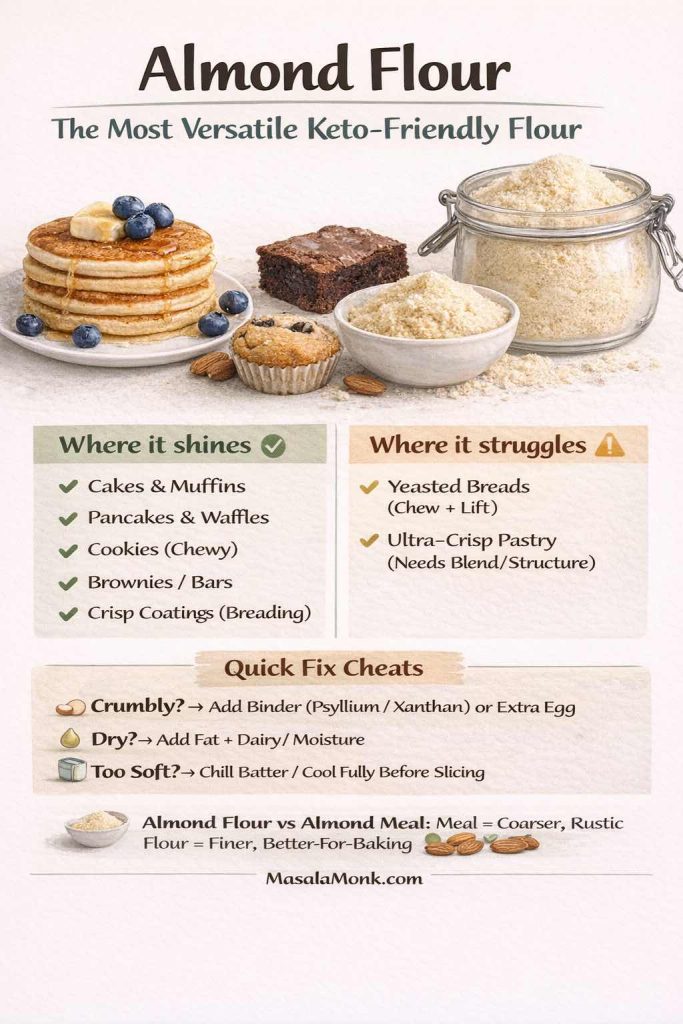
34) What is bamboo flour keto baking used for?

Bamboo fiber-style ingredients are typically used to add bulk and help reduce net carbs in certain blends. Since they can be drying, they usually work best when paired with enough moisture and binders.

35) Is there a keto alternative to wheat flour for chapati or roti?

Many people try low carb atta blends or nut-and-fiber based doughs. Results vary, though, because chapati texture depends heavily on gluten. A more realistic goal is a soft flatbread that satisfies the role of roti, even if it isn’t identical.

36) Why does keto cake sometimes sink in the middle?

This can happen when batter is under-structured, over-leavened, or baked at too high a temperature. Additionally, opening the oven early can cause a fragile keto cake to collapse before it sets.

37) How do I store keto baked goods so they don’t dry out?

Because low carb bakes can lose moisture quickly, store them tightly wrapped. Also, many keto breads and muffins taste better after a brief rewarm, since heat softens fats and improves texture.
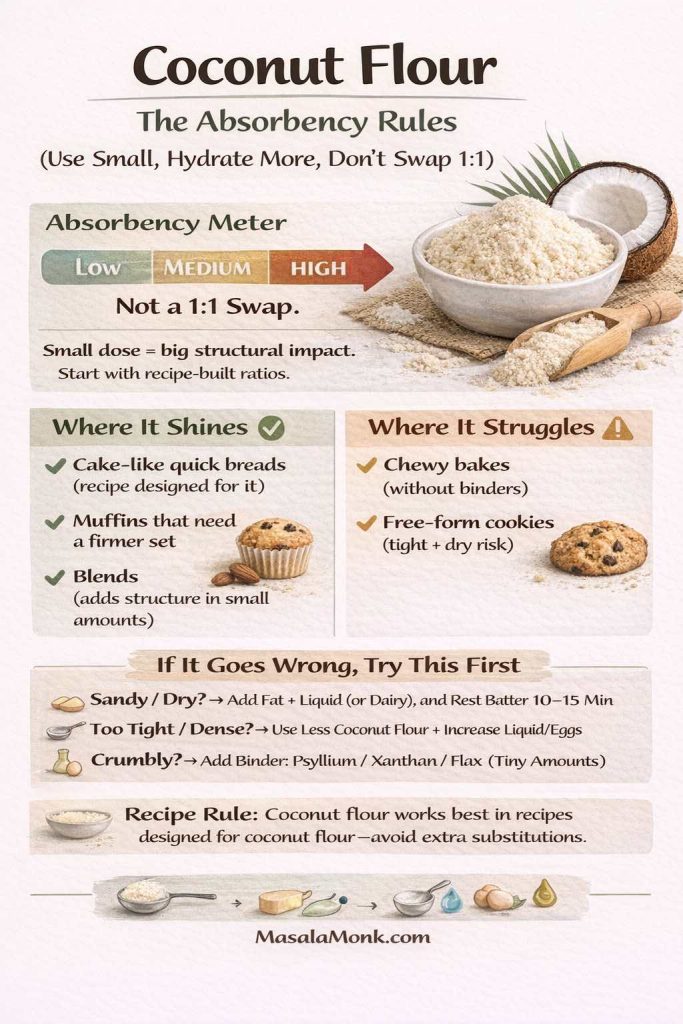
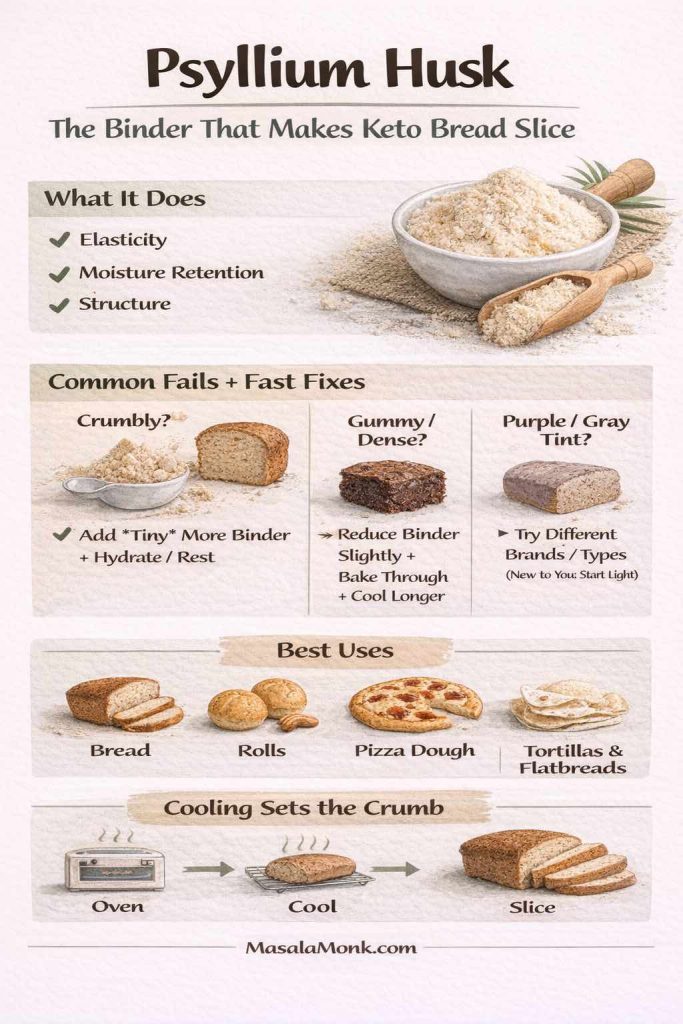
38) What’s the best way to start keto baking if I’m new?

Begin with a simple bake that teaches you how the flour behaves—pancakes or brownies are ideal. Then, once you understand your preferred base flour and sweetener, move into pie crust and bread with more confidence.

39) Can keto baking be nut-free?

Yes. Coconut flour is the most common nut-free keto flour option, and some blends avoid nuts entirely. Even so, nut-free keto baking often requires more careful moisture and binder balance to avoid dryness.

40) What’s the “ultimate guide to keto baking” mindset?

Think in systems, not swaps. Choose the flour and binder that fit the bake, control moisture on purpose, and treat texture as feedback. Over time, keto baking becomes less experimental and far more reliable.

Posted on Leave a comment

Keto Bread Delights: Satisfy Your Carb Cravings with Low-Carb Creations That Are Baked to Perfection!

KETO BREAD DELIGHTS

For anyone walking the low-carb or ketogenic path, bread often feels like the first and most painful sacrifice. That warm, crusty slice of sourdough or the perfect base for a sandwich seems like a distant dream. But keto bread has come a long way, and today, it’s not just about compromising—it’s about crafting low-carb creations that genuinely satisfy.

In this blog post, we’ll dive deep into the world of keto bread: from the science behind the ingredients to the best homemade recipes and the most loved store-bought brands. Whether you’re a seasoned keto baker or just dipping your toes into the lifestyle, this guide will arm you with everything you need to bake, buy, and love your keto bread.


Why Keto Bread?

Traditional bread is carbohydrate-heavy—loaded with refined flours that spike blood sugar and derail ketosis. Keto bread flips the formula on its head: low in carbs, high in fiber, protein, and healthy fats, making it a perfect fit for the ketogenic diet.

But the best keto breads do more than meet macro goals—they offer real satisfaction. The goal is to achieve a bread-like structure, taste, and mouthfeel without relying on traditional grains. Enter a world of almond flour, oat fiber, psyllium husk, eggs, cheese, and more.


Key Ingredients to Understand

1. Almond Flour

A staple in keto baking. It’s naturally low in carbs and rich in fats and protein. Ideal for quick breads and muffins.

2. Coconut Flour

Highly absorbent and rich in fiber. Use in smaller quantities, often paired with eggs or other binders.

3. Oat Fiber

A zero-carb flour substitute made purely from the fibrous husk of oats. Adds lightness and improves texture.

4. Psyllium Husk Powder

Essential for gluten-free elasticity. Gives structure and a chewy texture to keto bread.

5. Vital Wheat Gluten

While not gluten-free, this ingredient mimics traditional bread elasticity and rise. Often used in hybrid keto loaves.

6. Eggs & Cheese

Used in fathead doughs and cloud bread, they add richness, structure, and protein.


The Best Homemade Keto Bread Recipes

1. Classic Almond Flour Keto Bread

  • Ingredients: Almond flour, eggs, baking powder, butter, salt.
  • Texture: Soft and slightly crumbly, great for toast.
  • Tip: Separate the eggs and whip the whites for a fluffier loaf.

2. Oat Fiber + Flax + Vital Wheat Gluten Bread

  • Ingredients: Oat fiber, flaxseed meal, vital wheat gluten, yeast, butter, egg whites.
  • Texture: Most like traditional bread—crusty outside, chewy inside.
  • Tip: Proof the dough like you would with regular bread for better rise.

3. Fathead Dough Loaf

  • Ingredients: Mozzarella cheese, cream cheese, almond flour, egg, baking powder.
  • Texture: Dense but satisfying.
  • Tip: Add a touch of yeast for depth of flavor.

4. 90-Second Mug Bread

  • Ingredients: Almond or coconut flour, egg, butter, baking powder.
  • Texture: Spongy, great for a quick sandwich fix.
  • Tip: Slice and toast for better texture.

5. Psyllium Husk Yeast Bread (Egg-Free)

  • Ingredients: Almond flour, psyllium husk, yeast, apple cider vinegar, water.
  • Texture: Firm, chewy, sandwich-ready.
  • Tip: Bake in a preheated cast iron loaf pan for a better crust.

Best Store-Bought Keto Bread Brands

International:

  • Sola Bread – 1-2g net carbs, multiple flavors.
  • ThinSlim Foods – Zero net carb bread and bagels.
  • Hero Seeded Bread – Tastes like whole wheat, only 1g net carb.
  • Base Culture – Gluten- and grain-free; paleo friendly.

India-Based:

  • Lo! Foods – 2.8g net carbs, clean label, delivered pan-India.
  • Khhet – Artisanal mini-loaves and low-carb tortillas.
  • Get Sorted – Keto roti and wraps with 3-4g net carbs.

These options are perfect for busy lifestyles or when baking isn’t an option. Just be sure to check the label for true net carbs and avoid brands that sneak in maltodextrin or modified starches.


How to Store and Serve Keto Bread

  • Storage: Keto bread has fewer preservatives. Store in an airtight container in the fridge (up to 1 week) or freeze in slices.
  • Reheating: Always toast or warm before eating—this revives texture and flavor.
  • Serving Ideas:
    • Avocado toast with hemp seeds
    • Keto French toast with erythritol syrup
    • Sandwiches with sugar-free deli meats and cheeses
    • Grilled cheese using fathead dough bread

Final Tips for Keto Bread Success

  • Use precise measurements – Keto flours behave differently.
  • Let the bread rest after baking – Texture improves as it cools.
  • Toast it – Especially with mug breads or low-moisture loaves.
  • Experiment – Try combinations like lupin flour and whey for high-protein versions.

Conclusion

Keto bread is no longer a compromise—it’s a craft. With a little experimentation and the right ingredients, you can enjoy bread that’s as good as (if not better than) its high-carb counterpart. Whether you’re baking from scratch or grabbing a trusted loaf off the shelf, keto bread delights are here to stay—crisp, golden, satisfying, and oh-so-keto.

FAQs

1. Is keto bread really low in carbs?
Yes, authentic keto bread typically contains 0–3 grams of net carbs per slice, depending on the ingredients. The key is using low-carb flours like almond flour, coconut flour, oat fiber, or psyllium husk.

2. Can I eat keto bread daily?
Absolutely—in moderation. It’s great for maintaining variety and satisfaction on a keto diet. Watch your total daily carb limit (usually 20–50g net carbs) and check the ingredients to avoid hidden sugars or starches.

3. What’s the best flour substitute for wheat in keto bread?
It depends on your dietary goals:

  • Almond flour: Nutty flavor, higher in fat.
  • Coconut flour: Very absorbent, use less.
  • Oat fiber: Zero-carb, adds volume.
  • Vital wheat gluten: High protein, bread-like elasticity (not gluten-free).

4. Why does my homemade keto bread taste eggy?
Too many eggs or insufficient balancing ingredients (like vinegar or psyllium) can cause this. Whipping egg whites separately and using fewer yolks helps neutralize the flavor.

5. Can I make keto bread without eggs or dairy?
Yes! Use psyllium husk, apple cider vinegar, and yeast for binding and rising in egg-free versions. Coconut cream or nut milk can replace dairy.

6. Is keto bread gluten-free?
Some recipes are, especially those made with almond, coconut, or flaxseed flour. However, bread using vital wheat gluten is not gluten-free, so check recipes or packaging accordingly.

7. How should I store keto bread?
Homemade keto bread should be stored in the fridge for up to 7 days or frozen in slices for longer life. Always toast before eating to restore texture.

8. Can I use a regular bread machine for keto bread?
Yes, with some recipes. Ensure the dough cycle is manual or programmable, and use recipes designed for low-gluten development (e.g., no long kneading needed).

9. What’s the best store-bought keto bread brand?
Top-rated include:

  • Sola Bread (1–2g net carbs)
  • ThinSlim Foods (zero net carbs)
  • Lo! Foods (India-based, ~2.8g net carbs)
    Always verify nutrition labels and ingredients.

10. Can I lose weight eating keto bread?
Yes, if it fits within your macronutrient goals. Keto bread is lower in carbs and often higher in fiber and fat, promoting satiety and helping maintain ketosis.

Posted on Leave a comment

Garlic Bread Reimagined: Elevating the Classic with a Keto Twist and Irresistible Variations!

KETO GARLIC BREAD

Few foods captivate the senses quite like garlic bread. The golden, crusty exterior, the rich aroma of garlic butter, the indulgent chew — it’s an iconic comfort food that’s universally loved.

But if you’re following a keto or low-carb lifestyle, traditional garlic bread is a problem: loaded with refined carbs and wheat flour, one slice can easily contain more carbs than your entire daily allowance.

Thankfully, the world of keto innovation has transformed garlic bread into something not only possible but better — deeply flavorful, indulgent, and entirely macro-friendly. This comprehensive guide walks you through everything you need to master keto garlic bread, offering multiple variations, practical recipes, expert techniques, ingredient science, and flavor innovations.


🌟 Why Reinvent Garlic Bread for Keto?

Let’s start with the problem.

Traditional garlic bread:

  • Made from French bread or Italian loaf
  • Typically 25-30g carbs per slice
  • Refined flour, no fiber, spikes blood sugar

The keto lifestyle requires:

  • 20-30g carbs total per day
  • Higher fat, moderate protein
  • Minimal sugars and refined starches

The goal: capture the same satisfying taste, texture, and mouthfeel of garlic bread while staying true to keto macros. This is absolutely achievable — once you understand the building blocks.


🧬 The Science of Keto Bread: Replacing Gluten & Carbs

Traditional bread owes its structure to gluten, which creates the elastic network that traps air bubbles, giving bread its signature chew.

Keto bread replaces gluten structure by manipulating:

  • Protein matrices (from cheese, eggs, or whey protein)
  • Fiber binders (psyllium husk, xanthan gum)
  • Fat emulsifiers (cream cheese, sour cream, ghee)

The result: chewy, satisfying bread analogs that hold together, brown beautifully, and offer complex flavor.


🍞 The Best Keto Garlic Bread Bases

Here’s a complete breakdown of your options — each with its strengths, trade-offs, and ideal use cases.


1️⃣ Fathead Dough (The Keto Classic Workhorse)

Core Ingredients:

  • Shredded mozzarella (protein matrix)
  • Cream cheese (fat and tenderness)
  • Almond flour (structure)
  • Egg (binding)
  • Baking powder (lift)
  • Psyllium husk (for elasticity and chew)

Why it’s fantastic:

  • Excellent bread-like chew
  • Flexible for loaves, rolls, sticks, or pull-apart bread
  • Freezes well for make-ahead batches

Pro Tip:
Use block mozzarella shredded at home for best melt and elasticity. Pre-shredded often contains anti-caking agents that affect dough texture.


2️⃣ Air Fryer Cheese Wrap Garlic Bread (The Ultra-Fast Version)

Core Ingredients:

  • Store-bought keto cheese wraps (e.g. egg-thin wraps, almond flour wraps)
  • Butter + garlic mixture
  • Parmesan or shredded mozzarella

Why it’s fantastic:

  • Lightning-fast — ready in under 10 minutes
  • Air fryer gives crispy edges and gooey centers
  • Great for quick snacks or appetizers

Method:

  • Brush wrap with garlic butter
  • Sprinkle cheese generously
  • Air fry at 375°F for 5-7 minutes

3️⃣ Cloud Bread (The Fluffy, Light Option)

Core Ingredients:

  • Egg whites (foaming structure)
  • Cream cheese or mascarpone
  • Cream of tartar (stabilizes meringue)
  • Garlic powder or fresh garlic

Why it’s fantastic:

  • Virtually zero carbs
  • Extremely light and airy — almost melts in your mouth
  • Perfect paired with lighter dishes like soups or salads

Limitation:
It lacks the chewiness of regular bread but delivers a wonderfully light texture that works for those preferring softer bites.


4️⃣ Almond Flour Loaf (The Sliceable, Bread-Like Classic)

Core Ingredients:

  • Almond flour (main structure)
  • Baking powder (leavening)
  • Eggs (binding)
  • Crème fraîche or sour cream (moisture, tenderness)
  • Mozzarella or Parmesan (depth of flavor)
  • Garlic and herbs

Why it’s fantastic:

  • Slices like traditional bread
  • Stores well, easy for batch baking
  • Holds up to slicing, spreading, and toasting

Pro Tip:
Use blanched almond flour for finer texture and less grittiness.


🧄 The Flavor Centerpiece: Keto Garlic Butter

No matter which base you choose, garlic butter is what transforms keto bread into garlic bread.

Essential Garlic Butter Formula:

  • ½ cup unsalted butter (softened)
  • 3-5 cloves minced or roasted garlic
  • 1 tbsp chopped fresh parsley
  • 1 tsp salt
  • 1 tsp lemon juice or apple cider vinegar (optional, balances richness)

Flavor Variations:

Add-OnFlavor Benefit
Truffle oilDeep, earthy luxury
Chili flakesSpicy heat
Smoked paprikaSubtle smoky depth
Bacon bitsSalty, meaty crunch
Pesto drizzleFresh herbal brightness
Fresh rosemaryMediterranean savory notes

Pro Tip:
Roasting your garlic beforehand makes it milder, sweeter, and more complex.


🔥 Cooking Techniques to Perfect Keto Garlic Bread

Both traditional ovens and air fryers can deliver exceptional results — depending on your base and goal.

MethodBest ForCook Time
Air FryerWraps, quick bakes, smaller portions5-7 minutes at 375°F
Oven BakeLoaves, pull-apart bread, rolls15-25 minutes at 350-375°F
Broiler/Blow TorchFinal blistering, golden finish1-2 minutes

Pro Tip:
For pull-apart bread, baste with garlic butter both before and after baking to lock in moisture and create rich layers of flavor.


🧮 Macronutrient Breakdown (Sample — Fathead Version)

NutrientPer Serving
Net Carbs2-3g
Fat16-20g
Protein8-10g
Calories200-250

Perfectly aligned with standard keto macros, allowing you to indulge without guilt.


🍳 Complete Keto Garlic Bread Recipe (Highly Practical Guide)

Ingredients (Makes 8 servings)

For the dough:

  • 1 ½ cups shredded mozzarella
  • 2 tbsp cream cheese
  • ¾ cup almond flour
  • 1 egg
  • 1 tbsp psyllium husk
  • 1 tsp baking powder

For the garlic butter:

  • ½ cup unsalted butter, softened
  • 4 cloves roasted garlic, mashed
  • 2 tbsp fresh parsley, chopped
  • 1 tbsp grated Parmesan
  • Salt, to taste

Directions

Step 1 — Make the Dough:

  1. Melt mozzarella and cream cheese together in microwave-safe bowl (90 seconds).
  2. Stir thoroughly until smooth.
  3. Add almond flour, psyllium husk, baking powder, and egg.
  4. Knead mixture until a uniform dough forms.

Step 2 — Shape the Bread:

  • Roll into loaf shape, pull-apart rolls, or flatbread depending on your preference.

Step 3 — Bake:

  • Preheat oven to 375°F.
  • Bake for 15-20 minutes until golden and set.

Step 4 — Prepare Garlic Butter:

  • Mix softened butter with roasted garlic, parsley, Parmesan, and salt.

Step 5 — Finish:

  • Brush garlic butter over hot bread.
  • Optional: broil for 1-2 minutes to achieve a gorgeous golden blister.

🍽 Serving Suggestions

  • Dipping Sauces: Low-sugar marinara, garlic aioli, pesto, or keto ranch.
  • Main Pairings: Keto pasta alternatives (zucchini noodles, shirataki), grilled meats, hearty stews.
  • Appetizers: Slice into sticks or knots for party platters.
  • Meal Prep: Make ahead, refrigerate for up to 3 days, reheat in air fryer for maximum crisp.

💡 Creative Variations to Explore

VariationHighlight
Pull-Apart Garlic Bread BitesEntertaining crowd-pleasers
Truffle Butter Garlic KnotsGourmet dinner parties
Air Fryer Garlic Bread ChipsKeto snacking
Bacon & Jalapeño Garlic BreadSmoky-spicy indulgence
Dairy-Free Almond Cheese VersionPlant-based option

🚀 Pro Tips for Success

  • Use parchment paper for easier handling of sticky dough.
  • Always cool slightly before slicing to maintain structure.
  • Don’t skip roasting garlic — it’s a game changer.
  • For ultra-soft texture, add 1 tbsp sour cream or crème fraîche to dough.

🔍 Why Keto Garlic Bread Is Worth Mastering

  • Satisfies intense bread cravings.
  • Customizable to every flavor preference.
  • Fits seamlessly into keto macros.
  • Impressive for entertaining — your guests may not realize it’s keto!
  • Easy to batch-cook and store for busy weeks.

Final Thought:
With the power of keto recipe science and a little creativity, you can enjoy garlic bread that’s not just “good for keto” — it’s outstanding, period.

You don’t need to compromise flavor, texture, or indulgence to stay on track. Mastering keto garlic bread might just become one of your most satisfying keto cooking achievements.


Ready to bake? Pick your base, prep your garlic butter, and elevate your keto comfort food game to delicious new heights.

🔎 10 FAQs and Answers for Keto Garlic Bread


1️⃣ Can I make keto garlic bread without almond flour?

Yes. You can substitute coconut flour (using about ¼ the amount of almond flour) or use fathead variations that rely more heavily on cheese. Cloud bread is also entirely almond flour-free. Each option gives a different texture, so choose based on your preference.


2️⃣ What’s the lowest-carb version of keto garlic bread?

The cloud bread version typically has less than 1g net carb per serving, making it the lowest-carb option. Air fryer cheese wraps are also extremely low-carb and fast to prepare.


3️⃣ Can I freeze keto garlic bread?

Absolutely. Fathead-based or almond flour loaves freeze very well. Cool completely, slice, and store in freezer bags for up to 3 months. Reheat directly from frozen in the oven or air fryer for best texture.


4️⃣ Is dairy-free keto garlic bread possible?

Yes, but more challenging. Substitute dairy-free mozzarella (almond or coconut-based) and use vegan cream cheese. The structure may be softer, but it’s achievable with some recipe adjustments.


5️⃣ Why does my fathead dough feel too sticky or oily?

This usually happens if:

  • The cheese wasn’t melted evenly.
  • The almond flour wasn’t fully incorporated.
  • The dough wasn’t allowed to cool slightly before kneading.

Knead with lightly oiled hands or chill for a few minutes to firm it up before shaping.


6️⃣ What’s the best type of mozzarella for fathead dough?

Use low-moisture, full-fat block mozzarella. Avoid pre-shredded varieties, as anti-caking agents prevent smooth melting and elasticity.


7️⃣ Can I make keto garlic bread in the air fryer?

Yes, very successfully! Cheese wraps, fathead dough mini-loaves, or garlic butter-topped chaffles work beautifully in the air fryer. Typical air frying time is 5–7 minutes at 375°F.


8️⃣ How do I make garlic bread more fluffy and less dense?

  • Add 1–2 tablespoons of sour cream or crème fraîche to the dough.
  • Do not overmix.
  • Use fresh baking powder for maximum lift.
  • Allow the dough to rest before baking.

9️⃣ Can I make pull-apart or party versions?

Definitely. Roll the fathead dough into small balls, arrange them close together, brush with garlic butter, and bake. This creates shareable pull-apart garlic bread that’s perfect for parties.


🔟 How do I prevent keto garlic bread from being too “eggy”?

Use only the required amount of egg — don’t add extra. For stronger garlic butter flavors, roast your garlic beforehand to help balance any remaining egg taste.