Posted on Leave a comment

Cottage Cheese Cheesecake Recipe

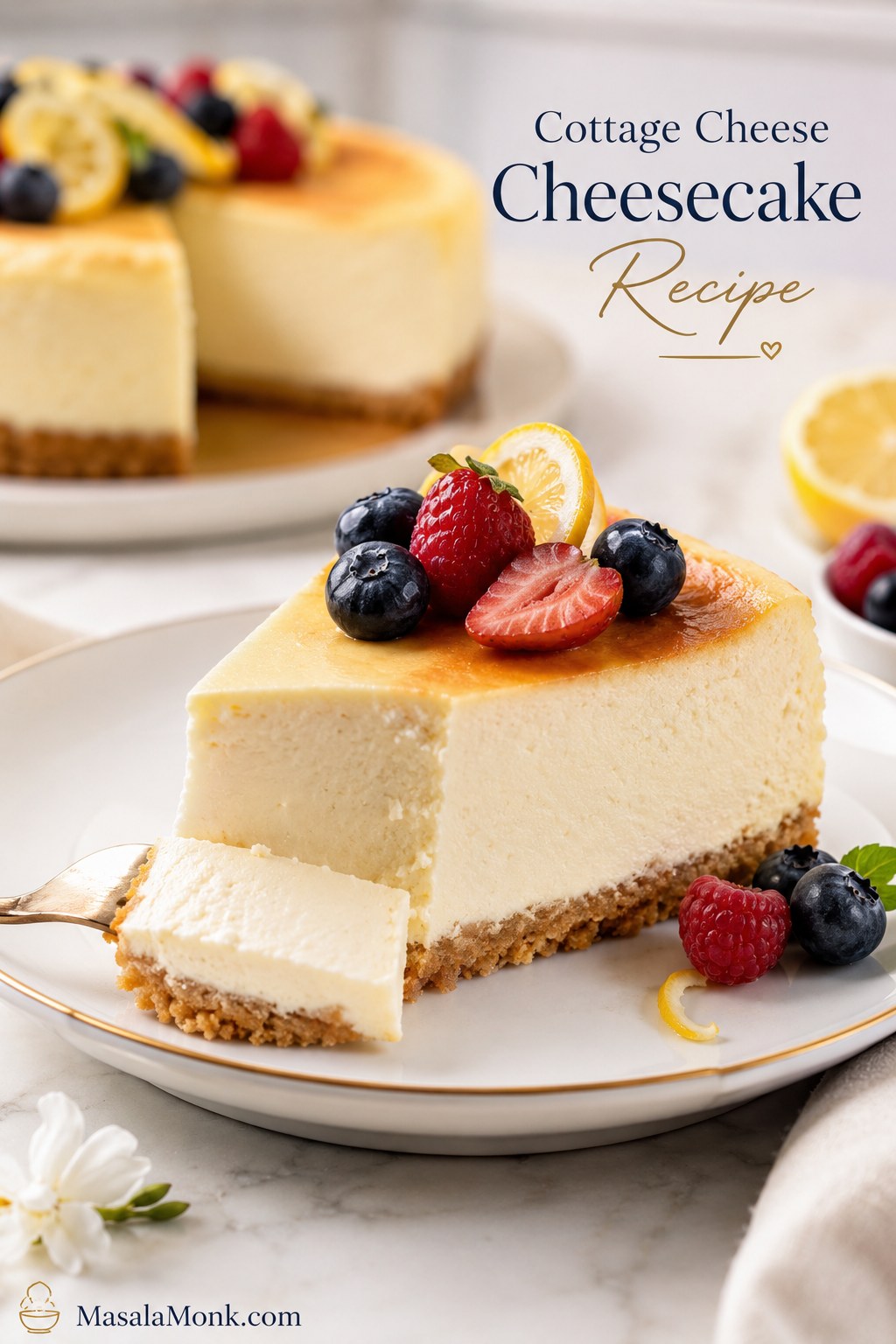
Finished cottage cheese cheesecake slice with creamy filling, crumb crust, berries, and lemon on a dessert plate

This cottage cheese cheesecake recipe is built for the two worries people usually have before they try it: grainy curds and a watery filling. The cottage cheese is blended until completely smooth, supported with thick Greek yogurt, eggs, vanilla, lemon, and a little cornstarch, then baked gently and chilled until creamy and sliceable.

It is lighter than a classic cream cheese cheesecake, but it still tastes like dessert. You can bake it with a buttery crumb crust, make it crustless, or add a little cream cheese when you want a richer, more traditional slice — no protein powder needed.

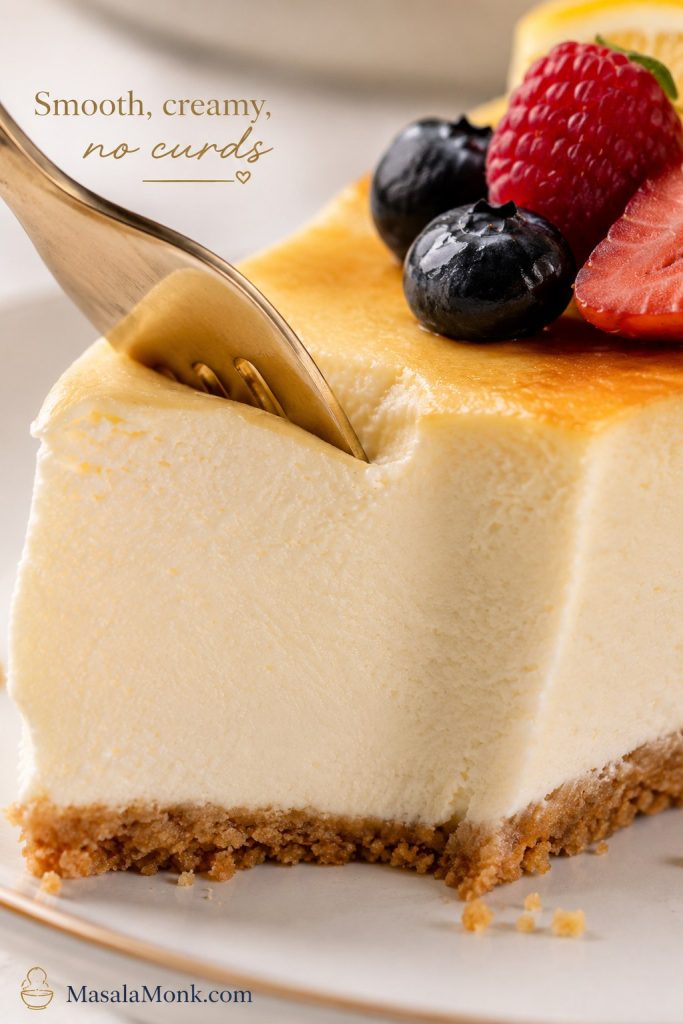
Close-up of a fork cutting into a smooth cottage cheese cheesecake slice with no visible curds
A clean fork cut should reveal a creamy interior — the first sign that the cottage cheese has blended fully into the filling.

Quick Answer: Can You Make Cheesecake with Cottage Cheese?

Yes, you can make cheesecake with cottage cheese. The key is to blend the cottage cheese until smooth before baking it with eggs, Greek yogurt, vanilla, lemon, and a little cornstarch. Once baked and chilled, the filling becomes creamy, lightly tangy, and sliceable.

The best version should not remind you of eating cottage cheese from a tub. Once blended, baked, and chilled, the cottage cheese melts into the filling and gives the cheesecake body, tang, and a lighter feel than a cream cheese-only base.

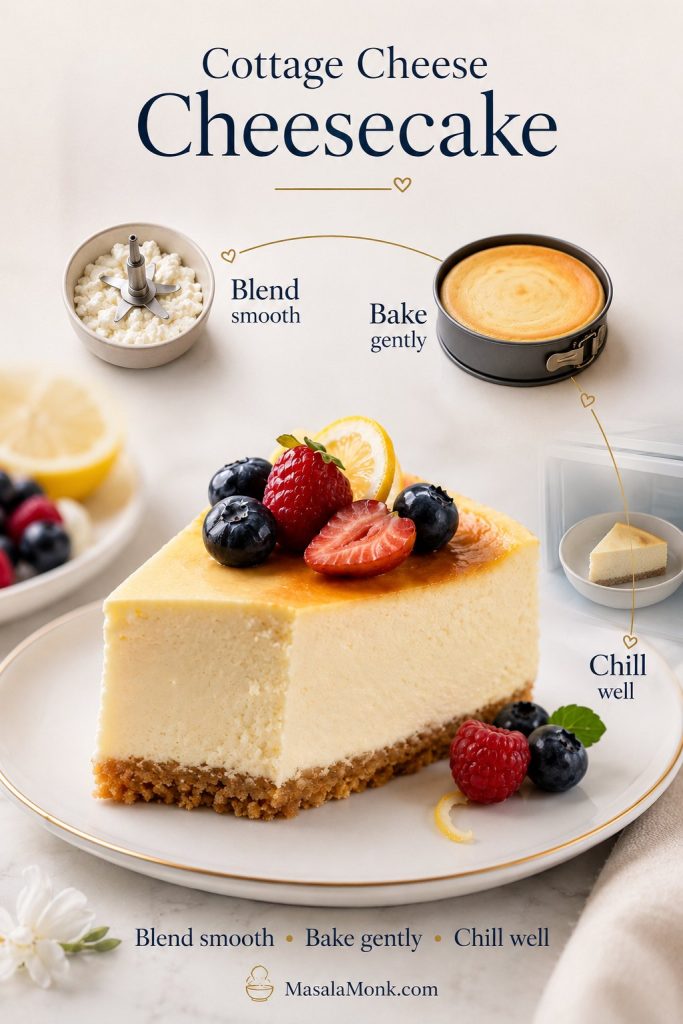
Cottage cheese cheesecake quick answer visual showing the blend, bake, and chill method
For a reliable result, think in three moves: smooth the dairy first, set the filling gently, then chill before slicing.

Before You Bake: Texture Rules and Timing

At a glance: This is a smooth baked cottage cheese cheesecake with Greek yogurt, vanilla, lemon, and an optional crumb crust. Bake it in an 8-inch springform pan at 325°F / 160°C until the edges are set and the center softly wobbles, then cool slowly and chill at least 4 hours or overnight.
Why you’ll love it:
  • It tastes like cheesecake, not cottage cheese. Blending smooths the curds into the filling.
  • It is lighter but still dessert-like. Greek yogurt adds tang without making the slice feel flat.
  • No protein powder needed. Cottage cheese and Greek yogurt give the filling its protein-rich base without making the cheesecake taste chalky.
  • It works with or without a crust. Make it classic, crustless, or low-carb.
  • It is better the next day. Overnight chilling gives the cleanest, creamiest slices.
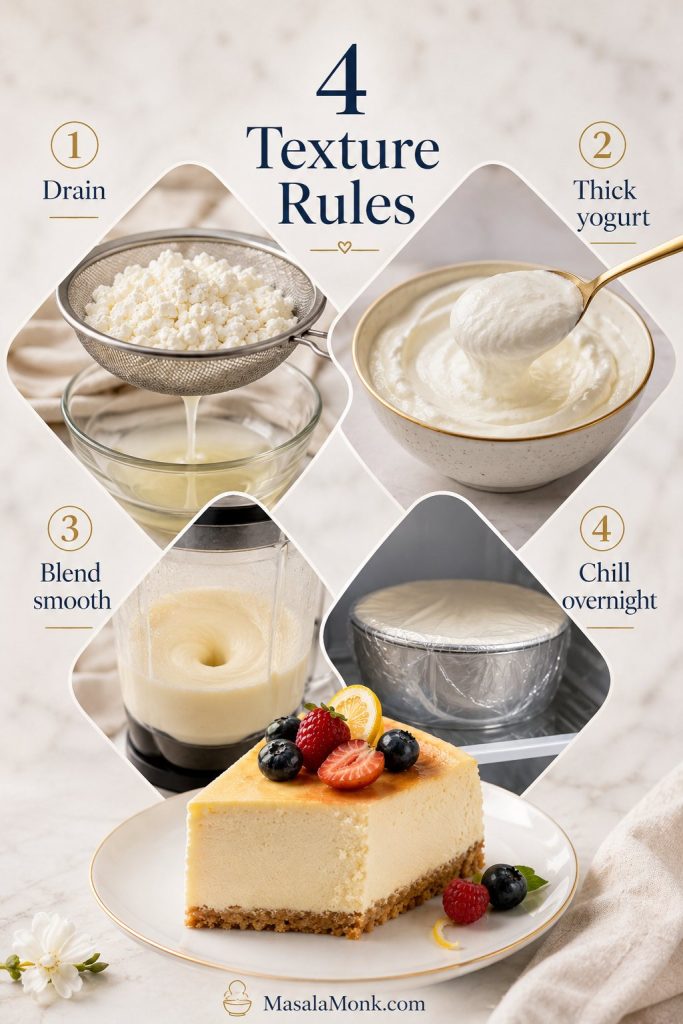
The 4 texture rules:
  • Drain cottage cheese when it looks watery.
  • Use thick Greek yogurt, not loose regular yogurt.
  • Blend the dairy completely smooth before adding eggs.
  • Chill the cheesecake overnight before judging the final texture.
Four cottage cheese cheesecake texture rules showing draining, thick yogurt, smooth blending, and overnight chilling
Before baking, these four rules matter most: control moisture, use thick yogurt, blend thoroughly, and give the cheesecake enough chill time.

Need the visual version? Jump to how to make the filling smooth or troubleshooting if your batter looks loose, grainy, or hard to slice.

What Does Cottage Cheese Cheesecake Taste Like?

A good cottage cheese cheesecake tastes creamy, lightly tangy, and familiar — closer to a lighter cheesecake than a cottage cheese dessert. The vanilla gives it warmth, the lemon adds classic cheesecake brightness, and the Greek yogurt rounds out the dairy flavor.

The texture is softer and a little lighter than a dense New York-style cheesecake, especially with the Greek yogurt version. The cream cheese variation makes it richer, denser, and closer to the classic slice many people expect.

The cottage cheese should not stand out. Once it is blended and chilled properly, it should support the cheesecake rather than announce itself.

For Cottage Cheese Skeptics

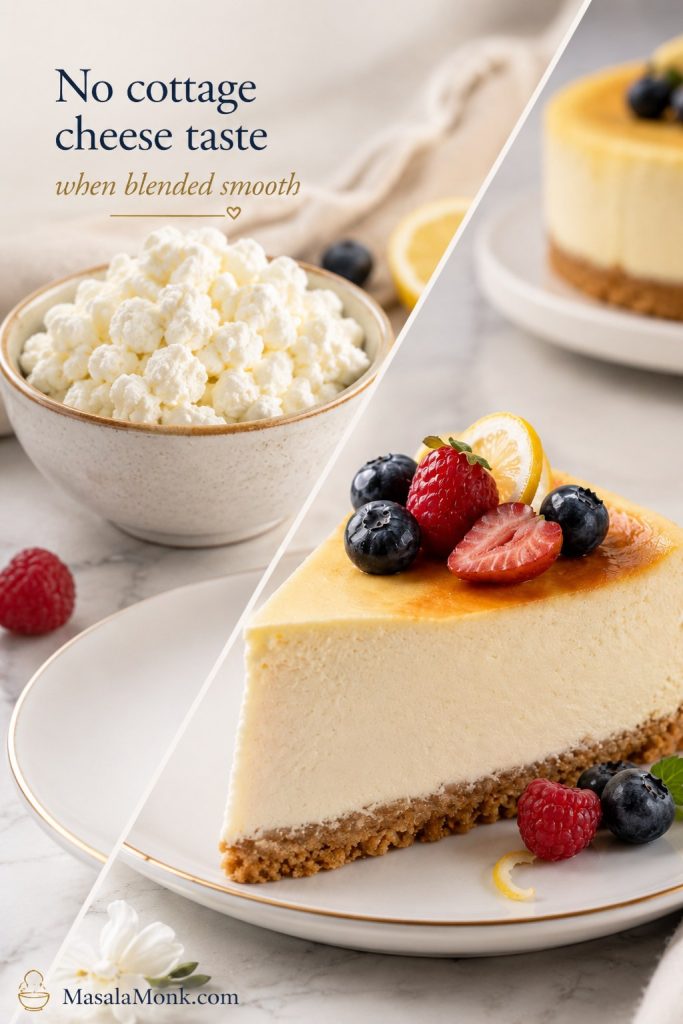
If the words cottage cheese cheesecake make you imagine curds in dessert, you are not alone. That is exactly what this recipe is designed to avoid. Once the filling is blended, baked, and chilled, the cottage cheese should disappear into the texture.

The goal is not a “healthy dessert” that tastes like a compromise. It should taste like a lighter, tangier cheesecake: cold, creamy, smooth, and familiar enough that nobody is thinking about cottage cheese curds.

Curdy cottage cheese transforming into a smooth cheesecake slice with no visible curds
If cottage cheese flavor worries you, this is the goal: the dairy disappears into the cheesecake instead of standing out.

Why This Cottage Cheese Cheesecake Works

Cottage cheese can make a beautiful cheesecake, but it needs the right support. This recipe is built around the two things that matter most: blending the curds completely smooth and keeping extra moisture under control.

The goal is not to hide cottage cheese under a pile of sugar. It is to make it behave like a cheesecake filling: smooth enough to slice, tangy enough to taste familiar, and rich enough that it still feels like dessert.

Cottage Cheese Adds Protein and Body

Cottage cheese gives the filling body, mild tang, and a naturally higher-protein foundation than a cream cheese-only filling. Full-fat cottage cheese gives the richest result, while 2% cottage cheese works well for a lighter slice that still tastes balanced.

Greek Yogurt Adds Tang and Creaminess

Greek yogurt keeps the filling from tasting flat. It brings the tang people expect from cheesecake, but it needs to be thick; loose yogurt can push the batter toward watery.

Eggs Help the Cheesecake Set

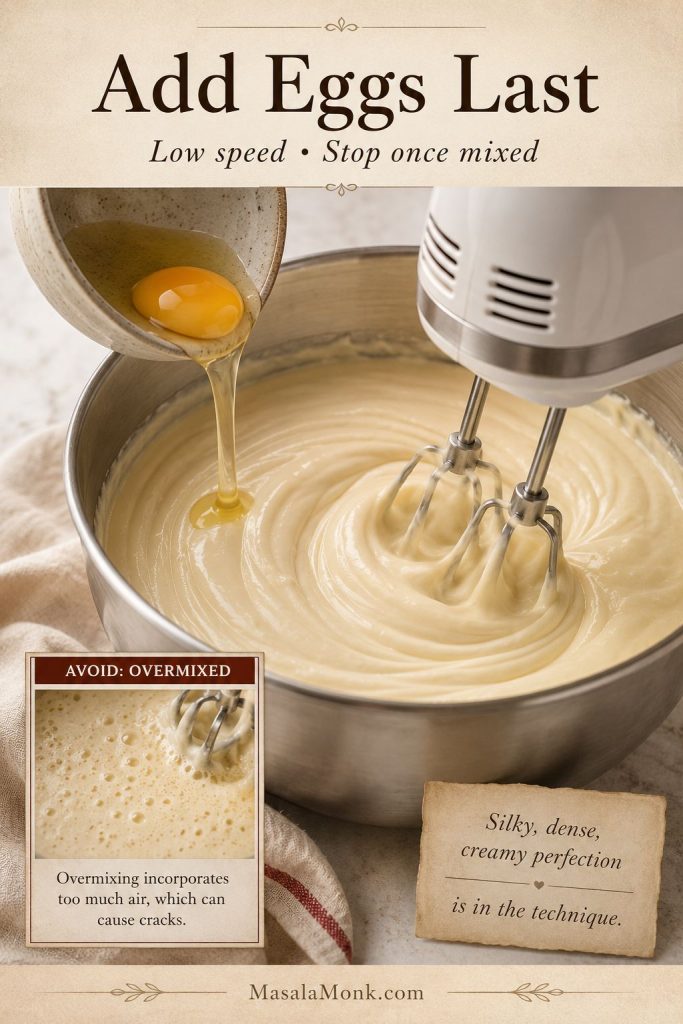
This version uses 4 large eggs for a reliable set. Add them last and blend briefly; too much air in the batter can make the cheesecake puff in the oven and crack as it cools.

Cornstarch Gives Extra Insurance

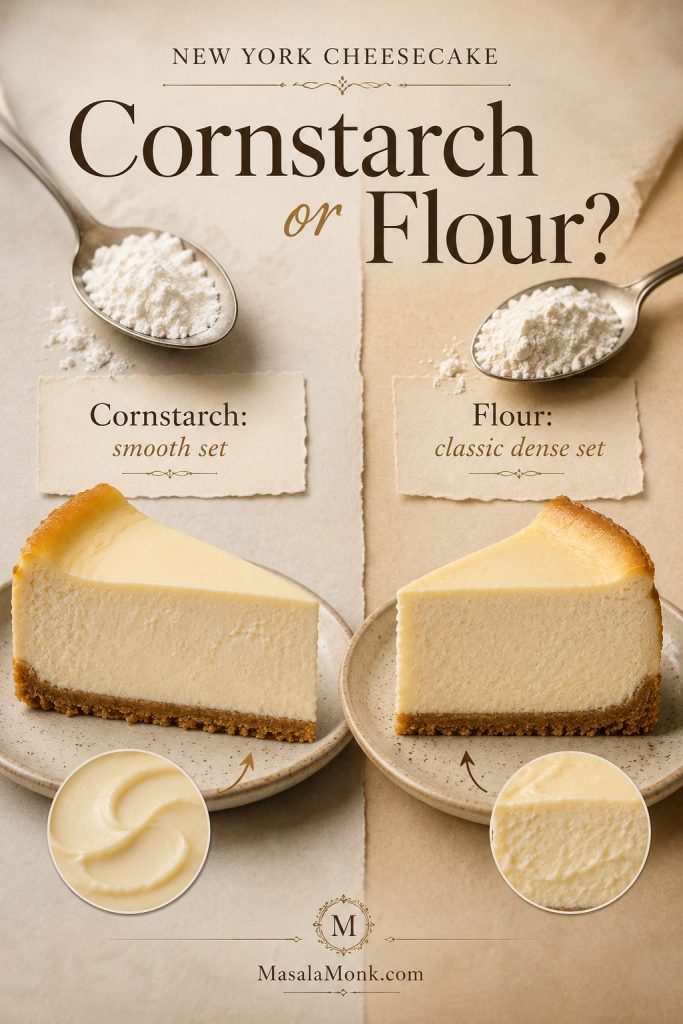
A small amount of cornstarch helps the filling hold together without making it heavy. It is especially useful when cottage cheese has a little extra liquid. All-purpose flour works too, but cornstarch keeps the texture softer and cleaner.

Low, Gentle Baking Prevents Cracks

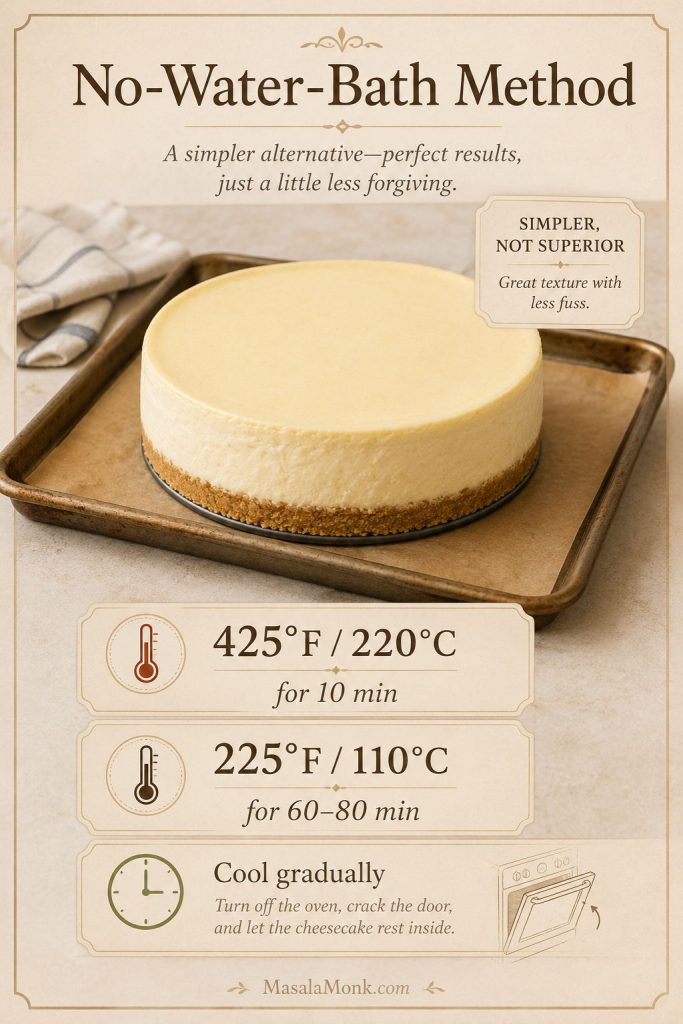
This cheesecake bakes at 325°F / 160°C after the crust is pre-baked. The lower heat helps the filling set slowly, which reduces the chance of a cracked top, dry edges, or a firm, rubbery center.

Texture tip: Do not bake this cheesecake until the center looks completely firm. Pull it when the edges are set and the center still has a soft wobble. Warm cheesecake is supposed to look a little underdone; the refrigerator does the final work.

How to Avoid Grainy or Watery Cottage Cheese Cheesecake

This recipe is built around moisture control. Cottage cheese and Greek yogurt both bring liquid to the filling, so the best texture comes from using thick dairy, adding enough egg structure, and including a small amount of cornstarch.

Granulated sugar keeps the batter more predictable than liquid sweeteners. Watery cottage cheese should be drained before measuring. Eggs should go in last so the batter does not become over-aerated. After baking, the cheesecake may look softer than expected, but the texture changes as it cools and chills.

Ingredients for Cottage Cheese Cheesecake

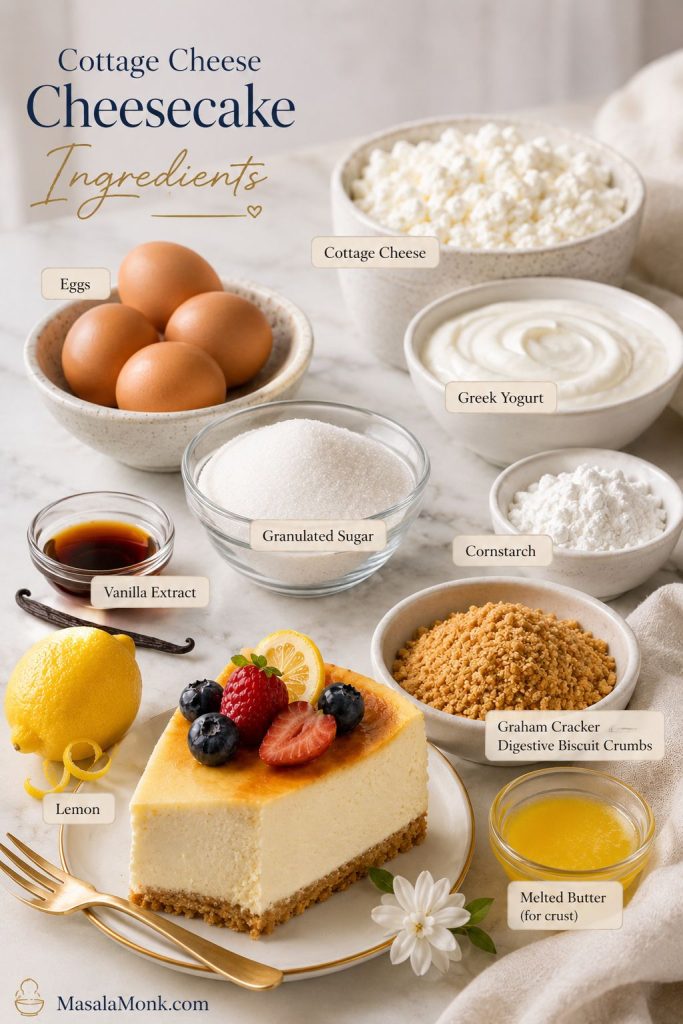
This cottage cheese cheesecake uses familiar cheesecake ingredients, but the balance is slightly different from a classic cream cheese version. The goal is a filling that feels smooth and sliceable without losing the lighter character that makes cottage cheese useful in the first place.

Cottage cheese cheesecake ingredients including cottage cheese, Greek yogurt, eggs, lemon, vanilla, cornstarch, and crumb crust
Each ingredient has a clear job: cottage cheese builds body, Greek yogurt adds tang, eggs set the filling, and cornstarch helps protect the structure.

Cottage Cheese

Use full-fat or 2% cottage cheese for the best balance of richness and structure. Small-curd cottage cheese is easiest to blend, but large-curd cottage cheese also works with a good blender or food processor.

Greek Yogurt

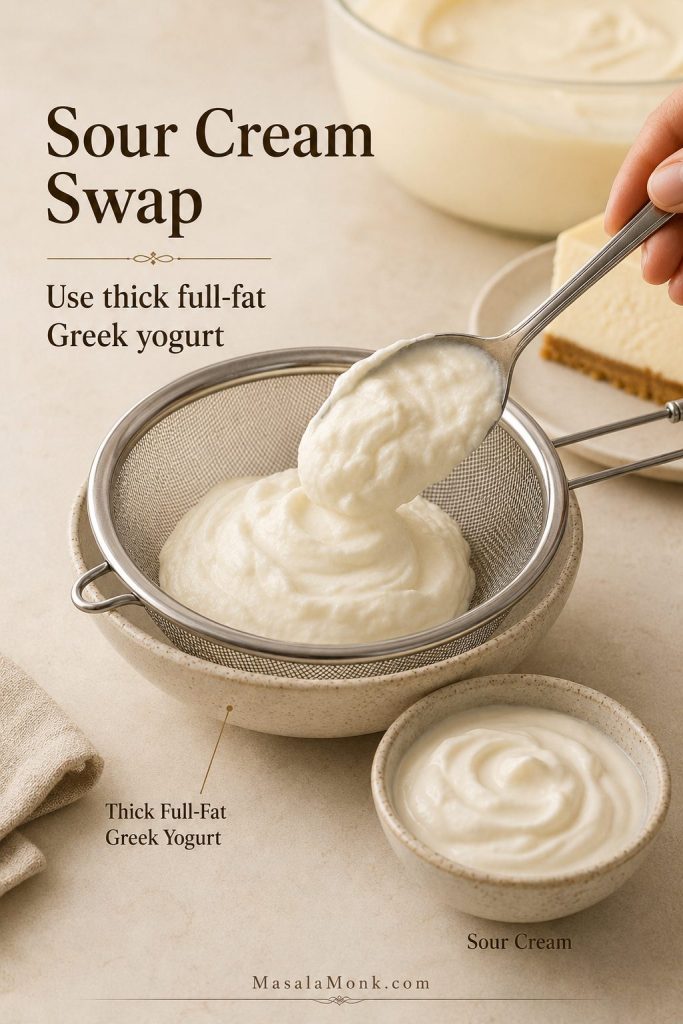
Plain Greek yogurt adds tang and keeps the cheesecake from tasting flat. Whole milk Greek yogurt gives the richest texture, while low-fat or nonfat Greek yogurt makes the cheesecake lighter. Avoid regular yogurt unless it has been strained until thick.

Eggs

Eggs help the filling set. Use room-temperature eggs so they blend evenly into the batter. The cheesecake should not taste eggy when it is baked gently and pulled while the center still has a soft wobble.

Sugar or Sweetener

Regular granulated sugar gives the cleanest cheesecake flavor. A cup-for-cup monk fruit blend or allulose can work for a lower-sugar version. For a fully low-carb cheesecake with a more classic structure, this keto cheesecake recipe goes deeper into almond flour crusts, sugar-free sweeteners, crustless cheesecake, and no-crack baking.

Cornstarch

Cornstarch helps the cottage cheese and yogurt filling bake into clean slices. Use 2 tablespoons of all-purpose flour instead when cornstarch is not available.

Vanilla and Lemon

Vanilla adds warmth. Lemon zest and a little lemon juice give the cheesecake its familiar brightness. The lemon does not need to make the cheesecake taste sharply lemony; it simply makes the dairy taste more like cheesecake.

Graham Cracker or Digestive Biscuit Crust

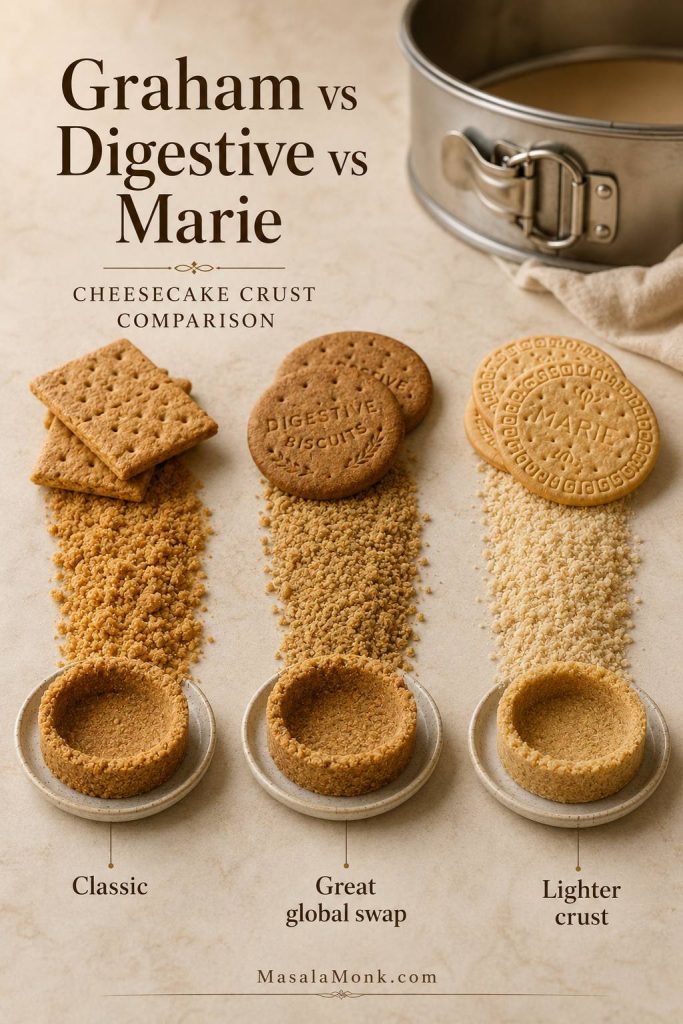
The crust is optional, but it makes the cheesecake feel more classic. Graham crackers, digestive biscuits, or similar plain sweet biscuits all work. Pre-baking the crust for a few minutes helps it hold together under the filling.

Best Cottage Cheese to Use

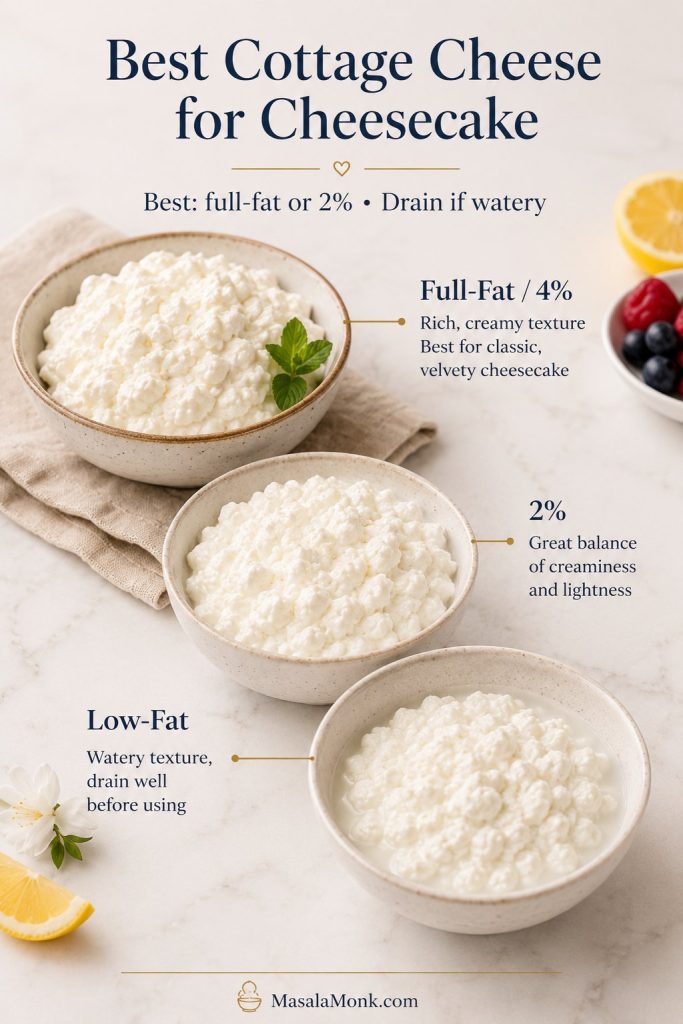
The cottage cheese you choose has a direct effect on texture. Since this is a blended cheesecake, you do not need perfect curds, but you do need cottage cheese that is not overly watery.

Cottage cheese comparison showing full-fat, two percent, and watery low-fat cottage cheese for cheesecake
Full-fat or 2% cottage cheese is usually the safest choice because it gives the filling more body and a smoother baked result.
Cottage Cheese Type Result in Cheesecake Best Use
Full-fat / 4% Richest, most forgiving texture Best overall choice
2% Still creamy, slightly lighter Best balance for a lighter cheesecake
Low-fat Can work, but may be thinner or tangier Use only when thick; drain when watery
Fat-free Least rich, more likely to taste tangy or thin Use only for a very lean version
Small-curd Blends easiest Best default
Large-curd Works when blended very well Use a strong blender or food processor

When to Drain Watery Cottage Cheese

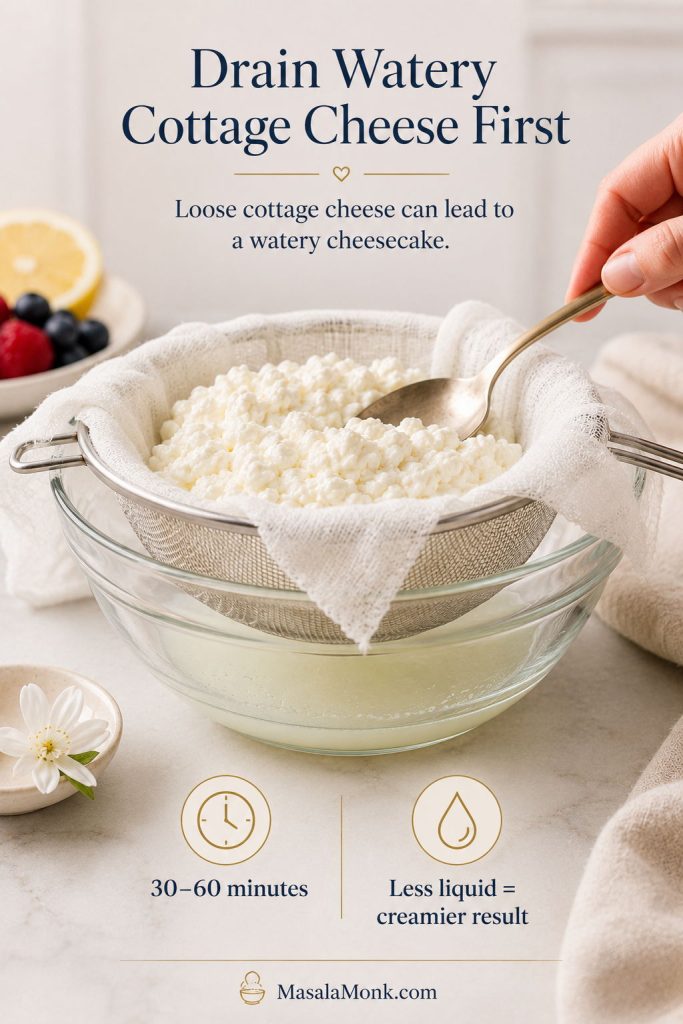
When cottage cheese looks loose or has a lot of liquid in the container, drain it through a fine-mesh sieve before measuring. That one small step can prevent a watery cheesecake.

Watery cottage cheese draining in a fine-mesh sieve over a bowl before making cheesecake
Draining loose cottage cheese first removes extra moisture, which means the finished cheesecake is less likely to turn soft or watery.

Once you know which cottage cheese to use, the next important step is blending it smooth before the eggs go in.

For official nutrient data on different cottage cheese varieties, you can check USDA FoodData Central cottage cheese data.

How to Make Cottage Cheese Cheesecake Smooth

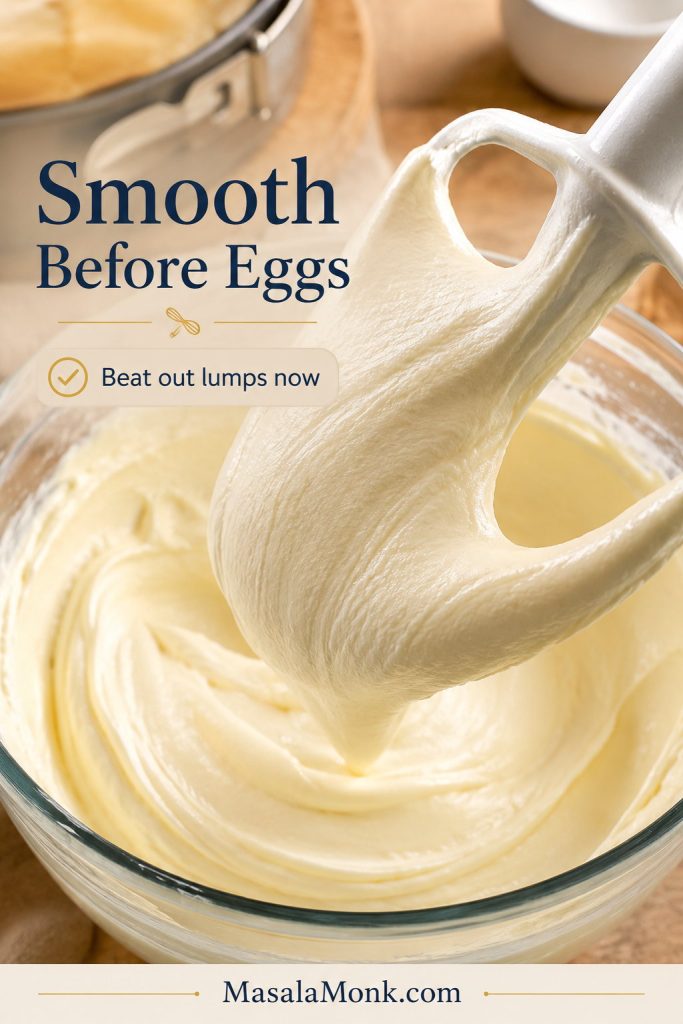
Graininess is what can ruin the illusion, so the blender step matters more than anything else. The dairy should look glossy and smooth before the eggs go in.

Use a Blender or Food Processor

A high-speed blender gives the silkiest filling. A food processor also works, especially when you scrape down the sides once or twice. An immersion blender can work in a pinch, but the finished texture may not be quite as polished.

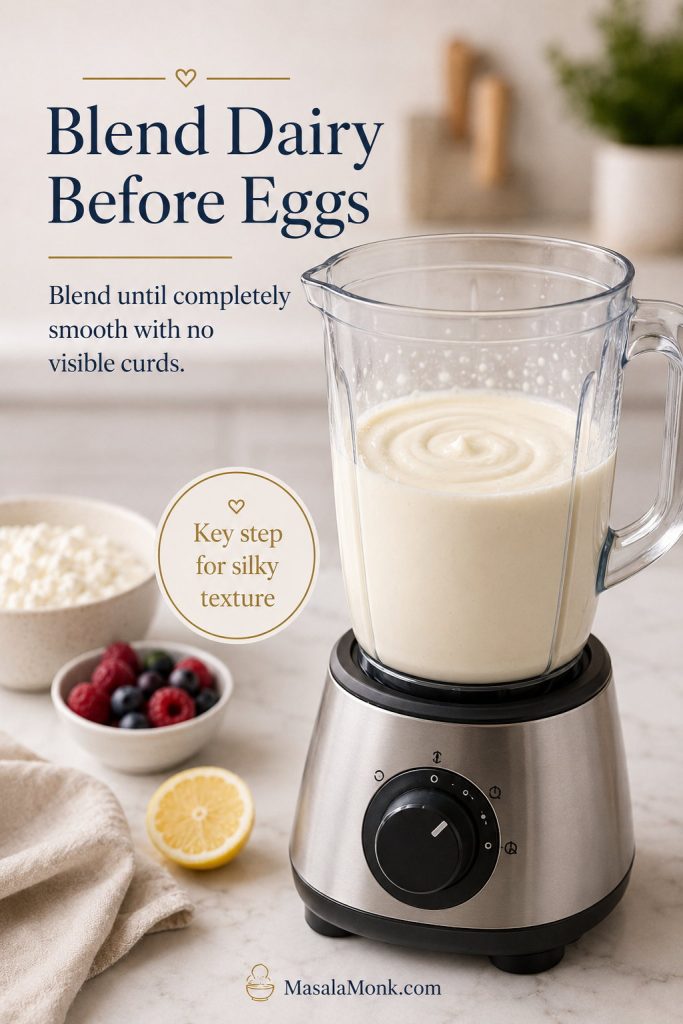
Blend the Dairy Before Adding Eggs

Add the cottage cheese, Greek yogurt, sugar, vanilla, lemon zest, lemon juice, salt, and cornstarch to the blender first. Blend until the mixture looks glossy and even. Add the eggs only after that base is smooth.

Cottage cheese cheesecake filling being blended smooth in a blender before eggs are added
Blend the dairy before the eggs go in; this is the step that turns a curdy base into cheesecake-ready filling.

What the Batter Should Look Like

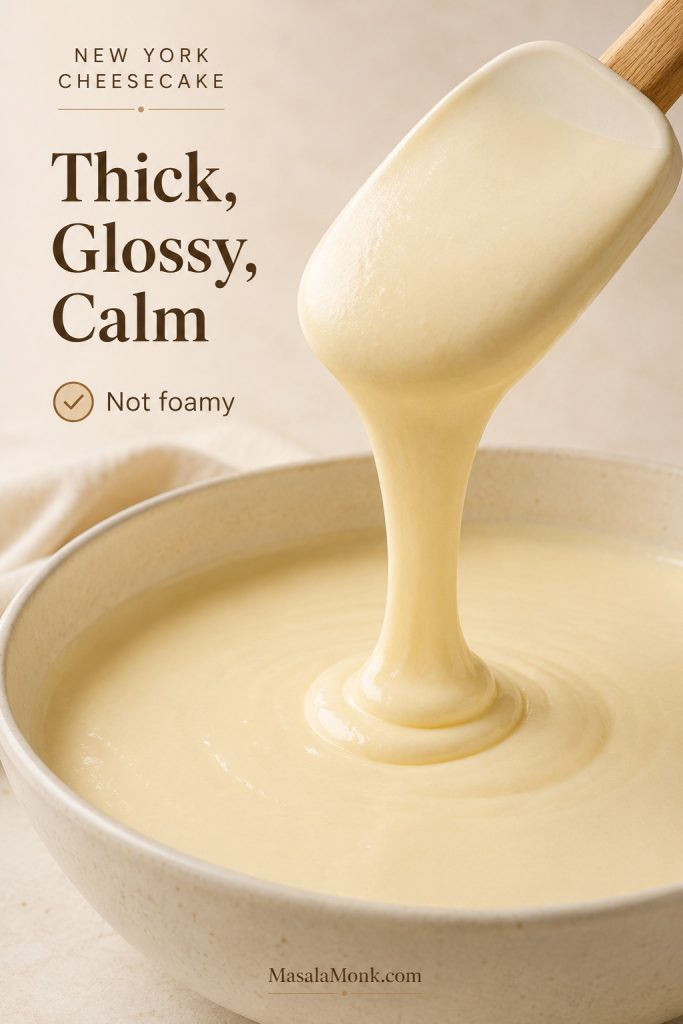
The batter should look glossy, smooth, and pourable before it goes into the crust. If it still looks grainy, blend again or strain it before baking.

Smooth cottage cheese cheesecake batter lifting from a spatula in a glossy ribbon
The batter should fall in a glossy ribbon, because a smooth pour now usually means a cleaner texture after baking.

Strain the Batter When Needed

When the blender is not very powerful and the batter still looks slightly grainy, pour it through a fine-mesh sieve before baking. It is an optional step, but it can rescue the texture.

After the batter looks glossy and pourable, move to the step-by-step method and then use the doneness cues before chilling.

How to Make Cottage Cheese Cheesecake

The method follows classic cheesecake logic: prepare the pan, pre-bake the crust, blend the filling, bake gently, cool slowly, and chill before slicing. Once the filling is smooth, the oven and refrigerator do most of the work.

Step-by-step cottage cheese cheesecake guide showing pan prep, crust, blended filling, pouring, baking, and chilling
The method stays simple: prepare the pan, pre-bake the crust, blend the filling, bake until just set, and chill for the cleanest slice.

Step 1: Prepare the Pan

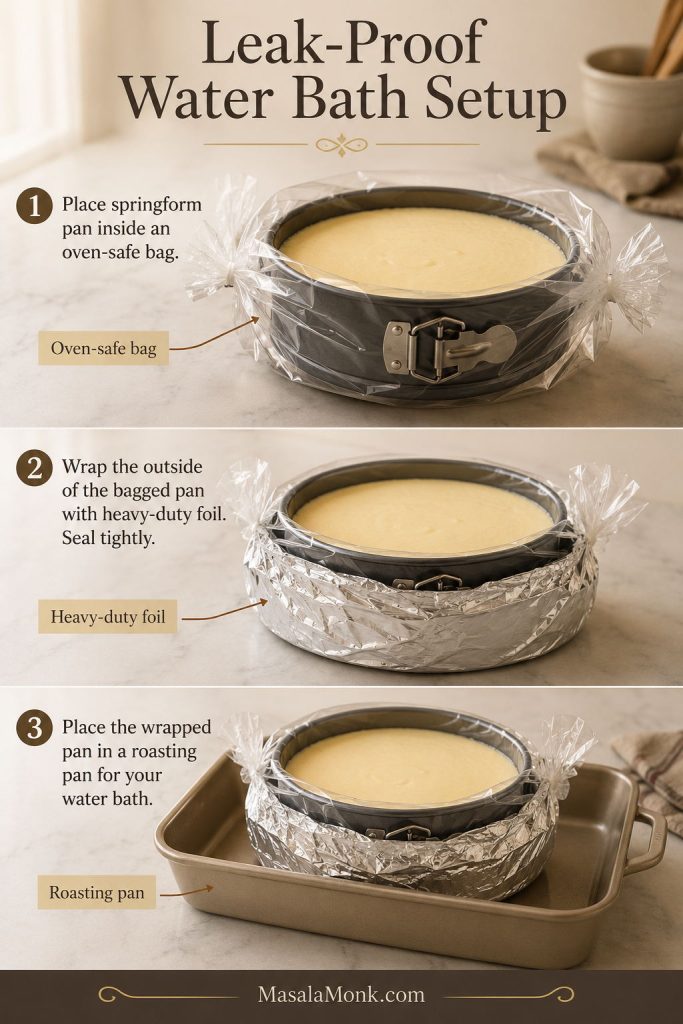
Line the bottom of an 8-inch / 20cm springform pan with parchment paper. Lightly grease the sides. For a water bath, wrap the outside of the pan with heavy-duty foil or place the springform pan inside a larger oven-safe bag before setting it in the roasting pan.

Step 2: Make and Bake the Crust

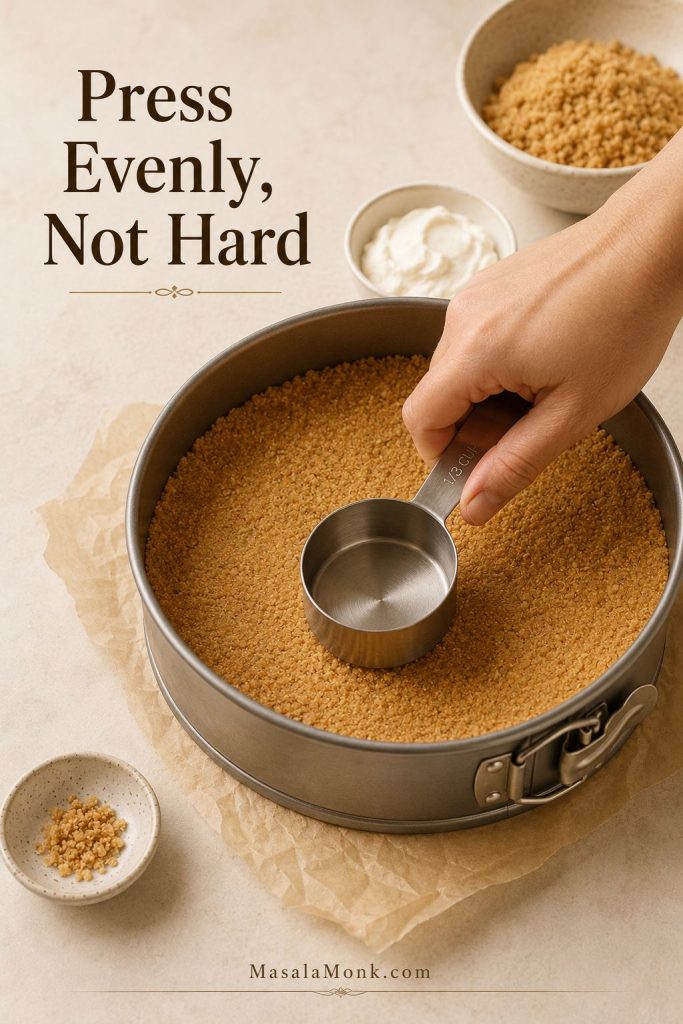
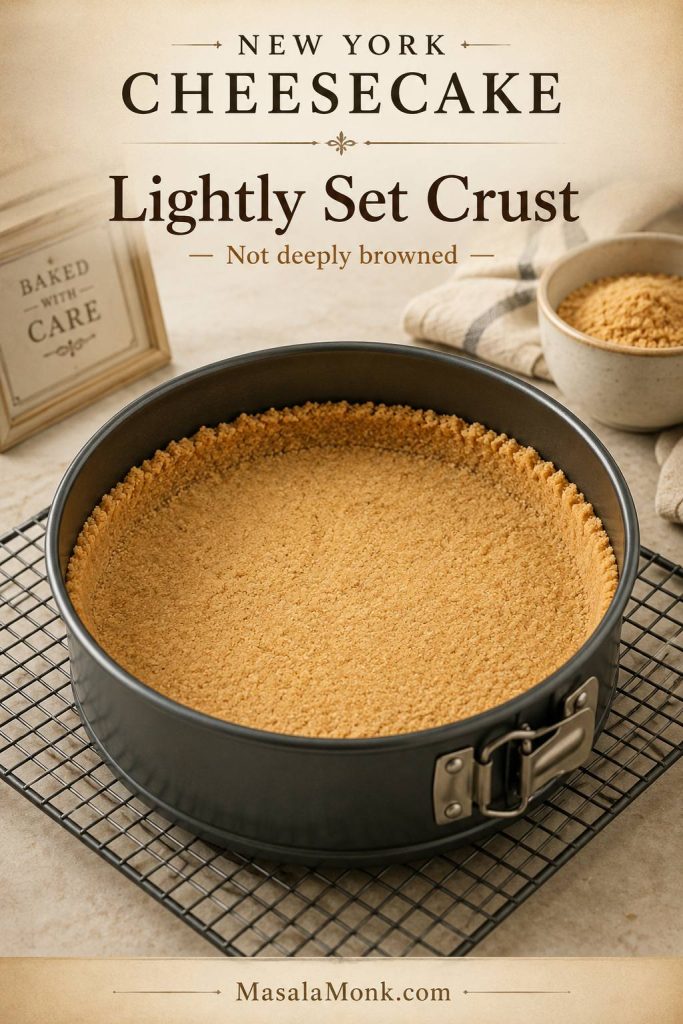
Mix the graham cracker or digestive biscuit crumbs with melted butter, sugar, and a pinch of salt. Press the mixture firmly into the bottom of the pan. Bake at 350°F / 177°C for 8 to 10 minutes, then lower the oven temperature to 325°F / 160°C.

Step 3: Blend the Filling

Blend the cottage cheese, Greek yogurt, sugar, cornstarch, vanilla, lemon zest, lemon juice, and salt until completely smooth. Scrape down the sides, then blend again. Add the eggs and blend briefly, just until the batter is even.

Step 4: Pour the Filling and Bake Low and Slow

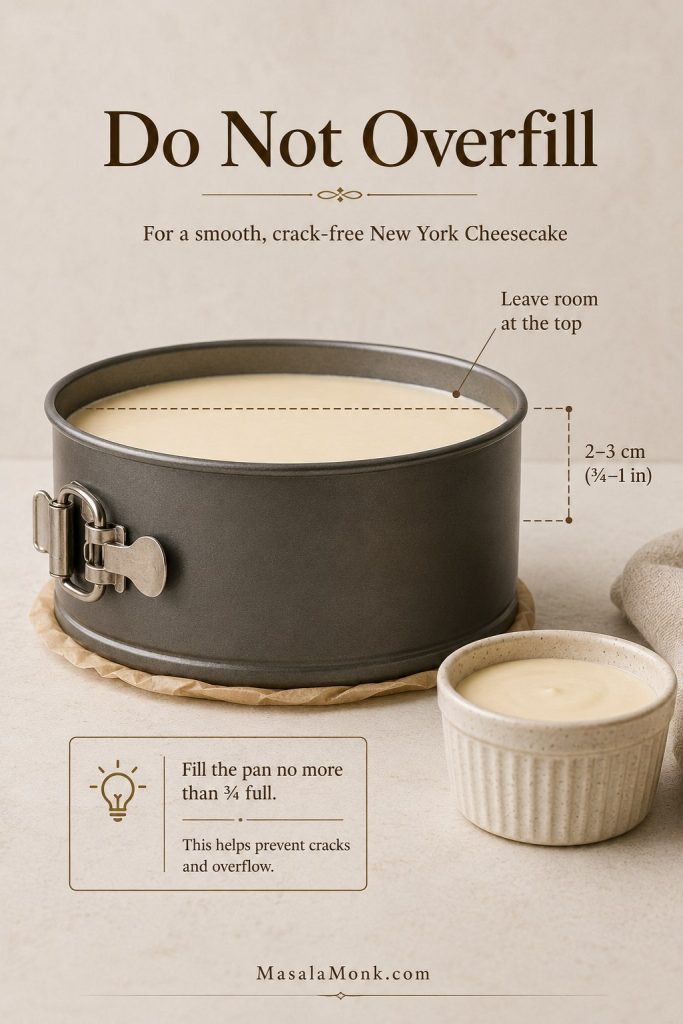
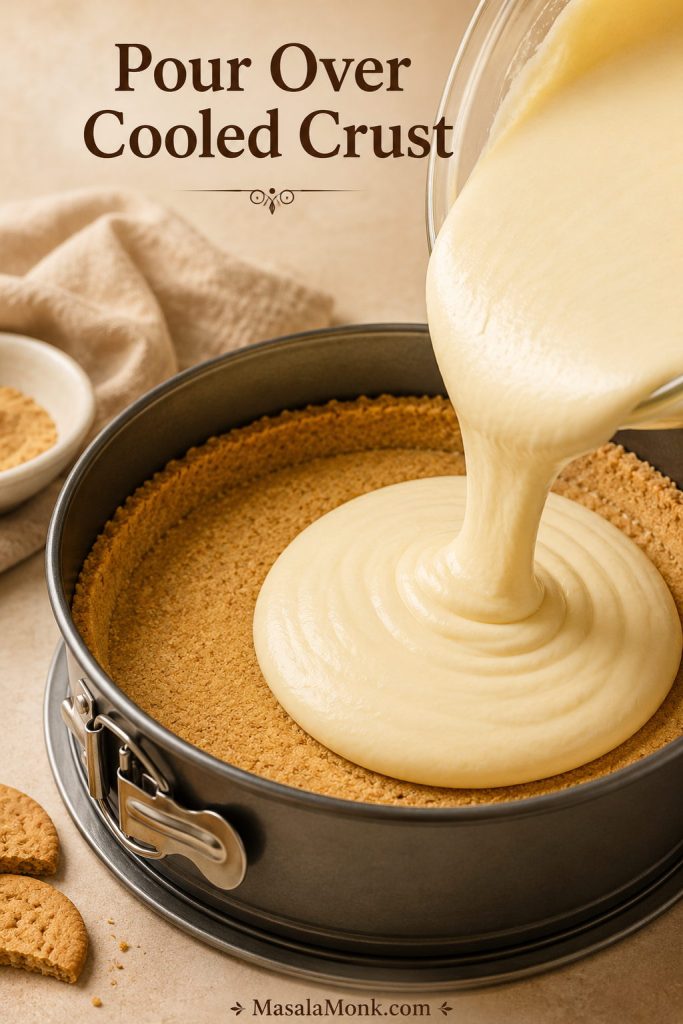
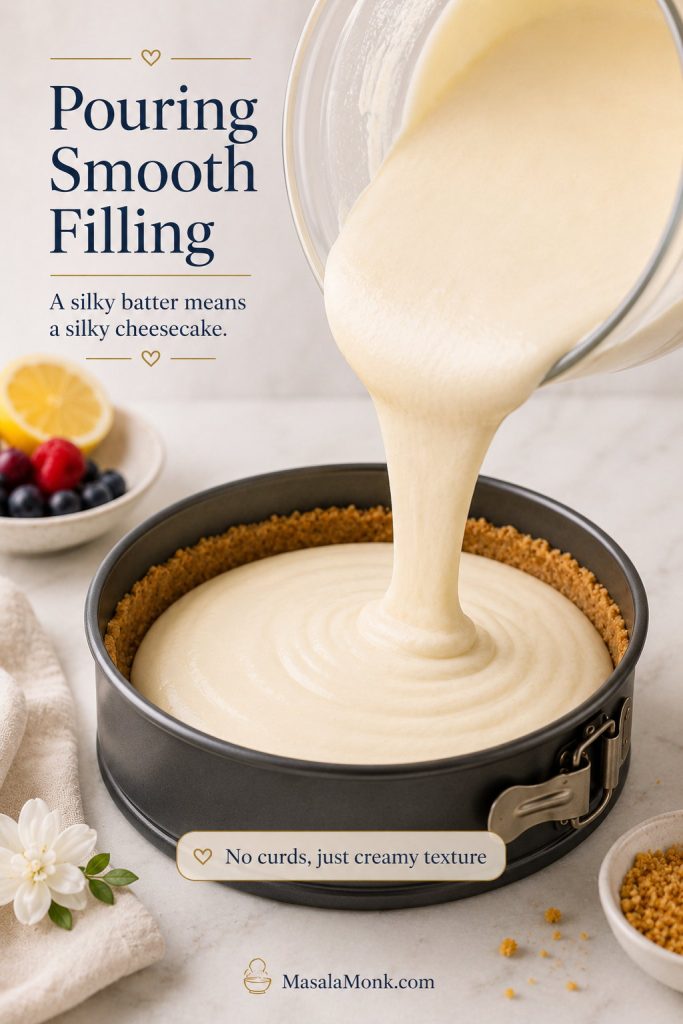
Pour the filling over the crust and smooth the top. Bake at 325°F / 160°C for 55 to 70 minutes, or until the edges are set and the center still has a soft wobble. The center should jiggle gently, not slosh.

Smooth cottage cheese cheesecake filling being poured from a blender into a prepared crumb crust
When the filling pours smoothly into the crust, it is a good sign that the blender has done its job.

Step 5: Cool Gradually

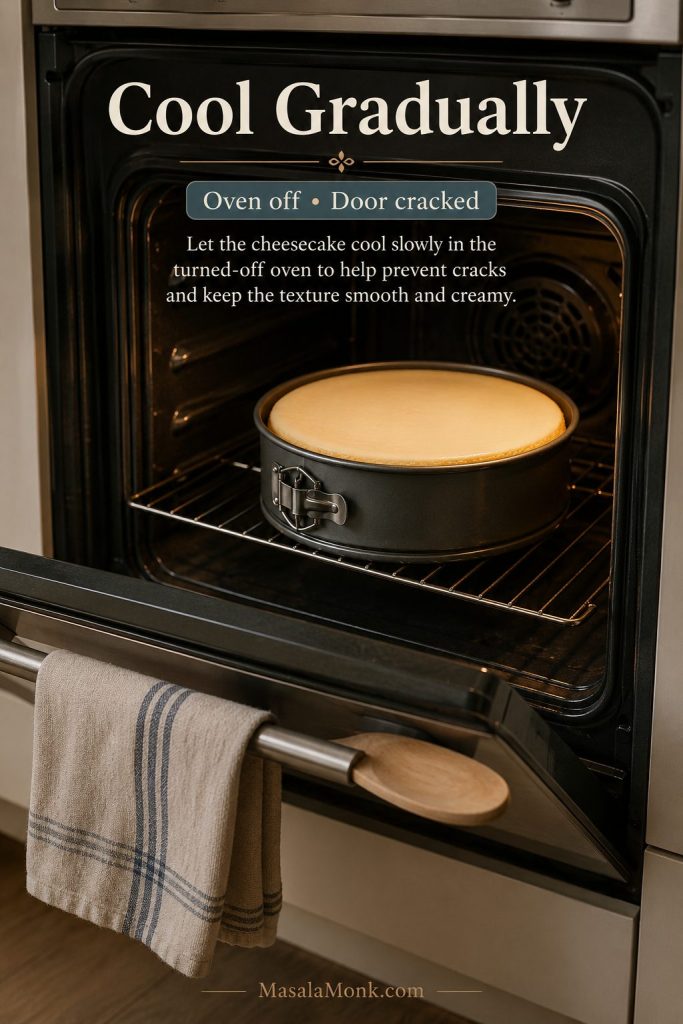
Turn off the oven, crack the door open, and let the cheesecake sit inside for 30 to 45 minutes. This gradual cooling helps prevent cracks. Then move it to the counter and let it cool to room temperature.

Step 6: Chill Before Slicing

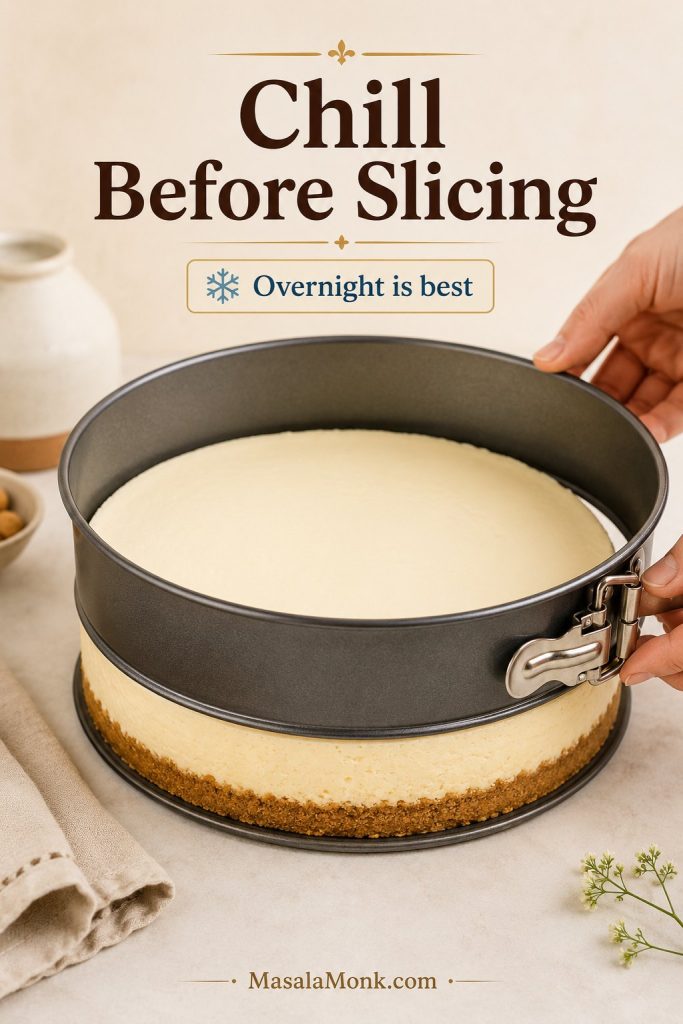
Refrigerate the cheesecake for at least 4 hours. Overnight is better. Do not panic if it looks soft when it first comes out of the oven. Warm cheesecake is supposed to look a little underdone; the refrigerator does the final work.

Do You Need a Water Bath?

A water bath is optional. Skip it for the easiest version; use it when you want the smoothest texture and the lowest chance of cracks.

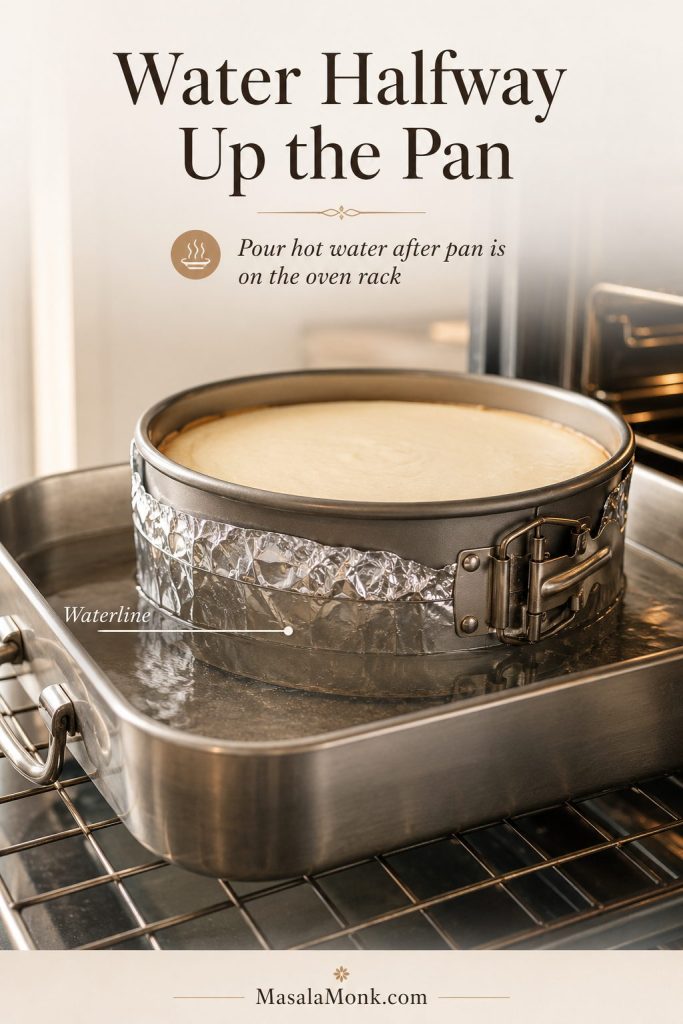
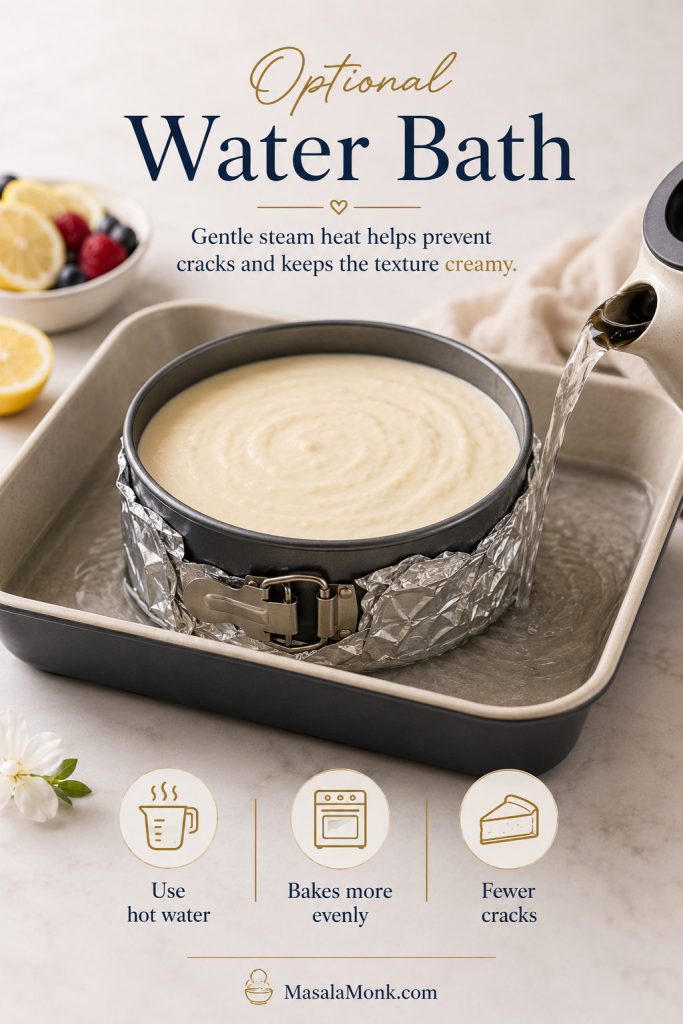
To use one, wrap the springform pan well, set it in a roasting pan, and pour hot water around it until the water reaches about 1 inch up the side of the pan. Make sure the pan is protected so water cannot leak into the crust.

Wrapped springform pan sitting in a roasting pan with hot water for an optional cheesecake water bath
A water bath is optional; however, it can help the cheesecake bake more gently and reduce cracking on the surface.

A water bath usually pushes the cheesecake toward the longer end of the bake time. The texture is worth it when you want a cleaner, more classic cheesecake finish.

For more general cheesecake guidance, including room-temperature ingredients, water bath baking, and crack prevention, King Arthur Baking has a helpful guide to cheesecake tips.

Pan Size and Bake Time Guide

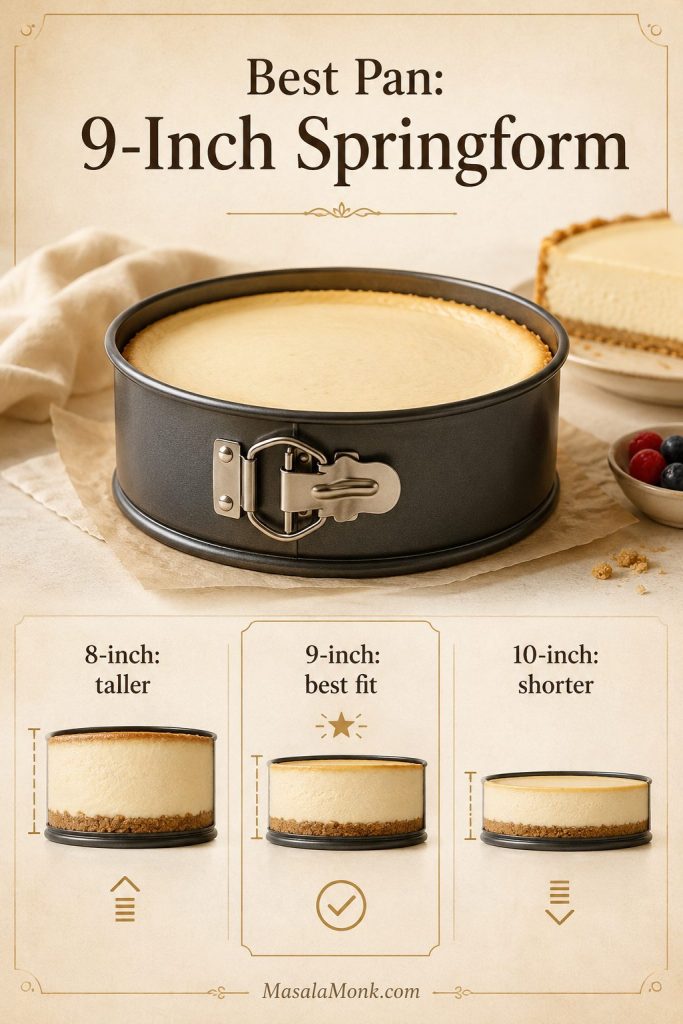
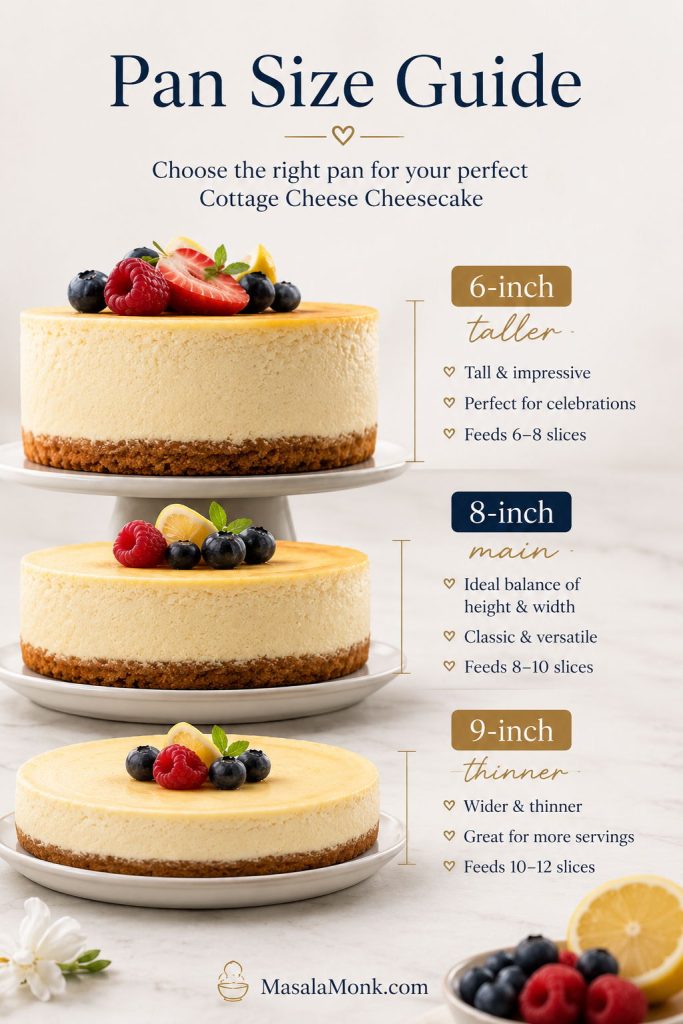
Cottage cheese cheesecake recipes often use different pan sizes, which can make bake times confusing. A smaller pan makes a taller cheesecake and usually needs more time. A larger pan makes a thinner cheesecake and may finish sooner.

Pan size guide comparing six-inch, eight-inch, and nine-inch cottage cheese cheesecakes with different heights
Pan size changes both height and bake time, so visual cues matter more than the timer when you move away from the 8-inch pan.
Pan or Format Best For Bake Guidance
6-inch springform Small-batch, taller cheesecake Use about two-thirds of the recipe or expect a deeper filling and longer bake time.
8-inch springform Main recipe Bake 55–70 minutes at 325°F / 160°C.
9-inch springform Thinner full-size cheesecake Start checking around 45–55 minutes.
Muffin tin Mini cheesecakes Bake about 16–22 minutes, depending on filling depth.
Ramekins Single-serve cheesecakes Bake about 20–30 minutes.

Use the visual cues more than the clock. Cheesecake does not care what the timer says when the center is still loose or the edges are already firm. A thin cheesecake in a 9-inch pan may be done before the timer says so, while a deep 6-inch cheesecake may need longer.

Changing pan size also changes doneness timing, so use the set-edge and soft-wobble cues before relying on the clock alone.

How to Know When Cottage Cheese Cheesecake Is Done

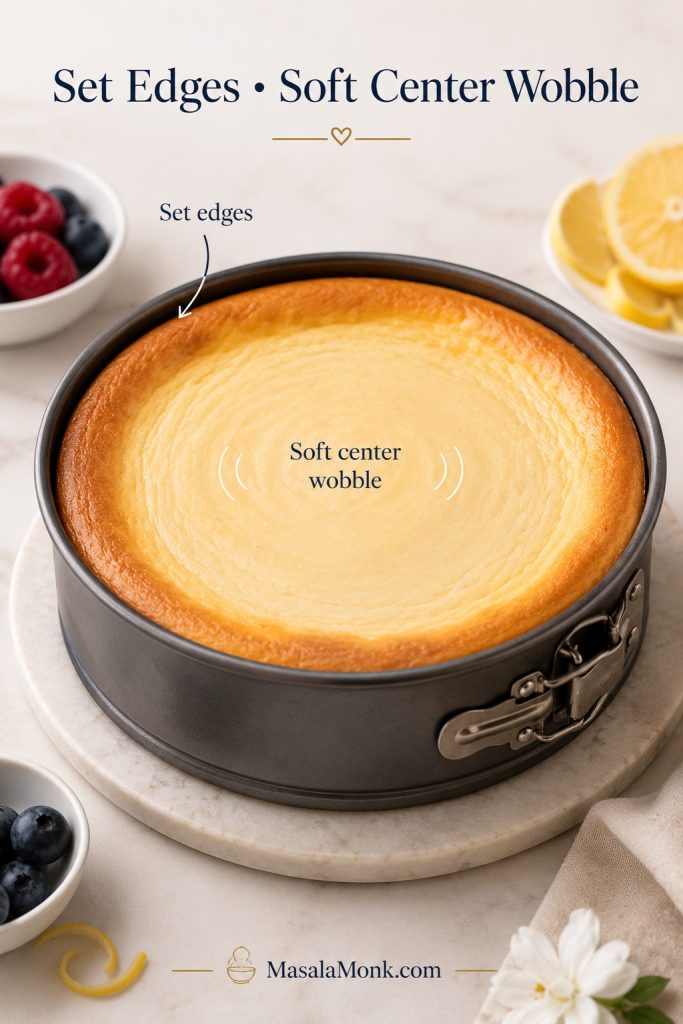
Cheesecake keeps setting after it leaves the oven. Baking until the center looks completely firm can leave you with a dry, cracked, or rubbery cheesecake after chilling.

The Edge Test

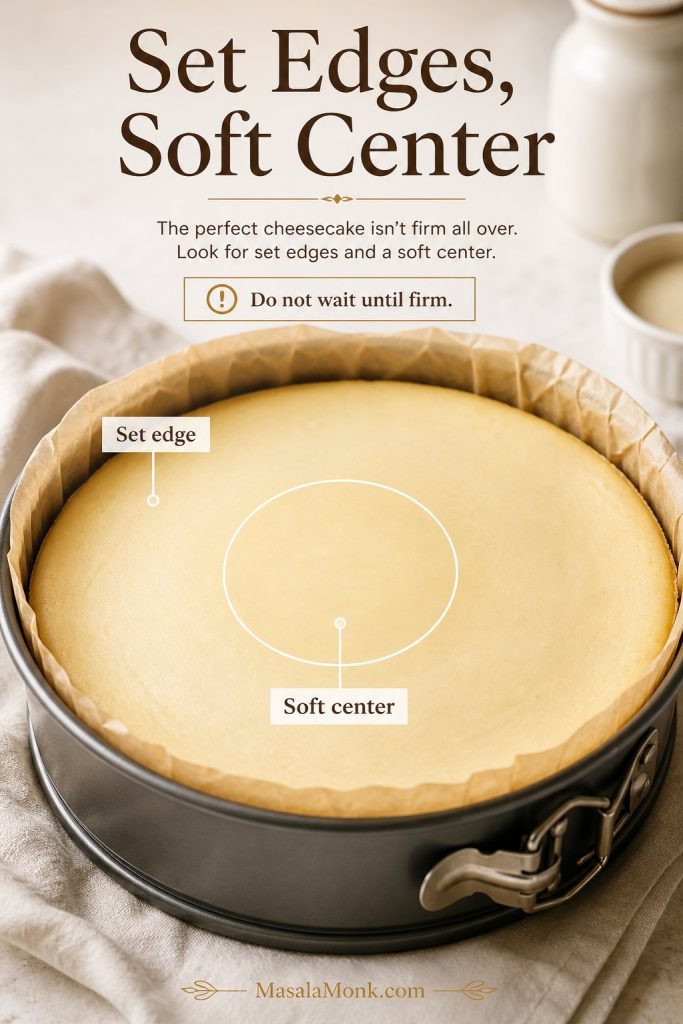
The outer 2 inches should look set. The edges may be slightly puffed, but they should not be deeply browned or pulling hard away from the pan.

The Center Wobble Test

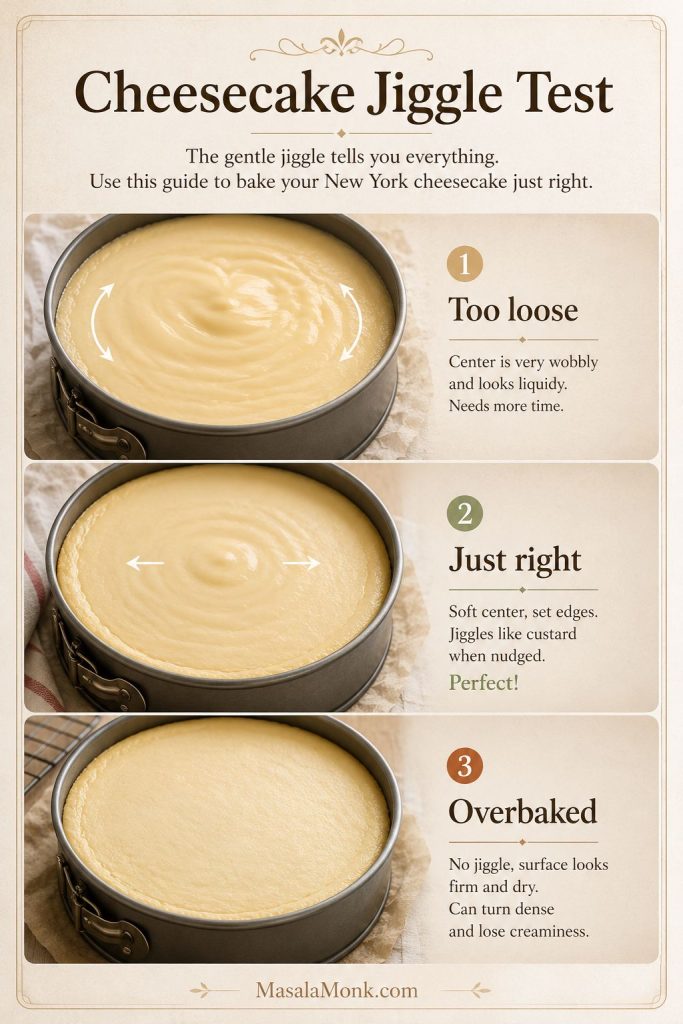
Gently nudge the pan. The center should wobble softly like set custard. It should not ripple like liquid. A soft wobble is good; a loose slosh means it needs more time.

Baked cottage cheese cheesecake in a springform pan with set edges and a soft center wobble cue
Look for set edges and a soft center wobble, because the cheesecake will continue firming as it cools and chills.

Internal Temperature

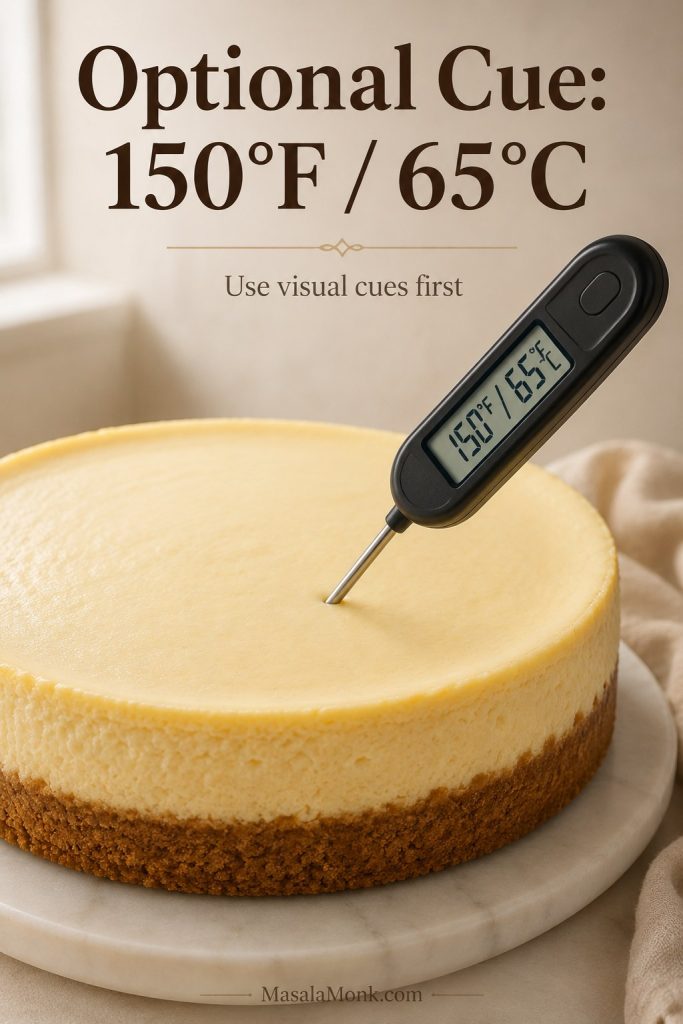
For extra precision, check the center with an instant-read thermometer. The center should be around 155–160°F / 68–71°C. Insert the thermometer gently so you do not tear the top.

Why It Still Looks Soft

A warm cheesecake is not supposed to look like a fully chilled cheesecake. The filling firms as it cools and then tightens further in the refrigerator. That is why chill time is part of the recipe, not an optional waiting period.

If you like baked cheesecakes with clean slices and a slow-chilled texture, this salted caramel cheesecake recipe uses similar doneness cues: set edges, a softly wobbly center, and enough chill time before slicing.

Which Cottage Cheese Cheesecake Version Should You Make?

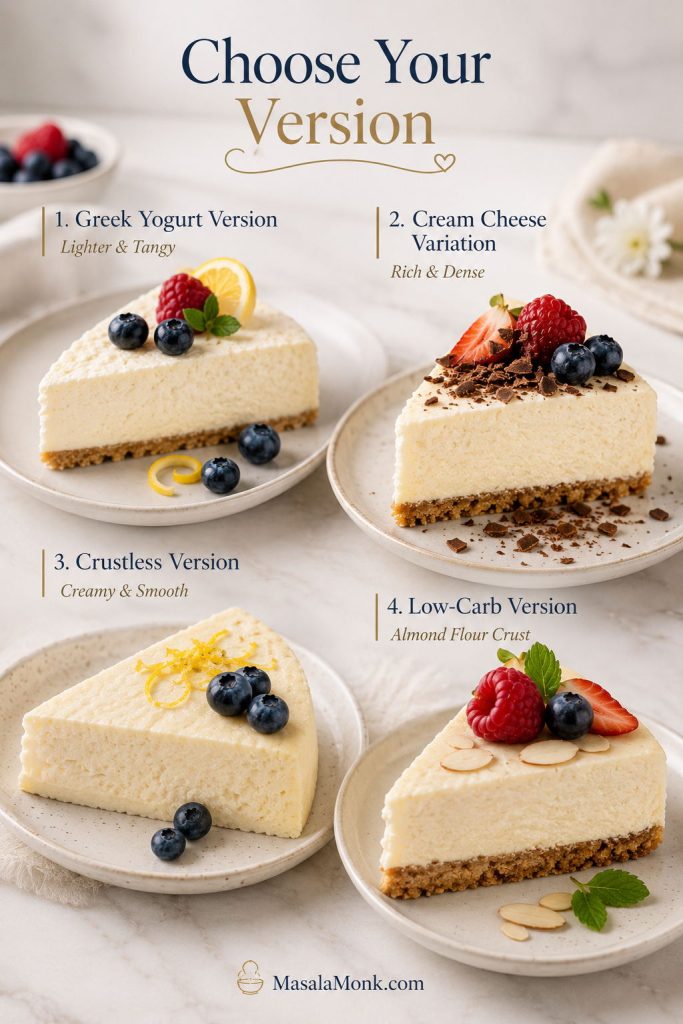
The right version depends on who you are serving and how close you want the slice to feel to classic cheesecake. Use the Greek yogurt base for the lighter, higher-protein style. Add cream cheese for something richer. Skip the crust when you want the easiest version.

If you are serving cottage cheese skeptics, the cream cheese variation is the safest first choice. If you are making it for yourself as a lighter dessert, start with the Greek yogurt version.

Four cottage cheese cheesecake versions showing Greek yogurt, cream cheese, crustless, and low-carb slices
Choose the version by the result you want: Greek yogurt for lighter tang, cream cheese for richness, crustless for ease, or almond crust for low-carb.
Craving or Need Make This Version Why It Works
The lightest higher-protein version Cottage cheese + Greek yogurt Best balance of protein, tang, and creamy texture.
The most classic cheesecake texture Cottage cheese + cream cheese Richer, denser, and closer to New York-style cheesecake.
The easiest version Crustless cottage cheese cheesecake No crumb crust, fewer steps, lighter slice.
The lowest-carb version Almond flour crust or crustless + low-carb sweetener Keeps the cheesecake closer to keto or low-carb needs.
The cleanest slices Crumb crust + overnight chill The crust gives structure and the long chill firms the filling.
The most dessert-like flavor Full-fat cottage cheese + vanilla + lemon + berry topping Richer dairy and bright toppings make it taste more like a classic dessert.

After choosing your version, go straight to the recipe card for the base formula and notes for cream cheese, crustless, and low-carb changes.

Cottage Cheese + Greek Yogurt

This is the main version of the recipe. It is lighter than a cream cheese cheesecake, with a tangy, creamy filling and a higher-protein dairy base. Use thick plain Greek yogurt for the best texture.

Cottage Cheese + Cream Cheese

For a richer cottage cheese cheesecake with a more classic texture, replace 1 cup / 225g of the cottage cheese with 8 oz / 225g softened cream cheese. Blend the cottage cheese first until smooth, then add the cream cheese and blend again before adding the eggs.

Crustless Cottage Cheese Cheesecake

For a crustless version, skip the crumb crust, line the bottom of the pan with parchment, and grease the sides well. Bake the filling directly in the pan and start checking 5 to 10 minutes earlier. Chill fully before releasing the pan, because a warm crustless cheesecake is more delicate than one with a crumb base.

Low-Carb Cottage Cheese Cheesecake

For a low-carb version, use an almond flour crust or skip the crust, then use a cup-for-cup low-carb sweetener in the filling. For more low-carb baking help, especially when an almond flour crust turns crumbly or soft, this keto-friendly flour guide explains how almond flour behaves and how to fix texture problems.

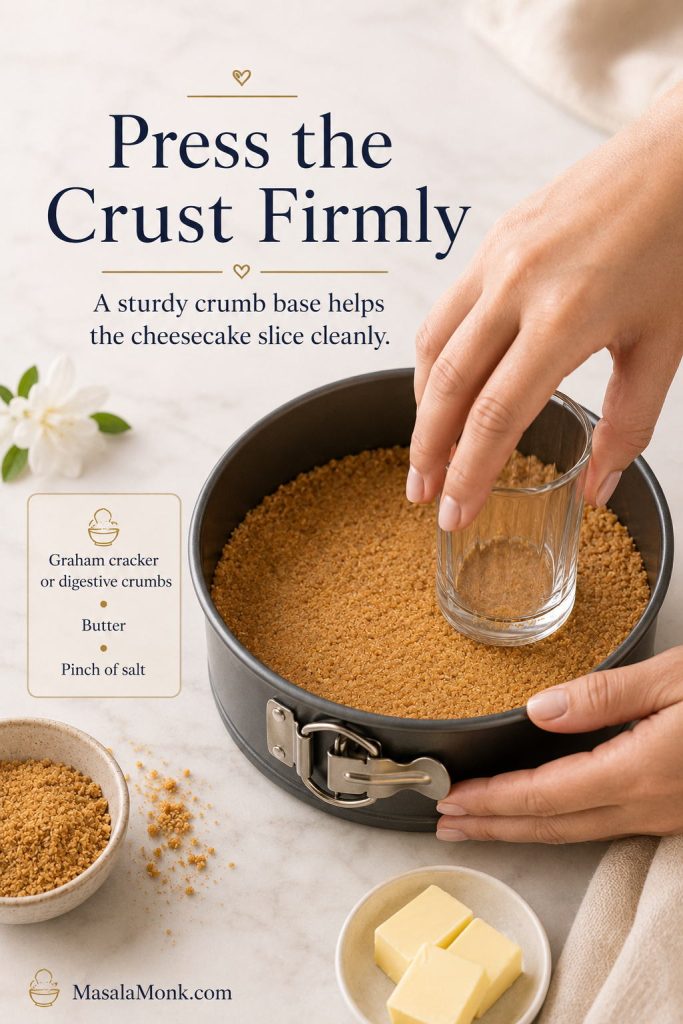
How to Make the Crust

The classic version uses a simple graham cracker or digestive biscuit crust. It gives the cheesecake a buttery base, a little crunch, and the familiar contrast people expect from a chilled cheesecake slice.

Hands pressing a graham cracker crumb crust firmly into a springform pan for cottage cheese cheesecake
A firmly packed crumb crust gives the creamy filling contrast, structure, and a more classic cheesecake feel.

Graham Cracker or Digestive Crust

This is the most classic option. Mix the crumbs with melted butter, a little sugar, and a pinch of salt, then press the mixture firmly into the bottom of the pan.

When to Pre-Bake the Crust

Pre-bake any crumb-style crust for 8 to 10 minutes before adding the filling. It helps the butter bind the crumbs and keeps the base from tasting raw. Let the crust cool slightly before pouring in the cottage cheese filling.

Is Cottage Cheese Cheesecake Healthy or High Protein?

This is still cheesecake, and that is the point. The goal is not to turn dessert into something joyless. It is to use cottage cheese and Greek yogurt in a way that gives you a cold, creamy, satisfying slice with a little more protein and a lighter feel.

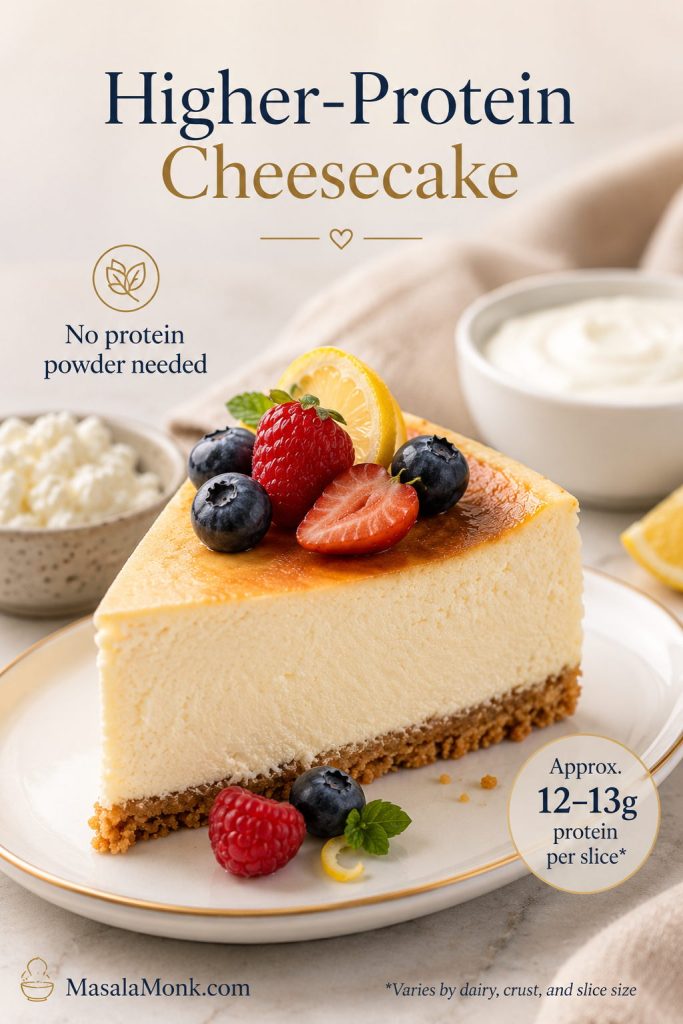
You do not need protein powder for the main recipe. The higher-protein advantage comes from using cottage cheese and Greek yogurt as the main dairy base. If you already use vanilla whey and want a more macro-focused version, add one scoop and loosen the batter with 1 to 2 tablespoons of Greek yogurt or milk only if it becomes too thick.

The exact protein, calories, and carbs per slice will depend on your cottage cheese, Greek yogurt, crust, sweetener, and slice size. As a rough estimate, using full-fat or 2% cottage cheese, plain Greek yogurt, 4 eggs, and the crumb crust, a 10-slice cheesecake usually lands around 280–300 calories and 12–13g protein per slice. A crustless version will usually be lighter, while the cream cheese variation will be richer. For the most accurate number, calculate from the labels on your own ingredients.

Higher-protein cottage cheese cheesecake slice with cottage cheese, Greek yogurt, berries, and a protein estimate note
Cottage cheese and Greek yogurt give this cheesecake a higher-protein base without protein powder, though exact macros depend on your dairy, crust, and slice size.

For another higher-protein dessert, you may also like this protein ice cream recipe, which uses Greek yogurt, cottage cheese, and protein powder options without making the texture feel chalky.

The same idea works outside dessert, too: this high-protein oatmeal guide shows how simple add-ins like Greek yogurt and cottage cheese can make everyday recipes more filling.

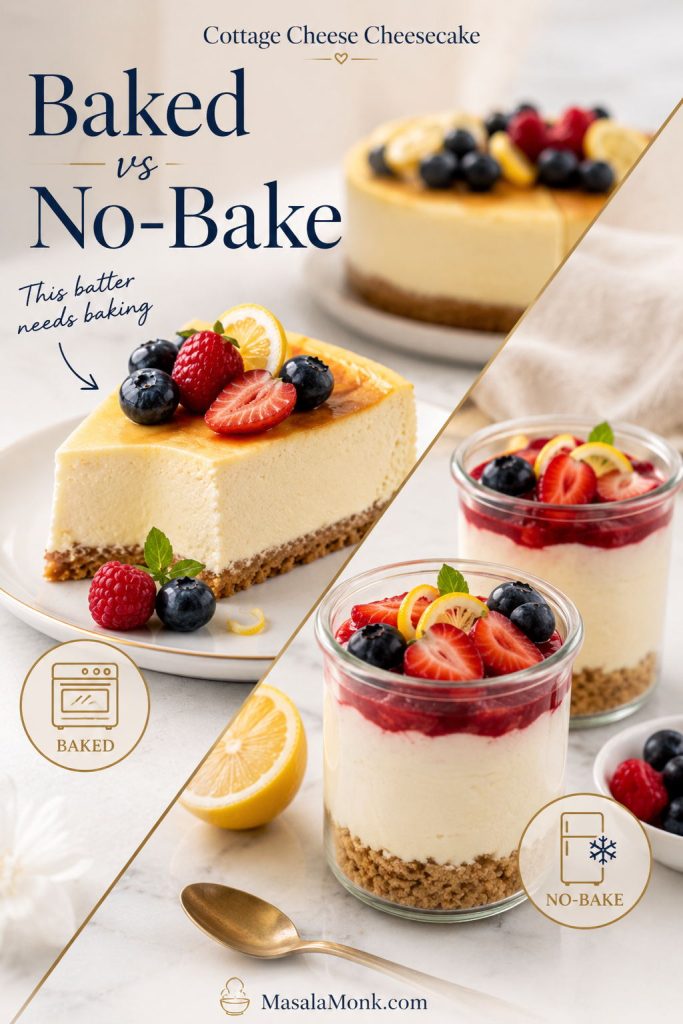
Baked vs No-Bake Cottage Cheese Cheesecake

This recipe is baked because baking gives cottage cheese cheesecake the cleanest slices and the most reliable set. Eggs and gentle heat help the filling turn into a creamy custard.

A no-bake cottage cheese cheesecake needs a different setting system — usually gelatin, whipped cream, cashews, melted chocolate, or a very thick dairy base. This baked filling is not meant to be poured into a crust and chilled without baking.

Baked cottage cheese cheesecake slice compared with no-bake cheesecake cups in jars
This batter is built for baking because eggs help it set, while a no-bake version needs a different setting method.

For an oven-free cheesecake, start with this no bake cheesecake recipe. The method is different, but the setting logic will help you understand why no-bake cheesecakes need enough fat, air, structure, and chill time.

Best choice: Make this baked version when clean slices matter most. Save no-bake cottage cheese cheesecake for jars, cups, bars, or a separate recipe built with a proper setting method.

Flavor Variations

Once the base recipe works, cottage cheese cheesecake is easy to adapt. Keep the basic structure the same, then adjust flavor carefully so the filling does not become too loose.

Pumpkin Cottage Cheese Cheesecake

Add pumpkin puree, pumpkin pie spice, and a little extra cornstarch to help absorb the added moisture. Start with 3/4 cup pumpkin puree, reduce the Greek yogurt to 1/2 cup, add 1 extra teaspoon cornstarch, and bake until the center has the same soft wobble as the original version.

Chocolate Cottage Cheese Cheesecake

Add unsweetened cocoa powder or melted dark chocolate to the blended filling. Cocoa powder thickens the batter, so you may need a spoonful or two of extra Greek yogurt. Melted chocolate gives a richer texture but makes the cheesecake less light.

Lemon Cottage Cheese Cheesecake

Increase the lemon zest and add a little extra lemon juice. Do not add too much liquid or the filling may need longer to set. Lemon works especially well with a graham cracker crust and fresh berries.

Berry-Topped Cottage Cheese Cheesecake

Keep the filling plain and add berries after chilling. Fresh strawberries, blueberries, raspberries, or a spoonable berry compote all work. Avoid adding too much watery fruit directly to the batter unless you are making a tested swirl version.

Mini Cottage Cheese Cheesecakes

Use a lined muffin tin and bake until the centers are just set. Mini cheesecakes chill faster and are easier for parties, lunchboxes, or portioned desserts.

How to Serve Cottage Cheese Cheesecake

Serve this cheesecake cold, when the filling is fully set and the flavor has had time to settle. A plain slice is creamy and tangy on its own, but toppings make it feel more finished.

  • Fresh berries: Best when you want a lighter, brighter slice.
  • Berry compote: Best when you want it to feel like a classic dessert-table cheesecake.
  • Lemon zest: Best when you want more freshness and lift.
  • Honey drizzle: Best for a simple, soft sweetness.
  • Chocolate drizzle: Best with the cream cheese variation or a crustless slice.

For a dinner-party version, use the crumb crust and berry compote. For an everyday higher-protein dessert, keep it crustless and serve it with berries or a spoonful of Greek yogurt.

After a night in the refrigerator, the filling settles into a cold, creamy slice with a clean fork cut and a soft lemon-vanilla tang. The crumb crust adds contrast, but the filling should still be the point: smooth, cool, lightly tangy, and rich enough to feel like dessert.

Troubleshooting Cottage Cheese Cheesecake

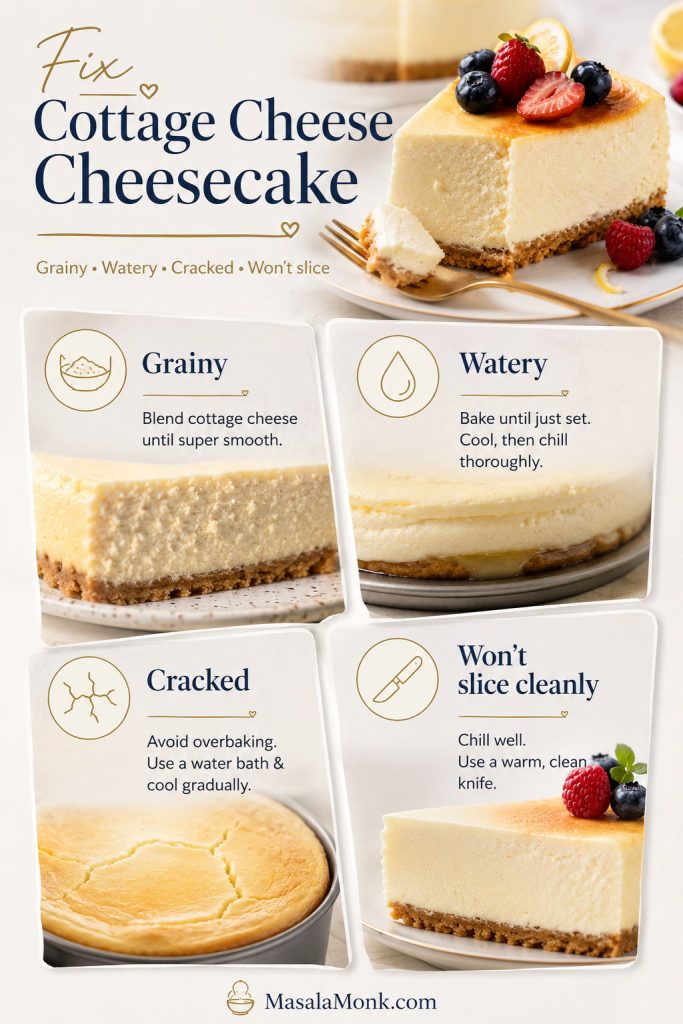
Most cottage cheese cheesecake problems come from four things: watery dairy, not blending enough, overbaking, or cutting before the cheesecake has chilled.

Troubleshooting guide for cottage cheese cheesecake showing grainy, watery, cracked, and hard-to-slice problems
If the cheesecake turns grainy, watery, cracked, or hard to slice, start by checking moisture, blending, bake time, and chill time.
Problem Likely Cause Fix
Grainy texture Cottage cheese was not blended fully. Blend the dairy before adding eggs. Scrape down the sides. Strain the batter when needed.
Watery filling Cottage cheese or yogurt was too loose, or the cheesecake was underbaked. Drain watery cottage cheese, use thick Greek yogurt, bake until the edges are set, and chill overnight.
Cracked top Overbaking, too much air in the batter, or cooling too quickly. Add eggs last, do not over-blend, bake gently, and cool with the oven door cracked.
Rubbery texture Too much high-speed blending after eggs were added, or baking too long. Add eggs last, pulse briefly, and pull the cheesecake while the center still wobbles.
Tastes too much like cottage cheese Very lean cottage cheese, not enough vanilla/lemon/sweetener, or not enough chill time. Use 2% or full-fat cottage cheese, add lemon zest and vanilla, and chill overnight.
Soggy crust Crust was not pre-baked, filling was too wet, or water bath leaked into the pan. Pre-bake the crust and protect the pan well when using a water bath.
Won’t slice cleanly The cheesecake has not chilled long enough. Chill at least 4 hours. Overnight is best for clean slices.

For prevention before the next bake, return to the 4 texture rules or check the doneness cues again.

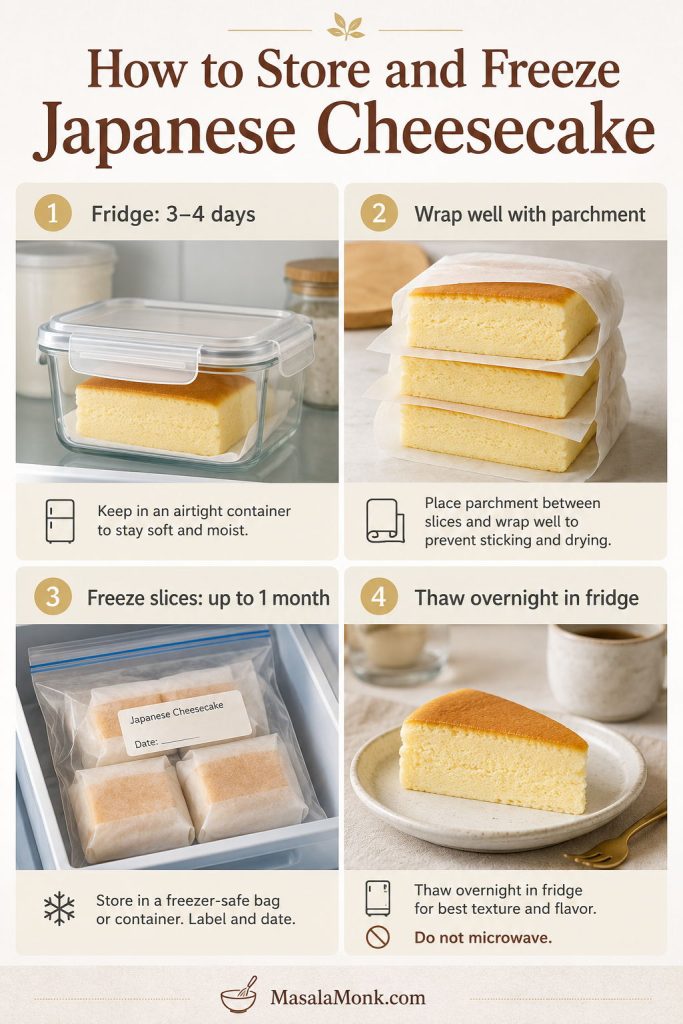
How to Store and Freeze Cottage Cheese Cheesecake

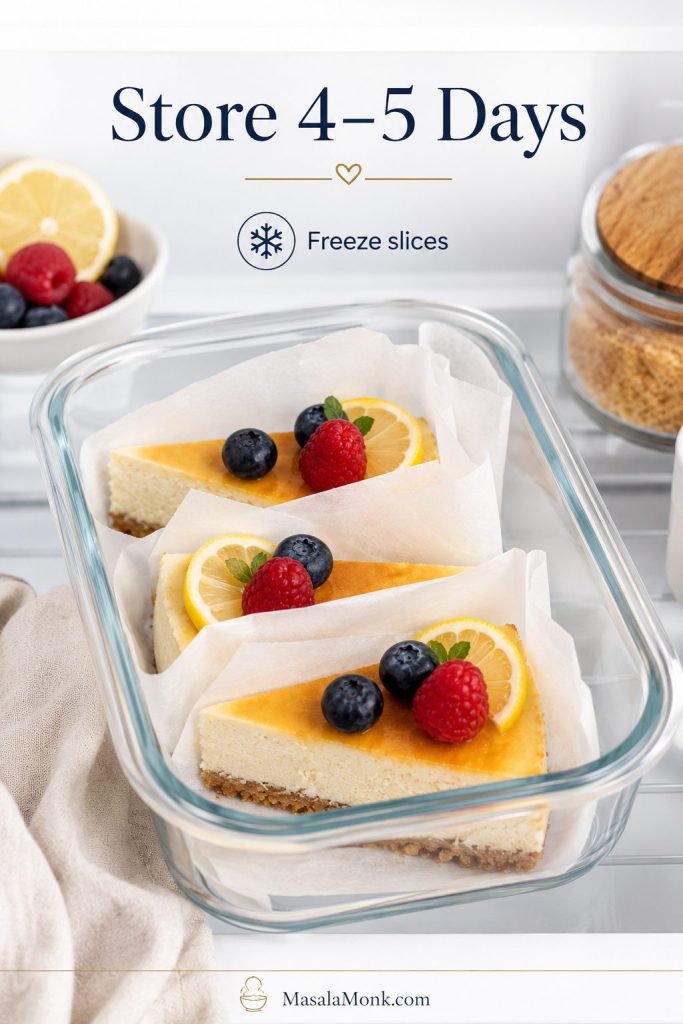
Cottage cheese cheesecake is a make-ahead dessert. In fact, it tastes better after a full night in the refrigerator because the filling has time to firm up and the flavor settles.

Cottage cheese cheesecake slices stored in a glass container with parchment for refrigeration or freezing
This works well as a make-ahead dessert because the filling firms, the flavor settles, and the slices cut cleaner after chilling.

Refrigerating

Store the cheesecake covered in the refrigerator for 4 to 5 days. Chill it uncovered until fully cold first, then cover it so condensation does not drip onto the surface. Once the cheesecake has cooled to room temperature, move it to the refrigerator rather than leaving it out for hours.

Freezing

You can freeze cottage cheese cheesecake, but the texture may soften slightly after thawing. Freeze individual slices on a tray first, then wrap and store them in an airtight container.

Thawing

Thaw frozen slices overnight in the refrigerator. Avoid thawing at room temperature for long periods, because the dairy filling should stay cold.

Cottage Cheese Cake vs Cottage Cheese Cheesecake

Cottage cheese cake and cottage cheese cheesecake are sometimes used to describe similar desserts, but they are not always the same thing. A cottage cheese cheesecake is usually a blended dairy custard made with cottage cheese, eggs, vanilla, lemon, and sometimes yogurt or cream cheese. It bakes gently, chills, and slices like cheesecake.

Cottage cheese cake can mean something different. Some versions are closer to a flour-based cake or snacking cake, while others are simple cottage-cheese-based cakes that taste cheesecake-like but use fewer ingredients. This version is a true cheesecake: a blended dairy filling that bakes gently, cools slowly, and chills into clean, creamy slices.

Cottage Cheese Cheesecake Recipe

This cottage cheese cheesecake recipe bakes into a creamy, higher-protein cheesecake with Greek yogurt, vanilla, lemon, and an optional graham cracker or digestive biscuit crust. Blend the cottage cheese until silky, bake gently, cool slowly, and chill well before slicing.

Yield10 slices
Prep Time20 minutes
Cook Time55–70 minutes
Chill Time4 hours minimum
Total TimeAbout 7 hours, mostly cooling and chilling
Pan8-inch springform
Oven325°F / 160°C
TextureCreamy, smooth, sliceable

Ingredients

For the crust

  • 1 1/4 cups / 135g graham cracker or digestive biscuit crumbs
  • 5 tbsp / 70g melted butter
  • 1 1/2 tbsp / 18g sugar or sweetener
  • Pinch of fine salt

For the filling

  • 3 cups / 680g / 24 oz full-fat or 2% cottage cheese, drained first when watery
  • 3/4 cup / 180g plain Greek yogurt
  • 4 large eggs, room temperature
  • 2/3 cup / 135g granulated sugar
  • 2 tbsp / 16g cornstarch
  • 2 tsp / 10ml vanilla extract
  • 1–2 tsp lemon zest
  • 1 tbsp / 15ml lemon juice
  • 1/4 tsp fine salt

Instructions

Prepare the Pan, Crust, and Filling

  1. Prepare the pan. Line the bottom of an 8-inch / 20cm springform pan with parchment paper and lightly grease the sides.
  2. Heat the oven. Preheat the oven to 350°F / 177°C for the crust.
  3. Make the crust. Mix the crumbs, melted butter, sugar, and salt until evenly moistened. Press firmly into the bottom of the pan.
  4. Pre-bake the crust. Bake for 8 to 10 minutes. Remove from the oven and reduce the oven temperature to 325°F / 160°C.
  5. Blend the dairy. Add cottage cheese, Greek yogurt, sugar, cornstarch, vanilla, lemon zest, lemon juice, and salt to a blender or food processor. Blend until completely smooth, scraping down the sides once.
  6. Add the eggs. Add the eggs and blend briefly, just until combined. Do not over-blend after the eggs are added.
  7. Check the batter. It should look smooth and pourable, but not watery. If it looks thin because the cottage cheese was loose, let it sit for 5 minutes before pouring so the cornstarch can hydrate slightly.

Bake, Cool, Chill, and Slice

  1. Fill the pan. Pour the filling over the crust and smooth the top.
  2. Optional water bath. For the creamiest texture, place the wrapped springform pan in a roasting pan and pour hot water around it until the water reaches about 1 inch up the side of the pan. Make sure the pan is well protected so water cannot leak into the crust.
  3. Bake. Bake at 325°F / 160°C for 55 to 70 minutes, until the edges are set and the center still has a soft wobble. If using a thermometer, the center should be about 155–160°F / 68–71°C.
  4. Cool slowly. Turn off the oven, crack the door open, and let the cheesecake sit inside for 30 to 45 minutes. Then move it to the counter and cool to room temperature.
  5. Chill. Refrigerate for at least 4 hours, preferably overnight.
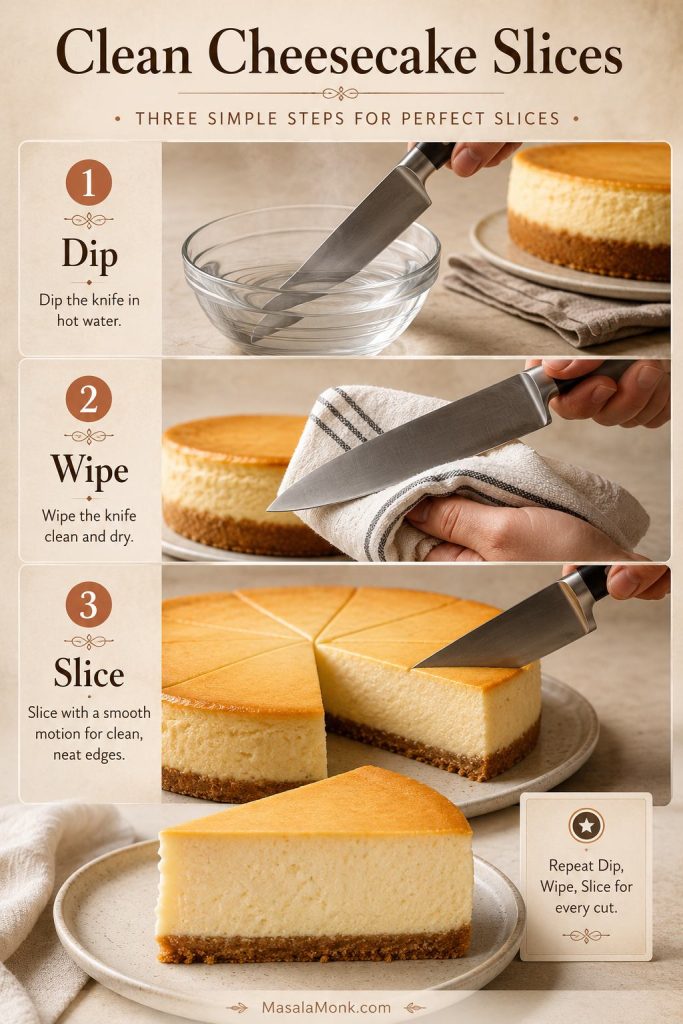
  6. Slice and serve. Run a thin knife around the edge before releasing the springform pan. Slice with a clean, warm knife for neat pieces.

Notes

  • For a cream cheese version: Replace 1 cup / 225g cottage cheese with 8 oz / 225g softened cream cheese.
  • For a crustless version: Skip the crust, line the pan well, and start checking 5 to 10 minutes earlier.
  • For a low-carb version: Use an almond flour crust and a cup-for-cup low-carb sweetener.
  • If your cottage cheese is watery: Drain it before measuring.
  • With a water bath: Wrap the pan very well and expect the cheesecake to bake toward the longer end of the time range.
  • Without a water bath: The cheesecake still works, but the top may look a little more rustic.
  • For the smoothest filling: Blend the dairy fully before adding the eggs.

FAQs

Does cottage cheese cheesecake taste like cottage cheese?

Not when it is blended well and flavored properly. The finished cheesecake should taste creamy, tangy, lightly sweet, and cheesecake-like. Vanilla, lemon, sugar, and enough chill time help soften the cottage cheese flavor.

How do you make cottage cheese cheesecake smooth?

Blend the cottage cheese and Greek yogurt until glossy before adding the eggs. A high-speed blender gives the best texture, but a food processor can work if you scrape down the sides.

Why is my cottage cheese cheesecake watery?

Watery cheesecake usually comes from loose cottage cheese, thin yogurt, underbaking, or cutting before the cheesecake has chilled. Drain watery dairy, bake until the edges are set, and chill overnight.

Can I make cottage cheese cheesecake without cream cheese?

Yes. This main recipe uses cottage cheese and Greek yogurt without cream cheese. Add cream cheese only when you want a richer, more traditional cheesecake texture.

How much cream cheese should I add?

Replace 1 cup / 225g cottage cheese with 8 oz / 225g softened cream cheese for a richer version that tastes closer to classic cheesecake.

Can I make it crustless?

Yes. Line the pan with parchment, grease the sides well, skip the crumb crust, and bake the filling directly in the pan. Start checking a little earlier and chill fully before releasing it.

Is cottage cheese cheesecake high protein?

It is usually higher in protein than classic cream-cheese cheesecake because the main dairy base is cottage cheese and Greek yogurt. Exact protein depends on your brands, crust, and slice size.

Can I make it low carb or keto?

Use an almond flour crust or skip the crust, then replace the sugar with a low-carb sweetener such as allulose or a monk fruit blend. The final texture will depend on the sweetener and crust you choose.

How long should cottage cheese cheesecake chill?

Chill it for at least 4 hours. Overnight is best because the filling firms, the flavor settles, and the slices come out cleaner.

Can you freeze cottage cheese cheesecake?

Yes. Freeze it in slices, then thaw overnight in the refrigerator. The texture may be slightly softer after thawing, but it still works well for make-ahead servings.

Baked vs no-bake cottage cheese cheesecake: what changes?

A baked version sets with eggs and oven heat. A no-bake version needs a separate setting system, such as gelatin, whipped cream, cashews, melted chocolate, or a very thick dairy base.

Cottage cheese cake vs cottage cheese cheesecake: what is the difference?

A cottage cheese cheesecake is a blended dairy custard that bakes and chills like cheesecake. By contrast, cottage cheese cake is usually more cake-like, often made with flour, baking powder, and sometimes fruit.

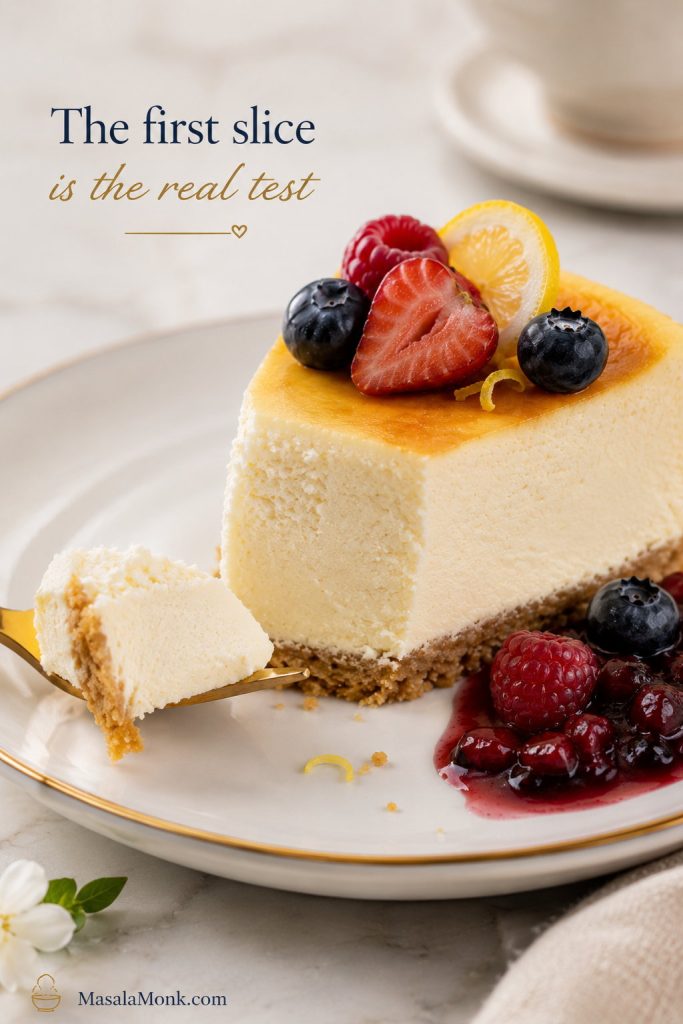
The First Slice Is the Real Test

Final cottage cheese cheesecake slice with berries, lemon, berry sauce, and a forkful removed
The first slice is the real test: smooth texture, clean edges, and a cold creamy bite that tastes like cheesecake, not cottage cheese.

When the cheesecake is cold, creamy, and smooth enough that nobody stops to ask where the cottage cheese went, the recipe has done its job.

Try the Greek yogurt version first for a lighter cheesecake, and try the cream cheese variation when you want something closer to the classic. When you make it, I’d love to know which version won in your kitchen — the lighter Greek yogurt cheesecake, the cream cheese variation, the classic crust, or the crustless slice.

Posted on 1 Comment

Salted Caramel Cheesecake Recipe

Baked salted caramel cheesecake slice with caramel topping, flaky salt, crumb crust, and text reading Salted Caramel Cheesecake Recipe.

This salted caramel cheesecake recipe is for anyone who wants caramel in every bite, not just a sweet drizzle on top. The baked filling is creamy and caramel-flavored, the topping settles into a glossy layer, and the buttery crumb crust keeps each slice rich, balanced, and sturdy enough to cut cleanly.

This is a baked salted caramel cheesecake, so the filling has the structure to hold caramel without turning loose in the middle. A measured amount of cooled caramel goes into the batter for flavor, then more caramel is spread over the chilled cheesecake for a glossy finish. That gives you real caramel depth, clean slices, and a top that looks polished instead of messy.

You’ll also learn how thick the caramel should be, when to add it, how to tell when the cheesecake is done, and why overnight chilling makes such a difference. Once those details are right, this is a deeply creamy, sliceable salted caramel cheesecake with a clean finish of flaky sea salt.

Text-free editorial photo of a salted caramel cheesecake slice with glossy caramel topping, flaky salt, creamy filling, and crumb crust on a dark plate.
A properly chilled baked cheesecake should cut cleanly and still look creamy inside; meanwhile, the caramel topping should sit on the surface instead of disappearing into it.

Quick Answer: Salted Caramel Cheesecake Recipe

To make salted caramel cheesecake, bake a buttery biscuit or graham cracker crust, fill it with a smooth cream cheese batter flavored with brown sugar and cooled salted caramel, then bake it gently at 300°F / 150°C until the edges are set and the center still wobbles slightly. Cool it slowly, chill it for at least 6 hours, then finish with a glossy caramel layer and flaky sea salt.

The trick is to use caramel in the right places. A controlled amount goes into the filling for flavor, while the topping is added after chilling so it stays visible and neat. That way, the cheesecake tastes caramel-forward without turning loose in the middle.

Want the exact measurements? Jump to the recipe card. Unsure about caramel thickness? Go to the caramel guide.

Salted Caramel Cheesecake at a Glance

StyleBaked round salted caramel cheesecake
Pan9-inch / 23 cm springform pan
Yield12 slices
CrustDigestive biscuits, graham crackers, or Biscoff crumbs
TextureCreamy, set, and sliceable after chilling
Caramel textureCooled and thick enough for the filling, glossy and slow-moving for the top
Bake temperature300°F / 150°C after the crust is baked
Fan ovenAbout 285°F / 140°C
Chill time8 hours or overnight for the cleanest slices; 6 hours is the bare minimum
Best finishCaramel topping and flaky sea salt added after chilling
At-a-glance salted caramel cheesecake guide showing pan size, bake temperature, bake time, chill time, yield, and topping timing.
If you want the short version first, this at-a-glance guide covers the details that matter most: pan size, low baking temperature, chill time, yield, and when to add the caramel topping.

Why This Salted Caramel Cheesecake Recipe Works

Balance is the tricky part of caramel cheesecake. With too little caramel, the dessert tastes like plain cheesecake with sauce. Add too much, and the filling can turn soft, overly sweet, or difficult to slice. This version keeps the flavor deep without overloading the batter.

  • A controlled amount of caramel goes into the filling. It is enough to flavor the cheesecake, but not so much that the center turns loose.
  • Brown sugar supports the caramel flavor. It gives the filling a warmer, rounder sweetness than white sugar alone.
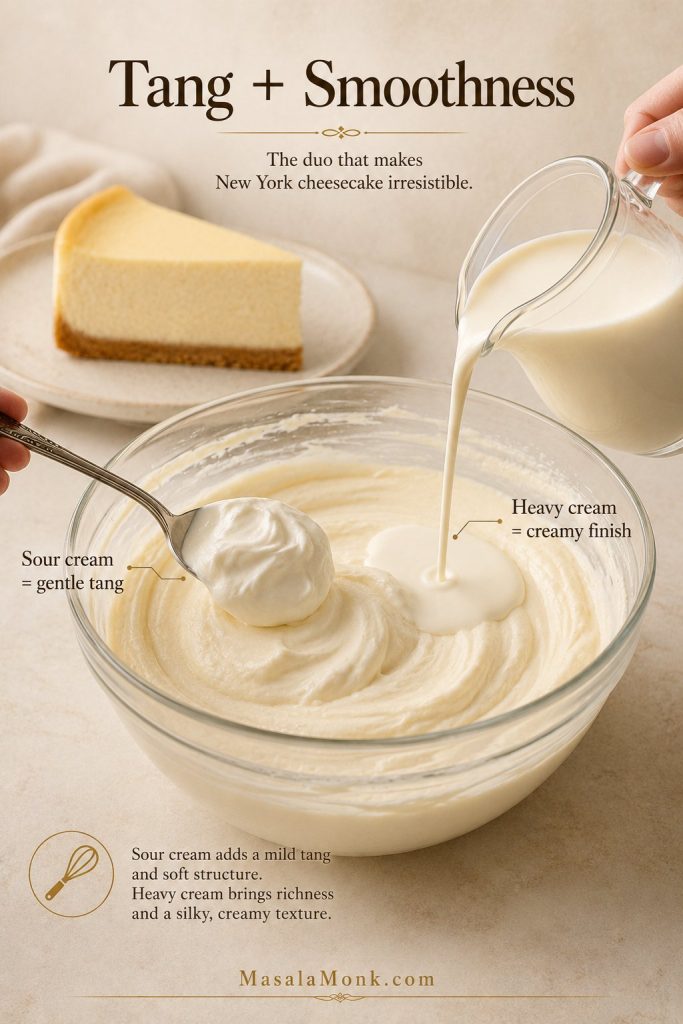
  • Sour cream balances the richness. That little tang keeps the cheesecake from tasting flat or cloying.
  • The topping goes on after chilling. The caramel sits as a glossy layer instead of melting into a warm surface.
  • A gentle bake protects the texture. The lower oven temperature gives the eggs time to set around the caramel-enriched filling.
  • Overnight chilling gives the cleanest slices. The cheesecake firms as it rests, and the caramel flavor becomes smoother.

Ready to make it? Skip to the step-by-step method. Prefer the short version? Go straight to the recipe card.

Before You Start This Salted Caramel Cheesecake

Cheesecake is not difficult, but it rewards patience. A few small details make the difference between a creamy slice and a soft, cracked, or lumpy one.

If you are still deciding between baked and chilled cheesecake styles, this no-bake cheesecake recipe explains the no-oven version in detail, including how cream cheese, whipped cream, and chill time create a sliceable texture.

Before you start: Bring the cream cheese, eggs, sour cream, and cream to room temperature. Use cooled caramel, not hot caramel. Mix gently after adding the eggs. Chill the cheesecake overnight if you want the neatest slices.

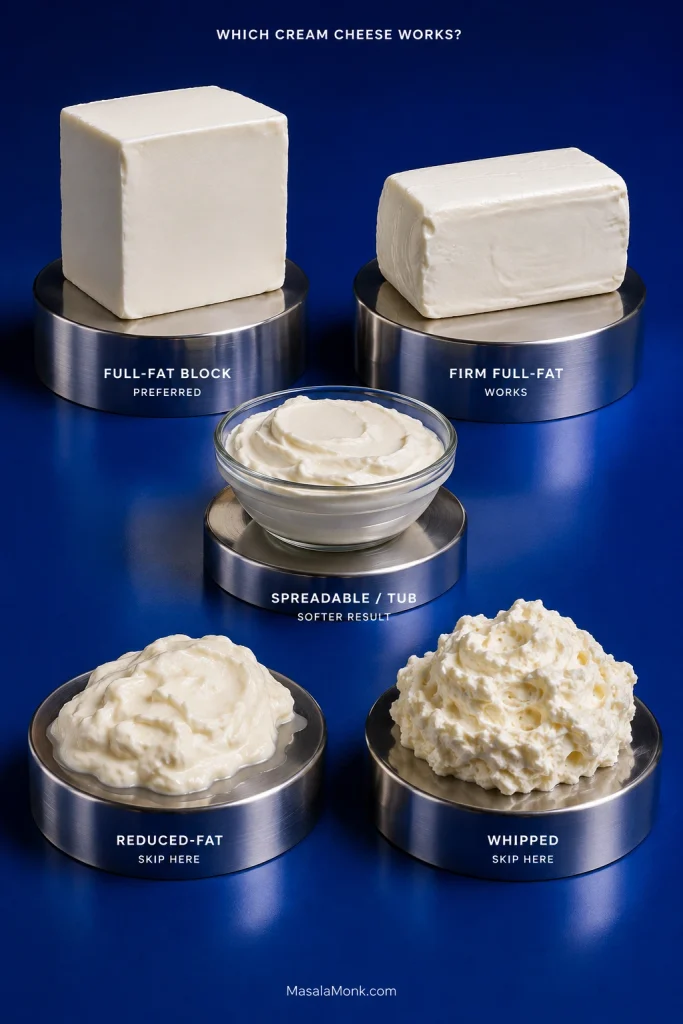
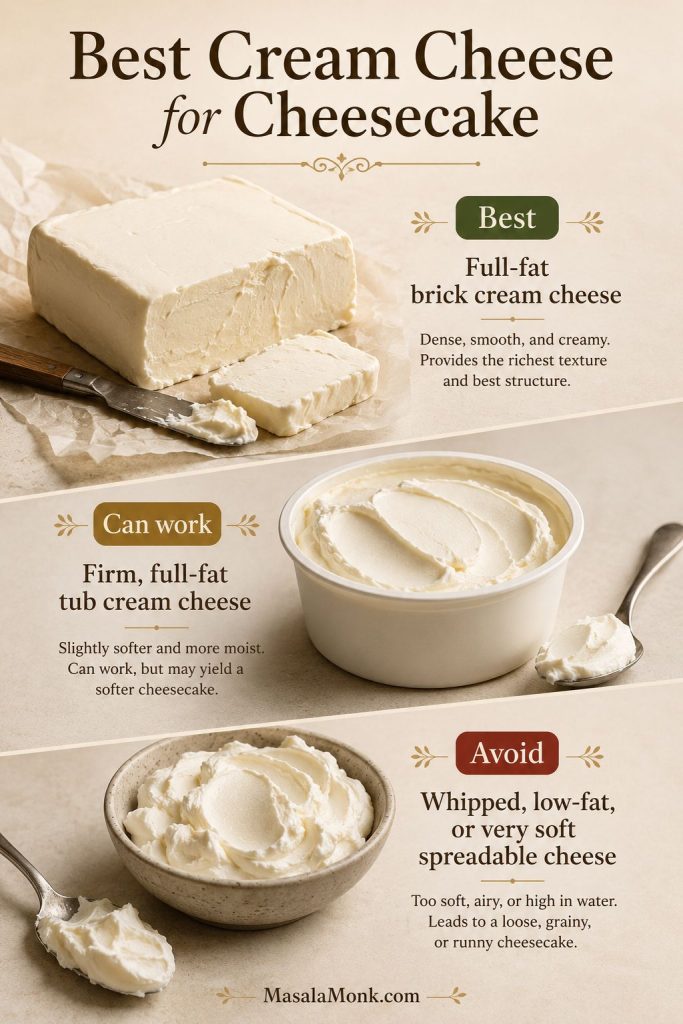
  • Use full-fat block cream cheese. Spreadable tub-style cream cheese can be softer and may not set as firmly.
  • Cool the caramel first. Warm caramel may seem easier to stir in, but it can soften the filling and make the cheesecake harder to bake evenly.
  • Scrape the bowl often. Cream cheese lumps like to hide at the bottom and sides of the bowl.
  • Mix on low after adding eggs. Too much air can make the cheesecake rise, fall, and crack.
  • Do not rush the chill. A caramel cheesecake needs time to firm up fully.

Salted Caramel Cheesecake Ingredients

This ingredient list is simple, but texture matters. Choose full-fat dairy, a sturdy crumb base, and caramel that is thick enough for cheesecake rather than a thin dessert syrup.

Ingredient board for salted caramel cheesecake showing crumbs, butter, brown sugar, cream cheese, sour cream, cream, eggs, caramel sauce, vanilla, cornstarch, and salt.
The best salted caramel cheesecake starts with a few texture-critical ingredients, so full-fat cream cheese, cooled caramel, and a firm crumb crust matter more than a long shopping list.

Buttery Crumb Crust

  • Digestive biscuits, graham crackers, or Biscoff crumbs: Digestives and graham crackers give the cheesecake a classic base, while Biscoff adds a deeper caramel-cookie flavor.
  • Melted butter: This binds the crumbs and helps the crust set firmly after baking.
  • Light brown sugar: A small amount adds a gentle caramel note to the base.
  • Fine salt: Salt keeps the crust from tasting flat underneath the sweet filling.
Crust options guide comparing digestive biscuit crust, graham cracker crust, and spiced cookie crust for salted caramel cheesecake.
Crust choice changes the whole dessert: digestive biscuits keep the flavor balanced, graham crackers feel classic, and spiced cookie crumbs push the cheesecake toward a deeper caramel-cookie profile.

Salted Caramel Cheesecake Filling

  • Full-fat block cream cheese: This gives the cheesecake its main structure. Let it come to room temperature before mixing so the batter turns smooth.
  • Light brown sugar: Brown sugar tastes warmer and more caramel-like than white sugar.
  • Sour cream: A little tang balances the caramel and keeps the filling from tasting too sweet.
  • Heavy cream or double cream: Cream adds richness and helps the texture feel smooth.
  • Eggs: These set the baked filling. Add them one at a time and mix gently.
  • Cornstarch or all-purpose flour: Either one gives the filling a little extra stability, which helps when caramel is involved.
  • Vanilla extract: Vanilla rounds out the dairy and caramel flavors.
  • Fine salt: This balances the sweetness inside the cheesecake, not just on top.
  • Cooled salted caramel sauce: Use caramel that is thick but stirrable, so it flavors the filling without making the batter too loose.

Salted Caramel Topping

  • Salted caramel sauce: Look for a sauce that falls from a spoon in a slow ribbon. Runny caramel is better saved for drizzling over individual slices.
  • Flaky sea salt: Sprinkle it on just before serving so it stays crisp and gives little salty pops against the caramel.

Need help with caramel texture before you start? See the caramel thickness guide. Ready to bake? Jump to the method.

Caramel for Cheesecake: Filling, Topping, and Drizzle

Caramel decides the texture here. A sauce that works beautifully over ice cream may be too thin for cheesecake. In this recipe, the caramel should be cool enough to protect the filling and thick enough to stay present in each slice.

The Spoon Test for Caramel Cheesecake Topping

Before adding caramel to the filling or spreading it on top, test it with a spoon. This is easier than guessing by color alone.

Caramel thickness guide showing too-thin caramel, pourable caramel, thick but stirrable caramel, and too-firm caramel for cheesecake.
Caramel thickness affects both texture and appearance; for that reason, thick but stirrable caramel works best in the filling, while slow-moving caramel is better for the top.
Caramel textureWhat it looks likeBest use
Too thinRuns off the spoon like syrupUse only as a serving drizzle
PourableCoats the spoon and falls in a slow ribbonBest for the top of the chilled cheesecake
Thick but stirrableA spoon dragged through it leaves a trail for 2–3 secondsBest for mixing into the filling or making a light swirl
Too firmClumps or spreads like cold fudgeWarm very briefly before using

Best Caramel Sauce for Salted Caramel Cheesecake

Best caramel sauce guide for cheesecake showing thick homemade caramel, good store-bought caramel, thin syrup, and cold firm caramel.
Not every caramel sauce belongs in cheesecake. Homemade or thick store-bought caramel works well in the batter, whereas thin syrup is better saved for drizzling over finished slices.

The best caramel sauce for salted caramel cheesecake is thick, glossy, and slow-moving. It should coat a spoon and fall in a ribbon rather than run like syrup. Homemade caramel gives you the most control, but store-bought salted caramel can work if it has enough body. Avoid thin ice cream-style caramel in the filling because it can make the cheesecake softer and harder to slice.

This same thick-caramel logic also matters in a banoffee pie recipe, where the caramel or dulce de leche needs enough body to sit under bananas and cream without turning the slices messy.

Homemade vs Store-Bought Caramel for Cheesecake

Homemade salted caramel gives you the most control because you can cook it to the right thickness. Store-bought caramel can still work, especially for the topping, as long as it is not watery. If your jarred caramel is thin and runny, keep it for a final drizzle instead of mixing it into the cheesecake batter.

For the filling, use caramel that has cooled completely. For the topping, choose a glossy sauce that moves slowly from the spoon. If it has been refrigerated and looks too firm, warm it for a few seconds at a time until it loosens, then let it cool slightly before spreading.

Quick Salted Caramel for This Cheesecake

If you do not already have caramel sauce, make a simple batch before you start the filling. It needs time to cool, so this is best done first.

  • 200 g granulated sugar, about 1 cup
  • 85 g unsalted butter, cubed, about 6 tbsp
  • 120 ml heavy cream or double cream, 1/2 cup
  • 1/2–1 tsp fine salt, to taste
  • 1 tsp vanilla extract, optional

This makes enough caramel for the filling and topping, with a little extra for drizzling depending on how thick you cook it.

Place the sugar in a heavy-bottom saucepan over medium heat and let it melt, stirring gently only as needed until it becomes a deep amber caramel. The sugar may clump at first. Keep the heat moderate and continue stirring gently until the clumps melt. If it darkens too fast, lower the heat.

Carefully whisk in the butter; the mixture will bubble. Slowly add the cream while whisking, then simmer for 1–2 minutes until smooth. Remove from the heat, stir in salt and vanilla, and let it cool until thick but still spoonable.

Caramel safety note: Hot caramel is much hotter than boiling water and bubbles aggressively when butter or cream is added. Use a deep pan, pour the cream slowly, and keep your hands clear of the steam.

When to Add Caramel Topping to Cheesecake

Add the topping after the cheesecake has chilled and set. If you add caramel while the cheesecake is warm, it can sink into the surface or slide toward the edges. If you are making the dessert ahead, bake and chill the cheesecake first, then add the caramel layer on the day you serve it.

Best result: Make the caramel first, bake the cheesecake the day before serving, chill it overnight, then add the caramel topping and flaky salt on the day you serve it.

If your caramel feels too thin or the topping keeps sliding, check the troubleshooting section. Want the full recipe in one place? Go to the recipe card.

Equipment for Baked Salted Caramel Cheesecake

  • 9-inch / 23 cm springform pan: A deeper pan is helpful because the filling rises slightly as it bakes.
  • Parchment paper: Makes it easier to release the cheesecake from the base.
  • Food processor or rolling pin: Use either one to make fine, even crumbs.
  • Stand mixer with paddle or electric hand mixer: Keep the speed gentle, especially after adding the eggs.
  • Roasting pan or deep baking tray: Helpful for a water bath or a steam-pan setup.
  • Heavy-bottom saucepan: Needed if making caramel from scratch.
  • Digital scale: Strongly recommended because small measurement changes affect cheesecake texture.
  • Offset spatula: Helpful for smoothing the batter and caramel layer.
  • Sharp knife: Warm and wipe it between cuts for neat slices.
  • Instant-read thermometer, optional: Useful if you want a precise doneness check.

Common Mistakes to Avoid

  • Do not add hot caramel to the filling. It can loosen the batter and make the cheesecake bake unevenly.
  • Do not use thin caramel syrup in the batter. Save runny caramel for drizzling over individual slices.
  • Do not overmix after adding eggs. Too much air can make the cheesecake rise, fall, and crack.
  • Do not bake until the center looks fully firm. The middle should still wobble gently when the cheesecake leaves the oven.
  • Do not add the caramel topping while the cheesecake is warm. Add it after chilling so the top stays glossy and neat.

How to Make Salted Caramel Cheesecake

The steps are straightforward, but the order makes a big difference. Bake the crust first, let the caramel cool, mix the filling gently, bake the cheesecake slowly, then give it enough time to chill before adding the topping.

Step-by-step board showing how to make salted caramel cheesecake by baking the crust, mixing the filling, baking gently, chilling, topping, and slicing.
To keep the cheesecake smooth and sliceable, follow the order carefully: bake the crust, cool the caramel, mix gently after the eggs go in, then bake, chill, and top only when fully set.

Step 1: Make the Crust

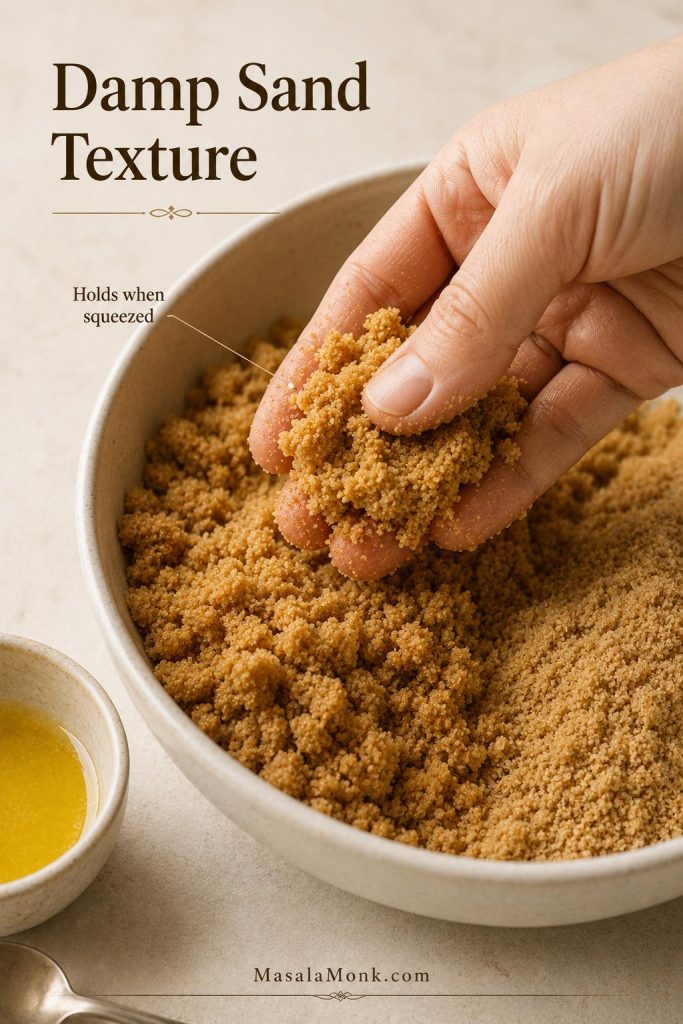
Heat the oven to 350°F / 175°C. Line the base of a 9-inch springform pan with parchment paper. Mix the biscuit crumbs, melted butter, brown sugar, and salt until the crumbs look evenly moistened, like damp sand.

Press the mixture firmly into the base of the pan. Bring the crumbs slightly up the sides to make a low edge, then bake for 8–10 minutes. Let the crust cool while you prepare the filling.

Step 2: Cool or Prepare the Caramel

If you are making caramel from scratch, make it now and let it cool. If you are using prepared caramel, check the texture with the spoon test. For the filling, the caramel should be cool and thick but still easy to stir.

Avoid adding hot caramel to the batter. It can soften the cream cheese mixture and make the cheesecake bake unevenly.

Step 3: Mix the Salted Caramel Cheesecake Filling

Lower the oven to 300°F / 150°C. If using a fan or convection oven, reduce the cheesecake baking temperature to about 285°F / 140°C. Beat the room-temperature cream cheese and brown sugar on low to medium speed until smooth. Stop and scrape the bowl a few times so no firm streaks of cream cheese remain.

Add the sour cream, heavy cream, vanilla, salt, cornstarch, and cooled caramel. Mix just until smooth. Add the eggs one at a time on low speed, mixing only until each egg disappears into the batter.

Mix gently once the eggs go in. Cheesecake batter should be smooth, not whipped. Too much air can make the cheesecake rise in the oven and crack as it cools.

Step 4: Bake the Salted Caramel Cheesecake Low and Slow

Pour the filling into the cooled crust and smooth the top. Bake at 300°F / 150°C for 70–80 minutes, using a water bath or steam pan if possible.

For a full water bath, wrap the outside of the springform pan well, place it in a roasting pan, and pour hot water around it until the water reaches about halfway up the sides. For the easier steam-pan method, place a tray of hot water on the lower rack and bake the cheesecake on the rack above.

The cheesecake is ready when the outer 2–3 inches look set and the center still has a soft wobble. It should move like set custard, not ripple like liquid. The top should look mostly matte rather than wet. If you are using a thermometer, the center should be around 145°F / 63°C; ThermoWorks uses the same internal temperature cue for cheesecake doneness.

Cheesecake doneness guide showing set edges, gently wobbling center, mostly matte top, and optional 145 degrees Fahrenheit or 63 degrees Celsius internal temperature cue.
Cheesecake is done before it looks fully firm, so look for set edges, a gentle center wobble, and a mostly matte top rather than waiting for a completely rigid middle.

Do not wait for the center to look completely firm in the oven. By that point, the cheesecake may be overbaked. It will continue to set as it cools and chills.

Step 5: Cool Gradually

Turn the oven off, crack the door open, and leave the cheesecake inside for 1 hour. After that, move it to the counter and cool for another 1 hour. This slow cooling helps prevent sudden sinking and cracking.

Step 6: Chill Until Fully Set

Refrigerate the cheesecake for at least 6 hours. Overnight is better, and 8 hours gives a more reliable set. The filling becomes smoother and firmer as it rests, and the caramel flavor settles into the cream cheese base.

Step 7: Add the Salted Caramel Layer and Flaky Salt

Once the cheesecake is cold and set, spread the caramel over the top. Let it settle naturally, or guide it gently with an offset spatula. Finish with flaky sea salt just before serving.

For tidy slices, dip a sharp knife in hot water, wipe it dry, cut one slice, then wipe the blade before cutting again.

Clean cheesecake slicing guide showing chilling, warming the knife, wiping between cuts, adding topping after chilling, and softening firm topping.
Clean cheesecake slices come from a few small habits that make a big difference: chill thoroughly, warm the knife, wipe between cuts, and let very firm caramel soften slightly before serving.

Need to store it or make it ahead? Jump to storage and freezing. Cheesecake not setting the way you expected? See troubleshooting.

Do You Need a Water Bath for Salted Caramel Cheesecake?

A water bath gives cheesecake the smoothest texture because it surrounds the pan with gentle, moist heat. That is especially helpful here because caramel adds sweetness and moisture to the filling.

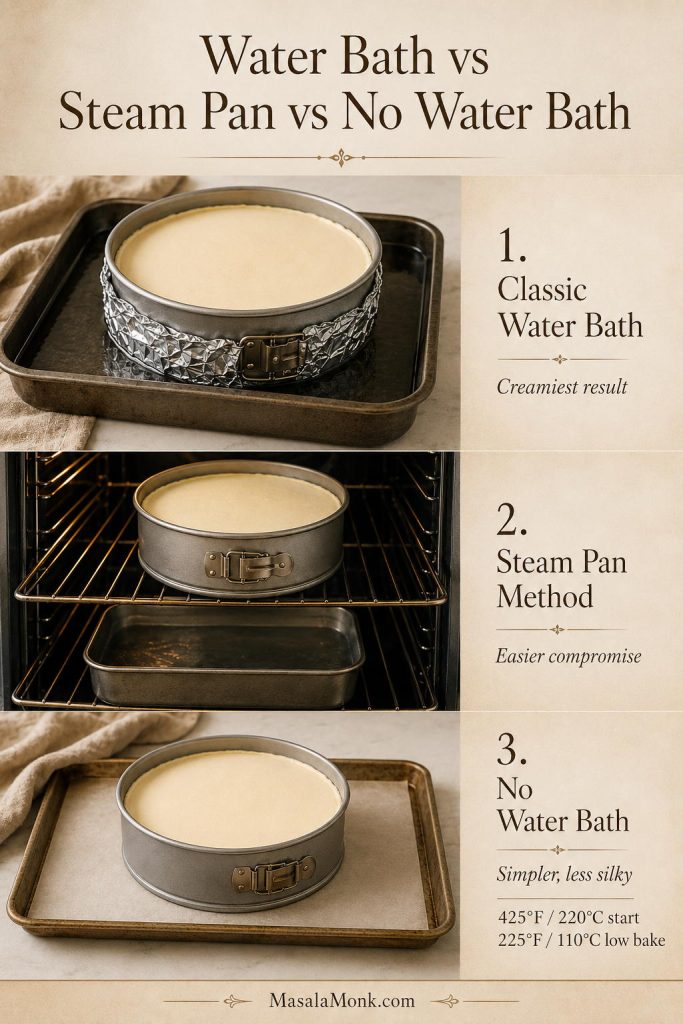
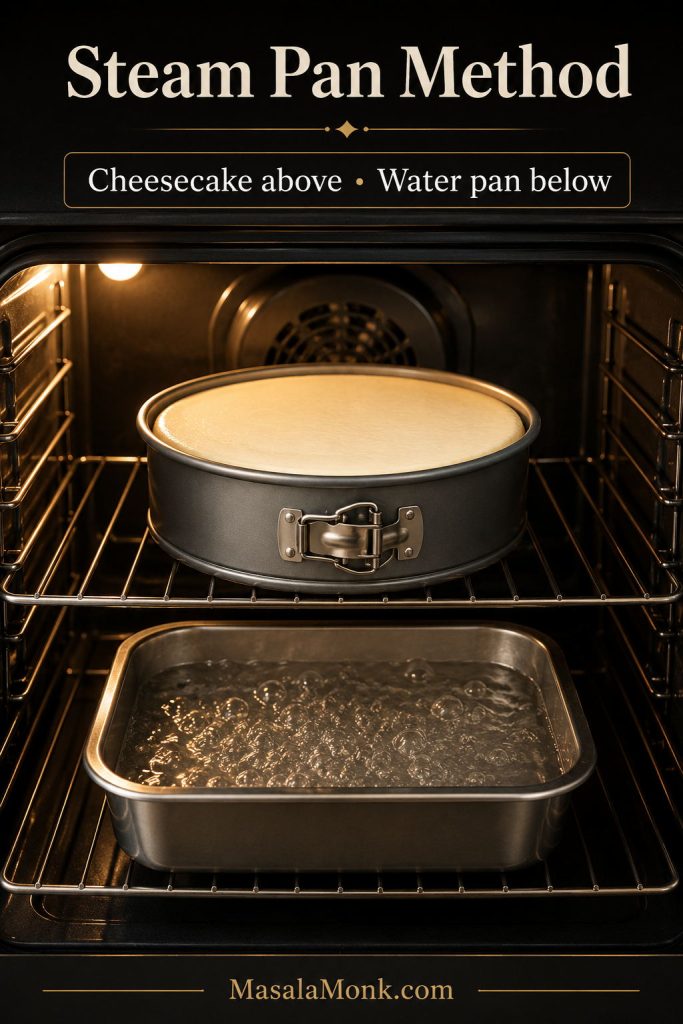
If wrapping a springform pan makes you nervous, use a steam pan instead. Place a deep tray of hot water on the lower oven rack and bake the cheesecake on the rack above it. You still get extra moisture in the oven without risking water leaking into the crust.

Comparison board showing a foil-wrapped springform pan in a water bath and a cheesecake baked above a separate steam pan.
A water bath gives the smoothest baked cheesecake texture, but a steam pan is an easier alternative; either way, added moisture helps the cheesecake bake more gently and crack less.
MethodBest forWhat to expect
Full water bathSmoothest texture and lowest crack riskWrap the pan well and place it in hot water while baking.
Steam panEasier setup with less leak riskPlace hot water on the lower rack while the cheesecake bakes above it.
No water bathShortcut bakingThe cheesecake can still work, but cracks and firmer edges are more likely.

For another technical reference, Serious Eats also uses 145°F / 63°C as a cheesecake doneness target, which supports the thermometer cue in this recipe.

If you skip both the water bath and the steam pan, keep the oven temperature low and avoid overbaking. Any cracks can be covered with caramel, but the texture will be creamier if the cheesecake bakes gently.

Saveable salted caramel cheesecake recipe card with yield, prep time, bake time, chill time, ingredient groups, and brief method steps.
Use the recipe card when you want the method in one place, especially for checking the ingredient groups, baking time, chill time, and topping order without scrolling through the full guide.

Salted Caramel Cheesecake Recipe Card

This salted caramel cheesecake recipe makes a creamy baked cheesecake with caramel in the filling, a glossy caramel layer on top, buttery crumb crust, and a clean sliceable texture after chilling.

Yield
12 slices

Prep Time
35 minutes

Bake Time
1 hour 20–30 minutes

Chill Time
6 hours minimum, overnight best

Total Time: About 10 hours minimum including cooling and chilling; overnight chilling is best.

Pan: 9-inch / 23 cm springform pan

Before You Start

  • Bring cream cheese, eggs, sour cream, and cream to room temperature.
  • Use cooled caramel in the filling, not hot caramel.
  • Mix gently after adding eggs.
  • Chill overnight for the neatest slices.
  • Add the caramel topping after chilling.

Ingredients

Crust

  • 225 g digestive biscuits, graham crackers, or Biscoff crumbs, about 2 1/4 cups
  • 100 g unsalted butter, melted, about 7 tbsp
  • 25 g light brown sugar, about 2 tbsp
  • 1/4 tsp fine salt

Salted Caramel Filling

  • 680 g full-fat block cream cheese, room temperature, 24 oz
  • 150 g light brown sugar, about 3/4 cup packed
  • 120 g sour cream, room temperature, 1/2 cup
  • 60 ml heavy cream or double cream, 1/4 cup
  • 120 g cooled salted caramel sauce, about 1/3–1/2 cup
  • 1 tbsp cornstarch or all-purpose flour
  • 2 tsp vanilla extract
  • 1/4 tsp fine salt
  • 3 large eggs, room temperature

Topping

  • 160–200 g salted caramel sauce, slow-moving and pourable, about 1/2–2/3 cup
  • 1/2–1 tsp flaky sea salt, to finish

Optional Quick Caramel Sauce

  • 200 g granulated sugar, about 1 cup
  • 85 g unsalted butter, cubed, about 6 tbsp
  • 120 ml heavy cream or double cream, 1/2 cup
  • 1/2–1 tsp fine salt, to taste
  • 1 tsp vanilla extract, optional

Instructions

Make the Caramel and Crust

  1. If making the caramel sauce, melt the sugar in a heavy-bottom saucepan over medium heat until deep amber. Carefully whisk in butter, then slowly whisk in cream. Simmer for 1–2 minutes, remove from the heat, add salt and vanilla, and cool until thick but spoonable.
  2. Heat the oven to 350°F / 175°C. Line the base of a 9-inch springform pan with parchment paper.
  3. Mix the biscuit crumbs, melted butter, brown sugar, and salt until evenly moistened.
  4. Press the crumbs firmly into the base of the pan, bringing them slightly up the sides to make a low edge. Bake for 8–10 minutes, then cool.

Mix the Cheesecake Filling

  1. Lower the oven to 300°F / 150°C, or about 285°F / 140°C for a fan oven.
  2. Beat the cream cheese and brown sugar on low to medium speed until smooth, scraping the bowl as needed.
  3. Mix in sour cream, heavy cream, cooled caramel, cornstarch, vanilla, and salt.
  4. Add the eggs one at a time on low speed, mixing only until combined.
  5. Pour the filling into the cooled crust and smooth the top.

Bake, Cool, and Chill

  1. For a water bath, place the wrapped springform pan in a roasting pan and pour hot water around it until it reaches about halfway up the sides. For an easier steam-pan method, place a tray of hot water on the lower rack and bake the cheesecake on the rack above.
  2. Bake for 70–80 minutes, until the outer edges are set and the center wobbles gently like set custard.
  3. Turn off the oven, crack the door, and let the cheesecake cool inside for 1 hour.
  4. Move the cheesecake to the counter and cool for another 1 hour.
  5. Refrigerate for at least 6 hours, preferably 8 hours or overnight.

Finish and Slice

  1. Spread the caramel topping over the chilled cheesecake.
  2. Finish with flaky sea salt just before serving.
  3. Slice with a warm, wiped knife for the cleanest cuts.

Notes

  • If the caramel runs like syrup, use it as a serving drizzle instead of mixing it into the filling.
  • The cheesecake should not look fully firm when it leaves the oven. It will finish setting as it cools.
  • Do not add the caramel topping before baking.
  • Biscoff crumbs make the crust taste deeper and more caramel-like.
  • If using store-bought caramel, choose a thick sauce rather than a thin ice cream syrup.

Can You Make This as a No-Bake Salted Caramel Cheesecake?

Yes, but a no-bake salted caramel cheesecake needs a different filling. You cannot simply remove the eggs from the baked recipe and chill it. A no-bake version needs whipped cream or double cream for structure, and the caramel must be thick enough that it does not loosen the filling.

Comparison board showing baked salted caramel cheesecake and no-bake salted caramel cheesecake with notes about texture and best uses.
Baked and no-bake salted caramel cheesecake serve different goals. Baked cheesecake is the better choice for caramel in the filling and clean slices, whereas no-bake is softer and more forgiving.

Baked vs No-Bake: Which Version Should You Choose?

VersionBest forTexture
Baked salted caramel cheesecakeClean slices, richer texture, caramel in the fillingCreamy, set, and sliceable
No-bake salted caramel cheesecakeEasy chilled dessert, no oven, softer finishLighter and softer; best with full-fat dairy
Salted caramel cheesecake cupsMost forgiving no-bake optionSpoonable, neat, and party-friendly

No-Bake Salted Caramel Cheesecake Starting Formula

For a 9-inch no-bake version, use this as a starting point:

  • 250 g digestive biscuit or graham cracker crumbs
  • 100 g melted butter
  • 500 g full-fat cream cheese
  • 100–120 g powdered sugar or icing sugar
  • 1 tsp vanilla extract
  • 150 g thick salted caramel sauce
  • 300 ml cold heavy cream or double cream, whipped to soft peaks
  • Extra caramel and flaky salt for topping

How to Assemble the No-Bake Version

Press the crumb base into the pan and chill it while you make the filling. Beat the cream cheese, sugar, vanilla, and caramel until smooth, then fold in the whipped cream. Spoon the filling over the base and chill for at least 6 hours, preferably overnight. Add the caramel topping only after the filling has set.

If you want more detail on chilled cheesecake structure, the setting notes in this no-bake mango cheesecake recipe are helpful because they show how full-fat dairy, filling thickness, and chill time affect whether a no-bake cheesecake slices cleanly or works better in cups.

Why Cheesecake Cups Are Easier

If you want a more forgiving no-bake dessert, make salted caramel cheesecake cups instead of one large cheesecake. Cups set faster, serve neatly, and are less sensitive to a slightly softer filling.

Still deciding? See the baked method or jump to the main recipe card.

Salted Caramel Cheesecake Variations

The baked round cheesecake should stay the main version, but these variations are easy to adapt once you understand the caramel texture and chill time.

Salted caramel cheesecake variations board showing mini cheesecakes, cheesecake bars, chocolate salted caramel cheesecake, and spiced cookie crust.
Once the main recipe is working well, it becomes easy to branch out; for instance, mini cheesecakes bake faster, bars are easier to portion, and a spiced cookie crust adds extra caramel-style warmth.

Mini Salted Caramel Cheesecakes

Use a muffin tin lined with paper liners. Press a spoonful of crumb base into each cup, add filling, and bake until the centers are just set. Mini cheesecakes bake much faster than a full cheesecake, so start checking early. Add caramel after chilling.

Salted Caramel Cheesecake Bars

For bars, use a parchment-lined square or rectangular pan. Bars are easier to chill, transport, and cut for parties. Keep the caramel layer thin and add it after the cheesecake has set.

Chocolate Salted Caramel Cheesecake

Use chocolate biscuit crumbs for the crust and add a thin chocolate ganache layer before the caramel topping. Keep the filling caramel-forward rather than adding too much cocoa to the base.

Salted Caramel Pecan Cheesecake

Add toasted chopped pecans to the crust or scatter them over the caramel before serving. Pecans add crunch and a slight bitterness that works beautifully with the sweet caramel.

Biscoff Salted Caramel Cheesecake

Use Biscoff crumbs for the crust and keep the filling the same. This gives the cheesecake a spiced caramel-cookie base without needing extra flavorings. If you like thick, baked, sliceable desserts with cookie-style richness, this cookie pie recipe is another good dessert to explore.

Make Ahead, Storage, and Freezing Salted Caramel Cheesecake

Make-ahead and storage guide for salted caramel cheesecake showing refrigerator storage, freezing without topping, thawing, and serving with caramel.
This cheesecake is a strong make-ahead dessert, yet the best finish comes when you chill or thaw the cake first and add the caramel topping later so it stays glossy and neat.

Make Ahead

This is an ideal make-ahead dessert. Bake the cheesecake one day before serving, cool it gradually, and chill it overnight. Add the caramel topping the next day so it looks fresh and glossy.

Refrigerator Storage

Store the cheesecake covered in the refrigerator for up to 4 days. If possible, add flaky salt just before serving rather than before storing.

Freezing

You can freeze salted caramel cheesecake, but it is best to freeze it without the caramel topping. Wrap the fully chilled cheesecake tightly, freeze for up to 2 months, then thaw overnight in the refrigerator. Add caramel after thawing.

Serving After Chilling

Serve the cheesecake cold from the refrigerator for the neatest slices. If the caramel topping is very firm, let the cheesecake sit at room temperature for 10–15 minutes before cutting.

Close-up texture guide of a salted caramel cheesecake slice showing glossy caramel top, creamy set center, and buttery crumb crust.
This is the texture to aim for: a glossy caramel top, a creamy baked center that holds its shape, and a crumb crust firm enough to support the slice without crumbling apart.

What to Do With Extra Caramel

Extra salted caramel keeps well in the refrigerator and can be warmed gently for serving. Spoon it over homemade ice cream, drizzle it into coffee, or use it as a dip for crisp desserts like homemade churros.

Troubleshooting Salted Caramel Cheesecake

Most problems come from three places: caramel that is too thin, filling that was mixed too aggressively, or a cheesecake that was not chilled long enough. Here is how to fix or avoid the common issues.

Need to compare with the main method? Go back to the step-by-step instructions. Want the full measurements again? Open the recipe card.

Troubleshooting board for salted caramel cheesecake showing fixes for soft middle, runny caramel, cracks, messy slices, too-sweet flavor, and soggy crust.
When a salted caramel cheesecake goes wrong, the cause is usually technical rather than mysterious; for example, thin caramel, overmixing, rushed cooling, or too little chill time can all affect the final texture.

Why Is My Cheesecake Soft in the Middle?

It may be underbaked, under-chilled, or made with too much thin caramel. The center should wobble gently when it leaves the oven, but it should not look liquid. Chill for at least 6 hours, and overnight if possible.

Why Did My Caramel Run Off the Cheesecake?

The caramel was probably too thin, too warm, or added before the cheesecake had set. Use a slow-moving sauce for the top and add it only after the cheesecake is cold.

Why Did My Cheesecake Crack?

Cracks usually come from overmixing, overbaking, baking too hot, or cooling too quickly. Mix gently after the eggs go in, bake at a lower temperature, and let the cheesecake cool gradually in the turned-off oven.

Why Are My Slices Messy?

The cheesecake likely needs more chill time, or the knife is dragging through the caramel. Chill overnight, use a warm sharp knife, and wipe the blade between cuts.

Why Does My Cheesecake Taste Too Sweet?

Salted caramel is naturally sweet, so balance matters. Sour cream, fine salt in the filling, and flaky salt on top all help. A Biscoff crust will make the cheesecake taste sweeter, while a plain digestive or graham crust keeps it more balanced.

Why Is My Caramel Grainy?

Grainy caramel usually comes from sugar crystals forming while the caramel cooks. Use a clean heavy pan, melt the sugar evenly, and avoid splashing sugar crystals up the sides. If the caramel is already grainy, it is better mixed into the filling than used as the visible topping.

Why Did the Crust Get Soggy?

The crust may not have been baked long enough, or water may have leaked into the pan during a water bath. Bake the crust until it smells toasty, wrap the springform pan well if using a water bath, or use the steam-pan method instead.

Salted Caramel Cheesecake FAQs

What Makes This Salted Caramel Cheesecake Recipe Different?

This salted caramel cheesecake recipe uses caramel in the filling and on top, but keeps the amount controlled so the baked cheesecake still sets, chills, and slices cleanly.

Is Store-Bought Caramel Sauce Okay?

Yes, especially for the topping. Choose a thick caramel sauce that coats a spoon. Very thin caramel syrup is better for drizzling over slices than mixing into the cheesecake filling.

How Thick Should Caramel Be for Cheesecake?

For the filling, caramel should be thick but stirrable. For the topping, it should be glossy and slow-moving. If it runs off a spoon like water or syrup, it is too thin for the filling and better used as a serving drizzle.

Is a Water Bath Necessary?

No, but it helps. A water bath gives the smoothest texture, while a steam pan is an easier option. If you bake without either, keep the oven temperature low and avoid overbaking.

How Long Should Salted Caramel Cheesecake Chill?

Chill it for at least 6 hours. Overnight is best, and 8 hours gives more reliable clean slices because the caramel-enriched filling needs time to firm up fully.

Can This Cheesecake Be Made Ahead?

Yes. Bake and chill the cheesecake one day ahead, then add the caramel layer and flaky salt before serving. This gives the best texture and the freshest-looking topping.

Does Salted Caramel Cheesecake Freeze Well?

Yes, but freeze it before adding the topping if possible. Wrap the chilled cheesecake tightly, freeze for up to 2 months, and thaw overnight in the refrigerator. Add the caramel after thawing.

How Do You Make Mini Salted Caramel Cheesecakes?

Use a lined muffin tin and bake until the centers are just set. Mini cheesecakes bake much faster than a full cheesecake, so check them early and add caramel only after chilling.

How Do You Turn This Into Salted Caramel Cheesecake Bars?

Use a parchment-lined square or rectangular pan, bake until just set, chill well, then add caramel and cut into bars with a warm wiped knife.

What Is the Best Crust for Salted Caramel Cheesecake?

Digestive biscuits or graham crackers are the most classic choice. Biscoff crumbs make the crust taste more caramel-like, while a pretzel crust gives a saltier contrast.

Should Caramel Be Added Before or After Baking?

Add a controlled amount of cooled caramel to the filling before baking. Add the visible topping after the cheesecake has chilled. This gives flavor inside the cheesecake while keeping the top glossy and neat.

Back to top

Posted on 2 Comments

Keto Cheesecake Recipe

Finished keto cheesecake with one slice removed, showing creamy filling and a golden almond flour crust with berries nearby.

This keto cheesecake recipe gives you the kind of slice people actually want from cheesecake: cool, creamy, rich, smooth, and firm enough to cut cleanly. It has a buttery almond flour crust, a full-fat cream cheese filling, and a slow-cooling method that helps prevent cracks without needing a complicated water bath.

The flavor is classic first and keto second. You get the tang of cream cheese and sour cream, the warmth of vanilla, a little brightness from lemon juice, and a low-carb crust that feels much closer to a traditional cheesecake base than a dry “diet dessert” crust.

Use this as your classic baked cheesecake base. You will also find a crustless option, a no-bake option, sweetener guidance, pan-size help, storage tips, and fixes for common problems like cracks, grainy filling, soggy crust, and a runny center.

Quick Answer: The Best Keto Cheesecake Recipe

For the best keto cheesecake, make a baked full-fat cream cheese filling in a 9-inch springform pan with a pre-baked almond flour crust. Bake the crust at 350°F / 177°C for 10–12 minutes, then lower the oven to 325°F / 163°C and bake the cheesecake for 45–55 minutes, until the edges are set and the center still has a soft jiggle.

Let it cool slowly, then chill for at least 6 hours or overnight before slicing. A powdered allulose or monk fruit/allulose blend gives the smoothest texture because it dissolves better than coarse granulated sweeteners.

Pan 9-inch springform pan
Crust Almond flour crust
Crust Bake 350°F / 177°C for 10–12 minutes
Filling Bake 325°F / 163°C for 45–55 minutes
Chill Time 6 hours minimum, overnight best
Yield 12 generous or 16 smaller slices
Net Carbs About 4g per 1 of 16 slices
Water Bath Not required
Texture Cool, creamy, dense, and sliceable
Keto cheesecake quick guide showing a cheesecake slice with baking temperature, pan size, chill time, and net carb notes.
Start here if you want the main numbers before baking: pan size, oven temperature, chill time, and approximate net carbs all shape the final keto cheesecake texture.

Need the full formula? Jump to recipe card · Back to guide

Before you start: Soften the cream cheese fully, bring the eggs and sour cream to room temperature, line the springform pan with parchment, use powdered sweetener for the filling, and plan for at least 6 hours of chilling. These five details matter more than any fancy technique.
Texture tip: The cheesecake should not look fully firm when it comes out of the oven. If the center is completely set in the oven, it is more likely to be overbaked after chilling.

Why This Keto Cheesecake Works

A good keto cheesecake has to solve three problems at once: it needs to taste like classic cheesecake, avoid a gritty sweetener texture, and hold together without flour or sugar. This version uses full-fat brick cream cheese for structure, sour cream for a smooth tangy finish, eggs for setting, and powdered keto sweetener so the filling stays creamy.
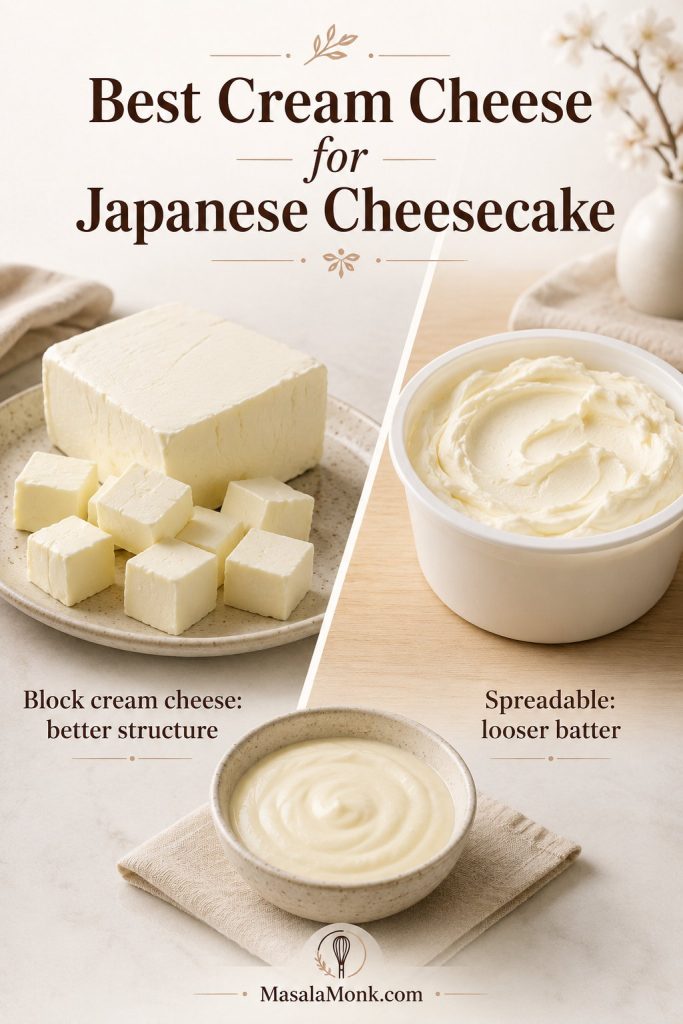
The almond flour crust is pre-baked before the filling goes in. That gives it a warmer, nuttier flavor and helps it hold together under the cheesecake layer. The filling bakes low and slow at 325°F / 163°C, then cools gradually so the center can finish setting without a dramatic temperature shock.

That slow method is what makes this sugar free cheesecake more reliable. You do not need a full water bath, but you do need room-temperature ingredients, gentle mixing, and enough chill time.

Close-up of a creamy keto cheesecake slice with smooth dense filling and a visible almond flour crust.
This is the texture goal: creamy, dense, and cleanly cut. If the filling looks grainy, the issue usually starts with cold cream cheese or coarse sweetener.

Baked vs No-Bake vs Crustless Versions

Before you start, choose the right style. A baked cheesecake gives the most classic texture, a no-bake version is easier and lighter, and a crustless cheesecake is the simplest way to reduce carbs and skip the almond flour crust.

Comparison board showing baked keto cheesecake, no-bake keto cheesecake, and crustless keto cheesecake slices with texture notes.
Before choosing a method, decide what texture you want. Baked keto cheesecake is classic, no-bake cheesecake is softer, and crustless cheesecake keeps things simpler.
Version Best For Texture Main Watch-Out
Baked keto cheesecake Classic cheesecake flavor and clean slices Dense, creamy, rich Do not overbake; cool slowly to prevent cracks
No-bake keto cheesecake Easy summer dessert or oven-free prep Lighter, softer, mousse-like Needs enough chill time to set properly
Crustless keto cheesecake Lower carbs, fewer steps, no almond flour Creamy and simple Pan lining matters so it releases cleanly

The baked version is the focus here because it gives the most traditional cheesecake texture. The crustless and no-bake sections below show how to adapt the base without turning the main recipe into three different desserts at once.

Is Keto Cheesecake Low Carb or No Carb?

Keto cheesecake is low carb, but it is usually not truly zero carb. Cream cheese, sour cream, eggs, almond flour, lemon juice, and even some keto sweeteners can contribute small amounts of total carbs depending on the brands you use.

Think of this as a low carb cheesecake or sugar free cheesecake, not a misleading zero-carb dessert. If you want the lowest-carb version, make the crustless option and cut the cheesecake into 16 smaller slices. That gives you the creamy filling with fewer carbs from the almond flour crust.

Lowest-carb direction: Make it crustless, use a powdered sweetener that fits your carb target, and keep toppings simple. Fresh berries are usually a better choice than thick sauces if you are watching carbs closely.

If you like make-ahead low-carb desserts, this keto chia pudding with almond milk is another easy no-sugar option with simple net-carb math.

Equipment You Need

You do not need complicated bakery equipment, but a few tools make this cheesecake much easier and cleaner.

  • 9-inch springform pan: The best standard size for this recipe.
  • Parchment paper: Helps the crust release and makes slicing easier.
  • Mixing bowls: One for the crust and one large bowl for the filling.
  • Hand mixer or stand mixer: Helps make the filling smooth without lumps.
  • Rubber spatula: Useful for scraping the bowl and smoothing the top.
  • Flat-bottom cup or measuring cup: Presses the almond flour crust firmly into the pan.
  • Baking sheet: Makes the springform pan easier to move in and out of the oven.
  • Sharp knife: For clean slices after the cheesecake is fully chilled.
Optional but helpful: Place a pan of hot water on the lower oven rack while the cheesecake bakes. This is not a full water bath, but it adds a little humidity and can help the cheesecake bake more gently.

Ingredients for Keto Cheesecake

The ingredient list is simple, but the details matter. For the smoothest low carb cheesecake, use full-fat dairy, room-temperature ingredients, almond flour for the crust, and a powdered sweetener rather than a coarse granulated one.

Labeled keto cheesecake ingredients including cream cheese, sour cream, eggs, powdered sweetener, almond flour, butter, lemon, vanilla, and salt.
Keto cheesecake uses simple ingredients, but they need to behave well together. Therefore, full-fat dairy, powdered sweetener, and room-temperature eggs matter more than extra add-ins.

Next step: choose sweetener · make the crust

Cream Cheese

Use 32 oz / 907 g full-fat brick cream cheese, softened to room temperature. Brick-style cream cheese gives the cheesecake body and structure. Tub-style spreadable cream cheese is usually softer and can make the filling looser.

The cream cheese should be soft enough to beat smoothly, but not melted or oily. If it is too cold, the filling can turn lumpy. If it is too warm, the batter can become loose and overmixed.

Sour Cream

Sour cream adds a classic tang and softens the richness of the cream cheese. Use 1/2 cup / 120 g sour cream at room temperature. Full-fat sour cream works best here because low-fat versions can make the texture thinner and less creamy.
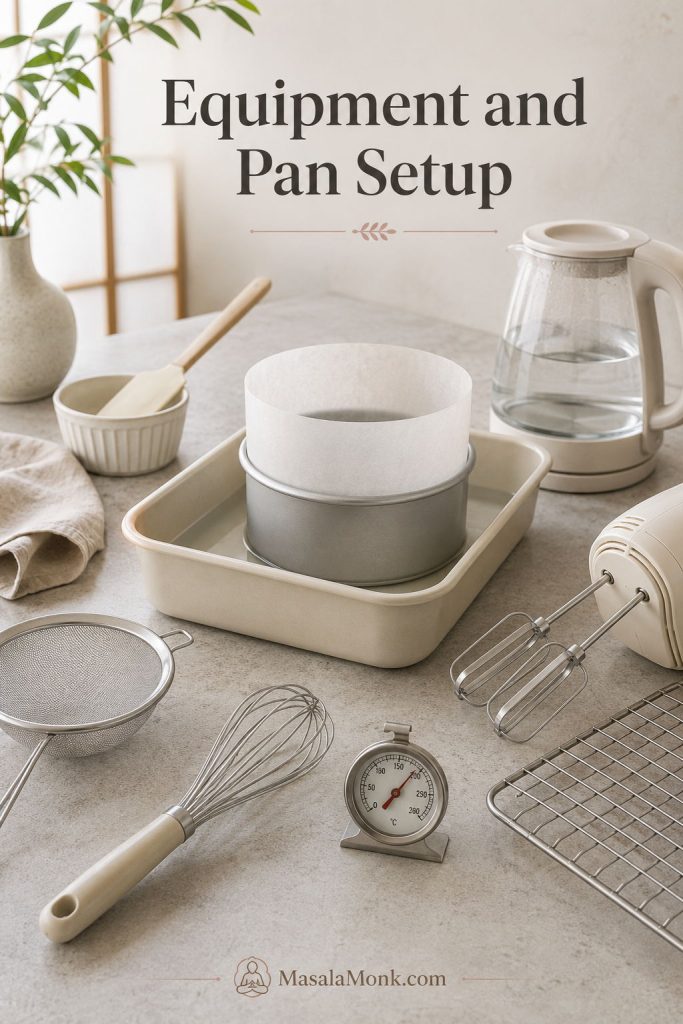
Eggs

Use 3 large eggs, also at room temperature. Eggs help the cheesecake set, but they should be mixed in gently. Once the eggs go in, do not whip the batter aggressively. Too much air can make the cheesecake puff up in the oven and crack as it cools.

Sweetener

Use 1 cup to 1 1/4 cups powdered keto sweetener. The exact amount depends on how sweet you like cheesecake and how sweet your specific sweetener tastes. A powdered allulose or monk fruit/allulose blend gives the smoothest texture.

If you use a strong erythritol-heavy sweetener, the cheesecake may have a cooling finish. If you use a coarse granulated sweetener, the filling can taste slightly grainy.

Lemon Juice, Vanilla, and Salt

Fresh lemon juice brightens the filling and makes the cheesecake taste more classic. Vanilla rounds out the sweetness, while salt keeps the flavor from tasting flat.

  • Lemon juice: 1 tablespoon fresh lemon juice
  • Vanilla extract: 2 teaspoons
  • Fine salt: 1/4 teaspoon

Best Sweetener for a Smooth Cheesecake Filling

The best sweetener for keto cheesecake is one that dissolves smoothly and does not leave the filling gritty. Powdered sweetener is usually better than granulated sweetener for the filling because it blends more evenly into the cream cheese. For a broader baking overview, this low-carb baking guide explains why ingredient choice can affect texture, browning, and aftertaste.

The sweetener matters even more after chilling. Some erythritol-heavy blends can recrystallize in cold desserts, which is why a cheesecake may taste smooth on day one but slightly gritty after a night in the fridge.

Keto cheesecake sweetener guide comparing powdered allulose, monk fruit allulose blend, erythritol blend, granulated sweetener, and liquid stevia.
The best sweetener for keto cheesecake is not only about sweetness. Powdered allulose or a monk fruit/allulose blend helps the filling stay smoother after chilling.

Using the right sweetener? Continue to crust · fix grainy texture

Sweetener Best Use What to Know
Powdered allulose Smoothest filling texture Less likely to taste grainy; may brown slightly faster in some baked goods
Powdered monk fruit/allulose blend Best all-round choice Good sweetness and smooth texture when powdered
Powdered erythritol blend Works if you like the taste Can leave a cooling effect or slight crystallized texture
Granulated keto sweetener Better for crust than filling Can make the filling grainy unless blended very well
Liquid stevia Small sweetness adjustment Does not add bulk; too much can taste bitter
Best choice for this recipe: Use powdered allulose or a powdered monk fruit/allulose blend in the filling. For the crust, powdered or finely granulated keto sweetener both work.

Almond Flour Cheesecake Crust

The almond flour cheesecake crust is one of the most important parts of this recipe. A good cheesecake crust with almond flour should still taste buttery, hold together under the filling, and slice cleanly after chilling.

It replaces the usual graham cracker crust with a gluten-free, low-carb base that still feels like a real cheesecake crust.

Pressed almond flour cheesecake crust in a springform pan with almond flour, melted butter, powdered sweetener, vanilla, and salt.
A good almond flour cheesecake crust should feel compact before it goes into the oven. Pressing firmly helps the low-carb crust bake into a sliceable base.

Need sizing help? See crust ratios · continue to method

For the crust, use:

  • 2 cups / about 224 g blanched almond flour
  • 1/3 cup / 75 g unsalted butter, melted
  • 2 tablespoons powdered keto sweetener
  • 1 teaspoon vanilla extract
  • 1/4 teaspoon fine salt

Mix everything until the almond flour looks evenly moistened. It should feel like damp sand and hold together when pressed. Press it firmly into the bottom of a parchment-lined 9-inch springform pan, then bake at 350°F / 177°C for 10–12 minutes, until lightly golden and fragrant.

Almond Flour Crust Ratio Guide

The same almond flour cheesecake crust does not behave the same in every pan. A smaller pan makes the crust feel thicker, while a wider pan spreads the mixture thinner and may need a little more butter to stay sliceable.

Use the 9-inch ratio for this keto cheesecake recipe as written. If you change pan size, press the crust firmly, pre-bake it until lightly golden, and let it cool before adding the filling.

Pan Size Almond Flour Butter Sweetener Best Use
8-inch 1 1/2 cups / about 168 g 1/4 cup / 57 g 2 tbsp Thicker cheesecake or smaller batch
9-inch 2 cups / about 224 g 1/3 cup / 75 g 2 tbsp This recipe as written
10-inch 2 cups / about 224 g 5–6 tbsp / 70–85 g 2–3 tbsp Thinner, wider cheesecake
Almond flour cheesecake crust ratio guide for 8-inch, 9-inch, and 10-inch pans with butter and sweetener amounts.
When making cheesecake crust with almond flour, pan size changes everything. As a result, the right butter-to-flour ratio keeps the crust from turning greasy or crumbly.

Crust ready? check pan size · start the method

Almond Flour vs Almond Meal

Blanched almond flour gives the neatest crust because it is finer and lighter. Almond meal can work, but it is usually coarser and may make the crust more rustic or crumbly. For a smooth, classic cheesecake look, use fine blanched almond flour.

If you are searching for an almond meal crust for cheesecake, the same basic idea works, but the texture will be darker, coarser, and more rustic. Fine blanched almond flour gives a smoother shortbread-style crust, while almond meal gives a nuttier, more graham-cracker-like look.

Comparison of almond flour cheesecake crust and almond meal cheesecake crust, showing a smoother lighter crust and a darker coarser crust.
Almond flour and almond meal are not identical in cheesecake crust. Almond flour gives a smoother finish, while almond meal creates a darker, more rustic bite.

Chosen your flour? Check crust ratios · jump to recipe

How to Keep the Crust from Crumbling

A crumbly keto cheesecake crust usually means one of three things: not enough butter, not enough pressing, or not enough baking. The crust should be pressed firmly with the bottom of a cup, especially around the edges. After baking, let it cool for a few minutes before adding the filling.

If the crust still seems loose, add 1 extra tablespoon melted butter next time. If it seems greasy, reduce the butter slightly or bake the crust a minute or two longer.

How to Avoid a Soggy Almond Flour Crust

Pre-baking is the easiest fix. A lightly golden crust holds up better under the filling than a raw almond flour crust. You should also avoid pouring very warm or loose filling onto the crust. The cream cheese filling should be smooth and room temperature, not runny.

Cheesecake Crust Without Almond Flour

You can make the crust without almond flour, but do not swap coconut flour 1:1. Coconut flour absorbs much more liquid and will make the crust dry and dense if used in the same amount.

For a nut-free direction, use a tested sunflower seed flour crust or skip the crust completely and make the crustless option below.

Springform Pan Size Guide

This recipe is designed for a 9-inch springform pan. Different pan sizes change the height, bake time, and texture, so use the table below if you need to adjust.

Springform pan size guide for keto cheesecake showing 6-inch, 7-inch, 8-inch, 9-inch, and 10-inch pan options.
A 9-inch springform pan is the safest standard for this keto cheesecake recipe. Smaller pans create more height, while larger pans bake thinner and faster.

Using a 9-inch pan? Start baking · see exact recipe

Pan Size Best Use What Changes
6-inch Small batch or shortcut cheesecake Use a scaled-down recipe; bake time will be shorter
7-inch Taller no-bake cheesecake Works well for smaller no-bake versions
8-inch Thicker baked cheesecake May need a little more bake time because the filling is deeper
9-inch Best standard size Use the recipe as written
10-inch Wider, slightly thinner cheesecake May bake faster; watch the center jiggle carefully

How to Make Keto Cheesecake

The method is simple, but the order matters. Make the crust first, reduce the oven temperature, mix the filling gently, then cool the cheesecake slowly.

Step-by-step keto cheesecake guide showing crust mixing, pre-baking, filling, baking, cooling, and chilling.
The best keto cheesecake method is not rushed. First build the crust, then mix the filling gently, bake until softly set, cool slowly, and chill before slicing.

Mixing the filling? check texture cues · see doneness

Step 1: Prepare the Pan

Line the bottom of a 9-inch springform pan with parchment paper. Lightly grease the sides. If your springform pan is older or tends to leak butter, place it on a baking sheet before it goes into the oven.

Step 2: Make the Almond Flour Crust

In a bowl, stir together almond flour, melted butter, sweetener, vanilla, and salt. The mixture should look like damp crumbs. Press it firmly into the bottom of the prepared pan. Use a flat-bottom cup to compact it evenly.

Bake the crust at 350°F / 177°C for 10–12 minutes, until it smells nutty and looks lightly golden at the edges. Remove it from the oven and let it cool slightly while you make the filling.

Step 3: Mix the Cheesecake Filling

Lower the oven to 325°F / 163°C. Beat the softened cream cheese on medium-low speed until smooth. Add the powdered sweetener and beat again until combined. Scrape the bowl well so no dense pockets of cream cheese remain.

Add the sour cream, lemon juice, vanilla, and salt. Mix until smooth. Add the eggs one at a time, mixing on low speed just until each egg disappears into the batter.

Keto cheesecake filling texture guide showing smooth batter, lumpy filling, and reminders to soften cream cheese and mix eggs gently.
Smooth cheesecake filling starts before the eggs are added. Once the cream cheese is fully beaten, switch to gentle mixing so the batter does not trap excess air.

Ready to bake? check doneness · avoid cracks

Do not overmix after adding eggs. Extra air can make the cheesecake rise too much in the oven and crack as it cools.

Step 4: Fill the Pan

Pour the filling over the cooled almond flour crust. Smooth the top with a spatula. Tap the pan gently on the counter once or twice to release large air bubbles, but do not bang it aggressively.

Step 5: Bake Low and Slow

Bake at 325°F / 163°C for 45–55 minutes. The edges should look set and slightly puffed, while the center should still wobble gently when the pan is nudged.

If the center looks liquid and sloshes, bake for another 5 minutes and check again. If the entire cheesecake looks fully firm in the oven, it is likely overbaked.

Step 6: Cool Slowly

Turn off the oven. Crack the oven door open and leave the cheesecake inside for 20–30 minutes. Then move it to the counter and let it cool to room temperature.

Once cool, cover and refrigerate for at least 6 hours. Overnight chilling gives the cleanest slices and best texture.

How to Know When the Cheesecake Is Done

The most reliable doneness cue is the jiggle test. The outer 2–3 inches should look set, while the center should still wobble like soft gelatin. It should not look wet, soupy, or liquid, but it should not be completely firm either.

Cheesecake keeps setting as it cools. That is why a slightly jiggly center is correct. If you bake until the center is completely firm, the final chilled cheesecake can turn dense, dry, or cracked.

Doneness guide showing underbaked, just right, and overbaked keto cheesecake centers with a soft jiggle cue.
A softly jiggly center is not a mistake. Instead, it means the cheesecake can finish setting as it cools, which helps prevent a dry or cracked texture.

Center still jiggly? cool without cracks · store it right

What You See What It Means What to Do
Edges set, center softly jiggles Done Turn off oven and begin slow cooling
Center sloshes like liquid Underdone Bake 5 more minutes, then check again
Top is puffed and fully firm Likely overbaked Cool slowly; serve with topping if cracked
Top has deep cracks before cooling Too much heat, air, or bake time Use troubleshooting tips next time

How to Prevent Cracks

Cracks do not ruin cheesecake, but they are easy to reduce. Most cracks come from cold ingredients, overmixing, overbaking, or cooling too quickly.

  • Use room-temperature ingredients: Cold cream cheese creates lumps, and cold eggs can make the batter harder to mix evenly.
  • Mix gently after adding eggs: Eggs trap air quickly. Too much air makes the cheesecake puff and collapse.
  • Do not overbake: The center should still jiggle softly when the cheesecake comes out.
  • Cool gradually: Leave the cheesecake in the turned-off oven with the door cracked before moving it to the counter.
  • Loosen the edge: After cooling slightly, run a thin knife around the edge so the cheesecake does not pull against the pan as it contracts.
No-crack keto cheesecake guide with a smooth cheesecake top and tips for room-temperature ingredients, low-speed mixing, and slow cooling.
No-crack keto cheesecake depends on temperature control. Room-temperature ingredients, low-speed mixing, and slow cooling give the filling a better chance to settle evenly.

Want extra insurance? compare water bath options · fix common issues

No water bath required: This recipe is written to work without a full water bath. If your oven runs hot or you want extra insurance, place a pan of hot water on the lower rack for gentle humidity.

Water Bath or No Water Bath?

You do not need a full water bath for this keto cheesecake recipe. The slow bake at 325°F / 163°C, room-temperature ingredients, gentle mixing, and gradual cooling are enough for a smooth cheesecake in most ovens.

A full water bath can help cheesecakes bake gently, but it also adds extra steps and can leak into a springform pan if the wrapping is not secure. King Arthur Baking explains that a water bath can help reduce cracks, but for this recipe the easier option is to place a pan of hot water on the lower oven rack. It adds a little humidity without putting the cheesecake pan directly in water.

Water bath comparison for keto cheesecake showing no water bath, hot water pan, and full water bath baking setups.
You can make this keto cheesecake without a full water bath. However, a hot water pan on the lower rack can add humidity if your oven tends to run dry.

No full bath needed? Use the recipe card · check doneness cues

Method Best For Downside
No water bath Simplest method; works well with slow cooling Needs careful bake time and cooling
Pan of hot water on lower rack Easy extra insurance against drying Still not a guarantee if the cheesecake is overbaked
Full water bath Very gentle baking More setup; springform pans can leak

Crustless Keto Cheesecake Option

You can make this cheesecake without the almond flour crust. A crustless keto cheesecake is slightly lower in carbs, simpler to prepare, and useful if you are avoiding nuts.

To make it crustless, skip the crust ingredients and line the bottom of the springform pan with parchment. Grease the sides well. Pour the filling directly into the pan and bake at 325°F / 163°C until the edges are set and the center still jiggles softly.

The bake time may be slightly shorter because there is no crust layer. Start checking around 40–45 minutes. Chill completely before slicing, because crustless cheesecake needs time to firm up for clean edges.

Crustless keto cheesecake with a clean slice removed, smooth filling, and notes for checking bake time and chilling.
Crustless keto cheesecake removes the almond flour base, so the pan matters more. Line it well, chill fully, and slice cold for the cleanest edges.

Skipping crust? adapt the recipe · chill and store properly

Best crustless tip: Do not skip the parchment. Without a crust, the filling sits directly against the pan, so lining and chilling are what help the slices release cleanly.

No-Bake Keto Cheesecake Option

A no-bake keto cheesecake is a different style of cheesecake. It is lighter, softer, and more mousse-like because it sets in the refrigerator instead of baking with eggs.

For a 9-inch no-bake keto cheesecake, use the almond flour crust as written, then chill or briefly bake the crust before adding the filling. For the filling, beat 24 oz / 680 g softened full-fat cream cheese with 3/4 to 1 cup powdered keto sweetener, 2 teaspoons vanilla, 1 tablespoon lemon juice, and a pinch of salt until smooth. In a separate bowl, whip 1 cup / 240 ml heavy cream to soft peaks, then fold it into the cream cheese mixture.

No-bake keto cheesecake slice with cream cheese, whipped cream, chilling time, and no-egg filling notes.
No-bake keto cheesecake is a separate style, not just an unbaked version of the main filling. It relies on whipped cream and long chilling instead of eggs.

Making it no-bake? choose pan size · compare with baked recipe

This makes a slightly lower 9-inch no-bake cheesecake. For a taller no-bake keto cheesecake, use an 8-inch springform pan and chill it overnight before slicing.

8-Inch vs 9-Inch No-Bake Keto Cheesecake

No-bake cheesecake height depends heavily on pan width because the filling sets in the refrigerator instead of rising or firming in the oven. An 8-inch pan gives a taller, more bakery-style slice, while a 9-inch pan gives a wider cheesecake with a slightly lower profile.

Both pan sizes work, but the chilling time matters more in the taller version. If you use an 8-inch pan, chill overnight before slicing so the center has enough time to set cleanly.

Comparison of 8-inch and 9-inch no-bake keto cheesecakes showing a taller cheesecake and a lower wider cheesecake.
For no-bake keto cheesecake, pan width changes the look of the slice. An 8-inch pan gives height, while a 9-inch pan gives a lower, wider cheesecake.

Picked your pan? return to no-bake method · see variations

Spread the filling over the crust, smooth the top, cover, and refrigerate for at least 6–8 hours. Overnight is better. If the cheesecake is sliced too soon, it can look soft or collapse at the edges.

Important: Do not use the baked filling from the recipe card for the no-bake version. The baked filling relies on eggs and oven heat to set. The no-bake version needs whipped cream and long chilling instead.

If you want the classic non-keto version with a sweeter filling and regular crumb crust, use this no bake cheesecake recipe instead.

Best use: Choose baked keto cheesecake when you want classic dense cheesecake texture. Choose the no-bake version when you want an easier, lighter, oven-free dessert.

Keto Cheesecake Variations

Once you understand the base, you can use it for other low carb cheesecake flavors. Keep the structure the same, then adjust carefully so the filling still sets properly. In most cases, toppings are safer than mix-ins because they add flavor without loosening the cheesecake.

Keto cheesecake variations board with pumpkin, chocolate, strawberry, blueberry, lemon, New York-style, mini, and no-bake cheesecake options.
Keto cheesecake variations work best when the base stays stable. Therefore, toppings and small flavor accents are safer than adding too much liquid to the filling.

Need a classic slice first? Jump to recipe · see New York-style

Keto Pumpkin Cheesecake

Pumpkin cheesecake needs pumpkin puree, pumpkin pie spice, and a little cinnamon in the filling. Since pumpkin adds moisture, it works better as a dedicated variation than as a casual stir-in. With this base cheesecake, a spoonful of pumpkin spice whipped cream on top gives you the flavor without changing the bake.

Keto Chocolate Cheesecake

A chocolate version works best with melted sugar-free chocolate or cocoa powder in the filling. Chocolate changes both sweetness and texture, so taste the filling before adding eggs and adjust the sweetener if needed. If you want a separate creamy chocolate dessert instead, this avocado chocolate mousse stays in the same rich, spoonable dessert lane.

Keto Strawberry Cheesecake

The cleanest strawberry version keeps the filling vanilla and adds a sugar-free strawberry topping after baking. Fresh berry toppings are easier to control than mixing watery fruit into the batter. Cooked and cooled strawberry sauce gives stronger flavor without making the cheesecake soft.

Keto Blueberry Cheesecake

A thick low-carb blueberry sauce works best as a topping or light swirl. If using a swirl, keep it concentrated and spoon it lightly over the top before baking. Too much fruit sauce can make the center loose.

Keto Lemon Cheesecake

To make the cheesecake brighter, add lemon zest to the filling. Zest gives strong lemon flavor without adding much liquid. Avoid adding too much extra lemon juice because excess liquid can soften the filling.

Mango Cheesecake and Keto Limits

Mango is not usually the easiest strict-keto cheesecake flavor because it brings natural sugar and extra moisture. If you are not keeping the dessert strictly keto and want a fruit-forward no-bake version, this no bake mango cheesecake recipe is the better fit.

Keto New York Cheesecake

For a New York-style keto cheesecake, keep the flavor simple and focus on a dense, creamy texture. Use full-fat brick cream cheese, sour cream, eggs, vanilla, lemon juice, and the almond flour crust. Avoid fruit puree or chocolate in the filling because those move it away from the classic New York-style profile.

The biggest difference is texture. A New York-style keto cheesecake should feel rich, smooth, and slightly dense rather than fluffy. Chill it overnight before slicing, and serve toppings on the side so the clean cheesecake flavor stays central.

Comparison of New York-style keto cheesecake and classic keto cheesecake slices, showing a denser plain slice and a berry-topped slice.
New York-style keto cheesecake should feel denser and cleaner, while classic keto cheesecake is more flexible. Keep toppings lighter if you want that rich bakery-style texture.

Prefer smaller portions? See mini cheesecakes · return to recipe

Keto Ricotta Cheesecake

Ricotta gives keto cheesecake a lighter, slightly more Italian-style texture. It is less dense than an all-cream-cheese filling and can taste a little grainier unless blended very smooth. Use full-fat ricotta, drain excess liquid if it looks wet, and blend it with cream cheese rather than using ricotta alone.

For the most reliable result, treat ricotta cheesecake as a separate variation rather than a direct one-for-one swap. If you are experimenting, replace only part of the cream cheese with smooth ricotta and keep the eggs, lemon, vanilla, and sweetener balanced so the cheesecake still sets.

High-Protein Keto Cheesecake

For a higher-protein direction, cottage cheese, Greek yogurt, ricotta, or protein powder can be used in separate cheesecake styles. For a breakfast-style version of that idea, these high-protein low-carb pancakes use similar cottage cheese and low-carb logic.

Protein powder needs care in cheesecake because it can make the filling dry, chalky, or rubbery if added casually. If using cottage cheese, blend it completely smooth before adding it to a cheesecake filling. A high-protein low carb cheesecake works best as its own tested variation rather than a direct swap inside this classic baked version.

Mini Keto Cheesecakes, Cups, and Bites

You can turn the same flavor idea into mini keto cheesecakes by baking the crust and filling in a lined muffin pan. Mini versions bake faster, chill faster, and are easier to portion for parties, lunch boxes, or meal prep.

Start checking mini cheesecakes around 15 minutes. They are done when the edges look set and the centers still have a slight wobble. Chill them fully before removing the liners. For true keto cheesecake bites or fat bombs, use a separate no-bake cream cheese mixture instead of this baked filling.

Mini keto cheesecakes in paper liners topped with berries, whipped cream, lemon zest, and chocolate shavings.
Mini keto cheesecakes are great for portion control, but they still need proper chilling. Since they bake faster, start checking early and let them set before serving.

Baking minis? use the same doneness cues · store leftovers

3 Ingredient Keto Cheesecake Shortcut

A 3 ingredient keto cheesecake is usually a no-bake shortcut made with cream cheese, keto sweetener, and another creamy ingredient such as whipped cream, Greek yogurt, or keto vanilla yogurt. It is useful for a quick dessert, but it will not have the same baked cheesecake texture as this full recipe.

Keto Cheesecake Troubleshooting

Most keto cheesecake problems are easy to diagnose. Use this table to fix the current cheesecake if possible and prevent the issue next time.

Keto cheesecake troubleshooting board showing cracked top, grainy filling, runny center, dry texture, stuck pan, and sweetener aftertaste fixes.
Troubleshooting keto cheesecake is easier when you match the problem to the cause. Cracks, graininess, runny centers, and stuck slices each need a different fix.

Need a crust fix too? See crust fixes · retry with recipe card

Problem Likely Cause Fix
Cracked top Overbaking, too much air, or fast cooling Cool slowly next time; serve current cheesecake with whipped cream or berry topping
Lumpy filling Cream cheese was too cold Use fully softened cream cheese and beat it smooth before adding eggs
Grainy texture Coarse sweetener or crystallizing sweetener Use powdered allulose or powdered monk fruit/allulose blend
Soggy crust Crust was not pre-baked enough or filling was too loose Pre-bake crust until lightly golden and let it cool before filling
Crumbly crust Not enough butter or not pressed firmly Add 1 extra tablespoon melted butter next time and press with a flat-bottom cup
Runny center Underbaked or sliced too soon Bake until softly jiggly, then chill at least 6 hours before slicing
Dry texture Overbaked cheesecake Pull it from the oven while the center still jiggles
Cheesecake stuck to pan No parchment or not enough chilling Line the pan and chill fully before removing the springform ring
Sweetener aftertaste Sweetener blend does not suit your taste Try allulose or a monk fruit/allulose blend; add lemon and vanilla for balance

Almond Flour Crust Fixes

Almond flour crust problems usually come from pressure, butter balance, or bake time. If the crust crumbles, it often needed firmer pressing or a touch more butter. If it turns soggy, it usually needed a longer pre-bake or more cooling time before the filling went in.

The goal is a crust that feels compact, lightly golden, and sturdy enough to lift with the cheesecake slice. Fixing the crust separately is useful because the filling can be perfect while the base still needs adjustment.

Almond flour crust fixes board showing crumbly, soggy, greasy, and sliceable cheesecake crust results with correction tips.
Almond flour crust problems usually come down to pressure, butter, or baking time. Press firmly, pre-bake until lightly golden, and cool before adding filling.

Crust sorted? continue method · jump to recipe

What the Finished Cheesecake Should Be Like

After chilling, the cheesecake should slice cleanly, hold its shape on a plate, and feel dense but creamy when you cut through it. The center should not be runny, the filling should not taste grainy, and the almond flour crust should stay firm enough to lift with the slice.

The flavor should be rich and tangy, not flat or overly sweet. If your cheesecake tastes slightly muted when cold, let slices sit at room temperature for 10–15 minutes before serving.

Storage and Freezing

Keto cheesecake is an excellent make-ahead dessert because the texture improves after chilling. Keep it covered in the refrigerator until ready to serve. For food safety, the USDA recommends using refrigerated leftovers within 3–4 days or freezing them for longer storage.

Storage guide showing covered keto cheesecake in the refrigerator, wrapped slices, frozen slices, and a thawed slice ready to serve.
Keto cheesecake is one of the better make-ahead desserts. For the best texture, refrigerate covered, freeze slices individually, and thaw overnight before serving.

Serving later? slice cleanly · add toppings

  • Refrigerator: Store covered for 3–4 days for the best balance of texture and food safety.
  • Freezer: Freeze slices or the whole cheesecake for up to 2 months for best quality.
  • Thawing: Thaw overnight in the refrigerator for the best texture.
  • Serving: Slice cold, then let slices sit at room temperature for 10–15 minutes if you prefer a softer texture.

For freezing, place chilled slices on a parchment-lined tray until firm, then wrap individually. This keeps the slices from sticking together and makes it easier to thaw only what you need.

How to Slice Cheesecake Cleanly

For clean slices, chill the cheesecake fully before cutting. Use a sharp knife, dip it in hot water, wipe it dry, then cut one slice. Wipe the knife between cuts so the filling stays smooth and the almond flour crust does not drag through the slice.

Clean cheesecake slicing guide showing a hot knife, wiping the blade, cutting cold cheesecake, and a neat slice on a plate.
Clean cheesecake slices come from cold cheesecake and a warm knife. Wipe between cuts so the creamy filling and almond flour crust stay neat.

Ready to serve? see toppings · save the recipe

Serving Ideas

This keto cheesecake is rich enough to serve plain, but toppings can make it feel more special without adding much sugar.

  • Fresh strawberries, raspberries, or blueberries
  • Sugar-free berry sauce
  • Unsweetened whipped cream
  • Shaved sugar-free chocolate
  • Lemon zest
  • Toasted sliced almonds
  • A light dusting of cinnamon for a warmer flavor
Keto cheesecake topping ideas with fresh berries, sugar-free berry sauce, whipped cream, shaved chocolate, lemon zest, toasted almonds, and cinnamon.
Low-carb toppings should support the cheesecake, not bury it. Fresh berries, whipped cream, lemon zest, shaved chocolate, toasted almonds, and cinnamon all keep the flavor balanced.

Want exact amounts? Jump to recipe card · check FAQs

Keep toppings simple if you want the cheesecake texture to stay the focus. Watery fruit sauces should be cooked down and cooled before adding.

For a cozy pairing, serve a small slice with keto hot chocolate instead of a sugary drink.

Keto Cheesecake Recipe Card

This creamy keto cheesecake has a buttery almond flour crust, smooth sugar-free cream cheese filling, and a slow-cooling method that helps prevent cracks. It is rich, low carb, gluten-free, and made without a water bath.

Prep Time 25 minutes
Crust Bake 10–12 minutes
Cheesecake Bake 45–55 minutes
Cooling Time 1½–2 hours
Chill Time 6 hours minimum, overnight best
Total Time About 9 hours, plus overnight chill if preferred
Yield 12–16 slices
Pan 9-inch springform
Net Carbs About 4g per 1 of 16 slices
Water Bath Not required
Method Baked cheesecake
Difficulty Easy with slow cooling

Ingredients

For the Almond Flour Crust

  • 2 cups / about 224 g blanched almond flour
  • 1/3 cup / 75 g unsalted butter, melted
  • 2 tablespoons powdered keto sweetener
  • 1 teaspoon vanilla extract
  • 1/4 teaspoon fine salt

For the Cheesecake Filling

  • 32 oz / 907 g full-fat brick cream cheese, softened
  • 1 cup to 1 1/4 cups powdered keto sweetener, preferably allulose or monk fruit/allulose blend
  • 1/2 cup / 120 g sour cream, room temperature
  • 3 large eggs, room temperature
  • 1 tablespoon fresh lemon juice
  • 2 teaspoons vanilla extract
  • 1/4 teaspoon fine salt

Instructions

  1. Prepare the pan. Line the bottom of a 9-inch springform pan with parchment paper and lightly grease the sides.
  2. Heat the oven for the crust. Preheat the oven to 350°F / 177°C.
  3. Make the crust. Stir almond flour, melted butter, sweetener, vanilla, and salt until the mixture looks like damp crumbs.
  4. Press and bake the crust. Press the crust firmly into the pan using the bottom of a cup. Bake for 10–12 minutes, until lightly golden. Let it cool slightly.
  5. Lower the oven temperature. Reduce the oven to 325°F / 163°C.
  6. Beat the cream cheese. In a large bowl, beat softened cream cheese until smooth. Scrape the bowl well.
  7. Add sweetener. Add 1 cup powdered keto sweetener and beat until smooth. Taste before adding eggs and add up to 1/4 cup more sweetener if you prefer a sweeter cheesecake.
  8. Add sour cream and flavorings. Mix in sour cream, lemon juice, vanilla, and salt until smooth.
  9. Add eggs gently. Add eggs one at a time on low speed, mixing only until each egg is incorporated. Do not overmix.
  10. Fill the pan. Pour the filling over the cooled crust and smooth the top.
  11. Bake. Bake at 325°F / 163°C for 45–55 minutes, until the edges are set and the center still jiggles softly.
  12. Cool slowly. Turn off the oven, crack the door open, and leave the cheesecake inside for 20–30 minutes.
  13. Cool at room temperature. Move the cheesecake to the counter and cool completely.
  14. Chill. Cover and refrigerate for at least 6 hours, preferably overnight.
  15. Slice and serve. Run a thin knife around the edge before releasing the springform ring. Slice cold with a sharp knife.

Recipe Notes

  • For the smoothest filling, use powdered sweetener rather than coarse granulated sweetener.
  • Do not overbake. The center should still wobble gently when the cheesecake comes out of the oven.
  • For a crustless version, skip the crust, line and grease the pan well, and start checking the bake around 40–45 minutes.
  • For a more New York-style texture, chill the cheesecake overnight and serve toppings on the side rather than mixing fruit into the filling.
  • For the lowest-carb version, make the cheesecake crustless and slice it into 16 smaller portions.
  • Nutrition will vary by brand of sweetener, cream cheese, sour cream, and almond flour.

Approximate Nutrition

Approximate per 1 of 16 slices: 330–360 calories, 7–9 g protein, 32–35 g fat, and about 4 g net carbs. For 12 larger slices, net carbs are closer to about 5 g per slice. Exact values depend on the brands used.

Keto cheesecake recipe card with a cheesecake slice, almond flour crust, no water bath note, baking temperatures, chill time, and key ingredients.
Save this keto cheesecake recipe card for the key numbers: almond flour crust, 9-inch pan, gentle bake, slow cooling, and at least 6 hours of chilling.

Still deciding? Read FAQs · Back to guide

FAQs

Is cheesecake keto?

Traditional cheesecake is usually not keto because the filling contains sugar and the crust is often made with graham crackers. This version uses an almond flour crust and keto sweetener to keep the carbs low.

Is keto cheesecake zero carb?

No. It is usually low carb, not zero carb. Dairy, eggs, almond flour, lemon juice, and some sweeteners can all add small amounts of carbs. For the lowest-carb version, make it crustless and keep toppings simple.

How many net carbs are in keto cheesecake?

This recipe has about 4 g net carbs per slice if cut into 16 slices, or about 5 g net carbs if cut into 12 larger slices. The exact number depends on the almond flour, cream cheese, sour cream, and sweetener brands you use.

What can I use instead of almond flour?

The easiest option is to make the crustless version. You can also use a tested nut-free crust, but coconut flour should not be swapped 1:1 for almond flour because it absorbs much more moisture.

How do I make keto cheesecake no crust?

For keto cheesecake no crust, skip the almond flour base, line the pan with parchment, grease the sides well, and pour the filling directly into the pan. Start checking the cheesecake a little earlier because there is no crust layer.

How is no-bake keto cheesecake different?

A no-bake version uses a different filling structure. It usually sets with whipped cream and long chilling instead of eggs and baking, so the texture is softer and more mousse-like.

Do I need a water bath for keto cheesecake?

A full water bath is not required. This recipe uses room-temperature ingredients, gentle baking at 325°F / 163°C, careful mixing after the eggs go in, and slow cooling. For extra insurance, place a pan of hot water on the lower oven rack.

What is the best sweetener for keto cheesecake?

Powdered allulose or a powdered monk fruit/allulose blend gives the smoothest filling. Coarse granulated sweeteners can taste gritty, and some erythritol-heavy blends can leave a cooling finish.

Why did my keto cheesecake crack?

Cracks usually happen because the filling was overmixed, the cheesecake was overbaked, or it cooled too quickly. Use room-temperature ingredients, mix gently after adding eggs, pull it from the oven while the center still jiggles, and cool it slowly.

Why is my cheesecake grainy?

Grainy cheesecake often comes from coarse sweetener or a sweetener that crystallizes as it chills. Use powdered sweetener in the filling and avoid overmixing once the eggs are added.

Does coconut flour work for the crust?

Not as a direct swap. Coconut flour is much more absorbent than almond flour, so it needs a different ratio of fat and liquid. For this recipe, almond flour is the better choice unless you are using a tested coconut flour crust.

Ricotta vs cottage cheese: do they work?

Both can work in separate cheesecake styles, but the texture will be different. Ricotta gives a lighter, slightly grainier cheesecake, while cottage cheese needs blending until completely smooth. For this classic version, brick cream cheese gives the best result.

How long do mini keto cheesecakes bake?

Mini cheesecakes usually bake faster than a full cheesecake, often around 15–22 minutes depending on size. Use a muffin pan with liners, watch for set edges and slightly wobbly centers, then chill well before serving.

How do you freeze keto cheesecake?

Freeze it only after the cheesecake has chilled completely. Wrap slices individually or freeze them on a parchment-lined tray first, then store them in an airtight container. Thaw overnight in the refrigerator for the best texture.

Posted on 3 Comments

No Bake Cheesecake Recipe: Easy, Creamy, and Set Perfectly Without an Oven

Finished no-bake cheesecake with one slice removed, creamy white filling, golden crumb crust, berries, and lemon zest

A good no bake cheesecake recipe should be creamy, simple, and reliable. It should set properly in the refrigerator, slice cleanly, and taste like real cheesecake instead of sweet cream cheese in a crust.

This version uses a buttery graham cracker or digestive biscuit crust, a smooth cream cheese filling, cold whipped cream for lift, and enough chill time for clean slices. Because the filling is not baked, the recipe depends on the right dairy, the right mixing method, and patience in the refrigerator.

More importantly, this guide shows you how to control the details that usually make or break a no bake cheesecake: which cream cheese to use, how stiff to whip the cream, how long to chill it, when gelatin helps, and what to do if the filling feels too soft.

Why this version works: This no bake cheesecake sets without gelatin, works with graham crackers or digestive biscuits, slices cleanly after an overnight chill, and includes optional fixes for hot weather, condensed milk shortcuts, fruit toppings, and softer cream cheese.

Table of Contents

Use this guide to make the cheesecake first, then troubleshoot, choose toppings, try variations, store it, and serve it confidently.

Quick Answer: How Do You Make No Bake Cheesecake?

No bake cheesecake is made by pressing a graham cracker or digestive biscuit crust into a springform pan, spreading in a cream cheese and whipped cream filling, and chilling it until firm. Since there is no oven involved, this cheesecake recipe depends on full-fat cream cheese, cream whipped to stiff peaks, gentle folding, and at least 6 to 8 hours in the refrigerator.

Think of it this way: the crust chills, the filling firms in the refrigerator, and the oven stays off completely.

In other words, no bake cheesecake does not set like baked cheesecake. It does not use eggs or oven heat. Instead, it sets through the firmness of cream cheese, the structure of whipped cream, and enough time in the refrigerator.

No Bake Cheesecake at a Glance

Before you start, check the pan size, cream type, and chill time. Since this cheesecake sets without baking, these details decide how cleanly it slices.

Detail Best Choice
Pan 9-inch / 23cm springform pan
Crust Graham cracker crust or digestive biscuit crust
Cream cheese Full-fat block-style cream cheese if available
Cream Cold heavy cream or whipping cream that can whip to stiff peaks
Chill time 6 to 8 hours minimum
Best texture Overnight / about 12 hours
Gelatin Optional, not required for the main recipe
Oven Not needed
Eggs Not used
Quick-reference board for no-bake cheesecake with pan size, chill time, no oven, no eggs, and optional gelatin notes
Before mixing, check the pan and chill time; as a result, you will know whether you are making a sliceable cheesecake or a softer cup-style dessert.

Why This No Bake Cheesecake Recipe Works

Because this cheesecake recipe skips baking, each part has a job. The cream cheese gives the filling body, the whipped cream makes it lighter, and the long chill helps everything firm into a sliceable cheesecake.

The crust is also designed to hold. Since the crust chills instead of baking, fine crumbs, melted butter, and brown sugar create a compact base that firms in the refrigerator. As a result, the cheesecake slices cleanly instead of crumbling apart as soon as you lift a piece.

Finally, the recipe keeps the flavor classic. Sour cream or thick Greek yogurt adds tang, lemon juice brightens the filling, vanilla rounds it out, and a small pinch of salt keeps the sweetness from feeling flat.

Best result: Make this cheesecake the day before serving. It may slice after 6 to 8 hours, but the cleanest texture usually comes after an overnight chill.
Texture target: The finished cheesecake should be creamy, cold-set, and sliceable, not rubbery or runny. The slice should hold its shape but still feel soft when you cut through it.
Close-up slice of no-bake cheesecake showing smooth filling, golden crust, berries, lemon zest, and a fork
Use the side of the slice as your texture check; the filling should look smooth and cold-set, while the crust should stay compact underneath.

Ingredients for No Bake Cheesecake

The ingredients matter more in this cheesecake recipe because there is no oven heat to set a loose filling. Therefore, the cream cheese, cream, and crust crumbs need to be chosen carefully.

You can make the crust with graham crackers or digestive biscuits. Graham crackers give a classic American cheesecake flavor, while digestive biscuits are a practical substitute in many places where graham crackers are harder to find.

Ingredients for no-bake cheesecake including cream cheese, whipping cream, powdered sugar, lemon, vanilla, butter, graham crackers, and digestive biscuits
Because this filling is not baked, the ingredient texture matters: thick cream cheese, cold cream, and powdered sugar give the cheesecake a smoother set.

For the Crust

Graham Cracker Crust

  • 2 cups / 240g graham cracker crumbs
  • 1/3 cup / 67g brown sugar
  • 1/2 cup / 113g unsalted butter, melted
  • Pinch of salt, optional

Digestive Biscuit Crust

  • 270g digestive biscuit crumbs
  • 40 to 70g brown sugar, depending on biscuit sweetness
  • 1/2 cup / 113g unsalted butter, melted
  • Pinch of salt, optional

For the Filling

  • 1 1/4 cups / 300ml cold heavy cream or whipping cream
  • 24 oz / 678g full-fat cream cheese, softened
  • 3/4 to 1 cup / 90–120g powdered sugar or icing sugar, to taste
  • 1/4 cup / 60g sour cream or thick Greek yogurt
  • 2 teaspoons fresh lemon juice
  • 1 teaspoon vanilla extract
  • Pinch of salt, optional

Graham Cracker Crust or Digestive Biscuit Crust?

Use graham crackers if you want the classic cheesecake crust flavor. However, digestive biscuits work well when they are easier to find. Both can hold the filling as long as the crumbs are fine, the butter is evenly mixed, and the crust is chilled before filling.

Because digestive biscuits vary more in sweetness and texture, adjust the sugar slightly. If your biscuits are already quite sweet, use the lower amount of brown sugar.

Graham cracker crumbs and digestive biscuit crumbs compared for a no-bake cheesecake crust
Graham crackers give the familiar American-style crust; however, digestive biscuits can create the same firm base when the crumbs are fine and evenly buttered.

If you like chilled desserts with a biscuit base, you may also like this Banoffee Pie Recipe, which uses a similar no bake base-and-chill idea with bananas, caramel, and whipped cream.

How the Crust Mixture Should Feel

Before pressing the crust into the pan, squeeze a small handful of the crumb mixture. It should feel like damp sand and hold together when pinched.

Crust Texture What It Means Fix
Too dry Crumbs scatter and will not hold when squeezed. Add 1 tablespoon melted butter at a time, then test again.
Just right Mixture feels like damp sand and holds together when pinched. Press firmly into the pan and chill before filling.
Too wet Mixture feels greasy, heavy, or paste-like. Add more crumbs until the texture loosens and no butter pools.
Three cheesecake crust mixtures showing too dry, just right, and too wet crumb textures
The crumb mixture should clump like damp sand; if it scatters, add butter, but if it looks greasy, balance it with more crumbs.

Important Ingredient Notes

  • Cream cheese: Full-fat block-style cream cheese is best because it firms well when chilled. Spreadable cream cheese can be softer and may make the filling looser.
  • Cream: Use cold cream that can whip to stiff peaks. Otherwise, the filling has no eggs or oven heat to help it set later.
  • Sugar: Powdered sugar or icing sugar dissolves smoothly and helps the filling stay creamy. Use 90g for a lighter, tangier cheesecake or 120g for a sweeter dessert-style cheesecake.
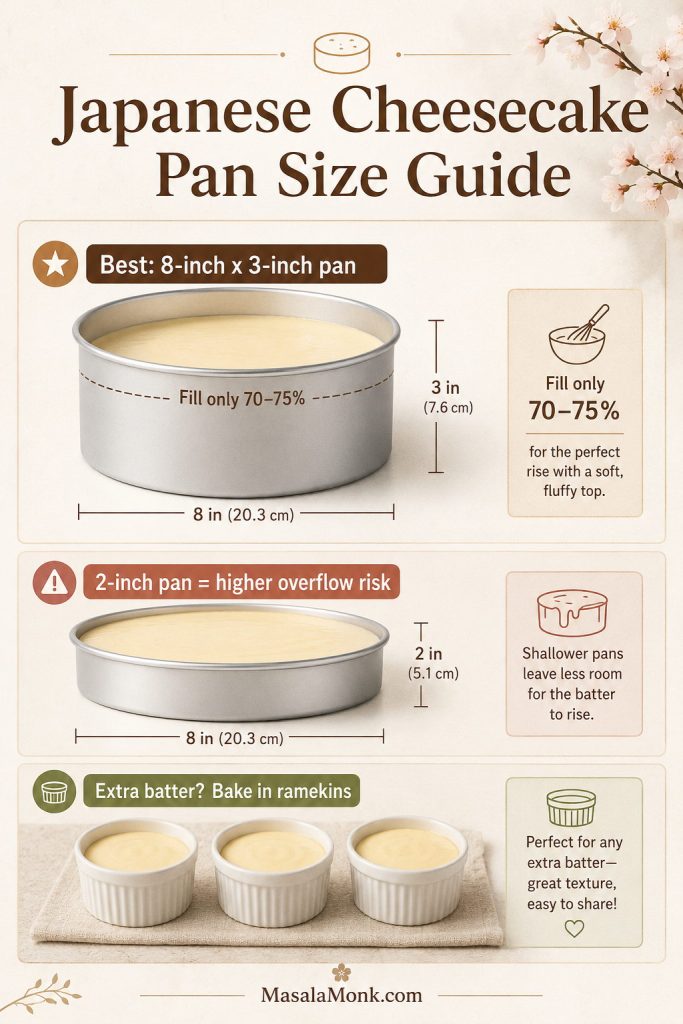
  • Sour cream or Greek yogurt: Use thick, full-fat versions. Thin yogurt can loosen the filling.
  • Lemon juice: This is for brightness and balance, not a strong lemon flavor.
Ingredient note for non-US kitchens: If block-style cream cheese is not available, use the thickest full-fat cream cheese you can find and avoid very soft spreadable versions when possible. If your cream cheese is loose, chill the filling longer or use the optional gelatin method for extra stability. Use whipping cream that can hold stiff peaks; low-fat fresh cream or table cream may not set the cheesecake properly. If using yogurt, choose thick Greek yogurt or hung curd, not thin regular curd.
Cream cheese comparison showing thick full-fat cream cheese, softer spreadable cream cheese, and loose cream cheese
Choose the thickest full-fat cream cheese you can find, since softer tubs can make a no-bake cheesecake filling harder to firm up.

Equipment You Need

You do not need complicated equipment for this cheesecake recipe. However, a springform pan and mixer make the texture much easier to control because the filling sets in the refrigerator rather than the oven.

  • 9-inch / 23cm springform pan
  • Electric hand mixer or stand mixer
  • Mixing bowls
  • Spatula
  • Food processor or rolling pin for crushing crumbs
  • Flat-bottom measuring cup or glass for pressing the crust
  • Offset spatula or back of a spoon for smoothing the filling
  • Sharp knife for slicing

A springform pan makes the cleanest cheesecake because the sides release easily. If you do not have one, you can use a deep pie dish, but the slices will be harder to remove neatly.

How to Make No Bake Cheesecake

The method is simple: make the crust, whip the cream, beat the cream cheese, fold, fill, and chill. Since this cheesecake sets in the refrigerator, the final texture depends on proper mixing and enough cold time.

Step-by-step guide showing crust, whipped cream, cream cheese, folding, filling, chilling, and slicing
The sequence matters: prepare the crust first, build the filling gently, and then let the refrigerator do the setting work.

Step 1: Make the Crust

First, crush the graham crackers or digestive biscuits into fine crumbs. Then mix the crumbs with brown sugar, salt if using, and melted butter until the mixture looks like damp sand.

Next, tip the mixture into a 9-inch springform pan. Press it firmly into the base and slightly up the sides. A flat-bottom measuring cup helps you compact the crust evenly without using too much pressure.

After that, refrigerate or freeze the crust while you make the filling. This helps the butter firm up and gives the base a better hold.

Step 2: Whip the Cream

Add the cold heavy cream or whipping cream to a chilled mixing bowl. Then beat until stiff peaks form. The cream should hold its shape when you lift the beaters.

Do not stop at soft peaks. Since the filling is not baked, stiff whipped cream is one of the main things that helps it hold its shape.

Mixer beaters lifting whipped cream into stiff peaks in a bowl
Stiff peaks should stand tall on the beaters; otherwise, the whipped cream will add lightness but not enough structure.

Step 3: Beat the Cream Cheese

Meanwhile, beat the softened cream cheese in a separate bowl until smooth and creamy. Add the powdered sugar, sour cream or Greek yogurt, lemon juice, vanilla, and salt. Then beat until smooth.
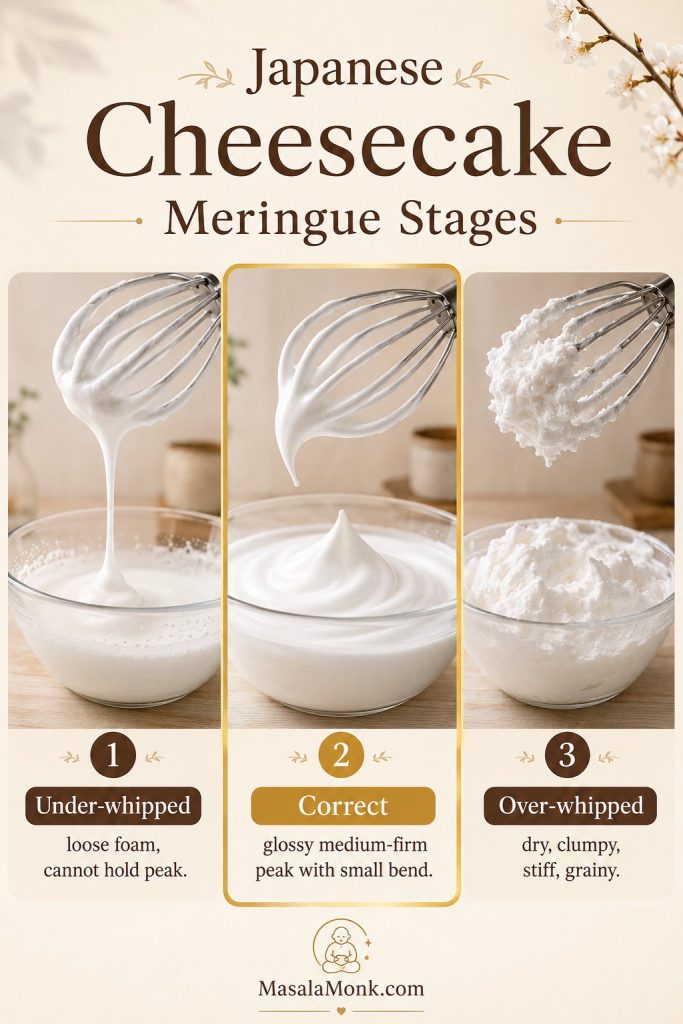
If the cream cheese is too cold, the filling may become lumpy. If it is too warm, the filling can become loose. Therefore, softened but still cool cream cheese is ideal.

Cream cheese mixture being beaten smooth with powdered sugar, lemon, vanilla, and dairy ingredients nearby
Beat the cream cheese base until it is smooth first; once whipped cream is folded in, small lumps are much harder to remove.

Step 4: Fold the Filling

Add the whipped cream to the cream cheese mixture in two additions. Then fold gently with a spatula until no large streaks remain.

Avoid beating aggressively at this stage. Instead, keep the air in the whipped cream because that air helps the cheesecake feel light while still setting properly.

Thick cheesecake filling being folded with a spatula in a glass mixing bowl
Fold slowly instead of beating hard, so the filling keeps its air while the cream cheese still gives it enough body.

Step 5: Fill the Crust

Spoon the filling into the chilled crust. Next, smooth the top with an offset spatula or the back of a spoon. Tap the pan very gently on the counter once or twice to remove large air pockets, but do not overdo it.

Thick cheesecake filling spread into a golden crumb crust in a springform pan with an offset spatula
When the filling goes into the crust, it should mound and spread rather than pour; that thickness is a good sign before chilling.

Step 6: Chill Until Set

Cover the cheesecake loosely and refrigerate for at least 6 to 8 hours. The filling needs a long chill because it sets without eggs or oven heat. For the cleanest slices, chill it overnight.

Also, do not rely on the freezer as the only setting method. Freezing can make the cheesecake firm temporarily, but the best texture comes from a proper refrigerator chill.

Step 7: Slice and Serve

Once chilled, run a thin knife around the edge of the cheesecake before releasing the springform ring. For clean slices, dip a sharp knife in hot water, wipe it dry, cut one slice, and then wipe the knife again before the next cut.

Finally, serve the cheesecake cold. It can sit out briefly while serving, but it should not be left at room temperature for long, especially in warm weather.

Final serving scene with a full no-bake cheesecake, a plated slice, berries, lemon zest, and a fork
Once the cheesecake has fully chilled, serve it cold so the filling stays creamy, the crust holds neatly, and each slice looks polished.

No Bake Cheesecake Recipe

This creamy no bake cheesecake recipe uses a graham cracker or digestive biscuit crust, full-fat cream cheese, whipped cream, and a 6 to 8 hour refrigerator chill, preferably overnight, for clean, sliceable pieces without an oven or eggs.

Yield10–12 slices
Prep Time30 minutes
Cook Time0 minutes
Chill Time6–8 hours
Total Time6 hours 30 minutes to overnight
Pan9-inch / 23cm springform
Best TextureOvernight chill
MethodNo oven, no eggs

Ingredients

For a Graham Cracker Crust

  • 2 cups / 240g graham cracker crumbs
  • 1/3 cup / 67g brown sugar
  • 1/2 cup / 113g unsalted butter, melted
  • Pinch of salt, optional

Or, for a Digestive Biscuit Crust

  • 270g digestive biscuit crumbs
  • 40 to 70g brown sugar, depending on sweetness
  • 1/2 cup / 113g unsalted butter, melted
  • Pinch of salt, optional

For the Filling

  • 1 1/4 cups / 300ml cold heavy cream or whipping cream
  • 24 oz / 678g full-fat cream cheese, softened
  • 3/4 to 1 cup / 90–120g powdered sugar or icing sugar, to taste
  • 1/4 cup / 60g sour cream or thick Greek yogurt
  • 2 teaspoons fresh lemon juice
  • 1 teaspoon vanilla extract
  • Pinch of salt, optional

Instructions

  1. Make the crust. Mix the crumbs, brown sugar, melted butter, and salt until evenly moistened.
  2. Press into the pan. Press the mixture firmly into the base of a 9-inch springform pan and slightly up the sides. Then chill or freeze while you make the filling.
  3. Whip the cream. Beat the cold cream until stiff peaks form. Set aside.
  4. Beat the cream cheese. In another bowl, beat softened cream cheese until smooth. Add powdered sugar, sour cream or Greek yogurt, lemon juice, vanilla, and salt. Beat until creamy.
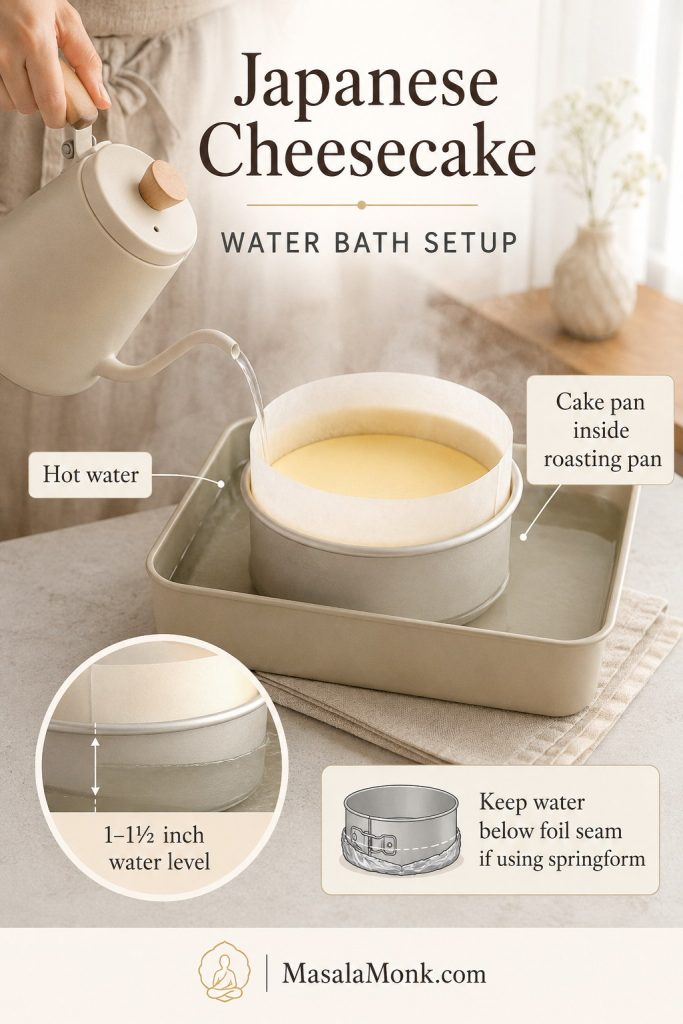
  5. Fold gently. Fold the whipped cream into the cream cheese mixture in two additions. Stop once combined.
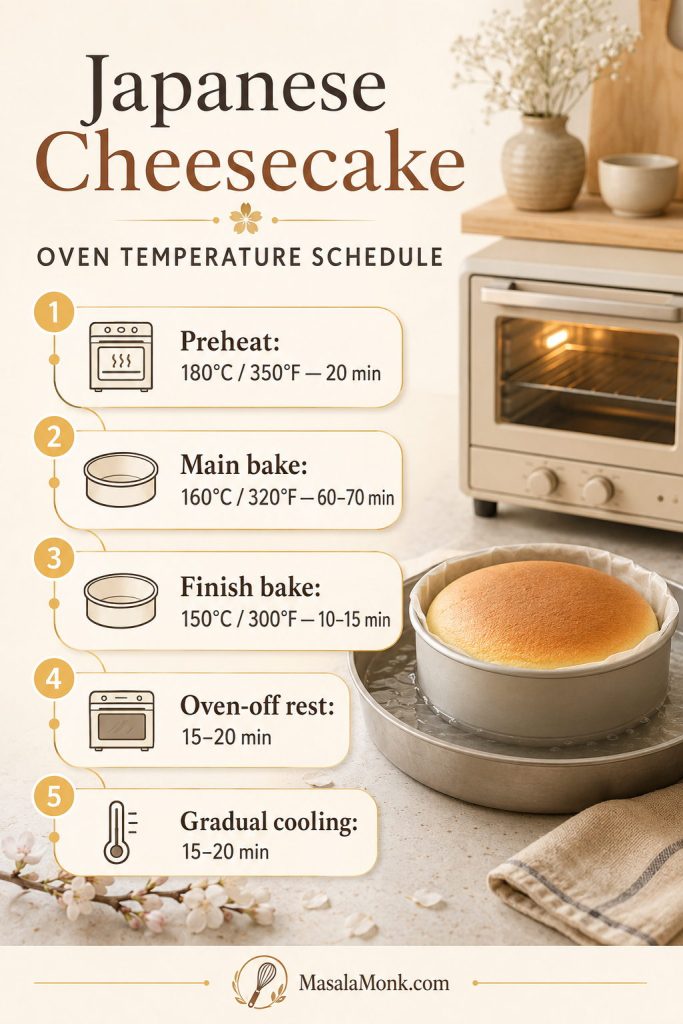
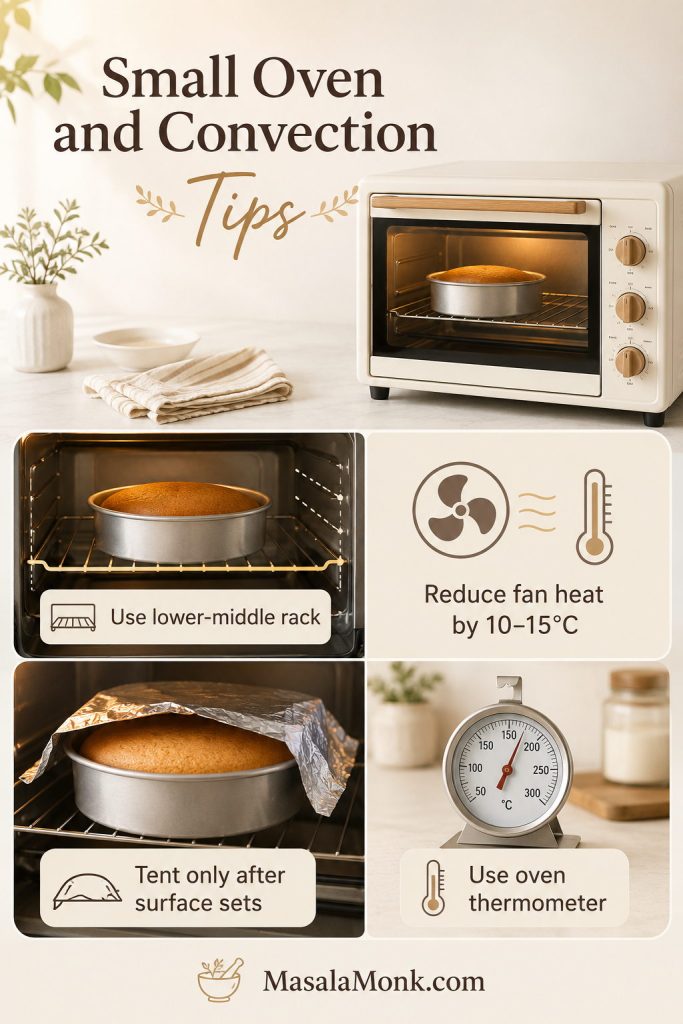
  6. Fill the crust. Spoon the filling into the chilled crust and smooth the top.
  7. Chill. Cover and refrigerate for at least 6 to 8 hours, preferably overnight.
  8. Slice. Release the springform ring, then slice with a hot, wiped knife for clean pieces.

Notes

  • Use full-fat cream cheese for the best set.
  • Use 90g powdered sugar for a lighter, tangier cheesecake or 120g for a sweeter dessert-style cheesecake.
  • Do not use low-fat cream or cream that cannot whip to stiff peaks.
  • For best results, chill the cheesecake overnight because the filling needs time to firm without baking.
  • For a firmer party cheesecake, see the gelatin option below.
  • For cheesecake cups or jars, the same filling can be chilled for a shorter time because it does not need to slice cleanly.
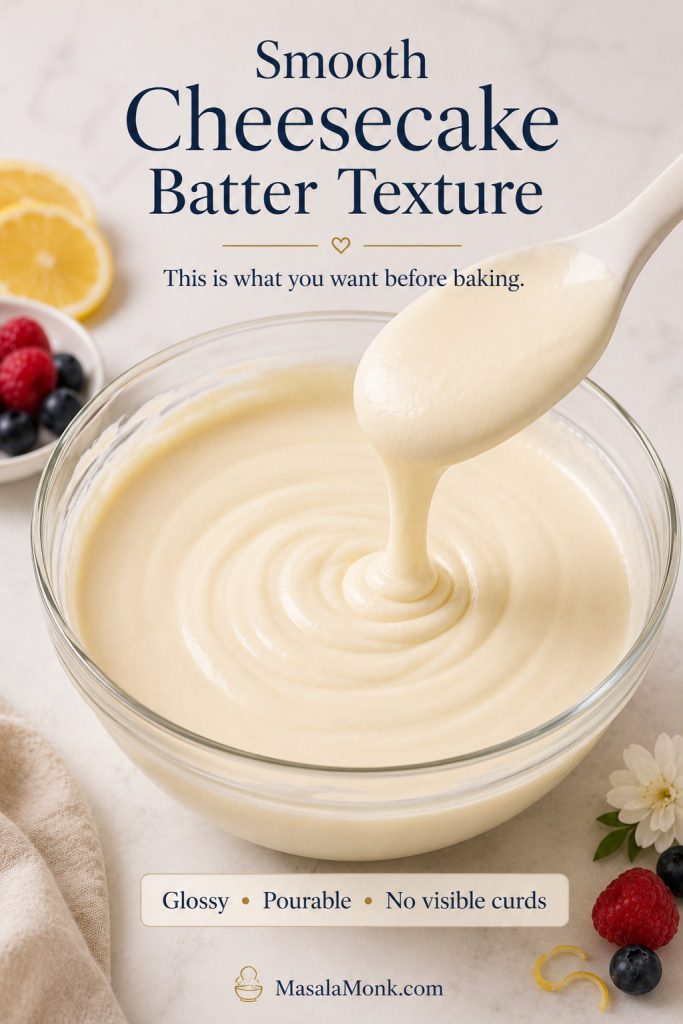
Saveable no-bake cheesecake recipe card with yield, prep time, chill time, ingredients, and method steps
Use the recipe card for the quick method, then rely on the texture cues for the crust, filling, and chill time as you work.
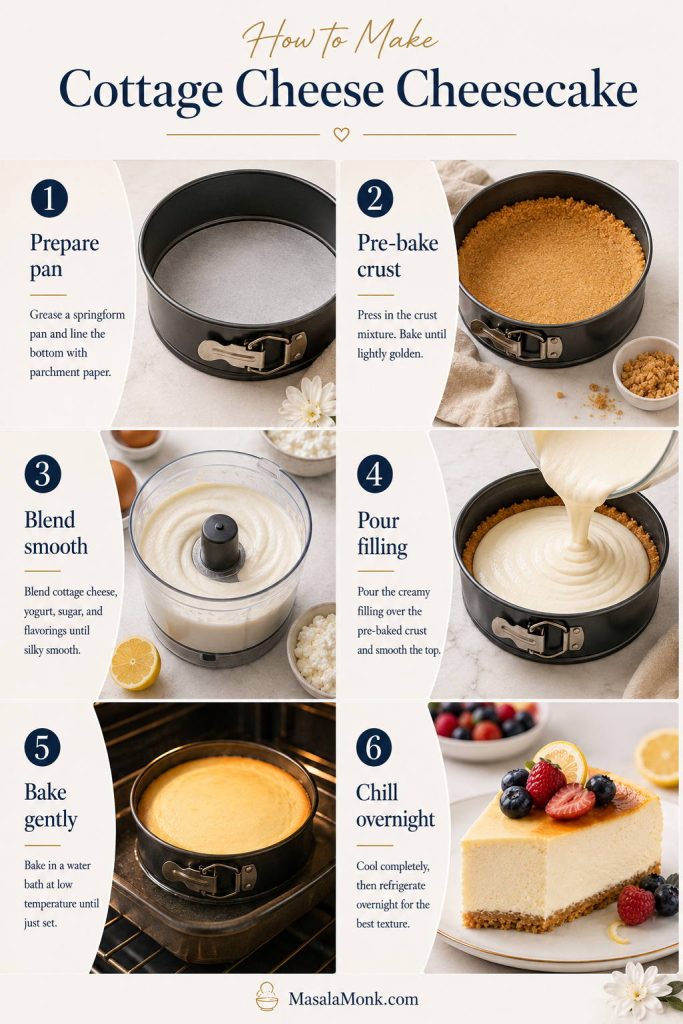
What Makes No Bake Cheesecake Set?

A cheesecake recipe without baking sets through chilled dairy and structure, not through eggs or oven heat. Since there are no eggs and no oven heat to firm the filling, you need the right ingredients and enough chill time.

For another tested baking reference, King Arthur Baking’s no bake cheesecake also uses cream cheese, sour cream, cold heavy cream, and confectioners’ sugar for a creamy refrigerator-set filling.

Use Full-Fat Cream Cheese

Cream cheese is the backbone of the filling. Full-fat cream cheese firms in the refrigerator and gives the cheesecake its body. Spreadable or tub-style cream cheese may work in some cases, but it is often softer and can make the filling less stable.

Whip Cold Cream to Stiff Peaks

Cold cream whips better and holds more structure. Stiff peaks mean the cream stands up when you lift the beaters. If the cream is only softly whipped, the cheesecake may taste good but slice poorly.

Fold Gently

Once the cream is whipped, fold it into the cream cheese mixture with a spatula. Beating too hard can knock out the air and make the filling heavier or looser.

Chill Long Enough

The refrigerator does the final work. First, the crust firms. Then the cream cheese tightens. Finally, the filling becomes sliceable. A short chill may work for cups or jars, but a full cheesecake needs more time.

Freezing Is Not the Same as Setting

The freezer can make a soft cheesecake feel firm quickly, but that firmness is temporary. Once the cheesecake thaws, a poorly set filling may soften again. For the best texture, chill the cheesecake properly in the refrigerator and use the freezer only for storage or brief firming before serving.

Setting guide showing cream cheese, stiff whipped cream, long chill time, and a clean no-bake cheesecake slice
No-bake cheesecake sets through thickness, trapped air, and cold time; therefore, cream cheese, whipped cream, and chilling all have to work together.

How Long Does No Bake Cheesecake Need to Chill?

For this cheesecake recipe, skipping the oven does not mean skipping the wait. The filling still needs at least 6 to 8 hours in the refrigerator, and overnight is better if you want neat slices for serving.

Chill Time Result
2–3 hours Usually too soft for clean slices
4 hours May work for cups or jars, but often soft for a full cheesecake
6–8 hours Sliceable for most cheesecakes
Overnight / about 12 hours Best clean slices and firmest creamy texture
Freezer only Temporary firmness, not a substitute for proper setting
No-bake cheesecake chill time guide showing soft, cup-ready, sliceable, and overnight stages
A short chill is fine for jars, while a full cheesecake needs more time because the whole filling must firm from edge to center.

How to Cut Clean Slices

For clean slices, chill the cheesecake overnight and serve it cold. Then run a thin knife around the edge before releasing the springform ring.

Next, dip a sharp knife in hot water, wipe it dry, and cut one slice at a time. Wipe the knife between slices. This small step makes a big difference, especially with a creamy no bake cheesecake filling.

Clean slice of no-bake cheesecake being cut with a knife, showing smooth filling, berries, and crumb crust
After the cheesecake is fully cold, a warm wiped knife helps each piece release neatly instead of dragging cream through the cut.

No Bake Cheesecake Filling

If you only need the filling from this cheesecake recipe, no bake cups, jars, parfaits, pie crusts, cake layers, cupcakes, and simple chilled desserts are all good options. However, the texture you need depends on how you plan to serve it.

Cheesecake filling used in cups, jars, cake layers, cupcakes, pie crust, and parfaits
The same no-bake cheesecake filling can become jars, cupcakes, parfaits, or cake layers; however, each use needs a slightly different firmness.

For a Whole Cheesecake

Use the recipe as written. A whole cheesecake needs enough structure to slice, so do not reduce the cream cheese or shorten the chill time too much.

For Cheesecake Cups or Jars

The same filling works well in small cups or jars. Because you are not slicing it, the chill time can be shorter. Plan on at least 2 to 4 hours, depending on the size of the cups.

For Cake Filling or Piping

For cake layers or piping, the filling should be thicker. Therefore, use full-fat cream cheese, whip the cream to stiff peaks, reduce loose ingredients like sour cream or yogurt slightly, and chill the filling before using it. Powdered sugar also helps the filling feel smoother.

How to Make Cheesecake Filling Thicker

  • Use full-fat cream cheese.
  • Whip the cream separately to stiff peaks.
  • Chill the filling before piping or spreading.
  • Avoid watery fruit puree in the filling.
  • Reduce sour cream or yogurt slightly if needed.
  • Use the gelatin option if you need extra stability.
Cheesecake filling texture guide showing loose, thicker, and pipeable stages with fixing tips
For piping or layer cakes, aim for the pipeable stage rather than the spoonable stage, and chill the filling before using it.

Best Toppings for No Bake Cheesecake

The safest way to flavor a no bake cheesecake is to keep the filling stable and add most of the fruit, compote, curd, or sauce on top. That way, the cheesecake still slices cleanly, while the topping adds color, freshness, and extra flavor.

Topping guide with strawberry, blueberry, mango, lemon curd, ganache, and salted caramel for no-bake cheesecake
Toppings are the safest place to add bold flavor, because fruit, curd, ganache, and caramel can sit on top without loosening the filling.

If using a cooked fruit topping, cool it completely before spooning it over the cheesecake. Warm topping can soften the filling and make the surface loose.

Cooked berry topping cooling beside a no-bake cheesecake before being spooned on top
Let cooked fruit topping cool completely first; otherwise, even a well-set cheesecake can soften where the warm sauce touches it.
Topping Best Use
Strawberry topping Best classic fruit topping; use thick cooked sauce or fresh berries added close to serving.
Blueberry topping Works well as a cooked compote because it stays glossy and spoonable without making the filling loose.
Mango topping Use thick mango puree, mango compote, or diced mango. Avoid thin puree unless it is reduced or stabilized.
Lemon curd Best for a sharper lemon cheesecake flavor without adding too much juice to the filling.
Chocolate ganache Best when you want a richer dessert-style cheesecake. Let the ganache cool slightly before spreading.
Caramel sauce Use lightly because the cheesecake is already sweet. Salted caramel usually balances better.

No Bake Cheesecake Variations

Once the classic version makes sense, the variations become much easier. You can keep the same basic cheesecake and adjust it for fewer ingredients, a sweeter shortcut, a firmer slice, or a brighter lemon flavor.

Four no-bake cheesecake variations showing classic, 3-ingredient, condensed milk, and lemon versions
Start with the classic version to learn the texture, then use the variations when you want a shortcut, a sweeter filling, or brighter lemon flavor.

3 Ingredient No Bake Cheesecake

A 3 ingredient cheesecake recipe can also be no bake, but it usually trades some flavor balance and slice quality for speed. Most versions use cream cheese, sweetened condensed milk, and either whipped cream or lemon juice.

Use this shortcut when speed matters more than perfect texture. However, use the main recipe when you want a more balanced cheesecake flavor, a lighter filling, and cleaner slices.

Simple 3 ingredient formula:

  • 16 oz / 450g cream cheese, softened
  • 14 oz / 397g sweetened condensed milk
  • 3/4 cup / 180ml cold heavy cream, whipped to stiff peaks
Three-ingredient no-bake cheesecake guide showing cream cheese, condensed milk, whipped cream, and a finished jar dessert
A 3-ingredient no-bake cheesecake is useful when speed matters; however, it is usually sweeter and softer than the full classic recipe.

Optional additions like vanilla or lemon juice make the flavor better, even if they technically take it beyond three ingredients.

No Bake Cheesecake with Condensed Milk

Condensed milk makes no bake cheesecake sweeter, creamier, and easier to mix. It is a useful shortcut, but it gives a different texture from the classic whipped cream version.

If you want to compare a classic condensed milk method, Martha Stewart’s no bake cheesecake uses cream cheese, sweetened condensed milk, vanilla, and lemon in a press-in graham cracker crust.

For a condensed milk version, use:

  • 16 oz / 450g cream cheese, softened
  • 14 oz / 397g sweetened condensed milk
  • 2 to 4 tablespoons fresh lemon juice
  • 1 teaspoon vanilla extract
  • Prepared crust of choice
Condensed milk being poured into cream cheese mixture for no-bake cheesecake with lemon and vanilla nearby
Condensed milk creates a creamy shortcut filling, but lemon and proper chilling are still important to balance sweetness and improve the set.

Lemon juice is not only for flavor here. It balances the sweetness and helps the filling thicken. For cleaner slices, chill a condensed milk cheesecake overnight.

Gelatin vs No Gelatin in No Bake Cheesecake

This main recipe does not require gelatin. A no-gelatin cheesecake is creamy, simple, and easier for most home cooks. However, optional gelatin can help if you want very firm slices, need the cheesecake to sit out a little longer, or are serving it in warm weather.

Still, gelatin should be optional, not the default, because the main recipe is designed to set cleanly with full-fat cream cheese, stiff whipped cream, and enough refrigerator time.

As written, the main recipe is eggless and gelatin-free. If you add gelatin, it will no longer be suitable for readers avoiding animal-derived gelatin unless you use a tested vegetarian setting method. Agar-agar behaves differently from gelatin, so do not swap it 1:1 without following a tested agar method.

Optional gelatin method:

  • Use 2 teaspoons unflavored gelatin.
  • Sprinkle it over 2 tablespoons cold water.
  • Let it bloom for 5 minutes.
  • Warm gently until dissolved.
  • Let it cool slightly, then mix it into the cream cheese base before folding in the whipped cream.

Do not add hot gelatin to cold filling, and do not sprinkle dry gelatin directly into the cheesecake mixture. Both can cause clumps.

Two no-bake cheesecake slices compared side by side with labels for no gelatin, optional gelatin, chill time, and firmness
The main no-gelatin cheesecake stays creamy after a long chill, while optional gelatin is better when you need extra hold for heat or travel.

No Bake Lemon Cheesecake Variation

For a lemon no bake cheesecake, add the zest of 1 to 2 lemons and increase the lemon juice to 2 to 3 tablespoons. If the filling feels loose, reduce the sour cream or Greek yogurt slightly.

For stronger lemon flavor without weakening the filling, use lemon curd as a topping. Too much lemon juice inside the filling can make the cheesecake softer, so zest and topping are safer ways to build flavor.

No-bake lemon cheesecake slice with glossy lemon topping, lemon zest, mint, and golden crumb crust
Lemon curd gives stronger citrus flavor than extra lemon juice, so the cheesecake tastes brighter without making the filling too loose.
Fruit tip: For the safest set, add fruit as a topping after the cheesecake has chilled. Watery fruit puree mixed directly into the filling can make a no bake cheesecake soft unless the puree is reduced, thickened, or stabilized.

For a thicker cooked fruit topping idea, see this Apple Pie Filling Recipe. The same principle applies here: thick fruit works better than watery fruit.

More Easy Variations

Variation Best Approach
Berry no bake cheesecake Add berry topping after chilling instead of mixing watery puree into the filling. For a fruit cheesecake example, see this No-Bake Blueberry Cheesecake.
Mango no bake cheesecake Use a thick mango topping or swirl. Avoid thin puree unless it is reduced or stabilized.
Chocolate no bake cheesecake Fold in cooled melted chocolate or use a chocolate cookie crust.
Cheesecake cups Spoon crust and filling into cups or jars, then chill until set.
Cheesecake bars Use a square pan, line it with parchment, and chill overnight before slicing.
Mini no bake cheesecakes Use a muffin tin with liners and chill until firm.

For another easy no-oven dessert with a soft, chilled set, try this No-Bake Banana Pudding.

Why Your No Bake Cheesecake Didn’t Set

The Most Common Setting Problems

If your no bake cheesecake did not set, the problem is usually one of four things: soft cream cheese, under-whipped cream, too much liquid, or not enough chill time. Fortunately, most issues are easy to understand and prevent next time.

If the filling feels loose, remember that there is no baking step to firm extra liquid later. Therefore, ingredient thickness, whipped cream structure, and enough chilling matter more than they would in a baked dessert.

Troubleshooting board showing soft cream cheese, under-whipped cream, too much liquid, and not enough chill time
When a no-bake cheesecake will not set, check the structure points first: cream cheese thickness, whipped cream peaks, liquid level, and chill time.

Quick Fixes for Texture, Crust, and Slicing Issues

Problem Likely Reason What to Do
Filling is runny Cream was not whipped to stiff peaks, or too much liquid was added. Chill longer. Next time, whip the cream separately and avoid loose yogurt or watery fruit puree.
Cheesecake is soft after chilling It did not chill long enough. Refrigerate overnight. No bake cheesecake needs time to firm properly.
Filling is lumpy Cream cheese was too cold. Use softened cream cheese and beat it smooth before adding the other ingredients.
Slice collapses Cheesecake is under-set or too warm. Chill longer and serve cold. Also, use a hot, wiped knife for cutting.
Crust falls apart Crumbs were too coarse or not packed firmly enough. Use fine crumbs and press the crust firmly with a flat-bottom cup.
Crust is greasy Too much butter for the crumb type. Add more crumbs next time or reduce the butter slightly if using very buttery biscuits.
Filling tastes too sweet Condensed milk, sweet toppings, or too much sugar. Add lemon, salt, or use the classic recipe instead of a condensed milk version.
Fruit made the filling loose Watery puree was mixed directly into the filling. Use fruit as a topping or reduce puree before adding it.
Too soft in hot weather No stabilizer and a warm serving environment. Use the optional gelatin method and keep the cheesecake cold until serving.
Troubleshooting guide with runny filling, lumpy filling, crumbly crust, greasy crust, soft slice, and hot-weather softness
Most problems point back to one of three things: ingredient texture, mixing method, or temperature control during chilling and serving.

When to Serve It in Cups Instead

If the cheesecake tastes good but will not slice cleanly, do not waste it. Spoon the filling into cups or jars, add crumbs and topping, and serve it as a no bake cheesecake dessert instead. It will still taste good, even if it is too soft for neat slices.

No-bake cheesecake cups and jars with crumb layers, creamy filling, berries, lemon zest, and spoons
Cups and jars are a smart option when you want easier serving, smaller portions, or a softer cheesecake filling that does not need to slice.

Storage and Freezing

This cheesecake recipe stores well because the no bake filling improves after a long refrigerator chill. As a result, it is a strong make-ahead dessert for parties, holidays, and warm-weather meals.

Refrigerator

Store no bake cheesecake covered in the refrigerator for 4 to 5 days. However, the texture is usually best during the first 2 to 3 days, while the crust is still firm and the filling tastes fresh.

Freezer

You can freeze no bake cheesecake whole or in slices. First, chill it until firm. Then wrap it tightly and freeze for up to 2 months. Finally, thaw overnight in the refrigerator before serving.

Serving

Serve no bake cheesecake cold. In warm weather, keep it refrigerated until close to serving time. If the cheesecake needs to sit out for a party, the optional gelatin version will hold more firmly than the no-gelatin version.

For outdoor serving, summer parties, or very warm kitchens, keep the cheesecake chilled until the last possible moment. If it needs to sit out longer, use the optional gelatin method or serve the filling in cups instead of slicing a full cheesecake.

Storage guide showing covered cheesecake in the refrigerator, frozen slices, wrapped slices, and thawed cheesecake
Store the cheesecake cold and covered; for longer keeping, wrap individual slices well and freeze them as make-ahead portions.

No Bake Cheesecake vs Baked Cheesecake

No bake cheesecake and baked cheesecake are both creamy desserts, but they set in different ways. Instead of eggs and oven heat, this refrigerator version firms with cream cheese, whipped cream, and chill time. By contrast, baked cheesecake usually relies on eggs and a low oven to set the filling.

No Bake Cheesecake Baked Cheesecake
No oven needed Uses oven heat
No eggs in this recipe Usually made with eggs
Sets in the refrigerator Sets while baking and then chilling
Lighter, creamier texture Denser, richer texture
Beginner-friendly More technical
No-bake cheesecake and baked cheesecake slices compared, showing chilled creamy texture and denser oven-set texture
No-bake cheesecake is chilled and creamy, while baked cheesecake is denser and oven-set; therefore, they need different methods and expectations.

Do not bake this no bake cheesecake filling. It is designed to set in the refrigerator, not in the oven.

If you are working with baked pies instead of refrigerator desserts, this Apple Pie Crust Recipe explains how a baked crust behaves differently from a no bake crumb crust.

FAQs

What makes this cheesecake recipe reliable without baking?

This cheesecake recipe works without baking because it uses full-fat cream cheese, whipped cream, a firm crumb crust, and enough refrigerator time to set cleanly.

Is this no bake cheesecake eggless?

It is eggless because the filling sets in the refrigerator instead of baking with eggs. The main recipe is also gelatin-free, so it works well for readers who want a creamy cheesecake without eggs or gelatin.

How does no bake cheesecake set without gelatin?

Full-fat cream cheese, stiff whipped cream, and enough refrigerator time give the filling structure. Gelatin is optional for a firmer slice or extra stability in warm weather, but it is not required for the main recipe.

Why did my no bake cheesecake not set?

The most common reasons are under-whipped cream, soft or spreadable cream cheese, too much liquid, watery fruit puree, or not enough chill time. Therefore, chill it overnight if it feels soft, and next time use full-fat cream cheese and cream whipped to stiff peaks.

How long does no bake cheesecake need to chill?

It needs at least 6 to 8 hours in the refrigerator. Overnight, or about 12 hours, gives the cleanest slices and best texture.

What can I use instead of graham crackers?

Digestive biscuits work well for a no bake cheesecake crust. Use about 270g digestive biscuit crumbs with 113g melted butter and 40 to 70g brown sugar, depending on how sweet the biscuits are.

Which cream works best for no bake cheesecake?

Cold heavy cream or whipping cream that can hold stiff peaks works best. Very low-fat cream will not give the same structure and may make the filling too soft.

Is whipped topping okay here?

Whipped topping works as a shortcut, but the filling will taste sweeter, lighter, and less classic than a version made with freshly whipped cream. For the best cheesecake flavor and a cleaner slice, use cold cream whipped to stiff peaks.

How does condensed milk change no bake cheesecake?

Condensed milk makes the filling sweeter, creamier, and easier to mix. It is useful for shortcut versions, but the classic recipe gives a more balanced flavor and usually slices more cleanly.

What is the best way to freeze no bake cheesecake?

First, chill the cheesecake until firm. Then wrap it tightly and freeze it whole or in slices for up to 2 months. Thaw overnight in the refrigerator before serving.

How should I use only the cheesecake filling?

The filling works in cups, jars, parfaits, cake layers, cupcakes, or pie crusts. For piping or cake filling, keep it thick, cold, and stable by using full-fat cream cheese and stiff whipped cream.

How do I get clean slices?

Chill the cheesecake overnight, serve it cold, and use a sharp knife dipped in hot water and wiped dry between cuts.

Once you understand the setting logic, no bake cheesecake becomes much easier to control. Keep the cream cheese full-fat, whip the cream properly, give the cheesecake enough time in the refrigerator, and use the troubleshooting table whenever the texture needs adjusting.