Posted on Leave a comment

Rice Pudding with Cooked Rice

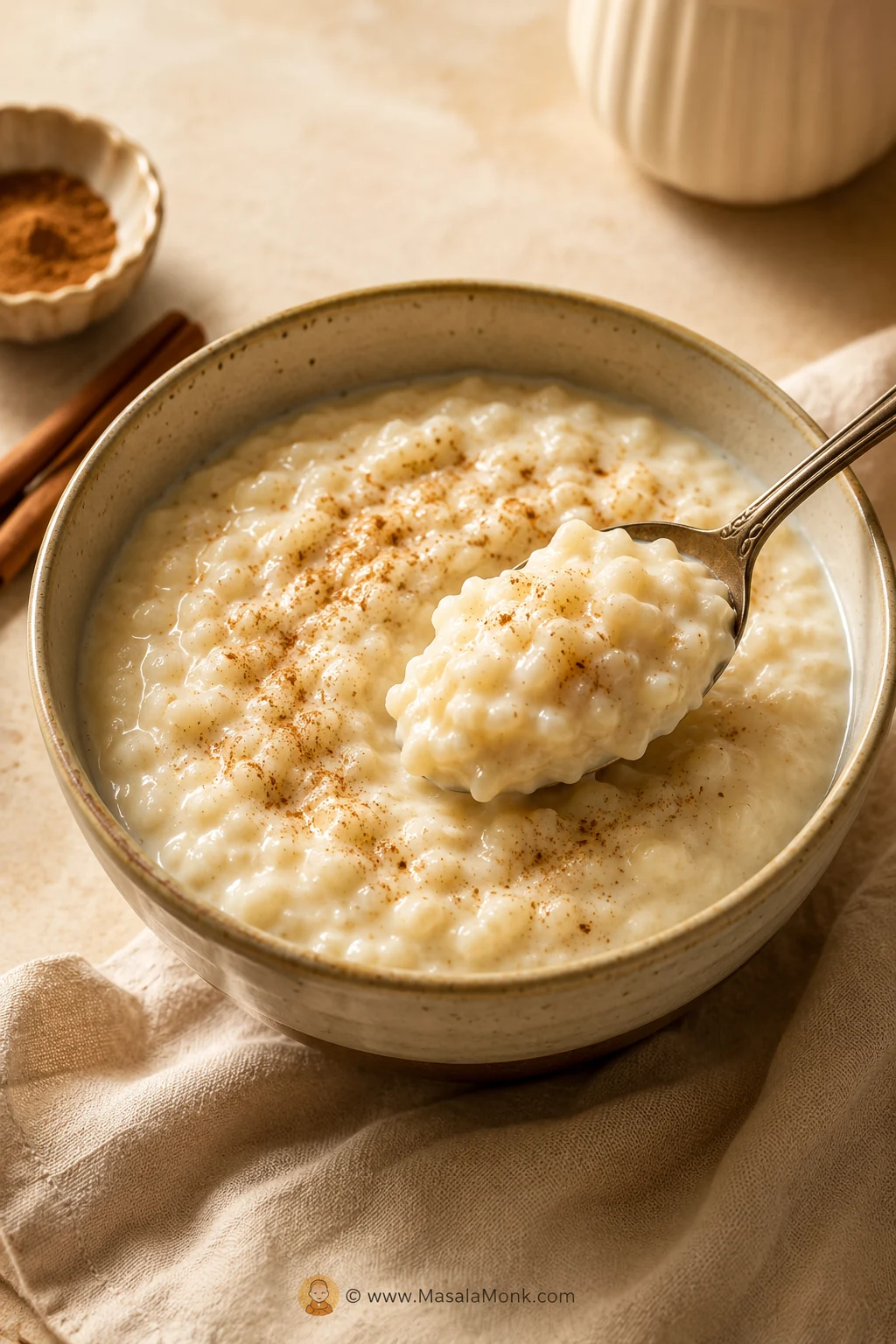
Creamy rice pudding made with cooked rice in a ceramic bowl, lightly dusted with cinnamon and served with a spoon.

This rice pudding with cooked rice is the recipe to make when you have leftover rice in the fridge and want something warm, creamy, and comforting without starting from raw rice. You only need cooked rice, milk, sugar, vanilla, cinnamon, a little salt, and about 20 minutes on the stove.

You can use leftover white rice, jasmine rice, basmati rice, short-grain rice, plain takeout rice, or any pre-cooked rice that has been stored safely. The real trick is the ratio: start with roughly equal parts cooked rice and milk, then adjust depending on how dry, soft, or separate the rice is.

The main recipe is an easy no-egg stovetop version. Once you have that base down, you can make it more custardy with egg, richer with condensed milk or evaporated milk, or faster in the microwave. You will also find the small fixes that matter most, because cooked-rice pudding can go from too thin to too thick very quickly when the rice is especially dry or starchy.

Quick Answer: How to Make Rice Pudding with Cooked Rice

To make rice pudding with cooked rice, simmer 2 cups cooked rice with 2 cups milk, ⅓ cup sugar, ¼ teaspoon salt, and ½ teaspoon cinnamon over medium-low heat until creamy. Stir often, then finish with 1 tablespoon butter and 1 teaspoon vanilla. The pudding usually takes 15 to 20 minutes on the stove, plus a short rest so it thickens into a spoonable texture.

At a glance: use 2 cups cooked rice, 2 cups milk, ⅓ cup sugar, and 15–20 minutes on the stove. The best starting ratio is about 1 cup cooked rice to 1 cup milk; add a splash more milk for dry fridge rice or use slightly less for very soft rice.

Leftover rice safety: only use rice that was cooled and refrigerated promptly. If it sat out for more than 2 hours, smells sour, feels slimy, or you are unsure how long it has been stored, skip it and start with a fresh batch of plain cooked rice.

Don’t worry if it looks a little loose while it is still hot. Rice pudding thickens as it rests, and leftover rice keeps absorbing milk even after the heat is off.

Want the exact amounts? Go to the recipe card. Need to adjust for dry or soft rice? See the ratio guide.

Why This Recipe Works

Cooked rice pudding behaves differently from rice pudding made with raw rice. Raw rice needs time to absorb liquid and release starch. Cooked rice has already absorbed water, so the goal is not to cook the rice from scratch. Instead, you are softening it, loosening the grains, seasoning it properly, and simmering the milk until everything turns creamy.

That is why this recipe starts with a simple 1:1 ratio of cooked rice to milk. It gives the rice enough liquid to soften again without drowning it. As the mixture simmers, starch from the rice thickens the milk. Butter and vanilla go in at the end so the pudding tastes round, fragrant, and dessert-like instead of plain sweet rice.

The default version is made without egg because it is easier, smoother, and less likely to curdle or scramble. That said, a custardy egg version is included below for anyone who likes a more old-fashioned rice pudding.

The Best Ratio for Cooked Rice Pudding

The easiest way to avoid soupy or gluey pudding is to start with the right ratio. Think of this as a flexible starting point, not a strict rule, because leftover rice can be soft, dry, fluffy, sticky, or somewhere in between.

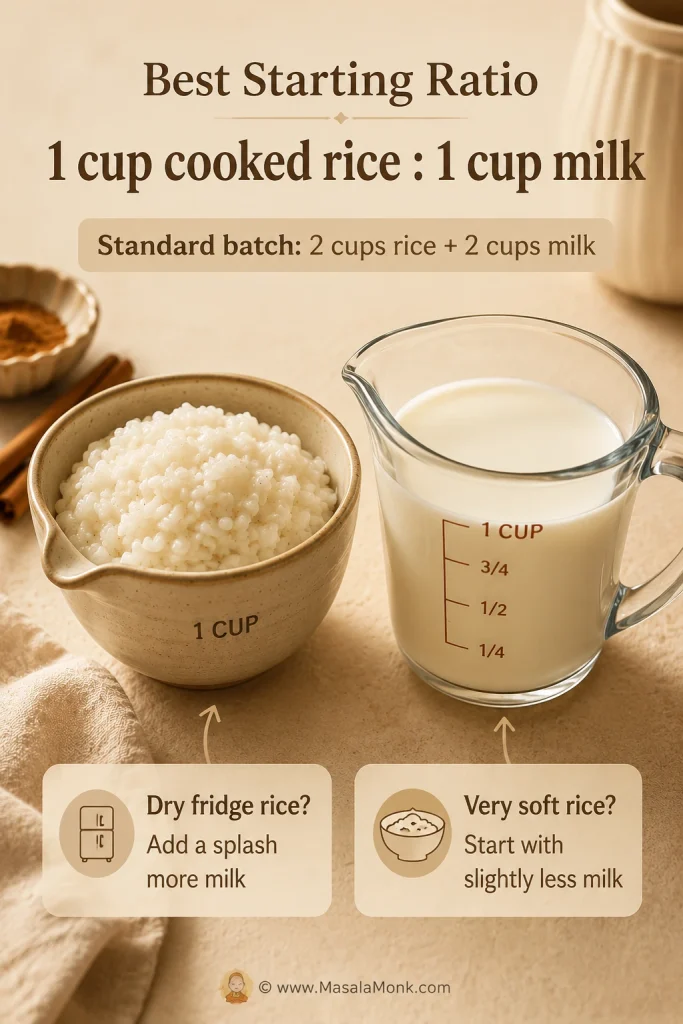
Ratio guide for rice pudding with cooked rice showing one cup cooked rice to one cup milk, with notes for dry and soft rice.
The easiest starting point is equal parts cooked rice and milk. From there, dry leftover rice may need an extra splash, while very soft rice usually needs a little less liquid to stay creamy instead of mushy.
Cooked Rice Milk Best For Texture Note
1 cup cooked rice 1 cup milk Small batch Good for 2 small servings.
2 cups cooked rice 2 cups milk Standard batch Best starting point for 4 servings.
3 cups cooked rice 3 cups milk Family batch Use a wider saucepan so it thickens evenly.
Dry leftover rice Equal milk plus 2–4 tbsp extra Cold fridge rice, basmati, takeout-style plain rice Add extra milk early so the grains soften.
Very soft cooked rice Start with 2–4 tbsp less milk Freshly cooked soft rice or short-grain rice Cook gently to avoid a mushy texture.

This ratio also makes the recipe easy to scale. If you have 1½ cups cooked rice, start with 1½ cups milk. If you have 4 cups cooked rice, start with 4 cups milk and use a large saucepan.

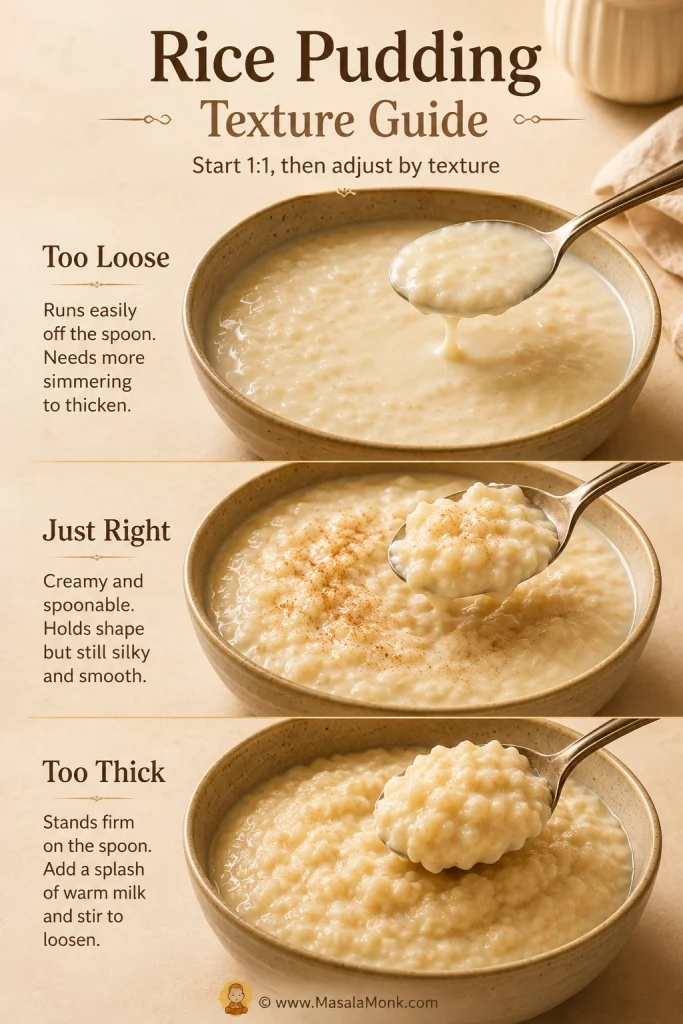
Three rice pudding textures in bowls, labeled too loose, just right, and too thick.
Texture is the real test, not just the timer. If the pudding runs like milk, keep simmering; if it mounds too heavily, loosen it with milk; if it coats the spoon softly, stop before it over-thickens.

Once the ratio makes sense, see how to make it. If your rice tends to turn dry, gummy, or too thick, keep the texture fixes handy.

Ingredients

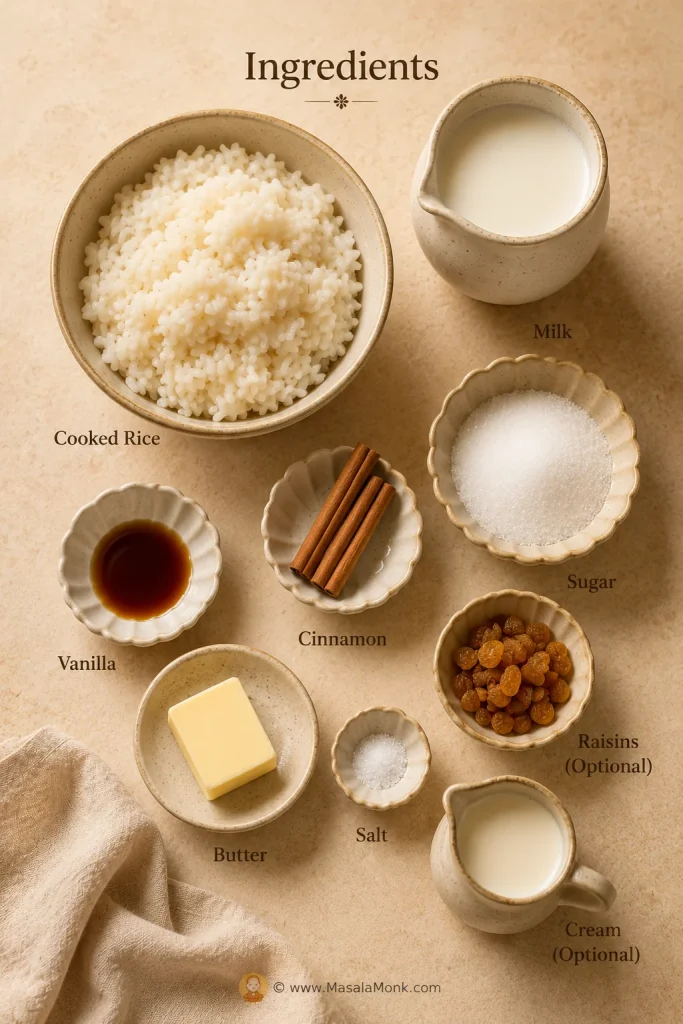
The ingredient list is short, and that is part of the comfort of this recipe. Cooked rice, milk, sugar, salt, cinnamon, vanilla, and butter are enough to make a soft, creamy pudding. From there, you can make it richer with cream, more old-fashioned with egg, sweeter with condensed milk, or dairy-free with coconut milk.

Ingredients for rice pudding with cooked rice, including cooked rice, milk, sugar, cinnamon, vanilla, butter, salt, raisins, and cream.
Each ingredient has a job: milk loosens the cooked rice, sugar sweetens, salt sharpens the flavor, cinnamon adds warmth, and vanilla plus butter make the pudding taste finished instead of flat.

What Kind of Cooked Rice Works Best?

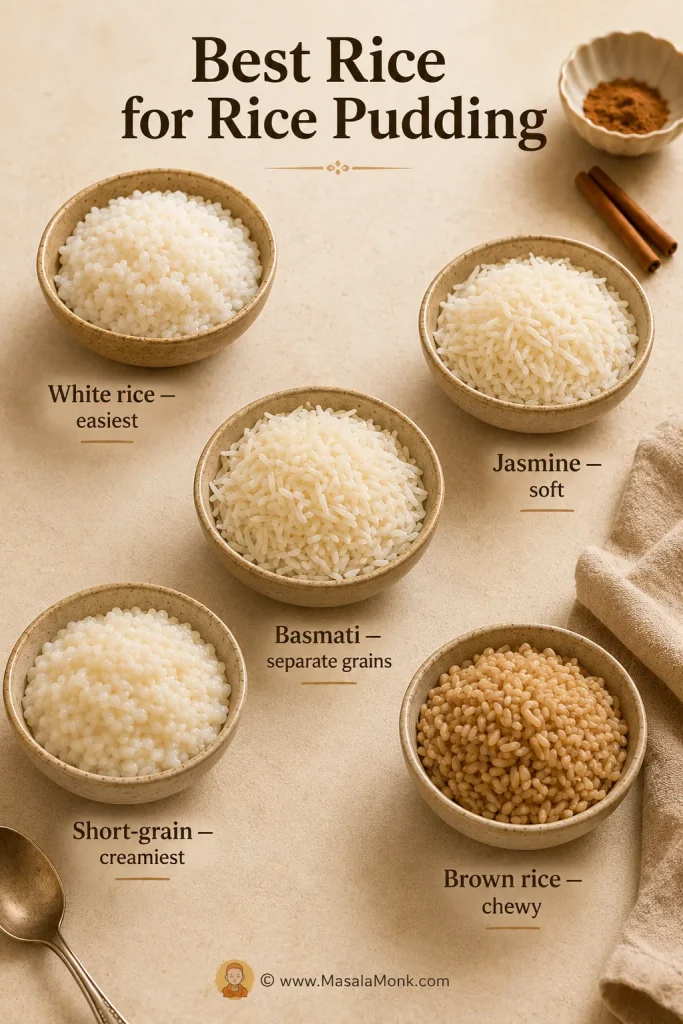
The rice you have will decide the final texture more than anything else. Basmati, jasmine, short-grain rice, and cold fridge rice all need slightly different handling, but plain cooked white rice is the easiest all-purpose choice.

Bowls of cooked white rice, jasmine rice, basmati rice, short-grain rice, and brown rice for making rice pudding.
The rice you start with changes the pudding you get. White rice is the easiest, jasmine turns soft and fragrant, basmati stays more separate, short-grain becomes thick and creamy, and brown rice gives a chewier bowl.

Cooked Rice Texture Guide

Cooked Rice Type Works? What to Expect
Plain cooked white rice Yes Best all-purpose choice. Creamy, neutral, and easy to season.
Jasmine rice Yes Soft and lightly fragrant. Good for a delicate pudding.
Basmati rice Yes Works well, but the grains stay more separate. Add 2–4 tbsp extra milk if it seems dry.
Short-grain rice or sushi rice Yes Thicker and creamier because it releases more starch. Watch the heat so it does not turn pasty.
Arborio rice Yes Very creamy, but it thickens quickly. Keep extra milk nearby.
Brown rice Sometimes Use only fully cooked, soft brown rice. The pudding will be chewier and nuttier, not classic and silky.
Plain takeout rice Sometimes Fine if it is plain, unsalted, and not oily. Avoid fried rice or seasoned rice.
Flavored rice packets No Usually too salty or savory for dessert.

How to Handle Dry Leftover Rice

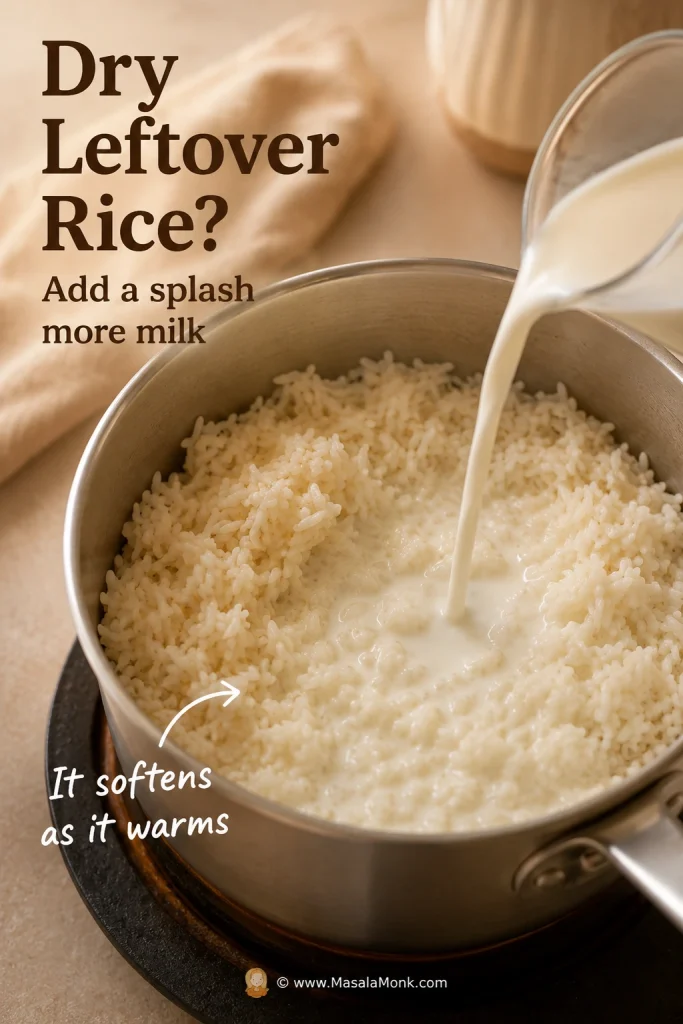
Cold leftover rice can look dry and stiff at first, especially if it has been in the fridge overnight. Give it time and enough milk before judging the final texture.

Dry leftover cooked rice in a saucepan being loosened with milk for rice pudding.
Cold rice can look dry and stubborn at first. Give it milk and gentle heat before judging the texture; the grains usually relax as they warm and turn much creamier than they looked in the fridge.

Use Plain Rice, Not Seasoned Rice

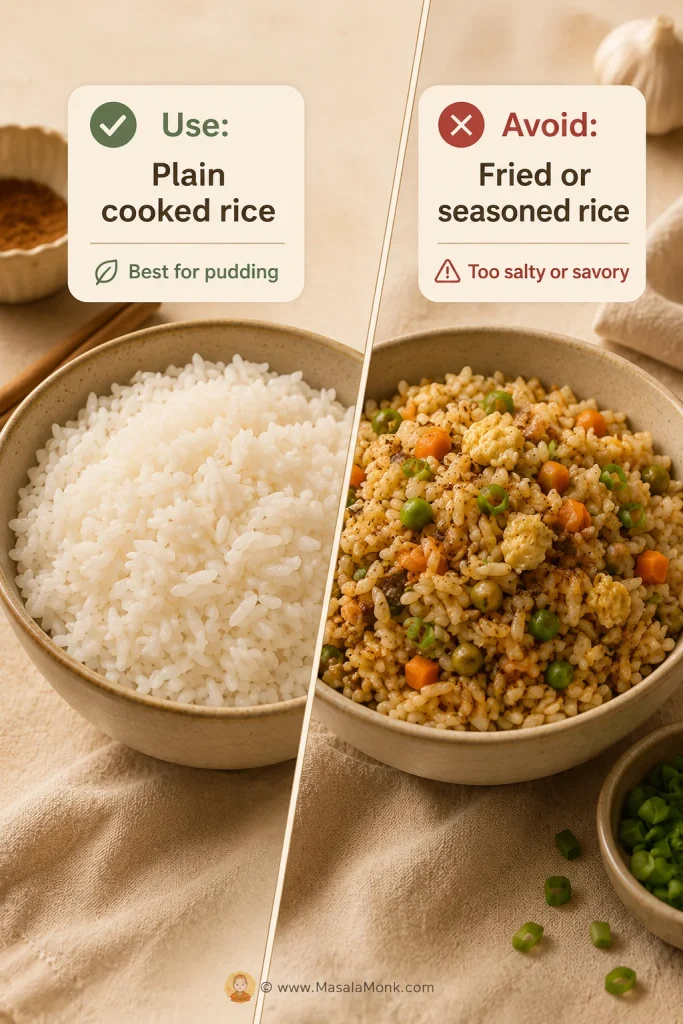
Do not use fried rice, salty takeout rice, rice cooked in broth, seasoned rice packets, or rice with garlic, onion, soy sauce, curry, or savory seasoning. This pudding needs plain cooked rice.

Side-by-side comparison of plain cooked rice for pudding and seasoned fried rice that should not be used.
Use plain cooked rice so the milk, cinnamon, vanilla, and sugar can build the dessert flavor cleanly. Seasoned rice, fried rice, or rice cooked in broth will bring savory notes that are hard to hide.

If you need to make a fresh batch first, this guide to how to cook rice perfectly covers stovetop, rice cooker, and Instant Pot methods, so you can start with plain rice that is soft enough for pudding.

Using dry fridge rice or basmati? Go to the texture fixes if your pudding looks too loose, too separate, or too thick once it starts cooking.

Milk, Cream, Condensed Milk, and Dairy-Free Options

Whole milk gives the best everyday texture. It is creamy without being too heavy. For a richer pudding, replace 2 to 4 tablespoons of the milk with heavy cream, or stir a splash of cream into the pudding at the end.
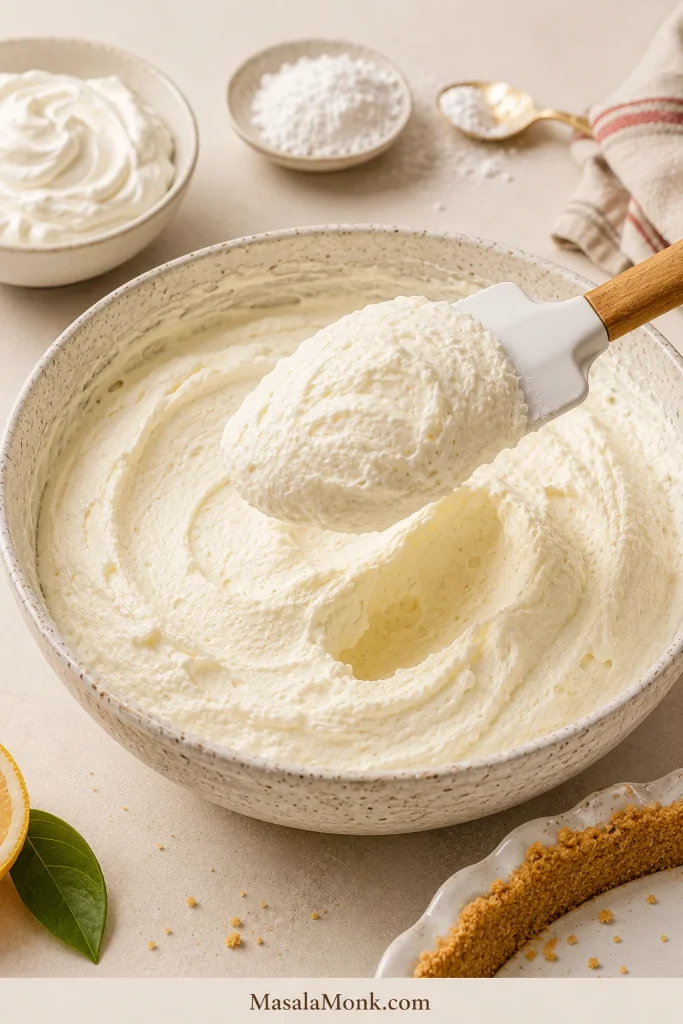
Evaporated milk makes the pudding richer and slightly more old-fashioned. Use half evaporated milk and half regular milk. Sweetened condensed milk makes the pudding thicker and sweeter, so reduce or skip the sugar when using it.

For a dairy-free version, use full-fat coconut milk, oat milk, or almond milk. Coconut milk gives the richest result. Almond milk is lighter and may need a slightly longer simmer or a small cornstarch slurry to thicken.

Egg or No Egg?

Egg is not required here. The easiest version uses no egg and thickens through simmering, which gives you a soft, creamy pudding without the risk of scrambling.

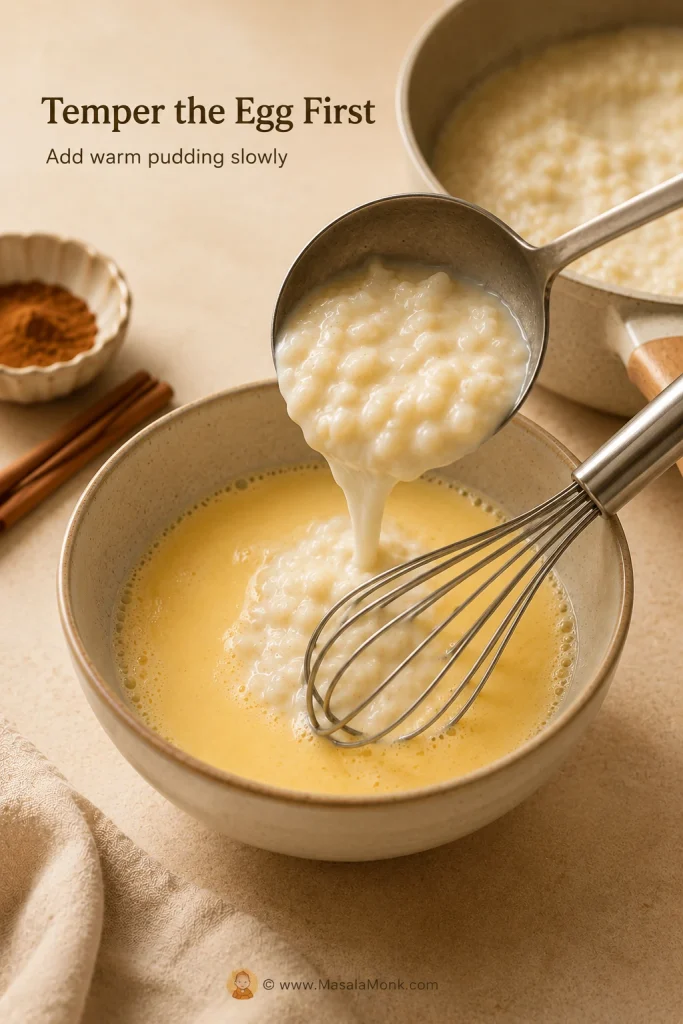
An egg makes the pudding more custardy and old-fashioned. If you use one, temper it first with warm milk or warm pudding before adding it back to the saucepan. Then keep the heat gentle and do not boil the pudding hard after the egg goes in.

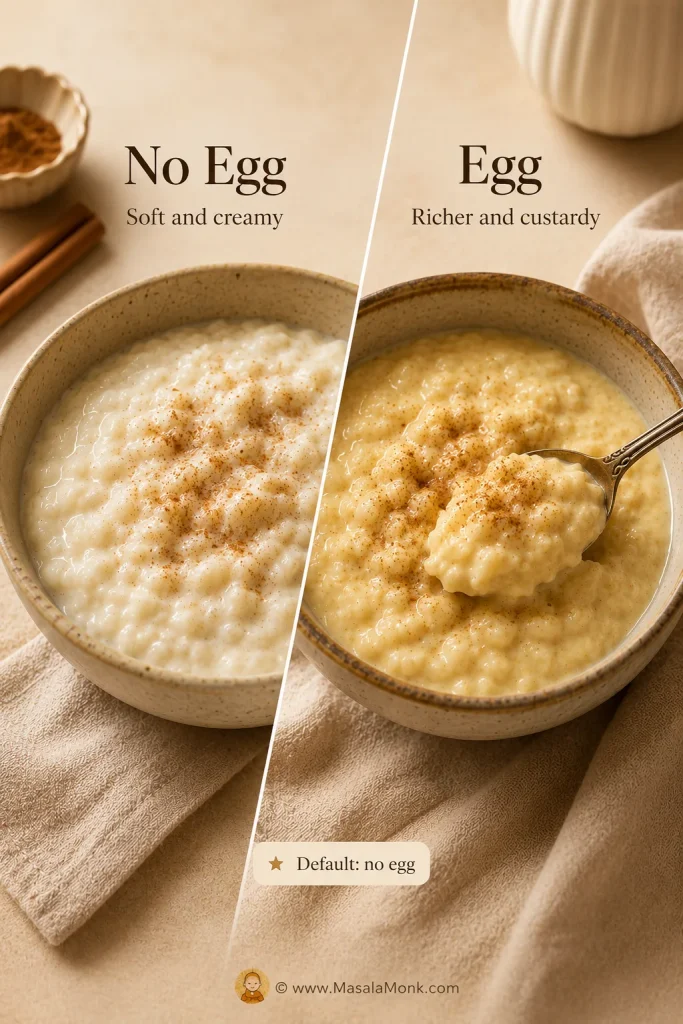
Comparison of no-egg rice pudding and egg rice pudding, showing a softer creamy version and a richer custardy version.
No egg keeps the recipe easier and softly creamy. However, if you want an old-fashioned custardy texture, egg works well as long as it is tempered before it goes back into the hot pudding.

Raisins, Cinnamon, Vanilla, and Add-Ins

Cinnamon and vanilla are the classic flavor base. A pinch of salt is just as important because it keeps the pudding from tasting flat. Raisins are optional. If you like soft raisins, add them while the pudding simmers. If you prefer them plumper, soak them in warm water for 10 minutes first, then drain and stir them in.

Other good additions include cardamom, nutmeg, orange zest, lemon zest, toasted coconut, chopped dates, chopped pistachios, jam, berry compote, caramel, or a spoonful of brown sugar on top.

For a more Indian-inspired direction, cardamom, saffron, pistachios, rosewater, and jaggery all work beautifully. MasalaMonk’s Indian-inspired pudding ideas include a cardamom rice pudding direction if you want a more fragrant variation.

How to Make Rice Pudding with Cooked Rice

This is the simple stovetop method. Use a heavy saucepan if possible. Thin pans scorch milk more easily, especially once the pudding begins to thicken.

Once you understand the ratio, the recipe is simple: keep the heat gentle, stir often, and stop while the pudding is still slightly loose. It will finish thickening as it rests.

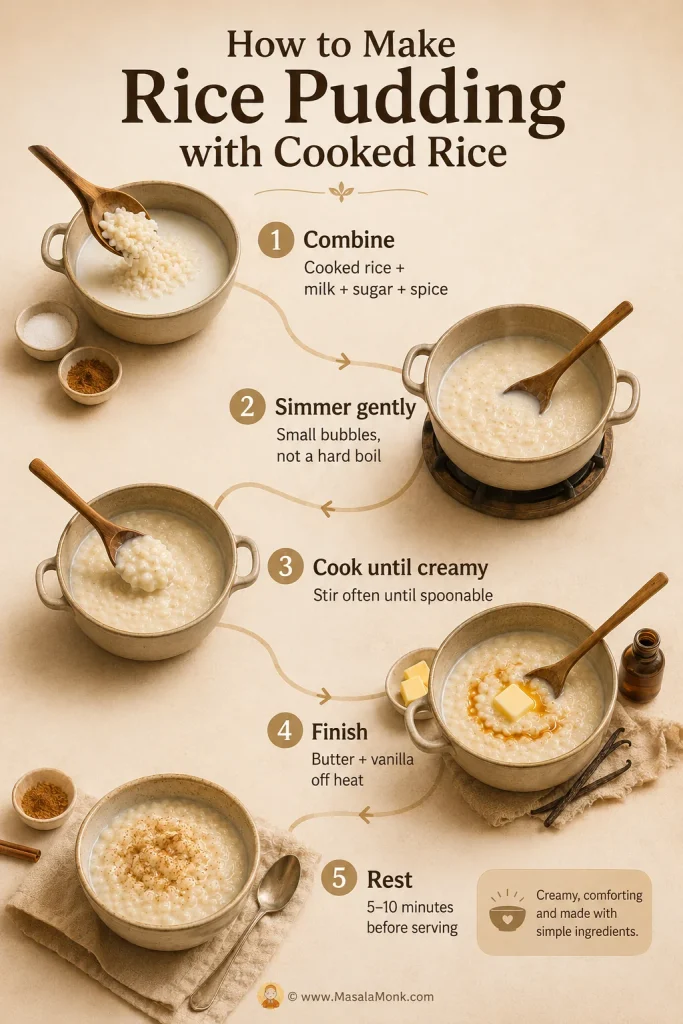
Five-step overview for making rice pudding with cooked rice, from combining ingredients to resting before serving.
The best rice pudding texture comes from gentle stages, not speed. First loosen the rice, then simmer slowly, finish off heat, and rest before judging whether it needs more milk.

Step 1: Combine the Rice, Milk, Sugar, Salt, and Cinnamon

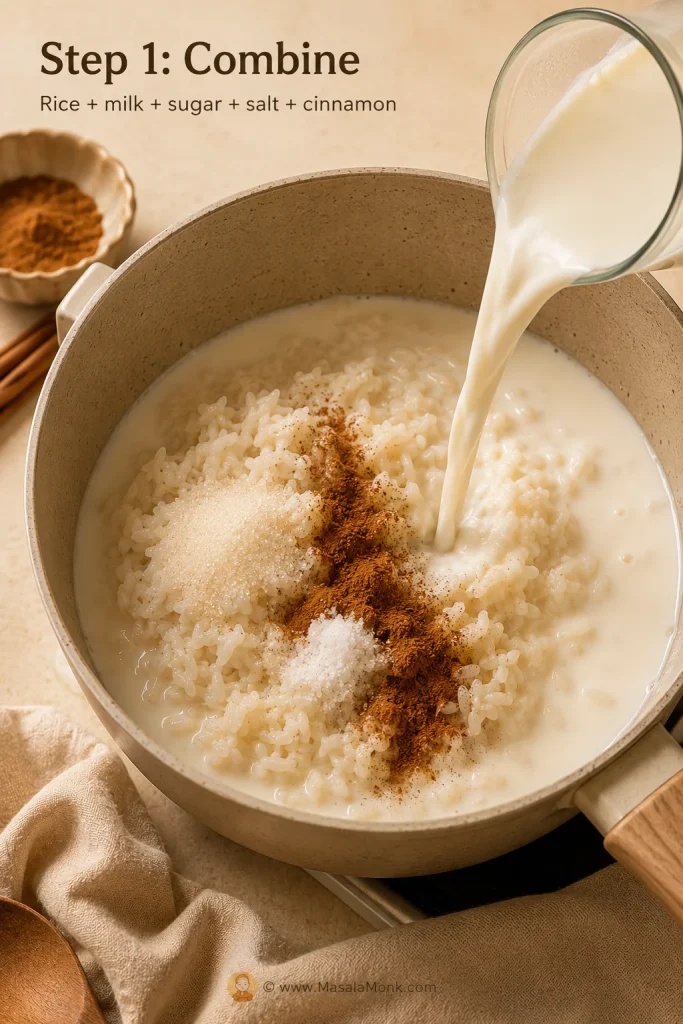
Add the cooked rice, milk, sugar, salt, and cinnamon to a 2- to 3-quart saucepan. Stir well so the rice loosens and the sugar begins dissolving into the milk.

Cooked rice, milk, sugar, salt, and cinnamon combined in a saucepan for the first step of rice pudding.
Stir the cooked rice well at the start so the milk can reach the grains evenly. This also prevents sugar, cinnamon, and salt from collecting in one spot while the pudding thickens.

Step 2: Bring It to a Gentle Simmer

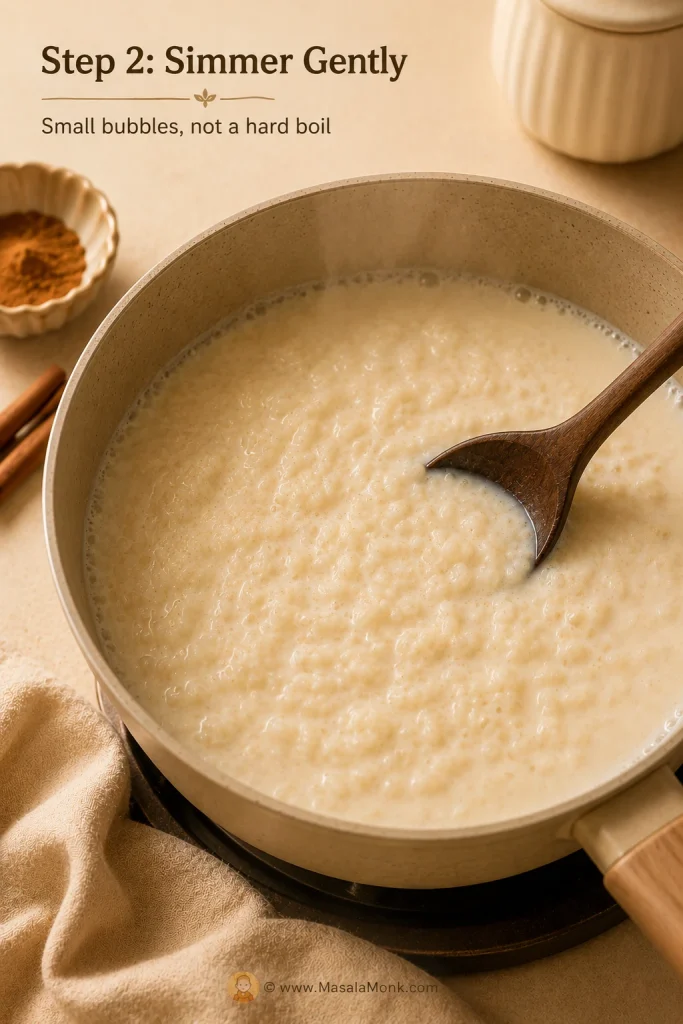
Set the pan over medium heat until the milk begins to steam and small bubbles appear around the edges. Stay close at this stage because milk can boil over quickly.

Saucepan of cooked rice and milk simmering gently with small bubbles around the edge.
Keep the heat gentle once the milk starts bubbling at the edges. A slow simmer softens the rice and thickens the milk, while a hard boil can scorch the bottom or make the pudding gummy.

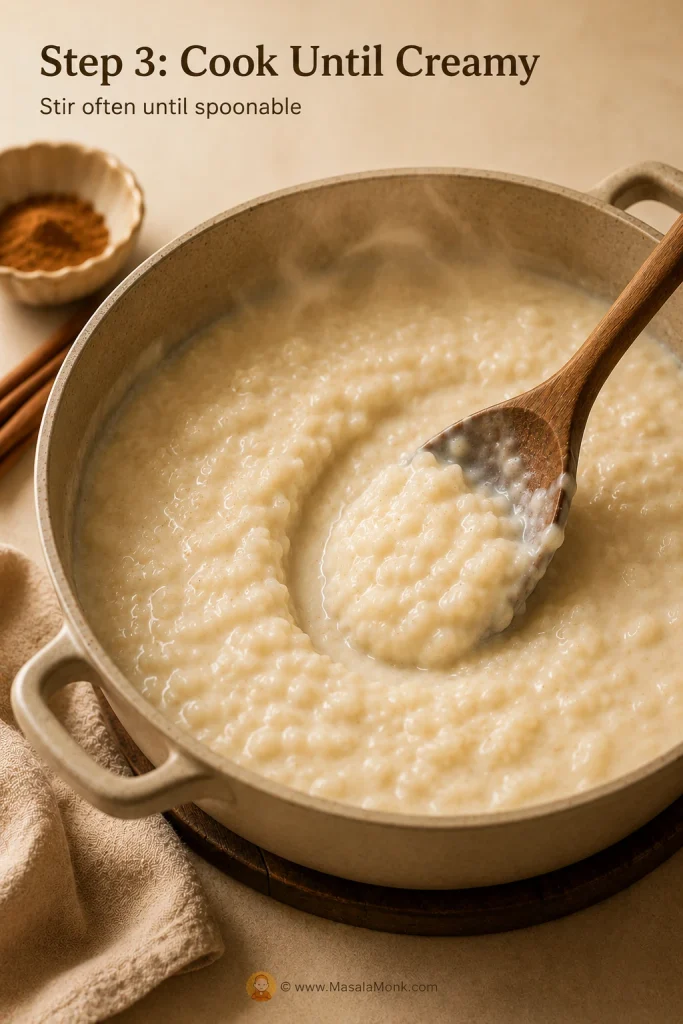
Step 3: Lower the Heat and Cook Until Creamy

Reduce the heat to medium-low. Simmer for 15 to 20 minutes, stirring often, until the rice softens and the milk thickens. The pudding should look creamy and spoonable, but still slightly loose.

Rice pudding thickening in a saucepan as a wooden spoon creates a creamy trail through the mixture.
When the spoon leaves a soft trail, the pudding is close. Stop while it still looks a little loose, because cooked rice continues to absorb milk after the heat is turned off.

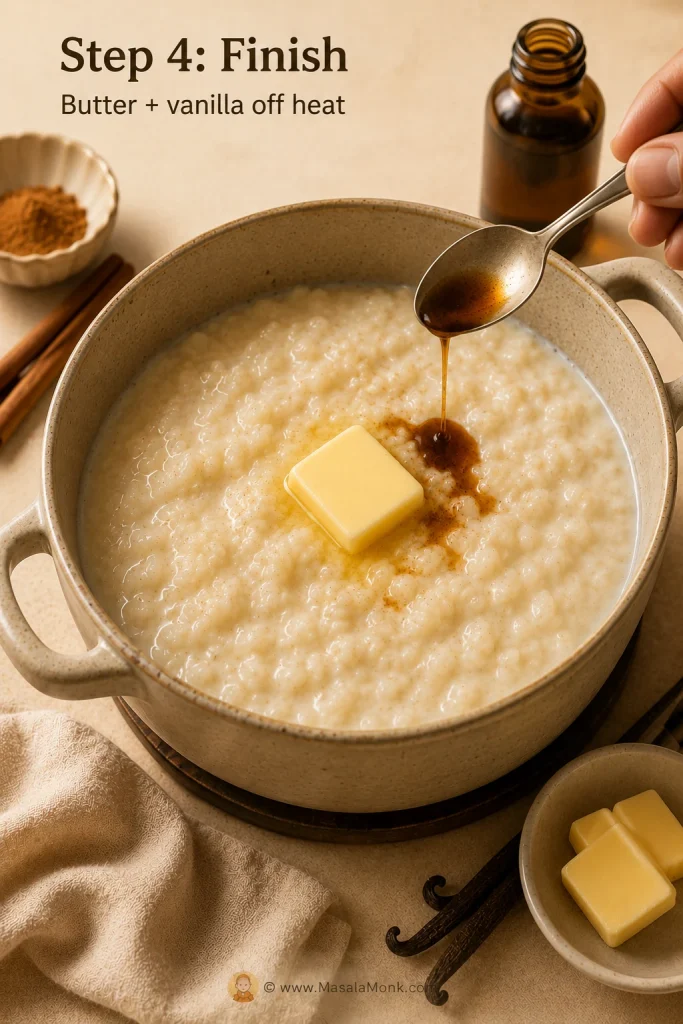
Step 4: Finish with Butter and Vanilla

Turn off the heat. Stir in the butter and vanilla. If you want a richer pudding, stir in 2 to 4 tablespoons of cream at the end.

Butter melting into hot rice pudding while vanilla is added from a spoon.
Add butter and vanilla at the end for better flavor. The residual heat melts the butter and releases the vanilla aroma without cooking away the fragrance.

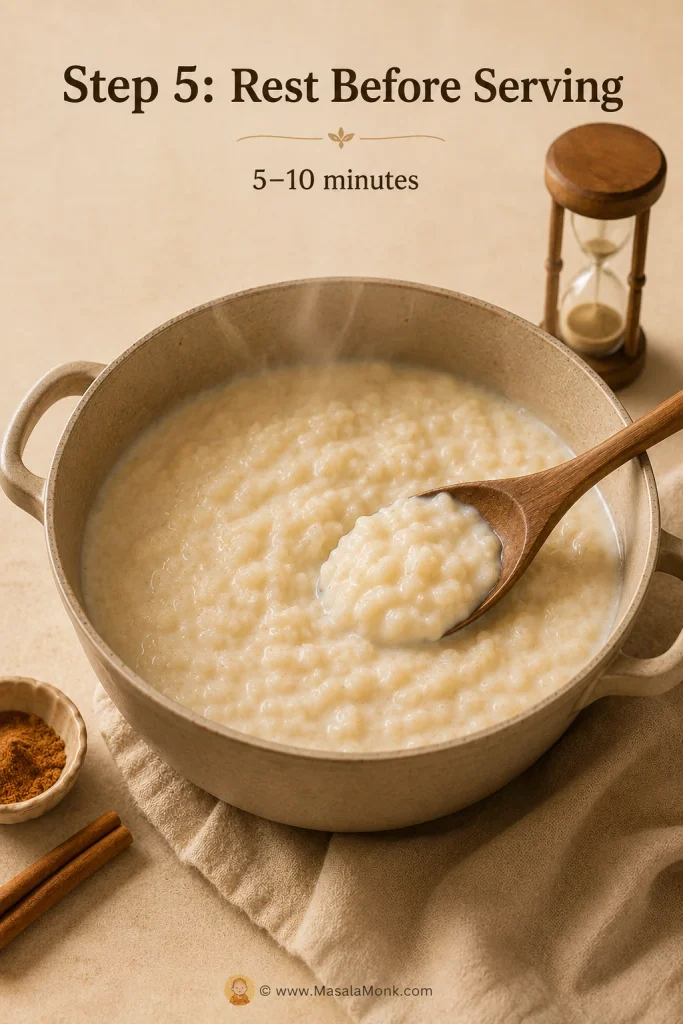
Step 5: Rest Before Serving

Let the pudding rest for 5 to 10 minutes before serving. This short rest helps the texture settle. Serve it warm, at room temperature, or chilled.

Rice pudding resting in a saucepan with a wooden spoon and timer after cooking.
A short rest gives the starch in the cooked rice time to finish thickening the milk. Before adding cornstarch or cooking longer, wait a few minutes and check the texture again.

Once you have made it once, you probably will not need to measure as carefully the next time. The pudding tells you what it needs: more milk if it tightens up, more simmering if it looks loose, and a short rest before you judge the final texture.

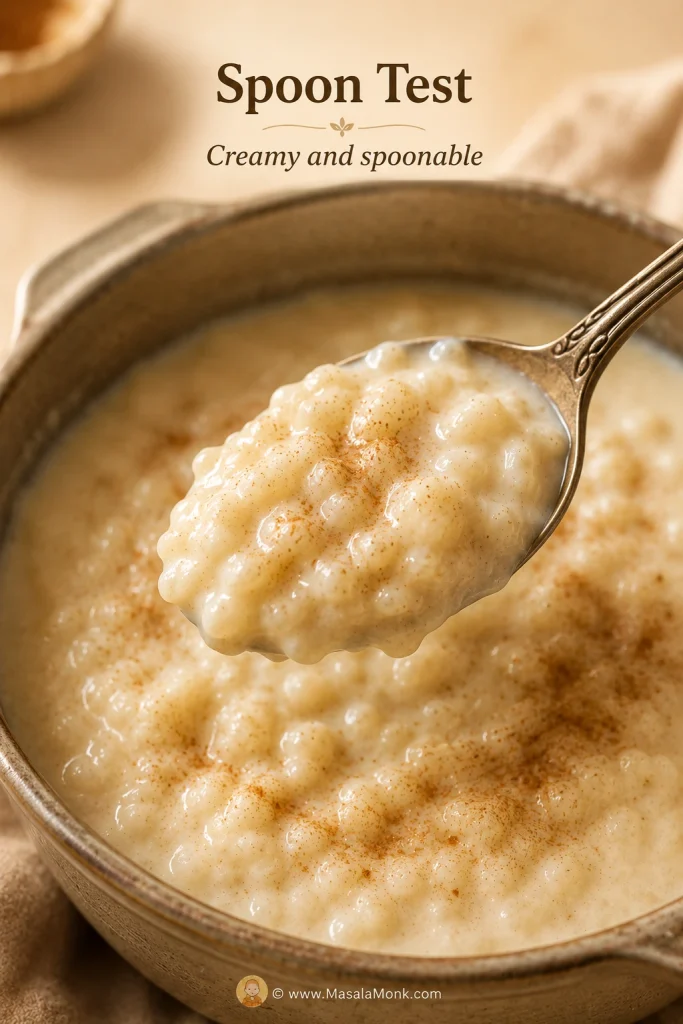
Spoon lifting creamy rice pudding with visible cooked rice grains and cinnamon on top.
A finished spoonful should look creamy, moist, and softly mounded. If it slides off like milk, simmer longer; if it holds like paste, stir in a little warm milk.

Ready for the exact measurements? Jump to the recipe card. If the texture does not look right yet, go to the fixes.

Recipe Card: Rice Pudding with Cooked Rice

This easy stovetop rice pudding uses already cooked rice, so it is faster than traditional rice pudding made from raw rice. The default version is egg-free, creamy, and flexible enough for leftover white rice, jasmine rice, basmati rice, or short-grain rice.

Prep Time5 minutes
Cook Time15–20 minutes
Rest Time5–10 minutes
Yield4 servings

Equipment

  • 2- to 3-quart heavy saucepan
  • Wooden spoon or silicone spatula
  • Measuring cups and spoons
  • Airtight container for leftovers

Ingredients

  • 2 cups cooked white rice, cold or room temperature, about 315–330 g / 11–12 oz
  • 2 cups whole milk, 480 ml / 16 fl oz
  • ⅓ cup granulated sugar, 65–70 g / about 2.3 oz, adjust to taste
  • ¼ teaspoon fine salt
  • ½ teaspoon ground cinnamon, plus more for serving
  • 1 tablespoon unsalted butter, 14 g / 0.5 oz
  • 1 teaspoon vanilla extract, 5 ml
  • 2–4 tablespoons heavy cream, optional, 30–60 ml
  • ⅓–½ cup raisins, optional, 50–75 g

Instructions

  1. Combine: Add cooked rice, milk, sugar, salt, and cinnamon to a heavy saucepan. Stir to loosen the rice.
  2. Simmer: Warm over medium heat until the milk begins to steam and gently bubble at the edges.
  3. Cook: Reduce heat to medium-low. Simmer for 15–20 minutes, stirring often, until the mixture is creamy and the rice is soft.
  4. Adjust: If the pudding looks too thick before the rice softens, add milk 1–2 tablespoons at a time. If it looks too thin, simmer uncovered for a few more minutes.
  5. Finish: Turn off the heat. Stir in butter, vanilla, and optional cream. Add raisins now if you want them less cooked, or add them earlier if you want them softer.
  6. Rest: Let the pudding rest for 5–10 minutes. Serve warm, room temperature, or chilled with extra cinnamon.

Notes

  • For dry leftover rice: add 2–4 extra tablespoons milk at the beginning.
  • For basmati rice: expect a looser, more separate-grain texture. Add a little extra milk if needed.
  • For short-grain rice: stir gently and watch the heat because it thickens faster.
  • For sweeter pudding: increase sugar to ½ cup. For a lightly sweet pudding, use ¼ cup.
  • For richer pudding: replace ¼ cup milk with cream, or stir cream in at the end.
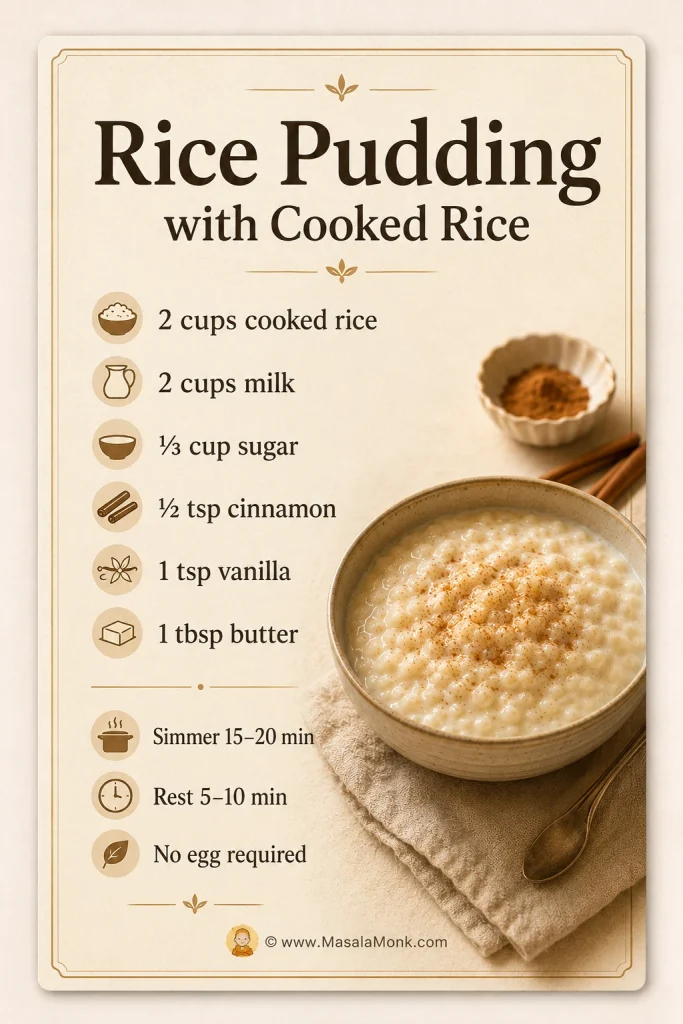
Recipe card for rice pudding with cooked rice listing cooked rice, milk, sugar, cinnamon, vanilla, butter, simmer time, rest time, and no egg required.
The base formula is easy to remember: equal parts cooked rice and milk, then a gentle simmer and short rest. Once that works, condensed milk, egg, cream, or coconut milk become simple variations.

Leftover Rice Pudding: What to Know Before You Start

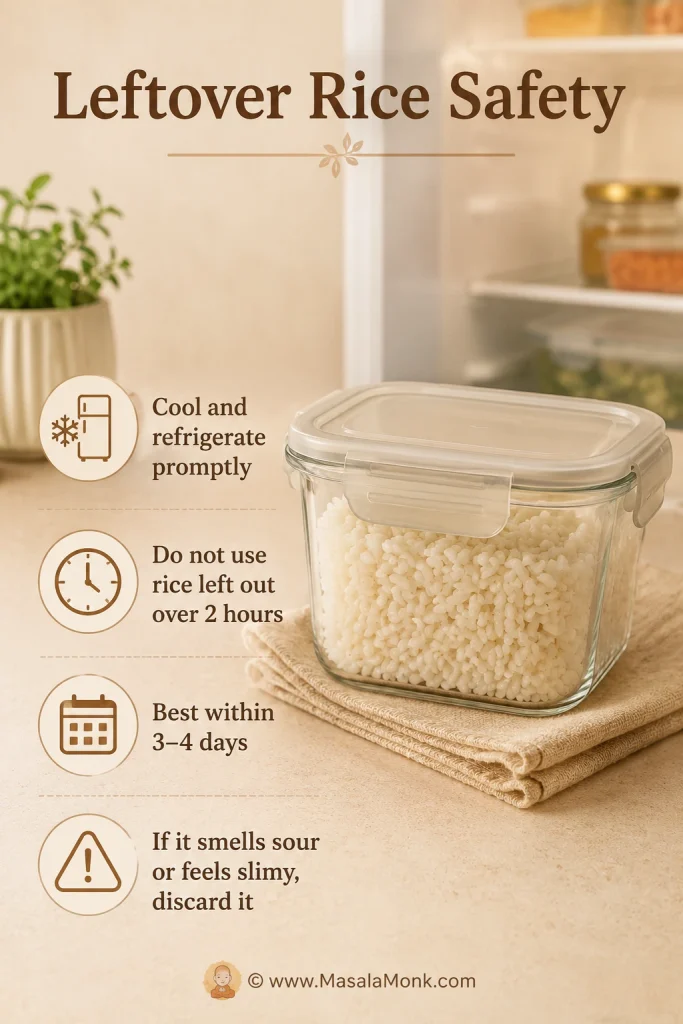
This recipe is ideal for leftover rice, but only use rice that has been handled safely. Cooked rice should be cooled and refrigerated promptly. If it has been sitting at room temperature for more than 2 hours, smells sour, feels slimy, or you are unsure how long it has been in the fridge, it is safer to discard it and start with a fresh batch.

Leftover rice safety guide with cooked rice in a covered container, refrigerator cue, and storage time reminders.
Before turning leftovers into dessert, make sure the rice was cooled and refrigerated properly. If it sat out too long, smells sour, feels slimy, or seems questionable, start fresh instead.

If your leftover rice is plain but you are not in the mood for dessert, you can also turn leftover rice into arancini balls instead. Use this rice pudding when you want something creamy and sweet; use arancini when you want a crisp, savory snack.

For general leftover storage guidance, FoodSafety.gov lists cooked leftovers at 3 to 4 days in the refrigerator. For reheating, FoodSafety.gov recommends reheating leftovers to 165°F / 74°C.

Leftover rice tip: cold rice may look dry and stiff at first. Give it time. As it warms in milk, the grains relax and the pudding turns creamier.

Variations

Once you know the base method, this is one of those forgiving desserts you can easily bend toward what you have. Keep the rice-to-liquid ratio in mind and adjust sweetness depending on the milk or add-ins you use.

Rice Pudding with Cooked Rice and Condensed Milk

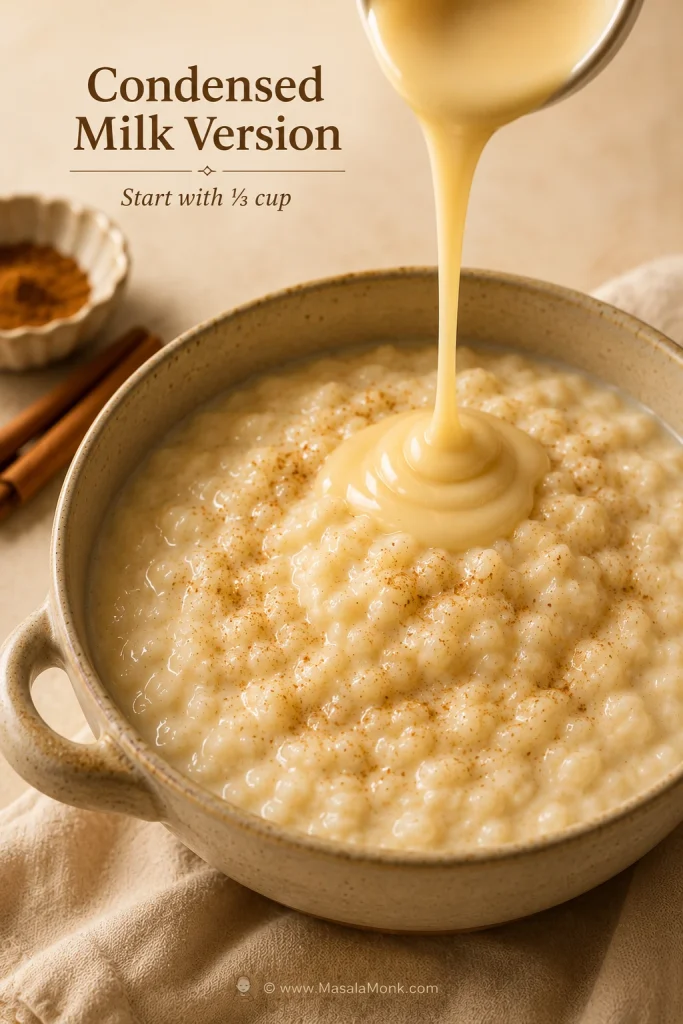
Sweetened condensed milk gives the pudding a richer, sweeter, almost caramel-like finish. Because it already contains sugar, do not add the full amount of sugar from the main recipe. Start with ⅓ cup condensed milk, taste, then increase to ½ cup only if you want a sweeter pudding.

Condensed milk being poured into creamy rice pudding made with cooked rice.
Condensed milk adds sweetness and body at the same time. Start with ⅓ cup first; after the pudding thickens, taste before adding more so it stays creamy rather than overly sweet.
Ingredient Amount
Cooked rice 2 cups / about 315–330 g
Whole milk 1½ cups / 360 ml
Sweetened condensed milk ⅓–½ cup / about 100–150 g
Salt Pinch to ¼ teaspoon
Vanilla 1 teaspoon / 5 ml
Cinnamon ½ teaspoon

Simmer the rice, milk, condensed milk, salt, and cinnamon over medium-low heat for 12 to 18 minutes, stirring often. Finish with vanilla. If it becomes too thick, loosen it with a splash of milk.

Evaporated Milk Rice Pudding

Evaporated milk gives you a pantry-style pudding that tastes richer without becoming as sweet as condensed milk pudding. Use 1 cup evaporated milk and 1 cup regular milk for every 2 cups cooked rice. Then keep the sugar at ¼ to ⅓ cup and adjust at the end.

Microwave Rice Pudding with Cooked Rice

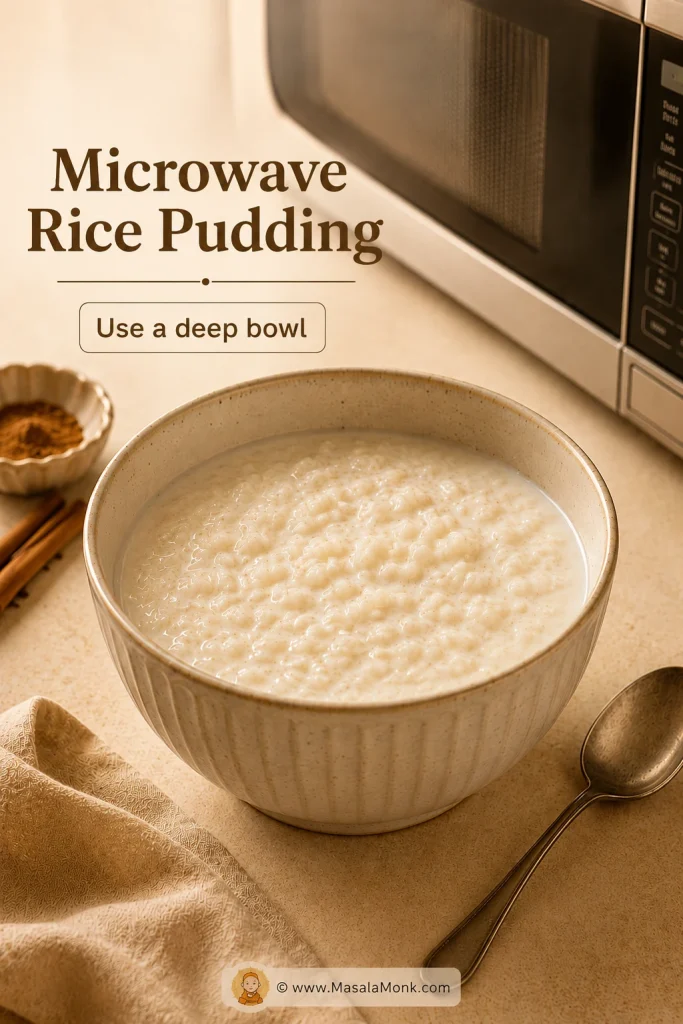
The stovetop version gives the best texture, but the microwave works for a small quick bowl. Use a deep microwave-safe bowl at least twice as large as the mixture, because milk can bubble up as it heats.

Deep microwave-safe bowl of rice pudding with cooked rice placed near a microwave.
A deep bowl matters because milk can rise quickly in the microwave. Heat in short bursts, stir between rounds, and stop while the pudding is still a little loose.
Ingredient Small Microwave Batch
Cooked rice 1 cup
Milk 1 cup
Sugar 2–3 tablespoons
Cinnamon ¼ teaspoon
Vanilla ½ teaspoon
Butter 1 teaspoon

Microwave on high for 1 minute, stir well, then continue in 30- to 60-second bursts, stirring each time, until creamy. Stop when the pudding is still slightly loose because it thickens as it sits.

Old-Fashioned Egg Rice Pudding

A custardy version starts with 1 large egg whisked with ½ cup milk. Cook the rice pudding as usual with the remaining milk, sugar, salt, and cinnamon. When the pudding is hot and creamy, slowly whisk a few spoonfuls of warm pudding into the egg mixture. Then stir the tempered egg mixture back into the pan and cook gently for 2 to 3 minutes. Do not boil hard after adding the egg.

Warm rice pudding being slowly added to a bowl of whisked egg and milk to temper the egg.
Tempering is the safeguard against scrambled egg. Add warm pudding to the egg mixture slowly, whisk as you go, and only then return it to the pan over gentle heat.

Coconut Milk Rice Pudding

Coconut milk is the richest dairy-free option. Use 2 cups cooked rice with 1½ to 2 cups full-fat coconut milk, then sweeten with sugar, maple syrup, or a small amount of coconut condensed milk. Cinnamon works, but cardamom, ginger, mango, toasted coconut, and lime zest also fit beautifully.

Coconut milk rice pudding made with cooked rice, topped with toasted coconut and served with mango nearby.
Coconut milk makes cooked-rice pudding rich without dairy, but it also thickens differently from regular milk. Stir gently and add a splash more liquid if the pudding tightens as it sits.

For another coconut-and-rice dessert, MasalaMonk’s mango sticky rice leans more tropical, chewy, and fruit-forward, while this cooked-rice pudding stays softer and creamier.

Baked Rice Pudding with Cooked Rice

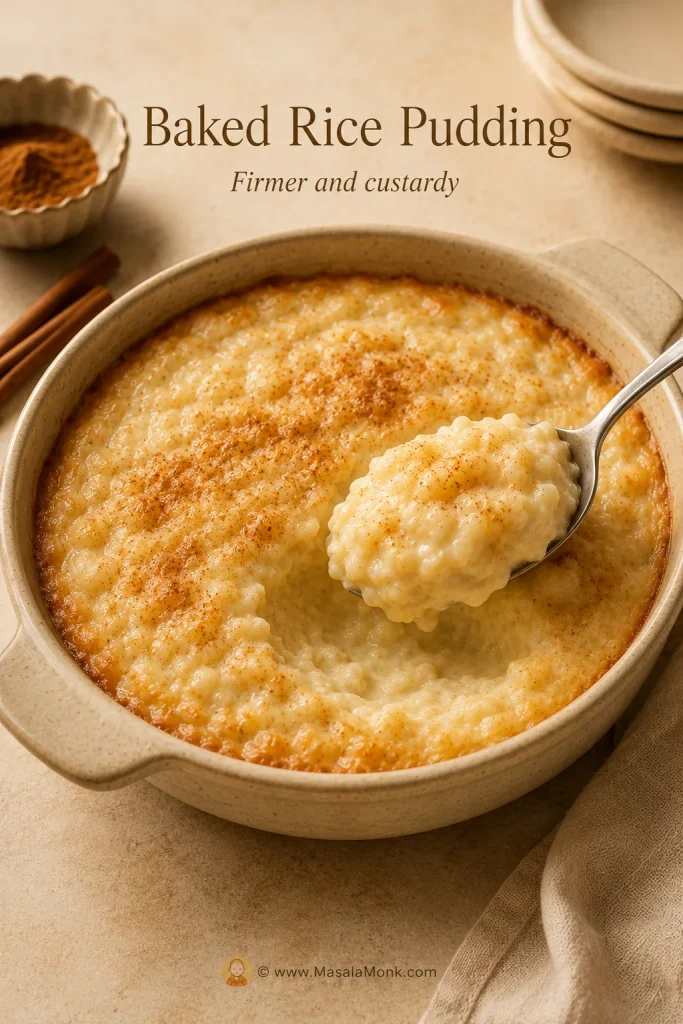
Baked rice pudding has a firmer, more custardy texture. To make it, whisk milk, eggs, sugar, vanilla, cinnamon, and salt, then stir in cooked rice. Pour into a buttered baking dish and bake at 325°F / 162°C for about 45 to 50 minutes, or until just set.

Baked rice pudding in a ceramic dish with golden edges and a spoonful showing the custardy interior.
Baking changes the texture from loose and creamy to firmer and custardy. It is especially useful when you want a spoon-served dessert with golden edges and a more set center.

This gives you a different dessert from the stovetop version: more set at the edges, more custardy through the center, and less loose in the bowl.

How to Fix the Texture

Quick Texture Check

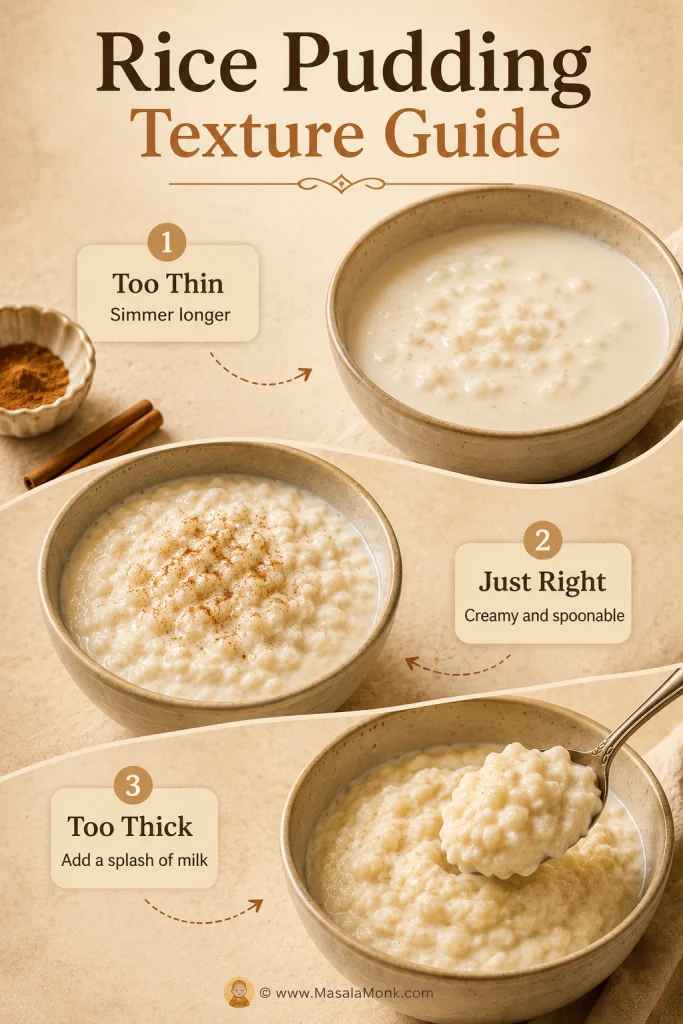
Cooked-rice pudding is forgiving, so don’t panic if it looks wrong halfway through. Most texture problems come down to the rice, the heat, or the amount of milk. A few small adjustments usually bring it back.

Rice pudding texture guide showing too thin, just right, and too thick pudding with simple fixes for each.
Use the texture guide before starting over. Thin pudding usually needs more simmering, thick pudding needs milk, and gummy pudding often means the heat was too high or the rice was overworked.

Common Rice Pudding Texture Problems and Fixes

Problem Likely Cause Fix
Rice pudding is too thin It has not simmered long enough, or there is too much milk. Simmer uncovered for 3–5 more minutes, stirring often.
Still thin after simmering The rice is low-starch or the batch has too much liquid. Mix 1 teaspoon cornstarch with 1 tablespoon cold milk. Stir it in and simmer 1 minute.
Rice pudding is too thick The rice absorbed more milk than expected. Add warm milk 1–2 tablespoons at a time until spoonable.
Dry after chilling Rice continues absorbing liquid in the fridge. Stir in a splash of milk before serving or reheating.
Rice is still firm The rice was undercooked before you started. Add ¼–½ cup milk and cook 5–8 minutes longer over low heat.
Pudding tastes bland Not enough salt, vanilla, spice, or sweetness. Add a tiny pinch of salt first, then adjust vanilla, cinnamon, or sugar.
Pudding turned gummy Heat was too high, rice was very starchy, or it was over-stirred. Loosen with milk and stir gently. Next time, use lower heat.
Egg scrambled The egg was added to very hot pudding too quickly. Use the no-egg method, or temper the egg slowly before adding it.
Milk scorched on the bottom Pan was too thin or heat was too high. Use a heavy saucepan and medium-low heat. Stir more often as it thickens.

Once the texture is fixed, let the pudding rest before judging the final thickness. Only need storage advice? Jump to storage and reheating.

How to Store, Freeze, and Reheat Rice Pudding

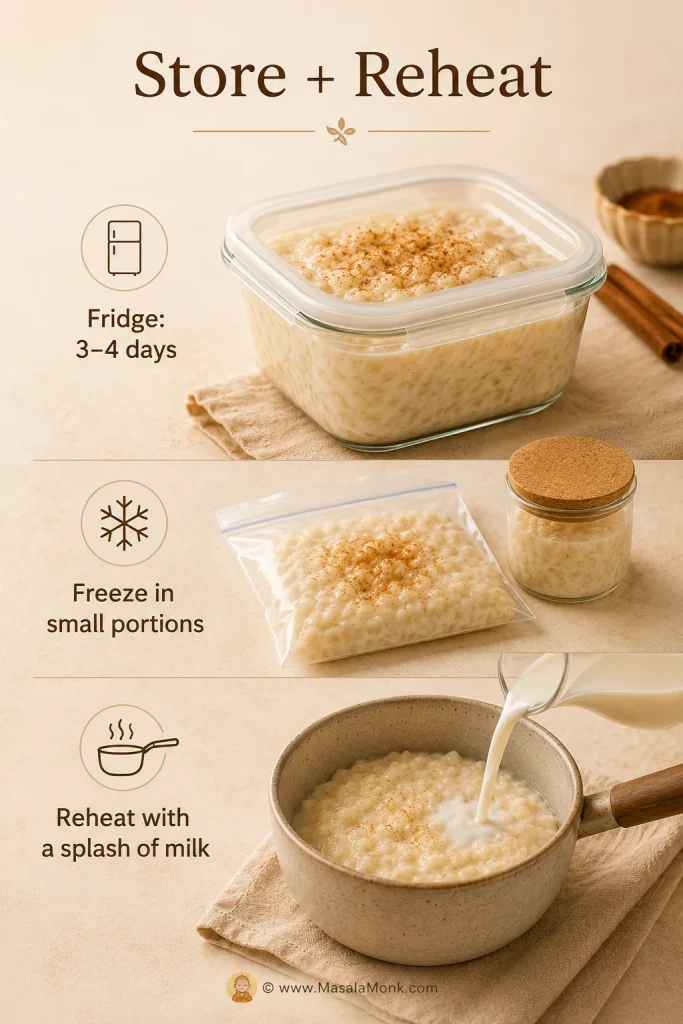
Let rice pudding cool, then transfer it to an airtight container and refrigerate. Because this recipe often starts with leftover rice, use conservative storage habits and do not keep it sitting at room temperature for long.

Rice pudding storage and reheating guide showing a fridge container, freezer portion, and milk being added while reheating.
Rice pudding usually thickens after chilling, so reheating with milk is the easiest way to revive it. Add a splash, warm gently, and stir until the texture turns creamy again.
Storage Method How Long Best Practice
Refrigerator Up to 3–4 days Store in an airtight container. Add milk before reheating if it thickens.
Freezer Best quality within 1 month Freeze in small portions. Texture may be softer or grainier after thawing.
Stovetop reheating 5–8 minutes Reheat gently with a splash of milk, stirring often.
Microwave reheating 30-second bursts Stir between bursts and add milk as needed.

Rice pudding thickens in the fridge. That does not mean it is ruined. Stir in a splash of milk before reheating, or loosen chilled pudding with a little cold milk if you prefer eating it cold.

What to Serve with Rice Pudding

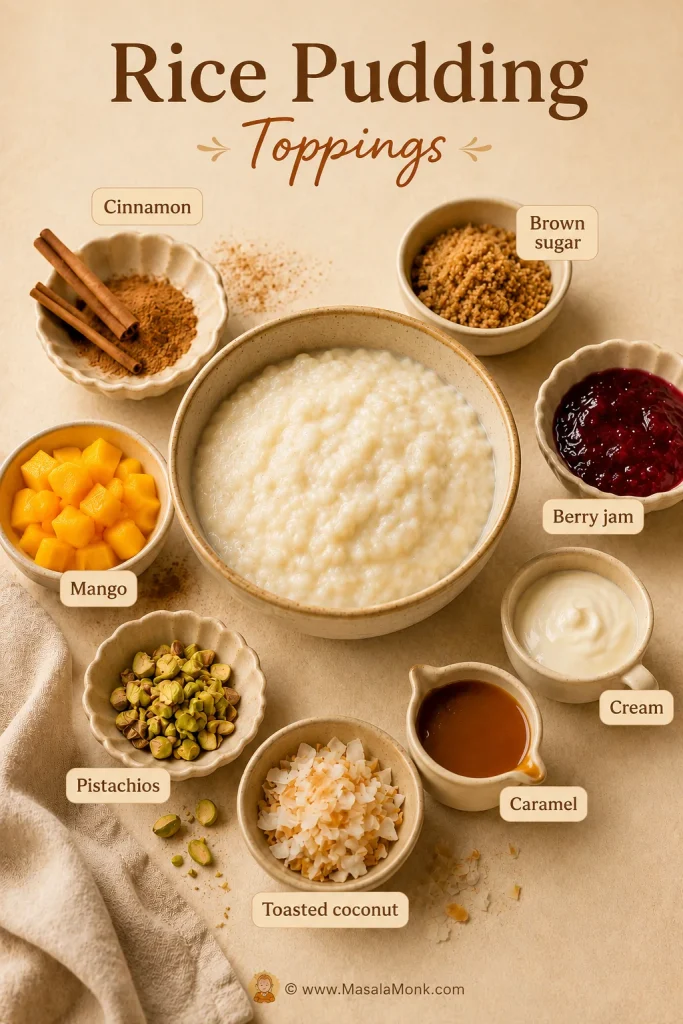
Rice pudding is good plain, but toppings make it feel more finished. Try extra cinnamon, brown sugar, toasted nuts, raisins, chopped dates, berry compote, strawberry jam, mango, caramel, maple syrup, toasted coconut, pistachios, or a spoonful of cream.

Rice pudding toppings guide with cinnamon, brown sugar, berry jam, mango, pistachios, toasted coconut, caramel, and cream.
One basic rice pudding can lean classic, fruity, nutty, or richer depending on the topping. Cinnamon and brown sugar keep it familiar, while mango, jam, pistachios, coconut, caramel, or cream make it feel more finished.

If you like chilled spoon desserts, this quick mango pudding is another easy option for a softer, fruitier dessert table.

For a warmer dessert, serve this rice pudding just after resting. For a thicker make-ahead dessert, chill it and loosen with a little milk before serving. Either way, it is the kind of recipe that becomes easier every time you make it, because the texture tells you what it needs.

Warm rice pudding in a bowl compared with chilled rice pudding in a glass cup.
Serve it warm when you want a softer, cozier pudding. Chill it when you want a thicker make-ahead dessert, then loosen with a little milk if the rice absorbs too much liquid.

A finished bowl should feel like a real dessert, not just reheated rice. The best texture is creamy, spoonable, gently spiced, and soft enough to serve warm or chilled.

Finished bowl of leftover rice pudding with cinnamon and a spoonful lifted from the bowl, with a storage container in the background.
A good leftover rice pudding should still taste intentional: creamy milk, soft grains, warm spice, and enough rest time for the texture to settle. That is what turns plain cooked rice into dessert.

FAQs

What is the best rice for rice pudding with cooked rice?

Plain cooked white rice is the best all-purpose choice. Jasmine rice is soft and fragrant, basmati rice works but stays more separate, and short-grain rice makes the thickest pudding. Brown rice works only when it is fully cooked and soft.

How much milk do you need for 2 cups cooked rice?

Use 2 cups milk for 2 cups cooked rice as the starting point. Add 2 to 4 extra tablespoons of milk if the rice is dry, cold, or separate-grained.

Is egg necessary in rice pudding?

No. Egg is optional here. Rice pudding with cooked rice can turn creamy through gentle simmering alone. Egg gives a more custardy old-fashioned texture, but the no-egg version is easier and less likely to scramble.

Why is my rice pudding runny?

It probably needs more simmering time. Cook it uncovered over medium-low heat for a few more minutes, stirring often. If it still stays thin, add a small cornstarch slurry made from 1 teaspoon cornstarch and 1 tablespoon cold milk.

Why did my rice pudding get too thick?

Cooked rice keeps absorbing liquid as it sits, especially in the refrigerator. Stir in milk 1 to 2 tablespoons at a time until the texture becomes creamy again.

Does basmati rice work for rice pudding?

Yes, basmati rice works, but it gives a looser pudding because the grains stay separate. Add a little extra milk and simmer gently so the rice softens without breaking down too much.

Does leftover takeout rice work?

Plain takeout rice works if it is unsalted, not oily, and has been refrigerated safely. Do not use fried rice, seasoned rice, or rice with savory sauces for dessert pudding.

How do you make rice pudding with cooked rice and condensed milk?

Use 2 cups cooked rice, 1½ cups milk, and ⅓ to ½ cup sweetened condensed milk. Skip the regular sugar at first, simmer until creamy, then adjust sweetness at the end.

What is the best way to reheat rice pudding?

Reheat it gently with a splash of milk. Use low heat on the stove or short microwave bursts, stirring between each burst. The pudding should loosen as it warms.

Can you freeze rice pudding?

You can freeze rice pudding, but the texture may become softer or slightly grainy after thawing. Freeze it in small portions for best quality, thaw in the refrigerator, then reheat gently with a splash of milk.

How long does rice pudding last in the fridge?

Keep rice pudding in an airtight container in the refrigerator and use it within 3 to 4 days. Since this version may start with leftover rice, it is better not to stretch the storage time.

Made it with leftover rice? Share what kind you used — jasmine, basmati, short-grain, brown rice, or plain takeout rice — and whether you liked the pudding warm, chilled, with raisins, or without. It helps other readers adjust the texture before they start.

Posted on 2 Comments

No Bake Cheesecake Recipe: Easy, Creamy, and Set Perfectly Without an Oven

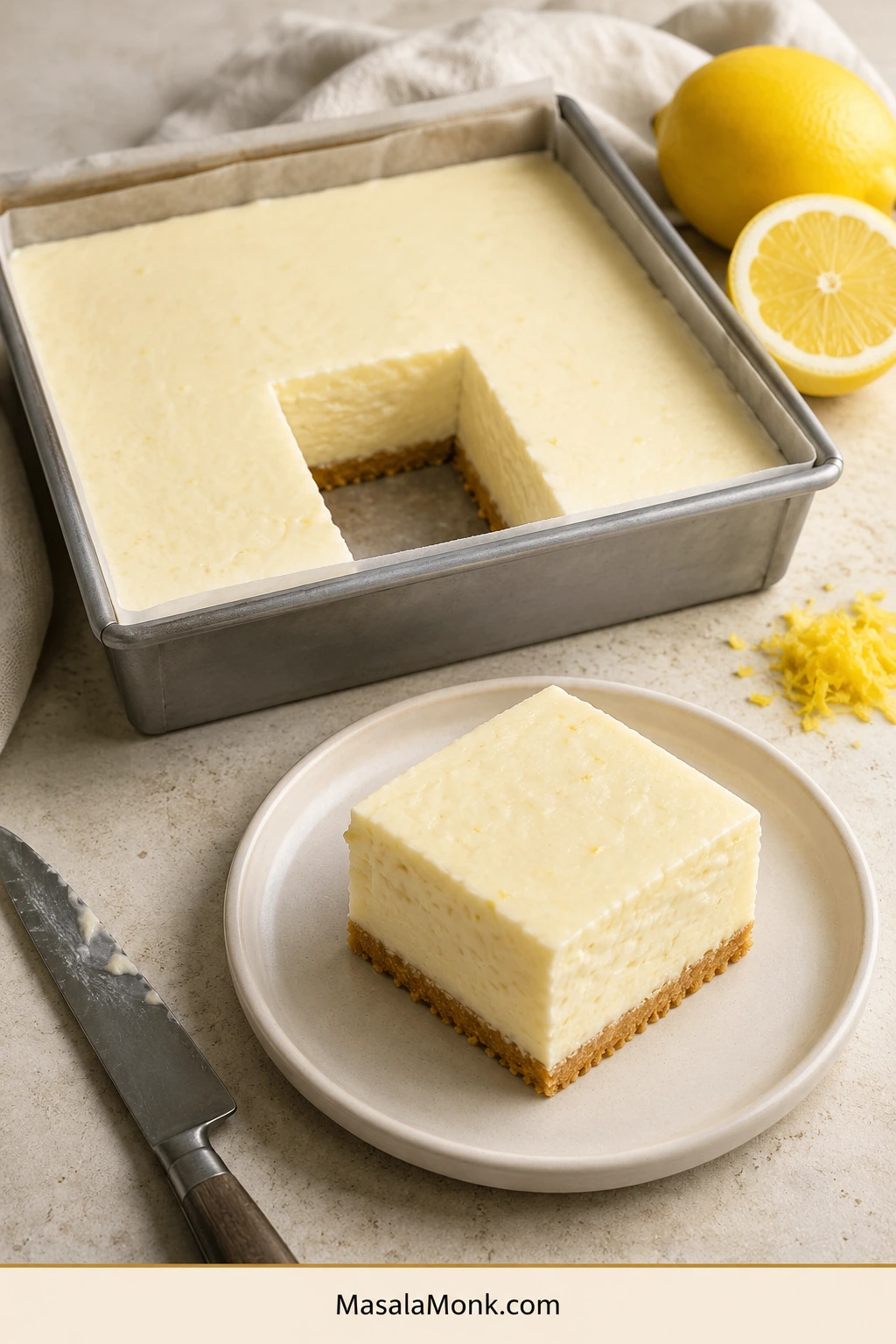
Finished no-bake cheesecake with one slice removed, creamy white filling, golden crumb crust, berries, and lemon zest

A good no bake cheesecake recipe should be creamy, simple, and reliable. It should set properly in the refrigerator, slice cleanly, and taste like real cheesecake instead of sweet cream cheese in a crust.

This version uses a buttery graham cracker or digestive biscuit crust, a smooth cream cheese filling, cold whipped cream for lift, and enough chill time for clean slices. Because the filling is not baked, the recipe depends on the right dairy, the right mixing method, and patience in the refrigerator.

More importantly, this guide shows you how to control the details that usually make or break a no bake cheesecake: which cream cheese to use, how stiff to whip the cream, how long to chill it, when gelatin helps, and what to do if the filling feels too soft.

Why this version works: This no bake cheesecake sets without gelatin, works with graham crackers or digestive biscuits, slices cleanly after an overnight chill, and includes optional fixes for hot weather, condensed milk shortcuts, fruit toppings, and softer cream cheese.

Table of Contents

Use this guide to make the cheesecake first, then troubleshoot, choose toppings, try variations, store it, and serve it confidently.

Quick Answer: How Do You Make No Bake Cheesecake?

No bake cheesecake is made by pressing a graham cracker or digestive biscuit crust into a springform pan, spreading in a cream cheese and whipped cream filling, and chilling it until firm. Since there is no oven involved, this cheesecake recipe depends on full-fat cream cheese, cream whipped to stiff peaks, gentle folding, and at least 6 to 8 hours in the refrigerator.

Think of it this way: the crust chills, the filling firms in the refrigerator, and the oven stays off completely.

In other words, no bake cheesecake does not set like baked cheesecake. It does not use eggs or oven heat. Instead, it sets through the firmness of cream cheese, the structure of whipped cream, and enough time in the refrigerator.

No Bake Cheesecake at a Glance

Before you start, check the pan size, cream type, and chill time. Since this cheesecake sets without baking, these details decide how cleanly it slices.

Detail Best Choice
Pan 9-inch / 23cm springform pan
Crust Graham cracker crust or digestive biscuit crust
Cream cheese Full-fat block-style cream cheese if available
Cream Cold heavy cream or whipping cream that can whip to stiff peaks
Chill time 6 to 8 hours minimum
Best texture Overnight / about 12 hours
Gelatin Optional, not required for the main recipe
Oven Not needed
Eggs Not used
Quick-reference board for no-bake cheesecake with pan size, chill time, no oven, no eggs, and optional gelatin notes
Before mixing, check the pan and chill time; as a result, you will know whether you are making a sliceable cheesecake or a softer cup-style dessert.

Why This No Bake Cheesecake Recipe Works

Because this cheesecake recipe skips baking, each part has a job. The cream cheese gives the filling body, the whipped cream makes it lighter, and the long chill helps everything firm into a sliceable cheesecake.

The crust is also designed to hold. Since the crust chills instead of baking, fine crumbs, melted butter, and brown sugar create a compact base that firms in the refrigerator. As a result, the cheesecake slices cleanly instead of crumbling apart as soon as you lift a piece.

Finally, the recipe keeps the flavor classic. Sour cream or thick Greek yogurt adds tang, lemon juice brightens the filling, vanilla rounds it out, and a small pinch of salt keeps the sweetness from feeling flat.

Best result: Make this cheesecake the day before serving. It may slice after 6 to 8 hours, but the cleanest texture usually comes after an overnight chill.
Texture target: The finished cheesecake should be creamy, cold-set, and sliceable, not rubbery or runny. The slice should hold its shape but still feel soft when you cut through it.
Close-up slice of no-bake cheesecake showing smooth filling, golden crust, berries, lemon zest, and a fork
Use the side of the slice as your texture check; the filling should look smooth and cold-set, while the crust should stay compact underneath.

Ingredients for No Bake Cheesecake

The ingredients matter more in this cheesecake recipe because there is no oven heat to set a loose filling. Therefore, the cream cheese, cream, and crust crumbs need to be chosen carefully.

You can make the crust with graham crackers or digestive biscuits. Graham crackers give a classic American cheesecake flavor, while digestive biscuits are a practical substitute in many places where graham crackers are harder to find.

Ingredients for no-bake cheesecake including cream cheese, whipping cream, powdered sugar, lemon, vanilla, butter, graham crackers, and digestive biscuits
Because this filling is not baked, the ingredient texture matters: thick cream cheese, cold cream, and powdered sugar give the cheesecake a smoother set.

For the Crust

Graham Cracker Crust

  • 2 cups / 240g graham cracker crumbs
  • 1/3 cup / 67g brown sugar
  • 1/2 cup / 113g unsalted butter, melted
  • Pinch of salt, optional

Digestive Biscuit Crust

  • 270g digestive biscuit crumbs
  • 40 to 70g brown sugar, depending on biscuit sweetness
  • 1/2 cup / 113g unsalted butter, melted
  • Pinch of salt, optional

For the Filling

  • 1 1/4 cups / 300ml cold heavy cream or whipping cream
  • 24 oz / 678g full-fat cream cheese, softened
  • 3/4 to 1 cup / 90–120g powdered sugar or icing sugar, to taste
  • 1/4 cup / 60g sour cream or thick Greek yogurt
  • 2 teaspoons fresh lemon juice
  • 1 teaspoon vanilla extract
  • Pinch of salt, optional

Graham Cracker Crust or Digestive Biscuit Crust?

Use graham crackers if you want the classic cheesecake crust flavor. However, digestive biscuits work well when they are easier to find. Both can hold the filling as long as the crumbs are fine, the butter is evenly mixed, and the crust is chilled before filling.

Because digestive biscuits vary more in sweetness and texture, adjust the sugar slightly. If your biscuits are already quite sweet, use the lower amount of brown sugar.

Graham cracker crumbs and digestive biscuit crumbs compared for a no-bake cheesecake crust
Graham crackers give the familiar American-style crust; however, digestive biscuits can create the same firm base when the crumbs are fine and evenly buttered.

If you like chilled desserts with a biscuit base, you may also like this Banoffee Pie Recipe, which uses a similar no bake base-and-chill idea with bananas, caramel, and whipped cream.

How the Crust Mixture Should Feel

Before pressing the crust into the pan, squeeze a small handful of the crumb mixture. It should feel like damp sand and hold together when pinched.

Crust Texture What It Means Fix
Too dry Crumbs scatter and will not hold when squeezed. Add 1 tablespoon melted butter at a time, then test again.
Just right Mixture feels like damp sand and holds together when pinched. Press firmly into the pan and chill before filling.
Too wet Mixture feels greasy, heavy, or paste-like. Add more crumbs until the texture loosens and no butter pools.
Three cheesecake crust mixtures showing too dry, just right, and too wet crumb textures
The crumb mixture should clump like damp sand; if it scatters, add butter, but if it looks greasy, balance it with more crumbs.

Important Ingredient Notes

  • Cream cheese: Full-fat block-style cream cheese is best because it firms well when chilled. Spreadable cream cheese can be softer and may make the filling looser.
  • Cream: Use cold cream that can whip to stiff peaks. Otherwise, the filling has no eggs or oven heat to help it set later.
  • Sugar: Powdered sugar or icing sugar dissolves smoothly and helps the filling stay creamy. Use 90g for a lighter, tangier cheesecake or 120g for a sweeter dessert-style cheesecake.
  • Sour cream or Greek yogurt: Use thick, full-fat versions. Thin yogurt can loosen the filling.
  • Lemon juice: This is for brightness and balance, not a strong lemon flavor.
Ingredient note for non-US kitchens: If block-style cream cheese is not available, use the thickest full-fat cream cheese you can find and avoid very soft spreadable versions when possible. If your cream cheese is loose, chill the filling longer or use the optional gelatin method for extra stability. Use whipping cream that can hold stiff peaks; low-fat fresh cream or table cream may not set the cheesecake properly. If using yogurt, choose thick Greek yogurt or hung curd, not thin regular curd.
Cream cheese comparison showing thick full-fat cream cheese, softer spreadable cream cheese, and loose cream cheese
Choose the thickest full-fat cream cheese you can find, since softer tubs can make a no-bake cheesecake filling harder to firm up.

Equipment You Need

You do not need complicated equipment for this cheesecake recipe. However, a springform pan and mixer make the texture much easier to control because the filling sets in the refrigerator rather than the oven.

  • 9-inch / 23cm springform pan
  • Electric hand mixer or stand mixer
  • Mixing bowls
  • Spatula
  • Food processor or rolling pin for crushing crumbs
  • Flat-bottom measuring cup or glass for pressing the crust
  • Offset spatula or back of a spoon for smoothing the filling
  • Sharp knife for slicing

A springform pan makes the cleanest cheesecake because the sides release easily. If you do not have one, you can use a deep pie dish, but the slices will be harder to remove neatly.

How to Make No Bake Cheesecake

The method is simple: make the crust, whip the cream, beat the cream cheese, fold, fill, and chill. Since this cheesecake sets in the refrigerator, the final texture depends on proper mixing and enough cold time.

Step-by-step guide showing crust, whipped cream, cream cheese, folding, filling, chilling, and slicing
The sequence matters: prepare the crust first, build the filling gently, and then let the refrigerator do the setting work.

Step 1: Make the Crust

First, crush the graham crackers or digestive biscuits into fine crumbs. Then mix the crumbs with brown sugar, salt if using, and melted butter until the mixture looks like damp sand.

Next, tip the mixture into a 9-inch springform pan. Press it firmly into the base and slightly up the sides. A flat-bottom measuring cup helps you compact the crust evenly without using too much pressure.

After that, refrigerate or freeze the crust while you make the filling. This helps the butter firm up and gives the base a better hold.

Step 2: Whip the Cream

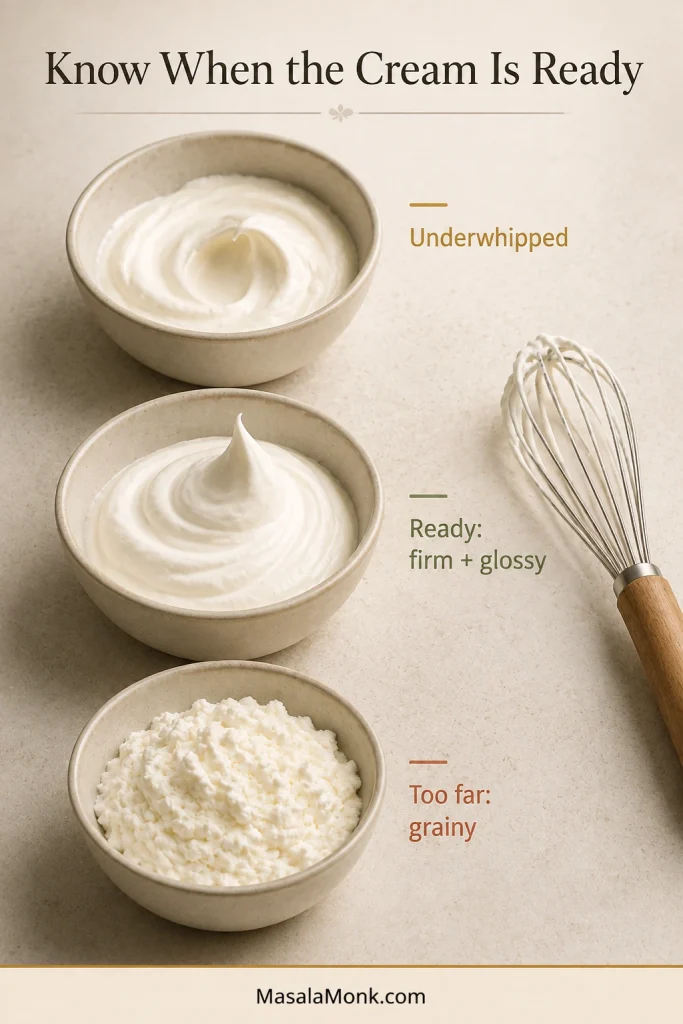
Add the cold heavy cream or whipping cream to a chilled mixing bowl. Then beat until stiff peaks form. The cream should hold its shape when you lift the beaters.

Do not stop at soft peaks. Since the filling is not baked, stiff whipped cream is one of the main things that helps it hold its shape.

Mixer beaters lifting whipped cream into stiff peaks in a bowl
Stiff peaks should stand tall on the beaters; otherwise, the whipped cream will add lightness but not enough structure.

Step 3: Beat the Cream Cheese

Meanwhile, beat the softened cream cheese in a separate bowl until smooth and creamy. Add the powdered sugar, sour cream or Greek yogurt, lemon juice, vanilla, and salt. Then beat until smooth.

If the cream cheese is too cold, the filling may become lumpy. If it is too warm, the filling can become loose. Therefore, softened but still cool cream cheese is ideal.

Cream cheese mixture being beaten smooth with powdered sugar, lemon, vanilla, and dairy ingredients nearby
Beat the cream cheese base until it is smooth first; once whipped cream is folded in, small lumps are much harder to remove.

Step 4: Fold the Filling

Add the whipped cream to the cream cheese mixture in two additions. Then fold gently with a spatula until no large streaks remain.

Avoid beating aggressively at this stage. Instead, keep the air in the whipped cream because that air helps the cheesecake feel light while still setting properly.

Thick cheesecake filling being folded with a spatula in a glass mixing bowl
Fold slowly instead of beating hard, so the filling keeps its air while the cream cheese still gives it enough body.

Step 5: Fill the Crust

Spoon the filling into the chilled crust. Next, smooth the top with an offset spatula or the back of a spoon. Tap the pan very gently on the counter once or twice to remove large air pockets, but do not overdo it.

Thick cheesecake filling spread into a golden crumb crust in a springform pan with an offset spatula
When the filling goes into the crust, it should mound and spread rather than pour; that thickness is a good sign before chilling.

Step 6: Chill Until Set

Cover the cheesecake loosely and refrigerate for at least 6 to 8 hours. The filling needs a long chill because it sets without eggs or oven heat. For the cleanest slices, chill it overnight.

Also, do not rely on the freezer as the only setting method. Freezing can make the cheesecake firm temporarily, but the best texture comes from a proper refrigerator chill.

Step 7: Slice and Serve

Once chilled, run a thin knife around the edge of the cheesecake before releasing the springform ring. For clean slices, dip a sharp knife in hot water, wipe it dry, cut one slice, and then wipe the knife again before the next cut.

Finally, serve the cheesecake cold. It can sit out briefly while serving, but it should not be left at room temperature for long, especially in warm weather.

Final serving scene with a full no-bake cheesecake, a plated slice, berries, lemon zest, and a fork
Once the cheesecake has fully chilled, serve it cold so the filling stays creamy, the crust holds neatly, and each slice looks polished.

No Bake Cheesecake Recipe

This creamy no bake cheesecake recipe uses a graham cracker or digestive biscuit crust, full-fat cream cheese, whipped cream, and a 6 to 8 hour refrigerator chill, preferably overnight, for clean, sliceable pieces without an oven or eggs.

Yield10–12 slices
Prep Time30 minutes
Cook Time0 minutes
Chill Time6–8 hours
Total Time6 hours 30 minutes to overnight
Pan9-inch / 23cm springform
Best TextureOvernight chill
MethodNo oven, no eggs

Ingredients

For a Graham Cracker Crust

  • 2 cups / 240g graham cracker crumbs
  • 1/3 cup / 67g brown sugar
  • 1/2 cup / 113g unsalted butter, melted
  • Pinch of salt, optional

Or, for a Digestive Biscuit Crust

  • 270g digestive biscuit crumbs
  • 40 to 70g brown sugar, depending on sweetness
  • 1/2 cup / 113g unsalted butter, melted
  • Pinch of salt, optional

For the Filling

  • 1 1/4 cups / 300ml cold heavy cream or whipping cream
  • 24 oz / 678g full-fat cream cheese, softened
  • 3/4 to 1 cup / 90–120g powdered sugar or icing sugar, to taste
  • 1/4 cup / 60g sour cream or thick Greek yogurt
  • 2 teaspoons fresh lemon juice
  • 1 teaspoon vanilla extract
  • Pinch of salt, optional

Instructions

  1. Make the crust. Mix the crumbs, brown sugar, melted butter, and salt until evenly moistened.
  2. Press into the pan. Press the mixture firmly into the base of a 9-inch springform pan and slightly up the sides. Then chill or freeze while you make the filling.
  3. Whip the cream. Beat the cold cream until stiff peaks form. Set aside.
  4. Beat the cream cheese. In another bowl, beat softened cream cheese until smooth. Add powdered sugar, sour cream or Greek yogurt, lemon juice, vanilla, and salt. Beat until creamy.
  5. Fold gently. Fold the whipped cream into the cream cheese mixture in two additions. Stop once combined.
  6. Fill the crust. Spoon the filling into the chilled crust and smooth the top.
  7. Chill. Cover and refrigerate for at least 6 to 8 hours, preferably overnight.
  8. Slice. Release the springform ring, then slice with a hot, wiped knife for clean pieces.

Notes

  • Use full-fat cream cheese for the best set.
  • Use 90g powdered sugar for a lighter, tangier cheesecake or 120g for a sweeter dessert-style cheesecake.
  • Do not use low-fat cream or cream that cannot whip to stiff peaks.
  • For best results, chill the cheesecake overnight because the filling needs time to firm without baking.
  • For a firmer party cheesecake, see the gelatin option below.
  • For cheesecake cups or jars, the same filling can be chilled for a shorter time because it does not need to slice cleanly.
Saveable no-bake cheesecake recipe card with yield, prep time, chill time, ingredients, and method steps
Use the recipe card for the quick method, then rely on the texture cues for the crust, filling, and chill time as you work.

What Makes No Bake Cheesecake Set?

A cheesecake recipe without baking sets through chilled dairy and structure, not through eggs or oven heat. Since there are no eggs and no oven heat to firm the filling, you need the right ingredients and enough chill time.

For another tested baking reference, King Arthur Baking’s no bake cheesecake also uses cream cheese, sour cream, cold heavy cream, and confectioners’ sugar for a creamy refrigerator-set filling.

Use Full-Fat Cream Cheese

Cream cheese is the backbone of the filling. Full-fat cream cheese firms in the refrigerator and gives the cheesecake its body. Spreadable or tub-style cream cheese may work in some cases, but it is often softer and can make the filling less stable.

Whip Cold Cream to Stiff Peaks

Cold cream whips better and holds more structure. Stiff peaks mean the cream stands up when you lift the beaters. If the cream is only softly whipped, the cheesecake may taste good but slice poorly.

Fold Gently

Once the cream is whipped, fold it into the cream cheese mixture with a spatula. Beating too hard can knock out the air and make the filling heavier or looser.

Chill Long Enough

The refrigerator does the final work. First, the crust firms. Then the cream cheese tightens. Finally, the filling becomes sliceable. A short chill may work for cups or jars, but a full cheesecake needs more time.

Freezing Is Not the Same as Setting

The freezer can make a soft cheesecake feel firm quickly, but that firmness is temporary. Once the cheesecake thaws, a poorly set filling may soften again. For the best texture, chill the cheesecake properly in the refrigerator and use the freezer only for storage or brief firming before serving.

Setting guide showing cream cheese, stiff whipped cream, long chill time, and a clean no-bake cheesecake slice
No-bake cheesecake sets through thickness, trapped air, and cold time; therefore, cream cheese, whipped cream, and chilling all have to work together.

How Long Does No Bake Cheesecake Need to Chill?

For this cheesecake recipe, skipping the oven does not mean skipping the wait. The filling still needs at least 6 to 8 hours in the refrigerator, and overnight is better if you want neat slices for serving.

Chill Time Result
2–3 hours Usually too soft for clean slices
4 hours May work for cups or jars, but often soft for a full cheesecake
6–8 hours Sliceable for most cheesecakes
Overnight / about 12 hours Best clean slices and firmest creamy texture
Freezer only Temporary firmness, not a substitute for proper setting
No-bake cheesecake chill time guide showing soft, cup-ready, sliceable, and overnight stages
A short chill is fine for jars, while a full cheesecake needs more time because the whole filling must firm from edge to center.

How to Cut Clean Slices

For clean slices, chill the cheesecake overnight and serve it cold. Then run a thin knife around the edge before releasing the springform ring.

Next, dip a sharp knife in hot water, wipe it dry, and cut one slice at a time. Wipe the knife between slices. This small step makes a big difference, especially with a creamy no bake cheesecake filling.

Clean slice of no-bake cheesecake being cut with a knife, showing smooth filling, berries, and crumb crust
After the cheesecake is fully cold, a warm wiped knife helps each piece release neatly instead of dragging cream through the cut.

No Bake Cheesecake Filling

If you only need the filling from this cheesecake recipe, no bake cups, jars, parfaits, pie crusts, cake layers, cupcakes, and simple chilled desserts are all good options. However, the texture you need depends on how you plan to serve it.

Cheesecake filling used in cups, jars, cake layers, cupcakes, pie crust, and parfaits
The same no-bake cheesecake filling can become jars, cupcakes, parfaits, or cake layers; however, each use needs a slightly different firmness.

For a Whole Cheesecake

Use the recipe as written. A whole cheesecake needs enough structure to slice, so do not reduce the cream cheese or shorten the chill time too much.

For Cheesecake Cups or Jars

The same filling works well in small cups or jars. Because you are not slicing it, the chill time can be shorter. Plan on at least 2 to 4 hours, depending on the size of the cups.

For Cake Filling or Piping

For cake layers or piping, the filling should be thicker. Therefore, use full-fat cream cheese, whip the cream to stiff peaks, reduce loose ingredients like sour cream or yogurt slightly, and chill the filling before using it. Powdered sugar also helps the filling feel smoother.

How to Make Cheesecake Filling Thicker

  • Use full-fat cream cheese.
  • Whip the cream separately to stiff peaks.
  • Chill the filling before piping or spreading.
  • Avoid watery fruit puree in the filling.
  • Reduce sour cream or yogurt slightly if needed.
  • Use the gelatin option if you need extra stability.
Cheesecake filling texture guide showing loose, thicker, and pipeable stages with fixing tips
For piping or layer cakes, aim for the pipeable stage rather than the spoonable stage, and chill the filling before using it.

Best Toppings for No Bake Cheesecake

The safest way to flavor a no bake cheesecake is to keep the filling stable and add most of the fruit, compote, curd, or sauce on top. That way, the cheesecake still slices cleanly, while the topping adds color, freshness, and extra flavor.

Topping guide with strawberry, blueberry, mango, lemon curd, ganache, and salted caramel for no-bake cheesecake
Toppings are the safest place to add bold flavor, because fruit, curd, ganache, and caramel can sit on top without loosening the filling.

If using a cooked fruit topping, cool it completely before spooning it over the cheesecake. Warm topping can soften the filling and make the surface loose.

Cooked berry topping cooling beside a no-bake cheesecake before being spooned on top
Let cooked fruit topping cool completely first; otherwise, even a well-set cheesecake can soften where the warm sauce touches it.
Topping Best Use
Strawberry topping Best classic fruit topping; use thick cooked sauce or fresh berries added close to serving.
Blueberry topping Works well as a cooked compote because it stays glossy and spoonable without making the filling loose.
Mango topping Use thick mango puree, mango compote, or diced mango. Avoid thin puree unless it is reduced or stabilized.
Lemon curd Best for a sharper lemon cheesecake flavor without adding too much juice to the filling.
Chocolate ganache Best when you want a richer dessert-style cheesecake. Let the ganache cool slightly before spreading.
Caramel sauce Use lightly because the cheesecake is already sweet. Salted caramel usually balances better.

No Bake Cheesecake Variations

Once the classic version makes sense, the variations become much easier. You can keep the same basic cheesecake and adjust it for fewer ingredients, a sweeter shortcut, a firmer slice, or a brighter lemon flavor.

Four no-bake cheesecake variations showing classic, 3-ingredient, condensed milk, and lemon versions
Start with the classic version to learn the texture, then use the variations when you want a shortcut, a sweeter filling, or brighter lemon flavor.

3 Ingredient No Bake Cheesecake

A 3 ingredient cheesecake recipe can also be no bake, but it usually trades some flavor balance and slice quality for speed. Most versions use cream cheese, sweetened condensed milk, and either whipped cream or lemon juice.

Use this shortcut when speed matters more than perfect texture. However, use the main recipe when you want a more balanced cheesecake flavor, a lighter filling, and cleaner slices.

Simple 3 ingredient formula:

  • 16 oz / 450g cream cheese, softened
  • 14 oz / 397g sweetened condensed milk
  • 3/4 cup / 180ml cold heavy cream, whipped to stiff peaks
Three-ingredient no-bake cheesecake guide showing cream cheese, condensed milk, whipped cream, and a finished jar dessert
A 3-ingredient no-bake cheesecake is useful when speed matters; however, it is usually sweeter and softer than the full classic recipe.

Optional additions like vanilla or lemon juice make the flavor better, even if they technically take it beyond three ingredients.

No Bake Cheesecake with Condensed Milk

Condensed milk makes no bake cheesecake sweeter, creamier, and easier to mix. It is a useful shortcut, but it gives a different texture from the classic whipped cream version.

If you want to compare a classic condensed milk method, Martha Stewart’s no bake cheesecake uses cream cheese, sweetened condensed milk, vanilla, and lemon in a press-in graham cracker crust.

For a condensed milk version, use:

  • 16 oz / 450g cream cheese, softened
  • 14 oz / 397g sweetened condensed milk
  • 2 to 4 tablespoons fresh lemon juice
  • 1 teaspoon vanilla extract
  • Prepared crust of choice
Condensed milk being poured into cream cheese mixture for no-bake cheesecake with lemon and vanilla nearby
Condensed milk creates a creamy shortcut filling, but lemon and proper chilling are still important to balance sweetness and improve the set.

Lemon juice is not only for flavor here. It balances the sweetness and helps the filling thicken. For cleaner slices, chill a condensed milk cheesecake overnight.

Gelatin vs No Gelatin in No Bake Cheesecake

This main recipe does not require gelatin. A no-gelatin cheesecake is creamy, simple, and easier for most home cooks. However, optional gelatin can help if you want very firm slices, need the cheesecake to sit out a little longer, or are serving it in warm weather.

Still, gelatin should be optional, not the default, because the main recipe is designed to set cleanly with full-fat cream cheese, stiff whipped cream, and enough refrigerator time.

As written, the main recipe is eggless and gelatin-free. If you add gelatin, it will no longer be suitable for readers avoiding animal-derived gelatin unless you use a tested vegetarian setting method. Agar-agar behaves differently from gelatin, so do not swap it 1:1 without following a tested agar method.

Optional gelatin method:

  • Use 2 teaspoons unflavored gelatin.
  • Sprinkle it over 2 tablespoons cold water.
  • Let it bloom for 5 minutes.
  • Warm gently until dissolved.
  • Let it cool slightly, then mix it into the cream cheese base before folding in the whipped cream.

Do not add hot gelatin to cold filling, and do not sprinkle dry gelatin directly into the cheesecake mixture. Both can cause clumps.

Two no-bake cheesecake slices compared side by side with labels for no gelatin, optional gelatin, chill time, and firmness
The main no-gelatin cheesecake stays creamy after a long chill, while optional gelatin is better when you need extra hold for heat or travel.

No Bake Lemon Cheesecake Variation

For a lemon no bake cheesecake, add the zest of 1 to 2 lemons and increase the lemon juice to 2 to 3 tablespoons. If the filling feels loose, reduce the sour cream or Greek yogurt slightly.

For stronger lemon flavor without weakening the filling, use lemon curd as a topping. Too much lemon juice inside the filling can make the cheesecake softer, so zest and topping are safer ways to build flavor.

No-bake lemon cheesecake slice with glossy lemon topping, lemon zest, mint, and golden crumb crust
Lemon curd gives stronger citrus flavor than extra lemon juice, so the cheesecake tastes brighter without making the filling too loose.
Fruit tip: For the safest set, add fruit as a topping after the cheesecake has chilled. Watery fruit puree mixed directly into the filling can make a no bake cheesecake soft unless the puree is reduced, thickened, or stabilized.

For a thicker cooked fruit topping idea, see this Apple Pie Filling Recipe. The same principle applies here: thick fruit works better than watery fruit.

More Easy Variations

Variation Best Approach
Berry no bake cheesecake Add berry topping after chilling instead of mixing watery puree into the filling. For a fruit cheesecake example, see this No-Bake Blueberry Cheesecake.
Mango no bake cheesecake Use a thick mango topping or swirl. Avoid thin puree unless it is reduced or stabilized.
Chocolate no bake cheesecake Fold in cooled melted chocolate or use a chocolate cookie crust.
Cheesecake cups Spoon crust and filling into cups or jars, then chill until set.
Cheesecake bars Use a square pan, line it with parchment, and chill overnight before slicing.
Mini no bake cheesecakes Use a muffin tin with liners and chill until firm.

For another easy no-oven dessert with a soft, chilled set, try this No-Bake Banana Pudding.

Why Your No Bake Cheesecake Didn’t Set

The Most Common Setting Problems

If your no bake cheesecake did not set, the problem is usually one of four things: soft cream cheese, under-whipped cream, too much liquid, or not enough chill time. Fortunately, most issues are easy to understand and prevent next time.

If the filling feels loose, remember that there is no baking step to firm extra liquid later. Therefore, ingredient thickness, whipped cream structure, and enough chilling matter more than they would in a baked dessert.

Troubleshooting board showing soft cream cheese, under-whipped cream, too much liquid, and not enough chill time
When a no-bake cheesecake will not set, check the structure points first: cream cheese thickness, whipped cream peaks, liquid level, and chill time.

Quick Fixes for Texture, Crust, and Slicing Issues

Problem Likely Reason What to Do
Filling is runny Cream was not whipped to stiff peaks, or too much liquid was added. Chill longer. Next time, whip the cream separately and avoid loose yogurt or watery fruit puree.
Cheesecake is soft after chilling It did not chill long enough. Refrigerate overnight. No bake cheesecake needs time to firm properly.
Filling is lumpy Cream cheese was too cold. Use softened cream cheese and beat it smooth before adding the other ingredients.
Slice collapses Cheesecake is under-set or too warm. Chill longer and serve cold. Also, use a hot, wiped knife for cutting.
Crust falls apart Crumbs were too coarse or not packed firmly enough. Use fine crumbs and press the crust firmly with a flat-bottom cup.
Crust is greasy Too much butter for the crumb type. Add more crumbs next time or reduce the butter slightly if using very buttery biscuits.
Filling tastes too sweet Condensed milk, sweet toppings, or too much sugar. Add lemon, salt, or use the classic recipe instead of a condensed milk version.
Fruit made the filling loose Watery puree was mixed directly into the filling. Use fruit as a topping or reduce puree before adding it.
Too soft in hot weather No stabilizer and a warm serving environment. Use the optional gelatin method and keep the cheesecake cold until serving.
Troubleshooting guide with runny filling, lumpy filling, crumbly crust, greasy crust, soft slice, and hot-weather softness
Most problems point back to one of three things: ingredient texture, mixing method, or temperature control during chilling and serving.

When to Serve It in Cups Instead

If the cheesecake tastes good but will not slice cleanly, do not waste it. Spoon the filling into cups or jars, add crumbs and topping, and serve it as a no bake cheesecake dessert instead. It will still taste good, even if it is too soft for neat slices.

No-bake cheesecake cups and jars with crumb layers, creamy filling, berries, lemon zest, and spoons
Cups and jars are a smart option when you want easier serving, smaller portions, or a softer cheesecake filling that does not need to slice.

Storage and Freezing

This cheesecake recipe stores well because the no bake filling improves after a long refrigerator chill. As a result, it is a strong make-ahead dessert for parties, holidays, and warm-weather meals.

Refrigerator

Store no bake cheesecake covered in the refrigerator for 4 to 5 days. However, the texture is usually best during the first 2 to 3 days, while the crust is still firm and the filling tastes fresh.

Freezer

You can freeze no bake cheesecake whole or in slices. First, chill it until firm. Then wrap it tightly and freeze for up to 2 months. Finally, thaw overnight in the refrigerator before serving.

Serving

Serve no bake cheesecake cold. In warm weather, keep it refrigerated until close to serving time. If the cheesecake needs to sit out for a party, the optional gelatin version will hold more firmly than the no-gelatin version.

For outdoor serving, summer parties, or very warm kitchens, keep the cheesecake chilled until the last possible moment. If it needs to sit out longer, use the optional gelatin method or serve the filling in cups instead of slicing a full cheesecake.

Storage guide showing covered cheesecake in the refrigerator, frozen slices, wrapped slices, and thawed cheesecake
Store the cheesecake cold and covered; for longer keeping, wrap individual slices well and freeze them as make-ahead portions.

No Bake Cheesecake vs Baked Cheesecake

No bake cheesecake and baked cheesecake are both creamy desserts, but they set in different ways. Instead of eggs and oven heat, this refrigerator version firms with cream cheese, whipped cream, and chill time. By contrast, baked cheesecake usually relies on eggs and a low oven to set the filling.

No Bake Cheesecake Baked Cheesecake
No oven needed Uses oven heat
No eggs in this recipe Usually made with eggs
Sets in the refrigerator Sets while baking and then chilling
Lighter, creamier texture Denser, richer texture
Beginner-friendly More technical
No-bake cheesecake and baked cheesecake slices compared, showing chilled creamy texture and denser oven-set texture
No-bake cheesecake is chilled and creamy, while baked cheesecake is denser and oven-set; therefore, they need different methods and expectations.

Do not bake this no bake cheesecake filling. It is designed to set in the refrigerator, not in the oven.

If you are working with baked pies instead of refrigerator desserts, this Apple Pie Crust Recipe explains how a baked crust behaves differently from a no bake crumb crust.

FAQs

What makes this cheesecake recipe reliable without baking?

This cheesecake recipe works without baking because it uses full-fat cream cheese, whipped cream, a firm crumb crust, and enough refrigerator time to set cleanly.

Is this no bake cheesecake eggless?

It is eggless because the filling sets in the refrigerator instead of baking with eggs. The main recipe is also gelatin-free, so it works well for readers who want a creamy cheesecake without eggs or gelatin.

How does no bake cheesecake set without gelatin?

Full-fat cream cheese, stiff whipped cream, and enough refrigerator time give the filling structure. Gelatin is optional for a firmer slice or extra stability in warm weather, but it is not required for the main recipe.

Why did my no bake cheesecake not set?

The most common reasons are under-whipped cream, soft or spreadable cream cheese, too much liquid, watery fruit puree, or not enough chill time. Therefore, chill it overnight if it feels soft, and next time use full-fat cream cheese and cream whipped to stiff peaks.

How long does no bake cheesecake need to chill?

It needs at least 6 to 8 hours in the refrigerator. Overnight, or about 12 hours, gives the cleanest slices and best texture.

What can I use instead of graham crackers?

Digestive biscuits work well for a no bake cheesecake crust. Use about 270g digestive biscuit crumbs with 113g melted butter and 40 to 70g brown sugar, depending on how sweet the biscuits are.

Which cream works best for no bake cheesecake?

Cold heavy cream or whipping cream that can hold stiff peaks works best. Very low-fat cream will not give the same structure and may make the filling too soft.

Is whipped topping okay here?

Whipped topping works as a shortcut, but the filling will taste sweeter, lighter, and less classic than a version made with freshly whipped cream. For the best cheesecake flavor and a cleaner slice, use cold cream whipped to stiff peaks.

How does condensed milk change no bake cheesecake?

Condensed milk makes the filling sweeter, creamier, and easier to mix. It is useful for shortcut versions, but the classic recipe gives a more balanced flavor and usually slices more cleanly.

What is the best way to freeze no bake cheesecake?

First, chill the cheesecake until firm. Then wrap it tightly and freeze it whole or in slices for up to 2 months. Thaw overnight in the refrigerator before serving.

How should I use only the cheesecake filling?

The filling works in cups, jars, parfaits, cake layers, cupcakes, or pie crusts. For piping or cake filling, keep it thick, cold, and stable by using full-fat cream cheese and stiff whipped cream.

How do I get clean slices?

Chill the cheesecake overnight, serve it cold, and use a sharp knife dipped in hot water and wiped dry between cuts.

Once you understand the setting logic, no bake cheesecake becomes much easier to control. Keep the cream cheese full-fat, whip the cream properly, give the cheesecake enough time in the refrigerator, and use the troubleshooting table whenever the texture needs adjusting.

Posted on 2 Comments

Banoffee Pie Recipe

Whole Banoffee Pie with a clean slice showing biscuit base, caramel, bananas, whipped cream, and chocolate shavings.

A good banoffee pie recipe should give you everything people love about this classic dessert: a buttery biscuit base, thick caramel, fresh bananas, cool whipped cream, and slices that actually hold together. This version keeps the method easy and mostly no-bake, while giving you the texture tips you need to avoid a runny, messy pie.

Even better, this is a no-bake Banoffee pie unless you choose to bake the crust for a firmer slice. So, if you love chilled banana desserts like no-bake banana pudding, this is the richer banana-toffee version: less spoonable pudding, more dramatic layered dessert.

This recipe for banoffee pie is especially useful if you want the classic flavor but do not want to guess your way through the caramel, crust, bananas, or cream. The trick is getting each layer to behave before the next one goes on: firm base, thick caramel, fresh bananas, and stable cream.

Done well, Banoffee Pie tastes like cold caramel cream, fresh banana, and buttery biscuit in one forkful. Done badly, it can slide apart before it reaches the plate. This version is built to give you the first result, not the second.

Although the layers look impressive, the actual work is simple: crush, press, spread, slice, whip, and chill.

It is the kind of dessert that looks like you worked harder than you did, which makes it especially useful for parties, family dinners, birthdays, and make-ahead dessert tables.

Clean slice of Banoffee Pie on a plate with visible biscuit base, caramel, banana layer, and whipped cream.
Because the caramel is thick and the pie is properly chilled, the slice stays creamy and generous without collapsing on the plate.

Banoffee Pie at a Glance

Best pan9-inch / 23cm pie dish or tart tin
BaseDigestives, graham crackers, or Marie biscuits
CaramelThick dulce de leche or thick caramel
Chill time2 1/2 hours minimum, 4 hours best

This recipe keeps banoffee pie simple: a biscuit base, thick caramel, firm bananas, and whipped cream. For the cleanest slices, use thick caramel, chill the base first, and add the bananas close to serving.

Banoffee Pie at-a-glance guide showing pan size, thick caramel, firm bananas, and 2 to 4 hour chill time.
If you want the quick version, remember this: a 9-inch pan, thick caramel, firm bananas, and a 2–4 hour chill make this no-bake Banoffee Pie much easier to slice.

Quick Answer: What Is Banoffee Pie?

Banoffee Pie is a banana-and-toffee dessert made with a base, a thick caramel or toffee layer, sliced bananas, and whipped cream. Most modern versions use a biscuit base, although older versions may use pastry. The name comes from banana and toffee, which is why you may also see it written as Banoffi Pie.

The classic flavor is simple but powerful: buttery base, deep caramel, fresh banana, cool cream, and a little chocolate or cocoa on top. Since the dessert is chilled and layered, it feels impressive without needing a complicated baking method. Better still, each part can be prepared calmly, so the recipe is much easier than it looks.

If you enjoy the story behind classic desserts, the original Banoffi pie story is a lovely read because it comes from Ian Dowding, one of the people associated with the dessert’s creation.

Is Banoffee Pie the Same as Banoffee Pudding?

Banoffee Pie is the classic name, but you may also see people search for Banoffee pudding or Banoffee dessert because the dish is chilled, creamy, and layered. In British usage, “pudding” can also mean dessert in a general sense. For most home cooks, though, a Banoffee pudding recipe usually points to the same banana-toffee idea: a base, caramel, bananas, and cream.

Why This Banoffee Pie Works

This banoffee pie works because the recipe solves the problems that usually make the dessert disappointing: a crumbly base, loose caramel, browning bananas, soft cream, and messy slices. Each layer has a job, and the method keeps those layers distinct.

  • The base is sturdy but not greasy. A balanced biscuit-to-butter ratio gives the pie enough structure without making the crust heavy.
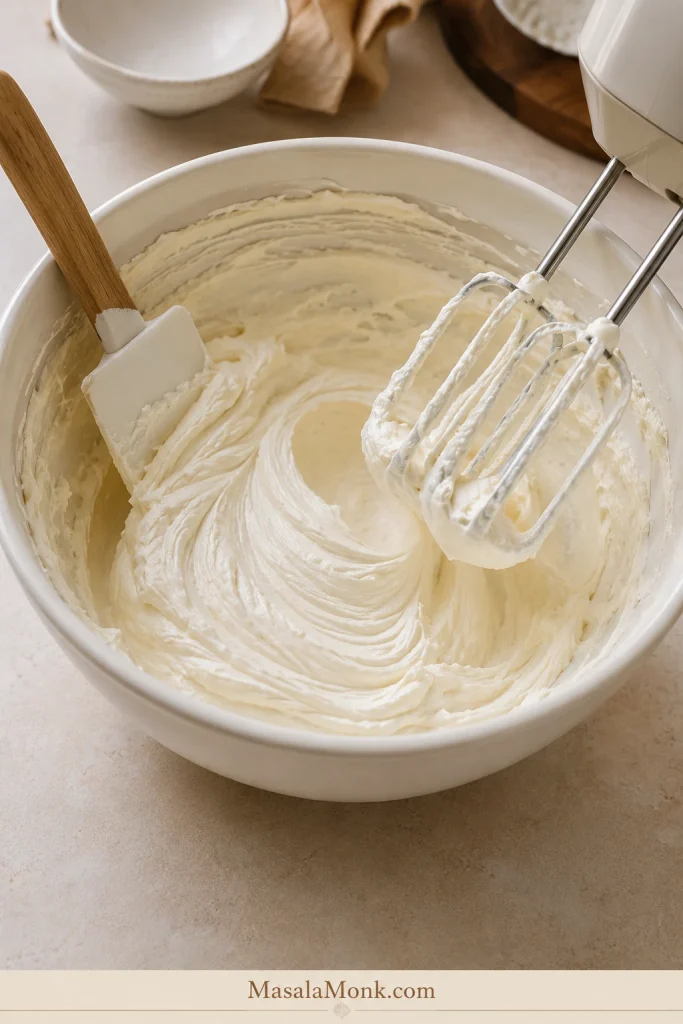
  • The caramel layer is thick. Dulce de leche, thick caramel, or homemade condensed milk toffee holds much better than thin caramel sauce.
  • The bananas stay fresh. Firm ripe bananas slice cleanly and release less liquid than overripe bananas.
  • The cream is whipped to the right stage. Medium or medium-firm peaks hold better than loose cream but still taste soft and fresh.
  • The chilling plan is practical. First, you chill the base. After that, you chill the finished pie so it cuts neatly.

Most importantly, this recipe is less about difficult technique and more about timing. Once the base is cold, the caramel is thick, and the cream is properly whipped, you get a pie that tastes rich and homemade but still holds together when you cut it.

Banoffee Pie Ingredients

The ingredients are simple, but this recipe for banoffee pie depends on a few small choices: biscuit texture, caramel thickness, banana ripeness, and cold cream all matter.

Banoffee Pie ingredients including biscuits, butter, caramel, bananas, cream, icing sugar, vanilla, and chocolate.
The ingredients look simple, but each one has a job: biscuits build structure, caramel gives body, bananas add freshness, and whipped cream keeps the dessert light.

For example, a thin caramel sauce may taste good, but it will not hold like thick dulce de leche or cooked condensed milk toffee. Similarly, very soft bananas may be sweet, yet they can make the filling wet and unstable.

What to Use in the US, UK, and India

Banoffee Pie travels well across kitchens, but ingredient names change from country to country. Use this quick guide before you shop.

Layer US Option UK Option Common India Option
Base Graham crackers Digestive biscuits Digestive biscuits or Marie biscuits
Caramel Dulce de leche Thick caramel or dulce de leche Dulce de leche, milk caramel, or condensed milk toffee
Cream Heavy cream Double cream or whipping cream Whipping cream; avoid low-fat table cream unless it whips reliably
Pan 9-inch pie dish 23cm loose-bottom tart tin 8–9 inch tart tin or springform pan
Ingredient swaps for Banoffee Pie in the US, UK, and India, including biscuits, cream, and caramel options.
Since ingredient names change by country, this Banoffee Pie guide helps you swap graham crackers, digestives, Marie biscuits, heavy cream, double cream, and whipping cream with confidence.

You may also see Brazilian-style Banoffee recipes call dulce de leche doce de leite, while a Maizena-style biscuit base may replace digestives or graham crackers. Either way, the idea is still the same: a crumb base, thick milk caramel, bananas, and cream.

Biscuits or Graham Crackers

Digestive biscuits give Banoffee Pie the most classic biscuit-base flavor. Graham crackers work well for a US-style crust, while Marie biscuits are lighter and easy to find in many Indian kitchens. For a richer variation, Biscoff or Lotus biscuits add a spiced caramel flavor. However, they also make the dessert sweeter, so skip extra sugar in the base if you use them.

Butter and Salt

Melted butter binds the crumbs so the base holds together after chilling. A pinch of salt is just as important because Banoffee pie has several sweet layers. Without salt, the base can taste flat and the caramel can feel too heavy.
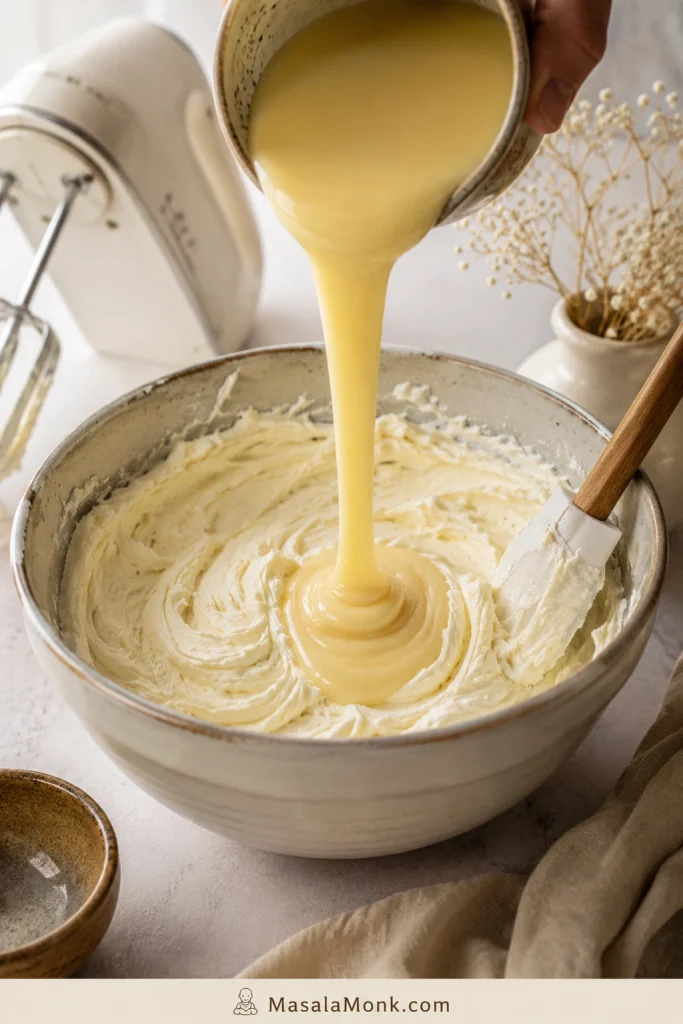
Caramel, Dulce de Leche, or Condensed Milk Toffee

The caramel layer must be thick and spreadable. Dulce de leche is the easiest reliable option. Thick canned caramel can also work. However, thin caramel sauce should not be used as the main filling because it can make the pie runny.

If you keep condensed milk for quick pantry desserts, you may also like MasalaMonk’s guide to sweetened condensed milk fudge. For this pie, though, the condensed milk needs to become a thick toffee-style layer before it goes into the crust.

Bananas

Use firm ripe bananas. They should be yellow and sweet, but not mushy. Green bananas taste starchy, while overripe bananas can release too much moisture and make the pie harder to slice.

Cream

Use heavy cream, whipping cream, or double cream. Also, make sure the cream is cold before whipping. Canned spray cream is not ideal for the main recipe because it softens quickly and does not give the same clean finish.

Best Biscuit Base for Banoffee Pie

For this banoffee pie, the recipe works best with a biscuit base that is firm enough to hold caramel and bananas, but not so hard that it breaks when sliced. A good rule of thumb is 220g biscuits, 110g melted butter, and a pinch of salt.

First, crush the biscuits finely. Then, mix them with melted butter until the crumbs look like damp sand. After that, press the mixture into the base and sides of the tin. A flat-bottomed measuring cup or glass helps you level the crumbs neatly.

Biscuit crumb base being pressed into a tart tin with a flat-bottomed cup for Banoffee Pie.
The biscuit base should feel like damp sand before it is pressed; that way, it chills into a firm crust without turning greasy or rock-hard.

At this point, resist the urge to press too hard. Ideally, the base should be compact enough to hold, but still tender enough to cut with a fork.

Chill the base for at least 30 minutes before adding caramel. If you want a firmer slice, you can optionally bake the base for 8–10 minutes at 175°C / 350°F, then cool it completely before filling.

If you prefer a traditional pastry-style dessert instead of a crumb base, MasalaMonk’s apple pie crust recipe is the better starting point. Banoffee is usually easier as a biscuit-base pie, while apple pie dough needs cold butter, chilling, rolling, and baking.

Digestive Biscuits vs Graham Crackers vs Marie Biscuits vs Biscoff

Base Best For Watch-Out
Digestive biscuits Classic Banoffee base Usually balanced and sturdy
Graham crackers US-style pie crust Sweeter, so added sugar is often unnecessary
Marie biscuits Easy India option Lighter, so press well and add salt
Biscoff or Lotus biscuits Spiced caramel variation Sweeter and stronger flavored
Digestive biscuits, graham crackers, Marie biscuits, and Biscoff compared as Banoffee Pie base options.
Digestives give the most classic Banoffee Pie base, while graham crackers, Marie biscuits, and Biscoff each change the sweetness, crumb texture, and final flavor.

Dulce de Leche vs Caramel vs Condensed Milk Toffee

The caramel layer is where this banoffee pie recipe is worth slowing down. When the caramel is thick, the pie slices cleanly. When it is thin, the filling can slide, pool, and soak the crust.

Before you start layering, check the texture. For the cleanest slice, the caramel should spread like a thick filling, not pour like a dessert sauce.

Thick caramel being spread over a chilled biscuit base for Banoffee Pie.
Here is where the pie succeeds or fails: thick caramel should spread like a filling, not pour like a dessert sauce.
Option Use It? Best For Watch-Out
Thick dulce de leche Yes Easiest reliable pie Warm slightly if too stiff to spread
Thick canned caramel Yes Fast UK-style version Must be spreadable, not runny
Homemade condensed milk toffee Yes Best homemade flavor Stir constantly and cook gently
Thin caramel sauce No, not as filling Drizzle only Makes the pie runny
Boiled condensed milk can Avoid as main advice Old-school shortcut Use safer methods instead
Dulce de leche, thick caramel, homemade toffee, and thin caramel sauce compared for Banoffee Pie.
Dulce de leche, thick caramel, and homemade condensed milk toffee can all work well; however, thin caramel sauce is better saved for a light drizzle.

Easiest Option: Thick Dulce de Leche

Dulce de leche is the easiest option because it is already thick, creamy, and caramelized. Use about 397g / 14 oz for one 9-inch / 23cm pie. If it is too stiff to spread straight from the jar or can, warm it briefly until it loosens slightly.

Fast Option: Thick Ready Caramel

Thick ready caramel can work well, especially in a UK-style Banoffee Pie. The key word is thick. If the caramel pours like sauce, it is too loose for the main layer. Instead, save that kind of caramel for a final drizzle over the cream.

Homemade Option: Condensed Milk Toffee

For a homemade toffee layer, combine 397g sweetened condensed milk, 80g butter, and 80g brown sugar in a saucepan. Cook over low to medium-low heat, stirring constantly, for about 6–8 minutes, or until the mixture becomes thick, glossy, and spreadable.

Do not rush this step. High heat can scorch the sugar or make the mixture catch on the bottom of the pan. Once the toffee thickens, spread it into the chilled base and let it cool before adding bananas and cream.

Thick homemade condensed milk toffee in a saucepan with a spatula trail holding its shape.
Once condensed milk toffee looks glossy, thick, and spreadable, it is ready to hold its place in the Banoffee Pie instead of running into the biscuit base.

What Not to Use

Do not use thin caramel sauce as the main filling. It may look tempting at first, but it can run into the banana layer, soften the crust, and make the pie difficult to cut. If you have only a thin sauce, use it sparingly on top as a garnish.

Thick spreadable caramel compared with thin runny caramel sauce for Banoffee Pie.
A spreadable caramel layer gives this recipe for Banoffee Pie structure; on the other hand, a pourable sauce can soak the crust and make the filling slide.

Safety Note on Boiling Condensed Milk Cans

Some old Banoffee methods involve boiling unopened cans of condensed milk. For a home recipe, however, a safer approach is to use ready dulce de leche or make stovetop condensed milk toffee in a saucepan. Eagle Brand also says it does not recommend heating condensed milk in the can.

Best Bananas for Banoffee Pie

In this banoffee pie recipe, bananas should taste sweet but still behave like a clean layer. Choose fruit that is yellow with a few light speckles, not green and not soft enough for banana bread.

Banana ripeness guide for Banoffee Pie showing green, ripe but firm, and overripe bananas.
Ripe but firm bananas give the best balance because they taste sweet while still slicing cleanly and holding their shape under the cream.

Avoid green bananas because they taste starchy and flat. On the other hand, very dark, soft bananas can turn mushy under the cream and release extra moisture into the pie.

Slice the bananas about ¼ inch / 6mm thick. That way, you get a clear banana layer without making the pie bulky. If you prefer a chunkier banana layer, you can go up to 1cm, but thinner slices usually give cleaner pieces.

Banana slice thickness guide for Banoffee Pie showing 1/4 inch or 6 mm slices and a chunkier 1 cm slice.
Thinner banana slices layer more neatly, so the finished Banoffee Pie cuts cleaner and feels balanced in every bite.

If you need to assemble slightly ahead, use only a few drops of lemon juice and cover the bananas fully with cream. Otherwise, too much lemon juice can make the filling taste sharp.

Best Cream for Banoffee Pie

For clean slices, the cream should look billowy, not stiff and grainy. You want it thick enough to sit proudly on the pie, but still soft enough to melt into the caramel and bananas when you take a bite.

For most home cooks, cold heavy cream, whipping cream, or double cream works best. If the cream is too loose, the topping can slide. If it is overwhipped, it can taste heavy and look rough.

Whipped cream peak guide for Banoffee Pie showing soft peaks, medium peaks, medium-firm peaks, and overwhipped cream.
Medium to medium-firm peaks are the sweet spot for whipped cream: soft enough to taste fresh, yet stable enough to help the pie slice neatly.
Cream Stage What It Looks Like Best For
Soft peaks Falls gently from the whisk Spoonable desserts, not the cleanest slices
Medium peaks Holds shape but still looks smooth Best everyday Banoffee Pie topping
Medium-firm peaks Holds cleaner ridges without looking dry Best if the pie needs to hold longer
Overwhipped Grainy, stiff, or starting to split Avoid; it tastes heavy and can look rough

If you like desserts where whipped cream has to stay soft but still hold its shape, MasalaMonk’s strawberry shortcake recipe is another good guide. It uses fresh fruit and cream in a different way, but the same idea applies: the cream should feel light, not stiff or grainy.

If your kitchen is warm or the pie needs to sit longer, you can stabilize the cream with 1–2 tablespoons mascarpone, cream cheese, or milk powder. Keep the cream cold, whip it only until medium-firm, and spread it over the bananas before the final chill.

Stabilized whipped cream guide with mascarpone, cream cheese, milk powder, and cream spread on Banoffee Pie.
If your kitchen is warm or the dessert needs to sit longer, a small stabilizer can help whipped cream hold without making it stiff or heavy.
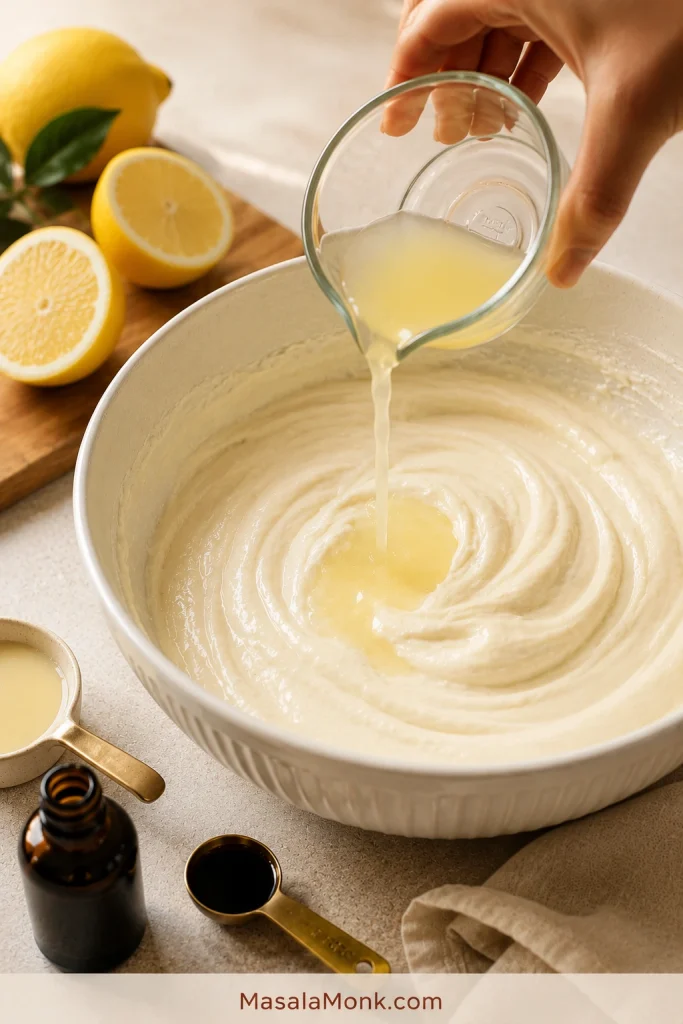
Equipment You Need

You do not need pastry-school equipment for this dessert. A simple pan, a way to crush biscuits, and cold cream are enough.

Tools for making Banoffee Pie, including a tart tin, saucepan, whisk, rolling pin, knife, glass, and measuring spoons.
You do not need special pastry equipment for this banoffee pie recipe; instead, a good tin, a pressing tool, a saucepan, and a whisk are enough for cleaner layers.
  • 9-inch / 23cm pie dish, tart tin, or springform pan
  • Food processor, or a zip-top bag and rolling pin for crushing biscuits
  • Mixing bowl
  • Flat-bottomed cup or measuring cup for pressing the base
  • Saucepan, only if making homemade condensed milk toffee
  • Hand mixer or whisk for the cream
  • Warm sharp knife for clean slices
Ready to build it? Method Chill time Recipe card

How to Make Banoffee Pie

Once the caramel is sorted, the rest is just layering and chilling: make the base, chill it, spread the caramel, add bananas, whip the cream, and chill before slicing.

Step 1: Make the Biscuit Base

Crush the biscuits into fine crumbs. From there, mix them with melted butter and salt until evenly moistened. Press into a 9-inch / 23cm pie dish, tart tin, or springform pan, then chill for at least 30 minutes.

Biscuit crumb base being pressed into a tart tin with a small metal cup for Step 1 of Banoffee Pie.
Press the crumb base evenly before chilling because a compact crust gives the caramel, bananas, and cream a sturdier foundation.

Step 2: Add the Caramel or Dulce de Leche

Spread thick dulce de leche, thick caramel, or homemade condensed milk toffee over the chilled base. Keep the layer even so every slice gets the same banana-toffee balance.

Thick caramel being spread with a spatula over a biscuit crust for Step 2 of Banoffee Pie.
After the base is chilled, spread the caramel evenly so every slice gets the same banana-toffee balance and the filling sets more predictably.

Step 3: Add the Bananas

Arrange sliced bananas over the caramel in a single layer or a slightly overlapping layer. For the cleanest slice, do not pile on too many bananas; a heavy banana layer can make the pie unstable.

Banana slices being arranged over caramel in a biscuit crust for Step 3 of Banoffee Pie.
Add the bananas in an even layer rather than piling them high; as a result, the pie stays easier to cut and serve.

Step 4: Whip the Cream

Whip cold cream with icing sugar and vanilla until it reaches medium or medium-firm peaks. It should hold soft shape on the whisk, but it should not look dry, grainy, or overbeaten.

Whisk lifting smooth whipped cream from a glass bowl for Step 4 of Banoffee Pie.
Stop whipping when the cream holds a soft shape on the whisk, since overwhipped cream can taste heavy and look grainy.

Step 5: Chill, Slice, and Serve

Spoon or spread the whipped cream over the bananas. Before slicing, chill the finished pie for at least 2 hours. For the cleanest slices, chill it closer to 4 hours, then finish with chocolate shavings, cocoa, or a very light caramel drizzle.

Finished Banoffee Pie with a clean slice removed, showing biscuit base, caramel, bananas, and whipped cream.
After chilling, the layers should look creamy but controlled, with the biscuit base, caramel, bananas, and cream holding together in each slice.

How Long to Chill Banoffee Pie

Chilling is not just a waiting step. It helps the base firm up, keeps the caramel layer stable, and makes the cream easier to slice through.

Banoffee Pie chill time guide showing 30 minute crust chill, 2 hour minimum chill, 4 hour best chill, and 10 to 15 minute rest.
Banoffee Pie chill time is not just waiting time; it firms the base, steadies the caramel, and gives the cream enough structure for cleaner slices.

For a soft but sliceable banoffee pie, this recipe works best when you chill the base for at least 30 minutes, then chill the finished pie for at least 2 hours. For the cleanest slices, especially if your caramel is slightly soft, chill the finished pie for closer to 4 hours.

  • Crust chill: at least 30 minutes before adding caramel.
  • Finished pie chill: 2 hours minimum.
  • Best clean-slice chill: closer to 4 hours.
  • If caramel is very firm: rest the pie for 10–15 minutes before slicing.

If you want the firmest possible base, bake it for 8–10 minutes at 175°C / 350°F, then cool completely before filling. The pie will no longer be fully no-bake, but the slices will be cleaner.

Can You Make Banoffee Pie Ahead?

Yes, you can make Banoffee Pie ahead, but for the best texture, prepare the components rather than fully assembling the whole pie too early.

Make-ahead Banoffee Pie guide showing biscuit base, caramel, whole bananas, whipped cream, and finished pie.
For make-ahead Banoffee Pie, prepare the base and caramel early, then add bananas and whipped cream closer to serving so the texture stays fresh.
Component Can You Make It Ahead? Best Timing
Biscuit base Yes 1–2 days ahead, covered in the fridge
Caramel layer Yes 1 day ahead, or spread into the chilled base before final assembly
Bananas Not sliced early Slice close to assembly for best color and texture
Whipped cream Same day is best Whip and add before the final chill
Fully assembled pie Yes, but short window Best within 4–8 hours; acceptable within 24 hours
Leftovers Yes Eat within 1–2 days, knowing the bananas and cream will soften

Leftovers can still taste good later, although the bananas will darken, the cream will soften, and the base may absorb moisture. For guests, assemble it the day you plan to serve it.

If you are planning ahead: Clean slices Variations Troubleshooting

How to Get Clean Slices

Clean slices mostly come down to patience and layer control. Because the pie has soft bananas, caramel, and cream, every layer needs to be slightly controlled.

Clean-slice tips for Banoffee Pie with a knife cutting through a chilled pie and text cues for chilling, thick caramel, and wiping the knife.
Clean slices come from several small choices working together: chill well, use thick caramel, warm the knife, and wipe the blade between cuts.
  • Use thick caramel or dulce de leche, not thin sauce.
  • Chill the base before filling.
  • Slice bananas evenly and avoid overloading the pie.
  • Whip cream to medium-firm peaks if the pie needs to hold longer.
  • Use a removable-bottom tart tin or springform pan if possible.
  • Cut with a warm sharp knife and wipe it between slices.

If your first slice is messy, let the pie chill longer before cutting the rest. Often, a little extra time in the fridge is all a soft caramel layer needs.

Banoffee Pie Variations

Once you know the classic method, Banoffee Pie is easy to adapt. The easiest way to keep it balanced is to change one thing at a time: the base, the topping, or the serving format.

Biscoff Banoffee Pie

Use Biscoff or Lotus biscuits instead of digestives or graham crackers. Because Biscoff is sweeter and more spiced, skip extra sugar in the base and keep the cream lightly sweetened. If you like the Biscoff idea, you may also enjoy this cookie pie recipe, especially when you want something baked, gooey, and sliceable.

Chocolate Banoffee Pie

A chocolate Banoffee Pie works best when chocolate supports the banana-toffee flavor instead of taking over. Use chocolate biscuits for the base or spread a thin cooled ganache over the caramel before adding the bananas.

Salted Caramel Banoffee Pie

To make it salted caramel-style, add a small pinch of fine salt to the caramel layer and finish the pie with a few flakes of sea salt. Use a light hand because the goal is balance, not a salty dessert.

Banoffee Cheesecake or Banoffee Tart

A Banoffee cheesecake moves the caramel and banana idea into a cream cheese filling, so it becomes a different dessert rather than a quick topping change. In a Banoffee tart, the same layers sit in a shallow tin for a neater, more elegant slice.

Mini Banoffee Pies or Banoffee Cups

Small jars or cups are easier to serve than slices at parties. Layer biscuit crumbs, caramel, banana slices, and whipped cream, then assemble them close to serving so the crumbs do not soften too much.

Vegan Banoffee Pie

A vegan version needs dairy-free biscuits, vegan butter, vegan caramel or condensed milk alternative, and a plant-based whipping cream. Because vegan caramel and plant-based cream behave differently, it is worth following a dedicated vegan method rather than swapping ingredients one-for-one.

Gluten-Free Banoffee Pie

Use certified gluten-free biscuits for the base and check that the caramel, chocolate, and toppings are gluten-free as well. The method stays similar, but the base may need a little extra chilling because gluten-free biscuits vary in texture.

Healthy Banoffee Pie

If you want a lighter version, plan it from the start instead of only reducing the sugar. Many healthier Banoffee-style desserts use oat, nut, or date-based crusts and a date-style caramel, so the base and filling usually need to change too.

What to Serve with Banoffee Pie

Banoffee Pie is rich, sweet, and creamy. That is why it pairs best with something bitter, cold, fruity, or lightly acidic.

  • Black coffee or espresso
  • Lightly sweet tea
  • Fresh berries
  • Vanilla ice cream
  • Extra chocolate shavings
  • A very small pinch of flaky salt on the caramel layer

For a summer meal or party spread, Banoffee Pie also pairs beautifully with homemade mango ice cream. The mango keeps things bright, while the Banoffee brings the caramel-and-cream richness.

For a bigger dessert table, a chilled cake like tres leches cake also makes sense beside Banoffee Pie. Both are creamy, cold desserts, but tres leches gives you a soft cake texture while Banoffee brings biscuit crunch and caramel.

Troubleshooting Banoffee Pie Recipe

Most Banoffee Pie problems come from texture. Fortunately, they are easy to understand once you know which layer caused the issue.

Banoffee Pie troubleshooting guide for crumbly base, runny caramel, brown bananas, weeping cream, and messy slices.
If the pie does not behave, check the layer causing trouble first; usually the fix is better chilling, thicker caramel, colder cream, or fresher bananas.
Problem Likely Cause Fix
Base crumbles Crumbs too coarse or not enough butter Crush the biscuits finer, add a little more melted butter, and chill longer
Base feels greasy Too much butter or very weak biscuits Next time, use slightly less butter and chill the base well before filling
Caramel runs Caramel too thin or not chilled Switch to thick dulce de leche, or cook condensed milk toffee a little longer
Caramel too stiff Dulce de leche too cold or thick Warm it briefly before spreading
Bananas brown Assembled too early Slice the bananas closer to serving and cover them fully with cream
Cream weeps Underwhipped or unstable cream Start with cold cream and whip it to medium-firm peaks
Pie is too sweet Sweet base, caramel, and cream together Balance the layers with salt in the base and less sugar in the cream
Slices are messy Not chilled, loose caramel, or soft bananas Chill the pie longer and cut with a warm knife
Ready to make it? Jump to recipe FAQs Back to top
Banoffee Pie recipe card with a finished pie slice, no-bake label, chill time, yield, and core layers.
This saveable Banoffee Pie recipe card keeps the method simple: biscuit base, thick caramel, bananas, cream, and enough chilling time to slice cleanly.

Banoffee Pie Recipe Card

This easy Banoffee Pie Recipe has a buttery biscuit base, thick caramel or dulce de leche, fresh bananas, whipped cream, and a simple chill-and-slice method.

Yield8–10 slices
Prep Time25 minutes
Chill Time2 1/2 hours minimum, 4 hours best
Total TimeAbout 3 hours minimum
Pan9-inch / 23cm pie dish or tart tin
DietVegetarian, eggless
OvenNot required
Best ServedSame day; best within 4–8 hours

Ingredients

Biscuit Base

  • 220g digestive biscuits, Marie biscuits, or graham crackers, finely crushed, about 2 cups crumbs
  • 110g unsalted butter, melted, about 1/2 cup
  • Pinch of salt
  • 1 tbsp sugar, optional, only if using very plain biscuits

Caramel Layer

  • 397g / 14 oz thick dulce de leche or thick caramel

Homemade condensed milk toffee option: Use 397g / 14 oz sweetened condensed milk, 80g butter / about 5 1/2 tbsp, and 80g brown sugar / about 1/3 cup plus 1 tbsp packed. Cook gently, stirring constantly, for about 6–8 minutes, or until thick, glossy, and spreadable.

Let homemade toffee cool until warm, not hot, before adding bananas and cream.

Banana Layer

  • 2–3 firm ripe bananas, sliced about 1/4 inch / 6mm thick

Cream Layer

  • 300ml heavy cream, whipping cream, or double cream, cold, about 1 1/4 cups
  • 1–2 tbsp icing sugar
  • 1 tsp vanilla extract

Topping

  • Chocolate shavings, cocoa powder, or a very light caramel drizzle

Method

  1. Start with the base. Mix crushed biscuits, melted butter, salt, and optional sugar until the crumbs look like damp sand.
  2. Shape and chill. Press the crumbs into a 9-inch / 23cm pie dish, tart tin, or springform pan, then chill for at least 30 minutes.
  3. Spread the caramel. Add thick dulce de leche, thick caramel, or homemade condensed milk toffee over the chilled base.
  4. Layer the bananas. Arrange banana slices over the caramel in a single or slightly overlapping layer.
  5. Whip the cream. Beat cold cream with icing sugar and vanilla until it reaches medium or medium-firm peaks.
  6. Cover the bananas. Spread or spoon the cream over the banana layer.
  7. Let it set. Chill the finished pie for at least 2 hours, or closer to 4 hours for cleaner slices.
  8. Finish and serve. Add chocolate shavings, cocoa, or a light caramel drizzle, then slice with a warm sharp knife.

Notes

  • For a firmer base, bake the crust for 8–10 minutes at 175°C / 350°F, then cool completely before filling.
  • If your caramel is thin, do not use it as the main layer because it can make the pie runny.
  • For the freshest color, add the bananas closer to serving.
  • Once fully assembled, Banoffee Pie is best within 4–8 hours and still acceptable within 24 hours.
  • Depending on where you live, use digestives for a classic UK-style base, graham crackers for a US-style crust, or Marie biscuits for a lighter India-friendly option.

FAQs About This Banoffee Pie Recipe

1. What is Banoffee Pie made of?

A classic Banoffee Pie usually has a biscuit or pastry base, thick caramel or toffee, sliced bananas, whipped cream, and a chocolate or cocoa topping. In this version, the base is made with biscuits, the filling uses dulce de leche or thick caramel, and the cream is lightly sweetened so the pie does not become too heavy.
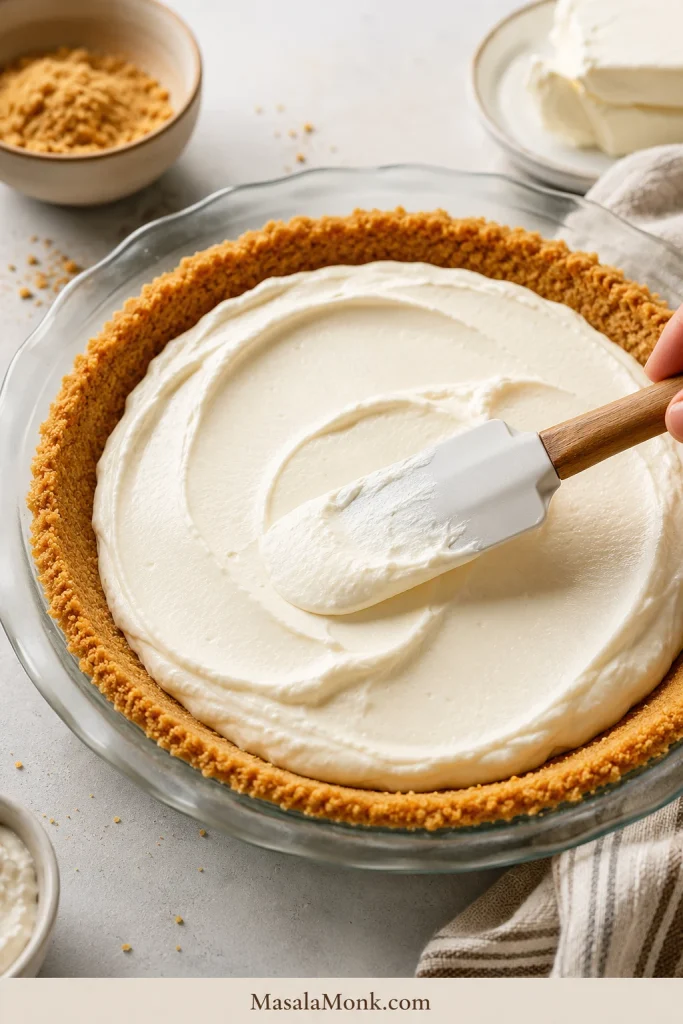
2. Is Banoffee Pie no-bake?

Yes, this version is no-bake if you chill the biscuit base instead of baking it. For a firmer crust and cleaner slices, however, you can bake the base for 8–10 minutes at 175°C / 350°F and cool it completely before filling.

3. Is Banoffee Pie the same as Banoffee pudding?

The classic name is Banoffee Pie, although some people call it Banoffee pudding because it is chilled, creamy, and layered. In everyday searches, Banoffee pudding and Banoffee dessert often point to the same banana, caramel, biscuit, and cream combination.

4. Is dulce de leche good for Banoffee Pie?

Absolutely. Thick dulce de leche is one of the easiest and most reliable fillings because it spreads well, holds its shape, and gives the dessert the deep caramel flavor it needs.
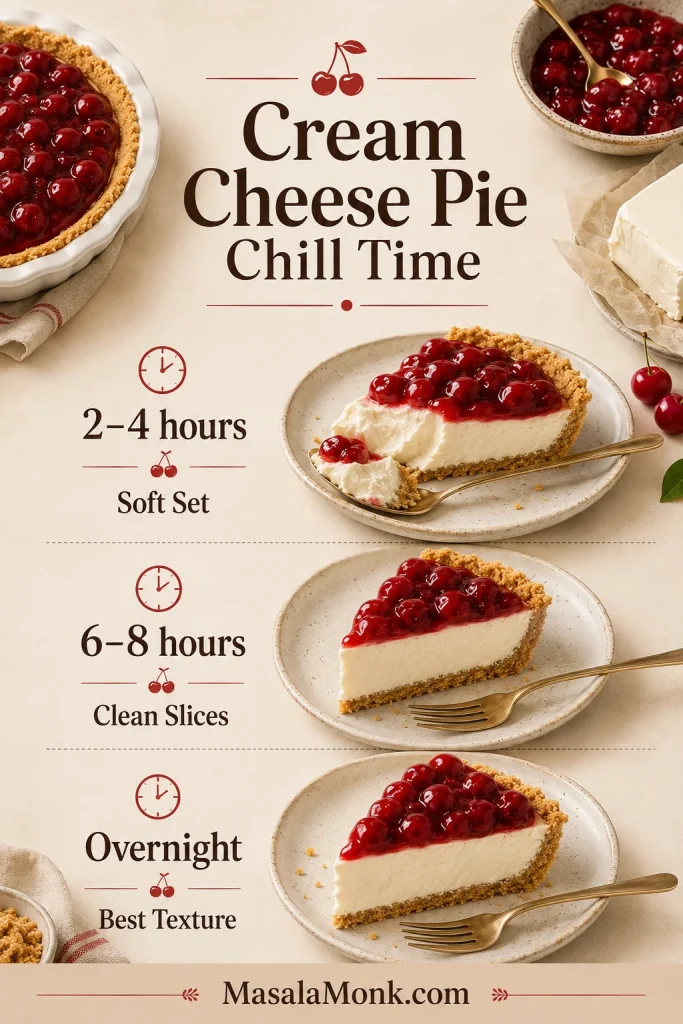
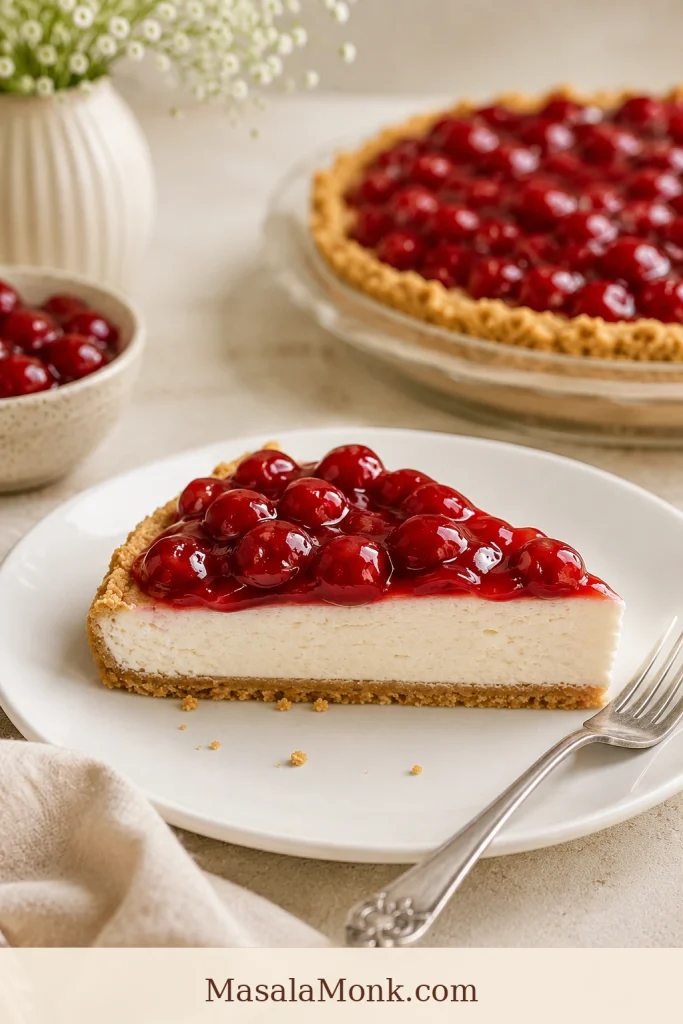
5. What kind of caramel sauce works?

Only use caramel sauce if it is very thick and spreadable. If it pours easily, keep it for a light drizzle on top because thin sauce can make the main filling runny.

6. How do you make Banoffee Pie with condensed milk?

You can use condensed milk, but it needs to be cooked into a thick toffee-style filling first. The easiest homemade method is to cook sweetened condensed milk with butter and brown sugar until the mixture looks thick, glossy, and spreadable.

7. Can I make Banoffee Pie without condensed milk?

Yes. You can use thick dulce de leche or thick ready caramel instead of making condensed milk toffee. Just avoid thin caramel sauce because it will not hold as well in the pie.

8. How do I stop Banoffee Pie from going runny?

Start with thick dulce de leche or thick caramel, chill the base before filling, choose firm ripe bananas, and chill the finished pie before slicing. Most importantly, avoid thin caramel sauce as the main layer.

9. How long does Banoffee Pie last?

Once assembled, Banoffee Pie is best the same day, especially within 4–8 hours. It is still acceptable within 24 hours, but the bananas may darken, the cream may soften, and the base may lose some texture.

10. Can I make Banoffee Pie ahead?

For the best result, make the base and caramel ahead, then add the bananas and whipped cream closer to serving. That way, the bananas stay fresher and the cream holds better.

11. Is Banoffee Pie eggless?

Yes. This banoffee pie recipe is naturally eggless because it uses a biscuit base, caramel or dulce de leche, bananas, and whipped cream, with no eggs in the filling or crust.

12. Can you freeze Banoffee Pie?

Freezing a fully assembled Banoffee Pie is not ideal because bananas can turn watery and the cream can lose its texture after thawing. If you want to work ahead, freeze only the biscuit base, then add caramel, bananas, and cream after thawing.

Back to top

Posted on 2 Comments

How to Make Ice Cream with a KitchenAid Mixer (With or Without the Attachment)

Premium cover image for how to make ice cream with a KitchenAid mixer, showing a red stand mixer with ice cream attachment churning vanilla ice cream in a frosty bowl, with a finished scoop in front and vanilla beans on a dark editorial background.

If you want to know how to make ice cream with a KitchenAid mixer, the process becomes much easier once you understand the rhythm. Freeze the bowl until it is deeply cold, chill the base until it is fully settled, churn until the mixture turns thick and airy like soft serve, then freeze it again until it becomes scoopable. That is the pattern. Once it clicks, homemade ice cream stops feeling fussy and starts feeling wonderfully doable.

Part of the confusion is that ice cream sounds more technical than it really is. There is so much talk of custards, freezer bowls, aging the base, mix-ins, and timing that the whole thing can seem harder than it needs to be. In practice, the best batches usually come down to a few simple things done well. The bowl needs to be properly frozen. The base needs to be fully chilled. The churn needs to stop at the right stage. After that, the freezer quietly finishes the work. KitchenAid’s own notes on the ice cream maker attachment reinforce just how much good texture depends on that cold-and-churn sequence.

What makes this method especially satisfying is the control it gives you over flavor and texture. You can keep it simple with an easy eggless vanilla base, or go richer with a custard-style version that tastes fuller and more luxurious. You can fold in cookie pieces, swirl through chocolate, blend in mango, or deepen it with coffee. The logic behind chilling the base well is explained beautifully by Serious Eats, and once that part makes sense, the rest feels far more natural.

Also Read: Peach Cobbler with Canned Peaches (Dessert Recipe)

Can you make ice cream with a KitchenAid mixer?

Yes, you absolutely can, and when everything is properly cold, a KitchenAid stand mixer can make excellent homemade ice cream. The classic route uses the frozen ice cream maker attachment, which chills the base while the dasher keeps it moving. That pairing matters because homemade ice cream is not just sweet dairy that happens to freeze. It is a base that freezes gradually while air is worked into it, which is what gives the finished scoop a lighter, smoother texture.

The stand mixer helps because it makes that motion steady. Rather than stirring by hand, pausing, and hoping for the best, you get a consistent churn that encourages a more even freeze. The frozen bowl does the cooling. The dasher keeps the mixture moving. The base thickens bit by bit instead of hardening all at once against the sides.

There is also a second path worth taking seriously. You can make ice cream in a stand mixer without the attachment by whipping structure into a rich base and letting the freezer finish the rest. That version is different rather than inferior. It is usually denser, a little less airy, and often richer-feeling when you first scoop it. Still, it can be excellent in its own right, especially for coffee, chocolate ripple, cookie-heavy, or condensed-milk-style versions.

So the honest answer is that a KitchenAid mixer can make two different kinds of frozen dessert. With the attachment, you get a more classic churned result. Without it, you get a simpler no-machine-style frozen dessert that can still be creamy, rich, and extremely satisfying.

Choosing between the attachment and no-attachment method comes down to the texture you want. Use the attachment for a lighter, more classic churned ice cream, or go without it when you want a simpler, richer no-churn style that still freezes beautifully at home.

Why the attachment method feels more like classic ice cream

The attachment method creates the texture most people are imagining when they picture homemade vanilla ice cream. It has more air, a lighter body, and a softer, more traditional churned finish once it sets. If your goal is the closest homemade version to classic scoop-shop texture, the attachment is the better route.

Why the no-attachment method is still worth making

The no-attachment version shines because it lowers the barrier. You do not need the frozen bowl. You do not need to time the churn in the same way. And thankfully, you still get a deeply enjoyable frozen dessert with very little stress. For many kitchens, that practicality matters just as much as perfect texture.

Also Read: Avocado Chocolate Mousse Recipe

What you need to make ice cream with a KitchenAid mixer

The process feels much calmer when you set everything out before you begin. Once the bowl comes out of the freezer, you do not want to waste precious cold while searching through drawers for a spatula or opening three cupboards looking for the right container.

KitchenAid ice cream setup guide showing a stand mixer with ice cream attachment, chilled vanilla base, spatula, measuring tools, and shallow storage container arranged before making homemade ice cream.
Before you start churning, set out the full KitchenAid ice cream station: a fully frozen attachment bowl, a thoroughly chilled base, the dasher, spatula, measuring tools, and a shallow freezer-safe container for the final set. This setup guide helps readers prep everything in advance so the bowl stays cold, the churn runs smoothly, and homemade ice cream thickens into a better soft-serve texture before freezing to scoopable.

KitchenAid stand mixer and ice cream maker attachment

For the classic method, you need the stand mixer, the freezer bowl, and the dasher. KitchenAid’s own guidance on the ice cream maker attachment is helpful because it reinforces the practical basics: freeze the bowl thoroughly, use a fully chilled base, start the mixer before pouring, and churn until the texture resembles soft serve.

Mixing bowls, whisk, spatula, and measuring cups

You will need a bowl for mixing the base, a whisk to combine it smoothly, measuring cups for consistency, and a spatula for transferring the churned ice cream. Those tools sound ordinary, yet they matter because the easier the setup feels, the more likely you are to stay calm and move quickly once the bowl is out of the freezer.

Freezer-safe container for the final set

A loaf pan works well if you want the batch to firm up quickly. An airtight tub works well if you care more about tidy storage. Either way, a proper freezer-safe container matters because homemade ice cream loses quality more quickly when it sits loosely covered or exposed to too much air.

Ingredients for a KitchenAid ice cream recipe

For most batches, you are looking at heavy cream, whole milk, sugar, vanilla, and salt. Egg yolks come into play if you want a richer custard base. Sweetened condensed milk becomes useful if you want to make ice cream in a stand mixer without the attachment.

Also Read: Falafel Recipe: Crispy Homemade, Air Fryer and Baked Falafel

How the KitchenAid ice cream attachment works

The attachment works because it handles cooling and movement at the same time. The frozen bowl removes heat from the base while the dasher keeps the mixture moving around the cold surface. That movement is what helps prevent the base from freezing into a stiff layer against the edge while the center stays too loose.

This is one of those kitchen details that becomes more obvious once you see it happen. In the early minutes, the base looks only slightly thicker. Then it begins to cling to the bowl more noticeably. Then it starts to look billowy and softly mounded. That gradual transformation is the result of cold and movement working together.

Mechanism explainer for a KitchenAid ice cream maker attachment showing a frozen bowl, moving dasher, gradual thickening of vanilla ice cream base, and the soft-serve texture reached before the final freeze.
Once you understand why the KitchenAid ice cream attachment works, the whole method feels far less intimidating. The frozen bowl pulls heat out of the base while the dasher keeps everything moving, which is exactly what helps homemade ice cream thicken gradually into a smoother, creamier soft-serve texture before the freezer finishes the job.

Why the bowl has to be deeply frozen

A partly frozen bowl causes more disappointment than almost anything else. If the bowl is not fully solid with cold, the base may stay slushy or loose long past the point where it should have thickened. Instead of building toward a soft-serve texture, it just spins and softens. That is why freezing the bowl thoroughly is not a suggestion. It is one of the central conditions of the whole method.

Why the base has to be fully chilled

The base matters just as much. A warm mixture instantly works against the bowl by melting away some of the freezing power you need for the churn. A fully chilled base, on the other hand, begins thickening more quickly and more cleanly. This is also why resting a base in the refrigerator for several hours, or even overnight, tends to improve results.

Why the setup can feel looser than expected

First-time users often expect the freezer bowl and dasher to feel more rigid than they actually do before the mixer starts moving. In reality, the setup can feel a little lighter or less “locked in” than people imagine. That is normal. Once the bowl is properly assembled, the mixer is running, and the base is going in slowly, the system behaves much more confidently.

Also Read: Mango Margarita Recipe (Frozen or On the Rocks)

How long to freeze and chill before you make ice cream with a KitchenAid mixer

Homemade ice cream becomes easier the moment you stop guessing about timing. When you know the usual windows, the process stops feeling uncertain and starts feeling manageable.

KitchenAid ice cream timing guide showing four stages for homemade ice cream: freeze the bowl for 15 to 24 hours, chill the base for several hours or overnight, churn in the mixer for 20 to 30 minutes until soft-serve texture, then freeze again for 2 to 4 hours until scoopable.
Homemade ice cream gets much easier once the timing stops feeling vague. This visual roadmap helps you understand the full KitchenAid rhythm, from freezing the bowl and chilling the base to churning at the right stage and giving the ice cream enough final freezer time to become properly scoopable.

How long to freeze the KitchenAid ice cream bowl

Freeze it overnight at minimum. Longer is usually safer, especially if your freezer gets opened often or tends to run warmer than ideal. The bowl needs deep, even cold, not just “it feels cold enough” cold.

How long to chill the base

For an eggless base, several hours in the refrigerator is a reasonable minimum. Overnight is even better. For a custard base, overnight chilling is especially valuable because the texture becomes more settled as well as colder. That extra time helps the churn behave more smoothly.

How long to churn in a KitchenAid mixer

Once the bowl and base are both properly cold, many batches reach soft-serve texture in about 20 to 30 minutes. If you find yourself waiting far beyond that while the base still looks loose, the issue is usually not a lack of patience. It is usually a temperature problem somewhere in the setup.

How long to freeze after churning

Freshly churned ice cream is typically soft, airy, and spoonable. If that is the texture you want, you can absolutely enjoy it right away. However, if you want a firmer, more scoopable result, it usually needs another 2 to 4 hours in the freezer.

Also Read: Sourdough Pizza Dough Recipe (Crispy Crust & Easy Pizza Base)

Best ingredients for a KitchenAid ice cream recipe

A good KitchenAid ice cream recipe is not just about the machine. It is also about balance. The ingredients determine whether the final texture feels creamy, too hard, too soft, icy, or dense.

Ingredient balance guide for a KitchenAid ice cream recipe showing heavy cream, whole milk, sugar, salt, vanilla extract or paste, and a smooth homemade ice cream base with notes on texture, flavor, and scoopability.
A good homemade ice cream base is really a balance question. Cream gives body, milk keeps the mixture from feeling too heavy, sugar helps the texture stay softer in the freezer, salt wakes up flavor, and vanilla shapes the whole character of the batch long before the churn even begins.

Heavy cream vs milk in homemade ice cream

Heavy cream brings richness, smoothness, and body. Whole milk lightens the base enough so it does not feel overly heavy or greasy. Together, they create the kind of balance most home cooks want. Too much milk can push the batch toward iciness. Too much cream can make it feel almost heavy rather than silky.

Why sugar matters for more than sweetness

Sugar does much more than make ice cream taste sweet. It also affects how the mixture freezes, which is why cutting it too aggressively can lead to ice cream that hardens too much or feels dry and stubborn to scoop.

Why a pinch of salt improves the whole batch

Salt is easy to underestimate. Yet a small pinch sharpens vanilla, deepens chocolate, rounds out caramel notes, and keeps the whole dessert from tasting flat. It does not announce itself. It just makes the rest of the flavors feel more awake.

Vanilla extract vs vanilla bean paste

Vanilla extract works beautifully and keeps things easy. And then vanilla bean paste adds a slightly richer aroma and a more luxurious feel, especially in a pure vanilla batch. If vanilla is the whole point, paste can make the result feel more special. If vanilla is simply the base for stronger mix-ins, extract is often all you need.

Also Read: Balti Paneer Gravy (Restaurant-Style, Creamy + Bold Recipe)

Easy vanilla ice cream with a KitchenAid mixer

Vanilla is the best place to begin because it lets the method stay visible. There is nothing distracting you from the texture, the timing, or the way the base changes during the churn.

Vanilla ice cream guide for a KitchenAid mixer showing the ice cream attachment, eggless vanilla base ingredients, and key success cues like freezing the bowl, chilling the base, and churning to soft-serve stage.
Vanilla is the best place to learn the KitchenAid method because it lets you focus on the cold-and-churn rhythm without extra distractions. Once the bowl is fully frozen, the base is thoroughly chilled, and the churn stops at the soft-serve stage, the freezer can take over and turn a simple base into a much smoother, more confident first batch.

Eggless vanilla ice cream with a KitchenAid mixer

For an easy vanilla batch, use:

  • 2 cups heavy cream
  • 1 cup whole milk
  • 3/4 cup sugar
  • 1 tablespoon vanilla extract or 2 teaspoons vanilla bean paste
  • 1 pinch salt

Whisk the ingredients together until the sugar is mostly dissolved, then chill the mixture thoroughly. This is the simplest version to make and the easiest one to build on later with other flavors.

What the eggless base should look like before chilling

Before chilling, the mixture should look glossy, smooth, and fully combined. It should not look separated or visibly grainy. If you still see stubborn sugar crystals, keep whisking a bit longer.

What the eggless base should feel like after chilling

After chilling, the base should feel distinctly colder and a little fuller on the spoon, even though it is still liquid. It should smell clean and creamy rather than thin or flat. That cold, settled feeling is one of the signs that it is ready to churn properly.

Also Read: Mojito Recipe (Classic) + Ratios, Pitcher, Mocktail & Easy Variations

Custard-style vanilla ice cream with a KitchenAid mixer

If you want a richer batch with more body and a softer-feeling scoop, the custard route is worth the extra effort.

Custard-style vanilla ice cream guide for a KitchenAid mixer showing egg yolks, cream, milk, sugar, vanilla, a cooked custard base, and key cues for tempering, cooking, chilling, and churning.
The custard route adds a little more work, yet it rewards you with a fuller, silkier scoop that feels noticeably richer on the spoon. Gentle heat, slow tempering, and a properly chilled base matter here because the goal is not a thick pudding, but a smooth custard that churns into a softer, more luxurious ice cream.

Custard-style vanilla ice cream ingredients

Use:

  • 2 cups heavy cream
  • 1 cup whole milk
  • 4 to 5 egg yolks
  • 3/4 cup sugar
  • 1 tablespoon vanilla extract or vanilla bean paste
  • 1 pinch salt

How to make the custard base

Warm the milk and cream gently until hot but not boiling. In another bowl, whisk the yolks and sugar until combined. Slowly pour in some of the warm dairy while whisking so the yolks temper rather than scramble. Then return everything to the pan and cook gently until the mixture thickens enough to coat the back of a spoon. Strain it, cool it, and then chill it thoroughly before churning.

What the custard base should feel like

A good custard base feels smooth, lightly thickened, and silky rather than heavy. Once chilled, it often feels more settled and richer than the eggless version. That extra richness carries through into the finished scoop.
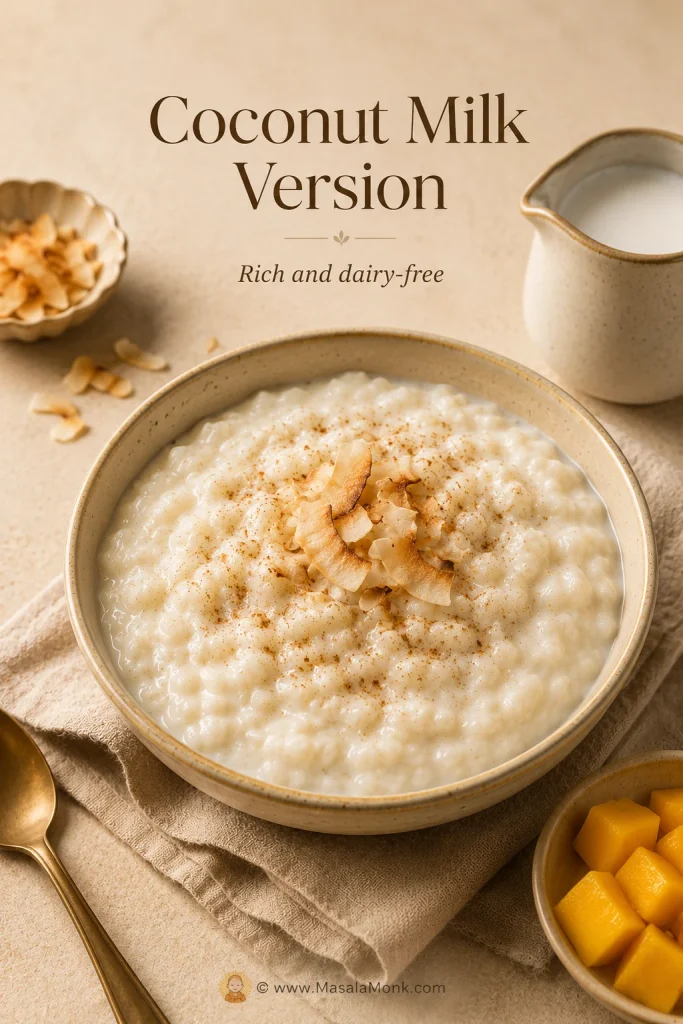
Vanilla ice cream base guide showing before chilling, after chilling, and ready-to-churn texture cues for a KitchenAid mixer, including smooth glossy base, fuller chilled base, and a fully frozen attachment bowl.
One of the easiest ways to improve homemade ice cream is to stop guessing at the base stage. Before chilling, the mixture should look glossy, smooth, and fully combined. After chilling, it should feel colder, calmer, and slightly fuller, which is exactly what helps the KitchenAid churn start more cleanly and produce a better soft-serve texture.

Also Read: Ravioli Recipe Reinvented: 5 Indian-Inspired Twists on the Italian Classic

Eggless vs custard: which KitchenAid ice cream recipe should you choose?

The better choice depends on what kind of dessert you want rather than on some absolute hierarchy.
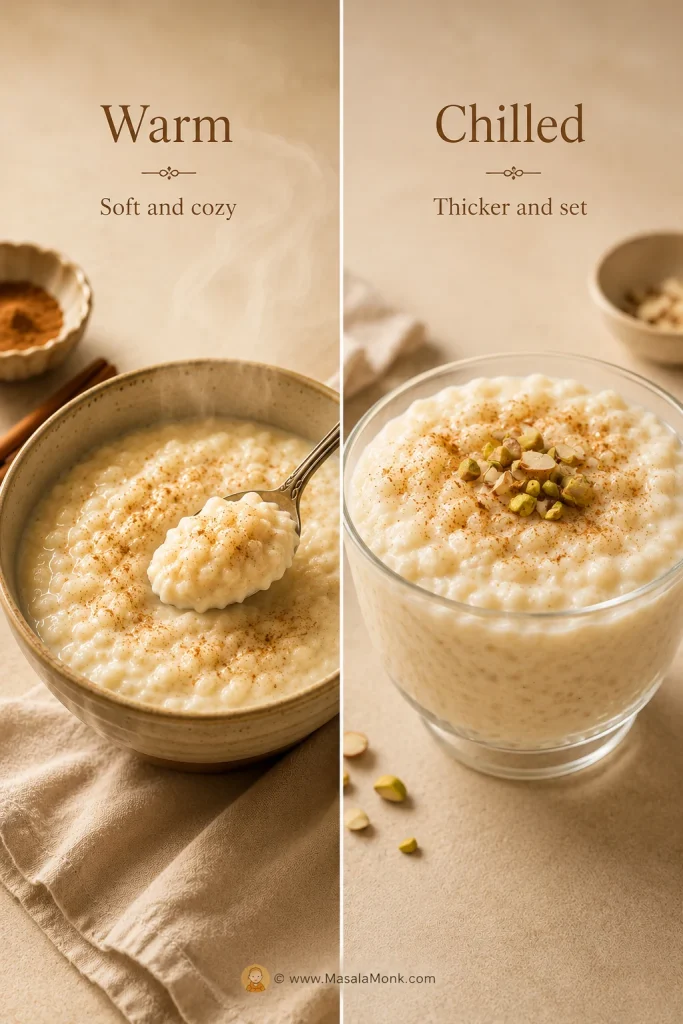
Comparison card for KitchenAid ice cream bases, showing eggless vanilla ice cream on one side and custard vanilla ice cream on the other, with visual cues for easier lighter texture versus richer silkier texture.
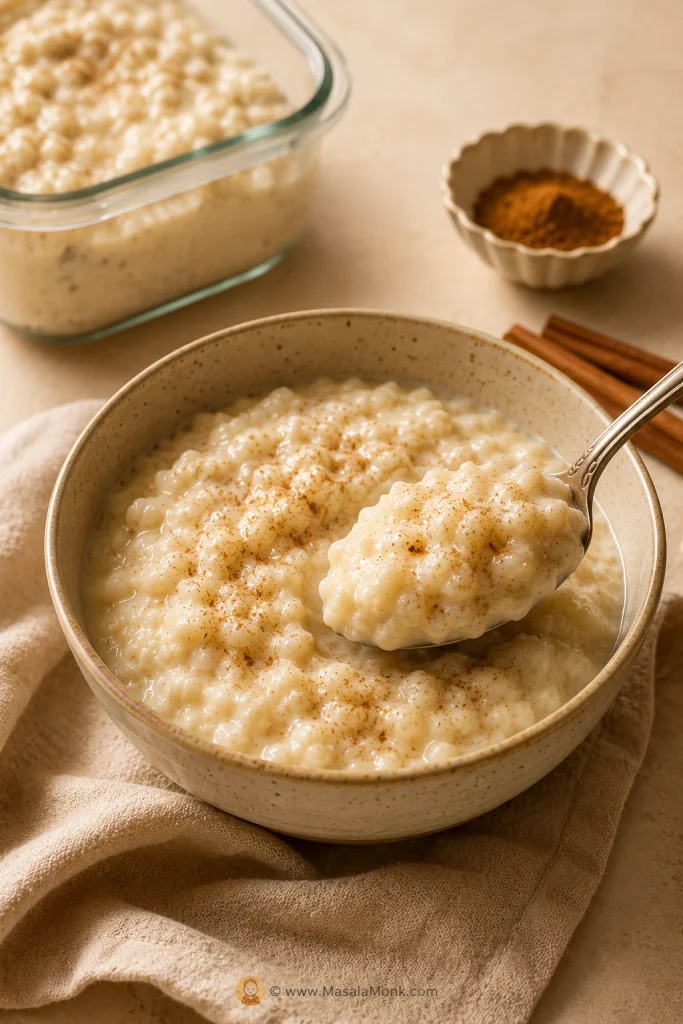
If you want the easiest path, start with the eggless base. If you want a richer, silkier scoop with a more classic dessert feel, the custard base is worth the extra step.

Choose the eggless version when you want ease

If you want something simple, flexible, and quick to prepare, the eggless base is ideal. It is especially good for batches where mix-ins, swirls, or syrups will provide much of the personality.

Choose the custard version when texture matters most

If you want a batch that feels more luxurious even before you add anything else, the custard route is the better fit. It gives the ice cream a rounder, fuller body and a more classic rich-dessert feel.

Neither version is a compromise

That distinction is important. The eggless version is not the “lesser” one. It is simply lighter, simpler, and often better for variation-heavy batches. The custard version is richer and more indulgent. They serve different moods.

If you enjoy creamy chilled desserts more generally, MasalaMonk’s no-bake banana pudding and mango shrikhand show how satisfying that richness can be in completely different formats.

Also Read: Croquettes Recipe: One Master Method + 10 Popular Variations

Before you churn: five habits that make a KitchenAid ice cream recipe work

The strongest batches are usually the product of a few simple habits rather than special tricks.

KitchenAid ice cream success checklist showing five habits for smoother homemade ice cream: freeze the bowl long enough, chill the base completely, do not overfill the bowl, start the mixer before pouring, and stop at the soft-serve stage.
Great homemade ice cream usually comes down to a few simple habits done well. This quick KitchenAid checklist helps you avoid the most common mistakes before and during churning, so the bowl stays cold, the base thickens more cleanly, and the finished texture turns out smoother and more dependable.

Freeze the bowl long enough

A partly frozen bowl weakens the whole churn. If there is one thing to overdo slightly, it is freezer time for the bowl.

Chill the base completely

A base that is merely cool instead of deeply cold often leads to a sloppier churn and a less confident final texture.

Do not overfill the bowl

The mixture needs room to move as it churns. Crowding the bowl slows down the freezing process and makes the texture less even.

Start the mixer before pouring the base

This helps the base begin freezing and moving at the same time rather than pooling in one place.

Stop at the soft-serve stage

This is one of the most important ideas in the entire method. Freshly churned ice cream should look like soft serve, not like a hard-packed freezer tub. The freezer finishes the job later.

Also Read: How to Make a Flax Egg (Recipe & Ratio for Vegan Baking)

Soft-serve stage vs scoop-ready stage

This distinction deserves extra attention because it solves one of the most common points of confusion.

Comparison guide for KitchenAid ice cream texture stages, showing soft-serve ice cream in the mixer attachment bowl on one side and scoopable vanilla ice cream in a loaf pan on the other, to explain what homemade ice cream should look like after churning and after freezing.
This KitchenAid ice cream texture guide shows the difference between soft-serve stage and scoopable stage, so you know when the churn is finished, when the freezer still needs to do the rest, and what a properly set homemade vanilla ice cream should look like.

What done churning looks like

Done churning means the ice cream is airy, softly mounded, and able to hold visible lines from the dasher. It should still be soft. It should still look spoonable. And it should feel thick and creamy, not stiff.

What done churning does not look like

Done churning does not mean dense, hard, or fully scoop-ready. If you are waiting for the mixture to look like a freezer tub while it is still in the machine, you are asking the churn to do work that belongs to the post-churn freeze.

What scoop-ready looks like

Scoop-ready comes later. After a few hours in the freezer, the soft-serve texture settles into a firmer, calmer structure. The ice cream feels more stable, the scoop cuts more cleanly, and the shape holds better in the bowl.

Also Read: Pork Tenderloin in Oven (Juicy, Easy, 350°F or 400°F) Recipe

How to make ice cream with a KitchenAid mixer step by step

Once the prep is done, the actual method is refreshingly straightforward.

Step-by-step guide for how to make ice cream with a KitchenAid mixer, showing four stages: freezing the attachment bowl, chilling the vanilla ice cream base, churning to soft-serve in the mixer, and freezing again until scoop-able.
This step-by-step KitchenAid ice cream guide shows the full process at a glance: freeze the bowl, chill the base, churn to soft-serve, then freeze again until scoop-able for a smoother homemade vanilla ice cream texture.

Step 1: Freeze the KitchenAid bowl

Place the bowl in the coldest part of your freezer and leave it there until fully solid.

Step 2: Make and chill the base

Prepare the eggless or custard base and chill it thoroughly. Do not rush this step.

Step 3: Assemble the KitchenAid ice cream attachment

Fit the frozen bowl and attach the dasher. Work with a little purpose so the bowl stays as cold as possible.

Step 4: Start the mixer and pour in the cold base

Turn the mixer to low and pour in the chilled base slowly. Let it churn until the mixture reaches soft-serve texture.

Step 5: Add mix-ins near the end

If you are using chopped cookies, nuts, chips, or brittle, add them only after the base has already thickened.

Step 6: Freeze for a firmer scoop

Transfer the churned batch to a chilled airtight container, cover it well, and freeze until scoopable.

Also Read: Chicken Pesto Pasta (Easy Base Recipe + Creamy, One-Pot, Baked & More)

How to make ice cream in a stand mixer without the attachment

This version is not just a backup plan. In some kitchens, it is the more practical and more realistic route.

Step-by-step no-attachment stand mixer ice cream guide showing whipped cream, sweetened condensed milk mixture, gentle folding, and transfer to a shallow container to freeze until firm.
If your kitchen does not have the ice cream maker attachment, this fold-and-freeze method is the practical alternative to keep in your back pocket. It trades some airy churned texture for a richer, fuller body that works especially well with bold flavors and mix-ins.

Why the no-attachment version works

Instead of freezing the base while it churns, this method builds body first and freezes second. The mixer helps whip air into a rich base, and the freezer sets that structure into something creamy and sliceable or scoopable, depending on how long it rests.

A simple no-attachment method

Whip 2 cups of cold heavy cream to soft peaks. In a separate bowl, stir together 1 can of sweetened condensed milk, vanilla, and a pinch of salt. Fold the whipped cream gently into the condensed milk mixture in several additions. Then transfer everything to a loaf pan or airtight container and freeze until firm.

How to fold the mixture without deflating it

Use a spatula. Scoop from the bottom and fold the mixture over itself gently rather than stirring in circles. The goal is to keep the whipped cream airy while combining everything thoroughly.

Also Read: Slow Cooker Pork Tenderloin (Crock Pot Recipe) — 3 Easy Ways

Best flavors for no-attachment ice cream in a stand mixer

Some flavor directions fit the no-attachment method especially well.

Best and worst flavor directions for no-attachment ice cream, showing which flavors suit the richer fold-and-freeze method best, including coffee, cookies and cream, caramel, chocolate, and nutty swirls, plus less suitable options like delicate vanilla, watery fruit-heavy mixes, light floral flavors, and thin syrups.
Not every flavor behaves equally well in no-attachment ice cream. This guide shows which flavor directions work best with the richer, denser fold-and-freeze method and which ones can taste muted, icy, or less defined after freezing. Use it to choose bolder, more rewarding combinations such as coffee, cookies and cream, caramel swirls, chocolate, and nutty mix-ins when making homemade ice cream without the KitchenAid attachment.

Coffee and mocha flavors

Espresso powder, coffee concentrate, and cocoa pair beautifully with the richer, denser feel of this style.

Cookie-heavy flavors

Cookies and cream, chocolate biscuit crumble, and other crumbly mix-ins work especially well because the base already leans indulgent.

Caramel and condensed-milk-friendly versions

Chocolate ripple, caramel swirl, and toasted nut additions all feel at home here.

Storage for no-attachment ice cream

Store it the same way you would churned ice cream: tightly covered in an airtight container. It also benefits from a short rest at room temperature before scooping. If condensed milk desserts appeal to you more broadly, MasalaMonk’s sweetened condensed milk fudge recipes are a fitting companion read.

Also Read: Keto Mocktails: 10 Low Carb, Sugar Free Recipes

What texture should homemade ice cream look like at each stage?

Learning to read the texture is one of the most useful parts of getting better at homemade ice cream with a stand mixer.

Homemade ice cream texture guide for a KitchenAid mixer showing five stages: smooth chilled base before churning, early churn thickening at the edges, soft-serve stage after churning, scoopable texture after freezing, and firmer next-day texture.
One of the easiest ways to make better homemade ice cream is to learn what the texture should look like at each stage. This visual KitchenAid guide helps you see the difference between a properly chilled base, early thickening during the churn, the soft-serve stage where the mixer should stop, and the firmer scoopable texture that develops after freezing.

Before churning

The base should be smooth, cold, and fully combined.

Early churn stage

The mixture only thickens slightly at first, especially around the edges. That is normal.

Soft-serve stage after churning

This is the key visual cue. The ice cream should look airy, billowy, and thick enough to hold trails.

Scoopable stage after freezing

After a few hours in the freezer, the texture should become firmer and easier to scoop.

Next-day texture

By the next day, homemade ice cream is often firmer than commercial tubs. That is normal. It usually just means it needs a few minutes at room temperature before serving.

Also Read: Keto Mocktails: 10 Low Carb, Sugar Free Recipes

When to add mix-ins to a KitchenAid ice cream recipe

Mix-ins are where the recipe becomes unmistakably yours.

Adding mix-ins at the right stage is one of the easiest ways to keep homemade ice cream creamy instead of muddy, clumpy, or uneven. This KitchenAid mix-ins guide helps you see which chunky additions belong near the end of churning, which delicate pieces should be folded in afterward, and which sauces or fruit swirls are best layered into the container for clearer ribbons and better texture.
Homemade ice cream mix-ins guide showing which additions go in during late churn, which should be folded in after churning, and which should be layered into the container for the best texture and swirl definition.

Chocolate chips, chopped cookies, and nuts

Add them near the end of the churn, once the base is already thick. For a richer cookies-and-cream direction, chopped pieces from MasalaMonk’s double chocolate chip cookies work beautifully.

Fruit swirls and puree ribbons

Fruit is better folded in at the end or layered into the container. That way, the ribbons stay distinct instead of disappearing into the whole batch.

Syrups, caramel, and chocolate ripples

Layer these into the container instead of fully mixing them through. A little homemade chocolate syrup can turn a simple chocolate or vanilla batch into something far more dessert-like.

How to keep mix-ins from clumping

Chill them first, keep them bite-sized, and add them gradually. Warm additions can soften the base and muddy the texture.

Also Read: Crock Pot Pork Chops and Sauerkraut (No Dry Chops Recipe)

KitchenAid ice cream troubleshooting

A good troubleshooting section can save your next batch even when it cannot save the current one.

When homemade ice cream misses the mark, the texture usually tells you what went wrong. Use this quick guide to spot whether your batch needs a colder bowl, a better-balanced base, more resting time before scooping, or a smaller and better-chilled churn.

Why is my KitchenAid ice cream still runny?

Check the bowl freeze time first. Then check whether the base was fully chilled. After that, look at the batch size. If all of those seem right, consider whether the formula itself is too sugar-heavy or contains ingredients that soften the freeze too much.

Why did my homemade ice cream turn icy?

Look first at water-heavy ingredients, low fat content, and insufficient chilling. Fruit additions can also cause trouble if they bring too much moisture into the base without enough balance.

Why is homemade ice cream too hard after freezing?

Some firmness is normal. Let it sit out for 10 to 15 minutes before scooping. If every batch is rock hard, rethink the sugar and fat balance.

Why is my KitchenAid ice cream grainy or sandy?

Undissolved sugar can cause this. Overcooked custard can cause it too. So can poorly blended flavor additions.

KitchenAid ice cream troubleshooting guide showing common homemade ice cream problems including bowl thawing too fast, runny or icy texture, and rough or dense texture, with fixes related to bowl freeze time, base temperature, batch size, and churning.
When homemade ice cream goes wrong, the texture usually points to the cause. This KitchenAid troubleshooting guide helps you quickly spot whether the problem started with a bowl that was not cold enough, a base that needed more chilling, an overfilled churn, or timing that pushed the batch past its best soft-serve stage.

Why is it freezing at the sides but not in the middle?

That usually means the bowl is doing its job, but the base is too warm or too abundant for the churn to keep up.

Why does the ice cream feel buttery or greasy?

Over-churning or too much cream can push the texture away from creamy and toward buttery.

Why does the attachment click or feel awkward?

Sometimes a clicking or slipping sound means the churn is actually finished rather than broken. The mixture may simply have thickened as far as it should inside the bowl.

Also Read: Masterclass in Chai: How to Make the Perfect Masala Chai (Recipe)

How to store homemade ice cream made in a KitchenAid mixer

Storage changes the experience more than many people expect.

Storage guide for homemade ice cream, showing how to use a shallow freezer-safe container, cover the surface to reduce ice crystals, enjoy the best texture in the first few days, and let the ice cream rest briefly before scooping.
Good storage is what keeps homemade ice cream from turning needlessly hard or icy. A shallow container, surface cover, and a short rest before scooping all help preserve a smoother texture and a more enjoyable homemade scoop.

Best container for homemade ice cream

Use a shallow airtight container when possible. Pressing parchment or plastic wrap directly on the surface can help reduce ice crystals.

When the texture is at its best

Homemade ice cream is often most pleasant within the first few days, once it has set properly but before it has spent too long in the freezer.

Why homemade ice cream changes in storage

Without commercial stabilizers, it tends to become firmer and slightly drier over time.

How to soften it before scooping

Let it rest for a few minutes at room temperature before serving. That one habit can make a dramatic difference.

For more chilled dessert inspiration, MasalaMonk’s mango chia pudding ideas and no-bake banana pudding bring a different kind of make-ahead pleasure.

Also Read: Air Fryer Salmon Recipe (Time, Temp, and Tips for Perfect Fillets)

Best flavor variations for homemade ice cream with a stand mixer

Once you know how to make ice cream with a KitchenAid mixer, the base becomes a starting point rather than a finish line.

KitchenAid ice cream flavor guide showing how one vanilla base can become six homemade ice cream flavors: chocolate, mango, coffee, cookies and cream, chai, and caramel ripple.
Once the vanilla base makes sense, homemade ice cream opens up quickly. This KitchenAid flavor guide shows how one reliable base can branch into chocolate, mango, coffee, cookies and cream, chai, and caramel ripple, so you can start with the method once and then build a whole series of flavors from it.

Chocolate ice cream with a KitchenAid mixer

Add cocoa powder and melted dark chocolate for a richer, deeper batch.

Mango ice cream with a KitchenAid mixer

Fold mango puree into the base for a fruit version that adds body as well as flavor. MasalaMonk’s mango dessert recipes are a lovely follow-on if you want to stay in that direction.

Coffee ice cream with a stand mixer

Espresso powder or strong coffee concentrate turns vanilla into an easy grown-up dessert. If you like the overlap between frozen desserts and coffee, MasalaMonk’s guide to cold brew, iced latte, frappe, and affogato pairs beautifully here.

Cookies and cream with a KitchenAid ice cream recipe

Crushed cookies folded in near the end remain one of the easiest crowd-pleasers.

Chai ice cream with a KitchenAid mixer

Infuse the milk with chai spices before making the base. For a stronger sense of spice balance, MasalaMonk’s masala chai masterclass is an excellent companion.

Also Read: Tapas Recipe With a Twist: 5 Indian-Inspired Small Plates

More ways to serve homemade ice cream with a stand mixer

A good batch deserves more than one way to be enjoyed.

Serving ideas guide for homemade ice cream showing a simple bowl, a sundae, a scoop with warm brownie, and an affogato-style coffee pairing.
Once the batch is ready, the real fun is deciding how to serve it. A simple bowl lets the texture speak for itself, while sundaes, warm dessert pairings, and affogato-style coffee finishes turn the same homemade ice cream into something more generous, layered, and dinner-party worthy.

Serve it simply

A small bowl and a spoon are often enough, especially for the first taste when the texture is still the main thrill.

Turn it into a sundae

Chocolate syrup, toasted nuts, cookie crumbs, or a ripple of caramel can make the scoop feel much more abundant.

Pair it with warm desserts

Brownies, blondies, fruit crisps, and warm cookies all welcome a scoop of homemade ice cream beautifully.

Try coffee-dessert pairings

Vanilla or coffee ice cream served affogato-style can feel especially satisfying after dinner.

Also Read: Air Fryer Donuts Recipe (2 Ways): Glazed Homemade Donuts + Biscuit Donuts

A simple vanilla recipe summary

For the shortest version to return to often, whisk together:

  • 2 cups heavy cream
  • 1 cup whole milk
  • 3/4 cup sugar
  • 1 tablespoon vanilla extract
  • 1 pinch salt

Chill the base thoroughly. Freeze the bowl until fully solid. Assemble the attachment, start the mixer on low, and pour in the cold base. Churn until it looks like soft serve. Add mix-ins near the end if you like. Then freeze the mixture in a covered container until scoopable.

Final thoughts on how to make ice cream with a KitchenAid mixer

How to make ice cream with a KitchenAid mixer becomes much less mysterious once you understand the rhythm. Freeze the bowl thoroughly. Chill the base completely. Start the mixer before pouring. Churn to the soft-serve stage. Freeze for the final set. That is the pattern.

KitchenAid ice cream rhythm recap card showing the full homemade ice cream method: freeze the bowl, chill the base, start the mixer before pouring, churn to soft-serve stage, freeze for the final set, and turn the base into different flavors like chocolate, mango, coffee, cookies and cream, or chai.
Once the rhythm makes sense, homemade ice cream with a KitchenAid mixer feels far less complicated. This visual recap brings the full method together in one place, from freezing the bowl and chilling the base to churning at the right stage, freezing for the final set, and using the same base to branch into other flavors once the vanilla version feels familiar.

More importantly, learning how to make ice cream with a KitchenAid mixer gives you a method rather than just one dessert. The same base can become vanilla, chocolate, mango, coffee, cookies and cream, or chai. It can be eggless and easy or richer and custard-based. It can be churned with the attachment or adapted into a no-attachment frozen dessert when that is the version your kitchen allows.

That flexibility is part of the real pleasure. Homemade ice cream tastes fresher, feels more personal, and gives you more control over sweetness, richness, and texture than most store-bought tubs. Start with vanilla, let the first batch teach you the texture, and then come back for the variations. Once that first good scoop lands in a bowl, the whole process tends to feel much simpler and much more enjoyable than it ever sounded at the beginning.

Also Read: Paloma Recipe: 12 Paloma Cocktail Drinks

FAQs

1. Can you make ice cream with a KitchenAid mixer?

Yes, you can make ice cream with a KitchenAid mixer, and the easiest method uses the ice cream maker attachment with a fully frozen bowl and a thoroughly chilled base. Once the mixer starts churning, the base gradually thickens until it reaches a soft-serve texture, after which it needs extra freezer time for a firmer scoop. Even if you do not have the attachment, a no-attachment version is still possible with whipped cream and a sweetened base, although the texture will be denser and less airy.

2. How do you make ice cream with a KitchenAid mixer?

To make ice cream with a KitchenAid mixer, freeze the ice cream bowl until deeply cold, chill the ice cream base completely, assemble the attachment, start the mixer on low, and pour the base in slowly while the dasher is moving. Then churn until the mixture looks thick and airy like soft serve. Afterward, transfer it to a covered container and freeze it until scoopable. In most cases, the real key is not complexity but temperature. The colder the bowl and base, the better the result.

3. How long do you churn ice cream in a KitchenAid mixer?

Most homemade ice cream takes about 20 to 30 minutes to churn in a KitchenAid mixer when the bowl is fully frozen and the base is properly chilled. If the mixture is still very loose after that point, the problem is often that the bowl was not cold enough or the base went in too warm. By comparison, a well-chilled base in a deeply frozen bowl usually thickens much more confidently.

4. How long should you freeze the KitchenAid ice cream bowl?

The KitchenAid ice cream bowl should usually be frozen overnight at minimum. In many kitchens, longer is even better, especially if the freezer is opened often or runs a little warm. A bowl that is only partly frozen can lead to a runny or slushy batch, so it is better to give it more time rather than less.

5. Why is my KitchenAid ice cream not thickening?

If your KitchenAid ice cream is not thickening, the most common causes are a bowl that was not frozen long enough, a base that was not chilled completely, or a batch that was too large for the bowl to handle efficiently. Sometimes the formula can also be part of the problem, especially if it contains too much sugar or alcohol. Generally speaking, the first thing to check is temperature, since that is where most churning problems begin.

6. Why is my homemade ice cream runny after churning?

Freshly churned homemade ice cream should be soft, but it should not be pourable. If it is still runny, the bowl may have warmed up too quickly, the base may have gone in too warm, or the recipe may need better balance. On the other hand, if it resembles soft serve and holds soft mounds, that is normal. At that stage, it still needs freezer time before it becomes firm enough to scoop neatly.

7. Why is homemade ice cream hard after freezing?

Homemade ice cream often freezes harder than store-bought ice cream because it contains fewer stabilizers and commercial texture enhancers. Even so, that does not mean anything went wrong. Usually, it just needs a few minutes at room temperature before scooping. If it becomes rock hard every single time, however, the base may need a little more sugar or fat for better balance.

8. What should homemade ice cream look like when it is done churning?

When homemade ice cream is done churning, it should look like soft serve. It should be thick, airy, softly mounded, and able to hold visible lines from the dasher. By contrast, it should not look like a fully frozen tub straight from the freezer. That firmer, scoop-ready texture comes later, once the churned ice cream has rested in the freezer for a few more hours.

9. Can you make ice cream in a stand mixer without the ice cream attachment?

Yes, you can make ice cream in a stand mixer without the ice cream attachment, although the method is different. Instead of freezing while churning, you whip structure into the base first and then let the freezer finish the work. This version is often made with whipped cream and sweetened condensed milk. As a result, it tends to be denser than churned ice cream, yet it can still be very creamy and satisfying.

10. What is the best base for vanilla ice cream in a KitchenAid mixer?

The best base depends on what kind of result you want. An eggless base is easier, faster, and lighter, which makes it ideal for beginners and for batches with mix-ins. Meanwhile, a custard-style base made with egg yolks is richer, silkier, and more luxurious. Therefore, the better choice is not universal. It depends on whether you want convenience or a deeper dessert-style texture.

11. Can you make eggless ice cream with a KitchenAid mixer?

Yes, eggless ice cream works very well in a KitchenAid mixer. In fact, it is one of the easiest ways to start because the base is simple to prepare and still gives you a creamy result when the bowl and mixture are fully cold. Eggless vanilla ice cream is especially useful if you plan to add cookies, fruit, chocolate, coffee, or other strong flavor additions later.

12. When do you add mix-ins to a KitchenAid ice cream recipe?

Mix-ins are best added near the end of churning, once the ice cream base has already thickened. At that point, the texture is strong enough to hold chopped cookies, chocolate chips, nuts, or fruit pieces without losing too much structure. If you add them too early, they can sink, clump, or interfere with the freezing process before the base is ready.

13. How do you store homemade ice cream made in a KitchenAid mixer?

Homemade ice cream should be stored in a shallow, airtight container in the freezer. For even better protection, press parchment paper or plastic wrap directly onto the surface before sealing the lid. That helps reduce ice crystals and keeps the texture smoother. Then, before serving, let the ice cream sit out for a few minutes so it softens enough to scoop more easily.

14. What flavors work best when you make ice cream with a KitchenAid mixer?

Vanilla is the best place to begin because it teaches the method clearly, but once you know how to make ice cream with a KitchenAid mixer, many flavors work beautifully. Chocolate, coffee, mango, cookies and cream, chai, caramel, and fruit swirls are all excellent options. In particular, flavors with strong texture contrast or rich mix-ins tend to feel especially rewarding in homemade ice cream.

15. Is homemade ice cream better with a custard base or without eggs?

Both versions can be excellent, although they create slightly different results. A custard base made with egg yolks usually tastes richer and feels silkier, while an eggless base is cleaner, easier, and more flexible. Consequently, the choice depends on whether you want a more luxurious scoop or a more straightforward recipe that is easy to adapt.

16. Why does my KitchenAid ice cream freeze on the sides but stay soft in the middle?

This usually happens when the bowl is freezing the outer edge of the base but the mixture overall is too warm or too abundant for the churn to keep up. In that case, the solution is often to chill the base longer, use a slightly smaller batch, or freeze the bowl more thoroughly next time. Once those conditions improve, the freezing tends to become much more even.

17. Can you make chocolate ice cream with a KitchenAid mixer?

Yes, chocolate ice cream works beautifully in a KitchenAid mixer. You can make it by adding cocoa powder, melted chocolate, or both to the base. For a deeper result, using both often gives the best flavor because cocoa adds intensity while melted chocolate adds body. After that, the method stays almost exactly the same as vanilla: chill the base thoroughly, churn to soft-serve stage, and freeze until scoopable.

18. Is making ice cream in a KitchenAid mixer worth it?

Yes, making ice cream in a KitchenAid mixer is worth it if you enjoy homemade desserts and want more control over flavor, sweetness, richness, and texture. Once the method becomes familiar, it stops feeling complicated and starts feeling dependable. Besides that, it gives you the freedom to make flavors and mix-in combinations that are much harder to find in ready-made tubs.

Posted on 3 Comments

Savoiardi Chocolate Vanilla Pudding- Easy Dessert Recipe

Just like any meal, you should always have a quick and easy dessert recipe up your sleeve. If you love chocolate pudding, you will love this easy variation to classic dessert. It’s got layers of vanilla and chocolate between the soaked ladyfingers. The richness of chocolate pudding complements the sweetness of vanilla cream and the bitterness of cocoa powder so well. And what’s even better is that this recipe is ultra easy to make.

This no-bake recipe is perfect if you want to impress your guests without having to spend hours in the kitchen. You can also make this dessert for any special occasion or just as a sweet treat anytime. 

Savoiardis or ladyfingers are very popular Italian Meringue cookies. They get their name from looking like fingers. Lol! They are commonly known for as a cookie base for Tiramisu, but ladyfingers are not just limited to Tiramisu. They are so versatile. You can make so many desserts with it. They can be used in trifles or in layer cakes. These are easily available at a departmental store near you. If you can’t find Savoiardi, then you can totally make this recipe with Vanilla Sponge cake. Just cut the cake into long strips.

Tips:

  1. If you are making this dessert for just adults, you can add liquor too. Simply soak the lady fingers in a mixture of milk and Kahlua liqueur or Bailey’s or any other liquor of your choice.
  2. You can also make this dish by layering the cookies and pudding in ramekins or dessert glasses instead of a large dish. 
  3. Make sure the fresh cream you will use is completely chilled. Also put the bowls in which you will whip, in the freezer for an hour before whipping. 
  4. If you don’t have cornstarch and vanilla extract, you can use vanilla custard powder for the pudding. 
  5. Use good quality dark chocolate and cocoa powder for best taste.

Let’s see how we can make this delicious dessert 

Recipe: for approx 12 by 8” deep  rectangular dish

Ingredients

  1. Savoiardi or Ladyfingers: 14 cookies
  2. Milk: 1 cup for dipping Savoiardi

For Chocolate Pudding

  1. Milk: 750 ml + 4 tbsps
  2. Sugar: 2 tbsps
  3. Salt: A pinch
  4. Unsalted Butter: 30 grams
  5. Cornflour or Cornstarch: 2 tbsps
  6. Unsweetened Cocoa Powder: 2 tbsps
  7. Pure Vanilla Extract: 1 tsp
  8. Dark Chocolate (70%): 80 grams
  9. Instant Coffee Powder: 1 tsp

For Vanilla Cream

  1. Chilled Fresh Cream: 200 ml
  2. Vanilla Icecream: 200 ml
  3. Icing Sugar: 2 tbsps

Instructions:

For Chocolate Pudding

  • In a heavy bottom pan, add milk, sugar and unsalted butter. Mix till it melts.
  • Mix 2 tbsps cornflour in 4-5 tbsps of cold milk and keep aside. 
  • Once the sugar dissolves and butter melts, lower the flame and add cornflour mixture and cocoa powder. Whisk it well for 3-4 minutes till cornflour completely dissolves and there are no lumps.
  • Now add vanilla extract, salt, and mix 1 tsp coffee in a tbsp of water and add. Cook on a medium flame till the milk thickens and reduces to almost half. It should coat the back of the spoon.
  • Switch off the flame. Chop dark chocolate in chunks and add to hot pudding. Whisk everything till chocolate melts completely. 
  • Let the pudding come to room temperature. Then in a blender, pulse it for few seconds to make it smooth. This will ensure that the pudding is smooth and there are no lumps. Do not blend for long. Just give one blitz.
  • Put it in bowl, cover it with a lid or a cling and refrigerate for 2 hours or till it becomes cold.

For Vanilla Cream: 

  • Take super chilled fresh cream in a bowl. I used Amul Fresh Cream which has 25% fat content. Refrigerate the cream overnight or for 6-7 hours till is completely chilled.
  • In the same bowl add slightly melted vanilla ice-cream and icing sugar. Put the mixing bowl with cream on ice bath. Basically, take a larger vessel, fill it with chilled water and ice cubes and place the mixing bowl with cream on it.
  • Now with the help of an electric beater, whip it all till you get soft peaks. You can use your hands too and whisk it with a manual whisker if you are in the mood for some arm workout. 

Assembling: 

  • Take milk in the glass. Dip savoiardi one by one and place it on the rectangular dish. Leave no gaps.
  • Top it with cream base followed by chocolate pudding or vice versa. It’s totally your choice. If you want white layer on top, then add chocolate pudding first and then cream. Make 2 such layers. 
  • Cover the dish with a cling and chill for 4 to 5 hours. Once set, garnish it the way you like. I topped it with some unsweetened cocoa powder, chocolate shavings and fresh cherries. 
  • Cut and serve chilled. This dessert stays good in refrigerator for upto 2 days.

Enjoy 😊

Do give this recipe a shot. I am sure this will become your new favourite. If you try this recipe, do give us a shout out. Just click a picture and tag us on @masala.monk or use the hashtag #MasalaMonkRecipe and share on Instagram and Facebook. We would love to hear from you.