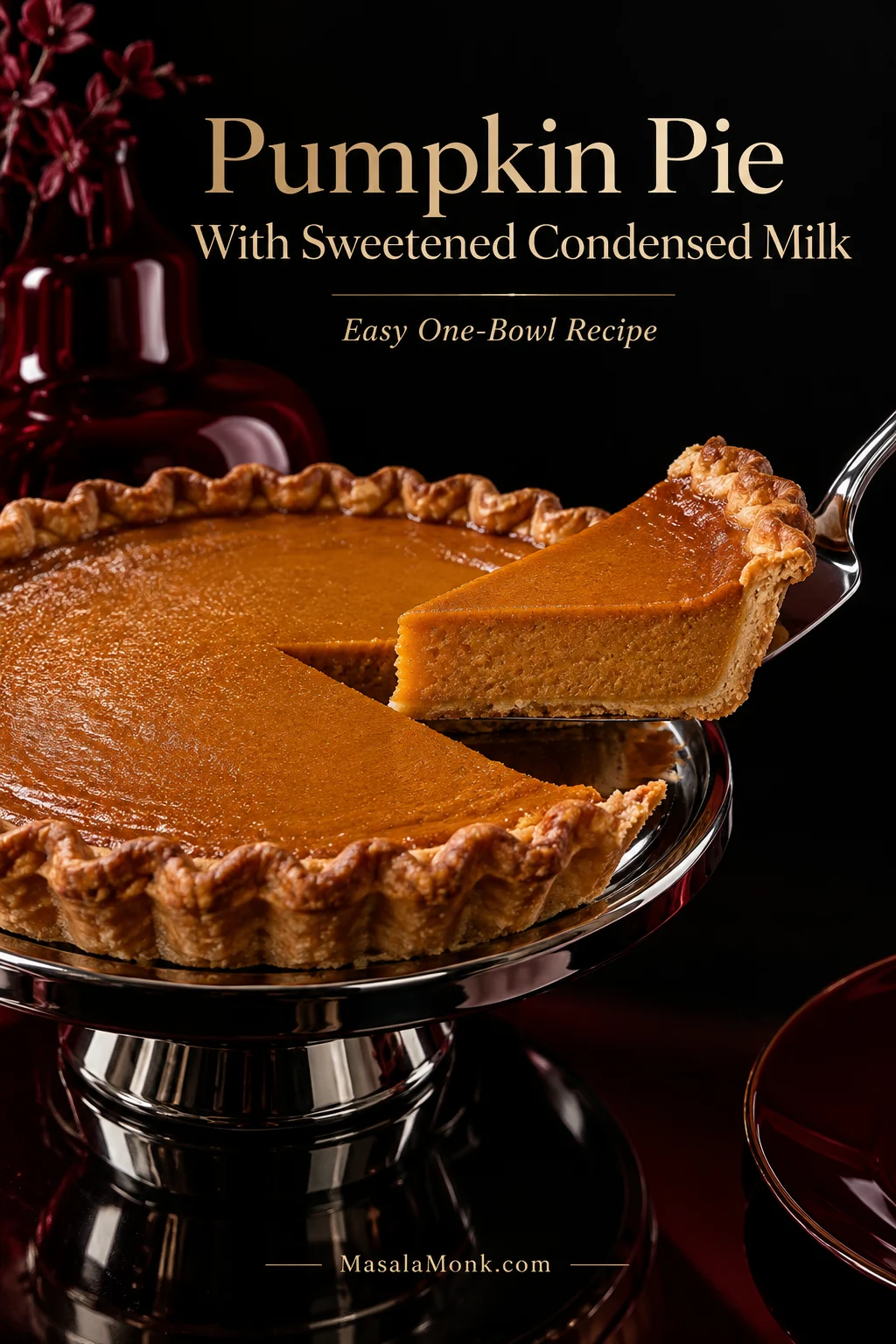
Pumpkin pie with sweetened condensed milk keeps the filling simple. If condensed milk is the can you already have, yes—it works here. Build the pie around it from the start and skip the separate sugar an evaporated-milk recipe would normally need.
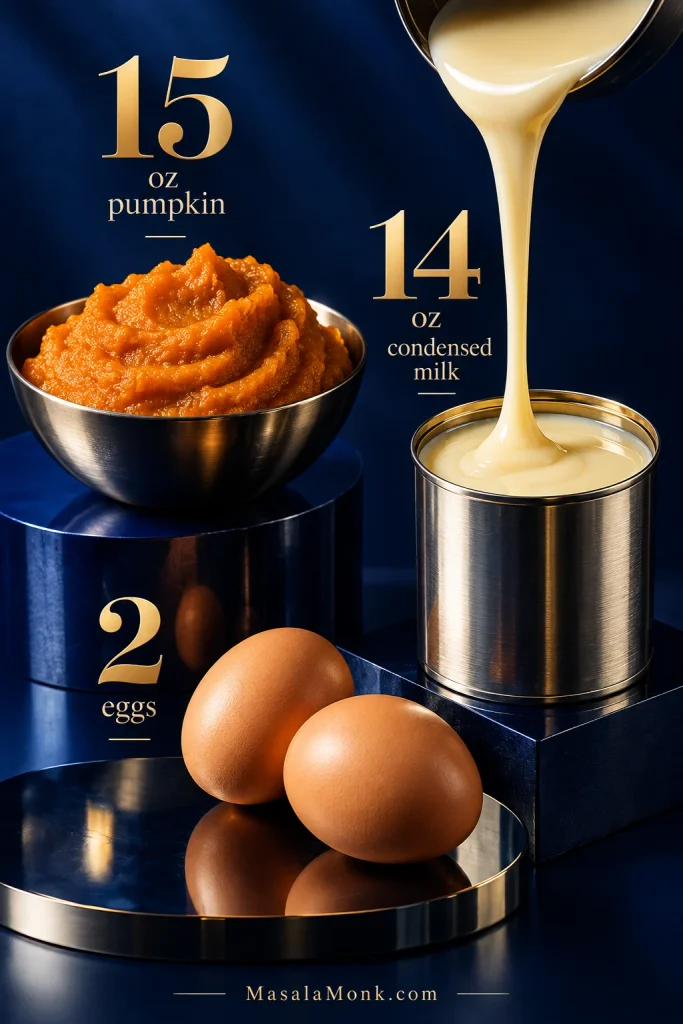
The ratio is easy to remember: 15 oz / 425 g pumpkin + one 14 oz / about 397 g can sweetened condensed milk + 2 large eggs. Add warm spices, salt, and vanilla if you like it, then pour the filling into a cold 9-inch / 23-cm pie crust.
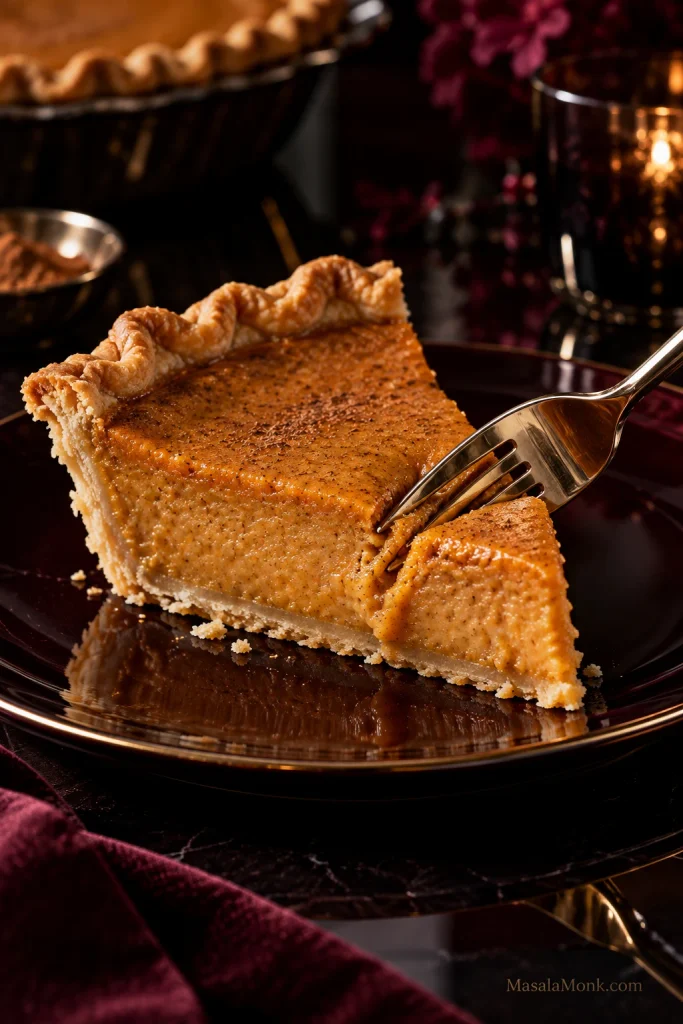
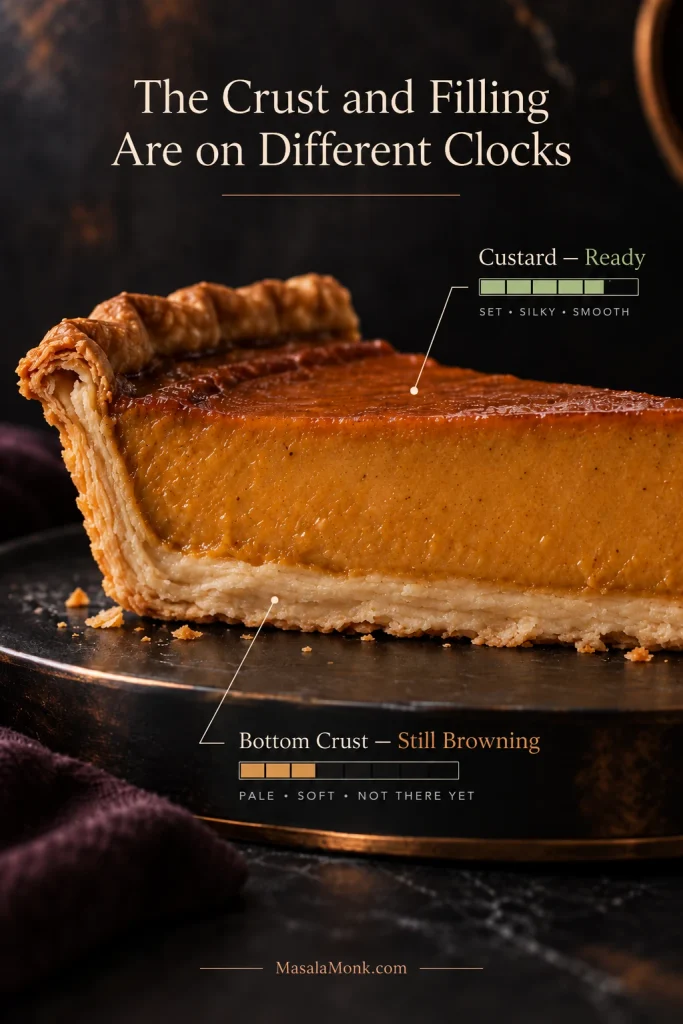
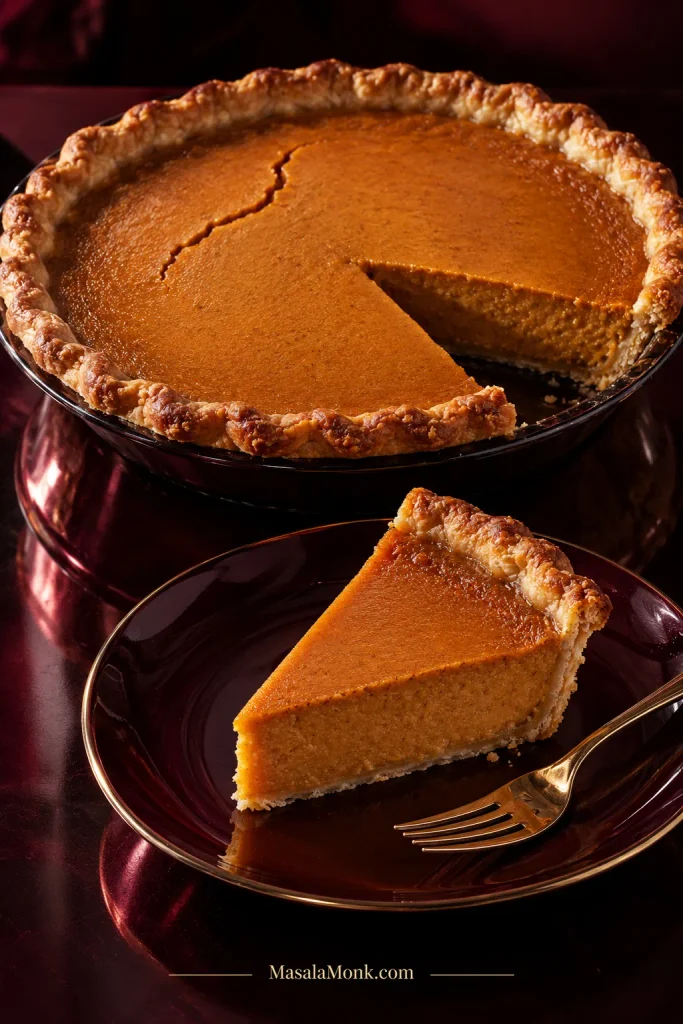
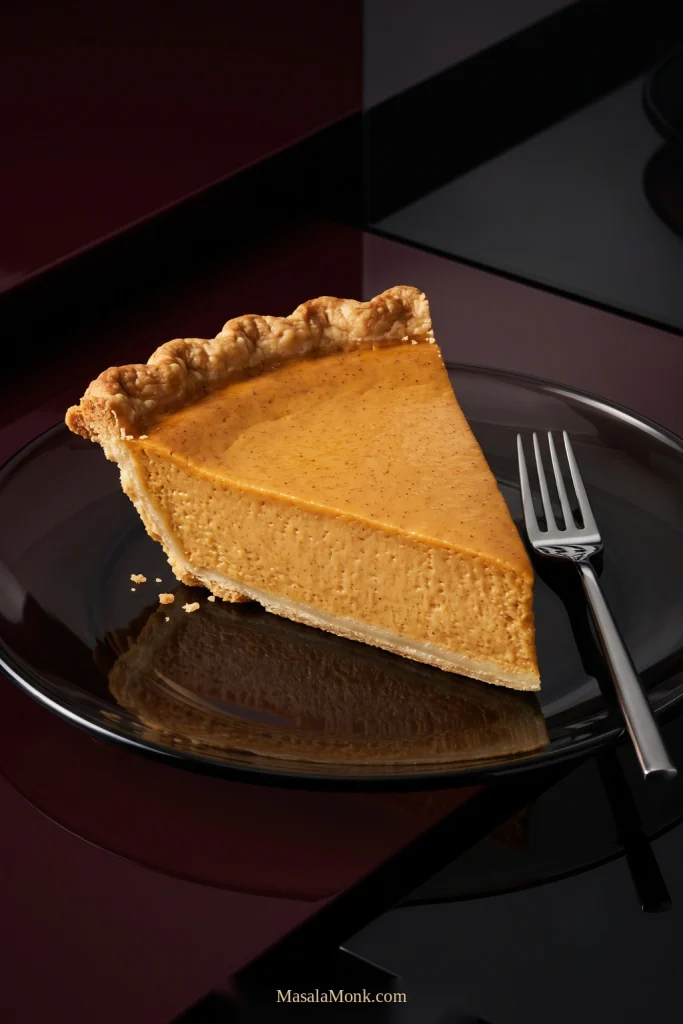
A good slice should feel like custard, not cheesecake: soft pumpkin filling once chilled, with warm cinnamon and ginger in the background. Enough pastry underneath keeps the condensed-milk richness from feeling heavy. The bake is where judgment matters most, because the filling can be ready while the bottom crust still needs help. A center that moves a little isn’t necessarily underdone, either.
Make It Now: Pumpkin Pie With Sweetened Condensed Milk
The filling itself is one-bowl simple. Most of the judgment comes later, when you’re deciding whether the custard and crust are done.
The 15 / 14 / 2 ratio has a practical advantage: it uses two standard cans without leftovers. One 15 oz can of pumpkin, one 14 oz can of sweetened condensed milk, and two eggs complete the core formula.
At a glance
What to know
Active prep
About 10–15 minutes
Bake
About 50–60 minutes: 425°F / 220°C for 15 minutes, then 350°F / 180°C for 35–45 minutes
Crust
Cold unbaked crust works; partially prebake if you want a crisper bottom
Doneness
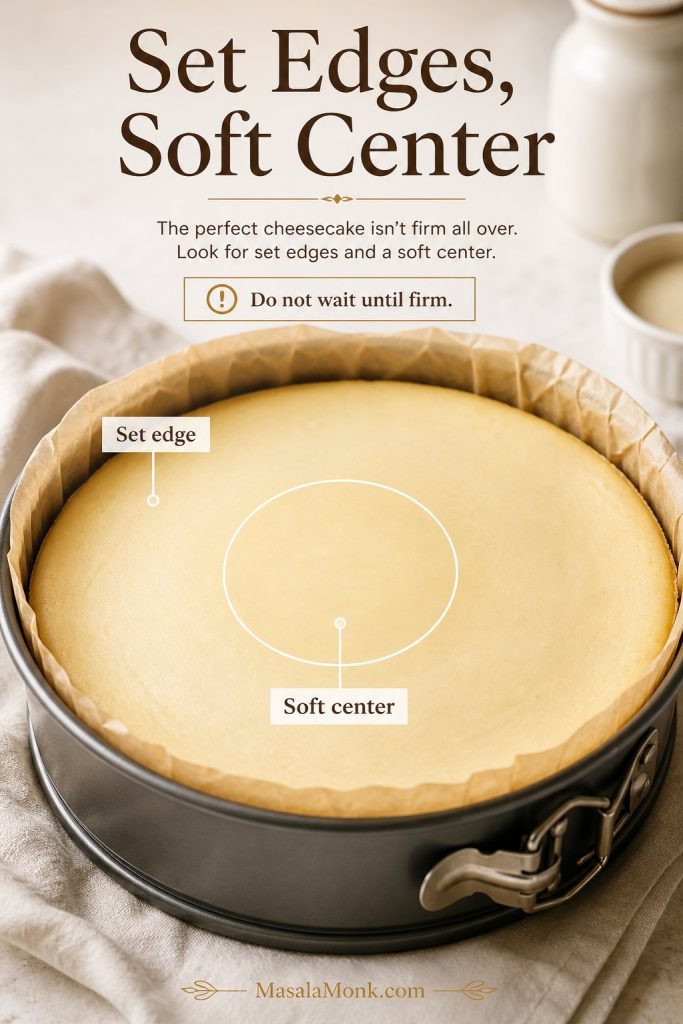
Set outer filling + a small, controlled center wobble
Yield
About 8 slices
For slices that hold well
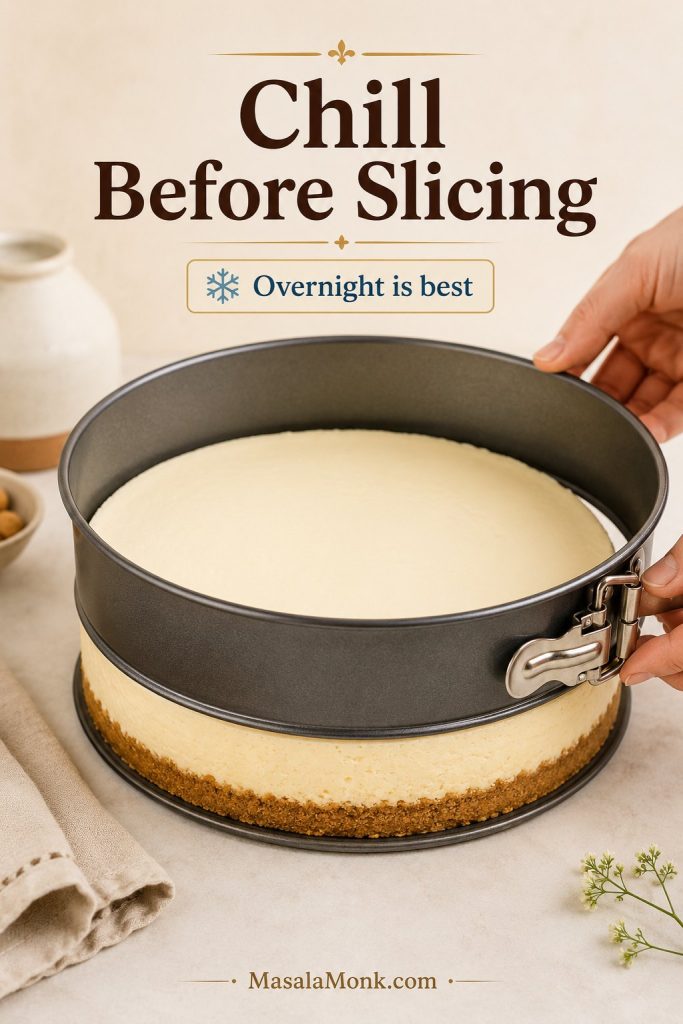
Cool, then refrigerate for about 4 hours; overnight is easiest
Optional partial prebake
Adds about 30 minutes chilling + 25–30 minutes baking
Ingredients
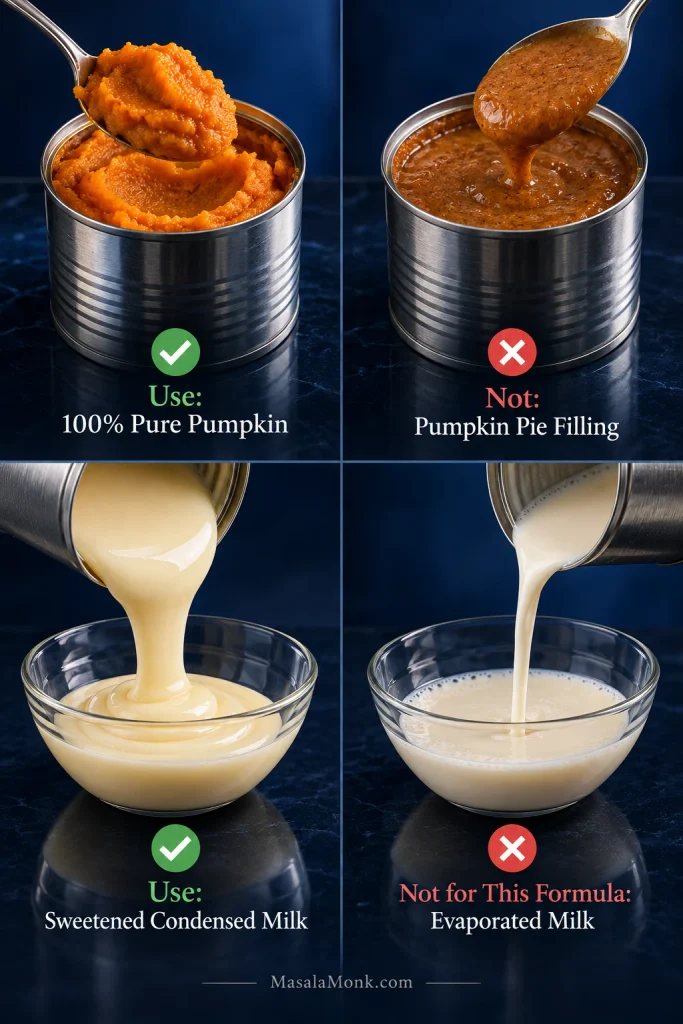
15 oz / 425 g 100% pure pumpkin purée — about 1¾ cups; use plain pumpkin, not pumpkin pie filling
1 × 14 oz / about 397 g can sweetened condensed milk — different from evaporated milk
2 large eggs / about 100 g without shells
2½ teaspoons pumpkin pie spice
½ teaspoon fine sea salt or table salt / about 2.5–3 g
1 teaspoon / 5 ml vanilla extract, optional
1 cold, unbaked 9-inch / 23-cm single pie crust
No ready-made spice blend? Use 1½ teaspoons cinnamon + ½ teaspoon ginger + ¼ teaspoon nutmeg + ⅛ teaspoon allspice + ⅛ teaspoon cloves. You can also make a batch of homemade pumpkin pie spice and adjust it from there.
Method
Heat the oven and ready the crust. Put a rack in the lower third and preheat fully to 425°F / 220°C. Set the cold shell on a rimmed baking sheet.
Make the Filling
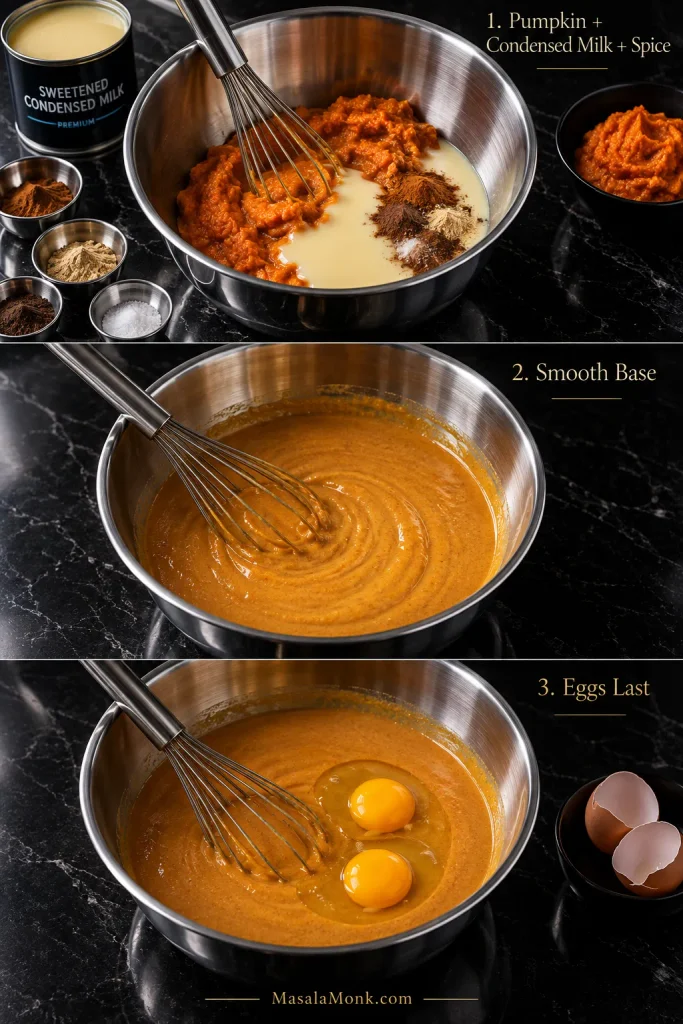
Mix the pumpkin, condensed milk, and seasonings. Whisk the pumpkin, condensed milk, spice, salt, and vanilla until evenly colored and smooth.
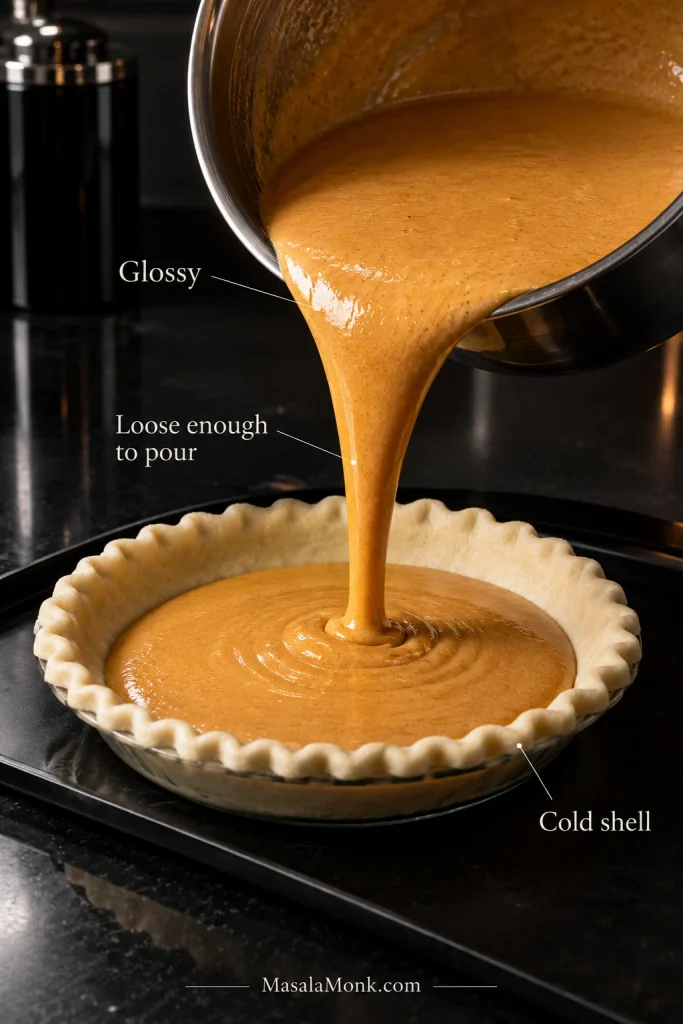
Add the eggs last. Whisk in both eggs just until combined. The filling should look glossy and loose enough to pour easily. That’s normal; pumpkin custard is much thinner before baking than it will be once set. Tap the bowl gently and pop any large bubbles on the surface.
Before the eggs go in, you can safely taste the pumpkin-condensed base and decide whether the optional brown sugar is actually needed. Afterward, whisk in the eggs only until combined.
Pour Into the Shell
Fill the shell. Pour in the custard, leaving a little headroom because 9-inch pie shells vary in depth. If you have extra filling, bake it in a lightly greased ramekin alongside the pie, but start checking it earlier. Take it out when the edges are set and the middle has the same small, controlled wobble.
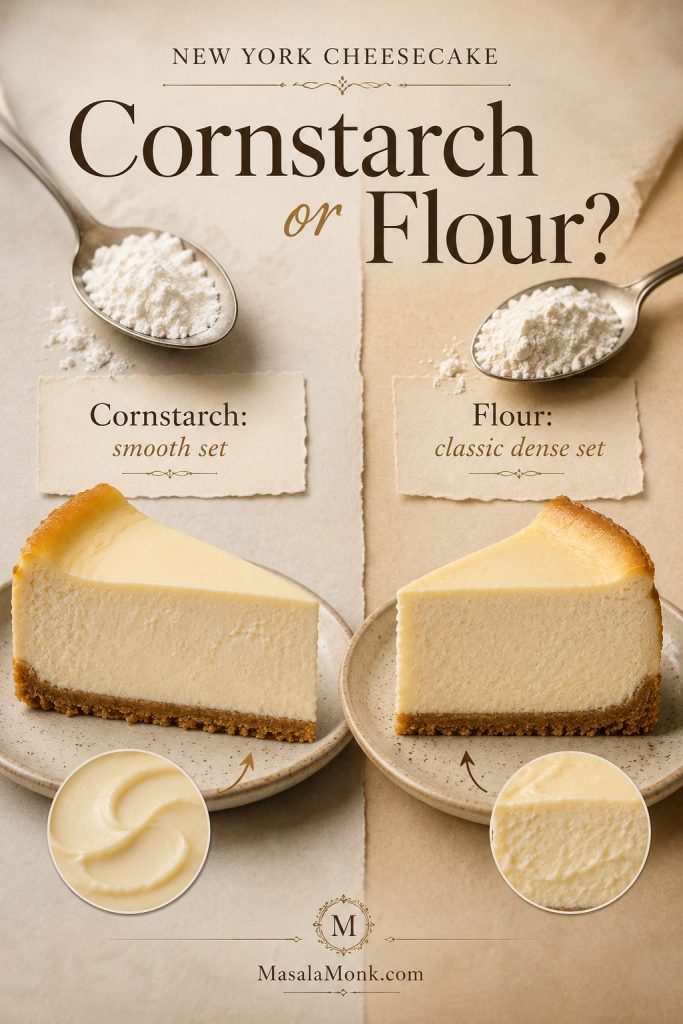
A loose pumpkin pie filling does not need flour or cornstarch just to look thicker. The eggs provide the set in the oven, so look for a smooth, evenly mixed filling rather than judging it by how thick it seems in the bowl.
Bake and Cool
Start hot. Bake at 425°F / 220°C for 15 minutes. Leave the pie inside and lower the oven to 350°F / 180°C.
Finish gently. Bake for about 35–45 minutes more, checking before the upper end of the range. Ready: the outer filling is set and the center has a small, controlled wobble. Needs longer: a broad section ripples or sloshes like liquid. If the rim is already deep golden, cover it with foil or a pie shield while the center finishes.
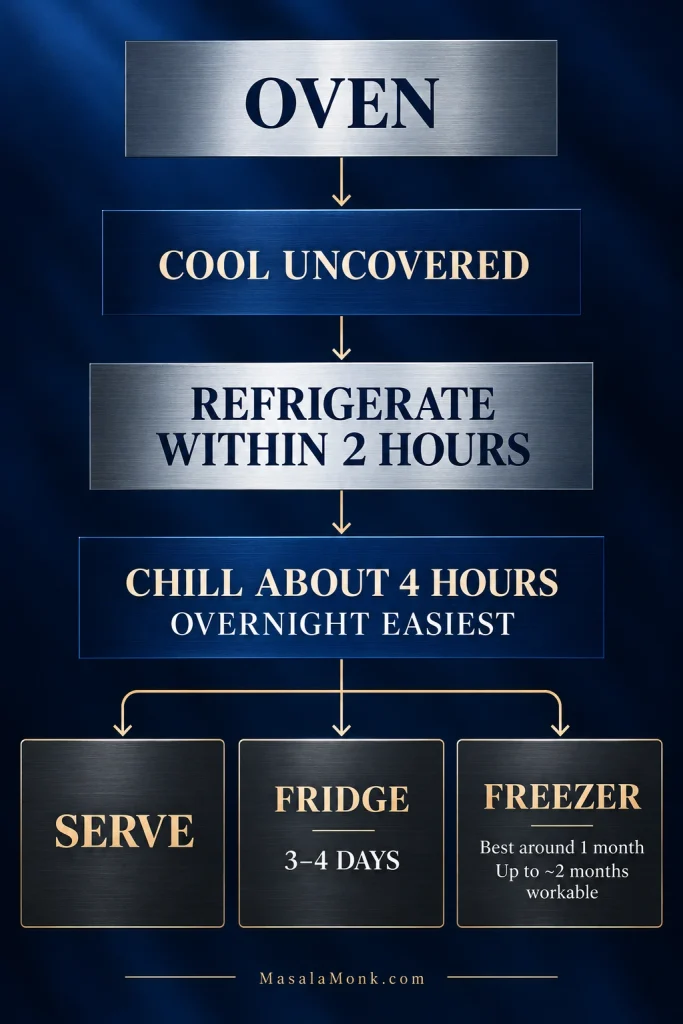
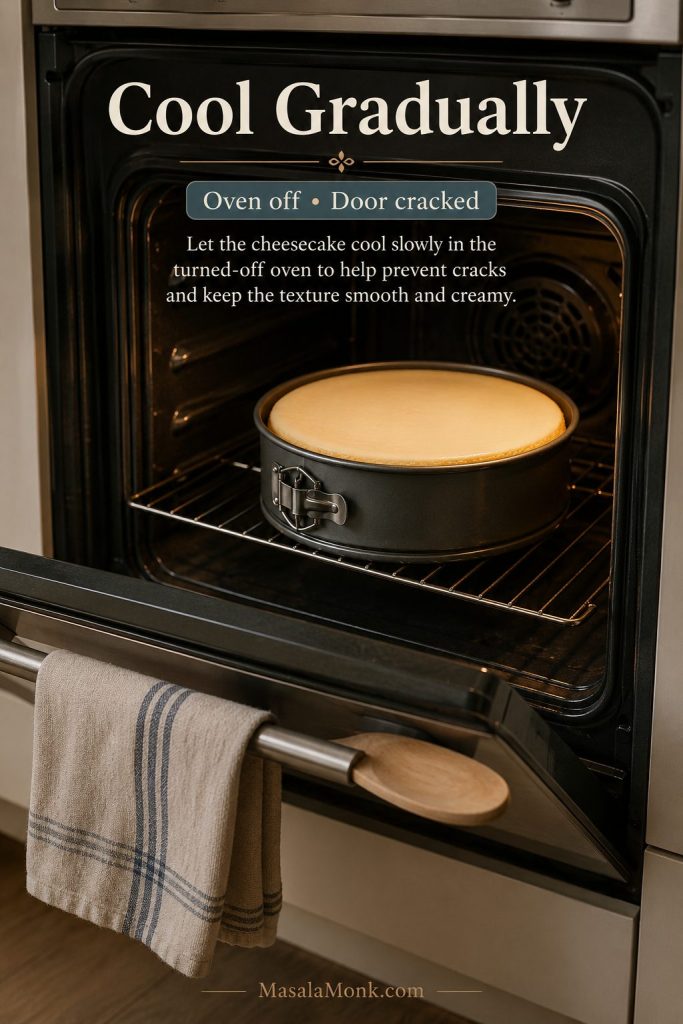
Cool safely. Let the pie cool uncovered on a rack and refrigerate it within 2 hours of leaving the oven. If it is still warm when refrigerated, leave it uncovered or loosely tented until chilled, then cover it once cold.
Fan or Convection Ovens
Start around 400°F / 200°C for 15 minutes, then lower to about 325°F / 160°C. If your oven already compensates automatically for fan heat, use its normal conversion setting. Countertop ovens deserve an earlier look because the top element can sit much closer to the pie.
There aren’t many ingredients here, which makes the two common supermarket mix-ups more important than they might seem.
Use Pure Pumpkin, Not Pie Filling
Choose a can labeled 100% pure pumpkin or pumpkin purée. Pumpkin pie filling or pumpkin pie mix already contains sweeteners and seasoning, so it would make this pie sweeter and change the spice balance.
A standard 15 oz can gives the 425 g needed here. Straight from the can, the purée should be thick enough to hold soft spoon marks.
Sweetened Condensed or Evaporated Milk?
Not 1:1. In this pumpkin pie with sweetened condensed milk, the condensed milk is thick and already contains sugar; evaporated milk is unsweetened and much thinner. Each needs a recipe with a different sugar and dairy balance.
Feature
Sweetened condensed milk
Evaporated milk
Sweet?
Yes
No
Texture
Thick and syrupy
Fluid and pourable
What it brings
Dairy, sweetness, richness, body
Dairy and moisture
Extra sugar usually needed?
No
Usually yes
If evaporated milk is the can you have, switch to an evaporated-milk pumpkin pie formula rather than trying to sweeten or thicken it until it behaves like condensed milk.
The finished pies differ too. A condensed-milk version is usually richer and sweeter; an evaporated-milk version tends to feel lighter and gives you separate control over the sugar. Either can make a soft custard—the eggs and final bake also determine how firmly it sets.
Opened sweetened condensed milk by mistake? You’re already in the right place. Use this formula and leave the separate sugar out.
Do You Need Extra Sugar?
No. The condensed milk already makes the standard filling clearly sweet. If you deliberately want a sweeter pie with a mild molasses note, taste the pumpkin-and-condensed-milk mixture before adding the eggs. Then add 1–2 tablespoons packed brown sugar only if you want it.
Once chilled, the pumpkin should lead the flavor, with cinnamon and ginger behind it and the pastry giving the soft custard some needed contrast.
Choosing Your Spice Level
The 2½ teaspoons in the recipe is a balanced starting point. Use about 2 teaspoons for a milder, more pumpkin-forward pie or 3–3½ teaspoons for something bolder. Go slowly with clove-heavy blends; the spice should sit behind the pumpkin, not bury it.
Once the cans and seasoning are right, the biggest remaining decision is when to stop baking. That matters more than another half-teaspoon of spice.
How to Tell When Pumpkin Pie Is Done
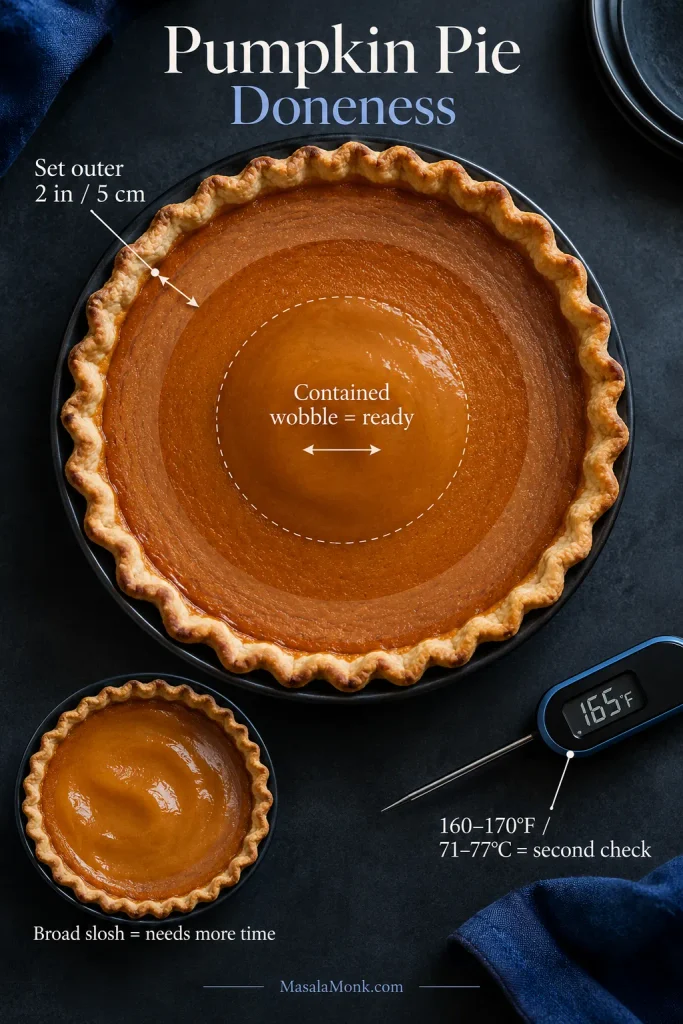
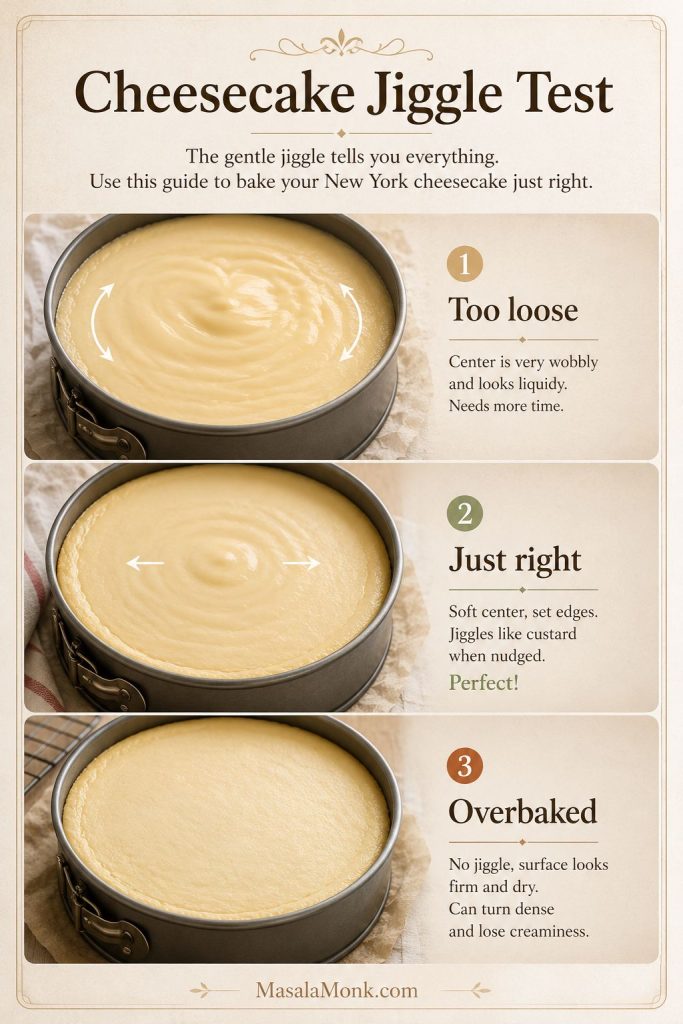
Pumpkin pie is done when the outer 2 inches / 5 cm are set. A smaller center should still wobble softly as one piece when you nudge the plate. Broad liquid ripples or sloshing mean it needs more time.
The middle will move, and the instinct is often to give it another ten minutes “just to be safe.” That’s exactly where a good custard pie can go too far. Start checking within the suggested bake-time range and let the pie itself make the decision.
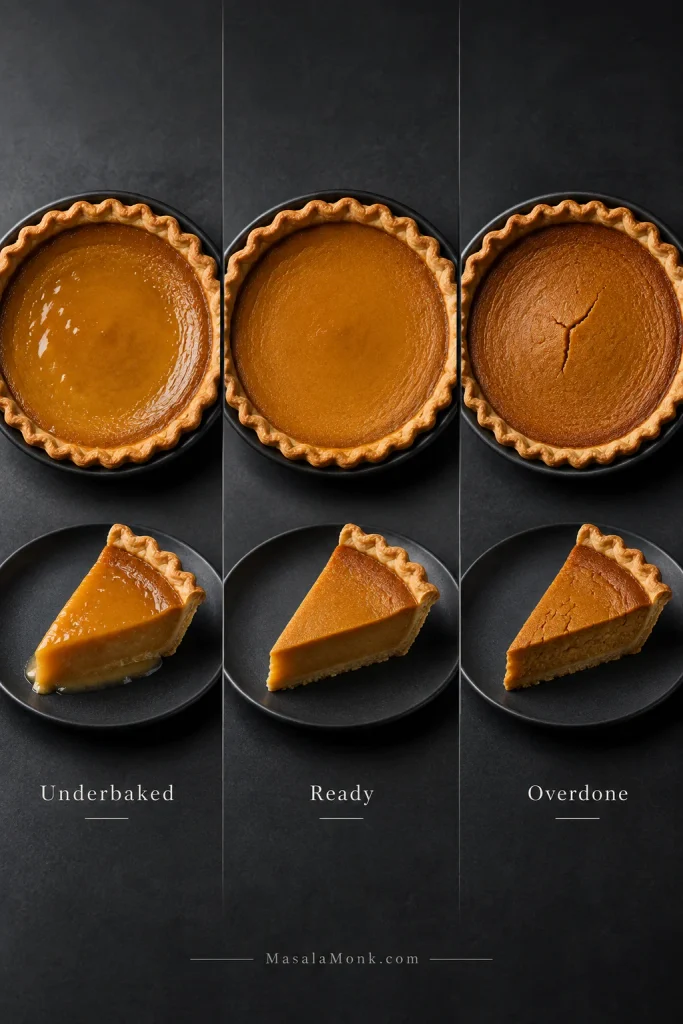
Underbaked, Ready, or Overdone?
Stage
What you see
What to do
Too early
A broad part of the center ripples, waves, or sloshes like liquid
Keep baking
Ready
Set perimeter + a contained wobble in the middle
Take the pie out
Too far
The center is rigid, strongly puffed, cracked, or beginning to pull from the crust
Remove it immediately
Surface color is a poor guide to how to tell when pumpkin pie is done because pumpkin and spice can darken before the center sets. Use movement, not browning, to decide when to pull the pie.
Jiggly is not the problem. Liquid is. A small, controlled movement in the middle is what you want; the pie keeps setting as it cools.
You don’t need a perfectly clean knife test. Waiting for the center to look completely firm is more likely to push the custard too far.
Use a Thermometer When the Wobble Is Hard to Read
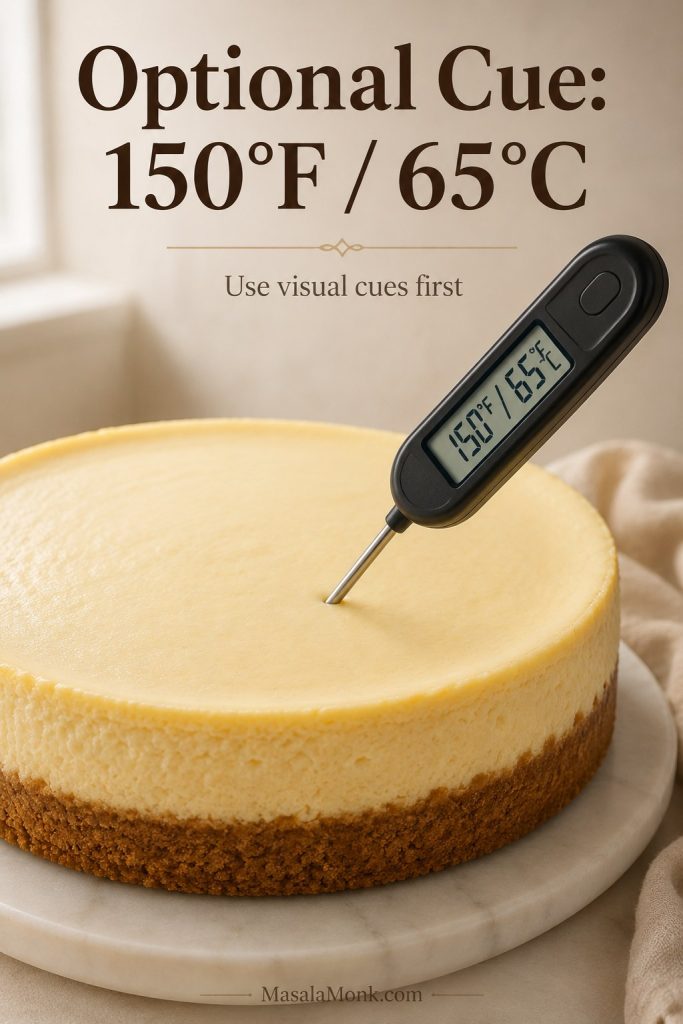
If you’ve been staring at the center and can’t decide whether that wobble is enough, an instant-read thermometer can break the tie. Roughly 160–170°F / 71–77°C in the middle is a useful secondary check, not a replacement for looking at the pie.
Use a simple hierarchy for pumpkin pie doneness: movement first, thermometer if you are unsure, bake time last. That keeps a clock or temperature reading from overruling what the custard is visibly telling you.
Once thoroughly chilled, that softly set center should hold a slice but yield easily under a fork. If the filling eats firm and bouncy like cheesecake, it probably went farther than it needed to in the oven.
A clean slice does not require a dry custard. Chilling provides much of the structure, so the filling can stay tender enough to yield under a fork without sacrificing a neat wedge.
But doneness is only half the timing problem because the pastry underneath can be on a different schedule entirely.
A pumpkin pie can have an overbaked filling and a pale bottom at the same time. More baking isn’t always the answer. Once the custard is done, chasing a darker base can turn a good filling dry before the pastry catches up.
That is also why the recipe starts hot and then drops the temperature. The first 15 minutes give the cold pastry an early burst of heat and get crust browning underway; the lower oven then lets the egg custard finish more gently.
A deeply browned rim does not guarantee a browned bottom: exposed pastry gets direct oven heat, while the base sits beneath wet custard, so judge the filling and bottom crust separately.
For the easiest improvement, bake the pie on a lower rack. If you want a distinctly crisper bottom, partially bake the shell first.
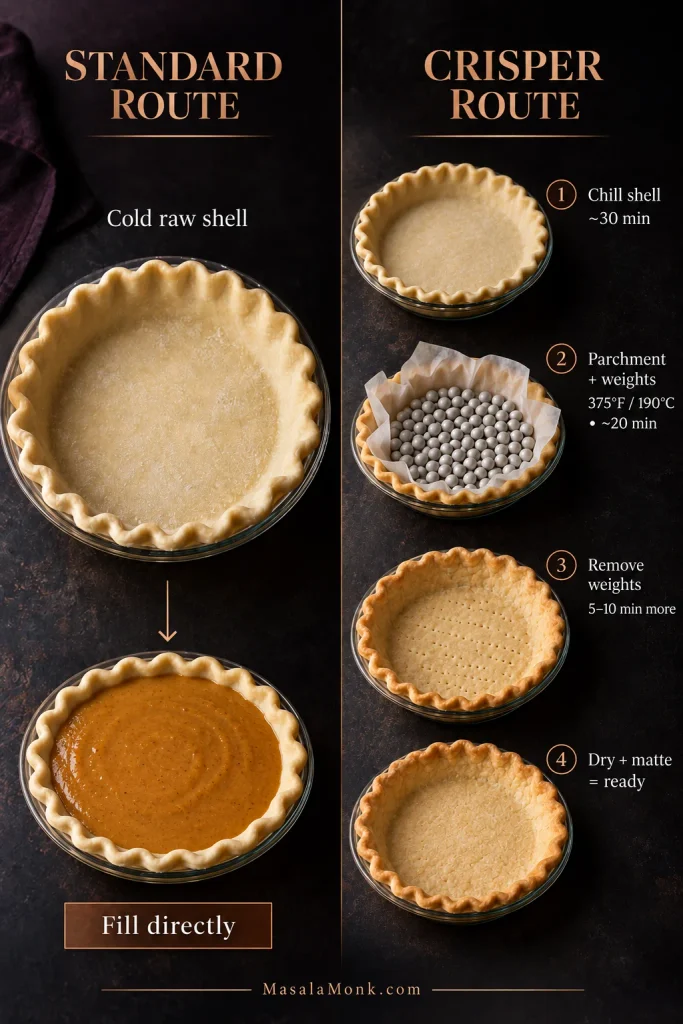
Cold, Unbaked Crust: The Standard Route
The main recipe uses a cold raw crust on a lower oven rack, and that isn’t the inferior version. A refrigerated or frozen store-bought shell is completely fine. Partial prebaking is an extra step for people who care especially about bottom-crust crispness; you don’t need to turn a simple pie into a project.
Prefer making the pastry yourself? This flaky homemade pie crust makes enough for two single-crust 9-inch / 23-cm pies, so one disk can go into this pie and the other can be frozen. Ease the dough into the plate instead of stretching it, then chill the shaped shell again if it has softened.
For a Crisper Bottom, Partially Bake the Shell
You do not have to prebake the crust for this pumpkin pie. Do it when a distinctly crisp bottom matters enough to add the extra step. The key is giving the base a few dry minutes after the weights come out, before wet custard goes in.
You are not trying to fully brown the empty shell. Instead, the useful checkpoint is a base that has lost its damp sheen, because the crust will keep baking after the pumpkin custard goes in.
Partial Prebake, Step by Step
Fit and crimp the pastry, then chill the shaped shell for about 30 minutes.
Heat the oven to 375°F / 190°C.
Line the shell with parchment and fill it about two-thirds full with pie weights, dried beans, uncooked rice, or granulated sugar. Keep the weights against the sides as well as the base.
Bake for about 20 minutes.
Remove the parchment and weights, then bake the empty shell for another 5–10 minutes. The bottom should lose its damp shine and look dry and matte.
Raise the oven to 425°F / 220°C, add the pumpkin filling, and continue with the main recipe.
The rim has already had a head start, so shield it with foil or a pie shield once the color looks right.
Instead of chasing a cracker-dry bottom, aim for enough crispness underneath to give the soft custard some contrast.
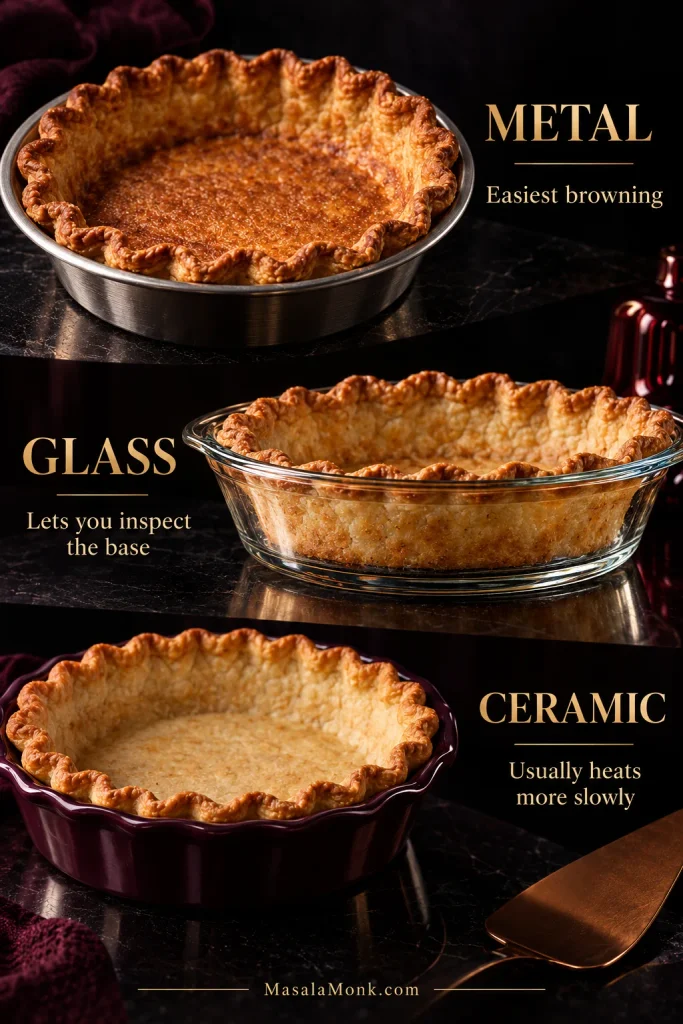
Metal, Glass, or Ceramic Pie Plates?
Pan material can help too. A metal pie plate generally gives the bottom heat more quickly and is the easiest choice when browning is the priority. Glass lets you see how the base is coloring. Ceramic works well but usually heats more slowly.
Pan material mostly changes the crust side of the equation. The pumpkin custard still needs the same set-edge and center-wobble cues whether the pie sits in metal, glass, or ceramic.
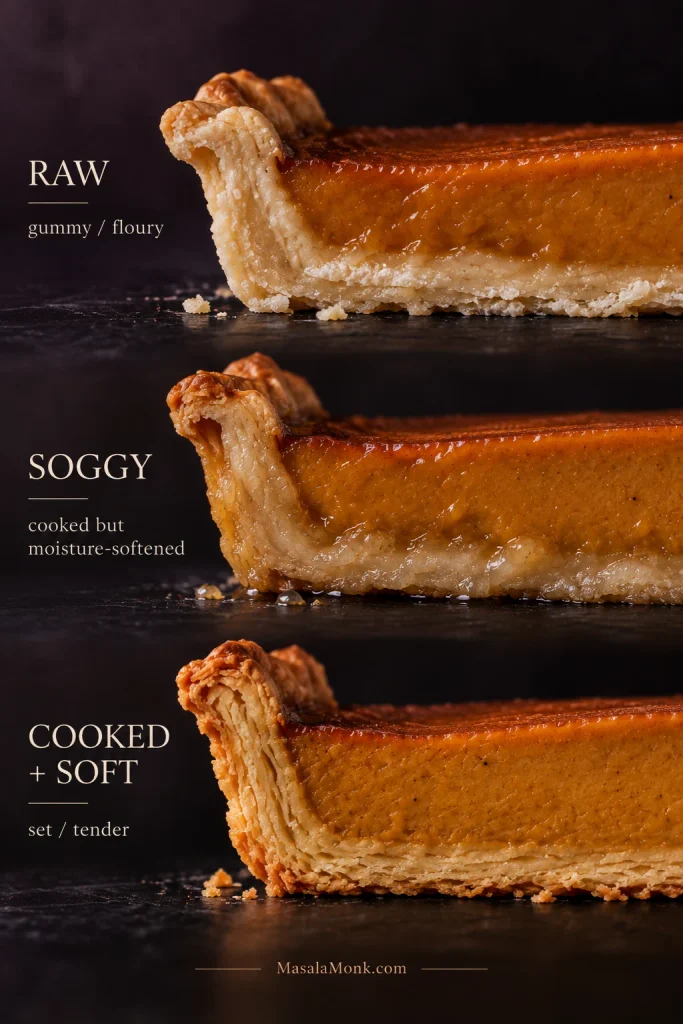
Raw, Soggy, or Simply Soft?
The pastry directly under pumpkin custard will usually be softer than the exposed rim. That doesn’t automatically mean it is raw.
Raw pastry feels gummy, floury, and dough-like. Soggy but cooked pastry has set but absorbed moisture. The layer where the custard meets the crust may simply be soft and tender.
Look at the cut edge as well as the color: raw dough smears and compresses, while cooked-soft pastry shows set layers even when it bends instead of snapping.
If the filling is properly done, much more oven time is unlikely to rescue the bottom without hurting the custard. Prevention works better: use a lower rack, choose a metal pie plate, or partially prebake the shell.
Got set edges, a softly moving center, and a crust you’re happy with? You’re done here. This section is for the moment something looks off.
Most pumpkin-pie problems don’t ruin dessert. A crack, soft crust, or condensation can look worse than it actually is, so start with what you can see.
If the Filling or Top Looks Wrong
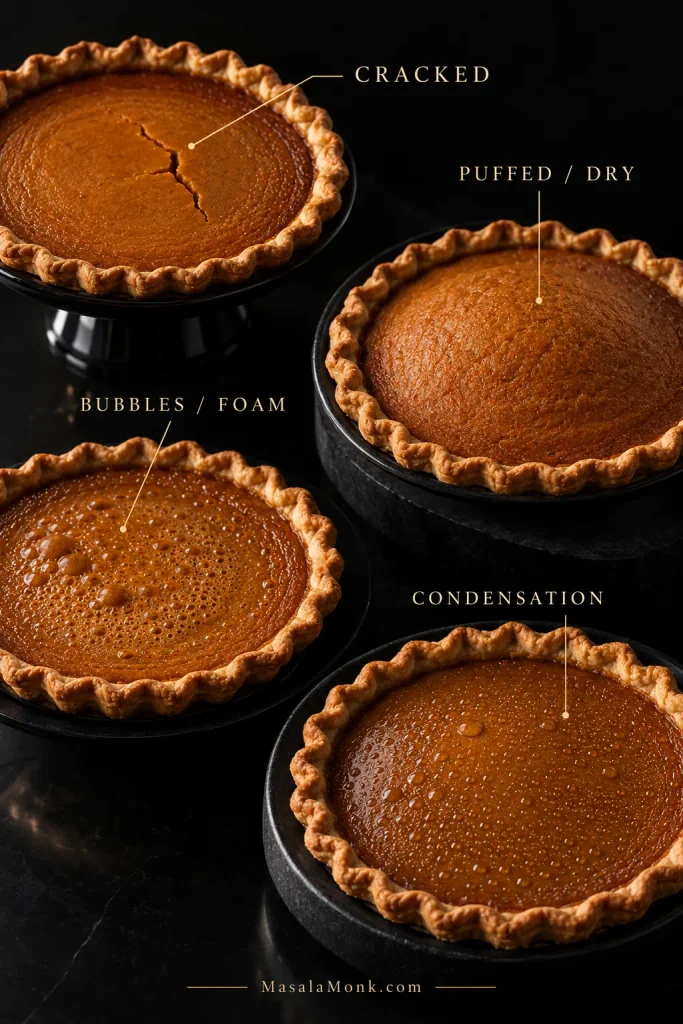
Surface flaws and doneness are not the same diagnosis. Cracks, puffing, bubbles, and condensation tell you something about heat, air, or cooling; a genuinely underbaked center is better recognized by broad liquid movement.
Match What You See to the Fix
What you see
Likely cause
What to do
Center still sloshes
Underbaked custard.
Now: If you just removed it, return it to the oven in 5-minute increments. Next time: Wait for set edges and a smaller soft wobble.
A warm slice is very soft
It may only need more cooling.
Now: Chill the rest before judging it. Next time: Give the pie plenty of refrigerator time before slicing.
The chilled filling is runny
Underbaking, wet homemade pumpkin, or changed ratios.
Now: A cold sliced custard is difficult to repair neatly. Next time: Control pumpkin moisture and use the doneness cues.
The surface cracked
The custard baked too far.
Now: Chill and serve; the crack is mostly cosmetic. Next time: Pull the pie while the center moves slightly.
The top puffed or looks dry
Too much heat or bake time.
Now: Let it cool; mild puffing often settles. Next time: Check sooner, especially in fan or countertop ovens.
The top is foamy or bubbly
Too much air entered during mixing.
Now: Leave it alone; surface bubbles mainly affect appearance. Next time: Whisk gently and clear large bubbles before baking.
The custard is grainy
The eggs overheated.
Now: The texture can’t really be reversed. Next time: Remove the pie sooner.
Water droplets appeared after chilling
Steam condensed on the surface.
Now: Blot large droplets gently. Next time: Cool uncovered and cover only once thoroughly cold.
Too sweet? Serve it cold with unsweetened or barely sweetened whipped cream. Tastes flat? Check the age of your spices before adding more; fresh cinnamon and ginger often help more than another spoonful of a tired blend.
If the Crust Isn’t Behaving
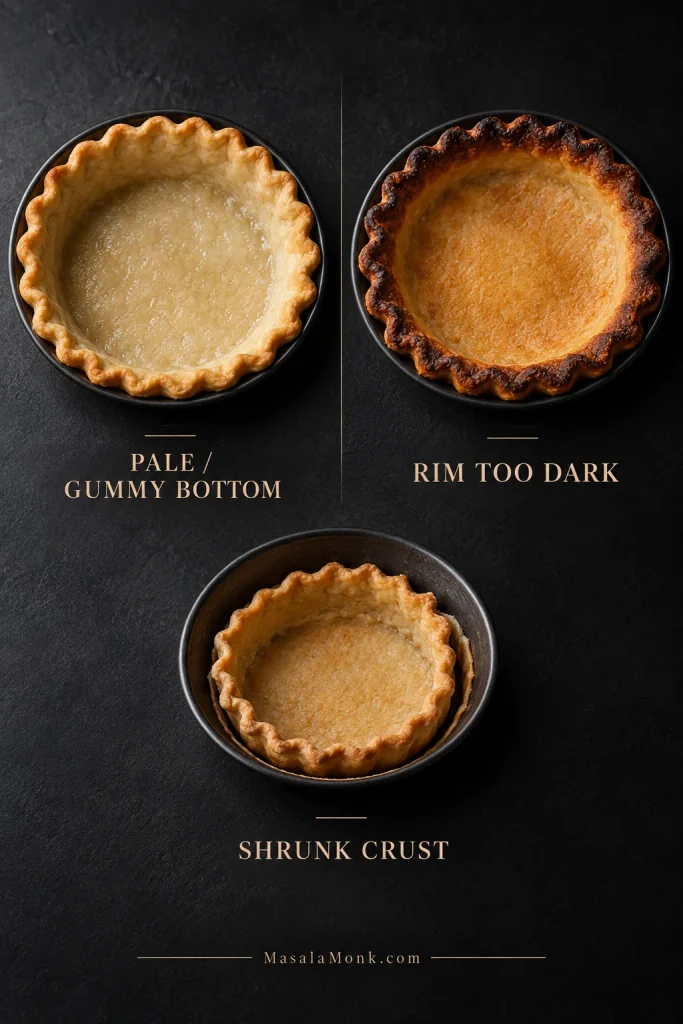
Use the location of the problem as the clue: base issues point toward bottom heat, rim issues toward exposure, while shrinkage points back to dough handling or support.
Match the Crust Problem to the Fix
What you see
Likely cause
What to do
Bottom crust is pale and gummy
Not enough bottom heat.
Now: It’s hard to fix once the custard is done. Next time: Use a metal pan, lower rack, or partial prebake.
Bottom is soft but cooked
The custard softened the pastry.
Now: Soft doesn’t necessarily mean raw. If the pastry has set and isn’t gummy or floury, serve it. Next time: Partially bake the shell if you want more crispness.
Crust rim is too dark
The exposed edge finished first.
Now: Cover with foil and let the center finish. Next time: Shield the rim once the color looks right.
The crust shrank
The pastry was stretched, warm, or poorly supported.
Now: There isn’t much to reverse after baking. Next time: Fit gently, chill thoroughly, and support the sides with weights.
The filling overflowed
The shell was too shallow or too full.
Now: Let the baking sheet catch it. Next time: Leave more headroom.
If the custard is set and tastes good, don’t let a crack or a softer-than-perfect bottom turn dessert into a post-mortem. Some problems are worth learning from without needing to rescue the pie in front of you.
If appearance matters, cut the first serving from an intact section and leave the cracked area for later. Chilled pumpkin custard is usually stable enough that a cosmetic crack will not prevent clean wedges.
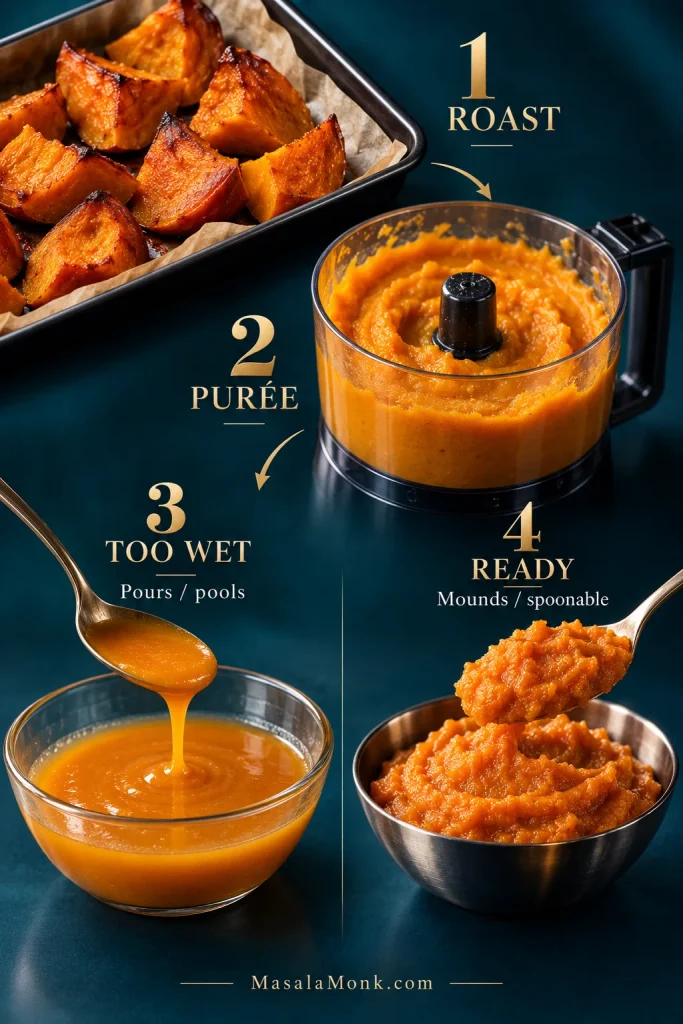
Working with canned pumpkin? You can skip this section. With fresh pumpkin, moisture is the variable that matters most.
A small pie or sugar pumpkin—or another dense, sweet cooking pumpkin—is usually a better choice than a large carving pumpkin, which tends to be wetter and stringier. Roast it when possible, then purée until smooth. If liquid gathers around the purée or it pours instead of mounding from a spoon, it is too wet. Drain it through a fine sieve or cook it gently until some of that water evaporates.
You want something thick, spoonable, and spreadable, with no watery pooling. Once it reaches that point, weigh 15 oz / 425 g for the pie. Fix the excess water before mixing the custard; adding flour later changes the texture without fixing why the purée was loose in the first place.
For slightly wet fresh pumpkin purée, draining removes free water without concentrating the flavor as much. A clearly loose purée benefits more from gentle stovetop reduction.
Two changes are especially useful here: swap the pastry for a graham cracker crust, or warm the pumpkin and spices first for a deeper, more concentrated filling.
Graham Cracker Crust
The same filling works with graham cracker crust. Use a prepared shell or make a simple homemade graham cracker crust for a 9-inch / 23-cm plate.
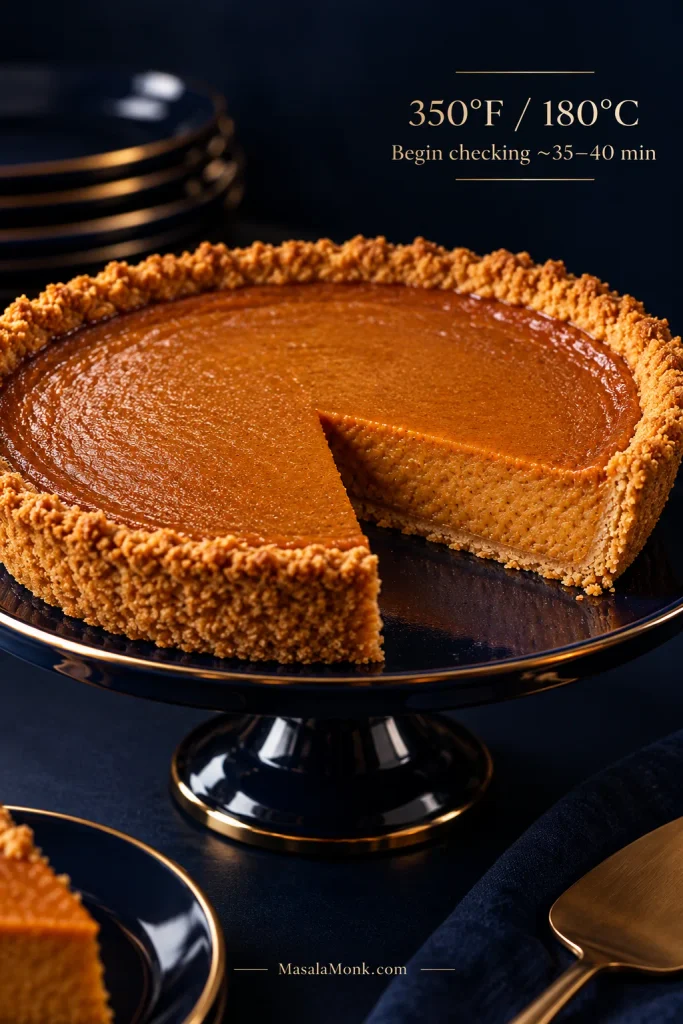
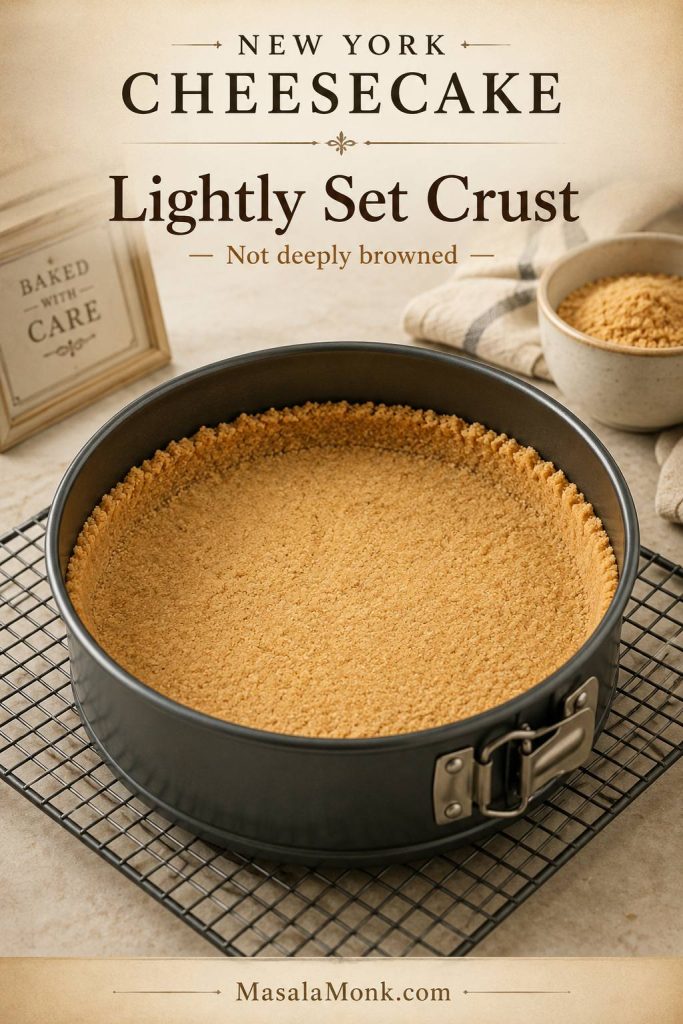
For a homemade crust, bake the empty shell at 350°F / 180°C for about 10 minutes, then cool it before adding the filling. Bake the filled pie at the same 350°F / 180°C and begin checking around 35–40 minutes. A standard prepared 9-inch shell may be ready around 40 minutes; a deeper homemade crust can take longer. Let the same set-edge and soft-center cues decide.
Prepared graham shells can be shallow, so don’t be surprised if all of the filling doesn’t fit.
A graham cracker crust skips the 425°F / 220°C hot start used for pastry. Bake the filled pie at 350°F / 180°C and begin checking around 35–40 minutes, using the same soft-center wobble to judge doneness.
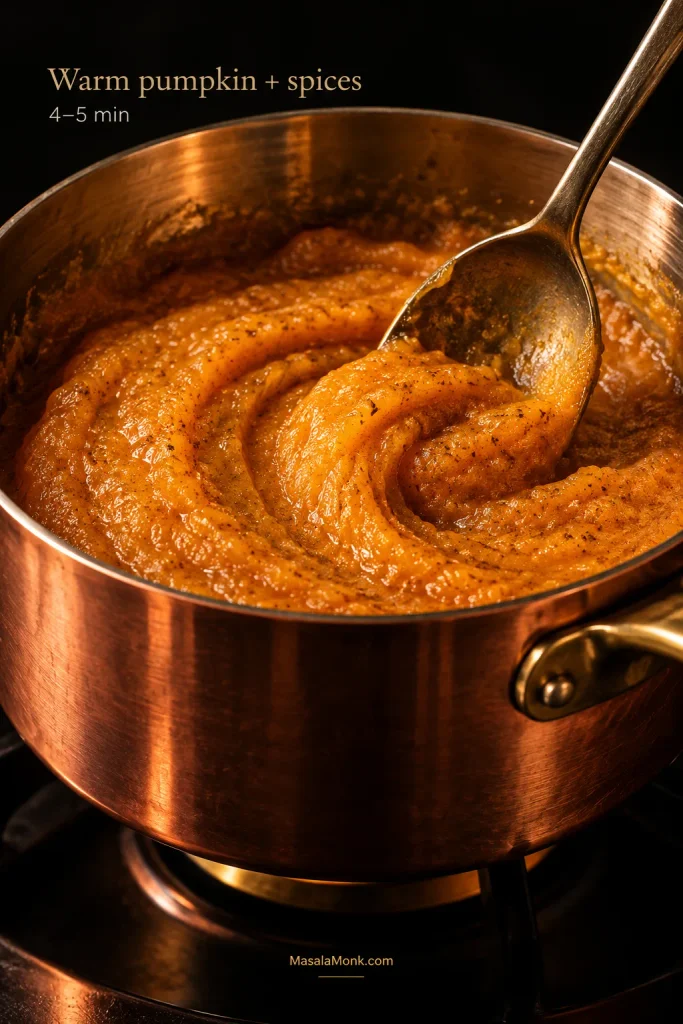
Want Deeper Pumpkin Flavor? Warm the Purée First
Cook the pumpkin, salt, and spices over low heat for about 4–5 minutes, stirring steadily. You’ll smell the change before you see much of one: the cinnamon and ginger become clearer as some moisture cooks away and the pumpkin loses its raw canned edge.
Let the mixture cool until it is warm rather than hot, then stir in the condensed milk. Add the eggs last and mix gently before filling the crust.
Let warmed pumpkin cool before the eggs go in; otherwise, residual heat can start setting the egg proteins before the pie reaches the oven. Warm is fine, but hot is not.
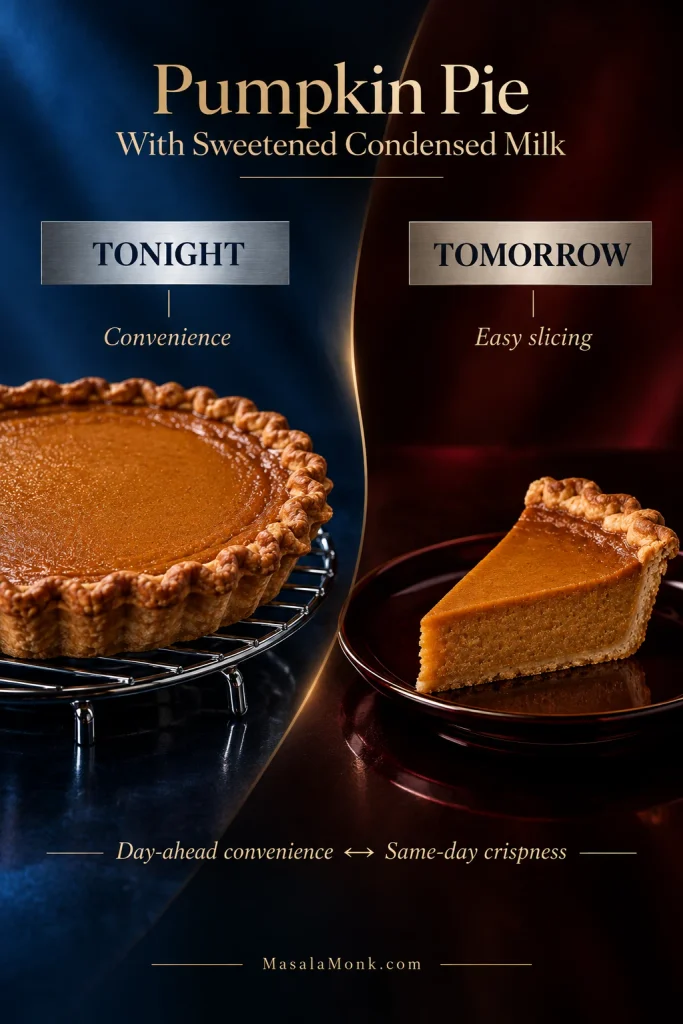
Bake Today, Slice Tomorrow
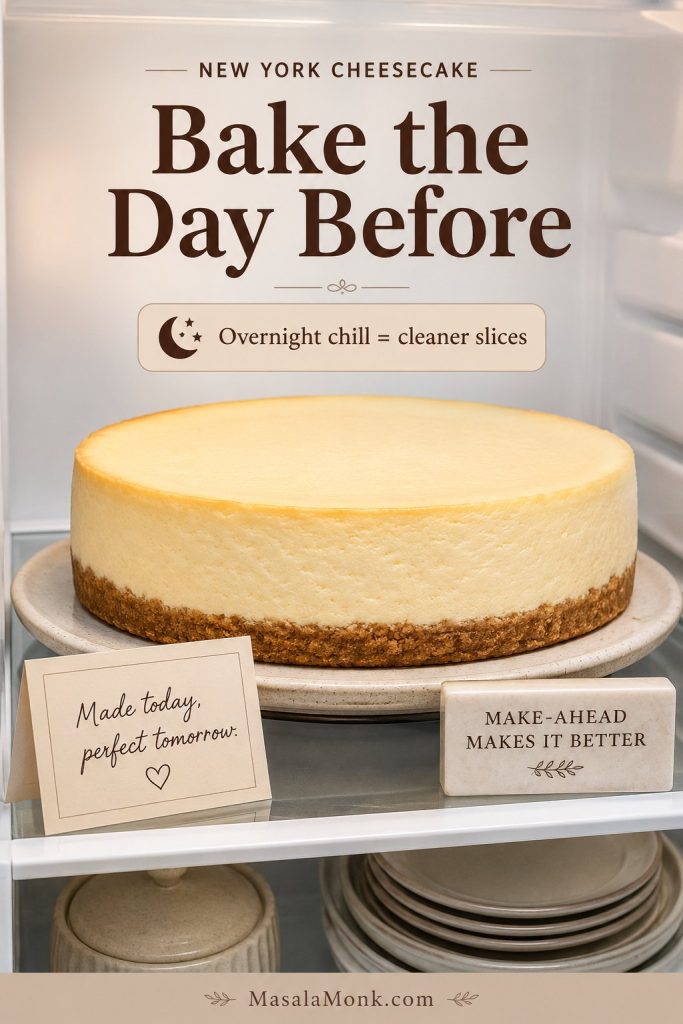
Yes, pumpkin pie can be baked a day ahead. An overnight chill gives the custard time to settle and makes the next day’s slicing much easier.
A day-ahead pie buys you convenience; a same-day bake buys you the crispest crust. If you want both, partially prebake the shell before baking the pie the day before.
When several dishes are competing for oven space, baking the pie the night before also leaves the oven free for food that needs to reach the table hot.
For the best make-ahead pumpkin pie crust, let the pie cool before covering it. Otherwise, trapped steam under wrap or a lid can soften the pastry faster.
Can You Make the Filling Ahead?
Yes. Mix the filling the night before, cover it, and refrigerate it separately from the unbaked crust. The resting time also gives the spices a chance to meld. Give the mixture a gentle stir before pouring it into the cold shell.
Cooling and Serving
Let the baked pie cool uncovered on a rack, but refrigerate it within 2 hours of leaving the oven. It does not need to be completely cold first; if it is still slightly warm, leave it uncovered or loosely tented until chilled. Cover it once cold.
For slices that hold together well, give the pie about 4 hours in the refrigerator after that cooling period. Overnight is easiest. If you prefer the pie less cold, let individual slices stand for 15–30 minutes before serving.
By then the center should cut cleanly but stay soft under a fork, with warm spice and pastry giving the richer filling some contrast. Barely sweetened or unsweetened homemade whipped cream works especially well because it lightens the condensed-milk richness without piling on more sweetness.
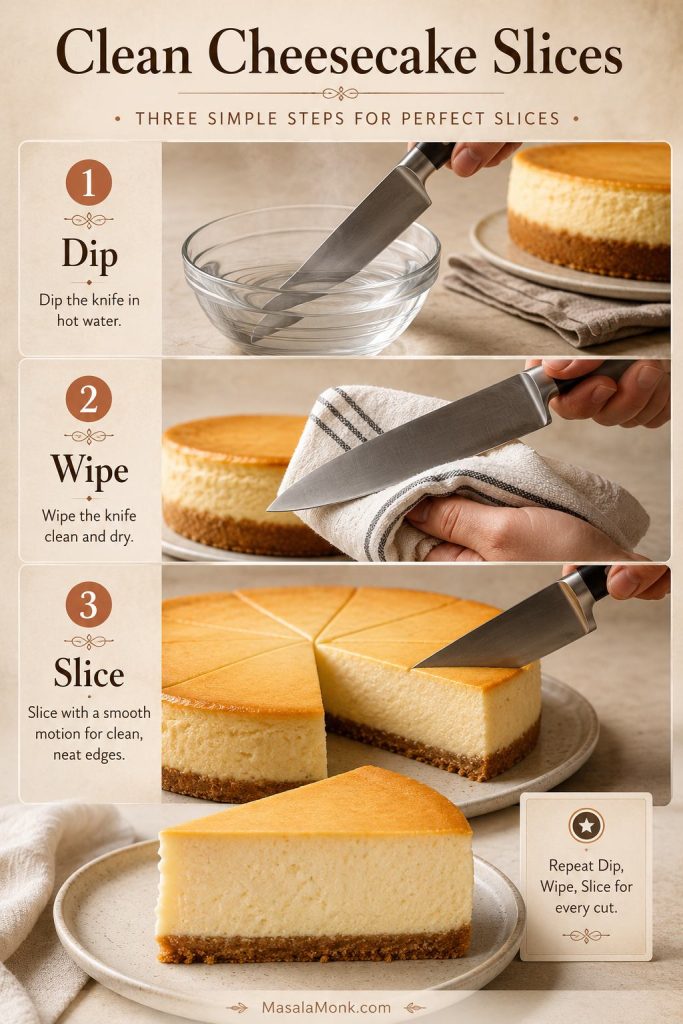
For cleaner pumpkin pie wedges, use a thin sharp knife, wipe the blade between cuts, and then slide a pie server fully beneath the crust before lifting.
Storage and Freezing
Keep the cooled pie covered in the refrigerator and use it within about 3–4 days. FoodSafety.gov gives the same refrigerator window for baked pumpkin and pecan pies in its cold food storage guidance.
You can freeze the pie too. For the best texture, aim to use it within about 1 month; roughly up to 2 months can work, but the custard may separate slightly and the crust can soften. Wrap the thoroughly cold pie well and thaw it overnight in the refrigerator.
If you freeze only a few servings, freeze individual pumpkin pie slices until firm and wrap them separately. Then you can thaw only what you need overnight in the refrigerator.
Pumpkin Pie Questions That Still Come Up
1. Can I bake two pumpkin pies at once?
Usually, as long as both pans fit with room for air to circulate. Two cold pies can slow the oven’s recovery, so the finish time may shift. Rotate them carefully later in the bake if your oven has obvious hot spots, and check each center separately.
2. Can pumpkin pie sit out overnight?
No. Pumpkin pie is an egg-and-dairy custard, so refrigerate it within 2 hours of leaving the oven. If a baked pumpkin pie has been left at room temperature overnight, the safest choice is to discard it.
3. What if my 9-inch crust doesn’t hold all the filling?
That’s common because 9-inch pie shells vary in depth. Stop before the shell becomes awkwardly full and bake the extra custard in a lightly greased ramekin. Start checking the ramekin earlier than the pie and remove it when the edges are set and the center has the same small, controlled wobble.
The first centre cut tells the truth. A no-bake lemon filling can taste bright and creamy in the bowl, yet still slump when the parchment lifts and the knife reaches the middle.
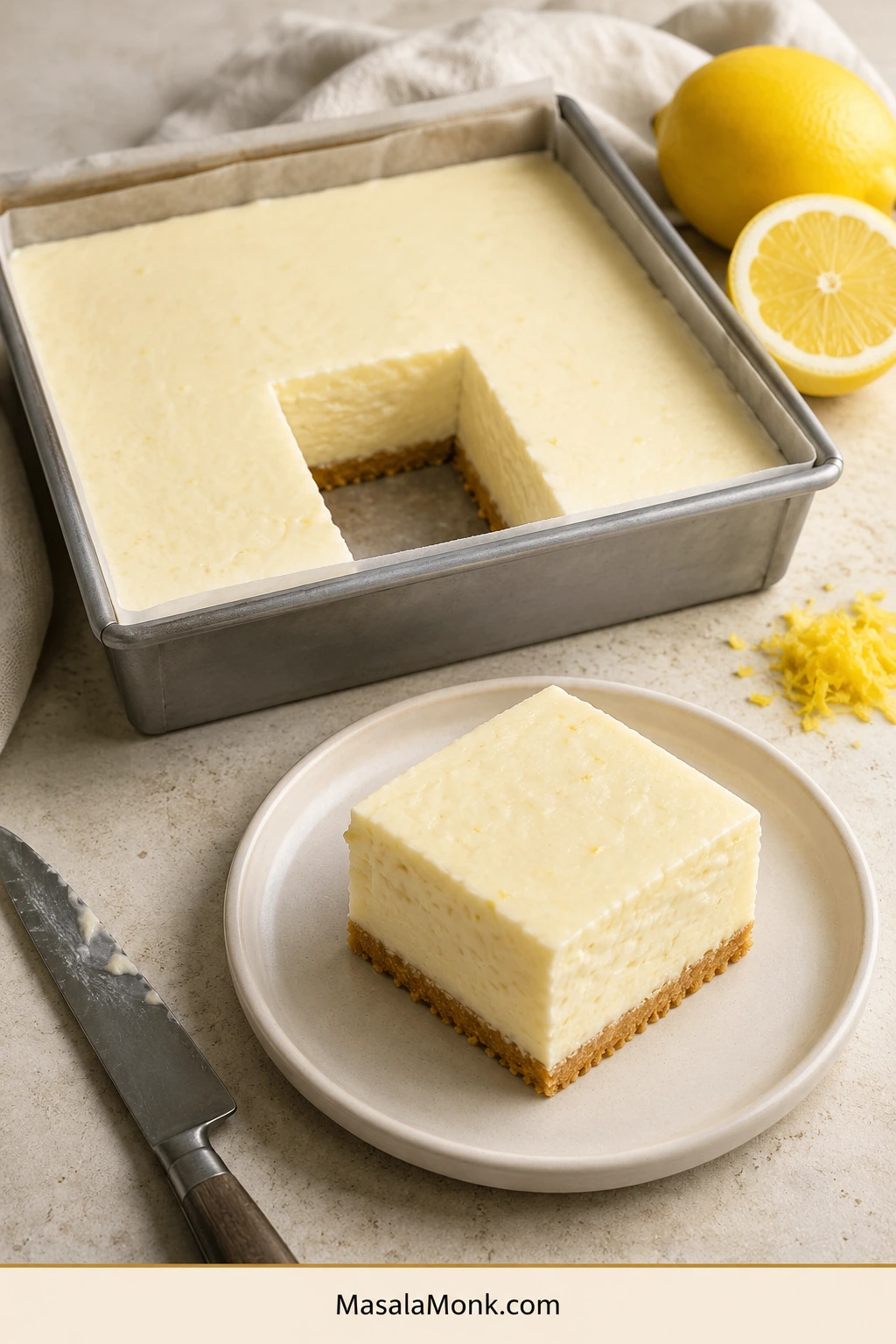
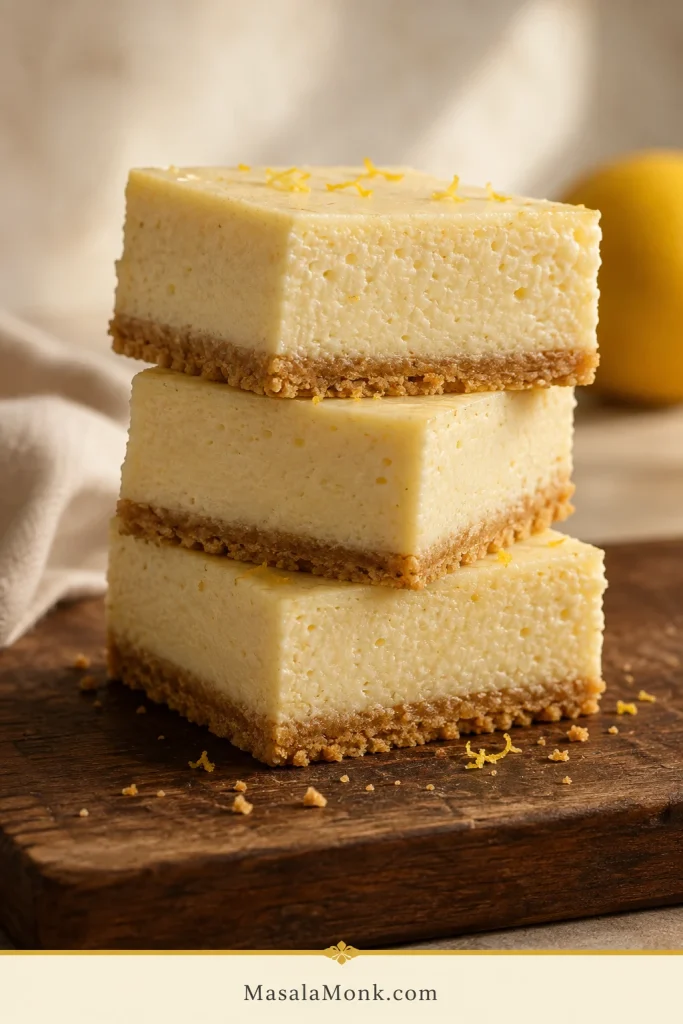
These easy no-bake lemon bars stay creamy while holding their shape. Cold and silky, the filling carries the fragrance of fresh zest and melts into the buttery crumbs underneath. Fresh lemon arrives first, so the condensed milk never tastes as heavy as it might sound.
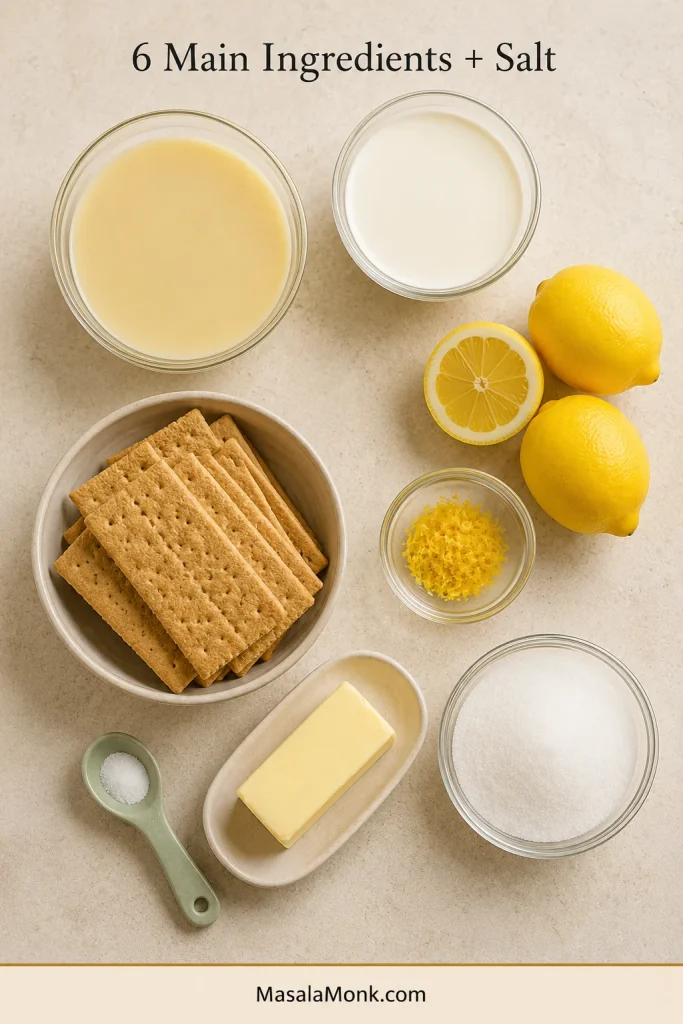
Classic lemon bars can mean baking a shortbread crust, whisking an egg-based filling and waiting for a hot pan to cool. Here, six main ingredients plus salt come together in about 25 minutes of hands-on work. The bars set fully in the refrigerator without cream cheese or gelatin. A brief freezer chill is only an optional aid when extra-sharp edges matter.
The Masala Monk rule is simple: let the lemon thicken the condensed milk; let the refrigerator finish the set.
How to make no-bake lemon bars that hold their shape
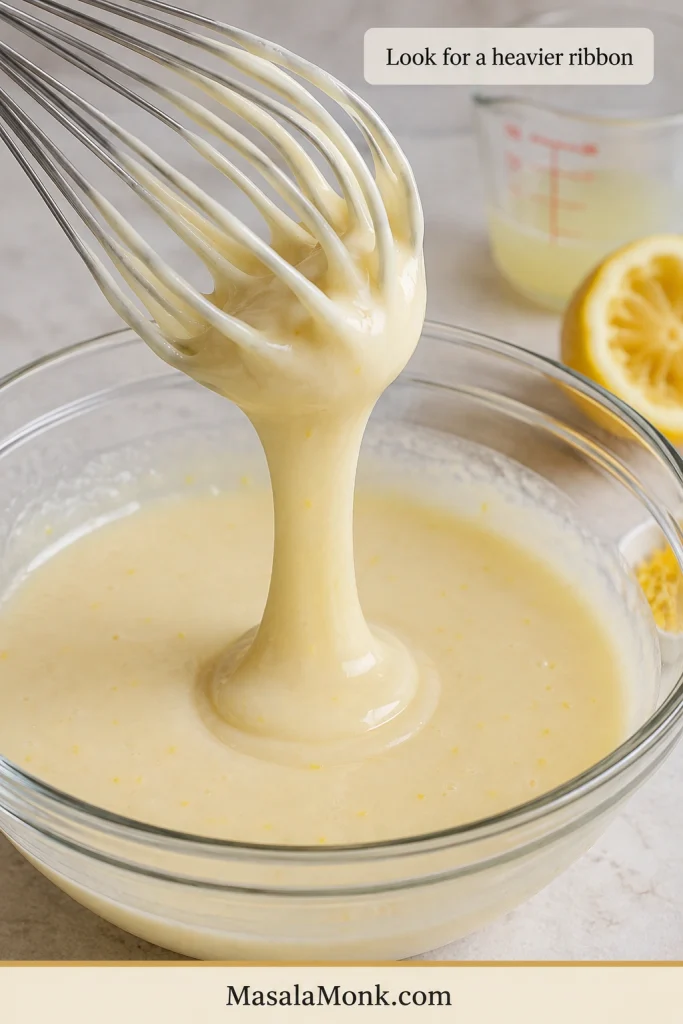
Press the crumb mixture firmly into an 8-inch square pan and chill it. Whisk one standard can of sweetened condensed milk with ½ cup fresh lemon juice, finely grated zest and a little salt until the mixture falls from the whisk in a heavier ribbon.
Whip the cream until the peaks stand firmly and the surface still looks glossy. Fold it into the lemon mixture, spread the filling over the chilled crust and refrigerate for about 6 hours. A longer chill makes lifting and cutting even easier.
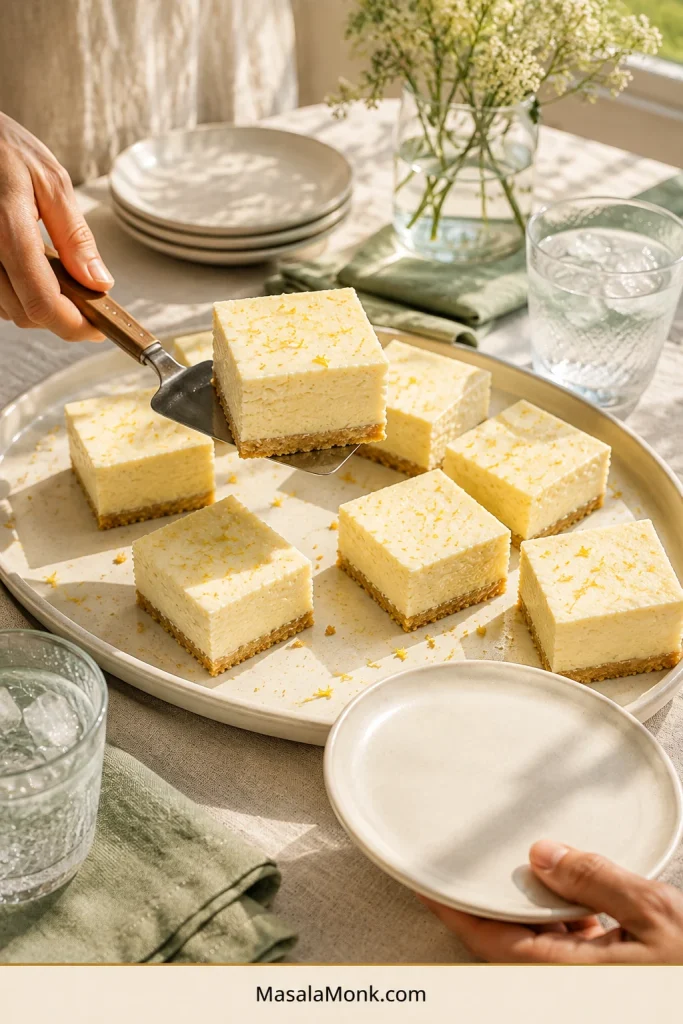
The finished bars are lighter than no-bake cheesecake, firmer than spoonable lemon mousse and softer than traditional baked lemon bars. Serve them straight from the refrigerator, while the filling still holds a clean edge.
Choose this version when you want the lightness of lemon mousse with enough structure for proper bars—without cream cheese, gelatin or a frozen filling.
Make it now
No-bake lemon bars recipe
A buttery graham-cracker crust topped with a fresh lemon filling made from condensed milk and whipped cream. The only stage that asks for close attention is whipping the cream; everything else can be done at an unhurried pace.
Condensed milk gives body, lemon brings acidity and aroma, cream adds air, and crumbs support the filling.
Pan and yield
8 × 8-inch / 20 × 20 cm square pan; 16 regular bars or 12 generous bars
Prep time
About 25 minutes
Earliest check
4 hours
Recommended chill
About 6 hours
Best for clean cuts
Overnight
Total time
About 6 hours 25 minutes
Texture and dietary note
Cold, creamy and sliceable; the filling is egg-free and gelatin-free
What you need
8 × 8-inch / 20 × 20 cm square pan and parchment paper
Food processor, or a rolling pin and sturdy food bag
Electric hand mixer or stand mixer
Fine zester and flexible spatula
Large straight-edged knife
Ingredients
For the no-bake graham-cracker crust
About 1½ cups graham-cracker crumbs (180 g / 6.3 oz); the number of sheets varies by brand
6 tablespoons unsalted butter (85 g / 3 oz)
1 tablespoon granulated sugar (13 g / about ½ oz)
¼ teaspoon fine salt
For the lemon filling
One 14-ounce / 397 g can full-fat sweetened condensed milk, or one 400 g can
1½ cups cold whipping cream (355 ml / 12 fl oz), ideally 35% milk fat or higher
Optional finish
Fresh lemon zest
A few reserved biscuit crumbs
Fresh blueberries or raspberries, added shortly before serving
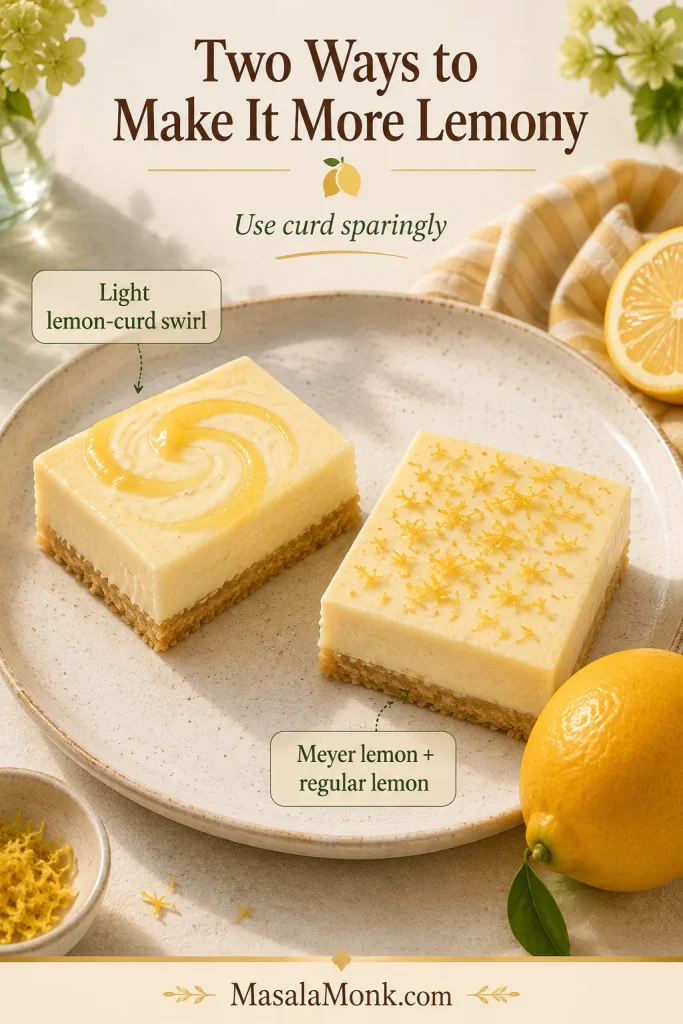
Up to 2 tablespoons homemade lemon curd for a light surface swirl, or about ½ teaspoon per bar
Buying lemons: four or five medium lemons should provide enough measured juice and zest. Lemon yield varies considerably, so measure the juice rather than relying on fruit count alone.
Zest only the yellow skin, then measure the juice so flavour and thickening stay consistent.
Cream note: use a product specifically labelled for whipping. Some regular fresh or table creams sold in India and elsewhere contain too little fat to whip properly. British double cream works well but thickens quickly, so reduce the mixer speed early.
Instructions
Prepare the pan and crust
Line the pan. Lay two strips of parchment across the pan in opposite directions, leaving enough overhang to lift the chilled slab later.
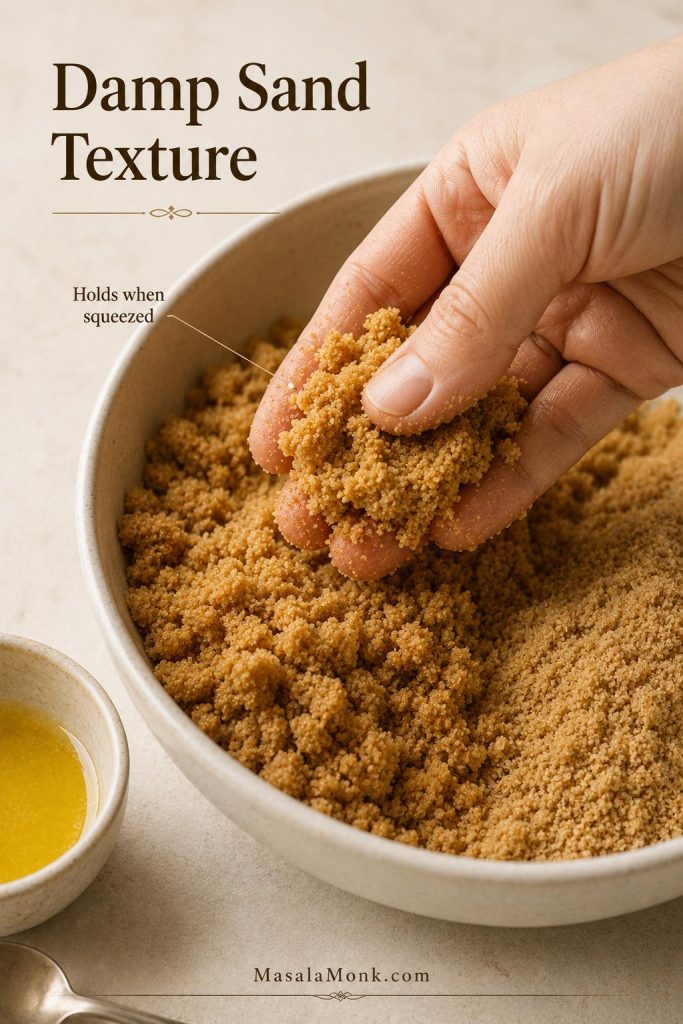
Make the crust. Process the graham crackers until evenly fine. Melt the butter briefly in the microwave or in a small pan, then mix it with the crumbs, sugar and salt. A firmly squeezed handful should hold together without releasing visible butter.
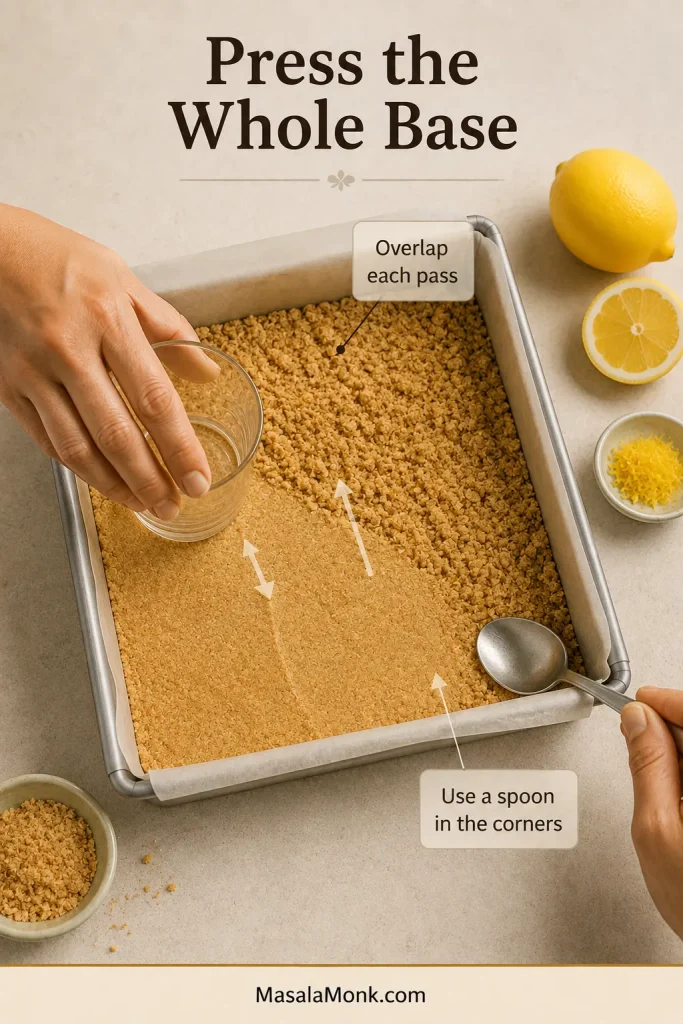
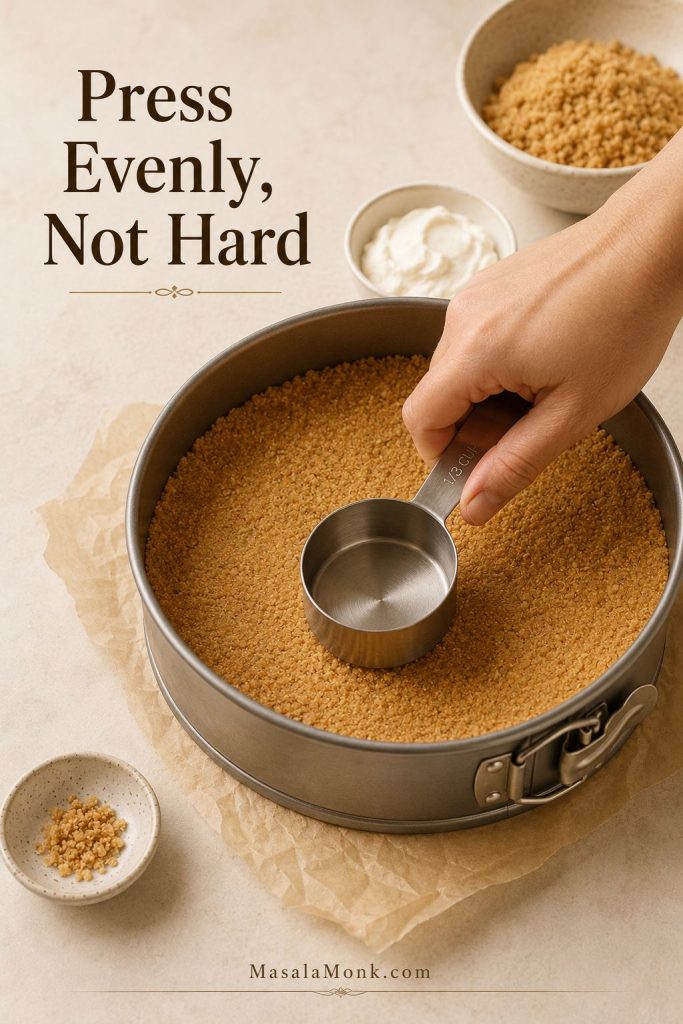
Press and chill. Spread the crumbs evenly, compact them with the flat bottom of a cup and finish the corners with the back of a spoon. Freeze for 15 minutes or refrigerate for about 30 minutes.
Build the lemon filling
Make the lemon base. Zest the lemons before cutting and juicing them. In a glass or stainless-steel bowl, whisk the condensed milk, measured lemon juice, zest and salt for 1–2 minutes. The mixture is ready when it falls from the whisk in a heavier ribbon. Set it aside while you whip the cream.
Visual cue
Watch the lemon base change: after a minute or two with the juice, it should feel more resistant and fall from the whisk in a brief, heavier ribbon. It will still look softer than the finished filling.
Look for a brief, heavier ribbon—not peaks. Whipped cream and chilling create the final structure.
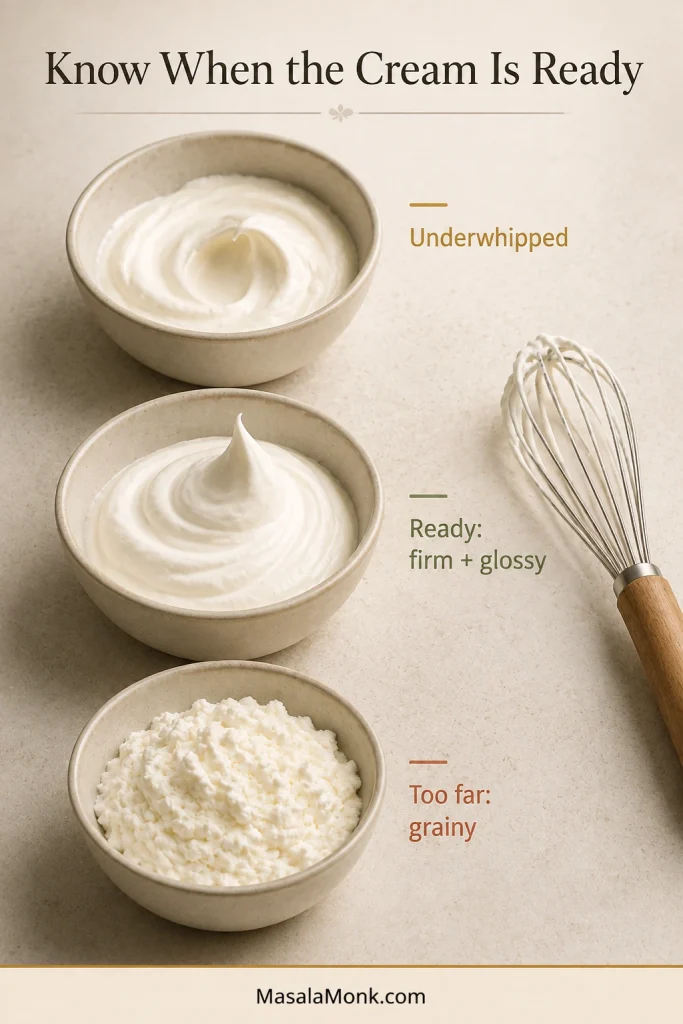
Whip the cream. Beat to firm-to-stiff peaks; the tip may bend slightly, but the peak should not collapse.
Visual cue
Stop at a firm, glossy peak: once the whisk leaves deep tracks, reduce the speed. The peak may bend slightly at the tip, but it should not collapse or look rough and grainy. For every stage, see the whipped cream peak guide.
Stop while the peak stands and the surface stays glossy; rough, grainy cream has gone too far.
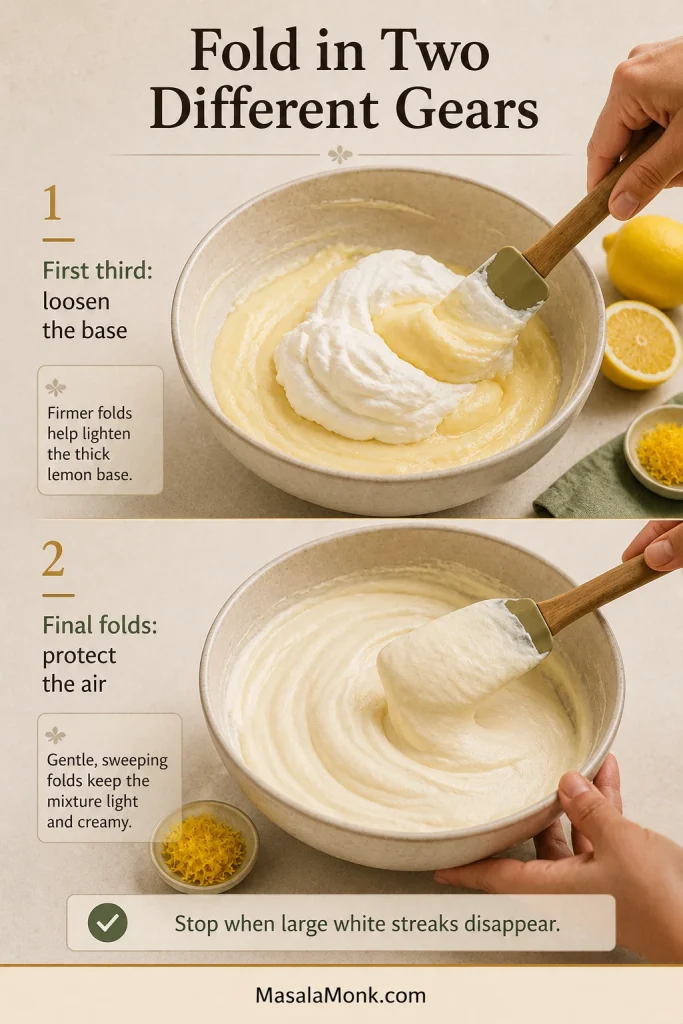
Fold the filling. Start by folding about one-third of the cream into the lemon base to loosen it. Add the rest in two portions, using broad movements only until no large white streaks remain.
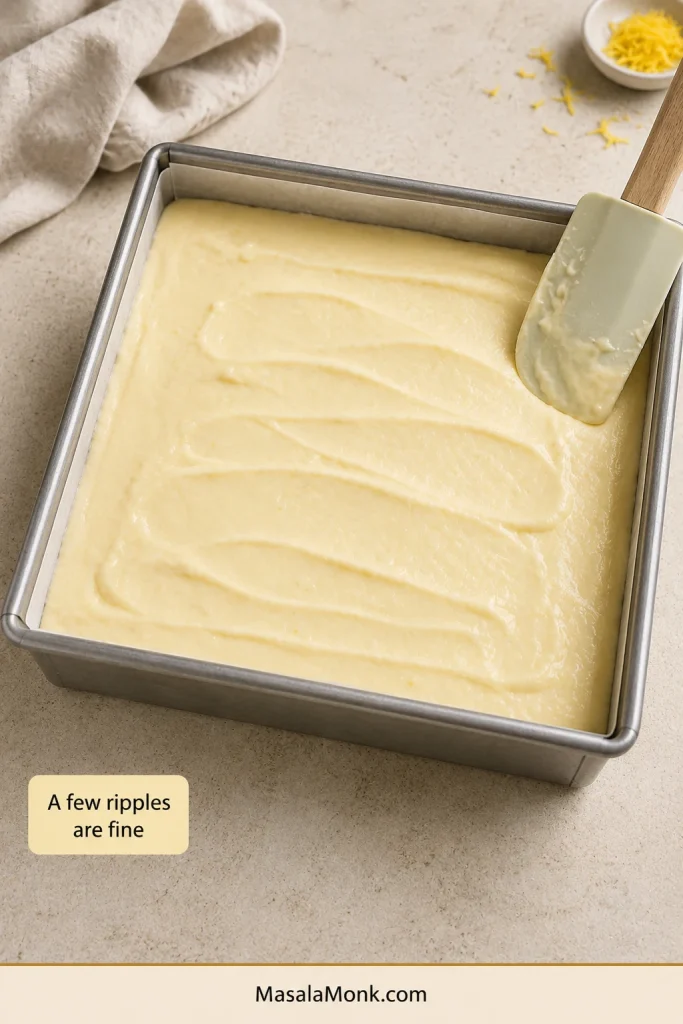
Fill the pan. Spoon the filling across the chilled crust in several mounds, ease it into the corners and level the top. Once the corners are filled, stop smoothing. A few gentle ripples will not affect the set.
Chill, check and serve
Cover and chill. Tent foil or plastic wrap loosely over the pan. A fitted lid works too, provided it does not touch the filling. Refrigerate for about 6 hours, or until the middle moves with the pan rather than rippling on its own.
Check the middle. The surface should look set rather than wet. For especially neat cuts, give the fully chilled slab a 20–30-minute freezer chill.
Lift, cut and serve. Use the parchment to lift the slab. Heat a large straight-edged knife in hot water, dry it completely and press straight down. Clean and reheat the blade between cuts. Serve straight from the refrigerator.
Recipe notes
No oven is needed. The only heat required is enough to melt the butter.
Salted butter works. Omit the added salt from the crust or reduce it to a small pinch.
Use sweetened condensed milk, not evaporated milk. Condensed milk provides both sweetness and body.
A metal pan chills fastest. Glass or ceramic works, but the filling may need additional time.
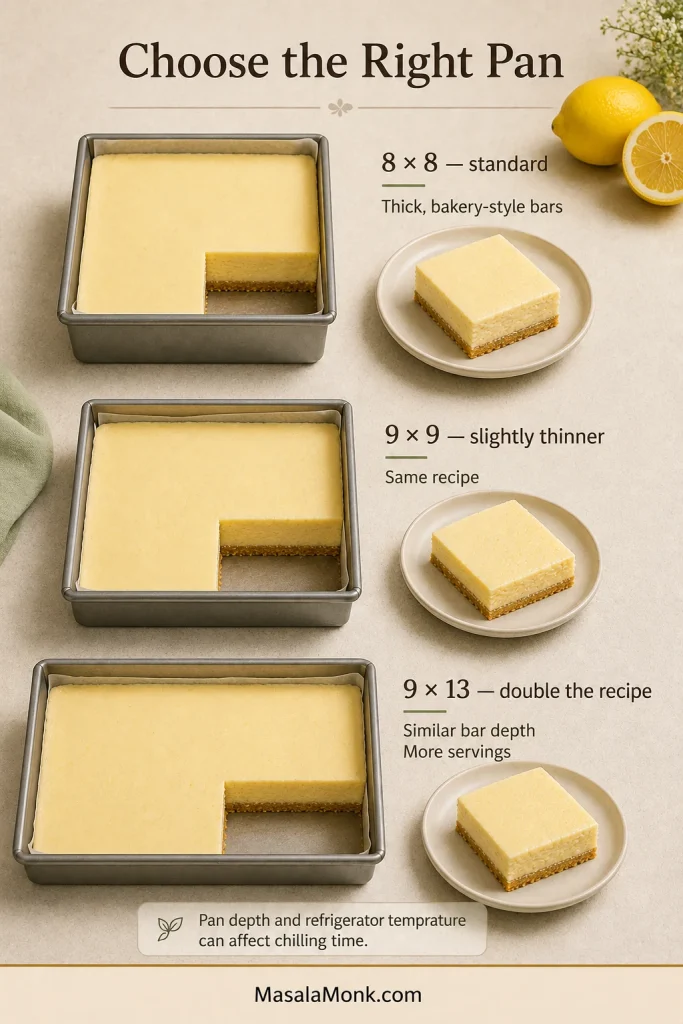
A 9-inch square pan makes slightly thinner bars. Double the recipe for a 9 × 13-inch pan when you want a similar filling depth.
The filling is egg-free. Check the biscuit label and omit egg-based lemon curd if the entire dessert must be egg-free.
Pan-size guide
Choose the pan before scaling: changing the surface area alters filling depth, chilling speed and the crust-to-cream balance.
A larger pan makes thinner bars that warm and soften faster; scale both layers to preserve the intended balance.
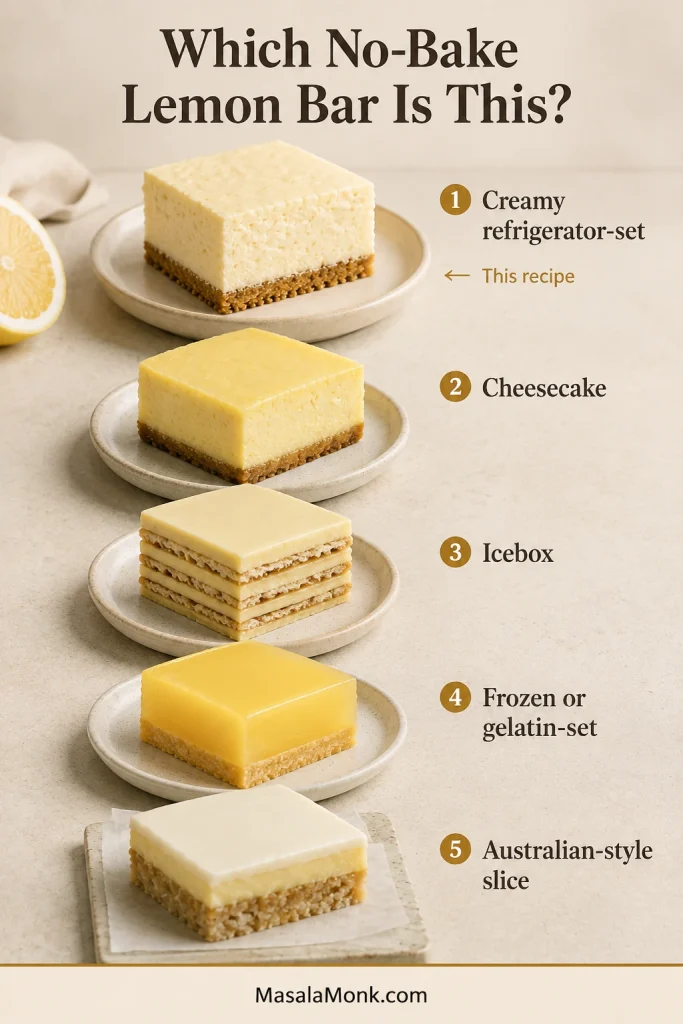
You can stop at the recipe and start making the bars. Still deciding whether this is the style you want? The comparison below separates it from cheesecake bars, icebox squares, frozen bars and Australian-style lemon slice.
Visual comparison
How this version differs from other no-bake lemon bars
Start with the texture you want. The visual gives the quick distinction; the table beneath explains how each style is built.
Choose by texture first: creamy refrigerator bars, denser cheesecake, softened layers, frozen bars or a firm lemon slice.
Style
How it is made
Result
Creamy lemon bars
Condensed milk, fresh lemon and whipped cream over a pressed crumb crust
Layer lemon filling with whole crackers, much like the softened cookie layers in no-bake banana pudding
Soft and cake-like after resting
Frozen or gelatin-set bars
Use a frozen cream filling or lemon gelatin
Firmer, colder or more elastic
Australian-style lemon slice
Make a biscuit-and-coconut base topped with lemon icing
Dense and chewy rather than creamy
This is the sort of dessert that earns its place on a hot afternoon: make it before anyone arrives, leave it in the refrigerator and bring it out only when the table is ready.
Serve a few bars at a time so the remaining slab stays cold, firm and neatly sliceable.
Cold from the refrigerator, the filling feels airy at first and then melts into smooth lemon cream. Fresh zest gives it a fragrant lift, while the buttery, lightly salted crumbs keep the sweetness grounded.
Each square is soft enough for a fork to pass through easily, but substantial enough to lift and serve neatly.
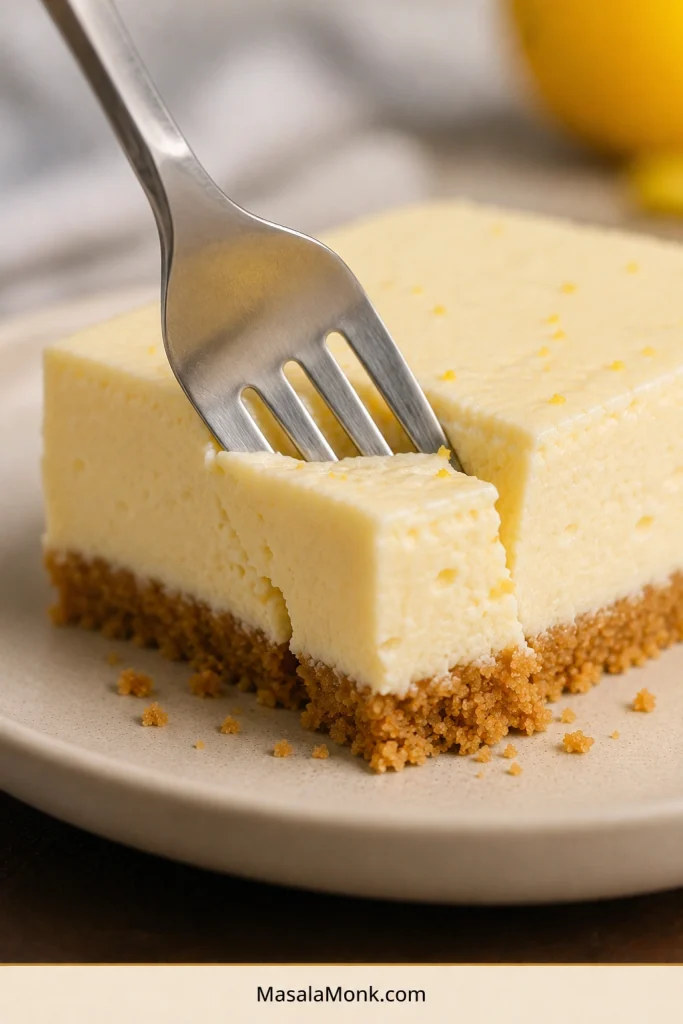
The fork should compress the cream before meeting gentle resistance from a thin, compact crust.
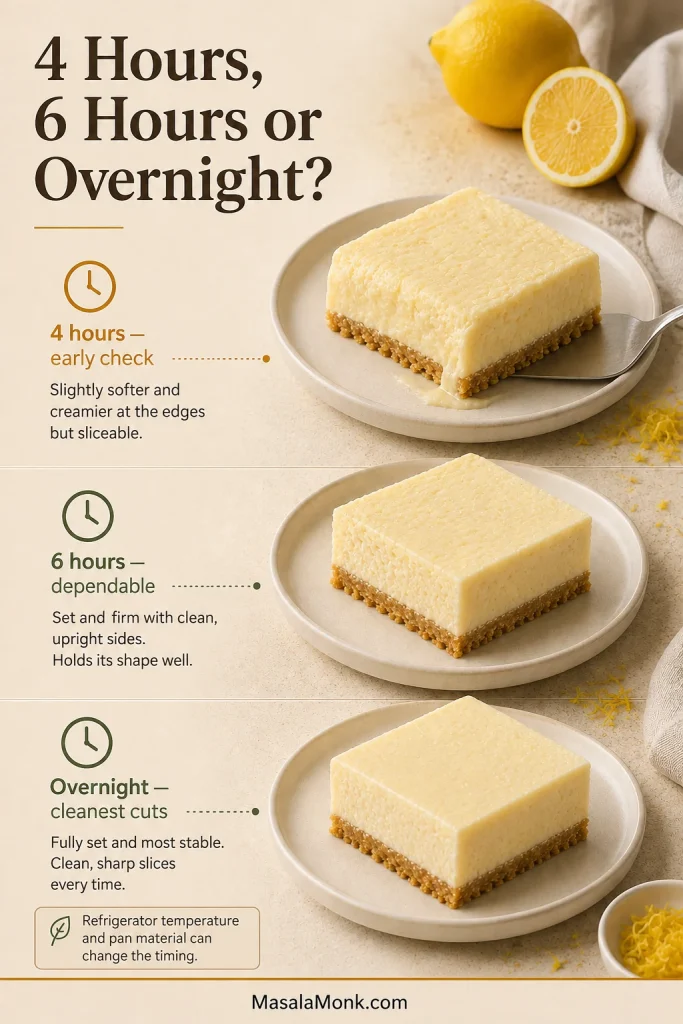
Visual timing guide
How long to chill—and how to cut clean squares
Allow about 6 hours for dependable slices. For the most even set and easiest cuts, chill the pan overnight.
Four hours may be enough in a very cold refrigerator, especially with a metal pan. Six hours gives more margin for warmer refrigerators, glass or ceramic pans and a centre that chills slowly.
Corners set first; judge the centre before lifting or cutting the slab.
Chilling time
What to expect
4 hours
An early checkpoint when the bars are needed urgently; the middle may still be delicate
About 6 hours
A dependable point for lifting and cutting in a properly cold refrigerator
Overnight
The most even set and easiest cuts
Plus 20–30 minutes in the freezer
Sharper edges for photographs, parties or warm-weather transport
A crowded refrigerator or a door that keeps opening can slow the middle down. If it still looks soft, more refrigerator time is usually the best fix.
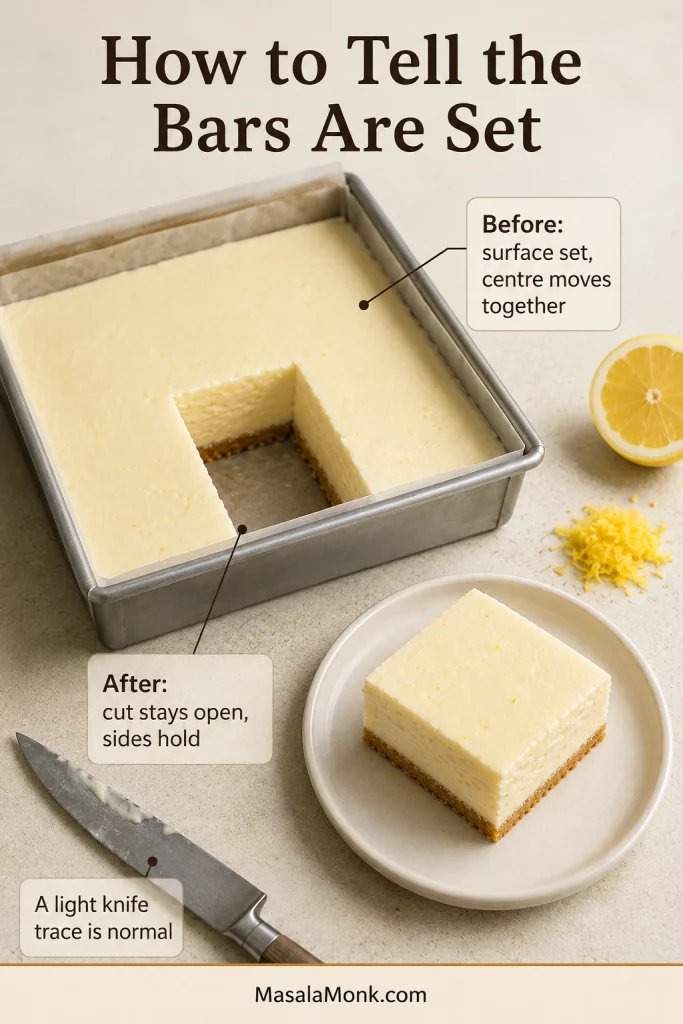
Before lifting or cutting
Surface looks set rather than wet
Centre moves with the pan instead of rippling on its own
After the first cut
Cut stays open instead of closing behind the knife
Exposed sides hold their shape instead of slowly spreading
A light, creamy trace on the blade is normal
The first square does not have to be the prettiest. Use it to judge the set, then clean the blade and continue.
A light knife trace is normal; sides that spread slowly need more refrigerator time.
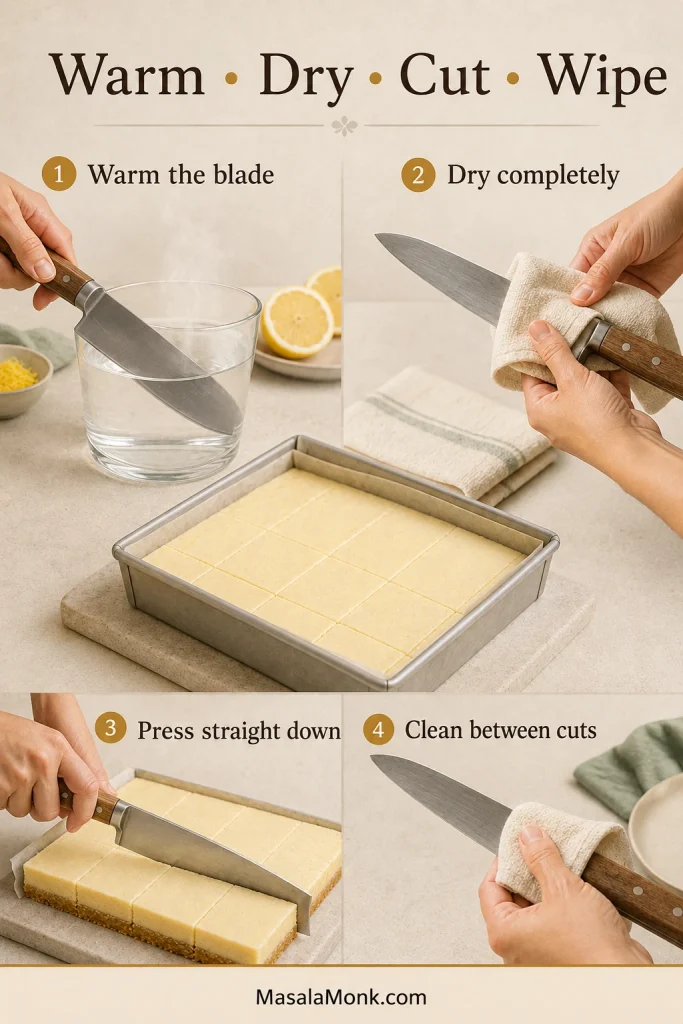
How to get clean lemon-bar squares
Chill the slab fully and give it the optional freezer chill when especially neat edges matter.
Lift the slab onto a stable board with the parchment.
Heat a large straight-edged knife in hot water and dry it completely.
Press straight down without sawing.
Wipe, reheat and dry the blade between cuts.
Dry the warmed blade, then press straight down; moisture and sawing both roughen the cut edges.
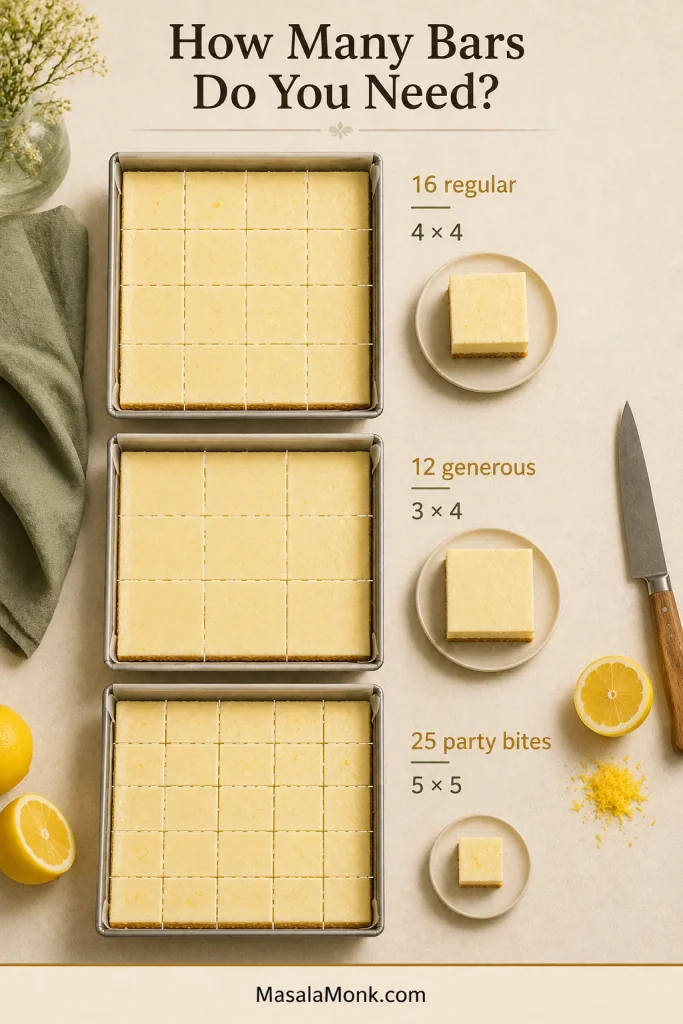
Cut the slab 4 × 4 for 16 regular bars or 3 × 4 for 12 generous portions. For a dessert tray, a 5 × 5 grid makes 25 small bites.
Mark equal intervals on two edges before cutting so every row finishes at the same size.
Remove the bars only when you are ready to serve them. In a warm room, return the remaining slab to the refrigerator between servings. Trimming the edges is optional; for everyday serving, keep them.
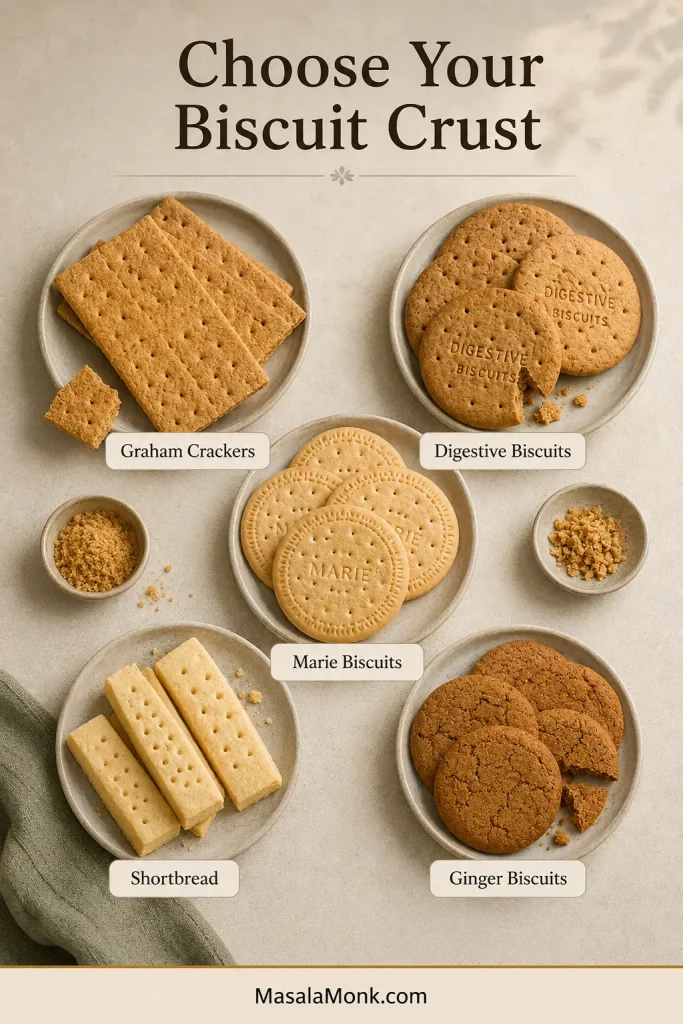
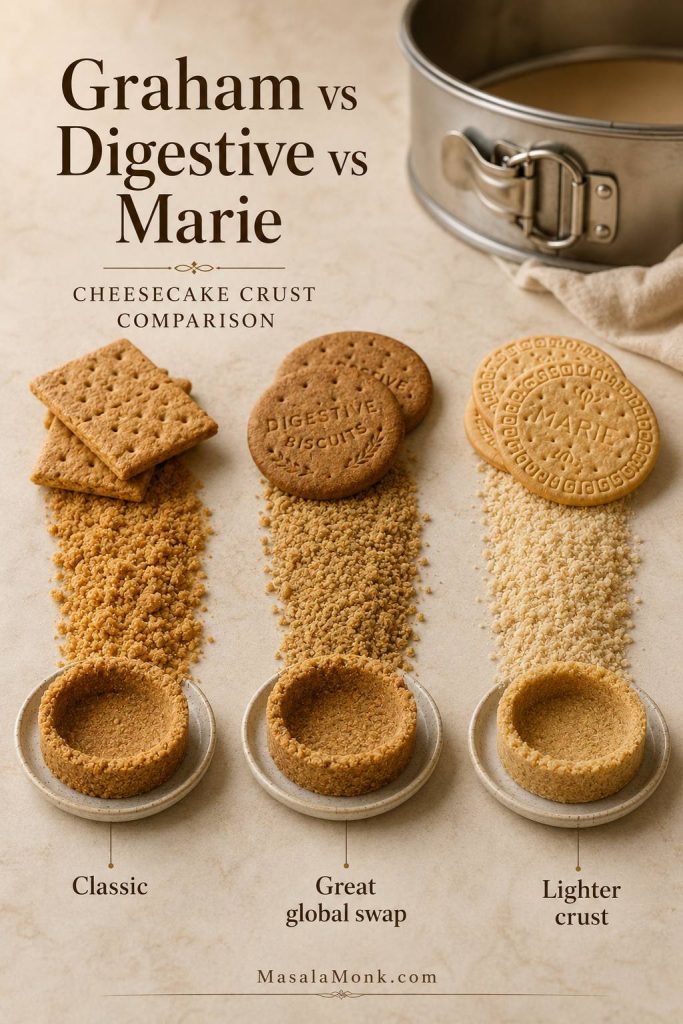
Graham crackers, digestives, Marie biscuits or shortbread?
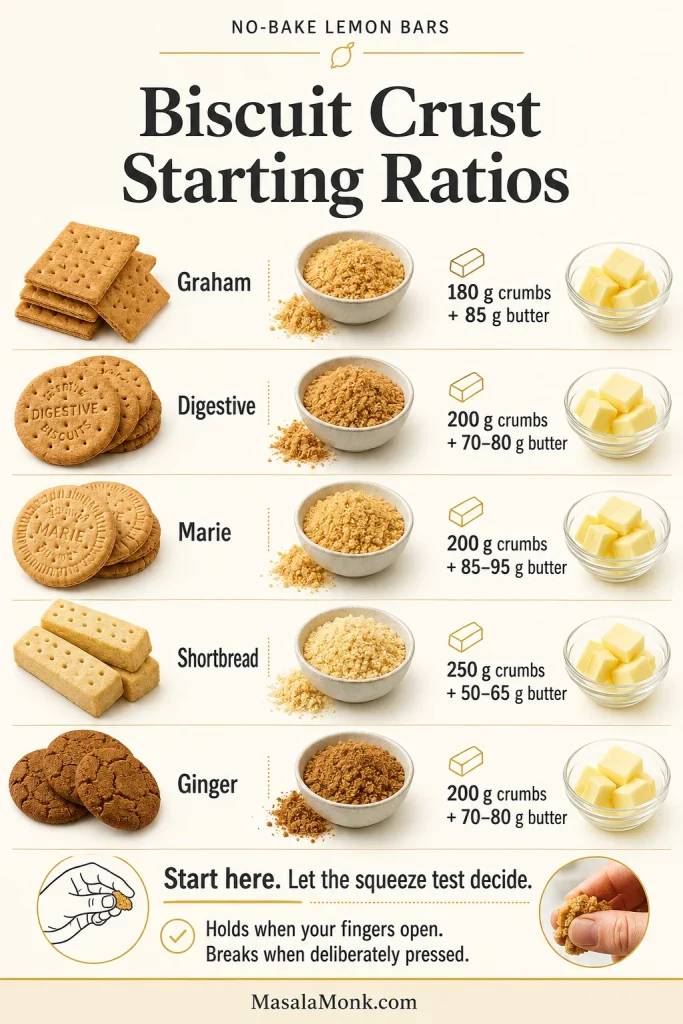
Crumb crusts can feel annoyingly vague because every biscuit absorbs butter differently. The figures below are practical starting ranges, not universal ratios. Biscuit fat, sugar and dryness vary by brand, so reserve a little butter and let the squeeze test make the final decision.
The same principle keeps the biscuit base in Banoffee Pie from becoming either sandy or greasy.
Biscuit richness and dryness predict butter needs more reliably than the name printed on the packet.
Starting-point guide
Starting butter ratios by biscuit
Biscuit richness changes how much butter the crumbs need. Begin conservatively, then confirm the mixture with the squeeze test.
Start low with rich biscuits, then let the squeeze test decide whether more butter is needed.
Biscuit
Start with
Result
What to watch
Graham crackers
180 g crumbs + 85 g butter + 13 g sugar
Light, mildly sweet and easy to cut when cold
A very lean brand may need another teaspoon or two of butter
Digestive biscuits
200 g crumbs + 70–80 g butter
Deeper, toastier and less sweet
Usually omit added sugar
Marie biscuits
200 g crumbs + 85–95 g butter
Mild and relatively lean
Add the final butter gradually
Shortbread cookies
250 g crumbs + 50–65 g butter
Rich and closest to classic lemon-bar flavour
Too much butter quickly makes it greasy or hard
Ginger biscuits
200 g crumbs + 70–80 g butter
Warm, spiced and excellent with lemon
Usually needs no added sugar
Gluten-free biscuits
Begin with the closest matching biscuit above
Depends strongly on the brand
Let the squeeze test decide the final butter amount
Let the squeeze test decide
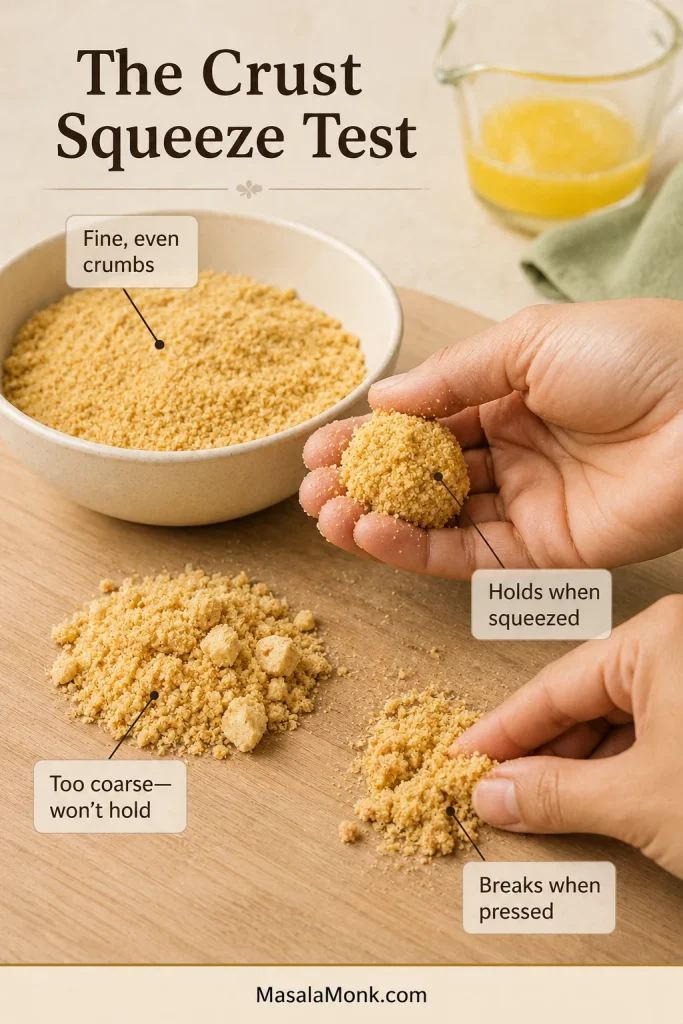
The crumb mixture is ready when every crumb looks moistened and a firmly squeezed handful holds together. It should hold when your fingers open, then break apart when you press it deliberately.
Loose and sandy: add melted butter one teaspoon at a time.
Wet or butter-releasing: add more crumbs one tablespoon at a time.
Using shortbread: stop earlier because the cookie already carries plenty of fat.
Because this base is chilled rather than baked, it will be firm enough to lift but slightly softer than an oven-baked crust—especially on the second or third day.
The crumbs should clump firmly without leaving oily shine on the hand or bowl.
Graham crackers keep the lemon in front. Digestives bring a deeper, toastier base. Shortbread makes each square richer, while ginger biscuits leave a warm finish after the lemon fades.
Small details that make the bars reliable
Press through the whole crust
A crust can look smooth on top while remaining loose underneath. Press in overlapping passes across the whole base rather than polishing only the surface. Crumbs may resist the corners at first; the back of a spoon usually reaches them more easily than a round cup.
Lift and reposition the glass instead of sliding it continuously, which pushes compacted crumbs into ridges.
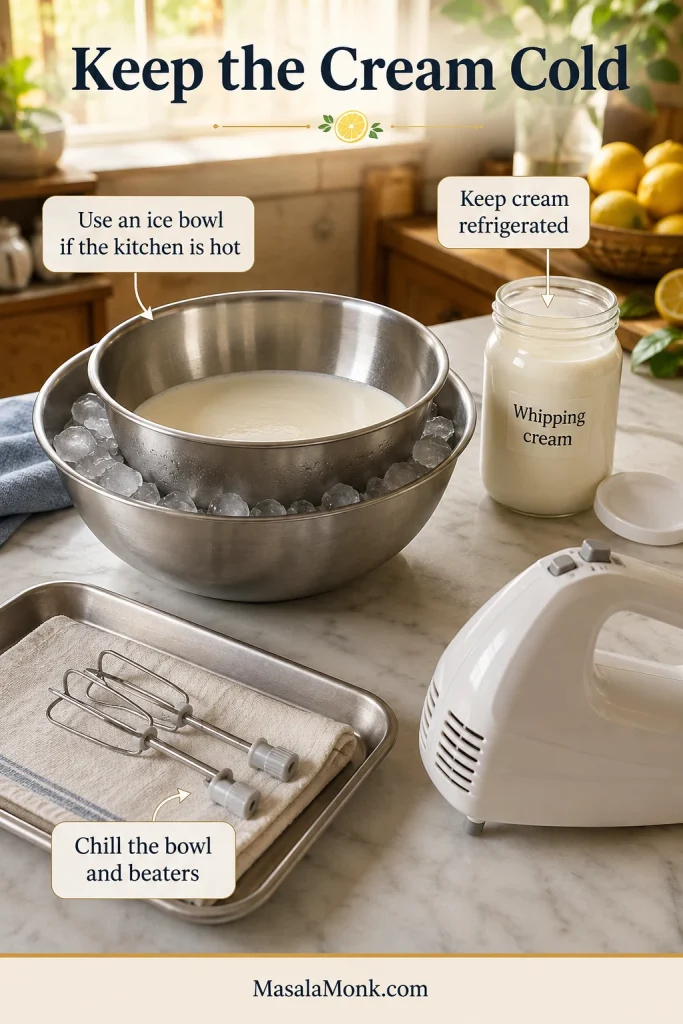
Hot-kitchen note: refrigerate the bowl and beaters for 10–15 minutes, keep the cream cold until the last moment and set the mixing bowl over a larger bowl of ice when necessary. An electric mixer makes it much easier to stop at the right stage.
Keep the bowl cold and dry; the ice bath should chill the cream, never dilute it.
Fold and finish without overworking
Fold the first third of the cream more confidently to loosen the lemon base. Once the mixture feels lighter, use slower, broader movements for the remaining cream.
The folded filling should mound softly rather than pour, showing that enough air remains.
Everything else in the bowl is sturdy; the air in the cream is not. Stop once no large white streaks remain, spread the filling gently and leave a few harmless ripples on top.
Soft ripples are harmless; filling that runs flat immediately needs more structure.
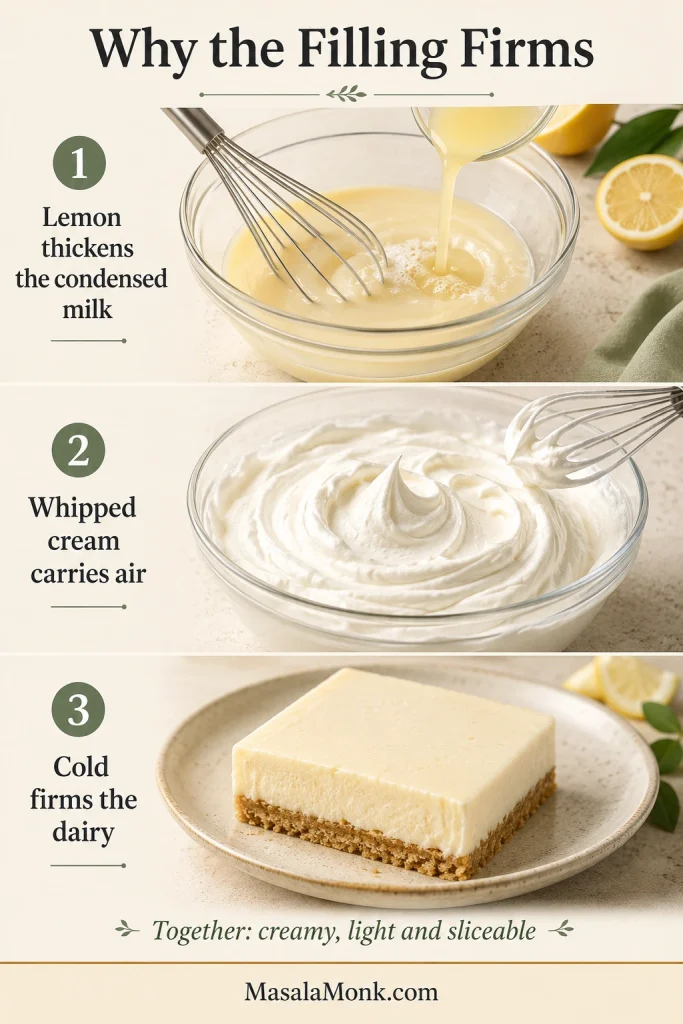
Illustrated structure guide
Why this filling firms up in the refrigerator
Lemon thickens the condensed milk, whipped cream carries air through the mixture, and refrigeration firms the dairy. Together, they give the filling enough body to slice without making it dense.
Lemon works on condensed milk in much the same way lime juice does in key lime pie. Here, the whipped cream keeps the texture lighter, while the refrigerator completes the set.
All three stages matter; extra chilling cannot repair weakly whipped cream or an improperly mixed lemon base.
What each ingredient contributes
Condensed milk supplies sweetness, concentrated dairy flavour and most of the filling’s body. Either a 397 g or 400 g can works.
Lemon juice balances the condensed milk and helps thicken it. Measure ½ cup / 120 ml / 4 fl oz after squeezing rather than relying on a fruit count.
Lemon zest carries the fragrant oils that make the bars smell unmistakably citrusy without loosening the filling. Grate only the yellow skin; white pith can taste bitter.
Whipping cream introduces the air that keeps the filling light, while its fat firms as it chills.
Salt makes the lemon taste brighter and keeps the second bite as appealing as the first.
Evaporated milk, regular milk and ordinary pouring cream are much thinner. None will thicken and set the filling in the same way as condensed milk.
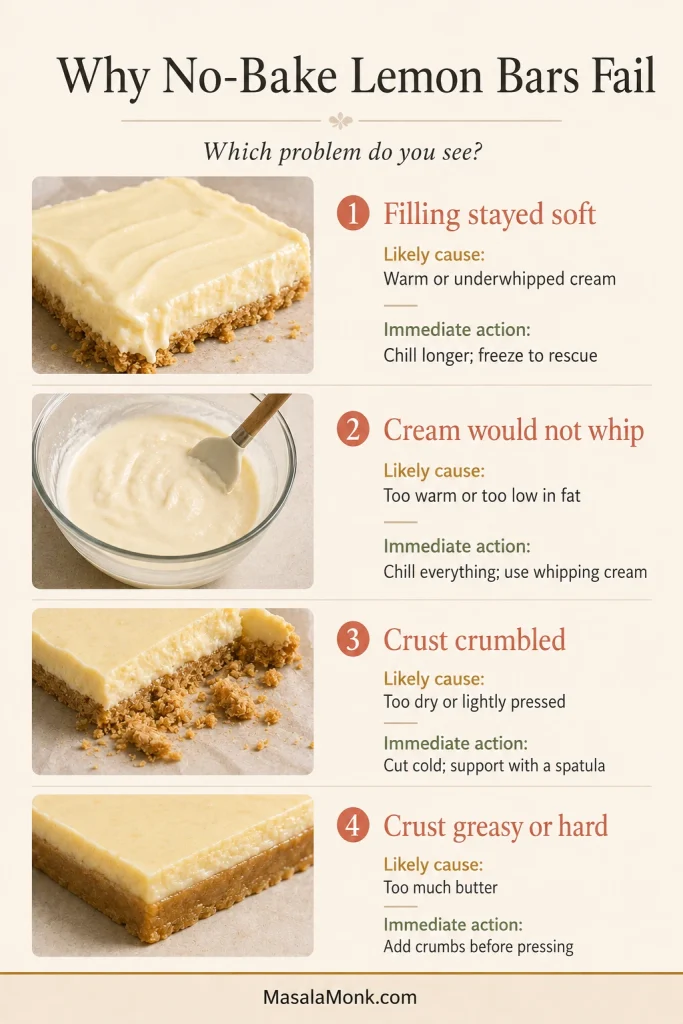
No-bake lemon bar troubleshooting
Visual troubleshooting guide
Use the symptom to choose the fix: soft filling, cream that will not whip, a crumbly crust and a greasy or hard crust each need a different response.
Match the visible symptom to its cause before choosing a rescue; different failures need different fixes.
Filling and cream problems
Problem
Why it happened and what to do
Filling looks loose before chilling
The cream may be warm or underwhipped, or too much air was lost during folding. Refrigerate the pan promptly; the filling should mound softly rather than pour.
Bars remain soft after 6 hours
The refrigerator may be warmer or busier than expected. Leave the pan overnight and use a brief freezer chill before cutting when needed.
Bars remain spoon-soft after chilling overnight
The cream may have been too low in fat, underwhipped or deflated during folding. Freeze the pan and serve the bars as frozen lemon cream squares.
Cream will not whip
The cream may be too warm, too low in fat or intended only for pouring. Chill the cream, bowl and beaters before starting.
Cream became grainy
When it is only slightly rough, fold in 1–2 tablespoons fresh cold cream. Once liquid begins separating, start again; the cream will not fold back into a smooth filling.
Crust and flavour problems
Problem
Why it happened and what to do
Crust falls apart
The crumbs may have been coarse, under-buttered, lightly pressed or insufficiently chilled. Cut very cold and support each piece with a wide spatula. Next time, press the crumb mixture more evenly.
Crust is greasy or hard
Mix in more crumbs when the mixture looks greasy before pressing. When the finished crust is hard, let the slab stand at cool room temperature for about 5 minutes. Next time, use less butter with rich cookies.
Filling tastes too sweet
For the current batch, add fresh zest and serve the bars with tart raspberries. Next time, keep the salt and choose digestives or another less-sweet biscuit.
Lemon flavour is weak or bitter
Add fresh yellow zest at serving time when the flavour is weak. Bitterness usually means pith or crushed seeds entered the filling; avoid both in the next batch.
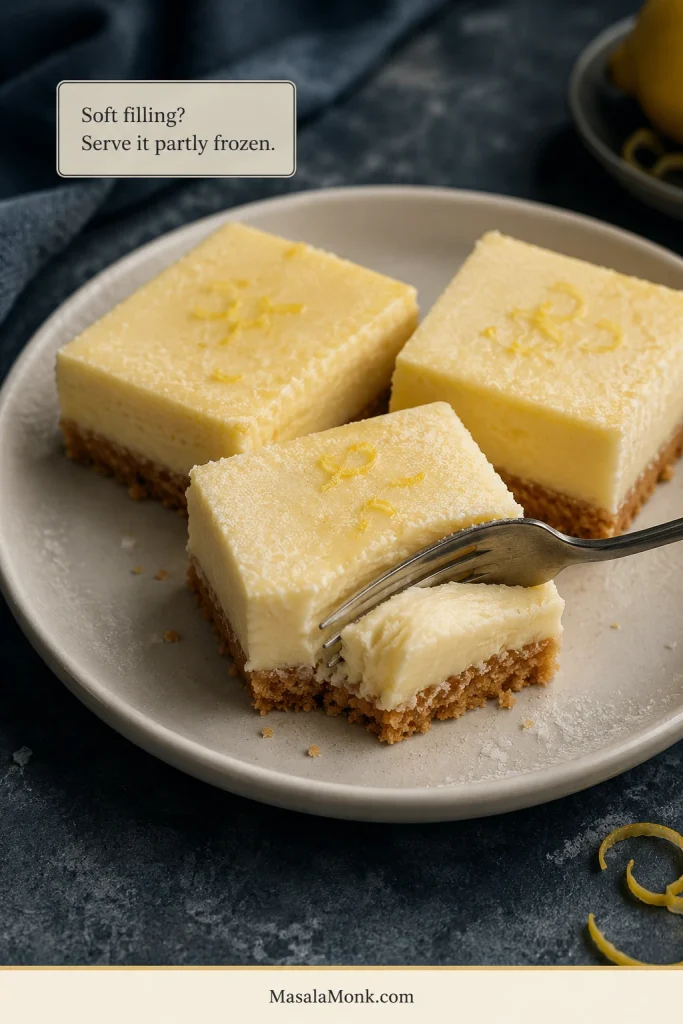
When the filling stays soft: if the flavour is good, the pan is not lost. Freeze it, cut it cold and serve it as frozen lemon cream bars. The texture changes, but dessert survives.
Cut the slab while firm, then soften each frozen bar for 5–10 minutes before serving.
Ways to change the flavour without softening the filling
Choose berries for tartness, ginger or coconut for a more distinctive crust, lemon curd for stronger citrus, or serve the bars partly frozen when the weather is especially hot.
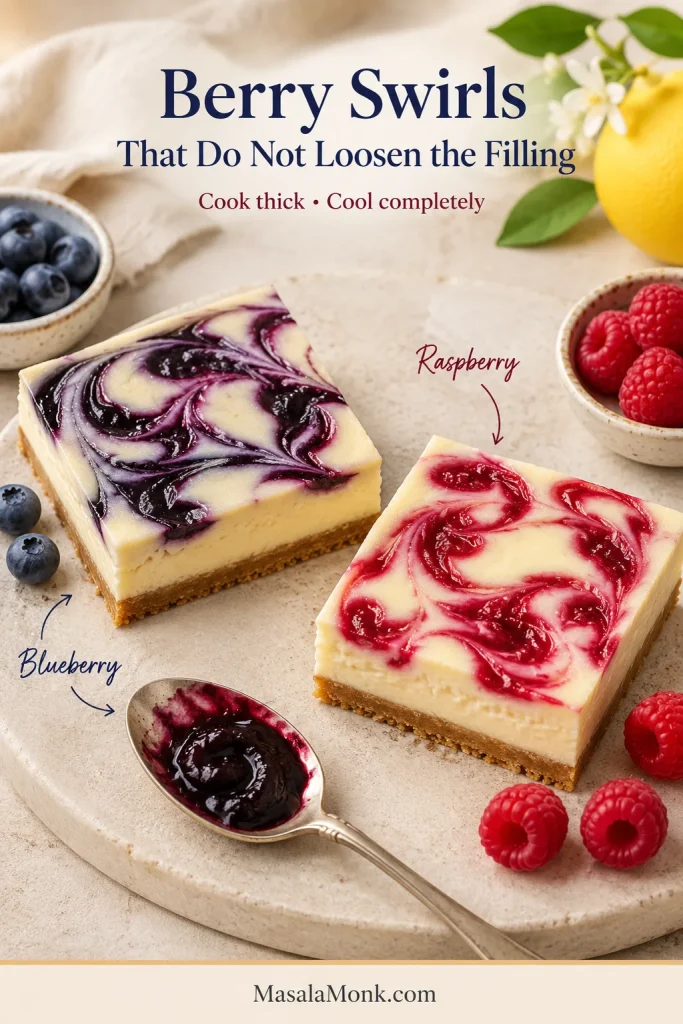
Berry swirls
Blueberry: simmer ½ cup blueberries (70 g / 2½ oz) with 1 teaspoon sugar until thick and jammy. Cool completely, then dot 2–3 tablespoons over the filling and make a few shallow swirls.
Raspberry: simmer ½ cup raspberries (65–70 g / about 2½ oz) with 1 teaspoon sugar until thick. Strain if desired, cool completely and use 2–3 tablespoons.
For any fruit swirl: reduce the fruit until thick and cool it completely. Raw purée can loosen a chilled filling; the no-bake mango cheesecake guide explains why thicker fruit preparations behave better.
Keep fruit swirls shallow so extra moisture stays near the surface, not through the filling’s centre.
Crust variations
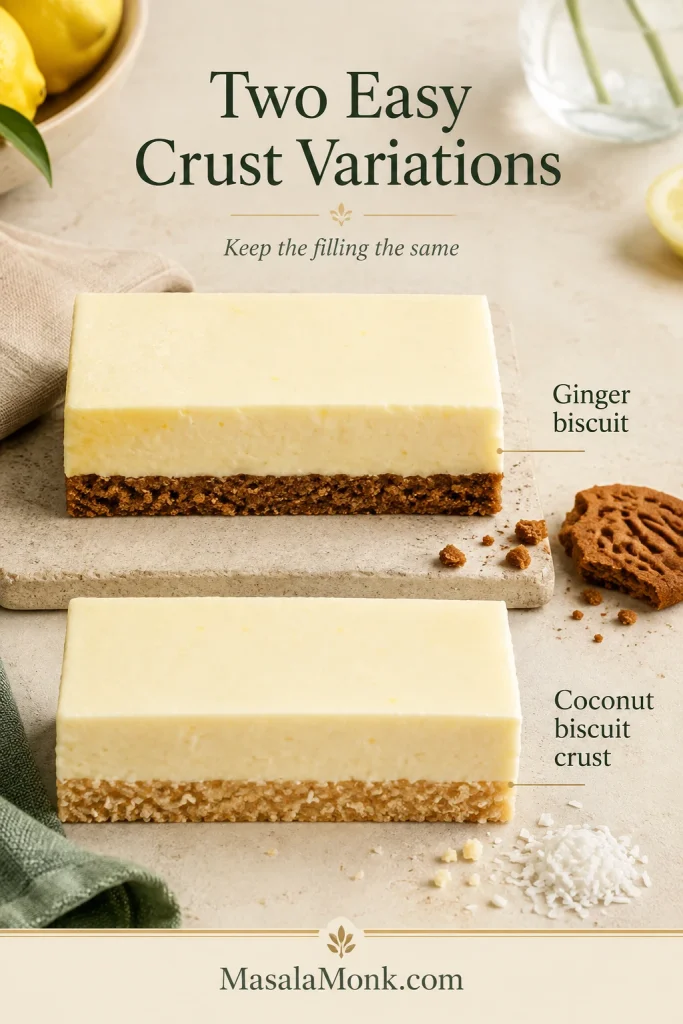
Ginger biscuits: replace the graham crackers with crisp ginger biscuits. Omit the sugar and begin with less butter because many brands are already rich.
Coconut: replace ¾–1 oz / 20–30 g of biscuit crumbs with fine desiccated coconut. Keep the quantity modest so the crust still packs tightly.
Use coconut sparingly to preserve cohesion; ginger biscuits change flavour without weakening the crust.
Extra lemon or a frozen finish
Lemon curd: swirl up to 2 tablespoons lightly over the surface, or add about ½ teaspoon to each bar just before serving.
Meyer lemon: use half Meyer lemon juice and half regular lemon juice, then use Meyer zest for the aroma. The Masala Monk guide to lemon varieties explains how their flavours differ.
Keep curd near the surface and preserve the liquid balance the filling needs to set cleanly.
Partly frozen: freeze the completed slab until firm, then let each bar soften for 5–10 minutes before eating. The bars eat more like lemon ice cream and are especially welcome in very hot weather.
Easy swaps—and changes that need another recipe
Easy swaps
Digestives for graham crackers: use the starting range in the crust table and omit the sugar.
Shortbread for graham crackers: reduce the added butter substantially.
Gluten-free biscuits: use a crisp biscuit and let the squeeze test determine the final butter quantity.
Lime for lemon: replace the juice and zest measure for measure for a no-bake lime version.
Prepared whipped topping: replace the whipped cream with about 3 cups thawed whipped topping (225 g / 8 oz). The bars will be sweeter and less fresh-tasting.
Changes that need another recipe
Evaporated milk, regular milk, low-fat pouring cream, yoghurt and liquid sweeteners cannot replace condensed milk or whipping cream in equal quantities. They change both the water content and the way the filling sets.
Coconut milk, cashews and agar need a separate recipe designed around those ingredients.
A low-carb version also needs a different filling and crust because condensed milk supplies both sweetness and body. Use the keto cheesecake recipe as a starting formula rather than swapping in a low-carb sweetener alone.
Make-ahead, storage and freezing
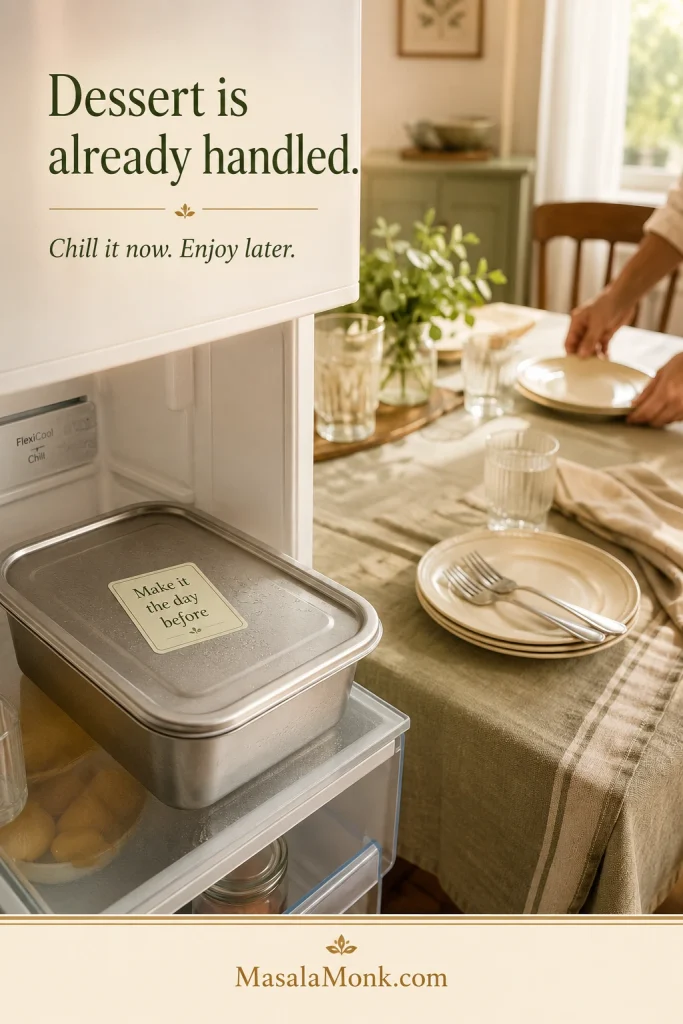
Make them one day ahead
Make the pan the day before and dessert is already handled. It can stay cold while dinner happens, guests arrive and everything else asks for your attention.
Add fresh fruit, extra zest or delicate toppings shortly before serving so they remain bright and do not release moisture onto the surface.
Chill the slab uncut overnight, then add fresh garnish shortly before serving for cleaner edges.
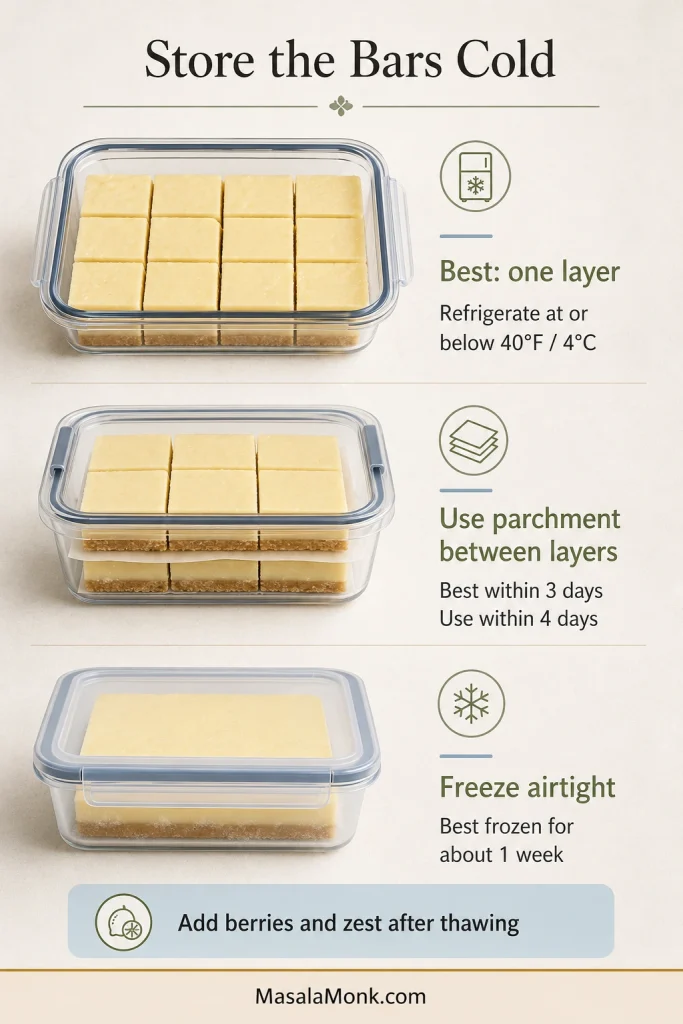
Refrigerator storage
For the best texture, eat the bars within about three days. Keep any remaining bars continuously refrigerated at or below 40°F / 4°C and use them promptly.
A single layer is preferable. When stacking cannot be avoided, place parchment between layers and keep the container very cold.
Freezing
Freeze only for short-term storage; the texture is best when the bars are used within roughly one week. Store the uncut slab or individual bars in an airtight container and protect them from freezer odours and surface ice.
Thaw in the refrigerator. The filling may feel slightly denser after freezing, but it should remain creamy. Add berries and fresh zest after thawing.
Store in one layer when possible; parchment protects stacked bars from marks and surface damage.
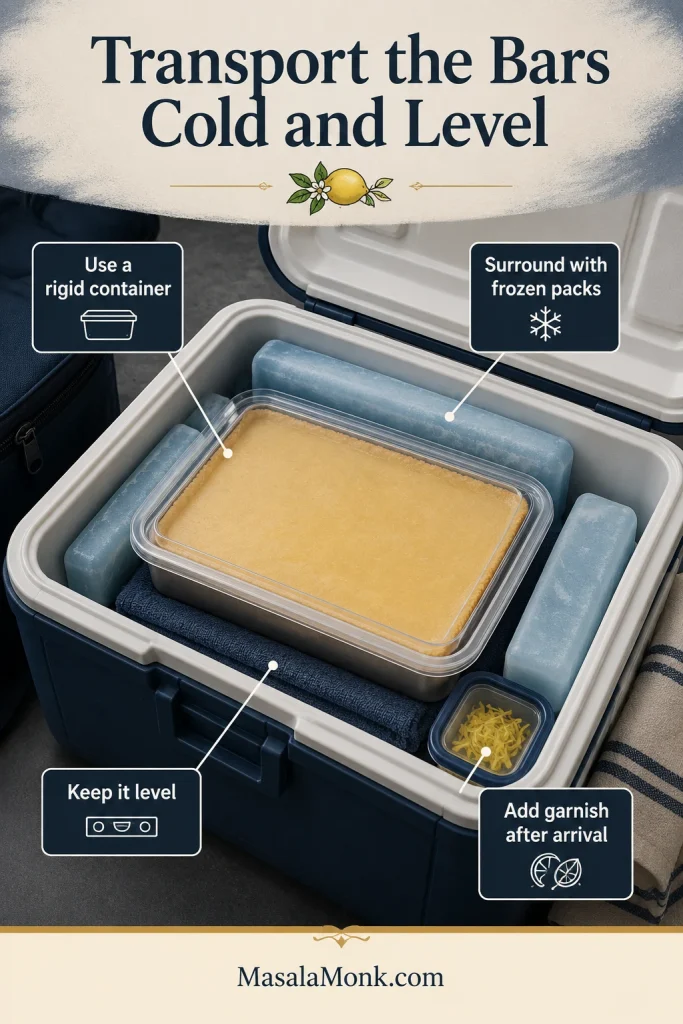
Give it a 20–30-minute freezer chill before departure.
Transport the bars in the original pan or a rigid single-layer container.
Keep the container level inside an insulated cooler with frozen ice packs.
Refrigerate immediately on arrival.
Add fruit garnish after transport.
Pre-chill the cooler, keep the container level and arrange ice packs around rather than above it.
Keep these chilled dairy bars at or below 40°F / 4°C. Do not leave them unrefrigerated for more than two hours—or more than one hour when the surrounding temperature is above 90°F / 32°C. The USDA cold-food safety guidance explains the same limits in more detail.
Frequently asked questions
Do no-bake lemon bars need gelatin or cream cheese?
No. Lemon-thickened condensed milk, whipped cream and refrigeration provide the structure. Cream cheese makes a denser dessert, closer to a no-bake cream cheese pie, while gelatin creates a firmer, more elastic set.
Can I make them without condensed milk?
Not with this formula. Condensed milk supplies sweetness, dairy solids and much of the filling’s body. A version without it needs a separate base built around ingredients such as cream cheese, gelatin, agar, coconut cream or cashews.
Can I use bottled lemon juice?
It may provide enough acidity, but fresh juice tastes cleaner. When bottled juice is the only option, use the same ½ cup / 120 ml / 4 fl oz measure and include fresh zest for aroma.
Why have my lemon bars not set?
They may simply need longer. Leave the pan overnight before assuming the filling has failed. If it remains spoon-soft, the cream was probably too warm, too low in fat, underwhipped or deflated during folding; the troubleshooting guide above shows how to rescue it.
Do these bars taste strongly of condensed milk?
Fresh juice, zest and salt keep the flavour from tasting flat or purely milky. Serve the bars cold, when the citrus tastes brightest and the sweetness feels more restrained.
Final texture
A thin, compact crust supports the filling without competing with its cold, airy texture.
The centre cut is worth the wait
The hands-on work ends quickly: press the crust, whisk the lemon base, fold in the cream and level the pan. Then comes the quiet part, when the refrigerator turns a soft filling into a dessert you can lift.
Give the refrigerator its time. Heat and dry the knife. Make one clean downward cut.
Under the fork, the crust gives gently. The filling stays cold and creamy. Then the lemon arrives before the sweetness has a chance to feel heavy.
Cream cheese pie should be cold, creamy, tangy, and soft enough to feel lighter than cheesecake — but firm enough to cut into a real slice. It is the kind of pie that looks simple in the pan, then feels special when the first chilled wedge lifts out cleanly.
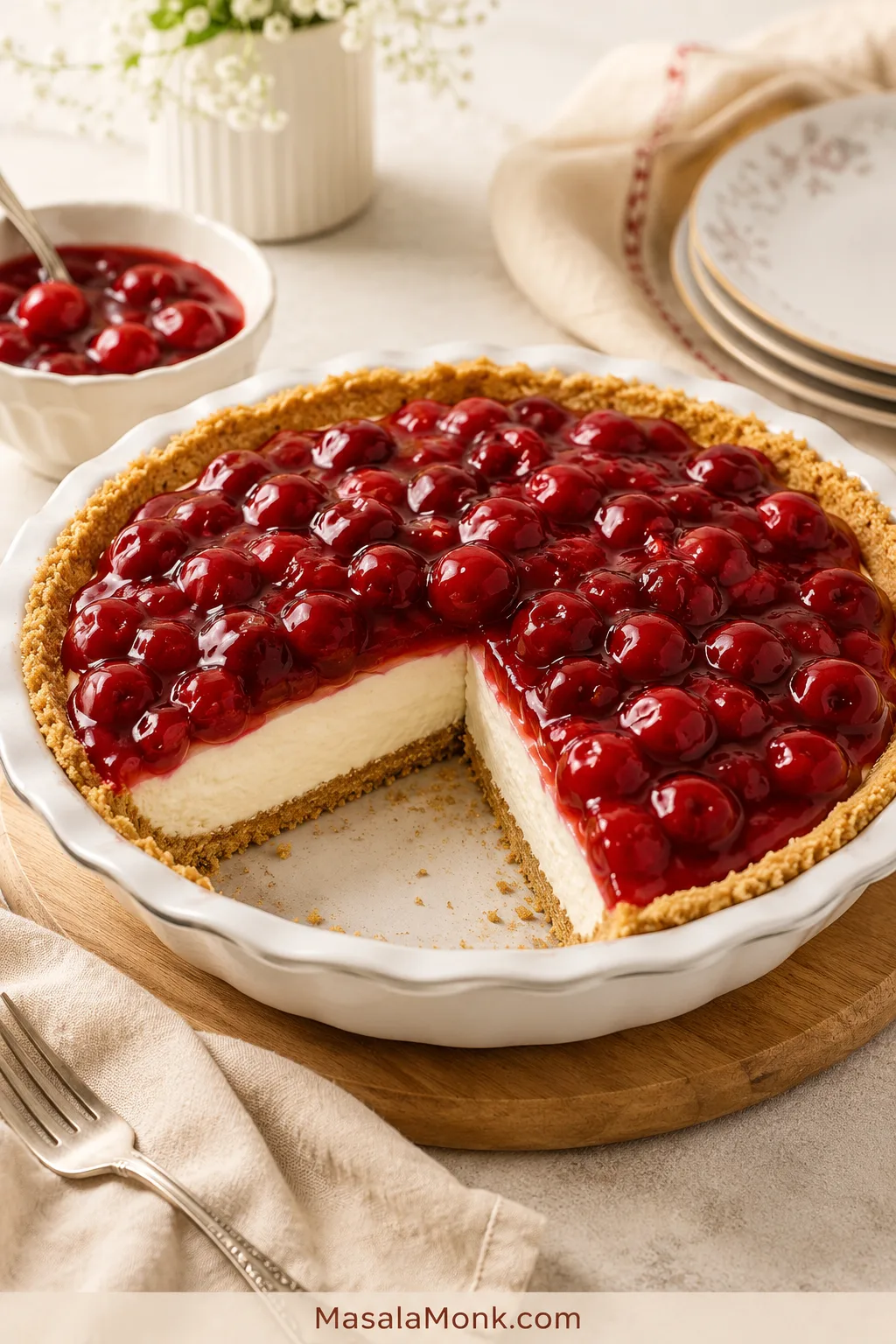
This is the dessert that shows up at potlucks and family dinners, then disappears faster than the showier sweets: a buttery crumb crust, a cool creamy middle, and a glossy fruit topping everyone recognizes before the first slice is cut.
The tricky part is that the name can mean a few different desserts. Some cream cheese pies are no-bake and made with sweetened condensed milk. Others are fluffy with Cool Whip. The baked style uses eggs and sour cream, closer to a shallow cheesecake pie.
This recipe starts with the classic no-bake version: full-fat cream cheese, sweetened condensed milk, lemon juice, vanilla, a graham cracker crust, and optional cherry topping. From there, you can adjust the filling for a baked pie, a lighter whipped topping version, a fresh fruit topping, or a firmer cheesecake-style texture.
The goal is simple: a smooth cream cheese pie that sets properly, slices cleanly, and does not turn runny, lumpy, too sweet, or soggy under the topping.
Cream cheese pie is a creamy pie made with sweetened cream cheese filling in a graham cracker crust or pie crust. It can be no-bake and served chilled like an icebox pie, or baked like a lighter, shallower cheesecake pie.
For a taller chilled dessert with a thicker cheesecake-style set, try this no-bake cheesecake recipe instead.
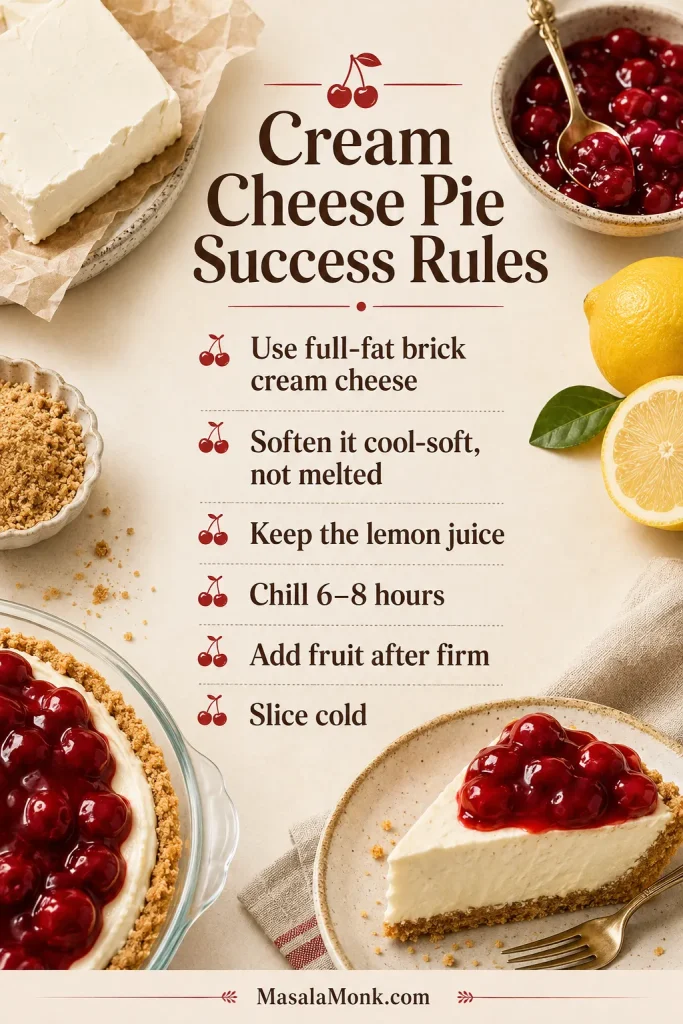
The save-this rule: use full-fat brick cream cheese, soften it until smooth but still cool, keep the lemon juice, chill the pie for 6 to 8 hours, and wait to add fruit until the filling is firm.
Make This When
This is a good pie for the day before company comes, because the fridge does most of the work while you move on with the rest of the meal.
Cheesecake flavor sounds good, but a full cheesecake feels like too much work.
A make-ahead dessert would make the meal easier.
Dessert needs to happen without turning on the oven.
An old-fashioned cherry-topped pie fits the potluck, holiday, or Sunday dinner table.
One reliable base should work with cherry, strawberry, blueberry, lemon, or pineapple topping.
Cherry pie filling added after the chilled base is firm
Texture
Creamy, tangy, sliceable, softer than baked cheesecake
Best make-ahead plan
Chill the plain pie overnight; top it before serving
No-Bake Cream Cheese Pie Recipe
This is the easy chilled pie: a 4-ingredient cream cheese filling in a graham cracker crust, finished with cherry pie filling when you want the old-fashioned fruit-topped style. The cherry version is the one many people remember from family tables: cool white filling, glossy red topping, and a buttery graham crust that somehow tastes even better the next day.
Yield: 8 slices
Prep time: 10 minutes
Chill time: 6 to 8 hours
Total time: 6 hours 10 minutes minimum
Pan: 9-inch / 23 cm pie crust
Method: No-bake
Best for: make-ahead holidays, potlucks, Sunday dinners, and no-bake summer desserts
Texture: creamy, tangy, smooth, and sliceable; softer than baked cheesecake
Before you start: for the safest first try, use the condensed milk filling, soften the cream cheese until cool-soft, chill the pie overnight, and add cherry topping only after the filling sets. In most kitchens, 30 to 45 minutes at room temperature softens cream cheese enough; in a hot kitchen, check sooner so it does not melt.
Ingredients
Ingredient
Amount
Notes
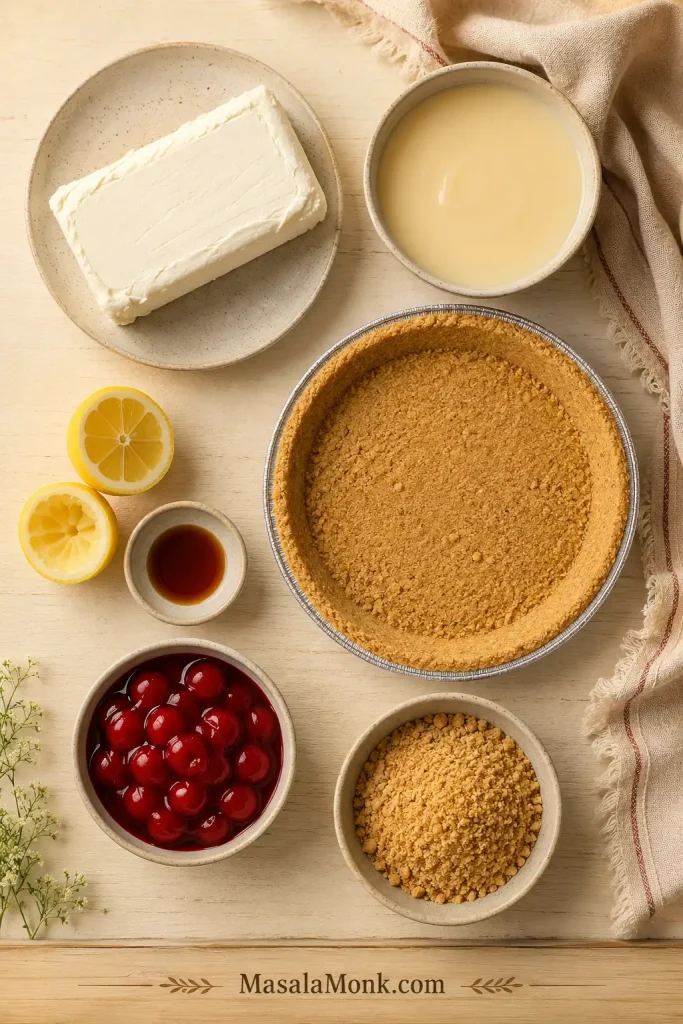
Full-fat brick cream cheese
8 oz / 226 g
Softened but still cool
Sweetened condensed milk
14 oz / 397 g
One standard can; do not use evaporated milk
Fresh lemon juice
⅓ cup / 80 ml
Balances sweetness and helps the filling thicken
Vanilla extract
1 tsp / 5 ml
Adds warmth
Prepared graham cracker crust
1 9-inch / 23 cm crust
Store-bought or homemade
Cherry pie filling, optional
20 to 21 oz / 565 to 595 g
Use enough to cover the top without weighing down the filling
Instructions
Beat the cream cheese first. Add the softened but still cool cream cheese to a mixing bowl. Beat until smooth and creamy, scraping the sides and bottom of the bowl so no firm pieces remain.
Add the condensed milk slowly. Pour in the sweetened condensed milk gradually while mixing on low to medium speed. Scrape the bowl again.
Mix in lemon juice and vanilla. Add the lemon juice and vanilla. Mix only until the cream layer is smooth and combined.
Fill the crust. Spoon the mixture into the graham cracker crust and smooth the top.
Chill until set. Cover and refrigerate for at least 6 hours, preferably overnight, until the center is firm enough to slice.
Add the topping. Spread cherry pie filling over the chilled base after it has set. For the cleanest look, add it 1 to 2 hours before serving.
Slice cold. Cut with a clean, sharp knife while the pie is cold. Wipe the knife between slices for neater wedges.
Recipe Notes
Use full-fat brick cream cheese, not whipped cream cheese or spreadable tub cream cheese.
Lemon juice helps the condensed milk mixture thicken, but chill time and full-fat cream cheese still matter.
If your topping is very sweet, keep the filling as written and do not add extra sugar.
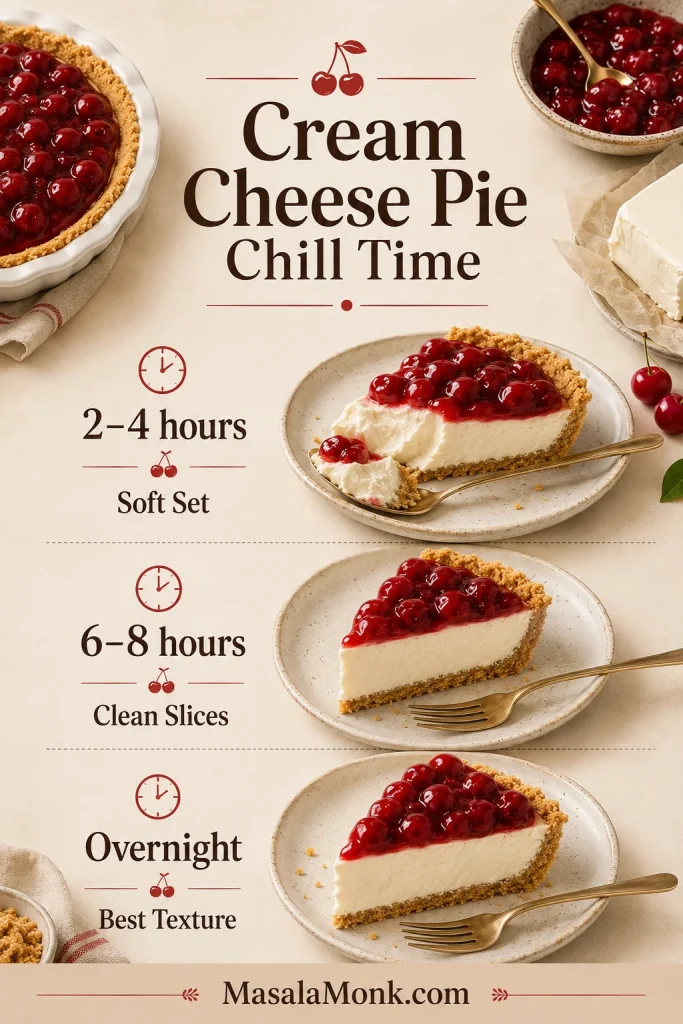
Two to four hours may give you a soft set; 6 to 8 hours gives cleaner slices.
Add fruit topping after the creamy center is firm, especially for a clean white layer under the fruit.
Keep the pie cold until serving.
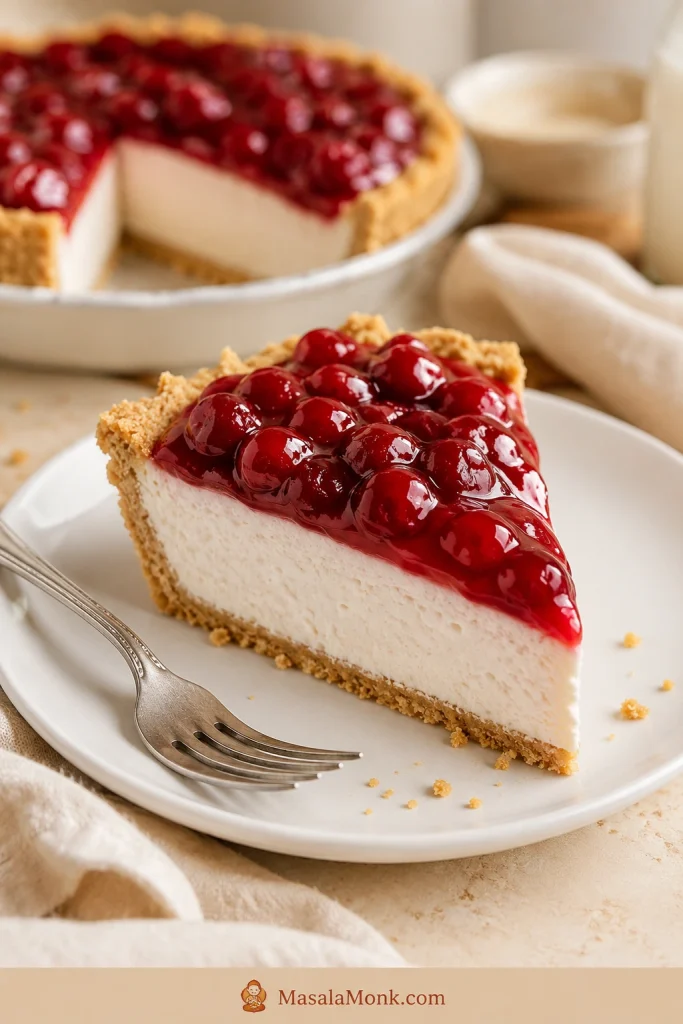
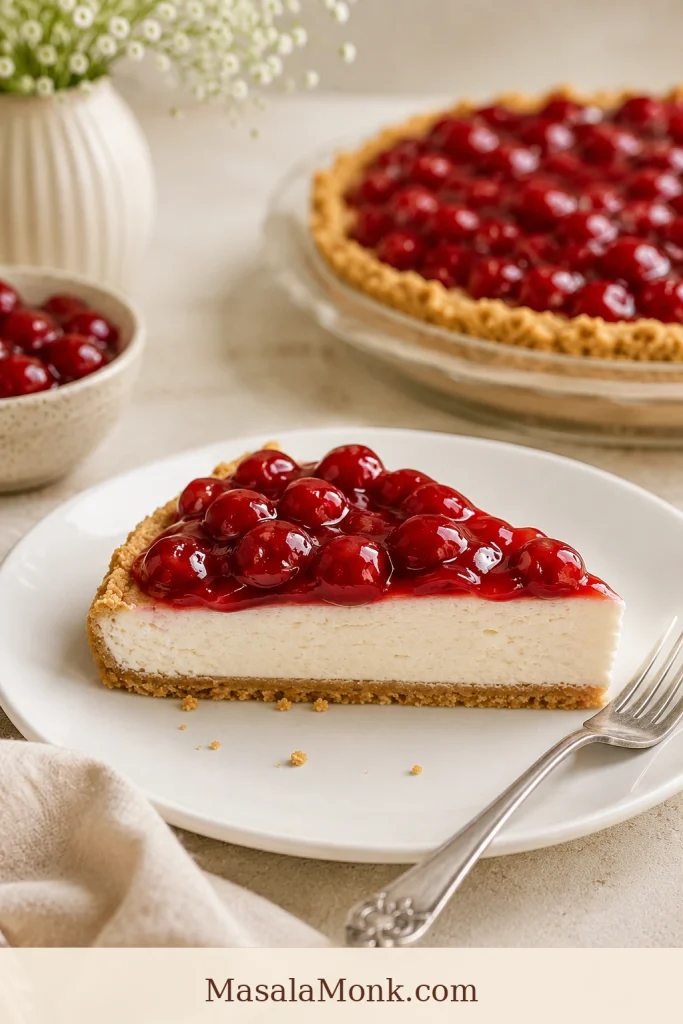
Before the detailed tips begin, this is the finished texture you are aiming for: a cold, creamy slice that holds together without feeling as dense as baked cheesecake.
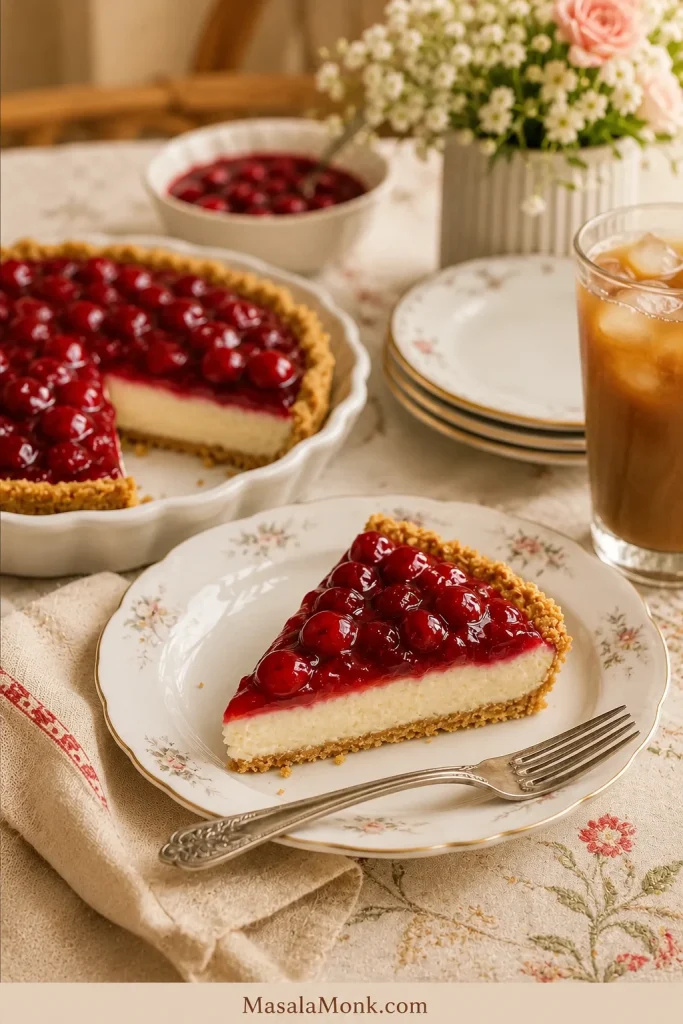
This is the slice you are aiming for: cold enough to stand neatly, but still softer and creamier than a baked cheesecake.
Equipment You’ll Need
You do not need a springform pan, water bath, or special dessert tools. A bowl, mixer, spatula, and pie crust are enough — the important part is getting the cream cheese smooth before anything thinner goes in.
9-inch / 23 cm pie plate or prepared graham cracker crust
Mixing bowl
Hand mixer or stand mixer
Rubber spatula
Measuring cups and spoons
Sharp knife for slicing
Small saucepan, only for a cooked strawberry or blueberry topping
Do This, Not That
This is still an easy pie. A few small choices simply make the difference between neat chilled wedges and a softer spoonable dessert.
Do This
Not This
Why It Matters
Use full-fat brick cream cheese
Use spreadable tub cream cheese
Brick cream cheese gives the filling better body
Soften cream cheese until cool-soft
Use it fridge-hard or warm and greasy
Too cold causes lumps; too warm can make the mixture loose
Beat cream cheese before adding condensed milk
Add everything at once
Smoothing the cream cheese first prevents hidden lumps
Use lemon juice in the condensed milk filling
Skip it and expect the same texture
Lemon balances sweetness and helps the filling thicken
Chill 6 to 8 hours
Rush it after 2 hours
The center needs time to firm up all the way through
Add fruit topping after the filling sets
Add watery topping before chilling
This keeps the white layer clean and helps protect the crust
Slice the pie cold
Let it sit warm before cutting
The filling softens at room temperature
Here is the visual checklist after the rule table: smooth the cream cheese first, keep the lemon juice, chill fully, and add fruit only after the filling firms.
Use these success rules as your quick checkpoint: smooth cream cheese first, lemon for balance, full chill time, and topping after the filling firms.
Why This Recipe Works
Cream cheese gives the pie tang, richness, and body. Sweetened condensed milk adds sweetness and a thick, smooth base. Lemon juice cuts through the richness and helps the condensed milk mixture firm up as it chills. Vanilla rounds out the flavor so the filling tastes creamy, not flat.
The refrigerator finishes the job. Once the filling sits cold for long enough, the center catches up with the edges and the pie becomes sliceable. Overnight chilling is not just a waiting step; it is when the pie becomes itself.
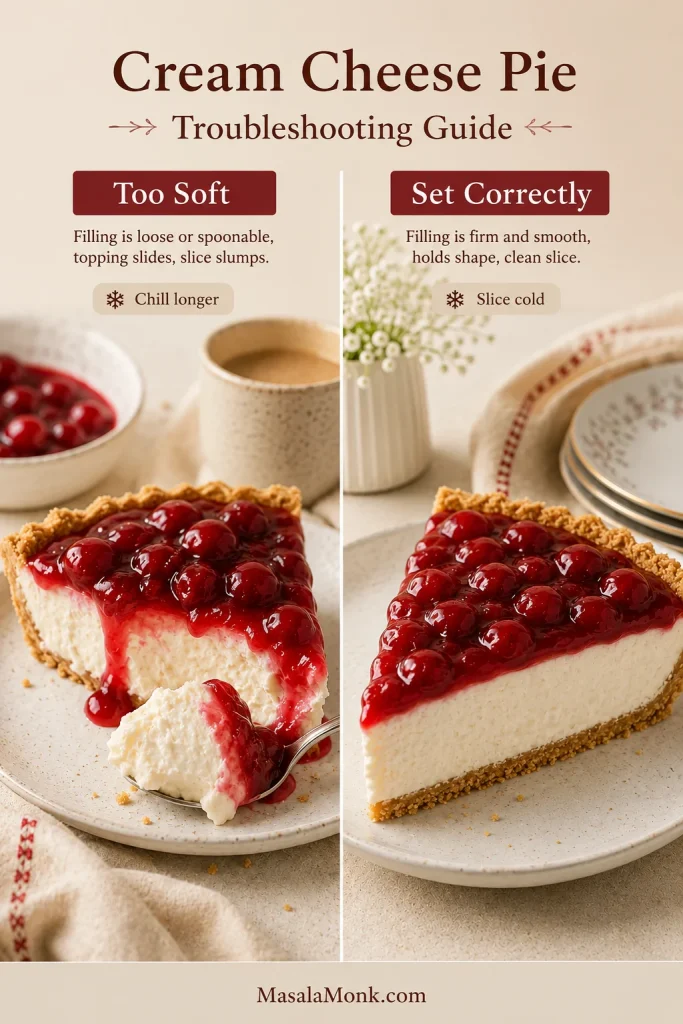
What a Good Slice Should Look Like
A good slice should stand on the plate without slumping. Look for a smooth white cream layer, a topping that sits mostly on top, and a crust that cuts cleanly instead of turning into wet crumbs.
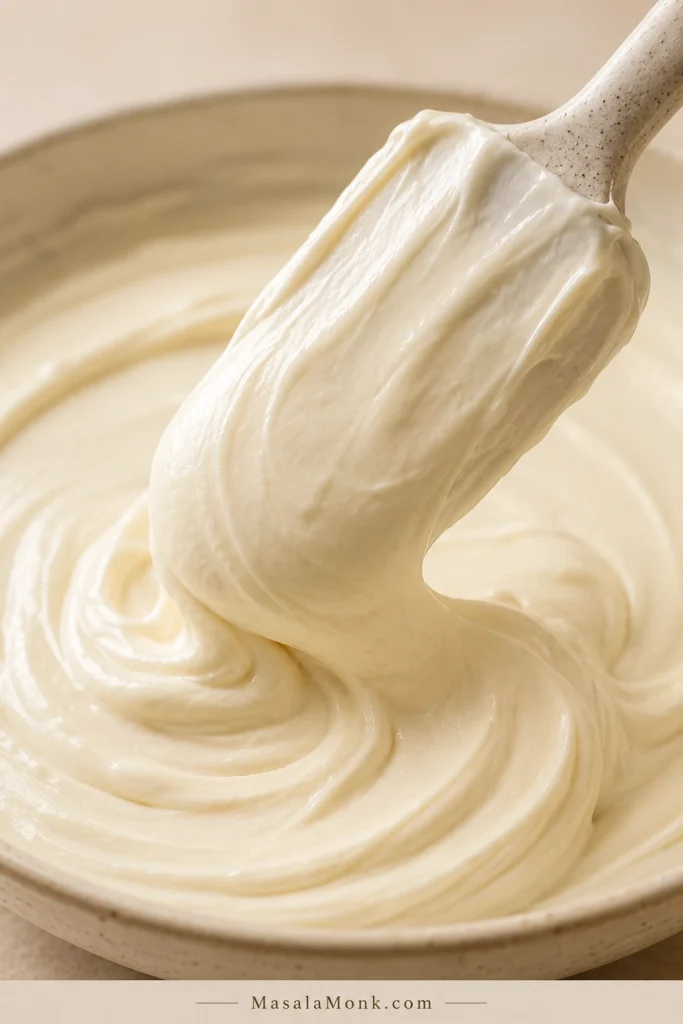
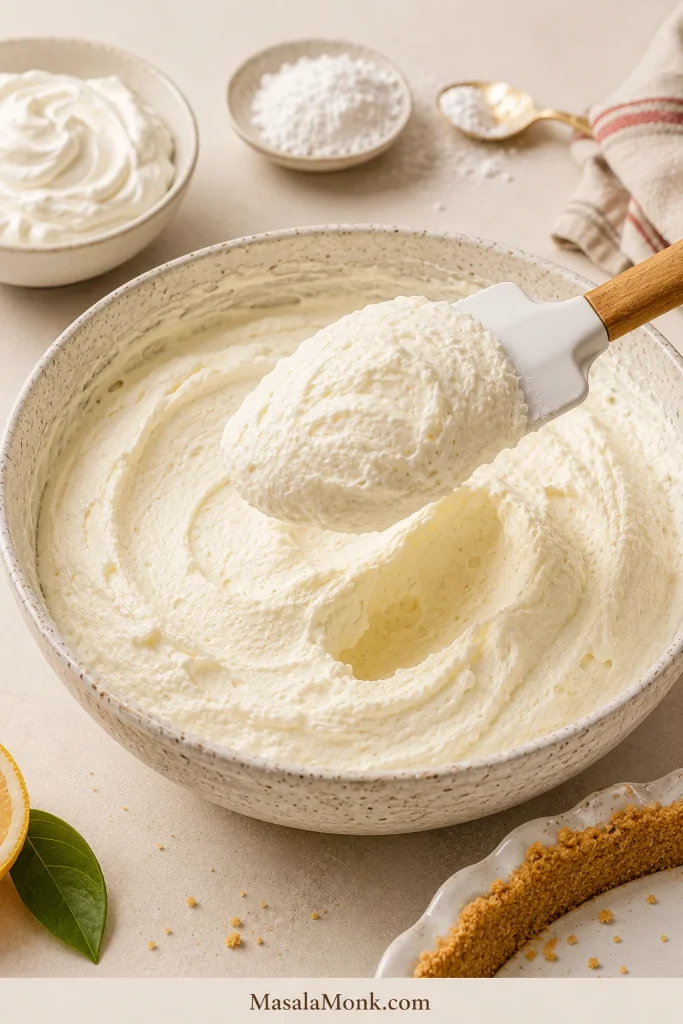
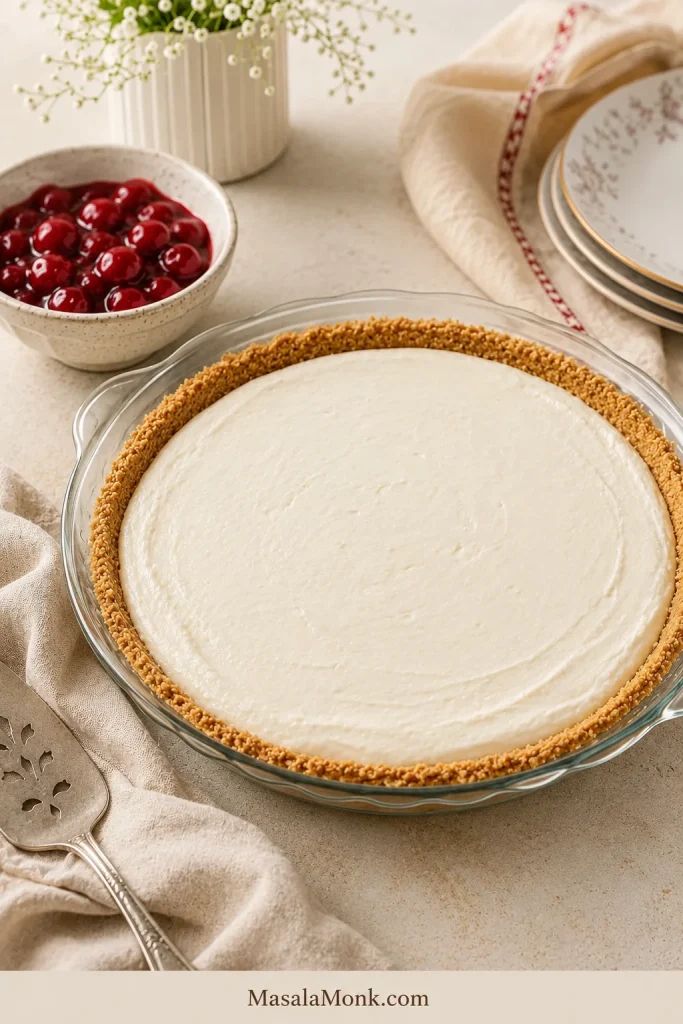
Before chilling, the mixture should look glossy and thick enough to hold soft waves from the spatula. After chilling, the center should feel firm when gently touched.
At this stage, look for soft waves in the filling; that texture means it is smooth enough to spread and thick enough to set.
Choose Your Version
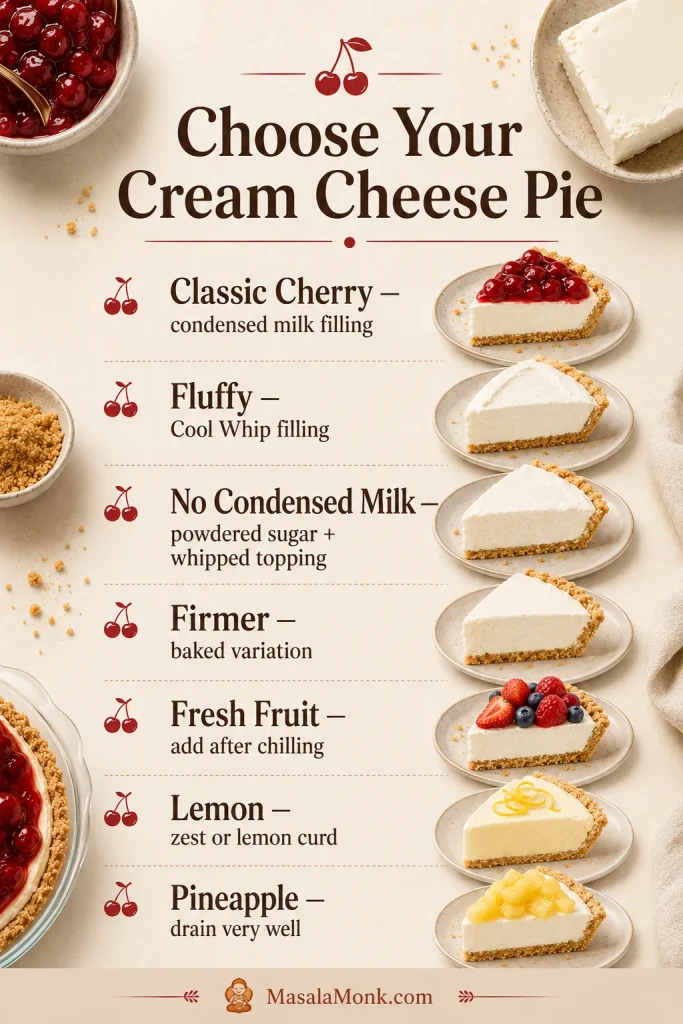
If you have opened a few cream cheese pie recipes and they all look different, this is why: the same name can point to several different styles. Choose the one you actually want before you start mixing.
This is where the recipe becomes flexible instead of one fixed formula.
Choose the version before you mix: condensed milk makes the classic pie, Cool Whip makes it fluffier, and baking gives a firmer set.
You Want…
Make This Style
What to Expect
Classic cherry cream cheese pie
No-bake condensed milk filling
Smooth, tangy, sweet, nostalgic
A lighter, fluffier pie
Cool Whip filling
Softer and mousse-like
No condensed milk
Cool Whip + powdered sugar filling
Still creamy, less dense
Firmer cheesecake-style pie
Baked cream cheese pie
Richer, firmer, custard-like
Fresh strawberry or blueberry pie
No-bake base + cooled fruit topping
Brighter and more seasonal
Pineapple cream cheese pie
No-bake base + very well-drained pineapple
Retro, tropical, softer if fruit is wet
Lemon cream cheese pie
No-bake base with more lemon zest or lemon curd topping
Brighter and tangier
For a first attempt, start with the no-bake condensed milk filling. It gives the familiar flavor and is the easiest to get right when it chills long enough.
No-Bake vs Baked
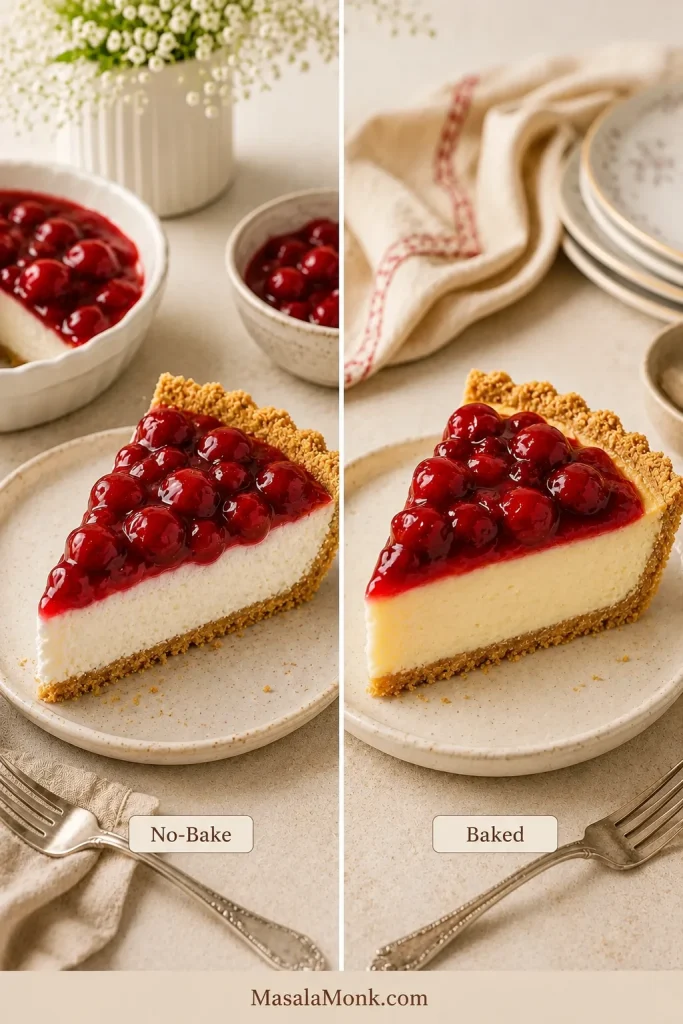
The no-bake pie is softer, colder, and more like an icebox dessert. Baked cream cheese pie is firmer and closer to cheesecake. Choose no-bake for the easiest cherry-topped dessert; choose baked when you want eggs, sour cream, and a more custard-like center.
No-bake cream cheese pie stays colder and creamier, whereas the baked version sets firmer with a more custard-like center.
For a full baked cheesecake with a crumb crust and denser texture, this salted caramel cheesecake recipe goes completely in that direction.
Ingredients You’ll Need
Once you know the style you want, the ingredients are simple. The main thing is using the right kind of cream cheese and giving the filling enough time to rest cold.
Before mixing, set up the simple base: cream cheese for body, condensed milk for sweetness, lemon for brightness, and vanilla for a rounder flavor.
Cream Cheese
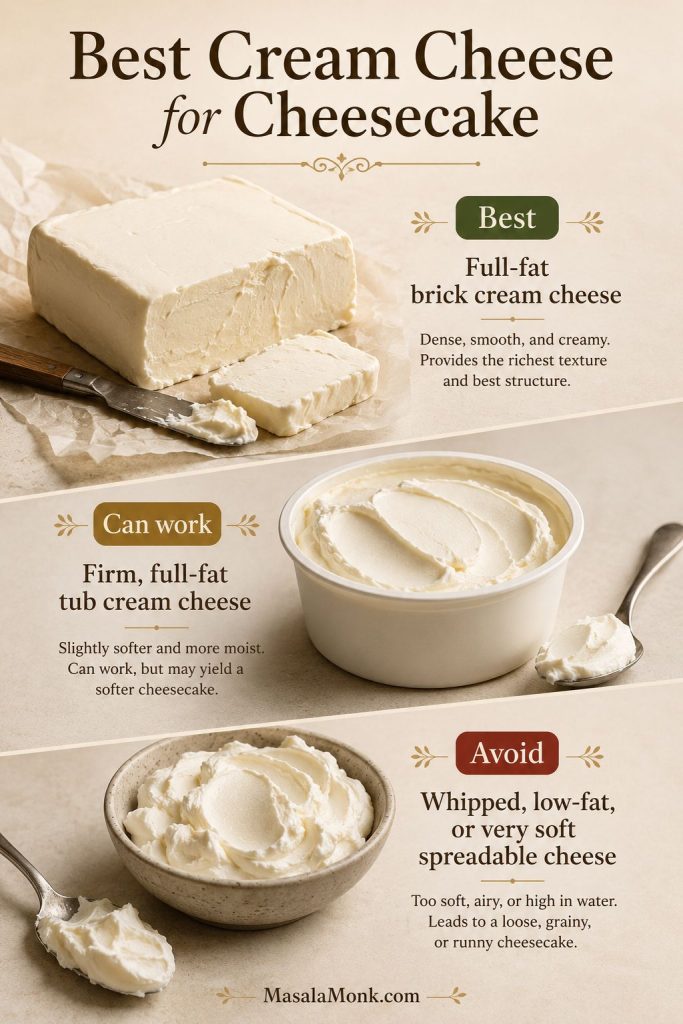
Use full-fat brick cream cheese for the best structure. Spreadable cream cheese from a tub is softer and can make the filling loose. Whipped cream cheese changes the density too, so it is better saved for spreading, not setting a pie.
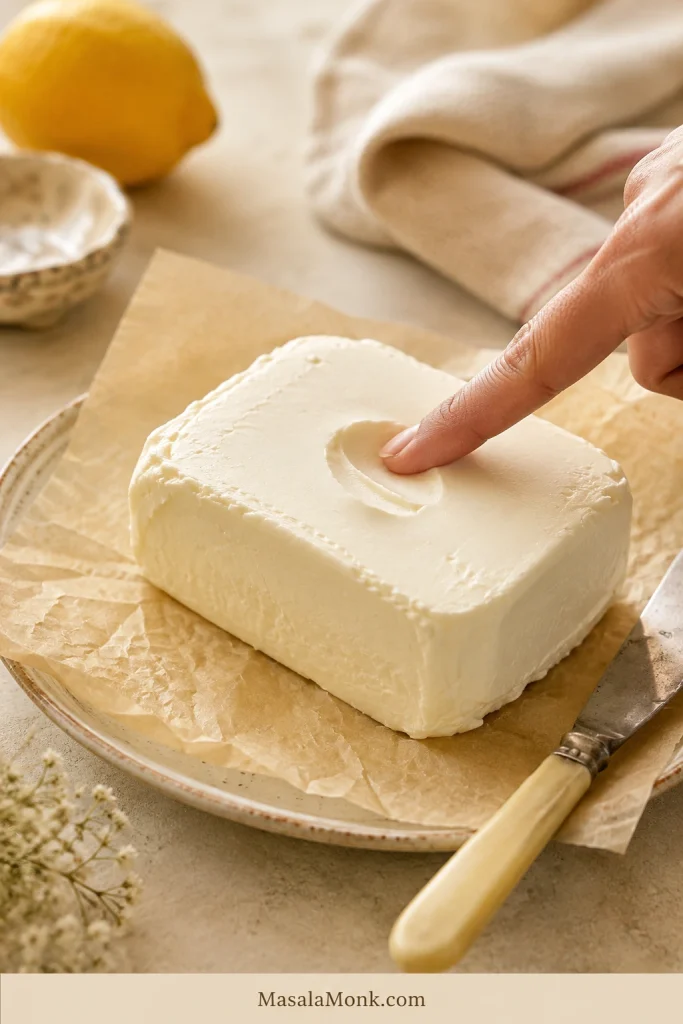
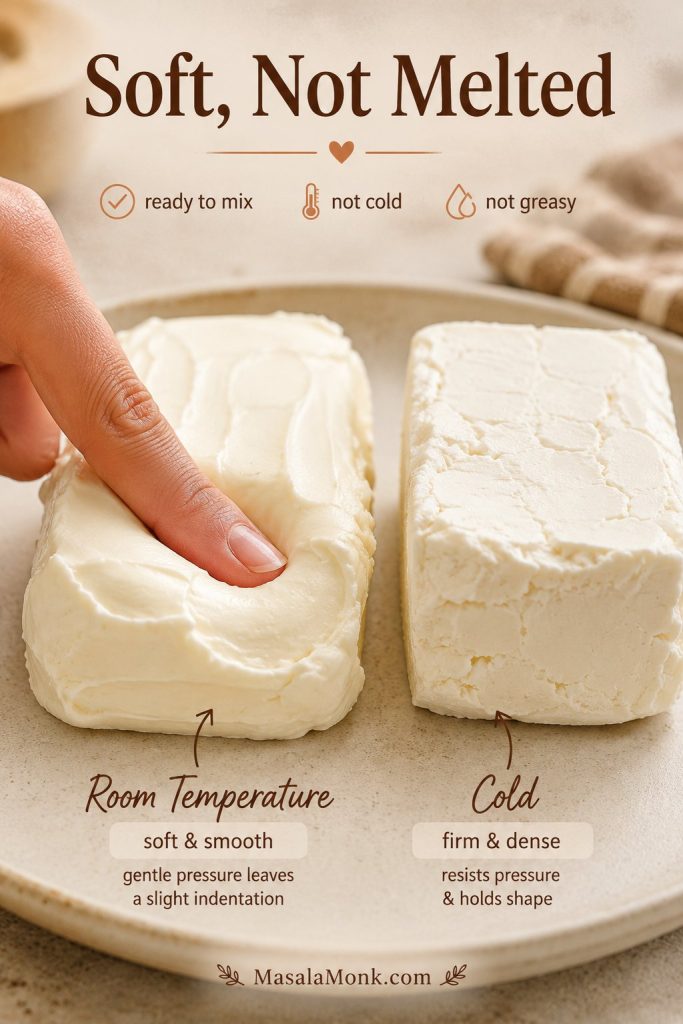
The cream cheese should be softened but still cool. If it is too cold, it can leave lumps. When it gets too warm, it can become greasy and thin. Your finger should press into it easily, but the block should still hold its shape.
For fewer lumps, let the cream cheese soften until it dents under light pressure; cold blocks fight the mixer and leave tiny bits behind.
Sweetened Condensed Milk
Sweetened condensed milk gives the filling sweetness, body, and that familiar no-bake texture. Use one standard 14 oz / 397 g can.
Do not replace it with evaporated milk. Evaporated milk is unsweetened, thinner, and will not give the same structure.
Lemon Juice
Lemon juice balances the sweetness of the condensed milk and helps the filling thicken as it chills. Fresh lemon juice gives the cleanest flavor, but bottled lemon juice can work when that is what you have.
The finished pie should not taste sharply lemony. Lemon is there to brighten the filling, not to turn the whole dessert into lemon pie. For a dessert that leans fully into tart citrus, this key lime pie recipe is the brighter direction.
Vanilla Extract
Vanilla rounds out the tangy cream cheese and makes the filling taste fuller. It is a small ingredient, but the pie tastes flatter without it.
Graham Cracker Crust
Graham cracker crust is the usual choice for a no-bake cream cheese pie. Store-bought crust keeps the recipe fast, while a homemade crust gives more flavor and a firmer bite when you pre-bake it.
Cherry Pie Filling
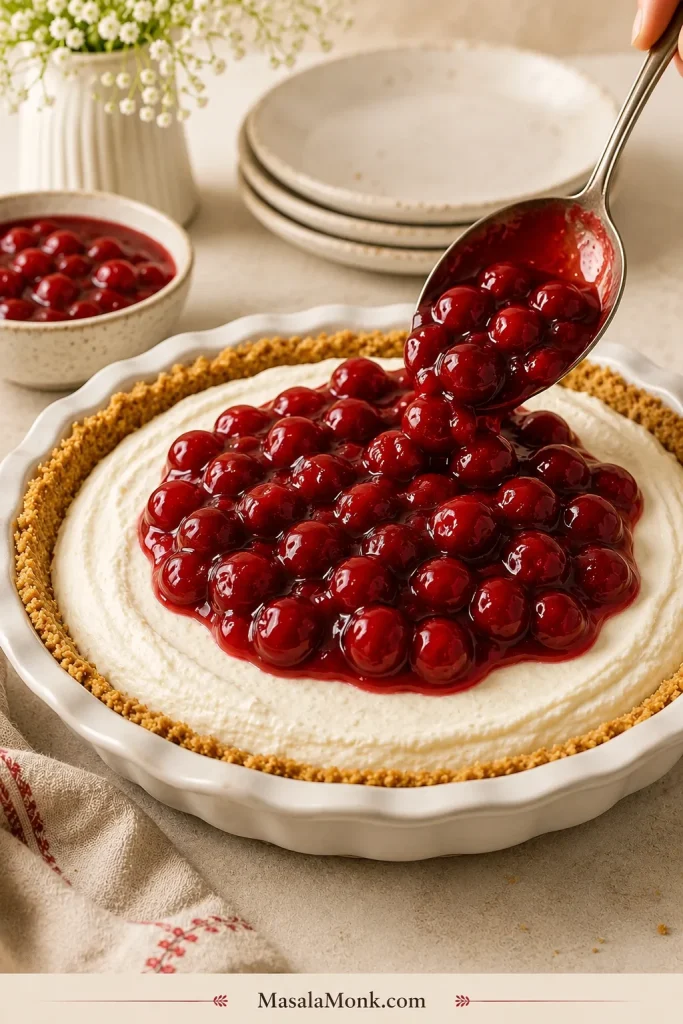
Cherry pie filling is optional, but it is the most familiar topping for this style of pie. Add it after the creamy base has set so the red topping stays distinct from the white filling.
You may not need the entire can. Use enough to cover the top without making the pie feel heavy. If you prefer homemade topping, this cherry pie filling recipe works well here; just cool it fully before spreading it over the chilled filling.
Choose the Right Filling
Most of the confusion with cream cheese pie starts with the filling. Condensed milk gives a smooth, tangy, sliceable pie. Cool Whip makes it lighter and softer. Homemade whipped cream tastes fresher but needs a gentle hand. Baked fillings use eggs and sour cream for a firmer texture.
Now that the finished style is clear, here is what changes inside the bowl.
Filling Style
Uses
Result
Watch-Out
Cream cheese + condensed milk + lemon juice
Classic no-bake pie
Smooth, tangy, sweet, sliceable
Needs proper chill time
Cream cheese + Cool Whip + powdered sugar
No-condensed-milk style
Light, fluffy, softer
Less rich and less tangy
Cream cheese + homemade whipped cream
More homemade fluffy filling
Creamy, airy, less processed
Must be folded gently so it stays light
Cream cheese + eggs + sour cream
Baked cream cheese pie
Firmer and cheesecake-like
Needs baking, cooling, and chilling
Cream cheese + pudding or gelatin mix
Shortcut pie variations
Sweeter and more stable
More processed flavor
Cool Whip Filling Without Condensed Milk
Use this route for a lighter no-bake filling or for the days when there is no sweetened condensed milk in the pantry.
If you want cream cheese pie without condensed milk, the Cool Whip version gives a lighter filling, but it still needs a long chill.
Ingredient
Amount
Full-fat brick cream cheese
8 oz / 226 g
Powdered sugar
½ cup / about 60 to 65 g
Vanilla extract
1 tsp / 5 ml
Lemon juice
1 tbsp / 15 ml, optional
Cool Whip or whipped topping
1½ to 2 cups
Graham cracker crust
1 9-inch / 23 cm crust
Beat the cream cheese, powdered sugar, vanilla, and lemon juice until smooth. Fold in the whipped topping gently, spoon the filling into the crust, and chill until set. It feels lighter than the condensed milk pie, but it still needs a long cold rest for neat slices.
Start with ½ cup powdered sugar. Add more only if you want a sweeter, dessert-dip-style filling.
Homemade Whipped Cream Filling
Homemade whipped cream also works in place of Cool Whip. Beat cold heavy cream to medium-stiff peaks, then fold it gently into the sweetened cream cheese mixture. Do not beat aggressively after the whipped cream goes in.
For the right peak stage, this homemade whipped cream recipe shows when to stop while the cream still looks glossy and soft, not dry or grainy.
This filling tastes fresher than whipped topping, but it can be slightly less stable when the whipped cream is too soft. Chill it well and slice it cold.
How to Make No-Bake Cream Cheese Pie
With the filling style chosen, the method is straightforward. The main trick is beating the cream cheese smooth before adding the thinner ingredients.
1. Beat the Cream Cheese First
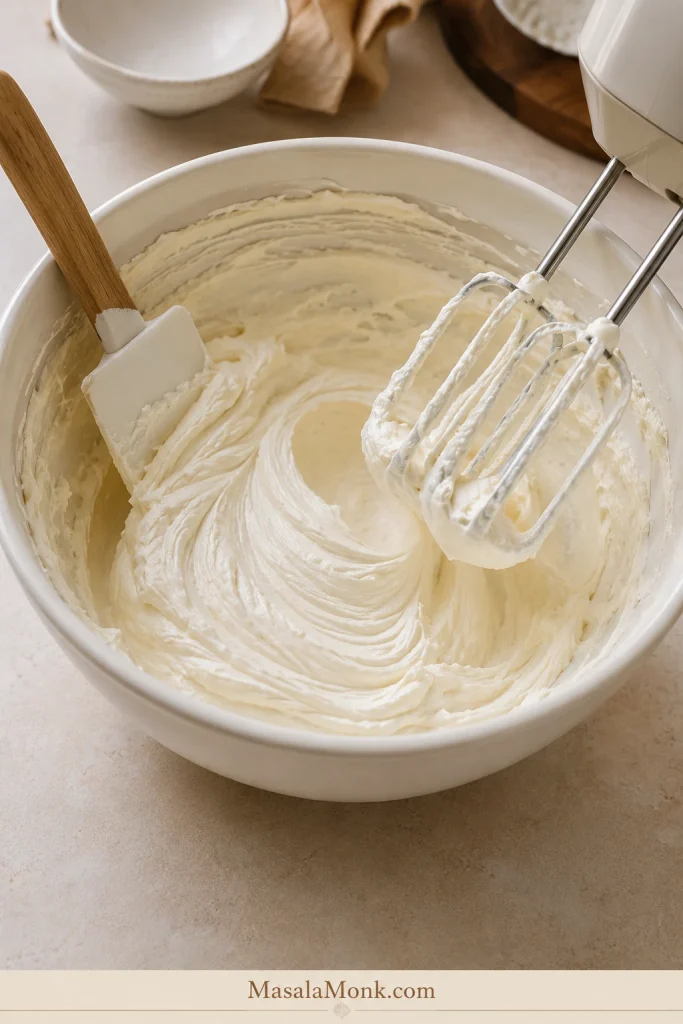
Add the cream cheese to a mixing bowl and beat it before adding anything else. Once the condensed milk goes in, hidden lumps are harder to smooth out.
First, beat the cream cheese by itself until smooth; once the sweetened condensed milk goes in, hidden lumps are harder to remove.
Scrape the sides and bottom of the bowl with a spatula. Cream cheese often hides there in small firm patches, and those patches can show up later in the finished pie.
2. Add the Condensed Milk Slowly
Pour in the sweetened condensed milk gradually and mix until the filling looks smooth and glossy. Keep the mixer on low to medium speed. Smooth is the goal, not overbeaten.
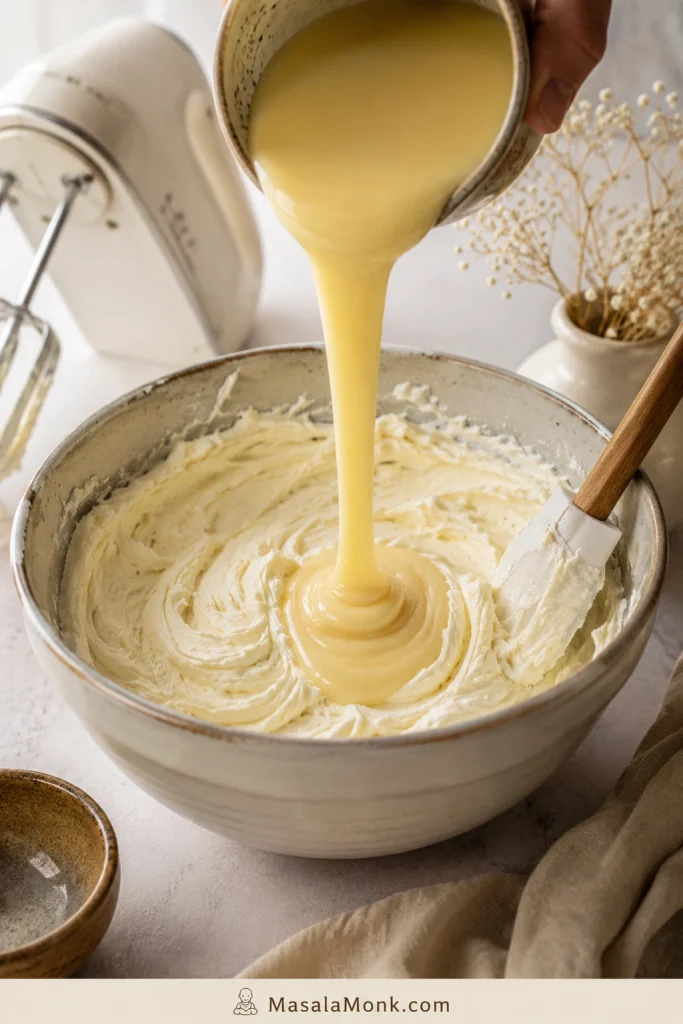
Next, pour in the condensed milk gradually so the filling stays thick, glossy, and evenly blended instead of turning loose at the edges.
3. Add Lemon Juice and Vanilla Last
Add the lemon juice and vanilla after the cream cheese and condensed milk are already smooth. Mix just until combined. The mixture may thicken slightly as the lemon juice blends in.
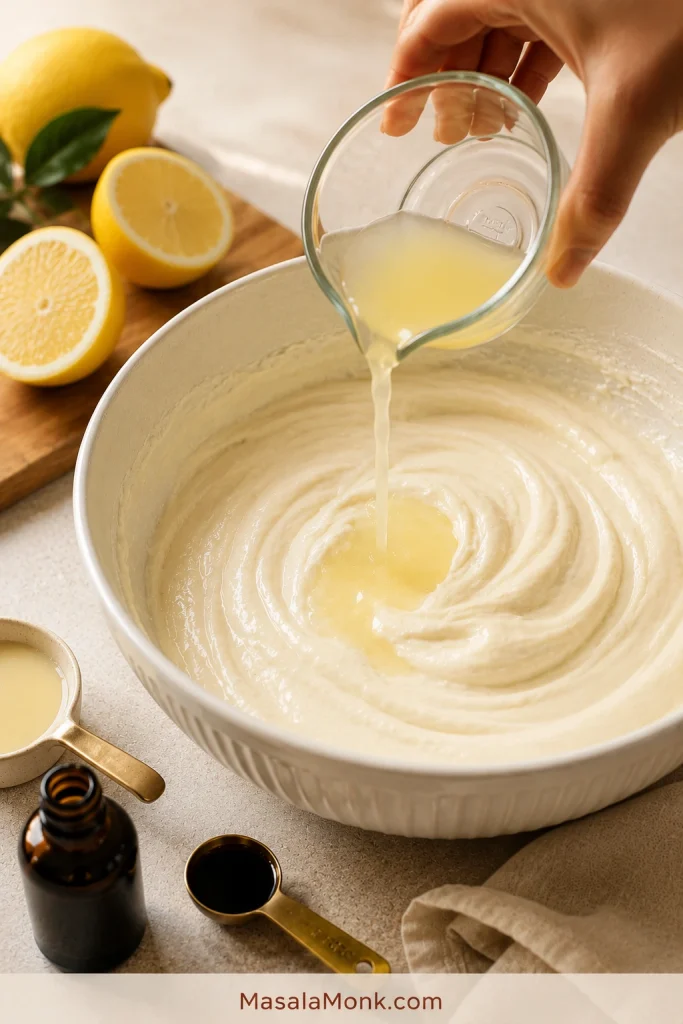
Then add lemon juice so the filling tastes bright instead of flat; it also helps the condensed milk mixture chill into a firmer pie.
4. Fill the Crust
Spoon the filling into the graham cracker crust and smooth the top with a spatula. For the cleanest white layer, wait to add fruit topping until after the pie has chilled.
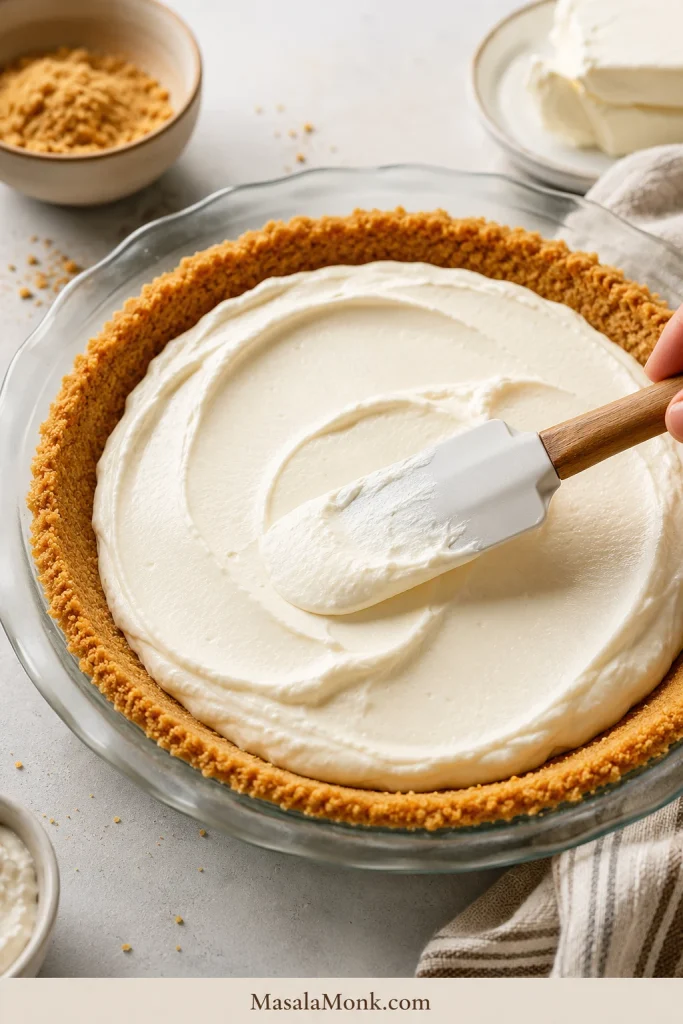
Once the filling is smooth, level it inside the graham cracker crust so the cream cheese pie chills evenly from edge to center.
5. Chill Until the Center Is Firm
Cover the pie and refrigerate it for at least 6 hours. Overnight is even better. The center needs time to catch up with the edges.
6. Add the Topping and Slice Cold
Spread cherry pie filling or another topping over the chilled base. Slice while cold, using a clean, sharp knife. For neat wedges, wipe the knife between cuts.
Chill Time for Clean Slices
Give the pie enough refrigerator time for the center, not just the edges, to firm up. It may taste good after a shorter chill, but it will not always lift out in neat wedges.
Chill Time
Result
Use It When
2 to 4 hours
Soft set
You do not mind softer slices
6 to 8 hours
Cleaner slices
You want the pie to hold its shape
Overnight
Best texture
You are serving guests or making it ahead
Here is the saveable chill-time recap: soft set is fine for spooning, but clean cream cheese pie slices need 6 to 8 hours or overnight.
Use chill time as your texture guide: soft set works for spooning, while clean cream cheese pie slices need 6 to 8 hours or overnight.
For gatherings, overnight chilling is the easiest insurance. The first slice is the test; the second is usually cleaner once the knife has opened the pie.
Overnight is the clean-slice move because the center gets time to set as firmly as the edges before slicing.
A short freezer rest can help in an emergency, but it is not a perfect shortcut. Too much freezer time can make the texture icy or change the way the filling softens later.
How to Get a Filling That Sets
If you want the cleanest slices, focus on a few things: full-fat brick cream cheese, lemon juice, enough refrigerator time, and toppings that are not watery.
Beat the cream cheese smooth first. This prevents hidden lumps before thinner ingredients go in.
Keep it cool-soft, not warm. Warm cream cheese can make the mixture loose and greasy.
Use the lemon juice. It balances the sweetness and helps the condensed milk filling thicken.
Let the center chill through. The edges firm first; the middle needs more time.
Keep wet toppings for later. Add cherry topping, berries, or pineapple after the creamy base is firm.
Clean-slice cue: the pie is ready when the center feels firm to a gentle touch and a knife can cut through without dragging loose cream into the crust.
This plain chilled stage matters: a firm base keeps cherry or fruit topping from staining the white filling too early.
Graham Cracker Crust, Pie Crust, or Cream Cheese Pie Crust?
After the filling, the crust is where texture can change most. Graham cracker crust is the easiest and most traditional choice for this recipe. It pairs well with the tangy filling and does not need a long bake.
One phrase can be confusing: “cream cheese pie” usually means a pie with cream cheese in the filling. “Cream cheese pie crust” is different. That is a pastry dough made with cream cheese. It can be delicious, but it is not the same thing as this no-bake dessert.
If you were looking for pastry dough made with cream cheese, that is a different recipe; this page focuses on the creamy pie-filling style.
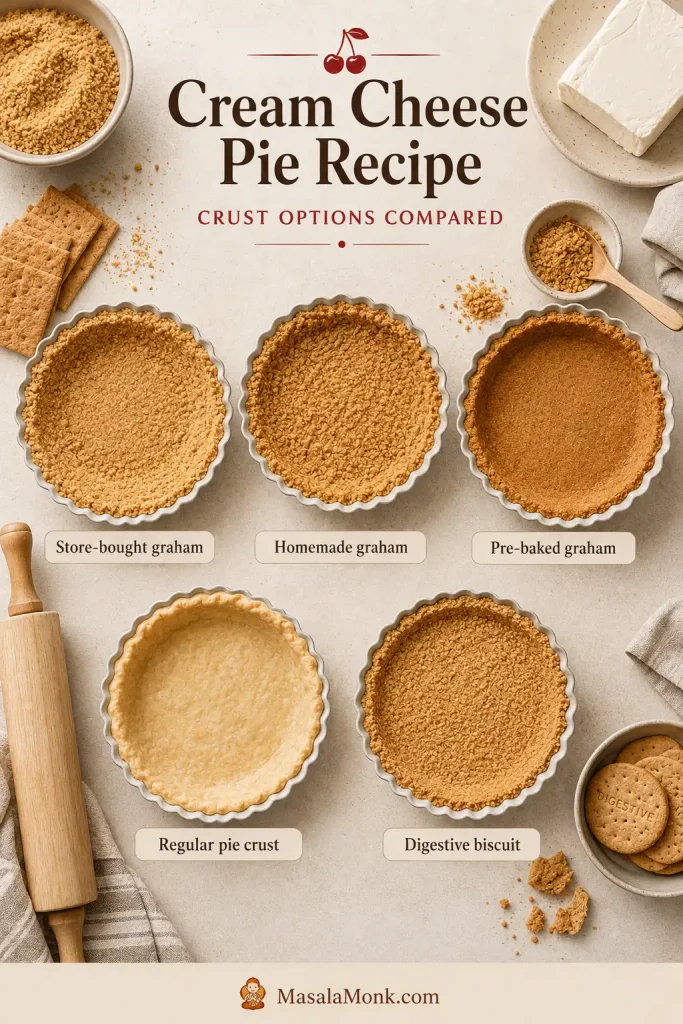
Meanwhile, the crust changes the whole bite: graham cracker crust keeps it classic, while regular pie crust leans better for baked versions.
Crust
Best For
Notes
Store-bought graham cracker crust
Fastest no-bake pie
Easy, classic, and convenient
Homemade chilled graham crust
No-bake homemade version
Softer than pre-baked but flavorful
Pre-baked graham cracker crust
Cleaner slices
Bake 10 minutes at 350°F / 177°C, then cool fully
Regular pie crust
Baked cream cheese pie
Blind bake if the filling recipe needs a pre-baked shell
Digestive biscuit crust
Graham cracker substitute
Useful where graham crackers are not common
Simple Homemade Graham Cracker Crust
A simple homemade graham crust only needs:
1½ cups / about 170 to 180 g graham cracker crumbs
2 to 4 tbsp sugar, depending on how sweet you like the crust
6 to 7 tbsp / 85 to 100 g melted butter
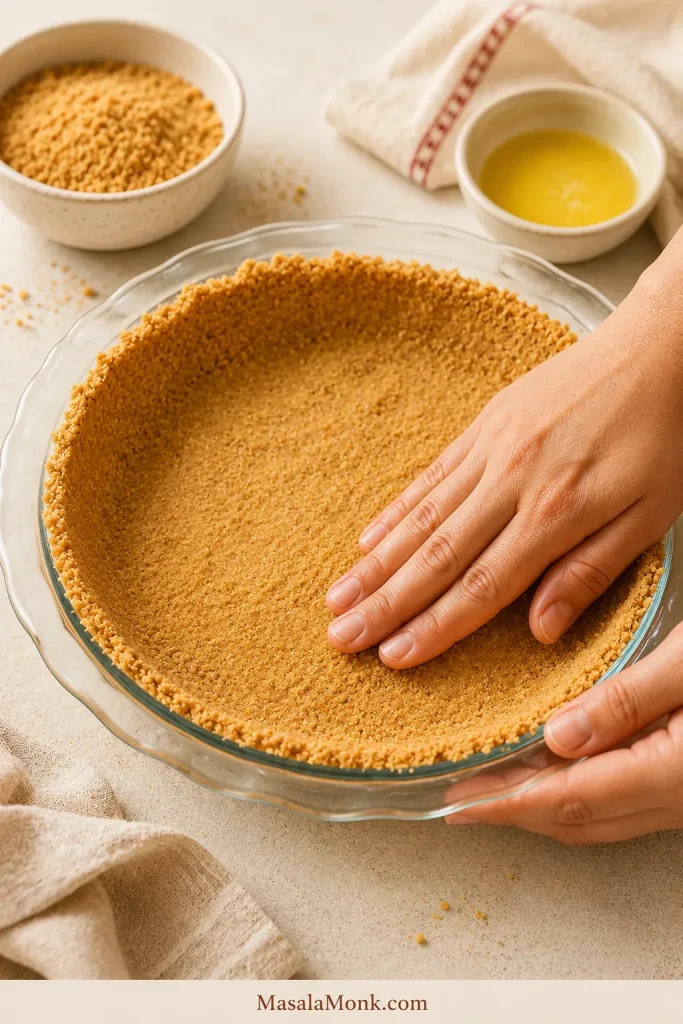
Press the crumbs into a 9-inch / 23 cm pie plate. Chill the crust for a no-bake version, or bake it at 350°F / 177°C for about 10 minutes and cool completely before adding the cream cheese filling.
When making your own graham crust, aim for compact, not compressed; that balance keeps the base sturdy without turning hard.
Do not pack the crust rock-hard. Press it firmly enough to hold together, but not so tightly that it becomes dense and difficult to cut. For more detail on crumb crusts, King Arthur Baking has a helpful graham cracker crust guide.
Another easy no-bake pie with a crumb crust is this banoffee pie recipe, a chilled make-ahead dessert with banana, toffee, and cream.
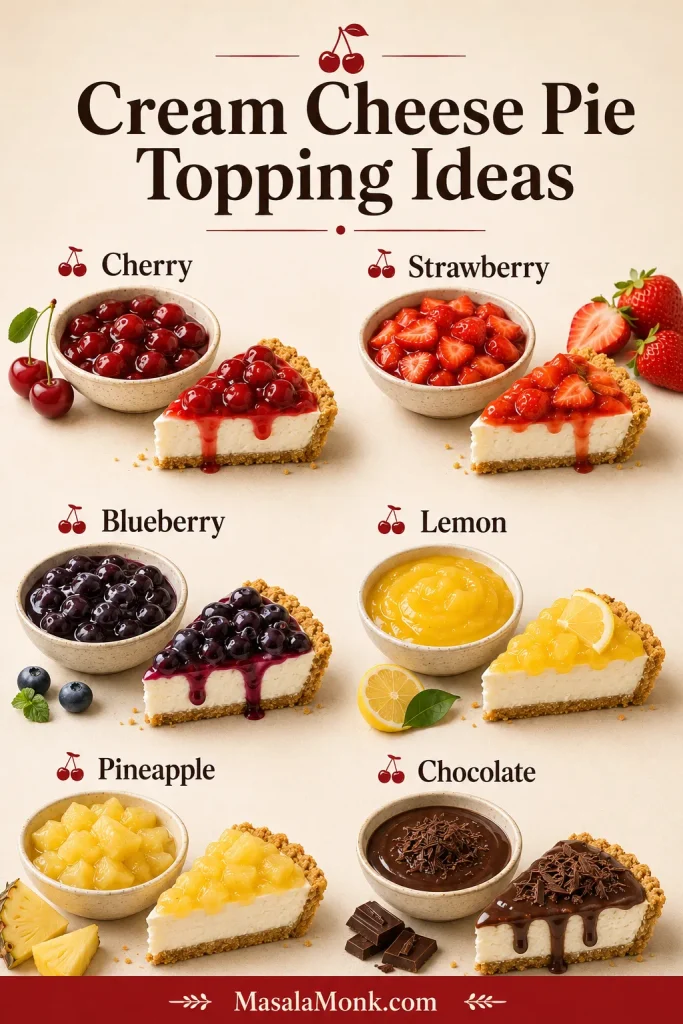
Cherry, Strawberry, Blueberry, Lemon, and Pineapple Toppings
After the filling and crust are settled, the topping is where the pie becomes personal. Cherry feels old-fashioned, strawberry and blueberry feel fresh and summery, lemon keeps it bright, and pineapple turns it retro and tropical.
Once the base is chilled, one cream cheese pie can turn into cherry, strawberry, blueberry, lemon, pineapple, or chocolate dessert.
Topping
How to Use It
Best Note
Cherry pie filling
Spread over the chilled filling
The familiar old-fashioned topping
Strawberry topping
Use fresh sliced strawberries or a cooked strawberry glaze
Best for spring and summer
Blueberry topping
Use cooked blueberry sauce, cooled before adding
Excellent with a little lemon zest
Lemon curd
Spread a thin layer over the set pie
Bright, tangy, and less heavy
Pineapple
Drain very well before using
Too much liquid can loosen the filling or soften the crust
Chocolate or Oreo
Use cookie crumbs, ganache, or chocolate drizzle
Best when you want a richer, sweeter pie
Pumpkin
Use as a fall cheesecake-pie style variation
Best for fall or holiday baking
When to Add Cherry Pie Filling
For the cleanest look, chill the creamy base first and add cherry pie filling 1 to 2 hours before serving. This keeps the white layer distinct and prevents the topping from bleeding into the filling too much.
After the filling firms, add cherry topping with a light hand; the goal is a glossy red layer that stays on top.
For convenience, the cherry topping can go on earlier and the whole pie can be refrigerated. It will still taste good, but the topping may stain the cream cheese layer slightly.
A baked fruit pie is a different dessert altogether. This cherry pie recipe that sets is the fuller baked-pie route when you want deep ruby filling inside a flaky crust.
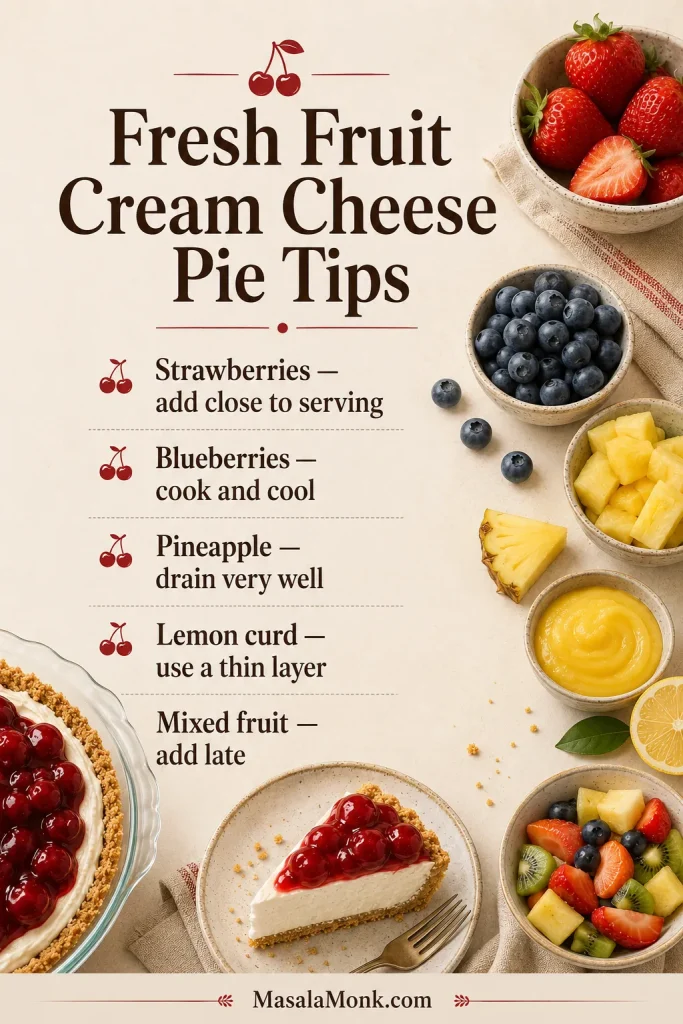
How to Use Fresh Fruit Without Making the Pie Watery
Fresh fruit gives the pie a brighter, more seasonal feel; it just needs better timing because berries and pineapple release juice as they sit.
Strawberries: add sliced fresh berries close to serving, or cook part of the berries into a thicker glaze and cool it completely before adding.
Blueberries: use a cooked topping with a little lemon juice and cornstarch because it holds better than loose fresh berries.
Pineapple: drain it extremely well, and press out extra liquid when needed.
Lemon curd: use a thin layer so it brightens the pie without overpowering the cream cheese.
Mixed fruit: add it close to serving unless it has been cooked into a thicker topping.
For another fresh-strawberry dessert where timing matters, this strawberry shortcake recipe keeps the berries and cream separate until serving so the texture stays fresh.
No matter which topping you use, let the filling firm first. Cold filling underneath and cooled topping on top give the cleanest slice.
For fresh fruit toppings, timing matters: add strawberries late, cook blueberries first, drain pineapple well, and keep lemon curd thin.
Baked Cream Cheese Pie Variation
Choose this baked route for a firmer old-fashioned pie that tastes closer to cheesecake. It uses eggs and sour cream for a richer, custard-like texture.
Baked Version Ingredients
Ingredient
Amount
Full-fat brick cream cheese
16 oz / 452 g
Granulated sugar
½ cup / 100 g
Sour cream
¼ cup / 60 g
Large eggs
2
Vanilla extract
1 tsp / 5 ml
Lemon juice
1 tsp / 5 ml
Graham cracker crust
1 9-inch / 23 cm crust
How to Bake It
Pre-bake the graham cracker crust at 350°F / 177°C for about 10 minutes. Cool slightly.
Lower the oven to 325°F / 163°C.
Beat the cream cheese and sugar until smooth.
Mix in sour cream, vanilla, and lemon juice.
Add the eggs one at a time, mixing gently after each addition.
Pour the filling into the crust.
Bake for about 30 to 35 minutes, or until the edges are set and the center has a gentle wobble.
Cool at room temperature for 1 hour.
Refrigerate for at least 2 hours, preferably longer, before slicing.
The center should wobble slightly, not ripple like liquid. It will firm more as it cools and chills.
For a retro sour cream topping, spread a thin sweetened sour cream layer over the baked pie near the end of baking or after the filling has set, depending on the style you prefer. Keep the layer light so it complements the cream cheese instead of overwhelming it.
Texture Cues at Every Stage
Use this as a visual check before serving. The filling changes as it chills, so do not judge the pie by the first hour in the fridge.
Stage
What You See
What It Means
Before chilling
Smooth, glossy filling with soft spatula waves
Good. It should spread easily but not look watery.
Before chilling
Loose, pourable filling
It may be too warm, overmixed, or made with the wrong ingredient.
After a short chill
Edges are firmer but center is still soft
Normal. Give it more time before expecting clean slices.
After a full chill
Center feels cold and firm to a gentle touch
Ready to slice while cold.
After topping
Fruit sits mostly on top
Good. The creamy base was firm before topping.
After topping
Red streaks or watery edges
Topping may have been added too early, too warm, or too wet.
Troubleshooting
Most cream cheese pie problems are easy to read once you know what stage caused them. If your pie is softer than expected, do not panic; it may need more time, colder filling, or a different serving plan.
Why Is My Cream Cheese Pie Runny?
The most common reason is not enough chill time. After a couple of hours, the top may look set while the center is still too soft to slice.
Other possible causes are cream cheese that was too warm, low-fat or spreadable cream cheese, not enough lemon juice in the condensed milk filling, overmixing, or adding a watery fruit topping too early.
If your cream cheese pie is too soft, start with more chill time; a properly set filling should hold a clean slice when served cold.
What to do now: when the pie is only slightly soft, refrigerate it longer. When it is very loose, serve it as an icebox-style dessert with extra graham crumbs and fruit instead of forcing neat slices.
Why Is My Filling Lumpy?
The cream cheese was probably too cold or not beaten smooth before the condensed milk was added. Beat the cream cheese first, scrape the bowl well, and only then add the thinner ingredients.
Why Did My Crust Get Soggy?
The topping may have been too wet, added too early, or left on the pie for too long. Homemade graham crust can also become soft when it was not pressed firmly enough or did not chill or bake long enough before filling.
Can I Freeze Cream Cheese Pie to Make It Set Faster?
In an emergency, a short freezer rest can help, but it is not a full replacement for refrigerator chilling. If the filling is loose because of ingredient balance, freezing only hides the problem temporarily.
Why Does the Slice Collapse?
The pie probably needs more chill time, or it sat at room temperature too long before slicing. Slice it cold and keep it refrigerated until shortly before serving.
Can I Fix a Pie That Did Not Set?
When the filling is only a little soft, give it more refrigerator time. Very loose filling is better served as a soft icebox dessert with fruit and crumbs rather than forced into neat wedges.
Make Ahead, Storage, and Freezing
This is one of those desserts that rewards patience, which is why making it ahead is usually the better plan.
Keep it covered and cold after making it ahead; cream cheese pie slices cleanest when it stays chilled until serving.
Best Make-Ahead Timing
Prepare the cream cheese layer the day before, then add the topping closer to serving for the cleanest look. This gives the pie time to firm up while keeping the fruit layer fresh.
How Long It Keeps in the Fridge
Store the pie covered in the refrigerator for 3 to 4 days. During the first day or two, the crust will be firmest, especially when fruit topping is added later.
Freezing: What Happens to the Texture?
Freeze the pie preferably without the fruit topping. Wrap it well, freeze until firm, and thaw in the refrigerator before serving. The texture may be slightly softer after thawing, but it will still taste good.
How Long It Can Sit Out
Because this pie contains cream cheese, keep it chilled until serving. For food safety, follow the general FoodSafety.gov guidance for perishable foods: do not leave cream cheese desserts out for more than 2 hours, or 1 hour in very hot weather. Return leftovers to the refrigerator promptly.
What to Serve With Cream Cheese Pie
Serve cream cheese pie with coffee after dinner, iced tea for a summer meal, or fresh berries when you are keeping the topping simple. A little lemon zest is especially good with blueberry topping, while a spoonful of whipped cream works best when the pie is plain, lemon-topped, or lightly fruited.
Finally, serve the pie cold with coffee or iced tea; this is the simple make-ahead dessert people return to for a second slice.
If a pie turns out softer than planned, serve it in small bowls or cups with extra graham cracker crumbs and fruit. It will feel intentional instead of like a failed slice.
On a dessert table, this pie works best beside sharper fruit desserts, chocolate bakes, or something crisp, because its own texture is cool and creamy.
FAQ
Cream Cheese Pie vs Cheesecake: What Is the Difference?
Cream cheese pie is usually easier, shallower, and softer than cheesecake. The no-bake version is chilled in a pie crust, while cheesecake is usually denser and often baked in a springform pan.
Baked or No-Bake: Which One Should I Make?
Choose the no-bake pie for the easiest chilled dessert. Make the baked pie when you want a firmer, more cheesecake-like texture.
What Kind of Cream Cheese Is Best?
Full-fat brick cream cheese is best. Spreadable tub cream cheese, whipped cream cheese, and low-fat versions can make the pie softer and less stable.
Why Lemon Juice Matters
In the condensed milk filling, lemon juice balances the sweetness and helps the mixture thicken as it chills. The pie should taste bright, not sharply lemony.
Can I Make Cream Cheese Pie Without Lemon Juice?
You can, but the condensed milk version may taste sweeter and set less firmly. If you skip lemon juice, use a Cool Whip-style filling or another recipe designed without it.
How Long Does It Take to Set?
Give it at least 6 hours for clean slices. Overnight is best. A 2 to 4 hour chill usually gives a softer set.
Best Substitute for Sweetened Condensed Milk
Use the Cool Whip filling with cream cheese, powdered sugar, vanilla, optional lemon juice, and whipped topping. It will be lighter and fluffier than the condensed milk version.
Does Cool Whip Work?
Yes. Cool Whip makes a lighter, fluffier no-bake filling. Fold it in gently after beating the cream cheese with powdered sugar and flavorings.
Best Time to Add Cherry Pie Filling
Add cherry pie filling after the pie has chilled and the filling is firm. For the cleanest look, add it 1 to 2 hours before serving.
Fresh Fruit or Canned Pie Filling: Which Is Better?
Canned pie filling is easier and more stable. Fresh fruit tastes brighter, but it can release juice, so add it close to serving or cook it into a thicker topping first.
Can I Use a Store-Bought Graham Cracker Crust?
Yes. A store-bought graham cracker crust works well for no-bake cream cheese pie and keeps the recipe fast. For a firmer crust, use a homemade crust and pre-bake it before adding the filling.
Graham Cracker Crust or Regular Pie Crust?
Graham cracker crust is the traditional choice for no-bake cream cheese pie. Regular pie crust works better for baked cream cheese pie or a more pastry-style dessert.
Making It the Day Before
Making the pie the day before is ideal. Chill the plain pie overnight, then add fruit topping closer to serving.
Does It Freeze Well?
It can be frozen, especially without topping. Thaw it in the refrigerator and expect a slightly softer texture after thawing.
Final Thoughts
The best cream cheese pie does not need to be fancy. It just needs to be cold, smooth, lightly tangy, and firm enough that the slice holds together on the plate.
Make the no-bake condensed milk pie when you want something easy and nostalgic, use the Cool Whip filling when you want it lighter, or bake the old-fashioned variation when you want a firmer cheesecake-style dessert. However you top it, the goal is the same: a cold, creamy slice that disappears quickly once it reaches the table.
It is humble in the best way: a crumb crust, a cold creamy middle, and a topping that makes the whole table notice. Try the classic cherry topping first, then change the fruit the next time. This is one of those pies that becomes a house version quickly.
A good key lime pie should feel cold, creamy, tart, and clean from the first forkful. The crust should cut without collapsing into crumbs, the filling should hold a soft wedge without turning stiff, and the lime flavor should taste bright instead of sugary, bitter, or artificially green.
This version is built for the little worries that make key lime pie stressful: a loose filling, a soggy or brittle graham cracker crust, weak lime flavor, too much sweetness, and slices that slump because the pie was cut before it had fully chilled.
Unlike no-bake cheesecake-style pies, this is a baked bakery-style key lime pie with sweetened condensed milk, egg yolks, lime juice, zest, and a graham cracker crust. A short bake, a gently set center, and enough fridge time give you a taller pie that serves beautifully without becoming heavy.
The actual work is simple: press the crust, whisk the filling, bake briefly, and chill. It is especially good after food with heat or spice, when the first cold bite resets the table: sharp lime, soft cream, buttery crumbs, and no heavy frosting.
Make this pie first: use a 9-inch pie plate, pre-bake the graham cracker crust, bake the filling at 350°F / 177°C until the edges are set and the center moves gently, then chill for at least 4 hours. Overnight chilling gives the neatest wedges.
Key lime pie is a chilled lime custard pie made with sweetened condensed milk, egg yolks, lime juice, and a graham cracker crust. This easy baked key lime pie bakes briefly at 350°F / 177°C, then rests in the refrigerator until the filling becomes creamy and sliceable.
Use fresh key limes for aroma, bottled key lime juice for ease, or regular limes with zest when that is what you have. The real win is a pie that bakes gently, chills fully, and cuts into a clean, creamy wedge.
The cold-wedge test: a good key lime pie should be cold all the way through, hold its shape when sliced, cut through a buttery crumb crust, and still taste creamy instead of stiff. For the bake, use visual cues: set edges, a softly moving center, no slosh, and no browning.
After a long chill, a tall key lime pie slice should stand cleanly while still looking creamy, not stiff or dry.
Ready to bake now? Jump to the recipe card, or keep reading if you want the visual cues that make the pie easier to judge.
Key Lime Pie Recipe Card
Description
Make this easy baked key lime pie when you want a buttery graham cracker crust, tart condensed-milk filling, a softly set center, and a slice that holds without turning stiff.
Prep time
25 minutes
Bake time
26 to 30 minutes total
Cooling time
30 to 45 minutes
Chill time
At least 4 hours
Total time
About 5 hours 30 minutes, including cooling and chilling
Yield
One 9-inch pie, about 8 slices
Oven
350°F / 177°C
Doneness cue
Set edges, softly moving center
Why two cans? This taller 9-inch pie uses a deliberate ratio: 2 cans sweetened condensed milk, 1 cup lime juice, and 4 egg yolks. The extra volume gives you a higher bakery-style slice, but it also means a deeper pie plate and full chill time matter. If your pie plate looks close to full before all the filling is added, stop pouring and bake any extra filling separately in a small ramekin.
Equipment
9-inch pie plate, preferably at least 1¼ inches deep
Mixing bowls
Whisk
Food processor, blender, or rolling pin for crushing crackers
Measuring cup or flat-bottomed glass for pressing the crust
Citrus zester
Citrus juicer
Wire rack
Ingredients
For the Graham Cracker Crust
1½ cups graham cracker crumbs, about 150g
¼ cup granulated sugar, 50g
6 tablespoons unsalted butter, melted, 85g
Pinch of fine salt
For the Key Lime Filling
2 cans sweetened condensed milk, 14 ounces each, 28 ounces total / about 793g
4 large egg yolks
1 cup key lime juice, 240ml
1 tablespoon finely grated lime zest
Pinch of fine salt
For the Whipped Cream Topping
1 cup cold heavy cream, 240ml
1 to 2 tablespoons powdered sugar, 8 to 16g
½ teaspoon vanilla extract
Extra lime zest or thin lime slices, optional
For a deeper guide to soft peaks, sweetness, and keeping the topping fluffy, use MasalaMonk’s whipped cream recipe before finishing the pie.
Instructions
Crust
1. Heat the oven. Preheat the oven to 350°F / 177°C. Place a rack in the center of the oven.
2. Make the crust mixture. Stir the graham cracker crumbs, sugar, melted butter, and salt together until the mixture looks like damp sand. When you squeeze a little in your hand, it should hold together.
3. Press the crust. Tip the crumbs into a 9-inch pie plate. Press the crumbs up the sides first, then press the remaining crumbs across the base. Use the bottom of a measuring cup or glass to even it out, but avoid packing it so hard that it becomes dense.
4. Pre-bake the crust. Bake for 8 to 10 minutes, until the crust smells toasted and looks slightly dry. Set it on a wire rack while you make the filling.
Filling, Bake, and Chill
5. Mix the filling. In a medium bowl, whisk the egg yolks and lime zest for about 1 minute, until slightly lighter and fragrant. Add the sweetened condensed milk, key lime juice, and salt. Whisk until smooth and slightly thickened. The filling should look glossy and pour slowly, not thin like milk.
6. Fill the crust. Pour the filling into the warm crust and smooth the top gently. Tap the pie plate once or twice on the counter to release large air bubbles. If your pie plate is shallow, hold back extra filling rather than overfilling.
7. Bake the pie. Bake for 18 to 20 minutes, until the edges look set and the middle moves gently when you nudge the pan. The filling should not slosh, the top should not brown, and the pie should smell like warm lime and toasted crumbs rather than browned custard.
8. Cool, then chill. Let the pie cool on a wire rack until it is no longer hot, about 30 to 45 minutes. Refrigerate for at least 4 hours, or overnight for the best texture.
9. Make the whipped cream. Before serving, beat the cold heavy cream, powdered sugar, and vanilla until soft or medium peaks form.
10. Finish and serve. Spread or pipe the whipped cream over the chilled pie. Add lime zest or thin lime slices if you like. Slice with a sharp knife, wiping the blade between cuts for tidy pieces.
Success Notes
Use sweetened condensed milk, not evaporated milk.
Use the full 1 cup / 240ml lime juice for a properly tart pie. If your bottled juice tastes extremely sharp, use ¾ cup / 180ml for a softer flavor.
A deeper 9-inch pie plate gives this bakery-style filling enough room. With a shallow plate, hold back extra filling.
A center that moves softly is not automatically underdone. That movement helps protect the filling from turning rubbery after chilling.
Add whipped cream after chilling for the freshest texture and neatest top.
That taller slice comes from the two-can filling ratio. The extra volume gives the pie height, while the full chill gives it the clean cut.
Because this is a two-can condensed milk filling, the pie bakes taller than a classic version and needs both a deeper plate and patient chilling.
If this is your first key lime pie, do not judge it by how it looks hot from the oven. Judge it after it has cooled and chilled.
Key Lime Pie Cues at a Glance
Once the pie is in motion, these are the small signs that tell you everything is going right.
Cue
What to Look For
Crust mixture
Damp sand that holds when squeezed
Baked crust
Lightly dry, fragrant, and not dark
Filling before baking
Smooth, glossy, and slightly thickened
Doneness
Set edges, softly moving center, no slosh
Color
Pale yellow, not bright green
Chill
Cold all the way through before slicing
Slice
Holds shape but still tastes creamy
Why This Recipe Works
The filling works because the ingredients do more than add flavor. Lime juice thickens the sweetened condensed milk mixture and cuts through its sweetness. Egg yolks add custard structure. Gentle oven heat finishes the set, and chilling gives the pie time to become cleanly sliceable.
The crust has a different job: it needs to stay crisp under a cold filling. Pre-baking dries and toasts the graham crumbs, while a little salt keeps the condensed milk filling from tasting flat.
That is why this pie does not need extra food coloring, complicated flavorings, or a long list of add-ins. The flavor comes from contrast: buttery crumbs, smooth lime custard, a little salt, and a cool cream finish.
That contrast is the whole charm: the pie tastes rich for a second, then the lime pulls it back into something clean and refreshing.
Ingredients for Key Lime Pie
The ingredient list is short, so every item matters. The filling should taste bright and balanced, not heavy, harsh, or candy-sweet.
Why no sour cream, Greek yogurt, or cream cheese? Those ingredients can make a delicious softer or tangier pie, but they move the texture toward cheesecake or cream pie. This version stays in the baked custard-style lane, using sweetened condensed milk, egg yolks, lime juice, and chill time for body.
Graham Cracker Crumbs
Fine graham cracker crumbs make the crust easier to press and slice. A few slightly larger crumbs are fine, but avoid a mix that is half powder and half chunks. The crust should feel sandy and buttery, not dry.
Outside the US, digestive biscuits or plain tea biscuits can work in the crust. Use the same crumb weight and adjust the butter only if the mixture does not hold when squeezed.
A store-bought 9-inch graham cracker crust works for a shortcut, but check the depth before filling. This is a generous bakery-style filling, so use a deep-dish crust if available, or hold back a little filling instead of overfilling.
Sweetened Condensed Milk
Sweetened condensed milk gives the filling its creamy body, sweetness, and smooth texture. Evaporated milk is not a good swap because it does not have the same thickness, sugar, or structure. It is what makes the filling feel lush instead of watery.
If you like condensed milk desserts, MasalaMonk’s banoffee pie recipe is another rich, chilled pie-style dessert to try.
Egg Yolks
Egg yolks help the filling cut like custard instead of spooning like pudding. They also give the pie its natural pale yellow color.
The same gentle-heat logic shows up in MasalaMonk’s crème brûlée recipe, where the custard should set softly instead of turning firm.
Key Lime Juice
Key lime juice gives the pie its sharp, bright flavor. Fresh key limes have a fragrant, floral tartness, but bottled key lime juice is useful and reliable when fresh key limes are hard to find. Regular limes can also work, especially when you use enough zest.
Lime Zest
Zest is what makes the pie smell like lime before the first bite even lands. Grate only the colored outer layer of the lime; the white pith underneath can taste bitter in a smooth custard filling.
Zest the limes before you juice them. Whole limes are easier to hold, and you are less likely to scrape into the bitter white pith.
Salt
A small pinch of salt keeps the filling from tasting flat. It should not make the pie taste salty; it simply sharpens the lime and balances the condensed milk.
Whipped Cream
Lightly sweetened whipped cream softens the tartness of the pie and gives each slice a cool finish. Heavy cream, a little powdered sugar, and vanilla are enough.
Once the basics are set, the lime choice is where most bakers hesitate. That is also where this recipe is more flexible than it may seem.
Fresh Key Limes, Bottled Juice, or Regular Limes?
Fresh key limes give the most aromatic version, but they are not the only way to make a good pie. Bottled key lime juice is useful when fresh key limes are hard to find, and regular Persian limes work well when you use enough fresh zest.
For lime flavor, think in layers: fresh key limes bring aroma, bottled key lime juice brings consistency, and regular limes need zest for brightness.
For 1 cup / 240ml juice, expect about 20 to 30 small key limes, sometimes more if they are dry. Regular Persian limes are much larger, so 6 to 8 may be enough. Zest before juicing so the fruit is easier to hold.
Fresh key limes are lovely, but they are not a test you have to pass. The better test is the bite: clean, tart, aromatic, and balanced against the condensed milk.
No Key Limes? Use Regular Limes This Way
Regular limes work best when you treat zest as part of the flavor, not just a garnish. The juice brings tartness; the zest brings back the lime aroma.
When zesting regular limes, stop at the colored peel so the pie gets fragrance without the bitterness of the white pith.
Choose Your Lime Path
What You Have
What to Do
Best Sign
Fresh key limes
Use them for the most aromatic version
Expect a tart, floral filling
Bottled key lime juice
Use ¾ to 1 cup depending on sharpness
Taste first; it should be clean and tart
Regular limes
Use the juice plus plenty of fresh zest
Zest gives back aroma
Very sharp bottled juice
Start closer to ¾ cup / 180ml
Use zest for lime fragrance
Mild or weak limes
Use the full juice amount and extra zest
Chill overnight for better flavor
With regular limes, fresh zest matters even more because it brings back the citrus aroma. With bottled key lime juice, taste it before mixing. It should be tart and clean, not stale or bitter.
A natural key lime pie is usually pale yellow because of the egg yolks and lime juice. Bright green pie may look playful, but it is not a sign of better lime flavor. Skip green food coloring unless you specifically want that look; it does not improve the pie.
Instead of judging by green color, look for a soft pale yellow filling; that is the natural look of lime juice, yolks, and condensed milk.
Classic vs Bakery-Style Key Lime Pie
This is a taller bakery-style key lime pie, but the flavor stays classic: condensed milk, egg yolks, lime juice, zest, and a graham cracker crust. The difference is volume. A taller filling gives you a more generous slice, but it also needs a deeper 9-inch pie plate, careful doneness cues, and enough chill time to cut cleanly.
A bakery-style key lime pie slice gets its height from extra filling volume, but the clean cut comes from proper baking and chilling.
Bakery-style does not mean greener, sweeter, or heavier. The pie should still taste tart, creamy, pale yellow, and balanced.
Key lime pie is also Florida’s official state pie, but that does not change the home-baking test: crisp crust, pale lime filling, and a chilled slice that holds. Florida Senate official state pie reference.
After the filling style, the crust is what makes the slice feel complete.
Graham Cracker Crust for Key Lime Pie
You are looking for a crust that is crisp, buttery, and strong enough to hold the chilled filling. It should not crumble into dust when sliced, but it should not be so tightly packed that it turns hard.
Crust Texture
The best cue is texture. Once the crumbs, sugar, butter, and salt are mixed, the crumbs should look like damp sand. Squeeze a small amount in your hand. If it holds together, the crust has enough butter. If it falls apart immediately, it may need a little more melted butter.
Before the crust goes into the dish, squeeze the crumbs once; they should clump lightly without leaving butter on your fingers.
Pressing and Pre-Baking
When pressing the crust into the pie plate, build the sides first. Then press the base flat. This gives you a more even edge and helps prevent the sides from collapsing. A measuring cup or flat-bottomed glass makes the job easier.
Next, press the sides before the base so the crust wall can support the taller lime filling instead of collapsing.
The crust is not just a container; it is the buttery, salty crunch that keeps the lime filling from tasting one-note. The best bite should give you a little sandy crunch before the lime custard melts.
Once pre-baked, the graham cracker crust should smell toasted and feel dry on top, which helps prevent a soggy chilled slice.
You see the same crust logic in MasalaMonk’s salted caramel cheesecake recipe, where the base has to stay crisp under a rich filling.
Crust Problem
Likely Reason
Fix
Crust crumbles
Too little butter or not pressed enough
Add a little more butter next time and press firmly
Crust is too hard
Pressed too aggressively
Press firmly, but do not crush it into a compact shell
Crust tastes flat
No salt
Add a small pinch of salt
Crust gets soggy
Not pre-baked or filling added to a weak crust
Pre-bake until lightly dry and fragrant
Sides slump down
Loose crumbs or thin sides
Press the sides first and make them even
Method Overview: How to Make Key Lime Pie
Think of the method in four stages: set the crust, thicken the filling, bake only until the center moves softly, then let the refrigerator finish the texture.
The crust gets a short pre-bake so it smells toasted and feels lightly dry. The filling should look smooth, glossy, and slightly thickened before it goes into the crust. After baking, the pie should cool at room temperature before it chills deeply in the refrigerator.
When the filling turns glossy and leaves soft whisk trails, the condensed milk, egg yolks, lime juice, and zest are blended enough to bake smooth.
Once the filling looks glossy and slow-pouring, add it to the warm crust gently so the surface stays smooth.
If the filling pours slowly rather than splashing thin, it has the body needed for a creamy baked key lime pie.
How to Know Key Lime Pie Is Done
Key lime pie is done when the edges look set and the center has a soft wobble. It should not slosh like liquid, but it should not look firm like a cheesecake either. Think of the center as gently jiggly, not loose.
Pull the pie when the edges are set and the center still wobbles softly; the custard finishes as it cools and chills.
Keep the top pale; browning is a sign the pie has gone too far. A few tiny bubbles near the edges are fine, but a browned surface usually means the oven was too hot or the bake went too long.
Browning, puffing, or cracking are warning signs that the key lime custard has moved past creamy and into overbaked.
Done means: for this pie, your eyes are more helpful than a thermometer: set edges, a center that still moves softly, no slosh, no large bubbling, and a pale top with no browning.
Chill key lime pie for at least 4 hours before slicing. Overnight is better if you want the smoothest texture and the neatest wedges. The filling needs time to firm all the way through, not just cool on the surface.
Let the pie cool at room temperature first, then refrigerate it. If the pie is still warm, avoid sealing it tightly right away because condensation can drip onto the filling. Once cold, cover it loosely or place it in an airtight container.
When it is right, the fork should slide through cold lime custard, hit the buttery crumb crust, and bring up a bite that is tart first, creamy second, and sweet only at the end.
How to Get Clean Slices
For tidy wedges, use a sharp knife and cut straight down through the custard and crust. Wipe the blade between slices so each piece lifts cleanly.
For clean slices, chill first, cut with a sharp knife, and wipe between cuts so graham crumbs do not streak the filling.
For extra-clean cuts, dip the knife in hot water and dry it before slicing.
Add whipped cream after chilling, especially if you want a neat top.
Use a thin pie server instead of a spoon to lift each piece.
If the first piece comes out messy but the rest of the pie looks set, the pie is probably fine. Slices that slump across the whole pie usually needed more fridge time or a slightly longer bake.
Key lime pie should be sweet, but it should not taste flat or sugary. The best balance comes from enough lime juice, fresh zest, a little salt, and a simple topping.
The best version should make your mouth water a little before the sweetness catches up. That is the difference between a pie that tastes bright and one that only tastes sweet.
To make the pie taste brighter without breaking the filling, adjust zest, salt, and topping before changing the condensed milk ratio.
What You Want
What to Adjust
Less sweet
Use lightly sweetened whipped cream and avoid adding extra sugar to the filling
More tart
Use the full 1 cup / 240ml lime juice
More lime aroma
Add a little extra zest, avoiding the white pith
Softer flavor
Use ¾ cup / 180ml lime juice instead of 1 cup / 240ml
Better balance
Add a pinch of salt and chill the pie overnight
Sweetened condensed milk is not only a sweetener; it also gives the filling its body. For a less sweet result, adjust the lime, zest, salt, and topping before changing the structure of the filling.
Whipped Cream, Meringue, or Plain?
Whipped cream is the easiest and most balanced topping for key lime pie. It softens the tartness of the filling and gives each slice a creamy finish without making the pie feel heavy.
Whipped cream should feel like a soft finish, not a second dessert on top of the pie. A little sweetness is enough because the filling already has condensed milk.
A light whipped cream finish softens the tart lime edge, while a little zest keeps the flavor fresh instead of heavy.
Meringue is more dramatic and can be beautiful, especially if lightly toasted. It also uses the egg whites left over from the filling. The tradeoff is that meringue needs more care, and it can weep if stored too long.
Serving the pie plain is also completely fine. If you want the lime flavor to feel sharper and cleaner, skip the topping or add only a small spoonful of whipped cream on each slice.
After topping, the other big choice is texture: classic baked custard or a softer no-bake pie.
Baked vs No-Bake Key Lime Pie
Baked and no-bake key lime pies both have their place. Choose baked when you want a classic chilled custard slice; choose no-bake when you want something softer, creamier, and closer to cheesecake or icebox pie.
Choose baked key lime pie for a custardy slice; choose no-bake when you want a softer chilled dessert with a creamier set.
Type
Texture
Best For
Main Caution
Baked key lime pie
Custardy, creamy, sliceable
Classic flavor and tidy wedges
Do not overbake
No-bake key lime pie
Creamy, soft, cheesecake-like
Hot weather and no-oven desserts
Needs enough chill time
Frozen key lime pie
Firm, cold, refreshing
Summer serving and make-ahead desserts
Needs thawing time before slicing
This recipe is baked because it gives the most reliable classic texture. The bake is short, and the oven does not need to stay on for long. Most of the total time is chilling time, not active cooking time.
If you want the same chilled-dessert comfort without turning on the oven, MasalaMonk’s no-bake mango cheesecake recipe is a natural next stop because it also focuses on clean setting, chill time, and a creamy fruit filling.
Key Lime Pie Variations
Make the baked pie once as written, then use these ideas when you want the same tart-creamy flavor in a different shape.
For parties or trays, mini pies and bars keep the same graham crust and lime filling but make serving cleaner and easier.
Mini Key Lime Pies
Mini key lime pies are great for parties and individual servings. Use a muffin tin or mini graham cracker crusts, press the crust firmly, and reduce the bake time because smaller pies set faster.
Key Lime Pie Bars
For bars, use a square pan lined with parchment so the slab lifts out cleanly. Bars need a slightly sturdier structure because they are cut into handheld pieces.
Gluten-Free Key Lime Pie
The filling is naturally gluten-free as long as your ingredient labels are safe. Use gluten-free graham crackers or gluten-free digestive-style biscuits for the crust, then follow the same butter, sugar, pressing, and pre-baking method.
Dairy-Free or Vegan Key Lime Pie
A dairy-free or vegan key lime pie needs a dedicated formula. Sweetened condensed milk and egg yolks are structural ingredients in this baked version, so simple one-for-one swaps can turn the filling loose or grainy.
For a coconut-based frozen dessert comparison, MasalaMonk’s coconut ice cream recipe is useful because it separates coconut milk, coconut cream, and texture control clearly.
Regular Lime Pie
Regular limes make a bright, delicious pie. The flavor is slightly different from fresh key limes, but fresh zest brings back more citrus aroma.
No-Bake Key Lime Pie
No-bake key lime pie usually uses cream cheese, whipped cream, whipped topping, or another chilled structure instead of egg yolks. It is useful when you want a cold summer dessert without turning on the oven, but it is not the same texture as this baked custard-style pie. For the no-oven setting logic, see MasalaMonk’s no-bake cheesecake recipe.
Master the baked version first; it is the one that rewards a night in the fridge.
Make-Ahead Key Lime Pie
Key lime pie is one of the easiest desserts to make ahead because it needs refrigerator time anyway. Make the pie the day before you plan to serve it, chill it overnight, and add the whipped cream close to serving time.
That is the quiet advantage of this pie: dessert is already finished before anyone sits down to eat. All that is left is cream, a clean knife, and cold slices on plates.
If you are making the pie ahead for guests, bake and chill the pie the day before, but whip and add the cream on the day you serve it.
For a summer dessert table, this pie also sits well beside something cold and fruit-forward like MasalaMonk’s homemade mango ice cream.
Best make-ahead plan: bake and chill the pie one day ahead, keep it covered in the refrigerator, then whip the cream and garnish the pie shortly before serving.
For the best make-ahead result, chill the pie deeply first, then add whipped cream close to serving so the topping stays fresh.
Storage and Freezing
Because this is a dairy-and-egg dessert, it belongs in the refrigerator whenever it is not being served. Keep it cold, slice it cold, and return leftovers to the fridge once everyone has had a piece.
Storage Method
How Long
Best Practice
Refrigerator
3 to 4 days
Cover after fully chilled
Freezer, if you choose to freeze
1 to 2 months for best texture
Freeze fully chilled pie tightly wrapped; thaw in the refrigerator
Room temperature
Up to 2 hours while serving
Return leftovers to the refrigerator promptly
For refrigerator timing, FoodSafety.gov’s cold food storage chart lists custard and chiffon-style pies at 3 to 4 days refrigerated. Treat freezing as a texture-quality choice for this pie rather than a refrigerator-storage guideline. If you freeze it, wrap it tightly, thaw it in the refrigerator, and expect the crust or filling to be slightly softer after thawing.
Refrigerate for the best texture, serve briefly at room temperature, and freeze only when planning ahead because thawing can soften the filling.
If possible, add whipped cream after thawing rather than before freezing. Fresh whipped cream has the best texture.
Troubleshooting Key Lime Pie
Most key lime pie problems come from three places: the wrong milk, too little bake time, or not enough chill time. Use the table below to fix the most common issues.
Loose or Runny Filling
If the pie is already baked but still looks loose, chill it longer before cutting. A slightly underbaked pie may firm up with extra refrigerator time. After overnight chilling, liquid filling usually points to the wrong milk type or a changed filling ratio.
Most key lime pie failures are not disasters; they are timing problems. More fridge time fixes more pies than people think, and a little patience can turn a nervous-looking pie into a slice you are happy to serve.
Use the problem panels as diagnosis: runny needs more bake or chill, cracked needs gentler heat, and crumbly crust needs better binding.
Common Problems and Fixes
Problem
Likely Reason
Fix Next Time
Pie did not set
Underbaked, sliced too soon, or wrong milk used
Bake until edges set, chill fully, and use sweetened condensed milk
Filling is runny
Pie was warm inside or filling ratio changed
Chill at least 4 hours and avoid reducing structural ingredients
Filling tastes harsh
Bottled juice was bitter, stale, or too sharp
Use a cleaner bottled key lime juice, reduce to ¾ cup / 180ml, or add more fresh zest
Filling looks curdled or grainy
Overbaked, oven too hot, or acidic filling cooked too aggressively
Pull the pie while the center still moves softly and avoid browning or large bubbling
Pie tastes too sweet
Not enough lime, zest, or salt
Use the full lime juice amount, add zest, and include a pinch of salt
Pie tastes bitter
Too much white pith in the zest
Zest only the colored outer layer
Crust crumbles
Too little butter or not enough pressure
Use enough melted butter and press the crust firmly
Crust is too hard
Crust was overpacked
Press evenly but not aggressively
Filling cracked
Pie was overbaked or cooled too aggressively
Remove it while the center still moves softly; cover small cracks with whipped cream
Key lime pie is made with a graham cracker crust, sweetened condensed milk, egg yolks, key lime juice, and lime zest. It is baked briefly, chilled until set, and often topped with whipped cream or meringue.
What temperature do you bake key lime pie?
Bake key lime pie at 350°F / 177°C. In this recipe, the crust bakes first for 8 to 10 minutes, then the filling bakes for 18 to 20 minutes.
How do you know when key lime pie is done?
Key lime pie is done when the edges are set and the center has a soft wobble. It should not slosh, brown, or look completely firm. Visual cues are more useful than temperature for this pie.
Why is my key lime pie runny?
Key lime pie can be runny if it is underbaked, sliced before it is fully chilled, or made with evaporated milk instead of sweetened condensed milk. Chill it for at least 4 hours before slicing.
How long should key lime pie chill before slicing?
Chill key lime pie for at least 4 hours. Overnight is better if you want the smoothest texture and neatest slices.
Fresh key limes or bottled key lime juice: which is better?
Fresh key limes are best for aroma, but bottled key lime juice works well in baked key lime pie. Choose a bottled juice that tastes clean and tart, not bitter or stale.
Do regular limes work in key lime pie?
Yes, regular Persian limes work in key lime pie. Use fresh zest along with the juice so the filling tastes bright and aromatic instead of flat.
What can I use instead of graham crackers?
Digestive biscuits or plain tea biscuits can work instead of graham crackers. Use the same crumb weight, then adjust the butter only if the crumb mixture does not hold when squeezed.
Can I use a store-bought graham cracker crust?
Yes. Use a deep-dish 9-inch graham cracker crust if possible. This recipe has a generous filling, so hold back a little filling if the packaged crust is shallow.
Can I make this with one can of sweetened condensed milk?
Not with the same measurements. This taller bakery-style pie is built around two cans of sweetened condensed milk. For a one-can pie, use a smaller filling formula.
Should key lime pie be green or yellow?
Key lime pie should usually be pale yellow, not bright green. The yellow color comes from egg yolks and lime juice; green color usually comes from food coloring.
Why did my key lime pie crack?
Key lime pie usually cracks when it is overbaked or cooled too aggressively. Pull it when the edges are set and the center still moves softly. A cracked pie is usually still edible; cover it with whipped cream and chill fully before slicing.
How far ahead can you make key lime pie?
You can make key lime pie one day ahead. Bake it, cool it, chill it overnight, and add whipped cream shortly before serving.
Does key lime pie need to be refrigerated?
Yes. Key lime pie needs to be refrigerated because it contains a dairy-and-egg-based filling. Keep it cold until serving and refrigerate leftovers promptly.
Can you freeze key lime pie?
You can freeze key lime pie for texture-quality convenience, but the crust and filling may soften slightly after thawing. Freeze it fully chilled and tightly wrapped, then thaw in the refrigerator. Add whipped cream after thawing.
How do you get clean slices?
Chill the pie thoroughly, preferably overnight. Cut straight down with a sharp knife, wipe the blade between slices, and add whipped cream after chilling for the neatest top.
Whipped cream or meringue: which is better?
Whipped cream is best for an easy key lime pie because it is soft, creamy, and reliable. Meringue is more dramatic, but it needs more care and can weep during storage.
What is the difference between baked and no-bake key lime pie?
Baked key lime pie is custardy and sliceable because it uses egg yolks and condensed milk. No-bake key lime pie is softer and more cheesecake-like, often using cream cheese or whipped cream.
Final Thought
The best key lime pie gives you contrast in one clean forkful: cold lime custard, buttery crumbs, a little salt, a little cream, and enough tartness to wake everything up.
Once you know the cues, it stops feeling risky and becomes the dessert you make ahead, chill deeply, and bring to the table already calm, cold, and ready to slice.
A proper New York cheesecake recipe should feel calm, classic, and worth the wait: a tall creamy slice, a buttery crumb crust, a dense but smooth center, and clean edges that hold when you lift the fork.
The part that makes people nervous is rarely the ingredient list. It is the moment when the cheesecake still wobbles, the water bath looks intimidating, or the top seems too delicate to touch. This guide walks you through those moments clearly, so you know when the cheesecake is done, how to cool it slowly, and how to slice it cleanly the next day.
This is a classic baked New York-style cheesecake with full-fat cream cheese, sour cream tang, a little heavy cream for smoothness, and a graham cracker or digestive biscuit crust. The main method uses a water bath for the safest creamy texture, but you will also find a steam-pan compromise and a no-water-bath option if you prefer not to place a springform pan directly in water.
Instead of relying only on a timer, this guide gives you visual cues, global ingredient swaps, and three baking paths: classic water bath, steam-pan compromise, and no-water-bath.
This New York cheesecake recipe is built for a tall, creamy, make-ahead slice that tastes even better after a full night in the fridge. It is the cheesecake you bake before a birthday dinner, a holiday table, or any night when you want dessert already waiting calmly in the fridge. The hard part is not the mixing; it is trusting the gentle wobble, cooling it gradually, and not cutting into it too soon.
To make New York cheesecake, press a buttery graham cracker or digestive biscuit crust into a 9-inch springform pan, pre-bake it briefly, then fill it with a smooth mixture of full-fat cream cheese, sugar, sour cream, heavy cream, eggs, vanilla, lemon, and a little cornstarch. Bake the cheesecake gently in a water bath at 325°F / 160–165°C until the edges are set but the center has a soft custard-like wobble. Then cool it slowly in the turned-off oven, bring it to room temperature, and chill it for at least 8 hours, preferably overnight.
The timer helps, but the texture cue matters more. A New York cheesecake should not look fully firm when it leaves the oven. The center should still move gently because it will continue setting as it cools and chills.
Best result: Use a 9-inch springform pan, full-fat cream cheese, room-temperature ingredients, a gentle water bath, gradual cooling, and an overnight chill.
Start here: This overview shows the full cheesecake flow before the detailed method: crust, filling, gentle baking, and chilling.
This New York cheesecake recipe feels less intimidating once the process is broken into stages, because each step has a clear job before the next one begins.
What to watch for: The most useful cheesecake signs are texture-based, so watch the batter, the center movement, and the final slice.
Instead of trusting the timer alone, watch the batter texture, the center movement, and the way the chilled slice holds its shape.
Timing note: Use this timing and pan summary before you decide when to bake and serve the cheesecake.
This New York cheesecake is a make-ahead dessert by design, so the timing card matters as much as the ingredient list.
Baking today? Keep the full recipe card open for measurements, then use the cue images below for batter texture, pan setup, doneness, cooling, and troubleshooting.
Why This New York Cheesecake Recipe Works
The key is to treat cheesecake like a custard, not a cake. Full-fat cream cheese gives the dense New York-style body, sour cream adds tang, heavy cream softens the texture, and a small amount of cornstarch helps the filling set smoothly without becoming heavy.
The water bath protects the edges from overbaking before the center is ready, while gradual oven cooling prevents the sudden temperature shock that often causes cracks. Finally, the overnight chill is where the cheesecake becomes itself: the soft baked custard settles into a cool, creamy slice that cuts cleanly and holds its shape on the plate.
You also get a little room to choose the baking method that feels least stressful. You can use the gentler classic bake, the steam-pan compromise, or the simpler low-and-slow route without losing sight of the same goal: a smooth filling, a steady set, and sliceable texture after chilling.
What Makes New York Cheesecake Different?
New York cheesecake is richer, denser, and more cream-cheese-forward than many lighter cheesecake styles. It is usually baked, set like a custard, and chilled until firm enough to slice cleanly. It should feel creamy and smooth on the fork, but it should not be airy like mousse or soft like a no-bake cheesecake.
The classic flavor comes from full-fat cream cheese, sugar, eggs, vanilla, and a little acidity. Some recipes lean on sour cream, some use heavy cream, and some use both. In this version, sour cream gives the cheesecake its gentle tang, while heavy cream rounds out the filling and keeps the texture smooth.
Think of regular cheesecake as flexible; New York cheesecake is specific. It should be rich, baked, cream-cheese-forward, and firm enough to cut into tall, clean slices. That is why a good New York cheesecake feels substantial without feeling heavy.
Cheesecake Style
Texture
Method
Best For
New York cheesecake
Dense, rich, cream-cheese-forward
Baked, then fully chilled
Tall classic slices
Regular baked cheesecake
Creamy, often lighter
Baked
Flexible flavors and toppings
No-bake cheesecake
Softer, mousse-like
Chilled, not baked
Easy make-ahead dessert
Basque cheesecake
Custardy, deeply browned top
High-heat bake, usually no crust
Rustic caramelized flavor
Style check: This is where New York cheesecake separates itself from lighter baked, no-bake, and Basque-style cheesecakes.
New York cheesecake is the dense, baked, cream-cheese-forward style, while no-bake and Basque cheesecakes rely on very different methods.
What This Cheesecake Should Taste and Feel Like
The finished cheesecake should be dense in the New York style, but not dry or heavy. A fork should slide through the filling smoothly, and each bite should feel cool, creamy, lightly tangy, and rich without tasting flat.
Texture target: Look for a slice that holds its shape but still feels creamy when the fork goes through it.
The texture of a New York cheesecake should be rich enough to hold a clean edge, yet soft enough for the fork to pass through without dragging.
The crust should give a gentle buttery crunch, not a hard snap. Meanwhile, the filling should taste mostly of cream cheese and vanilla, with sour cream and lemon quietly brightening the richness in the background.
If the slice stands tall, the center looks softly set, and the texture feels creamy rather than airy, you are exactly where this cheesecake is meant to be.
Slice target: A clean side profile helps you see the balance between pale top, creamy center, and sturdy crumb crust.
A good slice holds clean edges from pale top to crumb crust, so the cheesecake feels creamy without collapsing on the plate.
Ingredients for New York Cheesecake
The ingredient list is short, but the details matter more than they do in many cakes. Full-fat cream cheese, room-temperature dairy, and gentle mixing make the difference between a smooth bakery-style cheesecake and a lumpy, cracked, or grainy one.
Ingredient check: These are the ingredients that build the crust, body, tang, and smooth set of the cheesecake.
The ingredients are simple; however, full-fat dairy, room-temperature mixing, and the right crust crumbs do most of the heavy lifting.
Cream Cheese
Use full-fat cream cheese. For a tall 9-inch New York cheesecake, you need 32 oz / 907g. Brick-style cream cheese is ideal because it is firm, rich, and consistent.
Before you buy: The right cream cheese choice matters before you even start mixing, because it controls the body of the filling.
Full-fat cream cheese gives New York cheesecake its dense body, while whipped or low-fat versions can make the filling loose, airy, or uneven.
Avoid whipped cream cheese, low-fat cream cheese, flavored cream cheese, and watery spreadable cheese. They can make the filling loose, airy, salty, or grainy. If you are using tub-style cream cheese outside the US, choose the firmest full-fat version you can find, and avoid sandwich spreads that are very soft, heavily salted, or already flavored.
Before mixing, the cream cheese must be at room temperature. It should feel soft enough to press with a finger, but not melted, greasy, or warm. Otherwise, cold cream cheese will not blend smoothly, and once the eggs go in, it becomes much harder to beat out lumps without overmixing the batter.
Timing tip: Take the cream cheese, sour cream, heavy cream, and eggs out of the fridge about 1–2 hours before mixing. If your kitchen is very warm, check sooner; the cream cheese should be soft, not oily or melted.
Room-temperature shortcut: Cut the cream cheese into cubes and leave it on the counter until softened. If your eggs are cold, place them in a bowl of warm water for 10 minutes before using.
Softness test: Room-temperature cream cheese should press easily, but it should still look creamy and stable rather than melted.
Cream cheese is ready when it presses easily; meanwhile, if it looks greasy or melted, it has gone too far.
Sour Cream and Heavy Cream
Sour cream gives New York cheesecake a gentle tang and helps balance the richness of the cream cheese. Heavy cream makes the filling a little silkier and softer without turning it into a no-bake style dessert.
Good to know: Sour cream and heavy cream do different jobs, so both help balance the rich filling.
Sour cream sharpens the dairy richness, while heavy cream rounds it out so the finished slice tastes creamy rather than heavy.
If sour cream is not easy to find where you live, thick full-fat Greek yogurt is the closest practical swap. If the yogurt looks loose, strain it first. The flavor will be slightly different, but the cheesecake will still bake well if the texture is thick enough.
Swap smart: If you are using Greek yogurt, choose a thick full-fat version so the filling stays stable.
If sour cream is hard to find, thick full-fat Greek yogurt can work because it adds body without watering down the filling.
Eggs
Eggs set the cheesecake. They turn the cream cheese mixture into a baked custard, which is why overmixing after adding the eggs can cause problems. Too much air can make the cheesecake puff in the oven, then sink or crack as it cools.
Add the eggs one at a time on low speed, just until each one disappears into the batter. The filling should look smooth and creamy, not foamy.
Mixing note: Eggs should go in gently and late, because this is the stage where too much air causes trouble later.
Add eggs slowly and mix only until they disappear, because extra air can make the cheesecake puff, sink, or crack.
Cornstarch or Flour
A small amount of starch helps stabilize the filling. Cornstarch gives a smooth set and keeps the recipe more flexible for readers who avoid flour. All-purpose flour gives a slightly more classic dense structure. Use one or the other, not both.
For this recipe, cornstarch is the default. If you prefer flour, use 3 tablespoons / about 24g all-purpose flour instead of the cornstarch.
Texture choice: Cornstarch and flour both help the cheesecake set, but they nudge the final texture in slightly different directions.
Cornstarch gives a smoother set, while flour creates a slightly denser classic texture; either works when used with a light hand.
Lemon and Vanilla
Vanilla gives warmth, and lemon brightens the filling. The lemon should not make this taste like lemon cheesecake. Instead, it should simply cut through the richness so the cheesecake tastes creamy rather than flat.
Global Ingredient Notes
Not every kitchen has the same cheesecake ingredients. Graham crackers, brick-style cream cheese, and sour cream are easy to find in some places and harder in others, so the notes below give you practical swaps without changing the spirit of the recipe.
Ingredient
Practical Notes
Graham crackers
Use digestive biscuits if graham crackers are hard to find. Marie biscuits can work, but the crust will be lighter and less buttery.
Cream cheese
Use full-fat block or firm tub cream cheese. Avoid whipped, low-fat, flavored, salty, or very soft spreadable cheese.
Sour cream
Thick full-fat Greek yogurt can work if sour cream is unavailable. Strain it first if it looks watery.
Heavy cream
Use heavy cream or whipping cream rather than very thin low-fat cream. A richer cream gives the filling a smoother, rounder texture.
Cornstarch vs flour
Cornstarch gives a smooth set. Flour gives a slightly denser classic set. Use one, not both.
Oven behavior
Cheesecake prefers gentle heat. If your oven runs hot, browns quickly, or has strong top heat, check earlier and rely on the jiggle test rather than the timer alone.
Using digestive biscuits or a different pan? Check the crust guide and pan-size notes before mixing.
Graham Cracker Crust or Digestive Biscuit Crust?
For a classic US-style cheesecake, use graham cracker crumbs. For UK, Indian, and many global kitchens, digestive biscuits are often easier to find and make an excellent crust. They are slightly more buttery and wheaty, which works beautifully with dense cheesecake filling.
Marie biscuits can also work, but they are usually lighter and less buttery, so the crust may taste milder. If using Marie biscuits, add a pinch of salt and make sure the crumbs are finely crushed so the base holds together.
Crust Option
Use This Amount
Notes
Graham cracker crumbs
1½ cups / about 180g
Classic New York cheesecake crust.
Digestive biscuit crumbs
About 200g
Great global substitute; use 75–85g butter depending on biscuit dryness.
Marie biscuit crumbs
About 190–200g
Milder flavor; add a pinch of salt and press gently.
How the Cheesecake Crust Should Look and Feel
Crust choice: Choose the crumb base that fits your kitchen, then adjust butter and sugar so the crust still holds together.
Graham crackers are classic, but digestive biscuits are often the better global swap for New York cheesecake because they bring a buttery, wheaty crust.
Whichever crust you choose, do not pack it too aggressively. A firm, even press is enough. If the crust is compressed too hard, it can become difficult to cut after chilling.
Before pressing: Before pressing the base, check that the buttered crumbs hold like damp sand without turning oily.
The crumb mixture should hold when squeezed; however, if it looks wet or greasy, the crust may bake up heavy.
Pressing note: Even pressure gives the crust structure, while overpacking can make the chilled base too hard to cut.
Press the crust evenly, not aggressively, so it supports the filling without turning hard after chilling.
After pre-baking: The crust only needs to set before the filling goes in; deep browning is not the goal.
After a short bake, the crust should look lightly set and smell buttery, not dark, brittle, or deeply toasted.
Best Pan for New York Cheesecake
A 9-inch / 23cm springform pan is the best pan for this cheesecake. It gives enough height for a proper New York-style slice while still allowing the filling to bake evenly.
Pan check: The 9-inch springform is the safest default, but pan width changes height, timing, and doneness cues.
A 9-inch springform pan gives the best balance of height and even baking; meanwhile, smaller or larger pans change timing and texture.
9-Inch Springform Pan
This is the main pan size for the recipe. A pan that is at least 2.5 inches deep is ideal because the filling is generous. If your springform pan is shallow, do not fill it to the very top. Reserve any extra filling for a small ramekin and bake it separately until just set.
Fill line: A deep pan should still have room at the top; if your pan is shallow, bake extra filling separately.
Leave room at the top of the pan, because a tall cheesecake needs space to rise gently without crowding the rim.
Once your pan is sorted, move to the water bath options so the cheesecake bakes gently and evenly.
Using a 10-Inch Pan
A 10-inch pan works, but the cheesecake will be shorter and may bake faster. Therefore, start checking early because the center will set more quickly in a wider pan.
Using an 8-Inch Pan
An 8-inch pan is not a direct swap for the full amount of batter. The cheesecake will be taller, the filling may rise too close to the rim, and the bake time will change. If you only have an 8-inch pan, scale the recipe down or bake extra filling separately in ramekins.
Making Cheesecake Without a Springform Pan
A deep cake pan lined with parchment can work if you are comfortable lifting the chilled cheesecake out carefully. However, for the cleanest slices and easiest release, a springform pan is still the best choice.
Water Bath vs No Water Bath
A water bath is the safest way to bake a creamy New York cheesecake with a pale top and fewer cracks. It surrounds the pan with gentle heat and steam, helping the filling bake slowly and evenly.
If the water bath is the part that makes you hesitate, you are not alone. The goal is not to make the process fussy; it is to protect the filling from harsh heat so the cheesecake bakes like a custard instead of drying at the edges.
That said, you may not want to put a springform pan directly into water. So this recipe gives you three paths: a classic water bath, an easier steam-pan compromise, and a no-water-bath option.
Choose your bake: Choose the classic water bath for the smoothest result, or use the steam-pan or no-water-bath paths when convenience matters more.
A classic water bath gives the widest margin for a smooth New York cheesecake, while the steam-pan and no-water-bath methods trade some silkiness for convenience.
Method
Best For
Tradeoff
Classic water bath
Creamiest texture, pale top, fewer cracks
Requires careful wrapping to prevent leaks.
Steam pan below
Gentler oven moisture without placing the springform pan in water
Helpful, but not quite as protective as a true water bath.
No water bath
Simpler baking and no leak risk
Top may brown more and the texture may be slightly less silky.
A water bath helps prevent harsh oven heat from hitting the cheesecake too quickly. If the edges overcook before the center sets, the texture can become dry around the outside while the middle still looks loose. Because of that, the water bath gives you a wider margin of safety and keeps the texture smoother from edge to center.
How to Stop a Cheesecake Water Bath from Leaking
The most common water-bath problem is a soggy crust. To avoid that, wrap the outside of the springform pan with two layers of heavy-duty foil before placing it in the roasting pan. For extra insurance, place the springform pan inside an oven-safe roasting bag first, then wrap the outside with foil.
Leak protection: Wrap the pan before it goes near hot water, because leak protection is what keeps the crust from turning soggy.
The extra wrapping is not fussy decoration; it is insurance against the soggy crust problem that makes water baths feel risky.
Use hot water, not cold water, and pour it into the roasting pan after the cheesecake is already sitting on the oven rack. The water should come about halfway up the sides of the springform pan, but it should not rise so high that it risks splashing into the cheesecake.
Water level: The water should come about halfway up the pan, not so high that it risks splashing into the cheesecake.
Pour hot water after the pan is on the oven rack, then stop around halfway up the springform pan for steady, gentle heat.
Steam-Pan Method: Easier Than a Full Water Bath
If you do not want to place the springform pan directly in water, place the cheesecake on the center rack and set a metal baking pan with boiling water on the lower rack. This adds steam to the oven and reduces harsh dry heat, so it is a useful middle path when you want crack protection without risking water leaking into the crust.
Middle path: This method keeps the cheesecake above the water while still adding moisture to the oven.
The steam-pan method adds moisture to the oven while keeping the springform pan out of the water.
No-Water-Bath Option
For a no-water-bath New York cheesecake, bake the crust as usual. Add the filling, place the pan on a baking sheet, and bake at 425°F / 220°C for 10 minutes. Without leaving the oven open for long, reduce the temperature to 225°F / 110°C and bake for about 60–80 minutes, or until the edges are set and the middle still moves like soft-set custard.
Skipping the bath: If you skip the water bath, rely on the high-heat start, low bake, and gradual cooling to protect the texture.
Without a water bath, lower heat and gradual cooling become more important because the edges can brown or dry faster.
If you choose the no-water-bath method, the lower baking temperature and gradual cool-down become even more important. The method is easier and avoids leaks, but the top may brown slightly more and the texture may be a little less silky than the classic water-bath version.
Before You Start: The 5 Rules That Matter Most
Soften the cream cheese first. Smooth cream cheese before the eggs go in is the easiest way to avoid lumps.
Mix gently after adding eggs. Too much air can make the cheesecake puff, sink, or crack.
Do not bake until firm. Pull it when the edges are set and the center still moves softly.
Cool gradually. Sudden temperature changes are one of the biggest causes of cracks.
Chill overnight if you can. The fridge finishes the texture and gives you sharp-edged slices.
What Each Stage Should Look Like
Stage
What You Should See
Crust
Damp-sand crumbs pressed evenly, lightly set after baking, not deeply browned.
Cream cheese
Smooth, soft, and spreadable before the eggs are added.
Batter
Thick, glossy, and calm rather than foamy or full of bubbles.
Baked cheesecake
Set edges with a softly moving center.
Chilled cheesecake
Firm enough to slice cleanly, creamy through the middle, and not airy.
The method is all about smooth mixing and gentle baking. Do not rush the room-temperature step, and do not beat the filling hard once the eggs are added.
Step 1: Make the Crust
Mix the graham cracker or digestive biscuit crumbs with melted butter, sugar, and a pinch of salt. The mixture should feel like damp sand and hold together when squeezed. Press it evenly into the bottom of a 9-inch springform pan. You can press it only across the base or bring it slightly up the sides.
Bake the crust at 350°F / 175°C for 10 minutes, then let it cool slightly while you make the filling.
At this stage, the crust should look lightly set and smell buttery. It does not need to brown deeply.
Step 2: Beat the Cream Cheese First
Add the room-temperature cream cheese to a large mixing bowl and beat until completely smooth. Scrape the sides and bottom of the bowl. This is the moment to remove lumps. Once the eggs are added later, you want to mix as little as possible.
Before moving on, the cream cheese should look smooth and spreadable, with no obvious cold lumps clinging to the paddle or beaters.
Before eggs: This is the moment to beat out lumps, because the batter should be handled gently once eggs are added.
Beat out lumps before the eggs go in; after that, the filling should be mixed gently rather than whipped.
Add the sugar, cornstarch, and salt, then beat until smooth. Add the sour cream, heavy cream, vanilla, lemon juice, and lemon zest. Mix on low to medium-low speed until creamy, scraping the bowl once or twice so the filling is even.
Step 4: Add the Eggs Slowly
Add the eggs one at a time on low speed. Add the extra yolk last. Stop mixing as soon as the eggs are incorporated. The batter should look glossy and smooth, but not airy or bubbly.
Stop while the batter still looks thick, glossy, and calm. If it becomes foamy or full of tiny bubbles, it has likely been mixed longer than it needs.
After eggs: After the eggs are mixed in, the batter should look glossy and calm rather than aerated.
Once the eggs are added, the batter should look thick, glossy, and calm instead of bubbly, foamy, or loose.
Step 5: Fill the Pan and Prepare the Water Bath
Pour the filling over the cooled crust and smooth the top. Tap the pan gently on the counter once or twice to release large air bubbles. Wrap the outside of the springform pan well, then place it in a large roasting pan.
Pouring stage: Let the crust cool before pouring so the base stays set under the creamy filling.
Pour the filling over a cooled crust so the base stays firm while the creamy layer settles evenly into the pan.
Transfer the roasting pan to the oven rack. Carefully pour hot water into the roasting pan until it reaches about halfway up the sides of the springform pan.
Bubble check: Tap gently only once or twice, because the goal is to release large bubbles without disturbing the filling.
A gentle tap releases large air bubbles; however, heavy shaking can disturb the filling and create new texture problems.
Once the cheesecake is in the oven, the next important skill is knowing when the center is done.
Step 6: Bake Until the Edges Set
Bake at 325°F / 160–165°C for about 75–90 minutes. Start checking around 70 minutes. The edges should look set and slightly puffed, while the center should still have a gentle wobble.
Do not wait for the center to become firm in the oven. That usually means the cheesecake has gone too far.
Fan Oven and OTG Notes
If using a fan oven, reduce the main bake temperature slightly to about 150–155°C. In an OTG, bake on the middle rack and avoid placing the cheesecake too close to the top element. Cheesecake needs steady gentle heat, not aggressive browning, so use the rack position and temperature that give you the calmest, most even bake.
If your oven runs hot, the cheesecake may brown, crack, or set too quickly at the edges. An inexpensive oven thermometer is helpful for cheesecake because even a small temperature difference can change the texture.
Step 7: Cool Slowly
When the edges are set and the center still moves slightly, turn the oven off. Crack the door and let the cheesecake rest inside for 1 hour. After that, remove it from the water bath, unwrap the foil, and let it cool to room temperature. Chill for at least 8 hours, preferably overnight, before slicing.
Method checkpoints: Use these visual checkpoints as you move from crust to filling, oven, cooling, and slicing.
This step-by-step view connects the small cues that matter most: even crust pressure, smooth filling, low-speed eggs, gentle heat, and a chilled set.
How to Know When New York Cheesecake Is Done
Cheesecake doneness can feel confusing because the center should not look fully set when you turn off the oven. A perfectly baked cheesecake still needs time to finish setting as it cools.
Jiggle check: Use this movement check when the edges look set but the center still looks slightly soft.
The center should move like soft-set custard; if it sloshes, it needs more time, but if it does not move at all, it may be overbaked.
Look at the Edges
The outer edges should look set, slightly puffed, and no longer wet. The cheesecake may have a soft matte look around the edges while the middle still looks a little glossy.
Doneness target: The goal is set edges with a soft center, not a cheesecake that looks firm all the way through.
Look for set edges and a soft center, because cheesecake should not be fully firm when the oven turns off.
Use the Jiggle Test
Gently nudge the pan. The center should jiggle like soft set custard or Jell-O, not ripple like a loose wave. If the whole cheesecake sloshes or moves in a wide liquid motion, it needs more time. If nothing moves at all, it may already be overbaked.
Do not panic: A cheesecake that looks slightly soft in the center is usually doing exactly what it should. The filling keeps setting as it cools, and the overnight chill is what turns it into clean, sliceable cheesecake.
Do Not Use the Toothpick Test
Do not test cheesecake with a toothpick or knife the way you would test a cake. It can crack or mark the surface, and it does not tell you much about the final chilled texture. Use the edge-set cue, the gentle jiggle test, and overnight chilling instead.
Optional Thermometer Cue
An instant-read thermometer can help, but it should be a backup cue, not the only test. If you use one, aim for roughly 150°F / 65°C in the center, then stop checking. Cheesecake is delicate, and repeated poking can mark the surface, so the visual set and center movement still matter most.
Temperature backup: Use 150°F / 65°C as a backup check, while still judging the cheesecake by its edge set and center movement.
A thermometer can confirm New York cheesecake doneness, although the set edge and gentle center movement should still guide the final call.
After the center has the right movement, follow the cooling schedule so the surface settles without cracking.
For a deeper technical reference on cheesecake baking behavior, King Arthur Baking has a useful New York cheesecake guide here: King Arthur Baking’s NY Cheesecake Recipe.
How to Cool Cheesecake Without Cracks
Cracks usually happen because the cheesecake was overbaked, overmixed, or cooled too quickly. Sudden temperature changes make the surface contract before the inside has settled. Gradual cooling gives the custard time to relax and finish setting.
This is the quiet part of the recipe, but it is where many cracks are prevented. Use this cooling schedule:
Turn the oven off when the edges are set and the center still has slight movement.
Crack the oven door open.
Leave the cheesecake inside for 1 hour.
Remove it from the water bath.
Cool to room temperature on a rack.
Chill for at least 8 hours, preferably overnight.
Cooling stage: The oven-door rest is part of the recipe, because a sudden temperature change can crack the surface.
Cooling gradually lets the custard settle, so the surface is less likely to crack as the cheesecake comes down in temperature.
Fully chilled now? Use the clean slicing guide before releasing and cutting the cheesecake.
Finally, do not move a hot cheesecake straight to the fridge. That shock can cause condensation, cracks, and a less even texture.
How to Slice New York Cheesecake Cleanly
Clean cheesecake slices come from patience as much as technique. The cheesecake must be fully chilled before cutting. If you slice it too soon, even a perfectly baked cheesecake can smear, sag, or look softer than it really is.
Before releasing: Wait until the cheesecake is fully chilled before removing the ring, so the sides stay neat and stable.
Chill the cheesecake fully before releasing the ring, because the fridge finishes the texture and helps the slice hold clean edges.
Chill the cheesecake overnight if possible.
Run a thin knife around the edge before releasing the springform ring.
Dip a sharp knife in hot water.
Wipe the blade dry.
Make one clean cut.
Wipe and warm the knife again before the next cut.
Clean-cut method: Clean cuts come from a warm knife and a wiped blade, not from pressing harder.
Dip, wipe, and slice for every cut; then the knife glides through the filling instead of dragging it through the crust.
This small step makes a big difference. That first clean slice is the payoff for the overnight wait. A hot, clean knife gives you smooth sides and neat slices instead of dragging creamy filling through the crust.
If you want to move the cheesecake off the springform base, do it only after it is fully chilled. Slide a thin offset spatula between the crust and the base, then transfer carefully to a flat serving plate. If the cheesecake feels delicate, serve it from the springform base instead.
Serving tip: Slice the cheesecake cold for the cleanest cuts. For the creamiest eating texture, let slices sit at room temperature for 10–15 minutes before serving.
Optional Sour Cream Topping
A sour cream topping is optional, but it is a lovely old-school finish if you like a tangier cheesecake. It gives the top a clean white layer, softens the richness, and quietly covers small cracks so the cheesecake still looks dinner-party ready.
To make it, stir together:
1 cup sour cream / 240g
2 tablespoons sugar
½ teaspoon vanilla extract
Pinch of salt
After the main bake, while the cheesecake is still hot and before the long oven-cooling step, spread the topping gently over the surface. Return the cheesecake to the oven for 8–10 minutes, then turn the oven off, crack the door, cool slowly, and chill as usual. This topping is especially useful if you like a more old-school cheesecake flavor, want extra tang, or need a simple way to cover a small crack.
Topping finish: Spread the sour cream layer gently while the cheesecake is still warm, so it smooths the surface without feeling like frosting.
A sour cream topping adds tang and can cover small cracks, while still letting the classic New York cheesecake flavor stay in front.
Best Toppings for New York Cheesecake
New York cheesecake is rich enough to serve plain, but toppings can make it feel more special. Add fresh or cooked toppings after the cheesecake has chilled, not before baking, unless you are following a specific swirl recipe.
For the cleanest New York cheesecake flavor, serve the first slice plain. If the cheesecake tastes balanced on its own, toppings become a choice rather than a cover-up.
Topping
Best For
Tip
Strawberry topping
Classic bakery-style serving
Use a glossy cooked sauce or fresh berries with a little sugar.
Cherry topping
Retro New York cheesecake flavor
Keep it lightly tart so the cheesecake does not become too sweet.
Blueberry topping
Deep fruit flavor
A small amount of lemon juice keeps blueberry sauce bright.
Raspberry sauce
Sharper contrast
Strain seeds if you want a smooth sauce.
Lemon curd
Bright, tangy finish
Use a thin layer because lemon curd is intense.
Chocolate ganache
Richer dessert feel
Let ganache cool slightly before pouring over chilled cheesecake.
Fresh berries
Simple, elegant serving
Add right before serving so the berries stay fresh.
Serving options: Plain cheesecake should taste complete first, and toppings should add contrast rather than cover a weak filling.
Start with a plain slice to taste the cheesecake itself; then add fruit, curd, or ganache when you want a stronger finish.
This New York cheesecake recipe is best baked the day before serving because it actually improves after chilling. The texture becomes cleaner, the flavor settles, and the slices cut more neatly.
Best Make-Ahead Timeline
For the smoothest serving day, bake the cheesecake the day before you need it. Cool it slowly in the oven, let it come to room temperature, chill it overnight, then release, slice, and add toppings the next day.
Make-ahead note: Cheesecake is easier to serve when it has already chilled overnight and the slicing work is not rushed.
Baking ahead turns New York cheesecake into a calmer dessert: it has time to set, and you have time to serve it without rushing.
Fridge Storage
Store the cheesecake covered in the refrigerator for 4–5 days. Keep it in the pan until fully chilled if possible, then cover loosely once the surface is cold.
Freezing
Cheesecake freezes well. Chill it completely first, then freeze whole or in slices. Wrap tightly in plastic wrap and foil, or use an airtight freezer-safe container. For best quality, use frozen cheesecake within 1–2 months. Thaw overnight in the refrigerator, then add fresh fruit or sauces after thawing.
For a different make-ahead cheesecake style that does not require baking, see this No Bake Cheesecake Recipe. If you need a low-carb version, this Keto Cheesecake Recipe is the better fit.
New York Cheesecake Troubleshooting
Most cheesecake problems are fixable once you know what caused them. The most common issues come from one of four things: cold cream cheese, too much mixing after the eggs, baking until the center is firm, or cooling too quickly.
Fix-it guide: Use this section to decide whether to save the cheesecake now or adjust the method next time.
Most cheesecake problems are fixable, so use toppings, extra chilling, smoother mixing, or better pan wrapping depending on what went wrong.
Quick Fixes for the Cheesecake You Already Baked
First, do not judge the cheesecake while it is still warm. A center that looks slightly soft can firm up beautifully after an overnight chill. If the top cracked, browned, or dipped slightly, a topping can still make the cheesecake look polished and taste excellent.
What to Change Next Time
The table below gives you both kinds of help: how to save the cheesecake now, and what to adjust the next time you bake it.
Problem
Save It Now
Fix It Next Time
Cheesecake cracked
Add sour cream topping, fruit topping, chocolate ganache, caramel, or whipped cream.
Pull it while the center still has movement, mix gently after adding eggs, and cool slowly in the oven.
Filling is lumpy
Serve with a fruit sauce or topping to distract from the texture.
Use fully room-temperature cream cheese and beat it smooth before adding eggs.
Center seems soft
Chill overnight before judging. Cheesecake firms dramatically in the fridge.
Bake until the edges are set and the center moves softly, not loosely.
Texture is dry or chalky
Serve with berry sauce, cream, caramel, or ganache.
Start checking earlier and do not wait for the center to become firm in the oven.
Crust is soggy
Chill fully and serve carefully. A topping can shift attention away from the crust.
Use two layers of heavy-duty foil or place the pan in an oven-safe bag before wrapping.
Top is too brown
Cover with sour cream topping, fruit topping, ganache, or powdered sugar.
Bake on a lower rack and use a water bath for a paler top.
Cheesecake sank
Serve chilled with topping; slight sinking is usually cosmetic.
Mix on low after adding eggs and use the slow oven-cooling method.
Crust is too hard
Let slices sit at room temperature for a few minutes before serving.
Press evenly but gently. Do not compact the crumbs aggressively.
Small Cheesecake Imperfections Are Normal
Small imperfections are normal with cheesecake, even when you do almost everything right. A slight dip, a tiny crack, or a darker edge does not mean the dessert failed. Once it is chilled, sliced, and served with a topping, most cosmetic flaws disappear.
By the time the cheesecake is fully chilled, the texture should feel completely different from the soft center you saw in the oven. That is the quiet magic of baked cheesecake: the fridge finishes what the oven starts.
Here is the full New York cheesecake recipe in one place.
Description
A classic baked New York cheesecake with a buttery graham cracker or digestive biscuit crust, dense creamy cream-cheese filling, sour cream tang, gradual cooling, and clean-slice texture.
Prep Time 30–35 minutes
Cook Time 85–100 minutes including crust
Cooling + Chill Time 10–12 hours
Total Time Overnight
Yield 1 9-inch cheesecake
Servings 12–16 slices
Equipment
9-inch / 23cm springform pan, ideally at least 2.5 inches deep
Large roasting pan for water bath
Heavy-duty foil or oven-safe roasting bag
Stand mixer or hand mixer
Mixing bowls
Silicone spatula
Kettle or saucepan for hot water
Cooling rack
Sharp knife for slicing
Ingredients
For the Crust
1½ cups graham cracker crumbs / about 180g
5 tablespoons unsalted butter, melted / about 70g
2 tablespoons granulated sugar / about 25g
Pinch of salt
Digestive biscuit option: Use about 200g digestive biscuit crumbs with 75–85g melted butter. Reduce or skip the sugar if the biscuits are already sweet.
For the Filling
32 oz full-fat cream cheese / 907g, room temperature
1¼ cups granulated sugar / 250g
2 tablespoons cornstarch / about 16–18g
¼ teaspoon salt
1 cup sour cream / 240g, room temperature
½ cup heavy cream / 120ml, room temperature
4 large eggs, room temperature
1 large egg yolk, room temperature
2 teaspoons vanilla extract
1 tablespoon lemon juice
1 teaspoon finely grated lemon zest
Flour option: Use 3 tablespoons / about 24g all-purpose flour instead of cornstarch.
Optional Sour Cream Topping
1 cup sour cream / 240g
2 tablespoons granulated sugar
½ teaspoon vanilla extract
Pinch of salt
Instructions
Prepare the Crust and Pan
Bring ingredients to room temperature. Let the cream cheese, sour cream, heavy cream, and eggs come to room temperature before mixing. This helps the filling become smooth without overbeating.
Prepare the pan. Heat the oven to 350°F / 175°C. Grease a 9-inch springform pan lightly and line the base with parchment if desired.
Make the crust. Mix the crumbs, melted butter, sugar, and salt until the mixture resembles damp sand. Press evenly into the bottom of the pan. Bake for 10 minutes, then cool slightly.
Lower the oven temperature. Reduce the oven to 325°F / 160–165°C.
Mix the New York Cheesecake Filling
Beat the cream cheese. In a large bowl, beat the cream cheese until completely smooth. Scrape the sides and bottom of the bowl.
Add sugar and starch. Add the sugar, cornstarch, and salt. Beat until smooth and creamy.
Add dairy and flavorings. Mix in the sour cream, heavy cream, vanilla, lemon juice, and lemon zest. Scrape the bowl again.
Add eggs on low speed. Add the eggs one at a time, mixing on low speed just until each egg is incorporated. Add the egg yolk last. Do not overmix.
Fill the pan. Pour the filling over the cooled crust and smooth the top. Tap the pan gently once or twice to release large air bubbles.
Bake, Cool and Chill the New York Cheesecake
Prepare the water bath. Wrap the outside of the springform pan with two layers of heavy-duty foil, or place it in an oven-safe bag and then wrap with foil. Set the pan in a large roasting pan.
Bake. Place the roasting pan on the oven rack. Pour hot water into the roasting pan until it reaches about halfway up the springform pan. Bake for 75–90 minutes, or until the edges are set and the center still has a slight jiggle.
Cool slowly. Turn the oven off, crack the door open, and leave the cheesecake inside for 1 hour.
Cool to room temperature. Remove the cheesecake from the water bath, unwrap the foil, and cool completely on a rack.
Chill. Refrigerate for at least 8 hours, preferably overnight.
Slice and serve. Run a thin knife around the edge before releasing the springform ring. Slice with a hot, clean knife, wiping between cuts.
Steam-Pan Option
Place the cheesecake on the center rack and set a metal baking pan filled with boiling water on the lower rack. Bake as directed. This adds moisture to the oven without placing the springform pan directly in water, though it is not quite as protective as a full water bath.
No-Water-Bath Option
Bake the crust as written. Add the filling, then bake the cheesecake at 425°F / 220°C for 10 minutes. Reduce the oven to 225°F / 110°C and bake for 60–80 minutes, until the edges are set and the center moves like soft-set custard. Turn the oven off, crack the door, cool inside for 1 hour, then cool to room temperature and chill overnight.
This method is simpler and avoids water-bath leaks, but the classic water bath gives the smoothest texture and palest top.
Optional Sour Cream Topping Method
After the main bake, stir together sour cream, sugar, vanilla, and salt. Spread gently over the hot cheesecake, then return it to the oven for 8–10 minutes. Turn the oven off, crack the door, cool slowly, and chill as directed.
Fan Oven and OTG Note
For a fan oven, reduce the main water-bath bake temperature to about 150–155°C. In an OTG, bake on the middle rack and avoid strong top heat. Gentle, steady baking matters more than browning.
Notes
Do not use whipped or low-fat cream cheese.
Room-temperature ingredients are essential for a smooth filling.
Mix on low speed after adding eggs to avoid excess air.
Do not fill a shallow springform pan to the very top; bake any extra filling separately in a ramekin.
The center should still move slightly when the cheesecake leaves the oven; it will finish setting as it cools.
Do not use a toothpick test for cheesecake.
Overnight chilling gives the cleanest slices.
Slice straight from the fridge for neat cuts, then rest slices 10–15 minutes before serving.
Add fruit toppings after the cheesecake has chilled.
Storage
Store covered in the refrigerator for 4–5 days. To freeze, chill completely, wrap tightly, and freeze whole or in slices. For best quality, use within 1–2 months. Thaw overnight in the refrigerator.
How Did Yours Turn Out?
If you make this cheesecake, leave a comment with three details: which crust you used, whether you baked it in a full water bath, steam-pan method, or no-water-bath method, and how long it took for the center to reach the right wobble. If your oven ran fast or slow, mention that too. Those details help the next baker more than a simple “it worked.”
And if something went sideways — a crack, a damp crust, or a softer center than expected — share that too. Cheesecake is one of those recipes where real kitchen notes are genuinely useful.
Once you have made cheesecake this way, the process feels much less mysterious. The wobble makes sense, the gradual cool-down feels worth it, and the overnight wait becomes part of the recipe instead of a frustrating delay.
FAQs About New York Cheesecake
What is the difference between New York cheesecake and regular cheesecake?
New York cheesecake is usually denser, richer, taller, and more cream-cheese-forward than regular cheesecake. It is baked until just set, chilled thoroughly, and sliced cleanly. Regular cheesecake can be lighter, softer, whipped, or no-bake depending on the recipe.
Does New York cheesecake need a water bath?
A water bath is the safest path for a creamy texture, pale top, and fewer cracks, but it is not the only option. You can use the steam-pan compromise or the lower-temperature no-water-bath method, as long as you cool the cheesecake slowly.
What should I do if the water bath leaks?
Let the cheesecake chill fully before judging it. A slightly damp crust often firms up after refrigeration. Next time, use two layers of heavy-duty foil or place the springform pan inside an oven-safe bag before wrapping it in foil.
Why did my cheesecake crack?
Cracks usually come from overbaking, overmixing after the eggs go in, or cooling the cheesecake too quickly. Pull it from the oven while the center still moves slightly, mix gently, and let it cool slowly in the turned-off oven.
How can I save a cracked cheesecake?
A cracked cheesecake is usually a visual problem, not a flavor problem. Cover the top with sour cream topping, strawberry sauce, cherry topping, blueberry compote, chocolate ganache, caramel, or whipped cream.
How long should New York cheesecake chill?
Give it at least 8 hours in the refrigerator. Overnight is better because the filling firms up, the flavor settles, and the slices cut more cleanly.
What can I use instead of sour cream?
Thick full-fat Greek yogurt is the best substitute. If it looks watery, strain it first. You can also replace some sour cream with more heavy cream, but the cheesecake will taste less tangy.
Does this New York cheesecake recipe use both sour cream and heavy cream?
Yes, but they do different jobs. Sour cream adds the classic tang, while heavy cream softens and rounds out the filling so the cheesecake stays dense without feeling dry.
Do digestive biscuits work instead of graham crackers?
Digestive biscuits work very well for cheesecake crust. Use about 200g crumbs and 75–85g melted butter, depending on how dry the biscuits are. Reduce or skip the sugar if the biscuits are already sweet.
Will this recipe fit an 8-inch pan?
The full batter amount is too much for many 8-inch pans unless the pan is very deep. An 8-inch cheesecake will be taller and the bake time will change, so it is better to scale the recipe down or bake extra filling separately in ramekins.
How do I get clean cheesecake slices?
Chill the cheesecake overnight, then cut it with a sharp knife dipped in hot water. Wipe the blade clean between cuts so the creamy filling does not drag through the crust.
Does New York cheesecake freeze well?
It freezes well once fully chilled. Wrap the whole cheesecake or individual slices tightly, freeze, then thaw overnight in the refrigerator. For the best texture, serve within 1–2 months and add fresh fruit or sauces after thawing.