Posted on Leave a comment

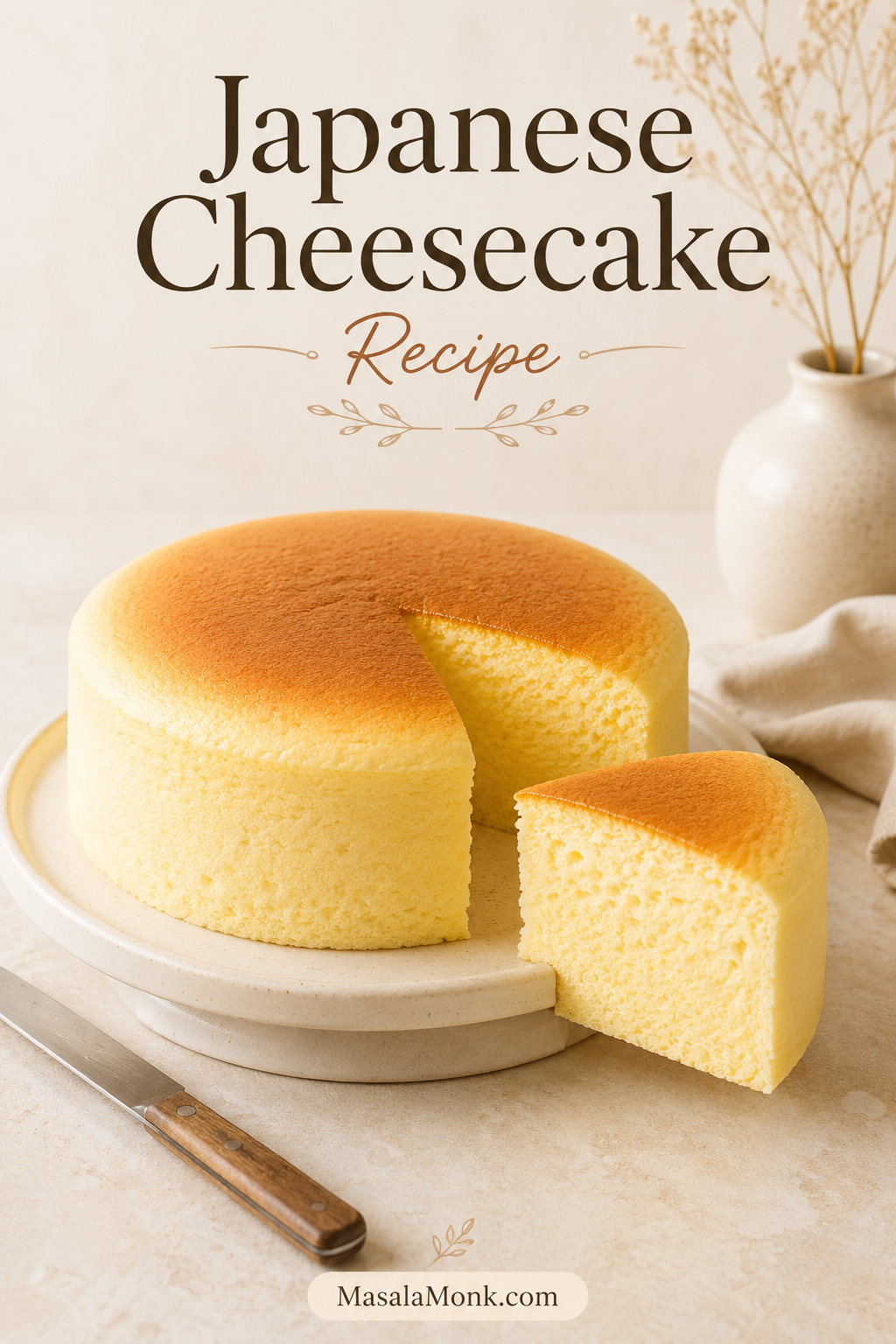
Japanese Cheesecake Recipe

A tall Japanese cheesecake should look delicate but still slice cleanly. Because the meringue, water bath, and slow cooling all work together, the cake can stay cotton-soft without collapsing into a dense center.

Japanese cheesecake looks soft, quiet, and almost weightless, but it asks you to care about a few details. The ingredients are simple. The technique is what gives the cake its height, wobble, and cotton-soft crumb.

The goal here is a cake that sighs under the knife, springs back softly, and tastes like a lighter, airier cousin of classic cheesecake: soft but not fragile, creamy but not dense, gently jiggly, and clean enough to slice the next day.

This Japanese cheesecake recipe is built around cues rather than panic. You will learn what the meringue should look like, how full the pan should be, how the center should wobble, and why slow cooling matters. The result should feel delicate without being fragile, impressive without needing anything more than a small plate and a clean knife.

You may know this style as Japanese cotton cheesecake, Japanese soufflé cheesecake, jiggly cheesecake, fluffy Japanese cheesecake, or the bakery-style cake people associate with Uncle Tetsu and Rikuro. This is not an official bakery copycat. It is a carefully explained homemade version of the same broad style: bouncy, cloud-like, lightly creamy, and not too sweet.

This is also a make-ahead dessert. The fresh-baked wobble is fun, but the cleanest slices and best flavor come after chilling. Bake it the day before if you can. The next day, the flavor is rounder, the slice is cleaner, and the texture feels more settled.

Quick Answer: What Makes Japanese Cheesecake Jiggly and Cotton-Soft?

Japanese cheesecake gets its jiggly, cotton-soft texture from a smooth cream cheese base folded with whipped egg whites. The meringue gives lift, cake flour and cornstarch help the cake set softly, the water bath protects it from harsh heat, and slow cooling lets the structure settle instead of collapsing suddenly.

DetailThis recipe
Pan8-inch x 3-inch round cake pan, fixed-base preferred
TextureJiggly, cotton-soft, airy, lightly creamy
Eggs6 large eggs, separated; about 180g whites and 100–110g yolks total
Cream cheese250g / 8.8 oz full-fat block cream cheese
Sugar130g total, divided: 30g in the base and 100g in the meringue
BakePreheat 180°C / 350°F, then bake at 160°C / 320°F and finish at 150°C / 300°F
Chill4–6 hours or overnight
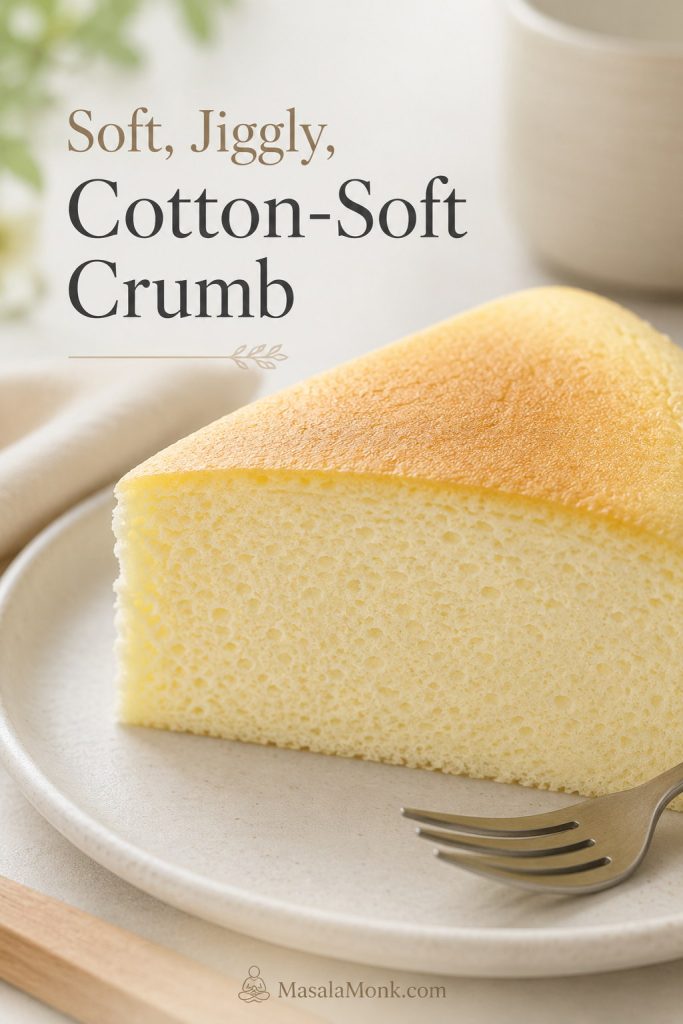
Close-up of a chilled Japanese cheesecake slice with a fine airy crumb, pale yellow center, and soft golden top
Look for a fine, airy crumb rather than a dense cheesecake center. After chilling, the slice should feel lightly creamy and softly springy, which is why this style is often called Japanese cotton cheesecake.

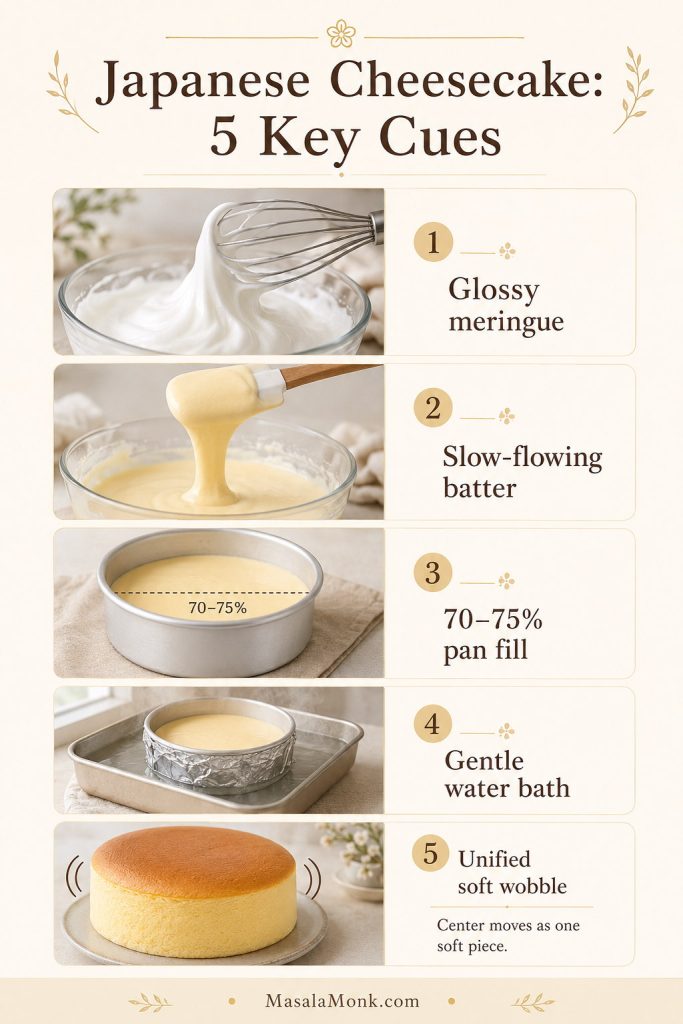
The 5 Cues That Matter Most

If the recipe starts to feel fussy, come back to these five cues. They are the simple checkpoints that keep Japanese cheesecake soft, jiggly, and properly set.

  • Meringue: glossy medium-firm peaks with a small bend.
  • Batter: smooth, light, slow-flowing, and airy.
  • Pan: 8-inch x 3-inch pan, filled only 70–75% full.
  • Bake: gentle water bath heat with steady, even color.
  • Done: a unified soft wobble in the center.
Visual guide showing five Japanese cheesecake cues: glossy meringue, slow-flowing batter, 70–75 percent pan fill, water bath, and unified soft wobble
Keep these five cues nearby while baking. When the meringue is glossy, the batter flows slowly, the pan is not overfilled, and the center wobbles as one piece, the recipe becomes much easier to judge.

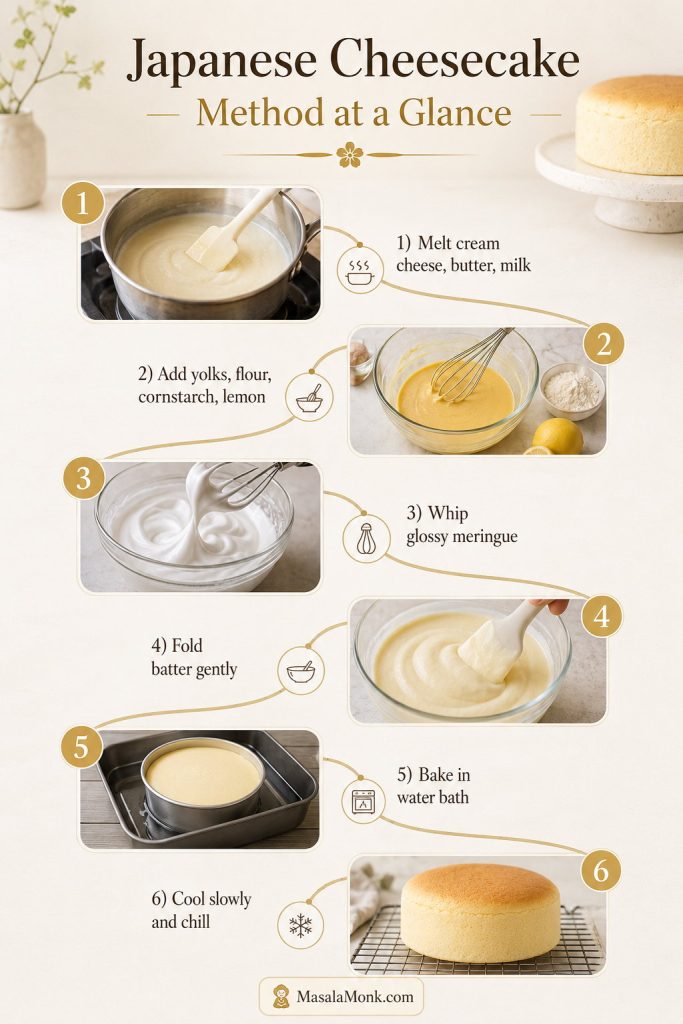
Japanese Cheesecake Method at a Glance

  1. Melt cream cheese, butter, and milk gently.
  2. Whisk in yolks, sugar, lemon, flour, and cornstarch.
  3. Whip egg whites to glossy medium-firm peaks.
  4. Fold the meringue into the base in three additions.
  5. Bake in a water bath with moderate heat.
  6. Cool slowly, then chill before slicing.

The full recipe card is below. For now, remember the path: smooth base, glossy meringue, gentle folding, water bath, slow cooling, and a chilled slice.

This method deliberately favors a steady set over a dramatic rise, because a cake that rises too fast is more likely to crack, wrinkle deeply, or collapse before the center catches up.

Step-by-step overview of Japanese cheesecake preparation from melting the cream cheese base to folding meringue, baking, cooling, and chilling
This recipe is less intimidating when you see the rhythm first. First build the base, then protect the air, bake gently, and finally let cooling and chilling finish the texture.

First time making Japanese cheesecake? Keep the 5 cues open while you bake. Then use the meringue, oven, doneness, and cooling sections when you need a closer cue.

Why This Japanese Cheesecake Recipe Works

A good Japanese cheesecake is a balance of richness and air. The cream cheese wants to be creamy, the meringue wants to rise, and the oven needs to set both gently enough that the cake does not tear, collapse, or turn rubbery.

  • 250g cream cheese keeps the cake creamy but not heavy. Too much cream cheese can make the batter dense and harder to lift.
  • Six separated eggs provide the rise. The yolks enrich the base, while the whites become the meringue that makes the cake light and jiggly.
  • Divided sugar protects both flavor and structure. A small amount sweetens the cream cheese base, while most of the sugar goes into the egg whites so the meringue stays glossy, stable, and easier to fold.
  • Cake flour plus cornstarch supports the foam. This gives the cheesecake enough structure to slice without making it tough.
  • A fixed-base pan lowers water bath risk. Springform pans can leak, so a solid pan gives the calmest first bake.
  • Moderate heat reduces cracking and collapse. The cake rises more evenly when the outside is not forced to set before the center has time to catch up.

What Is Japanese Cheesecake?

Japanese cheesecake is a baked cheesecake lightened with meringue. A smooth cream cheese base is mixed with egg yolks, milk, butter, flour, and starch, then folded with whipped egg whites for an airy rise, soft wobble, and cotton-like crumb.

It is usually crustless, and the soft cake body is the focus. You may also see it called Japanese cotton cheesecake, Japanese soufflé cheesecake, jiggly cheesecake, or fluffy Japanese cheesecake.

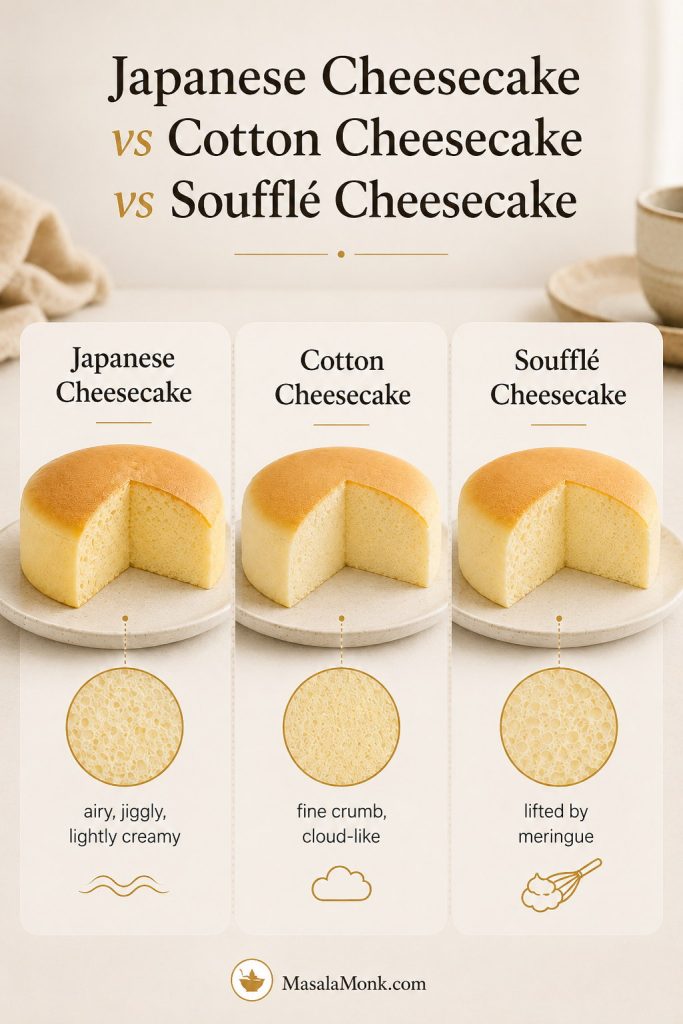
Japanese Cheesecake, Cotton Cheesecake, and Soufflé Cheesecake: Are They Different?

The names overlap, but the practical differences are simple.

DessertTextureMain difference
Japanese cheesecakeAiry, jiggly, cotton-soft, lightly creamyCream cheese batter folded with meringue and baked gently
Japanese cotton cheesecakeSoft, fine-crumbed, cloud-likeAnother common name for the same broad style
Japanese soufflé cheesecakeLight, risen, delicateHighlights the whipped egg-white structure
New York cheesecakeDense, rich, creamy, custardyMore cream cheese, no whipped meringue
Chiffon cakeAiry and sponge-likeUsually no cream cheese richness
Comparison board showing Japanese cheesecake, cotton cheesecake, and soufflé cheesecake as similar airy cheesecakes with subtle texture differences
These search terms often point to the same family of cakes. Japanese cheesecake, cotton cheesecake, and soufflé cheesecake all rely on meringue for lift, although each name emphasizes the texture slightly differently.

If you want a thick, creamy dessert that sets in the refrigerator instead, MasalaMonk’s no bake cheesecake recipe is the better match. This version is baked, lifted with meringue, and more dependent on oven technique.

For a richer baked cheesecake with a crumb crust and a denser creamy center, this baked salted caramel cheesecake is a useful contrast. Japanese cheesecake is crustless, lighter, and lifted with meringue rather than baked into a dense custard.

What a Successful Japanese Cheesecake Should Look Like

Before you start, it helps to know what success actually looks like. The cheesecake rises, sets, and then settles a little as it cools. Look for a softly golden top, a gentle center wobble, and a fine cottony crumb after chilling.

Success cue: Japanese cheesecake is not judged by a perfectly smooth top alone. A slight wrinkle with a tender, set center is a better result than a tall glossy cake that looks impressive but has not finished setting inside.

Ingredients for Japanese Cheesecake and Why They Matter

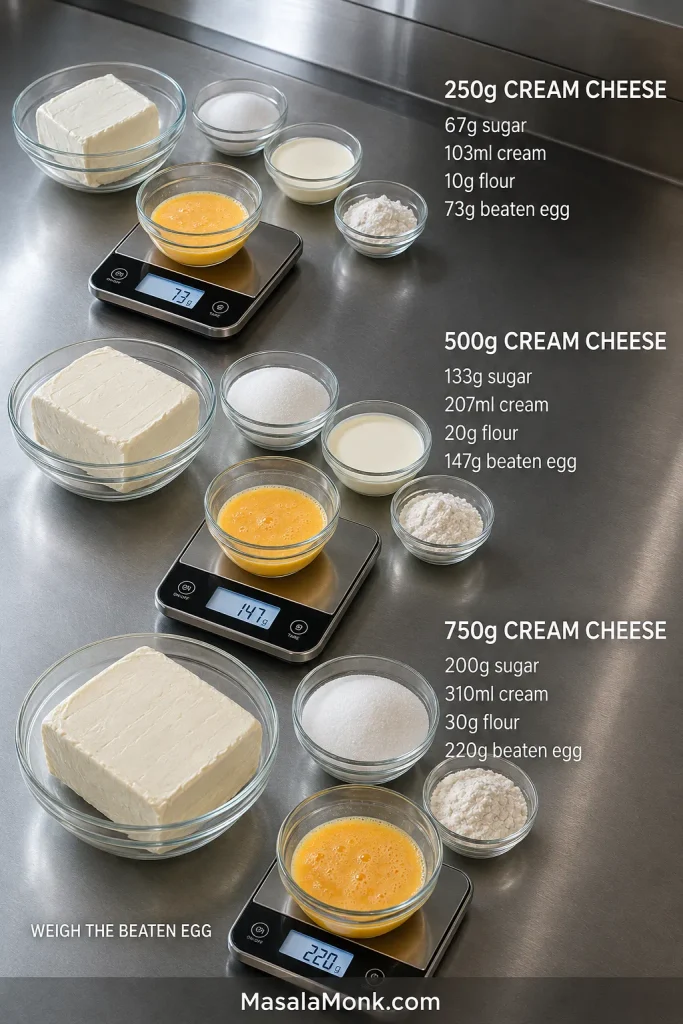
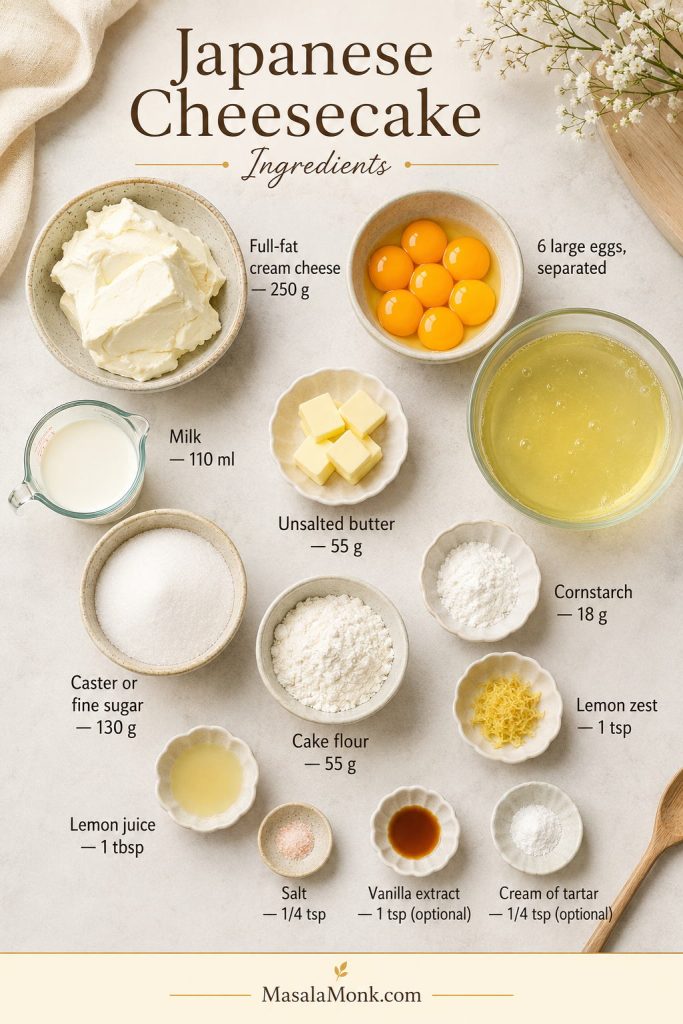
For Japanese cheesecake, a kitchen scale makes the recipe more reliable. Small differences in egg, flour, sugar, and cream cheese can affect the rise. The scale is not here to make the recipe fussy. It is here to make the cake repeatable, especially because this batter depends on foam, moisture, and gentle structure. Cup measurements are included as approximations, but the gram measurements are the ones to trust. King Arthur Baking’s ingredient weight chart is useful when you need a broader baking reference for common ingredient weights.

Measured Japanese cheesecake ingredients including cream cheese, separated eggs, milk, butter, sugar, cake flour, cornstarch, lemon, vanilla, salt, and cream of tartar
These simple ingredients do very specific jobs. Cream cheese brings flavor, separated eggs build lift, and the cake flour-cornstarch blend helps the crumb set softly without making the cheesecake heavy.
IngredientAmountWhy it matters
Full-fat block cream cheese250g / 8.8 ozGives cheesecake flavor without making the cake too heavy
Unsalted butter55g / 2 oz / about 4 tbspAdds tenderness and richness
Whole milk110ml / scant ½ cupLoosens the batter and keeps the crumb soft
Large eggs6, separated; about 180g whites and 100–110g yolks totalYolks enrich the base; whites create lift through meringue
Caster sugar or fine granulated sugar130g / about ⅔ cup, divided30g flavors the base; 100g stabilizes the meringue
Cake flour55g / about ½ cup spooned and leveledGives soft structure without toughness
Cornstarch18g / about 2 tbspHelps stabilize the cake and gives a finer crumb
Lemon juice1 tbspBrightens the flavor and reduces egginess
Lemon zest1 tspAdds fresh aroma without making the cake sharp
Fine salt¼ tspBalances sweetness and cream cheese richness
Cream of tartar¼ tsp, optionalHelps stabilize the egg whites
Vanilla extract1 tsp, optionalAdds a soft bakery-style flavor

Egg size matters

Use large eggs if possible. If your eggs are standard large eggs, you do not need to obsess over the weight. The weight cue is mainly for small, mixed-size, or inconsistent eggs: aim for about 180g egg whites and 100–110g egg yolks total.

Separate the eggs while cold because the yolks are less likely to break. Then let the whites stand for 15–20 minutes while you prepare the cream cheese base. Slightly cool-room-temperature whites whip more easily, but do not leave them out for too long in a hot kitchen.

Use full-fat block cream cheese

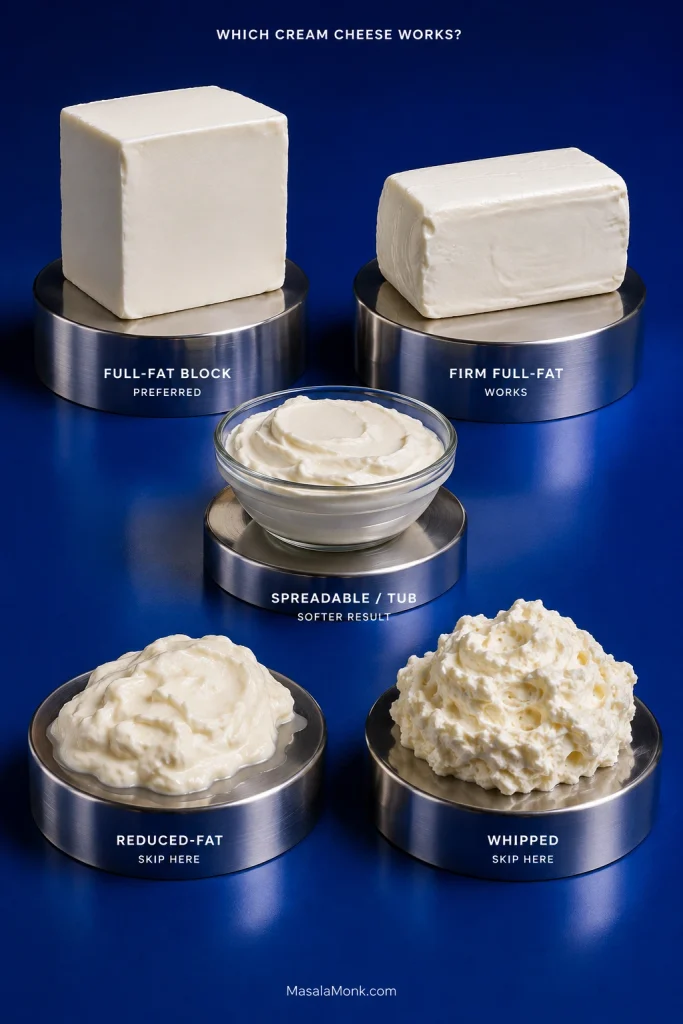
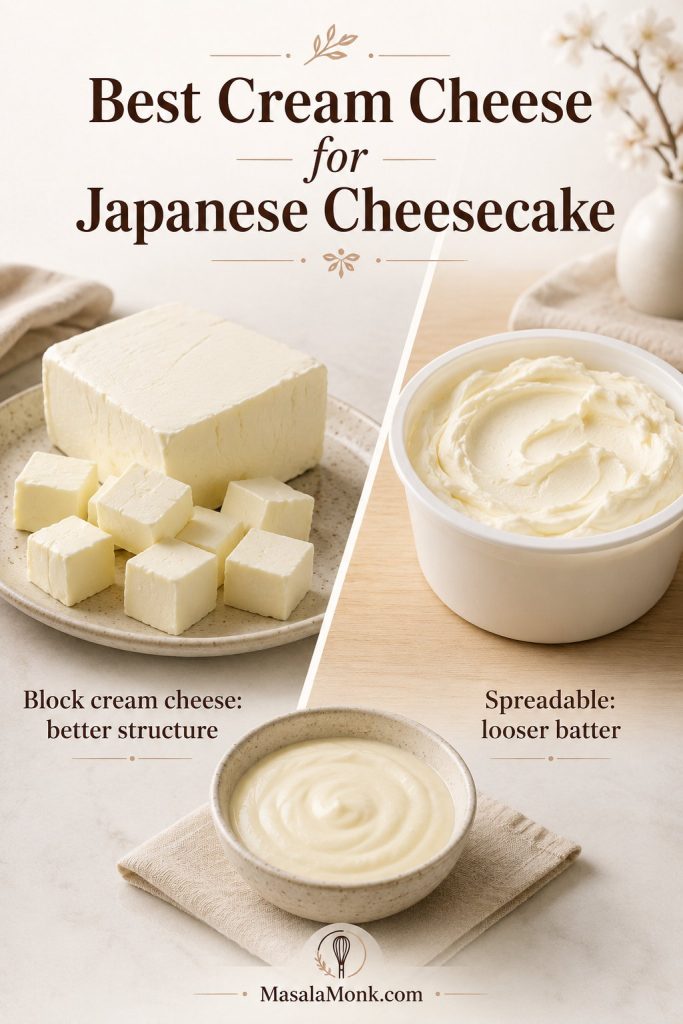
For the most reliable texture, use full-fat block cream cheese rather than low-fat or spreadable cream cheese. Tub-style cream cheese often has more moisture and stabilizers, which can make the batter looser and less predictable. Full-fat block cream cheese gives the best structure, flavor, and slice.

Comparison of block cream cheese and spreadable cream cheese for Japanese cheesecake batter structure
Block cream cheese gives the batter more reliable structure. Because spreadable cream cheese is usually softer and looser, it can make a jiggly Japanese cheesecake harder to set cleanly.

Cake flour plus cornstarch gives a softer structure

Cake flour keeps the crumb tender, while cornstarch helps the cake set without becoming chewy. Together, they support the meringue so the finished cake can rise, jiggle, and still slice cleanly after chilling.

Lemon is strongly recommended

Vanilla is optional, but lemon is strongly recommended. A little lemon juice and zest make the cheesecake taste lighter and less eggy. The goal is not a lemon cheesecake; the lemon should sit quietly in the background and make the cream cheese taste fresher.

Ingredient Substitutions for Japanese Cheesecake

Gentle, tested swaps work best here. The cake can forgive a few changes, but it still needs its foam, moisture, and structure in balance.

Safe first-bake swaps

SwapBest answer
All-purpose flour, plain flour, or maida instead of cake flourYes. Use the same weight. The crumb may be slightly less delicate, but these are the closest practical substitutes when cake flour is unavailable.
Lower-fat milkWhole milk is better, but lower-fat milk can work with slightly less richness.
Salted butterYes, but reduce or skip the added salt.
Skipping cream of tartarYes. Use an additional ½ tsp lemon juice in the egg whites instead, or skip it if your meringue technique is strong.
Reducing the sugarA small reduction is possible, but do not cut it aggressively. Sugar helps stabilize the meringue.

Save these for later testing

SwapBest answer
Skipping cornstarchKeep it for this version. Cornstarch helps the cake set softly and gives the crumb a finer, lighter feel.
Cream cheese spreadBlock cream cheese is the better choice. Spreadable cream cheese is usually looser and can make the batter less predictable.
Low-fat cream cheeseSave it for later testing. Full-fat cream cheese gives the cake better flavor, structure, and sliceability.
Cream instead of milkIt makes the cake richer and heavier. Use milk for the default cotton-soft version.
Powdered sugarFine granulated or caster sugar is better. Powdered sugar may contain starch and behaves differently.
Brown sugar, coconut sugar, or darker sugarsUse white sugar for this base version. Darker sugars add moisture, color, and stronger flavor, which can disturb the delicate texture.
Gluten-free flour blendsPossible, but it needs testing. Use this base recipe first, then test gluten-free blends separately because the foam and structure are delicate.

Equipment You Need Before You Start

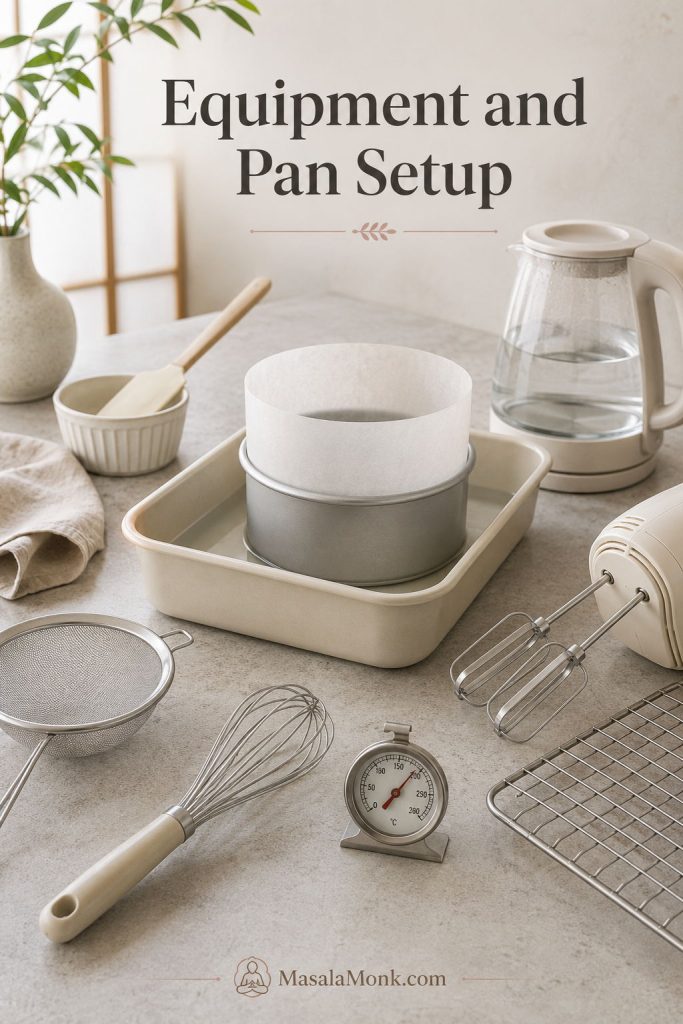
You do not need specialty bakery gear, but a few pieces of equipment make this cake calmer to handle. The pan needs to be secure, the oven needs to be steady, and the water bath needs enough room to surround the cake gently.

  • 8-inch x 3-inch round cake pan, preferably fixed-base
  • Large roasting pan or deep baking tray for the water bath
  • Parchment paper for the base and tall collar
  • Wide aluminum foil, if using a springform pan
  • Hand mixer or stand mixer
  • Heatproof bowl
  • Fine-mesh sieve
  • Flexible spatula
  • Kettle or jug for hot water
  • Oven thermometer
  • Cooling rack
  • Two flat plates or cake boards for unmolding
Japanese cheesecake equipment setup with a parchment-lined cake pan, roasting pan, mixer tools, sieve, spatula, kettle, thermometer, rack, and ramekin
Set up before whipping the egg whites. Once the meringue is ready, having the lined pan, water bath tray, hot water, sieve, spatula, and oven tools nearby helps protect the batter’s air.

Best pan choice: use a regular fixed-base cake pan if you have one. A springform pan is convenient for unmolding, but it can leak in a water bath. If using springform, wrap it with two layers of wide foil or place it inside a slightly larger solid cake pan before setting it in the water bath. If your foil is narrow or has seams below the waterline, use the pan-inside-pan method instead of trusting foil alone.

A light greasing helps the parchment stay in place, but parchment is what gives this delicate cake the support it needs.

An oven thermometer is also worth using. Many home ovens run hotter or cooler than the display says, and the batter reacts quickly to harsh heat. If your bakes often brown too fast, crack, or stay wet in the center, your oven temperature may be part of the problem.

Pan Size Guide for Japanese Cheesecake

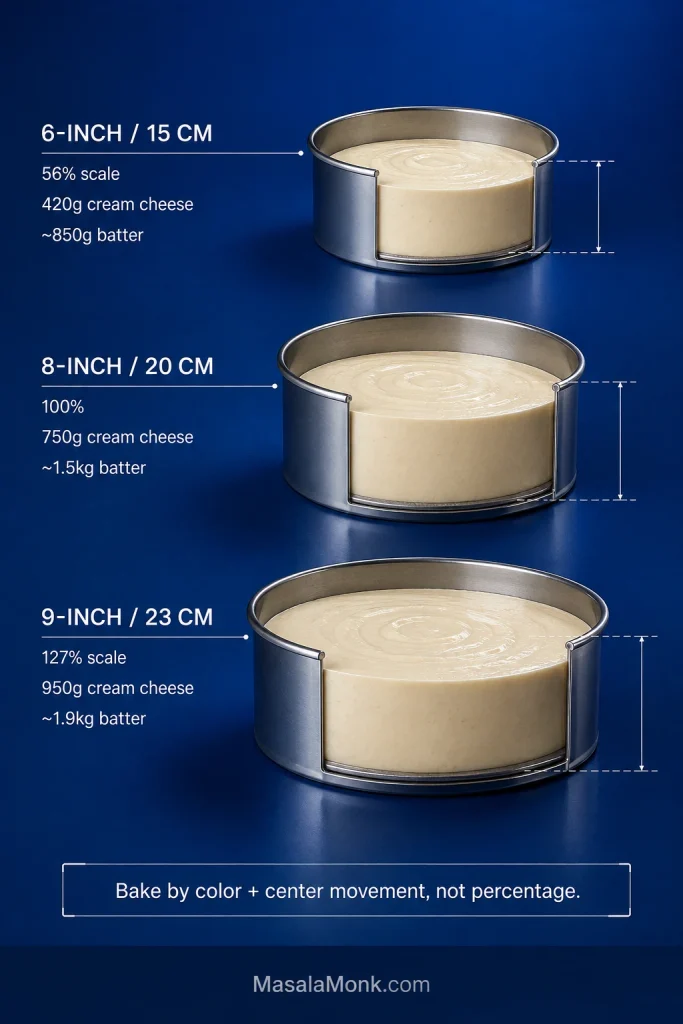
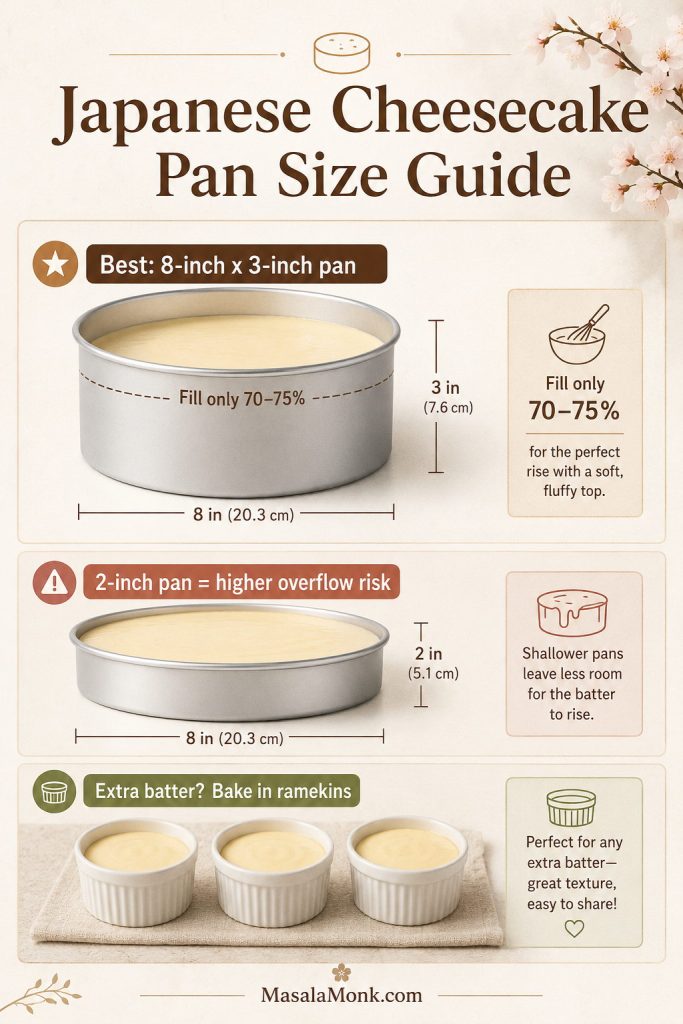
This recipe is developed for an 8-inch x 3-inch round pan. For a first attempt, stay with this 8-inch version. Pan changes need more than simple percentage scaling because the egg foam, batter height, and bake timing all change together.

Why pan depth matters

Pan depth matters as much as diameter. A 2-inch-deep pan is risky because the cheesecake rises before it settles. Use a 3-inch-deep pan or a tall parchment collar, and fill the pan only about 70–75% full.

Japanese cheesecake pan guide showing an 8-inch by 3-inch pan, 70–75 percent fill line, shallow pan risk, and ramekins for extra batter
The pan controls more than height. If the batter has enough room to rise, the foam expands more evenly; however, an overfilled or shallow pan can push the cake toward cracking, overflow, or a weaker center.
Pan sizeRecommendationWhat changes
6-inch x 3-inchUse only if you are comfortable dividing extra batterA smaller cake can be tall and dramatic, but scaling eggs and meringue is not simple
7-inch x 3-inchUse only if you are comfortable dividing extra batterEgg ratio and bake timing still need rebalancing for a true small-batch version
8-inch x 3-inchUse this recipeBest balance of height, jiggle, and reliability
9-inch x 3-inchUse this recipe only if you accept a lower cakeThe cake will be wider, shorter, and may bake slightly faster

What to do with extra batter

For the cleanest first bake, use the 8-inch pan. If you only have a 6-inch or 7-inch pan, do not pour all the batter in. Fill the pan only 70–75%, then bake the extra in ramekins as test cakes. Those small bakes are useful because they show you the texture before you cut the main cake.

If you only have a 9-inch pan, the recipe can still work, but it will not look as tall. Start checking a little earlier because a lower cake sets faster.

If you are using a springform pan or a tall parchment collar for the first time, check the water bath setup before you pour the batter.

The Meringue Cue That Matters Most

This is the part where the cheesecake starts becoming light. The cream cheese base gives flavor, but the meringue gives the cake its breath.

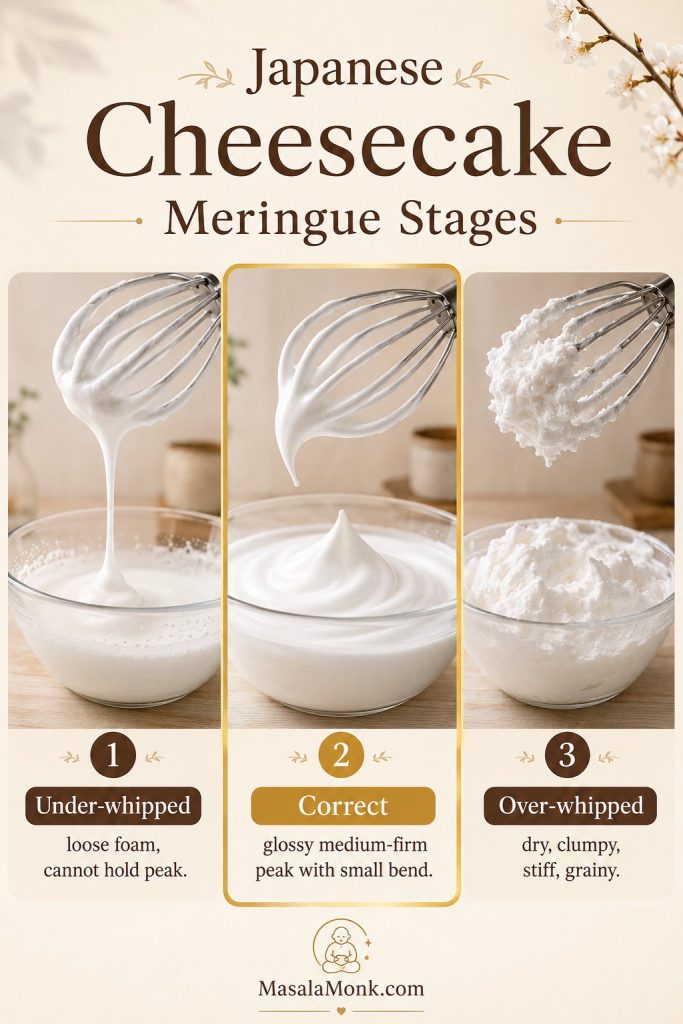
Aim for glossy medium-firm peaks with a small bend at the tip. The meringue should hold shape while still looking smooth, moist, and flexible. That flexibility is what makes it fold smoothly into the base.

Meringue stageWhat it looks likeWhat happens in the cake
Under-whippedLoose, foamy, large bubbles, cannot hold shapeCake may not rise well and can bake up dense
CorrectGlossy, medium-firm, fine bubbles, peak holds with a slight hookSoft, even, cottony crumb with gentle lift
Over-whippedDry, grainy, clumpy, stiff chunksHard to fold; can create cracks, holes, or dense streaks
Three meringue stages for Japanese cheesecake showing under-whipped foam, glossy medium-firm peaks, and over-whipped dry meringue
The best meringue for Japanese cheesecake is glossy and medium-firm, not dry and rigid. That small bend at the peak makes it easier to fold without knocking out too much air.

How to whip the egg whites

Use a clean, dry, grease-free bowl. Make sure there is no egg yolk in the whites and no water sitting in the bowl. If you have a choice, use a metal or glass bowl rather than a plastic one, because plastic can hold onto grease.

Start beating the egg whites with cream of tartar until they look foamy. Begin adding the sugar only after the whites have formed bubbles. Add the sugar gradually, not all at once. Once the meringue reaches soft peaks, slow the mixer down for the final 30–60 seconds. This helps tighten the bubbles and gives you a smoother meringue that folds more evenly.

When you lift the whisk, the peak should stand up and curve slightly at the tip. At the right stage, the meringue looks shiny and elastic, almost like soft marshmallow cream. That shine is a better cue than the exact number of minutes on the mixer.

Remember this cue: glossy medium-firm peaks with a small bend — smooth, flexible, and easy to fold.

Once the meringue looks glossy and flexible, move gently into the folding cues; that is where the air you built needs the most care.

Water Bath Setup for Gentle, Even Baking

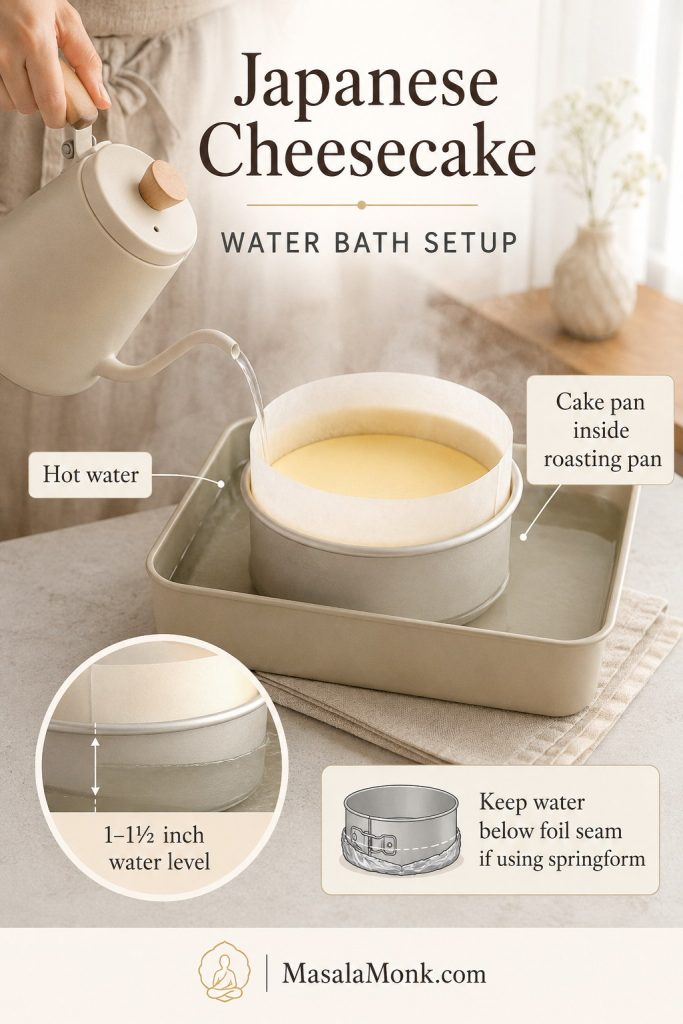
A water bath protects Japanese cheesecake from harsh oven heat. It keeps the baking environment moist, helps the cake rise gently, and reduces the chance of deep cracks. Without it, the outside can set too quickly while the center is still expanding.

How deep should the water be?

  • Place the lined cake pan inside a larger roasting pan or deep tray.
  • Use just-boiled water that has sat for about 1 minute, or very hot kettle water.
  • Water should come about one-third to halfway up the cake pan, usually 1–1½ inches. For a very tall pan, up to 2 inches is fine as long as the water stays below any foil seam.
  • If using a springform pan, keep the water below the foil seam.
  • Add water after the pan is on the oven rack if the filled roasting pan is too heavy to move safely.
  • Pour carefully so water does not splash into the batter.
  • A silicone mat under the cake pan can soften direct heat from the roasting pan.
  • If the water bath gets close to dry near the end of baking, add more hot water carefully. Avoid cold water because it drops the oven temperature.

Springform pan and water bath notes

If the idea of a water bath makes you nervous, use a fixed-base pan. Once the pan is solid and the water level is sensible, the water bath becomes the part that protects the cake.

Hot water being poured into a roasting pan around a parchment-lined Japanese cheesecake pan with a water level guide
A water bath softens the oven’s heat around the pan. Keep the water hot and about 1–1½ inches deep so the cheesecake can rise gently without drying, cracking, or baking too fast at the edges.

Once the water bath is ready, follow one steady oven temperature schedule instead of mixing timings from different recipes.

How to Make Japanese Cheesecake Step by Step

Read the method once before starting. Once the meringue is whipped, you do not want to stop and look for parchment, foil, hot water, or a roasting pan.

Once you understand the meringue and the oven, the rest is ordinary baking: mix gently, bake gently, cool gently.

1. Prepare the pan and oven

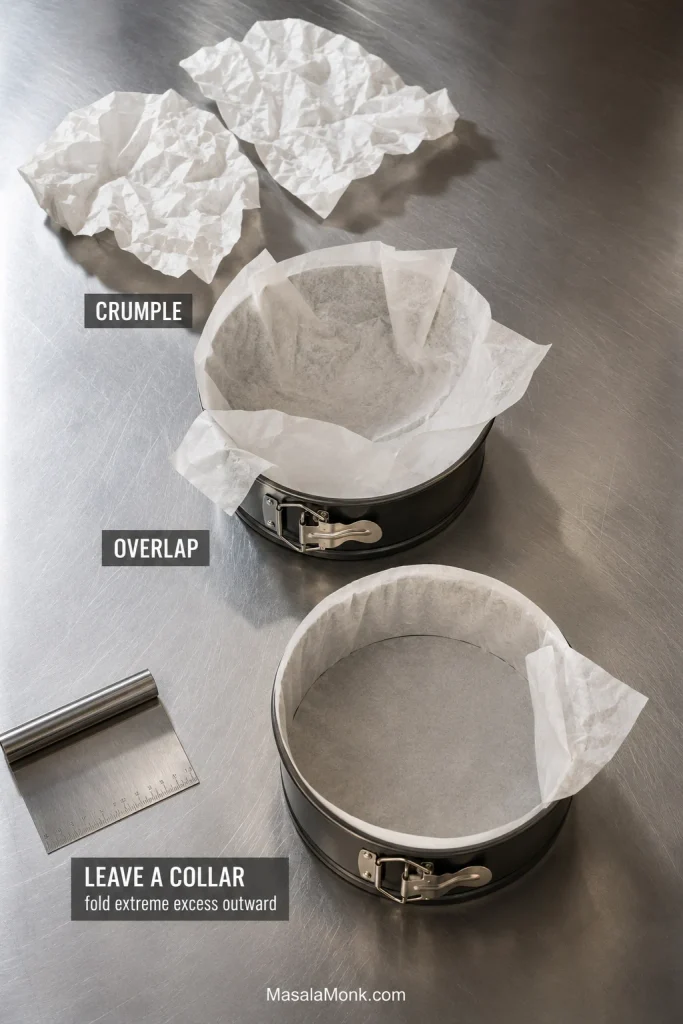
Lightly grease an 8-inch x 3-inch cake pan so the parchment sticks. Line the base with parchment, then line the sides with a tall parchment collar that rises 1–2 inches above the rim. If using a springform pan, wrap the outside tightly with two layers of wide foil.

Preheat the oven to 180°C / 350°F for at least 20 minutes. The cake itself will bake at 160°C / 320°F, but the slightly higher preheat helps offset heat lost when you open the oven and place the water bath inside. Set out a large roasting pan or deep tray for the water bath.

2. Melt the cream cheese base gently

Combine the cream cheese, butter, and milk in a heatproof bowl. Warm gently over a pot of barely simmering water, whisking until smooth. The bottom of the bowl should not touch the water. Do not boil the mixture.

The mixture should be smooth and warm, not steaming hot. Around 40–45°C is ideal if you are using a thermometer. Without a thermometer, it should feel comfortably warm to the touch, not hot. If it is too warm, let it cool before adding the yolks.

3. Add yolks, 30g sugar, lemon, flour, and starch

Whisk in the egg yolks one at a time. Add 30g of the sugar, lemon juice, lemon zest, vanilla if using, and salt. Sift in the cake flour and cornstarch, then whisk until smooth. The batter should be silky, pourable, and free of lumps.

If you see lumps, pass the batter through a fine-mesh sieve. This extra step gives the finished cake a finer, softer crumb.

4. Whip the meringue with the remaining 100g sugar

Beat the egg whites with cream of tartar until foamy. Add the remaining 100g sugar gradually, a spoonful or small stream at a time, while beating on medium speed. Continue until the meringue is glossy, flexible, and holds medium-firm peaks with a small bend at the tip.

Stay close at this stage. The difference between correct meringue and overbeaten meringue can be less than a minute, especially with a powerful mixer.

5. Fold without deflating the batter

Add one-third of the meringue to the cream cheese base and fold it in gently but confidently. This first addition lightens the base. Add the remaining meringue in two more additions, folding with a flexible spatula and scraping the bottom of the bowl each time.

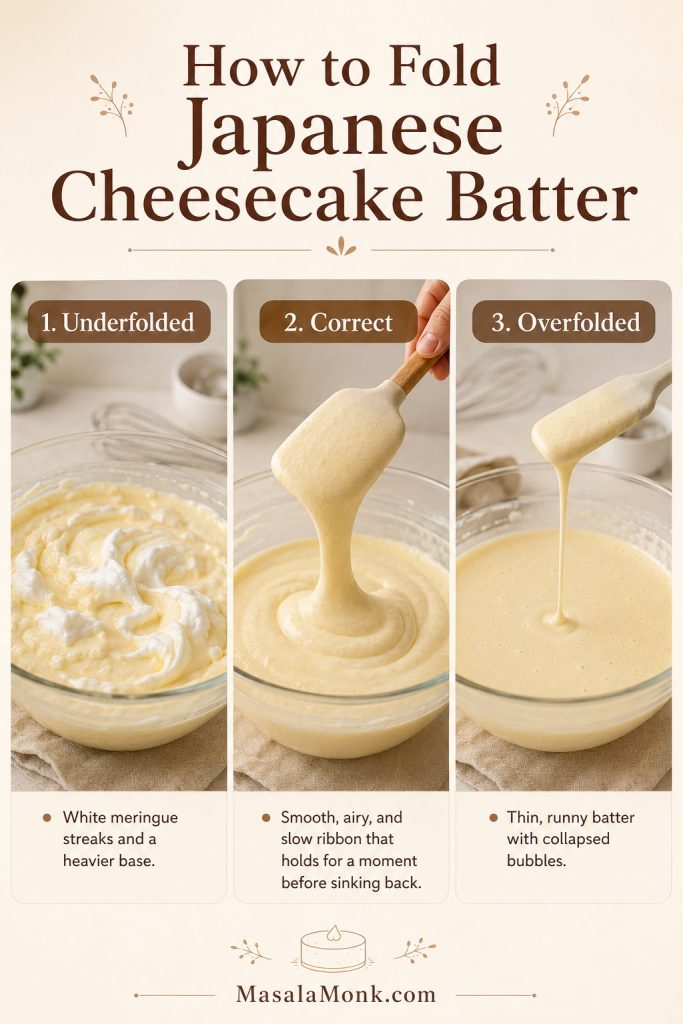
When the batter is right, it feels light on the spatula and falls back into the bowl in a slow ribbon. It should look airy and slow-flowing. The batter should feel lighter than the base you started with.

Folding Cues: Underfolded vs Correct vs Overfolded Batter

Folding is where the cream cheese base and meringue become one batter. Go too little and the cake bakes unevenly. Go too far and you knock out the air you worked so hard to build.

Batter stateWhat it looks likeLikely result
UnderfoldedWhite streaks, floating meringue patches, heavy batter at the bottomUneven rise, dense lower layer, patchy crumb
CorrectSmooth, light, slow-flowing, slightly ribboningEven cotton-soft crumb and gentle rise
OverfoldedThin, runny, bubbles disappearing quicklyLow rise, dense texture, less jiggle
Three Japanese cheesecake batter examples showing underfolded streaky batter, correctly folded slow-flowing batter, and overfolded runny batter
Folding decides whether the batter stays light. Stop when it looks smooth, airy, and slow-flowing; white streaks can bake unevenly, while runny overfolded batter often leads to poor rise.

6. Fill the pan and bake in a water bath

Pour the batter into the prepared pan, stopping at about 70–75% full. If you have extra batter, bake it separately in a small ramekin rather than overfilling the pan.

Run a skewer or chopstick through the batter once or twice to release hidden large air pockets, then tap the pan lightly once or twice. One or two gentle passes are enough; after that, leave the air in the batter alone.

Place the filled cake pan in the roasting pan, slide it onto the oven rack, pour in hot water carefully, close the oven door, and immediately reduce the oven to 160°C / 320°F.

Oven Temperature Schedule for Japanese Cheesecake

Different recipes use different oven schedules because pans, ovens, and cake heights vary. Some use a hot start, some bake very low and slow, and some finish with higher heat for browning. This version uses a moderate, controlled bake because it is safer for most home bakers than an aggressive hot-start method.

Why this bake uses moderate heat

Pick one oven schedule and follow it through. Mixing the hot start from one recipe with the cooling method from another is one of the easiest ways to confuse the bake.

Your first bake is partly about learning your oven. If the top browns early, your oven may run hot near the top; if the center stays loose, it may need longer gentle heat.

When your oven needs adjustment

Home-oven adjustment: if the top browns early, lower the rack or tent loosely after the cake has risen and started to set. If the center still moves loosely, extend the 150°C / 300°F finish in 5–10 minute increments. If the cake rises fast and cracks, lower the main bake by 10°C next time.

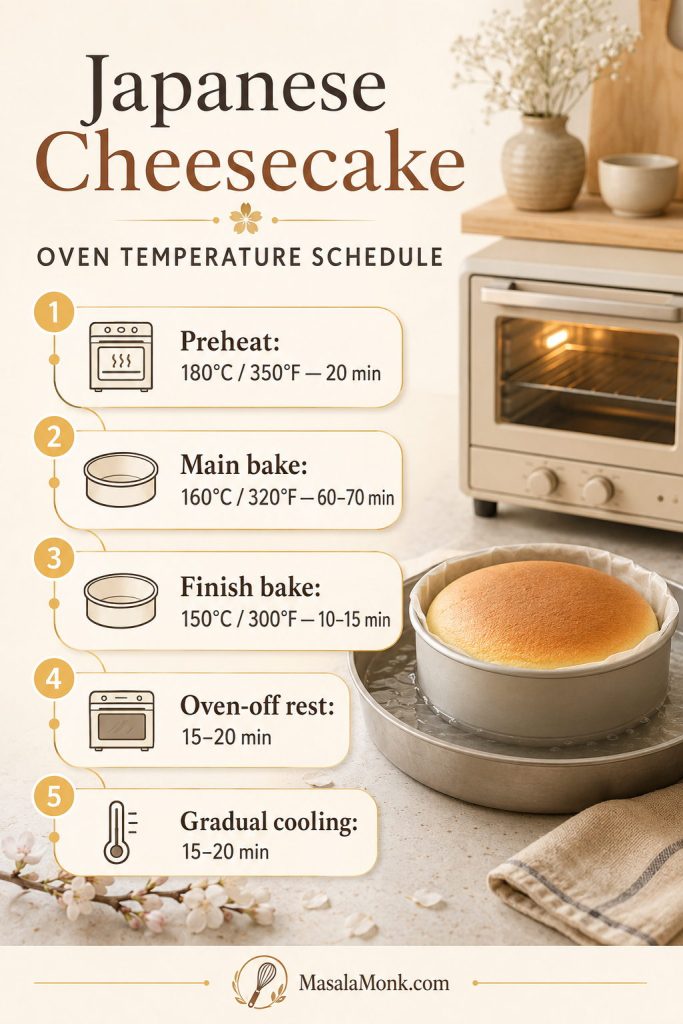
StageTemperatureTimeWhat is happening
Preheat180°C / 350°FAt least 20 minStabilizes the oven before the water bath goes in
Main bake160°C / 320°F60–70 minCake rises gently and sets without harsh heat
Finish bake150°C / 300°F10–15 minCenter finishes setting while the top stays controlled
Oven-off restOven off, door barely cracked15–20 minLets the structure settle gradually
Gradual coolingDoor cracked wider or cake moved to a warm area15–20 minLets heat escape slowly
Japanese cheesecake oven schedule showing preheat, main bake, finish bake, oven-off rest, and gradual cooling temperatures and times
Japanese cheesecake needs controlled heat more than a dramatic rise. Therefore, the staged bake is designed to color the top gradually while giving the center enough time to set.

Timing is a guide, but the final decision comes from the doneness cues, especially the unified soft wobble in the center.

Oven Notes for Convection, Countertop Ovens, and Small Home Ovens

Your oven becomes part of the recipe here. If it runs hot, the top usually tells you first; if it runs cool, the center usually tells you later. This matters even more in small ovens, countertop ovens, and convection ovens with strong top heat.

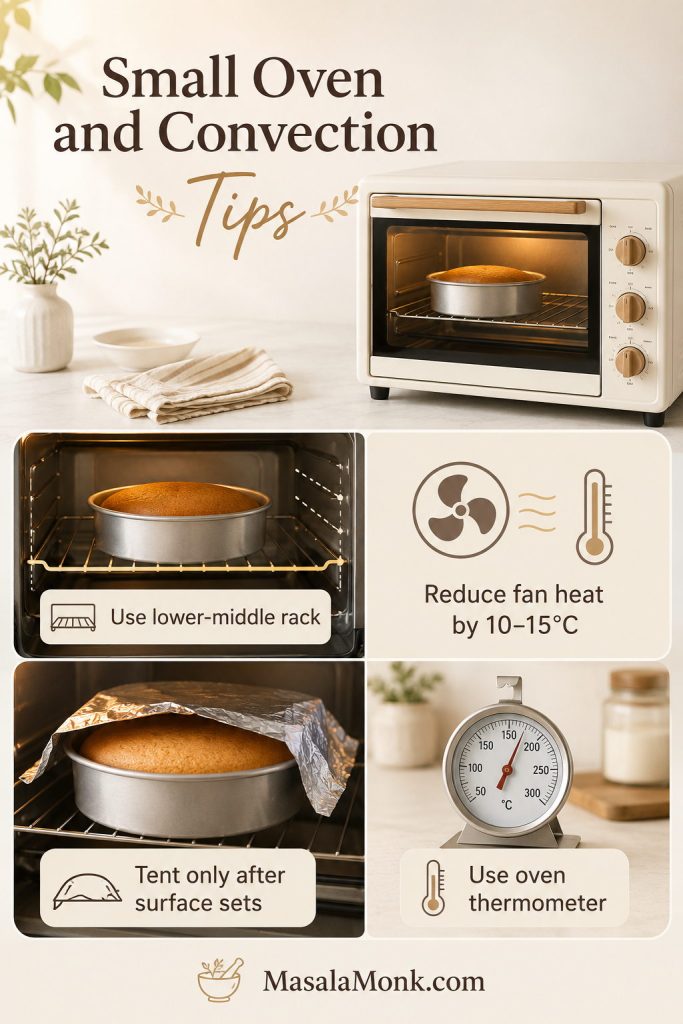
  • Use top-bottom heat if available. This gives a gentler, more even bake than fan-forced heat.
  • Avoid fan or convection mode if possible. Fan heat can dry and brown the top too quickly.
  • If you must use convection, reduce the temperature by 10–15°C. For the main bake, that usually means about 145–150°C instead of 160°C.
  • Use the lower-middle rack. This protects the top from direct heat while allowing the center to set.
  • Preheat properly. Small ovens can swing in temperature, so give the oven time to stabilize.
  • Use an oven thermometer. A displayed 160°C may not be a true 160°C.
  • Keep the door closed as much as you can. Sudden temperature drops can weaken the rise.
  • Use the water bath carefully. It is especially helpful in small ovens where heat can be harsh and direct.

Small-oven tip: if your oven has strong top heat, place the cake on the lower-middle rack and tent only after the cake has risen and the surface has started to set. Tenting too early can interfere with rise and browning.

Small oven and convection tips for Japanese cheesecake showing lower-middle rack placement, reduced fan heat, foil tent timing, and oven thermometer
Small ovens and fan heat can brown the top before the center is ready. A lower-middle rack, reduced convection temperature, and oven thermometer make the bake easier to control.

Warm Japanese cheesecake can look fragile and uncertain. The chilled slice is the real reveal, so do not judge the cake too early.

How to Know Japanese Cheesecake Is Done

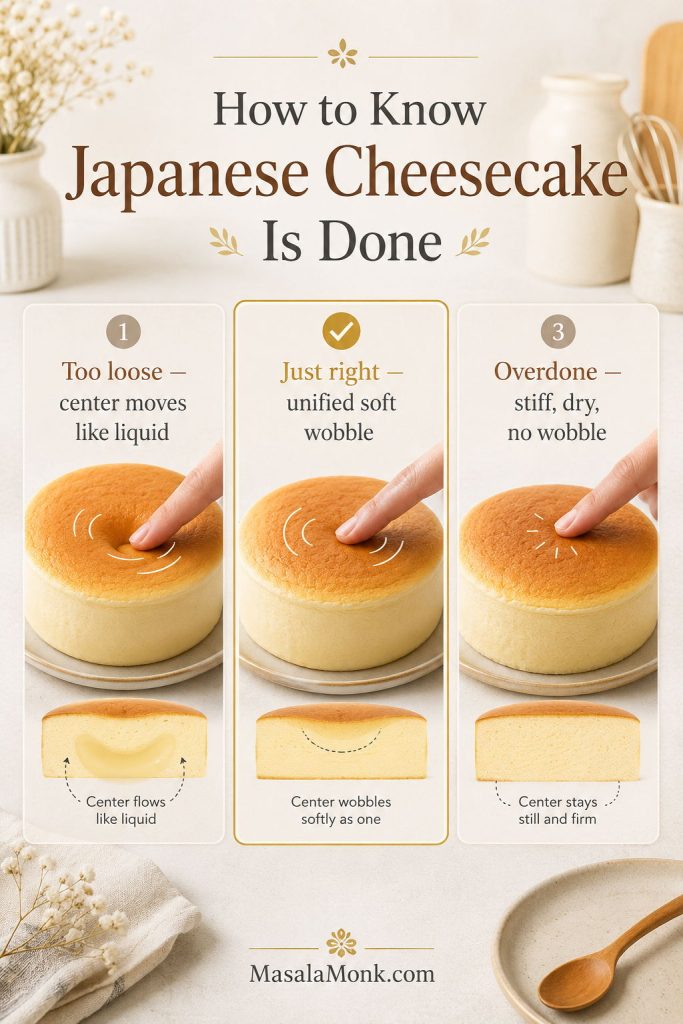
A Japanese cheesecake can look golden on top and still be wet inside, so do not judge by color alone. Use these cues together.

  • Color: look for light golden color.
  • Jiggle: the center should move as one soft set area.
  • Touch: the top should spring back lightly when touched.
  • Skewer: there should be no wet batter; a few moist crumbs are fine.
  • Edges: the sides should look set but not dry or dramatically pulled away.
  • Temperature, optional: around 70°C / 158°F in the center is a useful guide, but do not overbake just to chase a higher number.

The right wobble is soft and unified, like a set custard. If the middle moves separately like liquid, give it more gentle time. The top may look fragile, but the center should move as one soft piece.

Doneness guide for Japanese cheesecake comparing a too-loose center, a just-right unified soft wobble, and an overdone stiff cake
The right doneness cue is a unified soft wobble. If the center moves like liquid, keep baking gently; if it no longer moves at all, the cake may lose some of its soft jiggly texture.

When the center is softly set, the next important step is the cooling schedule; that slow rest helps protect the rise you just built.

Cooling Schedule to Prevent Sinking

Cooling is not an afterthought. This cake rises because of air trapped in the meringue. If it goes from hot oven to cool room too quickly, that structure can contract suddenly and sink.

This is the quiet part of the recipe. The cake has done its rise; now it needs time to settle without shock.

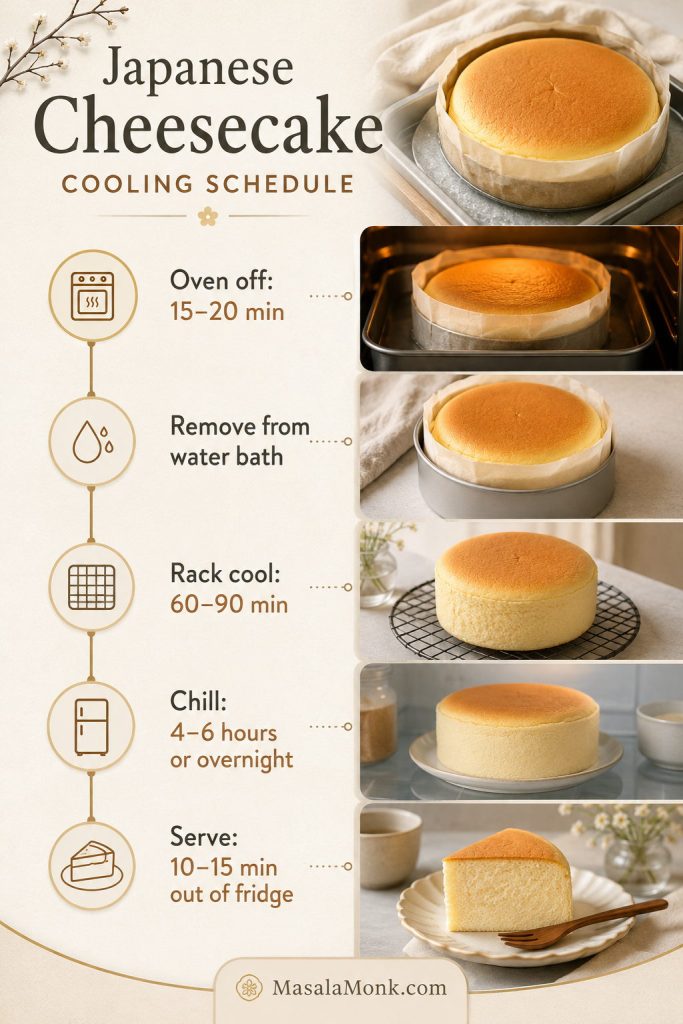
StageTimeWhat to do
Oven off15–20 minTurn oven off and leave cake inside in the water bath with the door barely cracked
Remove from water bathAfter initial oven restCarefully lift the cake pan out so it stops cooking in hot water
Gradual cooling15–20 minLeave the cake near the warm oven or inside the turned-off oven with the door open wider
Room temperature60–90 minCool on a rack until no longer warm
Chill4–6 hours or overnightSet fully before slicing and unmolding
Serve10–15 min out of fridgeTexture becomes softer and more delicate
Cooling schedule for Japanese cheesecake showing oven-off rest, removal from water bath, rack cooling, chilling, and serving after resting
After baking, the cake still needs gentle handling. A slow oven rest helps prevent sudden sinking, while chilling gives the Japanese cheesecake its cleaner slice and more settled crumb.

This is the moment where many bakers worry, but a little settling is exactly what this cake does. Let it happen slowly before you judge the final texture.

Normal, not failure: a slight wrinkle, a little shrinkage, or a soft top after cooling is normal. What you want to avoid is a raw center, a sunken middle, or a heavy lower layer.

If your oven traps a lot of steam, keep the door slightly cracked during the oven-off rest so condensation does not drip heavily onto the top.

How to Unmold Japanese Cheesecake Without Breaking It

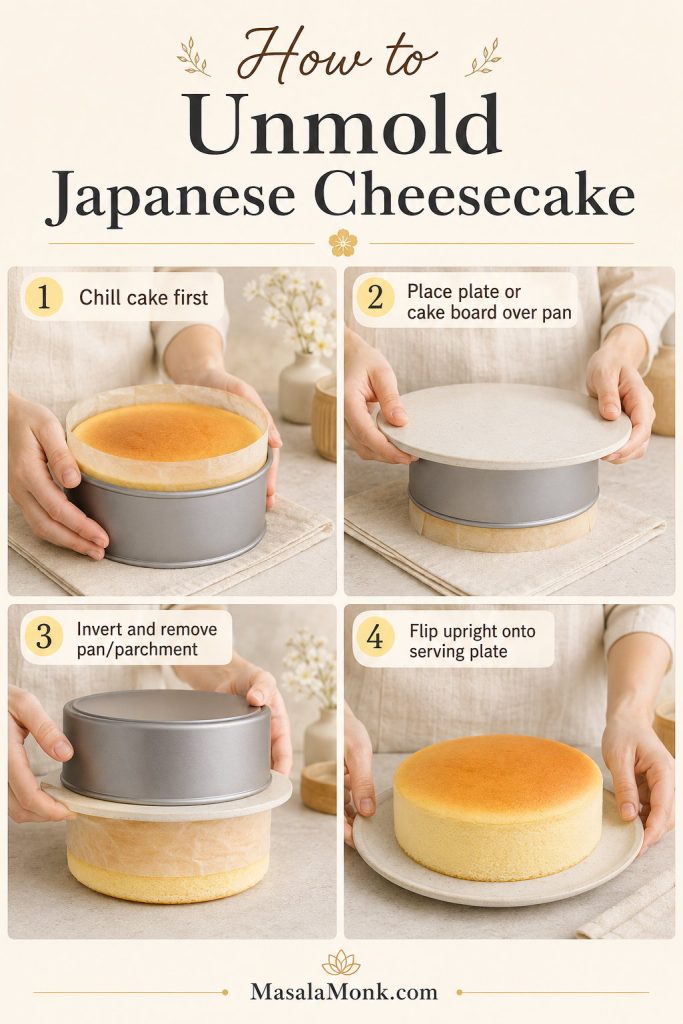
A fixed-base pan is safer for the water bath, but it means unmolding needs a little care. Chill the cheesecake first so the structure is set, then work gently.

  1. Chill the cake for at least 4–6 hours, preferably overnight.
  2. Loosen the parchment around the side. If needed, run a thin knife gently between the parchment and pan.
  3. Place a parchment-lined flat plate or cake board over the top of the pan.
  4. Gently invert the cake onto the plate and lift off the pan.
  5. Peel away the bottom parchment.
  6. Place the serving plate over the base of the cake and invert again so the golden top faces upward.
Four-step guide showing a chilled Japanese cheesecake being covered with a plate, inverted, removed from the pan, and flipped upright
Chill before unmolding so the cake has enough structure to move safely. A flat plate, gentle inversion, and the parchment collar help protect the soft sides from tearing.

The chilled cake is still delicate. If you are nervous, keep it on its parchment base and slice from there.

This is not a perfection-chasing recipe. It is a cue-based home-oven method: protect the meringue, bake gently, cool slowly, and judge the cake after chilling.

Japanese Cheesecake Recipe Card

The recipe card gives the full method. For a first bake, keep the 5 cues, oven schedule, doneness, and cooling notes nearby; those are the sections most useful to keep open while you bake.

Japanese Cheesecake Recipe

A calm, cue-based Japanese cheesecake recipe for home ovens, made with cream cheese, separated eggs, glossy meringue, water bath baking, and slow cooling. This version favors a steady set, clean slice, soft wobble, and cotton-soft crumb over a dramatic rise that collapses later.

Prep Time35 minutes
Cook Time70–85 minutes
Cooling + Chilling5–8 hours
Yield1 tall 8-inch cake
Servings8–10 slices
DifficultyIntermediate

Ingredients

  • 250g / 8.8 oz full-fat block cream cheese, softened and cubed
  • 55g / 2 oz / about 4 tbsp unsalted butter
  • 110ml / scant ½ cup whole milk
  • 6 large eggs, separated; ideally about 180g whites and 100–110g yolks total
  • 130g / about ⅔ cup caster sugar or fine granulated sugar, divided into 30g and 100g
  • 55g / about ½ cup cake flour, spooned and leveled if measuring by cup
  • 18g / about 2 tbsp cornstarch
  • 1 tbsp lemon juice
  • 1 tsp lemon zest
  • ¼ tsp fine salt
  • ¼ tsp cream of tartar, optional but helpful
  • 1 tsp vanilla extract, optional
  • Hot water, for the water bath

Method

Prepare the pan and batter
  1. Prepare the pan. Lightly grease an 8-inch x 3-inch round cake pan so the parchment sticks. Line the base and sides with parchment, letting the side parchment rise 1–2 inches above the rim. If using springform, wrap the outside tightly with two layers of wide foil.
  2. Separate the eggs. Separate eggs while cold, then let the whites stand for 15–20 minutes while you prepare the base. Keep yolk out of the whites.
  3. Preheat the oven. Preheat to 180°C / 350°F for at least 20 minutes. Set out a large roasting pan or deep tray for the water bath.
  4. Melt the dairy base. In a heatproof bowl, combine cream cheese, butter, and milk. Warm gently over barely simmering water, whisking until smooth. Do not boil. The mixture should be warm, not steaming hot; about 40–45°C is ideal.
  5. Add yolks and dry ingredients. Whisk in egg yolks one at a time. Add 30g sugar, lemon juice, lemon zest, vanilla if using, and salt. Sift in cake flour and cornstarch, then whisk until smooth. Strain through a fine sieve if needed.
Whip, fold, and fill
  1. Whip the meringue. Beat egg whites and cream of tartar until foamy. Gradually add the remaining 100g sugar while beating on medium speed. Stop when the meringue is glossy, flexible, and holds medium-firm peaks with a slight bend at the tip.
  2. Fold the batter. Fold one-third of the meringue into the cream cheese base to lighten it. Fold in the remaining meringue in two additions, scraping the bottom of the bowl and keeping as much air as possible. The batter should be smooth, light, and slow-flowing, falling from the spatula in a soft ribbon rather than pouring like liquid.
  3. Fill the pan. Pour batter into the prepared pan, stopping at about 70–75% full. Run a skewer through the batter once or twice to release large hidden air pockets, then tap lightly once or twice. One or two gentle passes are enough.
Bake, cool, chill, and serve
  1. Set up the water bath. Place the filled cake pan inside the roasting pan, slide it onto the oven rack, then pour hot water into the roasting pan until it reaches 1–1½ inches up the side of the cake pan.
  2. Bake gently. Close the oven door and immediately lower oven temperature to 160°C / 320°F. The higher temperature is only for preheating; the cake itself bakes at 160°C. Bake for 60–70 minutes, then reduce to 150°C / 300°F and bake 10–15 minutes more, until the top is lightly golden, the center wobbles as one soft piece rather than sloshing, and a skewer shows no wet batter.
  3. Cool slowly. Turn off the oven and leave the cake inside in the water bath with the door barely cracked for 15–20 minutes.
  4. Remove from water bath. Carefully lift the cake pan out of the hot water. Let it cool near the warm oven or in the turned-off oven with the door open wider for another 15–20 minutes.
  5. Finish cooling and chill. Cool on a rack for 60–90 minutes, then chill for 4–6 hours or overnight before unmolding and slicing.
  6. Unmold gently. Once chilled, invert the cake onto a parchment-lined plate, remove the pan and bottom parchment, then invert again onto the serving plate so the golden top faces upward.
  7. Serve. Slice cold for the cleanest cuts, or let slices stand 10–15 minutes for a softer, fluffier bite.

Recipe Notes

  • Use gram measurements for best results; cup measurements are approximate.
  • If using a springform pan, use the pan-inside-pan method if foil seams sit below the water level.
  • If your oven browns fast, bake on the lower-middle rack and start checking color around 45 minutes.
  • If the center has not reached a unified soft wobble after the listed time, continue at 150°C / 300°F in 5–10 minute increments.
  • Stop whipping the meringue while it is glossy, flexible, and medium-firm.
  • Chill before unmolding; warm Japanese cheesecake breaks more easily.
  • Some shrinkage is normal after baking.

If your cake comes out with a soft wobble, a pale-golden top, and a little settling as it cools, you are already in the right zone. Chill it before judging the final crumb; it often looks more fragile while warm than it feels after chilling.

Japanese Cheesecake Troubleshooting

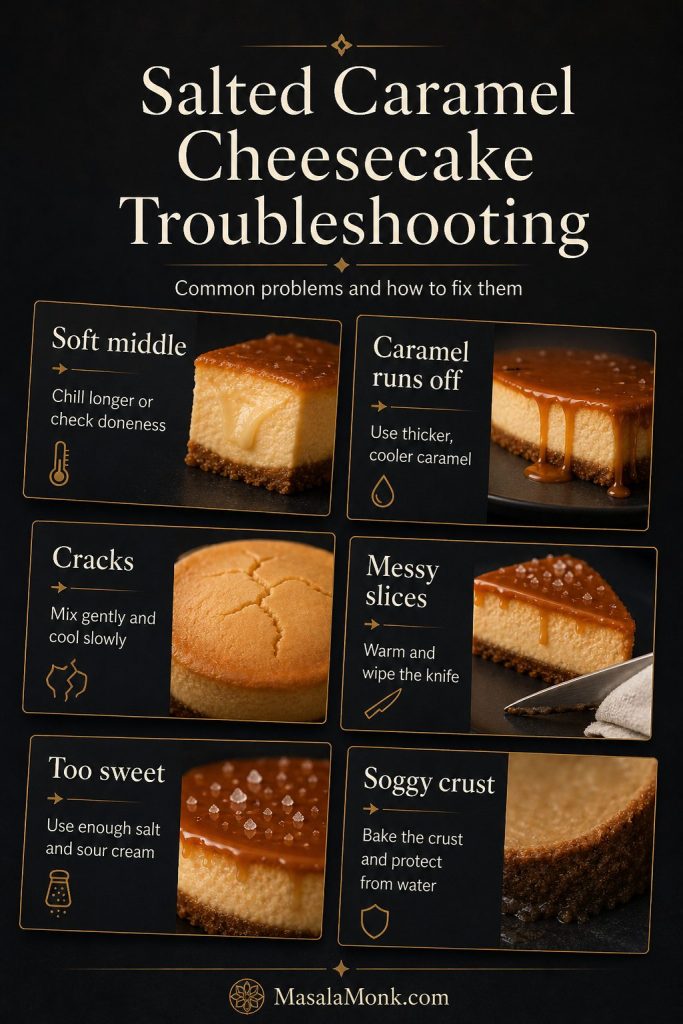
Most imperfect Japanese cheesecakes are still worth eating. Use this section only if something looked off, then trace the issue back to the meringue, oven heat, or cooling pace.

Appearance problems

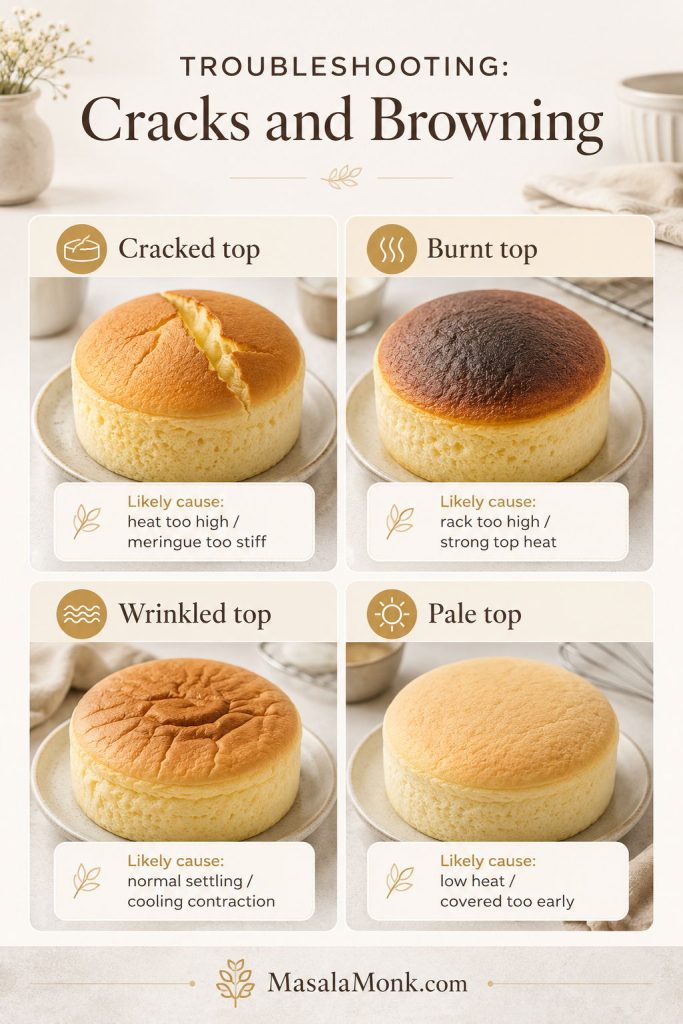
Troubleshooting board for Japanese cheesecake tops showing cracked, burnt, wrinkled, and pale examples with likely causes
Surface problems usually point back to heat control. A crack, dark top, pale top, or wrinkled surface can still produce a good cake if the center is set and the crumb stays tender.
ProblemLikely causeFix nowFix next time
Cracked topOven too hot, cake rose too fast, meringue too stiffCool slowly; dust with powdered sugar or glaze lightlyLower heat, use an oven thermometer, stop meringue before it turns dry
Burnt topOven too hot, rack too high, fan heat too strongTent loosely with foil if caught after the cake has risenUse lower-middle rack, avoid fan, confirm temperature
Top is pale but center is doneLow heat or covered too earlyAccept it, or glaze lightlyUse correct rack position and avoid tenting too early
Wrinkled topNormal shrinkage, moisture, cooling contractionAccept it; flavor is usually fineCool slowly and avoid over-expanding the cake with high heat
Wet sidesCondensation, water bath splash, or springform leakageChill uncovered briefly in the fridge if only dampUse a fixed-base pan and avoid splashing water into the pan
Water leaked into the panSpringform pan not sealed wellRemove cake from wet base if possible; chill before slicingUse fixed-base pan or the pan-inside-pan method

Texture problems

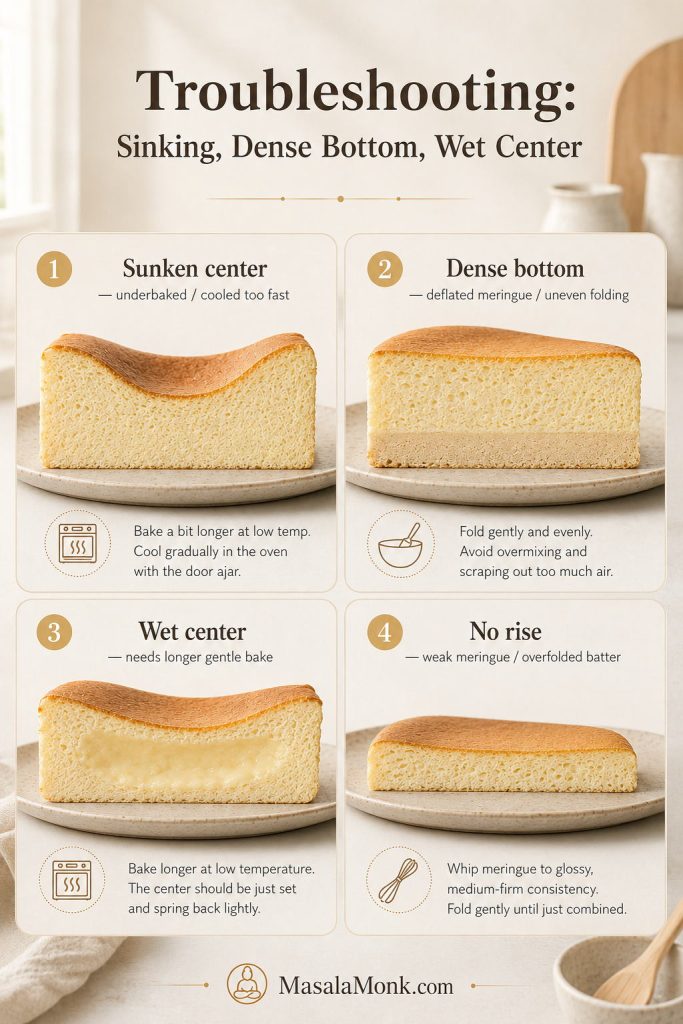
If you are diagnosing a dense bottom or low rise, compare what happened with the meringue cue, folding cues, and oven schedule before changing the ingredient ratios.

Troubleshooting board showing Japanese cheesecake slices with sunken center, dense bottom, wet center, and no rise
Sinking, wet centers, dense bottoms, and low rise are clues, not mysteries. Start by checking the meringue stage, folding, bake time, and cooling speed before changing the recipe itself.
ProblemLikely causeFix nowFix next time
Cake did not riseWeak meringue, overfolded batter, oven too cool, old eggsChill and serve; texture may be denser but usableWhip meringue to glossy medium-firm peaks, fold less aggressively, check oven temperature
Cake rose beautifully then sankUnderbaked center, fast cooling, unstable foamChill fully before slicingBake longer at gentle heat and cool more gradually
Collapsed centerUnderbaked center, fast cooling, weak structureChill fully; serve in smaller slices if neededBake until the center has a unified soft wobble
Dense bottom layerMeringue deflated, batter underfolded, heavy base sankServe chilled; texture may still taste goodFold more evenly and scrape the bottom of the bowl
Wet or gummy centerUnderbaked or sliced warmIf still warm and structurally intact, return to a 150°C / 300°F oven in the water bath; once fully cooled, rebaking usually makes texture worseExtend bake time and check with skewer, jiggle, or thermometer
Large holesLarge air bubbles in meringue or batterNo full fix after bakingFinish meringue on lower speed, fold evenly, use a skewer, tap pan lightly
Eggy flavorToo little lemon, overheated eggs, or overbakingServe chilled with fruit or a light sauceUse lemon, gentle heat, and avoid overbaking
No jiggleOverbaked, too dry, or served very coldLet slices sit 10–15 minutes before servingBake until set but still gently wobbly

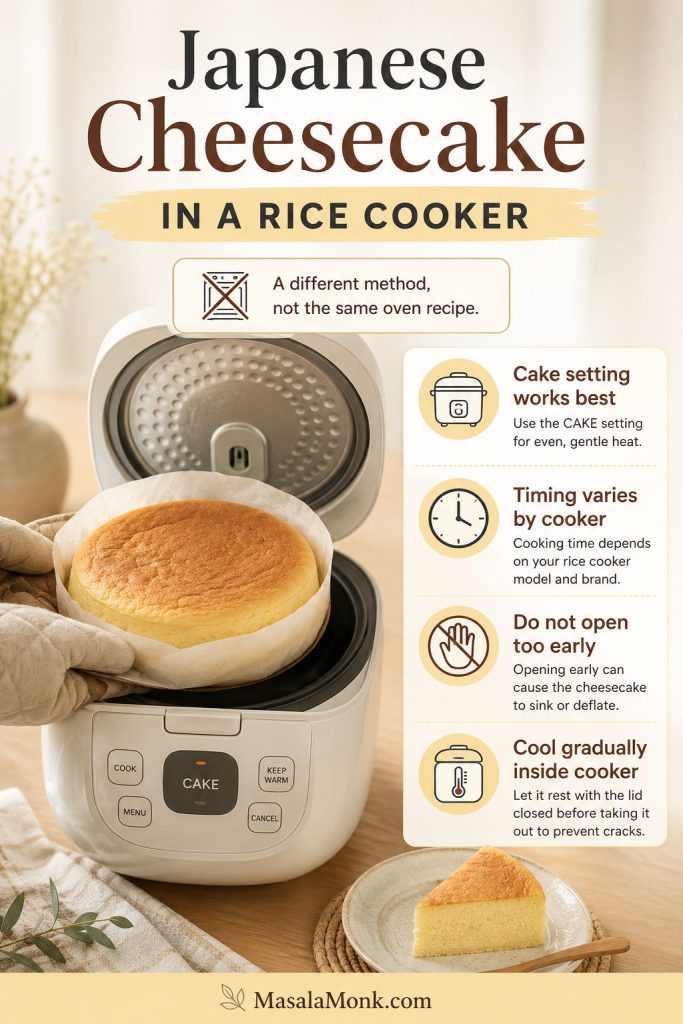
Can You Make Japanese Cheesecake in a Rice Cooker?

Yes, but a rice cooker version behaves like a separate method rather than a simple swap. A cooker with a cake setting works more like a small enclosed steam oven; timing depends more on the appliance than the batter.

A multi-cooker or rice cooker with a cake setting is the best choice. A basic one-button rice cooker can be unpredictable because it may switch off before the cake is cooked through. Some versions need more than one cycle, and opening the lid too early can cause sinking.

Japanese cheesecake being lifted from a rice cooker with notes about cake setting, timing, early opening, and gradual cooling
Rice cooker Japanese cheesecake is a related method, not a direct oven swap. Since every cooker heats differently, the setting, batter amount, timing, and gradual cooling all matter.
  • Use a cooker with a cake, bake, or multi-cook setting if possible.
  • Leave enough room in the inner pot for the cake to rise.
  • Expect timing to vary by cooker model.
  • Let the cake rest inside after cooking so it cools gradually.
  • If the cake sinks badly, it may have been undercooked or cooled too quickly.

For this oven recipe, treat the rice cooker as a different version. Do not pour the full batter into a small cooker and expect the same bake time.

Is This Like Uncle Tetsu or Rikuro Japanese Cheesecake?

This homemade Japanese cheesecake is inspired by the same cotton-soft, lightly sweet style people associate with bakery cheesecakes such as Uncle Tetsu or Rikuro. However, it is not an official copycat recipe. For context, this short history of Japanese cheesecake gives useful background on Japan’s wobbly soufflé-style cheesecake culture and bakery-style versions.

Uncle Tetsu-style expectations are mostly about the warm, fluffy, lightly sweet, stamped cheesecake experience. Rikuro-style expectations often include the soft wobble plus raisins at the bottom. This homemade version borrows the broad texture idea, not the exact bakery formula.

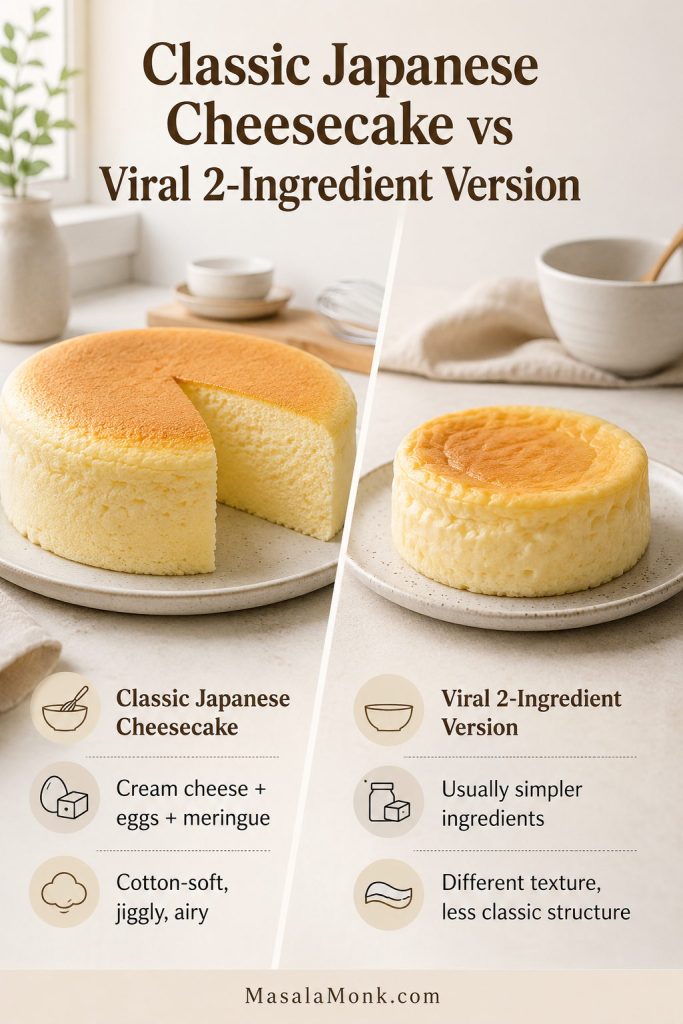
Is Viral 2-Ingredient Japanese Cheesecake the Same Thing?

No. Viral shortcut versions made with yogurt, cookies, or other minimal ingredients can be fun, but they are not the same as classic Japanese soufflé cheesecake.

  • Classic Japanese cheesecake: cream cheese, eggs, meringue, flour or starch, water bath baking, and a cotton-soft creamy texture.
  • Viral shortcut cheesecake: yogurt, cookies, or very few ingredients, usually simpler and more variable.
Side-by-side comparison of classic Japanese cheesecake and a simpler viral two-ingredient cheesecake version
Viral shortcut cheesecakes can be useful for quick experiments. However, the classic Japanese cheesecake recipe gets its cotton-soft, jiggly structure from whipped egg whites and a more controlled bake.

That does not mean the shortcuts are bad. They are simply a different dessert. If you want the cotton-soft, jiggly, bakery-style texture, the meringue method is what creates it.

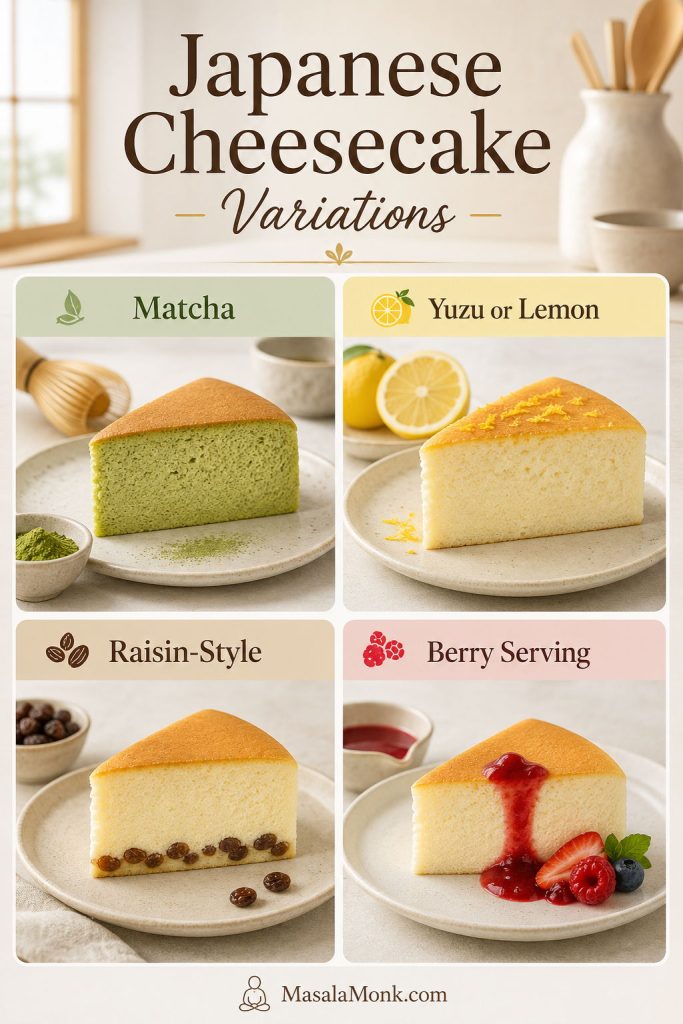
Japanese Cheesecake Variations

Once you understand the base method, you can adjust the flavor carefully. The batter relies on a delicate balance of moisture, fat, sugar, flour, and meringue, so small flavor changes work better than heavy add-ins.

Four Japanese cheesecake variations showing matcha, yuzu or lemon, raisin-style, and berry serving ideas
Once the base cake works, small flavor changes are safest. Matcha, citrus, raisins, or a light berry serving can add interest without covering the delicate Japanese cheesecake texture.
VariationSafe adjustmentAvoid
MatchaStart with 1–2 tsp, sifted with flour and cornstarchToo much matcha; bitterness and dryness
Yuzu or lemonReplace some or all of the lemon juice/zestAdding lots of extra liquid
ChocolateTreat as a separate tested versionCasual cocoa or melted chocolate swaps
Raisin-styleUse a thin dry layer at the bottomHeavy add-ins scattered through the foam
StrawberryUse fresh fruit or a light sauce on the sideWet, heavy topping that soaks the crumb

For matcha, yuzu, raisin, or strawberry versions, keep the adjustment light and protect the foam. Chocolate needs more caution because cocoa and melted chocolate affect moisture, fat, sugar, and rise.

How to Chill, Slice, Store, and Serve Japanese Cheesecake

The fresh-baked wobble is fun, but the cake slices best after chilling. The flavor also becomes more balanced after a few hours in the fridge, which makes this a very good make-ahead dessert.

Cold gives you clean slices; 10 minutes at room temperature gives you the softer bite.

For the cleanest stored slices, let the cake complete the cooling and chilling schedule before wrapping.

  • For clean slices: chill the cake for 4–6 hours or overnight.
  • For softer texture: let slices stand at room temperature for 10–15 minutes before serving.
  • For neat cuts: use a warm, clean knife and wipe between slices.
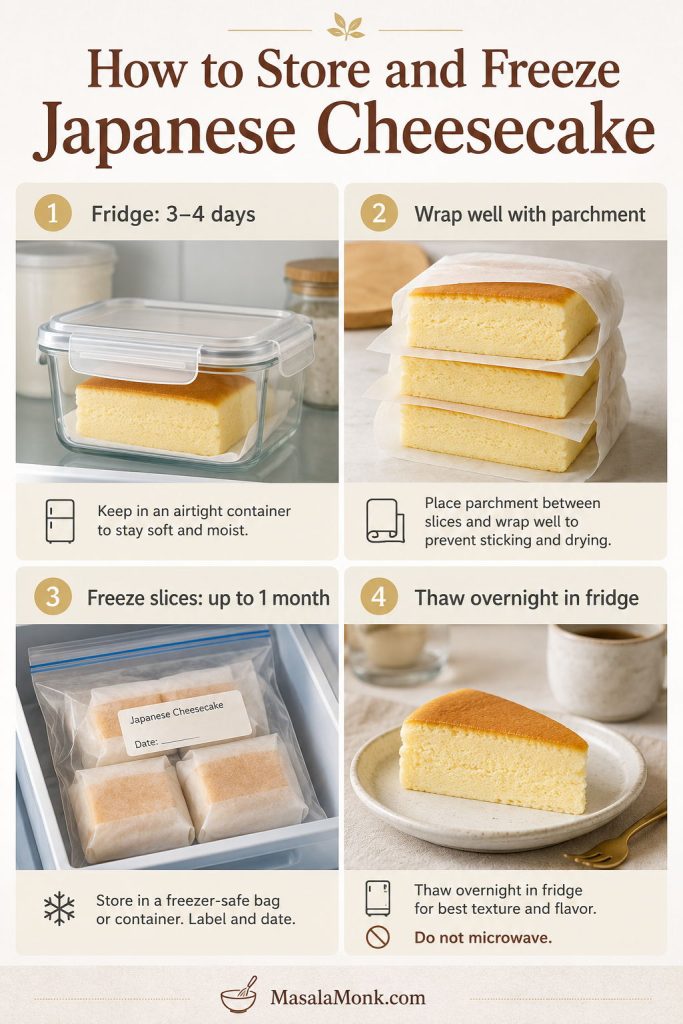
  • For storage: refrigerate in an airtight container for 3–4 days.
  • To avoid condensation: cool fully before covering. If the surface is damp, chill uncovered briefly before wrapping.
  • For freezing: wrap slices well, with parchment between slices if stacking, and freeze for up to 1 month for best texture.
  • To thaw: place frozen slices in the fridge overnight. Do not microwave; it can toughen the crumb.
Storage guide for Japanese cheesecake showing an airtight fridge container, parchment-wrapped slices, freezer portions, and thawed slice
Japanese cheesecake is excellent for make-ahead serving when stored gently. Refrigerate for short-term use, freeze wrapped slices for longer storage, and thaw in the fridge instead of microwaving the crumb.

Serving ideas

Serve Japanese cheesecake plain, with a light dusting of powdered sugar, a thin apricot glaze, fresh strawberries, a spoon of berry compote, or a small amount of yuzu or lemon curd. Keep toppings light. Heavy sauces can flatten the delicate texture.

If you want a topping, a small spoon of homemade whipped cream works better than heavy frosting because it does not crush the cake’s delicate crumb.

FAQs About Japanese Cheesecake

What makes Japanese cheesecake different?

Japanese cheesecake is lighter than dense baked cheesecake because whipped egg whites are folded into the batter. That meringue gives it a soft, airy, slightly bouncy texture.

Does Japanese cheesecake have a crust?

Usually, no. This style is typically crustless because the soft, airy cake body is the focus.

Why did my Japanese cheesecake crack?

The oven may have been too hot, the cake may have risen too quickly, or the meringue may have been too stiff. A small crack is cosmetic if the center is set and the crumb is soft.

Why did it sink after baking?

Some settling is normal. A deep sink usually means the center was underbaked, the meringue was unstable, or the cake cooled too quickly.

Why is the bottom dense?

A dense bottom usually means the meringue deflated or the batter was not folded evenly. Next time, scrape the bottom of the bowl while folding and stop before the batter turns runny.

Is a water bath necessary for Japanese cheesecake?

For this style, the water bath is strongly recommended. It gives gentle, moist heat and helps prevent cracks, dry edges, and harsh rising.

All-purpose flour, plain flour, or maida: will they work?

Yes. Use the same weight as cake flour. The crumb may be slightly less delicate, but all-purpose flour, plain flour, or maida is the closest practical substitute when cake flour is unavailable.

Should Japanese cheesecake be eaten warm or cold?

It can be tasted slightly warm, but it slices best after chilling. For the best balance, chill it fully, then let slices stand 10–15 minutes before serving.

Why does Japanese cheesecake taste eggy?

It should not taste strongly eggy. Lemon juice, lemon zest, gentle heat, and proper chilling help the cream cheese flavor feel fresher and more balanced.

Is Uncle Tetsu cheesecake the same as Japanese cheesecake?

Uncle Tetsu is a famous bakery style of Japanese cheesecake, but this recipe is not an official copycat. It borrows the broad cotton-soft, lightly sweet, jiggly texture idea for a homemade oven method.

Rice cooker Japanese cheesecake: does it work?

It can work in a cooker with a cake or bake setting, but it needs separate timing, batter quantity, and cooling guidance. Treat it as a different method, not a direct swap for this oven recipe.

Is an eggless Japanese cheesecake possible?

Not with this method. The cotton-soft rise comes from whipped egg whites, so an eggless version needs a separate tested formula.

How well does Japanese cheesecake freeze?

Yes. Wrap slices well and freeze for up to 1 month for best texture. Thaw overnight in the fridge and avoid microwaving, which can toughen the crumb.

Final Thoughts

A good Japanese cheesecake does not need a flawless top to feel special. It needs a tender center, a soft wobble, and enough patience to let the crumb settle.

Once you know the cues, the cake becomes less mysterious. The first bake teaches you your oven, and the next one usually feels calmer, softer, and more confident.

Back to top ↑

Posted on 2 Comments

Salted Caramel Cheesecake Recipe

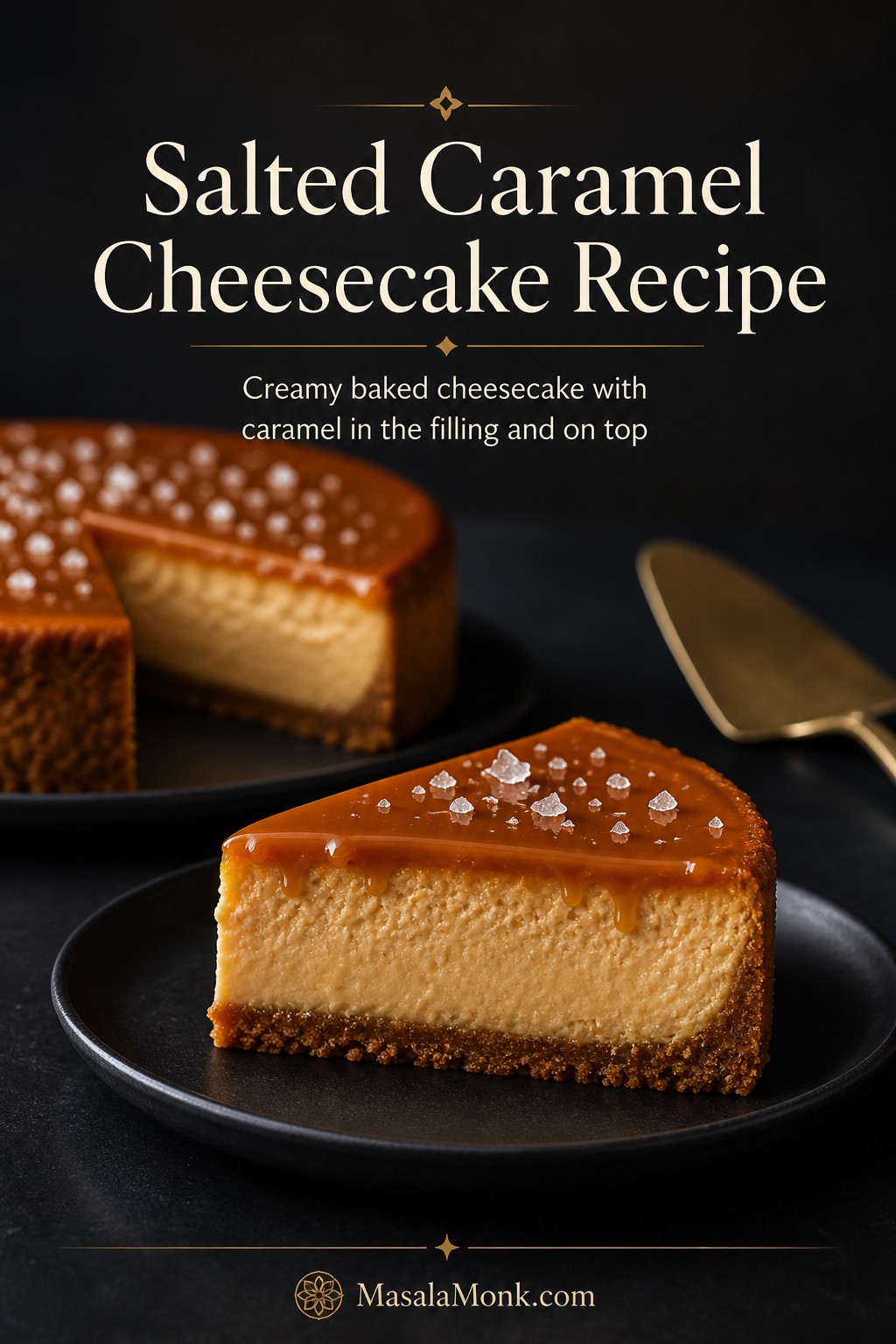
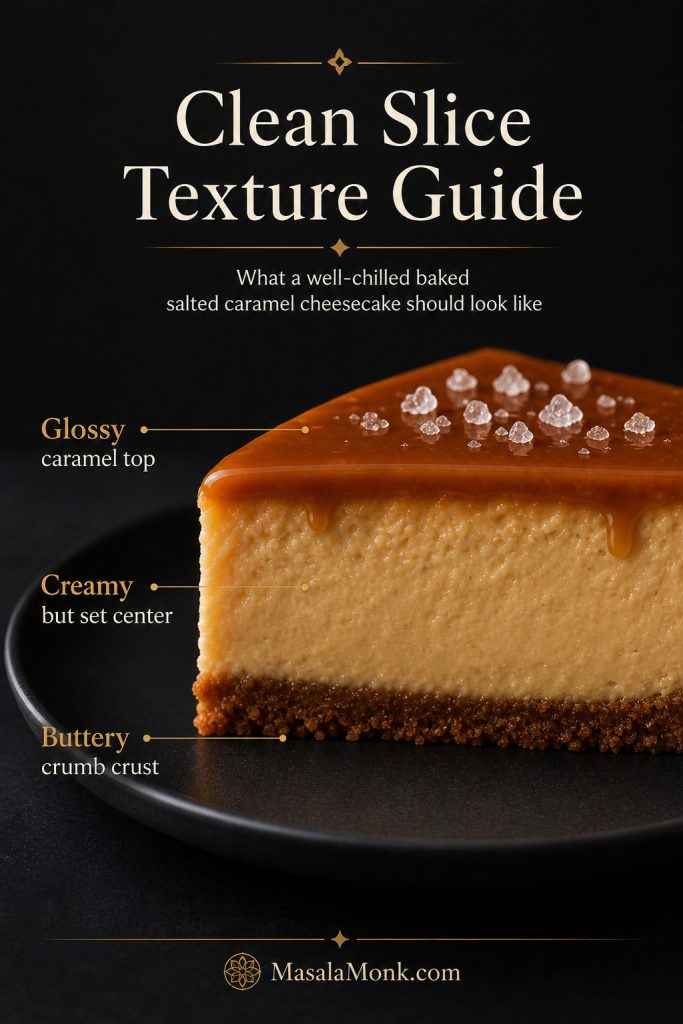
Baked salted caramel cheesecake slice with caramel topping, flaky salt, crumb crust, and text reading Salted Caramel Cheesecake Recipe.

This salted caramel cheesecake recipe is for anyone who wants caramel in every bite, not just a sweet drizzle on top. The baked filling is creamy and caramel-flavored, the topping settles into a glossy layer, and the buttery crumb crust keeps each slice rich, balanced, and sturdy enough to cut cleanly.

This is a baked salted caramel cheesecake, so the filling has the structure to hold caramel without turning loose in the middle. A measured amount of cooled caramel goes into the batter for flavor, then more caramel is spread over the chilled cheesecake for a glossy finish. That gives you real caramel depth, clean slices, and a top that looks polished instead of messy.

You’ll also learn how thick the caramel should be, when to add it, how to tell when the cheesecake is done, and why overnight chilling makes such a difference. Once those details are right, this is a deeply creamy, sliceable salted caramel cheesecake with a clean finish of flaky sea salt.

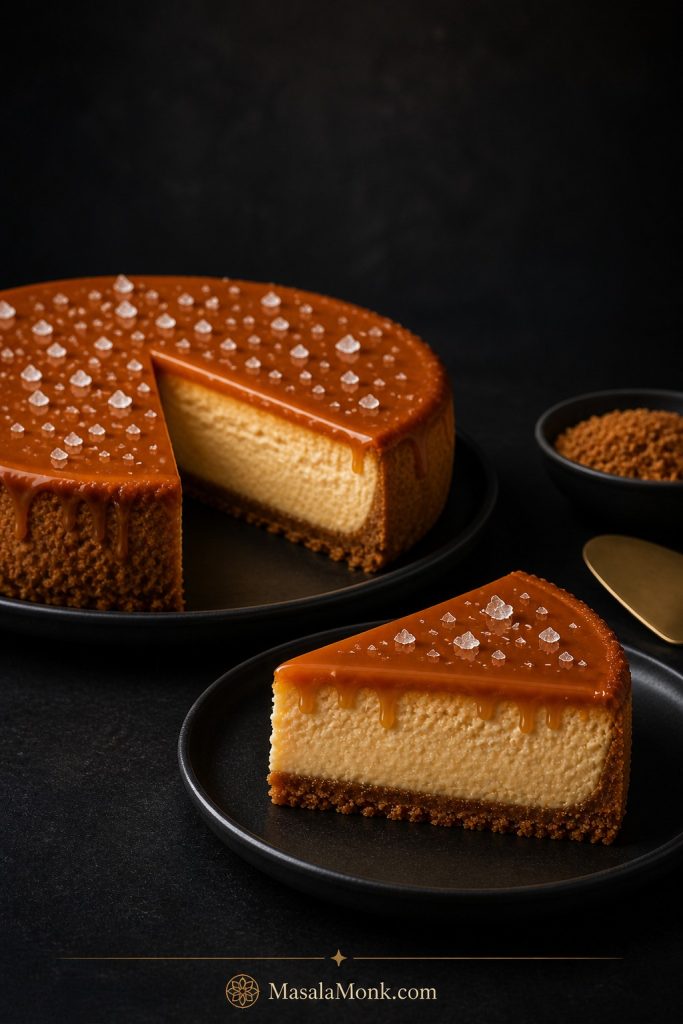
Text-free editorial photo of a salted caramel cheesecake slice with glossy caramel topping, flaky salt, creamy filling, and crumb crust on a dark plate.
A properly chilled baked cheesecake should cut cleanly and still look creamy inside; meanwhile, the caramel topping should sit on the surface instead of disappearing into it.

Quick Answer: Salted Caramel Cheesecake Recipe

To make salted caramel cheesecake, bake a buttery biscuit or graham cracker crust, fill it with a smooth cream cheese batter flavored with brown sugar and cooled salted caramel, then bake it gently at 300°F / 150°C until the edges are set and the center still wobbles slightly. Cool it slowly, chill it for at least 6 hours, then finish with a glossy caramel layer and flaky sea salt.

The trick is to use caramel in the right places. A controlled amount goes into the filling for flavor, while the topping is added after chilling so it stays visible and neat. That way, the cheesecake tastes caramel-forward without turning loose in the middle.

Want the exact measurements? Jump to the recipe card. Unsure about caramel thickness? Go to the caramel guide.

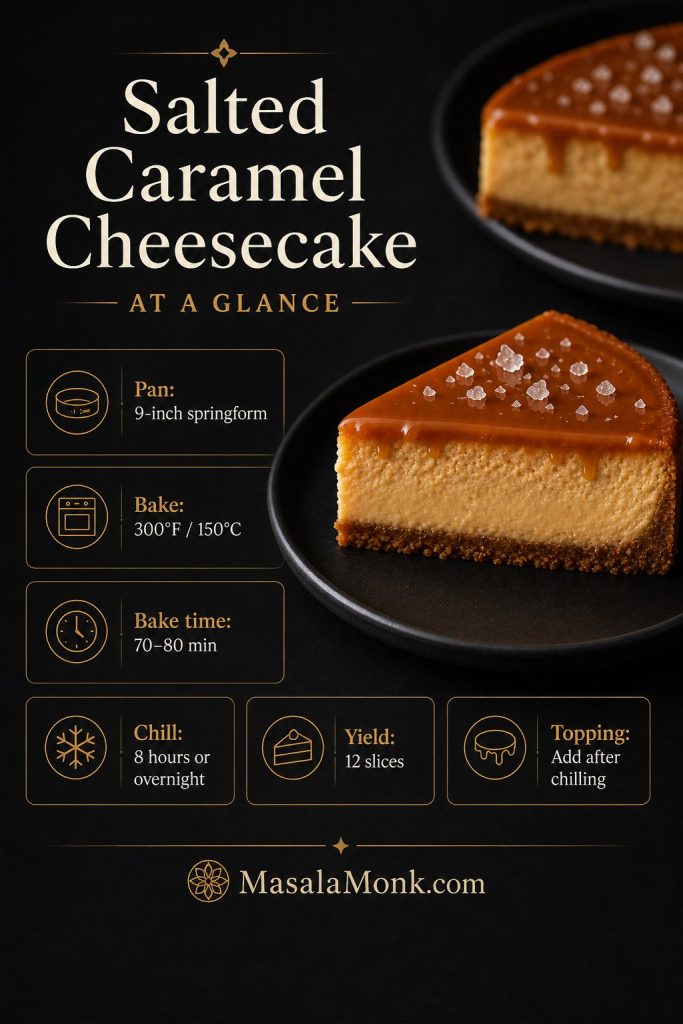
Salted Caramel Cheesecake at a Glance

StyleBaked round salted caramel cheesecake
Pan9-inch / 23 cm springform pan
Yield12 slices
CrustDigestive biscuits, graham crackers, or Biscoff crumbs
TextureCreamy, set, and sliceable after chilling
Caramel textureCooled and thick enough for the filling, glossy and slow-moving for the top
Bake temperature300°F / 150°C after the crust is baked
Fan ovenAbout 285°F / 140°C
Chill time8 hours or overnight for the cleanest slices; 6 hours is the bare minimum
Best finishCaramel topping and flaky sea salt added after chilling
At-a-glance salted caramel cheesecake guide showing pan size, bake temperature, bake time, chill time, yield, and topping timing.
If you want the short version first, this at-a-glance guide covers the details that matter most: pan size, low baking temperature, chill time, yield, and when to add the caramel topping.

Why This Salted Caramel Cheesecake Recipe Works

Balance is the tricky part of caramel cheesecake. With too little caramel, the dessert tastes like plain cheesecake with sauce. Add too much, and the filling can turn soft, overly sweet, or difficult to slice. This version keeps the flavor deep without overloading the batter.

  • A controlled amount of caramel goes into the filling. It is enough to flavor the cheesecake, but not so much that the center turns loose.
  • Brown sugar supports the caramel flavor. It gives the filling a warmer, rounder sweetness than white sugar alone.
  • Sour cream balances the richness. That little tang keeps the cheesecake from tasting flat or cloying.
  • The topping goes on after chilling. The caramel sits as a glossy layer instead of melting into a warm surface.
  • A gentle bake protects the texture. The lower oven temperature gives the eggs time to set around the caramel-enriched filling.
  • Overnight chilling gives the cleanest slices. The cheesecake firms as it rests, and the caramel flavor becomes smoother.

Ready to make it? Skip to the step-by-step method. Prefer the short version? Go straight to the recipe card.

Before You Start This Salted Caramel Cheesecake

Cheesecake is not difficult, but it rewards patience. A few small details make the difference between a creamy slice and a soft, cracked, or lumpy one.

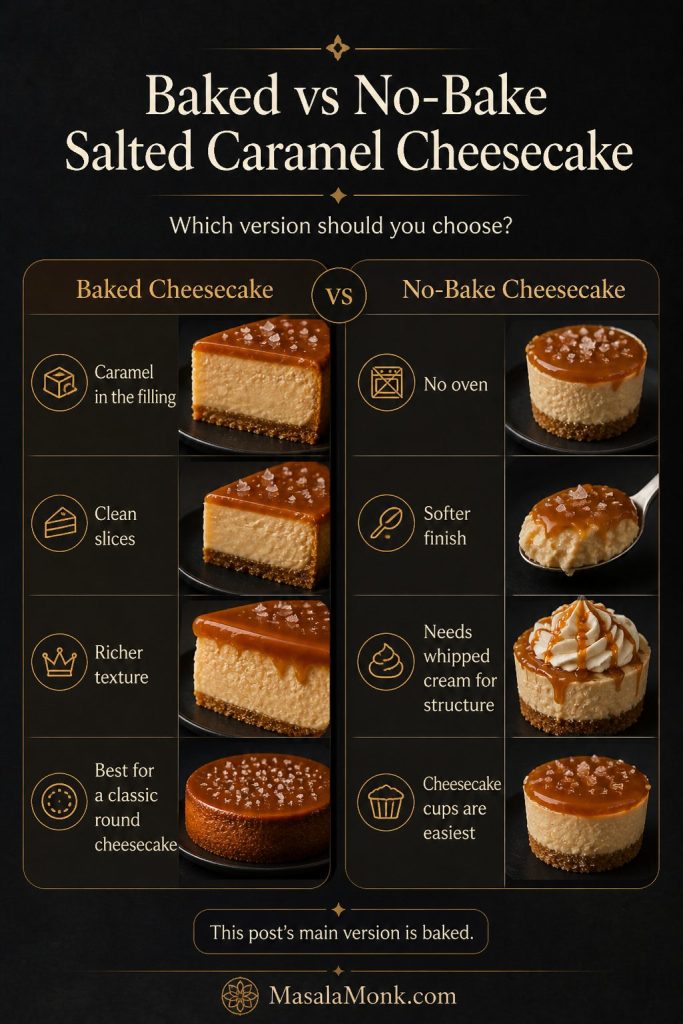
If you are still deciding between baked and chilled cheesecake styles, this no-bake cheesecake recipe explains the no-oven version in detail, including how cream cheese, whipped cream, and chill time create a sliceable texture.

Before you start: Bring the cream cheese, eggs, sour cream, and cream to room temperature. Use cooled caramel, not hot caramel. Mix gently after adding the eggs. Chill the cheesecake overnight if you want the neatest slices.

  • Use full-fat block cream cheese. Spreadable tub-style cream cheese can be softer and may not set as firmly.
  • Cool the caramel first. Warm caramel may seem easier to stir in, but it can soften the filling and make the cheesecake harder to bake evenly.
  • Scrape the bowl often. Cream cheese lumps like to hide at the bottom and sides of the bowl.
  • Mix on low after adding eggs. Too much air can make the cheesecake rise, fall, and crack.
  • Do not rush the chill. A caramel cheesecake needs time to firm up fully.

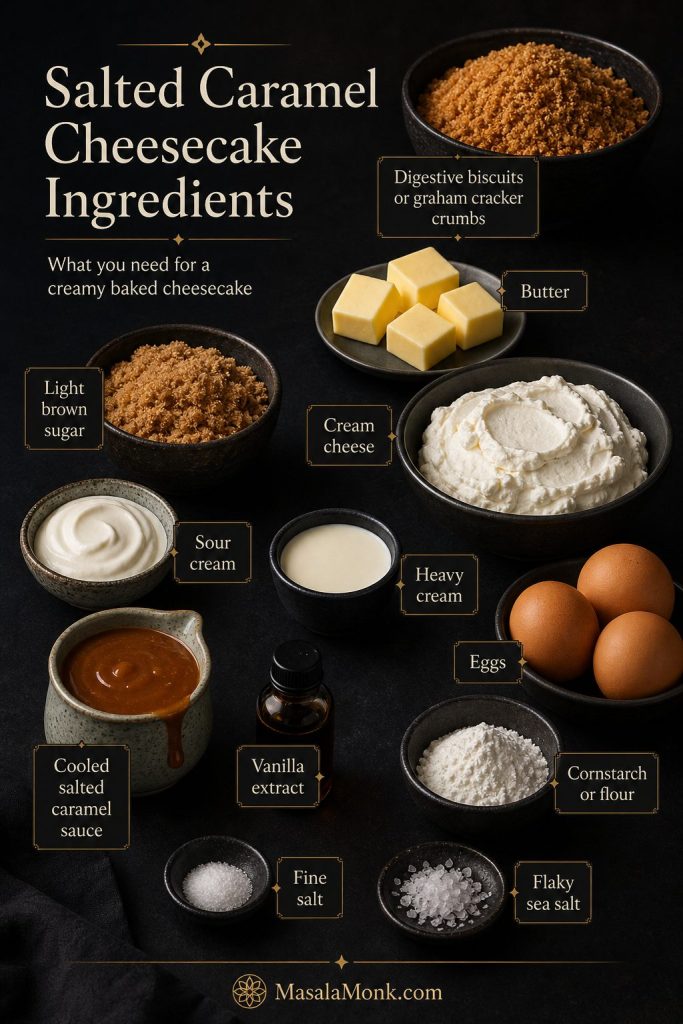
Salted Caramel Cheesecake Ingredients

This ingredient list is simple, but texture matters. Choose full-fat dairy, a sturdy crumb base, and caramel that is thick enough for cheesecake rather than a thin dessert syrup.

Ingredient board for salted caramel cheesecake showing crumbs, butter, brown sugar, cream cheese, sour cream, cream, eggs, caramel sauce, vanilla, cornstarch, and salt.
The best salted caramel cheesecake starts with a few texture-critical ingredients, so full-fat cream cheese, cooled caramel, and a firm crumb crust matter more than a long shopping list.

Buttery Crumb Crust

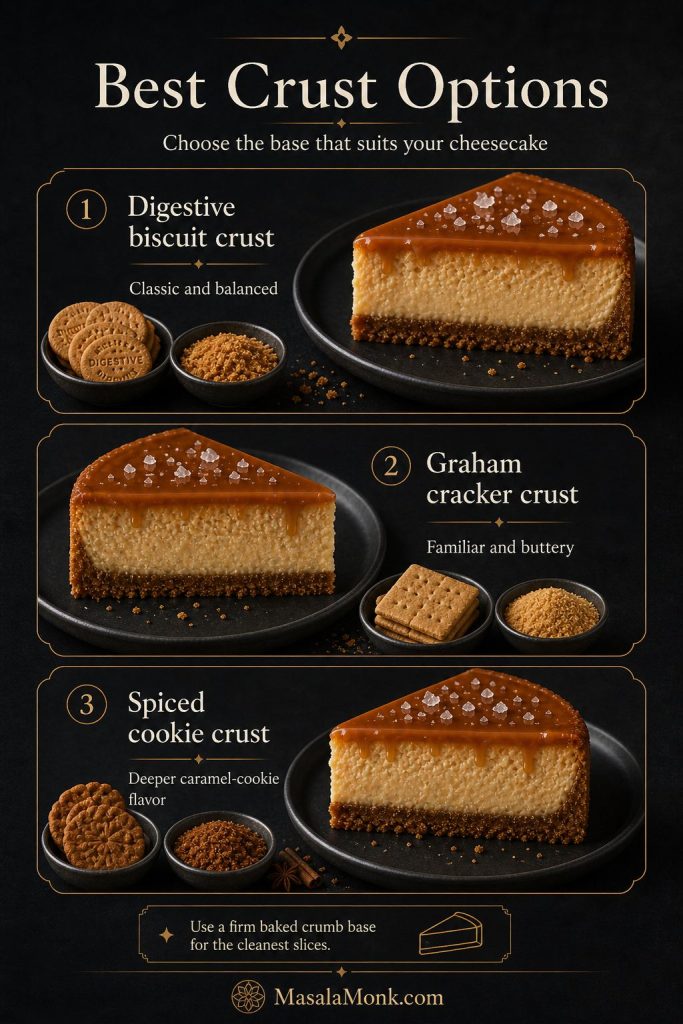
  • Digestive biscuits, graham crackers, or Biscoff crumbs: Digestives and graham crackers give the cheesecake a classic base, while Biscoff adds a deeper caramel-cookie flavor.
  • Melted butter: This binds the crumbs and helps the crust set firmly after baking.
  • Light brown sugar: A small amount adds a gentle caramel note to the base.
  • Fine salt: Salt keeps the crust from tasting flat underneath the sweet filling.
Crust options guide comparing digestive biscuit crust, graham cracker crust, and spiced cookie crust for salted caramel cheesecake.
Crust choice changes the whole dessert: digestive biscuits keep the flavor balanced, graham crackers feel classic, and spiced cookie crumbs push the cheesecake toward a deeper caramel-cookie profile.

Salted Caramel Cheesecake Filling

  • Full-fat block cream cheese: This gives the cheesecake its main structure. Let it come to room temperature before mixing so the batter turns smooth.
  • Light brown sugar: Brown sugar tastes warmer and more caramel-like than white sugar.
  • Sour cream: A little tang balances the caramel and keeps the filling from tasting too sweet.
  • Heavy cream or double cream: Cream adds richness and helps the texture feel smooth.
  • Eggs: These set the baked filling. Add them one at a time and mix gently.
  • Cornstarch or all-purpose flour: Either one gives the filling a little extra stability, which helps when caramel is involved.
  • Vanilla extract: Vanilla rounds out the dairy and caramel flavors.
  • Fine salt: This balances the sweetness inside the cheesecake, not just on top.
  • Cooled salted caramel sauce: Use caramel that is thick but stirrable, so it flavors the filling without making the batter too loose.

Salted Caramel Topping

  • Salted caramel sauce: Look for a sauce that falls from a spoon in a slow ribbon. Runny caramel is better saved for drizzling over individual slices.
  • Flaky sea salt: Sprinkle it on just before serving so it stays crisp and gives little salty pops against the caramel.

Need help with caramel texture before you start? See the caramel thickness guide. Ready to bake? Jump to the method.

Caramel for Cheesecake: Filling, Topping, and Drizzle

Caramel decides the texture here. A sauce that works beautifully over ice cream may be too thin for cheesecake. In this recipe, the caramel should be cool enough to protect the filling and thick enough to stay present in each slice.

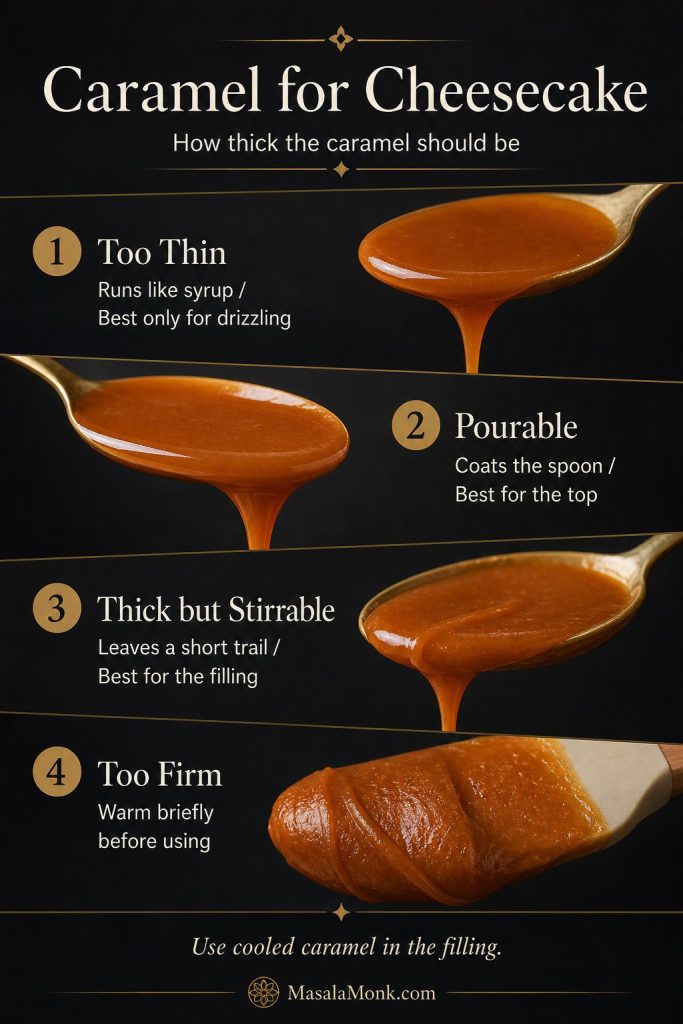
The Spoon Test for Caramel Cheesecake Topping

Before adding caramel to the filling or spreading it on top, test it with a spoon. This is easier than guessing by color alone.

Caramel thickness guide showing too-thin caramel, pourable caramel, thick but stirrable caramel, and too-firm caramel for cheesecake.
Caramel thickness affects both texture and appearance; for that reason, thick but stirrable caramel works best in the filling, while slow-moving caramel is better for the top.
Caramel textureWhat it looks likeBest use
Too thinRuns off the spoon like syrupUse only as a serving drizzle
PourableCoats the spoon and falls in a slow ribbonBest for the top of the chilled cheesecake
Thick but stirrableA spoon dragged through it leaves a trail for 2–3 secondsBest for mixing into the filling or making a light swirl
Too firmClumps or spreads like cold fudgeWarm very briefly before using

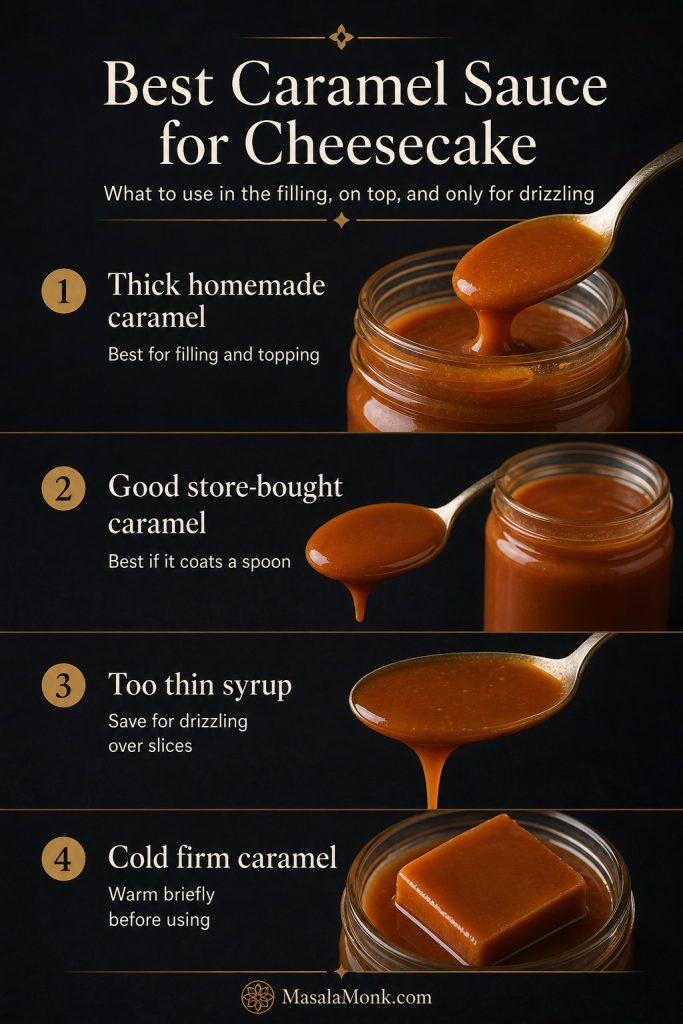
Best Caramel Sauce for Salted Caramel Cheesecake

Best caramel sauce guide for cheesecake showing thick homemade caramel, good store-bought caramel, thin syrup, and cold firm caramel.
Not every caramel sauce belongs in cheesecake. Homemade or thick store-bought caramel works well in the batter, whereas thin syrup is better saved for drizzling over finished slices.

The best caramel sauce for salted caramel cheesecake is thick, glossy, and slow-moving. It should coat a spoon and fall in a ribbon rather than run like syrup. Homemade caramel gives you the most control, but store-bought salted caramel can work if it has enough body. Avoid thin ice cream-style caramel in the filling because it can make the cheesecake softer and harder to slice.

This same thick-caramel logic also matters in a banoffee pie recipe, where the caramel or dulce de leche needs enough body to sit under bananas and cream without turning the slices messy.

Homemade vs Store-Bought Caramel for Cheesecake

Homemade salted caramel gives you the most control because you can cook it to the right thickness. Store-bought caramel can still work, especially for the topping, as long as it is not watery. If your jarred caramel is thin and runny, keep it for a final drizzle instead of mixing it into the cheesecake batter.

For the filling, use caramel that has cooled completely. For the topping, choose a glossy sauce that moves slowly from the spoon. If it has been refrigerated and looks too firm, warm it for a few seconds at a time until it loosens, then let it cool slightly before spreading.

Quick Salted Caramel for This Cheesecake

If you do not already have caramel sauce, make a simple batch before you start the filling. It needs time to cool, so this is best done first.

  • 200 g granulated sugar, about 1 cup
  • 85 g unsalted butter, cubed, about 6 tbsp
  • 120 ml heavy cream or double cream, 1/2 cup
  • 1/2–1 tsp fine salt, to taste
  • 1 tsp vanilla extract, optional

This makes enough caramel for the filling and topping, with a little extra for drizzling depending on how thick you cook it.

Place the sugar in a heavy-bottom saucepan over medium heat and let it melt, stirring gently only as needed until it becomes a deep amber caramel. The sugar may clump at first. Keep the heat moderate and continue stirring gently until the clumps melt. If it darkens too fast, lower the heat.

Carefully whisk in the butter; the mixture will bubble. Slowly add the cream while whisking, then simmer for 1–2 minutes until smooth. Remove from the heat, stir in salt and vanilla, and let it cool until thick but still spoonable.

Caramel safety note: Hot caramel is much hotter than boiling water and bubbles aggressively when butter or cream is added. Use a deep pan, pour the cream slowly, and keep your hands clear of the steam.

When to Add Caramel Topping to Cheesecake

Add the topping after the cheesecake has chilled and set. If you add caramel while the cheesecake is warm, it can sink into the surface or slide toward the edges. If you are making the dessert ahead, bake and chill the cheesecake first, then add the caramel layer on the day you serve it.

Best result: Make the caramel first, bake the cheesecake the day before serving, chill it overnight, then add the caramel topping and flaky salt on the day you serve it.

If your caramel feels too thin or the topping keeps sliding, check the troubleshooting section. Want the full recipe in one place? Go to the recipe card.

Equipment for Baked Salted Caramel Cheesecake

  • 9-inch / 23 cm springform pan: A deeper pan is helpful because the filling rises slightly as it bakes.
  • Parchment paper: Makes it easier to release the cheesecake from the base.
  • Food processor or rolling pin: Use either one to make fine, even crumbs.
  • Stand mixer with paddle or electric hand mixer: Keep the speed gentle, especially after adding the eggs.
  • Roasting pan or deep baking tray: Helpful for a water bath or a steam-pan setup.
  • Heavy-bottom saucepan: Needed if making caramel from scratch.
  • Digital scale: Strongly recommended because small measurement changes affect cheesecake texture.
  • Offset spatula: Helpful for smoothing the batter and caramel layer.
  • Sharp knife: Warm and wipe it between cuts for neat slices.
  • Instant-read thermometer, optional: Useful if you want a precise doneness check.

Common Mistakes to Avoid

  • Do not add hot caramel to the filling. It can loosen the batter and make the cheesecake bake unevenly.
  • Do not use thin caramel syrup in the batter. Save runny caramel for drizzling over individual slices.
  • Do not overmix after adding eggs. Too much air can make the cheesecake rise, fall, and crack.
  • Do not bake until the center looks fully firm. The middle should still wobble gently when the cheesecake leaves the oven.
  • Do not add the caramel topping while the cheesecake is warm. Add it after chilling so the top stays glossy and neat.

How to Make Salted Caramel Cheesecake

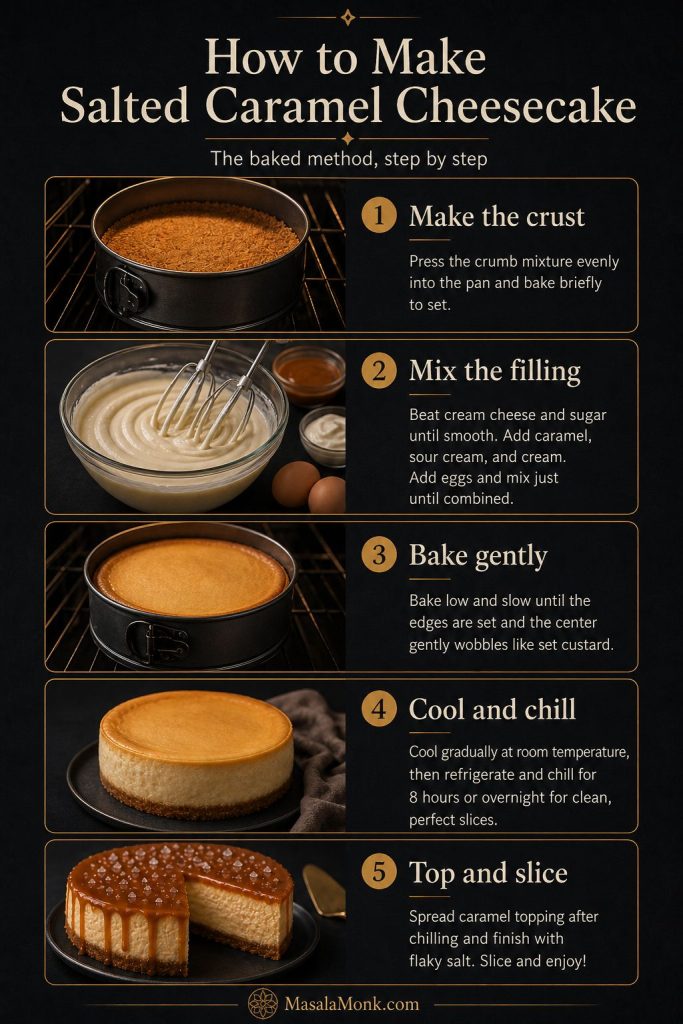
The steps are straightforward, but the order makes a big difference. Bake the crust first, let the caramel cool, mix the filling gently, bake the cheesecake slowly, then give it enough time to chill before adding the topping.

Step-by-step board showing how to make salted caramel cheesecake by baking the crust, mixing the filling, baking gently, chilling, topping, and slicing.
To keep the cheesecake smooth and sliceable, follow the order carefully: bake the crust, cool the caramel, mix gently after the eggs go in, then bake, chill, and top only when fully set.

Step 1: Make the Crust

Heat the oven to 350°F / 175°C. Line the base of a 9-inch springform pan with parchment paper. Mix the biscuit crumbs, melted butter, brown sugar, and salt until the crumbs look evenly moistened, like damp sand.

Press the mixture firmly into the base of the pan. Bring the crumbs slightly up the sides to make a low edge, then bake for 8–10 minutes. Let the crust cool while you prepare the filling.

Step 2: Cool or Prepare the Caramel

If you are making caramel from scratch, make it now and let it cool. If you are using prepared caramel, check the texture with the spoon test. For the filling, the caramel should be cool and thick but still easy to stir.

Avoid adding hot caramel to the batter. It can soften the cream cheese mixture and make the cheesecake bake unevenly.

Step 3: Mix the Salted Caramel Cheesecake Filling

Lower the oven to 300°F / 150°C. If using a fan or convection oven, reduce the cheesecake baking temperature to about 285°F / 140°C. Beat the room-temperature cream cheese and brown sugar on low to medium speed until smooth. Stop and scrape the bowl a few times so no firm streaks of cream cheese remain.

Add the sour cream, heavy cream, vanilla, salt, cornstarch, and cooled caramel. Mix just until smooth. Add the eggs one at a time on low speed, mixing only until each egg disappears into the batter.

Mix gently once the eggs go in. Cheesecake batter should be smooth, not whipped. Too much air can make the cheesecake rise in the oven and crack as it cools.

Step 4: Bake the Salted Caramel Cheesecake Low and Slow

Pour the filling into the cooled crust and smooth the top. Bake at 300°F / 150°C for 70–80 minutes, using a water bath or steam pan if possible.

For a full water bath, wrap the outside of the springform pan well, place it in a roasting pan, and pour hot water around it until the water reaches about halfway up the sides. For the easier steam-pan method, place a tray of hot water on the lower rack and bake the cheesecake on the rack above.

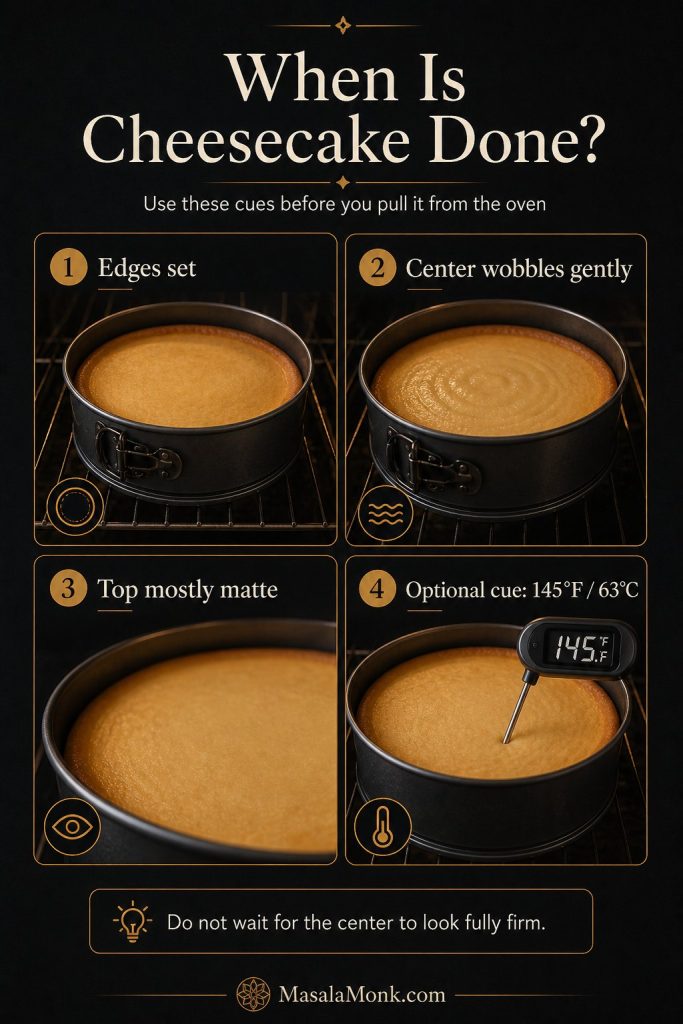
The cheesecake is ready when the outer 2–3 inches look set and the center still has a soft wobble. It should move like set custard, not ripple like liquid. The top should look mostly matte rather than wet. If you are using a thermometer, the center should be around 145°F / 63°C; ThermoWorks uses the same internal temperature cue for cheesecake doneness.

Cheesecake doneness guide showing set edges, gently wobbling center, mostly matte top, and optional 145 degrees Fahrenheit or 63 degrees Celsius internal temperature cue.
Cheesecake is done before it looks fully firm, so look for set edges, a gentle center wobble, and a mostly matte top rather than waiting for a completely rigid middle.

Do not wait for the center to look completely firm in the oven. By that point, the cheesecake may be overbaked. It will continue to set as it cools and chills.

Step 5: Cool Gradually

Turn the oven off, crack the door open, and leave the cheesecake inside for 1 hour. After that, move it to the counter and cool for another 1 hour. This slow cooling helps prevent sudden sinking and cracking.

Step 6: Chill Until Fully Set

Refrigerate the cheesecake for at least 6 hours. Overnight is better, and 8 hours gives a more reliable set. The filling becomes smoother and firmer as it rests, and the caramel flavor settles into the cream cheese base.

Step 7: Add the Salted Caramel Layer and Flaky Salt

Once the cheesecake is cold and set, spread the caramel over the top. Let it settle naturally, or guide it gently with an offset spatula. Finish with flaky sea salt just before serving.

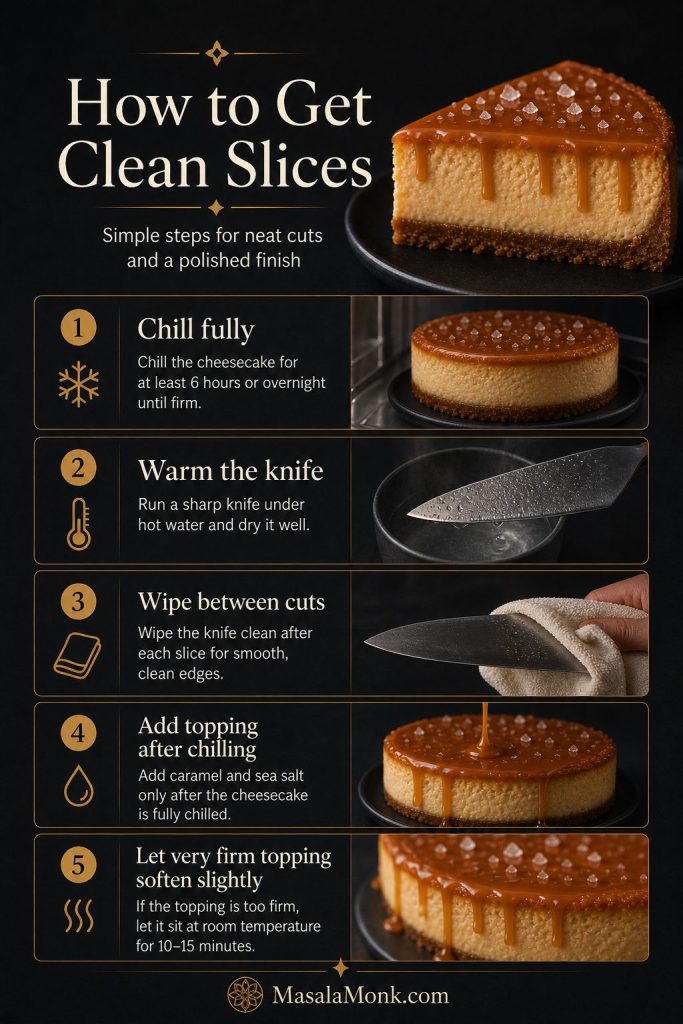
For tidy slices, dip a sharp knife in hot water, wipe it dry, cut one slice, then wipe the blade before cutting again.

Clean cheesecake slicing guide showing chilling, warming the knife, wiping between cuts, adding topping after chilling, and softening firm topping.
Clean cheesecake slices come from a few small habits that make a big difference: chill thoroughly, warm the knife, wipe between cuts, and let very firm caramel soften slightly before serving.

Need to store it or make it ahead? Jump to storage and freezing. Cheesecake not setting the way you expected? See troubleshooting.

Do You Need a Water Bath for Salted Caramel Cheesecake?

A water bath gives cheesecake the smoothest texture because it surrounds the pan with gentle, moist heat. That is especially helpful here because caramel adds sweetness and moisture to the filling.

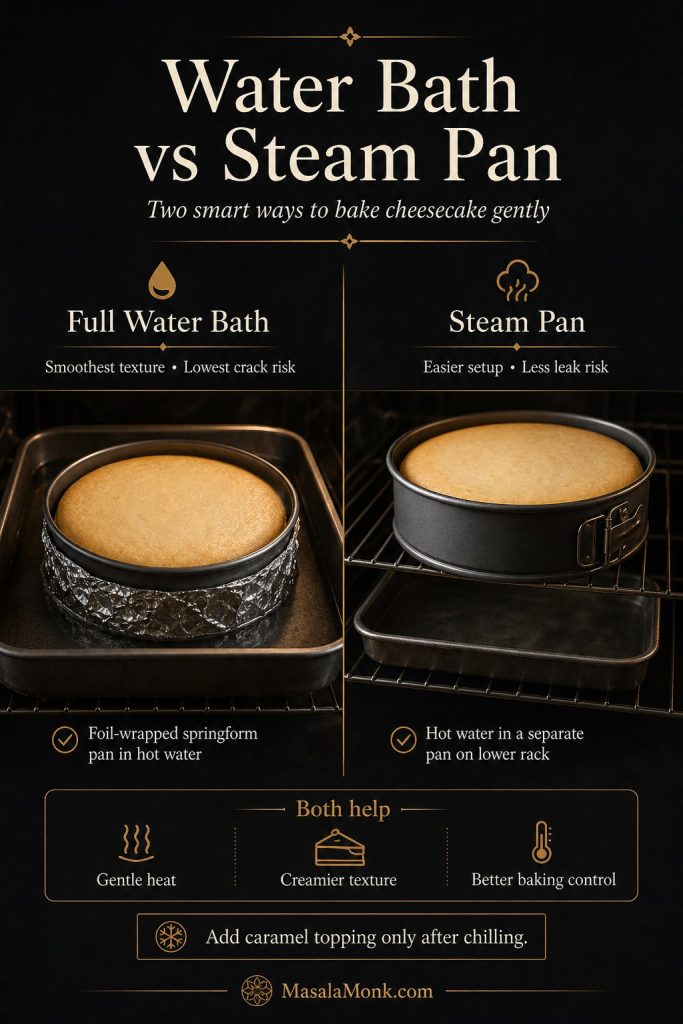
If wrapping a springform pan makes you nervous, use a steam pan instead. Place a deep tray of hot water on the lower oven rack and bake the cheesecake on the rack above it. You still get extra moisture in the oven without risking water leaking into the crust.

Comparison board showing a foil-wrapped springform pan in a water bath and a cheesecake baked above a separate steam pan.
A water bath gives the smoothest baked cheesecake texture, but a steam pan is an easier alternative; either way, added moisture helps the cheesecake bake more gently and crack less.
MethodBest forWhat to expect
Full water bathSmoothest texture and lowest crack riskWrap the pan well and place it in hot water while baking.
Steam panEasier setup with less leak riskPlace hot water on the lower rack while the cheesecake bakes above it.
No water bathShortcut bakingThe cheesecake can still work, but cracks and firmer edges are more likely.

For another technical reference, Serious Eats also uses 145°F / 63°C as a cheesecake doneness target, which supports the thermometer cue in this recipe.

If you skip both the water bath and the steam pan, keep the oven temperature low and avoid overbaking. Any cracks can be covered with caramel, but the texture will be creamier if the cheesecake bakes gently.

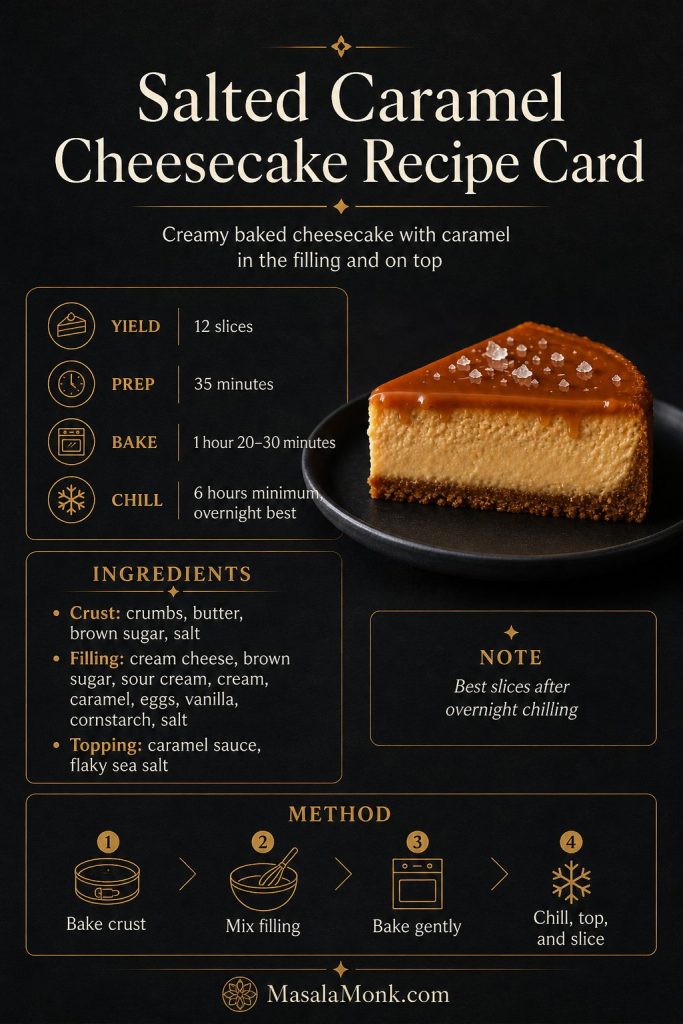
Saveable salted caramel cheesecake recipe card with yield, prep time, bake time, chill time, ingredient groups, and brief method steps.
Use the recipe card when you want the method in one place, especially for checking the ingredient groups, baking time, chill time, and topping order without scrolling through the full guide.

Salted Caramel Cheesecake Recipe Card

This salted caramel cheesecake recipe makes a creamy baked cheesecake with caramel in the filling, a glossy caramel layer on top, buttery crumb crust, and a clean sliceable texture after chilling.

Yield
12 slices

Prep Time
35 minutes

Bake Time
1 hour 20–30 minutes

Chill Time
6 hours minimum, overnight best

Total Time: About 10 hours minimum including cooling and chilling; overnight chilling is best.

Pan: 9-inch / 23 cm springform pan

Before You Start

  • Bring cream cheese, eggs, sour cream, and cream to room temperature.
  • Use cooled caramel in the filling, not hot caramel.
  • Mix gently after adding eggs.
  • Chill overnight for the neatest slices.
  • Add the caramel topping after chilling.

Ingredients

Crust

  • 225 g digestive biscuits, graham crackers, or Biscoff crumbs, about 2 1/4 cups
  • 100 g unsalted butter, melted, about 7 tbsp
  • 25 g light brown sugar, about 2 tbsp
  • 1/4 tsp fine salt

Salted Caramel Filling

  • 680 g full-fat block cream cheese, room temperature, 24 oz
  • 150 g light brown sugar, about 3/4 cup packed
  • 120 g sour cream, room temperature, 1/2 cup
  • 60 ml heavy cream or double cream, 1/4 cup
  • 120 g cooled salted caramel sauce, about 1/3–1/2 cup
  • 1 tbsp cornstarch or all-purpose flour
  • 2 tsp vanilla extract
  • 1/4 tsp fine salt
  • 3 large eggs, room temperature

Topping

  • 160–200 g salted caramel sauce, slow-moving and pourable, about 1/2–2/3 cup
  • 1/2–1 tsp flaky sea salt, to finish

Optional Quick Caramel Sauce

  • 200 g granulated sugar, about 1 cup
  • 85 g unsalted butter, cubed, about 6 tbsp
  • 120 ml heavy cream or double cream, 1/2 cup
  • 1/2–1 tsp fine salt, to taste
  • 1 tsp vanilla extract, optional

Instructions

Make the Caramel and Crust

  1. If making the caramel sauce, melt the sugar in a heavy-bottom saucepan over medium heat until deep amber. Carefully whisk in butter, then slowly whisk in cream. Simmer for 1–2 minutes, remove from the heat, add salt and vanilla, and cool until thick but spoonable.
  2. Heat the oven to 350°F / 175°C. Line the base of a 9-inch springform pan with parchment paper.
  3. Mix the biscuit crumbs, melted butter, brown sugar, and salt until evenly moistened.
  4. Press the crumbs firmly into the base of the pan, bringing them slightly up the sides to make a low edge. Bake for 8–10 minutes, then cool.

Mix the Cheesecake Filling

  1. Lower the oven to 300°F / 150°C, or about 285°F / 140°C for a fan oven.
  2. Beat the cream cheese and brown sugar on low to medium speed until smooth, scraping the bowl as needed.
  3. Mix in sour cream, heavy cream, cooled caramel, cornstarch, vanilla, and salt.
  4. Add the eggs one at a time on low speed, mixing only until combined.
  5. Pour the filling into the cooled crust and smooth the top.

Bake, Cool, and Chill

  1. For a water bath, place the wrapped springform pan in a roasting pan and pour hot water around it until it reaches about halfway up the sides. For an easier steam-pan method, place a tray of hot water on the lower rack and bake the cheesecake on the rack above.
  2. Bake for 70–80 minutes, until the outer edges are set and the center wobbles gently like set custard.
  3. Turn off the oven, crack the door, and let the cheesecake cool inside for 1 hour.
  4. Move the cheesecake to the counter and cool for another 1 hour.
  5. Refrigerate for at least 6 hours, preferably 8 hours or overnight.

Finish and Slice

  1. Spread the caramel topping over the chilled cheesecake.
  2. Finish with flaky sea salt just before serving.
  3. Slice with a warm, wiped knife for the cleanest cuts.

Notes

  • If the caramel runs like syrup, use it as a serving drizzle instead of mixing it into the filling.
  • The cheesecake should not look fully firm when it leaves the oven. It will finish setting as it cools.
  • Do not add the caramel topping before baking.
  • Biscoff crumbs make the crust taste deeper and more caramel-like.
  • If using store-bought caramel, choose a thick sauce rather than a thin ice cream syrup.

Can You Make This as a No-Bake Salted Caramel Cheesecake?

Yes, but a no-bake salted caramel cheesecake needs a different filling. You cannot simply remove the eggs from the baked recipe and chill it. A no-bake version needs whipped cream or double cream for structure, and the caramel must be thick enough that it does not loosen the filling.

Comparison board showing baked salted caramel cheesecake and no-bake salted caramel cheesecake with notes about texture and best uses.
Baked and no-bake salted caramel cheesecake serve different goals. Baked cheesecake is the better choice for caramel in the filling and clean slices, whereas no-bake is softer and more forgiving.

Baked vs No-Bake: Which Version Should You Choose?

VersionBest forTexture
Baked salted caramel cheesecakeClean slices, richer texture, caramel in the fillingCreamy, set, and sliceable
No-bake salted caramel cheesecakeEasy chilled dessert, no oven, softer finishLighter and softer; best with full-fat dairy
Salted caramel cheesecake cupsMost forgiving no-bake optionSpoonable, neat, and party-friendly

No-Bake Salted Caramel Cheesecake Starting Formula

For a 9-inch no-bake version, use this as a starting point:

  • 250 g digestive biscuit or graham cracker crumbs
  • 100 g melted butter
  • 500 g full-fat cream cheese
  • 100–120 g powdered sugar or icing sugar
  • 1 tsp vanilla extract
  • 150 g thick salted caramel sauce
  • 300 ml cold heavy cream or double cream, whipped to soft peaks
  • Extra caramel and flaky salt for topping

How to Assemble the No-Bake Version

Press the crumb base into the pan and chill it while you make the filling. Beat the cream cheese, sugar, vanilla, and caramel until smooth, then fold in the whipped cream. Spoon the filling over the base and chill for at least 6 hours, preferably overnight. Add the caramel topping only after the filling has set.

If you want more detail on chilled cheesecake structure, the setting notes in this no-bake mango cheesecake recipe are helpful because they show how full-fat dairy, filling thickness, and chill time affect whether a no-bake cheesecake slices cleanly or works better in cups.

Why Cheesecake Cups Are Easier

If you want a more forgiving no-bake dessert, make salted caramel cheesecake cups instead of one large cheesecake. Cups set faster, serve neatly, and are less sensitive to a slightly softer filling.

Still deciding? See the baked method or jump to the main recipe card.

Salted Caramel Cheesecake Variations

The baked round cheesecake should stay the main version, but these variations are easy to adapt once you understand the caramel texture and chill time.

Salted caramel cheesecake variations board showing mini cheesecakes, cheesecake bars, chocolate salted caramel cheesecake, and spiced cookie crust.
Once the main recipe is working well, it becomes easy to branch out; for instance, mini cheesecakes bake faster, bars are easier to portion, and a spiced cookie crust adds extra caramel-style warmth.

Mini Salted Caramel Cheesecakes

Use a muffin tin lined with paper liners. Press a spoonful of crumb base into each cup, add filling, and bake until the centers are just set. Mini cheesecakes bake much faster than a full cheesecake, so start checking early. Add caramel after chilling.

Salted Caramel Cheesecake Bars

For bars, use a parchment-lined square or rectangular pan. Bars are easier to chill, transport, and cut for parties. Keep the caramel layer thin and add it after the cheesecake has set.

Chocolate Salted Caramel Cheesecake

Use chocolate biscuit crumbs for the crust and add a thin chocolate ganache layer before the caramel topping. Keep the filling caramel-forward rather than adding too much cocoa to the base.

Salted Caramel Pecan Cheesecake

Add toasted chopped pecans to the crust or scatter them over the caramel before serving. Pecans add crunch and a slight bitterness that works beautifully with the sweet caramel.

Biscoff Salted Caramel Cheesecake

Use Biscoff crumbs for the crust and keep the filling the same. This gives the cheesecake a spiced caramel-cookie base without needing extra flavorings. If you like thick, baked, sliceable desserts with cookie-style richness, this cookie pie recipe is another good dessert to explore.

Make Ahead, Storage, and Freezing Salted Caramel Cheesecake

Make-ahead and storage guide for salted caramel cheesecake showing refrigerator storage, freezing without topping, thawing, and serving with caramel.
This cheesecake is a strong make-ahead dessert, yet the best finish comes when you chill or thaw the cake first and add the caramel topping later so it stays glossy and neat.

Make Ahead

This is an ideal make-ahead dessert. Bake the cheesecake one day before serving, cool it gradually, and chill it overnight. Add the caramel topping the next day so it looks fresh and glossy.

Refrigerator Storage

Store the cheesecake covered in the refrigerator for up to 4 days. If possible, add flaky salt just before serving rather than before storing.

Freezing

You can freeze salted caramel cheesecake, but it is best to freeze it without the caramel topping. Wrap the fully chilled cheesecake tightly, freeze for up to 2 months, then thaw overnight in the refrigerator. Add caramel after thawing.

Serving After Chilling

Serve the cheesecake cold from the refrigerator for the neatest slices. If the caramel topping is very firm, let the cheesecake sit at room temperature for 10–15 minutes before cutting.

Close-up texture guide of a salted caramel cheesecake slice showing glossy caramel top, creamy set center, and buttery crumb crust.
This is the texture to aim for: a glossy caramel top, a creamy baked center that holds its shape, and a crumb crust firm enough to support the slice without crumbling apart.

What to Do With Extra Caramel

Extra salted caramel keeps well in the refrigerator and can be warmed gently for serving. Spoon it over homemade ice cream, drizzle it into coffee, or use it as a dip for crisp desserts like homemade churros.

Troubleshooting Salted Caramel Cheesecake

Most problems come from three places: caramel that is too thin, filling that was mixed too aggressively, or a cheesecake that was not chilled long enough. Here is how to fix or avoid the common issues.

Need to compare with the main method? Go back to the step-by-step instructions. Want the full measurements again? Open the recipe card.

Troubleshooting board for salted caramel cheesecake showing fixes for soft middle, runny caramel, cracks, messy slices, too-sweet flavor, and soggy crust.
When a salted caramel cheesecake goes wrong, the cause is usually technical rather than mysterious; for example, thin caramel, overmixing, rushed cooling, or too little chill time can all affect the final texture.

Why Is My Cheesecake Soft in the Middle?

It may be underbaked, under-chilled, or made with too much thin caramel. The center should wobble gently when it leaves the oven, but it should not look liquid. Chill for at least 6 hours, and overnight if possible.

Why Did My Caramel Run Off the Cheesecake?

The caramel was probably too thin, too warm, or added before the cheesecake had set. Use a slow-moving sauce for the top and add it only after the cheesecake is cold.

Why Did My Cheesecake Crack?

Cracks usually come from overmixing, overbaking, baking too hot, or cooling too quickly. Mix gently after the eggs go in, bake at a lower temperature, and let the cheesecake cool gradually in the turned-off oven.

Why Are My Slices Messy?

The cheesecake likely needs more chill time, or the knife is dragging through the caramel. Chill overnight, use a warm sharp knife, and wipe the blade between cuts.

Why Does My Cheesecake Taste Too Sweet?

Salted caramel is naturally sweet, so balance matters. Sour cream, fine salt in the filling, and flaky salt on top all help. A Biscoff crust will make the cheesecake taste sweeter, while a plain digestive or graham crust keeps it more balanced.

Why Is My Caramel Grainy?

Grainy caramel usually comes from sugar crystals forming while the caramel cooks. Use a clean heavy pan, melt the sugar evenly, and avoid splashing sugar crystals up the sides. If the caramel is already grainy, it is better mixed into the filling than used as the visible topping.

Why Did the Crust Get Soggy?

The crust may not have been baked long enough, or water may have leaked into the pan during a water bath. Bake the crust until it smells toasty, wrap the springform pan well if using a water bath, or use the steam-pan method instead.

Salted Caramel Cheesecake FAQs

What Makes This Salted Caramel Cheesecake Recipe Different?

This salted caramel cheesecake recipe uses caramel in the filling and on top, but keeps the amount controlled so the baked cheesecake still sets, chills, and slices cleanly.

Is Store-Bought Caramel Sauce Okay?

Yes, especially for the topping. Choose a thick caramel sauce that coats a spoon. Very thin caramel syrup is better for drizzling over slices than mixing into the cheesecake filling.

How Thick Should Caramel Be for Cheesecake?

For the filling, caramel should be thick but stirrable. For the topping, it should be glossy and slow-moving. If it runs off a spoon like water or syrup, it is too thin for the filling and better used as a serving drizzle.

Is a Water Bath Necessary?

No, but it helps. A water bath gives the smoothest texture, while a steam pan is an easier option. If you bake without either, keep the oven temperature low and avoid overbaking.

How Long Should Salted Caramel Cheesecake Chill?

Chill it for at least 6 hours. Overnight is best, and 8 hours gives more reliable clean slices because the caramel-enriched filling needs time to firm up fully.

Can This Cheesecake Be Made Ahead?

Yes. Bake and chill the cheesecake one day ahead, then add the caramel layer and flaky salt before serving. This gives the best texture and the freshest-looking topping.

Does Salted Caramel Cheesecake Freeze Well?

Yes, but freeze it before adding the topping if possible. Wrap the chilled cheesecake tightly, freeze for up to 2 months, and thaw overnight in the refrigerator. Add the caramel after thawing.

How Do You Make Mini Salted Caramel Cheesecakes?

Use a lined muffin tin and bake until the centers are just set. Mini cheesecakes bake much faster than a full cheesecake, so check them early and add caramel only after chilling.

How Do You Turn This Into Salted Caramel Cheesecake Bars?

Use a parchment-lined square or rectangular pan, bake until just set, chill well, then add caramel and cut into bars with a warm wiped knife.

What Is the Best Crust for Salted Caramel Cheesecake?

Digestive biscuits or graham crackers are the most classic choice. Biscoff crumbs make the crust taste more caramel-like, while a pretzel crust gives a saltier contrast.

Should Caramel Be Added Before or After Baking?

Add a controlled amount of cooled caramel to the filling before baking. Add the visible topping after the cheesecake has chilled. This gives flavor inside the cheesecake while keeping the top glossy and neat.

Back to top

Posted on 2 Comments

No Bake Mango Cheesecake Recipe

Whole no bake mango cheesecake with one slice lifted, showing a biscuit base, creamy mango filling, and glossy mango topping on a dark surface.

This no bake mango cheesecake recipe is creamy, bright, and deeply mango-forward, with a buttery biscuit base and a glossy mango topping that makes it feel special without turning on the oven. Because mango can make no-bake cheesecake fillings loose, this recipe also shows you how to control the texture so the final dessert stays creamy, sliceable, and not watery.

Before you start, choose the right setting method. For a full sliceable cheesecake, agar agar or gelatin gives the cleanest result. However, for a softer mango cheesecake without gelatin, cups or jars are usually the safer and easier option. This no bake mango cheesecake recipe shows you all three routes, so you can make the version that fits your kitchen, diet, and serving style.

Quick Answer: How to Make No Bake Mango Cheesecake

To make no bake mango cheesecake, start with a biscuit base, a cream cheese and whipped cream filling, mango pulp or fresh mango puree, and a setting method such as agar agar or gelatin. For clean slices, use agar agar or gelatin and chill the cheesecake overnight. However, for a softer mango cheesecake without gelatin, make it in cups, jars, or bowls instead of relying on a full cake to slice neatly.

For the easiest version, use canned Alphonso or Kesar mango pulp because the flavor, color, and sweetness are consistent. Meanwhile, fresh ripe mangoes also work beautifully when they are sweet, smooth, and not watery. If you want the plain base formula first, start with this no-bake cheesecake guide, then come back to this mango version for the fruit, setting, and topping details.

Close-up slice of no bake mango cheesecake on a plate with a fork, showing the crumb crust, creamy mango cheesecake layer, and shiny mango topping.
This close-up shows the texture goal more clearly than words can: the slice is creamy and tender, yet stable enough to lift cleanly from the cake.

No Bake Mango Cheesecake at a Glance

Best pan 8-inch / 20 cm springform or loose-bottom pan
Best full-cake setting method Agar agar for a vegetarian cake; gelatin for a classic creamy set
Best no-gelatin format Cups, jars, or bowls
Best mango option Alphonso/Kesar mango pulp or ripe non-fibrous fresh mango
Chill time 8–12 hours for a full cake; at least 6 hours for cups
Texture goal Creamy, mango-forward, sliceable for a full cake; soft and spoonable for cups
Informational graphic with a slice of no bake mango cheesecake and text noting 8-inch cake, 10–12 slices, 45 minutes prep, 8–12 hours chill, and agar, gelatin, or cups.
Use this quick guide before starting so the pan size, yield, chill time, and setting options are clear from the beginning.

Which No Bake Mango Cheesecake Version Should You Make?

The best version depends on how you want to serve it. A full cake needs enough structure to unmold and slice. In contrast, cups and jars can stay softer, so they are more forgiving if you want a no-gelatin mango cheesecake. Therefore, this no bake mango cheesecake recipe gives you both the full-cake route and the easier cup-style option.

What you want Make this version Why
Clean full-cake slices Agar agar or gelatin full cake Both give enough structure for slicing.
Vegetarian full cake Agar agar version Agar is plant-based and sets firmly.
Classic creamy texture Gelatin version Gelatin gives a softer mousse-like set.
No gelatin and no agar Cups, jars, or bowls The filling can stay soft without needing to slice.
Richer shortcut Condensed milk version It adds sweetness and creaminess quickly.
Party-friendly servings Mini cheesecakes or cups They are easier to serve and more forgiving.
Comparison graphic showing three no bake mango cheesecake options: agar set full cake, gelatin set full cake, and no-gelatin cheesecake cups.
Choose the version before mixing the filling: agar agar is best for a vegetarian full cake, gelatin gives a softer classic set, and cups are the easiest no-gelatin option.
Best default version: Make the 8-inch agar agar version if you want an eggless, vegetarian-friendly cake that slices. Choose the gelatin version if you prefer a softer classic cheesecake texture. Choose cups if you want no gelatin and no agar.

Why This No Bake Mango Cheesecake Works

This mango cheesecake is built around the two things that matter most in a no-bake dessert: enough mango flavor and enough structure. Mango adds color, fragrance, and fruitiness, but too much watery puree can stop a no-bake cheesecake from setting properly. As a result, this recipe gives you a reliable full-cake method, plus clear adjustments for gelatin, agar agar, and no-gelatin cups.

Comparison graphic showing common reasons mango cheesecake fails to set, including watery puree, under-whipped cream, weak setting support, and short chill time.
Most setting problems begin before the cheesecake reaches the fridge; watery mango puree, weak structure, and rushed chilling can all lead to a loose filling.
  • No oven is needed. The cheesecake sets in the fridge, which makes it ideal for warm weather and make-ahead entertaining.
  • Mango is used in the filling and topping. This gives the cheesecake a stronger mango flavor than a plain cheesecake with fruit only on top.
  • The biscuit base is simple and sturdy. Digestive biscuits, graham crackers, or Marie biscuits all work.
  • The setting method is flexible. Use agar agar for a vegetarian full cake, gelatin for a classic creamy set, or cups for a softer no-gelatin version.
  • It works with fresh mango or mango pulp. The post explains how to adjust sweetness and texture for both.
  • It is make-ahead friendly. Overnight chilling gives the cleanest slices and the best flavor.

The key is not adding more mango puree than the filling can hold. Too much watery mango can give you stronger fruit flavor at first, but it can also stop the cheesecake from slicing cleanly after chilling.

The same thick-puree logic matters in homemade mango ice cream, where watery mango can weaken both flavor and texture. In cheesecake, the problem is even more obvious because the filling has to hold its shape once sliced.

Ingredients for No Bake Mango Cheesecake

Although the ingredient list is simple, the ratios matter. The filling needs enough cream cheese and whipped cream for body, enough mango for flavor, and the right setting method for the serving style you want. Otherwise, it can taste good but still fail to slice cleanly.

Ingredient spread for no bake mango cheesecake with biscuits, butter, cream cheese, cream, mango pulp, sugar, lemon or lime, agar agar, and gelatin.
These simple ingredients work best when each one has a clear job: cream cheese gives body, mango gives flavor, cream adds lightness, and agar or gelatin controls the final set.

Biscuit Base

  • Digestive biscuits, graham crackers, or Marie biscuits: these make the crumb base.
  • Melted butter: binds the crumbs and helps the base hold together.
  • Fine salt: balances the sweetness.
  • Sugar: optional, especially if the biscuits are already sweet.
  • Cardamom or cinnamon: optional, but useful if you want a warmer flavor.

Mango Cheesecake Filling

  • Full-fat cream cheese: gives the cheesecake structure and tang. Avoid low-fat cream cheese spread for a full cake.
  • Whipping cream or heavy cream: makes the filling lighter and creamier.
  • Mango pulp or mango puree: gives flavor, color, and sweetness.
  • Powdered sugar or caster sugar: sweetens the filling. Use weight when possible because cup measures vary by sugar type.
  • Lemon or lime juice: brightens the mango and balances the richness.
  • Vanilla: rounds out the flavor.
  • Agar agar or gelatin: helps a full cake slice cleanly.

Mango Topping

The topping can be a clean mango jelly, a softer mango coulis, or a simple layer of fresh mango. Choose mango jelly for a polished cake top, coulis for a spoonable finish, and fresh mango for the quickest decoration.

Fresh Mango vs Mango Pulp for No Bake Mango Cheesecake

In this recipe, mango quality can make or break the final texture. Sweet, smooth mango gives a bright filling, while watery or fibrous mango can make the cheesecake weak, bland, or difficult to set. Therefore, the safest choice is either thick mango pulp or ripe, non-fibrous fresh mango.

Comparison image showing fresh mango pieces and puree on one side and thick mango pulp in a bowl on the other side.
Fresh mango gives the brightest seasonal flavor, while mango pulp offers consistent sweetness and color; in both cases, thickness matters more than volume.
Mango option Best for Notes
Fresh ripe mango Best seasonal flavor Use sweet, non-fibrous mangoes. Blend smooth and sieve if needed.
Alphonso or Kesar mango pulp Strong color and consistent flavor Reduce sugar if the pulp is already sweetened.
Canned mango puree Easiest year-round option Check sweetness before adding the full amount of sugar.
Frozen mango Backup option Thaw and drain first so the filling does not become watery.
Watery mango puree Risky for a full cake Cook it down briefly or use a stronger setting method.
Mango tip: If your mango puree is thin, watery, or bland, do not add more and more puree to the filling. That can stop the cheesecake from setting. Use a thicker pulp, cook the puree down briefly, or add extra mango flavor through the topping instead.
Side-by-side comparison of thick mango puree coating a spoon and watery mango puree running off a spoon.
The spoon test is one of the easiest ways to judge mango puree: thick puree supports the filling, whereas watery puree can make the cheesecake too soft.

For a drinkable mango recipe where texture can stay softer, this mango smoothie is the better route; for cheesecake, the mango puree needs to be thicker and more controlled.

Best Biscuit Base for No Bake Mango Cheesecake

A good biscuit base should hold together without tasting greasy. After the melted butter is mixed in, the crumbs should look like wet sand. If the mixture is dry and dusty, the crust may crumble. On the other hand, if it looks shiny or oily, there may be too much butter.

  • Digestive biscuits: slightly malty and sturdy.
  • Graham crackers: classic for cheesecake and easy to use.
  • Marie biscuits: lighter and common in Indian kitchens.
  • Biscoff-style biscuits: sweeter and more caramel-like.
  • Plain cookies: useful when you want a softer dessert-style base.
Graphic showing a pressed crumb crust in a springform pan with digestive biscuits, graham crackers, and Marie biscuits nearby.
Digestive biscuits, graham crackers, and Marie biscuits all work, but the best biscuit base is the one that presses firmly and balances the sweet mango filling.
Base tip: Press the crumb mixture firmly with the bottom of a flat glass or measuring cup, then chill it for 30 minutes before adding the filling.

Similarly, if you like biscuit-base desserts, this Banoffee Pie uses the same no-bake crumb-base idea in a banana, caramel, and cream direction.

How to Make No Bake Mango Cheesecake

This no bake mango cheesecake recipe is written for an 8-inch / 20 cm full cake using agar agar as the default setting method. However, the gelatin and no-gelatin cup options are also included after the main method, so you can choose the version that suits your kitchen.

Step 1: Prepare the Pan

Line the base of an 8-inch / 20 cm springform or loose-bottom pan with parchment paper. For cleaner sides, line the inner wall with a strip of parchment or acetate.

Step 2: Make the Biscuit Base

Crush the biscuits into fine crumbs, mix with melted butter, salt, and any optional sugar or spice, then press the mixture firmly into the pan. Chill for 30 minutes.

Close-up of a glass pressing biscuit crumbs into a springform pan, with loose crumbs nearby showing a wet sand texture.
Once the crumbs look like wet sand, press them firmly into the pan so the base slices neatly instead of falling apart.

Step 3: Make the Mango Puree

If using fresh mango, blend until smooth and sieve if the mango is fibrous. If using canned mango pulp, stir it well and taste before adding sugar to the filling. For the agar version, the mango puree should be at room temperature, not fridge-cold.

Smooth mango puree being pushed through a sieve into a bowl, with mango pieces nearby on a dark surface.
Sieving the mango puree removes fibrous bits and gives the filling a smoother finish, especially when using fresh mango.

Step 4: Beat the Cream Cheese

Beat softened cream cheese with sugar, lemon or lime juice, vanilla, and salt until completely smooth. Do not add the mango puree yet. Keeping the mango separate makes it easier to mix in the agar without shocking it against cold dairy.

Bowl of cream cheese being mixed until smooth with a hand mixer, with citrus and sugar nearby.
Beat the cream cheese base until it is completely smooth first; after mango is added, small lumps become much harder to fix.

Step 5: Whip the Cream

Whip cold cream to medium-stiff or stiff peaks. In warm weather, chill the bowl and beaters first so the cream holds better.

Whipped cream forming medium-stiff peaks on a beater above a mixing bowl.
Medium-stiff whipped cream gives the filling lift and structure, while still keeping the mango cheesecake creamy rather than heavy.

Step 6: Activate the Agar Agar

Simmer the agar agar powder with water until it fully dissolves, then boil gently for about 60–90 seconds. Agar must be heated properly to activate. Let it cool slightly, but do not let it set.

Small saucepan with agar agar mixture simmering, with a bowl of mango puree and agar powder nearby.
Agar agar must be boiled properly before it can set the cheesecake, so this step is more important than simply stirring powder into the filling.

Step 7: Mix the Mango Filling

Whisk the warm agar mixture into room-temperature mango puree first. Then beat this mango-agar mixture into the cream cheese mixture until smooth. Fold in the whipped cream and pour the filling over the chilled biscuit base right away, because agar starts setting quickly.

Warm agar mixture being whisked into mango puree in a bowl on a dark counter.
Mixing warm agar into mango puree first helps prevent stringy agar and protects the cream cheese mixture from sudden heat.
Spatula folding whipped cream into mango cheesecake filling with visible pale and orange swirls.
Fold gently at this stage so the whipped cream lightens the mango filling without knocking out all the air.
Thick mango cheesecake filling being poured into a springform pan with a prepared biscuit crust.
The filling should pour in a thick ribbon, not run like juice; that texture is a good sign before the cheesecake goes into the fridge.

Step 8: Chill the Cheesecake Layer

Smooth the top, then chill the cheesecake layer for 60–90 minutes before adding a separate mango jelly or topping layer. The surface should feel lightly set before the topping goes on.

Step 9: Add the Mango Topping

Pour the mango topping gently and close to the surface so it does not disturb the cheesecake layer. A spoon can help soften the pour. The topping should be lukewarm, not hot.

Topping tip: Let the mango topping cool until lukewarm before pouring. If it is too hot, it can soften the cheesecake layer; if it is too cool, an agar-based topping may begin setting before it spreads evenly.
Mango topping being poured gently onto the surface of a chilled cheesecake layer in a pan.
Let the mango topping cool until lukewarm before pouring, because a hot topping can soften the cheesecake layer underneath.

Step 10: Chill Overnight

Chill the finished cheesecake for 8–12 hours, or overnight, before unmolding and slicing. Use a warm sharp knife and clean the blade between cuts for neater slices.

Finished mango cheesecake on a dark surface with one clean slice cut and lifted, showing defined layers and a glossy topping.
After an overnight chill, the cheesecake should release cleanly and show defined layers when sliced with a warm knife.

Gelatin vs Agar Agar vs No Gelatin for Mango Cheesecake

For this no bake mango cheesecake recipe, the setting method decides whether you get clean slices, a vegetarian full cake, or a softer cup-style dessert. In other words, this is the choice that matters most before you start mixing the filling.

Comparison image showing agar-set mango cheesecake slices, gelatin-set mango cheesecake slices, and a no-gelatin mango cheesecake cup.
This comparison shows why the setting method matters: agar gives cleaner vegetarian slices, gelatin gives a softer classic texture, and no-gelatin cups stay spoonable.
Why mango cheesecake can fail: Mango puree adds flavor, but it also adds moisture. If the puree is thin, the cream is under-whipped, or the setting method is weak, the cheesecake may taste good but refuse to slice cleanly.
Version Best for Texture Watch out for
Agar agar Vegetarian full cake Clean, sliceable, slightly firmer Must be boiled and sets fast
Gelatin Classic full cake Creamy, mousse-like Can clump and is not vegetarian
No gelatin/no agar Cups, jars, bowls Soft and creamy Usually too soft for clean full-cake slices
White chocolate Rich no-gelatin cake Firmer and sweeter Changes flavor and sweetness
Condensed milk Cups, jars, and richer shortcut versions Sweet, creamy, softer Does not set a full cake by itself

No Bake Mango Cheesecake Without Gelatin

You can make mango cheesecake without gelatin, but the final texture depends on the format. For the most foolproof result, use the no-gelatin version in cups, jars, or bowls. A full no-gelatin cake can work, but it needs thick mango puree, full-fat cream cheese, properly whipped cream, and an overnight chill.

Graphic showing no-gelatin mango cheesecake cups in the foreground and a softer no-gelatin cheesecake slice in the background.
A no-gelatin mango cheesecake is easiest in cups because the filling can stay creamy without needing to stand tall as a full cake.
  • Start with full-fat cream cheese, not low-fat spread.
  • Whip the cream properly so it gives the filling structure.
  • Choose thick mango pulp or puree instead of watery mango juice.
  • Chill overnight for the best texture.
  • Serve it in cups or jars if you want a fully no-gelatin, no-agar dessert.
  • For a firmer no-gelatin full cake, add melted white chocolate.
Best no-gelatin approach: Cups or jars are the most foolproof choice because the filling can stay creamy and spoonable without needing to stand tall. For a full no-gelatin cake, keep the puree thick and chill overnight.

No Bake Mango Cheesecake with Agar Agar

Agar agar is the best vegetarian setting option for a sliceable mango cheesecake. However, it sets more firmly than gelatin and starts setting quickly, so the method matters. As a result, you need to dissolve it fully and mix it into room-temperature mango puree before it reaches the dairy base.

Slice of mango cheesecake with agar agar powder and mango puree, labeled as a vegetarian full cake option.
Agar agar is the strongest choice for an eggless full cake, provided it is dissolved fully and mixed before it begins to set.
  • Choose agar agar powder for the easiest measuring.
  • Measure by weight when possible because agar strength and spoon volume can vary.
  • Boil agar with water until it fully dissolves.
  • Avoid adding hot agar directly into cold cream cheese.
  • Instead, mix agar into room-temperature mango puree first.
  • Work quickly once agar is added.
  • Use a light hand, because too much agar can make the texture too firm or jelly-like.
Agar tip: Do not mix hot agar into fridge-cold mango puree or cold cream cheese. The agar can seize, turn stringy, or set unevenly. Room-temperature mango puree is much safer.

For more background on how agar differs from gelatin, this guide to agar-agar explains why it needs boiling and why it sets firmer than gelatin.

No Bake Mango Cheesecake with Gelatin

Gelatin gives a classic creamy set and works well for a full mango cheesecake. However, it is not vegetarian. Compared with agar agar, it usually gives a softer, more mousse-like texture.

Slice of mango cheesecake with bloomed gelatin and mango puree, labeled as a softer gelatin-set version.
Gelatin works best when it is bloomed first, then dissolved gently, so it blends smoothly into the mango cheesecake filling.
  • For the filling, use 2¼–2½ tsp / about 7–8 g unflavored powdered gelatin with 60 ml / ¼ cup cold water.
  • First, sprinkle gelatin over cold water and let it bloom for 5–10 minutes.
  • After blooming, dissolve it gently without boiling it hard.
  • Then mix the dissolved gelatin into mango puree before adding it to the dairy base.
  • For the mango topping, use ¾ tsp / about 2–2.5 g gelatin with 30 ml / 2 tbsp cold water.
  • Finally, chill overnight for the cleanest slices.
Fresh mango and gelatin tip: If using fresh mango with gelatin, use thick puree, bloom the gelatin properly, and chill overnight. If your fresh mango puree is very thin, reduce it slightly before using it.

For a deeper general guide to blooming gelatin before using it in desserts, King Arthur Baking has a useful explainer on how to use gelatin in baking and desserts.

Full Cake vs Cups, Jars, and Mini Mango Cheesecakes

Format matters because the filling has to behave differently in each version. A full cake needs more structure because it has to unmold and slice. By comparison, cups and jars are more forgiving because they can stay soft and creamy. Therefore, choose the format before you choose the setting method.
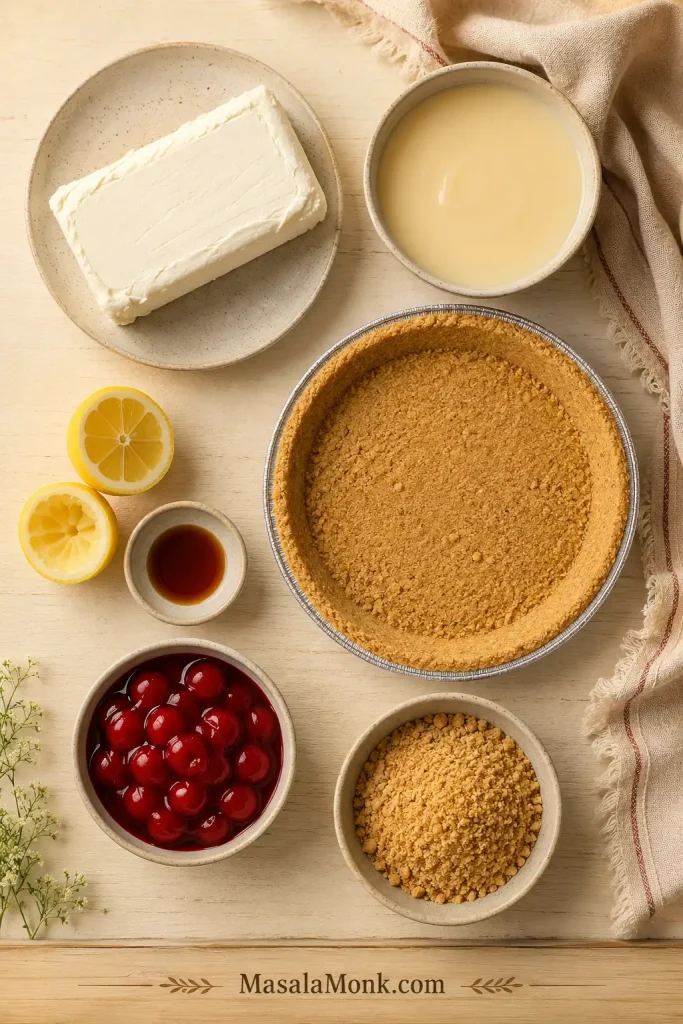
Format Best setting method Best for
8-inch full cake Agar agar or gelatin Birthdays and clean slices
9-inch full cake Agar or gelatin, slightly flatter Larger gatherings
Mini cheesecakes Agar, gelatin, or firmer no-gelatin filling Parties and individual servings
Cups or jars No gelatin/no agar works well Easiest version
Bowls Soft-set no-gelatin filling Make-ahead dessert
Tray of layered mango cheesecake cups with crumb bases, creamy mango filling, and glossy mango topping.
Mango cheesecake cups are ideal for make-ahead serving because each portion has its own biscuit base, creamy filling, and glossy topping.
Several mini mango cheesecakes on a tray, each with a crumb base, creamy filling, and glossy mango topping.
Mini mango cheesecakes give the polish of a full cake in individual portions, which makes them especially useful for parties and dessert tables.

If you want an even softer mango dessert without worrying about clean slices, this quick mango pudding is a simpler spoonable option.

No Bake Mango Cheesecake with Condensed Milk

Condensed milk makes mango cheesecake sweeter, creamier, and richer. Because of that, it works especially well in cups, jars, and shortcut versions. However, if you use condensed milk, reduce the added sugar and keep the lemon or lime juice so the filling does not taste flat.

  • Replace part or all of the sugar with condensed milk.
  • Use 100–150 g condensed milk for a richer filling, then sweeten to taste.
  • Reduce sugar if using sweetened mango pulp.
  • Add lemon or lime juice for balance.
  • Use a setting method if making a full cake.
  • Use cups or jars for the easiest condensed milk version.
Condensed milk adjustment: For the full cake, start with 100–150 g condensed milk and reduce the added sugar to 0–30 g, depending on how sweet your mango pulp is.
Thick condensed milk being poured into mango cheesecake filling with citrus nearby.
Condensed milk adds richness and sweetness, so the filling usually needs less added sugar and a little citrus to stay balanced.

Mango Topping: Jelly, Coulis, or Fresh Mango

The topping can change both the look and texture of the cheesecake. For example, a mango jelly gives a polished top, while a mango coulis gives a softer sauce-like finish. Alternatively, fresh mango pieces give the fastest decoration.

Topping Best for Texture
Mango jelly Clean cake top and neat slices Set, smooth, glossy
Mango coulis Cups, jars, and softer cakes Spoonable and saucy
Fresh mango cubes Quick decoration Fresh and juicy
Mango passionfruit topping Tangier variation Bright, tropical, slightly tart
Graphic comparing three mango topping styles for cheesecake: jelly, coulis, and fresh mango cubes.
The topping changes the final style: mango jelly looks neat and sliceable, coulis feels softer, and fresh mango cubes add the quickest finish.

For a lighter fruit-first dessert, this mango sorbet keeps mango at the center without cream cheese or a biscuit base.

No Bake Mango Cheesecake Variations

These variations keep the same basic structure but adjust the flavor. However, avoid adding large amounts of extra liquid unless you also adjust the setting method. Otherwise, the filling may become too loose to slice.

Graphic showing four no bake mango cheesecake variations labeled passionfruit, lime, coconut, and graham.
Keep variations controlled so the filling does not loosen; passionfruit, lime, coconut, and graham all add flavor without changing the whole recipe.

Mango Passionfruit Cheesecake

For a sharper tropical flavor, add passionfruit to the topping or swirl it through a mango coulis. This is especially good if your mango pulp is very sweet.

Mango Lime or Key Lime Cheesecake

For a brighter version, use lime zest and a little extra lime juice. Keep the extra juice modest so the filling does not become too loose.

Mango Coconut Cheesecake

For a richer tropical variation, add coconut cream, coconut milk powder, or toasted coconut as a topping. Coconut milk powder can also add a little body to cup-style cheesecakes.

Mango White Chocolate Cheesecake

Melted white chocolate can help a no-gelatin cheesecake set more firmly, but it also makes the filling sweeter and heavier. Reduce sugar if you use it.

Melted white chocolate being added to mango cheesecake filling, with a finished mango cheesecake slice in the background.
White chocolate can help a no-gelatin filling firm up, but it also adds sweetness, so reduce the sugar before adjusting anything else.

Mango Graham Cheesecake

Use a graham cracker crust and a mango cream cheese filling for a classic mango graham cheesecake direction. This works especially well in cups or a 9-inch full cake.

Vegan No Bake Mango Cheesecake

A vegan version needs a different base formula, usually with cashews, coconut cream, vegan cream cheese, or another dairy-free structure. Treat it as a separate variation rather than a direct swap. For a naturally softer dairy-free mango dessert, this mango chia pudding is a better fit than trying to force a direct vegan cheesecake swap.

Mistakes to Avoid

  • Do not use watery mango puree. It can make the filling loose and bland.
  • Do not rush the chill time. A full cake needs overnight chilling for clean slices.
  • Do not pour hot topping over the cheesecake layer. It can soften or disturb the filling.
  • Do not add agar directly to cold dairy. Mix it with room-temperature mango puree first.
  • Do not use the no-gelatin cups formula as a full cake. It is meant to be soft and spoonable.
Graphic showing common mango cheesecake mistakes, including watery puree, short chill time, hot topping, agar added to cold dairy, and using a cup formula as a cake.
Avoiding watery puree, short chilling, hot topping, and the wrong setting method prevents most mango cheesecake problems before they happen.

Troubleshooting No Bake Mango Cheesecake

Most no bake mango cheesecake problems come from watery mango, weak setting, under-whipped cream, or not enough chilling time. Therefore, use this table before changing the whole recipe. In many cases, a longer chill or a cup-style serving can save the dessert.

Troubleshooting graphic for mango cheesecake with issues such as runny filling, stringy agar, clumped gelatin, messy slices, and cheesecake that did not set.
When a mango cheesecake does not set, check the puree thickness, agar or gelatin method, and chill time before deciding how to fix or serve it.
Problem Likely cause Fix
Cheesecake did not set Too much mango, weak setter, or not enough chill time Chill overnight, freeze briefly before slicing, or use cups next time.
Filling is runny Watery mango puree or under-whipped cream Reduce puree, whip cream properly, or add a setting method.
Agar turned stringy Agar was not dissolved or hit cold filling Boil fully and mix with room-temperature mango puree first.
Gelatin clumped Gelatin was not bloomed properly Sprinkle over cold water, let it bloom, then dissolve gently.
Topping is runny Too little agar or watery puree Cook down the puree or add the correct amount of setting agent.
Crust crumbles Too little butter or loose pressing Add enough butter and press the base firmly with a flat cup.
Cheesecake is too sweet Sweetened pulp or condensed milk Add lemon or lime and reduce sugar next time.
Mango flavor is weak Bland mango or too little puree Use Alphonso or Kesar pulp, or add a mango coulis layer.
Slices are messy Not chilled enough or no setter Chill overnight and wipe the knife between cuts.
Water on top Condensation Chill uncovered first, then cover loosely once set.

Make Ahead, Storage, and Freezing

No bake mango cheesecake is a make-ahead dessert. In fact, the texture is usually better after a full overnight chill because the filling firms up and the mango flavor settles into the cream cheese base. For best results, keep it cold until shortly before serving. Also, add fresh mango decoration closer to serving so it stays bright.

Storage method Time Notes
Fridge 3–4 days Keep covered after the cheesecake has fully set.
Freezer Up to 1 month Freeze without fresh fruit topping for the cleanest result.
Room temperature 30–45 minutes max Keep chilled as much as possible, especially in warm weather.
Make ahead 1 day ahead is ideal Overnight chilling gives the cleanest slices.
Mango cheesecake in a covered storage container with a plated slice nearby, plus text showing fridge and freezer storage times.
This dessert improves with planning: make it one day ahead, keep it chilled, and store leftovers covered so the layers stay fresh.

No Bake Mango Cheesecake Recipe Card

Because this no bake mango cheesecake recipe includes agar, gelatin, and no-gelatin cup options, read the notes once before starting so you do not mix the wrong setting method into the filling.

Default version: This recipe card uses agar agar for a vegetarian, eggless full cake. Use the gelatin option below if you prefer a classic mousse-like set, or the cup version if you want no gelatin and no agar.
Texture cue: The filling should be thick, smooth, and pourable when it goes into the pan. If it looks loose and watery before chilling, the mango puree may be too thin or the cream may not be whipped enough.
Recipe card graphic for no bake mango cheesecake showing an 8-inch cake formula with cream cheese, mango pulp, cream, agar, and 8 to 12 hours chill time.
This recipe card keeps the core formula easy to scan, while the full post explains when to use agar, gelatin, or no-gelatin cups.

No Bake Mango Cheesecake Recipe

This creamy no bake mango cheesecake recipe has a buttery biscuit base, mango cream cheese filling, and mango topping. The default version uses agar agar for an eggless, vegetarian-friendly full cake, with exact notes for gelatin and no-gelatin cups.

Yield10–12 slices
Pan8-inch / 20 cm
Prep Time45 minutes
Chill Time8–12 hours

Cook Time: 5 minutes
Total Time: 9–13 hours, including chilling
Best for: make-ahead dessert, summer dessert, eggless cheesecake, mango dessert

Equipment

  • 8-inch / 20 cm springform or loose-bottom pan
  • Parchment paper
  • Food processor, mixer-grinder, or rolling pin for crumbs
  • Blender, if using fresh mango
  • Electric hand mixer or stand mixer
  • Saucepan
  • Rubber spatula
  • Offset spatula or flat spoon
  • Fine sieve, optional
  • Digital scale, recommended

Biscuit Base

  • 200 g / 7 oz digestive biscuits, graham crackers, or Marie biscuits, about 2 cups crumbs
  • 80 g / 2.8 oz / about 5½ tbsp unsalted butter, melted
  • 1–2 tbsp sugar, optional
  • ¼ tsp fine salt
  • ¼ tsp cardamom or cinnamon, optional

Mango Cheesecake Filling

  • 450 g / 16 oz full-fat cream cheese, softened
  • 250 ml / 1 cup cold whipping cream or heavy cream
  • 300 g / 10.5 oz / about 1¼ cups mango pulp or thick mango puree, room temperature for agar version
  • 80–100 g powdered sugar or caster sugar, added to taste
  • 1½–2 tbsp / 22–30 ml lemon or lime juice
  • 1 tsp vanilla extract
  • ⅛ tsp fine salt
  • 3 g agar agar powder / about 1½ tsp
  • 100–125 ml / about ⅓–½ cup water, for agar

Mango Jelly Topping

  • 200–250 g / about ¾–1 cup mango pulp
  • 1–2 tbsp sugar, optional
  • 1–2 tsp lemon or lime juice
  • 1 g agar agar powder / about ½ tsp
  • 80–100 ml / about ⅓ cup water

Method

  1. Line the base of an 8-inch / 20 cm springform pan with parchment paper. Line the sides if you want a cleaner finish.
  2. Crush the biscuits into fine crumbs. Mix with melted butter, salt, and optional sugar or spice until the texture looks like wet sand.
  3. Press the crumb mixture firmly into the pan. Chill for 30 minutes.
  4. Blend fresh mango into a smooth puree, or stir canned mango pulp until even. For the agar version, keep the mango puree at room temperature rather than fridge-cold.
  5. Beat softened cream cheese with sugar, lemon or lime juice, vanilla, and salt until completely smooth. Keep the mango puree separate for now.
  6. Whip cold cream to medium-stiff or stiff peaks in a separate bowl.
  7. Simmer agar agar powder with water until fully dissolved, then boil gently for about 60–90 seconds. Let it cool slightly, but do not let it set.
  8. Whisk the warm agar mixture into the room-temperature mango puree first. Then beat this mango-agar mixture into the cream cheese mixture until smooth.
  9. Fold in the whipped cream and pour the filling over the chilled biscuit base right away.
  10. Smooth the top and chill for 60–90 minutes before adding the mango topping.
  11. For the topping, simmer the agar agar powder with water until fully dissolved, then whisk in the mango pulp, sugar, and lemon or lime juice. Simmer briefly until smooth, then cool until lukewarm.
  12. Pour the topping gently over the cheesecake layer.
  13. Chill for 8–12 hours, or overnight, before unmolding and slicing.

Gelatin Option for Full Cake

To make a classic gelatin-set version, replace the agar in the filling with 2¼–2½ tsp / about 7–8 g unflavored powdered gelatin and 60 ml / ¼ cup cold water. First, sprinkle gelatin over the cold water and let it bloom for 5–10 minutes. After that, dissolve it gently, then mix it into the mango puree before adding it to the cream cheese mixture. Do not boil gelatin hard.

For the mango topping, use ¾ tsp / about 2–2.5 g gelatin bloomed in 30 ml / 2 tbsp cold water instead of agar. Then, stir the dissolved gelatin into the warm mango topping, cool until lukewarm, and pour gently over the cheesecake layer.

No-Gelatin Mango Cheesecake Cups

To make 6–8 no-gelatin mango cheesecake cups, use 150 g biscuit crumbs, 60 g melted butter, 300 g full-fat cream cheese, 200 ml cold whipping cream, 200–225 g thick mango pulp, 50–70 g powdered sugar or 100–120 g condensed milk, 1 tbsp lemon or lime juice, 1 tsp vanilla, and a pinch of salt.

Press the biscuit base into cups or jars. Beat cream cheese with mango, sugar or condensed milk, lemon or lime, vanilla, and salt. Fold in whipped cream, spoon into cups, and chill for at least 6 hours, preferably overnight. This version is soft and creamy, not designed for clean full-cake slices.

Serve these directly from the cups with mango coulis, fresh mango cubes, or crushed biscuit crumbs on top.

Do not use this no-gelatin cups formula as a full cake unless you are comfortable with a soft, mousse-like texture that may not slice neatly.

Condensed Milk Adjustment

For a condensed milk full-cake version, start with 100–150 g condensed milk and reduce the added sugar to 0–30 g, depending on how sweet your mango pulp is. Keep the lemon or lime juice so the filling stays balanced.

Agar Note

Agar strength can vary by brand, so weight is more reliable than spoon measure. Start with 3 g for this 8-inch cake. If your agar is very strong or you prefer a softer texture, use the lower end next time.

Pan Notes

This recipe is best in an 8-inch / 20 cm pan. A 9-inch pan will work, but the cheesecake will be slightly flatter. For a taller 9-inch cheesecake, increase the filling and base by about 25%.

Slicing Note

For clean slices, chill overnight, loosen the sides gently, use a warm sharp knife, and wipe the blade between cuts.

Storage

Refrigerate for 3–4 days. Freeze for up to 1 month without fresh fruit topping. Keep chilled until serving.

FAQs About No Bake Mango Cheesecake

How do you make this no bake mango cheesecake recipe without gelatin?

The safest way is to make it in cups or jars. A full no-gelatin cake can be softer and may not slice as cleanly unless the filling is very thick or supported with another ingredient such as white chocolate.

Is agar agar a good substitute for gelatin in mango cheesecake?

Agar agar works well as a vegetarian setting option, but it behaves differently from gelatin. It must be boiled to activate, sets faster, and can become too firm if you use too much.

Why did my mango cheesecake not set?

The most common reasons are watery mango puree, too much mango, weak setting agent, under-whipped cream, or not enough chilling time. Before changing the recipe, chill it overnight and check the texture again.

What kind of mango pulp works best?

Canned Alphonso or Kesar mango pulp is one of the easiest options because it gives consistent sweetness, color, and mango flavor. However, if the pulp is already sweetened, reduce the sugar in the filling.

Fresh mango or canned mango pulp: which is better?

Both work. Fresh mango gives the best seasonal flavor when the fruit is ripe, sweet, and non-fibrous. Meanwhile, canned mango pulp gives more consistent color and sweetness throughout the year.

How does condensed milk change the filling?

Condensed milk makes the cheesecake sweeter, creamier, and richer. Therefore, reduce the added sugar and keep the lemon or lime juice so the filling stays balanced instead of flat.

How long should mango cheesecake chill?

A full cake should chill for 8–12 hours, or overnight, for the cleanest slices. Cups and jars usually need at least 6 hours, although overnight is still better for texture.

Does mango cheesecake freeze well?

It freezes best without fresh fruit topping. For the cleanest texture, freeze the whole cake or slices tightly wrapped, then thaw in the fridge before serving.

When should I make mango cheesecake cups instead of a full cake?

Cups are the better choice when you want a no-gelatin dessert, a softer texture, or easier party servings. They are also more forgiving because the filling does not need to unmold or slice cleanly.

Which biscuits are best for the crust?

Digestive biscuits, graham crackers, and Marie biscuits all work. Choose digestive biscuits for a sturdier base, graham crackers for a classic cheesecake flavor, or Marie biscuits for a lighter base.

Is this no bake mango cheesecake recipe eggless?

It is eggless because it is no bake and does not rely on eggs for structure. In addition, the default agar agar version is vegetarian-friendly.

Can I use paneer instead of cream cheese?

Paneer can work only if it is blended very smooth with a little cream, yogurt, or milk, but the flavor will be less tangy than cream cheese. For the most reliable cheesecake texture, full-fat cream cheese is still the better choice.

What happens if I skip cream cheese?

You can make mango mousse cups or mango dessert cups without cream cheese, but the result will not taste like classic cheesecake. For proper cheesecake flavor and structure, cream cheese is the best choice.

Why is my cheesecake too soft?

The filling may have too much mango, watery puree, under-whipped cream, or too little setting support. First, chill it longer. If it still does not slice cleanly, serve it as cups instead.

How do I get clean slices?

Chill the cheesecake overnight, use a warm sharp knife, and wipe the blade between cuts. Also, remember that agar agar or gelatin will give cleaner slices than a no-setter filling.

How far ahead should I make it for a party?

Make it one day ahead and keep it refrigerated. Finally, add fresh mango decoration closer to serving so the fruit stays bright and fresh.

Posted on 7 Comments

No Bake Cheesecake Recipe: Easy, Creamy, and Set Perfectly Without an Oven

Finished no-bake cheesecake with one slice removed, creamy white filling, golden crumb crust, berries, and lemon zest

A good no bake cheesecake recipe should be creamy, simple, and reliable. It should set properly in the refrigerator, slice cleanly, and taste like real cheesecake instead of sweet cream cheese in a crust.

This version uses a buttery graham cracker or digestive biscuit crust, a smooth cream cheese filling, cold whipped cream for lift, and enough chill time for clean slices. Because the filling is not baked, the recipe depends on the right dairy, the right mixing method, and patience in the refrigerator.

More importantly, this guide shows you how to control the details that usually make or break a no bake cheesecake: which cream cheese to use, how stiff to whip the cream, how long to chill it, when gelatin helps, and what to do if the filling feels too soft.

Why this version works: This no bake cheesecake sets without gelatin, works with graham crackers or digestive biscuits, slices cleanly after an overnight chill, and includes optional fixes for hot weather, condensed milk shortcuts, fruit toppings, and softer cream cheese.

Table of Contents

Use this guide to make the cheesecake first, then troubleshoot, choose toppings, try variations, store it, and serve it confidently.

Quick Answer: How Do You Make No Bake Cheesecake?

No bake cheesecake is made by pressing a graham cracker or digestive biscuit crust into a springform pan, spreading in a cream cheese and whipped cream filling, and chilling it until firm. Since there is no oven involved, this cheesecake recipe depends on full-fat cream cheese, cream whipped to stiff peaks, gentle folding, and at least 6 to 8 hours in the refrigerator.

Think of it this way: the crust chills, the filling firms in the refrigerator, and the oven stays off completely.

In other words, no bake cheesecake does not set like baked cheesecake. It does not use eggs or oven heat. Instead, it sets through the firmness of cream cheese, the structure of whipped cream, and enough time in the refrigerator.

No Bake Cheesecake at a Glance

Before you start, check the pan size, cream type, and chill time. Since this cheesecake sets without baking, these details decide how cleanly it slices.

Detail Best Choice
Pan 9-inch / 23cm springform pan
Crust Graham cracker crust or digestive biscuit crust
Cream cheese Full-fat block-style cream cheese if available
Cream Cold heavy cream or whipping cream that can whip to stiff peaks
Chill time 6 to 8 hours minimum
Best texture Overnight / about 12 hours
Gelatin Optional, not required for the main recipe
Oven Not needed
Eggs Not used
Quick-reference board for no-bake cheesecake with pan size, chill time, no oven, no eggs, and optional gelatin notes
Before mixing, check the pan and chill time; as a result, you will know whether you are making a sliceable cheesecake or a softer cup-style dessert.

Why This No Bake Cheesecake Recipe Works

Because this cheesecake recipe skips baking, each part has a job. The cream cheese gives the filling body, the whipped cream makes it lighter, and the long chill helps everything firm into a sliceable cheesecake.

The crust is also designed to hold. Since the crust chills instead of baking, fine crumbs, melted butter, and brown sugar create a compact base that firms in the refrigerator. As a result, the cheesecake slices cleanly instead of crumbling apart as soon as you lift a piece.

Finally, the recipe keeps the flavor classic. Sour cream or thick Greek yogurt adds tang, lemon juice brightens the filling, vanilla rounds it out, and a small pinch of salt keeps the sweetness from feeling flat.

Best result: Make this cheesecake the day before serving. It may slice after 6 to 8 hours, but the cleanest texture usually comes after an overnight chill.
Texture target: The finished cheesecake should be creamy, cold-set, and sliceable, not rubbery or runny. The slice should hold its shape but still feel soft when you cut through it.
Close-up slice of no-bake cheesecake showing smooth filling, golden crust, berries, lemon zest, and a fork
Use the side of the slice as your texture check; the filling should look smooth and cold-set, while the crust should stay compact underneath.

Ingredients for No Bake Cheesecake

The ingredients matter more in this cheesecake recipe because there is no oven heat to set a loose filling. Therefore, the cream cheese, cream, and crust crumbs need to be chosen carefully.

You can make the crust with graham crackers or digestive biscuits. Graham crackers give a classic American cheesecake flavor, while digestive biscuits are a practical substitute in many places where graham crackers are harder to find.

Ingredients for no-bake cheesecake including cream cheese, whipping cream, powdered sugar, lemon, vanilla, butter, graham crackers, and digestive biscuits
Because this filling is not baked, the ingredient texture matters: thick cream cheese, cold cream, and powdered sugar give the cheesecake a smoother set.

For the Crust

Graham Cracker Crust

  • 2 cups / 240g graham cracker crumbs
  • 1/3 cup / 67g brown sugar
  • 1/2 cup / 113g unsalted butter, melted
  • Pinch of salt, optional

Digestive Biscuit Crust

  • 270g digestive biscuit crumbs
  • 40 to 70g brown sugar, depending on biscuit sweetness
  • 1/2 cup / 113g unsalted butter, melted
  • Pinch of salt, optional

For the Filling

  • 1 1/4 cups / 300ml cold heavy cream or whipping cream
  • 24 oz / 678g full-fat cream cheese, softened
  • 3/4 to 1 cup / 90–120g powdered sugar or icing sugar, to taste
  • 1/4 cup / 60g sour cream or thick Greek yogurt
  • 2 teaspoons fresh lemon juice
  • 1 teaspoon vanilla extract
  • Pinch of salt, optional

Graham Cracker Crust or Digestive Biscuit Crust?

Use graham crackers if you want the classic cheesecake crust flavor. However, digestive biscuits work well when they are easier to find. Both can hold the filling as long as the crumbs are fine, the butter is evenly mixed, and the crust is chilled before filling.

Because digestive biscuits vary more in sweetness and texture, adjust the sugar slightly. If your biscuits are already quite sweet, use the lower amount of brown sugar.

Graham cracker crumbs and digestive biscuit crumbs compared for a no-bake cheesecake crust
Graham crackers give the familiar American-style crust; however, digestive biscuits can create the same firm base when the crumbs are fine and evenly buttered.

If you like chilled desserts with a biscuit base, you may also like this Banoffee Pie Recipe, which uses a similar no bake base-and-chill idea with bananas, caramel, and whipped cream.

How the Crust Mixture Should Feel

Before pressing the crust into the pan, squeeze a small handful of the crumb mixture. It should feel like damp sand and hold together when pinched.

Crust Texture What It Means Fix
Too dry Crumbs scatter and will not hold when squeezed. Add 1 tablespoon melted butter at a time, then test again.
Just right Mixture feels like damp sand and holds together when pinched. Press firmly into the pan and chill before filling.
Too wet Mixture feels greasy, heavy, or paste-like. Add more crumbs until the texture loosens and no butter pools.
Three cheesecake crust mixtures showing too dry, just right, and too wet crumb textures
The crumb mixture should clump like damp sand; if it scatters, add butter, but if it looks greasy, balance it with more crumbs.

Important Ingredient Notes

  • Cream cheese: Full-fat block-style cream cheese is best because it firms well when chilled. Spreadable cream cheese can be softer and may make the filling looser.
  • Cream: Use cold cream that can whip to stiff peaks. Otherwise, the filling has no eggs or oven heat to help it set later.
  • Sugar: Powdered sugar or icing sugar dissolves smoothly and helps the filling stay creamy. Use 90g for a lighter, tangier cheesecake or 120g for a sweeter dessert-style cheesecake.
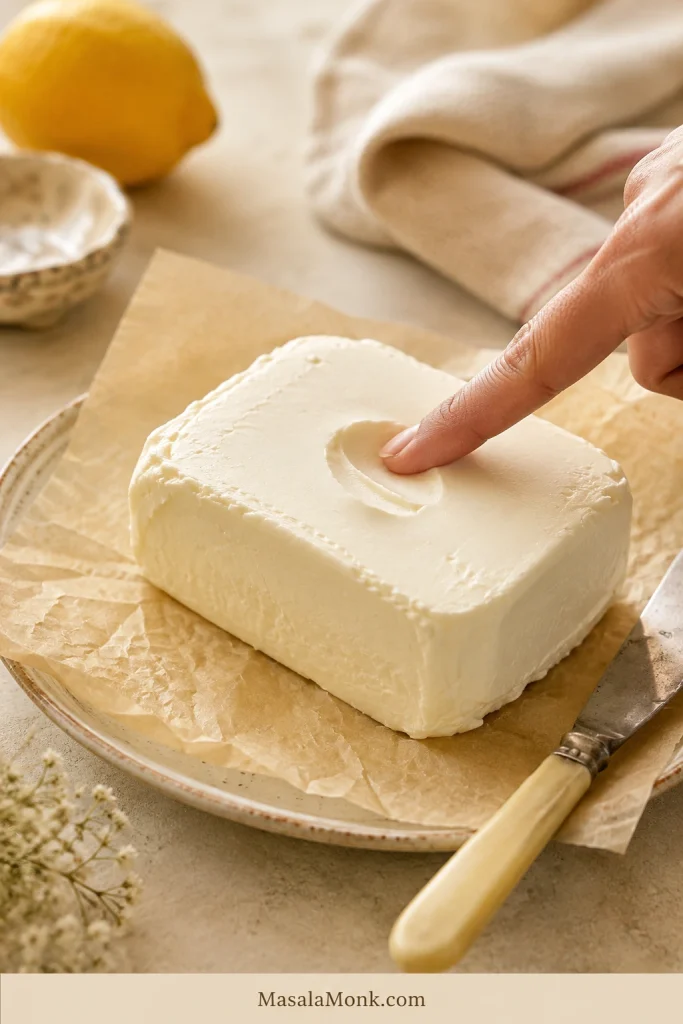
  • Sour cream or Greek yogurt: Use thick, full-fat versions. Thin yogurt can loosen the filling.
  • Lemon juice: This is for brightness and balance, not a strong lemon flavor.
Ingredient note for non-US kitchens: If block-style cream cheese is not available, use the thickest full-fat cream cheese you can find and avoid very soft spreadable versions when possible. If your cream cheese is loose, chill the filling longer or use the optional gelatin method for extra stability. Use whipping cream that can hold stiff peaks; low-fat fresh cream or table cream may not set the cheesecake properly. If using yogurt, choose thick Greek yogurt or hung curd, not thin regular curd.
Cream cheese comparison showing thick full-fat cream cheese, softer spreadable cream cheese, and loose cream cheese
Choose the thickest full-fat cream cheese you can find, since softer tubs can make a no-bake cheesecake filling harder to firm up.

Equipment You Need

You do not need complicated equipment for this cheesecake recipe. However, a springform pan and mixer make the texture much easier to control because the filling sets in the refrigerator rather than the oven.

  • 9-inch / 23cm springform pan
  • Electric hand mixer or stand mixer
  • Mixing bowls
  • Spatula
  • Food processor or rolling pin for crushing crumbs
  • Flat-bottom measuring cup or glass for pressing the crust
  • Offset spatula or back of a spoon for smoothing the filling
  • Sharp knife for slicing

A springform pan makes the cleanest cheesecake because the sides release easily. If you do not have one, you can use a deep pie dish, but the slices will be harder to remove neatly.

How to Make No Bake Cheesecake

The method is simple: make the crust, whip the cream, beat the cream cheese, fold, fill, and chill. Since this cheesecake sets in the refrigerator, the final texture depends on proper mixing and enough cold time.

Step-by-step guide showing crust, whipped cream, cream cheese, folding, filling, chilling, and slicing
The sequence matters: prepare the crust first, build the filling gently, and then let the refrigerator do the setting work.

Step 1: Make the Crust

First, crush the graham crackers or digestive biscuits into fine crumbs. Then mix the crumbs with brown sugar, salt if using, and melted butter until the mixture looks like damp sand.

Next, tip the mixture into a 9-inch springform pan. Press it firmly into the base and slightly up the sides. A flat-bottom measuring cup helps you compact the crust evenly without using too much pressure.

After that, refrigerate or freeze the crust while you make the filling. This helps the butter firm up and gives the base a better hold.

Step 2: Whip the Cream

Add the cold heavy cream or whipping cream to a chilled mixing bowl. Then beat until stiff peaks form. The cream should hold its shape when you lift the beaters.

Do not stop at soft peaks. Since the filling is not baked, stiff whipped cream is one of the main things that helps it hold its shape.

Mixer beaters lifting whipped cream into stiff peaks in a bowl
Stiff peaks should stand tall on the beaters; otherwise, the whipped cream will add lightness but not enough structure.

Step 3: Beat the Cream Cheese

Meanwhile, beat the softened cream cheese in a separate bowl until smooth and creamy. Add the powdered sugar, sour cream or Greek yogurt, lemon juice, vanilla, and salt. Then beat until smooth.
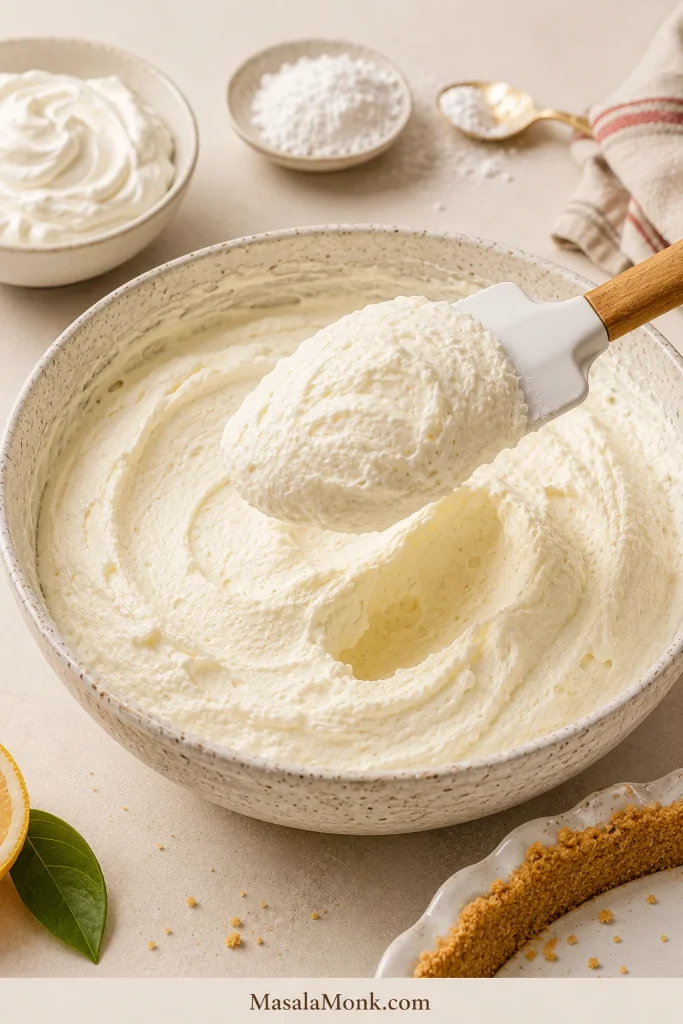
If the cream cheese is too cold, the filling may become lumpy. If it is too warm, the filling can become loose. Therefore, softened but still cool cream cheese is ideal.

Cream cheese mixture being beaten smooth with powdered sugar, lemon, vanilla, and dairy ingredients nearby
Beat the cream cheese base until it is smooth first; once whipped cream is folded in, small lumps are much harder to remove.

Step 4: Fold the Filling

Add the whipped cream to the cream cheese mixture in two additions. Then fold gently with a spatula until no large streaks remain.

Avoid beating aggressively at this stage. Instead, keep the air in the whipped cream because that air helps the cheesecake feel light while still setting properly.

Thick cheesecake filling being folded with a spatula in a glass mixing bowl
Fold slowly instead of beating hard, so the filling keeps its air while the cream cheese still gives it enough body.

Step 5: Fill the Crust

Spoon the filling into the chilled crust. Next, smooth the top with an offset spatula or the back of a spoon. Tap the pan very gently on the counter once or twice to remove large air pockets, but do not overdo it.

Thick cheesecake filling spread into a golden crumb crust in a springform pan with an offset spatula
When the filling goes into the crust, it should mound and spread rather than pour; that thickness is a good sign before chilling.

Step 6: Chill Until Set

Cover the cheesecake loosely and refrigerate for at least 6 to 8 hours. The filling needs a long chill because it sets without eggs or oven heat. For the cleanest slices, chill it overnight.

Also, do not rely on the freezer as the only setting method. Freezing can make the cheesecake firm temporarily, but the best texture comes from a proper refrigerator chill.

Step 7: Slice and Serve

Once chilled, run a thin knife around the edge of the cheesecake before releasing the springform ring. For clean slices, dip a sharp knife in hot water, wipe it dry, cut one slice, and then wipe the knife again before the next cut.

Finally, serve the cheesecake cold. It can sit out briefly while serving, but it should not be left at room temperature for long, especially in warm weather.

Final serving scene with a full no-bake cheesecake, a plated slice, berries, lemon zest, and a fork
Once the cheesecake has fully chilled, serve it cold so the filling stays creamy, the crust holds neatly, and each slice looks polished.

No Bake Cheesecake Recipe

This creamy no bake cheesecake recipe uses a graham cracker or digestive biscuit crust, full-fat cream cheese, whipped cream, and a 6 to 8 hour refrigerator chill, preferably overnight, for clean, sliceable pieces without an oven or eggs.

Yield10–12 slices
Prep Time30 minutes
Cook Time0 minutes
Chill Time6–8 hours
Total Time6 hours 30 minutes to overnight
Pan9-inch / 23cm springform
Best TextureOvernight chill
MethodNo oven, no eggs

Ingredients

For a Graham Cracker Crust

  • 2 cups / 240g graham cracker crumbs
  • 1/3 cup / 67g brown sugar
  • 1/2 cup / 113g unsalted butter, melted
  • Pinch of salt, optional

Or, for a Digestive Biscuit Crust

  • 270g digestive biscuit crumbs
  • 40 to 70g brown sugar, depending on sweetness
  • 1/2 cup / 113g unsalted butter, melted
  • Pinch of salt, optional

For the Filling

  • 1 1/4 cups / 300ml cold heavy cream or whipping cream
  • 24 oz / 678g full-fat cream cheese, softened
  • 3/4 to 1 cup / 90–120g powdered sugar or icing sugar, to taste
  • 1/4 cup / 60g sour cream or thick Greek yogurt
  • 2 teaspoons fresh lemon juice
  • 1 teaspoon vanilla extract
  • Pinch of salt, optional

Instructions

  1. Make the crust. Mix the crumbs, brown sugar, melted butter, and salt until evenly moistened.
  2. Press into the pan. Press the mixture firmly into the base of a 9-inch springform pan and slightly up the sides. Then chill or freeze while you make the filling.
  3. Whip the cream. Beat the cold cream until stiff peaks form. Set aside.
  4. Beat the cream cheese. In another bowl, beat softened cream cheese until smooth. Add powdered sugar, sour cream or Greek yogurt, lemon juice, vanilla, and salt. Beat until creamy.
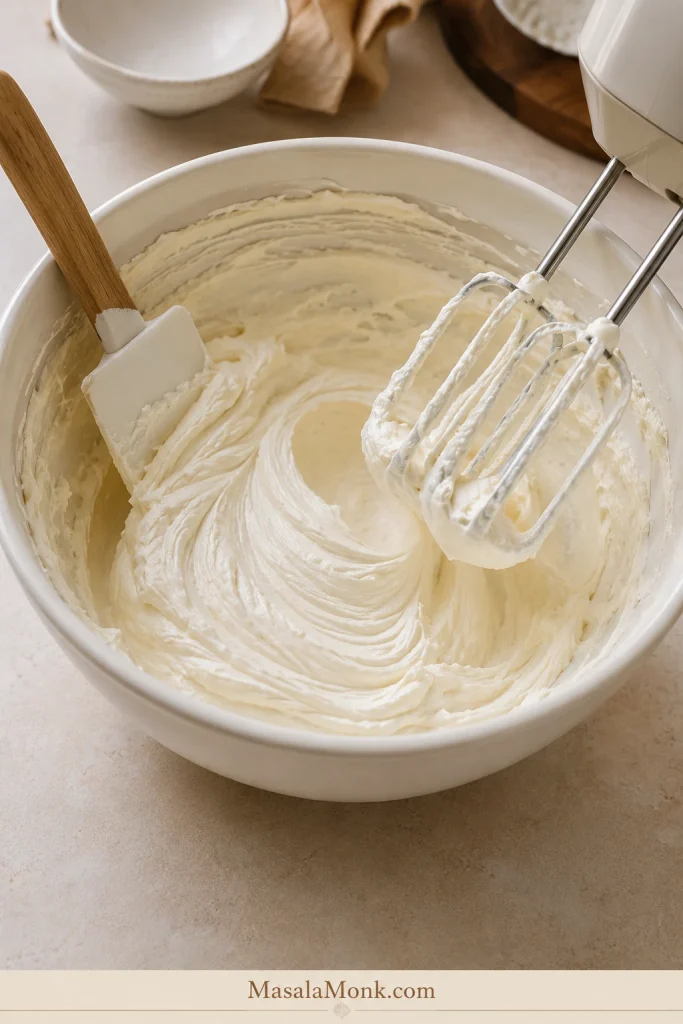
  5. Fold gently. Fold the whipped cream into the cream cheese mixture in two additions. Stop once combined.
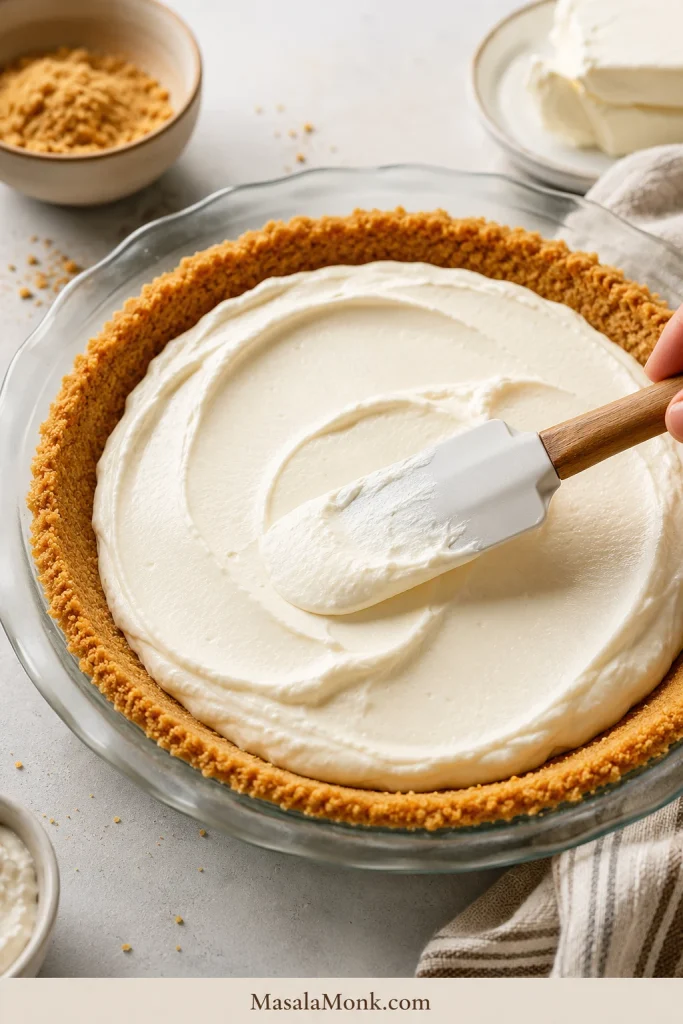
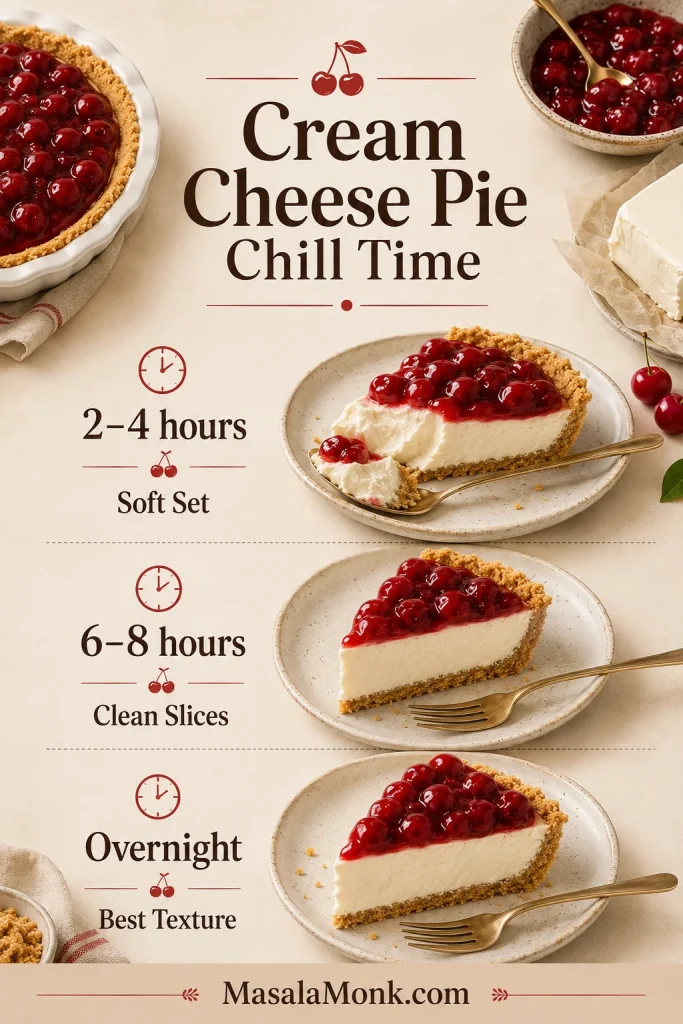
  6. Fill the crust. Spoon the filling into the chilled crust and smooth the top.
  7. Chill. Cover and refrigerate for at least 6 to 8 hours, preferably overnight.
  8. Slice. Release the springform ring, then slice with a hot, wiped knife for clean pieces.

Notes

  • Use full-fat cream cheese for the best set.
  • Use 90g powdered sugar for a lighter, tangier cheesecake or 120g for a sweeter dessert-style cheesecake.
  • Do not use low-fat cream or cream that cannot whip to stiff peaks.
  • For best results, chill the cheesecake overnight because the filling needs time to firm without baking.
  • For a firmer party cheesecake, see the gelatin option below.
  • For cheesecake cups or jars, the same filling can be chilled for a shorter time because it does not need to slice cleanly.

Saveable no-bake cheesecake recipe card with yield, prep time, chill time, ingredients, and method steps
Use the recipe card for the quick method, then rely on the texture cues for the crust, filling, and chill time as you work.

What Makes No Bake Cheesecake Set?

A cheesecake recipe without baking sets through chilled dairy and structure, not through eggs or oven heat. Since there are no eggs and no oven heat to firm the filling, you need the right ingredients and enough chill time.

For another tested baking reference, King Arthur Baking’s no bake cheesecake also uses cream cheese, sour cream, cold heavy cream, and confectioners’ sugar for a creamy refrigerator-set filling.

Use Full-Fat Cream Cheese

Cream cheese is the backbone of the filling. Full-fat cream cheese firms in the refrigerator and gives the cheesecake its body. Spreadable or tub-style cream cheese may work in some cases, but it is often softer and can make the filling less stable.

Whip Cold Cream to Stiff Peaks

Cold cream whips better and holds more structure. Stiff peaks mean the cream stands up when you lift the beaters. If the cream is only softly whipped, the cheesecake may taste good but slice poorly.

Fold Gently

Once the cream is whipped, fold it into the cream cheese mixture with a spatula. Beating too hard can knock out the air and make the filling heavier or looser.

Chill Long Enough

The refrigerator does the final work. First, the crust firms. Then the cream cheese tightens. Finally, the filling becomes sliceable. A short chill may work for cups or jars, but a full cheesecake needs more time.

Freezing Is Not the Same as Setting

The freezer can make a soft cheesecake feel firm quickly, but that firmness is temporary. Once the cheesecake thaws, a poorly set filling may soften again. For the best texture, chill the cheesecake properly in the refrigerator and use the freezer only for storage or brief firming before serving.

Setting guide showing cream cheese, stiff whipped cream, long chill time, and a clean no-bake cheesecake slice
No-bake cheesecake sets through thickness, trapped air, and cold time; therefore, cream cheese, whipped cream, and chilling all have to work together.

How Long Does No Bake Cheesecake Need to Chill?

For this cheesecake recipe, skipping the oven does not mean skipping the wait. The filling still needs at least 6 to 8 hours in the refrigerator, and overnight is better if you want neat slices for serving.

Chill Time Result
2–3 hours Usually too soft for clean slices
4 hours May work for cups or jars, but often soft for a full cheesecake
6–8 hours Sliceable for most cheesecakes
Overnight / about 12 hours Best clean slices and firmest creamy texture
Freezer only Temporary firmness, not a substitute for proper setting
No-bake cheesecake chill time guide showing soft, cup-ready, sliceable, and overnight stages
A short chill is fine for jars, while a full cheesecake needs more time because the whole filling must firm from edge to center.

How to Cut Clean Slices

For clean slices, chill the cheesecake overnight and serve it cold. Then run a thin knife around the edge before releasing the springform ring.

Next, dip a sharp knife in hot water, wipe it dry, and cut one slice at a time. Wipe the knife between slices. This small step makes a big difference, especially with a creamy no bake cheesecake filling.

Clean slice of no-bake cheesecake being cut with a knife, showing smooth filling, berries, and crumb crust
After the cheesecake is fully cold, a warm wiped knife helps each piece release neatly instead of dragging cream through the cut.

No Bake Cheesecake Filling

If you only need the filling from this cheesecake recipe, no bake cups, jars, parfaits, pie crusts, cake layers, cupcakes, and simple chilled desserts are all good options. However, the texture you need depends on how you plan to serve it.

Cheesecake filling used in cups, jars, cake layers, cupcakes, pie crust, and parfaits
The same no-bake cheesecake filling can become jars, cupcakes, parfaits, or cake layers; however, each use needs a slightly different firmness.

For a Whole Cheesecake

Use the recipe as written. A whole cheesecake needs enough structure to slice, so do not reduce the cream cheese or shorten the chill time too much.

For Cheesecake Cups or Jars

The same filling works well in small cups or jars. Because you are not slicing it, the chill time can be shorter. Plan on at least 2 to 4 hours, depending on the size of the cups.

For Cake Filling or Piping

For cake layers or piping, the filling should be thicker. Therefore, use full-fat cream cheese, whip the cream to stiff peaks, reduce loose ingredients like sour cream or yogurt slightly, and chill the filling before using it. Powdered sugar also helps the filling feel smoother.

How to Make Cheesecake Filling Thicker

  • Use full-fat cream cheese.
  • Whip the cream separately to stiff peaks.
  • Chill the filling before piping or spreading.
  • Avoid watery fruit puree in the filling.
  • Reduce sour cream or yogurt slightly if needed.
  • Use the gelatin option if you need extra stability.
Cheesecake filling texture guide showing loose, thicker, and pipeable stages with fixing tips
For piping or layer cakes, aim for the pipeable stage rather than the spoonable stage, and chill the filling before using it.

Best Toppings for No Bake Cheesecake

The safest way to flavor a no bake cheesecake is to keep the filling stable and add most of the fruit, compote, curd, or sauce on top. That way, the cheesecake still slices cleanly, while the topping adds color, freshness, and extra flavor.

Topping guide with strawberry, blueberry, mango, lemon curd, ganache, and salted caramel for no-bake cheesecake
Toppings are the safest place to add bold flavor, because fruit, curd, ganache, and caramel can sit on top without loosening the filling.

If using a cooked fruit topping, cool it completely before spooning it over the cheesecake. Warm topping can soften the filling and make the surface loose.

Cooked berry topping cooling beside a no-bake cheesecake before being spooned on top
Let cooked fruit topping cool completely first; otherwise, even a well-set cheesecake can soften where the warm sauce touches it.
Topping Best Use
Strawberry topping Best classic fruit topping; use thick cooked sauce or fresh berries added close to serving.
Blueberry topping Works well as a cooked compote because it stays glossy and spoonable without making the filling loose.
Mango topping Use thick mango puree, mango compote, or diced mango. Avoid thin puree unless it is reduced or stabilized.
Lemon curd Best for a sharper lemon cheesecake flavor without adding too much juice to the filling.
Chocolate ganache Best when you want a richer dessert-style cheesecake. Let the ganache cool slightly before spreading.
Caramel sauce Use lightly because the cheesecake is already sweet. Salted caramel usually balances better.

No Bake Cheesecake Variations

Once the classic version makes sense, the variations become much easier. You can keep the same basic cheesecake and adjust it for fewer ingredients, a sweeter shortcut, a firmer slice, or a brighter lemon flavor.

Four no-bake cheesecake variations showing classic, 3-ingredient, condensed milk, and lemon versions
Start with the classic version to learn the texture, then use the variations when you want a shortcut, a sweeter filling, or brighter lemon flavor.

3 Ingredient No Bake Cheesecake

A 3 ingredient cheesecake recipe can also be no bake, but it usually trades some flavor balance and slice quality for speed. Most versions use cream cheese, sweetened condensed milk, and either whipped cream or lemon juice.

Use this shortcut when speed matters more than perfect texture. However, use the main recipe when you want a more balanced cheesecake flavor, a lighter filling, and cleaner slices.

Simple 3 ingredient formula:

  • 16 oz / 450g cream cheese, softened
  • 14 oz / 397g sweetened condensed milk
  • 3/4 cup / 180ml cold heavy cream, whipped to stiff peaks
Three-ingredient no-bake cheesecake guide showing cream cheese, condensed milk, whipped cream, and a finished jar dessert
A 3-ingredient no-bake cheesecake is useful when speed matters; however, it is usually sweeter and softer than the full classic recipe.

Optional additions like vanilla or lemon juice make the flavor better, even if they technically take it beyond three ingredients.

No Bake Cheesecake with Condensed Milk

Condensed milk makes no bake cheesecake sweeter, creamier, and easier to mix. It is a useful shortcut, but it gives a different texture from the classic whipped cream version.

If you want to compare a classic condensed milk method, Martha Stewart’s no bake cheesecake uses cream cheese, sweetened condensed milk, vanilla, and lemon in a press-in graham cracker crust.

For a condensed milk version, use:

  • 16 oz / 450g cream cheese, softened
  • 14 oz / 397g sweetened condensed milk
  • 2 to 4 tablespoons fresh lemon juice
  • 1 teaspoon vanilla extract
  • Prepared crust of choice
Condensed milk being poured into cream cheese mixture for no-bake cheesecake with lemon and vanilla nearby
Condensed milk creates a creamy shortcut filling, but lemon and proper chilling are still important to balance sweetness and improve the set.

Lemon juice is not only for flavor here. It balances the sweetness and helps the filling thicken. For cleaner slices, chill a condensed milk cheesecake overnight.

Gelatin vs No Gelatin in No Bake Cheesecake

This main recipe does not require gelatin. A no-gelatin cheesecake is creamy, simple, and easier for most home cooks. However, optional gelatin can help if you want very firm slices, need the cheesecake to sit out a little longer, or are serving it in warm weather.

Still, gelatin should be optional, not the default, because the main recipe is designed to set cleanly with full-fat cream cheese, stiff whipped cream, and enough refrigerator time.

As written, the main recipe is eggless and gelatin-free. If you add gelatin, it will no longer be suitable for readers avoiding animal-derived gelatin unless you use a tested vegetarian setting method. Agar-agar behaves differently from gelatin, so do not swap it 1:1 without following a tested agar method.

Optional gelatin method:

  • Use 2 teaspoons unflavored gelatin.
  • Sprinkle it over 2 tablespoons cold water.
  • Let it bloom for 5 minutes.
  • Warm gently until dissolved.
  • Let it cool slightly, then mix it into the cream cheese base before folding in the whipped cream.

Do not add hot gelatin to cold filling, and do not sprinkle dry gelatin directly into the cheesecake mixture. Both can cause clumps.

Two no-bake cheesecake slices compared side by side with labels for no gelatin, optional gelatin, chill time, and firmness
The main no-gelatin cheesecake stays creamy after a long chill, while optional gelatin is better when you need extra hold for heat or travel.

No Bake Lemon Cheesecake Variation

For a lemon no bake cheesecake, add the zest of 1 to 2 lemons and increase the lemon juice to 2 to 3 tablespoons. If the filling feels loose, reduce the sour cream or Greek yogurt slightly.

For stronger lemon flavor without weakening the filling, use lemon curd as a topping. Too much lemon juice inside the filling can make the cheesecake softer, so zest and topping are safer ways to build flavor.

No-bake lemon cheesecake slice with glossy lemon topping, lemon zest, mint, and golden crumb crust
Lemon curd gives stronger citrus flavor than extra lemon juice, so the cheesecake tastes brighter without making the filling too loose.
Fruit tip: For the safest set, add fruit as a topping after the cheesecake has chilled. Watery fruit puree mixed directly into the filling can make a no bake cheesecake soft unless the puree is reduced, thickened, or stabilized.

For a thicker cooked fruit topping idea, see this Apple Pie Filling Recipe. The same principle applies here: thick fruit works better than watery fruit.

More Easy Variations

Variation Best Approach
Berry no bake cheesecake Add berry topping after chilling instead of mixing watery puree into the filling. For a fruit cheesecake example, see this No-Bake Blueberry Cheesecake.
Mango no bake cheesecake Use a thick mango topping or swirl. Avoid thin puree unless it is reduced or stabilized.
Chocolate no bake cheesecake Fold in cooled melted chocolate or use a chocolate cookie crust.
Cheesecake cups Spoon crust and filling into cups or jars, then chill until set.
Cheesecake bars Use a square pan, line it with parchment, and chill overnight before slicing.
Mini no bake cheesecakes Use a muffin tin with liners and chill until firm.

For another easy no-oven dessert with a soft, chilled set, try this No-Bake Banana Pudding.

Why Your No Bake Cheesecake Didn’t Set

The Most Common Setting Problems

If your no bake cheesecake did not set, the problem is usually one of four things: soft cream cheese, under-whipped cream, too much liquid, or not enough chill time. Fortunately, most issues are easy to understand and prevent next time.

If the filling feels loose, remember that there is no baking step to firm extra liquid later. Therefore, ingredient thickness, whipped cream structure, and enough chilling matter more than they would in a baked dessert.

Troubleshooting board showing soft cream cheese, under-whipped cream, too much liquid, and not enough chill time
When a no-bake cheesecake will not set, check the structure points first: cream cheese thickness, whipped cream peaks, liquid level, and chill time.

Quick Fixes for Texture, Crust, and Slicing Issues

Problem Likely Reason What to Do
Filling is runny Cream was not whipped to stiff peaks, or too much liquid was added. Chill longer. Next time, whip the cream separately and avoid loose yogurt or watery fruit puree.
Cheesecake is soft after chilling It did not chill long enough. Refrigerate overnight. No bake cheesecake needs time to firm properly.
Filling is lumpy Cream cheese was too cold. Use softened cream cheese and beat it smooth before adding the other ingredients.
Slice collapses Cheesecake is under-set or too warm. Chill longer and serve cold. Also, use a hot, wiped knife for cutting.
Crust falls apart Crumbs were too coarse or not packed firmly enough. Use fine crumbs and press the crust firmly with a flat-bottom cup.
Crust is greasy Too much butter for the crumb type. Add more crumbs next time or reduce the butter slightly if using very buttery biscuits.
Filling tastes too sweet Condensed milk, sweet toppings, or too much sugar. Add lemon, salt, or use the classic recipe instead of a condensed milk version.
Fruit made the filling loose Watery puree was mixed directly into the filling. Use fruit as a topping or reduce puree before adding it.
Too soft in hot weather No stabilizer and a warm serving environment. Use the optional gelatin method and keep the cheesecake cold until serving.
Troubleshooting guide with runny filling, lumpy filling, crumbly crust, greasy crust, soft slice, and hot-weather softness
Most problems point back to one of three things: ingredient texture, mixing method, or temperature control during chilling and serving.

When to Serve It in Cups Instead

If the cheesecake tastes good but will not slice cleanly, do not waste it. Spoon the filling into cups or jars, add crumbs and topping, and serve it as a no bake cheesecake dessert instead. It will still taste good, even if it is too soft for neat slices.

No-bake cheesecake cups and jars with crumb layers, creamy filling, berries, lemon zest, and spoons
Cups and jars are a smart option when you want easier serving, smaller portions, or a softer cheesecake filling that does not need to slice.

Storage and Freezing

This cheesecake recipe stores well because the no bake filling improves after a long refrigerator chill. As a result, it is a strong make-ahead dessert for parties, holidays, and warm-weather meals.

Refrigerator

Store no bake cheesecake covered in the refrigerator for 4 to 5 days. However, the texture is usually best during the first 2 to 3 days, while the crust is still firm and the filling tastes fresh.

Freezer

You can freeze no bake cheesecake whole or in slices. First, chill it until firm. Then wrap it tightly and freeze for up to 2 months. Finally, thaw overnight in the refrigerator before serving.

Serving

Serve no bake cheesecake cold. In warm weather, keep it refrigerated until close to serving time. If the cheesecake needs to sit out for a party, the optional gelatin version will hold more firmly than the no-gelatin version.

For outdoor serving, summer parties, or very warm kitchens, keep the cheesecake chilled until the last possible moment. If it needs to sit out longer, use the optional gelatin method or serve the filling in cups instead of slicing a full cheesecake.

Storage guide showing covered cheesecake in the refrigerator, frozen slices, wrapped slices, and thawed cheesecake
Store the cheesecake cold and covered; for longer keeping, wrap individual slices well and freeze them as make-ahead portions.

No Bake Cheesecake vs Baked Cheesecake

No bake cheesecake and baked cheesecake are both creamy desserts, but they set in different ways. Instead of eggs and oven heat, this refrigerator version firms with cream cheese, whipped cream, and chill time. By contrast, baked cheesecake usually relies on eggs and a low oven to set the filling.

No Bake Cheesecake Baked Cheesecake
No oven needed Uses oven heat
No eggs in this recipe Usually made with eggs
Sets in the refrigerator Sets while baking and then chilling
Lighter, creamier texture Denser, richer texture
Beginner-friendly More technical
No-bake cheesecake and baked cheesecake slices compared, showing chilled creamy texture and denser oven-set texture
No-bake cheesecake is chilled and creamy, while baked cheesecake is denser and oven-set; therefore, they need different methods and expectations.

Do not bake this no bake cheesecake filling. It is designed to set in the refrigerator, not in the oven.

If you are working with baked pies instead of refrigerator desserts, this Apple Pie Crust Recipe explains how a baked crust behaves differently from a no bake crumb crust.

FAQs

What makes this cheesecake recipe reliable without baking?

This cheesecake recipe works without baking because it uses full-fat cream cheese, whipped cream, a firm crumb crust, and enough refrigerator time to set cleanly.

Is this no bake cheesecake eggless?

It is eggless because the filling sets in the refrigerator instead of baking with eggs. The main recipe is also gelatin-free, so it works well for readers who want a creamy cheesecake without eggs or gelatin.

How does no bake cheesecake set without gelatin?

Full-fat cream cheese, stiff whipped cream, and enough refrigerator time give the filling structure. Gelatin is optional for a firmer slice or extra stability in warm weather, but it is not required for the main recipe.

Why did my no bake cheesecake not set?

The most common reasons are under-whipped cream, soft or spreadable cream cheese, too much liquid, watery fruit puree, or not enough chill time. Therefore, chill it overnight if it feels soft, and next time use full-fat cream cheese and cream whipped to stiff peaks.

How long does no bake cheesecake need to chill?

It needs at least 6 to 8 hours in the refrigerator. Overnight, or about 12 hours, gives the cleanest slices and best texture.

What can I use instead of graham crackers?

Digestive biscuits work well for a no bake cheesecake crust. Use about 270g digestive biscuit crumbs with 113g melted butter and 40 to 70g brown sugar, depending on how sweet the biscuits are.

Which cream works best for no bake cheesecake?

Cold heavy cream or whipping cream that can hold stiff peaks works best. Very low-fat cream will not give the same structure and may make the filling too soft.

Is whipped topping okay here?

Whipped topping works as a shortcut, but the filling will taste sweeter, lighter, and less classic than a version made with freshly whipped cream. For the best cheesecake flavor and a cleaner slice, use cold cream whipped to stiff peaks.

How does condensed milk change no bake cheesecake?

Condensed milk makes the filling sweeter, creamier, and easier to mix. It is useful for shortcut versions, but the classic recipe gives a more balanced flavor and usually slices more cleanly.

What is the best way to freeze no bake cheesecake?

First, chill the cheesecake until firm. Then wrap it tightly and freeze it whole or in slices for up to 2 months. Thaw overnight in the refrigerator before serving.

How should I use only the cheesecake filling?

The filling works in cups, jars, parfaits, cake layers, cupcakes, or pie crusts. For piping or cake filling, keep it thick, cold, and stable by using full-fat cream cheese and stiff whipped cream.

How do I get clean slices?

Chill the cheesecake overnight, serve it cold, and use a sharp knife dipped in hot water and wiped dry between cuts.

Once you understand the setting logic, no bake cheesecake becomes much easier to control. Keep the cream cheese full-fat, whip the cream properly, give the cheesecake enough time in the refrigerator, and use the troubleshooting table whenever the texture needs adjusting.