Posted on 1 Comment

Cottage Cheese Cheesecake Recipe

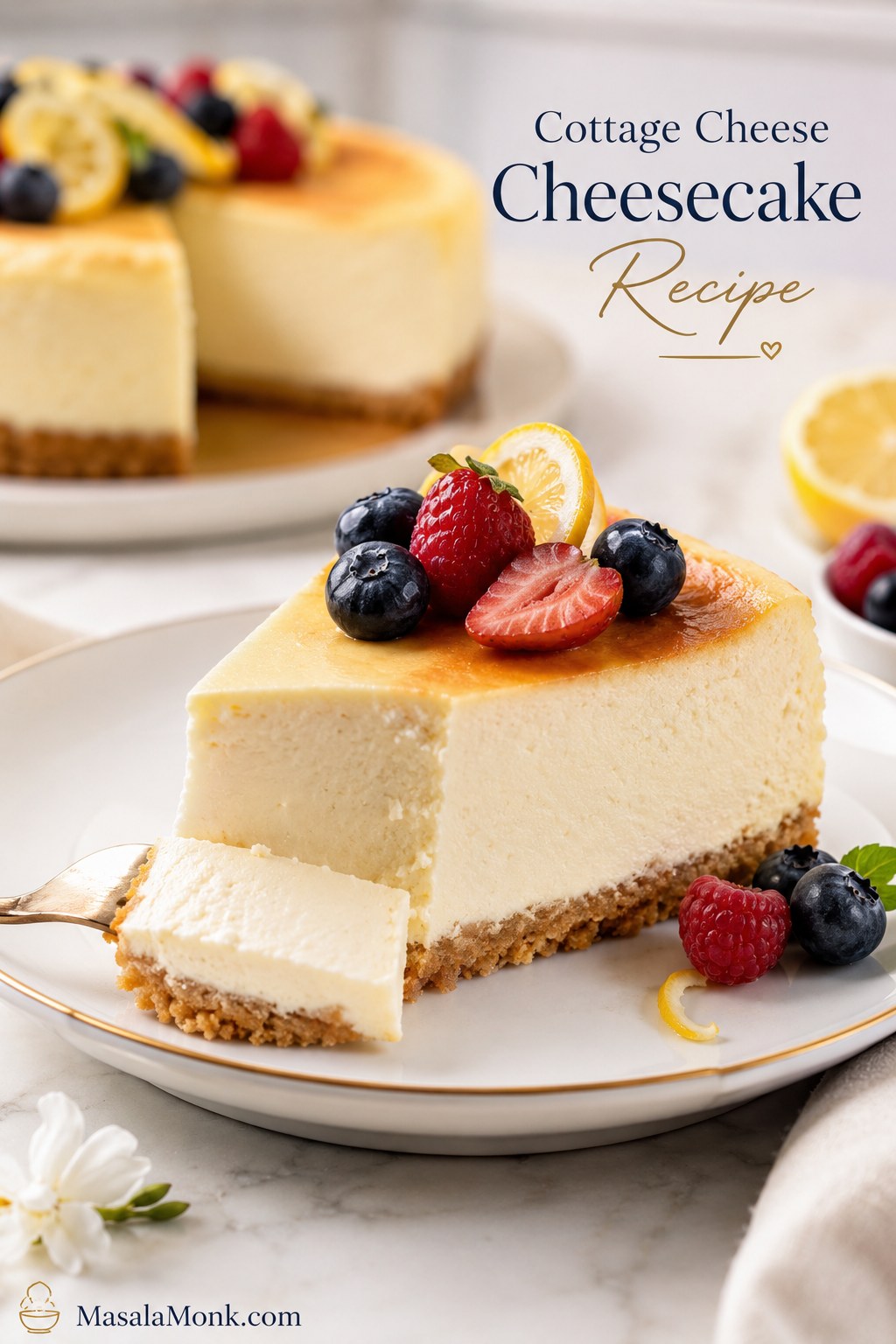
Finished cottage cheese cheesecake slice with creamy filling, crumb crust, berries, and lemon on a dessert plate

This cottage cheese cheesecake recipe is built for the two worries people usually have before they try it: grainy curds and a watery filling. The cottage cheese is blended until completely smooth, supported with thick Greek yogurt, eggs, vanilla, lemon, and a little cornstarch, then baked gently and chilled until creamy and sliceable.

It is lighter than a classic cream cheese cheesecake, but it still tastes like dessert. You can bake it with a buttery crumb crust, make it crustless, or add a little cream cheese when you want a richer, more traditional slice — no protein powder needed.
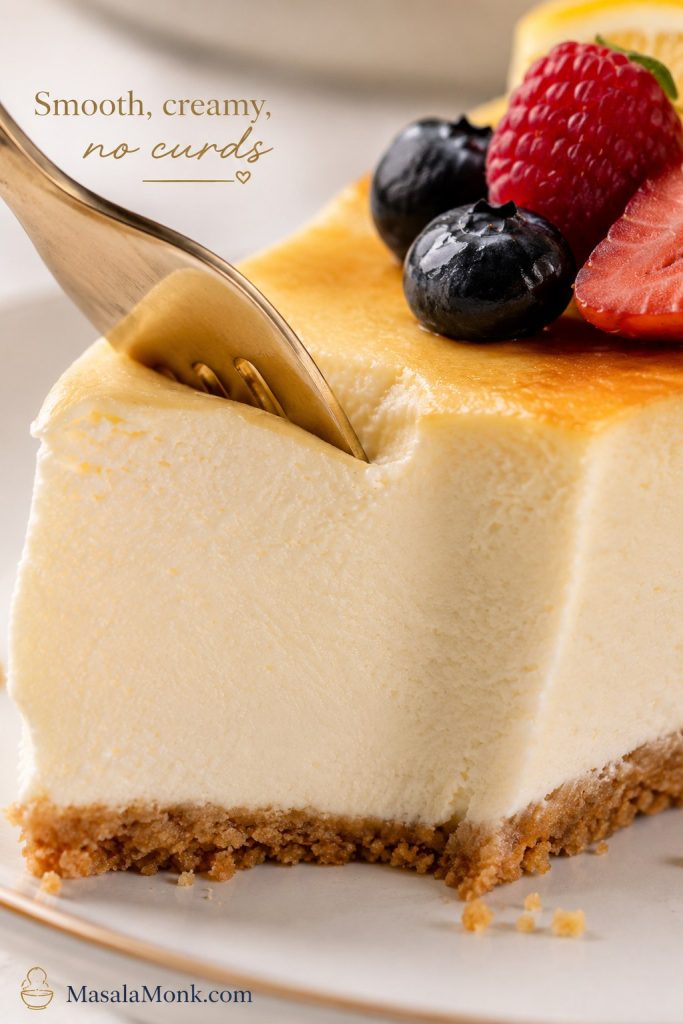
Close-up of a fork cutting into a smooth cottage cheese cheesecake slice with no visible curds
A clean fork cut should reveal a creamy interior — the first sign that the cottage cheese has blended fully into the filling.

Quick Answer: Can You Make Cheesecake with Cottage Cheese?

Yes, you can make cheesecake with cottage cheese. The key is to blend the cottage cheese until smooth before baking it with eggs, Greek yogurt, vanilla, lemon, and a little cornstarch. Once baked and chilled, the filling becomes creamy, lightly tangy, and sliceable.

The best version should not remind you of eating cottage cheese from a tub. Once blended, baked, and chilled, the cottage cheese melts into the filling and gives the cheesecake body, tang, and a lighter feel than a cream cheese-only base.
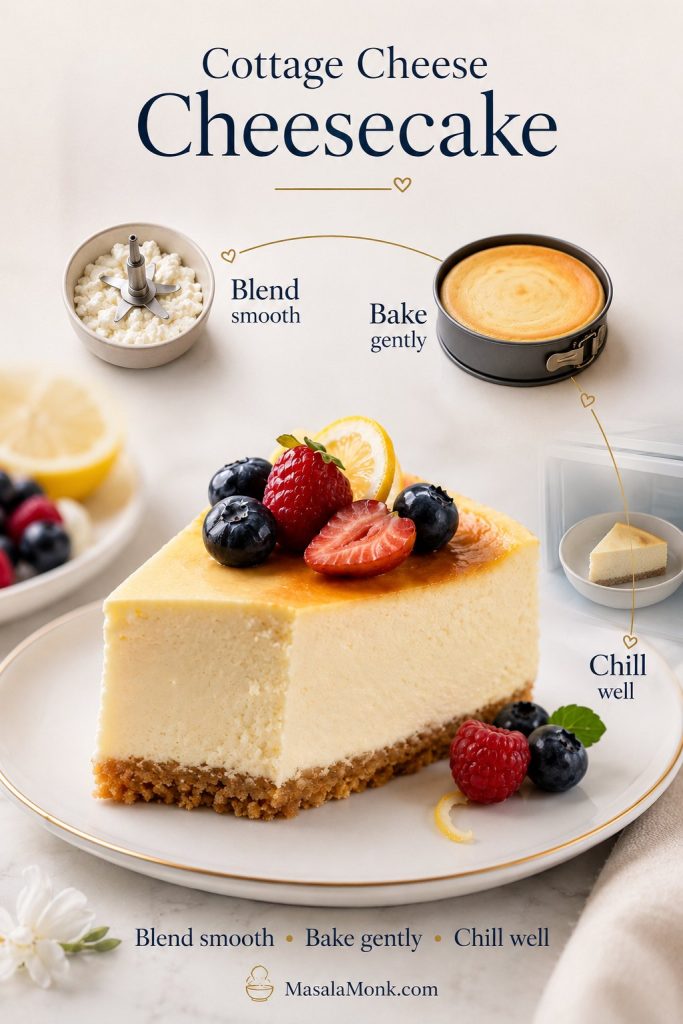
Cottage cheese cheesecake quick answer visual showing the blend, bake, and chill method
For a reliable result, think in three moves: smooth the dairy first, set the filling gently, then chill before slicing.

Before You Bake: Texture Rules and Timing

At a glance: This is a smooth baked cottage cheese cheesecake with Greek yogurt, vanilla, lemon, and an optional crumb crust. Bake it in an 8-inch springform pan at 325°F / 160°C until the edges are set and the center softly wobbles, then cool slowly and chill at least 4 hours or overnight.
Why you’ll love it:
  • It tastes like cheesecake, not cottage cheese. Blending smooths the curds into the filling.
  • It is lighter but still dessert-like. Greek yogurt adds tang without making the slice feel flat.
  • No protein powder needed. Cottage cheese and Greek yogurt give the filling its protein-rich base without making the cheesecake taste chalky.
  • It works with or without a crust. Make it classic, crustless, or low-carb.
  • It is better the next day. Overnight chilling gives the cleanest, creamiest slices.
The 4 texture rules:
  • Drain cottage cheese when it looks watery.
  • Use thick Greek yogurt, not loose regular yogurt.
  • Blend the dairy completely smooth before adding eggs.
  • Chill the cheesecake overnight before judging the final texture.
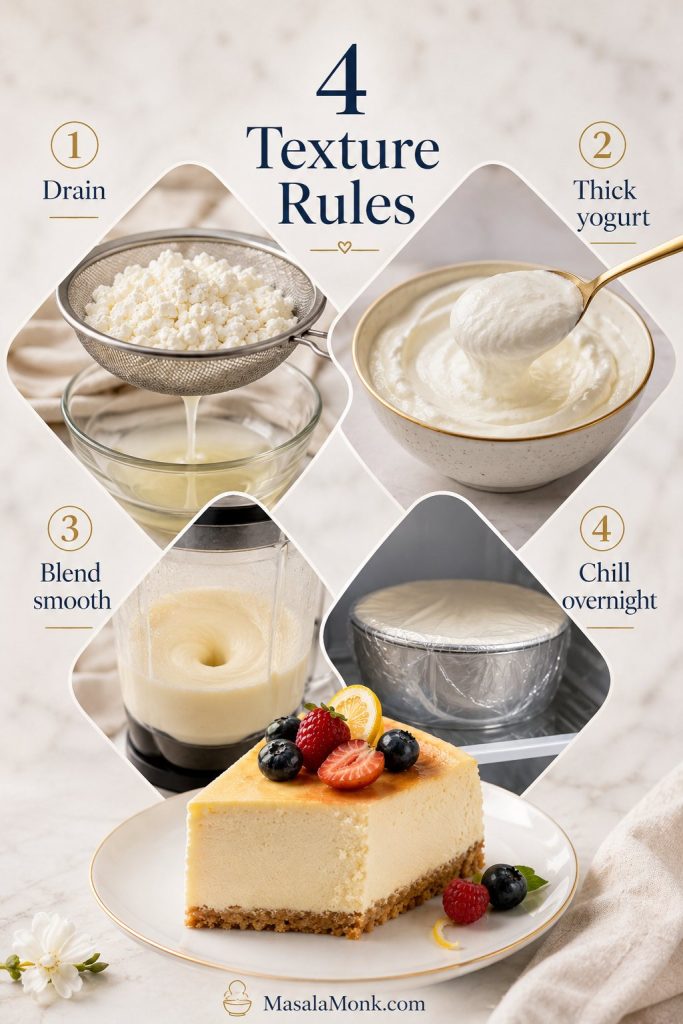
Four cottage cheese cheesecake texture rules showing draining, thick yogurt, smooth blending, and overnight chilling
Before baking, these four rules matter most: control moisture, use thick yogurt, blend thoroughly, and give the cheesecake enough chill time.

Need the visual version? Jump to how to make the filling smooth or troubleshooting if your batter looks loose, grainy, or hard to slice.

What Does Cottage Cheese Cheesecake Taste Like?

A good cottage cheese cheesecake tastes creamy, lightly tangy, and familiar — closer to a lighter cheesecake than a cottage cheese dessert. The vanilla gives it warmth, the lemon adds classic cheesecake brightness, and the Greek yogurt rounds out the dairy flavor.

The texture is softer and a little lighter than a dense New York-style cheesecake, especially with the Greek yogurt version. The cream cheese variation makes it richer, denser, and closer to the classic slice many people expect.

The cottage cheese should not stand out. Once it is blended and chilled properly, it should support the cheesecake rather than announce itself.

For Cottage Cheese Skeptics

If the words cottage cheese cheesecake make you imagine curds in dessert, you are not alone. That is exactly what this recipe is designed to avoid. Once the filling is blended, baked, and chilled, the cottage cheese should disappear into the texture.

The goal is not a “healthy dessert” that tastes like a compromise. It should taste like a lighter, tangier cheesecake: cold, creamy, smooth, and familiar enough that nobody is thinking about cottage cheese curds.
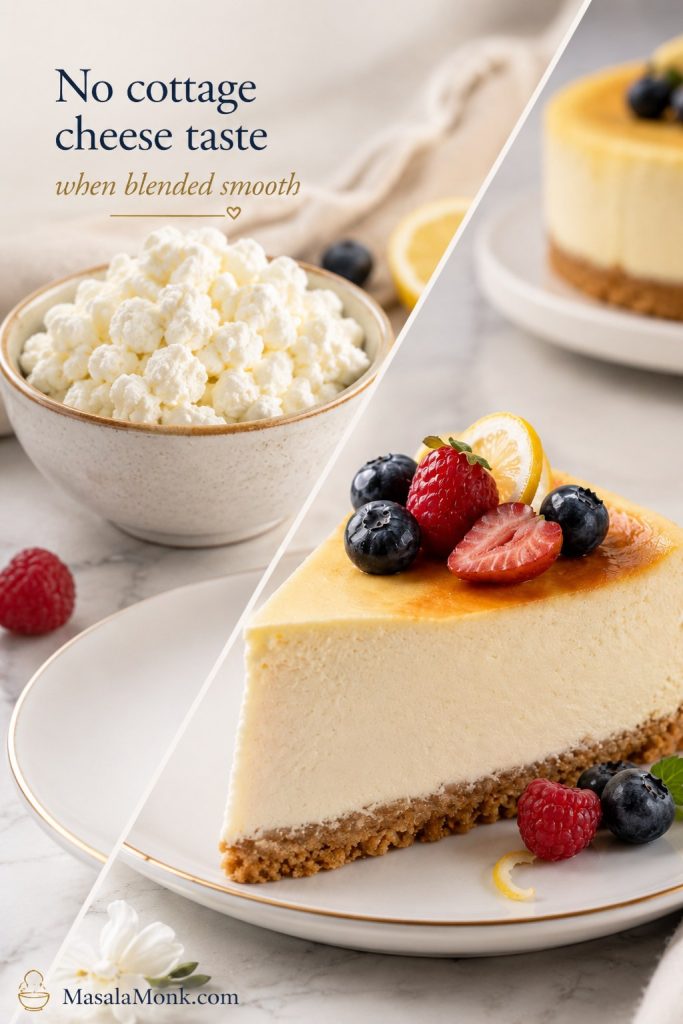
Curdy cottage cheese transforming into a smooth cheesecake slice with no visible curds
If cottage cheese flavor worries you, this is the goal: the dairy disappears into the cheesecake instead of standing out.

Why This Cottage Cheese Cheesecake Works

Cottage cheese can make a beautiful cheesecake, but it needs the right support. This recipe is built around the two things that matter most: blending the curds completely smooth and keeping extra moisture under control.

The goal is not to hide cottage cheese under a pile of sugar. It is to make it behave like a cheesecake filling: smooth enough to slice, tangy enough to taste familiar, and rich enough that it still feels like dessert.

Cottage Cheese Adds Protein and Body

Cottage cheese gives the filling body, mild tang, and a naturally higher-protein foundation than a cream cheese-only filling. Full-fat cottage cheese gives the richest result, while 2% cottage cheese works well for a lighter slice that still tastes balanced.

Greek Yogurt Adds Tang and Creaminess

Greek yogurt keeps the filling from tasting flat. It brings the tang people expect from cheesecake, but it needs to be thick; loose yogurt can push the batter toward watery.

Eggs Help the Cheesecake Set

This version uses 4 large eggs for a reliable set. Add them last and blend briefly; too much air in the batter can make the cheesecake puff in the oven and crack as it cools.

Cornstarch Gives Extra Insurance

A small amount of cornstarch helps the filling hold together without making it heavy. It is especially useful when cottage cheese has a little extra liquid. All-purpose flour works too, but cornstarch keeps the texture softer and cleaner.

Low, Gentle Baking Prevents Cracks

This cheesecake bakes at 325°F / 160°C after the crust is pre-baked. The lower heat helps the filling set slowly, which reduces the chance of a cracked top, dry edges, or a firm, rubbery center.

Texture tip: Do not bake this cheesecake until the center looks completely firm. Pull it when the edges are set and the center still has a soft wobble. Warm cheesecake is supposed to look a little underdone; the refrigerator does the final work.

How to Avoid Grainy or Watery Cottage Cheese Cheesecake

This recipe is built around moisture control. Cottage cheese and Greek yogurt both bring liquid to the filling, so the best texture comes from using thick dairy, adding enough egg structure, and including a small amount of cornstarch.

Granulated sugar keeps the batter more predictable than liquid sweeteners. Watery cottage cheese should be drained before measuring. Eggs should go in last so the batter does not become over-aerated. After baking, the cheesecake may look softer than expected, but the texture changes as it cools and chills.

Ingredients for Cottage Cheese Cheesecake

This cottage cheese cheesecake uses familiar cheesecake ingredients, but the balance is slightly different from a classic cream cheese version. The goal is a filling that feels smooth and sliceable without losing the lighter character that makes cottage cheese useful in the first place.
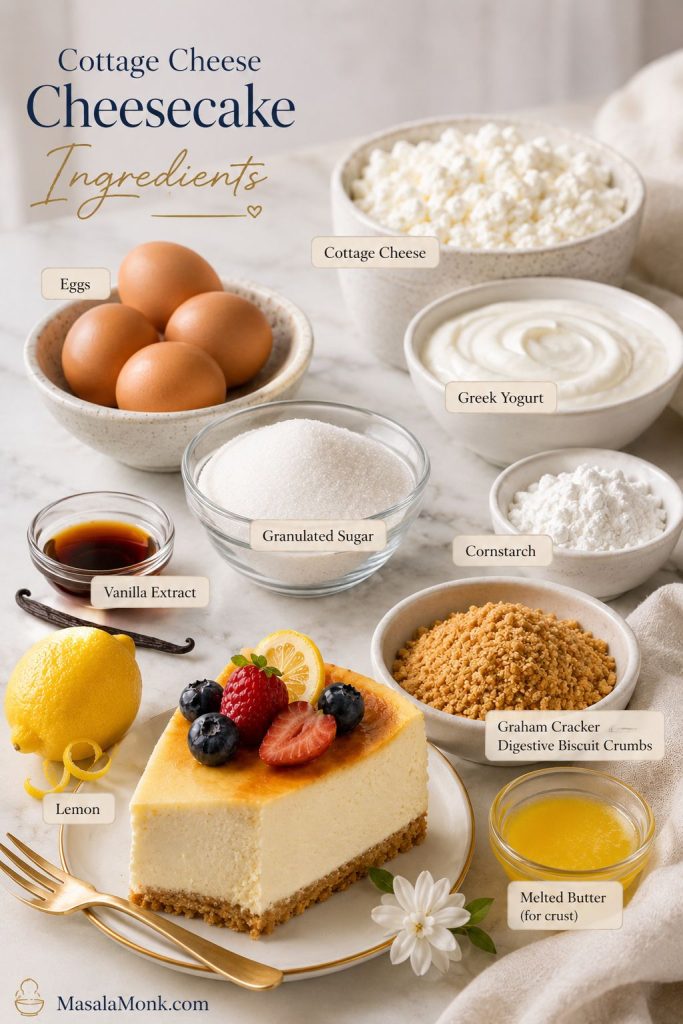
Cottage cheese cheesecake ingredients including cottage cheese, Greek yogurt, eggs, lemon, vanilla, cornstarch, and crumb crust
Each ingredient has a clear job: cottage cheese builds body, Greek yogurt adds tang, eggs set the filling, and cornstarch helps protect the structure.

Cottage Cheese

Use full-fat or 2% cottage cheese for the best balance of richness and structure. Small-curd cottage cheese is easiest to blend, but large-curd cottage cheese also works with a good blender or food processor.

Greek Yogurt

Plain Greek yogurt adds tang and keeps the cheesecake from tasting flat. Whole milk Greek yogurt gives the richest texture, while low-fat or nonfat Greek yogurt makes the cheesecake lighter. Avoid regular yogurt unless it has been strained until thick.

Eggs

Eggs help the filling set. Use room-temperature eggs so they blend evenly into the batter. The cheesecake should not taste eggy when it is baked gently and pulled while the center still has a soft wobble.

Sugar or Sweetener

Regular granulated sugar gives the cleanest cheesecake flavor. A cup-for-cup monk fruit blend or allulose can work for a lower-sugar version. For a fully low-carb cheesecake with a more classic structure, this keto cheesecake recipe goes deeper into almond flour crusts, sugar-free sweeteners, crustless cheesecake, and no-crack baking.

Cornstarch

Cornstarch helps the cottage cheese and yogurt filling bake into clean slices. Use 2 tablespoons of all-purpose flour instead when cornstarch is not available.

Vanilla and Lemon

Vanilla adds warmth. Lemon zest and a little lemon juice give the cheesecake its familiar brightness. The lemon does not need to make the cheesecake taste sharply lemony; it simply makes the dairy taste more like cheesecake.

Graham Cracker or Digestive Biscuit Crust

The crust is optional, but it makes the cheesecake feel more classic. Graham crackers, digestive biscuits, or similar plain sweet biscuits all work. Pre-baking the crust for a few minutes helps it hold together under the filling.

Best Cottage Cheese to Use

The cottage cheese you choose has a direct effect on texture. Since this is a blended cheesecake, you do not need perfect curds, but you do need cottage cheese that is not overly watery.
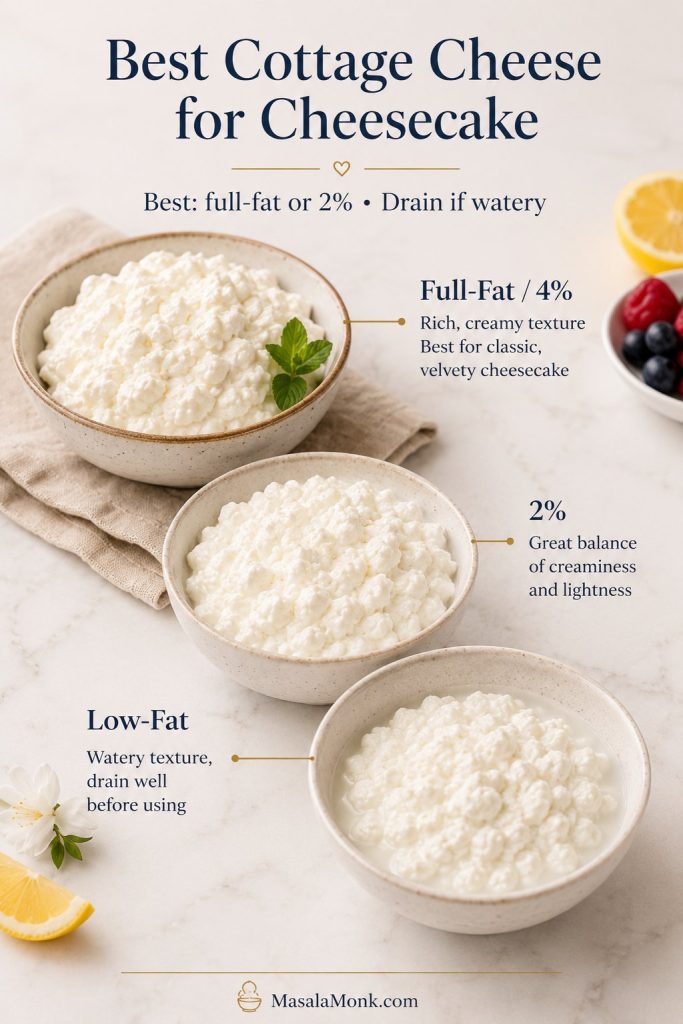
Cottage cheese comparison showing full-fat, two percent, and watery low-fat cottage cheese for cheesecake
Full-fat or 2% cottage cheese is usually the safest choice because it gives the filling more body and a smoother baked result.
Cottage Cheese Type Result in Cheesecake Best Use
Full-fat / 4% Richest, most forgiving texture Best overall choice
2% Still creamy, slightly lighter Best balance for a lighter cheesecake
Low-fat Can work, but may be thinner or tangier Use only when thick; drain when watery
Fat-free Least rich, more likely to taste tangy or thin Use only for a very lean version
Small-curd Blends easiest Best default
Large-curd Works when blended very well Use a strong blender or food processor

When to Drain Watery Cottage Cheese

When cottage cheese looks loose or has a lot of liquid in the container, drain it through a fine-mesh sieve before measuring. That one small step can prevent a watery cheesecake.
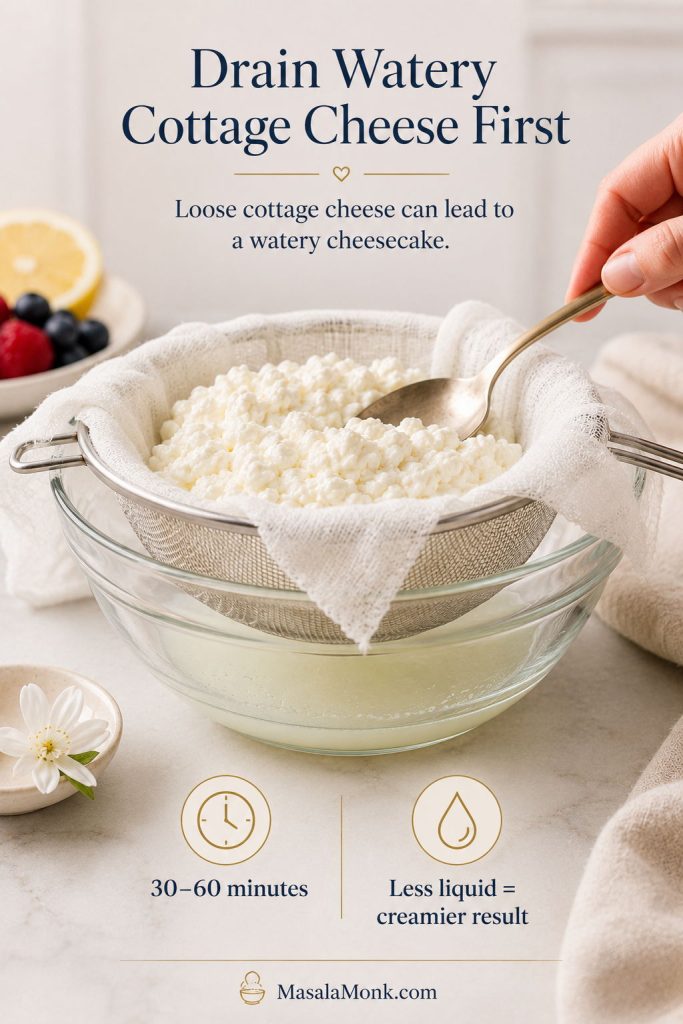
Watery cottage cheese draining in a fine-mesh sieve over a bowl before making cheesecake
Draining loose cottage cheese first removes extra moisture, which means the finished cheesecake is less likely to turn soft or watery.

Once you know which cottage cheese to use, the next important step is blending it smooth before the eggs go in.

For official nutrient data on different cottage cheese varieties, you can check USDA FoodData Central cottage cheese data.

How to Make Cottage Cheese Cheesecake Smooth

Graininess is what can ruin the illusion, so the blender step matters more than anything else. The dairy should look glossy and smooth before the eggs go in.

Use a Blender or Food Processor

A high-speed blender gives the silkiest filling. A food processor also works, especially when you scrape down the sides once or twice. An immersion blender can work in a pinch, but the finished texture may not be quite as polished.

Blend the Dairy Before Adding Eggs

Add the cottage cheese, Greek yogurt, sugar, vanilla, lemon zest, lemon juice, salt, and cornstarch to the blender first. Blend until the mixture looks glossy and even. Add the eggs only after that base is smooth.
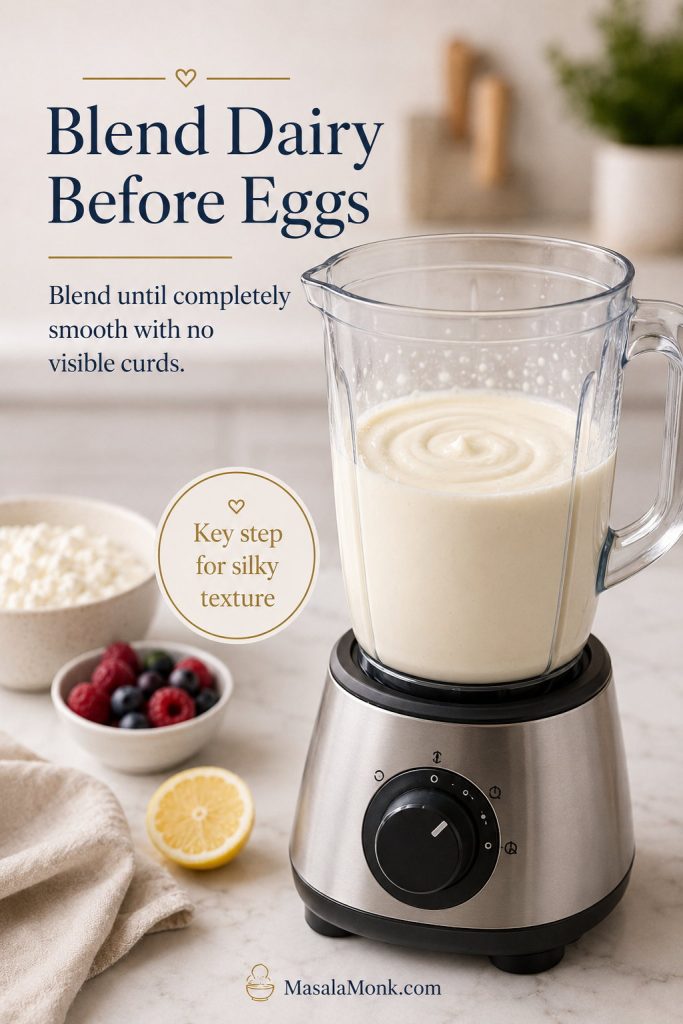
Cottage cheese cheesecake filling being blended smooth in a blender before eggs are added
Blend the dairy before the eggs go in; this is the step that turns a curdy base into cheesecake-ready filling.

What the Batter Should Look Like

The batter should look glossy, smooth, and pourable before it goes into the crust. If it still looks grainy, blend again or strain it before baking.
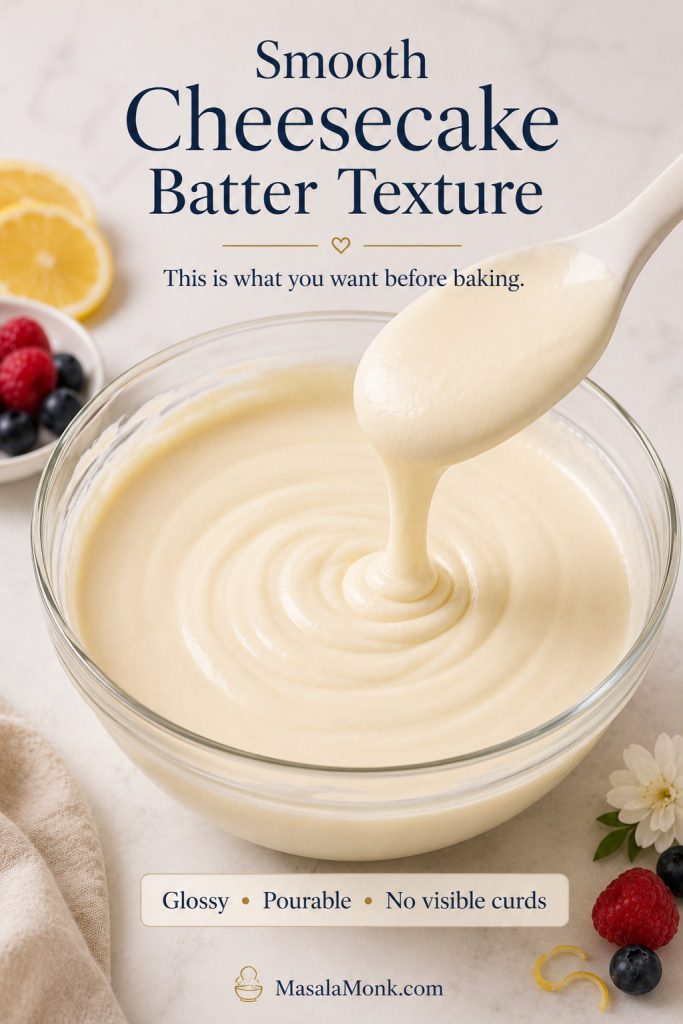
Smooth cottage cheese cheesecake batter lifting from a spatula in a glossy ribbon
The batter should fall in a glossy ribbon, because a smooth pour now usually means a cleaner texture after baking.

Strain the Batter When Needed

When the blender is not very powerful and the batter still looks slightly grainy, pour it through a fine-mesh sieve before baking. It is an optional step, but it can rescue the texture.

After the batter looks glossy and pourable, move to the step-by-step method and then use the doneness cues before chilling.

How to Make Cottage Cheese Cheesecake

The method follows classic cheesecake logic: prepare the pan, pre-bake the crust, blend the filling, bake gently, cool slowly, and chill before slicing. Once the filling is smooth, the oven and refrigerator do most of the work.
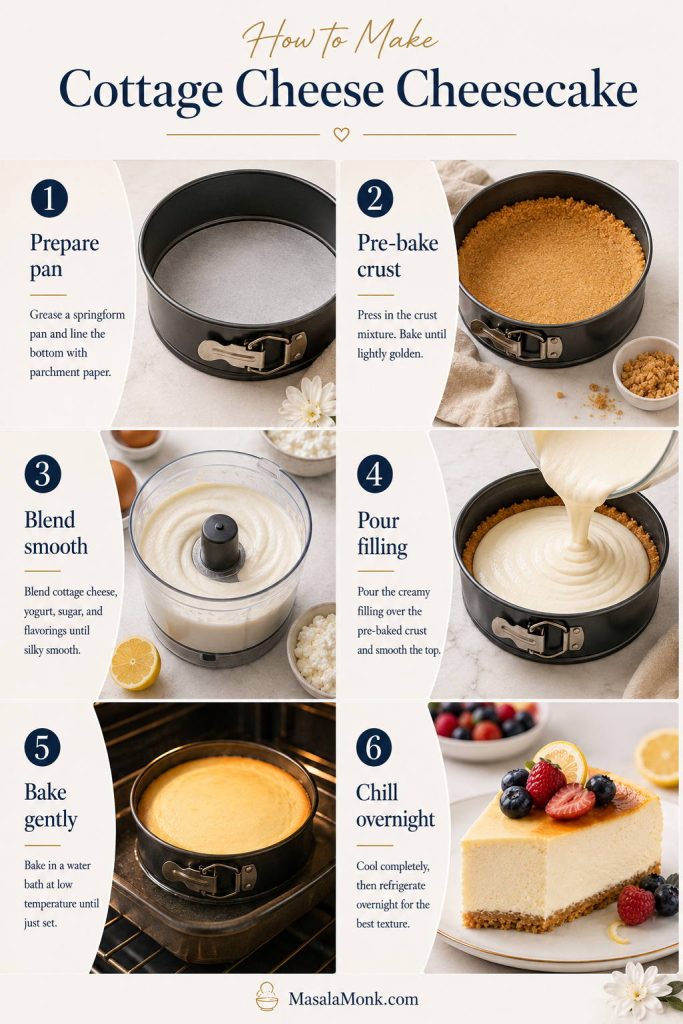
Step-by-step cottage cheese cheesecake guide showing pan prep, crust, blended filling, pouring, baking, and chilling
The method stays simple: prepare the pan, pre-bake the crust, blend the filling, bake until just set, and chill for the cleanest slice.

Step 1: Prepare the Pan

Line the bottom of an 8-inch / 20cm springform pan with parchment paper. Lightly grease the sides. For a water bath, wrap the outside of the pan with heavy-duty foil or place the springform pan inside a larger oven-safe bag before setting it in the roasting pan.

Step 2: Make and Bake the Crust

Mix the graham cracker or digestive biscuit crumbs with melted butter, sugar, and a pinch of salt. Press the mixture firmly into the bottom of the pan. Bake at 350°F / 177°C for 8 to 10 minutes, then lower the oven temperature to 325°F / 160°C.

Step 3: Blend the Filling

Blend the cottage cheese, Greek yogurt, sugar, cornstarch, vanilla, lemon zest, lemon juice, and salt until completely smooth. Scrape down the sides, then blend again. Add the eggs and blend briefly, just until the batter is even.

Step 4: Pour the Filling and Bake Low and Slow

Pour the filling over the crust and smooth the top. Bake at 325°F / 160°C for 55 to 70 minutes, or until the edges are set and the center still has a soft wobble. The center should jiggle gently, not slosh.
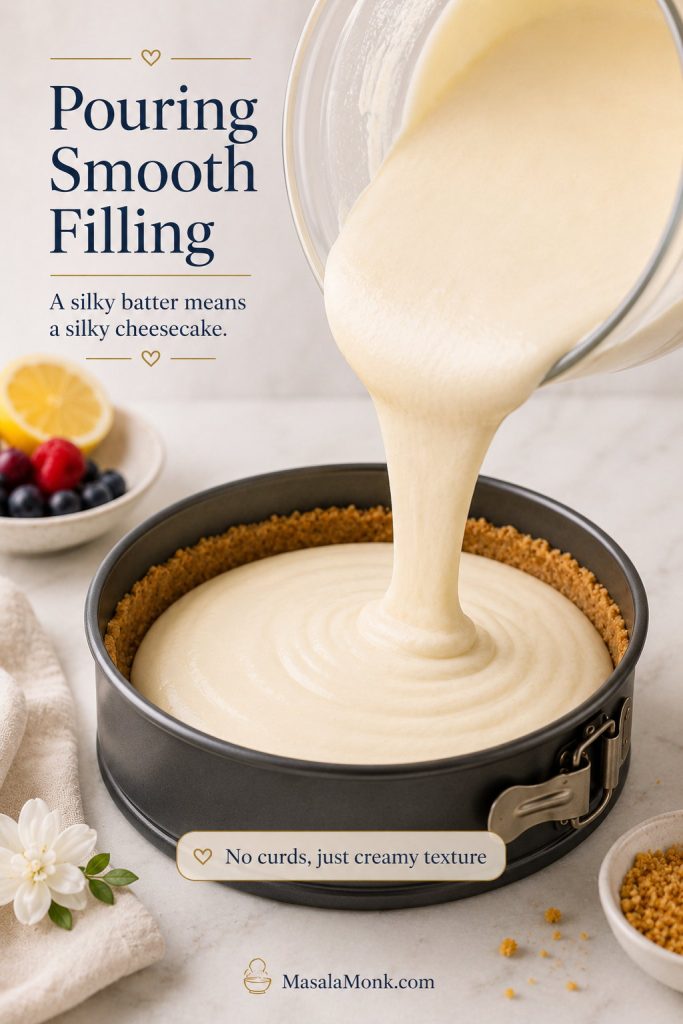
Smooth cottage cheese cheesecake filling being poured from a blender into a prepared crumb crust
When the filling pours smoothly into the crust, it is a good sign that the blender has done its job.

Step 5: Cool Gradually

Turn off the oven, crack the door open, and let the cheesecake sit inside for 30 to 45 minutes. This gradual cooling helps prevent cracks. Then move it to the counter and let it cool to room temperature.

Step 6: Chill Before Slicing

Refrigerate the cheesecake for at least 4 hours. Overnight is better. Do not panic if it looks soft when it first comes out of the oven. Warm cheesecake is supposed to look a little underdone; the refrigerator does the final work.

Do You Need a Water Bath?

A water bath is optional. Skip it for the easiest version; use it when you want the smoothest texture and the lowest chance of cracks.

To use one, wrap the springform pan well, set it in a roasting pan, and pour hot water around it until the water reaches about 1 inch up the side of the pan. Make sure the pan is protected so water cannot leak into the crust.
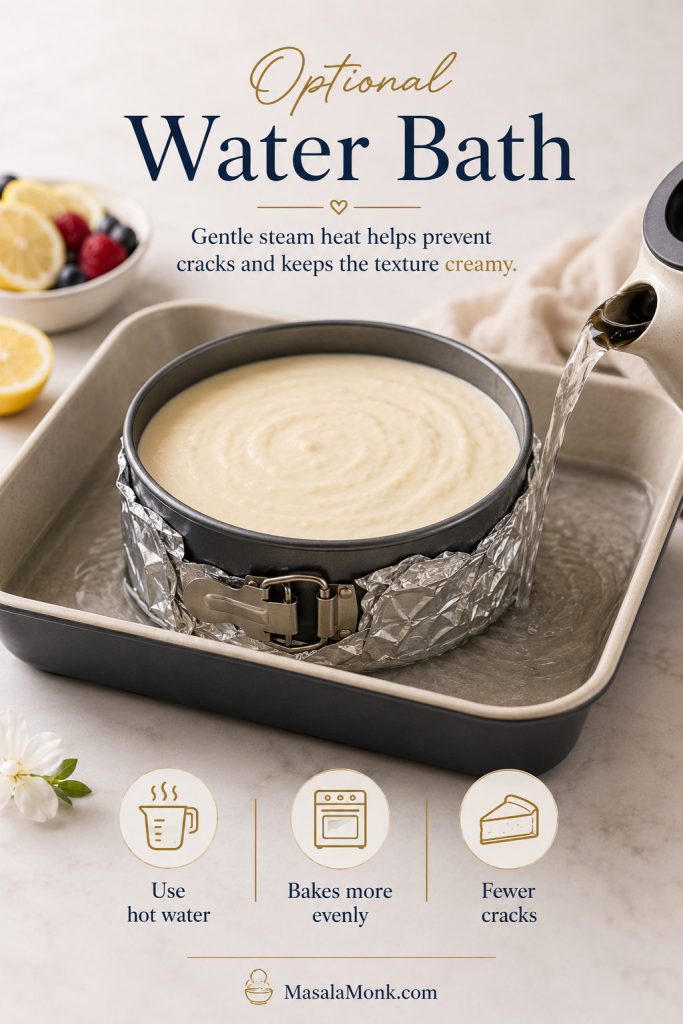
Wrapped springform pan sitting in a roasting pan with hot water for an optional cheesecake water bath
A water bath is optional; however, it can help the cheesecake bake more gently and reduce cracking on the surface.

A water bath usually pushes the cheesecake toward the longer end of the bake time. The texture is worth it when you want a cleaner, more classic cheesecake finish.

For more general cheesecake guidance, including room-temperature ingredients, water bath baking, and crack prevention, King Arthur Baking has a helpful guide to cheesecake tips.

Pan Size and Bake Time Guide

Cottage cheese cheesecake recipes often use different pan sizes, which can make bake times confusing. A smaller pan makes a taller cheesecake and usually needs more time. A larger pan makes a thinner cheesecake and may finish sooner.
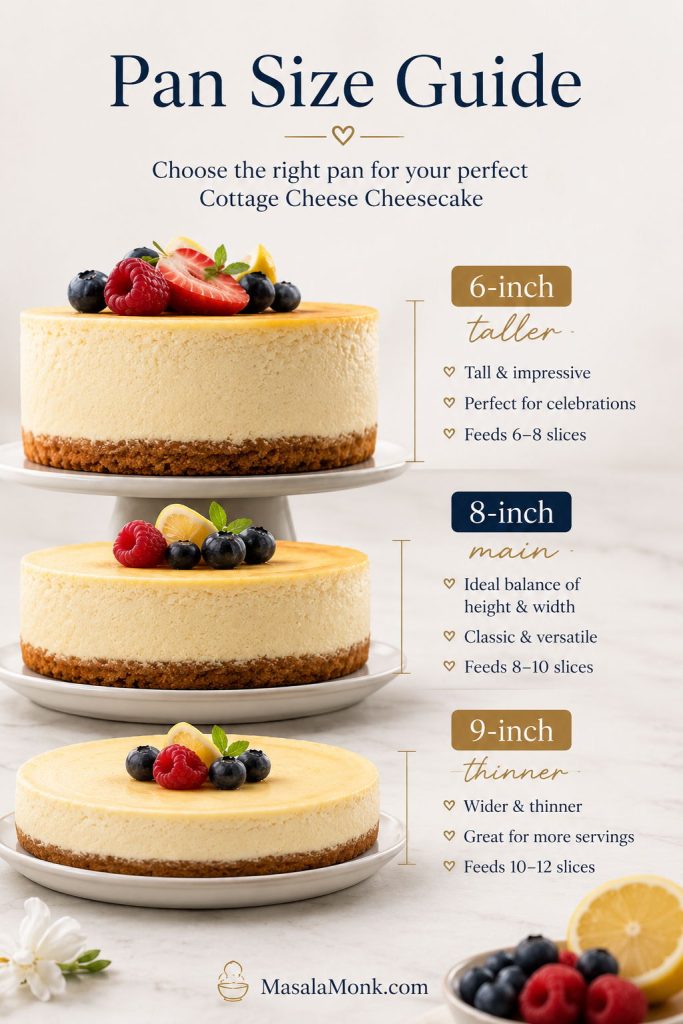
Pan size guide comparing six-inch, eight-inch, and nine-inch cottage cheese cheesecakes with different heights
Pan size changes both height and bake time, so visual cues matter more than the timer when you move away from the 8-inch pan.
Pan or Format Best For Bake Guidance
6-inch springform Small-batch, taller cheesecake Use about two-thirds of the recipe or expect a deeper filling and longer bake time.
8-inch springform Main recipe Bake 55–70 minutes at 325°F / 160°C.
9-inch springform Thinner full-size cheesecake Start checking around 45–55 minutes.
Muffin tin Mini cheesecakes Bake about 16–22 minutes, depending on filling depth.
Ramekins Single-serve cheesecakes Bake about 20–30 minutes.

Use the visual cues more than the clock. Cheesecake does not care what the timer says when the center is still loose or the edges are already firm. A thin cheesecake in a 9-inch pan may be done before the timer says so, while a deep 6-inch cheesecake may need longer.

Changing pan size also changes doneness timing, so use the set-edge and soft-wobble cues before relying on the clock alone.

How to Know When Cottage Cheese Cheesecake Is Done

Cheesecake keeps setting after it leaves the oven. Baking until the center looks completely firm can leave you with a dry, cracked, or rubbery cheesecake after chilling.

The Edge Test

The outer 2 inches should look set. The edges may be slightly puffed, but they should not be deeply browned or pulling hard away from the pan.

The Center Wobble Test

Gently nudge the pan. The center should wobble softly like set custard. It should not ripple like liquid. A soft wobble is good; a loose slosh means it needs more time.
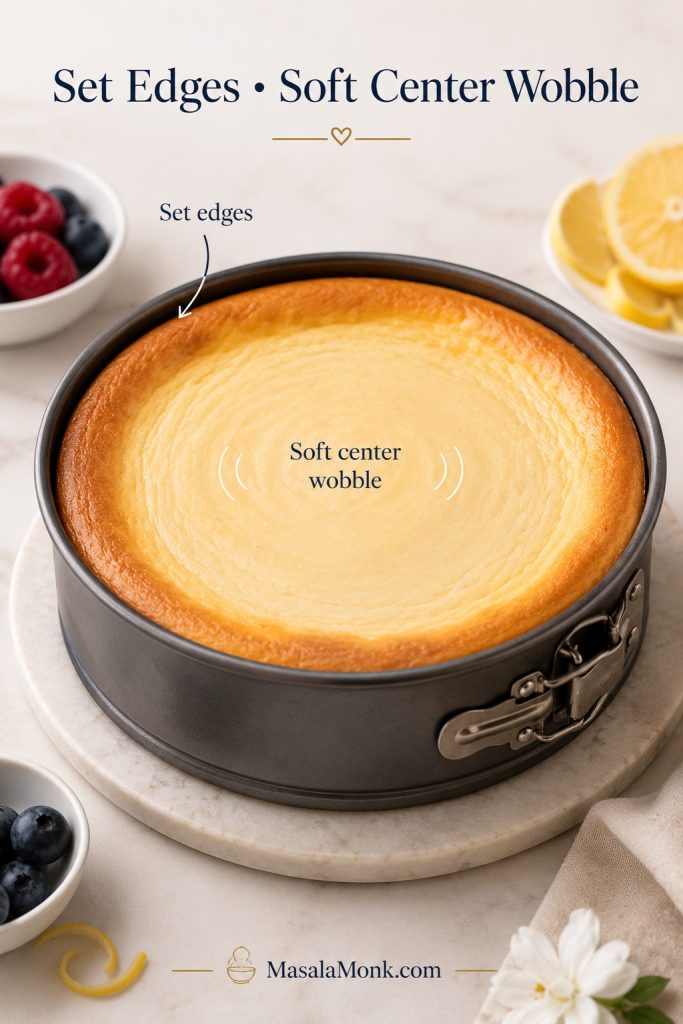
Baked cottage cheese cheesecake in a springform pan with set edges and a soft center wobble cue
Look for set edges and a soft center wobble, because the cheesecake will continue firming as it cools and chills.

Internal Temperature

For extra precision, check the center with an instant-read thermometer. The center should be around 155–160°F / 68–71°C. Insert the thermometer gently so you do not tear the top.

Why It Still Looks Soft

A warm cheesecake is not supposed to look like a fully chilled cheesecake. The filling firms as it cools and then tightens further in the refrigerator. That is why chill time is part of the recipe, not an optional waiting period.

If you like baked cheesecakes with clean slices and a slow-chilled texture, this salted caramel cheesecake recipe uses similar doneness cues: set edges, a softly wobbly center, and enough chill time before slicing.

Which Cottage Cheese Cheesecake Version Should You Make?

The right version depends on who you are serving and how close you want the slice to feel to classic cheesecake. Use the Greek yogurt base for the lighter, higher-protein style. Add cream cheese for something richer. Skip the crust when you want the easiest version.

If you are serving cottage cheese skeptics, the cream cheese variation is the safest first choice. If you are making it for yourself as a lighter dessert, start with the Greek yogurt version.
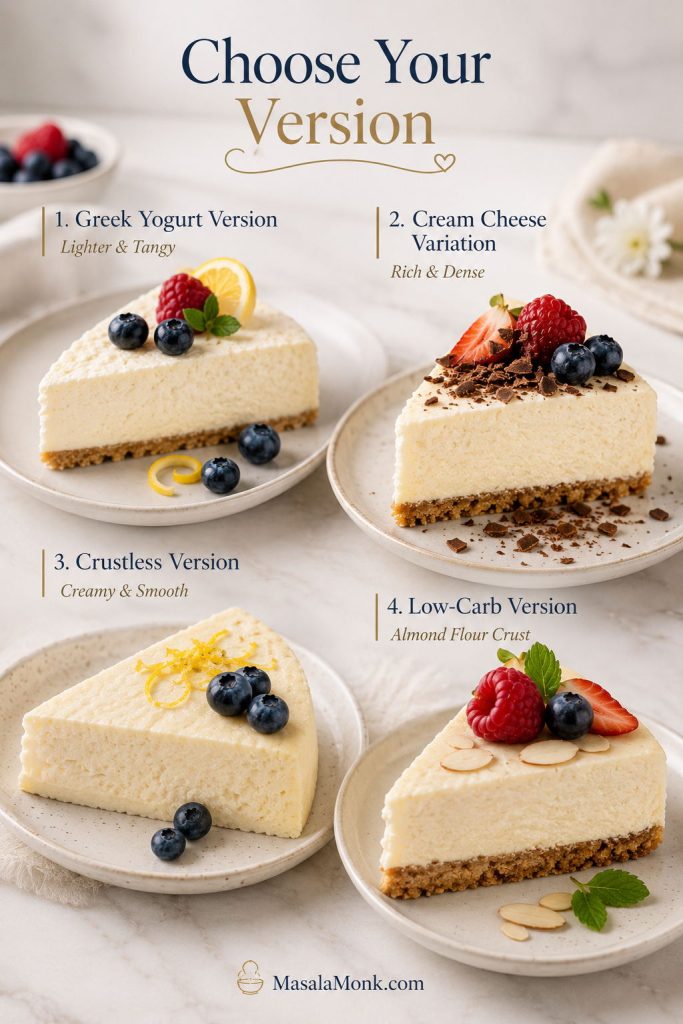
Four cottage cheese cheesecake versions showing Greek yogurt, cream cheese, crustless, and low-carb slices
Choose the version by the result you want: Greek yogurt for lighter tang, cream cheese for richness, crustless for ease, or almond crust for low-carb.
Craving or Need Make This Version Why It Works
The lightest higher-protein version Cottage cheese + Greek yogurt Best balance of protein, tang, and creamy texture.
The most classic cheesecake texture Cottage cheese + cream cheese Richer, denser, and closer to New York-style cheesecake.
The easiest version Crustless cottage cheese cheesecake No crumb crust, fewer steps, lighter slice.
The lowest-carb version Almond flour crust or crustless + low-carb sweetener Keeps the cheesecake closer to keto or low-carb needs.
The cleanest slices Crumb crust + overnight chill The crust gives structure and the long chill firms the filling.
The most dessert-like flavor Full-fat cottage cheese + vanilla + lemon + berry topping Richer dairy and bright toppings make it taste more like a classic dessert.

After choosing your version, go straight to the recipe card for the base formula and notes for cream cheese, crustless, and low-carb changes.

Cottage Cheese + Greek Yogurt

This is the main version of the recipe. It is lighter than a cream cheese cheesecake, with a tangy, creamy filling and a higher-protein dairy base. Use thick plain Greek yogurt for the best texture.

Cottage Cheese + Cream Cheese

For a richer cottage cheese cheesecake with a more classic texture, replace 1 cup / 225g of the cottage cheese with 8 oz / 225g softened cream cheese. Blend the cottage cheese first until smooth, then add the cream cheese and blend again before adding the eggs.

Crustless Cottage Cheese Cheesecake

For a crustless version, skip the crumb crust, line the bottom of the pan with parchment, and grease the sides well. Bake the filling directly in the pan and start checking 5 to 10 minutes earlier. Chill fully before releasing the pan, because a warm crustless cheesecake is more delicate than one with a crumb base.

Low-Carb Cottage Cheese Cheesecake

For a low-carb version, use an almond flour crust or skip the crust, then use a cup-for-cup low-carb sweetener in the filling. For more low-carb baking help, especially when an almond flour crust turns crumbly or soft, this keto-friendly flour guide explains how almond flour behaves and how to fix texture problems.

How to Make the Crust

The classic version uses a simple graham cracker or digestive biscuit crust. It gives the cheesecake a buttery base, a little crunch, and the familiar contrast people expect from a chilled cheesecake slice.
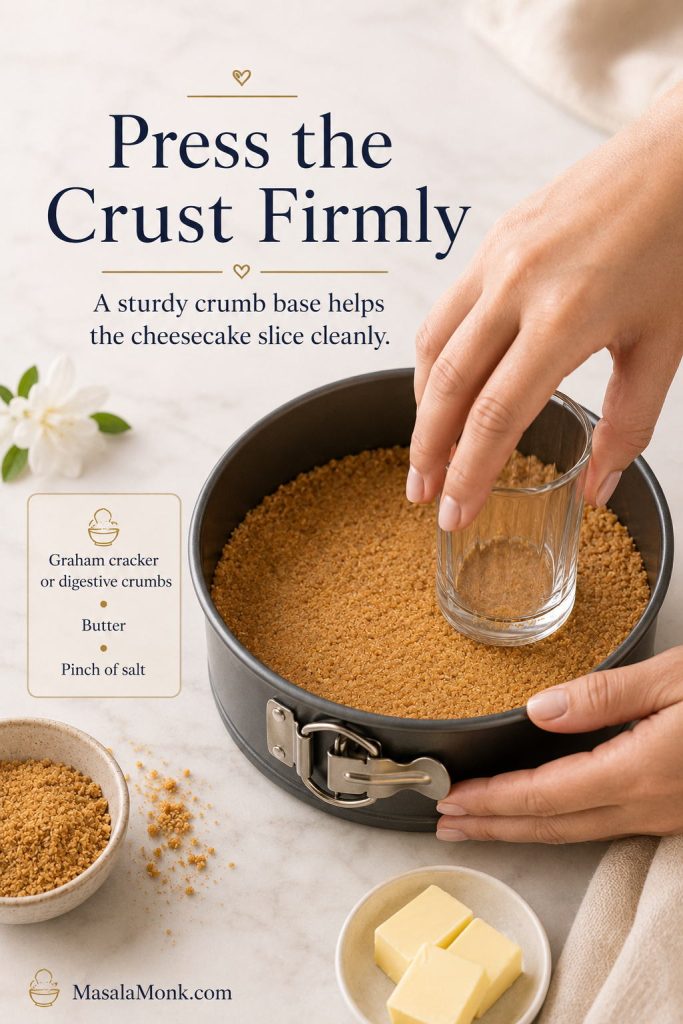
Hands pressing a graham cracker crumb crust firmly into a springform pan for cottage cheese cheesecake
A firmly packed crumb crust gives the creamy filling contrast, structure, and a more classic cheesecake feel.

Graham Cracker or Digestive Crust

This is the most classic option. Mix the crumbs with melted butter, a little sugar, and a pinch of salt, then press the mixture firmly into the bottom of the pan.

When to Pre-Bake the Crust

Pre-bake any crumb-style crust for 8 to 10 minutes before adding the filling. It helps the butter bind the crumbs and keeps the base from tasting raw. Let the crust cool slightly before pouring in the cottage cheese filling.

Is Cottage Cheese Cheesecake Healthy or High Protein?

This is still cheesecake, and that is the point. The goal is not to turn dessert into something joyless. It is to use cottage cheese and Greek yogurt in a way that gives you a cold, creamy, satisfying slice with a little more protein and a lighter feel.

You do not need protein powder for the main recipe. The higher-protein advantage comes from using cottage cheese and Greek yogurt as the main dairy base. If you already use vanilla whey and want a more macro-focused version, add one scoop and loosen the batter with 1 to 2 tablespoons of Greek yogurt or milk only if it becomes too thick.

The exact protein, calories, and carbs per slice will depend on your cottage cheese, Greek yogurt, crust, sweetener, and slice size. As a rough estimate, using full-fat or 2% cottage cheese, plain Greek yogurt, 4 eggs, and the crumb crust, a 10-slice cheesecake usually lands around 280–300 calories and 12–13g protein per slice. A crustless version will usually be lighter, while the cream cheese variation will be richer. For the most accurate number, calculate from the labels on your own ingredients.
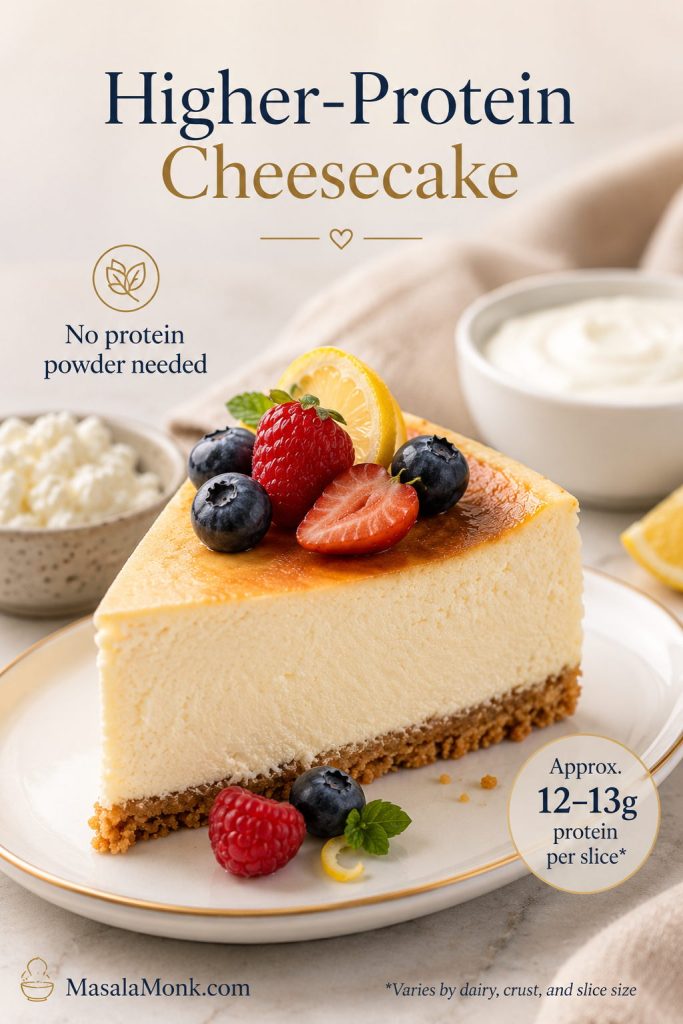
Higher-protein cottage cheese cheesecake slice with cottage cheese, Greek yogurt, berries, and a protein estimate note
Cottage cheese and Greek yogurt give this cheesecake a higher-protein base without protein powder, though exact macros depend on your dairy, crust, and slice size.

For another higher-protein dessert, you may also like this protein ice cream recipe, which uses Greek yogurt, cottage cheese, and protein powder options without making the texture feel chalky.

The same idea works outside dessert, too: this high-protein oatmeal guide shows how simple add-ins like Greek yogurt and cottage cheese can make everyday recipes more filling.

Baked vs No-Bake Cottage Cheese Cheesecake

This recipe is baked because baking gives cottage cheese cheesecake the cleanest slices and the most reliable set. Eggs and gentle heat help the filling turn into a creamy custard.

A no-bake cottage cheese cheesecake needs a different setting system — usually gelatin, whipped cream, cashews, melted chocolate, or a very thick dairy base. This baked filling is not meant to be poured into a crust and chilled without baking.
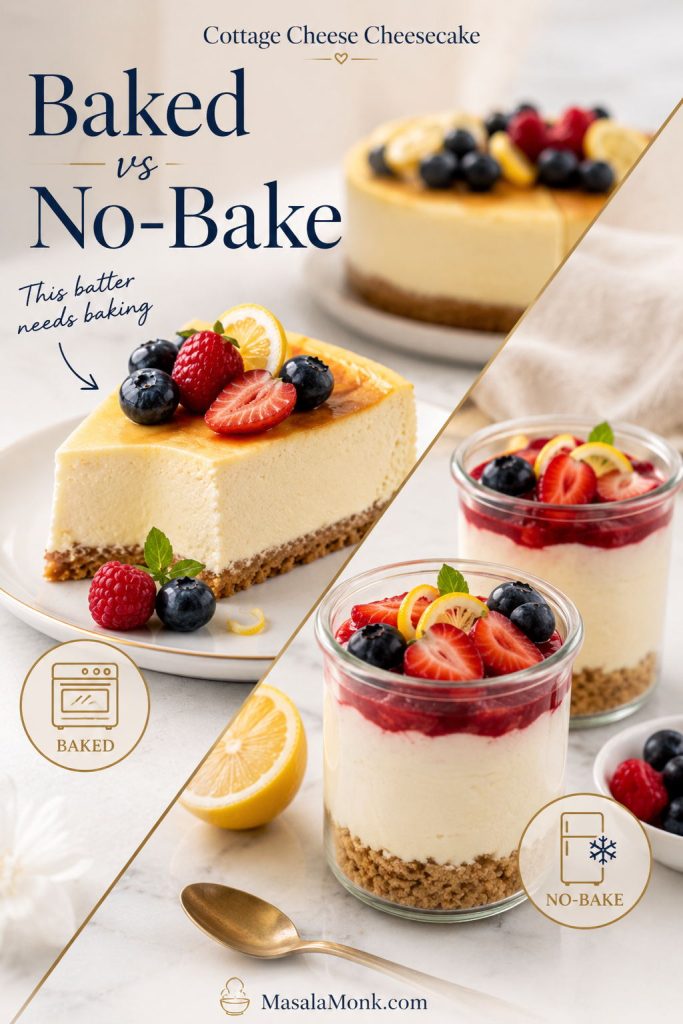
Baked cottage cheese cheesecake slice compared with no-bake cheesecake cups in jars
This batter is built for baking because eggs help it set, while a no-bake version needs a different setting method.

For an oven-free cheesecake, start with this no bake cheesecake recipe. The method is different, but the setting logic will help you understand why no-bake cheesecakes need enough fat, air, structure, and chill time.

Best choice: Make this baked version when clean slices matter most. Save no-bake cottage cheese cheesecake for jars, cups, bars, or a separate recipe built with a proper setting method.

Flavor Variations

Once the base recipe works, cottage cheese cheesecake is easy to adapt. Keep the basic structure the same, then adjust flavor carefully so the filling does not become too loose.

Pumpkin Cottage Cheese Cheesecake

Add pumpkin puree, pumpkin pie spice, and a little extra cornstarch to help absorb the added moisture. Start with 3/4 cup pumpkin puree, reduce the Greek yogurt to 1/2 cup, add 1 extra teaspoon cornstarch, and bake until the center has the same soft wobble as the original version.

Chocolate Cottage Cheese Cheesecake

Add unsweetened cocoa powder or melted dark chocolate to the blended filling. Cocoa powder thickens the batter, so you may need a spoonful or two of extra Greek yogurt. Melted chocolate gives a richer texture but makes the cheesecake less light.

Lemon Cottage Cheese Cheesecake

Increase the lemon zest and add a little extra lemon juice. Do not add too much liquid or the filling may need longer to set. Lemon works especially well with a graham cracker crust and fresh berries.

Berry-Topped Cottage Cheese Cheesecake

Keep the filling plain and add berries after chilling. Fresh strawberries, blueberries, raspberries, or a spoonable berry compote all work. Avoid adding too much watery fruit directly to the batter unless you are making a tested swirl version.

Mini Cottage Cheese Cheesecakes

Use a lined muffin tin and bake until the centers are just set. Mini cheesecakes chill faster and are easier for parties, lunchboxes, or portioned desserts.

How to Serve Cottage Cheese Cheesecake

Serve this cheesecake cold, when the filling is fully set and the flavor has had time to settle. A plain slice is creamy and tangy on its own, but toppings make it feel more finished.

  • Fresh berries: Best when you want a lighter, brighter slice.
  • Berry compote: Best when you want it to feel like a classic dessert-table cheesecake.
  • Lemon zest: Best when you want more freshness and lift.
  • Honey drizzle: Best for a simple, soft sweetness.
  • Chocolate drizzle: Best with the cream cheese variation or a crustless slice.

For a dinner-party version, use the crumb crust and berry compote. For an everyday higher-protein dessert, keep it crustless and serve it with berries or a spoonful of Greek yogurt.

After a night in the refrigerator, the filling settles into a cold, creamy slice with a clean fork cut and a soft lemon-vanilla tang. The crumb crust adds contrast, but the filling should still be the point: smooth, cool, lightly tangy, and rich enough to feel like dessert.

Troubleshooting Cottage Cheese Cheesecake

Most cottage cheese cheesecake problems come from four things: watery dairy, not blending enough, overbaking, or cutting before the cheesecake has chilled.
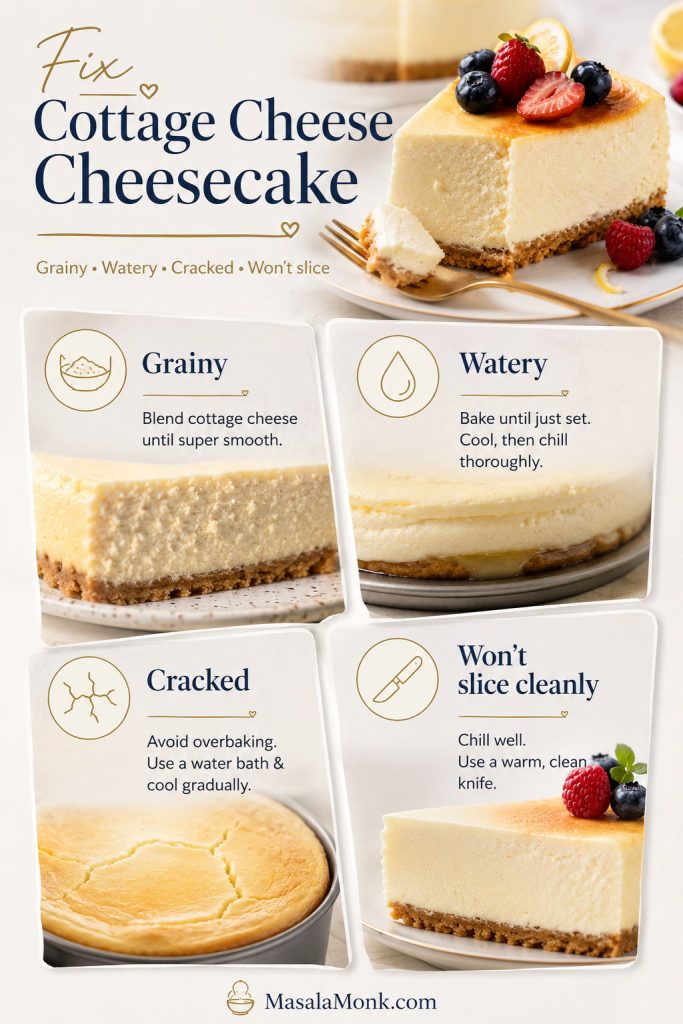
Troubleshooting guide for cottage cheese cheesecake showing grainy, watery, cracked, and hard-to-slice problems
If the cheesecake turns grainy, watery, cracked, or hard to slice, start by checking moisture, blending, bake time, and chill time.
Problem Likely Cause Fix
Grainy texture Cottage cheese was not blended fully. Blend the dairy before adding eggs. Scrape down the sides. Strain the batter when needed.
Watery filling Cottage cheese or yogurt was too loose, or the cheesecake was underbaked. Drain watery cottage cheese, use thick Greek yogurt, bake until the edges are set, and chill overnight.
Cracked top Overbaking, too much air in the batter, or cooling too quickly. Add eggs last, do not over-blend, bake gently, and cool with the oven door cracked.
Rubbery texture Too much high-speed blending after eggs were added, or baking too long. Add eggs last, pulse briefly, and pull the cheesecake while the center still wobbles.
Tastes too much like cottage cheese Very lean cottage cheese, not enough vanilla/lemon/sweetener, or not enough chill time. Use 2% or full-fat cottage cheese, add lemon zest and vanilla, and chill overnight.
Soggy crust Crust was not pre-baked, filling was too wet, or water bath leaked into the pan. Pre-bake the crust and protect the pan well when using a water bath.
Won’t slice cleanly The cheesecake has not chilled long enough. Chill at least 4 hours. Overnight is best for clean slices.

For prevention before the next bake, return to the 4 texture rules or check the doneness cues again.

How to Store and Freeze Cottage Cheese Cheesecake

Cottage cheese cheesecake is a make-ahead dessert. In fact, it tastes better after a full night in the refrigerator because the filling has time to firm up and the flavor settles.
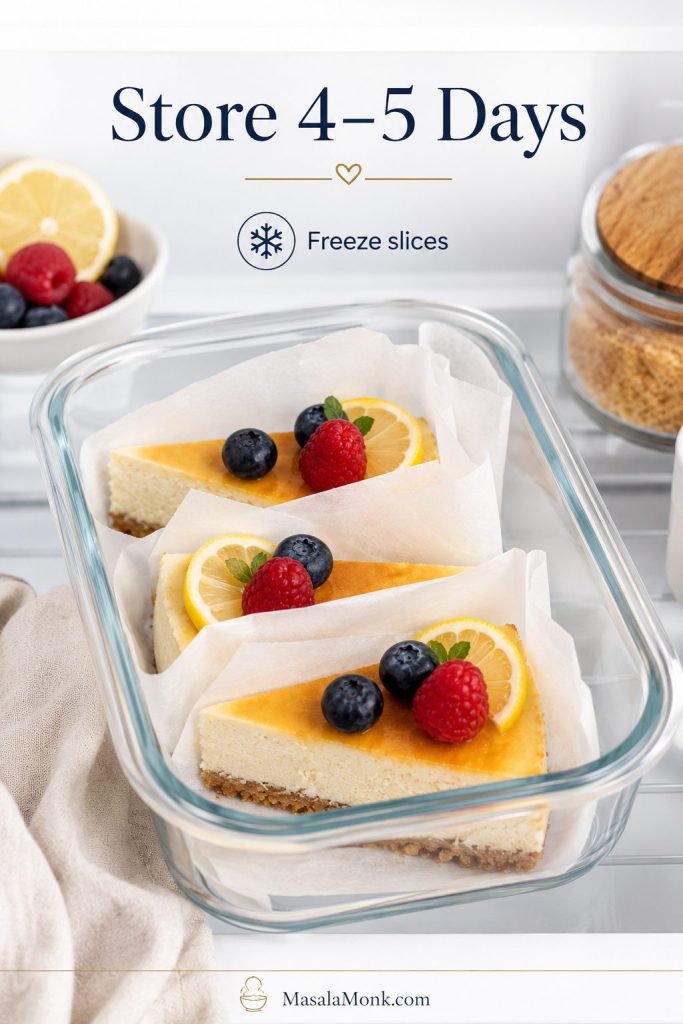
Cottage cheese cheesecake slices stored in a glass container with parchment for refrigeration or freezing
This works well as a make-ahead dessert because the filling firms, the flavor settles, and the slices cut cleaner after chilling.

Refrigerating

Store the cheesecake covered in the refrigerator for 4 to 5 days. Chill it uncovered until fully cold first, then cover it so condensation does not drip onto the surface. Once the cheesecake has cooled to room temperature, move it to the refrigerator rather than leaving it out for hours.

Freezing

You can freeze cottage cheese cheesecake, but the texture may soften slightly after thawing. Freeze individual slices on a tray first, then wrap and store them in an airtight container.

Thawing

Thaw frozen slices overnight in the refrigerator. Avoid thawing at room temperature for long periods, because the dairy filling should stay cold.

Cottage Cheese Cake vs Cottage Cheese Cheesecake

Cottage cheese cake and cottage cheese cheesecake are sometimes used to describe similar desserts, but they are not always the same thing. A cottage cheese cheesecake is usually a blended dairy custard made with cottage cheese, eggs, vanilla, lemon, and sometimes yogurt or cream cheese. It bakes gently, chills, and slices like cheesecake.

Cottage cheese cake can mean something different. Some versions are closer to a flour-based cake or snacking cake, while others are simple cottage-cheese-based cakes that taste cheesecake-like but use fewer ingredients. This version is a true cheesecake: a blended dairy filling that bakes gently, cools slowly, and chills into clean, creamy slices.

Cottage Cheese Cheesecake Recipe

This cottage cheese cheesecake recipe bakes into a creamy, higher-protein cheesecake with Greek yogurt, vanilla, lemon, and an optional graham cracker or digestive biscuit crust. Blend the cottage cheese until silky, bake gently, cool slowly, and chill well before slicing.

Yield10 slices
Prep Time20 minutes
Cook Time55–70 minutes
Chill Time4 hours minimum
Total TimeAbout 7 hours, mostly cooling and chilling
Pan8-inch springform
Oven325°F / 160°C
TextureCreamy, smooth, sliceable

Ingredients

For the crust

  • 1 1/4 cups / 135g graham cracker or digestive biscuit crumbs
  • 5 tbsp / 70g melted butter
  • 1 1/2 tbsp / 18g sugar or sweetener
  • Pinch of fine salt

For the filling

  • 3 cups / 680g / 24 oz full-fat or 2% cottage cheese, drained first when watery
  • 3/4 cup / 180g plain Greek yogurt
  • 4 large eggs, room temperature
  • 2/3 cup / 135g granulated sugar
  • 2 tbsp / 16g cornstarch
  • 2 tsp / 10ml vanilla extract
  • 1–2 tsp lemon zest
  • 1 tbsp / 15ml lemon juice
  • 1/4 tsp fine salt

Instructions

Prepare the Pan, Crust, and Filling

  1. Prepare the pan. Line the bottom of an 8-inch / 20cm springform pan with parchment paper and lightly grease the sides.
  2. Heat the oven. Preheat the oven to 350°F / 177°C for the crust.
  3. Make the crust. Mix the crumbs, melted butter, sugar, and salt until evenly moistened. Press firmly into the bottom of the pan.
  4. Pre-bake the crust. Bake for 8 to 10 minutes. Remove from the oven and reduce the oven temperature to 325°F / 160°C.
  5. Blend the dairy. Add cottage cheese, Greek yogurt, sugar, cornstarch, vanilla, lemon zest, lemon juice, and salt to a blender or food processor. Blend until completely smooth, scraping down the sides once.
  6. Add the eggs. Add the eggs and blend briefly, just until combined. Do not over-blend after the eggs are added.
  7. Check the batter. It should look smooth and pourable, but not watery. If it looks thin because the cottage cheese was loose, let it sit for 5 minutes before pouring so the cornstarch can hydrate slightly.

Bake, Cool, Chill, and Slice

  1. Fill the pan. Pour the filling over the crust and smooth the top.
  2. Optional water bath. For the creamiest texture, place the wrapped springform pan in a roasting pan and pour hot water around it until the water reaches about 1 inch up the side of the pan. Make sure the pan is well protected so water cannot leak into the crust.
  3. Bake. Bake at 325°F / 160°C for 55 to 70 minutes, until the edges are set and the center still has a soft wobble. If using a thermometer, the center should be about 155–160°F / 68–71°C.
  4. Cool slowly. Turn off the oven, crack the door open, and let the cheesecake sit inside for 30 to 45 minutes. Then move it to the counter and cool to room temperature.
  5. Chill. Refrigerate for at least 4 hours, preferably overnight.
  6. Slice and serve. Run a thin knife around the edge before releasing the springform pan. Slice with a clean, warm knife for neat pieces.

Notes

  • For a cream cheese version: Replace 1 cup / 225g cottage cheese with 8 oz / 225g softened cream cheese.
  • For a crustless version: Skip the crust, line the pan well, and start checking 5 to 10 minutes earlier.
  • For a low-carb version: Use an almond flour crust and a cup-for-cup low-carb sweetener.
  • If your cottage cheese is watery: Drain it before measuring.
  • With a water bath: Wrap the pan very well and expect the cheesecake to bake toward the longer end of the time range.
  • Without a water bath: The cheesecake still works, but the top may look a little more rustic.
  • For the smoothest filling: Blend the dairy fully before adding the eggs.

FAQs

Does cottage cheese cheesecake taste like cottage cheese?

Not when it is blended well and flavored properly. The finished cheesecake should taste creamy, tangy, lightly sweet, and cheesecake-like. Vanilla, lemon, sugar, and enough chill time help soften the cottage cheese flavor.

How do you make cottage cheese cheesecake smooth?

Blend the cottage cheese and Greek yogurt until glossy before adding the eggs. A high-speed blender gives the best texture, but a food processor can work if you scrape down the sides.

Why is my cottage cheese cheesecake watery?

Watery cheesecake usually comes from loose cottage cheese, thin yogurt, underbaking, or cutting before the cheesecake has chilled. Drain watery dairy, bake until the edges are set, and chill overnight.

Can I make cottage cheese cheesecake without cream cheese?

Yes. This main recipe uses cottage cheese and Greek yogurt without cream cheese. Add cream cheese only when you want a richer, more traditional cheesecake texture.

How much cream cheese should I add?

Replace 1 cup / 225g cottage cheese with 8 oz / 225g softened cream cheese for a richer version that tastes closer to classic cheesecake.

Can I make it crustless?

Yes. Line the pan with parchment, grease the sides well, skip the crumb crust, and bake the filling directly in the pan. Start checking a little earlier and chill fully before releasing it.

Is cottage cheese cheesecake high protein?

It is usually higher in protein than classic cream-cheese cheesecake because the main dairy base is cottage cheese and Greek yogurt. Exact protein depends on your brands, crust, and slice size.

Can I make it low carb or keto?

Use an almond flour crust or skip the crust, then replace the sugar with a low-carb sweetener such as allulose or a monk fruit blend. The final texture will depend on the sweetener and crust you choose.

How long should cottage cheese cheesecake chill?

Chill it for at least 4 hours. Overnight is best because the filling firms, the flavor settles, and the slices come out cleaner.

Can you freeze cottage cheese cheesecake?

Yes. Freeze it in slices, then thaw overnight in the refrigerator. The texture may be slightly softer after thawing, but it still works well for make-ahead servings.

Baked vs no-bake cottage cheese cheesecake: what changes?

A baked version sets with eggs and oven heat. A no-bake version needs a separate setting system, such as gelatin, whipped cream, cashews, melted chocolate, or a very thick dairy base.

Cottage cheese cake vs cottage cheese cheesecake: what is the difference?

A cottage cheese cheesecake is a blended dairy custard that bakes and chills like cheesecake. By contrast, cottage cheese cake is usually more cake-like, often made with flour, baking powder, and sometimes fruit.

The First Slice Is the Real Test
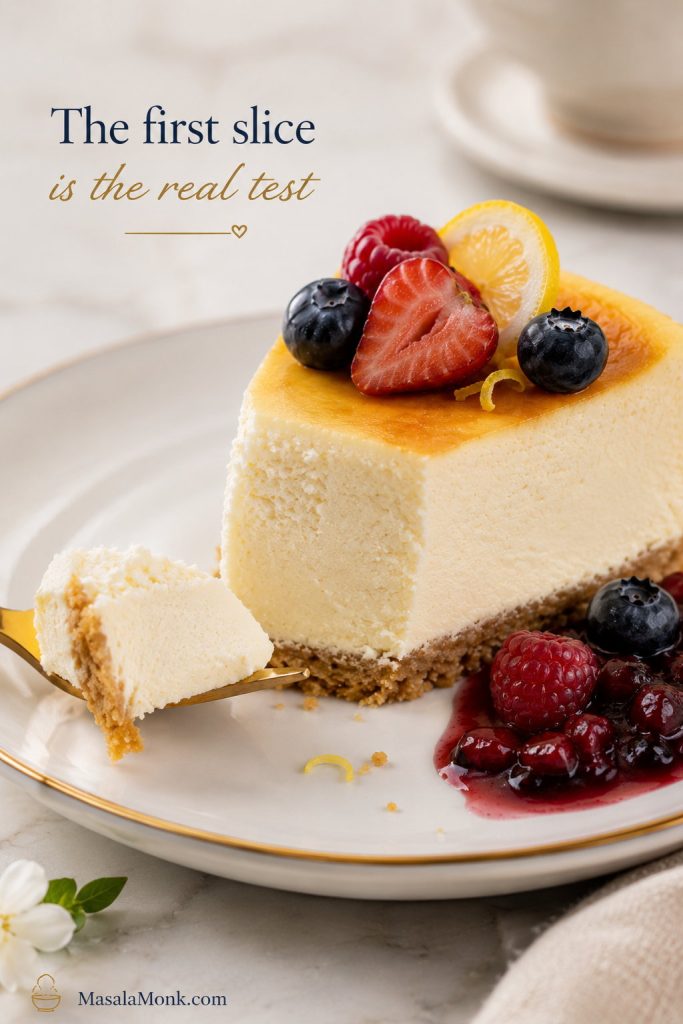
Final cottage cheese cheesecake slice with berries, lemon, berry sauce, and a forkful removed
The first slice is the real test: smooth texture, clean edges, and a cold creamy bite that tastes like cheesecake, not cottage cheese.

When the cheesecake is cold, creamy, and smooth enough that nobody stops to ask where the cottage cheese went, the recipe has done its job.

Try the Greek yogurt version first for a lighter cheesecake, and try the cream cheese variation when you want something closer to the classic. When you make it, I’d love to know which version won in your kitchen — the lighter Greek yogurt cheesecake, the cream cheese variation, the classic crust, or the crustless slice.
Posted on 10 Comments

Healthy Tuna Salad – 10 Easy Recipes (Avocado, Mediterranean, No Mayo & More)

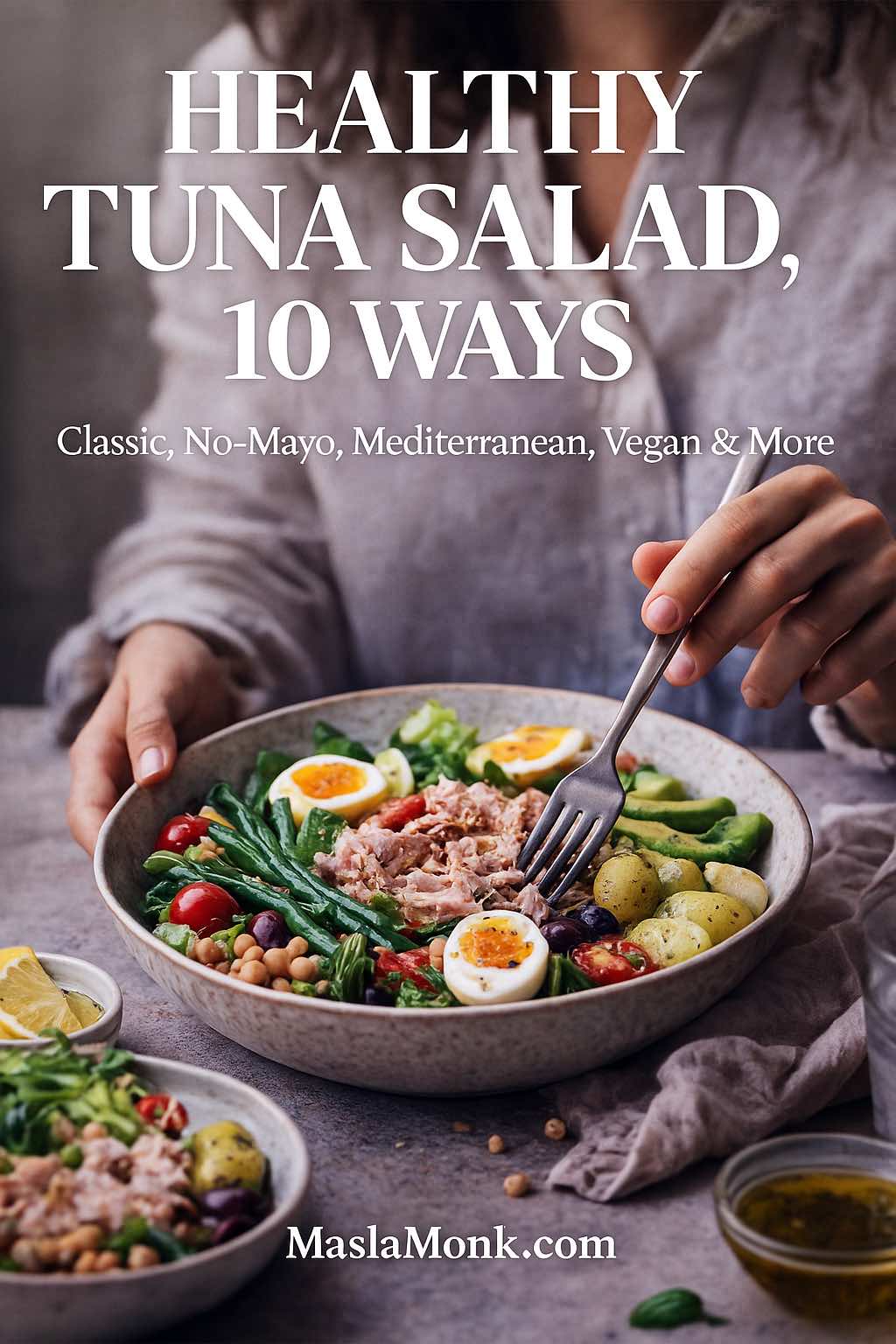
Person holding a fork over a large bowl of healthy tuna salad with eggs, avocado, potatoes, beans and greens, with the text Healthy Tuna Salad, 10 Ways and MasalaMonk.com

Healthy tuna salad is one of those quiet workhorse recipes that can shape-shift into almost anything you need. Some days it’s a classic deli tuna salad sandwich on soft bread; on others it becomes a bright Mediterranean tuna salad with beans and olives, or a quick avocado tuna salad piled onto toast. When you want comfort, there’s tuna macaroni salad. When you want light and fresh, there’s tuna salad on salad with crunchy cucumber and apple. And when you’re skipping fish entirely, a vegan “tuna” made from chickpeas steps in without anyone feeling short-changed.

At the same time, tuna brings a lot of nutrition to the table. It’s naturally rich in protein and provides omega-3 fats that support heart and brain health when eaten in reasonable amounts. The FDA’s own advice about eating fish puts canned light tuna in the “Best Choices” group and suggests that most adults, including many who are pregnant, can safely enjoy it two to three times per week as part of a mixed seafood pattern, as long as they keep overall portions within the limits they outline. When you combine tuna with vegetables, beans, whole grains and lighter dressings, you end up with meals that feel like comfort food but behave more like smart nutrition.

This guide pulls together ten different healthy tuna salad recipes and all their useful cousins: no-mayo Greek yogurt tuna salad, avocado tuna salad, Mediterranean tuna and bean salad, Italian tuna with chickpeas, tuna Niçoise salad, tuna pasta salad and tuna mac, tuna and egg salad, crunchy apple and cucumber tuna salad, and finally a vegan tuna salad built from chickpeas. You can treat these as ten discrete recipes or as ten patterns you customise with whatever you’ve got in your kitchen.


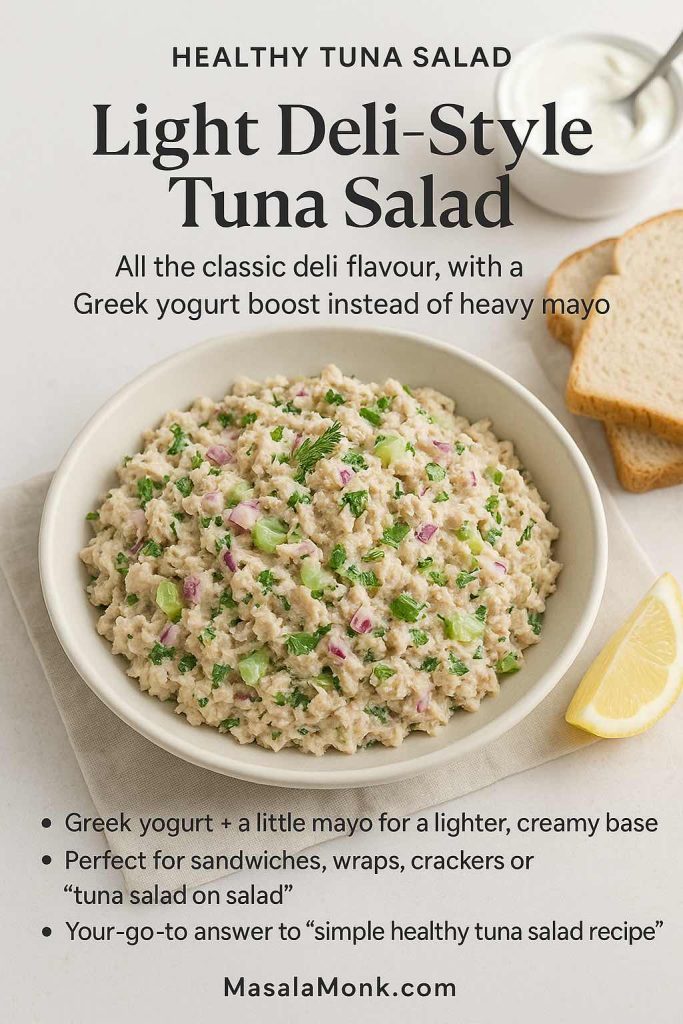
1. Light Deli-Style Healthy Tuna Salad (Your Everyday Base)

Most people’s mental picture of tuna salad is the classic deli tuna fish salad: creamy, a little tangy, speckled with celery and onion, sometimes a touch sweet from relish. Instead of banishing that flavour in the name of health, it’s much more satisfying to keep the same general profile and simply rebalance the dressing so it becomes a genuinely healthy tuna salad you can eat more often.

Light deli-style healthy tuna salad made with tuna, celery, red onion and a Greek yogurt dressing in a bowl with bread and lemon.
Light deli-style healthy tuna salad made lighter with Greek yogurt instead of loads of mayo – perfect for sandwiches, wraps or spooned over a crunchy green salad.

Ingredients (2–3 servings)

  • 2 cans light tuna in water, well drained
  • 3–4 tablespoons plain Greek yogurt
  • 2–3 tablespoons mayonnaise
  • 1–2 ribs celery, finely chopped
  • 2 tablespoons red onion, very finely minced
  • 1–2 tablespoons sweet relish or finely chopped pickles
  • 1 teaspoon Dijon mustard
  • Juice of half a lemon
  • 1–2 tablespoons chopped fresh dill or parsley
  • Salt and freshly ground black pepper

Greek yogurt stands in for a chunk of the mayonnaise here. Compared with mayo, Greek yogurt is naturally higher in protein and significantly lower in calories and saturated fat, yet it has enough body to keep the dressing thick and satisfying. That little swap moves this toward a low fat tuna salad without making it taste “diet”.

How to make it

  1. Tip the drained tuna into a medium bowl and flake it with a fork so there are no large clumps.
  2. In a separate bowl, whisk the Greek yogurt, mayonnaise, mustard, lemon juice, herbs, salt and pepper until smooth.
  3. Stir celery, onion and relish into the dressing so all the crunchy bits are lightly coated.
  4. Fold the dressing mixture into the tuna and stir until everything looks evenly combined.
  5. Taste and adjust; a splash more lemon brightens everything, while a spoon of relish sweetens and softens the edges.
  6. Let the bowl chill for at least 15–20 minutes if you have the patience. It’s even better the next day.

Once you’ve got this base healthy tuna salad, you can spin it in several directions:

  • Pile it onto toast with lettuce and tomato for a quick tuna salad sandwich.
  • Spoon it over mixed greens for an easy salad and tuna combo.
  • Stuff it into a croissant and suddenly you’ve got a croissant tuna sandwich that feels like café food.
  • Serve it with crackers and sliced veggies as a tuna lunch on the go.

If you’re curious how bowls like this fit into a more general “eat more plants” direction, you might enjoy MasalaMonk’s piece on the perks of eating salads everyday, which talks through fibre, micronutrients and why salad isn’t a throwaway side dish at all.

Treat this bowl as your basic tuna salad recipe, everything else is a tweak.

Also Read: Upma Recipe: 10+ Easy Variations (Rava, Millet, Oats, Semiya & More)


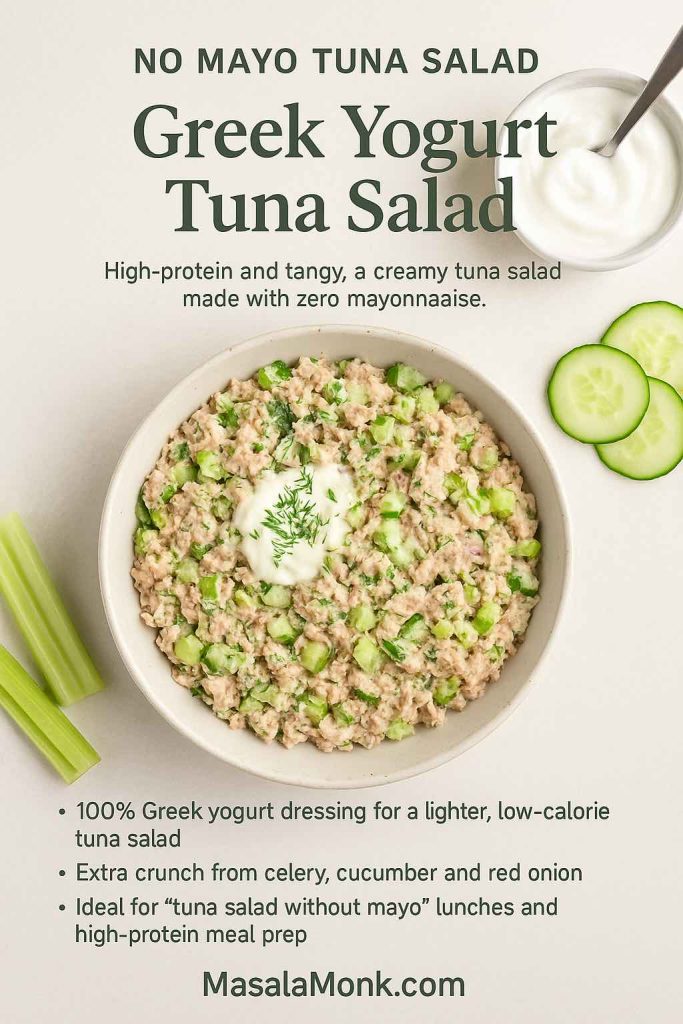
2. No-Mayo Greek Yogurt Healthy Tuna Salad Recipe

There are days when “lighter” still isn’t quite what you’re after; you want a tuna salad without mayo altogether. Maybe you’re chasing a low calorie tuna salad recipe, perhaps you simply prefer the clean tang of yogurt. In either case, a Greek yogurt tuna salad steps up nicely.

Why Greek yogurt works so well

Greek yogurt is strained, so it ends up thicker and creamier than regular yogurt while packing more protein per spoonful. At the same time, it typically has fewer calories and less fat, particularly if you choose a lower-fat version. Paired against mayonnaise, the difference is stark: Greek yogurt contains a fraction of the calories and dramatically less saturated fat, while bringing its own dose of protein and calcium. Used as the main base for tuna salad, it turns a standard tuna fish salad into a high protein tuna salad with far fewer calories than a traditional mayo-heavy version.

No-mayo Greek yogurt tuna salad with tuna, cucumber and celery in a white bowl, garnished with dill, with extra yogurt and cucumber slices on the side.
Creamy Greek yogurt tuna salad made with zero mayonnaise, extra crunch from cucumber and celery, and enough protein to work for light lunches or high-protein meal prep.

Ingredients

  • 2 cans light tuna, well drained
  • ½ cup plain Greek yogurt
  • 1 rib celery, finely diced
  • 2 tablespoons cucumber, seeded and chopped
  • 1–2 tablespoons red onion, minced
  • 1 teaspoon Dijon mustard
  • Juice of half a lemon
  • 1 tablespoon chopped fresh dill, chives or parsley
  • Salt and pepper

Method

  1. Whisk Greek yogurt, lemon juice, mustard, herbs, salt and pepper together in a bowl until smooth.
  2. Stir in celery, cucumber and onion so the vegetables are lightly coated.
  3. Fold in the tuna, breaking up any remaining chunks, and mix gently until everything comes together.
  4. Taste and adjust seasoning. A little extra lemon juice or a pinch more salt can make the flavours pop.
  5. Chill briefly before serving.

This is the bowl that naturally satisfies all the no mayo or tuna fish salad recipe without mayonnaise needs. Moreover, because the dressing is so light, it fits neatly into days when you’re focused on weight management without feeling like a punishment.

Cottage cheese tuna salad variation

If you’d like to push the protein even higher, you can replace a couple of tablespoons of the yogurt with cottage cheese. The result is a cottage cheese and tuna salad that still feels creamy but loads up the protein even more. On days when you’re aiming for big protein numbers, that sort of mix can easily become part of a 100-grams-of-protein plan. If you’re curious how to sketch an entire day’s meals around that target, MasalaMonk’s guide on how to eat 100 grams of protein a day lays out practical examples.

Also Read: Double Chocolate Chip Cookies – Easy Recipe with 7 Variations


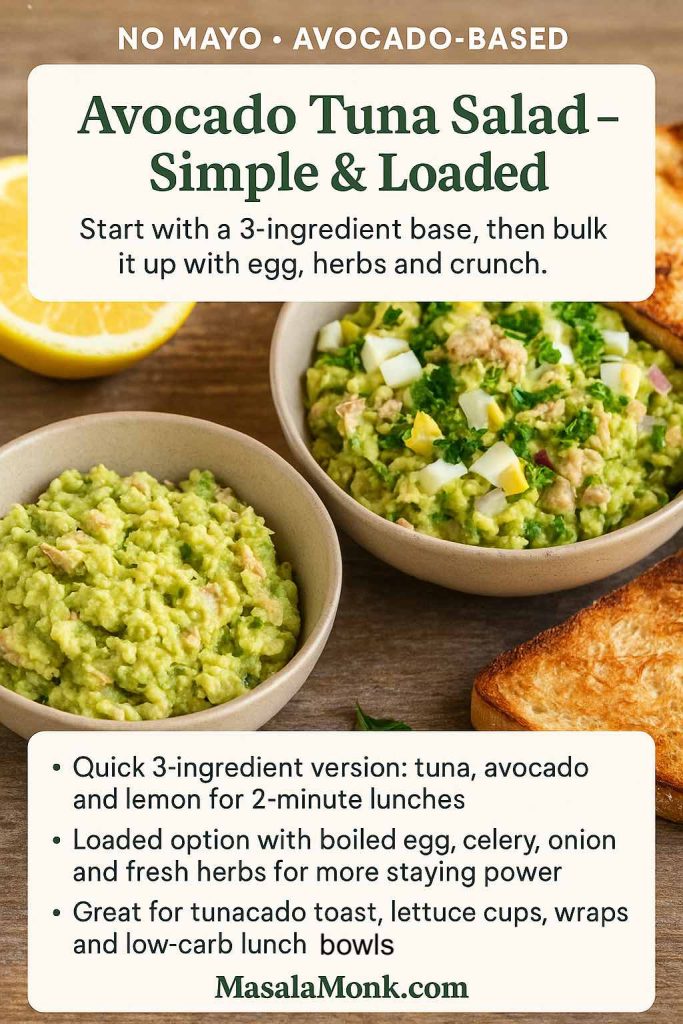
3. Avocado Tuna Salad, From Three Ingredients to Fully Loaded

As soon as avocado walks into the room, the tuna salad world shifts. Bringing avocado into the mix and your healthy tuna salad suddenly starts feeling like café food. It’s creamy, naturally dairy-free and works whether you’re in a hurry or feeling like layering flavours.

Two bowls of avocado tuna salad, one simple 3-ingredient version and one loaded with egg and herbs, served with toasted bread and lemon on a wooden table.
Avocado-based, no-mayo tuna salad shown two ways: a quick 3-ingredient base and a loaded version with egg, herbs and crunch, perfect for tunacado toast, wraps or low-carb lunch bowls.

Ultra-simple three-ingredient avocado tuna salad Recipe

When you want something you can stir together while the kettle boils, this is the one:

  • 1 ripe avocado
  • 1 can light tuna, drained
  • Juice of half a lemon (or lime)
  • Salt and pepper

Mash the avocado with the lemon, salt and pepper until it’s smooth but not totally pureed. Fold in the tuna, taste and tweak the seasoning. That’s really all there is to it.

You can:

  • Spoon it into lettuce cups for a low-carb tuna lunch.
  • Spread it over toast for a quick tunacado-style open sandwich.
  • Serve it with sliced cucumber and carrots as an easy tuna lunch idea when you don’t want bread.

Despite the tiny ingredient list, this still satisfies the search for a 3 ingredient tuna avocado salad and does it with zero mayo.

Loaded avocado and tuna salad recipe

On other days, you might want something closer to a full healthy tuna salad recipe built on avocado rather than yogurt or mayo.

Start with:

  • The three-ingredient base above

Then add:

  • 1–2 boiled eggs, chopped (for an avocado and tuna egg salad spin)
  • 1 rib celery, finely chopped
  • 2 tablespoons red onion
  • Optional: ¼ of a crisp apple, finely diced, for sweetness and crunch
  • A handful of chopped parsley, coriander or chives

Fold all of that through the avocado and tuna mix. The eggs make it especially satisfying, so this bowl covers everything from tuna and egg salad for weight loss days to avocado tuna salad wraps for hungrier ones.

Because both tuna and avocado show up regularly in pregnancy diets, this style of salad can sit happily in a pregnancy meal rotation as long as you pay attention to overall fish portions and choose lower-mercury tuna. For more context on that, MasalaMonk has a detailed guide on eating tuna while pregnant plus a recipe-focused piece, Motherhood and Meals: 5 Omega-3 Rich Seafood Recipes for Pregnancy, which includes a quick tuna–avocado idea.

Also Read: Carbonara Recipe: Italian Pasta (Creamy, Veggie, Chicken, Shrimp, Tuna & Keto)


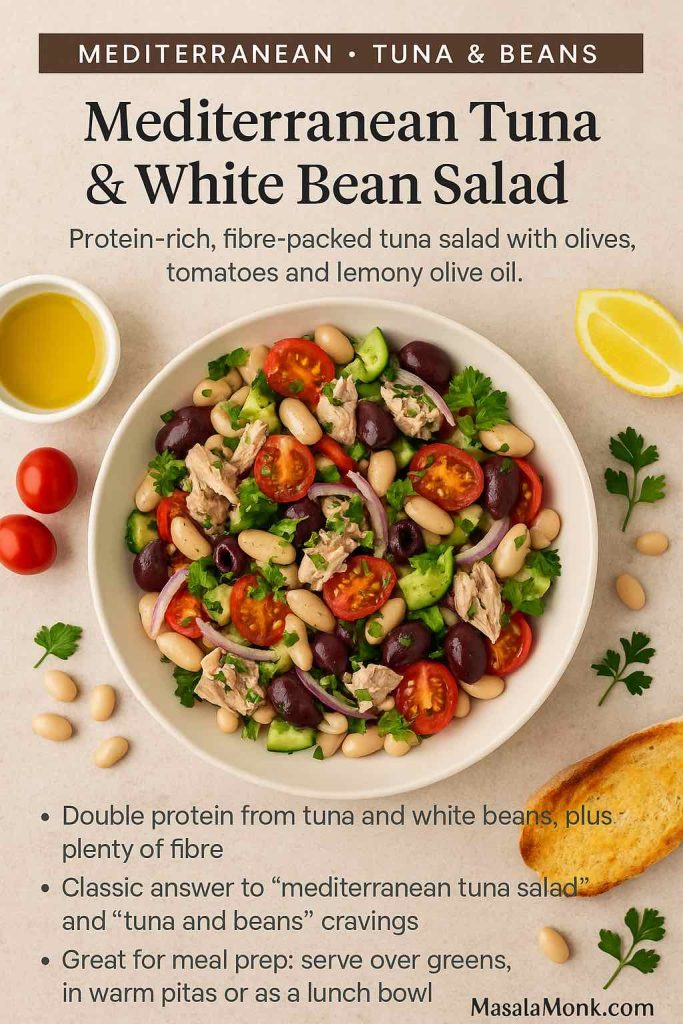
4. Mediterranean Tuna and White Bean Salad Recipe

If your taste buds wander toward olives, beans, herbs and lemon, you’re firmly in Mediterranean tuna territory. Next up: a Mediterranean tuna salad recipe that combines tuna, white beans, vegetables, olive oil and herbs. This style of salad is filling, colourful and very meal-prep friendly. Fortunately, it’s one of the easiest and most nutritious patterns to build.

Why this style is such a win

Mediterranean-style eating, which emphasises fish, olive oil, vegetables, legumes and whole grains, has been repeatedly associated with better heart health and long-term disease prevention. Tuna and white beans together give you a double hit of protein plus plenty of fibre and complex carbohydrates from the beans, while olive oil supplies heart-friendly fats.

Mediterranean tuna and white bean salad with cherry tomatoes, olives, cucumber and herbs in a white bowl, served with olive oil and lemon on a stone background.
Mediterranean-style tuna and white bean salad with olives, tomatoes and lemony olive oil – a protein- and fibre-rich bowl that works for meal prep, warm pitas or simple lunch bowls.

Ingredients

  • 2 cans tuna (light tuna in water works, or tuna in olive oil for a richer version)
  • 1½–2 cups cooked white beans (cannellini, navy or a mix)
  • 1 cup cherry tomatoes, halved
  • 1 small cucumber, diced
  • ¼ red onion, very thinly sliced
  • A handful of olives
  • Fresh parsley and/or basil

For the dressing

  • 3–4 tablespoons extra-virgin olive oil
  • 1½–2 tablespoons lemon juice
  • 1 teaspoon Dijon mustard
  • 1 clove garlic, finely minced or grated
  • ½ teaspoon dried oregano
  • Salt and pepper

How to make this Mediterranean tuna salad recipe

  1. In a large bowl, whisk together olive oil, lemon juice, mustard, garlic, oregano, salt and pepper.
  2. Add the beans, tuna, tomatoes, cucumber, onion and olives.
  3. Toss gently, trying not to mash the tuna too much.
  4. Sprinkle over herbs and toss once more.
  5. Taste and adjust seasoning.

You can serve this Mediterranean tuna salad over mixed greens, spooned onto crunchy toast, or tucked into a warm pita with a bit of lettuce. It keeps well for several days in the fridge, which makes it perfect for meal prep if you like to batch healthy tuna salad lunches ahead of time.

Beans bring plenty of fibre and minerals along with their plant protein, so they help this salad feel more filling and support gut health and blood sugar control at the same time. If you’d like more ideas for gut-friendly meals that use the same logic, you can have a look at Top 10 Foods for Gut Health and Boosting Your Fiber Intake with Sandwiches. Both pieces show how salad-style ingredients can slip into everyday meals without a lot of fuss.

Also Read: Carbonara Recipe: Italian Pasta (Creamy, Veggie, Chicken, Shrimp, Tuna & Keto)


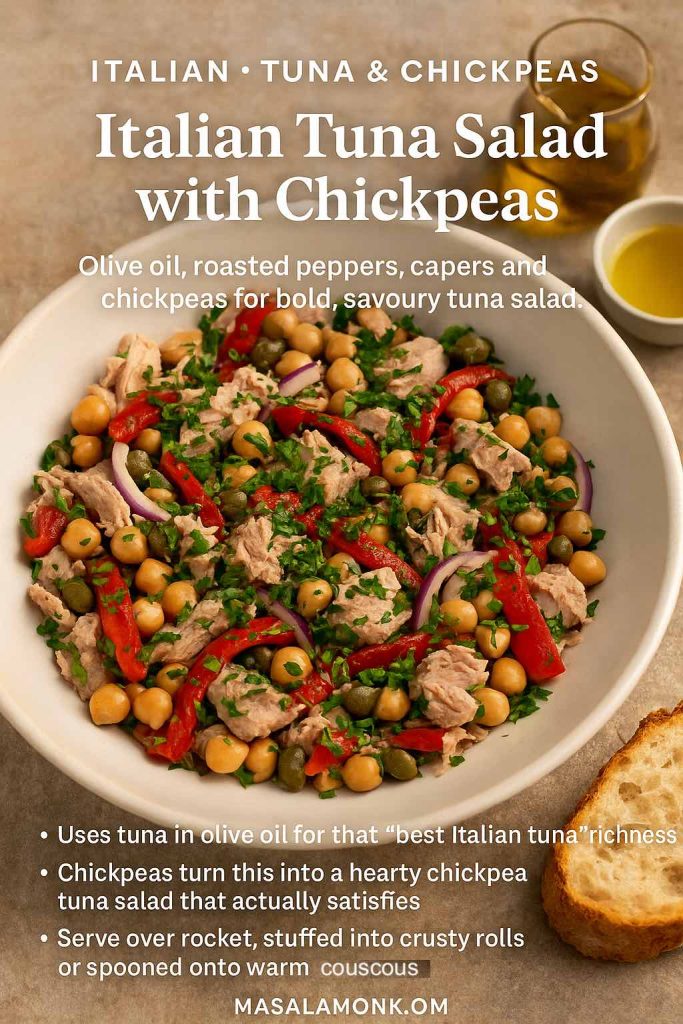
5. Italian Tuna Salad with Chickpeas Recipe

Slide a little further around the Mediterranean map and you arrive at Italian tuna salad territory. This Italian-leaning salad recipe shifts away from creaminess and toward bright, briny flavours: roasted red peppers, capers, herbs and chickpeas. It’s essentially a pantry-friendly tuna salad that just happens to be very high in fibre.

Italian tuna salad with chickpeas, roasted red peppers, capers and red onion in a white bowl, garnished with parsley, with olive oil and bread on a rustic surface.
Italian-style tuna salad made with tuna in olive oil, chickpeas, roasted peppers and capers – a hearty chickpea tuna salad that’s perfect over rocket, in crusty rolls or spooned onto warm couscous.

Ingredients

  • 2 cans tuna, ideally in olive oil
  • 1½ cups cooked chickpeas, rinsed and drained
  • ½ cup roasted red peppers, sliced into strips
  • ¼ cup red onion, thinly sliced
  • 2 tablespoons capers, rinsed and drained
  • A good handful of chopped fresh parsley

Dressing

  • 3 tablespoons olive oil (use some of the oil from the tuna cans if they’re packed in oil)
  • 1½ tablespoons red wine vinegar or lemon juice
  • 1 small clove garlic, very finely grated
  • ½ teaspoon dried oregano
  • Salt and pepper

Method

  1. Add tuna, chickpeas, roasted peppers, onion, capers and parsley to a large bowl.
  2. In a small jug or bowl, whisk together olive oil, vinegar or lemon, garlic, oregano, salt and pepper until slightly thickened.
  3. Pour the dressing over the salad ingredients.
  4. Toss gently, folding rather than stirring roughly, so the tuna stays in nice bite-sized pieces.

This version of tuna salad is lovely over rocket or baby spinach, and it’s equally happy spooned into a crusty roll for a more substantial lunch. If you like couscous, you can serve it over a bed of warm couscous to create a rio mare couscous-style dish using pantry ingredients.

Chickpeas deserve a bit of attention in their own right here. They’re high in fibre and plant protein and have been linked to better satiety, improved cholesterol and improved blood sugar control when they show up regularly in place of more refined starches. If you enjoy this way of cooking, MasalaMonk’s pieces on using chickpeas instead of sardines and using seitan instead of tuna are packed with similar high-protein, Mediterranean-leaning meal prep ideas.

Also Read: Authentic Louisiana Red Beans and Rice Recipe (Best Ever)


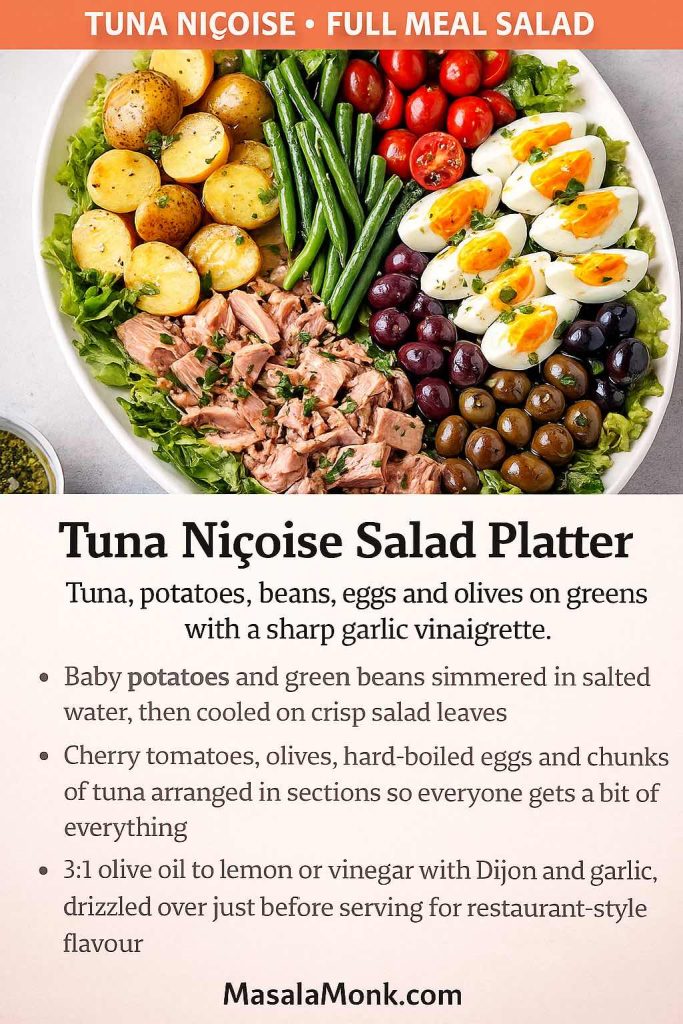
6. Tuna Niçoise Salad (Everyday and Occasion-Ready)

Every now and then, a simple bowl isn’t enough, and you want a full tuna Niçoise salad laid out on a big platter. The same tuna, eggs and vegetables, but laid out on a platter with potatoes, beans and olives so it looks like something you’d order in a bistro.

Tuna Niçoise salad platter with baby potatoes, green beans, cherry tomatoes, olives, hard-boiled eggs and tuna arranged on lettuce on a large plate.
Classic tuna Niçoise salad with baby potatoes, green beans, cherry tomatoes, olives, eggs and tuna arranged on greens, then finished with a 3:1 olive oil to lemon garlic vinaigrette for a full dinner salad.

What you’ll need

  • Mixed lettuce or baby greens
  • 8–10 small new potatoes, boiled until just tender and halved
  • A couple of handfuls of green beans, trimmed and blanched
  • 1 cup cherry tomatoes, halved
  • 3–4 hard-boiled eggs, cut into halves or quarters
  • A handful of olives
  • 2 cans tuna in olive oil, or seared fresh tuna steaks sliced thickly

For the Niçoise dressing

  • 3 tablespoons olive oil
  • 1½ tablespoons red wine vinegar or lemon juice
  • 1 teaspoon Dijon mustard
  • 1 clove garlic, finely grated
  • A pinch of dried thyme or oregano
  • Salt and pepper

Method

  1. Arrange the lettuce over a large serving platter.
  2. Nestle the potatoes, green beans, tomatoes, eggs, olives and tuna on top in little piles or rows so you get that classic composed look.
  3. Whisk together the olive oil, vinegar or lemon, mustard, garlic, herbs, salt and pepper until emulsified.
  4. Taste the dressing and adjust the acid and salt until it feels bright but balanced.
  5. Drizzle the dressing over everything just before you bring the platter to the table.

Because this salad leans so heavily on vegetables, olive oil, legumes and fish, it fits beautifully into the Mediterranean diet pattern that many large studies have associated with reduced risk of heart disease and other chronic illnesses. It’s also a neat answer for all the tuna nicoise salad, salade nicoise recipe and dressing for tuna nicoise searches that pop up whenever the weather warms up and people start craving big bowls.

Also Read: One-Pot Chicken Bacon Ranch Pasta (Easy & Creamy Recipe)


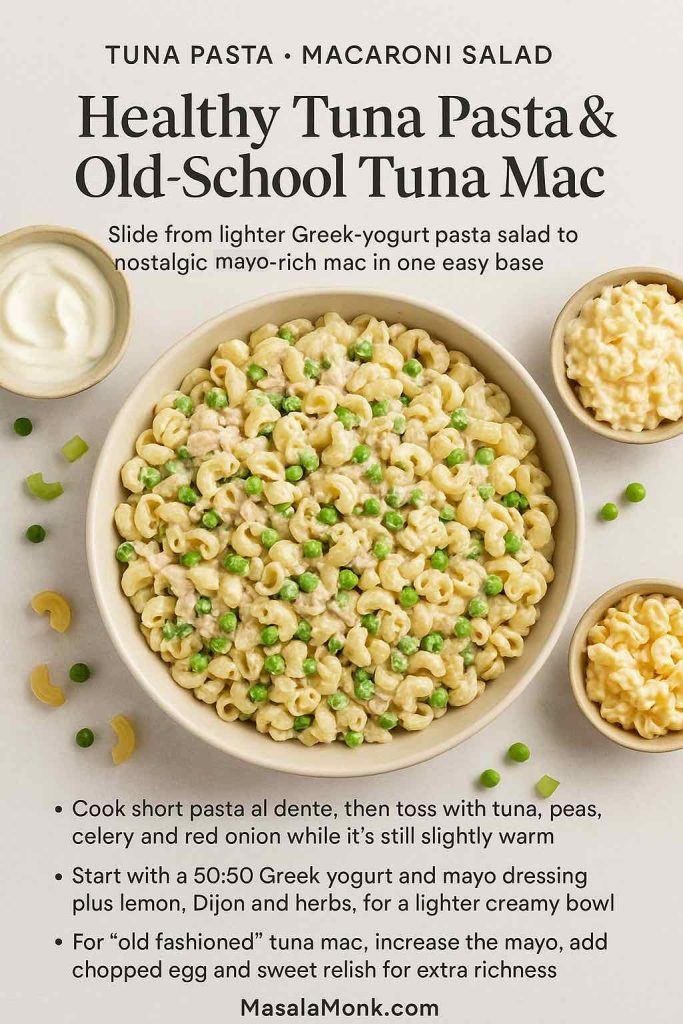
7. Healthy Tuna Pasta Salad and Old-School Tuna Macaroni Salad

Comfort food time. A tuna pasta salad recipe can easily turn into a calorie bomb, but a few tweaks give you the same creamy vibe in a more balanced way. Then, when nostalgia hits, you can slide back toward the classic tuna macaroni salad version by adjusting the dressing.

The trick is that you can make it as light or as old-school as you like just by sliding the dressing along the Greek yogurt ↔ mayo spectrum.

Large bowl of creamy tuna pasta salad with peas, with small bowls of Greek yogurt dressing and mayo-rich tuna mac on a light background.
Healthy tuna pasta salad made with al dente short pasta, tuna and peas plus a 50:50 Greek yogurt–mayo dressing, with a more nostalgic, mayo-rich tuna mac option shown on the side so you can slide between lighter and old-fashioned versions.

Lighter, creamy tuna pasta salad recipe

For a bowl that feels indulgent but still sits in the healthy tuna salad camp:

  • 3 cups cooked short pasta (elbow macaroni, shells or fusilli)
  • 2 cans tuna, drained
  • 1 cup peas or sweetcorn (frozen is fine; just thaw and drain)
  • ½ cup finely chopped celery
  • ¼ cup finely chopped red onion

Dressing

  • ½ cup Greek yogurt
  • 2–3 tablespoons mayonnaise
  • 1–2 teaspoons Dijon mustard
  • Juice of half a lemon
  • 2 tablespoons chopped fresh dill or parsley
  • Salt and pepper

How to make it

  1. Stir together yogurt, mayonnaise, mustard, lemon, herbs, salt and pepper until smooth.
  2. Combine pasta, tuna, peas, celery and onion in a large bowl.
  3. Pour the dressing over the top and toss until everything is well coated.
  4. Chill for at least 30 minutes before serving.

Old-fashioned recipe for macaroni salad with tuna

If your heart belongs to old fashioned macaroni salad with tuna, you can easily nudge the dressing in that direction:

  • Increase the mayonnaise and reduce or omit the yogurt.
  • Add 2–3 chopped hard-boiled eggs to the salad.
  • Stir in a generous amount of sweet relish.
  • Throw in diced bell peppers and grated carrot for colour.

Now you’ve got a tuna mac salad that mirrors the macaroni salad with tuna fish many of us grew up with, while still giving you the option to sneak in more vegetables. That’s the version that belongs next to barbecues and potluck tables, the “best tuna mac salad recipe” in your head.

How to cook the pasta for this recipe

For cold pasta salads, slightly undercooked pasta that still has some bite tends to hold up better. Cook the pasta just to al dente, rinse briefly under cold water to stop the cooking and remove excess starch, then drain very well before combining it with the tuna and dressing.

Potato and tuna salad spin-off

For days when potato salad tuna feels more appealing than pasta, it’s simple to swap some or all of the noodles for boiled baby potatoes or cubes of sweet potato. Both can be part of a healthy plate when paired with lean protein and vegetables. If you’re wondering how sweet potatoes compare with white potatoes in terms of calories, glycaemic index and suitability for weight-focused or diabetes-friendly eating, MasalaMonk breaks it down in Sweet Potato Nutrition Facts and The Potato Debate: White vs Sweet. For even more potato inspiration, their collection of potato salad recipes walks through classic, German, Russian and vegan potato salads you can easily adapt with tuna.


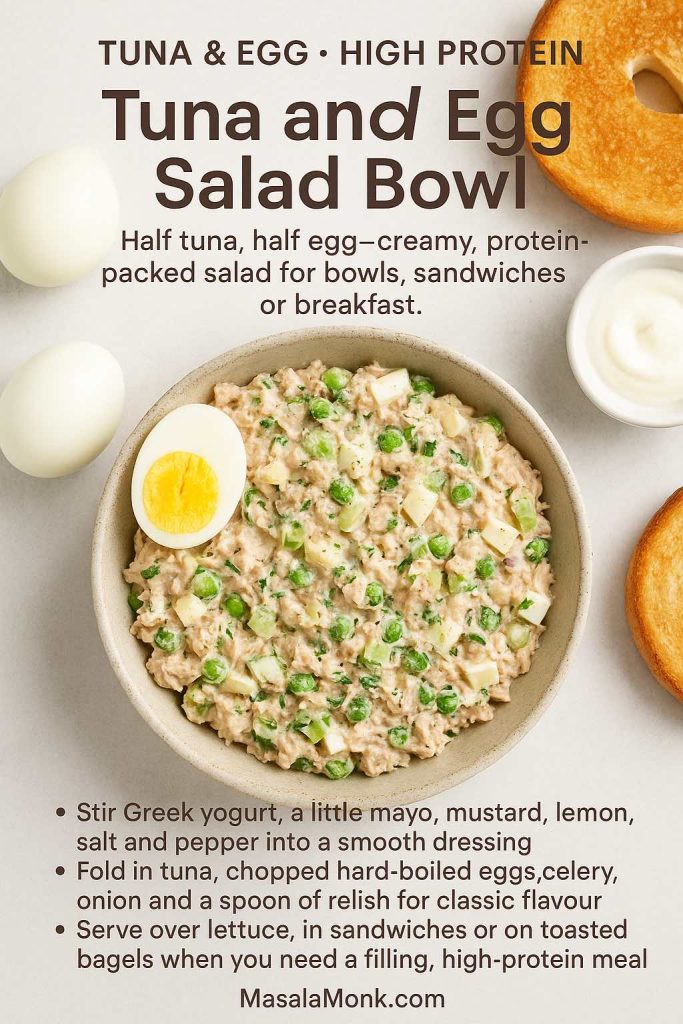
8. Tuna and Egg Salad (For Bowls, Sandwiches and Breakfast)

Another very popular direction involves eggs. Merging tuna salad and egg salad into one bowl gives you something that feels almost decadent despite being very straightforward. It’s rich, savoury and incredibly satisfying.

Bowl of creamy tuna and egg salad with peas and diced vegetables, topped with a halved hard-boiled egg, served beside whole eggs, toasted bagel slices and a small dish of dressing.
Creamy tuna and egg salad made with Greek yogurt, a little mayo, mustard and lemon, folded with chopped eggs, peas and crunchy veg – ideal for high-protein bowls, sandwiches or a savoury breakfast on toasted bagels.

How to make Basic tuna and egg salad

  • 2 cans tuna, well drained
  • 3 hard-boiled eggs, chopped
  • ¼ cup Greek yogurt
  • 2–3 tablespoons mayonnaise
  • 1 rib celery, finely chopped
  • 2 tablespoons onion, finely minced
  • 1–2 tablespoons relish or chopped pickles
  • 1 teaspoon mustard
  • Juice of half a lemon
  • Salt and pepper

Mix the yogurt, mayonnaise, mustard, lemon juice, salt and pepper into a smooth dressing. Stir in the celery, onion and relish, then fold in the tuna and chopped eggs.

How to serve this recipe

You can scoop this mixture:

  • Over lettuce for a boiled egg and tuna salad bowl
  • Into sandwiches as a tuna and egg salad sandwich filling
  • Onto toasted bagels or English muffins when you want something that covers tuna breakfast ideas as well as lunch

Because tuna and eggs are both rich in protein, this salad fits especially well into high-protein days. To keep the rest of your day balanced, you might pair it with something like Protein Oatmeal or a jar of High Protein Overnight Oats in the morning so that you hit your protein targets with real meals rather than relying entirely on supplements. For egg-cooking perfection, aim for 9–11 minutes in gently boiling water for hard-boiled eggs, followed by an ice bath. That timing usually gives firm whites and yolks without the grey ring.

Also Read: Sheet Pan Chicken Fajitas Recipe (Easy One-Pan Oven Fajitas)


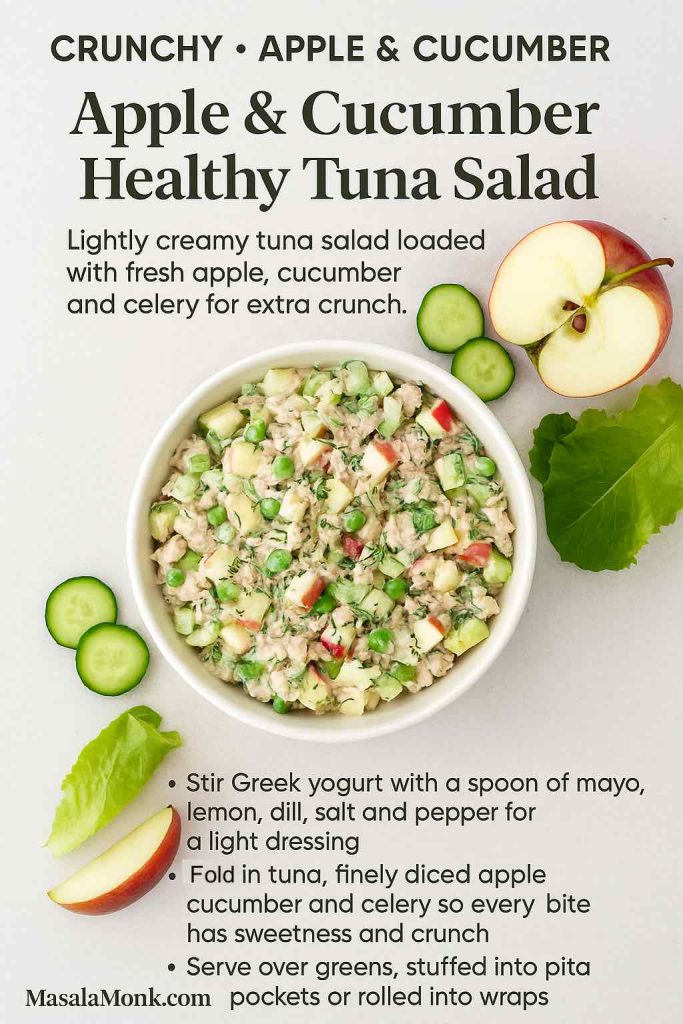
9. Crunchy Apple and Cucumber Healthy Tuna Salad

Not all healthy tuna salad recipes revolve around what you swap into the dressing. Sometimes the biggest difference comes from loading the bowl with fruit and vegetables so each bite feels fresher and more textured. That’s exactly what’s happening in the apple and cucumber corner of tuna fish salad: you can make this with both apples and cucumber or you can just do apples or cucumbers – both rely on the same idea.

Apple and cucumber healthy tuna salad in a white bowl with diced apple, cucumber, peas and celery, surrounded by apple slices, cucumber rounds and lettuce on a light background.
Lightly creamy tuna salad packed with diced apple, cucumber, celery and peas for sweetness and crunch – a fibre-rich option you can spoon over greens, tuck into pita pockets or roll into wraps for fresh, portable lunches.

Ingredients

  • 2 cans tuna, drained
  • ½ a crisp apple (Granny Smith, Pink Lady or similar), finely diced
  • ½ cup diced cucumber
  • 1 rib celery, finely chopped
  • ¼ cup Greek yogurt
  • 1–2 tablespoons mayonnaise or sour cream (optional, for richness)
  • 1–2 teaspoons lemon juice
  • 1 teaspoon honey or maple syrup (optional, to balance the lemon)
  • 1 tablespoon chopped fresh dill
  • Salt and pepper

Method

  1. In a small bowl, whisk the Greek yogurt, mayonnaise or sour cream (if using), lemon juice, honey, dill, salt and pepper until smooth.
  2. Add the tuna, apple, cucumber and celery to a larger bowl.
  3. Pour the dressing over the top and fold gently until everything is lightly coated.
  4. Taste and adjust with extra lemon or a tiny bit more honey to find your perfect sweet-tart balance.

Where this recipe shines

  • As a salad topping over mixed leaves.
  • Stuffed into pita or wraps for a bit of crunch in every bite.
  • As a side dish next to grilled chicken or roasted vegetables.

Apples and cucumbers add not only texture but also hydration and fibre. Verywell Health’s list of high-fibre foods is a good reminder of how simple ingredients like apples can quietly support digestion and blood sugar balance when they show up regularly.

If you want to make your everyday sandwiches and salad recipes more fibre-rich in general, MasalaMonk’s blog post on boosting fibre with sandwiches has lots of real-world combinations.

Also Read: Negroni Recipe: Classic Cocktail & Its Variation Drinks


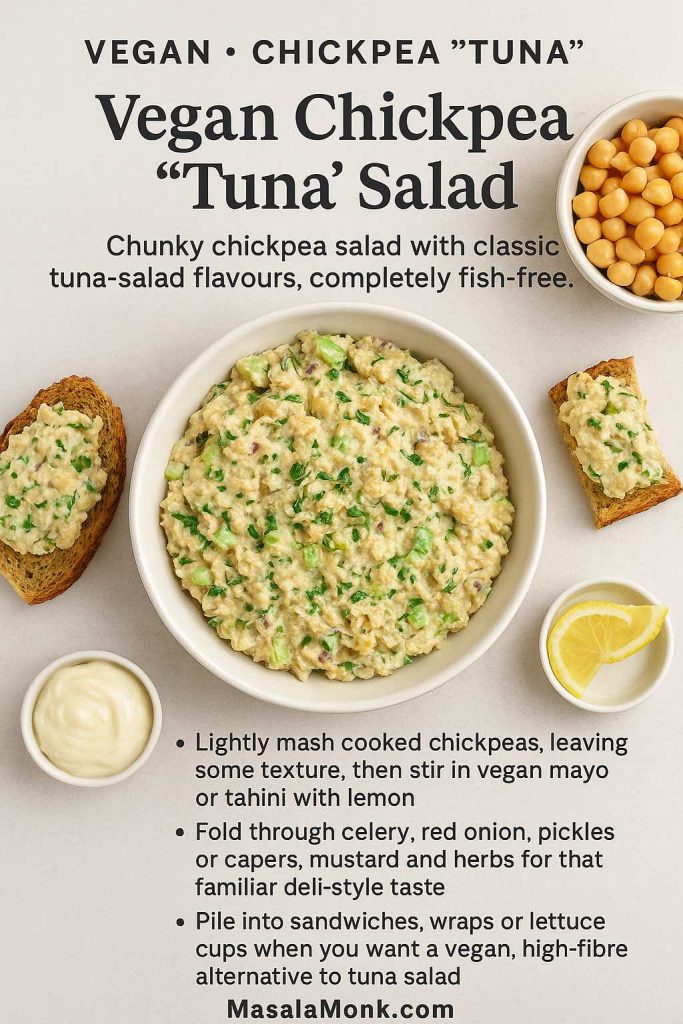
10. Vegan “Tuna” Chickpea Salad Recipe

Finally, even in a tuna-focused world, there’s a big audience for vegan tuna salad, tuna vegan, tuna vegetarian and vegetarian tuna salad. Many of them still want a tuna salad sandwich experience; they simply don’t want fish in it. Chickpeas are perfect for this because they mimic the slightly chunky, creamy texture and bring plenty of nutrition of their own.

Why chickpeas are such a strong base

Chickpeas provide a mix of complex carbohydrates, protein and fibre plus micronutrients like folate, iron and manganese. When they replace refined grains or processed meats in the diet, they’ve been linked with better blood sugar control, improved satiety and lower cholesterol. All of that makes them a natural fit for anyone who wants their vegan tuna salad to feel like more than a compromise.

Bowl of vegan chickpea ‘tuna’ salad with herbs and diced vegetables, surrounded by toast topped with the salad, a small bowl of chickpeas, vegan mayo and lemon wedges on a light background.
Chunky chickpea “tuna” salad made with lightly mashed chickpeas, vegan mayo or tahini, celery, red onion and herbs – an easy plant-based filling for sandwiches, wraps or lettuce cups when you want a high-fibre alternative to tuna.

Vegan tuna salad with chickpeas

  • 2 cups cooked chickpeas, drained and rinsed
  • ¼–⅓ cup vegan mayonnaise, or a mix of tahini and lemon juice
  • 1 rib celery, finely chopped
  • 2 tablespoons red onion, finely diced
  • 1–2 tablespoons chopped pickles or capers
  • 1 teaspoon mustard
  • Juice of half a lemon
  • A pinch of nori flakes or other dried seaweed (optional)
  • Salt, pepper, dill or parsley

Mash the chickpeas with a fork or potato masher until they’re mostly broken down but still have some texture. Stir in vegan mayo (or tahini and extra lemon), mustard, salt, pepper and herbs. Fold through celery, onion and pickles and taste.

Serve this vegan tuna salad in sandwiches with lettuce and tomato, spooned into lettuce cups, or over a bowl of mixed greens with chickpeas instead of tuna carrying the protein load.

If you’d like more ways to keep your week high in protein without leaning on animal foods, MasalaMonk has plenty of ideas, including Chickpeas Instead of Sardines and plant-based high-protein meal prep ideas using lentils instead of chicken. Between those and this chickpea tuna salad, you can cover a surprising number of “tuna-style” cravings with zero actual tuna.

Also Read: Whole Chicken in Crock Pot Recipe (Slow Cooker “Roast” Chicken with Veggies)


A Few Extra Ways to Play with Healthy Tuna Salad

By now you’ve got ten distinct healthy tuna salad recipes and at least as many ways to serve them. However, once you get comfortable with the basic patterns, it becomes easy to create your own riffs that still sit inside a healthy tuna salad framework.

A few ideas to keep exploring:

  • Use Greek yogurt, sour cream or hung curd in place of most mayo for a lighter sour cream tuna salad, or mix yogurt and mayo for a balanced, creamy sauce that doesn’t overload calories.
  • Swap part of the tuna for extra beans, chickpeas or lentils when you want a high-fibre, higher-bulk salad that stretches a single can further.
  • Lean into herbs like dill in tuna salad, parsley in Italian versions, or oregano in Mediterranean tuna recipes to change the flavour without adding heaviness.
  • Play with serving formats: croissant tuna sandwiches for brunch, bagel tuna melts, tuna with crackers on a snack board, or even a tunacado sandwich layered with avocado, tuna and greens.
  • When you’re eating tuna more than once a week, keep an eye on variety and portion size, and lean more often on canned light tuna rather than big predatory species to respect mercury guidance.

If you like the feeling of having a set of “templates” rather than memorising dozens of separate recipes, you can think of these ten as your master pattern library.

Also Read: Cheesy Chicken Broccoli Rice – 4 Ways Recipe (One Pot, Casserole, Crockpot & Instant Pot)


Putting It All Together

Taken as a whole, these ten recipes give you a full toolkit for turning a can of tuna—or a bowl of chickpeas—into exactly the sort of meal you’re in the mood for.

On a busy weekday, you might stick with the light deli-style healthy tuna salad recipe and turn it into simple tuna sandwiches for everyone. Later in the week, when you crave something more vibrant, the Mediterranean tuna and white bean salad or Italian tuna with chickpeas will happily take over. When comfort is the priority, the healthy tuna pasta salad and the more nostalgic tuna mac salad version step up. On hotter days, crunchy apple and cucumber tuna salad or a big tuna Niçoise platter feel right, while avocado tuna salad is there for every rushed lunch when the only things you can manage to mash together are tuna, avocado and lemon.

Alongside these fish-based bowls, you’ve got the option of skipping tuna completely and relying on a vegan tuna salad built on chickpeas instead. As long as you pay attention to overall fish intake and choose lower-mercury options such as canned light tuna most of the time, salads like these can sit comfortably in a week that’s trying to balance health, flavour and real-life constraints. Between the recipes here and the extra reading on salad benefits, gut-friendly foods, seafood and pregnancy and high-protein meal planning, you’ve got more than enough to keep your healthy tuna salad rotation interesting for a very long time.

And if all else fails, you can always fall back on that three-ingredient tuna avocado salad, because sometimes the best healthy tuna salad is simply the one you can make in the two minutes between meetings.

Also Read: Crispy Homemade French Fries From Fresh Potatoes (Recipe Plus Variations)

FAQs

1. Is tuna salad healthy?

Often yes, tuna salad can be very healthy, especially when you treat tuna as lean protein and not just a vehicle for mayonnaise. When you build a healthy tuna salad with light tuna, Greek yogurt or avocado, plenty of crunchy vegetables and sensible portions, you get a high protein, nutrient-dense meal. On the other hand, a tuna salad recipe loaded with only mayo and no veg will lean more heavy than wholesome.


2. What is a good basic healthy tuna salad recipe?

To put it simply, a solid healthy tuna salad recipe starts with drained light tuna, Greek yogurt, a spoon or two of mayo, lemon juice, mustard, salt and pepper. After that, you fold in celery, onion and maybe a little relish or pickles for deli-style flavour. This kind of bowl covers “tuna salad recipe healthy” and works just as well in a tuna salad sandwich as it does over a green salad.


3. How do I make tuna salad without mayo?

If you want a tuna salad without mayo, Greek yogurt is the easiest swap. You mix tuna with plain Greek yogurt, lemon, mustard, herbs, salt and pepper, then add celery, cucumber and onion for texture. Alternatively, you can make a no mayo tuna salad with mashed avocado or a simple olive oil and lemon dressing if you prefer a lighter, Mediterranean feel.


4. What can I use instead of mayonnaise in tuna salad?

There are several tasty options. Greek yogurt gives you a creamy, tangy base for Greek yogurt tuna salad, while avocado creates a rich avocado tuna salad without any dairy. In addition, cottage cheese, hummus or a vinaigrette made from olive oil and lemon all work as alternative dressings, especially in Mediterranean tuna salad or tuna and bean salad recipes.


5. Which type of tuna is best for a healthy tuna salad?

Generally, light canned tuna in water is the most practical choice for a healthy tuna salad recipe because it’s lean and mild in flavour. Nevertheless, tuna packed in olive oil is lovely when you’re making Italian tuna salad or tuna nicoise salad, since the oil adds richness. For everyday healthy tuna, most people stick to light tuna and then adjust the dressing to suit their goals.


6. Can tuna salad help with weight loss?

In many cases, yes, especially when you build a healthy tuna salad that’s high in protein and full of vegetables. Because tuna and Greek yogurt or egg keep you satisfied, you’re less likely to overeat later. However, if your tuna salad recipe is mostly mayonnaise with very little tuna or veg, it can quickly become too calorie-dense for weight-loss plans.


7. How much protein is usually in a serving of tuna salad?

As a rough guide, a small can of tuna alone often provides around 25–30 grams of protein. Once you stir in Greek yogurt, cottage cheese or egg, a generous serving of high protein tuna salad can easily deliver 20–30 grams of protein. Consequently, recipes like tuna and egg salad, cottage cheese tuna salad or avocado tuna salad fit very neatly into high-protein meal plans.


8. How often can I eat tuna salad each week?

Typically, having tuna salad a couple of times per week is reasonable for most people, especially when you choose light tuna and vary your other protein sources. In practice, lots of people rotate healthy tuna salad lunches with chickpea salads, lentil dishes, chicken or vegan tuna salad to keep variety high. If you have pregnancy or medical concerns, it’s wise to keep portions moderate and mix in more plant-based recipes.


9. How long does homemade tuna salad keep in the fridge?

As a rule of thumb, homemade tuna salad keeps well for about 2–3 days in the fridge in a sealed container. After that, the texture of the dressing and vegetables usually starts to deteriorate. To keep things fresher, you can store lettuce, cucumber and tomato separately and add them to your tuna salad sandwich or salad bowl just before eating.


10. Can I freeze tuna salad?

Technically you can, but it isn’t ideal. Once thawed, the dressing often separates, and crunchy ingredients like celery, cucumber or apple lose their texture. Instead, a better approach is to freeze plain canned tuna portions and then mix a fresh healthy tuna salad recipe with yogurt, avocado or mayo on the day you plan to eat it.


11. How do I make a healthy tuna pasta salad?

For a healthier tuna pasta salad, you start with short pasta cooked al dente, then add tuna, peas or sweetcorn, celery and onion. After that, make a dressing that’s mostly Greek yogurt with just a little mayonnaise, plus lemon juice, mustard, salt, pepper and dill. This way, your healthy tuna pasta salad recipe stays creamy but lighter than a traditional tuna macaroni salad.


12. How can I lighten an old fashioned macaroni salad with tuna?

If you love old fashioned macaroni salad with tuna but want it less heavy, there are several simple tweaks. Firstly, swap part of the mayo for Greek yogurt to cut calories and add more protein. Secondly, stir in extra vegetables like celery, bell pepper and grated carrot so your tuna mac salad has more bulk from low-calorie ingredients. Finally, serve sensible portions and pair it with a green salad to balance the plate.


13. What can I add for extra crunch in tuna salad?

There are plenty of choices. Celery and cucumber are classic, while finely chopped bell peppers, red onion and radishes also add bite. Moreover, diced apple or pickles give you both crunch and contrast, so an apple and tuna salad or cucumber tuna salad feels fresh even when the dressing is creamy.


14. How do I make a Mediterranean tuna salad?

To create a Mediterranean tuna salad, mix tuna with white beans or chickpeas, cherry tomatoes, cucumber, olives and red onion. Then, dress it all with olive oil, lemon juice, garlic, oregano, salt and pepper. This kind of tuna and beans salad is naturally high in fibre and fits beautifully into “tuna recipes healthy” searches.


15. What goes into an Italian tuna salad?

An Italian tuna salad usually leans on tuna in olive oil, roasted red peppers, capers, red onion and fresh herbs like parsley. You then toss everything with a sharp red wine vinegar or lemon dressing and sometimes add chickpeas or cannellini beans. As a result, you get an Italian tuna salad that’s bold, savoury and perfect over greens or in a hearty sandwich.


16. How is tuna nicoise salad different from regular tuna salad?

Tuna nicoise salad is more of a composed meal than a simple spread. It usually includes lettuce, boiled potatoes, green beans, tomatoes, olives, hard-boiled eggs and tuna, all dressed with a garlicky vinaigrette. By contrast, a basic tuna salad recipe tends to be a mixed bowl used for tuna salad sandwiches or wraps, rather than a full platter.


17. Can I use fresh tuna instead of canned tuna in salad?

Yes, absolutely. You can sear fresh tuna steaks quickly so they stay pink inside, then slice or flake them into a salad with your usual dressing. Fresh tuna works especially well in tuna nicoise salad, Italian tuna salad or a gourmet healthy tuna salad recipe, though canned tuna remains more convenient for everyday use.


18. How do I make avocado tuna salad?

To put it briefly, avocado tuna salad starts with mashing a ripe avocado with lemon, salt and pepper, then folding in flaked tuna. Afterward, you can add celery, red onion, herbs and even chopped egg or apple for extra interest. Whether you keep it as a 3 ingredient tuna avocado salad or turn it into a loaded avocado and tuna salad recipe, it’s a great no-mayo option.


19. What can I add to make a high protein tuna salad?

Beyond tuna itself, there are several high-protein add-ins. Greek yogurt, cottage cheese, boiled eggs and chickpeas all boost protein levels, so bowls like tuna and egg salad, cottage cheese tuna salad or chickpea tuna salad are naturally more filling. Additionally, serving your healthy tuna salad alongside a protein-rich soup or bean salad turns the whole meal into a serious protein hit.


20. Is tuna salad suitable for breakfast?

Surprisingly, yes. A small portion of tuna and egg salad on toast, a tuna breakfast wrap with avocado, or a lighter healthy tuna salad on rye bread can make a savoury, protein-rich breakfast. Granted, it’s not everyone’s first thought, yet on busy days it’s a quick way to get protein in early without resorting to sugary options.


21. How do I build a healthier tuna salad sandwich?

Start with wholegrain or seeded bread for more fibre. Next, use a healthy tuna salad recipe based on Greek yogurt or avocado instead of just mayo, and layer in lettuce, tomato and cucumber. In addition, keeping an eye on portion sizes and pairing the tuna sandwich with a simple side salad rather than fries keeps the whole meal in the “tuna sandwich recipe healthy” category.


22. How can I stop tuna salad sandwiches from going soggy?

One simple approach is to create a barrier between the bread and the filling. You can line the bread with lettuce, cheese slices or even a thin layer of hummus before adding your tuna salad sandwich filling. Alternatively, pack the bread and tuna fish salad separately for lunch and assemble the sandwich when you’re ready to eat.


23. What are some quick tuna lunch ideas besides sandwiches?

There are plenty of easy options. For instance, you can spoon healthy tuna salad onto a big bowl of greens, tuck it into lettuce wraps, mix it with warm rice or quinoa, or stir it through pasta for a quick tuna noodle salad. Likewise, a simple tuna and bean salad with olive oil and lemon makes a fast high-protein lunch that travels well.


24. How can I make vegan tuna salad?

For a vegan tuna salad, mash cooked chickpeas until partly broken down, then mix them with vegan mayo or a tahini-lemon dressing. After that, add celery, onion, pickles, mustard and herbs so it resembles classic tuna salad in flavour and texture. This kind of tuna vegan recipe works brilliantly in sandwiches, wraps and salad bowls when you want a vegetarian tuna salad stand-in.


25. Is tuna salad good for meal prep?

Yes, tuna salad can be a useful meal prep option, particularly for lunches. You can prepare a batch of healthy tuna salad, divide it into containers and store it in the fridge for two or three days. Even so, it’s better to add delicate ingredients like lettuce, tomato or cucumber just before serving, so they stay crisp.


26. How do I make tuna salad more kid-friendly?

Generally, kids prefer simpler flavours and softer textures. So, keep the seasonings gentle, use a smoother dressing, and chop vegetables very finely. You might also try adding sweetcorn or a little grated cheese and serving the tuna fish salad sandwich on soft bread or as small tuna mac salad portions to make it more familiar.


27. How can I turn tuna salad into a full dinner?

One straightforward way is to build a large salad bowl or platter. Place your healthy tuna salad on top of greens, roasted vegetables, potatoes, beans or pasta to create a more substantial tuna casserole salad or tuna nicoise-style meal. Alternatively, bake a tuna salad casserole with wholegrain pasta and vegetables for a warm dinner version.


28. Which herbs and spices go best in tuna salad?

Dill, parsley, chives and coriander are classic herbs for a healthy tuna salad recipe. Meanwhile, dried oregano and thyme work well in Mediterranean tuna salad, and paprika, black pepper or a pinch of chilli flakes add depth. Ultimately, a squeeze of lemon and a little mustard tie everything together without overpowering the tuna.


29. How can I cut calories in tuna pasta salad or tuna mac?

To start, use more Greek yogurt and less mayonnaise in the dressing. Then, add plenty of vegetables—peas, celery, peppers, cucumber—so your healthy tuna macaroni salad feels generous without relying on huge amounts of pasta. Finally, serving smaller portions alongside a green salad lets you enjoy tuna mac salad without overdoing calories.


30. What are some creative healthy tuna salad ideas beyond the basics?

Besides the usual deli-style bowl, you can experiment with tuna and avocado salad wraps, Mediterranean tuna and white bean salad jars, Italian tuna and chickpea salad over couscous, or crunchy apple and tuna salad pitas. You could also explore vegan tuna salad made from chickpeas on some days and high protein tuna salad with egg or cottage cheese on others. In the end, rotating these ideas keeps “healthy tuna salad” interesting instead of repetitive.

Posted on Leave a comment

Sugar Withdrawal: Symptoms, Timeline, and How to Cope

Portrait cover showing a woman with lemon water beside chia pudding, nuts and pickles—illustrating sugar withdrawal symptoms, timeline and relief strategies.

Giving up added sugar can feel deceptively hard. At first, cravings spike, patience thins, and energy dips; soon after, things begin to settle. While researchers debate whether sugar itself is “addictive” in humans, what most people describe during the first week is a cluster of short-lived sugar withdrawal symptoms—headaches, brain fog, irritability, sleep hiccups, and fluctuating appetite. Rather than treating this like a mysterious syndrome, it helps to view it as a predictable adjustment period: your routines, taste expectations, and reward cues are changing, and your body is recalibrating. Moreover, when you manage caffeine, hydration, protein, fiber, movement, and sleep in tandem, the rough edges smooth out quickly. For context on the science debate, see this measured review on sugar addiction in humans and why the strongest “withdrawal-like” signals come from patterns with highly palatable or ultra-processed foods rather than sugar alone.

What Sugar Withdrawal Feels Like (and Why It’s Brief)

Initially, sugar withdrawal symptoms often show up as a one-two punch: powerful cravings coupled with a mild, band-like headache. Soon after, fatigue can creep in; concentration may feel patchy; mood can wobble for a day or two. Interestingly, these discomforts rarely persist beyond a couple of weeks when daily habits are dialed in. Notably, part of the experience reflects routine disruption—snack times change, sweet tastes recede, and cues (like scrolling, commuting, or finishing dinner) no longer trigger the same behaviors. Consequently, your brain’s prediction system flags the mismatch, which you experience as urge or restlessness; once the new pattern stabilizes, those alarms quiet.

The Caffeine Overlap Most People Miss

Equally important, many people consume sugar with caffeine—sweet tea or coffee, soft drinks, or energy beverages. If you stop both at once, you can provoke classic caffeine withdrawal on top of dietary change. As a rule of thumb, caffeine withdrawal begins 12–24 hours after cutting intake, peaks ~20–51 hours, and fades over the next few days. Therefore, easing caffeine rather than slamming on the brakes tends to be kinder to your head and your mood. For a quick primer on the timing and symptoms, skim the StatPearls overview on caffeine withdrawal.

Sugar Withdrawal Symptoms: Headache, Brain Fog, Irritability, and Beyond

Headache. When sweetened drinks disappear, the headache window often reflects caffeine changes rather than sugar alone. Pragmatically, switch to half-caf for several days, move caffeine to earlier in the day, and sip water regularly. If you usually add multiple teaspoons of sugar to beverages, step down a teaspoon a week; simultaneously, swap one sweet drink for sparkling water with lemon or a chilled herbal infusion to lower the sweetness “set point” without feeling deprived.

Brain fog & fatigue. Early on, some readers simply under-fuel. A breakfast anchored in protein + fiber steadies the morning—think eggs on whole-grain toast, Greek yogurt with nuts and seeds, or a make-ahead jar of chia pudding ideas. For variety, this keto chia pudding—no added sugar and this mango-chia riff without added sugar keep texture and flavor interesting while the palate readjusts.

Irritability. Mood is exquisitely sensitive to sleep debt and erratic meals. Consequently, go for consistent mealtimes, add a short walk after lunch or dinner, and keep caffeine away from late afternoon. If you wake up edgy, check last night’s bedtime rather than blaming breakfast.

Sore throat or dry mouth. Occasionally, people report a scratchy throat—usually from dehydration, room-dryness, or substituting very acidic drinks. Therefore, prioritize plain water first; if you’re craving “something extra,” rotate in a lightly flavored electrolyte beverage that isn’t sugar-packed. For inspiration, you can pull low-sugar ideas from DIY electrolyte posts and spiced electrolyte recipes.

Cravings. Urges are normal and, usefully, they reveal cues. Notice the trigger—boredom, stress, or the late-afternoon lull—and prepare savory swaps so you’re not negotiating with sweets. For a tangy, salt-forward alternative that resets expectations, explore The Art of Making Pickles and keep a small portion with meals or snacks.

A Realistic Timeline (Without the Drama)

Now, timelines vary—prior intake, sleep, and caffeine all matter—yet there’s a common arc. During days 1–3, cravings roar loudest and headaches are most likely if caffeine drops abruptly. During days 4–7, urges taper; sleep and mood begin to stabilize. By week 2, the background noise quiets; cravings become situational rather than constant. Interestingly, this shape echoes what self-report instruments find when people reduce highly processed foods: a short peak followed by rapid improvement. If you’re curious, the Highly Processed Food Withdrawal Scale (ProWS) describes how adults report transient symptoms when cutting back.

Anchor Your Goals with Clear Limits (So “Less Sugar” Means Something)

To avoid ambiguity, use simple anchors. First, the World Health Organization recommends keeping free sugars below 10% of energy and ideally below 5%; free sugars include added sugars plus the sugars in honey, syrups, fruit juice, and juice concentrates. The wording matters, because a glass of juice, while natural, still counts toward the limit. You can skim the full WHO sugars guideline or its NCBI book version for definitions and context. In parallel, the American Heart Association suggests no more than 6% of calories from added sugars—about 25 g/day for most women and 36 g/day for most men—a plain-language target you can remember quickly; see the AHA overview on added sugars or their How Much Is Too Much? explainer. Meanwhile, NHS guidance advises limiting fruit juice and smoothies to about 150 ml/day, nudging people toward whole fruit—details in this NHS page on cutting down sugar.

What Actually Helps (Simple, Repeatable, and Kind to Your Brain)

Start with breakfast. Front-load 20–30 g protein + fiber to reduce mid-morning scavenging. For instance, swirl protein into chia pudding, top Greek yogurt with nuts and seeds, or do eggs with sautéed veg. As your taste recalibrates, sweetness thresholds drop naturally.

Taper sweetened drinks first. Because the largest single source of added sugar for many people is beverages, downsizing them yields outsized benefits. Replace one soda with sparkling water and citrus; ask for unsweetened iced tea and add lemon; nudge your coffee from two teaspoons of sugar toward one and, subsequently, none. Moreover, teen studies show that even three days without sugary drinks can change how people feel—more headaches and cravings at first—underscoring why gradual swaps are humane. For a short read on that trial, check this adolescent sugary-drink cessation study and the plain-English UC Davis news brief.

Read the label once, then automate. The modern Nutrition Facts panel lists Added Sugars (grams + %DV). As a quick heuristic, 5% DV or less is low; 20% DV or more is high. After you compare two or three go-to products, just buy them on repeat to reduce decision fatigue. If you want a refresher, the FDA’s “Added Sugars” page and this printable cheat sheet are straightforward.

Swap, don’t just stop. Because habits favor substitutes, pre-position alternatives: keep sparkling water with citrus cold in the fridge, pair plain yogurt with whole fruit for a creamy-sweet finish, and stock nuts or roasted pulses for crunch. Btw, here we would like to point you towards our post on 20 Signs You’re Eating Too Much Sugar for broader awareness.

Walk and sleep like you mean it. A 10–20 minute walk after meals improves how your body uses glucose; a reliable sleep window curbs next-day cravings and irritability. Furthermore, consistent light movement acts like a pressure valve for stress, which often masquerades as hunger.

Hydrate intelligently. Thirst often dresses up as a sugar urge. Keep water visible; when variety helps, rotate light, low-sugar DIY electrolyte ideas such as these hangover electrolyte recipes or spiced electrolyte twists. Even so, avoid turning hydration into a back-door sugar source; the NHS note on limiting juice to ~150 ml/day is a useful guardrail.

Use “urge surfing.” When a craving hits, set a 10-minute timer and do anything mildly absorbing (dishes, inbox triage, a quick call). Because most urges crest and fall like a wave, this buys time for the peak to pass. Subsequently, eat a protein-plus-fiber snack if you’re genuinely hungry.

Sugar Withdrawal Symptoms & Caffeine: Untangling the Knot

Let’s zoom in on the common culprit pair. Sweet coffee, sweet tea, colas, and energy drinks marry sugar with caffeine—two reinforcers that work differently but travel together. If you remove both on Monday, you set up a 48-hour window where you might feel headachy, foggy, and irritable; by Thursday, you’ll likely feel markedly better. Consequently, a staggered plan is gentler:

  • Days 1–3: keep caffeine earlier in the day; move from two sugars to one.
  • Days 4–7: keep the earlier caffeine; drop to half-caf; shift to zero sugar in one beverage.
  • Week 2: hold caffeine timing; go unsweetened in all daily drinks.

Because the expected course of caffeine withdrawal is well mapped—onset around a day, peak around two, resolution within a week—you’ll know if you’re dealing with caffeine or something else. For details, the NIH/NCBI review on caffeine withdrawal is concise and clinician-vetted.

Is It “Addiction,” Habit, or Both?

People often ask whether their rough week proves that sugar is addictive. Here, nuance matters. Addiction frameworks center on loss of control, continued use despite harm, tolerance, and withdrawal. In laboratory animals, intermittent access to highly palatable sweet foods can produce withdrawal-like behaviors. However, leading human reviews find limited evidence that sugar alone meets addiction criteria in people; the more compelling pattern involves ultra-processed foods and intermittent, cue-driven eating. Hence the practical takeaway: regardless of labels, you can engineer your environment—substitute savory options, reduce cue exposure, stabilize meals—and feel the difference rapidly. For a balanced view, see “Sugar addiction: the state of the science”, which explains why the human data diverge from the animal models.

“Flush Sugar from the Body”? Here’s the Straight Answer

Metabolically, there’s no instant “flush.” Your body regulates blood glucose continuously through insulin, liver glycogen, and muscular uptake. Dramatic cleanses are neither necessary nor particularly helpful. Instead, the fundamentals are surprisingly potent: drink water, walk after meals, set a steady sleep window, and eat protein + fiber at regular intervals. Meanwhile, anchor your daily cap with an authoritative yardstick—WHO’s free-sugars guideline or the AHA’s added-sugar limits—and use the FDA’s Added Sugars label to make lower-sugar choices automatic.

Putting It All Together: A Gentle, 14-Day Reset

Days 1–3: stabilize and notice.

Begin with breakfast you can repeat without friction—Greek yogurt with seeds, eggs and greens, or a no-sugar chia base. Shift one sweet drink to an unsweetened or lightly flavored option, and, crucially, move caffeine earlier. Keep water visible; if plain water bores you, rotate a cucumber electrolyte.

Days 4–7: taper and swap.
Cut another teaspoon of sugar from beverages. Swap a dessert for yogurt + nuts or fruit + nut butter. Add a 10–20 minute post-meal walk most days. If headaches appear, consider whether caffeine timing changed; adjust to half-caf temporarily, then keep stepping down.

Week 2: refine and automate.
Settle on three “default” breakfasts and two “go-to” snacks; stock them so decisions are easy. Choose your favorite sparkling water + citrus combo and keep it cold. Re-read the labels on two regular pantry items and pick the lower Added Sugars %DV versions; after that, stop re-checking and simply reorder the winners.

Throughout the fortnight, keep an eye on cravings as information, not as a verdict. If late-night urges persist, move dinner 30–60 minutes earlier, front-load protein at breakfast, and block blue light in the last hour of the evening. Ultimately, predictability is soothing to both physiology and psychology.

When You Want More Depth (and Where to Link It)

Want more depth? For a broader primer on how sugar interacts with metabolism and mood over time, read effects of sugar on the body. For context beyond sugar—especially how ultra-processed foods influence appetite and cravings—see the overview on UPFs and health. And if you’re wondering whether intake has crept up lately, 20 signs you’re eating too much sugar offers a quick self-check.

Closing Thought: Short Discomfort, Long Payoff

Yes, sugar withdrawal symptoms can feel uncomfortably real for a handful of days; nevertheless, they’re not a life sentence. With protein-forward meals, steady hydration, a sensible caffeine taper, light movement, and better sleep, most people feel clearer and calmer by the end of the first week and noticeably steadier by week two. Perhaps most encouragingly, your tastes recalibrate—desserts taste sweeter, fruit tastes brighter, and everyday foods need less embellishment. From there, momentum builds: fewer impulse snacks, more deliberate choices, and a routine that supports your goals without constant negotiation.


FAQs on Sugar Withdrawal Symptoms

1) What are sugar withdrawal symptoms?

Generally, people describe intense cravings, dull headaches, irritability, low energy, and concentration dips after cutting added sugar. Moreover, sleep can wobble for a few days. Typically, these sugar withdrawal symptoms are short-lived and ease as meals, hydration, and daily routines stabilize.

2) How long do sugar withdrawals last?

Typically, the first three to five days feel hardest, then discomfort declines. Furthermore, many notice steadier energy by the end of week one and clearer focus by week two. Ultimately, the exact duration depends on prior intake, sleep quality, caffeine habits, and how balanced your meals are.

3) What does sugar withdrawal feel like day by day?

Commonly, days 1–3 bring the strongest cravings and headache risk; days 4–7 show gradual improvement; week 2 feels calmer with only situational urges. Notably, this arc reflects routine readjustment: taste expectations shift, cues weaken, and sugar withdrawal symptoms naturally diminish.

4) Can you go through withdrawal from sugar?

Strictly speaking, definitions vary; nevertheless, many people experience withdrawal-like effects when removing highly sweet foods and drinks. Consequently, brief headaches, mood changes, and cravings can appear, then settle with adequate protein, fiber, hydration, movement, and consistent sleep.

5) Are sugar withdrawals a thing or just a myth?

Yes, withdrawal-type experiences are commonly reported, even if terminology is debated. Importantly, much of the discomfort stems from habit change and blood-glucose swings—so practical strategies work. Hence, focusing on structured meals and gradual beverage changes usually shortens the rough patch.

6) What causes sugar withdrawal headaches?

Often, headaches come from cutting sweetened caffeinated drinks rather than sugar alone. Additionally, dehydration and under-eating can contribute. Therefore, taper caffeine, drink water regularly, and include a protein-rich breakfast to blunt that early headache window while sugar withdrawal symptoms settle.

7) Why do I feel brain fog or fatigue when I stop sugar?

Sometimes, breakfast lacks protein or overall calories drop too sharply. Consequently, your energy and focus dip. Aim for protein and fiber at each meal, keep meal timing steady, and add light activity after eating. Subsequently, most people notice clarity return within days.

8) Can sugar withdrawal cause anxiety or irritability?

Brief mood shifts are common as routines and cues change. Moreover, short sleep, high stress, or abrupt caffeine cuts can amplify irritability. Thus, protect your sleep window, take short walks, and normalize meals. Thereafter, mood usually stabilizes as sugar withdrawal symptoms recede.

9) Do sugar withdrawal symptoms include a sore throat?

Occasionally, people report scratchiness or dryness, typically linked to low fluid intake or very acidic substitutes. Accordingly, prioritize water, choose gentler beverages, and maintain comfortable indoor humidity. Soon, that throat sensation tends to resolve as hydration and routines improve.

10) How do I deal with sugar withdrawal cravings in the moment?

Firstly, pause for ten minutes—urges crest and fall like waves. Secondly, have a ready snack combining protein and fiber. Additionally, change context: step outside, stretch, or take a brief walk. Finally, resume your plan; each repetition weakens the old cue-craving loop.

11) Is it better to quit sugar cold turkey or wean off?

Both can work. However, if your main source is sweetened coffee, tea, or sodas, tapering sugar (and caffeine) typically reduces headaches and improves adherence. Conversely, if sweets are occasional but intense, a faster reset with structured swaps might feel simpler.

12) What helps most with sugar withdrawal symptoms?

Consistently, the fundamentals matter: protein-forward meals, fiber at each sitting, steady hydration, earlier-day caffeine, post-meal walks, and reliable sleep. Furthermore, plan substitutions you genuinely enjoy. Consequently, the early dip shrinks and energy smooths out faster.

13) Can caffeine make sugar withdrawal worse?

Indirectly, yes—if you remove sugar and caffeine together, you may stack headaches and fatigue. Therefore, shift caffeine earlier and taper gradually while lowering sweetness. Subsequently, many notice fewer symptoms and an easier adjustment to new routines.

14) Do I need to “flush sugar from the body” to feel better?

No. Your body regulates glucose continuously; drastic cleanses aren’t required. Instead, emphasize water, movement, and balanced meals. Importantly, whole foods with protein and fiber support steadier energy, and, with time, sugar withdrawal symptoms fade without extreme measures.

15) What are the signs I’m improving?

Cravings become less urgent, headaches fade, and energy feels more even across the day. Additionally, you’ll notice sweeter taste sensitivity returning—desserts taste richer, and fruit seems brighter. Ultimately, reduced grazing and calmer appetite signal genuine momentum.

16) Why do I crave sweets after quitting alcohol?

Sometimes alcohol provided quick calories and shaped reward expectations. So, when it’s removed, sweet cravings can surge temporarily. Accordingly, schedule regular meals, build protein-plus-fiber snacks, and add light activity. Soon, that urge typically softens as routines stabilize.

17) Do sugar detox symptoms differ from carb withdrawal symptoms?

Overlap exists—many sweet foods are also refined carbs. Nevertheless, the focus here is added sugar and highly sweet items. Practically, the same tools apply: balanced plates, hydration, gentle movement, and sleep. Consequently, both sets of symptoms usually improve on a similar timeline.

18) Will fruit make sugar withdrawal symptoms worse?

Whole fruit contains fiber and water, which slow absorption and support satiety. Conversely, fruit juice lacks fiber and can behave more like a sweetened beverage. Therefore, choose whole fruit portions with meals or snacks while limiting juices during the initial reset.

19) How do I manage social events while reducing sugar?

Plan ahead. Firstly, eat a balanced mini-meal before you go. Secondly, choose options you like that aren’t overly sweet. Moreover, drink water between courses, share desserts if desired, and decide in advance what “enough” looks like. Thus, you stay in control without feeling deprived.

20) How can I prevent relapse after the first two weeks?

Set defaults. Furthermore, keep three breakfasts, two snacks, and a couple of easy dinners on repeat. Stock your environment for success, maintain earlier-day caffeine, and keep short walks in the routine. Hence, cravings remain manageable and your new baseline holds.

21) Do kids or teens experience sugar withdrawal symptoms differently?

They may report headaches, cravings, or mood changes when sugary drinks are removed abruptly. Additionally, growth, sleep, and activity patterns influence how intense that feels. Consequently, gradual swaps, structured meals, and consistent bedtimes tend to ease the transition.

22) What if my sugar withdrawal symptoms aren’t improving?

Firstly, review caffeine timing, hydration, and breakfast protein. Secondly, check sleep consistency. Additionally, consider whether total calories dropped too low. If headaches or mood changes persist beyond a reasonable period, consult a qualified clinician to rule out other causes and tailor the approach.

23) Do artificial sweeteners help during the transition?

Experiences differ. Some people find them useful to step down from sugary drinks; others notice continued cravings for very sweet tastes. Accordingly, use them strategically, then reassess after the first couple of weeks. Ultimately, the goal is enjoying foods that don’t keep sweetness constantly high.

24) What’s the simplest daily checklist to reduce sugar withdrawal symptoms?

Morning: protein-rich breakfast and water. Midday: balanced plate plus a brief walk. Afternoon: earlier-day caffeine only; planned snack if needed. Evening: fiber-forward dinner and a consistent bedtime. Finally, track two swaps you’re proud of—progress compounds quickly.

Posted on 2 Comments

Peanuts for Weight Loss: Best Ways to Eat Groundnuts, Chikki & Peanut Butter

Unshelled peanuts spilling out of a jute bag on rustic wooden background – peanuts for weight loss concept.

Peanuts are one of those everyday foods that almost everyone has in their kitchen — whether it’s a small jar of peanut butter, a handful of roasted groundnuts from the street vendor, or a crunchy piece of peanut chikki during the winter. But when it comes to weight loss, the humble peanut often sparks confusion. Some people swear that peanuts help them feel fuller for longer and curb cravings, while others worry that these little legumes are “too fatty” or “too high in calories” to fit into a healthy plan.

The truth? Both sides have a point. Peanuts are calorie-dense, but they’re also packed with protein, fiber, and healthy fats — all of which can support weight management when eaten mindfully. In fact, learning how to eat peanuts (and in what form) could be the difference between them working for your waistline or working against it. A systematic review published in Nutrients by researchers at St. Michael’s Hospital, Toronto found that nut consumption is not linked with weight gain and may even reduce the risk of obesity over time (Nishi et al., 2021).

In this guide, we’ll walk through the different ways peanuts can be included in a weight loss journey, explore variations like roasted peanuts, masala peanuts, chikki, and peanut butter, and clear up some of the common doubts around whether peanuts help with fat loss or cause weight gain.

So, let’s crack open the shell and dive in.

Peanut chikki, roasted peanuts, unshelled groundnuts, and a bowl of peanut butter displayed together on a table – healthy peanut forms for weight loss.
From chikki to roasted groundnuts and peanut butter — peanuts come in many forms, each with its own role in weight loss or weight gain.

Are Peanuts Good for Weight Loss?

When we think of “diet foods,” peanuts don’t usually make the top of the list. After all, one small handful can contain around 150–170 calories. But calories alone don’t tell the whole story.

The Nutritional Advantage of Peanuts

Peanuts (or groundnuts, as they’re called in many parts of India) are an excellent source of:

  • Protein – about 7 grams in just a handful, making them a great vegetarian protein option.
  • Fiber – slows digestion, keeps you full, and reduces the urge to snack mindlessly.
  • Healthy fats – mainly monounsaturated and polyunsaturated fats that support heart health.
  • Micronutrients – including magnesium, vitamin E, and B vitamins, all important for metabolism and energy.

This combination means peanuts aren’t just “empty calories.” They actually work to keep you satisfied, which is one of the most important factors in sticking to a weight loss plan.

A clinical trial conducted by the University of South Australia and Texas Tech University found that participants who ate 35 g of lightly salted dry-roasted peanuts twice a day before meals lost an average of 6.7 kg over six months, while also improving blood pressure and fasting glucose levels (UniSA, 2022).

Satiety: The Secret Weapon in Weight Loss

One of the biggest challenges people face when trying to lose weight is constant hunger. Peanuts help solve this problem. The protein and fat slow down digestion, so you don’t feel like reaching for another snack an hour later.

In fact, studies have shown that people who eat nuts (including peanuts) tend to have better control over their appetite compared to those who avoid them. You can read more about this in our post on nuts for weight loss and satiety.

When you’re not hungry all the time, it’s naturally easier to reduce overall calorie intake without feeling deprived.

The Calorie-Density Debate

Of course, we can’t ignore the fact that peanuts are energy-dense. Too many handfuls can quickly push you into calorie surplus, which leads to weight gain. That’s why portion control is key. A small, mindful serving can keep you full and prevent overeating later, while an oversized portion can undo your progress.

Think of peanuts as a strategic snack rather than an all-you-can-eat option. A fistful (around 28–30 grams, or about 15–20 peanuts) is usually the sweet spot for weight loss.

Whole Peanuts vs. Processed Versions

When it comes to peanuts and weight management, form matters.

  • Unshelled/raw peanuts: Best choice for mindful eating since cracking them slows you down.
  • Roasted peanuts: Great if unsalted and oil-free.
  • Masala or salted peanuts: Tasty but often loaded with sodium and extra oil.
  • Peanut chikki: Delicious but high in sugar, better for quick energy than fat loss.
  • Peanut butter: Healthy if natural and sugar-free, but easy to overeat.

You can also enjoy them in traditional ways, such as a tangy peanut chutney recipe. In short, peanuts can definitely support weight loss, but how you eat them makes all the difference.


How to Eat Peanuts for Weight Loss

If you’ve ever found yourself snacking on peanuts straight out of the jar or polishing off a big cone of roasted groundnuts at the market, you already know how easy it is to go overboard. That’s why when it comes to weight loss, how you eat peanuts is just as important as whether you eat them at all.

The good news? With a little awareness, peanuts can fit beautifully into your plan. They can serve as a quick snack, a protein-rich addition to your meals, or even a healthy replacement for processed munchies — like healthy oat protein bars made with peanut butter that fit perfectly into a weight-loss plan.

Two bowls of peanuts showing portion control: small serving labeled 150 calories for smart snacking, large bowl labeled 600 calories easy to overeat.
Portion size matters: a small handful of peanuts (150 calories) can support weight loss, while an overflowing bowl (600+ calories) may lead to overeating.

Mindful Portion Control

The golden rule is keep it small and intentional. About 28–30 grams (roughly a small handful or 15–20 peanuts) is usually enough to keep hunger away without going overboard on calories.

One simple trick? Buy unshelled peanuts. The act of cracking each shell forces you to slow down, making you less likely to overeat. It turns snacking into a more mindful activity rather than an unconscious hand-to-mouth routine.

Studies show that nuts increase satiety and reduce hunger, helping people naturally lower overall calorie intake. A review published in the American Journal of Medicine by Indiana University researchers confirmed that peanuts and other nuts suppress appetite and increase fullness after eating (Tan & Mattes, 2023).

Best Times to Eat Peanuts for Weight Loss

  • Mid-morning or mid-afternoon snack: Keeps blood sugar steady between meals.
  • Pre-workout: A small serving provides energy without weighing you down.
  • Evening craving buster: Helps prevent late-night junk food binges.

Just avoid eating large amounts right before bed. While peanuts are healthy, they take time to digest and could leave you feeling heavy at night.


Is Roasted Peanuts Good for Weight Loss?

Roasted peanuts (or roasted groundnuts, as they’re often called) are one of the most popular ways to eat them — crunchy, satisfying, and widely available.

The good:

  • Dry-roasted peanuts without added oil or salt are an excellent weight loss snack.
  • They’re high in protein and fiber, so they keep you full.
  • The crunch factor makes them feel indulgent, which helps you stay on track without feeling deprived.
Bowl of roasted unsalted peanuts with text overlay highlighting them as the best choice for weight loss – crunchy, filling, and healthy.
Roasted, unsalted peanuts are the best choice for weight loss — crunchy, filling, and free from hidden oils or excess salt.

The watchouts:

  • Salted roasted peanuts add excess sodium, which can cause water retention and bloating.
  • Oil-roasted peanuts can pack hidden calories that derail your deficit.

👉 If you love roasted peanuts, choose the plain, unsalted version. Pair them with a piece of fruit for a balanced snack that covers both protein and fiber.


Is Masala Peanuts Good for Weight Loss?

We’ve all been tempted by spicy, crunchy masala peanuts sold at local shops or as a bar snack. They’re addictive, no doubt — but are they good for weight loss?

The answer: not really.

Why?

  • Most masala peanuts are deep-fried and coated in a flour batter.
  • They’re loaded with salt and spices, which may make you drink (and eat) more.
  • A small bowl can easily cross 300–400 calories without you realizing it.
Bowl of spicy masala peanuts with text overlay warning about hidden calories, fried oils, and excess salt.
Masala peanuts are tasty but come with hidden calories from added oils and salt. Best enjoyed occasionally, not daily.

That doesn’t mean you can never enjoy them. Think of masala peanuts as an occasional treat rather than an everyday weight loss snack. If you want to make them healthier at home, try air-frying or oven-roasting them with spices and just a touch of oil spray.


Peanut Chikki for Weight Loss

Now let’s talk about peanut chikki — a winter favorite in many Indian households. Made with peanuts and jaggery, it’s often thought of as a healthy sweet. But how does it fit into weight loss?

The good:

  • Peanuts in chikki still provide protein, healthy fats, and crunch.
  • Jaggery, compared to refined sugar, does contain minerals like iron and magnesium.
  • A small piece can satisfy sweet cravings better than store-bought candy or chocolate.
Bowl of peanut chikki with text overlay highlighting it as high in protein and sugar, recommended in moderation for weight loss.
Peanut chikki offers protein and minerals but is also high in sugar — enjoy it as an occasional treat, not an everyday snack.

The challenge:

  • Peanut chikki is calorie-dense. One medium piece can have 150–200 calories.
  • The sugar (jaggery) spikes blood sugar, which may make you hungrier later.

👉 Verdict: Chikki is better than processed sweets, but it’s not a weight loss food. If you include it, keep it to a tiny piece as a dessert, not as a daily snack.


Peanuts and Weight Gain – What You Should Know

Up to this point, we’ve been looking at peanuts through the lens of weight loss. But here’s the interesting part — while peanuts can support fat loss in the right portions, they can also do the exact opposite: help with weight gain. It all comes down to how much you eat, how often, and in what form.

A meta-analysis published in The American Journal of Clinical Nutrition confirmed that nut-enriched diets do not increase body weight, BMI, or waist circumference in controlled settings. However, when consumed in calorie surplus, nuts can support healthy weight gain (Flores-Mateo et al.).

For a broader look at how different nuts compare, check out our guide on the best nuts for weight loss.

The Calorie Surplus Factor

At the heart of weight gain is one simple equation: calories in vs. calories out. Peanuts are calorie-dense — one small handful (30 g) contains around 160–170 calories. Have just three extra handfuls every day, and you’ve added 500 calories to your intake. That’s enough to tip you into a calorie surplus, which leads to gradual weight gain over time.

For someone looking to bulk up or gain healthy weight, peanuts are a blessing. They pack a lot of nutrition in a small serving, making it easier to eat more without feeling stuffed.

Peanuts for Healthy Weight Gain

If weight gain is your goal, here’s how peanuts can help you do it right:

  • Snack frequently: Instead of limiting peanuts to once a day, enjoy them as a mid-morning and evening snack.
  • Add them to meals: Sprinkle roasted groundnuts into poha, salads, or stir-fries for a calorie boost.
  • Pair with calorie-dense foods: Combine peanuts with bananas, jaggery, or oats for a higher-energy meal.
  • Go for peanut butter: A couple of tablespoons on toast or in a smoothie adds 200+ calories easily.
Tall glass of peanut butter smoothie with banana and oats, text overlay promoting peanuts for healthy weight gain.
A creamy peanut butter smoothie blended with banana and oats makes a nutrient-dense option for healthy weight gain.

The Belly Fat Question

A common worry is whether peanuts cause belly fat. Here’s the truth:

  • Peanuts alone don’t target belly fat. They don’t have some magical property that sends calories straight to your midsection.
  • What happens is that eating peanuts (or peanut butter) in excess can push you into calorie surplus. Over time, that extra energy is stored as fat, and for many people, the belly is where it shows first.

So, peanuts are not “bad” for belly fat — it’s simply a matter of how much you eat relative to your needs.

Finding the Balance: Weight Loss vs. Weight Gain

What’s fascinating about peanuts is that they can fit into both goals — loss and gain.

  • For weight loss → Focus on portion control, mindful snacking, and choosing raw/roasted forms.
  • For weight gain → Increase frequency and portion size, add them to meals, and embrace calorie-dense versions like peanut butter or chikki.

It’s not the peanut itself that determines the outcome, but how you use it in your daily routine.


Peanut Butter and Weight Loss

Peanut butter has become a pantry staple in many homes — spread on toast, swirled into oats, or blended into smoothies. But when you’re trying to lose weight, the jar can feel a little intimidating. After all, just two tablespoons pack nearly 200 calories. So, is peanut butter really a friend or foe for weight loss?

The answer: it depends on the type you choose and how you use it.

The Case for Peanut Butter in Weight Loss

  • High in protein: Around 7–8 grams per serving helps curb hunger and maintain muscle mass.
  • Rich in healthy fats: Monounsaturated fats keep you full and support heart health.
  • Versatile and satisfying: A little peanut butter can make simple meals — like whole-grain toast or fruit — taste indulgent, making you less likely to crave junk.

Best Peanut Butter for Weight Loss

Not all peanut butters are created equal. Many commercial jars are loaded with sugar, hydrogenated oils, and salt — ingredients that add empty calories and cancel out the health benefits.

What to look for in a weight-loss-friendly peanut butter:

  • 100% peanuts (or peanuts + a pinch of salt) → the fewer the ingredients, the better.
  • No added sugar or artificial sweeteners.
  • No hydrogenated oils or trans fats.
Two jars of peanut butter compared: natural peanut butter with just peanuts vs processed peanut butter with sugar and oils, labeled for weight loss guidance.
For weight loss, always choose natural peanut butter made only from peanuts. Processed versions often contain added sugar and oils.

Popular Indian brands that often have “natural” or “unsweetened” ranges include Pintola, MyFitness, MuscleBlaze, and Alpino. Always check the label — even “healthy-looking” jars sometimes sneak in sugar or palm oil.

👉 Practical tip: If you’re new to natural peanut butter, stir it well before use. The oil separation is normal and actually a sign that it’s minimally processed.


Peanut Butter for Weight Gain

Here’s where things flip. While weight watchers need to measure peanut butter carefully, those aiming to gain weight can embrace it more freely.

A couple of tablespoons of peanut butter:

  • Add 200+ calories effortlessly.
  • Blend beautifully into high-calorie smoothies (with banana, milk, oats, and honey).
  • Work as a quick spread on chapati or toast for an energy boost.

This is why peanut butter shows up so often in “weight gain diets” — it’s calorie-dense, nutritious, and easy to include daily. If you’re focusing on overall protein goals, you may also find our guide on how to eat 100 grams of protein a day helpful.


Peanut Butter and Belly Fat – Myth or Truth?

One of the most common Google searches around peanut butter is: “Does peanut butter cause belly fat?” Let’s clear this up.

  • Peanut butter by itself doesn’t cause belly fat.
  • Belly fat comes from eating more calories than your body burns — regardless of whether those calories come from peanut butter, rice, or bread.
  • In fact, natural peanut butter may actually support fat loss thanks to its satiety effect, keeping you from overeating later.

The real risk is in portion size. Eating half a jar in one sitting will absolutely push you into calorie surplus — which could show up as belly fat over time. But a measured spoon or two each day, paired with whole foods, can be part of a balanced, weight-loss-friendly diet.

Portion size is the real issue. A systematic review and meta-analysis published in Foods Journal (MDPI) found that nut intake — even up to 100 g/day — was not associated with weight gain when included in calorie-restricted diets and could even improve body composition (Vilela et al., 2024).

In addition, a meta-analysis published in The American Journal of Clinical Nutrition showed that tree nuts and peanuts can significantly improve markers of glycemic control, which ties into better appetite regulation and weight management (Tindall et al., 2019).


Groundnuts (Mungfali) for Weight Loss

In India, the word groundnut or mungfali is far more common than “peanuts.” Whether sold in paper cones on the roadside, mixed into chaat, or enjoyed roasted during winter evenings, groundnuts have long been a comfort snack. But how do they fit into a weight loss plan?

The good news: groundnuts and peanuts are the same thing. The only difference is the name. And just like peanuts, groundnuts can support weight loss when eaten in moderation and in the right form.

Why Groundnuts Are Great for Weight Loss

  • Affordable & accessible: Groundnuts are one of the most budget-friendly sources of protein and healthy fats, making them perfect for everyday diets.
  • Protein-packed: A small handful can keep hunger away for hours, which is crucial when you’re trying to control calories.
  • Fiber-rich: They promote fullness and support digestion.
  • Healthy fat profile: The monounsaturated fats in groundnuts are linked to better heart health and improved satiety.
Street-style paper cone filled with roasted groundnuts (mungfali) on rustic table, labeled as India’s affordable superfood.
Mungfali, or groundnuts, are India’s affordable superfood — packed with protein, fiber, and everyday energy.

Best Ways to Eat Groundnuts for Weight Loss

  1. Boiled groundnuts – A popular snack in South India. Boiling makes them softer and less calorie-dense than fried versions. Add a pinch of salt and turmeric for flavor.
  2. Dry-roasted groundnuts – Simple, crunchy, and filling. Stick to unsalted versions.
  3. Groundnut chutney – Works well as a side, but keep portions small since it often uses oil.
  4. Added to meals – Sprinkle into poha, upma, or salads for extra crunch and protein.

Groundnuts to Avoid During Weight Loss

  • Fried groundnuts: Deep-fried versions (often sold in markets) are heavy in oil and extra calories.
  • Salted groundnuts: Excess sodium can cause bloating and make you eat more.
  • Groundnut-based sweets: Chikki, laddoos, or brittle may be tasty, but the added sugar cancels out the weight loss benefits.

Interestingly, not all calories from nuts are absorbed by the body. A review published in Nutrients (MDPI) by the U.S. Department of Agriculture explained that due to fiber content and incomplete digestion, nuts provide less metabolizable energy than previously assumed — meaning your body doesn’t absorb every calorie listed on the label (Baer et al., 2023).


Final Thoughts

When it comes to weight management, peanuts — or groundnuts, mungfali, peanut butter, and even peanut chikki — are a bit like a double-edged sword. They can be your greatest ally or your sneaky setback, depending on how you use them.

If your goal is weight loss, think of peanuts as a smart snack. A handful of raw or dry-roasted groundnuts can keep hunger at bay, help you avoid processed junk, and provide protein and healthy fats that support your journey. But the key is portion control. Too much of even a good thing can tip you into calorie surplus.

If your goal is weight gain, peanuts become a powerful ally in the opposite way. By increasing your portions and including calorie-dense versions like peanut butter and chikki, you can boost your intake without relying on unhealthy fast foods.

Hands gently holding unshelled peanuts with text overlay highlighting balance and portion control for weight management.
Balance is the secret: a handful of peanuts can help with weight loss, while extra portions can support weight gain.

The beauty of peanuts lies in their versatility. They can be boiled, roasted, spiced, or crushed into butter. They can appear in your breakfast smoothie, your evening snack, or even your winter sweets. Few foods are this adaptable, this affordable, and this universally loved.

So, the next time you crack open a shell or spread peanut butter on toast, remember: peanuts aren’t the enemy. They’re simply a tool. Use them with mindfulness, and they’ll work for you — whether that means shedding kilos, building muscle, or just staying healthy.

In the end, it’s not about labeling foods as “good” or “bad.” It’s about finding the balance that works for you. And in that balance, peanuts — humble, crunchy, and nourishing — can absolutely earn a spot on your plate.


📚 References

  1. Nishi SK, Viguiliouk E, Kendall CWC, et al. (2021). Are fatty nuts a weighty concern? A systematic review and meta-analysis on the effects of nut consumption on adiposity and related disease risk factors. Published in Nutrients, St. Michael’s Hospital, Toronto.
    👉 Read the full review on PubMed Central
  2. University of South Australia & Texas Tech University (2022). Peanuts present a nutty solution for weight loss. Clinical trial showing peanut intake before meals supported significant weight loss and metabolic benefits.
    👉 Read the study release
  3. Tan SY, Mattes RD. (2023). A review of the effects of nuts on appetite, food intake, metabolism, and body weight. Published in the American Journal of Medicine, Indiana University.
    👉 Read on ScienceDirect
  4. Flores-Mateo G, et al. (2013). Nut intake and adiposity: meta-analysis of clinical trials. Published in The American Journal of Clinical Nutrition.
    👉 Read the analysis
  5. Vilela S, et al. (2024). Nuts combined with energy restriction on weight loss, body composition, satiety, and diet quality in adults: A systematic review and meta-analysis. Published in Foods Journal (MDPI).
    👉 Read full text on MDPI
  6. Baer DJ, Gebauer SK, Novotny JA. (2023). Nuts, Energy Balance and Body Weight. Published in Nutrients (MDPI), U.S. Department of Agriculture.
    👉 Read the review
  7. Tindall AM, et al. (2019). Tree nut and peanut consumption and markers of glycemic control in adults: A systematic review and meta-analysis of randomized controlled trials. Published in The American Journal of Clinical Nutrition.
    👉 Read on AJCN

Frequently Asked Questions About Peanuts and Weight Loss

1. Do peanuts really help with weight loss?

Yes, peanuts can support weight loss when eaten in moderation. Thanks to their protein, fiber, and healthy fats, they help you feel fuller for longer and reduce cravings. A clinical trial by the University of South Australia showed that people who ate a small serving of peanuts before meals lost weight more effectively than those who didn’t.


2. How many peanuts should I eat per day for weight loss?

For weight loss, the sweet spot is about 28–30 grams (a small handful or 15–20 peanuts). This portion provides around 150 calories, enough to keep you satisfied without pushing you into a calorie surplus. Eating too many handfuls, however, can quickly add up.


3. Is roasted peanuts good for weight loss?

Dry-roasted, unsalted peanuts are one of the best forms to include in your weight loss diet. They’re crunchy, filling, and free from hidden oils or excess salt. On the other hand, salted or oil-roasted peanuts may cause water retention and add unnecessary calories.


4. Can masala peanuts be eaten during weight loss?

Masala peanuts are tasty but not ideal for weight loss. Most versions are fried and heavily salted, making them calorie-dense and less healthy. If you love the flavor, you can make a homemade roasted masala peanut version using an oven or air fryer with minimal oil.


5. Is peanut chikki good for weight loss?

Peanut chikki is rich in protein and minerals from peanuts and jaggery, but it’s also high in sugar and calories. One medium piece can contain up to 200 calories. It’s fine as an occasional treat, but not something to eat daily if you’re aiming for fat loss.


6. Which peanut butter is best for weight loss?

The best peanut butter for weight loss is natural, unsweetened peanut butter made only from peanuts (and maybe a pinch of salt). Avoid processed versions with added sugar, oils, or stabilizers, as they cancel out the health benefits. Indian brands like Pintola, MyFitness, and MuscleBlaze offer natural options.


7. Does peanut butter cause belly fat?

No, peanut butter alone does not cause belly fat. Excess calories from any food, whether rice, bread, or peanut butter, can lead to fat gain. In fact, studies in The American Journal of Clinical Nutrition show that nut consumption is linked to better appetite control. The key is portion control — stick to 1–2 tablespoons per day.


8. Are groundnuts (mungfali) good for weight loss?

Absolutely! Groundnuts (mungfali) are simply another name for peanuts. They’re affordable, protein-rich, and fiber-packed, making them perfect for weight management. The best forms are boiled or dry-roasted groundnuts. Avoid fried or salted versions to keep your snack weight-loss-friendly.


9. Can peanuts also help with weight gain?

Yes — the beauty of peanuts is that they work for both goals. For weight gain, increase portion size, snack more frequently, and add calorie-dense versions like peanut butter smoothies or peanut chikki. Peanuts are calorie-rich, so they make gaining weight easier without relying on junk food.


10. What is the best time to eat peanuts for weight loss?

The best times are:

  • Mid-morning or mid-afternoon snack to avoid unhealthy munching.
  • Pre-workout for energy and protein.
  • Evening to curb late-night cravings.
    Avoid eating large amounts right before bed since peanuts take time to digest.

Posted on 4 Comments

Pumpkin Seed Smoothie for Weight Loss | 5 Healthy Recipes & Benefits

Tall glass of pumpkin seed smoothie surrounded by avocado, banana, spinach, and cinnamon on a rustic table.

There’s something comforting about starting your day with a smoothie. It’s quick, nourishing, and gives you that little “reset” button we often crave in the morning. Now, imagine making that smoothie even more powerful by adding a simple ingredient you probably already have in your kitchen — pumpkin seeds. A pumpkin seed smoothie isn’t just creamy and delicious, it’s also a smart way to sneak in nutrients that support energy, satiety, and even weight loss. Think of it as a small daily ritual that helps keep your cravings in check, your digestion on track, and your body fueled with lasting energy.

Read More: The Benefits of Pumpkin Seeds for Weight Loss and Blood Sugar Control

But don’t just take our word for it — science has a lot to say about these tiny green seeds.


🔬 The Science Behind Pumpkin Seed Smoothies

Pumpkin seeds may be small, but research shows they’re packed with benefits that make them the perfect smoothie booster:

  • Keeps you fuller for longer. Pumpkin seeds are rich in protein, fiber, and healthy fats — the trifecta for curbing cravings and avoiding those mid-morning snack crashes. Studies consistently show that diets high in fiber support long-term weight management by keeping you satisfied without excess calories (Healthline).
  • Balances blood sugar and supports heart health. Thanks to their high magnesium content, pumpkin seeds may help regulate blood sugar and lower blood pressure. In fact, a clinical trial found that adding pumpkin seeds to meals reduced post-meal blood sugar spikes, making them especially useful when blended into a breakfast smoothie (Journal of Nutrition & Food Science, PDF).
  • Packed with micronutrients that support mood and metabolism. Pumpkin seeds deliver magnesium, zinc, antioxidants, and even tryptophan — an amino acid linked to better sleep and mood. That’s why experts often call them a super-seed for whole-body health (Cleveland Clinic, NY Post).
  • Simple but mighty. Even eating just a spoonful of pumpkin seeds daily can improve digestion, immunity, and skin health — according to recent insights on everyday consumption habits (Times of India).

Also Read: Benefits of Nuts and Seeds – Protein-Packed Superfoods


✨ Why This Matters for Your Smoothie

When you blend pumpkin seeds into your smoothie, you’re not just creating a tasty drink — you’re giving your body a nutrient-dense upgrade. The protein and fiber help with weight control, the magnesium supports energy and calm, and the antioxidants keep your health in balance.

So, whether you’re reaching for a smoothie to kickstart your morning, refuel after a workout, or simply curb cravings in a healthy way, the humble pumpkin seed smoothie is a practical, research-backed choice that’s easy to stick with.

5 Easy Pumpkin Seed Smoothie Recipes

Whether you’re new to smoothies or already blending them daily, it’s easy to feel lost in the sea of recipes online. That’s why instead of giving you five random ideas, we’ve carefully selected these recipes to match both what’s trending and what actually helps you in your health journey.

Each smoothie below is designed with a unique purpose — whether it’s detoxing, fueling your workouts, managing sugar, or simply keeping things quick and simple. Here’s why these five recipes made the cut:

  • Green Pumpkin Seed Detox Smoothie → Perfect for mornings when you want something light, fresh, and digestion-friendly. A trending category thanks to “detox” and “green smoothies” being perennial favorites.
  • Pumpkin Spice Protein Smoothie → Because pumpkin spice never goes out of style. This one combines comfort with protein power, making healthy eating feel indulgent.
  • Low-Carb Pumpkin Seed Shake → Tailored for keto and low-carb seekers who often skip smoothies due to high fruit sugar. Creamy, filling, and blood-sugar-friendly.
  • Post-Workout Recovery Smoothie → Designed for fitness lovers. High in protein, potassium, and magnesium to refuel muscles and aid recovery.
  • Minimalist 3-Ingredient Pumpkin Seed Smoothie → Sometimes less is more. This one proves you can make a nourishing smoothie in under 2 minutes with just three simple ingredients.

Together, these recipes cover different lifestyles and goals: weight loss, fitness, energy, comfort, and convenience. Think of this as your “smoothie toolkit” — pick the one that fits your mood or goal each day.

Green Pumpkin Seed Detox Smoothie

If your mornings feel heavy or sluggish, this smoothie is like a reset button in a glass. Fresh cucumber, spinach, and banana meet protein-rich pumpkin seeds for a blend that supports digestion, boosts hydration, and keeps your energy steady without weighing you down.

Ingredients:

  • 2 tbsp pumpkin seeds (soaked overnight for smoother texture & better digestion)
  • 1 cup spinach or kale (fresh or frozen)
  • ½ cucumber, chopped
  • 1 small frozen banana (adds creaminess + sweetness)
  • 1 cup unsweetened almond milk (or other plant milk)
  • 1 tsp honey or maple syrup (optional)
  • Ice cubes as needed
Glass jar of green detox smoothie with spinach, cucumber slices, banana, and pumpkin seeds on a rustic table.
A refreshing green detox smoothie made with spinach, cucumber, banana, pumpkin seeds, and almond milk — packed with fiber and antioxidants to refresh, hydrate, and energize.

Instructions:

  1. Blend soaked pumpkin seeds with almond milk until silky.
  2. Add spinach, cucumber, and banana. Blend until bright green and smooth.
  3. Taste and add honey or maple syrup if you prefer it sweeter.
  4. Adjust thickness with ice cubes or a splash of extra milk.
  5. Pour into a tall glass, top with extra pumpkin seeds, and enjoy fresh.

Nutrition (approx.):
220 kcal | 8g protein | 6g fiber | Rich in magnesium & antioxidants

Pro Tips:

  • Swap spinach for kale if you want a stronger, earthier flavor.
  • Add 1 tbsp fresh lemon juice for extra detox and brightness.
  • Replace banana with frozen mango if you want less sugar and a tangier taste.

👉 For more refreshing blends that cleanse and energize, check out these Turmeric and Moringa Detox Smoothies.


Pumpkin Spice Protein Smoothie

Who says pumpkin spice is only for fall? This smoothie delivers cozy café vibes year-round — with cinnamon, nutmeg, and pumpkin purée — but unlike a latte, it actually keeps you full. With protein powder or Greek yogurt, it’s perfect for weight management while still tasting indulgent.

Ingredients:

  • 2 tbsp pumpkin seeds
  • ½ cup pumpkin purée (unsweetened)
  • 1 frozen banana
  • 1 scoop vanilla protein powder (or ½ cup Greek yogurt)
  • 1 cup oat milk (or milk of choice)
  • ½ tsp cinnamon
  • Pinch of nutmeg & ginger
Creamy pumpkin spice protein smoothie in a mug with cinnamon sticks, banana, and pumpkin seeds beside it.
A comforting pumpkin spice protein smoothie featuring pumpkin purée, banana, cinnamon, protein powder, and pumpkin seeds — 18g protein for flavor and satiety.

Instructions:

  1. Add all ingredients to your blender.
  2. Blend until thick, creamy, and well combined.
  3. Pour into a mug, sprinkle cinnamon on top, and enjoy your “healthy pumpkin spice latte in a glass.”

Nutrition (approx.):
280 kcal | 18g protein | 7g fiber | Antioxidant-rich

Pro Tips:

  • No pumpkin purée? Use steamed sweet potato for a similar taste.
  • Want more protein? Double the seeds or use Greek yogurt and powder.
  • For a dessert-like touch, add ½ tsp vanilla extract.

👉 If cozy, protein-rich flavors are your thing, you’ll also love these Almond & Chia Protein Smoothies, which strike the same balance of indulgence and nourishment.


Low-Carb Pumpkin Seed Shake

If you love smoothies but hate the sugar spike, this shake is your best friend. It’s creamy, filling, and designed with low-carb eaters in mind. Avocado brings healthy fats, chia seeds add fiber, and pumpkin seeds tie it all together with protein.

Ingredients:

  • 3 tbsp pumpkin seeds
  • ½ ripe avocado
  • 1 cup unsweetened almond milk
  • 1 handful spinach (optional, extra greens)
  • 1 tbsp chia seeds
  • Stevia or monk fruit (optional, to taste)
Tall glass of low-carb avocado and chia seed shake topped with pumpkin seeds, with avocado and spinach on the side.
A keto-friendly low-carb shake made with avocado, almond milk, pumpkin seeds, and chia seeds — creamy, filling, and high in fiber.

Instructions:

  1. Blend pumpkin seeds with almond milk until smooth.
  2. Add avocado, spinach, chia, and sweetener.
  3. Blend until thick and creamy.
  4. Adjust sweetness or texture as needed.

Nutrition (approx.):
250 kcal | 10g protein | 8g fiber | Low carb, high healthy fats

Pro Tips:

  • Want it thicker? Add 2–3 ice cubes or use frozen avocado chunks.
  • For a boost, add unsweetened cocoa powder — think “keto chocolate shake.”
  • If you’re not strict keto, a few frozen berries add antioxidants without much sugar.

👉 Looking for more low-carb inspiration? These Macadamia & Flax Keto Smoothies deliver fiber, protein, and creaminess without the sugar crash.


Post-Workout Recovery Smoothie with Pumpkin Seeds

After exercise, your muscles need a mix of protein, carbs, and minerals to recover. This smoothie checks every box: banana restores glycogen, pumpkin seeds deliver protein and magnesium, and cocoa adds antioxidants. It tastes like a chocolate milkshake but works like a recovery drink.

Ingredients:

  • 2 tbsp pumpkin seeds
  • 1 frozen banana
  • 1 scoop whey or plant-based protein powder
  • 1 cup soy milk (or high-protein milk alternative)
  • 1 tsp unsweetened cocoa powder
  • Ice cubes as needed
Shaker glass filled with chocolate protein smoothie on a rustic table with banana, cocoa, and pumpkin seeds.
A post-workout recovery smoothie blended with protein powder, cocoa, banana, and pumpkin seeds — 22g protein to help muscles recover and rebuild.

Instructions:

  1. Combine all ingredients in a blender.
  2. Blend until creamy and lump-free.
  3. Pour into a tall glass, sprinkle cocoa on top, and refuel.

Nutrition (approx.):
320 kcal | 22g protein | 8g fiber | Excellent for muscle repair

Pro Tips:

  • Swap banana for frozen pineapple if you prefer a tropical post-workout vibe.
  • Use chocolate protein powder instead of vanilla for double cocoa goodness.
  • Add a pinch of sea salt to replenish electrolytes naturally.

👉 For more recovery-friendly snack options with a protein edge, explore these Healthy Oat Protein Bars – 5 Easy No Sugar Recipes for Snacks.


Minimalist 3-Ingredient Smoothie with Pumpkin Seeds

Sometimes, less is more. This smoothie is proof that you don’t need a long ingredient list for something tasty and nourishing. With just three ingredients, it’s quick enough for busy mornings or a mid-day snack that doesn’t derail your goals.

Ingredients:

  • 3 tbsp pumpkin seeds
  • 1 cup almond milk
  • 1 frozen banana
Minimalist banana and almond milk smoothie in a tall glass with a banana and almond milk jug beside it.
A simple 3-ingredient smoothie with banana, almond milk, and pumpkin seeds — quick, nourishing, and easy to prepare at home.

Instructions:

  1. Toss all ingredients into your blender.
  2. Blend until smooth and creamy.
  3. Pour, sip, and enjoy — ready in under 2 minutes.

Nutrition (approx.):
210 kcal | 7g protein | 4g fiber | Simple, quick, satisfying

Pro Tips:

  • Out of banana? Use ½ cup frozen mango for a tangier flavor.
  • Add 1 tsp honey or dates if you like it sweeter.
  • For extra creaminess, toss in 1 tbsp peanut or almond butter.

👉 When you want simple but nourishing, these 10 Creative Chia Pudding Recipes for Every Taste prove that less can indeed be more.

FAQs About Pumpkin Seed Smoothies

Here are the most common questions people ask about pumpkin seeds in smoothies. Each one is answered with practical tips, so you know exactly how to make the most of this nutrient-dense ingredient.


1. Can you put pumpkin seeds in a smoothie?

Yes, absolutely! Pumpkin seeds blend well and add creaminess, protein, and healthy fats. For a smoother texture, soak them overnight before blending.


2. Should I soak pumpkin seeds before making a smoothie?

Soaking is optional but recommended. It softens the seeds, makes blending easier, and can improve digestibility by reducing natural compounds called phytates.


3. How many pumpkin seeds should I add to a smoothie?

A good serving is 2–3 tablespoons. This provides about 7–9 grams of protein, healthy fats, and key minerals like magnesium and zinc — without making the smoothie too calorie-heavy.


4. Are pumpkin seed smoothies good for weight loss?

Yes! The protein and fiber in pumpkin seeds help you feel full longer, which curbs cravings. They also contain healthy fats that support metabolism and balanced blood sugar — both important for weight management.


5. What can I mix with pumpkin seeds in a smoothie?

Pumpkin seeds pair well with bananas, spinach, cucumber, pumpkin purée, avocado, oats, protein powder, and even cocoa. For flavor, try cinnamon, nutmeg, or vanilla.


6. Can I use pumpkin seed butter instead of whole seeds?

Definitely. Pumpkin seed butter gives a creamier texture and blends instantly. Just keep in mind it’s more calorie-dense, so use about 1–2 tablespoons per smoothie.


7. Are pumpkin seed smoothies keto-friendly?

They can be. Skip high-sugar fruits like bananas and use avocado, spinach, almond milk, and a low-carb sweetener instead. Our Low-Carb Pumpkin Seed Shake is a perfect example.


8. Do pumpkin seeds make smoothies taste bitter?

Not if balanced well. Raw seeds can have a slightly earthy flavor, but blending them with fruit, spices, or cocoa masks bitterness. Toasted seeds add a nuttier, richer taste.


9. When is the best time to drink a pumpkin seed smoothie?

  • Morning: for steady energy and satiety.
  • Post-workout: for muscle recovery (add protein powder).
  • Evening snack: to curb cravings with healthy fats and tryptophan (which supports better sleep).

10. Can I drink a pumpkin seed smoothie every day?

Yes! A daily smoothie with 2–3 tablespoons of pumpkin seeds is safe and healthy for most people. Just be mindful of overall calories, especially if your goal is weight loss.


11. Do pumpkin seeds help with digestion?

Yes. They’re high in dietary fiber, which supports gut health and regularity. Pairing them with leafy greens or cucumber in smoothies boosts this effect.


12. Can I use store-bought roasted pumpkin seeds?

Yes, but choose unsalted and unflavored ones. Salted or spiced seeds may alter the taste and nutrition. For the best texture, use raw or soaked seeds.

Final Thoughts

Pumpkin seeds may be small, but when you blend them into a smoothie, they deliver big benefits. From protein and fiber to healthy fats and essential minerals, each sip works to keep you full, energized, and balanced.

What makes them even better is their versatility. With recipes that cover detox mornings, cozy pumpkin spice cravings, low-carb lifestyles, post-workout recovery, and even quick grab-and-go blends, there’s a smoothie for every mood and goal.

At the end of the day, a pumpkin seed smoothie isn’t just about nutrition — it’s about building a simple ritual of self-care. One glass can set the tone for your day, help you stay on track with your goals, and remind you that healthy choices can be both delicious and satisfying.

So grab your blender, try one of these recipes, and see how a handful of pumpkin seeds can transform your smoothie — and maybe even your routine. Cheers to better health, one sip at a time 🥤✨