
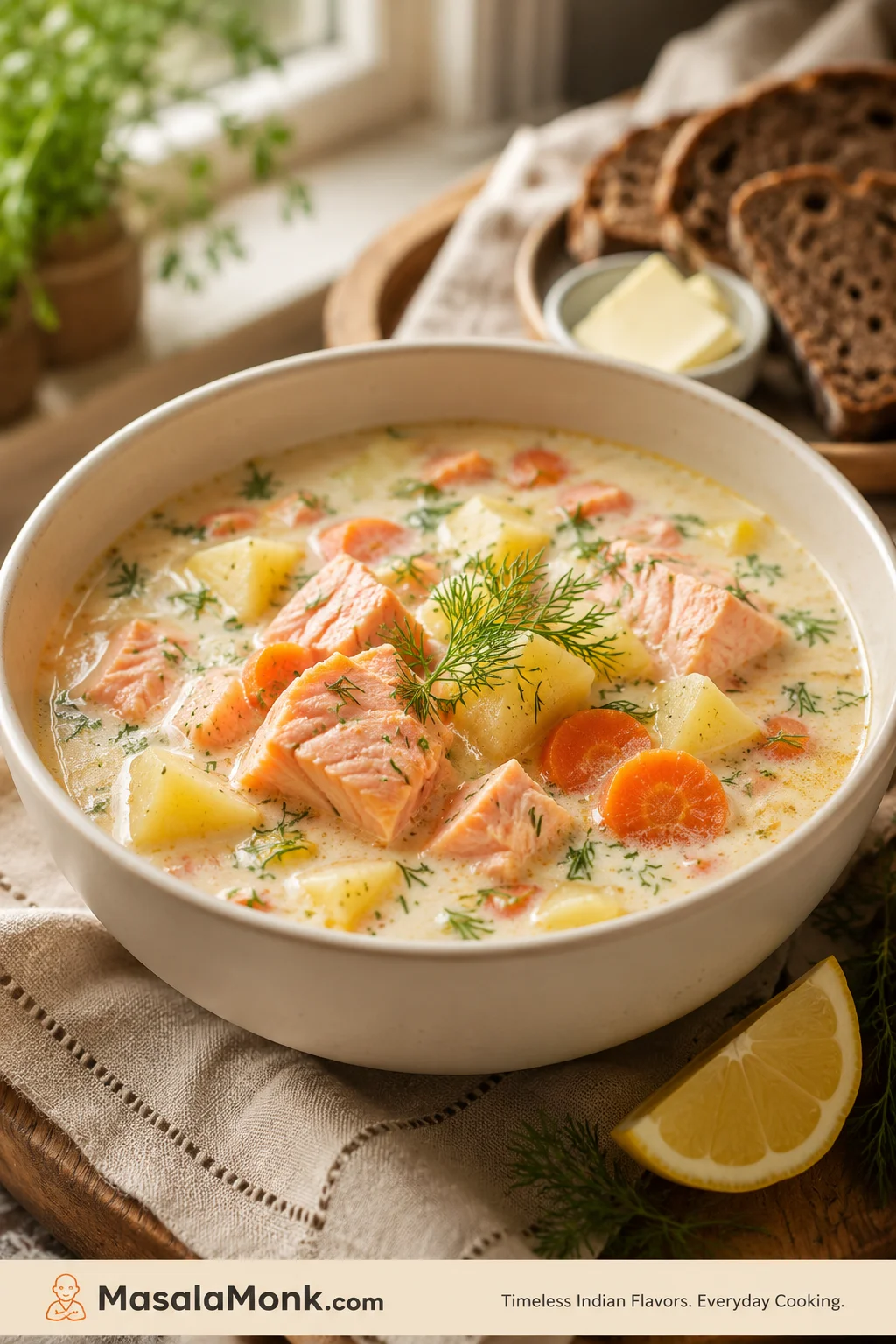
A good salmon soup should feel like quiet comfort: creamy but clean, full but not heavy, with soft potatoes, fresh dill, and tender flakes of salmon in every spoonful. This practical Finnish-style version is inspired by lohikeitto and built for home cooks, with timing and substitutions that work with the salmon and stock you actually have.
The trick is keeping the soup from turning watery, fishy, or full of dry salmon flakes. Cook the potatoes first, then let the salmon coast gently in the hot broth at the end. Potatoes need time; salmon needs care.
It tastes more special than the ingredient list looks. You get butter-soft leek or onion, potatoes turning tender in the broth, dill hitting the steam, and salmon pieces that stay whole enough to feel generous.
Quick Answer: Creamy, Cozy, and Not Too Heavy
This is a creamy Finnish-style salmon soup made with salmon, potatoes, leek or onion, carrot, stock, cream, dill, and lemon. It is cozy enough for a cold night, but lighter than thick salmon chowder.
At a glance: one pot, 40 minutes, 4 generous bowls, cream-finished but not chowder-heavy.
The soup gets its body from potatoes, not flour. Once the potatoes are tender, the salmon needs only 3 to 6 minutes at a quiet simmer so it stays soft, moist, and flaky.
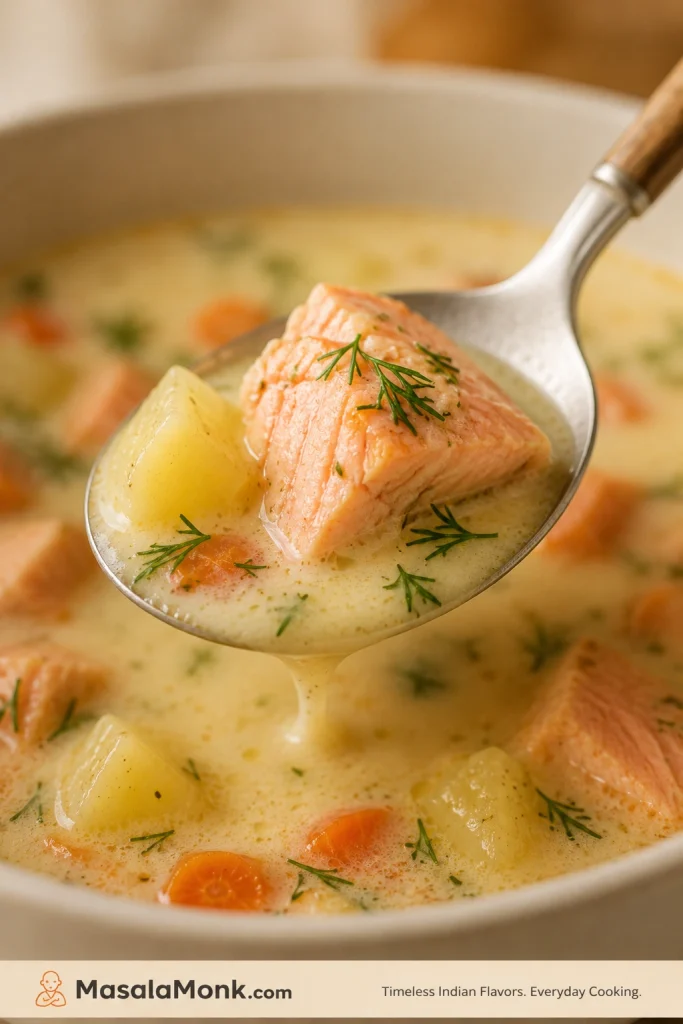
Make It Now: 3 Rules That Keep the Salmon Tender
- Cook the potatoes first. Potatoes need 10 to 15 minutes to become tender. Salmon does not.
- Let the broth become delicious before the fish goes in. It should taste like soup, not salted water.
- Keep the pot calm after adding salmon and cream. Look for small lazy bubbles, not a rolling boil.
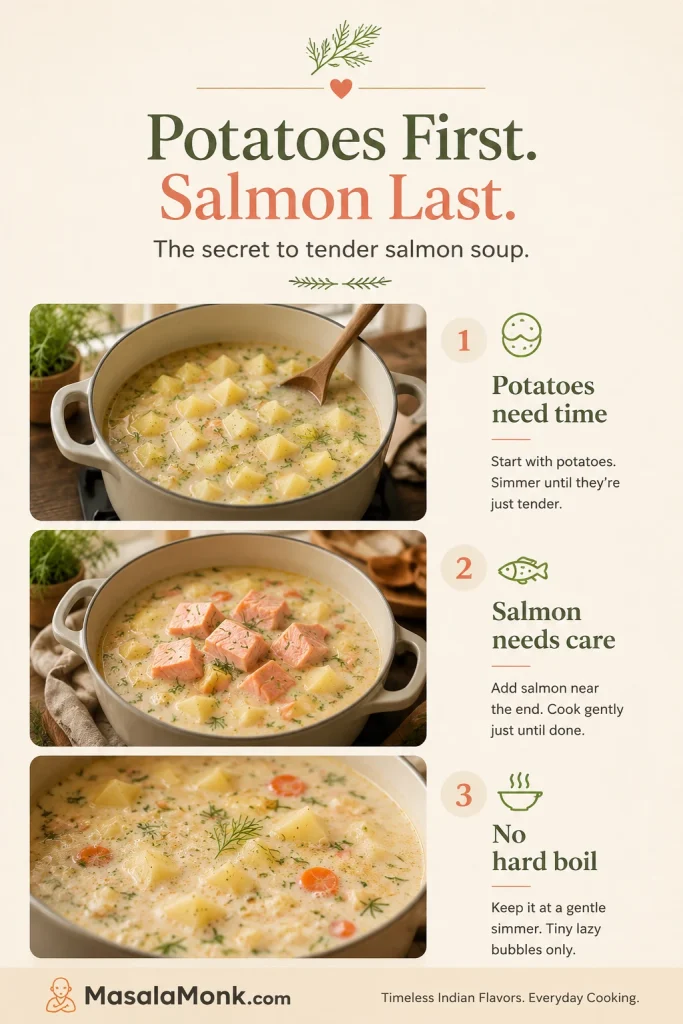
No roux, no long simmer, and no complicated seafood stock are required. The recipe is forgiving as long as you do not rush the fish.
Salmon Soup Recipe Card
A creamy salmon soup with soft potatoes, sweet leek or onion, carrot, dill, lemon, and tender salmon chunks added at the end so they stay moist.
The ratio is built for a soup that feels rich without turning heavy: about 1 lb / 450 g salmon, 1 lb / 450 g potatoes, 4 cups / 950 ml stock, and 1/2 cup / 120 ml cream. The potatoes give body, so the cream does not have to do all the work.
Ingredients
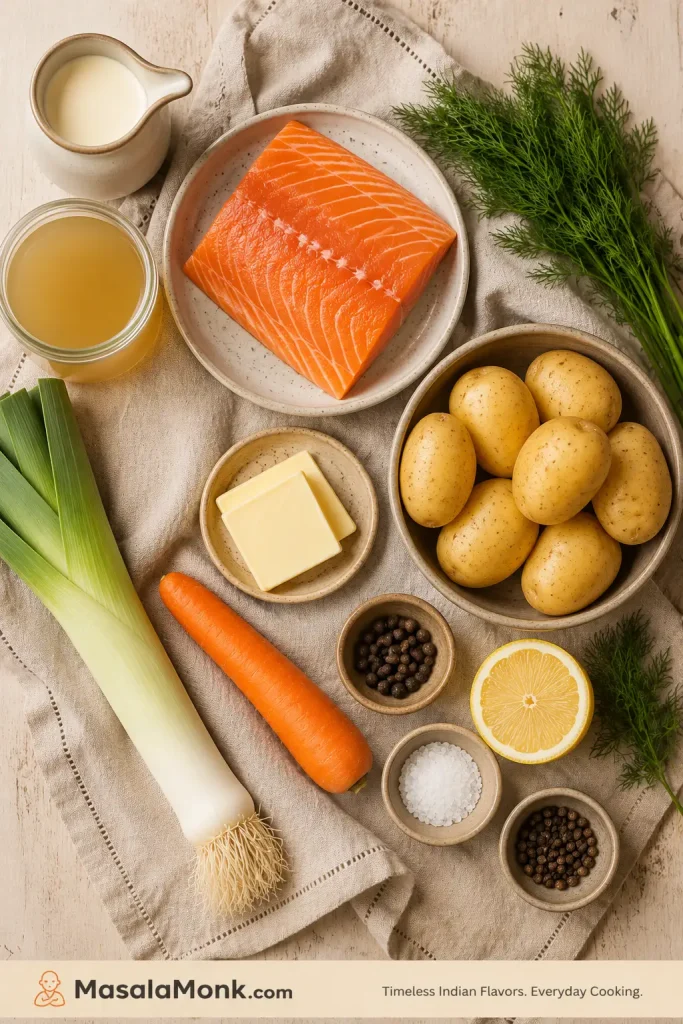
| Ingredient | Amount | Notes |
|---|---|---|
| Salmon fillet | 450 g / 1 lb | Skin removed, cut into 1-inch / 2.5 cm chunks |
| Potatoes | 450 g / 1 lb | Cut into 1/2- to 3/4-inch / 1.5 to 2 cm pieces |
| Leek or onion | 1 large leek or 1 medium onion | Use white and light green leek parts; rinse well to remove grit |
| Carrot | 1 to 2 medium carrots | Slice thinly or dice small so it softens with the potatoes |
| Butter or olive oil | 30 g / 2 tbsp | Butter gives a richer soup base |
| Stock or broth | 950 ml / 4 cups | Fish stock, vegetable stock, or mild chicken broth |
| Unsweetened heavy cream, cooking cream, or double cream | 120 ml / 1/2 cup | Use more for a richer soup, less for a lighter one |
| Fresh dill | 10 to 20 g / about 1/2 to 3/4 loosely packed cup | Use more at the end if you love dill |
| Lemon juice | 1 tbsp, plus more to taste | Add at the end to brighten the broth |
| Salt | Start with 1 tsp | Use less if your stock is salty; add more at the end if needed |
| Black or white pepper | 1/2 tsp | White pepper tastes more Nordic-style; black pepper is fine |
| Ground allspice | 1/4 tsp, optional | Adds a warm Finnish-style note |
| Nutmeg | Small pinch, optional | Use very lightly |
Cut the Salmon and Potatoes to the Right Size
Good salmon soup timing starts on the cutting board. Smaller potato pieces cook through before larger salmon chunks have time to dry out.
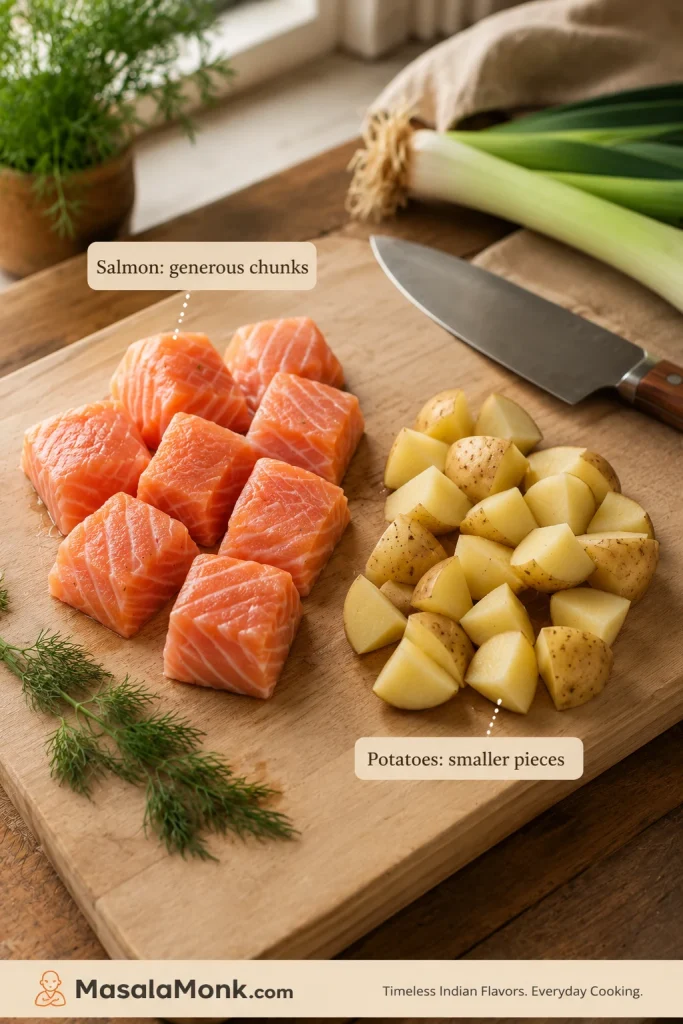
You only need a medium soup pot, a sharp knife, and low heat once the fish goes in. A thermometer is helpful if you want to check the salmon at 145°F / 63°C, but visual cues work too.
Instructions
Keep the soup at a low simmer once the salmon goes in; this is the difference between soft flakes and dry pieces.
Prepare the Soup Base
- Prepare the salmon. Pat the salmon dry and cut it into 1-inch / 2.5 cm chunks. Use center-cut salmon for the neatest pieces. Thin tail-end pieces may cook closer to 3 minutes; thicker center pieces may need closer to 5 or 6 minutes.
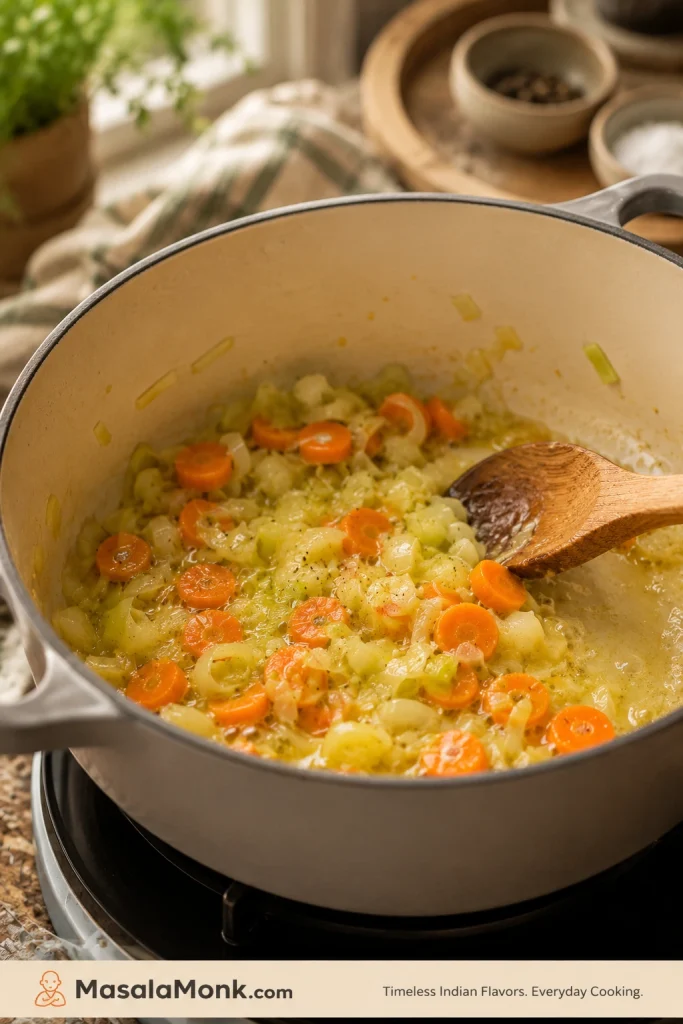
- Cook the aromatics. Warm the butter or olive oil in a 4- to 5-quart / 4- to 5-liter soup pot or Dutch oven over medium heat. Add the leek or onion and carrot. Cook for 5 to 8 minutes, stirring often, until the sharp onion smell softens, the carrot begins to relax, and the pot smells sweet instead of raw.
- Add potatoes and stock. Stir in the potatoes, stock, salt, pepper, and optional allspice or nutmeg. Bring to a gentle simmer.
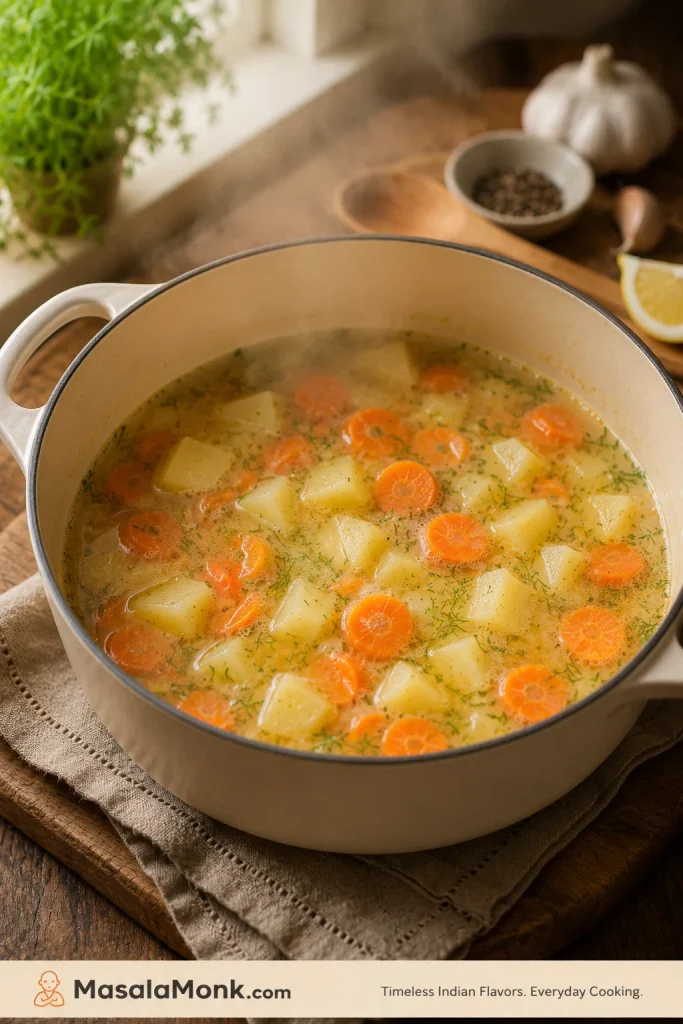
- Simmer until the potatoes are tender. Cook for 10 to 15 minutes, or until the potatoes can be pierced easily with a fork but are not falling apart.
- Taste the broth. Before adding salmon, the broth should already taste like soup, not salted water. Adjust with a little salt if needed.
Add Salmon, Cream, Dill, and Lemon
- Add the salmon. Reduce the heat until the broth barely moves. Add the salmon chunks and cook for 3 to 6 minutes, depending on thickness. Nudge the salmon gently and let the broth do most of the work.
- Add cream. Stir in the cream over low heat. Once the cream is in, keep the pot quiet and let it warm through for 1 to 2 minutes.
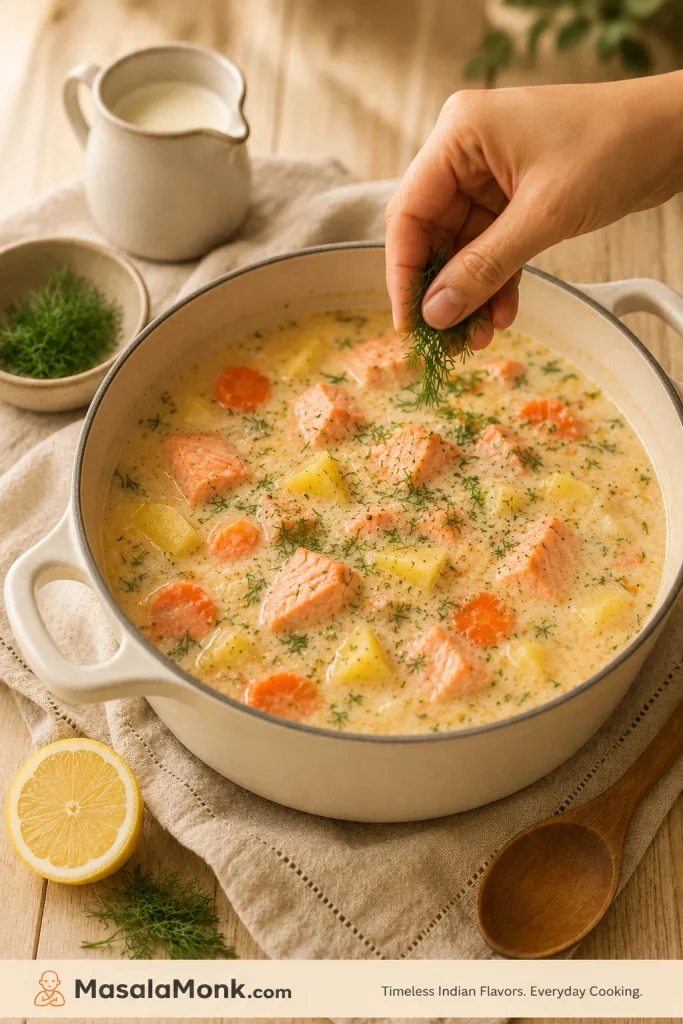
- Finish the soup. Turn off the heat. Add dill and lemon juice. Lemon should lift the bowl, not rescue it, so taste and adjust slowly.
- Rest briefly. Let the soup sit for 2 to 5 minutes before serving. The fish will continue to settle into the hot broth.
Final taste rule: add salt if the broth tastes flat, lemon if it tastes heavy, and dill if it needs freshness.
Doneness cue: The salmon is ready when it looks opaque, separates easily with a fork, and still feels moist. For a thermometer check, fin fish should reach 145°F / 63°C.
You’ll Know It Is Ready When…
- the potatoes are tender but still holding their shape,
- the broth looks smooth and lightly creamy,
- the salmon flakes at the edge but still looks juicy in the center,
- the soup tastes seasoned before the final lemon,
- the dill wakes up as soon as it touches the hot soup.
Once the salmon is moist and the dill smells fresh, stop fussing with the pot. The soup is ready.
Need help while cooking? Check when to add salmon · see doneness cues · avoid common mistakes · fix a problem.
Why This Salmon Soup Recipe Works
Once the recipe card makes sense, the rest of the soup is easier to understand. The method works because the broth becomes delicious before the salmon ever enters the pot.
By the time the fish goes in, the potatoes are soft, the aromatics are sweet, and the broth already tastes like dinner. The comfort comes from balance: potatoes make it feel like a meal, salmon makes it feel special, and lemon keeps the last few spoonfuls from turning heavy.
What a Balanced Spoonful Looks Like
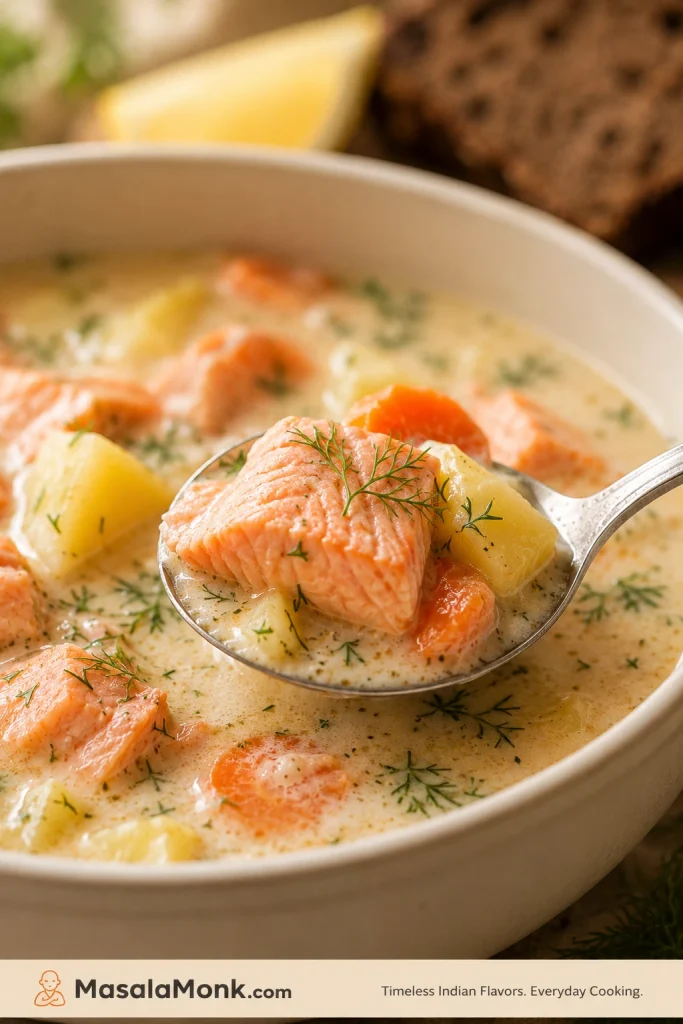
- Potatoes build body. They make the soup filling and lightly thicken the broth without needing a heavy flour base.
- Aromatics soften first. Leek or onion and carrot bring sweetness, so the soup does not taste like fish dropped into plain liquid.
- Brief cooking protects the salmon. A few minutes in hot broth are enough for soft, moist pieces.
- Low heat protects the cream. It helps the broth stay smooth instead of splitting.
- Dill and lemon finish the bowl. They give the soup a clean lift against the richness of salmon and cream.
The reward is a bowl where the potatoes are soft, the broth tastes complete, and the fish still flakes in big, generous pieces.
For another creamy salmon dinner, this creamy salmon pasta recipe uses the same low-heat approach: control the sauce first, then handle the salmon carefully.
Ingredient Notes and Substitutions
Once the method makes sense, the ingredient choices become simple. Salmon brings richness, potatoes make the bowl satisfying, stock gives the base flavor, and dill plus lemon keep the finish clean.
Using frozen, canned, smoked, or leftover salmon? Jump to the salmon adjustment notes.
Salmon
Fresh salmon fillet is the easiest choice. Remove the skin if needed, check for pin bones, and cut the fish into even chunks so everything cooks at the same pace.
Frozen salmon also works well. Thaw it fully, pat it dry, and avoid adding icy pieces directly to the pot. Extra moisture can dilute the broth and make the fish cook unevenly.
When using sockeye salmon, watch it closely because it is leaner and cooks quickly. Atlantic salmon is richer and more forgiving. For a baked wild salmon dinner, see this sockeye salmon recipe.
Potatoes
Gold potatoes or Yukon Gold potatoes are ideal because they become creamy without completely falling apart. Waxy potatoes hold their shape well. Russet potatoes can work, but they break down more and make the soup thicker.
Cut the potatoes into 1/2- to 3/4-inch / 1.5 to 2 cm pieces. Large chunks take longer to soften and may force you to keep the pot simmering longer than the salmon needs.
Leek, Onion, and Carrot
Leek gives the soup a gentle sweetness and works especially well for Finnish-style salmon soup. Use the white and light green parts and rinse them well because grit can hide between the layers. Onion is a practical substitute. Carrot adds color and balances the richness of the salmon and cream.
Cream
Use unsweetened heavy cream, cooking cream, or double cream. Half-and-half or whole milk makes the soup lighter, but the broth will be thinner. Add dairy over low heat and avoid a hard boil after it goes in.
Dill and Lemon
Dill is not just a garnish here. It is one of the main flavors. Lemon juice should be added at the end, not at the beginning, so the soup tastes fresh instead of sharp or cooked-down.
Choose Your Salmon Soup Style
Now that the base bowl is clear, choose how rich, light, or smoky you want it to be. The creamy Finnish-style version is the starting point; the other options are small turns from that same pot.
| Style | How to adjust | Best for |
|---|---|---|
| Creamy Finnish-style | Use the recipe as written with 1/2 cup / 120 ml cream | Cozy potato-dill comfort |
| Brothy salmon soup | Use less cream or skip it; add extra lemon and dill | A lighter bowl |
| Chowder-style | Use 3 cups / 710 ml stock, add corn, and increase cream | A thicker, heartier dinner |
| Smoked salmon version | Use hot-smoked salmon and add it at low heat at the end | A smoky seafood-house flavor |
Best Salmon to Use for Soup
The soup is forgiving, but salmon timing changes depending on what kind you start with. Start with the salmon you have; the timing matters more than finding one perfect cut.
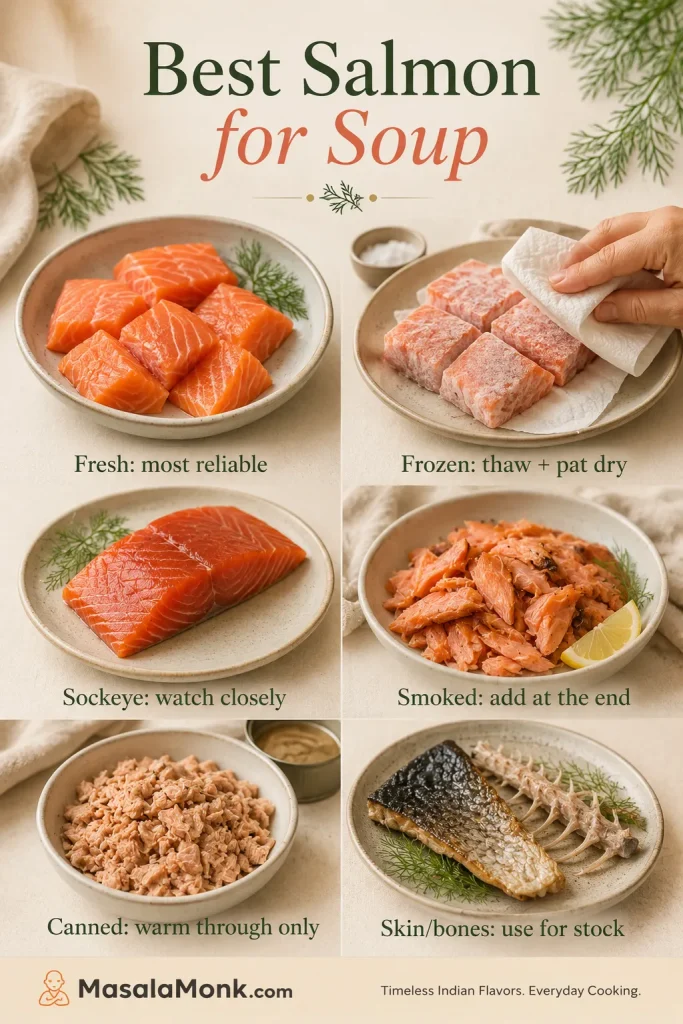
Quick Salmon Type Guide
| Salmon type | Use when | How to handle it |
|---|---|---|
| Fresh salmon fillet | You want the most reliable texture | Cut into chunks and cook in the hot broth |
| Frozen salmon fillet | You need an easy weeknight option | Thaw fully, pat dry, then cut |
| Sockeye salmon | You want cleaner, stronger salmon flavor | Use a low simmer; it is lean and can dry faster |
| Atlantic salmon | You want a richer, more forgiving soup | Good for creamier versions |
| Leftover cooked salmon | You want a fast leftover soup | Fold in at the end just to warm through |
| Hot-smoked salmon | You want a smoky bowl | Add at low heat and warm through only |
| Cold-smoked salmon | You want a garnish, not a simmered ingredient | Keep it out of the boil; it can turn stringy and salty |
| Canned salmon | You want a shortcut chowder-style soup | Drain and fold in at the end |
| Salmon head, bones, or skin | You want to make stock | Simmer gently, strain, then use the broth |
| Salmon belly | You want a richer broth or Asian-style soup | Use carefully because it can feel oily in creamy soup |
Skin-On, Canned, and Shortcut Salmon Notes
Skin-on salmon is fine when that is what you have. Remove the skin before cutting the fillet into chunks, or save the skin and simmer it briefly in the stock for extra salmon flavor. Strain or remove it before serving.
Canned salmon can still make a useful shortcut soup. Keep it for the end so it stays in larger flakes. For a crisp dinner instead of a creamy bowl, these salmon croquettes are another good use for well-drained canned salmon.
Build Flavor Before the Salmon Goes In
The fish is not in the pot long enough to save a weak broth, so taste the liquid before adding salmon. It should already have salt, sweetness from the aromatics, and enough depth to carry the fish. You do not need complicated homemade seafood stock; you just need a base that tastes good before the salmon goes in.
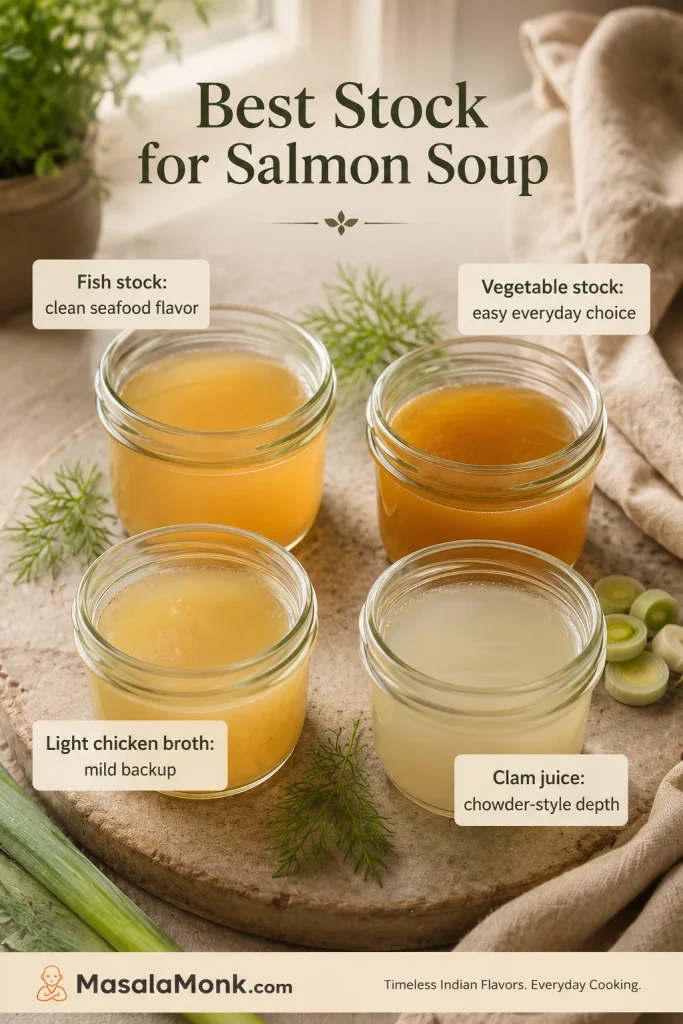
Stock Options for Salmon Soup
| Stock option | Use when | Flavor |
|---|---|---|
| Fish stock | You want the cleanest seafood flavor | Light, savory, salmon-friendly |
| Vegetable stock | You want an easy everyday choice | Clean and flexible |
| Light chicken broth | You need a practical backup | Rounded, mild, and not too fishy |
| Water plus salmon skin | You have skin-on salmon and want no-waste flavor | Delicate salmon flavor |
| Clam juice | You want the soup to lean chowder-like | Stronger seafood depth |
For an everyday pot, vegetable stock or light fish stock gives enough flavor without making the soup aggressively seafood-heavy. Save clam juice for a chowder-style bowl.
Want it thicker? Compare salmon soup and salmon chowder before adding extra cream or corn.
If the broth tastes weak, fix it before adding salmon. A little salt, a longer potato simmer, or a final lift of dill and lemon can bring the pot back into balance, so the salmon feels like the finish rather than a fix.
How to Make Salmon Soup: What Each Stage Should Look Like
After the ingredients are chosen, the real secret is watching the pot. The recipe card gives the exact steps; this walkthrough shows what to see, smell, and taste as the soup comes together.
1. Aromatics: Glossy, Soft, and Sweet-Smelling
The leek or onion and carrot should soften without browning hard. If the pot still smells more like raw onion than butter and sweetness, give the aromatics another minute.
2. Potatoes: Fork-Tender, Not Collapsing
The potatoes should pierce easily with a fork but still hold their edges. If they are still firm, give them more time before adding the fish.
3. Broth: Seasoned Before Salmon
Before the salmon goes in, taste the liquid. It should already have salt, sweetness from the aromatics, and enough depth to taste like a real soup base.
4. Salmon: Opaque at the Edges, Moist in the Center
The fish is ready when the edges turn opaque and the pieces begin to separate with almost no pressure. Let the salmon coast in the heat instead of forcing it through a boil.
5. Finish: Smooth Cream, Fragrant Dill, Bright Lemon
The cream should disappear into the broth smoothly, without foaming or separating. The dill wakes up in the heat, and the lemon should make the broth taste alive, not sour.
When to Add Salmon So It Stays Tender
Once the pot looks right, timing is the only thing left to protect. Add salmon only after the potatoes are tender and the broth tastes seasoned.
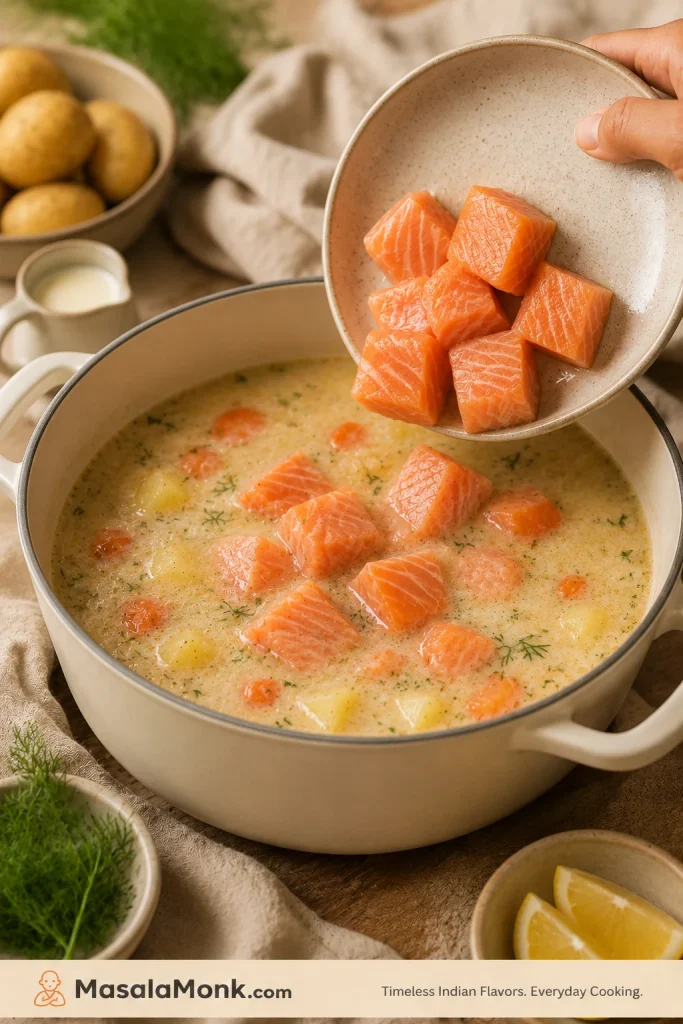
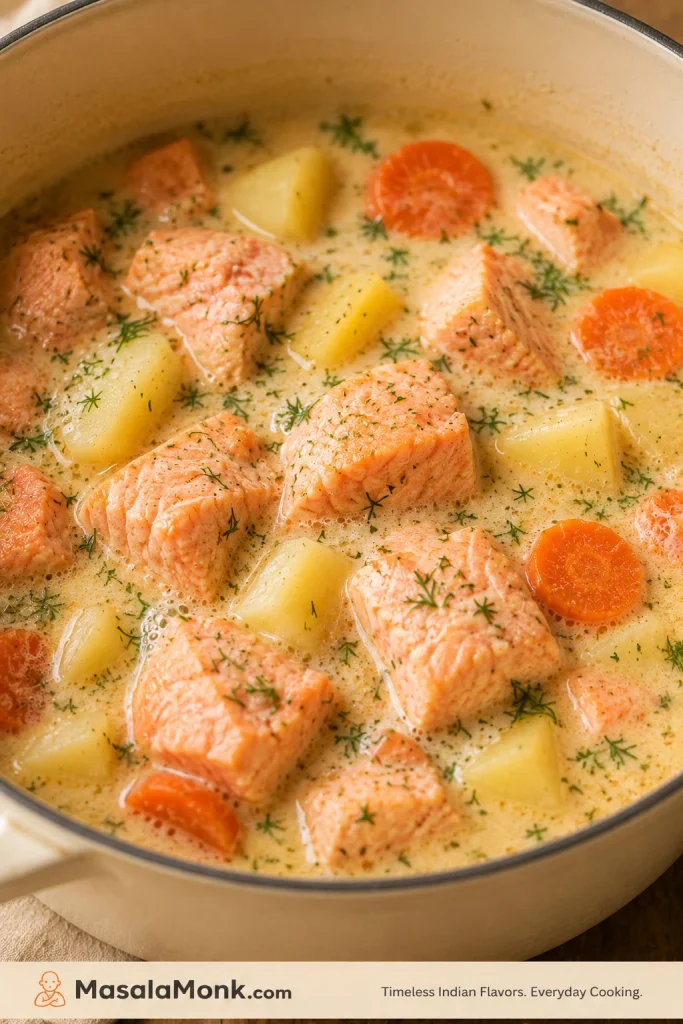
For 1-inch / 2.5 cm chunks, 3 to 6 minutes in barely bubbling broth is usually enough. The goal is soft fish that flakes easily without tightening into dry pieces.
How to Tell When Salmon Is Done in Soup
Watch the fish more than the clock. The pieces should turn opaque at the edges, separate easily with a fork, and still look moist in the center.
Safe Salmon Temperature
For official food safety, fish should reach 145°F / 63°C, or the flesh should be no longer translucent and should separate easily with a fork. See FoodSafety.gov’s safe minimum internal temperature chart for the seafood temperature reference.
Turn off the heat once the salmon reaches that point. The hot broth will continue cooking the fish for a few minutes, so waiting until it looks completely firm can push it too far.
If the salmon flakes apart when you stir, stop stirring. Fold only when needed, and let the broth hold the pieces together.
If the fish is breaking, drying, or flaking too much, check the common mistakes or jump to troubleshooting.
5 Mistakes That Make Salmon Soup Watery, Fishy, or Dry
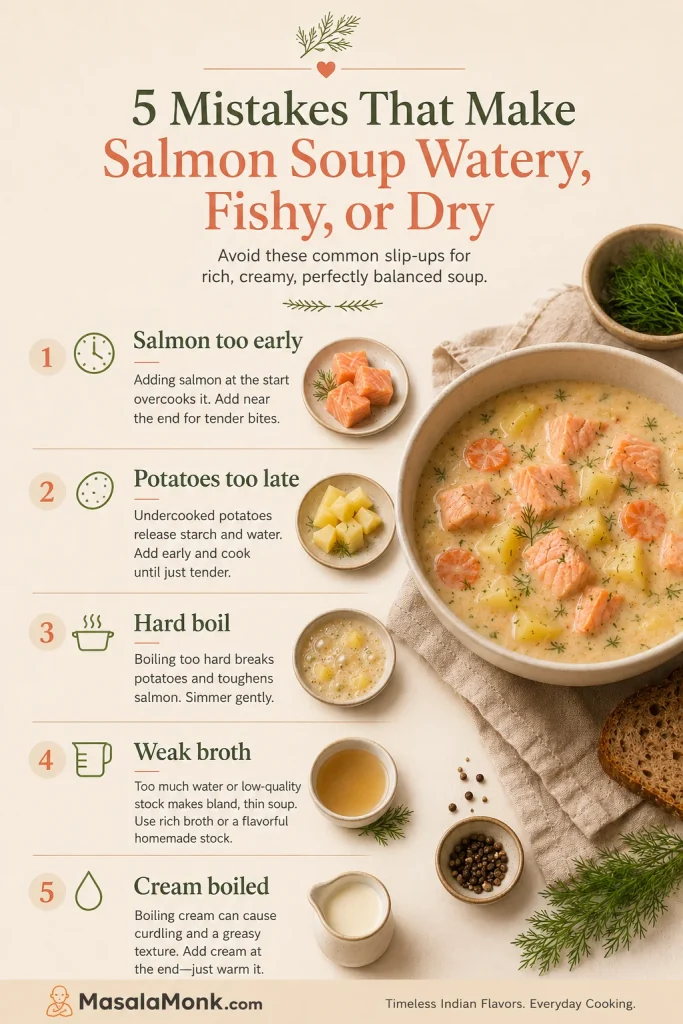
- Adding salmon before the potatoes are tender: You will either undercook the potatoes or overcook the fish.
- Boiling the salmon hard: A rough boil breaks the pieces and makes the texture dry.
- Letting cream boil: Once the cream is in, keep the pot quiet and let it warm slowly.
- Cutting the salmon too small: Tiny pieces break apart before the soup reaches the bowl.
- Using lemon as a shortcut for weak broth: Lemon brightens the soup, but the pot still needs salt, aromatics, and good stock.
Once the timing makes sense, the Finnish-style simplicity of the soup makes more sense too.
Finnish Salmon Soup and Lohikeitto Explained
Finnish salmon soup is often called lohikeitto. It is pronounced roughly LOH-hee-kay-toh, and the name points simply to salmon soup.
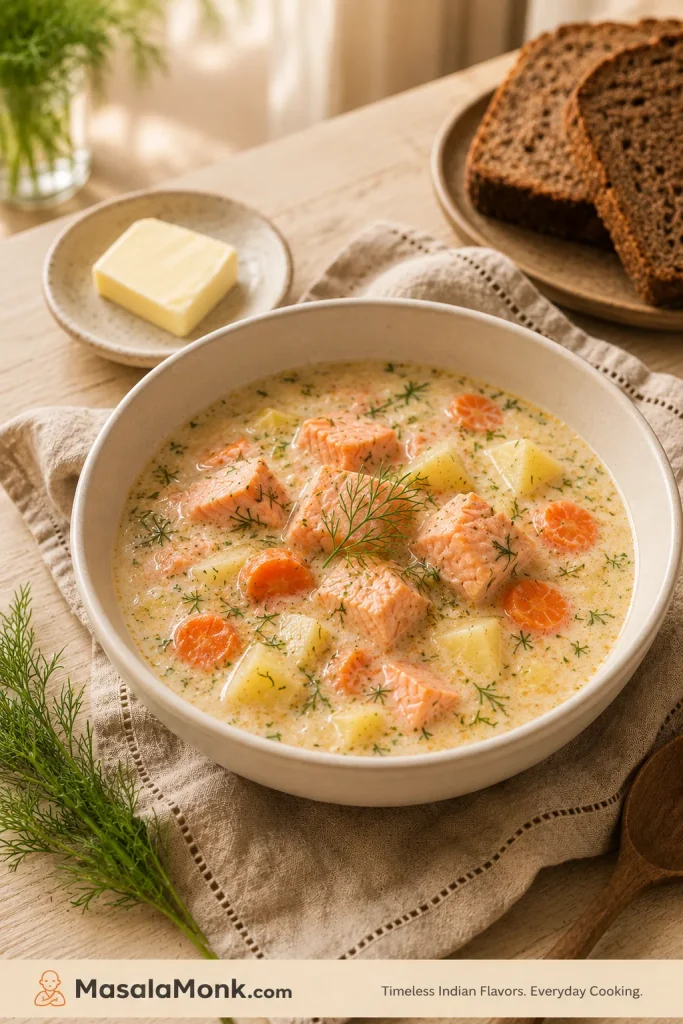
Lohikeitto is usually a creamy salmon and potato soup made with salmon, potatoes, leek or onion, carrot, cream or milk, and fresh dill. Think of it as cold-weather comfort food with restraint: creamy enough to feel soothing, but fresh enough that the dill, potatoes, and salmon still shine.
The bowl feels rich because of the salmon and potatoes, not because the broth is heavy.
- Salmon: Cooked briefly in tender chunks.
- Potatoes: Used for body, comfort, and a naturally fuller broth.
- Leek or onion: Leek is preferred, but onion works well.
- Carrot: Adds sweetness and color.
- Cream or milk: Added over low heat so the soup stays smooth.
- Dill: Used generously at the end for freshness.
So this stays Finnish-style rather than strictly traditional: salmon, potatoes, leek or onion, cream, dill, and careful simmering are the heart of it, with room for the stock and salmon you actually have at home.
Prefer a thicker bowl? Compare salmon soup and salmon chowder.
Salmon Soup vs Salmon Chowder
Salmon soup is usually lighter and looser; salmon chowder is thicker, richer, and often more filling. Chowder may use more cream, starch, corn, bacon, or smoked salmon, while this soup stays closer to a creamy but spoonable Finnish-style bowl.
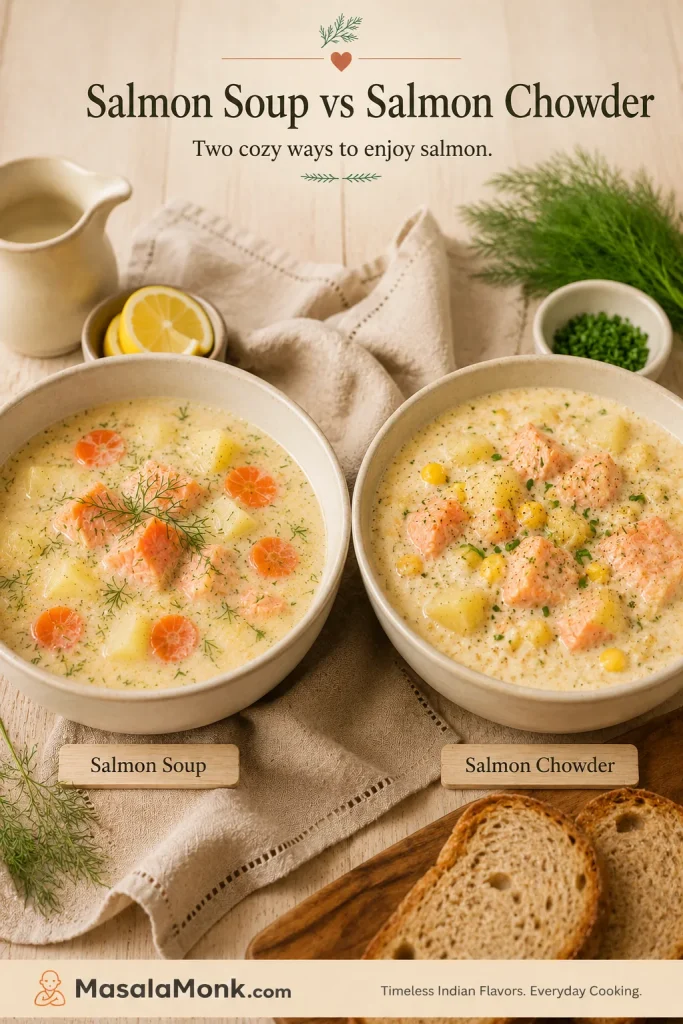
| Type | Texture | Common ingredients | Choose it if… |
|---|---|---|---|
| Salmon soup | Light to creamy broth | Salmon, potatoes, vegetables, stock | You want a cozy weeknight dinner that still feels clean |
| Finnish salmon soup / lohikeitto | Smooth but not too thick | Salmon, potatoes, leek, carrot, dill, cream | You want Nordic-style potato-dill comfort |
| Salmon chowder | Thick, chunky, richer | Cream, potatoes, corn, bacon, flour or starch | You want a heavier one-bowl meal |
| Smoked salmon chowder | Smoky, salty, rich | Hot-smoked salmon, potatoes, cream, aromatics | You want seafood-house-style flavor |
To make this salmon soup more chowder-style, reduce the stock to 3 cups / 710 ml, add corn, use more potato, and finish with extra cream. You can also mash a few potato pieces into the broth for natural thickness.
How to Adjust If Your Salmon Is Frozen, Cooked, Smoked, Canned, or Bony
Start here when your salmon is not a neat fresh fillet. These notes help you keep the texture soft instead of treating every kind of salmon the same way.
Frozen salmon
Thaw frozen salmon fully, pat it dry, and cut it into even chunks before adding it to the soup. Icy pieces can cool the broth and cook unevenly.
Leftover cooked salmon
Leftover salmon only needs to come back to warmth, not go through a second cook. Let the potatoes and broth finish first, turn the heat low, then fold in large flakes for 1 to 2 minutes.
For another easy cooked-salmon meal idea, this salmon bowl recipe is a lighter rice-based option with vegetables, sauce, and toppings.
Smoked salmon
Hot-smoked salmon is better for soup than cold-smoked salmon because it has a cooked, flaky texture. Cold-smoked salmon is delicate and can become stringy or overly salty in hot soup, so use it more like a garnish.
Canned salmon
Canned salmon has already done its cooking; all it needs is to be warmed through without being broken apart. Drain it first, then add it at the end and stir slowly so it stays in larger flakes.
Salmon head, bones, skin, and belly
Salmon head, bones, and skin are best for making stock. Simmer them gently, strain the liquid, and use that as the soup broth. Salmon belly is richer and fattier, so it works better in brothier or sour soups than in this cream-finished bowl.
If you are looking for Filipino salmon sinigang, treat it as a separate sour soup rather than folding it into this creamy Finnish-style recipe.
Brothy, Chowder-Style, Smoked, and Dairy-Free Variations
After you have made the classic bowl once, the variations are easy. Keep the same soft simmer, then turn the soup lighter, thicker, smokier, or dairy-free.

- Brothy salmon soup: Skip the cream or reduce it to a splash. Add extra lemon, dill, and black pepper at the end.
- Chowder-style salmon soup: Use 3 cups / 710 ml stock, add corn, increase the cream, and mash a few potato pieces into the broth for natural thickness.
- Smoked salmon version: Use hot-smoked salmon and add it at the end. Taste before adding more salt because smoked salmon can be salty.
- Dairy-free salmon soup: Use olive oil instead of butter and coconut milk or dairy-free cream instead of heavy cream. Add lemon carefully to balance the sweetness.
Ready to cook? Go back to the recipe card. Making it ahead? See storage and freezing tips.
Storage, Reheating, and Freezing
This soup is at its best the day it is made, when the salmon is soft and the dill is bright. Leftovers can still be lovely, but they need careful reheating.
How long does salmon soup last?
Store cooled salmon soup in an airtight container in the refrigerator for up to 3 days. Fish soups are best eaten sooner rather than later because the salmon texture is most delicate on the first day.
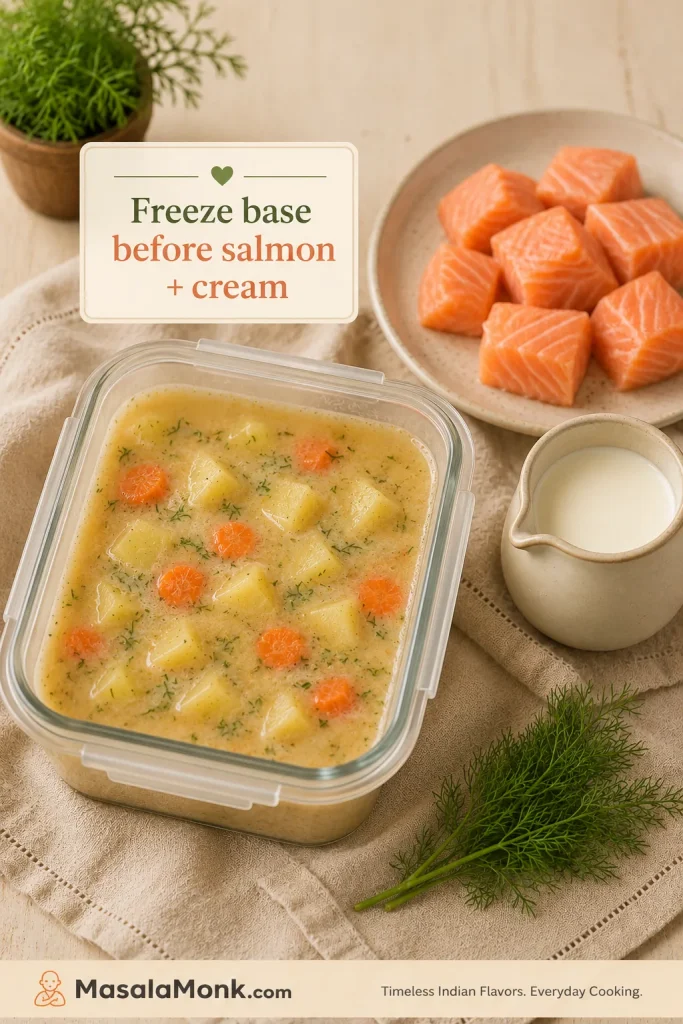
For the best make-ahead version, cook the potato-and-broth base up to 1 day ahead, refrigerate it, then reheat slowly and add the salmon and cream before serving. That keeps the soup convenient without sacrificing the texture of the fish.
How to Reheat Salmon Soup
Reheat over low heat. The goal is to warm the soup, not cook the salmon again. Let it heat slowly and stop as soon as the bowl is warm enough to serve.
Add a splash of stock, milk, or water if the potatoes have thickened the broth in the fridge. Stir slowly and gently.
Does Salmon Soup Freeze Well?
You can freeze it, but the best freezer move is to freeze the potato-and-broth base before the cream and fish go in. Cream can separate, potatoes can become grainy, and cooked salmon can turn dry after reheating.
Later, thaw the base, bring it to a low simmer, add fresh salmon, then finish with cream and dill.
If you are building a soup rotation, this minestrone soup recipe is a good vegetable-and-bean option for nights when you want something hearty without cream or seafood.
What to Serve With Salmon Soup
With potatoes and salmon in the bowl, this is already dinner; the side is mostly there to catch the broth.
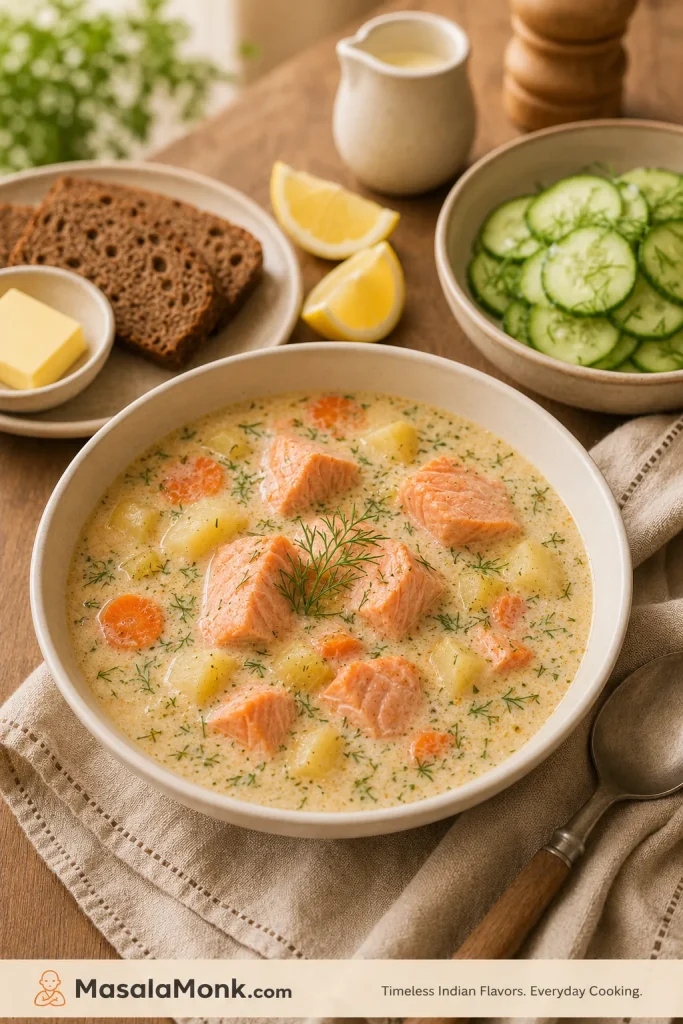
- Rye bread and butter: For a more Finnish-style meal, keep this simple and let the bread catch the creamy broth.
- Crusty bread or focaccia: Best for dragging through the dill-scented broth at the bottom of the bowl. For a homemade bread side, this sourdough focaccia recipe gives you crisp olive-oil edges and a soft, airy crumb.
- Garlic bread: Good with a brothy or chowder-style version, especially when you need something to catch the creamy broth.
- Simple green salad: Adds freshness next to the rich salmon.
- Cucumber salad: A cool, crisp contrast to the warm soup. This cucumber salad recipe also uses dill, vinegar, and onion, so it fits the bowl naturally.
- Roasted vegetables: Makes the meal heartier without adding more starch.
- Lemon wedges: Let each person brighten the bowl at the table.
Troubleshooting Salmon Soup
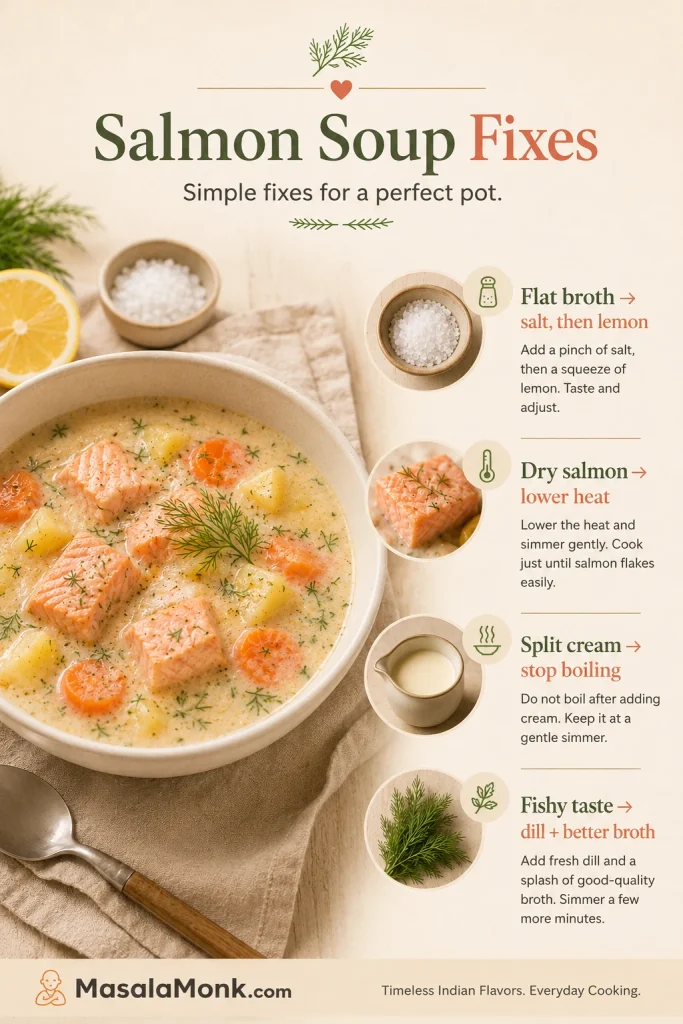
Most salmon soup problems come from rushing the pot. The fixes are usually simple: lower the heat, season earlier, and stop cooking once the fish is tender.
Quick Fix Table
| Problem | Likely cause | Fix |
|---|---|---|
| Salmon is dry | It cooked too long or boiled too hard | Use lower heat and stop once the fish turns opaque and flakes easily |
| Soup tastes flat | Weak stock or not enough seasoning | Add salt first, then lemon. Finish with dill only after the broth tastes balanced |
| Cream split | Heat was too high after dairy was added | Lower the heat before adding cream; once cream is in, keep the pot quiet |
| Potatoes are hard | They were cut too large or not simmered long enough | Cook potatoes until fork-tender before adding salmon |
| Soup is too thin | Too much stock or not enough potato body | Mash a few potato pieces into the broth or simmer uncovered briefly before adding salmon |
| Soup is too thick | Potatoes absorbed liquid | Add stock, milk, or water slowly until balanced |
| Soup smells fishy | Old fish, aggressive boiling, or weak aromatics | Use fresh salmon, low heat, fresh dill, lemon, and a broth that tastes good before the fish goes in |
| Salmon broke apart | Pieces were too small or stirred too hard | Use larger chunks and nudge them carefully instead of stirring hard |
| Smoked salmon tastes too salty | Salt was added before tasting smoked salmon | Add smoked salmon first, then adjust salt at the end |
| Canned salmon disappeared into the soup | It was stirred or boiled too much | Fold it in slowly after the potatoes and broth are ready |
If something feels off, fix the broth before blaming the salmon. A little salt, a little lemon, and a calmer simmer solve most problems.
Once the fix is clear, return to the recipe card or go back to the quick answer.
Salmon Soup FAQs
These are the small questions that usually come up once the pot is already on the stove.
What is salmon soup made of?
Salmon soup is usually made with salmon, potatoes, leek or onion, stock, herbs, and sometimes cream. This version uses dill and lemon to keep the creamy broth fresh.
Is salmon soup the same as lohikeitto?
Lohikeitto is Finnish salmon soup, usually made with salmon, potatoes, leek or onion, carrot, cream or milk, and dill. This recipe is inspired by lohikeitto but includes practical substitutions.
How long should salmon cook in soup?
Salmon chunks need 3 to 6 minutes once the potatoes are tender. Stop when the fish turns opaque, flakes easily, and still looks moist in the center.
Should salmon be cooked before adding it to soup?
No, not for this recipe. Raw salmon cooks directly in the hot broth. Cooked, canned, or smoked salmon should be added near the end and warmed slowly.
What stock is best for salmon soup?
Fish stock gives the cleanest seafood flavor, vegetable stock is the easiest everyday choice, and mild chicken broth works as a backup. Clam juice is better for chowder-style versions.
Fresh or frozen salmon: which works better?
Fresh fillets are easiest, but frozen salmon works well when thawed fully and patted dry. Frozen chunks added straight to the pot can cook unevenly and water down the broth.
Do you need cream for salmon soup?
No. Cream gives this soup a Finnish-style comfort texture, but the recipe still works without it. For a lighter bowl, reduce the cream or skip it.
How do you stop salmon soup from tasting fishy?
Use fresh salmon, avoid hard boiling, and build flavor with aromatics before the fish goes in. Dill and lemon should brighten a good broth, not cover up old fish.
Is canned salmon good in soup?
Yes. Drain canned salmon, add it at the end, and warm it carefully so the flakes stay larger. It works best for shortcut or chowder-style salmon soup.
What is the best way to use leftover salmon in soup?
Add leftover cooked salmon after the potatoes and broth are ready. Break it into large flakes and warm it for 1 to 2 minutes so it does not overcook.
Does salmon soup freeze well?
The best freezer move is to freeze the potato-and-broth base before adding cream and salmon. Reheat the base later, then add fresh salmon, cream, and dill.
Before You Ladle It Up
A good bowl of salmon soup should feel gentle: soft potatoes, tender salmon, fresh dill, and a broth that tastes rich without weighing you down.
Ladle it while the dill is still fragrant, keep bread nearby, and let the last spoonful be the reason you make it again.








