Posted on 1 Comment

Breakfast Burrito Recipe

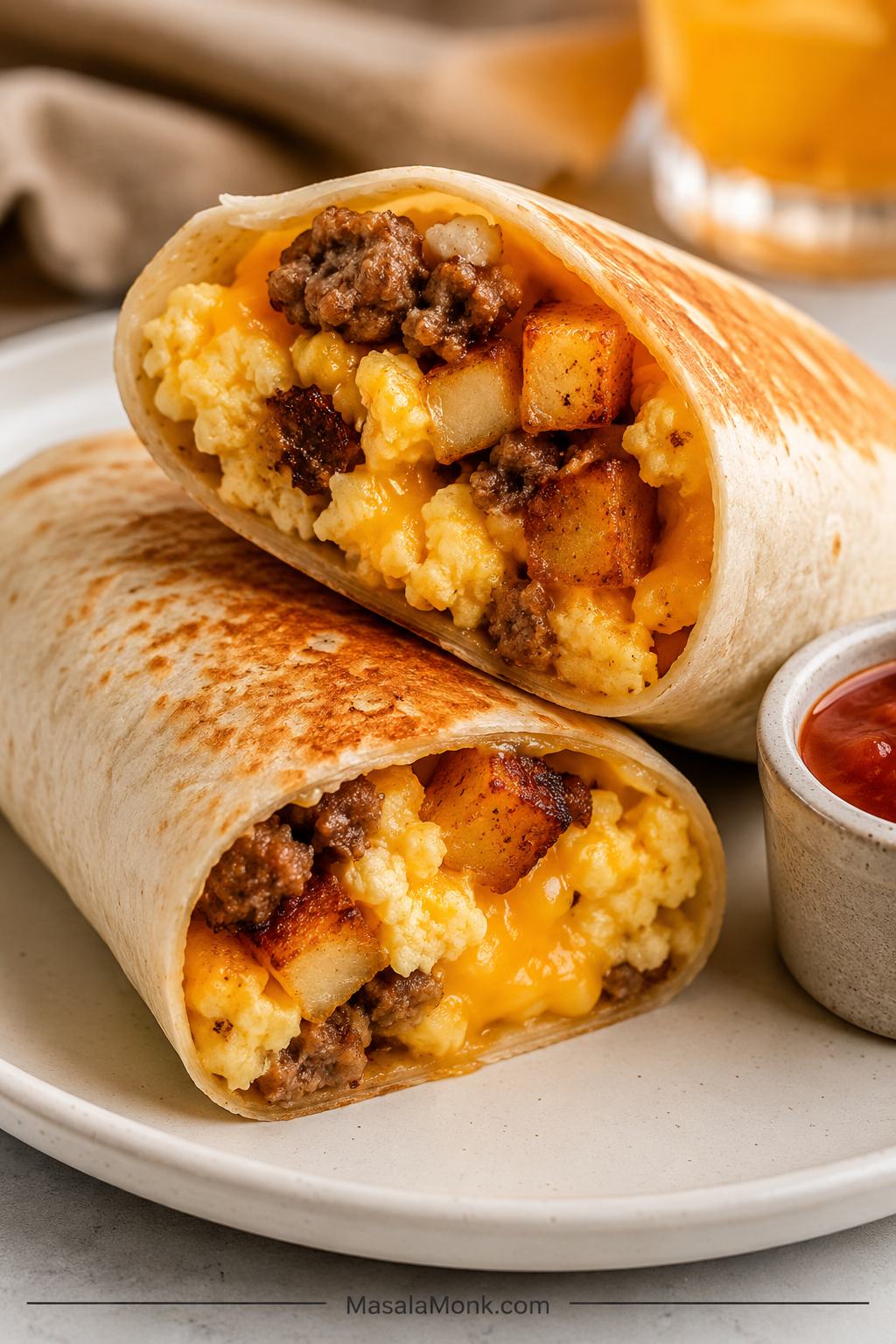
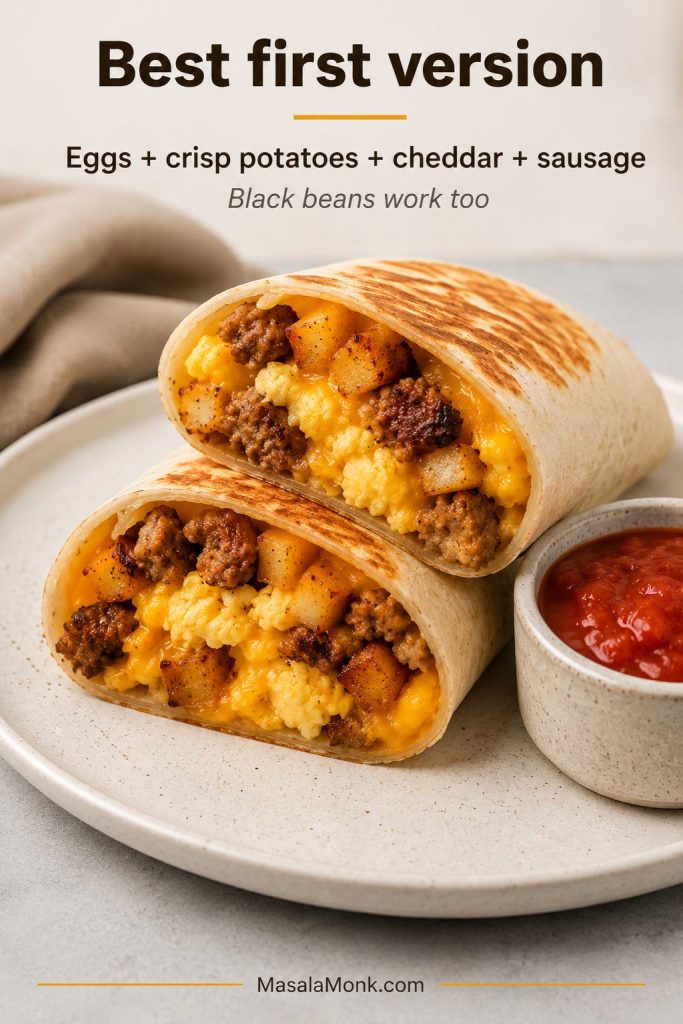
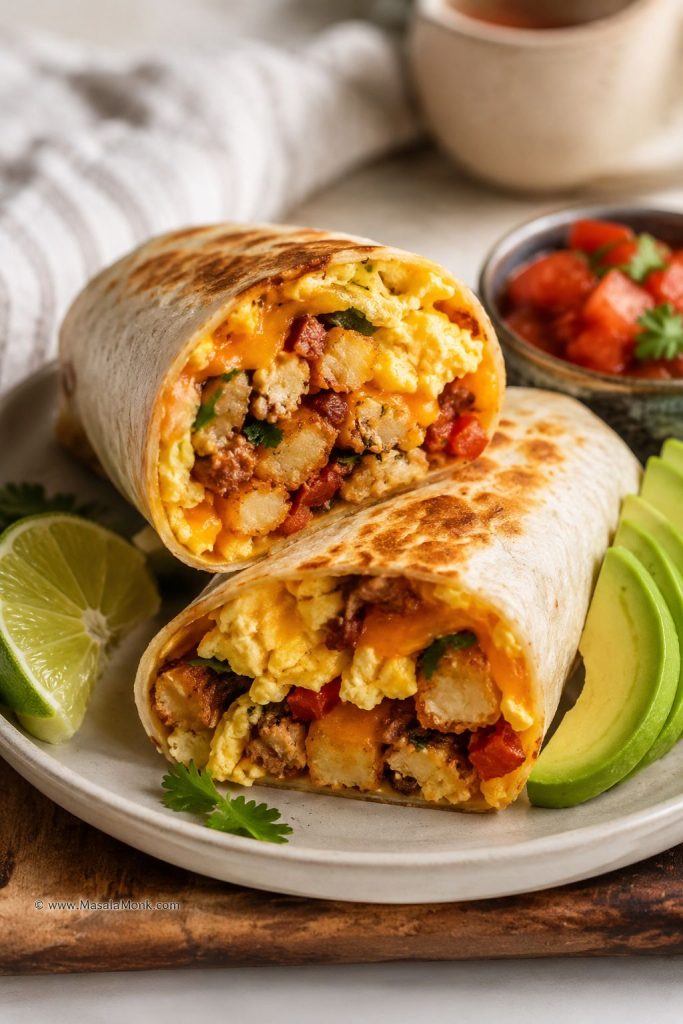
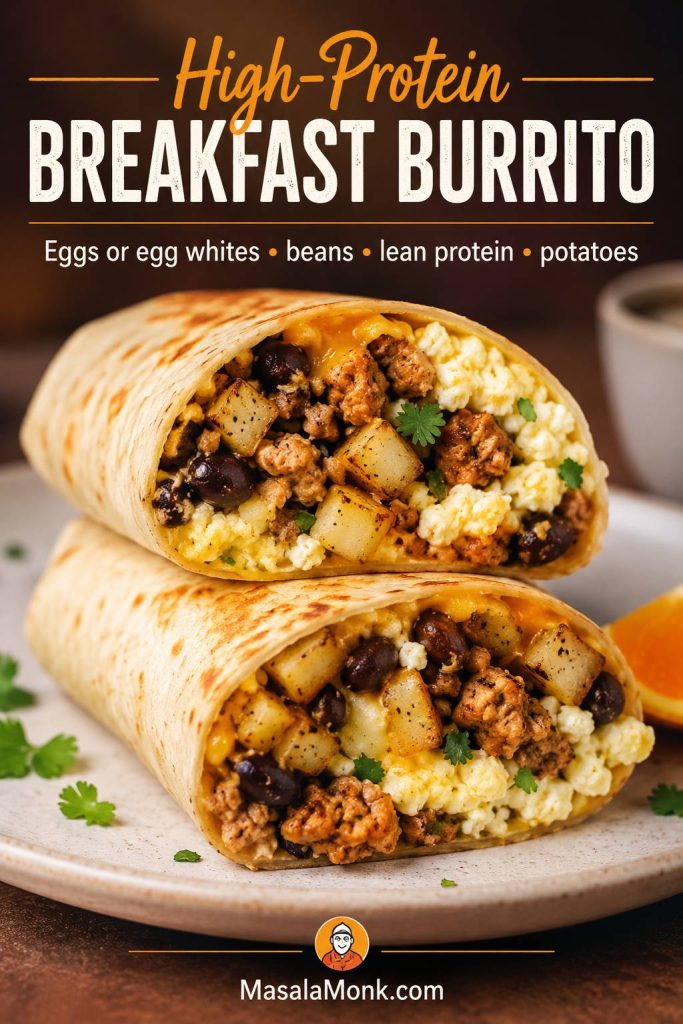
Toasted breakfast burrito cut open on a plate, showing scrambled eggs, browned potatoes, melted cheese, and sausage inside a flour tortilla.

This breakfast burrito recipe gives you the kind of burrito that actually feels worth waking up for: soft scrambled eggs, crisp-edged potatoes or hash browns, melted cheese, and a filling that stays inside the tortilla. Make them hot from the skillet this morning, or wrap a batch so tomorrow’s breakfast is already handled.

The goal is simple: a burrito that is full but still foldable, cheesy but not wet, freezer-friendly but not sad after reheating. That comes down to a few small choices: a large, flexible tortilla, cooked and seasoned fillings, browned potatoes, soft eggs, cheese in the right place, and sauce used smartly.

Below, you will get the main 6-burrito method, a simple per-burrito formula, folding tips, freezer instructions, reheating methods, filling ideas, sauce options, high-protein swaps, and fixes for cracked tortillas, rubbery eggs, cold centers, and filling that spills out.

Quick Answer: What Goes in a Breakfast Burrito?

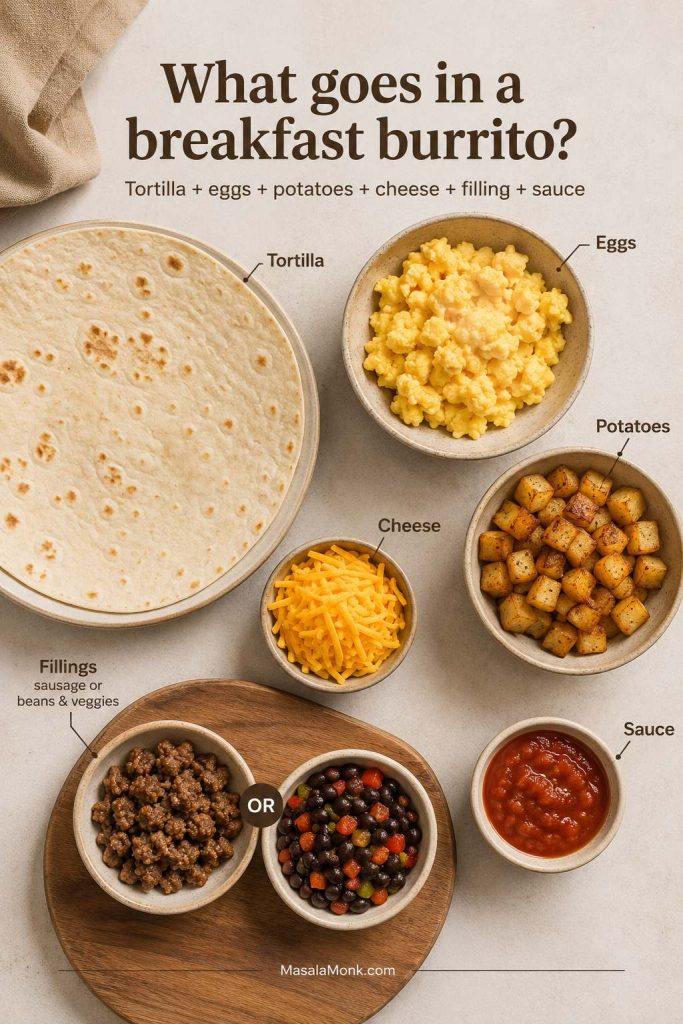
A good breakfast burrito starts with a large flour tortilla, gently cooked eggs, crisp potatoes or hash browns, cheese, and a flavorful filling such as sausage, bacon, chorizo, black beans, peppers, onions, steak, chicken, or vegetables.

Ingredient guide showing a tortilla, eggs, potatoes, cheese, cooked filling, and sauce for making breakfast burritos
Think of a breakfast burrito as a simple build: tortilla for structure, eggs for softness, potatoes for bite, cheese for binding, filling for flavor, and sauce for brightness.

What the Finished Burrito Should Look Like

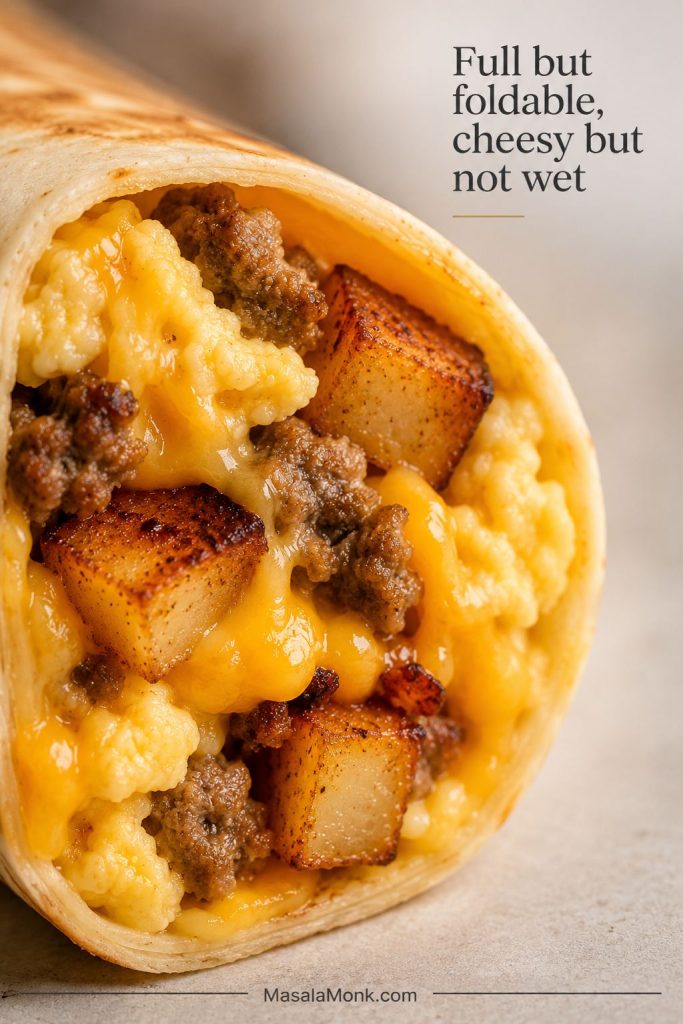
The finished burrito should be full enough to feel satisfying but not so packed that the tortilla tears. Look for a warm tortilla, soft eggs, browned potatoes, melted cheese, and a filling line that stays compact when sliced or reheated.

Close-up of a cut breakfast burrito with soft eggs, potatoes, melted cheese, and sausage visible inside
The inside should look generous but not overloaded. When the layers are balanced, the burrito slices cleanly and still holds up for reheating.

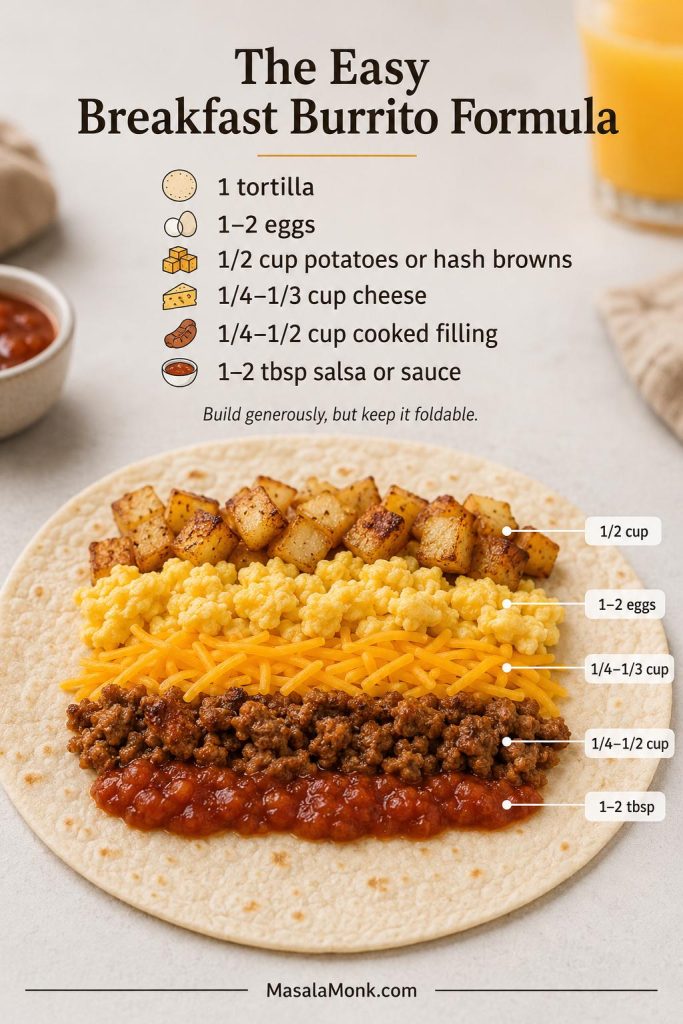
The Easy Breakfast Burrito Formula

For one large burrito, use 1 large tortilla, 1–2 eggs, about ½ cup cooked potatoes or hash browns, ¼–⅓ cup cheese, ¼–½ cup cooked meat, beans, or vegetables, and 1–2 tablespoons salsa or sauce. That formula is the easiest way to build a burrito that feels generous without fighting the tortilla.

Open flour tortilla with measured breakfast burrito fillings arranged to show eggs, potatoes, cheese, filling, and sauce amounts
This formula keeps the filling controlled before you roll. As a result, the burrito feels full without turning into a torn, bulky wrap.
For 1 Breakfast Burrito Best Amount Why It Matters
Large flour tortilla 1 tortilla, 10–12 inch / 25–30 cm Large tortillas fold better and hold more filling without tearing.
Eggs 1–2 large eggs Soft eggs give the burrito body without making it dry.
Potatoes or hash browns About ½ cup cooked A crisp potato layer makes the burrito hearty and breakfast-like.
Cheese ¼–⅓ cup shredded Cheese adds flavor, melts into the filling, and helps hold it together.
Protein, beans, or vegetables ¼–½ cup cooked Add sausage, bacon, chorizo, steak, chicken, beans, peppers, onions, or another cooked filling here.
Sauce or salsa 1–2 tablespoons Use lightly inside fresh burritos; serve on the side for freezer burritos.

Best First Version to Make

Best first version: Start with eggs, crisp hash browns or diced potatoes, cheddar or Monterey Jack, and breakfast sausage or black beans. Add salsa or hot sauce on the side. Once that base works, bacon, chorizo, steak, chicken, tofu scramble, and extra vegetables are easy swaps.

Breakfast burrito filled with eggs, crisp potatoes, cheddar, and sausage, served with salsa on the side
Start with the classic version first because it teaches the balance: eggs for softness, potatoes for texture, cheese for melt, and sausage or beans for flavor.

At a Glance

At a glance: This recipe makes 6 breakfast burritos in about 45–50 minutes. Use 10–12 inch flour tortillas, about ½ cup cooked potatoes or hash browns per burrito, and a skillet toast for the best texture. They keep 3–4 days in the fridge and freeze best without wet toppings inside.

Need the full method? Go to the recipe card. Meal-prepping? See freezer breakfast burritos. Want more flavor? Head to best sauces for breakfast burritos.

Why This Breakfast Burrito Recipe Works

The best breakfast burritos are not just full; they are balanced. You want enough egg to feel soft and breakfasty, enough potato to make it hearty, enough cheese to hold everything together, and just enough sauce to wake it up without soaking the tortilla.

Once the base is right, the filling is where the recipe becomes fun. Use breakfast sausage for a classic burrito, bacon for a smoky version, chorizo for heat, black beans for a vegetarian breakfast burrito, or a mix of eggs, egg whites, beans, and lean meat for a high-protein breakfast burrito.

Most importantly, the small details matter: warming the tortilla before folding, cooking the potato layer until browned, pulling eggs from the heat before they dry out, placing cheese down first, cooling fillings before freezing, and reheating gently so the eggs stay soft instead of rubbery.

Ready to cook? The full 6-burrito method is below. After the recipe card, you will find deeper notes on ingredients, folding, freezer storage, sauces, high-protein options, and troubleshooting.

Easy Breakfast Burrito Recipe

This breakfast burrito recipe makes 6 hearty burritos with soft eggs, browned potatoes or hash browns, cheese, and your choice of sausage, bacon, chorizo, beans, steak, chicken, or vegetables.

Yield6 burritos
Prep Time15–20 minutes
Cook Time25–30 minutes
Total Time45–50 minutes

Ingredients

  • 6 large flour tortillas, 10–12 inch / 25–30 cm
  • 8 large eggs, about 400 g without shells
  • 2 tablespoons milk, sour cream, or Greek yogurt, optional / 30 ml
  • 1–1¼ lb potatoes or frozen hash browns / 450–570 g
  • 10–12 oz breakfast sausage or chorizo before cooking / 280–340 g, or 8–10 oz cooked bacon, steak, or chicken / 225–280 g, or 1 drained 15 oz can black beans or pinto beans / about 240 g drained
  • For a vegetable version: 1½–2 cups cooked peppers, onions, mushrooms, spinach, or mixed vegetables / about 225–300 g cooked
  • 1½–2 cups shredded cheddar, Monterey Jack, or pepper jack / 170–225 g
  • 2–3 tablespoons oil or butter / 30–45 ml
  • ½ cup salsa, hot sauce, or burrito sauce, mostly for serving / 120 ml
  • ¾–1¼ teaspoons salt total, divided / 4–7 g
  • ½ teaspoon black pepper / 1–2 g
  • ½ teaspoon smoked paprika, ½ teaspoon cumin, ½ teaspoon chili powder, and ¼ teaspoon garlic powder, optional
  • ¼–½ cup chopped green onion or cilantro, optional / 10–20 g

Step-by-Step Method

  1. Cook the protein or vegetables. Brown raw sausage or chorizo in a large skillet, or warm cooked bacon, steak, chicken, beans, peppers, onions, or your chosen filling. Then, drain excess fat or liquid and transfer to a plate.
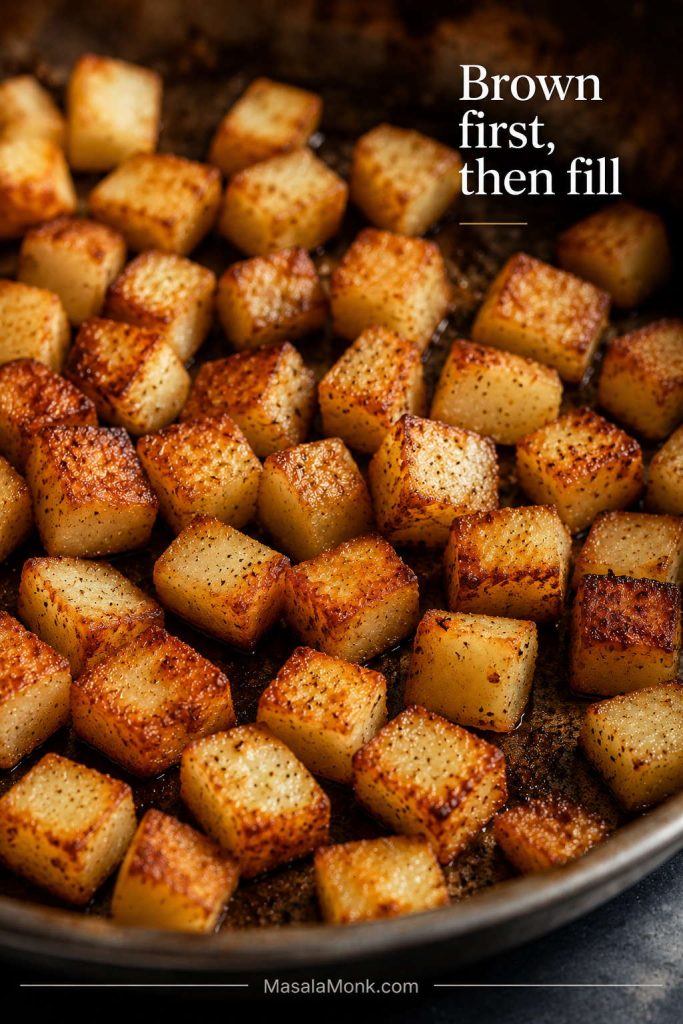
  2. Crisp the potatoes. Add 2 tablespoons oil or butter to the skillet. Cook diced potatoes for 12–15 minutes, stirring only occasionally, until tender inside and golden outside. Frozen shredded hash browns usually need 7–10 minutes in a thin layer. Season with salt, pepper, and optional smoked paprika, cumin, chili powder, or garlic powder.
  3. Scramble the eggs softly. Whisk eggs with milk, sour cream, or Greek yogurt if using. Cook over medium-low heat for 2–4 minutes, stirring slowly, until the eggs are just set but still glossy. Transfer them to a plate right away so they do not keep cooking in the hot pan.
  4. Warm the tortillas. Microwave tortillas under a damp paper towel for 15–30 seconds, or warm each one briefly in a dry skillet.
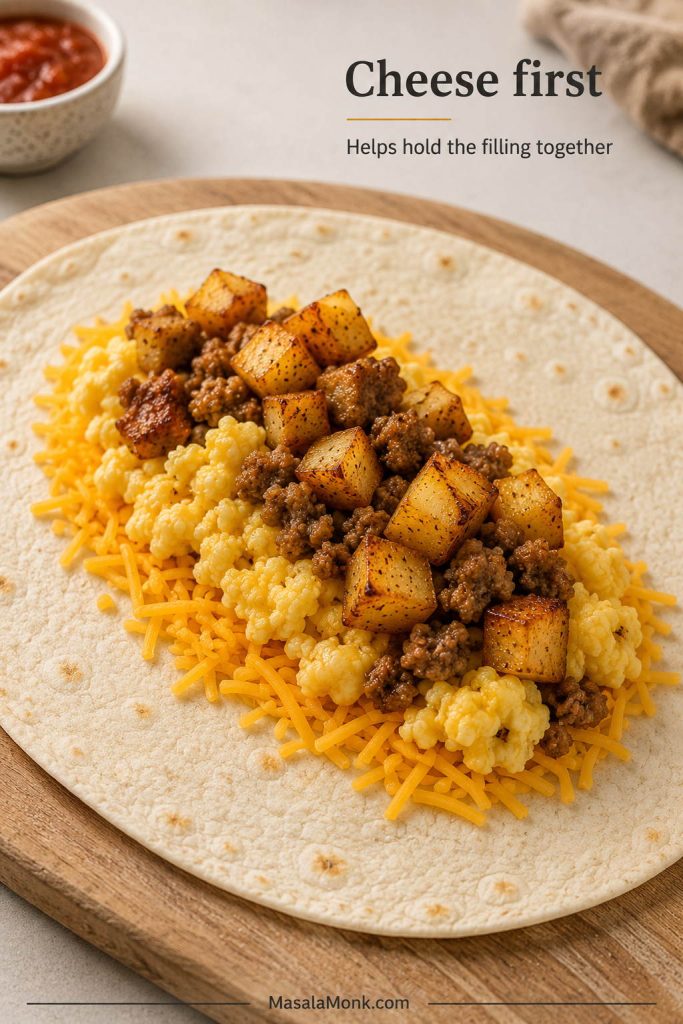
  5. Fill the burritos. Place a tortilla on a board. Add cheese first, then potatoes, eggs, protein or beans, and optional herbs. Keep the filling in a narrow strip slightly below the center.
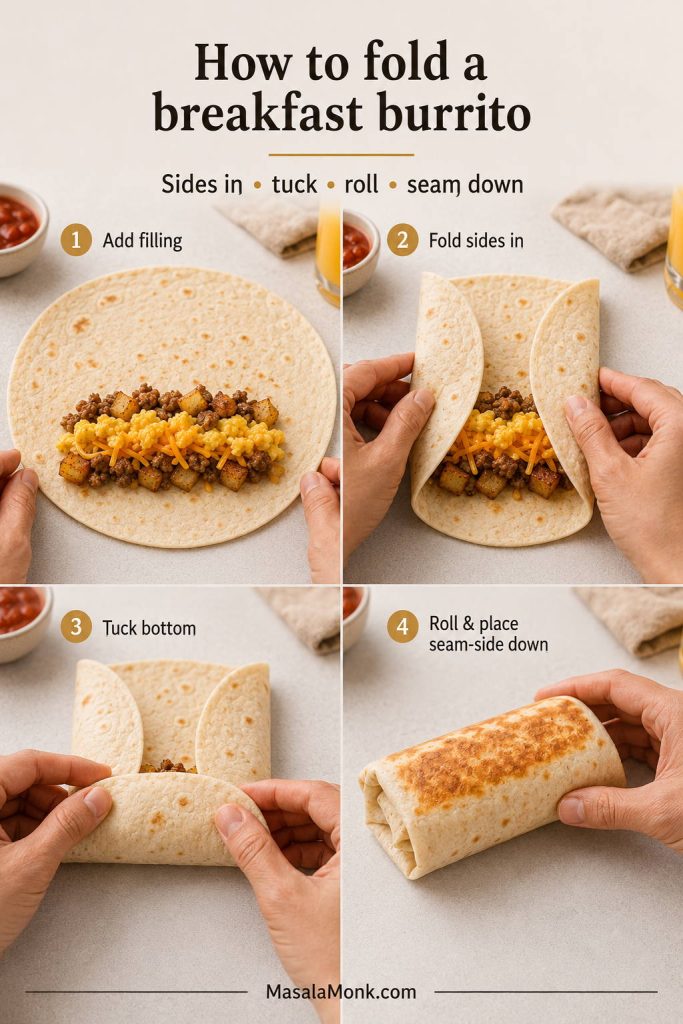
  6. Fold tightly. Fold the left and right sides inward, pull the bottom flap over the filling, tuck it snugly, and roll forward into a tight burrito.
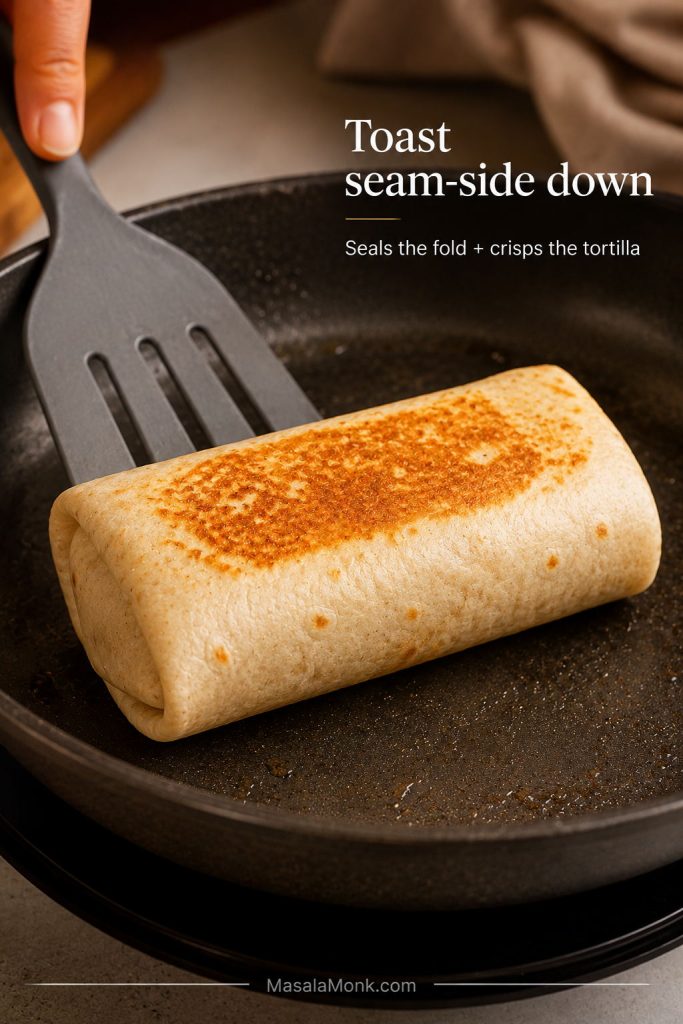
  7. Toast seam-side down. Place the burrito seam-side down in a dry skillet over medium heat. Toast for 1–2 minutes per side, until golden and sealed.
  8. Serve. Serve hot with salsa, chipotle crema, avocado crema, hot sauce, or green chile sauce on the side.

Recipe Notes

  • Start with ¾ teaspoon salt total if using bacon, chorizo, seasoned sausage, salty cheese, or canned beans. Add more only after tasting the cooked filling.
  • For freezer burritos, cool the eggs, potatoes, and filling before wrapping.
  • For freezer burritos, keep wet and fresh toppings for serving after reheating.
  • For a higher-protein version, use 10–12 eggs, egg whites, black beans, turkey sausage, chicken sausage, tofu scramble, or cottage cheese in the eggs.
  • For a vegetarian version, use eggs, black beans, crisp potatoes, peppers, onions, cheese, and salsa.
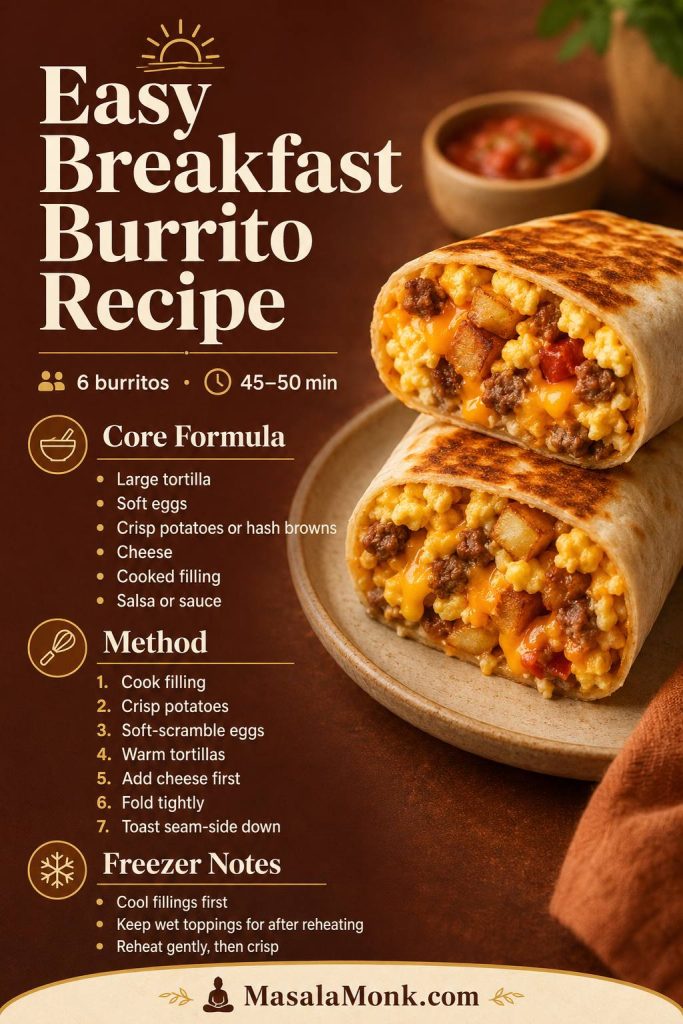
Saveable breakfast burrito recipe card with a burrito photo, ingredient formula, method steps, and freezer notes
This saveable recipe card keeps the main breakfast burrito method easy to scan, especially when you are batch-cooking or freezing burritos for later.

How to Scale the Recipe

The base recipe makes 6 burritos, which is a good size for one family breakfast or a few make-ahead meals. For a bigger freezer batch, double the filling and assemble 12 burritos while everything is already cooked and ready.

Batch Size Eggs Potatoes / Hash Browns Protein or Beans Cheese
6 burritos 8 eggs 1–1¼ lb / 450–570 g 10–12 oz raw sausage/chorizo, 8–10 oz cooked meat, or 1 drained can beans 1½–2 cups / 170–225 g
12 burritos 16 eggs 2–2½ lb / 900 g–1.1 kg 20–24 oz raw sausage/chorizo, 1–1¼ lb cooked meat, or 2 drained cans beans 3–4 cups / 340–450 g

For a larger batch, you can also roast the potatoes, peppers, and onions on a sheet pan, then cook the eggs separately while the vegetables finish. A full sheet-pan method deserves its own recipe, but this shortcut helps when you are making 12 burritos at once.

Breakfast Burrito Assembly Line

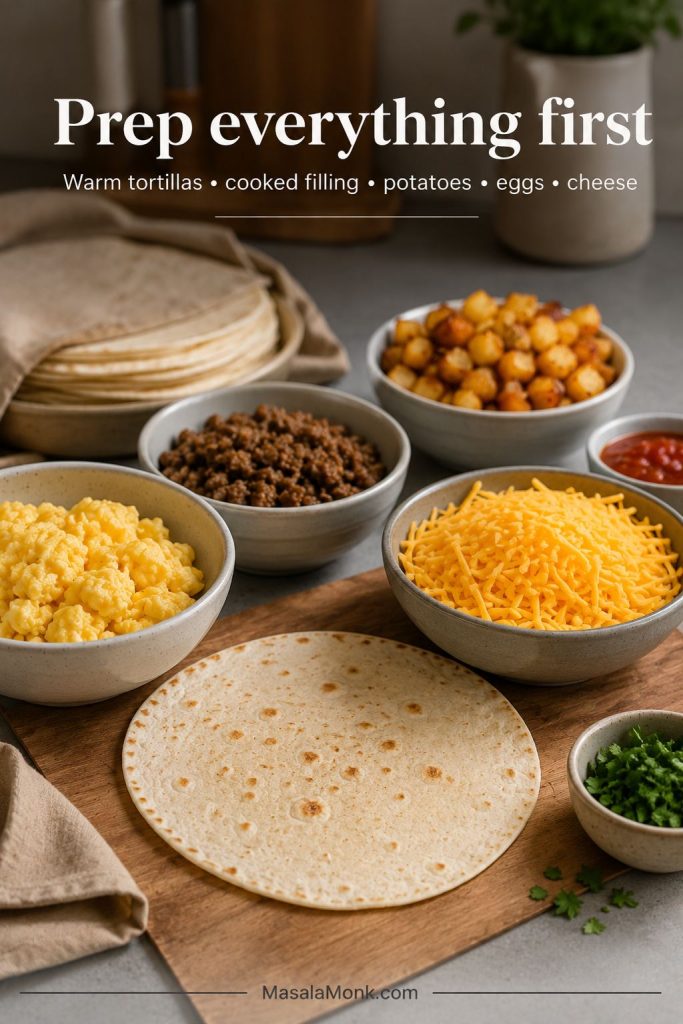
Before you start rolling, set up the tortillas, eggs, potatoes, cheese, and filling in one place. This keeps the portions more even, helps the tortillas stay warm, and makes it easier to build several breakfast burritos without overfilling the last few.

Breakfast burrito assembly station with warm tortillas, scrambled eggs, potatoes, cheese, sausage, and herbs arranged for filling
Set up the fillings before you roll. That way, the tortillas stay warm, the portions stay consistent, and each breakfast burrito is easier to fold tightly.
Want to make these easier to roll or prep ahead? See how to fold a breakfast burrito, toasting tips, or how to make freezer breakfast burritos.

Breakfast Burrito Ingredients: What Matters Most

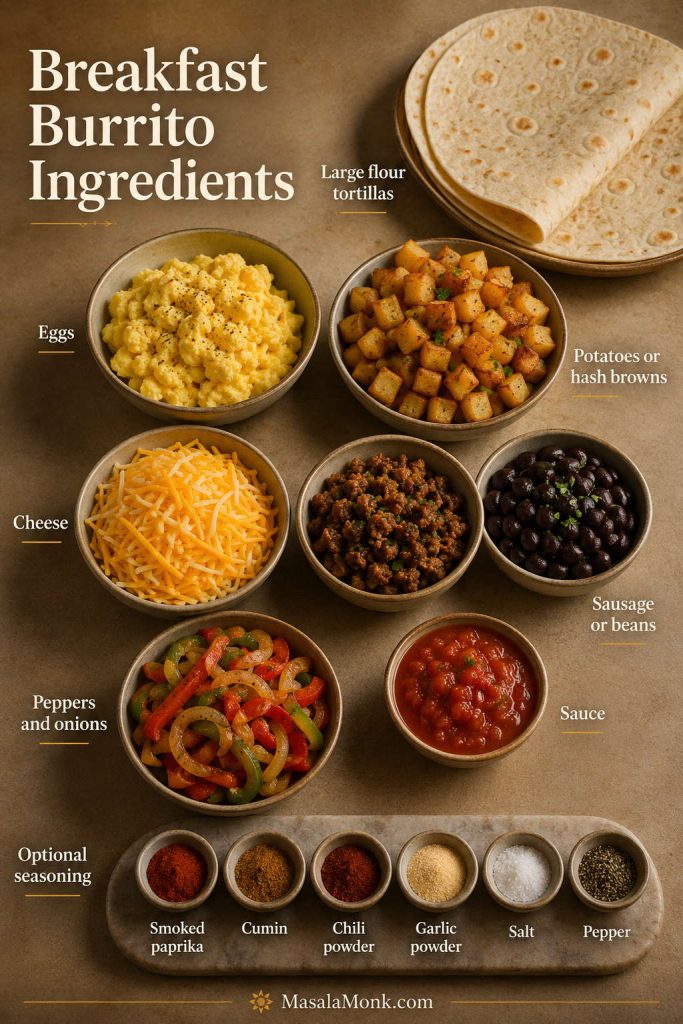
This is a forgiving recipe, but the small choices matter. Once the tortilla is warm, the potatoes are browned, the eggs are soft, and the wet toppings are controlled, you can swap the meat, beans, cheese, vegetables, or sauce without losing the structure of the burrito.

Ingredient board showing tortillas, eggs, potatoes, cheese, sausage, beans, vegetables, sauce, and seasonings for breakfast burritos
The ingredient list is flexible, but each category has a job. Once you know what the tortilla, eggs, potatoes, cheese, filling, sauce, and seasoning do, swaps become easier.

Large Flour Tortillas

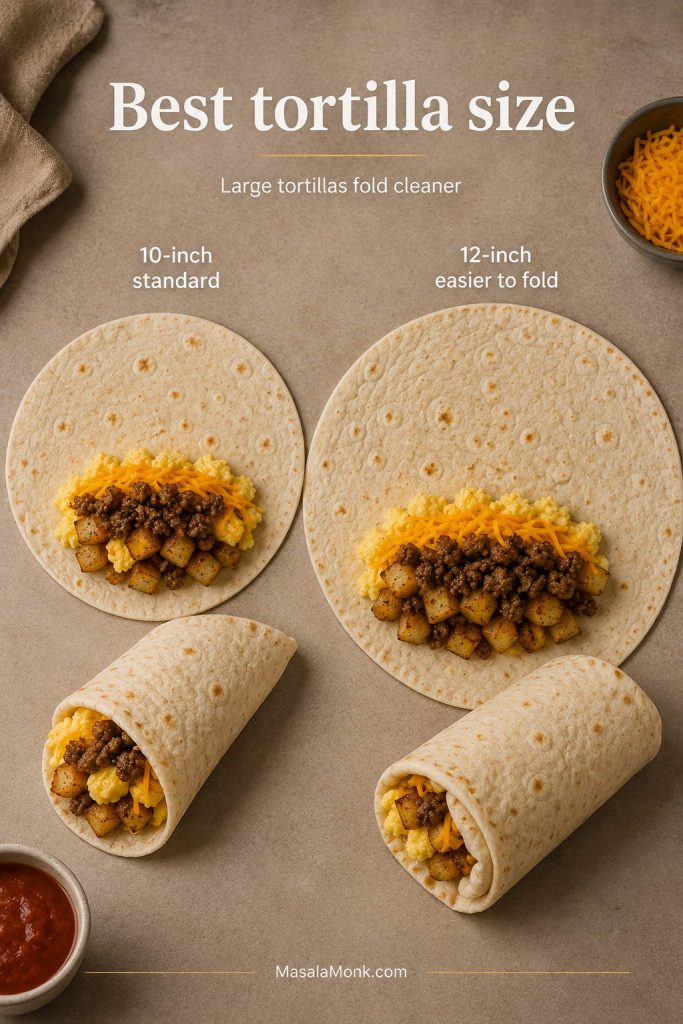
A large, flexible tortilla is the difference between a burrito that rolls cleanly and one that cracks before breakfast even starts. Aim for 10 inches for a standard burrito, or 12 inches if you like a generous filling or are still getting comfortable with folding.

Before filling, warm the tortillas. Stack them under a damp paper towel and microwave for 15–30 seconds, or warm each tortilla briefly in a dry skillet. That way, the tortilla bends around the filling instead of tearing.

Comparison of 10-inch and 12-inch flour tortillas for making breakfast burritos
A larger tortilla gives you more folding margin. Therefore, 12-inch tortillas are easier for generous burritos, while 10-inch tortillas work best with controlled filling.

Eggs

Scrambled eggs are the heart of the burrito. For 6 burritos, this recipe uses 8 large eggs, which gives enough egg to feel breakfast-forward without making every bite too heavy. For a bigger, higher-protein version, use 10–12 eggs or replace some whole eggs with egg whites.

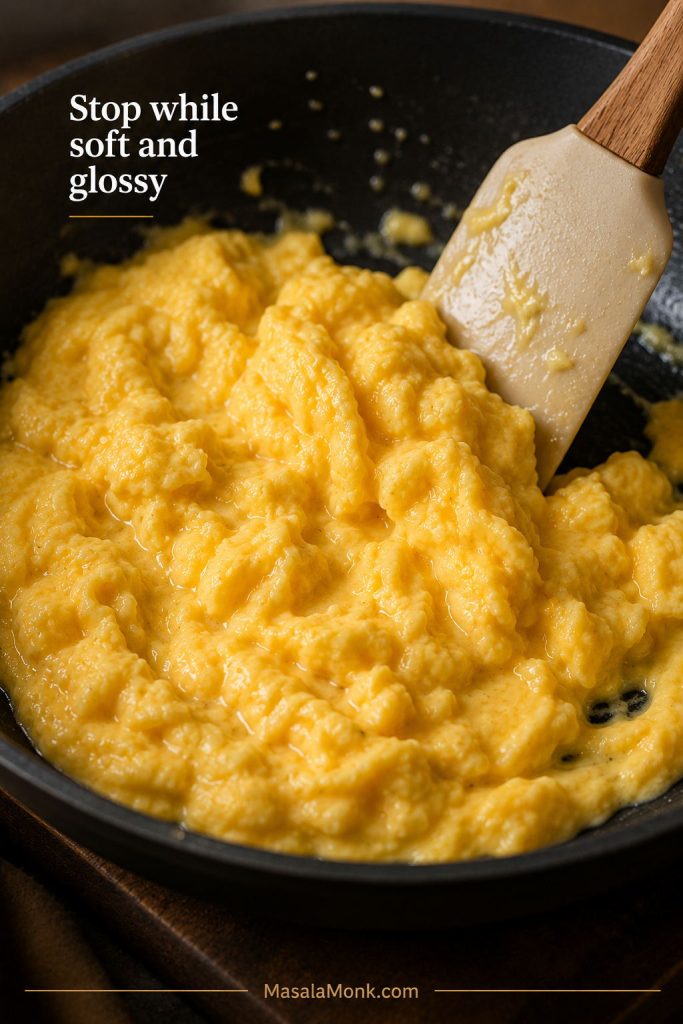
Texture matters more than most people think. Cook the eggs over medium-low heat and stop while they are still soft and slightly glossy. Dry eggs become firm after folding, and they get even tougher if you reheat the burritos later.

Soft scrambled eggs cooking in a skillet with a spatula, showing a glossy texture
Pull the eggs before they look completely dry. They will continue to firm up after folding, and they need enough softness to survive reheating.

Potatoes or Hash Browns

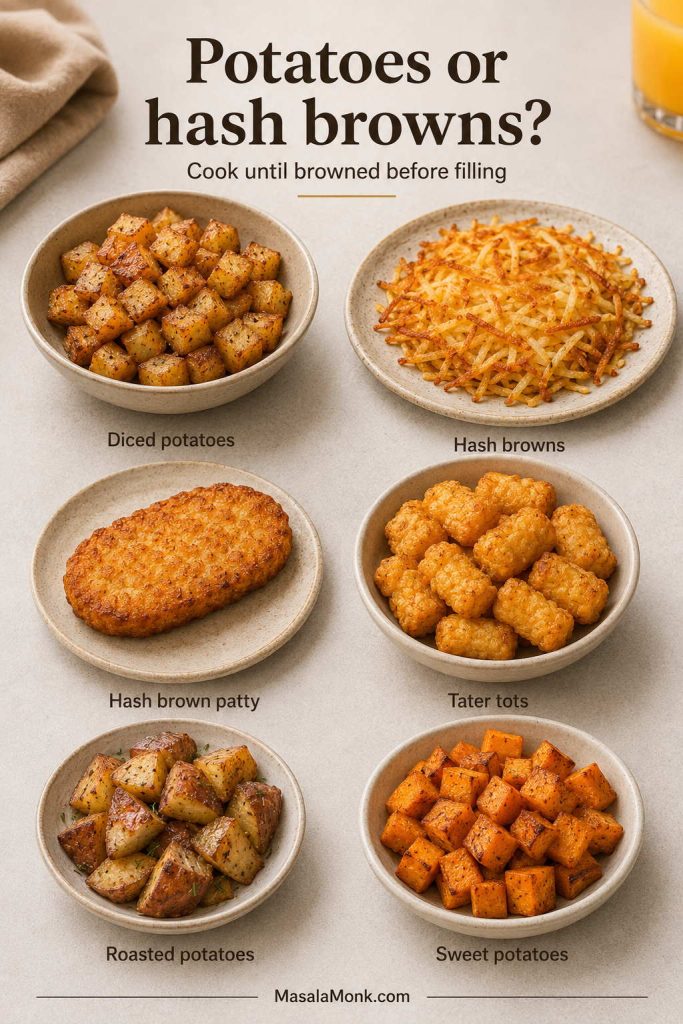
Potatoes and hash browns give the burrito its hearty breakfast texture, but they need to be cooked properly before they go inside. The best choice depends on whether you want diced potatoes, shredded hash browns, patties, tots, or a roasted potato shortcut.

Guide showing diced potatoes, hash browns, hash brown patties, tater tots, roasted potatoes, and sweet potatoes for breakfast burritos
Diced potatoes, hash browns, patties, tots, roasted potatoes, and sweet potatoes can all work. However, they need browned edges before they go inside the burrito.

Why the Potato Layer Matters

The potatoes are what make this feel like a proper breakfast burrito instead of scrambled eggs wrapped in a tortilla. Get them browned first, and the whole burrito tastes more satisfying. Diced potatoes, frozen shredded hash browns, hash brown patties, tater tots, leftover roasted potatoes, and sweet potatoes can all work.

Do not rush the potato layer. Once the edges are browned, the filling has the texture that keeps the burrito from tasting soft all the way through. For each burrito, use about ½ cup cooked potatoes or hash browns.

Golden diced potatoes browned in a skillet for breakfast burrito filling
Crisp potatoes make the filling feel more complete. Without that browned layer, a breakfast burrito can taste soft from tortilla to center.

Fresh Grated Potatoes

If you grate fresh potatoes, squeeze them in a clean kitchen towel before cooking. Removing excess moisture helps the potatoes brown instead of steaming in the pan.

Roasted Potatoes for Breakfast Burritos

If you prefer roasting, spread diced potatoes on a sheet pan with oil, salt, pepper, and seasoning. Roast at 425°F / 220°C for 22–28 minutes, flipping once, until the centers are tender and the edges are browned.

Hash Browns and Shortcut Potatoes

If you are starting with frozen shredded potatoes, patties, or homemade grated potatoes, this MasalaMonk guide to crispy air fryer hash browns has useful timing and texture cues you can borrow before filling the burritos.

Potato Option Amount for 6 Burritos Best Method
Diced russet or yellow potatoes 1–1¼ lb / 450–570 g Dice small and pan-fry for 12–15 minutes, or roast at 425°F / 220°C for 22–28 minutes.
Frozen shredded hash browns 16–20 oz / 450–570 g Cook in a thin layer for 7–10 minutes until browned; press out excess moisture if needed.
Hash brown patties 6 patties Cook until crisp, then use one patty per burrito.
Tater tots About 20 oz / 570 g Bake or air-fry until crisp, then crush lightly before filling.
Leftover roasted potatoes About 3 cups Re-crisp in a skillet before adding to the burritos.
Sweet potatoes 1–1¼ lb / 450–570 g Roast with smoked paprika, cumin, chili powder, or pepper.

Cheese

Cheddar, Monterey Jack, pepper jack, mozzarella, or a Mexican-style cheese blend all work. Cheese adds flavor, but it also helps bind the filling and creates a light barrier between the tortilla and the warm eggs or potatoes.

For the best fold, add cheese to the tortilla first, then layer the warm filling over it. The heat from the eggs and potatoes softens the cheese while the burrito is folded and toasted.

Open flour tortilla with shredded cheese added first, followed by eggs and potatoes for a breakfast burrito
Cheese does more than add flavor. Placing it first helps catch the warm filling, melt into the layers, and reduce direct moisture against the tortilla.

Sausage, Bacon, Chorizo, Beans, or Vegetables

The main recipe works with many fillings. Breakfast sausage gives you the most classic version, bacon makes it smoky, chorizo adds heat, steak makes it hearty, chicken sausage keeps it lighter, and black beans with peppers make a filling vegetarian burrito.

Whatever you choose, cook and drain it before assembly. Otherwise, wet fillings make burritos harder to fold and easier to tear, especially if you plan to freeze them.

Simple Breakfast Burrito Seasoning

For a quick breakfast burrito seasoning, use ½ teaspoon smoked paprika, ½ teaspoon cumin, ½ teaspoon chili powder, ¼ teaspoon garlic powder, and a pinch of black pepper. Sprinkle it over the potatoes, sausage, beans, or vegetables rather than only adding seasoning to the eggs. Because each layer is seasoned, the burrito tastes better from end to end.

Salsa, Sauce, and Toppings

Sauce tastes better after reheating than it does trapped inside a freezer wrap. For fresh burritos, a small spoonful of salsa, hot sauce, chipotle crema, avocado crema, green chile sauce, or sour cream lime sauce can go inside. For freezer burritos, save sauce for the side and add it after warming.

Fresh avocado, pico de gallo, sour cream, lettuce, raw tomato, and watery salsa taste good, but they are not ideal inside freezer burritos. Instead, add them after reheating for better texture.

Helpful Equipment

You do not need special equipment for this method, but a few tools make the process easier: a large skillet or cast-iron pan for the filling, a flexible spatula for soft eggs, a sheet pan if you are cooling fillings for freezer burritos, foil or parchment for wrapping, and a freezer bag or airtight container for storage.

How to Fold a Breakfast Burrito

Folding is where many breakfast burritos go wrong. The filling may be good, but if the tortilla is cold, small, or overstuffed, the burrito cracks, unrolls, or spills from both ends.

If your burritos have cracked, leaked, or fallen apart before, it probably was not the filling idea that failed. It was usually the tortilla temperature, filling shape, or moisture level.

Start with a warm 10–12 inch flour tortilla. Next, place the filling in a narrow strip just below the center of the tortilla, not in a big mound. Fold the left and right sides inward first. Then, pull the bottom edge up and over the filling, tuck it tightly under the filling, and roll forward until closed.

Step-by-step folding guide showing a breakfast burrito being filled, sides folded in, tucked, and rolled closed
The fold works best when the filling starts narrow. Then the sides can tuck in cleanly, and the bottom flap can roll forward without pushing everything out.

How Much Filling Is Too Much?

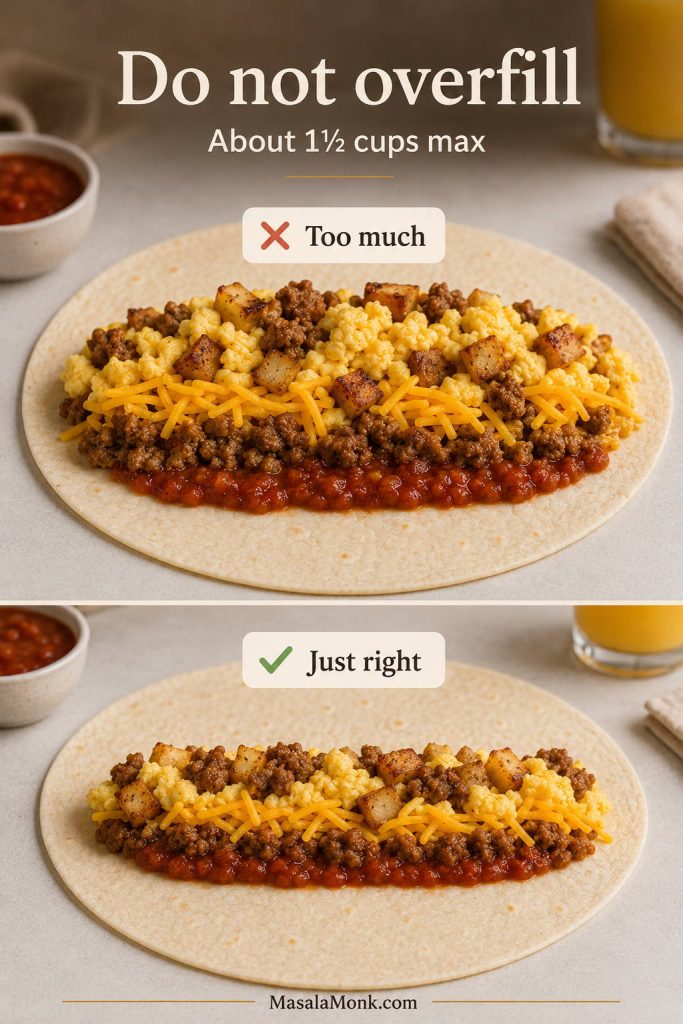
As a rough limit, keep the total filling to about 1½ cups per 10–12 inch tortilla. More than that can make the burrito bulky, split the tortilla, or keep the ends from closing. If you want a bigger burrito, use a larger tortilla instead of forcing more filling into a smaller one.

Comparison showing an overfilled breakfast burrito tortilla beside a correctly filled tortilla with a narrow filling line
Overfilling is the fastest way to ruin the roll. Keep the filling line compact so the tortilla can close, seal, and toast properly.

Set the burrito seam-side down right away. If you are eating it fresh, toast it seam-side down in a skillet to seal the fold and give the outside a lightly crisp finish.

Folding rule: Warm tortilla, narrow filling line, sides in first, bottom flap over, tuck tightly, roll forward, then toast seam-side down.

If the tortilla cracks or the filling spills out, check the troubleshooting section for quick fixes.

Should You Toast a Breakfast Burrito?

Toasting is worth it if you are eating the burrito right away. It seals the seam, melts the cheese, warms the tortilla, and gives the outside a better texture. A soft wrapped burrito is fine for packed breakfasts, but a toasted breakfast burrito feels more finished.

Because this recipe uses warm fillings and shredded cheese, even a short skillet toast helps everything come together. It also makes the burrito easier to pick up without the seam opening.

Breakfast burrito toasting seam-side down in a skillet until the tortilla is golden
Toasting seam-side down first helps lock the fold. After that, the outside can brown evenly while the cheese finishes melting inside.
Finish Best For How to Do It
Skillet toast Best everyday texture Toast seam-side down for 1–2 minutes per side over medium heat.
Oven finish Several burritos at once Bake at 425°F / 220°C for 8–10 minutes, until hot and lightly crisp.
Broiler finish Fast browning Broil on low for 3–6 minutes, watching closely so tortillas do not burn.
Sandwich press Compact, crisp burritos Press gently until the outside is golden and the cheese melts.

How to Make Freezer Breakfast Burritos

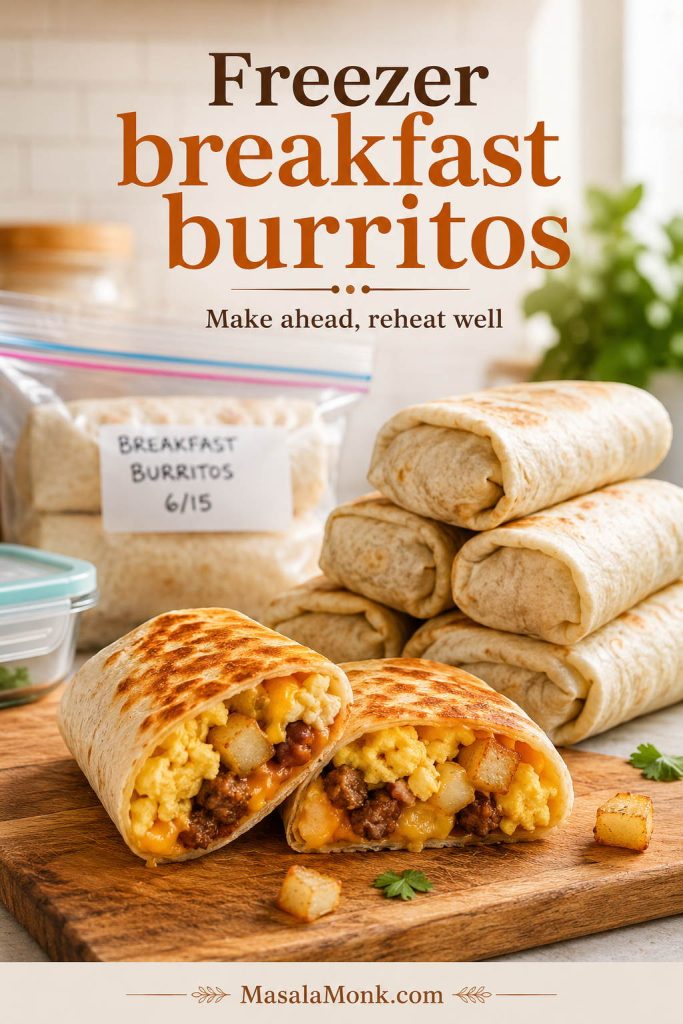
Freezer breakfast burritos are brilliant when they work and disappointing when they do not. The difference is usually steam and sauce. Let the fillings cool, keep wet toppings out, wrap tightly, and reheat gently so the eggs stay soft and the tortilla does not turn limp.

The goal is to freeze a burrito that still tastes like breakfast after reheating, not a steamed tortilla with dry eggs inside.

Wrapped freezer breakfast burritos beside one cut-open burrito and a freezer bag
Freezer breakfast burritos need sturdy fillings and controlled moisture. Otherwise, they may freeze well but reheat into a soft, damp tortilla.

Cool the Filling First

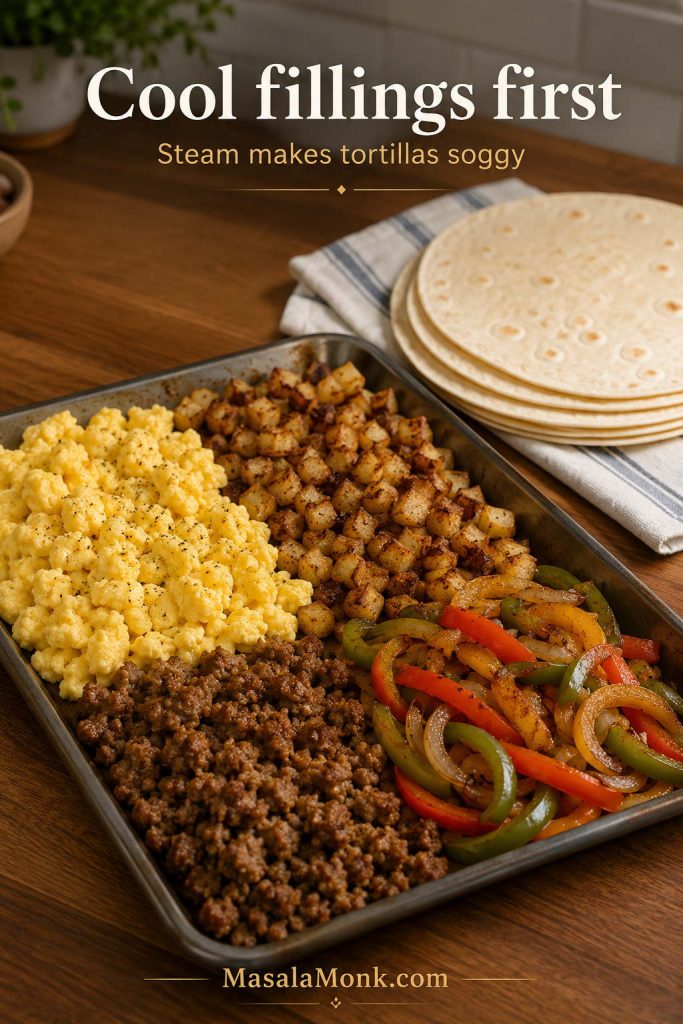
Hot eggs, potatoes, and sausage release steam. If you wrap them immediately, that steam gets trapped inside the tortilla and softens it. For freezer burritos, spread the cooked fillings on a plate or sheet pan and let them cool until warm, not hot, before assembling.

Cooked eggs, potatoes, sausage, and peppers spread on a tray to cool before being wrapped into breakfast burritos
Letting the fillings cool gives steam a chance to escape. Because of that, the tortilla is less likely to soften before the burrito even reaches the freezer.

What Not to Put Inside Before Freezing

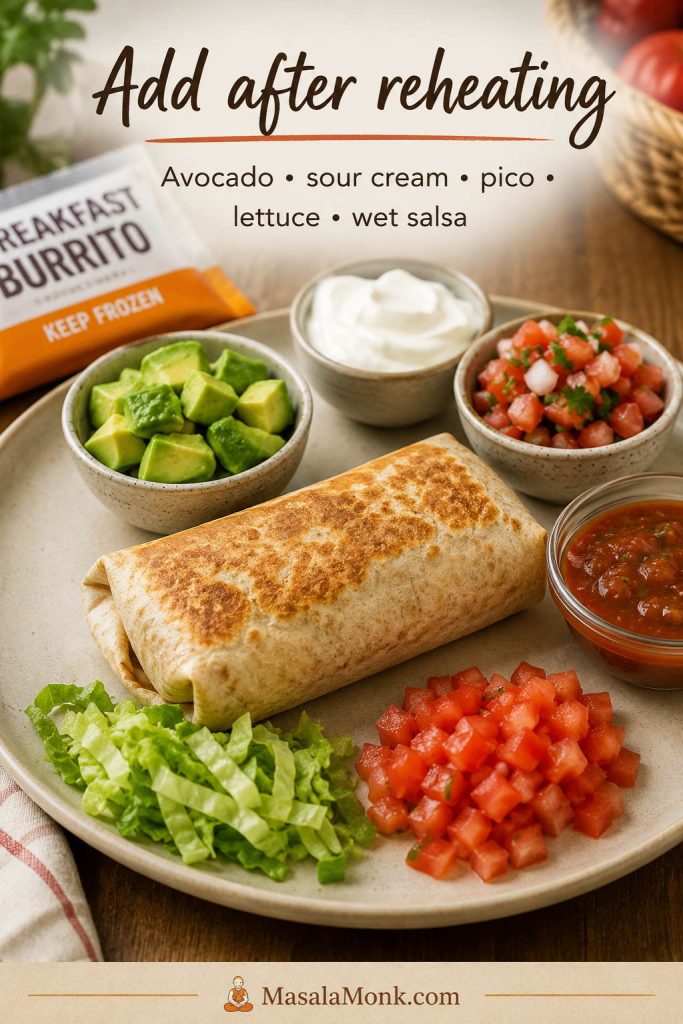
Some ingredients taste better added after reheating. Keep fresh avocado, guacamole, sour cream, watery salsa, pico de gallo, lettuce, raw tomato, and very wet sauces out of the burritos before freezing. Otherwise, they can turn watery, dull, or mushy after thawing.

Better freezer fillings include eggs, cheese, cooked sausage, bacon, chorizo, beans, potatoes, hash browns, cooked peppers, and cooked onions.

Avocado, sour cream, pico de gallo, lettuce, tomato, and salsa shown beside a breakfast burrito as toppings to add later
Avocado, sour cream, lettuce, pico, tomato, and watery salsa taste better after reheating. Keep them fresh on the side instead of freezing them inside.

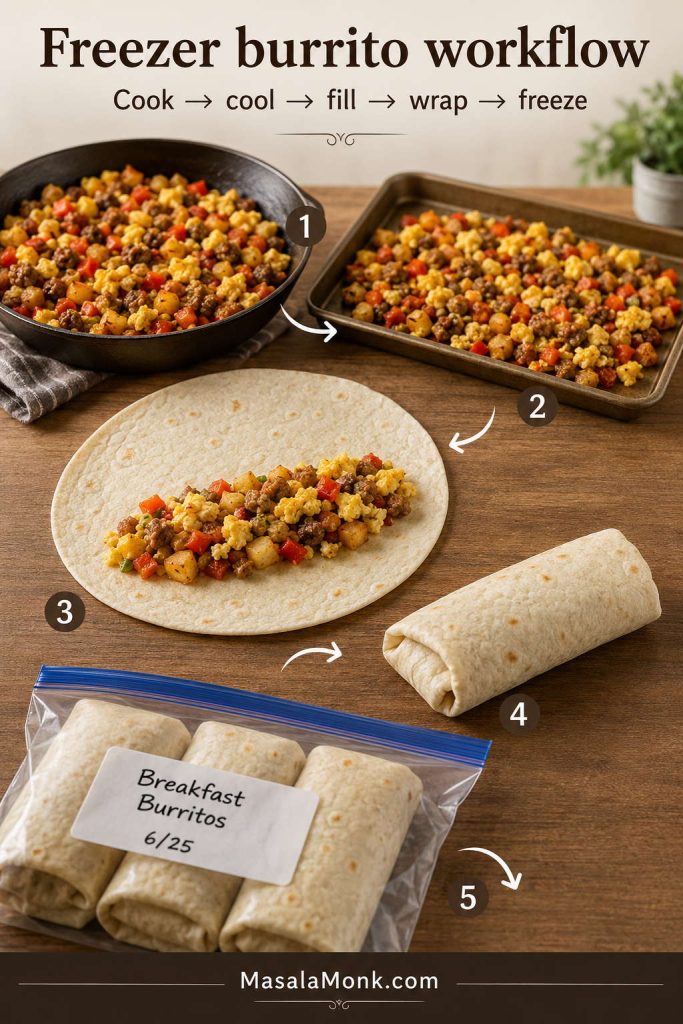
Freezer Breakfast Burrito Workflow

  1. Cook the protein, potatoes, and eggs separately.
  2. Spread the hot fillings on a plate or sheet pan so steam can escape.
  3. Warm the tortillas so they fold without cracking.
  4. Add cheese first, then potatoes, eggs, and protein or beans.
  5. Fold tightly and place each burrito seam-side down.
  6. Wrap each burrito in parchment or foil.
  7. Place wrapped burritos in a freezer bag, label, and freeze flat.
  8. Reheat gently, then add salsa, crema, avocado, or fresh toppings after warming.
Workflow image showing cooked filling, cooled filling, burrito assembly, wrapping, and freezing steps
The freezer method is easier when you follow the order: cook, cool, fill, wrap, and freeze. Skipping the cooling step is where most texture problems begin.

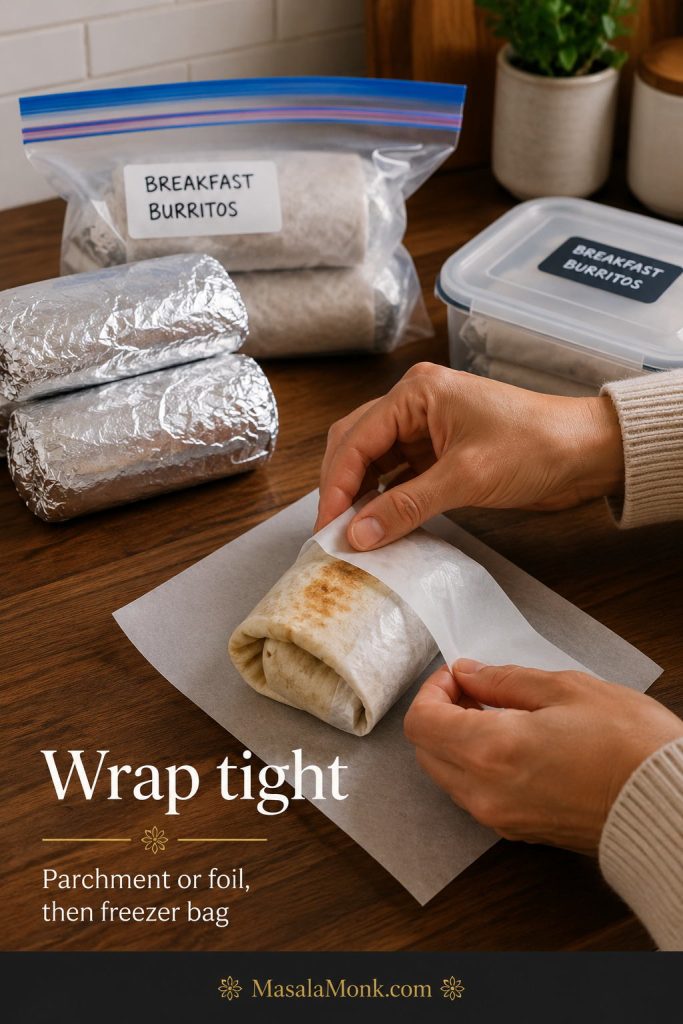
How to Wrap Breakfast Burritos for the Freezer

Wrap each cooled burrito tightly in parchment or foil. Then, place the wrapped burritos in a freezer bag or airtight container. Foil helps protect the shape, but a freezer bag gives better protection from freezer air.

Label the bag with the filling and date. Breakfast burritos are best within 2–3 months for texture, depending on how well they are wrapped.

Hands wrapping breakfast burritos in parchment or foil with wrapped burritos and a freezer bag nearby
A tight wrap protects the tortilla and keeps the burrito compact. Then the freezer bag adds the second layer of protection against drying out.
Next: go straight to how to reheat breakfast burritos or jump down to storage, freezing, and reheating for the short version.

How to Reheat Breakfast Burritos

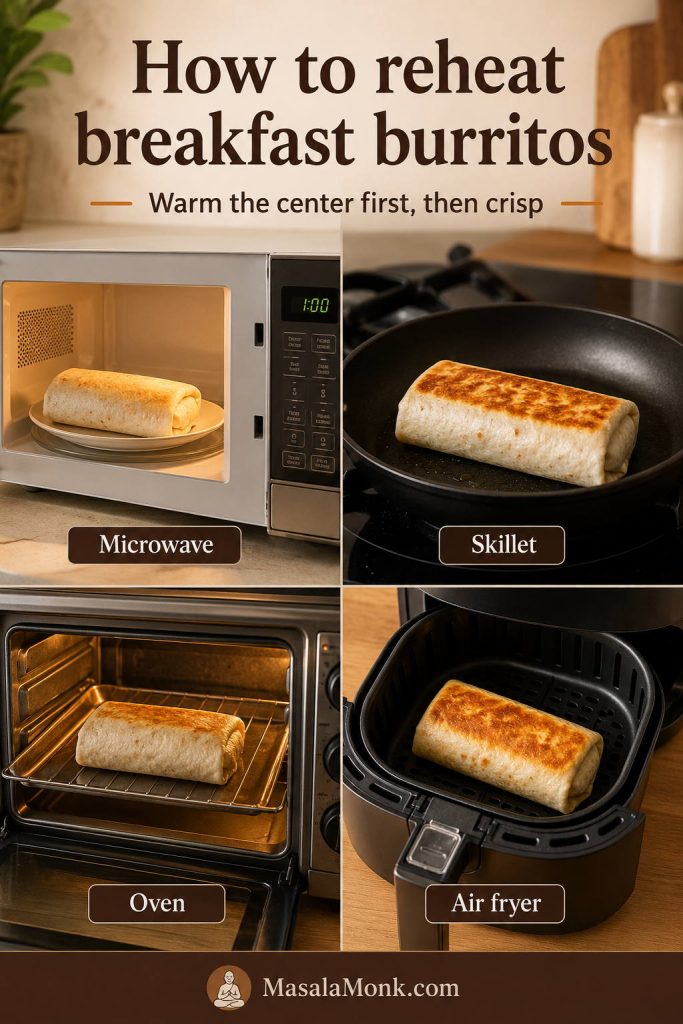
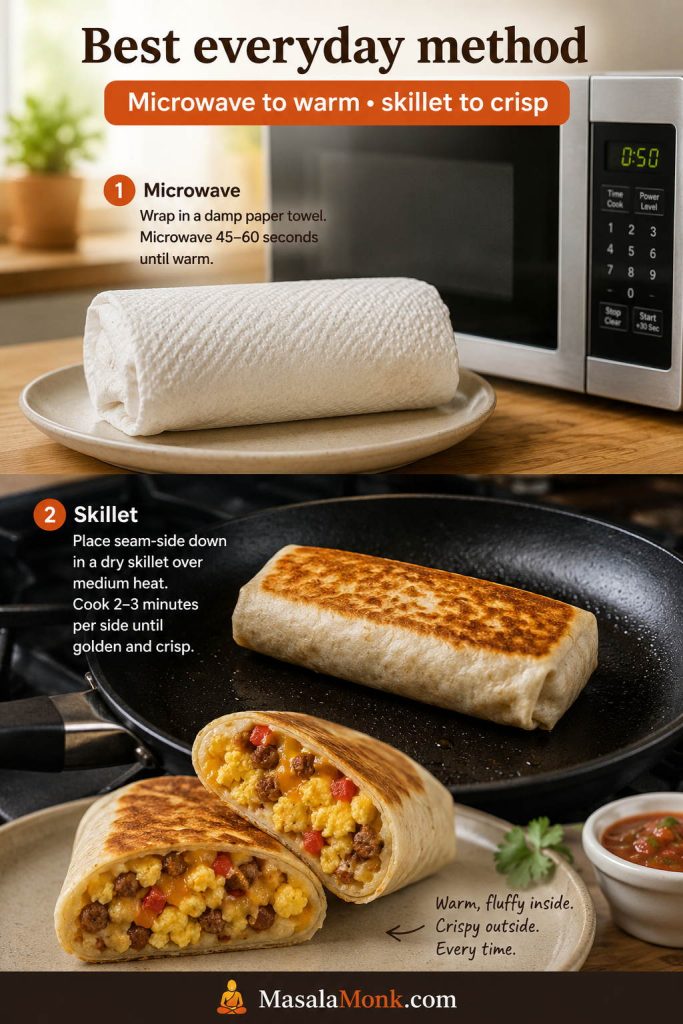
The best everyday method is microwave plus skillet: warm the center first, then crisp the outside. The microwave alone is fastest, but it can make the tortilla chewy. The oven or toaster oven gives better texture when reheating several burritos.

Reheating guide showing breakfast burritos in a microwave, skillet, oven, and air fryer
Reheating is not one-size-fits-all. The microwave is fastest, the skillet improves texture, the oven handles batches, and the air fryer adds crispness.
Situation Best Method Exact Guidance
Fresh burrito, eating now Skillet Toast seam-side down for 1–2 minutes per side.
Refrigerated burrito Microwave + skillet Microwave 45–90 seconds, then crisp in a skillet for 1–2 minutes per side.
Frozen burrito, fastest Microwave Remove foil, wrap in a paper towel, defrost at 50% power for 3–5 minutes, then heat on full power for 1–2 minutes more.
Frozen burrito, best oven texture Oven or toaster oven Heat foil-wrapped at 350°F / 175°C for 45–55 minutes, until hot in the center.
Thawed burrito, oven Oven or toaster oven Heat at 400°F / 200°C for 15–20 minutes.
Frozen burrito, air fryer Air fryer Remove foil or parchment. Heat at 350°F / 175°C for 15–20 minutes, checking the center.
Thawed burrito, air fryer Air fryer Heat at 350°F / 175°C for 8–12 minutes.
Crisp finish Skillet After warming, toast 1–2 minutes per side over medium heat.

Microwave and Skillet Reheating Method

For the best everyday texture, warm the burrito first so the center is hot, then finish it in a skillet so the tortilla gets lightly crisp again. This is especially helpful for refrigerated burritos and thawed freezer burritos because the microwave handles the center while the skillet fixes the outside.

Breakfast burrito first warmed in the microwave and then crisped in a skillet
This two-step method solves a common problem: the microwave warms the center, while the skillet brings back the toasted tortilla texture.

For food safety, reheat leftovers until hot throughout. If checking with a thermometer, the center should reach 165°F / 74°C. You can read more about safe leftover handling from the USDA leftover food safety guide.

Breakfast Burrito Filling Ideas

Once the basic breakfast burrito recipe formula is clear, the burritos become easy to customize. Keep the same structure: tortilla, cheese, eggs, potatoes or hash browns, a flavorful filling, and sauce on the side or added lightly inside.

Choose Your Breakfast Burrito Version

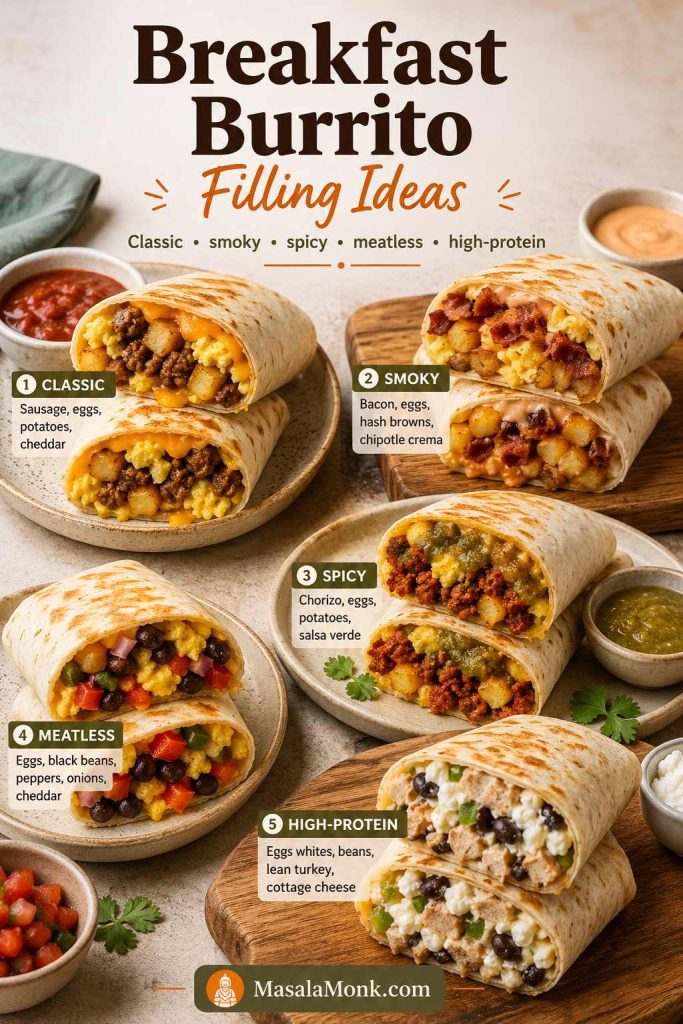
Quick chooser: Want classic? Use sausage, eggs, potatoes, and cheddar. Want smoky? Use bacon, hash browns, and chipotle crema. Want spicy? Use chorizo, potatoes, and salsa verde. Want meatless? Use eggs, black beans, peppers, onions, and cheese. Want high-protein? Use eggs or egg whites, beans, turkey sausage, cottage cheese, or tofu scramble.

Variation board showing classic, smoky, spicy, meatless, and high-protein breakfast burrito filling ideas
Once the base formula works, the filling can change with the mood: classic sausage, smoky bacon, spicy chorizo, meatless beans, or a higher-protein build.

Breakfast Burrito Variation Table

Variation Filling Best Sauce Notes
Sausage Breakfast Burrito Eggs, breakfast sausage, potatoes, cheddar Salsa or hot sauce The most classic version and a good first recipe.
Bacon Hash Brown Burrito Eggs, bacon, hash browns, cheddar Chipotle crema Smoky, crisp, and very brunch-friendly.
Chorizo Breakfast Burrito Eggs, chorizo, potatoes, Monterey Jack Salsa verde Spicy and rich; drain the chorizo well before filling.
Steak and Egg Breakfast Burrito Steak, eggs, potatoes, cheese Salsa roja or hot sauce Hearty and high-protein, especially good with leftover steak.
Chicken Breakfast Burrito Chicken sausage or shredded chicken, eggs, potatoes Avocado crema A lighter meat option that still feels filling.
Vegetarian Breakfast Burrito Eggs, black beans, potatoes, peppers, onions, cheese Salsa or avocado crema Meatless but still hearty because of beans and potatoes.
Vegan Breakfast Burrito Tofu scramble, beans, potatoes, salsa, vegan cheese Salsa or vegan crema Add avocado after reheating if freezing.
High-Protein Breakfast Burrito Eggs, egg whites, turkey sausage, beans, cottage cheese Salsa or Greek yogurt sauce Best for meal prep and macro-friendly breakfasts.
Freezer-Friendly Burrito Eggs, potatoes, cheese, sausage or beans Sauce on the side Avoid wet toppings inside before freezing.
Need matching sauce ideas? Head to best sauces for breakfast burritos. Want a lighter version? See how to make a healthy or high-protein breakfast burrito.

Sausage Breakfast Burrito

Use cooked breakfast sausage, soft eggs, golden potatoes, and cheddar or Monterey Jack. Before assembly, drain the sausage so the tortilla does not get greasy. This is the best classic version to make first.

Bacon Breakfast Burrito

Cook bacon until crisp, chop it, and pair it with eggs, hash browns, and cheddar. Bacon works especially well with chipotle crema, hot sauce, or a small spoonful of salsa.

Chorizo Breakfast Burrito

Chorizo brings spice and richness. Cook it fully, drain off extra fat, and balance it with eggs, potatoes, cheese, and salsa verde. Because chorizo is strongly seasoned, taste before adding extra salt.

Steak and Egg Breakfast Burrito

Use thinly sliced cooked steak or leftover steak with eggs, potatoes, cheese, and salsa roja. This version feels more filling and higher-protein, so it works well as a brunch or post-workout breakfast.

Chicken Breakfast Burrito

Use chicken sausage, shredded cooked chicken, or chopped grilled chicken with eggs, potatoes, cheese, and avocado crema. Since chicken has a milder flavor than bacon or chorizo, season the potatoes and sauce well.

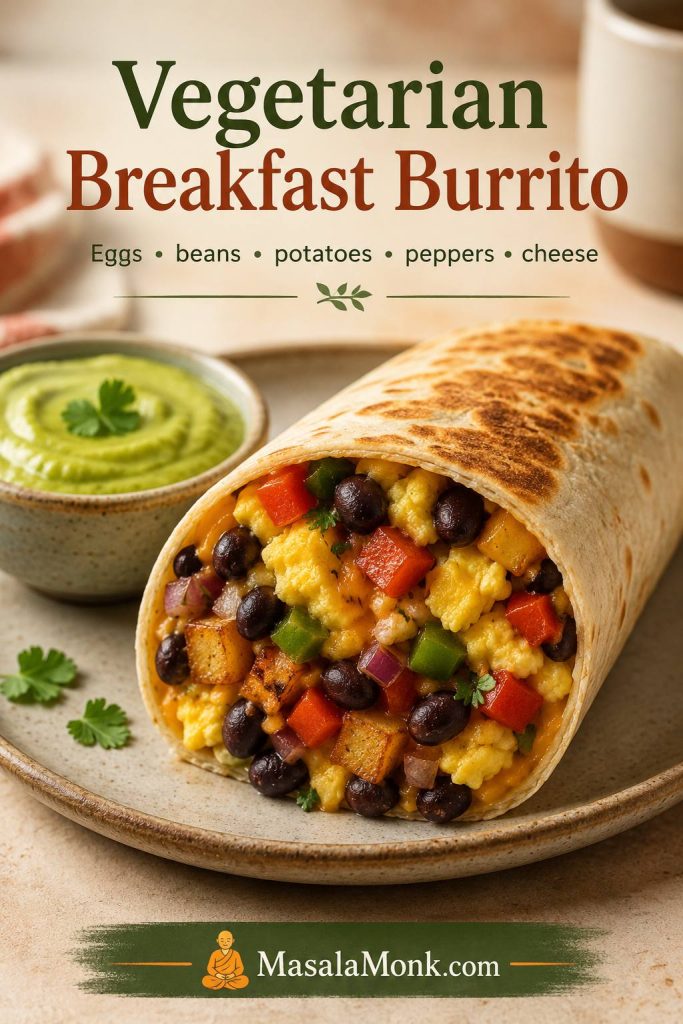
Vegetarian Breakfast Burrito

Use eggs, black beans or pinto beans, crisp potatoes, peppers, onions, cheese, and salsa. The beans replace meat while adding protein, fiber, and a creamy texture against the browned potatoes.

Vegetarian breakfast burrito cut open with eggs, beans, potatoes, peppers, onions, and cheese
A vegetarian breakfast burrito should still feel hearty. Beans bring protein and creaminess, while potatoes, peppers, eggs, and cheese keep the texture satisfying.

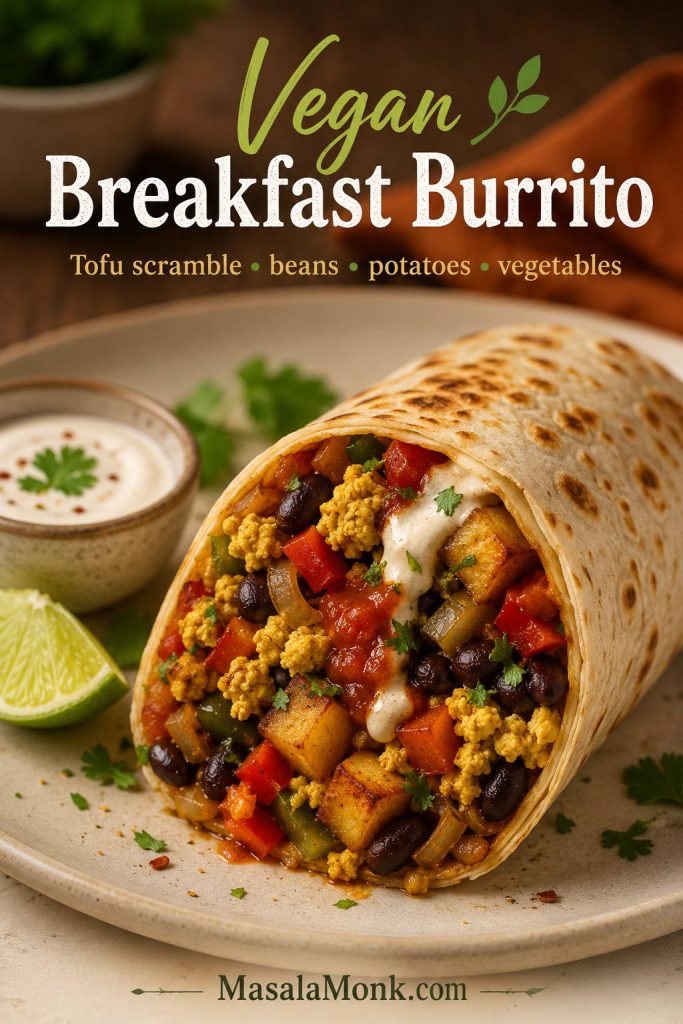
Vegan Breakfast Burrito

Use tofu scramble instead of eggs, then add black beans, crisp potatoes, salsa, sautéed peppers, onions, and vegan cheese or cashew queso. If freezing, keep avocado and fresh greens out of the burrito and add them after reheating. For more savory plant-based breakfast ideas, MasalaMonk’s guide to using tofu instead of eggs is a natural companion.

Vegan breakfast burrito with tofu scramble, beans, potatoes, salsa, and vegetables
Tofu scramble works best when it is treated like a real filling, not an afterthought. Pair it with beans, potatoes, vegetables, and salsa for better balance.

High-Protein Breakfast Burrito

For a high-protein breakfast burrito, use extra eggs or egg whites, black beans, turkey sausage, chicken sausage, steak, tofu scramble, or cottage cheese-enriched eggs. Still, keep the potatoes if you want the burrito to taste like breakfast instead of a plain protein wrap.

High-protein breakfast burrito with eggs, egg whites, beans, lean meat, and potatoes
A high-protein breakfast burrito works better when protein is added around the classic structure. Keep enough potato, cheese, or sauce so it still tastes like breakfast.

Best Sauces for Breakfast Burritos

A dry breakfast burrito tastes like meal prep. A good sauce makes it feel like breakfast you actually wanted. The trick is using enough salsa, crema, or hot sauce to brighten the eggs and potatoes without making the tortilla wet.

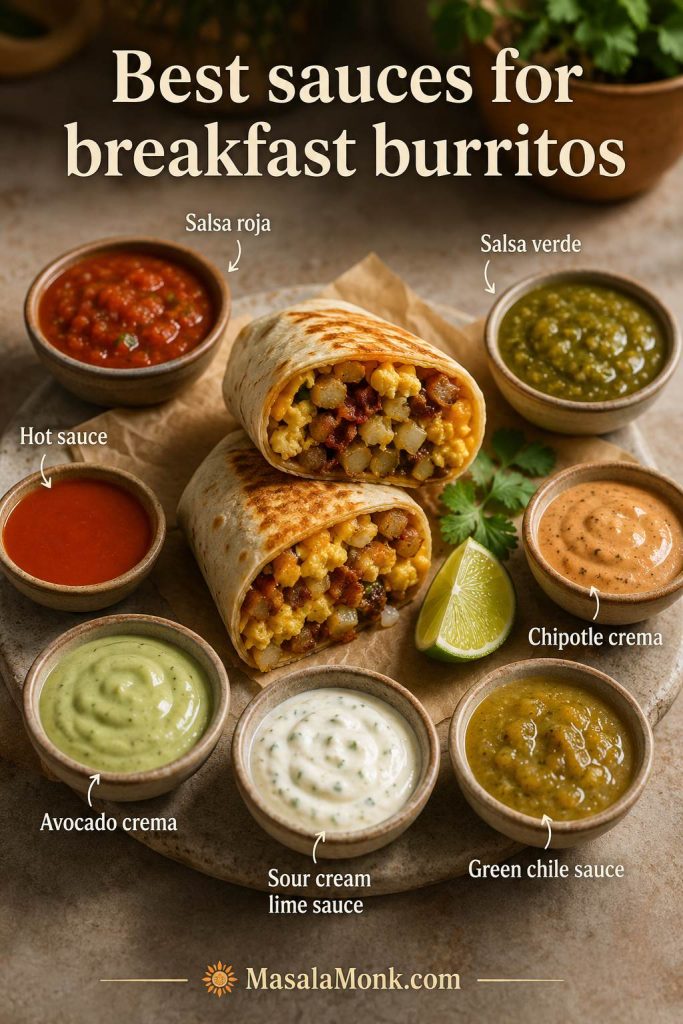
This recipe works with several sauces, so choose based on the filling. For example, chorizo is great with salsa verde, bacon works beautifully with chipotle crema, and vegetarian burritos taste brighter with avocado crema or salsa.

Sauce guide showing salsa roja, salsa verde, hot sauce, chipotle crema, avocado crema, sour cream lime sauce, and green chile sauce with a breakfast burrito
Sauce changes the whole direction of the burrito. For example, salsa verde brightens spicy fillings, while chipotle crema makes bacon or hash browns feel richer.

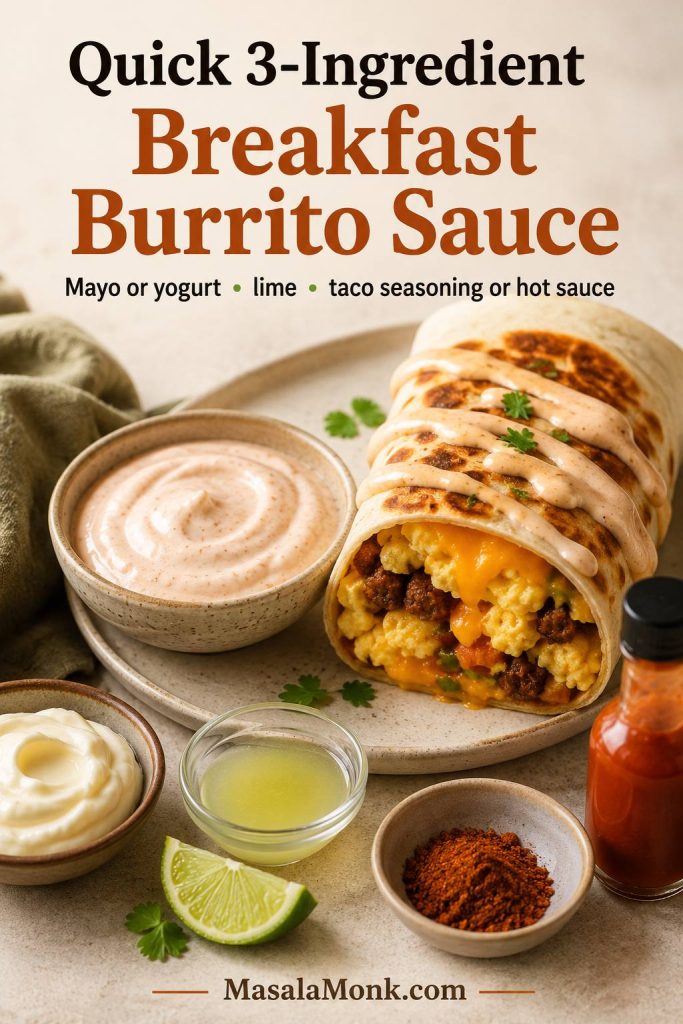
Quick 3-Ingredient Breakfast Burrito Sauce

For the fastest sauce, stir together 3 tablespoons mayonnaise or Greek yogurt, 1 tablespoon lime juice, and 1–2 teaspoons taco seasoning or hot sauce. It is not as smoky as chipotle crema, but it gives the burrito a creamy, tangy finish in less than 2 minutes.

Creamy quick breakfast burrito sauce served beside a burrito with sauce ingredients nearby
A quick sauce can rescue a basic meal-prep burrito. Even a small creamy, tangy finish makes eggs, potatoes, and tortillas taste fresher.
Sauce Best With Use Inside or On the Side?
Salsa roja Sausage, bacon, steak, eggs Lightly inside fresh burritos; side for freezer burritos
Salsa verde Chorizo, potatoes, vegetarian burritos Best on the side or added after reheating
Hot sauce Almost any breakfast burrito Inside or on the side, but use lightly
Chipotle crema Bacon, hash browns, chicken, steak Side for freezer burritos
Avocado crema Vegetarian, chicken, spicy burritos Add after reheating for best texture
Sour cream lime sauce Classic egg and potato burritos Fresh serving only; not ideal inside freezer burritos
Green chile sauce Egg, potato, sausage, and cheese burritos Best spooned over or served on the side
Want to pair sauces with specific fillings? Jump back to breakfast burrito filling ideas or return to the main recipe.

For an egg-free creamy sauce, use thick yogurt, sour cream, or an egg-free mayo base. MasalaMonk’s eggless mayonnaise recipe is a useful starting point if you want a creamy breakfast burrito sauce without using eggs in the condiment.

Quick Chipotle Crema for Breakfast Burritos

For a smoky creamy sauce, mix 1 cup Greek yogurt, sour cream, or crema with 1 minced chipotle pepper in adobo, 1 tablespoon adobo sauce, 2 teaspoons lime juice, ¼ teaspoon garlic powder, and salt to taste. Blend for a smooth sauce or whisk if the chipotle is finely minced. If you like building sauces from a creamy base, MasalaMonk’s homemade mayo guide has more spicy mayo and garlic mayo ideas that can be adapted for burritos.

How to Make a Healthy or High-Protein Breakfast Burrito

A high-protein breakfast burrito should still taste like breakfast, not like a dry protein wrap. Keep the potatoes or hash browns for texture, then build more protein around them with eggs, egg whites, beans, turkey sausage, chicken sausage, steak, tofu scramble, or cottage cheese-enriched eggs.

For a lighter version, use whole eggs plus egg whites, add black beans or pinto beans, choose turkey sausage or chicken sausage, use a whole-wheat or high-fiber tortilla, and keep the sauce bright rather than heavy. A little sharp cheddar can also give more flavor than a lot of mild cheese.

High-protein formula: Use 1 whole egg + 2 egg whites, ¼–½ cup beans, 2–3 oz lean meat or tofu, ¼ cup cheese or cottage cheese, and ½ cup potatoes or vegetables per burrito.

Goal Best Move
More protein Add egg whites, black beans, turkey sausage, chicken sausage, steak, tofu scramble, or cottage cheese-enriched eggs.
Lower calories Use less cheese, lean protein, more peppers and onions, and sauce on the side.
More fiber Add black beans, pinto beans, a whole-wheat tortilla, spinach, peppers, or onions.
Still satisfying Keep about ½ cup potatoes or hash browns instead of removing the carb layer completely.

A higher-protein burrito works well with 2 eggs or 1 egg plus egg whites per burrito, ¼–½ cup beans, and turkey sausage, chicken sausage, steak, tofu scramble, or cottage cheese-enriched eggs. If you are building more protein-focused breakfasts across the week, this high-protein oatmeal guide gives another breakfast format using oats, yogurt, egg whites, cottage cheese, tofu, or protein powder.

Prefer a more classic version first? Go back to the main breakfast burrito recipe. Want filling inspiration? Browse the variation ideas.

Breakfast Burrito vs Breakfast Wrap

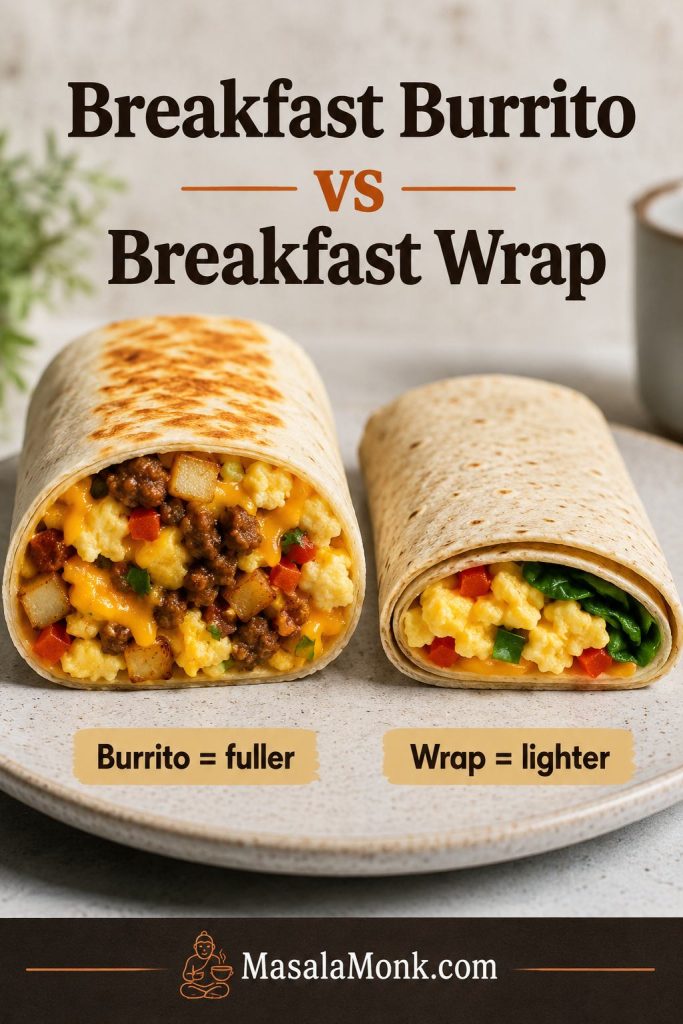
A breakfast burrito is usually larger, fuller, and folded closed on both ends. It often includes eggs, potatoes or hash browns, cheese, and a hearty filling. A breakfast wrap is usually lighter, flatter, and easier to toast, with fewer fillings or a more sandwich-like shape.

A lighter breakfast wrap works best with less potato, less cheese, a thinner layer of eggs, and a smaller amount of filling. A true breakfast burrito needs a large tortilla and enough filling so every bite has eggs, potatoes, cheese, and something flavorful. If you are deciding between a burrito, wrap, toast, or egg-and-cheese build, MasalaMonk’s breakfast sandwich ideas can help you choose a smaller, faster format for busy mornings.

Side-by-side comparison of a larger filled breakfast burrito and a lighter breakfast wrap
The difference is mostly structure. A breakfast burrito is fuller and folded closed, while a breakfast wrap is lighter, flatter, and easier to toast quickly.

Breakfast Burrito Troubleshooting

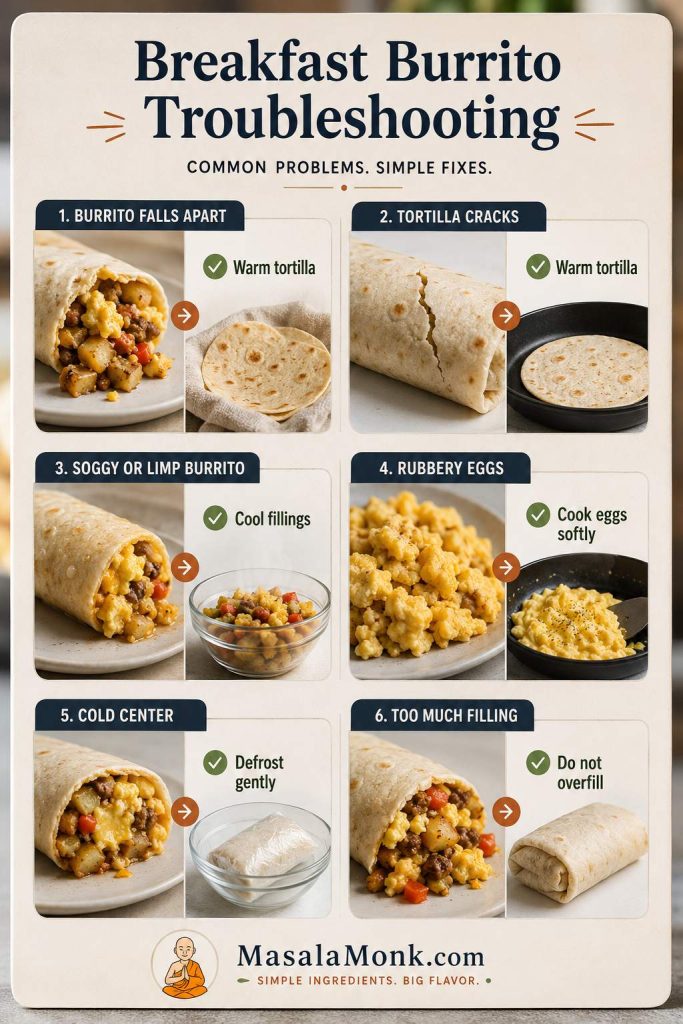
When breakfast burritos go wrong, it is usually not because the idea is bad. It is usually one of three things: too much moisture, a cold or small tortilla, or fillings that were overcooked before they ever went inside. Once you know which one caused the problem, the fix is usually simple.

Troubleshooting guide for breakfast burritos showing common problems such as cracked tortillas, soggy burritos, rubbery eggs, and cold centers
Most breakfast burrito problems are fixable. Check moisture, tortilla warmth, filling amount, egg texture, and reheating method before changing the whole recipe.
Problem Likely Cause Fix
Burrito falls apart Too much filling or tortilla too small Use a 10–12 inch tortilla and keep filling in a narrow strip.
Tortilla cracks Cold or dry tortilla Warm under a damp paper towel for 15–30 seconds before folding.
Burrito turns wet or limp Hot filling, watery salsa, or wet toppings inside Cool fillings first and keep sauce, sour cream, and avocado on the side.
Eggs turn rubbery Eggs overcooked before folding or overheated during reheating Cook eggs softly and reheat gently.
Potatoes are mushy Pan overcrowded or potatoes under-browned Cook in a thin layer until golden before adding to burritos.
Filling tastes bland Only the eggs were seasoned Season potatoes, eggs, and protein separately.
Cheese does not melt Cheese added too late or filling not warm enough Add cheese first, then warm fillings, and toast the burrito.
Frozen burrito is cold in the center Outside heated faster than the middle Defrost first, microwave at lower power, or oven-reheat longer.
Tortilla gets chewy in microwave Over-microwaved or uncovered Use a damp paper towel and finish in a skillet for better texture.
Burrito feels too bulky Too much potato or filling Use about ½ cup potatoes and ¼–½ cup protein or beans per tortilla.
Need the detailed fix? Revisit folding, freezer tips, reheating, or sauce ideas.

What to Serve with Breakfast Burritos

Breakfast burritos are filling enough on their own, but the right sides make them feel more complete. Serve them with salsa, hot sauce, avocado, fruit, roasted potatoes, a simple salad, or extra beans. For brunch, add lime wedges, pickled onions, sliced jalapeños, or a bowl of chipotle crema for dipping.

If you are serving a crowd, keep the burritos warm in a low oven, then set out sauces and toppings separately. This keeps the tortillas from softening too much and lets everyone choose their own heat level.

Storage, Freezing, and Reheating

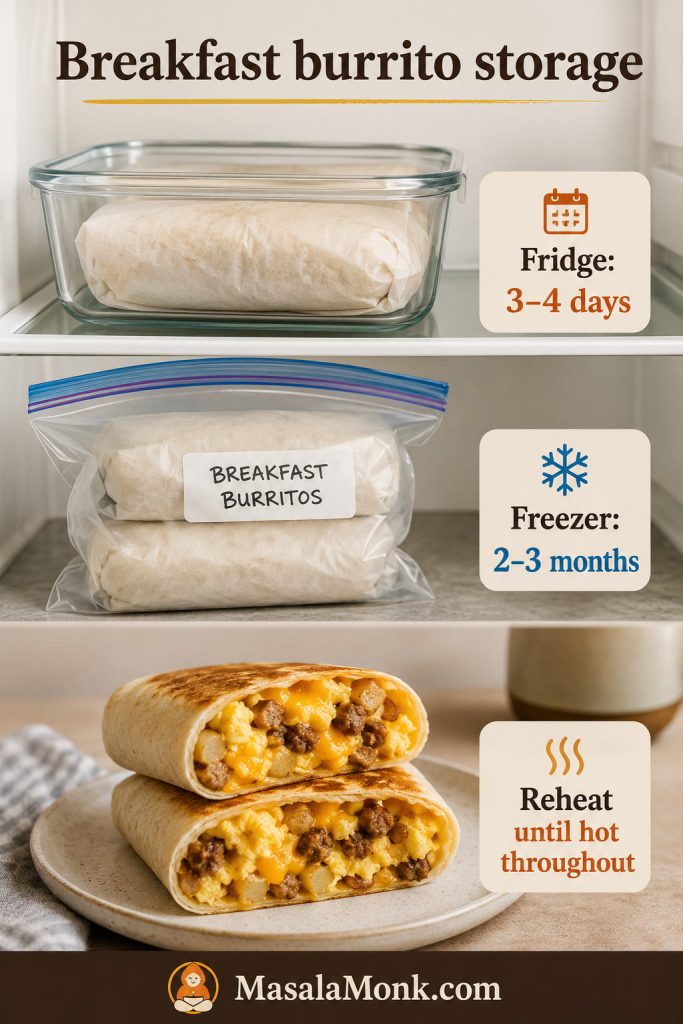
Leftover breakfast burritos keep well in the refrigerator for 3–4 days. For longer storage, wrap them individually and freeze them for best quality within 2–3 months.

In the fridge, wrap each burrito in foil or parchment and keep it in an airtight container. For the freezer, wrap each cooled burrito tightly, then place the wrapped burritos in a freezer bag. After that, reheat until hot throughout and add sauce, avocado, sour cream, or fresh salsa only after warming.

Storage guide showing wrapped breakfast burritos for the refrigerator, wrapped burritos in a freezer bag, and a reheated cut burrito
Storage matters because eggs, cheese, potatoes, and tortillas all change texture over time. Refrigerate short-term batches and freeze longer meal prep portions.

This recipe is best when reheated gently rather than blasted on high heat from frozen. For a broader reference on refrigerator and freezer timing across eggs, cooked dishes, meats, and prepared foods, the FoodSafety.gov cold food storage chart is also useful.

Best make-ahead move: Freeze the burritos without wet toppings, then serve with salsa, crema, hot sauce, avocado, or pico de gallo after reheating.

Once you understand the formula, breakfast burritos become one of the easiest breakfasts to repeat: warm tortilla, soft eggs, crisp potatoes, melted cheese, a flavorful filling, and sauce used smartly. Make them fresh when you want a hot skillet breakfast, or wrap a batch for the freezer so a real breakfast is ready on busy mornings instead of another rushed compromise.

Final Breakfast Burrito Serving Idea

When you are ready to serve, keep the burrito warm and add the fresh toppings at the end. Salsa, avocado, crema, hot sauce, lime, or pico de gallo all taste better when they finish the burrito instead of sitting inside during storage.

Finished breakfast burrito served with avocado, salsa, and sauce on a plate
The payoff is a burrito that works fresh, reheated, or meal-prepped: warm tortilla, soft eggs, crisp potatoes, melted cheese, and fresh toppings added at the end.

FAQs

What goes in a breakfast burrito?

A classic breakfast burrito recipe usually includes a large flour tortilla, scrambled eggs, potatoes or hash browns, cheese, and a filling such as sausage, bacon, chorizo, beans, peppers, onions, steak, chicken, or vegetables. Salsa or sauce is usually served inside lightly or on the side.

What size tortilla is best for breakfast burritos?

For most home cooks, 10 inches is the smallest size I would use for a proper breakfast burrito. A 12-inch tortilla is easier if you like a generous filling or are still learning to fold tightly. Smaller tortillas usually crack, tear, or leave the ends open.

Do breakfast burritos need potatoes or hash browns?

Potatoes are not required, but they make breakfast burritos more filling and give the inside better texture. Diced potatoes, shredded hash browns, hash brown patties, tater tots, and leftover roasted potatoes all work.

How do you keep breakfast burritos from getting soggy?

The biggest fix is moisture control. Let hot fillings cool before wrapping, use cheese as the first layer, and keep watery salsa, sour cream, avocado, raw tomato, and wet sauces on the side if the burritos are going into the fridge or freezer.

Should salsa go inside a breakfast burrito?

A small spoonful of salsa can go inside a fresh burrito. For freezer burritos, keep salsa on the side and add it after reheating so the tortilla does not turn wet.

How do you fold a breakfast burrito?

Warm the tortilla first, place the filling in a narrow strip, fold the sides inward, pull the bottom flap over the filling, tuck it tightly, and roll forward. Then, toast seam-side down to help seal it.

Should you toast a breakfast burrito?

Toasting improves the texture and helps seal the fold. Place the burrito seam-side down in a skillet and cook for 1–2 minutes per side until the outside is lightly golden.

How long do breakfast burritos last in the fridge?

Breakfast burritos keep well in the refrigerator for 3–4 days when wrapped and stored in an airtight container. After reheating, add fresh toppings like avocado, sour cream, or salsa.

How do you freeze breakfast burritos?

Cool the fillings first, assemble the burritos without wet toppings, wrap each one tightly in parchment or foil, then place them in a freezer bag or airtight container. Label with the date and use within 2–3 months for best texture.

What should you leave out of freezer breakfast burritos?

Leave out fresh avocado, guacamole, sour cream, watery salsa, pico de gallo, lettuce, and raw tomato. These are better added after reheating because they can turn watery or mushy in the freezer.

How do you reheat frozen breakfast burritos?

The fastest method is to remove the foil, wrap the burrito in a paper towel, defrost it in the microwave at 50% power, and then heat until hot. For better texture, warm it first and then crisp it in a skillet. When reheating several burritos, the oven gives more even heat.

How do you make a high-protein breakfast burrito?

Use more eggs or egg whites, add black beans, choose turkey sausage, chicken sausage, steak, tofu scramble, or cottage cheese-enriched eggs, and use a higher-fiber tortilla. Keep the potatoes if you still want it to feel like a real breakfast burrito.

How do you make a vegetarian breakfast burrito?

Use scrambled eggs, black beans or pinto beans, crisp potatoes or hash browns, sautéed peppers and onions, cheese, and salsa. Together, beans and potatoes keep the burrito filling even without meat.

What sauce is best for breakfast burritos?

Salsa, hot sauce, chipotle crema, avocado crema, green chile sauce, and sour cream lime sauce all work well. For freezer burritos, serve sauce on the side or add it after reheating.

What is the difference between a breakfast burrito and a breakfast wrap?

A breakfast burrito is usually larger, fuller, and folded closed, often with eggs, potatoes, cheese, and a hearty filling. A breakfast wrap is often lighter, flatter, and easier to toast with fewer fillings.

Posted on 8 Comments

Healthy Tuna Salad – 10 Easy Recipes (Avocado, Mediterranean, No Mayo & More)

Person holding a fork over a large bowl of healthy tuna salad with eggs, avocado, potatoes, beans and greens, with the text Healthy Tuna Salad, 10 Ways and MasalaMonk.com

Healthy tuna salad is one of those quiet workhorse recipes that can shape-shift into almost anything you need. Some days it’s a classic deli tuna salad sandwich on soft bread; on others it becomes a bright Mediterranean tuna salad with beans and olives, or a quick avocado tuna salad piled onto toast. When you want comfort, there’s tuna macaroni salad. When you want light and fresh, there’s tuna salad on salad with crunchy cucumber and apple. And when you’re skipping fish entirely, a vegan “tuna” made from chickpeas steps in without anyone feeling short-changed.

At the same time, tuna brings a lot of nutrition to the table. It’s naturally rich in protein and provides omega-3 fats that support heart and brain health when eaten in reasonable amounts. The FDA’s own advice about eating fish puts canned light tuna in the “Best Choices” group and suggests that most adults, including many who are pregnant, can safely enjoy it two to three times per week as part of a mixed seafood pattern, as long as they keep overall portions within the limits they outline. When you combine tuna with vegetables, beans, whole grains and lighter dressings, you end up with meals that feel like comfort food but behave more like smart nutrition.

This guide pulls together ten different healthy tuna salad recipes and all their useful cousins: no-mayo Greek yogurt tuna salad, avocado tuna salad, Mediterranean tuna and bean salad, Italian tuna with chickpeas, tuna Niçoise salad, tuna pasta salad and tuna mac, tuna and egg salad, crunchy apple and cucumber tuna salad, and finally a vegan tuna salad built from chickpeas. You can treat these as ten discrete recipes or as ten patterns you customise with whatever you’ve got in your kitchen.


1. Light Deli-Style Healthy Tuna Salad (Your Everyday Base)

Most people’s mental picture of tuna salad is the classic deli tuna fish salad: creamy, a little tangy, speckled with celery and onion, sometimes a touch sweet from relish. Instead of banishing that flavour in the name of health, it’s much more satisfying to keep the same general profile and simply rebalance the dressing so it becomes a genuinely healthy tuna salad you can eat more often.

Light deli-style healthy tuna salad made with tuna, celery, red onion and a Greek yogurt dressing in a bowl with bread and lemon.
Light deli-style healthy tuna salad made lighter with Greek yogurt instead of loads of mayo – perfect for sandwiches, wraps or spooned over a crunchy green salad.

Ingredients (2–3 servings)

  • 2 cans light tuna in water, well drained
  • 3–4 tablespoons plain Greek yogurt
  • 2–3 tablespoons mayonnaise
  • 1–2 ribs celery, finely chopped
  • 2 tablespoons red onion, very finely minced
  • 1–2 tablespoons sweet relish or finely chopped pickles
  • 1 teaspoon Dijon mustard
  • Juice of half a lemon
  • 1–2 tablespoons chopped fresh dill or parsley
  • Salt and freshly ground black pepper

Greek yogurt stands in for a chunk of the mayonnaise here. Compared with mayo, Greek yogurt is naturally higher in protein and significantly lower in calories and saturated fat, yet it has enough body to keep the dressing thick and satisfying. That little swap moves this toward a low fat tuna salad without making it taste “diet”.
How to make it

  1. Tip the drained tuna into a medium bowl and flake it with a fork so there are no large clumps.
  2. In a separate bowl, whisk the Greek yogurt, mayonnaise, mustard, lemon juice, herbs, salt and pepper until smooth.
  3. Stir celery, onion and relish into the dressing so all the crunchy bits are lightly coated.
  4. Fold the dressing mixture into the tuna and stir until everything looks evenly combined.
  5. Taste and adjust; a splash more lemon brightens everything, while a spoon of relish sweetens and softens the edges.
  6. Let the bowl chill for at least 15–20 minutes if you have the patience. It’s even better the next day.

Once you’ve got this base healthy tuna salad, you can spin it in several directions:

  • Pile it onto toast with lettuce and tomato for a quick tuna salad sandwich.
  • Spoon it over mixed greens for an easy salad and tuna combo.
  • Stuff it into a croissant and suddenly you’ve got a croissant tuna sandwich that feels like café food.
  • Serve it with crackers and sliced veggies as a tuna lunch on the go.

If you’re curious how bowls like this fit into a more general “eat more plants” direction, you might enjoy MasalaMonk’s piece on the perks of eating salads everyday, which talks through fibre, micronutrients and why salad isn’t a throwaway side dish at all.

Treat this bowl as your basic tuna salad recipe, everything else is a tweak.

Also Read: Upma Recipe: 10+ Easy Variations (Rava, Millet, Oats, Semiya & More)


2. No-Mayo Greek Yogurt Healthy Tuna Salad Recipe

There are days when “lighter” still isn’t quite what you’re after; you want a tuna salad without mayo altogether. Maybe you’re chasing a low calorie tuna salad recipe, perhaps you simply prefer the clean tang of yogurt. In either case, a Greek yogurt tuna salad steps up nicely.

Why Greek yogurt works so well

Greek yogurt is strained, so it ends up thicker and creamier than regular yogurt while packing more protein per spoonful. At the same time, it typically has fewer calories and less fat, particularly if you choose a lower-fat version. Paired against mayonnaise, the difference is stark: Greek yogurt contains a fraction of the calories and dramatically less saturated fat, while bringing its own dose of protein and calcium. Used as the main base for tuna salad, it turns a standard tuna fish salad into a high protein tuna salad with far fewer calories than a traditional mayo-heavy version.

No-mayo Greek yogurt tuna salad with tuna, cucumber and celery in a white bowl, garnished with dill, with extra yogurt and cucumber slices on the side.
Creamy Greek yogurt tuna salad made with zero mayonnaise, extra crunch from cucumber and celery, and enough protein to work for light lunches or high-protein meal prep.

Ingredients

  • 2 cans light tuna, well drained
  • ½ cup plain Greek yogurt
  • 1 rib celery, finely diced
  • 2 tablespoons cucumber, seeded and chopped
  • 1–2 tablespoons red onion, minced
  • 1 teaspoon Dijon mustard
  • Juice of half a lemon
  • 1 tablespoon chopped fresh dill, chives or parsley
  • Salt and pepper

Method

  1. Whisk Greek yogurt, lemon juice, mustard, herbs, salt and pepper together in a bowl until smooth.
  2. Stir in celery, cucumber and onion so the vegetables are lightly coated.
  3. Fold in the tuna, breaking up any remaining chunks, and mix gently until everything comes together.
  4. Taste and adjust seasoning. A little extra lemon juice or a pinch more salt can make the flavours pop.
  5. Chill briefly before serving.

This is the bowl that naturally satisfies all the no mayo or tuna fish salad recipe without mayonnaise needs. Moreover, because the dressing is so light, it fits neatly into days when you’re focused on weight management without feeling like a punishment.

Cottage cheese tuna salad variation

If you’d like to push the protein even higher, you can replace a couple of tablespoons of the yogurt with cottage cheese. The result is a cottage cheese and tuna salad that still feels creamy but loads up the protein even more. On days when you’re aiming for big protein numbers, that sort of mix can easily become part of a 100-grams-of-protein plan. If you’re curious how to sketch an entire day’s meals around that target, MasalaMonk’s guide on how to eat 100 grams of protein a day lays out practical examples.

Also Read: Double Chocolate Chip Cookies – Easy Recipe with 7 Variations


3. Avocado Tuna Salad, From Three Ingredients to Fully Loaded

As soon as avocado walks into the room, the tuna salad world shifts. Bringing avocado into the mix and your healthy tuna salad suddenly starts feeling like café food. It’s creamy, naturally dairy-free and works whether you’re in a hurry or feeling like layering flavours.

Two bowls of avocado tuna salad, one simple 3-ingredient version and one loaded with egg and herbs, served with toasted bread and lemon on a wooden table.
Avocado-based, no-mayo tuna salad shown two ways: a quick 3-ingredient base and a loaded version with egg, herbs and crunch, perfect for tunacado toast, wraps or low-carb lunch bowls.

Ultra-simple three-ingredient avocado tuna salad Recipe

When you want something you can stir together while the kettle boils, this is the one:

  • 1 ripe avocado
  • 1 can light tuna, drained
  • Juice of half a lemon (or lime)
  • Salt and pepper

Mash the avocado with the lemon, salt and pepper until it’s smooth but not totally pureed. Fold in the tuna, taste and tweak the seasoning. That’s really all there is to it.

You can:

  • Spoon it into lettuce cups for a low-carb tuna lunch.
  • Spread it over toast for a quick tunacado-style open sandwich.
  • Serve it with sliced cucumber and carrots as an easy tuna lunch idea when you don’t want bread.

Despite the tiny ingredient list, this still satisfies the search for a 3 ingredient tuna avocado salad and does it with zero mayo.

Loaded avocado and tuna salad recipe

On other days, you might want something closer to a full healthy tuna salad recipe built on avocado rather than yogurt or mayo.

Start with:

  • The three-ingredient base above

Then add:

  • 1–2 boiled eggs, chopped (for an avocado and tuna egg salad spin)
  • 1 rib celery, finely chopped
  • 2 tablespoons red onion
  • Optional: ¼ of a crisp apple, finely diced, for sweetness and crunch
  • A handful of chopped parsley, coriander or chives

Fold all of that through the avocado and tuna mix. The eggs make it especially satisfying, so this bowl covers everything from tuna and egg salad for weight loss days to avocado tuna salad wraps for hungrier ones.

Because both tuna and avocado show up regularly in pregnancy diets, this style of salad can sit happily in a pregnancy meal rotation as long as you pay attention to overall fish portions and choose lower-mercury tuna. For more context on that, MasalaMonk has a detailed guide on eating tuna while pregnant plus a recipe-focused piece, Motherhood and Meals: 5 Omega-3 Rich Seafood Recipes for Pregnancy, which includes a quick tuna–avocado idea.

Also Read: Carbonara Recipe: Italian Pasta (Creamy, Veggie, Chicken, Shrimp, Tuna & Keto)


4. Mediterranean Tuna and White Bean Salad Recipe

If your taste buds wander toward olives, beans, herbs and lemon, you’re firmly in Mediterranean tuna territory. Next up: a Mediterranean tuna salad recipe that combines tuna, white beans, vegetables, olive oil and herbs. This style of salad is filling, colourful and very meal-prep friendly. Fortunately, it’s one of the easiest and most nutritious patterns to build.

Why this style is such a win

Mediterranean-style eating, which emphasises fish, olive oil, vegetables, legumes and whole grains, has been repeatedly associated with better heart health and long-term disease prevention. Tuna and white beans together give you a double hit of protein plus plenty of fibre and complex carbohydrates from the beans, while olive oil supplies heart-friendly fats.

Mediterranean tuna and white bean salad with cherry tomatoes, olives, cucumber and herbs in a white bowl, served with olive oil and lemon on a stone background.
Mediterranean-style tuna and white bean salad with olives, tomatoes and lemony olive oil – a protein- and fibre-rich bowl that works for meal prep, warm pitas or simple lunch bowls.

Ingredients

  • 2 cans tuna (light tuna in water works, or tuna in olive oil for a richer version)
  • 1½–2 cups cooked white beans (cannellini, navy or a mix)
  • 1 cup cherry tomatoes, halved
  • 1 small cucumber, diced
  • ¼ red onion, very thinly sliced
  • A handful of olives
  • Fresh parsley and/or basil

For the dressing

  • 3–4 tablespoons extra-virgin olive oil
  • 1½–2 tablespoons lemon juice
  • 1 teaspoon Dijon mustard
  • 1 clove garlic, finely minced or grated
  • ½ teaspoon dried oregano
  • Salt and pepper

How to make this Mediterranean tuna salad recipe

  1. In a large bowl, whisk together olive oil, lemon juice, mustard, garlic, oregano, salt and pepper.
  2. Add the beans, tuna, tomatoes, cucumber, onion and olives.
  3. Toss gently, trying not to mash the tuna too much.
  4. Sprinkle over herbs and toss once more.
  5. Taste and adjust seasoning.

You can serve this Mediterranean tuna salad over mixed greens, spooned onto crunchy toast, or tucked into a warm pita with a bit of lettuce. It keeps well for several days in the fridge, which makes it perfect for meal prep if you like to batch healthy tuna salad lunches ahead of time.

Beans bring plenty of fibre and minerals along with their plant protein, so they help this salad feel more filling and support gut health and blood sugar control at the same time. If you’d like more ideas for gut-friendly meals that use the same logic, you can have a look at Top 10 Foods for Gut Health and Boosting Your Fiber Intake with Sandwiches. Both pieces show how salad-style ingredients can slip into everyday meals without a lot of fuss.

Also Read: Carbonara Recipe: Italian Pasta (Creamy, Veggie, Chicken, Shrimp, Tuna & Keto)


5. Italian Tuna Salad with Chickpeas Recipe

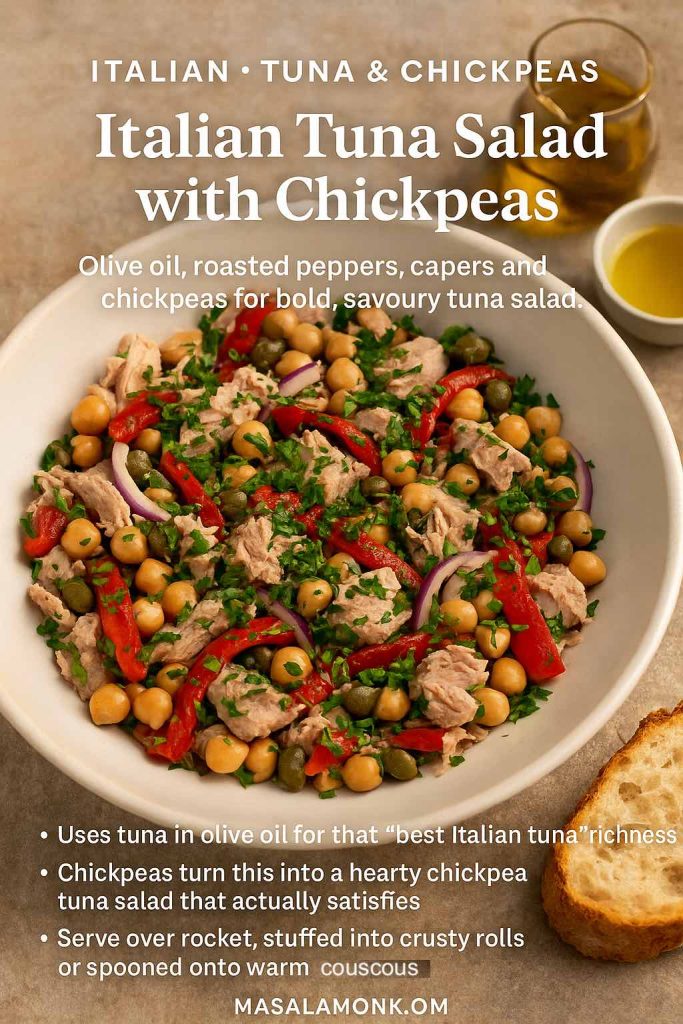
Slide a little further around the Mediterranean map and you arrive at Italian tuna salad territory. This Italian-leaning salad recipe shifts away from creaminess and toward bright, briny flavours: roasted red peppers, capers, herbs and chickpeas. It’s essentially a pantry-friendly tuna salad that just happens to be very high in fibre.

Italian tuna salad with chickpeas, roasted red peppers, capers and red onion in a white bowl, garnished with parsley, with olive oil and bread on a rustic surface.
Italian-style tuna salad made with tuna in olive oil, chickpeas, roasted peppers and capers – a hearty chickpea tuna salad that’s perfect over rocket, in crusty rolls or spooned onto warm couscous.

Ingredients

  • 2 cans tuna, ideally in olive oil
  • 1½ cups cooked chickpeas, rinsed and drained
  • ½ cup roasted red peppers, sliced into strips
  • ¼ cup red onion, thinly sliced
  • 2 tablespoons capers, rinsed and drained
  • A good handful of chopped fresh parsley

Dressing

  • 3 tablespoons olive oil (use some of the oil from the tuna cans if they’re packed in oil)
  • 1½ tablespoons red wine vinegar or lemon juice
  • 1 small clove garlic, very finely grated
  • ½ teaspoon dried oregano
  • Salt and pepper

Method

  1. Add tuna, chickpeas, roasted peppers, onion, capers and parsley to a large bowl.
  2. In a small jug or bowl, whisk together olive oil, vinegar or lemon, garlic, oregano, salt and pepper until slightly thickened.
  3. Pour the dressing over the salad ingredients.
  4. Toss gently, folding rather than stirring roughly, so the tuna stays in nice bite-sized pieces.

This version of tuna salad is lovely over rocket or baby spinach, and it’s equally happy spooned into a crusty roll for a more substantial lunch. If you like couscous, you can serve it over a bed of warm couscous to create a rio mare couscous-style dish using pantry ingredients.

Chickpeas deserve a bit of attention in their own right here. They’re high in fibre and plant protein and have been linked to better satiety, improved cholesterol and improved blood sugar control when they show up regularly in place of more refined starches. If you enjoy this way of cooking, MasalaMonk’s pieces on using chickpeas instead of sardines and using seitan instead of tuna are packed with similar high-protein, Mediterranean-leaning meal prep ideas.

Also Read: Authentic Louisiana Red Beans and Rice Recipe (Best Ever)


6. Tuna Niçoise Salad (Everyday and Occasion-Ready)

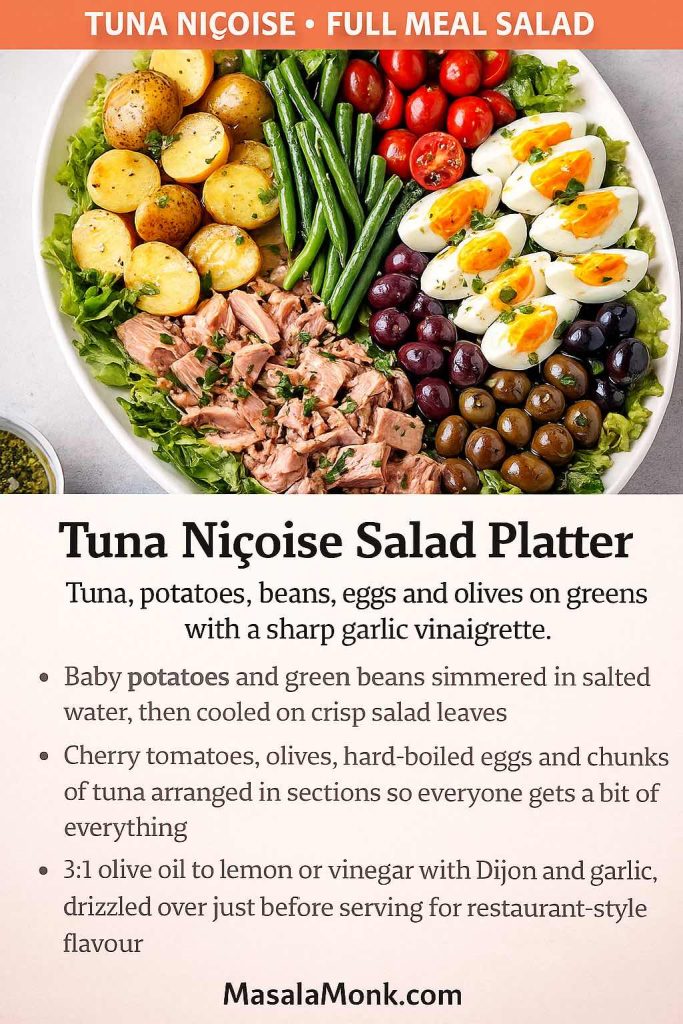
Every now and then, a simple bowl isn’t enough, and you want a full tuna Niçoise salad laid out on a big platter. The same tuna, eggs and vegetables, but laid out on a platter with potatoes, beans and olives so it looks like something you’d order in a bistro.

Tuna Niçoise salad platter with baby potatoes, green beans, cherry tomatoes, olives, hard-boiled eggs and tuna arranged on lettuce on a large plate.
Classic tuna Niçoise salad with baby potatoes, green beans, cherry tomatoes, olives, eggs and tuna arranged on greens, then finished with a 3:1 olive oil to lemon garlic vinaigrette for a full dinner salad.

What you’ll need

  • Mixed lettuce or baby greens
  • 8–10 small new potatoes, boiled until just tender and halved
  • A couple of handfuls of green beans, trimmed and blanched
  • 1 cup cherry tomatoes, halved
  • 3–4 hard-boiled eggs, cut into halves or quarters
  • A handful of olives
  • 2 cans tuna in olive oil, or seared fresh tuna steaks sliced thickly

For the Niçoise dressing

  • 3 tablespoons olive oil
  • 1½ tablespoons red wine vinegar or lemon juice
  • 1 teaspoon Dijon mustard
  • 1 clove garlic, finely grated
  • A pinch of dried thyme or oregano
  • Salt and pepper

Method

  1. Arrange the lettuce over a large serving platter.
  2. Nestle the potatoes, green beans, tomatoes, eggs, olives and tuna on top in little piles or rows so you get that classic composed look.
  3. Whisk together the olive oil, vinegar or lemon, mustard, garlic, herbs, salt and pepper until emulsified.
  4. Taste the dressing and adjust the acid and salt until it feels bright but balanced.
  5. Drizzle the dressing over everything just before you bring the platter to the table.

Because this salad leans so heavily on vegetables, olive oil, legumes and fish, it fits beautifully into the Mediterranean diet pattern that many large studies have associated with reduced risk of heart disease and other chronic illnesses. It’s also a neat answer for all the tuna nicoise salad, salade nicoise recipe and dressing for tuna nicoise searches that pop up whenever the weather warms up and people start craving big bowls.

Also Read: One-Pot Chicken Bacon Ranch Pasta (Easy & Creamy Recipe)


7. Healthy Tuna Pasta Salad and Old-School Tuna Macaroni Salad

Comfort food time. A tuna pasta salad recipe can easily turn into a calorie bomb, but a few tweaks give you the same creamy vibe in a more balanced way. Then, when nostalgia hits, you can slide back toward the classic tuna macaroni salad version by adjusting the dressing.

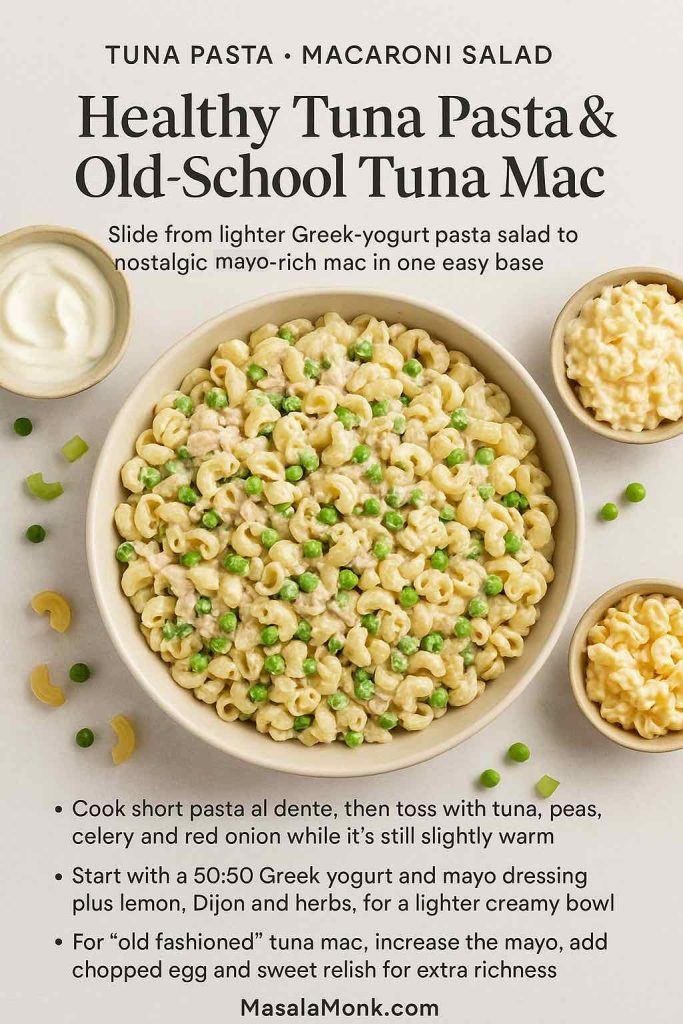
The trick is that you can make it as light or as old-school as you like just by sliding the dressing along the Greek yogurt ↔ mayo spectrum.

Large bowl of creamy tuna pasta salad with peas, with small bowls of Greek yogurt dressing and mayo-rich tuna mac on a light background.
Healthy tuna pasta salad made with al dente short pasta, tuna and peas plus a 50:50 Greek yogurt–mayo dressing, with a more nostalgic, mayo-rich tuna mac option shown on the side so you can slide between lighter and old-fashioned versions.

Lighter, creamy tuna pasta salad recipe

For a bowl that feels indulgent but still sits in the healthy tuna salad camp:

  • 3 cups cooked short pasta (elbow macaroni, shells or fusilli)
  • 2 cans tuna, drained
  • 1 cup peas or sweetcorn (frozen is fine; just thaw and drain)
  • ½ cup finely chopped celery
  • ¼ cup finely chopped red onion

Dressing

  • ½ cup Greek yogurt
  • 2–3 tablespoons mayonnaise
  • 1–2 teaspoons Dijon mustard
  • Juice of half a lemon
  • 2 tablespoons chopped fresh dill or parsley
  • Salt and pepper

How to make it

  1. Stir together yogurt, mayonnaise, mustard, lemon, herbs, salt and pepper until smooth.
  2. Combine pasta, tuna, peas, celery and onion in a large bowl.
  3. Pour the dressing over the top and toss until everything is well coated.
  4. Chill for at least 30 minutes before serving.

Old-fashioned recipe for macaroni salad with tuna

If your heart belongs to old fashioned macaroni salad with tuna, you can easily nudge the dressing in that direction:

  • Increase the mayonnaise and reduce or omit the yogurt.
  • Add 2–3 chopped hard-boiled eggs to the salad.
  • Stir in a generous amount of sweet relish.
  • Throw in diced bell peppers and grated carrot for colour.

Now you’ve got a tuna mac salad that mirrors the macaroni salad with tuna fish many of us grew up with, while still giving you the option to sneak in more vegetables. That’s the version that belongs next to barbecues and potluck tables, the “best tuna mac salad recipe” in your head.

How to cook the pasta for this recipe

For cold pasta salads, slightly undercooked pasta that still has some bite tends to hold up better. Cook the pasta just to al dente, rinse briefly under cold water to stop the cooking and remove excess starch, then drain very well before combining it with the tuna and dressing.

Potato and tuna salad spin-off

For days when potato salad tuna feels more appealing than pasta, it’s simple to swap some or all of the noodles for boiled baby potatoes or cubes of sweet potato. Both can be part of a healthy plate when paired with lean protein and vegetables. If you’re wondering how sweet potatoes compare with white potatoes in terms of calories, glycaemic index and suitability for weight-focused or diabetes-friendly eating, MasalaMonk breaks it down in Sweet Potato Nutrition Facts and The Potato Debate: White vs Sweet. For even more potato inspiration, their collection of potato salad recipes walks through classic, German, Russian and vegan potato salads you can easily adapt with tuna.


8. Tuna and Egg Salad (For Bowls, Sandwiches and Breakfast)

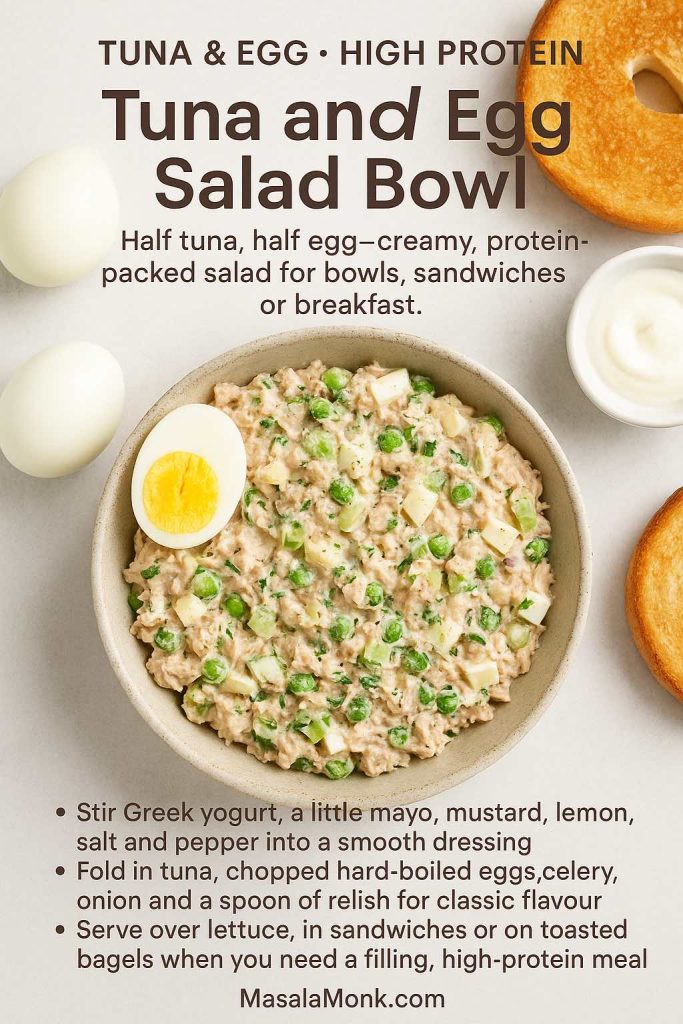
Another very popular direction involves eggs. Merging tuna salad and egg salad into one bowl gives you something that feels almost decadent despite being very straightforward. It’s rich, savoury and incredibly satisfying.
Bowl of creamy tuna and egg salad with peas and diced vegetables, topped with a halved hard-boiled egg, served beside whole eggs, toasted bagel slices and a small dish of dressing.
Creamy tuna and egg salad made with Greek yogurt, a little mayo, mustard and lemon, folded with chopped eggs, peas and crunchy veg – ideal for high-protein bowls, sandwiches or a savoury breakfast on toasted bagels.

How to make Basic tuna and egg salad

  • 2 cans tuna, well drained
  • 3 hard-boiled eggs, chopped
  • ¼ cup Greek yogurt
  • 2–3 tablespoons mayonnaise
  • 1 rib celery, finely chopped
  • 2 tablespoons onion, finely minced
  • 1–2 tablespoons relish or chopped pickles
  • 1 teaspoon mustard
  • Juice of half a lemon
  • Salt and pepper

Mix the yogurt, mayonnaise, mustard, lemon juice, salt and pepper into a smooth dressing. Stir in the celery, onion and relish, then fold in the tuna and chopped eggs.

How to serve this recipe

You can scoop this mixture:

  • Over lettuce for a boiled egg and tuna salad bowl
  • Into sandwiches as a tuna and egg salad sandwich filling
  • Onto toasted bagels or English muffins when you want something that covers tuna breakfast ideas as well as lunch

Because tuna and eggs are both rich in protein, this salad fits especially well into high-protein days. To keep the rest of your day balanced, you might pair it with something like Protein Oatmeal or a jar of High Protein Overnight Oats in the morning so that you hit your protein targets with real meals rather than relying entirely on supplements. For egg-cooking perfection, aim for 9–11 minutes in gently boiling water for hard-boiled eggs, followed by an ice bath. That timing usually gives firm whites and yolks without the grey ring.

Also Read: Sheet Pan Chicken Fajitas Recipe (Easy One-Pan Oven Fajitas)


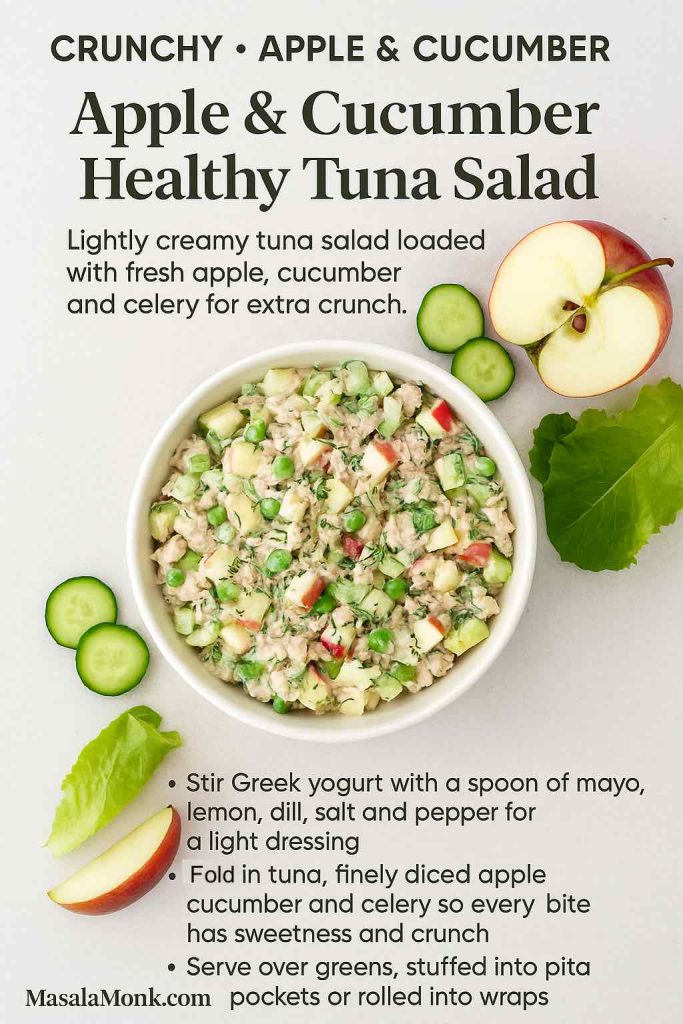
9. Crunchy Apple and Cucumber Healthy Tuna Salad

Not all healthy tuna salad recipes revolve around what you swap into the dressing. Sometimes the biggest difference comes from loading the bowl with fruit and vegetables so each bite feels fresher and more textured. That’s exactly what’s happening in the apple and cucumber corner of tuna fish salad: you can make this with both apples and cucumber or you can just do apples or cucumbers – both rely on the same idea.

Apple and cucumber healthy tuna salad in a white bowl with diced apple, cucumber, peas and celery, surrounded by apple slices, cucumber rounds and lettuce on a light background.
Lightly creamy tuna salad packed with diced apple, cucumber, celery and peas for sweetness and crunch – a fibre-rich option you can spoon over greens, tuck into pita pockets or roll into wraps for fresh, portable lunches.

Ingredients

  • 2 cans tuna, drained
  • ½ a crisp apple (Granny Smith, Pink Lady or similar), finely diced
  • ½ cup diced cucumber
  • 1 rib celery, finely chopped
  • ¼ cup Greek yogurt
  • 1–2 tablespoons mayonnaise or sour cream (optional, for richness)
  • 1–2 teaspoons lemon juice
  • 1 teaspoon honey or maple syrup (optional, to balance the lemon)
  • 1 tablespoon chopped fresh dill
  • Salt and pepper

Method

  1. In a small bowl, whisk the Greek yogurt, mayonnaise or sour cream (if using), lemon juice, honey, dill, salt and pepper until smooth.
  2. Add the tuna, apple, cucumber and celery to a larger bowl.
  3. Pour the dressing over the top and fold gently until everything is lightly coated.
  4. Taste and adjust with extra lemon or a tiny bit more honey to find your perfect sweet-tart balance.

Where this recipe shines

  • As a salad topping over mixed leaves.
  • Stuffed into pita or wraps for a bit of crunch in every bite.
  • As a side dish next to grilled chicken or roasted vegetables.

Apples and cucumbers add not only texture but also hydration and fibre. Verywell Health’s list of high-fibre foods is a good reminder of how simple ingredients like apples can quietly support digestion and blood sugar balance when they show up regularly.

If you want to make your everyday sandwiches and salad recipes more fibre-rich in general, MasalaMonk’s blog post on boosting fibre with sandwiches has lots of real-world combinations.

Also Read: Negroni Recipe: Classic Cocktail & Its Variation Drinks


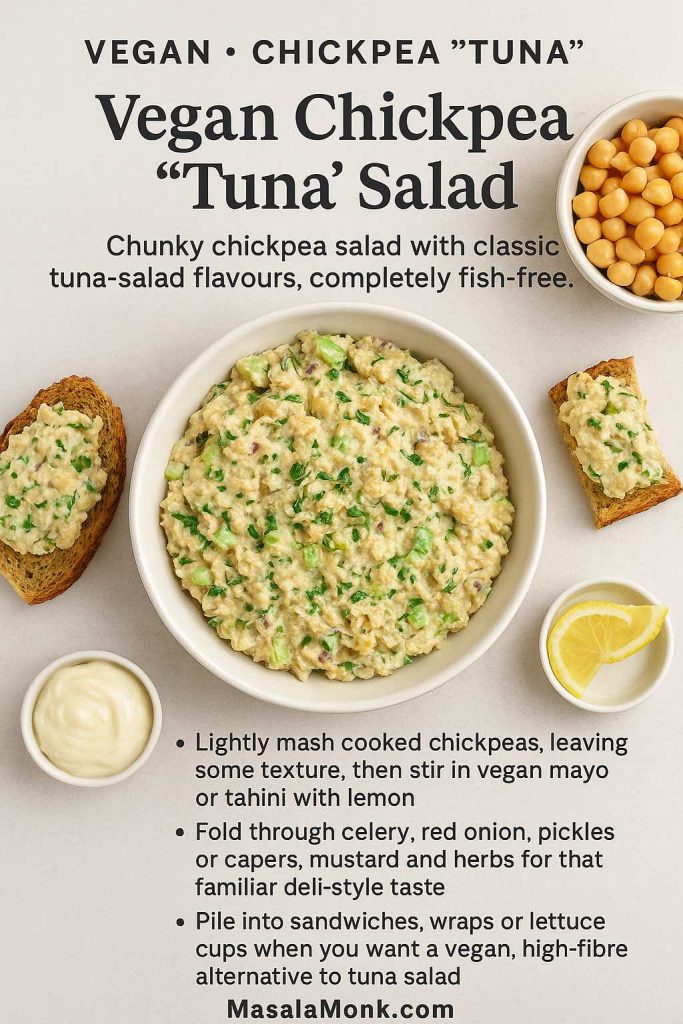
10. Vegan “Tuna” Chickpea Salad Recipe

Finally, even in a tuna-focused world, there’s a big audience for vegan tuna salad, tuna vegan, tuna vegetarian and vegetarian tuna salad. Many of them still want a tuna salad sandwich experience; they simply don’t want fish in it. Chickpeas are perfect for this because they mimic the slightly chunky, creamy texture and bring plenty of nutrition of their own.

Why chickpeas are such a strong base

Chickpeas provide a mix of complex carbohydrates, protein and fibre plus micronutrients like folate, iron and manganese. When they replace refined grains or processed meats in the diet, they’ve been linked with better blood sugar control, improved satiety and lower cholesterol. All of that makes them a natural fit for anyone who wants their vegan tuna salad to feel like more than a compromise.

Bowl of vegan chickpea ‘tuna’ salad with herbs and diced vegetables, surrounded by toast topped with the salad, a small bowl of chickpeas, vegan mayo and lemon wedges on a light background.
Chunky chickpea “tuna” salad made with lightly mashed chickpeas, vegan mayo or tahini, celery, red onion and herbs – an easy plant-based filling for sandwiches, wraps or lettuce cups when you want a high-fibre alternative to tuna.

Vegan tuna salad with chickpeas

  • 2 cups cooked chickpeas, drained and rinsed
  • ¼–⅓ cup vegan mayonnaise, or a mix of tahini and lemon juice
  • 1 rib celery, finely chopped
  • 2 tablespoons red onion, finely diced
  • 1–2 tablespoons chopped pickles or capers
  • 1 teaspoon mustard
  • Juice of half a lemon
  • A pinch of nori flakes or other dried seaweed (optional)
  • Salt, pepper, dill or parsley

Mash the chickpeas with a fork or potato masher until they’re mostly broken down but still have some texture. Stir in vegan mayo (or tahini and extra lemon), mustard, salt, pepper and herbs. Fold through celery, onion and pickles and taste.

Serve this vegan tuna salad in sandwiches with lettuce and tomato, spooned into lettuce cups, or over a bowl of mixed greens with chickpeas instead of tuna carrying the protein load.

If you’d like more ways to keep your week high in protein without leaning on animal foods, MasalaMonk has plenty of ideas, including Chickpeas Instead of Sardines and plant-based high-protein meal prep ideas using lentils instead of chicken. Between those and this chickpea tuna salad, you can cover a surprising number of “tuna-style” cravings with zero actual tuna.

Also Read: Whole Chicken in Crock Pot Recipe (Slow Cooker “Roast” Chicken with Veggies)


A Few Extra Ways to Play with Healthy Tuna Salad

By now you’ve got ten distinct healthy tuna salad recipes and at least as many ways to serve them. However, once you get comfortable with the basic patterns, it becomes easy to create your own riffs that still sit inside a healthy tuna salad framework.

A few ideas to keep exploring:

  • Use Greek yogurt, sour cream or hung curd in place of most mayo for a lighter sour cream tuna salad, or mix yogurt and mayo for a balanced, creamy sauce that doesn’t overload calories.
  • Swap part of the tuna for extra beans, chickpeas or lentils when you want a high-fibre, higher-bulk salad that stretches a single can further.
  • Lean into herbs like dill in tuna salad, parsley in Italian versions, or oregano in Mediterranean tuna recipes to change the flavour without adding heaviness.
  • Play with serving formats: croissant tuna sandwiches for brunch, bagel tuna melts, tuna with crackers on a snack board, or even a tunacado sandwich layered with avocado, tuna and greens.
  • When you’re eating tuna more than once a week, keep an eye on variety and portion size, and lean more often on canned light tuna rather than big predatory species to respect mercury guidance.

If you like the feeling of having a set of “templates” rather than memorising dozens of separate recipes, you can think of these ten as your master pattern library.

Also Read: Cheesy Chicken Broccoli Rice – 4 Ways Recipe (One Pot, Casserole, Crockpot & Instant Pot)


Putting It All Together

Taken as a whole, these ten recipes give you a full toolkit for turning a can of tuna—or a bowl of chickpeas—into exactly the sort of meal you’re in the mood for.

On a busy weekday, you might stick with the light deli-style healthy tuna salad recipe and turn it into simple tuna sandwiches for everyone. Later in the week, when you crave something more vibrant, the Mediterranean tuna and white bean salad or Italian tuna with chickpeas will happily take over. When comfort is the priority, the healthy tuna pasta salad and the more nostalgic tuna mac salad version step up. On hotter days, crunchy apple and cucumber tuna salad or a big tuna Niçoise platter feel right, while avocado tuna salad is there for every rushed lunch when the only things you can manage to mash together are tuna, avocado and lemon.

Alongside these fish-based bowls, you’ve got the option of skipping tuna completely and relying on a vegan tuna salad built on chickpeas instead. As long as you pay attention to overall fish intake and choose lower-mercury options such as canned light tuna most of the time, salads like these can sit comfortably in a week that’s trying to balance health, flavour and real-life constraints. Between the recipes here and the extra reading on salad benefits, gut-friendly foods, seafood and pregnancy and high-protein meal planning, you’ve got more than enough to keep your healthy tuna salad rotation interesting for a very long time.

And if all else fails, you can always fall back on that three-ingredient tuna avocado salad, because sometimes the best healthy tuna salad is simply the one you can make in the two minutes between meetings.

Also Read: Crispy Homemade French Fries From Fresh Potatoes (Recipe Plus Variations)

FAQs

1. Is tuna salad healthy?

Often yes, tuna salad can be very healthy, especially when you treat tuna as lean protein and not just a vehicle for mayonnaise. When you build a healthy tuna salad with light tuna, Greek yogurt or avocado, plenty of crunchy vegetables and sensible portions, you get a high protein, nutrient-dense meal. On the other hand, a tuna salad recipe loaded with only mayo and no veg will lean more heavy than wholesome.


2. What is a good basic healthy tuna salad recipe?

To put it simply, a solid healthy tuna salad recipe starts with drained light tuna, Greek yogurt, a spoon or two of mayo, lemon juice, mustard, salt and pepper. After that, you fold in celery, onion and maybe a little relish or pickles for deli-style flavour. This kind of bowl covers “tuna salad recipe healthy” and works just as well in a tuna salad sandwich as it does over a green salad.


3. How do I make tuna salad without mayo?

If you want a tuna salad without mayo, Greek yogurt is the easiest swap. You mix tuna with plain Greek yogurt, lemon, mustard, herbs, salt and pepper, then add celery, cucumber and onion for texture. Alternatively, you can make a no mayo tuna salad with mashed avocado or a simple olive oil and lemon dressing if you prefer a lighter, Mediterranean feel.


4. What can I use instead of mayonnaise in tuna salad?

There are several tasty options. Greek yogurt gives you a creamy, tangy base for Greek yogurt tuna salad, while avocado creates a rich avocado tuna salad without any dairy. In addition, cottage cheese, hummus or a vinaigrette made from olive oil and lemon all work as alternative dressings, especially in Mediterranean tuna salad or tuna and bean salad recipes.


5. Which type of tuna is best for a healthy tuna salad?

Generally, light canned tuna in water is the most practical choice for a healthy tuna salad recipe because it’s lean and mild in flavour. Nevertheless, tuna packed in olive oil is lovely when you’re making Italian tuna salad or tuna nicoise salad, since the oil adds richness. For everyday healthy tuna, most people stick to light tuna and then adjust the dressing to suit their goals.


6. Can tuna salad help with weight loss?

In many cases, yes, especially when you build a healthy tuna salad that’s high in protein and full of vegetables. Because tuna and Greek yogurt or egg keep you satisfied, you’re less likely to overeat later. However, if your tuna salad recipe is mostly mayonnaise with very little tuna or veg, it can quickly become too calorie-dense for weight-loss plans.


7. How much protein is usually in a serving of tuna salad?

As a rough guide, a small can of tuna alone often provides around 25–30 grams of protein. Once you stir in Greek yogurt, cottage cheese or egg, a generous serving of high protein tuna salad can easily deliver 20–30 grams of protein. Consequently, recipes like tuna and egg salad, cottage cheese tuna salad or avocado tuna salad fit very neatly into high-protein meal plans.


8. How often can I eat tuna salad each week?

Typically, having tuna salad a couple of times per week is reasonable for most people, especially when you choose light tuna and vary your other protein sources. In practice, lots of people rotate healthy tuna salad lunches with chickpea salads, lentil dishes, chicken or vegan tuna salad to keep variety high. If you have pregnancy or medical concerns, it’s wise to keep portions moderate and mix in more plant-based recipes.


9. How long does homemade tuna salad keep in the fridge?

As a rule of thumb, homemade tuna salad keeps well for about 2–3 days in the fridge in a sealed container. After that, the texture of the dressing and vegetables usually starts to deteriorate. To keep things fresher, you can store lettuce, cucumber and tomato separately and add them to your tuna salad sandwich or salad bowl just before eating.


10. Can I freeze tuna salad?

Technically you can, but it isn’t ideal. Once thawed, the dressing often separates, and crunchy ingredients like celery, cucumber or apple lose their texture. Instead, a better approach is to freeze plain canned tuna portions and then mix a fresh healthy tuna salad recipe with yogurt, avocado or mayo on the day you plan to eat it.


11. How do I make a healthy tuna pasta salad?

For a healthier tuna pasta salad, you start with short pasta cooked al dente, then add tuna, peas or sweetcorn, celery and onion. After that, make a dressing that’s mostly Greek yogurt with just a little mayonnaise, plus lemon juice, mustard, salt, pepper and dill. This way, your healthy tuna pasta salad recipe stays creamy but lighter than a traditional tuna macaroni salad.


12. How can I lighten an old fashioned macaroni salad with tuna?

If you love old fashioned macaroni salad with tuna but want it less heavy, there are several simple tweaks. Firstly, swap part of the mayo for Greek yogurt to cut calories and add more protein. Secondly, stir in extra vegetables like celery, bell pepper and grated carrot so your tuna mac salad has more bulk from low-calorie ingredients. Finally, serve sensible portions and pair it with a green salad to balance the plate.


13. What can I add for extra crunch in tuna salad?

There are plenty of choices. Celery and cucumber are classic, while finely chopped bell peppers, red onion and radishes also add bite. Moreover, diced apple or pickles give you both crunch and contrast, so an apple and tuna salad or cucumber tuna salad feels fresh even when the dressing is creamy.


14. How do I make a Mediterranean tuna salad?

To create a Mediterranean tuna salad, mix tuna with white beans or chickpeas, cherry tomatoes, cucumber, olives and red onion. Then, dress it all with olive oil, lemon juice, garlic, oregano, salt and pepper. This kind of tuna and beans salad is naturally high in fibre and fits beautifully into “tuna recipes healthy” searches.


15. What goes into an Italian tuna salad?

An Italian tuna salad usually leans on tuna in olive oil, roasted red peppers, capers, red onion and fresh herbs like parsley. You then toss everything with a sharp red wine vinegar or lemon dressing and sometimes add chickpeas or cannellini beans. As a result, you get an Italian tuna salad that’s bold, savoury and perfect over greens or in a hearty sandwich.


16. How is tuna nicoise salad different from regular tuna salad?

Tuna nicoise salad is more of a composed meal than a simple spread. It usually includes lettuce, boiled potatoes, green beans, tomatoes, olives, hard-boiled eggs and tuna, all dressed with a garlicky vinaigrette. By contrast, a basic tuna salad recipe tends to be a mixed bowl used for tuna salad sandwiches or wraps, rather than a full platter.


17. Can I use fresh tuna instead of canned tuna in salad?

Yes, absolutely. You can sear fresh tuna steaks quickly so they stay pink inside, then slice or flake them into a salad with your usual dressing. Fresh tuna works especially well in tuna nicoise salad, Italian tuna salad or a gourmet healthy tuna salad recipe, though canned tuna remains more convenient for everyday use.


18. How do I make avocado tuna salad?

To put it briefly, avocado tuna salad starts with mashing a ripe avocado with lemon, salt and pepper, then folding in flaked tuna. Afterward, you can add celery, red onion, herbs and even chopped egg or apple for extra interest. Whether you keep it as a 3 ingredient tuna avocado salad or turn it into a loaded avocado and tuna salad recipe, it’s a great no-mayo option.


19. What can I add to make a high protein tuna salad?

Beyond tuna itself, there are several high-protein add-ins. Greek yogurt, cottage cheese, boiled eggs and chickpeas all boost protein levels, so bowls like tuna and egg salad, cottage cheese tuna salad or chickpea tuna salad are naturally more filling. Additionally, serving your healthy tuna salad alongside a protein-rich soup or bean salad turns the whole meal into a serious protein hit.


20. Is tuna salad suitable for breakfast?

Surprisingly, yes. A small portion of tuna and egg salad on toast, a tuna breakfast wrap with avocado, or a lighter healthy tuna salad on rye bread can make a savoury, protein-rich breakfast. Granted, it’s not everyone’s first thought, yet on busy days it’s a quick way to get protein in early without resorting to sugary options.


21. How do I build a healthier tuna salad sandwich?

Start with wholegrain or seeded bread for more fibre. Next, use a healthy tuna salad recipe based on Greek yogurt or avocado instead of just mayo, and layer in lettuce, tomato and cucumber. In addition, keeping an eye on portion sizes and pairing the tuna sandwich with a simple side salad rather than fries keeps the whole meal in the “tuna sandwich recipe healthy” category.


22. How can I stop tuna salad sandwiches from going soggy?

One simple approach is to create a barrier between the bread and the filling. You can line the bread with lettuce, cheese slices or even a thin layer of hummus before adding your tuna salad sandwich filling. Alternatively, pack the bread and tuna fish salad separately for lunch and assemble the sandwich when you’re ready to eat.


23. What are some quick tuna lunch ideas besides sandwiches?

There are plenty of easy options. For instance, you can spoon healthy tuna salad onto a big bowl of greens, tuck it into lettuce wraps, mix it with warm rice or quinoa, or stir it through pasta for a quick tuna noodle salad. Likewise, a simple tuna and bean salad with olive oil and lemon makes a fast high-protein lunch that travels well.


24. How can I make vegan tuna salad?

For a vegan tuna salad, mash cooked chickpeas until partly broken down, then mix them with vegan mayo or a tahini-lemon dressing. After that, add celery, onion, pickles, mustard and herbs so it resembles classic tuna salad in flavour and texture. This kind of tuna vegan recipe works brilliantly in sandwiches, wraps and salad bowls when you want a vegetarian tuna salad stand-in.


25. Is tuna salad good for meal prep?

Yes, tuna salad can be a useful meal prep option, particularly for lunches. You can prepare a batch of healthy tuna salad, divide it into containers and store it in the fridge for two or three days. Even so, it’s better to add delicate ingredients like lettuce, tomato or cucumber just before serving, so they stay crisp.


26. How do I make tuna salad more kid-friendly?

Generally, kids prefer simpler flavours and softer textures. So, keep the seasonings gentle, use a smoother dressing, and chop vegetables very finely. You might also try adding sweetcorn or a little grated cheese and serving the tuna fish salad sandwich on soft bread or as small tuna mac salad portions to make it more familiar.


27. How can I turn tuna salad into a full dinner?

One straightforward way is to build a large salad bowl or platter. Place your healthy tuna salad on top of greens, roasted vegetables, potatoes, beans or pasta to create a more substantial tuna casserole salad or tuna nicoise-style meal. Alternatively, bake a tuna salad casserole with wholegrain pasta and vegetables for a warm dinner version.


28. Which herbs and spices go best in tuna salad?

Dill, parsley, chives and coriander are classic herbs for a healthy tuna salad recipe. Meanwhile, dried oregano and thyme work well in Mediterranean tuna salad, and paprika, black pepper or a pinch of chilli flakes add depth. Ultimately, a squeeze of lemon and a little mustard tie everything together without overpowering the tuna.


29. How can I cut calories in tuna pasta salad or tuna mac?

To start, use more Greek yogurt and less mayonnaise in the dressing. Then, add plenty of vegetables—peas, celery, peppers, cucumber—so your healthy tuna macaroni salad feels generous without relying on huge amounts of pasta. Finally, serving smaller portions alongside a green salad lets you enjoy tuna mac salad without overdoing calories.


30. What are some creative healthy tuna salad ideas beyond the basics?

Besides the usual deli-style bowl, you can experiment with tuna and avocado salad wraps, Mediterranean tuna and white bean salad jars, Italian tuna and chickpea salad over couscous, or crunchy apple and tuna salad pitas. You could also explore vegan tuna salad made from chickpeas on some days and high protein tuna salad with egg or cottage cheese on others. In the end, rotating these ideas keeps “healthy tuna salad” interesting instead of repetitive.

Posted on 7 Comments

Air Fryer Hard-Boiled Eggs (No Water, Easy Peel Recipe)

Top view of a person holding toast topped with a halved air fryer hard boiled egg, next to an open air fryer basket filled with eggs, a bowl of eggs in ice water, and text reading "Air Fryer Hard Boiled Eggs – Time & temp guide inside".

If there’s one tiny kitchen trick that quietly changes your weekly routine, it might be this: making air fryer hard boiled eggs instead of dragging out a pot of water every time you want a few eggs. You lay them gently in the basket, set the time, walk away, and come back to perfectly cooked eggs that slide out of their shells with almost no effort.

No hovering over the stove. No pan to scrub. Just reliable, easy-peel eggs you can eat on toast, turn into deviled eggs, throw into salads, or stash in the fridge for busy days.


What Are Air Fryer Hard Boiled Eggs, Really?

The phrase “hard boiled eggs” is a bit of a lie here, because there’s no actual boiling. Instead of simmering in water, the eggs sit in the dry, circulating heat of the air fryer. The shells protect the whites and yolks, and the hot air cooks them kind of like a tiny oven.

The result is surprisingly close to classic boiled eggs:

  • Whites set and firm
  • Yolks as soft, jammy, or firm as you like, depending on time
  • Shells that usually peel very cleanly after a cold plunge

Curious about how other recipe developers handle it too? It’s interesting later to compare this method with recipes like Feel Good Foodie’s air fryer hard boiled eggs, but first it’s helpful to get your own timing dialed in.


Why Bother With Air Fryer Hard Boiled Eggs?

You might already have a foolproof stovetop method. So why move to the air fryer?

Less watching, more living

On the stove, you need to:

  • Bring water to a boil
  • Lower in the eggs gently
  • Track the timing
  • Adjust the heat to maintain a gentle simmer

With an air fryer, you:

  1. Preheat
  2. Put the eggs in
  3. Set the time
  4. Walk away

That makes it incredibly convenient if you’re also juggling toast, coffee, kids, or work messages in the morning.

Easily scale up or down

Some days you just need one egg for a snack. Other days you want a whole batch for meal prep. Either way, air fryer hard boiled eggs handle it effortlessly:

  • One egg cooks just as easily as eight
  • The method stays the same; you may only tweak the time by a minute if you pack the basket

It’s especially handy if you’re prepping a full week’s worth of eggs for breakfast boxes or high-protein snacks. If you’re tracking macros or protein intake, it’s useful to know exactly how much protein two boiled eggs give you, so a weekly batch practically becomes a pre-portioned protein stash in the fridge.

Great for meal prep and snacking

Because hard cooked eggs store well, they’re perfect for:

  • Lunchboxes
  • Salad toppers
  • Quick snacks with just a pinch of salt and spice
  • Deviled eggs for parties

The USDA notes that once eggs are hard-cooked and refrigerated, they can be safely stored for up to one week. That guideline, explained in their note on how long you can keep hard cooked eggs, makes a weekly egg-prep session genuinely worthwhile.


Ingredients and Equipment

You might already have everything you need.

Ingredients

  • Eggs – any number that fits in a single layer in your air fryer basket
  • Ice and cold water – for an ice bath to stop cooking and help with peeling

That’s all. No oil, no vinegar, no baking soda tricks required.

Equipment

  • Air fryer – basket or drawer style
  • Tongs or a spoon – to lift hot eggs safely
  • Large bowl – to hold the ice water bath

If you’re new to air fryers in general, it’s worth giving a quick read to 12 common air fryer mistakes and how to fix them. Simple things like overcrowding, skipping preheating, or using the wrong temperature can make a big difference with eggs too.


Step-by-Step Recipe: Air Fryer Hard Boiled Eggs

Let’s walk through the whole process from cold eggs to easy-peel perfection.

Step 1: Preheat the air fryer for Hard Boiled Eggs

Begin by preheating your air fryer to 270°F (about 130–135°C) for 3–5 minutes.

Step 1 for making air fryer hard boiled eggs – hand pressing the start button on a black air fryer preheated to 270°F (130–135°C).
Step 1: For perfectly cooked air fryer hard boiled eggs, preheat the air fryer to 270°F (130–135°C) for 3–5 minutes so the eggs go into evenly hot air, not a cold basket.

This short preheat helps ensure the eggs start cooking in a stable, even environment. If you’ve ever had eggs with slightly undercooked whites or overcooked yolks, a proper preheat alone can fix a lot of that inconsistency.

Step 2: Arrange the eggs in the basket

Once the air fryer is hot, carefully place the eggs in the basket:

  • Lay them in a single layer
  • Leave a little space between each egg so hot air can circulate
  • Avoid stacking or using multiple racks for this method
Step 2 for air fryer hard boiled eggs – eight brown eggs arranged in a single layer inside a black air fryer basket with space between each egg.
Step 2: Arrange the eggs in a single layer in the air fryer basket with a little space between them. This helps every egg cook evenly and reduces the chance of shells cracking while they “boil” in the air fryer.

Packing too many eggs too tightly can cause uneven cooking, especially at the edges of the basket. A little breathing room gives you more consistent results.

Step 3: Set the time and temperature

Now comes the key part: the timing.

At 270°F (about 132°C), these ranges work well:

  • Soft “boiled” eggs with runny yolks:
    About 11–12 minutes
  • Jammy eggs with custardy yolks:
    Around 13–14 minutes
  • Fully hard boiled eggs with firm yolks:
    Roughly 15–17 minutes
Step 3 for making air fryer hard boiled eggs – close-up of an air fryer set to 270°F and 15 minutes, with sliced eggs in the background showing soft, jammy, and hard yolks.
Step 3: Set the timer based on how you like your air fryer hard boiled eggs – about 11–12 minutes for soft eggs, 13–14 minutes for jammy centers, and 15–17 minutes for fully hard yolks, then adjust by a minute to match your own air fryer.

As a starting point, many people enjoy hard boiled eggs at about 15 minutes, then adjust slightly up or down on the next batch. Air fryers vary a bit in intensity, so once you test your machine, you’ll know your own perfect “house timing”.

If you’re curious how other cooks adapt the same idea, recipes like Skinnytaste’s air fryer hard boiled eggs or Cook At Home Mom’s air fryer eggs use similar combinations of temperature and timing, which can reassure you that you’re in a safe, sensible range.

Step 4: Shock the eggs in an ice bath

As soon as the timer beeps, move quickly:

  1. Carefully lift the eggs from the basket with tongs or a spoon.
  2. Transfer them straight into a bowl filled with ice and cold water.
  3. Let them rest there for at least 5–10 minutes.
Step 4 for air fryer hard boiled eggs – hand lowering a cooked egg into a glass bowl filled with ice water to cool the eggs quickly.
Step 4: Transfer the cooked eggs straight into an ice bath and let them cool for 5–10 minutes. Rapid chilling stops the cooking and makes air fryer hard boiled eggs much easier to peel.

This “shock” does two important things:

  • It stops the cooking instantly, so your yolks don’t overcook and turn chalky.
  • It helps the membrane pull away from the shell, making the eggs significantly easier to peel.

The FDA’s egg safety guidance on what you need to know about egg safety also emphasizes proper chilling and refrigeration to minimize foodborne risk, which is another good reason not to skip the ice bath.

Step 5: Peel or store Air Fryer Hard Boiled Eggs

After the eggs have cooled down:

  • Crack each egg gently on the counter, then roll it to create a network of cracks.
  • Start peeling from the wider end; there’s often a little air pocket there that makes it easier to get under the shell.
  • If the shell clings in spots, peel under a gentle stream of running water to loosen it.
Step 5 for air fryer hard boiled eggs – hands peeling a hard boiled egg on a countertop with eggshells scattered and a bowl of whole eggs in the background.
Step 5: Gently crack and roll each egg, then peel from the wider end where the air pocket sits. This helps the shell slip off cleanly so your air fryer hard boiled eggs look smooth and photo-ready.

You can now:

  • Eat the eggs right away
  • Store them whole and unpeeled in the fridge
  • Peel them all at once and keep them in an airtight container for quick snacks

For food safety, the USDA’s note on how long to keep hard cooked eggs clearly states they can be refrigerated for up to one week. That applies whether the eggs are peeled or still in their shells, as long as they’ve been chilled promptly.

Also Read: Negroni Recipe: Classic Cocktail & Its Variation Drinks


Air Fryer Hard Boiled Eggs: Soft, Jammy, and Hard

The beauty of this method is how easy it is to fine-tune the yolks.

How to make Soft air fryer eggs

If you love a runny yolk for dipping toast, try:

  • 11–12 minutes at 270°F, followed by the same ice bath
Soft air fryer egg sliced in half to show a runny yolk, with text indicating 11–12 minutes at 270°F and serving ideas over toast, ramen, and roasted veggies.
Soft air fryer eggs: Cook for 11–12 minutes at 270°F for a set white and runny yolk that’s perfect for dipping toast, topping hot ramen, or serving with roasted veggies on the side.

The white should be set while the center stays liquid or very soft. These are gorgeous served:

  • Over toast with butter and black pepper
  • On top of hot ramen or noodle soup
  • Alongside roasted veggies and bread

Also Read: How to Cook Perfect Rice Every Time (Recipe)

How to make Jammy air fryer eggs

Jammy eggs fall right in the middle: the yolk is thick and creamy rather than runny or crumbly.

  • Aim for 13–14 minutes at 270°F, then chill in ice water
Jammy air fryer egg sliced in half with a thick, creamy yolk, with text showing 13–14 minutes at 270°F and serving ideas for grain salads, rice bowls, and snack plates with hummus.
Jammy air fryer eggs: Cook for 13–14 minutes at 270°F to get a thick, custardy yolk that’s perfect for grain salads, rice or quinoa bowls, and snack plates with hummus and veggies.

This texture shines in:

  • Salads (especially grain-based ones)
  • Rice and quinoa bowls
  • Snack plates with vegetables, hummus, and a few olives

How to make Classic Air Fryer Hard Boiled Eggs

For air fryer hard boiled eggs that slice cleanly and mash well:

  • Go with 15–17 minutes at 270°F, depending on how firm you prefer the yolk
Hard air fryer egg sliced in half with a fully set yolk, with text showing 15–17 minutes at 270°F and serving ideas like egg salad, deviled eggs, and sandwiches.
Hard air fryer eggs: Cook for 15–17 minutes at 270°F for firm yolks that hold their shape. These hard boiled air fryer eggs are perfect for egg salad, deviled eggs, and slices on sandwiches or buttery toast.

These are ideal for:

  • Egg salad
  • Deviled eggs
  • Sliced eggs on sandwiches or toast
  • Protein-packed lunch boxes

Once you’ve tested your air fryer, you can even jot down separate timings for “soft,” “jammy,” and “hard” on a sticky note and keep it near the machine.

Also Read: Whiskey Sour Recipe: Classic Cocktail, Best Whiskey & Easy Twists


Ways to Use Air Fryer Hard Boiled Eggs

Having a container of air fryer hard boiled eggs in the fridge is like having a little protein toolkit ready whenever hunger hits.

Deviled eggs and party platters

Perhaps the most classic way to dress up hard boiled eggs is to turn them into deviled eggs. After you cook and chill your eggs in the air fryer, you can follow the fillings and flavor variations from this deviled eggs recipe with eight delicious twists.

Because air fryer hard boiled eggs usually have:

  • Evenly cooked yolks
  • Shells that peel cleanly

they’re perfect for deviled eggs that look neat enough to take to potlucks, brunches, or holiday tables.

Everyday breakfasts (and special brunches)

It’s very easy to build breakfast around a couple of eggs:

  • Slice them over buttered toast with a sprinkle of chilli flakes.
  • Pair them with a small fruit bowl and coffee.
  • Serve them alongside sautéed greens or leftover veggies.

On weekends or special mornings, you can go further and pair your air fryer hard boiled eggs with something sweet from the same appliance, such as french toast sticks that work in both the oven and the air fryer.

If you’re cooking for someone who avoids eggs but still loves brunch, you could switch them to vegan french toast with air fryer options or eggless french toast that’s crispy and fluffy while you enjoy your eggs on the side.

High-protein snacks

Hard boiled eggs are basically ready-made high-protein snacks. Two eggs alone make a surprisingly satisfying mini-meal. For more detailed macro info, you can peek at this breakdown of protein in three scrambled eggs, then adapt the numbers for your boiled eggs.

For a snack plate, try combining:

  • A couple of egg halves
  • Some cut vegetables
  • A handful of nuts or seeds
  • A little hummus or yogurt dip

When you’d rather keep things plant-based, it’s nice to still lean on the air fryer. For example, high-protein vegan meal prep ideas using an air fryer offer plenty of tofu and legume-based options to enjoy alongside, or instead of, eggs.

Salads, bowls, and sandwiches

Because they slice and chop so neatly, hard boiled eggs slot beautifully into:

  • Green salads
  • Pasta salads
  • Grain bowls with roasted vegetables
  • Sandwiches and wraps

For a slightly more global twist, you might draw inspiration from a list of popular Mediterranean breakfasts, adding olives, cucumbers, tomatoes, olive oil, and fresh herbs around your eggs.


Simple Seasoning Ideas (and a Deep Dive if You Want One)

Plain boiled eggs with just a pinch of salt are comforting. Still, once you start sprinkling on spices and toppings, they get much more exciting.

If you want a full playground of ideas, there’s a dedicated guide to seasoning options that make eggs come alive, but here are a few easy combinations you can try immediately:

  • Classic: Sea salt, black pepper, a drizzle of olive oil
  • Desi-inspired: Chaat masala, red chilli powder, a squeeze of lime
  • Smoky: Smoked paprika, garlic powder, a tiny bit of butter
  • Crunchy: Toasted sesame seeds, soy sauce, chopped spring onions
  • Herby: Fresh coriander or parsley, lemon zest, cracked pepper

You can also slice eggs onto toasted buns or pav and spoon over a light hollandaise or yoghurt-based sauce if you’d like to riff on some of the ideas from a desi twist on Eggs Benedict.


Nutrition and Health: Are Air Fryer Hard Boiled Eggs Good for You?

Eggs are one of those foods that look simple but come with a lot of nutrition and a lot of opinions.

What’s inside an egg?

Each egg contains:

  • High-quality protein
  • Fat (mostly in the yolk)
  • A mix of vitamins and minerals, including B vitamins, choline, and some fat-soluble vitamins

For a closer look at what each part gives you, you can check:

Together, those explain why egg whites are popular in weight loss diets, while yolks carry their own valuable nutrients.

How many eggs are okay per day?

That question comes up constantly. The answer depends on your health profile, cholesterol levels, and the rest of your diet. However, modern research tends to be kinder to eggs than older headlines suggested.

If you’d like a nuanced, readable explanation, this article on eggs and daily consumption walks through what studies actually say instead of relying on myths. It’s a great companion if you’re eating eggs regularly and want to understand where they fit in.

For people following low-carb or keto-style eating, eggs are almost a foundation food. There’s even a separate deep dive on why eggs are such a keto staple, which is useful if you’re combining this air fryer method with keto meal prep.

Are air fryers themselves healthy?

The air fryer is often marketed as a “healthy” appliance because it lets you cook crispy foods with much less oil than deep frying. That’s mostly true, but there are a couple of details worth knowing:
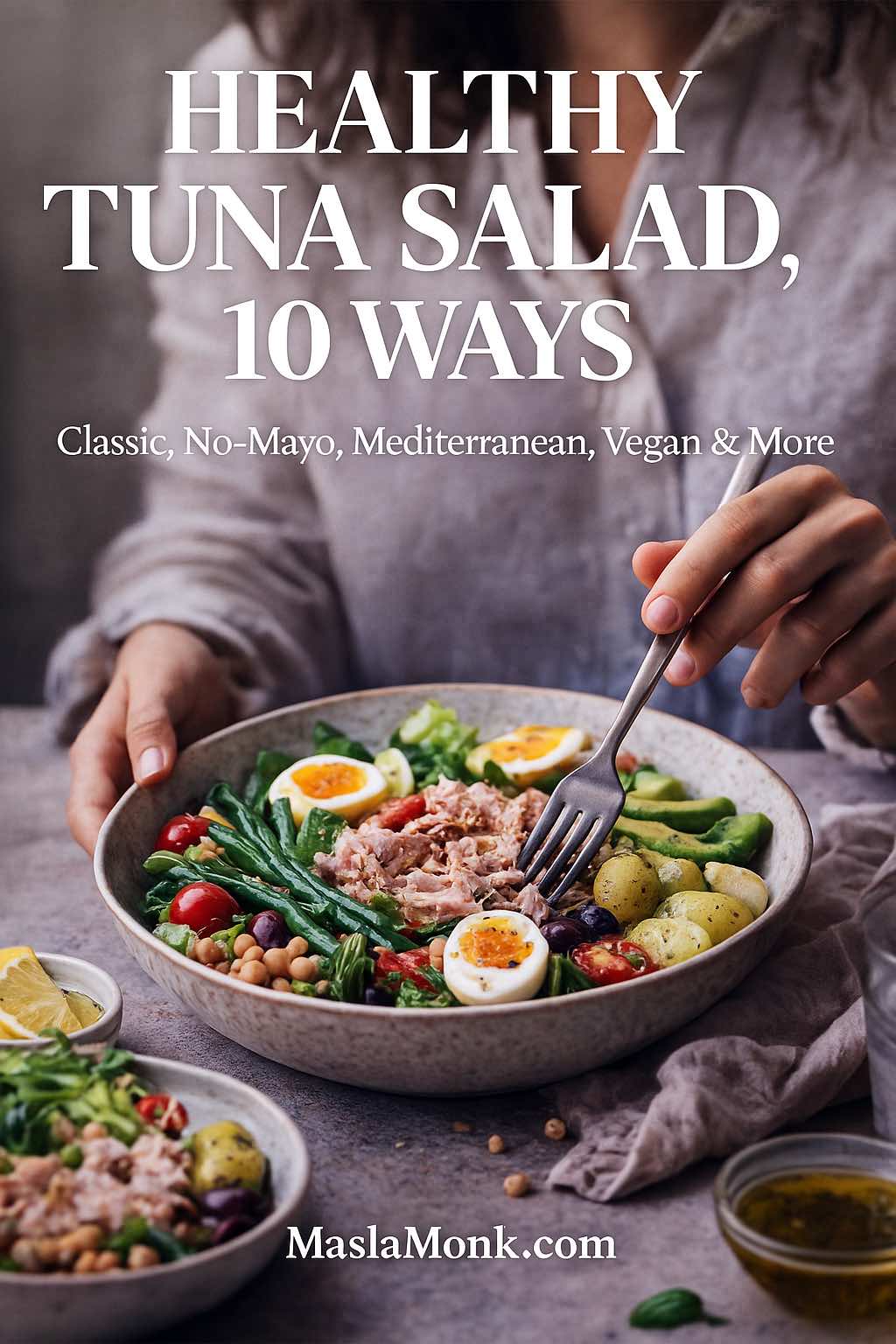
  • For starchy foods like fries, research has shown air frying can sometimes lead to higher acrylamide levels than boiling or steaming. Acrylamide is a compound formed in browned, carbohydrate-rich foods. A research summary on air frying and acrylamide in foods goes into detail on this.
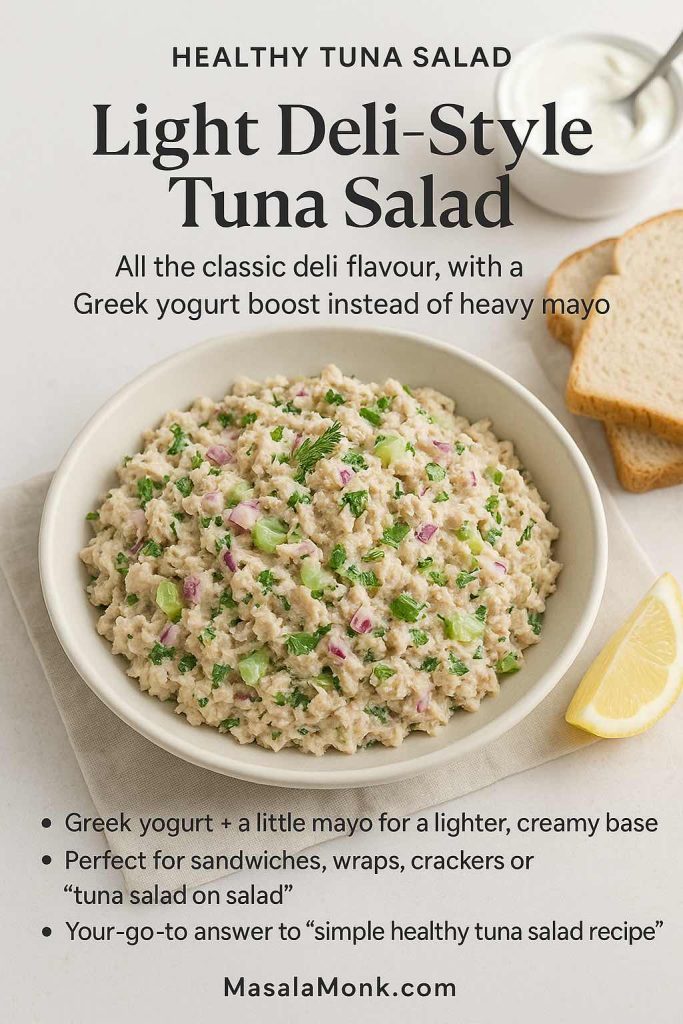
  • However, eggs are not starchy, and they don’t contain the sugars and amino acids in the same way that potatoes or bread do, so acrylamide isn’t really a concern when you’re making air fryer hard boiled eggs.

For a balanced look at the broader question, you can read a practical overview in “Do Air Fryers Cause Cancer?” on Poison.org, which essentially concludes that moderation, variety, and proper cooking habits matter far more than any single appliance.

Also Read: 10 High Calorie Protein Shakes & Smoothie Recipes for Healthy Weight Gain


Storage, Safety, and Freshness

It’s easy to get excited about convenience and forget the boring-but-important part: food safety.

How long do hard boiled eggs last?

As mentioned earlier, the USDA has a clear answer: hard cooked eggs, once cooled and refrigerated, are safe to eat for up to one week. Their short note on how long you can keep hard cooked eggs is worth reading if you’re prepping a big batch.

In addition:

  • Don’t leave cooked eggs at room temperature for more than two hours. The FDA’s egg safety page on what you need to know about egg safety emphasizes that time window to reduce the risk of bacteria growing.
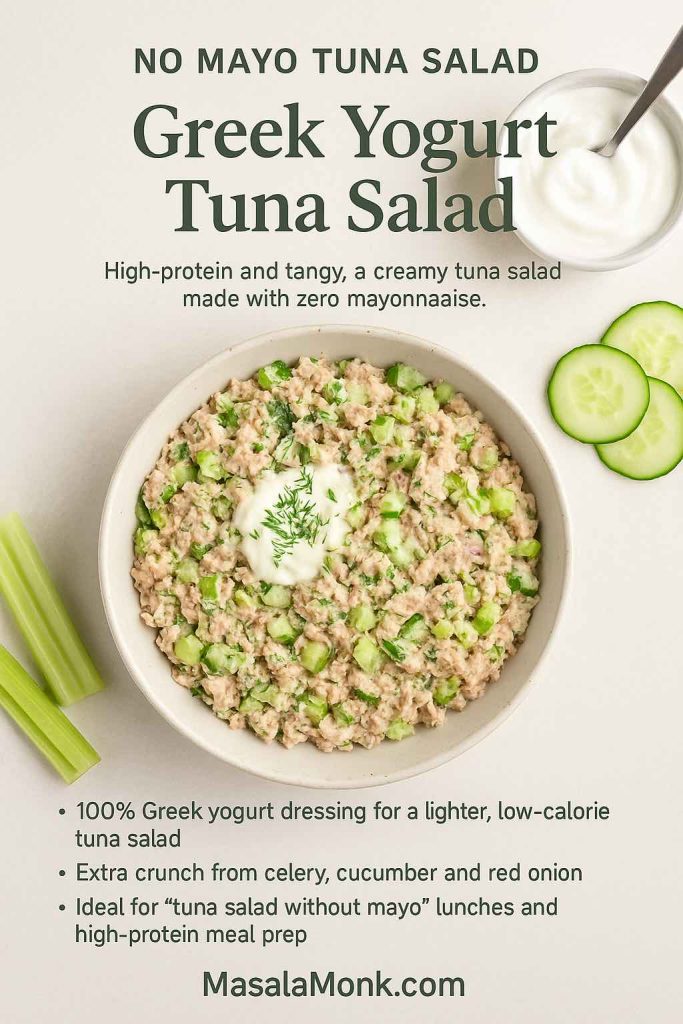
  • Store eggs in the refrigerator, not on the counter, once they’re cooked.

Storing raw eggs before cooking

It also helps to start with fresh eggs. For raw eggs, USDA guidance on how long eggs can be stored in the fridge explains that whole eggs in their shells typically keep for several weeks when refrigerated promptly.

If you’re curious about egg quality, cost, and labels, it can be useful to read whether expensive eggs are truly worth your money. That guide walks through cage-free, organic, and other terms so you can decide whether the premium is worthwhile for you.


Troubleshooting: Common Air Fryer Hard Boiled Eggs Issues

Even though the method is simple, questions do pop up. Fortunately, most problems have easy fixes.

My shells have brown spots

Sometimes, you’ll see little brown or tan spots on the shells after cooking in the air fryer. This usually happens where the hot air or heating element browned the shell. The inside is almost always fine.

If it bothers you aesthetically, you can:

  • Lower the temperature slightly and cook a bit longer, or
  • Experiment with moving the basket further from the top element if your machine allows

Once peeled, the egg usually looks completely normal.

I’m getting a greenish ring around the yolk

That green or grey ring around the yolk is a classic sign of overcooking. It’s safe to eat, but the texture can be a bit chalky.
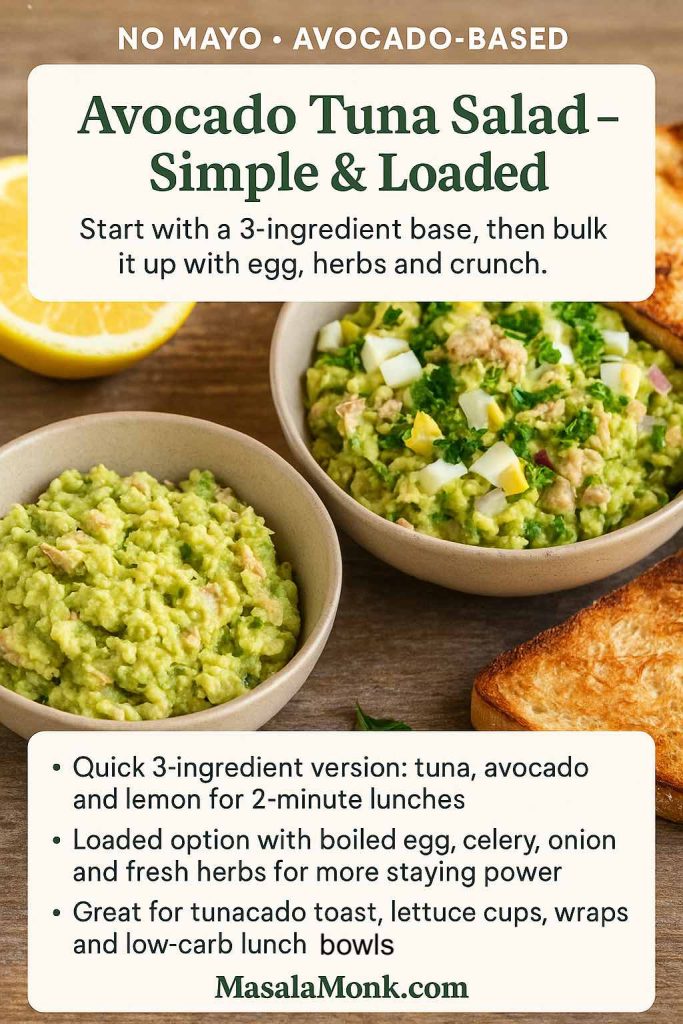
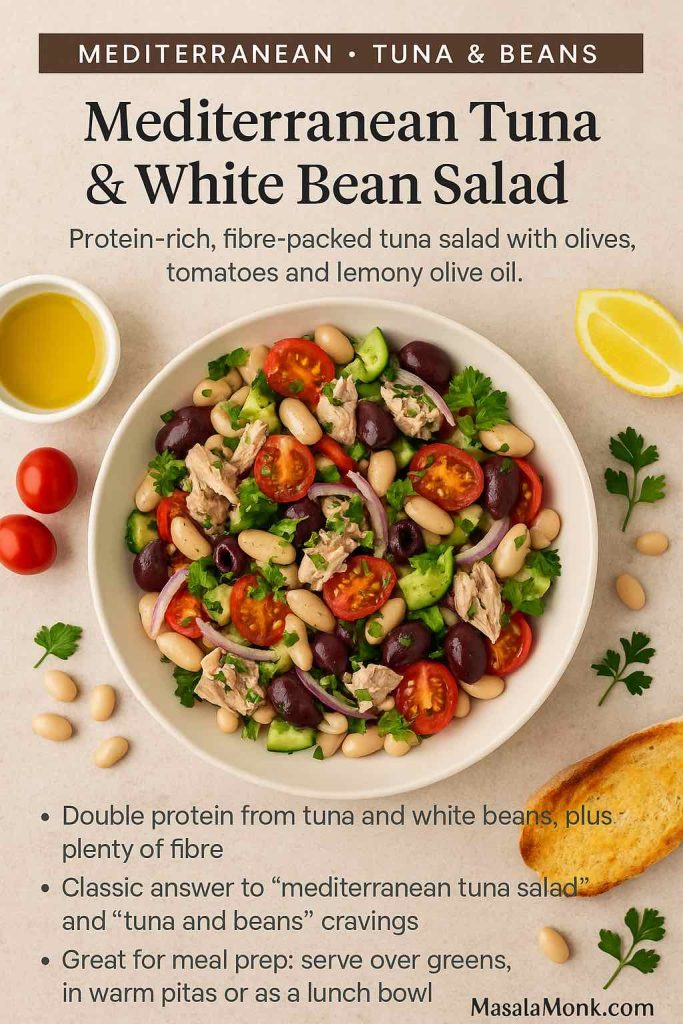
To prevent it:

  • Shorten the cooking time by 1–2 minutes next time
  • Make sure you’re using a prompt, cold ice bath to stop the cooking

If it happens occasionally, don’t worry; you’re still very close to the right timing, and a tiny adjustment usually fixes it.

Some eggs cracked in the air fryer

Small hairline cracks can happen when:

  • Eggs are packed too tightly
  • There are tiny existing cracks you didn’t notice
  • The temperature in your air fryer is very intense in one spot

To reduce cracking:

  • Space the eggs out
  • Avoid dropping them into the basket
  • Try starting with room-temperature eggs if you consistently see cracks coming from fridge-cold eggs

Minor cracks are mostly cosmetic; as long as you chill and store the eggs properly, they’re usually fine to eat.

Also Read: High Protein Overnight Oats | 5 Recipes (Low Calorie, Vegan, Bulking & More)


Variations and Related Air Fryer Recipes

Once you’re comfortable knocking out air fryer hard boiled eggs, it’s only natural to cast around for more things to cook in there—especially for breakfasts, snacks, and meal prep.

Chicken wings and party snacks

For game nights or casual gatherings, a tray of eggs alone feels a bit bare. Adding something crispy and shareable works beautifully. That’s where super crispy air fryer chicken wings with no baking powder come in. They’re crunchy, flavorful, and much easier than dragging out a deep fryer.

On the side, you can offer more nibbles like:

Those snacky ideas turn a simple batch of eggs into part of a full spread.

Plant-based air fryer inspiration

Just as eggs are a powerhouse for omnivores, the air fryer is also a great ally for plant-based meal prep. On days when you want to rely less on animal protein, you can reach for:

Those resources make it easy to keep your air fryer busy even when you’re giving eggs a rest.

Beyond breakfast: falafel, potatoes, and more

As your confidence with the air fryer grows, it’s fun to explore more adventurous recipes, such as:

Add a few air fryer hard boiled eggs on the side, and you suddenly have mezze-style spreads, brunch boards, and snack platters that feel far more impressive than the effort required.


Bringing It All Together

In the end, air fryer hard boiled eggs are one of those quiet, unflashy techniques that earn their spot in your regular routine simply because they work so well:

  • The method is straightforward and hands-off.
  • The results are consistent once you know your air fryer’s timing.
  • The eggs themselves are endlessly versatile—breakfasts, snacks, salads, deviled trays, and everything in between.

As you start making them week after week, you’ll probably find your own little twists: a preferred level of doneness, a favorite seasoning, or a go-to way to serve them. And once the air fryer is already hot and humming, you might find yourself adding a few wings, potatoes, or plant-based bites to the basket as well.

All from the simple idea of “boiling” eggs without ever boiling water.

Also Read: Tres Leches – Mexican 3 Milk Cake Recipe

FAQs for Air Fryer Hard Boiled Eggs

1. What are air fryer hard boiled eggs, exactly?

Air fryer hard boiled eggs are whole eggs cooked in their shells using the hot, circulating air of an air fryer instead of boiling water on the stove. The heat gently cooks the whites and yolks until they reach your preferred level of doneness—soft, jammy, or fully hard—so you get the same result as traditional boiled eggs, just with a much simpler, hands-off method. In short, it’s a no-water way to make “boiled” eggs in an air fryer.


2. How long does it take to make air fryer hard boiled eggs?

To begin with, timing depends on how you like your yolks. For most air fryer hard boiled eggs, a good range is 15–17 minutes at a moderate temperature like 270°F (about 130–135°C). If you prefer softer centers, you can drop that to around 11–12 minutes for soft “boiled” eggs or 13–14 minutes for jammy yolks. After cooking, an ice bath finishes the job and helps them peel easily.


3. What is the best temperature for hard boiled eggs in the air fryer?

For reliable results, a medium temperature usually works best. Rather than cranking the heat all the way up, aim for about 270°F (around 132°C) when making air fryer hard boiled eggs. This gentler heat cooks the eggs evenly from shell to center and reduces the risk of rubbery whites or overcooked yolks. You can adjust a little up or down based on how powerful your specific air fryer feels.


4. Do I need water to make boiled eggs in the air fryer?

Interestingly, no water is needed at all for air fryer boiled eggs. The eggs sit directly in the basket in their shells, and the hot air does the cooking. Water baths, simmering, and boiling are replaced by a simple timer plus an ice bath afterward. The only water you really want is in the bowl for cooling the eggs quickly once they’re done.


5. Can I cook soft, jammy, and hard eggs in the air fryer using the same method?

Yes, you can use the same basic method and simply change the time. Soft air fryer eggs with runny yolks usually need around 11–12 minutes. Jammy eggs with a creamy, custardy center often do well at about 13–14 minutes. Finally, truly hard boiled air fryer eggs typically sit in the basket for 15–17 minutes. Everything else about the process—preheating, arranging the eggs, and chilling them—stays the same.


6. How many eggs can I cook in an air fryer at once?

Generally, you can cook as many eggs as fit in a single layer in your air fryer basket. They should sit comfortably without stacking or crowding so that the hot air can move around them. If your basket is big, you might easily handle a dozen eggs; if it’s smaller, you might cook six or eight. When the basket is very full, you might add a minute or so to your usual time for fully hard boiled eggs in the air fryer.


7. Why do my eggs crack or “explode” in the air fryer?

Every so often, eggs in an air fryer can crack, and occasionally a little egg white leaks out. Frequently, this happens when the eggs are packed too tightly, dropped into the basket, or have tiny hairline cracks already. In addition, a very high temperature can make pressure build up quickly inside the shell. To reduce cracking, space the eggs out, handle them gently, and stick to a moderate temperature instead of blasting them on maximum.


8. How do I make air fryer hard boiled eggs easier to peel?

Peeling is all about two key steps. First, don’t overcook the eggs; overdone eggs tend to cling to their shells. Second, transfer the eggs straight into an ice bath as soon as they come out of the air fryer. The sudden chill helps the egg pull away from the membrane inside the shell, which makes air fryer hard boiled eggs peel with far less frustration. Rolling the egg on the counter to crack the shell all over before peeling also helps.


9. Can I cook eggs in an air fryer without the shell?

Absolutely, you can cook eggs in an air fryer without the shell by using ramekins or silicone cups. For example, you can crack an egg into a greased ramekin for a baked or “boiled” style result, whisk eggs with milk and cheese for scrambled eggs in the air fryer, or pour a seasoned mixture into silicone molds for egg cups or egg bites. In each case, the air fryer becomes a tiny oven for your eggs, rather than just a replacement for boiling.


10. Is it safe to cook eggs in an air fryer?

Yes, cooking eggs in an air fryer is safe as long as you treat it like any other cooking method and follow basic food safety. Eggs should be cooked until the whites are fully set and yolks reach your chosen level of doneness, and any mixed egg dishes like egg bites or air fryer omelettes should be cooked until firm and steaming hot. Once they’re done, they need to be cooled and refrigerated promptly if you’re not eating them right away.


11. How long do air fryer boiled eggs last in the fridge?

Once you’ve cooled them down, air fryer boiled eggs keep well in the refrigerator. Typically, they can be stored for up to one week in a covered container. You can keep them in their shells or peel them in advance; either way, the key is to chill them promptly after cooking and then keep them cold. If they’ve been sitting at room temperature for more than a couple of hours, it’s safer to discard them.


12. Can I make scrambled eggs in the air fryer?

Yes, scrambled eggs in the air fryer are very doable. Instead of putting eggs straight in the basket, you whisk them in a bowl with a splash of milk, seasonings, and perhaps cheese, then pour the mixture into a greased, oven-safe dish or ramekin. After that, you cook the eggs at a moderate temperature, stirring once or twice if you like smaller curds, until they’re just set. The result is a gentle, baked-style scramble that pairs nicely with toast or vegetables.


13. Can I cook poached-style eggs in an air fryer?

You can’t poach eggs in the traditional sense inside an air fryer basket, but you can get a very similar result in cups. To create an air fryer poached egg effect, you grease a small ramekin or silicone cup, add a spoonful of water, and gently crack in an egg. Then, you cook it at a moderate heat until the whites are set and the yolk is still soft. The texture won’t be identical to a water-poached egg, yet it comes pleasantly close and works well for toast or brunch dishes.


14. How do I make air fryer egg bites or egg cups?

For air fryer egg bites, you whisk eggs with a little milk or cream, then stir in extras like cheese, chopped vegetables, herbs, or cooked meats. Next, you pour this mixture into greased silicone molds, muffin cups, or small ramekins, filling them about three-quarters full. After that, you cook them in the air fryer at a gentle temperature until they’re puffed and set in the center. These egg cups are easy to refrigerate and reheat, which makes them perfect for quick breakfasts.


15. Can I make an omelette or frittata in an air fryer?

Yes, an air fryer omelette or frittata is a great way to use the same appliance for a heartier dish. You simply whisk eggs with milk or cream, season well, and fold in fillings like vegetables, cheese, or leftover meats. Then, you pour everything into a greased, oven-safe pan that fits in the basket. Once it’s in, you cook the mixture until the center is set and the top is lightly golden. Thinner mixtures resemble an omelette, while thicker ones turn into a frittata-style bake.


16. Are air fryer hard boiled eggs healthier than regular boiled eggs?

Nutritionally, air fryer hard boiled eggs and classic stovetop boiled eggs are very similar. In both cases, you’re cooking the egg in its shell without added fat, and the protein, vitamins, and minerals remain largely the same. The main advantage of the air fryer method is convenience and ease rather than a big shift in nutrition. As always, how healthy your meal is overall depends more on what else is on the plate alongside those eggs.


17. Why do my air fryer boiled eggs sometimes have a green ring around the yolk?

When you see a green or grey ring around the yolk, it’s usually a sign that the eggs have been slightly overcooked. In an air fryer, this often means the temperature was a bit high or the time a little long. To fix it next time, you can reduce the cooking time by a minute or two and make sure the eggs go straight into an ice bath at the end. Even with the ring, the eggs are still safe to eat; the change is mainly cosmetic and affects texture more than anything else.


18. Can I use air fryer hard boiled eggs for deviled eggs?

Definitely, air fryer hard boiled eggs are excellent for deviled eggs. In fact, once you dial in the timing, the whites tend to be evenly cooked and the yolks nicely centered, which makes them ideal for neat deviled halves. After cooking and cooling, you simply peel the eggs, slice them, and mash the yolks with your chosen ingredients to make the filling. From there, you can keep things classic or experiment with spices, herbs, and toppings to create a tray of deviled eggs that really stands out.

Posted on 3 Comments

Endomorph Body Type: Diet & Workout Plan for Women & Men

Endomorph body type cover: fit woman with shaker, diet plan notebook, quinoa and salmon; Diet & Workout Plan and 12-Week Fat-Loss Blueprint.

If you identify with the endomorph body type, you probably gain weight quickly, hold fat readily around the hips and waist, and feel hungrier than friends when calories get tight. However, none of that is a drawback—it’s simply a starting point. With clear macro targets, repeatable meals, and a realistic blend of strength and cardio, you can create steady fat loss while protecting muscle. For a broader backdrop on somatotypes—and why labels are just heuristics—skim our concise primer on ectomorph, mesomorph, and endomorph. If you end up realizing your traits skew leaner and hard-gainer, pivot to our ectomorph body type guide. And then we also have Mesomorph Body Type: Diet, Workouts & Weight Loss (Female & Male).


What the Endomorph Body Type Implies in Practice

Typically, an endomorph frame features a wider pelvis, shorter average limb length, and a natural tendency to store energy rather than burn it off. Nevertheless, your outcomes are governed by habits: consistent calorie control, protein-forward meals, progressive resistance training, and enough movement outside the gym. Moreover, because appetite, mood, and sleep can swing during a diet, your plan should be resilient on bad days, not just perfect ones.

At a glance, the pillars are simple. First, create a modest daily deficit, avoiding crash diets that multiply cravings. Next, hit protein high enough to spare lean tissue. Then, lift 3 full-body sessions per week and layer 2 cardio days you actually enjoy. Finally, track what matters—weekly average weight, daily steps, and a handful of “north-star” lifts—so adjustments become objective rather than impulsive.

For training frequency and progression, the consensus echoed by ACSM’s resistance training models is clear: expose each muscle group at least twice weekly, progress loads or reps gradually, and manage fatigue so you can keep showing up. Simultaneously, modern hypertrophy research indicates muscle grows across a spectrum of loads if sets are taken sufficiently close to failure; strength, by contrast, tends to favor heavier work (Schoenfeld 2017). In short, your best plan is deliberately simple and ruthlessly repeatable.

Also Read: 5 Top Battle Rope Workout for Fat Loss


Macros for an Endomorph Body Type (Women & Men)

Calorie targets that don’t wreck adherence

Start around bodyweight (lb) × 10–12 kcal/day (≈ 20–25 kcal/kg). After 14 days, review your weekly average weight. If you’re not losing roughly 0.25–0.75% per week, trim 100–150 kcal/day and reassess. Conversely, if performance or mood crashes, nudge calories up 50–100/day and stabilize for a week before changing again. Importantly, consistency beats aggressiveness: a “good enough” deficit you can sustain outperforms a harsh one you abandon.

Protein, fat, and carbs configured for fat loss

  • Protein: Aim for 1.6–2.2 g/kg/day to preserve muscle, curb hunger, and support recovery. This practical range aligns with the open-access ISSN protein position stand and is reinforced by meta-analyses in resistance-trained populations (Morton et al., 2018).
  • Fat: Allocate 0.7–1.0 g/kg/day for hormones and satiety; generally keep fat at ≥20–25% of total calories so meals feel satisfying (see distribution discussion in JISSN protein dosing review).
  • Carbs: Fill the remainder; bias higher-fiber, minimally processed choices and cluster a bigger chunk of carbs around training to support performance.

Furthermore, consider a light, behavior-driven carb cycle: add 30–50 g carbs on lifting days and subtract the same amount on rest days. If it enhances adherence and energy, keep it. If it complicates life, drop it and return to a steady intake.

Gender-specific nuances without stereotyping

Women: during higher-symptom cycle phases, hold calories steady (or upshift 50–100 kcal/day), maintain protein, and prioritize sleep; once symptoms ease, resume the earlier deficit. For training, keep intensity but reduce a set if soreness lingers (ACSM recovery guidance).
Men: weekends are the silent saboteur; one uncontrolled evening can erase five compliant days. Plan social meals with a protein-first plate, share desserts, and limit liquid calories.

Also Read: The Science of Protein: Maximizing Muscle Growth and Recovery


Endomorph Meal Plan Templates You Can Actually Repeat

To begin, here are two one-day frameworks—adjust portions to your target calories. Swap proteins freely (fish, chicken, eggs, tofu/tempeh, dal/rajma), pile vegetables high, and choose carbs you enjoy but can measure.

~1,400 kcal day (often suits smaller or sedentary women)

Breakfast: Greek yogurt (200 g) + berries + 20 g mixed nuts
Lunch: Chickpea & veggie bowl, olive-oil drizzle; side salad
Snack: Whey or soy shake + apple
Dinner: Grilled fish or paneer, roasted potatoes, steamed greens
Macro ballpark: ~110 g protein / 120 g carbs / 45 g fat

~1,900–2,100 kcal day (often suits active women or average men)

Breakfast: Two eggs + 100 g tofu scramble, whole-grain toast
Lunch: Chicken (120–150 g) or chana masala, brown rice, sautéed veg
Snack: Skyr/curd + fruit; 15 g almonds
Dinner: Lean mince or rajma bowl, quinoa, big salad
Macro ballpark: ~130–150 g protein / 170–210 g carbs / 55–65 g fat

Beyond that, think in templates: a protein, a high-fiber carb, a colorful veg, and a measured fat. Similarly, keep a short rotation of batch-cooked staples—rice or quinoa, boiled potatoes, roasted mixed vegetables, and a couple of ready proteins—so “busy day” eating is still aligned with the plan. If you’re uncertain about where you sit on the body-type spectrum—or you’re guiding family members with different builds—this somatotypes explained article helps you choose the right emphasis per person.

Also Read: How to Eat 100 Grams of Protein a Day


Best Workout Plan for an Endomorph Body Type

Although trendy programs promise shortcuts, endomorphs typically thrive on full-body strength three days weekly, paired with two cardio sessions. Crucially, you’ll progress slowly and manage fatigue so appetite doesn’t spike uncontrollably. Accordingly, here’s a template that balances stimulus and recovery.

Weekly layout (5 days; 3 strength + 2 cardio)

Mon — Full-Body A (strength)
Back Squat 3×6–10 • DB Bench 3×8–12 • One-arm Row 3×8–12 • RDL 3×8–12 • Plank 3×45s

Tue — Conditioning (intervals)
8–12 × (40 s easy / 20 s brisk) on bike/rower • 10-min cool-down walk

Wed — Full-Body B (strength)
Trap-bar Deadlift 3×4–6 • Split Squat 3×8–12/leg • Lat Pulldown 3×8–12 • Incline DB Press 3×8–12 • Pallof Press 3×10/side

Thu — Steps & restore
7–10k steps • light mobility 15 min • early bedtime

Fri — Full-Body C (strength; glute/upper bias)
Hip Thrust 4×8–12 • Leg Curl 3×10–15 • Overhead Press 3×6–10 • Seated Row 3×8–12 • Lateral Raise 2×15–20 • Curl/Triceps 2×12–15

Sat — Cardio choice
30–40 min brisk zone-2 or a compact 20-min HIIT block if time-crunched

Sun — Off

Notably, this layout hits each major muscle about twice weekly, which aligns with ACSM progression models. Meanwhile, the rep ranges exploit the hypertrophy-across-loads principle; strength trends heavier, but moderate loads performed near technical failure still add muscle (Schoenfeld 2017).

Also Read: Beginner’s Guide to the Gym

Progression rules that encourage momentum

  • Add one rep per set each week until you reach the top of the prescribed range, then add the smallest plate and reset the reps lower.
  • Keep 1–3 reps in reserve on most sets to manage fatigue.
  • If a lift stalls for 2–3 weeks, add a back-off set at 60–70% (12–15 reps) or swap to a close variation and rebuild confidence.

HIIT versus steady cardio—what to choose?

Time-efficient HIIT complements busy schedules, while steady zone-2 tends to be gentler on recovery. Consequently, the “best” option is the one you’ll execute consistently alongside lifting and steps. Rotate as life demands; consistency trumps dogma.


Intermittent Fasting with an Endomorph Body Type

Intermittent fasting (IF) can match traditional daily restriction for weight loss; it’s a tool for adherence, not a metabolic cheat code. Begin conservatively with 14:10; if you’re training well and sleeping soundly, explore 16:8. Place 2–3 protein feedings inside the eating window, keep fiber high, and avoid the classic trap—“I fasted, so I earned a feast.” If performance drops or evening overeats bloom, shorten the window or return to regular meal spacing. Ultimately, choose the schedule that keeps you honest over the long run. Big picture, randomized data and reviews show IF is broadly comparable to continuous restriction when calories and protein are equated (JAMA 2020 TRE RCT).

Also Read: Intermittent Fasting: Daily Discipline or Overdoing It?


A 12-Week Endomorph Body Type Fat Loss Plan

Phase 1 (Weeks 1–4): Lay the foundation

  • Calories ≈ BW×12 (or your calculator’s equivalent).
  • Protein 1.8 g/kg; vegetables at 2+ meals/day.
  • Three full-body sessions, one short interval day, one zone-2 day.
  • 7–10k steps daily; bedtime routine to secure 7–9 h sleep.
  • Track weekly average weight, steps, and loads on 3–4 key lifts.

Phase 2 (Weeks 5–8): Drive the process

  • Trim 100 kcal/day if weight loss has slowed below ~0.25%/week.
  • Progress presses, squats, rows, and hinges by tiny increments; small jumps compound.
  • Add one HIIT block post-strength once weekly if energy permits; otherwise keep cardio steady.

Phase 3 (Weeks 9–12): Plateaus, solved simply

Choose one lever at a time, then hold for 10–14 days:

  • another −100 kcal/day, or
  • a single light-day (e.g., 5:2-style) once weekly, or
  • +15 min zone-2 after two strength sessions.
    Meanwhile, maintain protein, keep fiber high, and guard sleep like a lifter’s secret supplement.

Also Read: Guide to Body Fat Percentage


Troubleshooting an Endomorph Body Type Without Panic

Scale stuck despite “perfect” weeks? Verify adherence first: calories, steps, training sessions, and weekend totals. If everything checks out, reduce 100 kcal/day or add 1,000–2,000 weekly steps; reassess after another fortnight.

Evening cravings destroying momentum? Front-load 30–40 g protein at breakfast, include a high-fiber carb at lunch, and reserve 20–30 g of your daily carbs for dinner to blunt nighttime hunger. Additionally, swap ultra-palatable snacks for fruit + yogurt or air-popped popcorn sprinkled with spice.

Energy low, lifts slipping? Shift 50–100 kcal from fats toward carbs—especially pre- and post-workout—while holding protein steady. Furthermore, confirm hydration and add a short walk after meals to improve digestion.

Weekends wiping out progress? Pre-commit: choose the restaurant, scan menus, and plan a protein-anchored main. Share starters and desserts, sip water between alcoholic drinks, and log roughly—accuracy beats avoidance.

Soreness snowballing? Drop one accessory set per muscle for a week, keep steps, and focus on sleep. Once soreness normalizes, restore the set or leave volume lower if progress resumes.

Also Read: 10 Examples of Egg Dishes, with 2 Eggs


How This Fits Women and Men Without Overcomplicating It

Although goals and preferences differ, the physiology of fat loss is shared. Women often benefit from keeping fiber high at lunch and a protein anchor at breakfast to tame evening cravings. Men, by contrast, may need stricter boundaries around weekends and liquid calories. Nevertheless, programming is nearly identical: full-body strength, modest cardio, generous protein, and a measured calorie deficit. As you refine, check that your identity as “endomorph” isn’t boxing you in; if training reveals you tolerate volume easily or gain muscle briskly, keep the structure but increase performance ambitions accordingly.

Also Read: How Does a High Protein, High Fiber Diet Support Weight Loss?


Why This Works Even When Life Gets Messy

To be blunt, the endomorph body type isn’t a verdict—it’s a reminder to bias your plan toward satiety, structure, and sustainability. Progress arises from stacking small, consistent wins: turning up to three strength sessions, walking daily, eating the next planned meal, and nudging loads up over time. Importantly, the research base supports the core tactics you’re using:

  • Muscle can grow across a spectrum of loads when effort is high (Schoenfeld 2017), so you don’t have to chase one “magic” rep range.
  • Frequency and progressive overload, delivered in recoverable doses, are reliable drivers of improvement (ACSM progression).
  • Protein targets around 1.6–2.2 g/kg are both practical and protective of lean mass during a deficit (ISSN position stand).

Meanwhile, internal links help readers explore adjacent paths without leaving your ecosystem. If someone realizes they’re actually a leaner hard-gainer, direct them to the ectomorph body type guide. If another reader wants a quick refresher on the spectrum and mixed types, route them to somatotypes explained. Either way, your post remains the practical blueprint they return to when it’s time to act.


Final Word

Ultimately, an endomorph body type signals how you might respond—not how your story ends. Set a modest deficit you can maintain, anchor protein, train full-body with intent, and walk more than you think you need. Add small amounts of cardio you’ll actually do, sleep like an athlete, and adjust patiently every couple of weeks. Consequently, your waistline will trend down, your lifts will creep up, and your relationship with food will get calmer. Keep showing up, keep the plan boringly effective, and let the compounding do its work.


FAQs

1) What is the endomorph body type?

An endomorph body type generally carries fat more easily, with a wider hip/waist structure and strong legs. Nevertheless, results still come from habits—calorie control, protein-forward meals, strength training, and consistent movement.

2) How do I know if I’m truly an endomorph?

Look for patterns: easier fat gain, softer midsection, better performance on lower-body lifts, and noticeable appetite when dieting. Conversely, if you gain muscle quickly while staying lean, you may lean mesomorphic instead.

3) What are the best macros for endomorph weight loss?

Aim for protein 1.6–2.2 g/kg/day, fat 0.7–1.0 g/kg/day, and fill the rest with carbs. Importantly, keep fats above ~20–25% of calories for satiety while timing more carbs around workouts.

4) How many calories should an endomorph eat to lose weight?

Begin near bodyweight (lb) × 10–12 kcal (≈ 20–25 kcal/kg). Thereafter, adjust every 14 days so weight trends down ~0.25–0.75% per week.

5) What’s the best workout for an endomorph body type?

Prioritize full-body strength 3 days per week plus 2 cardio sessions. Notably, use big lifts (squat, hinge, push, pull) with moderate reps and leave 1–3 reps in reserve.

6) Do endomorphs need HIIT or steady cardio?

Both work; choose the one you’ll repeat. HIIT is time-efficient; meanwhile, steady zone-2 is easier to recover from. Ultimately, consistency beats style.

7) Should women train differently than men with an endomorph body type?

Principles match—protein, progression, and a modest deficit. However, women can emphasize glutes, hamstrings, lats, and delts for shape, while men may guard against weekend calorie spikes.

8) What’s an endomorph meal plan structure that works?

Organize 4–5 meals with one “anchor” protein serving (≈40–50 g) and high-fiber carbs at daytime meals. Consequently, cravings at night diminish and adherence improves.

9) Which foods are best for endomorph fat loss?

Lean proteins (fish, poultry, eggs, tofu/tempeh, dals), high-fiber carbs (oats, potatoes, rice, quinoa), colorful vegetables, and measured fats (olive oil, ghee, nuts, seeds). Conversely, limit ultra-processed snacks and sugary drinks.

10) Should endomorphs try intermittent fasting?

Yes—if it helps adherence. Start with 14:10, then consider 16:8 only if energy, sleep, and training remain solid. Place 2–3 protein feedings inside the window. Do read Foods to Eat During 16:8 Intermittent Fasting.

11) What is the best way to carb cycle for endomorphs?

Lightly: +30–50 g carbs on lifting days and −30–50 g on rest days. Furthermore, keep protein steady every day to protect lean mass.

12) How fast should weight loss happen for an endomorph body type?

Target 0.25–0.75% of bodyweight per week. Faster drops risk muscle loss and rebound hunger; slower changes may signal the deficit is too small.

13) What if progress stalls?

First, confirm adherence (meals, steps, training, weekends). If solid, reduce calories 100–150/day or add 1,000–2,000 steps/week. Reassess after 10–14 days.

14) What’s the best endomorph weight-loss workout split for beginners?

Three full-body days:

  • Day A: Squat, Press, Row, Core
  • Day B: Deadlift or Trap-bar, Split Squat, Pull-down, Core
  • Day C: Hip Thrust, Leg Curl, Overhead Press, Seated Row, Accessories
    Additionally, add two short cardio sessions on non-lifting days.

15) Which supplements actually help endomorphs?

Keep it simple: creatine monohydrate (3–5 g/day) for strength and lean mass support, protein powder for convenience, and basics like vitamin D or omega-3s if intake is low. Everything else is optional.

16) Are there special tips for endomorph men?

Yes: plan social meals in advance, cap liquid calories, and track weekend totals. Likewise, keep a few “north-star” lifts (e.g., squat, bench, row) to measure progress objectively.

17) Are there special tips for endomorph women?

Absolutely: during higher-symptom cycle phases, hold calories steady (or up 50–100 kcal), keep protein high, and reduce one accessory set if soreness lingers. Thereafter, resume the original deficit.

18) What are the best exercises for endomorph fat loss?

Compound moves that recruit lots of muscle: squats, deadlifts or trap-bar pulls, hip thrusts, lunges, presses, rows, and pull-ups or pulldowns. Moreover, sprinkle in accessories (leg curls, lateral raises, curls, triceps) for balance.

19) Do endomorphs need more cardio than other body types?

Not necessarily. Instead, match cardio to recovery and step count. Hence, aim for 7–10k steps/day and 2 cardio sessions; increase only if fat loss stalls and energy remains good.

20) How should an endomorph track progress?

Use a weekly average weight, waist/hip measurements, progress photos every 2 weeks, and top-set logs on key lifts. Thus, tweaks are driven by data rather than emotion.

21) What’s the best way for an endomorph to handle cravings?

Front-load protein at breakfast, include fiber at lunch, and save 20–30 g carbs for dinner. Additionally, keep low-calorie “volume” foods ready (berries, yogurt, soups, air-popped popcorn).

22) Can an endomorph build muscle while losing fat?

Yes—especially if new to lifting or returning from a layoff. Nevertheless, prioritize protein, train hard with progressive overload, and avoid overly aggressive deficits.

23) Is a “free” day OK for an endomorph body type?

Occasionally, yes; but plan it. Alternatively, use a single free meal and keep the rest of the day on plan. Importantly, resume your routine at the very next meal.

24) When should an endomorph change the plan?

After 10–14 days without progress despite adherence. Then, adjust one lever—calories, steps, cardio minutes, or training volume—and hold steady before judging again.

Posted on 2 Comments

Ectomorph Body Type: Meaning, Workouts, Diet & Weight Gain

Fit woman with ectomorph body type holding a dumbbell beside protein shake and rice; magazine cover on workout, diet, weight gain.

If you have an ectomorph body type, you probably gain weight slowly, carry less muscle by default, and feel “full” fast. The upside? With the right training focus and a reliable calorie surplus, your frame can add size and strength—often faster than you expect—once you standardize the basics and track progress weekly. For broader context on how somatotypes are used (and misused), see this plain-English primer on ectomorph, mesomorph, and endomorph.

The two other body types you might want to read more about are:


What the Ectomorph Body Type Actually Means

At a glance, ectomorphs tend to have narrower shoulders and hips, longer limbs, smaller joints, and a leaner look at the same bodyweight as peers. Crucially, somatotypes are not destiny; treat them as a quick heuristic that suggests where to start your plan, not how it must end. That’s why we’ll combine practical experience with established guidelines from the American College of Sports Medicine and current hypertrophy research to steer your programming choices.

Key takeaways up front

  • You’ll build best with compound lifts first, modest accessories second, and steady progression week to week. Evidence shows hypertrophy occurs across a range of loads when sets are taken sufficiently hard; nevertheless, heavier loading still favors strength (see Schoenfeld et al., 2017).
  • Gaining requires a daily calorie surplus, not occasional feasts. You’ll anchor protein at evidence-based targets and then push carbs to fuel training (supported by Morton et al., 2018 and the ISSN protein position stand).

Also Read: Mesomorph Body Type: Diet, Workouts & Weight Loss (Female & Male)


Best Workout Plan for the Ectomorph Body Type

Although many ectomorphs assume they need super-high reps or marathon sessions, the research indicates you can build muscle with both lighter and heavier loads—as long as you train close enough to failure and accumulate sufficient weekly volume. Schoenfeld et al. (2017) reported similar hypertrophy outcomes across a low-to-high loading spectrum; strength, however, favored heavier work. Practically, that means mixing heavy compounds with moderate-rep accessories is ideal.

Weekly frequency and progression (why it works)

Begin with 3–4 lifting days each week so you can hit major muscle groups about 2× weekly. This lines up with ACSM progression models for novices and intermediates and matches what most busy lifters can recover from while still eating enough. Just as importantly, cap most sessions at 60–75 minutes so you leave fresh enough to eat well.

Also Read: Beginner’s Guide to the Gym

A. 4-Day Hypertrophy Split (Ectomorph-Friendly)

Day 1 — Upper (push-bias)
Bench Press 4×6–8 • Incline DB Press 3×8–10 • Overhead Press 3×6–8 • Cable Fly 2×12–15 • Triceps Pressdown 3×10–12 • Lateral Raise 2×15–20

Day 2 — Lower (squat-bias)
Back Squat 4×6–8 • Romanian Deadlift 3×8–10 • Walking Lunge 3×10/leg • Leg Press 2×12–15 • Calf Raise 4×10–15

Day 3 — Rest / easy walk / mobility

Day 4 — Upper (pull-bias)
Weighted Pull-ups 4×6–8 (or Lat Pulldown) • Barbell Row 3×6–8 • Chest-Supported Row 3×8–10 • Face Pull 2×15–20 • EZ-Bar Curl 3×10–12 • Hammer Curl 2×12–15

Day 5 — Lower (hinge/glute-bias)
Conventional Deadlift 3×3–5 • Front Squat 3×6–8 • Hip Thrust 3×8–10 • Lying Leg Curl 3×10–12 • Ab Wheel 3×8–12

Days 6–7 — Rest

B. Progression that builds muscle on an ectomorph body type

  • Add load or reps weekly within the stated ranges while keeping top sets 1–3 reps shy of failure most of the time.
  • If a lift stalls for three weeks, add one set to that movement or swap to a close variation (e.g., high-bar to low-bar squat) and rebuild.
  • Keep long steady-state cardio minimal during gain phases; short walks (10–20 minutes) help appetite and recovery without draining you.

Why this works: moderate volume across two exposures per muscle keeps stimulus frequent without wrecking recovery. It also encourages skill with the big lifts while leaving time and energy to eat.

Also Read: Guide to Essential Equipment for Home & Office Workout


Ectomorph Diet Plan for Muscle & Weight Gain

Let’s keep it simple: most ectomorphs undereat. You don’t need “dirty bulks,” but you do need consistent surplus. Start by estimating maintenance with the RMR calculator, then set macros using Macro Master and adjust from the scale each week.

  • Start with maintenance +250–500 kcal/day (choose the higher end if you’re very lean and training 4×/week).
  • Set protein at ~1.6–2.2 g/kg/day, a range supported by Morton et al., 2018 and the ISSN protein position stand.
  • Allocate fat at 0.6–1.0 g/kg/day, then fill the rest with carbs to fuel training and recovery.
  • Weigh yourself 2–3 mornings/week (post-restroom, pre-breakfast) and average the data. If your 14-day average hasn’t moved up, add +150–250 kcal/day.

High-calorie, easy-to-eat foods (when appetite is low)

Liquid calories and carb-dense staples are your friends:

Hitting protein targets without drama

Vegetarian or simply busy? No problem. Anchor your day with one “linchpin” meal that delivers ~40–50 g protein, then distribute the rest. For plant-forward batch cooks, these quinoa meal-prep ideas and high-protein chia prep posts provide simple, repeatable templates you can scale.

Why we care about protein: a large meta-analysis suggests benefits accrue up to ~1.6 g/kg/day for trained individuals, with possible advantages a bit above that depending on context (Morton et al., 2018). The International Society of Sports Nutrition aligns with daily and per-meal recommendations that are practical and sustainable. For extra context on supplementation, see reviews like Nunes et al., 2022 and Cintineo et al., 2018.

Also Read: The Science of Protein: Maximizing Muscle Growth and Recovery

Sample day (≈3,000–3,200 kcal) you can scale up or down

  • Breakfast — Oats cooked in milk + whey mixed in after; banana; spoon of peanut butter.
  • Mid-morning smoothie — Use the nut-infused smoothie template; blend milk, oats, nuts, honey, protein.
  • Lunch — Rice or roti with chicken thighs or paneer; olive-oil tossed veg; yogurt.
  • Pre-workout — Toast with jam + a handful of raisins; sip water.
  • Post-workout — Whey or a plant blend shaken with milk; a ripe mango (in season) or two dates.
  • Dinner — Pasta with beef/turkey or chickpeas; parmesan; side salad with olive oil.
  • Before bed — Cottage cheese or casein; a few almonds or peanuts.

Also Read: Classic Deviled Eggs (Easy) + 8 Flavorful Variations


Protein & Creatine for the Ectomorph Body Type

Protein powders are not magic—only convenient. Use whey, casein, or a good plant blend to reach the day’s total. If nighttime appetite exists, casein can help you tick the box without feeling stuffed. For whole-food variety (and minerals), rotate dairy, eggs, dals/legumes, tofu/tempeh, poultry, and fish.

As for supplements, creatine monohydrate (3–5 g/day) remains the best-supported single add-on for strength and lean mass. For safety and efficacy, rely on the ISSN creatine position stand (2025 update) and the earlier accessible open-access review. You don’t need a loading phase, and timing is flexible—take it whenever you remember. If you want a consumer-friendly explanation first, here’s a plain-English creatine side-effects guide.

Also Read: How to Eat 100 Grams of Protein a Day


Male vs Female: Applying the Plan to Your Ectomorph Body Type

Despite different goals, men and women succeed with the same principles—volume, progression, calories, and patience—while fine-tuning emphasis.

Men:

  • Push compounds that expand the silhouette: bench and overhead presses for chest/delts, rows and pull-ups for back width, squats and deadlifts for legs.
  • Eat more on lower-body days, when systemic fatigue (and thus fuel need) is higher.
  • Track a few “north star” lifts (e.g., 5-rep max on squat/bench/row) and chase slow increases monthly.

Women:

  • Prioritize glutes, hamstrings, lats, and delts for shape. Hip thrusts, RDLs, Bulgarian split squats, pull-downs/pull-ups, and lateral raises do heavy lifting here.
  • Keep protein every day, not just on training days, to support recovery and appetite control.
  • Consider slight carb cycling: +20–30 g carbs on hard days, –20–30 g on rest days—only if it helps adherence.

Either way, movements, sets, and reps differ less than you think; the ectomorph body type benefits most from consistency, not perfect exercise selection.

Also Read: Best Tea to Lower Cortisol: Green, Black, Matcha & Herbal


A Simple Weekly Checklist for Ectomorph Weight Gain

  1. Train 3–4×/week, mostly compounds first, accessories second; take most sets within 1–3 reps of failure, keep 60–75 minutes per session. See the load-range evidence in Schoenfeld 2017.
  2. Eat in surplus daily, not “whenever.” If your 14-day average weight doesn’t rise, add +150–250 kcal/day and reassess a week later.
  3. Hit protein (~1.6–2.2 g/kg/day). That range is supported by Morton 2018 and the ISSN position stand; split across 3–5 meals you actually like.
  4. Use shakes strategically when appetite is low: milk, oats, nuts, honey, protein. Templates: nut-infused smoothies and high-iron shakes.
  5. Supplement simply: creatine 3–5 g/day (see ISSN 2025); optional whey/plant protein to fill gaps.
  6. Walk most days (10–20 minutes) to improve appetite and recovery; keep long cardio minimal while gaining.
  7. Sleep 7–9 hours; if life spikes stress, scale volume down for a week—progress requires recovery.

Also Read: Benefits of Nuts and Seeds – Protein-Packed Superfoods


Troubleshooting for the Ectomorph Body Type (quick fixes)

  • “I feel stuffed and can’t eat more.”
    Shift calories to liquids and semi-solids: milk-based shakes with oats and nut butters; yogurt bowls with granola and honey; fruit plus dates between meals. If needed, add 1–2 tsp of olive oil or MCT to smoothies for 80–160 easy calories. Borrow blueprint ideas from nut-infused smoothies or macadamia & sunflower protein shakes, but swap in regular milk and oats to boost calories.
  • “My lifts aren’t moving.”
    First, eat. Then add a back-off set at 60–70% for higher reps (12–15) after your top sets, or add a small 2.5 kg increment to your main lift every other week. Finally, rotate variations to keep momentum.
  • “I’m getting softer.”
    Ease the surplus down 100–150 kcal/day and maintain for two weeks. Keep protein steady; optionally increase steps slightly (no need for long cardio blocks).
  • “I miss sessions.”
    Use a 3-day full-body rotation instead (A/B/C), repeating weekly and sliding days as life allows. Each session: a squat/hinge, a press, a pull, plus 1–2 accessories.

Final Word

The ectomorph body type isn’t a limitation; it’s a programming clue. Build around heavy compounds, feed your training with a dependable surplus, standardize protein, and repeat—week after week. Use shakes when appetite fades, walk to recover, and choose a small handful of lifts to improve relentlessly. Then, let time do what time does best: compound your effort into visible muscle.


FAQs

1) What is the ectomorph body type?

An ectomorph body type is typically lean with a narrower frame, long limbs, and lower baseline muscle and fat. Consequently, ectomorphs often find it harder to gain weight or size without a structured plan.

2) What does “ectomorph meaning/definition” imply for training?

Practically, it signals you’ll respond best to progressive strength work, compound lifts first, and consistent recovery. Moreover, keep sessions focused (60–75 minutes) and push effort close to failure.

3) Ectomorph vs mesomorph vs endomorph—what’s the difference?

Briefly: ectomorphs gain slowly, mesomorphs are naturally more muscular, and endomorphs store fat more easily. Nevertheless, most people are a blend; use the category that best matches your current traits.

4) Can an ectomorph become “mesomorphic” in appearance?

Yes. With years of progressive overload, appropriate calories, and patience, an ectomorph can build a visibly more muscular, “meso-like” physique. Ultimately, habits drive results more than labels.

5) What’s the best ectomorph workout plan?

Prioritize a 3–4 day split that hits each muscle twice weekly. Notably, use heavy compounds (squat, deadlift, bench, row, pull-ups, overhead press) plus moderate-rep accessories for volume.

6) Best exercise for ectomorphs—what should top the list?

Start with multi-joint moves: back squat, Romanian deadlift, bench press, barbell row, overhead press, and weighted pull-ups. Additionally, add hip thrusts, lunges, leg curls, laterals, and curls to round out weak points.

7) How many sets and reps suit an ectomorph body type?

Aim for ~10–16 hard sets per muscle per week. Likewise, work mostly in 6–12 reps on compounds, 8–15 on accessories, keeping 1–3 reps in reserve most sets.

8) Should ectomorphs do cardio while gaining?

Yes—lightly. Meanwhile, prefer short walks or 10–20 minutes of easy cardio to aid appetite and recovery; avoid long, frequent endurance sessions during surplus phases.

9) What is the best ectomorph diet plan?

Build a daily calorie surplus of +250–500 kcal above maintenance. Furthermore, anchor protein at ~1.6–2.2 g/kg/day, set fats at 0.6–1.0 g/kg/day, and let carbs fill the remainder to fuel training.

10) How fast should ectomorph weight gain happen?

Target roughly 0.25–0.5 kg per week. Consequently, if your two-week average weight stalls, increase intake by +150–250 kcal/day and reassess after seven days.

11) What foods help an ectomorph gain weight without feeling stuffed?

Choose energy-dense staples: milk, oats, rice, pasta, potatoes, breads, dried fruit, nuts, nut butters, olive oil, and ghee. Beyond that, use smoothies and shakes to sneak in liquid calories.

12) Best protein for ectomorphs—what should I pick?

Whey concentrate/isolate, casein (especially at night), or a quality plant blend (pea/rice/soy) are all effective. Importantly, the “best” is the one you’ll take consistently to hit your daily total.

13) Which supplements are worth it for an ectomorph body type?

Keep it simple: creatine monohydrate (3–5 g/day), basic protein powder for convenience, omega-3s if intake is low, and vitamin D as needed. Otherwise, focus primarily on food and training.

14) Do ectomorph women need a different plan than men?

Principles are identical—volume, progression, surplus, and sleep. However, exercise selection can emphasize glutes, hamstrings, lats, and delts for shape while still progressing the big lifts.

15) What does an “ectomorph meal plan for muscle gain” look like?

Organize 4–6 feedings with at least one 40–50 g protein “anchor” meal; surround workouts with carbs; and include a calorie-dense shake daily. Additionally, pre-prep staples (rice, oats, potatoes, proteins) every 2–3 days.

16) Is a mass gainer necessary for ectomorph weight gain?

Not at all. Instead, blend your own: milk, oats, banana, nut butter, and a scoop of protein. This homemade option is flexible, cheaper, and easier to tailor to your targets.

17) What’s an ectomorph compound workout day example?

Try: Back Squat 4×6–8, Romanian Deadlift 3×8–10, Bench Press 4×6–8, Barbell Row 3×6–8, Hip Thrust 3×8–10, Lateral Raise 2×15–20. Furthermore, rest 90–150 seconds between hard sets.

18) How should an ectomorph track progress?

Use a simple trio: weekly average bodyweight, key lift logs (e.g., 5-rep bests), and biweekly front/side photos. Consequently, make small adjustments—load, reps, or calories—based on those trends.

19) Are “ecto endo meso” types fixed for life?

No. Genetics set starting points, yet training, nutrition, and recovery shift your look substantially. Nevertheless, accept your structure while maximizing what you can control.

20) What’s the fastest way for an ectomorph to add muscle safely?

Lift 3–4×/week with progressive overload, maintain a daily surplus, hit protein every day, sleep 7–9 hours, and repeat. Ultimately, disciplined consistency—more than novelty—drives visible change.