Posted on Leave a comment

How to Make Paneer at Home: Soft Homemade Paneer

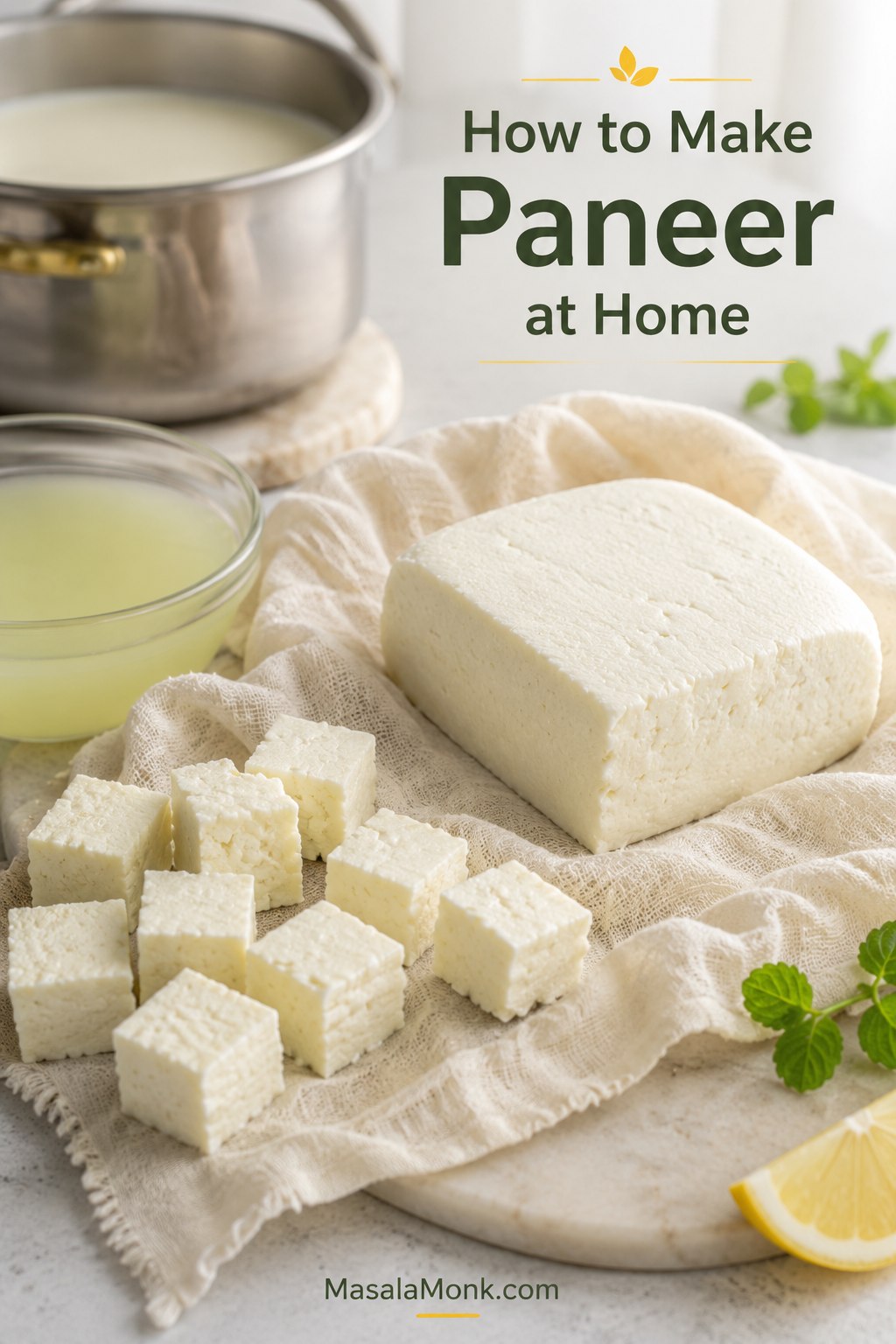
Fresh homemade paneer block on muslin with cut paneer cubes, pale whey in a glass bowl, and a milk pot in the background.

If you want to know how to make paneer at home, the process is simpler than it looks: heat milk, add just enough acid, strain the curds, and press only as much as your dish needs. Paneer may look like something you have to buy from an Indian grocery store, already pressed into a neat block for palak paneer, paneer tikka, or a creamy restaurant-style curry, but fresh homemade paneer is very doable in a regular kitchen.

The goal is not just paneer that sets. The goal is paneer that curdles cleanly, cuts neatly when you need cubes, and still stays tender when it goes into sauce.
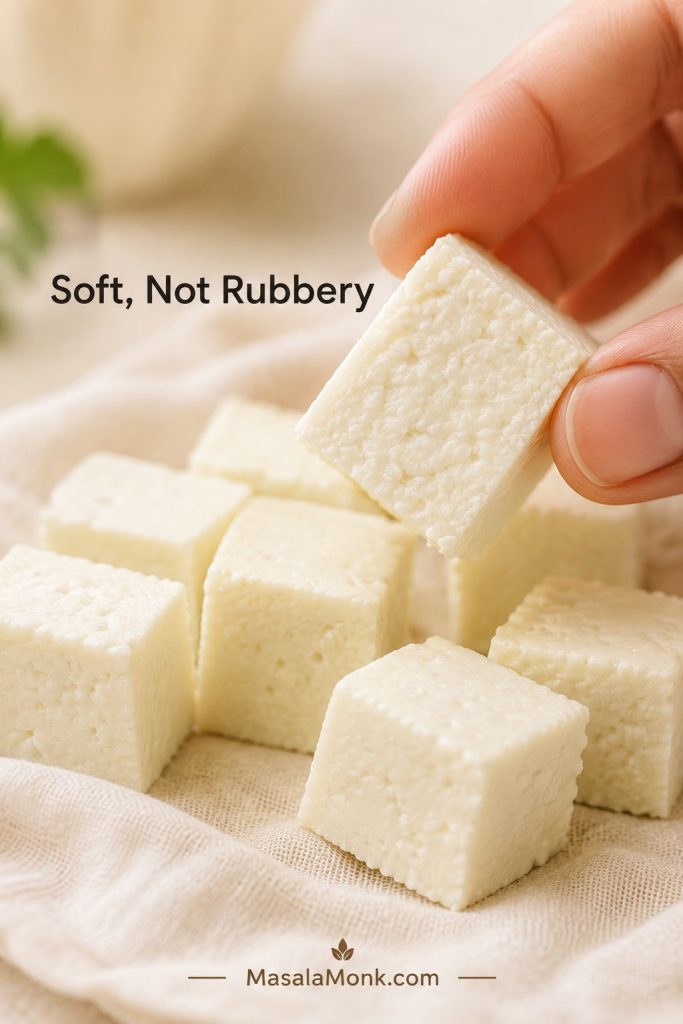
Close-up of a soft homemade paneer cube being held to show its moist interior.
This is the texture to aim for: paneer that sets cleanly but still looks moist inside. That softness is what keeps it tender in curry, bhurji, wraps, and bowls.

That texture comes from stopping at the right moments: before the milk boils too hard, before too much acid makes the curds tight, and before pressing turns soft curds into a dry block.

You do not need to understand cheesemaking to make paneer. You only need to know when the milk is hot enough, when the curds have separated, and when to stop pressing.

This guide helps most when you do not live near an Indian grocery store, feel unsure about supermarket milk labels, or have only found dense packaged paneer. If packaged paneer near you is firm, squeaky, or rubbery, homemade paneer can feel like a different ingredient.

If you have tried making paneer before and ended up with sour crumbs, weak curds, rubbery cubes, or milk that refused to curdle, you probably did not fail. Milk behaves differently from brand to brand: one batch may need gentler heat, another may need less acid, and another may need a shorter press. If you are nervous about wasting a large pot of milk, start with the 1-litre batch in the scaling table below.

If you are here because a batch already went wrong, jump to Troubleshooting Homemade Paneer first, then come back to the recipe with the problem in mind.

Once you have a good block, you can use it anywhere paneer texture matters: a rich curry like Balti Paneer Gravy, a quick filling, a salad bowl, a pan-seared snack, or a simple vegetarian dinner.

Quick Answer: How to Make Paneer at Home

The easiest way to make paneer at home is to heat whole milk to 185–195°F / 85–90°C, or until it is steaming, foamy, and just about to rise. Add diluted lemon juice or plain white vinegar gradually until soft white curds separate from pale yellow-green, slightly translucent whey. Strain the curds through cloth, rinse briefly if needed, then press for 10 minutes for soft crumbles, 30–40 minutes for curry cubes, or up to 50 minutes for firmer tikka-style paneer.

The active work is about 20–25 minutes. The rest is mostly resting, draining, pressing, or chilling, depending on how firm you want the final paneer.

Best milkWhole milk / full-fat milk
Avoid if possibleSkim milk, fat-free milk, UHT milk, and ultra-pasteurized milk
Best beginner acidLemon juice or plain white vinegar, diluted with water
Temperature cue185–195°F / 85–90°C, or steaming and just about to rise
Yield from 2 litres / 8½ cups milkAbout 300–400 g / 10.5–14 oz paneer, depending on milk and pressing
Fridge storage2–3 days, covered or submerged in fresh cold water
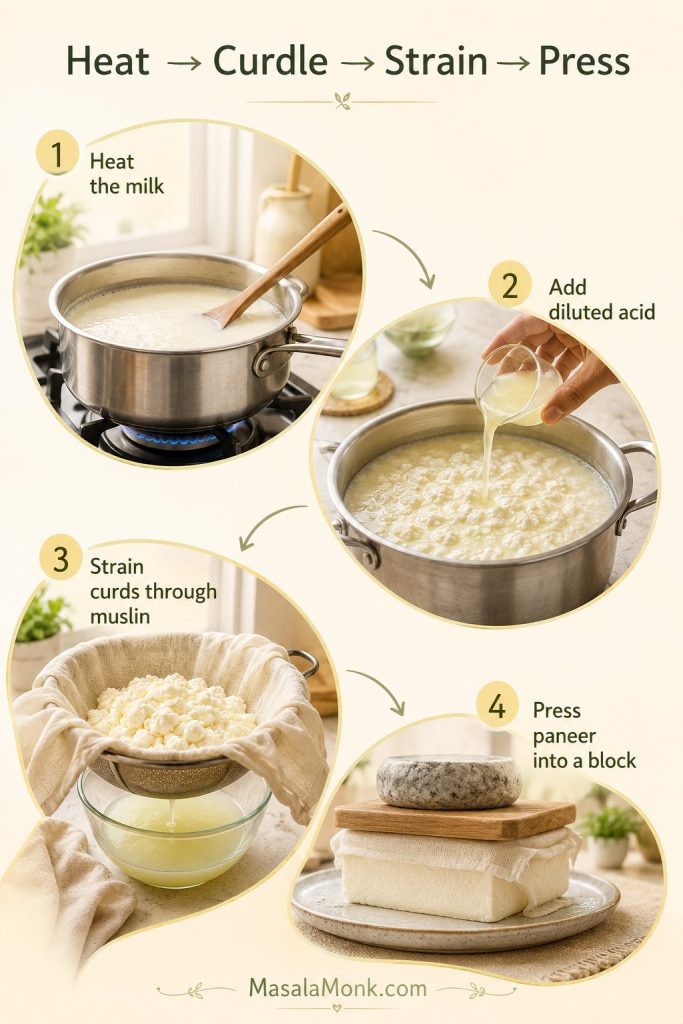
Four-step paneer process showing milk heating, diluted acid being added, curds strained through muslin, and paneer being pressed.
The basic paneer recipe is simple, but each stage has a cue. Heat the milk, add acid gradually, strain when the whey clears, then press for the texture you need.

Still choosing ingredients? Start with Best Milk for Paneer. Already curdled the milk? Use the Pressing Times section to choose soft crumbles, curry cubes, or firmer tikka paneer.

Before You Start: 3 Things That Decide Paneer Texture

Most paneer problems come down to three simple choices: the milk, the acid, and how long you press. Get those right and the recipe becomes much more reliable.
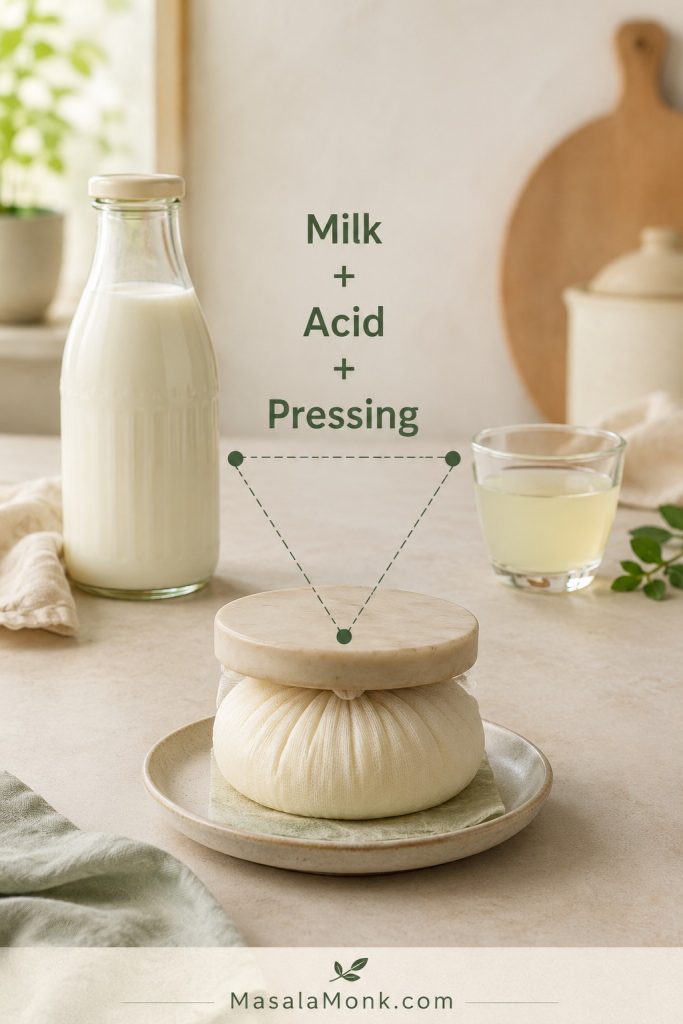
Milk, diluted acid, and paneer wrapped in muslin under a light weight shown as the three main texture factors.
If homemade paneer turns crumbly, sour, or rubbery, the cause is usually one of three things: milk choice, acid control, or pressing time.

Three things decide paneer texture: use whole milk for better curds, add diluted acid gradually, and press for the dish you are making. Bhurji needs almost no pressing, curry cubes need moderate pressing, and tikka needs a firmer block. Acid is the trigger, not the target.

At its simplest, paneer is just hot milk plus a little acid. The details below help you keep it soft, but the basic process is only heat, curdle, strain, and press.

Once you have seen milk split cleanly into curds and clearer yellow-green whey, the whole process feels much less mysterious.

Homemade Paneer Recipe

This is the base recipe if you want to make paneer at home with whole milk and lemon juice or vinegar. Use the pressing chart later in the guide to adjust the texture for bhurji, curries, tikka, wraps, bowls, or grilling.
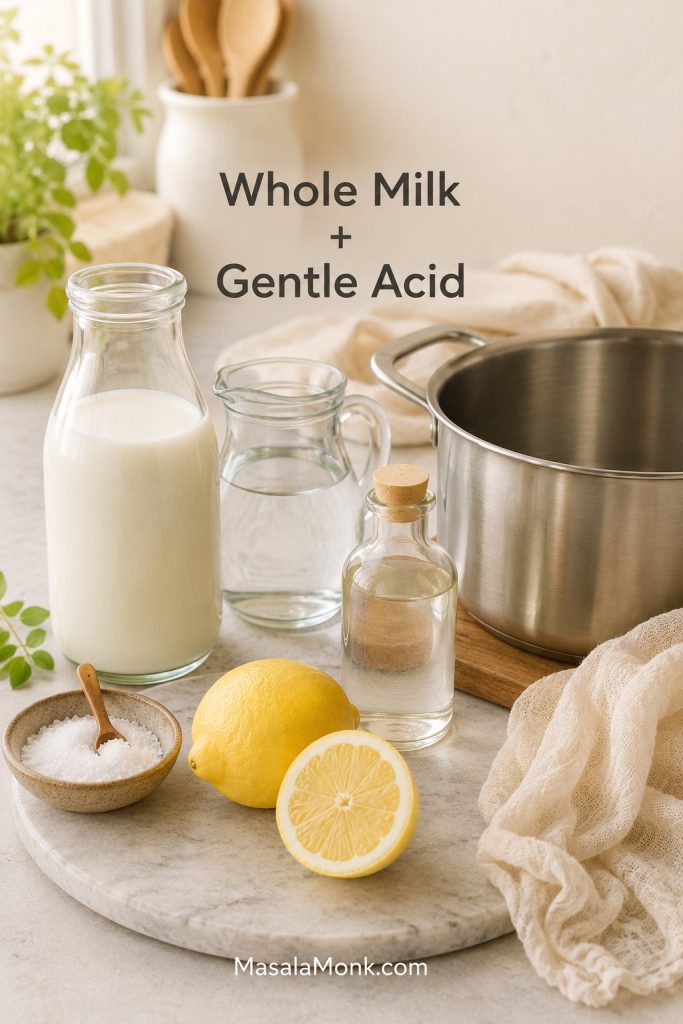
Whole milk, lemon, vinegar, water, salt, muslin cloth, and a cooking pot arranged for making paneer at home.
Paneer does not need a long ingredient list. However, whole milk, diluted acid, and gentle handling matter more than any extra add-in.
Yield300–400 g / 10.5–14 oz paneer
Prep Time5 minutes
Cook Time15–20 minutes
Total Time45–70 minutes, plus optional chilling for firmer cubes

Equipment

  • Large heavy-bottomed pot, with room for the milk to rise
  • Wooden spoon or silicone spatula
  • Thermometer, optional but helpful for first-timers
  • Colander or large sieve
  • Cheesecloth, muslin, thin cotton towel, clean handkerchief, or nut milk bag
  • Large bowl to catch the whey
  • Plate or tray for pressing
  • Moderate weight, such as canned beans, a small pot, or a heavy skillet

Ingredients

  • 2 litres / 8½ cups / about 2.1 quarts whole milk
  • 3 tablespoons / 45 ml lemon juice or plain white vinegar, plus 1 tablespoon / 15 ml more if needed, diluted before adding
  • 3–4 tablespoons / 45–60 ml water, plus a little more if using the extra acid
  • ¼–½ teaspoon / about 1.5–3 g fine salt, optional

Step-by-Step Method

Heat, curdle, and strain the milk

  1. Prepare the strainer. Line a colander with cheesecloth, muslin, a thin cotton towel, or a nut milk bag. Place it over a large bowl to catch the whey.
  2. Heat the milk. Pour the milk into a heavy-bottomed pot. Heat over medium-low to medium heat, stirring often so the bottom does not scorch.
  3. Watch the temperature. Heat the milk to 185–195°F / 85–90°C. Without a thermometer, look for milk that is steaming, foamy at the edges, and just about to rise. Avoid a violent rolling boil.
  4. Dilute and add the acid. Mix the lemon juice or vinegar with the water. Turn the heat to low or switch it off, then add the diluted acid about 1 tablespoon at a time, stirring gently for a few seconds after each addition.
  5. Stop when the milk separates. Stop once you see soft white curds and pale yellow-green, slightly translucent whey. If the liquid still looks milky after 1–2 minutes, dilute the extra acid and add it 1 teaspoon at a time, waiting briefly between additions.
  6. Let the curds settle. Once curds form, stir as little as possible. Too much stirring can break soft curds into small grains. Let the curds sit in the hot whey for 5–10 minutes so they settle and gather.
  7. Strain and rinse. Pour the curds and whey into the lined colander. Gather the cloth gently and let gravity drain first. If you used lemon juice or vinegar, rinse the curds briefly under cool water to remove excess sourness and stop the cooking.

Salt, press, and cut the paneer

  1. Salt only if needed. For unsalted paneer, skip the salt. For lightly salted paneer, sprinkle the salt over the drained curds before shaping and pressing. If the paneer is going into a curry, you can skip the salt and season the sauce instead.
  2. Shape and press for your dish. Shape the curds into a flat square or disc inside the cloth. Press according to your final use: 0–10 minutes for soft crumbles, 15–20 minutes for a tender block, 30–40 minutes for curry cubes, or 45–50 minutes for firmer tikka cubes.
  3. Cut if needed. You can use soft paneer right away. For neat cubes, chill the pressed block for 20–30 minutes before cutting. For firmer tikka-style cubes, you can instead dip the pressed block in cold water for 5–10 minutes, then pat dry before cutting. Skip this for soft crumbled paneer.

Important cue: Once the curds have formed and the whey is no longer milky, pause. More acid will not make better paneer. It will only make sharper, firmer, more sour paneer.

Unsure which acid to use? The lemon, vinegar, yogurt, and citric acid comparison explains which option gives the cleanest flavor and which one makes softer curds.

Milk Temperature Cue

Use the thermometer reading or the visual cues together: the milk should be hot, steaming, foamy at the edges, and close to rising before you add acid.
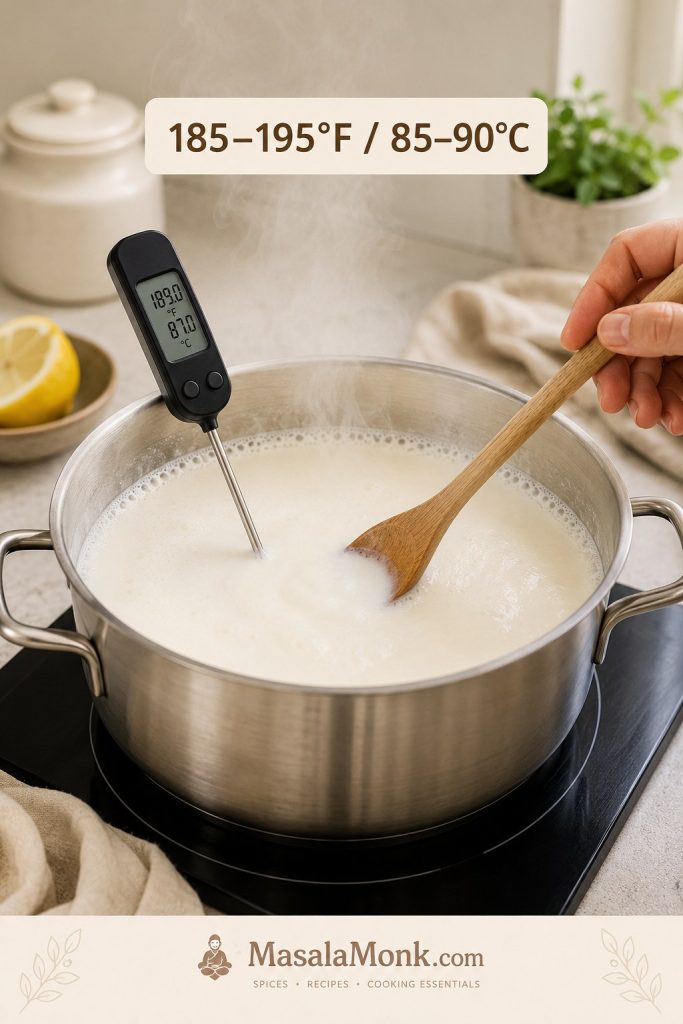
Milk heating gently in a pot with a thermometer showing the paneer temperature range of 185–195°F or 85–90°C.
The milk does not need a violent boil to make paneer. Look for steam, edge foam, and a near-rise so the curds form cleanly without tightening too early.

Curds and Whey Cue

After adding diluted acid, watch the liquid around the curds. Soft curds and pale yellow-green whey mean the milk has separated cleanly.
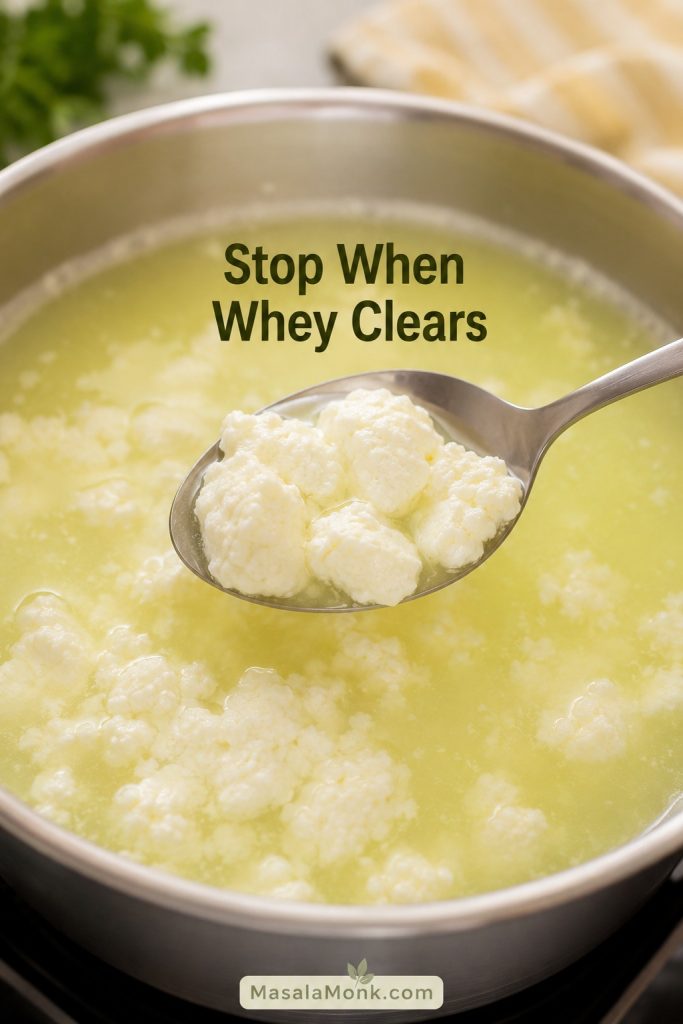
Soft white paneer curds forming in pale yellow-green whey inside a pot, with a spoon lifting the curds.
Clear whey is your stop sign. When soft curds gather and the liquid shifts from milky white to pale yellow-green, the acid has done its job.

Straining Paneer Curds

Once the curds have settled, pour them into the lined colander and let the whey drain first before you gather the cloth.
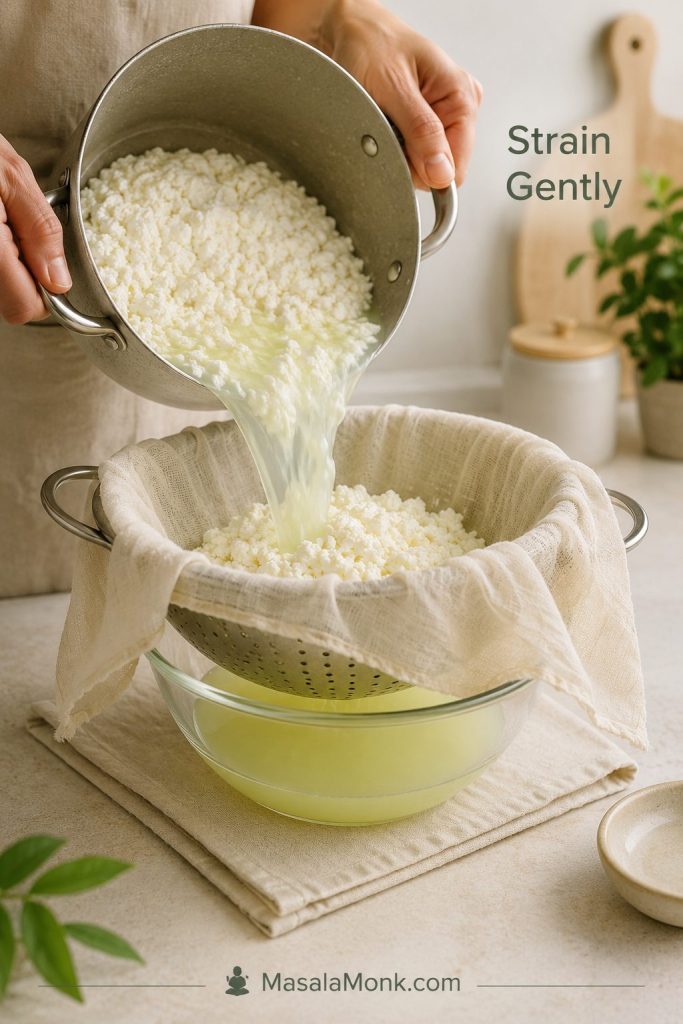
Paneer curds being poured into a muslin-lined colander over a bowl as pale whey drains below.
Let gravity do the first part of the draining. Squeezing too early can remove the moisture that makes homemade paneer soft and pleasant to eat.

How to Make Paneer with 1 Litre, 2 Litres, or 1 Gallon Milk

The recipe above uses 2 litres / about 8½ cups milk because it gives a useful home batch. You can scale homemade paneer up or down, but keep the acid flexible. Lemons vary, vinegar brands can differ slightly, and milk behaves differently by country, season, and processing method.

If this is your first time making paneer or you are testing a new milk brand, start with 1 litre. It is a smaller commitment, and it teaches you how that milk behaves before you make a larger batch.

Milk amountAcid to start withUse more only if…Expected paneer
1 litre / about 4¼ cups1–1½ tablespoons / 15–22 ml lemon juice or vinegar, dilutedThe whey still looks milkyAbout 150–200 g / 5–7 oz
2 litres / about 8½ cups3 tablespoons / 45 ml lemon juice or vinegar, dilutedUse up to 4 tablespoons / 60 ml if neededAbout 300–400 g / 10.5–14 oz
1 gallon / about 3.8 litres6 tablespoons / 90 ml lemon juice or vinegar, dilutedUse up to 8 tablespoons / 120 ml if neededAbout 600–750 g / 21–26 oz

Use these as practical ranges, not fixed guarantees. Richer milk gives more paneer. Leaner milk gives less. Longer pressing removes more moisture, so the final block weighs less. A 300–400 g block usually works for a family-style curry serving 3–4 people, depending on how paneer-heavy you like the dish.

What Soft Homemade Paneer Looks and Feels Like

The first batch is less stressful when you know what “right” looks like. These are the cues to trust as the milk changes from liquid to curds.
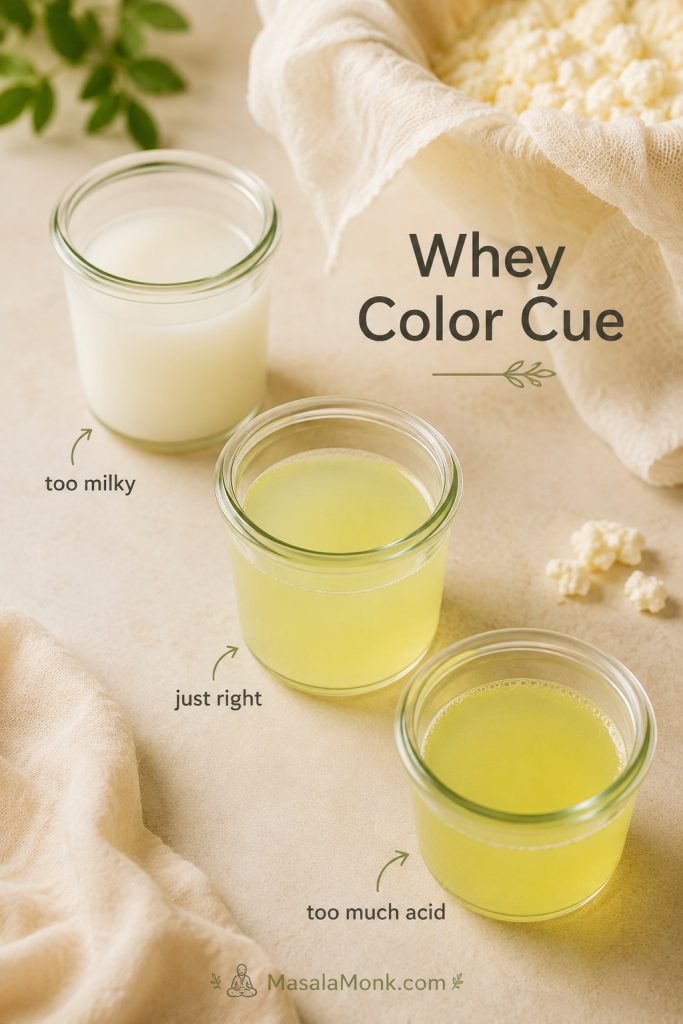
Three glasses showing milky whey, clear pale yellow-green whey, and over-acidified whey for making paneer.
Whey color tells you what to do next. Milky whey needs more time or a little more acid; clear yellow-green whey means the curds are ready to strain.
StageGood signWarning sign
Milk before acidSteaming, foamy at the edges, almost risingViolently boiling for several minutes
Curds formingSoft white clumps pulling away from the liquidTiny, tight, dry-looking grains
WheyPale yellow-green and slightly translucentCloudy, white, and still milky
Pressed blockSet but still slightly tender when touchedHard, dry, dense, or squeaky
Taste and smellClean, milky, faintly sweetSharply vinegary, harshly lemony, or stale-smelling

The curds should look soft and pillowy, not dry and pebbly. The pressed block should hold together, but it should not feel like a brick. If the paneer smells sharply acidic, rinse briefly and use less acid next time.

If your curds look tight, the whey is still milky, or the block feels squeaky, compare it with Troubleshooting Homemade Paneer before you throw the batch away.

What Is Paneer?

Paneer is a fresh Indian cheese made by curdling hot milk with an acid such as lemon juice, vinegar, yogurt, buttermilk, or citric acid. It is not aged, it does not need rennet, and it does not melt into strings like mozzarella or cheddar. Instead, paneer holds its shape when cooked, which is why it works so well in curries, skewers, stir-fries, wraps, sandwiches, and rice bowls.

Paneer is often called Indian cottage cheese, but that phrase can be confusing outside India. Western cottage cheese is loose, wet, and spoonable. Paneer is usually drained and pressed into a sliceable block. Depending on how long you press it, it can be soft and crumbly, tender and cubeable, or firm enough for tikka.

The flavor is mild, milky, and slightly sweet by design. That gentleness is exactly why paneer works so well with bold gravies, smoky marinades, peppery sauces, and spicy vegetables.

Best Milk for Homemade Paneer Outside India

Your carton matters more than the brand name here. The best milk for homemade paneer is whole milk, also called full-fat milk in many countries. It gives better curds, better yield, and a softer finished texture. Different countries sell milk under different labels, so do not worry if your carton does not say “full cream.” Look for regular pasteurized dairy milk with enough fat.
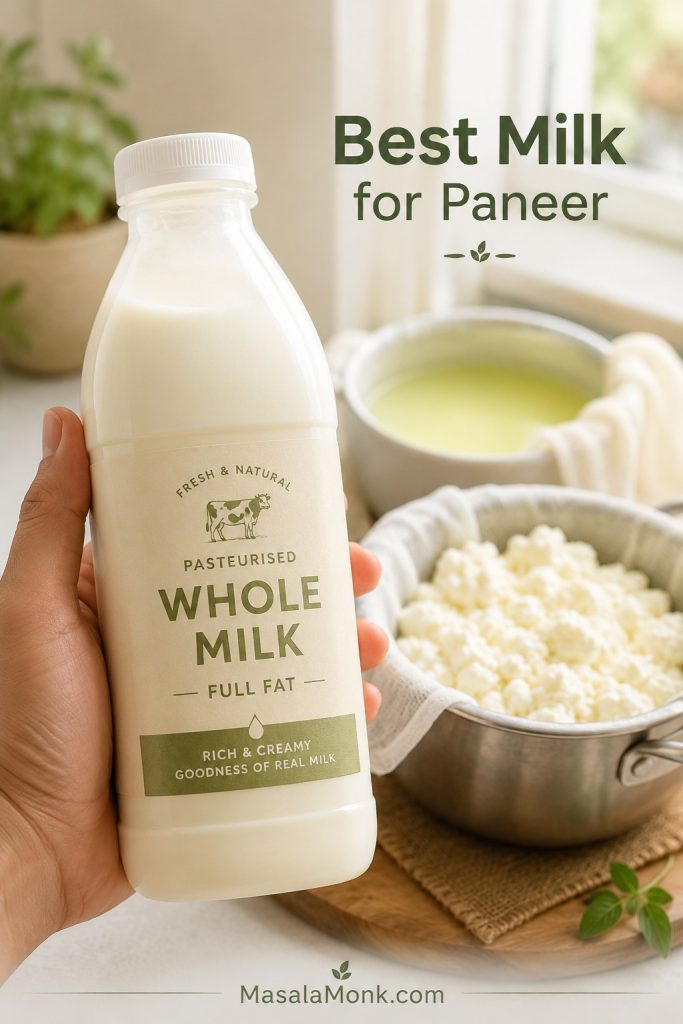
Generic whole milk carton held near soft paneer curds, muslin, and whey in a bright kitchen.
Start the paneer recipe at the milk carton. Whole milk or full-fat milk usually gives better curds, better yield, and a softer finished block.

Regular pasteurized whole cow’s milk is the best supermarket default. Buffalo milk is excellent if you can find it because it is richer and usually gives a softer, higher-yield paneer. Goat milk can work too, though the flavor is tangier and the curds may be more delicate.

The milk to be careful with is UHT, long-life, or ultra-pasteurized milk. These milks are treated at higher temperatures for longer shelf life, and that extra processing can make curd formation less reliable. If you are unsure what UHT or ultra-pasteurized means on a carton, this pasteurization guide explains the terms clearly.

Do not confuse regular pasteurized milk with ultra-pasteurized milk. Regular refrigerated pasteurized whole milk usually works well for paneer. The bigger issue is long-life, shelf-stable, UHT, or ultra-pasteurized milk, which can form weaker curds.
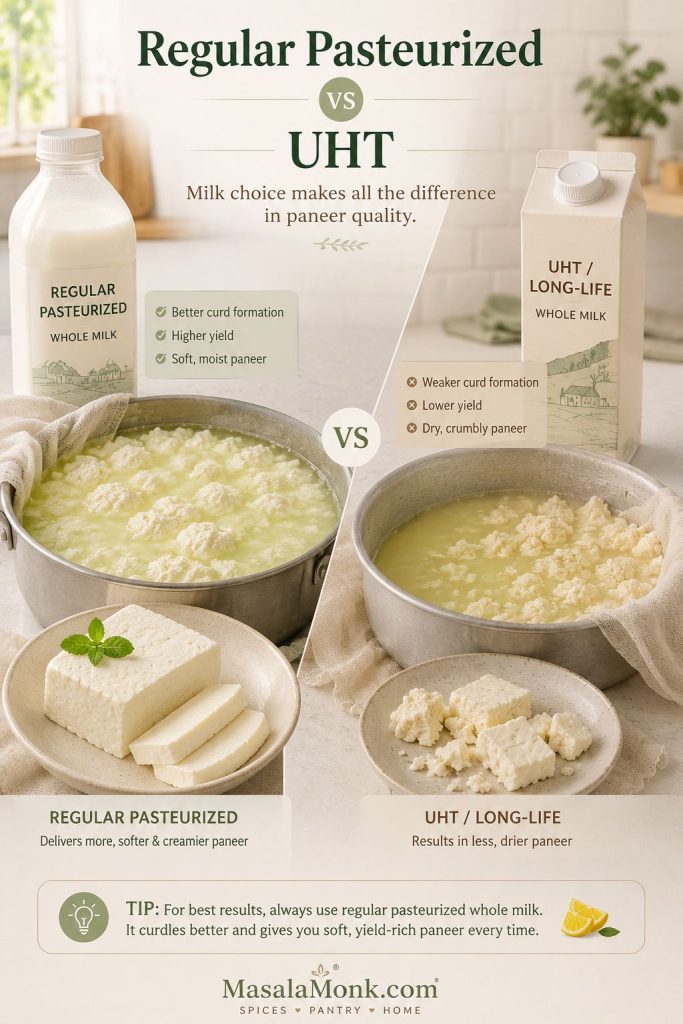
Regular pasteurized milk shown making clean paneer curds beside UHT milk shown with weaker curds.
Regular pasteurized milk and UHT milk are not equal for homemade paneer. If your milk will not curdle cleanly, long-life processing may be the reason.

Milk Labels That Work Best for Homemade Paneer
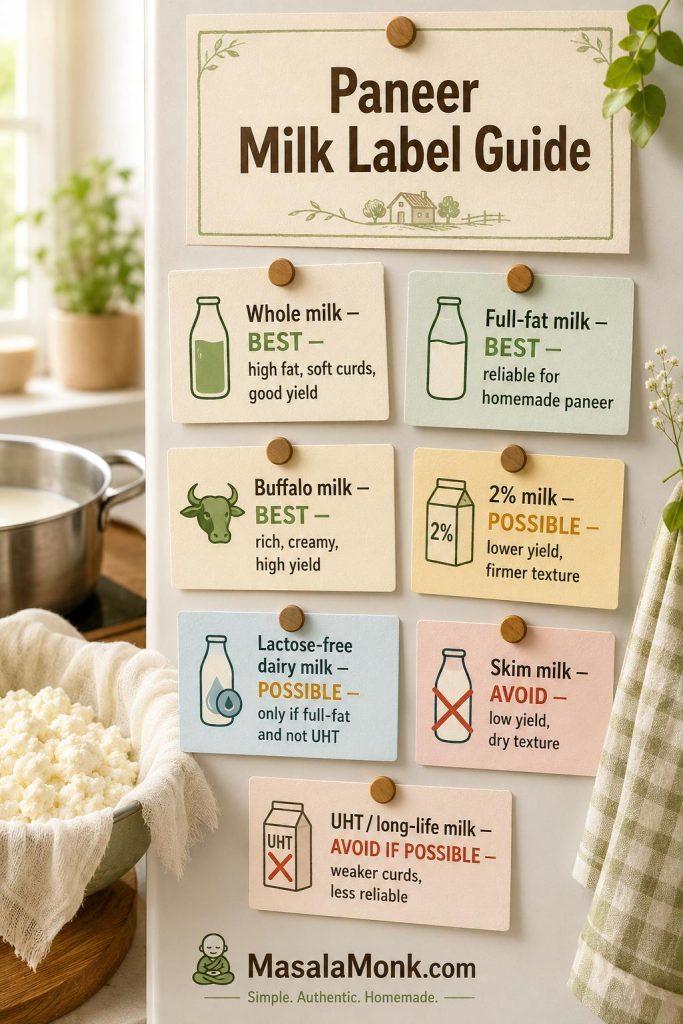
Milk label guide showing whole milk, full-fat milk, buffalo milk, 2 percent milk, lactose-free milk, skim milk, and UHT milk for paneer.
For soft homemade paneer, choose whole, full-fat, or buffalo milk when possible. Use 2% milk with lower-yield expectations, and avoid UHT or skim milk for reliable curds.
Milk labelUse for paneer?What to expect
Whole milk / full-fat milkBest choiceSoft, reliable curds and good yield.
Regular pasteurized cow’s milkYesThe best supermarket default for most readers.
Buffalo milkExcellentRicher, higher-yield, and traditionally prized for soft paneer.
Lactose-free dairy milkSometimesCan work if it is full-fat and not UHT or ultra-pasteurized.
2% milkPossible, not idealLower yield and a firmer, less creamy texture.
Skim or fat-free milkAvoidDry, weak, low-yield paneer that can crumble easily.
Organic milkCheck labelWorks if regular pasteurized, but some brands are ultra-pasteurized.
UHT / ultra-pasteurized / long-life milkAvoid if possibleMay curdle poorly or form weak curds.
Goat milkPossibleSofter curds and a tangier flavor.
Plant milkNot true paneerYou can make a vegan curd or tofu-style alternative, but it is not dairy paneer.

Important: Milk varies by country, brand, season, fat level, and processing. If one carton gives weak curds, do not blame yourself or the whole recipe. Try a different full-fat, non-UHT brand before changing the method.

If your milk is already hot but still not separating, go to Troubleshooting Homemade Paneer before adding too much acid.

Best Acid for Homemade Paneer: Lemon, Vinegar, Yogurt, or Citric Acid

Once the milk question is sorted, the next decision is acid. Paneer needs an acid to separate the milk into curds and whey. Lemon juice and plain white vinegar are the easiest choices for beginners because they are available almost everywhere. Yogurt, buttermilk, and citric acid also work, but they behave differently.

Watch the liquid around the curds; it tells you when to stop. The most important rule is not which acid you choose. It is how you add it. Dilute the acid with water, add it gradually, and stop as soon as the milk separates clearly. Too much acid can make paneer sour, grainy, firm, or rubbery.
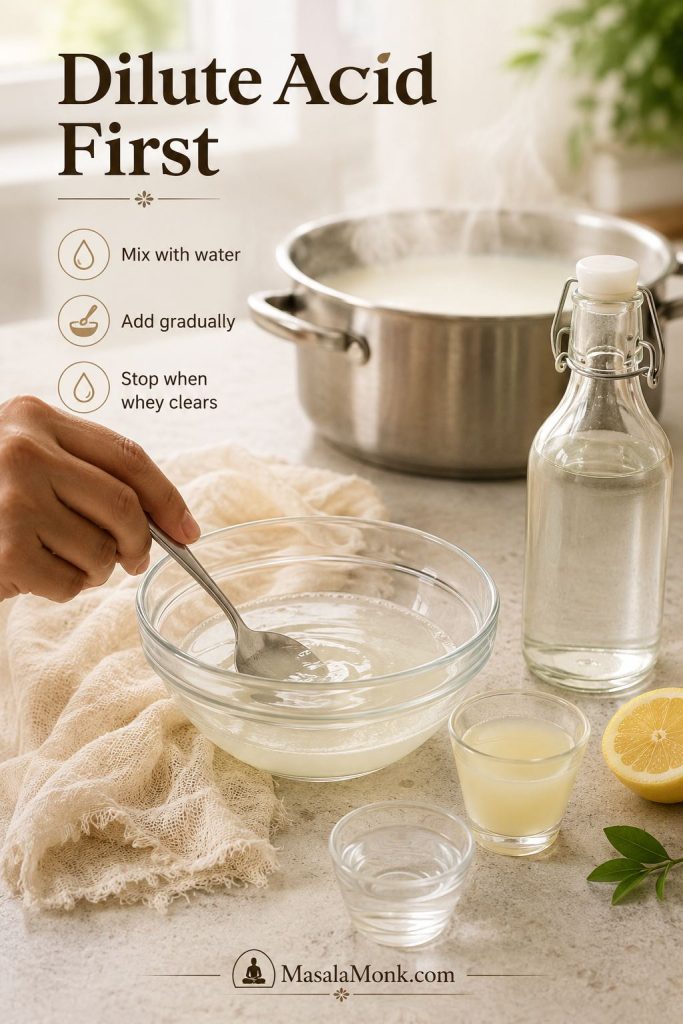
Lemon juice or vinegar being mixed with water in a glass bowl before being added to milk for paneer.
Think of acid as a trigger, not the main ingredient. Diluting it first helps you add it gently and stop before the paneer turns sour or grainy.

Paneer Acid Options

Choose the acid by flavor and texture, but keep the method the same: dilute it, add it gradually, and stop when the milk separates clearly.
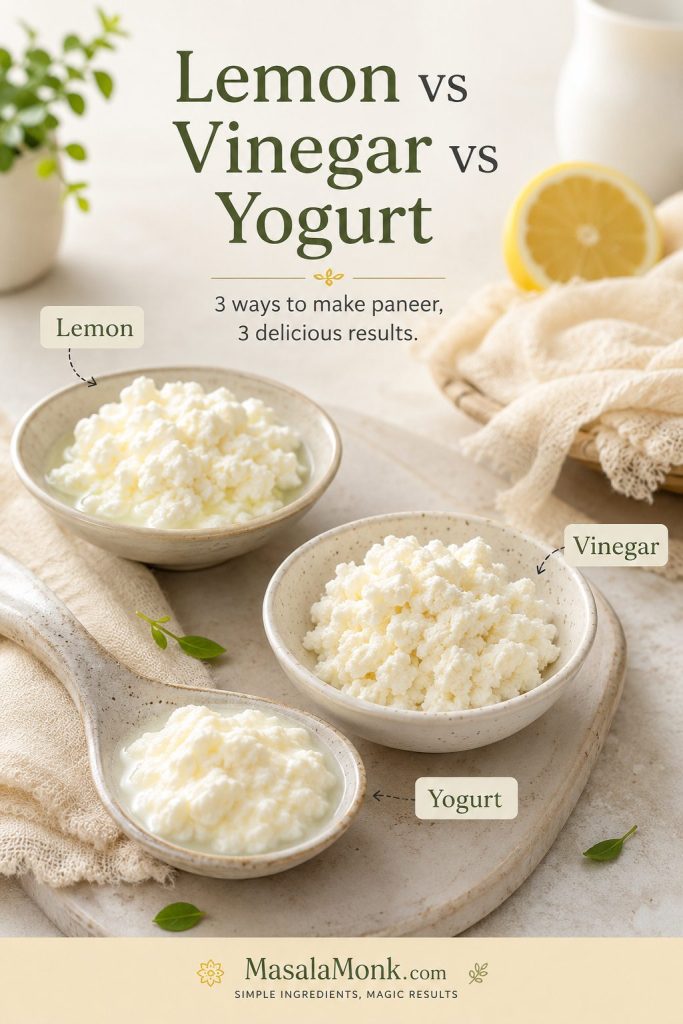
Lemon juice, vinegar, and yogurt shown with small paneer curd samples as acid options.
Lemon, vinegar, and yogurt can all make paneer. The choice affects flavor, but success still depends on adding acid gradually and stopping at the right whey cue.
AcidBest forFlavorTexture
Lemon juiceBeginner homemade paneerLight citrus note if not rinsedSoft to medium
Plain white vinegarReliable curdling and clean cubesNeutral if diluted and rinsedClean, firm curds
Yogurt / curdSofter paneerMild dairy tangSofter and moister
ButtermilkGentle curdlingMild tangSoft and delicate
Citric acidPrecise curdlingNeutral if measured carefullyCan turn firm if overused

How Much Acid to Use for Paneer

Practical starting point: for 2 litres / 8½ cups milk, start with 3 tablespoons / 45 ml diluted lemon juice or white vinegar. If using yogurt, start with ¼ cup / 60 g whisked plain yogurt and add more only if the whey still looks milky. If using citric acid, dissolve a very small amount in water first and add gradually; it is easy to overdo and can make paneer firm or sharp.
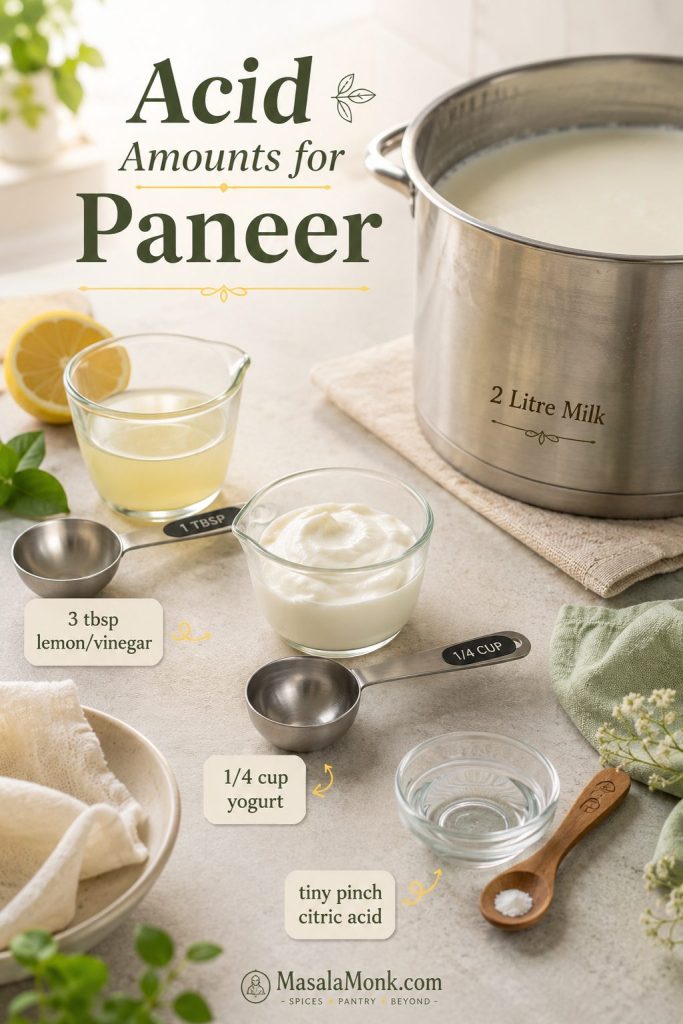
Measured lemon juice, vinegar, yogurt, and dissolved citric acid arranged beside a milk pot for paneer.
Measurements give you a safe starting point, but the pot gives the final answer. Stop when the curds gather and the whey clears.

Fresh lemon juice tastes clean, but lemons vary, so you may need a little more or less. Bottled lemon juice can work because it is consistent, though the flavor may be flatter than fresh lemon. Plain white vinegar is usually more predictable than fresh lemon juice and usually tastes neutral after dilution and rinsing.

Avoid strongly flavored vinegars unless you want that flavor in the paneer. Apple cider vinegar can work in a pinch, but plain white vinegar is cleaner. Whatever acid you use, add it slowly and watch the whey. The goal is not to empty the cup; the goal is to use only enough.

Step-by-Step Paneer Cues That Matter Most

The recipe card gives you the full method. These four cues keep homemade paneer soft instead of tight, sour, or rubbery.
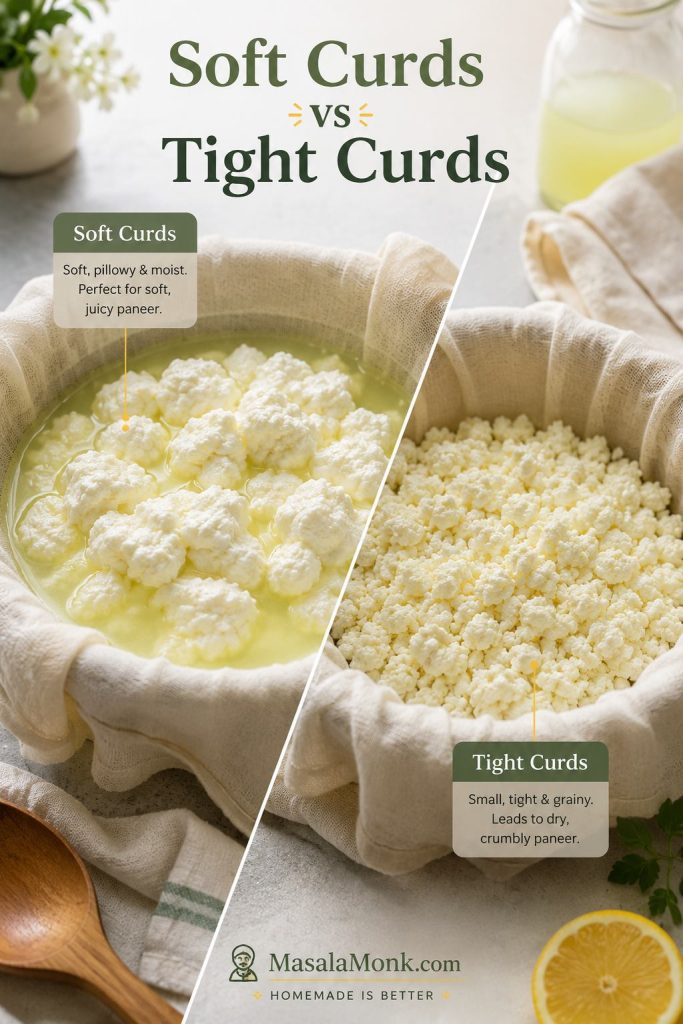
Soft pillowy paneer curds compared with tight grainy paneer curds in pale whey.
Good paneer curds should look soft, moist, and gathered. Tiny dry grains usually point to overheated milk, excess acid, or rough stirring.
  • Milk: use full-fat, non-UHT milk that separates cleanly.
  • Heat: stop at steaming and foamy, not a violent boil.
  • Acid: add it slowly and stop when the whey turns pale yellow-green and slightly translucent.
  • Draining: let gravity work before pressing; hard squeezing steals softness.

Rinsing Paneer Curds

Rinsing is useful when you used lemon juice or vinegar and want to remove sharpness. Keep it brief so the curds stay rich and delicate.
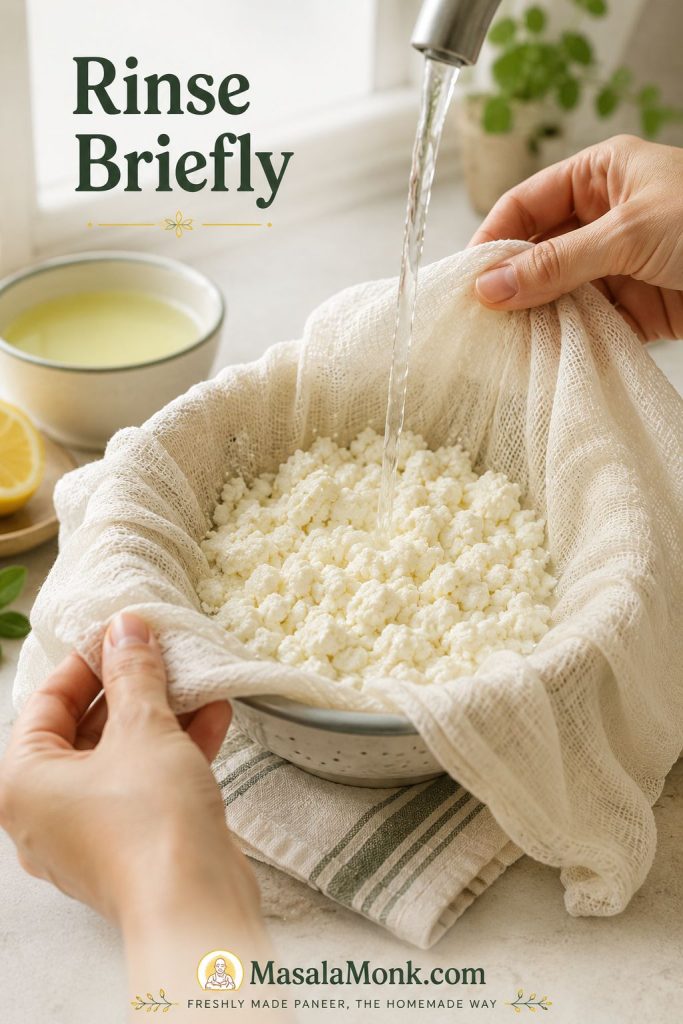
Paneer curds in muslin being briefly rinsed under cool water to reduce lemon or vinegar sourness.
A brief rinse can soften sharp lemon or vinegar flavor after straining. Keep it quick so the curds stay rich and do not lose too much dairy flavor.

Shape Before Pressing

Before you add weight, gather the drained curds neatly in the cloth. A tidy shape helps the paneer press evenly and cut more cleanly later.
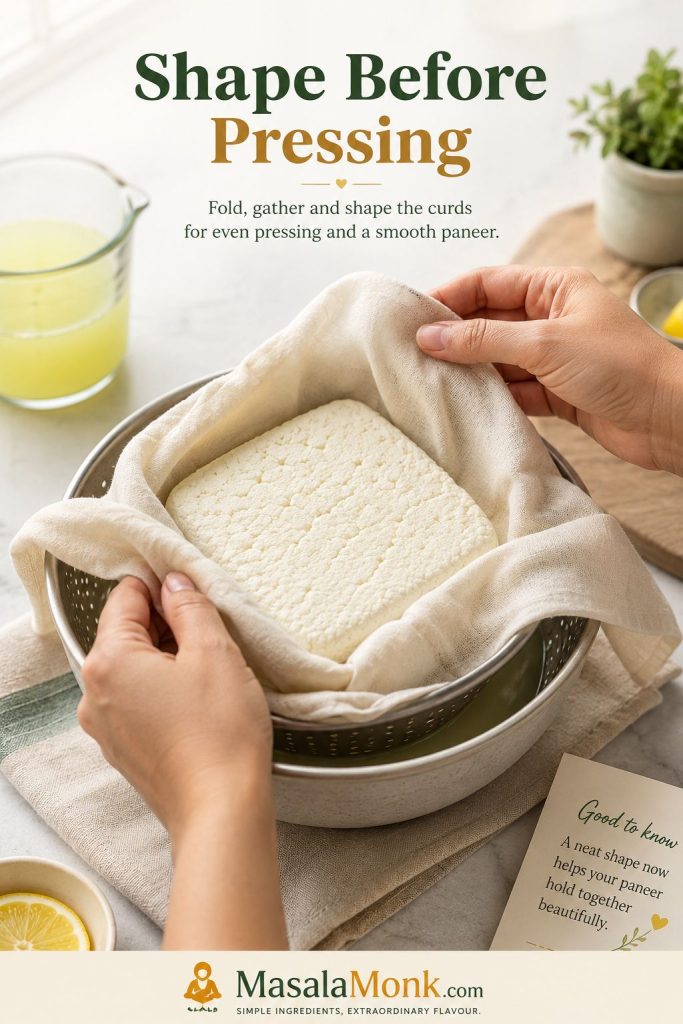
Hands folding muslin around drained paneer curds to shape them into a block before pressing.
Shape the curds before adding weight. This helps paneer set evenly, which makes cleaner cubes possible without forcing the block under heavy pressure.

How Long to Press Homemade Paneer

This is where you choose the paneer you actually want to eat: loose and soft for bhurji, tender for curry, or firm enough for skewers. Less pressing gives softer paneer. Longer pressing gives cleaner, firmer cubes.

If your paneer often turns hard, this is the section to slow down on. Pressing is not just a shaping step; it decides whether the paneer stays moist or becomes dense.
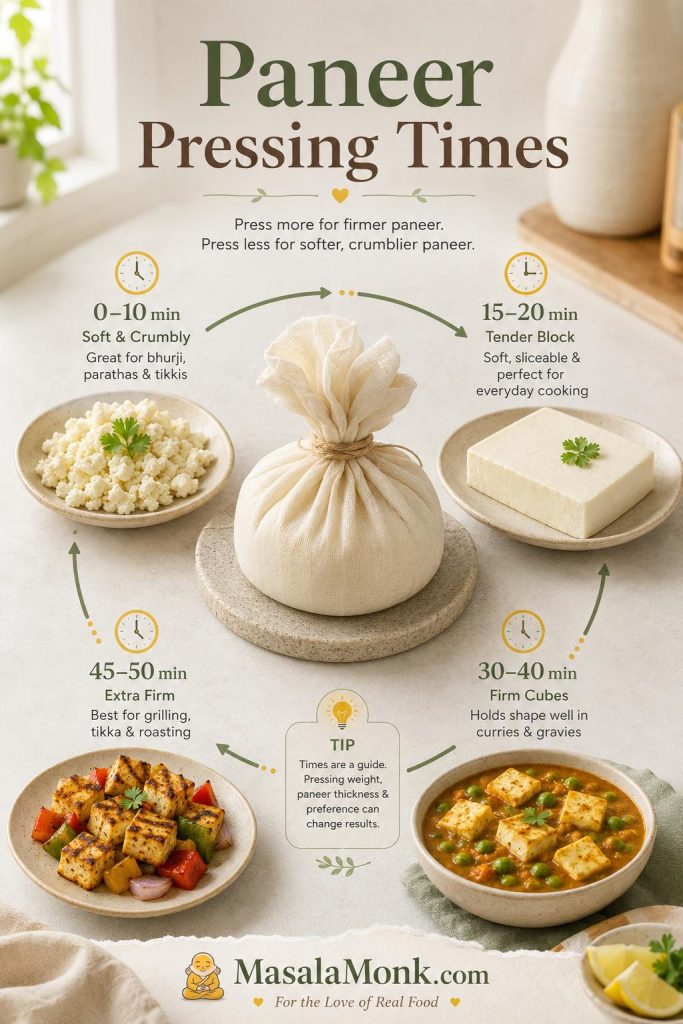
Paneer pressing guide showing soft crumbles, a tender block, curry cubes, and firmer tikka cubes with time cues.
The same paneer recipe can become soft bhurji curds, curry cubes, or tikka pieces. The difference is usually pressing time, not extra ingredients.
Final usePressing timeSuggested weightResult
Paneer bhurji, fillings, toast, sandwiches0–10 minutesNo weight or a very light plateLoose, soft curds
Bowls, salads, gentle pan-frying15–20 minutes400–600 g / 14–21 ozTender block
Curries like palak paneer, matar paneer, or balti paneer30–40 minutes600–900 g / 1.3–2 lbSliceable cubes that still stay moist
Paneer tikka, skewers, grilling45–50 minutes, then chill900 g–1.2 kg / 2–2.6 lbFirmer cubes that handle marinating and skewering
Very heavy pressing for several hoursAvoid for soft paneerAvoid heavy crushing weightCan become dense, dry, or rubbery

Use moderate weight, not crushing pressure. Two cans, a small pot, or a heavy skillet is enough for most home batches. If the paneer is for curry, a 30–40 minute press is usually plenty. If you want tidy cubes, chill the pressed block briefly before cutting.

Light vs Heavy Pressing

Use enough weight to form the block, not so much that the paneer loses all its moisture. This is especially important for curry cubes.
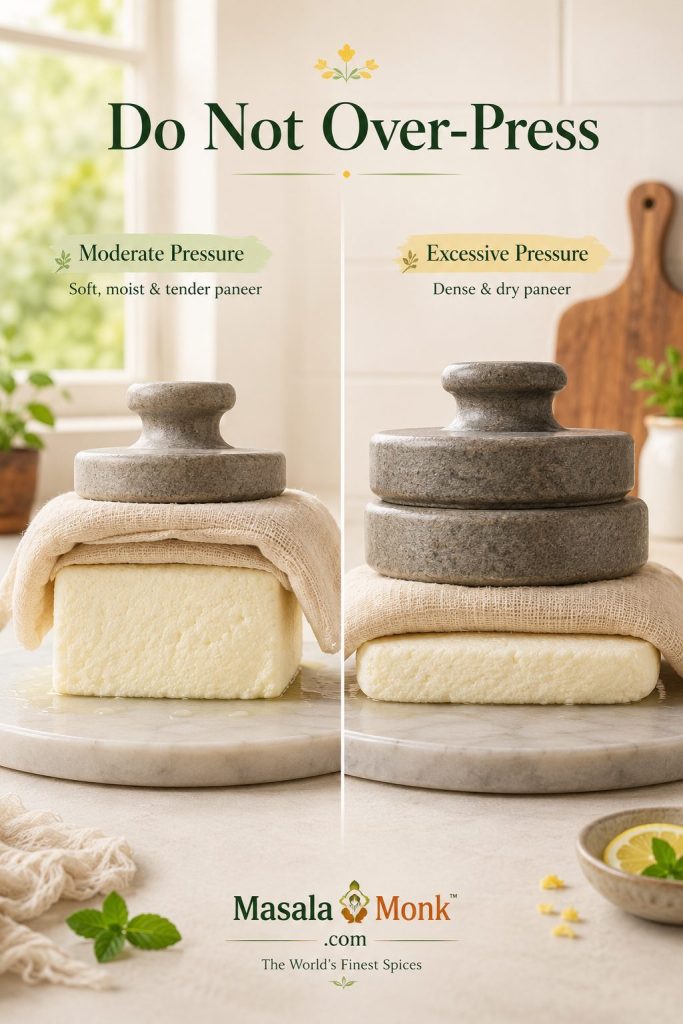
Light pressing compared with heavy pressing for paneer, showing a moist block and a denser compressed block.
Heavy pressing is one of the easiest ways to lose softness. For most paneer curries, moderate weight forms cubes without squeezing out all the moisture.

Once the paneer is pressed, the next texture risk happens in the pan. See How to Keep Paneer Soft When Cooking before adding the cubes to curry.

Soft Paneer vs Firm Paneer: Both Can Be Right

The best paneer is not always the firmest paneer. The right texture depends on what you are cooking next.
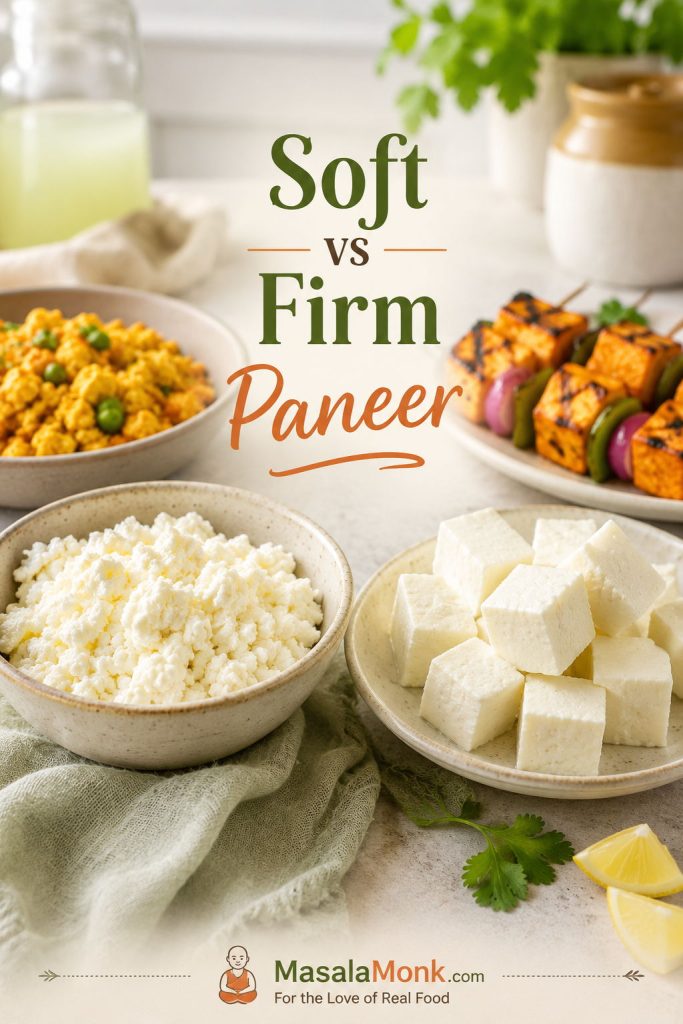
Soft crumbled paneer in a bowl beside firm paneer cubes, with bhurji and tikka-style uses in the background.
Soft paneer and firm paneer are both useful. Crumbles belong in fillings and bhurji, while firmer cubes work better for tikka, skewers, searing, and thicker gravies.

Soft paneer is delicate, moist, and slightly crumbly, so it works beautifully for bhurji, fillings, wraps, cutlets, quick bowls, and gentle curries where perfect cubes do not matter.

Firm paneer is better for tikka, skewers, grilling, pan-searing, or restaurant-style cubes in thick gravy. However, firm should not mean rubbery. Good firm paneer still has moisture inside.

How to Cut Paneer Cubes Cleanly

If you want tidy cubes, chill the pressed paneer briefly and cut with a sharp knife. Slightly larger cubes are easier to handle in curry.
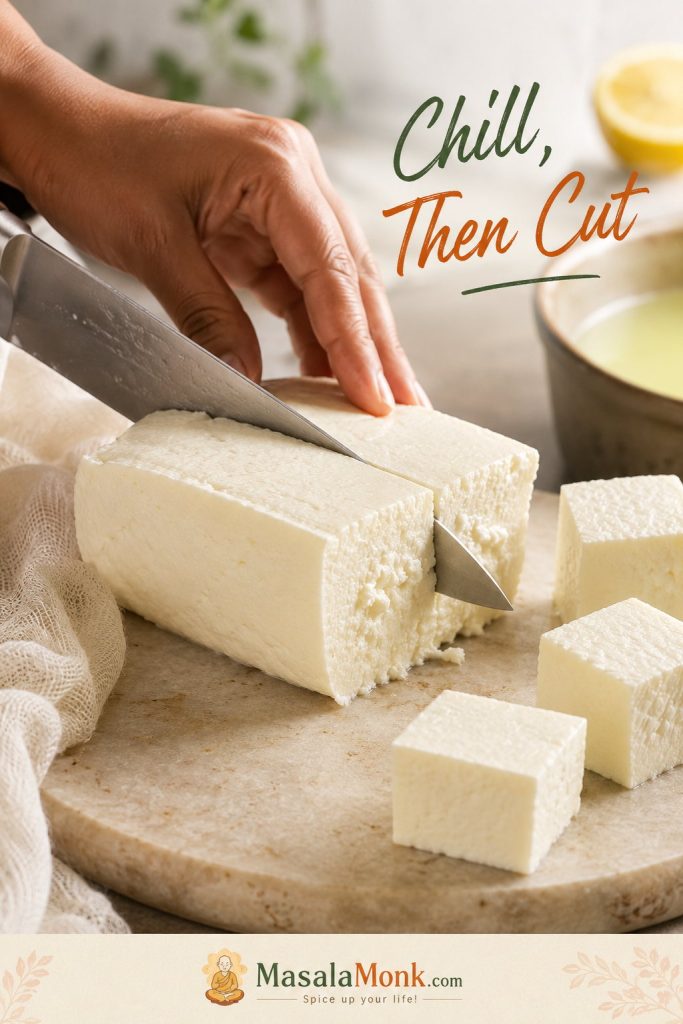
Pressed paneer block being cut into cubes with a sharp knife on a stone board.
If homemade paneer breaks when you cut it, chill the pressed block briefly first. A sharp knife and slightly larger cubes help tender paneer hold its shape.

How to Keep Paneer Soft When Cooking

Paneer can be perfect after pressing and still turn dry if it is cooked too aggressively. Most paneer dishes do not need the paneer to simmer for a long time. Add it when the sauce is already cooked, let it warm through gently, and avoid hard boiling. This matters in creamy gravies such as Kali Mirch Paneer, where paneer should stay tender rather than chewy.
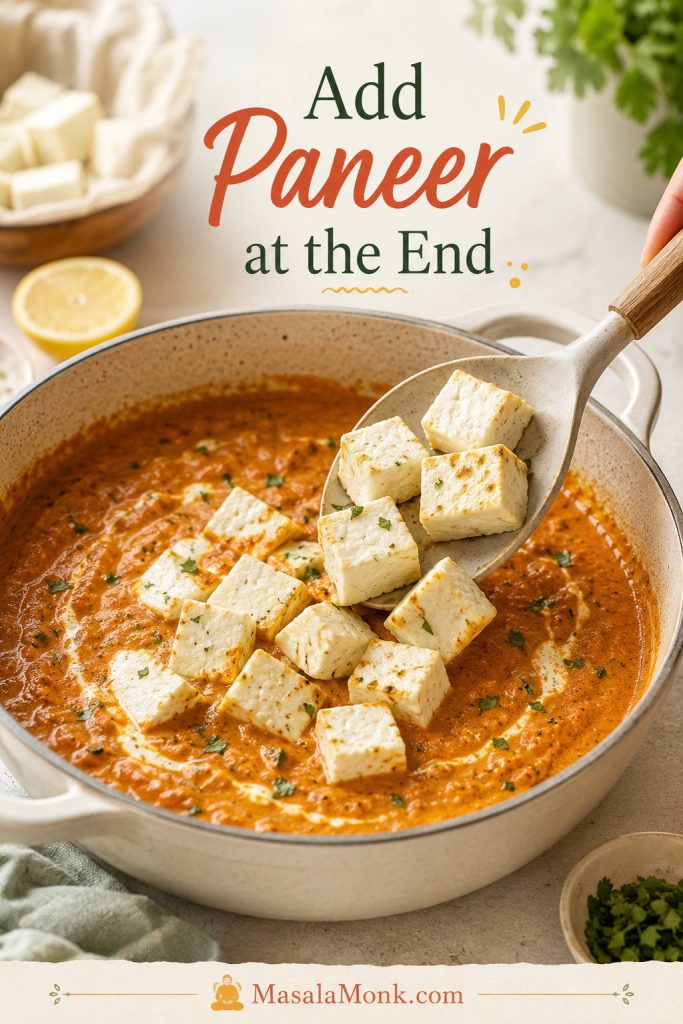
Paneer cubes being gently added to a finished curry with a spoon.
Let the gravy finish cooking before the paneer goes in. Then the cubes only need a gentle warm-through, which helps them stay tender.
  • Curries: add paneer near the end and simmer gently for only a few minutes.
  • Pan-frying: sear quickly, then remove or add sauce. Long frying can toughen paneer.
  • Store-bought paneer: soak cubes in warm water for 10–15 minutes before cooking, especially if the block feels cold and stiff.
  • Homemade paneer: avoid over-pressing if it is going into a soft curry.
  • Paneer tikka: press firmer, chill before cutting, and handle gently while marinating.

Homemade paneer is often softer than store-bought paneer, so treat it gently. Use a sharp knife, cut slightly larger cubes if the paneer feels delicate, and avoid aggressive stirring after adding it to curry. If you are making a rich paneer gravy, the sauce should be ready before the paneer goes in. Paneer should finish the dish, not endure the whole cooking process.

Homemade Paneer vs Store-Bought Paneer

Store-bought paneer is convenient, and there is nothing wrong with using it. It is helpful when you are short on time or cooking a quick dinner. But homemade paneer gives you freshness and texture control that packaged paneer often cannot match.
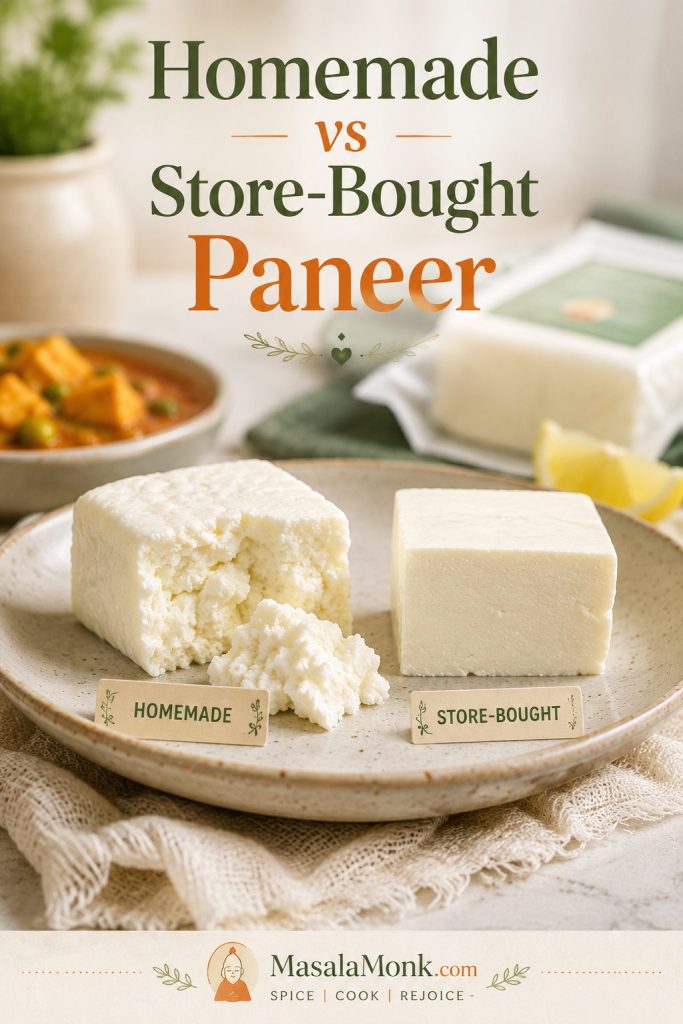
Homemade paneer cube broken open beside a firmer store-bought-style paneer cube with generic packaging blurred behind.
Store-bought paneer is useful when you are short on time, but homemade paneer lets you control moisture, pressing, and softness from the start.

Many store-bought paneer blocks are firmer because they are pressed, packaged, transported, refrigerated, and stored before you cook with them. Some are excellent, but many are denser than the paneer you would make fresh at home.

If your only experience with paneer has been hard cubes that sit separately from the sauce, homemade paneer can change how you think about the dish. Good paneer should be gentle, milky, and tender enough to belong inside the gravy, not feel like a separate chewy block.

You can also fold homemade paneer into vegetable dishes near the end, as in an Aloo Gobi with Paneer variation, where the cubes add protein without needing a long cooking time.

Already Bought Paneer? Here’s How to Soften It

Warm-water soaking can relax cold store-bought paneer and make it feel less stiff, but it may not fully rescue a very dense block. Choose the method based on the dish.
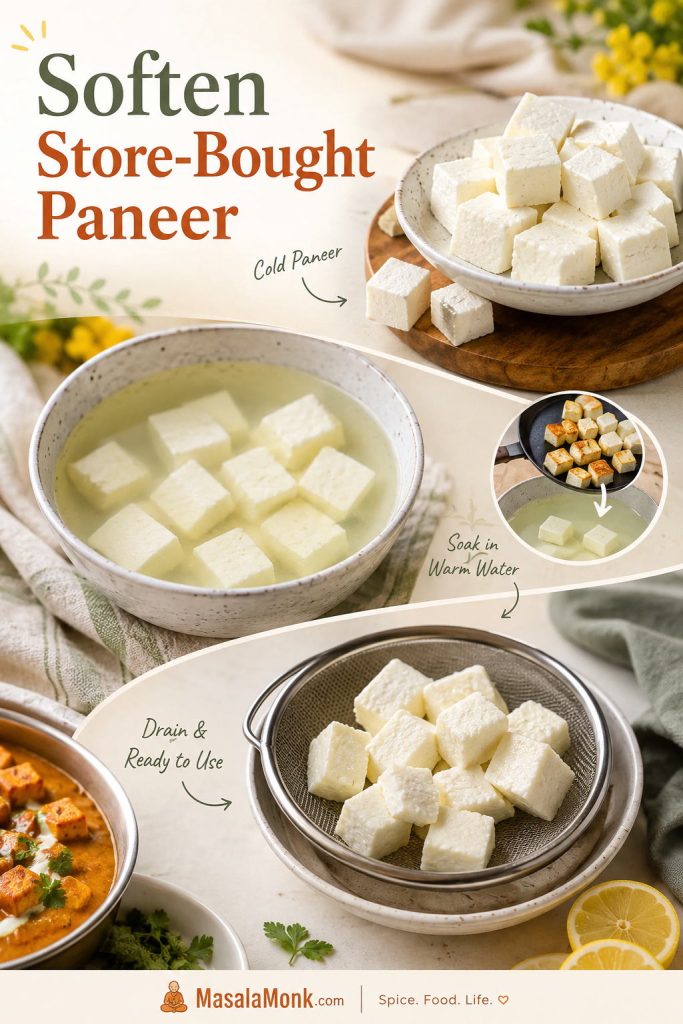
Store-bought paneer cubes shown cold, soaking in warm water, and drained after softening.
Warm-water soaking can relax cold packaged paneer before it goes into curry. It will not fix every dense block, but it often makes store-bought paneer gentler to eat.
  • Quick curries: cut the paneer into cubes and soak in warm water for 10–15 minutes, then drain gently.
  • Browned paneer in saucy dishes: shallow-fry the cubes briefly, then soak them in warm water before adding them to the gravy.
  • Delicate creamy gravies: skip hard frying and add paneer near the end so it only warms through.
  • Very rubbery paneer: soaking helps, but it may not completely fix an over-pressed or low-moisture block.

If packaged paneer keeps turning dense for you, the pressing guide shows how homemade paneer can be adjusted for softer curry cubes or firmer tikka pieces.

Paneer vs Tofu, Halloumi, Ricotta, Queso Fresco, and Cottage Cheese

If you are new to paneer, think of it as a mild, dairy-based cheese that holds its shape. Firm tofu is the closest non-dairy shape-holder, halloumi is saltier and springier, and queso fresco or queso blanco can be crumbly or tangier. Ricotta works better for soft fillings than cubes, while Western cottage cheese is wet and curdy rather than pressed.

Small plates of paneer, firm tofu, halloumi, queso fresco, and ricotta or cottage cheese arranged for comparison.
Paneer is mild, fresh, and sturdy enough to hold its shape. Tofu, halloumi, queso fresco, and ricotta can help in some recipes, but none behave exactly the same.

If paneer is not sold where you live, homemade is often easier than hunting for the perfect substitute.

Richer Malai-Style Paneer Variation

If you are using regular cow’s milk and want richer, softer paneer, you can make a malai-style variation by adding cream. This is especially useful if your local milk produces firmer paneer than you like.
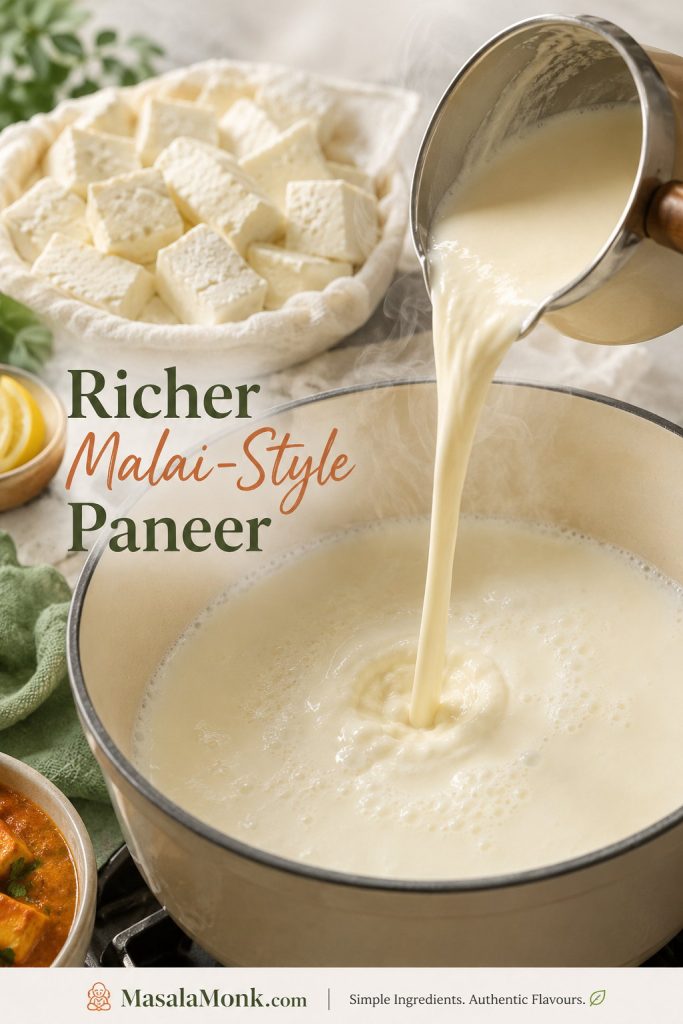
Cream being poured into warm milk in a pot with soft paneer cubes in the background.
A malai-style paneer variation adds richness when local milk gives firmer curds. Use a little cream with whole milk for a fuller, softer homemade paneer texture.

For 2 litres / 8½ cups whole milk, add ¼–½ cup / 60–120 ml heavy cream or replace ½ cup / 120 ml of the milk with cream. Use plain dairy cream without strong stabilizers if possible. Heat, curdle, strain, and press as usual. Because the extra fat makes the curds richer and softer, press gently unless you specifically need firm tikka cubes.

Can You Make Paneer with 2% or Low-Fat Milk?

You can make paneer with 2% milk, but it will not behave like whole-milk paneer. Expect less yield, leaner curds, and a block that may taste firmer or more crumbly. It can still work for bhurji, fillings, or macro-focused cooking, but whole milk is better for soft curry cubes.
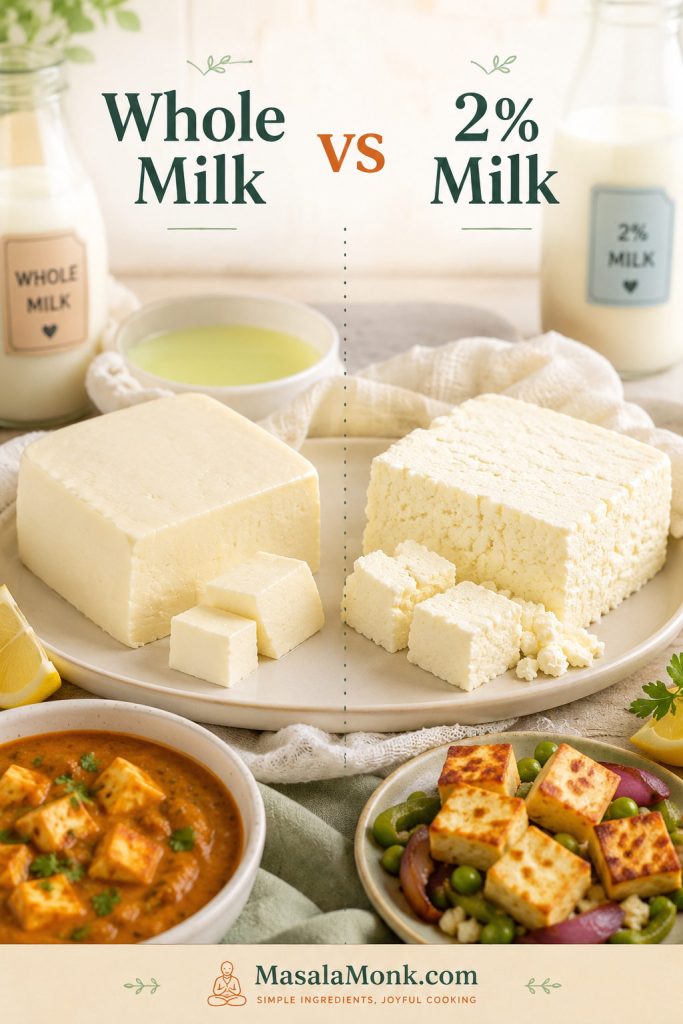
Whole milk paneer compared with a firmer and more crumbly 2 percent milk paneer result.
Low-fat milk can curdle, but the paneer is usually leaner, lower-yield, and more crumbly. For soft curry cubes, whole milk is the more forgiving choice.

Skim milk or fat-free milk is not recommended for this recipe. If you must use lower-fat milk, keep the method gentle: avoid harsh boiling, add acid gradually, rinse briefly, press lightly, and store the paneer in water. Expect a different result from full-fat paneer.

Instant Pot Note

You can make paneer in an Instant Pot, especially with the yogurt-boil function. Use it only to heat the milk; do not pressure cook the paneer. Once the milk is hot and foamy, add diluted lemon juice or vinegar gradually, then follow the same resting, straining, and pressing method. For your first batch, the stovetop is still easier because you can see exactly when the milk is hot enough and when the curds separate.

How to Use Homemade Paneer

Homemade paneer is best when you match the texture to the dish: soft curds for fillings, tender cubes for curries, and firmer cubes for grilling or skewers.

Homemade paneer used in curry, bhurji, tikka skewers, wraps, salad, and pan-seared cubes.
Once you know how to make paneer at home, it becomes a flexible vegetarian protein. Use soft curds in fillings, tender cubes in curry, and firmer pieces for tikka or searing.

Use soft crumbled paneer for fillings and quick meals

Soft paneer curds are excellent for paneer bhurji, toast, wraps, paratha fillings, sandwiches, cutlets, and snack-style recipes. They also work well in comfort-food ideas like Indian Cottage Cheese Jaffles, where a soft filling matters more than tidy cubes.

Use soft cubes for curries and vegetable dishes

For curries, you want paneer that holds shape but still feels moist. Press for 30–40 minutes, chill if needed, then add the cubes near the end of cooking. The sauce should be ready first; paneer only needs a few gentle minutes to warm through. This works for palak paneer, matar paneer, paneer butter masala, kadai paneer, and similar gravies.

Use firmer cubes for tikka, skewers, and grilling

For paneer tikka or skewers, press a little longer and chill before cutting. Firmer paneer is easier to marinate and thread onto skewers. Handle it gently, especially if your homemade paneer is softer than packaged paneer.

Use paneer for vegetarian protein

Paneer is also useful in vegetarian meal prep because it adds protein and richness without needing a long cooking time. Use it in salads, rice bowls, wraps, cutlets, and Indian-style meal prep plates. For more protein-focused Indian meal ideas, see MasalaMonk’s High-Protein Indian Meal Prep.

Do Not Throw Away the Whey

After you strain paneer, you will be left with whey: the pale yellow liquid that separated from the curds. It may look like something to discard, but it is useful in the kitchen.
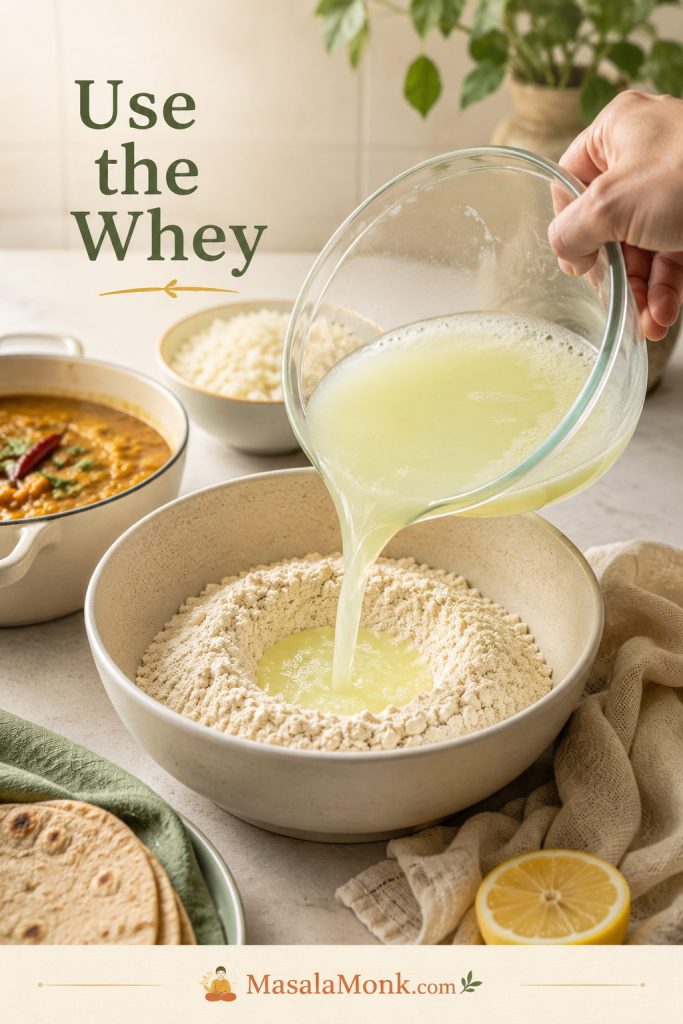
Leftover paneer whey being poured into flour or dough, with dal and rice in the background.
Mild paneer whey is too useful to throw away. Add it to roti dough, dal, soups, rice, oats, or grains whenever a little extra dairy tang fits the dish.
  • Use whey to knead flatbread, roti, naan, paratha, or bread dough.
  • Add it to lentils, dals, soups, stews, and curries.
  • Use it as part of the liquid for rice, quinoa, oats, or other grains.
  • Add a small amount to smoothies if it is not too sour.
  • Freeze it in small portions for later cooking.
  • Use very sour whey carefully, because it can change the flavor of delicate dishes.

Mild whey is useful in dough, rice, dals, and soups. Very sour whey is better in robust curries, breads, or flatbreads where a little tang makes sense. Avoid using sour whey in delicate desserts or plain rice unless you specifically want that flavor.

Refrigerate whey promptly and use it within 2–3 days, or freeze it in small portions. If you make paneer often, you can also use leftover whey from one batch to help curdle a future batch, although lemon juice or vinegar is easier for beginners.

Storing the paneer too? Use the storage and freezing guide so the cubes stay fresh while the whey gets used in dough, dal, rice, or soup.

How to Store and Freeze Homemade Paneer

Homemade paneer is a fresh, high-moisture cheese, so treat it gently and use it soon. Fresh paneer is softest the day it is made, but it can be refrigerated for a short time. Do not leave it sitting at room temperature for long. Cool it, cover it, and refrigerate it promptly.

Storage methodBest timeNotes
Same dayBest textureUse fresh paneer the day you make it for the softest result.
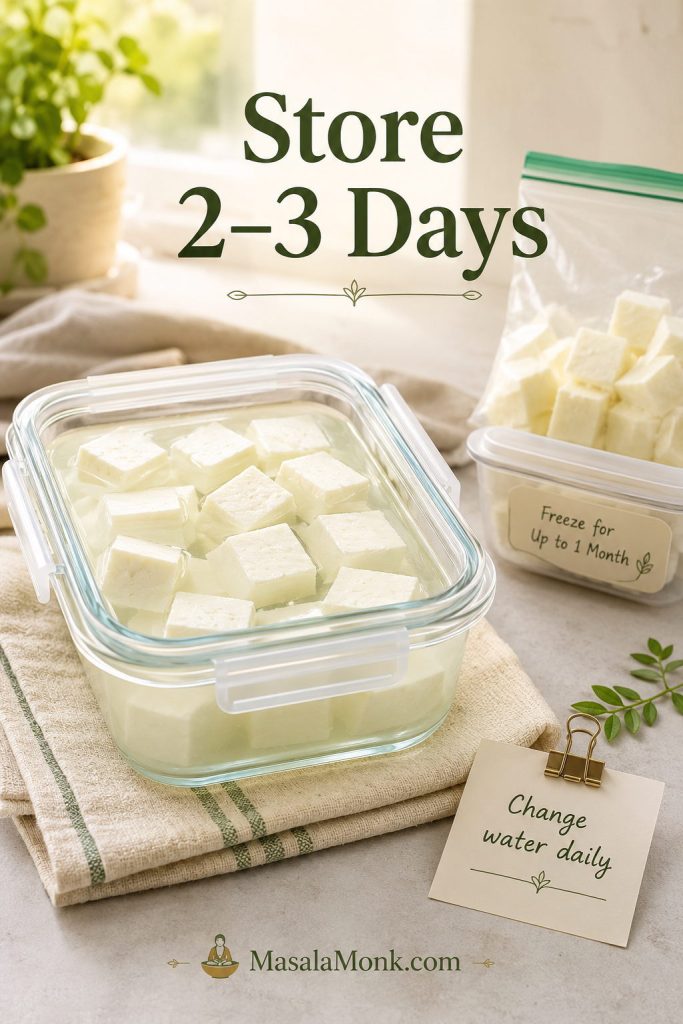
Refrigerator2–3 daysStore covered or submerged in fresh cold water. Change water daily.
FreezerUp to 1 month for best textureFreeze in portions. Thaw in the fridge and soak briefly in warm water before using if needed.
Homemade paneer cubes stored in fresh water inside a glass container with freezer portions and a note to change water daily.
Water storage keeps fresh paneer from drying out, but it does not make it long-keeping cheese. Change the water daily and use the paneer within 2–3 days.

To refrigerate paneer, cool it first, then store it in an airtight container. For softer paneer, cover it with fresh drinking water, keep the container covered, and change the water daily. Avoid storing paneer in very sour whey unless you want the flavor to become tangier. For broader cold-storage guidance, FoodSafety.gov has a useful reference, but for homemade paneer, the simple rule is: refrigerate promptly and use it within 2–3 days.

Unsalted homemade paneer tastes freshest sooner; if you lightly salt the curds, it may taste seasoned for snacks but should still be treated as a fresh cheese and used quickly.

If paneer smells sour in a bad way, feels slimy, looks moldy, becomes fizzy, or feels unusually sticky, discard it.

Troubleshooting Homemade Paneer

When you make paneer at home, an imperfect batch does not always mean failure. Paneer that will not cube neatly can still become bhurji, a sandwich filling, paratha stuffing, cutlets, toast, or a quick scramble. Most paneer problems are texture problems, not total failures.
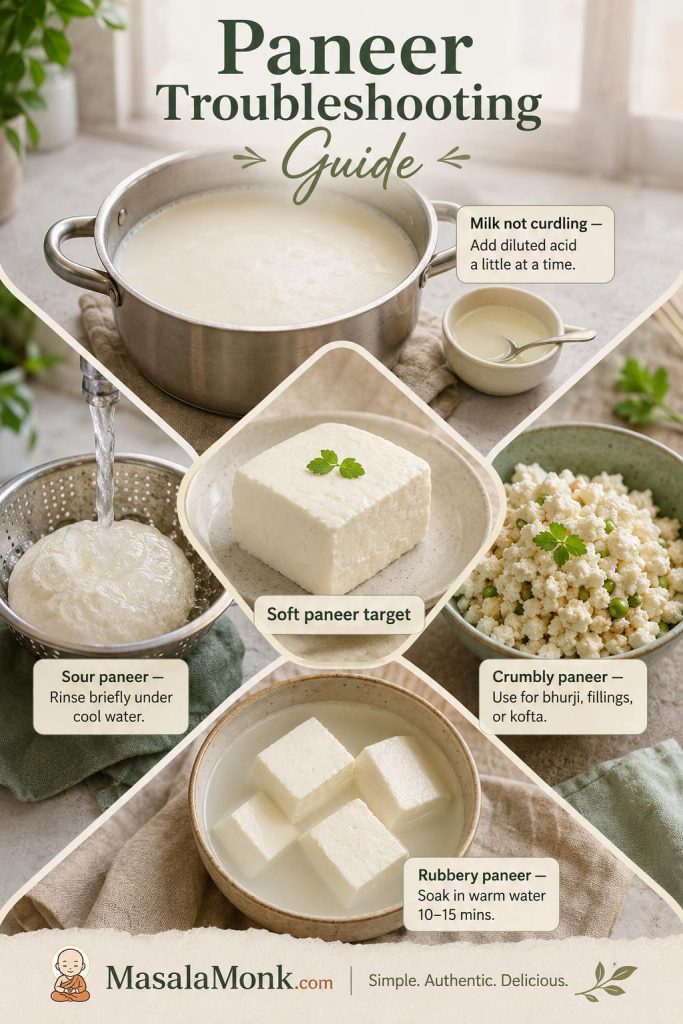
Paneer troubleshooting guide showing milk not curdling, sour paneer, crumbly paneer, rubbery paneer, and a soft paneer target.
Not every imperfect paneer batch is wasted. Milk that will not curdle can be adjusted slowly, sour curds can be rinsed, and crumbly paneer can still become bhurji or fillings.

Use the table below to decide what to do now and what to change next time.

ProblemLikely causeFix nowFix next time
Milk did not curdleMilk was not hot enough, not enough acid, or UHT/ultra-pasteurized milkReheat gently and add diluted acid 1 teaspoon at a timeUse full-fat, non-UHT milk
Whey still looks milkyIncomplete separationRest longer or add a little more diluted acidWait for pale yellow-green, slightly translucent whey before straining
Paneer tastes sourToo much acid or not rinsedRinse briefly under cool waterDilute acid and stop adding it earlier
Paneer is rubberyOverheating, too much acid, over-pressing, or harsh cookingSoak cubes in warm water for 10–15 minutesUse gentler heat, gradual acid, and shorter pressing
Paneer is crumblyWeak curds, low-fat milk, over-acidified curds, or not enough pressingUse it as bhurji or fillingUse richer milk and press slightly longer
Paneer breaks in curryToo soft, cut too soon, or stirred too roughlyAdd gently when the sauce is readyPress 30–40 minutes and chill before cutting
Paneer is dry after cookingFried or simmered too longSoak briefly in warm waterCook the sauce first, then warm paneer through gently

Why did my milk not curdle?

Usually, the milk was not hot enough, the acid was too weak, or the milk was UHT / ultra-pasteurized. Bring the milk back to 185–195°F / 85–90°C, add 1 teaspoon diluted lemon juice or vinegar, stir gently, and wait 30–60 seconds. Repeat only until the whey clears and the curds separate.

If the milk still refuses to separate, the milk itself may be the issue. Try another full-fat, non-UHT brand next time.

Why is my paneer rubbery?

Rubbery paneer usually comes from hard boiling, too much acid, heavy pressing, or long cooking in sauce. To rescue a batch, soak the cubes in warm water for 10–15 minutes. This will not fully reverse overcooking, but it can make the texture noticeably softer.
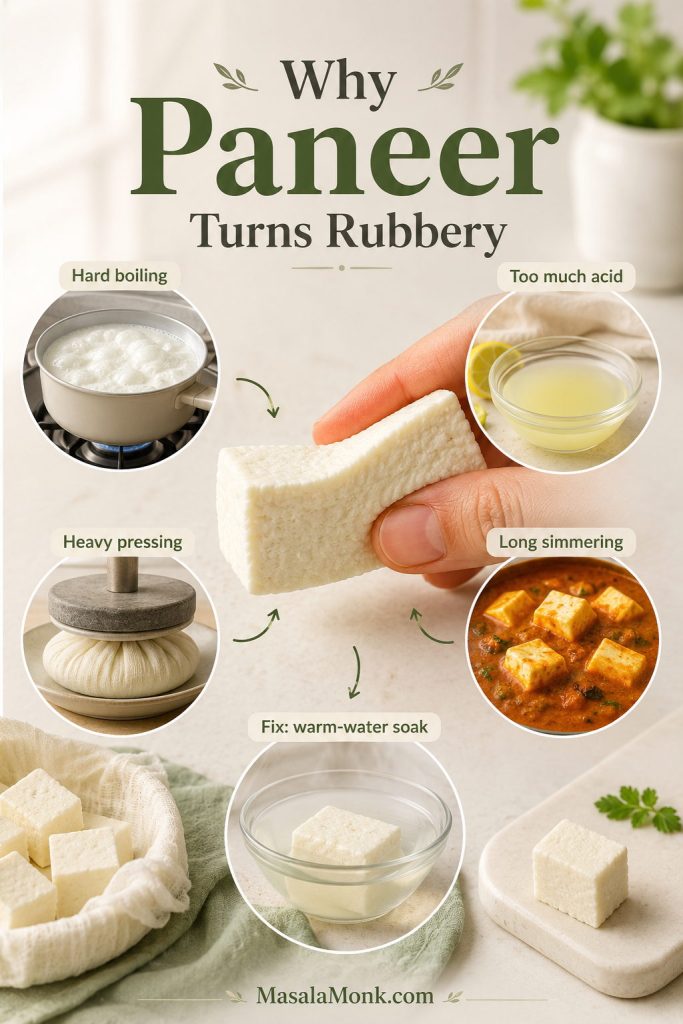
Causes of rubbery paneer shown around a firm paneer piece, including hard boiling, too much acid, heavy pressing, and long simmering.
Rubbery paneer is usually a moisture-loss problem. Harsh heat, extra acid, heavy pressing, and long simmering all tighten the curds, so controlling those steps keeps paneer softer.

Why does my paneer taste sour?

Sour paneer usually means too much lemon juice or vinegar remained in the curds. Rinse the curds briefly under cool water after straining. Next time, dilute the acid and add it gradually. Stop once the whey is clear enough and no longer looks milky.

Why is my paneer crumbly?

Crumbly paneer is not always bad. If it is moist and soft, use it for paneer bhurji, sandwich fillings, paratha fillings, cutlets, or toast. For a snackier route, lightly pressed or crumbled paneer also works in vegetarian patties such as Protein Packed Millet Cutlets.

For cleaner cubes next time, use full-fat, non-UHT milk, add acid slowly, rest the curds before straining, press for 30–40 minutes, and chill before cutting.

Why did my paneer break in curry?

The paneer may have been too soft for cubes, cut before it fully set, or stirred too roughly in the sauce. For curries, press the paneer for 30–40 minutes, chill it briefly, cut with a sharp knife, and add it only when the sauce is ready. Stir gently after adding paneer.

How do I make softer paneer next time?

Use richer milk, gentler heat, gradual acid, and shorter pressing. For especially soft paneer, add a little cream to the milk or use yogurt as the acid once you are comfortable with the basic method.

After you identify the problem, return to the homemade paneer recipe and watch the step-by-step paneer cues more closely on your next batch.

FAQs About Homemade Paneer

What is the best milk for making paneer at home?

Whole milk or full-fat milk is best because it gives better curds, better yield, and a softer texture. Regular pasteurized whole cow’s milk is the safest supermarket default.

Why did my milk not curdle?

Usually the milk was not hot enough, the acid was too weak, or the milk was UHT / ultra-pasteurized. Reheat gently, add diluted acid 1 teaspoon at a time, and stop once the whey clears.

Lemon juice or vinegar: which is better for paneer?

Both work. Lemon juice tastes fresher but varies in acidity. Plain white vinegar is more predictable and usually tastes neutral after dilution and rinsing.

How much paneer do you get from 1 litre, 2 litres, or 1 gallon of milk?

Yield varies by milk, fat level, draining, and pressing. Expect about 150–200 g from 1 litre, 300–400 g from 2 litres, and 600–750 g from 1 gallon / 3.8 litres.

How do you make paneer soft instead of rubbery?

Rubbery paneer usually comes from hard boiling, too much acid, heavy pressing, or long cooking in sauce. Use gentler heat, add acid gradually, press for less time, and add paneer near the end of cooking.

Is paneer the same as cottage cheese?

Not exactly. Paneer is sometimes called Indian cottage cheese, but Western cottage cheese is loose and wet, while paneer is drained and pressed.

Can ultra-pasteurized or UHT milk be used for paneer?

It may work sometimes, but it is not the best choice. Ultra-pasteurized and UHT milk can form weak, grainy, or unreliable curds. For your first batch, use full-fat, non-UHT milk if you can.

Can lactose-free milk be used for paneer?

Lactose-free dairy milk can work if it is full-fat and not UHT or ultra-pasteurized. Check the carton carefully, because some lactose-free milks are processed for long shelf life and may curdle less reliably.

What should I do with leftover whey?

Use whey in doughs, dals, soups, curries, rice, oats, or grains. You can also freeze it in small portions. If the whey is very sour, use it in recipes where a slight tang makes sense.

How long does homemade paneer last?

Homemade paneer tastes best the day it is made. Refrigerate it for 2–3 days, covered or submerged in fresh cold water. Change the water daily if storing submerged. Freeze for up to 1 month for best texture.

When should paneer be added to curry?

Add paneer near the end of cooking. The sauce should already be cooked and seasoned. Once the paneer goes in, simmer gently for a few minutes so it warms through without becoming tough.

Final Thought

Once you learn how to make paneer at home, the process becomes less about doing something complicated and more about reading what the milk is telling you. Use milk that curdles cleanly, heat it gently, add only enough acid, and press the curds for the dish in front of you.

After one good block, paneer stops feeling like a specialty-store ingredient. It becomes something you can make when a curry needs soft cubes, a wrap needs a filling, or a quick vegetarian meal needs something fresh, milky, and satisfying.
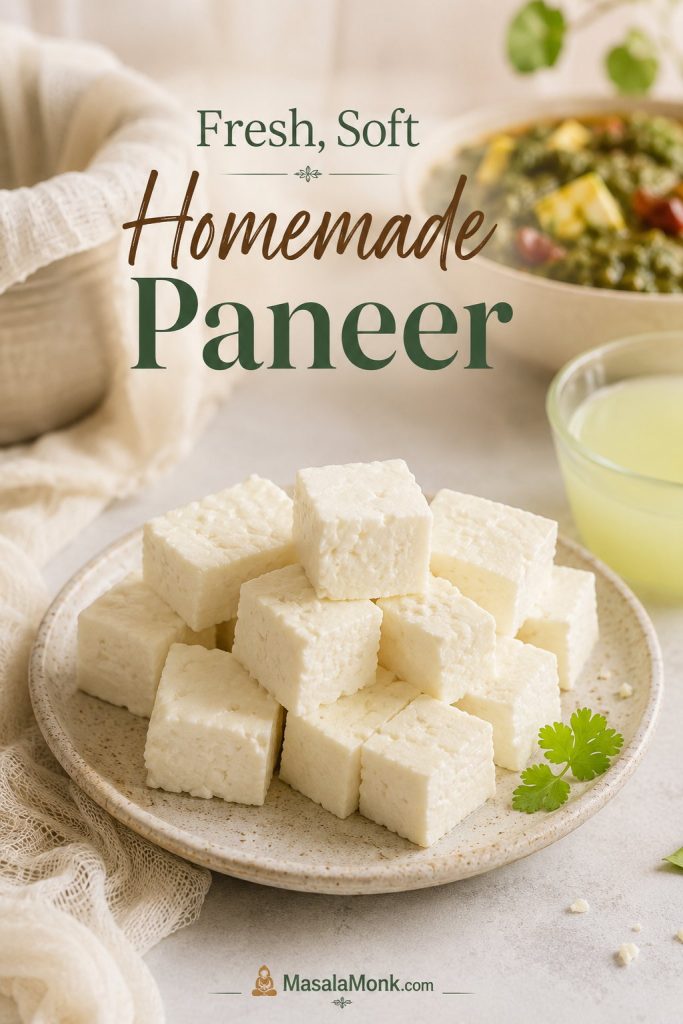
Fresh homemade paneer cubes on a ceramic plate with muslin, pale whey, and a blurred curry or greens in the background.
Good homemade paneer should feel simple by the end: clean curds, gentle pressing, soft cubes, and a fresh milky texture ready for the dish you want.

Back to top

Posted on 6 Comments

Chicken Adobo — Step-by-Step Recipe — Classic Filipino Adobong Manok

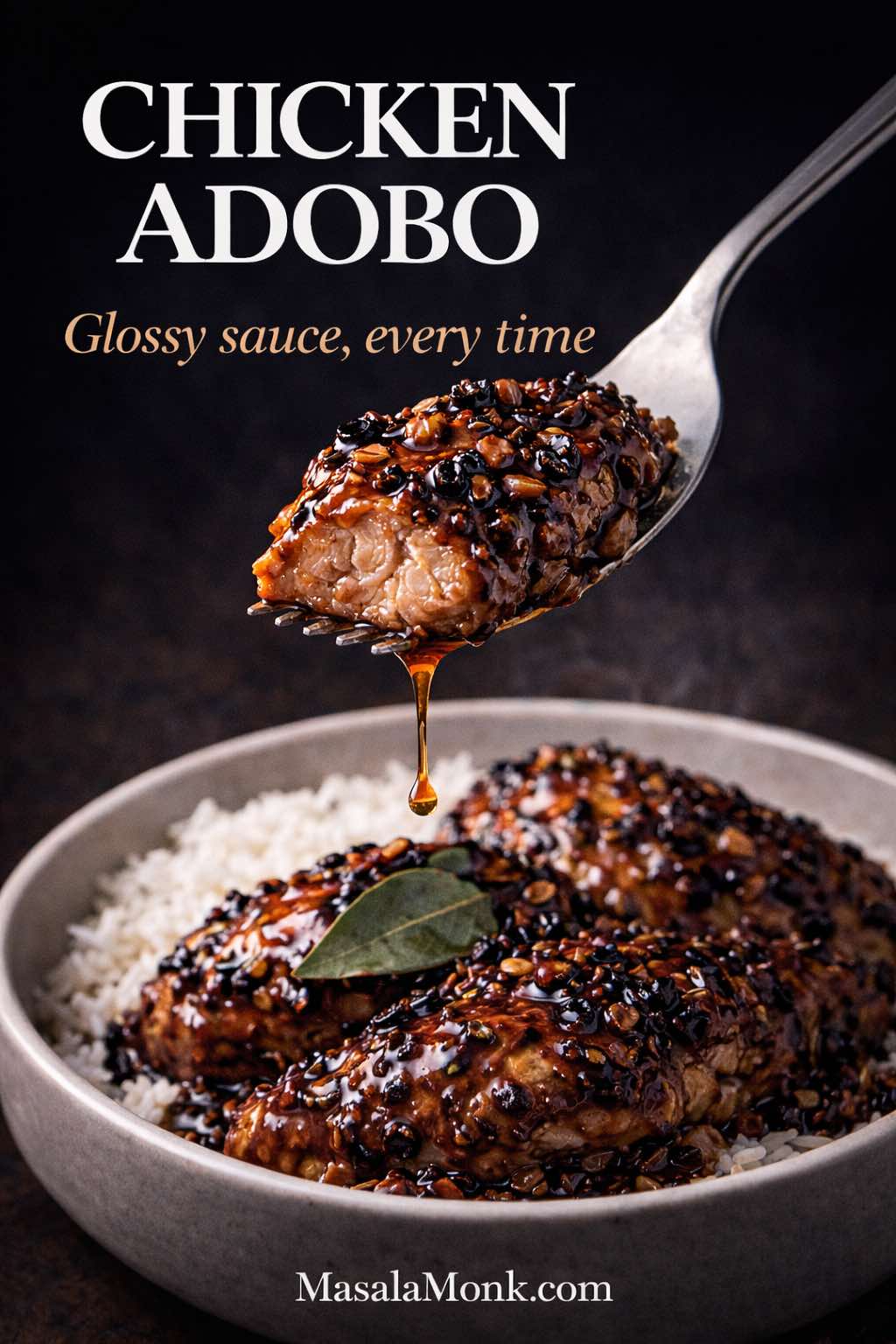
A close-up fork lifts a juicy bite of chicken adobo over a bowl of rice, with a thick glossy soy-vinegar sauce dripping from the bite. The chicken is coated in dark caramelized sauce with visible garlic bits and peppercorns against a moody black background, with the text “Chicken Adobo” and “Glossy sauce, every time” plus MasalaMonk.com at the bottom.

This chicken adobo recipe is the kind of dinner that feels like it’s doing you a favor: rich, tangy, and deeply savory, yet built from pantry staples and one dependable method. Even when the day has been long, you can still end up with tender chicken in a glossy adobo sauce that tastes like it took far more effort than it did.

What makes Filipino chicken adobo so beloved is the balance. Vinegar keeps everything bright. Soy sauce brings depth and color. Garlic turns sweet and mellow as it simmers, while bay leaves and peppercorns give that unmistakable “adobo” perfume. Then, right at the end, the sauce is reduced until it clings—so each bite carries the full flavor instead of leaving it behind in the pot.

Just as importantly, once you learn the rhythm of this chicken adobo recipe—sear, simmer, reduce—you can adjust it without stress. You can make it saucier or drier, sweeter or sharper, with potato for a one-pot feel, or with coconut milk for a creamy finish. For now, though, we’ll start with a classic chicken adobo recipe that’s clear, measured, and reliable, with enough detail that you’ll cook it confidently the first time.

Also Read: Sweetened Condensed Milk Fudge: 10 Easy Recipes


Chicken Adobo Recipe Ingredients and Measurements (Adobo Sangkap)

A traditional adobo recipe can look slightly different from home to home, yet the core stays recognizable. Think of these ingredients as the backbone of an adobong manok recipe that tastes right whether you’re cooking for yourself or feeding a table.

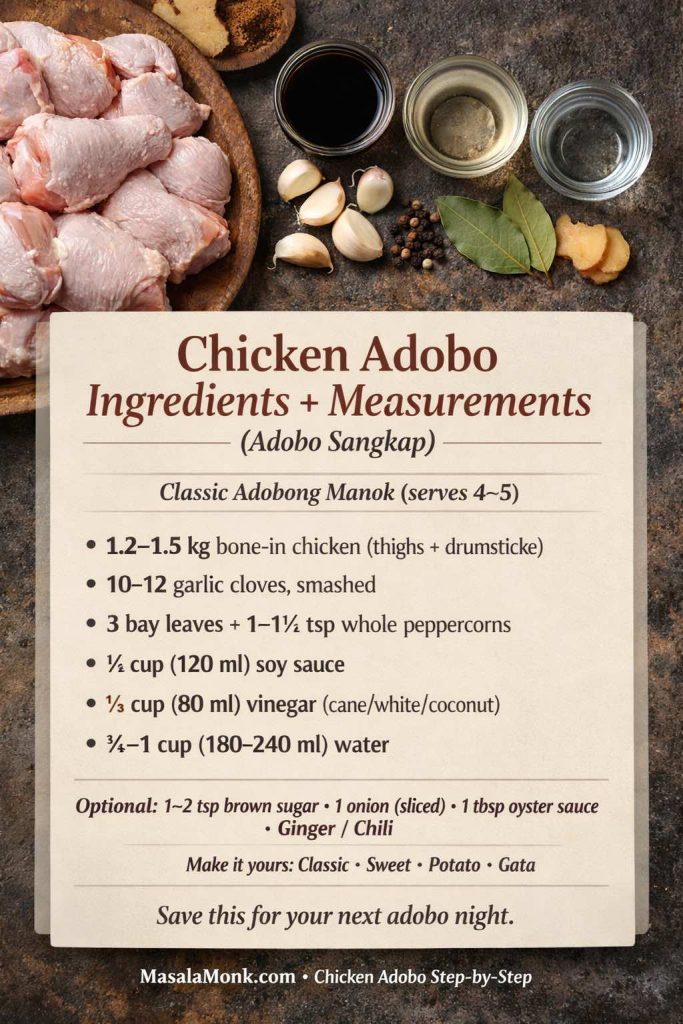
Overhead flatlay of chicken adobo ingredients on a dark surface: raw bone-in chicken, soy sauce, vinegar, water, smashed garlic, bay leaves, peppercorns, and ginger. Text overlay reads “Chicken Adobo Ingredients + Measurements (Adobo Sangkap)” with quantities for classic adobong manok (serves 4–5), including soy sauce, vinegar, water, garlic, bay leaves, and peppercorns, plus optional sugar, onion, oyster sauce, and chili.
The easiest way to make classic chicken adobo taste “right” is getting the base ratios nailed before you even turn on the stove. This quick Adobo Sangkap card is your cook-along checklist for adobong manok—chicken, garlic, bay, peppercorns, plus the soy–vinegar–water balance that becomes that glossy adobo sauce after reduction. Save it for your next grocery run, and when you’re ready, follow the full step-by-step method here, in this blog post.

Chicken adobo recipe ingredients list (for classic adobong manok)

Chicken

  • 1.2 to 1.5 kg chicken, preferably bone-in thighs and drumsticks (skin-on optional)

For browning

  • 1 tbsp neutral oil (canola, sunflower, rice bran)

For the adobo braise

  • 10–12 cloves garlic, smashed (keep them chunky, not minced)
  • 3 bay leaves
  • 1 to 1½ tsp whole black peppercorns (or ¾ tsp coarsely cracked pepper)
  • ½ cup (120 ml) soy sauce
  • ⅓ cup (80 ml) vinegar (cane vinegar is classic; white vinegar works; coconut vinegar is lovely)
  • ¾ to 1 cup (180–240 ml) water

Optional, depending on the style

  • 1–2 tsp brown sugar (for sweet chicken adobo)
  • 1 small onion, sliced (softens the sauce and adds gentle sweetness)
  • 1 tbsp oyster sauce (extra depth; use carefully because it adds salt)
  • 1-inch knob ginger (luya), sliced (clean warmth)
  • 1–2 small chilies, whole (warmth without turning the whole pot fiery)

If you ever find yourself wondering why your soy sauce tastes saltier than expected—or why one bottle makes the sauce darker and another stays lighter—this MasalaMonk guide makes the basics easy to understand: Soy Sauce Saga: Are You Drizzling, Dipping, and Cooking Right?.

Choosing the chicken for this chicken adobo recipe

Bone-in thighs and drumsticks are the most forgiving cut for Filipino style adobo. They stay juicy, they tolerate simmering without drying out, and they contribute richness to the sauce as they cook. In contrast, chicken breast can work, though it needs gentler timing and a slightly different finish so it stays tender.

Infographic showing the best chicken cuts for chicken adobo on a wooden board: thighs, drumsticks, wings, and chicken breast, each labeled with a short tip. Thighs are noted as juiciest and most forgiving, drumsticks as classic with great glaze, wings as fastest for a sticky “tuyo” finish, and breast as workable if pulled early and glazed at the end. Bay leaves, peppercorns, and garlic appear as adobo aromatics, with MasalaMonk.com in the footer.
Not all cuts cook the same in Filipino chicken adobo—and choosing the right one is the easiest way to guarantee tender meat and a glossy adobo sauce. Use thighs for the juiciest, most forgiving result, drumsticks for a classic adobong manok feel, wings for a faster sticky “tuyo” finish, or breast if you pull it early and glaze at the end. Save this cut guide for your next adobo night, then follow the full step-by-step recipe in this post.

Wings are another great option if you love sticky, glossy adobo. Because they’re smaller, they cook faster, and they glaze beautifully when you reduce the sauce into an adobong manok na tuyo style finish.

Vinegar and soy sauce: how the balance actually works

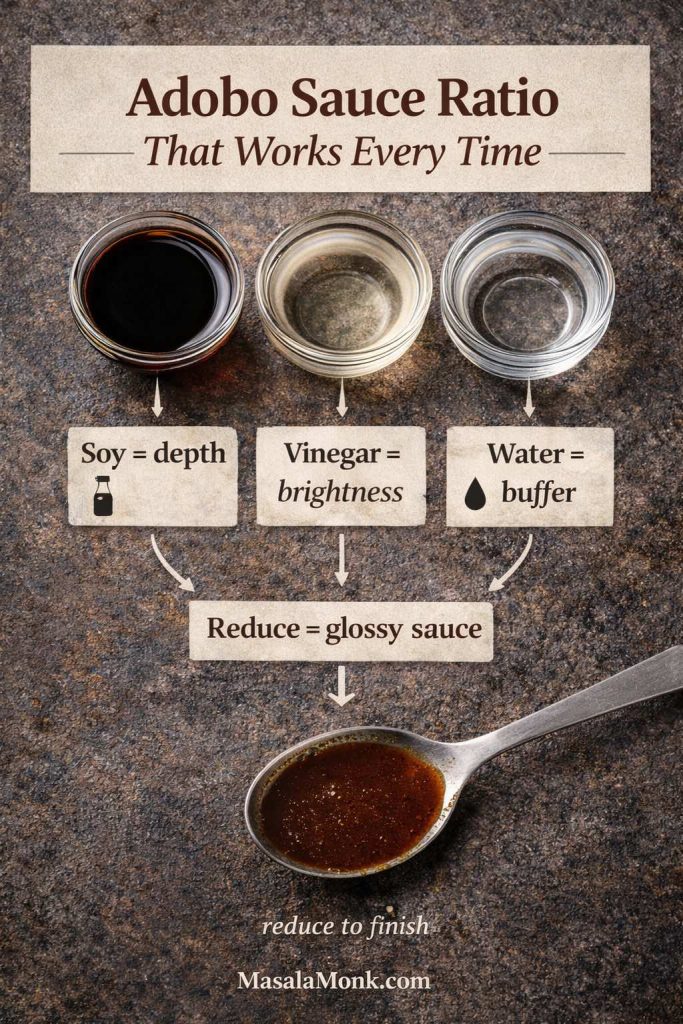
Vinegar is the brightness. Soy sauce is the depth. Water is the buffer that prevents the dish from feeling aggressively salty or sharply sour before reduction brings everything together.

Cane vinegar is often used in classic Filipino chicken adobo because it’s bright yet not harsh. White vinegar works too—especially if you like a crisp tang—although you may want to start with the lower end of the water range (or add vinegar gradually near the end) so the sharpness doesn’t dominate early.

Infographic explaining Filipino adobo sauce balance on a dark stone surface: three small bowls show soy sauce, vinegar, and water labeled “Soy = depth,” “Vinegar = brightness,” and “Water = buffer.” Arrows point to “Reduce = glossy sauce,” with a spoon holding shiny reduced adobo sauce at the bottom. Text reads “Adobo Sauce Ratio That Works Every Time” and includes MasalaMonk.com.
If your chicken adobo ever tastes too sharp, too salty, or just “not quite right,” it usually comes down to balance. This quick adobo sauce ratio guide shows what each part does—soy for depth, vinegar for brightness, water as the buffer—then the real secret: reduce at the end until the sauce turns glossy and clings to the chicken. Save this for your next adobong manok night.

Coconut vinegar, if you have it, can taste softer and rounder. As a result, it pairs especially well when you plan to add coconut milk later.

Also Read: Sourdough Recipe: 10 Easy Bread Bakes (Loaves, Rolls & Bagels)


Chicken Adobo Recipe Step by Step (Procedure in Cooking Adobo)

This is the chicken adobo recipe step by step method you can follow without guessing. You’ll build flavor with browning, tenderness with simmering, and that glossy finish with reduction.

Step 1: Prep the chicken so it browns instead of steaming

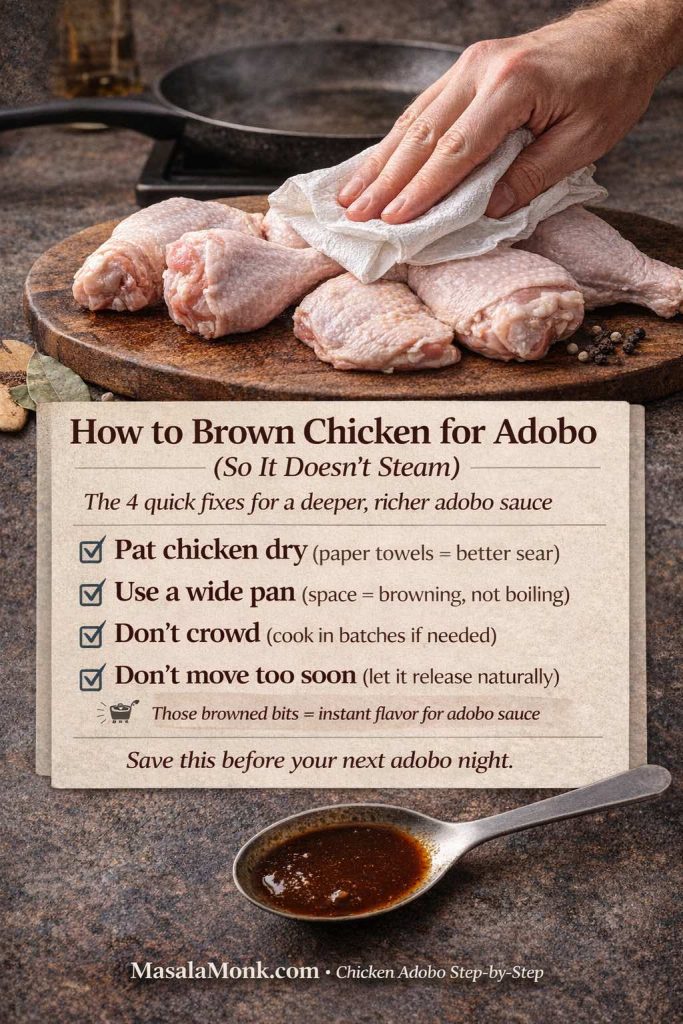
Pat the chicken dry with paper towels. That small step changes everything: moisture on the surface turns into steam, and steam prevents browning. Meanwhile, check the pieces. If you’re working with large leg quarters, separate them into thighs and drumsticks so they cook evenly.

Infographic showing how to brown chicken for adobo so it doesn’t steam. Photo shows hands patting raw chicken pieces dry with a paper towel on a wooden board, with a wide pan heating in the background. Text overlay lists four tips: pat chicken dry, use a wide pan, don’t crowd (cook in batches), and don’t move too soon (let it release naturally). Note says browned bits add instant flavor for adobo sauce, with MasalaMonk.com in the footer.
Want chicken adobo with deeper flavor and a richer adobo sauce? It starts before the simmer. This quick guide shows the 4 fixes that stop chicken from steaming: pat it dry, use a wide pan, cook in batches, and leave it alone long enough to brown and release naturally. Those golden browned bits become pure flavor once you deglaze and build the braise—so your adobong manok tastes bold even with simple pantry ingredients. Save this browning checklist, then follow the full step-by-step recipe here, in this post.

At this point, avoid salting heavily. Since soy sauce already brings salt, you’ll get a better final balance by waiting until the sauce has reduced before deciding if it needs anything.

Step 2: Optional short marinade (adobo marinade recipe, simplified)

Some cooks marinate, others skip it completely. For a practical middle path, you can do a short marinade that builds flavor without turning dinner into a project.

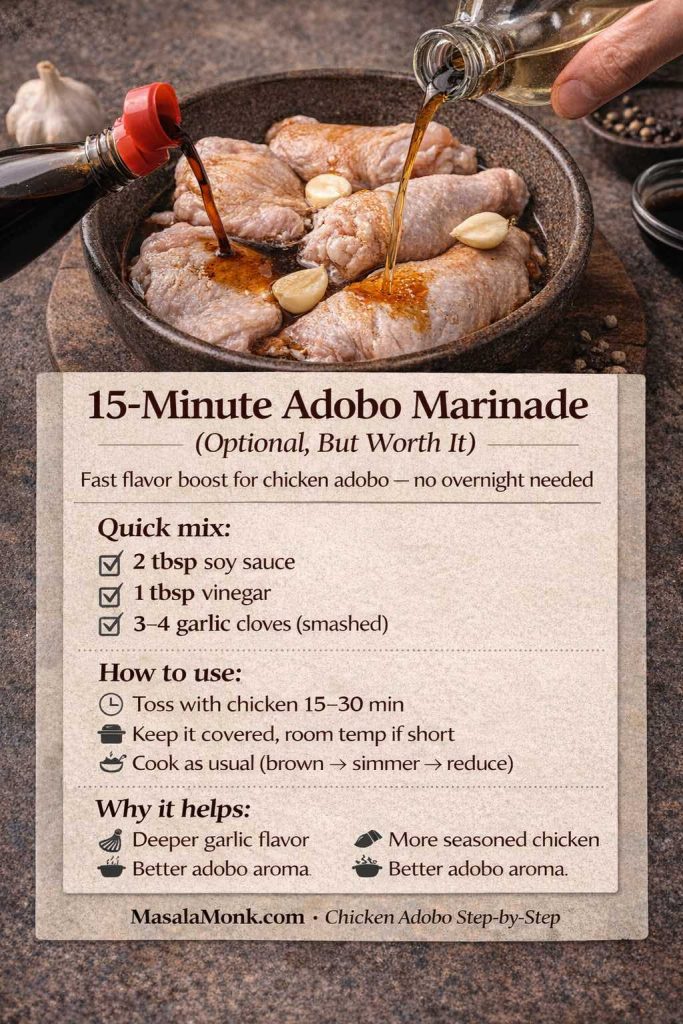
Recipe-card infographic for a 15-minute adobo marinade for chicken adobo. Photo shows chicken pieces in a bowl with soy sauce and vinegar being poured over smashed garlic. Text overlay lists the quick mix: 2 tbsp soy sauce, 1 tbsp vinegar, 3–4 smashed garlic cloves. Instructions say to toss with chicken for 15–30 minutes, keep covered, then cook as usual (brown, simmer, reduce). MasalaMonk.com appears in the footer.
Optional but useful: a quick 15–30 minute adobo marinade (soy, vinegar, smashed garlic) deepens the garlic flavor before you brown, simmer, and reduce into glossy adobo sauce.

In a bowl, combine:

  • 2 tbsp soy sauce
  • 1 tbsp vinegar
  • 3–4 smashed garlic cloves

Toss the chicken and let it sit for 15–30 minutes while you prepare everything else. Even so, if you skip this step, the dish still works—because the braise does the real seasoning.

Step 3: Brown the chicken (build the base, not the final color)

Heat 1 tablespoon oil in a wide, heavy pan over medium-high heat. Once the oil shimmers, place chicken pieces in a single layer. Don’t crowd the pan; otherwise, the chicken releases moisture and steams.

Side-by-side infographic showing browning levels for chicken adobo. Left panel labeled “Too pale” shows chicken pieces that look steamed with little color. Right panel labeled “Right level of browning” shows chicken with golden-brown patches in the pan. Text below lists tips: golden patches (not fully dark), single layer only, brown 2–4 minutes per side then flip, and browned bits create the flavor base for adobo sauce. MasalaMonk.com appears at the bottom.
Aim for golden patches—not deep dark crust. This is the browning level that builds flavor for chicken adobo without turning the sauce bitter when you deglaze and simmer.

Let the chicken sit for a few minutes without moving it. When it’s ready, it will release easily and show golden patches. Turn and brown the other side briefly, then transfer to a plate.

You are not trying to cook it through here. Instead, you’re creating a flavor foundation that will melt into the adobo sauce later.

Step 4: Bloom the garlic, then add bay and peppercorn

Lower heat to medium. Add smashed garlic (and onion, if using). Stir for 30–60 seconds until fragrant.

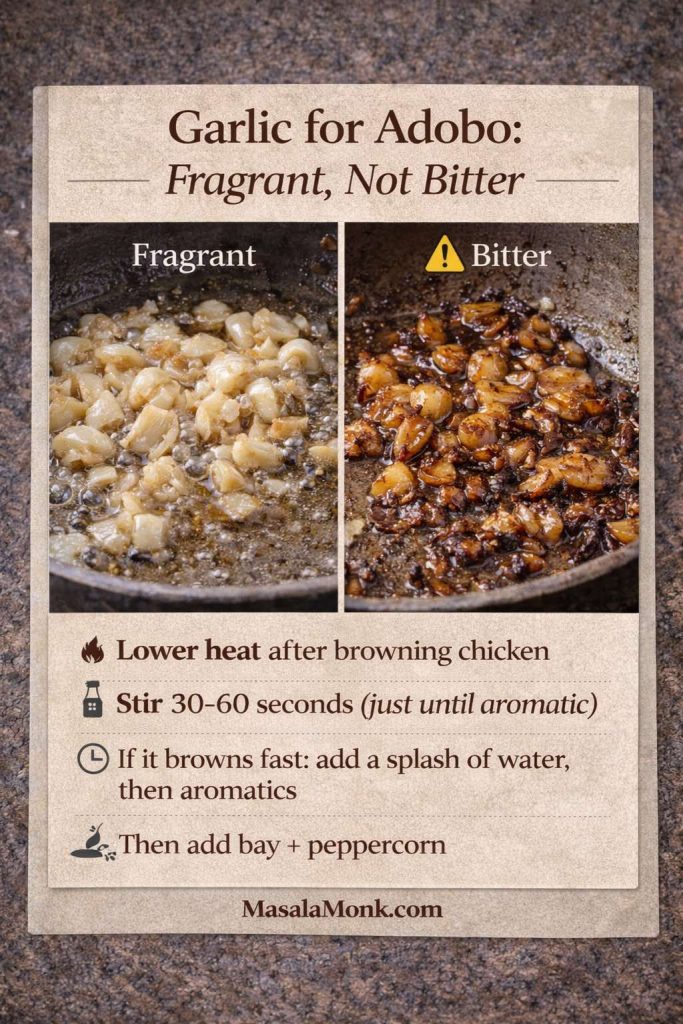
Split-panel infographic about garlic for chicken adobo. Left panel labeled “Fragrant” shows lightly cooked chopped garlic in oil, pale-golden and aromatic. Right panel labeled “Bitter” shows garlic browned too dark and scorched. Text overlay reads “Garlic for Adobo: Fragrant, Not Bitter” and lists tips: lower heat after browning chicken, stir 30–60 seconds until aromatic, if it browns fast add a splash of water then aromatics, then add bay leaves and peppercorns. MasalaMonk.com is in the footer.
Keep the garlic lightly golden and aromatic—if it darkens too fast, lower the heat and add liquid sooner so your adobo sauce stays rich, not bitter.

Keep it gentle. Garlic should smell sweet and aromatic, not bitter. If it starts to brown too quickly, lower the heat and add a splash of water to calm the pan.

Next, add bay leaves and peppercorns. At this stage, the kitchen smell shifts into something instantly recognizable: warm bay, peppery lift, and garlic at the center.

Step 5: Build the braise (soy + vinegar + water)

Pour in the water first and scrape up the browned bits. Those little stuck-on pieces are concentrated flavor; they belong in the sauce, not on the pan.

Infographic titled “Deglaze for Adobo Sauce (Don’t Waste the Flavor Bits).” Photo shows water being poured into a hot pan while a wooden spoon scrapes up browned bits (fond) from the bottom. Text overlay lists steps: add water first, scrape browned bits into the liquid, then add soy sauce and vinegar, and bring to a lively simmer. MasalaMonk.com appears in the footer.
Deglazing pulls the browned bits into the pot—so the flavor you built while searing turns into the foundation of a richer, more savory adobo sauce.

Then add soy sauce and vinegar. Bring the pot to a lively simmer.

A classic habit in many kitchens is to let the vinegar simmer briefly before stirring aggressively. In practice, giving it 1–2 minutes at a simmer helps soften that raw sharpness so the final sauce tastes integrated rather than harsh.

Step 6: Simmer chicken adobo until tender

Return the chicken (and any juices on the plate) to the pot. Once it returns to a simmer, reduce heat to low, cover, and cook gently.

Infographic titled “Chicken Adobo Simmer Times (By Cut).” Photo shows chicken pieces gently simmering in adobo sauce in a pan with a glass lid and a bay leaf visible. Text lists cook times: thighs/drumsticks 25–35 minutes (gentle simmer), wings 18–25 minutes, and chicken breast 12–18 minutes (pull early, glaze later). A doneness cue says “Knife slides in easily / 165°F (74°C).” MasalaMonk.com appears in the footer.
Use these simmer times as your guide—then finish by reducing the sauce so it turns glossy and coats the chicken instead of staying thin.

Use these times as a guide:

  • Bone-in thighs and drumsticks: 25–35 minutes
  • Wings: 18–25 minutes
  • Chicken breast pieces: 12–18 minutes, then remove early
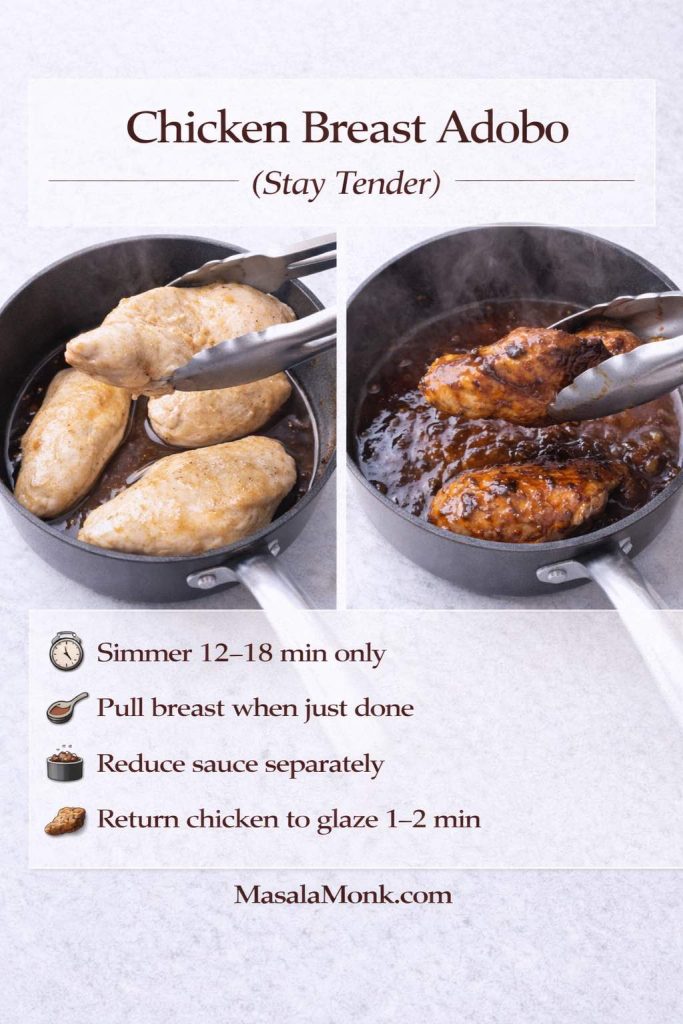
Infographic titled “Chicken Breast Adobo (Stay Tender)” with two pan photos: on the left, chicken breast pieces simmering in adobo liquid while tongs lift one out; on the right, chicken breast glazed in a thicker, glossy adobo sauce. Text tips say: simmer 12–18 minutes only, pull breast when just done, reduce sauce separately, and return chicken to glaze for 1–2 minutes. MasalaMonk.com appears in the footer.
For tender chicken breast adobo, simmer briefly, pull the breast as soon as it’s done, then reduce the sauce separately and return the chicken for a quick 1–2 minute glaze.

If you’re using chicken breast, don’t try to “force” tenderness by cooking longer. Instead, pull it when it’s just done, then finish reducing the sauce separately and return the chicken briefly to glaze.

If you prefer certainty, chicken is considered safely cooked at 165°F / 74°C. (Food Safety and Inspection Service)

Step 7: Reduce the sauce into glossy adobo sauce (classic or “tuyo”)

Once the chicken is tender, remove the lid. Raise heat to medium and simmer uncovered.

At first the liquid looks thin, almost broth-like. However, as it reduces, it becomes shiny and sauce-like. Turn the chicken once or twice so it glazes evenly, and stir occasionally so nothing sticks.

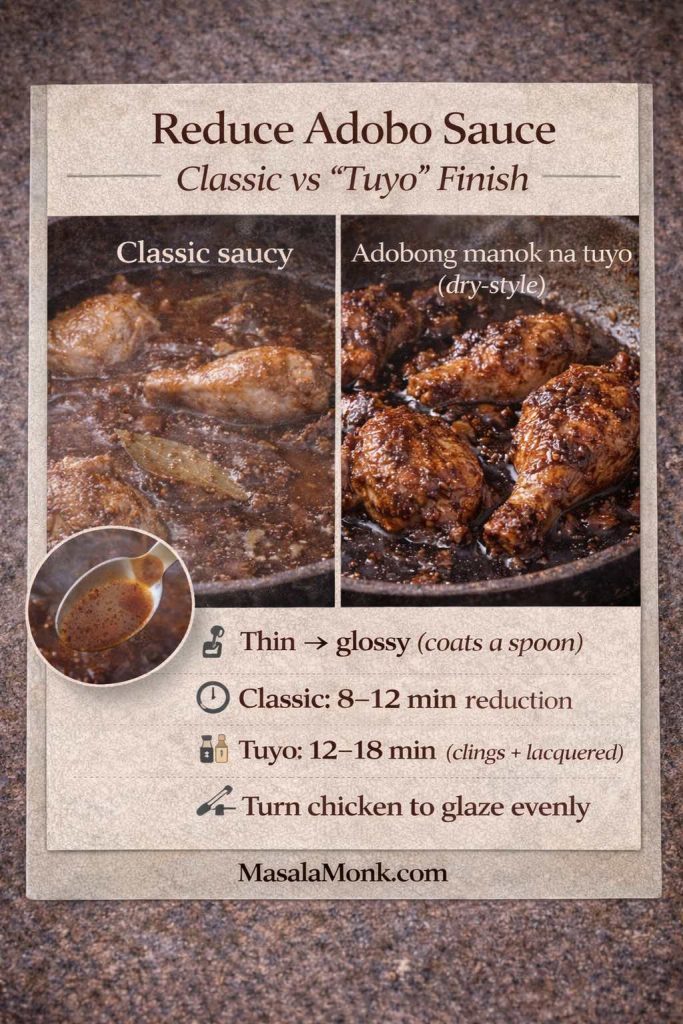
Split comparison infographic titled “Reduce Adobo Sauce: Classic vs ‘Tuyo’ Finish.” Left panel shows chicken simmering in a thinner, saucy adobo with bay leaves, labeled “Classic saucy.” Right panel shows adobong manok na tuyo (dry-style) with chicken coated in thick, lacquered sauce. A spoon inset shows sauce coating. Text notes: thin to glossy (coats a spoon), classic reduction 8–12 minutes, tuyo 12–18 minutes (clings and lacquered), and to turn chicken to glaze evenly. MasalaMonk.com appears in the footer.
Reduce the braising liquid until it turns glossy and coats a spoon—stop earlier for a saucier chicken adobo, or go longer for adobong manok na tuyo with a sticky, lacquered glaze.
  • For a classic saucy finish, reduce 8–12 minutes until the sauce coats the back of a spoon.
  • For adobong manok na tuyo (drier finish), reduce longer—12–18 minutes—until the sauce clings tightly and looks lacquered.
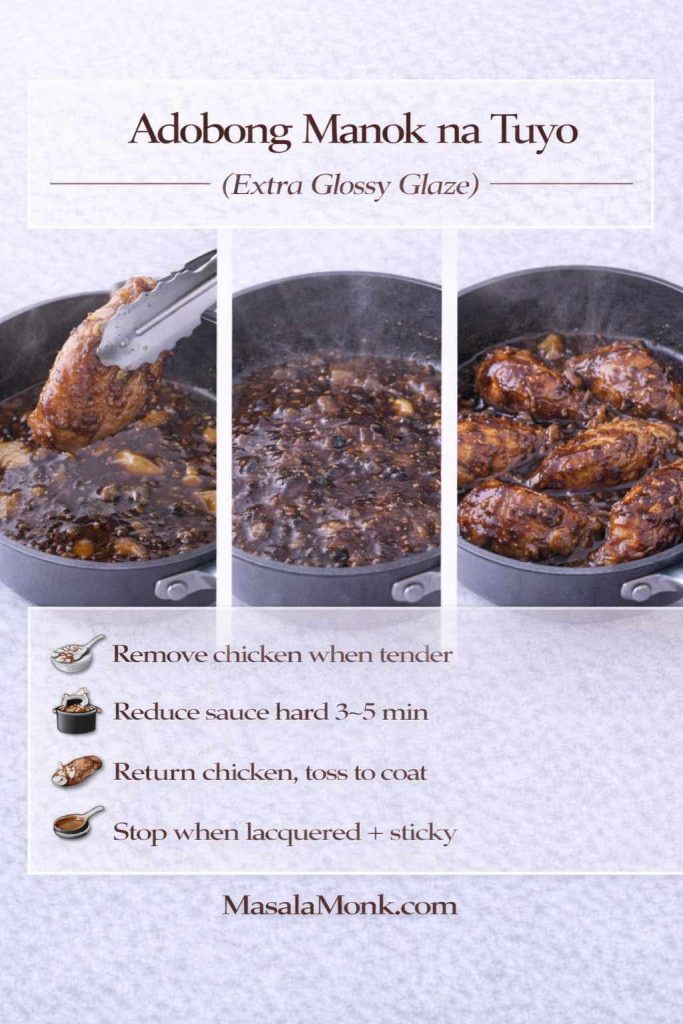
Three-panel instructional infographic titled “Adobong Manok na Tuyo (Extra Glossy Glaze).” Panel 1 shows chicken being lifted from the pan with tongs while the sauce simmers. Panel 2 shows the adobo sauce reducing vigorously in the pan. Panel 3 shows chicken returned to the pan and coated in a thick, lacquered, sticky glaze. Text steps read: remove chicken when tender, reduce sauce hard 3–5 minutes, return chicken and toss to coat, stop when lacquered + sticky. MasalaMonk.com is in the footer.
For extra-glossy adobong manok na tuyo, lift the chicken once it’s tender, reduce the sauce hard for a few minutes, then return the chicken and toss until it’s lacquered and sticky.

If you want sweet chicken adobo, stir in 1–2 teaspoons brown sugar during the final few minutes of reduction. Added late, it melts into the sauce and tastes rounded; added early, it can taste flat.

Step 8: Rest before serving (it really helps)

Turn off the heat and rest the chicken in the pan for about 5 minutes. During that pause, the sauce settles into its final texture, and the chicken reabsorbs juices.

Instructional card titled “Rest Chicken Adobo 5 Minutes (Then Serve).” Photo shows two pieces of chicken adobo on a bowl of white rice while a spoon pours glossy adobo sauce over the chicken. Text notes: sauce thickens slightly as it settles, chicken reabsorbs juices, spoon sauce over hot rice, and an optional finish with a pinch of sugar for sweet adobo or chili on the side. MasalaMonk.com appears in the footer.
Resting the chicken adobo for a few minutes helps the sauce settle and cling—then spoon it over hot rice so every bite gets that glossy, savory finish.

Serve hot with rice and spoon the sauce over everything.

If you want rice that behaves perfectly under a bold sauce—fluffy, not gummy—this MasalaMonk guide makes the timings easy whether you’re using stovetop, a rice cooker, or Instant Pot: How to Cook Perfect Rice (Stovetop, Cooker, Instant Pot).

Also Read: Kahlua Drinks: 10 Easy Cocktail Recipes (Milk, Vodka, Coffee)


Chicken Adobo Recipe Flavor Balance (So It Tastes “Right” Every Time)

Even a perfect method can land slightly differently depending on vinegar strength, soy sauce saltiness, chicken size, and how hard you reduce the sauce. Fortunately, this chicken adobo recipe is easy to steer back on track—especially if you make adjustments at the right moment.

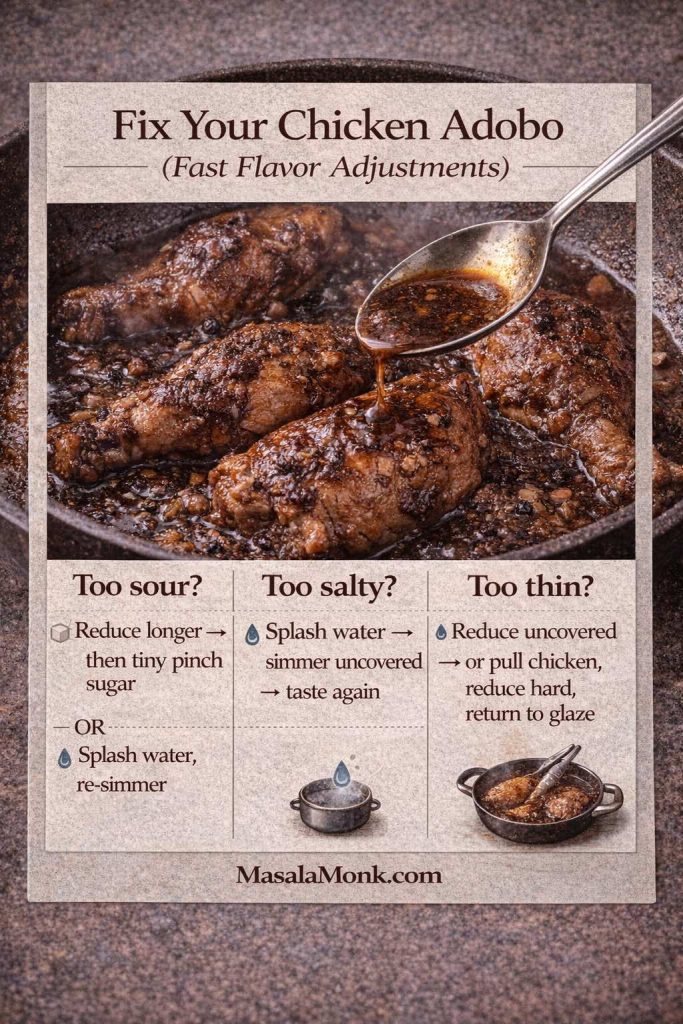
Infographic titled “Fix Your Chicken Adobo (Fast Flavor Adjustments).” Photo shows chicken adobo in a pan with a spoon pouring glossy adobo sauce over the chicken. Below, three columns give quick fixes: “Too sour?” reduce longer then add a tiny pinch of sugar, or splash water and re-simmer; “Too salty?” add a splash of water, simmer uncovered, and taste again; “Too thin?” reduce uncovered, or remove chicken, reduce sauce harder, then return chicken to glaze. MasalaMonk.com is in the footer.
A quick rescue guide for chicken adobo: adjust by reducing longer for body, adding a small splash of water to soften salt or sharpness, and glazing the chicken after reducing for the richest sauce.

If the adobo tastes too sour

Before changing ingredients, reduce the sauce a little longer. Often the dish tastes overly sharp simply because there’s still too much water in the pot.

If, after reduction, it still tastes too tangy, you have a few gentle options:

  • Add a small pinch of brown sugar and simmer 1–2 minutes.
  • Add a splash of water, then simmer uncovered again to re-balance.
  • Add a spoonful of chicken fat (skin-on pieces help naturally) to soften the edges.

The goal isn’t to erase vinegar. Rather, it’s to make the tang feel woven into the sauce.

If the adobo tastes too salty

Saltiness is usually a concentration issue. Add a splash of water, simmer uncovered, and taste again. That may feel backward at first, yet it works because you’re diluting salt while still keeping flavor from the aromatics and reduction.

Next time, use a slightly less salty soy sauce, or start with a bit less soy and add it gradually near the end. If you want to understand what kind of soy sauce you’re working with, the quick breakdown in Soy Sauce Saga can save you a lot of guesswork later.

If the sauce feels thin

Keep reducing. That’s the simplest fix, and it’s usually the correct one. Meanwhile, make sure your pan is wide enough that evaporation can happen at a steady pace.

If you want an even clingier finish, you can:

  1. Remove the chicken when tender
  2. Reduce the sauce more aggressively for a few minutes
  3. Return the chicken to glaze

That approach gives you maximum shine without overcooking the meat.

If the garlic tastes bitter

Bitterness usually comes from garlic browning too hard early on. Next time, lower heat after browning chicken, stir garlic briefly, then add liquid sooner so it doesn’t scorch.

Still, if you’re already mid-cook and the garlic tastes sharp, reduction and resting often mellow it. In addition, serving with rice and something creamy on the side can soften that perception.

If the chicken feels tough

Toughness can happen if the simmer is too hard (boiling can tighten protein), or if the chicken pieces are particularly mature. If you’re using native chicken, longer gentle simmering helps, and thighs/drumsticks are far more forgiving than breast.

Instead of turning the heat up, keep it at a lazy simmer and extend the cooking time. Once the chicken is tender, proceed with the reduction as usual so the sauce still turns glossy.

Also Read: 10 Vegan Chocolate Cake Recipes (Easy, Moist, & Dairy-Free)


Chicken Adobo Recipe Serving Ideas (What to Eat With Adobo)

Rice is the classic partner because it absorbs adobo sauce like it was built for it. That said, the dish becomes even more satisfying when you add contrast: something crisp, something creamy, or something spicy on the side.

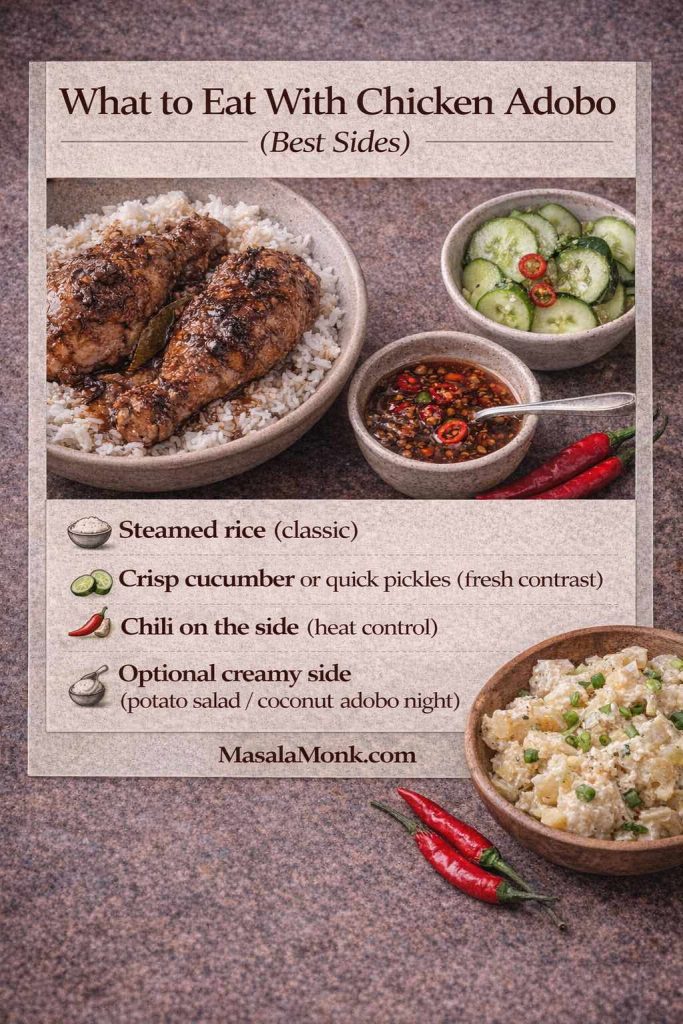
Infographic titled “What to Eat With Chicken Adobo (Best Sides).” Photo shows a bowl of chicken adobo on steamed white rice, with small bowls of crisp cucumber/quick pickles and chili sauce on the side, plus an optional creamy side resembling potato salad. Text suggests pairings: steamed rice (classic), crisp cucumber or quick pickles (fresh contrast), chili on the side (heat control), and an optional creamy side (potato salad/coconut adobo night). MasalaMonk.com appears in the footer.
Chicken adobo loves contrast—serve it with hot steamed rice, something crisp and tangy like cucumber or quick pickles, and chili on the side so everyone can dial in their own heat.

The rice that makes adobo feel complete

For everyday bowls, plain white rice is perfect. For a weekend feel, you can cook jasmine or basmati and let the aroma do extra work. Either way, if you want clean, fluffy grains—especially if you’re cooking rice alongside the simmer—MasalaMonk’s rice guide keeps it simple across methods: How to Cook Perfect Rice.

A creamy side that loves tangy sauce

A potato salad might not be the first thing you think of, yet it works surprisingly well. The creaminess softens the vinegar edge, while the tang makes the potatoes taste brighter.

If you want options beyond one “standard” bowl, this guide gives you several directions: Potato Salad Recipe: Classic, Russian, German, Vegan & More.

Heat on the side, not in the whole pot

One of the nicest ways to serve adobo is letting everyone control their own heat. A bright, vinegar-based chili sauce makes each bite feel sharper and more alive without changing the entire pot.

If you enjoy exploring different chili styles—from thin hot pepper vinegar to chipotle-based sauces—this MasalaMonk guide is a fun rabbit hole: Pepper Sauce Recipe | Ultimate Guide: 30+ Hot & Chili Sauces.

Also Read: Cold Brew Espresso Martini: How to Make It (Step-by-Step Recipe)


Chicken Adobo Recipe Variations (Same Method, Different Mood)

Once you’ve cooked the classic once, variations become easy because the core doesn’t change. You still brown, braise, and reduce. After that, one ingredient or one timing shift can take the dish somewhere new.

Infographic titled “Chicken Adobo Variations (Same Method, Different Mood)” showing a 2x3 grid of six Filipino chicken adobo styles. The tiles are labeled: adobong manok na tuyo (dry-style), adobo with potato (one-pot comfort), sweet chicken adobo (1–2 tsp brown sugar), adobo with pineapple (bright sweet-sour), adobo with oyster sauce (deeper umami), and adobo with luya (ginger warmth). MasalaMonk.com appears in the footer.
Once you know the classic method, chicken adobo becomes endlessly flexible—choose a dry-style tuyo finish, add potatoes, go subtly sweet, brighten with pineapple, deepen with oyster sauce, or warm it up with ginger.

Chicken adobo recipe: adobong manok na tuyo (dry-style)

If you love sticky chicken, this is the finish to aim for. Follow the classic method, then reduce longer until the sauce clings tightly and looks lacquered.

For an even more dramatic glaze, remove the chicken when it’s tender, reduce the sauce harder for a few minutes, then return the chicken and toss until it shines.

Chicken adobo recipe with potato (one-pot comfort)

Potatoes make the pot feel heartier and more generous, and they soak up sauce like sponges.

Add 2 medium potatoes, peeled and cut into chunks, right after you return chicken to simmer. Then simmer covered as usual until chicken is tender and potatoes are cooked through. Finally, reduce the sauce uncovered and let the potatoes glaze slightly at the edges.

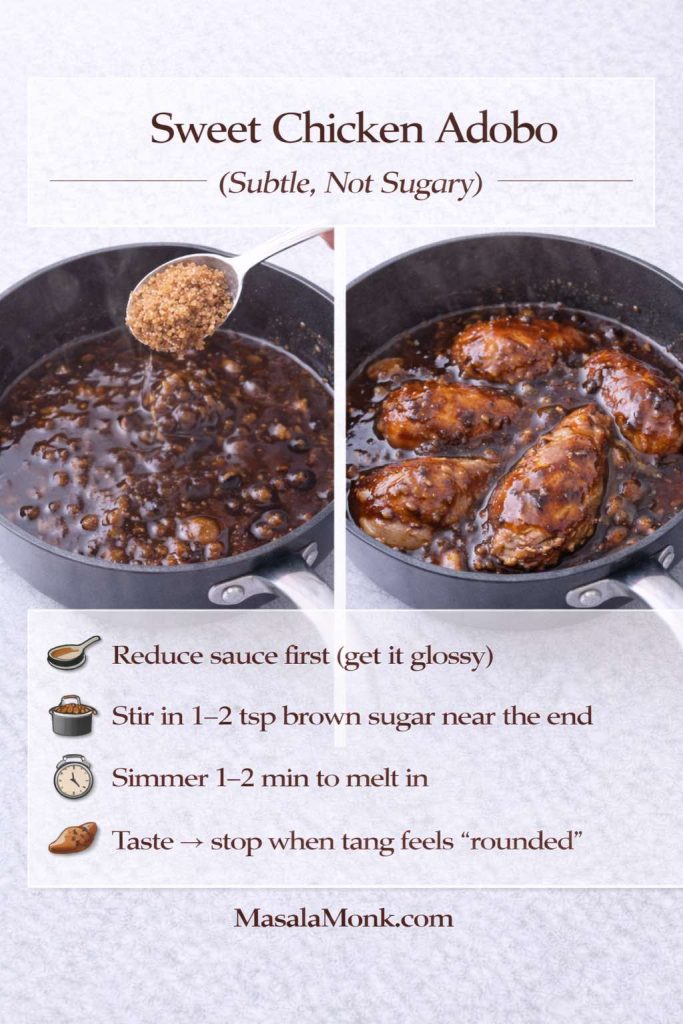
Sweet chicken adobo (subtle, not sugary)

Sweet adobo chicken is best when it’s restrained. You’re aiming to round out the tang, not turn the dish into a sticky dessert.

Two-panel infographic titled “Sweet Chicken Adobo (Subtle, Not Sugary).” Left panel shows a spoon adding brown sugar into simmering adobo sauce; right panel shows chicken pieces coated in glossy adobo glaze. Text tips say: reduce sauce first until glossy, stir in 1–2 tsp brown sugar near the end, simmer 1–2 minutes to melt in, and taste—stop when the tang feels “rounded.” MasalaMonk.com appears in the footer.
For sweet chicken adobo, reduce the sauce until glossy first, then add a small amount of brown sugar right at the end so it melts in and rounds the vinegar tang without turning the dish sugary.

Add 1–2 teaspoons brown sugar during the final reduction. That timing matters because it melts cleanly into the glossy sauce and tastes integrated.

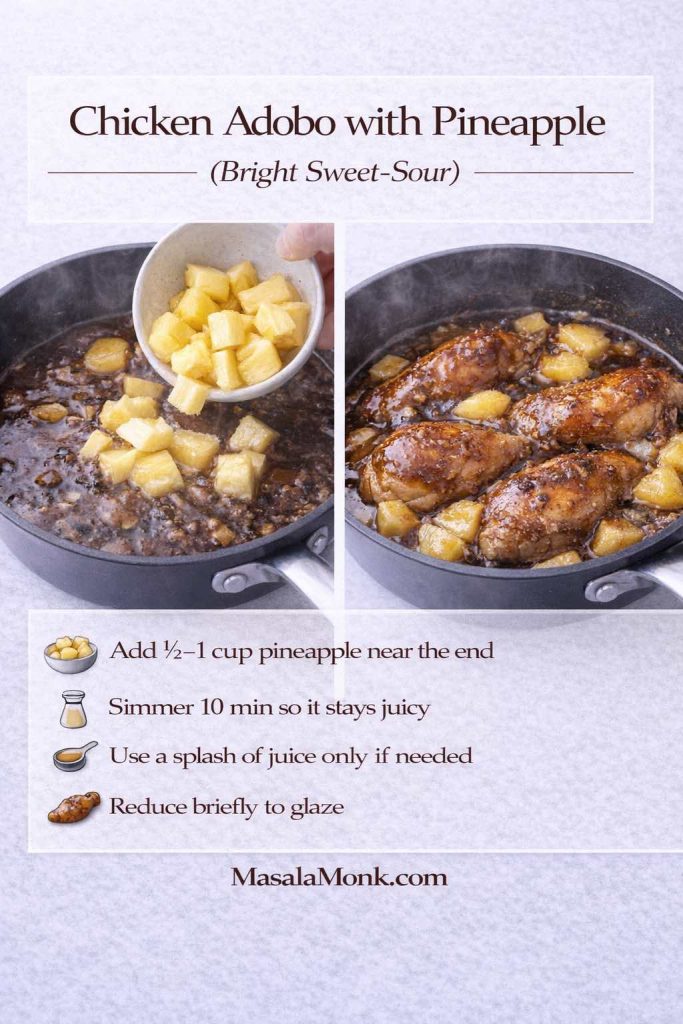
Chicken adobo with pineapple (bright sweet-sour)

Pineapple brings a playful sweetness and a tropical edge that pairs beautifully with garlic and soy.

Two-panel infographic titled “Chicken Adobo with Pineapple (Bright Sweet-Sour).” Left panel shows pineapple chunks being added to simmering chicken adobo sauce in a pan. Right panel shows finished chicken adobo pieces coated in glossy sauce with pineapple chunks. Text tips say: add ½–1 cup pineapple near the end, simmer 10 minutes so it stays juicy, use a splash of juice only if needed, and reduce briefly to glaze. MasalaMonk.com appears in the footer.
Add pineapple near the end so it stays juicy and bright—then reduce briefly to glaze, giving chicken adobo a clean sweet-sour lift without turning the sauce syrupy.

Add ½ to 1 cup pineapple chunks during the last 10 minutes of simmering, then reduce as usual. If you use canned pineapple, a small splash of juice can help, though too much can push the sauce toward syrupy, so go lightly.

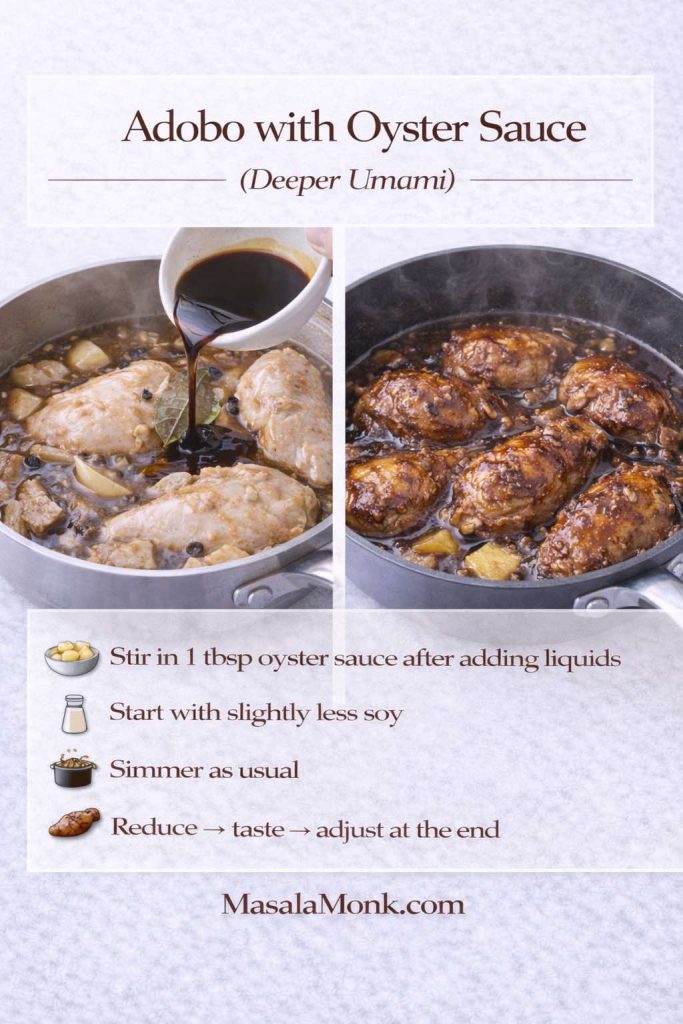
Chicken adobo with oyster sauce (deeper umami)

This is a modern variation rather than a classic, yet it can be delicious when you want extra savory depth.

Two-panel infographic titled “Adobo with Oyster Sauce (Deeper Umami).” Left panel shows oyster sauce being poured into simmering chicken adobo after the liquids are added; right panel shows finished chicken coated in glossy dark adobo sauce. Text tips say: stir in 1 tbsp oyster sauce after adding liquids, start with slightly less soy, simmer as usual, then reduce, taste, and adjust at the end. MasalaMonk.com appears in the footer.
Oyster sauce adds deeper umami to chicken adobo—stir it in after the braising liquids, start with a little less soy, then reduce and taste at the end so the sauce stays balanced, not overly salty.

Stir in 1 tablespoon oyster sauce after adding soy, vinegar, and water. Because oyster sauce adds salt, consider starting with a little less soy sauce, then adjust near the end.

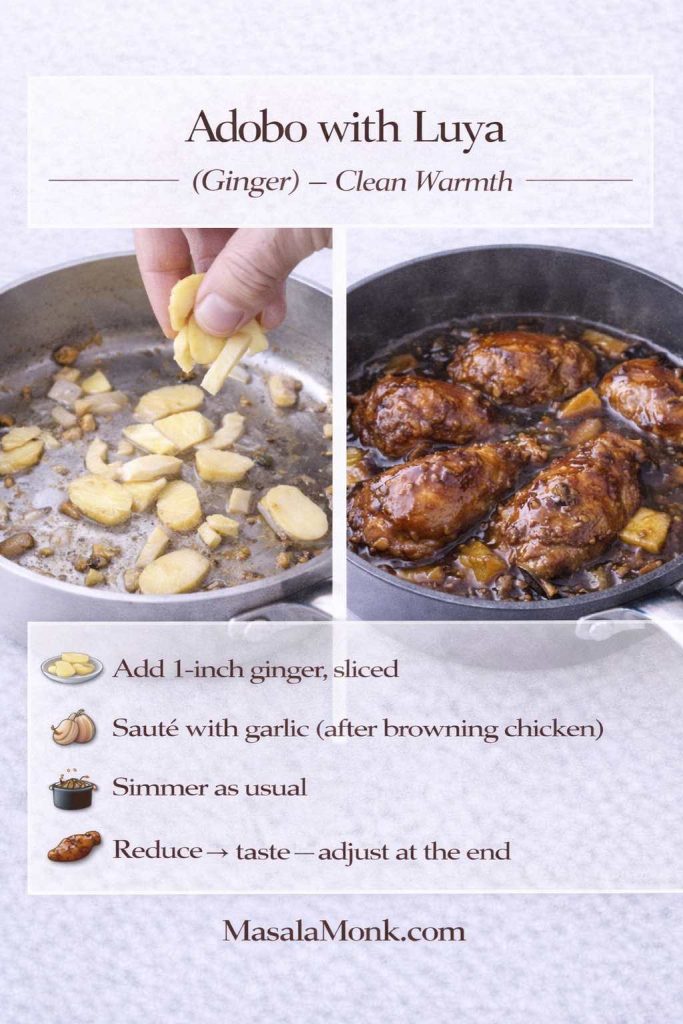
Adobo with luya (ginger)

Ginger makes the sauce feel cleaner and warmer without shouting “ginger.” It’s especially comforting on a cool day.

Two-panel infographic titled “Adobo with Luya (Ginger) — Clean Warmth.” Left panel shows sliced ginger being added to a pan with garlic after browning chicken. Right panel shows chicken adobo simmering in glossy sauce with visible ginger slices, peppercorns, and bay. Text tips say: add 1-inch ginger sliced, sauté with garlic after browning chicken, simmer as usual, then reduce and taste-adjust at the end. MasalaMonk.com appears in the footer.
Adding sliced ginger (luya) with the garlic gives chicken adobo a cleaner, warmer aroma—simmer as usual, then reduce at the end so the sauce turns glossy and the ginger flavor stays balanced.

Add a 1-inch knob of sliced ginger with the garlic, then proceed as usual.

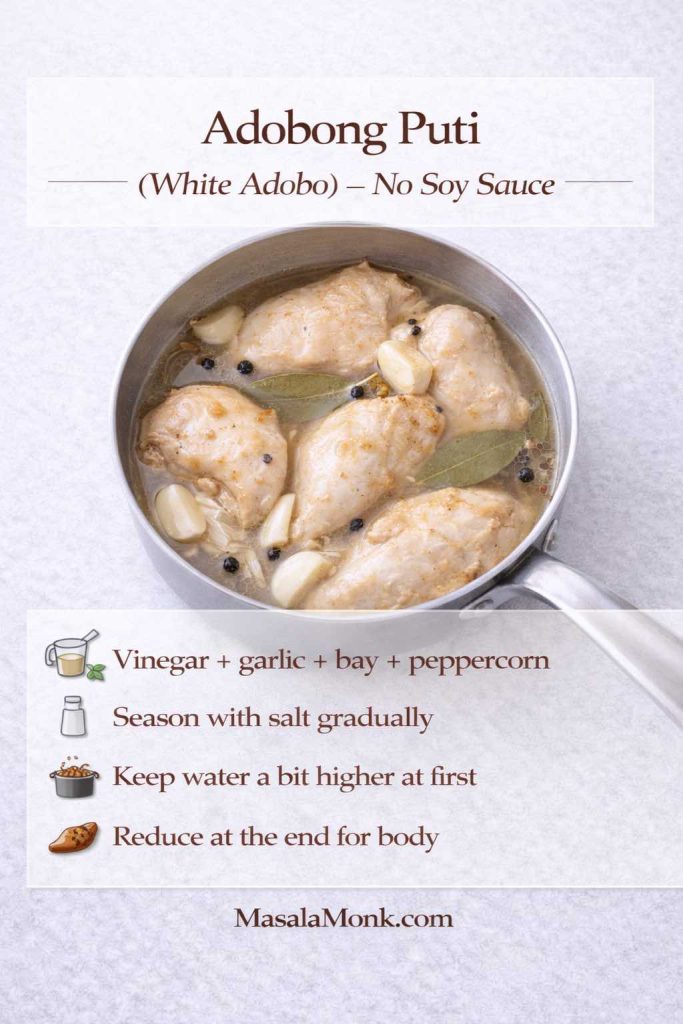
Adobong puti (white adobo)

White adobo skips soy sauce and leans into vinegar, garlic, bay, and pepper. It tastes brighter, sharper, and a bit more minimalist.

Recipe-card infographic titled “Adobong Puti (White Adobo) — No Soy Sauce.” Photo shows chicken pieces simmering in a light vinegar-based broth with whole garlic cloves, bay leaves, and peppercorns. Text tips say: vinegar + garlic + bay + peppercorn, season with salt gradually, keep water a bit higher at first, and reduce at the end for body. MasalaMonk.com appears in the footer.
Adobong puti (white adobo) skips soy sauce and leans on vinegar, garlic, bay leaves, and peppercorns—start with a bit more water, season with salt gradually, then reduce at the end for a flavorful, silky broth.

To adapt this chicken adobo recipe into adobong puti:

  • Omit soy sauce
  • Add salt gradually (start with 1 to 1½ teaspoons)
  • Keep water closer to the higher end at first
  • Reduce near the end for body

Because soy sauce isn’t there to deepen the sauce, reduction becomes even more important.

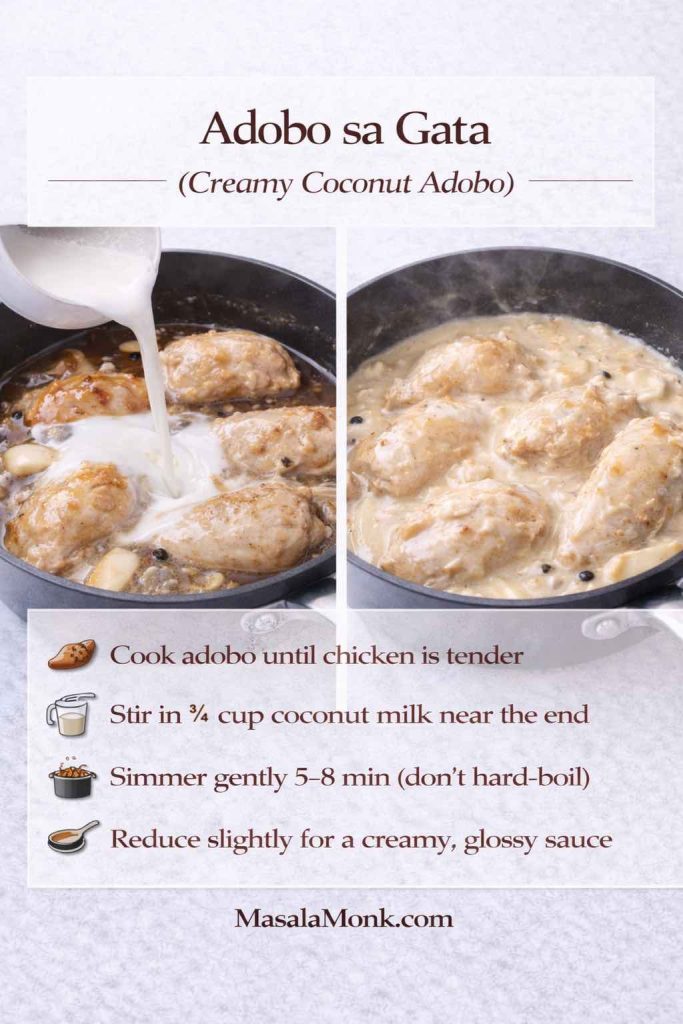
Chicken adobo sa gata (coconut milk adobo)

Coconut milk turns the dish creamy and luxurious while still keeping the adobo backbone.

Instructional infographic titled “Adobo sa Gata (Creamy Coconut Adobo).” Two photos show chicken adobo in a pan: left image shows coconut milk being poured into cooked adobo near the end, and right image shows the finished creamy coconut adobo sauce coating the chicken. Text tips say: cook adobo until chicken is tender, stir in ¾ cup coconut milk near the end, simmer gently 5–8 minutes (don’t hard-boil), and reduce slightly for a creamy, glossy sauce. MasalaMonk.com is in the footer.
For adobo sa gata, cook the chicken adobo until tender first, then stir in coconut milk near the end and simmer gently—no hard boiling—so the sauce turns creamy, glossy, and smooth.

Cook the chicken until tender using the classic steps. Then, once you remove the lid and begin reducing, stir in ¾ cup coconut milk. Simmer gently for 5–8 minutes. Avoid a hard boil because coconut milk can split if pushed.

If you ever want to make coconut milk yourself, this step-by-step guide is straightforward: How to Make Coconut Milk at Home.

Also Read: Peanut Butter Fudge: Recipes & Guide (8 Methods + Easy Variations)


Chicken Adobo Recipe Storage and Reheating (So Leftovers Stay Great)

One of the best things about chicken adobo is that it often tastes even better the next day. The sauce settles, the garlic mellows, and the whole pot feels more cohesive.

Still, leftovers deserve a little care.

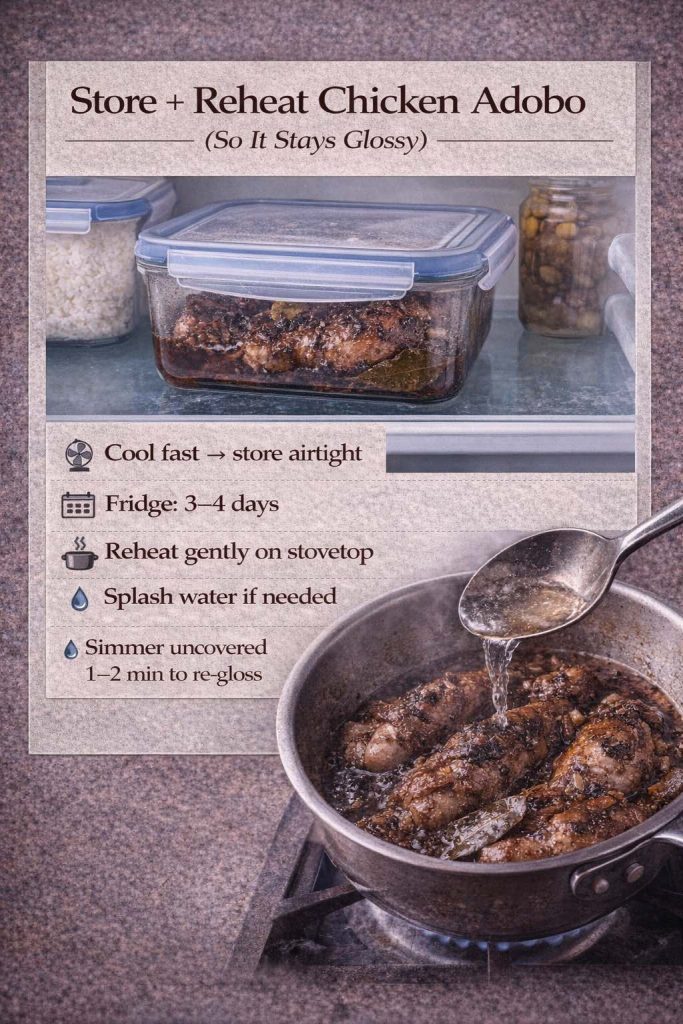
Infographic titled “Store + Reheat Chicken Adobo (So It Stays Glossy).” Top photo shows leftover chicken adobo stored in an airtight container inside a refrigerator. Bottom photo shows chicken adobo reheating in a saucepan while water is poured in from a spoon. Text tips include: cool fast and store airtight, fridge 3–4 days, reheat gently on stovetop, add a splash of water if needed, and simmer uncovered 1–2 minutes to restore a glossy adobo sauce. MasalaMonk.com appears in the footer.
Leftover chicken adobo reheats best on the stovetop—add a small splash of water and simmer uncovered briefly so the sauce turns glossy again instead of drying out.

Cool promptly and refrigerate within two hours

Food-safety guidance commonly emphasizes the “danger zone” and the two-hour window for refrigeration, especially for cooked meats. (Food Safety and Inspection Service)

A practical way to cool faster is to transfer adobo into shallower containers rather than leaving a deep pot on the counter. The sauce cools more quickly, and you’re not waiting on a dense mass of food to drop in temperature. (Food Safety and Inspection Service)

How long cooked chicken keeps

USDA guidance recommends using cooked chicken within three to four days when refrigerated (40°F / 4°C or lower). (Ask USDA)

If you want longer storage, freezing is an option. For best texture, freeze in portions with enough sauce to protect the meat from drying out when reheated.

Reheating chicken adobo the right way

Reheat until steaming hot, and if you like certainty, bring it back to 165°F / 74°C. (Food Safety and Inspection Service)

For texture, stovetop reheating is the gentlest:

  • Add a small splash of water
  • Warm over medium-low until hot
  • Then simmer uncovered briefly so the sauce becomes glossy again

That last step matters because the sauce thickens in the fridge. A quick uncovered simmer wakes it up and restores its shine.

Also Read: Manhattan Cocktail Recipe (Classic + 6 Variations)


Make-Ahead and Next-Day Ideas (So One Pot Feeds You Well)

If you like cooking once and eating twice, this chicken adobo recipe is a natural fit. In fact, adobo is one of those dishes that doesn’t mind being made ahead; it often rewards you for it.

The simplest make-ahead plan

Cook the adobo fully, including the reduction. Cool and refrigerate. The next day, reheat gently and add a splash of water only if the sauce feels too thick. Then simmer uncovered briefly to re-gloss.

Step-by-step infographic titled “Crispy Skin Adobo (Without Changing the Sauce).” Three photos show leftover chicken adobo lifted from the sauce onto a rack, then crisped in a hot pan, and finally served over rice while reduced adobo sauce is spooned on top. Text instructions say: lift chicken from sauce, pat dry lightly, crisp in hot pan or broiler 1–2 minutes, and spoon reduced adobo sauce over the crispy skin. MasalaMonk.com appears in the footer.
For next-day chicken adobo, crisp the cooked chicken briefly in a hot pan or under the broiler, then spoon the reduced adobo sauce over the top—crispy skin and glossy sauce in the same bite.

Crispy skin option (without changing the sauce)

If you used skin-on chicken and you miss that crispness after simmering, there’s an easy workaround:

  • Remove cooked chicken pieces from the sauce
  • Pat dry lightly
  • Crisp under a broiler or in a hot pan for a minute or two
  • Then spoon reduced sauce over the top

This way, you get crisp edges and glossy sauce together, rather than choosing one over the other.

Instructional graphic titled “Leftover Chicken Adobo Rice Bowl (Fast Remix).” A bowl of white rice is topped with chopped or shredded chicken adobo and a glossy adobo sauce, with sliced cucumber and fresh herbs on the side and a red chili pepper. Text steps say: chop or shred leftover adobo chicken, warm with a spoon of sauce, pile over hot rice, add fresh cucumber/herbs for contrast, and optional chili on the side. MasalaMonk.com appears in the footer.
Turn leftover chicken adobo into a fast rice bowl—warm shredded chicken with a spoon of sauce, pile over hot rice, then add fresh cucumber and herbs for crisp contrast.

Leftovers that feel like a new meal

Sometimes the best “variation” is simply serving the same pot differently.

  • Adobo rice bowl: Chop leftover chicken, warm with a spoonful of sauce, pile over rice, and add fresh cucumber or herbs for contrast.
  • Shredded adobo chicken: Pull meat from the bone, toss with sauce, and use it as a savory filling.
Instructional graphic titled “Shredded Chicken Adobo (Easy Filling Idea).” A white bowl holds shredded chicken adobo coated in glossy adobo sauce. Beside it, a wrap is being filled with the shredded adobo chicken, shredded cabbage, sliced cucumber, carrots, and green onions, with a red chili nearby. Text tips say: pull meat from the bone, toss with warm adobo sauce, use in wraps/sandwiches/bao/lettuce cups, and add crunchy vegetables and chili on the side. MasalaMonk.com appears in the footer.
Shred leftover chicken adobo, warm it with a spoon of sauce, and use it as a savory filling—wraps, sandwiches, or lettuce cups all work, especially with crunchy vegetables on the side.

If you’re already in a chicken-for-the-week mindset, these internal recipes can keep things varied without leaving the comfort zone:

And if you end up with extra rice, turning it into something crisp and snacky the next day is a satisfying upgrade: How to Turn Leftover Rice into Gourmet Arancini Balls.

Also Read: Rob Roy Drink Recipe: Classic Scotch Cocktail (Perfect + Dry + Sweet Variations)


A Few Trusted References for Classic Filipino Chicken Adobo (If You Like Comparing Styles)

Every family has a “best adobo” version, and that’s part of the charm. Still, if you enjoy seeing how other well-tested recipes handle ratios and method choices, these are strong baselines:

For food-safety references on temperatures and cooling guidance:

Also Read: Sandwich for Breakfast: Breakfast Sandwich Recipe + 10 Variations


Closing: why this chicken adobo recipe keeps earning its place

A good chicken adobo recipe doesn’t need theatrics. It needs the right balance, a patient simmer, and a final reduction that turns the pot into something glossy and irresistible. Once you’ve cooked it this way, you’ll start to see how adaptable it is: classic and saucy one night, dry-style and sticky the next, then creamy coconut adobo when you want comfort.

Most of all, it stays true to what makes adobong manok special—bold flavor from simple ingredients, built with a method you can repeat whenever you want dinner to feel like it went exactly right.

Also Read: Classic Rum Punch + 9 Recipes (Pitcher & Party-Friendly)

FAQs

1) What is the best chicken adobo recipe for beginners?

If you’re new to adobo, start with a classic chicken adobo recipe using bone-in thighs and drumsticks. Because those cuts stay juicy during simmering, you get tender meat and a flavorful adobo sauce without needing perfect timing. In addition, the method is forgiving: sear for depth, simmer for tenderness, then reduce for a glossy finish.

2) What are the chicken adobo ingredients in a classic adobong manok?

A traditional ingredient list for adobong manok usually includes chicken, garlic, soy sauce, vinegar, bay leaves, and whole peppercorns. Meanwhile, water helps balance the sauce while it simmers. Optionally, you can add onion for softness or a small amount of sugar for a sweeter chicken adobo.

3) What is the vinegar and soy sauce ratio for Filipino chicken adobo?

A common starting point is more soy sauce than vinegar, often around 1/2 cup soy sauce to 1/3 cup vinegar, plus water to mellow the mixture early on. However, the ideal ratio depends on your vinegar strength and soy sauce saltiness. As a result, it’s smart to reduce the sauce at the end, then adjust only if needed.

4) Is marinating required for an authentic adobo recipe?

Not necessarily. Many authentic adobo recipes skip a long marinade and rely on simmering to season the chicken thoroughly. Still, a short 15–30 minute rest in soy, vinegar, and garlic can deepen flavor. Either way, the final sauce reduction is what makes the dish taste cohesive.

5) How do you cook chicken adobo step by step without overcooking it?

First, brown the chicken lightly for deeper flavor. Next, simmer gently until the meat is tender. Finally, reduce the sauce uncovered until it turns glossy and coats the chicken. For chicken breast, shorten the simmer time and finish the reduction after pulling the breast pieces, then return them briefly to glaze.

6) What is the correct procedure in cooking adobo if my sauce tastes too sour?

Before changing anything, let the sauce reduce longer; often, extra liquid makes vinegar seem louder than it really is. If it still tastes sharp afterward, add a splash of water and simmer again, or stir in a tiny amount of sugar to round the edges. Moreover, serving with rice naturally softens the tang.

7) How can I make low sodium adobo without losing flavor?

Use a low-sodium soy sauce, then build flavor with garlic, bay leaves, peppercorns, and a proper reduction. Additionally, browning the chicken first adds depth, so you won’t rely only on saltiness for taste. If needed, finish with a small squeeze of citrus or a pinch of sugar for balance rather than extra soy.

8) How long should you simmer chicken adobo for tender results?

For bone-in thighs and drumsticks, simmering often takes about 25–35 minutes at a gentle bubble. Meanwhile, wings can finish sooner, and chicken breast needs less time to avoid drying out. Instead of boiling hard, keep the heat low so the meat stays juicy and the sauce stays smooth.

9) Why is my chicken adobo tough even after simmering?

Usually, the heat is too high or the cut needs more time at a gentle simmer. Toughness can also happen with older or leaner chicken. Therefore, lower the heat, cover, and extend the simmer until a knife slides in easily. After that, reduce the sauce only once the chicken is tender.

10) How do you make adobong manok na tuyo (dry-style chicken adobo)?

Cook the chicken adobo recipe as usual, then reduce the sauce longer until it clings tightly and looks lacquered. For an even drier finish, remove the chicken when tender, reduce the sauce more aggressively, and return the chicken to coat. Consequently, you get a sticky glaze rather than a pool of sauce.

11) How do I make sweet chicken adobo without making it sugary?

Add only a small amount of sugar—often 1–2 teaspoons—during the final reduction so it melts into the sauce instead of tasting separate. Alternatively, a few pineapple chunks near the end can add sweetness with a brighter flavor. Either way, the goal is to round the tang, not overpower it.

12) Can I cook chicken adobo with potato in the same pot?

Yes. Add peeled potato chunks after returning the chicken to the braise, then simmer until both are tender. As the potatoes cook, they also slightly thicken the sauce. Later, reduce the liquid uncovered so the potatoes and chicken get coated in glossy adobo sauce.

13) What is adobo sa gata, and when do you add coconut milk?

Adobo sa gata is a creamy version of Filipino adobo made by adding coconut milk near the end. After the chicken is tender, stir in coconut milk and simmer gently for a few minutes. Importantly, avoid a hard boil, because coconut milk can split if cooked too aggressively.

14) What is adobong puti, and how is it different from classic adobo?

Adobong puti (white adobo) usually skips soy sauce, relying on vinegar, garlic, bay leaves, and peppercorns instead. Because it’s brighter and more vinegar-forward, careful simmering and reduction matter even more. As a result, it tastes clean, sharp, and aromatic—yet still unmistakably adobo.

15) What are the most common mistakes in a classic chicken adobo recipe?

Common issues include skipping browning (which can make the sauce taste flatter), boiling too hard (which can toughen the chicken), and reducing too early (before the chicken is tender). Also, adding too much vinegar or soy without tasting after reduction can throw off balance. Instead, simmer gently, reduce at the end, then adjust in small steps.

16) How do I know chicken adobo is fully cooked?

The chicken should be tender and the juices should run clear. Additionally, the safest check is temperature: the thickest part should reach 74°C / 165°F. Once that’s done, you can focus on reducing the sauce for texture and flavor.

17) Can I make chicken adobo ahead of time?

Definitely. In fact, chicken adobo often tastes better the next day because the flavors settle and the sauce thickens slightly. Reheat gently with a splash of water if the sauce is too thick, then simmer uncovered briefly to bring back the glossy finish.

18) How do you store and reheat leftover chicken adobo?

Cool leftovers promptly, then store in an airtight container in the fridge. When reheating, warm gently on the stovetop so the sauce doesn’t scorch. Finally, simmer uncovered for a minute or two to restore the glossy adobo sauce texture.

19) What is the best cut for Filipino chicken breast adobo?

If you prefer breast, use larger pieces and shorten the simmer time. Then finish reducing the sauce separately and return the breast briefly to coat. Consequently, you keep the chicken tender while still getting the full flavor of the sauce.

20) What does “adobo” mean in Filipino cooking?

In Filipino cooking, “adobo” generally refers to the method: braising in vinegar and salt (often soy sauce), along with garlic, bay leaves, and peppercorns. Because it’s both flavorful and practical, the technique has become one of the most iconic Filipino dishes—especially chicken adobo and pork adobo.

Posted on 4 Comments

Apple Cider Vinegar and Belly Fat: Does It Really Work?

Benefits-of-APPLE-CIDER-VINEGAR-FOR-BELLY-FAT

Apple cider vinegar (ACV) is one of those remedies that just won’t quit. For years it’s been hailed as a metabolism booster, detoxifier, and — most of all — a belly-fat burner. On social media, you’ll see it mixed into detox drinks, touted in “before and after” weight-loss videos, or taken as daily shots. No wonder search engines are filled with questions like:

  • Does apple cider vinegar really burn belly fat?
  • How do you use ACV to lose stomach fat?
  • Can this drink shrink my waistline?

The short answer is: ACV is not a magic potion. You can’t spot-reduce fat from your stomach with any single food or drink. That said, there is credible research showing that vinegar — and ACV in particular — may help with modest weight loss, waist reduction, and even decreases in visceral fat (the deeper abdominal fat linked to metabolic disease).

For example:

  • In a landmark Japanese trial, adults who took vinegar daily for 12 weeks lost weight, reduced their waistlines, and lowered visceral fat compared to a placebo group (Kondo et al., 2009).
  • A 2024 Lebanese study found that overweight adolescents and young adults who drank ACV for 12 weeks saw significant drops in BMI, waist, and hip measurements (Abou-Khalil et al., 2024).
  • A 2023 Iranian study in people with type 2 diabetes showed ACV lowered waist circumference and improved blood sugar and cholesterol levels (Jafarirad et al., 2023).

So while it’s no miracle, science does suggest ACV can play a supportive role in trimming belly fat — especially when combined with healthy eating and exercise.


What Is Apple Cider Vinegar and How Does It Affect Belly Fat?

From apple juice to acetic acid

Apple cider vinegar starts its life as crushed apples. First, yeast converts the fruit sugars into alcohol (making hard cider). Then bacteria convert that alcohol into acetic acid, the sour-tasting compound that defines vinegar.

Most commercial ACV contains about 4–6% acetic acid — the same range studied in clinical trials. Acetic acid is thought to be the main driver of vinegar’s metabolic effects, from appetite control to fat storage. A 2006 review in MedGenMed noted that vinegar reliably lowers post-meal glucose and insulin spikes, which may indirectly influence weight and fat gain.

The “mother”

If you’ve ever seen cloudy strands floating in ACV labeled “with the mother,” that’s a mix of proteins, enzymes, and beneficial bacteria from the fermentation process. Many people prefer raw, unfiltered versions with the mother because of its traditional and probiotic appeal. However, current research shows the real fat-loss effects come from acetic acid, not the mother itself.

More than acetic acid

Although acetic acid is the star, ACV also contains:

  • Malic acid (from apples),
  • Trace minerals such as potassium,
  • Polyphenols, plant-based antioxidants.

These compounds may contribute to ACV’s overall health profile, but they’re present in small amounts. When it comes to weight or waist reduction, the focus remains firmly on acetic acid.

ACV versus other vinegars

It’s worth pointing out that many vinegar studies — including the Japanese visceral fat trial — didn’t always use apple cider vinegar specifically. Because acetic acid is common to all vinegars, their metabolic effects are likely similar. ACV simply dominates the wellness world because of its natural image, long history in folk medicine, and wide availability.


Can You Really Burn Belly Fat with Apple Cider Vinegar?

It’s tempting to believe that apple cider vinegar is some kind of shortcut to a flat stomach. The internet is full of “ACV before and after” photos that make it seem like magic. But let’s set expectations straight: no food or drink can target belly fat in isolation.

What ACV can do, according to research, is help with overall fat loss, waist reduction, and even visceral fat (the type of fat around organs that raises your risk for diabetes and heart disease). And because belly fat is where much of that excess fat gets stored, losing overall fat often shows up as a slimmer waistline.

The Japanese Trial on Apple Cider Vinegar and Visceral Belly Fat

One of the most important studies on vinegar and belly fat comes from Japan. In 2009, researchers ran a 12-week randomized, double-blind trial with 175 obese adults. Participants were divided into three groups: one took a daily drink with 15 mL vinegar, another 30 mL vinegar, and the third took a placebo.

Woman measuring waist with tape while a glass of apple cider vinegar sits on kitchen counter with text overlay about belly fat reduction results.
Clinical studies show apple cider vinegar can reduce waist circumference and visceral fat in 8–12 weeks.

The results were eye-opening:

  • Both vinegar groups lost significantly more body weight than placebo.
  • Their waist circumference decreased, while the placebo group’s waistline slightly increased.
  • CT scans showed reductions in visceral fat area — the deep belly fat strongly linked to metabolic disease.
  • Blood triglyceride levels also dropped.

This study, published in Bioscience, Biotechnology, and Biochemistry, was the first to show that vinegar could reduce visceral belly fat in humans (Kondo et al., 2009).

2024 Study: Apple Cider Vinegar and Belly Fat Reduction in Young Adults

Fast forward to 2024, and researchers in Lebanon tested apple cider vinegar itself. They enrolled 120 overweight and obese adolescents and young adults in a randomized, placebo-controlled trial. Participants took 5, 10, or 15 mL of ACV daily, or a placebo, for 12 weeks.

The findings mirrored the Japanese study:

  • All ACV groups lost more weight and BMI than placebo.
  • They also saw measurable reductions in waist and hip circumference.
  • The highest ACV dose (15 mL/day) showed the strongest effects.

This study, published in BMJ Nutrition, Prevention & Health, confirms that ACV can support modest belly-slimming effects in younger, diverse populations (Abou-Khalil et al., 2024).

Belly fat and diabetes: extra benefits

What about people already struggling with metabolic issues? In 2023, an Iranian trial looked at ACV in patients with type 2 diabetes. All participants followed a healthy diet, but one group also consumed 30 mL ACV daily.

After 8 weeks, the ACV group showed:

  • Lower body weight and BMI,
  • Reduced waist and hip circumference,
  • Improved blood sugar control (HbA1c) and cholesterol levels.

This study, published in Frontiers in Clinical Diabetes and Healthcare, suggests ACV can play a double role: helping reduce abdominal fat and improving metabolic health in high-risk individuals (Jafarirad et al., 2023).

Supporting evidence from smaller trials

Another trial, published in 2018, tested 30 mL/day of ACV in overweight and obese adults, alongside a calorie-restricted diet. After 12 weeks, participants lost more weight, lowered their BMI, and improved body composition compared to diet alone. While this study didn’t measure visceral fat directly, it still supports ACV as a helpful add-on to lifestyle changes (Khezri et al., 2018).

What the evidence tells us

Across these studies, some clear patterns emerge:

  • Dosage matters: Benefits are seen around 15–30 mL/day (1–2 tablespoons).
  • Consistency is key: Studies lasted 8–12 weeks; results don’t happen overnight.
  • Lifestyle still rules: In every trial, ACV worked with healthy diet or habits — not instead of them.
  • The belly link is real: Waist and visceral fat reductions show ACV’s effects go beyond just weight on the scale.

So, does ACV “burn” belly fat?

Not in the instant, fat-melting way the internet sometimes suggests. But science does show that daily, diluted apple cider vinegar can help reduce waist circumference and visceral fat over time, especially when paired with balanced nutrition and exercise.

Think of it as a supporting actor in your weight-loss journey — helpful, but not the star of the show.


How to Use Apple Cider Vinegar for Belly Fat

By now, the evidence is clear: apple cider vinegar (ACV) can play a modest but real role in helping reduce weight and waist size — as long as you use it consistently and safely. But that leads to the practical question: how exactly should you take it? Let’s break it down.

The right dosage

Most of the human trials that showed results used between 15–30 milliliters (1–2 tablespoons) per day.

  • In Japan’s landmark 2009 study, participants drank either 15 mL or 30 mL vinegar daily and saw reductions in weight and visceral belly fat (Kondo et al., 2009).
  • The Lebanese 2024 trial used 5, 10, and 15 mL/day, with the 15 mL group showing the strongest waist-slimming effects (Abou-Khalil et al., 2024).
  • In diabetic adults, 30 mL/day improved waist circumference, blood sugar, and cholesterol (Jafarirad et al., 2023).

So if you’re looking to follow the science, 1–2 tablespoons per day, split into 1–2 doses, is the sweet spot.

Hand pouring apple cider vinegar into a glass of water with text overlay about safe daily dose for belly fat.
Apple cider vinegar and belly fat: safe daily dosage is 1–2 tablespoons, always diluted in water.

Always dilute it

This part cannot be stressed enough: never drink ACV straight. Its high acidity can erode tooth enamel, irritate the throat, and upset your stomach. All the clinical studies diluted ACV in water or mixed it with food.

A safe and practical way is:

  • 1–2 teaspoons in a large glass of water (250–300 ml).
  • Work up slowly to 1 tablespoon per glass if tolerated.
  • Spread across 1–2 drinks per day, ideally with meals.

Best timing

There’s no single “magic time,” but research suggests drinking vinegar before or with meals helps reduce blood sugar spikes and may increase satiety. Many people prefer a diluted drink in the morning and another before dinner.

If you’re sensitive to acidity on an empty stomach, start with meals only.

ACV drink ideas

Plain water + ACV works fine, but variety helps with consistency. Here are three simple, research-friendly options:

  1. Classic ACV water
    • 1 teaspoon ACV
    • 250 ml warm or room-temperature water
    • Optional: add a slice of fresh ginger
  2. ACV + lemon refresher
    • 1 teaspoon ACV
    • Juice of ½ lemon
    • 300 ml water
    • Adds vitamin C and flavor without calories
  3. Green tea + ACV combo
    • Brew a cup of green tea, let it cool slightly
    • Stir in 1 teaspoon ACV
    • This combines two evidence-backed fat-loss helpers: tea catechins + vinegar

Tip: Always use a straw to reduce enamel exposure, and rinse your mouth with plain water afterward.

You can also combine apple cider vinegar and lemon juice for weight loss, a refreshing drink with added vitamin C and flavor.

Flat lay of apple cider vinegar, lemon, ginger, and green tea leaves with text overlay about ACV drinks for belly fat.
Three apple cider vinegar drink ideas for belly fat: with lemon, ginger, or green tea.

Incorporating ACV into food

If drinks aren’t your style, you can still reap the benefits:

  • Use ACV as a salad dressing base (mixed with olive oil, mustard, and herbs).
  • Add a splash to marinades for chicken or tofu.
  • Mix into soups or stews just before serving for a tangy kick.

This approach is easier on your teeth and stomach, while still giving you daily acetic acid.

Safety reminders

Most people tolerate ACV well, but there are some cautions:

  • Don’t exceed 30 mL/day. More is not better and can cause side effects.
  • Never take it undiluted.
  • If you take insulin, diuretics, or heart medications, talk to your doctor first — ACV can interact with these.
  • If you have reflux, ulcers, or sensitive teeth, use sparingly or skip it.

A few case reports have documented throat burns or enamel erosion from misuse, so moderation and dilution are key.

What results to expect

In the studies, participants lost weight and inches over 8–12 weeks of daily use. For example, in Kondo’s Japanese trial, the vinegar groups lost about 1–2 kg (2–4 lbs) more than placebo, along with meaningful reductions in waist size (Kondo et al., 2009).

That may not sound dramatic, but remember: these were results just from adding vinegar, without other big lifestyle overhauls. When paired with a balanced diet and movement, ACV can be a small but steady ally in trimming belly fat.


What Results to Expect from Apple Cider Vinegar for Belly Fat Reduction?

If you’ve ever scrolled through social media, you’ve probably seen dramatic “before and after” photos of people claiming they lost 10, 20, or even 30 pounds just by drinking apple cider vinegar. The truth is less glamorous — but more realistic.

ACV helps, but modestly

In most human trials, participants lost 1–2 kilograms (2–4 pounds) over 8–12 weeks when adding vinegar to their daily routine — without making other major changes.

  • In the Japanese 2009 trial, the vinegar groups lost around 1.2–1.9 kg (2.6–4.2 lbs) over 12 weeks, while the placebo group gained a little weight (Kondo et al., 2009).
  • Waist circumference dropped by about 1–2 cm, and CT scans confirmed a reduction in visceral belly fat.
  • In the 2024 Lebanese study, adolescents and young adults also lost measurable waist and hip circumference along with body weight (Abou-Khalil et al., 2024).
  • In diabetic adults, ACV added on top of a healthy diet led to smaller waists and better blood sugar levels in just 8 weeks (Jafarirad et al., 2023).

That’s not a miracle transformation, but it’s a steady, meaningful improvement — especially considering nothing else in the diet was drastically changed.

Split-panel image with a woman showing apple cider vinegar myth vs fact about belly fat loss results.
Myth: apple cider vinegar melts belly fat overnight. Fact: studies show small but real waist reductions in 8–12 weeks.

Why results vary

Several factors influence how much ACV might help you:

  • Your starting point: The bigger the calorie surplus and the more belly fat you carry, the more room there is for improvement.
  • Your diet quality: Vinegar won’t offset a consistently high-calorie diet. But when paired with balanced meals, it may help you feel fuller and snack less.
  • Consistency: Benefits show up after daily use for 8–12 weeks. Skipping days or using it irregularly won’t cut it.
  • Other habits: Exercise, sleep, and stress management all play a huge role in belly fat. ACV alone isn’t enough.

Think of ACV as a helper, not a hero

A good way to think about ACV is like this: it’s not the engine of fat loss — that comes from diet and activity — but it can be a booster. By helping regulate blood sugar, controlling appetite, and slightly improving fat metabolism, it nudges your body in the right direction.

When added consistently over time, those nudges add up to small but noticeable changes: a belt that fits looser, a waistline that feels less bloated, and blood markers that shift in a healthier direction.

Pairing ACV with foods that reduce belly fat naturally can maximize your waist-slimming results.

The bottom line

  • Expect 1–2 kg weight loss over a few months with ACV alone.
  • Expect a small waist reduction — a couple of centimeters, not several inches.
  • Expect better results when you combine ACV with a calorie-conscious diet and light activity.

So if you’re hoping for overnight six-pack abs, ACV won’t deliver. But if you’re looking for a safe, inexpensive way to support your belly fat loss journey, it’s a worthy addition.

If you want to see changes beyond the scale, learn how to measure belly fat and track progress using simple methods.


Apple Cider Vinegar for Belly Fat: Safety and Side Effects

Apple cider vinegar may be natural, but that doesn’t mean it’s risk-free. Most of the positive studies used moderate doses (15–30 mL/day) and always in diluted form. When people go beyond that — taking shots of undiluted ACV, chugging large amounts, or combining it with risky “detox” diets — side effects are much more likely.

Here’s what you need to know before making ACV part of your routine.

1. Protect your teeth and throat

The biggest everyday risk is tooth enamel erosion. Vinegar’s acetic acid is very acidic, and repeated exposure can gradually wear down enamel, leading to sensitivity and cavities. Sipping ACV straight can also irritate your throat and esophagus.

How to prevent it:

  • Always dilute ACV in plenty of water.
  • Use a straw when drinking ACV beverages.
  • Rinse your mouth with plain water afterward.
  • Don’t brush your teeth immediately (enamel is softened right after acid exposure).

2. Stomach and digestion issues

Some people experience nausea, heartburn, or digestive discomfort with ACV, especially if taken on an empty stomach or in large amounts.

In one case report, a woman developed delayed stomach emptying (gastroparesis) from chronic, excessive vinegar use. While this is rare, it’s a reminder that more is not better.

Tip: Start with 1 teaspoon in a glass of water and increase slowly. Stop if you notice ongoing discomfort.

3. Medication interactions

ACV can interact with several types of medication:

  • Diabetes medications (like insulin): ACV can lower blood sugar, which might increase the risk of hypoglycemia when combined.
  • Diuretics (water pills): ACV may worsen potassium loss.
  • Digoxin (heart medication): Combining with ACV could potentially lower potassium too much, leading to dangerous side effects.

If you’re on any of these, talk to your doctor before adding daily ACV.

4. Potassium and bone health

Very high vinegar intakes over long periods have been linked to low blood potassium and even reduced bone density in rare case reports. Again, this was with extreme overuse, not the moderate amounts used in clinical trials.

5. Pregnancy and children

There’s limited research on ACV in pregnancy and children. While small amounts in food are generally considered safe, it’s best to avoid concentrated ACV drinks in these groups unless cleared by a healthcare provider.

6. Safe daily limits

Based on clinical research, the safe and effective range is:

  • 15–30 mL per day (1–2 tablespoons)
  • Always diluted in at least 250–300 mL of water
  • Taken in 1–2 doses, ideally with meals

This range has been shown to lower waist circumference, weight, and visceral fat without significant side effects in studies (Kondo et al., 2009; Abou-Khalil et al., 2024; Jafarirad et al., 2023).

Some people also enjoy combining ACV with cinnamon and lemon for belly fat for a metabolism-friendly drink.


Bottom line on safety

Apple cider vinegar is safe for most healthy adults when used in moderate, diluted amounts. The risks come from overuse or misuse — such as drinking it straight, exceeding 30 mL/day, or combining it with sensitive medications.

If used wisely, ACV can be a simple, affordable addition to your health routine. Just remember: consistency and moderation are your best friends here.


Apple Cider Vinegar vs Other Belly Fat Remedies

Apple cider vinegar isn’t the only natural remedy marketed for trimming the waistline. Green tea, lemon water, probiotics, and even fat-burning supplements all make similar claims. So how does ACV really stack up?

ACV vs green tea

Green tea is one of the most researched natural aids for fat loss. Its catechins (EGCG) and caffeine may help increase calorie burning and fat oxidation. Some studies show modest reductions in body weight and belly fat with regular green tea consumption.

ACV works differently. Its strength lies in acetic acid, which seems to improve blood sugar control, slow stomach emptying, and help with appetite regulation. While green tea gives you a metabolic boost, ACV may help you eat less overall. Both can be part of a healthy belly-fat strategy — and some people even combine them in one drink.

Green tea has its own fat-burning compounds, and combining it with ACV may work even better. You can explore some green tea and spice infusions for weight loss as creative add-ons.

ACV vs lemon water

Lemon water is refreshing, hydrating, and rich in vitamin C, but there’s little scientific evidence that it directly burns fat. Its main benefit comes from encouraging hydration and sometimes replacing sugary drinks. Compared to lemon water, ACV has far more clinical research backing its effects on waist circumference and visceral fat.

That said, adding lemon juice to an ACV drink can make it more palatable and give you both hydration and acetic acid benefits.

ACV vs probiotic foods

Gut health is closely linked to weight regulation, and probiotic foods like yogurt, kefir, or kimchi have been studied for their potential role in belly fat reduction. Raw, unfiltered ACV does contain the “mother,” which has probiotic-like qualities, but the clinical trials on fat loss point to acetic acid, not probiotics, as the driver. For true gut diversity, fermented foods beyond ACV are still important.

ACV vs supplements

From “fat-burning pills” to ACV capsules, the supplement industry is full of products promising quick belly-fat loss. Most have limited scientific backing, and in some cases, questionable safety. In contrast, liquid ACV is inexpensive, widely available, and backed by multiple human trials.


The takeaway

Compared to other belly-fat aids, ACV stands out for being simple, affordable, and supported by human studies. It’s not the strongest tool — that crown probably goes to consistent calorie control and movement — but it is one of the most accessible helpers you can add to your routine.


Should You Try Apple Cider Vinegar for Belly Fat?

At this point, the verdict is clear: apple cider vinegar is not a miracle belly-fat burner, but it does have credible science behind it. Multiple human studies show that when taken daily — in moderate, diluted amounts — ACV can help reduce body weight, shrink waist circumference, and even lower visceral fat.

The best part? It’s inexpensive, widely available, and easy to incorporate into meals or drinks. Unlike many trendy supplements, ACV has stood the test of time — both in traditional use and in modern clinical research.

But it’s important to keep your expectations realistic. If you’re hoping for dramatic, overnight changes, ACV will disappoint you. The typical results seen in trials are 1–2 kilograms of weight loss and a couple of centimeters off the waist over 8–12 weeks. Those are steady, sustainable improvements — especially if you also make small adjustments to your diet, movement, and lifestyle.

Young person in workout clothes  with text overlay about ACV being part of healthy lifestyle for weight loss.
Apple cider vinegar is a sidekick, not the hero — consistency is what reduces belly fat over time.

Who may benefit most

  • People with excess belly fat who want an extra nudge alongside healthy habits.
  • Individuals with blood sugar issues or type 2 diabetes, since ACV may improve glucose control and lipid levels.
  • Anyone looking for a low-cost, natural way to support long-term weight management.

Final word

Think of ACV as a helpful sidekick, not the hero of your weight-loss journey. Pair it with balanced meals, regular movement, and good sleep, and it can give you that extra push toward a slimmer, healthier waistline.

If you’re ready to try it, start small: 1 teaspoon in a big glass of water before meals, and gradually build up to 1–2 tablespoons a day. Consistency, not excess, is where the real magic happens.

Frequently Asked Questions about Apple Cider Vinegar and Belly Fat

1. Does apple cider vinegar burn belly fat?

Apple cider vinegar doesn’t “burn” belly fat directly, but research shows it can help reduce waist circumference and visceral fat when taken consistently for 8–12 weeks (Kondo et al., 2009). Think of it as a gentle helper rather than a fat-melting potion.

2. Can apple cider vinegar reduce stomach fat overnight?

No — there’s no overnight fix for stomach fat. Clinical studies show that apple cider vinegar and belly fat reduction happens gradually over weeks, not days. Patience and consistency matter most.

3. How should I drink apple cider vinegar for belly fat?

Dilute 1–2 teaspoons of ACV in a large glass of water, and drink before or with meals. You can slowly build up to 1–2 tablespoons daily, which is the range tested in human trials.

4. What is the best time to take apple cider vinegar for belly fat?

Most people find it helpful before meals, since ACV may reduce blood sugar spikes and help control appetite. If it upsets your stomach, try it only with food.

5. How much apple cider vinegar should I take daily to lose belly fat?

The safe and effective range is 15–30 mL per day (1–2 tablespoons), always diluted in water. Going beyond this doesn’t speed up belly fat loss — and may cause side effects.

6. Can apple cider vinegar flatten your stomach?

It won’t give you visible abs on its own, but studies do show ACV helps reduce waist size and visceral belly fat. Combined with diet and exercise, it may support a flatter midsection.

7. Is apple cider vinegar good for visceral fat?

Yes — the Japanese trial measured visceral fat with CT scans and found that vinegar drinkers had significant reductions in deep belly fat compared to placebo (Kondo et al., 2009).

8. Does apple cider vinegar work for belly fat without diet changes?

Even without big diet changes, participants in ACV studies lost 1–2 kg and inches off their waist. But pairing ACV with balanced eating makes the results stronger.

9. How long does it take to see belly fat results with apple cider vinegar?

Most trials lasted 8–12 weeks, and that’s when results — smaller waistlines and modest weight loss — became noticeable.

10. Is it better to drink apple cider vinegar in the morning or at night for belly fat?

Either works, but morning can give you a fresh start, while evening may help control late-night cravings. What matters is daily consistency.

11. Does apple cider vinegar help with belly fat in diabetics?

Yes — in people with type 2 diabetes, ACV reduced waist circumference and improved blood sugar and cholesterol (Jafarirad et al., 2023).

12. Can apple cider vinegar pills help with belly fat?

ACV capsules are popular, but most research uses liquid vinegar. Pills may work if they contain enough acetic acid, but quality varies — liquid ACV is more reliable.

13. What’s the difference between apple cider vinegar and white vinegar for belly fat?

Both contain acetic acid, which drives the fat-loss effects. Apple cider vinegar and belly fat reduction are studied more often, but white vinegar may offer similar benefits.

14. Can I mix apple cider vinegar with lemon or green tea for belly fat?

Yes — lemon adds vitamin C and flavor, while green tea brings its own fat-burning compounds. Together, they may make your ACV routine tastier and more effective.

15. Will apple cider vinegar alone get rid of my belly fat?

No single food or drink can do that. But as studies show, ACV can give you a modest but meaningful nudge toward smaller waistlines — especially when paired with healthy diet, activity, and good sleep.

Posted on Leave a comment

Keto and Italian Dressing: What You Need to Know! A Flavorful Addition to Your Low-Carb Journey

scrabble tiles surrounded by white flowers on a marbled surface

Buongiorno, keto aficionados! Today, we’re diving into the world of Italian dressing and its compatibility with the ketogenic diet. Italian dressing is a beloved condiment known for its zesty flavors and versatility in enhancing salads, marinades, and more. But is it keto-friendly? In this comprehensive and detailed post, we’ll explore the ins and outs of Italian dressing, examine its impact on ketosis, provide tips for making or selecting keto-friendly options, and even share delicious ways to incorporate it into your low-carb meals. Get ready to unlock the flavor potential of Italian dressing on your keto journey! 🍃🥗

Understanding the Components of Italian Dressing 🌱📊

Italian dressing typically consists of a combination of ingredients that contribute to its distinctive flavor profile. The key components may include:

  1. Oils: Italian dressing often contains a blend of oils, such as olive oil, vegetable oil, or canola oil. These oils provide a smooth texture and contribute to the richness of the dressing. Additionally, they are a source of healthy fats, which are essential for a well-formulated ketogenic diet.
  2. Vinegar: Vinegar, commonly white or red wine vinegar, gives Italian dressing its tangy and slightly acidic taste. It adds brightness and balances the flavors of the dressing. Vinegar is generally low in carbohydrates, making it a suitable choice for keto dieters.
  3. Herbs and Spices: Italian dressing typically incorporates a variety of herbs and spices, such as oregano, basil, parsley, garlic, onion powder, and black pepper. These ingredients lend depth and complexity to the dressing’s flavor profile. Most herbs and spices are low in carbohydrates and can provide additional health benefits.
  4. Acidic Ingredients: Besides vinegar, Italian dressing may include acidic ingredients like lemon juice or Dijon mustard. These elements further enhance the tanginess and contribute to the overall flavor experience. They are typically low in carbohydrates and can add a burst of flavor without compromising ketosis.

The Ketogenic Impact of Italian Dressing 🔥🥗

When it comes to the keto diet, the impact of Italian dressing depends on its specific ingredients and carbohydrate content. Here are a few key points to consider:

  1. Carbohydrate Content: Traditional Italian dressing may contain added sugars or sweeteners, which can significantly increase its carbohydrate content. It’s essential to check labels and opt for low-carb or sugar-free versions to ensure it fits within your daily carbohydrate limits. Aim for dressings with less than 2 grams of net carbs per serving.
  2. Fat Content: The oils used in Italian dressing provide a source of healthy fats, which are essential for a well-formulated ketogenic diet. These fats are important for maintaining ketosis and providing sustained energy. Look for dressings made with high-quality oils like extra virgin olive oil or avocado oil, which are rich in monounsaturated fats.
  3. Flavor Enhancement: Italian dressing can elevate the taste of keto-friendly meals, such as salads, grilled meats, and roasted vegetables. It adds depth and complexity to these dishes while keeping them satisfying and enjoyable. The flavorful combination of herbs, spices, and tangy vinegar can enhance the overall dining experience on a keto diet.

Tips for Choosing or Making Keto-Friendly Italian Dressing 🥣🌿

To ensure that Italian dressing aligns with your ketogenic lifestyle, consider the following tips:

  1. Read Labels: When purchasing Italian dressing from the store, carefully read the ingredient list and nutrition facts panel. Look for dressings that are low in carbohydrates, free from added sugars or high-fructose corn syrup, and made with healthy oils. Avoid dressings that contain inflammatory vegetable oils or excessive carbohydrates.
  2. Homemade Dressing: Consider making your own Italian dressing at home using keto-friendly ingredients. This way, you have full control over the quality of oils, the amount of carbohydrates, and the overall flavor. Start with a base of extra virgin olive oil or avocado oil, add vinegar of your choice (such as red wine vinegar or apple cider vinegar), and season with a combination of herbs and spices. Experiment with flavors to create a personalized dressing that meets your keto needs.
  3. Control the Sweetness: If you prefer a slightly sweeter Italian dressing, consider using keto-friendly sweeteners like stevia or erythritol to achieve the desired taste without adding excessive carbohydrates. You can also experiment with a small amount of fresh lemon juice or a touch of grated Parmesan cheese to enhance the natural flavors.
  4. Customize the Flavor: Adjust the herb and spice ratios in your Italian dressing to suit your taste preferences. You can add additional herbs like thyme, rosemary, or fennel seeds for a unique twist on traditional Italian flavors. Consider adding fresh minced garlic or shallots for a robust and aromatic profile.

Delicious Ways to Incorporate Italian Dressing into Your Keto Meals 🌿🍃

Italian dressing isn’t limited to just salads. Here are some mouthwatering ideas to bring the flavors of Italy to your keto-friendly dishes:

  1. Marinade for Meats: Use Italian dressing as a marinade for your favorite keto-friendly meats, such as chicken, beef, or fish. The tanginess and aromatic flavors will enhance the taste and tenderize the protein. Allow the meat to marinate for a few hours or overnight before grilling, baking, or sautéing.
  2. Roasted Vegetables: Toss your choice of low-carb vegetables, like zucchini, bell peppers, cauliflower, or Brussels sprouts, with Italian dressing before roasting. The dressing will add a burst of flavor and help caramelize the vegetables beautifully. Spread the vegetables on a baking sheet, drizzle with Italian dressing, and roast until tender and golden brown.
  3. Grain-Free Pasta Salad: Prepare a refreshing and keto-friendly pasta salad using vegetable noodles like zucchini or cucumber. Spiralize the vegetables, toss them with Italian dressing, cherry tomatoes, olives, and fresh herbs like basil or parsley. You can even add diced mozzarella or crumbled feta cheese for extra indulgence.
  4. Drizzle on Grilled Vegetables: After grilling vegetables like asparagus, mushrooms, or onions, drizzle them with a generous amount of Italian dressing to infuse them with tangy and herbaceous flavors. The dressing will add a delightful finishing touch and bring out the natural sweetness of the grilled vegetables.
  5. Zesty Chicken Salad: Combine cooked chicken breast, crisp lettuce, cherry tomatoes, sliced cucumbers, and black olives in a bowl. Drizzle Italian dressing over the salad and toss to coat. Top with grated Parmesan cheese and fresh herbs for a flavorful and satisfying keto-friendly meal.

Conclusion: Elevate Your Keto Meals with Italian Dressing! 🥗🍃

Italian dressing can be a flavorful addition to your keto journey, but it’s crucial to choose or make keto-friendly options that align with your dietary goals. By being mindful of the carbohydrate content, opting for dressings made with healthy oils, and customizing the flavors to suit your taste preferences, you can enjoy the tangy and aromatic experience of Italian dressing without compromising your keto lifestyle. So, get creative, experiment with homemade versions, and savor the flavors of Italy on your keto plates! Buon appetito! 🌿🥗