
Posted on Leave a comment

Apple Cider Donuts Recipe: Classic Fried Donuts With Cinnamon Sugar

Broken cinnamon-sugar apple cider donut showing a moist cake crumb, with several whole donuts behind it.

A good apple cider donut should taste like cider before it simply tastes like cinnamon. We’re after the warm cider-mill kind: a tender cake-donut center, a thin fried crust and cinnamon sugar that clings to your fingertips.

The best ones barely seem worth saving for later. They are still warm enough that the whole bag smells of cider, fried dough and cinnamon, the sugar finds every little crack in the crust, and the first bite gives slightly at the edge before opening into soft cake underneath.

That is the version worth chasing at home. The recipe concentrates 3 cups / 710 ml cider down to ⅓ cup / 80 ml, then combines it with apple butter and sour cream for a tender cake center, a thin fried crust and enough apple flavor to stay noticeable beneath the cinnamon sugar.

Three things matter most: cider, dough and oil.

Cider

3 cups → ⅓ cup

710 ml → 80 ml. Trust the final amount more than the clock.

Dough

Cold + ½ in / 1.25 cm

Tacky is fine once a cut ring lifts cleanly.

Oil

350°F / 177°C

Let the oil recover before each new batch.

Classic Fried Apple Cider Donuts

These are cake donuts rather than yeast-raised donuts, so expect a moist crumb with a little more substance, not a fluffy, airy center. The goal is not the biggest or fluffiest donut. It is a cake donut with concentrated apple flavor, a delicate fried crust and a soft center.

If you need the same cider-donut idea without wheat flour, use our gluten-free apple cider donuts rather than swapping a gluten-free flour blend directly into this dough; the flour and moisture balance need their own formula.

Fried cake donuts with concentrated apple cider flavor, a soft center, thin lightly crisp crust and warm cinnamon sugar.

YieldAbout 12–16 donuts plus holes

Total timeAbout 3½–4 hours

Active timeAbout 1 hour

ChillAbout 2 hours

Dough½ in / 1.25 cm thick

OilAround 350°F / 177°C

Best textureSame day

Useful equipment: a heavy pot, deep-fry thermometer, 3-inch and 1-inch cutters, wire rack set over a sheet pan, and a spider or slotted spoon.

Ingredients

For the Donuts

  • 3 cups / 24 fl oz / 710 ml cloudy, nonalcoholic apple cider
    Cloudy or unfiltered apple juice is the closest substitute. Do not use apple cider vinegar.
  • 3½ cups / 420 g all-purpose flour, plus more only for handling
  • 2 tsp / 8 g baking powder
  • ½ tsp baking soda
  • ¾ tsp ground cinnamon
  • ¼ tsp ground or freshly grated nutmeg
  • 1 tsp / 5–6 g fine salt
  • ½ cup packed / 100 g light brown sugar
  • 2 tbsp / 25 g granulated sugar
  • 2 large eggs
  • scant ½ cup / 110 g full-fat sour cream
  • scant ¼ cup / 70 g apple butter
    Use thick apple butter rather than thin applesauce. If applesauce is what you have and want to bake with, our applesauce cake is formulated around that extra moisture.
  • 6 tbsp / 85 g unsalted butter, melted and cooled
  • Neutral high-heat oil, such as canola or vegetable oil, enough for 2–2½ inches / 5–6 cm depth

For the Cinnamon Sugar

  • 1 cup / 200 g granulated sugar
  • 1 tbsp / 8 g ground cinnamon
  • Small pinch fine salt, optional

Method

1. Reduce the Cider to ⅓ Cup

Reduce the 3 cups / 710 ml cider to ⅓ cup / 80 ml. Pour it into a wide saucepan or skillet, bring it to a lively simmer and cook until deeply concentrated. In a wide pan this often takes 20–30 minutes.
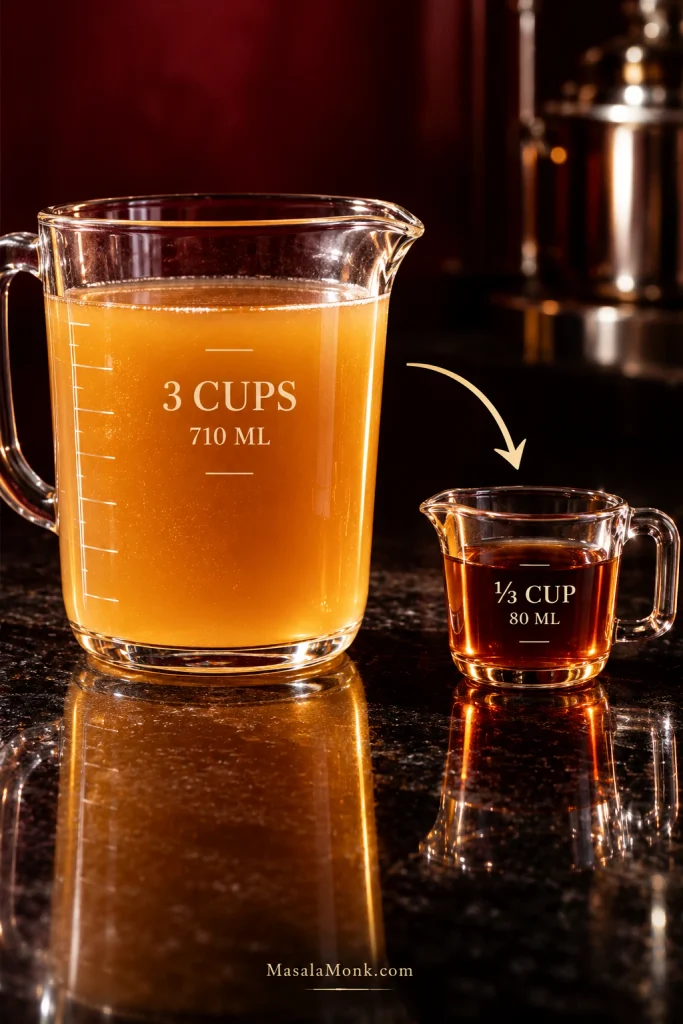
Large measuring jug with 3 cups of cloudy apple cider beside a small cup holding ⅓ cup of dark cider reduction.
Three cups becomes just ⅓ cup: that concentration brings cider flavor without flooding the dough with extra liquid.

The kitchen should smell much more intensely of apple as the water cooks away. By the time the cider reaches the final mark, the aroma should be closer to cooked apples than fresh apple juice.

Start measuring before it looks finished; the final stretch moves quickly. Overshot the mark by a spoonful? Add just enough cider or water to return it to 80 ml.

Your cider is ready when: it is darker, intensely appley and slightly syrupy but still easy to pour. Sticky like caramel or beginning to set as it cools means it has gone too far.

Three cider reduction stages labeled too early, ready, and too far, progressing from cloudy cider to darker, thicker reduction.
Watch the pour: the ready reduction is darker and slightly heavier, but still fluid rather than sticky.

Cool the reduction completely. This can be done a day ahead.

2. Mix the Dry Ingredients

Whisk the flour, baking powder, baking soda, cinnamon, nutmeg and salt together.

3. Mix the Wet Ingredients

Whisk the sugars and eggs, then add the sour cream, apple butter, cooled cider reduction and melted butter. The apple butter rounds out the concentrated cider with a deeper cooked-apple note.

4. Make the Dough

Fold the dry ingredients into the wet just until the last obvious streaks of flour disappear.

Fresh dough: very soft and sticky. That’s normal.

Three stages of apple cider donut dough: soft sticky fresh dough, firmer chilled dough, and rolled dough ready to cut.
Chilling should change the dough from soft and sticky to cohesive and rollable, not dry or stiff.

5. Chill Until the Dough Is Easy to Handle

Refrigerate for about 2 hours, or until thoroughly cold and firm enough to roll. Overnight is fine too.

Ready to roll: cold, soft, slightly tacky, and able to lift cleanly after cutting with a little bench flour.
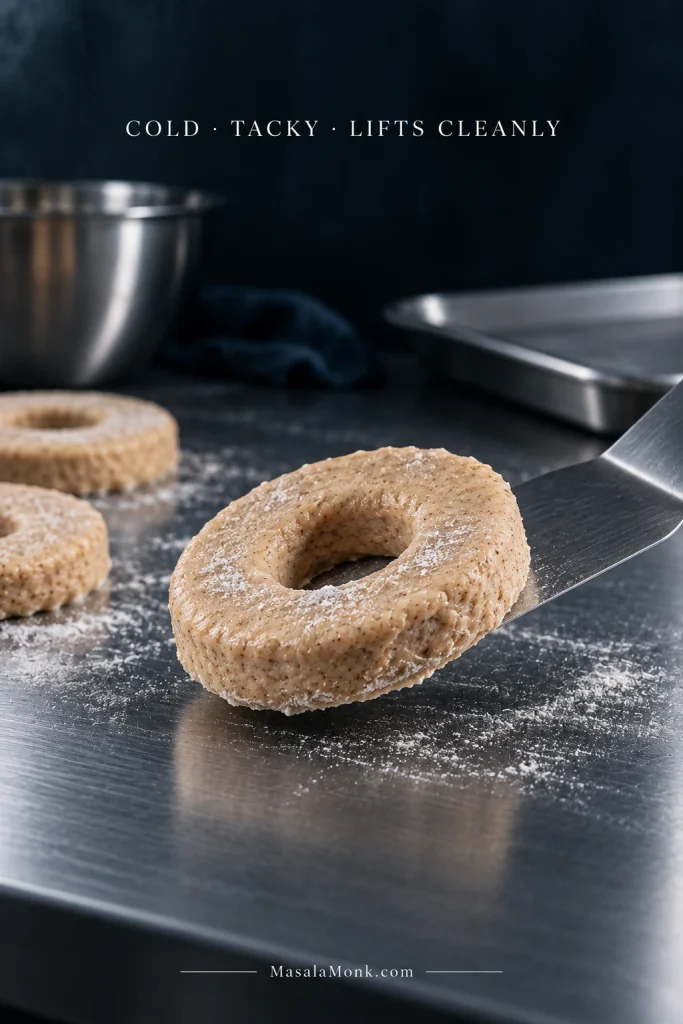
Raw apple cider donut ring being lifted from a lightly floured steel surface with a metal spatula.
If a cold cut ring lifts in one piece with slight tack, it is ready; stretching means it needs more chill.

Chill before you flour. Ten more minutes in the refrigerator is usually a much better bargain than another handful of flour.

Still too sticky? Use the sticky-dough guide.

6. Roll to ½ Inch and Cut the Rings

Roll the chilled dough to ½ inch / 1.25 cm thick. This thinner cut keeps the fried crust-to-cake ratio balanced and helps the center cook through before the outside gets too dark.

Lightly flour the work surface, dough and rolling pin as needed. Cut 3-inch / 7.5 cm rings with a 1-inch / 2.5 cm center. A drinking glass works for the outside; a small cutter, piping tip or clean bottle cap can make the hole.

Raw donut ring and dough shown with measurements for ½-inch thickness, 3-inch outer diameter, and 1-inch center hole.
Keep the dough about ½ inch thick with a 3-inch ring and 1-inch center so the middle cooks evenly.

Rings that begin stretching have warmed up; refrigerate the tray for 10–20 minutes.

Gather the scraps gently and reroll once. The last odd pieces do not need another beauty treatment; fry them as little cider-donut bites.

Rustic is fine. Uneven circles, rough edges and the occasional wonky ring all fry perfectly well.

Several raw apple cider donut rings, donut holes, and a small dough scrap in varied handmade shapes on a floured steel surface.
Uneven outlines are fine. Keep thickness similar, and fry holes or scraps separately because smaller pieces finish sooner.

7. Heat the Frying Oil

Heat 2–2½ inches / 5–6 cm of neutral oil to about 355°F / 180°C. Leave plenty of empty space above the oil in the pot. Once chilled dough goes in, aim to fry near 350°F / 177°C.

Three apple cider donut rings frying in bubbling oil with a thermometer reading 350°F / 177°C.
Let the oil recover near 350°F / 177°C before each new batch; the thermometer matters more between batches than at the first drop.

Frying safety: keep water away from the pot, lower the dough gently and stay beside the stove. Never pour water onto burning oil. For frying safety, see the USDA deep-frying guidance; for additional technique, King Arthur Baking’s guide to frying without fear is a useful companion. After frying, let used oil cool completely before straining or transferring it for disposal, and never pour frying oil down the sink.

Oil not holding steady? See why frying temperature keeps dropping.

8. Fry One Donut Hole First

The first donut hole calibrates the fryer. Drop one center piece into the oil before committing a full ring.

Single apple cider donut hole frying alone in bubbling oil with text explaining that the first donut hole calibrates the fryer.
Use the first donut hole to check browning, grease and cider flavor before committing the full batch.

It may dip briefly, then steady fizzing should gather around the edges as it rises and gradually browns. Fast darkening usually means the oil is too hot. A pale, heavy-looking hole usually means the oil needs to recover or come up in temperature.

Let it cool for about a minute and split it open. Look for a moist but fully set middle with no shiny gummy stripe. Taste a piece plain, then roll the rest in a little cinnamon sugar. Frying softens some of the raw cider aroma, but the apple should still be recognizable underneath the browned crust and spice.

Split fried donut hole showing a moist, fully set cake-like crumb, with labels identifying set, moist, and not oily areas.
A cooked center should look moist and evenly set, without a shiny or compressed gummy band.

A good test hole: browns gradually, has a moist cake crumb instead of an oil-soaked one, and still tastes of cider after a little cinnamon sugar.

If that little test piece looks right and tastes right, the hardest uncertainty is over.

Test hole not right? Check the oil-temperature guide · Troubleshoot the batch

9. Fry the Rings in Small Batches

Fry 2–4 rings at a time for roughly 60–90 seconds per side. Leave enough room for each one to float freely.

Use that timing as a range, not an appointment. Look for gradual browning and a fully set center; thickness, oil recovery and the actual temperature in your pot matter more than the clock alone.

A finished donut is golden brown, with a few darker ridges and rough edges. Split one from an early batch if you are unsure. Inside, you want soft cake with no raw, wet or shiny line through the middle.

Whole and broken cinnamon-sugar apple cider donuts with callouts for the golden exterior, moist set center, and dry clinging coating.
Look for three cues together: browned ridges, a fully set soft center and a dry cinnamon-sugar coating.

After a few evenly browned rings, frying starts to feel much less mysterious.

Donut holes: the centers cook faster than full rings. Start checking around 45 seconds per side; many finish within 45–60 seconds per side. For an all-hole batch, keep the pieces roughly tablespoon-size and chilled until frying.

10. Drain Briefly and Coat While Warm

Transfer the donuts to a wire rack set over a sheet pan. Once the obvious dripping stops, toss them in cinnamon sugar while they are still warm.

Warm apple cider donut being turned through cinnamon sugar in a stainless-steel bowl as sugar crystals scatter into the air.
Coat after the active dripping stops but while the donut is still warm; the cinnamon sugar should stay loose and sandy.

The sugar catches in the cracks and rough edges almost immediately. This is where the restrained spice in the dough pays off: cinnamon perfumes the crust without completely taking over the apple underneath.

Once the freshly fried rings hit the cinnamon sugar, the whole thing finally feels like cider donuts rather than a frying project.

Coating turning damp and oily after several donuts? Refresh the bowl. There are worse problems to have.

More Help With Apple Cider Donuts

If everything went smoothly, you can stop here and eat them. If something looked wrong along the way, the sections below are organized around the problem you saw.

Why Apple Cider Donuts Sometimes Barely Taste Like Cider

Cider can smell wonderfully strong in the raw dough and still fade once the donut is fried and coated. Flour, butter, browned crust and spice all compete with the fruit aroma.

That’s why the cider gets concentrated before it ever meets the dough. Apple butter reinforces the cooked-apple side of the flavor without adding much loose water.

I would not add chopped apples here. Fresh pieces bring extra moisture and make a soft roll-and-cut dough harder to handle. They belong more naturally in a batter designed around them, such as our apple cake recipe.

Apple Cider, Apple Juice or Apple Cider Vinegar?

Best: cloudy nonalcoholic cider. Good substitute: cloudy or unfiltered apple juice. Do not use: hard cider or apple cider vinegar.

Five glass vessels compare cloudy apple cider, unfiltered apple juice, clear apple juice, hard cider, and apple cider vinegar.
Use cloudy nonalcoholic cider for the strongest flavor; unfiltered apple juice is the closest substitute. Hard cider and apple cider vinegar are not direct substitutes here.

Here, apple cider means the cloudy, nonalcoholic kind commonly sold fresh or refrigerated in North America. Elsewhere, cloudy apple juice may be essentially the same thing under a different name.

What you haveUse it?What to expect
Cloudy nonalcoholic ciderBest choiceStrongest starting cider aroma
Cloudy or unfiltered apple juiceYesClosest substitute
Clear filtered apple juiceYesUsually milder
Hard ciderNoUse nonalcoholic cider or apple juice here
Apple cider vinegarNoSharp and far too acidic for this role

Why Is My Apple Cider Donut Dough So Sticky?

Sticky is normal. Unmanageable is not. Most sticky dough simply needs more cold, not more flour. Judge it after it is thoroughly chilled, not while it is still soft from mixing.
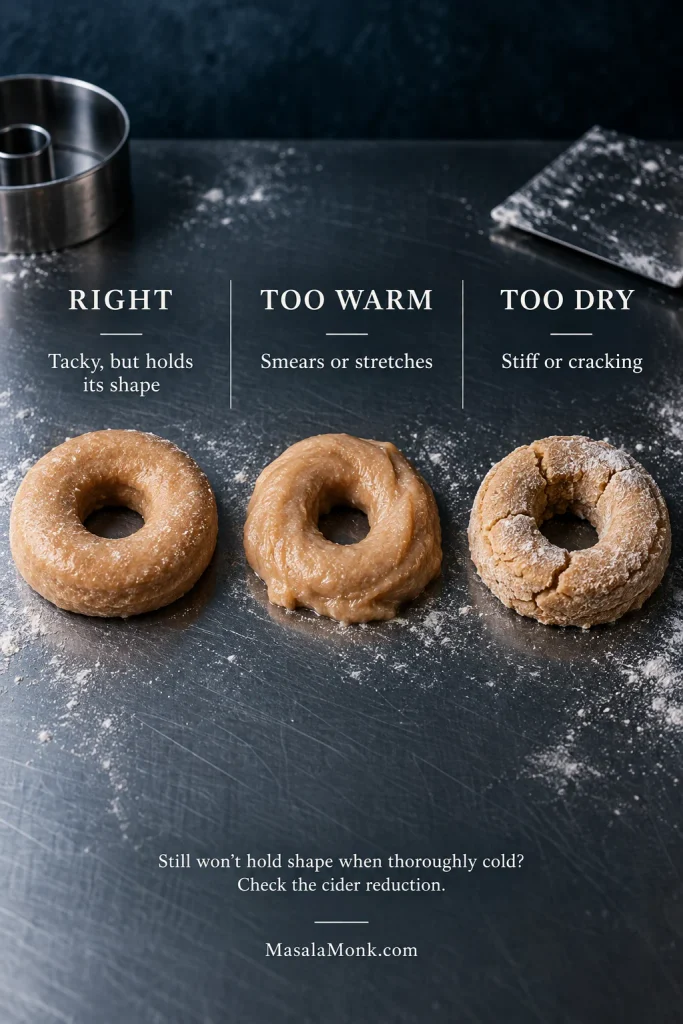
Three raw donut rings compare correct tacky dough, overly warm dough that smears, and dry dough with visible cracks.
Match the symptom first: tacky but stable is normal, smearing needs more chill, and cracking usually means too much flour.
Cold dough does thisWhat it meansWhat to do
Feels tacky but a ring lifts cleanlyNormalKeep going
Smears and stretches badlyStill too warmChill another 20 minutes
Will not hold a ring even when thoroughly coldProbably too wetCheck whether the cider was fully reduced
Feels stiff or cracksLikely too much flourDo not work in more

Bench flour is for handling, not for turning the dough dry. Once a chilled ring lifts cleanly, leave the dough alone.

Why Frying Oil Temperature Keeps Dropping

Fry around 350°F / 177°C. Starting near 355°F / 180°C gives the oil a little room to fall when chilled dough goes in.

Oil temperatureLikely result
Around 325°F / 163°CSlower browning; greater chance of pale, oily donuts
Around 350°F / 177°CTarget range for this recipe
Around 375°F / 191°C+Outside may darken before the center cooks
Three uncoated donuts labeled too cool, correct, and too hot, showing progressively darker frying at 325°F, 350°F, and 375°F or higher.
Compare the surfaces: cool oil leaves a paler, heavier donut, while excess heat darkens the crust before the center catches up.

A good batch followed by a greasy one is a clue that the oil probably needs more recovery time. Let it move back toward 350°F / 177°C before the next batch goes in.

Cinnamon Sugar or Apple Cider Glaze?

Cinnamon sugar is the finish I would choose for the classic version. It stays dry and sandy on the freshly fried crust, while the restrained spice leaves more room for cider in the crumb.

Side-by-side apple cider donuts with a crystalline cinnamon-sugar coating on the left and pale cider glaze on the right.
Cinnamon sugar keeps a drier, crisper surface; cider glaze gives a sweeter, softer finish.

If you want to adjust the warm-spice balance rather than simply adding more cinnamon, our apple pie spice recipe explains what cinnamon, nutmeg, ginger and allspice each contribute.

Cider glaze

  • ½ cup / 120 ml apple cider, reduced to about 2 tbsp / 30 ml
  • 1 cup / 113 g confectioners’ sugar
  • 1½ tbsp / 22 ml cooled cider reduction
  • Pinch fine salt

Whisk the sugar with 1½ tbsp / 22 ml reduction and the salt. Add more cider reduction or milk, a teaspoon at a time, only if needed for dipping consistency.

The glaze is sweeter, softer and more dessert-like. Cinnamon sugar keeps the donut closer to the classic cider-mill version.

Apple Cider Donut Troubleshooting

Most problems come back to the same three controls: cider concentration, dough temperature or oil temperature. Find the stage where the batch first looked wrong, then work from there.

Troubleshooting board showing six apple cider donut problems before, during, and after frying, with the first thing to check for each problem.
Start with where the failure first appeared: before frying, in the oil or after cooling. That narrows the likely cause much faster.

Before Frying

What you seeLikely causeWhat to do
Cold dough still smears badlyToo warm or not fully chilled; excess moisture is less commonChill again first. If it is still unmanageable when thoroughly cold, check the cider reduction.
Cut rings stretch or collapseDough warmed during rollingRefrigerate the tray for 10–20 minutes.
Dough is stiff or crackingToo much incorporated flourHandle the remaining dough gently and avoid unnecessary rerolling.

In the Fryer

What you seeLikely causeWhat to do
Donut darkens almost immediatelyOil probably too hotLower the heat and test another hole.
Pale and greasyOil too cool or batch too crowdedPause and let the oil recover.
Dark outside, raw or gummy insideOil too hot or ring too thick; unusually wet dough is less commonCorrect the heat and check the dough thickness first.
Ring begins breaking apartDough usually too warm; excess moisture is another possibilityRechill before continuing.
Test hole sits heavily instead of puffing toward the surfaceOil may be too coolCheck the oil first. If the temperature is right and the problem persists, reassess the dough.

After Frying

What happenedLikely causeWhat to do
Crumb feels greasyOil ran cool or batch was crowded; dough moisture can also contributeLet the oil recover and use fewer rings.
Donuts are tough or denseToo much flour, overmixing or repeated rerollingHandle the remaining dough as little as possible.
Donuts are dryToo much flour or too long in the fryerShorten the next batch and watch the center.
Apple flavor is faintMild cider or weak reductionUse the cider glaze if you want a stronger apple impression; next time concentrate the cider fully.
Cinnamon takes overCoating overwhelms a mild cider flavorUse a lighter coating.
Sugar barely sticksDonuts cooled too farCoat the remaining rings sooner.
Sugar turns oily and clumpyDonuts were still drippingDrain briefly before coating and refresh the sugar if needed.
Coating becomes damp laterWarm donuts were enclosed or sat in humid airCool completely before storing.

Back to Recipe · Test Hole · Back to Top

Make It Tonight, Fry Tomorrow

Reduce the cider and mix the dough the night before, then cover and refrigerate. The next day, judge it by how it feels rather than by how many hours it has been cold.

For the cleanest shapes, I would keep the dough as one covered mass and cut the rings shortly before frying instead of leaving shaped pieces exposed overnight.

If the next-day frying step is exactly what you are trying to avoid, an apple crisp is a much easier make-ahead apple dessert: prepare the filling and topping separately, refrigerate them, then assemble before baking.

These Donuts Are a Same-Day Food

The first warm ring is the version storage never quite reproduces: a lightly crisp edge around soft cake, with cinnamon sugar still dry and sandy on the surface.

Cinnamon-sugar apple cider donut with a bite missing beside an open bakery paper bag containing another donut.
Let leftover apple cider donuts cool completely before covering them; trapped steam softens the crust and turns the cinnamon sugar damp.

Best quality: eat them within the first few hours if you can.

Room temperature: cool completely before covering and keep for up to about 2 days. Room temperature is better for texture than the refrigerator; refrigeration tends to firm the crumb and soften the coating.

Freezing

Freeze completely cooled donuts, preferably before coating, for up to about 3 months for best quality. Freezing is practical, but it will not recreate the texture of a donut eaten warm from the rack. Thaw before reheating and add fresh cinnamon sugar while warm.

Reheating

  • Oven or toaster oven: best for restoring some of the exterior texture. Heat at 325°F / 165°C for about 8 minutes.
  • Microwave: fastest, but the donut will be noticeably softer.
  • Air fryer: use a low setting and check early. Machines vary too much for one universal reheating time.

Fried vs Baked Apple Cider Donuts

This recipe is deliberately fried. That is how you get the thin browned crust and cinnamon-sugar exterior we’re chasing here.

Baked cider donuts deserve a batter formulated for the oven; I would not put this soft frying dough into a donut pan and expect the same texture. The same principle applies to dietary changes: gluten-free cider donuts need their own flour balance rather than a direct flour swap into this dough.

If your real goal is donuts without a pot of frying oil, our air fryer donuts are built for that cooking method instead of trying to convert this cider-donut dough.

Apple Cider Donut FAQ

1. Are Apple Cider Donuts Cake Donuts or Yeast Donuts?

They are usually cake-style donuts, lifted with baking powder and baking soda rather than yeast.

2. Can I Use Apple Juice Instead of Apple Cider?

Yes. Cloudy or unfiltered apple juice is the closest substitute; reduce it the same way as cider.

3. Can I Fry Apple Cider Donuts Without a Thermometer?

Yes, but a thermometer is much easier. Without one, use the first donut hole to judge browning, rise and doneness before frying the rings.

4. Can I Make the Dough the Night Before?

Yes. Cover and refrigerate overnight, then roll, cut and fry the next day once the dough feels cold, soft and easy to lift.

Homemade cider donuts do not need perfect geometry. Eat one while it is still warm, before the rest have even finished their cinnamon sugar. The crust should give a little, the crumb should still be soft, and underneath all that cinnamon, the cider should still be there.


Back to Recipe · Troubleshooting · Back to Top

Posted on 4 Comments

Apple Cider Vinegar and Belly Fat: Does It Really Work?

Benefits-of-APPLE-CIDER-VINEGAR-FOR-BELLY-FAT

Apple cider vinegar (ACV) is one of those remedies that just won’t quit. For years it’s been hailed as a metabolism booster, detoxifier, and — most of all — a belly-fat burner. On social media, you’ll see it mixed into detox drinks, touted in “before and after” weight-loss videos, or taken as daily shots. No wonder search engines are filled with questions like:

  • Does apple cider vinegar really burn belly fat?
  • How do you use ACV to lose stomach fat?
  • Can this drink shrink my waistline?

The short answer is: ACV is not a magic potion. You can’t spot-reduce fat from your stomach with any single food or drink. That said, there is credible research showing that vinegar — and ACV in particular — may help with modest weight loss, waist reduction, and even decreases in visceral fat (the deeper abdominal fat linked to metabolic disease).

For example:

  • In a landmark Japanese trial, adults who took vinegar daily for 12 weeks lost weight, reduced their waistlines, and lowered visceral fat compared to a placebo group (Kondo et al., 2009).
  • A 2024 Lebanese study found that overweight adolescents and young adults who drank ACV for 12 weeks saw significant drops in BMI, waist, and hip measurements (Abou-Khalil et al., 2024).
  • A 2023 Iranian study in people with type 2 diabetes showed ACV lowered waist circumference and improved blood sugar and cholesterol levels (Jafarirad et al., 2023).

So while it’s no miracle, science does suggest ACV can play a supportive role in trimming belly fat — especially when combined with healthy eating and exercise.


What Is Apple Cider Vinegar and How Does It Affect Belly Fat?

From apple juice to acetic acid

Apple cider vinegar starts its life as crushed apples. First, yeast converts the fruit sugars into alcohol (making hard cider). Then bacteria convert that alcohol into acetic acid, the sour-tasting compound that defines vinegar.

Most commercial ACV contains about 4–6% acetic acid — the same range studied in clinical trials. Acetic acid is thought to be the main driver of vinegar’s metabolic effects, from appetite control to fat storage. A 2006 review in MedGenMed noted that vinegar reliably lowers post-meal glucose and insulin spikes, which may indirectly influence weight and fat gain.

The “mother”

If you’ve ever seen cloudy strands floating in ACV labeled “with the mother,” that’s a mix of proteins, enzymes, and beneficial bacteria from the fermentation process. Many people prefer raw, unfiltered versions with the mother because of its traditional and probiotic appeal. However, current research shows the real fat-loss effects come from acetic acid, not the mother itself.

More than acetic acid

Although acetic acid is the star, ACV also contains:

  • Malic acid (from apples),
  • Trace minerals such as potassium,
  • Polyphenols, plant-based antioxidants.

These compounds may contribute to ACV’s overall health profile, but they’re present in small amounts. When it comes to weight or waist reduction, the focus remains firmly on acetic acid.

ACV versus other vinegars

It’s worth pointing out that many vinegar studies — including the Japanese visceral fat trial — didn’t always use apple cider vinegar specifically. Because acetic acid is common to all vinegars, their metabolic effects are likely similar. ACV simply dominates the wellness world because of its natural image, long history in folk medicine, and wide availability.


Can You Really Burn Belly Fat with Apple Cider Vinegar?

It’s tempting to believe that apple cider vinegar is some kind of shortcut to a flat stomach. The internet is full of “ACV before and after” photos that make it seem like magic. But let’s set expectations straight: no food or drink can target belly fat in isolation.

What ACV can do, according to research, is help with overall fat loss, waist reduction, and even visceral fat (the type of fat around organs that raises your risk for diabetes and heart disease). And because belly fat is where much of that excess fat gets stored, losing overall fat often shows up as a slimmer waistline.

The Japanese Trial on Apple Cider Vinegar and Visceral Belly Fat

One of the most important studies on vinegar and belly fat comes from Japan. In 2009, researchers ran a 12-week randomized, double-blind trial with 175 obese adults. Participants were divided into three groups: one took a daily drink with 15 mL vinegar, another 30 mL vinegar, and the third took a placebo.

Woman measuring waist with tape while a glass of apple cider vinegar sits on kitchen counter with text overlay about belly fat reduction results.
Clinical studies show apple cider vinegar can reduce waist circumference and visceral fat in 8–12 weeks.

The results were eye-opening:

  • Both vinegar groups lost significantly more body weight than placebo.
  • Their waist circumference decreased, while the placebo group’s waistline slightly increased.
  • CT scans showed reductions in visceral fat area — the deep belly fat strongly linked to metabolic disease.
  • Blood triglyceride levels also dropped.

This study, published in Bioscience, Biotechnology, and Biochemistry, was the first to show that vinegar could reduce visceral belly fat in humans (Kondo et al., 2009).

2024 Study: Apple Cider Vinegar and Belly Fat Reduction in Young Adults

Fast forward to 2024, and researchers in Lebanon tested apple cider vinegar itself. They enrolled 120 overweight and obese adolescents and young adults in a randomized, placebo-controlled trial. Participants took 5, 10, or 15 mL of ACV daily, or a placebo, for 12 weeks.

The findings mirrored the Japanese study:

  • All ACV groups lost more weight and BMI than placebo.
  • They also saw measurable reductions in waist and hip circumference.
  • The highest ACV dose (15 mL/day) showed the strongest effects.

This study, published in BMJ Nutrition, Prevention & Health, confirms that ACV can support modest belly-slimming effects in younger, diverse populations (Abou-Khalil et al., 2024).

Belly fat and diabetes: extra benefits

What about people already struggling with metabolic issues? In 2023, an Iranian trial looked at ACV in patients with type 2 diabetes. All participants followed a healthy diet, but one group also consumed 30 mL ACV daily.

After 8 weeks, the ACV group showed:

  • Lower body weight and BMI,
  • Reduced waist and hip circumference,
  • Improved blood sugar control (HbA1c) and cholesterol levels.

This study, published in Frontiers in Clinical Diabetes and Healthcare, suggests ACV can play a double role: helping reduce abdominal fat and improving metabolic health in high-risk individuals (Jafarirad et al., 2023).

Supporting evidence from smaller trials

Another trial, published in 2018, tested 30 mL/day of ACV in overweight and obese adults, alongside a calorie-restricted diet. After 12 weeks, participants lost more weight, lowered their BMI, and improved body composition compared to diet alone. While this study didn’t measure visceral fat directly, it still supports ACV as a helpful add-on to lifestyle changes (Khezri et al., 2018).

What the evidence tells us

Across these studies, some clear patterns emerge:

  • Dosage matters: Benefits are seen around 15–30 mL/day (1–2 tablespoons).
  • Consistency is key: Studies lasted 8–12 weeks; results don’t happen overnight.
  • Lifestyle still rules: In every trial, ACV worked with healthy diet or habits — not instead of them.
  • The belly link is real: Waist and visceral fat reductions show ACV’s effects go beyond just weight on the scale.

So, does ACV “burn” belly fat?

Not in the instant, fat-melting way the internet sometimes suggests. But science does show that daily, diluted apple cider vinegar can help reduce waist circumference and visceral fat over time, especially when paired with balanced nutrition and exercise.

Think of it as a supporting actor in your weight-loss journey — helpful, but not the star of the show.


How to Use Apple Cider Vinegar for Belly Fat

By now, the evidence is clear: apple cider vinegar (ACV) can play a modest but real role in helping reduce weight and waist size — as long as you use it consistently and safely. But that leads to the practical question: how exactly should you take it? Let’s break it down.

The right dosage

Most of the human trials that showed results used between 15–30 milliliters (1–2 tablespoons) per day.

  • In Japan’s landmark 2009 study, participants drank either 15 mL or 30 mL vinegar daily and saw reductions in weight and visceral belly fat (Kondo et al., 2009).
  • The Lebanese 2024 trial used 5, 10, and 15 mL/day, with the 15 mL group showing the strongest waist-slimming effects (Abou-Khalil et al., 2024).
  • In diabetic adults, 30 mL/day improved waist circumference, blood sugar, and cholesterol (Jafarirad et al., 2023).

So if you’re looking to follow the science, 1–2 tablespoons per day, split into 1–2 doses, is the sweet spot.

Hand pouring apple cider vinegar into a glass of water with text overlay about safe daily dose for belly fat.
Apple cider vinegar and belly fat: safe daily dosage is 1–2 tablespoons, always diluted in water.

Always dilute it

This part cannot be stressed enough: never drink ACV straight. Its high acidity can erode tooth enamel, irritate the throat, and upset your stomach. All the clinical studies diluted ACV in water or mixed it with food.

A safe and practical way is:

  • 1–2 teaspoons in a large glass of water (250–300 ml).
  • Work up slowly to 1 tablespoon per glass if tolerated.
  • Spread across 1–2 drinks per day, ideally with meals.

Best timing

There’s no single “magic time,” but research suggests drinking vinegar before or with meals helps reduce blood sugar spikes and may increase satiety. Many people prefer a diluted drink in the morning and another before dinner.

If you’re sensitive to acidity on an empty stomach, start with meals only.

ACV drink ideas

Plain water + ACV works fine, but variety helps with consistency. Here are three simple, research-friendly options:

  1. Classic ACV water
    • 1 teaspoon ACV
    • 250 ml warm or room-temperature water
    • Optional: add a slice of fresh ginger
  2. ACV + lemon refresher
    • 1 teaspoon ACV
    • Juice of ½ lemon
    • 300 ml water
    • Adds vitamin C and flavor without calories
  3. Green tea + ACV combo
    • Brew a cup of green tea, let it cool slightly
    • Stir in 1 teaspoon ACV
    • This combines two evidence-backed fat-loss helpers: tea catechins + vinegar

Tip: Always use a straw to reduce enamel exposure, and rinse your mouth with plain water afterward.

You can also combine apple cider vinegar and lemon juice for weight loss, a refreshing drink with added vitamin C and flavor.

Flat lay of apple cider vinegar, lemon, ginger, and green tea leaves with text overlay about ACV drinks for belly fat.
Three apple cider vinegar drink ideas for belly fat: with lemon, ginger, or green tea.

Incorporating ACV into food

If drinks aren’t your style, you can still reap the benefits:

  • Use ACV as a salad dressing base (mixed with olive oil, mustard, and herbs).
  • Add a splash to marinades for chicken or tofu.
  • Mix into soups or stews just before serving for a tangy kick.

This approach is easier on your teeth and stomach, while still giving you daily acetic acid.

Safety reminders

Most people tolerate ACV well, but there are some cautions:

  • Don’t exceed 30 mL/day. More is not better and can cause side effects.
  • Never take it undiluted.
  • If you take insulin, diuretics, or heart medications, talk to your doctor first — ACV can interact with these.
  • If you have reflux, ulcers, or sensitive teeth, use sparingly or skip it.

A few case reports have documented throat burns or enamel erosion from misuse, so moderation and dilution are key.

What results to expect

In the studies, participants lost weight and inches over 8–12 weeks of daily use. For example, in Kondo’s Japanese trial, the vinegar groups lost about 1–2 kg (2–4 lbs) more than placebo, along with meaningful reductions in waist size (Kondo et al., 2009).

That may not sound dramatic, but remember: these were results just from adding vinegar, without other big lifestyle overhauls. When paired with a balanced diet and movement, ACV can be a small but steady ally in trimming belly fat.


What Results to Expect from Apple Cider Vinegar for Belly Fat Reduction?

If you’ve ever scrolled through social media, you’ve probably seen dramatic “before and after” photos of people claiming they lost 10, 20, or even 30 pounds just by drinking apple cider vinegar. The truth is less glamorous — but more realistic.

ACV helps, but modestly

In most human trials, participants lost 1–2 kilograms (2–4 pounds) over 8–12 weeks when adding vinegar to their daily routine — without making other major changes.

  • In the Japanese 2009 trial, the vinegar groups lost around 1.2–1.9 kg (2.6–4.2 lbs) over 12 weeks, while the placebo group gained a little weight (Kondo et al., 2009).
  • Waist circumference dropped by about 1–2 cm, and CT scans confirmed a reduction in visceral belly fat.
  • In the 2024 Lebanese study, adolescents and young adults also lost measurable waist and hip circumference along with body weight (Abou-Khalil et al., 2024).
  • In diabetic adults, ACV added on top of a healthy diet led to smaller waists and better blood sugar levels in just 8 weeks (Jafarirad et al., 2023).

That’s not a miracle transformation, but it’s a steady, meaningful improvement — especially considering nothing else in the diet was drastically changed.

Split-panel image with a woman showing apple cider vinegar myth vs fact about belly fat loss results.
Myth: apple cider vinegar melts belly fat overnight. Fact: studies show small but real waist reductions in 8–12 weeks.

Why results vary

Several factors influence how much ACV might help you:

  • Your starting point: The bigger the calorie surplus and the more belly fat you carry, the more room there is for improvement.
  • Your diet quality: Vinegar won’t offset a consistently high-calorie diet. But when paired with balanced meals, it may help you feel fuller and snack less.
  • Consistency: Benefits show up after daily use for 8–12 weeks. Skipping days or using it irregularly won’t cut it.
  • Other habits: Exercise, sleep, and stress management all play a huge role in belly fat. ACV alone isn’t enough.

Think of ACV as a helper, not a hero

A good way to think about ACV is like this: it’s not the engine of fat loss — that comes from diet and activity — but it can be a booster. By helping regulate blood sugar, controlling appetite, and slightly improving fat metabolism, it nudges your body in the right direction.

When added consistently over time, those nudges add up to small but noticeable changes: a belt that fits looser, a waistline that feels less bloated, and blood markers that shift in a healthier direction.

Pairing ACV with foods that reduce belly fat naturally can maximize your waist-slimming results.

The bottom line

  • Expect 1–2 kg weight loss over a few months with ACV alone.
  • Expect a small waist reduction — a couple of centimeters, not several inches.
  • Expect better results when you combine ACV with a calorie-conscious diet and light activity.

So if you’re hoping for overnight six-pack abs, ACV won’t deliver. But if you’re looking for a safe, inexpensive way to support your belly fat loss journey, it’s a worthy addition.

If you want to see changes beyond the scale, learn how to measure belly fat and track progress using simple methods.


Apple Cider Vinegar for Belly Fat: Safety and Side Effects

Apple cider vinegar may be natural, but that doesn’t mean it’s risk-free. Most of the positive studies used moderate doses (15–30 mL/day) and always in diluted form. When people go beyond that — taking shots of undiluted ACV, chugging large amounts, or combining it with risky “detox” diets — side effects are much more likely.

Here’s what you need to know before making ACV part of your routine.

1. Protect your teeth and throat

The biggest everyday risk is tooth enamel erosion. Vinegar’s acetic acid is very acidic, and repeated exposure can gradually wear down enamel, leading to sensitivity and cavities. Sipping ACV straight can also irritate your throat and esophagus.

How to prevent it:

  • Always dilute ACV in plenty of water.
  • Use a straw when drinking ACV beverages.
  • Rinse your mouth with plain water afterward.
  • Don’t brush your teeth immediately (enamel is softened right after acid exposure).

2. Stomach and digestion issues

Some people experience nausea, heartburn, or digestive discomfort with ACV, especially if taken on an empty stomach or in large amounts.

In one case report, a woman developed delayed stomach emptying (gastroparesis) from chronic, excessive vinegar use. While this is rare, it’s a reminder that more is not better.

Tip: Start with 1 teaspoon in a glass of water and increase slowly. Stop if you notice ongoing discomfort.

3. Medication interactions

ACV can interact with several types of medication:

  • Diabetes medications (like insulin): ACV can lower blood sugar, which might increase the risk of hypoglycemia when combined.
  • Diuretics (water pills): ACV may worsen potassium loss.
  • Digoxin (heart medication): Combining with ACV could potentially lower potassium too much, leading to dangerous side effects.

If you’re on any of these, talk to your doctor before adding daily ACV.

4. Potassium and bone health

Very high vinegar intakes over long periods have been linked to low blood potassium and even reduced bone density in rare case reports. Again, this was with extreme overuse, not the moderate amounts used in clinical trials.

5. Pregnancy and children

There’s limited research on ACV in pregnancy and children. While small amounts in food are generally considered safe, it’s best to avoid concentrated ACV drinks in these groups unless cleared by a healthcare provider.

6. Safe daily limits

Based on clinical research, the safe and effective range is:

  • 15–30 mL per day (1–2 tablespoons)
  • Always diluted in at least 250–300 mL of water
  • Taken in 1–2 doses, ideally with meals

This range has been shown to lower waist circumference, weight, and visceral fat without significant side effects in studies (Kondo et al., 2009; Abou-Khalil et al., 2024; Jafarirad et al., 2023).

Some people also enjoy combining ACV with cinnamon and lemon for belly fat for a metabolism-friendly drink.


Bottom line on safety

Apple cider vinegar is safe for most healthy adults when used in moderate, diluted amounts. The risks come from overuse or misuse — such as drinking it straight, exceeding 30 mL/day, or combining it with sensitive medications.

If used wisely, ACV can be a simple, affordable addition to your health routine. Just remember: consistency and moderation are your best friends here.


Apple Cider Vinegar vs Other Belly Fat Remedies

Apple cider vinegar isn’t the only natural remedy marketed for trimming the waistline. Green tea, lemon water, probiotics, and even fat-burning supplements all make similar claims. So how does ACV really stack up?

ACV vs green tea

Green tea is one of the most researched natural aids for fat loss. Its catechins (EGCG) and caffeine may help increase calorie burning and fat oxidation. Some studies show modest reductions in body weight and belly fat with regular green tea consumption.

ACV works differently. Its strength lies in acetic acid, which seems to improve blood sugar control, slow stomach emptying, and help with appetite regulation. While green tea gives you a metabolic boost, ACV may help you eat less overall. Both can be part of a healthy belly-fat strategy — and some people even combine them in one drink.

Green tea has its own fat-burning compounds, and combining it with ACV may work even better. You can explore some green tea and spice infusions for weight loss as creative add-ons.

ACV vs lemon water

Lemon water is refreshing, hydrating, and rich in vitamin C, but there’s little scientific evidence that it directly burns fat. Its main benefit comes from encouraging hydration and sometimes replacing sugary drinks. Compared to lemon water, ACV has far more clinical research backing its effects on waist circumference and visceral fat.

That said, adding lemon juice to an ACV drink can make it more palatable and give you both hydration and acetic acid benefits.

ACV vs probiotic foods

Gut health is closely linked to weight regulation, and probiotic foods like yogurt, kefir, or kimchi have been studied for their potential role in belly fat reduction. Raw, unfiltered ACV does contain the “mother,” which has probiotic-like qualities, but the clinical trials on fat loss point to acetic acid, not probiotics, as the driver. For true gut diversity, fermented foods beyond ACV are still important.

ACV vs supplements

From “fat-burning pills” to ACV capsules, the supplement industry is full of products promising quick belly-fat loss. Most have limited scientific backing, and in some cases, questionable safety. In contrast, liquid ACV is inexpensive, widely available, and backed by multiple human trials.


The takeaway

Compared to other belly-fat aids, ACV stands out for being simple, affordable, and supported by human studies. It’s not the strongest tool — that crown probably goes to consistent calorie control and movement — but it is one of the most accessible helpers you can add to your routine.


Should You Try Apple Cider Vinegar for Belly Fat?

At this point, the verdict is clear: apple cider vinegar is not a miracle belly-fat burner, but it does have credible science behind it. Multiple human studies show that when taken daily — in moderate, diluted amounts — ACV can help reduce body weight, shrink waist circumference, and even lower visceral fat.

The best part? It’s inexpensive, widely available, and easy to incorporate into meals or drinks. Unlike many trendy supplements, ACV has stood the test of time — both in traditional use and in modern clinical research.

But it’s important to keep your expectations realistic. If you’re hoping for dramatic, overnight changes, ACV will disappoint you. The typical results seen in trials are 1–2 kilograms of weight loss and a couple of centimeters off the waist over 8–12 weeks. Those are steady, sustainable improvements — especially if you also make small adjustments to your diet, movement, and lifestyle.

Young person in workout clothes  with text overlay about ACV being part of healthy lifestyle for weight loss.
Apple cider vinegar is a sidekick, not the hero — consistency is what reduces belly fat over time.

Who may benefit most

  • People with excess belly fat who want an extra nudge alongside healthy habits.
  • Individuals with blood sugar issues or type 2 diabetes, since ACV may improve glucose control and lipid levels.
  • Anyone looking for a low-cost, natural way to support long-term weight management.

Final word

Think of ACV as a helpful sidekick, not the hero of your weight-loss journey. Pair it with balanced meals, regular movement, and good sleep, and it can give you that extra push toward a slimmer, healthier waistline.

If you’re ready to try it, start small: 1 teaspoon in a big glass of water before meals, and gradually build up to 1–2 tablespoons a day. Consistency, not excess, is where the real magic happens.

Frequently Asked Questions about Apple Cider Vinegar and Belly Fat

1. Does apple cider vinegar burn belly fat?

Apple cider vinegar doesn’t “burn” belly fat directly, but research shows it can help reduce waist circumference and visceral fat when taken consistently for 8–12 weeks (Kondo et al., 2009). Think of it as a gentle helper rather than a fat-melting potion.

2. Can apple cider vinegar reduce stomach fat overnight?

No — there’s no overnight fix for stomach fat. Clinical studies show that apple cider vinegar and belly fat reduction happens gradually over weeks, not days. Patience and consistency matter most.

3. How should I drink apple cider vinegar for belly fat?

Dilute 1–2 teaspoons of ACV in a large glass of water, and drink before or with meals. You can slowly build up to 1–2 tablespoons daily, which is the range tested in human trials.

4. What is the best time to take apple cider vinegar for belly fat?

Most people find it helpful before meals, since ACV may reduce blood sugar spikes and help control appetite. If it upsets your stomach, try it only with food.

5. How much apple cider vinegar should I take daily to lose belly fat?

The safe and effective range is 15–30 mL per day (1–2 tablespoons), always diluted in water. Going beyond this doesn’t speed up belly fat loss — and may cause side effects.

6. Can apple cider vinegar flatten your stomach?

It won’t give you visible abs on its own, but studies do show ACV helps reduce waist size and visceral belly fat. Combined with diet and exercise, it may support a flatter midsection.

7. Is apple cider vinegar good for visceral fat?

Yes — the Japanese trial measured visceral fat with CT scans and found that vinegar drinkers had significant reductions in deep belly fat compared to placebo (Kondo et al., 2009).

8. Does apple cider vinegar work for belly fat without diet changes?

Even without big diet changes, participants in ACV studies lost 1–2 kg and inches off their waist. But pairing ACV with balanced eating makes the results stronger.

9. How long does it take to see belly fat results with apple cider vinegar?

Most trials lasted 8–12 weeks, and that’s when results — smaller waistlines and modest weight loss — became noticeable.

10. Is it better to drink apple cider vinegar in the morning or at night for belly fat?

Either works, but morning can give you a fresh start, while evening may help control late-night cravings. What matters is daily consistency.

11. Does apple cider vinegar help with belly fat in diabetics?

Yes — in people with type 2 diabetes, ACV reduced waist circumference and improved blood sugar and cholesterol (Jafarirad et al., 2023).

12. Can apple cider vinegar pills help with belly fat?

ACV capsules are popular, but most research uses liquid vinegar. Pills may work if they contain enough acetic acid, but quality varies — liquid ACV is more reliable.

13. What’s the difference between apple cider vinegar and white vinegar for belly fat?

Both contain acetic acid, which drives the fat-loss effects. Apple cider vinegar and belly fat reduction are studied more often, but white vinegar may offer similar benefits.

14. Can I mix apple cider vinegar with lemon or green tea for belly fat?

Yes — lemon adds vitamin C and flavor, while green tea brings its own fat-burning compounds. Together, they may make your ACV routine tastier and more effective.

15. Will apple cider vinegar alone get rid of my belly fat?

No single food or drink can do that. But as studies show, ACV can give you a modest but meaningful nudge toward smaller waistlines — especially when paired with healthy diet, activity, and good sleep.