
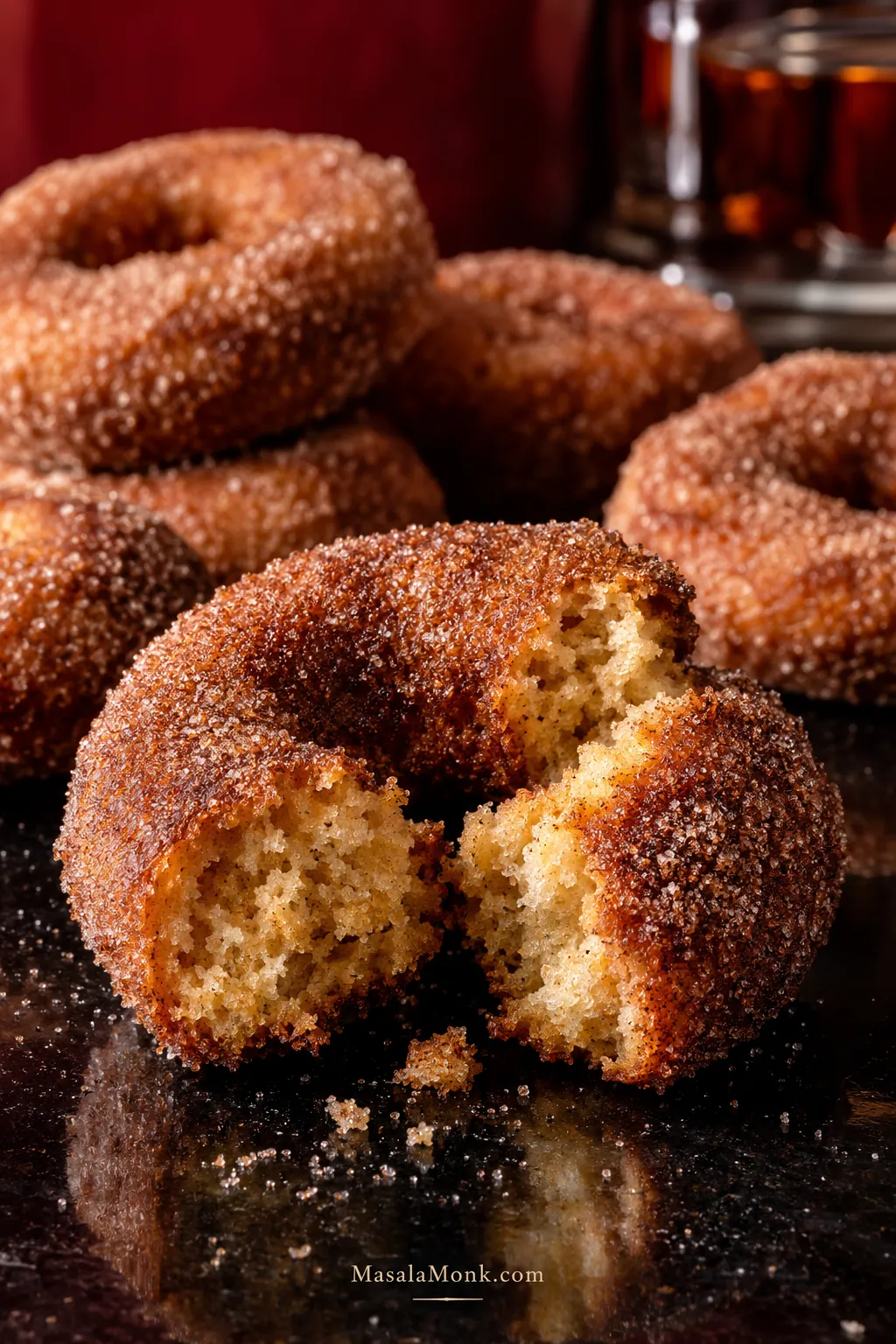
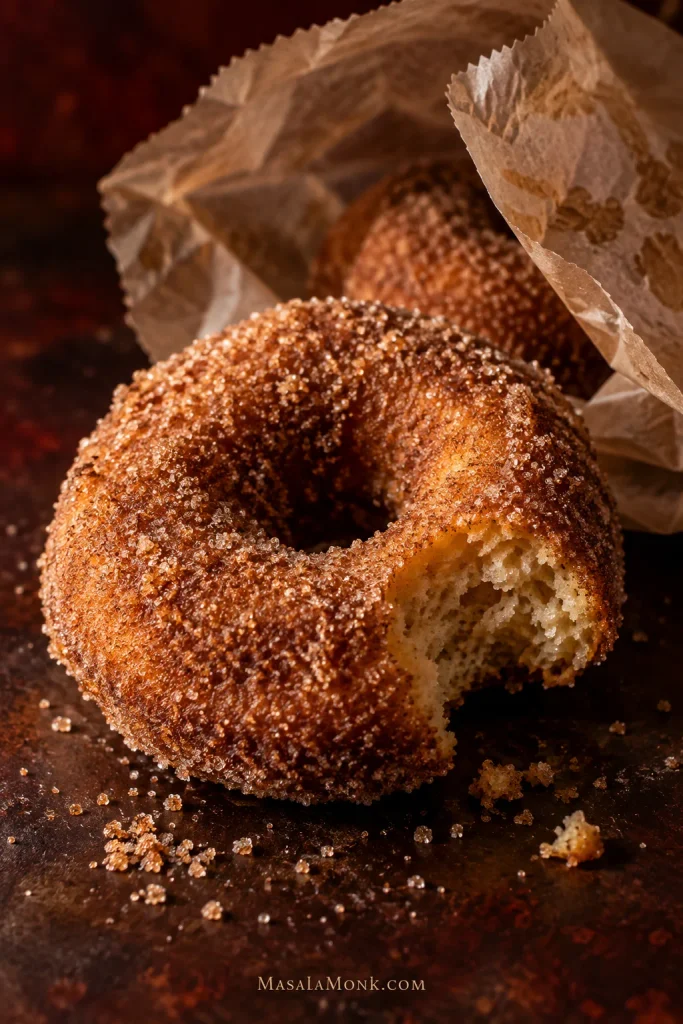
A good apple cider donut should taste like cider before it simply tastes like cinnamon. We’re after the warm cider-mill kind: a tender cake-donut center, a thin fried crust and cinnamon sugar that clings to your fingertips.
The best ones barely seem worth saving for later. They are still warm enough that the whole bag smells of cider, fried dough and cinnamon, the sugar finds every little crack in the crust, and the first bite gives slightly at the edge before opening into soft cake underneath.
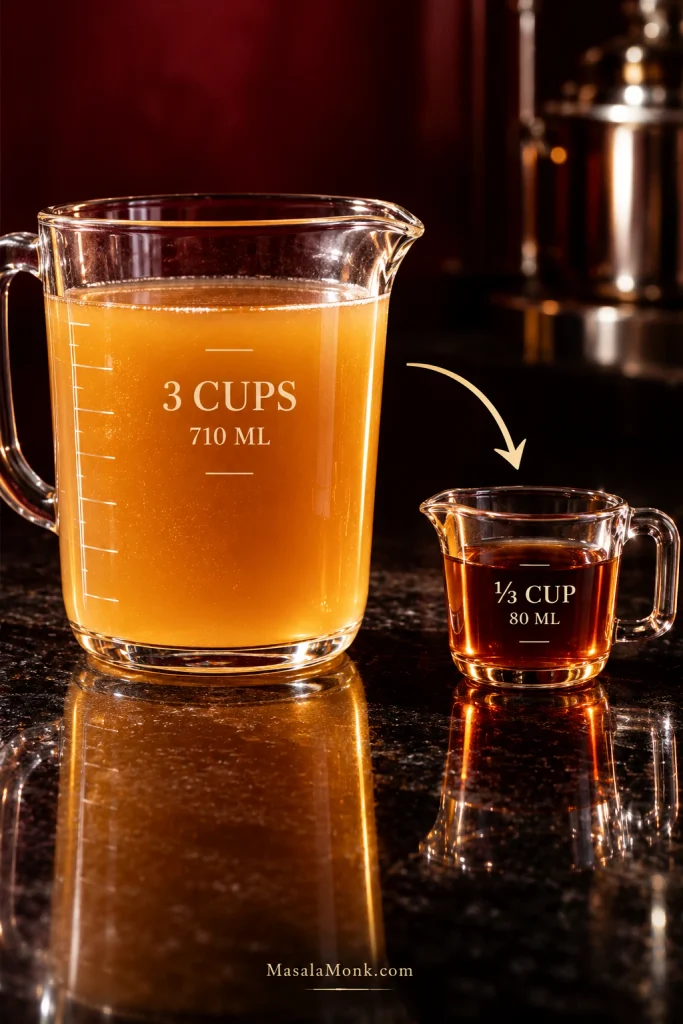
That is the version worth chasing at home. The recipe concentrates 3 cups / 710 ml cider down to ⅓ cup / 80 ml, then combines it with apple butter and sour cream for a tender cake center, a thin fried crust and enough apple flavor to stay noticeable beneath the cinnamon sugar.
Three things matter most: cider, dough and oil.
Cider
3 cups → ⅓ cup
710 ml → 80 ml. Trust the final amount more than the clock.
Dough
Cold + ½ in / 1.25 cm
Tacky is fine once a cut ring lifts cleanly.
Oil
350°F / 177°C
Let the oil recover before each new batch.
Classic Fried Apple Cider Donuts
These are cake donuts rather than yeast-raised donuts, so expect a moist crumb with a little more substance, not a fluffy, airy center. The goal is not the biggest or fluffiest donut. It is a cake donut with concentrated apple flavor, a delicate fried crust and a soft center.
If you need the same cider-donut idea without wheat flour, use our gluten-free apple cider donuts rather than swapping a gluten-free flour blend directly into this dough; the flour and moisture balance need their own formula.
Fried cake donuts with concentrated apple cider flavor, a soft center, thin lightly crisp crust and warm cinnamon sugar.
Useful equipment: a heavy pot, deep-fry thermometer, 3-inch and 1-inch cutters, wire rack set over a sheet pan, and a spider or slotted spoon.
Ingredients
For the Donuts
- 3 cups / 24 fl oz / 710 ml cloudy, nonalcoholic apple cider
Cloudy or unfiltered apple juice is the closest substitute. Do not use apple cider vinegar. - 3½ cups / 420 g all-purpose flour, plus more only for handling
- 2 tsp / 8 g baking powder
- ½ tsp baking soda
- ¾ tsp ground cinnamon
- ¼ tsp ground or freshly grated nutmeg
- 1 tsp / 5–6 g fine salt
- ½ cup packed / 100 g light brown sugar
- 2 tbsp / 25 g granulated sugar
- 2 large eggs
- scant ½ cup / 110 g full-fat sour cream
- scant ¼ cup / 70 g apple butter
Use thick apple butter rather than thin applesauce. If applesauce is what you have and want to bake with, our applesauce cake is formulated around that extra moisture. - 6 tbsp / 85 g unsalted butter, melted and cooled
- Neutral high-heat oil, such as canola or vegetable oil, enough for 2–2½ inches / 5–6 cm depth
For the Cinnamon Sugar
- 1 cup / 200 g granulated sugar
- 1 tbsp / 8 g ground cinnamon
- Small pinch fine salt, optional
Method
1. Reduce the Cider to ⅓ Cup
Reduce the 3 cups / 710 ml cider to ⅓ cup / 80 ml. Pour it into a wide saucepan or skillet, bring it to a lively simmer and cook until deeply concentrated. In a wide pan this often takes 20–30 minutes.
The kitchen should smell much more intensely of apple as the water cooks away. By the time the cider reaches the final mark, the aroma should be closer to cooked apples than fresh apple juice.
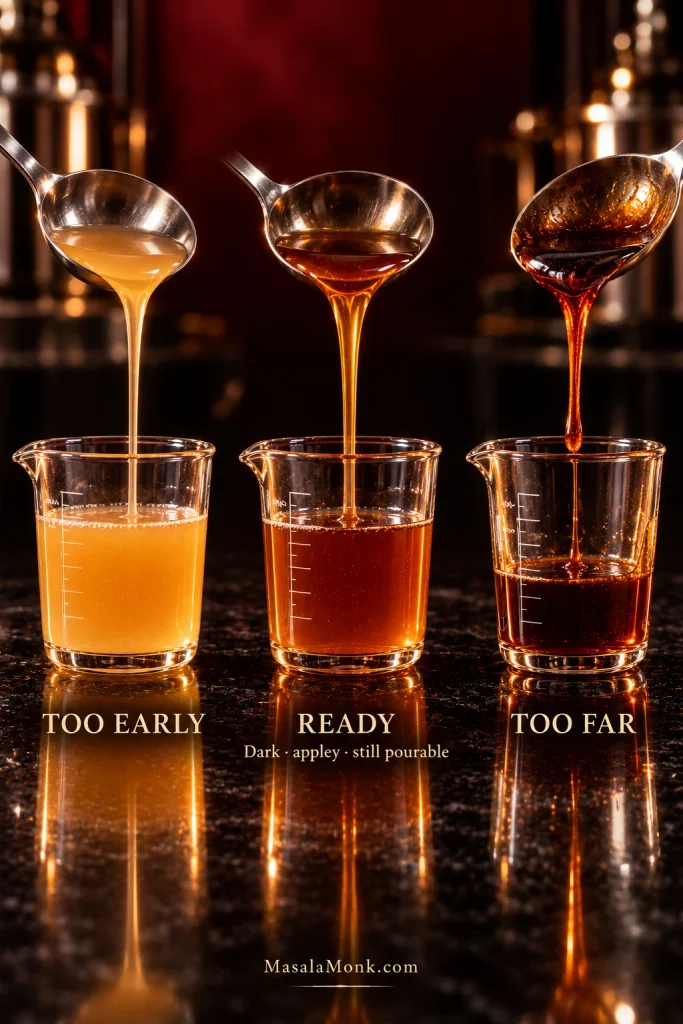
Start measuring before it looks finished; the final stretch moves quickly. Overshot the mark by a spoonful? Add just enough cider or water to return it to 80 ml.
Your cider is ready when: it is darker, intensely appley and slightly syrupy but still easy to pour. Sticky like caramel or beginning to set as it cools means it has gone too far.
Cool the reduction completely. This can be done a day ahead.
2. Mix the Dry Ingredients
Whisk the flour, baking powder, baking soda, cinnamon, nutmeg and salt together.
3. Mix the Wet Ingredients
Whisk the sugars and eggs, then add the sour cream, apple butter, cooled cider reduction and melted butter. The apple butter rounds out the concentrated cider with a deeper cooked-apple note.
4. Make the Dough
Fold the dry ingredients into the wet just until the last obvious streaks of flour disappear.
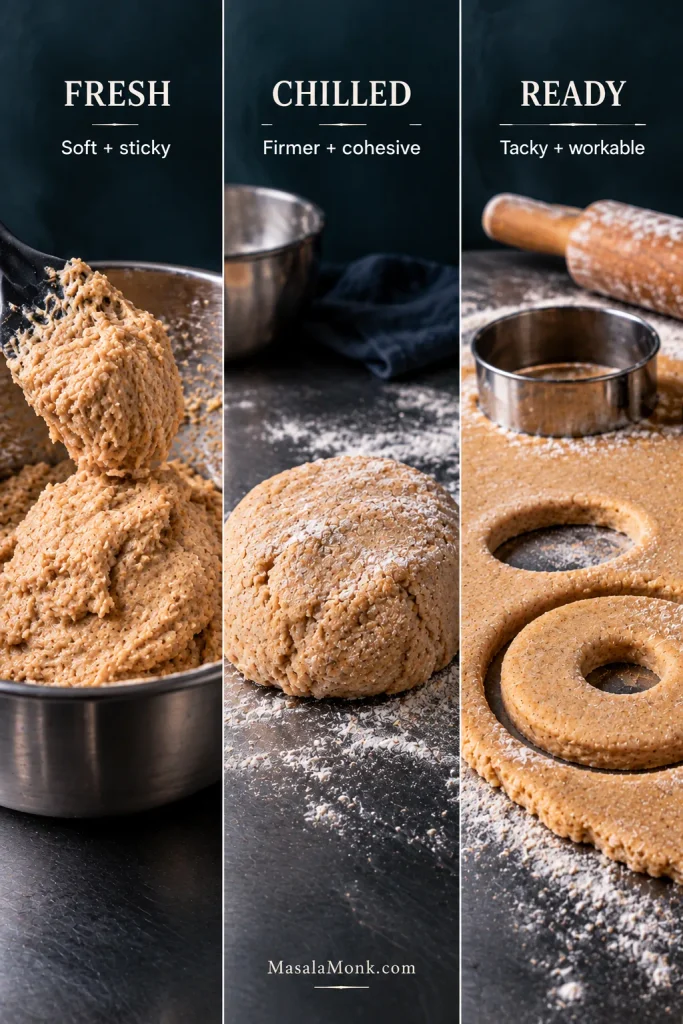
Fresh dough: very soft and sticky. That’s normal.
5. Chill Until the Dough Is Easy to Handle
Refrigerate for about 2 hours, or until thoroughly cold and firm enough to roll. Overnight is fine too.
Ready to roll: cold, soft, slightly tacky, and able to lift cleanly after cutting with a little bench flour.
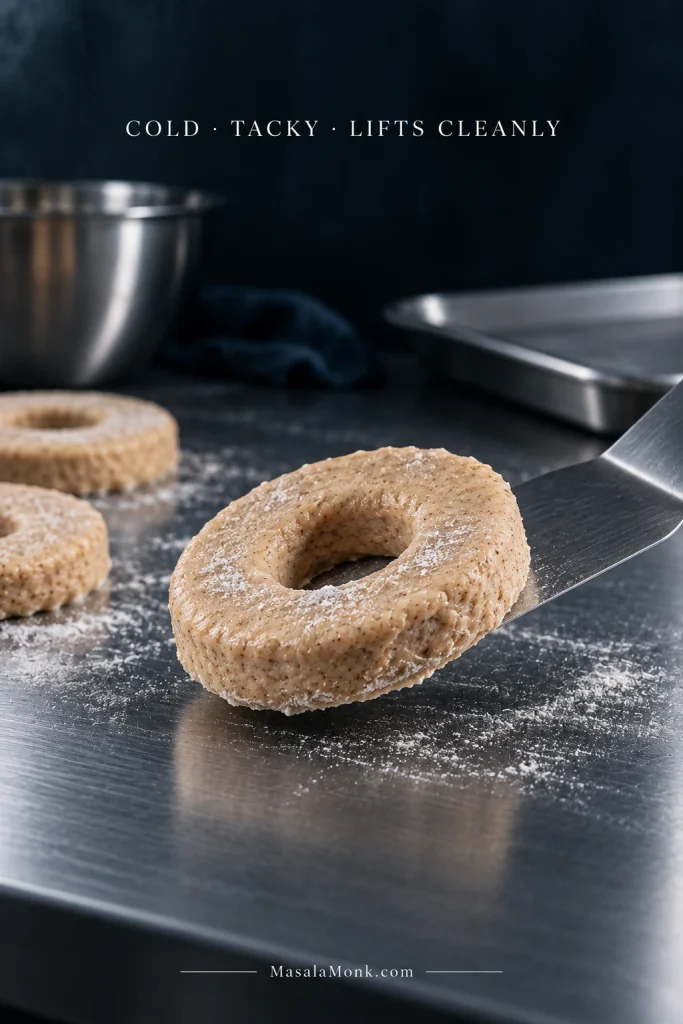
Chill before you flour. Ten more minutes in the refrigerator is usually a much better bargain than another handful of flour.
Still too sticky? Use the sticky-dough guide.
6. Roll to ½ Inch and Cut the Rings
Roll the chilled dough to ½ inch / 1.25 cm thick. This thinner cut keeps the fried crust-to-cake ratio balanced and helps the center cook through before the outside gets too dark.
Lightly flour the work surface, dough and rolling pin as needed. Cut 3-inch / 7.5 cm rings with a 1-inch / 2.5 cm center. A drinking glass works for the outside; a small cutter, piping tip or clean bottle cap can make the hole.
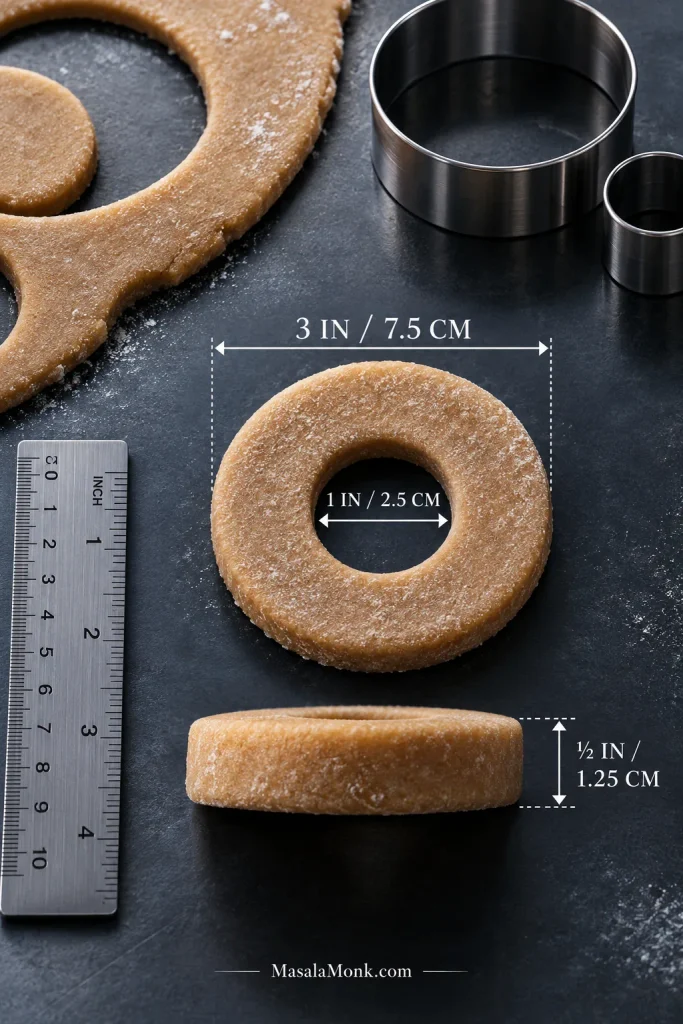
Rings that begin stretching have warmed up; refrigerate the tray for 10–20 minutes.
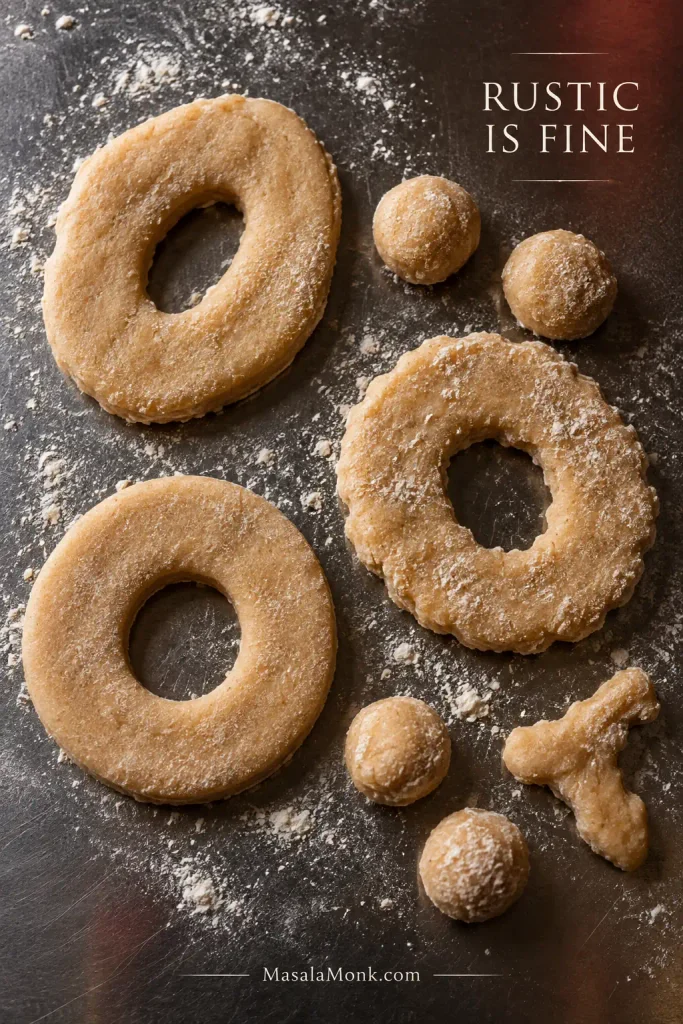
Gather the scraps gently and reroll once. The last odd pieces do not need another beauty treatment; fry them as little cider-donut bites.
Rustic is fine. Uneven circles, rough edges and the occasional wonky ring all fry perfectly well.
7. Heat the Frying Oil
Heat 2–2½ inches / 5–6 cm of neutral oil to about 355°F / 180°C. Leave plenty of empty space above the oil in the pot. Once chilled dough goes in, aim to fry near 350°F / 177°C.
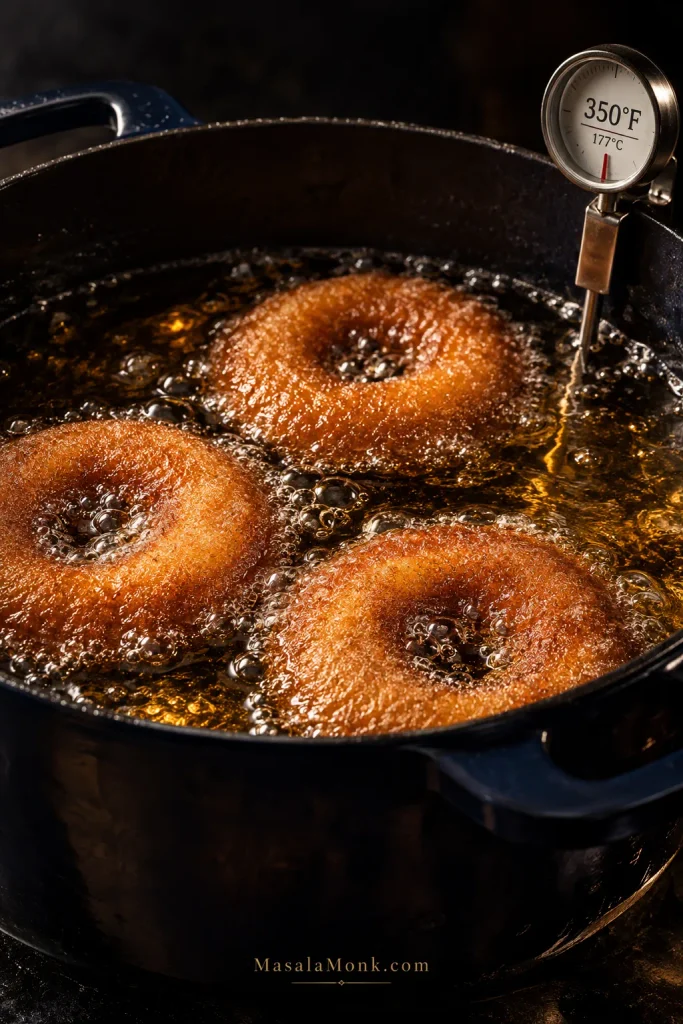
Frying safety: keep water away from the pot, lower the dough gently and stay beside the stove. Never pour water onto burning oil. For frying safety, see the USDA deep-frying guidance; for additional technique, King Arthur Baking’s guide to frying without fear is a useful companion. After frying, let used oil cool completely before straining or transferring it for disposal, and never pour frying oil down the sink.
Oil not holding steady? See why frying temperature keeps dropping.
8. Fry One Donut Hole First
The first donut hole calibrates the fryer. Drop one center piece into the oil before committing a full ring.
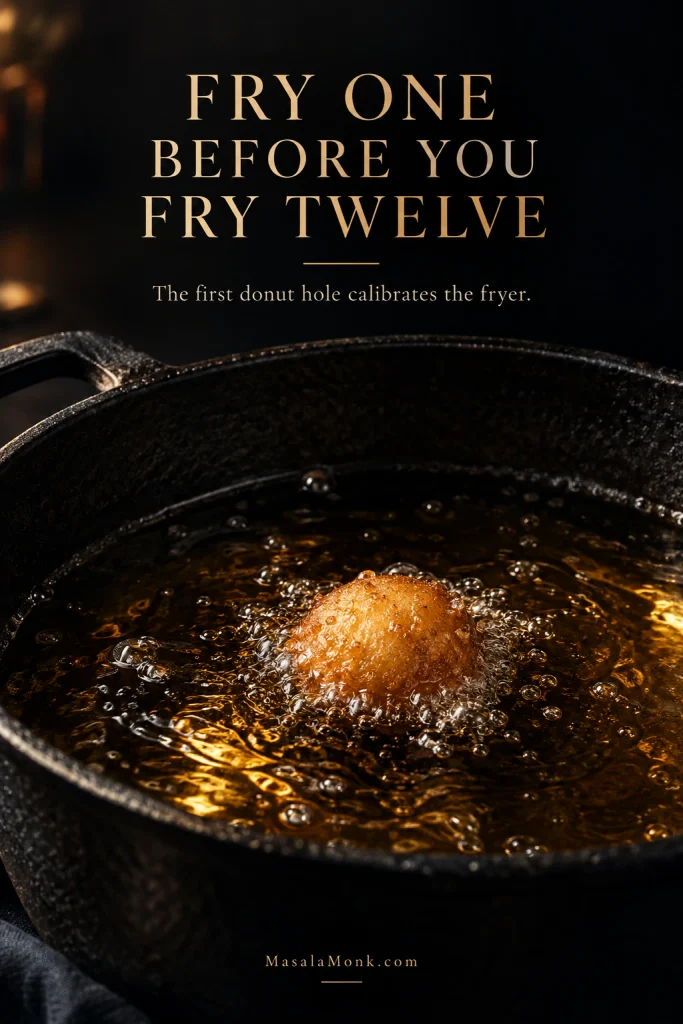
It may dip briefly, then steady fizzing should gather around the edges as it rises and gradually browns. Fast darkening usually means the oil is too hot. A pale, heavy-looking hole usually means the oil needs to recover or come up in temperature.
Let it cool for about a minute and split it open. Look for a moist but fully set middle with no shiny gummy stripe. Taste a piece plain, then roll the rest in a little cinnamon sugar. Frying softens some of the raw cider aroma, but the apple should still be recognizable underneath the browned crust and spice.
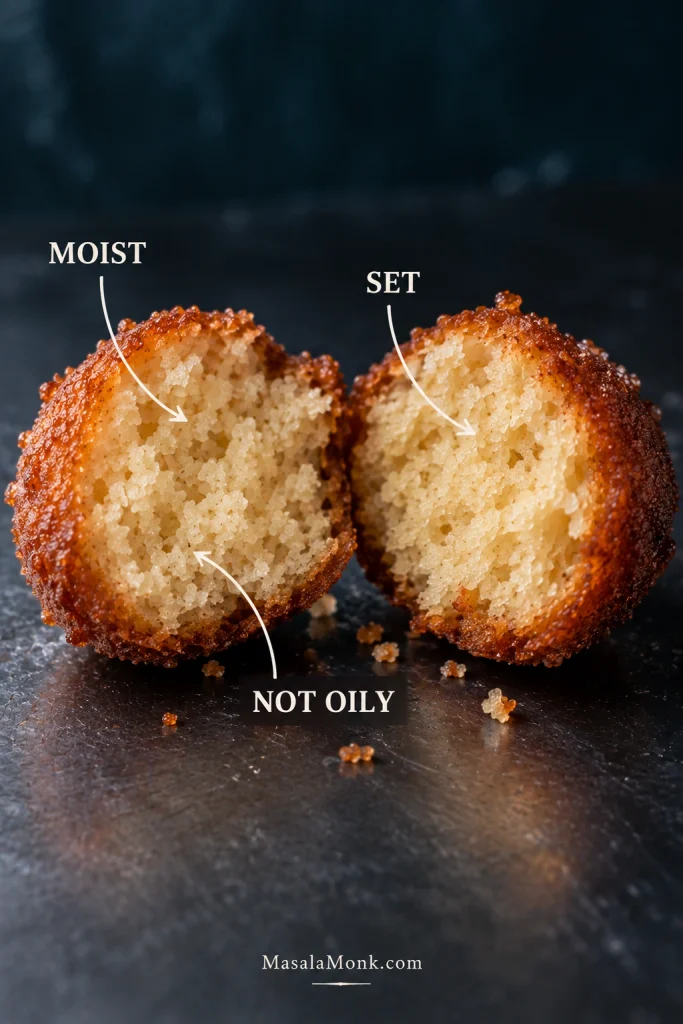
A good test hole: browns gradually, has a moist cake crumb instead of an oil-soaked one, and still tastes of cider after a little cinnamon sugar.
If that little test piece looks right and tastes right, the hardest uncertainty is over.
Test hole not right? Check the oil-temperature guide · Troubleshoot the batch
9. Fry the Rings in Small Batches
Fry 2–4 rings at a time for roughly 60–90 seconds per side. Leave enough room for each one to float freely.
Use that timing as a range, not an appointment. Look for gradual browning and a fully set center; thickness, oil recovery and the actual temperature in your pot matter more than the clock alone.
A finished donut is golden brown, with a few darker ridges and rough edges. Split one from an early batch if you are unsure. Inside, you want soft cake with no raw, wet or shiny line through the middle.
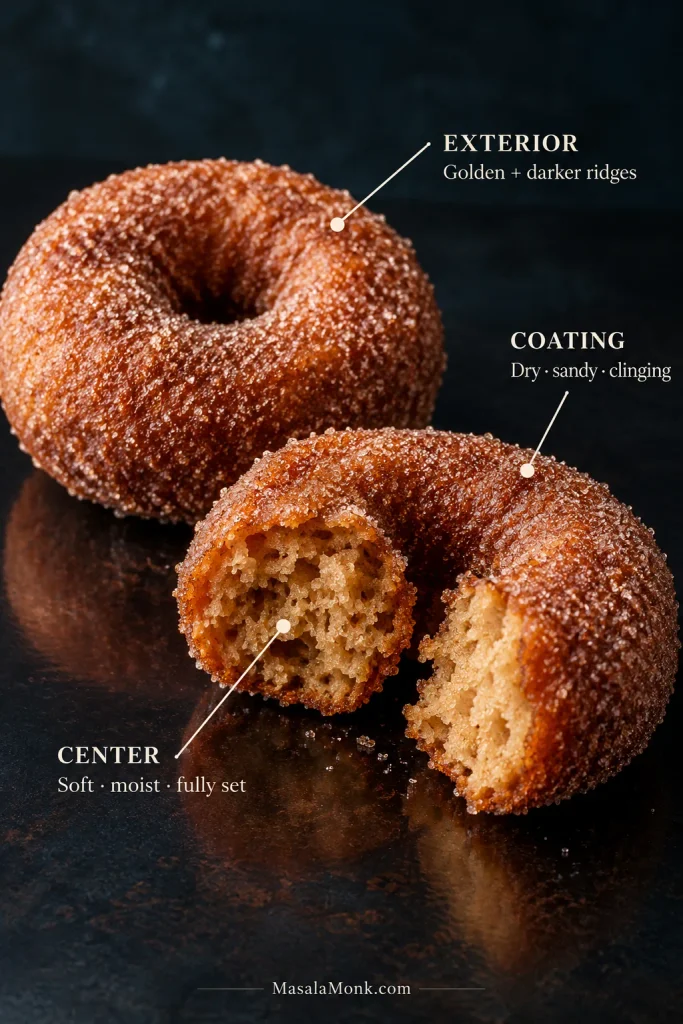
After a few evenly browned rings, frying starts to feel much less mysterious.
Donut holes: the centers cook faster than full rings. Start checking around 45 seconds per side; many finish within 45–60 seconds per side. For an all-hole batch, keep the pieces roughly tablespoon-size and chilled until frying.
10. Drain Briefly and Coat While Warm
Transfer the donuts to a wire rack set over a sheet pan. Once the obvious dripping stops, toss them in cinnamon sugar while they are still warm.
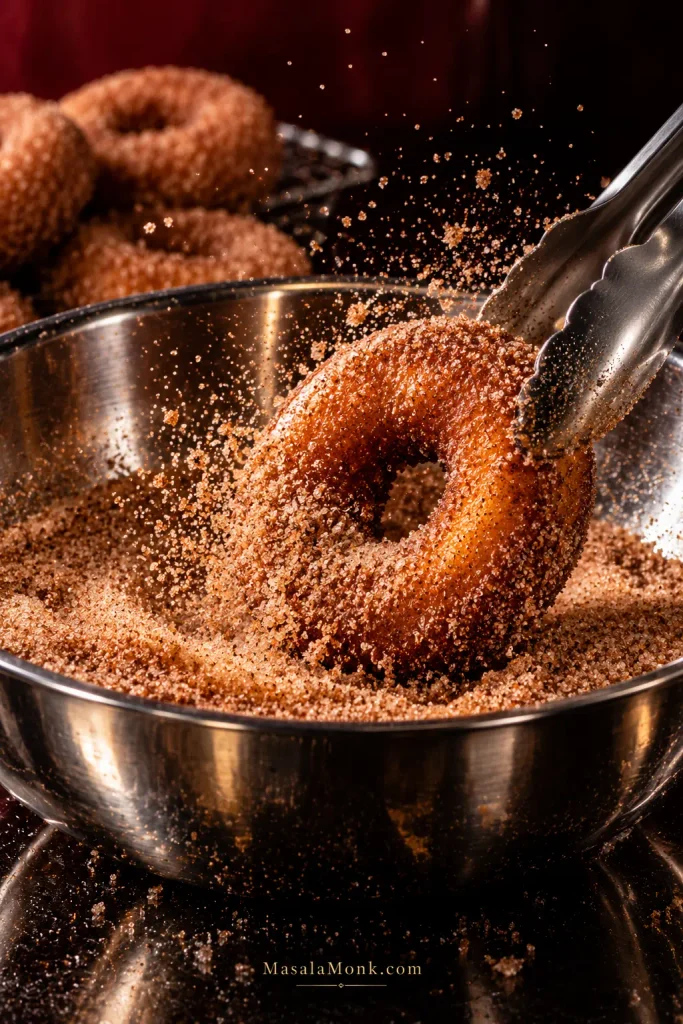
The sugar catches in the cracks and rough edges almost immediately. This is where the restrained spice in the dough pays off: cinnamon perfumes the crust without completely taking over the apple underneath.
Once the freshly fried rings hit the cinnamon sugar, the whole thing finally feels like cider donuts rather than a frying project.
Coating turning damp and oily after several donuts? Refresh the bowl. There are worse problems to have.
More Help With Apple Cider Donuts
If everything went smoothly, you can stop here and eat them. If something looked wrong along the way, the sections below are organized around the problem you saw.
Why Apple Cider Donuts Sometimes Barely Taste Like Cider
Cider can smell wonderfully strong in the raw dough and still fade once the donut is fried and coated. Flour, butter, browned crust and spice all compete with the fruit aroma.
That’s why the cider gets concentrated before it ever meets the dough. Apple butter reinforces the cooked-apple side of the flavor without adding much loose water.
I would not add chopped apples here. Fresh pieces bring extra moisture and make a soft roll-and-cut dough harder to handle. They belong more naturally in a batter designed around them, such as our apple cake recipe.
Apple Cider, Apple Juice or Apple Cider Vinegar?
Best: cloudy nonalcoholic cider. Good substitute: cloudy or unfiltered apple juice. Do not use: hard cider or apple cider vinegar.

Here, apple cider means the cloudy, nonalcoholic kind commonly sold fresh or refrigerated in North America. Elsewhere, cloudy apple juice may be essentially the same thing under a different name.
| What you have | Use it? | What to expect |
|---|---|---|
| Cloudy nonalcoholic cider | Best choice | Strongest starting cider aroma |
| Cloudy or unfiltered apple juice | Yes | Closest substitute |
| Clear filtered apple juice | Yes | Usually milder |
| Hard cider | No | Use nonalcoholic cider or apple juice here |
| Apple cider vinegar | No | Sharp and far too acidic for this role |
Why Is My Apple Cider Donut Dough So Sticky?
Sticky is normal. Unmanageable is not. Most sticky dough simply needs more cold, not more flour. Judge it after it is thoroughly chilled, not while it is still soft from mixing.
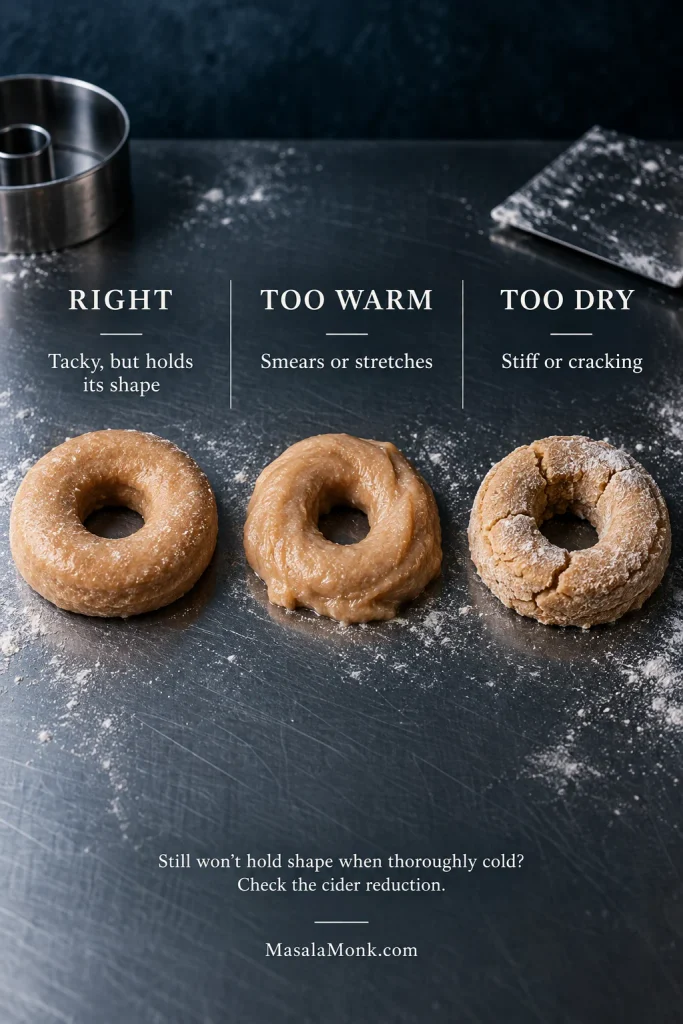
| Cold dough does this | What it means | What to do |
|---|---|---|
| Feels tacky but a ring lifts cleanly | Normal | Keep going |
| Smears and stretches badly | Still too warm | Chill another 20 minutes |
| Will not hold a ring even when thoroughly cold | Probably too wet | Check whether the cider was fully reduced |
| Feels stiff or cracks | Likely too much flour | Do not work in more |
Bench flour is for handling, not for turning the dough dry. Once a chilled ring lifts cleanly, leave the dough alone.
Why Frying Oil Temperature Keeps Dropping
Fry around 350°F / 177°C. Starting near 355°F / 180°C gives the oil a little room to fall when chilled dough goes in.
| Oil temperature | Likely result |
|---|---|
| Around 325°F / 163°C | Slower browning; greater chance of pale, oily donuts |
| Around 350°F / 177°C | Target range for this recipe |
| Around 375°F / 191°C+ | Outside may darken before the center cooks |
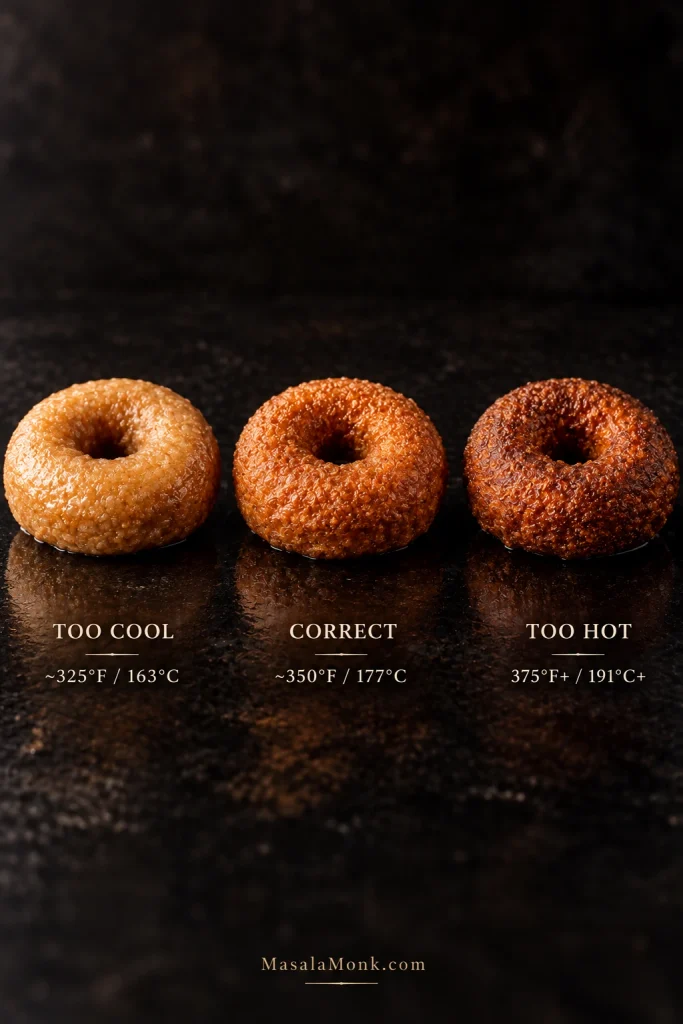
A good batch followed by a greasy one is a clue that the oil probably needs more recovery time. Let it move back toward 350°F / 177°C before the next batch goes in.
Cinnamon Sugar or Apple Cider Glaze?
Cinnamon sugar is the finish I would choose for the classic version. It stays dry and sandy on the freshly fried crust, while the restrained spice leaves more room for cider in the crumb.
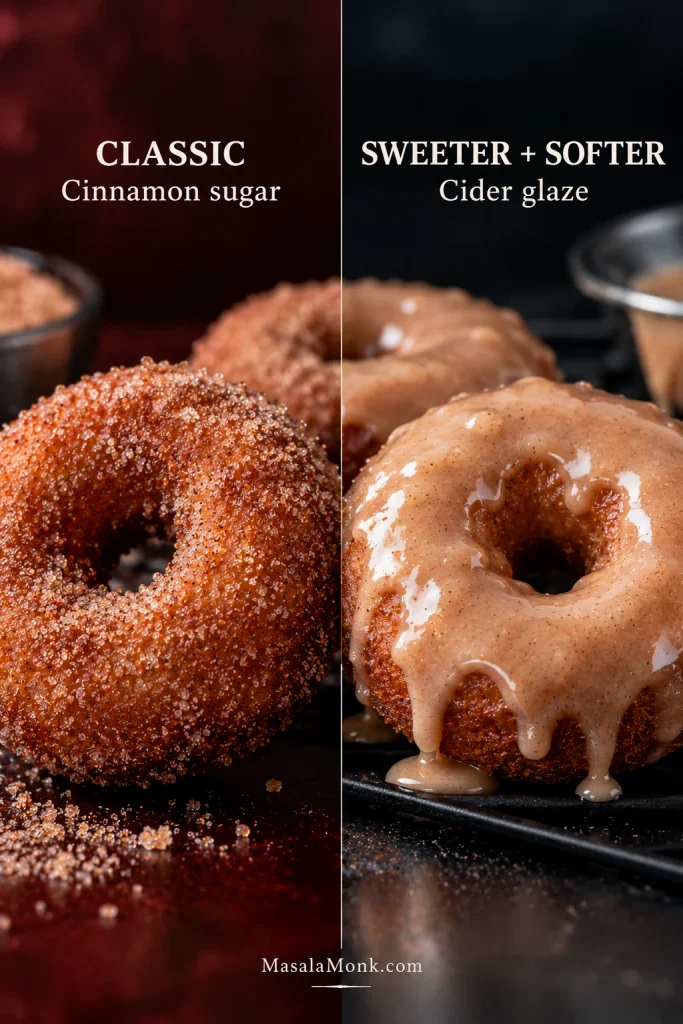
If you want to adjust the warm-spice balance rather than simply adding more cinnamon, our apple pie spice recipe explains what cinnamon, nutmeg, ginger and allspice each contribute.
Cider glaze
- ½ cup / 120 ml apple cider, reduced to about 2 tbsp / 30 ml
- 1 cup / 113 g confectioners’ sugar
- 1½ tbsp / 22 ml cooled cider reduction
- Pinch fine salt
Whisk the sugar with 1½ tbsp / 22 ml reduction and the salt. Add more cider reduction or milk, a teaspoon at a time, only if needed for dipping consistency.
The glaze is sweeter, softer and more dessert-like. Cinnamon sugar keeps the donut closer to the classic cider-mill version.
Apple Cider Donut Troubleshooting
Most problems come back to the same three controls: cider concentration, dough temperature or oil temperature. Find the stage where the batch first looked wrong, then work from there.
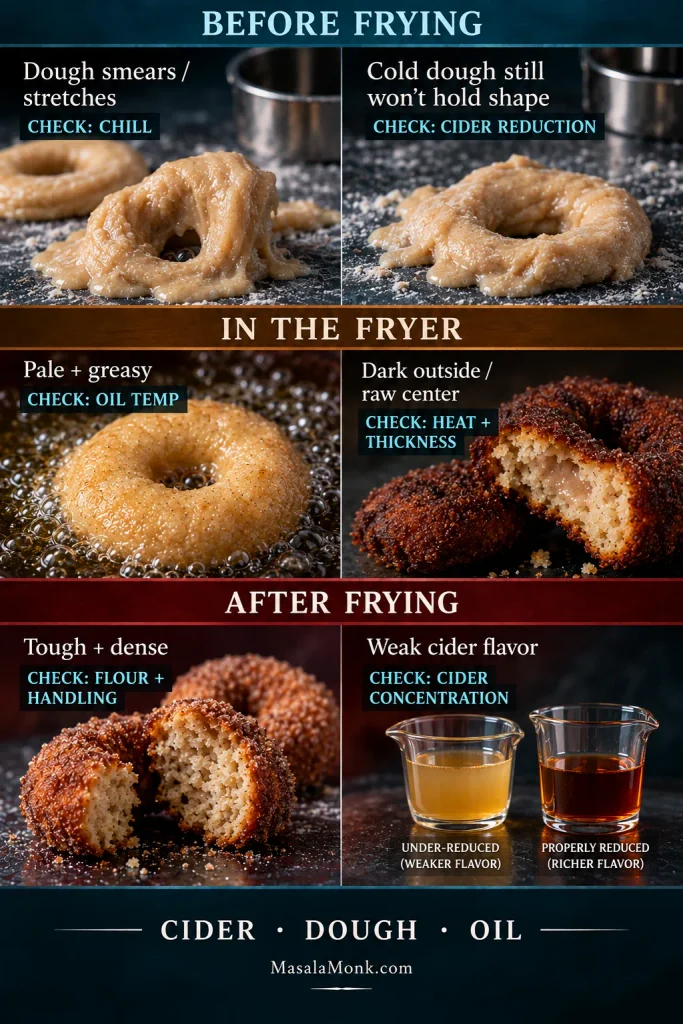
Before Frying
| What you see | Likely cause | What to do |
|---|---|---|
| Cold dough still smears badly | Too warm or not fully chilled; excess moisture is less common | Chill again first. If it is still unmanageable when thoroughly cold, check the cider reduction. |
| Cut rings stretch or collapse | Dough warmed during rolling | Refrigerate the tray for 10–20 minutes. |
| Dough is stiff or cracking | Too much incorporated flour | Handle the remaining dough gently and avoid unnecessary rerolling. |
In the Fryer
| What you see | Likely cause | What to do |
|---|---|---|
| Donut darkens almost immediately | Oil probably too hot | Lower the heat and test another hole. |
| Pale and greasy | Oil too cool or batch too crowded | Pause and let the oil recover. |
| Dark outside, raw or gummy inside | Oil too hot or ring too thick; unusually wet dough is less common | Correct the heat and check the dough thickness first. |
| Ring begins breaking apart | Dough usually too warm; excess moisture is another possibility | Rechill before continuing. |
| Test hole sits heavily instead of puffing toward the surface | Oil may be too cool | Check the oil first. If the temperature is right and the problem persists, reassess the dough. |
After Frying
| What happened | Likely cause | What to do |
|---|---|---|
| Crumb feels greasy | Oil ran cool or batch was crowded; dough moisture can also contribute | Let the oil recover and use fewer rings. |
| Donuts are tough or dense | Too much flour, overmixing or repeated rerolling | Handle the remaining dough as little as possible. |
| Donuts are dry | Too much flour or too long in the fryer | Shorten the next batch and watch the center. |
| Apple flavor is faint | Mild cider or weak reduction | Use the cider glaze if you want a stronger apple impression; next time concentrate the cider fully. |
| Cinnamon takes over | Coating overwhelms a mild cider flavor | Use a lighter coating. |
| Sugar barely sticks | Donuts cooled too far | Coat the remaining rings sooner. |
| Sugar turns oily and clumpy | Donuts were still dripping | Drain briefly before coating and refresh the sugar if needed. |
| Coating becomes damp later | Warm donuts were enclosed or sat in humid air | Cool completely before storing. |
Back to Recipe · Test Hole · Back to Top
Make It Tonight, Fry Tomorrow
Reduce the cider and mix the dough the night before, then cover and refrigerate. The next day, judge it by how it feels rather than by how many hours it has been cold.
For the cleanest shapes, I would keep the dough as one covered mass and cut the rings shortly before frying instead of leaving shaped pieces exposed overnight.
If the next-day frying step is exactly what you are trying to avoid, an apple crisp is a much easier make-ahead apple dessert: prepare the filling and topping separately, refrigerate them, then assemble before baking.
These Donuts Are a Same-Day Food
The first warm ring is the version storage never quite reproduces: a lightly crisp edge around soft cake, with cinnamon sugar still dry and sandy on the surface.
Best quality: eat them within the first few hours if you can.
Room temperature: cool completely before covering and keep for up to about 2 days. Room temperature is better for texture than the refrigerator; refrigeration tends to firm the crumb and soften the coating.
Freezing
Freeze completely cooled donuts, preferably before coating, for up to about 3 months for best quality. Freezing is practical, but it will not recreate the texture of a donut eaten warm from the rack. Thaw before reheating and add fresh cinnamon sugar while warm.
Reheating
- Oven or toaster oven: best for restoring some of the exterior texture. Heat at 325°F / 165°C for about 8 minutes.
- Microwave: fastest, but the donut will be noticeably softer.
- Air fryer: use a low setting and check early. Machines vary too much for one universal reheating time.
Fried vs Baked Apple Cider Donuts
This recipe is deliberately fried. That is how you get the thin browned crust and cinnamon-sugar exterior we’re chasing here.
Baked cider donuts deserve a batter formulated for the oven; I would not put this soft frying dough into a donut pan and expect the same texture. The same principle applies to dietary changes: gluten-free cider donuts need their own flour balance rather than a direct flour swap into this dough.
If your real goal is donuts without a pot of frying oil, our air fryer donuts are built for that cooking method instead of trying to convert this cider-donut dough.
Apple Cider Donut FAQ
1. Are Apple Cider Donuts Cake Donuts or Yeast Donuts?
They are usually cake-style donuts, lifted with baking powder and baking soda rather than yeast.
2. Can I Use Apple Juice Instead of Apple Cider?
Yes. Cloudy or unfiltered apple juice is the closest substitute; reduce it the same way as cider.
3. Can I Fry Apple Cider Donuts Without a Thermometer?
Yes, but a thermometer is much easier. Without one, use the first donut hole to judge browning, rise and doneness before frying the rings.
4. Can I Make the Dough the Night Before?
Yes. Cover and refrigerate overnight, then roll, cut and fry the next day once the dough feels cold, soft and easy to lift.
Homemade cider donuts do not need perfect geometry. Eat one while it is still warm, before the rest have even finished their cinnamon sugar. The crust should give a little, the crumb should still be soft, and underneath all that cinnamon, the cider should still be there.








