Posted on Leave a comment

Apple Tart Recipe

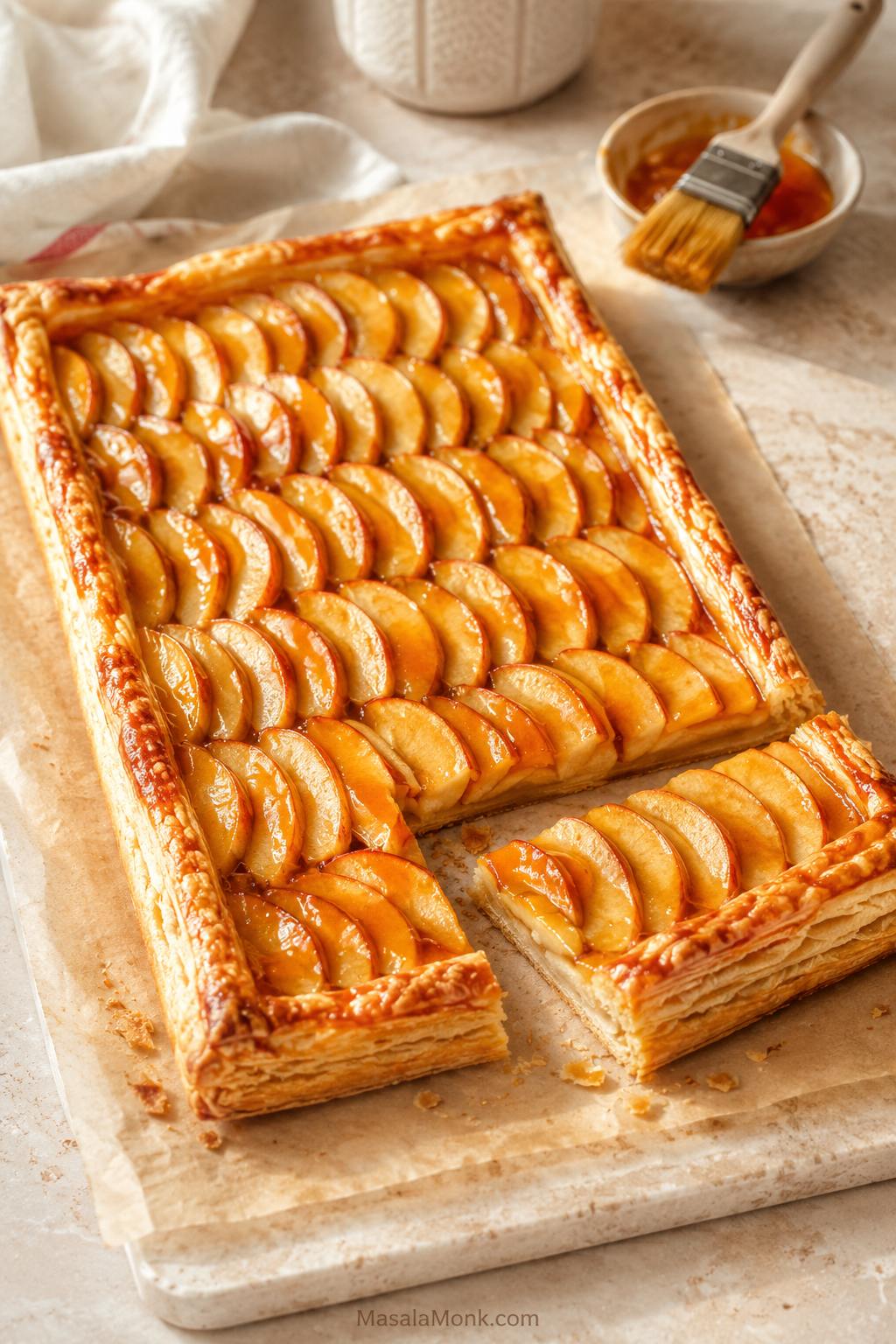
Rectangular apple tart with thin sliced apples, glossy glaze, and a golden puff pastry border on parchment.

This apple tart recipe is for the moment when you want something prettier than a basic apple dessert but easier than a full apple pie. Store-bought puff pastry, thin apple slices, cinnamon sugar, melted butter, and a glossy apricot finish bake into a crisp, bakery-style tart that smells like cinnamon apples and slices cleanly enough to serve with pride.

The method is simple, but the details matter. Keep the pastry cool, slice the apples evenly, and bake the tart until the base feels firm enough to lift with a spatula. The best slices have flaky pastry, soft cinnamon-scented apples, and just enough glaze to catch the light.

Start with the puff pastry version, then use the notes below when you want a round shortcrust tart, a French-style applesauce layer, mini tarts, or a fix for a base that keeps turning soft.

Quick Answer: How to Make Apple Tart

To make an easy apple tart, place cold puff pastry on parchment, score a border around the edge, dock the center with a fork, and arrange thin apple slices in one overlapping layer. Brush the apples with melted butter, sprinkle with cinnamon sugar, then bake at 400°F / 200°C, or 180°C fan, for 30–35 minutes, until the pastry is well browned and the apples are tender. Brush the warm tart with apricot jam or apple jelly for a glossy finish.

When it is right, the edges will puff into a flaky frame, the apples will look glossy and slightly curled at the tips, and the bottom will feel firm instead of bendy. The goal is not a mountain of apples. The goal is a crisp sheet of pastry with enough fruit to taste generous, but not so much that the juices flood the base.

For the full printable-style version, go straight to the recipe card. If your main worry is texture, the crisp base tips explain how to avoid a soggy apple tart.
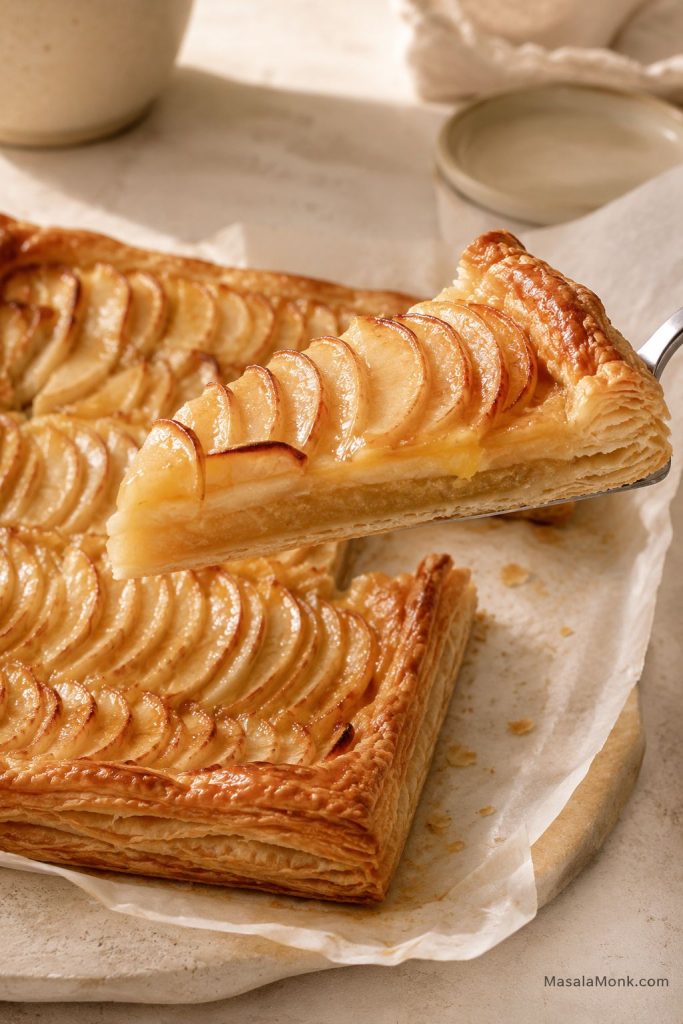
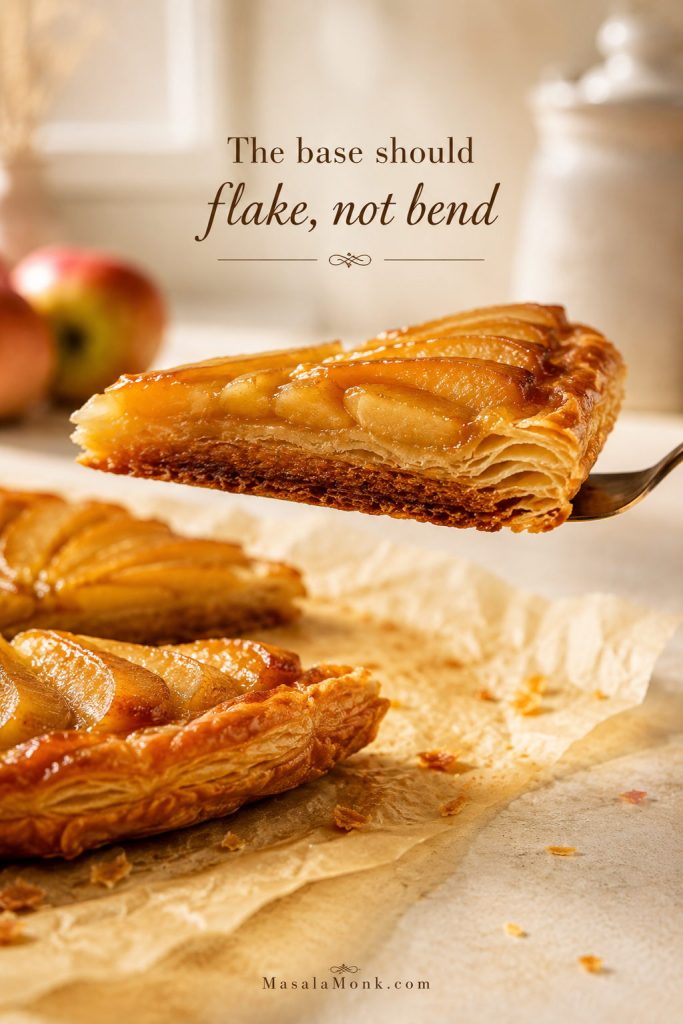
Slice of apple tart lifted from a rectangular puff pastry tart, showing glossy apples and flaky pastry layers.
Once the tart cools slightly, a clean slice should show tender apples on top and a firm pastry base underneath.

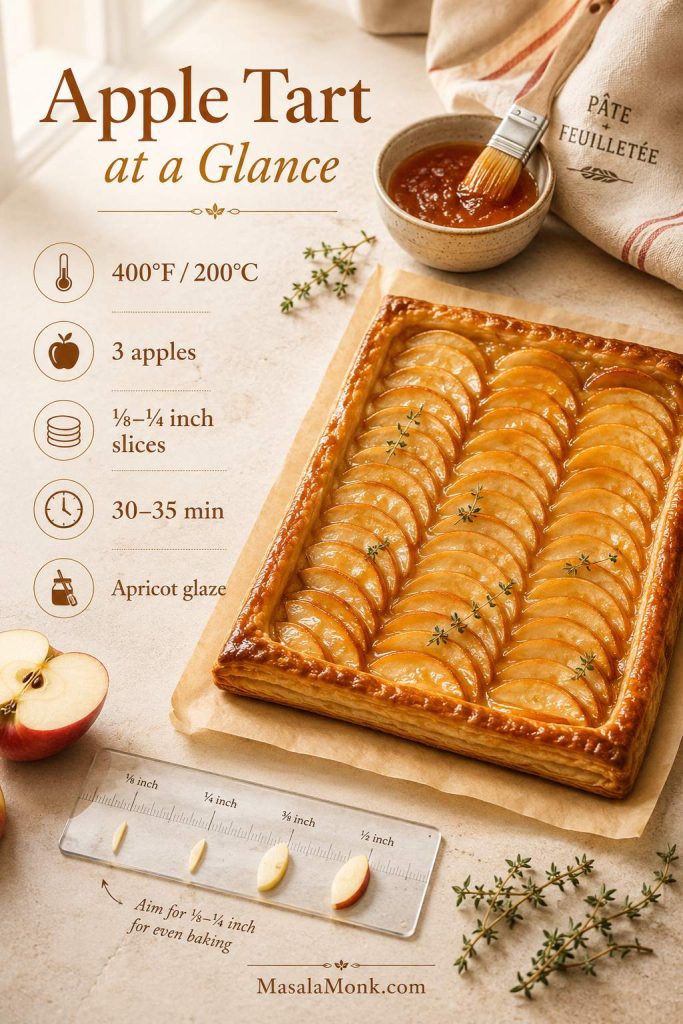
Apple Tart at a Glance

Best pastry for the simple version Store-bought all-butter puff pastry
Apple amount 3 medium apples, about 450–550 g / 1–1¼ lb before peeling and coring
Apple slice thickness ⅛–¼ inch / 3–6 mm
Oven temperature 400°F / 200°C, or 180°C fan
Bake time 30–35 minutes for puff pastry
Best finish Warm apricot jam or apple jelly glaze
Most important texture cue The pastry should be crisp, browned underneath, and firm enough to lift
Apple tart at-a-glance guide showing bake temperature, apple amount, slice thickness, bake time, and apricot glaze.
Use these numbers as guardrails: three apples, thin slices, a hot oven, and apricot glaze keep the tart balanced.

Why This Apple Tart Works

The secret is giving puff pastry the conditions it likes: cold dough, a hot oven, a scored edge, and a thin apple layer that does not weigh down the center. Store-bought puff pastry is the shortcut here; it gives you a flaky, bakery-style apple tart without making dough from scratch.

  • Puff pastry keeps the recipe approachable. You get flaky layers without a homemade dough project.
  • A scored border gives the tart structure. The edge rises around the apples and creates a clean frame.
  • Docking the center keeps it flatter. The middle stays lower while the border puffs.
  • Thin apples bake quickly. Slices around ⅛–¼ inch / 3–6 mm soften before the pastry overbrowns.
  • A hot baking sheet helps the bottom set. This gives the pastry a better chance to crisp before apple juices collect.
  • A light glaze makes it look finished. Apricot jam or apple jelly gives shine without making the tart heavy.

The result is the kind of dessert that feels dressed up without being fussy: crisp enough to lift neatly, tender enough to eat with a fork, and glossy enough to look finished even if your apple rows were not perfect.

This is the tart you make when pie sounds too heavy but sliced apples on buttery pastry still feels special. It looks like it took more effort than it did, which is exactly the charm.

Ingredients You Need

The ingredient list is short, so each piece has to pull its weight: buttery pastry, flavorful apples, a little sugar, a little butter, and a glossy finish at the end.
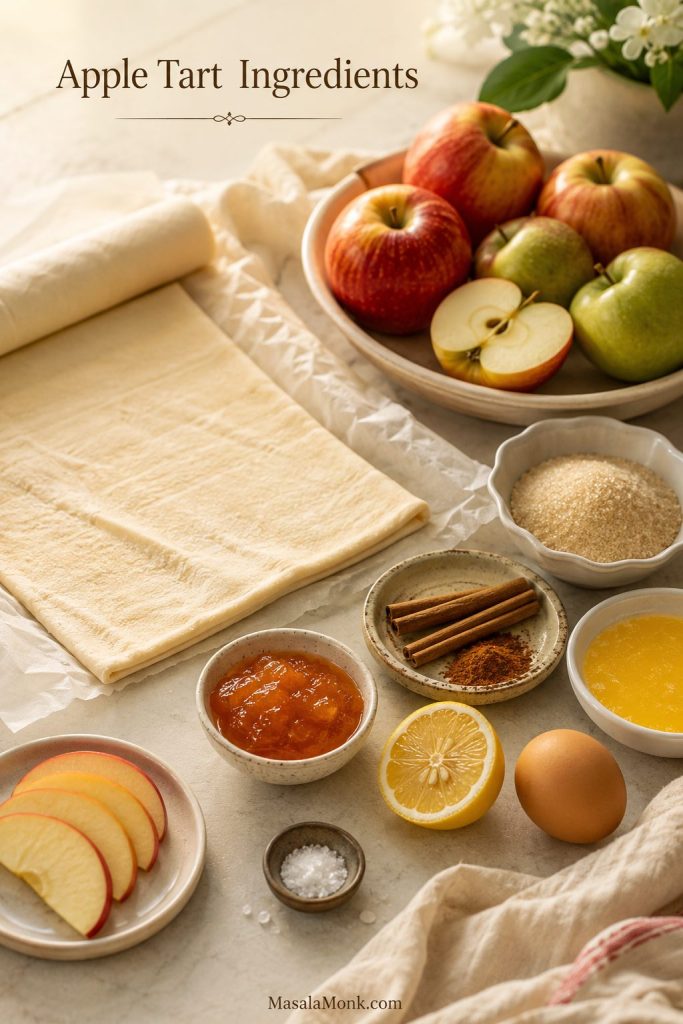
Apple tart ingredients including puff pastry, apples, cinnamon sugar, lemon, butter, apricot jam, egg, and salt.
With a short ingredient list, choose flavorful apples and good puff pastry because there is nowhere for weak ingredients to hide.

If you are still choosing apples, the best apples for apple tart section gives a quick variety guide before you start slicing.

Store-Bought Puff Pastry

Use one sheet of all-butter puff pastry if you can find it. It bakes with better flavor and cleaner flaky layers than pastry made mostly with shortening. Thaw frozen puff pastry in the refrigerator, not on a warm counter, so it unfolds without getting greasy. Soft pastry should go back into the fridge before baking.

Cold pastry matters because firm butter layers create better lift in the oven. King Arthur Baking’s puff pastry guidance explains the same cold-dough, hot-oven principle in more detail.
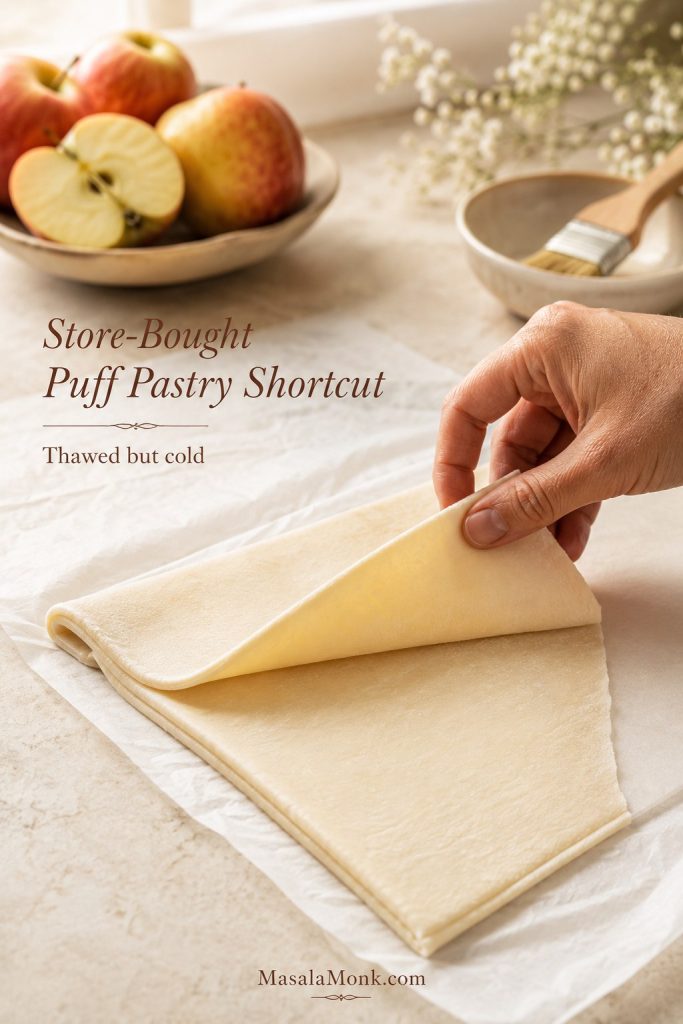
Store-bought puff pastry unfolded on parchment with sliced apples and a pastry brush nearby.
Store-bought puff pastry gives the shortcut, but keeping it cold is what helps the tart rise cleanly in the oven.

Not sure whether puff pastry or shortcrust is better for your tart? See the puff pastry vs shortcrust comparison before you choose.

Apples

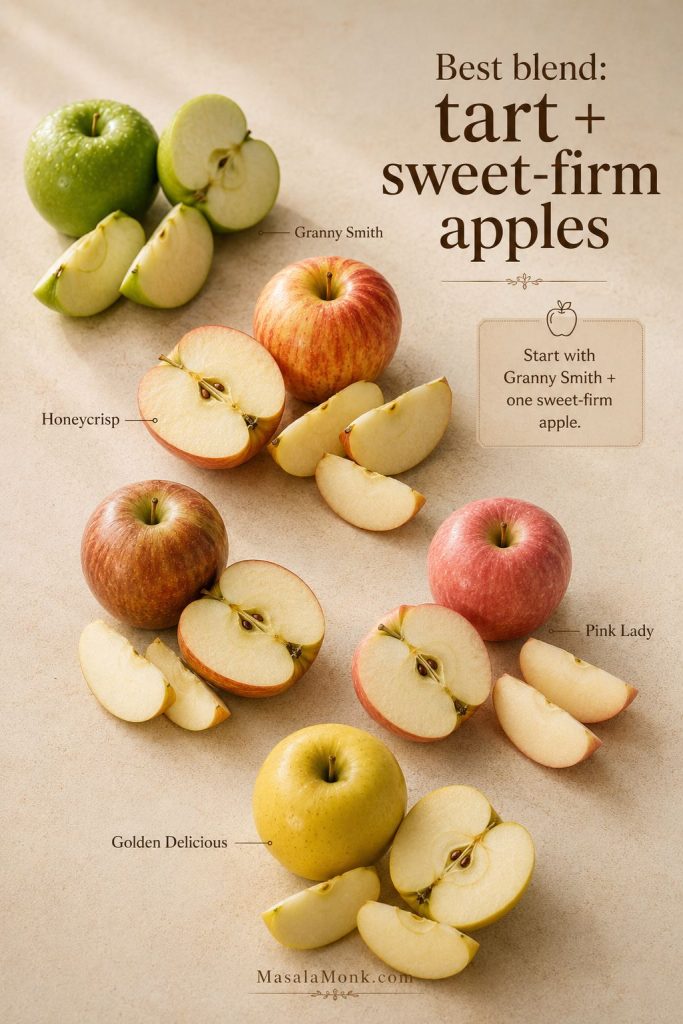
You need about 3 medium apples, or 450–550 g / 1–1¼ lb before peeling and coring. That amount covers one rectangular puff pastry tart without weighing down the center. Pink Lady and Honeycrisp give an easy sweet-tart balance, while Granny Smith makes a sharper tart when mixed with a sweeter apple.

Fresh Apples vs Apple Pie Filling

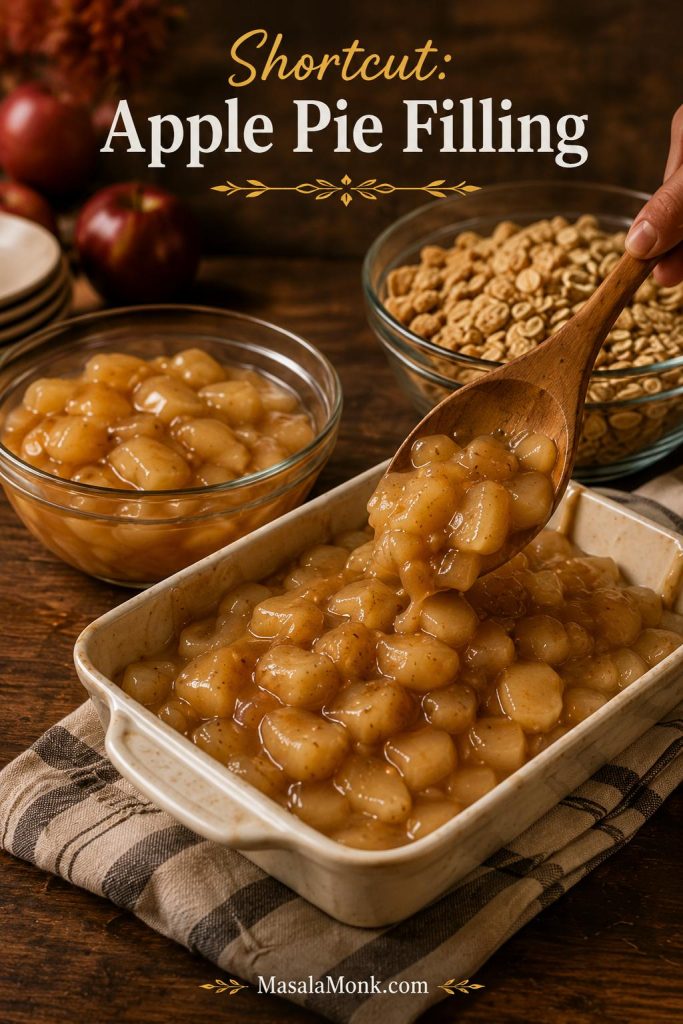
This tart works best with fresh thin apple slices, not thick cooked filling. A saucy apple pie filling recipe is better for pies, crisps, hand pies, and spoonable toppings because it has more moisture and body than this thin pastry base needs.
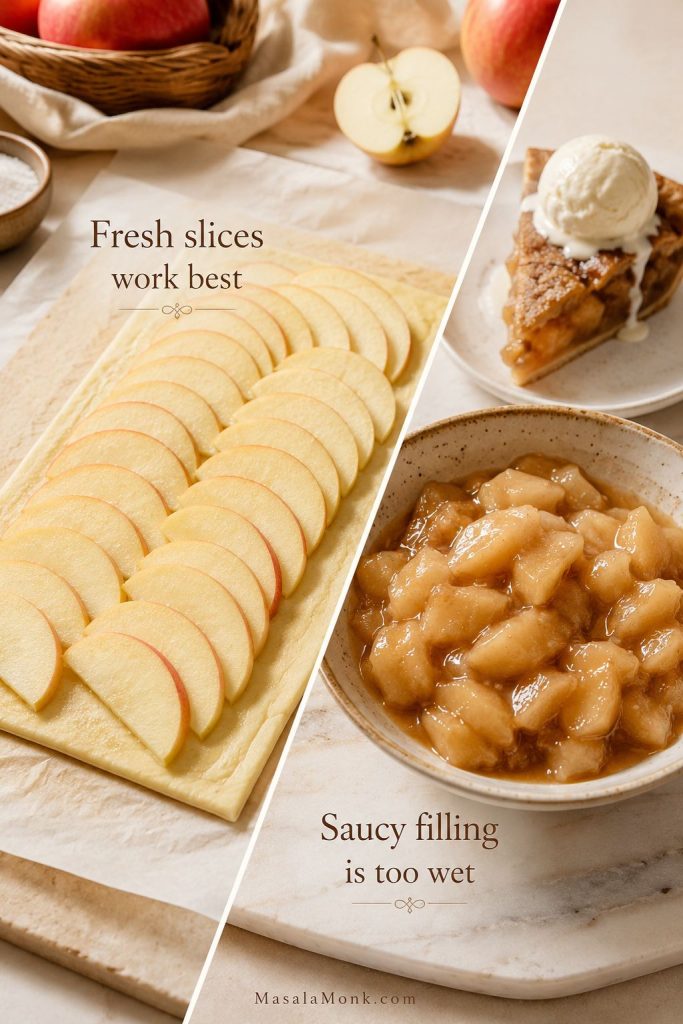
Fresh apple slices on puff pastry compared with saucy apple pie filling for an apple tart.
Fresh apple slices suit a thin puff pastry tart because cooked pie filling brings more sauce than this base can handle.

For a deeper, saucier apple dessert instead, compare this with the apple tart vs pie section.

Sugar

Granulated sugar gives a clean, light sweetness. Light brown sugar adds a warmer caramel note. Use 3 tablespoons for sweet apples or 4 tablespoons for sharper apples.

Butter

A little melted butter helps the apple edges soften, shine, and brown. You do not need much because puff pastry already contains fat.

Lemon Juice

Lemon keeps the apples bright so the tart does not taste flat or overly sweet. It also buys you a little time while you arrange the slices.

Cinnamon and Salt

Cinnamon gives warmth without making the tart taste like heavy apple pie filling. A pinch of salt makes the apples and pastry taste fuller.

Apricot Jam or Apple Jelly

A warm glaze brushed over the baked tart gives it shine. Apricot jam is classic because it looks glossy and does not overpower the apples. Apple jelly works well for a more apple-forward finish.

Egg Wash, Optional

Egg wash helps the pastry border brown and shine. Brush it only on the top of the border, not down the cut or scored sides, so the pastry layers can rise cleanly. The tart still works without egg wash; the edge will simply look a little softer.

Best Apples for Apple Tart

The best apples for apple tart should taste good, slice neatly, and soften without collapsing. Because this tart is thin, the apples do not need to stay as firm as apples in a deep pie. Flavor matters just as much as structure.

For the easiest first tart, use Pink Lady or Honeycrisp. They slice neatly, taste bright, and do not need much adjustment. For a sharper flavor, mix Granny Smith with a sweeter apple so the tart tastes lively without becoming too sour.
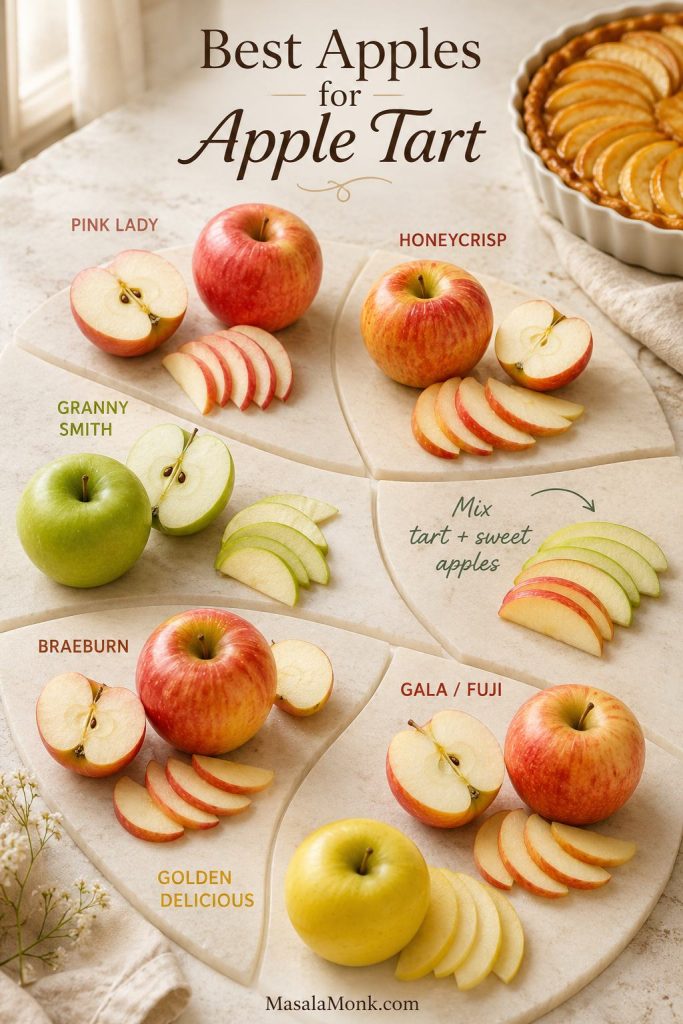
Apple variety guide for apple tart with Pink Lady, Honeycrisp, Granny Smith, Braeburn, Gala, Fuji, and Golden Delicious apples.
Pair a tart apple with a sweeter one when you want bright flavor, gentle sweetness, and slices that still hold together.
Apple Best For Flavor and Texture
Pink Lady Best overall apple tart Sweet-tart, firm, neat slices
Honeycrisp Sweet-tart, familiar flavor Juicy, crisp, and easy to like
Granny Smith Tarter apple tart Firm and sharp; best mixed with a sweeter apple
Braeburn Balanced baking flavor Warm, aromatic, holds shape well
Gala or Fuji Sweeter puff pastry tart Softer and sweeter; good for quick tarts
Golden Delicious Classic French-style tart Soft, mellow, aromatic

A mix of one tart apple and one sweeter apple often gives the best flavor. For example, use Granny Smith with Honeycrisp, Pink Lady, or Fuji. For a deeper baking-apple guide, see best apples for apple pie; the same flavor logic applies, but tart apples should be sliced thinner and arranged more evenly.

Puff Pastry vs Shortcrust for Apple Tart

For this specific recipe, puff pastry is the best first choice. It gives flaky, dramatic edges with very little work, and it keeps the tart feeling light instead of heavy. Shortcrust or pie crust gives a more classic tart-pan texture, but it needs a little more care.
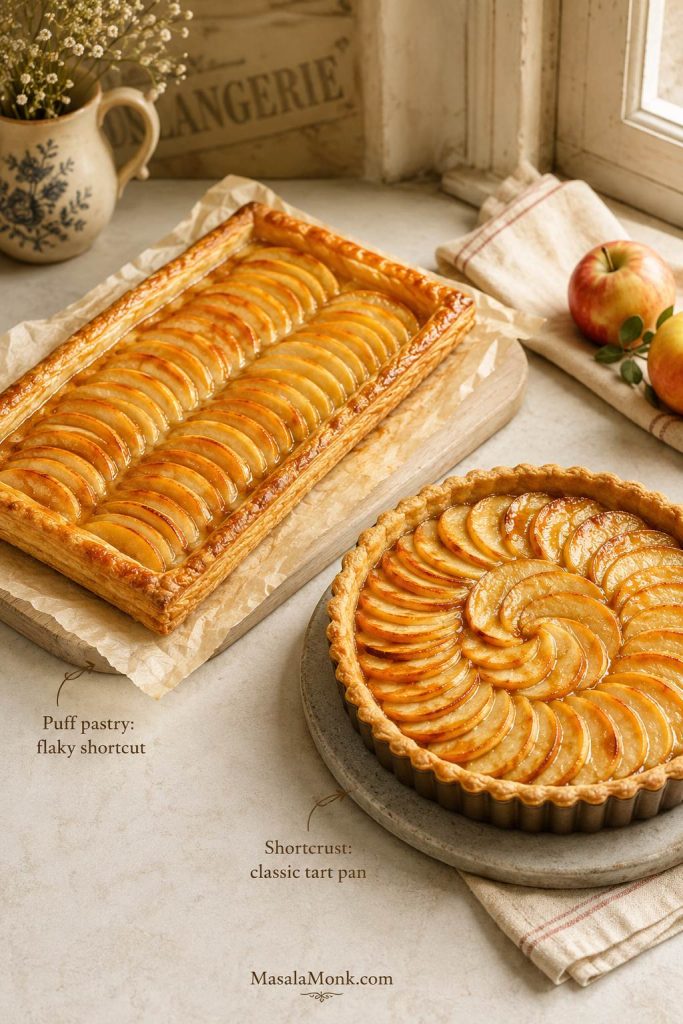
Puff pastry apple tart compared with a shortcrust apple tart in a round fluted tart pan.
Choose puff pastry for a lighter, flakier apple tart, while shortcrust gives a sturdier, more classic tart-pan base.
Pastry Best For Texture Notes
Puff pastry Easy apple tart, French-style sheet tart Flaky, light, crisp edges Great for a quick, flaky tart; keep it cold and bake on a hot tray.
Shortcrust pastry Classic round apple tart Buttery, tender, sturdier Best in a 9–10 inch tart pan.
Pie crust Homemade tart-pan version Flaky but less puffy Works well if rolled thin and chilled.
Store-bought pie crust Shortcut tart-pan version Softer, simpler Chill before baking so it holds shape.

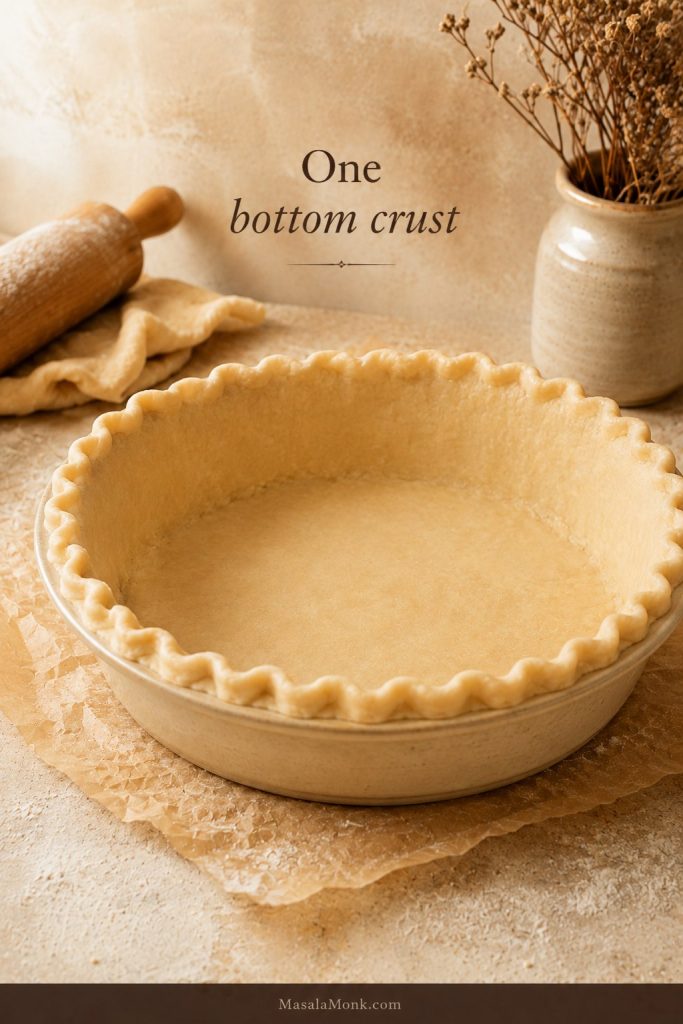
To make the tart with homemade crust, use a buttery pie dough and roll it thin. This apple pie crust recipe is a good base for a shortcrust-style apple tart when you want something more homemade than puff pastry.

How to Make a Shortcrust Apple Tart

For a shortcrust apple tart, line a 9–10 inch tart pan with chilled dough, prick the base with a fork, and chill the lined pan before adding apples. With especially juicy apples or an applesauce layer, partially blind bake the crust until it looks dry and lightly set before adding the fruit.
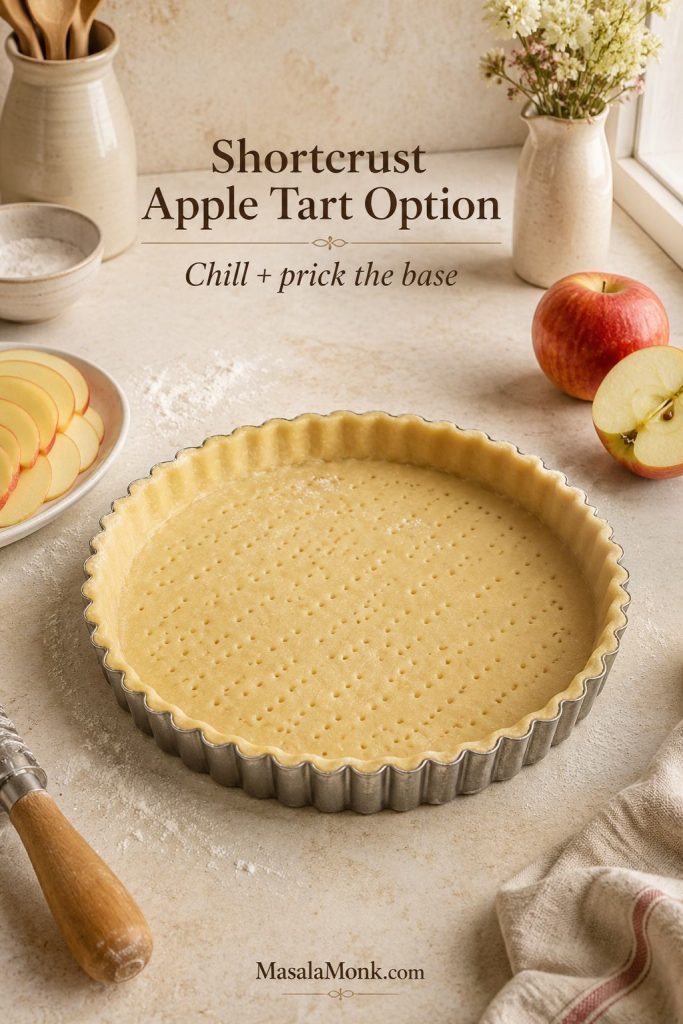
Shortcrust pastry in a fluted tart pan with a fork-pricked base and apple slices nearby.
Before the apples go in, a chilled and pricked shortcrust base gives the tart a better chance to bake evenly.

Shortcrust usually needs longer than puff pastry. Plan on 40–55 minutes, depending on the pan, crust thickness, and apple slice thickness. The tart is ready when the apples are tender and the crust is golden all the way through, not just browned at the rim.

How to Slice Apples for Apple Tart

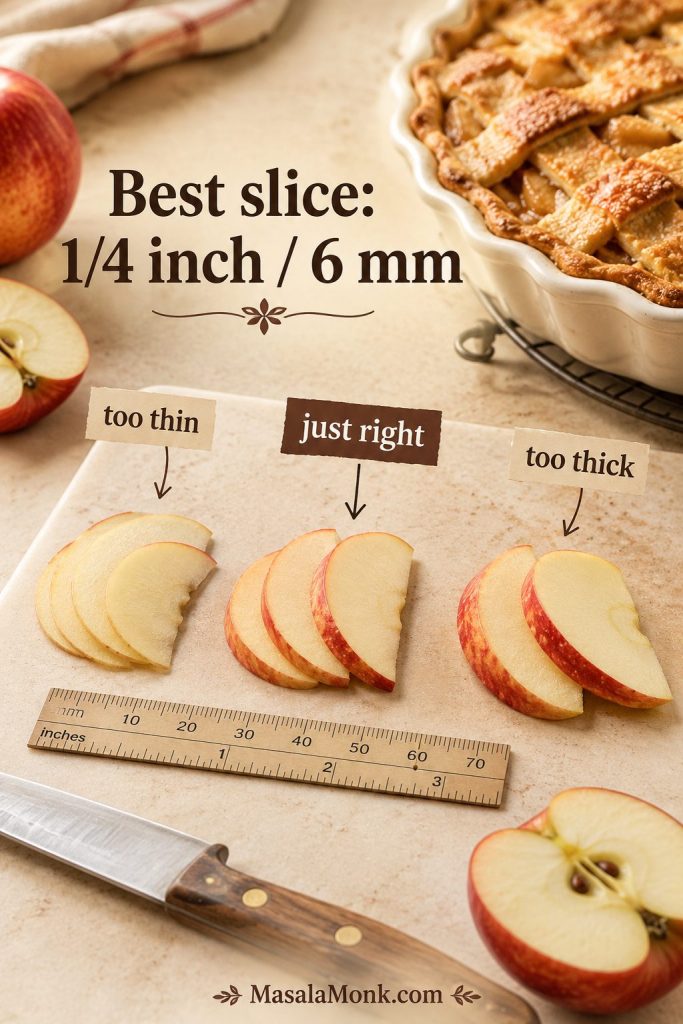
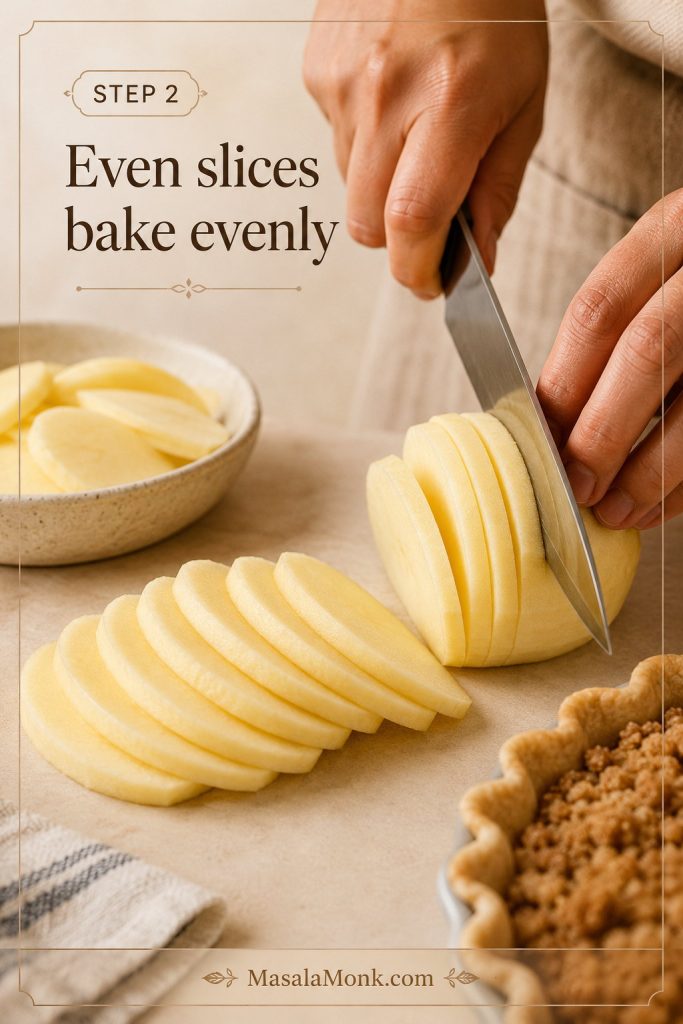
For a neat apple tart, slice the apples evenly. Aim for ⅛–¼ inch / 3–6 mm. Thinner slices give a polished French-style look, while slices closer to ¼ inch / 6 mm feel more rustic and apple-forward. Whatever thickness you choose, keep the slices similar so they soften at the same pace.
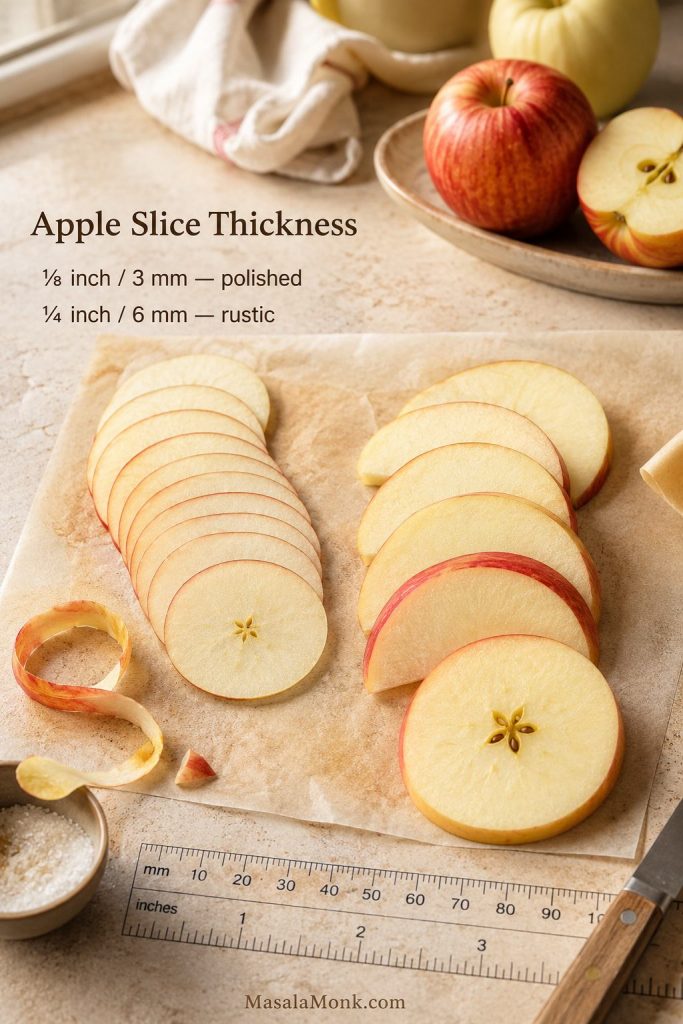
Apple slice thickness guide showing thin and slightly thicker apple slices for an apple tart.
Aim for thinner slices when you want a polished French-style apple tart; go thicker for a softer, more rustic bite.

For easier prep, cut the apples into cheeks first, then slice each piece thinly. You can peel the apples or leave the skin on. Peeled apples give a softer, more classic finish. Unpeeled apples add color and a little bite, especially with Pink Lady, Honeycrisp, or another red-skinned apple. A little browning before baking is harmless, especially once cinnamon and glaze go on.

Need to slice the apples a little ahead of time? Lemon water or lemon juice can slow browning. This guide on how to keep sliced apples from turning brown is useful when you are prepping fruit before baking.

Once the apples are sliced, move to the arranging step for simple rows, shingles, or fans.

How to Make Apple Tart Step by Step

Do not worry about making every slice identical. Even slices help the tart bake evenly, but a slightly rustic pattern still looks lovely once the apples soften and the glaze goes on.

1. Preheat the oven and baking sheet

Heat the oven to 400°F / 200°C, or 180°C fan. Place a rimmed baking sheet on the middle rack while the oven preheats. A hot tray helps the pastry bottom set instead of steaming underneath the apples.
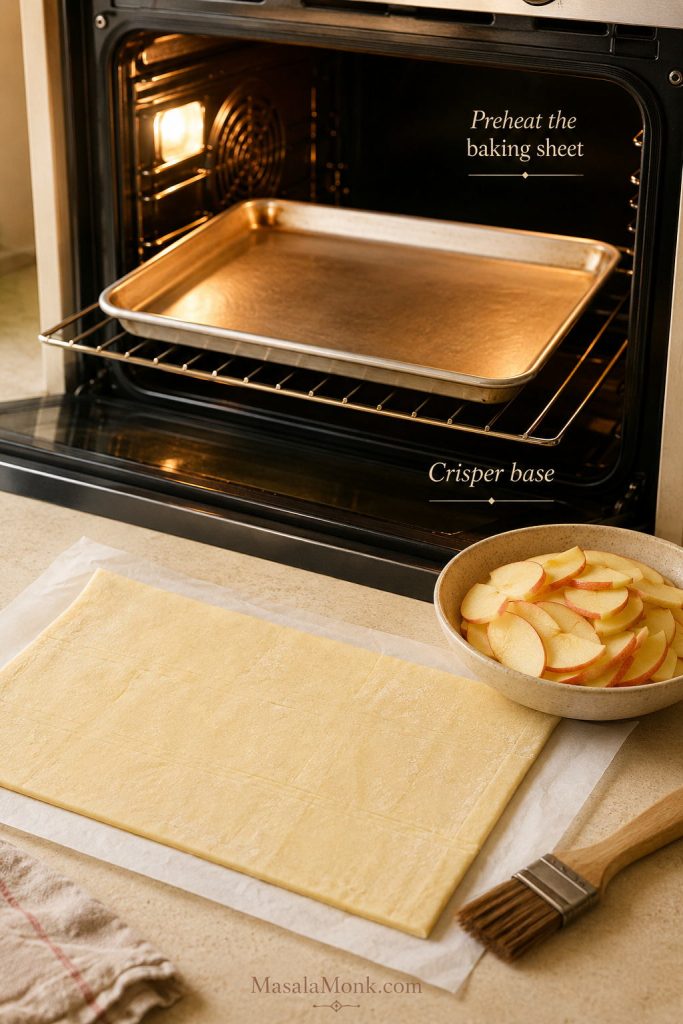
Empty rimmed baking sheet preheating in an oven with puff pastry and sliced apples ready on the counter.
A preheated sheet pan gives puff pastry heat from below, so the base starts setting before the apples release juice.

2. Prepare the puff pastry

Place the cold puff pastry on parchment paper. Roll it lightly to smooth creases or even out the shape. Keep it close to a standard sheet-pan tart size; pastry rolled too thin will not puff as well.

Score a ¾–1 inch / 2–2.5 cm border around the edge with a knife, without cutting all the way through. Dock the center with a fork, leaving the border untouched so it can rise.
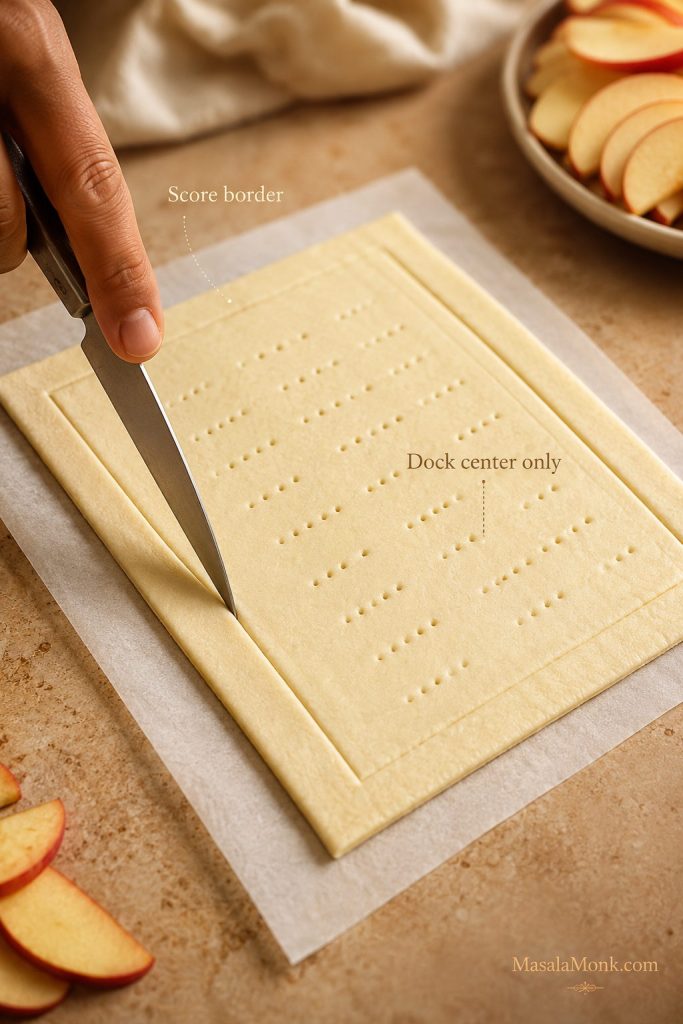
Puff pastry scored around the border and docked in the center with fork marks for apple tart.
Score for lift and dock for control; together, those two small steps shape the raised border and flatter center.

3. Slice and season the apples

Slice the apples thinly and toss them with lemon juice, sugar, cinnamon, and a pinch of salt. When the apples release a lot of juice while they sit, leave the extra liquid behind instead of pouring it onto the pastry.
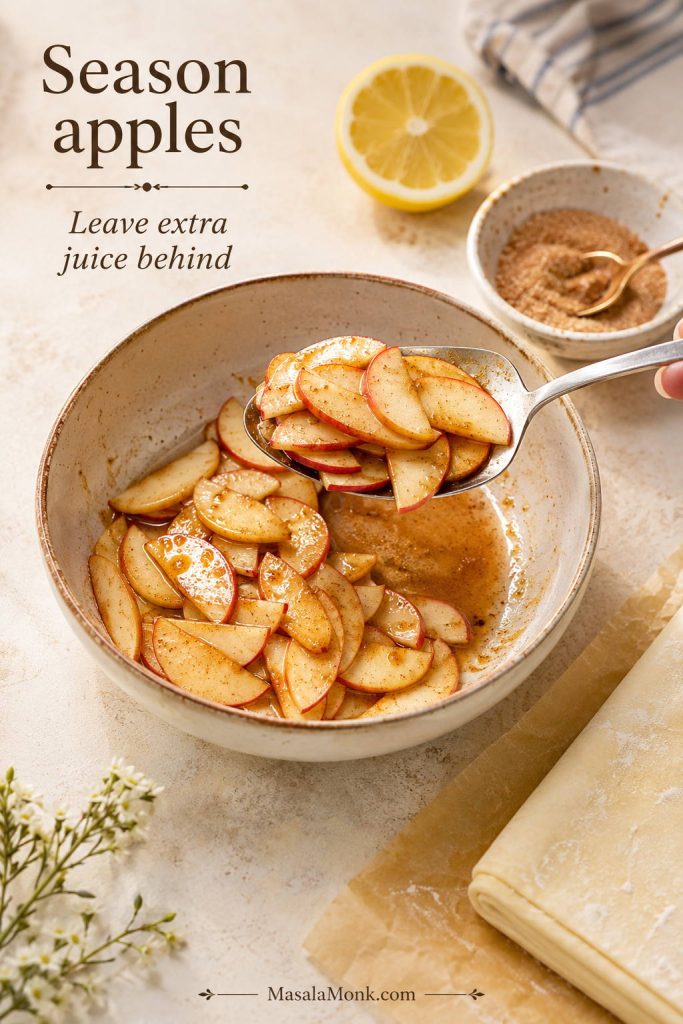
Thin apple slices tossed with cinnamon sugar and lemon juice, with extra liquid left in the bowl.
After seasoning the apples, lift the slices out of the bowl instead of pouring extra cinnamon-lemon juice onto the pastry.

4. Arrange the apples

Arrange the apple slices inside the scored border in overlapping rows, shingles, fans, or a simple diagonal pattern. Keep them in one tidy layer. Brush the apples with melted butter. Brush egg wash on the top border if using, but avoid the cut sides.

Rows, shingles, fans, or a loose spiral all work. The pattern matters less than keeping the apples in an even layer, so do not worry if it looks a little rustic before baking.
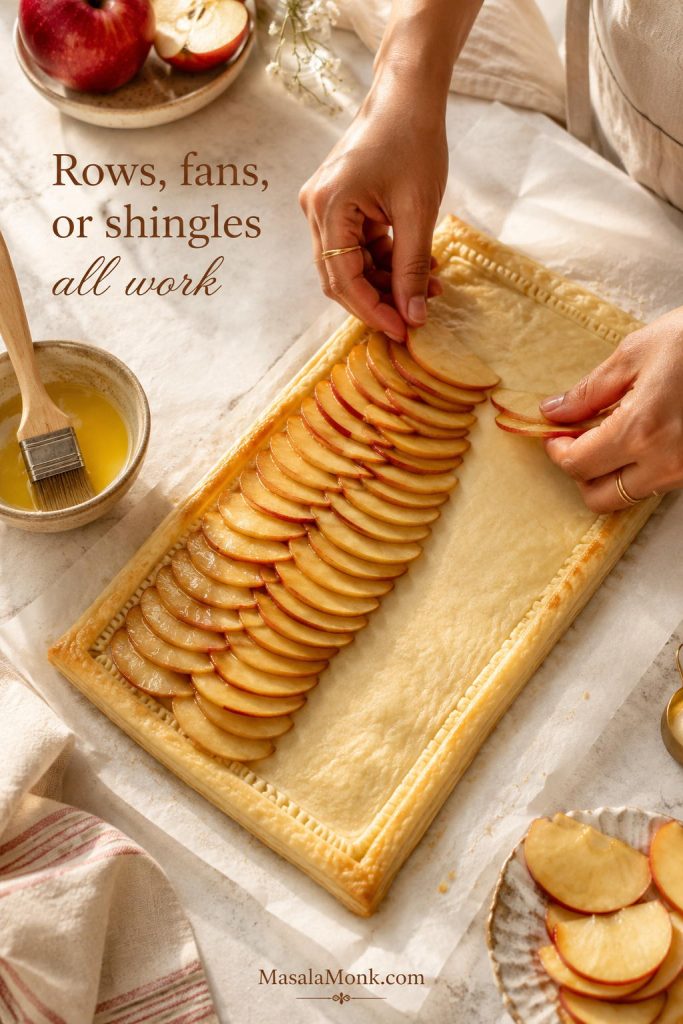
Hands arranging thin apple slices in overlapping rows on puff pastry for apple tart.
A neat apple tart comes from an even layer first; the exact pattern matters less once the apples soften and shine.

5. Chill the assembled tart

Refrigerate the assembled tart for 10–15 minutes while the oven finishes heating. This keeps the butter layers firm and helps the pastry puff more cleanly.
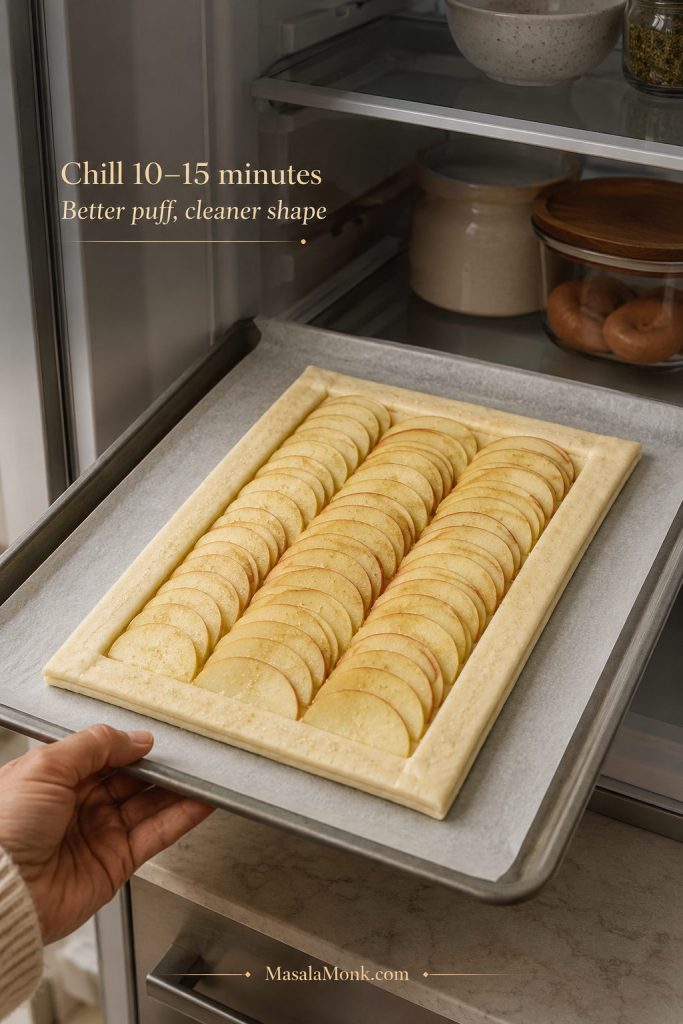
Unbaked apple tart on a baking sheet being chilled in the refrigerator before baking.
That quick fridge rest firms the butter layers, which helps the puff pastry hold its border instead of slumping.

6. Bake until crisp and browned

Carefully slide the parchment with the tart onto the hot baking sheet. Bake for 30–35 minutes, until the edges are puffed, the bottom is browned, and the apples are tender at the edges.

By the last 10 minutes, the kitchen should smell buttery and cinnamon-warm. Do not pull the tart when the border is only lightly golden; puff pastry tastes best when it has real color, and a pale base is the first sign it may soften as it cools.
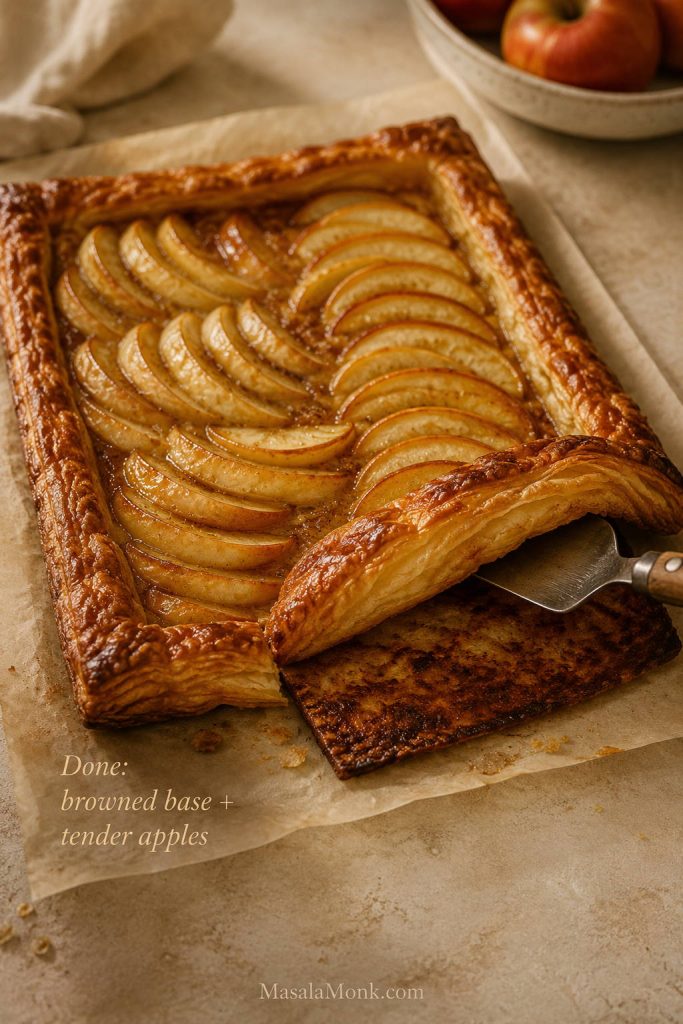
Baked apple tart with browned puff pastry, tender apple slices, and a lifted edge showing the base.
Look underneath before you call it done; a pale base can turn soft even when the apples already look glossy.

For ovens that brown pastry quickly, bake on the middle rack or slightly lower. A lower rack can help the base cook before the top gets too dark. If the pastry is browning unevenly or the center looks soft, check the troubleshooting guide before changing the recipe next time.

7. Glaze and cool

Warm the apricot jam with a teaspoon of water until loose, then brush it mostly over the apples while the tart is still warm. For the smoothest glaze, strain out large fruit pieces before brushing, and avoid soaking the pastry border so the edge stays crisp.
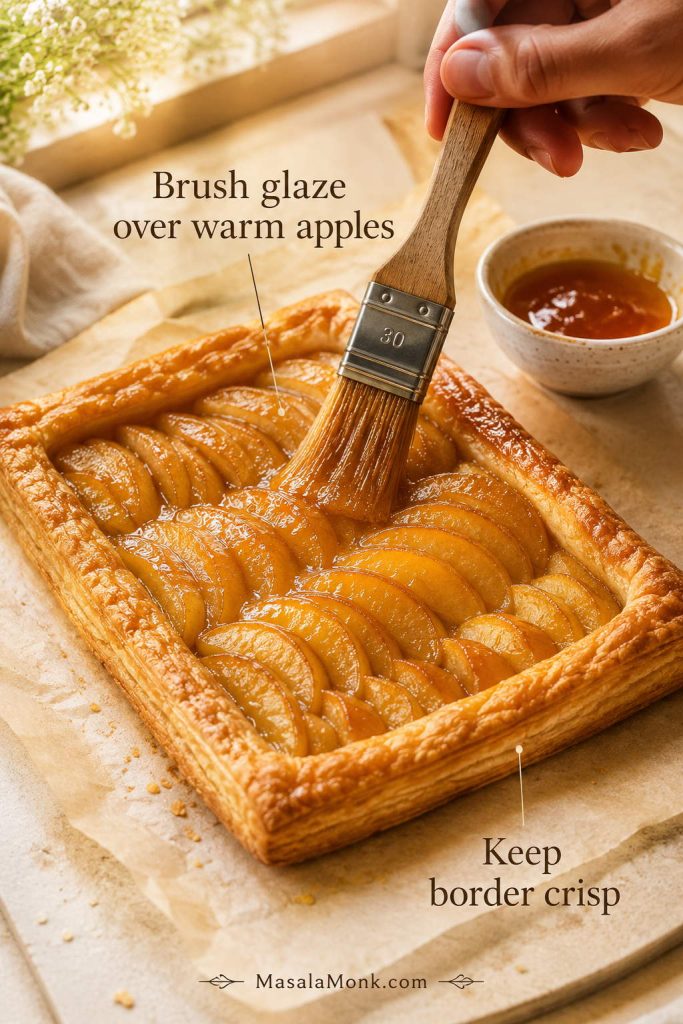
Warm apple tart brushed with apricot glaze while the puff pastry border stays crisp.
Glaze adds shine after baking, but brushing mostly over the apples keeps the puff pastry edge crisp.

Let the tart cool for at least 10–15 minutes before slicing so the pastry can settle. Serve it warm when the apples are soft and fragrant, or at room temperature when you want cleaner slices for a dessert table.

Larger pastry sheet note: Puff pastry sheets vary by brand and country. If your sheet is closer to 300–320 g instead of 240–260 g, use 4 medium apples and add 3–5 minutes to the bake time if the center needs it.

How to Keep Apple Tart from Getting Soggy

A soggy apple tart usually comes from warm pastry, too many apples, excess apple juice, or underbaking. The fix is not one trick; it is a small chain of good habits that keep the pastry cool, the fruit layer controlled, and the base properly baked.
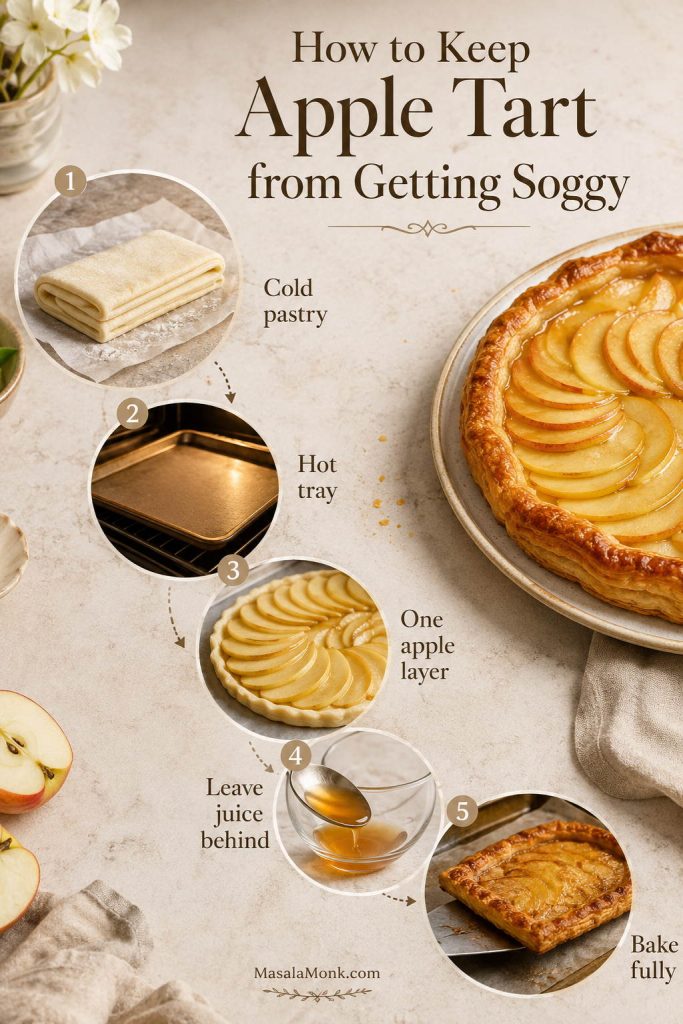
Crisp-base guide for apple tart showing cold pastry, a hot tray, one apple layer, excess juice control, and full baking.
Crispness is built in stages: cool pastry, controlled apple juice, heat from below, and enough time in the oven.

If you are still assembling the tart, the preheated baking sheet step, apple seasoning step, and chilling step are the most important places to prevent sogginess.

Before Baking: Keep the Pastry Cold and the Apples Controlled

  • Keep the pastry cool and firm. Warm puff pastry tends to slump before it rises.
  • Use a hot baking sheet. The heat hits the bottom quickly and helps the base set.
  • Score the border. This encourages the edges to puff around the apples.
  • Dock the center only. The middle stays flatter while the border rises.
  • Use one layer of apples. A heavy pile releases too much juice.
  • Leave excess juice behind. Season the apples, then avoid dumping watery liquid onto the pastry.
  • Add a light barrier when needed. For very juicy apples, sprinkle 1 tablespoon almond flour, fine breadcrumbs, or flour over the pastry center before adding apples.
  • Bake until the bottom is firm. The pastry should flake instead of bend.

After Baking: Diagnose What Went Wrong

If the tart has already gone wrong, use the table below to work out what happened. Most texture problems come back to the same few causes: soft pastry, too much moisture, thick apple slices, or pulling the tart from the oven too early.
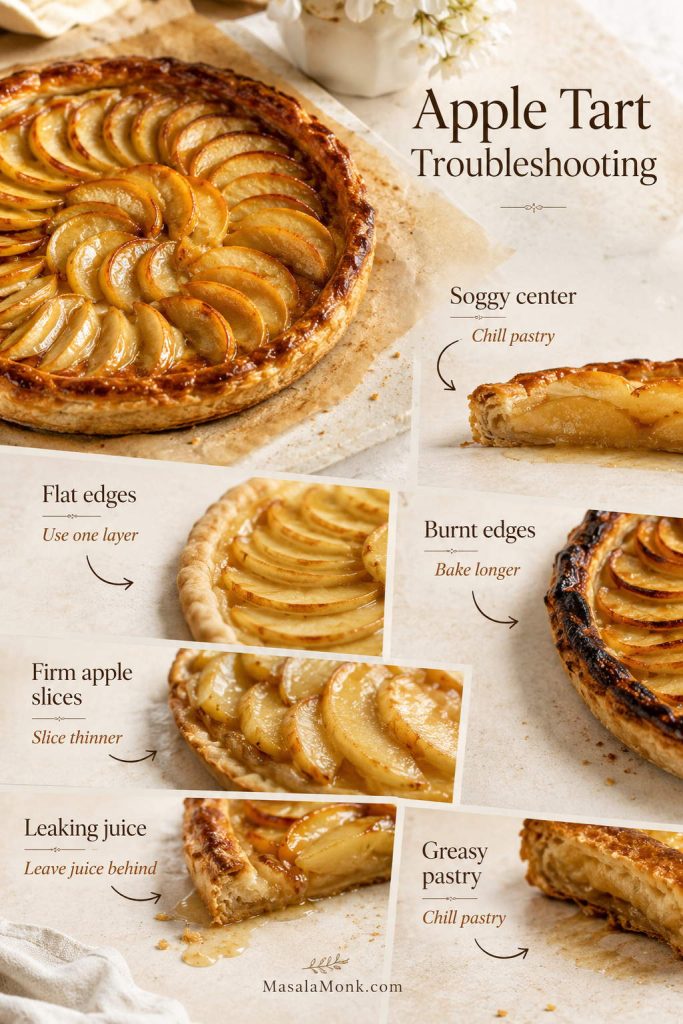
Apple tart troubleshooting guide showing soggy center, flat edges, burnt edges, firm apples, leaking juice, and greasy pastry fixes.
Use the texture problem first, then fix the cause; apple tart issues usually trace back to moisture, heat, or slice thickness.
Problem Likely Cause Fix
Soggy center Too much apple juice or underbaked pastry Leave excess liquid behind and bake until the base is browned.
Flat edges Border was docked, cut too deeply, or pastry got too warm Dock only the center and chill the assembled tart before baking.
Burnt edges Oven too hot, sugar on the border, or tart baked too high in the oven Brush sugar off the border before baking and move the tart lower if needed.
Apples still firm Slices were too thick Slice apples ⅛–¼ inch / 3–6 mm thick.
Juice leaking everywhere Too many apples or too much liquid added to pastry Use one overlapping layer and leave extra apple liquid in the bowl.
Pastry tastes greasy Pastry was warm before baking Chill the tart for 10–15 minutes before it goes into the oven.

Final Texture Cue

Texture cue: The apple tart is done when the edges are puffed, the bottom feels firm when lifted slightly with a spatula, and the apple edges look tender and lightly caramelized.
Apple tart slice lifted sideways to show a browned underside and flaky puff pastry layers.
The underside tells the truth: if the pastry feels firm and layered, the tart will slice and eat better.

Apple Tart vs Pie, Tarte Tatin, and Galette

An apple tart gives you the apple-and-pastry feeling of pie, but in a lighter, neater form. Instead of a deep layer of saucy filling, the apples are sliced thin and baked right on top of the pastry.
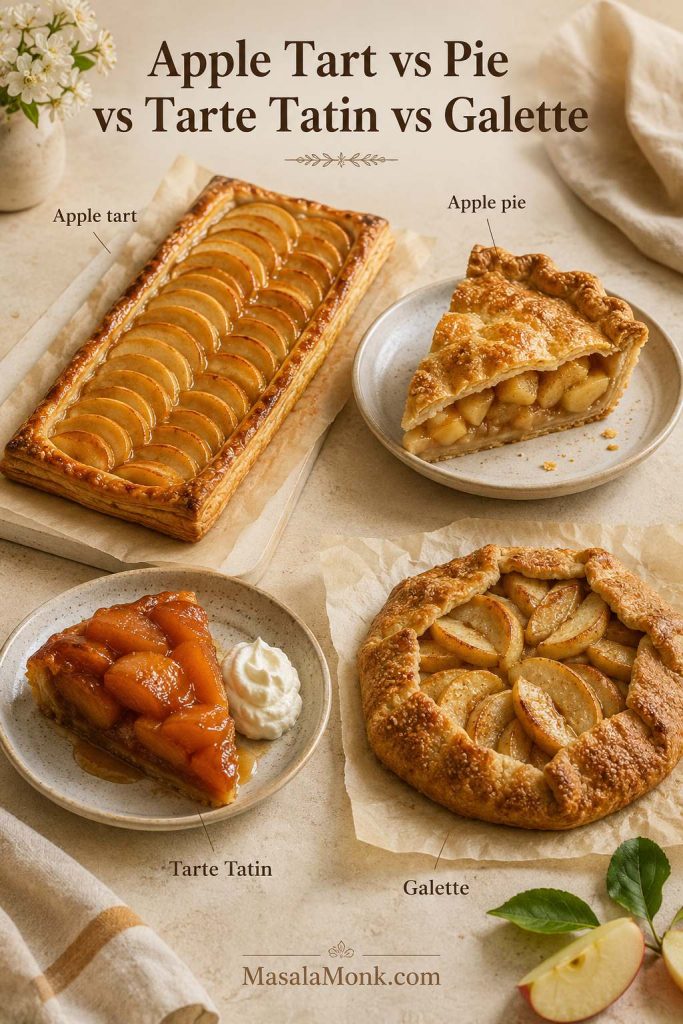
Apple tart, apple pie, Tarte Tatin, and apple galette arranged together as a dessert comparison.
Apple tart is the lighter open-faced dessert, while pie, Tarte Tatin, and galette each bring a different apple texture.
Dessert What It Is Main Difference
Apple tart Open-faced pastry with sliced apples on top Thin, elegant, less filling-heavy
Apple pie Deeper apple filling baked in pie crust Juicier, taller, usually more filling
Tarte Tatin Upside-down caramelized apple tart Apples cook in caramel, then the tart is flipped
Apple galette Free-form rustic apple tart No tart pan or neat border needed

For a deeper, softer dessert with a fuller filling, make a pie instead. This apple pie with apple pie filling is better when you want a shortcut pie with a thicker apple center. For this apple tart recipe, fresh thin apple slices are the better choice because they bake neatly and do not flood the pastry.

French-Style Apple Tart: What Makes It Different?

A French-style apple tart is usually open-faced, neat, and lighter than apple pie. The apples are sliced thin, arranged in rows, shingles, spirals, or fans, and often brushed with apricot glaze after baking. Some versions use puff pastry, while others use shortcrust or a sweet tart dough.

A very thin puff pastry apple tart like this is close to tarte fine aux pommes, the slim French-style apple tart built on pastry, thin apples, and a glossy finish. Deeper tart-pan versions often use shortcrust and sometimes a thin applesauce or compote layer.
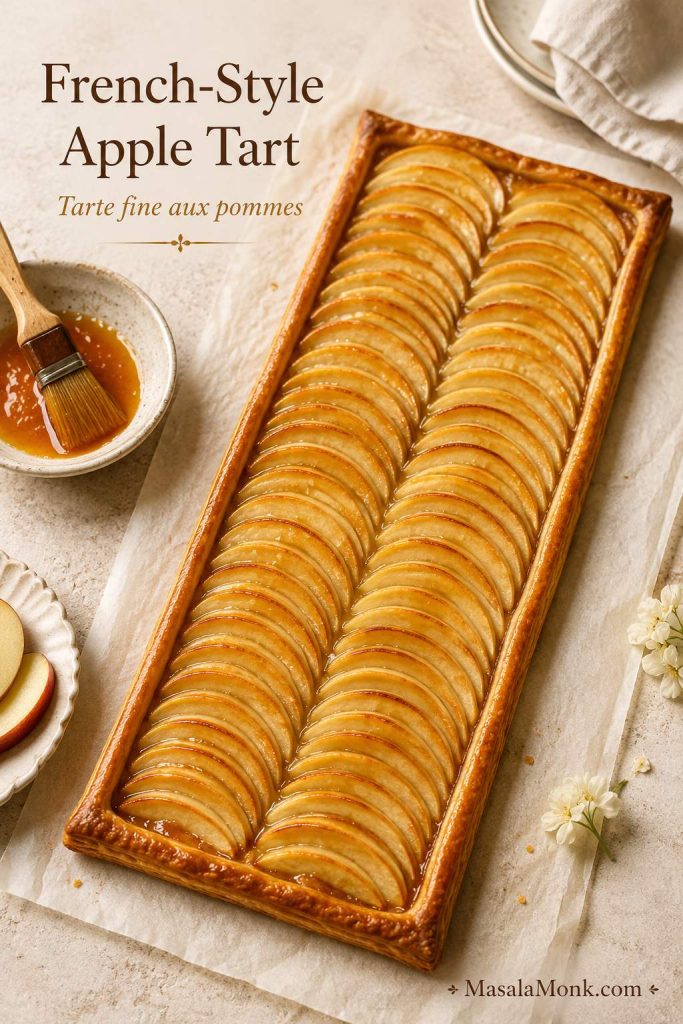
Thin French-style apple tart with overlapping apple slices, glossy glaze, and a slim puff pastry border.
Tarte fine aux pommes keeps the idea elegant: thin apples, slim pastry, glossy finish, and very little heaviness.

The classic look is polished but not complicated. Keep the apple layer even, leave a clear pastry border, and glaze the tart while it is still warm. That gives you the glossy bakery finish without turning the recipe into a pastry-school project.

Apple Tart Variations

Use these variations when you want the same apple-and-pastry idea in a different shape: quicker, richer, more classic, more party-friendly, or better suited to a specific diet.
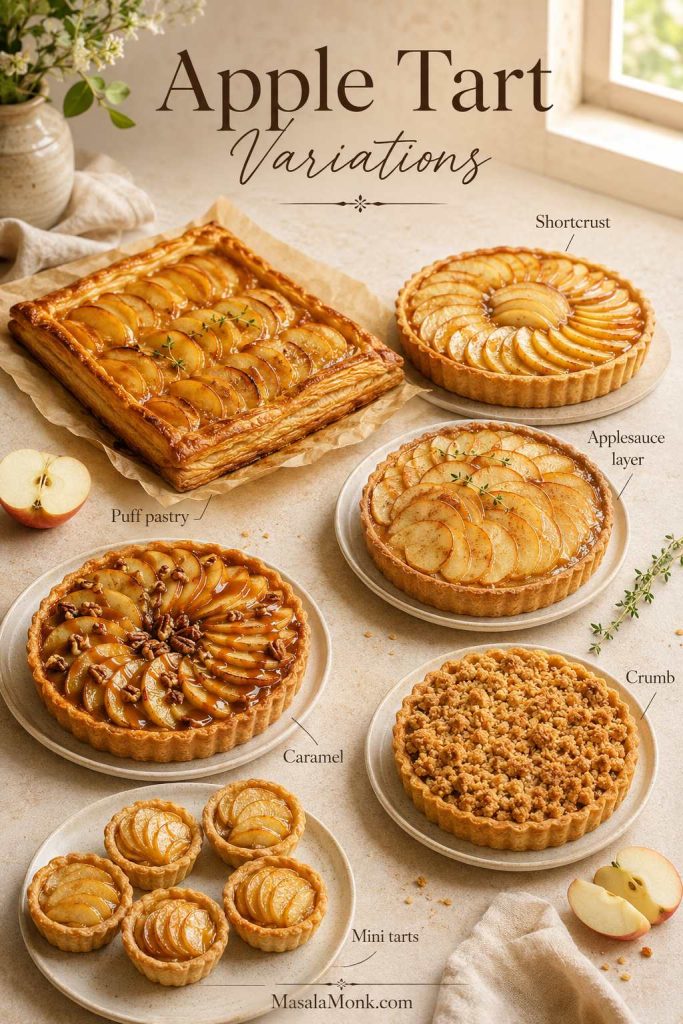
Apple tart variations including puff pastry, shortcrust, applesauce layer, caramel, crumb topping, and mini tarts.
Once the basic apple tart works, you can shift it toward shortcrust, caramel, crumb topping, mini tartlets, or French-style layers.

For the simplest version, stay with the main apple tart recipe. For a more classic tart-pan version, jump back to the shortcrust apple tart notes.

Puff Pastry Apple Tart

Choose this when you want the flakiest apple tart with the least dough work. Store-bought puff pastry does most of the heavy lifting, so this is the best starting point for a weeknight dessert, a last-minute guest dessert, or a simple French-style tart.

Shortcrust Apple Tart

Choose shortcrust when you want a more classic round apple tart in a 9–10 inch tart pan. Chill the lined pan before baking. With juicy apples, a light partial blind bake helps the base set before the fruit goes in.

French-Style Apple Tart with Applesauce

For a more classic French-style apple tart, spread a thin layer of smooth, unsweetened applesauce or apple compote over the pastry before arranging the apple slices. For a puff pastry tart, use only 2–3 tablespoons. A tart-pan shortcrust version can take a slightly thicker layer, but keep it controlled because too much applesauce will soften the base.
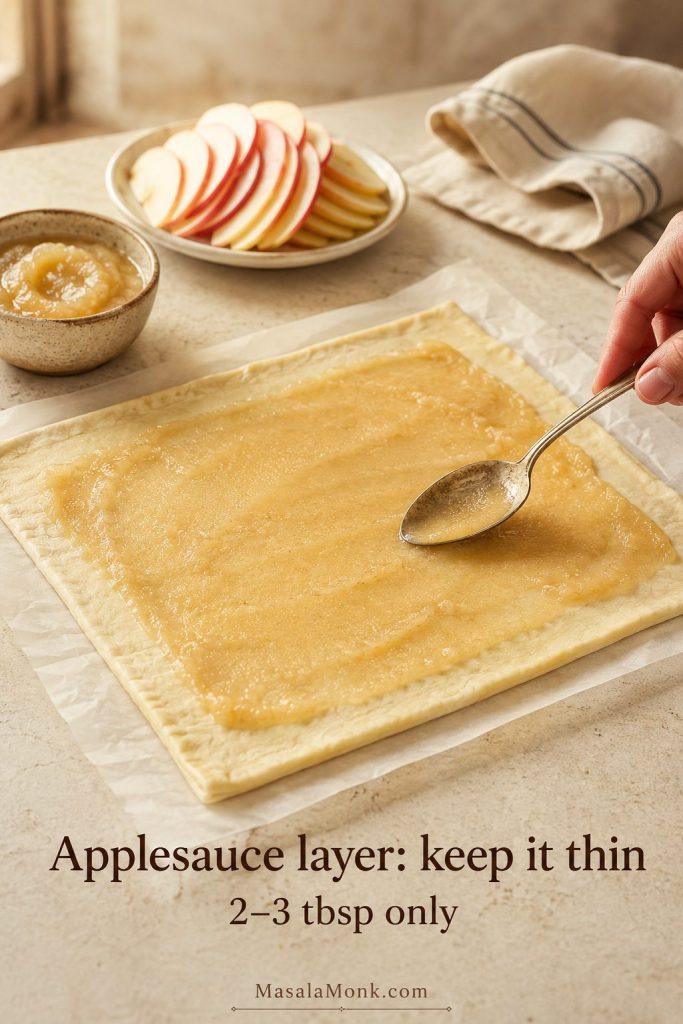
Thin applesauce layer spread over puff pastry before apple slices are added for French-style apple tart.
If you add applesauce, spread it thinly because too much moisture can soften the pastry before it crisps.

Caramel Apple Tart

Drizzle a little caramel sauce over the baked tart just before serving. Avoid adding too much caramel before baking because it can burn around the pastry edges.

Apple Crumb Tart

Add a light crumb topping over the apples before baking if you want a Dutch-style feel. For a fuller crumb-topped apple dessert, this Dutch apple pie recipe is the better route.

Mini Apple Tarts

Mini apple tarts are the party-friendly version. Cut puff pastry into smaller squares or rounds, top each piece with a few apple slices, and start checking around 15–18 minutes because small tarts brown faster than one large sheet tart.
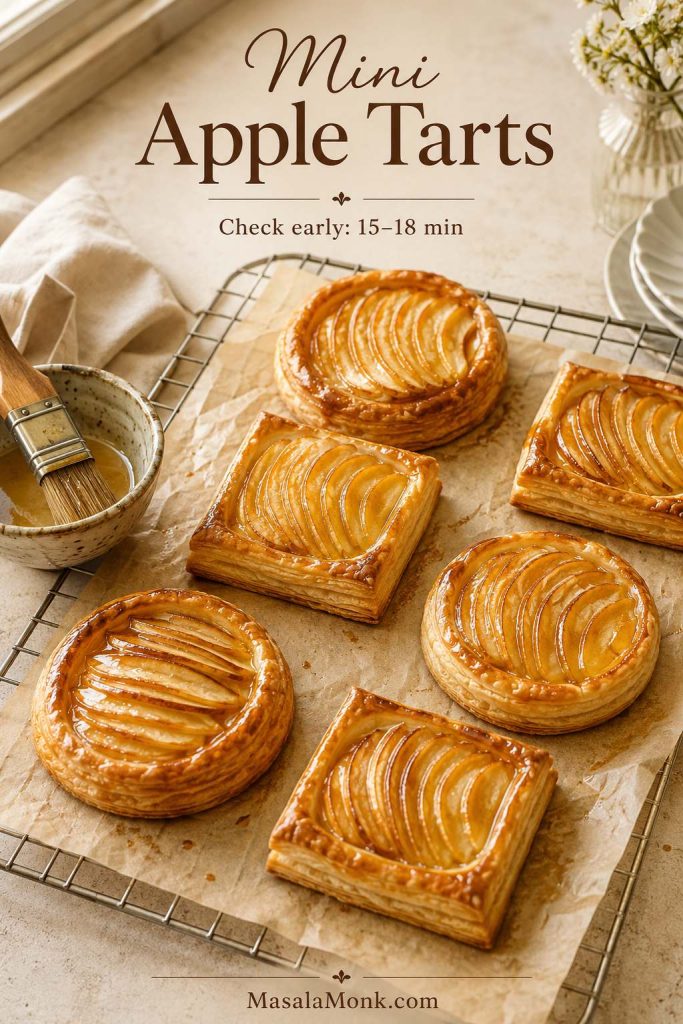
Mini apple tarts with glossy sliced apples on puff pastry, cooling on parchment and a wire rack.
Mini apple tarts brown faster than a full sheet tart, so start checking early once the edges puff and deepen.

Apple Frangipane Tart

For a richer bakery-style tart, add a thin layer of almond frangipane under the apples. Because the almond filling needs time to cook through, it is better treated as its own tart style rather than a quick add-on.

Prepared Apple Filling Dessert

Prepared apple pie filling is better in desserts designed for a softer, saucier texture. An apple cinnamon roll bake with apple pie filling is a much better fit when you want a quick dessert using ready-made filling.

Vegan Apple Tart

For a vegan apple tart, choose vegan puff pastry, brush the border with plant milk, and use vegan butter or a neutral oil on the apples. Most of the method stays the same; just check the jam if you are cooking for strict vegans.

Gluten-Free Apple Tart

Use a tested gluten-free puff pastry or a gluten-free tart crust. Do not assume regular pie dough can be swapped one-for-one with gluten-free flour, because pastry structure changes quickly without gluten.

For apple flavor without pastry at all, make an apple crisp recipe instead. It gives you tender cinnamon apples and a crunchy topping without worrying about tart dough.

Storage, Freezing, and Reheating

How to store apple tart

Apple tart is best the day it is baked, when the pastry is crispest. Store leftovers in an airtight container in the refrigerator for up to 3 days; this also stays in line with the USDA’s general leftovers and food safety guidance.

How to reheat apple tart

Reheat slices in a 325°F / 160°C oven or toaster oven for 8–12 minutes, until the pastry feels crisp again. Avoid microwaving if you care about texture; it softens puff pastry quickly.
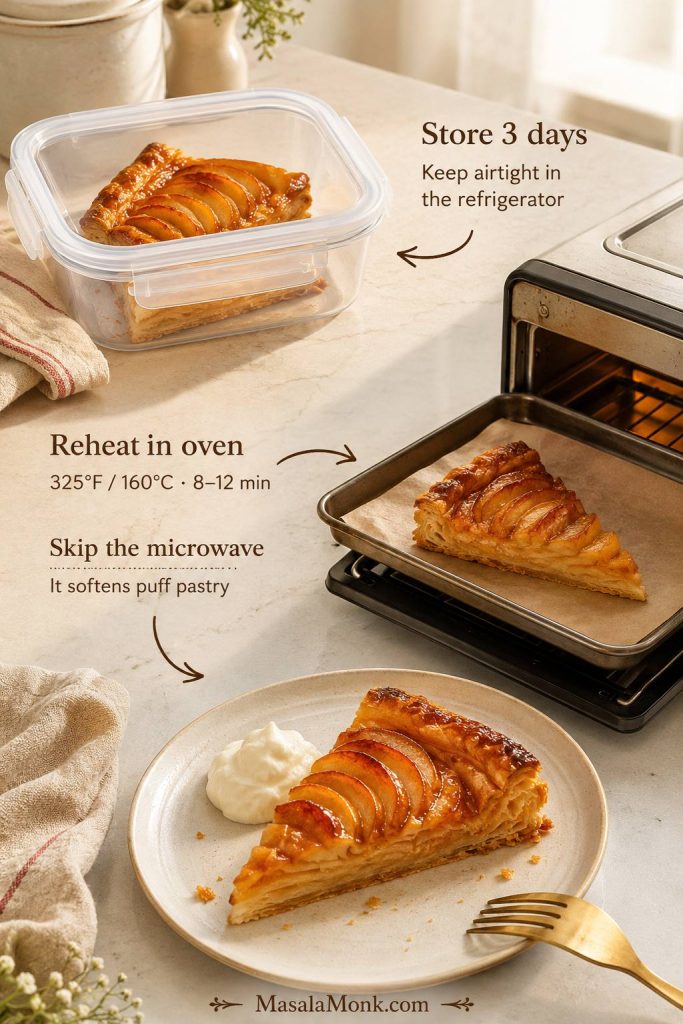
Apple tart storage and reheating guide showing a slice in an airtight container, oven reheating, and a refreshed slice.
Refrigerate leftovers airtight, then use the oven to revive texture because the microwave softens puff pastry quickly.

Can you freeze apple tart?

You can freeze baked apple tart slices, but the pastry will not be quite as crisp after thawing. Reheat from chilled or partially thawed in the oven until warm and crisp at the edges.

Can you make apple tart ahead?

The best make-ahead plan is to prepare the small pieces, then assemble close to baking. Mix the cinnamon sugar ahead, measure the jam or jelly ahead, and keep thawed puff pastry cold in the refrigerator. Slice the apples shortly before assembly for the freshest texture and color, then warm the glaze just before brushing it over the tart.

For guests, bake the tart the same day and let it sit at room temperature before serving. It slices more neatly once it has cooled slightly, but still tastes special with ice cream, cream, coffee, or tea.

For serving ideas, jump to what goes well with apple tart near the FAQs.

Apple Tart Recipe Card
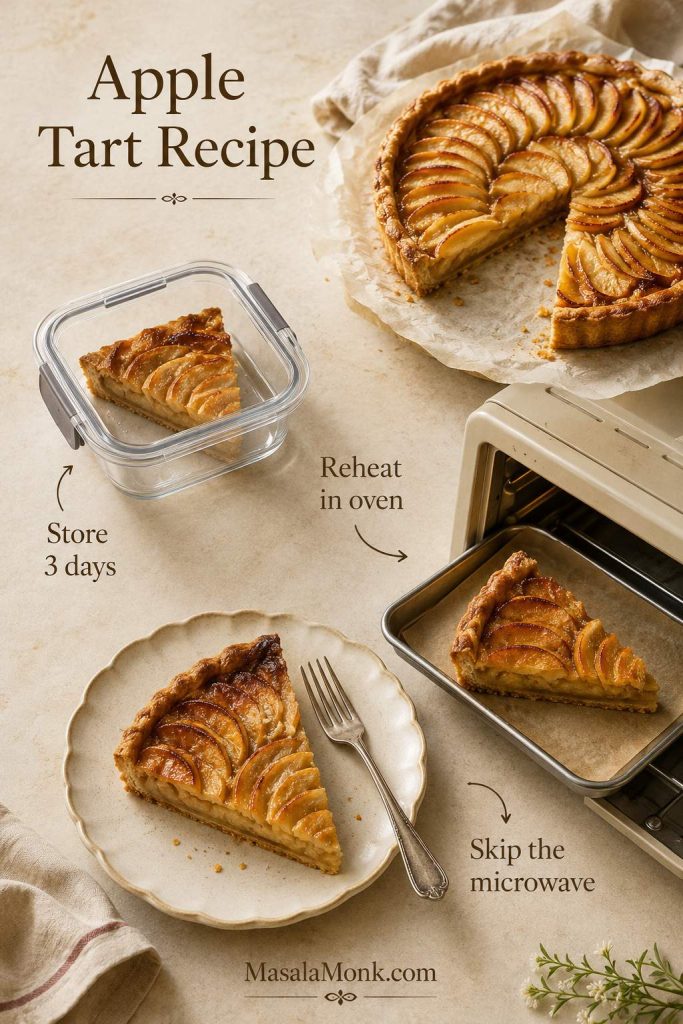
Apple tart recipe card with a tart slice, puff pastry, apples, bake temperature, bake time, and apricot glaze.
The core method stays simple: cold puff pastry, thin apples, a hot oven, full color, and a warm glaze.

Apple Tart Recipe

This easy apple tart recipe bakes thin apple slices over store-bought puff pastry with cinnamon sugar and a glossy apricot glaze. It looks bakery-style, but the method is simple enough for a casual dessert.

Prep Time20 minutes
Chill Time10–15 minutes
Cook Time30–35 minutes
Cooling Time10–15 minutes
Total Time1 hour 10 minutes to 1 hour 25 minutes
Yield6–8 servings

Ingredients

  • 1 sheet all-butter puff pastry, about 8–9 oz / 240–260 g, thawed but cold
  • 3 medium apples, about 450–550 g / 1–1¼ lb before peeling and coring
  • 1 tablespoon lemon juice / 15 ml
  • 3–4 tablespoons granulated sugar or light brown sugar / 38–50 g
  • ½ teaspoon ground cinnamon
  • Pinch of fine salt
  • 2 tablespoons unsalted butter / 28 g, melted
  • 2 tablespoons apricot jam or apple jelly / 35–40 g
  • 1 teaspoon water / 5 ml, for loosening the glaze
  • Optional egg wash: 1 egg beaten with 1 teaspoon water
  • Optional base barrier: 1 tablespoon almond flour, fine breadcrumbs, or all-purpose flour for juicy apples

Instructions

  1. Preheat the oven. Heat the oven to 400°F / 200°C, or 180°C fan. Place a rimmed baking sheet on the middle rack while the oven preheats.
  2. Prepare the pastry. Place the cold puff pastry on parchment paper. Roll lightly if needed to even it out. Score a ¾–1 inch / 2–2.5 cm border around the edge without cutting all the way through. Dock the center with a fork, leaving the border untouched.
  3. Slice the apples. Peel the apples if you like, then slice them ⅛–¼ inch / 3–6 mm thick.
  4. Season the apples. Toss the apple slices with lemon juice, sugar, cinnamon, and salt. Leave extra juice behind if the apples release a lot of liquid.
  5. Arrange the tart. If using the optional base barrier, sprinkle it lightly over the docked center of the pastry. Arrange the apples in overlapping rows or shingles inside the scored border. Brush the apples with melted butter. Brush egg wash only on the top border if using.
  6. Chill. Refrigerate the assembled tart for 10–15 minutes.
  7. Bake. Carefully slide the parchment and tart onto the hot baking sheet. Bake for 30–35 minutes, until the edges are puffed, the bottom is browned, and the apples are tender.
  8. Glaze. Warm the apricot jam with 1 teaspoon water until loose. Brush mostly over the warm apples.
  9. Cool and serve. Let the tart cool for 10–15 minutes before slicing. Serve warm or at room temperature.

Notes

  • For a sharper tart, use Granny Smith or mix Granny Smith with Honeycrisp or Pink Lady.
  • Honeycrisp, Gala, Fuji, and Golden Delicious make a sweeter, softer tart.
  • A larger 300–320 g puff pastry sheet can take 4 medium apples and may need 3–5 extra minutes in the oven.
  • Shortcrust or pie crust works best in a 9–10 inch tart pan and usually needs 40–55 minutes.
  • Do not overload the pastry with apples. One generous overlapping layer is enough.
  • For a French-style applesauce layer, use only 2–3 tablespoons of smooth, unsweetened applesauce on puff pastry so the base does not soften.
  • Leftovers keep in the refrigerator for up to 3 days. Reheat in the oven, not the microwave, for the best texture.

FAQs

Can I use puff pastry for apple tart?

Yes. Puff pastry works especially well for apple tart because it gives a flaky base and raised edge without homemade dough. The key is to bake it from cold and avoid piling on too many apples.

Do the apples need to be cooked first?

No. For this style of apple tart, thin raw apple slices bake directly on the pastry. Pre-cooked apple pie filling is usually too wet and thick for a thin puff pastry tart.

Can apple pie filling be used for apple tart?

Apple pie filling is not the best choice for this tart. It is saucier and heavier, so it can make puff pastry soggy. Use fresh thin apple slices for this recipe and save cooked filling for deeper pies, crisps, hand pies, cinnamon roll bakes, or shortcut desserts.

What temperature is best for apple tart?

For puff pastry apple tart, 400°F / 200°C, or 180°C fan, is reliable. It is hot enough to puff and brown the pastry, but not so aggressive that the apple edges burn before the base cooks.

How thin should apples be for apple tart?

Slice apples about ⅛–¼ inch / 3–6 mm thick. Thin slices soften quickly and create a neater tart. Thicker slices work, but they make the tart more rustic and may need a few extra minutes in the oven.

Should apples be peeled for apple tart?

Peeling is optional. Peeled apples give a softer, more classic tart. Unpeeled apples add color and a little bite, especially with red-skinned apples like Pink Lady or Honeycrisp.

Why is my apple tart soggy?

The most common reasons are warm pastry, too many apples, too much apple juice, or underbaking. Keep the pastry cold, bake on a hot sheet pan, leave excess apple juice behind, and bake until the bottom is crisp.

Does shortcrust pastry work for apple tart?

Shortcrust pastry works well for a classic round apple tart in a tart pan. Chill the lined pan before baking, prick the base, and bake long enough for the crust to turn fully golden.

Can apple tart be made in an air fryer?

Small puff pastry apple tarts can be made in an air fryer, but a full rectangular tart is usually better in the oven. For mini versions, use parchment, leave room for the pastry to puff, and check early because air fryers brown quickly.

What goes well with apple tart?

Warm slices love vanilla ice cream because the cold cream melts into the glossy apples. At room temperature, the tart is lovely with whipped cream, crème fraîche, plain Greek yogurt, coffee, or tea, especially once the pastry has settled and the apple flavor tastes a little deeper.
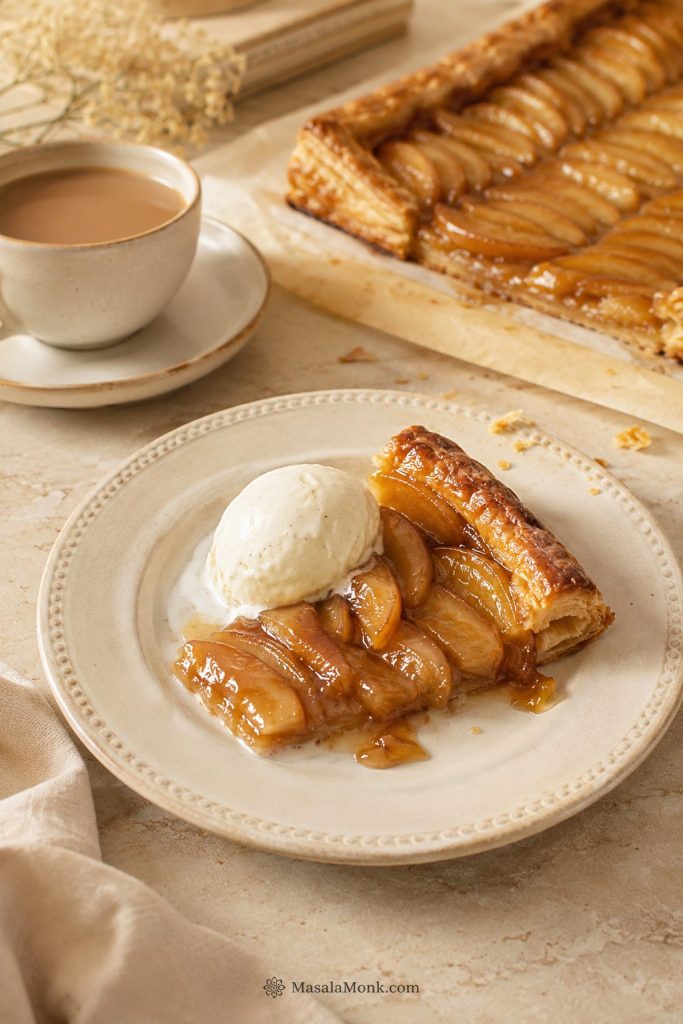
Apple tart slice served with vanilla ice cream, coffee, and the remaining tart in the background.
Serve apple tart warm when you want the ice cream to melt into the glossy apples, or let it cool slightly when clean dessert-table slices matter more.

Back to top

Posted on Leave a comment

Easy Apple Crisp Recipe with Oats

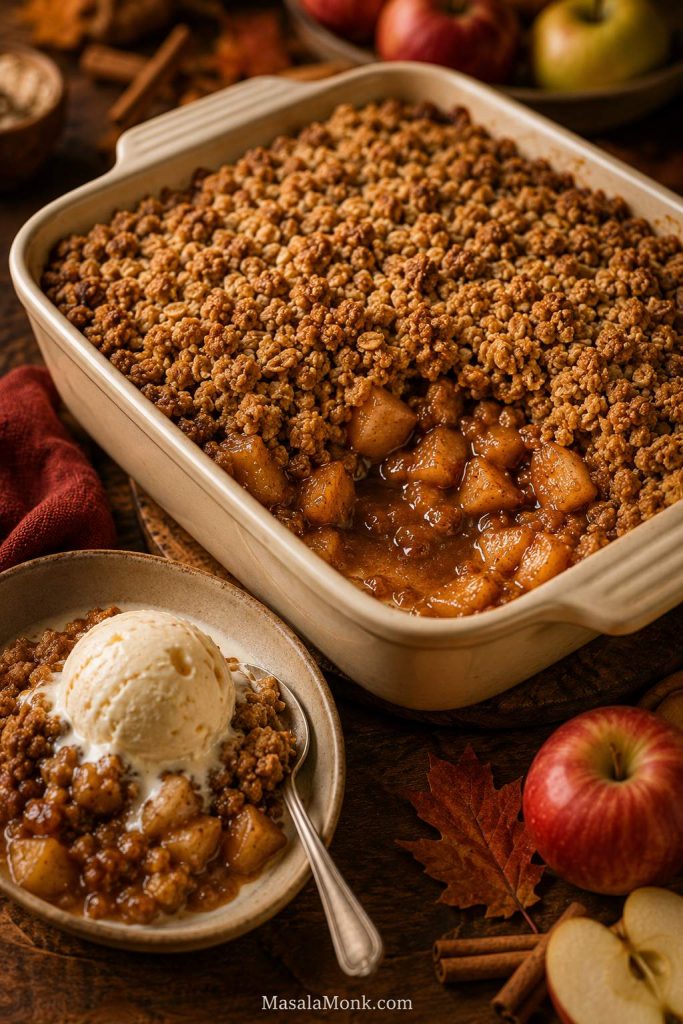
Baked apple crisp in a cream dish with golden oat topping, glossy cinnamon apples, and vanilla ice cream.

This easy apple crisp recipe is for the night when you want the house to smell like cinnamon, butter, and brown sugar without making pie crust. The apples bake down into glossy cinnamon juices, the oat topping turns craggy and golden, and the corners get just crisp enough that someone always tries to claim them first.

It gives you the cozy part of apple pie with much less work: no rolling dough, no chilling crust, and no worrying about perfect slices. Better still, this crisp is forgiving. An 8×8, 9×9, or 9×13 pan can all work with the right scaling, and you can slice the apples thin for a softer filling or chop them for more bite.

It is the kind of dessert that works on a random weeknight with apples you already have, but it also earns its place on a fall table, Thanksgiving spread, or potluck when pie feels like too much. And although it is good plain, it becomes the version people remember when vanilla ice cream melts into the cinnamon juices and catches in the oat topping.

The promise here is simple: the right apple amount, a generous brown sugar oat topping, clear doneness cues, and pan guidance for both small family desserts and bigger holiday-style bakes.

Most importantly, this version helps you avoid the usual apple crisp problems: watery filling, underbaked apples, sandy topping, or a pan that tastes like baked apples with a thin sprinkle of oats. The goal is warm fruit underneath, crisp topping on top, and enough structure that every scoop feels complete.

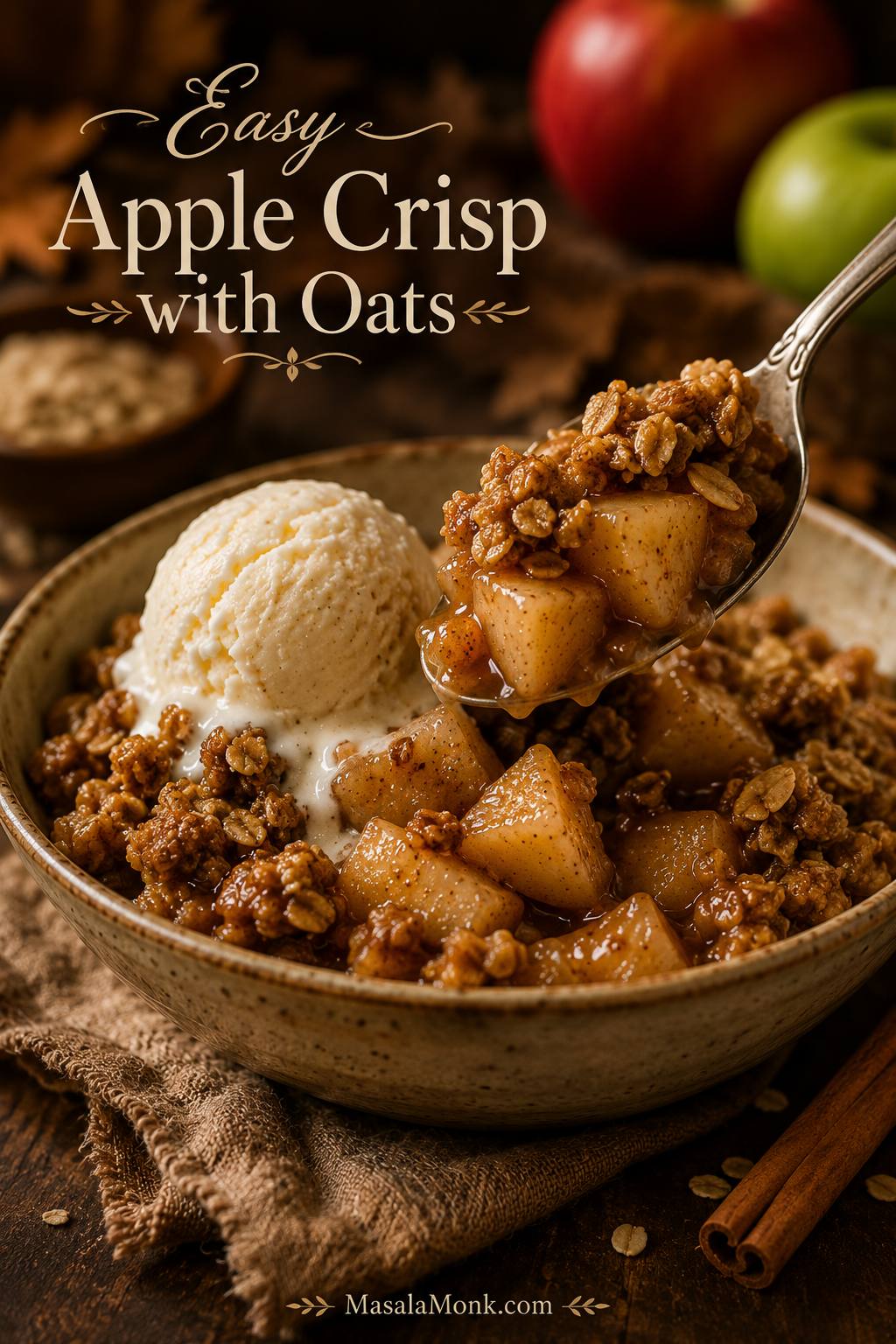
Serving tip: A good apple crisp should give you warm apples, oat crumble, and just enough glossy cinnamon juice for vanilla ice cream to melt into.

Warm apple crisp with oats served in a bowl with a spoonful of cinnamon apples and melting vanilla ice cream.
Apple crisp with oats gives you the comfort of apple pie without crust work, while the crumble topping keeps the method simple and forgiving.

Quick Answer: What Makes a Good Apple Crisp?

A good apple crisp recipe has tender apples, a buttery oat topping, and enough thickener to keep the filling spoonable instead of watery. For a standard 8×8 or 9×9-inch baking dish, use about 2 1/2 pounds / 1.1 kg apples, which is about 8 cups sliced or chopped apples. For a larger holiday pan, see the apple crisp pan guide. Toss the apples with lemon, brown sugar, cinnamon, vanilla, and a little flour or cornstarch.

Then cover the apples with a topping made from old-fashioned oats, flour, brown sugar, cold butter, cinnamon, and salt. Bake at 350°F / 175°C until the apple juices are bubbling and the topping is golden. Finally, let the crisp rest for 15–20 minutes before serving so the filling thickens instead of running across the bowl.

Apple Crisp at a Glance

Best pan8×8 or 9×9 inch
Apples2 1/2 lb / 1.1 kg
Oven350°F / 175°C
Bake time45–55 minutes

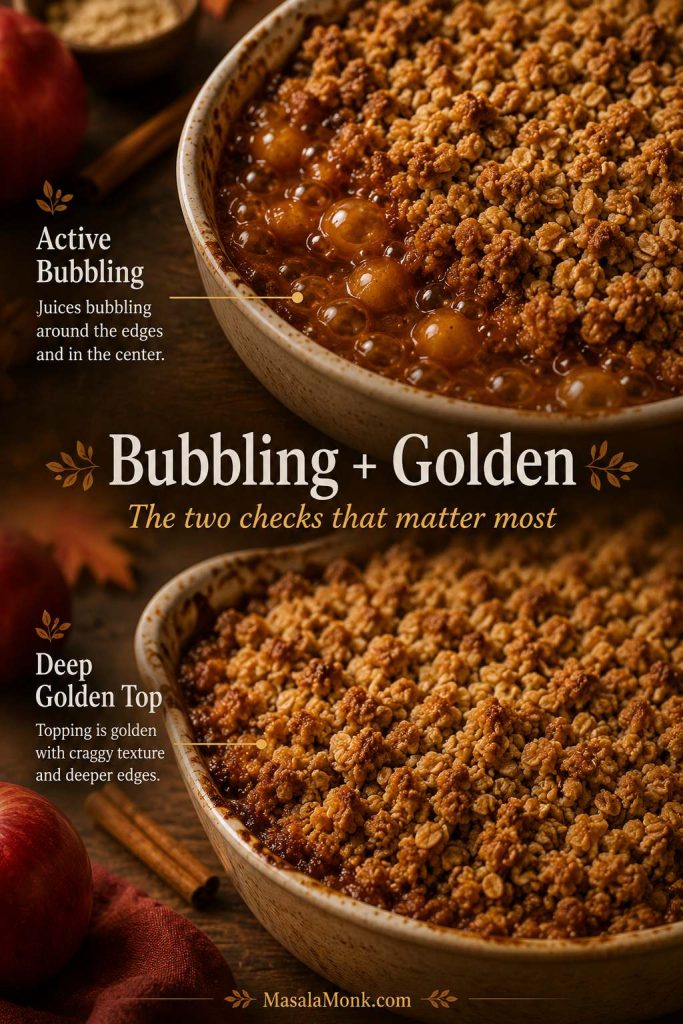
Texture cue: the crisp is done when the fruit is actively bubbling, the topping is golden and craggy, and a knife slides into the apples without resistance.

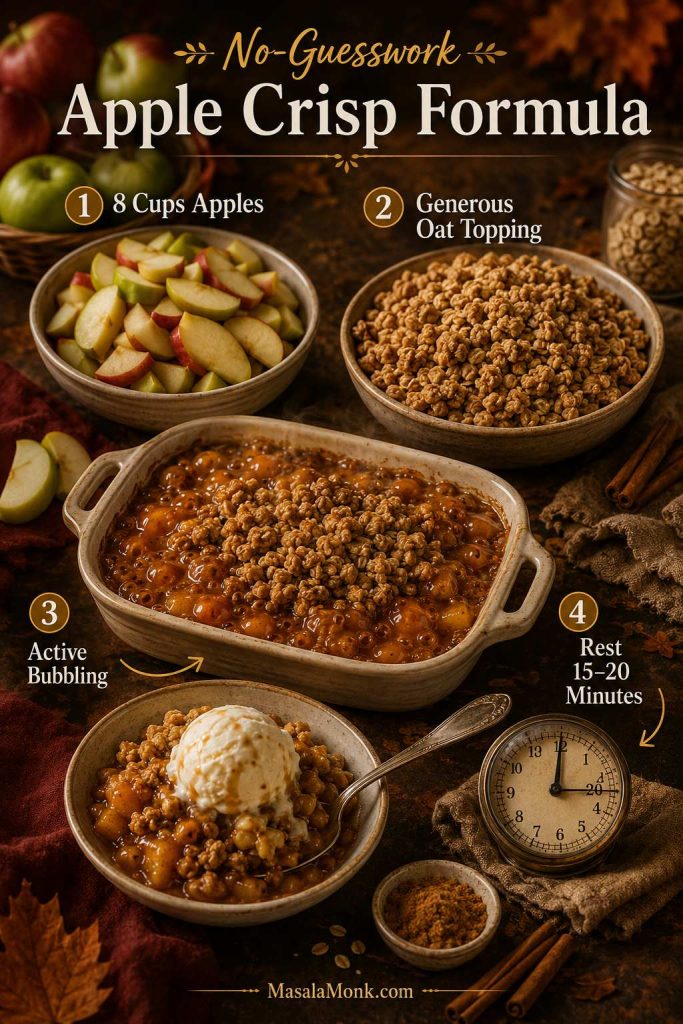
The no-guesswork formula: 8 cups apples, a generous oat topping, active bubbling, and a 15–20 minute rest. Those four details prevent most watery, underbaked, or thin-topped crisps.

No-guesswork apple crisp formula showing apples, oat topping, bubbling filling, and resting time.
For a no-guesswork apple crisp, start with enough apples, a generous oat layer, active bubbling, and a short rest before serving.

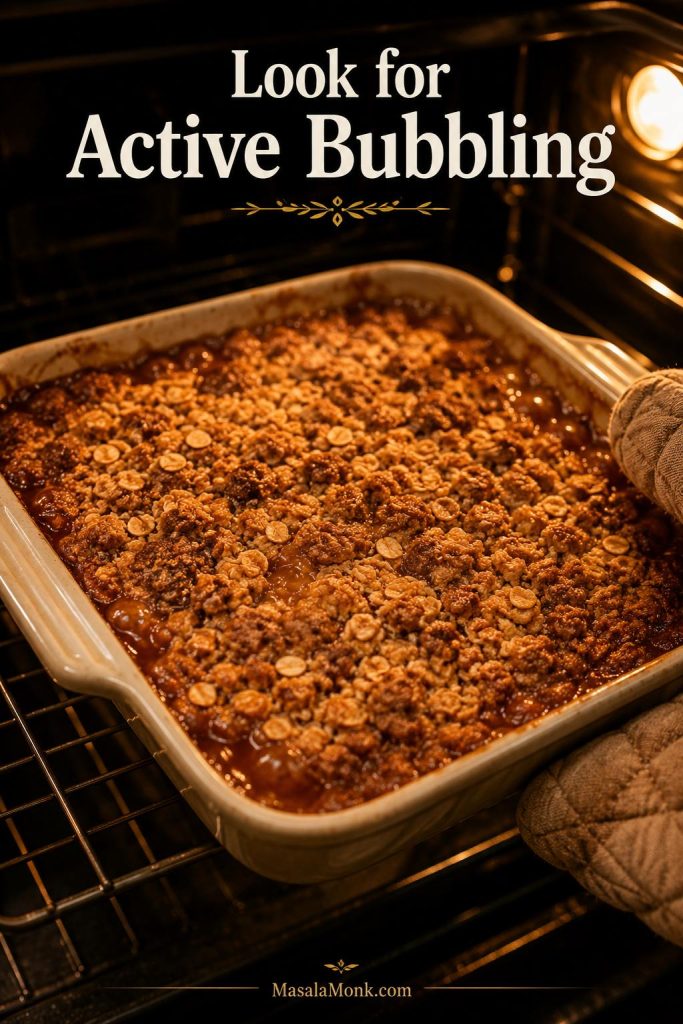
The two checks before you pull it from the oven: First, the apple juices should bubble at the edges and toward the center, not just around the sides. Second, the topping should look golden and craggy, with a few deeper brown-sugar edges. If the topping is brown but the middle still looks quiet, cover loosely with foil and keep baking a little longer.

Apple crisp doneness guide showing bubbling apple filling and golden brown oat topping.
A brown top is only half the cue; the apple filling also needs to bubble so the juices thicken properly.

Why This Apple Crisp Recipe Works

A good apple crisp is not just baked apples with crumbs on top. The filling has to bubble long enough for the juices to thicken, and the topping has to stay loose enough to brown instead of steaming against the fruit. This recipe is built around those two cues: glossy apple juices and a craggy, buttery oat topping.

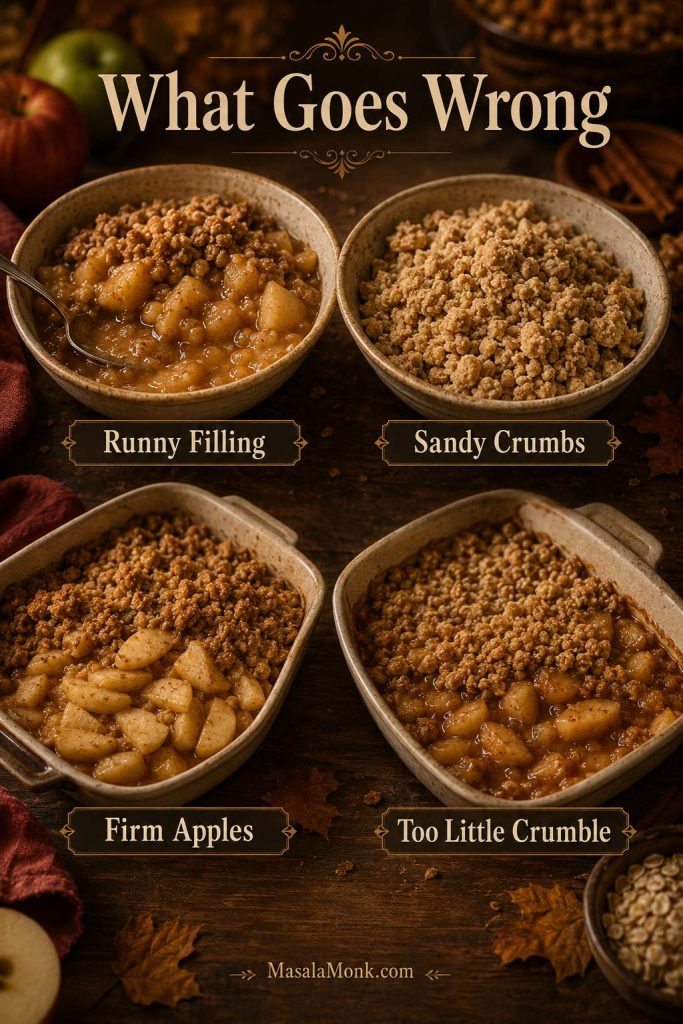
Most disappointing apple crisps fail in the same few ways. The apples stay firm, the filling runs across the bowl, the topping turns sandy, or there simply is not enough crumble to make every scoop satisfying. So the goal here is simple: enough apples to feel generous, enough topping to cover every serving, and enough thickener to turn the cinnamon juices glossy instead of soupy.

Apple crisp mistakes board showing runny filling, sandy crumbs, firm apples, and too little crumble.
Runny filling, sandy crumbs, firm apples, and too little crumble usually trace back to prep, butter temperature, or bake time.

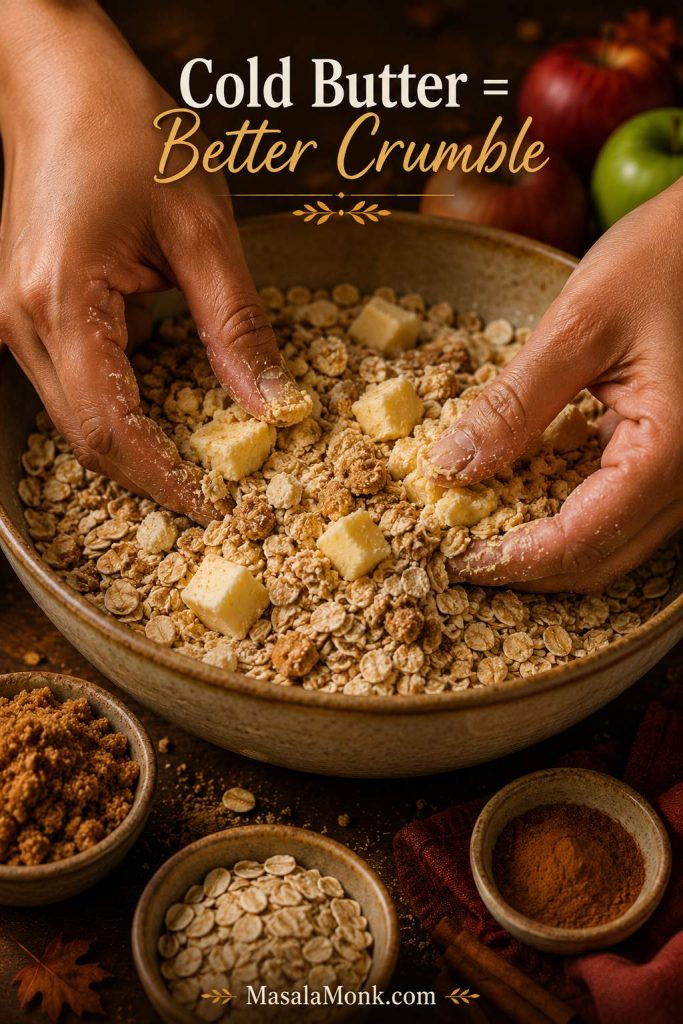
Cold butter is the key to the crumble. It helps the oats, flour, brown sugar, cinnamon, and salt bake into rough crumbs instead of melting into the apples. A small amount of flour or cornstarch in the filling catches the apple juices as they bubble, so the crisp sets up after a short rest.

It also gives you enough crumble. Apple crisp should not look like apples with a little dusting on top. The brown-sugar crumbs are part of the dessert, and the larger clumps are not mistakes; they are the pieces people go looking for.

Equipment You’ll Need

You do not need special equipment for this crisp, but the right dish makes the bake more predictable. The pan matters more than the tool list; a very deep dish bakes differently from a shallow metal pan, even with the same ingredients. A ceramic, glass, or light-colored metal baking dish works best for the main recipe because it gives the apples enough time to soften before the topping gets too dark.

  • 8×8 or 9×9-inch baking dish: best for the base recipe.
  • Large mixing bowl: for tossing the apples evenly with sugar, lemon, spice, and thickener.
  • Medium bowl: for the oat topping.
  • Pastry cutter, fork, or clean hands: for working cold butter into the topping.
  • Peeler, knife, and cutting board: for prepping the apples.
  • Rimmed baking sheet: useful under the dish in case the apple juices bubble over.
  • Foil: helpful if the surface browns before the apples are tender.

The rimmed baking sheet is optional, but it is one of those small things you are grateful for if the apple juices start bubbling over at the edges.

Dish note: Glass and ceramic dishes give a steady, even bake. Metal pans can brown the edges faster. Cast iron works too, although it holds heat aggressively, so watch the top near the end of baking.

Ingredients for Apple Crisp with Oats

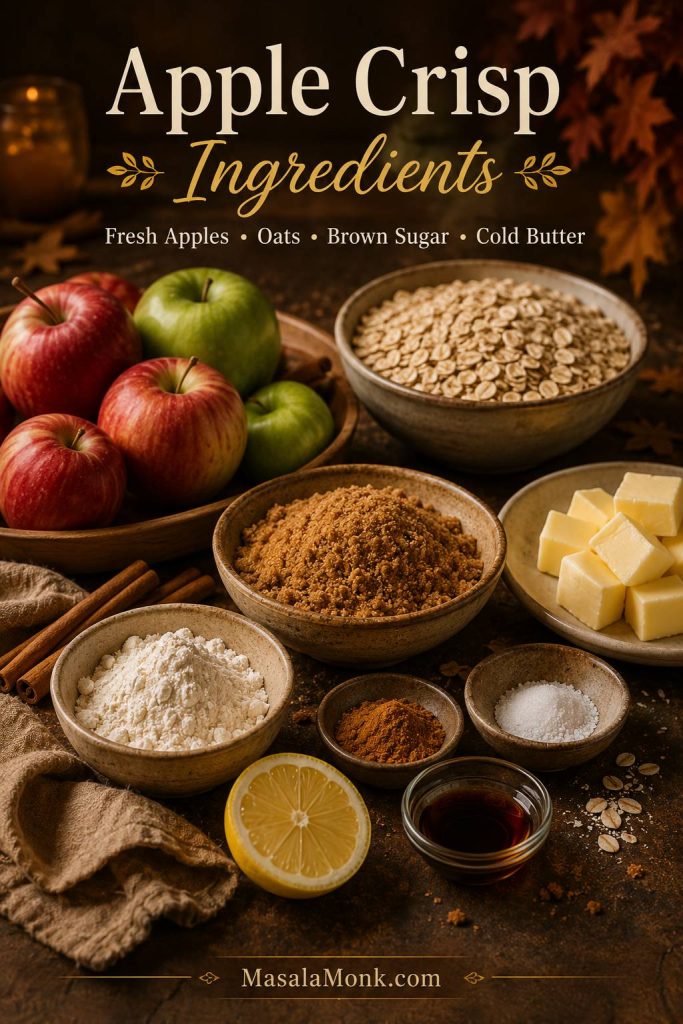
You only need fresh apples, butter, oats, sugar, and pantry baking ingredients. The list is simple, but the small choices matter: cold butter instead of soft, old-fashioned oats instead of instant oats, and enough lemon and salt to keep the filling from tasting flat.

Apple crisp ingredients arranged on a baking surface, including apples, oats, brown sugar, butter, lemon, cinnamon, and flour.
Every ingredient has a job: apples bring body, oats add texture, lemon brightens the filling, and cold butter helps the crumble bake properly.

For the Apple Filling

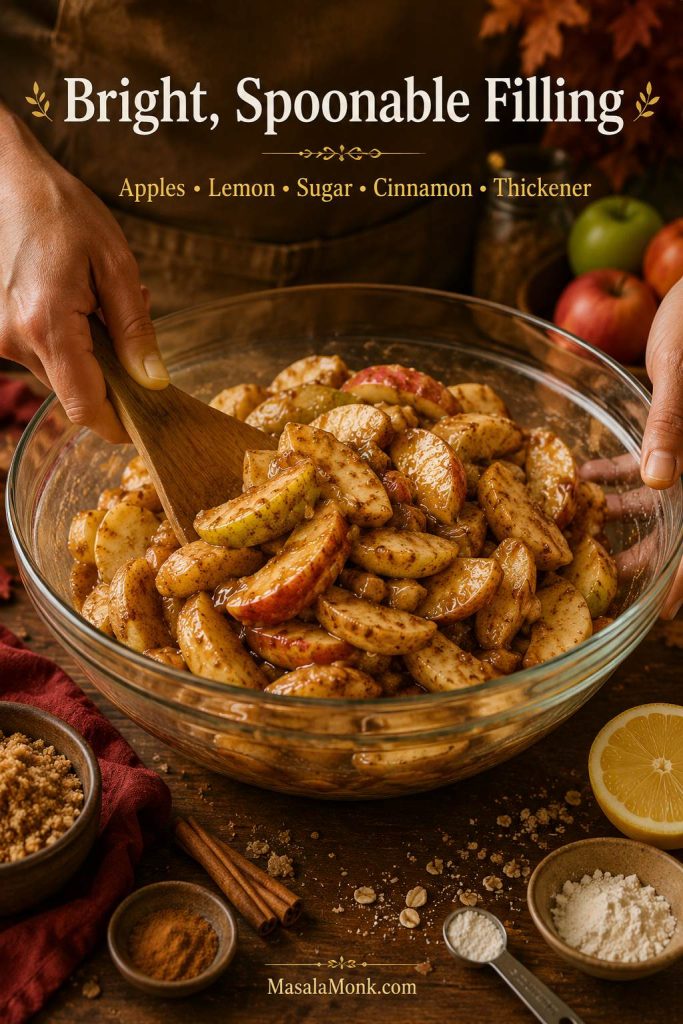
Sliced apples being mixed with lemon juice, brown sugar, cinnamon, and thickener for apple crisp filling.
Coating the apples evenly helps the sugar, spice, lemon, and thickener work through the whole filling instead of settling in patches.
  • Apples: Use about 2 1/2 pounds / 1.1 kg apples before peeling and coring. This gives you about 8 cups sliced or chopped apples.
  • Lemon juice: Brightens the apples and keeps the filling from tasting flat.
  • Brown sugar: Adds caramel warmth. Use less if your apples are very sweet and a little more if they are very tart.
  • Flour or cornstarch: Use 2 tablespoons flour in the apple layer, or 1 tablespoon cornstarch for a glossier, slightly clearer filling.
  • Cinnamon: The main spice. It should be present but not dusty or overpowering.
  • Nutmeg: Optional, but a small pinch makes the filling taste warmer.
  • Vanilla: Softens the sharpness of the apples and sugar.
  • Salt: Makes the apples and topping taste more balanced.

Before it bakes, the filling should taste bright. If the apples taste flat in the bowl, they will taste flat after baking too, so do not skip the lemon juice and salt.

For the Brown Sugar Oat Topping

Hands mixing cold butter into oats, brown sugar, flour, and cinnamon for apple crisp topping.
Cold butter helps the oat topping bake into rough, buttery crumbs instead of melting into the apple layer.
  • Old-fashioned rolled oats: Best for a classic crisp texture.
  • All-purpose flour: Helps the topping hold together in buttery crumbs.
  • Brown sugar: Gives the topping its caramel flavor and golden color.
  • Cinnamon: Ties the topping to the apple filling.
  • Cold butter: The most important topping detail. Cold butter creates crumbly pieces instead of a greasy layer.
  • Salt: Keeps the topping from tasting only sweet.
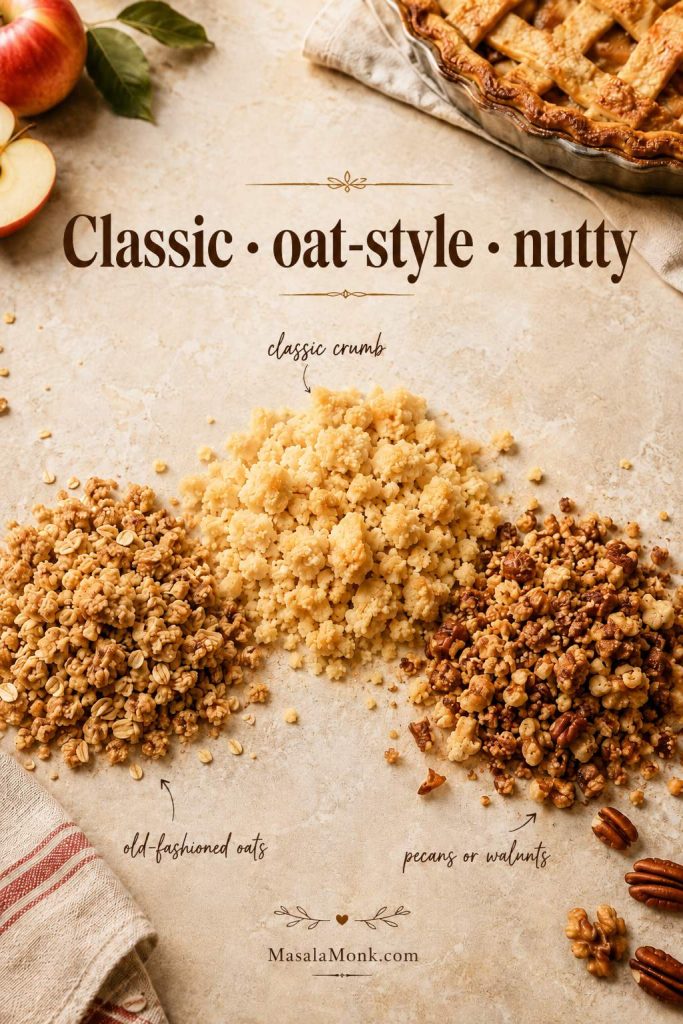
  • Chopped nuts, optional: Pecans or walnuts add crunch, but the recipe works beautifully without them.

At this point, the topping should taste like a brown sugar oatmeal cookie before it ever goes into the oven. That is the flavor you want baking into the top layer.

No scale? Use about 8 cups of sliced or chopped apples for the base recipe. Very large apples may give you that amount with only 4–5 apples, while smaller apples may take 7–8.

Best Apples for Apple Crisp

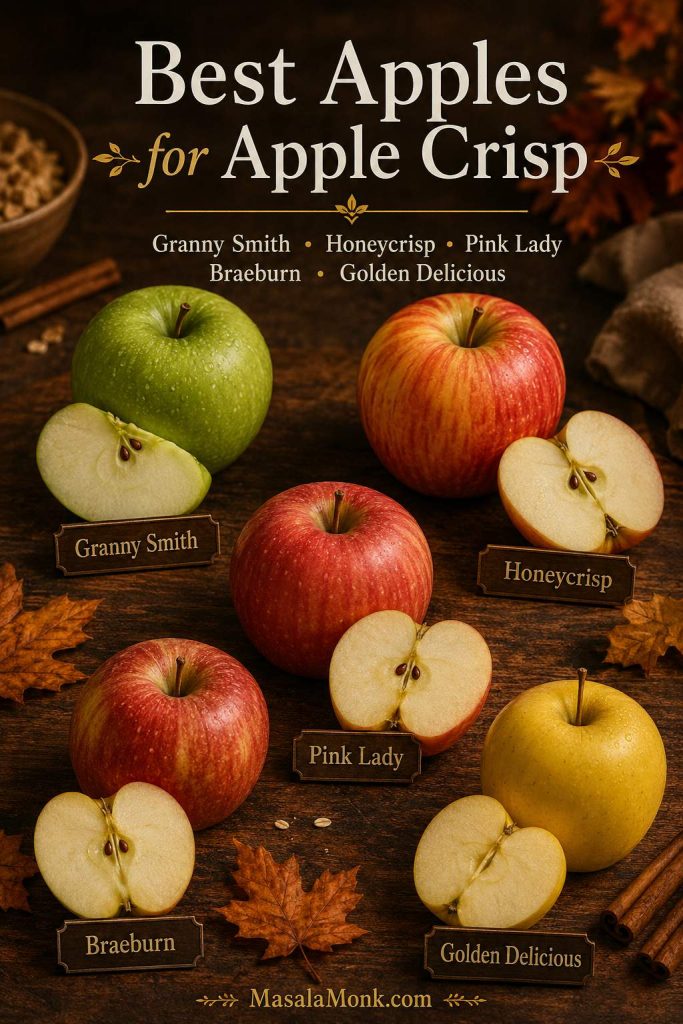
The best apples for apple crisp hold their shape while baking and bring enough tartness to balance the brown sugar topping. In most cases, a mix is better than one apple variety because you get both structure and flavor.

Best apples for apple crisp guide with Granny Smith, Honeycrisp, Pink Lady, Braeburn, and Golden Delicious apples.
The best apples for apple crisp usually come from a mix: one firm tart apple for structure and one sweeter apple for aroma.

For an easy blend, use Granny Smith + Honeycrisp. Granny Smith apples bring tartness and structure, while Honeycrisp apples add sweetness and a juicy bite. Braeburn, Pink Lady, Golden Delicious, and Jonagold also work well.

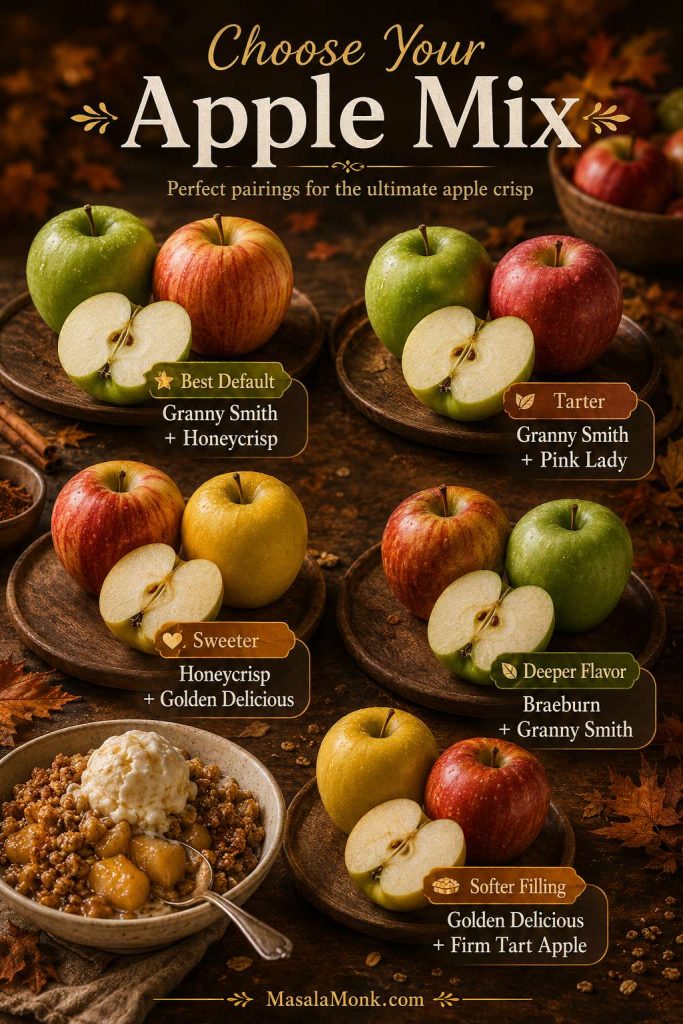
Easy Apple Mixes for Apple Crisp

Apple mix guide for apple crisp showing different apple pairings for tart, sweet, deep, and soft fillings.
Choose the apple mix by texture and flavor: tarter, sweeter, deeper, or softer and more spoonable.
Apple Mix Best For Flavor and Texture
Granny Smith + Honeycrisp Best default mix Tart, sweet, juicy, and sturdy
Granny Smith + Pink Lady Tarter apple crisp Bright, firm, and less sweet
Honeycrisp + Golden Delicious Sweeter family-style crisp Softer, sweeter, and very cozy
Braeburn + Granny Smith Deeper baked flavor Warm, aromatic, and balanced
Golden Delicious + a firm tart apple Softer, saucier filling Good when you want a more spoonable dessert

If you use a local apple variety that bakes well, tell us which one. Apple crisp is one of those recipes where regional apples can completely change the flavor, and the underrated local ones are often the most interesting.

Once you choose the apples, the cut matters too; see the sliced vs chopped apple guide before you prep the fruit.

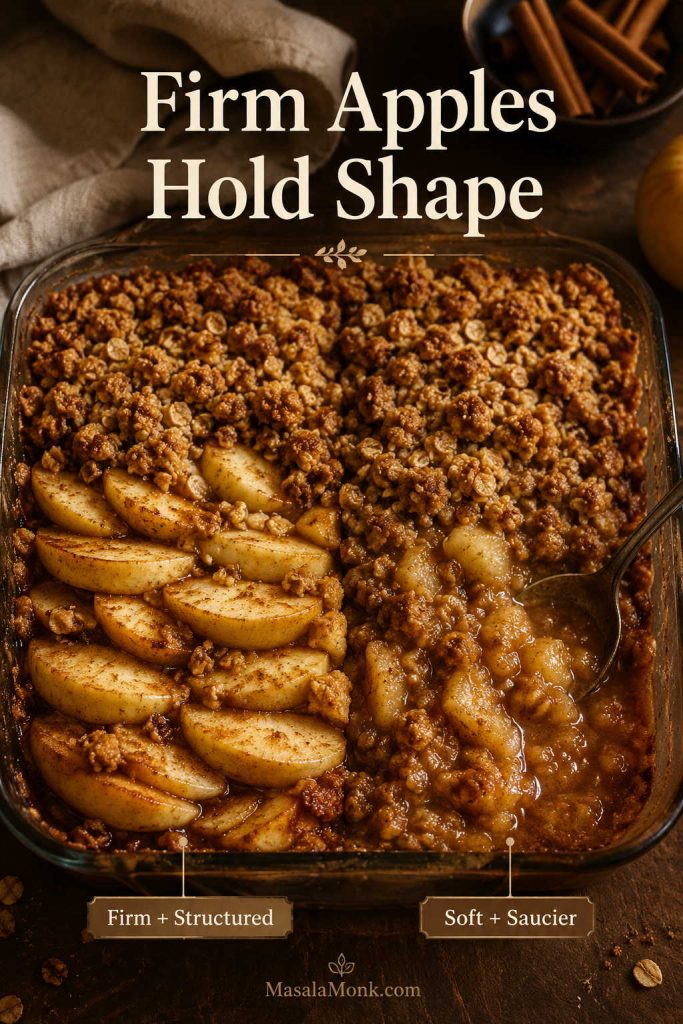
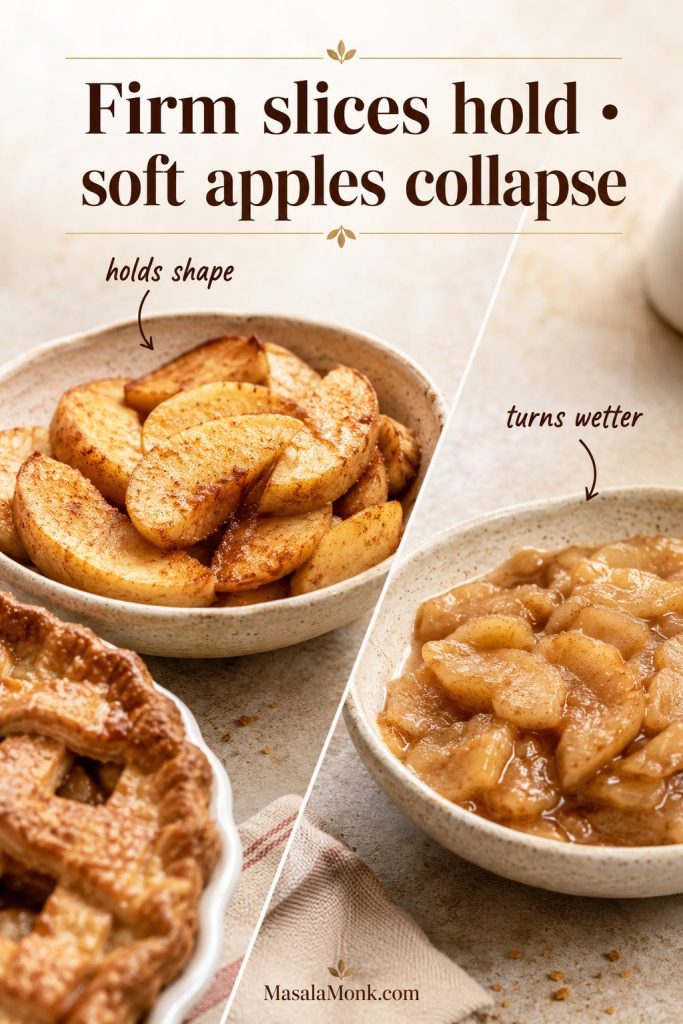
By contrast, very soft apples can break down quickly under a long bake. They still taste good, but they may create a saucier, almost applesauce-like filling and make the bottom of the crisp wetter.

Firm apple slices holding their shape beside softer apples breaking down into saucier apple crisp filling.
Firm apples help apple crisp hold its shape, while softer apples create a saucier filling; mixing varieties gives better balance.
Apple Best Use What to Expect
Granny Smith Best tart backbone Firm, bright, less sweet
Honeycrisp Best sweet-tart flavor Juicy, aromatic, holds well
Pink Lady Balanced crisp filling Tangy, firm, colorful
Braeburn Warm baked flavor Sweet-tart and sturdy
Golden Delicious Softer, sweeter filling Good when mixed with tart apples
Red Delicious Not recommended Often too soft and mild after baking

For a deeper apple breakdown, the best apples for apple pie guide is also useful for apple crisp because the same basic rule applies: choose apples that taste good after baking and do not collapse too quickly.

Should Apples Be Sliced or Chopped for Apple Crisp?

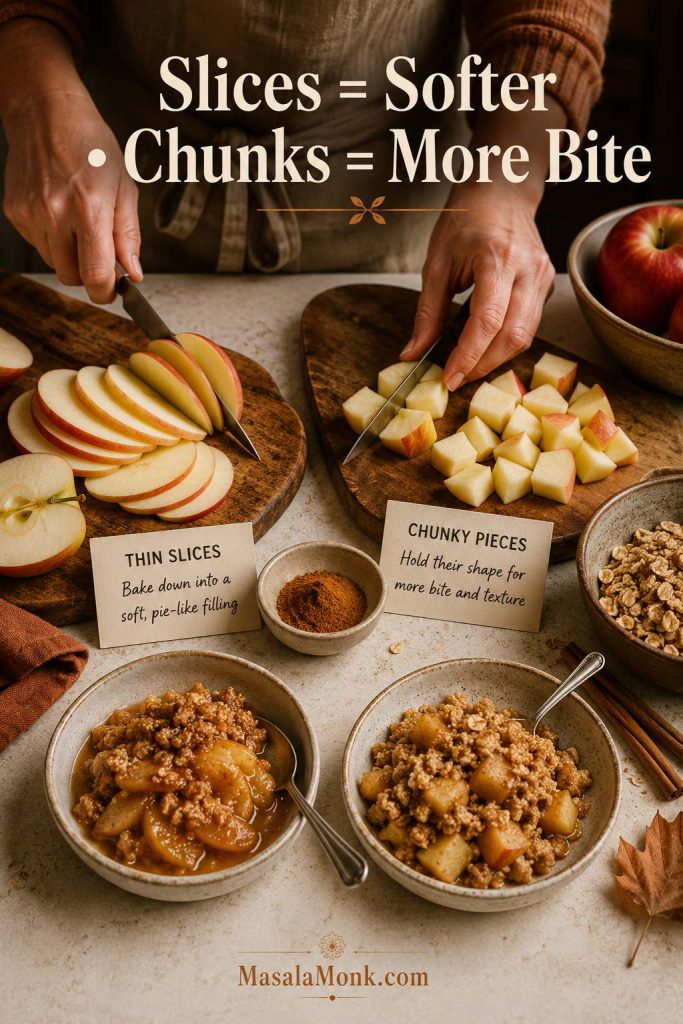
Hands preparing sliced and chopped apples for apple crisp with examples of softer and chunkier filling textures.
Sliced apples bake into a softer, layered filling, while chopped apples keep more bite in each spoonful.

Both work, but they give different textures. Thin slices bake into a softer, more layered filling. Chunks give more bite and make the dessert feel fruitier. Either way, even cutting matters because uneven apples can leave you with mushy small pieces and firm large pieces in the same pan.

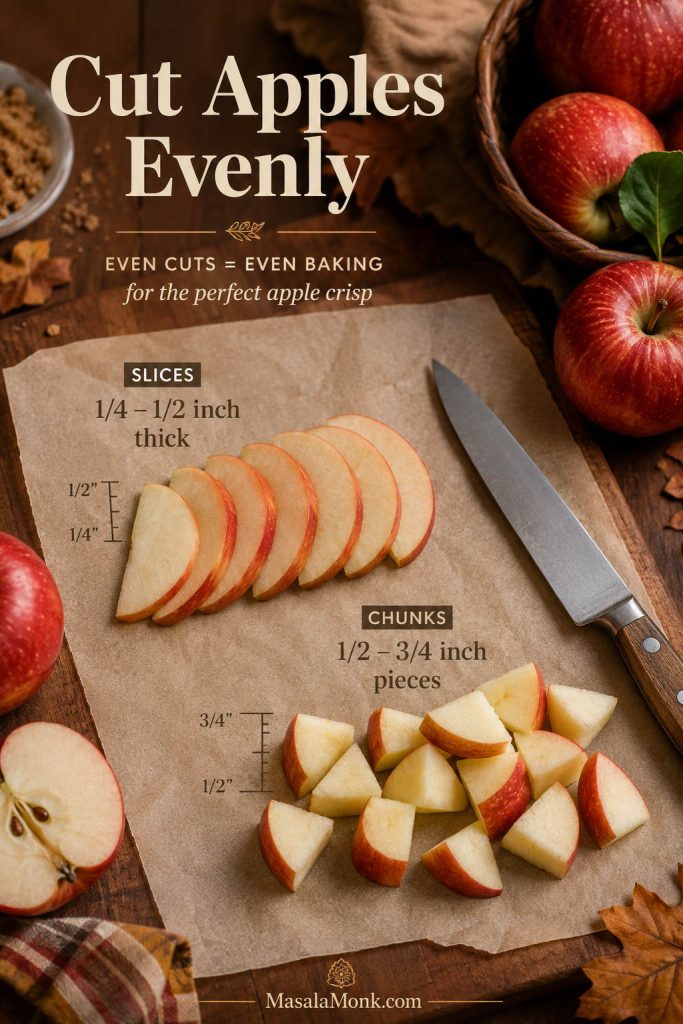
Cut-size tip: Keep slices and chunks even so the apple crisp filling bakes at the same pace.

Apple slice and chunk size guide showing even pieces for apple crisp preparation.
Even apple pieces bake at the same pace, which helps prevent mushy bits and underbaked chunks in the same pan.
Cut Best Size Result
Slices 1/4–1/2 inch thick Softer, layered, classic spoon-dessert texture
Chunks 1/2–3/4 inch More apple bite and a chunkier filling
Very thick pieces Over 3/4 inch May stay firm unless baked longer

For the most classic texture, use mostly slices with a few slightly thicker pieces mixed in. As a result, some apples soften into the cinnamon juices, while others stay tender enough to bite.

Old-Fashioned Oats vs Quick Oats for Apple Crisp

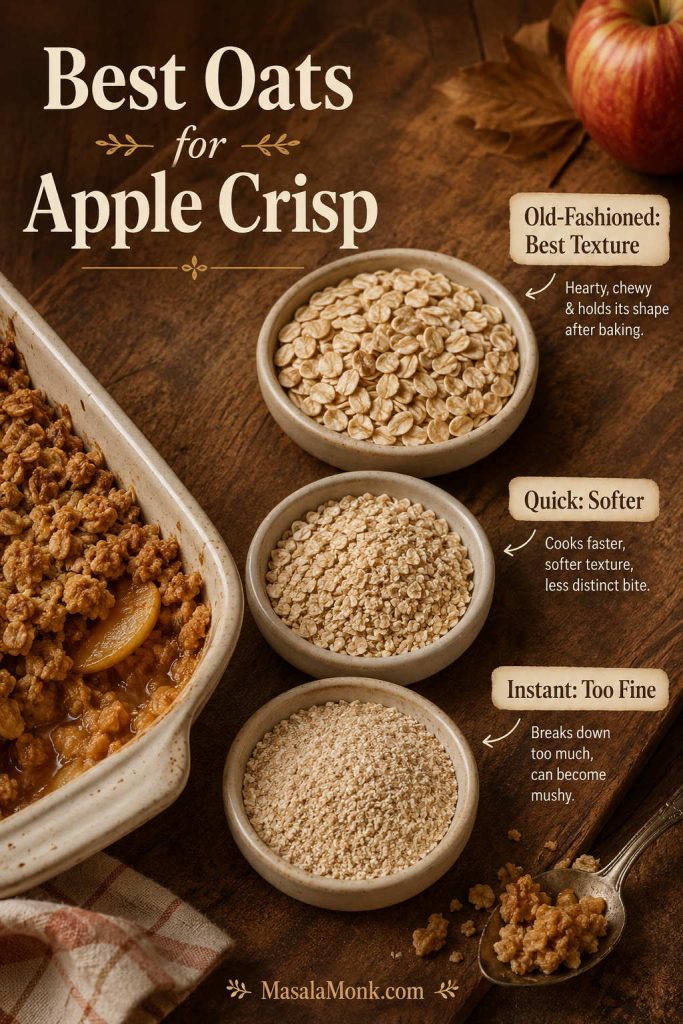
Oat choice: Old-fashioned oats give the topping more visible texture, while quick oats make the crumble finer and softer.

Old-fashioned oats, quick oats, and instant oats compared for apple crisp topping texture.
Old-fashioned oats give apple crisp a chewy-crisp topping; quick oats make it finer and softer, while instant oats can turn powdery.

Old-fashioned rolled oats are the best oats for apple crisp. They hold their shape in the oven and give the topping the chunky, crisp texture people expect. Quick oats can work in an emergency, but they make a softer, finer topping. Instant oats are too powdery, and steel-cut oats are too hard for this kind of topping.

Oat Type Use in Apple Crisp? Result
Old-fashioned rolled oats Yes, best choice Classic crisp topping with good texture
Quick oats Yes, only if needed Softer, finer topping with less chew
Instant oats Not ideal Can become too soft or powdery
Steel-cut oats No Too hard and chewy for this topping

That little bit of chew is what makes apple crisp feel like apple crisp instead of baked apples with crumbs. Old-fashioned oats stay visible, toasty, and slightly chewy, so the topping has more texture than a plain crumble.

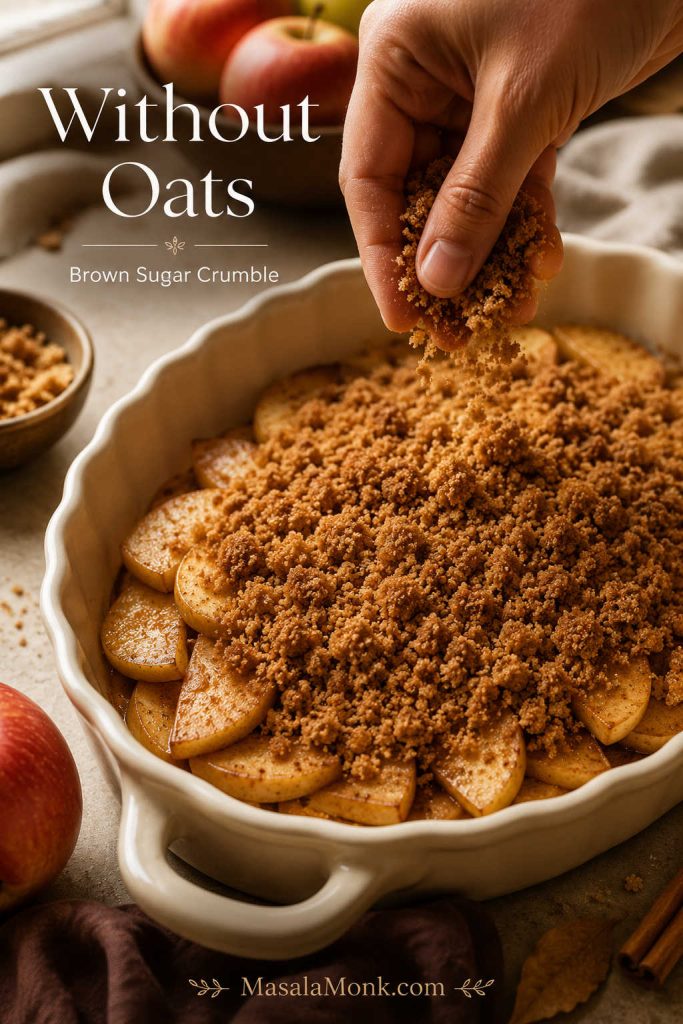
For a version without oats, make a flour-butter-brown-sugar crumble topping instead. That leans closer to apple crumble than classic apple crisp, and it needs slightly different handling because the topping does not have the same chewy oat structure. You can also jump to the apple crisp without oats variation below.

How to Make Apple Crisp

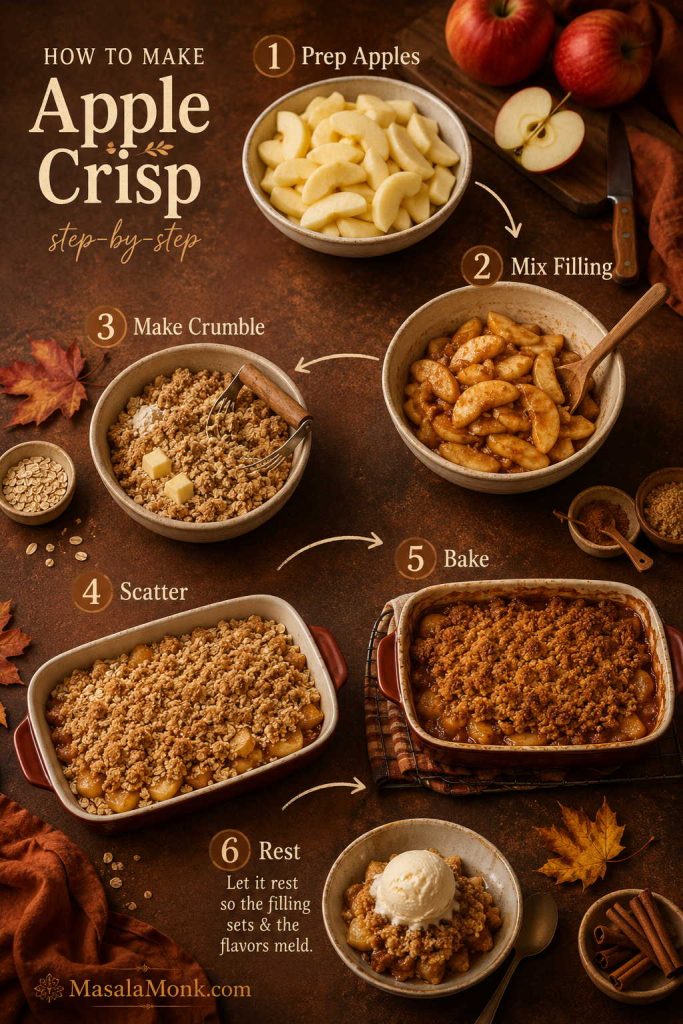
Method overview: The recipe is easiest when you follow the same order every time: prep, mix, crumble, scatter, bake, and rest.

Step-by-step apple crisp guide showing apple prep, filling, crumble topping, baking, and resting.
The method works best in order: prep the apples, coat the filling, make the crumble, scatter it loosely, bake until bubbling, and rest.

1. Prep the Apples

First, preheat the oven to 350°F / 175°C. Lightly butter an 8×8 or 9×9-inch baking dish, and place it on a rimmed baking sheet if the dish is quite full.

Next, peel the apples for a softer, more classic dessert texture. For a more rustic crisp with extra texture, leave the skins on. Core the apples, then cut them into even slices or chunks.

  • Thin slices: softer, more layered filling
  • 1/2-inch chunks: more apple bite and texture
  • Uneven pieces: some apples may turn mushy while others stay firm

2. Mix the Apple Filling

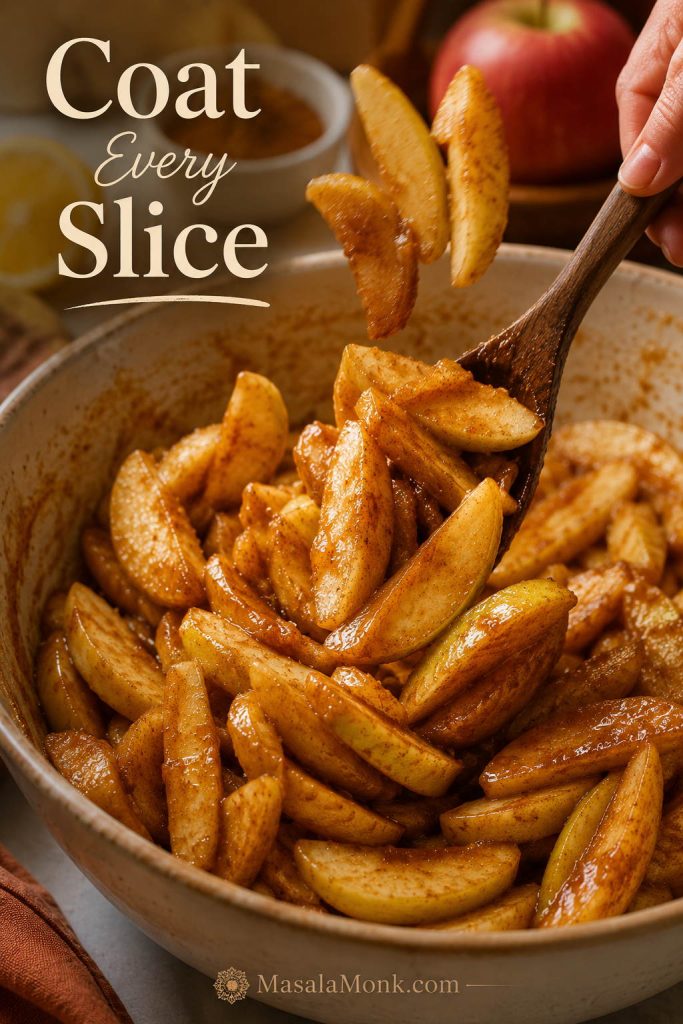
Add the apples to a large bowl with lemon juice, brown sugar, flour or cornstarch, cinnamon, nutmeg, vanilla, and salt. Then toss until the apples are evenly coated. The thickener should disappear into the juices and sugar instead of sitting in dry patches.

Apple crisp filling being mixed until apple pieces are coated with cinnamon, brown sugar, lemon, and thickener.
Mix until the thickener disappears into the apple juices so the filling bakes glossy instead of floury.

After mixing, spread the apples into the prepared baking dish. Do not worry if the dish looks full; the apples shrink as they bake.

3. Make the Oat Topping

In a separate bowl, mix the oats, flour, brown sugar, cinnamon, and salt. Add cold cubed butter. Then use your fingers, a fork, or a pastry cutter to rub the butter into the dry ingredients.

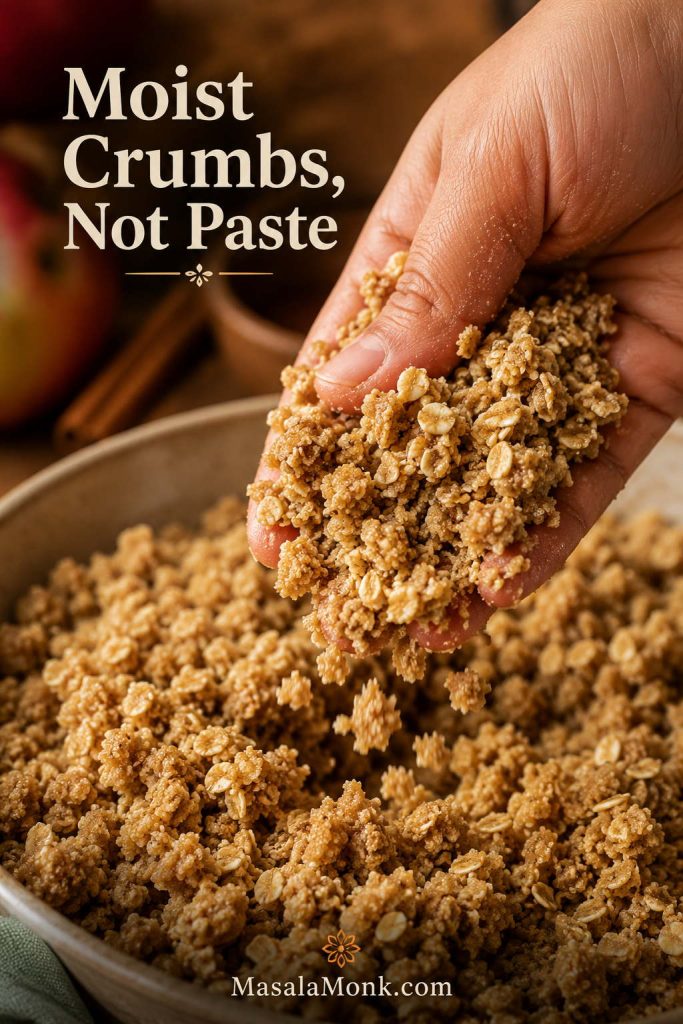
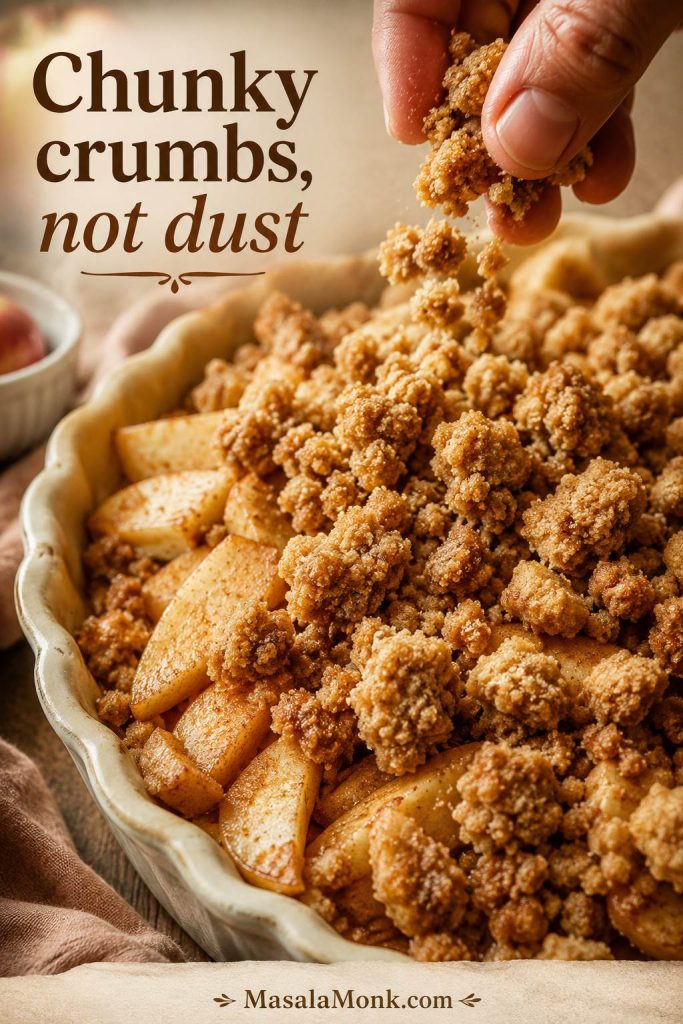
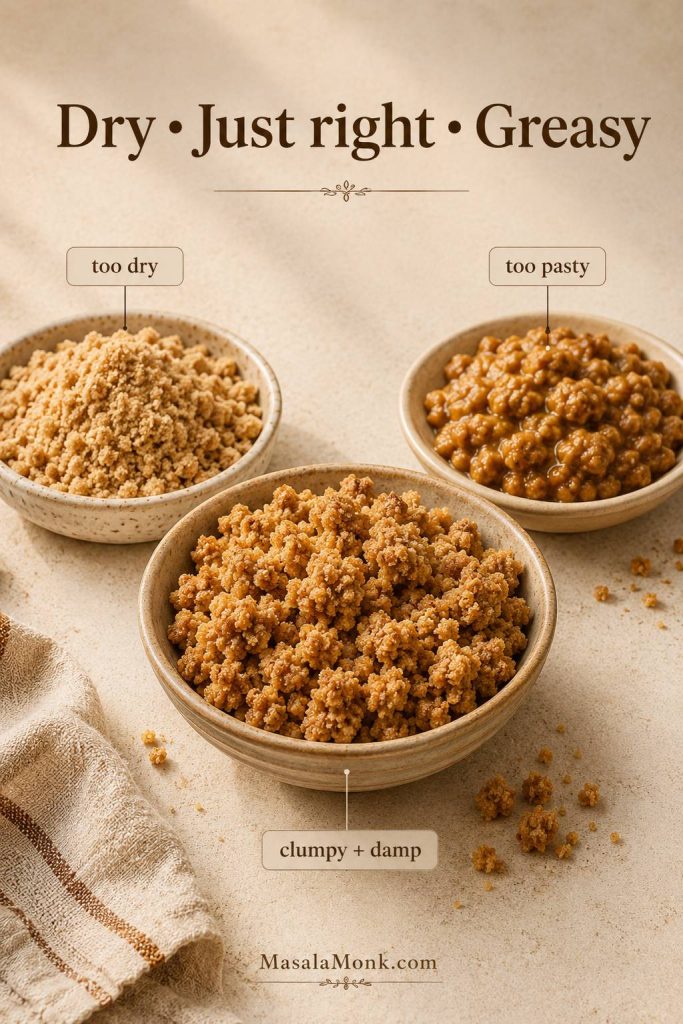
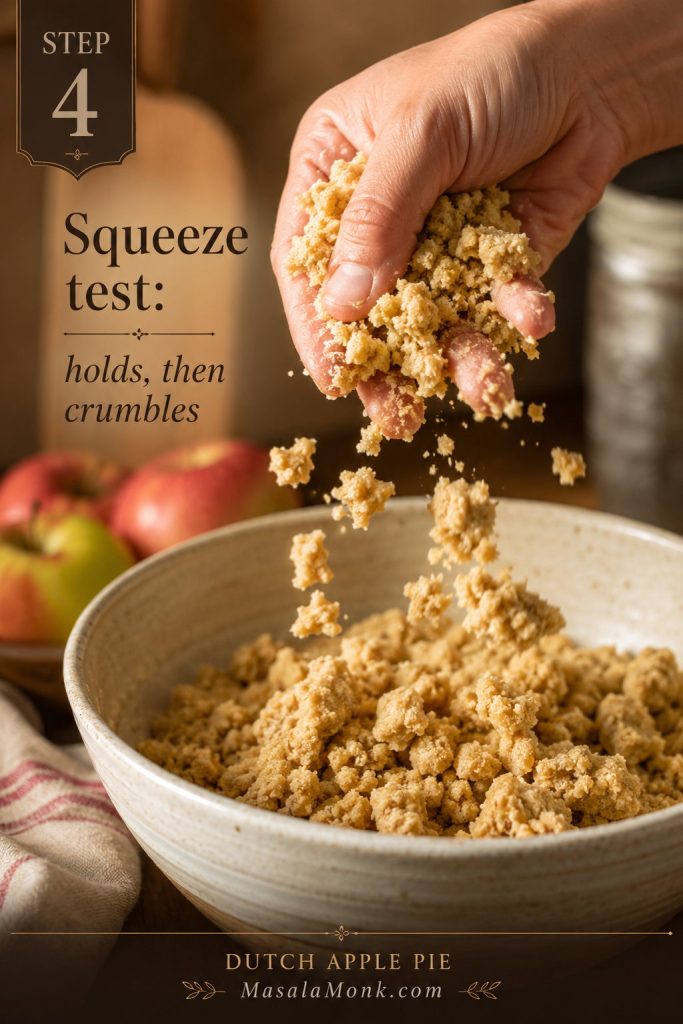
The mixture should look like uneven, buttery crumbs, not dry flour and not a smooth paste. When you squeeze a handful, it should hold together in rough clumps, then break apart easily. Leave some larger clumps on purpose; those become the crispest brown-sugar bites after baking.

Hand holding moist oat crumbs for apple crisp topping before baking.
The oat topping should form rough crumbs that hold together lightly, then break apart before baking.

If the mixture still looks dusty, keep working in the butter. Dry crumbs bake up floury. If it looks wet or greasy before baking, the butter has softened too much; chill the bowl for 10 minutes before sprinkling the oat mixture over the apples.

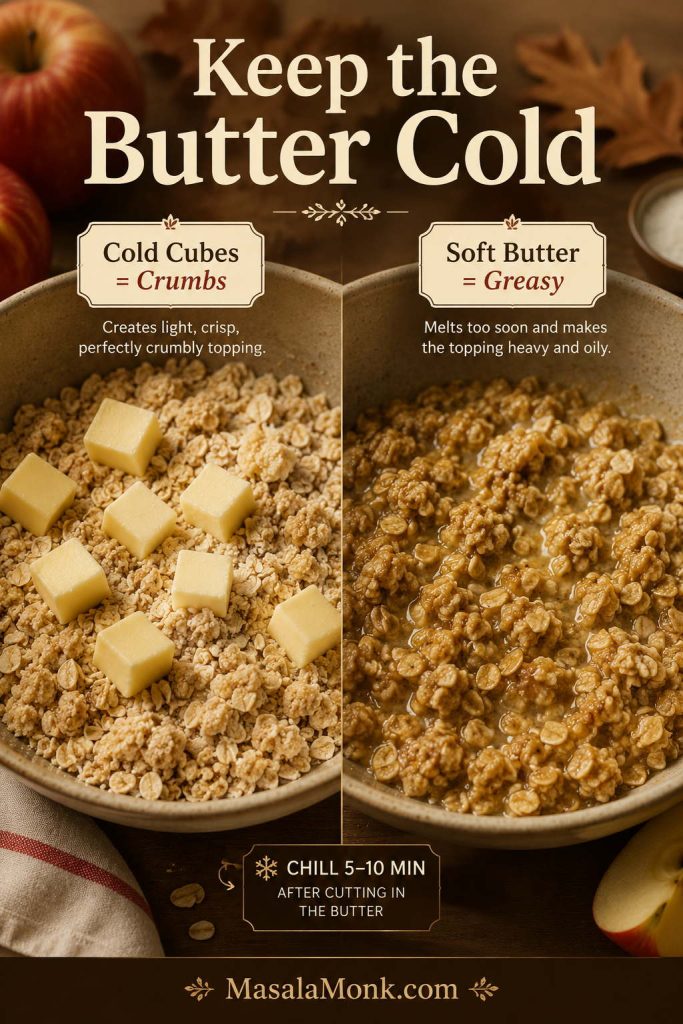
Warm kitchen tip: In a warm kitchen, cube the butter and chill or freeze it for 5–10 minutes before making the topping. Cold butter helps the oat topping bake into distinct crumbs instead of melting into the apples.

Cold butter cubes compared with softened butter for making apple crisp topping.
If the butter softens, chill the topping briefly; cold butter keeps the crumble distinct instead of greasy.

4. Add the Topping

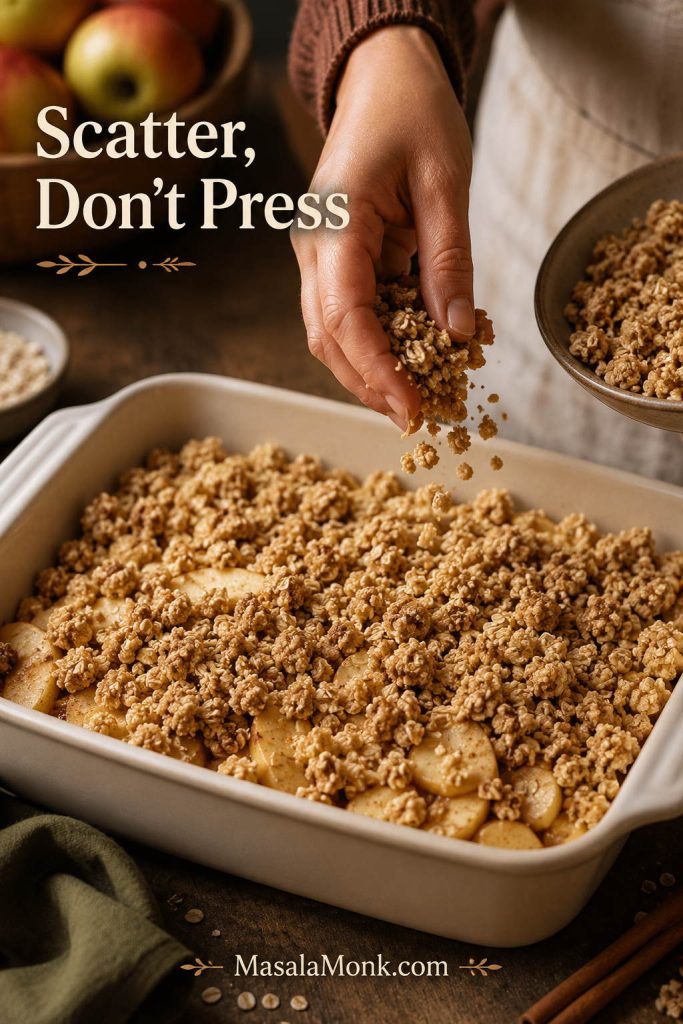
Scatter the oat mixture evenly over the apples. Do not press it down firmly. A loose crumb layer allows heat to move through the apples while the surface browns.

Oat crumble topping being scattered loosely over apple filling in a baking dish.
Scatter the topping loosely rather than pressing it down, so heat reaches the apples while the surface browns.

5. Bake Until Bubbling

Bake for 45–55 minutes, or until the oat layer is golden and the apple juices are visibly active beneath the surface. That heat is what wakes up the flour or cornstarch and turns the juices glossy instead of loose.

Apple crisp bubbling in the oven with golden oat topping in a cream baking dish.
Active bubbling is the doneness cue that tells you the filling has enough heat for the thickener to work.

If the surface browns too quickly before the apples are tender, loosely cover the dish with foil and continue baking. Do not seal the foil tightly, because trapped steam can soften the crumb layer. If the crisp still looks off, use the troubleshooting chart before you pull it from the oven.

6. Let It Rest Before Serving

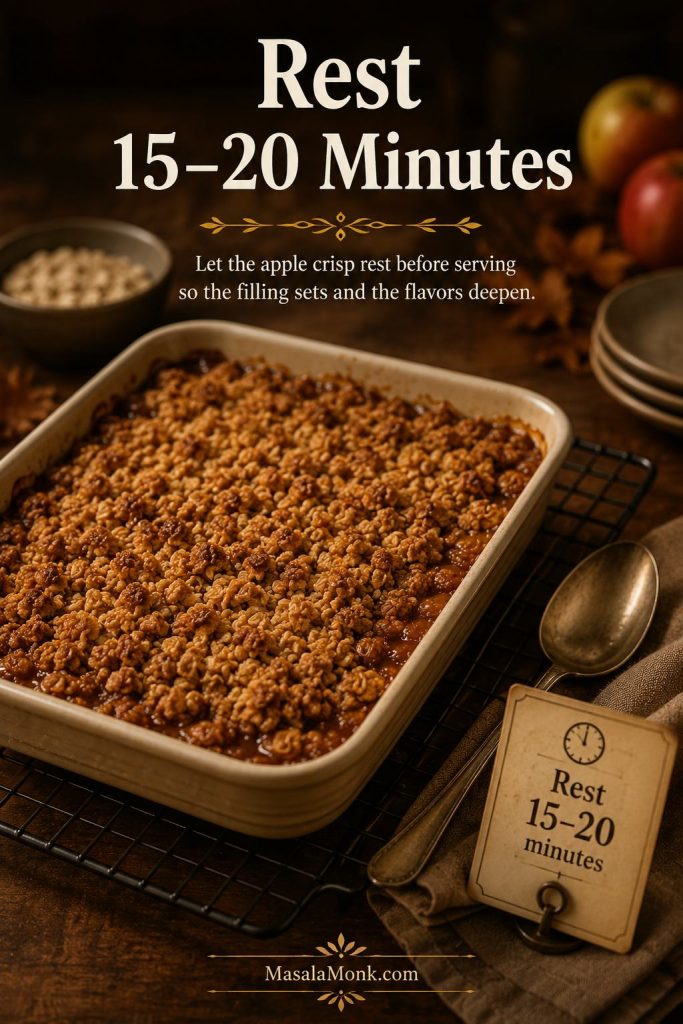
Once the crisp comes out of the oven, let it rest for at least 15–20 minutes before scooping. This short rest helps the juices settle so the filling is glossy and spoonable instead of runny.

Freshly baked apple crisp resting on a cooling rack with a 15 to 20 minute rest cue.
That short wait after baking is not wasted time; it helps the hot apple juices thicken so the first scoop does not collapse into the bowl.

Should Apple Crisp Be Baked Covered or Uncovered?

Bake apple crisp uncovered so the oat layer can brown and crisp. If the surface turns dark before the apples are tender, cover the dish loosely with foil for the last 10–15 minutes. Do not cover it from the beginning unless your oven runs very hot.

Once the apples are coated and the crumble is ready, the hardest part is already done. From here, the oven does most of the work: softening the apples, thickening the juices, and turning those rough oat clumps into the bites everyone wants first.

Easy Apple Crisp Recipe with Oats

Easy Apple Crisp Recipe with Oats

This easy apple crisp bakes tender cinnamon apples under a generous brown sugar oat topping, with clear doneness cues so the filling turns glossy instead of watery. Serve it warm with vanilla ice cream, especially if you want the corner pieces to disappear first.

Prep Time20 minutes
Cook Time45–55 minutes
Rest Time15 minutes
Servings6–8

Ingredients

For the apple filling

  • 2 1/2 lb / 1.1 kg apples, weighed before peeling and coring; about 8 cups sliced or chopped apples
  • 1 tablespoon / 15 ml lemon juice
  • 1/3 cup / 65 g packed light brown sugar, or up to 1/2 cup / 100 g for very tart apples
  • 2 tablespoons / 16 g all-purpose flour, or 1 tablespoon / 8 g cornstarch
  • 1 teaspoon ground cinnamon
  • 1/4 teaspoon ground nutmeg, optional
  • 1 teaspoon / 5 ml vanilla extract
  • 1/4 teaspoon fine salt

For the oat topping

  • 1 cup / 90 g old-fashioned rolled oats
  • 3/4 cup / 95 g all-purpose flour
  • 3/4 cup / 150 g packed light brown sugar
  • 1 teaspoon ground cinnamon
  • 1/4 teaspoon fine salt
  • 1/2 cup / 113 g cold unsalted butter, cut into small cubes
  • Optional: 1/2 cup / 55–60 g chopped pecans or walnuts

Instructions

  1. Preheat the oven to 350°F / 175°C. Lightly butter an 8×8 or 9×9-inch baking dish. Place the dish on a rimmed baking sheet if it is very full.
  2. Add the apples to a large bowl. Toss with lemon juice, brown sugar, flour or cornstarch, cinnamon, nutmeg, vanilla, and salt until evenly coated.
  3. Spread the apple mixture into the prepared baking dish.
  4. In another bowl, stir together the oats, flour, brown sugar, cinnamon, and salt.
  5. Add the cold cubed butter. Rub it into the oat mixture with your fingers, a fork, or a pastry cutter until the topping forms moist crumbs and rough clumps.
  6. Sprinkle the topping evenly over the apples. Do not press it down firmly.
  7. Bake for 45–55 minutes, until the topping is golden and the apple juices are bubbling at the edges and toward the center.
  8. If the topping browns before the apples are tender, cover loosely with foil and continue baking.
  9. Let the crisp rest for 15–20 minutes before serving. Serve warm, plain or with vanilla ice cream.

Notes

  • Use old-fashioned oats for the best topping texture.
  • The crisp is not done just because the topping is brown. Look for bubbling juices near the center too.
  • If the topping looks powdery before baking, work in the butter a little more or add 1–2 teaspoons extra cold butter.
  • If using a 9×9 pan, check a few minutes early because it is slightly shallower than an 8×8.
  • Use less sugar for sweet apples and more for very tart apples.
  • For a glossier filling, use cornstarch instead of flour.
  • For a thicker filling, let the crisp cool for at least 20 minutes before scooping.
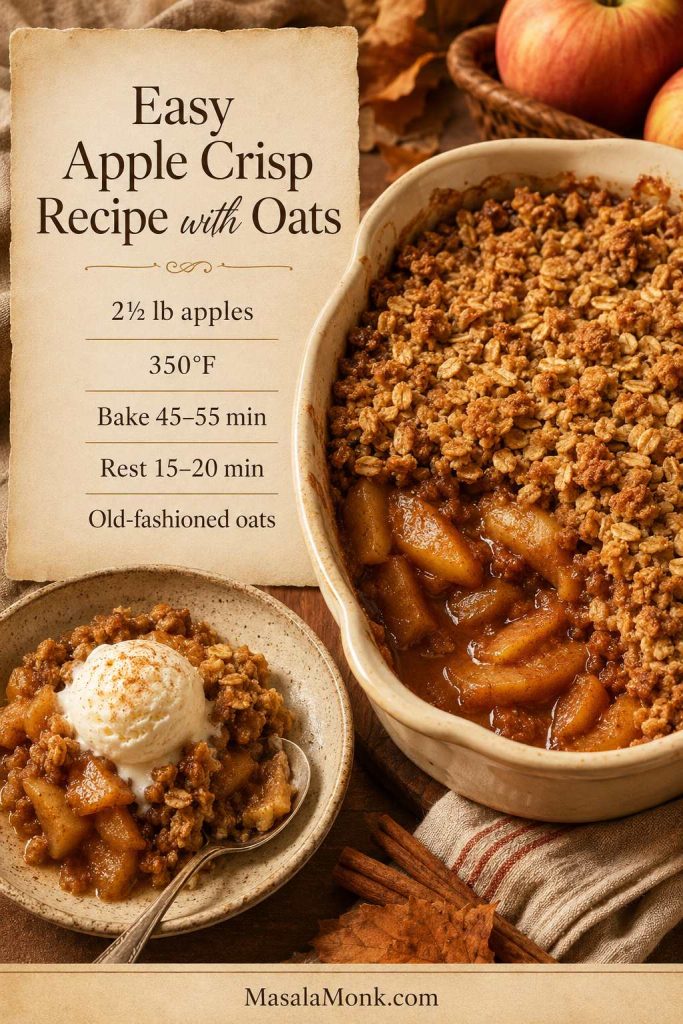
Saveable apple crisp recipe card with baked apple crisp, vanilla ice cream, apples, oats, bake time, and rest time.
Keep the base formula simple: 2½ pounds of apples, 350°F, old-fashioned oats, and a proper rest before serving.

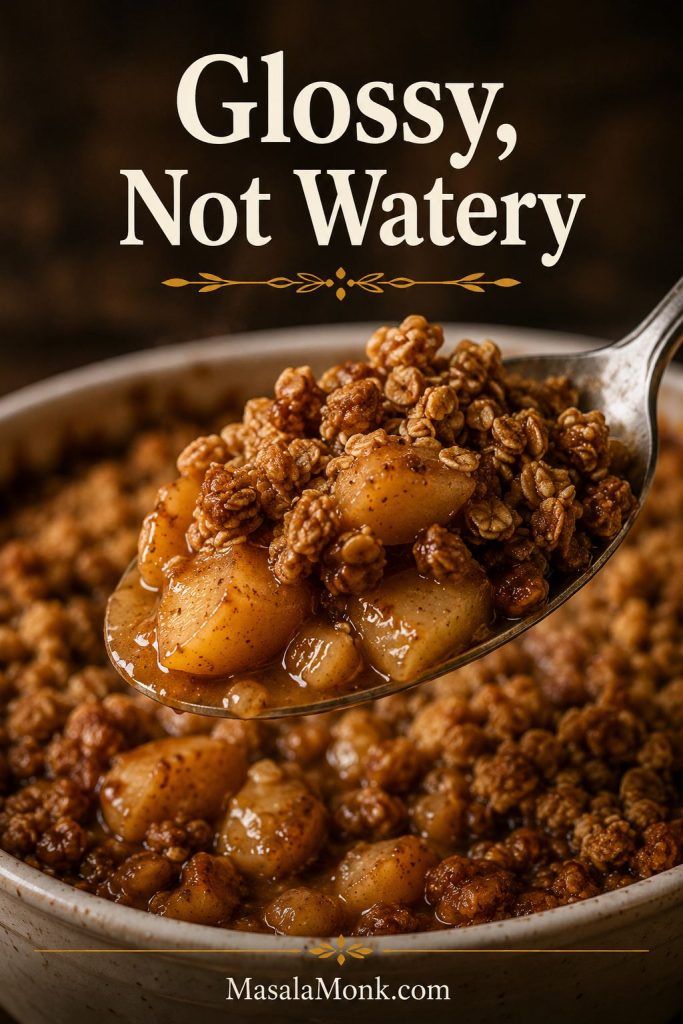
Finished texture: The best scoop holds glossy apples and crumble together without leaving a watery puddle behind.

Spoon lifting glossy apple crisp filling with golden oat crumble from a warm bowl.
The ideal spoonful holds tender apples, glossy cinnamon juices, and enough crumble to give every bite texture.

Apple Crisp Pan Guide: 8×8, 9×9, and 9×13

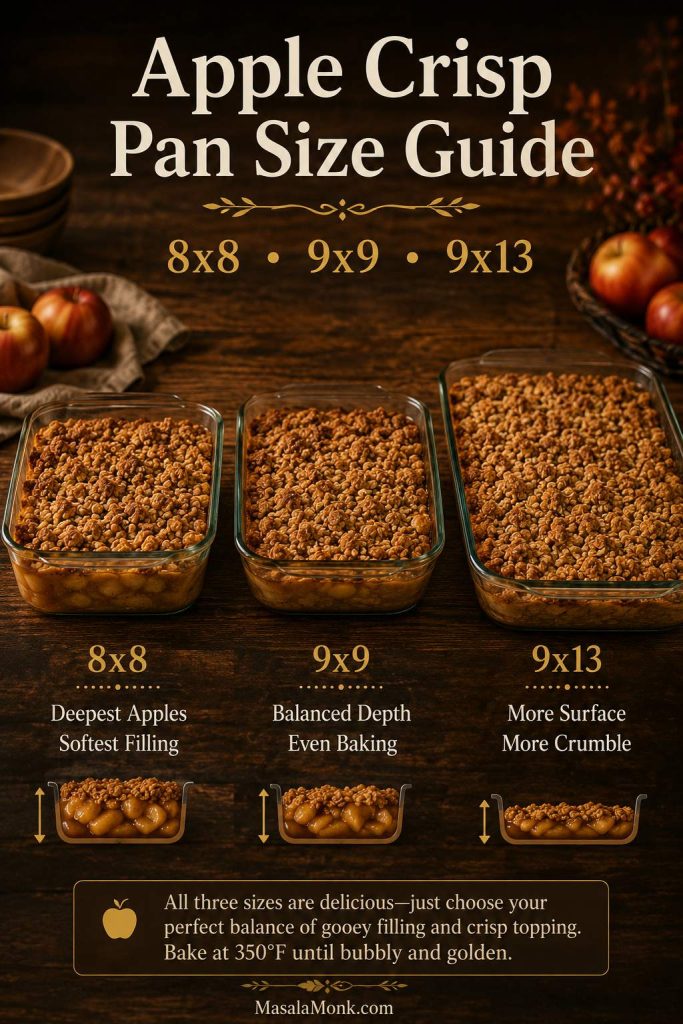
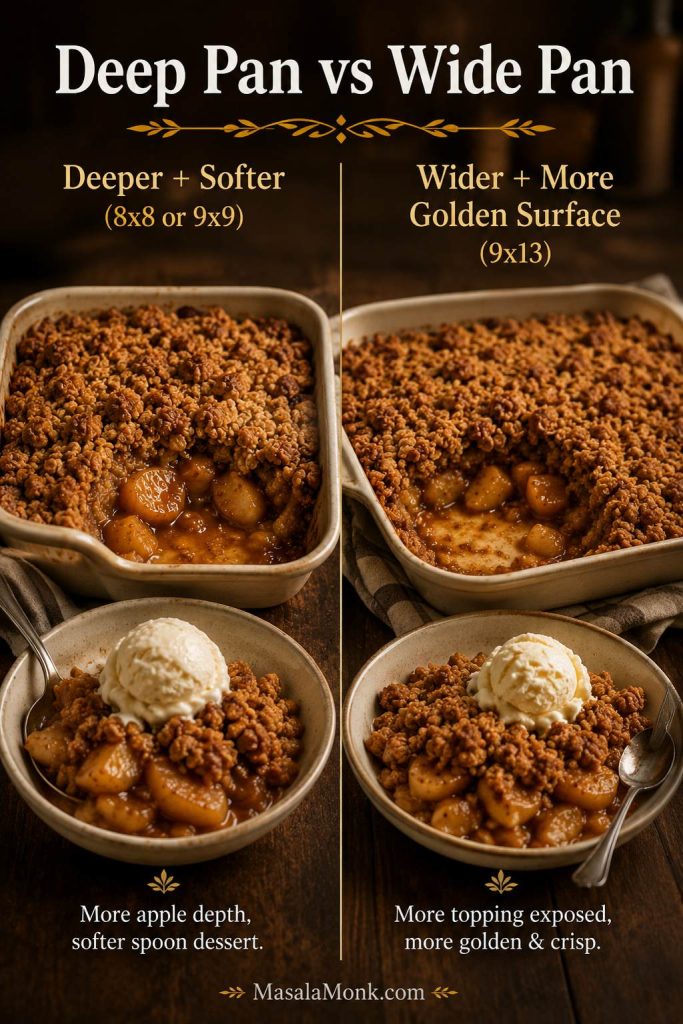
Pan size changes the depth of the apples, the bake time, and how much crumble you need. A deeper crisp feels softer and more spoonable, while a wider dish gives the oat layer more exposure and more golden edges.

Apple crisp pan size guide comparing 8x8, 9x9, and 9x13 baking dishes.
Use the pan guide before you bake, because a deeper dish needs more time while a wider dish exposes more crumble to direct heat.
Pan Size Apple Amount Topping Amount Bake Time Best For
8×8 inch 2–2 1/2 lb / 900 g–1.1 kg Use full recipe 45–55 minutes Deeper family-style crisp
9×9 inch 2 1/2 lb / 1.1 kg Use full recipe 45–55 minutes Best balanced default
9×13 inch 3 1/2–4 lb / 1.6–1.8 kg Use 1 1/2x topping 50–60 minutes Holidays, potlucks, larger families

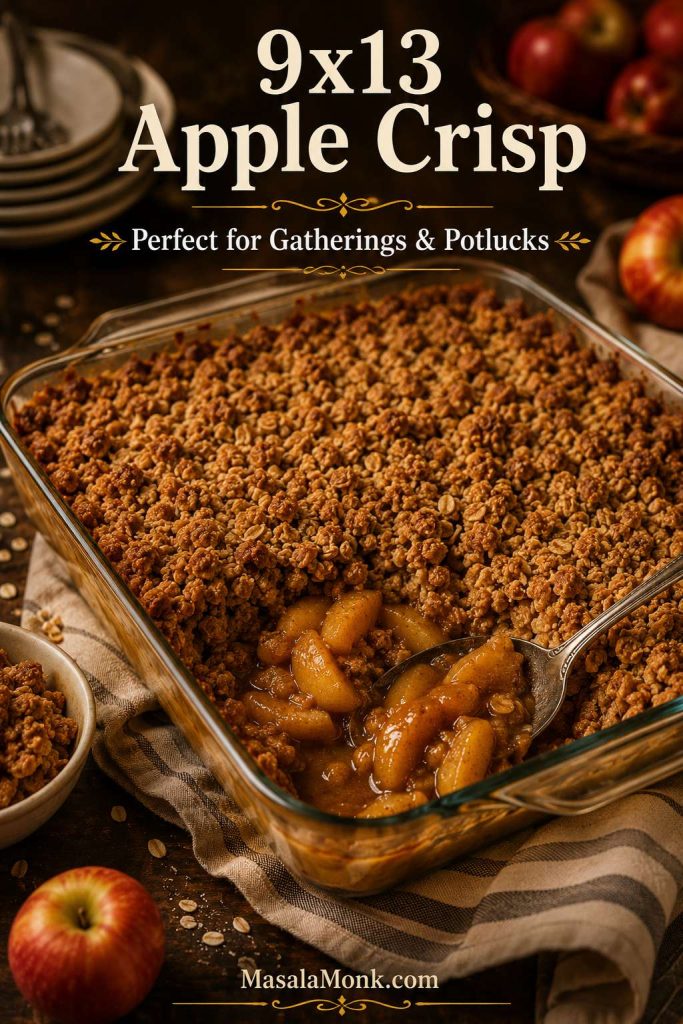
How to Make a 9×13 Apple Crisp

A 9×13 apple crisp is the version to make for a holiday table, potluck, or family dinner where people will go back for seconds. The trick is not just adding more apples; the topping has to scale too, or the pan tastes like baked apples with a thin oat sprinkle.

Large 9x13 apple crisp in a glass baking dish with golden oat topping and spooned cinnamon apple filling.
For a 9×13 apple crisp, scaling the crumble matters as much as scaling the apples; otherwise, each serving can feel thin on top.

For a 9×13-inch apple crisp, increase the recipe so the pan still has enough fruit and topping. Otherwise, a thin layer of apples can dry out, while a thin topping makes the crisp feel unfinished.

Ingredient 9×13 Amount
Apples 3 1/2–4 lb / 1.6–1.8 kg, about 11–12 cups sliced or chopped
Lemon juice 1 1/2 tablespoons / 22 ml
Brown sugar for filling 1/2 cup / 100 g, or less for sweet apples
Flour for filling 3 tablespoons / 24 g, or 1 1/2 tablespoons cornstarch
Old-fashioned oats 1 1/2 cups / 135 g
Flour for topping 1 cup plus 2 tablespoons / about 140 g
Brown sugar for topping 1 cup plus 2 tablespoons / about 225 g
Cold butter 3/4 cup / 170 g
Bake time 50–60 minutes at 350°F / 175°C

For the 9×13 version, give the middle of the pan enough time to catch up with the edges, then rest it at least 20 minutes before serving. A larger pan holds more hot apple juice, so the short wait makes each scoop cleaner.

Pan texture tip: Think of dish size as a texture decision, not only a volume decision.

Deep pan and wide pan apple crisp comparison showing different apple depth and golden topping exposure.
Think of pan size as a texture choice: deeper dishes give a softer fruit layer, while wider dishes create more browned crumble and edges.

If you make this in a different dish size, share the pan and bake time. Someone else will absolutely be standing in their kitchen with a deep ceramic dish or shallow glass pan wondering if it will work.

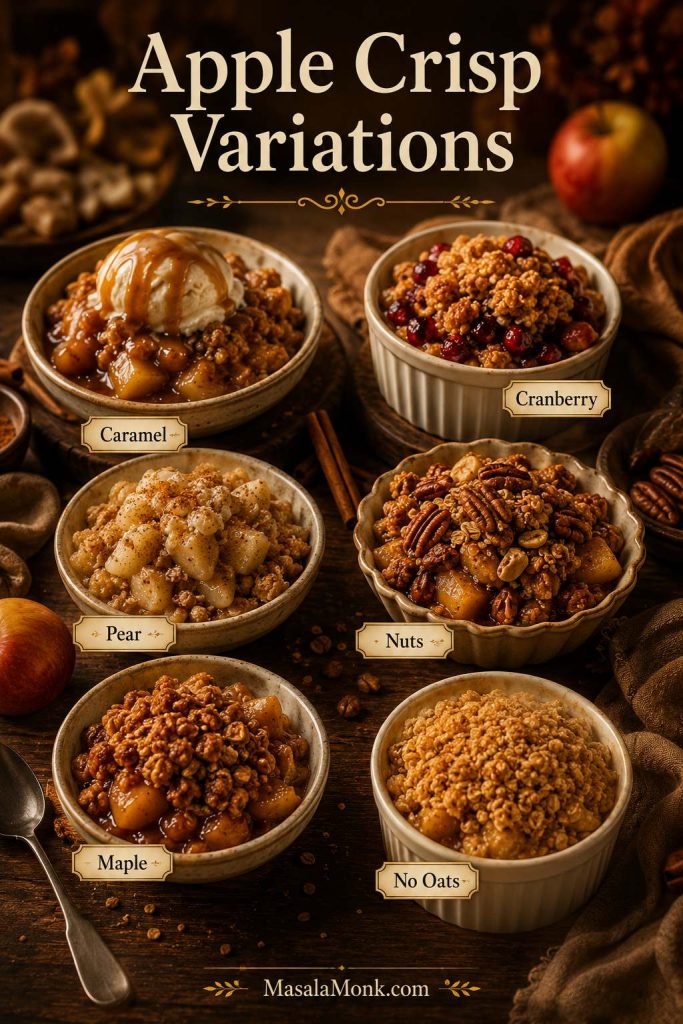
Popular Apple Crisp Variations

This apple crisp recipe uses fresh apples and oats, but the basic ratio is flexible. Once you understand the filling, topping, and doneness cues, you can adjust the crisp for prepared apple pie filling, no oats, gluten-free flour, cranberries, pears, caramel, nuts, or a dairy-free topping.

Apple crisp variations with caramel, cranberry, pear, nuts, maple, and no-oat crumble servings.
Start with the classic version, then choose the variation by purpose: caramel for richness, cranberry for tartness, nuts for crunch, or no oats for a softer crumble.

Start with the base apple crisp recipe, then choose the variation based on what you want the crisp to do: caramel makes it richer, cranberries make it sharper for a holiday table, pears make the fruit layer softer, nuts add crunch, and gluten-free or dairy-free swaps make the same base recipe work for more people.

Apple Crisp with Apple Pie Filling

Apple pie filling being spooned into a baking dish with oat topping nearby for shortcut apple crisp.
Apple pie filling makes a shortcut apple crisp possible, but fresh apples give you more control over sweetness and texture.

Use apple pie filling when you need a shortcut crisp with no peeling or slicing. Because the filling is already sweetened and thickened, skip the fresh-apple sugar, flour, lemon, and spice mixture. Spread 5–6 cups filling in the dish, add the oat topping, and bake until bubbling.

Homemade filling gives you more control over sweetness and texture. This apple pie filling recipe works for pies, crisps, hand pies, turnovers, and toppings, so it is useful to keep around when apples are in season.

Apple Crisp Without Oats

Brown sugar crumble being scattered over sliced apples for apple crisp without oats.
Choose the no-oat version when you want a finer brown-sugar crumble instead of the chewy texture that oats bring to classic apple crisp.

For a no-oat version, make a flour, brown sugar, butter, and cinnamon crumble topping. The texture is closer to apple crumble: buttery and tender rather than chewy-crisp. Keep the butter cold and work it in until the topping forms rough crumbs, not a smooth paste.

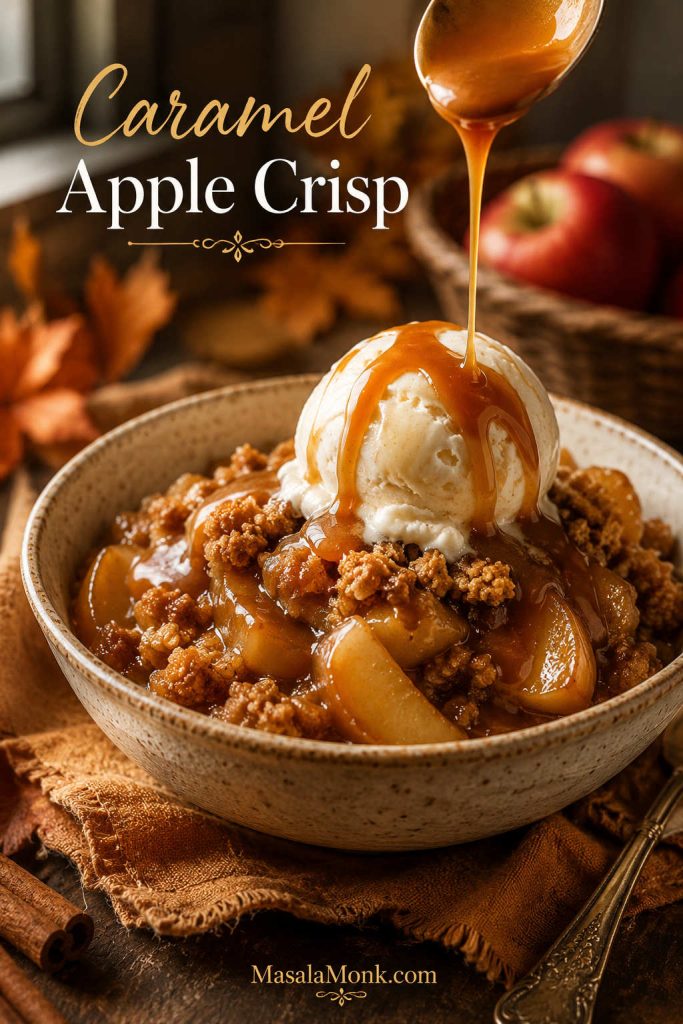
Caramel Apple Crisp

Caramel apple crisp served with vanilla ice cream and caramel sauce drizzled over the top.
Drizzle caramel over each serving instead of loading the filling with it, so the apples stay balanced.

For caramel apple crisp, use the base recipe and drizzle caramel over each serving instead of stirring a lot of caramel into the filling. That keeps the apples from becoming overly sweet or sticky while still giving you the caramel-apple flavor people expect.

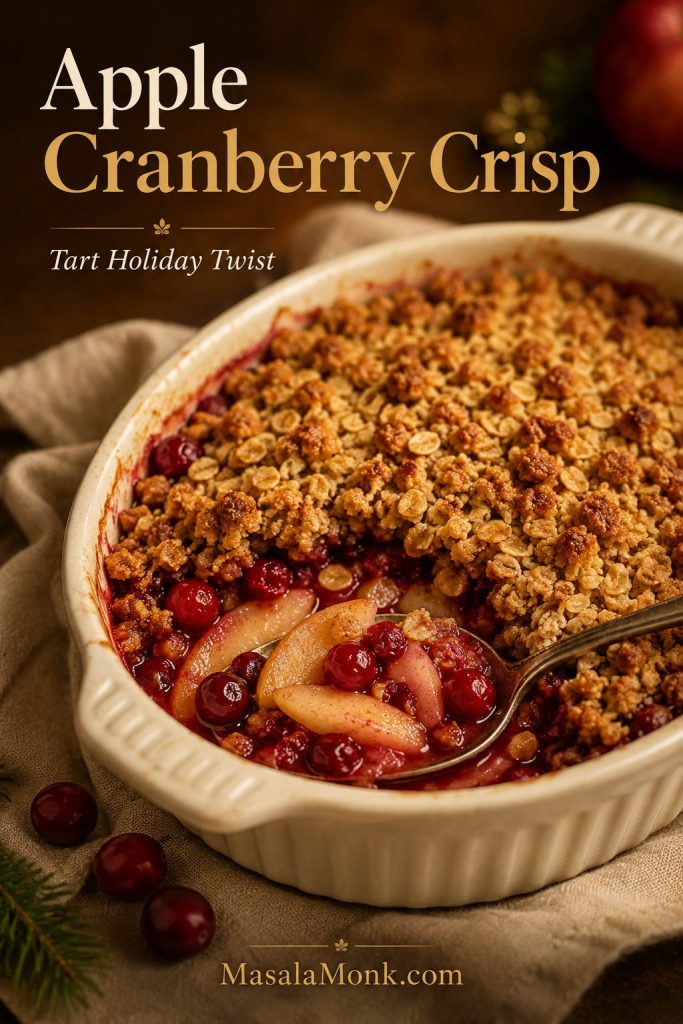
Apple Cranberry Crisp

Apple cranberry crisp with ruby cranberries, sliced apples, and golden oat crumble in a cream baking dish.
Cranberries add tartness and color, making apple cranberry crisp especially useful for fall dinners and holiday menus.

Add 3/4 to 1 cup fresh or frozen cranberries to the apples for a sharper holiday-style crisp. Because cranberries are tart, taste the apple mixture before baking and add 1–2 extra tablespoons of sugar if needed.

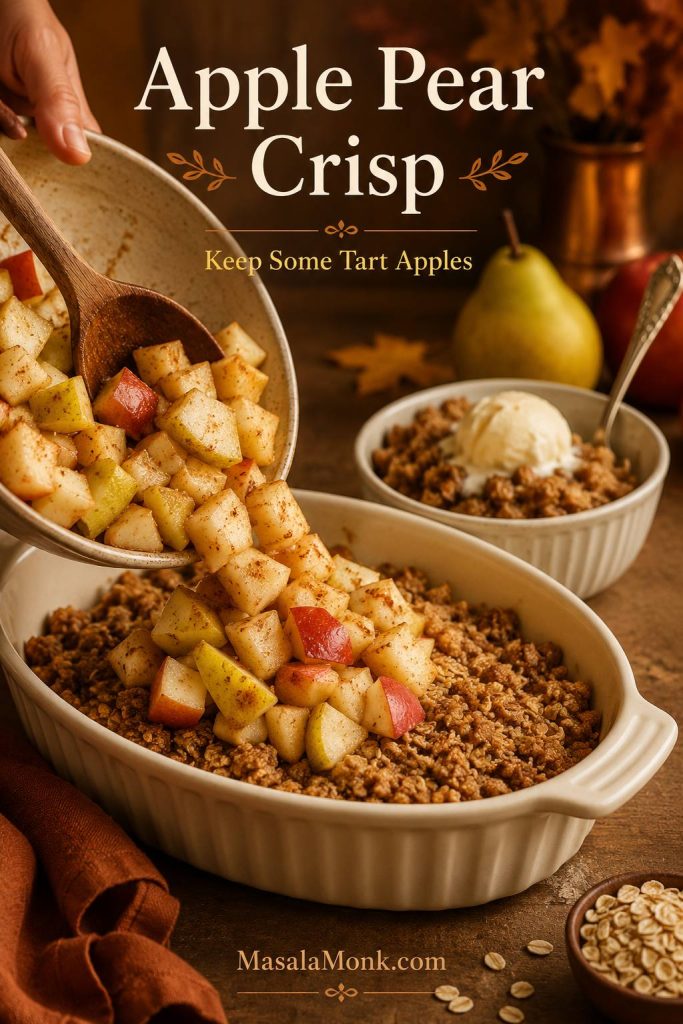
Apple Pear Crisp

Apple pear crisp being assembled with chopped apples, pears, cinnamon, and oat crumble in a baking dish.
Apple pear crisp works best with firm pears and tart apples together, because the pears add softness while the apples keep the flavor bright.

Replace about one-third of the apples with firm pears. Keep some tart apples in the mix so the filling does not taste flat. Softer pears can work, but they will make the filling more delicate and saucy.

Apple Crisp with Nuts

Add 1/2 cup chopped pecans or walnuts to the topping for extra crunch. If the nuts start browning before the apples are tender, cover the dish loosely with foil near the end of baking.

Maple Apple Crisp

Replace 1–2 tablespoons of the filling sugar with maple syrup for a deeper fall flavor. Do not add too much extra liquid; maple should support the apples, not make the filling loose.

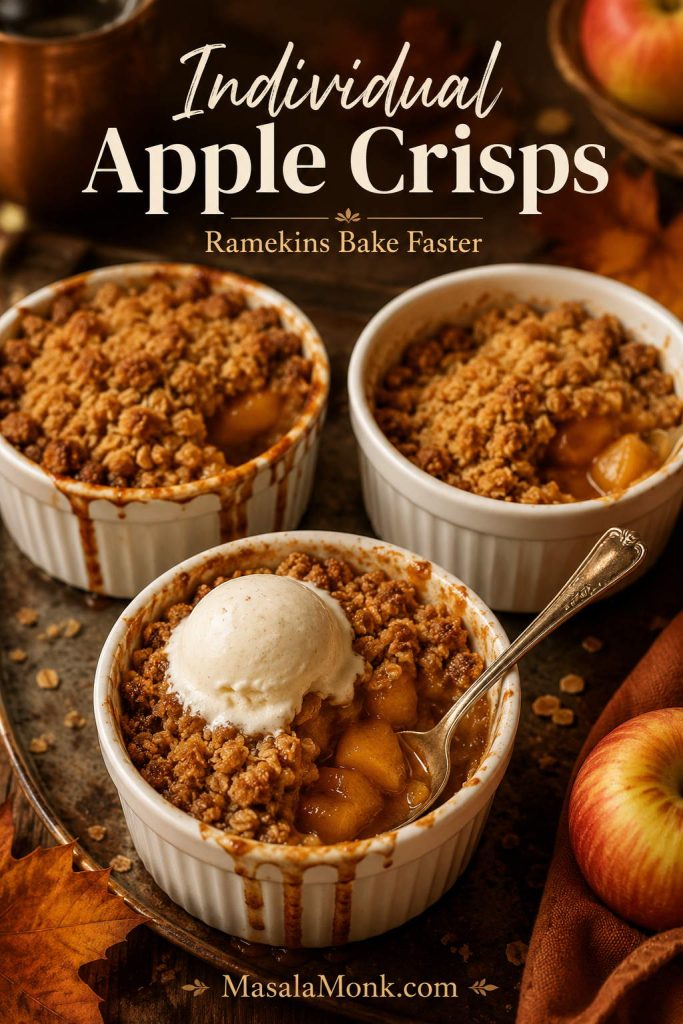
Individual Apple Crisps

Individual apple crisps baked in white ramekins with golden oat topping and one serving topped with vanilla ice cream.
Individual apple crisps bake faster than a full pan, so start checking early and serve while the topping still has texture.

Divide the filling and topping among small ramekins and bake until the fruit bubbles and the topping is golden. Start checking around 25–30 minutes because smaller portions bake faster.

No-Peel Apple Crisp

Leave the skins on if your apples have thin, pleasant skins and you like a more rustic texture. Peel thick-skinned or waxy apples for a softer, more classic filling.

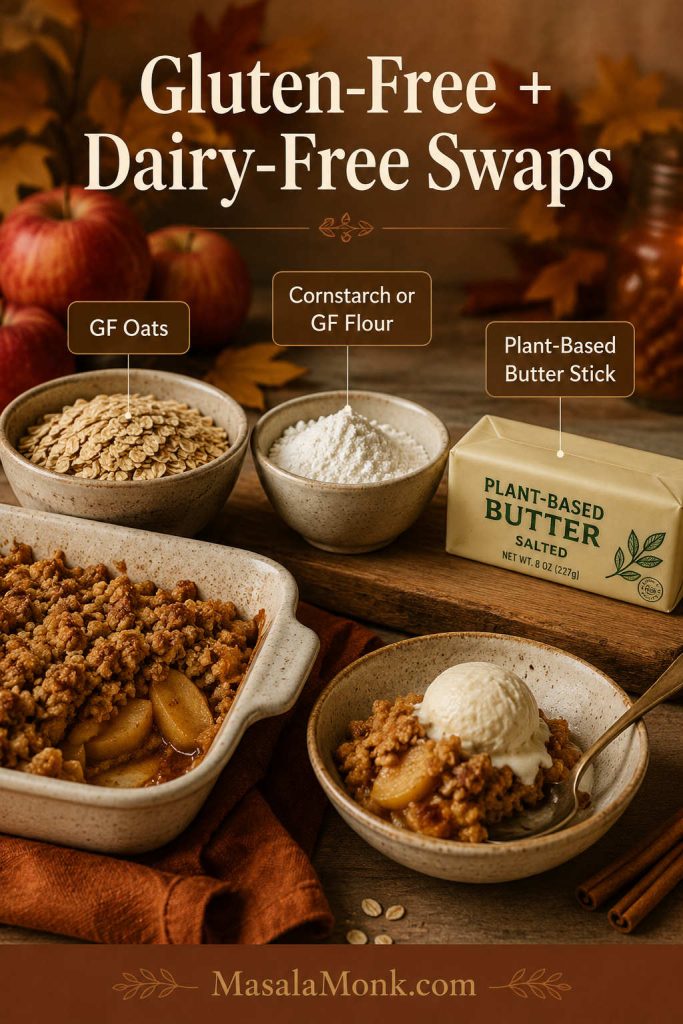
Gluten-free and dairy-free tip: Keep the base method, but choose certified gluten-free oats and a firm plant-based butter stick so the crumble still works.

Gluten-free and dairy-free apple crisp swaps with oats, cornstarch or gluten-free flour, plant-based butter, apples, and a finished serving.
For gluten-free or dairy-free apple crisp, keep the method the same but choose certified gluten-free oats and a firm plant-based butter stick.

Gluten-Free Apple Crisp

For a gluten-free apple crisp, use certified gluten-free oats and replace the flour with a gluten-free blend or cornstarch in the filling. The topping can use gluten-free all-purpose flour, oat flour, or almond flour, depending on the texture you want.

Dairy-Free Apple Crisp

Use a good plant-based butter stick instead of a soft tub spread. A firmer vegan butter works better because it can be cut into the topping and form crumbs, while softer spreads can make the topping greasy.

Lower-Sugar Apple Crisp

To make a lower-sugar apple crisp, start with naturally sweet apples and reduce the sugar in the apple layer first. Still, keep some sugar in the topping because it helps with browning, flavor, and crisp texture.

Apple Crisp vs Apple Crumble vs Dutch Apple Pie

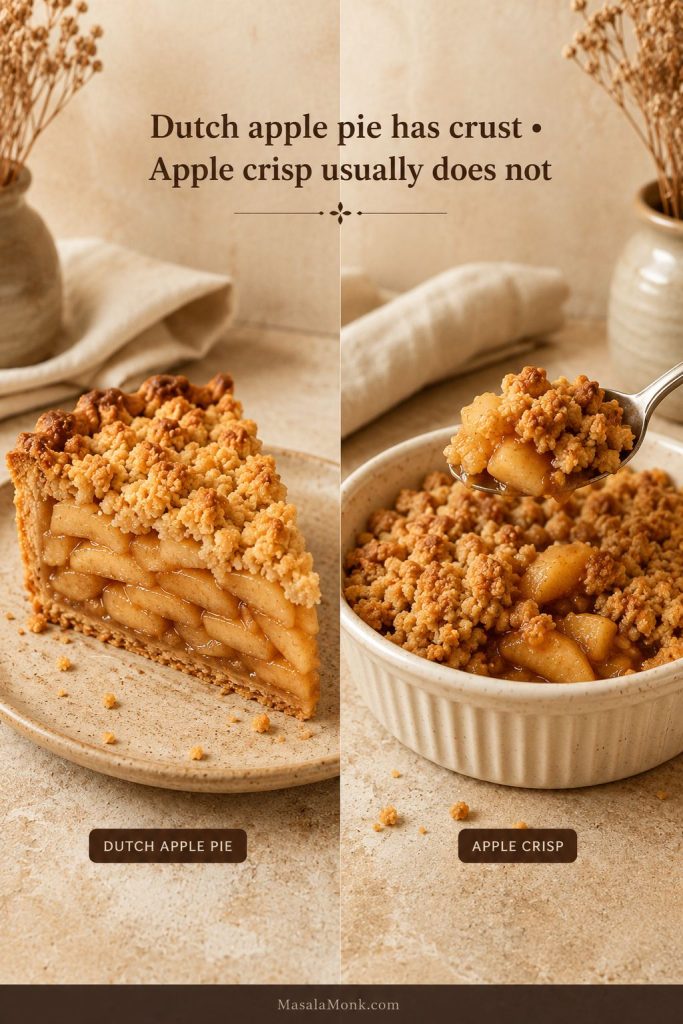
Apple crisp, apple crumble, and Dutch apple pie all live in the same cozy dessert family, but the topping and crust make them different.

Apple crisp, apple crumble, and Dutch apple pie compared with oat topping, crumb topping, and a pie slice with crust.
This comparison helps readers choose the dessert they actually want: chewy oat-topped crisp, softer crumble, or a sliceable Dutch apple pie with crust.
Dessert Has Oats? Has Crust? Texture
Apple crisp Usually yes No Chewy, crumbly, oat-topped
Apple crumble Usually no No Softer, buttery crumb topping
Dutch apple pie Usually no oats Yes, bottom crust Slices like pie with a crumb top

For the crumb-topped pie version, see this Dutch apple pie recipe. For the easiest spoon dessert, stay with apple crisp.

Troubleshooting Apple Crisp

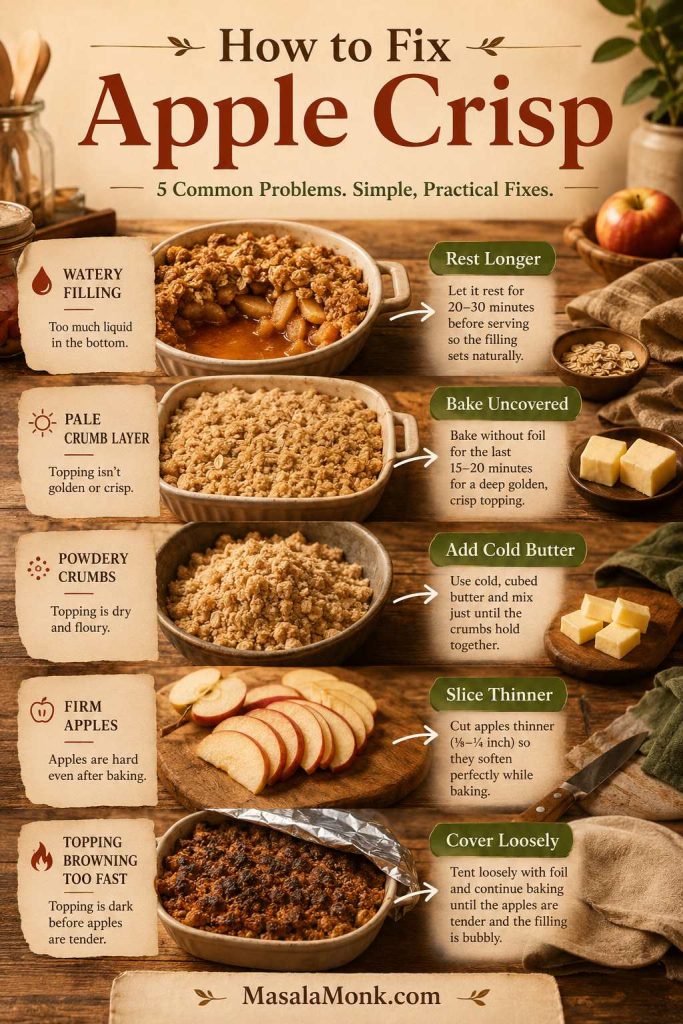
Most apple crisp problems can be fixed or at least improved. If the apples are underbaked, the dish can go back in the oven. If the oat layer is pale, give it more uncovered time. A runny-looking filling may simply need time to rest; hot apple juices thicken as they cool.

Quick Fixes Before You Serve It

Trying to save it right now? If the topping is pale or powdery, put the crisp back in the oven uncovered. If the apples are still firm but the topping is already dark, cover loosely with foil and keep baking. If the filling looks runny, let it rest 20 minutes before deciding it failed; apple juices thicken as they cool.

Apple crisp troubleshooting guide showing fixes for watery filling, pale topping, powdery crumbs, firm apples, and fast browning.
When apple crisp goes wrong, match the fix to the texture: rest runny filling, bake pale topping longer, add cold butter to dry crumbs, or cover fast-browning topping loosely.

Apple Crisp Troubleshooting Chart

Problem Likely Cause How to Fix It
Apple crisp is watery Very juicy apples, too little thickener, underbaking, or not enough resting time Use flour or cornstarch, bake until bubbling, and rest 15–20 minutes before serving
Crumb layer is soggy Butter was too warm, crisp was covered while hot, or it was underbaked Use cold butter, bake until golden, and reheat uncovered
Crumb layer is dry or floury Not enough butter worked into the topping Rub butter in until the mixture forms moist crumbs and clumps
Crumb layer is greasy Butter was too soft or melted before baking Use cold cubed butter; chill the topping briefly in a warm kitchen
Apples are still firm Apple pieces were too thick or the crisp needed more time Slice apples thinner next time; cover loosely with foil and continue baking
Apple crisp is too sweet Sweet apples plus too much sugar Use more tart apples, reduce filling sugar, and add lemon juice
Apple crisp tastes flat Not enough salt, lemon, or spice Add enough salt to both layers and use lemon juice in the apples

If your crisp came out watery, too firm, or softer than expected, drop the apple variety and pan size in the comments. Those two clues usually explain what happened and make it much easier to adjust the next batch.

How Do You Keep Apple Crisp from Getting Watery?

Use a small amount of flour or cornstarch in the apple layer, cut the apples evenly, and bake until the juices are actively bubbling. The bubbling matters because the thickener needs heat to do its job. After baking, let the crisp rest before serving so the juices can settle.

How Do You Keep the Topping Crisp?

Use cold butter, do not overmix the topping into a paste, and do not cover the crisp while it is still hot. If the problem is leftover texture rather than fresh-baked texture, see storage and reheating.

Can You Put Apple Crisp Back in the Oven?

Yes. If the apples are still firm, the topping is pale, or the filling has not bubbled, return the dish to the oven at 350°F / 175°C. If the topping is already brown, cover it loosely with foil and keep baking until the apples are tender.

Make Ahead, Storage, Freezing, and Reheating

Leftover texture tip: Chill the extra crisp safely, then reheat single portions uncovered when you want the oat topping to recover some crunch.

Apple crisp leftovers stored in a covered glass container and reheated uncovered in an oven.
For better leftover texture, keep the extra crisp chilled and reheat single portions uncovered so the oat topping has a chance to crisp again.

Can You Make Apple Crisp Ahead?

Yes. For the best texture, prepare the apple filling and topping separately, refrigerate them, and assemble right before baking. This keeps the topping crumbly. If the whole dish is assembled ahead, the topping can absorb moisture from the apples and bake up softer.

How to Store Apple Crisp

Let the apple crisp cool after serving, then cover and refrigerate leftovers within 2 hours. Store in the refrigerator for 3–4 days. The topping softens as it sits, but the flavor stays good. For general leftover safety, the USDA recommends refrigerating leftovers promptly and using refrigerated leftovers within 3–4 days.

How to Reheat Apple Crisp

For the best topping texture, reheat apple crisp uncovered in a 325°F / 160°C oven until warm. Small portions can also be reheated in an air fryer. The microwave works for speed, but it softens the topping. For the best next-day texture, reheat only what you plan to eat and keep the rest covered in the fridge; repeated reheating softens the oat layer faster.

Can You Freeze Apple Crisp?

Yes, although the topping is best when baked fresh. You can freeze baked apple crisp tightly wrapped, then thaw overnight in the refrigerator and reheat uncovered. You can also freeze the apple filling and topping separately for a fresher result later.

What to Serve with Apple Crisp

Apple crisp is best warm, after a short rest, because the filling has time to settle while the topping still has texture. Vanilla ice cream is the classic pairing because the cold cream melts into the cinnamon apples. Whipped cream, caramel sauce, Greek yogurt, or a spoonful of custard also work.

For a holiday dessert table, apple crisp is easier to serve than pie because it does not need neat slices. Spoon it into bowls, add ice cream, and let the topping do the work.

For another soft, cozy apple dessert that starts with prepared filling, this apple cinnamon roll bake with apple pie filling is closer to a brunch-style bake than a crisp, but it scratches the same cinnamon-apple craving.

FAQs About Apple Crisp

Do you have to peel apples for apple crisp?

No. Peeled apples give a softer, more classic dessert texture. Unpeeled apples add color and texture. If the apple skins are thick or waxy, peeling is usually better.

Is it better to slice or chop apples for apple crisp?

Slices give you a softer, more layered filling, almost like the inside of apple pie. Chunks give you more bite and make the crisp feel fruitier. The best middle ground is thin slices with a few thicker pieces mixed in, so the filling has both softness and texture.

Can quick oats be used instead of old-fashioned oats?

Quick oats work if that is what you have, but they make the topping finer and softer, more like an oatmeal crumble than a chunky crisp. For the best golden, craggy topping, old-fashioned rolled oats are still the better choice.

Why is my apple crisp runny?

Apple crisp is usually runny because the apples were very juicy, the filling did not have enough thickener, the center did not bake long enough, or the crisp was served too soon. Bake until the filling is visibly bubbling, then let it rest for 15–20 minutes so the juices can thicken.

Why is my apple crisp topping powdery?

Powdery topping usually means the butter was not worked in enough. The oat mixture should look like moist crumbs and rough clumps before it goes over the apples. If it still looks dusty, rub in a little more cold butter before baking.

Can apple crisp be made with canned apples?

Yes, but canned apples are softer than fresh apples, so the filling will be more tender and less structured. Drain canned apples well, reduce added sugar if they are packed in syrup, and expect a softer scoop. Apple pie filling also works, although it is already sweetened and thickened, so it needs a shortcut-style method.

For a true shortcut pie rather than a crisp, this apple pie with apple pie filling keeps the focus on prepared filling inside a crust.

What is the difference between apple crisp and apple crumble?

Apple crisp usually has oats in the topping, which gives it more chew and texture. Apple crumble usually leans on flour, butter, and sugar without oats, so the topping is softer and more crumbly. The names overlap in everyday baking, but oats are the easiest clue.

How do you know when apple crisp is done?

The topping should be golden, the filling should be visibly active beneath the surface, and the apples should be tender when pierced with a knife. If the topping is brown but the apples are still firm, cover loosely with foil and bake longer.

Should apple crisp be served warm or cold?

Apple crisp is best warm after a short rest, when the cinnamon juices have settled but the topping still has texture. Cold leftovers are still delicious, especially for breakfast-style snacking, but the topping will be softer.

Can you double apple crisp?

Yes. For a 9×13-inch pan, use 3 1/2–4 pounds / 1.6–1.8 kg apples and increase the topping by about 1 1/2 times. The pan is wider, not just bigger, so give the middle enough time to bake through before serving.

Final Thoughts

Apple crisp is one of those desserts that proves simple baking can still feel generous. You do not need a perfect crust, a fancy pan, or a long ingredient list. You just need apples that hold their shape, cold butter in the topping, enough salt and lemon to wake up the filling, and the patience to let the juices bubble before you pull the pan from the oven.

Serve it warm, give it a few minutes to settle, and add vanilla ice cream if that is the kind of night you want. Then watch what happens to the corner pieces.

What apple mix did you use: Granny Smith and Honeycrisp, Pink Lady and Braeburn, or something local? Leave your combination in the comments, especially if you found an underrated apple that bakes beautifully.

That is the difference between a loose, forgettable apple dessert and a warm, spoonable crisp with a topping people quietly chase around the pan.

Back to top ↑

Posted on 1 Comment

Dutch Apple Pie Recipe

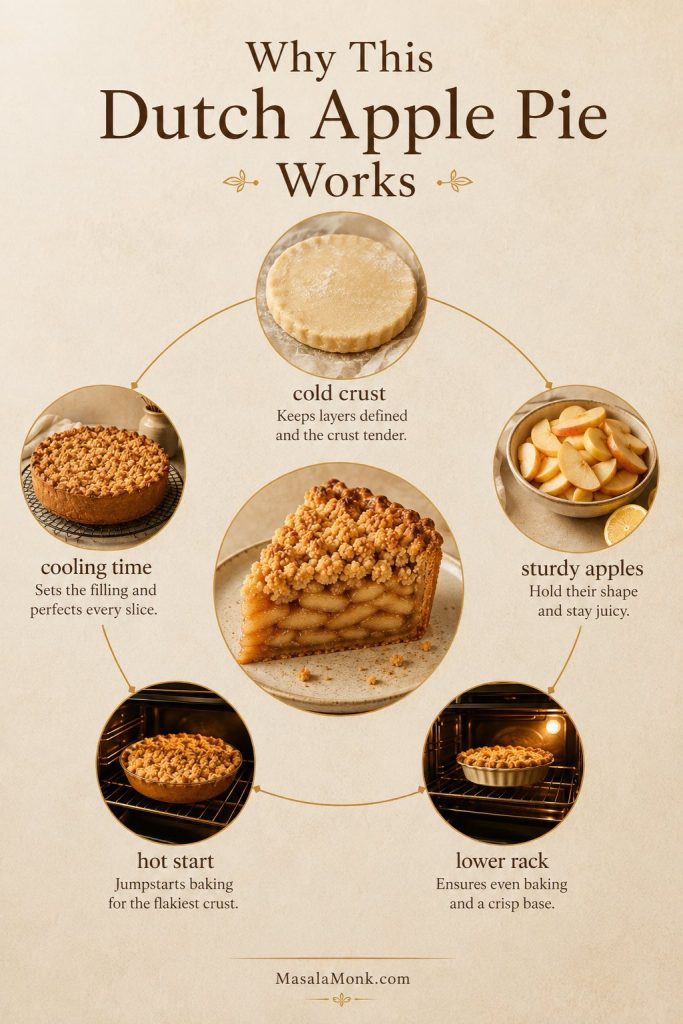
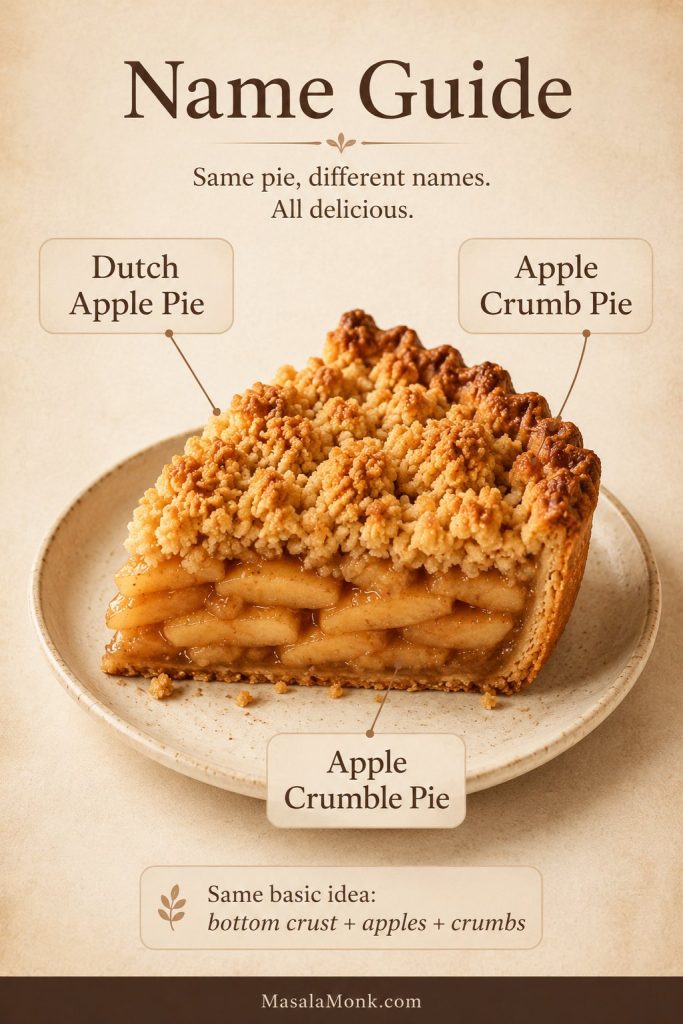
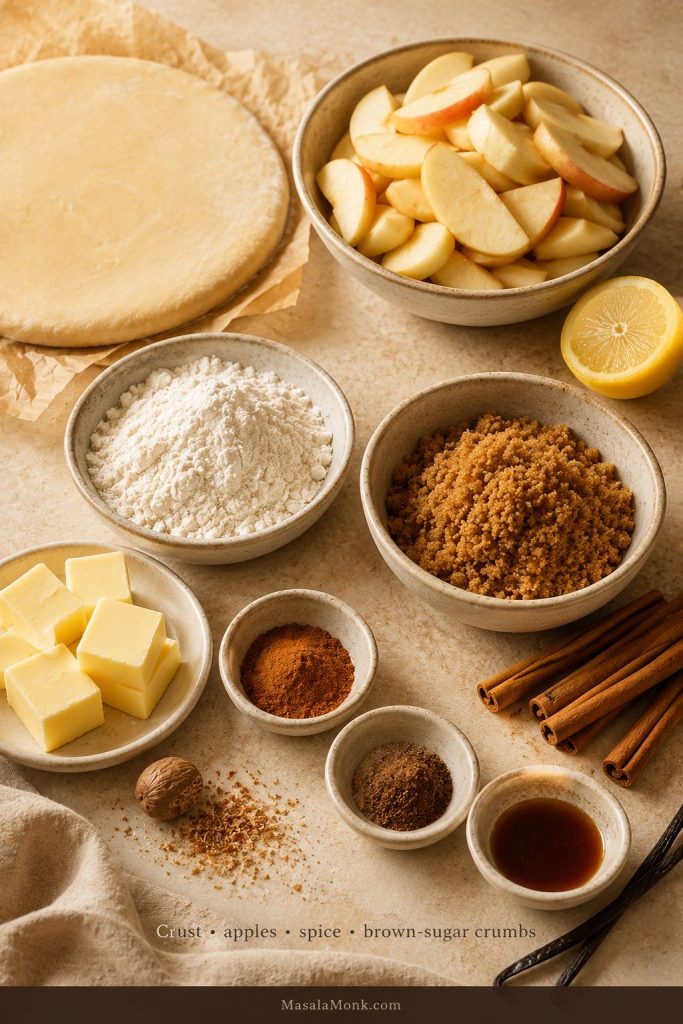
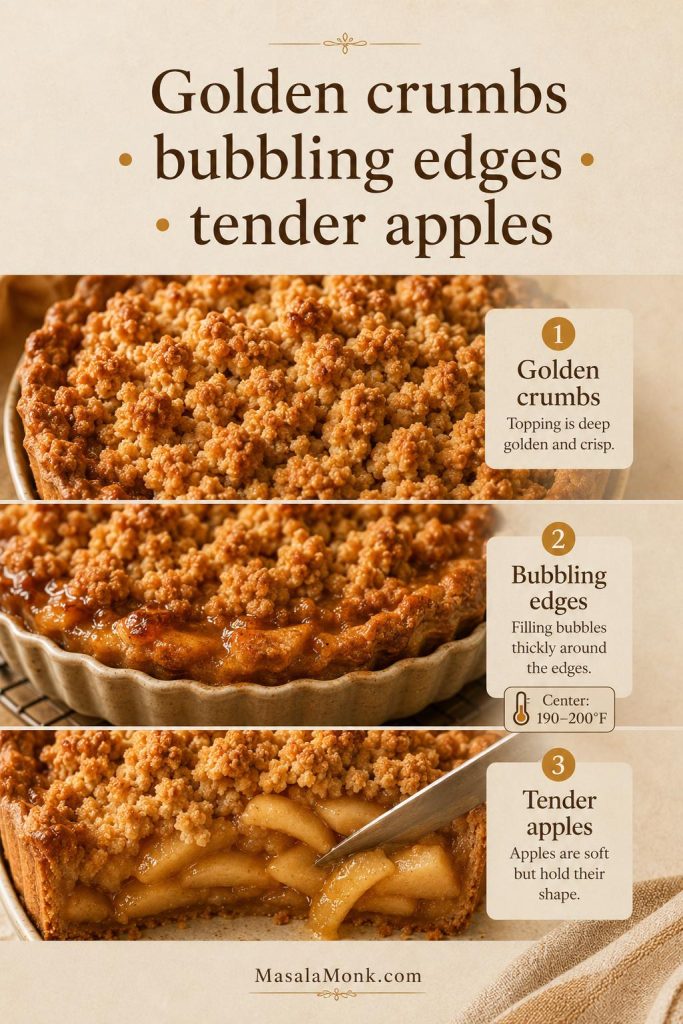
Deep-dish Dutch apple pie with golden crumb topping and a clean slice removed, showing apple filling and bottom crust.

This Dutch apple pie recipe is for the slice everyone wants: a flaky bottom crust, tender cinnamon apples that still hold their shape, and a buttery brown-sugar crumb topping that bakes into golden clusters. It is easier than a lattice apple pie, richer than a plain crumble, and sturdy enough to slice cleanly once it cools.

If you have seen this dessert called apple crumb pie, apple crumble pie, or apple pie with crumb topping, you are in the right place. Although the names overlap, the structure is simple: one bottom crust, a generous apple filling, and a thick layer of cinnamon crumbs on top.

A Sliceable Dutch Apple Pie, Not a Runny Scoop

The method below is built for the problems that usually ruin this kind of pie: a soft bottom crust, apples that shrink under the crumbs, and topping that browns before the center is done. A hot-start bake, lower oven rack, firm apple blend, and full cooling window give the pie its best chance to bake through and slice neatly.

When it works, every forkful gives you the whole point of the pie: flaky crust underneath, soft spiced apples in the middle, and golden buttery crumbs on top.

This is the version to make when you want the comfort of apple crisp, the structure of pie, and a slice that can actually stand up on a plate.

Clean Slice Cue

Clean slice cue: For a slice that stands up on the plate, let the filling settle before cutting. Serve it warm if you like, but not bubbling-hot from the oven.
Clean slice of Dutch apple pie on a plate, showing bottom crust, apple filling, and crumb topping.
Cooling turns the apple layer from loose and glossy into a filling that can hold a clean slice.

Why the Layers Matter

Layer cue: Before baking, check the three jobs: heat for the crust, structure from the apples, and enough butter for clustered crumbs.
Dutch apple pie slice with callouts showing flaky crust, tender apple filling, and golden crumb topping.
Use the layers as a quick check: structure below, tender apples in the middle, and clustered crumbs on top.

Quick Answer

This Dutch apple pie recipe is built around a single-crust apple pie topped with buttery crumbs instead of a second sheet of pastry. For the best homemade version, use about 3 lb / 48 oz / 1.35 kg firm apples sliced 1/4 inch / 6 mm thick. Add them to a chilled single crust in a 9-inch deep-dish pie plate, cover with crumb topping, and bake for 55–65 minutes.

The most reliable oven schedule is 400°F / 200°C for 20 minutes, then 375°F / 190°C for 35–45 minutes more. The pie is done when the topping is golden, the filling bubbles around the edges, and the apples are tender. Let it cool for at least 3 hours before slicing so the filling sets.

Formula cue: Keep the short version in mind before baking: firm apples, even slices, a hot-start oven, and a full cooling window.
Quick answer board showing firm apples, chilled crust, crumb topping, hot-start baking, and cooling time for Dutch apple pie.
When these four cues are in place, the pie has a better chance of baking through without turning loose or runny.

Need more help before baking? Check the best apples, crumb topping, or bake time sections before you start.

Why This Dutch Apple Pie Works

This pie is simple, but a few small details make the difference between a clean slice and a runny scoop. Too much loose apple juice softens the crust, too little butter makes the topping sandy, and soft apples can collapse before the filling sets. The method here keeps those problems in check so you get tender apples, crisp-edged crumbs, and slices that hold together.

Five Details That Protect the Pie

  • A hot-start bake gives the crust a head start. The first 20 minutes at 400°F / 200°C helps the bottom crust set before the apples release too much liquid.
  • Apples with structure keep the filling from collapsing. Granny Smith with Honeycrisp, Braeburn, or Pink Lady gives tartness, sweetness, and shape.
  • Flour thickens the apple juices gently. It gives the filling a classic apple pie texture without turning the center gummy.
  • Melted, slightly cooled butter makes easy crumb clumps. The topping holds together without needing a pastry cutter.
  • A full cooling window gives cleaner slices. The pie tastes wonderful warm, but it slices much better after the filling has had time to settle.

The method works because the protections stack: cold crust, sturdy apples, lower oven rack, hot-start bake, and enough cooling time. Skip one and the pie can still work; skip several and you are much more likely to get a soggy bottom or runny filling.

The Method at a Glance

Method cue: This recipe protects the usual weak spots: a soft bottom crust, collapsed apples, over-browned crumbs, and filling that runs when sliced too soon.
Method board showing cold crust, sturdy apples, lower oven rack, hot-start bake, and cooling time for Dutch apple pie.
Those safeguards work together, so the pie does not depend on one perfect step to bake and slice well.

If you are here because apple pies often turn runny or soft on the bottom, the two most useful sections are how to prevent a soggy bottom and troubleshooting Dutch apple pie.

What Is Dutch Apple Pie?

Dutch apple pie is the crumb-topped cousin of classic apple pie: the same bottom crust and spiced apple filling, but with buttery streusel instead of a second pastry crust. That makes it easier to assemble because you do not have to roll, lattice, vent, or seal a pastry top.

What makes this pie distinct is the topping. It bakes into buttery clumps with crisp edges and a soft cinnamon-brown-sugar center. Meanwhile, the apples underneath soften and release enough juice to make a saucy filling without turning into applesauce.

A chilled bottom crust gives structure, firm apples keep the filling shapely, and the cinnamon crumbs bring the buttery texture that makes this pie so comforting. That is why the top eats a little like apple crisp while the bottom still feels like pie.

Pie vs crisp cue: If the topping reminds you of apple crisp, that is the point. The difference is underneath: Dutch apple pie has a bottom crust, while apple crisp usually does not.
Dutch apple pie slice compared with apple crisp, showing that Dutch apple pie has a bottom crust while apple crisp does not.
Dutch apple pie and apple crisp share a buttery crumb feel, but the bottom crust changes everything. That crust gives the dessert structure, sliceability, and a true pie identity.

Dutch Apple Pie vs Apple Crumble Pie vs Apple Crumb Pie

These names are often used for similar desserts, especially in home baking. The main idea is the same: apples, a bottom crust, and a crumb topping instead of a second pastry crust.

Name Usually Means What to Expect
Dutch apple pie Apple pie with a bottom crust and crumb topping The most common name for this style of pie
Apple crumb pie Apple pie with a crumb topping Same basic dessert, with emphasis on the topping
Apple crumble pie Apple pie with a crumble-style topping Often used when the topping is thicker or more rustic
Apple crisp Baked apples with a crisp or oat-style topping, usually without pie crust More of a baked fruit dessert than a pie

This version is a Dutch apple pie, but it also fits what many bakers mean by apple crumb pie or apple crumble pie: a flaky crust, tender apples, and a generous crumb topping.

Name cue: Searchers use these names differently, but most are looking for the same dessert style: apples in a bottom crust with a crumb, crumble, or streusel-style top.
One crumb-topped apple pie slice labeled Dutch apple pie, apple crumb pie, and apple crumble pie to show overlapping names.
The names often overlap, especially in home baking. Whether someone says Dutch apple pie, apple crumb pie, or apple crumble pie, they usually mean apples, bottom crust, and a crumb-style top.

Ingredients for Dutch Apple Pie

The ingredient list is short, but each part has to pull its weight. The crust needs to stay cold, the apples need enough structure, the filling needs just enough thickener, and the topping needs enough butter to bake into real crumbs instead of loose sugar-flour dust.

Ingredient cue: This recipe does not rely on a long ingredient list. Instead, the results come from handling the basics well: cold dough, firm apples, bright lemon, warm spice, flour, brown sugar, and butter.
Ingredients for Dutch apple pie including apples, pie crust, butter, flour, brown sugar, lemon, vanilla, cinnamon, and nutmeg.
The best results come from simple ingredients handled well: cold dough for structure, firm apples for shape, lemon for brightness, and butter for clustered crumbs.

One Bottom Pie Crust

You need one chilled 9-inch pie crust. Homemade crust gives the best flavor and flake, but a good store-bought crust works if you are focused on the apple filling and crumb topping.

If you want a fully homemade base, use this apple pie crust recipe. For this style, you only need a single bottom crust, not a double crust.

Crust cue: Because there is no top pastry crust, the bottom crust has to carry the slice. Keep it chilled before filling so it has a better chance to set in the oven.
Single unbaked bottom pie crust in a deep-dish pie plate with crimped edges.
Since there is no top pastry crust, the bottom crust has to do the structural work while the crumb layer brings the buttery finish.

Using a shallow pie plate instead of deep-dish? Check the pan-size notes before adding all the apples.

Firm Apples

Use firm baking apples that hold their shape. Granny Smith gives tart structure, while Honeycrisp, Braeburn, Pink Lady, or Golden Delicious can round out the flavor.

The best all-purpose blend is 2 lb Granny Smith plus 1 lb Honeycrisp, Braeburn, or Pink Lady. For a sweeter pie, use half Granny Smith and half Honeycrisp or Golden Delicious.

For a deeper apple-by-apple breakdown, see this guide to the best apples for apple pie.

Peel the Apples for the Smoothest Filling

Peeling gives the smoothest, most classic filling. You can leave the skins on if you like a more rustic pie, but the slices will feel chewier and the skins may separate slightly from the softened apple flesh.

Sugar, Lemon, Flour, and Spices

Granulated sugar sweetens the apples, brown sugar adds warmth, lemon juice brightens the filling, and flour helps thicken the juices as the pie bakes. Cinnamon is essential, while a little nutmeg gives the filling a classic bakery-style aroma.

All-purpose flour works best here because it gives a classic apple pie texture. Cornstarch can work in many fruit fillings, but it can become gummy when overused in a long-baked apple pie.

Buttery Crumb Topping

The crumb layer is made with flour, brown sugar, a little granulated sugar, cinnamon, salt, and melted butter. Once mixed, it should hold together in soft clumps when squeezed. If it looks dusty or powdery, it needs to be worked together a little more.

Best Apples for Dutch Apple Pie

Apple Varieties That Hold Shape

Apple choice cue: A good apple blend needs both flavor and structure. Start with tart Granny Smith, then add one sweet-firm apple so the filling tastes balanced and still holds shape.
Apple selection board for Dutch apple pie with Granny Smith, Honeycrisp, Braeburn, Pink Lady, and Golden Delicious apples.
The best apple blend gives you both flavor and structure. Start with tart Granny Smith, then add a sweet-firm apple such as Honeycrisp, Braeburn, or Pink Lady.

The best apples are firm, flavorful varieties that can survive a long bake without collapsing. Because this pie spends nearly an hour in the oven, avoid soft, mealy, or overripe apples that break down too quickly.

Apple Best Use Flavor / Texture
Granny Smith Best tart backbone Firm, sharp, holds shape well
Honeycrisp Best sweet-tart partner Juicy, crisp, fragrant
Braeburn Best balanced baking apple Sweet-tart, firm, aromatic
Pink Lady Best bright flavor Tart-sweet, firm, lively
Golden Delicious Best softer sweet blend apple Mellow, sweet, less tart

Avoid very soft, mealy, or overripe apples here. They may taste fine raw, but they can collapse during the long bake and leave you with a flatter, wetter filling.

Apple structure cue: Soft apples can taste fine raw but collapse during a long bake. For this pie, firmer slices give you a filling that stays tender instead of turning flat and watery.
Firm apple slices holding shape compared with softer collapsed apple slices after baking.
Apples that taste good raw do not always bake well. For this long-baked apple pie, firm slices are safer because they soften without collapsing into a watery layer.

Slice the apples about 1/4 inch / 6 mm thick. Very thin slices soften faster but can turn compact and jammy. Thick slices can stay firm even when the crust and topping are done.

Slice Thickness for Even Baking

Slice thickness cue: The goal is not paper-thin slices or chunky wedges. Aim for even 1/4-inch slices so the apples soften at the same pace as the crust and crumb topping bake.
Apple slice thickness guide for Dutch apple pie showing too-thin slices, quarter-inch slices, and thick slices.
Even 1/4-inch apple slices bake more predictably. Thin slices can turn jammy, while thick slices may stay too firm after the crust and crumbs are already done.

If your apples are extra juicy or you want neater slices, compare the raw, pre-cooked, and canned filling options before assembling the pie.

Apple Crumb Topping for Dutch Apple Pie

The crumble layer is not just decoration. It is the main reason this pie tastes different from a regular apple pie: buttery, cinnamon-scented, lightly crisp on top, and soft enough underneath to melt into the apples. The goal is chunky crumbs, not loose sugar-flour dust.

Crumb topping cue: The topping should already look like real crumbs before it goes into the oven. If it looks like dry flour and sugar, keep working in the butter until clusters form.
Chunky brown-sugar crumb topping scattered over sliced apples in an unbaked Dutch apple pie.
Once those clumps toast, they become the signature golden top of an apple crumb pie.

For one 9-inch deep-dish pie, use:

  • 1 cup / 4.4 oz / 125 g all-purpose flour
  • 1/2 cup / 3.5 oz / 100 g packed light brown sugar
  • 2 tablespoons / 0.9 oz / 25 g granulated sugar
  • 1 teaspoon ground cinnamon
  • 1/4 teaspoon fine salt
  • 1/2 cup / 4 oz / 113 g unsalted butter, melted and cooled slightly
  • Optional: 1/2 cup / 2 oz / 55–60 g chopped pecans or walnuts

Stir the dry ingredients first, then add the melted butter. Mix until the topping forms damp crumbs. It should not look like loose flour, and it should not become one greasy paste. When squeezed, it should hold together, then break into chunky crumbs.

Melted Butter vs Cold Butter

Melted butter is easiest for this style of topping because it quickly coats the flour and sugar. Let it cool slightly before mixing. Boiling-hot butter can make the crumbs pasty or greasy instead of clumpy.

Butter cue: Melted butter is the easy route here, but it should be slightly cooled. Boiling-hot butter can make the topping pasty instead of crumbly.
Melted butter being poured into a flour, brown sugar, and cinnamon crumb topping mixture.
Slightly cooled butter coats the flour and sugar without turning the mixture greasy.

Oats or No Oats?

Classic Dutch apple pie often uses a flour-based topping without oats. For a more apple-crisp-style texture, replace 1/4 cup / 1 oz / 30 g of the flour with 1/4 cup / 0.9 oz / 25 g old-fashioned oats. Do not use instant oats; they can make the topping feel dusty.

Nuts or No Nuts?

Pecans or walnuts add crunch and a deeper toasted flavor. Leave them out for a smoother, more classic crumb topping, or add them when you want the pie to feel richer and more holiday-ready.

Variation cue: Keep the classic flour crumb for the most traditional Dutch apple pie texture. Add oats for a more apple-crisp feel, or nuts when you want extra toasted crunch.
Classic crumb topping, oat-style crumb topping, and nutty crumb topping variations for Dutch apple pie.
Classic crumbs keep the pie closer to a traditional Dutch apple pie. However, oats make the topping feel more like apple crisp, while nuts add toasted crunch.

Crumb Topping Texture Guide

Texture cue: Use the crumb texture as a quick check before assembly. Sandy topping needs more mixing, while greasy topping needs a brief chill so the crumbs separate again.
Crumb topping texture guide showing dry crumbs, just-right clumpy crumbs, and greasy pasty crumbs.
If the topping looks sandy, keep working in the butter; if it looks greasy, chill it briefly so the crumbs can separate again.
What You See What It Means How to Fix It
Dry and sandy The butter has not been worked in enough Press the mixture with your fingers until clumps form
Wet and pasty The butter was too hot or the topping was overmixed Chill 10 minutes, then break into crumbs
Huge greasy chunks The topping was over-compressed Break apart gently before adding to the pie
Browning too fast The topping is exposed to heat before the apples are done Tent loosely with foil once golden
Soft after storage The pie was covered warm or refrigerated Reheat slices uncovered in the oven
Crumb topping cue: The topping should feel like damp, clumpy sand. Keep mixing and pressing when it will not hold together after a squeeze. A greasy mixture only needs a brief chill before you break it back into crumbs.

For sandy, greasy, or overly dark crumbs, the troubleshooting section gives quick fixes without changing the whole recipe.

The Pan and Tools That Matter Most

You do not need anything fancy. The three tools worth caring about most are a deep-dish pie plate, a rimmed baking sheet, and something to protect the crust edges if they brown early.

  • 9-inch deep-dish pie plate: holds the full 3 lb / 48 oz / 1.35 kg apple filling.
  • Rimmed baking sheet: catches drips and gives the pie a stable surface in the oven.
  • Foil or pie shield: protects the crust edge or crumbs if they brown before the apples are tender.
  • Large mixing bowl: gives the apples room to coat evenly with sugar, flour, lemon, and spices.
  • Small mixing bowl: keeps the topping separate until assembly.
  • Rolling pin: needed if you are using homemade pie crust.
  • Apple peeler, corer, or sharp knife: helps keep the slices even.
  • Instant-read thermometer: optional, but useful if you want a doneness cue beyond color and bubbling.

A metal pie plate browns the bottom crust more quickly, while glass lets you see the crust color but heats more slowly. With glass, the lower rack and full bake time matter even more.

Choosing Metal or Glass

Pan cue: Your pie plate changes how the bottom crust bakes. Metal gives the crust faster heat, while glass lets you check color but often needs the full bake time.
Metal and glass pie plates compared for Dutch apple pie, with crust-browning cues.
Metal gives the bottom crust a faster start, which helps browning. Glass lets you watch the crust color, but it usually needs the full bake time to perform well.

Using a Regular 9-Inch Pie Plate?

The amounts here are sized for a deep-dish 9-inch pie plate. For a shallow or standard-depth plate, use about 2 1/2 lb / 40 oz / 1.1 kg apples instead of the full 3 lb. Do not force every apple slice into the crust; an overfilled shallow pie can overflow, bake unevenly, and soften the bottom crust.

Pan-size cue: The apple amount depends on the depth of your plate. A deep-dish pan can take the full 3 pounds, but a shallow 9-inch plate needs less filling to bake cleanly.
Deep-dish pie plate and regular 9-inch pie plate compared with different apple filling amounts.
A deep-dish pie plate can handle more apples. In a shallow 9-inch plate, reduce the filling so the pie bakes evenly instead of overflowing or softening the bottom crust.

You can also use slightly less crumb topping if the pie is very full. Place the pie on a rimmed baking sheet and start checking for doneness around 50 minutes.

How to Make Dutch Apple Pie

Once the crust is cold, the apples are sliced evenly, and the crumbs hold together when squeezed, the assembly is straightforward. The main thing is to keep the crust chilled and give the pie enough time in the oven for the filling to bubble.

Step 1: Roll and Chill the Crust

Roll one pie crust into a 12-inch circle and fit it into a 9-inch deep-dish pie plate. Trim and crimp the edges, then chill the crust while you prepare the apples and crumb topping.

Chilling gives the bottom crust a better chance to set before the apple juices release fully.

Step 1 cue: Start with the crust cold and shaped before you deal with the filling. That gives the dough structure before the apples release moisture.
Hands crimping an unbaked pie crust in a deep-dish pie plate for Dutch apple pie.
A cold, crimped crust gives the pie a stronger base before the apples release moisture and the crumb topping begins to brown.

Step 2: Peel, Core, and Slice the Apples

Peel and core the apples, then slice them about 1/4 inch / 6 mm thick. Keep the slices as even as possible so they soften at the same rate.

Step 2 cue: Even slicing is more important than perfect-looking slices. When the apple pieces are similar in thickness, they soften together instead of baking unevenly.
Peeled apples being sliced evenly with a knife for Dutch apple pie filling.
Even apple slices soften at the same pace. As a result, the filling bakes more evenly and avoids the mix of mushy pieces and underbaked chunks.

Step 3: Toss the Apple Filling

In a large bowl, toss the sliced apples with granulated sugar, brown sugar, flour, lemon juice, cinnamon, nutmeg, salt, and vanilla. Let the mixture sit for 10 minutes while you make the topping.

Step 3 cue: Coat the slices evenly before they go into the crust. Flour, sugar, lemon, and spice need to reach the apples throughout the bowl, not sit in dry patches.
Apple slices tossed in a bowl with sugar, flour, lemon, cinnamon, nutmeg, salt, and vanilla.
Even coating matters because the flour cannot thicken the apple juices properly if it stays in dry patches at the bottom of the bowl.

That short rest lets the sugar begin drawing moisture from the apples. A little syrup in the bottom of the bowl is normal; if the slices are sitting in a visible puddle, lift the apples into the crust and leave most of that liquid behind.

Liquid control cue: After the apples rest, some syrup is normal. When you see a real puddle, spoon the apples into the crust and leave the extra liquid behind.
Spoon lifting spiced apple slices from a bowl with syrup pooled at the bottom.
This is the moment to protect the crust: spoon in the apples, not the full syrup at the bottom of the bowl.

This liquid-control step is also one of the easiest ways to avoid a soft crust; for the full prevention list, see how to keep Dutch apple pie from getting soggy.

Step 4: Make the Crumb Topping

Stir flour, brown sugar, granulated sugar, cinnamon, and salt in a bowl. Add melted, slightly cooled butter and mix until the topping forms chunky crumbs. When squeezed in your hand, it should hold together, then break apart easily.

Step 4 cue: The squeeze test tells you if the topping is ready. It should hold together in your hand, then break apart into irregular brown-sugar crumbs over the apples.
Hand squeezing Dutch apple pie crumb topping to show clumps that hold together and crumble apart.
Use the squeeze test before topping the pie. The mixture should hold together in your hand, then break into chunky brown-sugar crumbs over the apples.

Now place a rack in the lower third of the oven and heat the oven to 400°F / 200°C. The lower rack gives the bottom crust more direct heat, while the crumbs still brown from above.

Oven rack cue: Use the lower rack for stronger bottom heat, and keep the pie on a rimmed baking sheet to catch bubbling juices.
Dutch apple pie on a rimmed baking sheet being placed on the lower oven rack.
Think of the rimmed sheet as support and insurance: it steadies the pie, catches drips, and lets the bottom crust get stronger heat.

Step 5: Fill the Pie

Spoon the apples into the chilled crust, mounding them slightly in the center. Do not worry if the apples sit a little high before baking; they settle as they soften. Scatter the crumb topping over the apples and press it just lightly enough to stay in place without compacting it.

Assembly cue: A slight apple mound is fine before baking because the slices settle in the oven. Scatter the crumbs gently so the topping stays textured instead of packed flat.
Dutch apple pie crust filled with mounded apple slices while crumb topping is scattered over the top.
Mound the apples gently, then scatter the crumbs without pressing hard; that way, the filling can settle while the topping keeps its texture.

Step 6: Bake Hot, Then Lower the Heat

Place the assembled pie on a rimmed baking sheet and bake at 400°F / 200°C for 20 minutes. Without removing the pie, reduce the oven temperature to 375°F / 190°C and bake for 35–45 minutes more.

If the crumbs or crust edges brown too quickly, usually after the first 30–35 minutes, tent the pie loosely with foil. Do not seal it tightly, or trapped steam can soften the top.

Foil cue: Use foil as a shield, not a lid. A loose tent protects the crumbs and crust edge without sealing in steam.
Dutch apple pie on a baking sheet with foil loosely tented over the browned crumb topping.
The foil should hover over the pie, protecting the top while still letting steam escape.

Not sure whether the pie is fully baked? Use the bake time and doneness cues before pulling it from the oven.

Step 7: Cool Before Slicing

Cool the pie for at least 3 hours before slicing. As the pie cools, the filling keeps thickening. The pie can be warm when served, but not straight-from-the-oven hot if you want clean slices.

Cooling cue: When the pie comes out of the oven, the filling is still setting. Give it the cooling window so the apple layer thickens before you cut into it.
Finished Dutch apple pie cooling on a wire rack with golden crumb topping and an intact crust.
Treat cooling as part of the recipe; this is when the filling becomes sliceable.

How Long to Bake Dutch Apple Pie

A deep-dish pie made with raw sliced apples usually needs 55–65 minutes total bake time.

Two-Temperature Bake Schedule

Bake-time cue: The two-temperature bake has a purpose: strong heat first for the crust, then gentler heat so the apples can finish without scorching the crumb topping.
Dutch apple pie bake time guide showing 400°F for 20 minutes, 375°F for 35 to 45 minutes, and cooling for 3 hours.
The two-temperature bake gives the pie a better balance: strong heat first for the crust, then gentler heat so the apples finish without scorching the crumbs.
Stage Temperature Time What It Does
Hot start 400°F / 200°C 20 minutes Gives the crust a head start and begins browning
Gentle finish 375°F / 190°C 35–45 minutes Softens apples and thickens filling without burning topping
Cooling Room temperature At least 3 hours Lets the filling settle for cleaner slices

Do not pull the pie just because the crumbs look golden. The filling also needs to bubble and the apples need to feel tender; otherwise, the crust and topping may look done while the center still needs time.

Look for golden brown crumbs, bubbling juices around the edges, and apples that feel tender when pierced with a thin knife. An instant-read thermometer is optional, but the center of the filling should be about 190–200°F / 88–93°C.

Doneness Cues Beyond Color

Doneness cue: Golden crumbs are only part of the test. Look for bubbling edges and tender apples before pulling the pie from the oven.
Dutch apple pie doneness guide showing golden crumbs, bubbling edges, tender apples, and a center temperature of 190 to 200°F.
Color is only the first clue; bubbling edges and tender apples confirm the filling has had enough time to thicken.

Should You Par-Bake the Crust for Dutch Apple Pie?

You can usually skip par-baking for this raw-apple Dutch apple pie recipe as long as the crust gets three protections: a cold start, a lower oven rack, and enough total bake time. The apples need nearly an hour in the oven anyway, so the bottom crust has time to cook through.

Par-baking becomes more helpful when the filling is already cooked, canned, or unusually wet. In those cases, the filling may not need as much oven time after assembly, so the crust benefits from a head start.

Par-bake cue: Par-baking is not a blanket rule for this pie. Raw apples need a long bake anyway, while cooked, canned, or very wet fillings may need extra crust protection.
Par-bake decision guide showing raw apples usually do not need par-baking, while pre-cooked, canned, or very juicy fillings may benefit from it.
Par-baking depends on the filling. Raw apples need the long bake, while pre-cooked or canned filling may benefit from giving the crust a head start.
Situation Par-Bake? Why
Raw apple filling, this recipe Usually no The long bake gives the crust enough time to cook
Pre-cooked apple filling Helpful The filling is already soft, so the assembled pie may bake for less time
Canned apple pie filling Helpful Canned filling is soft, sweet, and already thickened
Very juicy apples Optional Par-baking adds extra protection against a soft bottom crust
Glass pie plate More helpful Glass heats more slowly than metal
Metal pie plate Less necessary Metal conducts heat faster and helps the bottom crust brown

How to Keep Dutch Apple Pie from Getting Soggy

A soggy bottom usually comes from one of three places: too much loose apple juice, not enough heat under the crust, or slicing before the filling has settled. This style of pie is especially vulnerable because it has a juicy fruit filling and only one crust.

Three Causes to Control

Soggy-bottom cue: A soft bottom crust usually comes from too much loose apple juice, not enough heat under the pie, or slicing before the filling has set. Control those three points and the pie becomes easier to trust.
Soggy-bottom prevention board showing liquid control, lower oven rack baking, and cooling time for Dutch apple pie.
Use this as a quick pre-bake check: manage liquid first, then rely on lower-rack heat and cooling time.
  • Chill the crust before filling. Cold dough holds its structure better in the oven.
  • Choose apples with structure. Soft apples collapse quickly and release more liquid.
  • Do not pour in all pooled apple juice. Spoon in the apples, but leave excess liquid behind if the bowl is very wet.
  • Use enough thickener. Flour helps bind the juices as the pie bakes.
  • Bake on a lower rack. This gives the bottom crust more direct heat.
  • Use a rimmed baking sheet. It catches drips and keeps the pie stable.
  • Give the filling a full cooling window. Cutting too early makes even a well-baked pie look runny.
  • Do not cover while warm. Trapped steam softens the crumb layer and crust.

Optional Crust Barrier

For an extra barrier against fruit juices, King Arthur Baking suggests using a thin layer of “crust dust” on the bottom crust before adding fruit filling. It is optional, but useful if you often struggle with soggy pie bottoms. You can read their technique here: King Arthur Baking’s crust dust method.

Raw Apples vs Pre-Cooked Apple Filling

All three routes can work, but they give you different pies. Fresh apple slices taste brighter and more classic, pre-cooked filling slices more neatly, and canned filling is the fastest shortcut when you want the crumb-topped version with less prep.

Filling route cue: The filling route changes the final pie. Fresh slices taste brighter, cooked filling can slice more neatly, and canned apple pie filling is the fastest shortcut.
Three bowls comparing raw spiced apple slices, pre-cooked apple filling, and canned apple pie filling.
Choose fresh slices for brighter flavor, pre-cooked filling for neater pieces, or canned apple pie filling when time matters most.
Method Best For Tradeoff
Raw sliced apples Easiest classic pie More shrinkage and more juice management
Pre-cooked apple filling Neater slices, make-ahead baking, less gap under topping Extra step; filling must cool before going into crust
Canned apple pie filling Fastest shortcut Softer, sweeter, less fresh-tasting

I use raw apples here because the full 55–65 minute bake gives them enough time to soften while keeping the flavor fresher and less jammy. Even slices, enough thickener, and visible bubbling are the keys.

Pre-cooked filling is better when you want less shrinkage, fewer hollow gaps under the topping, or cleaner slices for a holiday table. It is also useful if you want to make the filling ahead. Just cool it completely before adding it to the crust; warm filling can melt the butter in the dough and make the bottom crust heavy.

If you want the make-ahead route, use cooled homemade filling from this apple pie filling recipe.

Dutch Apple Pie with Canned Apple Pie Filling

Canned apple pie filling works when you want the shortcut version, but it needs a lighter hand. Because it is already sweetened, softened, and thickened, skip the flour, reduce the sugar, and wake it up with lemon juice, cinnamon, and a small pinch of salt.

Shortcut cue: Canned filling is already soft, sweet, and thickened, so it needs balance more than more sugar. Lemon, cinnamon, and salt make the shortcut taste brighter.
Canned apple pie filling in a bowl with lemon juice, cinnamon, and a pinch of salt added.
Canned apple pie filling works better after a few small fixes. Lemon brightens it, cinnamon warms it, and a pinch of salt balances the sweetness.

If you are using canned filling because you need a faster pie, the par-bake section is worth checking before you assemble it.

How to Adjust Canned Apple Pie Filling

  • Use about 2 cans, 20–21 oz each, for one 9-inch pie.
  • Do not add the flour from the raw-apple filling.
  • Skip most or all of the added sugar in the apple layer.
  • Brighten the flavor with 1 tablespoon / 0.5 fl oz / 15 ml lemon juice.
  • Stir in 1/2 teaspoon cinnamon if the filling tastes flat.
  • Balance the sweetness with a small pinch of salt.
  • Use the same brown-sugar crumb topping listed above.
  • Consider par-baking the crust because canned filling needs less time in the oven.
  • If your pie plate is shallow, do not force in both full cans; leave a little behind rather than overfilling.

Bake Time for the Shortcut Version

A canned-filling version may bake closer to 45–55 minutes, depending on the crust, pan, and whether the filling went in cold or at room temperature. Bake until the crumb topping is golden and the filling bubbles. Cool fully before slicing, because canned filling can look thick while hot but loosen once cut.

For a full shortcut pie, see this apple pie with apple pie filling.

If you have extra filling after baking, it can also go into easy desserts like this apple cinnamon roll bake with apple pie filling.

How to Serve Dutch Apple Pie: Warm, Room Temperature, or Reheated

Dutch apple pie is best after it has cooled long enough to slice cleanly. Serve it at room temperature, gently warmed, or with vanilla ice cream if you want the contrast of warm apples and cold cream. A small drizzle of caramel works too, but the pie is already sweet enough that it does not need much.

For the cleanest slices, cool the pie completely first, then rewarm individual pieces in a 325°F / 160°C oven for 10–15 minutes before serving.

Planning this for Thanksgiving or a holiday table? The make-ahead and reheating section gives the cleanest workflow.

Make Ahead, Storage, Freezing, and Reheating

Dutch apple pie is best the day it is baked, after it has cooled enough to slice cleanly. You can still make several parts ahead, which is helpful for Thanksgiving, fall dinners, and holiday baking days.

Make-ahead cue: For a holiday workflow, do not wrap or freeze the pie while it is hot. Bake it, cool it fully, then freeze or reheat uncovered when needed.
Make-ahead workflow showing pie dough and crumbs prepared ahead, baked pie cooling, frozen pie storage, and reheating uncovered.
For the smoothest holiday workflow, prepare the dough and crumbs early, then bake the pie fully before freezing or reheating.

What to Prep Ahead

Part Make-Ahead / Storage What Matters
Pie dough Refrigerate 2–3 days or freeze up to 3 months Let it soften slightly before rolling
Crumb topping Refrigerate up to 2 days Break into crumbs again before using
Raw apple filling Best made the same day Apples release liquid as they sit
Cooked apple filling Refrigerate 2–3 days Cool completely before filling crust
Baked pie Room temperature up to 2 days; refrigerate leftovers 3–4 days Keep loosely covered once fully cool
Baked pie, frozen Freeze fully cooled pie up to 2–3 months Thaw overnight in the refrigerator, then reheat uncovered at 325°F / 160°C
Reheating 325°F / 160°C for 15–20 minutes Reheat uncovered to help the topping crisp

For a holiday workflow, make the pie dough and crumb topping ahead, then bake the pie the day before you need it. Let it cool fully, keep it loosely covered, and rewarm slices or the whole pie uncovered before serving.

Freezing and Reheating the Baked Pie

For the best texture, freeze the pie after baking and cooling. Wrap it well once completely cool, freeze for up to 2–3 months, thaw overnight in the refrigerator, and reheat uncovered so the buttery crumbs can crisp back up. An unbaked pie can be frozen too, but raw apples release more liquid as they thaw, so the baked-and-cooled route is easier to control.

Can You Make Dutch Apple Pie the Day Before Thanksgiving?

Yes. Bake the pie the day before, cool it completely, and keep it loosely covered. Reheat it uncovered at 325°F / 160°C until warmed through. The crumb topping is crispest the day the pie is baked, but reheating uncovered helps bring back some texture.

Refrigeration is useful after the first couple of days, but it will soften the crumb topping. For the best texture, reheat slices in the oven instead of the microwave.

For food-safety storage guidance, Iowa State University Extension notes that fruit pies made with sugar can be stored at room temperature for up to two days, then refrigerated for additional storage. See their pie storage guidance here: ISU Extension pie storage guide.

Troubleshooting Dutch Apple Pie

Do not judge the pie while it is still hot. Many problems that look serious right out of the oven, especially loose filling, improve as the pie cools and the juices thicken.

Most real issues come down to moisture, timing, or crumb texture. Once you know which one caused the problem, the fix is usually simple.

Troubleshooting cue: Most problems trace back to moisture, timing, or crumb texture. Match the symptom first, then adjust the next bake.
Troubleshooting guide for Dutch apple pie showing fixes for runny filling, soggy bottom, firm apples, sandy crumbs, over-browned topping, and browned crust edges.
Match the symptom first, then adjust moisture, timing, or crumb texture without rebuilding the whole recipe.

Filling and Crust Problems

Problem Likely Cause Fix
Soggy bottom crust Too much apple juice, underbaked crust, or pie cut too soon Use lower rack, hot start, sturdy apples, and a full cooling window
Runny filling Not enough thickener, underbaked apples, or sliced while too hot Bake until bubbling and let the filling fully settle before slicing
Apples stay too firm Slices too thick or bake time too short Slice 1/4 inch / 6 mm thick and bake until the juices bubble
Large gap under the crumbs Raw apples shrank during baking Mound the apples slightly, slice them evenly, or use cooled pre-cooked filling
Filling tastes flat Apples were very sweet or the filling needed more balance Add lemon juice and a pinch of salt next time

Crumb Topping and Baking Problems

Problem Likely Cause Fix
Crumb topping is sandy Butter was not worked into the dry ingredients enough Press the mixture into clumps, then break it into crumbs
Crumb topping is greasy Butter was too hot or the topping was overmixed Chill the topping for 10 minutes, then crumble it again
Topping burns before apples soften Top heat is too strong or the pie needs a longer bake Tent loosely with foil after the crumbs turn golden
Crust edge burns The edge was exposed too long Use foil or a pie shield after the first 20–30 minutes
Pie overflows Pie plate was too shallow or the filling had too much liquid Use a deep-dish plate, leave excess juice behind, and bake on a rimmed sheet

Most of these problems are easy to prevent once you control moisture, heat, and cooling time. With sturdy apples, a cold crust, and a full cooling window, the oven does most of the work; the reward is a pie that smells like cinnamon, cuts cleanly, and still tastes like real apples.

Before you slice: The pie should look settled, not loose and bubbling-hot. The crumbs will be golden, the apple juices will have thickened around the edges, and the filling will hold better after a full cooling window.

Dutch Apple Pie Recipe

This deep-dish Dutch apple pie has tender spiced apples, a flaky bottom crust, and a buttery brown-sugar crumb topping that bakes into golden clusters.

Yield1 deep-dish 9-inch pie
Servings8–10
Prep Time35 minutes
Bake Time55–65 minutes
Cooling Time3 hours
Total TimeAbout 4 hours 30–40 minutes
Oven400°F, then 375°F
Pan9-inch deep-dish pie plate

Ingredients

Crust

  • 1 unbaked 9-inch pie crust, chilled

Apple Filling

  • 3 lb / 48 oz / 1.35 kg firm apples, peeled, cored, and sliced 1/4 inch / 6 mm thick
  • 1/2 cup / 3.5 oz / 100 g granulated sugar
  • 2 tablespoons / 0.9 oz / 25 g packed light brown sugar
  • 3 tablespoons / 0.85 oz / 24 g all-purpose flour
  • 1 tablespoon / 0.5 fl oz / 15 ml fresh lemon juice
  • 1 1/2 teaspoons ground cinnamon
  • 1/4 teaspoon ground nutmeg
  • 1/4 teaspoon fine salt
  • 1 teaspoon / 5 ml vanilla extract
  • Optional: 1 tablespoon / 0.5 oz / 14 g melted unsalted butter

Crumb Topping

  • 1 cup / 4.4 oz / 125 g all-purpose flour
  • 1/2 cup / 3.5 oz / 100 g packed light brown sugar
  • 2 tablespoons / 0.9 oz / 25 g granulated sugar
  • 1 teaspoon ground cinnamon
  • 1/4 teaspoon fine salt
  • 1/2 cup / 4 oz / 113 g unsalted butter, melted and cooled slightly
  • Optional: 1/2 cup / 2 oz / 55–60 g chopped pecans or walnuts

Instructions

  1. Prepare the crust. Roll the pie dough into a 12-inch circle and fit it into a 9-inch deep-dish pie plate. Trim, crimp, and chill while you prepare the filling.
  2. Slice the apples. Peel, core, and slice apples about 1/4 inch / 6 mm thick.
  3. Make the filling. In a large bowl, toss apples with granulated sugar, brown sugar, flour, lemon juice, cinnamon, nutmeg, salt, vanilla, and melted butter if using. Let sit for 10 minutes; leave behind excess pooled liquid if the bowl looks very wet.
  4. Make the crumb topping. In another bowl, mix flour, brown sugar, granulated sugar, cinnamon, and salt. Add melted cooled butter and stir until clumpy crumbs form. Add nuts if using.
  5. Prepare the oven. Place a rack in the lower third of the oven and heat to 400°F / 200°C. Set a rimmed baking sheet nearby for baking the pie.
  6. Fill the crust. Spoon apples into the chilled crust, leaving behind excess pooled liquid if the bowl is very wet. Mound apples slightly in the center.
  7. Add topping. Sprinkle crumb topping evenly over the apples. Press lightly so the crumbs sit in place without compacting them.
  8. Bake. Place the pie on the rimmed baking sheet. Bake at 400°F / 200°C for 20 minutes. Reduce heat to 375°F / 190°C and bake 35–45 minutes more, until the topping is golden and the filling bubbles around the edges.
  9. Protect if needed. If the crumbs or crust edges brown too quickly, usually after the first 30–35 minutes, tent loosely with foil.
  10. Cool. Let the pie cool at least 3 hours before slicing.

Notes

  • Best apple blend: Use 2 lb Granny Smith plus 1 lb Honeycrisp, Braeburn, or Pink Lady.
  • Regular pie plate: For a shallow 9-inch pie plate, use about 2 1/2 lb / 40 oz / 1.1 kg apples.
  • Do not overfill: Extra apples in a shallow plate can cause overflow and a softer bottom crust.
  • Very juicy apples: Use 1 extra tablespoon / about 0.3 oz / 8 g flour and be strict about leaving pooled liquid behind.
  • Optional butter in filling: Add it for a slightly richer apple layer, or leave it out for a cleaner fruit flavor.
  • Salted butter: If using salted butter in the crumb topping, reduce the added salt to a small pinch.
  • Oat crumb variation: Replace 1/4 cup / 1 oz / 30 g flour with 1/4 cup / 0.9 oz / 25 g old-fashioned oats.
  • Canned filling shortcut: Use 2 cans of apple pie filling, skip the flour and most added sugar in the apple layer, and consider par-baking the crust.
  • Cleaner slices: Cool completely, then rewarm individual pieces before serving.

FAQs

What makes Dutch apple pie different from regular apple pie?

Dutch apple pie has a bottom crust and a crumb or streusel topping. Regular apple pie usually has a second pastry crust on top, either solid, vented, or arranged as a lattice.

Is Dutch apple pie the same as apple crumb pie or apple crumble pie?

In many home-baking recipes, yes. Apple crumb pie and apple crumble pie usually emphasize the crumb layer, while Dutch apple pie is the more common name for the full pie style with a bottom crust, apple filling, and streusel-style top.

Should the apples be cooked before baking?

Raw apples work well in this recipe because the pie bakes long enough for them to soften. Pre-cooked apples are useful when you want less shrinkage, fewer gaps under the topping, or a make-ahead filling.

Should the crust for this Dutch apple pie recipe be par-baked?

For the raw-apple version, par-baking is usually not required. A chilled crust, hot-start bake, and lower oven rack are enough for most pies. Par-baking is more useful with canned filling, pre-cooked filling, glass pie plates, or very juicy apples.

Do I have to peel the apples?

Peeling gives the smoothest, most classic filling. Unpeeled apples work if you like a rustic texture, but the skins can feel chewy after baking.

Why is there a gap under my crumb topping?

A gap usually means the raw apples shrank while baking. Mound the apples slightly, slice them evenly, and avoid overly soft apples. For the most compact filling, use cooled pre-cooked apple filling.

Why did my crumb topping turn sandy?

The butter probably was not worked into the flour and sugar enough. Press the mixture between your fingers until it forms clumps before sprinkling it over the apples.

How long should Dutch apple pie cool before slicing?

Give it at least 3 hours. The filling thickens as it cools, so a pie that would run if sliced hot can still cut beautifully later.

Can I bake Dutch apple pie the day before Thanksgiving?

Yes. Bake it the day before, cool it completely, and keep it loosely covered. Reheat uncovered at 325°F / 160°C before serving if you want the pie warm and the crumbs a little crisper.
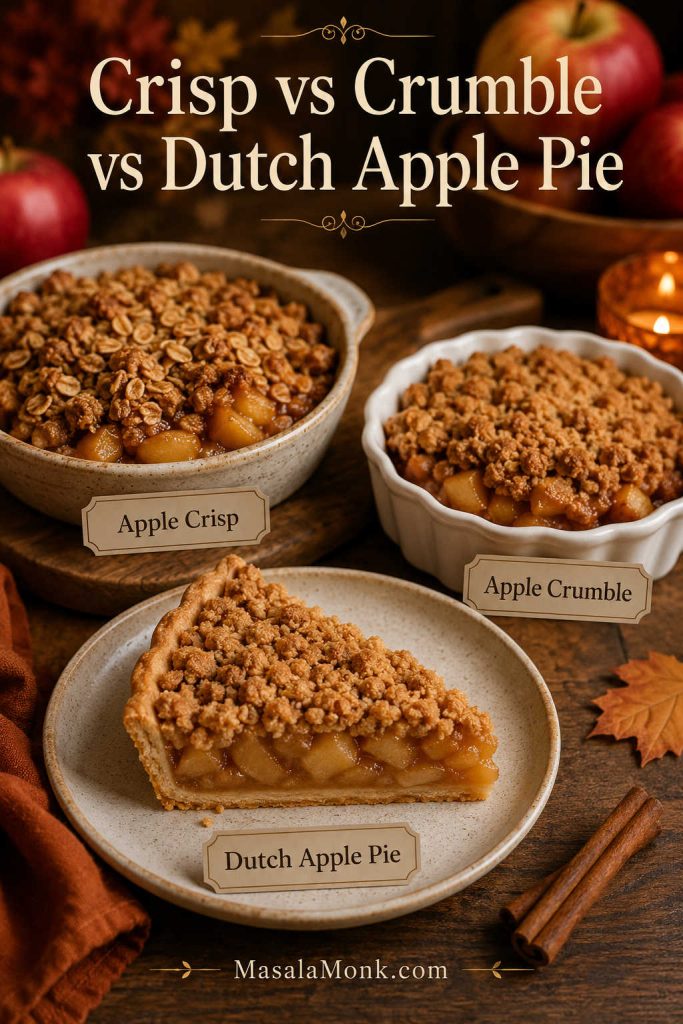
Can I use canned apple pie filling?

Canned apple pie filling works well for a shortcut version, especially when you brighten it with lemon juice and balance the sweetness with a pinch of salt. Use about two 20–21 oz cans for a 9-inch pie, skip most added sugar, and do not add flour to the filling.
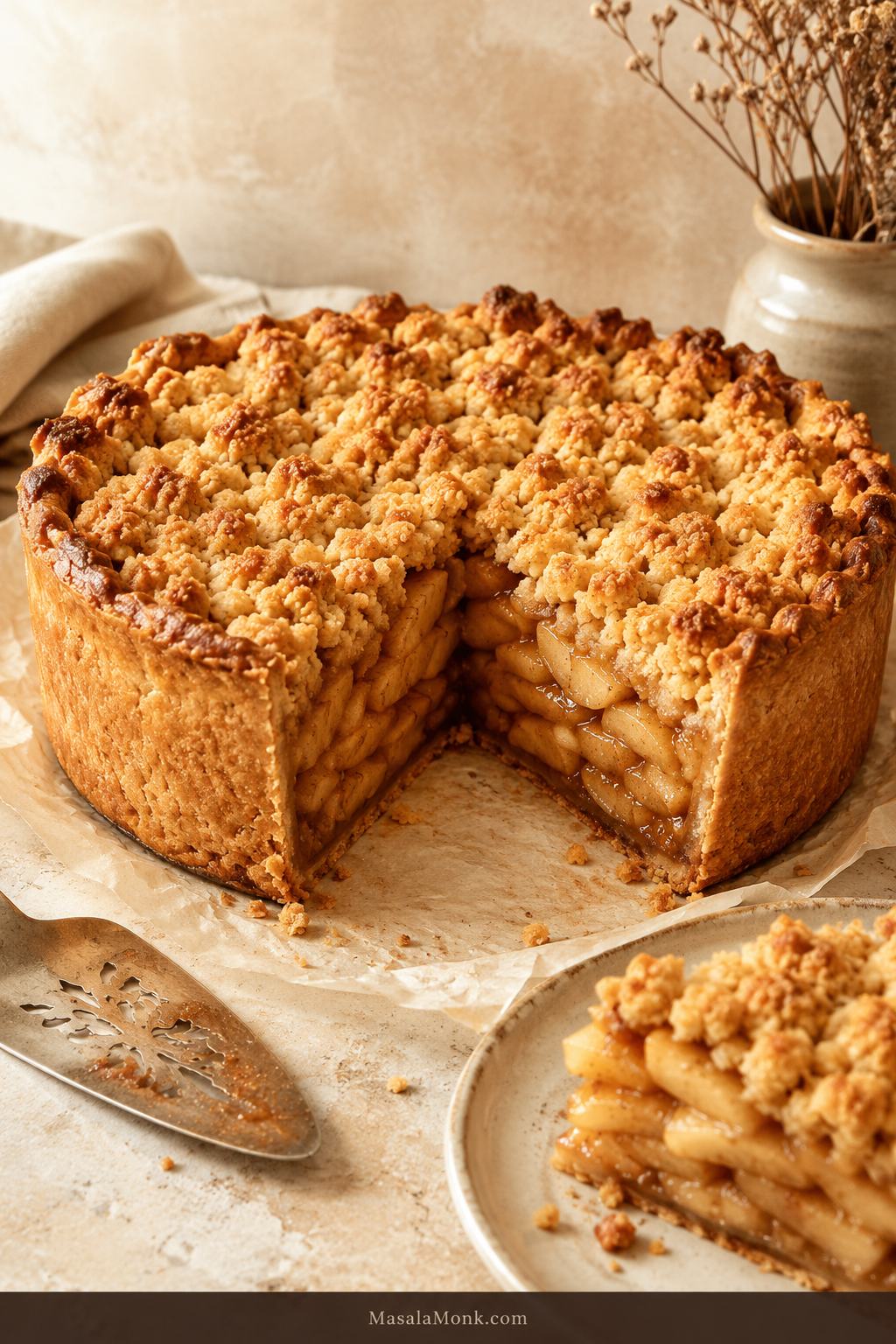
What is the best way to reheat Dutch apple pie?

Reheat slices uncovered in a 325°F / 160°C oven for 15–20 minutes. The oven helps revive the crumb topping better than the microwave.

If you make this pie, I’d love to know which apple blend you used. Did you go classic with Granny Smith and Honeycrisp, or sweeter with Golden Delicious?

Back to top