
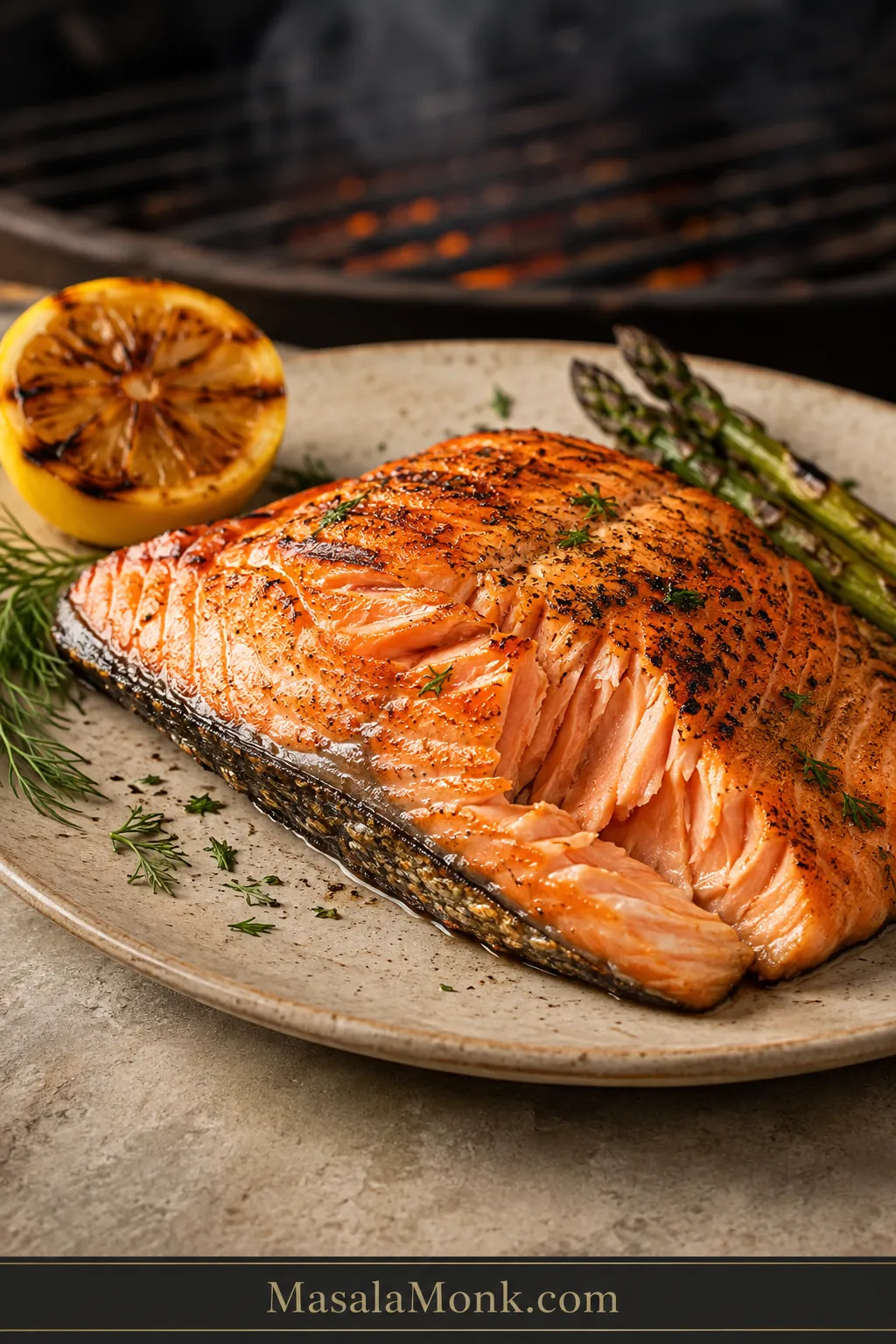
The best grilled salmon gives you two textures in one bite: browned, savory skin underneath and tender flakes that separate gently beneath the fork. The fillet should lift from the grate in one piece—not leave its best layer welded to the grill.
Salmon can feel like an expensive ingredient to trust to an open grate, especially when the difference between “not ready” and “hopelessly stuck” is difficult to see. That uncertainty is why people start lifting, sliding and checking long before the fish is ready to move.
What makes salmon easier than it first appears is that it gives you signals before you need to act. The skin browns and firms. A pale cooked band climbs through the sides. The center temperature tells you how far the heat has traveled. Once you know what to watch, the grill becomes much less of a gamble.
This grilled salmon recipe builds those signals into one calm, mostly hands-off method. Use evenly thick, skin-on fillets, dry them thoroughly and give the grates time to become fully hot. Then let the salmon stay where it is until the skin has browned and the thick middle is close to ready.
The timer tells you when to check. Temperature tells you when it is done. Release tells you when it is ready to lift cleanly.
The Base Method: 450°F, Skin-Side Down
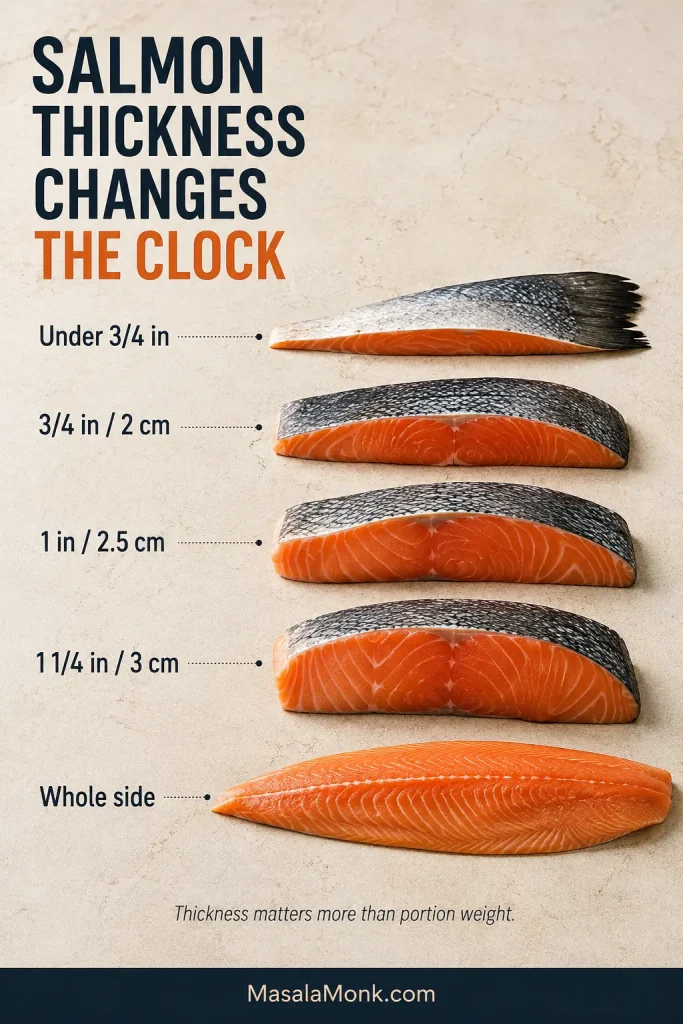
For the base recipe, use center-cut, skin-on fillets about 1 inch / 2.5 cm thick, typically around 6 oz / 170 g each. The same method works well for 6–8 oz / 170–225 g portions; thickness matters more than weight when deciding when to check them.
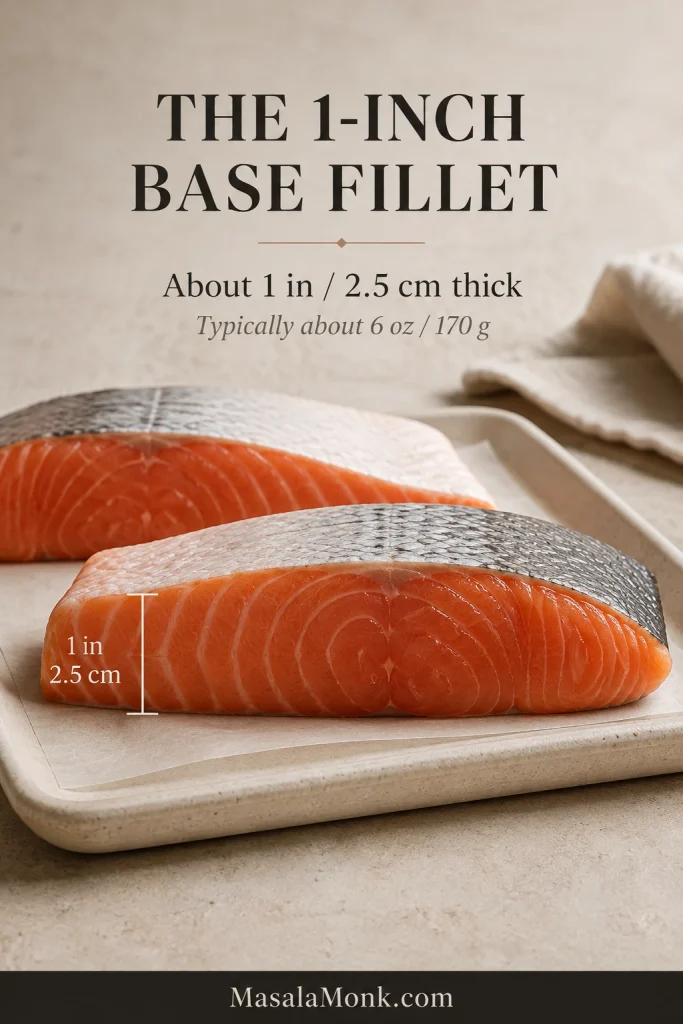
Preheat the grill toward 450°F / 230°C, with 425–450°F / 220–230°C as the workable range. Place the salmon skin-side down over direct heat, close the lid and leave a roughly 1-inch fillet alone for 6 minutes. Thinner ¾-inch / 2 cm pieces should be checked closer to 5 minutes.
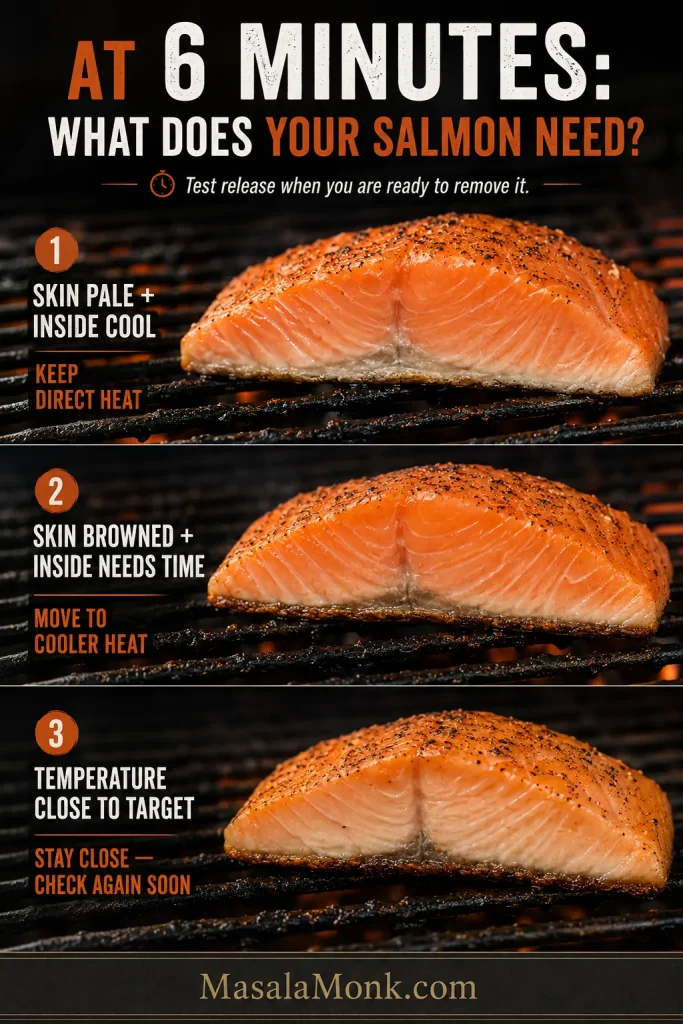
At that first check, you are deciding what the salmon needs next: more direct heat, gentler heat on the cooler side or a close watch as it approaches your target temperature.
For those first six minutes, your main job is to leave the base fillets alone.
- Base fillet: about 6 oz / 170 g and 1 inch / 2.5 cm thick
- Target grill heat: 450°F / 230°C
- Working range: 425–450°F / 220–230°C
- First check: 6 minutes for the roughly 1-inch base fillet
- Base fillet cooking window: about 8–14 minutes
- Official U.S. safe minimum: 145°F / 63°C in the thickest part
Thicker fillets, cooler grills and salmon cooked all the way to 145°F / 63°C may need the longer end of that window or a little beyond it.
The recipe stays skin-side down throughout. A brief final flip is optional when you want extra color on the flesh.
Grilled Salmon With Crisp Skin and a Moist, Flaky Center
Evenly thick fillets, dry savory seasoning and controlled two-zone heat make this a dependable base recipe. Prep the salmon while the grill preheats, so most of the waiting happens at the same time.
| Prep time | 10 minutes |
|---|---|
| Grill preheat | 10–15 minutes, overlapping prep |
| Base fillets cooking time | About 8–14 minutes |
| Resting time | 3–5 minutes |
| Typical total elapsed time | About 25–35 minutes |
| Yield | 4 servings |
Equipment
- Gas or charcoal grill with a lid
- Instant-read thermometer
- Thin, wide metal fish spatula
- Grill brush or grate scraper
- Long grilling tongs
- Paper towels
- One tray for raw salmon and a separate clean serving platter
Ingredients
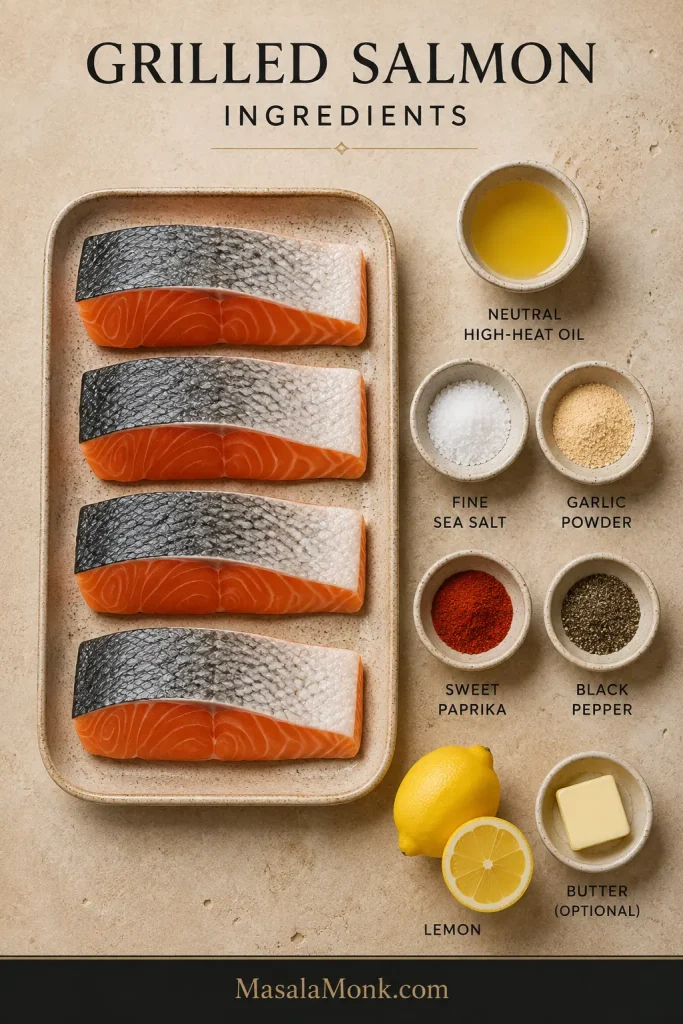
- 4 center-cut, skin-on salmon fillets, about 6 oz / 170 g each and roughly 1 inch / 2.5 cm thick
- 1 tablespoon / 15 ml neutral high-heat oil, such as avocado, refined sunflower or canola oil
- 5 g fine sea salt, about 1 scant teaspoon
- 1 teaspoon garlic powder / about 3 g
- 1 teaspoon sweet paprika / about 2 g
- ½ teaspoon freshly ground black pepper / about 1 g
- 1 lemon, cut into wedges
- 1 tablespoon / 14 g melted butter, optional for finishing the flesh
- About 1 teaspoon / 5 ml additional neutral high-heat oil for wiping the grates, as needed
Salt note: Crystal sizes vary significantly. Use the gram measurement when possible, especially when replacing fine sea salt with coarse kosher salt.
Prepare the Grill and Salmon
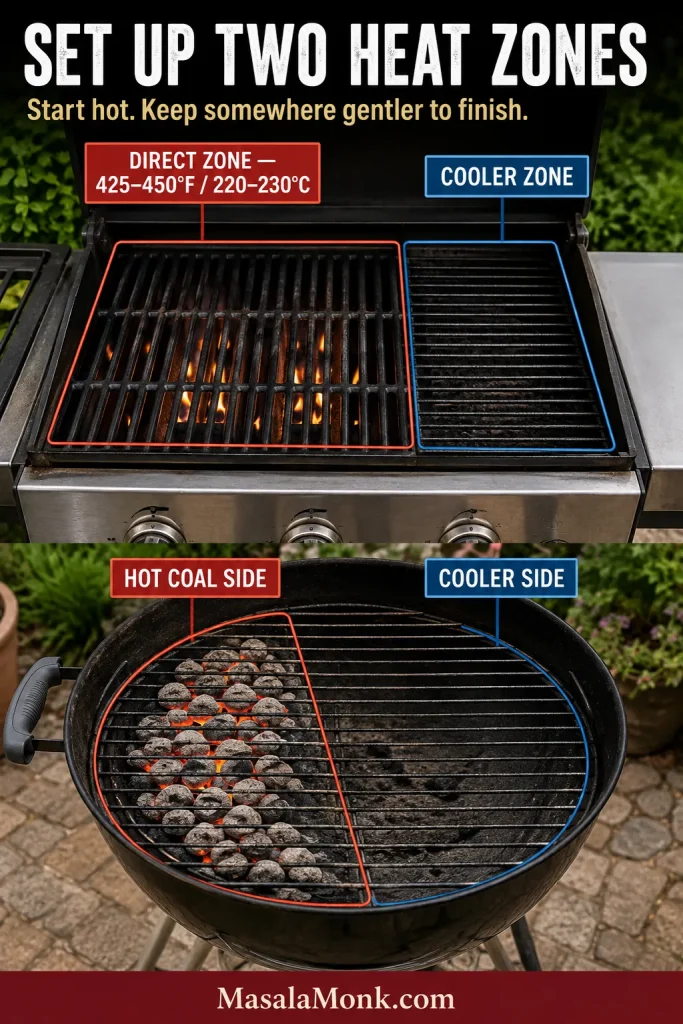
- Create two heat zones. For a gas grill, preheat all burners on high for 10–15 minutes, then adjust the direct-cooking zone to hold around 425–450°F / 220–230°C and lower or switch off an adjacent burner. For charcoal, bank most of the hot coals on one side and leave the other side cooler.
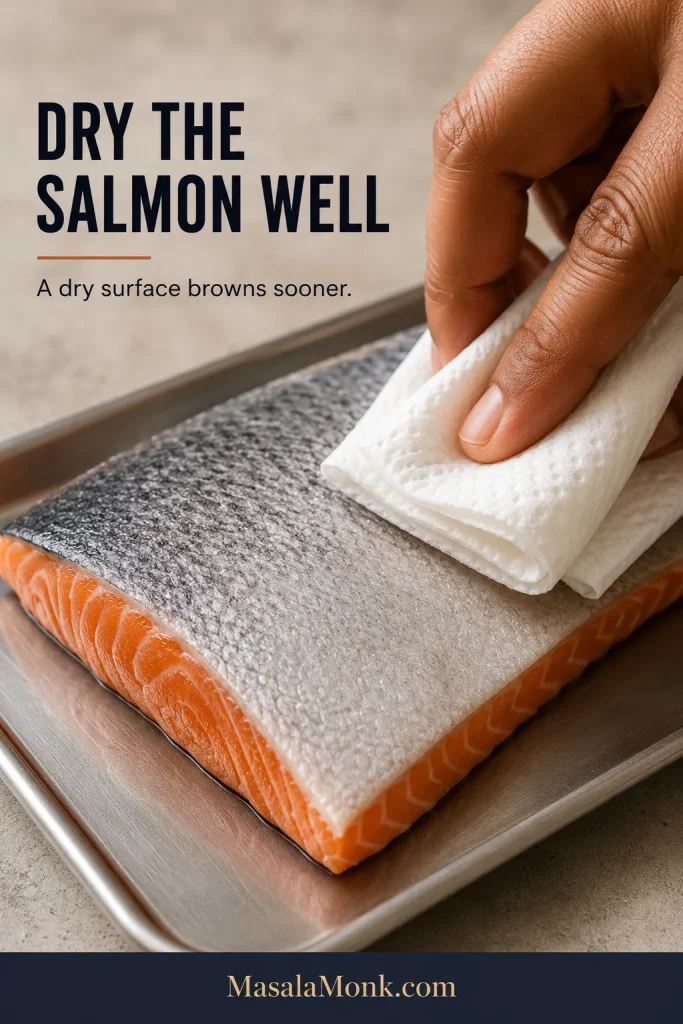
- Dry the salmon. Check for scales and pin bones, then pat the skin, flesh and sides thoroughly dry with paper towels.
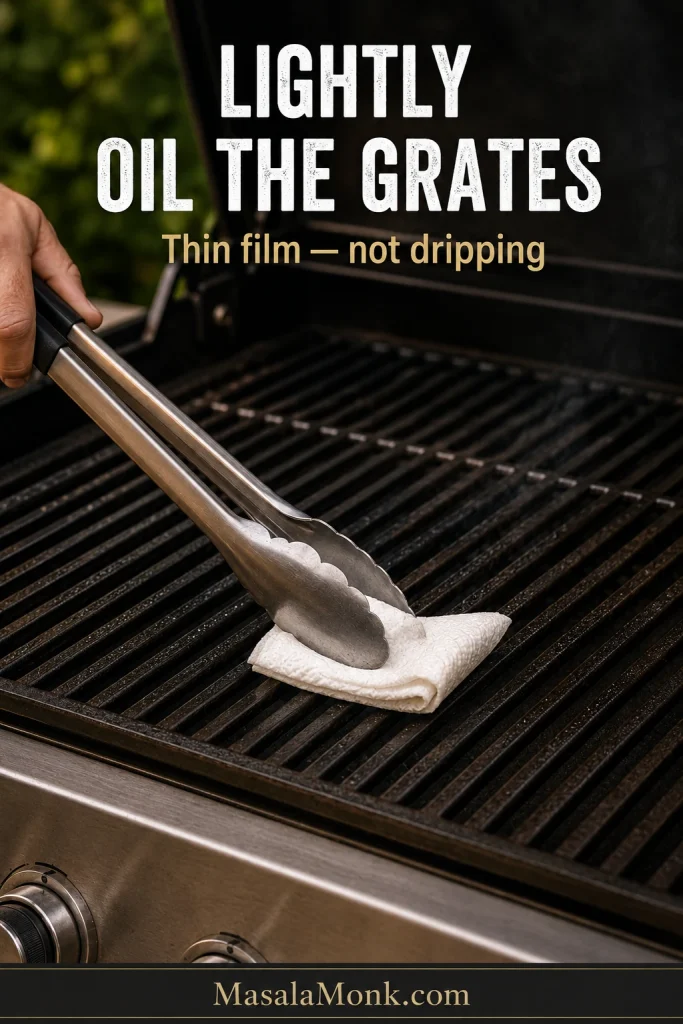
- Clean and lightly oil the grates. Scrape the hot grates clean. Hold a tightly folded, lightly oil-dampened paper towel with long tongs and wipe a thin film over the cooking surface. It should look lightly coated rather than wet or dripping.
- Season the fish. Rub the tablespoon of oil over the salmon. Mix the salt, garlic powder, sweet paprika and pepper, then season the flesh and sides evenly.
Grill Skin-Side Down
- Place the salmon over direct heat. Set each fillet skin-side down, leaving enough room to reach it later with a spatula. Close the lid.
- Leave the base fillets undisturbed for 6 minutes. This is the quiet part of the recipe: no sliding, lifting or repeated checking. A steady sizzle is what you want; aggressive popping or flare-ups mean the fire needs attention.
- Take the first real look. Insert the thermometer horizontally from the side into the thickest part. The top should still look plump, while the skin visible along the bottom edge should look darker and firmer.
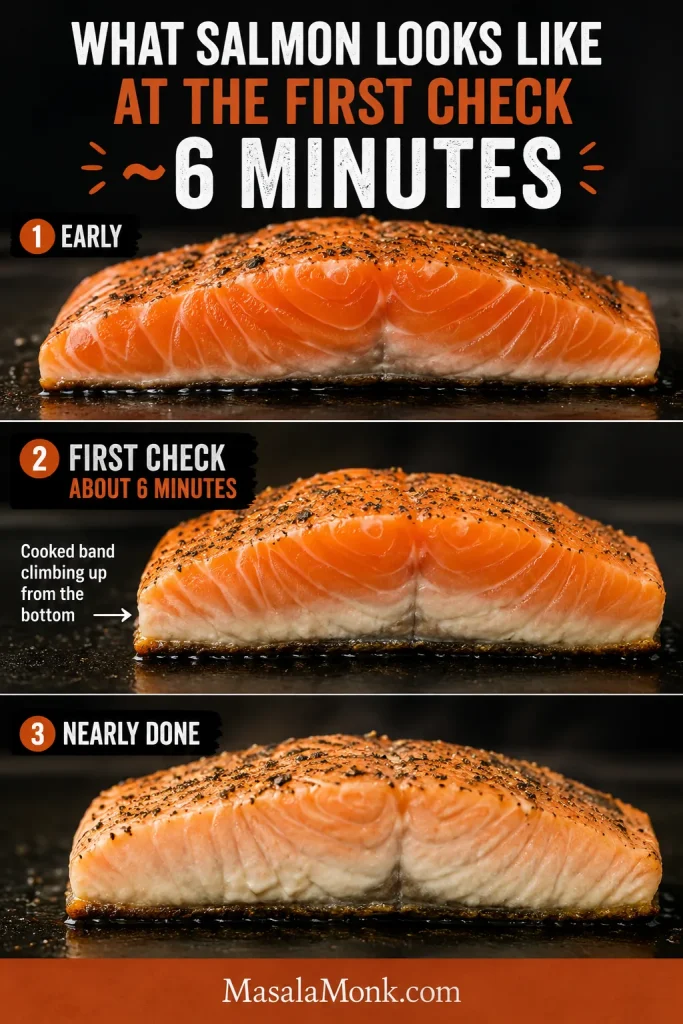
At the 6-Minute Check
Skin still pale and the thick middle well below target? Keep cooking over direct heat.
Skin browned but the inside still needs time? Slide the salmon to the cooler zone without flipping and close the lid.
Temperature already close to your target? Stay nearby and check again soon. Test the release only when you are ready to remove the salmon.
Release, Finish and Rest
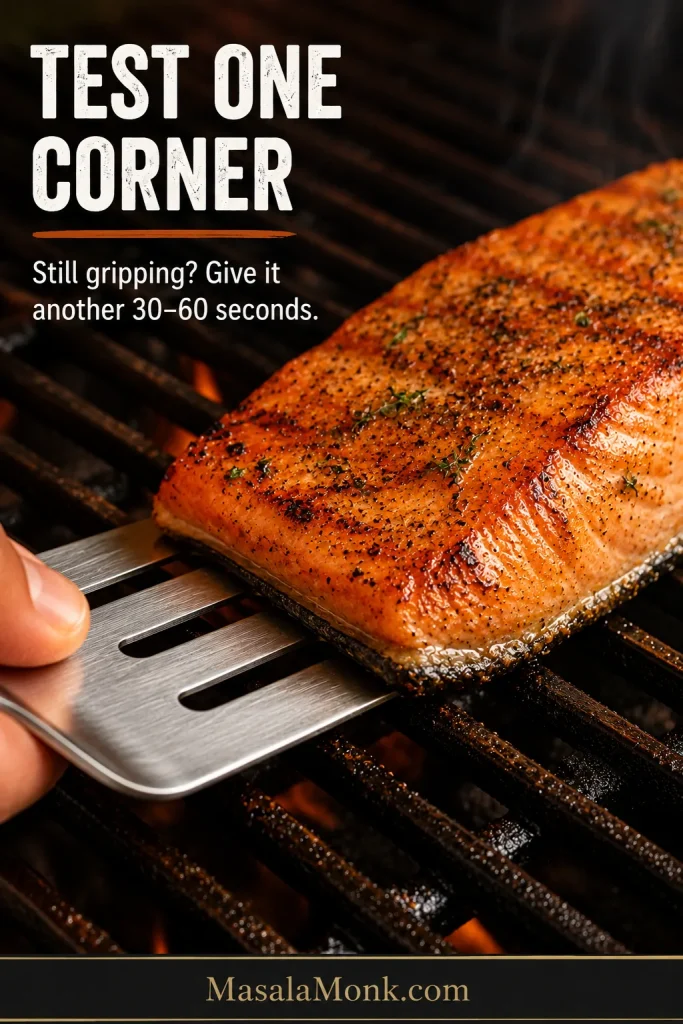
- Check the release near the end. The first attempted lift is the moment that makes many cooks nervous, so treat it as a question rather than a commitment. Slide only the thin edge of a fish spatula beneath one corner. If the skin still grips firmly, give it another 30–60 seconds.
- Finish and remove. Check the deepest part of the fillet and transfer the salmon as soon as it reaches the temperature you want. For the official U.S. safety target, cook to 145°F / 63°C.
- Rest before serving. Give the fillets 3–5 minutes, then finish the flesh with lemon and optional melted butter. Keep the butter off the skin when you want it to stay crisp.
If the salmon reaches its target before the skin releases perfectly: Work the thin spatula underneath gently and remove it. A small patch of stubborn skin is a better trade than an overcooked fillet.
Optional final flip: Once the skin releases naturally, turn the fillet and cook the flesh side for 1–2 minutes for additional color. Check the temperature again before removing it.
You do not need perfect grill marks. Crisp skin, a little smoke and tender flesh matter more than dark crosshatching.
Do not cook by time alone. Fillet thickness, salmon type, grill construction, wind and outdoor temperature can all shift the finish. If your fillets are thinner or thicker than the base cut, use the timing-by-thickness guide as your first-check reference.
The Result: Crisp Skin and Tender Flakes
Set the salmon down and give it a moment before cutting in. The skin should feel firm beneath the spatula while the top still looks plump.
- Look for browned skin that lifts mostly intact.
- Broad flakes should still glisten between the layers.
- Confirm that the thickest part has reached the temperature you chose.
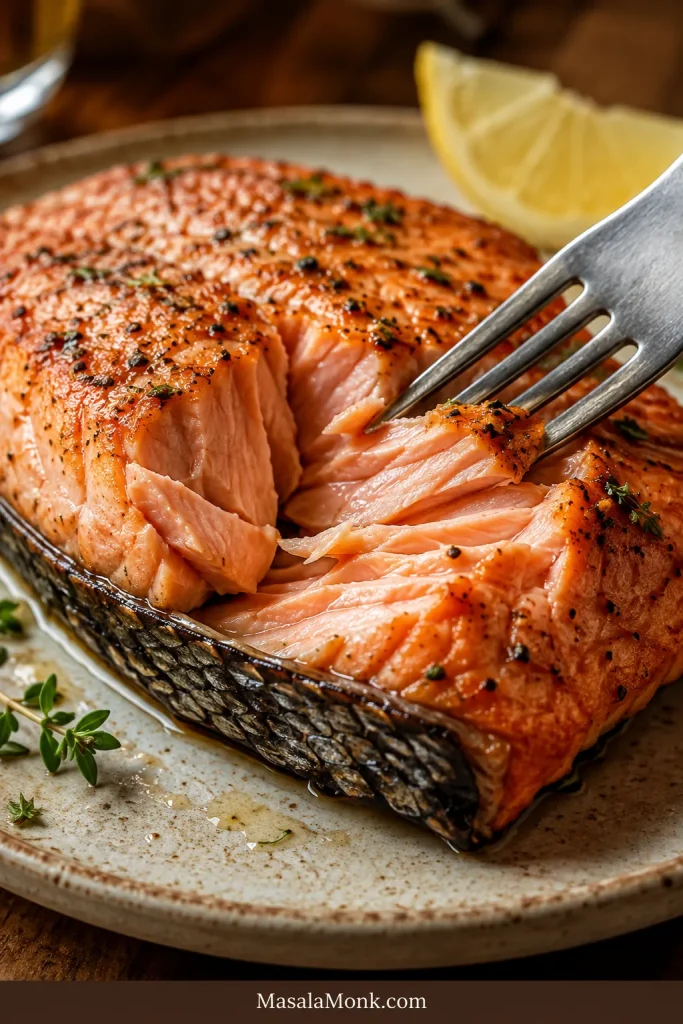
When you cut into the center, the flakes should separate with a gentle nudge instead of crumbling into dry shreds. The skin may crack lightly under the fork while the flesh above stays moist.
A torn corner, a small patch of skin left behind or a little white albumin does not make dinner a failure. If the salmon has reached your target temperature and is still juicy between the flakes, add lemon or sauce and eat it while it is good.
Grilled Salmon Guide
Dinner can stop here. If your salmon is thinner, skinless, wild, marinated or headed for another kind of grill, here is what changes.
Technique and Choices
Flavor, Dinner and Fixes
How Long to Grill Salmon by Thickness
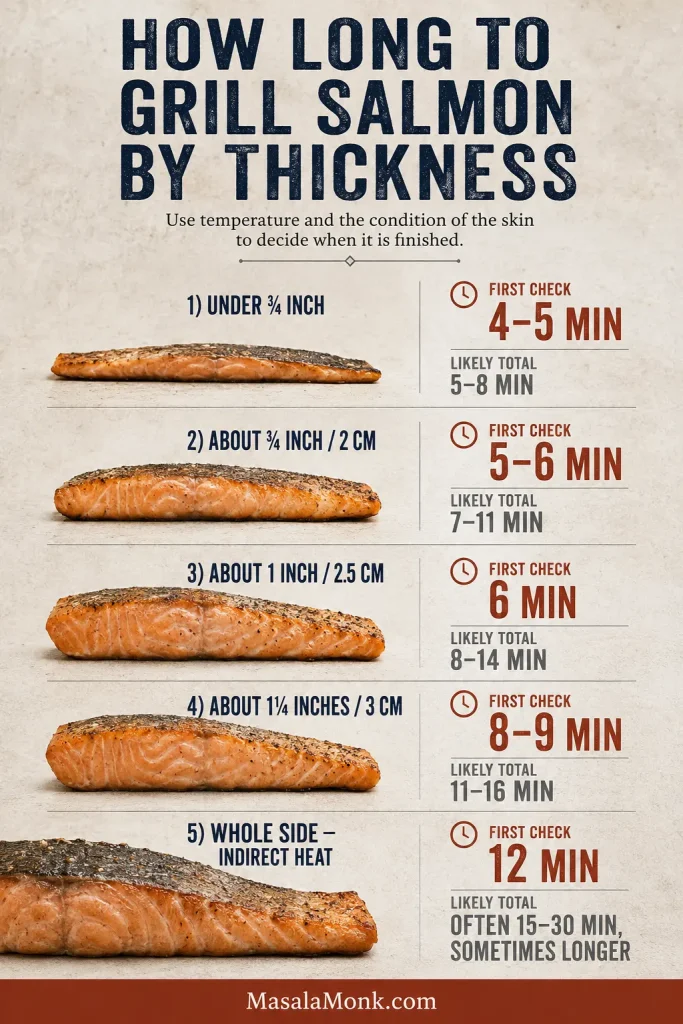
Thickness drives cooking time more than portion weight. Weight is included below as a useful reference for the kinds of fillets commonly sold in stores.
Use these ranges for fully thawed salmon cooked at 425–450°F / 220–230°C. A lean sockeye tail, a thick Atlantic center cut and a whole side should not share one timer.
First-Check and Total-Time Guide
| Salmon format | First check | Likely total time | What changes |
|---|---|---|---|
| Thin wild or tail portion, under ¾ inch | 4–5 minutes | 5–8 minutes | May finish well before thicker fillets |
| 5–6 oz / 140–170 g, about ¾ inch thick | 5–6 minutes | 7–11 minutes | Check lean salmon early |
| 6–8 oz / 170–225 g, about 1 inch thick | 6 minutes | 8–14 minutes | Base-method range |
| 8–10 oz / 225–285 g, about 1¼ inches thick | 8–9 minutes | 11–16 minutes | Move to gentler heat once the skin is browned |
| Whole side, cooked indirectly | 12 minutes | Often 15–30 minutes, sometimes longer | Thickness and overall size vary widely |
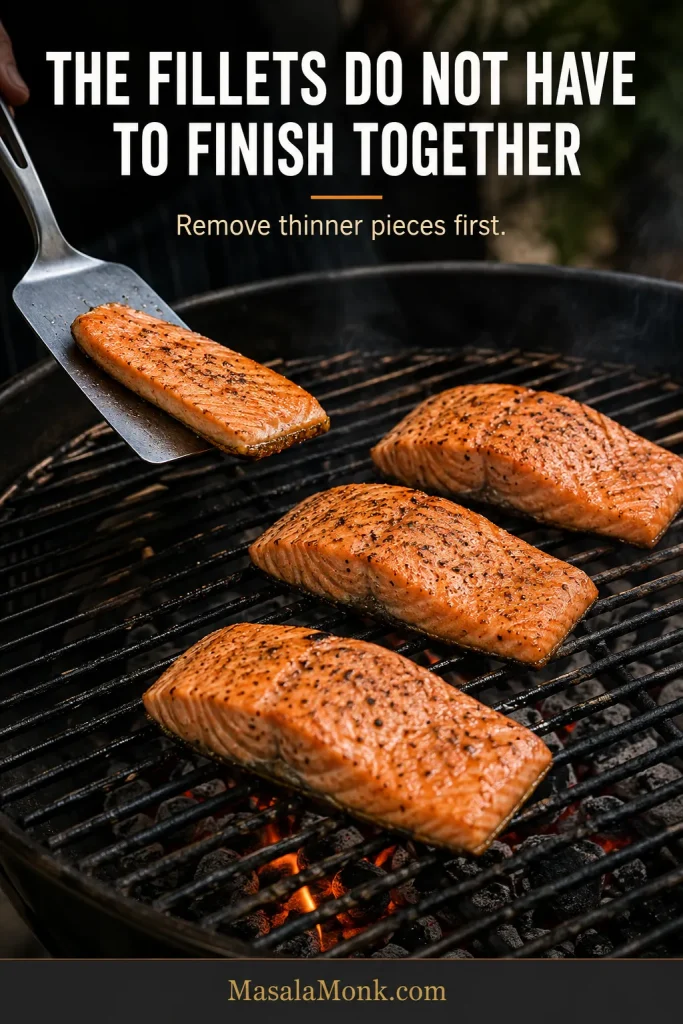
If one fillet on the tray is visibly thinner than the others, check it first. The pieces do not need to leave the grill together. Ignore a tapered edge when judging the overall thickness; if it narrows sharply, fold the thinnest flap underneath itself or plan to remove that portion before the thicker pieces.
Why grilled salmon recipes give different times
You may see one grilled salmon recipe promise dinner in 6 minutes and another allow twice that. Grill temperatures vary, fillets vary in thickness, some methods flip while others stay skin-side down, and recipes do not all stop at the same internal temperature.
That is why this method uses a first-check time instead of one universal finish time. Start checking early, then use temperature and the condition of the skin to decide what happens next.
What changes the cooking time?
- Salmon type: Lean wild salmon often cooks faster than fattier farmed salmon.
- Actual grate temperature: The lid thermometer may not reflect the heat directly beneath the fish.
- Wind and outdoor temperature: Both can slow the grill, especially when the lid is opened repeatedly.
- Starting temperature: Refrigerator-cold and partially frozen centers take longer.
- Target doneness: Salmon cooked to 145°F / 63°C generally needs more time than salmon removed at a lower culinary temperature.
How to Know When Grilled Salmon Is Done
The last few minutes are where salmon changes fastest. Checking early gives you room to make a calm decision instead of discovering dryness after the fact.
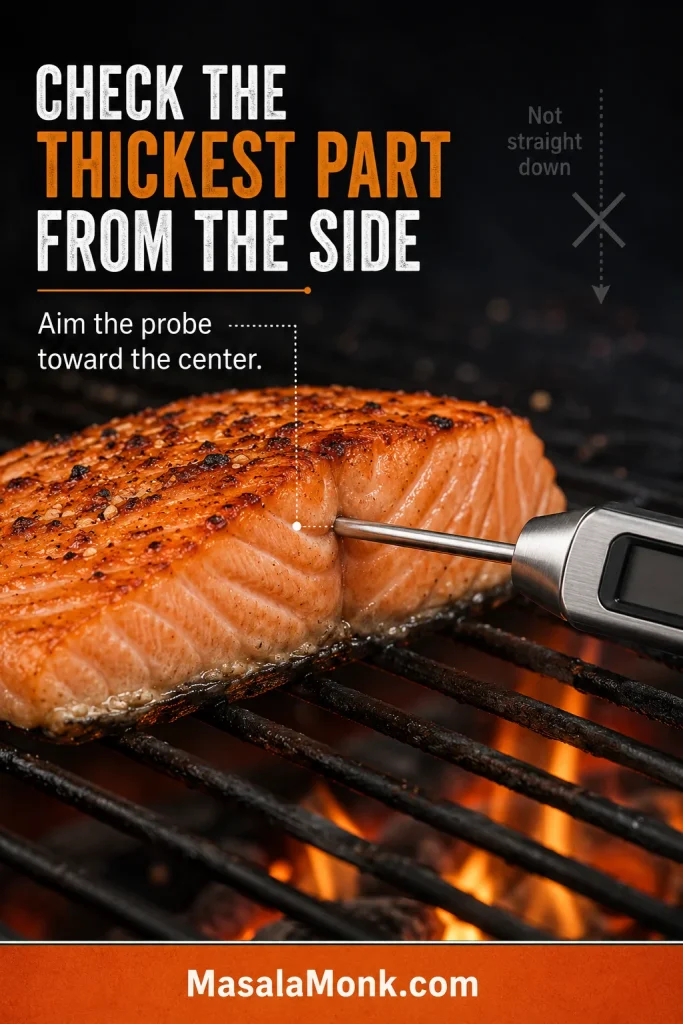
Watch the pale cooked band moving up the sides and confirm the result with a thermometer. Push the probe horizontally into the thickest part so the tip reaches the true middle; entering from above makes it easy to pass too close to the hot grate.
Grilled salmon temperature guide
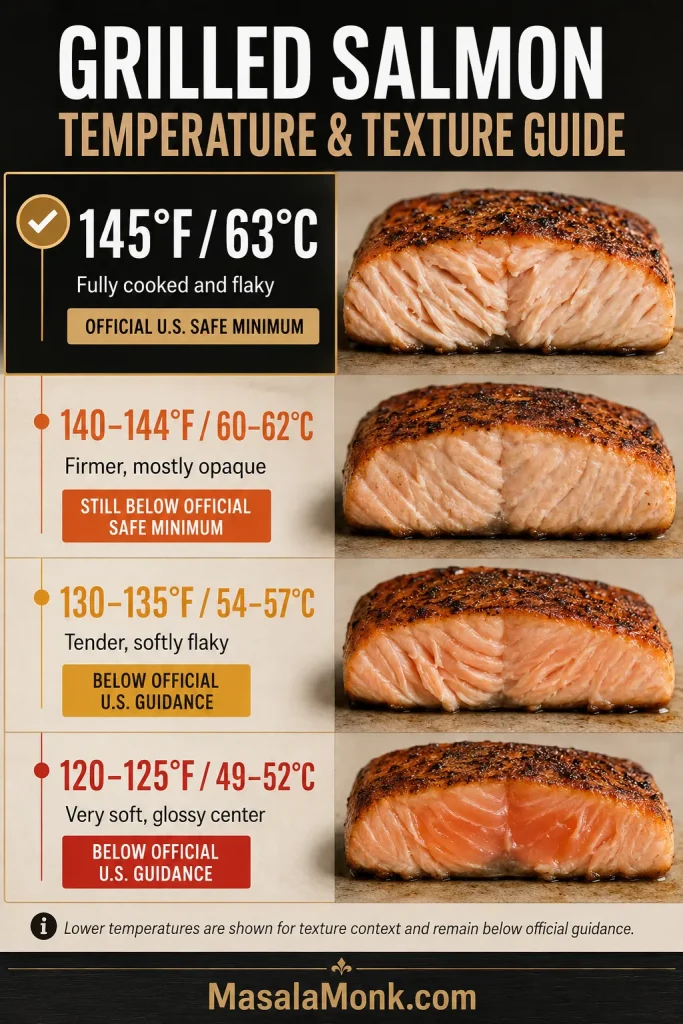
FoodSafety.gov recommends 145°F / 63°C as the safe minimum internal temperature for fish. The lower temperatures below explain why some recipes describe softer textures at different endpoints; they remain below the official recommendation.
| Center temperature | Likely texture | Context |
|---|---|---|
| 120–125°F / 49–52°C | Very soft, glossy center | Below official U.S. safety guidance |
| 130–135°F / 54–57°C | Tender and softly flaky | A common culinary preference, but below official guidance |
| 140–144°F / 60–62°C | Firmer and mostly opaque | Still below the official safe minimum |
| 145°F / 63°C | Fully cooked and flaky | Official U.S. safe minimum for fish |
People at increased risk of serious foodborne illness should not be served salmon below that official minimum.
A small fillet may rise slightly while resting, but do not count on a large carryover increase. If you are unsure, check again in 30–60 seconds. Salmon gives you another look far more readily than it gives you back an overcooked middle.
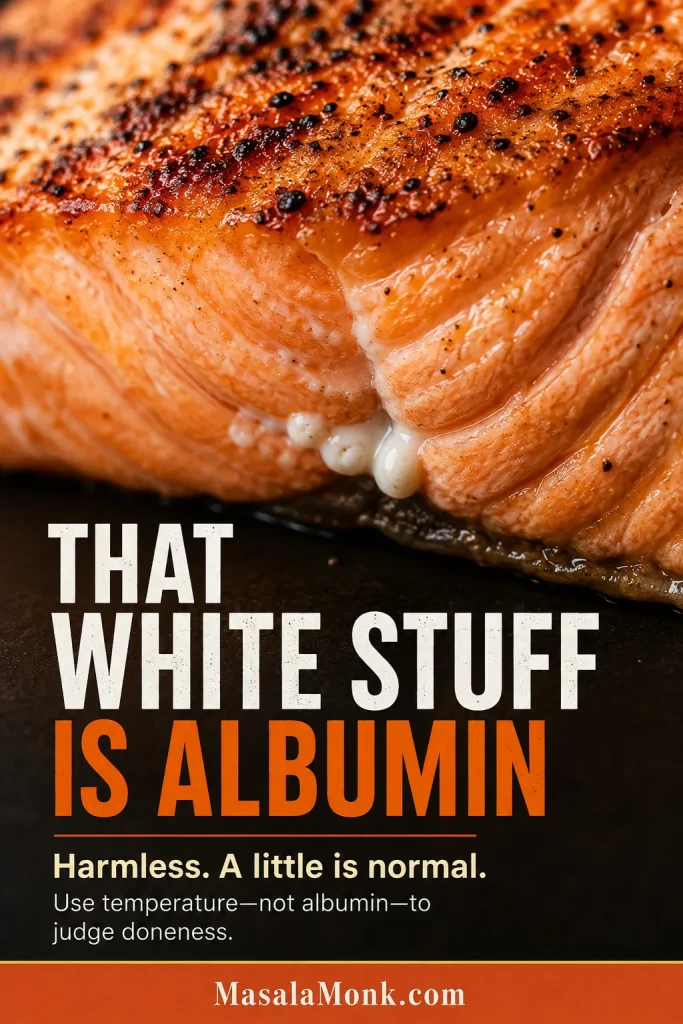
The white material that sometimes appears on the surface is albumin, a harmless protein pushed out during cooking. Its presence alone is not a doneness cue.
Why Salmon Sticks to the Grill
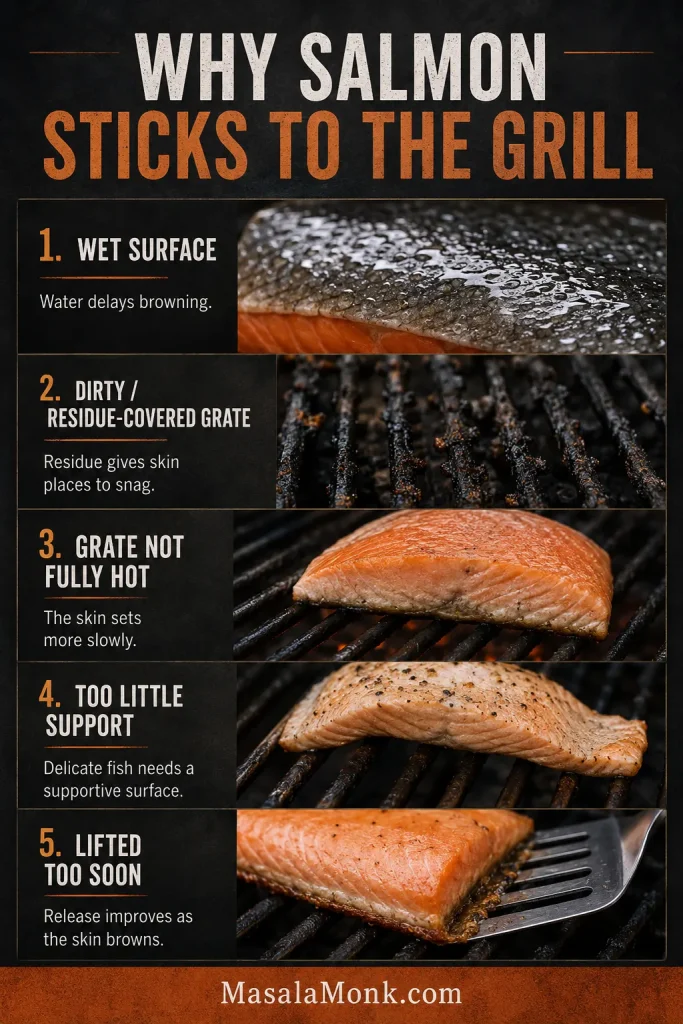
Sticking usually begins before the salmon reaches the grate. A wet surface slows browning, old residue gives the skin rough places to catch, and a grill that has not heated fully makes clean release harder.
What Makes Salmon Release Cleanly
Dry skin: Surface water has to evaporate before browning can begin.
Hot, clean grates: The skin sets faster against fully heated metal, and scraping away old residue removes places where it can snag.
A thin film of oil: Enough to support even contact and browning without dripping into the fire.
Skin-side-down cooking: The skin gives the delicate flesh a sturdier base while taking the strongest direct heat.
Time: As the skin browns and firms, it becomes easier to lift.
What natural release feels like
At first, the fillet may cling firmly. Later, the thin edge of a fish spatula begins to slide underneath without scraping or tearing.
If your spatula meets resistance, the salmon needs another moment—not more force.
An older or rougher grate may still hold onto a small patch of skin. Let that small patch go rather than keeping an otherwise ready fillet over the heat.
Choose the Right Grilling Method for Your Salmon
The salmon you bought determines the next choice. Together, its skin, thickness and shape tell you how much support and heat control it needs.
| What you bought | Best route | Main adjustment |
|---|---|---|
| Skin-on center-cut fillets | Direct grill, skin-side down | Use the main recipe |
| Skinless fillets | Plancha, cast-iron griddle, perforated grill pan or foil | Give the flesh more support |
| Thin wild salmon | Same direct method | Begin checking earlier |
| Salmon steaks | Direct grill, turn once | Keep the thermometer away from the bone |
| Whole side | Indirect heat, skin-side down | Leave it unflipped |
| Frozen-solid salmon | Separate method | Do not simply add minutes to this recipe |
Skin-on versus skinless
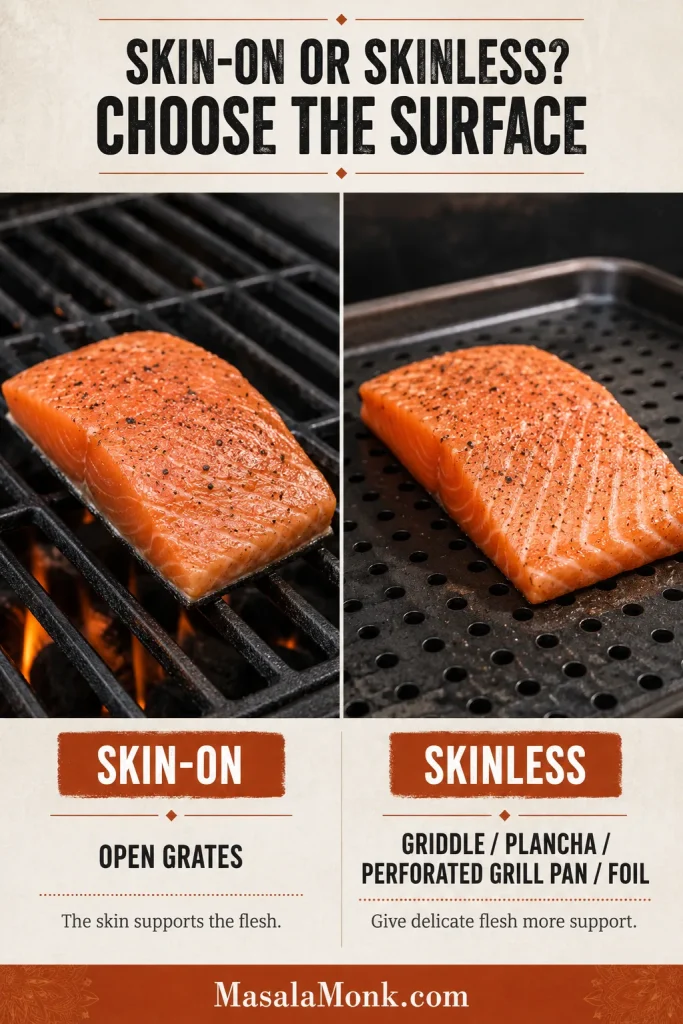
Skin-on fillets are the easiest fit for open grates because the skin supports the flesh and takes the direct heat. If you came home with skinless salmon, you have not bought the wrong fish—you simply need a more supportive cooking surface.
Preheat a cast-iron griddle, plancha or perforated grill pan with the grill. Oil the surface and fish lightly, cook the presentation side first and turn once.
Wild versus farmed salmon
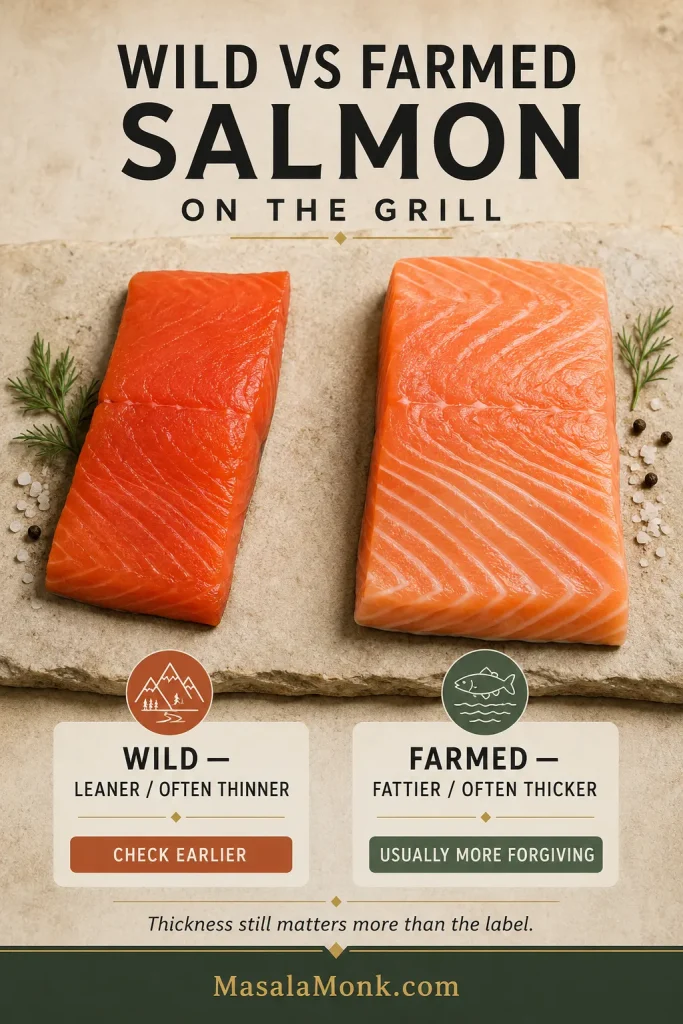
Fattier salmon, including many Atlantic and king salmon portions, tends to tolerate a little more heat and time. Leaner varieties such as sockeye and coho are often thinner and can move from tender to dry quickly.
A thin sockeye portion may need attention after 4–5 minutes rather than 6. For a gentler indoor approach built around lean wild fillets, see this baked sockeye salmon recipe.
Fresh versus previously frozen
Previously frozen salmon can grill beautifully. Thaw it completely in the refrigerator, remove any surface ice and dry it particularly well before seasoning. Frozen-solid salmon needs a separate cooking method; simply adding minutes to this one is not enough.
Direct grates or foil?
Some nights you want crisp skin. Other nights you mainly want the salmon safely contained and easy to lift.
- Direct grates: Skin-on fillets with the crispest underside and more grilled character.
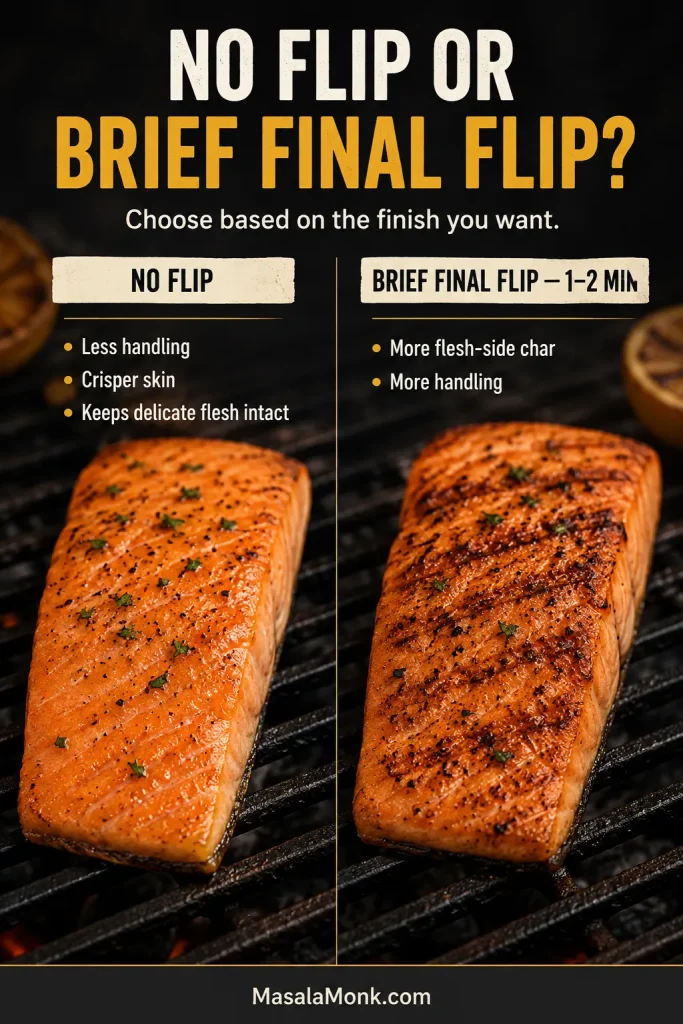
- Brief final flip: More flesh-side color and char after the skin has released.
- Foil: Easier handling for thin, skinless or delicate salmon, with a softer surface and less smoke.
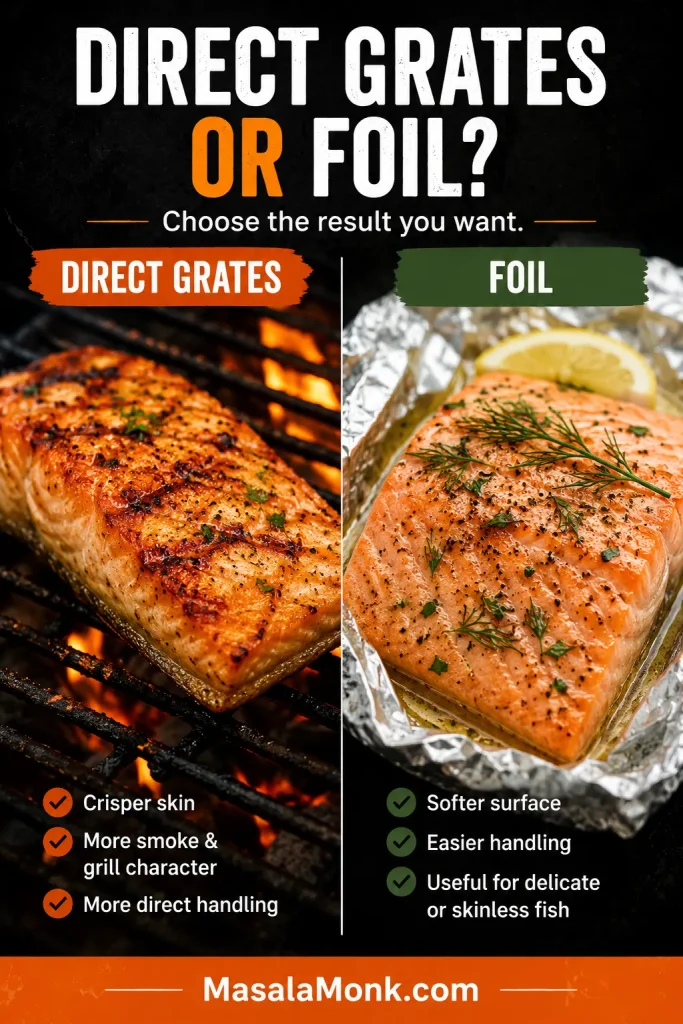
For a quick foil version, place the salmon on lightly oiled heavy-duty foil and fold it into a loose packet with room for steam. Set the packet over the cooler side of the grill, close the lid and begin checking after 8 minutes. Thin fillets may finish sooner; thick center cuts will need longer.
Do you have to flip salmon on the grill?
No. The base recipe stays skin-side down because it requires less handling. If you want more char on the flesh, wait for a clean release, turn once and give the second side 1–2 minutes.
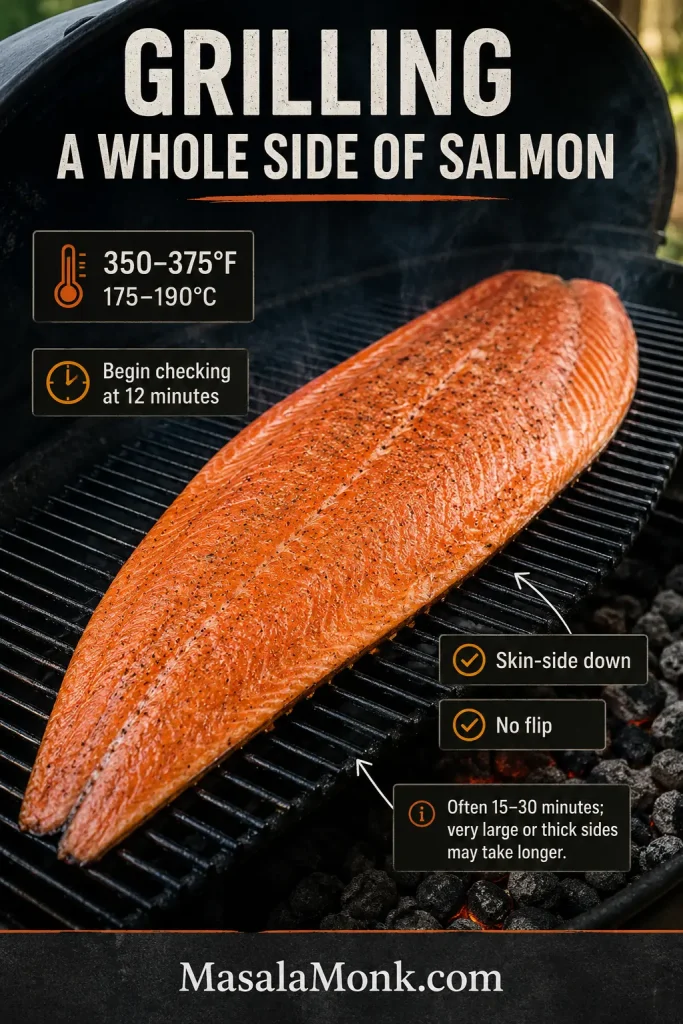
How to grill a whole side of salmon
A whole side makes a generous shared platter because everyone can choose a thicker or thinner piece. Its cooking time varies widely, so begin with the thermometer instead of treating one finish time as fixed.
- Aim for about 350°F / 175°C over indirect heat, with 350–375°F / 175–190°C as the workable range.
- Place the salmon skin-side down away from the strongest heat.
- Close the lid and leave it skin-side down.
- Begin checking after 12 minutes. Many sides finish around 15–30 minutes, while thick or very large sides can take longer.
- Use two wide spatulas or a sturdy transfer board to move it.
A spoonful of fresh chimichurri is especially good against the richness of a whole side, bringing acidity, herbs and garlic to every piece.
Once the salmon format is sorted, the remaining technique question is simply how your grill lets you manage stronger and gentler heat.
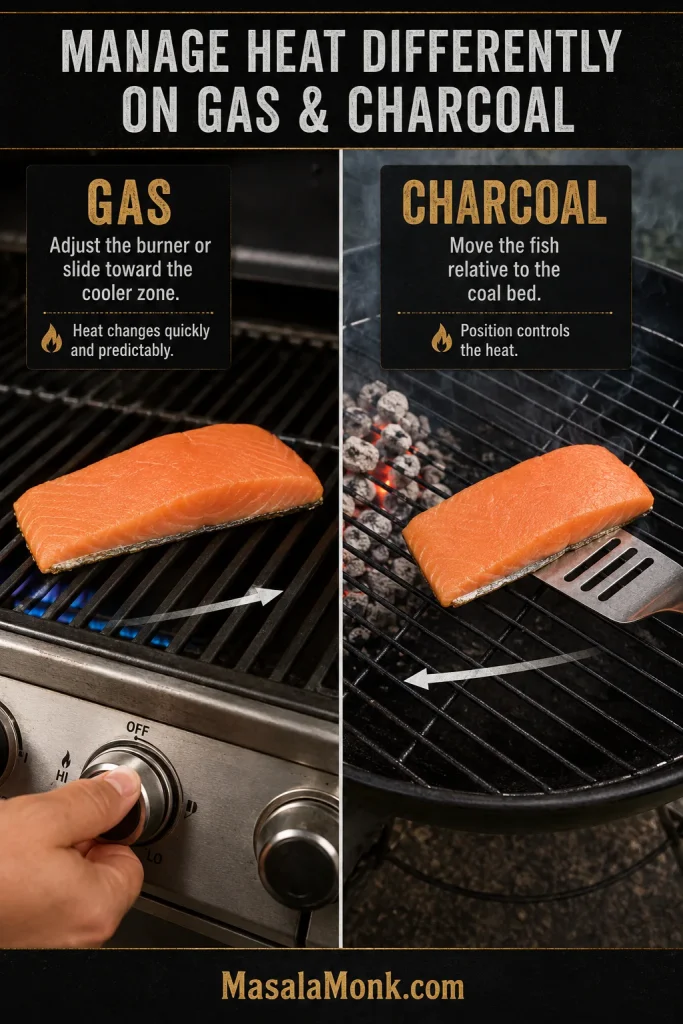
What Changes on a Gas Grill vs Charcoal?
Gas Grill
Gas gives you immediate heat control. If the skin is browned while the inside still needs time, lower the nearby burner or move the salmon toward the cooler side. The adjustment is quick and predictable, which makes it easy to protect an already browned surface.
Charcoal Grill
With charcoal, heat control happens mostly through position. Move the salmon farther from the coal-heavy side when the skin is dark enough, and watch for flare-ups as salmon fat drips onto the fire. A cooler area lets you protect the fish immediately instead of waiting for the coals themselves to calm down.
With the heat under control, the difficult part is over. From here, flavor can change without changing the cues that tell you when the salmon is ready.
← Back to recipe · ↑ Back to top
How to Season Salmon for the Grill
The base seasoning is dry, savory and free from sugar. It adds color and flavor without wetting the surface or introducing ingredients that can scorch early.
For 24 oz / 680 g salmon: Use 1 tablespoon / 15 ml neutral oil, 5 g fine sea salt, 1 teaspoon / about 3 g garlic powder, 1 teaspoon / about 2 g sweet paprika and ½ teaspoon / about 1 g black pepper.
Garlic powder adds garlic flavor without the wet surface and quick scorching of fresh minced garlic. Sweet paprika adds color without turning the base seasoning smoky. Save the lemon juice for the finished salmon.
Seasoning, Marinade, Glaze or Sauce?
Dry seasoning: Apply shortly before grilling.
Marinade: Flavor the salmon beforehand, then drain and blot away excess moisture.
Glaze: Brush sugary mixtures over the flesh during the final 1–2 minutes.
Serving sauce: Add after the salmon leaves the heat.
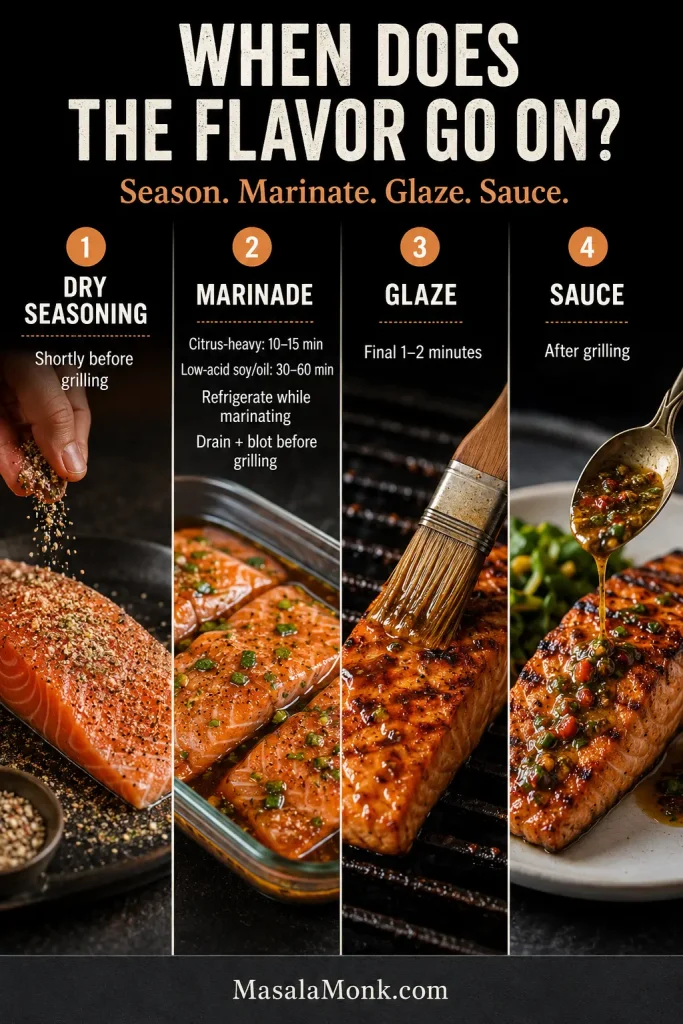
How long should salmon marinate?
- Citrus-heavy marinade: 10–15 minutes
- Low-acid soy and oil marinade: 30–60 minutes
- Dry seasoning: Apply shortly before grilling
Keep the salmon refrigerated while it marinates. Before grilling, drain it and blot away excess liquid, especially from the skin.
Honey, maple syrup, brown sugar, teriyaki sauce and many barbecue sauces darken quickly over direct heat. Add them near the end, and reserve any finishing sauce before a brush or spoon touches raw fish.
Four Ways to Change the Flavor
Each formula seasons four 6 oz / 170 g fillets. Keep the same heat and doneness cues; change the flavors around them.
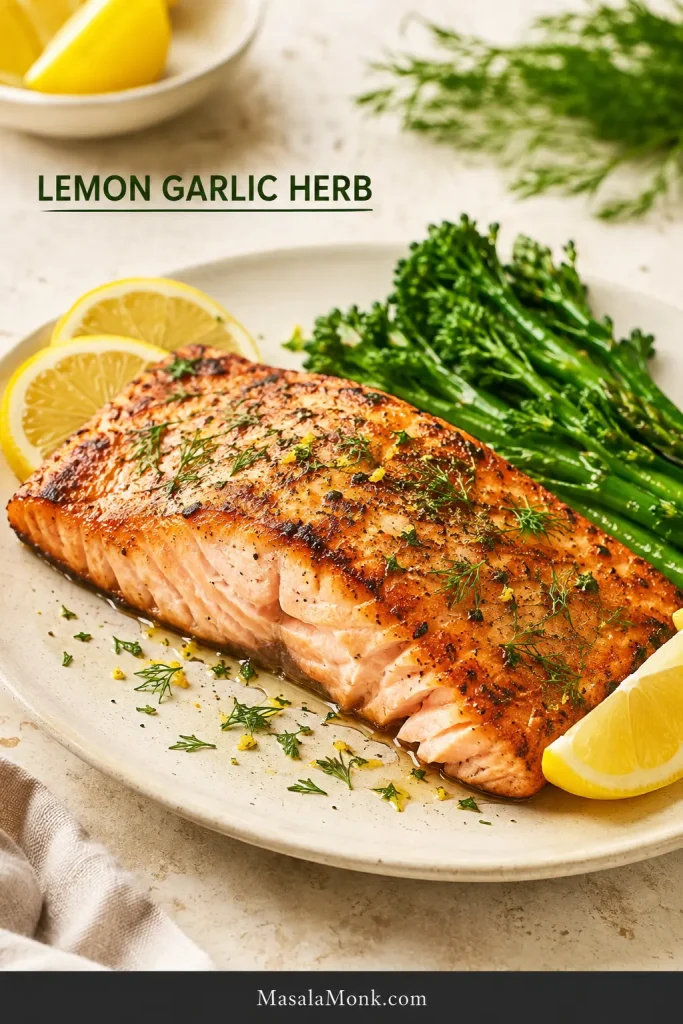
Lemon Garlic Herb
Choose this when the rest of dinner is already doing plenty and you want the salmon bright, familiar and easy to pair with vegetables or potatoes.
- 1 tablespoon / 15 ml neutral oil
- 5 g fine sea salt
- 1 teaspoon garlic powder
- 1 teaspoon finely grated lemon zest
- ½ teaspoon black pepper
- 1 tablespoon finely chopped fresh dill or parsley, for finishing
Season with the oil, salt, garlic powder, lemon zest and pepper before grilling. Finish with the fresh herbs and a squeeze of lemon after the salmon comes off the heat.
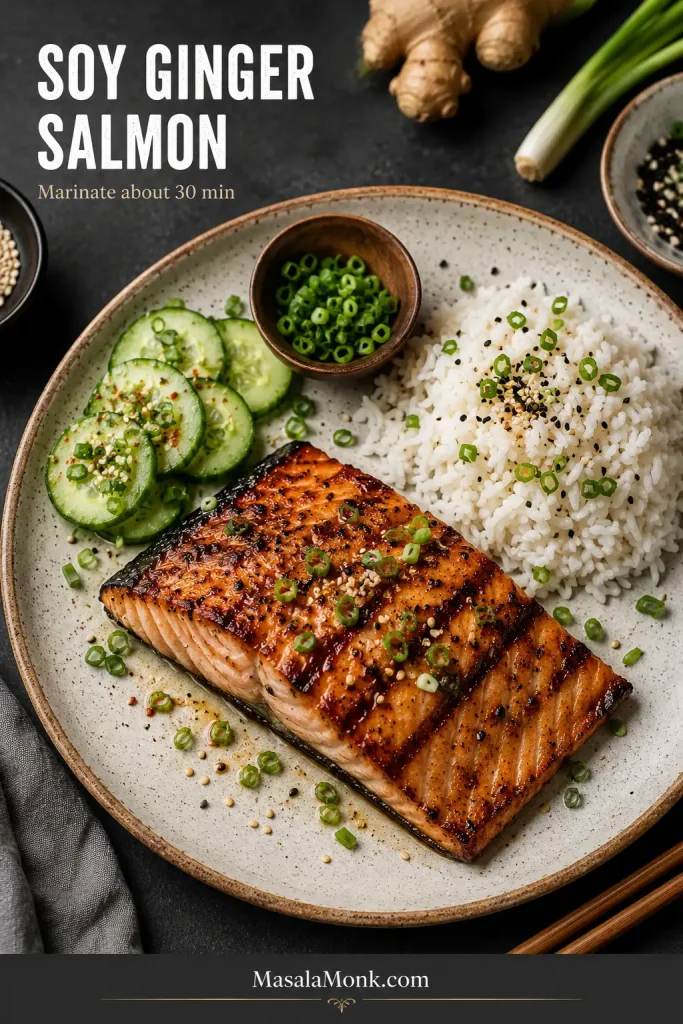
Soy Ginger
This is the natural bowl version: savory enough for rice and crisp vegetables without needing a heavy glaze.
- 2 tablespoons / 30 ml low-sodium soy sauce
- 1 tablespoon / 15 ml neutral oil
- 2 teaspoons finely grated ginger
- 1 teaspoon finely grated garlic
- 1 teaspoon honey, optional
Marinate for 30 minutes, then drain and blot the salmon well. For a thicker finish, brush on homemade teriyaki sauce during the final minute or two.
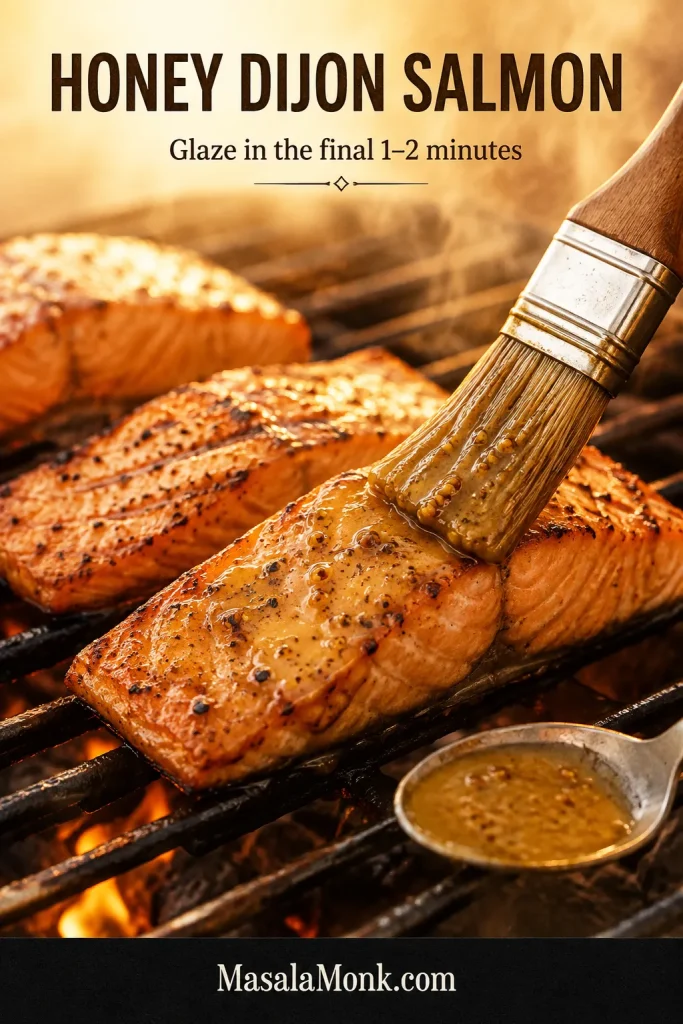
Honey Dijon
Good when you want a little sweetness but still want mustard and salmon to lead the flavor.
- 1 tablespoon / 15 ml neutral high-heat oil
- 3 g fine sea salt, about ½ teaspoon
- 1 tablespoon / 15 g Dijon mustard
- 2 teaspoons / about 14 g honey
- 1 teaspoon / 5 ml lemon juice
- ½ teaspoon garlic powder, optional
- Pinch of black pepper, optional
Oil and salt the salmon before grilling. Mix the remaining ingredients separately and brush the glaze over the flesh during the final 1–2 minutes.
For a saucier skillet version of the same sweet-savory idea, use this Honey Garlic Salmon recipe.
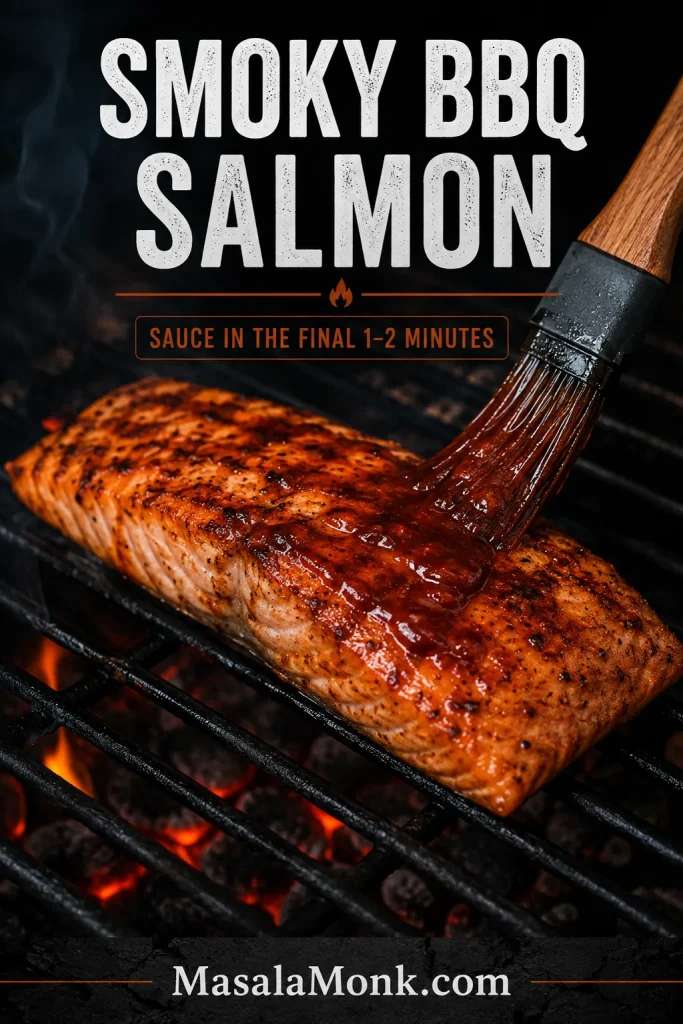
Smoky BBQ
Use this when the salmon should carry most of the bold flavor on a plate of simple vegetables, potatoes or salad.
- 1 tablespoon / 15 ml neutral oil
- 3 g fine sea salt, about ½ teaspoon
- 1 teaspoon smoked paprika
- 1 teaspoon garlic powder
- ½ teaspoon onion powder
- ¼ teaspoon black pepper
- 2–3 tablespoons / 30–45 ml barbecue sauce
Season with the oil, salt and spices before grilling, then brush the barbecue sauce over the flesh during the final 1–2 minutes.
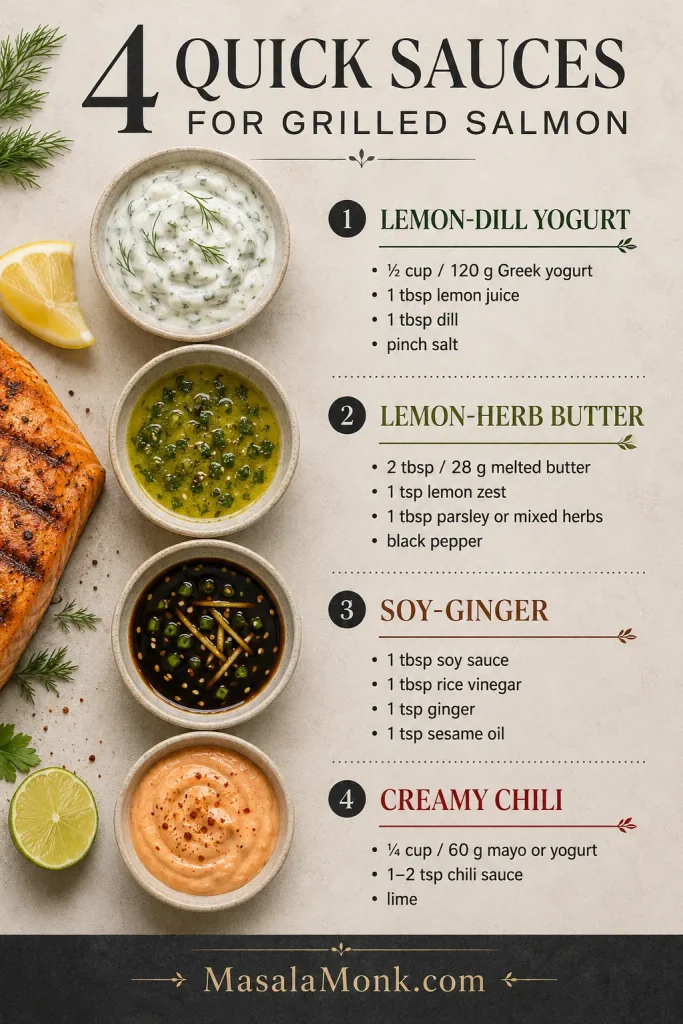
Which Sauce Goes Best With Grilled Salmon?
Once the salmon leaves the grill, sauce is the easiest way to take dinner in a different direction. Each makes enough for four fillets.
| Sauce | Quick formula | Best with |
|---|---|---|
| Lemon-dill yogurt | ½ cup / 120 g Greek yogurt, 1 tablespoon lemon juice, 1 tablespoon chopped dill and a pinch of salt | Base recipe or lemon-herb salmon |
| Lemon-herb butter | 2 tablespoons / 28 g melted butter, 1 teaspoon lemon zest, 1 tablespoon chopped parsley and black pepper | Potatoes, asparagus and classic seasoning |
| Soy-ginger sauce | 1 tablespoon low-sodium soy sauce, 1 tablespoon rice vinegar, 1 teaspoon grated ginger and 1 teaspoon sesame oil | Rice bowls and grilled vegetables |
| Creamy chili sauce | ¼ cup / 60 g mayonnaise or yogurt, 1–2 teaspoons chili sauce and a squeeze of lime | Bowls, wraps and salads |
A creamy sauce works well when the plate needs cooling richness. Something sharper suits salmon that already carries a sweet glaze or buttery finish.
A spoonful of mango salsa turns grilled salmon toward a fresher summer plate with juicy fruit, lime and onion.
What to Serve With Grilled Salmon
Build the plate with one vegetable, one starch or substantial salad, and one bright finishing element. A squeeze of lemon should brighten the salmon, not rescue a dry fillet.
Classic Grill Dinner
The familiar cookout plate: smoky salmon, buttery potatoes and something green with charred edges.
- Grilled salmon
- Asparagus or green beans
- Baby potatoes or a tangy option from this potato salad guide
- Lemon-herb butter
Fresh Summer Plate
The plate for warm evenings: grilled vegetables, something herby and enough grain to turn the salmon into dinner without making the meal feel heavy.
- Grilled salmon
- Grilled zucchini and bell peppers
- Fresh tabbouleh, couscous or quinoa
- Herb vinaigrette
Salmon Rice Bowl
Especially good when you flake the salmon into generous pieces and want every bite to carry sauce and crunch.
- Flaked grilled salmon
- Steamed rice
- Cucumber, cabbage, carrots and avocado
- Soy-ginger or creamy chili sauce
- More combinations from the full salmon bowl recipe
Low-Effort Weeknight Plate
The version for the night when grilling the salmon is all the cooking energy you have.
- Grilled salmon
- A well-dressed bagged salad or Mediterranean chickpea salad
- Microwave rice or crusty bread
- Lemon wedges or quick yogurt sauce

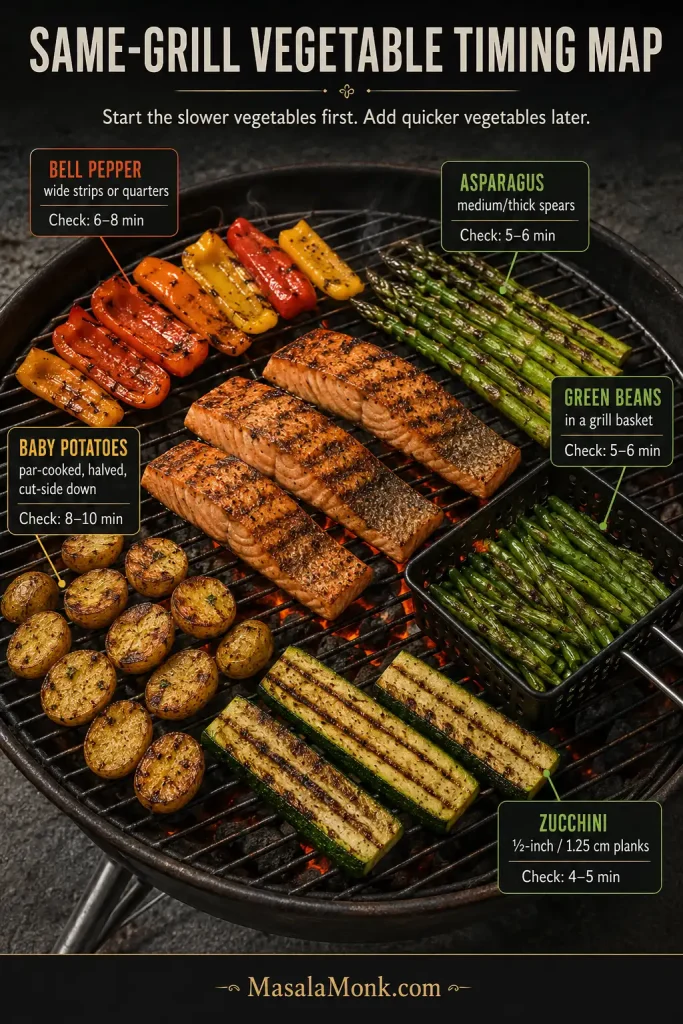
Vegetables You Can Grill Alongside the Salmon
Begin checking around the times below; cut size and actual grill heat will shift them.
| Vegetable | Preparation | Begin checking after | Ready when |
|---|---|---|---|
| Asparagus | Medium or thick spears, lightly oiled | 5–6 minutes | Bright green, tender and lightly charred |
| Zucchini | ½-inch / 1.25 cm planks | 4–5 minutes | Flexible with browned grill marks |
| Bell pepper | Wide strips or quarters | 6–8 minutes | Softened with blistered spots |
| Green beans | Lightly oiled in a grill basket | 5–6 minutes | Tender-crisp with blistered skins |
| Par-cooked baby potatoes | Halved, cut-side down | 8–10 minutes | Golden outside and hot through the middle |
Peppers and potatoes generally need a head start. Zucchini, green beans and asparagus can go on later. Keep them toward the cooler edge when the salmon occupies the strongest heat.
Pull vegetables as they become ready and keep them loosely covered off the heat. They hold well for a few minutes while the salmon gets your full attention.
← Back to recipe · ↑ Back to top
Grilled Salmon Troubleshooting: Fix Sticking, Tearing, Burning or Dryness
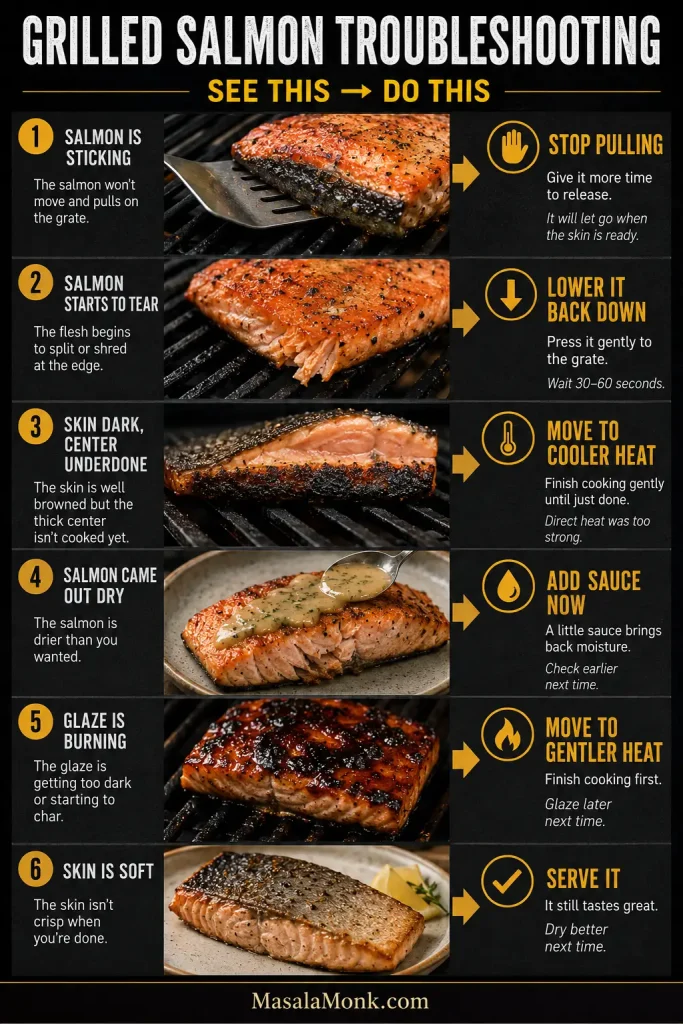
This is the rescue section. If dinner is already on the grill, find the symptom that looks closest to yours and act from there.
Quick Fixes by Symptom
| Problem | Likely cause | What to do |
|---|---|---|
| Salmon sticks immediately | The skin has not released yet, or the grate was not fully prepared | Stop pulling and give it more time |
| Fillet tears when lifted | The skin is still gripping the grate | Lower it back down and wait another 30–60 seconds |
| Skin burns before the inside cooks | Direct heat is too aggressive for the thickness | Slide the salmon to the cooler zone and close the lid |
| Salmon is dry | It stayed on after the inside was ready | Add sauce now; next time, begin checking earlier |
| Edges dry before the middle | Tapered or thinner portions cook first | Fold the thin flap underneath or remove thinner fillets earlier |
| Inside is undercooked but the outside is dark | The fillet is thick or the direct heat is too strong | Finish over indirect heat |
| Glaze burns | Sugar was added too early | Move to gentler heat; glaze later next time |
| Salmon falls between the grates | Skinless or fragile fish needs more support | Use a griddle, perforated grill pan or foil |
| White albumin appears | Proteins tightened during cooking | A little is normal; judge doneness by temperature |
| Salmon tastes bland | It needs salt, acidity or a stronger finish | Add lemon, herb butter, yogurt sauce or salsa |
| Skin is soft | The skin was wet or had too little direct heat | Serve it as it is; dry more thoroughly next time |
Dry salmon usually eats better with a sauce or flaked into a bowl. Pieces that break while lifting are often perfect for salad, rice or pasta.
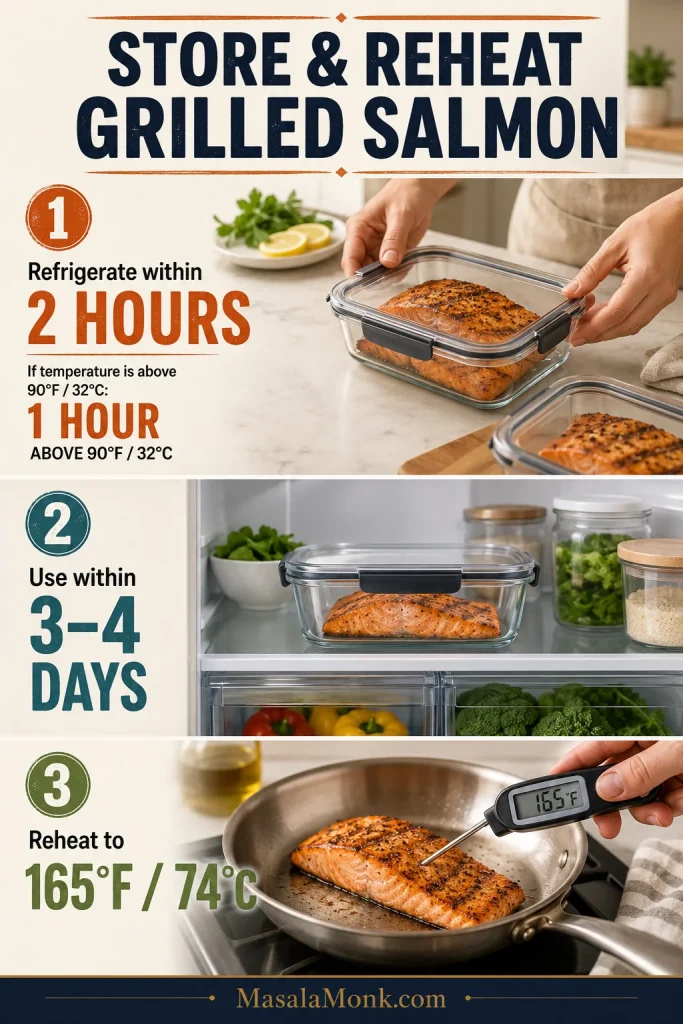
How to Store and Reheat Grilled Salmon
Refrigerate it promptly
Transfer leftovers to a shallow airtight container and refrigerate them within two hours of cooking—or within one hour when the outdoor temperature is above 90°F / 32°C. Use refrigerated leftovers within 3–4 days. These limits follow the USDA guidance for chilling and reheating leftovers.
Reheat gently
High heat can toughen the outside before the middle is warm. Cover the salmon and reheat it slowly in a low oven or skillet with a teaspoon of water, broth or butter.
Official guidance recommends reheating leftovers to 165°F / 74°C. Check the thickest part and avoid reheating the same portion repeatedly.
Some leftovers are better cold
Cold grilled salmon often keeps its texture better than the same piece reheated. Use it in grain bowls, green salads, sandwiches, wraps or cold noodles.
For a warm second dinner, fold larger flakes into this creamy salmon pasta near the end so they warm without breaking apart.
Smaller irregular flakes are ideal for crisp salmon croquettes, where shape no longer matters.

← Back to recipe · ↑ Back to top
Frequently Asked Questions
Should the grill lid stay open or closed?
Keep it closed for most of the cooking so heat surrounds the fillet while the skin browns against the grate. Open it to check temperature, move the salmon or remove it.
How much salmon should I buy per person?
Plan on 6–8 oz / 170–225 g uncooked salmon per adult when it is the main protein. Choose the higher end for light sides or planned leftovers.
Can I grill salmon on an indoor grill or grill pan?
Yes. Preheat a grill pan thoroughly and use the same drying, oiling and temperature cues. A clamshell-style indoor grill heats both sides at once, so begin checking much earlier than the outdoor base-fillet window.
For circulating heat without an outdoor grill, use this Air Fryer Salmon recipe.
Can you eat grilled salmon skin?
Yes. If it has been scaled, dried and browned well, the skin can be one of the best parts. If you prefer not to eat it, leave it attached during grilling and remove it at the table.
Can I use this method for salmon steaks?
Yes. Oil and season them the same way, grill over direct heat and turn once. Place the thermometer in the thickest flesh beside the central bone, not against it.
The Moment the Salmon Is Ready
The satisfying part is not a dramatic flip. It is feeling the spatula slide beneath the browned skin without resistance, then seeing the center open into tender flakes at the table.
Once you can read those two cues—release underneath and temperature at the center—the grill stops feeling like a gamble. You know when to wait, when to move the salmon and when dinner is ready.








