Posted on Leave a comment

How to Make Paneer at Home: Soft Homemade Paneer

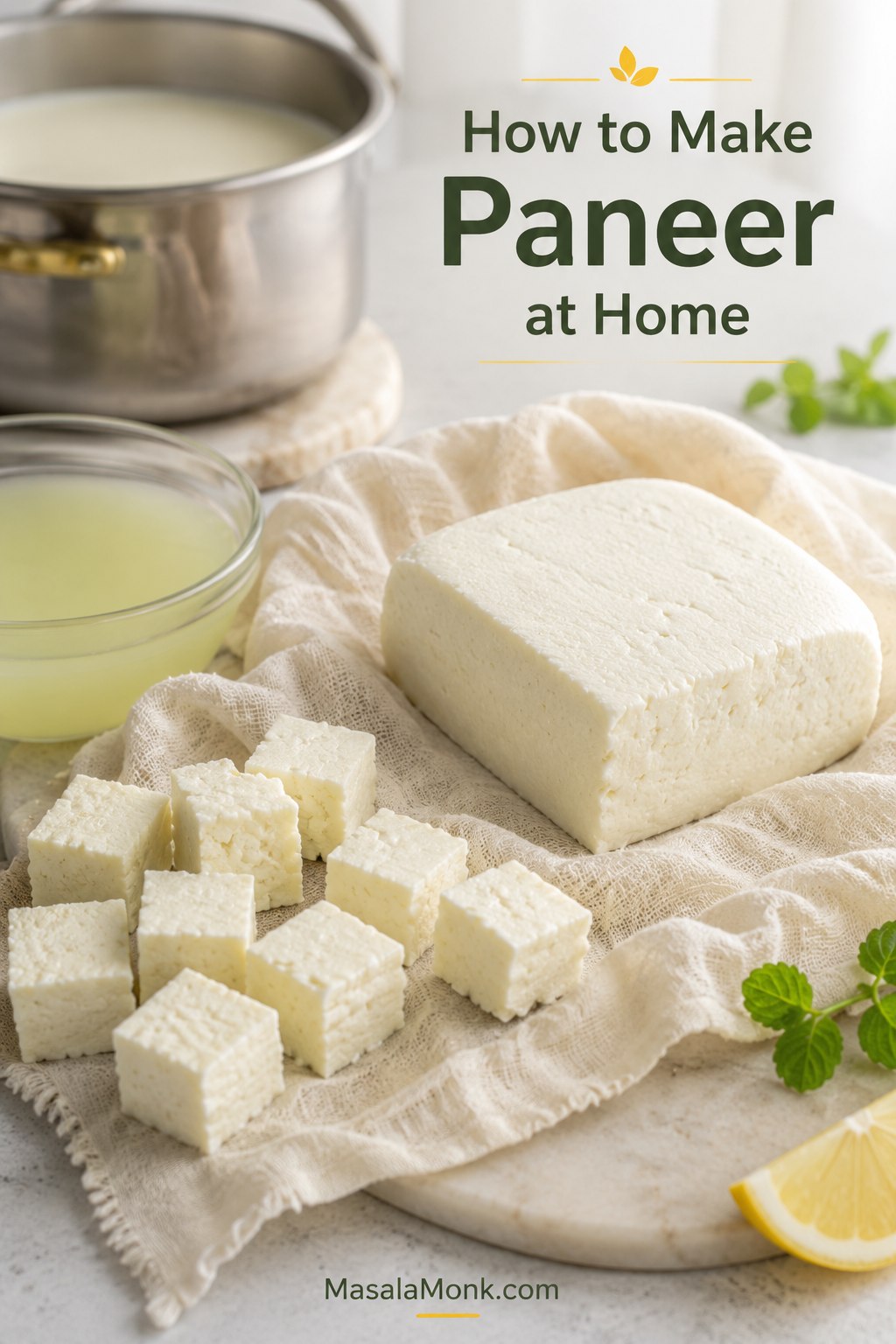
Fresh homemade paneer block on muslin with cut paneer cubes, pale whey in a glass bowl, and a milk pot in the background.

If you want to know how to make paneer at home, the process is simpler than it looks: heat milk, add just enough acid, strain the curds, and press only as much as your dish needs. Paneer may look like something you have to buy from an Indian grocery store, already pressed into a neat block for palak paneer, paneer tikka, or a creamy restaurant-style curry, but fresh homemade paneer is very doable in a regular kitchen.

The goal is not just paneer that sets. The goal is paneer that curdles cleanly, cuts neatly when you need cubes, and still stays tender when it goes into sauce.
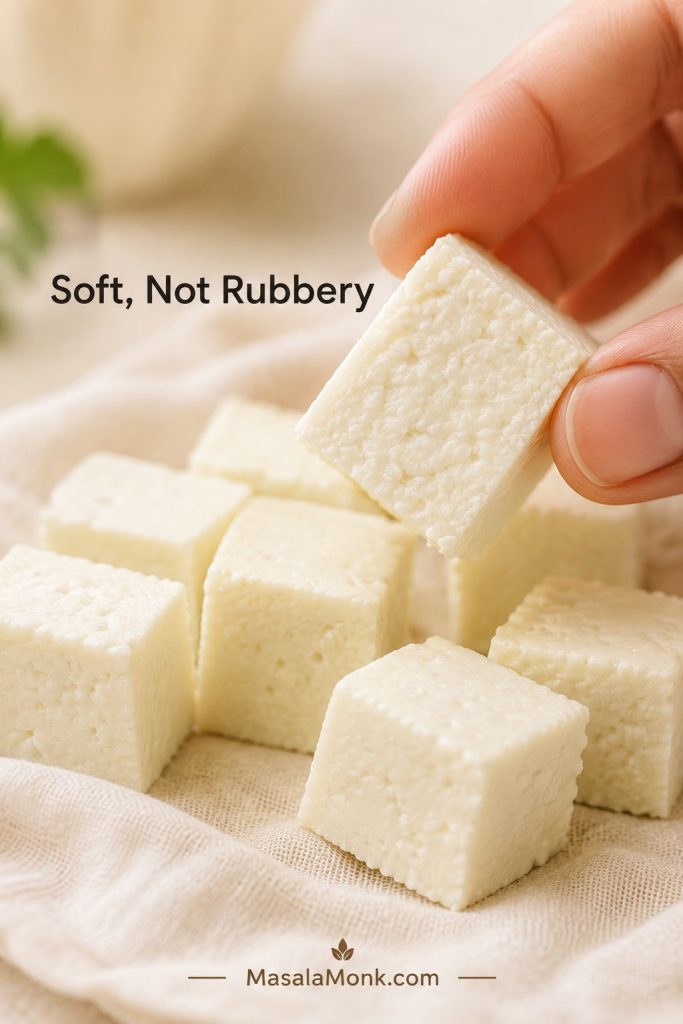
Close-up of a soft homemade paneer cube being held to show its moist interior.
This is the texture to aim for: paneer that sets cleanly but still looks moist inside. That softness is what keeps it tender in curry, bhurji, wraps, and bowls.

That texture comes from stopping at the right moments: before the milk boils too hard, before too much acid makes the curds tight, and before pressing turns soft curds into a dry block.

You do not need to understand cheesemaking to make paneer. You only need to know when the milk is hot enough, when the curds have separated, and when to stop pressing.

This guide helps most when you do not live near an Indian grocery store, feel unsure about supermarket milk labels, or have only found dense packaged paneer. If packaged paneer near you is firm, squeaky, or rubbery, homemade paneer can feel like a different ingredient.

If you have tried making paneer before and ended up with sour crumbs, weak curds, rubbery cubes, or milk that refused to curdle, you probably did not fail. Milk behaves differently from brand to brand: one batch may need gentler heat, another may need less acid, and another may need a shorter press. If you are nervous about wasting a large pot of milk, start with the 1-litre batch in the scaling table below.

If you are here because a batch already went wrong, jump to Troubleshooting Homemade Paneer first, then come back to the recipe with the problem in mind.

Once you have a good block, you can use it anywhere paneer texture matters: a rich curry like Balti Paneer Gravy, a quick filling, a salad bowl, a pan-seared snack, or a simple vegetarian dinner.

Quick Answer: How to Make Paneer at Home

The easiest way to make paneer at home is to heat whole milk to 185–195°F / 85–90°C, or until it is steaming, foamy, and just about to rise. Add diluted lemon juice or plain white vinegar gradually until soft white curds separate from pale yellow-green, slightly translucent whey. Strain the curds through cloth, rinse briefly if needed, then press for 10 minutes for soft crumbles, 30–40 minutes for curry cubes, or up to 50 minutes for firmer tikka-style paneer.

The active work is about 20–25 minutes. The rest is mostly resting, draining, pressing, or chilling, depending on how firm you want the final paneer.

Best milkWhole milk / full-fat milk
Avoid if possibleSkim milk, fat-free milk, UHT milk, and ultra-pasteurized milk
Best beginner acidLemon juice or plain white vinegar, diluted with water
Temperature cue185–195°F / 85–90°C, or steaming and just about to rise
Yield from 2 litres / 8½ cups milkAbout 300–400 g / 10.5–14 oz paneer, depending on milk and pressing
Fridge storage2–3 days, covered or submerged in fresh cold water
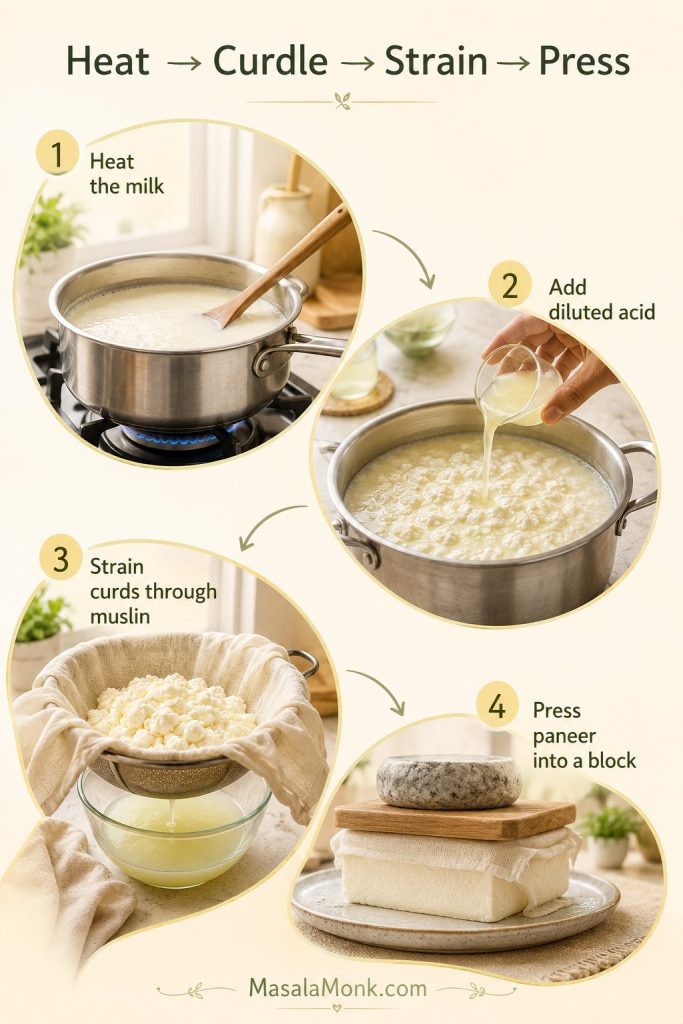
Four-step paneer process showing milk heating, diluted acid being added, curds strained through muslin, and paneer being pressed.
The basic paneer recipe is simple, but each stage has a cue. Heat the milk, add acid gradually, strain when the whey clears, then press for the texture you need.

Still choosing ingredients? Start with Best Milk for Paneer. Already curdled the milk? Use the Pressing Times section to choose soft crumbles, curry cubes, or firmer tikka paneer.

Before You Start: 3 Things That Decide Paneer Texture

Most paneer problems come down to three simple choices: the milk, the acid, and how long you press. Get those right and the recipe becomes much more reliable.
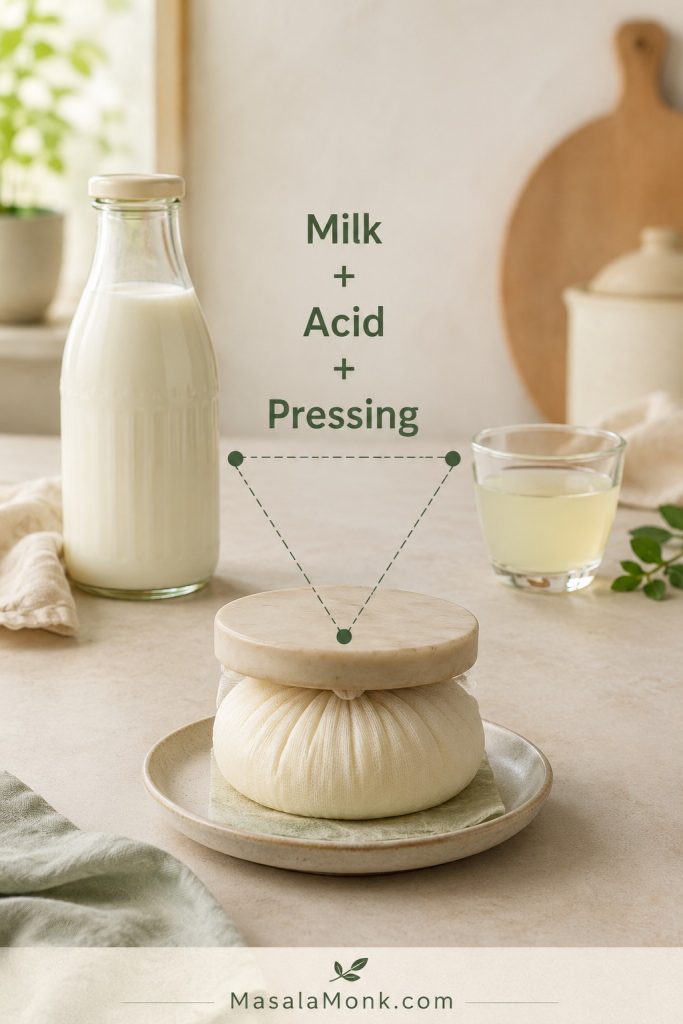
Milk, diluted acid, and paneer wrapped in muslin under a light weight shown as the three main texture factors.
If homemade paneer turns crumbly, sour, or rubbery, the cause is usually one of three things: milk choice, acid control, or pressing time.

Three things decide paneer texture: use whole milk for better curds, add diluted acid gradually, and press for the dish you are making. Bhurji needs almost no pressing, curry cubes need moderate pressing, and tikka needs a firmer block. Acid is the trigger, not the target.

At its simplest, paneer is just hot milk plus a little acid. The details below help you keep it soft, but the basic process is only heat, curdle, strain, and press.

Once you have seen milk split cleanly into curds and clearer yellow-green whey, the whole process feels much less mysterious.

Homemade Paneer Recipe

This is the base recipe if you want to make paneer at home with whole milk and lemon juice or vinegar. Use the pressing chart later in the guide to adjust the texture for bhurji, curries, tikka, wraps, bowls, or grilling.
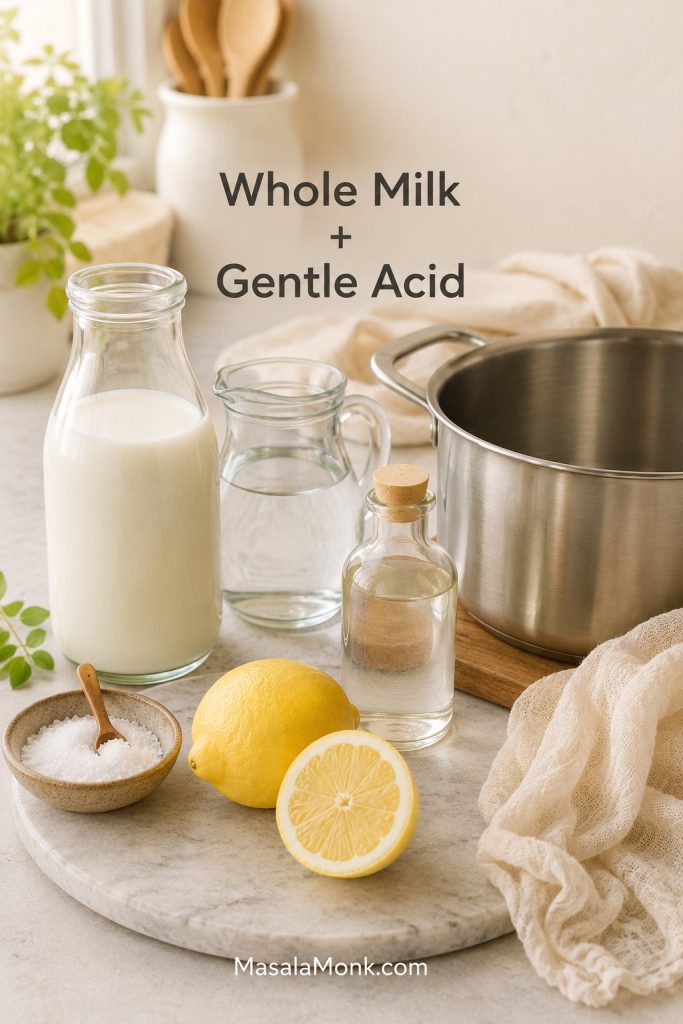
Whole milk, lemon, vinegar, water, salt, muslin cloth, and a cooking pot arranged for making paneer at home.
Paneer does not need a long ingredient list. However, whole milk, diluted acid, and gentle handling matter more than any extra add-in.
Yield300–400 g / 10.5–14 oz paneer
Prep Time5 minutes
Cook Time15–20 minutes
Total Time45–70 minutes, plus optional chilling for firmer cubes

Equipment

  • Large heavy-bottomed pot, with room for the milk to rise
  • Wooden spoon or silicone spatula
  • Thermometer, optional but helpful for first-timers
  • Colander or large sieve
  • Cheesecloth, muslin, thin cotton towel, clean handkerchief, or nut milk bag
  • Large bowl to catch the whey
  • Plate or tray for pressing
  • Moderate weight, such as canned beans, a small pot, or a heavy skillet

Ingredients

  • 2 litres / 8½ cups / about 2.1 quarts whole milk
  • 3 tablespoons / 45 ml lemon juice or plain white vinegar, plus 1 tablespoon / 15 ml more if needed, diluted before adding
  • 3–4 tablespoons / 45–60 ml water, plus a little more if using the extra acid
  • ¼–½ teaspoon / about 1.5–3 g fine salt, optional

Step-by-Step Method

Heat, curdle, and strain the milk

  1. Prepare the strainer. Line a colander with cheesecloth, muslin, a thin cotton towel, or a nut milk bag. Place it over a large bowl to catch the whey.
  2. Heat the milk. Pour the milk into a heavy-bottomed pot. Heat over medium-low to medium heat, stirring often so the bottom does not scorch.
  3. Watch the temperature. Heat the milk to 185–195°F / 85–90°C. Without a thermometer, look for milk that is steaming, foamy at the edges, and just about to rise. Avoid a violent rolling boil.
  4. Dilute and add the acid. Mix the lemon juice or vinegar with the water. Turn the heat to low or switch it off, then add the diluted acid about 1 tablespoon at a time, stirring gently for a few seconds after each addition.
  5. Stop when the milk separates. Stop once you see soft white curds and pale yellow-green, slightly translucent whey. If the liquid still looks milky after 1–2 minutes, dilute the extra acid and add it 1 teaspoon at a time, waiting briefly between additions.
  6. Let the curds settle. Once curds form, stir as little as possible. Too much stirring can break soft curds into small grains. Let the curds sit in the hot whey for 5–10 minutes so they settle and gather.
  7. Strain and rinse. Pour the curds and whey into the lined colander. Gather the cloth gently and let gravity drain first. If you used lemon juice or vinegar, rinse the curds briefly under cool water to remove excess sourness and stop the cooking.

Salt, press, and cut the paneer

  1. Salt only if needed. For unsalted paneer, skip the salt. For lightly salted paneer, sprinkle the salt over the drained curds before shaping and pressing. If the paneer is going into a curry, you can skip the salt and season the sauce instead.
  2. Shape and press for your dish. Shape the curds into a flat square or disc inside the cloth. Press according to your final use: 0–10 minutes for soft crumbles, 15–20 minutes for a tender block, 30–40 minutes for curry cubes, or 45–50 minutes for firmer tikka cubes.
  3. Cut if needed. You can use soft paneer right away. For neat cubes, chill the pressed block for 20–30 minutes before cutting. For firmer tikka-style cubes, you can instead dip the pressed block in cold water for 5–10 minutes, then pat dry before cutting. Skip this for soft crumbled paneer.

Important cue: Once the curds have formed and the whey is no longer milky, pause. More acid will not make better paneer. It will only make sharper, firmer, more sour paneer.

Unsure which acid to use? The lemon, vinegar, yogurt, and citric acid comparison explains which option gives the cleanest flavor and which one makes softer curds.

Milk Temperature Cue

Use the thermometer reading or the visual cues together: the milk should be hot, steaming, foamy at the edges, and close to rising before you add acid.
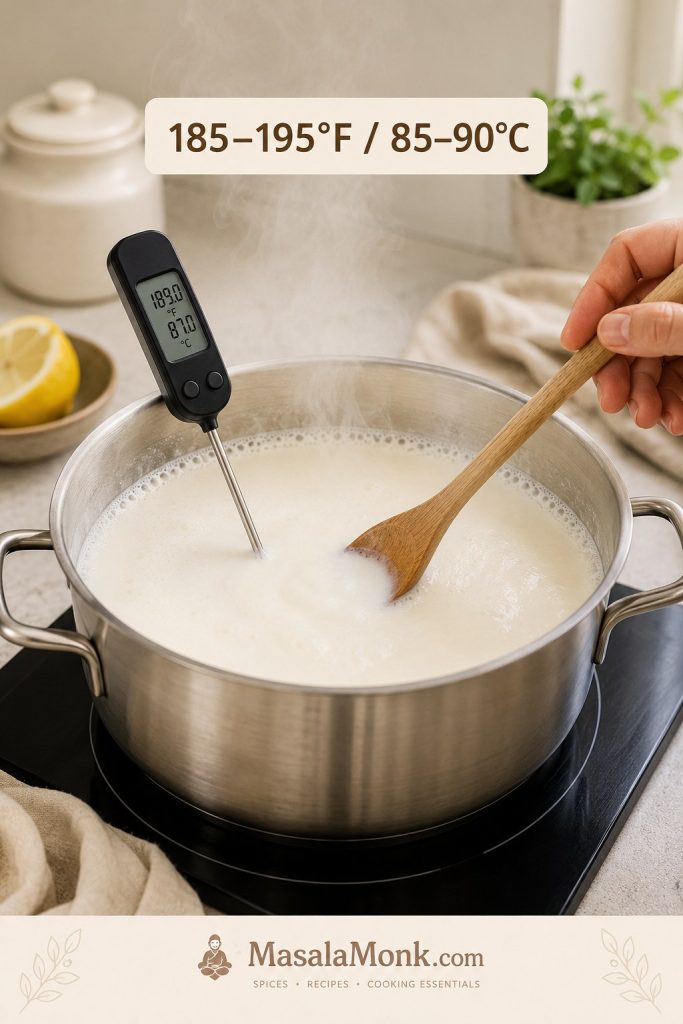
Milk heating gently in a pot with a thermometer showing the paneer temperature range of 185–195°F or 85–90°C.
The milk does not need a violent boil to make paneer. Look for steam, edge foam, and a near-rise so the curds form cleanly without tightening too early.

Curds and Whey Cue

After adding diluted acid, watch the liquid around the curds. Soft curds and pale yellow-green whey mean the milk has separated cleanly.
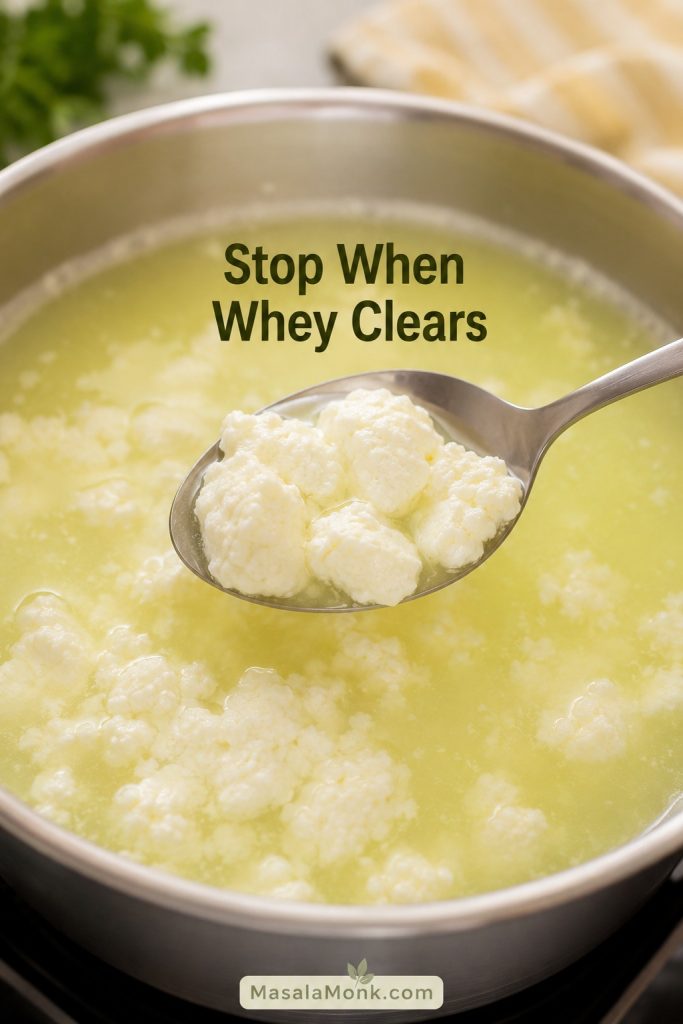
Soft white paneer curds forming in pale yellow-green whey inside a pot, with a spoon lifting the curds.
Clear whey is your stop sign. When soft curds gather and the liquid shifts from milky white to pale yellow-green, the acid has done its job.

Straining Paneer Curds

Once the curds have settled, pour them into the lined colander and let the whey drain first before you gather the cloth.
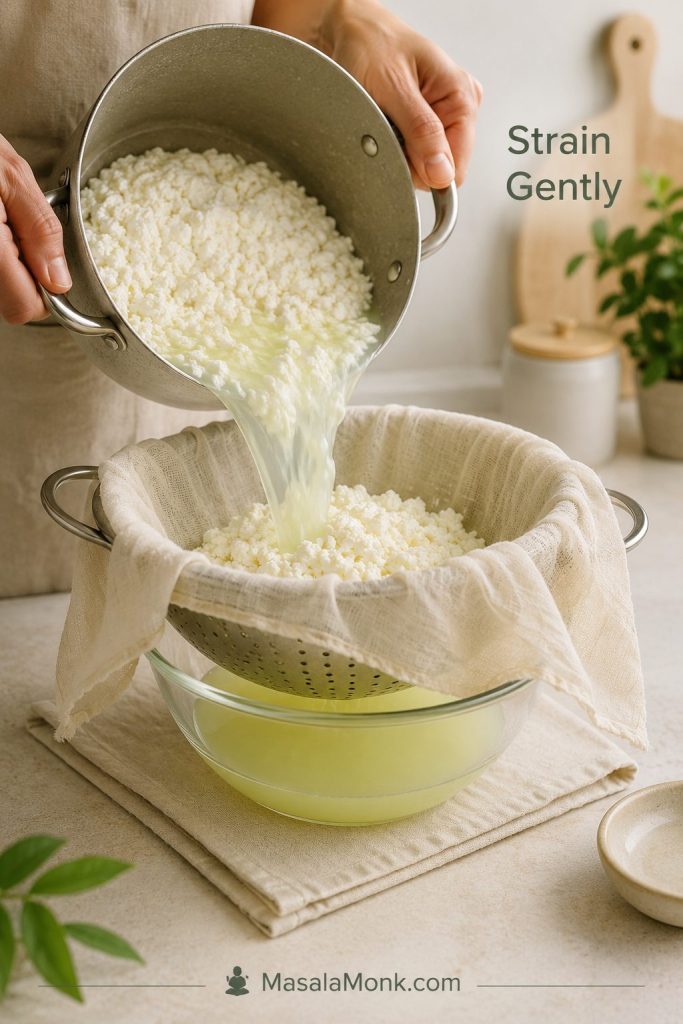
Paneer curds being poured into a muslin-lined colander over a bowl as pale whey drains below.
Let gravity do the first part of the draining. Squeezing too early can remove the moisture that makes homemade paneer soft and pleasant to eat.

How to Make Paneer with 1 Litre, 2 Litres, or 1 Gallon Milk

The recipe above uses 2 litres / about 8½ cups milk because it gives a useful home batch. You can scale homemade paneer up or down, but keep the acid flexible. Lemons vary, vinegar brands can differ slightly, and milk behaves differently by country, season, and processing method.

If this is your first time making paneer or you are testing a new milk brand, start with 1 litre. It is a smaller commitment, and it teaches you how that milk behaves before you make a larger batch.

Milk amountAcid to start withUse more only if…Expected paneer
1 litre / about 4¼ cups1–1½ tablespoons / 15–22 ml lemon juice or vinegar, dilutedThe whey still looks milkyAbout 150–200 g / 5–7 oz
2 litres / about 8½ cups3 tablespoons / 45 ml lemon juice or vinegar, dilutedUse up to 4 tablespoons / 60 ml if neededAbout 300–400 g / 10.5–14 oz
1 gallon / about 3.8 litres6 tablespoons / 90 ml lemon juice or vinegar, dilutedUse up to 8 tablespoons / 120 ml if neededAbout 600–750 g / 21–26 oz

Use these as practical ranges, not fixed guarantees. Richer milk gives more paneer. Leaner milk gives less. Longer pressing removes more moisture, so the final block weighs less. A 300–400 g block usually works for a family-style curry serving 3–4 people, depending on how paneer-heavy you like the dish.

What Soft Homemade Paneer Looks and Feels Like

The first batch is less stressful when you know what “right” looks like. These are the cues to trust as the milk changes from liquid to curds.
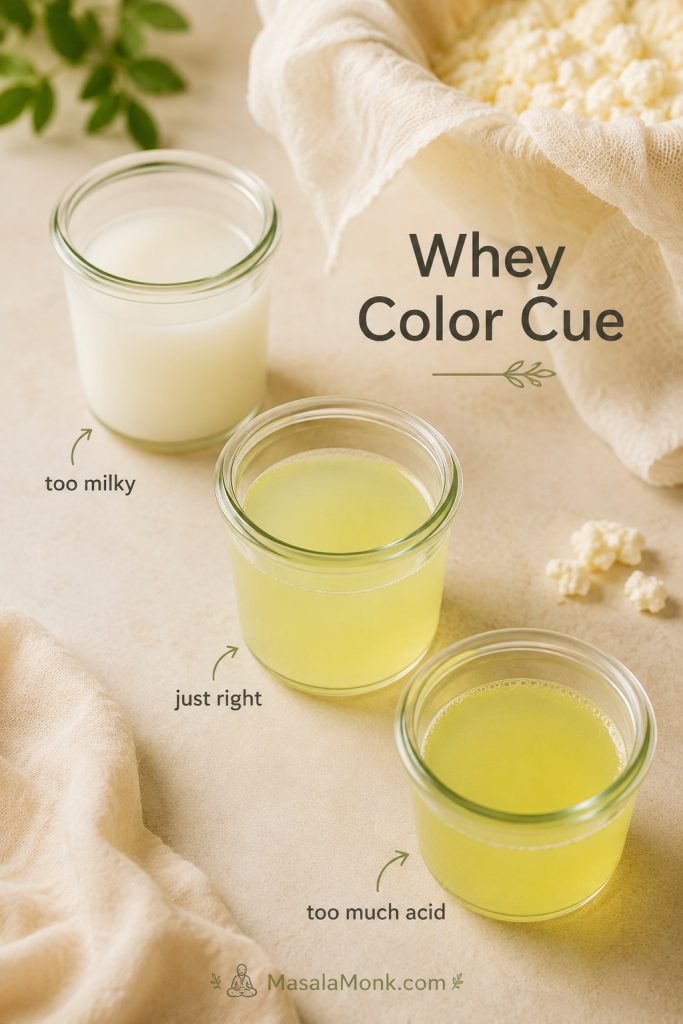
Three glasses showing milky whey, clear pale yellow-green whey, and over-acidified whey for making paneer.
Whey color tells you what to do next. Milky whey needs more time or a little more acid; clear yellow-green whey means the curds are ready to strain.
StageGood signWarning sign
Milk before acidSteaming, foamy at the edges, almost risingViolently boiling for several minutes
Curds formingSoft white clumps pulling away from the liquidTiny, tight, dry-looking grains
WheyPale yellow-green and slightly translucentCloudy, white, and still milky
Pressed blockSet but still slightly tender when touchedHard, dry, dense, or squeaky
Taste and smellClean, milky, faintly sweetSharply vinegary, harshly lemony, or stale-smelling

The curds should look soft and pillowy, not dry and pebbly. The pressed block should hold together, but it should not feel like a brick. If the paneer smells sharply acidic, rinse briefly and use less acid next time.

If your curds look tight, the whey is still milky, or the block feels squeaky, compare it with Troubleshooting Homemade Paneer before you throw the batch away.

What Is Paneer?

Paneer is a fresh Indian cheese made by curdling hot milk with an acid such as lemon juice, vinegar, yogurt, buttermilk, or citric acid. It is not aged, it does not need rennet, and it does not melt into strings like mozzarella or cheddar. Instead, paneer holds its shape when cooked, which is why it works so well in curries, skewers, stir-fries, wraps, sandwiches, and rice bowls.

Paneer is often called Indian cottage cheese, but that phrase can be confusing outside India. Western cottage cheese is loose, wet, and spoonable. Paneer is usually drained and pressed into a sliceable block. Depending on how long you press it, it can be soft and crumbly, tender and cubeable, or firm enough for tikka.

The flavor is mild, milky, and slightly sweet by design. That gentleness is exactly why paneer works so well with bold gravies, smoky marinades, peppery sauces, and spicy vegetables.

Best Milk for Homemade Paneer Outside India

Your carton matters more than the brand name here. The best milk for homemade paneer is whole milk, also called full-fat milk in many countries. It gives better curds, better yield, and a softer finished texture. Different countries sell milk under different labels, so do not worry if your carton does not say “full cream.” Look for regular pasteurized dairy milk with enough fat.
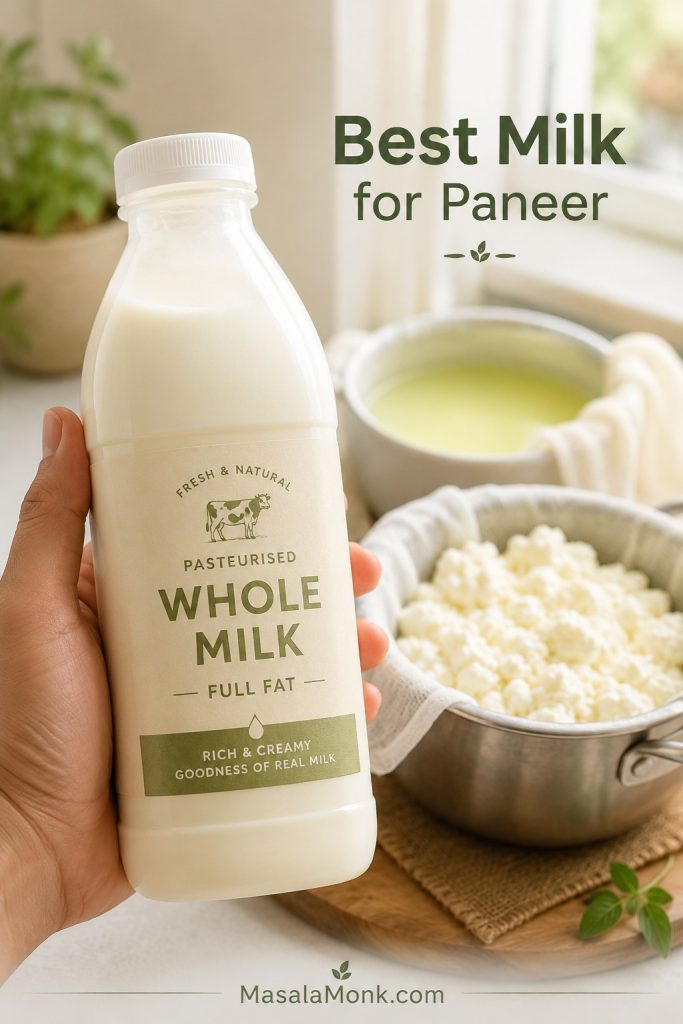
Generic whole milk carton held near soft paneer curds, muslin, and whey in a bright kitchen.
Start the paneer recipe at the milk carton. Whole milk or full-fat milk usually gives better curds, better yield, and a softer finished block.

Regular pasteurized whole cow’s milk is the best supermarket default. Buffalo milk is excellent if you can find it because it is richer and usually gives a softer, higher-yield paneer. Goat milk can work too, though the flavor is tangier and the curds may be more delicate.

The milk to be careful with is UHT, long-life, or ultra-pasteurized milk. These milks are treated at higher temperatures for longer shelf life, and that extra processing can make curd formation less reliable. If you are unsure what UHT or ultra-pasteurized means on a carton, this pasteurization guide explains the terms clearly.

Do not confuse regular pasteurized milk with ultra-pasteurized milk. Regular refrigerated pasteurized whole milk usually works well for paneer. The bigger issue is long-life, shelf-stable, UHT, or ultra-pasteurized milk, which can form weaker curds.
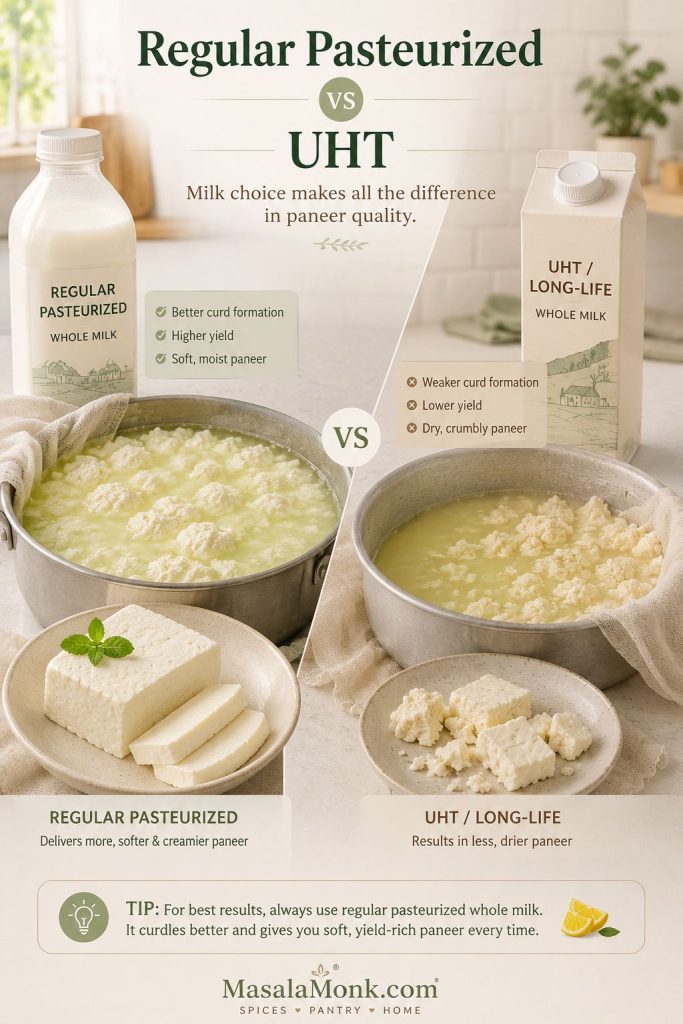
Regular pasteurized milk shown making clean paneer curds beside UHT milk shown with weaker curds.
Regular pasteurized milk and UHT milk are not equal for homemade paneer. If your milk will not curdle cleanly, long-life processing may be the reason.

Milk Labels That Work Best for Homemade Paneer
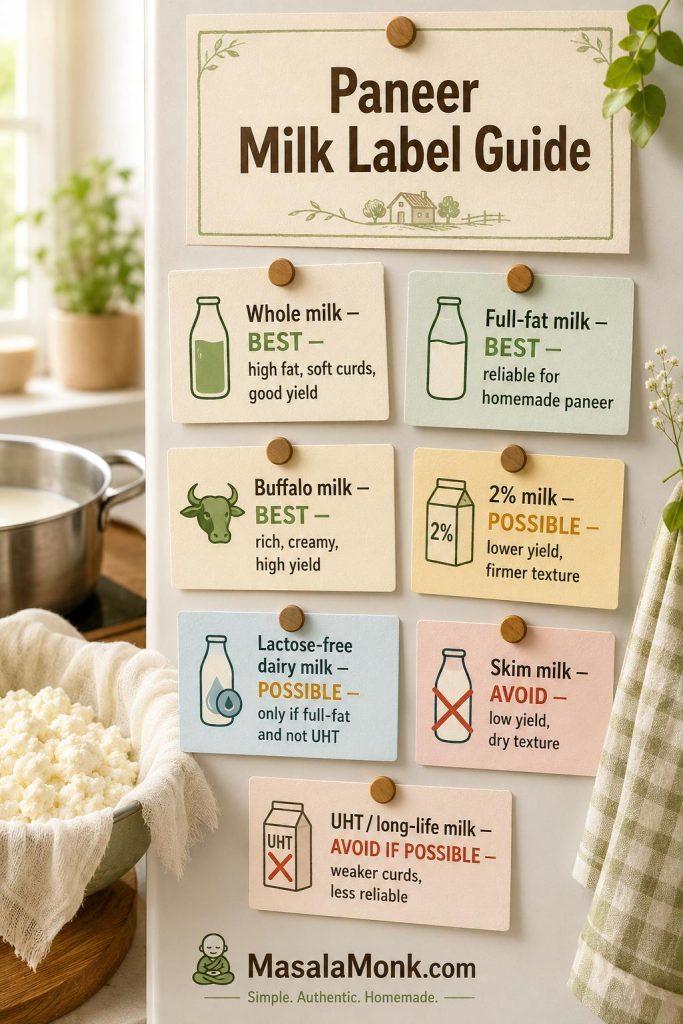
Milk label guide showing whole milk, full-fat milk, buffalo milk, 2 percent milk, lactose-free milk, skim milk, and UHT milk for paneer.
For soft homemade paneer, choose whole, full-fat, or buffalo milk when possible. Use 2% milk with lower-yield expectations, and avoid UHT or skim milk for reliable curds.
Milk labelUse for paneer?What to expect
Whole milk / full-fat milkBest choiceSoft, reliable curds and good yield.
Regular pasteurized cow’s milkYesThe best supermarket default for most readers.
Buffalo milkExcellentRicher, higher-yield, and traditionally prized for soft paneer.
Lactose-free dairy milkSometimesCan work if it is full-fat and not UHT or ultra-pasteurized.
2% milkPossible, not idealLower yield and a firmer, less creamy texture.
Skim or fat-free milkAvoidDry, weak, low-yield paneer that can crumble easily.
Organic milkCheck labelWorks if regular pasteurized, but some brands are ultra-pasteurized.
UHT / ultra-pasteurized / long-life milkAvoid if possibleMay curdle poorly or form weak curds.
Goat milkPossibleSofter curds and a tangier flavor.
Plant milkNot true paneerYou can make a vegan curd or tofu-style alternative, but it is not dairy paneer.

Important: Milk varies by country, brand, season, fat level, and processing. If one carton gives weak curds, do not blame yourself or the whole recipe. Try a different full-fat, non-UHT brand before changing the method.

If your milk is already hot but still not separating, go to Troubleshooting Homemade Paneer before adding too much acid.

Best Acid for Homemade Paneer: Lemon, Vinegar, Yogurt, or Citric Acid

Once the milk question is sorted, the next decision is acid. Paneer needs an acid to separate the milk into curds and whey. Lemon juice and plain white vinegar are the easiest choices for beginners because they are available almost everywhere. Yogurt, buttermilk, and citric acid also work, but they behave differently.

Watch the liquid around the curds; it tells you when to stop. The most important rule is not which acid you choose. It is how you add it. Dilute the acid with water, add it gradually, and stop as soon as the milk separates clearly. Too much acid can make paneer sour, grainy, firm, or rubbery.
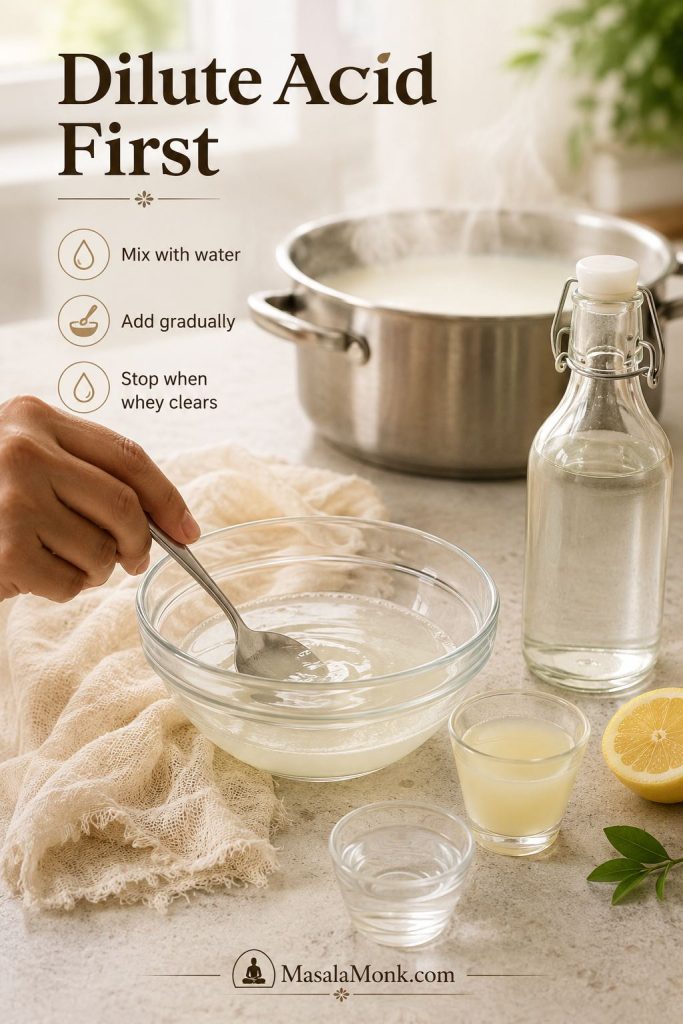
Lemon juice or vinegar being mixed with water in a glass bowl before being added to milk for paneer.
Think of acid as a trigger, not the main ingredient. Diluting it first helps you add it gently and stop before the paneer turns sour or grainy.

Paneer Acid Options

Choose the acid by flavor and texture, but keep the method the same: dilute it, add it gradually, and stop when the milk separates clearly.
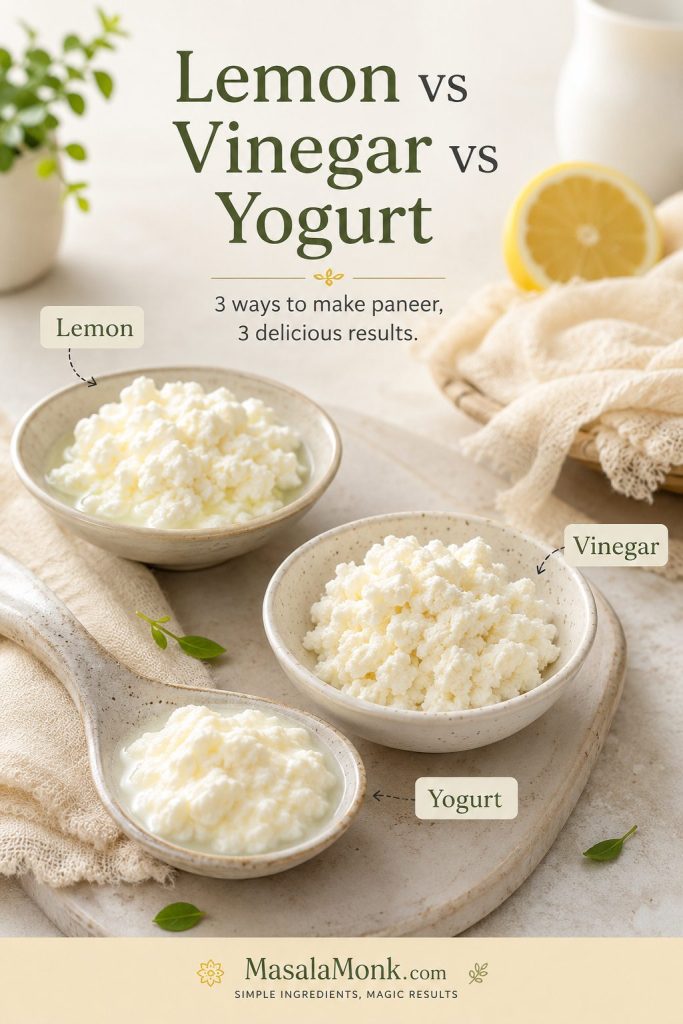
Lemon juice, vinegar, and yogurt shown with small paneer curd samples as acid options.
Lemon, vinegar, and yogurt can all make paneer. The choice affects flavor, but success still depends on adding acid gradually and stopping at the right whey cue.
AcidBest forFlavorTexture
Lemon juiceBeginner homemade paneerLight citrus note if not rinsedSoft to medium
Plain white vinegarReliable curdling and clean cubesNeutral if diluted and rinsedClean, firm curds
Yogurt / curdSofter paneerMild dairy tangSofter and moister
ButtermilkGentle curdlingMild tangSoft and delicate
Citric acidPrecise curdlingNeutral if measured carefullyCan turn firm if overused

How Much Acid to Use for Paneer

Practical starting point: for 2 litres / 8½ cups milk, start with 3 tablespoons / 45 ml diluted lemon juice or white vinegar. If using yogurt, start with ¼ cup / 60 g whisked plain yogurt and add more only if the whey still looks milky. If using citric acid, dissolve a very small amount in water first and add gradually; it is easy to overdo and can make paneer firm or sharp.
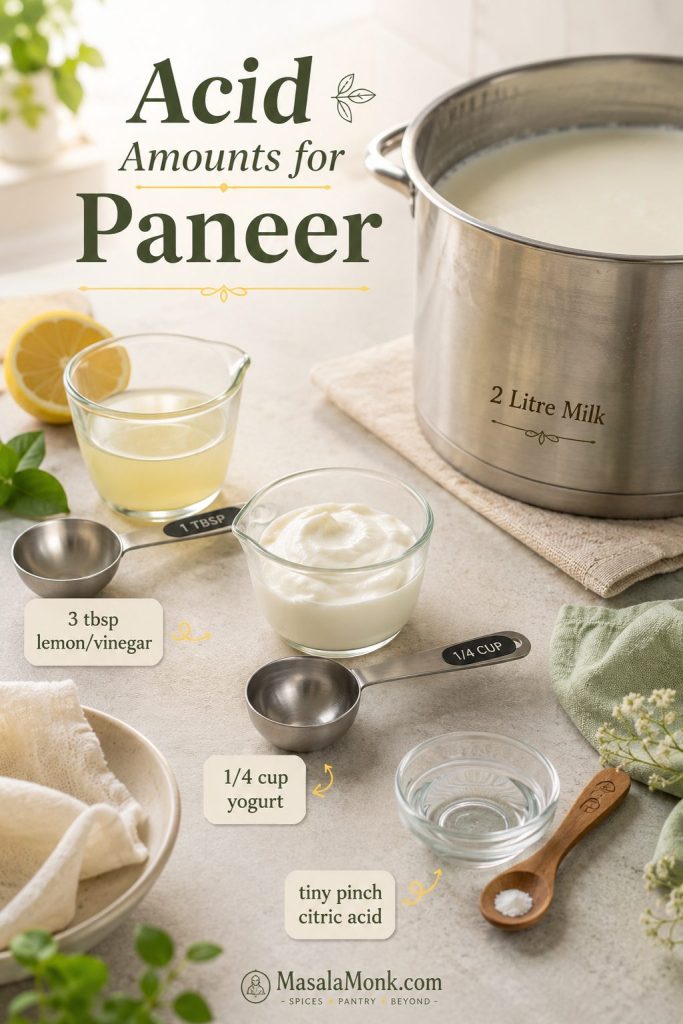
Measured lemon juice, vinegar, yogurt, and dissolved citric acid arranged beside a milk pot for paneer.
Measurements give you a safe starting point, but the pot gives the final answer. Stop when the curds gather and the whey clears.

Fresh lemon juice tastes clean, but lemons vary, so you may need a little more or less. Bottled lemon juice can work because it is consistent, though the flavor may be flatter than fresh lemon. Plain white vinegar is usually more predictable than fresh lemon juice and usually tastes neutral after dilution and rinsing.

Avoid strongly flavored vinegars unless you want that flavor in the paneer. Apple cider vinegar can work in a pinch, but plain white vinegar is cleaner. Whatever acid you use, add it slowly and watch the whey. The goal is not to empty the cup; the goal is to use only enough.

Step-by-Step Paneer Cues That Matter Most

The recipe card gives you the full method. These four cues keep homemade paneer soft instead of tight, sour, or rubbery.
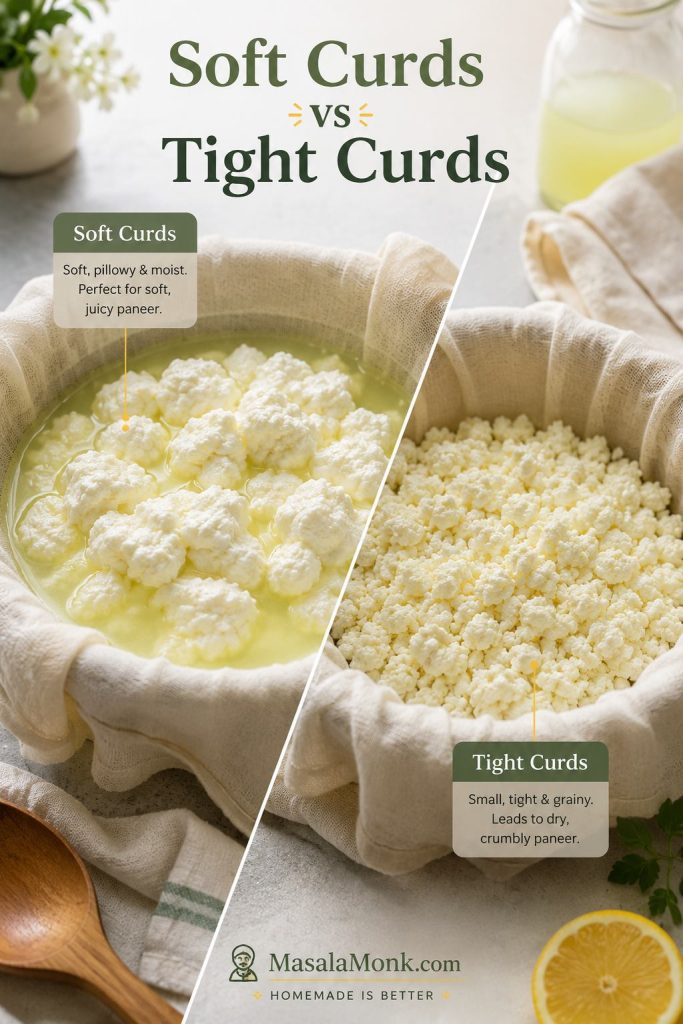
Soft pillowy paneer curds compared with tight grainy paneer curds in pale whey.
Good paneer curds should look soft, moist, and gathered. Tiny dry grains usually point to overheated milk, excess acid, or rough stirring.
  • Milk: use full-fat, non-UHT milk that separates cleanly.
  • Heat: stop at steaming and foamy, not a violent boil.
  • Acid: add it slowly and stop when the whey turns pale yellow-green and slightly translucent.
  • Draining: let gravity work before pressing; hard squeezing steals softness.

Rinsing Paneer Curds

Rinsing is useful when you used lemon juice or vinegar and want to remove sharpness. Keep it brief so the curds stay rich and delicate.
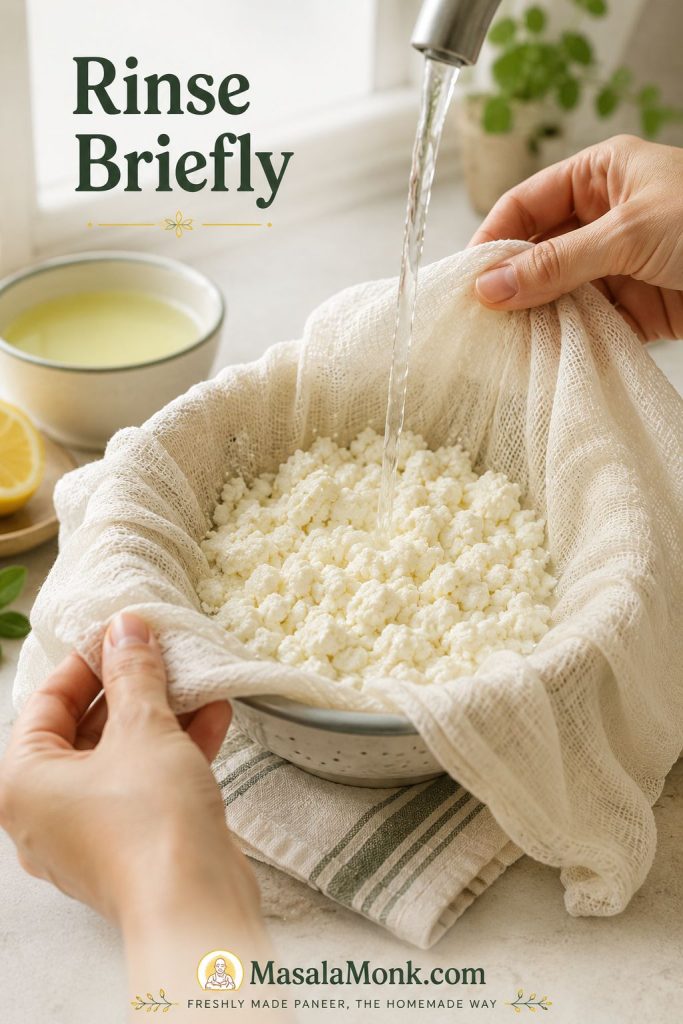
Paneer curds in muslin being briefly rinsed under cool water to reduce lemon or vinegar sourness.
A brief rinse can soften sharp lemon or vinegar flavor after straining. Keep it quick so the curds stay rich and do not lose too much dairy flavor.

Shape Before Pressing

Before you add weight, gather the drained curds neatly in the cloth. A tidy shape helps the paneer press evenly and cut more cleanly later.
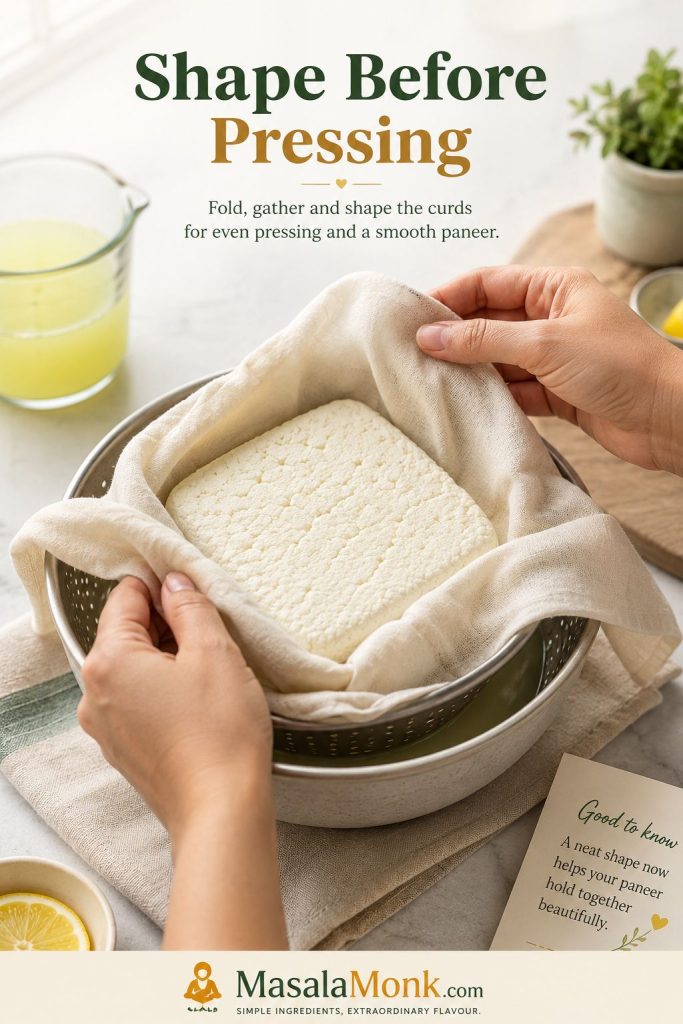
Hands folding muslin around drained paneer curds to shape them into a block before pressing.
Shape the curds before adding weight. This helps paneer set evenly, which makes cleaner cubes possible without forcing the block under heavy pressure.

How Long to Press Homemade Paneer

This is where you choose the paneer you actually want to eat: loose and soft for bhurji, tender for curry, or firm enough for skewers. Less pressing gives softer paneer. Longer pressing gives cleaner, firmer cubes.

If your paneer often turns hard, this is the section to slow down on. Pressing is not just a shaping step; it decides whether the paneer stays moist or becomes dense.
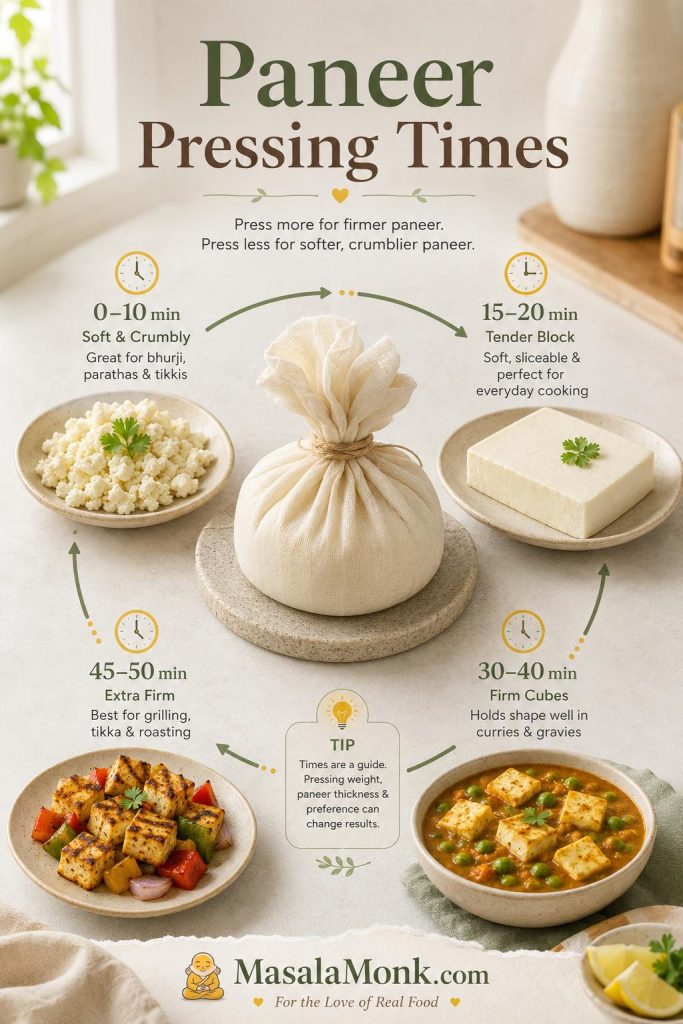
Paneer pressing guide showing soft crumbles, a tender block, curry cubes, and firmer tikka cubes with time cues.
The same paneer recipe can become soft bhurji curds, curry cubes, or tikka pieces. The difference is usually pressing time, not extra ingredients.
Final usePressing timeSuggested weightResult
Paneer bhurji, fillings, toast, sandwiches0–10 minutesNo weight or a very light plateLoose, soft curds
Bowls, salads, gentle pan-frying15–20 minutes400–600 g / 14–21 ozTender block
Curries like palak paneer, matar paneer, or balti paneer30–40 minutes600–900 g / 1.3–2 lbSliceable cubes that still stay moist
Paneer tikka, skewers, grilling45–50 minutes, then chill900 g–1.2 kg / 2–2.6 lbFirmer cubes that handle marinating and skewering
Very heavy pressing for several hoursAvoid for soft paneerAvoid heavy crushing weightCan become dense, dry, or rubbery

Use moderate weight, not crushing pressure. Two cans, a small pot, or a heavy skillet is enough for most home batches. If the paneer is for curry, a 30–40 minute press is usually plenty. If you want tidy cubes, chill the pressed block briefly before cutting.

Light vs Heavy Pressing

Use enough weight to form the block, not so much that the paneer loses all its moisture. This is especially important for curry cubes.
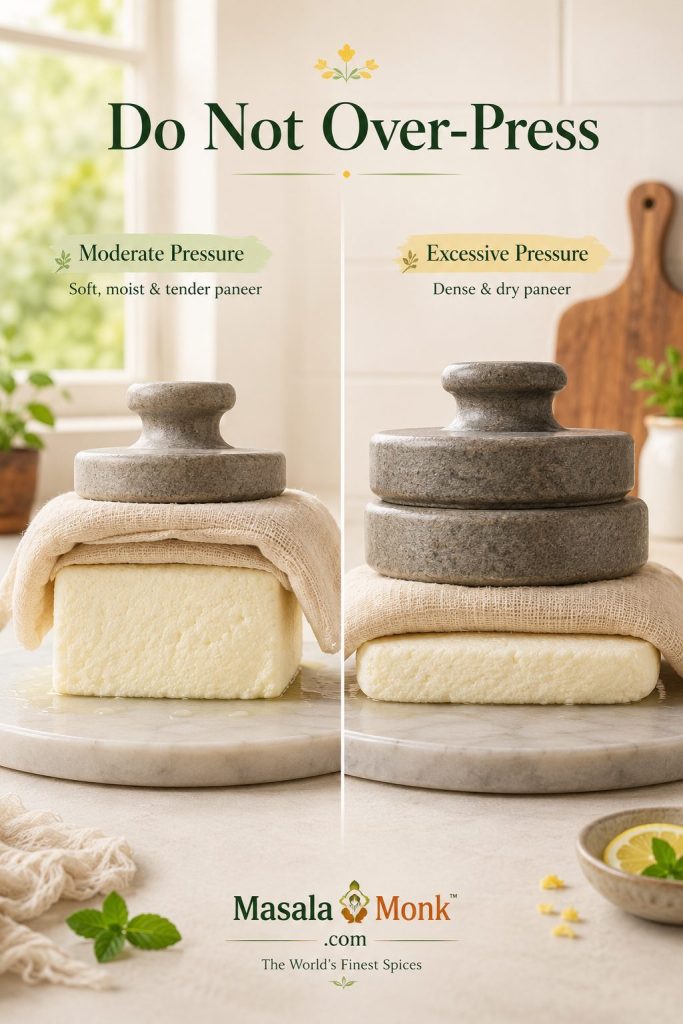
Light pressing compared with heavy pressing for paneer, showing a moist block and a denser compressed block.
Heavy pressing is one of the easiest ways to lose softness. For most paneer curries, moderate weight forms cubes without squeezing out all the moisture.

Once the paneer is pressed, the next texture risk happens in the pan. See How to Keep Paneer Soft When Cooking before adding the cubes to curry.

Soft Paneer vs Firm Paneer: Both Can Be Right

The best paneer is not always the firmest paneer. The right texture depends on what you are cooking next.
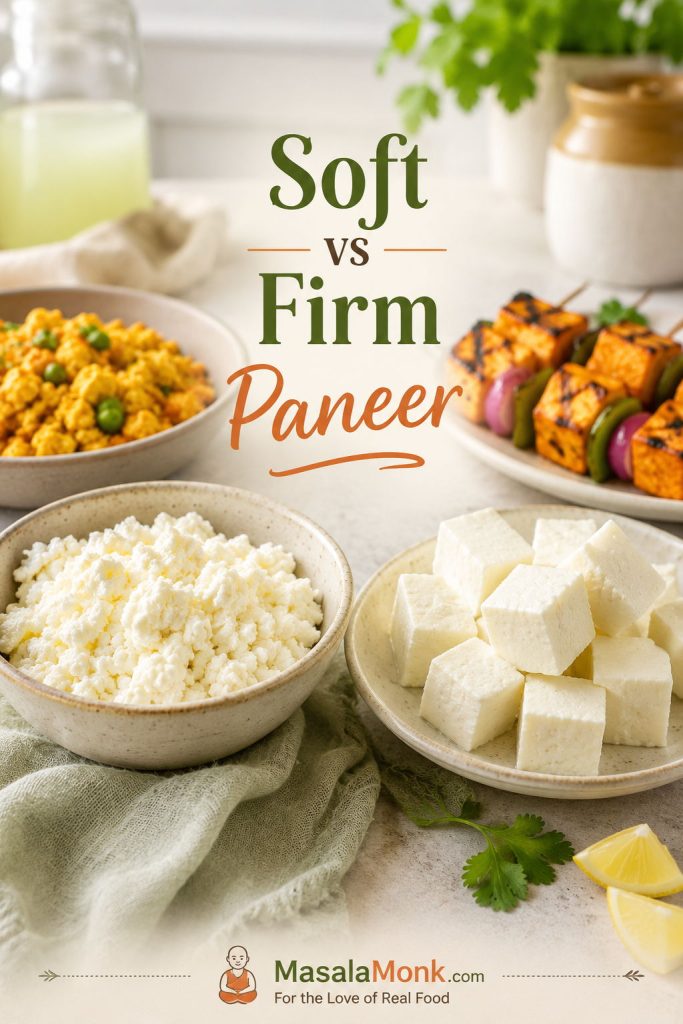
Soft crumbled paneer in a bowl beside firm paneer cubes, with bhurji and tikka-style uses in the background.
Soft paneer and firm paneer are both useful. Crumbles belong in fillings and bhurji, while firmer cubes work better for tikka, skewers, searing, and thicker gravies.

Soft paneer is delicate, moist, and slightly crumbly, so it works beautifully for bhurji, fillings, wraps, cutlets, quick bowls, and gentle curries where perfect cubes do not matter.

Firm paneer is better for tikka, skewers, grilling, pan-searing, or restaurant-style cubes in thick gravy. However, firm should not mean rubbery. Good firm paneer still has moisture inside.

How to Cut Paneer Cubes Cleanly

If you want tidy cubes, chill the pressed paneer briefly and cut with a sharp knife. Slightly larger cubes are easier to handle in curry.
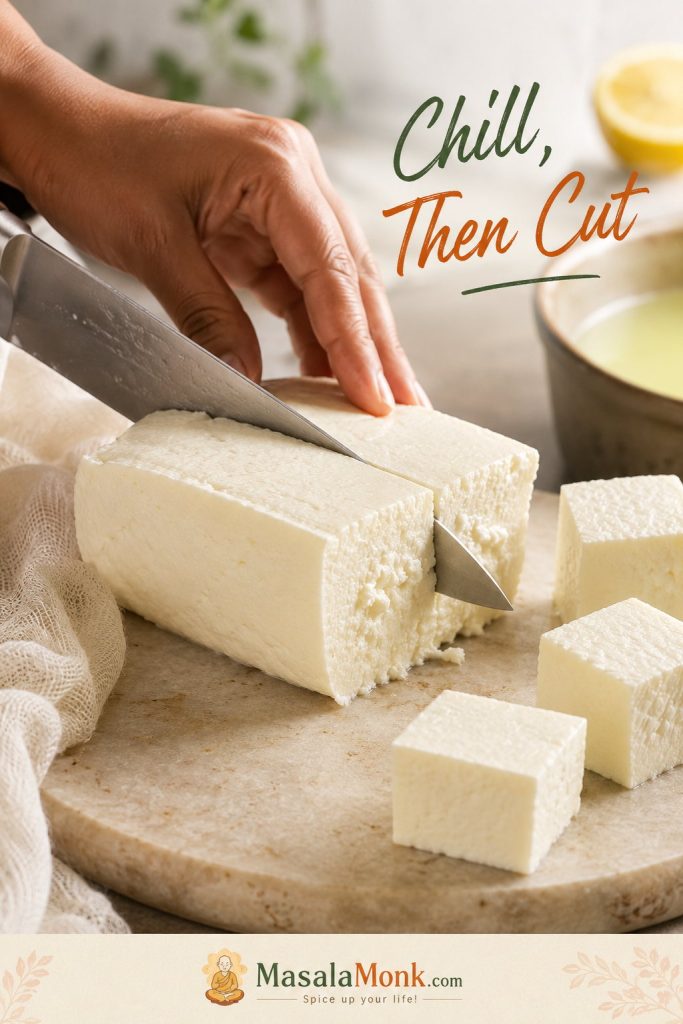
Pressed paneer block being cut into cubes with a sharp knife on a stone board.
If homemade paneer breaks when you cut it, chill the pressed block briefly first. A sharp knife and slightly larger cubes help tender paneer hold its shape.

How to Keep Paneer Soft When Cooking

Paneer can be perfect after pressing and still turn dry if it is cooked too aggressively. Most paneer dishes do not need the paneer to simmer for a long time. Add it when the sauce is already cooked, let it warm through gently, and avoid hard boiling. This matters in creamy gravies such as Kali Mirch Paneer, where paneer should stay tender rather than chewy.
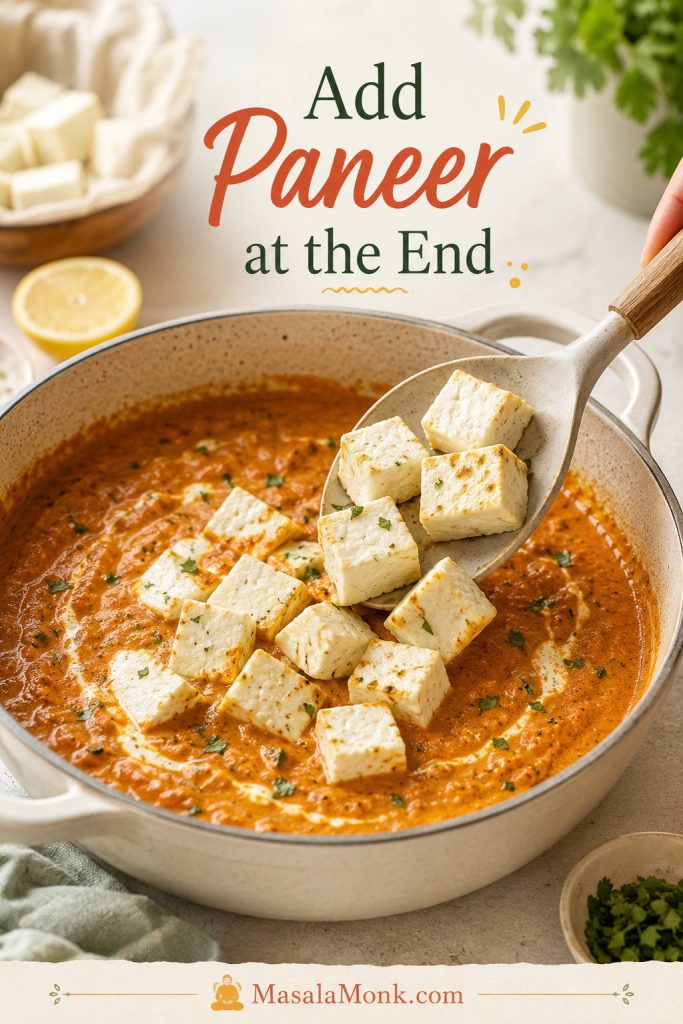
Paneer cubes being gently added to a finished curry with a spoon.
Let the gravy finish cooking before the paneer goes in. Then the cubes only need a gentle warm-through, which helps them stay tender.
  • Curries: add paneer near the end and simmer gently for only a few minutes.
  • Pan-frying: sear quickly, then remove or add sauce. Long frying can toughen paneer.
  • Store-bought paneer: soak cubes in warm water for 10–15 minutes before cooking, especially if the block feels cold and stiff.
  • Homemade paneer: avoid over-pressing if it is going into a soft curry.
  • Paneer tikka: press firmer, chill before cutting, and handle gently while marinating.

Homemade paneer is often softer than store-bought paneer, so treat it gently. Use a sharp knife, cut slightly larger cubes if the paneer feels delicate, and avoid aggressive stirring after adding it to curry. If you are making a rich paneer gravy, the sauce should be ready before the paneer goes in. Paneer should finish the dish, not endure the whole cooking process.

Homemade Paneer vs Store-Bought Paneer

Store-bought paneer is convenient, and there is nothing wrong with using it. It is helpful when you are short on time or cooking a quick dinner. But homemade paneer gives you freshness and texture control that packaged paneer often cannot match.
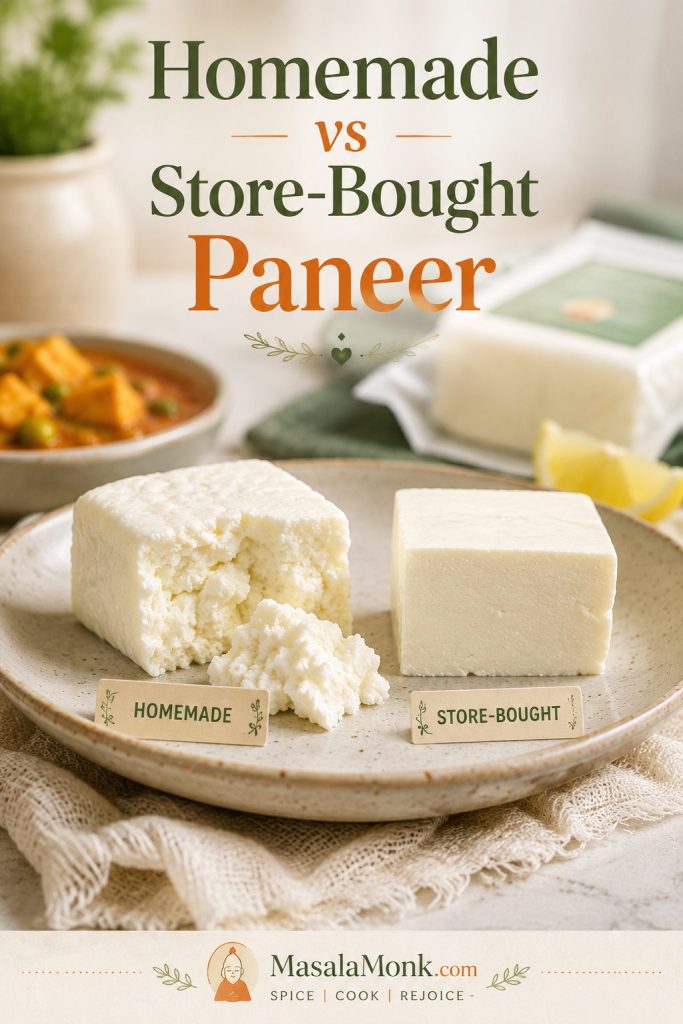
Homemade paneer cube broken open beside a firmer store-bought-style paneer cube with generic packaging blurred behind.
Store-bought paneer is useful when you are short on time, but homemade paneer lets you control moisture, pressing, and softness from the start.

Many store-bought paneer blocks are firmer because they are pressed, packaged, transported, refrigerated, and stored before you cook with them. Some are excellent, but many are denser than the paneer you would make fresh at home.

If your only experience with paneer has been hard cubes that sit separately from the sauce, homemade paneer can change how you think about the dish. Good paneer should be gentle, milky, and tender enough to belong inside the gravy, not feel like a separate chewy block.

You can also fold homemade paneer into vegetable dishes near the end, as in an Aloo Gobi with Paneer variation, where the cubes add protein without needing a long cooking time.

Already Bought Paneer? Here’s How to Soften It

Warm-water soaking can relax cold store-bought paneer and make it feel less stiff, but it may not fully rescue a very dense block. Choose the method based on the dish.
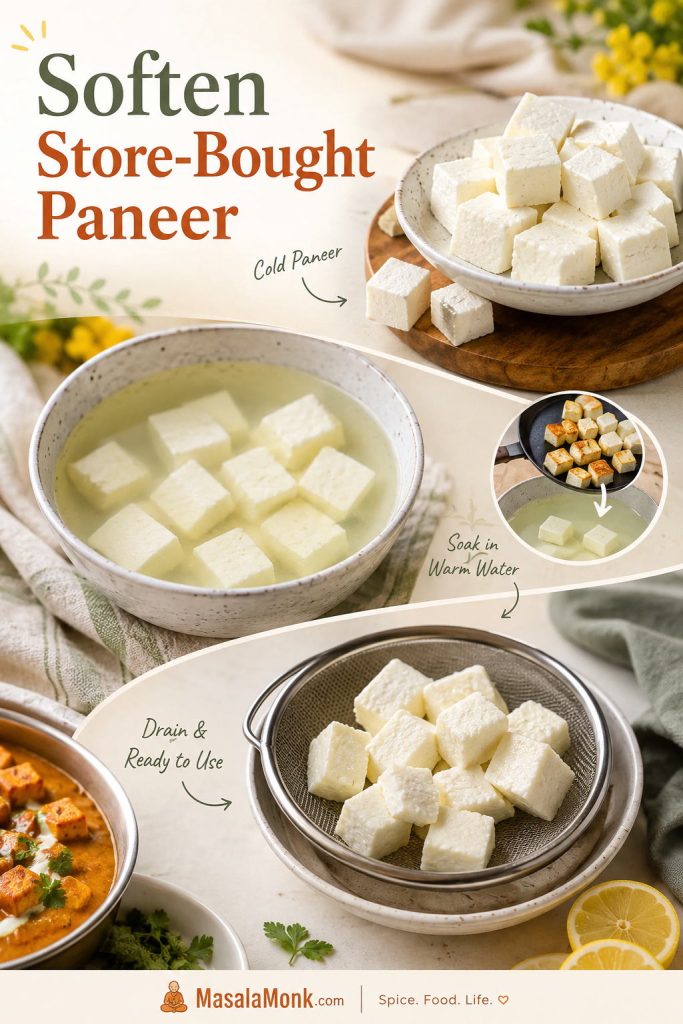
Store-bought paneer cubes shown cold, soaking in warm water, and drained after softening.
Warm-water soaking can relax cold packaged paneer before it goes into curry. It will not fix every dense block, but it often makes store-bought paneer gentler to eat.
  • Quick curries: cut the paneer into cubes and soak in warm water for 10–15 minutes, then drain gently.
  • Browned paneer in saucy dishes: shallow-fry the cubes briefly, then soak them in warm water before adding them to the gravy.
  • Delicate creamy gravies: skip hard frying and add paneer near the end so it only warms through.
  • Very rubbery paneer: soaking helps, but it may not completely fix an over-pressed or low-moisture block.

If packaged paneer keeps turning dense for you, the pressing guide shows how homemade paneer can be adjusted for softer curry cubes or firmer tikka pieces.

Paneer vs Tofu, Halloumi, Ricotta, Queso Fresco, and Cottage Cheese

If you are new to paneer, think of it as a mild, dairy-based cheese that holds its shape. Firm tofu is the closest non-dairy shape-holder, halloumi is saltier and springier, and queso fresco or queso blanco can be crumbly or tangier. Ricotta works better for soft fillings than cubes, while Western cottage cheese is wet and curdy rather than pressed.
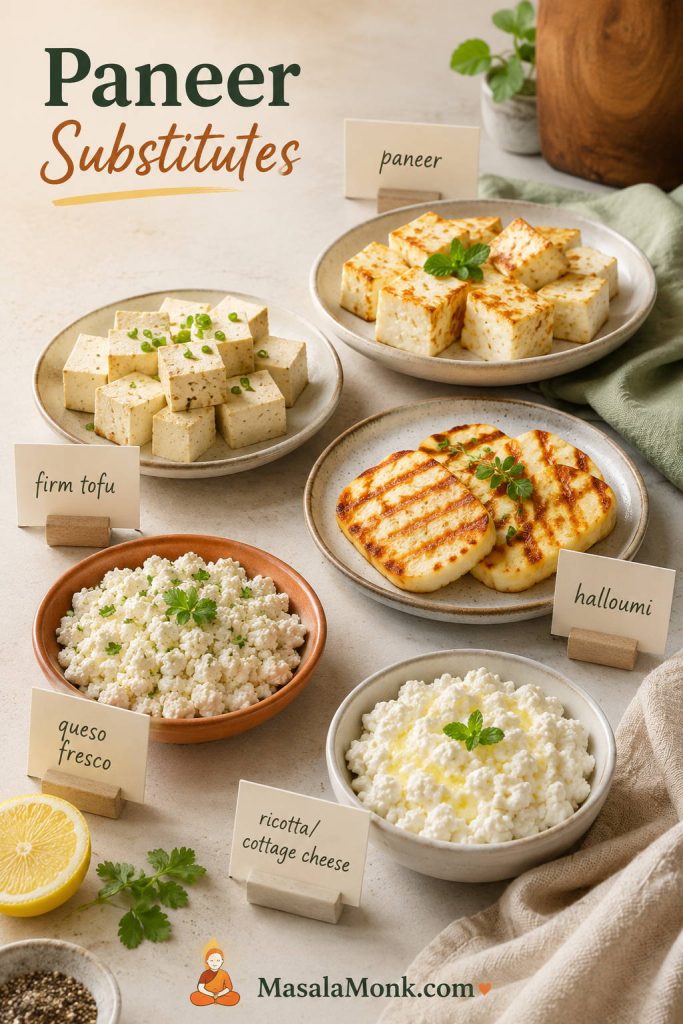
Small plates of paneer, firm tofu, halloumi, queso fresco, and ricotta or cottage cheese arranged for comparison.
Paneer is mild, fresh, and sturdy enough to hold its shape. Tofu, halloumi, queso fresco, and ricotta can help in some recipes, but none behave exactly the same.

If paneer is not sold where you live, homemade is often easier than hunting for the perfect substitute.

Richer Malai-Style Paneer Variation

If you are using regular cow’s milk and want richer, softer paneer, you can make a malai-style variation by adding cream. This is especially useful if your local milk produces firmer paneer than you like.
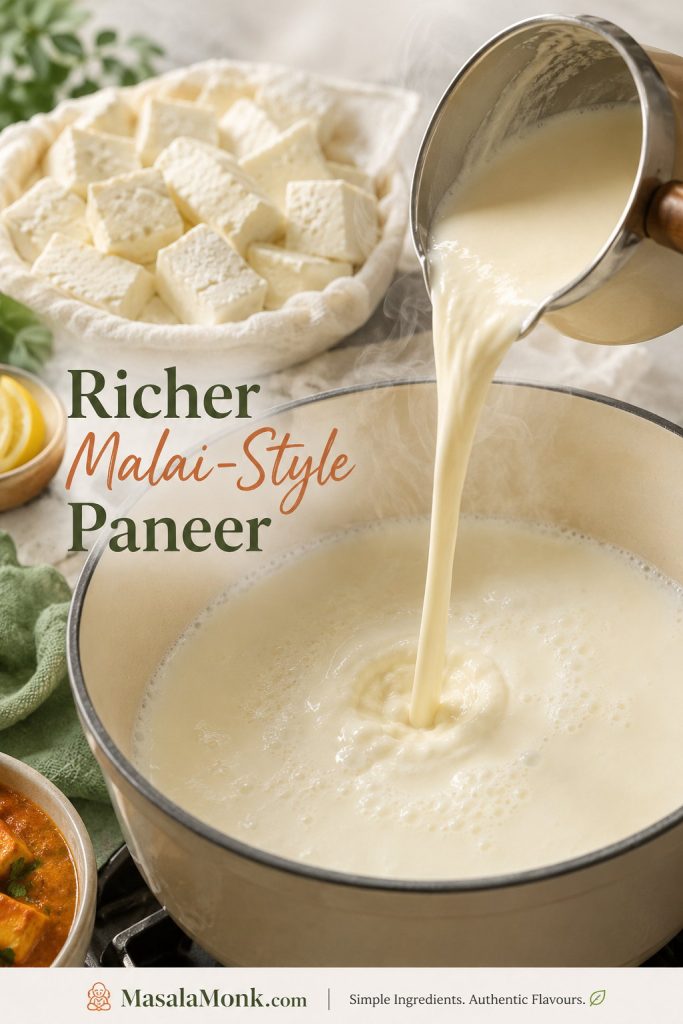
Cream being poured into warm milk in a pot with soft paneer cubes in the background.
A malai-style paneer variation adds richness when local milk gives firmer curds. Use a little cream with whole milk for a fuller, softer homemade paneer texture.

For 2 litres / 8½ cups whole milk, add ¼–½ cup / 60–120 ml heavy cream or replace ½ cup / 120 ml of the milk with cream. Use plain dairy cream without strong stabilizers if possible. Heat, curdle, strain, and press as usual. Because the extra fat makes the curds richer and softer, press gently unless you specifically need firm tikka cubes.

Can You Make Paneer with 2% or Low-Fat Milk?

You can make paneer with 2% milk, but it will not behave like whole-milk paneer. Expect less yield, leaner curds, and a block that may taste firmer or more crumbly. It can still work for bhurji, fillings, or macro-focused cooking, but whole milk is better for soft curry cubes.
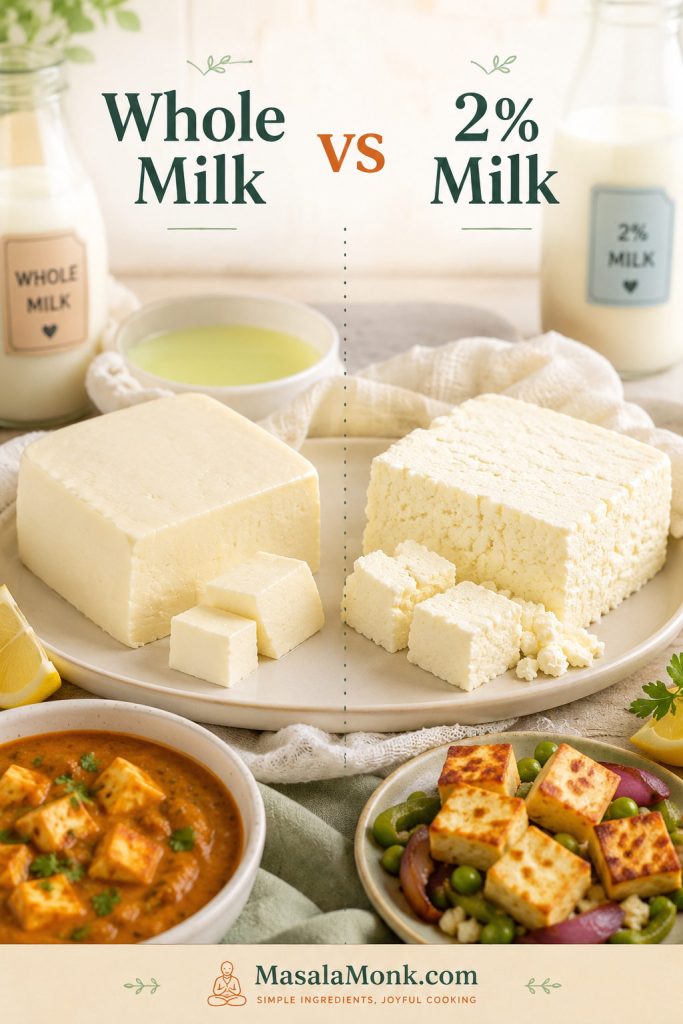
Whole milk paneer compared with a firmer and more crumbly 2 percent milk paneer result.
Low-fat milk can curdle, but the paneer is usually leaner, lower-yield, and more crumbly. For soft curry cubes, whole milk is the more forgiving choice.

Skim milk or fat-free milk is not recommended for this recipe. If you must use lower-fat milk, keep the method gentle: avoid harsh boiling, add acid gradually, rinse briefly, press lightly, and store the paneer in water. Expect a different result from full-fat paneer.

Instant Pot Note

You can make paneer in an Instant Pot, especially with the yogurt-boil function. Use it only to heat the milk; do not pressure cook the paneer. Once the milk is hot and foamy, add diluted lemon juice or vinegar gradually, then follow the same resting, straining, and pressing method. For your first batch, the stovetop is still easier because you can see exactly when the milk is hot enough and when the curds separate.

How to Use Homemade Paneer

Homemade paneer is best when you match the texture to the dish: soft curds for fillings, tender cubes for curries, and firmer cubes for grilling or skewers.
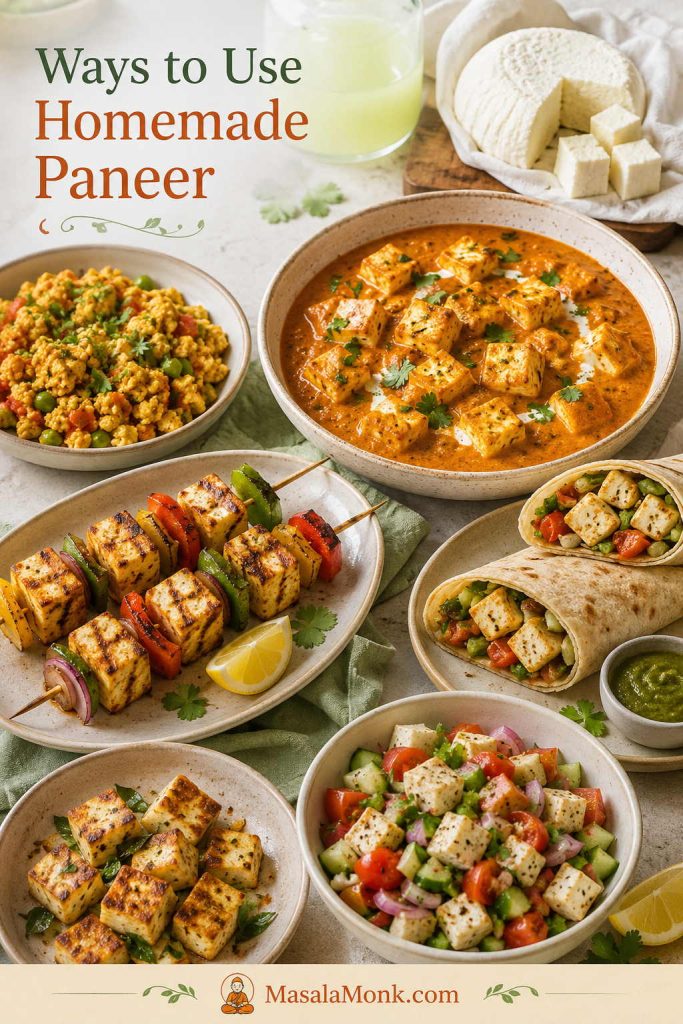
Homemade paneer used in curry, bhurji, tikka skewers, wraps, salad, and pan-seared cubes.
Once you know how to make paneer at home, it becomes a flexible vegetarian protein. Use soft curds in fillings, tender cubes in curry, and firmer pieces for tikka or searing.

Use soft crumbled paneer for fillings and quick meals

Soft paneer curds are excellent for paneer bhurji, toast, wraps, paratha fillings, sandwiches, cutlets, and snack-style recipes. They also work well in comfort-food ideas like Indian Cottage Cheese Jaffles, where a soft filling matters more than tidy cubes.

Use soft cubes for curries and vegetable dishes

For curries, you want paneer that holds shape but still feels moist. Press for 30–40 minutes, chill if needed, then add the cubes near the end of cooking. The sauce should be ready first; paneer only needs a few gentle minutes to warm through. This works for palak paneer, matar paneer, paneer butter masala, kadai paneer, and similar gravies.

Use firmer cubes for tikka, skewers, and grilling

For paneer tikka or skewers, press a little longer and chill before cutting. Firmer paneer is easier to marinate and thread onto skewers. Handle it gently, especially if your homemade paneer is softer than packaged paneer.

Use paneer for vegetarian protein

Paneer is also useful in vegetarian meal prep because it adds protein and richness without needing a long cooking time. Use it in salads, rice bowls, wraps, cutlets, and Indian-style meal prep plates. For more protein-focused Indian meal ideas, see MasalaMonk’s High-Protein Indian Meal Prep.

Do Not Throw Away the Whey

After you strain paneer, you will be left with whey: the pale yellow liquid that separated from the curds. It may look like something to discard, but it is useful in the kitchen.
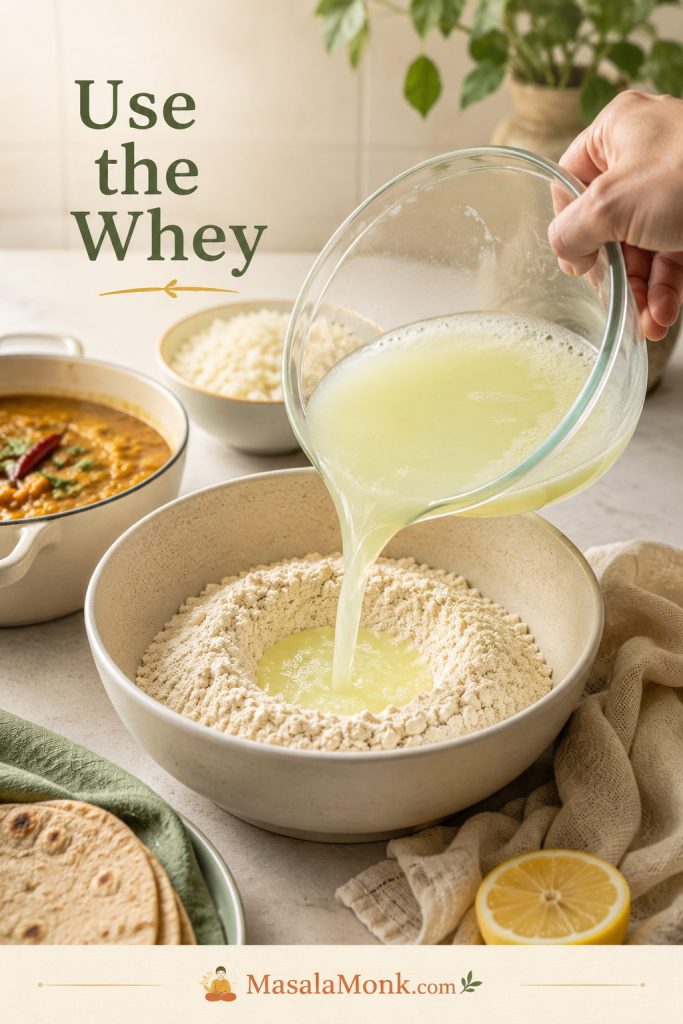
Leftover paneer whey being poured into flour or dough, with dal and rice in the background.
Mild paneer whey is too useful to throw away. Add it to roti dough, dal, soups, rice, oats, or grains whenever a little extra dairy tang fits the dish.
  • Use whey to knead flatbread, roti, naan, paratha, or bread dough.
  • Add it to lentils, dals, soups, stews, and curries.
  • Use it as part of the liquid for rice, quinoa, oats, or other grains.
  • Add a small amount to smoothies if it is not too sour.
  • Freeze it in small portions for later cooking.
  • Use very sour whey carefully, because it can change the flavor of delicate dishes.

Mild whey is useful in dough, rice, dals, and soups. Very sour whey is better in robust curries, breads, or flatbreads where a little tang makes sense. Avoid using sour whey in delicate desserts or plain rice unless you specifically want that flavor.

Refrigerate whey promptly and use it within 2–3 days, or freeze it in small portions. If you make paneer often, you can also use leftover whey from one batch to help curdle a future batch, although lemon juice or vinegar is easier for beginners.

Storing the paneer too? Use the storage and freezing guide so the cubes stay fresh while the whey gets used in dough, dal, rice, or soup.

How to Store and Freeze Homemade Paneer

Homemade paneer is a fresh, high-moisture cheese, so treat it gently and use it soon. Fresh paneer is softest the day it is made, but it can be refrigerated for a short time. Do not leave it sitting at room temperature for long. Cool it, cover it, and refrigerate it promptly.

Storage methodBest timeNotes
Same dayBest textureUse fresh paneer the day you make it for the softest result.
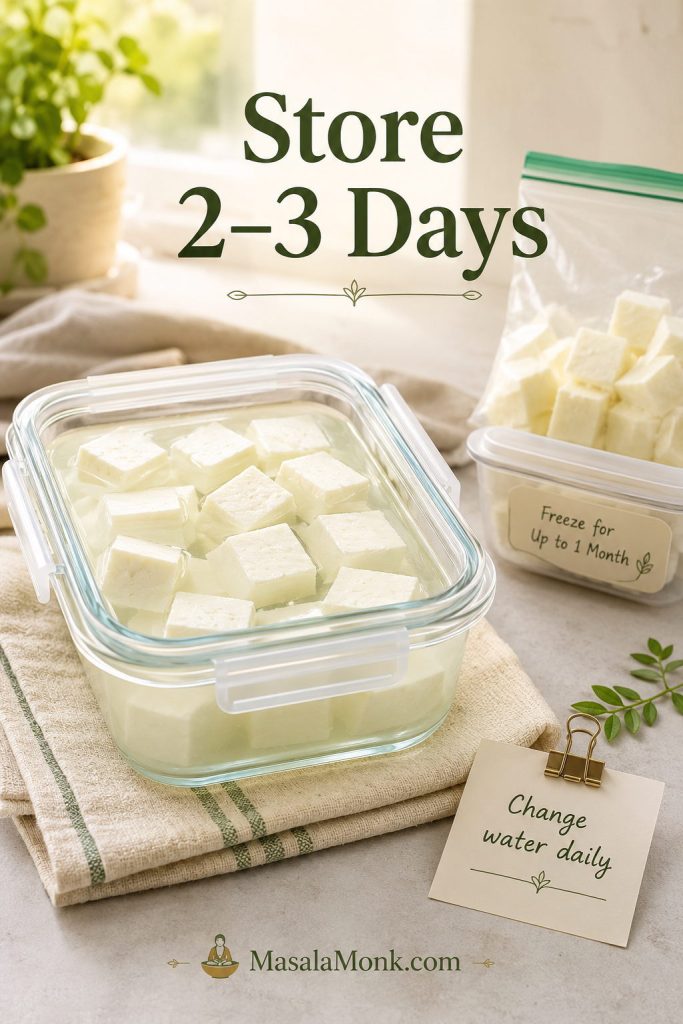
Refrigerator2–3 daysStore covered or submerged in fresh cold water. Change water daily.
FreezerUp to 1 month for best textureFreeze in portions. Thaw in the fridge and soak briefly in warm water before using if needed.
Homemade paneer cubes stored in fresh water inside a glass container with freezer portions and a note to change water daily.
Water storage keeps fresh paneer from drying out, but it does not make it long-keeping cheese. Change the water daily and use the paneer within 2–3 days.

To refrigerate paneer, cool it first, then store it in an airtight container. For softer paneer, cover it with fresh drinking water, keep the container covered, and change the water daily. Avoid storing paneer in very sour whey unless you want the flavor to become tangier. For broader cold-storage guidance, FoodSafety.gov has a useful reference, but for homemade paneer, the simple rule is: refrigerate promptly and use it within 2–3 days.

Unsalted homemade paneer tastes freshest sooner; if you lightly salt the curds, it may taste seasoned for snacks but should still be treated as a fresh cheese and used quickly.

If paneer smells sour in a bad way, feels slimy, looks moldy, becomes fizzy, or feels unusually sticky, discard it.

Troubleshooting Homemade Paneer

When you make paneer at home, an imperfect batch does not always mean failure. Paneer that will not cube neatly can still become bhurji, a sandwich filling, paratha stuffing, cutlets, toast, or a quick scramble. Most paneer problems are texture problems, not total failures.
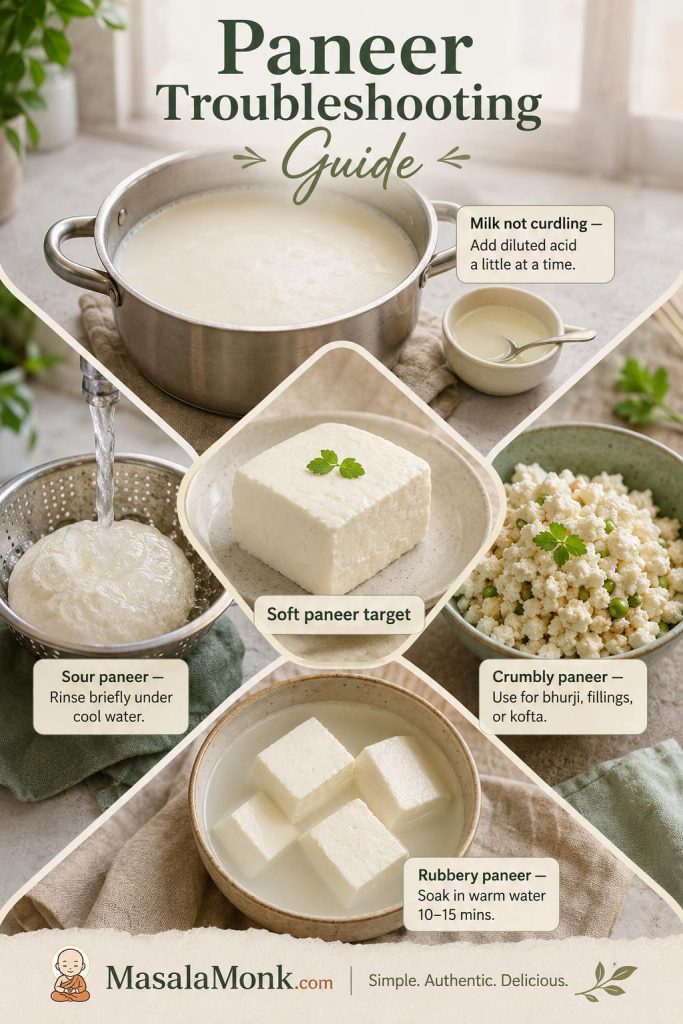
Paneer troubleshooting guide showing milk not curdling, sour paneer, crumbly paneer, rubbery paneer, and a soft paneer target.
Not every imperfect paneer batch is wasted. Milk that will not curdle can be adjusted slowly, sour curds can be rinsed, and crumbly paneer can still become bhurji or fillings.

Use the table below to decide what to do now and what to change next time.

ProblemLikely causeFix nowFix next time
Milk did not curdleMilk was not hot enough, not enough acid, or UHT/ultra-pasteurized milkReheat gently and add diluted acid 1 teaspoon at a timeUse full-fat, non-UHT milk
Whey still looks milkyIncomplete separationRest longer or add a little more diluted acidWait for pale yellow-green, slightly translucent whey before straining
Paneer tastes sourToo much acid or not rinsedRinse briefly under cool waterDilute acid and stop adding it earlier
Paneer is rubberyOverheating, too much acid, over-pressing, or harsh cookingSoak cubes in warm water for 10–15 minutesUse gentler heat, gradual acid, and shorter pressing
Paneer is crumblyWeak curds, low-fat milk, over-acidified curds, or not enough pressingUse it as bhurji or fillingUse richer milk and press slightly longer
Paneer breaks in curryToo soft, cut too soon, or stirred too roughlyAdd gently when the sauce is readyPress 30–40 minutes and chill before cutting
Paneer is dry after cookingFried or simmered too longSoak briefly in warm waterCook the sauce first, then warm paneer through gently

Why did my milk not curdle?

Usually, the milk was not hot enough, the acid was too weak, or the milk was UHT / ultra-pasteurized. Bring the milk back to 185–195°F / 85–90°C, add 1 teaspoon diluted lemon juice or vinegar, stir gently, and wait 30–60 seconds. Repeat only until the whey clears and the curds separate.

If the milk still refuses to separate, the milk itself may be the issue. Try another full-fat, non-UHT brand next time.

Why is my paneer rubbery?

Rubbery paneer usually comes from hard boiling, too much acid, heavy pressing, or long cooking in sauce. To rescue a batch, soak the cubes in warm water for 10–15 minutes. This will not fully reverse overcooking, but it can make the texture noticeably softer.
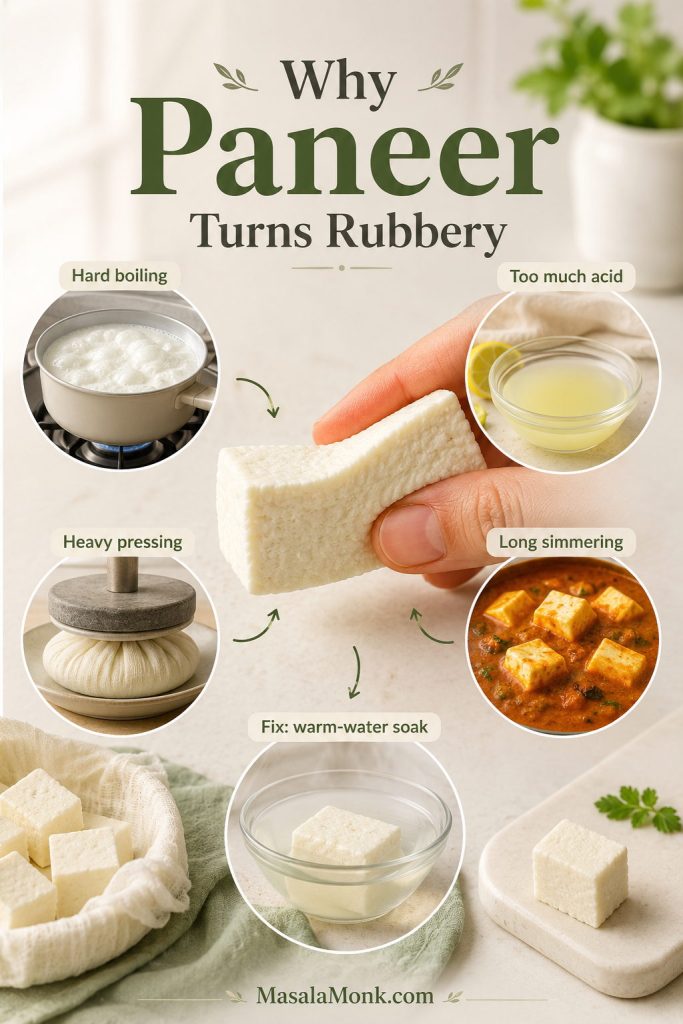
Causes of rubbery paneer shown around a firm paneer piece, including hard boiling, too much acid, heavy pressing, and long simmering.
Rubbery paneer is usually a moisture-loss problem. Harsh heat, extra acid, heavy pressing, and long simmering all tighten the curds, so controlling those steps keeps paneer softer.

Why does my paneer taste sour?

Sour paneer usually means too much lemon juice or vinegar remained in the curds. Rinse the curds briefly under cool water after straining. Next time, dilute the acid and add it gradually. Stop once the whey is clear enough and no longer looks milky.

Why is my paneer crumbly?

Crumbly paneer is not always bad. If it is moist and soft, use it for paneer bhurji, sandwich fillings, paratha fillings, cutlets, or toast. For a snackier route, lightly pressed or crumbled paneer also works in vegetarian patties such as Protein Packed Millet Cutlets.

For cleaner cubes next time, use full-fat, non-UHT milk, add acid slowly, rest the curds before straining, press for 30–40 minutes, and chill before cutting.

Why did my paneer break in curry?

The paneer may have been too soft for cubes, cut before it fully set, or stirred too roughly in the sauce. For curries, press the paneer for 30–40 minutes, chill it briefly, cut with a sharp knife, and add it only when the sauce is ready. Stir gently after adding paneer.

How do I make softer paneer next time?

Use richer milk, gentler heat, gradual acid, and shorter pressing. For especially soft paneer, add a little cream to the milk or use yogurt as the acid once you are comfortable with the basic method.

After you identify the problem, return to the homemade paneer recipe and watch the step-by-step paneer cues more closely on your next batch.

FAQs About Homemade Paneer

What is the best milk for making paneer at home?

Whole milk or full-fat milk is best because it gives better curds, better yield, and a softer texture. Regular pasteurized whole cow’s milk is the safest supermarket default.

Why did my milk not curdle?

Usually the milk was not hot enough, the acid was too weak, or the milk was UHT / ultra-pasteurized. Reheat gently, add diluted acid 1 teaspoon at a time, and stop once the whey clears.

Lemon juice or vinegar: which is better for paneer?

Both work. Lemon juice tastes fresher but varies in acidity. Plain white vinegar is more predictable and usually tastes neutral after dilution and rinsing.

How much paneer do you get from 1 litre, 2 litres, or 1 gallon of milk?

Yield varies by milk, fat level, draining, and pressing. Expect about 150–200 g from 1 litre, 300–400 g from 2 litres, and 600–750 g from 1 gallon / 3.8 litres.

How do you make paneer soft instead of rubbery?

Rubbery paneer usually comes from hard boiling, too much acid, heavy pressing, or long cooking in sauce. Use gentler heat, add acid gradually, press for less time, and add paneer near the end of cooking.

Is paneer the same as cottage cheese?

Not exactly. Paneer is sometimes called Indian cottage cheese, but Western cottage cheese is loose and wet, while paneer is drained and pressed.

Can ultra-pasteurized or UHT milk be used for paneer?

It may work sometimes, but it is not the best choice. Ultra-pasteurized and UHT milk can form weak, grainy, or unreliable curds. For your first batch, use full-fat, non-UHT milk if you can.

Can lactose-free milk be used for paneer?

Lactose-free dairy milk can work if it is full-fat and not UHT or ultra-pasteurized. Check the carton carefully, because some lactose-free milks are processed for long shelf life and may curdle less reliably.

What should I do with leftover whey?

Use whey in doughs, dals, soups, curries, rice, oats, or grains. You can also freeze it in small portions. If the whey is very sour, use it in recipes where a slight tang makes sense.

How long does homemade paneer last?

Homemade paneer tastes best the day it is made. Refrigerate it for 2–3 days, covered or submerged in fresh cold water. Change the water daily if storing submerged. Freeze for up to 1 month for best texture.

When should paneer be added to curry?

Add paneer near the end of cooking. The sauce should already be cooked and seasoned. Once the paneer goes in, simmer gently for a few minutes so it warms through without becoming tough.

Final Thought

Once you learn how to make paneer at home, the process becomes less about doing something complicated and more about reading what the milk is telling you. Use milk that curdles cleanly, heat it gently, add only enough acid, and press the curds for the dish in front of you.

After one good block, paneer stops feeling like a specialty-store ingredient. It becomes something you can make when a curry needs soft cubes, a wrap needs a filling, or a quick vegetarian meal needs something fresh, milky, and satisfying.
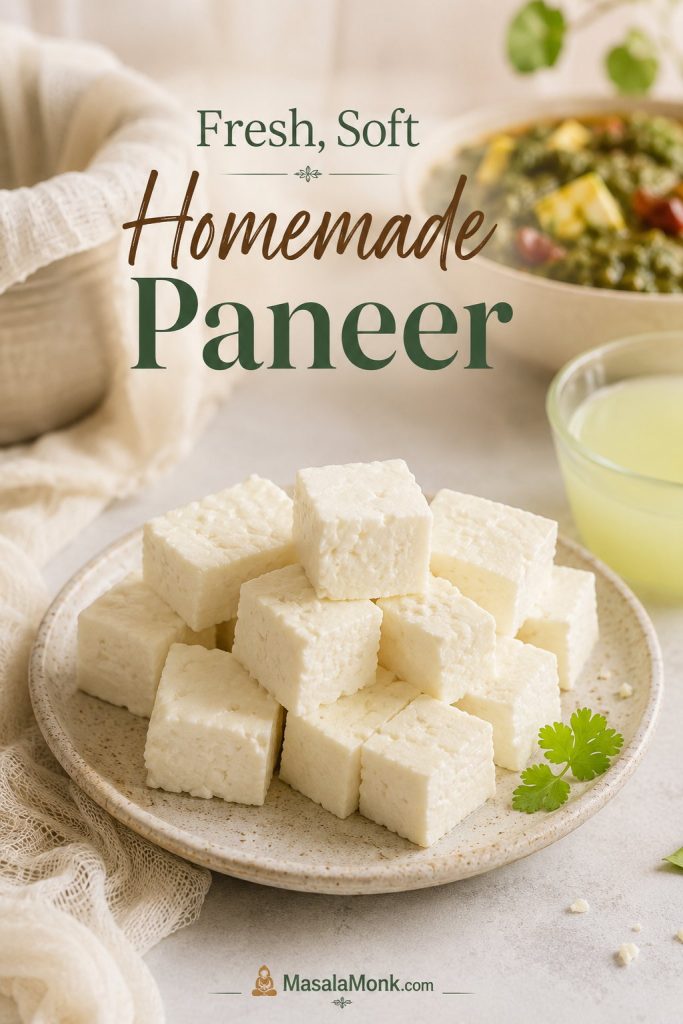
Fresh homemade paneer cubes on a ceramic plate with muslin, pale whey, and a blurred curry or greens in the background.
Good homemade paneer should feel simple by the end: clean curds, gentle pressing, soft cubes, and a fresh milky texture ready for the dish you want.

Back to top

Posted on Leave a comment

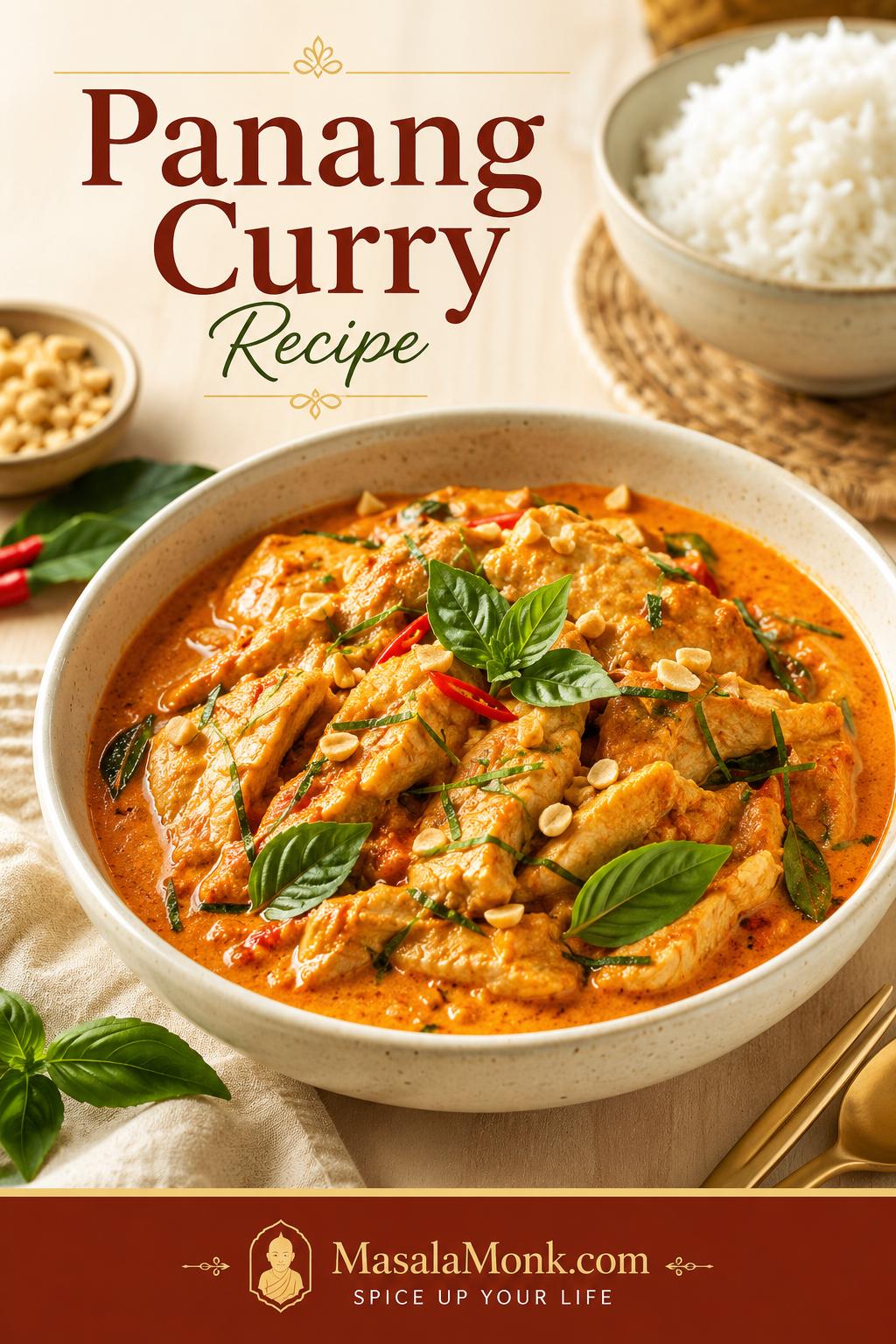
Panang Curry Recipe: Chicken Panang with Store-Bought Paste

Bowl of chicken Panang curry with orange-red coconut sauce, sliced chicken, Thai basil, crushed peanuts, makrut lime leaves, and jasmine rice.

A good Panang curry starts changing the moment the paste hits hot fat: the raw edge softens, the chile smell deepens, and the pan begins to smell warmer almost immediately. When the coconut goes in, it turns orange-red around the paste. By the time the chicken is done, the curry should look glossy and generous, not thin or tired.

This Panang curry recipe is built for the home-cook problem most recipes do not talk about enough: store-bought paste can taste flat, watery, harsh, or too much like ordinary red curry when it is rushed. The fix is not a longer shopping list. It is better paste frying, full-fat coconut, and a few clear texture cues.

The result is a 40-minute curry that still feels special: tender chicken, glossy coconut sauce, fresh basil, jasmine rice, and enough depth that the store-bought paste never feels like a compromise. The base version is chicken Panang curry, also called Panang gai, but the same method works for beef, tofu, shrimp, or vegetables once you understand the texture.

It is generous weeknight food: fragrant, creamy, a little sweet, a little spicy, and made to spoon over rice. If you like fast Thai basil-heavy dinners, this Pad Kra Pao recipe is another bold option to keep nearby.

Table of Contents

Use this guide to make Panang curry that tastes creamy, balanced, aromatic, and clearly different from ordinary red curry.

Panang Curry Recipe: Quick Answer

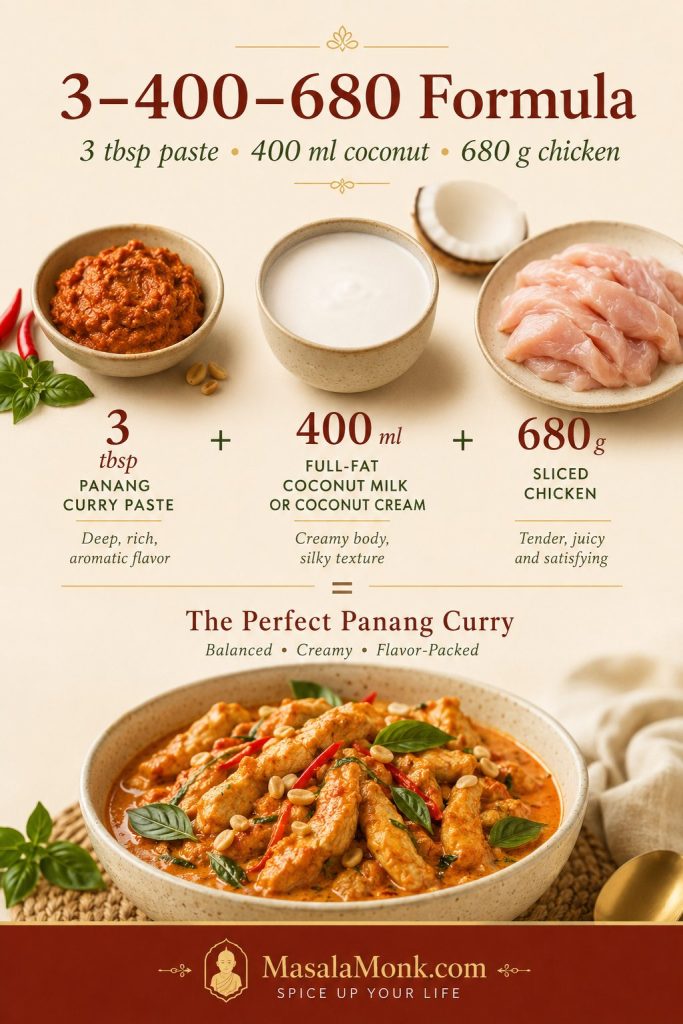
Remember it as 3–400–680: 3 tablespoons / about 45g Panang curry paste, 13.5–14 oz / 400ml full-fat coconut milk or coconut cream, and 1½ lb / 680g thinly sliced chicken for a generous 4-serving curry.

Fry the paste first in oil or thick coconut cream until it smells deeper and less raw. Stir in the coconut gradually, then add fish sauce, palm sugar or brown sugar, torn makrut lime leaves, and peanuts or peanut butter. Simmer gently until the chicken is cooked through, finish with Thai basil, and serve with jasmine rice.

Think of this as your safe starting bowl: enough paste to taste full, enough coconut to feel creamy, and enough body for the curry to settle over rice instead of running through it. Add 1–1½ cups vegetables if you want a fuller chicken curry; keep the amount modest so the flavor stays focused.

Most important cue: the spoon tells you more than the timer. The curry should coat the back of a spoon in a glossy layer while still being loose enough to serve over rice. Need the exact visual cue? Jump to the spoon-coating test. Ready to cook? Go straight to the recipe card.

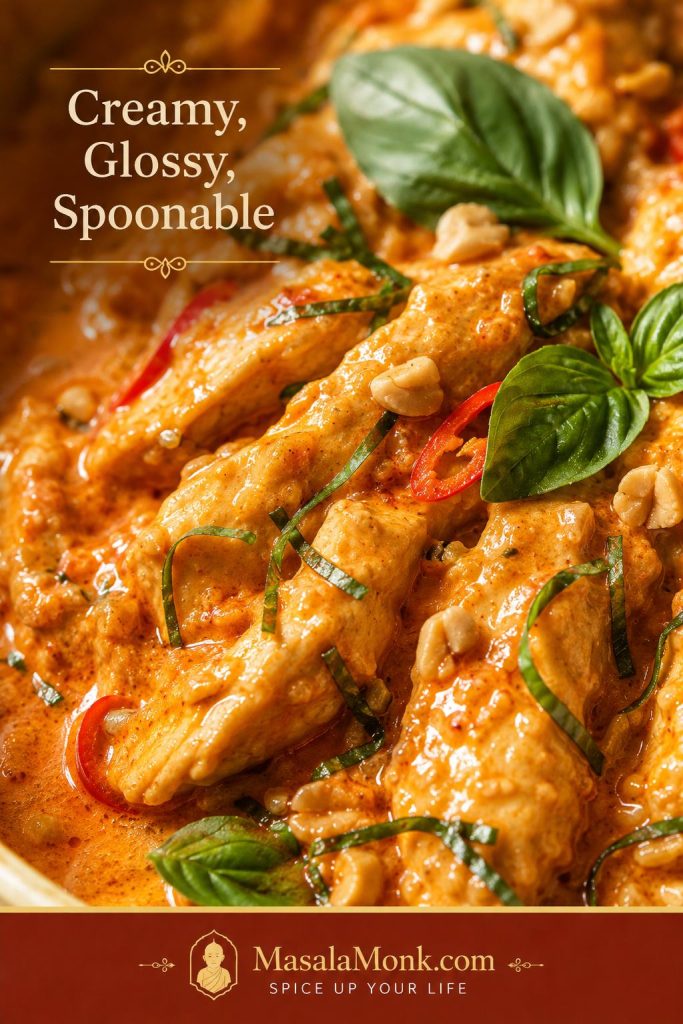
Close-up of chicken Panang curry with creamy sauce coating sliced chicken, red chile, Thai basil, peanuts, and makrut lime leaf garnish.
Look for sauce that clings to the chicken but still moves when spooned; that balance keeps Panang curry rich without making it heavy.

The Easy Panang Curry Formula

The 3–400–680 formula is not a test; it is a starting point. From there, you can adjust for paste strength, vegetable volume, protein choice, and how rich you want the final curry. More vegetables usually need a little more paste and a little more time in the pan. Saltier paste needs less fish sauce. Sweeter coconut needs less sugar.

Panang curry formula guide showing 3 tablespoons curry paste, 400 milliliters coconut milk, and 680 grams chicken.
The 3–400–680 formula gives you a reliable starting point before you adjust for paste strength, vegetable volume, or spice preference.
For 4 ServingsAmountWhy It Matters
Panang curry paste3 tbsp / about 45gThe flavor base. Start lower if your paste is very spicy or salty.
Coconut milk or coconut cream13.5–14 oz / 400mlThe body of the curry. Coconut cream gives the lushest result.
Chicken or other protein1½ lb / 680g chicken, or equivalentEnough protein for a full dinner without overcrowding the pan.
Fish sauce1–1½ tbsp / 15–22mlAdds salt and savory depth. Use less at first if your paste is salty.
Palm sugar or brown sugar2 tsp–1 tbsp / 8–15gRounds heat and salt. Start low if your paste or coconut tastes sweet.
Makrut lime leaves4–6 leavesTorn leaves perfume the simmering sauce; finely sliced tender leaves can finish the curry.
Peanuts or peanut butter2 tbsp / about 15g crushed peanuts, or 1 tbsp / about 16g peanut butterBrings Panang’s quiet nutty note without turning the sauce into satay.

Taste after the curry has simmered for a few minutes, not when the paste first hits the pan. Early tasting can trick you because the coconut is still loose, the paste has not settled, and the salt has not concentrated yet. If your paste tastes too mild or too harsh, use the store-bought paste guide before changing the whole recipe.

Why This Recipe Works

The difference between a forgettable Panang curry and a good one is usually not the ingredient list. It is the order. Curry paste needs fat and heat before the coconut goes in. The pan sauce needs enough time to come together. Basil needs to go in at the end, when its aroma will stay bright instead of disappearing into a long simmer.

If your first few homemade Thai curries have tasted thinner than takeout, this is usually where things change. You are not adding fancy ingredients; you are simply giving the paste and coconut enough time to become a sauce.

Frying the paste prevents flat flavor
Let it sizzle in fat first, and the smell changes from sharp to warm, deep, and curry-like.

Full-fat coconut gives the curry body
Light coconut milk makes the flavor feel spread out. Coconut cream gives the richest result.

The final balance happens at the end
Fish sauce, sugar, lime leaves, peanuts, and basil let you tune salt, sweetness, aroma, and nuttiness before serving.

The finished curry lands rich without feeling greasy, spicy without tasting harsh, and gently sweet without becoming sugary. It tastes like Panang curry, not red curry with peanut butter stirred in.

What Is Panang Curry?

Panang curry, also written as Phanaeng, Phanang, or Panaeng, is a Thai coconut curry with a richer, more concentrated character than a loose red curry. The easiest way to recognize a good Panang is this: if red curry pours, Panang clings.

In the bowl, Panang feels creamy, rounded, aromatic, and concentrated enough to coat the protein. Coconut gives body, curry paste gives heat and depth, makrut lime leaves give a citrusy lift, basil adds freshness, and peanuts add a quiet roasted note in the background.

Peanut belongs in the background here; it rounds the curry without turning it into satay. Chicken Panang curry is often called Panang gai or gaeng Panang gai. “Gai” means chicken, so Panang gai simply means the chicken version.

Panang Curry vs Red Curry

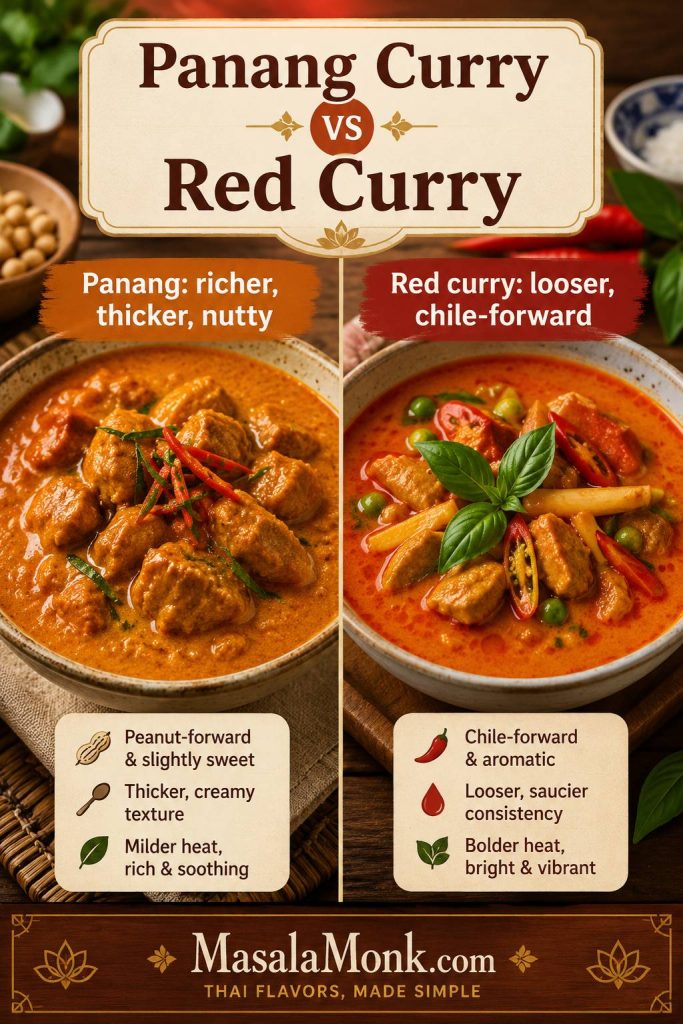
Panang curry and Thai red curry are related, but they should not taste identical. Red curry is usually looser and more chile-forward. Panang is creamier, richer, lightly sweet, and gently nutty. When homemade Panang tastes too much like red curry, the first fix is usually texture, then peanut and aromatic finish.

FeaturePanang CurryThai Red Curry
TextureThicker, creamier, more clingyLooser, saucier, more broth-like
FlavorRich, lightly sweet, savory, nuttyBrighter, chile-forward, more flexible
Paste profileRed-curry-style base with peanut and spice depthRed chile and aromatic base
Best cueCoats the protein clearlyPours more freely around the ingredients
Split-panel comparison of thicker Panang curry and looser Thai red curry with labels explaining texture and flavor differences.
Panang curry and red curry are related, but Panang is usually richer, thicker, and gently nutty, while red curry is looser and more chile-forward.

Quick fix: bring the curry back toward Panang by simmering the coconut base until it looks glossy, then finishing with peanut richness, Thai basil, and finely sliced tender makrut lime leaves if you have them.

If you are using red curry paste as a shortcut, add peanuts and a tiny pinch of warm spice so the sauce does not taste like ordinary red curry with coconut milk.

Panang Curry Ingredients

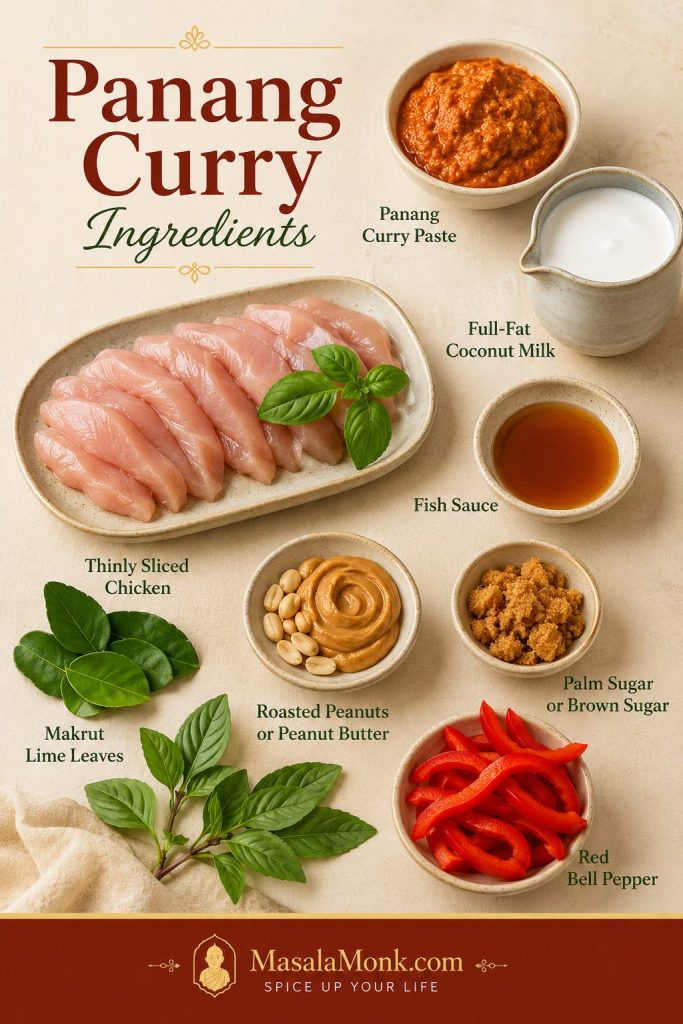
These ingredients are not equal. The paste, coconut, fish sauce, and lime leaves decide whether the curry tastes complete. Peanuts and basil finish the personality. Sugar is there to round the edges, not make the curry sweet.

The most important thing is timing. Paste goes first, coconut goes in gradually, protein cooks once the base has formed, and basil waits until the heat is low or off.

Panang curry ingredients including curry paste, coconut milk, chicken, fish sauce, sugar, makrut lime leaves, peanuts, Thai basil, and red bell pepper.
The ingredients work as a team: paste brings depth, coconut gives body, lime leaves add aroma, and peanuts round the curry without turning it into satay.

Panang curry paste

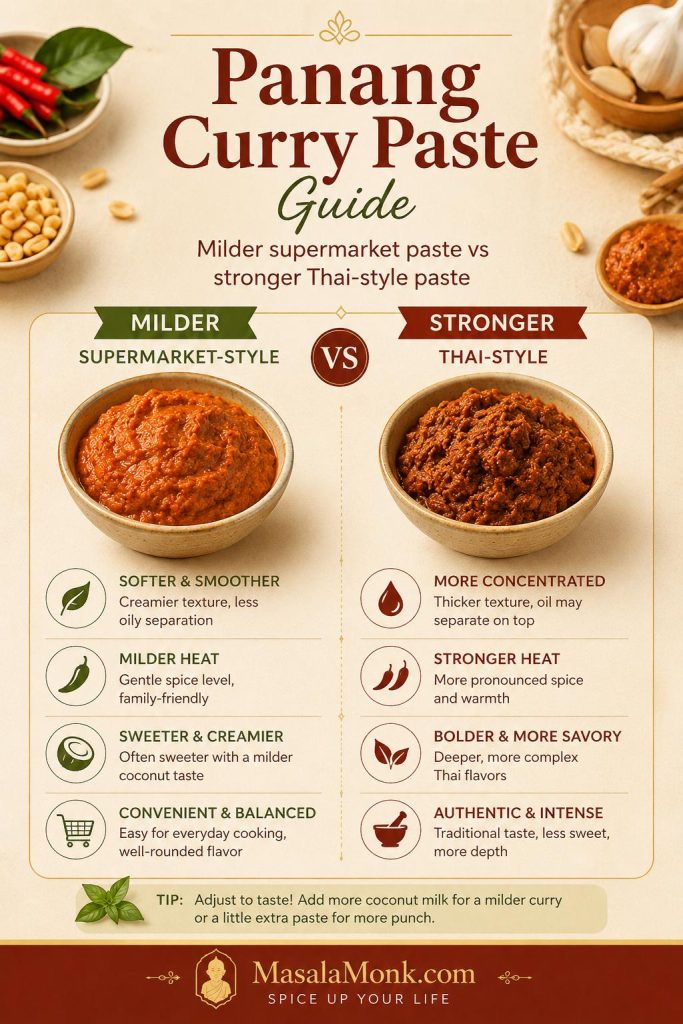
Use Thai Panang curry paste if you can find it. Some brands are stronger, saltier, and spicier than others, so start with a balanced amount and adjust. Thai Kitchen-style supermarket pastes are often milder, while Mae Ploy and Maesri-style Thai pastes are usually stronger, saltier, and more concentrated. Start lower if the brand is new to you.

Guide comparing milder supermarket-style Panang curry paste with stronger Thai-style paste for homemade Panang curry.
Because Panang curry paste brands vary in salt, heat, and intensity, taste after simmering before adding more fish sauce, sugar, or paste.

If your paste is very salty, begin with 1 tablespoon fish sauce, simmer, then add the remaining ½ tablespoon only if the curry needs it. When homemade Panang tastes flat, the paste often needed a better start: fat, heat, and enough time to smell cooked before the coconut went in. For the deeper technique, see how to bloom the paste in fat first.

Coconut milk or coconut cream

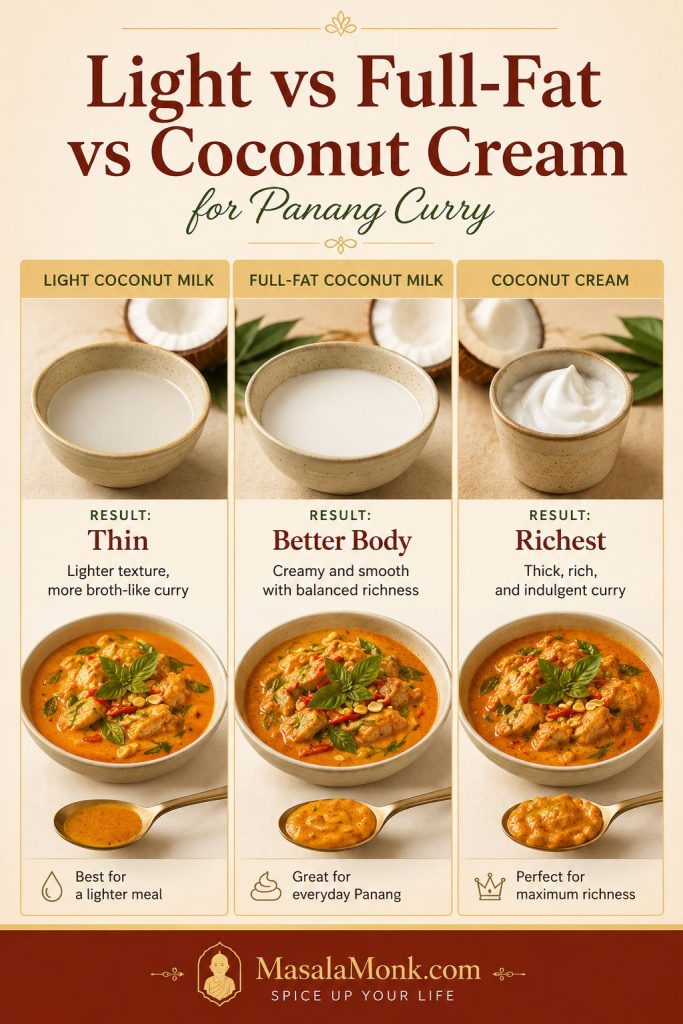
Coconut cream gives the lushest result. Full-fat coconut milk also works well; it just needs a few extra minutes in the pan. Light coconut milk makes the curry harder to concentrate and easier to dilute.

Comparison board showing light coconut milk, full-fat coconut milk, and coconut cream for Panang curry sauce texture.
For the richest Panang curry texture, full-fat coconut milk or coconut cream works better than light coconut milk, which can make the sauce feel thin.

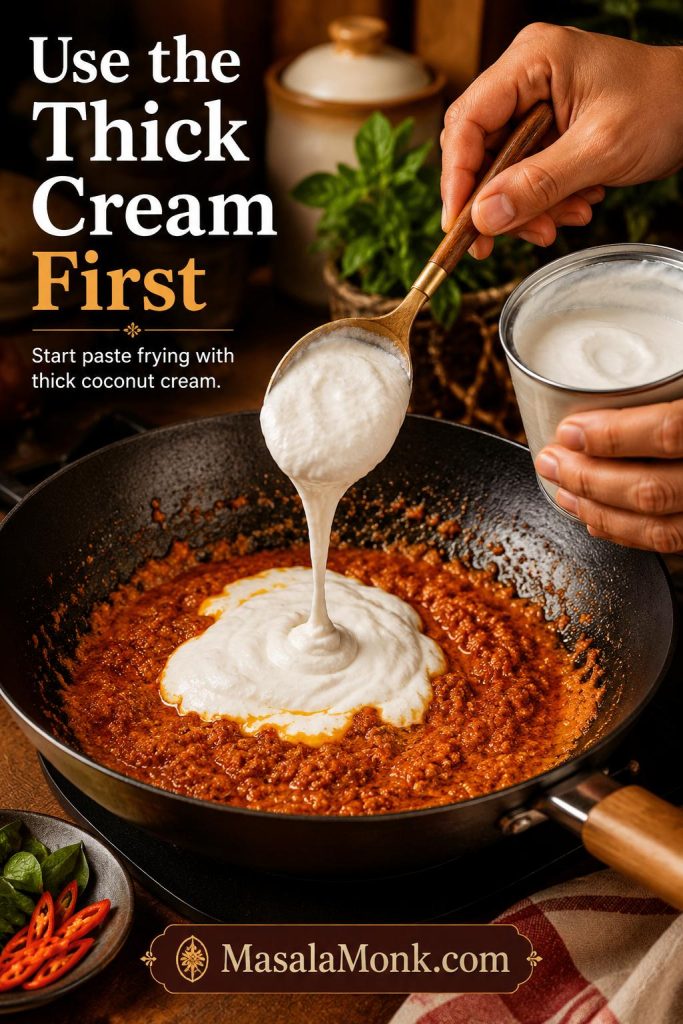
How to use thick coconut cream first

If the can has a thick layer of coconut cream at the top, scoop that into the pan first and use it to fry the curry paste. Then add the thinner coconut milk gradually. This gives the pan a richer start and helps the paste bloom in fat.

Thick coconut cream being added to fried Panang curry paste in a skillet to begin the curry sauce.
When a can has thick cream on top, use it first so the curry paste gets the fat it needs to bloom properly.

Fish sauce

Fish sauce keeps the coconut from tasting flat. You should not notice it as “fishy”; you should notice that the curry tastes deeper, saltier, and more complete. Add it gradually because the paste may already be salty.

For a vegan version, use soy sauce, tamari, or a vegetarian fish-sauce alternative. The flavor will be different, but the curry still needs savory depth.

Palm sugar or brown sugar

The sweetness should round the chile and salt; it should not announce itself first. Palm sugar gives a softer sweetness, while brown sugar works well in a home kitchen. Start with 2 teaspoons if your paste or coconut milk already tastes sweet.

Makrut lime leaves

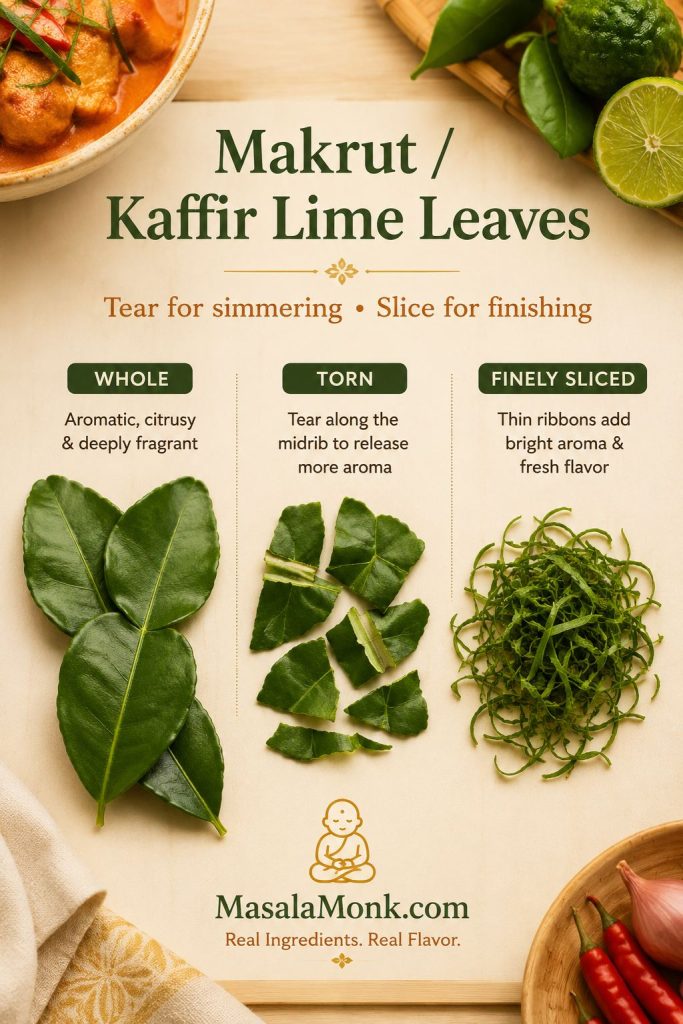
Makrut lime leaves, often sold as kaffir lime leaves, are the ingredient that makes the curry smell alive. Tear whole leaves before adding them to the simmering coconut sauce so their oils release into the pan. If you have tender leaves, slice a small amount very finely and use it at the end for a sharper aromatic finish.

Fresh or frozen leaves are best. Torn whole leaves can be left in the curry for aroma and picked out while eating. Lime juice is not a true replacement; if you need a backup, a little lime zest is closer than bottled lime juice, but use it gently. The goal is aroma, not sourness.

Makrut lime leaves shown whole, torn, and finely sliced, with guidance for simmering and finishing Panang curry.
Makrut lime leaves, often sold as kaffir lime leaves, give Panang curry its fresh citrus aroma without making the sauce sour.

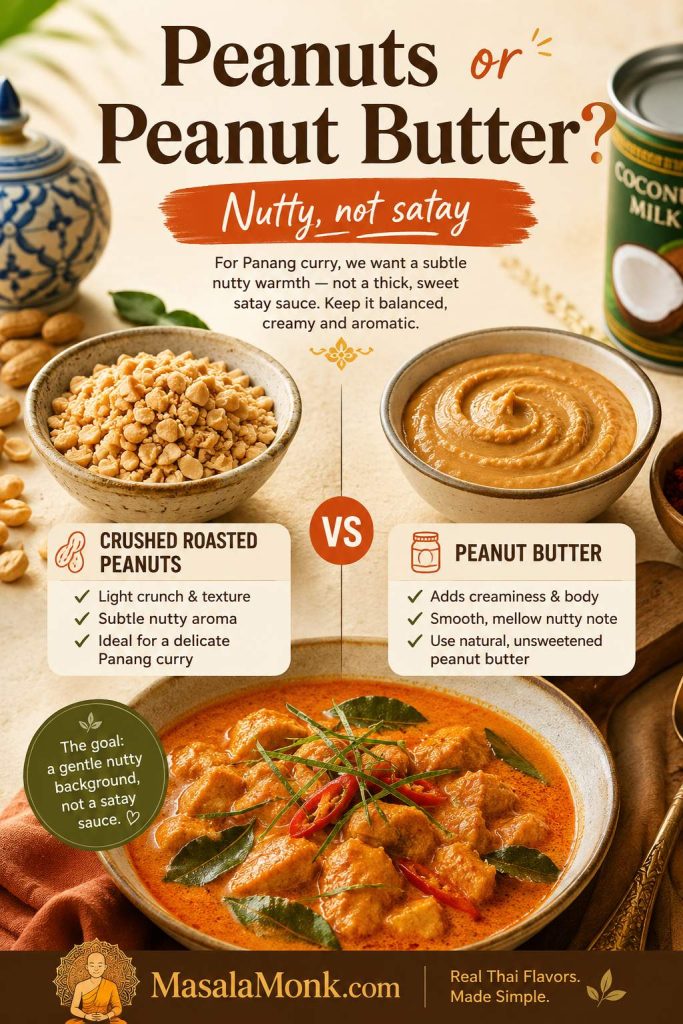
Peanuts or peanut butter

Crushed roasted peanuts give texture and a more traditional feel. Peanut butter is a practical shortcut that blends smoothly into the sauce. Either works, but keep the amount modest. The peanut note should sit in the background, not make the curry taste like peanut sauce.

Split image comparing crushed roasted peanuts and peanut butter for adding a nutty note to Panang curry.
Crushed peanuts add texture, while peanut butter blends in smoothly; either way, the peanut flavor should stay gentle and balanced.

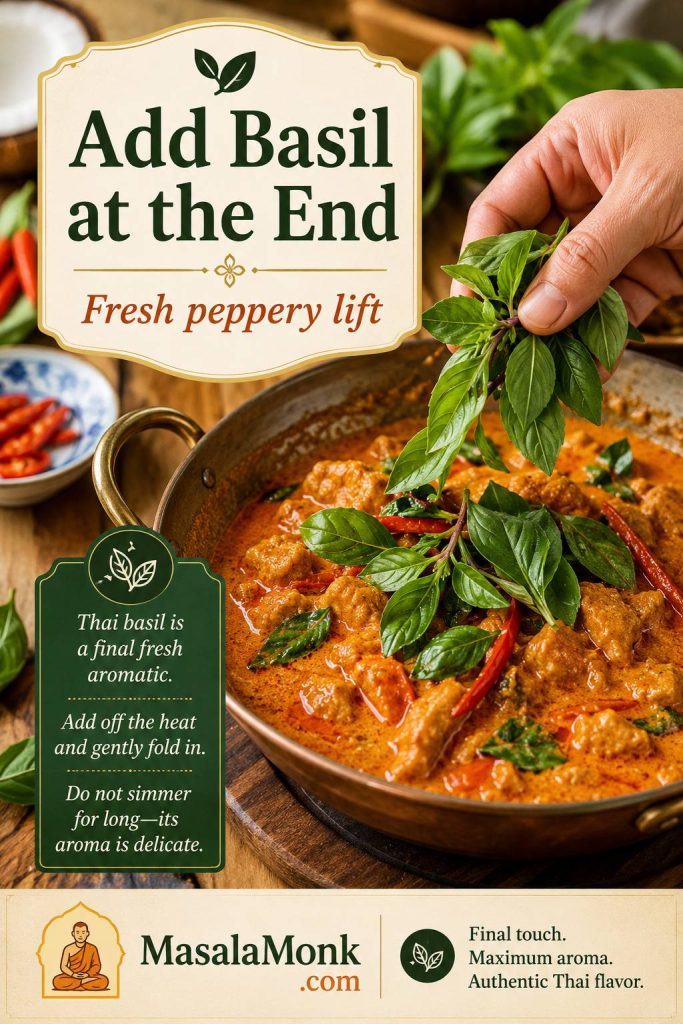
Thai basil

Thai basil gives the finished dish a fresh, peppery lift. Add it after the sauce thickens and the heat is low or off. If it simmers for several minutes, that fragrance fades quickly.

Thai basil being added to finished Panang curry as a final aromatic, with text about fresh peppery lift.
Add Thai basil near the end, because its peppery fragrance is strongest when it meets the hot curry right before serving.

How to Make Store-Bought Panang Curry Paste Taste Better

This is a home-kitchen Panang curry built around store-bought paste, but the technique is the point: fry the paste properly, use full-fat coconut, simmer until glossy, and finish with basil and lime leaf.

Fry it first
Cook the paste in oil or coconut cream until it smells warmer, deeper, and less raw.

Use full-fat coconut
Thin coconut milk makes the curry taste weaker. Full-fat coconut milk or cream gives body.

Finish the flavor
Fish sauce, sugar, lime leaves, peanuts, and basil make the sauce taste complete.

Bloom the paste in fat first

Traditional Panang methods often fry the paste in coconut cream until the oil separates. At home, canned coconut milk does not always separate well, so oil or the thick cream from the top of the can is more reliable.

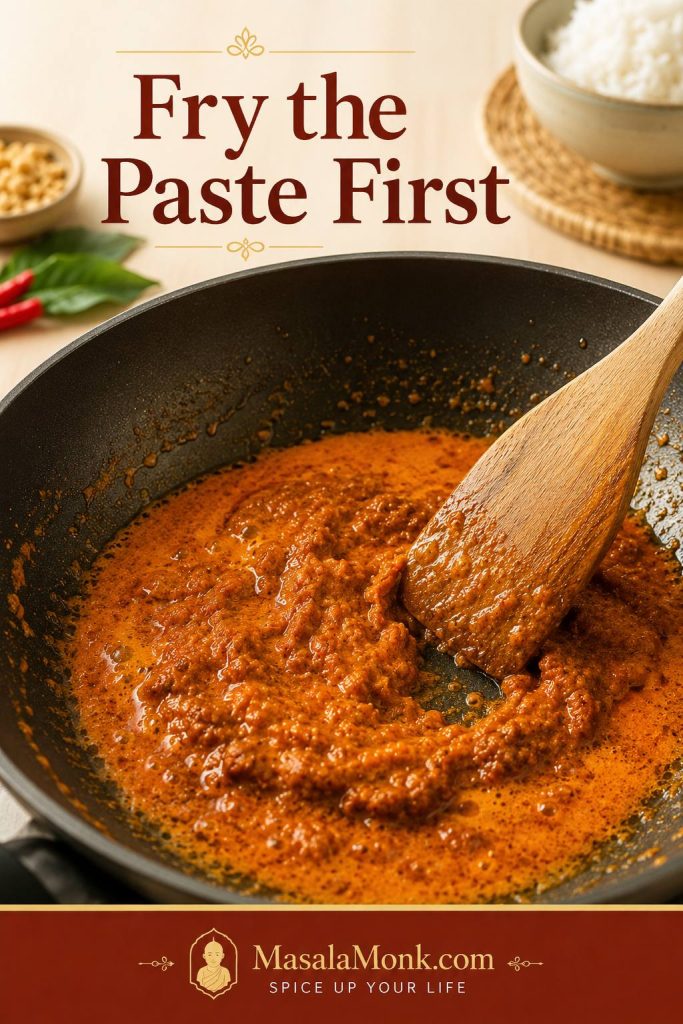
Panang curry paste frying in a skillet with oil or coconut cream while a wooden spatula stirs it.
Frying the paste first is the flavor-building step that makes store-bought Panang curry paste taste fuller and less raw.

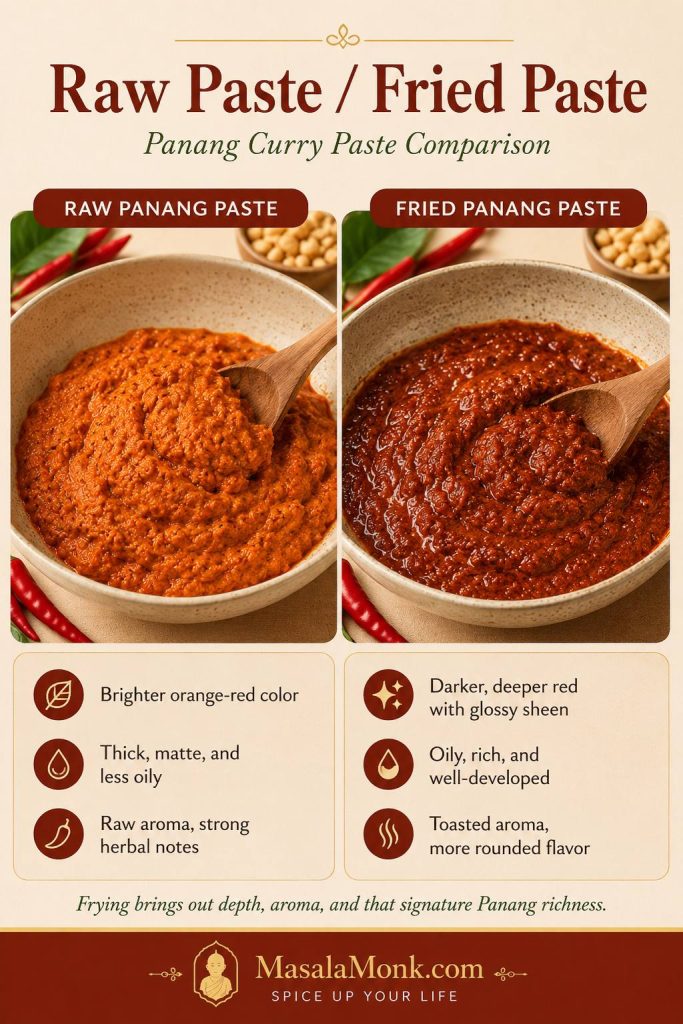
What fried Panang curry paste should look like

The color change is subtle but useful: the paste turns a little darker, smells rounder, and loses the raw edge before the coconut is stirred in.

Side-by-side comparison of raw Panang curry paste and darker fried Panang curry paste in a pan.
The paste does not need to burn or dry out; it just needs to darken slightly and smell warmer before the coconut goes in.

Choose the right paste amount

For one 13.5–14 oz / 400ml can of coconut milk or cream, use this as your starting point:

StylePaste AmountBest For
Mild2 tbsp / about 30gKids, spice-sensitive eaters, or very strong paste brands
Balanced3 tbsp / about 45gMost homemade Panang curry
Stronger4 tbsp / about 60gRestaurant-style intensity or a pan with more protein and vegetables

Adjust after simmering

If the curry tastes weak after simmering, check the texture first. A thin coconut base can make even a strong paste taste dull because the flavor is spread across too much liquid. Let the pan settle into a glossy consistency, then decide if you need more paste.

When you do add more paste, avoid stirring it in raw. Fry another teaspoon or two in a small pan with a spoon of coconut cream, then stir that back into the curry. This keeps the added flavor cooked and rounded. For a deeper look at the paste itself, Serious Eats has a helpful Panang curry paste guide that explains the peanut and warm-spice notes that separate it from a basic red curry paste.

Using red curry paste instead? For every 2–3 tablespoons red curry paste, add 1 tablespoon crushed roasted peanuts or peanut butter, a tiny pinch of nutmeg, and a small pinch of ground coriander or cumin if the sauce tastes plain. Add torn makrut lime leaves if you have them. This shortcut is best for a weeknight curry, not for a strict traditional version.

Check labels for vegan or vegetarian versions

If you are cooking for vegan or vegetarian eaters, check the paste label carefully. Many Thai curry pastes contain shrimp paste, fish sauce, or other seafood ingredients. Use a vegan Panang curry paste, or use vegan red curry paste and adjust it with peanuts and warm spices.

How to Make Panang Curry

Once the paste and coconut are ready, the cooking moves quickly. A wide skillet, wok, or 12-inch saucepan gives the paste room to fry and helps the coconut base come together faster. Have the chicken sliced, vegetables cut, herbs ready, and rice started before the paste hits the pan.

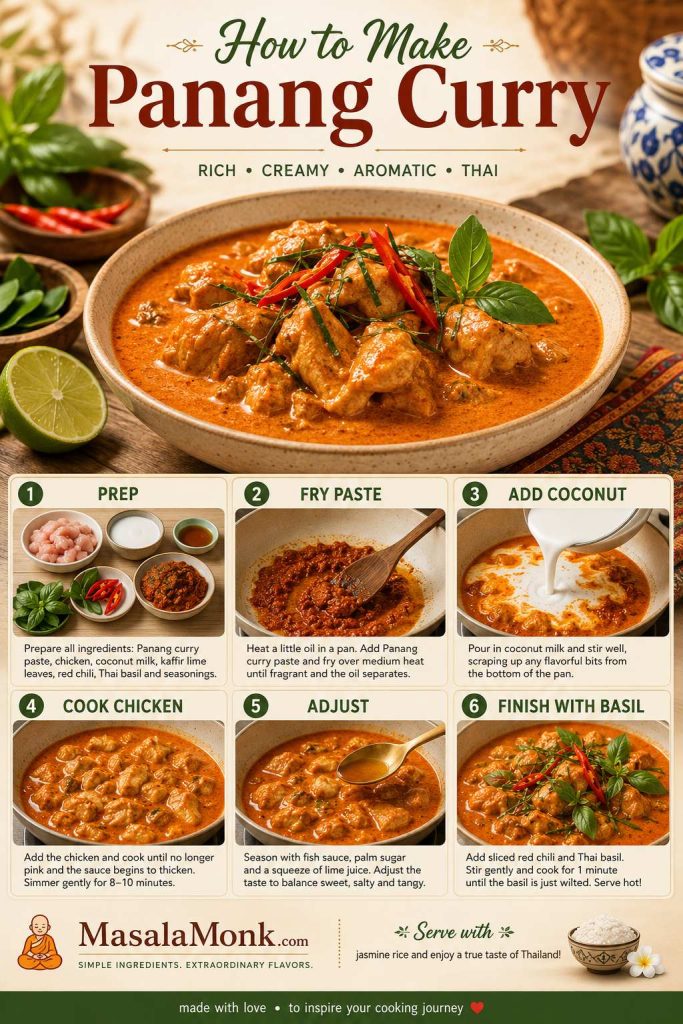
Visual overview: how to make Panang curry

Step-by-step Panang curry board showing prep, frying paste, adding coconut, cooking chicken, adjusting, and finishing with basil.
Follow the visual order before you start cooking: prep first, fry the paste, build the coconut base, cook gently, adjust, then finish fresh.

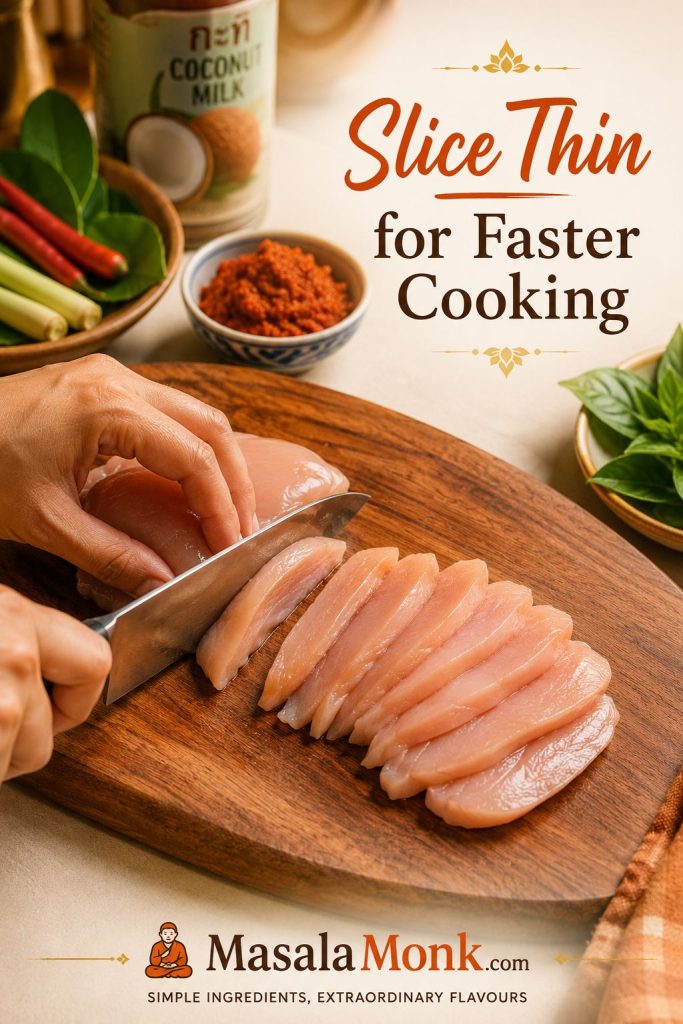
1. Slice the protein thinly

Thin slices cook quickly and pick up the curry better. Cut chicken across the grain into bite-size strips. Slice beef very thinly against the grain. For tofu, cut into cubes or slabs and pat dry before cooking.

Avoid large chunks of chicken here. Thick pieces take longer to cook, which can push the pan past its best texture before the center is done.

Hand slicing raw chicken into thin strips on a cutting board for Panang curry, with herbs and curry ingredients nearby.
Thin chicken slices cook quickly and absorb the curry better, so the meat stays tender while the sauce settles into the right texture.

2. Fry the curry paste

Heat neutral oil, or the thick cream from the top of the coconut milk can, in a wide skillet, wok, or 12-inch saucepan over medium heat. Add the paste and fry for 1–2 minutes for softer supermarket paste, or 3–5 minutes for a thicker Thai paste, stirring often, until it smells deeper and turns slightly darker.

When the paste starts sticking, lower the heat and loosen it with a spoonful of coconut cream or coconut milk. Water cools the pan, so use it only when you have no other choice.

This is the moment the curry starts smelling less like paste from a tub and more like dinner: chile, coconut fat, warm spice, and lime leaf waiting to open up.

3. Build the coconut sauce

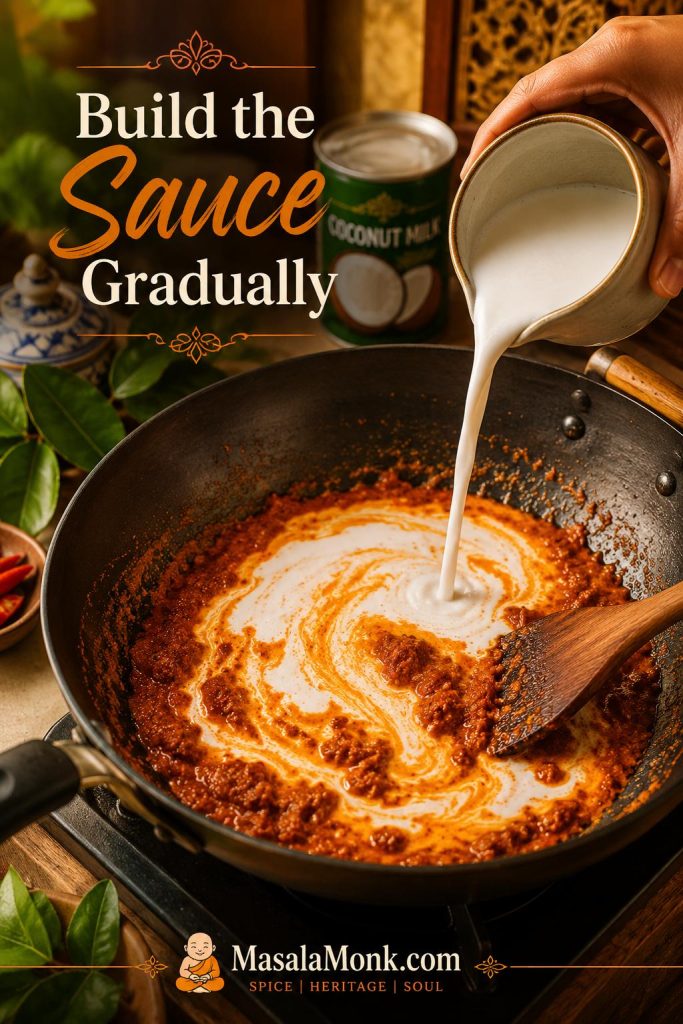
Stir in the coconut milk or coconut cream gradually until the paste dissolves into a smooth sauce. Add fish sauce, palm sugar or brown sugar, torn makrut lime leaves, and peanuts or peanut butter. Keep the curry at a gentle bubble, not a hard boil.

At this point, the pan should look creamy and red-orange. Let it bubble for a few minutes before adding delicate vegetables or herbs. A good Panang base looks slightly more intense than you think it needs to be; rice will soften everything later. When you are unsure, use the spoon-coating test before serving.

Coconut milk being poured into fried Panang curry paste in a wok, creating orange-red swirls as the sauce forms.
Add coconut gradually so the fried paste dissolves evenly; as it blends, the curry changes from separate ingredients into one smooth base.

4. Cook the protein and vegetables

Add chicken and firm vegetables such as carrots, green beans, baby corn, or broccoli stems first. Simmer gently until the chicken is cooked through; the thickest piece should reach 165°F / 74°C.

Add bell pepper, snap peas or snow peas, zucchini, or spinach later so they stay brighter and release less water. Save finely sliced makrut lime leaves for the end if you are using them as garnish.

Beef and shrimp go in later. Browned tofu can go in near the end so it keeps its shape.

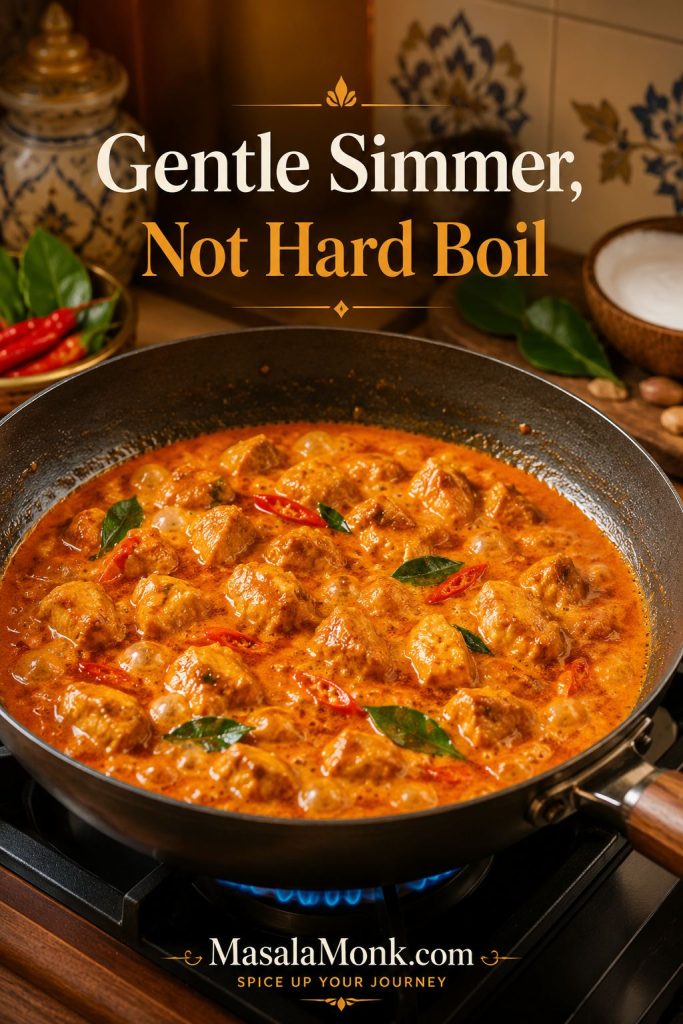
Chicken Panang curry gently simmering in a wide pan with small bubbles, orange-red sauce, chicken pieces, and herbs.
A gentle simmer gives the chicken time to cook while the coconut base thickens softly, without the rough look that comes from hard boiling.

5. Taste and finish

Give the curry a few uncovered minutes before final tasting. The flavor changes as the coconut settles: salt becomes clearer, sweetness rounds out, and the paste tastes less scattered.

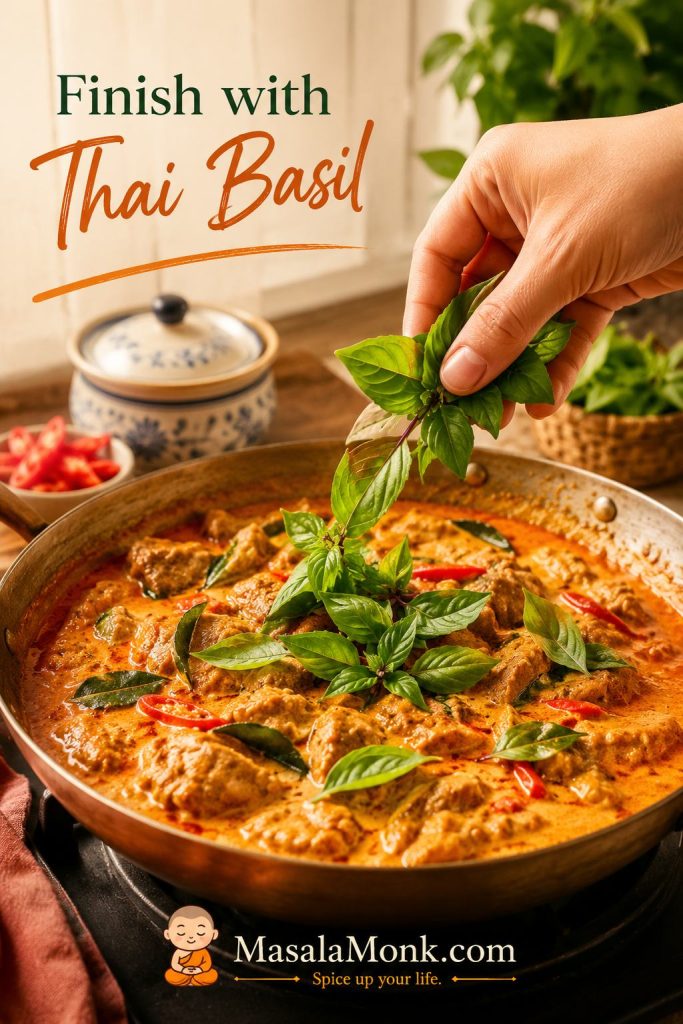
Turn off the heat and stir in Thai basil right before serving. Add extra finely sliced makrut lime leaves, crushed peanuts, or sliced red chile for a stronger finish. The basil should smell fresh as soon as it hits the hot curry.

Hand adding Thai basil to finished chicken Panang curry in a pan with red chile and creamy orange-red sauce.
Stir basil in right at the end, then stop cooking; as a result, the curry keeps its fresh Thai basil aroma.

Chicken safety note: chicken should reach 165°F / 74°C in the thickest piece. FoodSafety.gov lists this as the safe minimum internal temperature for poultry in its safe minimum internal temperatures chart.

The Spoon-Coating Test for Panang Curry Sauce

When you are not sure whether the curry is ready, trust the spoon more than the clock. Dip a spoon into the pan and lift it out. The sauce should coat the back in a visible layer instead of sliding off immediately.

Spoon lifted from Panang curry showing orange-red coconut sauce coating the back of the spoon above the pan.
Once the curry coats the spoon in a smooth layer, it is concentrated enough for rice but still loose enough to serve generously.

When it is right, the sauce leaves a glossy trail on the spoon and settles over rice instead of disappearing into it. If it becomes too heavy, loosen it with a spoonful of coconut milk, water, or stock. Cornstarch can rescue a rushed sauce, but it should not be the first fix. If the texture is already off, go to the sauce fixes before serving.

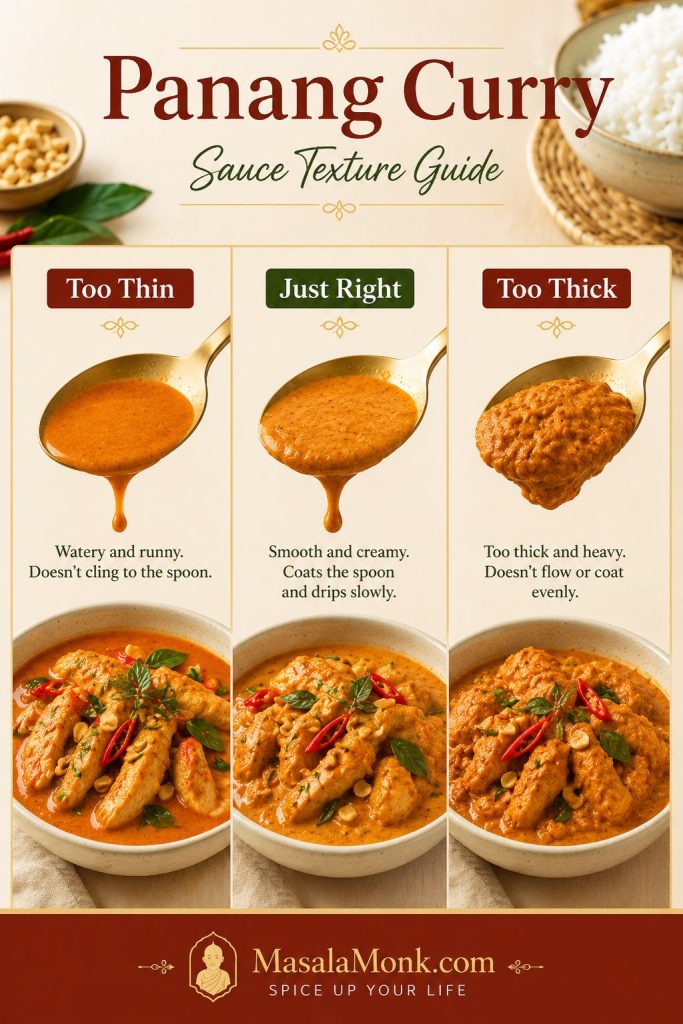
How thick should Panang curry sauce be?

The best texture sits between runny and pasty: it coats the spoon, moves slowly in the pan, and still spoons easily over rice.

Three-panel guide comparing Panang curry sauce that is too thin, just right, and too thick.
Use this texture guide before serving: thin curry needs more simmering, while overly thick curry needs a small splash of coconut milk or water.

Texture goal: glossy and spoonable, rich enough to coat the protein, but still loose enough for rice.

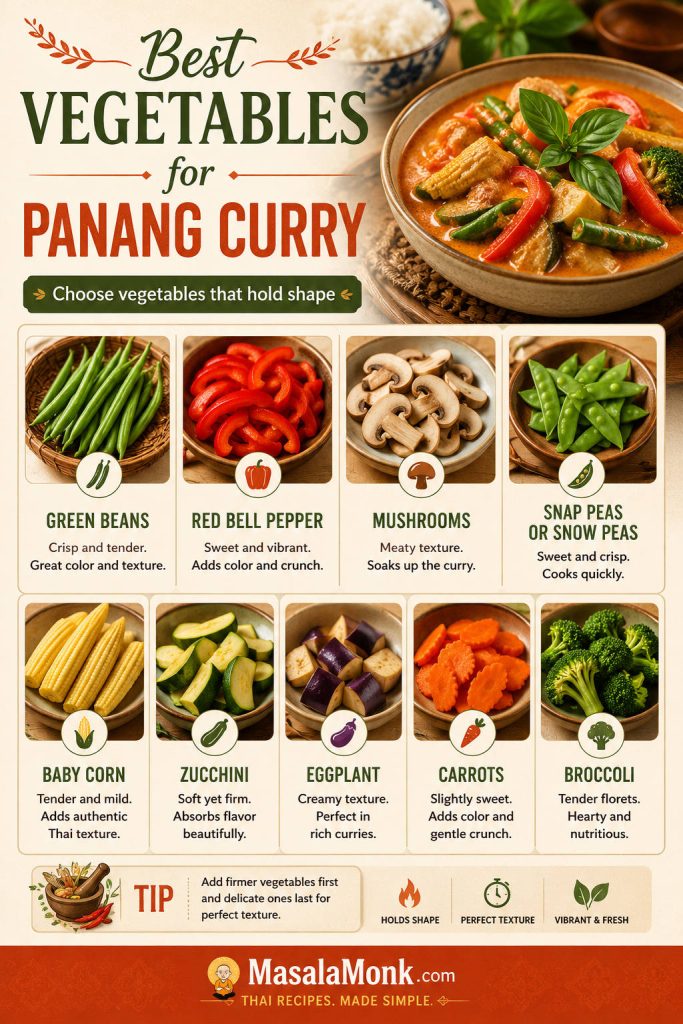
Best Vegetables for Panang Curry

Vegetables can make Panang curry feel fuller and fresher, but they need good timing. Add firm vegetables first, tender vegetables later, and basil at the very end.

Vegetable guide for Panang curry showing green beans, red bell pepper, mushrooms, snap peas, baby corn, zucchini, eggplant, carrots, and broccoli.
Choose vegetables that hold their shape so the curry stays colorful, balanced, and concentrated instead of turning watery.

Keep watery vegetables modest, especially mushrooms, zucchini, and spinach. They are delicious here, but a crowded pan can turn a glossy Panang into a thinner curry.

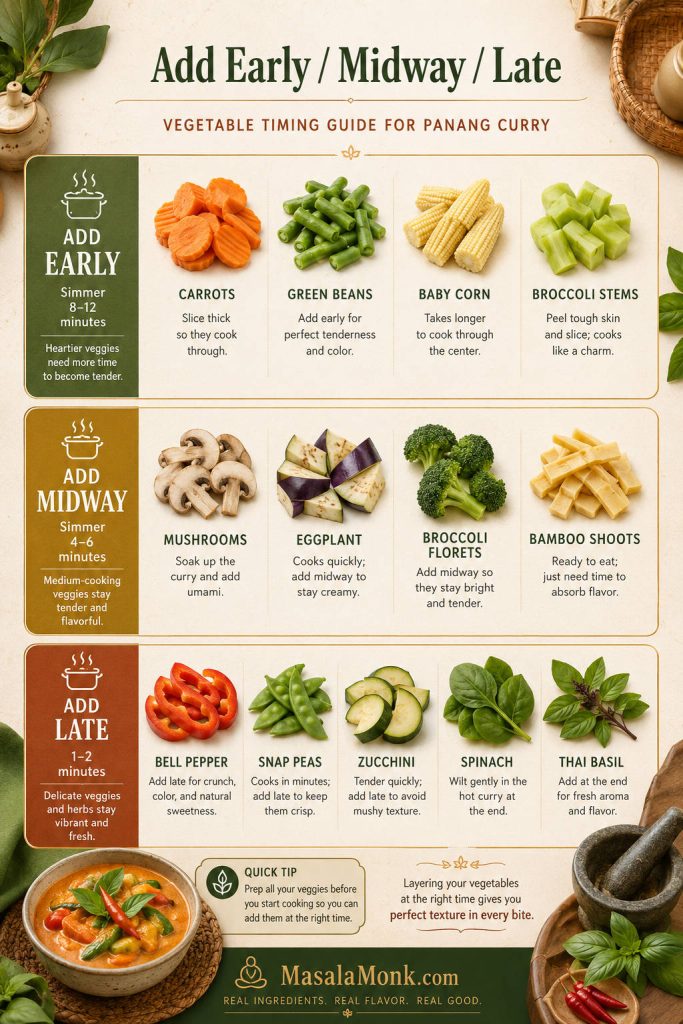
When to add vegetables to Panang curry

Vegetable timing guide for Panang curry with early, midway, and late groups for vegetables and Thai basil.
Add firmer vegetables first and delicate ones later; this way, the curry keeps both texture and fresh color.
Add EarlyAdd MidwayAdd Late
CarrotsMushroomsBell pepper
Green beansSmall eggplant piecesSnap peas or snow peas
Small cauliflower floretsBroccoli floretsZucchini
Broccoli stemsBamboo shootsSpinach
Baby cornThai basil

For a vegetable-heavy curry, use a little more paste and give the coconut base extra time to settle into the right texture. If you are skipping meat completely, jump to the vegetable Panang curry variation.

Chicken, Beef, Tofu, Shrimp and Vegetable Panang Curry

The curry base stays mostly the same, but each version has one thing to protect: juicy chicken, tender beef, intact tofu, just-cooked shrimp, or vegetables that do not water down the pan.

VersionHow Much to UseBest Method
Chicken Panang curry1½ lb / 680g chicken thighs or breastSlice thin and simmer until just cooked through. Thighs are juicier; breast cooks faster.
Beef Panang curry1–1¼ lb / 450–570g tender beefSlice thinly against the grain and add near the end so it stays tender.
Tofu Panang curry14–16 oz / 400–450g firm tofuPress if watery, brown if desired, then add after the sauce has reduced.
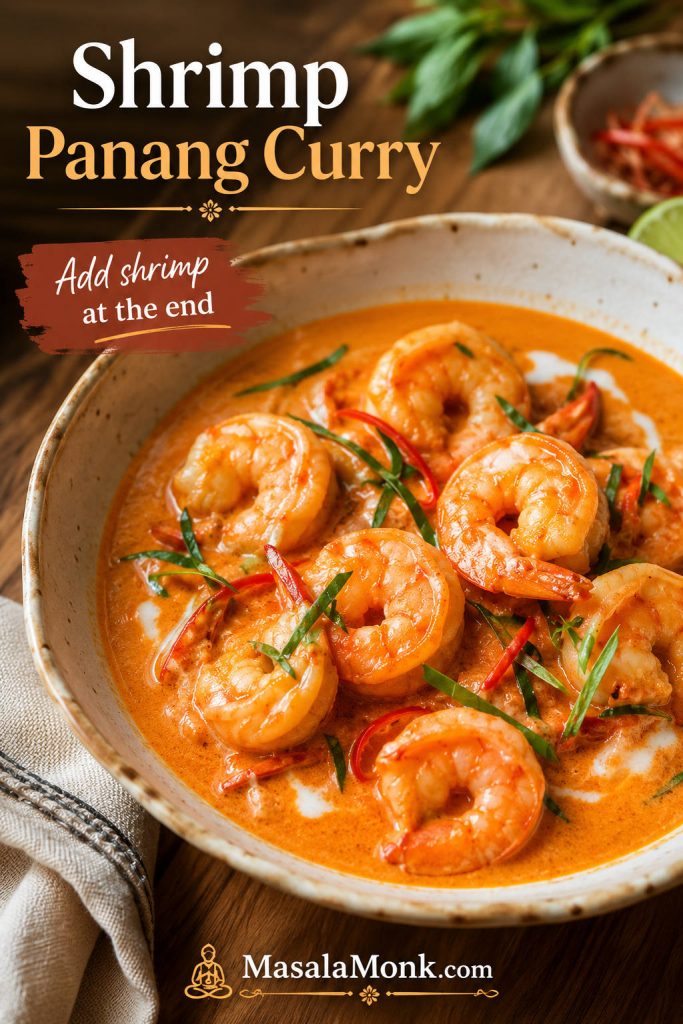
Shrimp Panang curry1 lb / 450g peeled shrimpAdd during the final few minutes and cook only until opaque.
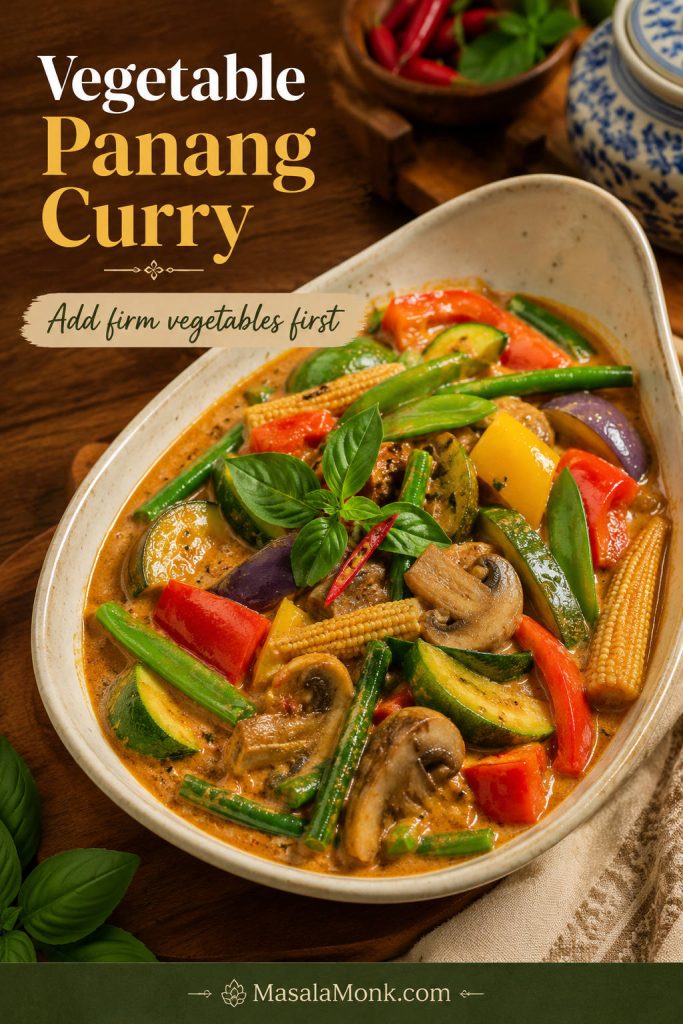
Vegetable Panang curry3–4 cups mixed vegetablesAdd firm vegetables first and quick-cooking vegetables later.

Chicken Panang Curry

Chicken is the best first version because it is easy to cook and lets the curry shine. Thighs are the most forgiving choice because they stay juicy. Breast also works, but it needs thin slicing and close timing.

For the most reliable chicken version, use 1½ lb / 680g chicken, 3 tablespoons curry paste, one 400ml can of coconut milk or coconut cream, and 1–1½ cups vegetables. Red bell pepper, green beans, baby corn, mushrooms, and snap peas or snow peas all work well.

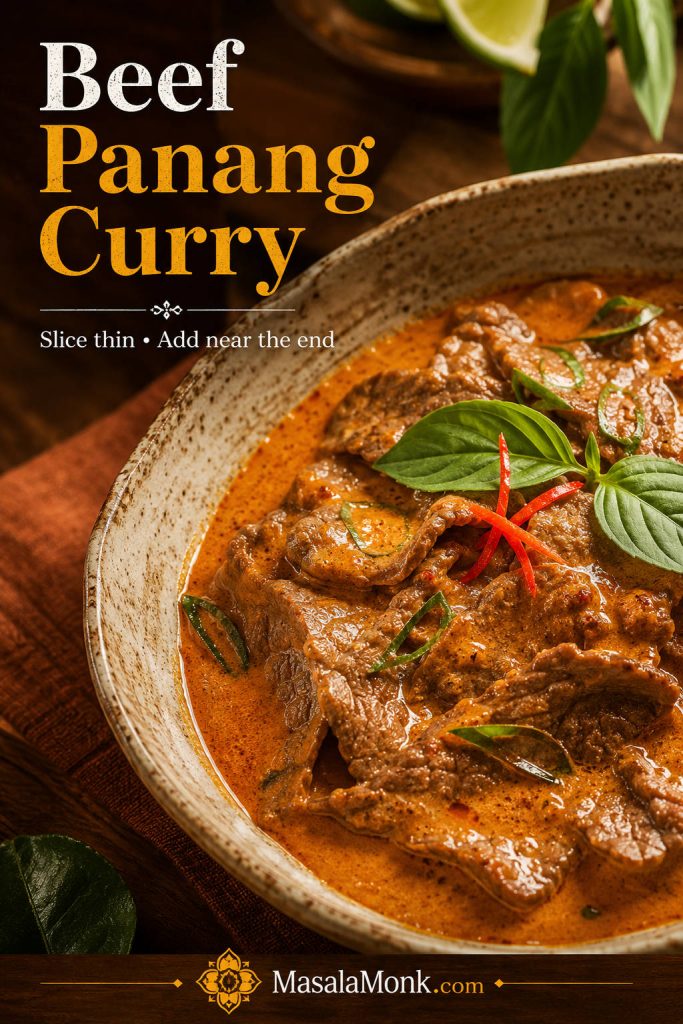
Beef Panang Curry

Use sirloin, ribeye, flank steak, flat iron, or another tender cut. Slice it thinly against the grain, then add it after the sauce is mostly finished. Simmer just until cooked through.

Beef Panang curry with thin slices of beef in orange-red coconut curry sauce, basil, makrut lime leaf garnish, and red chile.
Beef Panang curry works best with thin slices added near the end, so the beef stays tender instead of becoming chewy.

Do not simmer thin steak-style beef for 15 minutes the way you might simmer chicken. It can turn chewy, especially if it is very lean. For a slow-cooked beef Panang, use a tougher cut such as chuck or short rib and treat it as a separate slow-braised version.

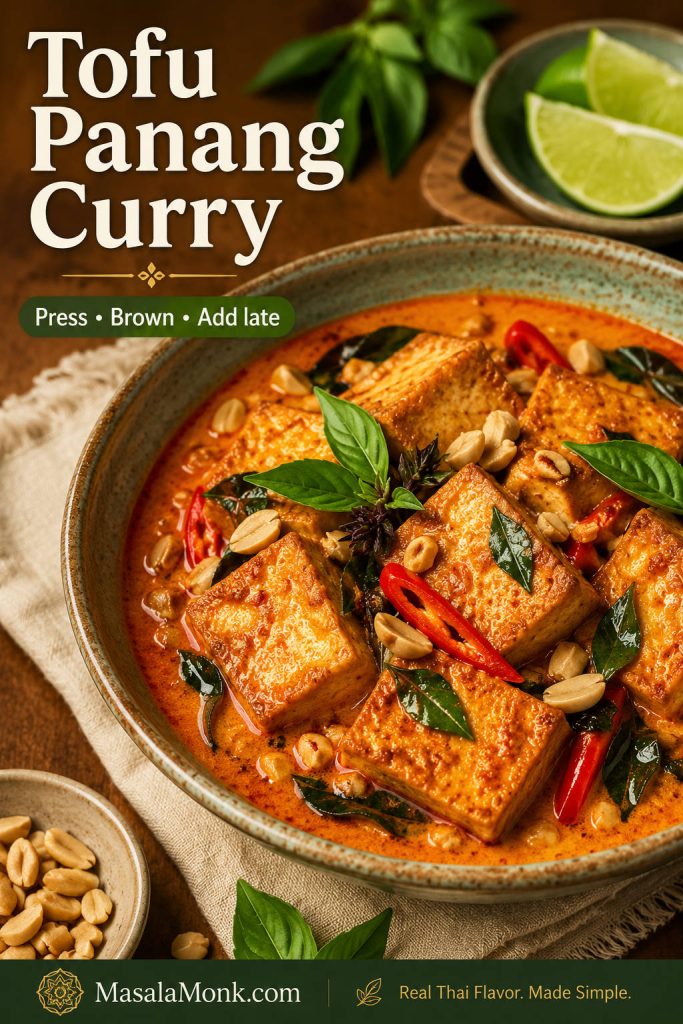
Tofu or Vegan Panang Curry

Tofu Panang curry can be excellent, but the tofu needs texture and the curry paste needs a label check if you are cooking vegan. Use firm or extra-firm tofu. Press it for 15–20 minutes if it is watery, then cut it into cubes or slabs. For better texture, brown the tofu before adding it to the sauce.

Tofu Panang curry with tofu pieces in coconut curry sauce, Thai basil, peanuts, red chile, and makrut lime leaf garnish.
Press and brown tofu before adding it to the curry; then it holds its shape and gives the sauce something firm to coat.

Vegan paste warning: many Thai curry pastes contain shrimp paste, fish sauce, or other seafood ingredients. Use a vegan Panang curry paste, or use vegan red curry paste and adjust it with peanuts, a tiny pinch of nutmeg, and a little coriander or cumin.

Replace fish sauce with soy sauce or tamari. Add tofu after the sauce has reduced so it does not break apart while the curry thickens. Finish with basil and crushed peanuts.

Shrimp Panang Curry

Shrimp Panang is the fastest version, but it asks for restraint. The sauce should be ready before the shrimp goes in, because shrimp only needs a few minutes to turn sweet, opaque, and tender.

Shrimp Panang curry with curled shrimp in creamy orange-red coconut curry sauce, Thai basil, red chile, and lime leaf garnish.
Shrimp needs only a short finish in Panang curry, so build and balance the sauce before the shrimp goes into the pan.

Once the shrimp is in the pan, simmer only until it curls gently and loses its translucency. Serve right away.

Vegetable Panang Curry

Vegetable Panang curry works best when you choose vegetables that hold their shape. Green beans, bell peppers, mushrooms, broccoli, snap peas or snow peas, baby corn, carrots, zucchini, and eggplant can all work, but they should not all go in at once.

Vegetable Panang curry with green beans, bell pepper, mushrooms, baby corn, zucchini, eggplant, snap peas, and basil in coconut curry sauce.
Vegetable Panang curry works best when the vegetables stay distinct, bright, and lightly tender instead of collapsing into the coconut sauce.

Add firm vegetables first, quick-cooking vegetables later, and basil at the very end. For a vegetable-heavy curry, start with 1 extra teaspoon of paste. A very full pan may need up to 1 extra tablespoon. Once you have chosen the version, return to the recipe card for the base method.

How to Fix Panang Curry Sauce

This is the section to use when the curry looks wrong five minutes before dinner. Most Panang problems are not disasters; they are small balance problems. A watery vegetable, a salty paste, thinner coconut milk, or too much heat can throw the pan off, but most of it is fixable.

You are looking for sauce that visibly coats the protein, but still has enough movement to spoon over rice. When the protein is already cooked, remove it with a slotted spoon and fix the sauce on its own.

Quick fixes for Panang curry sauce

Panang curry sauce troubleshooting board with fixes for watery, thick, flat, salty, spicy, split, oily, or red-curry-like sauce.
Use this rescue guide before serving: most Panang curry sauce problems can be fixed with better simmering, coconut, paste, seasoning, or heat control.
Sauce ProblemWhat It Feels LikeHow to Fix It
Too wateryThe chicken looks like it is floating instead of coated.Simmer uncovered. If the protein is cooked, remove it and reduce the sauce alone. Use coconut cream next time.
Too thickThe curry looks heavy, pasty, or dry instead of glossy.Add coconut milk, water, or stock one spoonful at a time, then stop as soon as it turns spoonable.
Tastes flatThe curry smells fine but tastes dull or unfinished.Fry extra paste separately and stir it in. Add fish sauce, sugar, lime leaves, or basil.
Too saltyThe salt hits first and the coconut sweetness disappears.Add unsalted bulk such as coconut milk, vegetables, tofu, or chicken. Balance with a tiny amount of sugar.
Too spicyThe heat overwhelms the coconut and aromatics.Add coconut cream or coconut milk and serve with extra rice.
Oily or splitThe curry looks greasy around the edges.Lower the heat, stir gently, and add a splash of coconut milk.
Tastes like red curryThe curry is loose, chile-forward, and missing the rounded Panang note.Add peanuts or peanut butter, simmer briefly, and finish with Thai basil and finely sliced tender makrut lime leaves.

Panang Curry Recipe Card

A creamy chicken Panang curry with store-bought paste, full-fat coconut, makrut lime leaves, peanuts, and Thai basil. Rich, spoonable, and easy to adapt for beef, tofu, shrimp, or vegetables.

Yield
4 servings
Prep Time
15 minutes
Cook Time
25 minutes
Total Time
40 minutes

Ingredients

  • 1½ lb / 680g boneless chicken thighs or chicken breast, thinly sliced
  • 3 tbsp / about 45g Panang curry paste
  • 1 tbsp / 15ml neutral oil, or thick coconut cream from the top of the can
  • 13.5–14 oz / 400ml full-fat coconut milk or coconut cream
  • 1–1½ tbsp / 15–22ml fish sauce, plus more to taste, depending on paste saltiness
  • 2 tsp–1 tbsp / 8–15g palm sugar or brown sugar
  • 4–6 makrut lime leaves, torn, plus optional finely sliced tender leaves for finishing
  • 2 tbsp / about 15g crushed roasted peanuts, or 1 tbsp / about 16g peanut butter
  • 1 red bell pepper, thinly sliced, or 1–1½ cups mixed vegetables for the chicken version
  • ½ cup loosely packed Thai basil leaves
  • Optional garnish: sliced red chile, extra basil, crushed peanuts, finely sliced makrut lime leaves
  • Steamed jasmine rice, for serving

Instructions

  1. Prep. Slice the chicken thinly and prepare the vegetables, herbs, and garnishes before cooking.
  2. Fry the paste. Heat oil or thick coconut cream in a wide skillet, wok, or 12-inch saucepan over medium heat. Add the Panang curry paste and cook, stirring often, until fragrant and slightly darker — about 1–2 minutes for softer paste or 3–5 minutes for thicker Thai paste.
  3. Build the sauce. Stir in coconut milk or coconut cream gradually until smooth. Add fish sauce, sugar, torn makrut lime leaves, and peanuts or peanut butter.
  4. Simmer. Add chicken and firm vegetables such as carrots, green beans, or baby corn. Simmer gently until the chicken is cooked through: about 6–8 minutes for thin chicken breast or 8–12 minutes for thin chicken thighs. The thickest piece should reach 165°F / 74°C. Add bell pepper, snap peas or snow peas, zucchini, or spinach near the end.
  5. Adjust. If the sauce looks loose, simmer uncovered until glossy and spoonable. Taste after thickening, then adjust with fish sauce, sugar, coconut milk, or extra fried paste if needed.
  6. Finish. Turn off the heat and stir in Thai basil. Garnish with extra basil, crushed peanuts, sliced chile, or finely sliced makrut lime leaves.
  7. Serve. Serve hot with steamed jasmine rice.

Recipe Notes

  • Beef: use 1–1¼ lb / 450–570g thinly sliced sirloin, ribeye, flank steak, or another tender cut. Add near the end and simmer briefly.
  • Tofu: use firm or extra-firm tofu. Press if watery, brown first if desired, and add after the sauce has reduced.
  • Vegan Panang: use vegan curry paste and replace fish sauce with soy sauce or tamari.
  • Shrimp: build and thicken the sauce first, then add shrimp near the end and cook only until opaque.
  • Vegetable Panang: use 3–4 cups mixed vegetables and add 1 teaspoon to 1 tablespoon extra paste depending on volume.
  • Richer sauce: use coconut cream. For a milder curry, start with 2 tbsp paste and add more after tasting.

Once the paste smells cooked, the coconut turns glossy, and the basil hits the pan, the curry feels much easier to trust. Spoon it beside jasmine rice, add the final herbs, and you have the kind of weeknight Panang that tastes deliberate instead of rushed.

Instant Pot or Slow Cooker Panang Curry

Panang rewards stovetop control, so treat Instant Pot and slow cooker versions as backup methods. They are useful for convenience, but both need a final look at the sauce before serving.

Backup-method guide for Panang curry showing Instant Pot and slow cooker options with sauté first, cook, reduce after, and check sauce cues.
Instant Pot and slow cooker Panang curry can be convenient, but the final sauce check still matters before the curry reaches the table.

Instant Pot Panang curry

Use sauté first. Fry the paste in oil or thick coconut cream for 1–2 minutes, then stir in coconut milk or cream, fish sauce, sugar, torn lime leaves, and thin chicken pieces. Pressure cook on high for 3–4 minutes, then quick release. Use sauté again to bring the sauce back to a spoonable texture, then finish with basil.

Slow cooker Panang curry

Slow cooker Panang works best with chicken thighs or beef, not thin chicken breast. Fry the paste separately first, then add it to the slow cooker with coconut milk, seasoning, and protein. Cook on low until the meat is tender, usually about 2–3 hours for boneless chicken thighs. If the sauce is thin at the end, reduce it uncovered in a saucepan before adding basil.

What to Serve with Panang Curry

Panang is rich, so the best sides either catch the sauce or cut through it. Jasmine rice catches the glossy curry; cucumber, herbs, lime, green beans, or Som Tam keep the bowl from feeling heavy. Planning leftovers too? Jump to storage and reheating.

What goes well with Panang curry?

Panang curry served with jasmine rice, cucumber, herbs, lime, and a fresh Som Tam-style side dish on a warm table.
Pair Panang curry with jasmine rice and a crisp side so the meal has both coconut richness and fresh contrast.

Spoon the curry beside the rice rather than burying it. That way the first few bites stay glossy and concentrated, and the rice catches the sauce slowly instead of muting it all at once. If rice is the part that usually goes wrong, this guide to cooking perfect rice can help.

Serve WithWhy It Works
Steamed jasmine riceBest default; it absorbs the sauce without competing with the curry.
Cucumber salad, herbs, lime, or lightly steamed green beansFresh sides balance the coconut richness.
Roti, flatbread, rice noodles, or coconut riceComfort options for a fuller, more restaurant-style meal.

For a crisp Thai-style side, this Vegan Som Tam Salad gives the fresh, sharp contrast that works well beside a creamy coconut curry.

Storage, Freezing and Reheating

How to store Panang curry leftovers

Store leftover Panang curry in an airtight container in the refrigerator for 3–4 days. The sauce will thicken as it chills, so add a splash of coconut milk, water, or stock when reheating.

Panang curry leftovers stored in an airtight glass container on a refrigerator shelf with text saying store three to four days.
Leftover Panang curry keeps well for 3–4 days in an airtight container; for the brightest flavor, add fresh basil after reheating.

How to reheat Panang curry

Reheat gently on the stovetop over low to medium-low heat. Avoid hard boiling because coconut-based sauces can split. If the curry looks oily after reheating, lower the heat and stir in a small splash of coconut milk.

Panang curry reheating gently in a saucepan while coconut milk is poured in and the sauce is stirred with a wooden spoon.
Reheat Panang curry gently, adding a splash of coconut milk if needed, so the sauce turns smooth again instead of splitting.

The curry reheats well, but fresh basil does not. For make-ahead cooking, stop before adding the basil if you can, then add it after reheating so the curry tastes fresh again.

You can freeze Panang curry for up to 2 months, but the sauce may look slightly separated or grainy after thawing. Reheat gently and stir in a little coconut milk to smooth it out. Shrimp Panang curry is less ideal for freezing because shrimp can become rubbery after thawing and reheating. Tofu may soften slightly after storage, but it still tastes good.

Panang Curry FAQs

Is Panang curry supposed to be thick?

Panang curry is usually thicker and more concentrated than Thai red curry. It should coat the chicken, tofu, shrimp, beef, or vegetables instead of running like soup.

Is Panang curry very spicy?

Most bowls land in the medium-spicy range, but the paste controls the heat. Start with 2 tablespoons for a gentler curry and add more after tasting.

What does Panang curry taste like?

It tastes creamy, savory, lightly sweet, and aromatic, with a quiet peanut note. Peanut belongs in the background; it rounds the curry without turning it into satay sauce.

Why does my Panang curry taste like red curry?

The curry may be too loose or missing the rounded peanut and lime-leaf finish. Simmer the coconut base until glossy, then add peanut richness, basil, and finely sliced tender makrut lime leaves if you have them.

Can I use red curry paste instead of Panang curry paste?

Yes, as a shortcut. Add peanuts or peanut butter, a tiny pinch of nutmeg, and a little coriander or cumin to move it closer to Panang flavor.

What is the best coconut milk for Panang curry?

Full-fat coconut milk works well, while coconut cream gives the richest result. Light coconut milk makes the curry thinner and less satisfying.
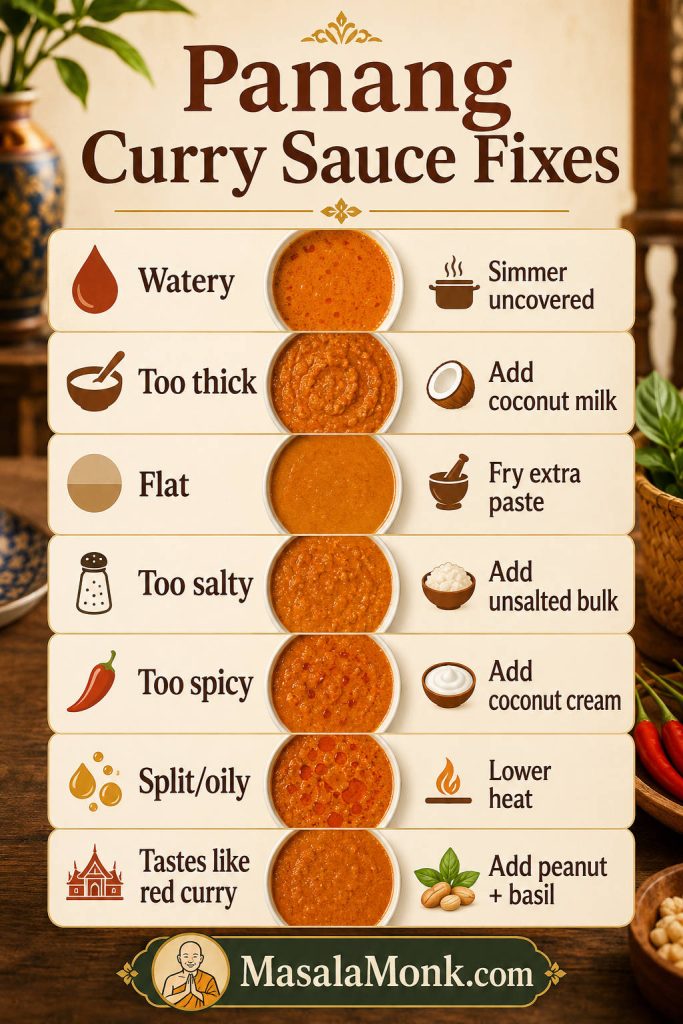
Is Panang curry the same as Panang gai?

Panang gai means chicken Panang curry. “Gai” means chicken, so the method is the same here: thin chicken, coconut sauce, and a fresh basil finish.

Can I make Panang curry without fish sauce?

Use soy sauce, tamari, or a vegetarian fish-sauce alternative. Taste after simmering because substitutes vary in saltiness and depth.

Why is my Panang curry watery?

The coconut may need more time, the milk may be too thin, or the vegetables may have released water. Simmer uncovered before reaching for cornstarch.

Can I make Panang curry ahead?

Chicken, beef, tofu, and vegetable versions reheat well. For the freshest flavor, hold back the basil and add it after reheating.

What vegetables go well in Panang curry?

Green beans, bell peppers, mushrooms, broccoli, snap peas, baby corn, carrots, zucchini, and eggplant all work. Add watery vegetables late.

Can I make this with shrimp?

Build and thicken the sauce first, then add shrimp near the end and cook just until opaque. Do not reduce the curry after shrimp goes in.

Back to top

Posted on 12 Comments

Katsu Curry Rice (Japanese Recipe, with Chicken Cutlet)

Overhead shot of a plate of chicken katsu curry with sliced crispy chicken, rice, shredded cabbage and curry sauce, with hands holding the dish and spoon, for The Ultimate Chicken Katsu Curry Recipe on MasalaMonk

There are some recipes you cook because you need to eat, and then there are recipes you cook because you want a small event at the table. A good chicken katsu curry recipe always feels like the second kind. You get the sizzle of hot oil, the comfort of a thick Japanese-style curry, and a mound of rice that soaks it all up.

In this post we’ll walk through a detailed, home-cook-friendly chicken katsu curry recipe, then build out variations: pork and tofu versions, air-fryer and lighter “fakeaway” spins, plus quick cheats using curry roux. You’ll also see ideas for what to serve alongside, how to turn leftovers into entirely new meals, and a bit of backstory on how this dish went from Tokyo comfort food to global obsession.


What exactly is chicken katsu curry?

In Japan, katsu curry means curry rice served with a breaded, fried cutlet on top. The cutlet is the “katsu” (usually pork, sometimes chicken), and the curry is a thick, mellow, slightly sweet Japanese-style sauce ladled over rice. According to the entry on katsu curry, the dish is typically built as rice on one side, curry sauce on the other, and sliced cutlet laid neatly across.

Unlike many Indian curries, Japanese curry is usually based on a roux: flour and fat cooked together with curry spices, then loosened with stock to form a glossy, spoon-coating sauce. Over time, Japanese manufacturers turned that idea into the curry roux blocks you see in Asian supermarkets. Writers like Nagi from RecipeTin Japan break down how home cooks now rely on these blocks to make a quick katsu curry with chicken cutlet, using them much like we use bouillon cubes.

Chicken katsu curry recipe card with sliced panko chicken, rice and Japanese curry in a bowl.
Crispy panko chicken, glossy Japanese curry and fluffy rice – this is the finished chicken katsu curry you’re cooking towards.

Origins of Japanese chicken katsu curry and its recipe

The origin story often credited for katsu curry is surprisingly specific. One popular telling goes back to Grill Swiss, a Western-style restaurant in Tokyo’s Ginza district. A regular customer complained that ordering curry and tonkatsu separately took too much time, so the kitchen served the cutlet on top of the curry, all on one plate. That little act of laziness birthed a dish that spread across Japan, as explored in an essay on the origins of katsu curry.

Outside Japan, the story takes another turn. In the UK especially, “katsu curry” exploded on high-street menus in the 2000s; JETRO even has a piece on how katsu curry conquered the UK, tracing its rise through chains like Wagamama and Wasabi. Somewhere along the way, people started using “katsu” to mean “any Japanese curry” or even just “that brown katsu sauce,” which isn’t how the term is used in Japan at all.

Here, we’ll lean towards the Japanese understanding: crispy breaded cutlet + Japanese curry + rice. Once that foundation is clear, the rest of the variations fall into place very naturally.

Also Read: Crispy Homemade French Fries From Fresh Potatoes (Recipe Plus Variations)


Ingredients for this chicken katsu curry recipe

To make this chicken katsu curry recipe feel doable on a regular weeknight, it helps to see the dish in three parts:

  1. The chicken katsu (breaded cutlet)
  2. The Japanese curry sauce
  3. Rice and toppings

Once you get comfortable with that structure, you can mix and match ingredients, proteins and cooking methods without getting lost.

Chicken katsu (serves 4)

  • 4 small chicken breasts or 2 large, butterflied and pounded to about 1 cm thick
  • 1 teaspoon fine salt
  • ½ teaspoon ground black or white pepper
  • ½ teaspoon garlic powder (optional but tasty)
  • 60 g (½ cup) plain flour
  • 2 large eggs, beaten
  • 120 g (about 2 cups) panko breadcrumbs
  • Neutral oil for frying (sunflower, canola, rice bran)

Panko is key here. Regular breadcrumbs will work, but panko gives you that light, craggy crust you see on proper tonkatsu and classic chicken katsu.

Japanese curry sauce

We’ll build a hybrid sauce: part scratch, part shortcut. You can go fully homemade or lean on curry roux blocks when life gets hectic.

  • 2 tablespoons neutral oil or butter
  • 1 large onion, thinly sliced
  • 2 cloves garlic, minced
  • 1 teaspoon grated fresh ginger
  • 2 medium carrots, cut into chunks
  • 2–3 small waxy potatoes, peeled and cubed
  • 2 tablespoons plain flour
  • 1–2 tablespoons mild curry powder (Japanese curry powder if available)
  • ½ teaspoon garam masala (optional)
  • 750 ml (3 cups) chicken or vegetable stock
  • 1–2 teaspoons soy sauce
  • 1–2 teaspoons honey or sugar
  • 1 tablespoon grated apple or a splash of apple juice
  • Salt to taste

If you prefer, you can replace the flour and curry powder with roughly 4 squares of Japanese curry roux from a pack, stirring them in as described later.

Rice and toppings

  • 300–400 g uncooked short-grain Japanese rice (or any medium/short-grain rice you enjoy)
  • Finely shredded cabbage
  • Sliced spring onions
  • Japanese pickles (fukujinzuke, takuan) if you can find them

The contrast of hot, savoury curry sauce with cool, crisp cabbage might seem unusual if you’re used to Indian curries, but once you try it, it makes perfect sense.

Also Read: Simple Bloody Mary Recipe – Classic, Bloody Maria, Virgin & More


Step-by-step chicken katsu curry recipe

Now let’s bring it all together. Although this plate looks impressive, the workflow is surprisingly logical: curry first, rice while it simmers, then katsu at the end so it stays crisp.

Cook the rice

Begin with the rice so it’s ready to welcome everything else. Rinse it in cold water until the water runs mostly clear, then cook in a rice cooker or in a saucepan using the absorption method. The goal is fluffy but slightly sticky grains, similar to what you see in recipes like chicken katsu curry rice from The Woks of Life.

Once it’s done, keep the lid on and the heat off. The rice will stay warm and steam gently while you handle the rest.

Hands rinsing Japanese rice in a sieve over a bowl as part of chicken katsu curry prep.
Start your chicken katsu curry with well-rinsed Japanese rice so every grain cooks up fluffy and ready to soak up the sauce.

Make the Japanese curry sauce

While the rice cooks, start the curry:

Sweat the aromatics

Set a wide saucepan or deep skillet over medium heat and add the oil or butter. Scatter in the sliced onion with a pinch of salt and cook slowly for 8–10 minutes. Stir now and again until the onion softens and turns pale gold. This patient step builds sweetness and depth into your curry.

Add garlic, ginger and vegetables

Stir in the garlic and ginger and cook for about 30 seconds, just until fragrant. Immediately add the carrot and potato chunks, tossing them through the onion mixture for a couple of minutes so they start to absorb those flavours

Onions, garlic and ginger sautéing in a pan to begin the Japanese curry sauce.
Slowly sautéing onions with garlic and ginger builds the sweet, savoury base that makes the katsu curry sauce so comforting.

Create a curry roux base

Sprinkle the flour and curry powder over the vegetables. Stir well so everything gets coated and the flour begins to absorb the oil. Let it cook for 1–2 minutes; the mixture will look slightly pasty and stick to the pan. That’s the beginning of your roux.

Build the sauce

Pour in a splash of stock while stirring to release any sticky bits from the bottom, then gradually add the rest, stirring all the while to avoid lumps. Add soy sauce, honey or sugar, and the grated apple. The apple brings gentle sweetness and helps mimic the rounded flavour you get from Japanese curry blocks.

Carrots and potatoes coated with flour and curry powder in a pan for katsu curry base.
Coating the carrots and potatoes in flour and curry powder turns the vegetables into a rich roux that thickens the Japanese curry beautifully.

Simmer until tender

Bring the sauce to a gentle simmer, then lower the heat and cook for 15–20 minutes, stirring occasionally. The vegetables should become tender, and the sauce should thicken into a glossy, spoon-coating consistency. If it ever feels too thick, loosen it with a little extra stock or water.

Adjust the seasoning

Taste and tweak. Perhaps it needs a touch more soy for savoury depth, a pinch of salt, or a little extra honey if your curry powder is particularly sharp. For warmth, sprinkle in garam masala towards the end and simmer for another minute.

At this point, you have a solid Japanese curry base. If you’d like a smoother texture, you can mash some of the potato and carrot against the side of the pan or briefly blend a ladleful and stir it back.

Also Read: French 75 Cocktail Recipe: 7 Easy Variations

Pan of Japanese katsu curry sauce simmering with carrots and potatoes, a ladle lifting the thick glossy curry.
After adding stock, let the Japanese curry simmer gently until it turns thick and glossy and the carrots and potatoes are perfectly tender.

Preparing the chicken katsu

With the curry gently bubbling away, you can turn your attention to the cutlets. This part feels almost like making schnitzel, just with panko and Japanese flavours.

Season and pound the chicken

Lay each chicken breast between two sheets of baking paper or cling film. Gently pound with a rolling pin or meat mallet until it’s an even 1 cm thickness. Even thickness means even cooking and less chance of dry patches.

Season both sides with salt, pepper and garlic powder. Leave the chicken to sit while you set up your breading station; the salt will start to work its way in.

Chicken breasts being pounded flat on a board and seasoned for chicken katsu.
Butterfly and gently pound the chicken so it cooks evenly, then season both sides before you start breading the katsu.

Set up the breading station

Arrange three shallow bowls:

  1. Flour in the first
  2. Beaten eggs in the second
  3. Panko breadcrumbs in the third

To keep the crumbs especially crisp, you can mix a small pinch of salt and a drizzle of oil into the panko. The oil helps them brown more evenly in the pan or air fryer.

Dip each seasoned cutlet into the flour, shaking off excess so only a thin, even layer remains. Then pass it through the beaten egg, letting any drips fall back into the bowl. Finally, press the cutlet into the panko, turning to coat all sides. Press firmly so the crumbs really hug the surface.

Hand pressing a chicken fillet into a bowl of panko breadcrumbs with bowls of flour and beaten egg beside it for chicken katsu.
Coat each seasoned fillet in flour, egg and a generous layer of panko, pressing the crumbs on firmly so the chicken katsu fries up extra crisp.

Place the breaded cutlets on a wire rack or plate and let them rest for 5–10 minutes. This pause allows the coating to hydrate slightly and stick better, reducing the risk of it sliding off in the oil.


Frying or air-frying the katsu

A hallmark of any good chicken katsu curry recipe is that contrast between a juicy centre and a shatteringly crisp crust. There are two main paths to get there: traditional frying or a lighter air-fryer version.

Shallow or deep-frying

Set a large skillet or saucepan over medium-high heat and pour in enough oil to reach 1–2 cm up the sides. Heat until a breadcrumb dropped in the oil sizzles immediately and turns golden within about 30 seconds (around 170–180°C).

Carefully lay in the cutlets, two at a time if your pan is large. Fry for roughly 3–4 minutes on the first side until deep golden, then flip and cook another 3–4 minutes. As they fry, adjust the heat to keep the colour even; if they’re browning too quickly, lower the temperature slightly.

Once they’re beautifully golden and cooked through, transfer each cutlet to a rack or paper-towel-lined tray. Sprinkle with a tiny pinch of salt while they’re still hot.

Golden panko-coated chicken katsu frying in hot oil in a skillet, being turned with tongs.
Shallow-fry the crumbed chicken katsu in hot oil until the coating is deep golden and the meat inside is just cooked through and juicy.

Air-fryer recipe for chicken katsu curry

If you’re craving something lighter without sacrificing crunch, an air fryer is extremely handy. Food bloggers like CJ Eats and Okonomi Kitchen have shown that air fryer chicken katsu and air-fried panko cutlets can emerge every bit as crisp when cooked at around 190–200°C.

To air-fry:

  1. Lightly mist both sides of each breaded cutlet with oil spray.
  2. Preheat the air fryer to 190–200°C.
  3. Arrange the cutlets in a single layer, leaving a little room around each one.
  4. Cook for 12–15 minutes, flipping halfway, until golden and cooked through.

Because every air fryer model is slightly different, peek a little earlier the first time you make this. Once you’ve dialled in your perfect timing, this method becomes a reliable “fakeaway” option: all the joy, far less grease.

Also Read: Peanut Butter Cookies (Classic Recipe & 3 Variations)


Assembling your bowl of chicken katsu curry

Now comes the best part: putting it all together so every bite has crunch, sauce and rice.

  1. Slice the katsu
    Place each cutlet on a board and slice across on a slight diagonal into 1.5–2 cm strips. Keep the pieces in order so you can re-create that neat “fan” on the plate.
  2. Plate the rice and curry
    Spoon a generous mound of rice into a shallow bowl or wide plate. Ladle the hot curry sauce alongside, letting a bit of it seep into the rice but keeping some white patches for contrast.
  3. Lay the katsu on top
    Lift the sliced katsu with a wide knife and transfer it onto the plate, arranging it across the curry and rice. You want the bottom edges to catch a little sauce while the tops stay crisp, just like in that idealised katsu curry plate you see in Japanese cookbooks and in dishes like the one on The Woks of Life.
  4. Add fresh toppings
    Finish with a tumble of finely shredded cabbage, a sprinkle of sliced spring onions and, if you have them, a spoonful of pickles. The fresh crunch cuts through the richness and keeps the whole dish from feeling heavy.
Sliced chicken katsu on a board next to a bowl of rice, curry sauce and cabbage, showing the final step of serving chicken katsu curry.
Let the fried chicken katsu rest for a moment, then slice it into neat strips and lay it over rice with plenty of hot Japanese curry sauce.

At this stage, your classic chicken katsu curry recipe is complete. Nevertheless, once you’ve done it once or twice, it’s hard to resist playing with variations.

Also Read: Green Tea Shot with Jameson | Recipe & 10 Variations


Variations on the chicken katsu curry recipe

Because this dish is modular, it’s incredibly forgiving. A small swap in the sauce, a different protein, or a new cooking method can produce a meal that feels distinct without forcing you to learn an entirely new recipe.

Pork katsu curry (tonkatsu)

Strictly speaking, the original Japanese katsu curry is usually made with pork. To follow that path:

  • Use boneless pork loin or fillet sliced about 1–1.5 cm thick.
  • Pound lightly to even them out.
  • Season, bread and cook exactly as you would the chicken.
Bowl of pork katsu curry with sliced golden pork cutlet, Japanese curry sauce, rice, shredded cabbage and pickles.
Make a classic tonkatsu-style pork katsu curry by swapping the chicken for a juicy pork cutlet and serving it with the same rich Japanese curry sauce and rice.

Pork tends to cook slightly faster than chicken breast at the same thickness, so start checking for doneness after 3 minutes per side if you’re shallow-frying. Slice, serve over rice and curry, and you’ve got a comforting tonkatsu curry that leans a little richer and more savoury.

Plain Japanese chicken curry recipe (no katsu)

On evenings when frying feels like too much effort, you can turn this chicken katsu curry recipe into a simpler Japanese chicken curry.

Bowl of Japanese chicken curry with tender chicken pieces, rice, shredded cabbage and pickles in a creamy brown curry sauce.
When you don’t feel like frying, this Japanese chicken curry gives you the same cosy flavours as katsu curry with tender chicken simmered directly in the sauce.

Instead of breading the chicken:

  1. Cut the raw chicken into bite-sized pieces.
  2. After the onions, carrots and potatoes have simmered for about 5 minutes in the curry base, stir in the chicken.
  3. Simmer for another 10–15 minutes, until the chicken is just cooked and the sauce is thick.

You lose the crunch, but you gain a one-pot comfort bowl that sits somewhere between Japanese curry and Indian-inspired dishes like a lighter spinach chicken curry.

Recipe for Slimmer “fakeaway” chicken katsu curry

If you’re tracking calories or simply don’t love the idea of deep-frying on a Tuesday night, a slimmer version keeps the flavour but trims the excess.

Two golden panko-coated chicken katsu cutlets in a black air fryer basket, showing the air fryer version of chicken katsu.
Use the air fryer for chicken katsu that’s just as crisp and juicy, but made with a fraction of the oil—ideal for lighter katsu curry nights.

You can:

  • Air-fry or oven-bake the breaded cutlets on a rack, using oil spray instead of pouring centimetres of oil into a pan.
  • Drop the oil in the curry base to 1 tablespoon and rely more on stock and vegetables for body.
  • Serve with extra shredded cabbage and steamed vegetables, and slightly reduce the rice portion.

On weeks when you’re deliberately alternating richer dinners with lighter ones, you might pair this “fakeaway” with a genuinely lean meal on another night, such as a Kerala-style coconut vegetable stew or a big pot of authentic Punjabi rajma.

Vegetarian and vegan katsu curry

Katsu doesn’t have to mean meat. In fact, the structure of this dish lends itself beautifully to vegetarian and vegan cooking.

Tofu katsu

  • Press firm tofu for at least 20–30 minutes to remove excess moisture.
  • Slice into slabs about 1.5 cm thick.
  • Season lightly with salt and a splash of soy sauce.
  • Dust with flour, dip into a plant-based milk and flour mixture or aquafaba instead of egg, then coat in panko and fry or air-fry.

Serve the tofu katsu over the same curry sauce made with vegetable stock, and you have a fully meat-free plate that still delivers serious crunch.

Vegetarian katsu curry with sliced tofu katsu, rice, shredded cabbage and Japanese curry sauce in a bowl.
Swap the chicken for tofu or vegetable katsu and you still get all the crunch and rich Japanese curry flavour in this vegetarian katsu curry bowl.

Vegetable katsu

Root and starchy vegetables make wonderful katsu bases:

  • Thick slices of aubergine
  • Rounds of sweet potato or pumpkin
  • Sturdy slabs of celeriac

Par-cook them briefly in boiling water or the steamer if they’re very firm, then cool, bread and fry. The sweet, soft interior surrounded by crisp crumbs is addictive.

For readers who are exploring plant-based eating more broadly, it’s worth looking at seitan and other high-protein meat alternatives. Guides like the one on seitan as “the vegan’s chicken” show just how many curry-style dishes can be made without animal protein at all.

Also Read: ‘Tofu’ Instead of ‘Eggs’: 5 High Protein Plant-Based Breakfast Ideas


Sauce options: scratch, roux blocks and katsu dipping sauce

Many people first fall in love with this dish because of the sauce. It’s gentle, cosy and not as fiery as some Indian curries, which makes it ideal for families and spice-shy eaters.

Fully from-scratch Japanese curry sauce

The version at the start of this post is already close to a scratch sauce: you’re making a roux in the pan, then adding stock and flavourings. To lean even more into that direction, you can:

  • Toast whole spices like coriander, cumin and black pepper gently before grinding them.
  • Add a teaspoon of tomato paste with the garlic and ginger for deeper colour.
  • Stir in a little grated dark chocolate or a dab of miso at the end for extra umami.

Food writers who specialise in Japanese home cooking, like those behind RecipeTin Japan, often mention how this style of roux-based curry evolved from European-influenced cooking in the late nineteenth century. Today, it feels as firmly Japanese as miso soup or ramen.

Using Japanese curry roux blocks

On busy nights, it’s absolutely fine to lean on curry blocks. The technique is slightly different:

  1. Sauté onion, garlic, ginger and vegetables as before.
  2. Add stock and simmer until the vegetables are almost tender.
  3. Turn off the heat and stir in rough chunks of curry roux until they dissolve completely.
  4. Turn the heat back on and let the sauce bubble gently until thick and glossy.

Different brands offer varying levels of spice and sweetness, so you may find one that becomes “your” flavour. You can still customise it with a splash of soy, a little grated apple or a pinch of garam masala.

Simple katsu dipping sauce

Sometimes, when people search for a chicken katsu curry recipe, what they really want is the crispy cutlet with a thick, tangy brown sauce rather than the full curry. That sauce is tonkatsu or katsu sauce, and it’s very easy to replicate at home.

Crispy piece of katsu being dipped into a small bowl of dark katsu dipping sauce.
This quick katsu dipping sauce adds a sweet-tangy hit that’s perfect for drizzling over hot chicken or pork katsu, even when you’re not serving it with curry.

Stir together:

  • 2 tablespoons ketchup
  • 1 tablespoon Worcestershire sauce
  • 1 teaspoon soy sauce
  • ½–1 teaspoon sugar or honey
  • Optional: a tiny splash of rice vinegar or lemon juice

Taste and adjust until it’s sweet-tangy and savoury. This is perfect drizzled over sliced katsu, whether you’re serving it with curry or simply over a bowl of rice and shredded cabbage.

Also Read: Mustard Fish Curry Bengali Style (Shorshe Bata Rui Maach)


What to serve with chicken katsu curry

Because this dish is already a full meal in a bowl, you don’t need elaborate side dishes. That said, a few smart additions can turn dinner into more of a Japanese-inspired feast or an easy weekend gathering.

Fresh, cooling sides

Shredded cabbage and pickles are the traditional companions, but you can easily widen the spread.

A crisp salad with a yoghurt-based dressing works beautifully. For instance, you could borrow the idea of a garlicky, herb-heavy yoghurt from a mezze table and adapt it to your pantry. If that appeals, you might enjoy exploring a master recipe like the one for Greek tzatziki with ten variations, then adjust the herbs and garlic to suit your katsu night.

On evenings when you’re hosting a group and want nibbles on the table while the curry simmers, a warm bread and dip platter works nicely. Something like a spinach dip collection with cold and baked options gives guests something to scoop up with bread or veggie sticks while you focus on slicing katsu.

Drinks that pair well with katsu curry

Rich, fried food is often happiest next to drinks that are bright, slightly acidic or effervescent.

If you enjoy cocktails, a citrus-forward gin drink can cut right through the creaminess of the curry sauce. A set of creative gin cocktail recipes gives you plenty of options, from herbaceous to lightly sweet, so you can choose something that suits the mood.

For brunchy or celebratory lunches, leftover katsu can top rice bowls or even appear beside scrambled eggs. In that case, a sparkling drink like a mimosa fits the vibe. A guide to ten easy mimosa variations shows how quickly you can shift from classic orange to seasonal twists like apple or berry.

If you prefer something bolder and tomato-based, especially on a lazy weekend, a well-made Bloody Mary is another fun option. A recipe collection that covers classic, tequila-based and virgin Bloody Mary versions lets everyone at the table pick their own level of kick and alcohol.

Desserts that follow katsu curry beautifully

After a salty-sweet, savoury meal like this, a cool and milky dessert is incredibly satisfying. One excellent option is a slice of tres leches cake: soft sponge soaked in three kinds of milk, chilled and topped with whipped cream. The gentle sweetness and cold temperature balance the warmth and spice of the curry.
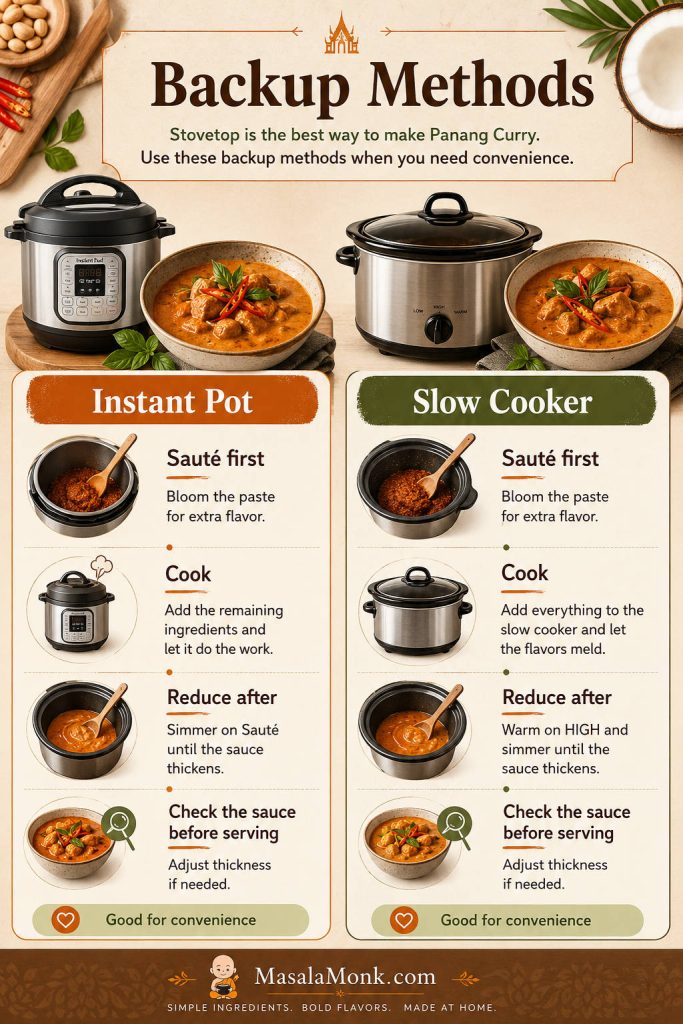
On cooler days, you might lean towards baking that fills the kitchen with warm spice. Having a jar of homemade pumpkin pie spice ready makes that as simple as stirring a spoonful into your batter. A guide to mixing your own pumpkin pie spice blend shows how to get the cinnamon-nutmeg-ginger balance just right.

Also Read: Baked Jalapeño Poppers (Oven) — Time, Temp & Bacon Tips


Make-ahead, freezing and leftovers

One of the biggest advantages of mastering a detailed chicken katsu curry recipe is that it’s extremely meal-prep friendly. A little planning turns a single cooking session into multiple easy meals.

Tray of uncooked breaded katsu cutlets beside labeled containers of katsu curry sauce, showing meal prep for freezer-friendly katsu curry.
Bread the chicken katsu and portion the curry sauce into containers, then freeze them so you can throw together an easy katsu curry bowl any weeknight.

Freezing katsu for later

You can freeze katsu either before or after cooking:

  • Before frying
    • Bread the chicken as usual.
    • Arrange the cutlets in a single layer on a tray and freeze until solid.
    • Transfer to freezer bags or containers with baking paper between layers.
    • Cook from frozen in the oven or air fryer, adding a few minutes to the cooking time.
  • After frying
    • Let the cooked cutlets cool completely.
    • Wrap each one tightly or place in an airtight container.
    • Reheat in the oven or air fryer until hot and crisp again.

The key is to avoid microwaving, which tends to make the crust soggy.

Storing and reheating the curry sauce

The curry sauce keeps well:

  • In the fridge: up to 3–4 days in a sealed container
  • In the freezer: up to 1–2 months, ideally in portioned tubs

When reheating, warm gently over low heat, adding a splash of water or stock if it has thickened in the fridge.

Turning leftovers into new meals

Leftover components are a gift. A few ideas:

  • Katsu rice bowls
    Warm the curry and rice, then reheat sliced katsu in the oven or air fryer. Finish with a soft-boiled or jammy egg (an air fryer makes those straightforward; recipes for air-fried hard-boiled eggs walk you through timing and peeling tricks).
  • Breakfast with a twist
    The morning after a rich dinner, you might want something lighter but still satisfying. High-protein overnight oats with multiple flavour variations are simple to prep in jars while the curry simmers; then breakfast is sorted for the next day or two.
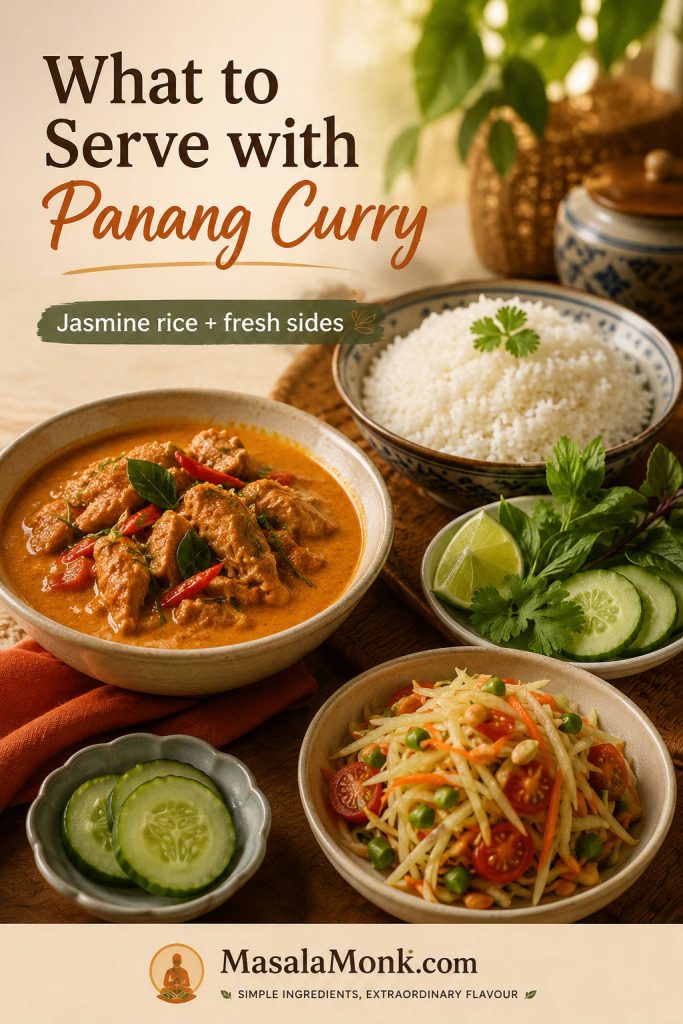
  • Second-day curry night
    Use leftover curry sauce as a base and add new ingredients: chickpeas, roasted vegetables, or seared paneer. You can even pour it over crisp roasted potatoes for a Japanese twist on curry chips, though you may find you don’t miss the chips at all once you’ve fallen in love with katsu.

If your overall routine includes training, fasting days or careful hydration around heavier meals, there’s room to think about drinks as well as food. Homemade electrolyte mixes, such as the ones in MasalaMonk’s recipes for natural electrolyte drinks or fasting-friendly electrolyte blends, can sit in the fridge ready for gym sessions or long walks.


A brief look at katsu curry’s journey

To round things out, it’s worth taking a step back and appreciating how this humble plate of rice, curry and cutlet travelled so far.

Historically, Japanese curry itself is a product of global zigzagging. Articles like the one on how India gave Japan its beloved katsu curry describe how British naval officers introduced an Anglicised form of Indian curry to Japan in the late nineteenth century. Japanese cooks then adapted it, thickening the sauce, toning down the heat and eventually turning it into something that feels distinctly Japanese.
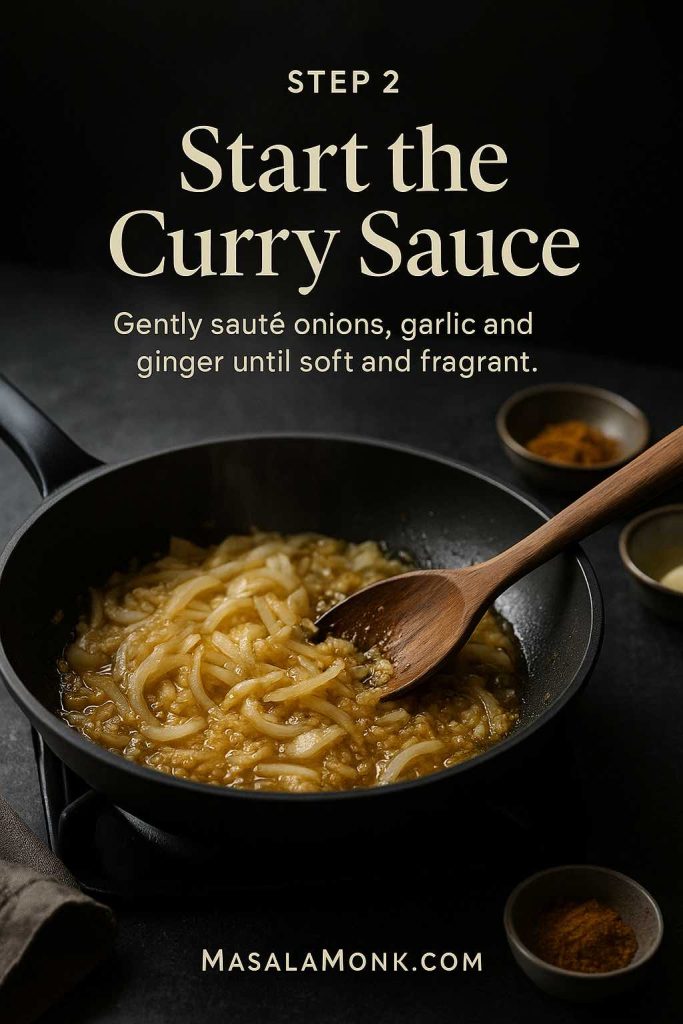
Katsu, on the other hand, came from Western cutlet culture. When those two strands met on a plate at places like Grill Swiss in Ginza, the result was a dish that bridged European technique and Japanese comfort. Writers at Food Sake Tokyo talk about how katsu curry became popular with students, office workers and families precisely because it was affordable, filling and easy to serve from canteens.

Later, as Japan’s food culture spread abroad, katsu curry became a kind of ambassador dish, particularly in the UK where fast-casual restaurants turned it into an icon. The story of that journey is laid out in JETRO’s piece on katsu curry taking over British menus, and you can see its influence every time a non-Japanese restaurant lists “katsu” as shorthand for “Japanese-ish curry.”

Cooking it at home, though, brings the focus back to what made the dish appealing in the first place: the tactility of breading and frying, the inhale of curry steam when you lift the lid, the first bite where crisp crumb, soft rice and velvety sauce come together.


Bringing it all together

By now, you’ve seen that a chicken katsu curry recipe is really a template:

  • A comforting Japanese curry sauce, built either from scratch or with roux blocks
  • A crisp, breaded cutlet – chicken, pork, tofu or vegetables
  • A bowl of rice and a handful of crunchy toppings to tie it all together

Once you’ve cooked it once, you can improvise almost endlessly: swap in air-fried cutlets for a lighter take, lean into vegetarian versions, or double the curry and freeze half for an easy future dinner. You can follow it with Indian favourites like creamy butter chicken on another night, or pivot into cocktails and dessert with a lemon drop martini and a tray of tres leches cake when you’re feeding friends.

Most importantly, this is the kind of dish that rewards repetition. The second or third time you make it, your hands move more confidently: you salt the rice water without thinking, you know exactly when the curry is thick enough, and you recognise the moment the katsu turns the right shade of gold. That’s when a recipe stops being just words on a screen and becomes part of your personal kitchen repertoire—ready to be pulled out whenever you want the table to go a little quiet on the first bite.

FAQs about Katsu Curry Recipe with Chicken

1. What is chicken katsu curry, exactly?

Chicken katsu curry is a Japanese-style dish made of three parts: a crispy breaded chicken cutlet (chicken katsu), a thick and mildly spiced Japanese curry sauce, and steamed rice. In a classic chicken katsu curry recipe, the cutlet is sliced and served on top of rice, with the curry ladled to one side so the crumbs stay partly crisp while still soaking up the sauce.


2. Is chicken katsu curry Japanese or Indian?

Chicken katsu curry is considered Japanese, although the curry itself was originally inspired by Indian flavours that arrived via Britain. Over time, Japan developed its own curry powder blends, curry roux blocks and a characteristic thick, mellow sauce. As a result, a chicken katsu curry recipe today tastes very different from most Indian curries, with less heat and more comforting sweetness.


3. How spicy is a typical chicken katsu curry recipe?

Generally, chicken katsu curry is mild to medium in heat. Japanese curry powders and roux mixes are often sold in mild, medium and hot versions, but even the hot styles are usually gentler than many Indian or Thai curries. If you prefer a mild chicken katsu curry, use a mild curry powder and skip extra chilli; if you enjoy more kick, add chilli flakes, fresh chillies or a hotter curry powder while still keeping the sauce thick and cosy.


4. Can I make chicken katsu curry without deep frying?

Yes, absolutely. A chicken katsu curry recipe works very well with air-fried or oven-baked cutlets instead of deep-fried ones. Coat the chicken in flour, egg and panko as usual, then bake on a rack or cook in an air fryer with a light spray of oil until golden and cooked through. This method keeps the katsu crunchy but uses far less oil, which suits anyone looking for a lighter version or a “fakeaway” style katsu curry at home.


5. How do I make katsu curry sauce from scratch?

To make katsu curry sauce from scratch, start by slowly frying sliced onions in a little oil or butter until soft and lightly golden. Next, add garlic, ginger, carrots and potatoes, then sprinkle over flour and curry powder to form a simple roux. Gradually whisk in stock, then season with soy sauce, a touch of sugar or honey and a little grated apple. Simmer until the vegetables are tender and the sauce is thick and glossy. This forms the heart of any homemade chicken katsu curry recipe.


6. Can I use curry roux blocks, powder, paste or cubes for katsu curry?

You can use any of these, as long as you adjust the liquid and seasoning. Curry roux blocks and cubes are the most traditional for Japanese curry; they already contain flour, fat and spices, so you just dissolve them into stock after sautéing your vegetables. Even curry powder works well if you cook it with flour and oil to form a roux. You can pick up curry paste as well, which is stronger, so use less and balance it with extra sweetness and stock. In every case, taste the katsu curry sauce towards the end and adjust thickness and flavour so it coats the back of a spoon.
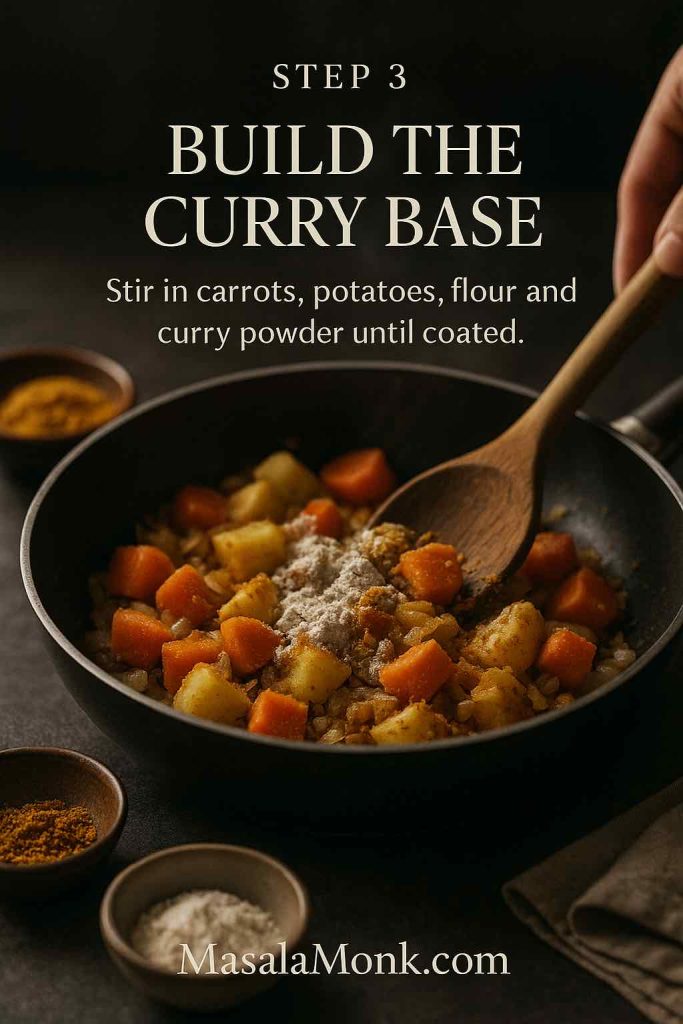
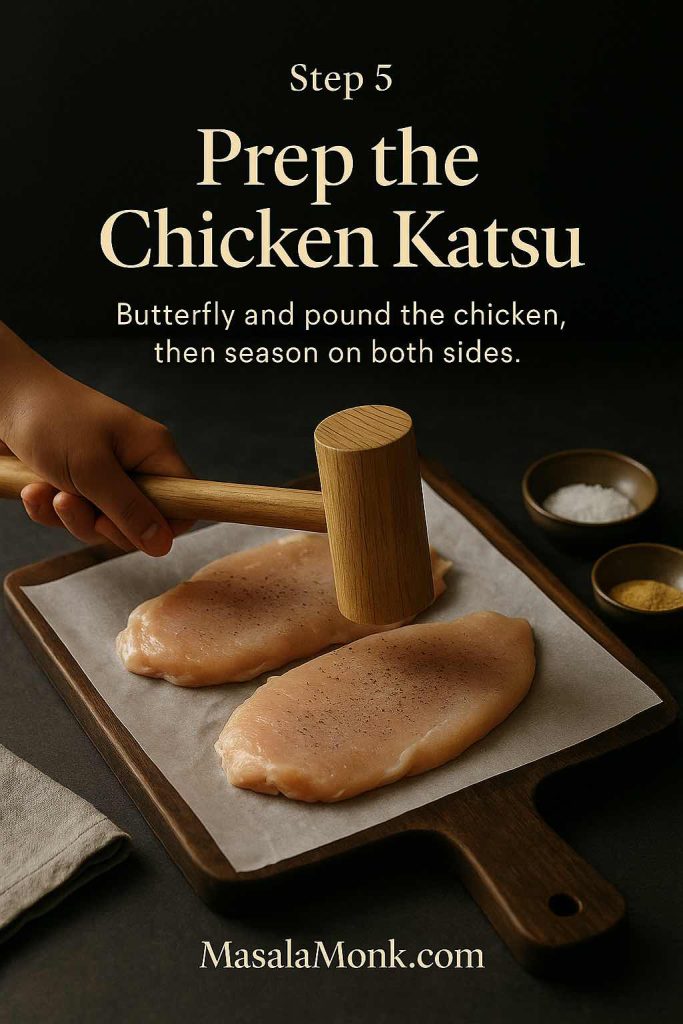

7. How can I make a healthier or Slimming World–style chicken katsu curry?

A lighter chicken katsu curry recipe focuses on reducing oil and increasing vegetables. First, bake or air-fry the breaded chicken instead of deep frying it, using oil spray instead of submerging it in oil. Second, use a smaller amount of fat in the curry base and rely on onions, carrots and potatoes for body, boosting flavour with stock, soy and spices rather than cream. Finally, serve the curry with extra shredded cabbage or steamed vegetables and a slightly smaller portion of rice. These small shifts keep the katsu experience but bring the meal closer to Slimming World–style “fakeaway” comfort food.


8. How do I make vegetarian or vegan katsu curry?

To make vegetarian or vegan katsu curry, replace the chicken with tofu or vegetables and use vegetable stock in the curry sauce. For tofu katsu, press firm tofu, slice it into slabs, then bread and fry or air-fry it just like chicken. If you are making vegetable katsu, use slices of aubergine, sweet potato or pumpkin. And for a fully vegan version, swap the egg wash for plant milk mixed with a little flour or use aquafaba (chickpea water) to help the panko stick. As long as you check that your curry roux or powder contains no animal products, you can enjoy a plant-based katsu curry that still feels indulgent.


9. Can I use pork or other meats instead of chicken in this katsu curry?

Definitely. In fact, pork katsu curry (tonkatsu curry) is probably the most common version in Japan. Simply substitute chicken with boneless pork loin or fillet, pound it slightly, then bread and cook in the same way. You can also adapt the method for turkey, firm white fish or even prawns, although you may need to tweak cooking times. Since the curry and rice remain the same, changing the protein is a simple way to create new meals from the same basic katsu curry recipe.


10. What are the best chicken cuts and breading tips for katsu?

Chicken breast is the most popular choice for katsu because it pounds out evenly, slices neatly and cooks quickly. However, chicken thigh cutlets give a juicier result if you don’t mind trimming them a bit. For breading, start with well-dried, evenly pounded pieces, then follow a flour–egg–panko sequence. Press the crumbs on firmly and let the coated chicken rest for a few minutes before cooking so the breading adheres. This approach gives a crisp, even crust that doesn’t slide off when you slice the katsu for your curry bowl.


11. Can I freeze chicken katsu curry and how should I reheat it?

You can freeze both components, but it’s best to freeze them separately. Freeze the breaded chicken either raw (before frying) or cooked and cooled; in both cases, reheat in an oven or air fryer so the crust becomes crisp again. Freeze the curry sauce in containers, leaving a little space at the top, and defrost it gently on the stove, adding a splash of water or stock if it has thickened. When you’re ready to eat, warm fresh rice, reheat the katsu and curry, and assemble as usual. This way, a homemade chicken katsu curry recipe becomes an easy grab-from-the-freezer dinner.


12. Is chicken katsu curry halal and how can I adapt it?

Chicken katsu curry can be halal as long as all ingredients meet halal requirements. Use halal-certified chicken, ensure the stock contains no non-halal meat or alcohol, and avoid adding mirin or sake to the curry sauce. The breading ingredients (flour, eggs, panko) are usually fine, so the main considerations are the meat and any liquids used for flavour. Once those are checked, the rest of the chicken katsu curry recipe can stay the same, giving you a halal-friendly version of this Japanese comfort dish.

Posted on 3 Comments

Easy Aloo Gobi – Indian Cauliflower and Potato Dish Recipe

person holding cauliflower

Aloo Gobi, a popular Indian dish made with cauliflower (gobi) and potatoes (aloo), is a delight to the senses with its vibrant colors, tantalizing aromas, and rich, spicy flavors. Its simplicity and the accessibility of its ingredients make it a common household dish in India and an excellent introduction to Indian cuisine for cooking enthusiasts worldwide.

This delicious vegetable curry, cooked Punjabi style, makes a great vegetarian main or a side dish to accompany your favorite meat curry. It can be prepared dry or as masala with a bit of gravy. It is also very adaptable to other vegetables, and peas (matar) can be added to create Aloo Gobi Matar.

The Recipe: Easy Aloo Gobi

Ingredients:

  • 1 medium cauliflower (cut into florets)
  • 2 medium potatoes (peeled and cubed)
  • 1 cup green peas (optional)
  • 3 tbsp vegetable oil
  • 1 tsp cumin seeds
  • 1 onion (finely chopped)
  • 2 green chillies (slit lengthwise)
  • 1 tsp ginger-garlic paste
  • 2 tomatoes (finely chopped)
  • 1/2 tsp turmeric powder
  • 1 tsp red chilli powder
  • 2 tsp coriander powder
  • Salt to taste
  • Fresh coriander leaves (for garnish)

Instructions:

  1. Prepare the Vegetables: Wash the cauliflower florets and cubed potatoes thoroughly. If you’re using peas, ensure they are fresh or fully thawed if frozen.
  2. Cook the Aloo and Gobi: Heat oil in a pan. Add the cumin seeds, and when they start to splutter, add the potatoes. Cook until they are half done. Now add the cauliflower florets and cook until both are tender and slightly golden brown.
  3. Prepare the Masala: In a separate pan, heat some oil. Add the finely chopped onions and green chillies, sauté until the onions turn golden brown. Now add the ginger-garlic paste and sauté for another minute. Add the finely chopped tomatoes and cook until they are soft and mushy.
  4. Add the Spices: Now add the turmeric, red chilli, and coriander powder to the onion-tomato mixture. Stir well and cook until the raw smell of the spices goes away.
  5. Combine Everything: Now add the cooked potatoes and cauliflower to this masala. Mix everything well, so the vegetables are well coated with the masala. Cook for a few more minutes. If using peas, add them now.
  6. Garnish and Serve: Finish by seasoning with salt and garnishing with fresh coriander leaves. Serve your Aloo Gobi hot with rotis or rice.

Variations:

  • Aloo Gobi Matar: Add a cup of peas when you add the cooked potatoes and cauliflower to the masala. This variation adds an extra dimension to the dish and is perfect for when you want to up your vegetable intake.
  • Gobi Masala: Omit the potatoes and double the amount of cauliflower for a different take on the traditional recipe.
  • Aloo Gobi with Paneer: Add cubes of paneer (Indian cottage cheese) towards the end for a protein boost. This variation transforms the dish into a wholesome main meal.
  • Gobi Curry: Increase the amount of tomatoes and add some water after adding the spices to create a delicious cauliflower curry with more gravy.

This easy-to-follow Aloo Gobi recipe is the perfect starting point for creating an Indian feast at home. Remember, the best thing about cooking is making a recipe your own, so feel free to experiment and enjoy the process. Happy cooking!

Blog Tags: Aloo Gobi, Indian Cuisine, Vegetarian Recipes, Indian Recipes, Easy Recipes, Cauliflower Recipes, Potato Recipes, Curry Recipes, Home Cooking, Spices, Vegetables, Healthy Eating, Vegan Recipes, Comfort Food, Dinner Ideas, Meal Prep, Cooking at Home, World Cuisine