
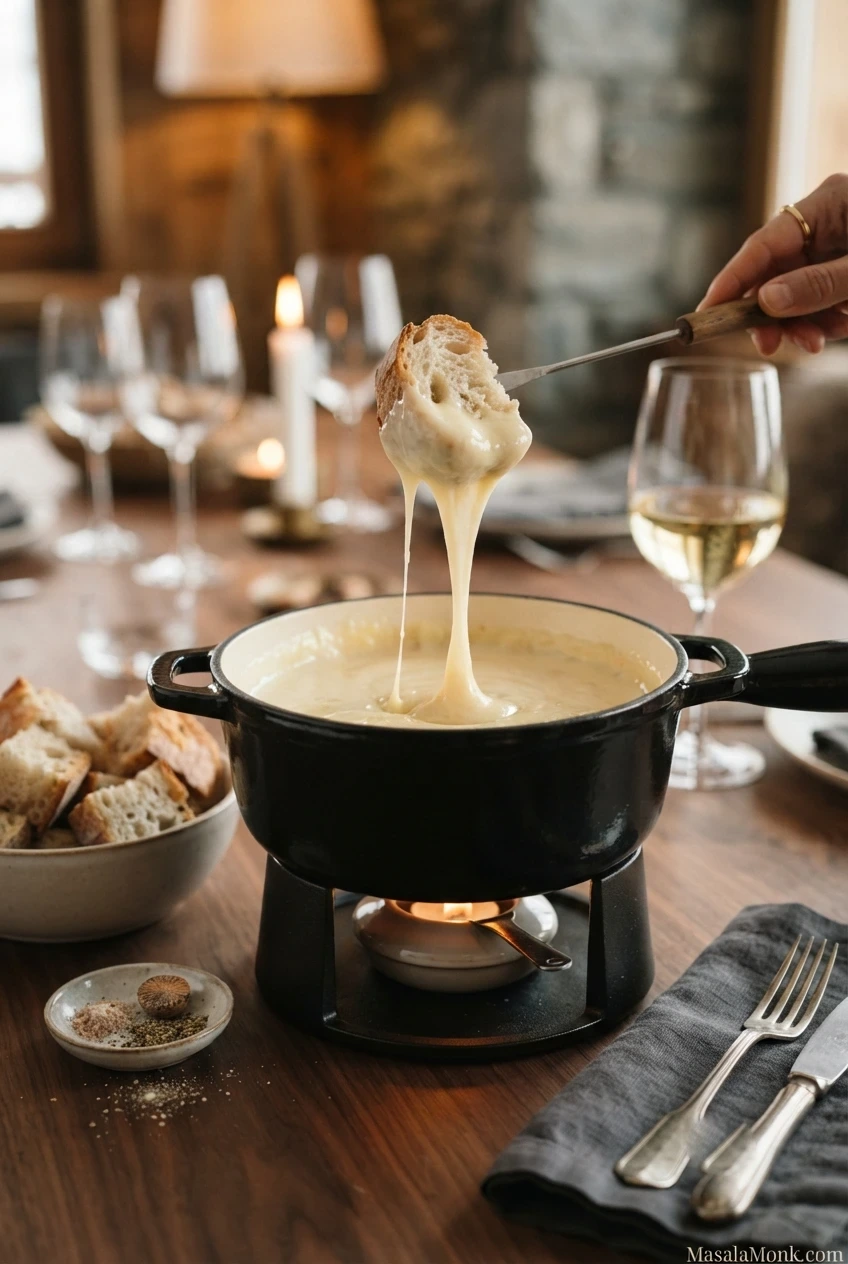
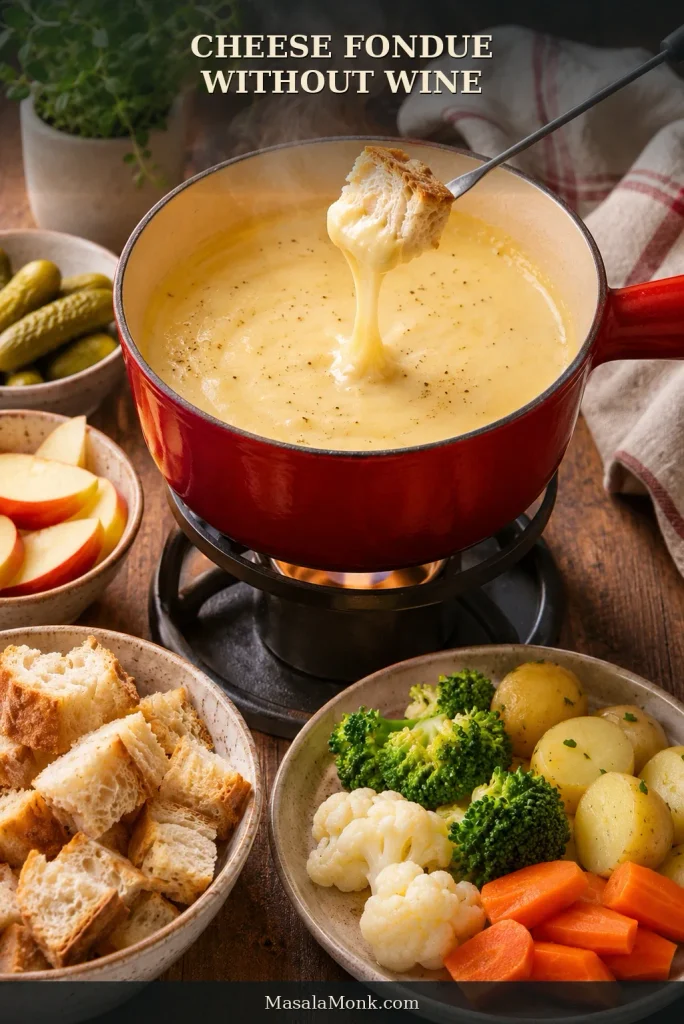
A cube of crusty bread goes into the fondue pot and comes back wrapped in warm, nutty cheese. Give it a little turn, let the last ribbon drip back, and take a bite. Fondue is a different kind of dinner: the pot stays in the middle, everyone chooses what to dip next, and nobody has to rush from one course to another.
This cheese fondue recipe combines equal parts Gruyère and Emmental with dry white wine, garlic, and cornstarch. It serves four as a substantial main course and takes about 25–35 minutes to make, excluding the accompaniments. You can melt the cheese in an ordinary heavy-bottomed saucepan; an adjustable fondue warmer is helpful when you want to linger at the table.
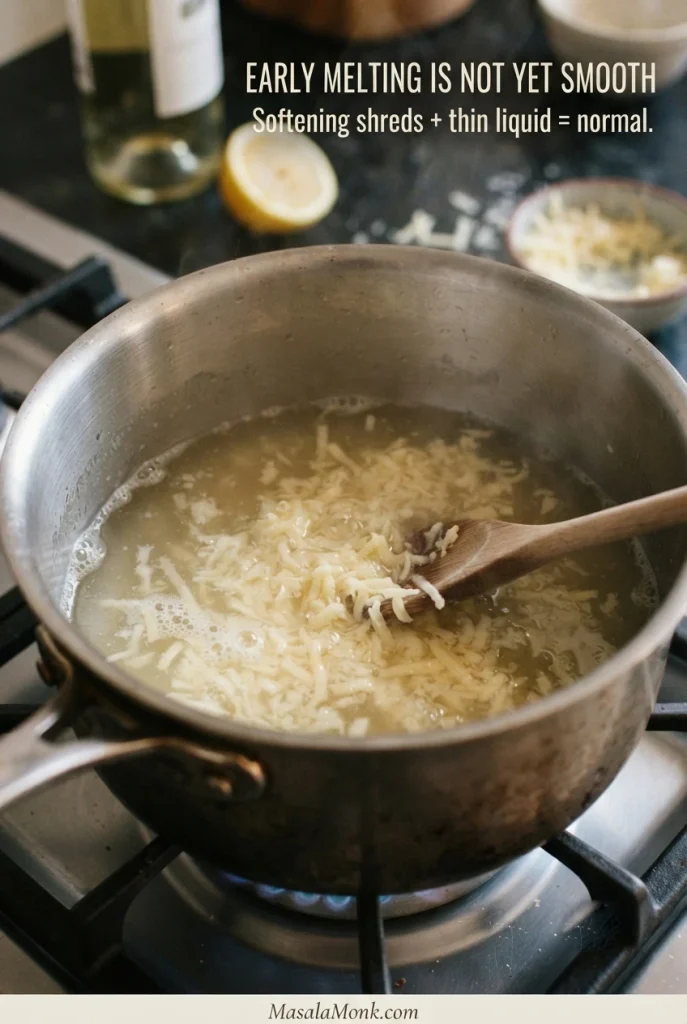
Don’t expect the first handful of cheese to turn the wine silky. The shreds soften first, the mixture gradually becomes a sauce, and the final bread test tells you when it’s ready. Those three visible stages make the method easier to follow.
Ready to cook? Jump to the classic cheese fondue recipe. Avoiding wine? Go to the wine-free recipe.
| Preparation | 15 minutes |
|---|---|
| Cooking | 10–20 minutes |
| Total | 25–35 minutes for the fondue; allow extra time for dippers |
| Yield | 4 substantial main-course portions |
| Main cheeses | Gruyère and Emmental |
| Equipment | Heavy-bottomed saucepan; warmer optional for serving |
In This Recipe
- Classic Cheese Fondue: Ingredients and Method
- Best Cheeses, Wine, and Swiss Variations
- Cheese Fondue Without Wine
- Fix Grainy, Stringy, or Separated Fondue
- What to Dip in Fondue and How to Serve It
- Portions, Make-Ahead, and Leftovers
Classic Swiss-Style Cheese Fondue Recipe
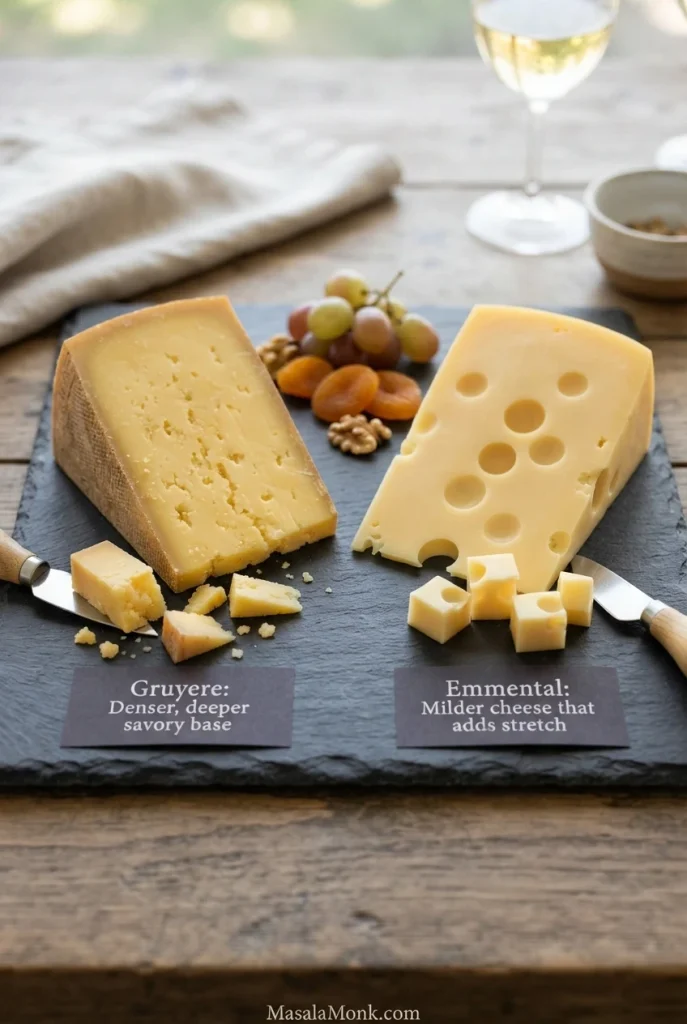
Equal amounts of Gruyère and Emmental give this recipe a clear purpose. Gruyère brings the more developed, savory Alpine flavor; Emmental is gentler, slightly sweet, and adds a little stretch. Two cheeses keep shopping straightforward, while the wine and cornstarch help them melt into a sauce that coats the bread. If you are choosing cheese at the shop, see how to recognize Gruyère and Emmental.
Cheese Fondue Ingredients for Four
| Ingredient | Amount |
|---|---|
| Gruyère, freshly grated | 400 g (about 14 oz) |
| Emmental, freshly grated | 400 g (about 14 oz) |
| Dry white wine | 360 ml (about 1½ US cups) |
| Cornstarch | 12 g, weighed |
| Garlic | 1 large clove |
| Fresh lemon juice | 5 ml (1 tsp) |
| Kirsch, optional | 15 ml (1 tbsp) |
| Black pepper | Freshly ground, to taste |
| Nutmeg | Freshly grated, a small pinch |
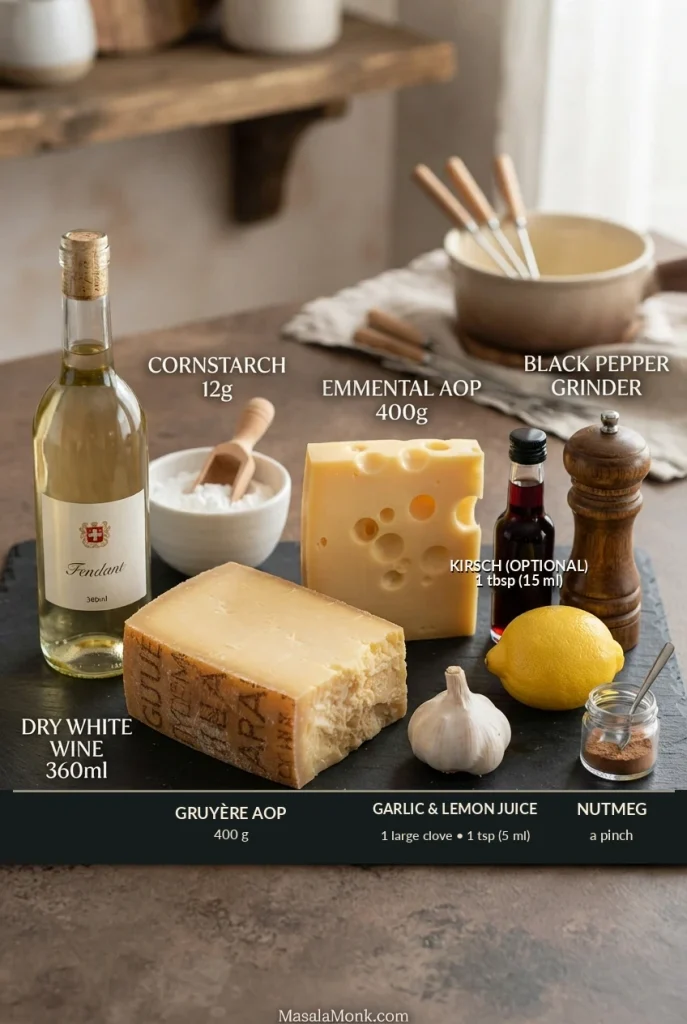
For dipping: Plan on 600–800 g crusty bread if bread is the main accompaniment for four. When adding potatoes and vegetables, see the mixed-dipper quantities.
Equipment and Preparation
Have a 2.5–3-litre (2.6–3.2 US qt) heavy-bottomed saucepan, grater, kitchen scale, and wooden spoon or heat-resistant spatula ready. Weigh the cheese and cornstarch rather than estimating cups. Have the bread and cooked dippers ready before heating the wine, so the fondue can go straight to the table.
How to Make Cheese Fondue, Step by Step
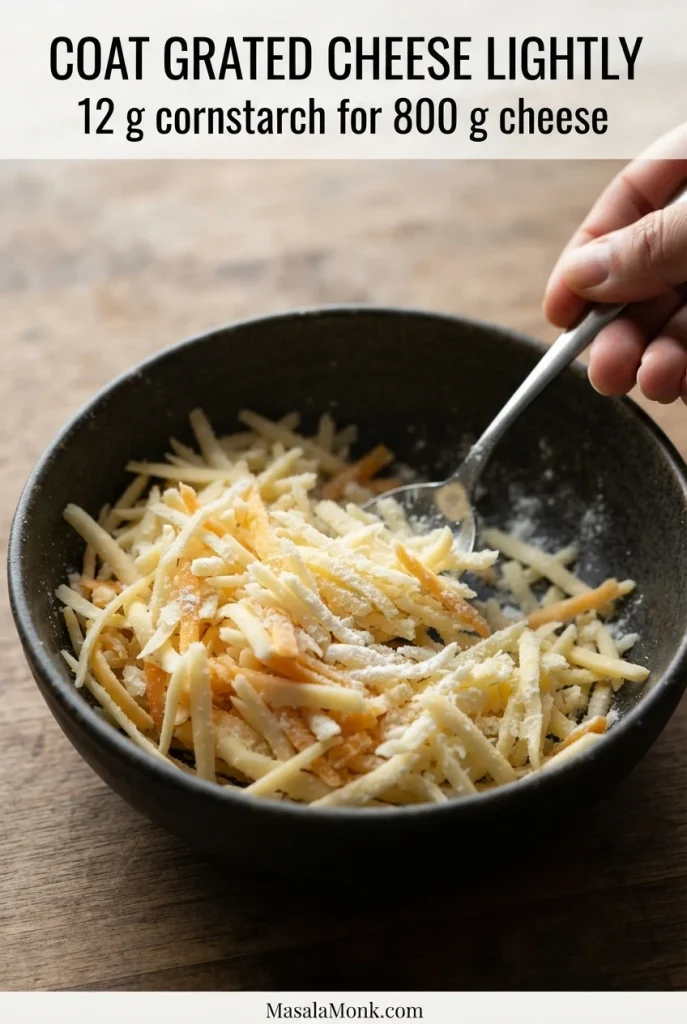
- Prepare the cheese. Remove any hard or inedible rinds, then grate the Gruyère and Emmental. Add 12 g cornstarch and toss until the shreds are evenly coated.
- Warm the wine. Halve the garlic and rub its cut face inside the saucepan, then remove it. Add wine and lemon juice; heat over medium-low until steaming, with small edge bubbles but no vigorous boil.
- Checkpoint 1 — The cheese softens. Lower the heat slightly. Add a small handful of cheese, stirring across the pan base until the shreds soften; then add another. The wine will still look thin, and temporary clumps are normal.
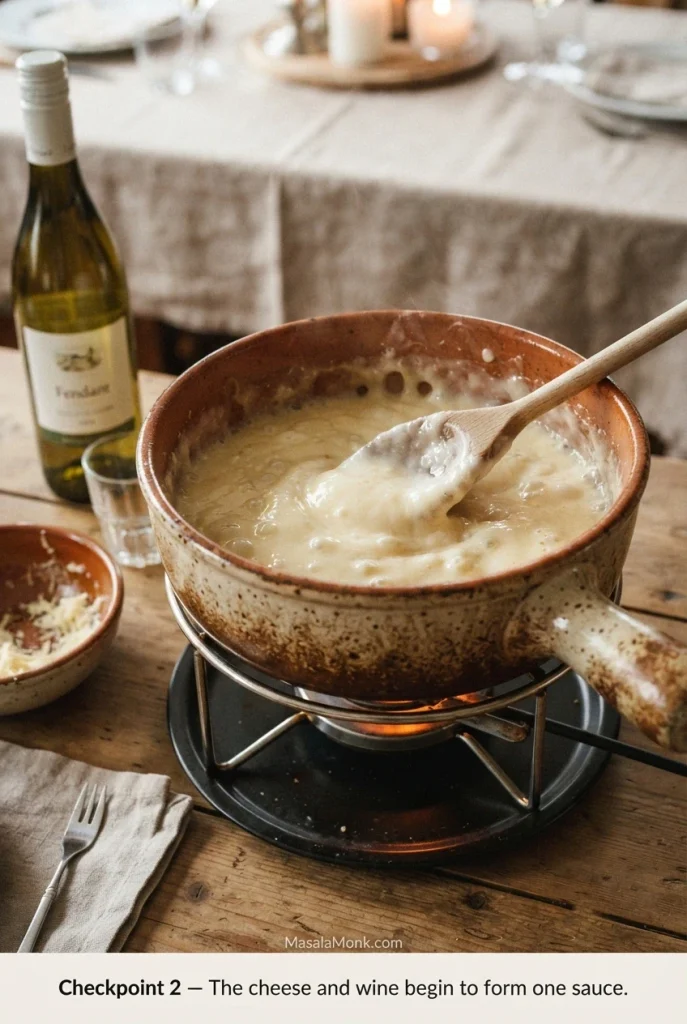
- Checkpoint 2 — The sauce comes together. Continue adding cheese by the handful, letting each addition mostly melt. Stir steadily as the sauce thickens. Raise heat slightly if shreds stop melting; lower it if bubbling becomes vigorous.
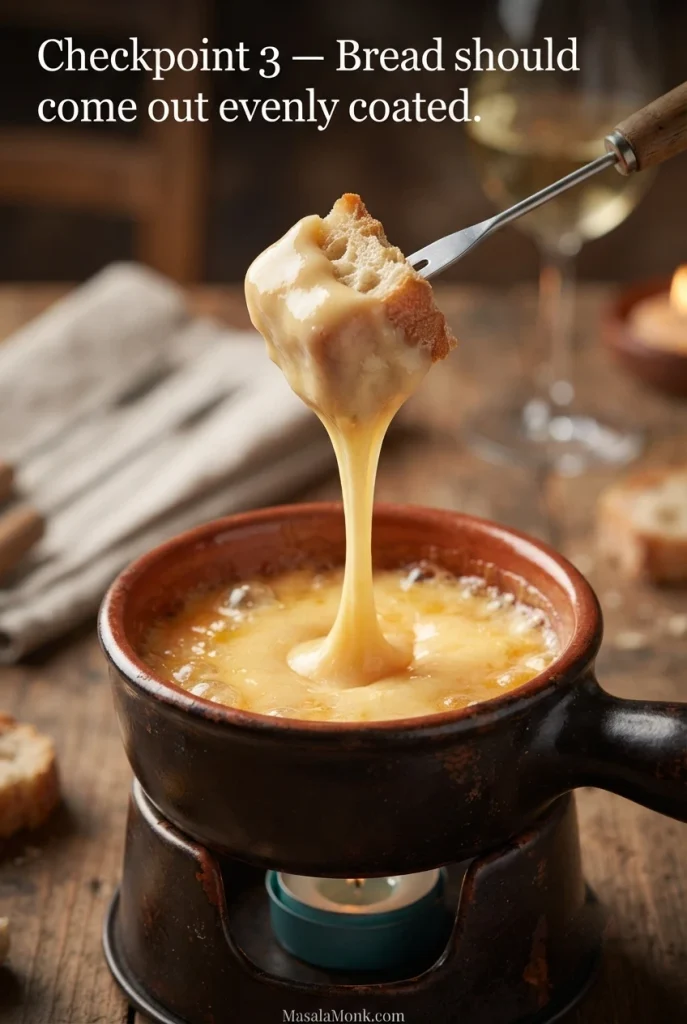
- Checkpoint 3 — The bread test. When all the cheese has melted, stir over gentle heat until the fondue looks glossy and falls from the spoon in a slow ribbon. Dip a piece of bread: it should emerge evenly coated without dragging a rubbery lump behind it. If the sauce is smooth but too thick, add 15 ml (1 tbsp) warm wine, stir, and retest.
- Season and serve. Stir in the optional kirsch, a little pepper, and nutmeg. Taste before adding salt: the cheese may provide enough. Bring the pot to the table immediately, keeping the fondue gently heated if you have a suitable adjustable warmer.
Visual Guide: Four Signs to Look For
These are representative views of the textures to recognize, not photographs of one uninterrupted batch. Use them alongside the six-step method above.
How the Starch-Coated Cheese Should Look
The shreds should stay loose, with a fine coating of starch and no pockets of powder. This is the visual target before they go into the pan.
Visual Checkpoint: The First Cheese Softens
The first additions look like soft shreds in thin liquid. Individual strands are still visible, but they should gradually lose their shape as the cheese warms.
Visual Checkpoint: The Sauce Begins to Form
Here the sauce is thicker and more cohesive. A few soft pieces can remain, but the mixture now moves together when stirred.
Visual Checkpoint: Test the Finished Fondue on Bread
The finished sauce coats bread evenly and flows back into the pot without dragging a dense, rubbery mass behind the fork.
When to stop adding cheese: Soft shreds during the early stages are normal. Firm curds or a rubbery mass persisting in separate watery wine are not. Move the pan away from strong heat, stop adding cheese, and follow the troubleshooting instructions before continuing.
Best Cheeses, Wine, and Swiss Fondue Variations
The two cheeses in the main recipe have different jobs. When shopping, it helps to know which other Alpine cheeses offer a similarly savory flavor, which are better suited to different fondue traditions, and which are poor direct substitutes.
Which Cheese Is Best for Fondue?
| Cheese | Where It Fits |
|---|---|
| Gruyère | Developed savory, nutty flavor; a foundation of Swiss fondue |
| Emmental | Gentler and slightly sweet; some stretch in the main blend |
| Vacherin Fribourgeois | Creamy, aromatic; the traditional Gruyère partner in moitié-moitié |
| Comté | Buttery, nutty French Alpine cheese used in published fondue blends |
| Appenzeller | More aromatic and tangy; used in bolder Swiss blends |
| Fontina | Buttery melting cheese suited to other fondue styles |
No Gruyère? A younger, melt-friendly Comté is a sensible cheese to seek out for a comparable Alpine flavor. No Emmental? Look for a published Gruyère–Comté or other established Alpine fondue formula rather than assuming that every cheese can replace Emmental gram for gram. Prefer a creamier Swiss tradition? Consider the Gruyère–Vacherin moitié-moitié combination below.
Mozzarella tends to form long elastic strands, while Parmesan is relatively dry and intensely flavored. Neither is a straightforward main-cheese substitute here. Cheddar-and-beer fondue is a separate, sharper style that’s particularly good with pretzels and cooked sausage; it requires its own proportions.
Vegetarian note: Traditional Gruyère AOP is made with animal rennet. If you avoid animal-derived rennet, check labels carefully and choose appropriate cheeses.
Gruyère is also excellent in potatoes au gratin, where its strong flavor carries through layers of tender potatoes.
Gruyère–Emmental vs. Traditional Swiss Moitié-Moitié
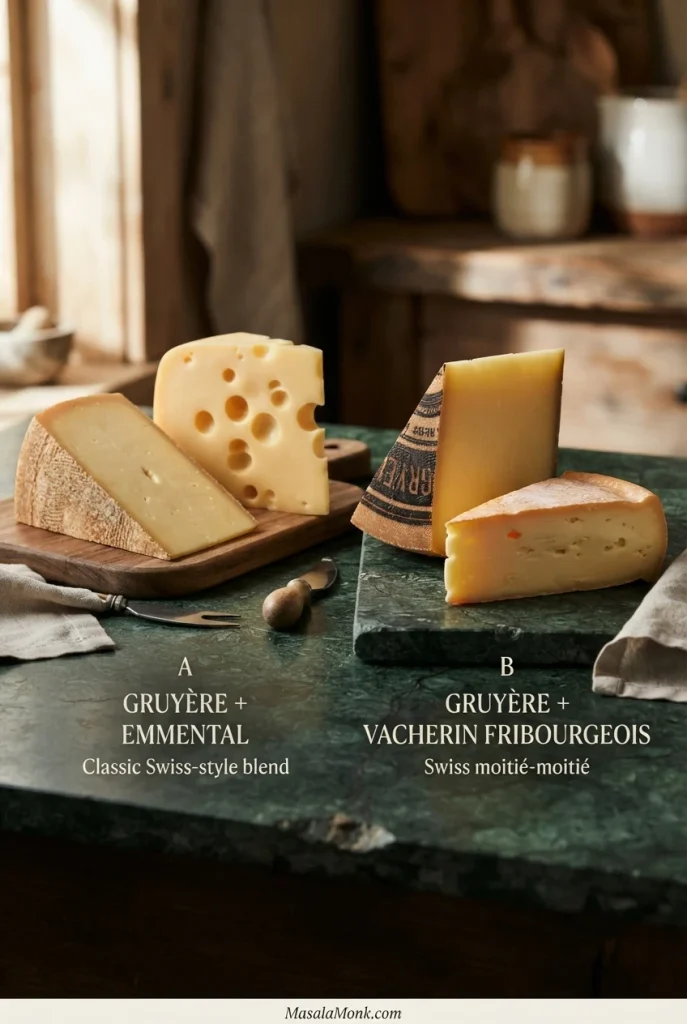
In Switzerland’s Fribourg region, fondue moitié-moitié means half Gruyère AOP and half Vacherin Fribourgeois AOP. Vacherin brings a particularly creamy texture and its own aromatic flavor; the Gruyère–Emmental blend in our main recipe has a different balance of flavor and stretch.
For four people, the official Le Gruyère AOP moitié-moitié recipe lists 400 g Gruyère AOP, 400 g Vacherin Fribourgeois AOP, 350 ml white wine, four teaspoons cornstarch, and garlic. Published Swiss versions can differ in the order of adding and heating the cheeses, so use the instructions for the specific combination you choose.
Best White Wine for Cheese Fondue
Choose a fresh, dry white wine you’d be happy to drink. Swiss Fendant is traditional; Pinot Blanc or a dry, unoaked Sauvignon Blanc also works well. A modestly priced bottle is fine. Avoid very sweet, heavily oaked, or stale wine that could overwhelm the cheese.
The wine adds moisture and acidity that influence how the cheese comes together, along with brightness that balances the richness. If you want to leave out wine altogether, use the separate wine-free recipe in the next section rather than replacing this formula’s wine with water or milk.
Cheese Fondue Without Wine: A Swiss Alcohol-Free Recipe
This alcohol-free Swiss-style variation uses Gruyère and Vacherin Fribourgeois with water or verified 0.0% apple cider. It is distinct from traditional wine-based moitié-moitié. Water lets the cheese flavor lead; cider contributes a fruity note, with sweetness and acidity varying by brand. It makes a proper, satisfying fondue in its own right.
Time: About 15 minutes preparation and 10–20 minutes cooking. Yield: Three generous main courses or four lighter portions, with dippers.
Alcohol-Free Fondue Ingredients
| Ingredient | Amount |
|---|---|
| Gruyère AOP, grated | 300 g (10.6 oz) |
| Vacherin Fribourgeois AOP, grated or cut small | 300 g (10.6 oz) |
| Water or verified 0.0% apple cider | 300 ml (1¼ US cups) |
| Cornstarch | 3 level tsp |
| Garlic | 1 clove |
| Fresh lemon juice, optional | 5–10 ml (1–2 tsp) |
| Pepper and nutmeg | To taste |
| Crusty bread | Up to 600 g for four lighter portions |
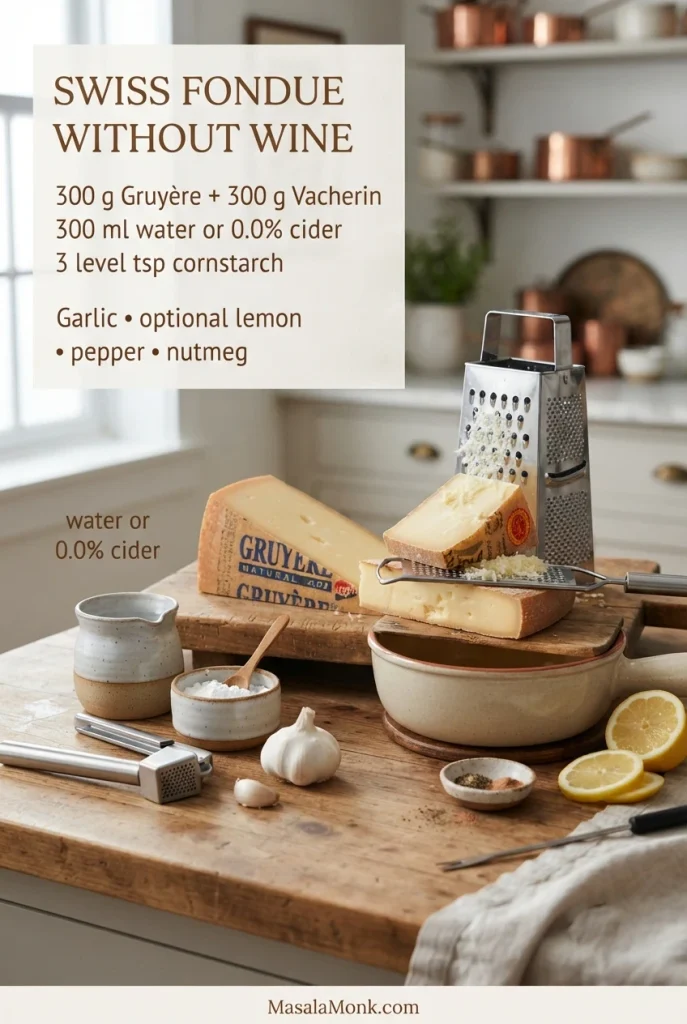
Three level teaspoons of cornstarch is the measure used in the Swissmilk Fribourg-style fondue recipe, which provides the 300 g + 300 g cheese and 300 ml liquid proportions. Lemon juice increases acidity, which can help the cheese remain cohesive; the optional amount comes from that published approach. With cider, both acidity and sweetness depend on the product.
For strict alcohol avoidance, water is the simplest choice. If using cider, choose a clearly labeled 0.0% alcohol product; ordinary hard cider contains alcohol, and some products marketed as nonalcoholic contain traces. This recipe still contains dairy, and its cheeses may use animal rennet.
Choosing Water or 0.0% Cider
The two liquids are alternatives, not additions to combine. Choose water for a more neutral result, or a product explicitly labeled 0.0% apple cider if its flavor suits the meal.

Shopping note: Vacherin Fribourgeois can be difficult to source outside Switzerland. This variation relies on its particular characteristics; another cheese is not an assured one-to-one replacement.
How to Make Cheese Fondue Without Wine
- Prepare the pan. Rub the inside with the cut garlic clove, then remove the garlic.
- Prepare the cheeses. Toss the grated Gruyère with the three level teaspoons of cornstarch. Keep the Vacherin separate.
- Add the liquid. Pour in the water or verified 0.0% cider and add the optional lemon juice now if using it.
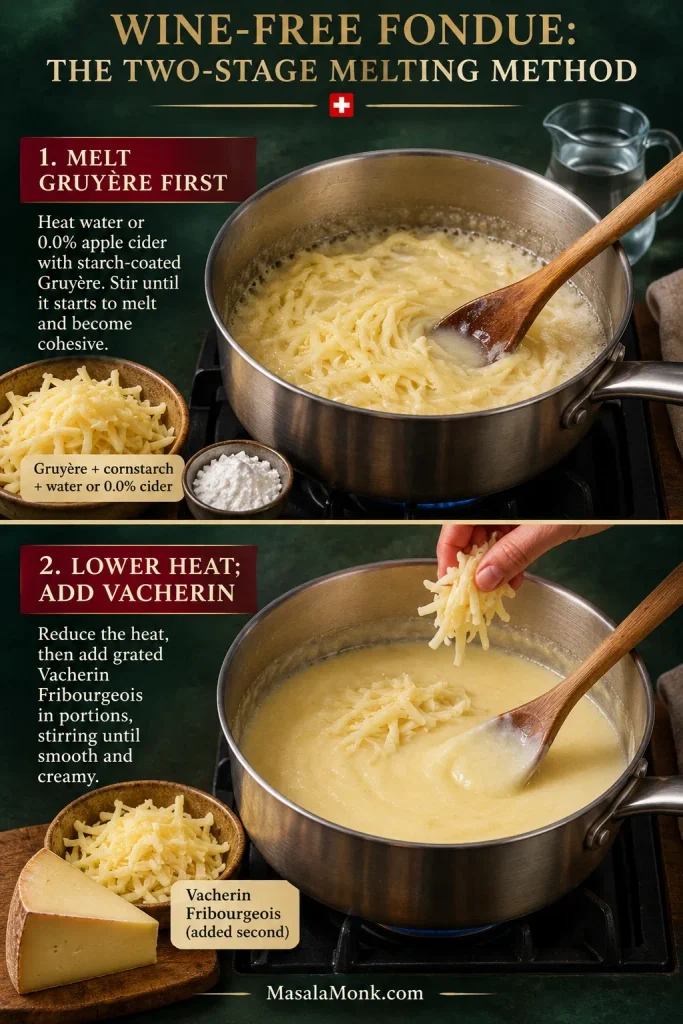
- Melt the Gruyère. Add the starch-coated Gruyère. Heat over medium-low, stirring steadily, and briefly bring it to a gentle boil to activate the starch. Reduce the heat.
- Add the Vacherin. Stir it in by portions over reduced heat until the mixture turns creamy. Avoid sustained vigorous boiling after the Vacherin goes in.
- Season and serve. Add pepper and nutmeg. Test with bread. If smoothly melted but too thick, add 15 ml (1 tbsp) warm water or the same cider, then stir and reassess.
Visual Guide to the Two-Stage Wine-Free Melt
Follow the two pans in order: starch-coated Gruyère comes together with the chosen liquid first; only then does Vacherin go in over reduced heat. This is the wine-free method, not the classic wine-based procedure.
Using the classic cheese blend instead? Return to the Gruyère–Emmental method.
Can You Make Cheese Fondue With Milk?
Yes, but milk-based cheese dips use a different formula. Some begin with a flour-and-butter roux, like béchamel sauce, before adding cheese. For pasta, vegetables, or a milder dip, a milk-based cheese sauce is a more appropriate starting point. Don’t replace the liquid in either complete Swiss-style recipe above with milk without following a dedicated milk-based method.
Fix My Fondue: Grainy, Stringy, Oily, or Separated Cheese
Before trying to rescue fondue, look at the pan. Soft unmelted shreds, fine curds in watery liquid, long rubbery strands, and surface oil are different symptoms. Find the closest match before adding anything. If you are still at the first additions, compare your pan with the normal early-melting checkpoint before attempting a rescue.
| What You See | First Move |
|---|---|
| Soft recognizable cheese shreds | Increase heat slightly, stir, and allow more melting time |
| Fine curds with separate watery liquid | Stop adding cheese and remove from strong heat |
| Rubbery strands in a smooth, thick fondue | Try 15 ml warm wine, stir, and check again |
| Dense rubbery lump in watery liquid | Stop additions; severe separation may not recover |
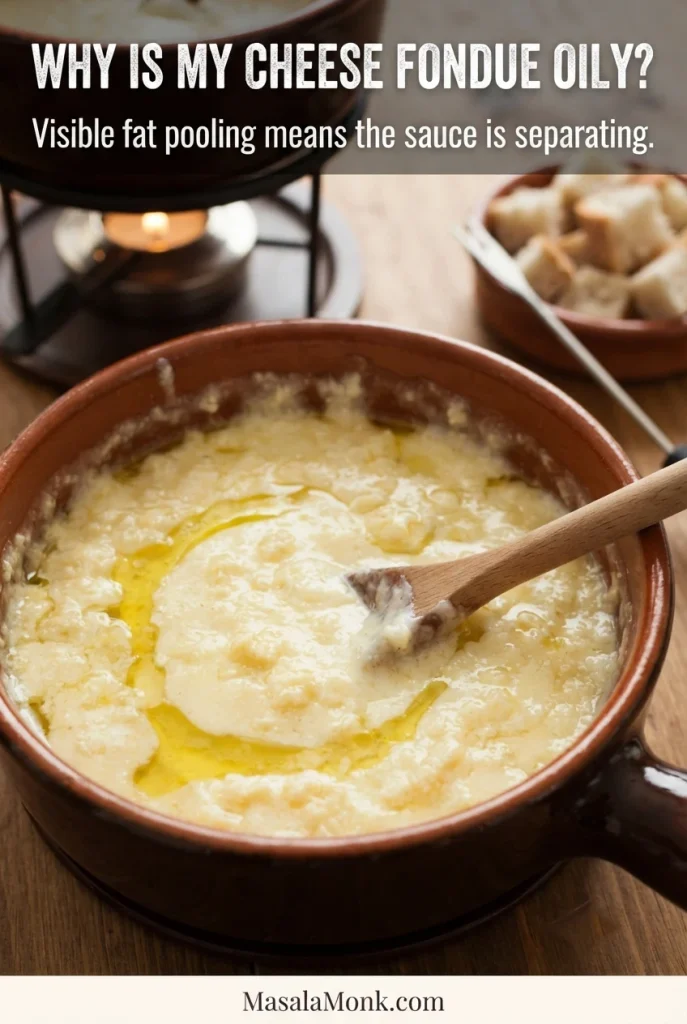
| Oil pooling on top | Reduce heat; consider the measured starch slurry below |
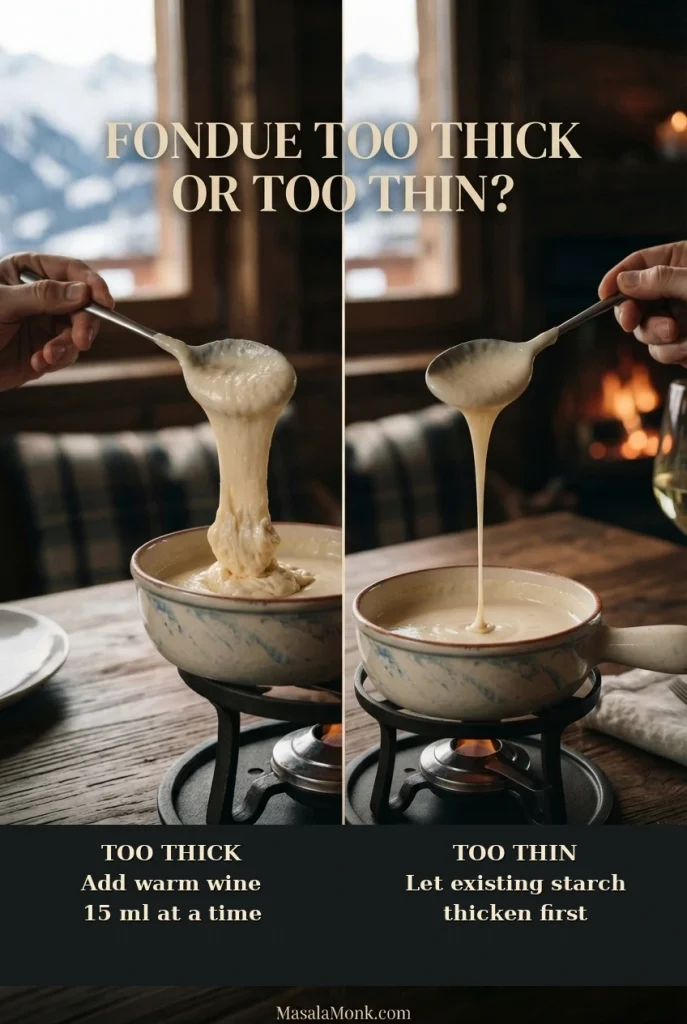
| Smooth but too thick | Add 15 ml warm wine at a time |
| Smooth but too thin | Allow existing starch to thicken before adding more |
| Stiffening at the table | Check whether the mixture is cooling or losing moisture |
| Black, bitter crust | Stop heating and leave scorched residue undisturbed |
Why Is My Fondue Grainy?
Recognizable shreds: Cheese that still looks grated in barely steaming wine may simply need more time. Increase the heat slightly and stir until the pieces soften before adding more.
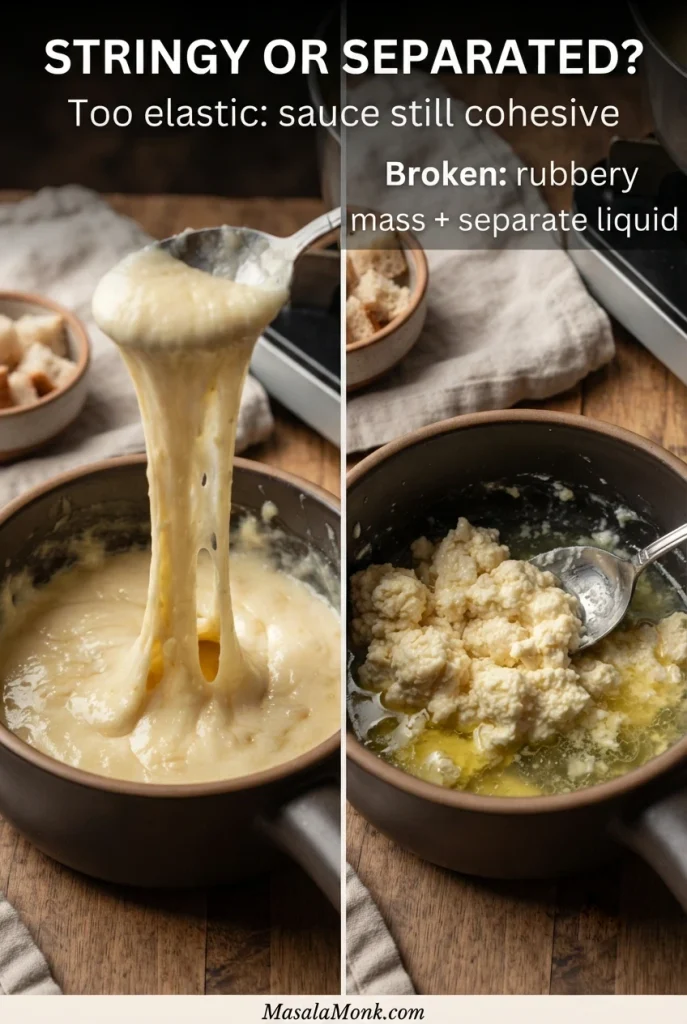
Fine curds in watery liquid: This suggests that the cheese and liquid aren’t combining properly. Stop additions, lift the pan away from vigorous heat, and stir gently. If oil is also pooling, the slurry rescue below may help. Persistent firm curds are less likely to return to a smooth sauce.

Why Is My Fondue Stringy or Rubbery?
Some stretch is normal with Emmental. If the fondue is otherwise smooth but so thick and elastic that bread pulls long ropes of cheese, add 15 ml (1 tbsp) warm wine, stir until incorporated, and try the bread test again. Make further adjustments only after checking that first addition.
A dense lump in separate watery liquid is not ordinary stretch. Stop adding ingredients and avoid repeated starch or lemon additions. That degree of separation may not be recoverable as a dipping sauce.
How to Save Separated Cheese Fondue
A glossy pool of oil around soft cheese can be an early sign of separation. One small starch slurry may help before the mixture breaks further.
When to Try the Small Starch-Slurry Rescue
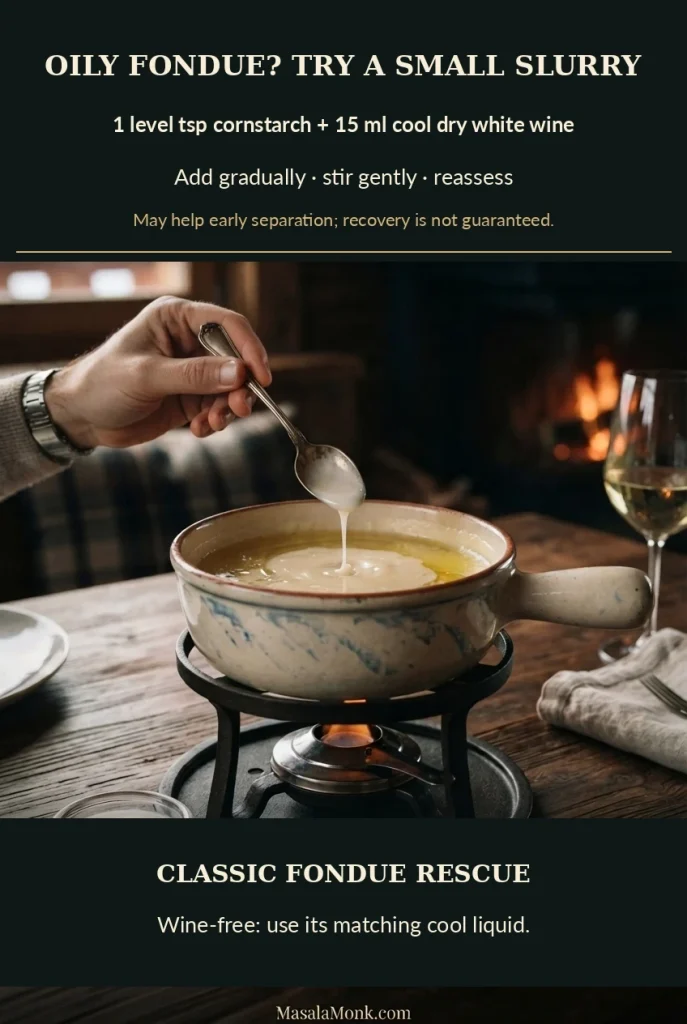
Use this intervention only when the problem looks like early oil separation, rather than simply unmelted grated cheese. Keep the slurry small, incorporate it gradually, and assess whether the sauce is becoming cohesive.
- Move the pan away from strong heat.
- Mix 1 level tsp cornstarch with 15 ml (1 tbsp) cool white wine until smooth.
- Stir a little slurry into the fondue; you may not need all of it.
- Return to gentle heat, stirring long enough for the starch to thicken. Watch for oil beginning to incorporate into the sauce.
- Stop once the texture improves. If oil keeps separating or firm curds develop, adding more starch may make it pasty without saving it.
For the wine-free recipe, make the slurry with its cool water or verified 0.0% cider instead of wine.
Fondue Too Thick, Too Thin, or Too Wine-Forward?
Too thick but smooth: Stir in warm wine 15 ml (1 tbsp) at a time. Use the corresponding warm liquid for wine-free fondue.
Too thin but smooth: Allow the starch already present to warm and thicken. If it remains thin, add a small amount of cornstarch mixed with cool liquid, and gently heat while stirring. Start with less than one teaspoon of additional starch.
Too wine-forward: Skip kirsch and pair with plain bread or potatoes. For a future batch, use a milder dry wine or the separate wine-free fondue formula. Brief cooking doesn’t reliably remove all alcohol from wine-based fondue.
Back to the classic recipe · Back to recipe contents
What to Dip in Cheese Fondue and How to Serve It
Once the cheese reaches the table, everyone can choose their next bite. A chewy bread crust gives way under the cheese; a boiled potato makes a heartier dip; a cornichon eaten between bites brings a sharp, welcome contrast.
A Fondue Table Everyone Can Share
Place the pot securely in the middle, with bread, cooked dippers and individual plates within easy reach. Guests can take turns dipping without leaning across the warmer.

Best Bread for Cheese Fondue
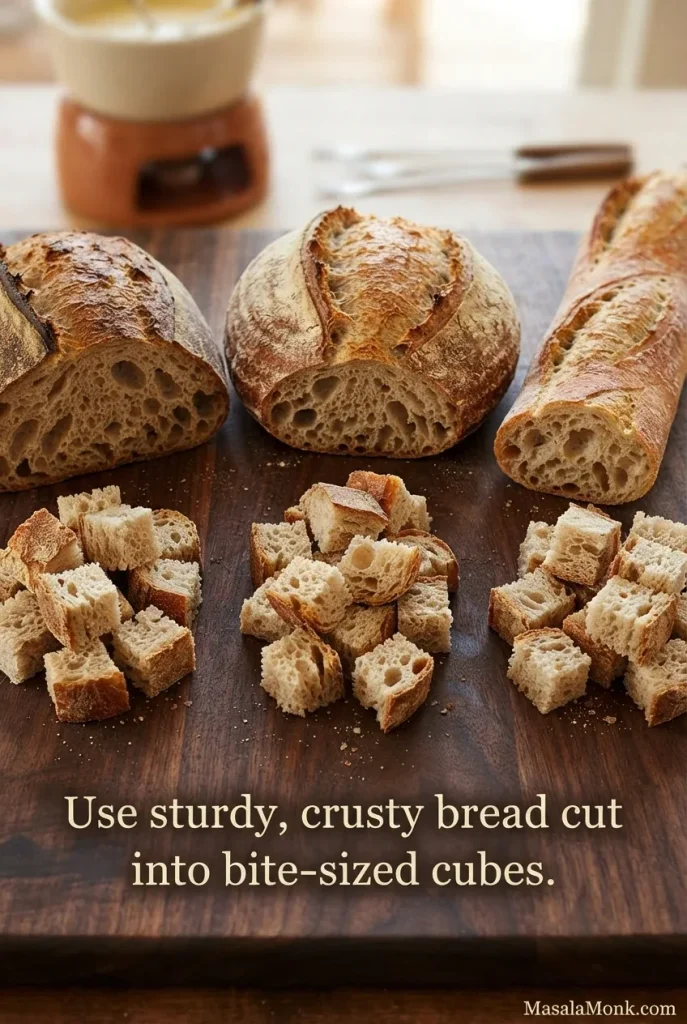
Choose sourdough, a crusty country loaf, or a substantial baguette. Cut it into roughly 2.5 cm (1 inch) pieces, leaving some crust on each piece so it stays on the fork. Slightly day-old bread is often ideal because the crumb is firmer.
For homemade options, try focaccia after it has cooled and firmed up, or a homemade garlic bread loaf for extra savory flavor. Lightly dry any pieces that are too soft to hold a fork.
Potatoes, Vegetables, Fruit, and Other Dippers
Start with bread, small boiled potatoes, and cornichons for a balanced Swiss-style table. Then choose vegetables or fruit according to the meal you want. Broccoli and cauliflower hold cheese in their florets; firm apples and pears bring fresh crunch.
| Dipper | Preparation |
|---|---|
| Crusty bread | Cut into sturdy cubes with some crust |
| Baby potatoes | Boil or roast until tender; drain well |
| Broccoli or cauliflower | Steam or roast until tender but firm |
| Mushrooms | Roast or sauté until cooked |
| Carrots or asparagus | Cook until easily pierced but sturdy |
| Apples or pears | Use firm fruit; slice into wedges |
| Sausage or chicken | Cook completely before serving |
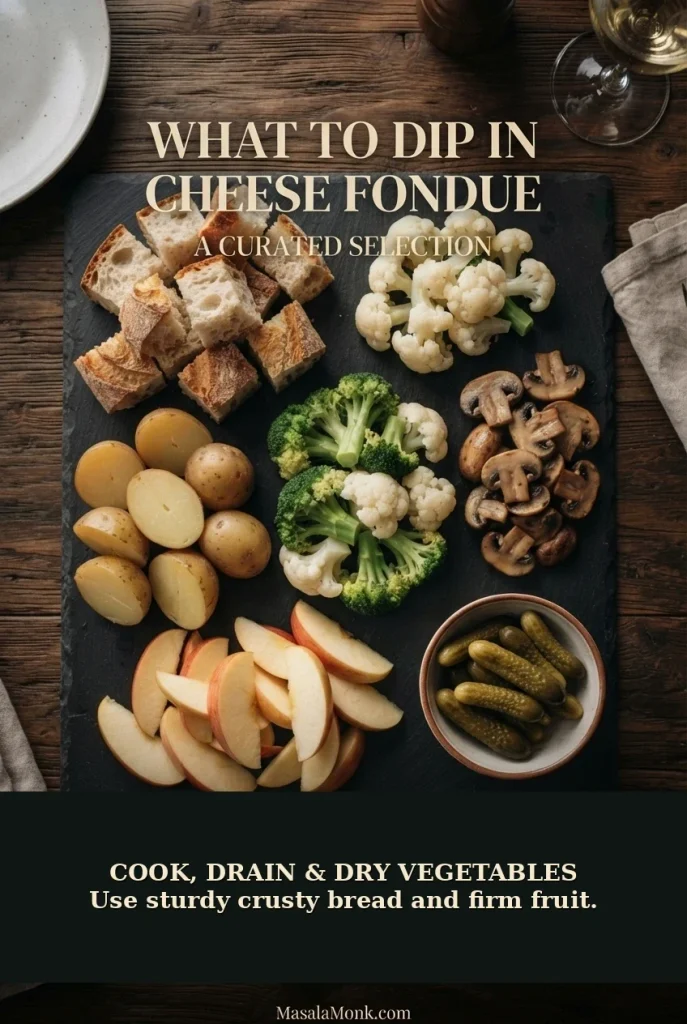
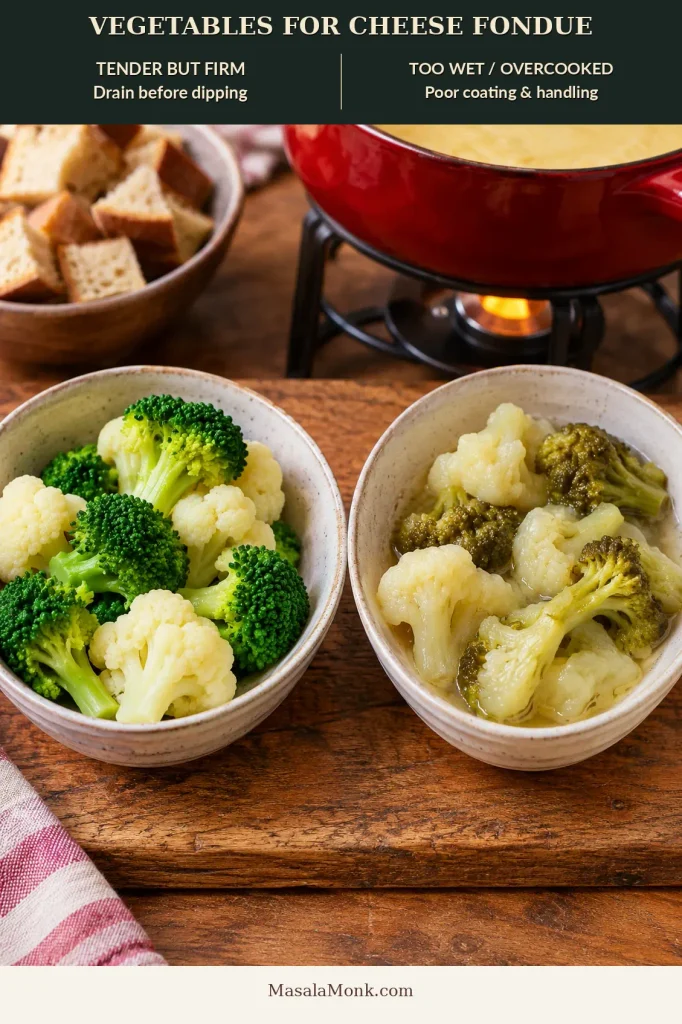
Frozen broccoli and cauliflower also work; cook and drain them thoroughly to keep excess water out of the cheese. Roasted cauliflower and potatoes are a good warm side when you’d like browned edges as well as tender centers.
Vegetable Texture: Ready for Dipping or Too Wet?
Compare the two bowls before serving: the best dipping florets are tender enough to eat but still hold their shape. Wet or collapsing florets are harder to spear and can carry water into the fondue.
Serve pickles on the side rather than stirring them into the pot. Any meat needs to be fully cooked beforehand: cheese fondue is for dipping ready-to-eat food, not cooking raw meat.
An Easy Cheese Fondue Dinner for Four
The main recipe has 800 g cheese, so these are substantial dinner options rather than a compulsory shopping list. Feeding a different-sized group? Use the fondue portion-scaling guide.
Bread-Focused Fondue Dinner for Four
For four, serve 600–800 g crusty bread as the main dipper, plus cornichons or pickled onions and a simple salad. This keeps the meal focused while offering crisp, sharp contrast.

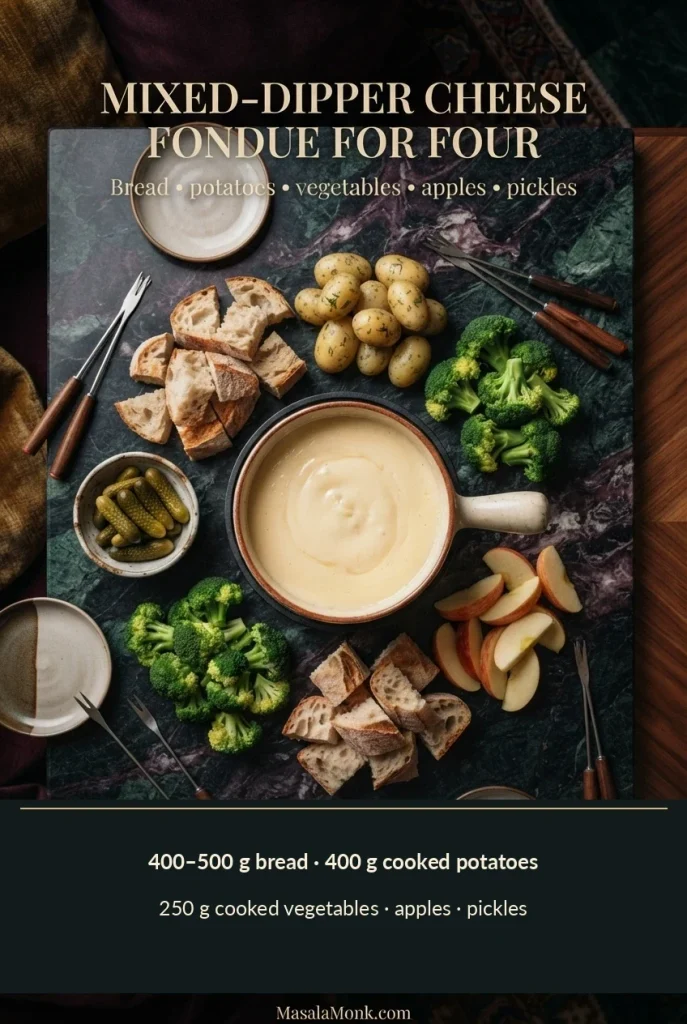
Mixed-Dipper Fondue Dinner for Four
For four, set out about 400–500 g bread, 400 g cooked baby potatoes, 250 g broccoli or cauliflower, one or two firm apples and a small bowl of pickles. Reduce the accompaniments for lighter appetites.
A cucumber salad with dill or vinegar works well alongside the cheese. For a larger table, a charcuterie board can offer ideas for a spread of crisp vegetables, cooked meats, pickles, and fruit.
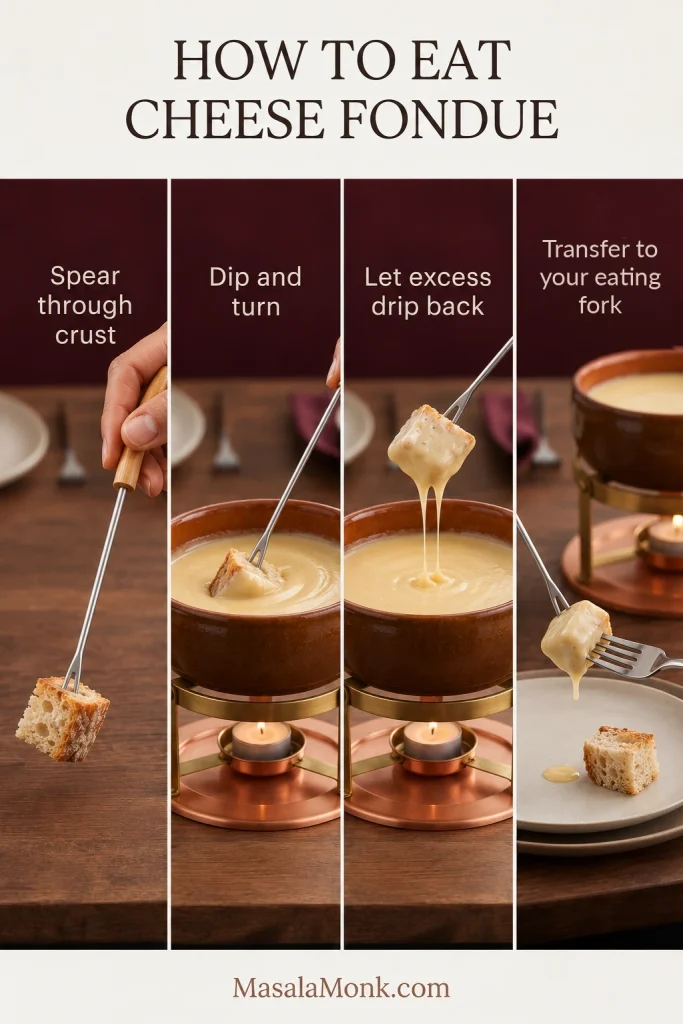
How to Eat Cheese Fondue
Spear a piece of bread through its crust, dip and turn it in the cheese, and pause above the pot to catch the drips. With communal fondue forks, transfer the food to your own plate or eating fork before taking a bite. Keep loose napkins clear of a burner and supervise children near the hot pot.
Do You Need a Fondue Pot?
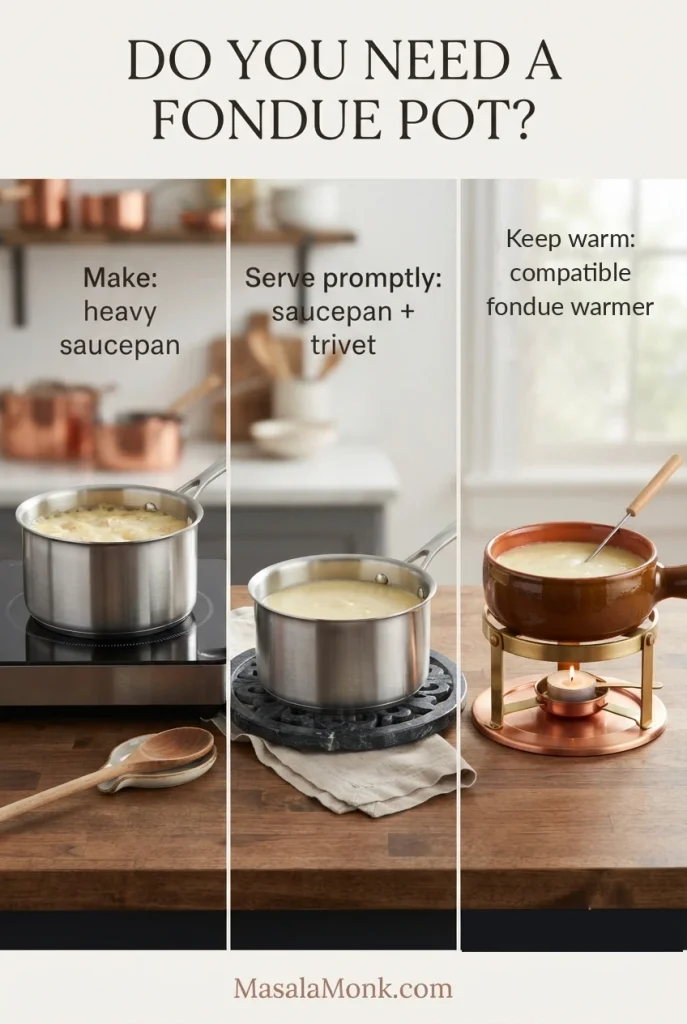
A heavy saucepan is enough to make cheese fondue. For a quick meal, bring the saucepan to the table on a heat-safe trivet, knowing the cheese will thicken as it cools. An adjustable warmer makes a slower, shared meal easier by keeping the sauce fluid.
A traditional Swiss serving pot is called a caquelon. It may be ceramic or enameled cast iron; check the manufacturer’s instructions before placing any ceramic pot directly on a stove. A suitable electric fondue pot is another practical option.
Keeping Fondue Warm at the Table
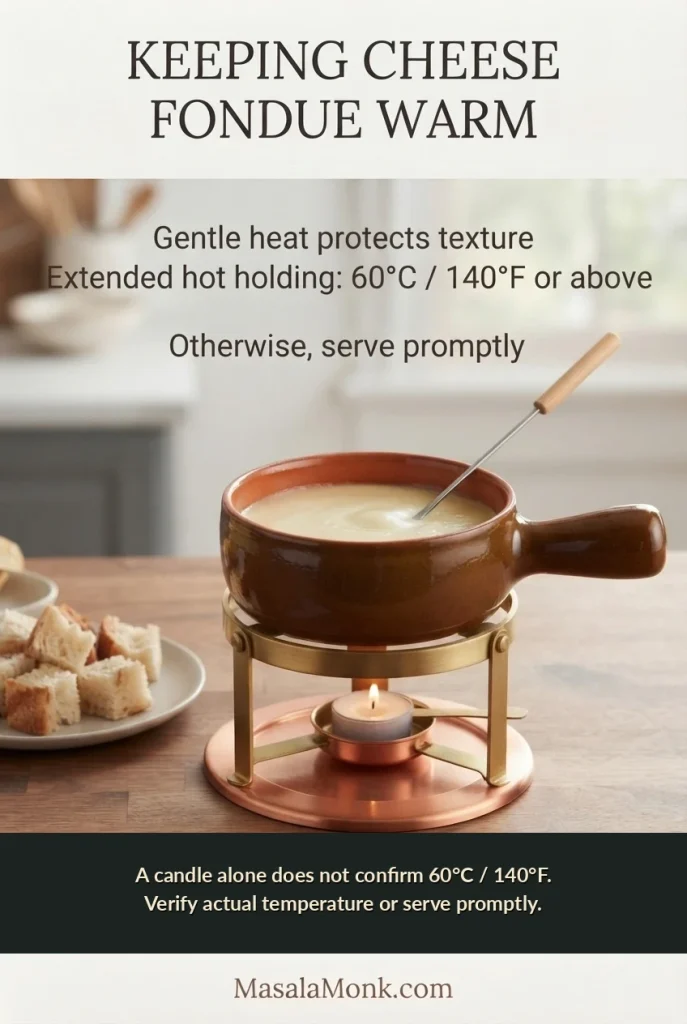
For good texture, use controllable, gentle heat and stir occasionally. Avoid sustained bubbling and scorching. For extended hot holding, there’s a separate food-safety requirement: keep perishable hot foods at 60°C (140°F) or above, using equipment capable of reliably maintaining that temperature. If you can’t maintain safe heat and an acceptable cheese texture, serve promptly instead of leaving the fondue lukewarm.
A slow cooker may hold already-hot fondue if its setting maintains the required temperature without scorching. Don’t use a slow cooker to reheat cold leftovers; they can warm too slowly. For food you intend to save, follow the leftover storage and reheating section.
What Is La Religieuse?
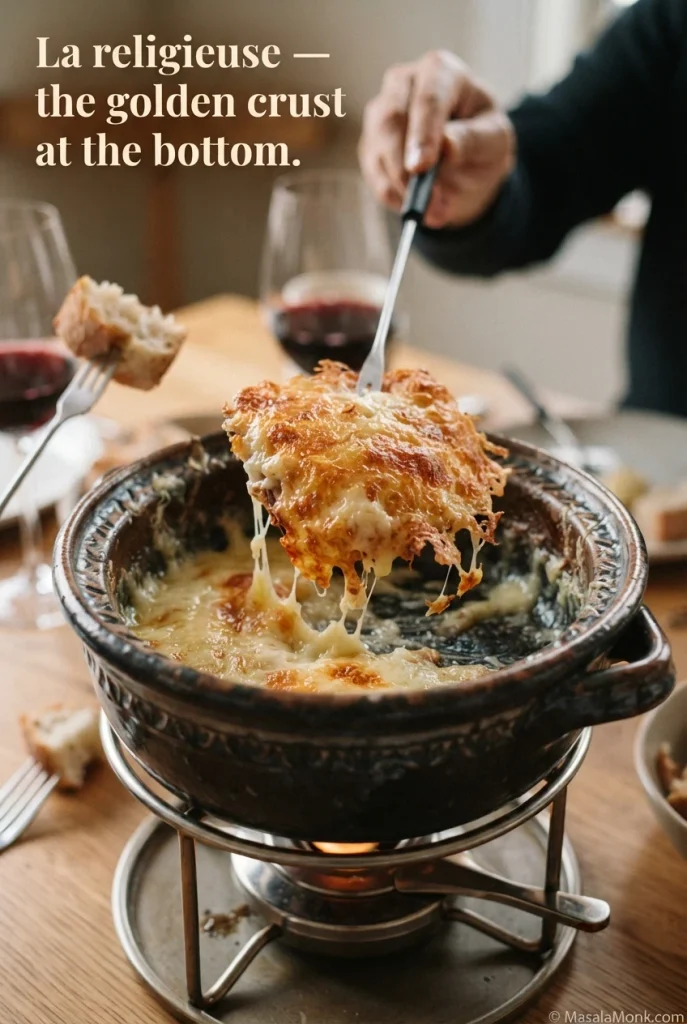
Don’t clear the pot too quickly. The thin golden crust that can form at its base has a name in Switzerland: la religieuse. When gently toasted rather than burned, it offers one last, deeply savory bite. Black, bitter scorching is different; lower the heat if the base begins burning, and don’t mix the scorched residue through the sauce.
Back to the classic recipe · Back to recipe contents
How Much Fondue Per Person? Planning, Make-Ahead, and Leftovers
How Much Cheese Fondue Should You Make?
For fondue as a main meal, allow roughly 200–250 g cheese per adult, depending on appetite and sides. As an appetizer before a larger meal, 100–150 g cheese per person is a useful starting point.
Scale the main recipe with this table. Total cheese means equal weights of Gruyère and Emmental.
| People | Total Cheese | White Wine | Cornstarch |
|---|---|---|---|
| 2 | 400 g | 180 ml | 6 g |
| 4 | 800 g | 360 ml | 12 g |
| 6 | 1,200 g | 540 ml | 18 g |
| 8 | 1,600 g | 720 ml | 24 g |
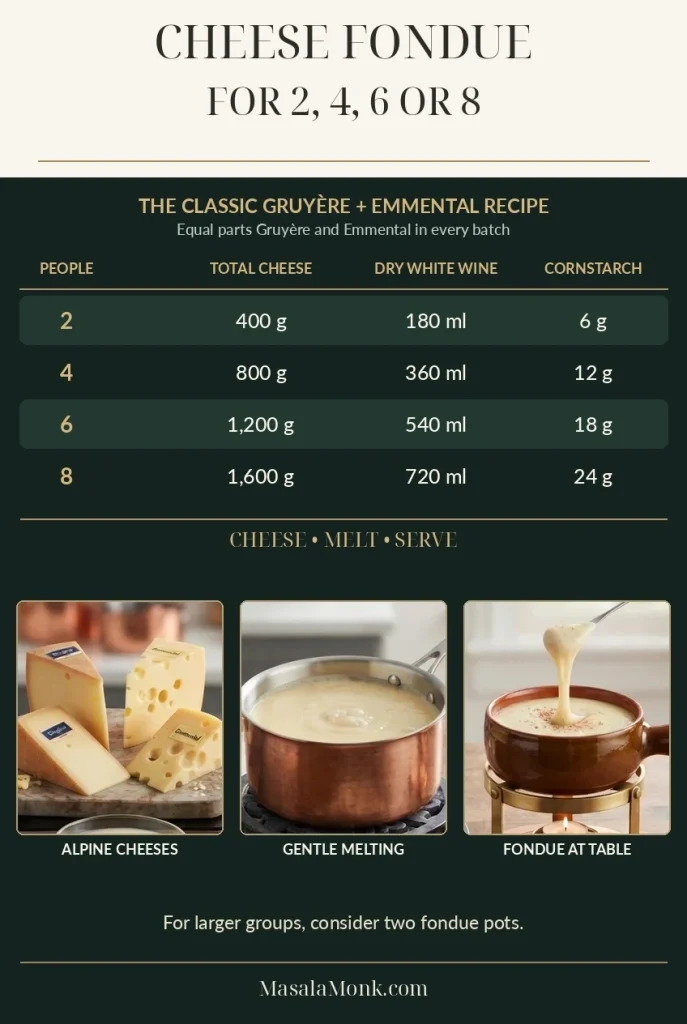
Scale the garlic, lemon juice, and optional kirsch approximately, then season to taste. For two people, use about half a garlic clove, 2.5 ml lemon juice, and half the optional kirsch; a smaller saucepan makes stirring easier. Large batches don’t always cook in proportionally longer times. For six to eight diners, two smaller fondue pots may be easier to manage than one enormous pot.
Can You Prepare Cheese Fondue Ahead?
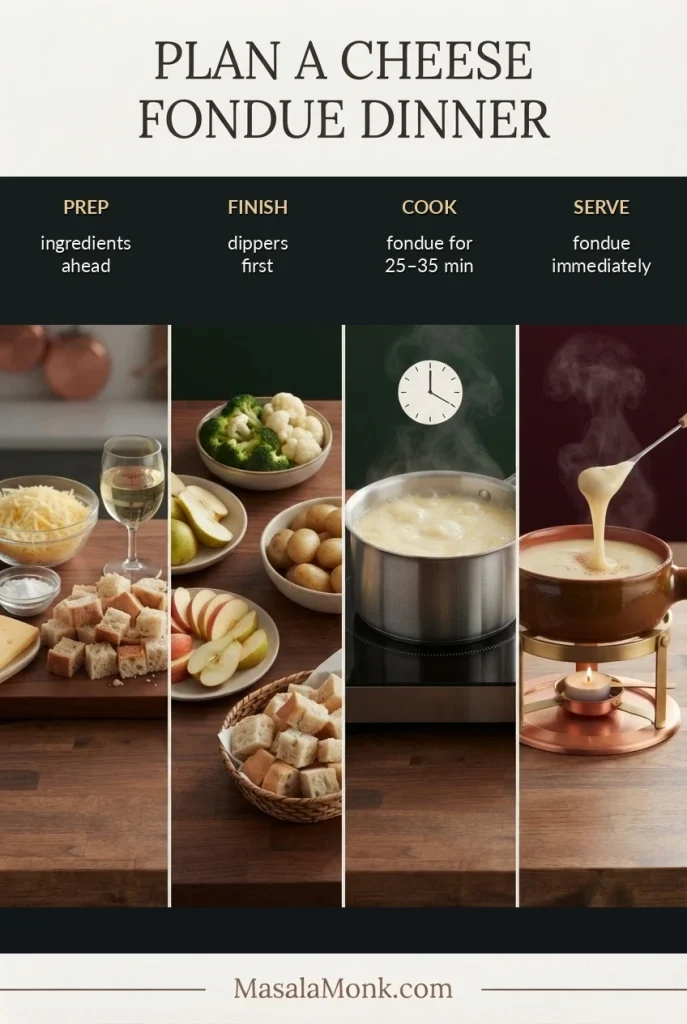
Prepare the ingredients and dippers in advance, but melt the cheese just before dinner. The 25–35-minute recipe estimate covers the fondue itself, not roasting vegetables or making homemade bread.
Earlier in the day: Grate the cheese, measure wine and starch, and prepare vegetables that take longer to cook. Refrigerate perishables.
Before serving: Finish and drain potatoes and vegetables, cut the bread, and arrange the platters. Hold hot sides safely hot and keep cold items chilled until needed.
At dinner time: Warm the wine, melt the cheese, do the bread test, and bring the pot directly to the table. For a long evening, a fresh smaller second batch may serve better than repeatedly thinning and reheating the first.
How to Store Leftover Cheese Fondue
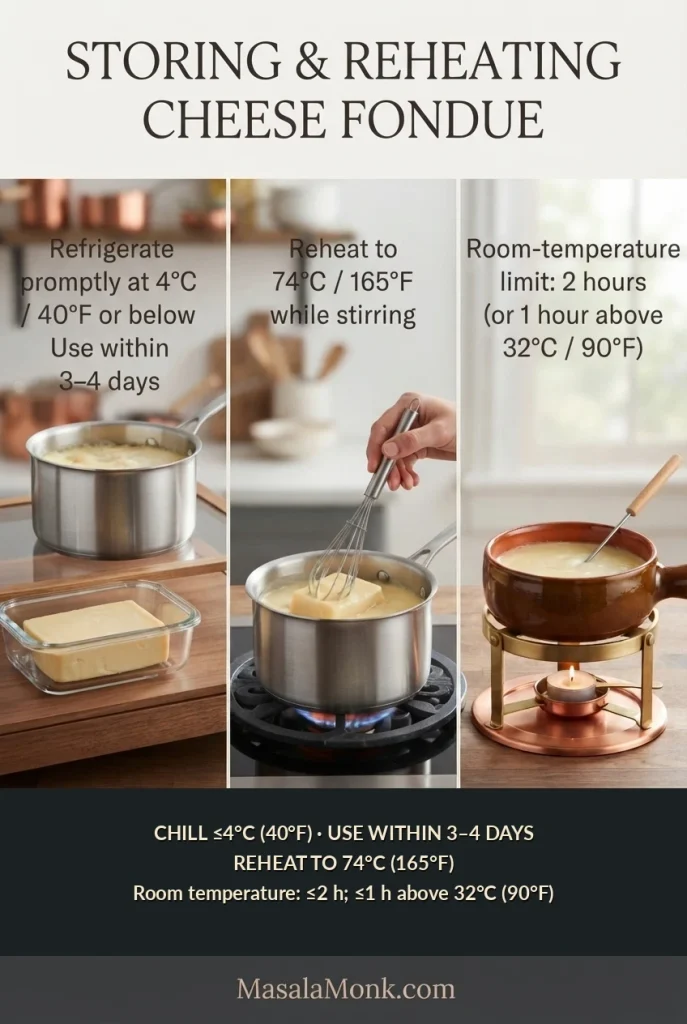
Transfer leftovers into shallow containers and refrigerate promptly at 4°C (40°F) or below. Don’t leave perishable fondue at room temperature longer than two hours, or longer than one hour when the surroundings are above 32°C (90°F). Use properly refrigerated cooked leftovers within three to four days, and discard fondue left outside safe limits for too long.
Can You Reheat Cheese Fondue?
Yes, although the original texture may not return. Reheat in a saucepan, stirring as it warms; a little liquid can loosen overly thick cheese. For food safety, reheated leftovers should reach 74°C (165°F). That heat can separate the sauce, so prioritize safe reheating over a perfectly silky finish. Avoid reheating cold leftovers in a slow cooker.
Properly stored leftovers that won’t return to dipping consistency can work in a thoroughly heated potato or pasta dish. For another meal, creamy macaroni and cheese uses a milk-based sauce designed specifically for pasta.
See FoodSafety.gov’s food-handling guidance for more on safe chilling, hot holding, and reheating.
When the bread comes out evenly coated, the work at the stove is done. Bring the fondue to the table while the cheese is still flowing, let everyone choose their next bite, and enjoy the meal together.








