Posted on 1 Comment

Cream of Mushroom Chicken Recipe

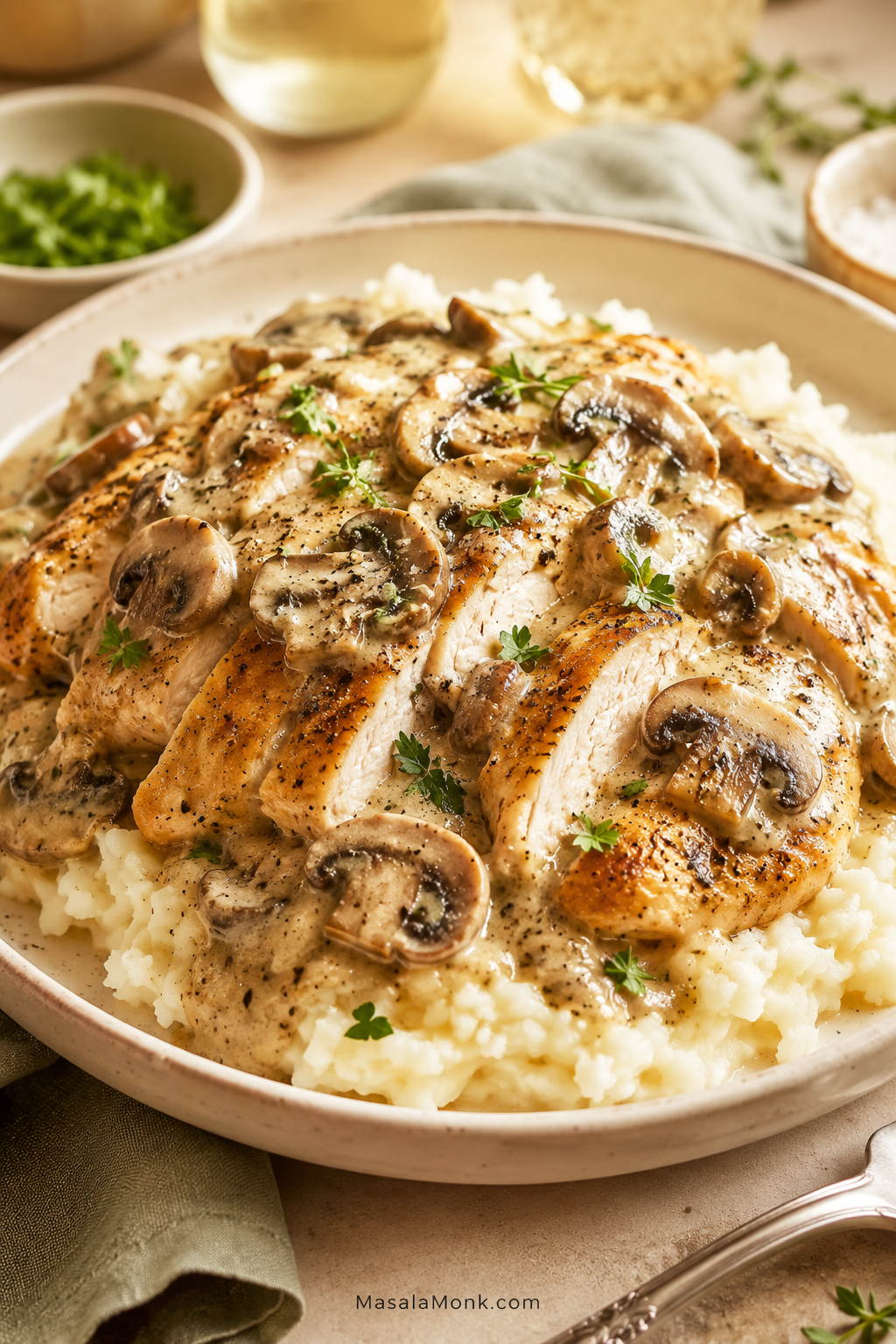
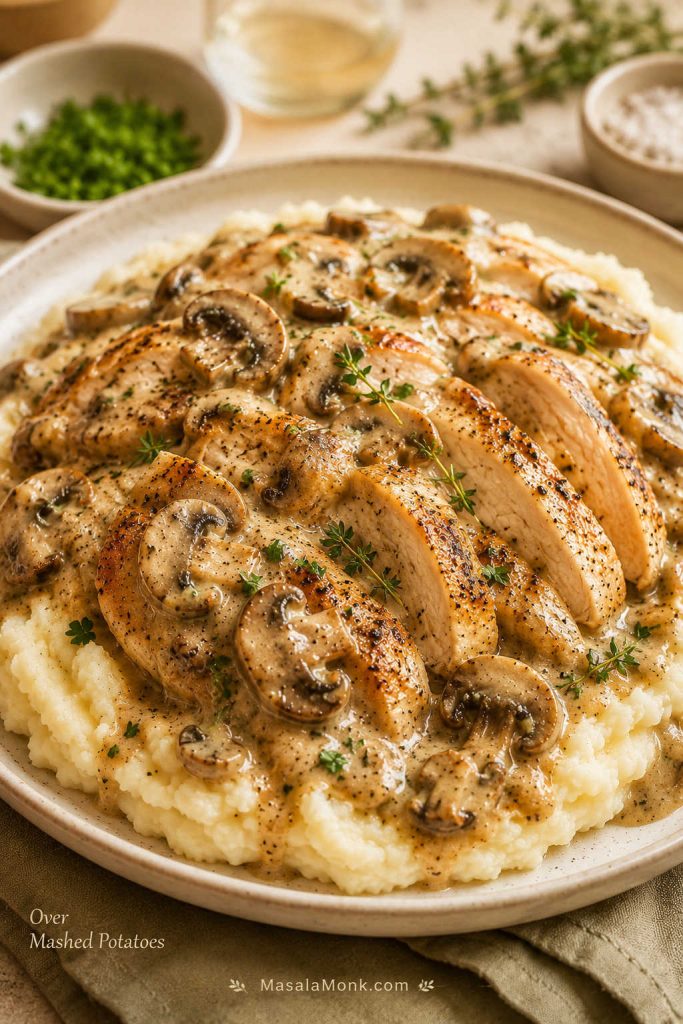
Cream of mushroom chicken served over mashed potatoes with sliced mushrooms, creamy sauce, black pepper, and fresh herbs.

This cream of mushroom chicken recipe is for the night when you have chicken in the fridge, a can of cream of mushroom soup in the pantry, and no patience for a complicated sauce. The goal is simple: tender chicken, creamy mushroom gravy, and a dinner that works with rice, egg noodles, mashed potatoes, biscuits, or whatever vegetable you already have.

This is the kind of dinner that feels like a shortcut while it cooks, but like comfort food once it hits the plate. It is not fancy food; it is the creamy, spoon-over-something meal you make when the day has been long and everyone still needs to eat.

Bake it when you want the easiest family dinner. Use the skillet when dinner needs to happen faster, the slow cooker when the meal should take care of itself, and the rice bake when chicken and rice should land in one dish.

The dish works best with condensed cream of mushroom soup, thin or evenly pounded chicken, and just enough milk or broth to turn the soup into a spoonable sauce. A thermometer keeps the chicken from drying out while still getting it safely to 165°F / 74°C.

Quick Answer: How to Make Cream of Mushroom Chicken

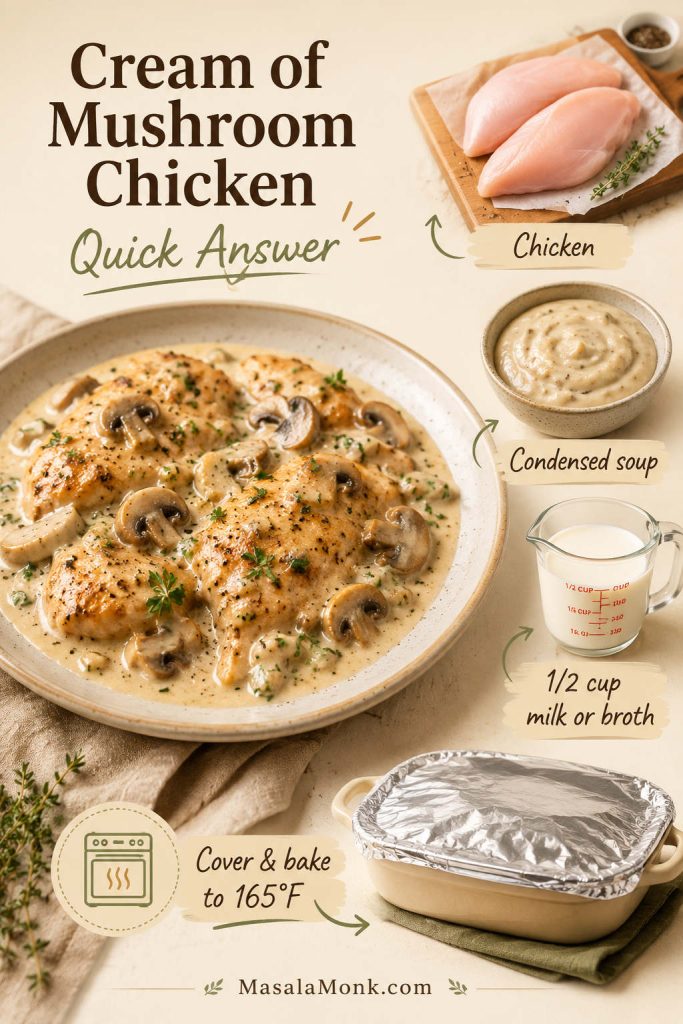
To make cream of mushroom chicken, season chicken breasts or thighs, place them in a baking dish, whisk condensed cream of mushroom soup with milk or low-sodium chicken broth, pour the sauce over the chicken, cover, and bake until the chicken reaches 165°F / 74°C. Uncover near the end if the sauce needs to thicken or cheese is going on top.

The result should be chicken that slices easily with creamy mushroom gravy you can spoon over rice, noodles, mashed potatoes, biscuits, or vegetables. This is still a low-effort dinner: about 10 minutes of prep, then the oven does most of the work.

The skillet version is faster, the slow cooker version is more hands-off, and the rice bake turns it into a one-dish meal. The trick is changing the liquid slightly for each method, so use the version guide or the soup and liquid ratios before switching methods.

Best first version: Bake thin chicken breasts or thighs with 1 can condensed cream of mushroom soup and ½ cup milk or broth at 375°F / 190°C. Cover first for moisture, then uncover near the end so the sauce thickens.
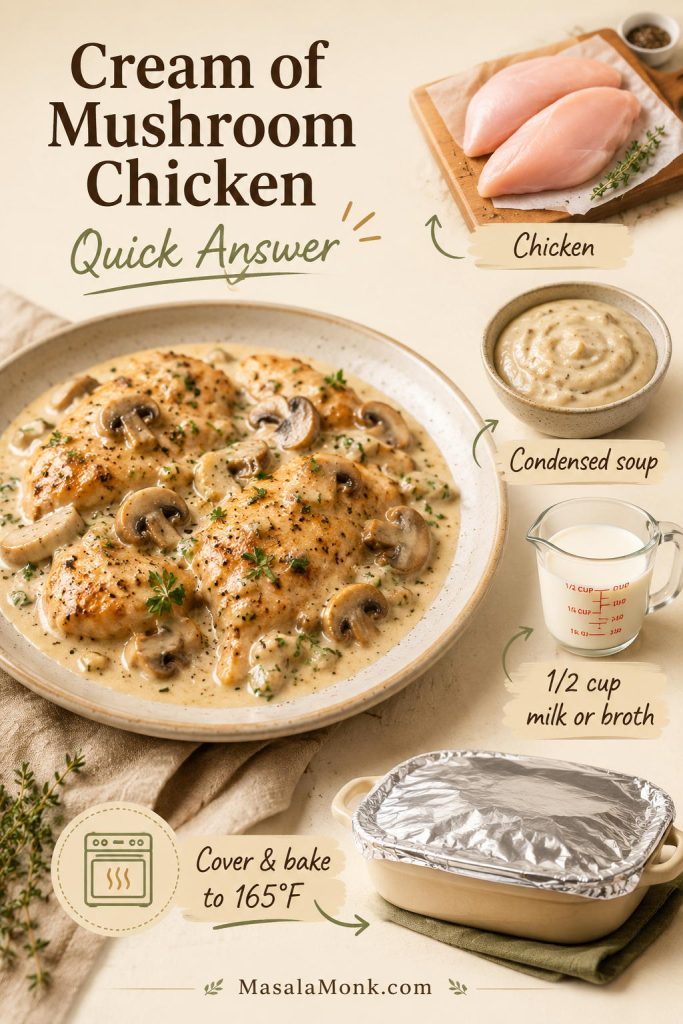
Quick answer board showing cream of mushroom chicken, chicken pieces, condensed soup, milk or broth, and covered baking instructions.
For the simplest version, build the dish in four parts: chicken, condensed cream of mushroom soup, a little milk or broth, and a covered bake.

For food safety, chicken should reach 165°F / 74°C in the thickest part; FoodSafety.gov lists poultry and casseroles at this internal temperature.

Which Version Should You Make?

Before you open the soup can, decide how dinner needs to work tonight. The same basic ingredients can become an easy oven dinner, a quick skillet meal, a slow cooker comfort dish, or a chicken-and-rice bake.
The one thing that changes most between versions is the soup-to-liquid ratio. The oven, skillet, slow cooker, and rice bake each need slightly different treatment, which is what keeps the chicken juicy and the sauce creamy instead of watery.

Choose This Version Best When Key Ratio
Baked cream of mushroom chicken You want the easiest family dinner with minimal prep. 1 can soup + ½ cup milk or broth
Skillet cream of mushroom chicken You want dinner faster and more control over the sauce. 1 can soup + ½–1 cup broth or milk
Slow cooker cream of mushroom chicken You want hands-off creamy chicken for rice, noodles, or potatoes. 2 cans soup + ½ cup liquid
Cream of mushroom chicken and rice You want a full one-dish meal. 1 can soup + 1 cup liquid + ¾ cup rice
Creamy chicken over egg noodles You want mushroom-sauce chicken without baking rice. Cook noodles separately and spoon sauce over them
Guide comparing baked, skillet, slow cooker, and chicken and rice versions of cream of mushroom chicken.
Instead of using one formula for every method, adjust the liquid for baked, skillet, slow cooker, and chicken-and-rice versions.

How Much Liquid to Add to Cream of Mushroom Soup

Use these ratios as starting points, then adjust until the sauce looks spoonable, not stiff and not soupy.

Version Condensed Soup Added Liquid Why It Works
Baked chicken 1 can / 10.5 oz / 298 g ½ cup / 120 ml milk or broth Creates a creamy, spoonable sauce without making the dish watery.
Skillet chicken 1 can / 10.5 oz / 298 g ½–1 cup / 120–240 ml broth or milk The sauce reduces as it simmers, so you can loosen or thicken it as needed.
Slow cooker chicken 2 cans / about 596 g total ½ cup / 120 ml broth or water The slow cooker traps moisture, so too much liquid makes the sauce thin.
Small chicken and rice bake 1 can / 10.5 oz / 298 g 1 cup / 240 ml liquid + ¾ cup rice Rice needs measured liquid and trapped steam to cook properly.
Large 9×13 rice bake 2 cans / about 596 g total 2 cups / 480 ml broth + 1¼ cups rice Better for a family-size casserole with more rice and chicken.
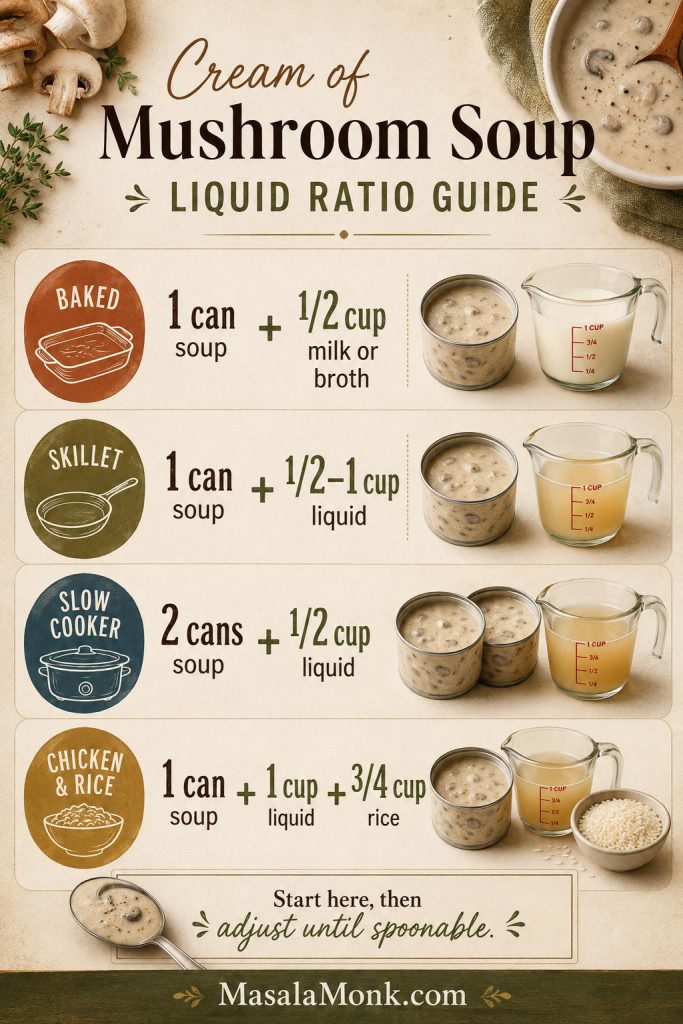
Liquid ratio guide for baked, skillet, slow cooker, and chicken and rice cream of mushroom chicken recipes.
Condensed soup gives the sauce body; however, each cooking method needs a different amount of liquid to stay creamy.

Once the ratio is right, everything gets easier: the chicken cooks gently, the sauce stays spoonable, and the sides do half the work. When you are ready to cook the oven version, go straight to the cream of mushroom chicken recipe card.

Water works in a pinch, but broth gives the dish more savory flavor and milk makes the sauce softer and creamier. Regular condensed soup, regular broth, cheese, and onion soup mix can all add salt, so taste before adding more.

Basic Oven Method at a Glance

Use this as the quick map before the full recipe card.

  1. Thin and season the chicken. Slice large breasts in half lengthwise or pound them evenly, then season lightly.
  2. Whisk the soup mixture. Mix condensed cream of mushroom soup with milk or broth until smooth.
  3. Cover and bake. Pour the mixture over the chicken, cover with foil, and bake so the meat stays moist.
  4. Uncover, check, and rest. Finish uncovered, cook to 165°F / 74°C, and rest before serving.
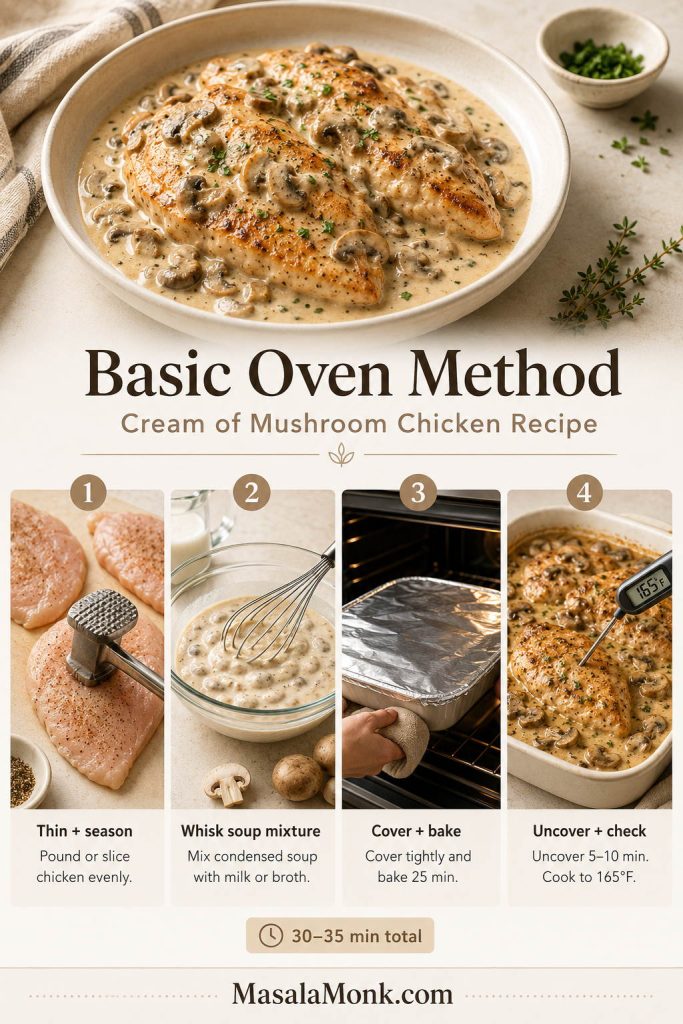
Four-step oven method for cream of mushroom chicken showing thin chicken, soup mixture, covered baking, and temperature check.
Once the chicken is even in thickness and the soup mixture is loosened, the oven version becomes simple and predictable.

Cream of Mushroom Chicken Recipe Card

This baked cream of mushroom chicken is the oven version to make first: tender chicken, condensed cream of mushroom soup, a little milk or broth, simple seasonings, and enough creamy mushroom sauce to spoon over rice, egg noodles, mashed potatoes, or vegetables.

Prep Time10 minutes
Cook Time30–35 minutes
Total Time40–45 minutes
Yield4 servings

Course: Dinner
Cuisine: American
Method: Baked
Equipment: 9×13-inch baking dish, foil, mixing bowl, instant-read thermometer

Ingredients

  • 1½ lb / 680 g boneless skinless chicken breasts or thighs
  • 1 can condensed cream of mushroom soup, 10.5 oz / 298 g
  • ½ cup / 120 ml milk or low-sodium chicken broth
  • ½ tsp garlic powder, divided
  • ½ tsp onion powder, divided
  • ½ tsp paprika, divided
  • ¼ tsp black pepper, divided, plus more to taste
  • 8 oz / 225 g sliced mushrooms, optional
  • ¼–½ cup / 60–120 g sour cream, optional
  • ¾–1 cup / 85–115 g shredded mozzarella, Monterey Jack, or cheddar, optional
  • Salt only after tasting, if needed

Instructions

  1. Heat oven to 375°F / 190°C. Lightly grease a 9×13-inch baking dish.
  2. Slice large chicken breasts in half lengthwise or pound them to an even thickness.
  3. Place the chicken in the baking dish. Sprinkle with about half of the garlic powder, onion powder, paprika, and black pepper.
  4. Scatter raw mushrooms around the chicken for convenience, or brown them first for deeper flavor and less extra moisture.
  5. In a bowl, whisk the condensed cream of mushroom soup with milk or broth and the remaining garlic powder, onion powder, paprika, and pepper until smooth. Whisk in sour cream now if using it for the baked version.
  6. Taste the sauce. Add salt only if it needs it. A flat-tasting sauce can take a little more pepper, paprika, thyme, garlic powder, or Dijon.
  7. Pour the sauce over the chicken and spread it so the chicken is mostly covered.
  8. Cover the dish tightly with foil.
  9. Bake for 25 minutes.
  10. Uncover and bake 5–10 minutes more, or until the chicken reaches 165°F / 74°C in the thickest part.
  11. Sprinkle cheese over the chicken during the uncovered finish if using it, then bake until melted.
  12. When the chicken is done but the sauce is still thin, move the chicken to a plate and thicken the sauce separately in a small pan, or in the baking dish only if your dish is stovetop-safe.
  13. Rest for 5 minutes before serving.
  14. Serve over rice, egg noodles, mashed potatoes, biscuits, broccoli, green beans, or roasted vegetables.

Notes

  • Use condensed cream of mushroom soup, not ready-to-eat mushroom soup.
  • Browned mushrooms give the sauce a deeper, less canned flavor.
  • Water works if that is all you have, but broth gives better flavor and milk makes the sauce creamier.
  • A cream of chicken swap works too: replace half or all of the cream of mushroom soup with condensed cream of chicken soup.
  • For skillet or slow cooker versions, add sour cream or cheese near the end over gentle heat for the smoothest finish.
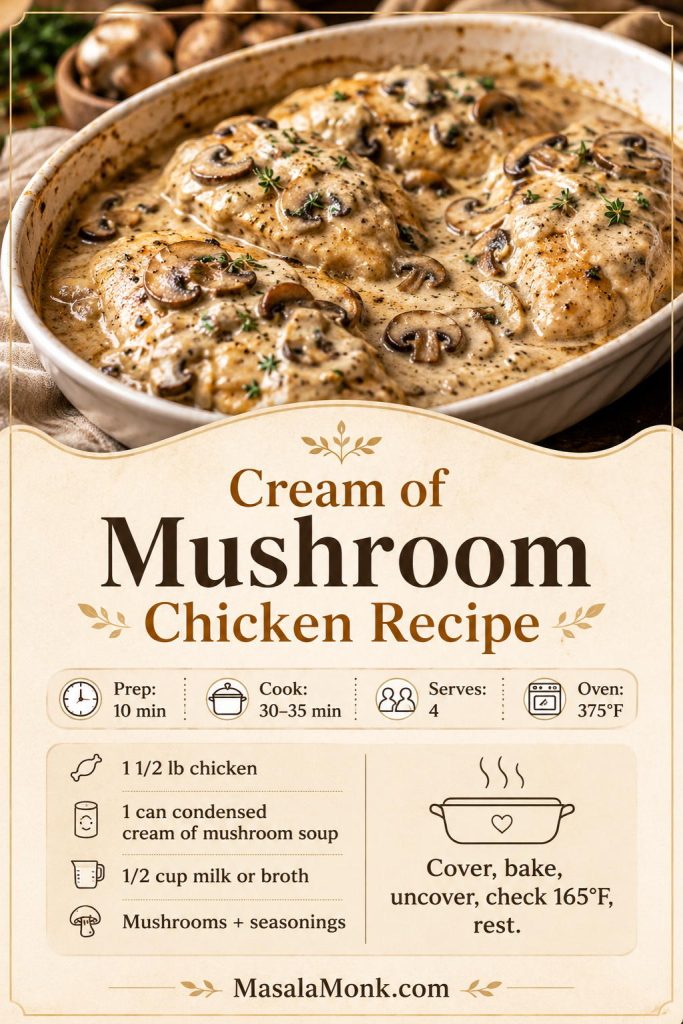
Recipe card for cream of mushroom chicken with prep time, cook time, oven temperature, chicken, condensed soup, milk or broth, and method notes.
Save this basic baked cream of mushroom chicken formula first, then use the other sections when you want skillet, slow cooker, or rice variations.

Making a different version? Use the skillet method, slow cooker method, or chicken and rice bake so the liquid and timing stay right.

Why This Recipe Works

The baked version works because it solves two problems at once: thick chicken and loose sauce. Thin pieces cook before they dry out, while condensed soup gives the sauce enough body to stay creamy. A small splash of milk or broth loosens the canned base, covered baking protects the chicken, and the uncovered finish lets the sauce settle.

The real win is not making it fancy. It is keeping the chicken juicy and turning the canned soup into a sauce that tastes like it belongs on the plate.

Ingredient Notes That Keep It Creamy, Not Watery

Nothing here is precious. The point is knowing which shortcuts help and which ones make the dish watery, salty, or dry.

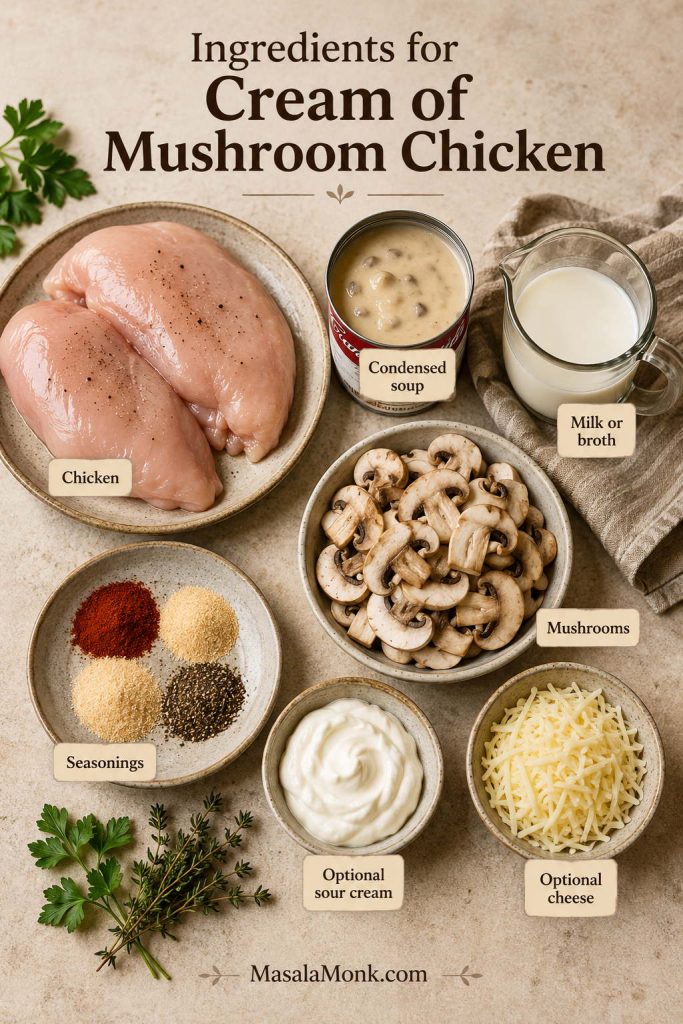
Ingredients for cream of mushroom chicken including chicken, condensed mushroom soup, milk or broth, mushrooms, seasonings, sour cream, and cheese.
A pantry base can still taste rounded when you add smart upgrades like broth, browned mushrooms, thyme, pepper, sour cream, or cheese.
  • Chicken: Boneless skinless breasts or thighs both work. Breasts give you a classic sliced dinner; thighs give you more forgiveness.
  • Condensed cream of mushroom soup: The word condensed matters because the soup starts thick and becomes sauce when you add liquid.
  • Milk, broth, or water: Broth gives savory depth, milk gives a softer creamy finish, and water works when that is all you have.
  • Fresh mushrooms: Raw mushrooms are convenient, but browned mushrooms add deeper flavor and release less water into the dish.
  • Sour cream: Use it for tang. Whisk it into the oven version before baking, or stir it into skillet and slow cooker versions near the end over gentle heat.
  • Cheese: Mozzarella, Monterey Jack, cheddar, Swiss, or Muenster can turn this into a richer family bake.
Taste before baking: Once the soup, liquid, and seasonings are mixed, taste the sauce before pouring it over the chicken. A bland sauce can take black pepper, garlic powder, paprika, thyme, or a small spoon of Dijon; a salty sauce does not need extra salt.

For the oven version, a 9×13-inch baking dish, foil, a mixing bowl, and an instant-read thermometer are enough. The stovetop route needs a lidded skillet, while the crockpot option works best in a 4–6 quart slow cooker.

Using Campbell’s or Any Condensed Mushroom Soup

Campbell’s condensed cream of mushroom soup works well here, and so do other condensed brands. The label matters less than the word condensed.

Condensed vs Ready-to-Eat Soup

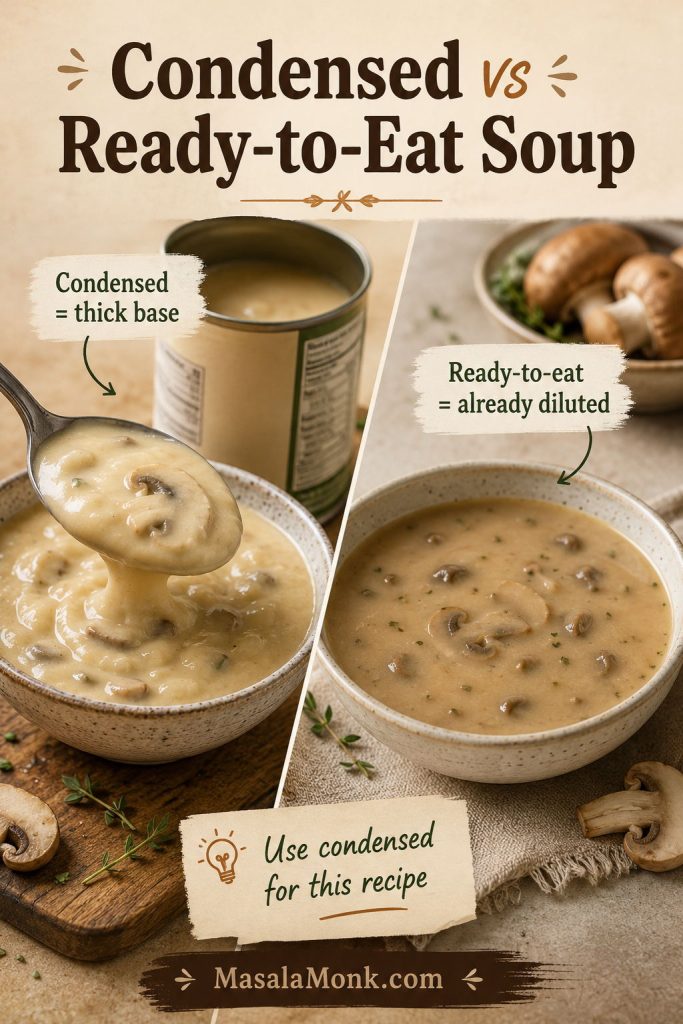
Condensed soup is thick enough to become sauce when mixed with a small amount of milk, broth, or water. Ready-to-eat mushroom soup is already diluted, so it can make the dish watery unless you reduce or skip the added liquid.

Comparison of thick condensed cream of mushroom soup and thinner ready-to-eat mushroom soup.
Condensed cream of mushroom soup starts thick, while ready-to-eat soup is already diluted; that difference matters when you want a creamy sauce.

Low-sodium condensed soup gives you more control if you are also using broth, cheese, onion soup mix, or another salty ingredient.

The same cream-soup comfort logic shows up in MasalaMonk’s tuna noodle casserole recipe, where condensed soup turns into a creamy noodle bake.

Best Chicken to Use: Breasts, Thighs, or Cubed Chicken

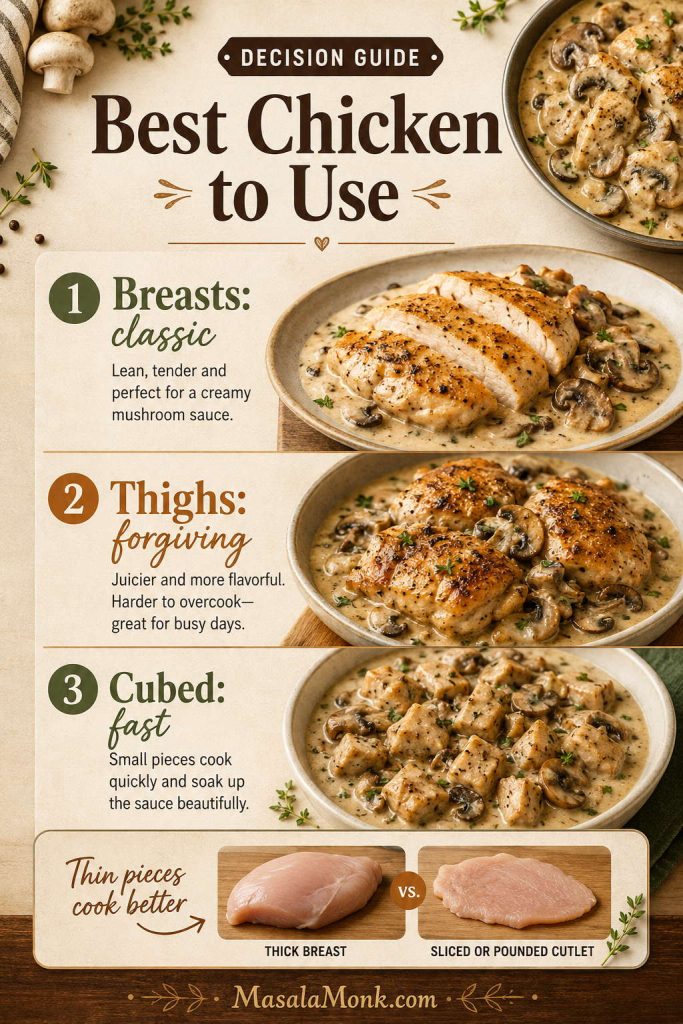
That is really the whole chicken decision: breasts for a classic sliced dinner, thighs when you want more forgiveness, and cubed chicken when you want a faster skillet or casserole-style meal.

Chicken guide showing breasts, thighs, cubed chicken, and thinner cutlets for cream of mushroom chicken.
Your cut changes the result: breasts slice neatly, thighs stay juicy, and cubed chicken cooks quickly for skillet-style dinners.

Chicken Breasts

Chicken breasts work well when they are not too thick. Large breasts should be sliced in half lengthwise to make thinner cutlets, or pounded to an even thickness. This helps the chicken cook through before the sauce dries out.

For more detail on baking chicken breast without drying it out, see MasalaMonk’s baked chicken breast recipe.

Chicken Thighs

Boneless skinless thighs stay juicy even when the dish needs a few extra minutes. They are especially good for the slow cooker or chicken-and-rice versions because they can handle longer cooking better than thin breasts.

Cubed Chicken

Cubed chicken is useful for a quick skillet dinner or a casserole-style variation. It cooks faster and mixes easily with noodles or rice, though it does not give you the same sliced-chicken presentation as baked breasts or thighs.

Baked Cream of Mushroom Chicken

This is the version to make first. It gives you the classic creamy mushroom chicken experience without needing a skillet, a roux, or a separate sauce.

The best pan comes out bubbling around the edges, with mushroom gravy tucked around the chicken and enough creamy sauce to drag through rice, noodles, or mashed potatoes.

Before Baking

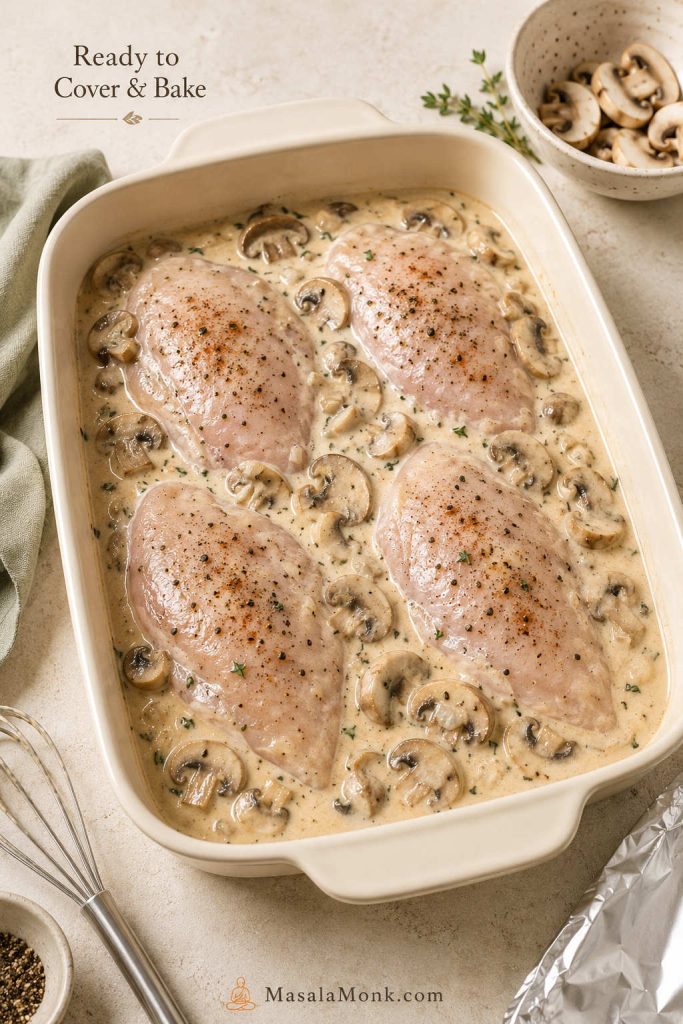
The dish should look assembled but not finished: chicken tucked into the mushroom mixture, mushrooms visible, and just enough sauce to coat the pan before it is covered.

Raw chicken breasts in a baking dish with cream of mushroom sauce, sliced mushrooms, foil, and a spoon nearby.
Before baking, the chicken should be coated and nestled into the mushroom mixture, not buried under too much liquid.

Baked Version at a Glance

Detail Best Answer
Oven temperature 375°F / 190°C
Baking dish 9×13-inch dish
Chicken 1½ lb / 680 g boneless skinless breasts or thighs
Soup 1 can condensed cream of mushroom soup, 10.5 oz / 298 g
Liquid ½ cup / 120 ml milk or low-sodium chicken broth
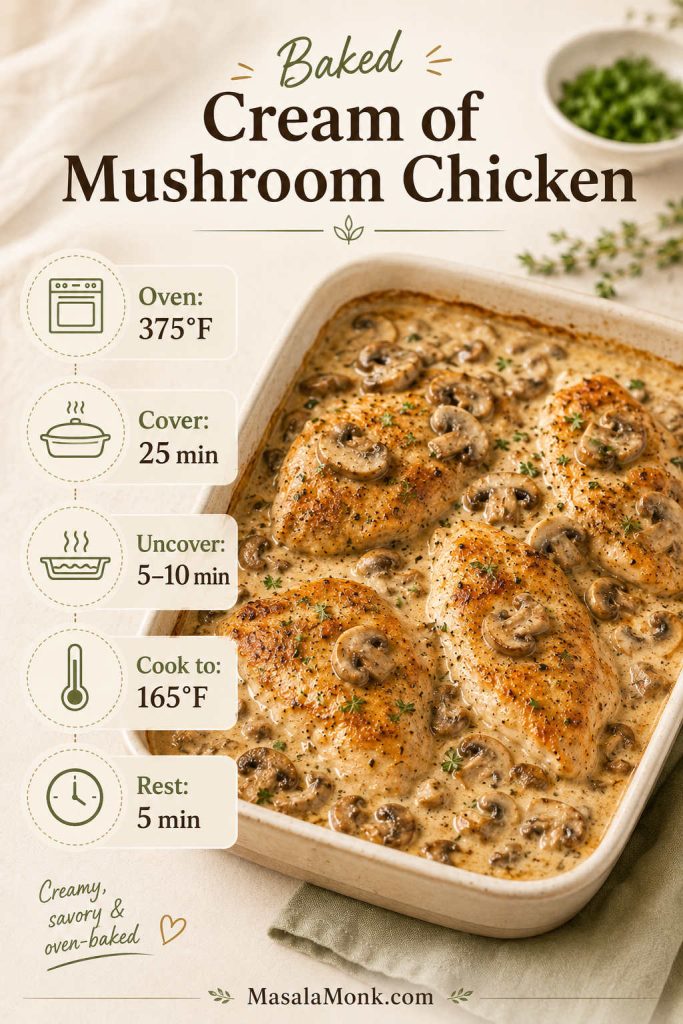
Covered bake 25 minutes
Uncovered finish 5–10 minutes
Safe internal temperature 165°F / 74°C
Resting time 5 minutes
Baked cream of mushroom chicken guide showing 375°F oven, covered baking, uncovered finish, 165°F temperature, and resting time.
Baked cream of mushroom chicken works best with a covered start, a short uncovered finish, and a thermometer check at 165°F.

Once this version is in the oven, there is not much left to do except make something for the sauce to land on.

Covered or Uncovered?

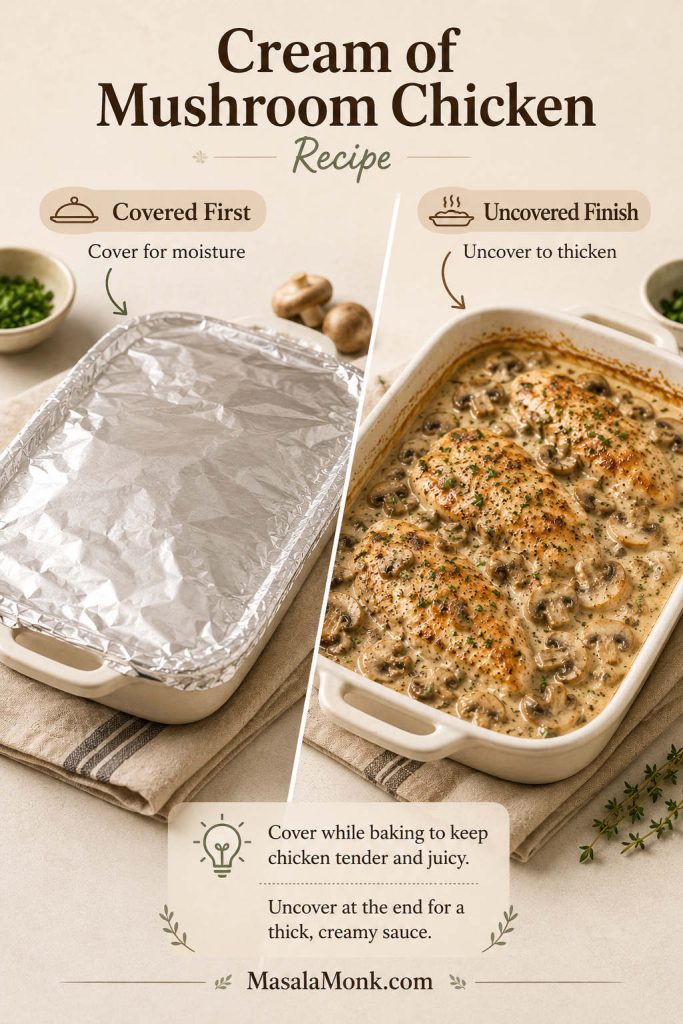
Cover the chicken for the first part of baking. The foil traps steam, keeps the meat moist, and prevents the sauce from drying out too quickly. The final uncovered minutes help looseness cook off and let cheese melt if you are using it.

Very thin pieces should be checked early. Thicker pieces need a thermometer more than they need a guessed time.

Comparison of covered and uncovered baked cream of mushroom chicken in a casserole dish.
Covering helps the chicken stay moist; afterward, uncovering lets the creamy mushroom sauce reduce just enough.
If the chicken is done but the sauce is thin: Do not keep baking the chicken just to thicken the sauce. Move the chicken to a plate, cover it loosely, and thicken the sauce in a small pan, or in the baking dish only if your dish is stovetop-safe.

What the Sauce Should Look Like

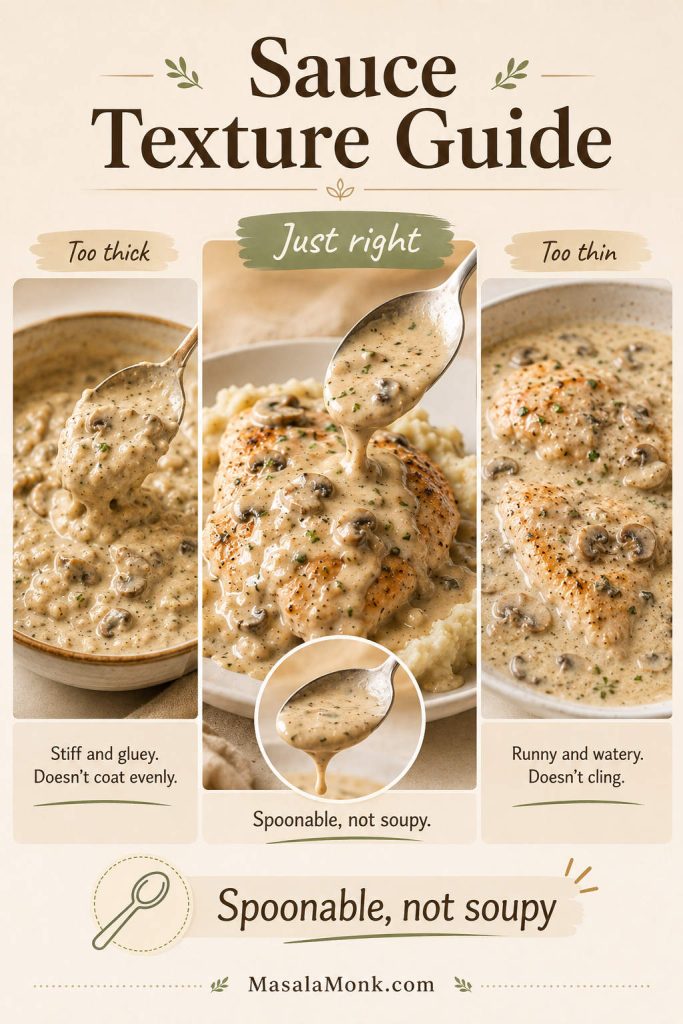
The finished sauce should be creamy and spoonable, thick enough to coat the chicken but loose enough to run into rice, noodles, or mashed potatoes. It should not be stiff like paste, and it should not run like soup.

A sauce that looks too thick before baking needs another splash of milk or broth. When the sauce looks watery but the chicken still needs time, uncover the dish for the last few minutes. Once the chicken is already at 165°F / 74°C, remove it and thicken the sauce separately instead of overbaking dinner.

Sauce texture guide for cream of mushroom chicken showing too thick, just right, and too thin sauces.
Look for sauce that coats a spoon without running like soup, since that texture will sit better on rice, noodles, or mashed potatoes.

In the oven version, ½ cup / 120 ml milk or broth per 10.5 oz / 298 g can of condensed soup is the safest starting point. The skillet version can handle more liquid because the pan sauce reduces as it simmers. The slow cooker needs less because the lid traps moisture as everything cooks. When the texture looks off, use the troubleshooting guide instead of guessing.

Skillet Cream of Mushroom Chicken

The skillet version is best when dinner needs to be faster and the sauce needs more hands-on control. It tastes a little more cooked, not just assembled, because the chicken and mushrooms get direct heat before the sauce comes together.

This is the version with the most dinner-pan flavor: a little browning, a little butter, and creamy mushroom sauce pulled together in the same skillet.

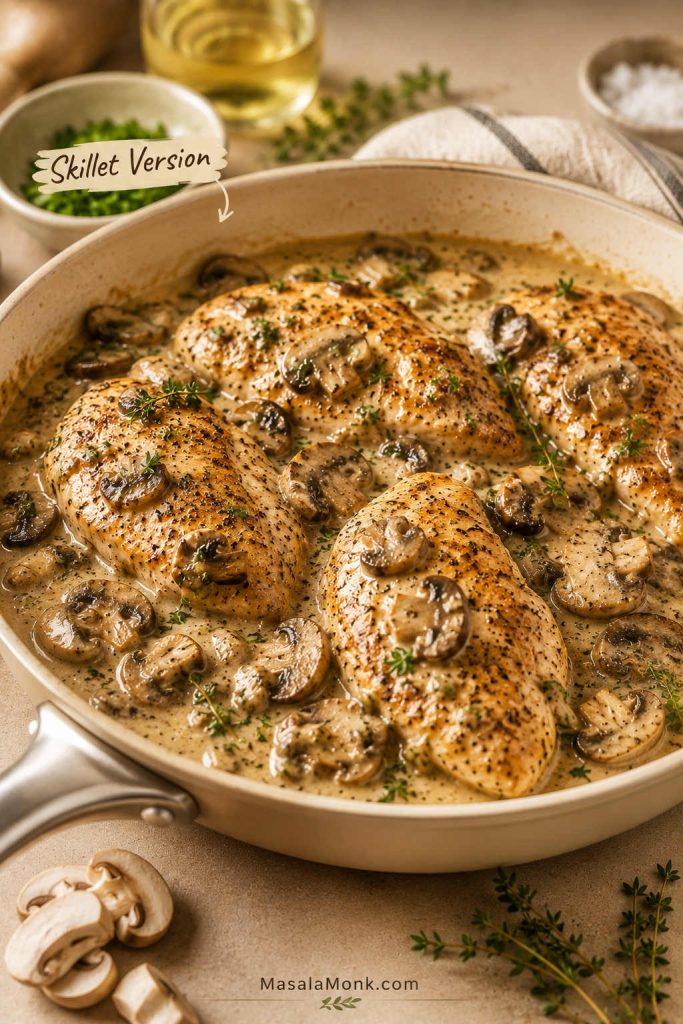
Skillet cream of mushroom chicken with seared chicken, browned mushrooms, creamy sauce, black pepper, and herbs.
The skillet version adds extra savory depth because the chicken and mushrooms brown before the cream sauce is finished.

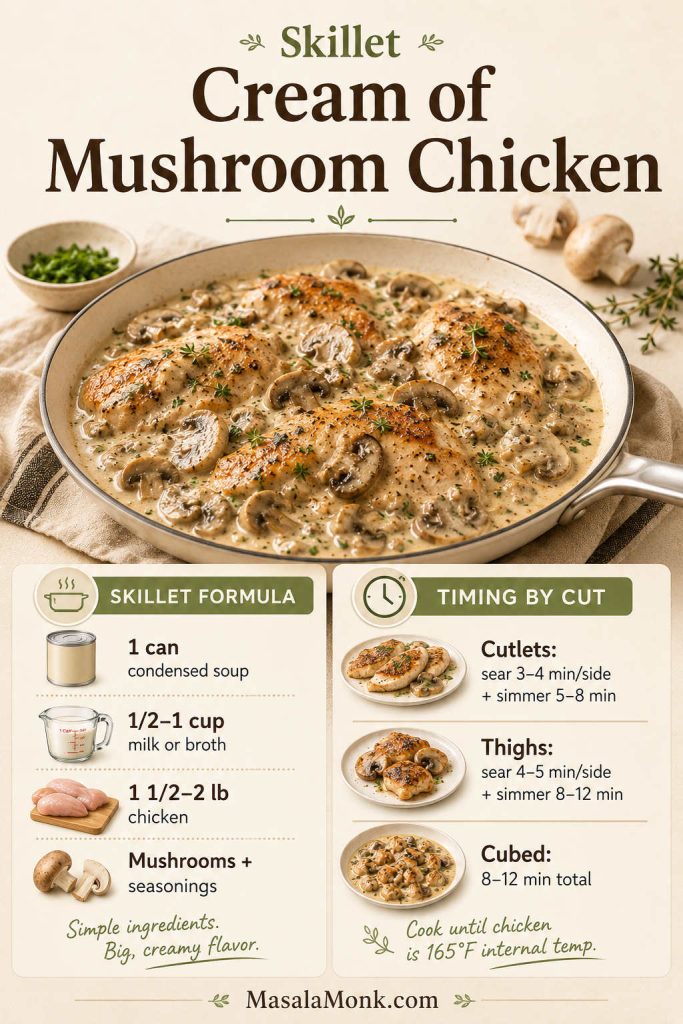
Skillet Formula

  • 1½–2 lb / 680–900 g chicken
  • 1 tbsp oil or butter, for searing
  • 1 can condensed cream of mushroom soup, 10.5 oz / 298 g
  • ½–1 cup / 120–240 ml milk, water, or low-sodium chicken broth
  • 8 oz / 225 g sliced mushrooms, optional
  • Garlic powder, onion powder, paprika, black pepper, and herbs to taste

Oil helps the chicken sear without burning. A small knob of butter added with the mushrooms gives the pan a richer, rounder flavor.

Skillet Timing

Chicken Type Timing What to Watch
Thin chicken cutlets Sear 3–4 minutes per side, then simmer 5–8 minutes in sauce Check early so they do not dry out.
Boneless thighs Sear 4–5 minutes per side, then simmer 8–12 minutes in sauce They stay juicier and can handle a little longer cooking.
Cubed chicken Cook 8–12 minutes total, depending on cube size Stir often so the sauce coats the pieces evenly.
Skillet formula and timing guide for cream of mushroom chicken with cutlets, thighs, and cubed chicken.
Skillet cream of mushroom chicken cooks quickly, so cut size matters: thin cutlets, thighs, and cubed chicken all need different timing.

How to Make It in a Skillet

Season the chicken, then sear it in a large skillet until lightly browned on both sides. Add fresh mushrooms after removing the chicken briefly, then cook them until they release moisture and start to brown. Whisk in the condensed soup with enough broth or milk to make a sauce, then return the chicken to the pan.

Step-by-step skillet method showing seared chicken, browned mushrooms, sauce mixture, returned chicken, and gentle simmering.
Sear first, then simmer gently; that sequence builds flavor while keeping the chicken from drying out.

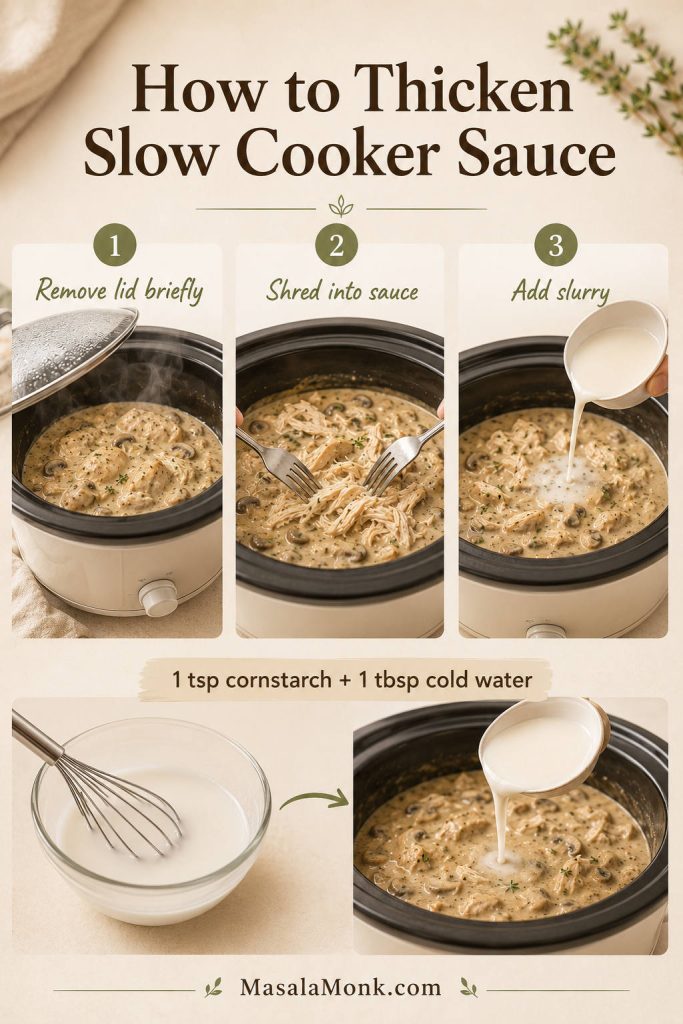
Cover and simmer gently until the chicken reaches 165°F / 74°C. A pan sauce that tightens too much only needs a tablespoon or two of milk or broth. A loose sauce needs the opposite: a few uncovered minutes so extra moisture can cook off. Use the sauce texture guide if you are unsure whether to loosen or reduce it. For a quick slurry, mix 1 tsp cornstarch with 1 tbsp cold water, then stir it into the simmering sauce. Sour cream should go in near the end over low heat so everything stays smooth.

Slow Cooker Cream of Mushroom Chicken

The slow cooker is best when you want tender, saucy chicken waiting for you later. It is less about speed and more about having creamy chicken ready when the rice, noodles, or potatoes are done.

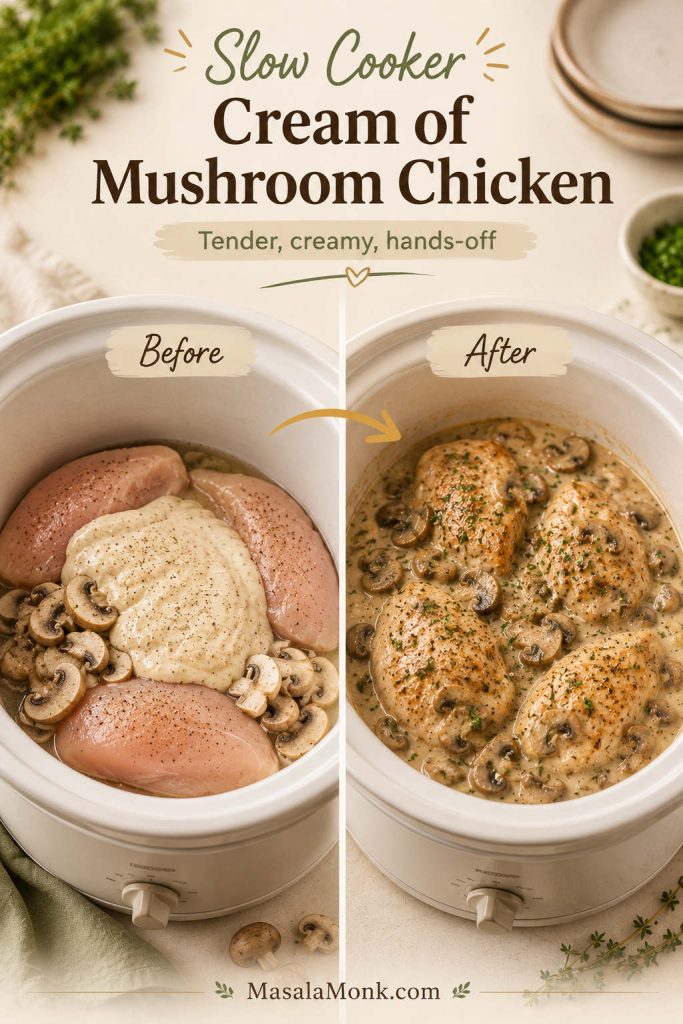
Because the lid traps moisture, start with less liquid than you would use in the oven or skillet. Thawed chicken gives the most predictable timing and texture; frozen chicken releases more moisture and can make the sauce thin.

Slow cooker cream of mushroom chicken before and after cooking, with chicken, mushrooms, condensed soup, and creamy finished sauce.
Slow cooker cream of mushroom chicken needs a thicker starting mixture because the covered cooker creates its own moisture.

If you like this kind of hands-off chicken dinner, MasalaMonk’s crock pot chicken breast recipes has more ways to keep slow-cooked chicken juicy instead of dry.

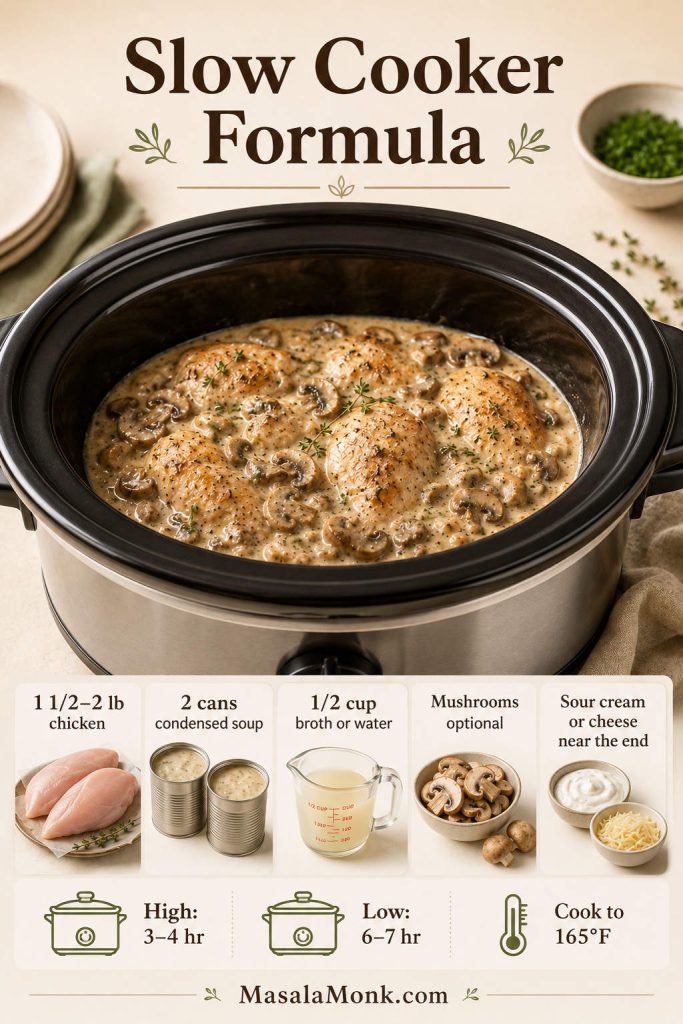
Slow Cooker Formula

  • 1½–2 lb / 680–900 g chicken breasts or thighs
  • 2 cans condensed cream of mushroom soup, 10.5 oz / 298 g each
  • ½ cup / 120 ml low-sodium chicken broth or water
  • 8 oz / 225 g sliced mushrooms, optional
  • ½ packet onion soup mix, optional, only if you like a saltier old-school flavor
  • Sour cream or cheese near the end, optional
Slow cooker formula board for cream of mushroom chicken with chicken, condensed soup, broth or water, timing, and temperature.
Start the slow cooker with less liquid than the oven version, then adjust near the end if the sauce needs loosening or enrichment.

Cook on High for 3–4 hours or Low for 6–7 hours, until the chicken reaches 165°F / 74°C. Thighs handle the longer cook better than thin breasts. By the end, the chicken should be fork-tender and the sauce should taste like it has had time to settle into the meat.

Serve the pieces whole, or shred the chicken into the sauce if you want it to spoon over rice, noodles, or potatoes. Add sour cream or cheese near the end, not at the beginning, for the smoothest finish.

How to Thicken Slow Cooker Cream of Mushroom Chicken

A thin slow cooker sauce can be fixed by removing the lid for a short time, shredding the chicken into the sauce, or thickening it with a small slurry made from 1 tsp cornstarch and 1 tbsp cold water. Use this fix before the chicken overcooks.

Guide showing how to thicken slow cooker cream of mushroom chicken sauce by removing the lid, shredding chicken, or adding slurry.
If slow cooker sauce turns thin, you can fix it calmly with uncovered time, shredded chicken, or a small cornstarch slurry.

For another saucy crockpot chicken dinner, MasalaMonk’s slow cooker French onion chicken follows a similar comfort-food idea with onion gravy, cheese, and a base of noodles, potatoes, rice, or toast.

Cream of Mushroom Chicken and Rice

Rice can absolutely work here, but it needs its own formula. Dry rice needs extra liquid, trapped steam, and more time than the basic baked chicken version. Before you bake, scan the rice mistakes to avoid if you are using brown rice, instant rice, or thick chicken pieces.

Rice version rule: Use extra liquid, a tight foil cover, and longer baking time. The soup base alone is too thick to cook raw rice evenly.
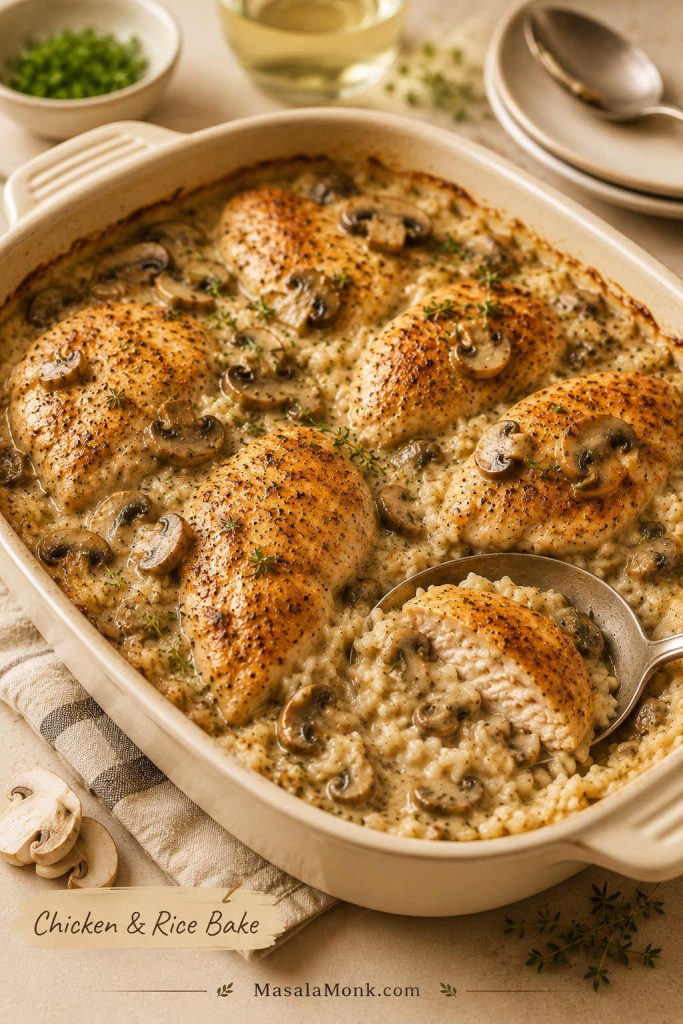
Cream of mushroom chicken and rice casserole in a baking dish with tender rice, mushrooms, creamy sauce, and a serving spoon.
Cream of mushroom chicken and rice needs its own method, since dry rice requires extra liquid, trapped steam, and resting time.

Campbell’s classic one-dish chicken and rice bake follows this same condensed-soup pattern: condensed soup, measured liquid, uncooked long-grain white rice, and chicken baked together under a tight cover. You can see that reference here: Campbell’s One-Dish Chicken & Rice Bake.

Small Classic Chicken and Rice Bake

This smaller rice bake makes about 4 servings.

  • 1 can condensed cream of mushroom soup, 10.5 oz / 298 g
  • 1 cup / 240 ml water or low-sodium chicken broth
  • ¾ cup / about 140 g uncooked long-grain white rice
  • 1¼ lb / 565 g boneless skinless chicken breast or thighs
  • ¼ tsp paprika, plus pepper and garlic powder if desired

Mix the soup, liquid, rice, and seasoning in a greased baking dish. Place the chicken on top, cover tightly, and bake at 375°F / 190°C for about 45 minutes, or until the rice is tender and the chicken reaches 165°F / 74°C. Let it stand for 10 minutes before serving so the rice can finish absorbing the sauce.

Chicken and rice timing tip: Thicker chicken pieces or thighs work better for rice bakes because the rice needs longer to cook. Thin chicken breasts may finish before the rice is tender. When that happens, remove the chicken, keep the rice covered, and continue baking the rice until soft.

Larger 9×13 Family Rice Bake

A larger family-style casserole needs more soup, more rice, and more liquid.

  • 2 cans condensed cream of mushroom soup, 10.5 oz / 298 g each
  • 2 cups / 480 ml low-sodium chicken broth
  • 1¼ cups / about 230 g long-grain white rice
  • 1½–2 lb / 680–900 g chicken
  • Optional onion, thyme, Dijon, black pepper, or Parmesan

Cover tightly and bake at 350°F / 175°C for about 60 minutes. Check the rice, stir gently around the chicken if needed, add a splash of hot broth if the rice is still firm, then cover again and bake 10–15 minutes more. Rest 10 minutes before serving.

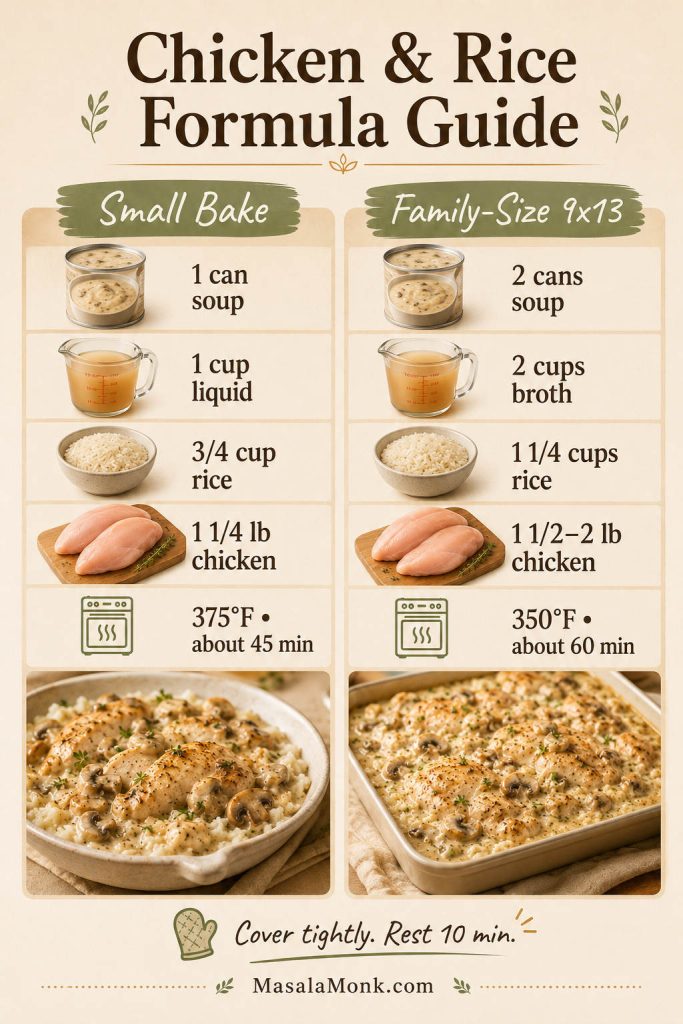
Chicken and Rice Formula Guide

Use the small bake when you want a compact dinner, and use the 9×13 formula when the casserole needs to feed more people without leaving the rice undercooked.

Formula guide for small and family-size cream of mushroom chicken and rice bakes with soup, liquid, rice, chicken, oven temperature, and time.
Use the right chicken-and-rice formula from the start, and you avoid the common problem of tender chicken with undercooked rice.

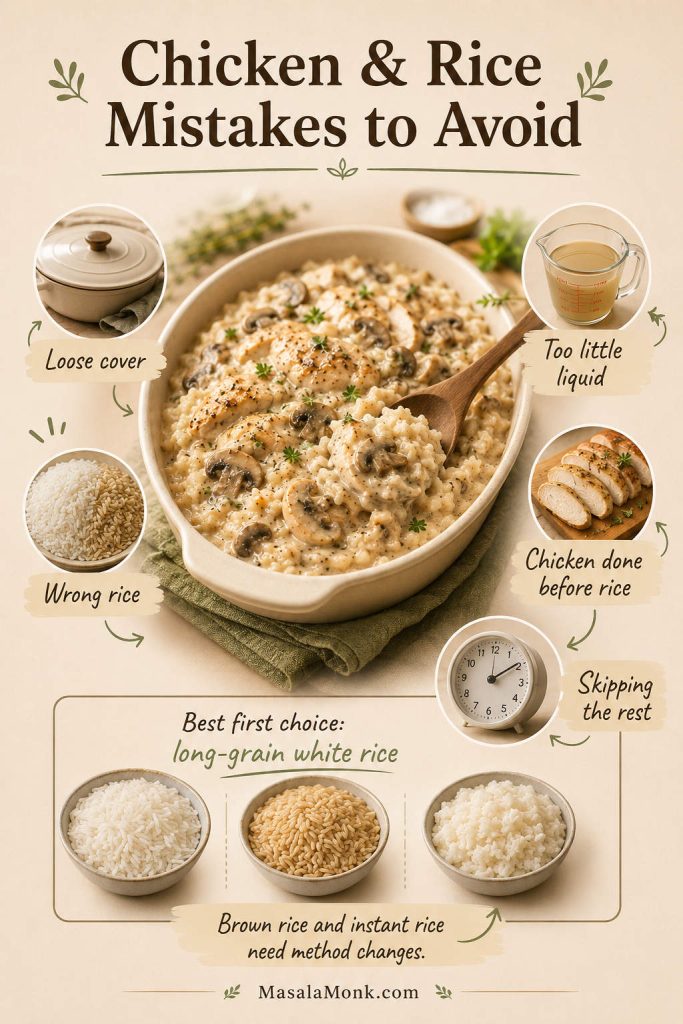
Rice Mistakes to Avoid

The rice version is forgiving once the steam is right, but it is less forgiving when the cover is loose or the liquid is guessed.

  • A loose cover will not trap enough steam. Rice needs a tight cover to soften properly.
  • Brown rice needs a different plan. It takes more time and usually more liquid than white rice.
  • Instant rice cooks too fast for this long bake. It can turn mushy unless you change the method.
  • Ready-to-eat soup can make the bake watery. It is already diluted, unlike condensed soup.
  • The chicken can finish before the rice. Check both before calling the dish done.
  • Resting matters. The rice absorbs the final sauce as it stands.
Chicken and rice mistakes guide showing loose cover, wrong rice, too little liquid, chicken done before rice, skipped resting time, and rice choices.
Long-grain white rice is the easiest choice; brown rice and instant rice need different liquid and timing to work well.

Serving the chicken over plain rice instead of baking rice in the dish? MasalaMonk’s how to cook rice guide is useful for getting fluffy grains that do not turn gummy under the sauce.

Cream of Chicken + Cream of Mushroom Variation

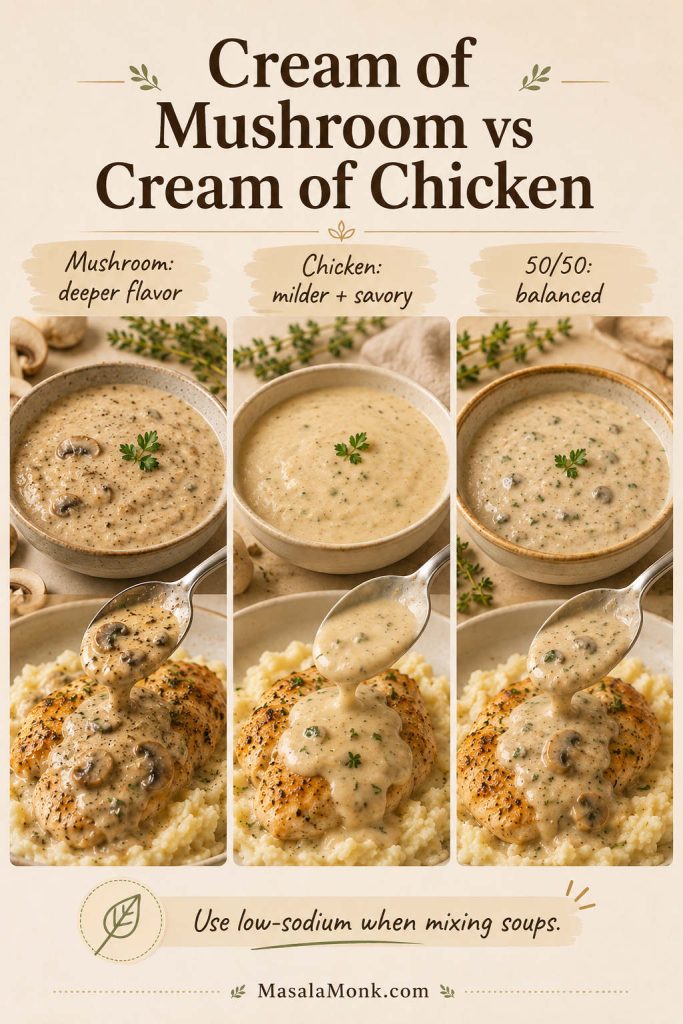
You can mix cream of chicken and cream of mushroom soup. Cream of chicken makes the sauce milder and more savory, while cream of mushroom adds deeper mushroom flavor. A 50/50 mix works especially well for larger bakes, chicken and rice, and slow cooker meals.

For a bigger casserole or crockpot dinner, try 1 can cream of mushroom soup and 1 can cream of chicken soup. Low-sodium versions are the safest choice because two condensed soups can make the dish salty fast.

Comparison of cream of mushroom soup, cream of chicken soup, and a 50 50 blend spooned over chicken.
Cream of mushroom brings deeper flavor, cream of chicken tastes milder, and a 50/50 blend gives a softer creamy sauce.

This same cream-soup swap logic also shows up in comfort casseroles like MasalaMonk’s green bean casserole recipe ideas, where condensed cream soup is part of the classic creamy base.

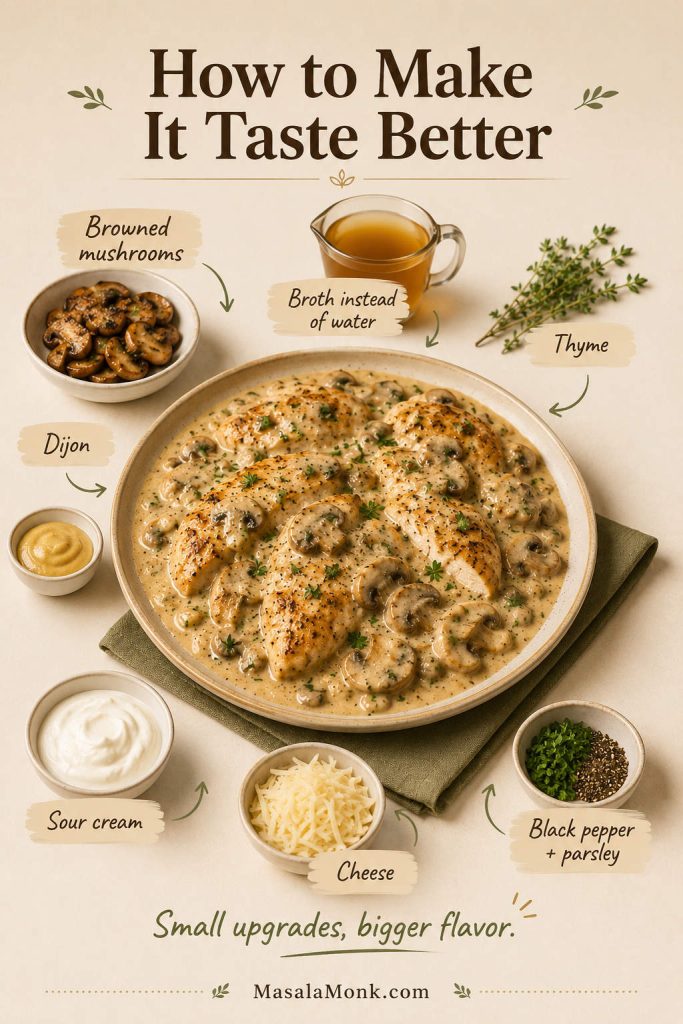
How to Make Cream of Mushroom Chicken Taste Better

The shortcut works as-is, but one or two small upgrades can make it taste more like a creamy mushroom dinner than plain canned soup.

The easiest upgrades are browned mushrooms for depth, broth for savoriness, and a small spoon of Dijon or thyme for balance.

Flavor upgrade board for cream of mushroom chicken with browned mushrooms, broth, thyme, Dijon, sour cream, cheese, pepper, and parsley.
Small upgrades like browned mushrooms, broth, Dijon, thyme, sour cream, cheese, pepper, and parsley make the shortcut taste more complete.

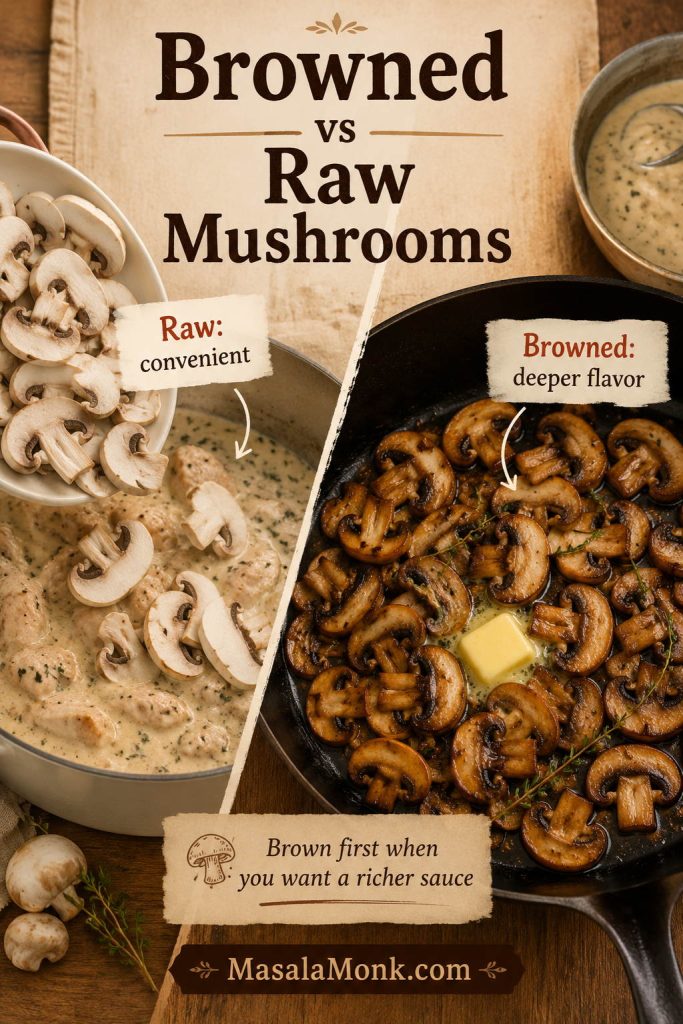
Browned vs Raw Mushrooms

Raw mushrooms can go straight into the dish, but browning them first gives the sauce more flavor and reduces the extra moisture that can loosen the pan.

Comparison of raw sliced mushrooms and browned mushrooms for cream of mushroom chicken.
Raw mushrooms keep prep easy; meanwhile, browned mushrooms add deeper flavor and reduce extra moisture in the sauce.
  • Brown fresh mushrooms first: This adds real mushroom flavor, cooks off extra moisture, and gives the sauce a deeper base.
  • Choose broth instead of water: Low-sodium chicken broth gives the dish more savory depth.
  • Add garlic and onion powder: These make the pantry version taste fuller.
  • Add thyme: Thyme works naturally with mushrooms and chicken.
  • Stir in a small spoon of Dijon: It cuts through the richness without making the dish taste mustardy.
  • Finish with sour cream: It gives the sauce a tangier, creamier finish. In skillet and slow cooker versions, add it near the end over gentle heat.
  • Melt cheese on top: Mozzarella, Monterey Jack, cheddar, Swiss, or Muenster can turn this into a cheesy baked chicken dinner.
  • Add black pepper and parsley at the end: This keeps the final plate from tasting too heavy.

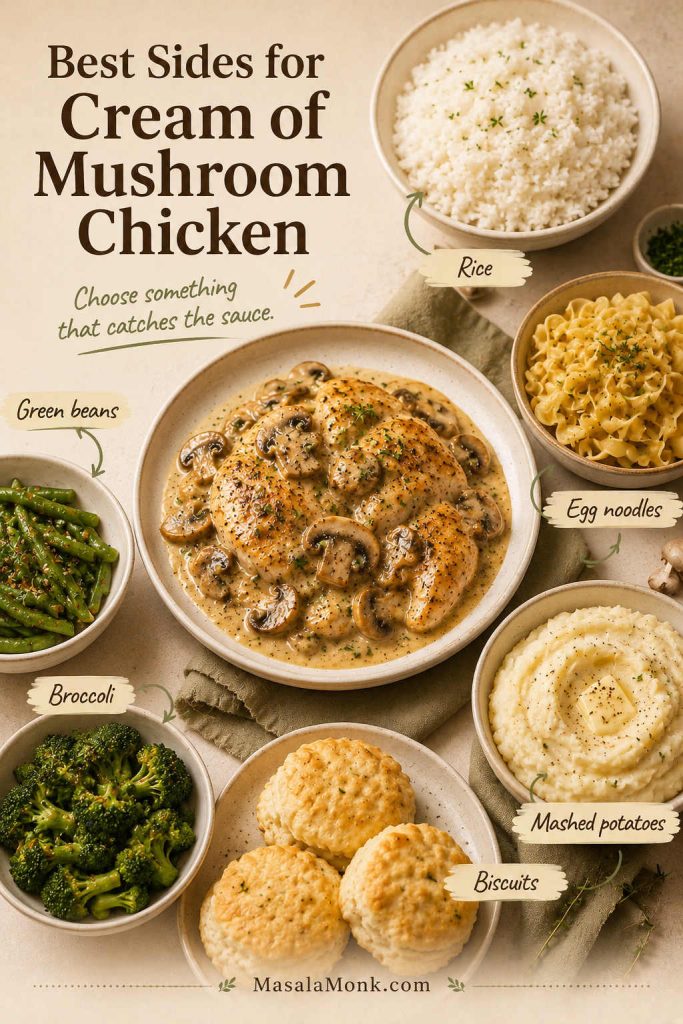
What to Serve with Cream of Mushroom Chicken

The sauce is the point, so serve it with something that catches every spoonful: fluffy rice, buttered egg noodles, mashed potatoes, biscuits, broccoli, or green beans.

Side dish guide for cream of mushroom chicken with rice, egg noodles, mashed potatoes, biscuits, broccoli, and green beans.
The best sides give the sauce somewhere to go, whether you choose rice, egg noodles, mashed potatoes, biscuits, broccoli, or green beans.

Over Rice

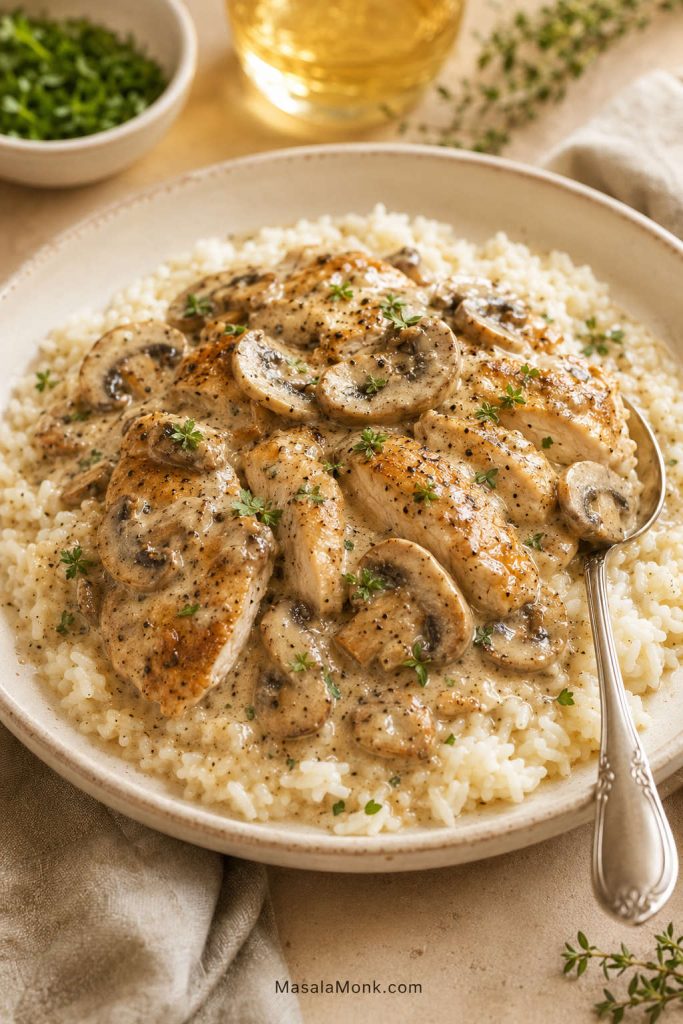
Plain white rice is the easiest pairing. Brown rice, leftover rice, or seasoned rice also work, but keep them separate unless you are following a true chicken-and-rice bake formula.

Cream of mushroom chicken served over fluffy white rice with sliced mushrooms, creamy sauce, black pepper, and herbs.
Rice keeps this creamy chicken dinner simple, filling, and easy to serve on a busy weeknight.

Over Egg Noodles

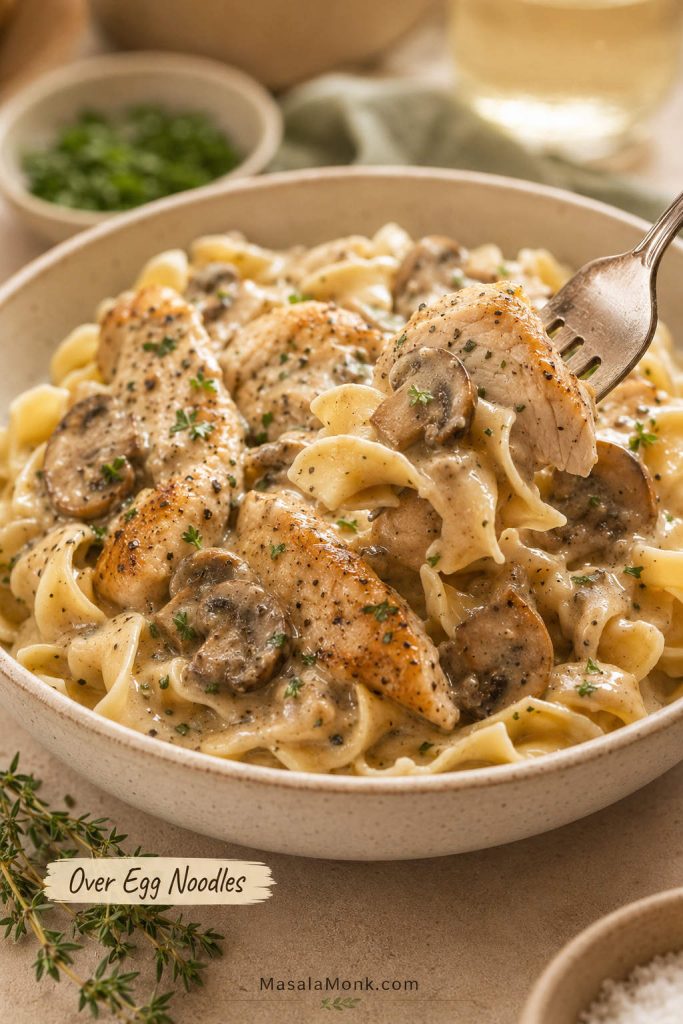
Egg noodles make this feel like old-school chicken and gravy. Cook the noodles separately, then spoon the chicken and mushroom sauce over the top. Dry egg noodles should not go into the baking dish unless you are using a tested noodle-casserole formula.

Cream of mushroom chicken served over broad egg noodles with creamy mushroom sauce, chicken pieces, herbs, and a fork lifting a bite.
Broad egg noodles hold the mushroom sauce in their folds, so this version feels cozy without needing extra prep.

Over Mashed Potatoes

Mashed potatoes make the plate even cozier. If you want a creamy potato side that will hold the sauce without turning gluey, try MasalaMonk’s garlic mashed potatoes recipe.

Sliced cream of mushroom chicken served over mashed potatoes with mushrooms, creamy sauce, black pepper, and herbs.
Mashed potatoes make the richest plate because the soft potatoes hold the creamy mushroom sauce instead of letting it run.

With Vegetables

Green beans, broccoli, peas, carrots, roasted mushrooms, or a simple salad balance the richness. For a holiday-style comfort plate, serve it with green bean casserole, roasted vegetables, or a crisp side salad.

For a bigger comfort-food spread, MasalaMonk’s hashbrown casserole recipe also works as a creamy potato side, especially when the chicken is served with green beans or salad. Planning leftovers? The storage and reheating tips explain how to loosen the sauce again without drying out the chicken.

How to Fix Cream of Mushroom Chicken

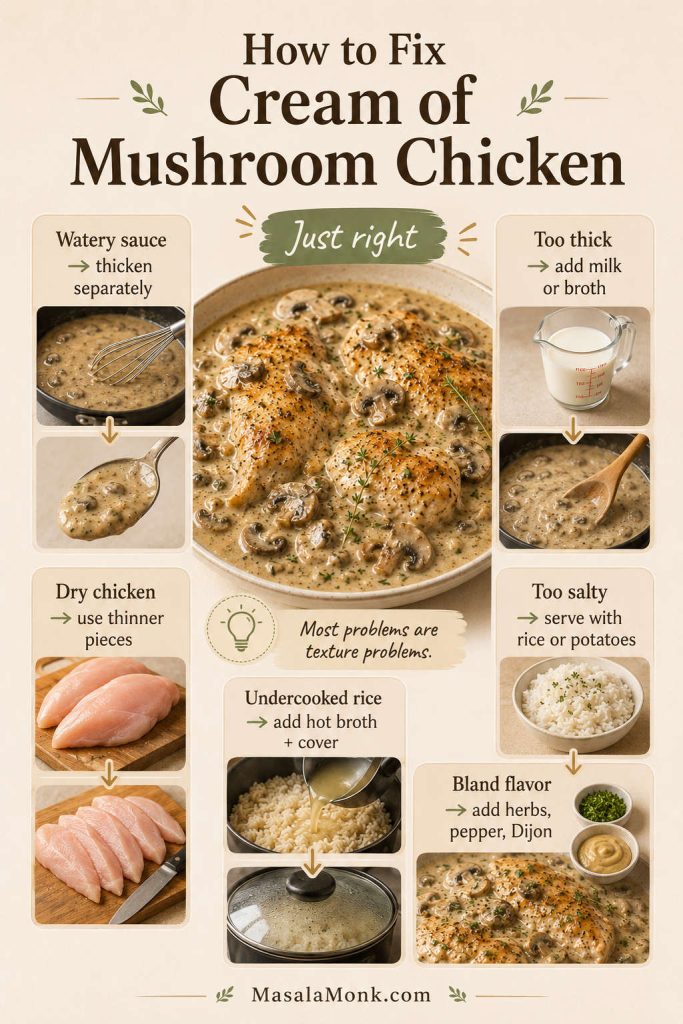
Even when this dish goes a little sideways, it is usually fixable. Most problems are texture problems: the sauce is too thick, too watery, or too salty, while the chicken dries out because the pieces were too thick or cooked too long.

The usual culprits are ready-to-eat soup instead of condensed soup, too much liquid, a loose cover on rice, or thick chicken breasts that needed more time than the sauce did.

Common Sauce, Chicken, and Rice Fixes

Problem What Happened How to Fix It
Sauce is too thick or gluey Not enough liquid was added to the condensed soup. Add milk or broth 1–2 tbsp at a time until it is spoonable.
Sauce is watery Too much liquid was added, ready-to-eat soup was used, or raw mushrooms released extra moisture. When the chicken still needs time, bake uncovered 5–10 minutes. When the chicken is already done, remove it and thicken the sauce separately with a small slurry: 1 tsp cornstarch mixed with 1 tbsp cold water.
Sauce is too salty Condensed soup, broth, cheese, or onion soup mix added too much salt. Serve with rice, noodles, or potatoes to soften the saltiness. A spoonful of sour cream can also mellow the sauce. Next time, use low-sodium soup and broth.
Chicken is dry The pieces were too thick, uncovered too long, or cooked past 165°F / 74°C. Slice breasts thinner, cover while baking, check early, or use thighs.
Chicken is done but sauce is thin The sauce needs more time, but the chicken does not. Remove the chicken, cover it loosely, and thicken the sauce separately in a small pan.
Rice is undercooked The dish needed more steam, liquid, or time. Add ¼–½ cup hot broth, cover tightly again, and bake longer.
Rice is mushy Too much liquid or too much bake time. Use long-grain white rice, measure carefully, and rest the dish instead of overbaking.
Dish tastes bland The sauce was not boosted with enough seasoning or fresh ingredients. Add black pepper, garlic powder, onion powder, thyme, paprika, Dijon, or browned mushrooms.
Sauce splits when reheated It was reheated too aggressively. Reheat gently with a splash of milk or broth and stir slowly.
Troubleshooting guide for cream of mushroom chicken showing fixes for watery sauce, thick sauce, salty sauce, dry chicken, undercooked rice, and bland flavor.
Most cream of mushroom chicken problems are fixable once you know whether the issue is texture, salt, timing, or seasoning.

Storage, Freezing and Reheating

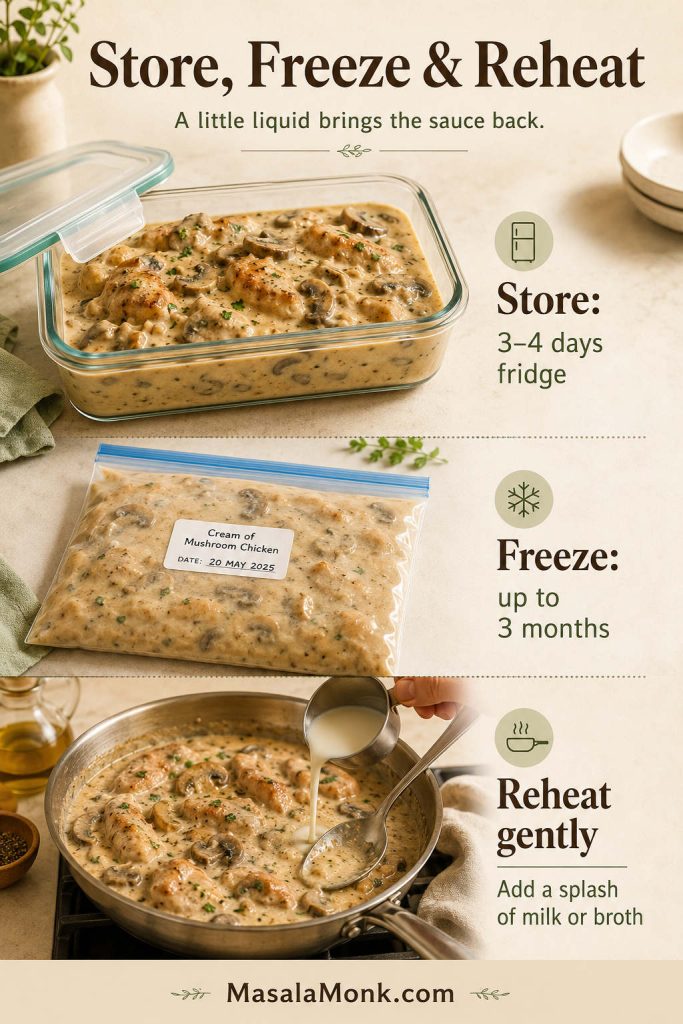
Store leftovers in an airtight container in the refrigerator for 3–4 days. Rice or noodles are best stored separately when possible so they do not soak up all the sauce.

To reheat, warm the chicken gently on the stovetop or in the microwave with a splash of milk or broth. The sauce thickens as it chills, so that splash of liquid helps bring it back to a spoonable texture.

You can freeze the cooked chicken and sauce, but the sauce may loosen or look slightly grainy after thawing. It is still usable; reheat gently and whisk in a splash of milk or broth to bring it back together.

Chicken-and-rice leftovers thicken more in the fridge because the rice keeps absorbing the sauce. Reheat them with a splash of broth or milk so the rice loosens instead of turning dry.

Storage guide for cream of mushroom chicken showing a fridge container, freezer bag, and reheating in a skillet with milk or broth.
Creamy leftovers thicken in the fridge, so reheat gently and add a splash of milk or broth to bring the sauce back.

Cream of Mushroom Chicken FAQs

How long should cream of mushroom chicken bake?

Thin boneless chicken breasts or thighs usually need about 25 minutes covered at 375°F / 190°C, then 5–10 minutes uncovered. Thickness matters more than the clock, so check that the chicken reaches 165°F / 74°C.

Covered or uncovered?

Cover the dish first so the chicken stays moist and the sauce does not dry out. Uncover near the end when the sauce needs to thicken or cheese is going on top.

Campbell’s soup vs other condensed brands

A standard 10.5 oz / 298 g can of Campbell’s condensed cream of mushroom soup works well, but other condensed brands work too. The important detail is that the soup is condensed, not ready-to-eat.

Chicken breasts vs thighs

Boneless skinless thighs are the more forgiving choice because they stay juicy even when the dish needs a few extra minutes. Breasts work well too, but they should be thin and even before baking.

How much liquid should I add to condensed soup?

For baked chicken, ½ cup / 120 ml milk or low-sodium broth per 10.5 oz / 298 g can makes a creamy sauce. Skillet chicken can take ½–1 cup / 120–240 ml because the pan sauce reduces as it simmers.

How to make it on the stove

The stovetop version works best with thin pieces because they cook quickly and stay tender. Sear them first, then simmer gently in the mushroom sauce until they reach 165°F / 74°C. A few uncovered minutes will tighten a loose pan sauce.

Homemade mushroom sauce instead of canned soup

This becomes a different style of recipe, but it can work. For a quick homemade mushroom cream sauce, start with 2 tbsp butter, 8 oz mushrooms, 1 minced garlic clove, 2 tbsp flour, 1 cup broth, and ½ cup milk or cream, then cook the chicken in that sauce. For the classic shortcut flavor, use condensed soup.

Adding rice safely

Rice can work beautifully, but treat it like its own bake, not a last-minute add-in. It needs extra liquid, trapped steam, and more time than the basic chicken version. Start with 1 can condensed soup, 1 cup / 240 ml water or broth, ¾ cup / about 140 g long-grain white rice, and about 1¼ lb / 565 g chicken.

Should you use frozen chicken?

Thawed chicken is the safer bet here because it cooks more evenly and keeps the sauce from turning watery. Frozen chicken can release a lot of moisture, especially in the oven or skillet, so thaw it first when you can.

Why the sauce turns watery

Watery sauce usually comes from too much liquid, ready-to-eat soup instead of condensed soup, raw mushrooms releasing moisture, or keeping the dish covered for the whole bake. Once the chicken is done, remove it and thicken the sauce separately with a small slurry made from 1 tsp cornstarch and 1 tbsp cold water.

Fixing a salty sauce

Condensed soup is already salty, and broth, cheese, or onion soup mix can add even more. Rice, noodles, or potatoes help soften the saltiness on the plate. A spoonful of sour cream can also mellow the sauce.

Best sides for creamy mushroom chicken

Rice, egg noodles, mashed potatoes, biscuits, broccoli, green beans, peas, carrots, and roasted mushrooms all work. The best side is something that catches the creamy mushroom sauce.

Slow cooker ratio

In the slow cooker, use less liquid than you might expect because the lid traps moisture. For 1½–2 lb / 680–900 g chicken, use 2 cans condensed cream of mushroom soup and about ½ cup / 120 ml broth or water. Cook on High for 3–4 hours or Low for 6–7 hours, until the chicken reaches 165°F / 74°C.

Final Thoughts

Start with the oven version first. Once you understand the soup-to-liquid ratio, the recipe bends to the night: faster in a skillet, easier in the slow cooker, or heartier with rice.

However you make it, the goal stays the same: juicy chicken, creamy mushroom gravy, and a dinner that asks very little from you but still feels like someone cared.

Back to top

Posted on 6 Comments

Chicken Adobo — Step-by-Step Recipe — Classic Filipino Adobong Manok

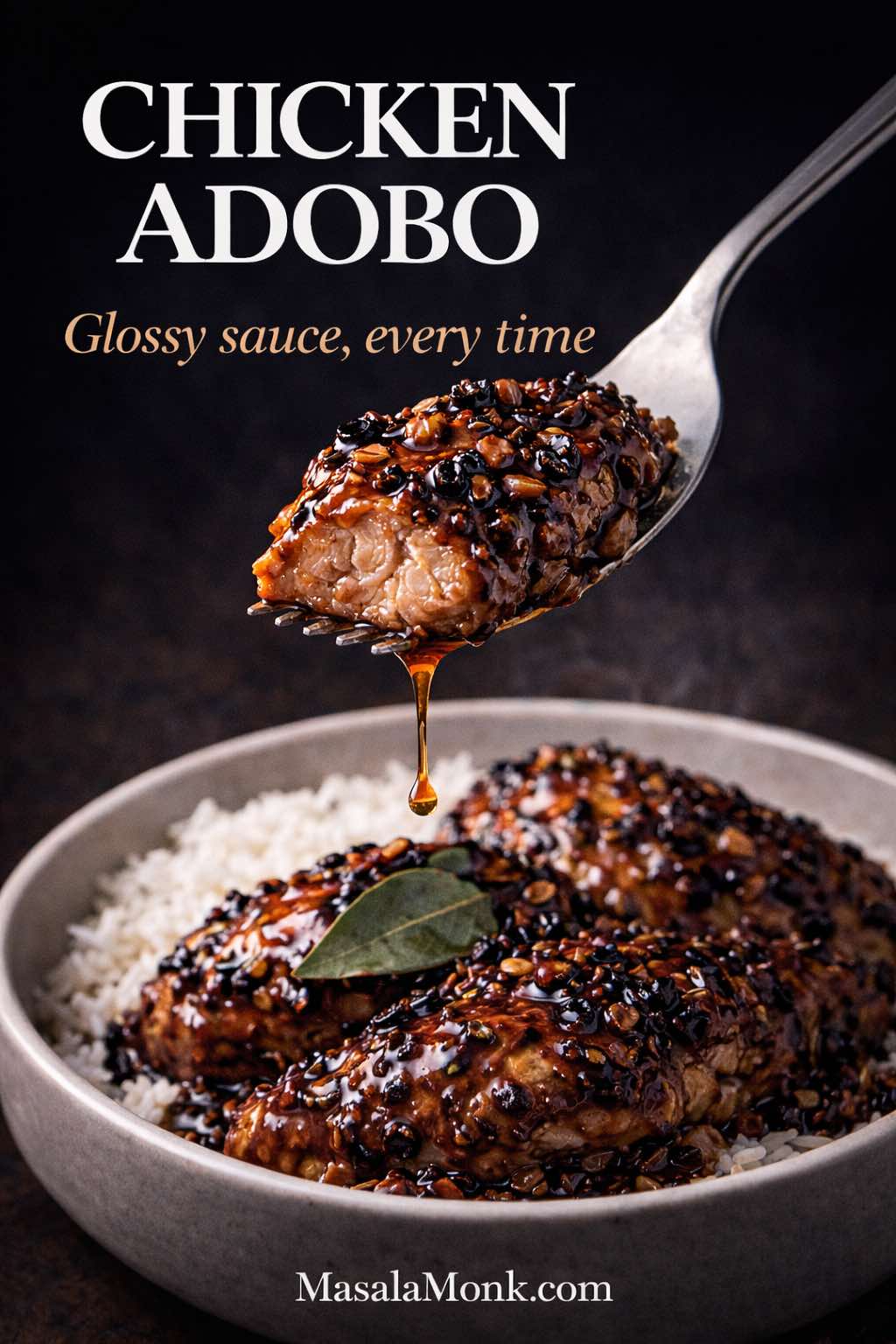
A close-up fork lifts a juicy bite of chicken adobo over a bowl of rice, with a thick glossy soy-vinegar sauce dripping from the bite. The chicken is coated in dark caramelized sauce with visible garlic bits and peppercorns against a moody black background, with the text “Chicken Adobo” and “Glossy sauce, every time” plus MasalaMonk.com at the bottom.

This chicken adobo recipe is the kind of dinner that feels like it’s doing you a favor: rich, tangy, and deeply savory, yet built from pantry staples and one dependable method. Even when the day has been long, you can still end up with tender chicken in a glossy adobo sauce that tastes like it took far more effort than it did.

What makes Filipino chicken adobo so beloved is the balance. Vinegar keeps everything bright. Soy sauce brings depth and color. Garlic turns sweet and mellow as it simmers, while bay leaves and peppercorns give that unmistakable “adobo” perfume. Then, right at the end, the sauce is reduced until it clings—so each bite carries the full flavor instead of leaving it behind in the pot.
Just as importantly, once you learn the rhythm of this chicken adobo recipe—sear, simmer, reduce—you can adjust it without stress. You can make it saucier or drier, sweeter or sharper, with potato for a one-pot feel, or with coconut milk for a creamy finish. For now, though, we’ll start with a classic chicken adobo recipe that’s clear, measured, and reliable, with enough detail that you’ll cook it confidently the first time.

Also Read: Sweetened Condensed Milk Fudge: 10 Easy Recipes


Chicken Adobo Recipe Ingredients and Measurements (Adobo Sangkap)

A traditional adobo recipe can look slightly different from home to home, yet the core stays recognizable. Think of these ingredients as the backbone of an adobong manok recipe that tastes right whether you’re cooking for yourself or feeding a table.

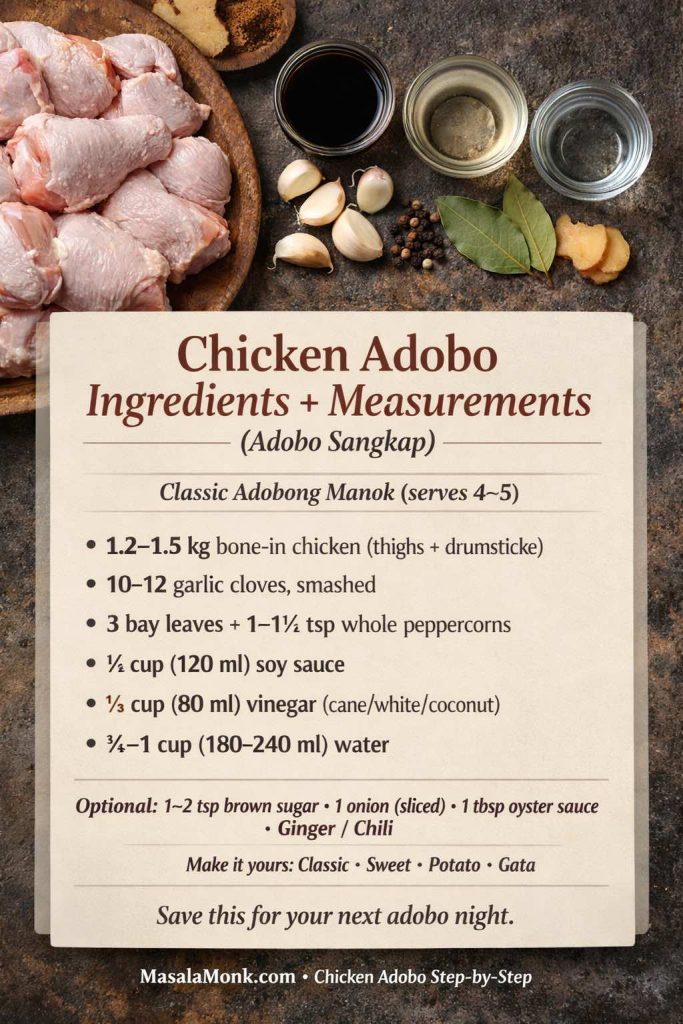
Overhead flatlay of chicken adobo ingredients on a dark surface: raw bone-in chicken, soy sauce, vinegar, water, smashed garlic, bay leaves, peppercorns, and ginger. Text overlay reads “Chicken Adobo Ingredients + Measurements (Adobo Sangkap)” with quantities for classic adobong manok (serves 4–5), including soy sauce, vinegar, water, garlic, bay leaves, and peppercorns, plus optional sugar, onion, oyster sauce, and chili.
The easiest way to make classic chicken adobo taste “right” is getting the base ratios nailed before you even turn on the stove. This quick Adobo Sangkap card is your cook-along checklist for adobong manok—chicken, garlic, bay, peppercorns, plus the soy–vinegar–water balance that becomes that glossy adobo sauce after reduction. Save it for your next grocery run, and when you’re ready, follow the full step-by-step method here, in this blog post.

Chicken adobo recipe ingredients list (for classic adobong manok)

Chicken

  • 1.2 to 1.5 kg chicken, preferably bone-in thighs and drumsticks (skin-on optional)

For browning

  • 1 tbsp neutral oil (canola, sunflower, rice bran)

For the adobo braise

  • 10–12 cloves garlic, smashed (keep them chunky, not minced)
  • 3 bay leaves
  • 1 to 1½ tsp whole black peppercorns (or ¾ tsp coarsely cracked pepper)
  • ½ cup (120 ml) soy sauce
  • ⅓ cup (80 ml) vinegar (cane vinegar is classic; white vinegar works; coconut vinegar is lovely)
  • ¾ to 1 cup (180–240 ml) water

Optional, depending on the style

  • 1–2 tsp brown sugar (for sweet chicken adobo)
  • 1 small onion, sliced (softens the sauce and adds gentle sweetness)
  • 1 tbsp oyster sauce (extra depth; use carefully because it adds salt)
  • 1-inch knob ginger (luya), sliced (clean warmth)
  • 1–2 small chilies, whole (warmth without turning the whole pot fiery)

If you ever find yourself wondering why your soy sauce tastes saltier than expected—or why one bottle makes the sauce darker and another stays lighter—this MasalaMonk guide makes the basics easy to understand: Soy Sauce Saga: Are You Drizzling, Dipping, and Cooking Right?.

Choosing the chicken for this chicken adobo recipe

Bone-in thighs and drumsticks are the most forgiving cut for Filipino style adobo. They stay juicy, they tolerate simmering without drying out, and they contribute richness to the sauce as they cook. In contrast, chicken breast can work, though it needs gentler timing and a slightly different finish so it stays tender.

Infographic showing the best chicken cuts for chicken adobo on a wooden board: thighs, drumsticks, wings, and chicken breast, each labeled with a short tip. Thighs are noted as juiciest and most forgiving, drumsticks as classic with great glaze, wings as fastest for a sticky “tuyo” finish, and breast as workable if pulled early and glazed at the end. Bay leaves, peppercorns, and garlic appear as adobo aromatics, with MasalaMonk.com in the footer.
Not all cuts cook the same in Filipino chicken adobo—and choosing the right one is the easiest way to guarantee tender meat and a glossy adobo sauce. Use thighs for the juiciest, most forgiving result, drumsticks for a classic adobong manok feel, wings for a faster sticky “tuyo” finish, or breast if you pull it early and glaze at the end. Save this cut guide for your next adobo night, then follow the full step-by-step recipe in this post.

Wings are another great option if you love sticky, glossy adobo. Because they’re smaller, they cook faster, and they glaze beautifully when you reduce the sauce into an adobong manok na tuyo style finish.

Vinegar and soy sauce: how the balance actually works

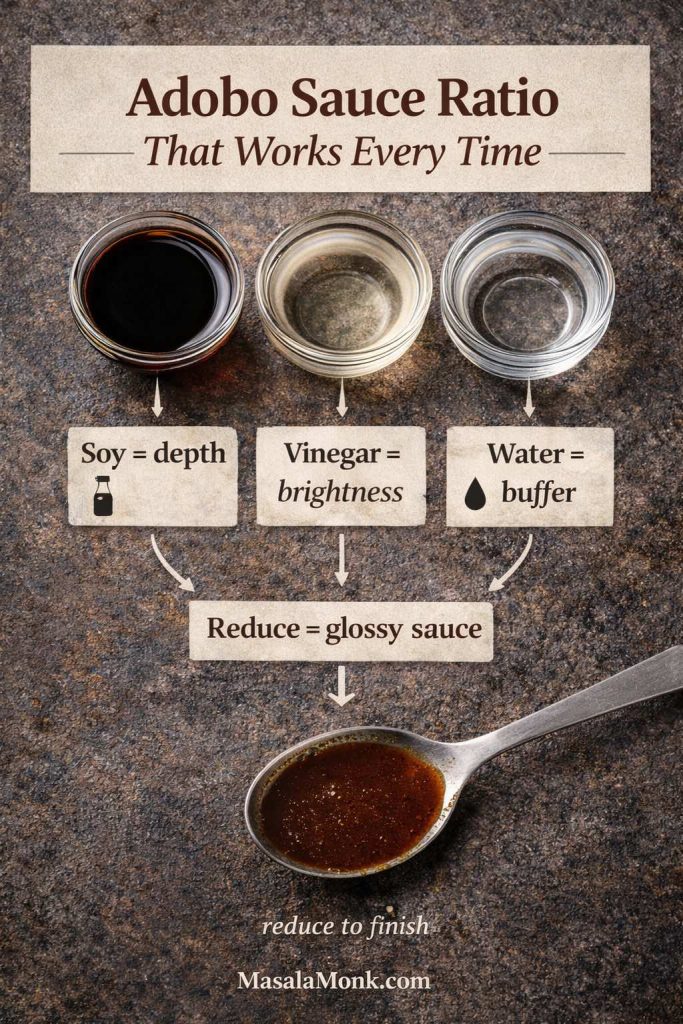
Vinegar is the brightness. Soy sauce is the depth. Water is the buffer that prevents the dish from feeling aggressively salty or sharply sour before reduction brings everything together.

Cane vinegar is often used in classic Filipino chicken adobo because it’s bright yet not harsh. White vinegar works too—especially if you like a crisp tang—although you may want to start with the lower end of the water range (or add vinegar gradually near the end) so the sharpness doesn’t dominate early.

Infographic explaining Filipino adobo sauce balance on a dark stone surface: three small bowls show soy sauce, vinegar, and water labeled “Soy = depth,” “Vinegar = brightness,” and “Water = buffer.” Arrows point to “Reduce = glossy sauce,” with a spoon holding shiny reduced adobo sauce at the bottom. Text reads “Adobo Sauce Ratio That Works Every Time” and includes MasalaMonk.com.
If your chicken adobo ever tastes too sharp, too salty, or just “not quite right,” it usually comes down to balance. This quick adobo sauce ratio guide shows what each part does—soy for depth, vinegar for brightness, water as the buffer—then the real secret: reduce at the end until the sauce turns glossy and clings to the chicken. Save this for your next adobong manok night.
Coconut vinegar, if you have it, can taste softer and rounder. As a result, it pairs especially well when you plan to add coconut milk later.

Also Read: Sourdough Recipe: 10 Easy Bread Bakes (Loaves, Rolls & Bagels)


Chicken Adobo Recipe Step by Step (Procedure in Cooking Adobo)

This is the chicken adobo recipe step by step method you can follow without guessing. You’ll build flavor with browning, tenderness with simmering, and that glossy finish with reduction.

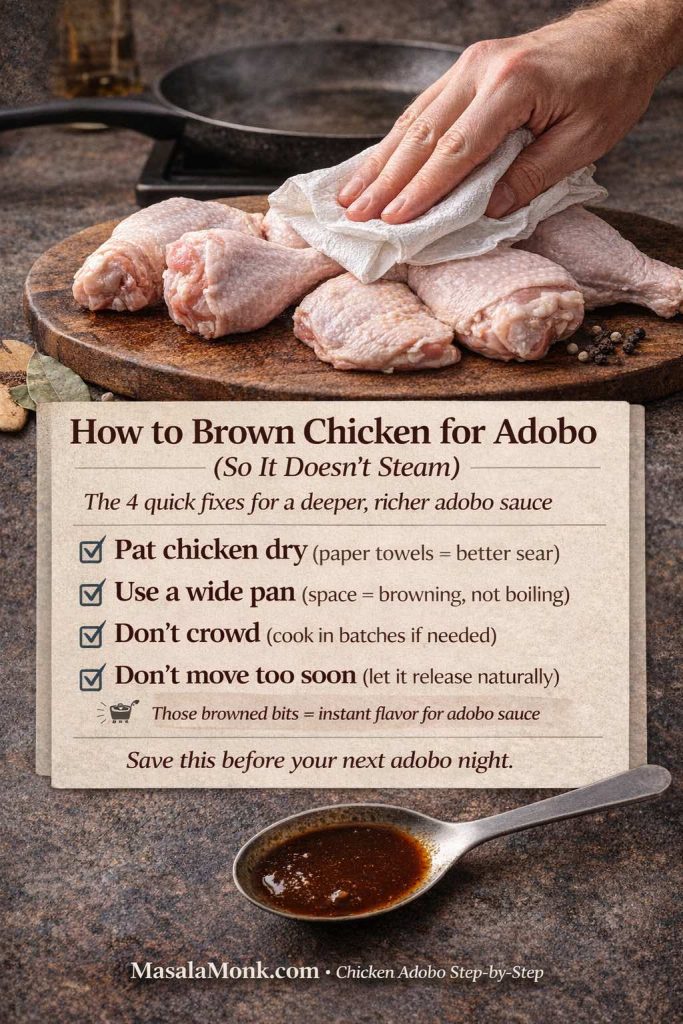
Step 1: Prep the chicken so it browns instead of steaming

Pat the chicken dry with paper towels. That small step changes everything: moisture on the surface turns into steam, and steam prevents browning. Meanwhile, check the pieces. If you’re working with large leg quarters, separate them into thighs and drumsticks so they cook evenly.

Infographic showing how to brown chicken for adobo so it doesn’t steam. Photo shows hands patting raw chicken pieces dry with a paper towel on a wooden board, with a wide pan heating in the background. Text overlay lists four tips: pat chicken dry, use a wide pan, don’t crowd (cook in batches), and don’t move too soon (let it release naturally). Note says browned bits add instant flavor for adobo sauce, with MasalaMonk.com in the footer.
Want chicken adobo with deeper flavor and a richer adobo sauce? It starts before the simmer. This quick guide shows the 4 fixes that stop chicken from steaming: pat it dry, use a wide pan, cook in batches, and leave it alone long enough to brown and release naturally. Those golden browned bits become pure flavor once you deglaze and build the braise—so your adobong manok tastes bold even with simple pantry ingredients. Save this browning checklist, then follow the full step-by-step recipe here, in this post.

At this point, avoid salting heavily. Since soy sauce already brings salt, you’ll get a better final balance by waiting until the sauce has reduced before deciding if it needs anything.

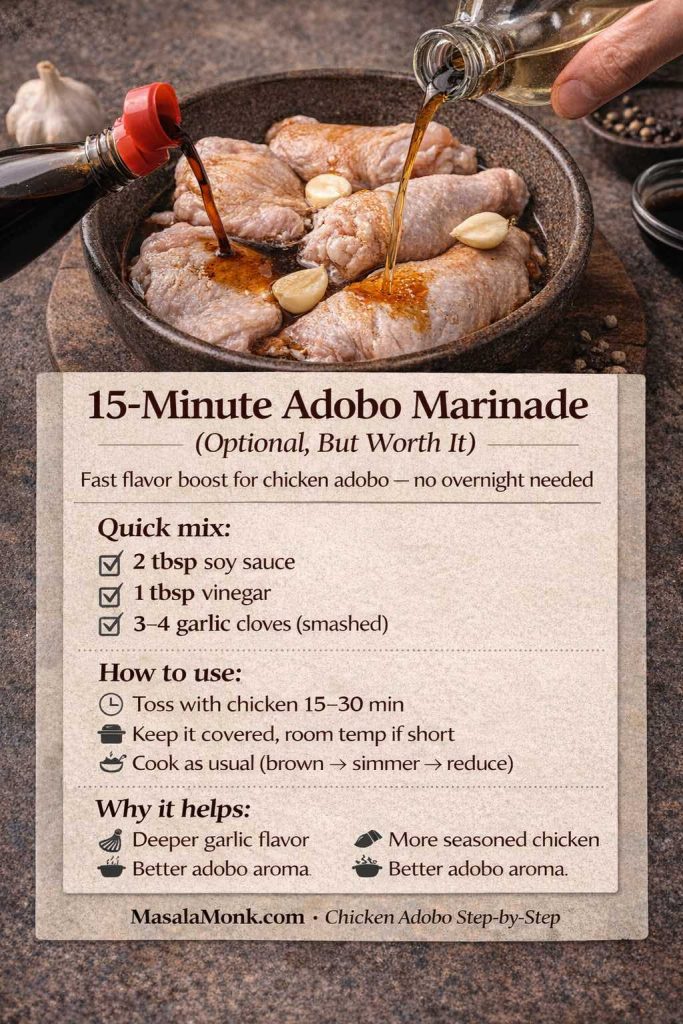
Step 2: Optional short marinade (adobo marinade recipe, simplified)

Some cooks marinate, others skip it completely. For a practical middle path, you can do a short marinade that builds flavor without turning dinner into a project.

Recipe-card infographic for a 15-minute adobo marinade for chicken adobo. Photo shows chicken pieces in a bowl with soy sauce and vinegar being poured over smashed garlic. Text overlay lists the quick mix: 2 tbsp soy sauce, 1 tbsp vinegar, 3–4 smashed garlic cloves. Instructions say to toss with chicken for 15–30 minutes, keep covered, then cook as usual (brown, simmer, reduce). MasalaMonk.com appears in the footer.
Optional but useful: a quick 15–30 minute adobo marinade (soy, vinegar, smashed garlic) deepens the garlic flavor before you brown, simmer, and reduce into glossy adobo sauce.

In a bowl, combine:

  • 2 tbsp soy sauce
  • 1 tbsp vinegar
  • 3–4 smashed garlic cloves

Toss the chicken and let it sit for 15–30 minutes while you prepare everything else. Even so, if you skip this step, the dish still works—because the braise does the real seasoning.

Step 3: Brown the chicken (build the base, not the final color)

Heat 1 tablespoon oil in a wide, heavy pan over medium-high heat. Once the oil shimmers, place chicken pieces in a single layer. Don’t crowd the pan; otherwise, the chicken releases moisture and steams.

Side-by-side infographic showing browning levels for chicken adobo. Left panel labeled “Too pale” shows chicken pieces that look steamed with little color. Right panel labeled “Right level of browning” shows chicken with golden-brown patches in the pan. Text below lists tips: golden patches (not fully dark), single layer only, brown 2–4 minutes per side then flip, and browned bits create the flavor base for adobo sauce. MasalaMonk.com appears at the bottom.
Aim for golden patches—not deep dark crust. This is the browning level that builds flavor for chicken adobo without turning the sauce bitter when you deglaze and simmer.

Let the chicken sit for a few minutes without moving it. When it’s ready, it will release easily and show golden patches. Turn and brown the other side briefly, then transfer to a plate.

You are not trying to cook it through here. Instead, you’re creating a flavor foundation that will melt into the adobo sauce later.

Step 4: Bloom the garlic, then add bay and peppercorn

Lower heat to medium. Add smashed garlic (and onion, if using). Stir for 30–60 seconds until fragrant.

Split-panel infographic about garlic for chicken adobo. Left panel labeled “Fragrant” shows lightly cooked chopped garlic in oil, pale-golden and aromatic. Right panel labeled “Bitter” shows garlic browned too dark and scorched. Text overlay reads “Garlic for Adobo: Fragrant, Not Bitter” and lists tips: lower heat after browning chicken, stir 30–60 seconds until aromatic, if it browns fast add a splash of water then aromatics, then add bay leaves and peppercorns. MasalaMonk.com is in the footer.
Keep the garlic lightly golden and aromatic—if it darkens too fast, lower the heat and add liquid sooner so your adobo sauce stays rich, not bitter.

Keep it gentle. Garlic should smell sweet and aromatic, not bitter. If it starts to brown too quickly, lower the heat and add a splash of water to calm the pan.

Next, add bay leaves and peppercorns. At this stage, the kitchen smell shifts into something instantly recognizable: warm bay, peppery lift, and garlic at the center.

Step 5: Build the braise (soy + vinegar + water)

Pour in the water first and scrape up the browned bits. Those little stuck-on pieces are concentrated flavor; they belong in the sauce, not on the pan.

Infographic titled “Deglaze for Adobo Sauce (Don’t Waste the Flavor Bits).” Photo shows water being poured into a hot pan while a wooden spoon scrapes up browned bits (fond) from the bottom. Text overlay lists steps: add water first, scrape browned bits into the liquid, then add soy sauce and vinegar, and bring to a lively simmer. MasalaMonk.com appears in the footer.
Deglazing pulls the browned bits into the pot—so the flavor you built while searing turns into the foundation of a richer, more savory adobo sauce.

Then add soy sauce and vinegar. Bring the pot to a lively simmer.

A classic habit in many kitchens is to let the vinegar simmer briefly before stirring aggressively. In practice, giving it 1–2 minutes at a simmer helps soften that raw sharpness so the final sauce tastes integrated rather than harsh.

Step 6: Simmer chicken adobo until tender

Return the chicken (and any juices on the plate) to the pot. Once it returns to a simmer, reduce heat to low, cover, and cook gently.

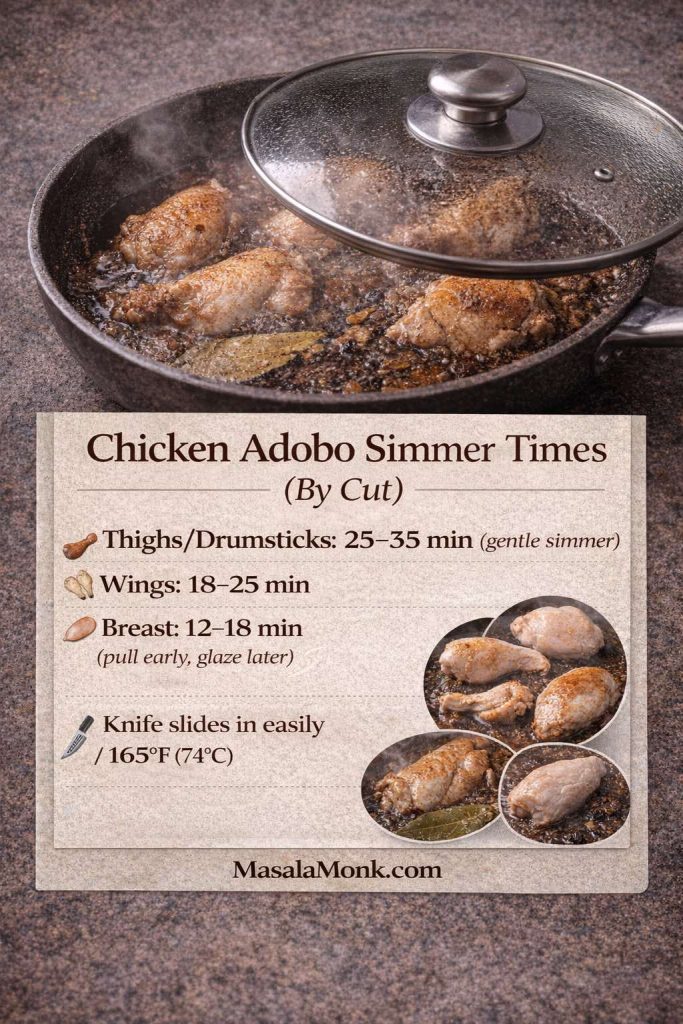
Infographic titled “Chicken Adobo Simmer Times (By Cut).” Photo shows chicken pieces gently simmering in adobo sauce in a pan with a glass lid and a bay leaf visible. Text lists cook times: thighs/drumsticks 25–35 minutes (gentle simmer), wings 18–25 minutes, and chicken breast 12–18 minutes (pull early, glaze later). A doneness cue says “Knife slides in easily / 165°F (74°C).” MasalaMonk.com appears in the footer.
Use these simmer times as your guide—then finish by reducing the sauce so it turns glossy and coats the chicken instead of staying thin.

Use these times as a guide:

  • Bone-in thighs and drumsticks: 25–35 minutes
  • Wings: 18–25 minutes
  • Chicken breast pieces: 12–18 minutes, then remove early
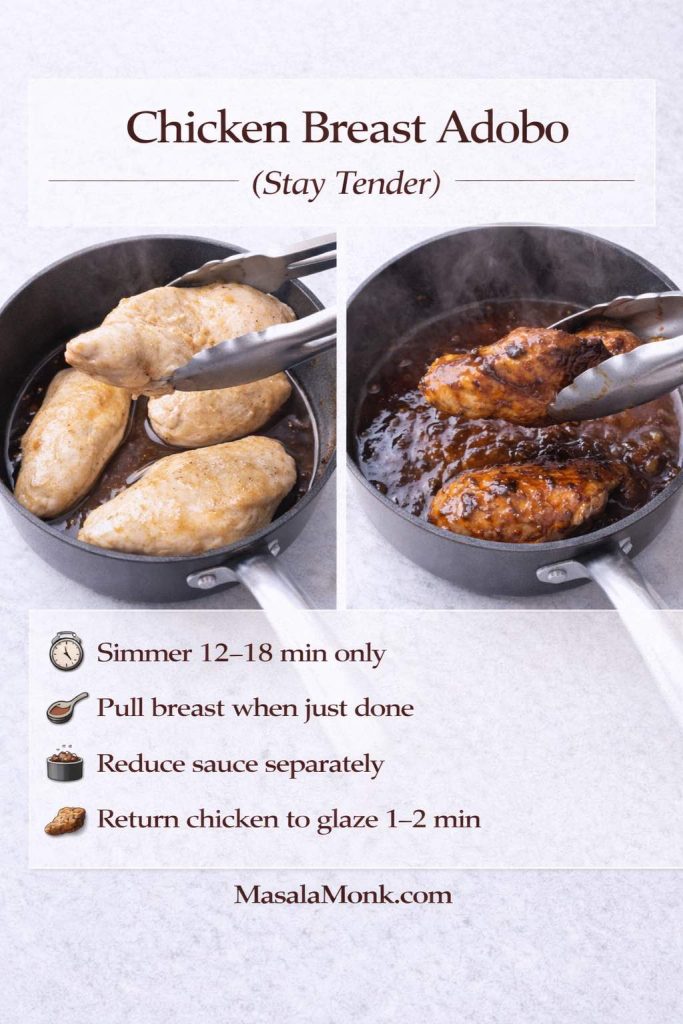
Infographic titled “Chicken Breast Adobo (Stay Tender)” with two pan photos: on the left, chicken breast pieces simmering in adobo liquid while tongs lift one out; on the right, chicken breast glazed in a thicker, glossy adobo sauce. Text tips say: simmer 12–18 minutes only, pull breast when just done, reduce sauce separately, and return chicken to glaze for 1–2 minutes. MasalaMonk.com appears in the footer.
For tender chicken breast adobo, simmer briefly, pull the breast as soon as it’s done, then reduce the sauce separately and return the chicken for a quick 1–2 minute glaze.

If you’re using chicken breast, don’t try to “force” tenderness by cooking longer. Instead, pull it when it’s just done, then finish reducing the sauce separately and return the chicken briefly to glaze.

If you prefer certainty, chicken is considered safely cooked at 165°F / 74°C. (Food Safety and Inspection Service)

Step 7: Reduce the sauce into glossy adobo sauce (classic or “tuyo”)

Once the chicken is tender, remove the lid. Raise heat to medium and simmer uncovered.

At first the liquid looks thin, almost broth-like. However, as it reduces, it becomes shiny and sauce-like. Turn the chicken once or twice so it glazes evenly, and stir occasionally so nothing sticks.

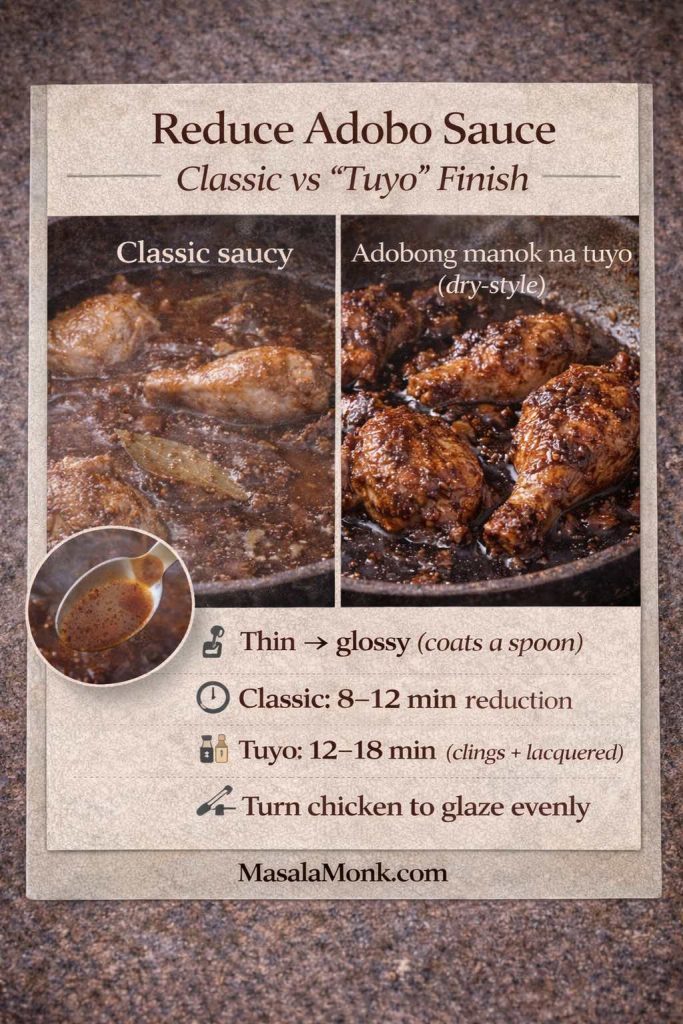
Split comparison infographic titled “Reduce Adobo Sauce: Classic vs ‘Tuyo’ Finish.” Left panel shows chicken simmering in a thinner, saucy adobo with bay leaves, labeled “Classic saucy.” Right panel shows adobong manok na tuyo (dry-style) with chicken coated in thick, lacquered sauce. A spoon inset shows sauce coating. Text notes: thin to glossy (coats a spoon), classic reduction 8–12 minutes, tuyo 12–18 minutes (clings and lacquered), and to turn chicken to glaze evenly. MasalaMonk.com appears in the footer.
Reduce the braising liquid until it turns glossy and coats a spoon—stop earlier for a saucier chicken adobo, or go longer for adobong manok na tuyo with a sticky, lacquered glaze.
  • For a classic saucy finish, reduce 8–12 minutes until the sauce coats the back of a spoon.
  • For adobong manok na tuyo (drier finish), reduce longer—12–18 minutes—until the sauce clings tightly and looks lacquered.
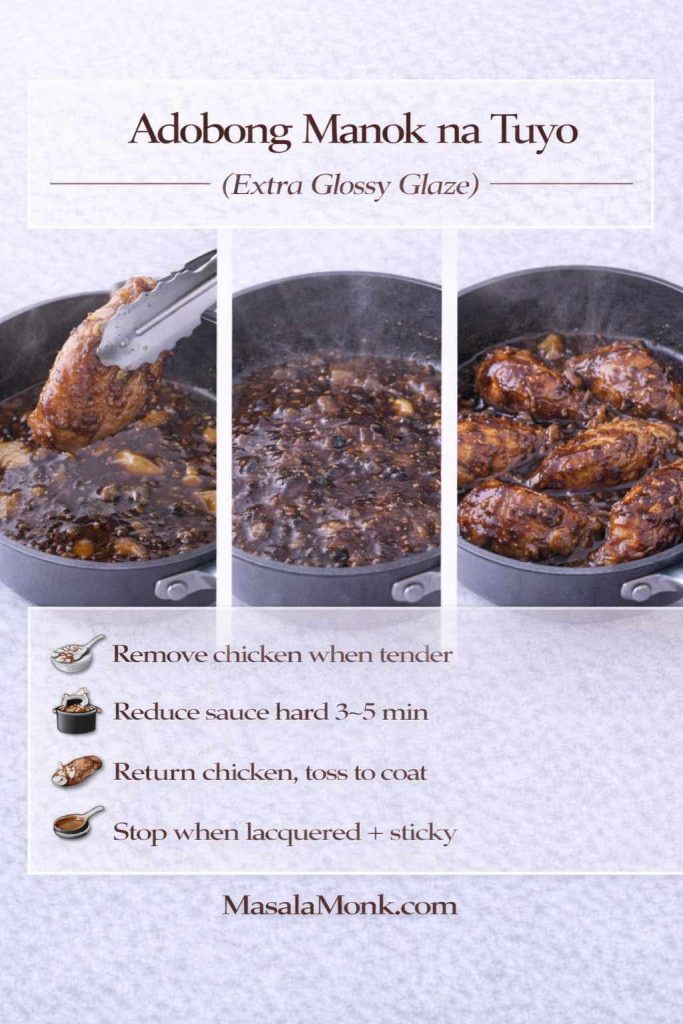
Three-panel instructional infographic titled “Adobong Manok na Tuyo (Extra Glossy Glaze).” Panel 1 shows chicken being lifted from the pan with tongs while the sauce simmers. Panel 2 shows the adobo sauce reducing vigorously in the pan. Panel 3 shows chicken returned to the pan and coated in a thick, lacquered, sticky glaze. Text steps read: remove chicken when tender, reduce sauce hard 3–5 minutes, return chicken and toss to coat, stop when lacquered + sticky. MasalaMonk.com is in the footer.
For extra-glossy adobong manok na tuyo, lift the chicken once it’s tender, reduce the sauce hard for a few minutes, then return the chicken and toss until it’s lacquered and sticky.

If you want sweet chicken adobo, stir in 1–2 teaspoons brown sugar during the final few minutes of reduction. Added late, it melts into the sauce and tastes rounded; added early, it can taste flat.

Step 8: Rest before serving (it really helps)

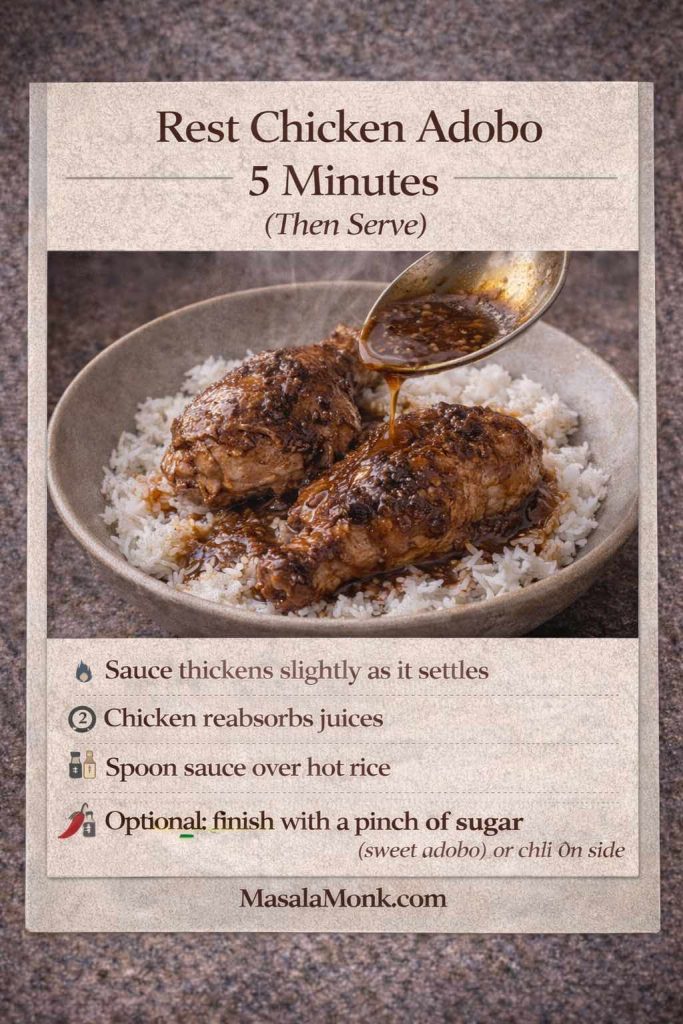
Turn off the heat and rest the chicken in the pan for about 5 minutes. During that pause, the sauce settles into its final texture, and the chicken reabsorbs juices.

Instructional card titled “Rest Chicken Adobo 5 Minutes (Then Serve).” Photo shows two pieces of chicken adobo on a bowl of white rice while a spoon pours glossy adobo sauce over the chicken. Text notes: sauce thickens slightly as it settles, chicken reabsorbs juices, spoon sauce over hot rice, and an optional finish with a pinch of sugar for sweet adobo or chili on the side. MasalaMonk.com appears in the footer.
Resting the chicken adobo for a few minutes helps the sauce settle and cling—then spoon it over hot rice so every bite gets that glossy, savory finish.

Serve hot with rice and spoon the sauce over everything.

If you want rice that behaves perfectly under a bold sauce—fluffy, not gummy—this MasalaMonk guide makes the timings easy whether you’re using stovetop, a rice cooker, or Instant Pot: How to Cook Perfect Rice (Stovetop, Cooker, Instant Pot).

Also Read: Kahlua Drinks: 10 Easy Cocktail Recipes (Milk, Vodka, Coffee)


Chicken Adobo Recipe Flavor Balance (So It Tastes “Right” Every Time)

Even a perfect method can land slightly differently depending on vinegar strength, soy sauce saltiness, chicken size, and how hard you reduce the sauce. Fortunately, this chicken adobo recipe is easy to steer back on track—especially if you make adjustments at the right moment.

Infographic titled “Fix Your Chicken Adobo (Fast Flavor Adjustments).” Photo shows chicken adobo in a pan with a spoon pouring glossy adobo sauce over the chicken. Below, three columns give quick fixes: “Too sour?” reduce longer then add a tiny pinch of sugar, or splash water and re-simmer; “Too salty?” add a splash of water, simmer uncovered, and taste again; “Too thin?” reduce uncovered, or remove chicken, reduce sauce harder, then return chicken to glaze. MasalaMonk.com is in the footer.
A quick rescue guide for chicken adobo: adjust by reducing longer for body, adding a small splash of water to soften salt or sharpness, and glazing the chicken after reducing for the richest sauce.

If the adobo tastes too sour

Before changing ingredients, reduce the sauce a little longer. Often the dish tastes overly sharp simply because there’s still too much water in the pot.

If, after reduction, it still tastes too tangy, you have a few gentle options:

  • Add a small pinch of brown sugar and simmer 1–2 minutes.
  • Add a splash of water, then simmer uncovered again to re-balance.
  • Add a spoonful of chicken fat (skin-on pieces help naturally) to soften the edges.

The goal isn’t to erase vinegar. Rather, it’s to make the tang feel woven into the sauce.

If the adobo tastes too salty

Saltiness is usually a concentration issue. Add a splash of water, simmer uncovered, and taste again. That may feel backward at first, yet it works because you’re diluting salt while still keeping flavor from the aromatics and reduction.

Next time, use a slightly less salty soy sauce, or start with a bit less soy and add it gradually near the end. If you want to understand what kind of soy sauce you’re working with, the quick breakdown in Soy Sauce Saga can save you a lot of guesswork later.

If the sauce feels thin

Keep reducing. That’s the simplest fix, and it’s usually the correct one. Meanwhile, make sure your pan is wide enough that evaporation can happen at a steady pace.

If you want an even clingier finish, you can:

  1. Remove the chicken when tender
  2. Reduce the sauce more aggressively for a few minutes
  3. Return the chicken to glaze

That approach gives you maximum shine without overcooking the meat.

If the garlic tastes bitter

Bitterness usually comes from garlic browning too hard early on. Next time, lower heat after browning chicken, stir garlic briefly, then add liquid sooner so it doesn’t scorch.

Still, if you’re already mid-cook and the garlic tastes sharp, reduction and resting often mellow it. In addition, serving with rice and something creamy on the side can soften that perception.

If the chicken feels tough

Toughness can happen if the simmer is too hard (boiling can tighten protein), or if the chicken pieces are particularly mature. If you’re using native chicken, longer gentle simmering helps, and thighs/drumsticks are far more forgiving than breast.

Instead of turning the heat up, keep it at a lazy simmer and extend the cooking time. Once the chicken is tender, proceed with the reduction as usual so the sauce still turns glossy.

Also Read: 10 Vegan Chocolate Cake Recipes (Easy, Moist, & Dairy-Free)


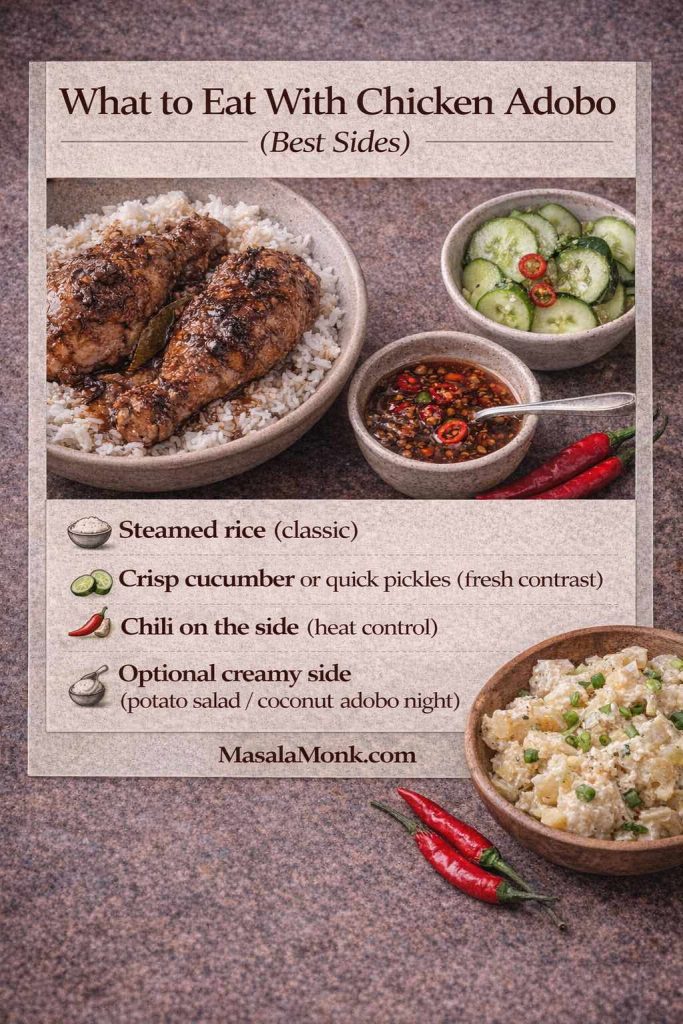
Chicken Adobo Recipe Serving Ideas (What to Eat With Adobo)

Rice is the classic partner because it absorbs adobo sauce like it was built for it. That said, the dish becomes even more satisfying when you add contrast: something crisp, something creamy, or something spicy on the side.

Infographic titled “What to Eat With Chicken Adobo (Best Sides).” Photo shows a bowl of chicken adobo on steamed white rice, with small bowls of crisp cucumber/quick pickles and chili sauce on the side, plus an optional creamy side resembling potato salad. Text suggests pairings: steamed rice (classic), crisp cucumber or quick pickles (fresh contrast), chili on the side (heat control), and an optional creamy side (potato salad/coconut adobo night). MasalaMonk.com appears in the footer.
Chicken adobo loves contrast—serve it with hot steamed rice, something crisp and tangy like cucumber or quick pickles, and chili on the side so everyone can dial in their own heat.

The rice that makes adobo feel complete

For everyday bowls, plain white rice is perfect. For a weekend feel, you can cook jasmine or basmati and let the aroma do extra work. Either way, if you want clean, fluffy grains—especially if you’re cooking rice alongside the simmer—MasalaMonk’s rice guide keeps it simple across methods: How to Cook Perfect Rice.

A creamy side that loves tangy sauce

A potato salad might not be the first thing you think of, yet it works surprisingly well. The creaminess softens the vinegar edge, while the tang makes the potatoes taste brighter.

If you want options beyond one “standard” bowl, this guide gives you several directions: Potato Salad Recipe: Classic, Russian, German, Vegan & More.

Heat on the side, not in the whole pot

One of the nicest ways to serve adobo is letting everyone control their own heat. A bright, vinegar-based chili sauce makes each bite feel sharper and more alive without changing the entire pot.

If you enjoy exploring different chili styles—from thin hot pepper vinegar to chipotle-based sauces—this MasalaMonk guide is a fun rabbit hole: Pepper Sauce Recipe | Ultimate Guide: 30+ Hot & Chili Sauces.

Also Read: Cold Brew Espresso Martini: How to Make It (Step-by-Step Recipe)


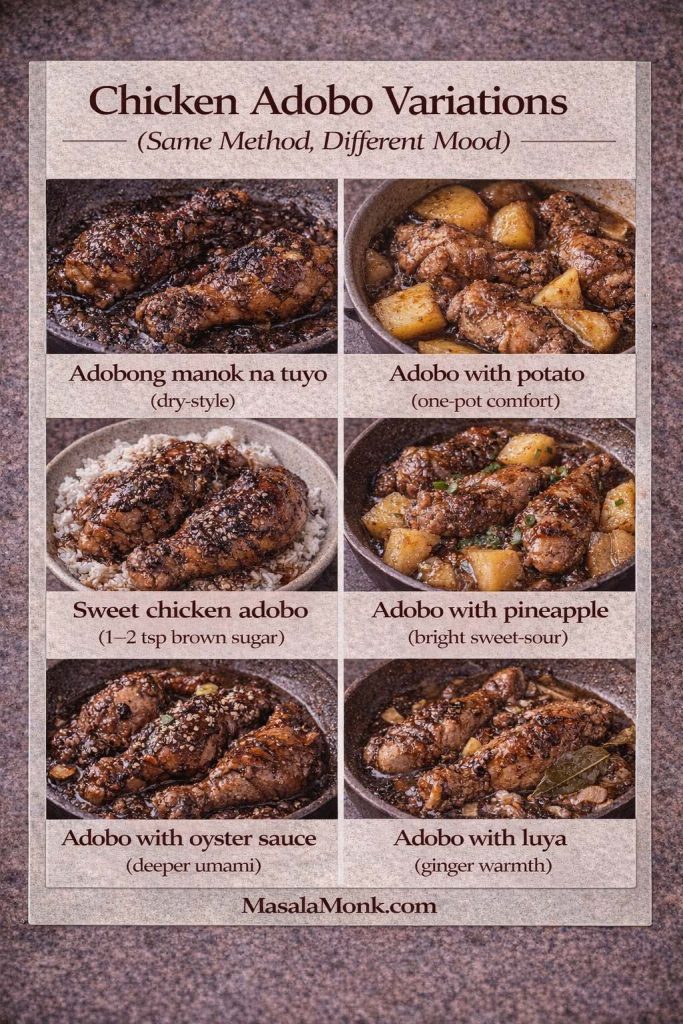
Chicken Adobo Recipe Variations (Same Method, Different Mood)

Once you’ve cooked the classic once, variations become easy because the core doesn’t change. You still brown, braise, and reduce. After that, one ingredient or one timing shift can take the dish somewhere new.

Infographic titled “Chicken Adobo Variations (Same Method, Different Mood)” showing a 2x3 grid of six Filipino chicken adobo styles. The tiles are labeled: adobong manok na tuyo (dry-style), adobo with potato (one-pot comfort), sweet chicken adobo (1–2 tsp brown sugar), adobo with pineapple (bright sweet-sour), adobo with oyster sauce (deeper umami), and adobo with luya (ginger warmth). MasalaMonk.com appears in the footer.
Once you know the classic method, chicken adobo becomes endlessly flexible—choose a dry-style tuyo finish, add potatoes, go subtly sweet, brighten with pineapple, deepen with oyster sauce, or warm it up with ginger.

Chicken adobo recipe: adobong manok na tuyo (dry-style)

If you love sticky chicken, this is the finish to aim for. Follow the classic method, then reduce longer until the sauce clings tightly and looks lacquered.

For an even more dramatic glaze, remove the chicken when it’s tender, reduce the sauce harder for a few minutes, then return the chicken and toss until it shines.

Chicken adobo recipe with potato (one-pot comfort)

Potatoes make the pot feel heartier and more generous, and they soak up sauce like sponges.

Add 2 medium potatoes, peeled and cut into chunks, right after you return chicken to simmer. Then simmer covered as usual until chicken is tender and potatoes are cooked through. Finally, reduce the sauce uncovered and let the potatoes glaze slightly at the edges.

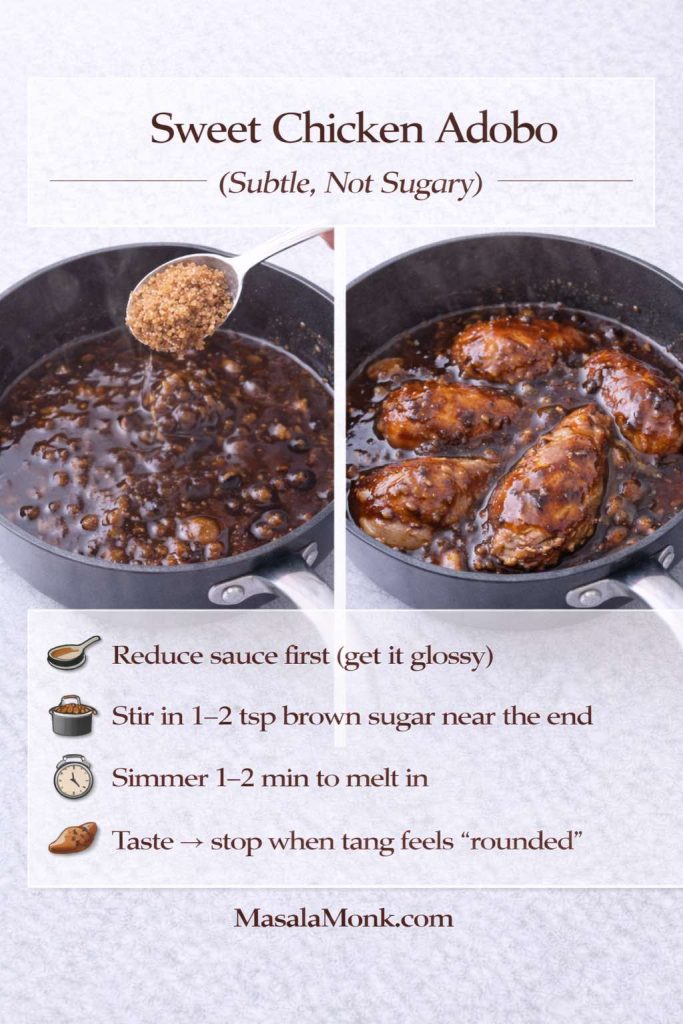
Sweet chicken adobo (subtle, not sugary)

Sweet adobo chicken is best when it’s restrained. You’re aiming to round out the tang, not turn the dish into a sticky dessert.

Two-panel infographic titled “Sweet Chicken Adobo (Subtle, Not Sugary).” Left panel shows a spoon adding brown sugar into simmering adobo sauce; right panel shows chicken pieces coated in glossy adobo glaze. Text tips say: reduce sauce first until glossy, stir in 1–2 tsp brown sugar near the end, simmer 1–2 minutes to melt in, and taste—stop when the tang feels “rounded.” MasalaMonk.com appears in the footer.
For sweet chicken adobo, reduce the sauce until glossy first, then add a small amount of brown sugar right at the end so it melts in and rounds the vinegar tang without turning the dish sugary.

Add 1–2 teaspoons brown sugar during the final reduction. That timing matters because it melts cleanly into the glossy sauce and tastes integrated.

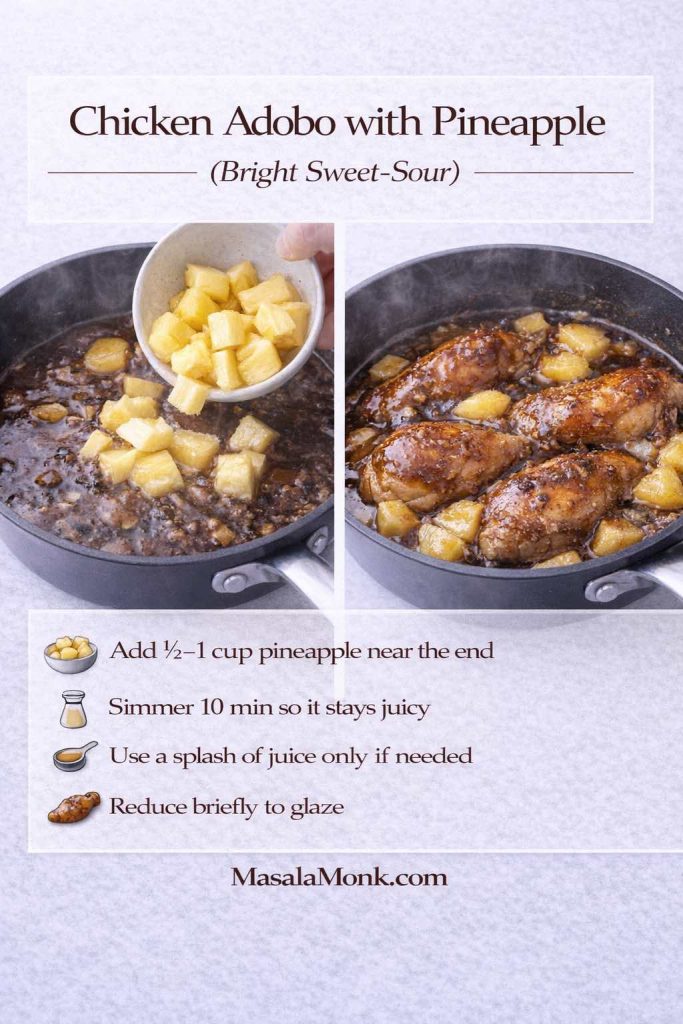
Chicken adobo with pineapple (bright sweet-sour)

Pineapple brings a playful sweetness and a tropical edge that pairs beautifully with garlic and soy.

Two-panel infographic titled “Chicken Adobo with Pineapple (Bright Sweet-Sour).” Left panel shows pineapple chunks being added to simmering chicken adobo sauce in a pan. Right panel shows finished chicken adobo pieces coated in glossy sauce with pineapple chunks. Text tips say: add ½–1 cup pineapple near the end, simmer 10 minutes so it stays juicy, use a splash of juice only if needed, and reduce briefly to glaze. MasalaMonk.com appears in the footer.
Add pineapple near the end so it stays juicy and bright—then reduce briefly to glaze, giving chicken adobo a clean sweet-sour lift without turning the sauce syrupy.

Add ½ to 1 cup pineapple chunks during the last 10 minutes of simmering, then reduce as usual. If you use canned pineapple, a small splash of juice can help, though too much can push the sauce toward syrupy, so go lightly.

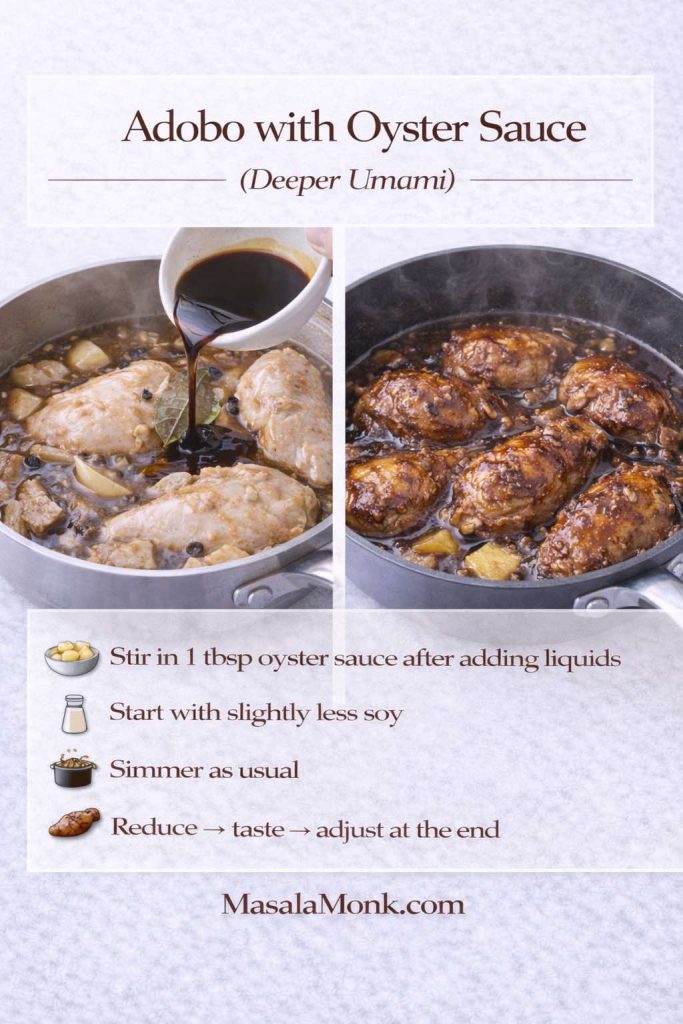
Chicken adobo with oyster sauce (deeper umami)

This is a modern variation rather than a classic, yet it can be delicious when you want extra savory depth.

Two-panel infographic titled “Adobo with Oyster Sauce (Deeper Umami).” Left panel shows oyster sauce being poured into simmering chicken adobo after the liquids are added; right panel shows finished chicken coated in glossy dark adobo sauce. Text tips say: stir in 1 tbsp oyster sauce after adding liquids, start with slightly less soy, simmer as usual, then reduce, taste, and adjust at the end. MasalaMonk.com appears in the footer.
Oyster sauce adds deeper umami to chicken adobo—stir it in after the braising liquids, start with a little less soy, then reduce and taste at the end so the sauce stays balanced, not overly salty.

Stir in 1 tablespoon oyster sauce after adding soy, vinegar, and water. Because oyster sauce adds salt, consider starting with a little less soy sauce, then adjust near the end.

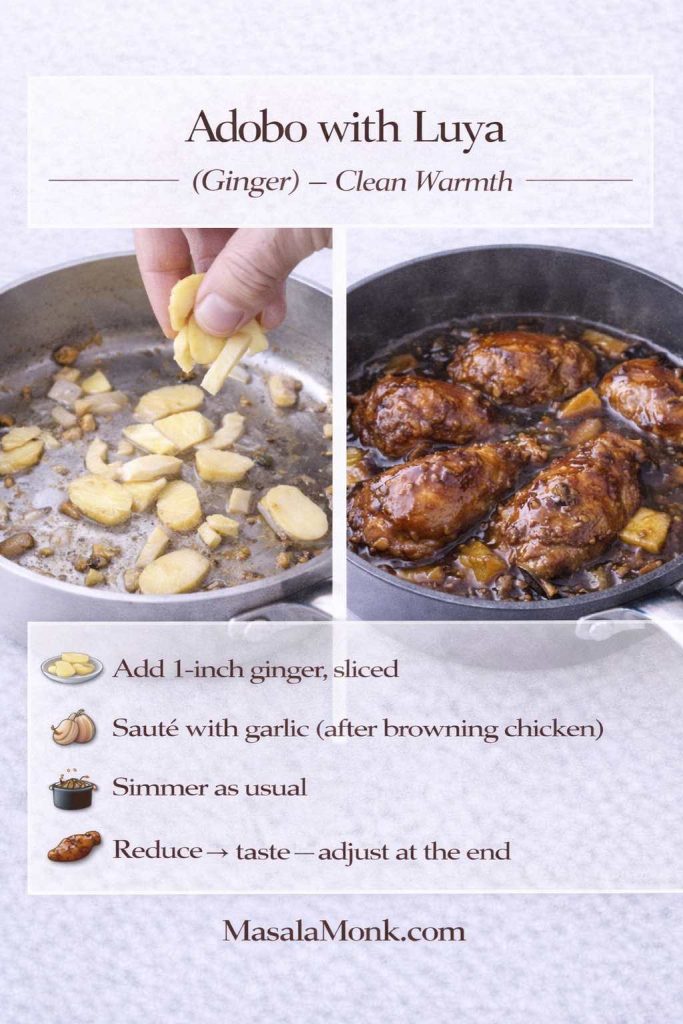
Adobo with luya (ginger)

Ginger makes the sauce feel cleaner and warmer without shouting “ginger.” It’s especially comforting on a cool day.

Two-panel infographic titled “Adobo with Luya (Ginger) — Clean Warmth.” Left panel shows sliced ginger being added to a pan with garlic after browning chicken. Right panel shows chicken adobo simmering in glossy sauce with visible ginger slices, peppercorns, and bay. Text tips say: add 1-inch ginger sliced, sauté with garlic after browning chicken, simmer as usual, then reduce and taste-adjust at the end. MasalaMonk.com appears in the footer.
Adding sliced ginger (luya) with the garlic gives chicken adobo a cleaner, warmer aroma—simmer as usual, then reduce at the end so the sauce turns glossy and the ginger flavor stays balanced.

Add a 1-inch knob of sliced ginger with the garlic, then proceed as usual.

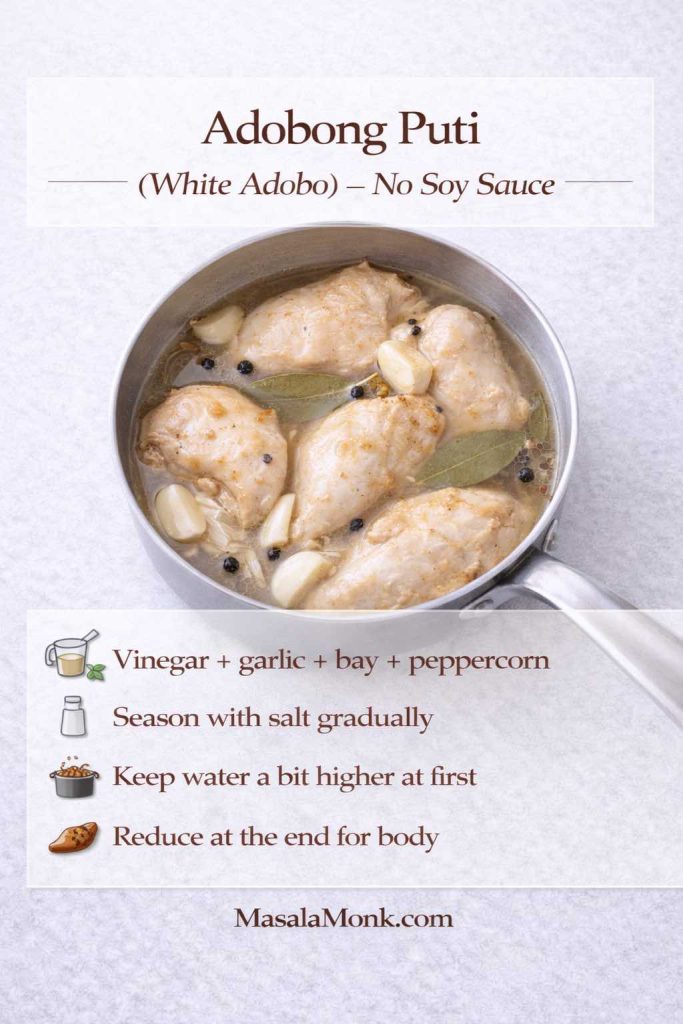
Adobong puti (white adobo)

White adobo skips soy sauce and leans into vinegar, garlic, bay, and pepper. It tastes brighter, sharper, and a bit more minimalist.

Recipe-card infographic titled “Adobong Puti (White Adobo) — No Soy Sauce.” Photo shows chicken pieces simmering in a light vinegar-based broth with whole garlic cloves, bay leaves, and peppercorns. Text tips say: vinegar + garlic + bay + peppercorn, season with salt gradually, keep water a bit higher at first, and reduce at the end for body. MasalaMonk.com appears in the footer.
Adobong puti (white adobo) skips soy sauce and leans on vinegar, garlic, bay leaves, and peppercorns—start with a bit more water, season with salt gradually, then reduce at the end for a flavorful, silky broth.

To adapt this chicken adobo recipe into adobong puti:

  • Omit soy sauce
  • Add salt gradually (start with 1 to 1½ teaspoons)
  • Keep water closer to the higher end at first
  • Reduce near the end for body

Because soy sauce isn’t there to deepen the sauce, reduction becomes even more important.

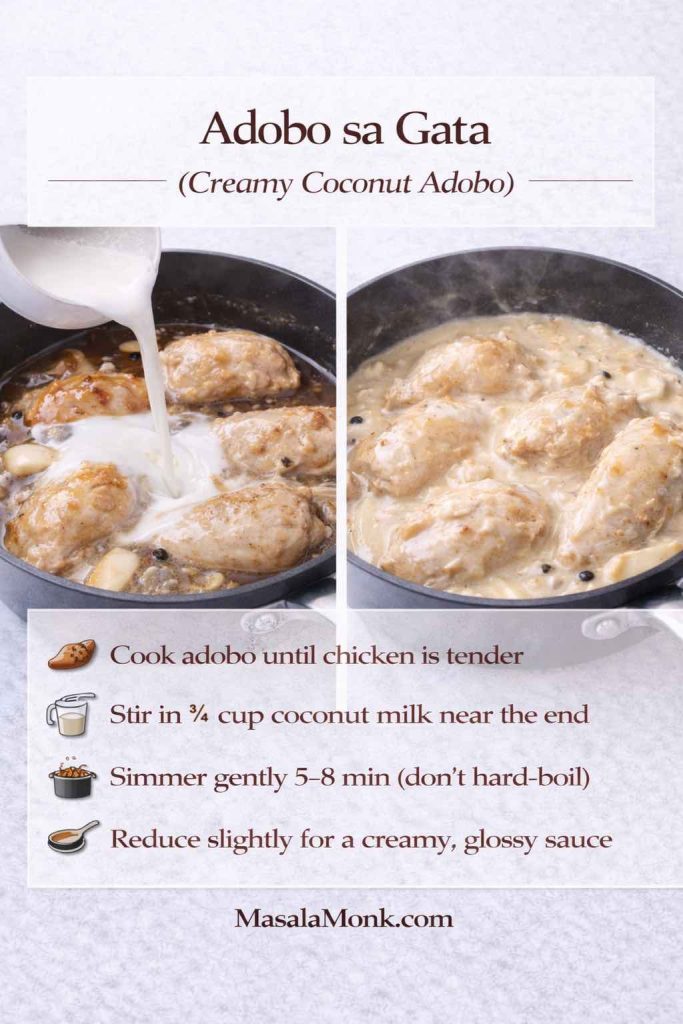
Chicken adobo sa gata (coconut milk adobo)

Coconut milk turns the dish creamy and luxurious while still keeping the adobo backbone.

Instructional infographic titled “Adobo sa Gata (Creamy Coconut Adobo).” Two photos show chicken adobo in a pan: left image shows coconut milk being poured into cooked adobo near the end, and right image shows the finished creamy coconut adobo sauce coating the chicken. Text tips say: cook adobo until chicken is tender, stir in ¾ cup coconut milk near the end, simmer gently 5–8 minutes (don’t hard-boil), and reduce slightly for a creamy, glossy sauce. MasalaMonk.com is in the footer.
For adobo sa gata, cook the chicken adobo until tender first, then stir in coconut milk near the end and simmer gently—no hard boiling—so the sauce turns creamy, glossy, and smooth.

Cook the chicken until tender using the classic steps. Then, once you remove the lid and begin reducing, stir in ¾ cup coconut milk. Simmer gently for 5–8 minutes. Avoid a hard boil because coconut milk can split if pushed.

If you ever want to make coconut milk yourself, this step-by-step guide is straightforward: How to Make Coconut Milk at Home.

Also Read: Peanut Butter Fudge: Recipes & Guide (8 Methods + Easy Variations)


Chicken Adobo Recipe Storage and Reheating (So Leftovers Stay Great)

One of the best things about chicken adobo is that it often tastes even better the next day. The sauce settles, the garlic mellows, and the whole pot feels more cohesive.

Still, leftovers deserve a little care.

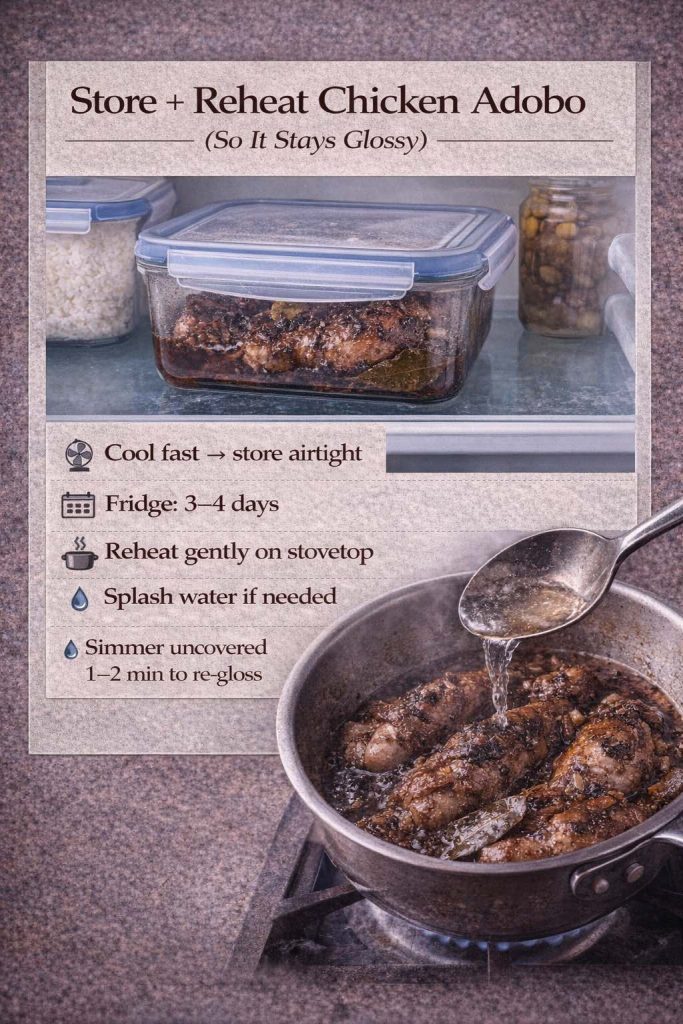
Infographic titled “Store + Reheat Chicken Adobo (So It Stays Glossy).” Top photo shows leftover chicken adobo stored in an airtight container inside a refrigerator. Bottom photo shows chicken adobo reheating in a saucepan while water is poured in from a spoon. Text tips include: cool fast and store airtight, fridge 3–4 days, reheat gently on stovetop, add a splash of water if needed, and simmer uncovered 1–2 minutes to restore a glossy adobo sauce. MasalaMonk.com appears in the footer.
Leftover chicken adobo reheats best on the stovetop—add a small splash of water and simmer uncovered briefly so the sauce turns glossy again instead of drying out.

Cool promptly and refrigerate within two hours

Food-safety guidance commonly emphasizes the “danger zone” and the two-hour window for refrigeration, especially for cooked meats. (Food Safety and Inspection Service)

A practical way to cool faster is to transfer adobo into shallower containers rather than leaving a deep pot on the counter. The sauce cools more quickly, and you’re not waiting on a dense mass of food to drop in temperature. (Food Safety and Inspection Service)

How long cooked chicken keeps

USDA guidance recommends using cooked chicken within three to four days when refrigerated (40°F / 4°C or lower). (Ask USDA)

If you want longer storage, freezing is an option. For best texture, freeze in portions with enough sauce to protect the meat from drying out when reheated.

Reheating chicken adobo the right way

Reheat until steaming hot, and if you like certainty, bring it back to 165°F / 74°C. (Food Safety and Inspection Service)

For texture, stovetop reheating is the gentlest:

  • Add a small splash of water
  • Warm over medium-low until hot
  • Then simmer uncovered briefly so the sauce becomes glossy again

That last step matters because the sauce thickens in the fridge. A quick uncovered simmer wakes it up and restores its shine.

Also Read: Manhattan Cocktail Recipe (Classic + 6 Variations)


Make-Ahead and Next-Day Ideas (So One Pot Feeds You Well)

If you like cooking once and eating twice, this chicken adobo recipe is a natural fit. In fact, adobo is one of those dishes that doesn’t mind being made ahead; it often rewards you for it.

The simplest make-ahead plan

Cook the adobo fully, including the reduction. Cool and refrigerate. The next day, reheat gently and add a splash of water only if the sauce feels too thick. Then simmer uncovered briefly to re-gloss.

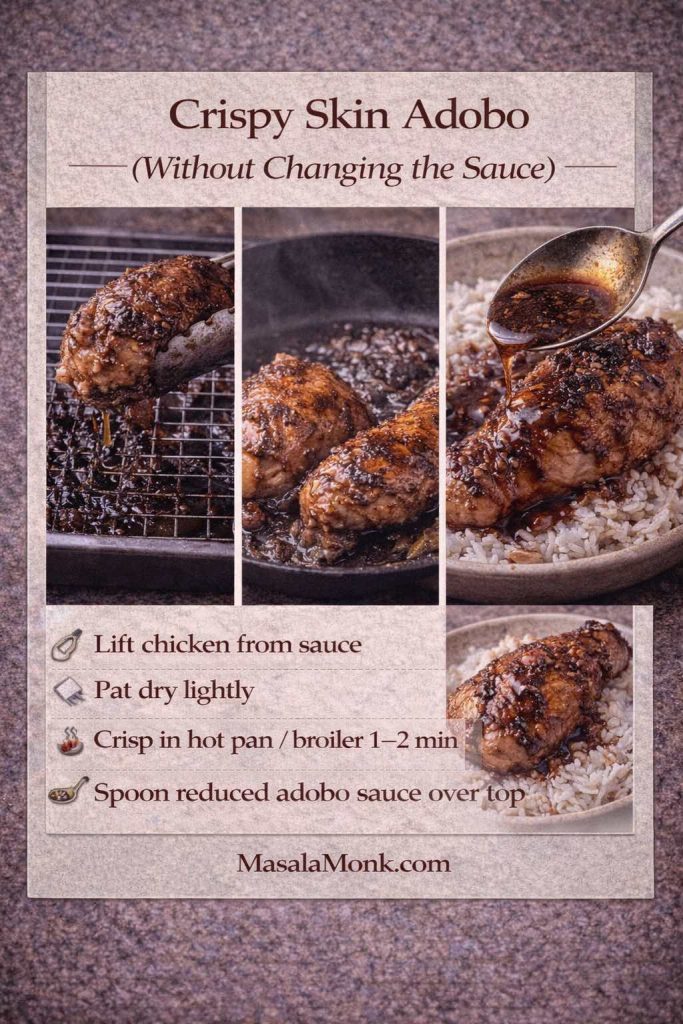
Step-by-step infographic titled “Crispy Skin Adobo (Without Changing the Sauce).” Three photos show leftover chicken adobo lifted from the sauce onto a rack, then crisped in a hot pan, and finally served over rice while reduced adobo sauce is spooned on top. Text instructions say: lift chicken from sauce, pat dry lightly, crisp in hot pan or broiler 1–2 minutes, and spoon reduced adobo sauce over the crispy skin. MasalaMonk.com appears in the footer.
For next-day chicken adobo, crisp the cooked chicken briefly in a hot pan or under the broiler, then spoon the reduced adobo sauce over the top—crispy skin and glossy sauce in the same bite.

Crispy skin option (without changing the sauce)

If you used skin-on chicken and you miss that crispness after simmering, there’s an easy workaround:

  • Remove cooked chicken pieces from the sauce
  • Pat dry lightly
  • Crisp under a broiler or in a hot pan for a minute or two
  • Then spoon reduced sauce over the top

This way, you get crisp edges and glossy sauce together, rather than choosing one over the other.

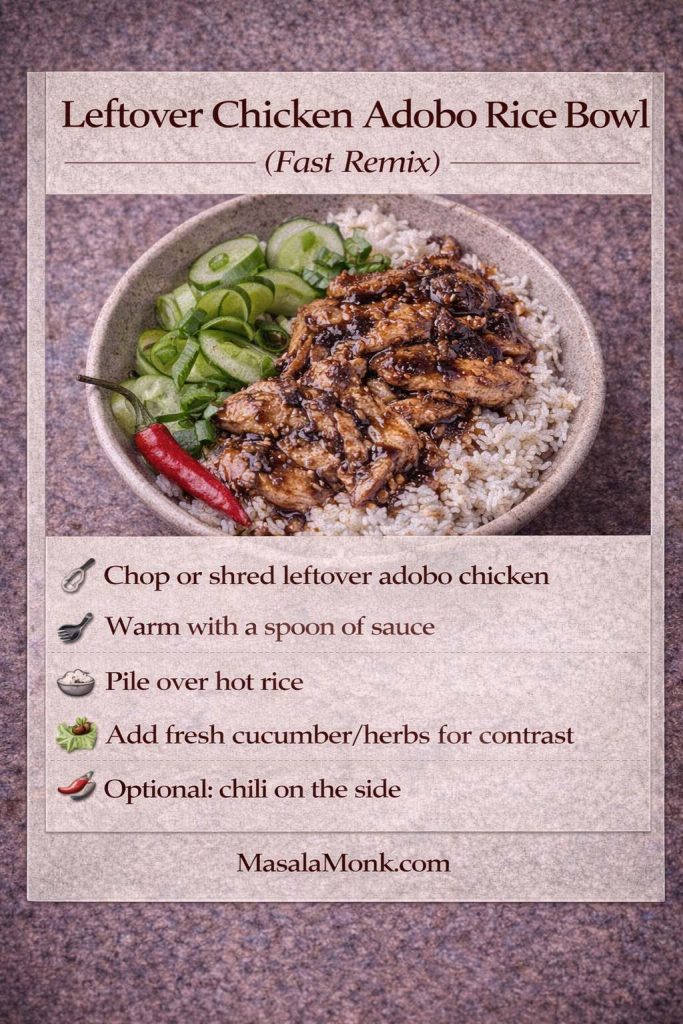
Instructional graphic titled “Leftover Chicken Adobo Rice Bowl (Fast Remix).” A bowl of white rice is topped with chopped or shredded chicken adobo and a glossy adobo sauce, with sliced cucumber and fresh herbs on the side and a red chili pepper. Text steps say: chop or shred leftover adobo chicken, warm with a spoon of sauce, pile over hot rice, add fresh cucumber/herbs for contrast, and optional chili on the side. MasalaMonk.com appears in the footer.
Turn leftover chicken adobo into a fast rice bowl—warm shredded chicken with a spoon of sauce, pile over hot rice, then add fresh cucumber and herbs for crisp contrast.

Leftovers that feel like a new meal

Sometimes the best “variation” is simply serving the same pot differently.

  • Adobo rice bowl: Chop leftover chicken, warm with a spoonful of sauce, pile over rice, and add fresh cucumber or herbs for contrast.
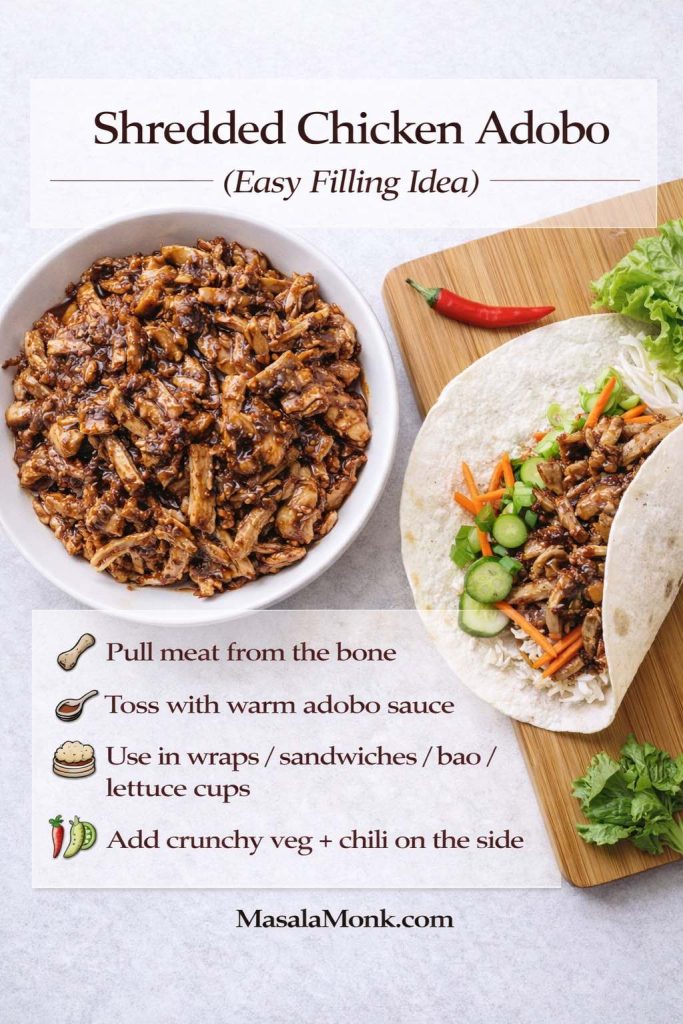
  • Shredded adobo chicken: Pull meat from the bone, toss with sauce, and use it as a savory filling.
Instructional graphic titled “Shredded Chicken Adobo (Easy Filling Idea).” A white bowl holds shredded chicken adobo coated in glossy adobo sauce. Beside it, a wrap is being filled with the shredded adobo chicken, shredded cabbage, sliced cucumber, carrots, and green onions, with a red chili nearby. Text tips say: pull meat from the bone, toss with warm adobo sauce, use in wraps/sandwiches/bao/lettuce cups, and add crunchy vegetables and chili on the side. MasalaMonk.com appears in the footer.
Shred leftover chicken adobo, warm it with a spoon of sauce, and use it as a savory filling—wraps, sandwiches, or lettuce cups all work, especially with crunchy vegetables on the side.

If you’re already in a chicken-for-the-week mindset, these internal recipes can keep things varied without leaving the comfort zone:

And if you end up with extra rice, turning it into something crisp and snacky the next day is a satisfying upgrade: How to Turn Leftover Rice into Gourmet Arancini Balls.

Also Read: Rob Roy Drink Recipe: Classic Scotch Cocktail (Perfect + Dry + Sweet Variations)


A Few Trusted References for Classic Filipino Chicken Adobo (If You Like Comparing Styles)

Every family has a “best adobo” version, and that’s part of the charm. Still, if you enjoy seeing how other well-tested recipes handle ratios and method choices, these are strong baselines:

For food-safety references on temperatures and cooling guidance:

Also Read: Sandwich for Breakfast: Breakfast Sandwich Recipe + 10 Variations


Closing: why this chicken adobo recipe keeps earning its place

A good chicken adobo recipe doesn’t need theatrics. It needs the right balance, a patient simmer, and a final reduction that turns the pot into something glossy and irresistible. Once you’ve cooked it this way, you’ll start to see how adaptable it is: classic and saucy one night, dry-style and sticky the next, then creamy coconut adobo when you want comfort.

Most of all, it stays true to what makes adobong manok special—bold flavor from simple ingredients, built with a method you can repeat whenever you want dinner to feel like it went exactly right.
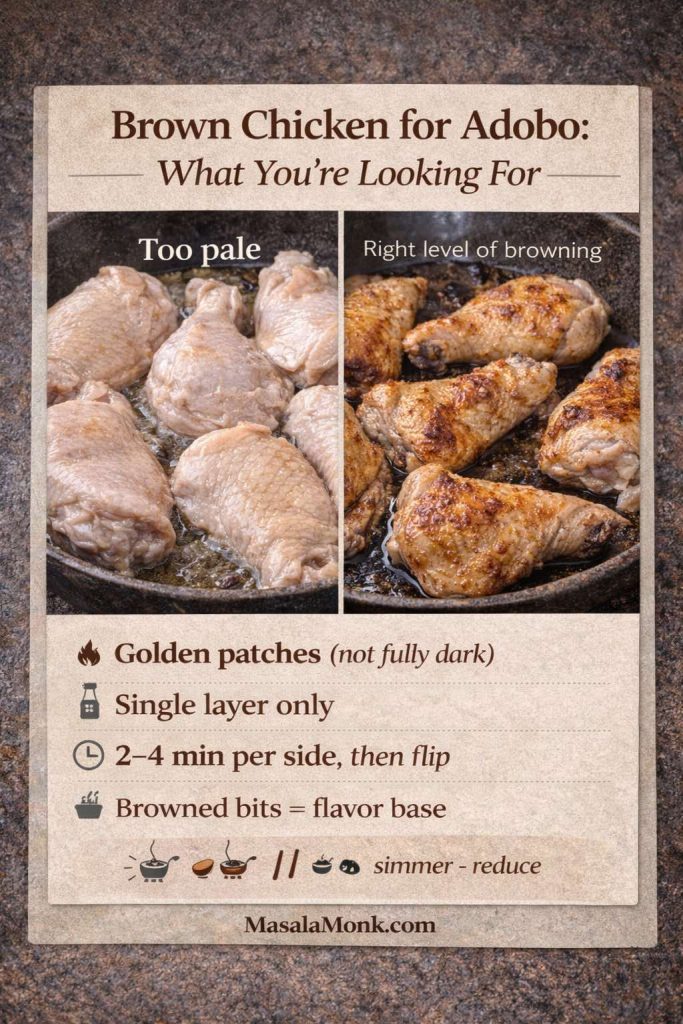
Also Read: Classic Rum Punch + 9 Recipes (Pitcher & Party-Friendly)

FAQs

1) What is the best chicken adobo recipe for beginners?

If you’re new to adobo, start with a classic chicken adobo recipe using bone-in thighs and drumsticks. Because those cuts stay juicy during simmering, you get tender meat and a flavorful adobo sauce without needing perfect timing. In addition, the method is forgiving: sear for depth, simmer for tenderness, then reduce for a glossy finish.

2) What are the chicken adobo ingredients in a classic adobong manok?

A traditional ingredient list for adobong manok usually includes chicken, garlic, soy sauce, vinegar, bay leaves, and whole peppercorns. Meanwhile, water helps balance the sauce while it simmers. Optionally, you can add onion for softness or a small amount of sugar for a sweeter chicken adobo.

3) What is the vinegar and soy sauce ratio for Filipino chicken adobo?

A common starting point is more soy sauce than vinegar, often around 1/2 cup soy sauce to 1/3 cup vinegar, plus water to mellow the mixture early on. However, the ideal ratio depends on your vinegar strength and soy sauce saltiness. As a result, it’s smart to reduce the sauce at the end, then adjust only if needed.

4) Is marinating required for an authentic adobo recipe?

Not necessarily. Many authentic adobo recipes skip a long marinade and rely on simmering to season the chicken thoroughly. Still, a short 15–30 minute rest in soy, vinegar, and garlic can deepen flavor. Either way, the final sauce reduction is what makes the dish taste cohesive.

5) How do you cook chicken adobo step by step without overcooking it?

First, brown the chicken lightly for deeper flavor. Next, simmer gently until the meat is tender. Finally, reduce the sauce uncovered until it turns glossy and coats the chicken. For chicken breast, shorten the simmer time and finish the reduction after pulling the breast pieces, then return them briefly to glaze.

6) What is the correct procedure in cooking adobo if my sauce tastes too sour?

Before changing anything, let the sauce reduce longer; often, extra liquid makes vinegar seem louder than it really is. If it still tastes sharp afterward, add a splash of water and simmer again, or stir in a tiny amount of sugar to round the edges. Moreover, serving with rice naturally softens the tang.

7) How can I make low sodium adobo without losing flavor?

Use a low-sodium soy sauce, then build flavor with garlic, bay leaves, peppercorns, and a proper reduction. Additionally, browning the chicken first adds depth, so you won’t rely only on saltiness for taste. If needed, finish with a small squeeze of citrus or a pinch of sugar for balance rather than extra soy.

8) How long should you simmer chicken adobo for tender results?

For bone-in thighs and drumsticks, simmering often takes about 25–35 minutes at a gentle bubble. Meanwhile, wings can finish sooner, and chicken breast needs less time to avoid drying out. Instead of boiling hard, keep the heat low so the meat stays juicy and the sauce stays smooth.
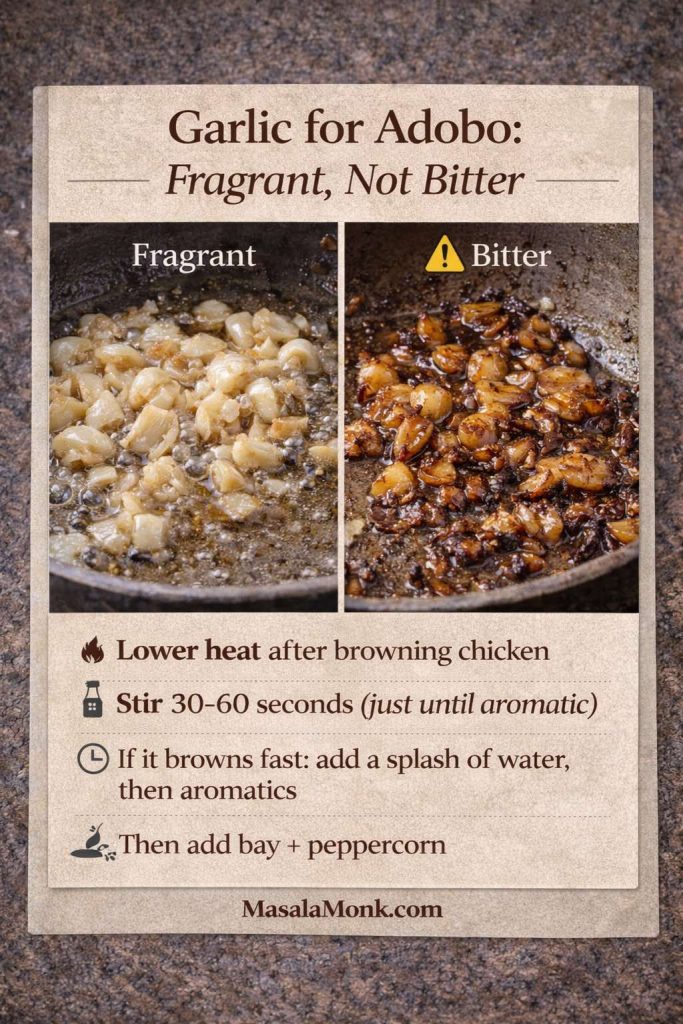
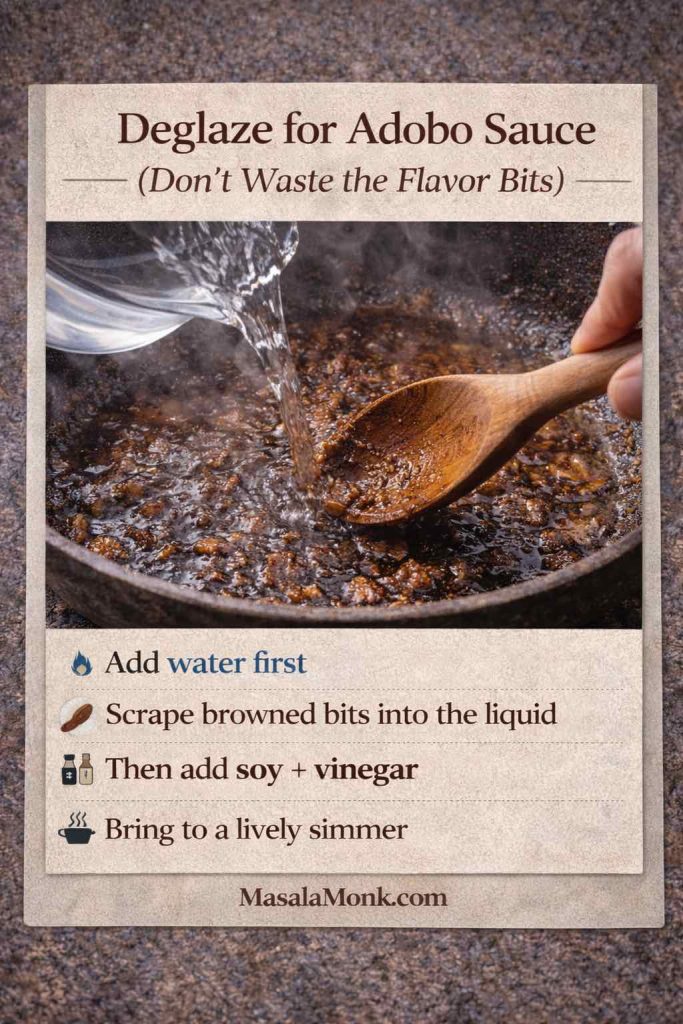
9) Why is my chicken adobo tough even after simmering?

Usually, the heat is too high or the cut needs more time at a gentle simmer. Toughness can also happen with older or leaner chicken. Therefore, lower the heat, cover, and extend the simmer until a knife slides in easily. After that, reduce the sauce only once the chicken is tender.

10) How do you make adobong manok na tuyo (dry-style chicken adobo)?

Cook the chicken adobo recipe as usual, then reduce the sauce longer until it clings tightly and looks lacquered. For an even drier finish, remove the chicken when tender, reduce the sauce more aggressively, and return the chicken to coat. Consequently, you get a sticky glaze rather than a pool of sauce.

11) How do I make sweet chicken adobo without making it sugary?

Add only a small amount of sugar—often 1–2 teaspoons—during the final reduction so it melts into the sauce instead of tasting separate. Alternatively, a few pineapple chunks near the end can add sweetness with a brighter flavor. Either way, the goal is to round the tang, not overpower it.

12) Can I cook chicken adobo with potato in the same pot?

Yes. Add peeled potato chunks after returning the chicken to the braise, then simmer until both are tender. As the potatoes cook, they also slightly thicken the sauce. Later, reduce the liquid uncovered so the potatoes and chicken get coated in glossy adobo sauce.

13) What is adobo sa gata, and when do you add coconut milk?

Adobo sa gata is a creamy version of Filipino adobo made by adding coconut milk near the end. After the chicken is tender, stir in coconut milk and simmer gently for a few minutes. Importantly, avoid a hard boil, because coconut milk can split if cooked too aggressively.

14) What is adobong puti, and how is it different from classic adobo?

Adobong puti (white adobo) usually skips soy sauce, relying on vinegar, garlic, bay leaves, and peppercorns instead. Because it’s brighter and more vinegar-forward, careful simmering and reduction matter even more. As a result, it tastes clean, sharp, and aromatic—yet still unmistakably adobo.

15) What are the most common mistakes in a classic chicken adobo recipe?

Common issues include skipping browning (which can make the sauce taste flatter), boiling too hard (which can toughen the chicken), and reducing too early (before the chicken is tender). Also, adding too much vinegar or soy without tasting after reduction can throw off balance. Instead, simmer gently, reduce at the end, then adjust in small steps.

16) How do I know chicken adobo is fully cooked?

The chicken should be tender and the juices should run clear. Additionally, the safest check is temperature: the thickest part should reach 74°C / 165°F. Once that’s done, you can focus on reducing the sauce for texture and flavor.

17) Can I make chicken adobo ahead of time?

Definitely. In fact, chicken adobo often tastes better the next day because the flavors settle and the sauce thickens slightly. Reheat gently with a splash of water if the sauce is too thick, then simmer uncovered briefly to bring back the glossy finish.

18) How do you store and reheat leftover chicken adobo?

Cool leftovers promptly, then store in an airtight container in the fridge. When reheating, warm gently on the stovetop so the sauce doesn’t scorch. Finally, simmer uncovered for a minute or two to restore the glossy adobo sauce texture.

19) What is the best cut for Filipino chicken breast adobo?

If you prefer breast, use larger pieces and shorten the simmer time. Then finish reducing the sauce separately and return the breast briefly to coat. Consequently, you keep the chicken tender while still getting the full flavor of the sauce.

20) What does “adobo” mean in Filipino cooking?

In Filipino cooking, “adobo” generally refers to the method: braising in vinegar and salt (often soy sauce), along with garlic, bay leaves, and peppercorns. Because it’s both flavorful and practical, the technique has become one of the most iconic Filipino dishes—especially chicken adobo and pork adobo.

Posted on Leave a comment

Surprise Everyone with This Peach Condensed Milk Cake

Peach Fantasy by Masala Monk

Hello, food lovers! 🍽️💕 Today, we’re diving into a delightful dessert recipe that’s sure to impress everyone at your next gathering. We’re talking about a Peach Condensed Milk Cake, a dessert that’s not only incredibly flavorful but also easy to make! This fantastic recipe comes from the YouTube channel Amo Receitas, a wonderful resource for anyone looking for simple yet tasty meal ideas.

🎉 Join the Foodie Community! 🍽️

If you try these recipes or have other delicious recipes to share, join the vibrant and engaging food lovers community on Facebook. It’s a place where you can share your culinary experiments, discover new recipes, and connect with fellow food enthusiasts.

🍑 The Magic of Peach Condensed Milk Cake 🍰

Peach Condensed Milk Cake is a dessert that combines the sweet and tangy flavor of peaches with the creamy richness of condensed milk. The result is a cake that’s moist, flavorful, and absolutely delicious. Plus, it’s a versatile dessert that can be served at any occasion, from a casual family dinner to a special celebration.

🍽️ The Recipe: How to Make Peach Condensed Milk Cake 🍑

The recipe starts with the cake batter, which is made from 3 1/2 cups of flour, 1 cup of sugar, 3 eggs, 3/4 cup of oil, 1 1/4 cup of milk, 1 tablespoon of baking powder, and 1 teaspoon of vanilla sugar. The ingredients are mixed together until smooth.

Next, the batter is poured into a greased baking dish. Slices of peach are arranged on top of the batter, and then 1 1/2 cups of condensed milk is poured over the peaches. The cake is then baked until golden and set.

🍴 Enjoying Peach Condensed Milk Cake: Tips and Suggestions 🍽️

When enjoying Peach Condensed Milk Cake, here are a few tips and suggestions:

  • Feel free to adjust the amount of condensed milk to suit your taste. If you prefer a less sweet cake, you can reduce the amount of condensed milk.
  • This cake is best served chilled, so consider making it a day ahead and storing it in the refrigerator overnight.
  • Peach Condensed Milk Cake makes a great dessert for any meal. Serve it with a cup of coffee or tea for a delightful afternoon treat.

🎉 Join the Foodie Community! 🍽️

If you try this recipe or have other delicious recipes to share, join the vibrant and engaging food lovers community on Facebook. It’s a place where you can share your culinary experiments, discover new recipes, and connect with fellow food enthusiasts.

🙏 Credits 🙏

A big thank you to Amo Receitas for sharing this fantastic Peach Condensed Milk Cake recipe. Their channel is a treasure trove of delicious recipes that are easy to follow and absolutely delightful to taste. If you’re a fan of simple and tasty recipes, be sure to check out their YouTube channel for more culinary inspiration

So, are you ready to bring a taste of this delicious Peach Condensed Milk Cake into your kitchen? With this recipe, you can enjoy a delicious and unique dessert right at home. Happy cooking! 🍽️🎉

Remember to check out more amazing recipes on Amo Receitas‘s YouTube channel. Enjoy the delicious day! 🌞🍡🌭

Posted on Leave a comment

4 Simple and Delicious Toast Recipes!

bread on plate beside glas

Hello, food lovers! 🍽️💕 Today, we’re diving into the world of quick and easy breakfast recipes with a focus on a staple food item: toast. But this isn’t just any toast. We’re talking about four unique and delicious toast recipes that will revolutionize your breakfast routine. These recipes come from the YouTube channel Cooking Everyday, a fantastic resource for anyone looking for simple yet tasty meal ideas.

🍞 The Magic of Toast 🍳

Toast is a breakfast staple in many households. It’s quick, easy, and can be customized in countless ways. But if you’re tired of the same old butter and jam, these four toast recipes are sure to shake things up. From egg-filled bread to honey toast, these recipes take toast to a whole new level.

🍽️ The Recipes: How to Make Delicious Toast 🍞

Recipe 1: Egg in a Hole Toast 🍳

This recipe starts with a slice of bread and a glass. The glass is used to cut a hole in the middle of the bread. The bread is then fried in butter on medium heat. An egg is cracked into the hole, seasoned with salt and black pepper, and topped with green onions and cheddar cheese. The inside of the bread is placed on top, and the whole thing is flipped over and fried until golden brown.

Recipe 2: Scrambled Egg Toast 🍳

This recipe begins with three eggs, which are seasoned with salt, black pepper, and paprika, and mixed well. Parsley, green onions, and mozzarella cheese are added to the egg mixture. The bread is dipped in the egg mix and fried in butter for 2-3 minutes on each side.

Recipe 3: Stuffed Egg Toast 🍳

This recipe involves one egg, chopped green onion, chopped bell pepper, salt, and black pepper. The mixture is poured inside a hole cut in a slice of bread, topped with cheddar cheese, and fried for 3-5 minutes on each side.

Recipe 4: Tomato and Cheese Toast 🍞

This recipe uses stale bread, eggs, salt, black pepper, tomato sauce, mozzarella cheese, grape tomatoes, parsley, and olive oil. The bread is cut into pieces, dipped in the egg mixture, and fried. Tomato sauce and cheese are added on top, along with grape tomatoes and parsley. The toast is fried for an additional 3-5 minutes.

🍴 Enjoying Your Delicious Toast: Tips and Suggestions 🍽️

When enjoying these toast recipes, here are a few tips and suggestions:

  • Feel free to adjust the ingredients to suit your taste. If you prefer a different type of cheese or want to add more vegetables, go for it!
  • These toast recipes are best enjoyed hot from the pan. They make a great breakfast or snack, and are sure to impress your family and friends.
  • Don’t be afraid to get creative with your toast. These recipes are just a starting point. The possibilities are endless!

🎉 Join the Foodie Community! 🍽️

If you try these recipes or have other delicious recipes to share, join the vibrant and engaging food lovers community on Facebook. It’s a place where you can share your culinary experiments, discover new recipes, and connect with fellow food enthusiasts

So, are you ready to bring a taste of these delicious toast recipes into your kitchen? With these recipes, you can enjoy a delicious and unique breakfast right at home. Happy cooking! 🍽️🎉

Remember to check out more amazing recipes on Cooking Everyday‘s YouTube channel. Enjoy the delicious day! 🌞🍡🌭

Posted on Leave a comment

Honey Garlic Chicken: A Scrumptious Dinner Ready in 15 Minutes!

a dish of glazed chicken wings with a dip

Hello, food enthusiasts! 🍽️💕 Today, we’re exploring a quick and easy recipe that’s perfect for those busy weeknights when you want a delicious meal without spending hours in the kitchen. We’re talking about Honey Garlic Chicken, a dish that’s not only incredibly flavorful but also ready in just 15 minutes! This fantastic recipe comes from the YouTube channel Delicious and easy recipes, a go-to place for anyone looking for simple yet tasty meal ideas.

🍯 The Magic of Honey Garlic Chicken 🍗

Honey Garlic Chicken is a popular dish known for its sweet and savory flavor profile. The combination of honey and garlic gives the chicken a rich and aromatic taste that’s hard to resist. Plus, it’s a versatile dish that can be served with a variety of sides, from steamed vegetables to fluffy rice.

🍽️ The Recipe: How to Make Honey Garlic Chicken 🍯

The recipe starts with two chicken breasts, which are seasoned with salt and black pepper. The chicken is then coated in all-purpose flour, which helps to give it a nice, golden crust when cooked.

Next, the chicken is fried in 40 grams of butter for 4 to 5 minutes on each side until it’s beautifully golden and crispy. Three cloves of garlic are then added to the pan, infusing the chicken with their aromatic flavor.

The dish is then finished with a delicious sauce made from 20 grams of butter, 1 tablespoon of light soy sauce, 1 tablespoon of vinegar, and 5 tablespoons of honey. The sauce is poured over the chicken, coating it in a sweet and tangy glaze that’s simply irresistible.

🌱 Garnishing the Dish 🌱

To add a pop of color and freshness to the dish, it’s garnished with spring onions. The spring onions not only add a vibrant touch to the dish but also provide a nice contrast to the sweet and savory flavors of the honey garlic sauce.

🍴 Enjoying Honey Garlic Chicken: Tips and Suggestions 🍽️

When enjoying Honey Garlic Chicken, here are a few tips and suggestions:

  • Feel free to adjust the amount of honey and garlic to suit your taste. If you prefer a sweeter sauce, add more honey. If you’re a fan of garlic, feel free to add an extra clove or two.
  • This dish is best served hot, straight from the pan. The honey garlic sauce is delicious when it’s warm and glossy, coating the chicken in a layer of sweet and savory goodness.
  • Honey Garlic Chicken makes a great main dish for any meal. Serve it with a side of steamed vegetables or fluffy rice for a complete and satisfying meal.

🎉 Join the Foodie Community! 🍽️

If you try this recipe or have other delicious recipes to share, join the vibrant and engaging food lovers community on Facebook. It’s a place where you can share your culinary experiments, discover new recipes, and connect with fellow food enthusiasts.

🙏 Credits 🙏

A big thank you to Delicious and easy recipes for sharing this fantastic Honey Garlic Chicken recipe. Their channel is a treasure trove of delicious recipes that are easy to follow and absolutely delightful to taste. If you’re a fan of quick and easy recipes, be sure to check out their YouTube channel for more culinary inspiration

So, are you ready to bring a taste of Asian cuisine into your kitchen? With this Honey Garlic Chicken recipe, you can enjoy a delicious and unique meal right at home. Happy cooking! 🍽️🎉

Remember to check out more amazing recipes on Delicious and easy recipes‘s YouTube channel. Enjoy the delicious day! 🌞🍡🌭