Posted on 1 Comment

Cream of Mushroom Chicken Recipe

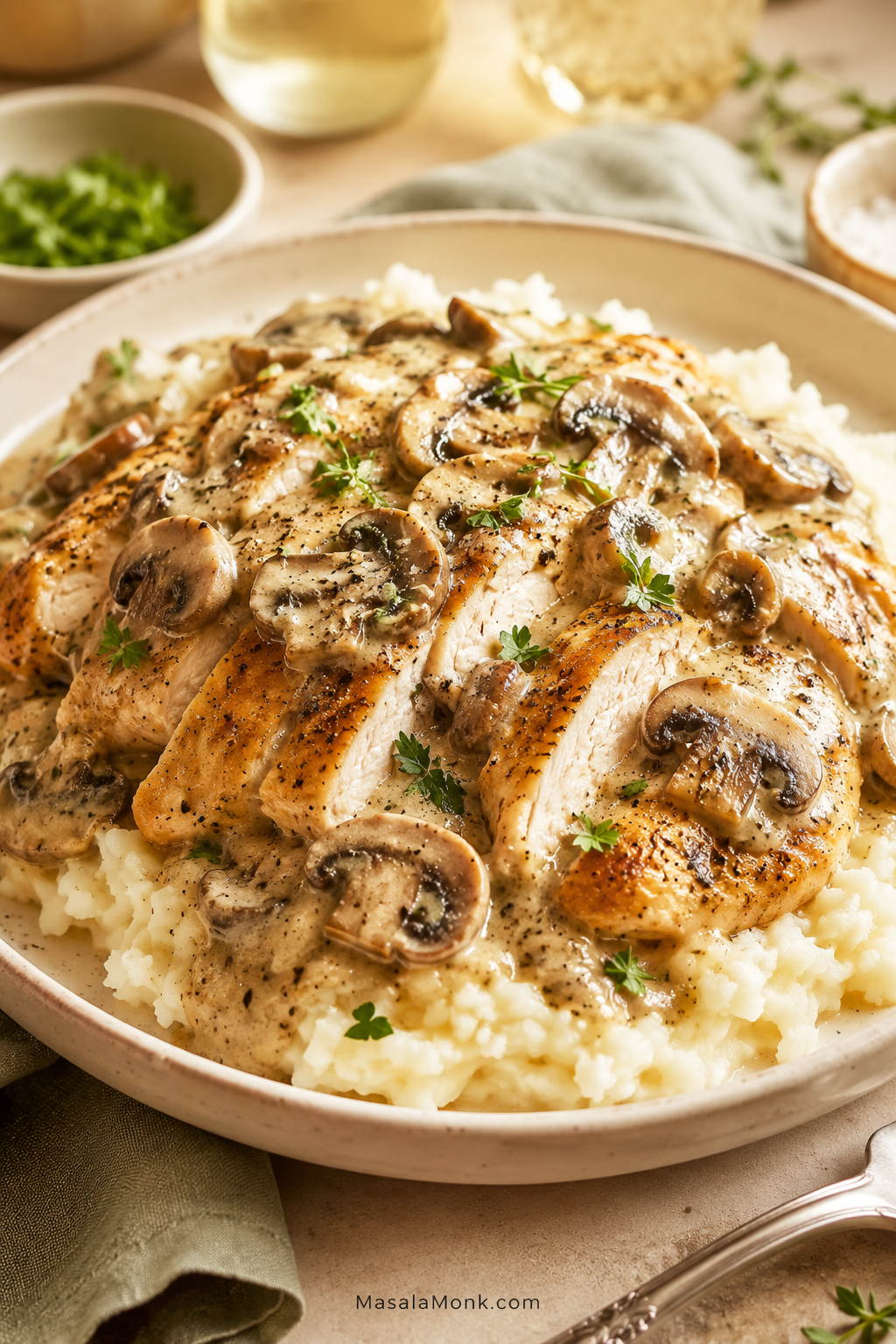
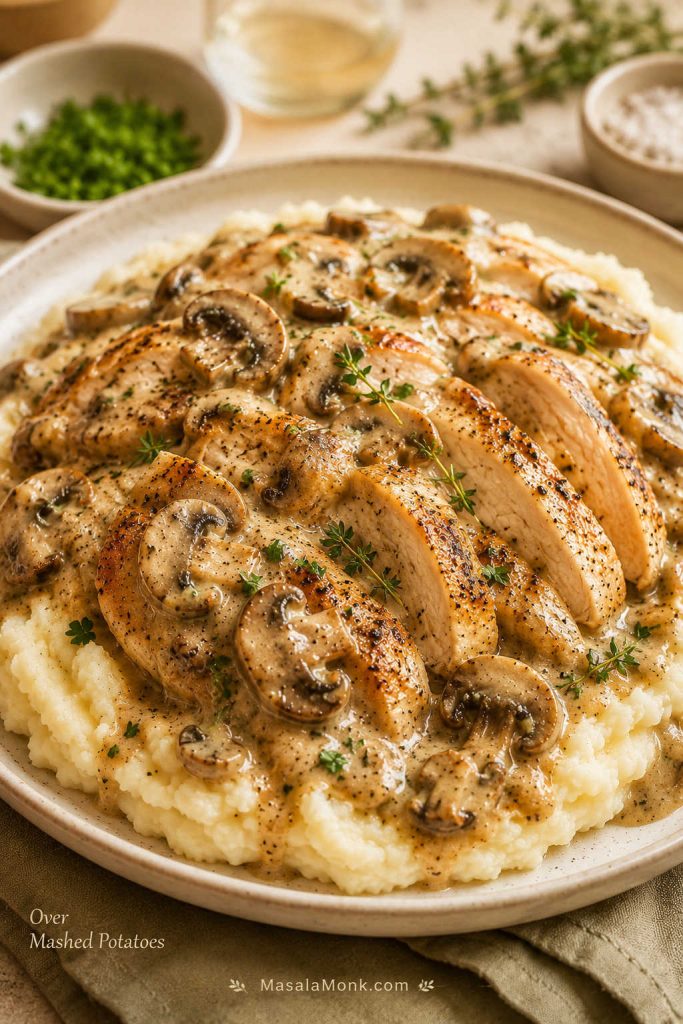
Cream of mushroom chicken served over mashed potatoes with sliced mushrooms, creamy sauce, black pepper, and fresh herbs.

This cream of mushroom chicken recipe is for the night when you have chicken in the fridge, a can of cream of mushroom soup in the pantry, and no patience for a complicated sauce. The goal is simple: tender chicken, creamy mushroom gravy, and a dinner that works with rice, egg noodles, mashed potatoes, biscuits, or whatever vegetable you already have.

This is the kind of dinner that feels like a shortcut while it cooks, but like comfort food once it hits the plate. It is not fancy food; it is the creamy, spoon-over-something meal you make when the day has been long and everyone still needs to eat.

Bake it when you want the easiest family dinner. Use the skillet when dinner needs to happen faster, the slow cooker when the meal should take care of itself, and the rice bake when chicken and rice should land in one dish.
The dish works best with condensed cream of mushroom soup, thin or evenly pounded chicken, and just enough milk or broth to turn the soup into a spoonable sauce. A thermometer keeps the chicken from drying out while still getting it safely to 165°F / 74°C.

Quick Answer: How to Make Cream of Mushroom Chicken

To make cream of mushroom chicken, season chicken breasts or thighs, place them in a baking dish, whisk condensed cream of mushroom soup with milk or low-sodium chicken broth, pour the sauce over the chicken, cover, and bake until the chicken reaches 165°F / 74°C. Uncover near the end if the sauce needs to thicken or cheese is going on top.

The result should be chicken that slices easily with creamy mushroom gravy you can spoon over rice, noodles, mashed potatoes, biscuits, or vegetables. This is still a low-effort dinner: about 10 minutes of prep, then the oven does most of the work.

The skillet version is faster, the slow cooker version is more hands-off, and the rice bake turns it into a one-dish meal. The trick is changing the liquid slightly for each method, so use the version guide or the soup and liquid ratios before switching methods.

Best first version: Bake thin chicken breasts or thighs with 1 can condensed cream of mushroom soup and ½ cup milk or broth at 375°F / 190°C. Cover first for moisture, then uncover near the end so the sauce thickens.
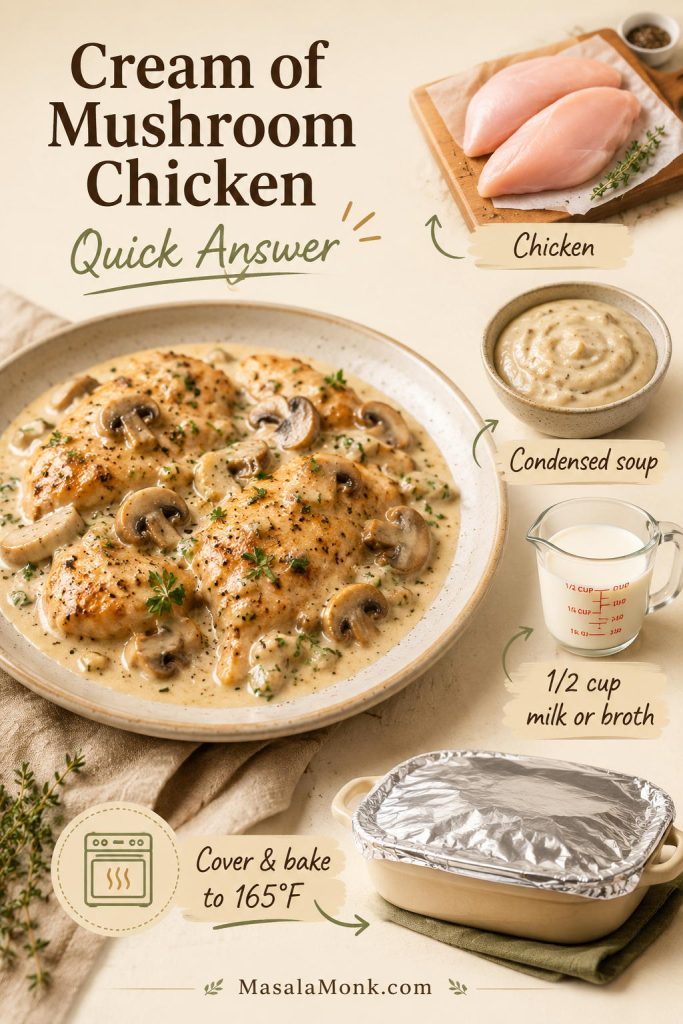
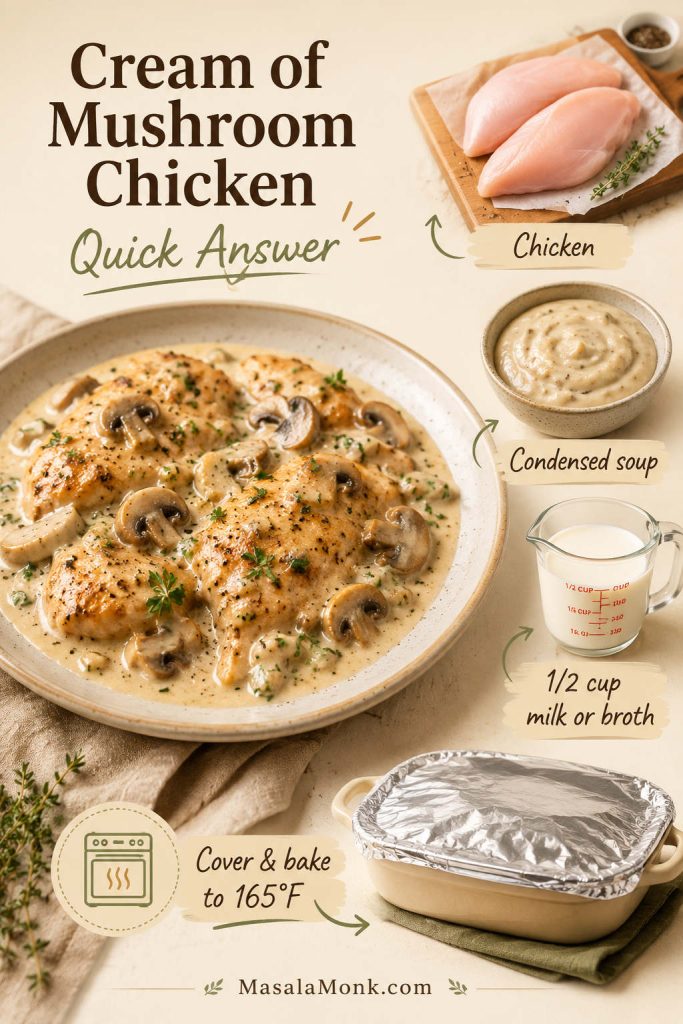
Quick answer board showing cream of mushroom chicken, chicken pieces, condensed soup, milk or broth, and covered baking instructions.
For the simplest version, build the dish in four parts: chicken, condensed cream of mushroom soup, a little milk or broth, and a covered bake.

For food safety, chicken should reach 165°F / 74°C in the thickest part; FoodSafety.gov lists poultry and casseroles at this internal temperature.

Which Version Should You Make?

Before you open the soup can, decide how dinner needs to work tonight. The same basic ingredients can become an easy oven dinner, a quick skillet meal, a slow cooker comfort dish, or a chicken-and-rice bake.

The one thing that changes most between versions is the soup-to-liquid ratio. The oven, skillet, slow cooker, and rice bake each need slightly different treatment, which is what keeps the chicken juicy and the sauce creamy instead of watery.

Choose This Version Best When Key Ratio
Baked cream of mushroom chicken You want the easiest family dinner with minimal prep. 1 can soup + ½ cup milk or broth
Skillet cream of mushroom chicken You want dinner faster and more control over the sauce. 1 can soup + ½–1 cup broth or milk
Slow cooker cream of mushroom chicken You want hands-off creamy chicken for rice, noodles, or potatoes. 2 cans soup + ½ cup liquid
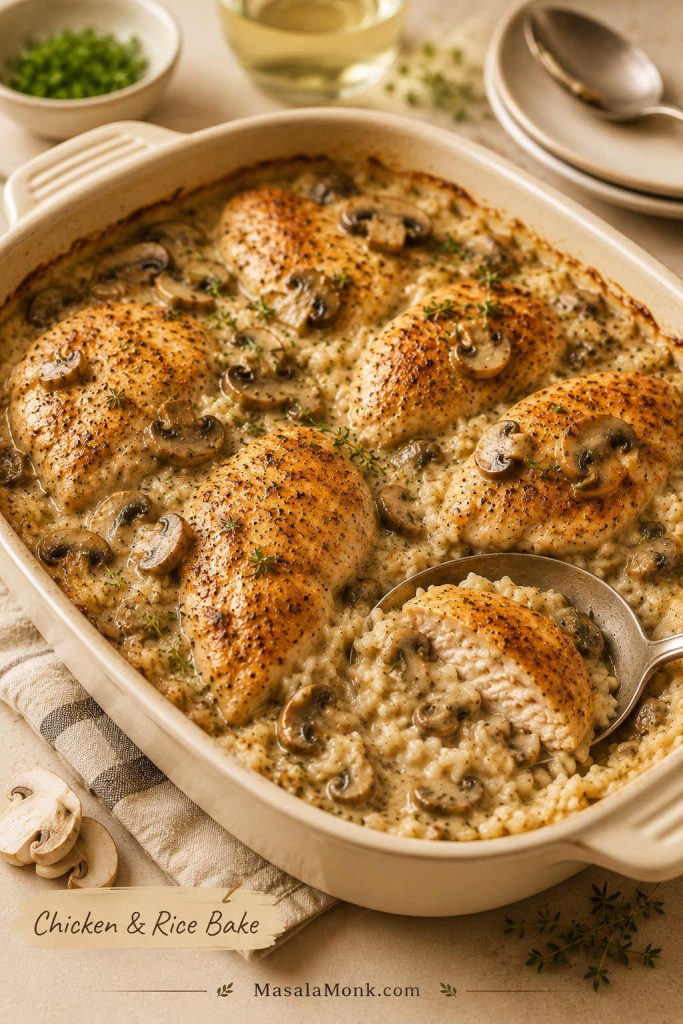
Cream of mushroom chicken and rice You want a full one-dish meal. 1 can soup + 1 cup liquid + ¾ cup rice
Creamy chicken over egg noodles You want mushroom-sauce chicken without baking rice. Cook noodles separately and spoon sauce over them
Guide comparing baked, skillet, slow cooker, and chicken and rice versions of cream of mushroom chicken.
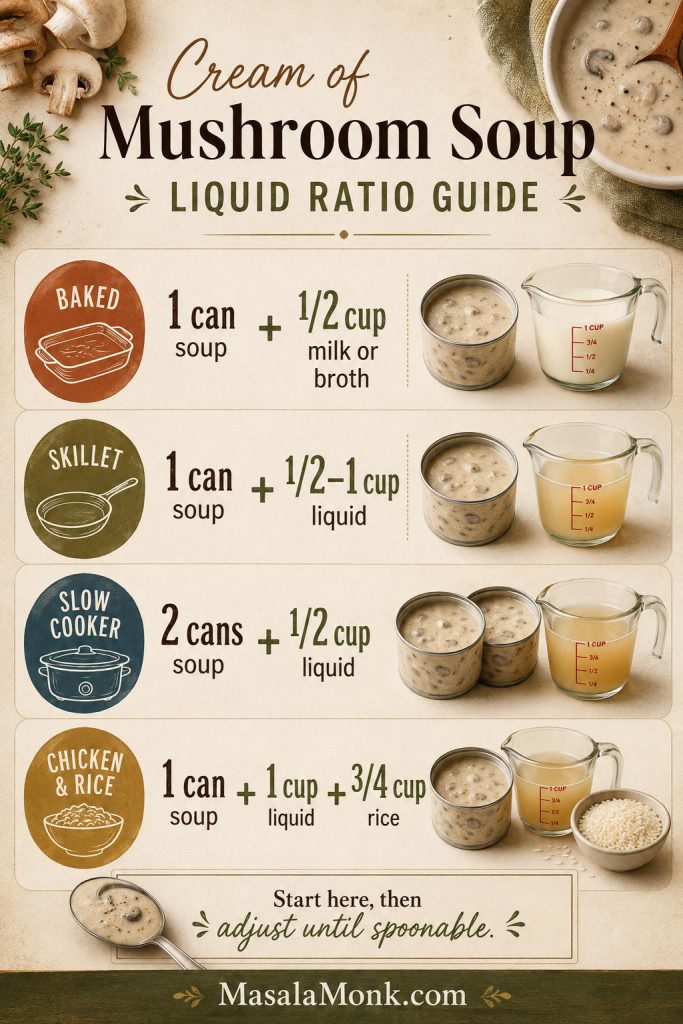
Instead of using one formula for every method, adjust the liquid for baked, skillet, slow cooker, and chicken-and-rice versions.

How Much Liquid to Add to Cream of Mushroom Soup

Use these ratios as starting points, then adjust until the sauce looks spoonable, not stiff and not soupy.

Version Condensed Soup Added Liquid Why It Works
Baked chicken 1 can / 10.5 oz / 298 g ½ cup / 120 ml milk or broth Creates a creamy, spoonable sauce without making the dish watery.
Skillet chicken 1 can / 10.5 oz / 298 g ½–1 cup / 120–240 ml broth or milk The sauce reduces as it simmers, so you can loosen or thicken it as needed.
Slow cooker chicken 2 cans / about 596 g total ½ cup / 120 ml broth or water The slow cooker traps moisture, so too much liquid makes the sauce thin.
Small chicken and rice bake 1 can / 10.5 oz / 298 g 1 cup / 240 ml liquid + ¾ cup rice Rice needs measured liquid and trapped steam to cook properly.
Large 9×13 rice bake 2 cans / about 596 g total 2 cups / 480 ml broth + 1¼ cups rice Better for a family-size casserole with more rice and chicken.
Liquid ratio guide for baked, skillet, slow cooker, and chicken and rice cream of mushroom chicken recipes.
Condensed soup gives the sauce body; however, each cooking method needs a different amount of liquid to stay creamy.

Once the ratio is right, everything gets easier: the chicken cooks gently, the sauce stays spoonable, and the sides do half the work. When you are ready to cook the oven version, go straight to the cream of mushroom chicken recipe card.

Water works in a pinch, but broth gives the dish more savory flavor and milk makes the sauce softer and creamier. Regular condensed soup, regular broth, cheese, and onion soup mix can all add salt, so taste before adding more.

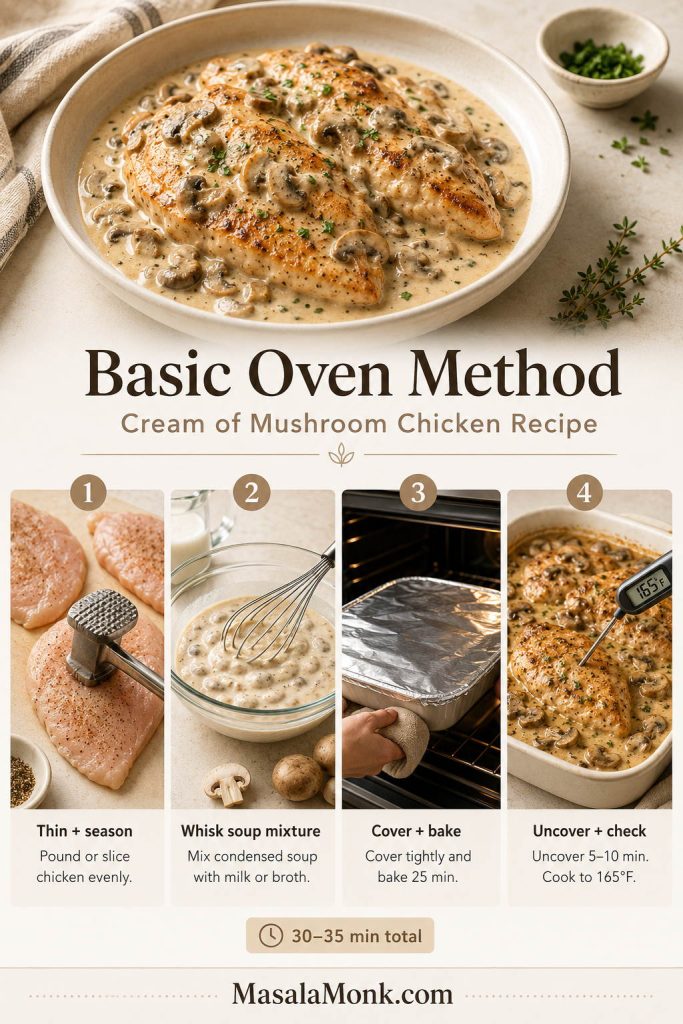
Basic Oven Method at a Glance

Use this as the quick map before the full recipe card.

  1. Thin and season the chicken. Slice large breasts in half lengthwise or pound them evenly, then season lightly.
  2. Whisk the soup mixture. Mix condensed cream of mushroom soup with milk or broth until smooth.
  3. Cover and bake. Pour the mixture over the chicken, cover with foil, and bake so the meat stays moist.
  4. Uncover, check, and rest. Finish uncovered, cook to 165°F / 74°C, and rest before serving.
Four-step oven method for cream of mushroom chicken showing thin chicken, soup mixture, covered baking, and temperature check.
Once the chicken is even in thickness and the soup mixture is loosened, the oven version becomes simple and predictable.

Cream of Mushroom Chicken Recipe Card

This baked cream of mushroom chicken is the oven version to make first: tender chicken, condensed cream of mushroom soup, a little milk or broth, simple seasonings, and enough creamy mushroom sauce to spoon over rice, egg noodles, mashed potatoes, or vegetables.

Prep Time10 minutes
Cook Time30–35 minutes
Total Time40–45 minutes
Yield4 servings

Course: Dinner
Cuisine: American
Method: Baked
Equipment: 9×13-inch baking dish, foil, mixing bowl, instant-read thermometer

Ingredients

  • 1½ lb / 680 g boneless skinless chicken breasts or thighs
  • 1 can condensed cream of mushroom soup, 10.5 oz / 298 g
  • ½ cup / 120 ml milk or low-sodium chicken broth
  • ½ tsp garlic powder, divided
  • ½ tsp onion powder, divided
  • ½ tsp paprika, divided
  • ¼ tsp black pepper, divided, plus more to taste
  • 8 oz / 225 g sliced mushrooms, optional
  • ¼–½ cup / 60–120 g sour cream, optional
  • ¾–1 cup / 85–115 g shredded mozzarella, Monterey Jack, or cheddar, optional
  • Salt only after tasting, if needed

Instructions

  1. Heat oven to 375°F / 190°C. Lightly grease a 9×13-inch baking dish.
  2. Slice large chicken breasts in half lengthwise or pound them to an even thickness.
  3. Place the chicken in the baking dish. Sprinkle with about half of the garlic powder, onion powder, paprika, and black pepper.
  4. Scatter raw mushrooms around the chicken for convenience, or brown them first for deeper flavor and less extra moisture.
  5. In a bowl, whisk the condensed cream of mushroom soup with milk or broth and the remaining garlic powder, onion powder, paprika, and pepper until smooth. Whisk in sour cream now if using it for the baked version.
  6. Taste the sauce. Add salt only if it needs it. A flat-tasting sauce can take a little more pepper, paprika, thyme, garlic powder, or Dijon.
  7. Pour the sauce over the chicken and spread it so the chicken is mostly covered.
  8. Cover the dish tightly with foil.
  9. Bake for 25 minutes.
  10. Uncover and bake 5–10 minutes more, or until the chicken reaches 165°F / 74°C in the thickest part.
  11. Sprinkle cheese over the chicken during the uncovered finish if using it, then bake until melted.
  12. When the chicken is done but the sauce is still thin, move the chicken to a plate and thicken the sauce separately in a small pan, or in the baking dish only if your dish is stovetop-safe.
  13. Rest for 5 minutes before serving.
  14. Serve over rice, egg noodles, mashed potatoes, biscuits, broccoli, green beans, or roasted vegetables.

Notes

  • Use condensed cream of mushroom soup, not ready-to-eat mushroom soup.
  • Browned mushrooms give the sauce a deeper, less canned flavor.
  • Water works if that is all you have, but broth gives better flavor and milk makes the sauce creamier.
  • A cream of chicken swap works too: replace half or all of the cream of mushroom soup with condensed cream of chicken soup.
  • For skillet or slow cooker versions, add sour cream or cheese near the end over gentle heat for the smoothest finish.
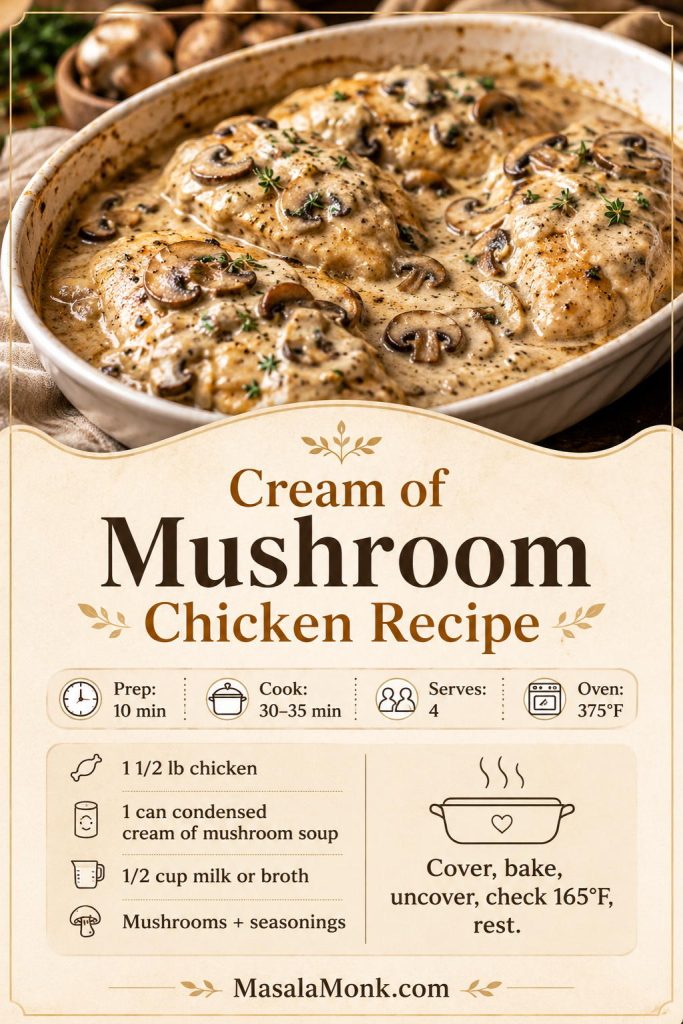
Recipe card for cream of mushroom chicken with prep time, cook time, oven temperature, chicken, condensed soup, milk or broth, and method notes.
Save this basic baked cream of mushroom chicken formula first, then use the other sections when you want skillet, slow cooker, or rice variations.

Making a different version? Use the skillet method, slow cooker method, or chicken and rice bake so the liquid and timing stay right.

Why This Recipe Works

The baked version works because it solves two problems at once: thick chicken and loose sauce. Thin pieces cook before they dry out, while condensed soup gives the sauce enough body to stay creamy. A small splash of milk or broth loosens the canned base, covered baking protects the chicken, and the uncovered finish lets the sauce settle.

The real win is not making it fancy. It is keeping the chicken juicy and turning the canned soup into a sauce that tastes like it belongs on the plate.

Ingredient Notes That Keep It Creamy, Not Watery

Nothing here is precious. The point is knowing which shortcuts help and which ones make the dish watery, salty, or dry.

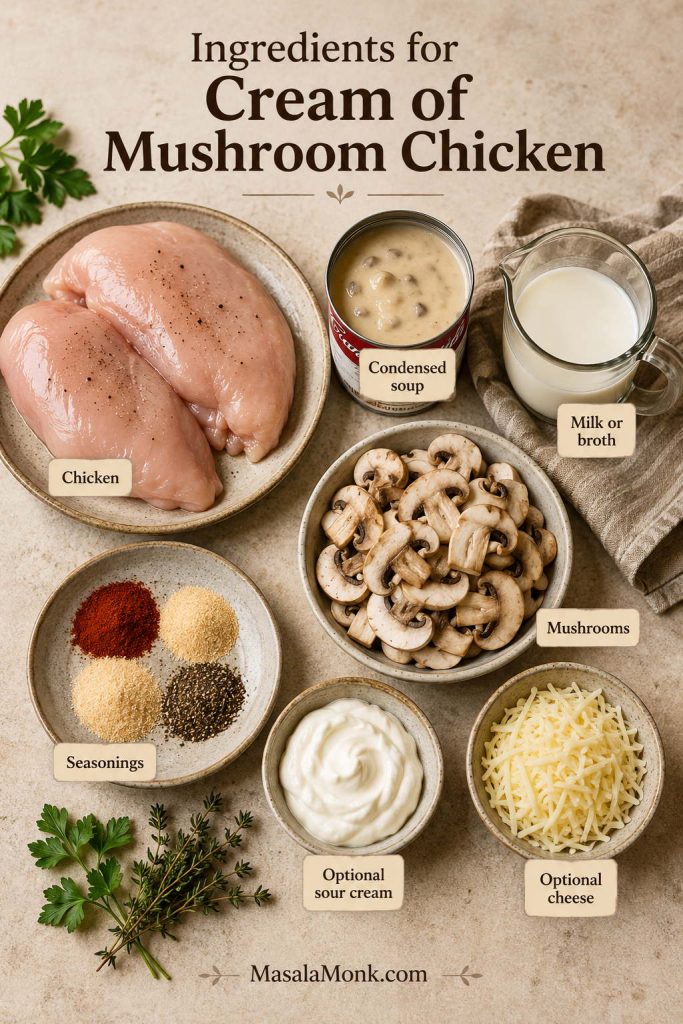
Ingredients for cream of mushroom chicken including chicken, condensed mushroom soup, milk or broth, mushrooms, seasonings, sour cream, and cheese.
A pantry base can still taste rounded when you add smart upgrades like broth, browned mushrooms, thyme, pepper, sour cream, or cheese.
  • Chicken: Boneless skinless breasts or thighs both work. Breasts give you a classic sliced dinner; thighs give you more forgiveness.
  • Condensed cream of mushroom soup: The word condensed matters because the soup starts thick and becomes sauce when you add liquid.
  • Milk, broth, or water: Broth gives savory depth, milk gives a softer creamy finish, and water works when that is all you have.
  • Fresh mushrooms: Raw mushrooms are convenient, but browned mushrooms add deeper flavor and release less water into the dish.
  • Sour cream: Use it for tang. Whisk it into the oven version before baking, or stir it into skillet and slow cooker versions near the end over gentle heat.
  • Cheese: Mozzarella, Monterey Jack, cheddar, Swiss, or Muenster can turn this into a richer family bake.
Taste before baking: Once the soup, liquid, and seasonings are mixed, taste the sauce before pouring it over the chicken. A bland sauce can take black pepper, garlic powder, paprika, thyme, or a small spoon of Dijon; a salty sauce does not need extra salt.

For the oven version, a 9×13-inch baking dish, foil, a mixing bowl, and an instant-read thermometer are enough. The stovetop route needs a lidded skillet, while the crockpot option works best in a 4–6 quart slow cooker.

Using Campbell’s or Any Condensed Mushroom Soup

Campbell’s condensed cream of mushroom soup works well here, and so do other condensed brands. The label matters less than the word condensed.

Condensed vs Ready-to-Eat Soup

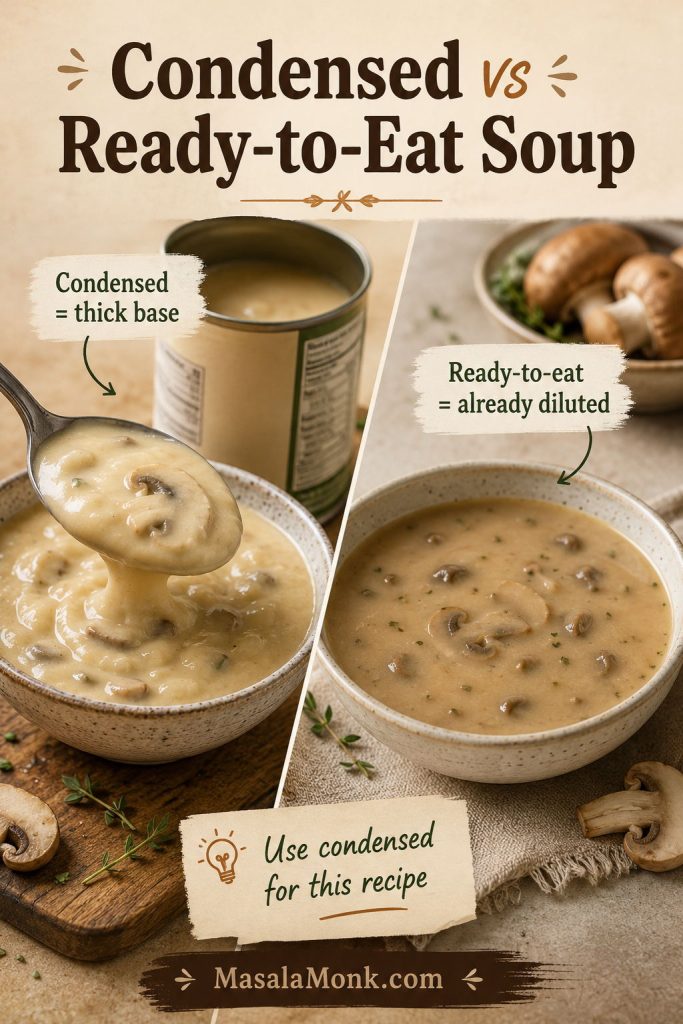
Condensed soup is thick enough to become sauce when mixed with a small amount of milk, broth, or water. Ready-to-eat mushroom soup is already diluted, so it can make the dish watery unless you reduce or skip the added liquid.

Comparison of thick condensed cream of mushroom soup and thinner ready-to-eat mushroom soup.
Condensed cream of mushroom soup starts thick, while ready-to-eat soup is already diluted; that difference matters when you want a creamy sauce.

Low-sodium condensed soup gives you more control if you are also using broth, cheese, onion soup mix, or another salty ingredient.

The same cream-soup comfort logic shows up in MasalaMonk’s tuna noodle casserole recipe, where condensed soup turns into a creamy noodle bake.

Best Chicken to Use: Breasts, Thighs, or Cubed Chicken

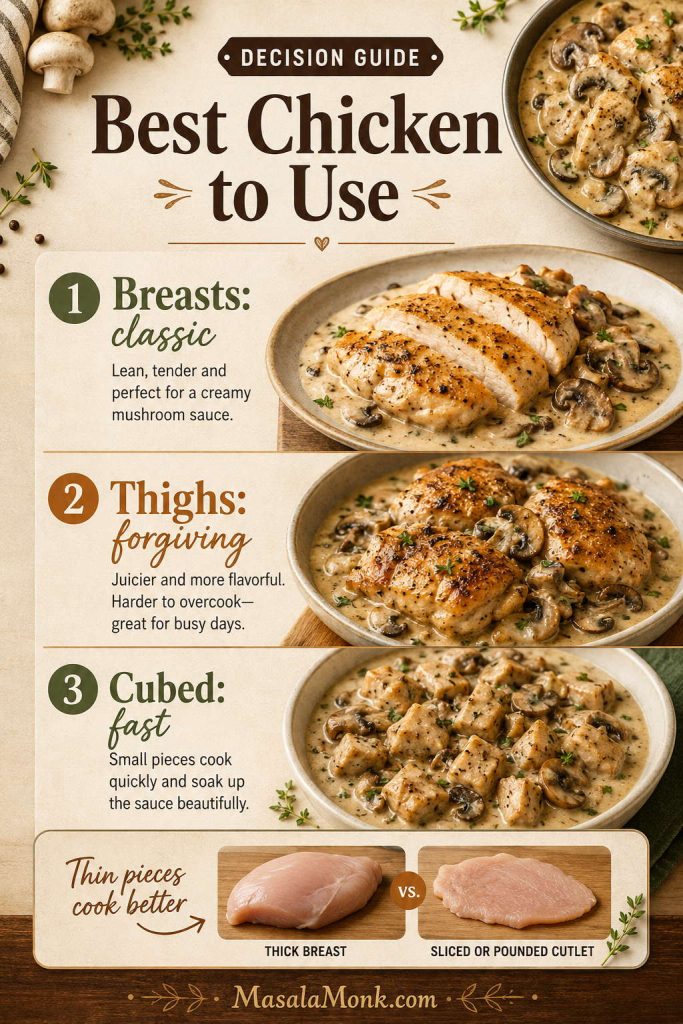
That is really the whole chicken decision: breasts for a classic sliced dinner, thighs when you want more forgiveness, and cubed chicken when you want a faster skillet or casserole-style meal.

Chicken guide showing breasts, thighs, cubed chicken, and thinner cutlets for cream of mushroom chicken.
Your cut changes the result: breasts slice neatly, thighs stay juicy, and cubed chicken cooks quickly for skillet-style dinners.

Chicken Breasts

Chicken breasts work well when they are not too thick. Large breasts should be sliced in half lengthwise to make thinner cutlets, or pounded to an even thickness. This helps the chicken cook through before the sauce dries out.

For more detail on baking chicken breast without drying it out, see MasalaMonk’s baked chicken breast recipe.

Chicken Thighs

Boneless skinless thighs stay juicy even when the dish needs a few extra minutes. They are especially good for the slow cooker or chicken-and-rice versions because they can handle longer cooking better than thin breasts.

Cubed Chicken

Cubed chicken is useful for a quick skillet dinner or a casserole-style variation. It cooks faster and mixes easily with noodles or rice, though it does not give you the same sliced-chicken presentation as baked breasts or thighs.

Baked Cream of Mushroom Chicken

This is the version to make first. It gives you the classic creamy mushroom chicken experience without needing a skillet, a roux, or a separate sauce.

The best pan comes out bubbling around the edges, with mushroom gravy tucked around the chicken and enough creamy sauce to drag through rice, noodles, or mashed potatoes.

Before Baking

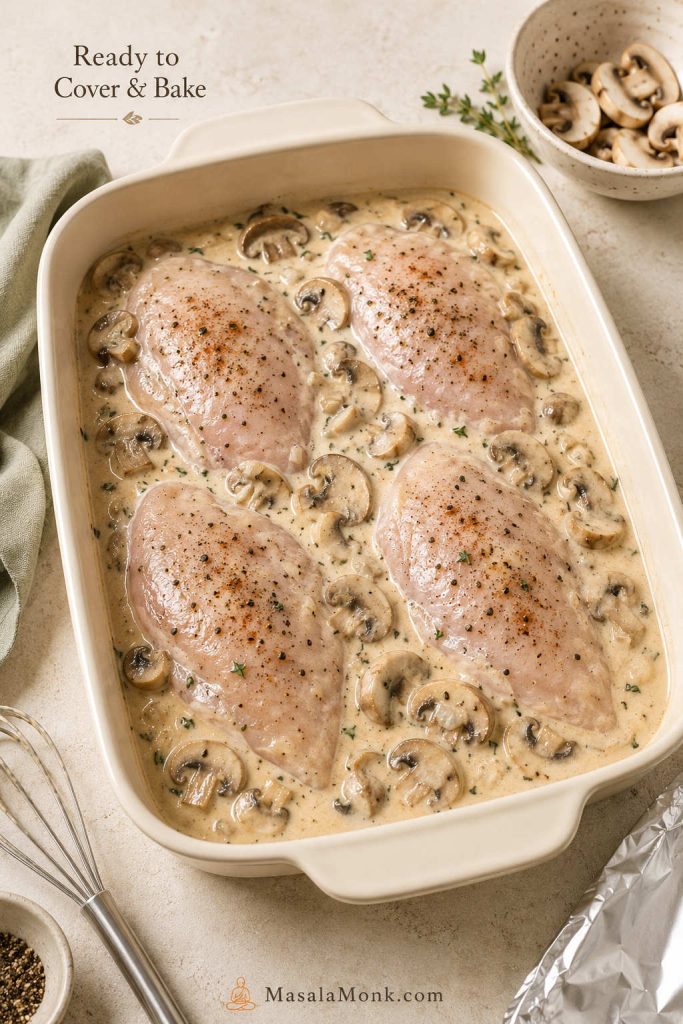
The dish should look assembled but not finished: chicken tucked into the mushroom mixture, mushrooms visible, and just enough sauce to coat the pan before it is covered.

Raw chicken breasts in a baking dish with cream of mushroom sauce, sliced mushrooms, foil, and a spoon nearby.
Before baking, the chicken should be coated and nestled into the mushroom mixture, not buried under too much liquid.

Baked Version at a Glance

Detail Best Answer
Oven temperature 375°F / 190°C
Baking dish 9×13-inch dish
Chicken 1½ lb / 680 g boneless skinless breasts or thighs
Soup 1 can condensed cream of mushroom soup, 10.5 oz / 298 g
Liquid ½ cup / 120 ml milk or low-sodium chicken broth
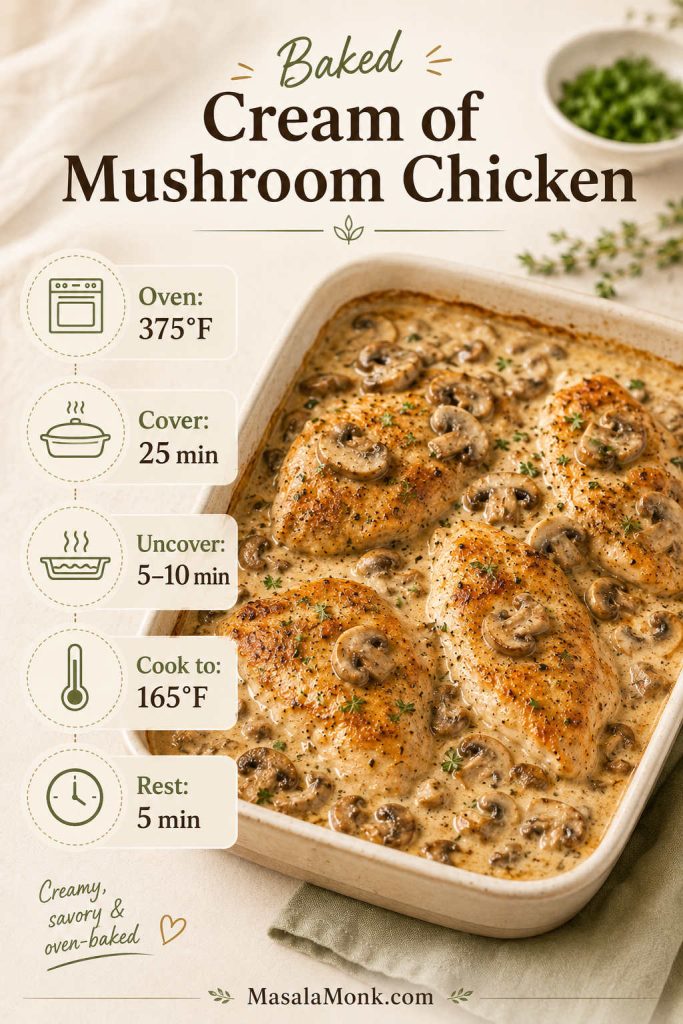
Covered bake 25 minutes
Uncovered finish 5–10 minutes
Safe internal temperature 165°F / 74°C
Resting time 5 minutes
Baked cream of mushroom chicken guide showing 375°F oven, covered baking, uncovered finish, 165°F temperature, and resting time.
Baked cream of mushroom chicken works best with a covered start, a short uncovered finish, and a thermometer check at 165°F.

Once this version is in the oven, there is not much left to do except make something for the sauce to land on.

Covered or Uncovered?

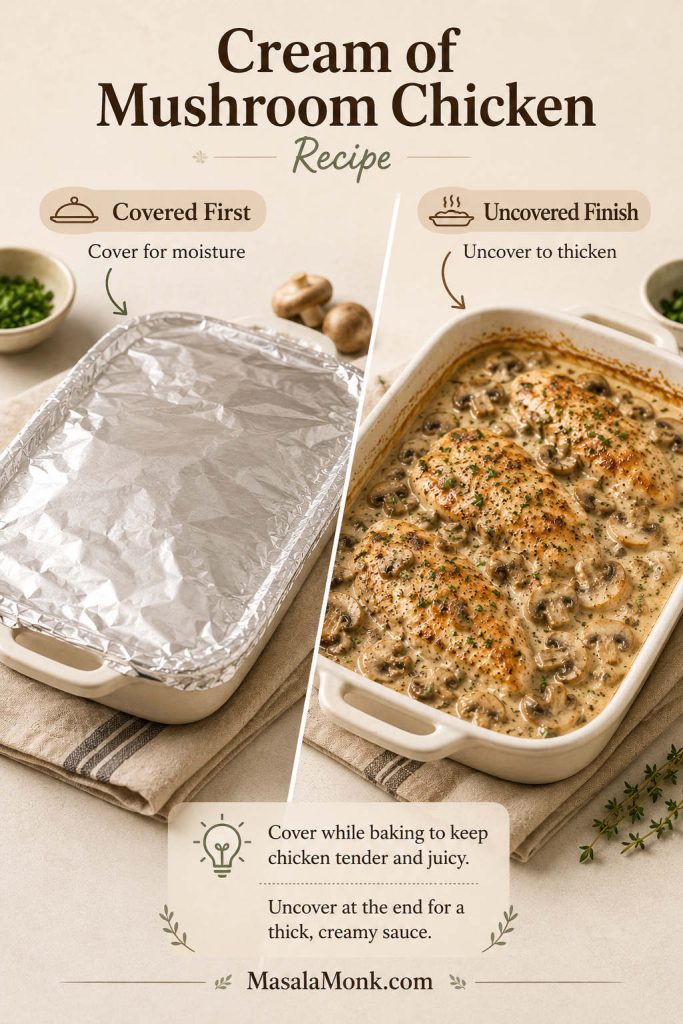
Cover the chicken for the first part of baking. The foil traps steam, keeps the meat moist, and prevents the sauce from drying out too quickly. The final uncovered minutes help looseness cook off and let cheese melt if you are using it.

Very thin pieces should be checked early. Thicker pieces need a thermometer more than they need a guessed time.

Comparison of covered and uncovered baked cream of mushroom chicken in a casserole dish.
Covering helps the chicken stay moist; afterward, uncovering lets the creamy mushroom sauce reduce just enough.
If the chicken is done but the sauce is thin: Do not keep baking the chicken just to thicken the sauce. Move the chicken to a plate, cover it loosely, and thicken the sauce in a small pan, or in the baking dish only if your dish is stovetop-safe.

What the Sauce Should Look Like

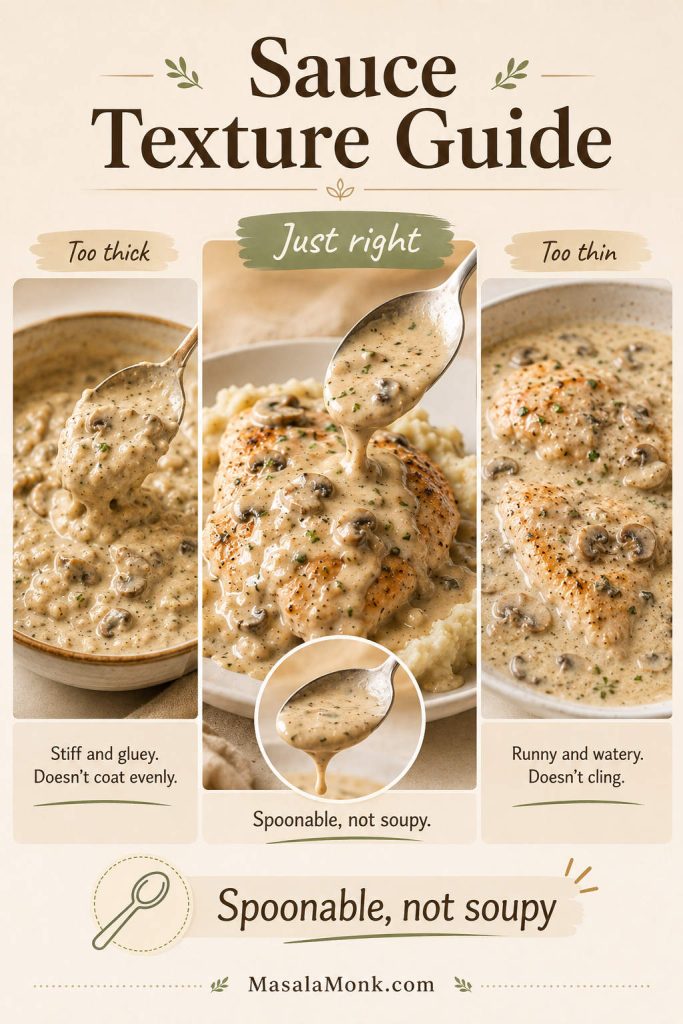
The finished sauce should be creamy and spoonable, thick enough to coat the chicken but loose enough to run into rice, noodles, or mashed potatoes. It should not be stiff like paste, and it should not run like soup.

A sauce that looks too thick before baking needs another splash of milk or broth. When the sauce looks watery but the chicken still needs time, uncover the dish for the last few minutes. Once the chicken is already at 165°F / 74°C, remove it and thicken the sauce separately instead of overbaking dinner.

Sauce texture guide for cream of mushroom chicken showing too thick, just right, and too thin sauces.
Look for sauce that coats a spoon without running like soup, since that texture will sit better on rice, noodles, or mashed potatoes.

In the oven version, ½ cup / 120 ml milk or broth per 10.5 oz / 298 g can of condensed soup is the safest starting point. The skillet version can handle more liquid because the pan sauce reduces as it simmers. The slow cooker needs less because the lid traps moisture as everything cooks. When the texture looks off, use the troubleshooting guide instead of guessing.

Skillet Cream of Mushroom Chicken

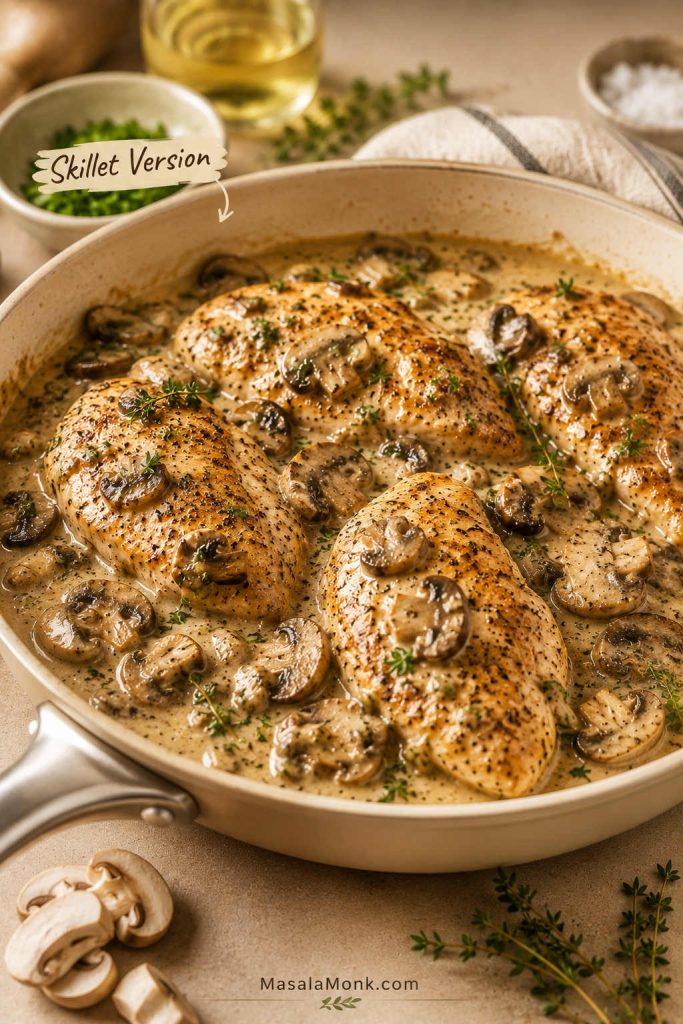
The skillet version is best when dinner needs to be faster and the sauce needs more hands-on control. It tastes a little more cooked, not just assembled, because the chicken and mushrooms get direct heat before the sauce comes together.

This is the version with the most dinner-pan flavor: a little browning, a little butter, and creamy mushroom sauce pulled together in the same skillet.

Skillet cream of mushroom chicken with seared chicken, browned mushrooms, creamy sauce, black pepper, and herbs.
The skillet version adds extra savory depth because the chicken and mushrooms brown before the cream sauce is finished.

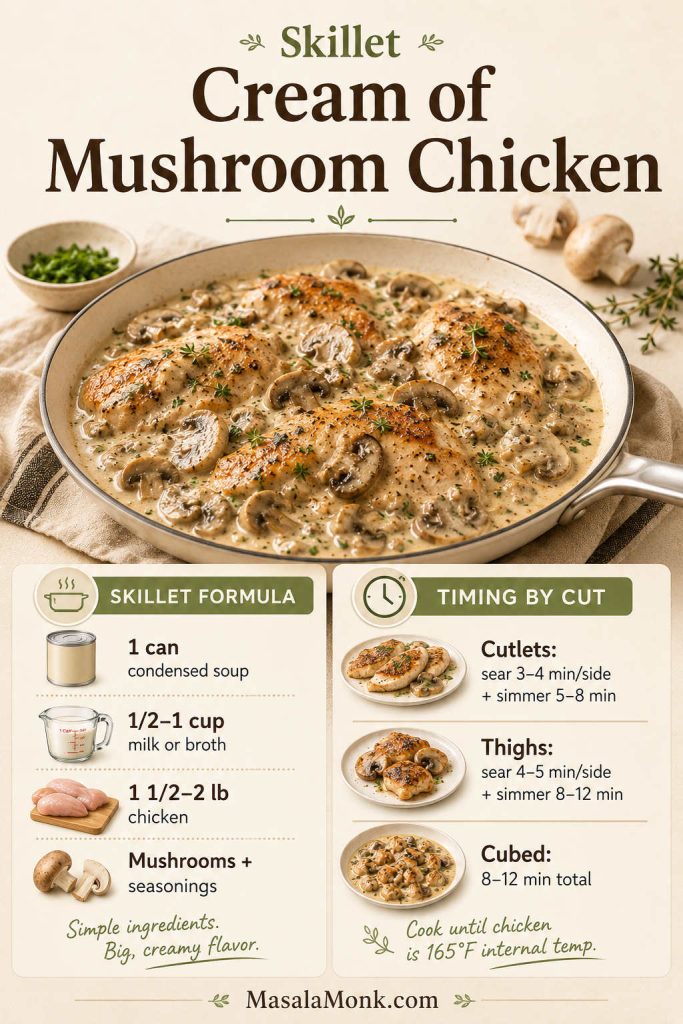
Skillet Formula

  • 1½–2 lb / 680–900 g chicken
  • 1 tbsp oil or butter, for searing
  • 1 can condensed cream of mushroom soup, 10.5 oz / 298 g
  • ½–1 cup / 120–240 ml milk, water, or low-sodium chicken broth
  • 8 oz / 225 g sliced mushrooms, optional
  • Garlic powder, onion powder, paprika, black pepper, and herbs to taste

Oil helps the chicken sear without burning. A small knob of butter added with the mushrooms gives the pan a richer, rounder flavor.

Skillet Timing

Chicken Type Timing What to Watch
Thin chicken cutlets Sear 3–4 minutes per side, then simmer 5–8 minutes in sauce Check early so they do not dry out.
Boneless thighs Sear 4–5 minutes per side, then simmer 8–12 minutes in sauce They stay juicier and can handle a little longer cooking.
Cubed chicken Cook 8–12 minutes total, depending on cube size Stir often so the sauce coats the pieces evenly.
Skillet formula and timing guide for cream of mushroom chicken with cutlets, thighs, and cubed chicken.
Skillet cream of mushroom chicken cooks quickly, so cut size matters: thin cutlets, thighs, and cubed chicken all need different timing.

How to Make It in a Skillet

Season the chicken, then sear it in a large skillet until lightly browned on both sides. Add fresh mushrooms after removing the chicken briefly, then cook them until they release moisture and start to brown. Whisk in the condensed soup with enough broth or milk to make a sauce, then return the chicken to the pan.

Step-by-step skillet method showing seared chicken, browned mushrooms, sauce mixture, returned chicken, and gentle simmering.
Sear first, then simmer gently; that sequence builds flavor while keeping the chicken from drying out.

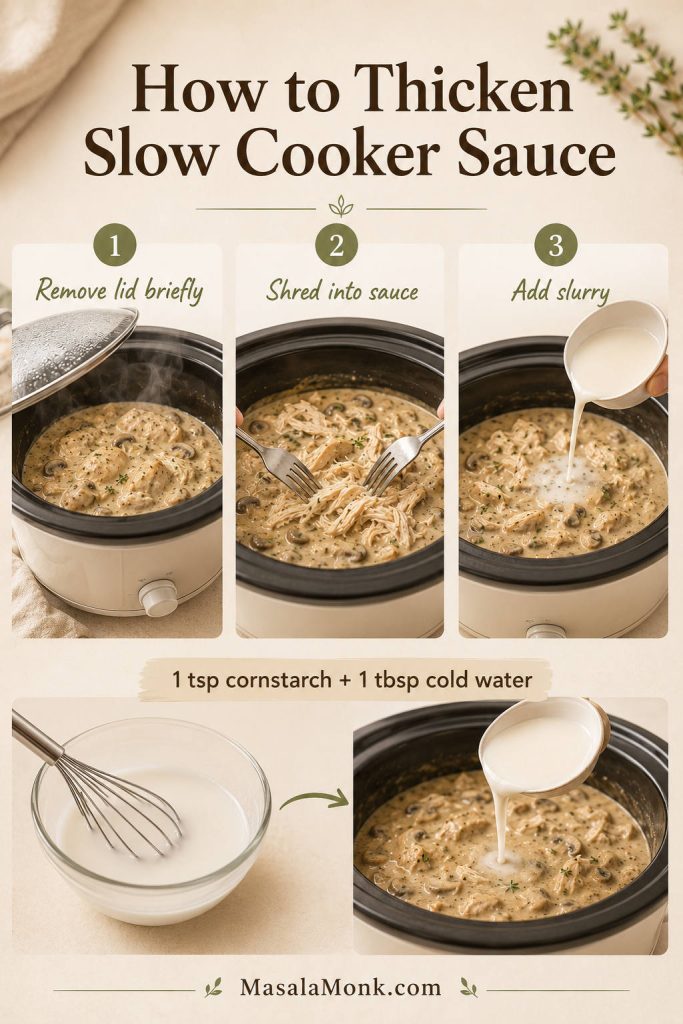
Cover and simmer gently until the chicken reaches 165°F / 74°C. A pan sauce that tightens too much only needs a tablespoon or two of milk or broth. A loose sauce needs the opposite: a few uncovered minutes so extra moisture can cook off. Use the sauce texture guide if you are unsure whether to loosen or reduce it. For a quick slurry, mix 1 tsp cornstarch with 1 tbsp cold water, then stir it into the simmering sauce. Sour cream should go in near the end over low heat so everything stays smooth.

Slow Cooker Cream of Mushroom Chicken

The slow cooker is best when you want tender, saucy chicken waiting for you later. It is less about speed and more about having creamy chicken ready when the rice, noodles, or potatoes are done.

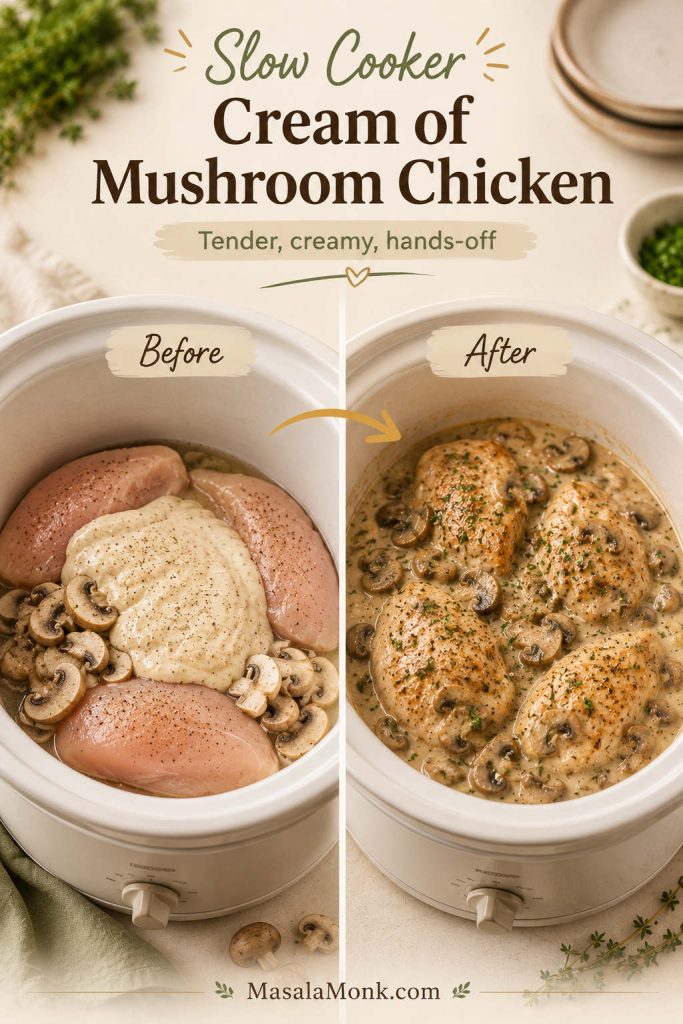
Because the lid traps moisture, start with less liquid than you would use in the oven or skillet. Thawed chicken gives the most predictable timing and texture; frozen chicken releases more moisture and can make the sauce thin.

Slow cooker cream of mushroom chicken before and after cooking, with chicken, mushrooms, condensed soup, and creamy finished sauce.
Slow cooker cream of mushroom chicken needs a thicker starting mixture because the covered cooker creates its own moisture.

If you like this kind of hands-off chicken dinner, MasalaMonk’s crock pot chicken breast recipes has more ways to keep slow-cooked chicken juicy instead of dry.

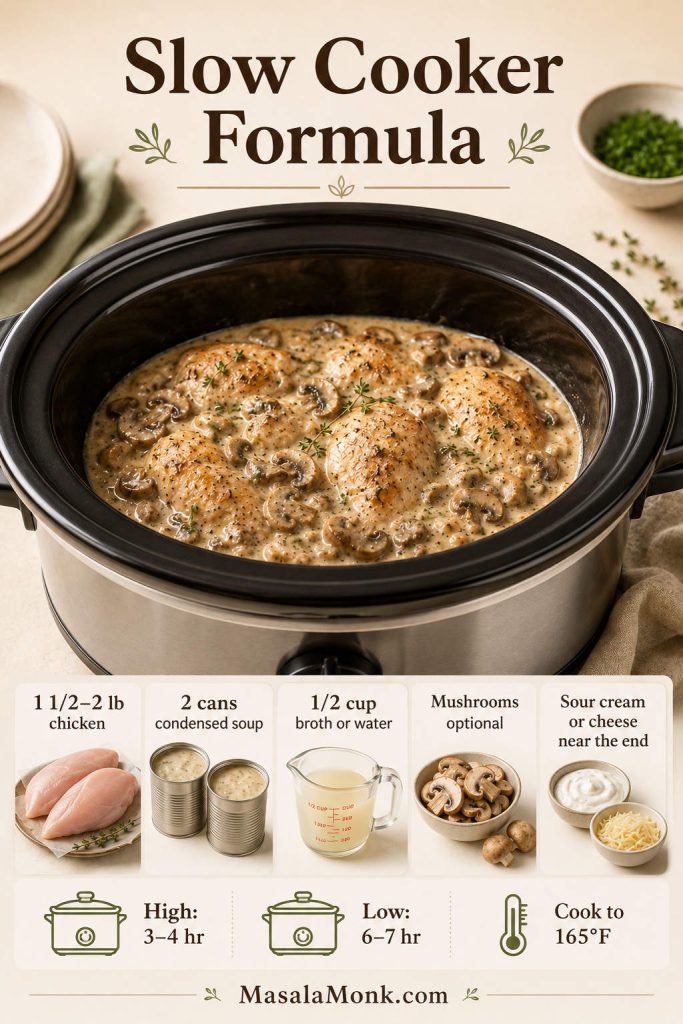
Slow Cooker Formula

  • 1½–2 lb / 680–900 g chicken breasts or thighs
  • 2 cans condensed cream of mushroom soup, 10.5 oz / 298 g each
  • ½ cup / 120 ml low-sodium chicken broth or water
  • 8 oz / 225 g sliced mushrooms, optional
  • ½ packet onion soup mix, optional, only if you like a saltier old-school flavor
  • Sour cream or cheese near the end, optional
Slow cooker formula board for cream of mushroom chicken with chicken, condensed soup, broth or water, timing, and temperature.
Start the slow cooker with less liquid than the oven version, then adjust near the end if the sauce needs loosening or enrichment.

Cook on High for 3–4 hours or Low for 6–7 hours, until the chicken reaches 165°F / 74°C. Thighs handle the longer cook better than thin breasts. By the end, the chicken should be fork-tender and the sauce should taste like it has had time to settle into the meat.

Serve the pieces whole, or shred the chicken into the sauce if you want it to spoon over rice, noodles, or potatoes. Add sour cream or cheese near the end, not at the beginning, for the smoothest finish.

How to Thicken Slow Cooker Cream of Mushroom Chicken

A thin slow cooker sauce can be fixed by removing the lid for a short time, shredding the chicken into the sauce, or thickening it with a small slurry made from 1 tsp cornstarch and 1 tbsp cold water. Use this fix before the chicken overcooks.

Guide showing how to thicken slow cooker cream of mushroom chicken sauce by removing the lid, shredding chicken, or adding slurry.
If slow cooker sauce turns thin, you can fix it calmly with uncovered time, shredded chicken, or a small cornstarch slurry.

For another saucy crockpot chicken dinner, MasalaMonk’s slow cooker French onion chicken follows a similar comfort-food idea with onion gravy, cheese, and a base of noodles, potatoes, rice, or toast.

Cream of Mushroom Chicken and Rice

Rice can absolutely work here, but it needs its own formula. Dry rice needs extra liquid, trapped steam, and more time than the basic baked chicken version. Before you bake, scan the rice mistakes to avoid if you are using brown rice, instant rice, or thick chicken pieces.

Rice version rule: Use extra liquid, a tight foil cover, and longer baking time. The soup base alone is too thick to cook raw rice evenly.
Cream of mushroom chicken and rice casserole in a baking dish with tender rice, mushrooms, creamy sauce, and a serving spoon.
Cream of mushroom chicken and rice needs its own method, since dry rice requires extra liquid, trapped steam, and resting time.

Campbell’s classic one-dish chicken and rice bake follows this same condensed-soup pattern: condensed soup, measured liquid, uncooked long-grain white rice, and chicken baked together under a tight cover. You can see that reference here: Campbell’s One-Dish Chicken & Rice Bake.

Small Classic Chicken and Rice Bake

This smaller rice bake makes about 4 servings.

  • 1 can condensed cream of mushroom soup, 10.5 oz / 298 g
  • 1 cup / 240 ml water or low-sodium chicken broth
  • ¾ cup / about 140 g uncooked long-grain white rice
  • 1¼ lb / 565 g boneless skinless chicken breast or thighs
  • ¼ tsp paprika, plus pepper and garlic powder if desired

Mix the soup, liquid, rice, and seasoning in a greased baking dish. Place the chicken on top, cover tightly, and bake at 375°F / 190°C for about 45 minutes, or until the rice is tender and the chicken reaches 165°F / 74°C. Let it stand for 10 minutes before serving so the rice can finish absorbing the sauce.

Chicken and rice timing tip: Thicker chicken pieces or thighs work better for rice bakes because the rice needs longer to cook. Thin chicken breasts may finish before the rice is tender. When that happens, remove the chicken, keep the rice covered, and continue baking the rice until soft.

Larger 9×13 Family Rice Bake

A larger family-style casserole needs more soup, more rice, and more liquid.

  • 2 cans condensed cream of mushroom soup, 10.5 oz / 298 g each
  • 2 cups / 480 ml low-sodium chicken broth
  • 1¼ cups / about 230 g long-grain white rice
  • 1½–2 lb / 680–900 g chicken
  • Optional onion, thyme, Dijon, black pepper, or Parmesan

Cover tightly and bake at 350°F / 175°C for about 60 minutes. Check the rice, stir gently around the chicken if needed, add a splash of hot broth if the rice is still firm, then cover again and bake 10–15 minutes more. Rest 10 minutes before serving.

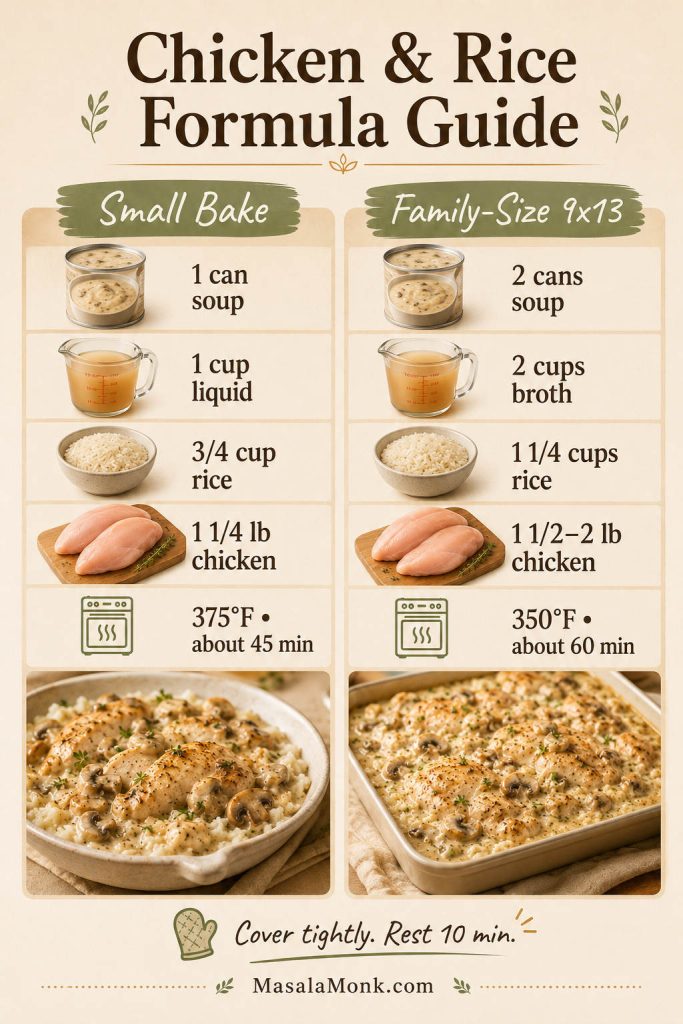
Chicken and Rice Formula Guide

Use the small bake when you want a compact dinner, and use the 9×13 formula when the casserole needs to feed more people without leaving the rice undercooked.

Formula guide for small and family-size cream of mushroom chicken and rice bakes with soup, liquid, rice, chicken, oven temperature, and time.
Use the right chicken-and-rice formula from the start, and you avoid the common problem of tender chicken with undercooked rice.

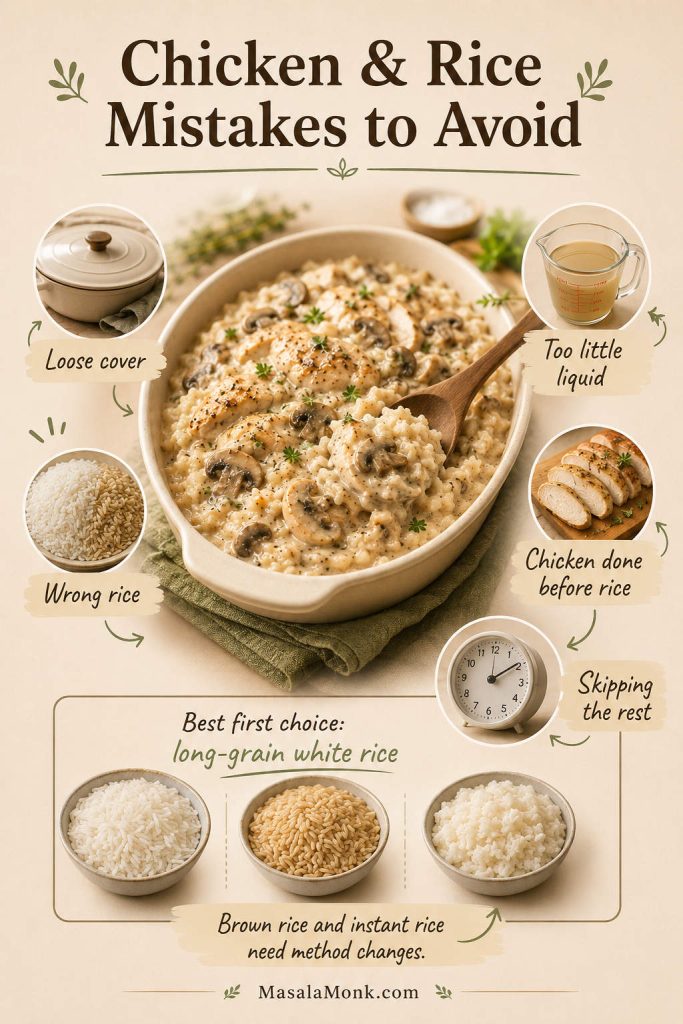
Rice Mistakes to Avoid

The rice version is forgiving once the steam is right, but it is less forgiving when the cover is loose or the liquid is guessed.

  • A loose cover will not trap enough steam. Rice needs a tight cover to soften properly.
  • Brown rice needs a different plan. It takes more time and usually more liquid than white rice.
  • Instant rice cooks too fast for this long bake. It can turn mushy unless you change the method.
  • Ready-to-eat soup can make the bake watery. It is already diluted, unlike condensed soup.
  • The chicken can finish before the rice. Check both before calling the dish done.
  • Resting matters. The rice absorbs the final sauce as it stands.
Chicken and rice mistakes guide showing loose cover, wrong rice, too little liquid, chicken done before rice, skipped resting time, and rice choices.
Long-grain white rice is the easiest choice; brown rice and instant rice need different liquid and timing to work well.

Serving the chicken over plain rice instead of baking rice in the dish? MasalaMonk’s how to cook rice guide is useful for getting fluffy grains that do not turn gummy under the sauce.

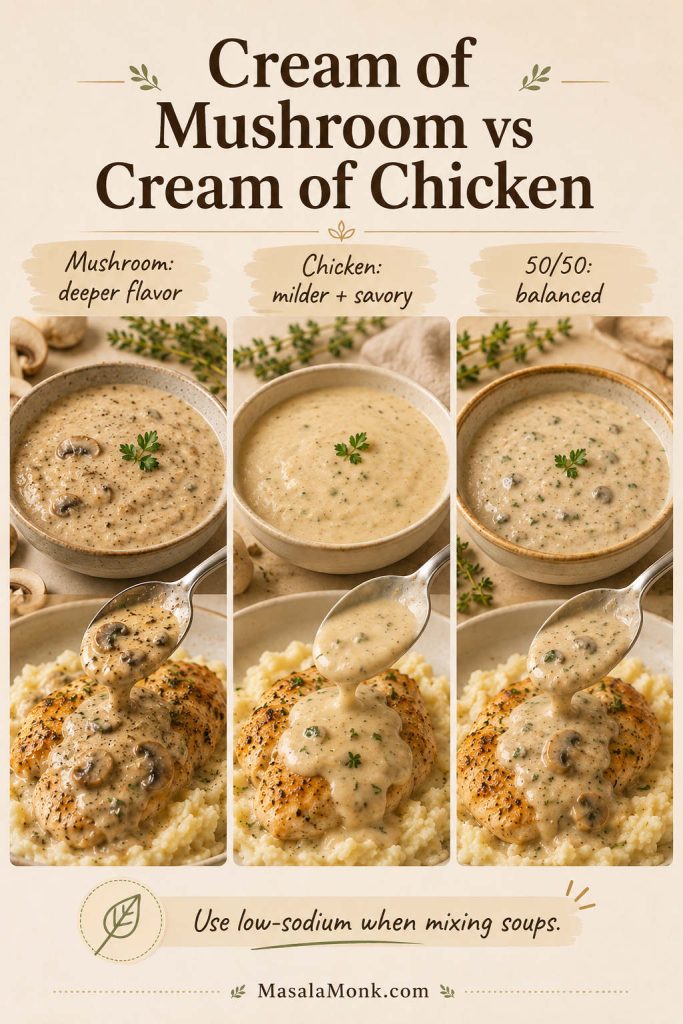
Cream of Chicken + Cream of Mushroom Variation

You can mix cream of chicken and cream of mushroom soup. Cream of chicken makes the sauce milder and more savory, while cream of mushroom adds deeper mushroom flavor. A 50/50 mix works especially well for larger bakes, chicken and rice, and slow cooker meals.

For a bigger casserole or crockpot dinner, try 1 can cream of mushroom soup and 1 can cream of chicken soup. Low-sodium versions are the safest choice because two condensed soups can make the dish salty fast.

Comparison of cream of mushroom soup, cream of chicken soup, and a 50 50 blend spooned over chicken.
Cream of mushroom brings deeper flavor, cream of chicken tastes milder, and a 50/50 blend gives a softer creamy sauce.

This same cream-soup swap logic also shows up in comfort casseroles like MasalaMonk’s green bean casserole recipe ideas, where condensed cream soup is part of the classic creamy base.

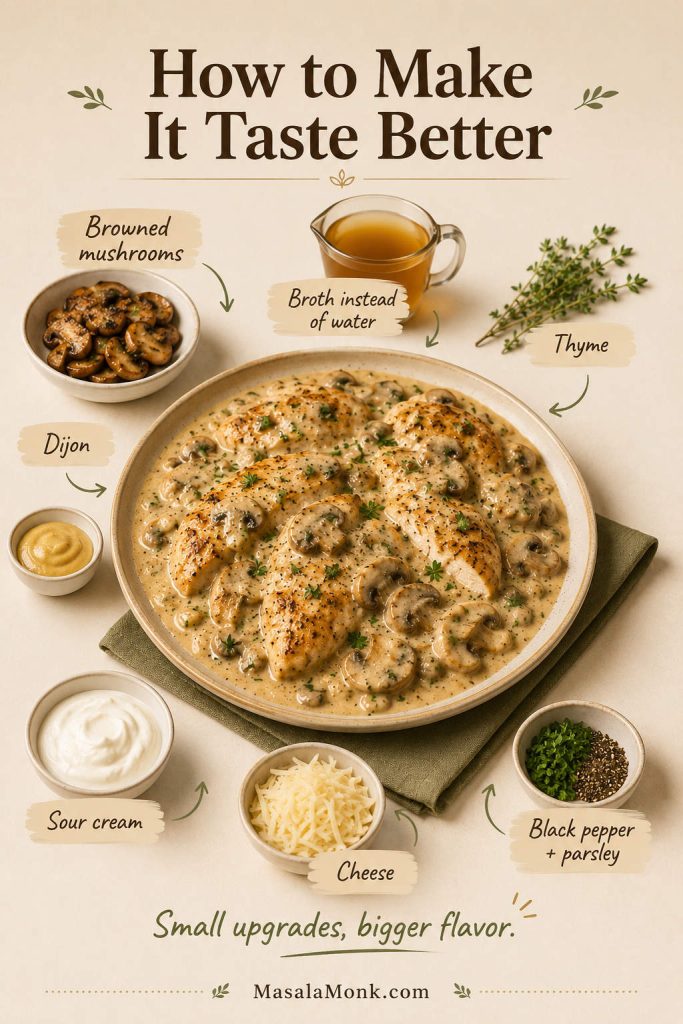
How to Make Cream of Mushroom Chicken Taste Better

The shortcut works as-is, but one or two small upgrades can make it taste more like a creamy mushroom dinner than plain canned soup.

The easiest upgrades are browned mushrooms for depth, broth for savoriness, and a small spoon of Dijon or thyme for balance.

Flavor upgrade board for cream of mushroom chicken with browned mushrooms, broth, thyme, Dijon, sour cream, cheese, pepper, and parsley.
Small upgrades like browned mushrooms, broth, Dijon, thyme, sour cream, cheese, pepper, and parsley make the shortcut taste more complete.

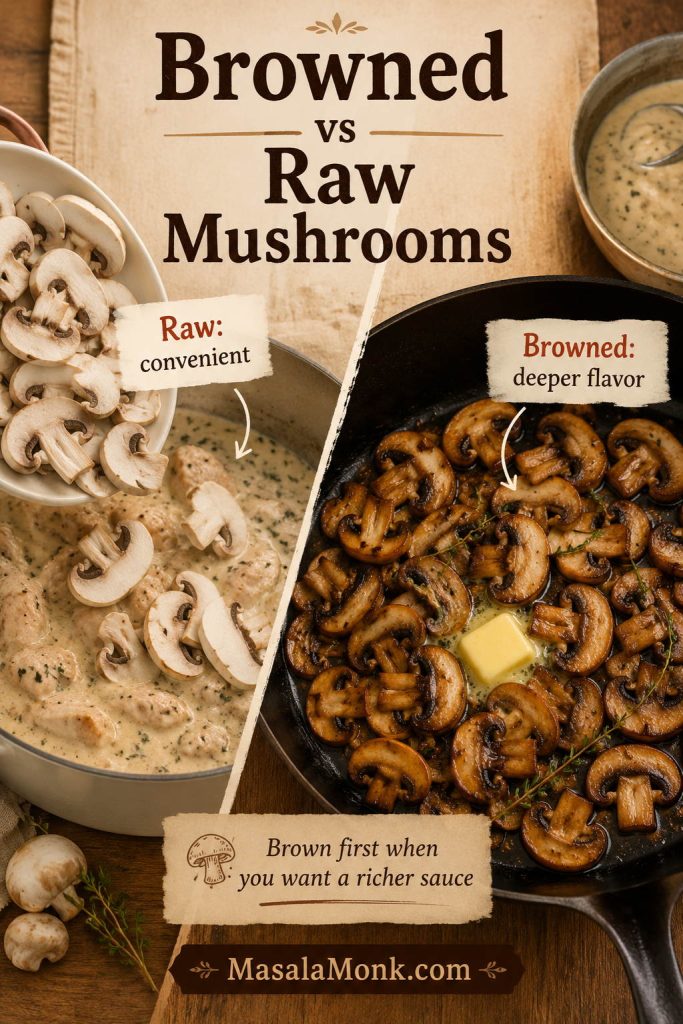
Browned vs Raw Mushrooms

Raw mushrooms can go straight into the dish, but browning them first gives the sauce more flavor and reduces the extra moisture that can loosen the pan.

Comparison of raw sliced mushrooms and browned mushrooms for cream of mushroom chicken.
Raw mushrooms keep prep easy; meanwhile, browned mushrooms add deeper flavor and reduce extra moisture in the sauce.
  • Brown fresh mushrooms first: This adds real mushroom flavor, cooks off extra moisture, and gives the sauce a deeper base.
  • Choose broth instead of water: Low-sodium chicken broth gives the dish more savory depth.
  • Add garlic and onion powder: These make the pantry version taste fuller.
  • Add thyme: Thyme works naturally with mushrooms and chicken.
  • Stir in a small spoon of Dijon: It cuts through the richness without making the dish taste mustardy.
  • Finish with sour cream: It gives the sauce a tangier, creamier finish. In skillet and slow cooker versions, add it near the end over gentle heat.
  • Melt cheese on top: Mozzarella, Monterey Jack, cheddar, Swiss, or Muenster can turn this into a cheesy baked chicken dinner.
  • Add black pepper and parsley at the end: This keeps the final plate from tasting too heavy.

What to Serve with Cream of Mushroom Chicken

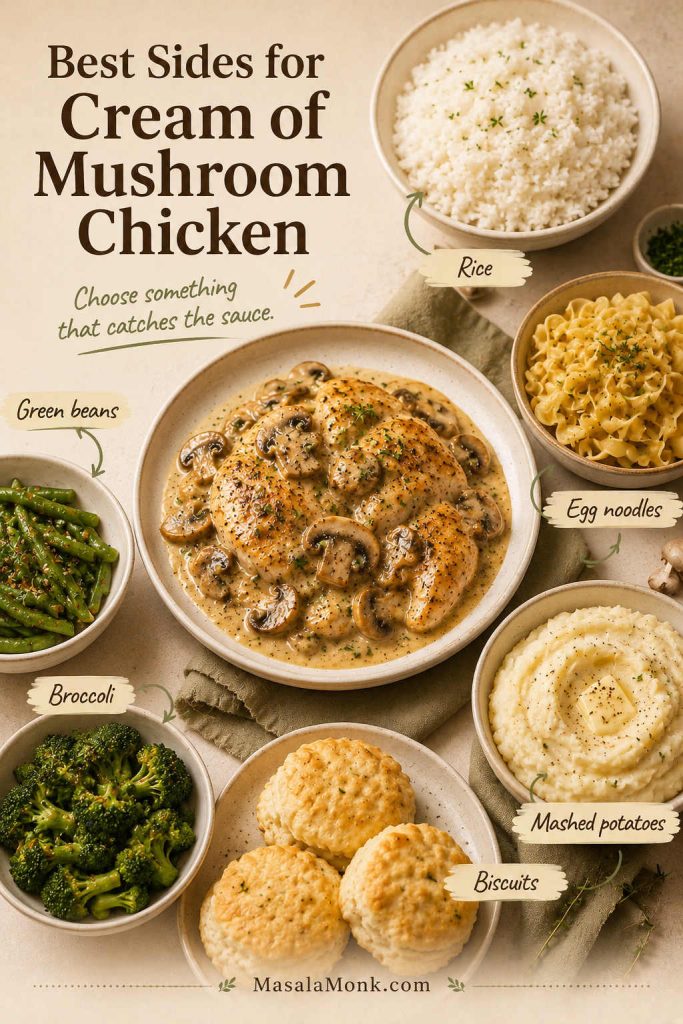
The sauce is the point, so serve it with something that catches every spoonful: fluffy rice, buttered egg noodles, mashed potatoes, biscuits, broccoli, or green beans.

Side dish guide for cream of mushroom chicken with rice, egg noodles, mashed potatoes, biscuits, broccoli, and green beans.
The best sides give the sauce somewhere to go, whether you choose rice, egg noodles, mashed potatoes, biscuits, broccoli, or green beans.

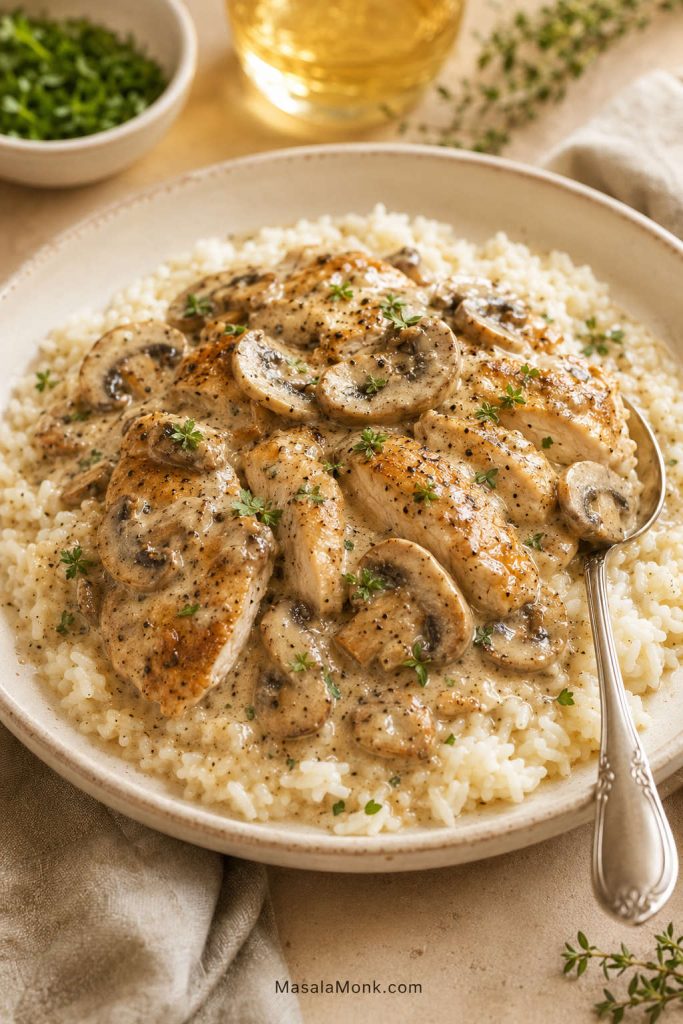
Over Rice

Plain white rice is the easiest pairing. Brown rice, leftover rice, or seasoned rice also work, but keep them separate unless you are following a true chicken-and-rice bake formula.

Cream of mushroom chicken served over fluffy white rice with sliced mushrooms, creamy sauce, black pepper, and herbs.
Rice keeps this creamy chicken dinner simple, filling, and easy to serve on a busy weeknight.

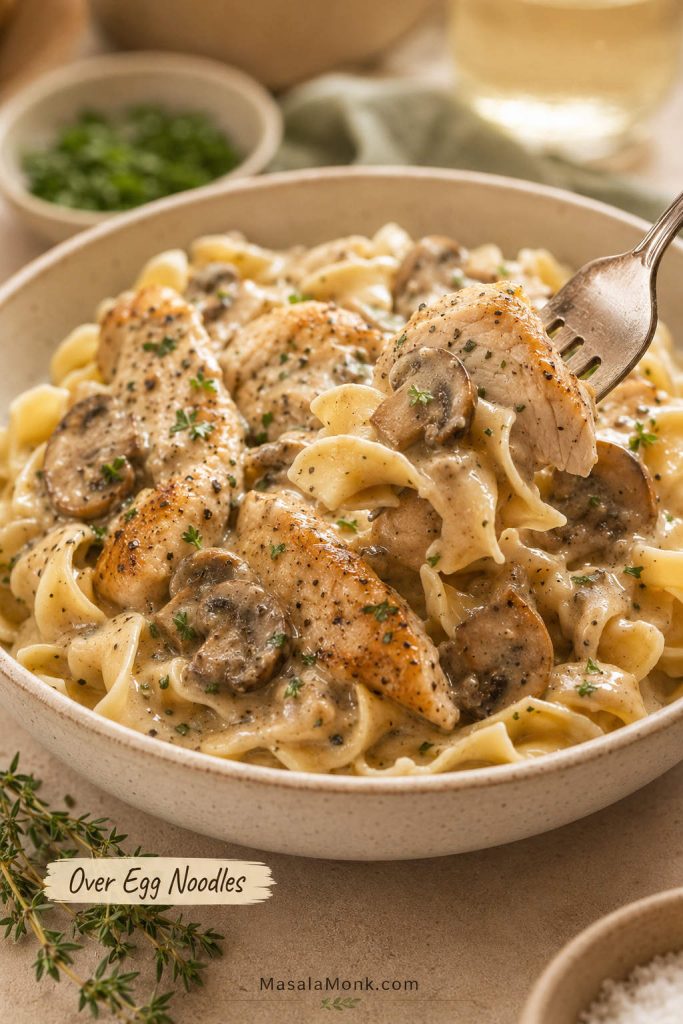
Over Egg Noodles

Egg noodles make this feel like old-school chicken and gravy. Cook the noodles separately, then spoon the chicken and mushroom sauce over the top. Dry egg noodles should not go into the baking dish unless you are using a tested noodle-casserole formula.

Cream of mushroom chicken served over broad egg noodles with creamy mushroom sauce, chicken pieces, herbs, and a fork lifting a bite.
Broad egg noodles hold the mushroom sauce in their folds, so this version feels cozy without needing extra prep.

Over Mashed Potatoes

Mashed potatoes make the plate even cozier. If you want a creamy potato side that will hold the sauce without turning gluey, try MasalaMonk’s garlic mashed potatoes recipe.

Sliced cream of mushroom chicken served over mashed potatoes with mushrooms, creamy sauce, black pepper, and herbs.
Mashed potatoes make the richest plate because the soft potatoes hold the creamy mushroom sauce instead of letting it run.

With Vegetables

Green beans, broccoli, peas, carrots, roasted mushrooms, or a simple salad balance the richness. For a holiday-style comfort plate, serve it with green bean casserole, roasted vegetables, or a crisp side salad.

For a bigger comfort-food spread, MasalaMonk’s hashbrown casserole recipe also works as a creamy potato side, especially when the chicken is served with green beans or salad. Planning leftovers? The storage and reheating tips explain how to loosen the sauce again without drying out the chicken.

How to Fix Cream of Mushroom Chicken

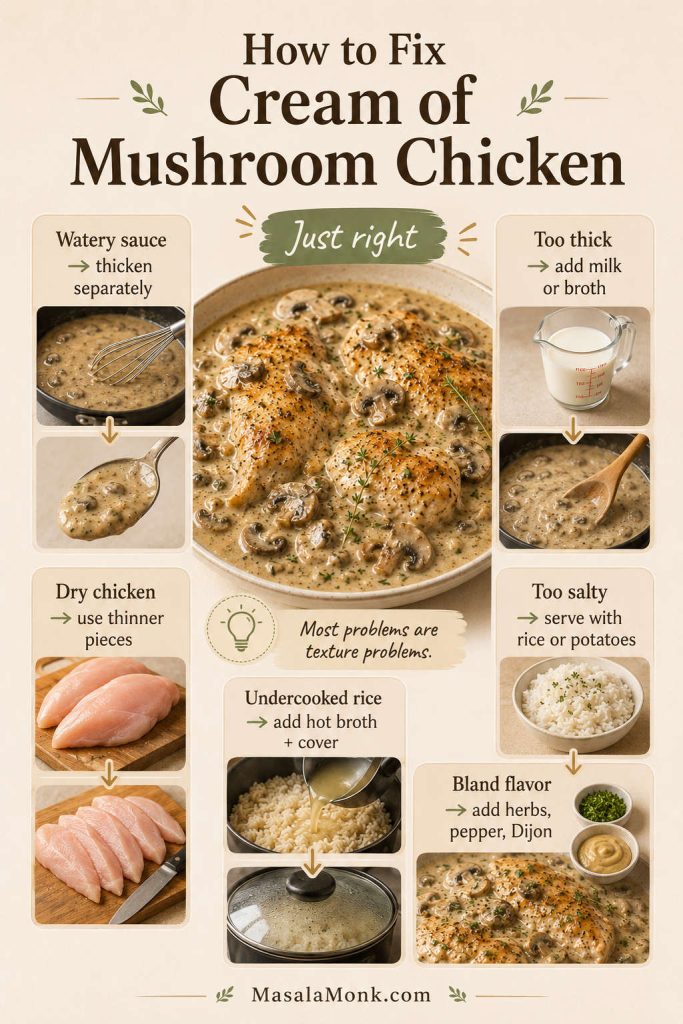
Even when this dish goes a little sideways, it is usually fixable. Most problems are texture problems: the sauce is too thick, too watery, or too salty, while the chicken dries out because the pieces were too thick or cooked too long.

The usual culprits are ready-to-eat soup instead of condensed soup, too much liquid, a loose cover on rice, or thick chicken breasts that needed more time than the sauce did.

Common Sauce, Chicken, and Rice Fixes

Problem What Happened How to Fix It
Sauce is too thick or gluey Not enough liquid was added to the condensed soup. Add milk or broth 1–2 tbsp at a time until it is spoonable.
Sauce is watery Too much liquid was added, ready-to-eat soup was used, or raw mushrooms released extra moisture. When the chicken still needs time, bake uncovered 5–10 minutes. When the chicken is already done, remove it and thicken the sauce separately with a small slurry: 1 tsp cornstarch mixed with 1 tbsp cold water.
Sauce is too salty Condensed soup, broth, cheese, or onion soup mix added too much salt. Serve with rice, noodles, or potatoes to soften the saltiness. A spoonful of sour cream can also mellow the sauce. Next time, use low-sodium soup and broth.
Chicken is dry The pieces were too thick, uncovered too long, or cooked past 165°F / 74°C. Slice breasts thinner, cover while baking, check early, or use thighs.
Chicken is done but sauce is thin The sauce needs more time, but the chicken does not. Remove the chicken, cover it loosely, and thicken the sauce separately in a small pan.
Rice is undercooked The dish needed more steam, liquid, or time. Add ¼–½ cup hot broth, cover tightly again, and bake longer.
Rice is mushy Too much liquid or too much bake time. Use long-grain white rice, measure carefully, and rest the dish instead of overbaking.
Dish tastes bland The sauce was not boosted with enough seasoning or fresh ingredients. Add black pepper, garlic powder, onion powder, thyme, paprika, Dijon, or browned mushrooms.
Sauce splits when reheated It was reheated too aggressively. Reheat gently with a splash of milk or broth and stir slowly.
Troubleshooting guide for cream of mushroom chicken showing fixes for watery sauce, thick sauce, salty sauce, dry chicken, undercooked rice, and bland flavor.
Most cream of mushroom chicken problems are fixable once you know whether the issue is texture, salt, timing, or seasoning.

Storage, Freezing and Reheating

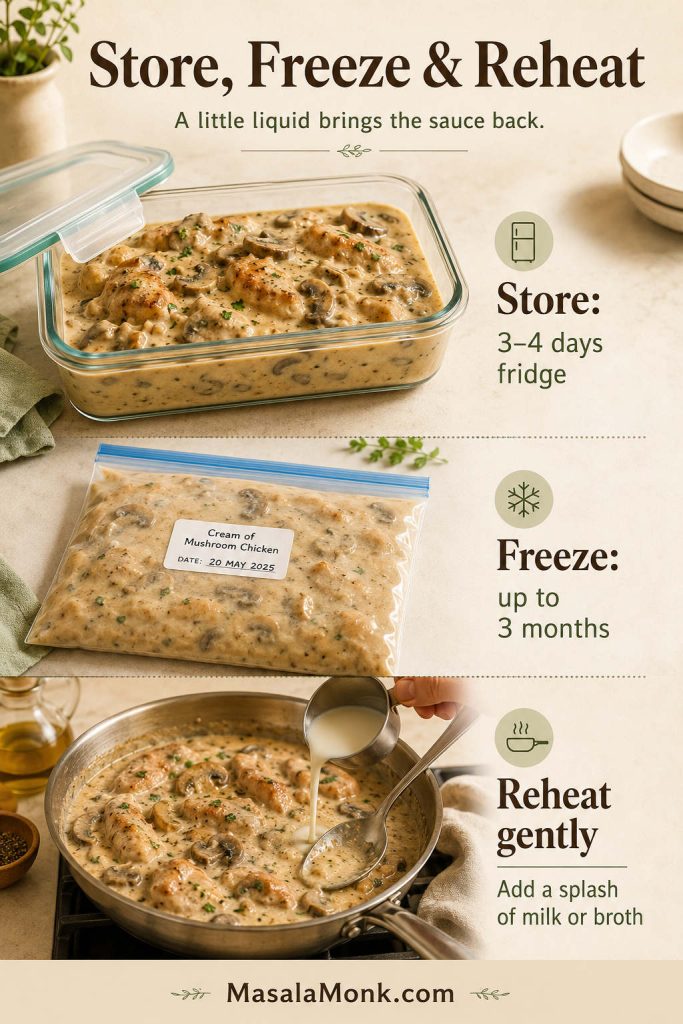
Store leftovers in an airtight container in the refrigerator for 3–4 days. Rice or noodles are best stored separately when possible so they do not soak up all the sauce.

To reheat, warm the chicken gently on the stovetop or in the microwave with a splash of milk or broth. The sauce thickens as it chills, so that splash of liquid helps bring it back to a spoonable texture.

You can freeze the cooked chicken and sauce, but the sauce may loosen or look slightly grainy after thawing. It is still usable; reheat gently and whisk in a splash of milk or broth to bring it back together.

Chicken-and-rice leftovers thicken more in the fridge because the rice keeps absorbing the sauce. Reheat them with a splash of broth or milk so the rice loosens instead of turning dry.

Storage guide for cream of mushroom chicken showing a fridge container, freezer bag, and reheating in a skillet with milk or broth.
Creamy leftovers thicken in the fridge, so reheat gently and add a splash of milk or broth to bring the sauce back.

Cream of Mushroom Chicken FAQs

How long should cream of mushroom chicken bake?

Thin boneless chicken breasts or thighs usually need about 25 minutes covered at 375°F / 190°C, then 5–10 minutes uncovered. Thickness matters more than the clock, so check that the chicken reaches 165°F / 74°C.

Covered or uncovered?

Cover the dish first so the chicken stays moist and the sauce does not dry out. Uncover near the end when the sauce needs to thicken or cheese is going on top.

Campbell’s soup vs other condensed brands

A standard 10.5 oz / 298 g can of Campbell’s condensed cream of mushroom soup works well, but other condensed brands work too. The important detail is that the soup is condensed, not ready-to-eat.

Chicken breasts vs thighs

Boneless skinless thighs are the more forgiving choice because they stay juicy even when the dish needs a few extra minutes. Breasts work well too, but they should be thin and even before baking.

How much liquid should I add to condensed soup?

For baked chicken, ½ cup / 120 ml milk or low-sodium broth per 10.5 oz / 298 g can makes a creamy sauce. Skillet chicken can take ½–1 cup / 120–240 ml because the pan sauce reduces as it simmers.

How to make it on the stove

The stovetop version works best with thin pieces because they cook quickly and stay tender. Sear them first, then simmer gently in the mushroom sauce until they reach 165°F / 74°C. A few uncovered minutes will tighten a loose pan sauce.

Homemade mushroom sauce instead of canned soup

This becomes a different style of recipe, but it can work. For a quick homemade mushroom cream sauce, start with 2 tbsp butter, 8 oz mushrooms, 1 minced garlic clove, 2 tbsp flour, 1 cup broth, and ½ cup milk or cream, then cook the chicken in that sauce. For the classic shortcut flavor, use condensed soup.

Adding rice safely

Rice can work beautifully, but treat it like its own bake, not a last-minute add-in. It needs extra liquid, trapped steam, and more time than the basic chicken version. Start with 1 can condensed soup, 1 cup / 240 ml water or broth, ¾ cup / about 140 g long-grain white rice, and about 1¼ lb / 565 g chicken.

Should you use frozen chicken?

Thawed chicken is the safer bet here because it cooks more evenly and keeps the sauce from turning watery. Frozen chicken can release a lot of moisture, especially in the oven or skillet, so thaw it first when you can.

Why the sauce turns watery

Watery sauce usually comes from too much liquid, ready-to-eat soup instead of condensed soup, raw mushrooms releasing moisture, or keeping the dish covered for the whole bake. Once the chicken is done, remove it and thicken the sauce separately with a small slurry made from 1 tsp cornstarch and 1 tbsp cold water.

Fixing a salty sauce

Condensed soup is already salty, and broth, cheese, or onion soup mix can add even more. Rice, noodles, or potatoes help soften the saltiness on the plate. A spoonful of sour cream can also mellow the sauce.

Best sides for creamy mushroom chicken

Rice, egg noodles, mashed potatoes, biscuits, broccoli, green beans, peas, carrots, and roasted mushrooms all work. The best side is something that catches the creamy mushroom sauce.

Slow cooker ratio

In the slow cooker, use less liquid than you might expect because the lid traps moisture. For 1½–2 lb / 680–900 g chicken, use 2 cans condensed cream of mushroom soup and about ½ cup / 120 ml broth or water. Cook on High for 3–4 hours or Low for 6–7 hours, until the chicken reaches 165°F / 74°C.

Final Thoughts

Start with the oven version first. Once you understand the soup-to-liquid ratio, the recipe bends to the night: faster in a skillet, easier in the slow cooker, or heartier with rice.

However you make it, the goal stays the same: juicy chicken, creamy mushroom gravy, and a dinner that asks very little from you but still feels like someone cared.

Back to top

Posted on 1 Comment

Paella Recipe

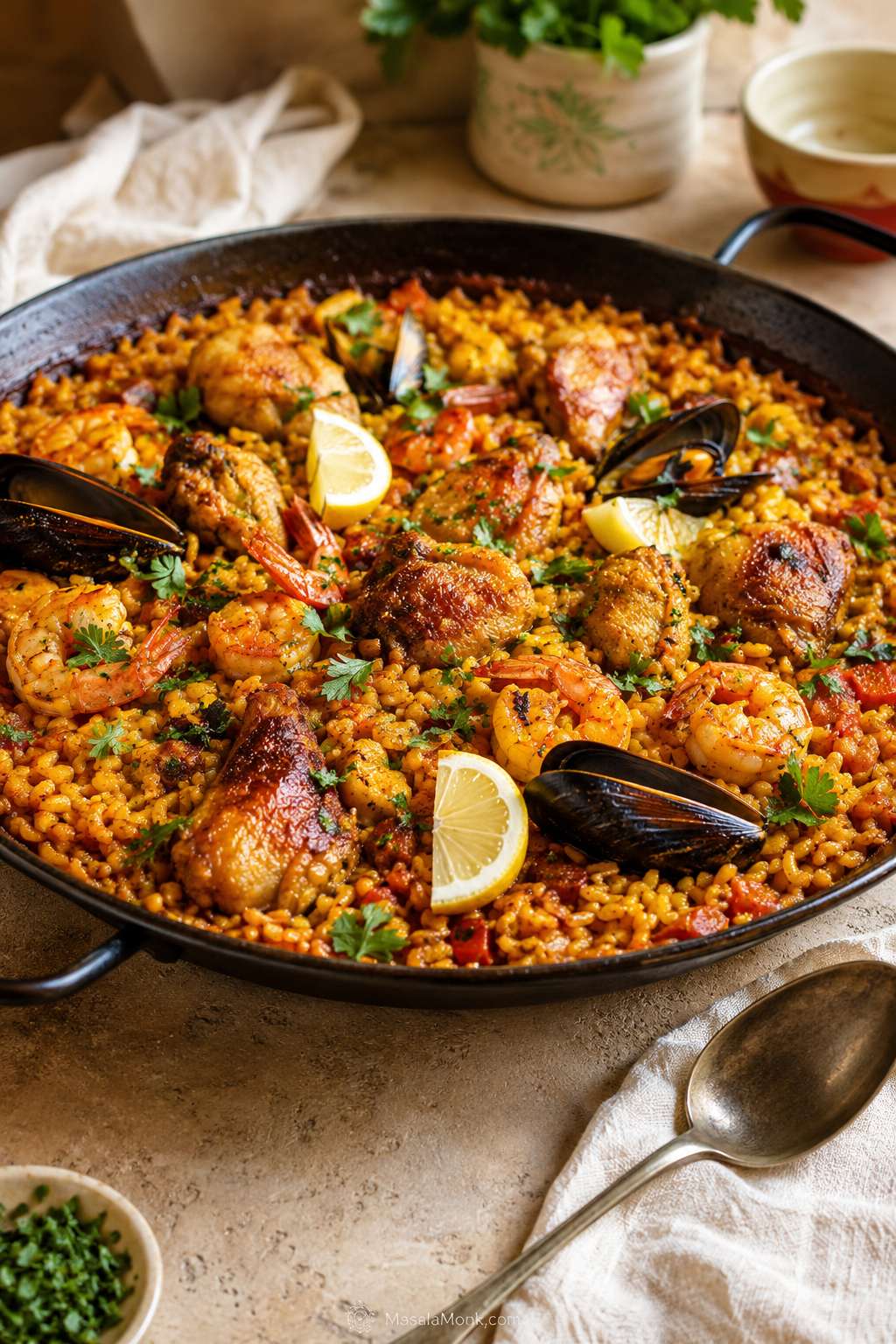
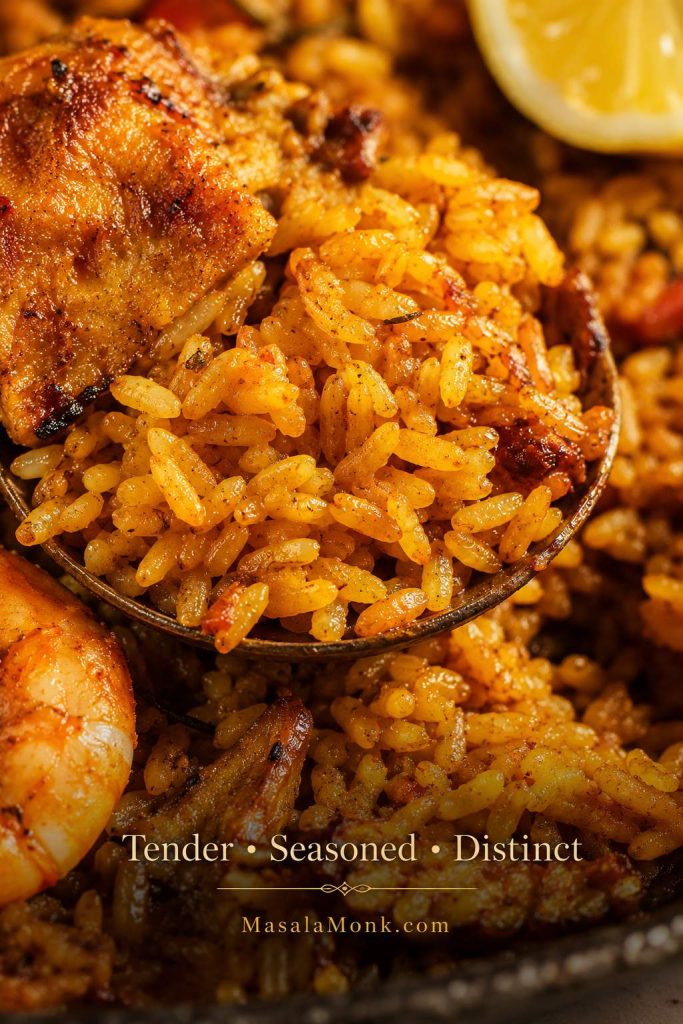
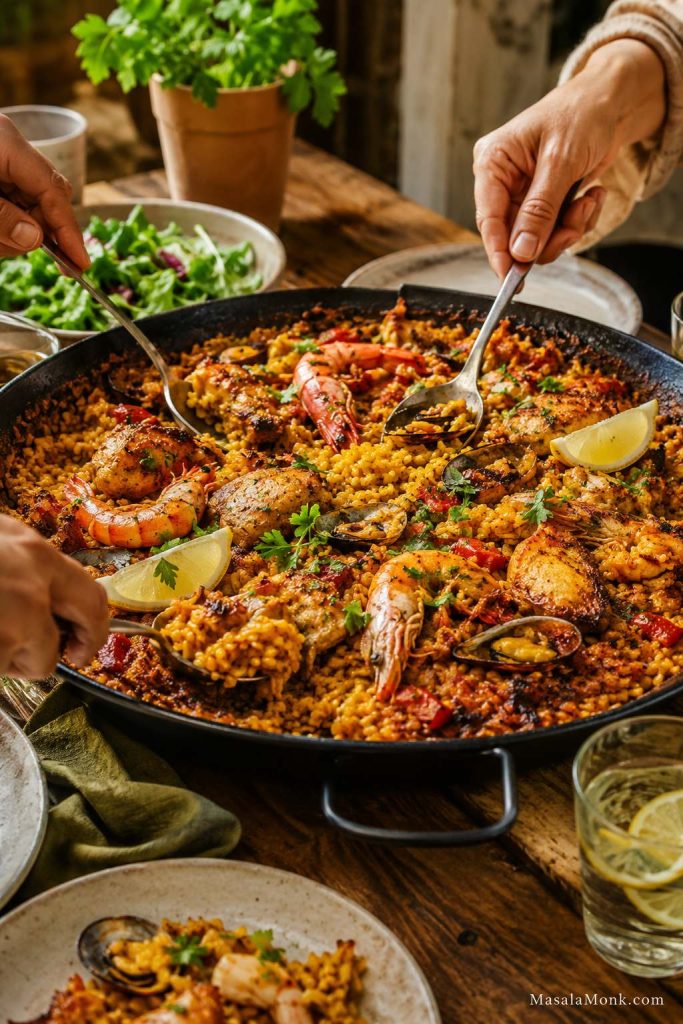
Finished home-stovetop mixed paella in a wide pan with saffron rice, chicken, shrimp, shellfish, lemon wedges, and parsley.

A good paella recipe should feel generous before anyone takes a bite: golden rice, saffron and paprika in the air, shrimp tucked into the top, lemon wedges on the side, and that quiet hope that there are toasted bits hiding at the bottom of the pan.

This version is built for a regular home kitchen, not a restaurant burner. It gives you browned chicken, tender shrimp, optional shellfish, a deep tomato-and-paprika sofrito, and a clear no-stir method so the rice cooks tender and separate instead of mushy.

The rhythm is simple once you see it: build flavor first, add short-grain rice and hot stock, spread everything into a shallow layer, then leave it alone. This is a home-stovetop mixed paella with chicken, shrimp, optional shellfish, and saffron rice. It is inspired by paella mixta rather than strict Paella Valenciana, but it respects the principles that matter most: good rice, broad heat, careful seafood timing, and a proper rest.

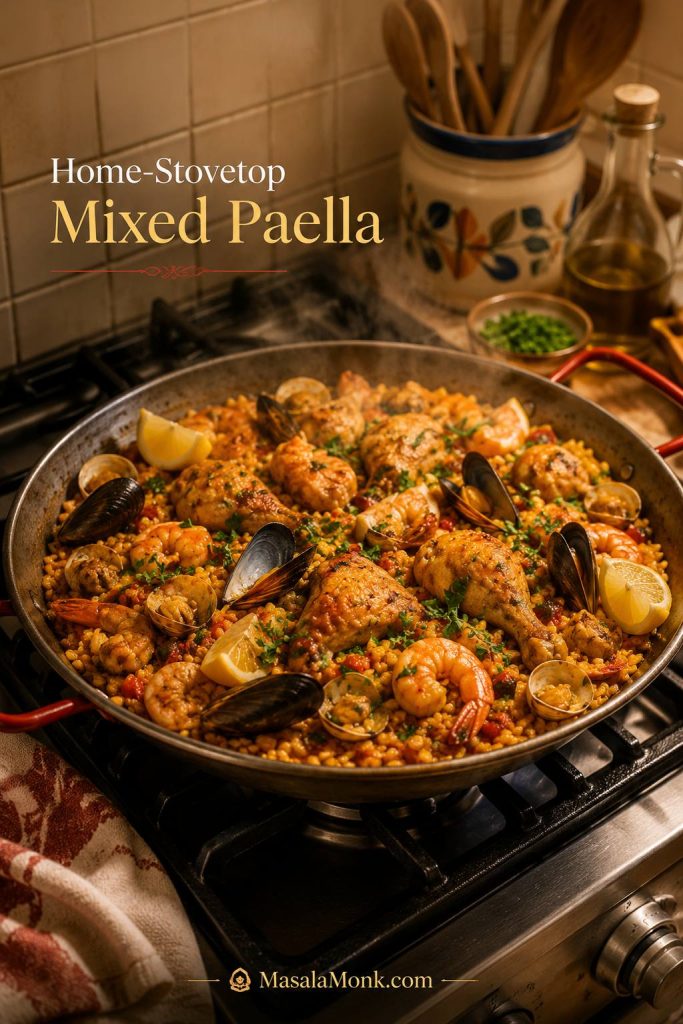
Mixed paella with chicken, shrimp, shellfish, and saffron rice cooking in a wide pan on a regular home stovetop.
This home-stovetop mixed paella is built for a regular burner, so the real success cues are shallow rice, controlled heat, pan rotation, and seafood added near the end.

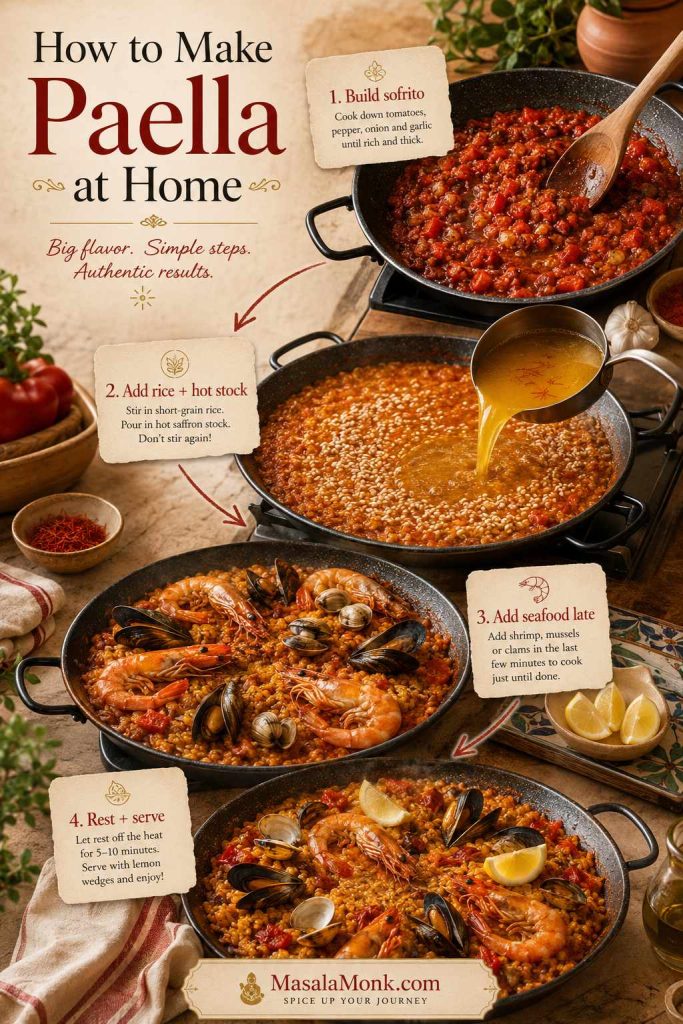
Quick Answer: How to Make Paella at Home

To make paella at home, cook a thick sofrito with onion, garlic, tomato, paprika, and saffron, then add short-grain rice and hot stock. Spread the rice into a shallow layer, simmer uncovered without stirring, add shrimp or shellfish near the end, and rest the pan before serving.

Four-step visual guide for making paella at home, showing sofrito, rice with hot stock, seafood added late, and rested paella.
Once the cooking rhythm is clear, paella feels much less intimidating: build a thick sofrito, add rice and hot stock, leave the pan alone, add seafood late, and rest before serving.

The best rice is Spanish short-grain rice such as bomba, Calasparra, or Valencia. Although a paella pan helps, a wide skillet or low-sided sauté pan can work if the rice stays shallow. Once the stock goes in, your job is mostly to watch the bubbles, rotate the pan if needed, and let the rice cook in place.

If you want the exact rice and pan details before cooking, jump to Best Rice for Paella or Do You Need a Paella Pan?.

If You Want More Seafood or a Chicken-and-Seafood Paella

Use the same rice method and adjust the proteins. A seafood-forward paella can lean more heavily on seafood stock, shrimp, mussels, clams, squid, scallops, or firm white fish. For chicken and seafood paella, follow the recipe as written: browned chicken gives the rice body, while shrimp and optional mussels or clams go in near the end so they stay tender instead of rubbery. To adjust the pan further, see Paella Variations.

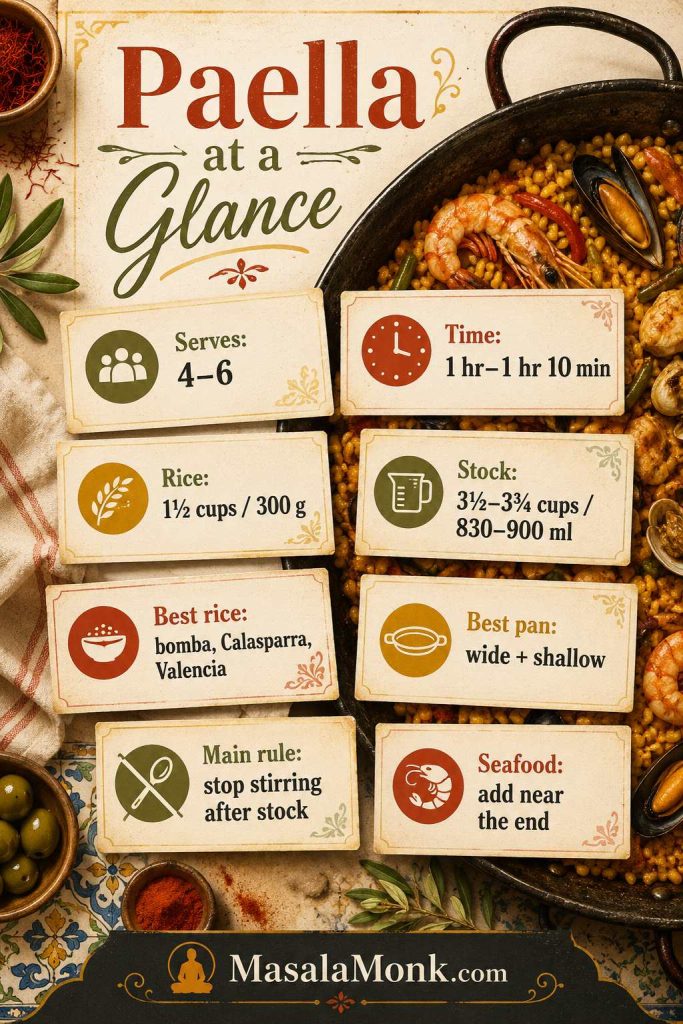
Paella at a Glance

  • Style: Home-stovetop mixed paella with chicken, shrimp, and optional shellfish
  • Serves: 4–6
  • Total time: About 1 hour to 1 hour 10 minutes
  • Best rice: Bomba, Calasparra, Valencia, or Spanish short-grain rice
  • Rice amount: 1½ cups / about 300 g
  • Stock amount: 3½–3¾ cups / 830–900 ml hot stock
  • Best pan: Wide paella pan, skillet, or low-sided sauté pan
  • Main rule: Stop stirring once the stock goes in
  • Seafood timing: Add shrimp and shellfish near the end
Paella at-a-glance guide showing servings, cooking time, rice amount, stock amount, best rice, pan type, no-stir rule, and seafood timing.
Before cooking, check the three things that control paella texture most: the rice type, the stock amount, and whether the pan is wide enough for a shallow layer.

What This Method Helps You Avoid

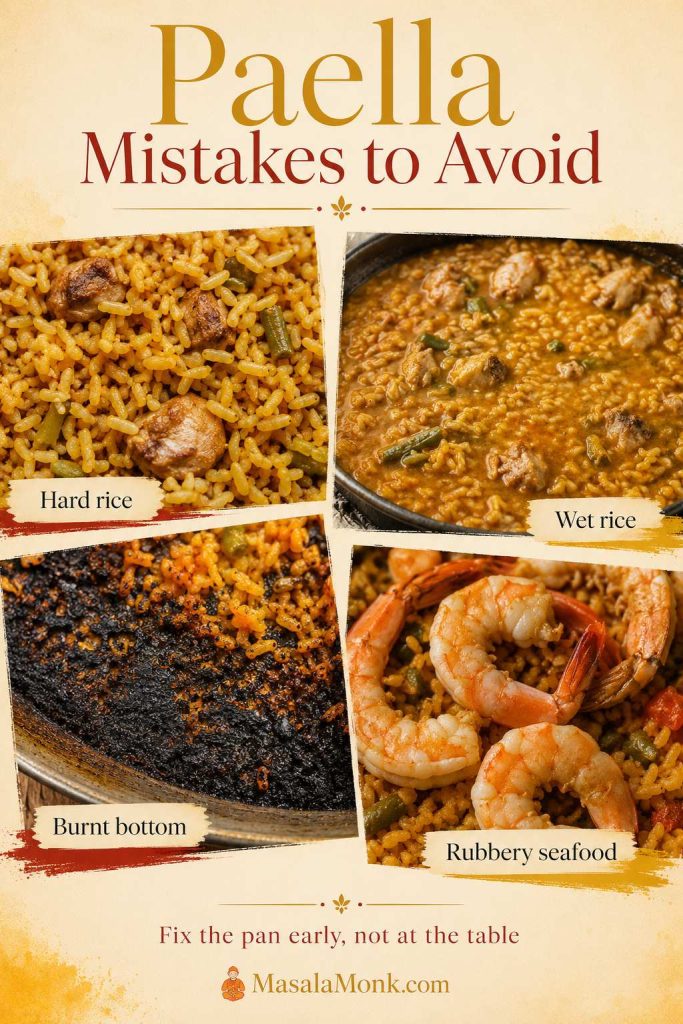
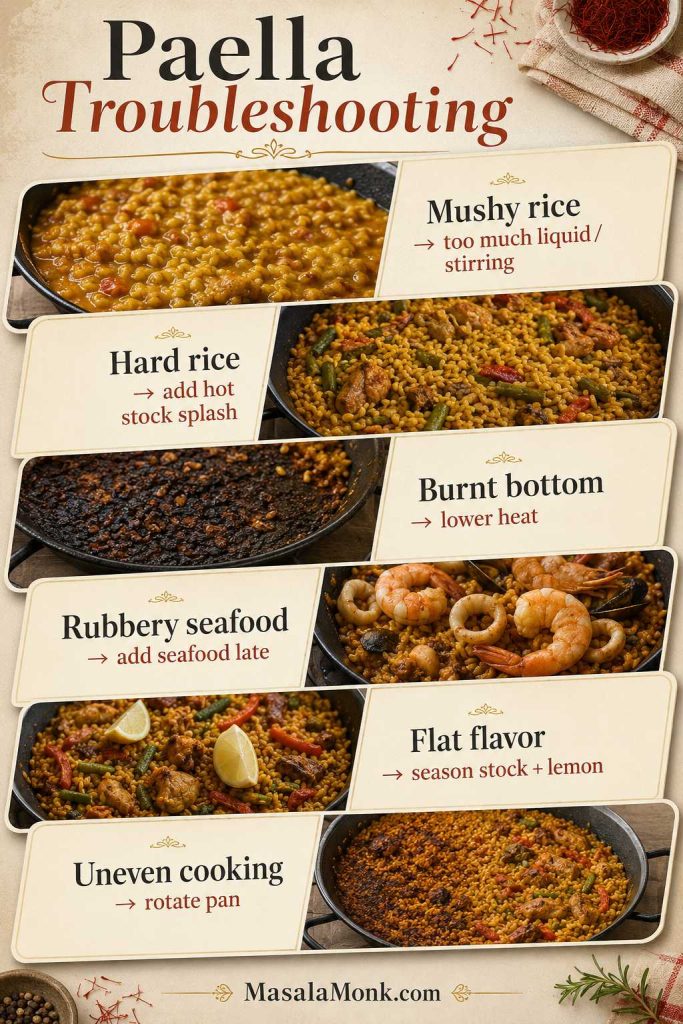
Most disappointing paella comes down to the same few problems: rice that stays hard, rice that turns wet, a bottom that burns before the top is tender, or seafood that cooks too long. This method is designed to catch those problems early: the rice stays shallow, the stock is controlled, the seafood goes in late, and the pan is rotated instead of stirred.

Paella mistakes guide showing hard rice, wet rice, burnt bottom, and rubbery seafood as common problems to avoid.
Hard rice, wet rice, burnt bottoms, and rubbery shrimp usually start with liquid, heat, stirring, or timing. This method is built to catch those problems early.

If your main worry is fixing rice texture, heat, or seafood timing as you cook, keep the Paella Troubleshooting section nearby.

Why This Home Paella Works

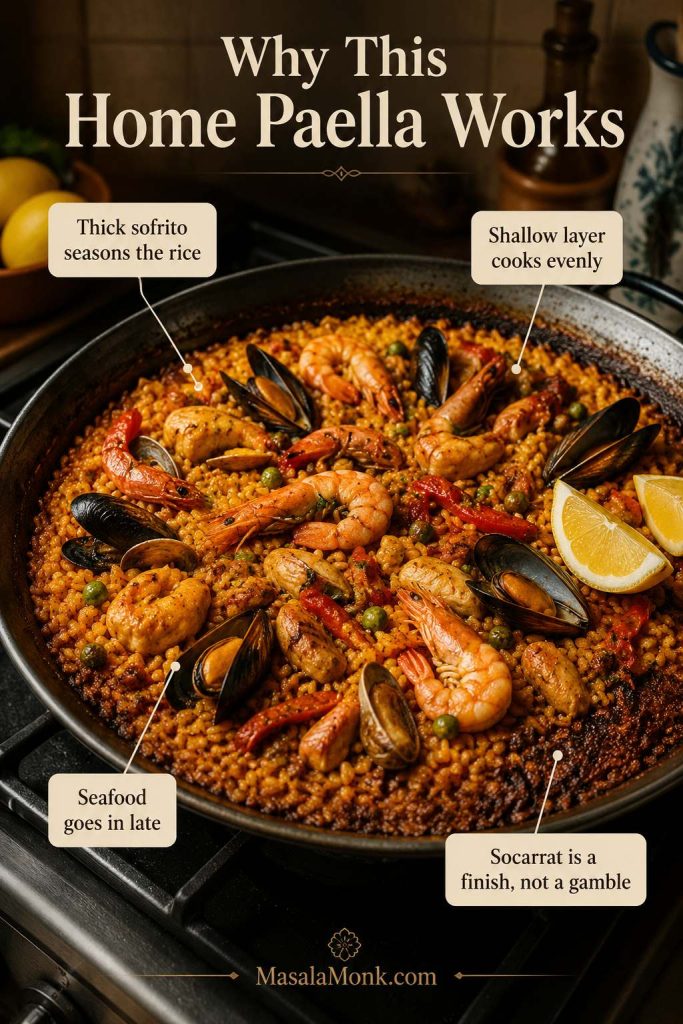
This method works because it treats paella as a rice dish first. The chicken, shrimp, shellfish, saffron, paprika, and lemon all matter, but the rice texture decides whether the pan feels right. Keep the rice shallow, let it absorb the stock in place, and the grains have a much better chance of finishing tender, seasoned, and distinct instead of creamy.

  • Chicken thighs build a forgiving base, so the pan still feels hearty even if you keep the seafood simple.
  • A concentrated sofrito seasons the rice early, before the stock dilutes the pan.
  • Short-grain rice absorbs flavor without falling apart, which is why bomba, Calasparra, or Valencia rice works better than long-grain rice.
  • A shallow layer protects the texture, especially on a home stovetop with uneven heat.
  • Seafood goes in late, so shrimp stays juicy and shellfish opens without turning tough.
  • Socarrat stays optional, because tender, well-seasoned rice matters more than forcing a crust too early.
Home paella explainer with callouts for thick sofrito, shallow rice layer, late-added seafood, and optional socarrat.
This home paella works because flavor is concentrated first, the rice cooks in a shallow layer, and the seafood waits until the pan is nearly ready.

What This Paella Should Taste Like

Aim for paella that tastes savory, sunny, and deeply seasoned, not creamy or soupy. The rice should be tender but distinct, with saffron and paprika in the background, chicken giving the pan body, seafood adding a briny lift, and lemon cutting through at the end.

Close-up of paella rice with tender separate saffron grains, shrimp, chicken, and a moist but not soupy texture.
Look for paella rice that is tender, seasoned, and distinct. Creamy, soupy, or clumped grains mean the pan has moved away from classic paella texture.

When socarrat forms, the bottom layer should taste toasted and nutty rather than bitter. Even without it, the paella can still be excellent. Tender rice and balanced flavor matter more than forcing a crust.

Success cues

Look for tender, separate rice; shrimp that is pink and opaque; savory stock flavor; lemon brightness; and, if you chase it, a toasted bottom that tastes nutty rather than bitter.

What Is Paella?

Paella is a Spanish rice dish from Valencia, traditionally cooked in a wide, low pan. The word is often used for both the dish and the pan, but the heart of paella is the rice: separate grains cooked in flavorful stock, usually with saffron, paprika, vegetables, and proteins arranged across the top.

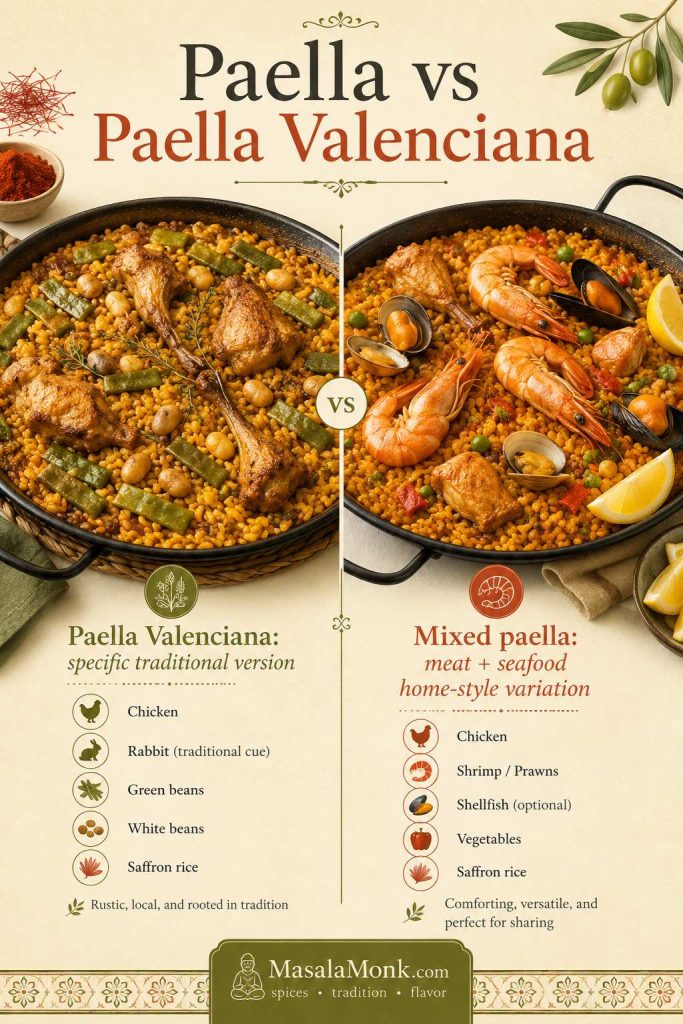
There are many versions now. Paella Valenciana is the classic Valencian version. Seafood paella focuses on shrimp, mussels, clams, squid, or fish. Mixed paella often combines meat and seafood. Home cooks also make chicken paella, vegetable paella, vegan paella, and Spanish-inspired chicken and chorizo paella.

In everyday recipe searching, “paella” often means the whole family of Spanish-style rice pans, while “Paella Valenciana” refers to a more specific traditional version. That distinction is helpful here because this pan is meant to be a practical mixed paella for a home stovetop, not a claim to be the one traditional version.

Comparison of Paella Valenciana ingredients and home-style mixed paella with chicken, seafood, saffron rice, and lemon.
Paella can refer to a broad family of Spanish-style rice pans, while Paella Valenciana is a more specific traditional version; this recipe stays honest as a home-style mixed paella.

This version is designed for a regular stovetop. It gives you the feel of a generous mixed paella without asking you to find every traditional Valencian ingredient or cook outdoors over a wide fire. The goal is a practical home method with good rice texture, clear timing, and enough guidance that you know what to do if the pan behaves differently from the recipe.

Is This Authentic Paella or Spanish-Style Paella?

This is a Spanish-style home paella, not a strict Paella Valenciana. That is not a disclaimer so much as a way to be clear and respectful.

Traditional Valencian paella has a specific identity. Spain’s official tourism site lists a Valencian-style paella built around rice, chicken, rabbit, tomato, green beans, garrofó, olive oil, saffron, paprika, water, and salt, with optional ingredients such as snails, garlic, rosemary, and peppers. It also notes mixed paella separately as another variety that may include seafood such as mussels, shrimp, prawns, and squid. You can read that official reference on Spain.info.

Think of this as home-style mixed paella: chicken, shrimp, optional shellfish, saffron rice, and a stovetop method that works without outdoor fire. It borrows from the spirit of Spanish mixed paella while being honest that it is not strict Paella Valenciana.

What about chorizo?

Chorizo is popular in many English-language paella recipes, especially chicken and chorizo paella, but it is not part of traditional Paella Valenciana. Here, chorizo is treated as an optional Spanish-inspired variation, not the base recipe.

Paella Ingredients

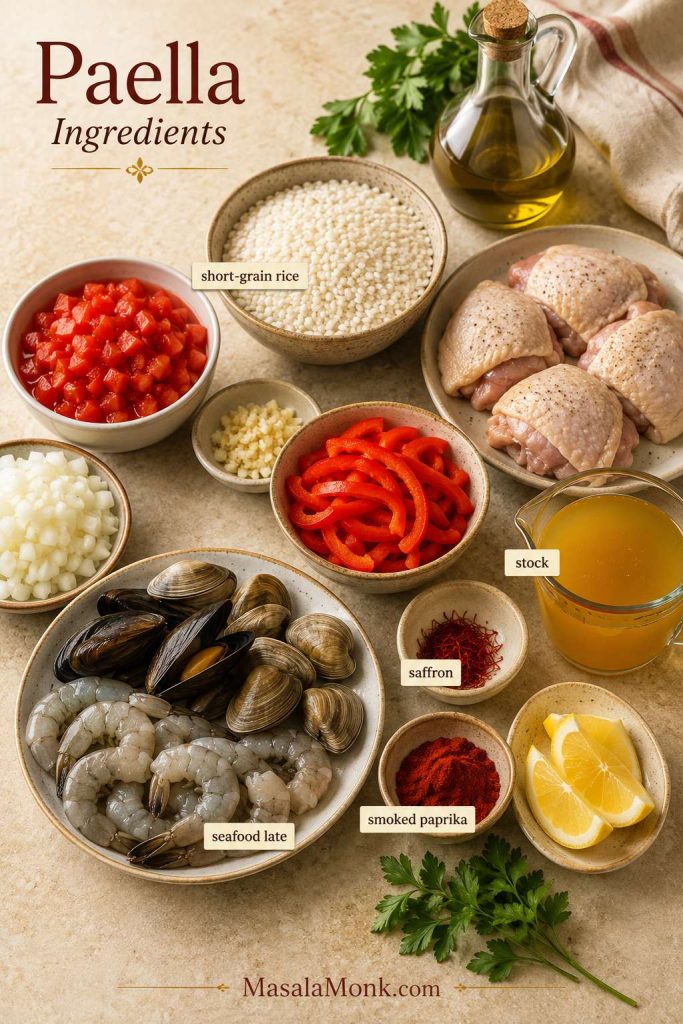
The ingredient list is not long, but paella rewards choosing each part with care. Rice gives the pan structure, stock carries the flavor, saffron brings aroma and color, paprika adds warmth, tomato and aromatics create the sofrito, and the chicken and seafood make the meal feel generous.

Paella ingredients including short-grain rice, chicken, shrimp, shellfish, tomatoes, onion, garlic, saffron, smoked paprika, stock, lemon, parsley, and olive oil.
Every paella ingredient has a job: rice gives structure, sofrito builds depth, stock seasons the grains, saffron and paprika bring aroma, and seafood adds the final lift.

Rice for Paella

Use Spanish short-grain rice if possible. Bomba, Calasparra, and Valencia rice are the best choices because they absorb stock while holding their shape. Aim for grains that are tender and distinct, not creamy, sticky, or wet.

If you cannot find Spanish paella rice, medium-grain rice can work in a pinch. Arborio is only an emergency substitute because it is designed for risotto. With arborio, the no-stir rule becomes even more important.

Saffron and Paprika

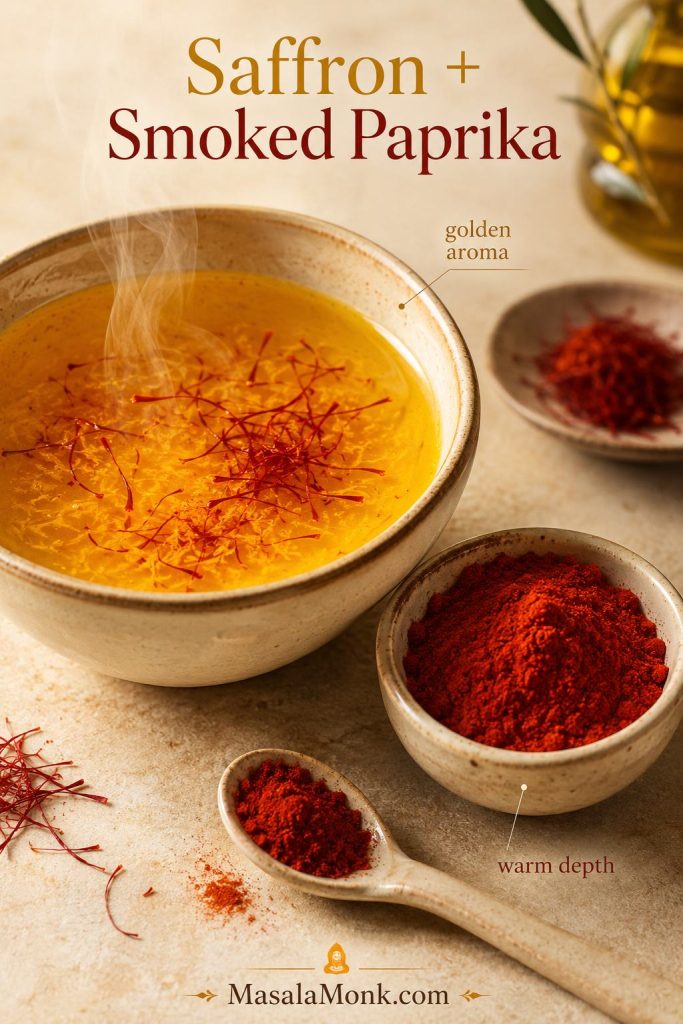
Saffron gives paella its classic golden color and floral aroma. You only need a pinch. Crush the threads lightly and soak them in a little hot stock or hot water before adding them to the pan so the color and fragrance spread more evenly.

Spanish smoked paprika adds warmth and depth. Sweet paprika also works if you want a softer flavor. Add paprika after the tomato and aromatics have softened, and do not let it burn because scorched paprika turns bitter quickly.

Saffron threads blooming in hot stock beside smoked paprika for adding color, aroma, and warmth to paella.
Saffron brings the golden aroma, and smoked paprika adds warmth and depth. Together, they season the rice before the seafood ever touches the pan.

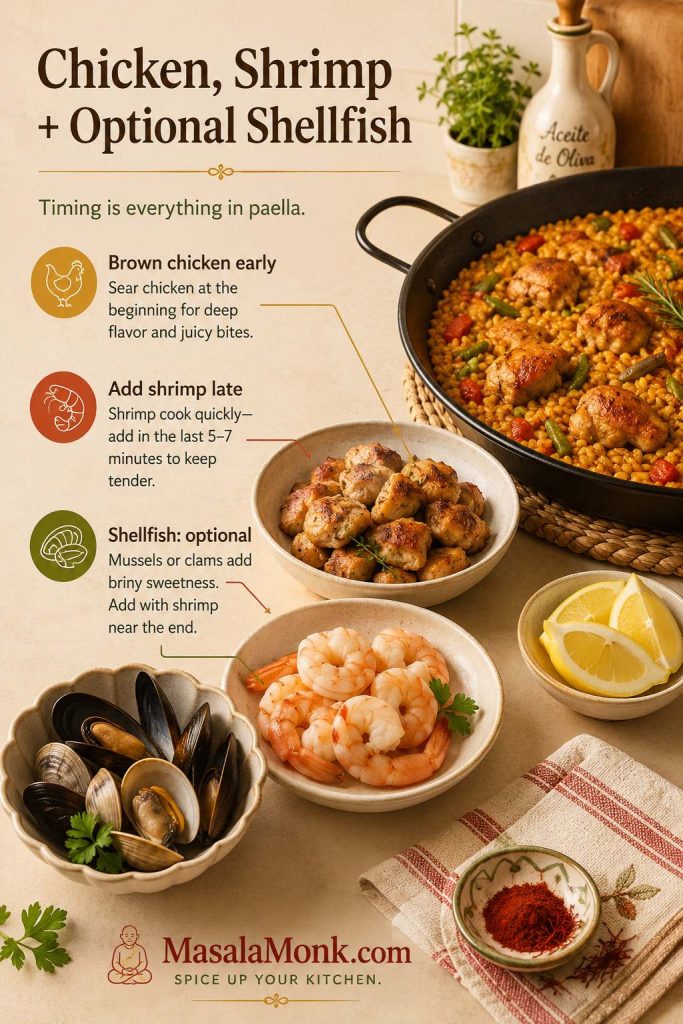
Chicken, Shrimp, and Optional Shellfish

Boneless chicken thighs are forgiving, juicy, and easy for a home paella. Shrimp adds a clear seafood note without making the recipe complicated. Mussels or clams are optional, but they make the pan more dramatic and release flavorful juices into the rice as they open.

Timing is what keeps the pan generous instead of overcooked. Chicken can be browned early, but shrimp should go in near the end so it stays tender. Mussels and clams can be nestled into the rice during the final simmer, just long enough to steam open.

Chicken, shrimp, and optional shellfish prepared for paella with labels showing chicken browned early and seafood added late.
Chicken can brown early to build flavor. Shrimp and shellfish should wait until the end so they stay tender.

Paella Sofrito: Onion, Garlic, Tomato, and Pepper

The sofrito is the flavor base. Onion, garlic, tomato, and bell pepper cook down in olive oil until soft and concentrated. Do not rush this stage. A watery sofrito makes the paella taste thin, while a thick, glossy sofrito gives the rice a savory backbone.

Stock or Broth

Use hot chicken stock, seafood stock, or a mix of the two. Seafood stock gives a deeper seafood-paella flavor, while chicken stock makes the recipe easier and more pantry-friendly. The stock should be hot when it goes into the pan so the rice starts cooking evenly.

Lemon, Parsley, and Finishing Touches

Lemon wedges are not just decoration. A squeeze of lemon brightens the rice, chicken, and seafood right before serving. Parsley adds freshness. Peas are optional and common in many home-style mixed paellas, but they are not required.

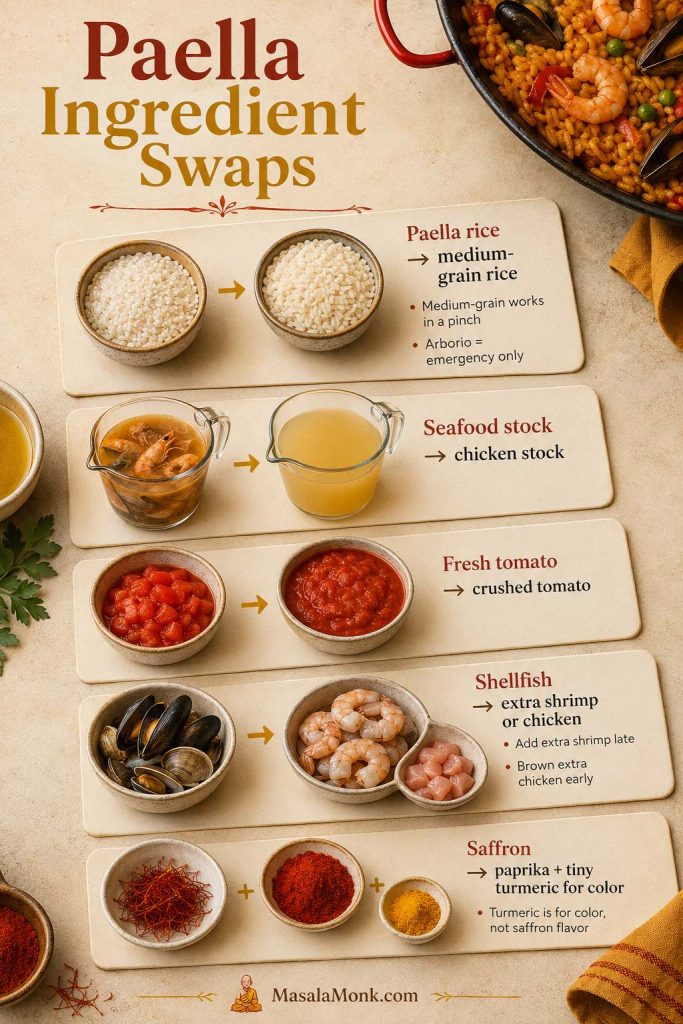
Paella Ingredient Swaps That Work

If you do not have… Use this instead What changes
Spanish paella rice Medium-grain rice or arborio in a pinch Watch the liquid closely and do not stir after adding stock.
Seafood stock Chicken stock or chicken stock mixed with a little clam juice The flavor will be lighter but still good.
Fresh tomatoes Crushed tomatoes Cook them down until thick, not watery.
Mussels or clams Extra shrimp or chicken Use slightly more stock because shellfish will not release liquid.
Saffron Good stock, paprika, and a tiny pinch of turmeric for color You lose saffron aroma, but the dish can still taste good.
Paella ingredient swaps board showing alternatives for paella rice, seafood stock, fresh tomatoes, shellfish, and saffron.
Smart paella swaps protect the method: choose a rice that can hold its shape, use flavorful stock, cook tomatoes down well, and treat turmeric as color help rather than saffron flavor.

Once the ingredients are ready, the recipe becomes less about juggling and more about timing: build the base, give the rice space, and add the seafood only when the pan is nearly there.

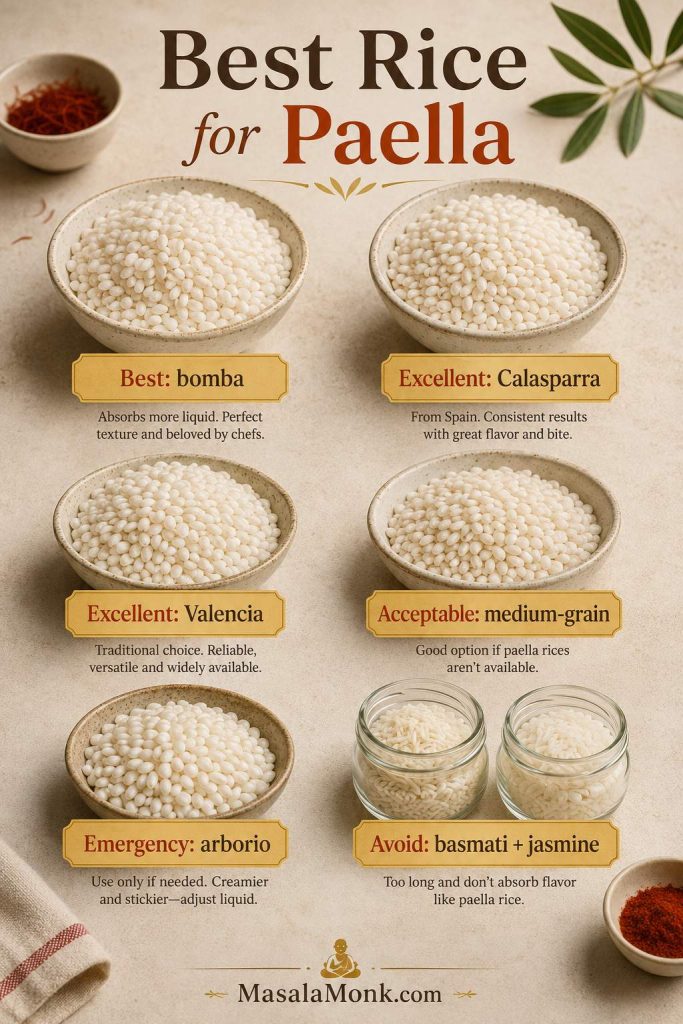
Best Rice for Paella

Choose short-grain Spanish rice that can absorb flavorful stock without collapsing into a creamy texture. Paella should not eat like risotto. The grains should be tender, separate, and deeply seasoned from the broth.

Rice guide showing bomba, Calasparra, Valencia, medium-grain, arborio, basmati, and jasmine rice options for paella.
The best rice for paella absorbs stock without falling apart, which is why Spanish short-grain rice works better than fragrant long-grain rice.

Unless your rice package specifically instructs you to rinse, start with dry grains. They coat more evenly in the sofrito and absorb the seasoned stock more predictably in the pan.

Rice Use it? Notes
Bomba rice Best choice Classic paella rice that absorbs stock well and holds its shape.
Calasparra rice Excellent Another strong Spanish paella rice option.
Valencia rice Excellent Good short-grain Spanish rice for paella.
Medium-grain rice Acceptable Works if Spanish rice is unavailable; watch the liquid closely.
Arborio rice Emergency substitute Can work, but do not stir or it will turn creamy like risotto.
Basmati rice Avoid Too long and firm for classic paella texture.
Jasmine rice Avoid Too fragrant and soft for this method.
Brown rice Avoid here Needs a different liquid ratio and cooking time.

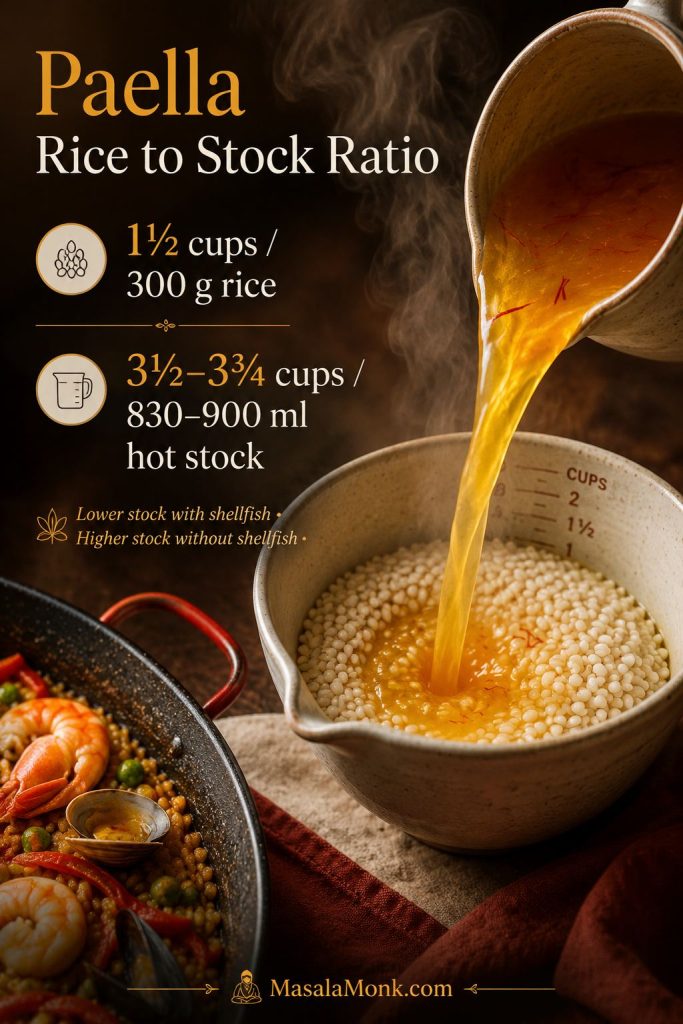
Paella Rice to Stock Ratio

For this version, use 1½ cups / about 300 g short-grain rice with 3½–3¾ cups / 830–900 ml hot stock. Use the lower amount if adding mussels or clams because shellfish releases liquid into the pan. Use the higher amount if making chicken and shrimp paella without shellfish.

Paella rice-to-stock ratio guide showing one and a half cups rice with three and a half to three and three-quarter cups hot stock.
This paella rice-to-stock ratio gives the grains enough liquid to cook through, while the wide pan keeps the layer shallow enough for classic texture.

If you are cooking for two or scaling up for guests, check Scaling Paella for Two or a Crowd before changing the rice and stock amounts.

Keep an extra ½ cup / 120 ml hot stock or water nearby. A small splash can rescue firm rice in a dry pan, but a late flood of liquid usually makes the outside of the grains soften before the centers catch up.

Do You Need a Paella Pan?

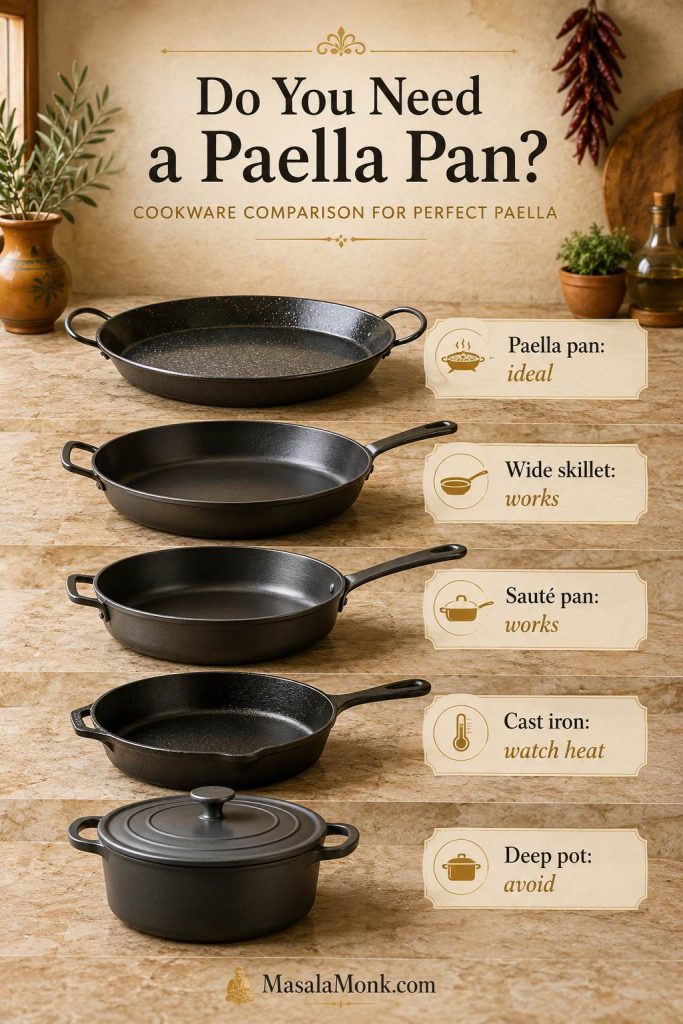
No. A paella pan is ideal, but you can make this recipe in a wide skillet, stainless-steel sauté pan, or cast iron skillet. The real requirement is not the pan name; it is a wide, shallow cooking surface that keeps the rice in a thin layer.

Cookware guide showing a paella pan, wide skillet, sauté pan, cast iron skillet, and deep pot for making paella.
The pan name matters less than the shape; if the rice can spread thinly across a low, wide surface, the method has a much better chance of working.

Keep the Rice Layer Shallow

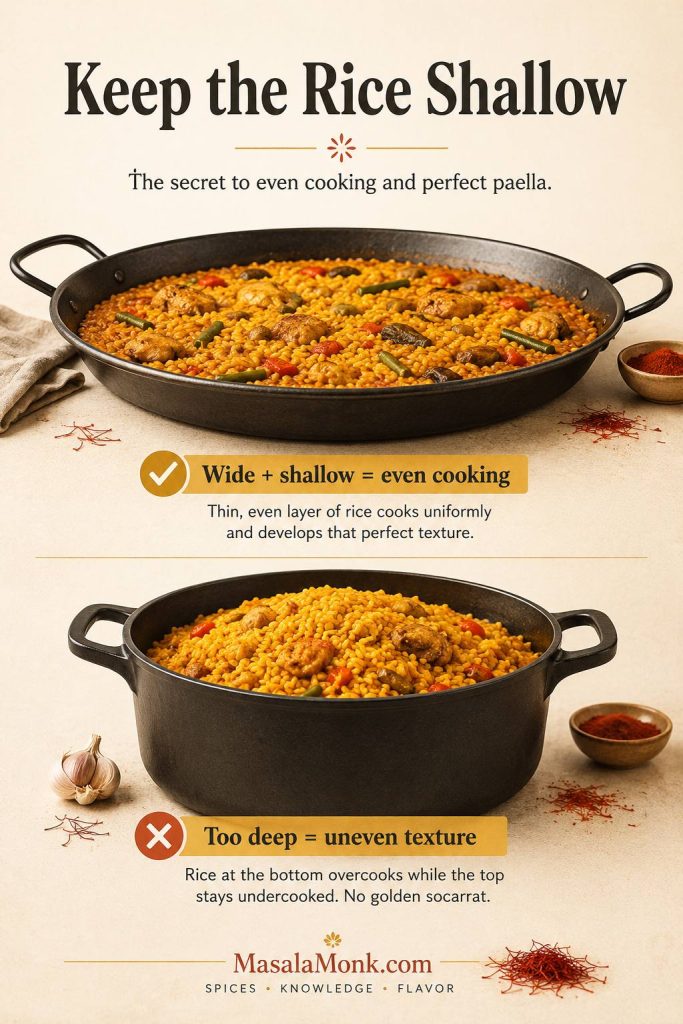
Think surface area, not depth: the rice needs room to cook in a shallow layer. If it is piled too deep, the bottom can burn before the top grains are tender. If the pan is too wide for your burner, the center may boil hard while the edges barely simmer.

Comparison showing paella rice in a shallow wide pan versus rice piled too deep in a pot.
A shallow rice layer cooks more evenly and gives the bottom a better chance to toast. A deep pile of rice can turn uneven before the center finishes.

Manage Home-Stovetop Hot Spots

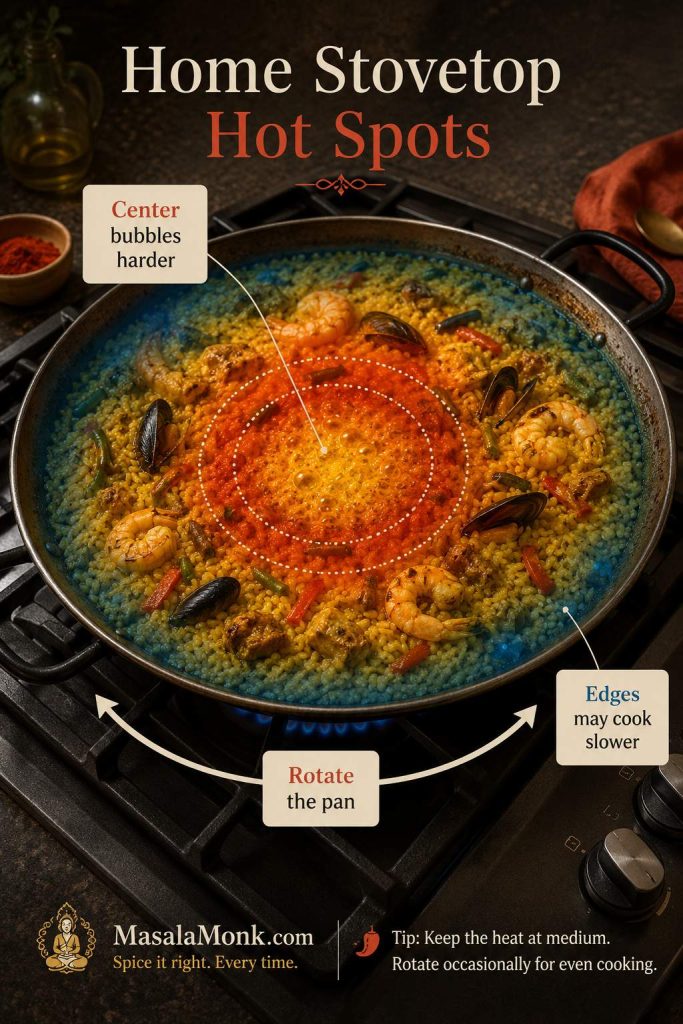
Serious Eats explains this stovetop problem well: large paella pans work beautifully over broad outdoor heat, but home burners create hot spots, so smaller stovetop paellas are often more reliable indoors. Their guide is worth reading if you want the deeper heat-management logic: Serious Eats’ stovetop paella guide.

Home stovetop paella heat guide showing the center bubbling harder, slower-cooking edges, and arrows for rotating the pan.
Home burners often heat the center harder than the edges. Rotating the pan helps the rice cook evenly without stirring through the grains.

Once you have the right pan, the next important move is technique: see How to Make Paella Step by Step for the no-stir cooking flow.

Choose the Right Pan Size

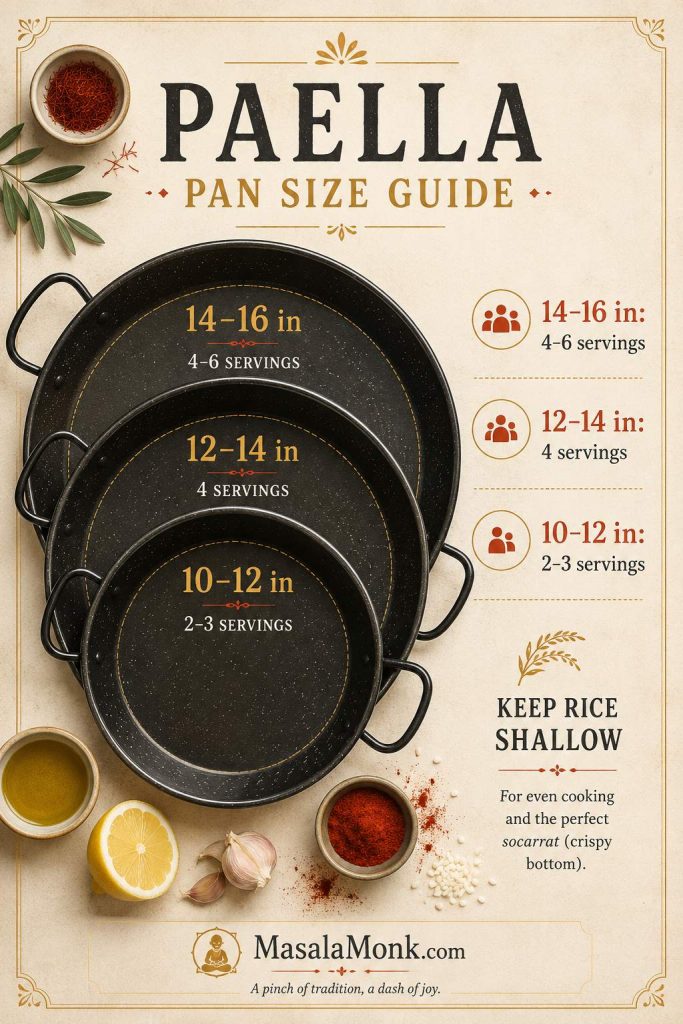
Servings Pan size Best use
2–3 10–12 inch wide skillet Best for a small stovetop batch with more even heat.
4 12–14 inch wide pan Most reliable size for regular home burners.
4–6 14–16 inch paella pan or skillet Good if your burner, grill, or stovetop gives enough heat coverage.
6+ Large paella pan over grill or outdoor burner Better than piling a double batch into a deep pot.
Paella pan size guide showing ten to twelve inch, twelve to fourteen inch, and fourteen to sixteen inch pans with serving ranges.
A pan that is too large for the burner can cook unevenly, while a smaller wide pan often gives better control on a home stove.

Pan depth matters more than pan name

A shallow rice layer cooks more evenly and has a better chance of forming socarrat. A deep pot may hold the ingredients, but it traps too much steam and makes the rice more likely to turn soft or uneven.

Before You Start: Avoid These Paella Mistakes

  • Start with dry rice unless your package specifically tells you to rinse.
  • Avoid deep pots if you want classic paella texture.
  • Stop stirring after adding stock, or the rice can turn creamy and heavy.
  • Add shrimp near the end, because it will overcook if it simmers from the beginning.
  • Save socarrat for the finish; cook the rice first, then toast the bottom briefly.

How to Make Paella Step by Step

Read the method once before you start. Paella behaves differently from a stir-fry, biryani, pulao, or risotto: after the rice and stock go in, you stop stirring and let the pan do its work.

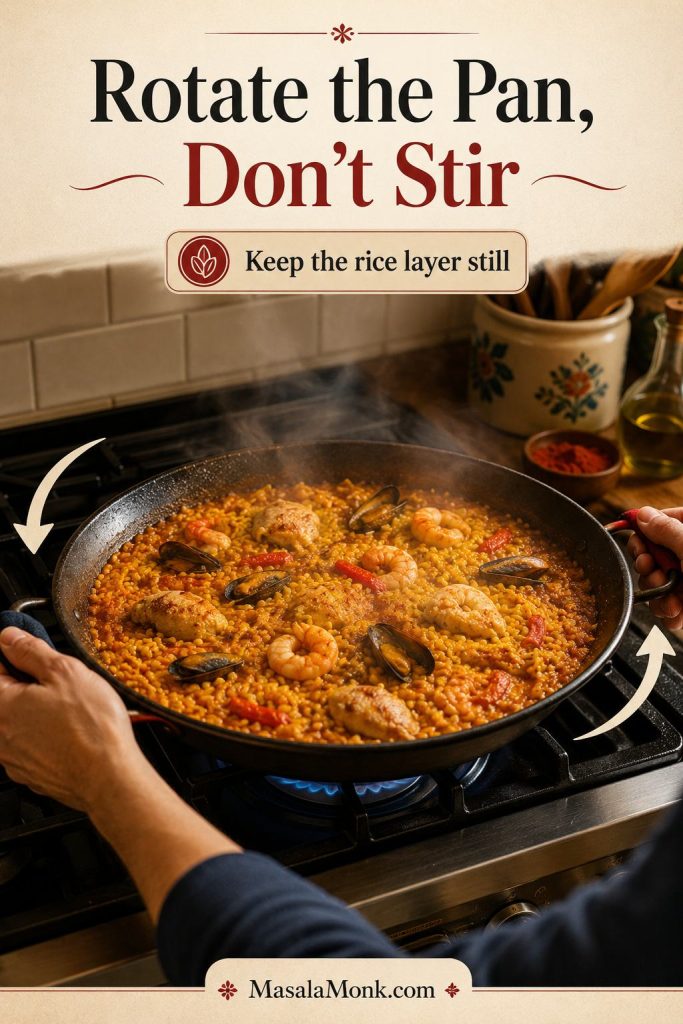
On a home stove, the center may bubble harder than the edges. That is normal. Rotate the pan instead of dragging a spoon through the rice, and keep the simmer steady rather than violent.

Hands rotating a paella pan on a stovetop while the rice simmers without being stirred.
When one area bubbles harder than another, shift the pan instead of stirring; that protects the rice texture while evening out the heat.

Paella looks dramatic when it comes to the table, but most of the cooking is quiet: the pan bubbles, the saffron deepens, and the rice slowly changes from loose broth into something golden enough to serve.

If you want the short version beside you while cooking, use the Paella Recipe Card, then come back to these step cues if the pan behaves unevenly.

1. Season and Brown the Chicken

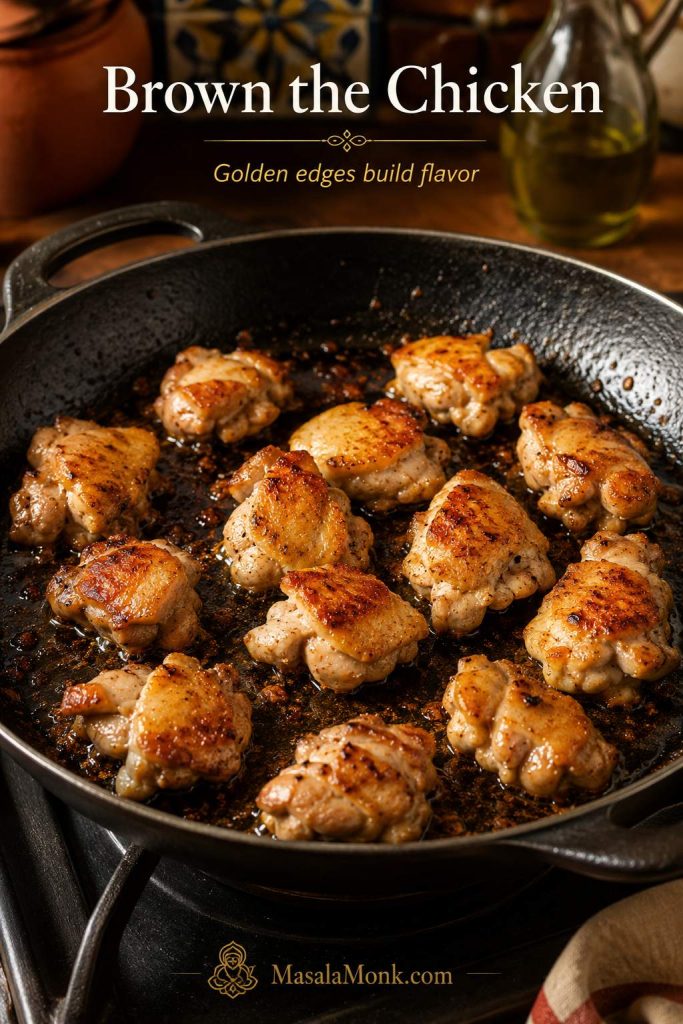
Cut the chicken thighs into bite-size pieces and season them with salt and pepper. Heat olive oil in a wide pan over medium-high heat, then brown the chicken for about 4–5 minutes, until it has color on the outside. It does not need to cook fully at this stage because it will finish with the rice.

Look for golden edges and a little browning on the bottom of the pan. Those browned bits will dissolve into the stock later and help the rice taste deeper.

Chicken thigh pieces browning in a wide pan with golden edges and browned bits for paella.
Browning the chicken first creates savory bits in the pan, and those browned flavors later dissolve into the stock and rice.

2. Build the Sofrito

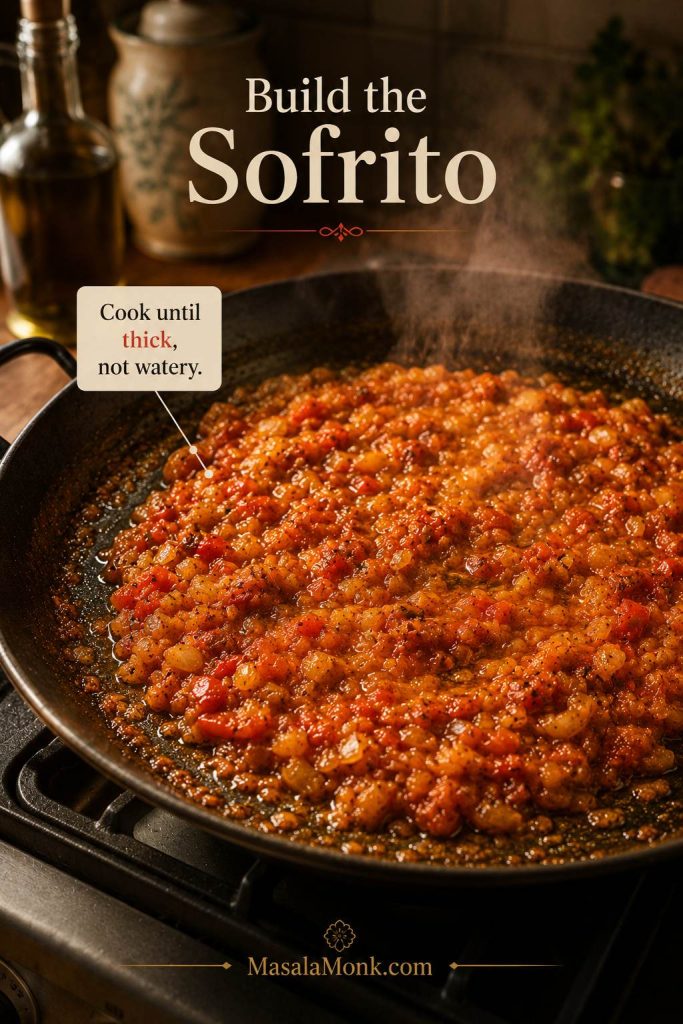
Add onion and bell pepper to the pan and cook for 4–6 minutes, until softened. Stir in garlic, then add grated tomatoes or crushed tomatoes. Cook for another 5–7 minutes, until the mixture thickens and looks less watery.

This is one of the places where patience pays off. The pan should smell savory and sweet, not raw and watery. If the tomato still looks loose, give it another minute or two before adding the rice.

Thick tomato, onion, garlic, and red pepper sofrito cooking down in a wide pan for paella.
The sofrito should look thick and glossy before the rice goes in, because a watery base can leave the finished paella tasting flat.

3. Add Paprika, Saffron, Rice, and Stock

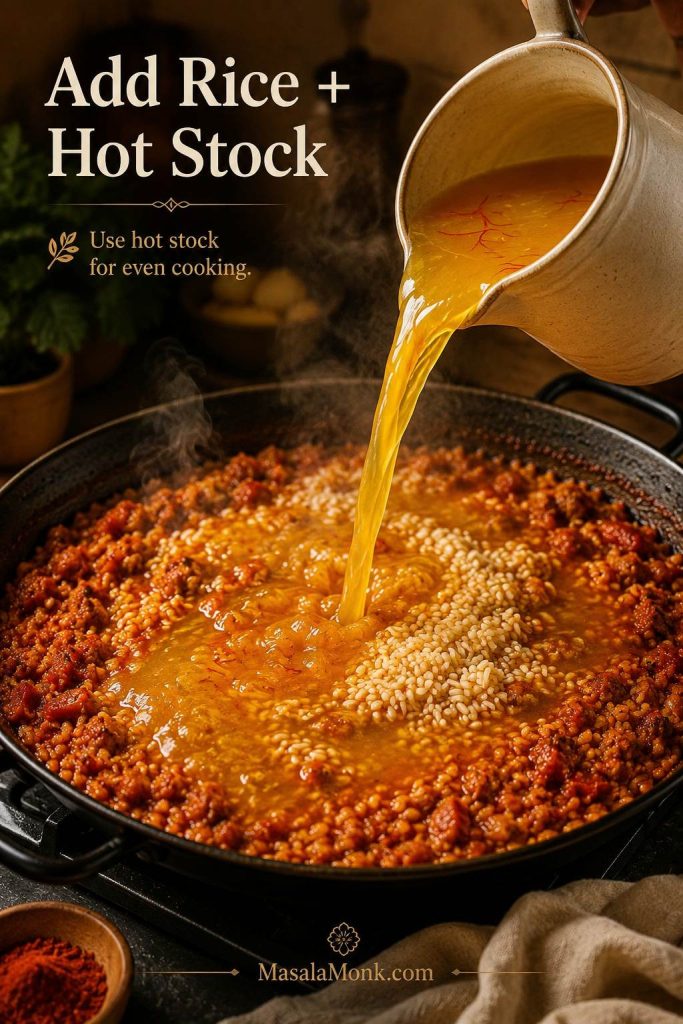
Stir in smoked paprika and the soaked saffron. Add the rice and stir briefly so the grains are coated in the tomato-flavored oil. Pour in hot stock, scrape the bottom once to release any stuck flavor, and spread the rice evenly across the pan.

Hot saffron stock being poured into short-grain rice and tomato-paprika sofrito in a wide pan.
Add hot stock after the rice is coated in sofrito so the grains begin absorbing seasoned liquid right away.

At this stage, the liquid should taste well-seasoned. If the stock tastes flat now, the rice will taste flat later. Add salt before the rice finishes cooking, not only at the table.

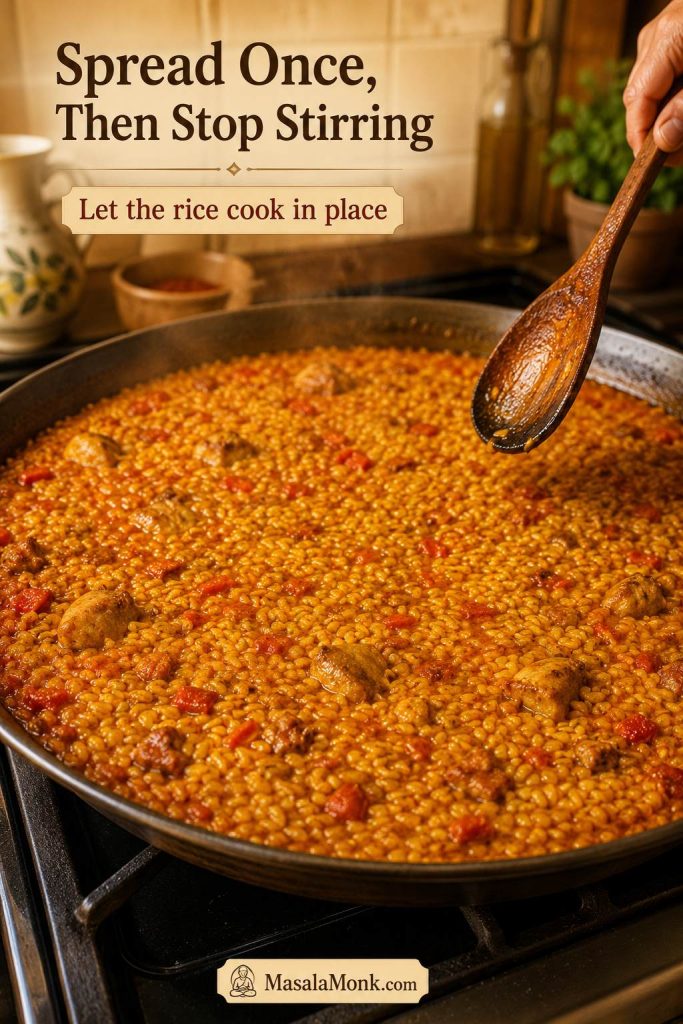
4. Spread the Rice and Stop Stirring

This is the turning point. Once the rice is spread into an even layer, stop stirring. Rotate the pan if one side is bubbling harder than the other, but do not drag a spoon through the rice.

Paella rice, stock, sofrito, and chicken spread into an even layer with a spoon lifted away to show no stirring.
This is the turning point: once the rice is level, stop moving it so the grains can absorb stock in place.

Stirring releases starch and makes the dish creamy. For paella, you want the grains to cook in place so they absorb the stock and stay separate.

5. Simmer Until the Rice Is Almost Done

Let the rice simmer uncovered for about 8–10 minutes before adding the seafood. The liquid should bubble steadily, not violently. If the center is boiling aggressively while the edges are quiet, rotate the pan every few minutes.

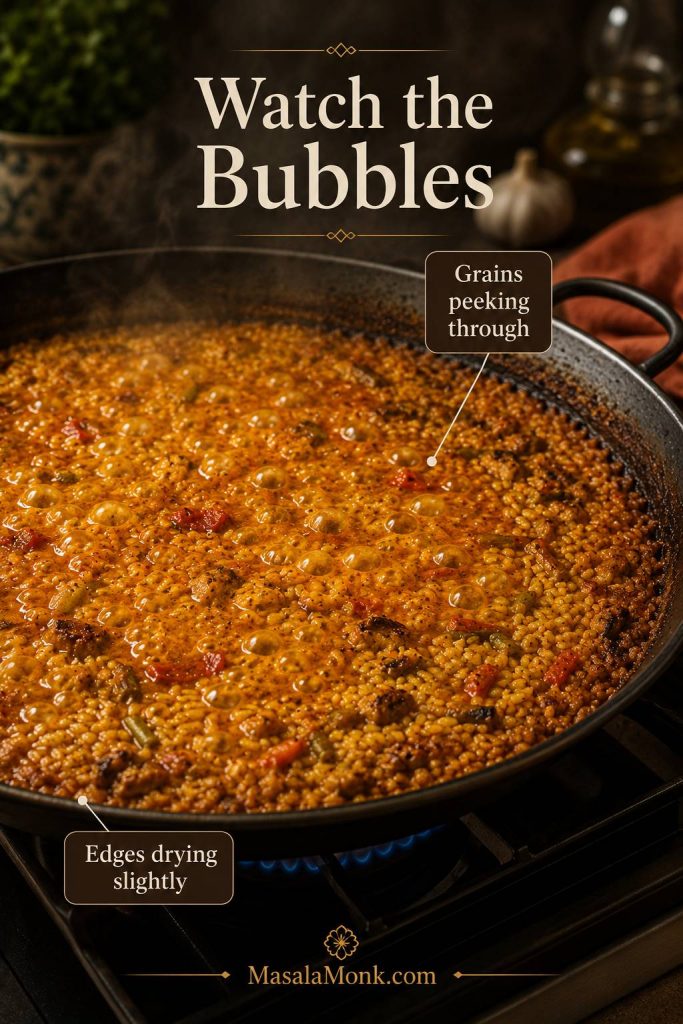
As the rice cooks, the surface will look less soupy and more defined. You should see grains peeking through the liquid, and the edges of the pan will start looking a little drier. If the pan looks dry but the rice is still firm, add a small splash of hot stock or water around the edges.

Close-up of paella rice simmering with gentle bubbles, grains peeking through, and slightly dry edges.
As paella cooks, the surface should shift from soupy to defined, with gentle bubbles, visible grains, and edges that begin to dry slightly.

6. Add Shrimp and Shellfish Near the End

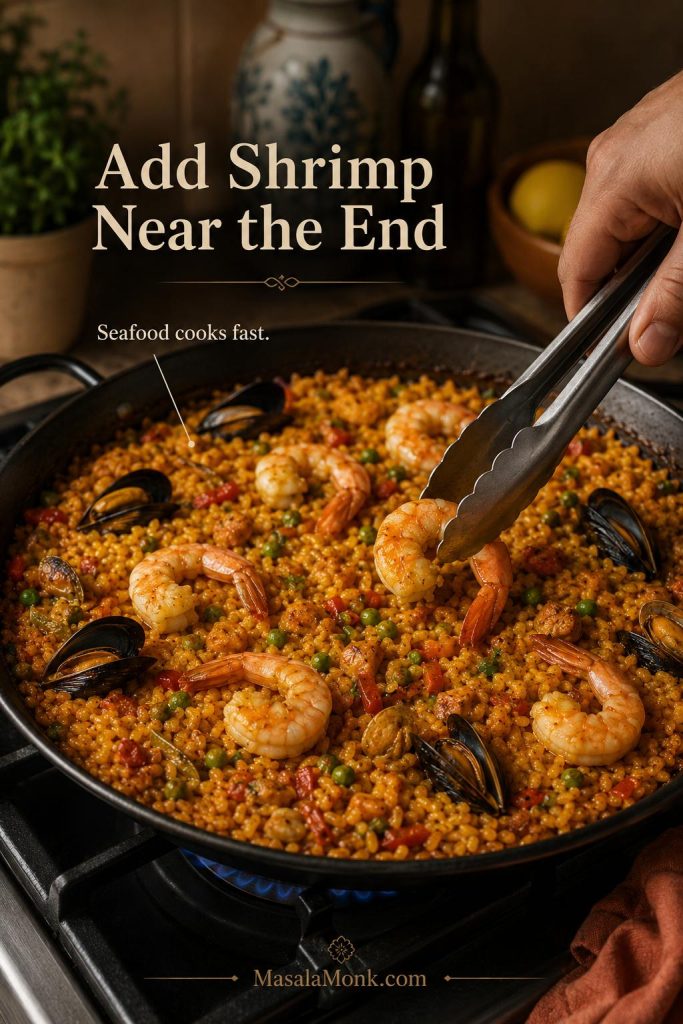
When the rice is partly cooked and most of the liquid has been absorbed, nestle the shrimp and optional mussels or clams into the top. Cook for another 6–8 minutes, until the shrimp is pink and opaque, the shellfish has opened, and the rice is tender.

Keep the shrimp near the surface and add it only near the end. Seafood cooks quickly, and once shrimp turns tight and rubbery, the rice cannot fix it. Discard any mussels or clams that stay closed after cooking.

Shrimp being added near the end of cooking on top of saffron paella rice in a wide pan.
Add shrimp near the end because seafood cooks fast; once it turns tight and rubbery, the rice cannot fix it.

7. Rest the Paella Before Serving

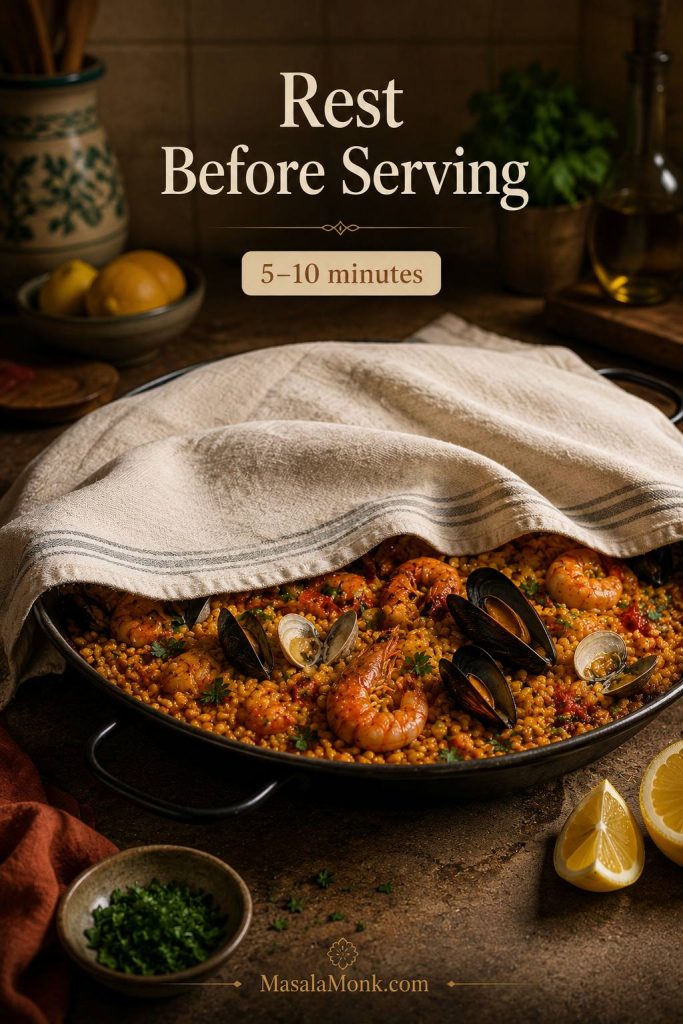
When the rice is tender and the seafood is cooked, remove the pan from the heat and cover it loosely with foil or a clean towel. Rest for 5–10 minutes. This helps the top grains finish steaming and lets the last moisture settle into the rice.

Finished paella resting under a towel with lemon wedges and parsley nearby.
Resting paella for a few minutes helps the top grains finish steaming and lets the remaining moisture settle before serving.

After resting, the rice should look moist but not soupy. The chicken should be cooked through by the time the rice is tender. If you use a thermometer, the thickest pieces should reach 165°F / 74°C.

8. Finish with Lemon and Parsley

Scatter parsley over the pan and serve with lemon wedges. Bring the paella to the table in the pan if you can. It looks dramatic, but it also lets everyone scoop from the tender rice on top down to the toasted bits at the bottom.

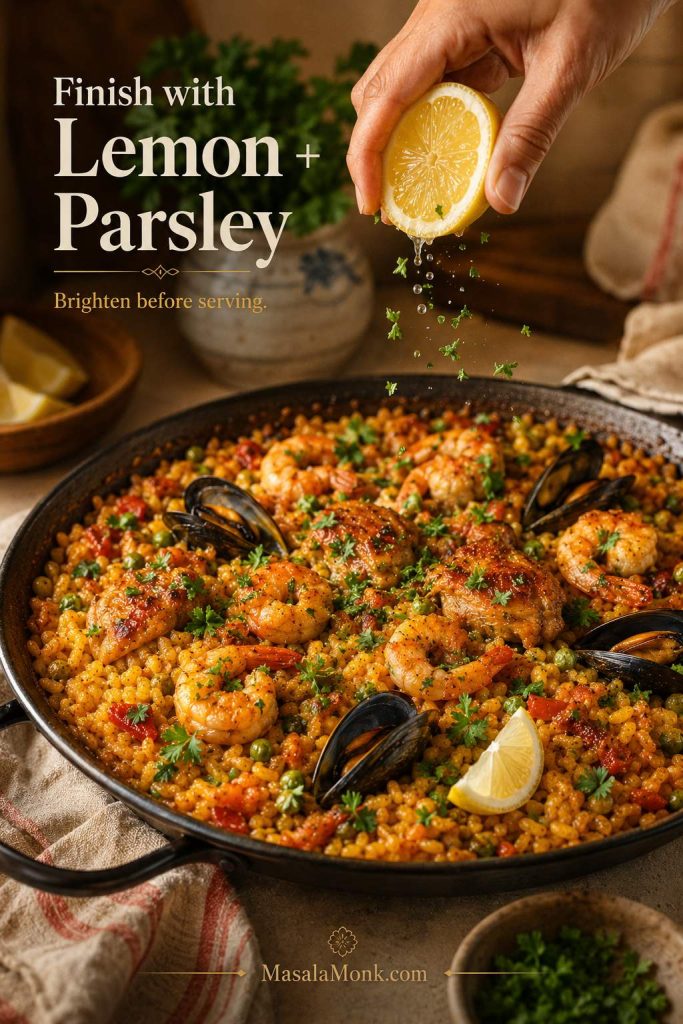
Lemon being squeezed and parsley scattered over finished paella before serving.
Lemon and parsley brighten the saffron rice, chicken, and seafood, so the finished paella tastes lively instead of heavy.

How to Get Socarrat

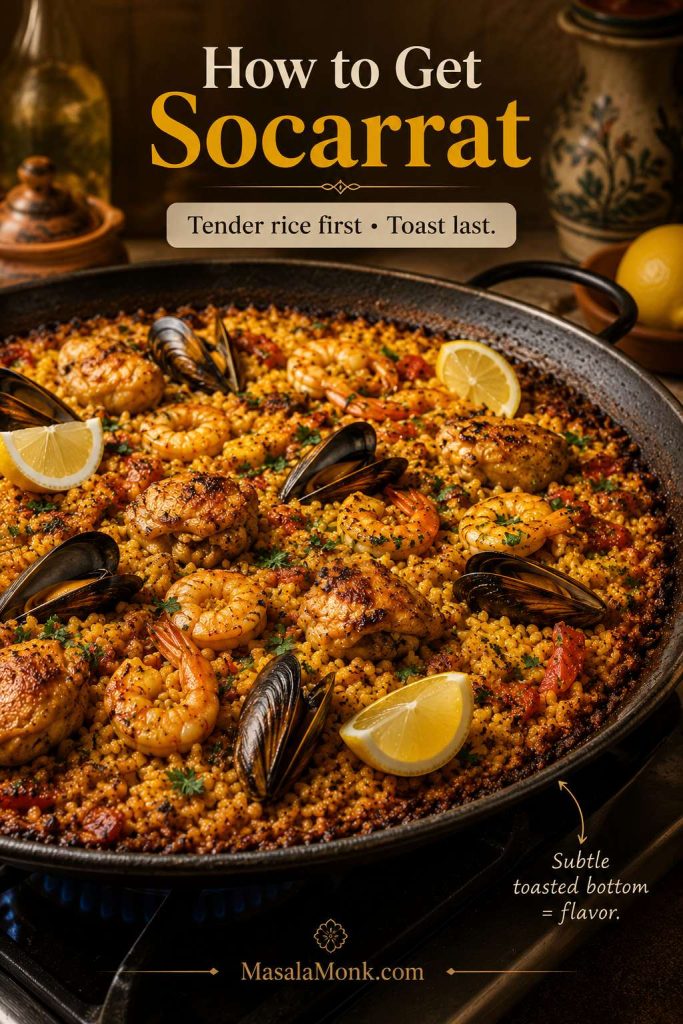
Socarrat is the toasted layer of rice at the bottom of a well-made paella. It should taste nutty and savory, not burnt. Treat it as a bonus on your first attempt, not the only measure of success.

For the safest socarrat, wait until the rice is cooked and the liquid is mostly absorbed. Then raise the heat for 60–120 seconds. Listen for a gentle crackle and smell for toastiness. Stop as soon as the aroma turns sharp, smoky, or bitter.

Paella pan with cooked saffron rice and a toasted bottom cue showing how to get socarrat at the end.
Socarrat works best when the rice is already tender and most liquid has absorbed; only then should the bottom get a brief controlled toast.

Do not try to create socarrat while the rice is still hard. You will burn the bottom before the top finishes. Tender rice comes first; the crisp bottom comes last.

If the bottom burns or the rice is still hard before you try for socarrat, jump to Paella Troubleshooting before pushing the heat.

Socarrat cues

  • Good sign: faint crackling, toasted aroma, rice mostly dry on top.
  • Bad sign: sharp burning smell, smoke, or blackened bitterness.
  • Best pan: carbon steel, stainless steel, or cast iron gives better browning than nonstick.
  • Beginner move: skip socarrat the first time and focus on tender rice.
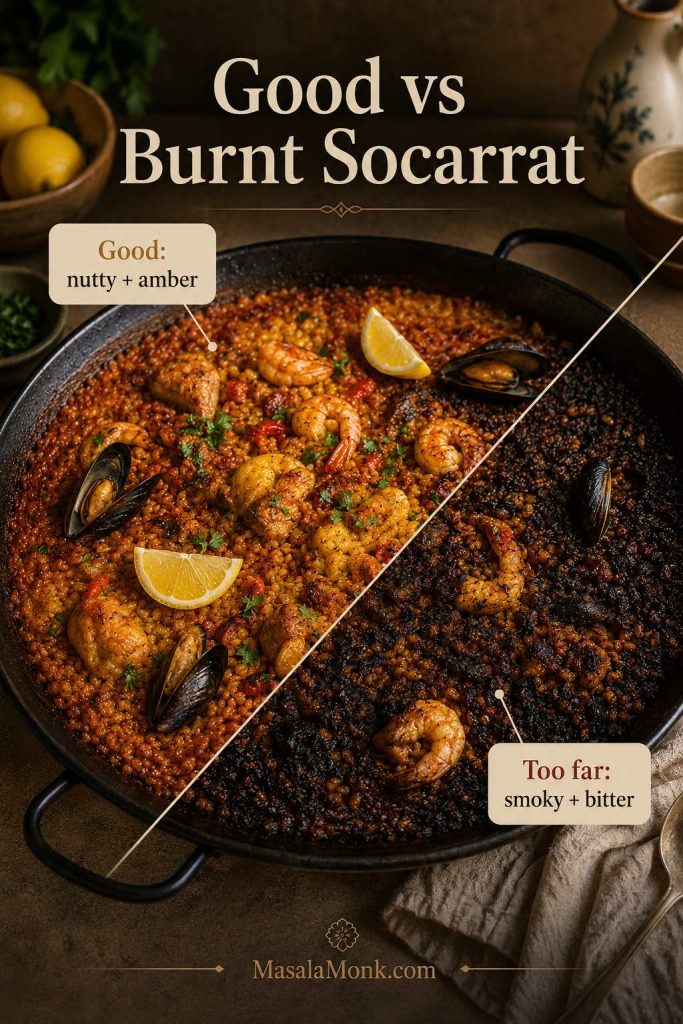
Comparison of good amber socarrat and burnt blackened paella rice to show the difference in toasted bottom texture.
Amber socarrat adds crisp, savory flavor, while blackened rice turns smoky and bitter. Let aroma guide you as much as timing.

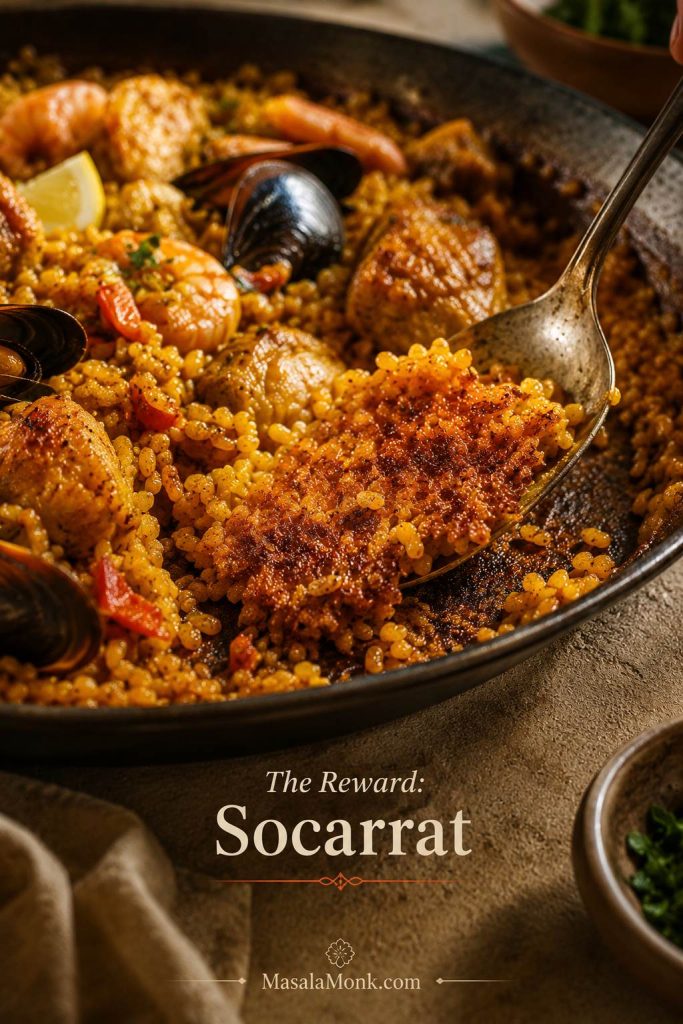
When it works, the first scrape from the bottom should feel like a reward: golden rice on top, toasted grains underneath, and no bitterness in the pan.

Spoon scraping toasted socarrat from the bottom of a paella pan with golden rice and amber crisp grains.
Good socarrat should taste nutty and toasted, not burnt, and the first spoon scrape is the reward for patient heat control.

Use the visual card below as a quick save, then follow the full recipe card for exact ingredients, timing, and notes. The guide above is still your safety net if the pan bubbles unevenly, the rice dries out, or the seafood needs careful timing.

Paella Recipe Card

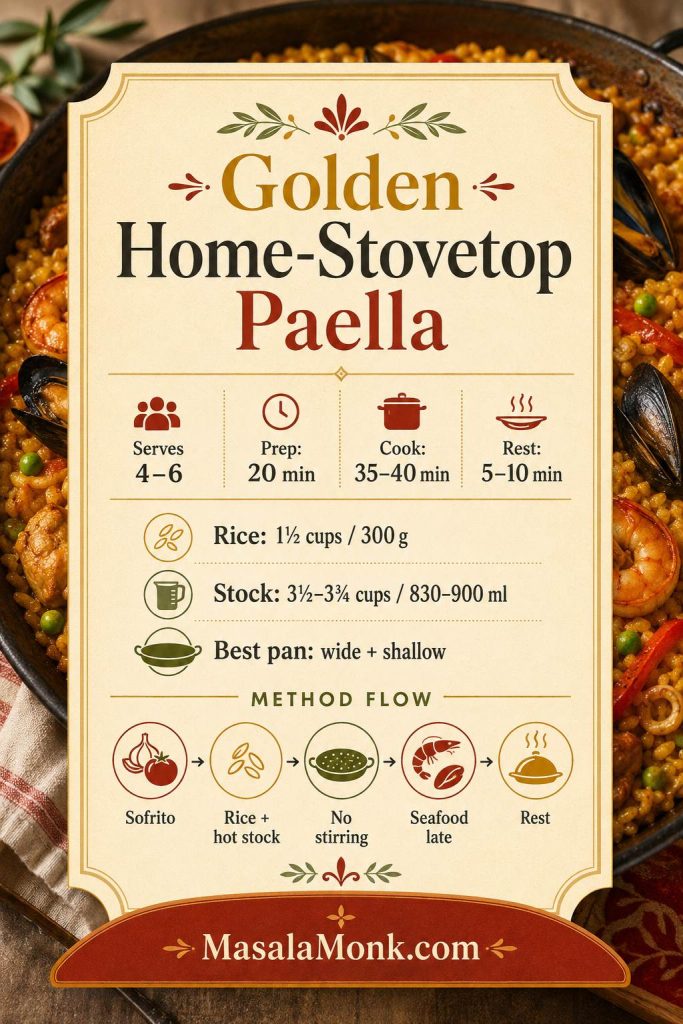
Saveable recipe card for golden home-stovetop paella with servings, timing, rice amount, stock amount, pan note, and method flow.
Keep this quick-save card nearby for the cooking flow, but use the visual cues in the post—bubbles, dry edges, tender rice, and late seafood—to guide the pan.

Golden Home-Stovetop Paella

A golden Spanish-style home paella with saffron rice, browned chicken, tender shrimp, optional shellfish, tomato, paprika, lemon, and parsley. Designed for a regular stovetop with a wide pan and a clear no-stir method.

Prep Time20 minutes
Cook Time35–40 minutes
Rest Time5–10 minutes
Servings4–6

Best pan: Use a 14–16 inch wide, shallow pan for the full batch, or a 10–12 inch skillet for a half batch. Avoid deep pots because the rice needs to cook in a shallow layer.

Ingredients

  • 2 tablespoons extra-virgin olive oil
  • 450 g / 1 lb boneless skinless chicken thighs, cut into 1-inch / 2.5 cm pieces
  • 250–300 g / 9–10 oz large shrimp, peeled and deveined
  • Optional: 300–500 g / 10 oz–1 lb mussels or clams, cleaned
  • 1 medium onion, finely chopped
  • 1 red bell pepper, diced
  • 3–4 garlic cloves, minced
  • 2 medium tomatoes, grated, or ¾–1 cup crushed tomatoes
  • 1 teaspoon smoked Spanish paprika or sweet paprika
  • Pinch of saffron threads, soaked in 2 tablespoons hot stock or hot water
  • 1½ cups / about 300 g Spanish short-grain rice, such as bomba, Calasparra, or Valencia rice
  • 3½–3¾ cups / 830–900 ml hot chicken stock, seafood stock, or a mix
  • ½ cup frozen peas, optional
  • Salt and black pepper, to taste
  • Lemon wedges, for serving
  • Chopped parsley, for serving

Instructions

  1. Season the chicken. Pat the chicken dry and season with salt and black pepper.
  2. Brown the chicken. Heat olive oil in a wide shallow pan over medium-high heat. Add the chicken and brown for 4–5 minutes, until golden on the outside. It does not need to be fully cooked yet. Transfer to a plate if the pan is crowded.
  3. Cook the vegetables. Add onion and bell pepper to the pan. Cook for 4–6 minutes, until softened, then stir in garlic.
  4. Build the sofrito. Add grated tomatoes or crushed tomatoes. Cook for 5–7 minutes, until the mixture thickens and the raw tomato smell fades.
  5. Add spices and rice. Stir in paprika and soaked saffron. Add the rice and stir briefly so the grains are coated.
  6. Add stock. Pour in the hot stock and scrape the bottom once. Return the chicken to the pan. Spread the rice into an even shallow layer.
  7. Simmer without stirring. Simmer uncovered for 8–10 minutes without stirring. Rotate the pan if one side bubbles harder than the other.
  8. Add seafood near the end. Nestle shrimp and optional mussels or clams into the top. Cook for another 6–8 minutes, until the shrimp is pink and opaque, shellfish has opened, and the rice is tender.
  9. Check the rice. If the rice is still firm and the pan is dry, add a small splash of hot stock or water around the edges and cook a few minutes more.
  10. Optional socarrat finish. If the rice is cooked and you want a toasted bottom, raise the heat briefly for 60–120 seconds. Listen for a light crackle and stop before anything smells burnt.
  11. Rest. Remove from heat, cover loosely with foil or a clean towel, and rest for 5–10 minutes.
  12. Serve. Top with parsley and serve with lemon wedges.

Notes

  • Use 3½ cups / 830 ml stock if adding mussels or clams because shellfish releases liquid.
  • Use closer to 3¾ cups / 900 ml stock for chicken and shrimp paella without shellfish.
  • Keep ½ cup / 120 ml hot stock or water nearby for a small rescue splash if the rice is firm and the pan is dry.
  • If your pan is smaller, reduce the batch instead of piling the rice deep.
  • Avoid basmati and jasmine rice for this method.
  • Chorizo is a Spanish-inspired variation here, not part of traditional Paella Valenciana.
  • Paella is best served fresh, but leftovers can be reheated gently with a splash of stock or water.

Paella Variations

Use these variations as directions, not entirely new recipes. The base method stays the same: build flavor, add rice and stock, leave the rice alone, add delicate ingredients near the end, and rest before serving.

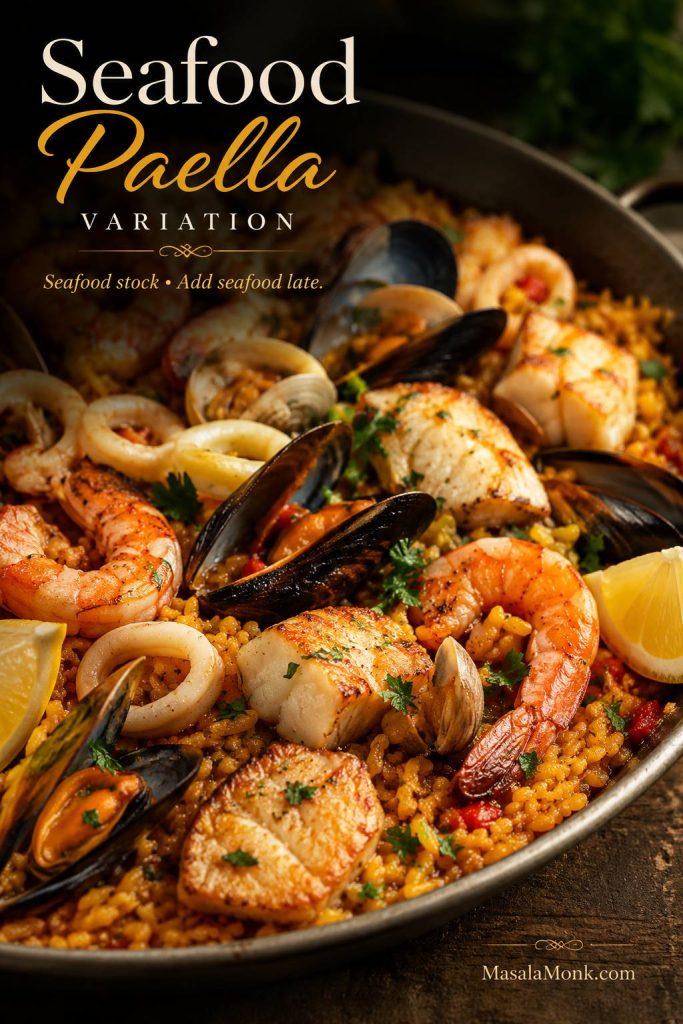
Seafood Paella Variation

This is the most dramatic version for the table. Skip the chicken and use shrimp, mussels, clams, squid, scallops, or firm white fish. Seafood stock gives the rice a deeper briny flavor, and the same late-add timing keeps delicate seafood from turning rubbery.

Seafood paella variation with saffron rice, shrimp, mussels, clams, squid, scallops, lemon, and parsley in a wide pan.
For a seafood paella variation, lean on seafood stock and add delicate seafood late so the pan tastes briny without turning rubbery.

If that seafood lane is what you love, MasalaMonk’s fish and chips recipe gives another crisp, lemon-friendly fish dinner with detailed texture cues.

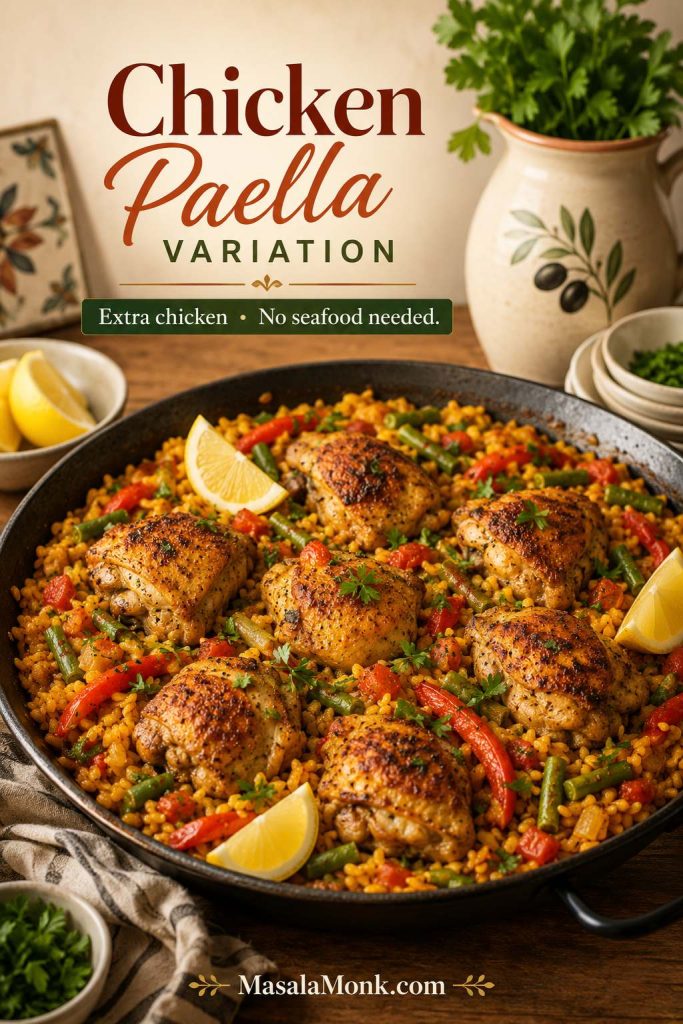
Chicken Paella Variation

This is the simplest version to shop for and the easiest choice for seafood-averse guests. Use extra chicken thighs, green beans, bell pepper, and chicken stock, and increase the stock slightly because shellfish will not release liquid into the pan.

Chicken paella variation with saffron rice, browned chicken, green beans, red pepper, lemon wedges, and parsley.
Chicken paella keeps the same rice method but skips seafood, making it easier to shop for and more flexible for guests who prefer a meat-only pan.

For another rice-friendly chicken dinner with a simple stovetop method, MasalaMonk’s chicken adobo recipe is a strong companion recipe.

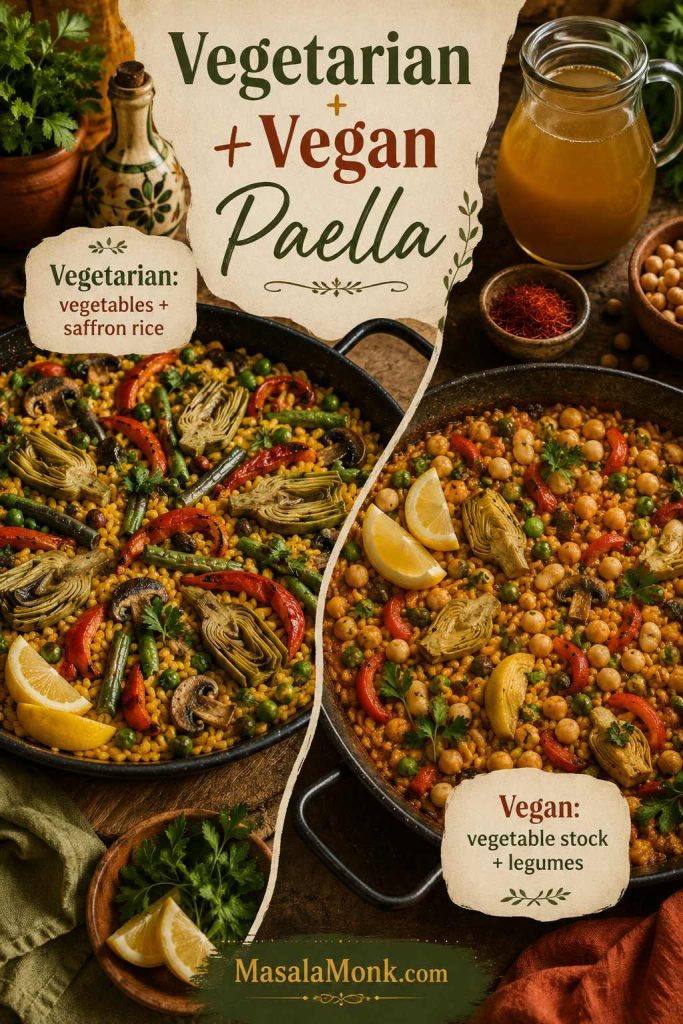
Vegetarian Paella

For a meatless pan that still feels colorful and satisfying, use vegetable stock and build around artichokes, green beans, roasted peppers, peas, mushrooms, or chickpeas.

Vegan Paella

For vegan paella, keep the olive oil, saffron, paprika, tomatoes, and vegetable stock, then let the vegetables and legumes do the work. Chickpeas, white beans, artichokes, mushrooms, and roasted peppers can make the pan feel generous without changing the rice method.

Vegetarian and vegan paella variations with saffron rice, artichokes, mushrooms, peppers, peas, chickpeas, herbs, lemon, and vegetable stock.
Meatless paella still depends on the same rice method; vegetables, mushrooms, legumes, and good stock simply replace the flavor and substance that meat or seafood would bring.

Chicken and Chorizo Paella

For chicken and chorizo paella, brown 100–150 g / 3½–5 oz sliced Spanish chorizo before the sofrito, then continue with the recipe. The flavor will be smoky and rich, but chorizo is a popular Spanish-inspired addition rather than a traditional Valencian one.

Paella Without Saffron

You can make paella without saffron, but the flavor and aroma will be different. Use good stock, smoked paprika, tomato, garlic, and a tiny pinch of turmeric only if you want a warmer yellow color. Too much turmeric will make the dish taste more like turmeric rice than paella.

Paella Without Seafood

If you do not like seafood, make the chicken version with extra vegetables and chicken stock. The method stays the same, but use a little more stock because shrimp, mussels, and clams will not be releasing moisture into the pan.

Can You Scale Paella for Two or a Crowd?

Paella does not scale like soup, curry, or stew because the rice needs a shallow layer. If you simply double the ingredients in a deep pot, the texture will suffer. The top may stay firm while the bottom turns soft or burns.

For two people, use a 10–12 inch skillet and reduce the batch by about half. For a crowd, use a large paella pan over a grill or outdoor burner, or make two smaller pans instead of forcing one overloaded pan onto a regular stovetop burner.

Serving goal Best approach Why
Paella for two Make a half batch in a 10–12 inch skillet. The rice stays shallow and the burner can heat the pan more evenly.
Paella for 4–6 Use the recipe as written in a 14–16 inch wide pan. This is the best home-size balance of yield and control.
Paella for a crowd Use an outdoor burner, grill, or two separate pans. Large pans need broad heat; one small burner usually creates hot spots.
Paella scaling guide showing a smaller wide pan for two and a larger pan over broad heat for a crowd, with a note not to pile rice deep.
Paella scales by changing pan size and heat coverage, not by piling more rice into a deep pot.

What to Serve with Paella

Paella is a full meal, so the sides should be simple. Serve it with lemon wedges, a green salad, roasted peppers, olives, or something fresh and herb-heavy like this tabbouleh recipe. Crusty bread is optional, but it is useful if you want to catch the flavorful juices around the edge of the pan.

If you want a crisp make-ahead side instead of a green salad, this coleslaw recipe brings crunch and acidity without requiring oven or stovetop space.

For drinks, keep the flavors bright and not too heavy. Sparkling water with lemon, chilled white wine, or a fresh watermelon margarita can work well with saffron rice and seafood, especially for a warm-weather table.

How to Store and Reheat Paella

This paella is best fresh from the pan after a short rest. The rice texture is at its best before refrigeration, and shrimp or shellfish are usually softer and juicier before reheating.

Because paella contains rice and often seafood, refrigerate leftovers within 2 hours of cooking. Spread them into a shallow airtight container so the rice cools quickly, and eat within 1–2 days for the best texture and safety.

If your paella has a lot of shellfish, remove the shells before storing leftovers so reheating is easier and the rice cools more quickly.

Reheat gently in a skillet with a small splash of stock or water. First, cover the pan briefly so the rice steams; then uncover it so extra moisture can evaporate. Avoid blasting seafood in the microwave for too long because shrimp can turn rubbery.

If you want to prep ahead, make the sofrito, clean the seafood, cut the chicken, and measure the rice and stock in advance. Do not fully cook paella hours ahead and expect the rice to taste freshly made.

Paella Troubleshooting: Rice, Pan, and Seafood Fixes

Most paella problems come from the same few causes: the wrong rice, too much liquid, too much stirring, a pan that is too deep, or heat that is too aggressive for the pan size.

Problem Likely cause Quick fix
Mushy rice Too much liquid, too much stirring, or deep pan Stop adding liquid, cook uncovered briefly, and rest off heat.
Hard rice Liquid evaporated too fast Add a small splash of hot stock around the edges and lower the heat.
Burnt bottom Heat too high or socarrat attempted too early Use steadier heat and save the high-heat push for the final 60–120 seconds.
Rubbery seafood Shrimp or shellfish added too soon Add seafood only near the end of cooking.
Flat flavor Weak stock, rushed sofrito, or not enough salt Season the stock, cook the tomato base down, and finish with lemon.
One side undercooked Burner heat is uneven or pan is too wide Rotate and shift the pan instead of stirring through the rice.
Paella troubleshooting guide showing mushy rice, hard rice, burnt bottom, rubbery seafood, flat flavor, and uneven cooking fixes.
When paella goes wrong, look at the pattern first: wet rice, dry rice, scorching, rubbery seafood, or uneven bubbling usually points to the fix.

Why Is My Paella Mushy?

Mushy paella usually means too much liquid, the wrong rice, too much stirring, or a pan that is too deep. Use short-grain paella rice, keep the rice shallow, and stop stirring once the stock goes in.

If the rice already looks soft and wet, stop adding liquid. Cook uncovered over low heat for a few more minutes so excess moisture can evaporate, then rest the pan off heat.

Why Is the Rice Still Hard?

Hard rice usually means the liquid evaporated before the grains cooked through. Add a small splash of hot stock or water around the edges, lower the heat, and give the pan a few more minutes. A large pour of cold liquid can soften the outside of the grains before the centers catch up.

Why Did the Bottom Burn?

The heat was probably too high, the pan was too thin for the burner, or you tried to get socarrat before the rice was cooked. Next time, use steadier heat during the rice stage and save the final high-heat push for the last minute or two.

Why Did I Not Get Socarrat?

There may have been too much liquid left in the pan, the heat may have been too low at the end, or the pan may have been nonstick. Socarrat forms best when the rice is cooked, the liquid is absorbed, and the bottom gets a brief controlled burst of heat.

Why Is My Seafood Rubbery?

Rubbery seafood is almost always a timing problem. Shrimp, mussels, clams, and calamari should not simmer from the beginning with the rice; they only need the final stretch of cooking.

Can You Stir Paella?

You can stir before the stock goes in. After the rice is spread into the stock, do not stir. Rotate the pan if needed, but leave the rice layer alone so the grains stay separate and the bottom has a chance to toast.

Why Does My Paella Taste Flat?

Flat paella usually starts with weak stock or a rushed sofrito. Season the stock well, let the tomato base cook down, and finish with lemon so the rice tastes bright instead of dull.

Why Is One Side Cooking Faster Than the Other?

Your burner may not be heating the whole pan evenly. Rotate the pan every few minutes instead of stirring the rice. If one area is boiling hard while another is barely moving, lower the heat slightly and shift the pan so the cooler side gets more contact with the flame or burner.

FAQs

What is the best rice for paella?

The best rice for paella is Spanish short-grain rice such as bomba, Calasparra, or Valencia. Medium-grain rice can work in a pinch, but basmati and jasmine are too long, fragrant, or soft for this method.

Do you need a paella pan?

You do not need a paella pan, but you do need a wide, low-sided pan. The rice should sit in a shallow layer, so a wide skillet or sauté pan is more useful than a deep pot.

Can you make paella in a cast iron skillet?

Yes, you can make paella in a cast iron skillet if it is wide enough to keep the rice shallow. Cast iron holds heat well, so watch the bottom carefully and avoid pushing for socarrat before the rice is tender.

Is paella Spanish or Mexican?

Paella is Spanish. It comes from Valencia, Spain. Some people search for Mexican paella or confuse it with other rice dishes, but traditional paella is part of Spanish cuisine.

What gives paella its yellow color?

Saffron gives paella its classic golden color and floral aroma. Some home versions use a little turmeric for color when saffron is unavailable, but saffron gives the most traditional flavor.

Is saffron required for paella?

Saffron is strongly recommended, but you can make a good rice dish without it. If you skip saffron, rely on good stock, tomato, garlic, paprika, and careful seasoning. A tiny pinch of turmeric can help with color, but it will not replace saffron’s aroma.

Should paella be stirred?

Stir during the sofrito stage, then leave the rice alone once the stock goes in. That stillness helps the grains stay separate and gives the bottom a chance to toast.

What is the crispy rice at the bottom called?

The crispy toasted rice at the bottom of paella is called socarrat. It forms when the rice is cooked in a shallow layer and the bottom gets a brief controlled burst of heat near the end.

Is chorizo traditional in paella?

Chorizo is not traditional in Paella Valenciana. It is common in many Spanish-inspired home paella recipes, especially chicken and chorizo paella, but it should be treated as a variation rather than the classic version.

What is the difference between paella and risotto?

Paella is cooked mostly undisturbed so the rice grains stay separate and absorb stock without turning creamy. Risotto is stirred repeatedly to release starch and create a creamy texture.

What is the difference between paella and Paella Valenciana?

Paella is the broad name for the Spanish rice dish and its many versions. Paella Valenciana is the traditional Valencian version with a more specific ingredient identity, often including chicken, rabbit, green beans, garrofó, tomato, saffron, paprika, olive oil, water, salt, and rice.

Can paella be made ahead?

Paella is best cooked fresh, but you can prep the ingredients ahead. Chop the vegetables, clean the seafood, cut the chicken, soak the saffron, and measure the rice and stock before cooking. Fully cooked paella loses its best texture after sitting for a long time.

Serve it while the pan still smells of saffron, paprika, lemon, and toasted rice. Once you understand the rice, pan, and no-stir method, paella stops feeling like a risky project and starts feeling like a generous one-pan meal. Bring the whole pan to the table and let everyone find the spoonful they were hoping for.

Finished home-stovetop mixed paella served at the table with spoons, saffron rice, chicken, shrimp, shellfish, lemon wedges, parsley, and toasted rice texture.
A whole pan at the table lets everyone scoop from the tender top rice down to the toasted bits underneath, which is exactly how paella should feel: generous, shared, and a little dramatic.

Back to top

Posted on 10 Comments

Authentic Louisiana Red Beans and Rice Recipe (Best Ever)

Hand stirring creamy Louisiana red beans and sausage in a black Dutch oven with rice in the background, cover image for authentic red beans and rice recipe.

Red beans and rice is one of those meals that feels like it’s been simmering forever in the background of life. It’s the pot your grandmother had bubbling on the back burner, the dish that shows up quietly at big family gatherings, the weeknight saver when you want something cheap, filling and full of flavour without fuss. In Louisiana, red beans and rice isn’t just another beans and rice recipe; it’s a weekly ritual with roots in Monday laundry day and leftover Sunday ham bones, when a pot could sit and cook itself while the rest of the work got done.

This version leans into that history but still fits modern kitchens. You’ll get an authentic Louisiana red beans and rice recipe you can make on the stovetop, adapt for a crock pot or slow cooker, or convert into an Instant Pot red beans and rice shortcut when you’re short on time. Along the way, there are options for using canned red beans, adding andouille sausage, keeping things vegetarian or vegan, and even nudging the dish towards other beans and rice traditions from Puerto Rico, Jamaica and India.


What Makes Red Beans and Rice So Special?

At first glance, red beans and rice looks simple: a pot of creamy red beans and a bowl of plain rice. Yet once you dive in, you realise there are layers of story and technique sitting underneath.

In Louisiana Creole cooking, red beans and rice is considered an emblematic dish. Classic versions combine small red beans with the “trinity” of onion, celery and bell pepper, plus thyme, bay leaves, a little cayenne and some kind of pork bone or sausage, all simmered low and slow until the beans are soft and the liquid turns velvety. That bean mixture is then ladled over rice rather than cooked together like a pilaf.

Dutch oven of creamy Louisiana red beans with rice, holy trinity vegetables and ham bone, with a blurred laundry basket in the background showing the Monday red beans and rice tradition.
Red beans and rice grew from Sunday ham bones and Monday washday into Louisiana’s most comforting classic.

Historically, ham was often served on Sunday, and the leftover ham bone was too valuable to waste. On Monday, which was usually washday, beans went on the stove with that bone and the trinity, and the pot gently simmered while laundry was scrubbed and dried. The result was a hands-off, deeply flavoured red beans and rice dish that became a comforting start to the week.

As Louisiana tourism boards love to point out, the Monday tradition grew from Sunday ham bones and long laundry days, and you can read a concise version of that story in this brief history of red beans and rice from Louisiana.

Today, people mix things up with smoked sausage instead of ham bones, turkey instead of pork, or even entirely meatless red beans and rice meals. The idea remains the same, though: inexpensive ingredients, long cooking, big flavour.

Also Read: Sheet Pan Chicken Fajitas Recipe (Easy One-Pan Oven Fajitas)


Choosing the Right Beans

Because beans sit right at the heart of any good red beans and rice recipe, choosing the right ones matters.

Small Red Beans vs Kidney Beans

Traditional New Orleans red beans and rice uses small red beans, which keep their shape yet turn wonderfully creamy inside. If you can’t find them, red kidney beans are a great substitute and often easier to source globally. They’re the same beans you might already be using in rajma, chilli or salads, so they slide neatly into your existing pantry habits.

Two wooden bowls filled with small red beans and red kidney beans on a wooden table, showing the best beans for red beans and rice.
Small red beans give you the classic New Orleans texture, while red kidney beans are a handy stand-in most home cooks already have in the pantry.

If you enjoy trying regional varieties, something like the Himalayan Rajma – Red Kidney Beans gives you that creamy texture with a slightly earthier flavour. It also lets you use the same bag for both rajma chawal and Louisiana-style red beans and rice, which keeps meal planning simple.

Dried Beans vs Canned Beans

From there, you have a choice between dried and canned:

  • Dried beans are cheaper, have better texture and soak up flavour over a long simmer.
  • Canned red beans let you throw together an easy red beans and rice supper in under an hour, with no soaking or long boiling.
Burlap sack spilling dried red beans next to a bowl and an open can of cooked red beans on a wooden table, comparing dried and canned beans for red beans and rice.
Dried red beans are perfect for slow weekend simmering, while canned beans make red beans and rice possible even on the busiest weeknights.

Nutritionally, both are excellent. Beans provide protein, fibre, folate, iron, potassium and magnesium while remaining low in fat and naturally free of cholesterol, which is why organisations like the American Heart Association recommend them as part of a heart-healthy eating pattern.

If you’re mostly cooking on weekends or enjoy slow kitchen days, dried beans are worth the time. If you’re juggling work, kids and life, keeping a few cans of red beans in the cupboard means a fast red beans and rice meal is never far away.

Also Read: Katsu Curry Rice (Japanese Recipe, with Chicken Cutlet)


The Rice Question: What to Serve Underneath

Red beans without rice is basically a bean stew. Add rice and suddenly the whole thing turns into a complete beans and rice dish: protein, carbs, fibre and flavour in each bite.

Best Rice for Red Beans and Rice

Louisiana cooks often reach for long-grain white rice because it stays fluffy, absorbs sauce, and doesn’t clump. Basmati works very well if that’s your everyday rice, especially because its glycemic index tends to run lower than some other white rice varieties.

Three bowls filled with white rice, brown rice and quinoa on a wooden table, showing the best grains to serve with red beans and rice.
White rice keeps things classic, brown rice adds extra fibre, and quinoa gives your red beans and rice a lower-GI, higher-protein twist.

However, you can absolutely adapt:

  • Brown rice brings extra fibre and a nuttier taste; it usually has a lower or medium GI compared with many white rices.
  • Quinoa offers more protein and fibre and generally sits in the low-GI range, which can benefit blood sugar control.

If you’re curious about swapping some or all of the rice for quinoa, the breakdown in the MasalaMonk article “Quinoa vs Rice: Calories, Carbs, GI & Healthier Choice” explains exactly how each behaves in terms of glycemic index, macros and satiety.

Meanwhile, if you’d rather keep classic white rice but blunt the blood sugar spike a bit, there’s also a detailed guide on how to reduce the glycemic impact of rice using cooking, cooling and reheating tricks instead of relying only on rice type.


Building the Flavour: Trinity, Sausage and Seasoning

Once you’ve chosen your beans and rice, the next step in this red beans recipe is to build a base that tastes like Louisiana on a rainy day.

The Holy Trinity

Cajun and Creole cooking often start with what locals call the “trinity”:

  • Onion
  • Celery
  • Green bell pepper
Chopped onion, celery and green bell pepper arranged on a wooden cutting board with a knife, showing the Cajun holy trinity for red beans and rice.
Onion, celery and green bell pepper – the simple “holy trinity” that gives every pot of red beans and rice its unmistakable Louisiana flavour.

These three are diced and slowly sautéed until they soften and begin to turn sweet and golden. Garlic usually joins them shortly afterwards, adding another layer of fragrance. This combination forms the backbone of Cajun red beans and rice, much like onion, ginger and garlic form the base of many North Indian bean curries.

Andouille, Ham and Other Meats

After the trinity has cooked down, you usually add:

  • Andouille sausage or another smoked sausage
  • Sometimes a ham hock, pork bones or smoked turkey neck
  • Occasionally bacon at the very beginning for extra depth
Andouille sausage, ham hock and bacon arranged on a wooden board with a small skillet of drippings, showing the smoky meats used to flavour red beans and rice.
Andouille, ham hock and a little bacon turn a simple pot of beans into the rich, smoky red beans and rice everyone remembers.

The sausage browns in the pan, leaving behind browned bits that will dissolve into the beans later. The bones or hocks infuse the pot during the long simmer, creating a savoury backbone that makes the dish feel complete even with a relatively small amount of meat.

If you want a sausage-heavy beans and rice dinner, you can easily double the sausage and turn it into a beans and rice with sausage special, perfect for game day or big family gatherings.

Homemade Red Beans and Rice Seasoning Mix

While store-bought Cajun blends are handy, making your own red beans and rice seasoning mix gives you full control over salt and spice. A basic mix might include:

  • Paprika and a little smoked paprika
  • Garlic powder and onion powder
  • Dried thyme and oregano
  • Black pepper
  • Cayenne for heat
  • Bay leaves (added whole during cooking)
  • Salt to bring everything together
Small bowls of paprika, herbs and spices around a jar of homemade red beans and rice seasoning with bay leaves on a wooden table.
Mixing your own red beans and rice seasoning lets you control the heat, smokiness and salt in every pot.

This simple combination is enough to transform plain beans into a richly seasoned Cajun red beans dish without feeling complicated. Once you’re comfortable with it, you can experiment further, drawing inspiration from other blend-heavy cuisines—much like a carefully balanced garam masala or chaat masala elevates otherwise simple ingredients.

Also Read: Easy Lemon Pepper Chicken Wings (Air Fryer, Oven & Fried Recipe)


Authentic Louisiana Red Beans and Rice: Stovetop Method

Now that the pieces are in place, it’s time to pull them together into a red beans and rice recipe you can rely on.

Step 1: Soak and Prep the Beans

For stovetop cooking, soaking helps beans cook more evenly and reduces overall time:

  1. Rinse about 1 cup (200 g) dried small red beans or kidney beans and pick out any stones.
  2. Place them in a large bowl, cover with plenty of water and soak overnight.
  3. Before cooking, drain and rinse the beans.
Overhead view of a glass bowl of dried red beans soaking in water on a wooden table with scattered beans, measuring cup and colander, labeled Step 1 Soak and Prep the Beans.
Step 1 – Rinse, pick through and cover dried red beans with plenty of water so they can soak and cook evenly later.

If you forget to soak, don’t panic; you can still make a traditional red beans and rice dish. You’ll just need to simmer a bit longer and keep an eye on the liquid level.

Step 2: Sauté the Trinity and Sausage

Next, start building texture and flavour:

  1. Warm a spoonful of oil or bacon fat in a heavy pot over medium heat.
  2. Add chopped onion, celery and green bell pepper with a pinch of salt. Cook, stirring occasionally, until softened and lightly golden.
  3. Stir in minced garlic and cook a minute or so, just until fragrant.
  4. Add sliced andouille or other smoked sausage. Let it brown lightly so the edges crisp and browned bits form on the bottom of the pot.
Dutch oven with diced onion, celery and green bell pepper sautéing with sliced sausage, labeled Step 2 Sauté the Trinity and Sausage.
Step 2 – Gently sauté the onion, celery, green bell pepper and sausage until everything is soft, golden and smelling like real Louisiana red beans and rice.

At this point, your kitchen already smells like a proper beans and rice dinner, even before the beans go in.

Step 3: Add Seasoning and Beans

Once the sausage has taken on some colour:

  1. Sprinkle in your red beans and rice seasoning mix and stir well so the spices coat the vegetables and sausage.
  2. Toast the spices for 30–60 seconds; they should smell vivid but not burn.
  3. Add the soaked beans, bay leaves, and any ham hock or smoked turkey you’re using.
  4. Pour in enough water or stock to cover everything generously.
Hand pouring soaked red kidney beans and liquid from a glass bowl into a Dutch oven with sausage, vegetables and bay leaves, labeled Step 3 Add Seasoning, Beans and Liquid.
Step 3 – Stir in your seasoning mix, add the soaked beans with bay leaves and cover everything with stock for a slow, gentle simmer.

Bring the pot up to a gentle boil, then immediately lower to a soft simmer. Too vigorous a boil can split the beans before they’ve had a chance to soften inside.

Step 4: Simmer Low and Slow

Now the red beans recipe becomes a waiting game in the best possible way:

  • Let the pot simmer slowly, partially covered, for 1½–2 hours.
  • Stir occasionally so nothing sticks; top up with a splash of water or stock if the level drops too much.
  • As the beans soften, mash a spoonful against the side of the pot and stir back in. This gradually thickens the cooking liquid into a creamy sauce.
Cream Dutch oven of red beans simmering on the stove with bay leaves and steam rising, labeled Step 4 Simmer Low and Slow.
Step 4 – Let the pot bubble gently with the lid slightly ajar until the red beans turn soft and the cooking liquid becomes rich and creamy.

By the time the beans are fully tender, you’ll have a glossy, rich pot of Cajun red beans that clings just right to a spoon. Adjust salt, black pepper and cayenne at the very end so you can taste exactly what’s happening. If you enjoy comparing methods, this authentic Louisiana red beans and rice recipe on Allrecipes follows a very similar path with slightly different timing and spice levels.

Step 5: Cook the Rice and Serve

While the beans are simmering, cook your rice (How to Cook Perfect Rice Every Time (Recipe):

  1. Rinse long-grain rice until the water runs mostly clear.
  2. Combine rice, water and a pinch of salt in a pot.
  3. Bring to a boil, then cover and cook on low until the water is absorbed and the rice is tender.
  4. Let it rest off the heat for about 10 minutes, then fluff with a fork.
Bowl of red beans and rice with sausage and green onions, with a hand holding a spoon and the pot of beans and pan of rice in the background, labeled Step 5 Cook the Rice and Serve.
Step 5 – Spoon the creamy red beans over fluffy white rice, add a little green onion on top, and take the first bite while everything is still hot and steamy.

To serve, spoon rice into bowls, ladle the red beans over the top, and finish with sliced green onions and hot sauce at the table. For many people, this simple bowl is the best red beans and rice recipe they’ll ever need; yet it’s also the perfect base for countless variations.

Also Read: How to Make Churros (Authentic + Easy Recipe)


Slow Cooker / Crock Pot Red Beans and Rice

On days when you want the house to do the cooking while you’re out, a crock pot red beans and rice version is incredibly handy.

To adapt the stovetop method for a slow cooker:

  • Sauté the onion, celery, bell pepper, garlic and sausage in a pan first. This step adds depth that you won’t get from throwing everything in raw.
  • Move the sautéed mixture to the slow cooker.
  • Add soaked beans, seasoning mix, bay leaves and enough liquid to cover by several centimetres.
  • Cook on LOW for 7–9 hours or HIGH for 4–5 hours, until the beans are soft and starting to break down.
  • Near the end, mash some beans against the side of the crock pot and stir to thicken.
Slow cooker filled with creamy red beans and sausage on a wooden table with green onions and a wooden spoon, with step-by-step slow cooker red beans and rice instructions overlaid on the image.
Slow Cooker Red Beans & Rice – sauté the trinity and sausage, then let the crock pot handle the long, gentle simmer while you get on with your day.

Meanwhile, you can cook rice separately on the stove or in a rice cooker. This approach also plays well with other slow cooker recipes; for example, you might use a second crock pot to make a whole chicken with vegetables so guests can choose between beans and rice or tender shredded chicken over the same bowl of rice.

Because this style of cooking is so forgiving, it readily supports other beans and rice crockpot combinations: black beans with Cajun seasoning, mixed beans with extra vegetables, or even a sausage-heavy red beans and rice crock pot dish for a crowd.

Also Read: French 75 Cocktail Recipe: 7 Easy Variations


Instant Pot Red Beans and Rice

When you’re pressed for time, pressure-cooking red beans and rice makes a lot of sense. An Instant Pot or similar pressure cooker can turn dried beans into creamy, tender red beans in under an hour of active cooking, which is especially useful for weeknights.

To make an Instant Pot red beans and rice recipe:

  1. Use the Sauté mode to cook the onion, celery, bell pepper, garlic and sausage just as you would on the stove.
  2. Once fragrant and lightly browned, add your seasoning mix and toast briefly.
  3. Add rinsed, unsoaked red beans, bay leaves and enough water or stock to just cover the beans.
  4. Seal the lid and cook on HIGH pressure. Many cooks find 35–45 minutes with a natural release works well, though the exact timing depends on bean type and age.
  5. Allow the pressure to drop naturally for at least 15–20 minutes, then open the pot.
  6. Mash some beans and simmer briefly on Sauté mode if you’d like the sauce thicker.
Instant Pot red beans and rice recipe card showing an Instant Pot, a bowl of red beans and rice with sausage and green onions, and step-by-step pressure cooker instructions with MasalaMonk.com
Instant Pot Red Beans & Rice – sauté, pressure-cook and finish on Sauté for a creamy, weeknight-friendly version of this Louisiana classic.

Cook the rice separately either in another pot or in a second round in the Instant Pot, because red beans and rice cook at slightly different rates and you want the beans to get extra time to turn creamy. For a more technical walkthrough (including exact water ratios and timing for a 1-pound bag of beans), the Instant Pot New Orleans-style red beans and rice from Camellia is a great reference.

If you enjoy this approach, you’ll probably also appreciate how other one-pot meals such as Cheesy Chicken Broccoli Rice – 4 Ways seamlessly move between Instant Pot, casserole and crock pot formats without losing comfort factor. That way, the same appliance that delivers your red beans can later produce a cheesy rice bake with almost no extra learning curve.


Quick and Easy Red Beans and Rice with Canned Beans

Of course, some evenings you don’t have the bandwidth for soaking beans or monitoring a long simmer. In those moments, canned red beans are a gift.

Here’s a straightforward easy red beans and rice recipe using canned beans:

  1. Sauté onion, celery and green bell pepper in a little oil until soft and fragrant.
  2. Add garlic and sliced sausage, browning the sausage lightly.
  3. Stir in your red bean seasoning mix and bay leaves.
  4. Add canned red beans (drained and rinsed) along with enough water or stock to make a loose stew.
  5. Simmer for 20–30 minutes, mashing some beans as they soften to create body.
Recipe card showing a skillet of quick and easy red beans and rice with canned beans, step-by-step instructions, and MasalaMonk.com at the bottom.
Quick & Easy Red Beans & Rice – canned beans, a single pan and 20–30 minutes are all you need for a comforting weeknight bowl.

Because canned beans are already cooked, you’re mainly letting flavours blend and the sauce thicken. Serve over freshly cooked rice, and you’ve got a homely red beans and rice meal with very little effort. This trick also works nicely when you’ve bought a boxed red beans and rice mix but want to boost it with real vegetables, extra sausage and fresh seasoning.

Also Read: 10 Best Chicken Sandwich Recipes (BBQ, Parm, Buffalo & More)


Sausage-Heavy Red Beans and Rice

Sometimes, the craving is very specific: beans and rice and sausage, all in one bowl. In that case, you simply tilt the ratios.

To make a beans and rice with sausage feast:

  • Double the amount of andouille or smoked sausage in the base recipe.
  • Brown the sausage deeply at the beginning to build extra flavour.
  • Consider adding small chunks of ham or leftover roasted meat.
  • Keep the beans slightly firmer so you have a mix of creamy sauce and distinct beans and sausage pieces.
Recipe card showing a bowl of red beans and rice loaded with browned sausage slices and simple instructions for making sausage-heavy red beans and rice.
Sausage-Heavy Red Beans & Rice – double the andouille, brown it deeply, and serve over rice for the meatiest version of this Louisiana classic.

This style feels right at home at backyard barbecues, football watch parties or potlucks. It also pairs beautifully with starters like wings or dips; for example, you could set out platters of vegetables around one of MasalaMonk’s spinach dip recipes and let the red beans and rice act as the anchor of the table.


Vegetarian and Vegan Red Beans and Rice

Despite its reputation as a sausage-and-ham dish, red beans and rice adapts beautifully to vegetarian and vegan cooking.

To make a meatless red beans and rice recipe:

  • Replace animal fat with olive oil or another neutral plant oil.
  • Skip the sausage and ham hock altogether, or use a plant-based sausage if you enjoy that texture.
  • Use vegetable stock or water as the cooking liquid.
  • Emphasise smoked paprika and perhaps a drop of liquid smoke to bring in the depth you’d usually get from pork.
Recipe card showing a bowl of vegetarian red beans and rice with olive oil and vegetable stock in the background and step-by-step meatless red beans and rice instructions.
Vegetarian & Vegan Red Beans & Rice – all the smoky, creamy comfort of the classic dish made entirely with olive oil, vegetable stock and plant-based ingredients.

Because beans themselves are rich in protein, fibre and a suite of vitamins and minerals, they’re a cornerstone of many plant-based diets and are associated with improved heart health, lower cholesterol, and better blood sugar regulation.

If you love vegetarian bean dishes, you might also enjoy the contrast between Louisiana red beans and rice and North Indian rajma. An authentic Punjabi style rajma curry served over rice gives a tomato-forward, spiced counterpart to the smoky, thyme-and-bay-leaf notes of this Creole classic.


Beans and Rice Around the World

Once you get comfortable with this authentic red beans and rice recipe, it quickly becomes part of a wider beans and rice family.

In Puerto Rico, for instance, beans and rice often show up as habichuelas guisadas con arroz—stewed beans with sofrito, sazón, olives and sometimes potatoes, ladled alongside or over rice. While in Jamaica, you’ll meet rice and peas, a coconut-infused rice cooked with red kidney beans (the “peas”), thyme and Scotch bonnet pepper, typically served with jerk chicken or fish.

Three plates of beans and rice inspired by Puerto Rico, Jamaica and India on a wooden table with the title Beans and Rice Around the World.
From Puerto Rican stewed beans to Jamaican rice and peas and Indian rajma chawal, nearly every cuisine has its own comforting version of beans and rice.

Where as in India, rajma chawal mirrors the same comforting beans-plus-rice logic in a completely different spice language. Even within the US, beans and rice show up as black beans with rice in Cuban cooking, hoppin’ John in the South made with black-eyed peas and rice, or Tex-Mex rice and beans baked under cheese.

When you view your pot of red beans this way, it stops being a single, isolated recipe and becomes a template you can tweak: more coconut here, extra tomato there, different spices everywhere.

Also Read: Whiskey Sour Recipe: Classic Cocktail, Best Whiskey & Easy Twists


Beans, Rice and Your Body

Beyond comfort, there’s another reason red beans and rice keeps showing up in so many cultures: it’s nutritionally smart when you balance portions and ingredients.

Why Beans Are Such a Good Idea

Beans and other legumes are one of the most nutrient-dense, budget-friendly foods you can buy. They bring together:

  • Plant protein
  • Soluble and insoluble fibre
  • B-vitamins like folate
  • Minerals such as iron, potassium and magnesium
Wooden bowls filled with kidney beans, chickpeas, black beans and lentils on a dark wooden table with the words Beans: Protein, Fibre & More highlighting their health benefits.
Beans pack protein, fibre, vitamins and minerals into every scoop, making your red beans and rice as smart for blood sugar and heart health as it is comforting.

Regular bean intake is associated with improved heart health, better cholesterol profiles, more stable blood sugar and even easier weight management thanks to the combination of protein and fibre increasing satiety.

If you’d like to lean into beans more broadly in your diet, MasalaMonk has a helpful overview of using beans for diabetes and blood sugar management, as well as a piece on how beans can act as a superfood for weight loss without expensive supplements or products.

Choosing and Cooking Rice Wisely

Rice, meanwhile, is neither angel nor villain. It’s a familiar, soothing carbohydrate that fits many cultures; however, its effect on blood sugar depends on type and preparation.

Wooden table with small piles of white rice, brown rice and quinoa in front of a bowl of mixed beans and a wooden spoon, with text explaining smarter carb choices for beans and rice and blood sugar.
White rice keeps things classic, while brown rice and quinoa make your bowl of red beans and rice gentler on blood sugar and even more satisfying.
  • White rice often has a higher glycemic index, meaning it raises blood sugar more quickly.
  • Brown rice tends to sit in the medium-GI range, providing a slower release of glucose.
  • Quinoa and some other whole grains boast lower GIs and additional fibre, making them helpful options for people managing diabetes or insulin resistance.

You can also reduce the glycemic impact of rice by adjusting how you cook and cool it, which is exactly what the MasalaMonk guide on lowering rice GI explores in depth. Combined with the fibre and protein from beans, a bowl of red beans and rice can absolutely fit into a thoughtful eating pattern rather than feeling like a “cheat” meal.


Serving Ideas and Full Meal Inspiration

Once your pot of red beans and rice is ready, you can keep things as simple or as elaborate as you like.

On a busy Monday, a scoop of beans over rice with a drizzle of hot sauce might be all you need. On weekends, though, you might want to build a bigger table around it:

  • Starters and sides: A fresh board of crunchy vegetables, bread and one or two spinach dip variations gives guests something to snack on while the rice finishes steaming.
  • Additional mains: A crock pot whole chicken or a pot of lasagna soup lets meat lovers or pasta fans join in without you cooking multiple complex meals.
  • More rice-centric meals: Later in the week, you can switch gears completely with cheesy chicken broccoli rice or even turn leftover plain rice into gourmet arancini balls, giving your beans and rice habit a playful Italian twist.
  • Dessert: If you want to keep a gentle theme of rice running through the meal, you might follow this savoury Louisiana dish with an authentic mango sticky rice, which brings a sweet, tropical finish without feeling heavy.

For drinks, you can keep things easy with cold beer or iced tea, yet red beans and rice also sits nicely alongside a tray of cocktails. A classic Bloody Mary or Bloody Maria echoes the savoury, spicy notes of the dish, while a bright mimosa or lemon drop martini offers something sparkling and citrusy on the side.

Large bowl of red beans and rice surrounded by vegetables with spinach dip, roasted chicken, lasagna soup, arancini and mango sticky rice on a wooden table with the title Serving Ideas and Full Meal Inspiration.
Turn one pot of red beans and rice into a full feast with fresh veggies and dip, slow-cooked chicken, cozy soup, crispy arancini and a light mango sticky rice dessert.

Making Red Beans and Rice Your Own

The beauty of an authentic red beans and rice recipe is that once you’ve made it a couple of times, it becomes second nature—and then, slowly, it becomes yours.

Maybe you discover you like your red beans extra creamy, so you mash more of them and thin the pot with stock. Perhaps you fall for a meatless red beans and rice version loaded with vegetables and served over quinoa. Or you might decide your signature beans and rice meal will always include sausage, hot sauce, and a big salad on the side.

However you tweak it, the fundamental idea holds steady: a pot of beans, a bowl of rice, a little attention to seasoning, and enough time for everything to come together. When you ladle that first spoonful over steaming rice and breathe in the smell of smoky beans and bay leaves, you’ll understand why Monday red beans and rice became a tradition—and why, once you’ve cooked it for yourself, it tends to stay in the rotation for years.

Three bowls of red beans and rice showing different variations: classic with hot sauce, vegetarian over grains with vegetables, and sausage-loaded, with hands adding sauce and stirring.
Whether you like your red beans and rice extra creamy, meatless over grains or piled high with sausage and hot sauce, the real magic is finding the version that feels like yours.

FAQs

1. What beans work best for a classic red beans and rice recipe?

Small red beans are the classic choice because they get creamy inside while holding their shape. Red kidney beans also work very well and are easier to find, so they’re perfect if you already use them in other bean dishes.


2. Can I use kidney beans instead of red beans?

Yes, kidney beans can absolutely replace small red beans in a red beans and rice recipe. They give a slightly meatier bite, yet still turn tender and creamy when cooked long and slow.


3. Do I really need to soak the beans first?

Soaking isn’t strictly required, but it helps the beans cook more evenly and a bit faster. If you plan a long stovetop simmer or a crock pot red beans and rice, soaking is very helpful, especially with older beans.


4. How long should I soak red beans?

Aim for 6–12 hours in plenty of water. If you forget, you can do a “quick soak” by boiling the beans for a couple of minutes, turning off the heat, and letting them sit covered for about an hour before draining.


5. Can I make red beans and rice with canned beans?

Definitely. Canned beans are ideal for an easy red beans and rice recipe when you’re short on time. Just rinse them, then simmer with sautéed aromatics, seasoning, and a bit of water or stock until the sauce thickens.


6. What kind of rice should I serve with red beans and rice?

Long-grain white rice is traditional because it stays fluffy and soaks up the sauce beautifully. Brown rice or a mix of white and brown is also great if you prefer more fibre and a nuttier flavour.


7. Can I cook the beans and rice together in one pot?

It’s possible, but not ideal for an authentic red beans and rice dish. The beans need much longer to soften and get creamy, so cooking the rice separately keeps it from turning mushy.


8. How do I make the sauce thicker and creamier?

Once the beans are tender, mash a portion of them against the side of the pot and stir them back in. Let the mixture simmer uncovered until the liquid reduces to a rich, gravy-like consistency.


9. Is red beans and rice supposed to be spicy?

It’s usually gently spicy rather than fiery. You can start with a small amount of cayenne or hot seasoning and add extra at the end, letting everyone adjust heat with hot sauce at the table.


10. What’s the difference between Cajun and Creole red beans and rice?

Cajun red beans and rice tends to be more rustic, smoky and robust, often relying heavily on sausage and simple spices. Creole versions may include more herbs or a touch of tomato, giving a slightly more layered, city-style flavour.


11. Can I make red beans and rice in a slow cooker?

Yes, red beans and rice crock pot style is very popular. Sauté the vegetables and sausage first, then transfer everything to the slow cooker with soaked beans and liquid, and let it cook on low until the beans are soft and creamy.


12. How do I adapt red beans and rice for the Instant Pot?

Use the sauté function for the trinity and sausage, then add beans, seasoning and liquid. After that, pressure cook on high until the beans are tender, allow a natural release, and finish by mashing some beans to thicken.


13. How can I make a vegetarian or vegan red beans and rice recipe?

Skip the sausage and ham hock and use oil instead of animal fat. Rely on a bold red beans and rice seasoning mix, vegetable broth and smoked paprika (or a little liquid smoke) to build deep flavour without meat.


14. Is red beans and rice a healthy meal?

Red beans and rice can be very nourishing, especially when you use plenty of beans and a moderate amount of sausage and fat. The beans provide fibre and protein, and you can boost the balance further by serving a salad or vegetables on the side.


15. Why are my red beans still hard after a long cook?

Very old beans, hard water, or adding acidic ingredients too early can keep beans from softening. Next time, use fresher beans, cook them in plain water or stock first, and wait to add vinegar or lots of tomato until the beans are nearly tender.


16. Can I freeze leftover red beans and rice?

Yes, the bean portion freezes very well. It’s best to freeze the red beans separately, then cook fresh rice when you reheat, so the texture stays light and fluffy.


17. How much sausage should I add to red beans and rice?

For a balanced pot, one medium sausage (about 225–300 grams) is usually enough for four to six servings. If you’re aiming for a beans and rice with sausage focus, you can add more to make it extra hearty.


18. How do I make a very simple 3-ingredient red beans and rice?

For the bare minimum, combine cooked red beans, cooked rice, and a flavourful seasoning blend or spiced oil. Warm everything together until the beans are hot and slightly saucy, then adjust salt and chilli to taste.


19. Can I turn this into a meal prep dish for the week?

Yes, red beans and rice is excellent for meal prep. Store the beans and rice in separate containers, then mix them only when reheating so the rice doesn’t absorb too much sauce and lose its texture.


20. What should I serve with red beans and rice?

A simple green salad, coleslaw or roasted vegetables are all good companions for a red beans and rice dinner. For a more indulgent spread, you can add cornbread, garlic bread, or a light dessert to round out the meal.