Posted on Leave a comment

Minestrone Soup Recipe

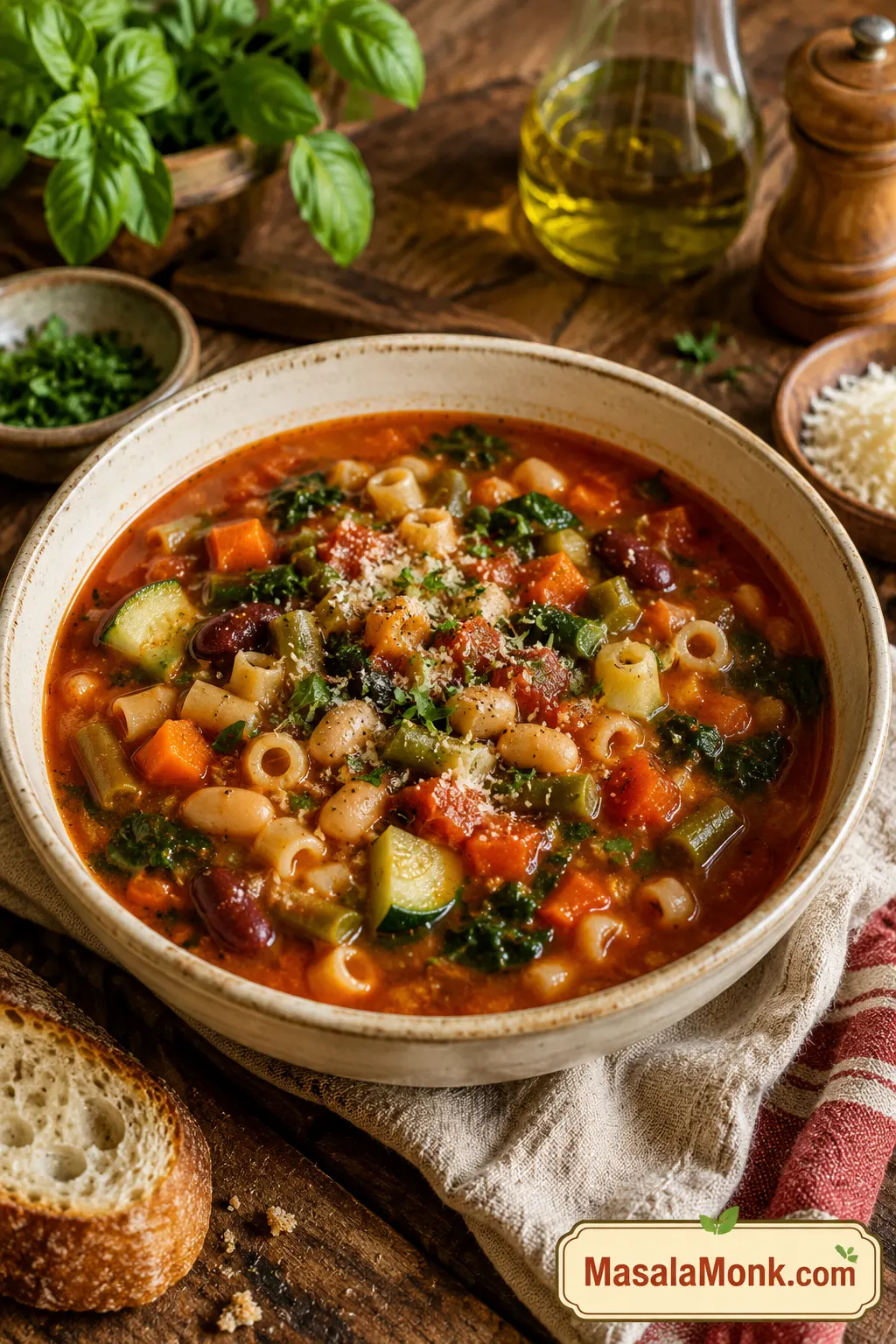
Bowl of minestrone soup with tomato broth, white beans, kidney beans, small pasta, carrots, zucchini, greens, herbs, and bread on the side.

A good minestrone soup should look generous before you even take the first spoonful: tender vegetables, creamy beans, small pasta, herbs, and a tomato broth that tastes rich instead of watery. The first spoonful should catch a little of everything — a soft bean, a piece of pasta, sweet carrot, zucchini, greens, and enough tomato broth to pull it all together.

This pot works because it protects the three things that matter most in minestrone: rich tomato broth, vegetables with texture, and pasta that does not turn the leftovers into mush. Even a half-used zucchini, a tired carrot, two cans of beans, and the last handful of pasta can become a proper dinner.

Homemade minestrone also gives you something canned soup rarely does: better texture. The vegetables do not have to be overcooked, the pasta can stay tender, and you control the salt, broth, and finish.

Cooking now? Jump to the recipe card. The notes below help keep the broth rich, the vegetables tender, and the leftovers useful.

What a Good Minestrone Spoonful Should Show

Before you start, notice the target balance: beans, vegetables, pasta, greens, and tomato broth should all show up in the same spoonful.
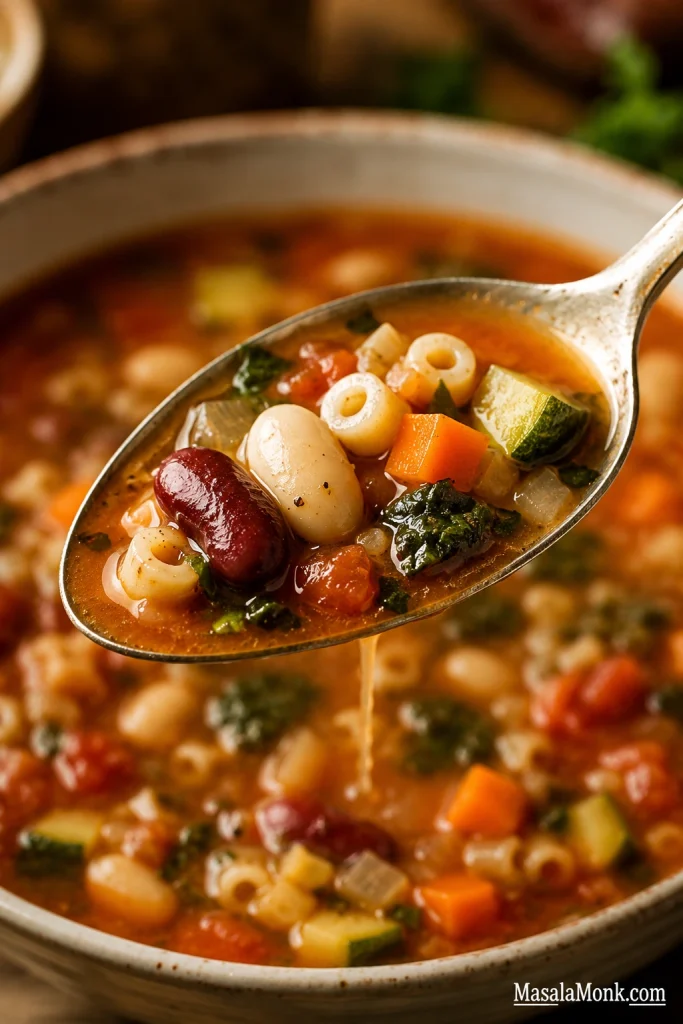
Spoon lifting minestrone soup with small pasta, white bean, kidney bean, carrot, zucchini, greens, and tomato broth dripping back into the bowl.
This spoonful shows the balance you want: beans for body, vegetables for freshness, small pasta for comfort, and tomato broth tying everything together.

Recipe at a Glance

Prep time20 minutes
Cook time45 minutes
Total time1 hour 5 minutes
Faster versionAbout 40 to 45 minutes with smaller diced vegetables, the full 6 cups broth, and a shorter 15 to 20 minute base simmer
Servings6 generous bowls
YieldAbout 11 to 13 cups soup
MethodStovetop
Best pot5 to 6 quart / 5 to 6 liter Dutch oven or heavy soup pot
Best forWeeknight dinner, meal prep, and freezer-friendly soup base
DietMeatless when made with vegetable broth; vegan option

The Minestrone Rule of 5: soften the aromatics, build the tomato base, add beans for body, keep the pasta small, and save tender greens for the end. Vegetables can change; the rhythm is what keeps the pot balanced.

Why this works: tomato paste gives the soup depth, beans make it feel full, late-added vegetables keep their shape, and pasta goes in only when the broth already tastes good. That is what keeps the soup hearty without letting it turn heavy or dull.

The Minestrone Rule of 5

This visual is the memory hook for the whole recipe: keep the rhythm steady, even when the vegetables change.
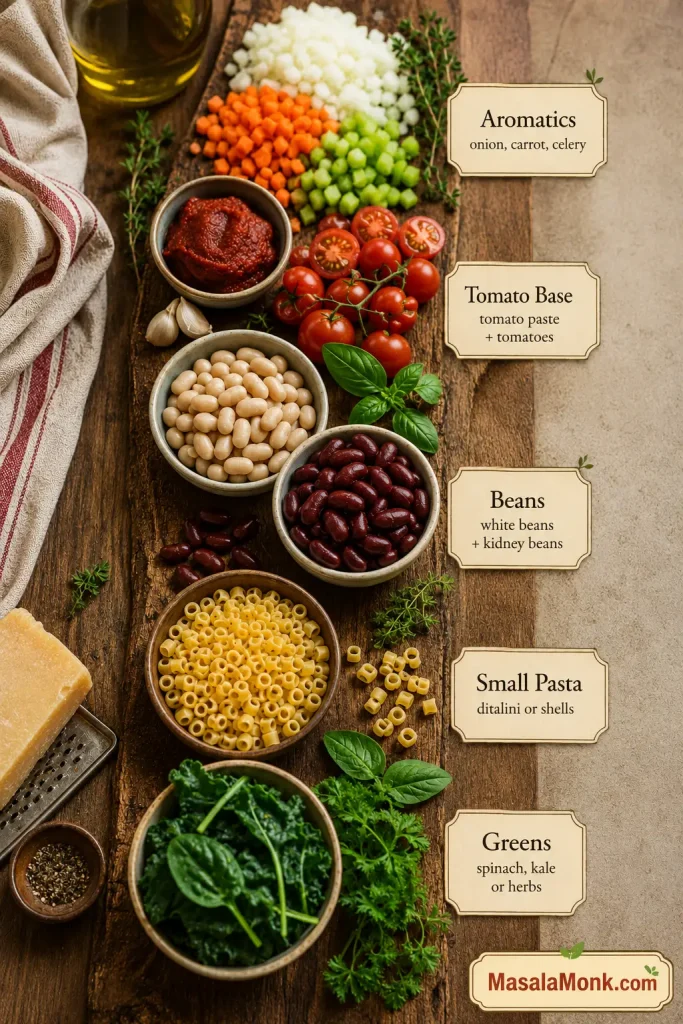
Rustic board showing minestrone ingredients arranged as aromatics, tomato base, beans, small pasta, and leafy greens.
Use the Minestrone Rule of 5 when you want the recipe to feel flexible: aromatics, tomato base, beans, small pasta, and greens are the core building blocks.

Easy minestrone ratio: for 6 bowls, use about 5 to 6 cups broth, 2 cans beans, 4 to 5 cups chopped vegetables, and 3/4 cup small pasta.

Short on time? Dice the vegetables smaller, use the full 6 cups broth, and simmer the soup base for 15 to 20 minutes before adding pasta and greens. The full cook gives deeper flavor, but the faster version still makes a good weeknight bowl.


Minestrone Soup Recipe Card

Description: A hearty minestrone soup with vegetables, beans, small pasta, and a rich tomato broth. It is meatless when made with vegetable broth, cozy without cream, and easy to adjust for leftovers or a thicker dinner-style bowl.

Prep: 20 minutes | Cook: 45 minutes | Total: 1 hour 5 minutes | Serves: 6 generous bowls | Yield: about 11 to 13 cups

Equipment: 5 to 6 quart / 5 to 6 liter Dutch oven or heavy soup pot, knife, cutting board, can opener, colander, wooden spoon, and ladle.

Ingredients

Base

  • 2 tablespoons olive oil, plus more for finishing, about 30 ml
  • 1 medium yellow onion, diced, about 150 to 180 g
  • 2 medium carrots, diced, about 130 to 160 g
  • 2 celery ribs, diced, about 90 to 120 g
  • 4 garlic cloves, minced
  • 3 tablespoons tomato paste, about 45 g

Broth and Seasoning

  • 1 can crushed or diced tomatoes, 28 oz / 794 g
  • 5 to 6 cups vegetable broth, 1.2 to 1.4 liters
  • 1 bay leaf
  • 1 1/2 teaspoons Italian seasoning
  • 1/2 teaspoon dried oregano, optional
  • 1/4 teaspoon red pepper flakes, optional
  • 1 teaspoon kosher salt or 3/4 teaspoon fine salt, plus more to taste; start with less if your broth is salted
  • 1/2 teaspoon black pepper, plus more to taste
  • 1 parmesan rind, optional; skip for vegan minestrone

Beans, Vegetables, and Pasta

  • 1 can cannellini beans or white beans, 15 oz / 425 g, drained and rinsed
  • 1 can kidney beans, 15 oz / 425 g, drained and rinsed
  • 1 cup chopped green beans, about 100 to 125 g
  • 1 medium zucchini, diced, about 180 to 220 g
  • 3/4 cup small pasta such as ditalini, small shells, elbows, or macaroni, about 75 to 90 g
  • 2 cups packed spinach or chopped kale, about 60 to 80 g

Finish

  • 1 to 2 teaspoons lemon juice or red wine vinegar, 5 to 10 ml
  • 1/4 cup chopped parsley or basil, about 10 to 15 g
  • Extra olive oil, for finishing
  • Grated parmesan, optional, for serving

Instructions

  1. Heat olive oil in a 5 to 6 quart / 5 to 6 liter Dutch oven or heavy soup pot over medium heat.
  2. Add onion, carrot, celery, and salt. Cook for 7 to 10 minutes, stirring often, until softened and fragrant.
  3. Add garlic and tomato paste. Cook for 1 to 2 minutes, stirring often, until the tomato paste darkens slightly.
  4. Add crushed or diced tomatoes, vegetable broth, bay leaf, Italian seasoning, oregano if using, red pepper flakes if using, black pepper, and parmesan rind if using. Stir well and scrape the bottom of the pot.
  5. Add the cannellini beans and kidney beans. Bring to a boil, then reduce to a gentle simmer.
  6. Simmer partly covered for 20 to 25 minutes, until the broth tastes developed. Add firm vegetables such as cabbage, potato, or squash during this simmer if using them.
  7. Add green beans, zucchini, and pasta. Cook for 8 to 10 minutes, or until the pasta is just tender.
  8. Stir in spinach or kale and cook for 1 to 3 minutes, just until wilted.
  9. Remove the bay leaf and parmesan rind. Stir in lemon juice or red wine vinegar, parsley or basil, and a drizzle of olive oil.
  10. Taste and adjust salt, pepper, and acidity. Let the soup rest for 5 minutes before serving.
  11. Serve hot with parmesan, extra herbs, crusty bread, garlic bread, or a simple salad.

Recipe Notes

  • Brothier soup: use 3/4 cup pasta and the full 6 cups broth.
  • Thicker soup: use 1 cup pasta or mash 1/2 cup beans into the broth.
  • Firmer zucchini: add zucchini during the final 5 minutes instead of with the pasta.
  • Better leftovers: cook pasta separately and add it to bowls.
  • Vegan version: use vegetable broth and skip parmesan rind and parmesan cheese.
  • Meal prep: toss separately cooked pasta with a tiny drizzle of olive oil after draining so it does not clump.
  • Gluten-free version: use gluten-free pasta or rice, preferably cooked separately.
  • Rice version: cooked rice is easiest. Add it near the end or directly to bowls because rice absorbs broth quickly.
  • Extra richness: simmer with a parmesan rind or finish with olive oil and herbs.

The recipe works on its own, but the notes below help you adjust the beans, pasta, vegetables, storage, and appliance methods without losing the minestrone feel. If leftovers matter, the storage and freezing notes are especially useful.

Before the deeper notes, this quick visual ratio gives you a flexible way to adjust the pot without losing the minestrone balance.

Easy Minestrone Ratio

Use this ratio when you want to adjust the recipe without losing the soup’s balance.
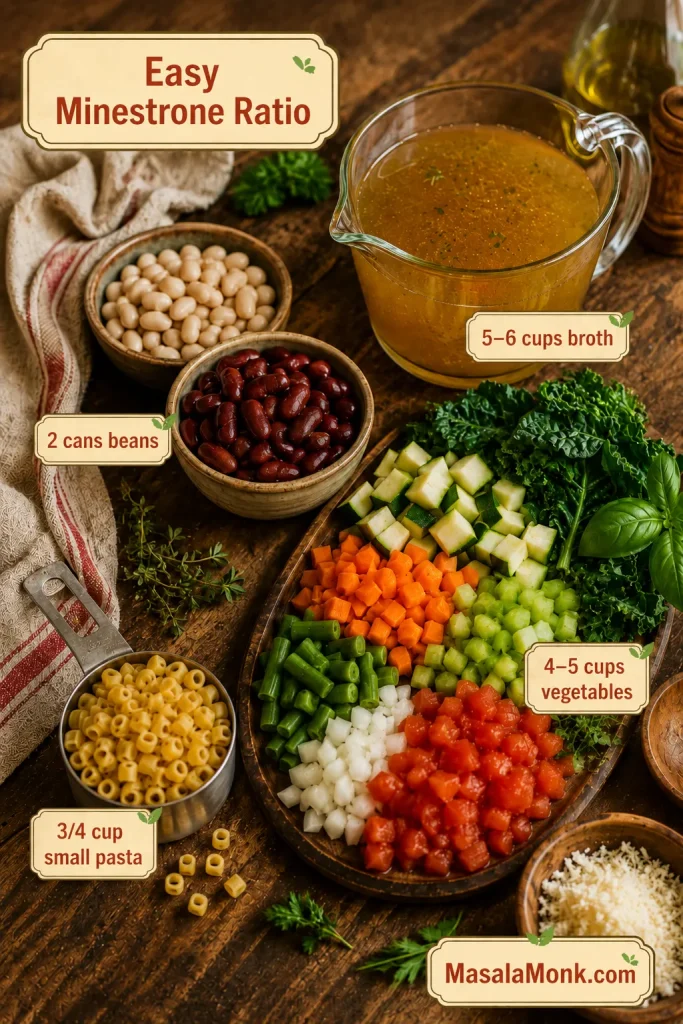
Broth, beans, chopped vegetables, and small pasta arranged on a rustic counter as an easy minestrone ratio guide.
Instead of measuring every vegetable perfectly, follow the ratio: broth keeps it loose, beans make it filling, vegetables add bulk, and pasta should stay modest.

What Is Minestrone Soup?

Minestrone is an Italian vegetable soup made with vegetables, beans, tomatoes, broth, herbs, olive oil, and usually pasta or rice. Classic minestrone is not about one fixed vegetable list; it is about building a generous, seasonal soup with enough beans and starch to feel like a meal.

That is why one pot might have zucchini and green beans while another has cabbage, kale, potato, or squash. A good bowl should be crowded, not dry: enough vegetables and beans to make it feel like dinner, but enough tomato broth to keep it unmistakably soup.

Why You’ll Like This Recipe

  • The broth tastes built, not diluted. Tomato paste, sautéed aromatics, herbs, beans, and olive oil give it a rounded tomato flavor.
  • The vegetables keep their texture. Firm vegetables simmer first, while zucchini and greens go in later.
  • The pasta will not hijack the leftovers. Cook it in the soup when serving right away, or separately when you want better storage.
  • It starts meatless. Use vegetable broth, and the whole pot stays hearty without meat.
  • It gives you room to use what you have. Small shells, elbows, ditalini, zucchini, green beans, cabbage, kale, spinach, white beans, kidney beans, or chickpeas can all work.
  • It can be lighter or heartier. Use more greens and less pasta for a lighter bowl, or extra beans and a little more pasta for a thicker dinner-style soup.

Minestrone feels hearty without cream because beans, vegetables, pasta, and olive oil do the work. If you like cozy tomato-and-pasta dinners, this sits near the same comfort zone as baked ziti, but it is lighter, brothier, and packed with vegetables.

Minestrone Soup Ingredients

These ingredients follow the same Rule of 5: aromatics, tomato broth, beans, small pasta or rice, and tender greens at the end. Do not worry if you are missing one vegetable. Minestrone is forgiving as long as the base stays balanced.

If you are missing one vegetable or bean, check the easy minestrone swaps before changing the broth or pasta ratio.
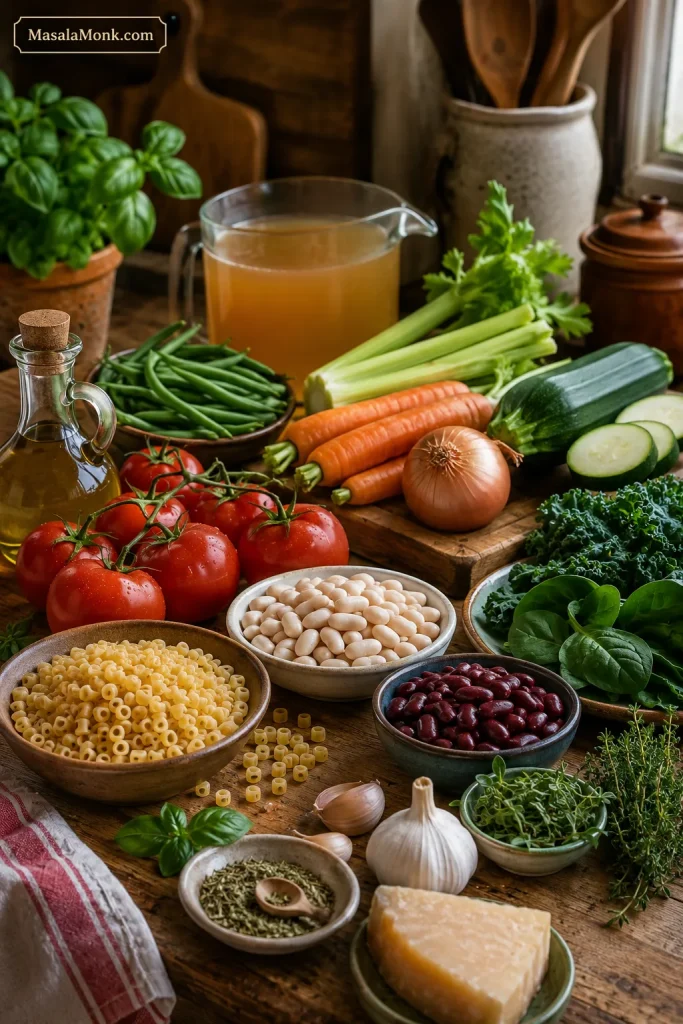
Ingredients for minestrone soup on a counter, including tomatoes, broth, beans, pasta, carrots, celery, onion, garlic, zucchini, green beans, greens, herbs, olive oil, and parmesan rind.
Each minestrone ingredient has a role: aromatics create sweetness, tomatoes shape the broth, beans add substance, pasta brings comfort, and greens freshen the finish.

If you remember one thing: taste the broth before adding pasta. When it tastes thin or flat at that point, fix the broth first; pasta will not rescue a weak soup.

Build the Aromatic Base

Onion, carrot, celery, garlic, and olive oil create the base. Cook the onion, carrot, and celery until the sharp onion smell softens and the pot starts smelling sweet. The onion should look translucent and the carrot edges should soften. This is the first moment the soup starts smelling like dinner instead of chopped vegetables.
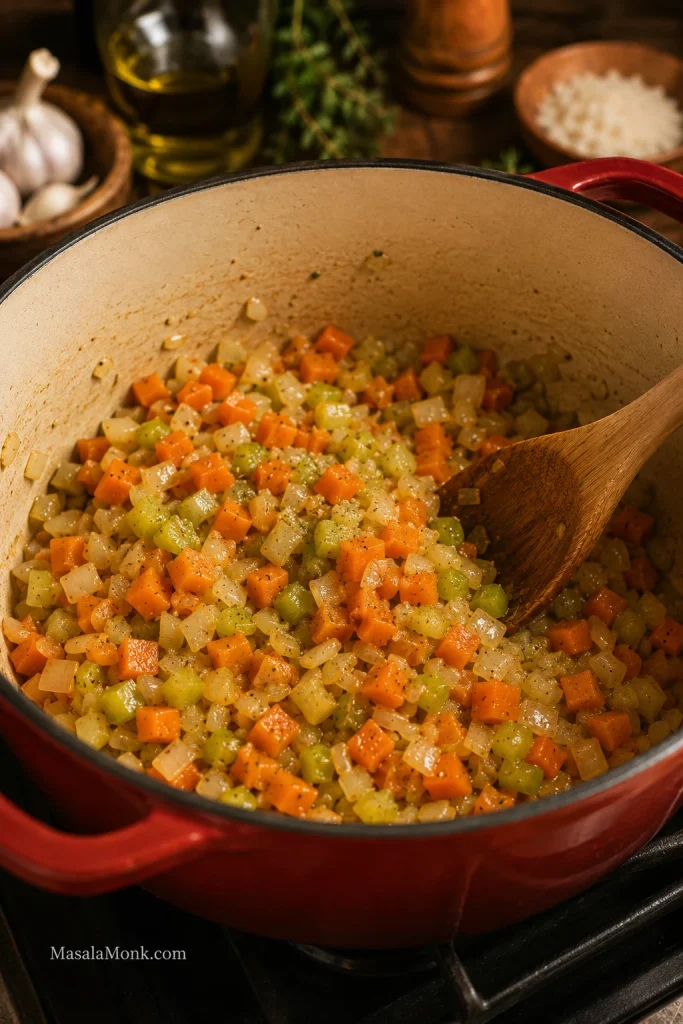
Onion, carrot, and celery sautéing in olive oil inside a Dutch oven with a wooden spoon.
First, cook the onion, carrot, and celery until they soften and smell sweet. This step gives homemade minestrone a deeper base before the tomatoes arrive.

Cook the Tomato Paste Before Broth


Tomato paste and a large can of crushed or diced tomatoes give the broth its color and flavor. Cook the tomato paste until it darkens slightly; it should leave orange-red streaks on the bottom of the pot, not black bits. Crushed tomatoes make a fuller, smoother broth, while diced tomatoes give a chunkier texture.
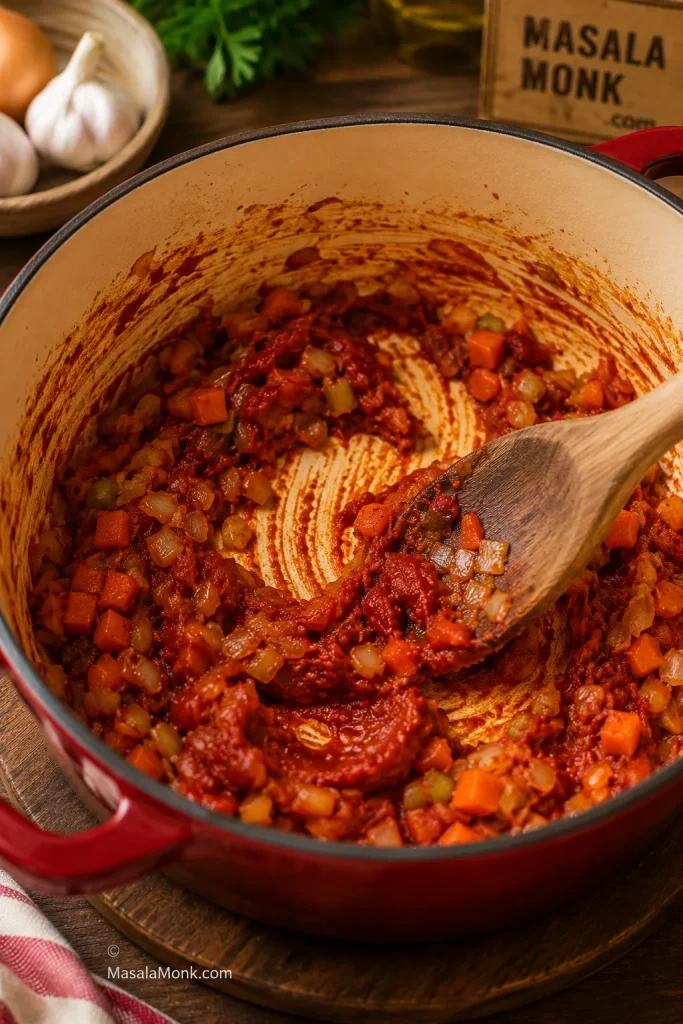
Tomato paste cooked with onion, carrot, and celery in a pot, with a wooden spoon dragging through the red paste.

Next, let the tomato paste cook briefly with the aromatics. It deepens the soup base and helps the broth taste rich instead of thin.

Broth


Vegetable broth keeps the soup meatless and easy to make vegan. Chicken broth also works if you are not keeping the soup vegetarian. Low-sodium broth gives you more control because canned beans, tomatoes, pasta, and cheese can all add salt.

Beans


White beans and kidney beans are a strong everyday combination. The white beans soften into the tomato broth and make the soup feel fuller, almost as if it simmered longer than it did. Kidney beans add color, bite, and the familiar minestrone look. Rinse canned beans before adding them so the broth stays clean and balanced.

Pasta or Rice


Small pasta is what keeps minestrone easy to eat by the spoonful. Ditalini is classic, but small shells, elbows, macaroni, or orzo all work. Use 3/4 cup for a brothier soup and up to 1 cup for a thicker bowl. Cooked rice also works when you want a pasta-free version. If you are cooking for leftovers, see how to keep minestrone pasta from getting mushy before adding pasta directly to the pot.

Vegetables


Zucchini, green beans, spinach, kale, cabbage, potato, peas, squash, carrots, and celery can all work. Dense vegetables such as potato, squash, cabbage, and carrots need more time. Zucchini, peas, spinach, and tender greens should go in later so they keep some color and shape.

Minestrone is not a test of whether you bought the exact vegetables; it is a way to turn the vegetables you have into a balanced soup.

Herbs and Finishers


Italian seasoning, oregano, basil, thyme, bay leaf, black pepper, parsley, and fresh basil all fit well. A parmesan rind is optional for extra depth, but use vegetarian-style parmesan if that matters to you, or skip cheese completely for a vegan version.

A small splash of lemon juice or red wine vinegar wakes up the whole pot at the end, especially after the beans and pasta have softened the broth. A spoonful of pesto can make the finish taste brighter; these basil pesto variations are useful if you like that herby direction.

How to Make Minestrone Soup

The steps follow the same rhythm as the Rule of 5: sauté, deepen, simmer, add quick-cooking ingredients late, finish fresh.

1. Sauté the Onion, Carrot, and Celery


Heat olive oil in a large Dutch oven or heavy soup pot over medium heat. Add onion, carrot, celery, and salt. Cook for 7 to 10 minutes, stirring often, until the vegetables soften and the onion turns translucent. The pot should smell sweet and savory before you move on.

2. Add Garlic and Tomato Paste


Stir in the garlic and tomato paste. Cook for 1 to 2 minutes, stirring often. The tomato paste should darken slightly and smell richer, but it should not scorch. A watery minestrone usually means the base was rushed, so give this step its minute.

3. Build the Broth


Add crushed or diced tomatoes, broth, Italian seasoning, bay leaf, black pepper, and parmesan rind if using. Scrape the bottom of the pot so all the tomato paste and aromatics dissolve into the broth.
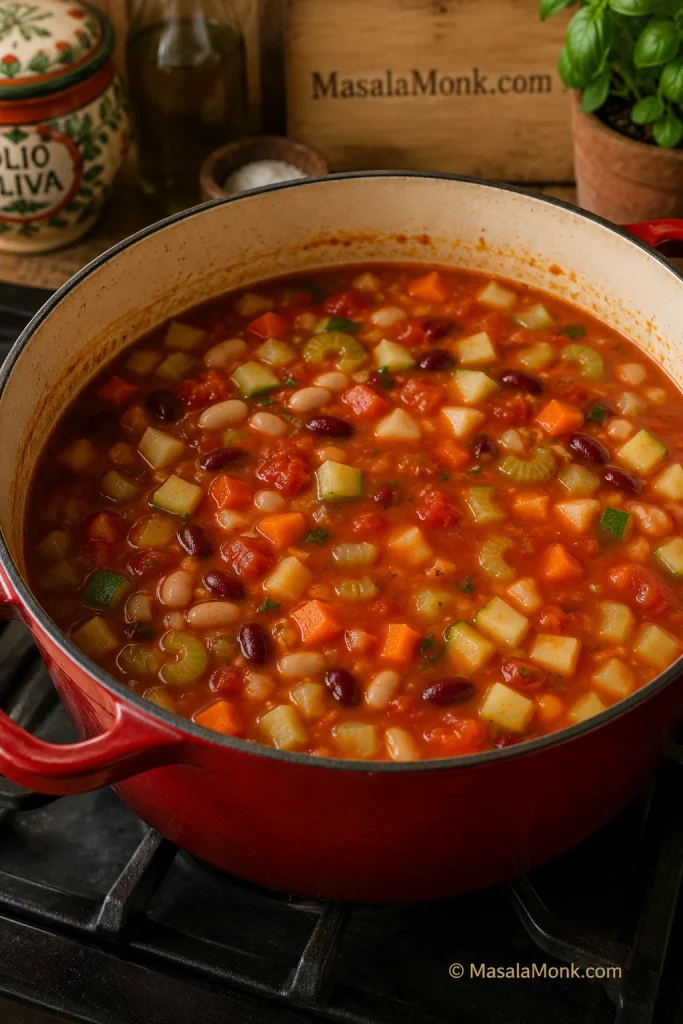
Minestrone soup base in a Dutch oven with tomato broth, beans, carrots, celery, and firm vegetables before pasta and greens are added.

Let the tomato broth, beans, and firm vegetables simmer before adding pasta. As a result, the base tastes rounded instead of rushed.

4. Add Beans and Simmer Gently


Add the rinsed beans and any firm vegetables such as cabbage, potato, or squash. Bring the soup to a boil, then reduce it to a gentle simmer. You want small bubbles, not a rolling boil. Cook partly covered for 20 to 25 minutes, until the broth tastes fuller and the vegetables are tender.

Taste the broth before adding pasta. If it tastes thin or flat now, give it more simmering time, adjust the salt, or brighten it with a little lemon juice or vinegar. The broth should already taste good before the pasta goes in; if it still tastes weak, use the troubleshooting section before adding pasta.
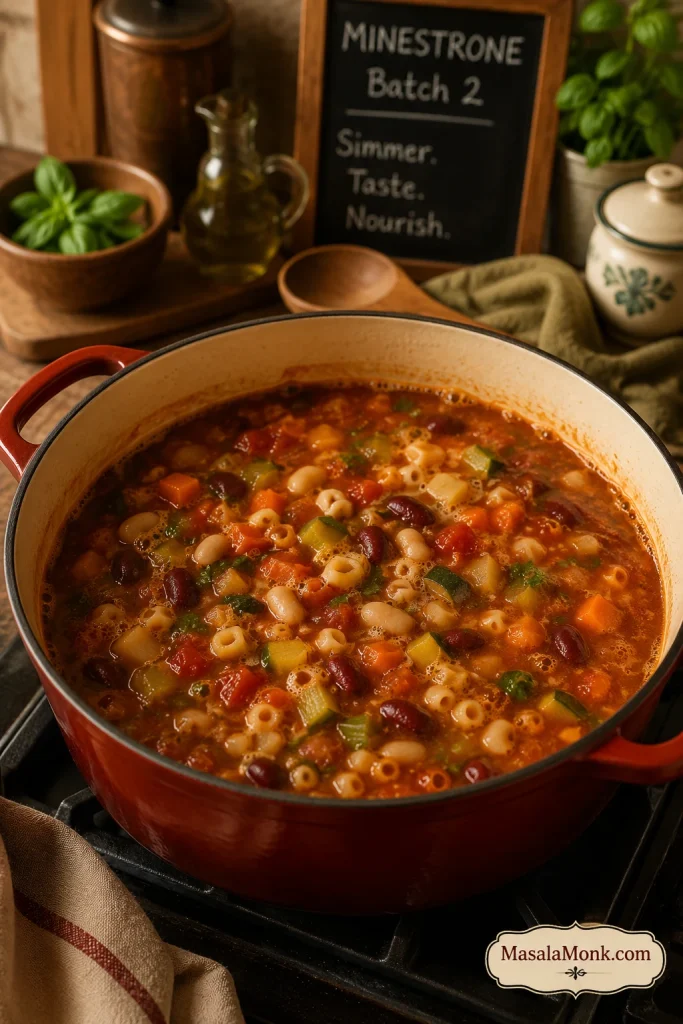
Minestrone soup gently simmering in a Dutch oven with tomato broth, beans, carrots, celery, pasta, and vegetables.

Keep minestrone at a gentle simmer, not a hard boil. Small bubbles build flavor while helping the vegetables stay tender and intact.

5. Add Quick-Cooking Vegetables and Pasta


Add green beans, zucchini, and small pasta near the end. Cook for 8 to 10 minutes, or until the pasta is just tender. Stop while it still has a little structure, because it will keep softening in the hot broth.
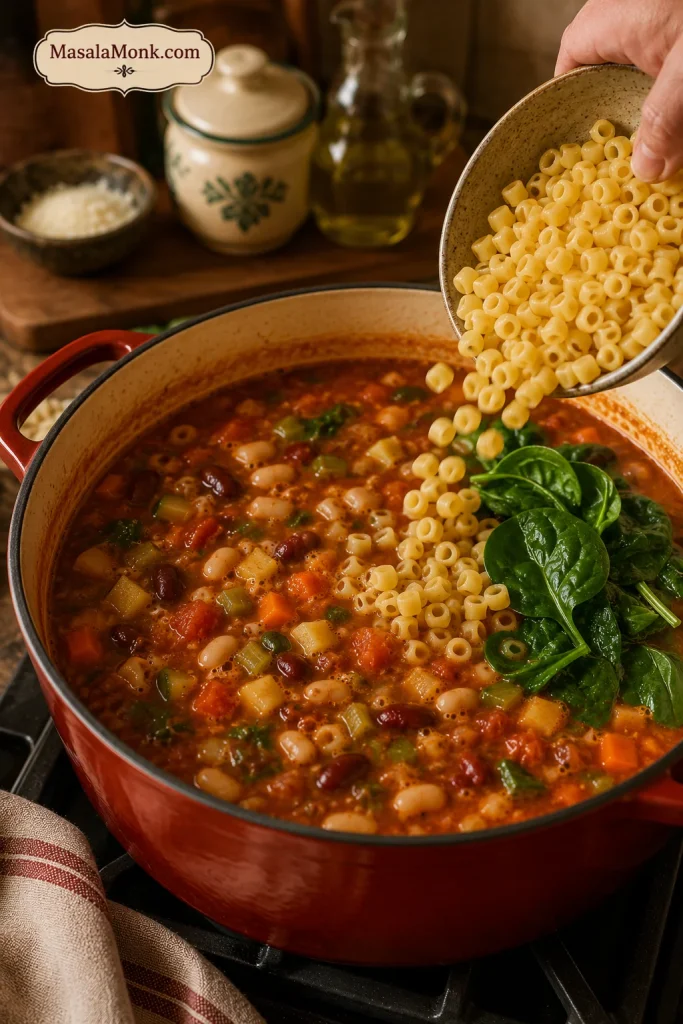
Small pasta being poured into a pot of minestrone soup with spinach added near the end of cooking.

Add pasta and greens near the end. This keeps the soup brighter, protects the greens, and helps prevent pasta from swelling in the pot.

6. Finish with Greens, Herbs, and Brightness


Stir in spinach or kale for the final 1 to 3 minutes. The greens only need to wilt; they do not need to cook down into the broth. Remove the bay leaf and parmesan rind. Finish with parsley or basil, a drizzle of olive oil, and lemon juice or red wine vinegar. Rest the soup for 5 minutes before serving so the broth settles and the flavors come together.
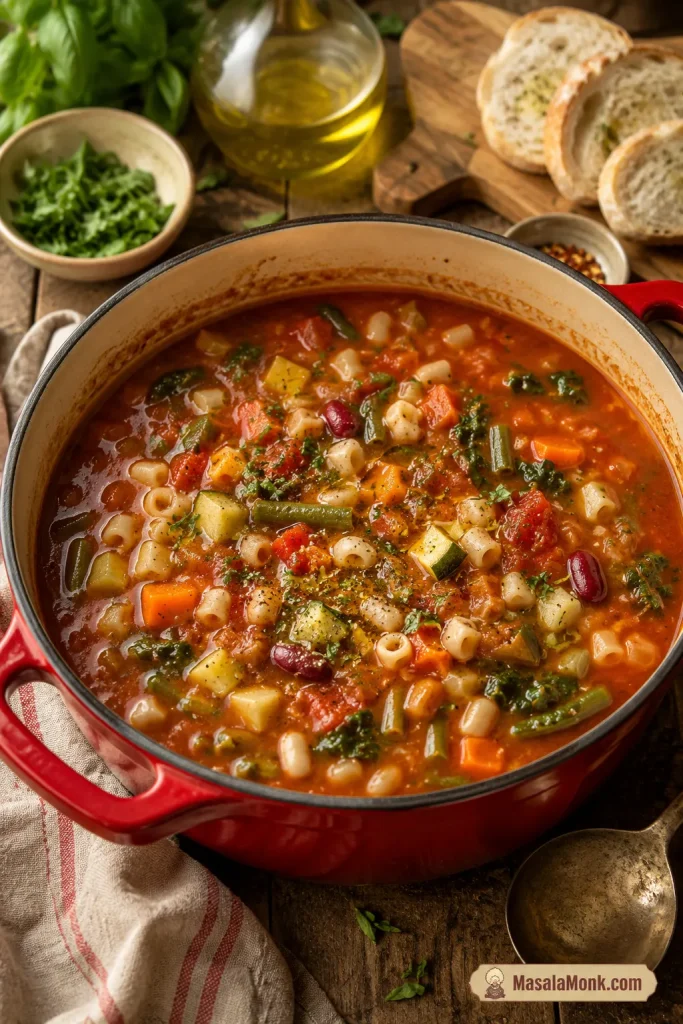
Finished pot of homemade minestrone soup with tomato broth, beans, pasta, carrots, zucchini, green beans, greens, herbs, and olive oil.

When the pot is ready, it should look colorful and ladle easily. If it feels crowded, loosen it with a splash of broth before serving.

Easy Minestrone Swaps

Once the base makes sense, the soup becomes forgiving. You do not need the exact same vegetables every time; you just need the right balance of broth, beans, pasta or rice, and timing.

Use What You Have

Use this section when the pot needs to adapt to the vegetables, beans, and pasta you already have.
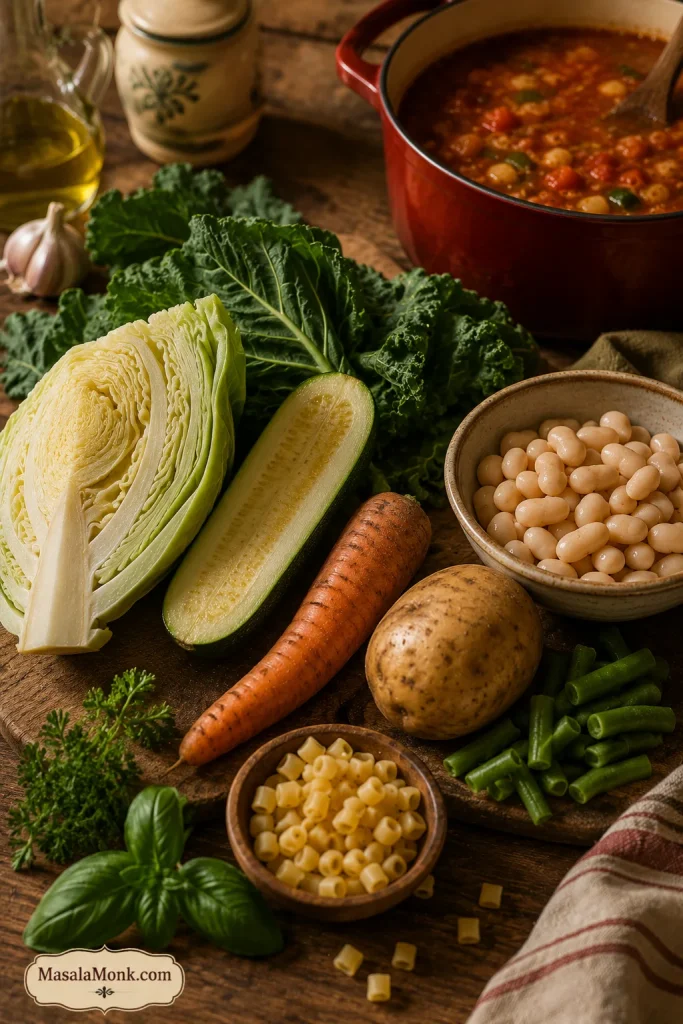
Rustic board with minestrone swaps including zucchini, carrot, cabbage, kale, potato, white beans, green beans, herbs, and small pasta.

Minestrone is made for flexible cooking. Therefore, zucchini, cabbage, kale, potato, beans, herbs, and small pasta can all work when you add them at the right time.

If you do not have Use this instead
Cannellini beans Navy beans, great northern beans, white beans, or chickpeas
Kidney beans More white beans, borlotti beans, chickpeas, or lentils
Zucchini Cabbage, green beans, peas, spinach, kale, or squash
Ditalini Small shells, elbows, macaroni, or orzo
Vegetable broth Water with extra tomato paste, herbs, olive oil, and careful seasoning
Fresh greens Frozen spinach, frozen kale, or chopped cabbage added earlier
Parmesan rind Skip it, or finish with olive oil, herbs, and a little lemon juice or vinegar

This is also where minestrone becomes personal. One cook adds cabbage, another adds potato, another uses chickpeas, and another keeps it brothy. The base stays the same, but the pot can still feel like yours. For more timing help, see the firm-early, tender-late vegetable guide.

What the Soup Should Look and Taste Like

You are looking for a soup that is chunky but still brothy. The tomato broth should taste rounded rather than sharp or thin. Vegetables should be tender without collapsing, beans should stay creamy but mostly intact, and the pasta should be just tender, not swollen.

Finished Bowl Texture Check

Use the finished bowl as a quick check before serving: the soup should look full, but it should still move like soup.
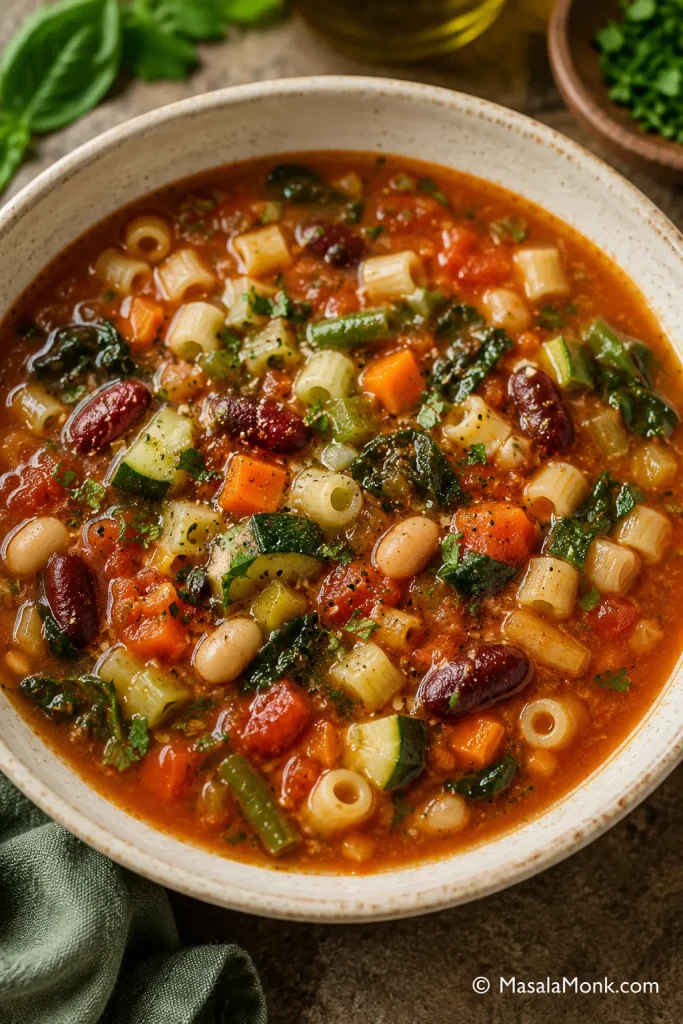
Close-up bowl of finished minestrone soup with tomato broth, white beans, kidney beans, pasta, carrots, zucchini, greens, and herbs.

Use the finished bowl as a texture check. The vegetables and beans should stand out clearly, while the tomato broth still fills the gaps around them.

Chunky but Still Soup

If the pot looks crowded but still has enough broth to move around the vegetables, you are in the right place. You should be able to drag the spoon through the bowl and see vegetables and beans settle back into the tomato broth, not sit in a dry pile. The final olive oil, herbs, and lemon juice or vinegar should make the bowl taste brighter, not sour.
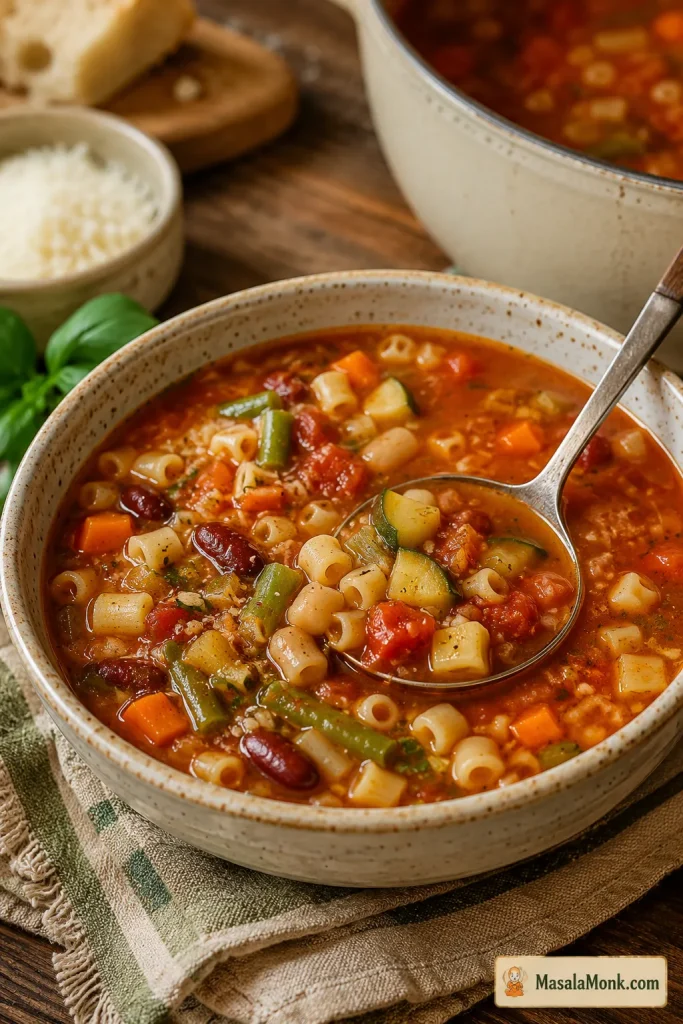
Close bowl of chunky but brothy minestrone soup with visible tomato broth, beans, pasta, carrots, zucchini, greens, and herbs.

Aim for chunky but not dry. The spoon should catch vegetables and beans, while the broth still makes the bowl feel like soup.

Best Beans, Pasta, and Vegetables for Minestrone

Beans, pasta, and vegetables are where minestrone becomes dinner. The choices do not need to be fancy; they just need to make sense together in the spoon.

Best Beans and Pasta for Minestrone

Start with spoon-friendly beans and small pasta shapes, then choose vegetables that match the season and cooking time.
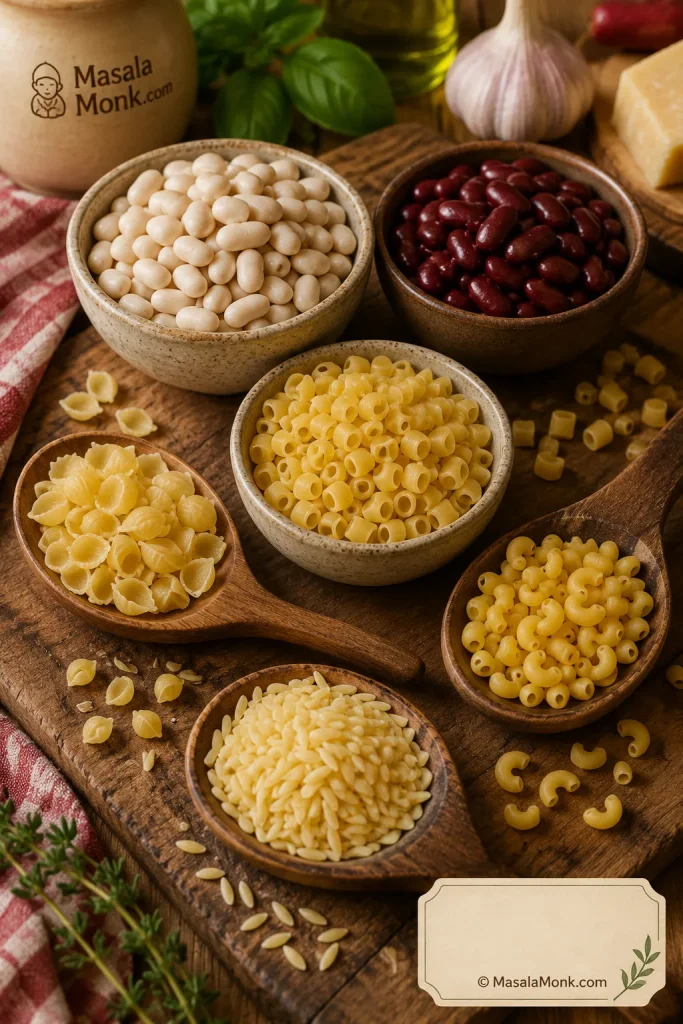
Bowls and spoons of cannellini beans, kidney beans, ditalini pasta, small shells, elbows, and orzo for minestrone soup.

Choose beans and pasta that fit easily on a spoon. Cannellini beans, kidney beans, ditalini, elbows, or small shells keep minestrone hearty without making it clumsy.

Best Beans


  • Cannellini or white beans: creamy, mild, and classic.

  • Kidney beans: firmer, colorful, and familiar in restaurant-style minestrone.

  • Borlotti beans: rustic and soft with a fuller bean flavor.

  • Chickpeas: nutty and firmer, good when you want more bite.

  • Lentils: useful for a thicker, higher-protein variation.

Best Pasta


  • Ditalini: classic and spoon-friendly.

  • Small shells: good for catching tomato broth.

  • Elbows or macaroni: easy pantry choice.

  • Orzo: soft and pleasant, but it thickens leftovers quickly.

  • Rice: useful if you do not want pasta. Cooked rice is easiest.

Once the beans and pasta are chosen, the vegetables are mostly about timing: firm ones early, tender ones late. That is what keeps the bowl generous without making it taste tired.

Firm Vegetables Early, Tender Vegetables Late


A good minestrone should never feel trapped by one vegetable list. Keep the tomato broth, aromatics, beans, herbs, and small pasta structure, then choose vegetables that fit the pot.

  • Summer: zucchini, green beans, fresh tomatoes, basil, spinach.

  • Winter: cabbage, kale, potato, squash, carrots, celery.

  • Spring: peas, asparagus, spinach, leeks, fresh herbs.

  • Pantry version: canned tomatoes, canned beans, frozen vegetables, cabbage, carrots, small pasta.

Add dense vegetables like potato, squash, cabbage, and carrots earlier. Add zucchini, peas, spinach, and tender greens near the end. Try not to overload the pot; minestrone should be hearty, but it should still have enough broth to feel like soup.
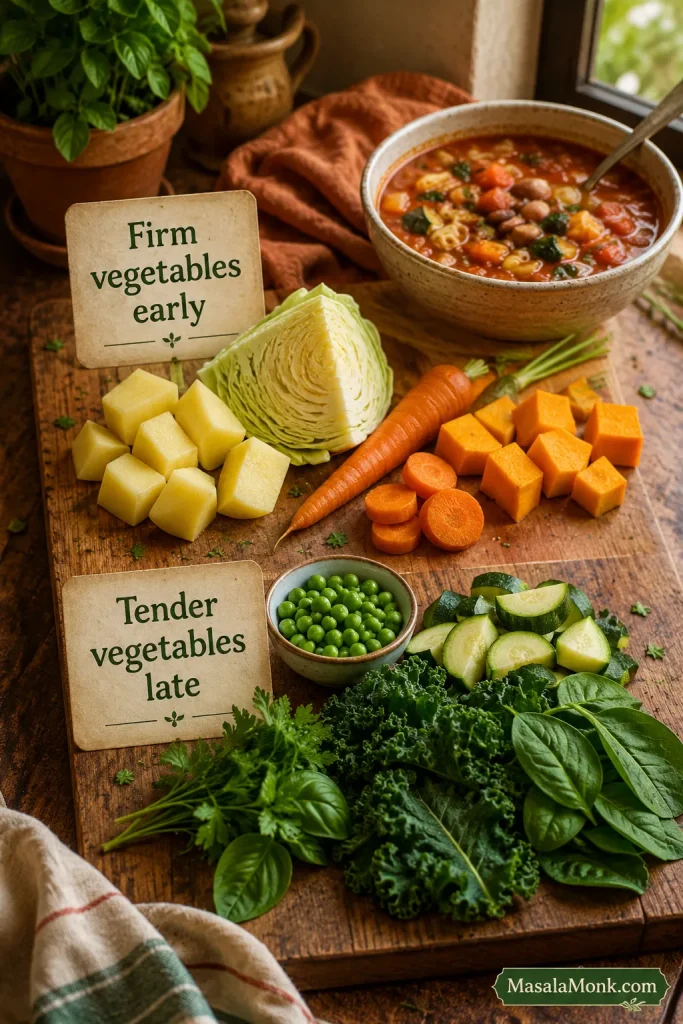
Rustic vegetable timing board showing firm vegetables like potato, cabbage, carrot, and squash beside tender vegetables like zucchini, peas, spinach, kale, and herbs.

Vegetable timing matters more than a perfect shopping list. Add firm vegetables early, then save tender greens, zucchini, peas, and herbs for the final minutes.

How to Fix Minestrone Soup Problems

If your minestrone tastes bland, watery, too thick, too acidic, or overcooked, it can usually be fixed. Most problems come down to seasoning, simmering, pasta timing, vegetable timing, or broth balance.

Fix Bland Minestrone Soup

Before rebuilding the whole pot, taste for salt, acid, herbs, pepper, and olive oil; those small finishes often fix a flat bowl.
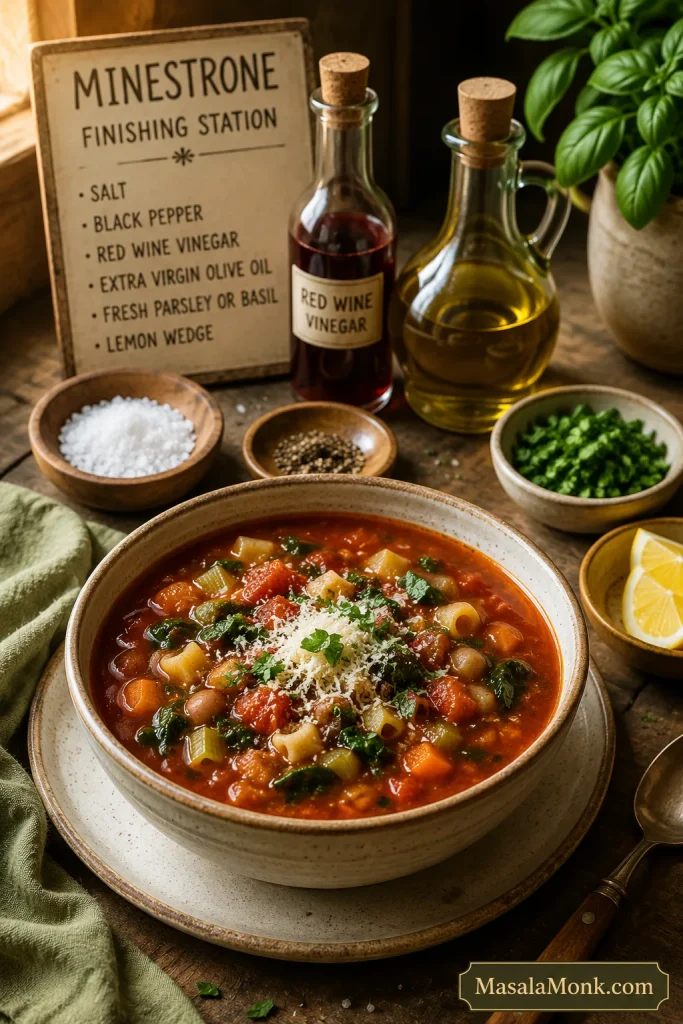
Bowl of minestrone soup beside salt, lemon wedge, red wine vinegar, olive oil, parsley or basil, and black pepper.

Bland minestrone often needs a finish, not a rebuild. Salt, lemon or vinegar, herbs, black pepper, and olive oil can wake up the whole pot.

Problem Fix
Soup tastes flat Add salt first, then a small splash of lemon juice or red wine vinegar.
Broth is too thin Simmer uncovered for a few minutes or mash 1/2 cup of beans into the broth.
Soup is too thick Add broth or water until it becomes spoonable again.
Pasta is too soft Add more broth, fresh herbs, and a little acidity. Next time, cook pasta separately.
Vegetables are overcooked Freshen the bowl with herbs, olive oil, and extra broth. Next time, add zucchini and greens later.
Soup tastes too acidic Add a drizzle of olive oil or a tiny pinch of sugar to round the tomato flavor.
Soup is too salty Add unsalted broth, water, extra beans, or more vegetables.

Most of the time, the fix is smaller than you think. A little salt, a little acid, a splash of broth, or a few mashed beans can bring the pot back.

Fix Watery Minestrone Soup

When the broth looks thin, mashed white beans are the quickest natural thickener because they add body without changing the soup into cream sauce.
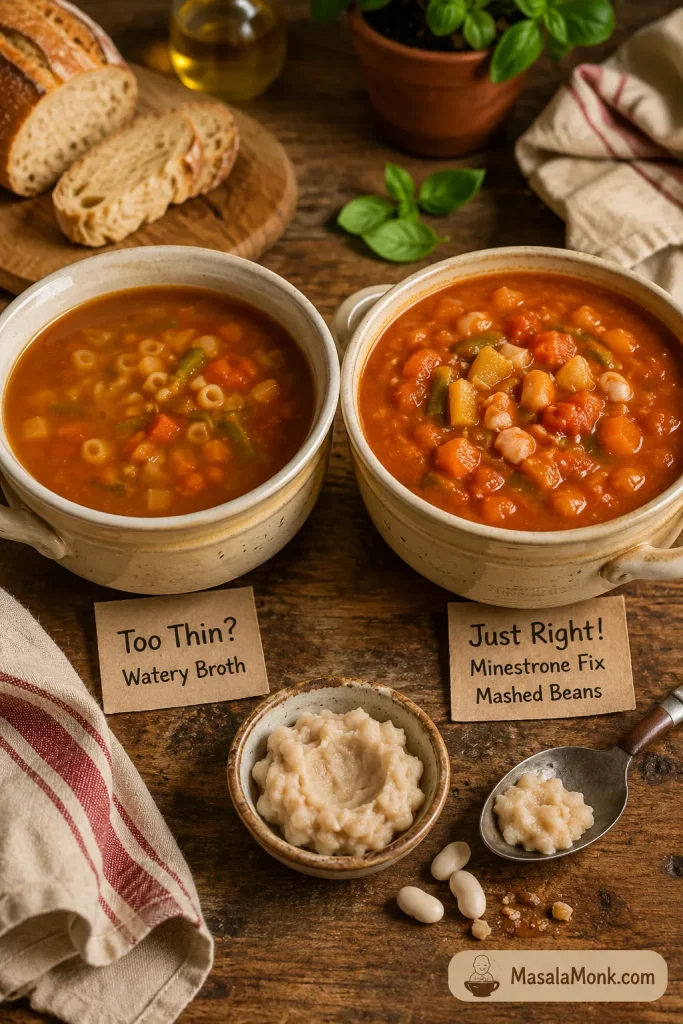
Two bowls of minestrone comparing thin watery broth with richer tomato broth, with mashed white beans shown as the thickening fix.

If the broth tastes watery, mash a few white beans into the soup and simmer briefly. This thickens minestrone naturally without cream or flour.

How to Make Minestrone Richer

  • Cook the onion, carrot, and celery until they soften and smell sweet.

  • Cook the tomato paste before adding broth.

  • Use crushed tomatoes for a fuller broth.

  • Add a parmesan rind if you are using cheese.

  • Mash some of the beans into the soup for natural body.

  • Simmer partly uncovered when the soup looks too thin.

  • Finish with olive oil, herbs, and a small splash of lemon juice or vinegar.

How to Keep Pasta from Getting Mushy


Minestrone pasta gets mushy when it sits in hot broth for too long or stays in the soup through storage. The safest method depends on how you plan to serve it.

  • Serving immediately: add dry pasta during the final 8 to 10 minutes.

  • Meal prep: cook pasta separately and add it to each bowl.

  • Freezing: freeze the soup without pasta and add fresh pasta later.

  • Thick leftovers: reheat with extra broth or water.
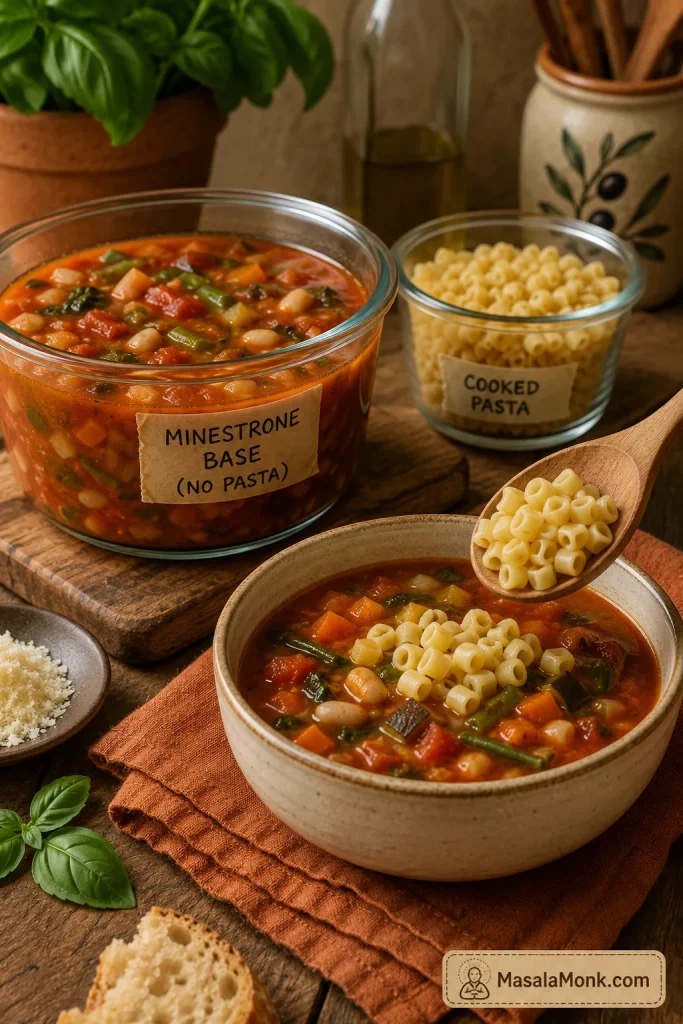
Glass containers showing minestrone soup base stored separately from cooked small pasta, with pasta being added to a serving bowl.

For better leftovers, store the soup base and pasta separately. Then add pasta to each serving so the next bowl stays fresh instead of soggy.

Slow Cooker and Instant Pot Minestrone

Slow Cooker vs Instant Pot Minestrone

For both appliance methods, the texture rule is the same: cook the base first and keep pasta and greens late. The pasta texture notes are especially useful for meal prep.
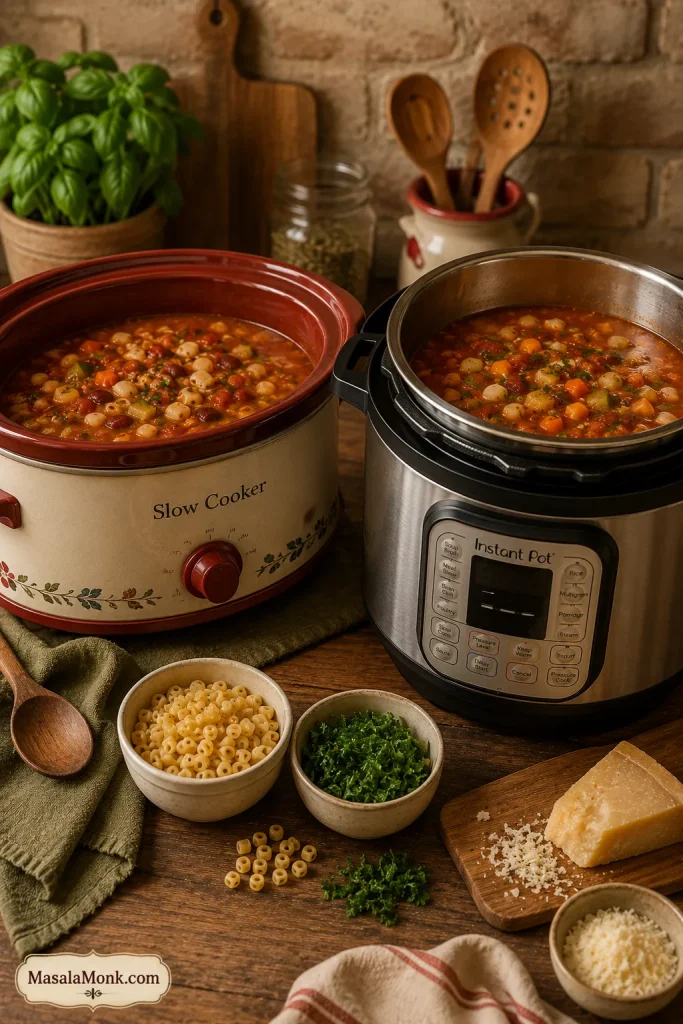
Slow cooker and Instant Pot filled with minestrone soup, with small bowls of pasta and greens nearby for adding near the end.

Whether you use a slow cooker or Instant Pot, cook the soup base first. Meanwhile, keep pasta and greens for the end so the texture stays better.

Slow Cooker Minestrone

Slow cooker minestrone is best for a hands-off soup base. Cook the broth, beans, aromatics, and firm vegetables first, then add zucchini, pasta, and greens near the end so they do not overcook.

  1. Add onion, carrot, celery, garlic, tomato paste, tomatoes, broth, herbs, bay leaf, beans, and firm vegetables to the slow cooker.

  2. Cook on low for 6 to 8 hours or high for 3 to 4 hours.

  3. Add zucchini and green beans during the final 30 minutes.

  4. Add pasta only during the final 20 to 30 minutes, or cook pasta separately.

  5. Stir in spinach or kale at the end, then finish with herbs, olive oil, and lemon juice or vinegar.

Instant Pot Minestrone


Instant Pot minestrone is best for a fast soup base. Pressure cook the broth, beans, and firm vegetables, then add cooked pasta and greens at the end so the pasta does not turn soft under pressure.

  1. Use sauté mode to cook onion, carrot, celery, and olive oil for 4 to 5 minutes.

  2. Add garlic and tomato paste. Cook for 1 minute.

  3. Add tomatoes, broth, herbs, bay leaf, beans, and firm vegetables.

  4. Pressure cook on high for 4 to 5 minutes.

  5. Let pressure release naturally for 5 to 10 minutes, then quick release carefully.

  6. Stir in greens and cooked pasta, then finish with herbs, olive oil, and lemon juice or vinegar.

Olive Garden-Style Minestrone Soup

If you like Olive Garden’s lighter tomato-broth style, use these adjustments while keeping the main recipe homemade. Olive Garden describes its minestrone as vegetables, beans, and pasta in a light tomato broth, so this is a home version in that familiar direction, not the official recipe. You can see Olive Garden’s menu description for the style reference.
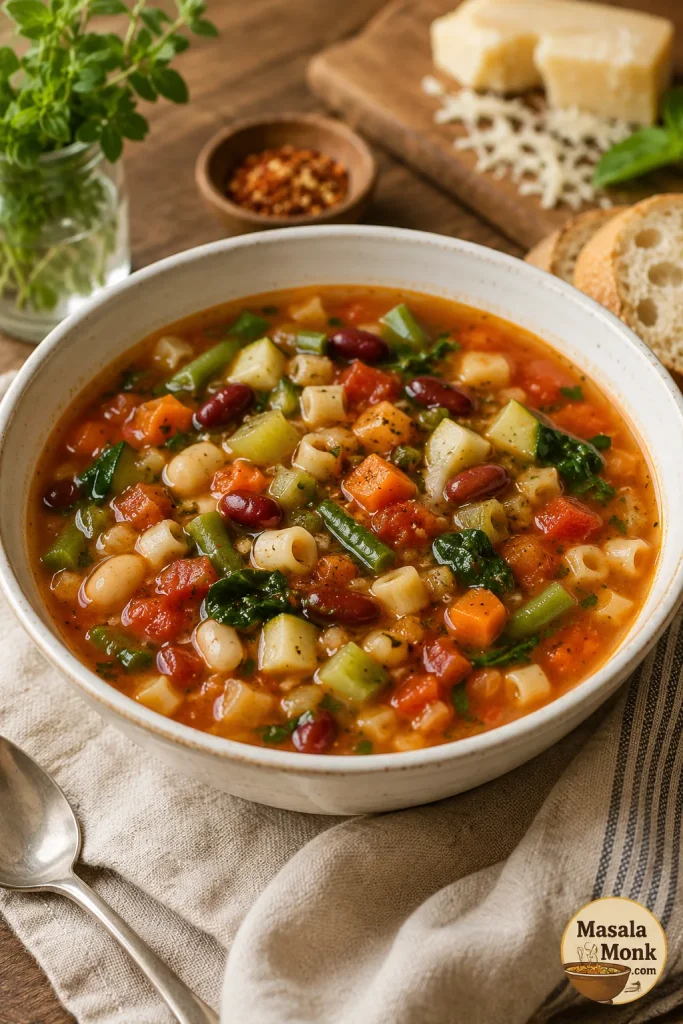
Light tomato-broth minestrone soup in a cream bowl with kidney beans, white beans, pasta, carrots, zucchini, green beans, celery, spinach, and herbs.

For Olive Garden-style minestrone at home, keep the broth lighter, the beans whole, the vegetables small, and the pasta modest.

  • Use diced tomatoes instead of crushed for a lighter restaurant-style texture.

  • Do not mash the beans into the broth.

  • Keep the pasta modest so the soup stays brothy.

  • Use kidney beans, white beans, zucchini, green beans, carrots, celery, and spinach.

  • Finish with herbs and acidity so the bowl tastes bright, not heavy.

Minestrone Soup Variations

After the base tastes good, you can take the soup in a few different directions without losing the minestrone feel. Keep the tomato base, beans, vegetable timing, and small pasta structure in place, then adjust the bowl you want. For gluten-free, rice-based, or pasta-free versions, the storage section is useful if you plan to cook the starch separately.
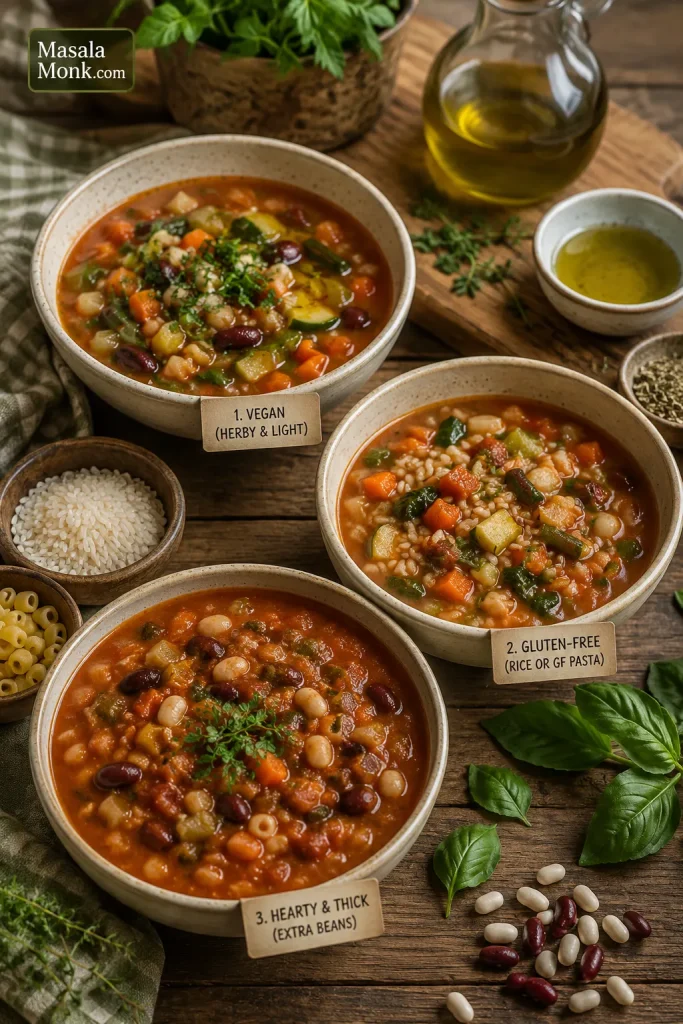
Three bowls of minestrone variations showing a vegan version, a gluten-free or rice version, and a thicker bean-rich version on a rustic table.

Once the tomato-bean base tastes good, you can take minestrone in several directions: vegan, gluten-free, rice-based, or thicker and extra hearty.

  • Vegan minestrone: use vegetable broth and skip parmesan rind, parmesan cheese, meat, and egg pasta. Finish with olive oil, herbs, nutritional yeast, or vegan pesto.

  • Gluten-free minestrone: use gluten-free pasta or rice. Cook gluten-free pasta separately for the best texture. Do not use barley or farro.

  • Minestrone without pasta: skip the pasta and add extra beans, cabbage, zucchini, potato, kale, spinach, or cooked rice.

  • Thick and hearty minestrone: use crushed tomatoes, 1 cup pasta, extra white beans, and a small potato. Mash some beans into the broth.

  • Brothy minestrone: use 3/4 cup pasta, unmashed beans, and an extra cup of broth for a lighter, restaurant-style bowl.

  • Low-sodium minestrone: start with low-sodium broth, rinse canned beans well, and choose no-salt-added tomatoes if available. Use garlic, herbs, lemon juice, vinegar, and olive oil to build flavor.

  • Add meat: brown Italian sausage or ground beef before adding the aromatics, or stir in shredded cooked chicken near the end.

Think of these as directions, not separate recipes. The same pot can become lighter, heartier, vegan, gluten-free, or meatier without losing its minestrone backbone.

What to Serve with Minestrone Soup

Minestrone can stand alone as dinner, especially with beans and pasta, but a simple side makes the meal feel complete.

  • A lighter meal: serve minestrone with a crisp salad, roasted vegetables, or something bright like beet salad.

  • For a heartier dinner: add garlic bread, focaccia, grilled cheese, parmesan toast, or pesto toast.
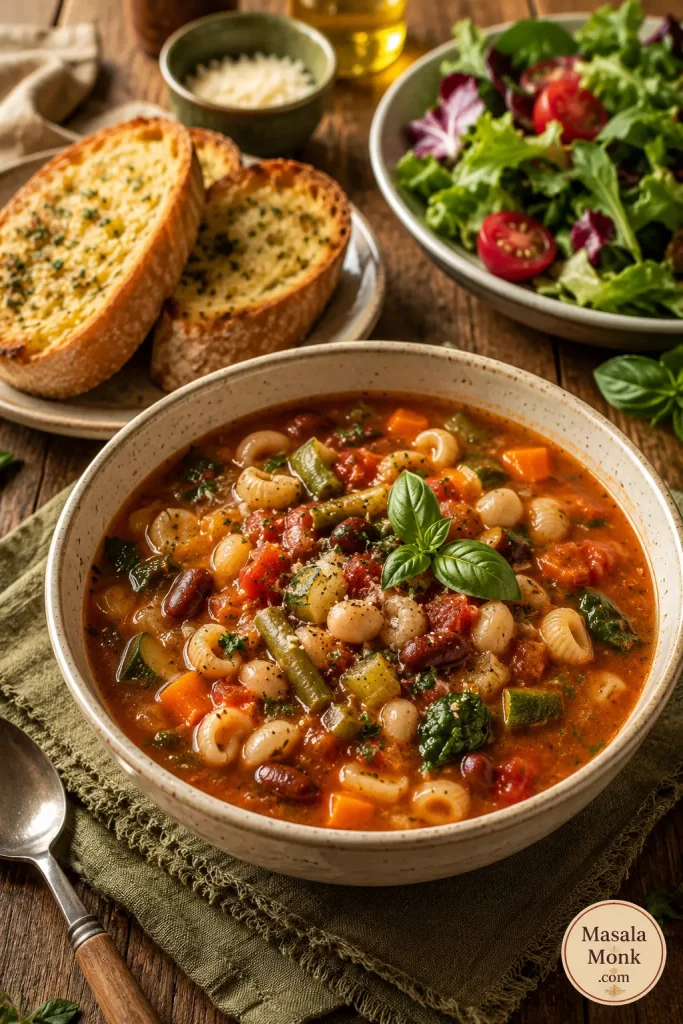
Bowl of minestrone soup served with garlic bread, a green salad with tomatoes, herbs, and a spoon on a wooden table.

Minestrone can stand alone, but the sides change the meal. Garlic bread makes it heartier, while a fresh salad keeps dinner lighter.

The best side is something that balances the tomato broth without making the meal feel heavy.

Make-Ahead, Storage, Freezing, and Reheating

Make-Ahead Plan


Yes, you can make minestrone ahead of time. For the best texture, make the soup base without pasta, refrigerate it, and add freshly cooked pasta when serving.

  • Chop the onion, carrot, celery, zucchini, and green beans up to 1 day ahead.

  • Drain and rinse the beans ahead of time.

  • Make the soup base without pasta up to 3 days ahead.

  • Add greens when reheating so they stay brighter.

  • Cook pasta fresh, or store cooked pasta separately with a tiny drizzle of olive oil.

Store and Freeze Minestrone with Pasta Separately

This storage setup keeps the soup base useful and protects the pasta from swelling before the next serving.
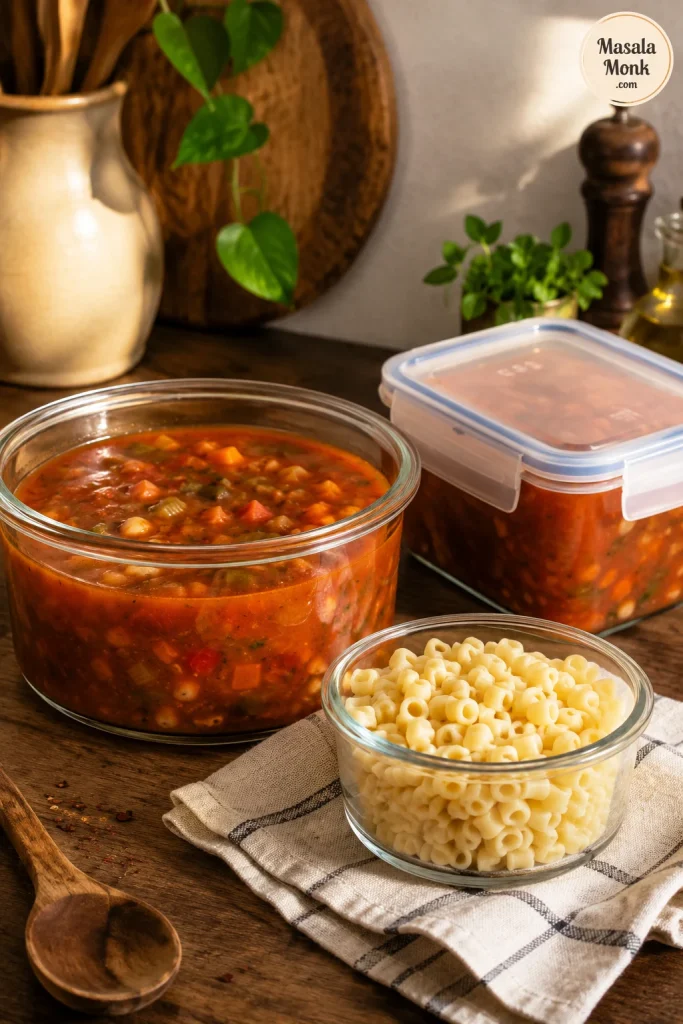
Glass containers of minestrone soup base and a separate bowl of cooked small pasta for storing and freezing.

For freezing, leave pasta out of the soup base. This way, the broth, beans, and vegetables reheat well, and fresh pasta can be added later.

Fridge

Store minestrone soup in an airtight container in the fridge for 3 to 4 days, which matches the USDA’s general guidance for refrigerated leftovers. The next-day soup is often thicker and more flavorful. Loosen it with broth before reheating.

Freezer


Minestrone freezes best without pasta. Freeze the soup base for up to 3 months, then add freshly cooked pasta when reheating. If you freeze it with pasta, the flavor will still be good, but the pasta will become softer.

Reheating


Reheat gently on the stovetop over low to medium-low heat. Add broth or water to loosen the soup. After reheating, freshen the bowl with olive oil, herbs, lemon juice, vinegar, or parmesan. For the fastest fix when leftovers get thick, see the troubleshooting table.

Serve Minestrone Family-Style
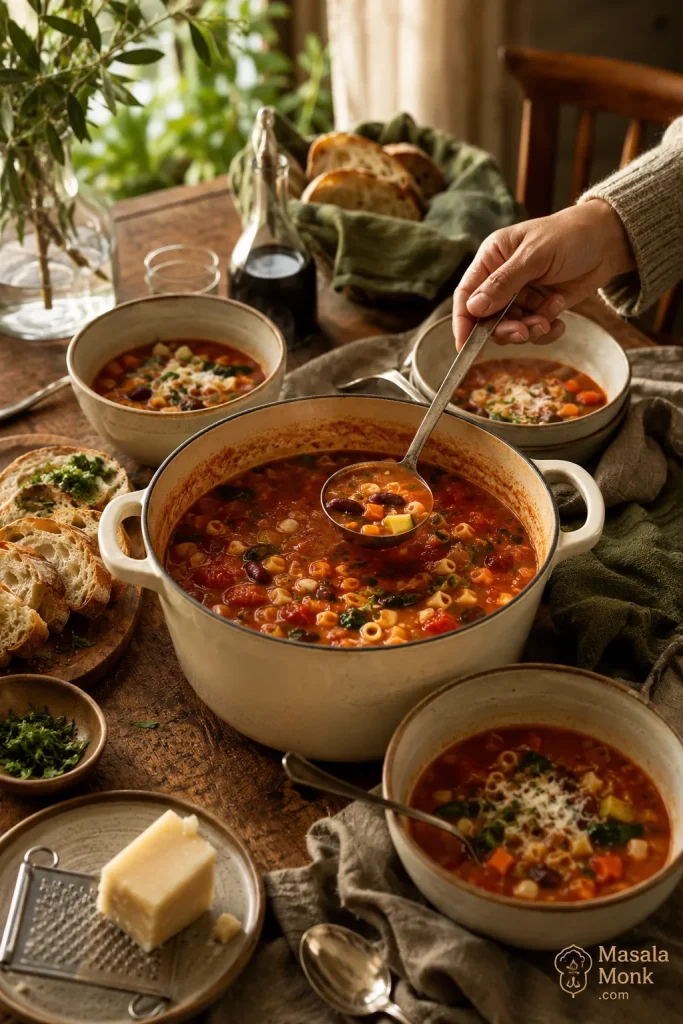
Family-style Dutch oven of minestrone soup on a wooden table with a ladle, bowls of soup, bread, herbs, cheese, and a hand serving soup.

Serve minestrone family-style when you want the meal to feel relaxed and generous, with herbs, cheese, bread, or extra broth added at the table.

Once you have the rhythm down, minestrone becomes one of those soups you can make again and again without overthinking it. Keep the tomato broth, beans, small pasta, and vegetable timing in place, then let the pot change with the season.

The best minestrone is not the one with the longest ingredient list; it is the one where the broth, beans, vegetables, and pasta all still feel like they belong in the same spoonful.

Minestrone changes from kitchen to kitchen. If your pot had cabbage, potato, chickpeas, kale, extra zucchini, or a pasta shape that worked beautifully, tell us. Those small choices are often what help the next person make a better pot from what they already have.


Frequently Asked Questions

What is minestrone soup made of?


Minestrone soup is an Italian vegetable soup made with vegetables, beans, tomatoes, broth, herbs, olive oil, and usually pasta or rice. Common vegetables include onion, carrot, celery, zucchini, green beans, cabbage, spinach, kale, potato, and peas.

Is minestrone soup vegetarian?


Minestrone soup is vegetarian when it is made with vegetable broth and no meat. If you add parmesan, choose vegetarian-style parmesan if that matters to you.

Is minestrone soup vegan?


Minestrone soup is vegan when it is made with vegetable broth and no parmesan, parmesan rind, meat, or egg pasta. For a vegan finish, use olive oil, herbs, nutritional yeast, or vegan pesto.

What is the best pasta for minestrone?


Ditalini is one of the best pasta shapes for minestrone because it is small and spoon-friendly. Small shells, elbows, macaroni, and orzo also work.

What beans are best for minestrone?


Cannellini beans, white beans, and kidney beans are the best everyday beans for minestrone. Borlotti beans, navy beans, chickpeas, and lentils also work.

Why does my minestrone taste bland?


Bland minestrone usually needs salt, acidity, or more simmering time. Cook the aromatics well, cook the tomato paste until it darkens slightly, taste the broth before adding pasta, then finish with lemon juice or vinegar if the tomato flavor tastes flat.

How do you make minestrone less watery?


To make minestrone less watery, simmer it uncovered, mash some beans into the broth, use crushed tomatoes, or add a parmesan rind if you are using cheese. A watery soup often means the aromatics or tomato paste needed more time at the beginning.

How do you keep pasta from getting mushy in minestrone?


To keep pasta from getting mushy in minestrone, add it only near the end and stop when it is just tender. For leftovers, meal prep, or freezing, cook pasta separately and add it to each bowl.

Can you make minestrone soup ahead of time?


Yes, minestrone is a good make-ahead soup, especially if you make the soup base without pasta. Refrigerate the base for 3 to 4 days, then add freshly cooked pasta when serving.

Can you freeze minestrone soup?


Yes, minestrone soup freezes well, but it freezes best without pasta. Freeze the soup base for up to 3 months, then add freshly cooked pasta when serving.

What is the difference between minestrone and vegetable soup?


Minestrone is usually heartier than plain vegetable soup because it often includes beans, pasta or rice, tomatoes, Italian herbs, and olive oil. Vegetable soup can be any broth-based soup made with vegetables.

What is the difference between minestrone and pasta e fagioli?


Minestrone is a vegetable-heavy soup that often includes beans plus pasta or rice. Pasta e fagioli means pasta and beans, so it is more focused on those two ingredients and is often thicker and more bean-forward.

Can I make minestrone without pasta?


Yes, you can make minestrone without pasta. Add extra beans, cabbage, zucchini, potato, kale, spinach, or cooked rice instead.

Can I use frozen vegetables in minestrone?


Yes, frozen peas, green beans, spinach, kale, and mixed vegetables can work well in minestrone. Add quick-cooking frozen vegetables near the end unless they are dense vegetables. If frozen spinach releases too much water, squeeze it before adding.

Can I make minestrone with canned vegetables?


Yes, canned vegetables can work in minestrone when you need a pantry version. Drain them well and add them near the end because they are already cooked and can become too soft if simmered for a long time.
Posted on Leave a comment

Bean Stew Recipe with Canned or Cooked Beans: Thick, Hearty & Flexible

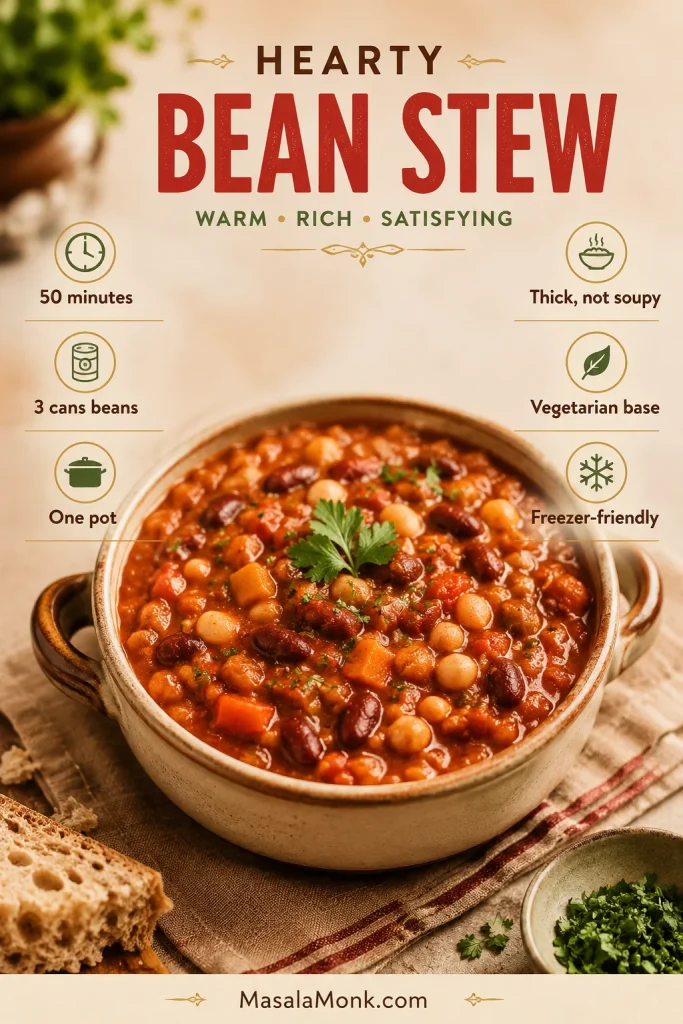
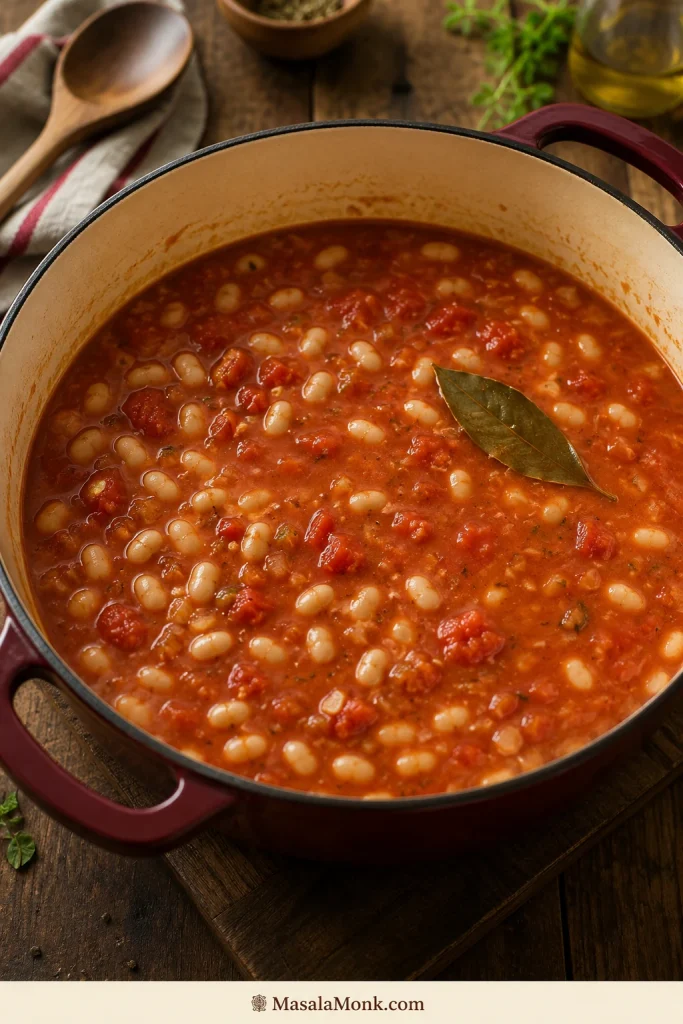
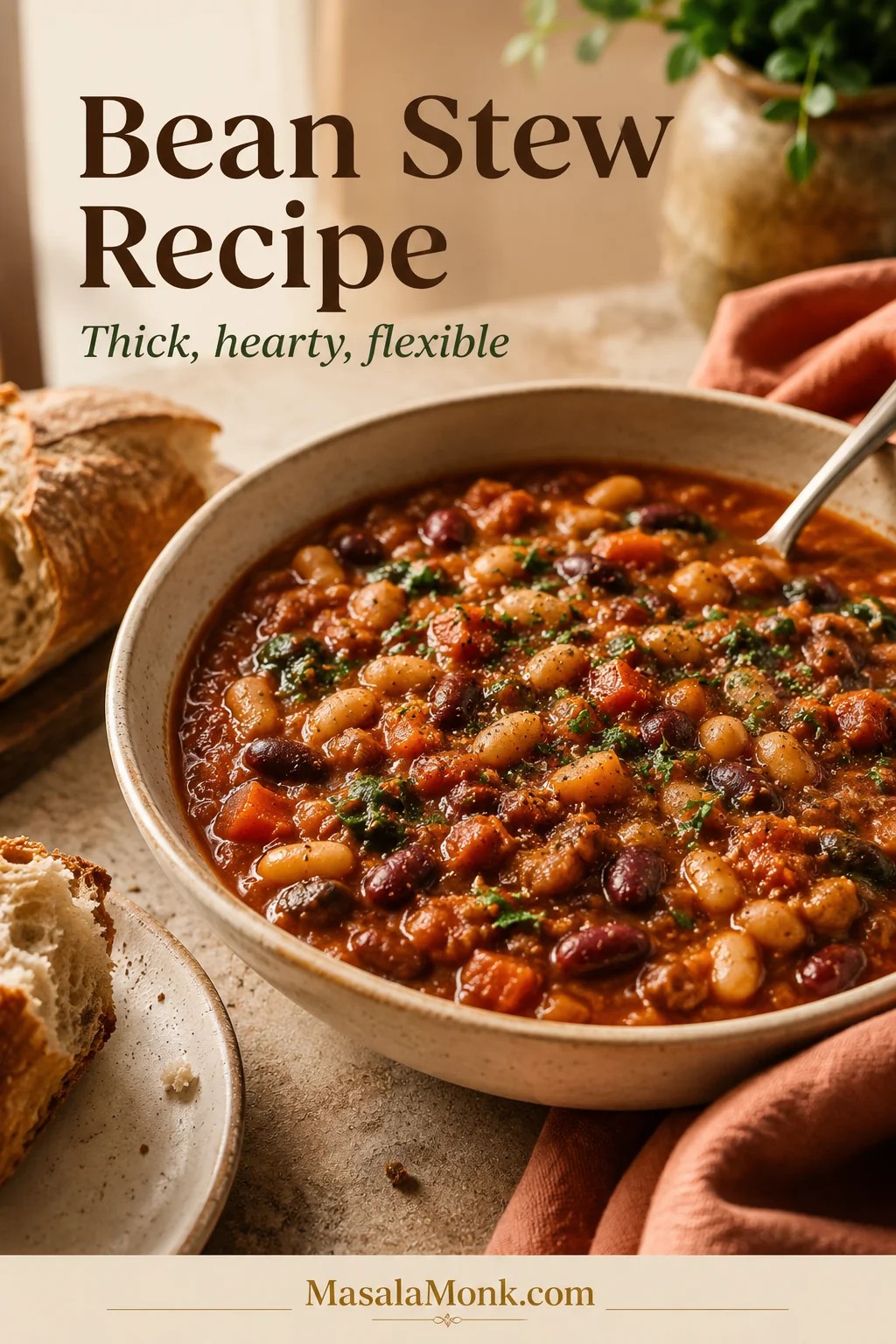
A bowl of thick tomato-based bean stew with mixed beans, carrots, greens, herbs, a spoon, and crusty bread beside it. The image includes the text “Bean Stew Recipe” and “Thick, hearty, flexible.”

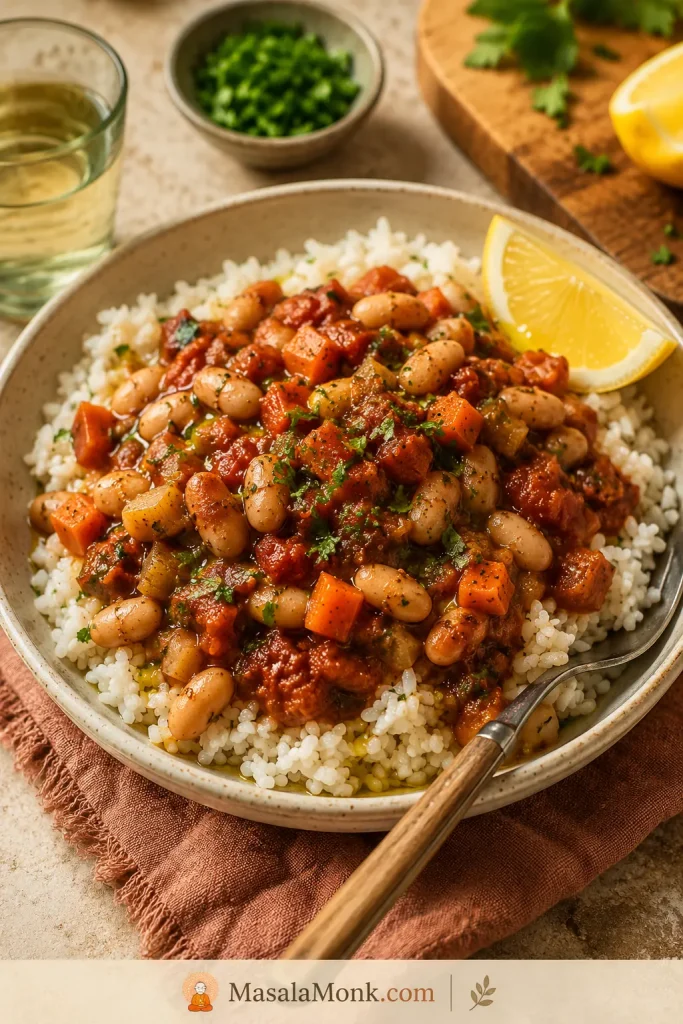
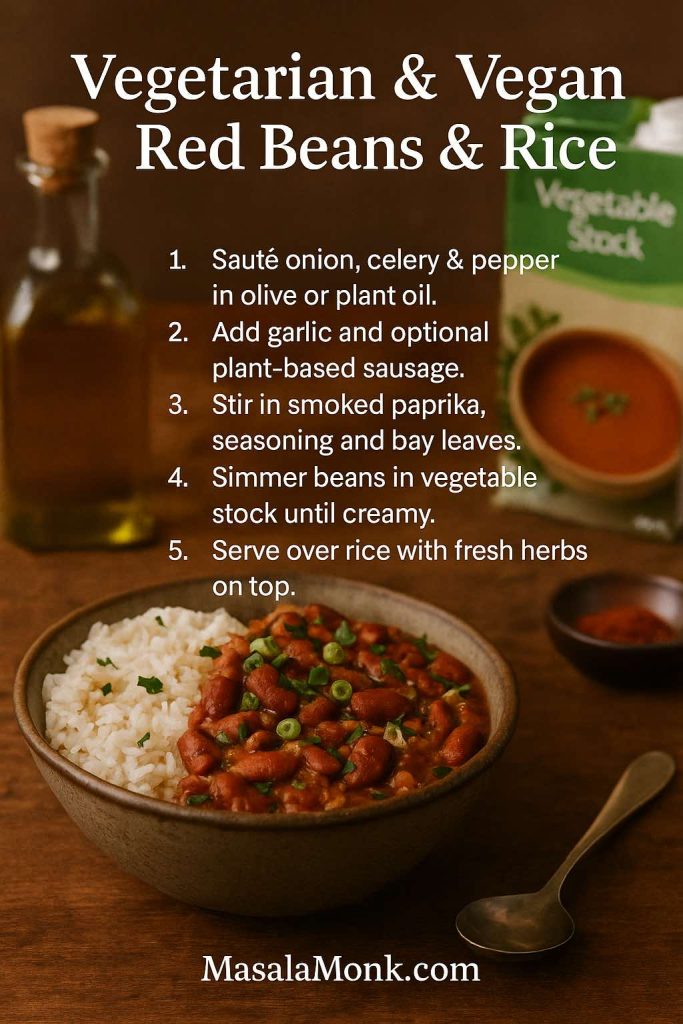
This bean stew turns three cans of beans into a thick, hearty one-pot dinner in about 50 minutes. Onion, carrot, celery, garlic, tomato paste, tomatoes, broth, and a small mash of beans cook down into a glossy tomato-bean sauce that is scoopable instead of thin.

It is especially useful on the nights when the pantry is not empty, just awkward: a few cans of beans, one onion, the last carrot in the drawer, and enough broth to pull everything together. Because the beans carry most of the meal, rice, bread, potatoes, or polenta can stretch the pot into more servings without making it feel like less dinner.

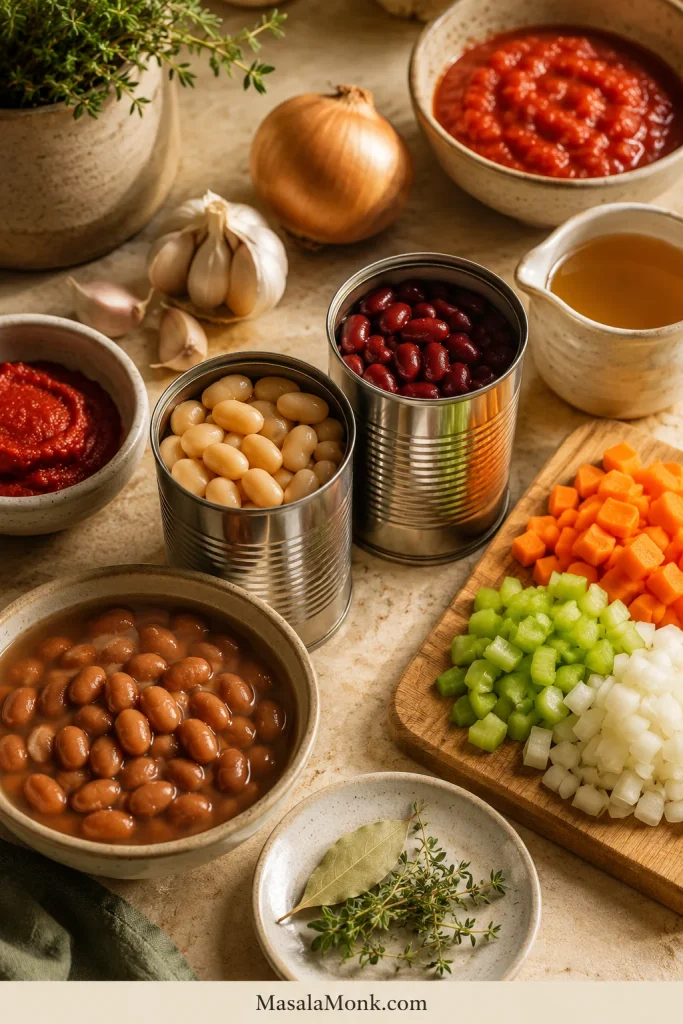
Ingredients for bean stew arranged on a kitchen counter, including beans, onion, carrot, celery, garlic, tomato paste, crushed tomatoes, broth, herbs, and bay leaf.
The base is simple: beans, aromatics, tomato paste, tomatoes, broth, herbs, and a bay leaf.

The main recipe is tomato-based, gently smoky, full of soft-edged beans and sweet vegetables, and finished with lemon juice or vinegar so the final bowl tastes lively instead of heavy.

Most bean stew recipes ask you to choose one bean or one flavor direction first. This one gives you one base method for almost any cooked beans: cannellini beans, butter beans, black beans, pinto beans, chickpeas, kidney beans, or mixed pantry beans.

Quick Answer: What Is Bean Stew?

Bean stew is a hearty one-pot meal made with cooked beans, aromatics, tomatoes or broth, herbs, vegetables, and optional meat. It has less liquid than bean soup, so it sits on rice, clings to bread, and feels more like a full dinner. It is also less narrowly seasoned than chili, which usually has a stronger chili powder, pepper, and spice profile.

For the easiest version, use three cans of beans, a savory tomato base, and 1½–2 cups of broth. Simmer until the sauce reduces, mash a small portion of the beans into the pot, stir in greens if you like, and finish with lemon juice, vinegar, herbs, or olive oil. The bowl should be spoonable, glossy, and filling without cream.

A guide-style image for hearty bean stew showing a bowl of stew with callouts for 50 minutes, 3 cans beans, one pot, thick not soupy, vegetarian base, and freezer-friendly.
This visual summary shows the promise of the recipe: one pot, three cans of beans, a thick spoonable texture, and leftovers that still feel useful the next day.

The exact measurements are in the recipe card, and the thickening cues below show when to reduce, mash, or loosen the pot.

Recipe Snapshot

Main methodStovetop, one pot
Prep time15 minutes
Cook time35–40 minutes
Total time50–55 minutes
Servings6 bowls, or 8 smaller servings with rice/bread
Stretch-it sideRice, bread, potatoes, polenta, or another sauce-catching base
Best beansCannellini, butter beans, black beans, pinto beans, kidney beans, chickpeas, navy beans, Great Northern beans, or mixed beans
Easiest optionCanned beans
Budget optionDried beans, cooked separately first
Finished textureGlossy tomato-bean sauce that clings to the spoon
DietVegetarian base; vegan-friendly; meat-flexible
Freezer-friendlyYes

Before You Start: Beans and Ratio

This stew works best with cooked, starchy beans that can simmer, soften at the edges, and help thicken the sauce. Sweet baked beans, refried beans, and green beans behave differently, so they are better treated as separate recipes or add-ins. Green beans can be added as a vegetable, but they will not make this kind of cooked-bean stew on their own.

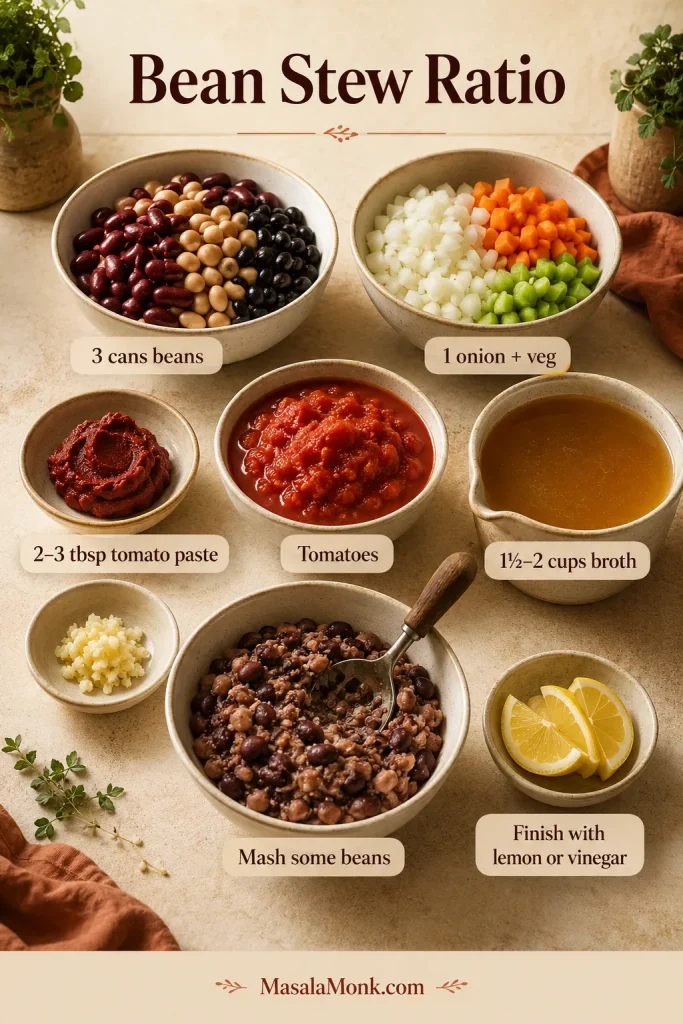
The Simple Ratio Behind a Good Pot

Once you know this ratio, you can make a good bean stew without needing the same cans twice. It is the kind of formula that saves dinner when the pantry looks random but not empty.

  • 3 cans cooked beans, 14–15 oz / 400–425 g each, or about 4½ cups cooked beans
  • 1 large onion plus carrot, celery, and garlic
  • 2–3 tbsp / 30–45 g tomato paste
  • 1 can crushed tomatoes, 28 oz / 800 g, or 14 oz / 400 g for a lighter tomato version
  • 1½–2 cups / 360–480 ml broth, added gradually
  • 10–15 minutes uncovered simmering to reduce the liquid
  • ½–1 cup mashed beans to thicken naturally
  • 1 tbsp / 15 ml lemon juice or vinegar to finish
A bean stew ratio guide with bowls of beans, chopped vegetables, tomato paste, tomatoes, broth, mashed beans, and lemon wedges, each labeled with the recipe ratio.
This bean stew ratio is the saveable formula: beans for body, vegetables for sweetness, tomato paste for depth, broth for looseness, and mashed beans for a thicker finish.

The stew may look thick before it has simmered, but wait 10–15 minutes before adding more broth. Beans release starch, tomatoes loosen, and vegetables soften as they cook. It is easier to loosen a thick pot than to rescue one that started too watery.

Why This Works with Almost Any Beans

The base recipe works because it does not ask every bean to behave the same way. Creamy beans help the sauce; firmer beans stay visible; mixed beans give you contrast. Start with cooked beans, keep the broth controlled, use tomato paste for depth, and mash a small portion of beans for body.

Choose Your Path

Start with the row that matches your pantry today; the main recipe is complete as written.

  • Canned or cooked beans: Follow the main recipe. Drain canned beans first, then simmer until the sauce tightens around the beans.
  • Dried beans: Cook them until tender first, then use about 4½ cups cooked beans.
  • Different bean styles: Use rosemary and lemon for white beans, lime and cumin for black beans, and herbs or vinegar for mixed beans.
  • Meat or slow cooker version: Brown meat first if using it. For slow cooker stew, use cooked/canned beans and less broth.

Cooking dried beans instead of opening cans? Check the canned vs dried bean notes before the pot starts so the beans are already tender when they meet the tomato base.

Ingredients, Swaps, and What Each One Does

The ingredients are simple, but the base matters. Let the onion, carrot, celery, garlic, and tomato paste smell sweet, savory, and cooked before the beans go in; that is what makes canned beans taste like a real stew instead of beans stirred into tomato sauce.

Main Ingredients

  • Olive oil: Softens the vegetables and gives the stew a rounder finish. Use less if adding sausage or chorizo.
  • Onion, carrot, and celery: The flavor base. Cook them until sweet-smelling and softened.
  • Garlic: Adds savory depth. Add it after the vegetables soften so it does not burn.
  • Tomato paste: Makes the stew taste deeper and more slow-cooked.
  • Smoked paprika, oregano or thyme, bay leaf, and pepper: A flexible seasoning base that works with many beans.
  • Crushed tomatoes: Create the main sauce. The full 28 oz / 800 g gives a tomato-rich pot. Use 14 oz / 400 g if you want the beans and broth to lead.
  • Broth: Low-sodium vegetable broth keeps the base vegetarian and easier to season.
  • Beans: Use three cans drained and rinsed, or about 4½ cups cooked beans.
  • Greens: Spinach, kale, chard, or collards add color. Use closer to 60 g for spinach and closer to 100 g for chopped kale, chard, or sturdier greens.
  • Lemon juice, vinegar, or balsamic: Adds a fresh lift after simmering.

Pantry Swaps

The recipe can still work if you are missing celery, using a smaller can of tomatoes, or trying to stretch two cans of beans into dinner.

If you are missingUse instead
CeleryExtra carrot, bell pepper, leek, fennel, or skip it.
CarrotSweet potato, squash, bell pepper, or extra onion.
Tomato pasteSimmer the tomatoes longer, or add a very small splash of soy sauce for depth if it fits your version.
Crushed tomatoesPassata, diced tomatoes, tomato sauce, or 14 oz / 400 g tomatoes plus more broth for a lighter stew.
BrothWater plus bouillon, or water with extra herbs, pepper, and olive oil.
Fresh herbsDried herbs in the base, then lemon or vinegar at the end.
GreensFrozen spinach, chopped cabbage, kale, chard, collards, or skip them.
Third can of beansAdd diced potato, cooked lentils, rice, extra vegetables, or use the small-batch notes below.

Salt tip: Start with ¾ tsp fine salt if using regular broth, salted canned beans, sausage, chorizo, parmesan, bouillon, or salty toppings. Use up to 1½ tsp only when your broth and beans are low-sodium or unsalted. Taste again after the stew reduces.

How to Cook It

The recipe is simple, but the pot tells you a few things as it cooks: the tomato paste should smell deeper, the sauce should slow down, and the spoon should come up with beans, not broth.

1. Soften the Vegetables

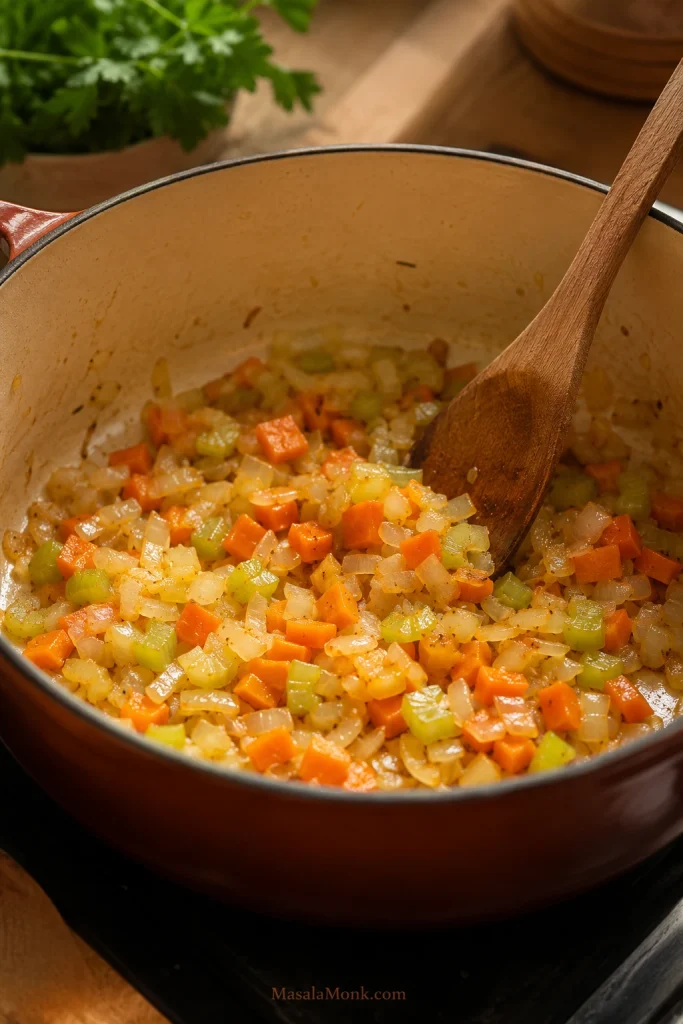
Heat olive oil in a large Dutch oven or heavy-bottomed pot over medium heat. Add onion, carrot, celery, and a pinch of salt. Cook for 7–10 minutes, stirring occasionally, until the onion looks translucent, the carrot has started to soften, and the pot smells sweet rather than raw.

Onion, carrot, and celery softening in olive oil inside an enameled Dutch oven with a wooden spoon.
First, soften the onion, carrot, and celery until glossy and sweet-smelling so the stew starts with a real cooked base, not just beans in tomato sauce.

2. Cook the Garlic, Tomato Paste, and Spices

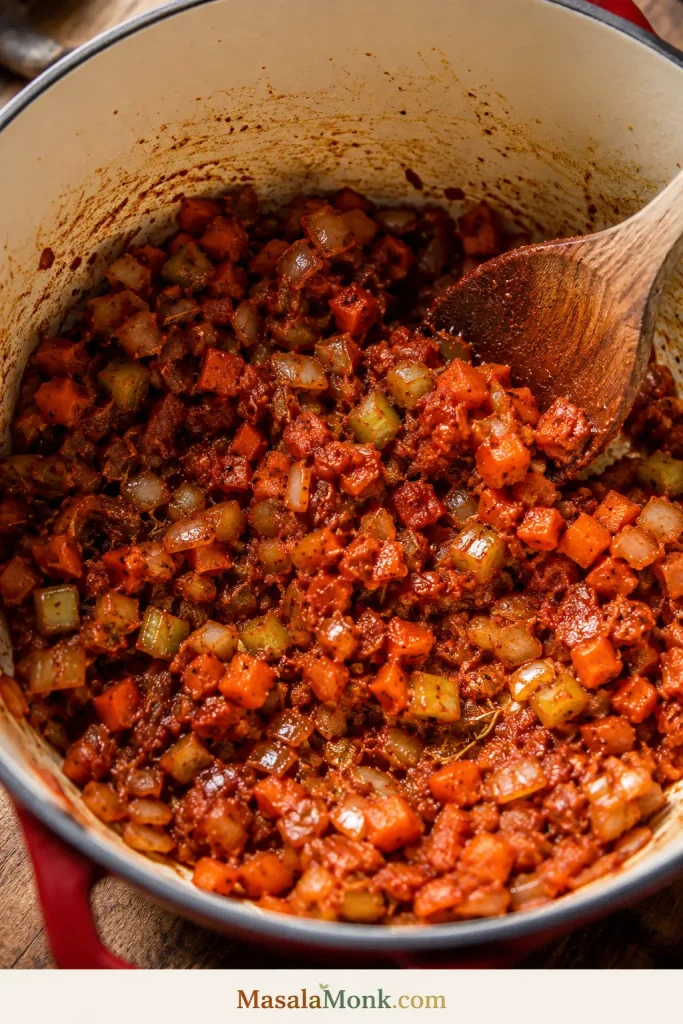
Add garlic, tomato paste, smoked paprika, oregano or thyme, cumin if using, chili flakes if using, and black pepper. Stir for 1–2 minutes. The tomato paste should darken slightly and coat the vegetables. This is the step that makes the stew taste slow-cooked even when the beans came from cans.

Softened onion, carrot, and celery coated with cooked tomato paste, garlic, herbs, and spices inside a Dutch oven, with a wooden spoon in the pot.
Next, let the tomato paste darken slightly with the garlic, herbs, and spices; that small step gives canned or cooked beans a deeper stew flavor.

3. Add Tomatoes, Broth, Beans, and Bay Leaf

Add crushed tomatoes, 1½ cups / 360 ml broth, drained beans, and bay leaf. Stir well and scrape the bottom of the pot. If the mixture is too thick to bubble gently, add another ½ cup / 120 ml broth. Hold back extra liquid until the stew has simmered for at least 10 minutes.

Beans, crushed tomatoes, broth, and a bay leaf combined in a Dutch oven at the early simmer stage of bean stew.
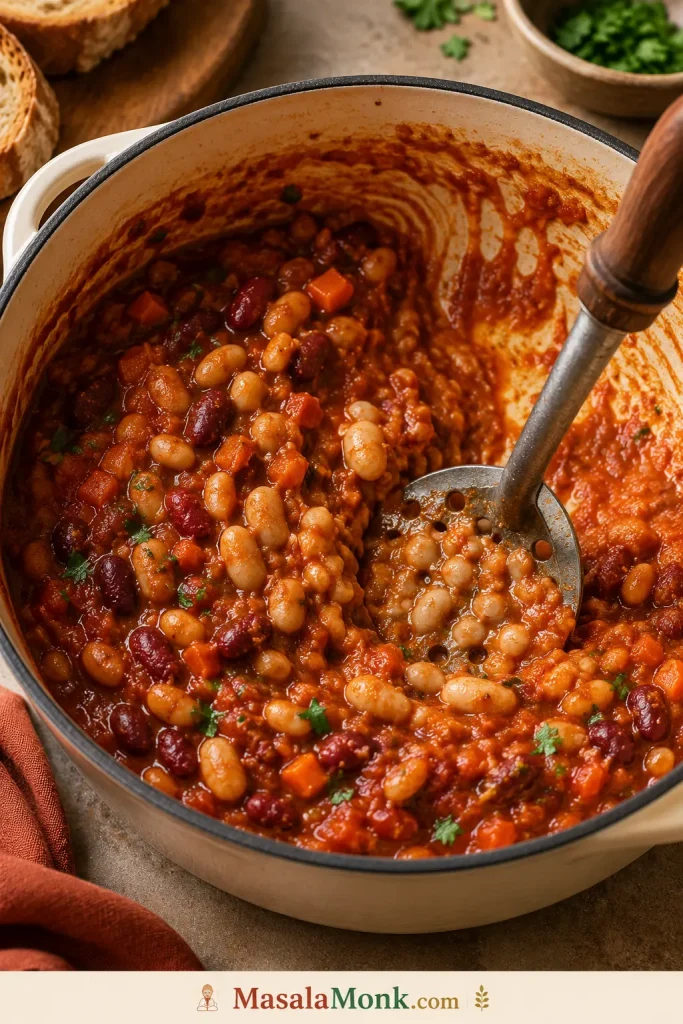
After the beans, tomatoes, broth, and bay leaf go in, the pot should look a little loose; simmering uncovered is what turns it into stew.

At this stage, a loose-looking pot is normal; the thickening cues below explain when to wait, reduce, mash, or add more liquid.

4. Simmer Covered

Bring the pot to a gentle boil, then reduce the heat and cover. Simmer for 15–20 minutes. The beans should absorb the garlic-tomato flavor, and the vegetables should become fully tender.

5. Simmer Uncovered

Remove the lid and simmer for 10–15 minutes more. Stir occasionally so the bottom does not catch. The bubbles should slow down, the sauce should look glossier, and a spoon should leave a brief trail through the stew before the sauce flows back. If you plan to serve it over rice, keep it slightly saucier.

6. Mash a Small Portion of the Beans

Mash ½–1 cup of beans against the side of the pot with a spoon, ladle, or potato masher. Do not puree the stew. You want enough broken beans to make the sauce creamy while most beans stay whole. Chickpeas will stay firmer than white beans, so mash a little more if using mostly chickpeas.

A potato masher pressing some beans into thick tomato bean stew inside a Dutch oven, with many whole beans still visible.
Instead of adding cream or flour, mash a small portion of the beans into the sauce while leaving plenty of whole beans for texture.

When the stew stays thinner than you want after mashing, use the troubleshooting table before adding extra ingredients.

7. Add Greens and Finish

Stir in spinach, kale, chard, or other greens. Spinach needs 2–3 minutes; kale and chard may need 4–5 minutes. Turn off the heat, remove the bay leaf, then stir in lemon juice, vinegar, or balsamic. If the stew tastes dull even after salt, it probably needs acid, not more spices.

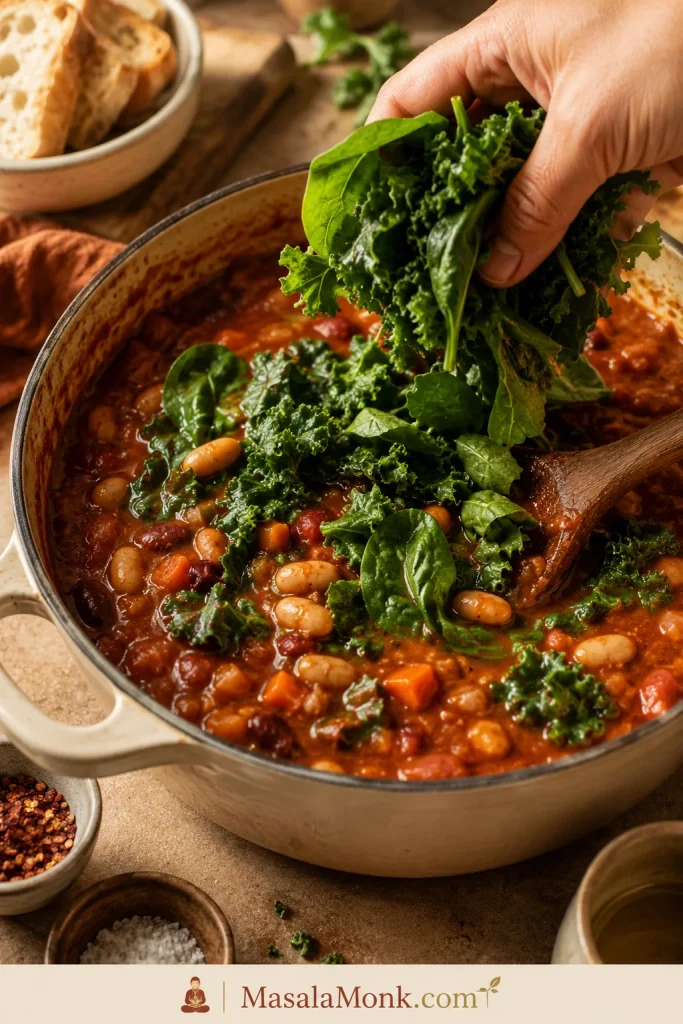
A hand adding fresh spinach and kale to a pot of thick tomato bean stew while a wooden spoon rests in the pot.
Toward the end, fold in spinach, kale, or chard so the greens soften into the hot stew while still adding freshness and color.

8. Rest Before Serving

Let the stew rest for 10 minutes before serving. The beans settle, the sauce tightens, and the bowl becomes more balanced. If it gets too thick, loosen it with broth or water ¼ cup / 60 ml at a time.
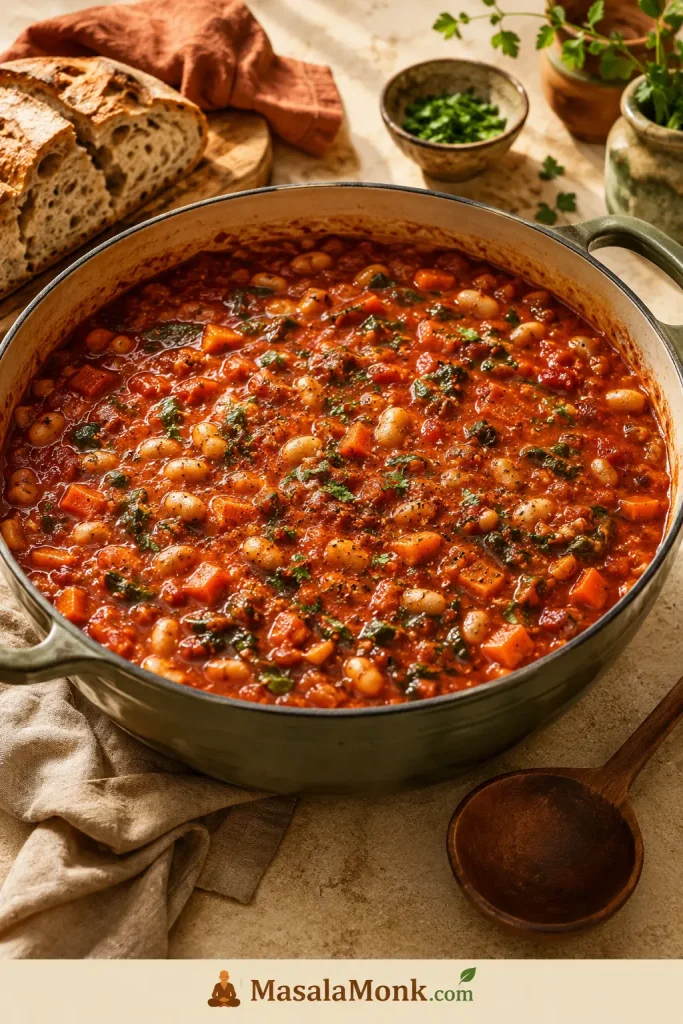
Finished bean stew in a Dutch oven with white beans, carrots, tomatoes, greens, herbs, and a thick red sauce, with bread and a wooden spoon nearby.
After resting, the stew should look settled and glossy in the pot before it ever reaches the bowl.

How to Keep It Thick, Not Soupy

If the stew looks too loose at first, give it a few minutes uncovered before adding fixes.

  • Start with less broth. For three cans of beans, begin with 1½ cups / 360 ml broth and add more only if needed.
  • Wait before adding liquid. Tomatoes loosen and beans release starch as they simmer.
  • Simmer uncovered near the end. This reduces extra liquid and concentrates flavor.
  • Mash some beans. Breaking down ½–1 cup beans thickens the sauce naturally.
  • Use tomato paste. Cooked tomato paste adds body and depth.
  • Choose creamy beans. Cannellini, butter beans, pinto beans, and white beans make a thicker pot.
  • Blend a small amount. You can blend 1 cup of stew and stir it back in, but do not blend the whole pot unless you want a bean puree.
  • Rest before serving. The stew thickens slightly as it cools.

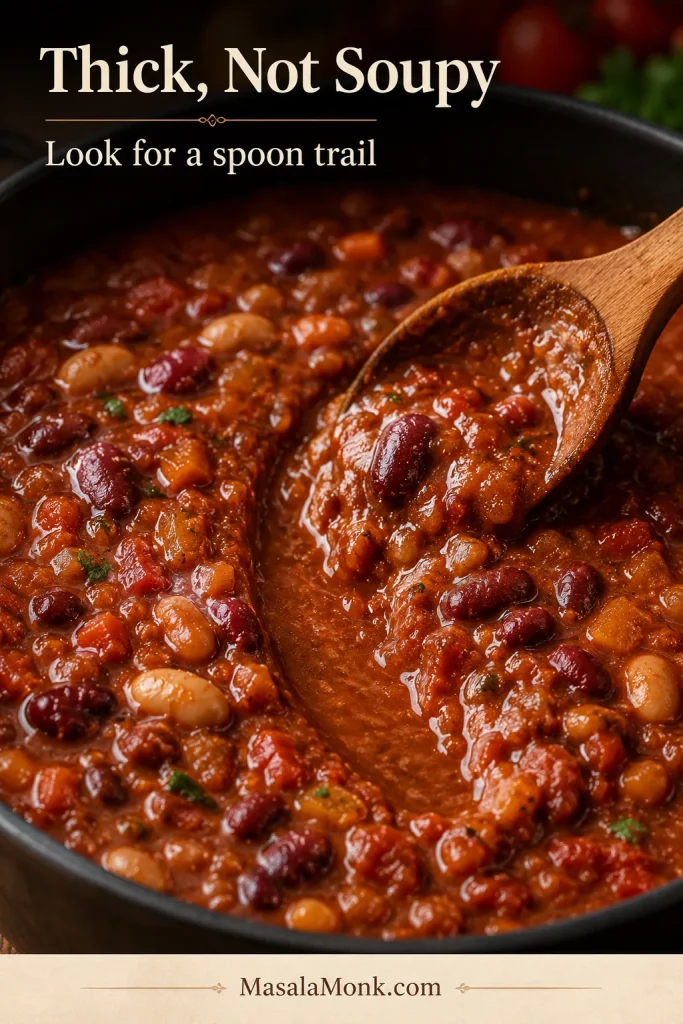
Texture cue: after the uncovered simmer, a spoon should leave a short trail through the stew before the sauce slowly flows back. The stew should sit on rice instead of flooding it, and bread should be able to drag through the sauce.

Close-up of thick tomato bean stew with a wooden spoon creating a visible trail through the sauce. The image includes the text “Thick, Not Soupy” and “Look for a spoon trail.”
The best texture cue is the spoon trail: when the sauce clings to the beans and slowly settles back, the stew is thick enough without becoming dry.

Recipe Card

Thick and Hearty Bean Stew

This thick bean stew turns canned or cooked beans into a hearty tomato-based dinner with garlic, herbs, soft vegetables, greens, and a bright lemon or vinegar finish. Mash a small amount of beans into the pot so the sauce turns glossy and spoonable without cream.

Prep Time
15 minutes
Cook Time
35–40 minutes
Total Time
50–55 minutes
Servings
6 bowls

Equipment

  • Large Dutch oven or heavy-bottomed pot, 5–6 quart / 5–6 liter
  • Wooden spoon
  • Measuring cups and spoons
  • Can opener
  • Potato masher or ladle, optional

Ingredients

  • 2 tbsp / 30 ml olive oil
  • 1 large onion, diced, about 150–180 g
  • 2 medium carrots, diced, about 160–200 g
  • 2 celery ribs, diced, about 100 g
  • 4 garlic cloves, minced, about 12–16 g
  • 2–3 tbsp / 30–45 g tomato paste
  • Smoked paprika, 1 tsp
  • Dried oregano or thyme, 1 tsp
  • ½ tsp ground cumin, optional
  • ¼–½ tsp chili flakes, optional
  • Bay leaf, 1
  • Crushed tomatoes, 1 can, 28 oz / 800 g
  • Low-sodium vegetable broth, 1½–2 cups / 360–480 ml, plus more as needed
  • 3 cans beans, 14–15 oz / 400–425 g each, drained and rinsed; about 4½ cups cooked beans
  • 2 cups / 60–100 g spinach, kale, chard, or other greens
  • 1 tbsp / 15 ml lemon juice, red wine vinegar, or balsamic vinegar
  • 2–3 tbsp chopped fresh parsley or basil
  • ¾ tsp fine salt to start, plus more to taste; use up to 1½ tsp if using low-sodium broth and unsalted beans
  • ½ tsp black pepper
  • Extra olive oil for serving, optional

Instructions

  1. Soften the vegetables. Heat olive oil in a large Dutch oven or heavy pot over medium heat. Add onion, carrot, celery, and a pinch of salt. Cook for 7–10 minutes, stirring occasionally, until softened and sweet-smelling.
  2. Add garlic and tomato paste. Stir in garlic, tomato paste, smoked paprika, oregano or thyme, cumin if using, chili flakes if using, and black pepper. Cook for 1–2 minutes, stirring often, until the tomato paste darkens slightly.
  3. Add tomatoes, broth, beans, and bay leaf. Add crushed tomatoes, 1½ cups / 360 ml broth, the drained beans, and bay leaf. Stir well. If the stew looks too thick to simmer, add another ½ cup / 120 ml broth.
  4. Simmer covered. Bring to a gentle boil, reduce heat, cover, and simmer for 15–20 minutes.
  5. Simmer uncovered. Remove the lid and simmer for 10–15 minutes, stirring occasionally, until the liquid reduces and clings to the beans.
  6. Mash some beans. Mash ½–1 cup of beans into the sauce with a spoon, ladle, or potato masher. Keep most beans whole.
  7. Add greens. Stir in spinach, kale, or chard. Cook for 2–5 minutes, depending on the green, until tender.
  8. Finish the stew. Remove the bay leaf. Stir in lemon juice, vinegar, or balsamic, plus fresh herbs. Taste and adjust salt, pepper, and balance.
  9. Rest and serve. Let the stew rest for 10 minutes before serving. Add broth or water ¼ cup / 60 ml at a time if it becomes too thick.

Notes

  • Taste after simmering before adding more salt; broth reduces and canned beans vary.
  • For a thicker stew, start with 1½ cups / 360 ml broth and mash more beans near the end.
  • Prefer a looser stew? Use the full 2 cups / 480 ml broth and add more as needed.
  • For a lighter, less tomato-heavy version, use 14 oz / 400 g crushed tomatoes and add broth only as needed.
  • If using cooked dried beans, some good-tasting bean cooking liquid can replace part of the broth.
  • If using kidney beans, use canned kidney beans or dried kidney beans that have already been properly cooked.
  • For sausage, brown 12–16 oz / 340–450 g sausage first and reduce the olive oil.
  • For a vegan version, use vegetable broth and finish with olive oil, lemon, and herbs.

Best Beans for Stew

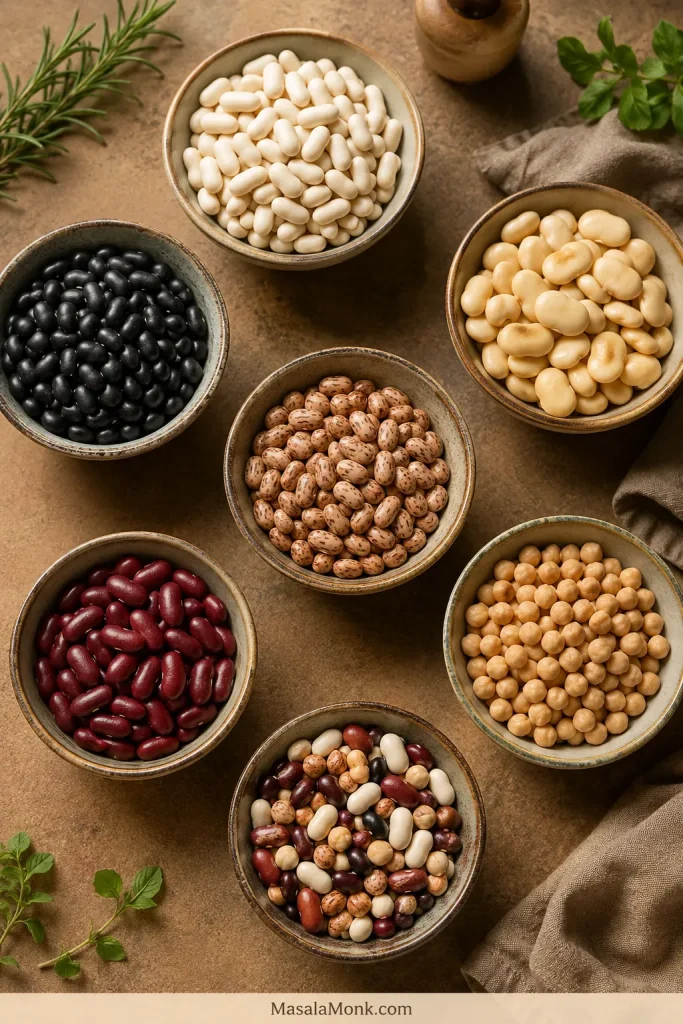
The bean mix changes the whole bowl: creamy beans soften the sauce, firmer beans stay visible, and mixed beans make the stew feel more like a pantry dinner than a planned recipe.

Several bowls of different beans for stew, including white beans, butter beans, black beans, pinto beans, kidney beans, chickpeas, and mixed beans.
Different beans bring different texture: creamy white beans, butter beans, chickpeas, kidney beans, black beans, pinto beans, or a mixed-bean blend can all work here.
BeanBest forTextureNotes
Cannellini beansWhite bean stew, Tuscan-style stewCreamy but holds shapeBest all-purpose choice for the main version.
Butter beansThick, soft, comforting stewLarge, tender, butteryExcellent with tomatoes, smoked paprika, rosemary, mushrooms, or chorizo.
Great Northern or navy beansWhite bean stewSmall to medium, creamyBest when you want the stew creamy and gentle.
Black beansSmoky or Latin-style stewEarthy and creamy-firmUse cumin, smoked paprika, chili, lime, cilantro, and rice.
Pinto beansMexican-style or pantry stewSoft and creamyThey break down nicely and help thicken the sauce.
Kidney beansMixed bean stew, beef bean stewFirmUse canned or properly cooked kidney beans.
Chickpeas / garbanzo beansMediterranean, Spanish, or Moroccan-style stewNutty and firmGood with tomato, cumin, coriander, paprika, greens, and lemon.
Mixed beansBudget stew, pantry cleanout stewVariedMash some creamy beans into the sauce to bring the textures together.

Once you know which beans you are using, the variation table below shows how to season white beans, black beans, chickpeas, butter beans, and mixed pantry beans.

If you were looking for a green bean side dish instead of a cooked-bean stew, MasalaMonk’s green bean casserole recipe is the better place to start.

Canned vs Dried Beans

For speed, canned beans get dinner on the table faster; dried beans give you more control, economy, and often excellent texture. Once they simmer with the garlic-tomato base, canned beans still taste like they belong.

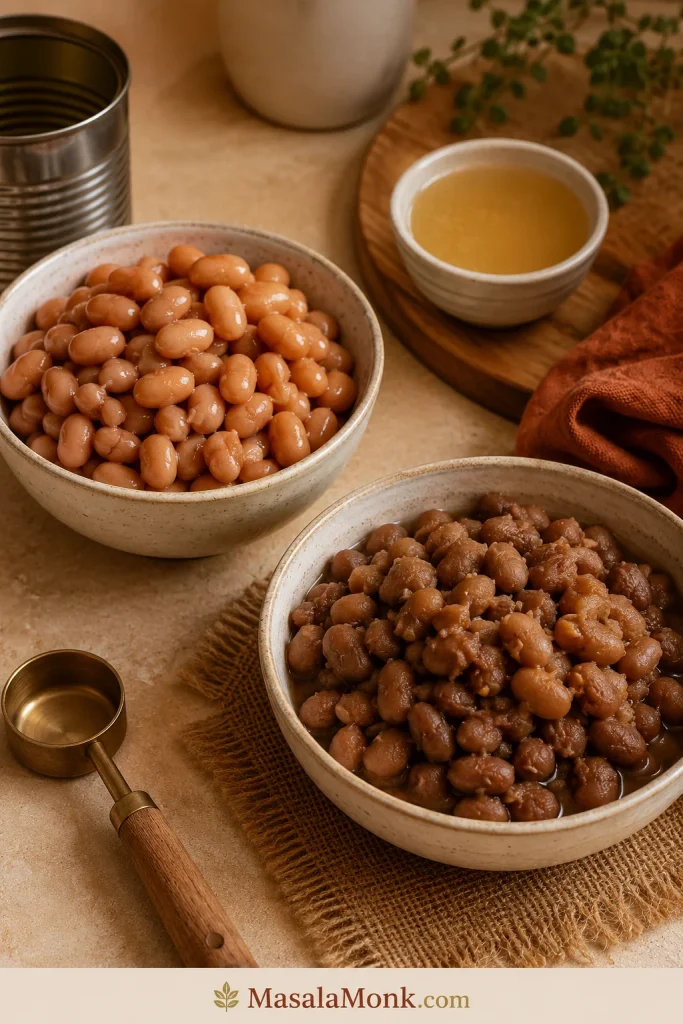
Two bowls of beans on a kitchen counter, one with smooth drained canned beans and one with cooked dried beans, with a small bowl of bean cooking liquid and an unlabeled can nearby.
Use the comparison as a measuring cue: 3 cans of beans usually give about 4½ cups cooked / about 720 g drained beans, while about 1½ cups dried beans can replace them after cooking.

For this recipe, 3 cans of beans, 14–15 oz / 400–425 g each, gives about 4½ cups cooked beans once drained, or roughly 720 g drained beans. To replace them with dried beans, start with about 1½ cups dried beans, cook them until tender, then measure about 4½ cups cooked beans for the stew. The exact yield varies by bean type, size, and age.

If your cooked dried-bean liquid tastes good and is not overly salty, use some of it in place of broth. It adds body and keeps the stew even more budget-friendly.

Very old dried beans may take much longer to soften or stay firm even after extended cooking. When cooking dried beans, keep tomatoes, lemon juice, and vinegar out until the beans are tender. Acidic ingredients can slow softening.

Planning to use the slow cooker? Read the slow cooker notes before using dried beans, especially kidney beans.

Kidney bean note: Canned kidney beans are the easiest choice here. If starting with dried kidney beans, cook them properly before adding them to stew, especially before slow cooking. For food-safety details, see the FDA’s guidance on kidney bean toxins and Utah State University Extension’s guide to storing and cooking dry beans.

Variations

Think of these as directions for the next pot, not decisions you need to make before the first one. The main recipe is complete as written; choose only the path that matches what you have today.

For a hands-off version, use the slow cooker and Instant Pot notes after the flavor ideas.

Vegetarian or Vegan Bean Stew, Plus Meat Add-Ins

Vegetarian or vegan bean stew: The main recipe is vegetarian with vegetable broth. For a fully vegan pot, skip parmesan, yogurt, sour cream, and other dairy toppings; olive oil, mushrooms, smoked paprika, nutritional yeast, lemon, and herbs can still make the finish rich and lively.

Sausage: Brown 12–16 oz / 340–450 g sausage in the pot for 5–7 minutes before adding the vegetables. Spoon off excess fat, reduce the olive oil to 1 tablespoon / 15 ml, and build the stew in the same pot. White beans, butter beans, and pinto beans work especially well. For a more sausage-forward slow-cooker dinner, MasalaMonk’s slow cooker sausage casserole recipe follows that comfort-food direction more fully.

Chorizo: Use 4–6 oz / 115–170 g chorizo. Cured Spanish-style chorizo should be sliced or diced and gently rendered. Fresh Mexican-style chorizo should be cooked until browned and crumbly. Reduce the added oil and taste before adding more salt.

Chicken: Cooked shredded chicken is the simplest route. Stir in 2 cups / 280–320 g during the last 10 minutes of simmering. For raw chicken, use boneless thighs or breasts cut into large pieces, simmer until cooked through, then shred and return to the pot.

Beef: Beef turns this into a longer-cooked stew, not a 50-minute variation. Brown 1 lb / 450 g stew beef first, then simmer it with tomatoes and broth until mostly tender before adding canned beans. Depending on the cut, this may take 1½–2 hours.

Best Bean Mixes and Flavor Versions

This is where the recipe becomes useful for real pantry cooking: two half-used cans can make a better stew than one perfect bean. Keep the same method, then change the herbs, spices, finish, and side.

Version or mixChange these ingredientsFinish withServe with
Cannellini + butter beansUse mostly white beans with rosemary, thyme, and greens.Lemon, olive oil, parsleyBread or sautéed greens
Black beans + pinto beansUse cumin, chili, smoked paprika, and less Italian herb.Lime, cilantro, avocadoRice
Chickpeas + cannelliniUse cumin, coriander, paprika, tomato, and greens.Lemon, parsley, yogurt if desiredFlatbread or couscous
Butter beans + mushrooms or chorizoUse smoked paprika, rosemary, mushrooms, or rendered chorizo.Vinegar, parsley, black pepperPotatoes or bread
Mixed pantry cansUse any cooked beans and mash the creamier ones into the sauce.Vinegar, herbs, olive oilRice or bread

If you want chickpeas in a fresher, no-cook direction instead, MasalaMonk’s chickpea salad recipe turns canned chickpeas into a bright lemony lunch or side.

Fresh Tomato, No-Tomato, and Small-Batch Notes

Fresh tomato version: Fresh tomatoes work, but they need more time to cook down than canned tomatoes. Use them when they are ripe and flavorful, simmer longer, and expect a slightly looser, brighter sauce. MasalaMonk’s guide to tomato sauce from fresh tomatoes shows how reduction changes both texture and flavor.

Lighter no-tomato version: Skip the crushed tomatoes and tomato paste. Use 2½–3 cups / 600–720 ml broth, white beans, rosemary or thyme, garlic, greens, and lemon. Mash about 1 cup of beans into the pot so the broth becomes creamy.

Small batch with 2 cans of beans: Use 1 tbsp / 15 ml olive oil, 1 small onion, 1 carrot, 1 celery rib, 2 garlic cloves, 1½ tbsp / about 22 g tomato paste, 14 oz / 400 g tomatoes, ¾–1 cup / 180–240 ml broth, and 2 cans of beans. This makes about 3–4 bowls.

Adding Beans to Another Stew

Already have a pot of stew going? Use cooked or canned beans. Raw dried beans should not be added to an existing stew unless the recipe was designed for that timing.

  • Canned or cooked beans: Add during the final 15–20 minutes.
  • Delicate white beans or butter beans: Add later if you want them to stay whole.
  • Kidney, black, or pinto beans: Add a little earlier if you want them to absorb more flavor.
  • To thicken another stew: Mash some beans into the liquid.

Slow Cooker and Instant Pot Notes

The stovetop gives the best control over thickness. Choose the slow cooker for convenience, not the glossiest texture, and use the Instant Pot when speed matters more than deep reduction.

Slow Cooker

The slow cooker version will usually be softer and less glossy than the stovetop version, but it is excellent for a hands-off, make-ahead dinner. Use canned beans or beans that have already been safely cooked, and sauté the onion, carrot, celery, garlic, tomato paste, and spices first if you can.

  1. Sauté the vegetables, garlic, tomato paste, and spices in a skillet or in the slow cooker insert if it has a sauté function.
  2. Add tomatoes, cooked/canned beans, bay leaf, herbs, and 1¼–1½ cups / 300–360 ml broth.
  3. Cook on high for 3–4 hours or low for 5–6 hours. Timing depends on bean type and how soft you want the stew.
  4. Add greens near the end.
  5. Mash some beans after cooking. If the stew is still thin, transfer to a pot and simmer uncovered for a few minutes.

Slow cooker kidney bean warning: Do not cook raw dried kidney beans from scratch in the slow cooker. Use canned kidney beans or dried kidney beans that have already been boiled and cooked properly.

Instant Pot with Canned Beans

The Instant Pot is best when you want speed, not deep reduction. The sauté step and final simmer are what keep it from tasting flat. This version works best with cooked or canned beans unless you are following a bean-specific dried-bean pressure-cooking method.

  1. Use the sauté function to soften the onion, carrot, celery, garlic, tomato paste, and spices.
  2. Deglaze thoroughly with a splash of broth, scraping until the bottom feels smooth before adding beans and tomatoes.
  3. Add drained beans, 1 cup / 240 ml broth, bay leaf, and crushed tomatoes on top.
  4. Pressure cook for 5 minutes.
  5. Let the pressure release naturally for 10 minutes, then release the remaining pressure.
  6. Mash some beans after cooking. If the stew is thin, use sauté mode for a few minutes to reduce it.
  7. Add greens, lemon or vinegar, and herbs after pressure cooking.

What to Serve with Bean Stew

The best sides are the ones that catch the sauce: rice, bread, potatoes, polenta, or anything sturdy enough for a thick spoonful. Serve it thick enough for bread, or just saucy enough to settle into rice. A final drizzle of olive oil and a squeeze of lemon can make the bowl feel richer, brighter, and more intentional than the ingredient list suggests.

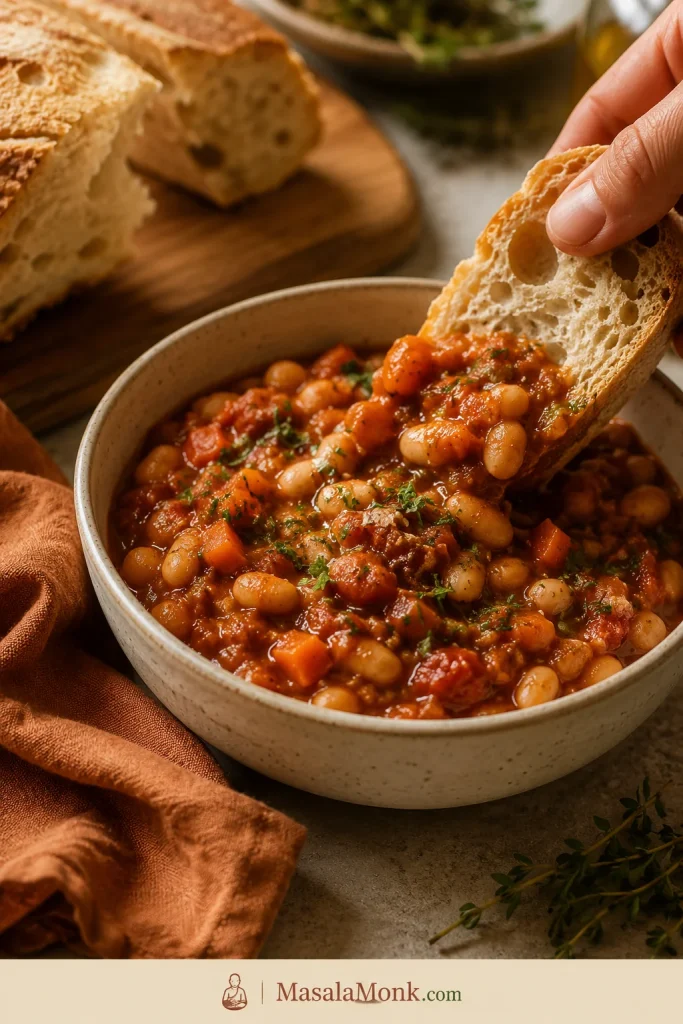
A hand dipping a piece of crusty bread into a bowl of thick tomato bean stew with white beans, carrots, herbs, and a warm linen beside it.
Serve the stew with crusty bread when you want the sauce to be part of the meal; one scoop should catch beans, herbs, and tomato base together.

To Make It More Filling

  • Crusty bread or garlic bread
  • Steamed rice
  • Polenta
  • Cornbread
  • Baked potatoes
  • Quinoa, bulgur, or couscous
  • Buttered toast

A pot of plain rice is one of the easiest ways to stretch the stew. MasalaMonk’s guide on how to cook rice covers stovetop, rice cooker, and Instant Pot methods so the base comes out right before you spoon the stew over it.

A bowl of white rice topped with tomato bean stew, carrots, herbs, and a lemon wedge, with a spoon resting in the bowl.
For a bigger dinner, spoon the bean stew over rice; the rice catches the tomato sauce and stretches the pot without making the meal feel thin.

The storage section explains why extra stew is worth planning for: it thickens overnight and loosens easily when reheated gently.

To Add Freshness

Because the stew is rich and hearty, the best toppings either brighten it, cool it, or add contrast.

  • Lemon or lime wedges
  • Fresh parsley, basil, cilantro, or dill
  • Pickled onions
  • Green salad
  • Sautéed greens
  • Avocado for black bean versions
  • Yogurt or sour cream, if not vegan

For another bean-and-rice dinner with a Louisiana-style flavor base, MasalaMonk’s red beans and rice recipe is a heartier, smokier route.

Make-Ahead, Storage, Freezing, and Reheating

Bean stew thickens and deepens as it rests, which means tomorrow’s bowl may taste even better than tonight’s. The leftovers are part of the reward here; the beans keep soaking up flavor as they sit. If you are making it ahead, keep it slightly looser than you want. It will thicken as it cools and again in the fridge.

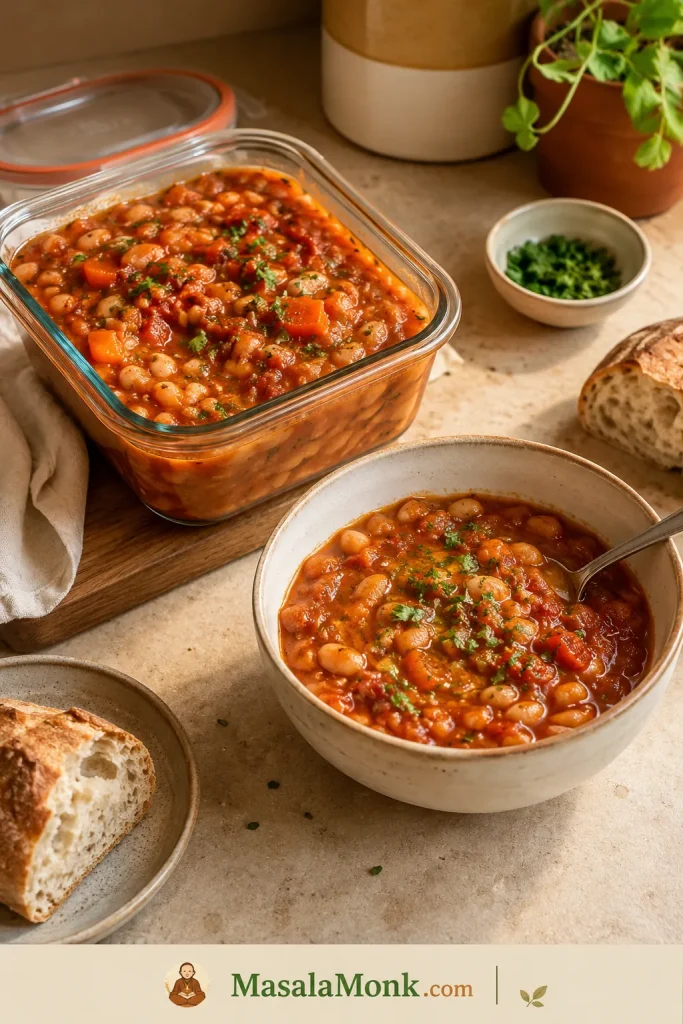
A glass storage container filled with leftover tomato bean stew beside a reheated bowl of the same stew, with bread, herbs, and a spoon on a kitchen counter.
Leftover bean stew usually thickens as it rests; store it in glass if you can, then loosen it with a splash of broth or water when reheating.
  • Make ahead: Make the stew 1–2 days ahead if you want the flavor to settle.
  • Refrigerator: Store in an airtight container for 4–5 days.
  • Freezer: Freeze for up to 3 months.
  • Greens: If freezing, consider adding fresh greens after reheating rather than before freezing.
  • Reheating: Warm on the stovetop over low-medium heat with a splash of broth or water.
  • Brighten after reheating: Add lemon juice, herbs, or olive oil at the end.

The troubleshooting table below covers reheated stew that turns too thick, too loose, or flat-tasting.

Mistakes That Make It Watery or Bland

Most disappointing bean stews fail in the same few ways: too much liquid, not enough base flavor, or no fresh finish. Fix those, and the pot usually comes back.

  • Adding too much broth at the start. Begin with less, simmer, then adjust.
  • Skipping the vegetables. Beans need onion, garlic, herbs, and seasoning to taste like dinner.
  • Not cooking the tomato paste. Raw tomato paste can taste sharp and flat.
  • Adding tomatoes or vinegar before dried beans are tender. Acidic ingredients can slow softening.
  • Forgetting the fresh finish. A small splash of vinegar or lemon at the end keeps the stew from tasting heavy.
  • Ignoring salt from broth, canned beans, sausage, or chorizo. Taste before adding the full amount of salt.

Troubleshooting

Most bean stew problems are fixable because beans are forgiving. When the pot is watery, give it time uncovered. Flat flavor usually needs salt first, then a small splash of vinegar or lemon juice. A too-thick pot should be loosened slowly and tasted again.

ProblemFix nowFix next time
Too waterySimmer uncovered and mash ½–1 cup beans into the sauce.Start with less broth and add more only after simmering.
Too thickAdd broth or water ¼ cup / 60 ml at a time.Reduce for less time or use the full 2 cups / 480 ml broth.
Bland beansAdd salt first, then a small splash of vinegar or lemon juice, herbs, olive oil, or chili.Season the vegetables and cook the tomato paste properly.
Flat flavorAdd a small splash of vinegar or lemon juice, fresh herbs, black pepper, or olive oil.Do not skip the final balance.
Too acidicAdd more beans, a splash of broth, olive oil, or a small pinch of sugar.Use fewer tomatoes or cook tomato paste longer.
Bitter tomato pasteAdd tomatoes, broth, and beans to soften the flavor.Cook tomato paste until darkened, but do not let it burn.
Firm beansSimmer longer with extra broth until tender.Use canned beans or cook dried beans fully before adding.
Too saltyAdd unsalted beans, potato, tomatoes, or low-sodium broth.Use low-sodium broth and season gradually.
Thin slow cooker versionMash beans at the end or transfer to a pot and simmer uncovered.Use less broth in the slow cooker.

FAQs

What beans are best for bean stew?

Cannellini beans and butter beans are the easiest all-purpose choices for bean stew because they turn creamy without disappearing. Black beans make it smoky, chickpeas keep it firmer, pinto beans help thicken the sauce, and mixed beans are best when you want to use what is already open.

Is bean stew the same as bean soup?

No. Bean stew is thicker than bean soup. Soup has more broth and a looser texture, while this stew is reduced, spoonable, and sturdy enough to serve with bread, rice, polenta, or potatoes as a full meal.

How is bean stew different from chili?

Bean stew is usually less chili-spice focused than chili. This version leans on aromatics, tomatoes, herbs, beans, and a flexible finish rather than a heavy chili-powder base.

Can I use canned beans for bean stew?

Yes, canned beans work very well for bean stew. Drain and rinse three 14–15 oz cans, then simmer them in the tomato base until the sauce clings to the beans.

Should I drain canned beans?

Usually, yes. Draining and rinsing gives you more control over salt and texture. If the can liquid tastes clean and you want extra body, add a small splash, but do not use it as the main liquid.

Can I use dried beans?

Yes, dried beans work well if they are cooked until tender first. Use about 4½ cups cooked beans to replace three cans; the stew should be where they absorb flavor, not where they struggle to soften.

How do I thicken bean stew?

To thicken bean stew, simmer uncovered and mash ½–1 cup of beans into the sauce. Starting with less broth and cooking the tomato paste properly also helps the finished bowl become glossy and scoopable.

Can I make bean stew without tomatoes?

Yes, bean stew can be made without tomatoes. Use broth as the base, add extra aromatics and herbs, mash more beans for body, and finish with olive oil and a little acidity so it still tastes complete.

Can this bean stew be vegan?

Yes, this bean stew can be vegan. Use vegetable broth, skip dairy toppings, and finish with olive oil, herbs, mushrooms, or nutritional yeast for extra richness.

Can I make bean stew in a slow cooker?

Yes, bean stew can be made in a slow cooker with canned beans or beans that have already been cooked. Use less broth than the stovetop version, and expect a softer, less glossy stew that is still excellent for a hands-off dinner.

Does bean stew freeze well?

Yes, bean stew freezes well for up to 3 months. It usually looks thicker after thawing, so reheat it gently with a splash of broth or water, then brighten it at the end so it tastes fresh again.

What should I serve with bean stew?

Serve bean stew with crusty bread, rice, polenta, cornbread, baked potatoes, quinoa, couscous, or a green salad. Bread is best when the stew is extra thick; rice is best when you want to stretch the pot into more servings.

Final Thoughts

A good bean stew is not fancy food. It is the kind of recipe that makes three cans of beans, one onion, and the last carrot in the drawer feel like dinner for tonight and lunch tomorrow.

Once the method clicks, you stop needing one exact bean. Try white beans and rosemary when you want something soft and cozy. Go with black beans, cumin, and lime when you want a smoky bowl over rice. Choose chickpeas with paprika and lemon, butter beans with chorizo, or mixed beans when the pantry needs clearing out.

If you make this with a different bean mix, leave a comment with the exact cans or cooked beans you used and what you served it with — especially if you tried black beans, butter beans, chickpeas, or a mixed pantry batch. It helps the next person staring at the same random cans.

Back to top

Posted on 10 Comments

Authentic Louisiana Red Beans and Rice Recipe (Best Ever)

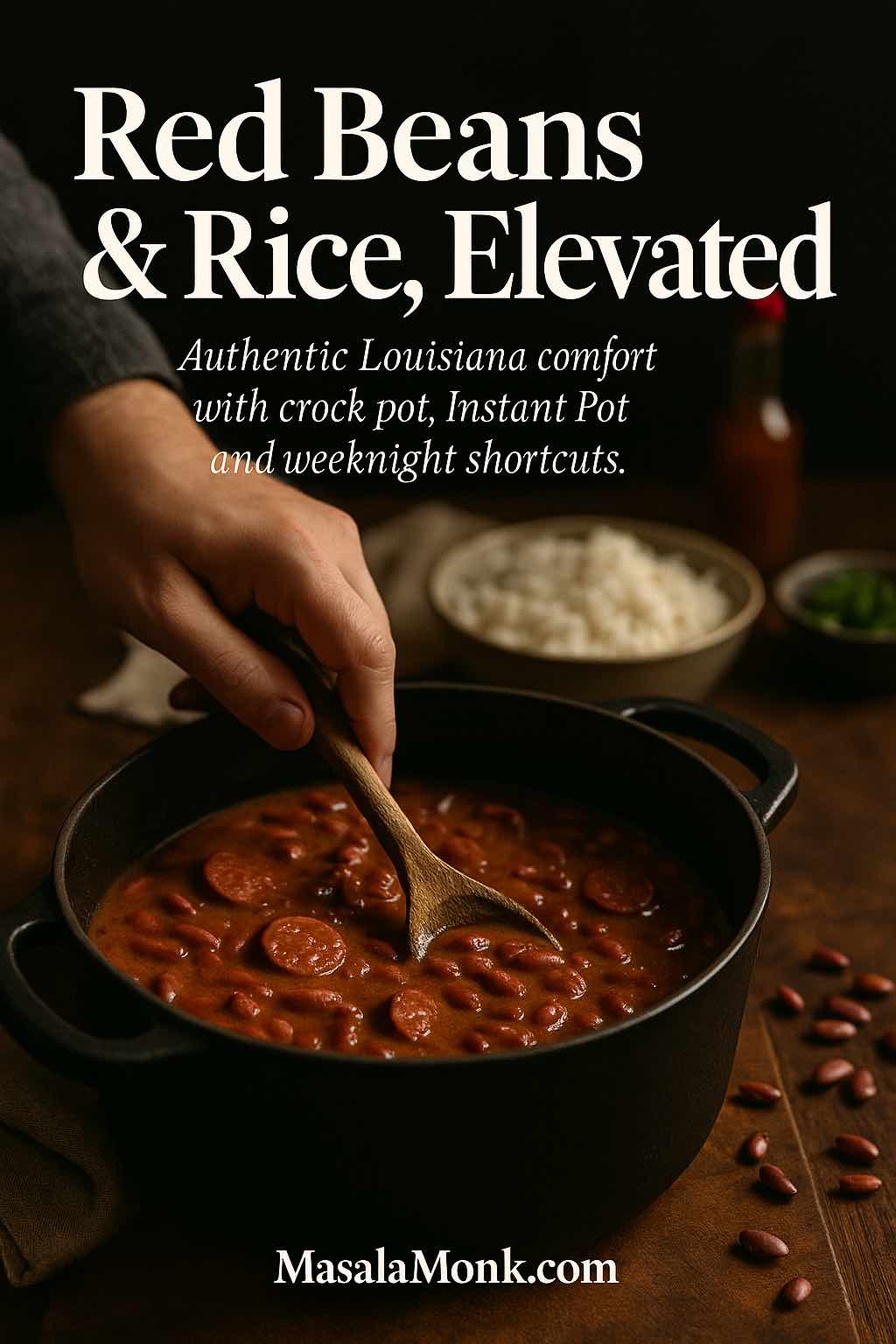
Hand stirring creamy Louisiana red beans and sausage in a black Dutch oven with rice in the background, cover image for authentic red beans and rice recipe.

Red beans and rice is one of those meals that feels like it’s been simmering forever in the background of life. It’s the pot your grandmother had bubbling on the back burner, the dish that shows up quietly at big family gatherings, the weeknight saver when you want something cheap, filling and full of flavour without fuss. In Louisiana, red beans and rice isn’t just another beans and rice recipe; it’s a weekly ritual with roots in Monday laundry day and leftover Sunday ham bones, when a pot could sit and cook itself while the rest of the work got done.

This version leans into that history but still fits modern kitchens. You’ll get an authentic Louisiana red beans and rice recipe you can make on the stovetop, adapt for a crock pot or slow cooker, or convert into an Instant Pot red beans and rice shortcut when you’re short on time. Along the way, there are options for using canned red beans, adding andouille sausage, keeping things vegetarian or vegan, and even nudging the dish towards other beans and rice traditions from Puerto Rico, Jamaica and India.


What Makes Red Beans and Rice So Special?

At first glance, red beans and rice looks simple: a pot of creamy red beans and a bowl of plain rice. Yet once you dive in, you realise there are layers of story and technique sitting underneath.

In Louisiana Creole cooking, red beans and rice is considered an emblematic dish. Classic versions combine small red beans with the “trinity” of onion, celery and bell pepper, plus thyme, bay leaves, a little cayenne and some kind of pork bone or sausage, all simmered low and slow until the beans are soft and the liquid turns velvety. That bean mixture is then ladled over rice rather than cooked together like a pilaf.

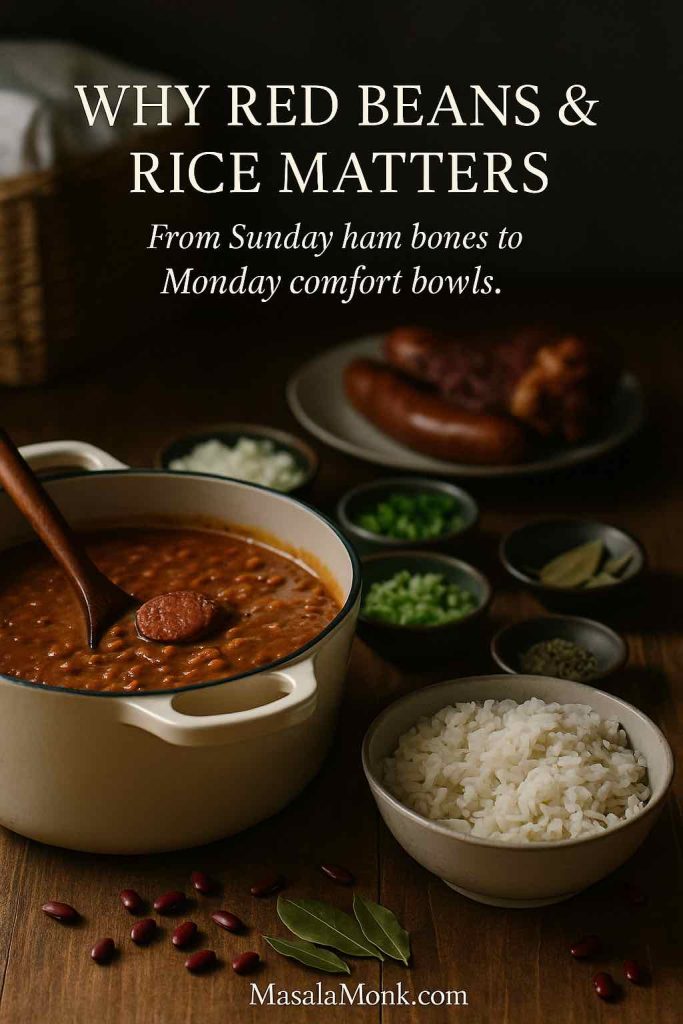
Dutch oven of creamy Louisiana red beans with rice, holy trinity vegetables and ham bone, with a blurred laundry basket in the background showing the Monday red beans and rice tradition.
Red beans and rice grew from Sunday ham bones and Monday washday into Louisiana’s most comforting classic.

Historically, ham was often served on Sunday, and the leftover ham bone was too valuable to waste. On Monday, which was usually washday, beans went on the stove with that bone and the trinity, and the pot gently simmered while laundry was scrubbed and dried. The result was a hands-off, deeply flavoured red beans and rice dish that became a comforting start to the week.

As Louisiana tourism boards love to point out, the Monday tradition grew from Sunday ham bones and long laundry days, and you can read a concise version of that story in this brief history of red beans and rice from Louisiana.

Today, people mix things up with smoked sausage instead of ham bones, turkey instead of pork, or even entirely meatless red beans and rice meals. The idea remains the same, though: inexpensive ingredients, long cooking, big flavour.

Also Read: Sheet Pan Chicken Fajitas Recipe (Easy One-Pan Oven Fajitas)


Choosing the Right Beans

Because beans sit right at the heart of any good red beans and rice recipe, choosing the right ones matters.

Small Red Beans vs Kidney Beans

Traditional New Orleans red beans and rice uses small red beans, which keep their shape yet turn wonderfully creamy inside. If you can’t find them, red kidney beans are a great substitute and often easier to source globally. They’re the same beans you might already be using in rajma, chilli or salads, so they slide neatly into your existing pantry habits.

Two wooden bowls filled with small red beans and red kidney beans on a wooden table, showing the best beans for red beans and rice.
Small red beans give you the classic New Orleans texture, while red kidney beans are a handy stand-in most home cooks already have in the pantry.

If you enjoy trying regional varieties, something like the Himalayan Rajma – Red Kidney Beans gives you that creamy texture with a slightly earthier flavour. It also lets you use the same bag for both rajma chawal and Louisiana-style red beans and rice, which keeps meal planning simple.

Dried Beans vs Canned Beans

From there, you have a choice between dried and canned:

  • Dried beans are cheaper, have better texture and soak up flavour over a long simmer.
  • Canned red beans let you throw together an easy red beans and rice supper in under an hour, with no soaking or long boiling.
Burlap sack spilling dried red beans next to a bowl and an open can of cooked red beans on a wooden table, comparing dried and canned beans for red beans and rice.
Dried red beans are perfect for slow weekend simmering, while canned beans make red beans and rice possible even on the busiest weeknights.

Nutritionally, both are excellent. Beans provide protein, fibre, folate, iron, potassium and magnesium while remaining low in fat and naturally free of cholesterol, which is why organisations like the American Heart Association recommend them as part of a heart-healthy eating pattern.

If you’re mostly cooking on weekends or enjoy slow kitchen days, dried beans are worth the time. If you’re juggling work, kids and life, keeping a few cans of red beans in the cupboard means a fast red beans and rice meal is never far away.
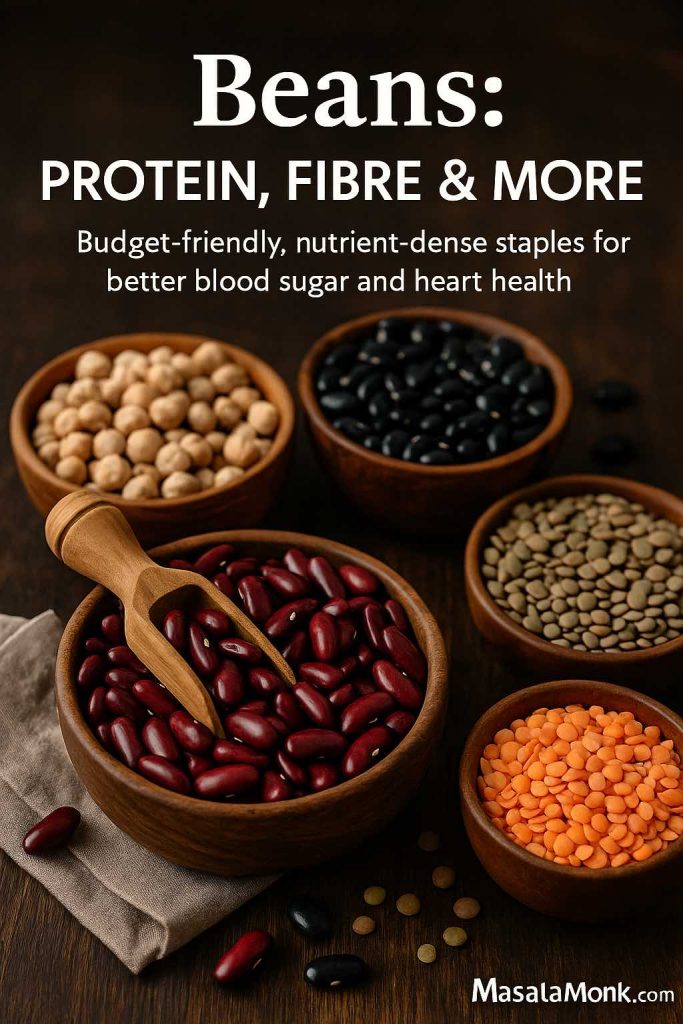
Also Read: Katsu Curry Rice (Japanese Recipe, with Chicken Cutlet)


The Rice Question: What to Serve Underneath

Red beans without rice is basically a bean stew. Add rice and suddenly the whole thing turns into a complete beans and rice dish: protein, carbs, fibre and flavour in each bite.

Best Rice for Red Beans and Rice

Louisiana cooks often reach for long-grain white rice because it stays fluffy, absorbs sauce, and doesn’t clump. Basmati works very well if that’s your everyday rice, especially because its glycemic index tends to run lower than some other white rice varieties.

Three bowls filled with white rice, brown rice and quinoa on a wooden table, showing the best grains to serve with red beans and rice.
White rice keeps things classic, brown rice adds extra fibre, and quinoa gives your red beans and rice a lower-GI, higher-protein twist.

However, you can absolutely adapt:

  • Brown rice brings extra fibre and a nuttier taste; it usually has a lower or medium GI compared with many white rices.
  • Quinoa offers more protein and fibre and generally sits in the low-GI range, which can benefit blood sugar control.

If you’re curious about swapping some or all of the rice for quinoa, the breakdown in the MasalaMonk article “Quinoa vs Rice: Calories, Carbs, GI & Healthier Choice” explains exactly how each behaves in terms of glycemic index, macros and satiety.

Meanwhile, if you’d rather keep classic white rice but blunt the blood sugar spike a bit, there’s also a detailed guide on how to reduce the glycemic impact of rice using cooking, cooling and reheating tricks instead of relying only on rice type.


Building the Flavour: Trinity, Sausage and Seasoning

Once you’ve chosen your beans and rice, the next step in this red beans recipe is to build a base that tastes like Louisiana on a rainy day.

The Holy Trinity

Cajun and Creole cooking often start with what locals call the “trinity”:

  • Onion
  • Celery
  • Green bell pepper
Chopped onion, celery and green bell pepper arranged on a wooden cutting board with a knife, showing the Cajun holy trinity for red beans and rice.
Onion, celery and green bell pepper – the simple “holy trinity” that gives every pot of red beans and rice its unmistakable Louisiana flavour.

These three are diced and slowly sautéed until they soften and begin to turn sweet and golden. Garlic usually joins them shortly afterwards, adding another layer of fragrance. This combination forms the backbone of Cajun red beans and rice, much like onion, ginger and garlic form the base of many North Indian bean curries.

Andouille, Ham and Other Meats

After the trinity has cooked down, you usually add:

  • Andouille sausage or another smoked sausage
  • Sometimes a ham hock, pork bones or smoked turkey neck
  • Occasionally bacon at the very beginning for extra depth
Andouille sausage, ham hock and bacon arranged on a wooden board with a small skillet of drippings, showing the smoky meats used to flavour red beans and rice.
Andouille, ham hock and a little bacon turn a simple pot of beans into the rich, smoky red beans and rice everyone remembers.

The sausage browns in the pan, leaving behind browned bits that will dissolve into the beans later. The bones or hocks infuse the pot during the long simmer, creating a savoury backbone that makes the dish feel complete even with a relatively small amount of meat.

If you want a sausage-heavy beans and rice dinner, you can easily double the sausage and turn it into a beans and rice with sausage special, perfect for game day or big family gatherings.

Homemade Red Beans and Rice Seasoning Mix

While store-bought Cajun blends are handy, making your own red beans and rice seasoning mix gives you full control over salt and spice. A basic mix might include:

  • Paprika and a little smoked paprika
  • Garlic powder and onion powder
  • Dried thyme and oregano
  • Black pepper
  • Cayenne for heat
  • Bay leaves (added whole during cooking)
  • Salt to bring everything together
Small bowls of paprika, herbs and spices around a jar of homemade red beans and rice seasoning with bay leaves on a wooden table.
Mixing your own red beans and rice seasoning lets you control the heat, smokiness and salt in every pot.

This simple combination is enough to transform plain beans into a richly seasoned Cajun red beans dish without feeling complicated. Once you’re comfortable with it, you can experiment further, drawing inspiration from other blend-heavy cuisines—much like a carefully balanced garam masala or chaat masala elevates otherwise simple ingredients.

Also Read: Easy Lemon Pepper Chicken Wings (Air Fryer, Oven & Fried Recipe)


Authentic Louisiana Red Beans and Rice: Stovetop Method

Now that the pieces are in place, it’s time to pull them together into a red beans and rice recipe you can rely on.

Step 1: Soak and Prep the Beans

For stovetop cooking, soaking helps beans cook more evenly and reduces overall time:

  1. Rinse about 1 cup (200 g) dried small red beans or kidney beans and pick out any stones.
  2. Place them in a large bowl, cover with plenty of water and soak overnight.
  3. Before cooking, drain and rinse the beans.
Overhead view of a glass bowl of dried red beans soaking in water on a wooden table with scattered beans, measuring cup and colander, labeled Step 1 Soak and Prep the Beans.
Step 1 – Rinse, pick through and cover dried red beans with plenty of water so they can soak and cook evenly later.

If you forget to soak, don’t panic; you can still make a traditional red beans and rice dish. You’ll just need to simmer a bit longer and keep an eye on the liquid level.

Step 2: Sauté the Trinity and Sausage

Next, start building texture and flavour:

  1. Warm a spoonful of oil or bacon fat in a heavy pot over medium heat.
  2. Add chopped onion, celery and green bell pepper with a pinch of salt. Cook, stirring occasionally, until softened and lightly golden.
  3. Stir in minced garlic and cook a minute or so, just until fragrant.
  4. Add sliced andouille or other smoked sausage. Let it brown lightly so the edges crisp and browned bits form on the bottom of the pot.
Dutch oven with diced onion, celery and green bell pepper sautéing with sliced sausage, labeled Step 2 Sauté the Trinity and Sausage.
Step 2 – Gently sauté the onion, celery, green bell pepper and sausage until everything is soft, golden and smelling like real Louisiana red beans and rice.

At this point, your kitchen already smells like a proper beans and rice dinner, even before the beans go in.

Step 3: Add Seasoning and Beans

Once the sausage has taken on some colour:

  1. Sprinkle in your red beans and rice seasoning mix and stir well so the spices coat the vegetables and sausage.
  2. Toast the spices for 30–60 seconds; they should smell vivid but not burn.
  3. Add the soaked beans, bay leaves, and any ham hock or smoked turkey you’re using.
  4. Pour in enough water or stock to cover everything generously.
Hand pouring soaked red kidney beans and liquid from a glass bowl into a Dutch oven with sausage, vegetables and bay leaves, labeled Step 3 Add Seasoning, Beans and Liquid.
Step 3 – Stir in your seasoning mix, add the soaked beans with bay leaves and cover everything with stock for a slow, gentle simmer.

Bring the pot up to a gentle boil, then immediately lower to a soft simmer. Too vigorous a boil can split the beans before they’ve had a chance to soften inside.

Step 4: Simmer Low and Slow

Now the red beans recipe becomes a waiting game in the best possible way:

  • Let the pot simmer slowly, partially covered, for 1½–2 hours.
  • Stir occasionally so nothing sticks; top up with a splash of water or stock if the level drops too much.
  • As the beans soften, mash a spoonful against the side of the pot and stir back in. This gradually thickens the cooking liquid into a creamy sauce.
Cream Dutch oven of red beans simmering on the stove with bay leaves and steam rising, labeled Step 4 Simmer Low and Slow.
Step 4 – Let the pot bubble gently with the lid slightly ajar until the red beans turn soft and the cooking liquid becomes rich and creamy.

By the time the beans are fully tender, you’ll have a glossy, rich pot of Cajun red beans that clings just right to a spoon. Adjust salt, black pepper and cayenne at the very end so you can taste exactly what’s happening. If you enjoy comparing methods, this authentic Louisiana red beans and rice recipe on Allrecipes follows a very similar path with slightly different timing and spice levels.

Step 5: Cook the Rice and Serve

While the beans are simmering, cook your rice (How to Cook Perfect Rice Every Time (Recipe):

  1. Rinse long-grain rice until the water runs mostly clear.
  2. Combine rice, water and a pinch of salt in a pot.
  3. Bring to a boil, then cover and cook on low until the water is absorbed and the rice is tender.
  4. Let it rest off the heat for about 10 minutes, then fluff with a fork.
Bowl of red beans and rice with sausage and green onions, with a hand holding a spoon and the pot of beans and pan of rice in the background, labeled Step 5 Cook the Rice and Serve.
Step 5 – Spoon the creamy red beans over fluffy white rice, add a little green onion on top, and take the first bite while everything is still hot and steamy.

To serve, spoon rice into bowls, ladle the red beans over the top, and finish with sliced green onions and hot sauce at the table. For many people, this simple bowl is the best red beans and rice recipe they’ll ever need; yet it’s also the perfect base for countless variations.

Also Read: How to Make Churros (Authentic + Easy Recipe)


Slow Cooker / Crock Pot Red Beans and Rice

On days when you want the house to do the cooking while you’re out, a crock pot red beans and rice version is incredibly handy.

To adapt the stovetop method for a slow cooker:

  • Sauté the onion, celery, bell pepper, garlic and sausage in a pan first. This step adds depth that you won’t get from throwing everything in raw.
  • Move the sautéed mixture to the slow cooker.
  • Add soaked beans, seasoning mix, bay leaves and enough liquid to cover by several centimetres.
  • Cook on LOW for 7–9 hours or HIGH for 4–5 hours, until the beans are soft and starting to break down.
  • Near the end, mash some beans against the side of the crock pot and stir to thicken.
Slow cooker filled with creamy red beans and sausage on a wooden table with green onions and a wooden spoon, with step-by-step slow cooker red beans and rice instructions overlaid on the image.
Slow Cooker Red Beans & Rice – sauté the trinity and sausage, then let the crock pot handle the long, gentle simmer while you get on with your day.

Meanwhile, you can cook rice separately on the stove or in a rice cooker. This approach also plays well with other slow cooker recipes; for example, you might use a second crock pot to make a whole chicken with vegetables so guests can choose between beans and rice or tender shredded chicken over the same bowl of rice.

Because this style of cooking is so forgiving, it readily supports other beans and rice crockpot combinations: black beans with Cajun seasoning, mixed beans with extra vegetables, or even a sausage-heavy red beans and rice crock pot dish for a crowd.

Also Read: French 75 Cocktail Recipe: 7 Easy Variations


Instant Pot Red Beans and Rice

When you’re pressed for time, pressure-cooking red beans and rice makes a lot of sense. An Instant Pot or similar pressure cooker can turn dried beans into creamy, tender red beans in under an hour of active cooking, which is especially useful for weeknights.

To make an Instant Pot red beans and rice recipe:

  1. Use the Sauté mode to cook the onion, celery, bell pepper, garlic and sausage just as you would on the stove.
  2. Once fragrant and lightly browned, add your seasoning mix and toast briefly.
  3. Add rinsed, unsoaked red beans, bay leaves and enough water or stock to just cover the beans.
  4. Seal the lid and cook on HIGH pressure. Many cooks find 35–45 minutes with a natural release works well, though the exact timing depends on bean type and age.
  5. Allow the pressure to drop naturally for at least 15–20 minutes, then open the pot.
  6. Mash some beans and simmer briefly on Sauté mode if you’d like the sauce thicker.
Instant Pot red beans and rice recipe card showing an Instant Pot, a bowl of red beans and rice with sausage and green onions, and step-by-step pressure cooker instructions with MasalaMonk.com
Instant Pot Red Beans & Rice – sauté, pressure-cook and finish on Sauté for a creamy, weeknight-friendly version of this Louisiana classic.

Cook the rice separately either in another pot or in a second round in the Instant Pot, because red beans and rice cook at slightly different rates and you want the beans to get extra time to turn creamy. For a more technical walkthrough (including exact water ratios and timing for a 1-pound bag of beans), the Instant Pot New Orleans-style red beans and rice from Camellia is a great reference.

If you enjoy this approach, you’ll probably also appreciate how other one-pot meals such as Cheesy Chicken Broccoli Rice – 4 Ways seamlessly move between Instant Pot, casserole and crock pot formats without losing comfort factor. That way, the same appliance that delivers your red beans can later produce a cheesy rice bake with almost no extra learning curve.


Quick and Easy Red Beans and Rice with Canned Beans

Of course, some evenings you don’t have the bandwidth for soaking beans or monitoring a long simmer. In those moments, canned red beans are a gift.

Here’s a straightforward easy red beans and rice recipe using canned beans:

  1. Sauté onion, celery and green bell pepper in a little oil until soft and fragrant.
  2. Add garlic and sliced sausage, browning the sausage lightly.
  3. Stir in your red bean seasoning mix and bay leaves.
  4. Add canned red beans (drained and rinsed) along with enough water or stock to make a loose stew.
  5. Simmer for 20–30 minutes, mashing some beans as they soften to create body.
Recipe card showing a skillet of quick and easy red beans and rice with canned beans, step-by-step instructions, and MasalaMonk.com at the bottom.
Quick & Easy Red Beans & Rice – canned beans, a single pan and 20–30 minutes are all you need for a comforting weeknight bowl.

Because canned beans are already cooked, you’re mainly letting flavours blend and the sauce thicken. Serve over freshly cooked rice, and you’ve got a homely red beans and rice meal with very little effort. This trick also works nicely when you’ve bought a boxed red beans and rice mix but want to boost it with real vegetables, extra sausage and fresh seasoning.

Also Read: 10 Best Chicken Sandwich Recipes (BBQ, Parm, Buffalo & More)


Sausage-Heavy Red Beans and Rice

Sometimes, the craving is very specific: beans and rice and sausage, all in one bowl. In that case, you simply tilt the ratios.

To make a beans and rice with sausage feast:

  • Double the amount of andouille or smoked sausage in the base recipe.
  • Brown the sausage deeply at the beginning to build extra flavour.
  • Consider adding small chunks of ham or leftover roasted meat.
  • Keep the beans slightly firmer so you have a mix of creamy sauce and distinct beans and sausage pieces.
Recipe card showing a bowl of red beans and rice loaded with browned sausage slices and simple instructions for making sausage-heavy red beans and rice.
Sausage-Heavy Red Beans & Rice – double the andouille, brown it deeply, and serve over rice for the meatiest version of this Louisiana classic.

This style feels right at home at backyard barbecues, football watch parties or potlucks. It also pairs beautifully with starters like wings or dips; for example, you could set out platters of vegetables around one of MasalaMonk’s spinach dip recipes and let the red beans and rice act as the anchor of the table.


Vegetarian and Vegan Red Beans and Rice

Despite its reputation as a sausage-and-ham dish, red beans and rice adapts beautifully to vegetarian and vegan cooking.

To make a meatless red beans and rice recipe:

  • Replace animal fat with olive oil or another neutral plant oil.
  • Skip the sausage and ham hock altogether, or use a plant-based sausage if you enjoy that texture.
  • Use vegetable stock or water as the cooking liquid.
  • Emphasise smoked paprika and perhaps a drop of liquid smoke to bring in the depth you’d usually get from pork.
Recipe card showing a bowl of vegetarian red beans and rice with olive oil and vegetable stock in the background and step-by-step meatless red beans and rice instructions.
Vegetarian & Vegan Red Beans & Rice – all the smoky, creamy comfort of the classic dish made entirely with olive oil, vegetable stock and plant-based ingredients.

Because beans themselves are rich in protein, fibre and a suite of vitamins and minerals, they’re a cornerstone of many plant-based diets and are associated with improved heart health, lower cholesterol, and better blood sugar regulation.

If you love vegetarian bean dishes, you might also enjoy the contrast between Louisiana red beans and rice and North Indian rajma. An authentic Punjabi style rajma curry served over rice gives a tomato-forward, spiced counterpart to the smoky, thyme-and-bay-leaf notes of this Creole classic.


Beans and Rice Around the World

Once you get comfortable with this authentic red beans and rice recipe, it quickly becomes part of a wider beans and rice family.

In Puerto Rico, for instance, beans and rice often show up as habichuelas guisadas con arroz—stewed beans with sofrito, sazón, olives and sometimes potatoes, ladled alongside or over rice. While in Jamaica, you’ll meet rice and peas, a coconut-infused rice cooked with red kidney beans (the “peas”), thyme and Scotch bonnet pepper, typically served with jerk chicken or fish.

Three plates of beans and rice inspired by Puerto Rico, Jamaica and India on a wooden table with the title Beans and Rice Around the World.
From Puerto Rican stewed beans to Jamaican rice and peas and Indian rajma chawal, nearly every cuisine has its own comforting version of beans and rice.

Where as in India, rajma chawal mirrors the same comforting beans-plus-rice logic in a completely different spice language. Even within the US, beans and rice show up as black beans with rice in Cuban cooking, hoppin’ John in the South made with black-eyed peas and rice, or Tex-Mex rice and beans baked under cheese.

When you view your pot of red beans this way, it stops being a single, isolated recipe and becomes a template you can tweak: more coconut here, extra tomato there, different spices everywhere.

Also Read: Whiskey Sour Recipe: Classic Cocktail, Best Whiskey & Easy Twists


Beans, Rice and Your Body

Beyond comfort, there’s another reason red beans and rice keeps showing up in so many cultures: it’s nutritionally smart when you balance portions and ingredients.

Why Beans Are Such a Good Idea

Beans and other legumes are one of the most nutrient-dense, budget-friendly foods you can buy. They bring together:

  • Plant protein
  • Soluble and insoluble fibre
  • B-vitamins like folate
  • Minerals such as iron, potassium and magnesium
Wooden bowls filled with kidney beans, chickpeas, black beans and lentils on a dark wooden table with the words Beans: Protein, Fibre & More highlighting their health benefits.
Beans pack protein, fibre, vitamins and minerals into every scoop, making your red beans and rice as smart for blood sugar and heart health as it is comforting.

Regular bean intake is associated with improved heart health, better cholesterol profiles, more stable blood sugar and even easier weight management thanks to the combination of protein and fibre increasing satiety.

If you’d like to lean into beans more broadly in your diet, MasalaMonk has a helpful overview of using beans for diabetes and blood sugar management, as well as a piece on how beans can act as a superfood for weight loss without expensive supplements or products.

Choosing and Cooking Rice Wisely

Rice, meanwhile, is neither angel nor villain. It’s a familiar, soothing carbohydrate that fits many cultures; however, its effect on blood sugar depends on type and preparation.

Wooden table with small piles of white rice, brown rice and quinoa in front of a bowl of mixed beans and a wooden spoon, with text explaining smarter carb choices for beans and rice and blood sugar.
White rice keeps things classic, while brown rice and quinoa make your bowl of red beans and rice gentler on blood sugar and even more satisfying.
  • White rice often has a higher glycemic index, meaning it raises blood sugar more quickly.
  • Brown rice tends to sit in the medium-GI range, providing a slower release of glucose.
  • Quinoa and some other whole grains boast lower GIs and additional fibre, making them helpful options for people managing diabetes or insulin resistance.

You can also reduce the glycemic impact of rice by adjusting how you cook and cool it, which is exactly what the MasalaMonk guide on lowering rice GI explores in depth. Combined with the fibre and protein from beans, a bowl of red beans and rice can absolutely fit into a thoughtful eating pattern rather than feeling like a “cheat” meal.


Serving Ideas and Full Meal Inspiration

Once your pot of red beans and rice is ready, you can keep things as simple or as elaborate as you like.

On a busy Monday, a scoop of beans over rice with a drizzle of hot sauce might be all you need. On weekends, though, you might want to build a bigger table around it:

  • Starters and sides: A fresh board of crunchy vegetables, bread and one or two spinach dip variations gives guests something to snack on while the rice finishes steaming.
  • Additional mains: A crock pot whole chicken or a pot of lasagna soup lets meat lovers or pasta fans join in without you cooking multiple complex meals.
  • More rice-centric meals: Later in the week, you can switch gears completely with cheesy chicken broccoli rice or even turn leftover plain rice into gourmet arancini balls, giving your beans and rice habit a playful Italian twist.
  • Dessert: If you want to keep a gentle theme of rice running through the meal, you might follow this savoury Louisiana dish with an authentic mango sticky rice, which brings a sweet, tropical finish without feeling heavy.

For drinks, you can keep things easy with cold beer or iced tea, yet red beans and rice also sits nicely alongside a tray of cocktails. A classic Bloody Mary or Bloody Maria echoes the savoury, spicy notes of the dish, while a bright mimosa or lemon drop martini offers something sparkling and citrusy on the side.

Large bowl of red beans and rice surrounded by vegetables with spinach dip, roasted chicken, lasagna soup, arancini and mango sticky rice on a wooden table with the title Serving Ideas and Full Meal Inspiration.
Turn one pot of red beans and rice into a full feast with fresh veggies and dip, slow-cooked chicken, cozy soup, crispy arancini and a light mango sticky rice dessert.

Making Red Beans and Rice Your Own

The beauty of an authentic red beans and rice recipe is that once you’ve made it a couple of times, it becomes second nature—and then, slowly, it becomes yours.

Maybe you discover you like your red beans extra creamy, so you mash more of them and thin the pot with stock. Perhaps you fall for a meatless red beans and rice version loaded with vegetables and served over quinoa. Or you might decide your signature beans and rice meal will always include sausage, hot sauce, and a big salad on the side.

However you tweak it, the fundamental idea holds steady: a pot of beans, a bowl of rice, a little attention to seasoning, and enough time for everything to come together. When you ladle that first spoonful over steaming rice and breathe in the smell of smoky beans and bay leaves, you’ll understand why Monday red beans and rice became a tradition—and why, once you’ve cooked it for yourself, it tends to stay in the rotation for years.

Three bowls of red beans and rice showing different variations: classic with hot sauce, vegetarian over grains with vegetables, and sausage-loaded, with hands adding sauce and stirring.
Whether you like your red beans and rice extra creamy, meatless over grains or piled high with sausage and hot sauce, the real magic is finding the version that feels like yours.

FAQs

1. What beans work best for a classic red beans and rice recipe?

Small red beans are the classic choice because they get creamy inside while holding their shape. Red kidney beans also work very well and are easier to find, so they’re perfect if you already use them in other bean dishes.


2. Can I use kidney beans instead of red beans?

Yes, kidney beans can absolutely replace small red beans in a red beans and rice recipe. They give a slightly meatier bite, yet still turn tender and creamy when cooked long and slow.


3. Do I really need to soak the beans first?

Soaking isn’t strictly required, but it helps the beans cook more evenly and a bit faster. If you plan a long stovetop simmer or a crock pot red beans and rice, soaking is very helpful, especially with older beans.


4. How long should I soak red beans?

Aim for 6–12 hours in plenty of water. If you forget, you can do a “quick soak” by boiling the beans for a couple of minutes, turning off the heat, and letting them sit covered for about an hour before draining.


5. Can I make red beans and rice with canned beans?

Definitely. Canned beans are ideal for an easy red beans and rice recipe when you’re short on time. Just rinse them, then simmer with sautéed aromatics, seasoning, and a bit of water or stock until the sauce thickens.
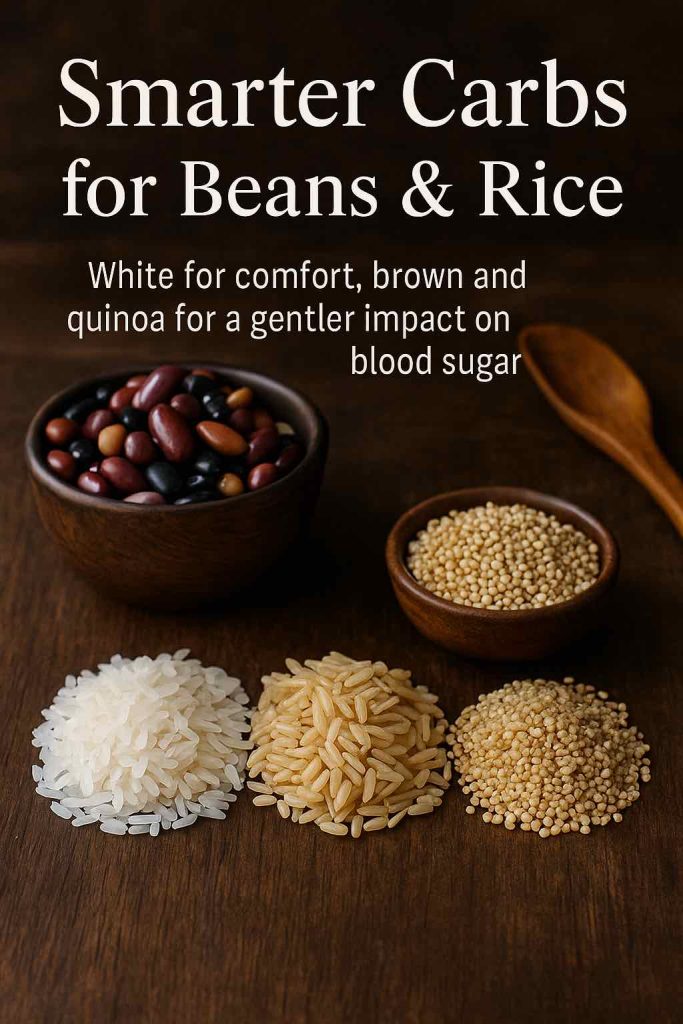

6. What kind of rice should I serve with red beans and rice?

Long-grain white rice is traditional because it stays fluffy and soaks up the sauce beautifully. Brown rice or a mix of white and brown is also great if you prefer more fibre and a nuttier flavour.


7. Can I cook the beans and rice together in one pot?

It’s possible, but not ideal for an authentic red beans and rice dish. The beans need much longer to soften and get creamy, so cooking the rice separately keeps it from turning mushy.


8. How do I make the sauce thicker and creamier?

Once the beans are tender, mash a portion of them against the side of the pot and stir them back in. Let the mixture simmer uncovered until the liquid reduces to a rich, gravy-like consistency.


9. Is red beans and rice supposed to be spicy?

It’s usually gently spicy rather than fiery. You can start with a small amount of cayenne or hot seasoning and add extra at the end, letting everyone adjust heat with hot sauce at the table.
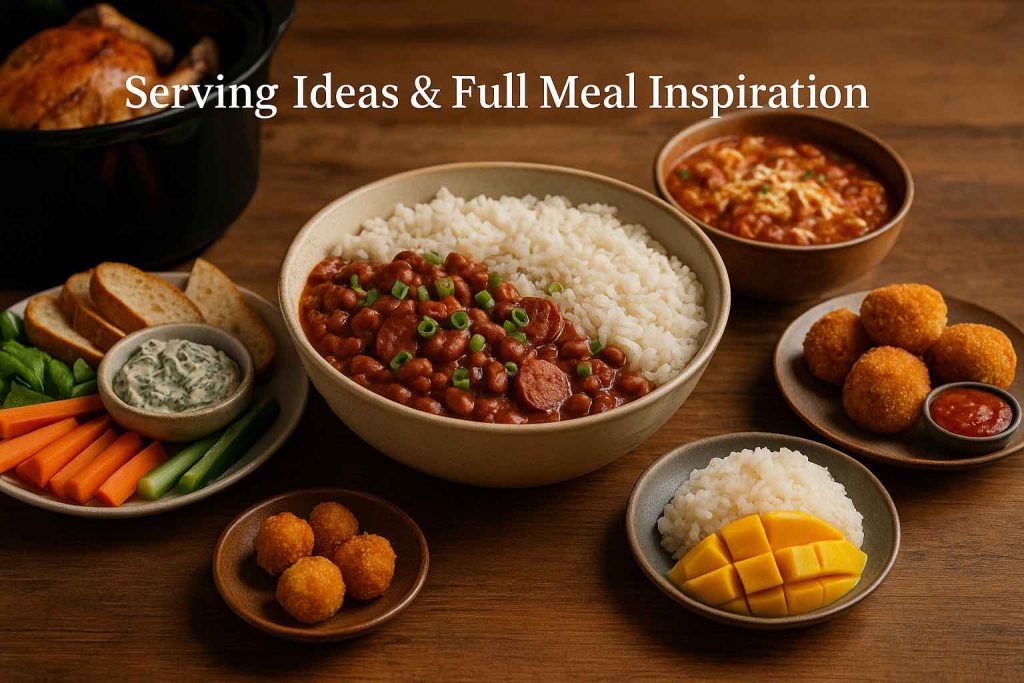

10. What’s the difference between Cajun and Creole red beans and rice?
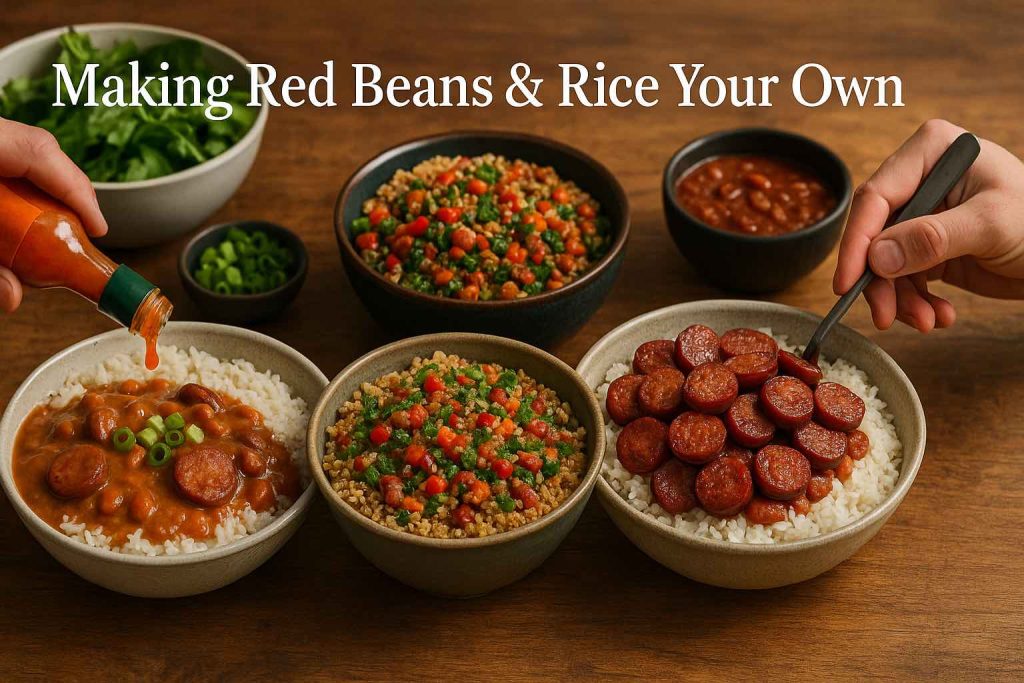
Cajun red beans and rice tends to be more rustic, smoky and robust, often relying heavily on sausage and simple spices. Creole versions may include more herbs or a touch of tomato, giving a slightly more layered, city-style flavour.


11. Can I make red beans and rice in a slow cooker?

Yes, red beans and rice crock pot style is very popular. Sauté the vegetables and sausage first, then transfer everything to the slow cooker with soaked beans and liquid, and let it cook on low until the beans are soft and creamy.


12. How do I adapt red beans and rice for the Instant Pot?

Use the sauté function for the trinity and sausage, then add beans, seasoning and liquid. After that, pressure cook on high until the beans are tender, allow a natural release, and finish by mashing some beans to thicken.


13. How can I make a vegetarian or vegan red beans and rice recipe?

Skip the sausage and ham hock and use oil instead of animal fat. Rely on a bold red beans and rice seasoning mix, vegetable broth and smoked paprika (or a little liquid smoke) to build deep flavour without meat.


14. Is red beans and rice a healthy meal?

Red beans and rice can be very nourishing, especially when you use plenty of beans and a moderate amount of sausage and fat. The beans provide fibre and protein, and you can boost the balance further by serving a salad or vegetables on the side.


15. Why are my red beans still hard after a long cook?

Very old beans, hard water, or adding acidic ingredients too early can keep beans from softening. Next time, use fresher beans, cook them in plain water or stock first, and wait to add vinegar or lots of tomato until the beans are nearly tender.


16. Can I freeze leftover red beans and rice?

Yes, the bean portion freezes very well. It’s best to freeze the red beans separately, then cook fresh rice when you reheat, so the texture stays light and fluffy.


17. How much sausage should I add to red beans and rice?

For a balanced pot, one medium sausage (about 225–300 grams) is usually enough for four to six servings. If you’re aiming for a beans and rice with sausage focus, you can add more to make it extra hearty.


18. How do I make a very simple 3-ingredient red beans and rice?

For the bare minimum, combine cooked red beans, cooked rice, and a flavourful seasoning blend or spiced oil. Warm everything together until the beans are hot and slightly saucy, then adjust salt and chilli to taste.


19. Can I turn this into a meal prep dish for the week?

Yes, red beans and rice is excellent for meal prep. Store the beans and rice in separate containers, then mix them only when reheating so the rice doesn’t absorb too much sauce and lose its texture.


20. What should I serve with red beans and rice?

A simple green salad, coleslaw or roasted vegetables are all good companions for a red beans and rice dinner. For a more indulgent spread, you can add cornbread, garlic bread, or a light dessert to round out the meal.

Posted on 1 Comment

Unveiling the Secret of Beans: A Superfood for Weight Loss

SECRET OF BEANS: A SUPERFOOD FOR WEIGHT LOSS

When it comes to superfoods that support weight loss, beans might not be the first to come to mind. Yet, these humble legumes have quietly earned a reputation as nutritional powerhouses capable of transforming your health and slimming your waistline. From chickpeas to black beans, kidney beans to mung beans, incorporating these versatile foods into your daily diet can unlock a host of benefits — including sustainable weight loss.

In this post, we’ll explore why beans are a secret weapon in weight management, dive into the science behind their fat-burning potential, and share practical tips to include them deliciously in your meals.


Why Beans Deserve a Spot on Your Plate

Beans have been a staple in diets worldwide for centuries — and for good reason. Beyond their affordability and accessibility, they pack a powerful nutritional punch:

1. High Fiber Content — Your Ally for Fullness and Fat Loss

Beans are loaded with dietary fiber, especially soluble fiber, which slows digestion and helps keep you feeling full for longer. This satiety reduces hunger pangs and curbs overeating, a crucial factor in weight management.

Fiber also supports healthy digestion by feeding beneficial gut bacteria, which can indirectly influence metabolism and weight regulation. Research suggests that a fiber-rich diet correlates with reduced body weight and fat mass.

2. Plant-Based Protein — Building Blocks for Lean Muscle

Maintaining muscle mass is essential when losing weight, as muscles burn more calories at rest than fat. Beans provide a significant amount of plant-based protein, which supports muscle repair and growth while being lower in calories and saturated fat than animal proteins.

By combining beans with grains like rice or quinoa, you can obtain a complete protein profile with all essential amino acids.

3. Low Glycemic Index — Stable Blood Sugar for Appetite Control

The low glycemic index (GI) of beans means they release glucose slowly into the bloodstream, preventing the spikes and crashes that lead to cravings and overeating. Stable blood sugar levels are linked to better appetite control and reduced fat storage.

4. Micronutrient Powerhouse — Supporting Overall Health

Beans are rich in essential vitamins and minerals like magnesium, potassium, iron, and folate, all of which play roles in energy metabolism and fat burning. Magnesium, for instance, is critical for hundreds of enzymatic reactions, including those that regulate blood sugar and insulin sensitivity.


Scientific Insights: What Research Says About Beans and Weight Loss

Let’s examine some of the latest scientific findings that shed light on how beans support weight loss and metabolic health:

Chickpeas — Beyond Basic Nutrition

A study presented at the American Society for Nutrition conference revealed that adults with prediabetes who consumed chickpeas daily saw significant reductions in total cholesterol. This indicates improved cardiovascular health, which often accompanies weight loss efforts.

Moreover, chickpeas’ high fiber and protein content contributes to increased feelings of fullness, which helps reduce overall calorie intake.

Black Beans — Fighting Inflammation and Supporting Metabolism

Chronic inflammation is a known contributor to obesity and metabolic disorders. Research shows that black beans help reduce levels of inflammatory markers such as interleukin-6, potentially improving insulin sensitivity and fat metabolism.

The antioxidants and phytochemicals in black beans further promote metabolic health and may aid in reducing body fat.

Kidney Beans — Resistant Starch for Fat Burning

Kidney beans contain a type of carbohydrate called resistant starch, which resists digestion and reaches the colon intact. Here, it acts as a prebiotic, feeding good gut bacteria and producing beneficial short-chain fatty acids.

Resistant starch has been linked to increased fat oxidation (fat burning) and improved insulin sensitivity, both important for weight management.

Mung Beans — Easy on the Digestive System and Low-Calorie

Mung beans are low in calories but high in protein and fiber, making them excellent for weight-conscious individuals. Their easy digestibility makes them suitable for sensitive stomachs and supports consistent nutrient absorption.


How to Incorporate Beans into Your Weight Loss Plan

Eating beans regularly doesn’t have to be boring or complicated. Here are practical tips to include beans in your diet for maximum benefit:

Start Slowly and Build Up

Beans are rich in fiber, so if you’re not used to them, start with small portions and gradually increase. This helps your digestive system adjust and reduces the risk of bloating or gas.

Experiment with Varieties and Recipes

Don’t limit yourself to one type of bean. Rotate among chickpeas, black beans, kidney beans, and mung beans to enjoy diverse flavors and nutrients.

  • Add beans to salads for extra texture and protein.
  • Use mashed beans as a spread or dip.
  • Incorporate beans into soups, stews, chili, and casseroles.
  • Swap beans for meat in tacos, burgers, or pasta dishes.

Combine Beans with Whole Grains

Pair beans with whole grains like brown rice, quinoa, or barley to create complete proteins and balanced meals that keep you full and energized.

Opt for Fresh or Dried Beans

While canned beans are convenient, they often contain added sodium. Choose fresh or dried beans whenever possible and soak or cook them yourself to control salt levels.

Spice It Up

Beans absorb flavors well. Use herbs, spices, garlic, lemon, and vinegar to enhance taste without extra calories.


Debunking Common Myths About Beans and Weight Loss

Myth 1: Beans Cause Weight Gain Because They’re Carbs

Truth: The complex carbohydrates in beans digest slowly, promote satiety, and don’t spike blood sugar like refined carbs do. When eaten as part of a balanced diet, beans support weight loss.

Myth 2: Beans Are Just Filler Food

Truth: Beans are nutrient-dense and provide essential vitamins, minerals, fiber, and protein — making them much more than “filler.”

Myth 3: Beans Make You Bloated and Uncomfortable

Truth: While beans can cause gas initially, proper soaking, cooking, and gradual introduction reduce discomfort. Over time, your gut adapts.


The Sustainable Choice: Why Beans Are Good for You and the Planet

Beyond personal health, beans are an environmentally friendly protein source. They require less water and emit fewer greenhouse gases compared to animal proteins. Including beans in your diet is a win-win for your weight and the planet.


Final Thoughts: Unlock the Weight Loss Power of Beans Today

Beans truly deserve their superfood status. With their potent combination of fiber, protein, and micronutrients, they support appetite control, boost metabolism, and promote overall health. Incorporating a variety of beans into your meals can help you achieve sustainable weight loss while enjoying delicious, satisfying food.

Ready to start your bean journey? Try swapping one meat-based meal per week with a bean-based alternative and experience the difference.

FAQs: Beans and Weight Loss

1. Are beans really effective for weight loss?
Yes. Beans are rich in fiber and protein, which promote fullness and reduce overall calorie intake. Their low glycemic index also helps stabilize blood sugar, preventing cravings and supporting weight management.

2. Which type of beans is best for weight loss?
All beans offer benefits, but chickpeas, black beans, kidney beans, and mung beans are especially effective due to their high fiber, protein, and resistant starch content.

3. Can eating beans cause bloating or gas?
Beans contain fermentable fibers that can cause gas initially. To minimize this, start with small portions, soak dried beans well, rinse canned beans, and gradually increase intake to allow your digestive system to adjust.

4. How much beans should I eat daily to aid weight loss?
Studies suggest that about 3/4 cup (around 130 grams) of cooked beans daily can contribute to modest weight loss and improve diet quality.

5. Are canned beans as healthy as dried beans?
Canned beans are convenient and nutritious but often contain added sodium. Rinse them well before use or choose low-sodium versions. Dried beans cooked at home allow better control over salt content.

6. Can beans replace meat in a weight loss diet?
Absolutely. Beans are a great plant-based protein source that can replace or supplement meat, lowering calorie intake and saturated fat while still providing essential nutrients.

7. Will eating beans make me gain weight because of their carbohydrate content?
No. The carbohydrates in beans are complex and digest slowly, promoting fullness and stable blood sugar rather than fat storage, especially when eaten as part of a balanced diet.

8. How can I include beans in my meals without getting bored?
Try diverse recipes like bean salads, soups, stews, dips, or even bean-based burgers and tacos. Experimenting with different herbs and spices also keeps meals flavorful.

9. Are beans suitable for people with diabetes trying to lose weight?
Yes. Beans’ low glycemic index helps regulate blood sugar levels, making them an excellent food choice for people with diabetes aiming to lose weight.

10. How do beans support gut health?
Beans contain prebiotic fibers that feed beneficial gut bacteria, promoting a healthy microbiome, improving digestion, and supporting metabolism, which are all important for weight management.

Posted on 3 Comments

Authentic Punjabi Style Rajma Curry Recipe

Rajma Chawal is the most iconic dish of North Indian. Beloved by many for its rich flavors and satisfying heartiness. This iconic dish combines the creamy, mildly spicy goodness of Rajma (kidney beans) with the simplicity of steamed rice and onion by the side, creating a meal that is both wholesome and delicious. Rajma is a flavorful curry made with protein-rich kidney beans, onions, ginger, garlic, tomatoes, and an aromatic blend of raw spices. The result is a dish that’s not only incredibly tasty but also packed with nutrients. Whether you’re enjoying it as a part of a weekday meal or serving it up for a special occasion. Join us as we explore the secrets to making this beloved North Indian classic

Ingredients:

1 cup Rajma (Chitra Rajma)
1 large onion, sliced
2 tomatoes, finely chopped
2 tablespoons tomato puree
2 green chillies, slit lengthwise
Handful of fresh coriander leaves, chopped
1 tablespoon ginger garlic paste
1/2 teaspoon turmeric powder
1 teaspoon coriander powder
1 teaspoon cumin powder
1 teaspoon red chili powder
1/2 teaspoon garam masala powder
Salt to taste
3 tablespoons mustard oil
Whole garam masalas (cinnamon stick, cloves, cardamom)

Instructions:

Soak the Rajma in water overnight or for 4-5 hours. Drain the water and rinse the Rajma.

In a large pot, add the soaked Rajma and enough water to cover it. Bring it to a boil and cook until the Rajma becomes tender. This may take around 20-30 minutes. Once cooked, drain the Rajma and set it aside.

In a separate pan, heat 2 tablespoons of mustard oil. Add the sliced onions and fry them until they turn golden brown. Remove the onions from the pan and let them cool. Once cooled, grind them into a paste using a blender or mortar and pestle.

In the same pan, heat the remaining mustard oil. Add the whole garam masalas (cinnamon stick, cloves, cardamom) and sauté them until they release their aroma. Add the green chillies and ginger garlic paste to the pan. Sauté them for a minute until the raw smell disappears. Add the turmeric powder, coriander powder, cumin powder, and red chili powder to the pan. Mix well and cook for a minute.

Add the chopped tomatoes and tomato puree to the pan. Stir everything together and cook for 3-4 minutes until the tomatoes soften and the mixture thickens. Add onion paste and garam masala powder and salt to taste. Mix well. Good garam masala surely enhance the taste of any dish and if the garam masala is homemade nothing is better than that, you can see the detail recipe of Authentic Indian Garam Masala here.

Pour a little water into the pan to adjust the consistency of the gravy. Stir everything together. Add the boiled Rajma to the pan and mix it with the spice mixture. Add more water as needed to cover the Rajma. Cover the pan and let the Rajma simmer on low heat for about 5 minutes, allowing the flavors to blend together. Garnish the Rajma with freshly chopped coriander leaves.

Your Punjabi style Rajma is now ready to be served. Enjoy it with steamed rice, roti, or naan for a delicious and hearty meal.

Do give this recipe a shot. I am sure this will be your family’s new favourite. If you try this recipe, do give us a shout out. Just click a picture and tag us on @masala.monk or use the hashtag #MasalaMonkRecipe and share on Instagram and Facebook. We would love to hear from you. 🙂