Posted on Leave a comment

French Onion Soup Recipe: Classic, Vegetarian, Slow Cooker & No-Wine Options

Classic French onion soup in a ceramic bowl with bubbling browned cheese, toasted bread, and dark onion broth.

This is the kind of soup that rewards the cook who lets the kitchen slow down for a little while. A mountain of sharp raw onions softens in butter, collapses into the pot, turns golden, and slowly becomes mellow, savory, and almost jammy. Then the broth goes in, the bread gets toasted, and the cheese melts over the top until every spoonful breaks through something crisp, bubbling, and deeply comforting.

The best part is that first spoonful: the cheese stretches, the toast softens at the edges, and the broth underneath tastes darker and fuller than the simple ingredient list suggests.

This recipe is built around the three places French onion soup usually fails: pale onions, weak broth, and a risky cheese finish.

This version starts with the classic bistro-style bowl: beef broth, wine or sherry, toasted bread, and Gruyère. The main path is simple — caramelize the onions, deglaze the pot, simmer with broth, toast the bread, and melt the cheese — and every variation in this guide follows that same path.

It is not a weeknight-speed soup. It is the kind of recipe you make when you want a few ordinary onions to slowly turn into something that feels like dinner out, only warmer.

Make It Now

  • Total time: About 1 hour 45 minutes to 2 hours
  • Onion time: 45 to 70 minutes for proper caramelization
  • Best broth: Beef broth for classic; mushroom broth or dark vegetable stock for vegetarian
  • Best cheese: Gruyère, Swiss, or a melty cheese blend
  • No crocks: Broil the cheesy toast separately, then place it on the soup
  • Ready to cook? Jump to the classic recipe

The 3 Things That Make This Soup Work

  1. Cook the onions until deep golden and jammy, not just soft.
  2. Use broth that tastes savory before it goes in.
  3. Toast the bread firmly so the cheese has somewhere to land.

Keep these three foundations in mind as you cook.

Caramelized onions, dark broth, toasted bread, cheese, and French onion soup arranged on a rustic table.
Before assembling the bowl, get the three foundations right: deeply browned onions, broth with real depth, and a cheese finish your kitchen setup can handle safely.

Jump to

Quick Answer

French onion soup is onion soup built around slowly caramelized onions, savory broth, toasted bread, and melted cheese. The cheese-topped version is what most people mean by classic bistro-style French onion soup.
You do not have to use wine or beef broth. For no-wine soup, deglaze with broth and finish with a small splash of vinegar or lemon after simmering. For vegetarian French onion soup, use mushroom broth or dark vegetable stock, then add one savory booster such as vegetarian Worcestershire, tamari, or browned mushrooms.

Need the swaps first? Jump to the vegetarian and no-wine options.

Choose Your French Onion Soup Version

Start with the classic path, then adjust only what your kitchen needs. The onions stay at the center; the broth, wine, cheese, and finishing method can move around them.

Make this when you want a bowl that feels special without needing expensive ingredients. Most of the flavor comes from time, not fuss.

What you wantBest versionRemember
Classic bistro flavorBeef broth, wine or sherry, GruyèreReduce wine before adding broth.
No beef, still savoryDark vegetable stock or mushroom brothAdd one savory booster.
No wine, still balancedDeglaze with brothReplace wine’s acid and fond-loosening job.
Vegetarian, not thinVegetable or mushroom broth plus acid and umamiDo not add every booster at once.
Less stove-watchingSlow cooker onions, then stovetop finish if possibleConvenience improves; browning still matters.
No crocks, no riskBroil cheesy toasts separatelyTop hot soup just before serving.

Classic French Onion Soup Recipe

Start with this stovetop version for the most classic bowl. It looks like restaurant soup, but the actual work is simple: slice onions, cook them slowly, simmer, toast, and melt cheese.

French Onion Soup

Servings: 4 main-course bowls or 6 starter bowls
Prep time: 20 minutes
Cook time: 1 hour 25 minutes to 1 hour 40 minutes
Total time: About 1 hour 45 minutes to 2 hours
Equipment: Large heavy pot or Dutch oven, wooden spoon, baking sheet, broiler-safe crocks or regular bowls plus the separate cheesy-toast method

The timing is flexible because onions vary. Trust the color, smell, and texture more than the clock.

Ingredients

  • 3 lb / 1.35 kg yellow onions, thinly sliced, about 1/8 inch / 3 mm thick
  • 3 tablespoons unsalted butter
  • 1 tablespoon olive oil or neutral oil
  • 1/2 teaspoon fine salt, plus more to taste after simmering
  • 1/2 teaspoon sugar, optional, only if your onions need help browning
  • 3 cloves garlic, minced
  • 1 tablespoon all-purpose flour, optional, for light body
  • 1/2 cup / 120 ml dry white wine or dry sherry, or 1/2 cup / 120 ml extra broth for no-wine soup
  • 6 cups / 1.4 liters beef broth or stock, or up to 7 cups / 1.65 liters for a brothier soup
  • 2 fresh thyme sprigs or 1/2 teaspoon dried thyme
  • 1 bay leaf
  • 1 teaspoon Worcestershire sauce, or vegetarian Worcestershire/tamari for vegetarian soup
  • 1 to 2 teaspoons apple cider vinegar, sherry vinegar, balsamic vinegar, or lemon juice, as needed after simmering
  • Black pepper, to taste
  • 4 to 6 slices baguette, sourdough, or sturdy crusty bread
  • 1 1/2 to 2 cups / 170 to 225 g grated Gruyère, Swiss, provolone, mozzarella, or a mix
  • 2 tablespoons grated Parmesan, optional, for extra savory flavor

Quick notes before you cook: Start light on salt because broth, cheese, Worcestershire, and Parmesan can all be salty. Skip the sugar if your onions brown well. Use 6 cups broth for a thicker bowl, or 7 cups for a brothier one.

Method

Cook the onions

  1. Slice the onions evenly. Aim for about 1/8 inch / 3 mm. Thin, even slices cook more predictably. Too thick and they take much longer; too thin and they can break down or burn at the edges.
  2. Start the onions. Set a large heavy pot or Dutch oven over medium heat. Add the butter and oil. When the butter melts, add the onions and 1/2 teaspoon salt. Stir until coated.
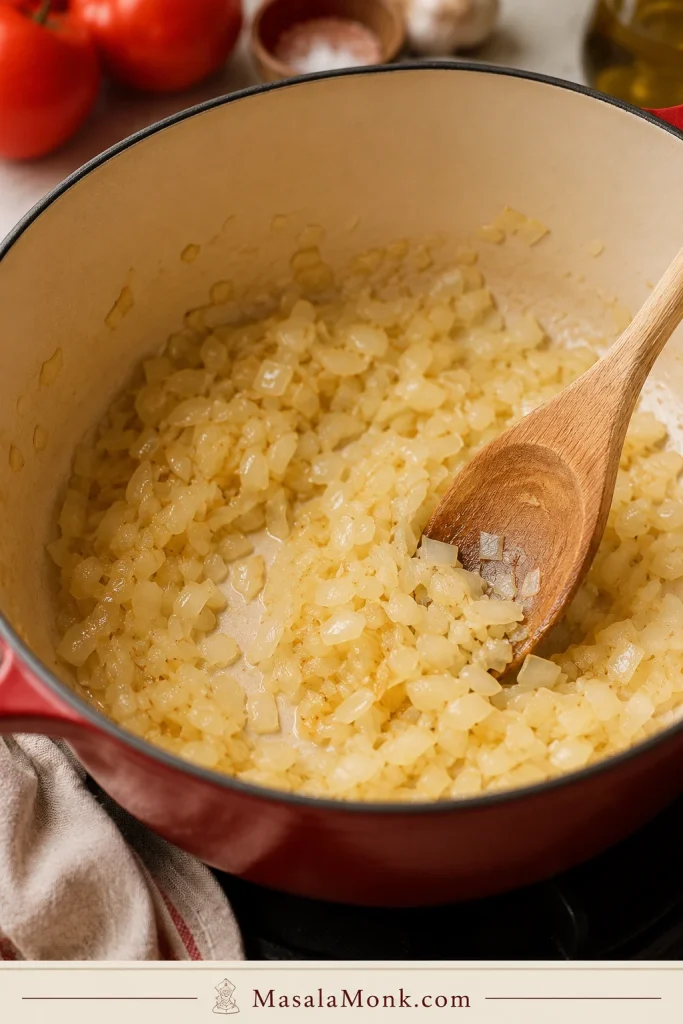
  3. Soften and collapse. Cook for 10 to 15 minutes, stirring often, until the onions release water and shrink down. Do not panic when the pot looks watery at first. That moisture has to cook off before browning can begin.
  4. Caramelize slowly. Lower the heat to medium-low and cook for 35 to 55 minutes more, stirring every few minutes. The onions should turn golden, then deep golden brown, and become soft and jammy. If they hiss loudly, stick hard, or darken too quickly, lower the heat. If the pot gets dry, add a splash of water or broth and scrape the golden browned bits into the onions.
  5. Check before adding liquid. The onion base should already smell like dinner. Look for soft strands, deep golden color, glossy texture, sweet roasted aroma, and browned—not black—bits on the bottom of the pot. If the onions are pale and wet, keep cooking. If the pot smells acrid or the bits are black, do not scrape those burnt spots into the soup.

Build and simmer the base

  1. Add garlic and flour. Stir in the garlic and cook for 30 seconds. If using flour, sprinkle it over the onions and cook for 1 minute, stirring well. The flour should disappear into the onions, not sit in dry clumps.
  2. Deglaze. Add wine or sherry, if using. Scrape the bottom of the pot and simmer until the liquid reduces and no longer smells sharp, about 5 to 8 minutes. The onions should look glossy again. For no-wine soup, use 1/2 cup broth instead.
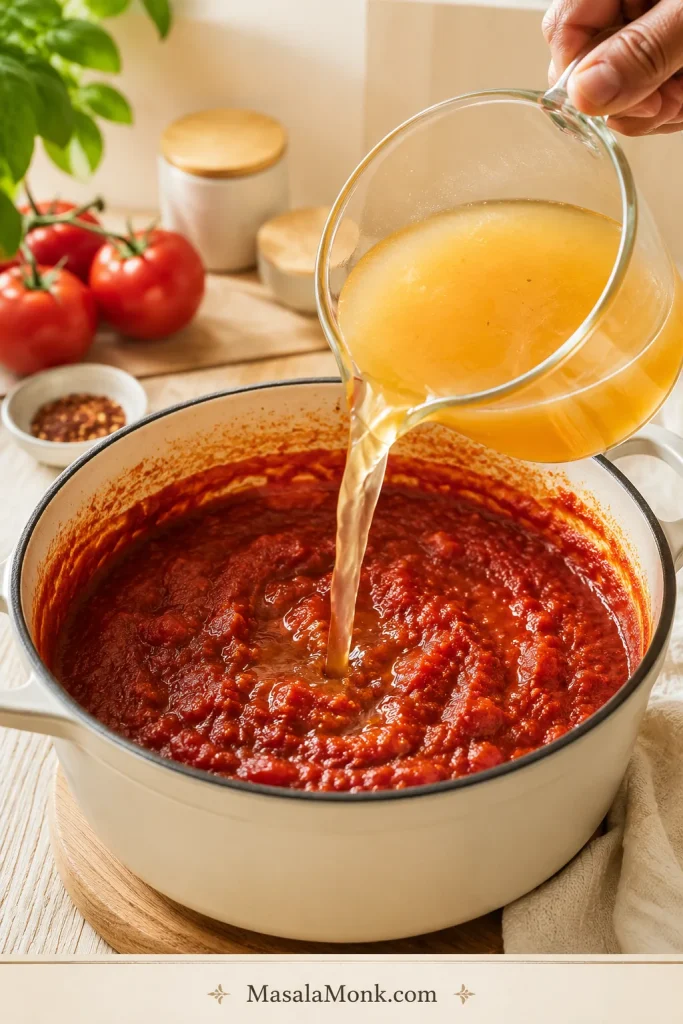
  3. Add broth and herbs. Pour in 6 cups broth for a thicker onion-forward soup, or up to 7 cups for a brothier bowl. Add thyme, bay leaf, Worcestershire if using, and black pepper. Bring to a simmer.
  4. Simmer and taste. Simmer gently for 20 to 30 minutes. Taste and adjust salt. If the soup tastes too sweet or flat, add 1 teaspoon vinegar or lemon juice, then taste again before adding more. The base should taste savory before the bread and cheese go on. Cheese hides many things, but it will not fix weak broth.

Toast, broil, and serve

  1. Toast the bread. While the soup simmers, toast the bread until dry and crisp. Use a 400°F / 205°C oven for 6 to 10 minutes, or toast it in a skillet or toaster. Cut the bread so it sits just inside the bowl or crock.
  2. Finish with cheese. Ladle hot soup into broiler-safe crocks or bowls. Place toasted bread on top, cover with cheese, and broil for 2 to 5 minutes, watching closely, until melted and browned. Without broiler-safe bowls, broil the cheesy toasts separately on a baking sheet and place them on top of the soup.
  3. Serve hot. Let the bowls sit for a minute before serving. The cheese and soup will be very hot.

Short Recipe Notes

  • Vegetarian: Use mushroom broth or dark vegetable stock, plus one savory booster such as tamari, vegetarian Worcestershire, or browned mushrooms.
  • No wine: Deglaze with broth, then add a small splash of vinegar or lemon after simmering to keep the onion sweetness in check.
  • Slow cooker: Cook onions with butter/oil and salt on LOW for 8 to 10 hours, then finish in a pot on the stove for 10 to 15 minutes for better color.
  • Cheese: Gruyère is classic, but Swiss, provolone, mozzarella with Parmesan, or aged cheddar can work.
  • Broiler safety: Only broil in bowls marked broiler-safe. When in doubt, broil the toast, not the bowl.

Why This Recipe Works

The magic is not in a long ingredient list. It is in what happens when onions are given enough time. They lose their sharpness, release their moisture, brown slowly, and turn into the kind of base that makes the whole pot taste more satisfying than it should.

This is the part where the kitchen starts smelling like dinner is worth waiting for.

The broth matters too, but it should not have to do all the work. Beef broth gives the classic bistro flavor. Mushroom broth or dark vegetable stock can still make a satisfying vegetarian version when the onions are cooked well and the seasoning has a little lift.

That final lift is important because caramelized onions are naturally sweet. Wine, sherry, vinegar, lemon juice, Worcestershire, tamari, or a well-seasoned broth can wake up the pot just enough so the bowl tastes savory instead of syrupy.

Toasted bread gives the melted cheese structure, so it can sit on top instead of disappearing into the soup. That final bubbling layer turns a humble onion soup into the bowl people remember.

Back to top

Ingredients and Onion Tips

You do not need rare ingredients, but each one has a job. The onions bring sweetness, the broth brings backbone, the bread supports the topping, and the cheese makes the bowl feel finished.

How to Choose the Ingredients

Onions: Yellow onions are the safest all-purpose choice. They become sweet without making the soup sugary, and they give the broth a savory backbone. Sweet onions work too, but the finished bowl can taste noticeably sweeter. Red onions make a darker soup with a slightly sharper flavor.

Butter and oil: Butter is where the soup starts to smell like something is happening. A little oil helps keep the butter from scorching during the long cook. All butter is fine too, but keep the heat gentle and watch the bottom of the pot.

Broth, Wine, and Seasoning Choices

Taste the Broth Before It Goes In

If the broth tastes watery now, it will taste watery later. Use better stock, simmer weak broth for a few minutes to concentrate it, or add one savory booster before relying on cheese to rescue the bowl.

Dark broth in a measuring cup with a spoon for tasting before making French onion soup.
Taste the broth before it joins the onions. If it tastes weak by itself, add savory support now instead of hoping cheese will fix it later.

If the broth tastes flat or the onions seem too sweet, jump to troubleshooting before adding cheese.

Broth or stock: Classic French onion soup usually uses beef broth or beef stock. For a vegetarian version, use dark vegetable stock or mushroom broth. The broth should taste good before it meets the onions, because a pale base and thin broth will not become deeply savory just because cheese goes on top.

Wine, sherry, or no wine: Dry white wine or dry sherry adds character and helps keep the onion sweetness in check. It is helpful, but not mandatory. In a no-wine version, broth loosens the browned bits and vinegar or lemon replaces the brightness wine would have added.

Flour: Flour is optional, but a small spoonful gives the broth just enough body to cling to the onions. It should not turn the soup into gravy. Skip it for a thinner, clearer broth. When using flour, cook it briefly with the onions before adding liquid so it does not taste raw.

Herbs and seasoning: Thyme and bay leaf should stay in the background. You want people to taste onion first. Garlic helps, but it should not dominate. Worcestershire, tamari, soy sauce, or a small splash of vinegar can round out the pot, especially in no-wine or vegetarian versions. For vegetarian soup, use vegetarian Worcestershire, tamari, or soy sauce instead of regular Worcestershire.

Best Onions for French Onion Soup

The best onions for French onion soup are usually yellow onions. They are savory, reliable, and easy to find. They caramelize well without making the soup taste too sweet.

  • Yellow onions: balanced, savory, gently sweet, and the best everyday choice.
  • Sweet onions: softer and sweeter; good for a sweeter soup, but even better mixed with yellow onions.
  • Red onions: sharper, darker, and slightly fruitier; useful for variation, but they change the color and flavor.
  • White onions: cleaner and sharper; best used with yellow onions instead of alone.
  • Shallots: delicate and sweet; lovely as part of a mix, but expensive for the whole pot.

The slicing matters almost as much as the onion type. Aim for slices about 1/8 inch / 3 mm thick. Very thick slices take longer to soften. Paper-thin slices can break down too much or burn at the edges before the rest of the pot is ready.

Thinly sliced yellow onions piled high in a Dutch oven before cooking French onion soup.
Do not panic when the pot looks crowded. A mountain of sliced onions will shrink down before it ever starts to caramelize.

How to Caramelize Onions Properly

When it feels like nothing is happening for the first 20 minutes, you are probably doing it right. The onions soften before they brown. The waiting is part of the recipe, not a sign that something has gone wrong. Once the onions are glossy and deep gold, the soup starts doing some of the work for you.

Softened sliced onions with visible moisture in a pot during the early stage of French onion soup.
The onions soften and release water before they begin to brown. Keep cooking past this steamy stage so the flavor can move from raw and sharp to sweet.

Read the Onion Stages

StageWhat you seeWhat to do
Wet and paleSteamy, crowded onionsKeep cooking
Soft and glossySharp smell fadesKeep cooking
GoldenFond starts formingStir and scrape gently
Deep golden and jammySweet roasted smell, soft strandsReady for liquid
Black or acridBurnt smell, black bitsDo not scrape burnt fond into the soup

If the pot looks boring for a while, that is normal. The reward comes late: first the sharp smell fades, then the onions turn glossy, and only near the end does the soup begin to smell deep and savory.

Pale softened onions beside deep golden caramelized onions for French onion soup comparison.
This is the color difference that changes the whole pot. Pale onions give you a lighter soup; deep golden onions give you classic French onion soup flavor.

Control Heat and Fond

Use a heavy pot if possible. A Dutch oven, heavy stainless steel pot, or heavy-bottomed saucepan gives the onions time to brown without scorching too quickly. A thin pot can create hot spots, which makes some onions burn while others stay pale.

Golden onions with browned fond forming on the bottom of a pot while cooking French onion soup.
As the onions turn golden, the brown film on the pot becomes part of the flavor. Scrape it in early, while it tastes toasted instead of burnt.

Keep the heat moderate. When the onions are not browning after a long time, raise the heat slightly. When they are sticking hard or the bottom of the pot is getting too dark, add a splash of water or broth and scrape the browned bits into the onions. Golden brown fond is flavor. Black scorched fond is bitterness.

Brown fond and black scorched bits on the bottom of a pot during onion cooking.
Brown bits can enrich the broth, but black scorch can make it bitter. Deglaze before the bottom of the pot crosses that line.

When the fond stays brown and the onions turn glossy, soft, and deep golden, you have the flavor base the soup needs. This is the success state before adding liquid.

Deep golden jammy caramelized onions in a pot, ready for broth in French onion soup.
The target is glossy, soft, and deep golden. Pale onions need more time before they can carry the soup.

For a deeper look at onion color, Serious Eats has a helpful French onion soup guide that explains why rich golden brown is better than burnt-dark.

A small pinch of sugar can help stubborn onions brown, but do not rely on sugar to replace time. This soup should taste like slowly cooked onions, not sweet onion syrup.

Back to top

How the Stovetop Method Works

The stovetop method gives you the most control. Once you understand what each stage is doing, the recipe feels much less mysterious.

On the stove, the onions release water, collapse, and slowly move from pale to golden to deep golden brown. Wine, sherry, or broth lifts the browned bits from the pot, and the final simmer lets the onion base and broth become one soup.

Broth being poured into caramelized onions in a pot to deglaze for French onion soup.
Deglazing turns the browned bits into soup flavor. Wine, sherry, or broth can all loosen the fond and pull it back into the base.

Taste near the end, before the bread and cheese go on. A little salt, acid, or umami can wake up the pot while you can still adjust it easily.

Finished French onion soup base with caramelized onions and dark broth in a pot before adding bread and cheese.
Before any toast or cheese is added, the soup base should already taste complete: onion-rich, savory, gently sweet, and balanced.

Once the stovetop method makes sense, every variation becomes easier. You are not learning four different soups. You are keeping the onions strong, then changing the broth, deglazing liquid, or finishing method to fit your kitchen.

No broiler-safe bowls? Jump to the no-crock cheese method before you finish the topping.

Back to top

Vegetarian and No-Wine Options

Vegetarian French Onion Soup

Vegetarian French onion soup should not taste like onions floating in weak vegetable broth. The stock needs to be dark, savory, and strong enough to support the caramelized onions.

Use mushroom broth or dark vegetable stock when available. Mushroom broth works especially well because it brings earthy savoriness that helps replace some of the depth people expect from beef broth.

Mushroom broth, browned mushrooms, tamari, and caramelized onions for vegetarian French onion soup.
For vegetarian French onion soup, do not rely on plain vegetable stock alone. Mushroom broth, browned mushrooms, tamari, or vegetarian Worcestershire add the missing savory depth.

For the cleanest vegetarian version, choose one savory booster and one brightener. That keeps the soup controlled instead of turning it into a pantry experiment.

NeedUse one of these
More savory depthMushroom broth, browned mushrooms, tamari, vegetarian Worcestershire
More brightnessSherry vinegar, apple cider vinegar, lemon juice
More bodyLonger simmer, stronger stock, slightly more onions

A vegetarian bowl should still feel complete, not like a compromise. When the stock is dark, the onions are properly browned, and the finish has a little brightness, the soup keeps its cozy bistro feel.

  • Replace beef broth: use mushroom broth or dark vegetable stock.
  • Swap regular Worcestershire: use vegetarian Worcestershire, tamari, or soy sauce.
  • Skip the wine: deglaze with broth, then add vinegar or lemon after simmering.
  • For the cheese topping: use Gruyère, Swiss, provolone, mozzarella, or a vegetarian cheese that melts well.

Cheese eaters can finish the soup with Gruyère, Swiss, provolone, mozzarella, or a mix. For strictly vegetarian soup, check the cheese label because some cheeses use animal rennet. For a vegan version, use olive oil instead of butter, vegan Worcestershire or tamari, and your preferred vegan cheese or cheesy toast alternative.

Skipping wine too? Jump to the no-wine method for deglazing and acid balance.

No-Wine French Onion Soup

No-wine French onion soup can still taste deep and complete. You only need to replace wine’s two jobs: loosening the browned bits from the pot and balancing the natural sweetness of the onions.

Broth, vinegar, lemon, and caramelized onions arranged for no-wine French onion soup.
For a no-wine version, use broth to loosen the fond, then add a tiny splash of vinegar or lemon to balance the onions’ sweetness.

For a no-wine version, deglaze with broth instead of wine. Scrape up the browned bits, then simmer as usual. After the soup has simmered, taste it and add a small balancing ingredient if needed. Start with 1 teaspoon, taste, and stop as soon as the bowl feels brighter.

  • Apple cider vinegar: gently brightens the soup.
  • Balsamic vinegar: adds roundness and a little sweetness.
  • Lemon juice: lifts heavy flavors.
  • Worcestershire sauce: adds savory weight.
  • Vegetarian Worcestershire: adds weight without meat-based ingredients.
  • Tamari or soy sauce: adds umami and saltiness, so use carefully.

The point is not to make the soup sour. The point is to wake up the sweetness of the onions so the bowl tastes rounded instead of heavy.

Making it vegetarian as well? Jump back to the vegetarian broth tips and choose one savory booster.

Back to top

Slow Cooker Option, Plus an Instant Pot Note

Slow Cooker French Onion Soup

The slow cooker does not make the soup faster; it makes the waiting easier. It can handle the long onion softening while you do something else. A short stovetop finish is only there if you want deeper color and a more developed base.

Soft onions cooked down in a slow cooker for French onion soup.
Slow cooker onions save attention, not time. For deeper flavor, give pale or wet onions a quick stovetop finish before adding broth.

For the easiest version, add sliced onions, butter or oil, and salt to a 5-quart or larger slow cooker. Cook on LOW for 8 to 10 hours, until the onions are very soft and browned around the edges. If they look pale and wet, transfer them to a pot and cook for 10 to 15 minutes to concentrate the color and flavor.

Slow cooker baseAmount
Sliced onions3 lb / 1.35 kg
Butter and oil3 tablespoons butter + 1 tablespoon oil
Salt1/2 teaspoon to start
Slow cooker time8 to 10 hours on LOW
Best flavor finish10 to 15 minutes on the stove
Broth simmer20 to 30 minutes on the stove, or 1 to 2 hours more in the slow cooker

Using pressure cooking instead? Jump to the Instant Pot note.

After the onions are ready, add broth, thyme, bay leaf, and seasoning, then simmer until the soup tastes rounded. Finish with toasted bread and cheese.

If you like cozy slow cooker dinners built around French onion flavor, this Slow Cooker French Onion Chicken is another easy comfort-food option.

Instant Pot Note

You can make the soup in an Instant Pot, but pressure cooking does not replace caramelization. Use sauté mode first, give the onions 20 to 30 minutes to soften and brown, then add broth and seasonings. Pressure cook for 5 to 6 minutes, release pressure carefully, taste and adjust, then finish with toasted bread and cheese. If the onions are pale before pressure cooking, the finished soup will taste less developed.

Onions browning on sauté mode inside an Instant Pot for French onion soup.
In an Instant Pot, sauté first and pressure cook second. The onion color has to develop before the broth goes in.

Back to top

Cheese, Bread, and Bowls

Best Cheese for French Onion Soup

Gruyère is the classic choice because it melts smoothly and has a nutty, savory flavor that suits the sweet onions. The best topping melts well, browns in spots, and still tastes good once it stretches.

Close-up of bubbling browned cheese on top of French onion soup after broiling.
Broil just until the cheese bubbles and browns in patches. Pull it before the golden spots turn black.
  • Gruyère: the classic choice; nutty, rich, and beautifully melty.
  • Swiss: mild, melty, and a good substitute for Gruyère.
  • Provolone: smooth, stretchy, and mild.
  • Mozzarella: excellent for cheese pull, but mild in flavor.
  • Parmesan: salty and savory; best mixed with another cheese.
  • Aged cheddar: not classic, but flavorful and practical.
  • Processed cheese: melts easily, but can make the soup taste saltier and more snack-like.

If Gruyère is too expensive or hard to find, use mozzarella for melt and add Parmesan, aged cheddar, or a sharper cheese for flavor. Mostly mozzarella needs a small amount of Parmesan or sharp cheddar so the topping has flavor, not just stretch.

Spoon lifting French onion soup with melted cheese stretching from toasted bread.
When the bread is sturdy and the cheese melts properly, each spoonful catches the best parts: broth, onions, toast, and a satisfying cheese pull.

Best Bread for French Onion Soup

The toast keeps the cheese from sinking straight into the soup. It should be crisp enough to hold, but porous enough to soften at the edges. Baguette is classic because it is sturdy and easy to slice into rounds, but you have options.

Firm toasted bread held above a bowl of French onion soup base to show size and texture.
Toast the bread until it feels dry and firm. That structure helps it support melted cheese without disappearing into the broth.
  • Baguette: classic, sturdy, and ideal for individual bowls.
  • Sourdough: flavorful and strong enough for soup.
  • Country bread: good for larger bowls if cut to fit.
  • Crusty rolls: useful when baguette is not available.
  • Regular sandwich bread: only use if toasted very firm; otherwise it gets soggy quickly.

Cut the bread so it sits just inside the bowl or crock. It should cover much of the surface without forcing you to wrestle with it. Toast it before adding cheese. Soft bread under melted cheese may look good for a moment, but it sinks and turns mushy quickly.

If your cheese sinks or the bread turns soggy, jump to troubleshooting before serving.

For a homemade bread side on another soup night, this Homemade Garlic Bread Loaf can be torn, toasted, or served beside a cheesy bowl.

No Broiler-Safe Crocks? Broil the Toast, Not the Bowl

French onion soup is often served in handled crocks because they can go under the broiler and hold heat well. But you do not need special crocks, and you should not risk a favorite bowl just for melted cheese.

Bowls marked only oven-safe are not automatically safe under the broiler. Broilers use intense direct heat, and some ceramic, stoneware, or glass dishes can crack or break if they are not made for it. For cookware safety, Southern Living’s guide on oven-safe versus broiler-safe dishes is worth checking before putting bowls under direct heat.

Cheesy toasts broiled on a sheet pan with bowls of French onion soup nearby.
Instead of putting regular bowls under intense heat, melt the cheese on toast separately. You still get the browned French onion soup topping without risking cracked dishes.

No-Crock Method

  1. Toast the bread until dry and crisp.
  2. Add cheese on top of the toast.
  3. Broil the cheesy toasts on a baking sheet until melted and browned.
  4. Ladle hot soup into regular bowls.
  5. Place the cheesy toast on top just before serving.

This gives you the same bubbling, browned cheese moment without guessing whether your bowls can handle the heat.

Broiled cheesy toast being placed with tongs on top of French onion soup in a regular bowl.
After broiling, move the cheesy toast onto the hot soup right before serving. The edges stay crisp while the center softens into the onion broth.

Back to top

Troubleshooting French Onion Soup

Most problems show up before the bowls reach the table, which is good news. Taste the pot while you can still fix it.

Scan the row that matches your pot; you do not need to read the whole table before cooking.

ProblemLikely causeHow to fix it
Soup tastes too sweetSweet onions, sugar, or not enough acidAdd a small splash of vinegar, lemon juice, Worcestershire, or tamari. Next time, use yellow onions and skip the sugar.
Soup tastes bitterBurnt onions or blackened fondDo not scrape black bits into the pot. Lower the heat next time and deglaze earlier.
Soup tastes like wineWine was not reduced enoughSimmer longer so the sharp wine flavor cooks off. Next time, reduce wine until the onions look glossy and jammy again.
Soup is too saltySalty broth, bouillon, Worcestershire, cheese, or reduced liquidDilute with unsalted broth or water. Add a small splash of acid to balance. Be careful adding more cheese.
Soup tastes wateryWeak stock or rushed onionsSimmer longer, use better stock, or add a small umami boost like Worcestershire, tamari, or mushroom broth.
Soup tastes flatNot enough salt, acid, or savory weightAdd salt carefully, then a tiny splash of vinegar or lemon. For vegetarian soup, add tamari or vegetarian Worcestershire.
Cheese sinksBread was too soft or too thinUse sturdier bread and toast it until crisp before adding cheese.
Bread turns soggy immediatelyBread was not toasted enoughToast bread until dry and firm. Add it right before serving.
No safe bowls for broilingBowls are not broiler-safeBroil cheesy toasts separately on a baking sheet and place them on top of the soup.

Back to top

Shortcuts and Lighter Options

Shortcut Reality Check

Shortcuts can help on a busy night, but they cannot replace the slow onion flavor that makes the bowl taste homemade.

  • French onion soup mix: seasoning, not a real soup base. Use it for dips, casseroles, and quick pantry meals.
  • Canned, condensed, or frozen soup: convenient, but better with extra caramelized onions, black pepper, thyme, toasted bread, and better cheese.
  • Best homemade shortcut: caramelize the onions ahead, store the base, and finish the soup fresh later.

For less stovetop attention, you can also caramelize onions in a covered Dutch oven in the oven, stirring occasionally, then finish the soup on the stove. It still takes time, but it needs less watching.

Lighter and Special-Diet Options

Once the classic bowl is understood, you can lighten it without losing the point of the soup. The onions still need time, and the broth still needs flavor.

  • Lower sodium: use low-sodium or unsalted broth, start with less salt, and season at the end. Remember that cheese, Worcestershire, bouillon, and Parmesan can all add salt.
  • Lower carb: use a smaller piece of toast or make cheese toasts separately and use less bread. The onions still contain natural carbohydrates, so this is lower-carb, not zero-carb.
  • Gluten-free soup: skip the flour, use gluten-free bread, and check broth, Worcestershire, and tamari labels.
  • Lighter bowl: use less cheese and a slightly brothier ratio, but do not rush the onion caramelization.
  • Lighter vegetarian version: use vegetable or mushroom broth and moderate the cheese, but avoid weak stock or the soup will taste watery.

For a broader look at onions in lower-carb eating, see MasalaMonk’s guide to whether onions are suitable for a keto diet.

Back to top

Storage, Reheating, and Serving

Storage, Freezing, and Reheating

The soup stores best before the bread and cheese are added. Keep the soup base separate, then finish each bowl fresh when you are ready to eat.

French onion soup base stored in glass containers with toasted bread and cheese kept separate.
For the best make-ahead texture, store only the onion soup base. Add fresh toast and cheese after reheating, not before storage.
  • Refrigerator: Store the soup base in an airtight container for 3 to 5 days.
  • Freezer: Freeze the soup base for up to 3 months.
  • Reheating: Reheat gently on the stove until hot. Taste again because salt and sweetness can feel stronger after storage.
  • Bread and cheese: Add fresh toast and cheese after reheating. Do not freeze fully assembled soup with bread and cheese if you care about texture.

If the soup thickens in the fridge, loosen it with a splash of broth or water while reheating. If it tastes flat after reheating, a few drops of vinegar or lemon juice can bring it back.

What to Serve with French Onion Soup

Serve it in small bowls as a starter, or make it the whole dinner with extra toast and a sharp salad. Because the soup is rich, salty, sweet, and cheesy, it pairs best with something fresh, crisp, or simple.

  • A crisp green salad with vinaigrette
  • Roast chicken
  • Steak or simple grilled meat
  • Roasted vegetables
  • Grilled cheese or cheese toast
  • Crusty bread and butter
  • A simple pasta or baked potato on the side

For a crisp, steakhouse-style side, MasalaMonk’s Wedge Salad Recipe works well beside a cheesy bowl because the cold lettuce and sharp dressing cut through the sweetness of the onions.

If you are planning a soup night with more vegetables, beans, and pasta, MasalaMonk’s Minestrone Soup Recipe is a lighter, hearty bowl to keep in rotation.

Give the onions time, finish the bread and cheese safely, and the bowl gives you everything French onion soup is supposed to give: sweet onions, savory broth, crisp toast, bubbling cheese, and that first spoonful that makes the wait feel sensible.

Back to top

FAQs

What are the best onions for French onion soup?

Yellow onions are the best all-purpose choice. They caramelize well and give the soup a rounded, savory-sweet flavor without making it too sweet.

How long should onions caramelize for French onion soup?

Plan on 45 to 70 minutes. The onions should be soft, deep golden brown, and jammy, not pale and not blackened.

Do you need beef broth for French onion soup?

No. Beef broth is classic, but mushroom broth or dark vegetable stock can also work. Taste the broth first; if it tastes weak before simmering, the soup will need help.

How do you make vegetarian French onion soup taste rich?

Use mushroom broth or dark vegetable stock, then add one savory booster such as vegetarian Worcestershire, tamari, or browned mushrooms.

What can replace wine in French onion soup?

Use broth to deglaze the pot, then add 1 teaspoon vinegar or lemon juice near the end. The goal is balance, not sourness.

Which cheese melts best on French onion soup?

Gruyère is classic because it melts smoothly and tastes nutty. Swiss, provolone, mozzarella, and aged cheddar can also work; if using mostly mozzarella, add Parmesan or a sharper cheese for flavor.

What bread works best for French onion soup?

Baguette is classic, but sourdough, country bread, crusty rolls, or any sturdy toasted bread can work. Toast it until dry and firm.

Do you need oven-safe crocks?

No. Without broiler-safe crocks, broil the cheesy toasts separately on a baking sheet and place them on top of the hot soup.

Is slow cooker French onion soup as good as stovetop?

It can be very good, but the flavor is usually deeper when the onions get a short stovetop finish before the broth goes in.

Is French onion soup mix the same as French onion soup?

No. French onion soup mix is a dry seasoning blend; it does not replace the flavor of slowly caramelized onions.

Why is my French onion soup too sweet?

Very sweet onions, extra sugar, or too little acid can make the soup taste sweet. Add a small splash of vinegar or lemon juice to balance it.

Why does French onion soup taste bitter?

Bitterness usually comes from burnt onions or blackened bits scraped from the pot. Brown fond is good; do not scrape black scorched bits into the soup.

Can French onion soup be frozen?

Yes. Freeze the soup base without bread and cheese for up to 3 months, then reheat and finish with fresh toast and cheese.

Back to top

Posted on Leave a comment

Minestrone Soup Recipe

Bowl of minestrone soup with tomato broth, white beans, kidney beans, small pasta, carrots, zucchini, greens, herbs, and bread on the side.

A good minestrone soup should look generous before you even take the first spoonful: tender vegetables, creamy beans, small pasta, herbs, and a tomato broth that tastes rich instead of watery. The first spoonful should catch a little of everything — a soft bean, a piece of pasta, sweet carrot, zucchini, greens, and enough tomato broth to pull it all together.

This pot works because it protects the three things that matter most in minestrone: rich tomato broth, vegetables with texture, and pasta that does not turn the leftovers into mush. Even a half-used zucchini, a tired carrot, two cans of beans, and the last handful of pasta can become a proper dinner.

Homemade minestrone also gives you something canned soup rarely does: better texture. The vegetables do not have to be overcooked, the pasta can stay tender, and you control the salt, broth, and finish.

Cooking now? Jump to the recipe card. The notes below help keep the broth rich, the vegetables tender, and the leftovers useful.

What a Good Minestrone Spoonful Should Show

Before you start, notice the target balance: beans, vegetables, pasta, greens, and tomato broth should all show up in the same spoonful.

Spoon lifting minestrone soup with small pasta, white bean, kidney bean, carrot, zucchini, greens, and tomato broth dripping back into the bowl.
This spoonful shows the balance you want: beans for body, vegetables for freshness, small pasta for comfort, and tomato broth tying everything together.

Recipe at a Glance

Prep time20 minutes
Cook time45 minutes
Total time1 hour 5 minutes
Faster versionAbout 40 to 45 minutes with smaller diced vegetables, the full 6 cups broth, and a shorter 15 to 20 minute base simmer
Servings6 generous bowls
YieldAbout 11 to 13 cups soup
MethodStovetop
Best pot5 to 6 quart / 5 to 6 liter Dutch oven or heavy soup pot
Best forWeeknight dinner, meal prep, and freezer-friendly soup base
DietMeatless when made with vegetable broth; vegan option

The Minestrone Rule of 5: soften the aromatics, build the tomato base, add beans for body, keep the pasta small, and save tender greens for the end. Vegetables can change; the rhythm is what keeps the pot balanced.

Why this works: tomato paste gives the soup depth, beans make it feel full, late-added vegetables keep their shape, and pasta goes in only when the broth already tastes good. That is what keeps the soup hearty without letting it turn heavy or dull.

The Minestrone Rule of 5

This visual is the memory hook for the whole recipe: keep the rhythm steady, even when the vegetables change.

Rustic board showing minestrone ingredients arranged as aromatics, tomato base, beans, small pasta, and leafy greens.
Use the Minestrone Rule of 5 when you want the recipe to feel flexible: aromatics, tomato base, beans, small pasta, and greens are the core building blocks.

Easy minestrone ratio: for 6 bowls, use about 5 to 6 cups broth, 2 cans beans, 4 to 5 cups chopped vegetables, and 3/4 cup small pasta.

Short on time? Dice the vegetables smaller, use the full 6 cups broth, and simmer the soup base for 15 to 20 minutes before adding pasta and greens. The full cook gives deeper flavor, but the faster version still makes a good weeknight bowl.


Minestrone Soup Recipe Card

Description: A hearty minestrone soup with vegetables, beans, small pasta, and a rich tomato broth. It is meatless when made with vegetable broth, cozy without cream, and easy to adjust for leftovers or a thicker dinner-style bowl.

Prep: 20 minutes | Cook: 45 minutes | Total: 1 hour 5 minutes | Serves: 6 generous bowls | Yield: about 11 to 13 cups

Equipment: 5 to 6 quart / 5 to 6 liter Dutch oven or heavy soup pot, knife, cutting board, can opener, colander, wooden spoon, and ladle.

Ingredients

Base

  • 2 tablespoons olive oil, plus more for finishing, about 30 ml
  • 1 medium yellow onion, diced, about 150 to 180 g
  • 2 medium carrots, diced, about 130 to 160 g
  • 2 celery ribs, diced, about 90 to 120 g
  • 4 garlic cloves, minced
  • 3 tablespoons tomato paste, about 45 g

Broth and Seasoning

  • 1 can crushed or diced tomatoes, 28 oz / 794 g
  • 5 to 6 cups vegetable broth, 1.2 to 1.4 liters
  • 1 bay leaf
  • 1 1/2 teaspoons Italian seasoning
  • 1/2 teaspoon dried oregano, optional
  • 1/4 teaspoon red pepper flakes, optional
  • 1 teaspoon kosher salt or 3/4 teaspoon fine salt, plus more to taste; start with less if your broth is salted
  • 1/2 teaspoon black pepper, plus more to taste
  • 1 parmesan rind, optional; skip for vegan minestrone

Beans, Vegetables, and Pasta

  • 1 can cannellini beans or white beans, 15 oz / 425 g, drained and rinsed
  • 1 can kidney beans, 15 oz / 425 g, drained and rinsed
  • 1 cup chopped green beans, about 100 to 125 g
  • 1 medium zucchini, diced, about 180 to 220 g
  • 3/4 cup small pasta such as ditalini, small shells, elbows, or macaroni, about 75 to 90 g
  • 2 cups packed spinach or chopped kale, about 60 to 80 g

Finish

  • 1 to 2 teaspoons lemon juice or red wine vinegar, 5 to 10 ml
  • 1/4 cup chopped parsley or basil, about 10 to 15 g
  • Extra olive oil, for finishing
  • Grated parmesan, optional, for serving

Instructions

  1. Heat olive oil in a 5 to 6 quart / 5 to 6 liter Dutch oven or heavy soup pot over medium heat.
  2. Add onion, carrot, celery, and salt. Cook for 7 to 10 minutes, stirring often, until softened and fragrant.
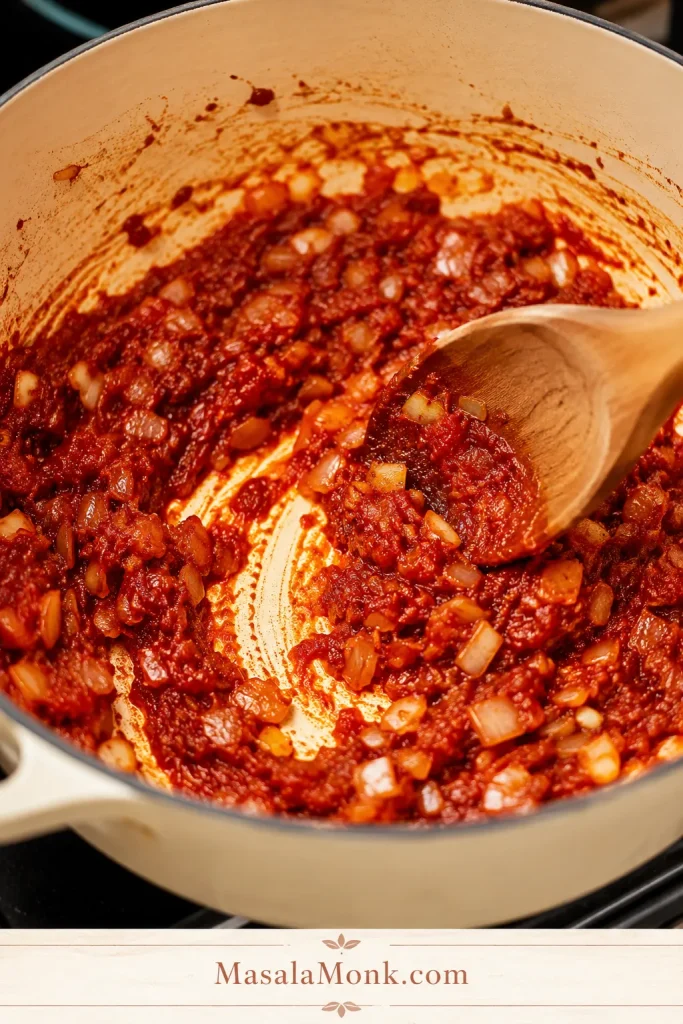
  3. Add garlic and tomato paste. Cook for 1 to 2 minutes, stirring often, until the tomato paste darkens slightly.
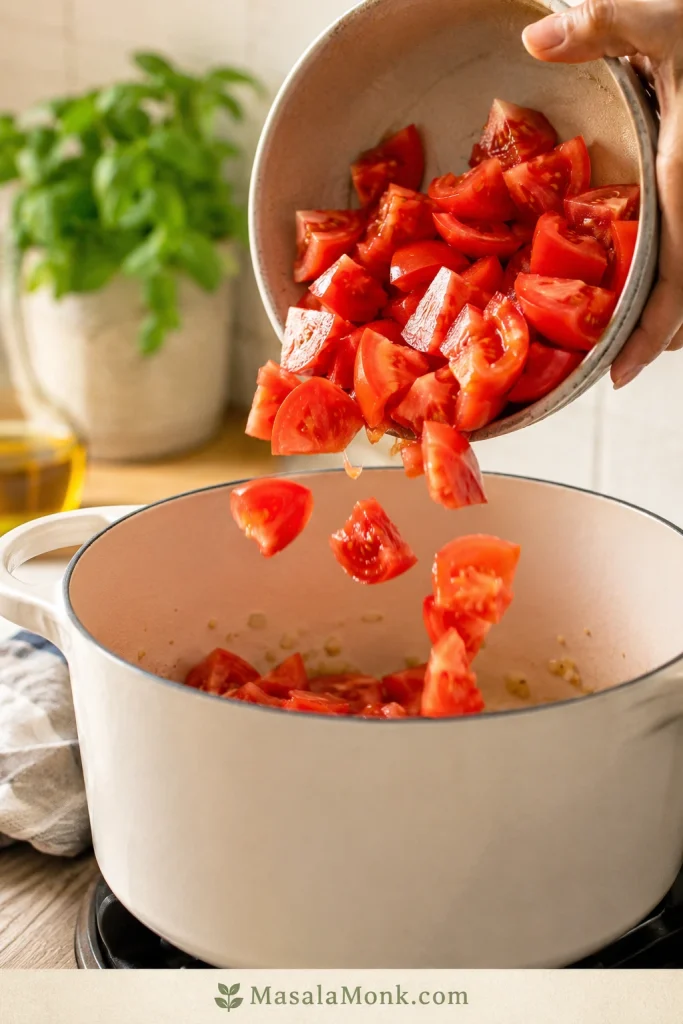
  4. Add crushed or diced tomatoes, vegetable broth, bay leaf, Italian seasoning, oregano if using, red pepper flakes if using, black pepper, and parmesan rind if using. Stir well and scrape the bottom of the pot.
  5. Add the cannellini beans and kidney beans. Bring to a boil, then reduce to a gentle simmer.
  6. Simmer partly covered for 20 to 25 minutes, until the broth tastes developed. Add firm vegetables such as cabbage, potato, or squash during this simmer if using them.
  7. Add green beans, zucchini, and pasta. Cook for 8 to 10 minutes, or until the pasta is just tender.
  8. Stir in spinach or kale and cook for 1 to 3 minutes, just until wilted.
  9. Remove the bay leaf and parmesan rind. Stir in lemon juice or red wine vinegar, parsley or basil, and a drizzle of olive oil.
  10. Taste and adjust salt, pepper, and acidity. Let the soup rest for 5 minutes before serving.
  11. Serve hot with parmesan, extra herbs, crusty bread, garlic bread, or a simple salad.

Recipe Notes

  • Brothier soup: use 3/4 cup pasta and the full 6 cups broth.
  • Thicker soup: use 1 cup pasta or mash 1/2 cup beans into the broth.
  • Firmer zucchini: add zucchini during the final 5 minutes instead of with the pasta.
  • Better leftovers: cook pasta separately and add it to bowls.
  • Vegan version: use vegetable broth and skip parmesan rind and parmesan cheese.
  • Meal prep: toss separately cooked pasta with a tiny drizzle of olive oil after draining so it does not clump.
  • Gluten-free version: use gluten-free pasta or rice, preferably cooked separately.
  • Rice version: cooked rice is easiest. Add it near the end or directly to bowls because rice absorbs broth quickly.
  • Extra richness: simmer with a parmesan rind or finish with olive oil and herbs.

The recipe works on its own, but the notes below help you adjust the beans, pasta, vegetables, storage, and appliance methods without losing the minestrone feel. If leftovers matter, the storage and freezing notes are especially useful.

Before the deeper notes, this quick visual ratio gives you a flexible way to adjust the pot without losing the minestrone balance.

Easy Minestrone Ratio

Use this ratio when you want to adjust the recipe without losing the soup’s balance.

Broth, beans, chopped vegetables, and small pasta arranged on a rustic counter as an easy minestrone ratio guide.
Instead of measuring every vegetable perfectly, follow the ratio: broth keeps it loose, beans make it filling, vegetables add bulk, and pasta should stay modest.

What Is Minestrone Soup?

Minestrone is an Italian vegetable soup made with vegetables, beans, tomatoes, broth, herbs, olive oil, and usually pasta or rice. Classic minestrone is not about one fixed vegetable list; it is about building a generous, seasonal soup with enough beans and starch to feel like a meal.

That is why one pot might have zucchini and green beans while another has cabbage, kale, potato, or squash. A good bowl should be crowded, not dry: enough vegetables and beans to make it feel like dinner, but enough tomato broth to keep it unmistakably soup.

Why You’ll Like This Recipe

  • The broth tastes built, not diluted. Tomato paste, sautéed aromatics, herbs, beans, and olive oil give it a rounded tomato flavor.
  • The vegetables keep their texture. Firm vegetables simmer first, while zucchini and greens go in later.
  • The pasta will not hijack the leftovers. Cook it in the soup when serving right away, or separately when you want better storage.
  • It starts meatless. Use vegetable broth, and the whole pot stays hearty without meat.
  • It gives you room to use what you have. Small shells, elbows, ditalini, zucchini, green beans, cabbage, kale, spinach, white beans, kidney beans, or chickpeas can all work.
  • It can be lighter or heartier. Use more greens and less pasta for a lighter bowl, or extra beans and a little more pasta for a thicker dinner-style soup.

Minestrone feels hearty without cream because beans, vegetables, pasta, and olive oil do the work. If you like cozy tomato-and-pasta dinners, this sits near the same comfort zone as baked ziti, but it is lighter, brothier, and packed with vegetables.

Minestrone Soup Ingredients

These ingredients follow the same Rule of 5: aromatics, tomato broth, beans, small pasta or rice, and tender greens at the end. Do not worry if you are missing one vegetable. Minestrone is forgiving as long as the base stays balanced.

If you are missing one vegetable or bean, check the easy minestrone swaps before changing the broth or pasta ratio.

Ingredients for minestrone soup on a counter, including tomatoes, broth, beans, pasta, carrots, celery, onion, garlic, zucchini, green beans, greens, herbs, olive oil, and parmesan rind.
Each minestrone ingredient has a role: aromatics create sweetness, tomatoes shape the broth, beans add substance, pasta brings comfort, and greens freshen the finish.

If you remember one thing: taste the broth before adding pasta. When it tastes thin or flat at that point, fix the broth first; pasta will not rescue a weak soup.

Build the Aromatic Base

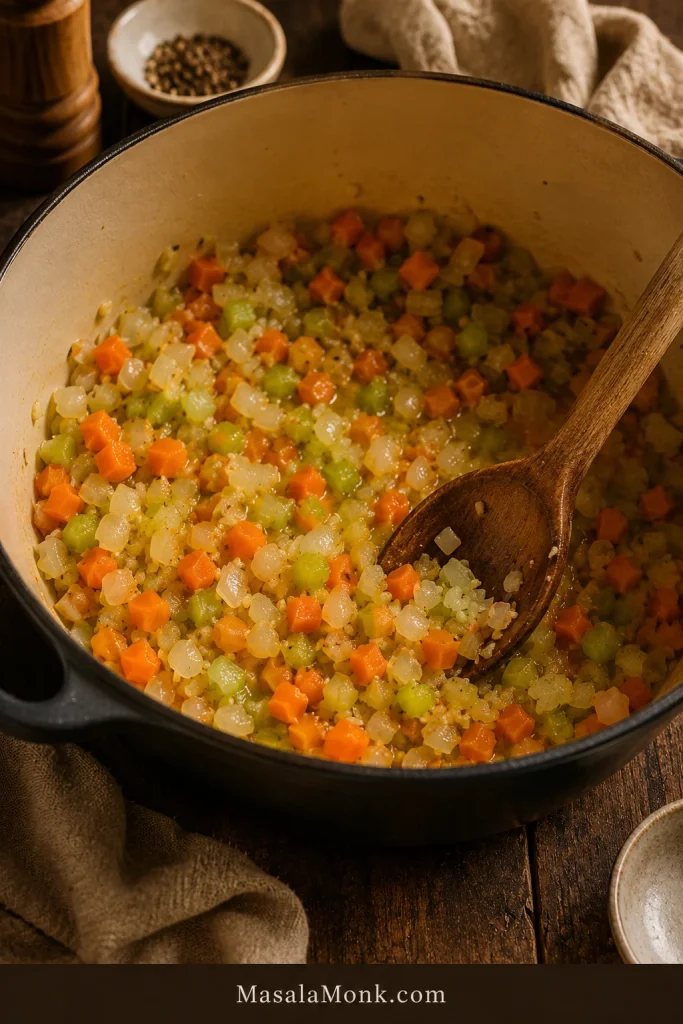
Onion, carrot, celery, garlic, and olive oil create the base. Cook the onion, carrot, and celery until the sharp onion smell softens and the pot starts smelling sweet. The onion should look translucent and the carrot edges should soften. This is the first moment the soup starts smelling like dinner instead of chopped vegetables.

Onion, carrot, and celery sautéing in olive oil inside a Dutch oven with a wooden spoon.
First, cook the onion, carrot, and celery until they soften and smell sweet. This step gives homemade minestrone a deeper base before the tomatoes arrive.

Cook the Tomato Paste Before Broth


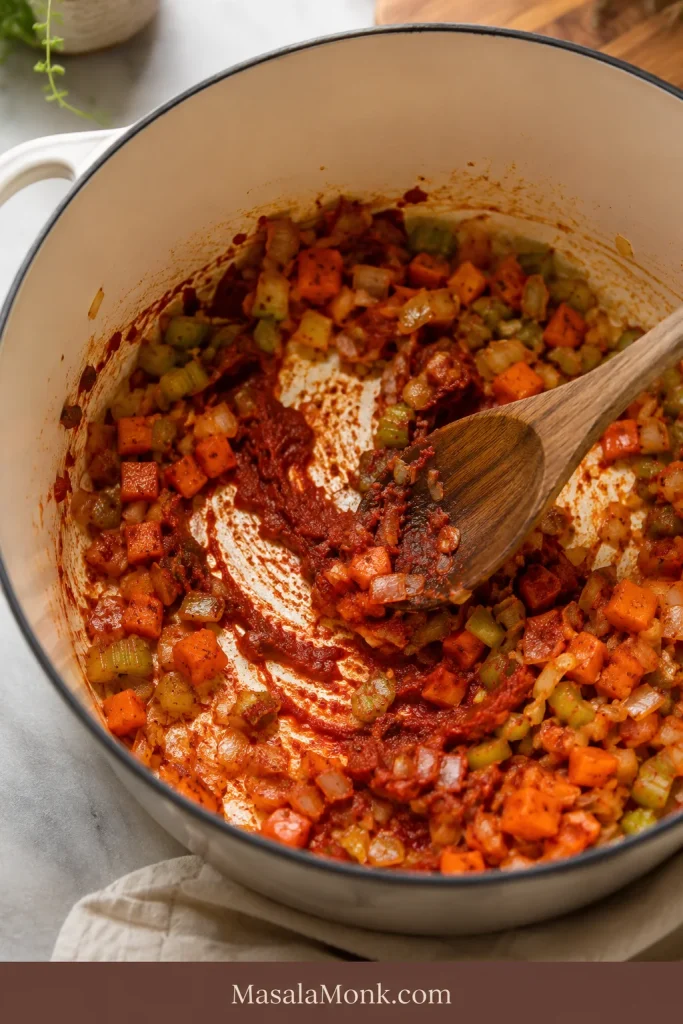
Tomato paste and a large can of crushed or diced tomatoes give the broth its color and flavor. Cook the tomato paste until it darkens slightly; it should leave orange-red streaks on the bottom of the pot, not black bits. Crushed tomatoes make a fuller, smoother broth, while diced tomatoes give a chunkier texture.

Tomato paste cooked with onion, carrot, and celery in a pot, with a wooden spoon dragging through the red paste.

Next, let the tomato paste cook briefly with the aromatics. It deepens the soup base and helps the broth taste rich instead of thin.

Broth


Vegetable broth keeps the soup meatless and easy to make vegan. Chicken broth also works if you are not keeping the soup vegetarian. Low-sodium broth gives you more control because canned beans, tomatoes, pasta, and cheese can all add salt.

Beans


White beans and kidney beans are a strong everyday combination. The white beans soften into the tomato broth and make the soup feel fuller, almost as if it simmered longer than it did. Kidney beans add color, bite, and the familiar minestrone look. Rinse canned beans before adding them so the broth stays clean and balanced.

Pasta or Rice


Small pasta is what keeps minestrone easy to eat by the spoonful. Ditalini is classic, but small shells, elbows, macaroni, or orzo all work. Use 3/4 cup for a brothier soup and up to 1 cup for a thicker bowl. Cooked rice also works when you want a pasta-free version. If you are cooking for leftovers, see how to keep minestrone pasta from getting mushy before adding pasta directly to the pot.

Vegetables


Zucchini, green beans, spinach, kale, cabbage, potato, peas, squash, carrots, and celery can all work. Dense vegetables such as potato, squash, cabbage, and carrots need more time. Zucchini, peas, spinach, and tender greens should go in later so they keep some color and shape.

Minestrone is not a test of whether you bought the exact vegetables; it is a way to turn the vegetables you have into a balanced soup.

Herbs and Finishers


Italian seasoning, oregano, basil, thyme, bay leaf, black pepper, parsley, and fresh basil all fit well. A parmesan rind is optional for extra depth, but use vegetarian-style parmesan if that matters to you, or skip cheese completely for a vegan version.

A small splash of lemon juice or red wine vinegar wakes up the whole pot at the end, especially after the beans and pasta have softened the broth. A spoonful of pesto can make the finish taste brighter; these basil pesto variations are useful if you like that herby direction.

How to Make Minestrone Soup

The steps follow the same rhythm as the Rule of 5: sauté, deepen, simmer, add quick-cooking ingredients late, finish fresh.

1. Sauté the Onion, Carrot, and Celery


Heat olive oil in a large Dutch oven or heavy soup pot over medium heat. Add onion, carrot, celery, and salt. Cook for 7 to 10 minutes, stirring often, until the vegetables soften and the onion turns translucent. The pot should smell sweet and savory before you move on.

2. Add Garlic and Tomato Paste


Stir in the garlic and tomato paste. Cook for 1 to 2 minutes, stirring often. The tomato paste should darken slightly and smell richer, but it should not scorch. A watery minestrone usually means the base was rushed, so give this step its minute.

3. Build the Broth


Add crushed or diced tomatoes, broth, Italian seasoning, bay leaf, black pepper, and parmesan rind if using. Scrape the bottom of the pot so all the tomato paste and aromatics dissolve into the broth.

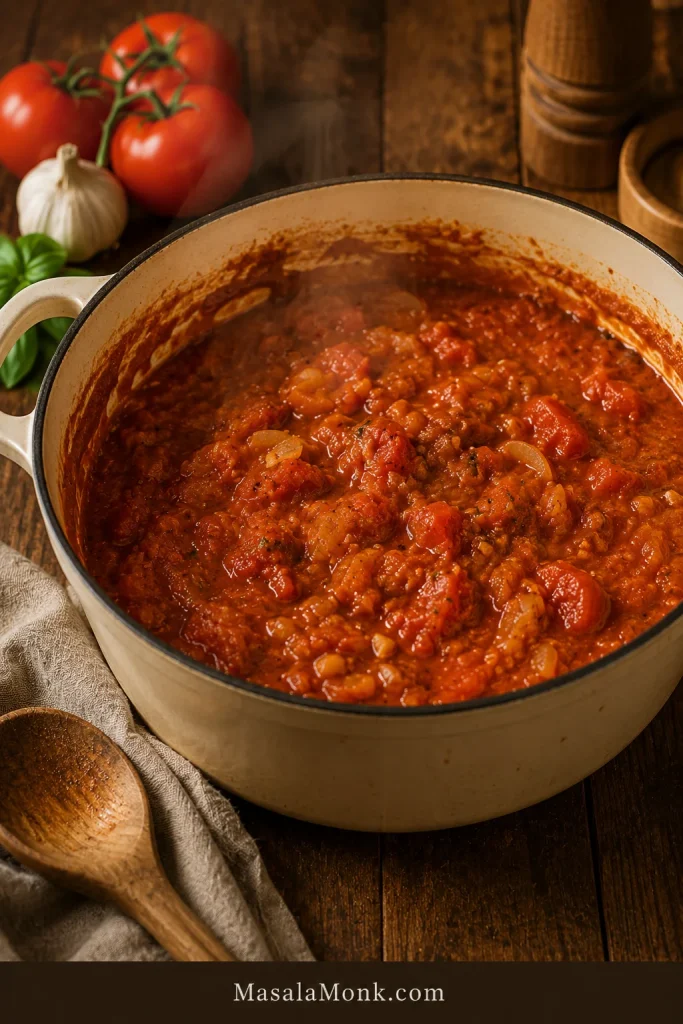
Minestrone soup base in a Dutch oven with tomato broth, beans, carrots, celery, and firm vegetables before pasta and greens are added.

Let the tomato broth, beans, and firm vegetables simmer before adding pasta. As a result, the base tastes rounded instead of rushed.

4. Add Beans and Simmer Gently


Add the rinsed beans and any firm vegetables such as cabbage, potato, or squash. Bring the soup to a boil, then reduce it to a gentle simmer. You want small bubbles, not a rolling boil. Cook partly covered for 20 to 25 minutes, until the broth tastes fuller and the vegetables are tender.

Taste the broth before adding pasta. If it tastes thin or flat now, give it more simmering time, adjust the salt, or brighten it with a little lemon juice or vinegar. The broth should already taste good before the pasta goes in; if it still tastes weak, use the troubleshooting section before adding pasta.

Minestrone soup gently simmering in a Dutch oven with tomato broth, beans, carrots, celery, pasta, and vegetables.

Keep minestrone at a gentle simmer, not a hard boil. Small bubbles build flavor while helping the vegetables stay tender and intact.

5. Add Quick-Cooking Vegetables and Pasta


Add green beans, zucchini, and small pasta near the end. Cook for 8 to 10 minutes, or until the pasta is just tender. Stop while it still has a little structure, because it will keep softening in the hot broth.

Small pasta being poured into a pot of minestrone soup with spinach added near the end of cooking.

Add pasta and greens near the end. This keeps the soup brighter, protects the greens, and helps prevent pasta from swelling in the pot.

6. Finish with Greens, Herbs, and Brightness


Stir in spinach or kale for the final 1 to 3 minutes. The greens only need to wilt; they do not need to cook down into the broth. Remove the bay leaf and parmesan rind. Finish with parsley or basil, a drizzle of olive oil, and lemon juice or red wine vinegar. Rest the soup for 5 minutes before serving so the broth settles and the flavors come together.

Finished pot of homemade minestrone soup with tomato broth, beans, pasta, carrots, zucchini, green beans, greens, herbs, and olive oil.

When the pot is ready, it should look colorful and ladle easily. If it feels crowded, loosen it with a splash of broth before serving.

Easy Minestrone Swaps

Once the base makes sense, the soup becomes forgiving. You do not need the exact same vegetables every time; you just need the right balance of broth, beans, pasta or rice, and timing.

Use What You Have

Use this section when the pot needs to adapt to the vegetables, beans, and pasta you already have.

Rustic board with minestrone swaps including zucchini, carrot, cabbage, kale, potato, white beans, green beans, herbs, and small pasta.

Minestrone is made for flexible cooking. Therefore, zucchini, cabbage, kale, potato, beans, herbs, and small pasta can all work when you add them at the right time.

If you do not have Use this instead
Cannellini beans Navy beans, great northern beans, white beans, or chickpeas
Kidney beans More white beans, borlotti beans, chickpeas, or lentils
Zucchini Cabbage, green beans, peas, spinach, kale, or squash
Ditalini Small shells, elbows, macaroni, or orzo
Vegetable broth Water with extra tomato paste, herbs, olive oil, and careful seasoning
Fresh greens Frozen spinach, frozen kale, or chopped cabbage added earlier
Parmesan rind Skip it, or finish with olive oil, herbs, and a little lemon juice or vinegar

This is also where minestrone becomes personal. One cook adds cabbage, another adds potato, another uses chickpeas, and another keeps it brothy. The base stays the same, but the pot can still feel like yours. For more timing help, see the firm-early, tender-late vegetable guide.

What the Soup Should Look and Taste Like

You are looking for a soup that is chunky but still brothy. The tomato broth should taste rounded rather than sharp or thin. Vegetables should be tender without collapsing, beans should stay creamy but mostly intact, and the pasta should be just tender, not swollen.

Finished Bowl Texture Check

Use the finished bowl as a quick check before serving: the soup should look full, but it should still move like soup.

Close-up bowl of finished minestrone soup with tomato broth, white beans, kidney beans, pasta, carrots, zucchini, greens, and herbs.

Use the finished bowl as a texture check. The vegetables and beans should stand out clearly, while the tomato broth still fills the gaps around them.

Chunky but Still Soup

If the pot looks crowded but still has enough broth to move around the vegetables, you are in the right place. You should be able to drag the spoon through the bowl and see vegetables and beans settle back into the tomato broth, not sit in a dry pile. The final olive oil, herbs, and lemon juice or vinegar should make the bowl taste brighter, not sour.

Close bowl of chunky but brothy minestrone soup with visible tomato broth, beans, pasta, carrots, zucchini, greens, and herbs.

Aim for chunky but not dry. The spoon should catch vegetables and beans, while the broth still makes the bowl feel like soup.

Best Beans, Pasta, and Vegetables for Minestrone

Beans, pasta, and vegetables are where minestrone becomes dinner. The choices do not need to be fancy; they just need to make sense together in the spoon.

Best Beans and Pasta for Minestrone

Start with spoon-friendly beans and small pasta shapes, then choose vegetables that match the season and cooking time.

Bowls and spoons of cannellini beans, kidney beans, ditalini pasta, small shells, elbows, and orzo for minestrone soup.

Choose beans and pasta that fit easily on a spoon. Cannellini beans, kidney beans, ditalini, elbows, or small shells keep minestrone hearty without making it clumsy.

Best Beans


  • Cannellini or white beans: creamy, mild, and classic.

  • Kidney beans: firmer, colorful, and familiar in restaurant-style minestrone.

  • Borlotti beans: rustic and soft with a fuller bean flavor.

  • Chickpeas: nutty and firmer, good when you want more bite.

  • Lentils: useful for a thicker, higher-protein variation.

Best Pasta


  • Ditalini: classic and spoon-friendly.

  • Small shells: good for catching tomato broth.

  • Elbows or macaroni: easy pantry choice.

  • Orzo: soft and pleasant, but it thickens leftovers quickly.

  • Rice: useful if you do not want pasta. Cooked rice is easiest.

Once the beans and pasta are chosen, the vegetables are mostly about timing: firm ones early, tender ones late. That is what keeps the bowl generous without making it taste tired.

Firm Vegetables Early, Tender Vegetables Late


A good minestrone should never feel trapped by one vegetable list. Keep the tomato broth, aromatics, beans, herbs, and small pasta structure, then choose vegetables that fit the pot.

  • Summer: zucchini, green beans, fresh tomatoes, basil, spinach.

  • Winter: cabbage, kale, potato, squash, carrots, celery.

  • Spring: peas, asparagus, spinach, leeks, fresh herbs.

  • Pantry version: canned tomatoes, canned beans, frozen vegetables, cabbage, carrots, small pasta.

Add dense vegetables like potato, squash, cabbage, and carrots earlier. Add zucchini, peas, spinach, and tender greens near the end. Try not to overload the pot; minestrone should be hearty, but it should still have enough broth to feel like soup.

Rustic vegetable timing board showing firm vegetables like potato, cabbage, carrot, and squash beside tender vegetables like zucchini, peas, spinach, kale, and herbs.

Vegetable timing matters more than a perfect shopping list. Add firm vegetables early, then save tender greens, zucchini, peas, and herbs for the final minutes.

How to Fix Minestrone Soup Problems

If your minestrone tastes bland, watery, too thick, too acidic, or overcooked, it can usually be fixed. Most problems come down to seasoning, simmering, pasta timing, vegetable timing, or broth balance.

Fix Bland Minestrone Soup

Before rebuilding the whole pot, taste for salt, acid, herbs, pepper, and olive oil; those small finishes often fix a flat bowl.

Bowl of minestrone soup beside salt, lemon wedge, red wine vinegar, olive oil, parsley or basil, and black pepper.

Bland minestrone often needs a finish, not a rebuild. Salt, lemon or vinegar, herbs, black pepper, and olive oil can wake up the whole pot.

Problem Fix
Soup tastes flat Add salt first, then a small splash of lemon juice or red wine vinegar.
Broth is too thin Simmer uncovered for a few minutes or mash 1/2 cup of beans into the broth.
Soup is too thick Add broth or water until it becomes spoonable again.
Pasta is too soft Add more broth, fresh herbs, and a little acidity. Next time, cook pasta separately.
Vegetables are overcooked Freshen the bowl with herbs, olive oil, and extra broth. Next time, add zucchini and greens later.
Soup tastes too acidic Add a drizzle of olive oil or a tiny pinch of sugar to round the tomato flavor.
Soup is too salty Add unsalted broth, water, extra beans, or more vegetables.

Most of the time, the fix is smaller than you think. A little salt, a little acid, a splash of broth, or a few mashed beans can bring the pot back.

Fix Watery Minestrone Soup

When the broth looks thin, mashed white beans are the quickest natural thickener because they add body without changing the soup into cream sauce.

Two bowls of minestrone comparing thin watery broth with richer tomato broth, with mashed white beans shown as the thickening fix.

If the broth tastes watery, mash a few white beans into the soup and simmer briefly. This thickens minestrone naturally without cream or flour.

How to Make Minestrone Richer

  • Cook the onion, carrot, and celery until they soften and smell sweet.

  • Cook the tomato paste before adding broth.

  • Use crushed tomatoes for a fuller broth.

  • Add a parmesan rind if you are using cheese.

  • Mash some of the beans into the soup for natural body.

  • Simmer partly uncovered when the soup looks too thin.

  • Finish with olive oil, herbs, and a small splash of lemon juice or vinegar.

How to Keep Pasta from Getting Mushy


Minestrone pasta gets mushy when it sits in hot broth for too long or stays in the soup through storage. The safest method depends on how you plan to serve it.

  • Serving immediately: add dry pasta during the final 8 to 10 minutes.

  • Meal prep: cook pasta separately and add it to each bowl.

  • Freezing: freeze the soup without pasta and add fresh pasta later.

  • Thick leftovers: reheat with extra broth or water.

Glass containers showing minestrone soup base stored separately from cooked small pasta, with pasta being added to a serving bowl.

For better leftovers, store the soup base and pasta separately. Then add pasta to each serving so the next bowl stays fresh instead of soggy.

Slow Cooker and Instant Pot Minestrone

Slow Cooker vs Instant Pot Minestrone

For both appliance methods, the texture rule is the same: cook the base first and keep pasta and greens late. The pasta texture notes are especially useful for meal prep.

Slow cooker and Instant Pot filled with minestrone soup, with small bowls of pasta and greens nearby for adding near the end.

Whether you use a slow cooker or Instant Pot, cook the soup base first. Meanwhile, keep pasta and greens for the end so the texture stays better.

Slow Cooker Minestrone

Slow cooker minestrone is best for a hands-off soup base. Cook the broth, beans, aromatics, and firm vegetables first, then add zucchini, pasta, and greens near the end so they do not overcook.

  1. Add onion, carrot, celery, garlic, tomato paste, tomatoes, broth, herbs, bay leaf, beans, and firm vegetables to the slow cooker.

  2. Cook on low for 6 to 8 hours or high for 3 to 4 hours.

  3. Add zucchini and green beans during the final 30 minutes.

  4. Add pasta only during the final 20 to 30 minutes, or cook pasta separately.

  5. Stir in spinach or kale at the end, then finish with herbs, olive oil, and lemon juice or vinegar.

Instant Pot Minestrone


Instant Pot minestrone is best for a fast soup base. Pressure cook the broth, beans, and firm vegetables, then add cooked pasta and greens at the end so the pasta does not turn soft under pressure.

  1. Use sauté mode to cook onion, carrot, celery, and olive oil for 4 to 5 minutes.

  2. Add garlic and tomato paste. Cook for 1 minute.

  3. Add tomatoes, broth, herbs, bay leaf, beans, and firm vegetables.

  4. Pressure cook on high for 4 to 5 minutes.

  5. Let pressure release naturally for 5 to 10 minutes, then quick release carefully.

  6. Stir in greens and cooked pasta, then finish with herbs, olive oil, and lemon juice or vinegar.

Olive Garden-Style Minestrone Soup

If you like Olive Garden’s lighter tomato-broth style, use these adjustments while keeping the main recipe homemade. Olive Garden describes its minestrone as vegetables, beans, and pasta in a light tomato broth, so this is a home version in that familiar direction, not the official recipe. You can see Olive Garden’s menu description for the style reference.

Light tomato-broth minestrone soup in a cream bowl with kidney beans, white beans, pasta, carrots, zucchini, green beans, celery, spinach, and herbs.

For Olive Garden-style minestrone at home, keep the broth lighter, the beans whole, the vegetables small, and the pasta modest.

  • Use diced tomatoes instead of crushed for a lighter restaurant-style texture.

  • Do not mash the beans into the broth.

  • Keep the pasta modest so the soup stays brothy.

  • Use kidney beans, white beans, zucchini, green beans, carrots, celery, and spinach.

  • Finish with herbs and acidity so the bowl tastes bright, not heavy.

Minestrone Soup Variations

After the base tastes good, you can take the soup in a few different directions without losing the minestrone feel. Keep the tomato base, beans, vegetable timing, and small pasta structure in place, then adjust the bowl you want. For gluten-free, rice-based, or pasta-free versions, the storage section is useful if you plan to cook the starch separately.

Three bowls of minestrone variations showing a vegan version, a gluten-free or rice version, and a thicker bean-rich version on a rustic table.

Once the tomato-bean base tastes good, you can take minestrone in several directions: vegan, gluten-free, rice-based, or thicker and extra hearty.

  • Vegan minestrone: use vegetable broth and skip parmesan rind, parmesan cheese, meat, and egg pasta. Finish with olive oil, herbs, nutritional yeast, or vegan pesto.

  • Gluten-free minestrone: use gluten-free pasta or rice. Cook gluten-free pasta separately for the best texture. Do not use barley or farro.

  • Minestrone without pasta: skip the pasta and add extra beans, cabbage, zucchini, potato, kale, spinach, or cooked rice.

  • Thick and hearty minestrone: use crushed tomatoes, 1 cup pasta, extra white beans, and a small potato. Mash some beans into the broth.

  • Brothy minestrone: use 3/4 cup pasta, unmashed beans, and an extra cup of broth for a lighter, restaurant-style bowl.

  • Low-sodium minestrone: start with low-sodium broth, rinse canned beans well, and choose no-salt-added tomatoes if available. Use garlic, herbs, lemon juice, vinegar, and olive oil to build flavor.

  • Add meat: brown Italian sausage or ground beef before adding the aromatics, or stir in shredded cooked chicken near the end.

Think of these as directions, not separate recipes. The same pot can become lighter, heartier, vegan, gluten-free, or meatier without losing its minestrone backbone.

What to Serve with Minestrone Soup

Minestrone can stand alone as dinner, especially with beans and pasta, but a simple side makes the meal feel complete.

  • A lighter meal: serve minestrone with a crisp salad, roasted vegetables, or something bright like beet salad.

  • For a heartier dinner: add garlic bread, focaccia, grilled cheese, parmesan toast, or pesto toast.

Bowl of minestrone soup served with garlic bread, a green salad with tomatoes, herbs, and a spoon on a wooden table.

Minestrone can stand alone, but the sides change the meal. Garlic bread makes it heartier, while a fresh salad keeps dinner lighter.

The best side is something that balances the tomato broth without making the meal feel heavy.

Make-Ahead, Storage, Freezing, and Reheating

Make-Ahead Plan


Yes, you can make minestrone ahead of time. For the best texture, make the soup base without pasta, refrigerate it, and add freshly cooked pasta when serving.

  • Chop the onion, carrot, celery, zucchini, and green beans up to 1 day ahead.

  • Drain and rinse the beans ahead of time.

  • Make the soup base without pasta up to 3 days ahead.

  • Add greens when reheating so they stay brighter.

  • Cook pasta fresh, or store cooked pasta separately with a tiny drizzle of olive oil.

Store and Freeze Minestrone with Pasta Separately

This storage setup keeps the soup base useful and protects the pasta from swelling before the next serving.

Glass containers of minestrone soup base and a separate bowl of cooked small pasta for storing and freezing.

For freezing, leave pasta out of the soup base. This way, the broth, beans, and vegetables reheat well, and fresh pasta can be added later.

Fridge

Store minestrone soup in an airtight container in the fridge for 3 to 4 days, which matches the USDA’s general guidance for refrigerated leftovers. The next-day soup is often thicker and more flavorful. Loosen it with broth before reheating.

Freezer


Minestrone freezes best without pasta. Freeze the soup base for up to 3 months, then add freshly cooked pasta when reheating. If you freeze it with pasta, the flavor will still be good, but the pasta will become softer.

Reheating


Reheat gently on the stovetop over low to medium-low heat. Add broth or water to loosen the soup. After reheating, freshen the bowl with olive oil, herbs, lemon juice, vinegar, or parmesan. For the fastest fix when leftovers get thick, see the troubleshooting table.

Serve Minestrone Family-Style

Family-style Dutch oven of minestrone soup on a wooden table with a ladle, bowls of soup, bread, herbs, cheese, and a hand serving soup.

Serve minestrone family-style when you want the meal to feel relaxed and generous, with herbs, cheese, bread, or extra broth added at the table.

Once you have the rhythm down, minestrone becomes one of those soups you can make again and again without overthinking it. Keep the tomato broth, beans, small pasta, and vegetable timing in place, then let the pot change with the season.

The best minestrone is not the one with the longest ingredient list; it is the one where the broth, beans, vegetables, and pasta all still feel like they belong in the same spoonful.

Minestrone changes from kitchen to kitchen. If your pot had cabbage, potato, chickpeas, kale, extra zucchini, or a pasta shape that worked beautifully, tell us. Those small choices are often what help the next person make a better pot from what they already have.


Frequently Asked Questions

What is minestrone soup made of?


Minestrone soup is an Italian vegetable soup made with vegetables, beans, tomatoes, broth, herbs, olive oil, and usually pasta or rice. Common vegetables include onion, carrot, celery, zucchini, green beans, cabbage, spinach, kale, potato, and peas.

Is minestrone soup vegetarian?


Minestrone soup is vegetarian when it is made with vegetable broth and no meat. If you add parmesan, choose vegetarian-style parmesan if that matters to you.

Is minestrone soup vegan?


Minestrone soup is vegan when it is made with vegetable broth and no parmesan, parmesan rind, meat, or egg pasta. For a vegan finish, use olive oil, herbs, nutritional yeast, or vegan pesto.

What is the best pasta for minestrone?


Ditalini is one of the best pasta shapes for minestrone because it is small and spoon-friendly. Small shells, elbows, macaroni, and orzo also work.

What beans are best for minestrone?


Cannellini beans, white beans, and kidney beans are the best everyday beans for minestrone. Borlotti beans, navy beans, chickpeas, and lentils also work.

Why does my minestrone taste bland?


Bland minestrone usually needs salt, acidity, or more simmering time. Cook the aromatics well, cook the tomato paste until it darkens slightly, taste the broth before adding pasta, then finish with lemon juice or vinegar if the tomato flavor tastes flat.

How do you make minestrone less watery?


To make minestrone less watery, simmer it uncovered, mash some beans into the broth, use crushed tomatoes, or add a parmesan rind if you are using cheese. A watery soup often means the aromatics or tomato paste needed more time at the beginning.

How do you keep pasta from getting mushy in minestrone?


To keep pasta from getting mushy in minestrone, add it only near the end and stop when it is just tender. For leftovers, meal prep, or freezing, cook pasta separately and add it to each bowl.

Can you make minestrone soup ahead of time?


Yes, minestrone is a good make-ahead soup, especially if you make the soup base without pasta. Refrigerate the base for 3 to 4 days, then add freshly cooked pasta when serving.

Can you freeze minestrone soup?


Yes, minestrone soup freezes well, but it freezes best without pasta. Freeze the soup base for up to 3 months, then add freshly cooked pasta when serving.

What is the difference between minestrone and vegetable soup?


Minestrone is usually heartier than plain vegetable soup because it often includes beans, pasta or rice, tomatoes, Italian herbs, and olive oil. Vegetable soup can be any broth-based soup made with vegetables.

What is the difference between minestrone and pasta e fagioli?


Minestrone is a vegetable-heavy soup that often includes beans plus pasta or rice. Pasta e fagioli means pasta and beans, so it is more focused on those two ingredients and is often thicker and more bean-forward.

Can I make minestrone without pasta?


Yes, you can make minestrone without pasta. Add extra beans, cabbage, zucchini, potato, kale, spinach, or cooked rice instead.

Can I use frozen vegetables in minestrone?


Yes, frozen peas, green beans, spinach, kale, and mixed vegetables can work well in minestrone. Add quick-cooking frozen vegetables near the end unless they are dense vegetables. If frozen spinach releases too much water, squeeze it before adding.

Can I make minestrone with canned vegetables?


Yes, canned vegetables can work in minestrone when you need a pantry version. Drain them well and add them near the end because they are already cooked and can become too soft if simmered for a long time.

Posted on Leave a comment

Sockeye Salmon Recipe

Baked sockeye salmon fillets with lemon wedges, herbs, and a fork lifting a moist flake.

Sockeye is the salmon people are excited to buy and nervous to cook. It is deep red, clean-tasting, beautifully firm, and easy to overdo if the heat runs long.

This sockeye salmon recipe keeps the fish moist from the start. Skin-on fillets give the flesh a buffer, a thin coat of oil or butter keeps the surface glossy, and lemon-garlic seasoning stays bright instead of heavy. The finish should taste fresh and clean, not like the fish needed rescuing at the end.

The main version bakes 5–6 oz sockeye fillets at 400°F / 200°C for 8–12 minutes. Thin fillets can use the gentler foil method at 375°F / 190°C. From there, you can adjust for frozen fish, a whole side, pan-searing, grilling, air frying, leftovers, and the little problems that show up when wild salmon cooks faster than expected.

The goal: moist baked wild salmon with bright lemon, gentle garlic, fresh herbs, protected skin-side-down cooking, and enough timing confidence to stop before the flakes tighten.

Quick Answer: Best Way to Cook Sockeye Salmon

Bake skin-on sockeye salmon at 400°F / 200°C for 8–12 minutes. For thin fillets, use 375°F / 190°C in a loose foil packet for 10–12 minutes. Pull when the center flakes gently and still looks moist.

If your fillets are unusually thin, thick, or uneven, use the thickness-based baking chart before you set the timer.

Fork lifting moist flakes from baked sockeye salmon with lemon-garlic juices and herbs.
Properly baked sockeye should separate in soft, moist sheets; once the flakes turn tight or chalky, the fillet has usually cooked too long.

For official food safety, salmon should reach 145°F / 63°C. The official temperature guidance is available from FoodSafety.gov.

Sockeye Salmon Recipe at a Glance

Main method:
Baked sockeye salmon
Best oven temp:
400°F / 200°C
Gentle option:
375°F / 190°C in foil
Cook time:
8–12 minutes
Best fillets:
Skin-on, 5–6 oz / 140–170 g
Total salmon:
1¼–1½ lb / 565–680 g
Flavor:
Lemon, garlic, herbs, butter or oil
Biggest mistake:
Cooking too long for the fillet thickness
Sockeye salmon timing guide showing 5 to 6 ounce fillets, 400°F, 8 to 12 minutes, and a 145°F safety target.
Use these numbers as a starting point, then let thickness, texture, and the thickest part of the fillet decide when dinner is actually ready.

Before you start: If the salmon looks thin or delicate, use the gentler 375°F / 190°C foil method. Start looking before the timer ends, and finish with fresh lemon after baking instead of soaking the fish before it cooks.

The sauce is not doing the heavy lifting here. The timing is.

Which Sockeye Salmon Method Should You Choose?

Choose the method based on the fish in front of you. A normal fillet can bake uncovered, a thin one deserves gentler heat, and a whole side needs attention near the tail.

Method chooser showing baked, foil, pan-seared, and grilled sockeye salmon options.
Choose the method around the fish: bake average fillets, use foil for delicate pieces, pan-sear for crisp skin, or grill when you want smoke.

Thin vs Thick Sockeye Fillets

Before choosing a method, look at the thickness of the fish. A thin tail piece and a thicker center cut need different levels of attention.

Thin and thick sockeye salmon fillets compared on parchment with a ruler cue.
Thickness changes everything: a thin tail piece may finish several minutes before a center-cut fillet, even when both pieces weigh about the same.
If you want…Choose this methodWhy it works
I have normal 5–6 oz fillets and want dinner fast400°F baked filletsSimple, reliable, and quick for weeknight portions.
My fillets look thin or delicate375°F foil packetGentler heat gives the fish more protection.
Crisp skinPan-seared sockeyeMost of the cooking happens skin-side down.
Smoky flavorGrilled sockeyeGreat for outdoor cooking, especially with skin-on fillets.
A fast small portionAir fryer sockeyeFast and convenient, but thin pieces need close watching.
I forgot to thaw the fishCovered frozen oven methodStarts with steam, then finishes uncovered with seasoning.
I have a whole side to serveWhole-side baked sockeyeLooks beautiful and stays easier to manage skin-side down.

What Makes Sockeye Different?

Sockeye is a Pacific salmon with deep red-orange flesh, firm texture, and a stronger flavor than mild farmed salmon. Alaska Fish & Game describes sockeye as prized for its firm, bright-orange flesh, and NOAA Fisheries identifies it as one of the most important wild salmon species in U.S. waters.

Raw sockeye salmon fillet with deep red-orange flesh and a visible skin edge.
Sockeye’s deep red flesh and firm texture make it distinctive; however, that lean structure also means it needs gentler timing than fattier salmon.

In the kitchen, that firmness is a gift and a warning. Sockeye holds beautiful flakes, but it has less fatty cushion than many farmed salmon fillets, so a minute or two too long can move it from glossy to dry.

That is also why the internal temperature guide and moisture tips matter more for sockeye than for fattier salmon.

Why This Recipe Works

Sockeye rewards restraint. The best fillets are not blasted into flakiness; they are protected underneath, lightly coated on top, and pulled while the center still looks tender.

  • Skin-on baking gives the fish a heat shield. The skin takes the direct heat while the flesh stays easier to lift and serve.
  • Oil or butter keeps the surface glossy. It helps seasoning cling and gives the top a little protection from dry oven heat.
  • Lemon zest adds brightness without too much acid. Lemon juice is useful, but zest brings aroma without tightening the surface.
  • Moderate oven heat keeps the cook controlled. 400°F / 200°C is quick enough for weeknights, while 375°F / 190°C is better for delicate pieces.
  • A short rest settles the flakes. The center finishes gently while you get lemon, herbs, and sides ready.

The core idea: cook sockeye like wild salmon, not like a thick, fatty fillet. Protect it underneath, gloss it lightly on top, and stop before the surface turns dull.

Ingredients for Baked Sockeye Salmon

Keep the flavor simple: lemon, garlic, herbs, and a little oil or butter.

Ingredients for sockeye salmon with raw fillets, lemon, garlic, herbs, oil or butter, salt, pepper, Dijon, and maple.
Keep the ingredient list short so the wild salmon stays central: lemon for brightness, garlic for warmth, herbs for lift, and fat for a glossy finish.
IngredientAmountWhy it matters
Skin-on sockeye salmon fillets4 fillets, 5–6 oz / 140–170 g eachThe easiest size for the timing in this recipe.
Total salmon weight1¼–1½ lb / 565–680 gA practical amount for 4 servings.
Olive oil or melted butter2 tbsp / 30 mlAdds surface moisture and helps seasoning cling.
Fresh lemon juice1 tbsp / 15 mlBrightens the richer wild salmon flavor.
Lemon zest1 tsp / about 2 gAdds lemon aroma without too much acidity.
Garlic, finely minced2 cloves / about 6 gGives the fish a savory backbone.
Kosher salt¾ tsp / about 3–4 gSeasons the fish clearly without overwhelming it.
Black pepper¼–½ tspAdds gentle heat.
Fresh dill or parsley1 tbsp choppedFresh herbs lift the finished salmon.
Dijon mustard, optional1 tsp / 5 gAdds tang and helps create a light glaze.
Maple syrup or honey, optional1–2 tsp / 5–10 mlBalances sockeye’s bold flavor and helps browning.

Best Sockeye Salmon to Use

Skin-on fillets are the easiest choice. Look for pieces that are evenly cut, bright in color, and not dried around the edges. If the tail end is very thin, plan to check it early or fold it under before baking.

Three raw skin-on sockeye salmon fillets on parchment, with one fillet angled to show the skin.
Skin-on fillets give you a built-in buffer, making the fish easier to lift, serve, grill, pan-sear, and bake without breaking.

Fresh vs Frozen Sockeye Salmon

Fresh wild sockeye is wonderful when it is in season, but frozen sockeye is often the more realistic option. Good frozen sockeye can be excellent, especially when it was frozen quickly and kept properly cold.

Fresh sockeye salmon and thawed frozen sockeye salmon compared, with one fillet being patted dry.
Frozen sockeye can still cook beautifully; the key is thawing it well, drying the surface, and seasoning after excess moisture is gone.

Thawed fillets give you the best texture, so move frozen sockeye to the refrigerator the night before when you can. Pat it dry before seasoning. If your fish is vacuum-packed, read the package instructions before thawing.

If the surface has ice crystals, rinse them off quickly under cold water and dry the fish very well. Do not soak sockeye in water; waterlogged fish seasons poorly and steams instead of baking cleanly.

Frozen sockeye rule: thaw overnight for best texture. Cook from frozen only when you need an emergency dinner, and start covered so the frozen center can warm before the surface dries out.

Cooking straight from frozen? Jump to the covered frozen oven method instead of using the main baking time.

How to Bake Sockeye Salmon

If this is your first time cooking sockeye, the oven is the calmest place to start. You can keep the skin underneath, watch the top change from glossy to just-set, and avoid the guessing that usually dries wild salmon out.

Step 1: Preheat the oven

Preheat the oven to 400°F / 200°C. Line a rimmed baking sheet with parchment or foil. If using foil, lightly oil it so the skin releases more easily after baking.

Step 2: Dry the salmon

Pat the fillets dry with paper towels. This helps the oil, salt, garlic, and herbs stay on the surface instead of sliding off. Place the salmon skin-side down on the prepared pan.

Skin-on sockeye salmon fillets arranged skin-side down on a lined baking sheet with lemon and herbs.
Before baking, give each fillet space and keep the skin underneath so the flesh has a little protection from direct pan heat.

Step 3: Mix the lemon-garlic topping

In a small bowl, stir together the olive oil or melted butter, lemon juice, lemon zest, garlic, salt, pepper, and chopped dill or parsley. The garlic should be finely minced so it warms gently instead of sitting on top in harsh, burnt bits.

Lemon-garlic herb topping being stirred in a small bowl with sockeye salmon blurred in the background.
Lemon zest, finely minced garlic, herbs, and a little oil or butter add flavor quickly without burying the clean taste of wild salmon.

Step 4: Season the fillets

Brush or spoon the mixture evenly over the salmon. Do not drown the fish in lemon juice. A little acid is helpful; too much can make the surface feel tight before the fish even reaches the oven.

Lemon-garlic herb mixture brushed in a thin glossy layer over raw sockeye salmon fillets.
Brush on a thin glossy coat instead of a heavy pool, because too much acid or liquid can firm the surface before the center cooks.

Step 5: Bake briefly

Bake for 8–12 minutes, depending on thickness. Start checking at 7–8 minutes if your fillets are thin. The top should look satin-glossy and just set, not dull and dry. The thickest part should separate in moist sheets when pressed gently.

Baked sockeye salmon on a plate with a glossy just-set surface, lemon, garlic, and herbs.
Pull the fish when the surface still looks satin-glossy; then a brief rest finishes the center without pushing the flakes toward dryness.

Step 6: Rest and finish

Let the salmon rest for 3–5 minutes. Finish with fresh lemon, herbs, and a spoonful of pan juices if available. The lemon should brighten the fish at the end, not rescue it from overcooking.

How Long to Bake Sockeye Salmon by Thickness

Most 5–6 oz sockeye salmon fillets bake at 400°F / 200°C in 8–12 minutes. Thin fillets may finish in 7–9 minutes, while thicker pieces can need 12–15 minutes. This is where sockeye asks you to pay attention: a minute or two too long can move it from glossy to dry.

Baking time guide for thin, average, and thick sockeye salmon fillets at 400°F or 200°C.
For baked sockeye salmon at 400°F, most fillets land between 8 and 12 minutes, but thin pieces deserve an earlier check.
Fillet ThicknessApprox. Time at 400°F / 200°CWhat to Watch For
Thin, under ¾ inch7–9 minutesUse the gentle foil method if the fish looks fragile.
Average, about 1 inch8–12 minutesThe best range for most 5–6 oz fillets.
Thicker, 1¼ inch or more12–15 minutesCheck the thickest part and protect the thinner edges.
Uneven fillet with thin tailVariesFold the tail under or expect it to cook faster.

Once the timing is close, use the temperature and doneness cues to decide whether the fish is actually ready.

Using a Whole Side of Sockeye Salmon

If you have a whole side of sockeye instead of individual fillets, use the same seasoning and bake it skin-side down. Start checking around 12 minutes, especially near the thinner tail end. A larger side may need closer to 12–17 minutes, depending on thickness.

The center of a whole side is usually thicker than the tail, so the tail may finish first. You can fold a very thin tail section under itself before baking, or simply accept that the tail will be firmer while the center stays juicier. For serving, a whole side looks beautiful with lemon slices, herbs, and a spoonful of pan juices.

Whole side of baked sockeye salmon on a platter with lemon slices, herbs, and a thinner tail end.
A whole side makes a beautiful centerpiece; meanwhile, the thinner tail usually cooks first, so check that end before the thicker center.

Sockeye Salmon Time and Temperature Chart

Use this chart when the fish in front of you does not match the main recipe exactly. The ranges are starting points; the look of the fish and the thickest part matter more than the clock alone.

Time and temperature chart for baked, foil, grilled, pan-seared, air fryer, and frozen sockeye salmon.
When the equipment changes, the timing changes too, so use this guide to match the method to the fillet’s size and starting temperature.
MethodTemperatureApprox. TimeBest For
Main baked fillets400°F / 200°C8–12 minutesWeeknight 5–6 oz fillets
Gentler foil method375°F / 190°C10–12 minutesThin or delicate fillets
Hotter roast425°F / 220°C6–9 minutesFast cooking, less forgiving
Whole side of sockeye375–400°F / 190–200°C12–17 minutesFamily-style serving
Pan-seared sockeyeMedium to medium-high heat6–10 minutes totalCrisp skin
Grilled sockeye350–450°F / 175–230°C grill6–10 minutes totalSmoky flavor
Air fryer sockeye375–380°F / 190–193°C7–9 minutesSmall fillets
Frozen sockeye fillets425°F / 220°C15 minutes covered + 8–10 minutes uncoveredForgot-to-thaw dinners

Sockeye Salmon Internal Temperature and Doneness

For official food safety, cook sockeye salmon to 145°F / 63°C. For a softer, moister texture, many cooks pull salmon earlier, around 125–135°F / 52–57°C, then rest it briefly. Use the official target for children, pregnancy, older adults, immunocompromised guests, or anyone who prefers fully cooked fish.

Probe thermometer reading 145°F in a baked sockeye salmon fillet with text noting softer texture at 125 to 135°F.
The official safety target for fish is 145°F; still, knowing the softer texture range helps you understand why many cooks watch salmon closely.
Internal TempTextureWhat to Know
125–130°F / 52–54°CVery moist, softer centerOften preferred by cooks who like salmon less done.
130–135°F / 54–57°CMoist, flakes gentlyA common texture-focused range for salmon.
140°F / 60°CMostly opaque, firmerClose to fully cooked.
145°F / 63°CFully cooked, flakes easilyOfficial food-safety target for fish.

Sockeye Doneness Cues Without a Thermometer

If you do not have a thermometer, look for opaque edges, moist flakes that separate with gentle pressure, and a center that no longer looks raw and glassy.

Sockeye salmon doneness comparison showing raw, just-right, and overcooked flakes.
Without a thermometer, compare the cues: raw centers look glassy, just-right flakes look moist, and overcooked fish turns dull and tight.

White Albumin on Salmon

A little white albumin is normal; a lot of it, along with tight or chalky flakes, usually means the heat ran too hard or too long.

Cooked sockeye salmon close-up with visible white albumin on the surface and lemon nearby.
A little white albumin is harmless and normal; however, heavy albumin often means the heat was too high or the fillet cooked too long.

If the fish already looks dry, has a lot of albumin, or stuck to the pan, skip ahead to troubleshooting for quick fixes.

For pregnancy-specific salmon safety notes, see our guide to salmon and pregnancy.

How to Keep Sockeye Salmon Moist

The best way to keep sockeye moist is to protect the fish in three places: underneath, on top, and at the finish. Think of this as a small safety net, not a complicated technique.

Moist baked sockeye salmon with labels showing how to protect the bottom, top, and finish.
Instead of relying on sauce later, protect the fillet while it cooks: shield the bottom, gloss the top, and stop before the surface turns dull.
  • Protect the bottom. Keep the skin on when possible, and place the fillets skin-side down.
  • Protect the top. Use just enough oil or butter to keep the surface glossy.
  • Protect the timing. Watch the thickness, not only the timer.
  • Protect the finish. Rest the fish briefly, then add lemon after cooking.

A dry fillet is disappointing, but it is not dinner over. Flake it into rice, add cucumber or avocado, and use a sauce with moisture instead of reheating it harder.

For more rescue ideas, see the sockeye troubleshooting guide; for gentler leftover meals, use the storage and reheating section.

Skin-On vs Skinless Sockeye Salmon

Skin-on sockeye is usually easier to cook well. The skin helps hold the fillet together, shields the underside from direct heat, and makes baked, grilled, and pan-seared salmon more forgiving.

Skin-on sockeye salmon fillet lifted with a spatula compared with a skinless sockeye fillet on parchment.
Skinless fillets can work, but skin-on sockeye gives you more margin when moving the fish from pan, grill, tray, or plate.

For baking, place the fish skin-side down. On the grill, the skin helps reduce sticking and breakage. In a pan, skin-on fillets give you the option of crisp skin and a more protected center.

If crisp skin is the goal, go straight to the pan-seared sockeye method; if you want smoke, use the grilled sockeye method.

You can eat the skin if it is crisp. If it is soft after baking, simply slide a spatula between the flesh and skin when serving.

Grilled, Pan-Seared, Air Fryer, and Frozen Sockeye Salmon

Baking is the main recipe, but these backup methods help when your pan, grill, freezer, or schedule decides dinner for you.

Grilled Sockeye Salmon

Grilled sockeye has a smoky flavor that suits the firm, bold fish. Use skin-on fillets if possible, oil the grates well, preheat the grill to medium or medium-high, and cook for about 6–10 minutes total, depending on thickness.

Sockeye salmon fillets grilling over charcoal with lemon halves, herbs, smoke, and light char marks.
Grilled sockeye takes on smoke beautifully; nevertheless, the lean flesh still needs close timing so char does not turn into dryness.

If you are nervous about sticking, grill the salmon on foil or a cedar plank. You will get less direct char, but the fish will be easier to move and less likely to tear.

Pan-Seared Sockeye Salmon

Pan-seared sockeye is best with skin-on fillets. Pat the fish very dry, season it, and heat a little oil in a cast iron or stainless skillet over medium to medium-high heat. Cook mostly skin-side down for about 5–6 minutes, pressing gently for the first few seconds so the skin makes contact with the pan. Flip and cook the flesh side for another 1–2 minutes.

Pan-seared sockeye salmon lifted from a skillet to show crisp golden-brown skin.
For crisp skin, keep most of the cooking on the skin side first, then flip briefly so the flesh stays juicy.

This method is especially good with lemon butter or a quick garlic-herb pan sauce.

Air Fryer Sockeye Salmon

For air fryer sockeye, lightly oil and season 5–6 oz fillets, then cook at 375–380°F / 190–193°C for 7–9 minutes. Place the fillets skin-side down if they have skin and check early, especially with thin pieces.

Air fryer basket with a cooked sockeye salmon fillet on parchment, lemon wedge, and herbs.
Air fryer sockeye cooks fast because hot air surrounds the fillet, so start checking before the top looks deeply browned.

Frozen Sockeye Salmon

For the best texture, thaw frozen sockeye overnight in the refrigerator, pat it dry, then follow the main recipe. If you forgot to thaw it, small frozen fillets can still become a good dinner.

Place small individual frozen fillets in a lightly oiled baking dish, cover tightly with foil, and bake at 425°F / 220°C for 15 minutes. Uncover, brush with oil or butter and seasoning once the surface has thawed enough for it to stick, then bake another 8–10 minutes, or until done. This method is for individual frozen fillets, not a whole frozen side.

Two-step frozen sockeye salmon method showing frozen fillets covered with foil and finished uncovered with lemon and herbs.
From frozen, the best move is to cover first so the center warms, then uncover, season, and finish without drying the surface.

Smoked Sockeye Salmon

Smoked sockeye is better treated as its own slow-cooking project because it usually involves brining, drying the surface, and low smoker heat. If you bought smoked sockeye, use it cold or gently warmed on bagels, toast, eggs, dips, salads, pasta, or rice bowls. For brunch ideas, it fits naturally with our bagel toppings and spreads guide.

Smoked sockeye salmon served with bagels, cream cheese, cucumber, eggs, lemon, capers, and dill.
Smoked sockeye is already deeply flavored, so fresh partners like cucumber, eggs, lemon, herbs, and creamy spreads keep it balanced.

Best Seasonings, Sauces, and Glazes for Sockeye

Sockeye does not need to be hidden, but it does like contrast: lemon, herbs, mustard, yogurt, ginger, chile, or something fresh and sharp. The best pairings brighten or balance the fish rather than burying it.

Baked sockeye salmon surrounded by lemon garlic, maple Dijon, teriyaki, Cajun butter, dill yogurt, and chimichurri sauces.
Lemon garlic, maple Dijon, teriyaki, Cajun butter, dill yogurt, and chimichurri all work because sockeye can handle bright, bold contrast.
Flavor DirectionWhat to UseBest Method
Lemon garlic herbLemon, garlic, olive oil or butter, dill or parsleyBaked
Maple DijonMaple syrup, Dijon mustard, garlic, black pepperBaked or grilled
Honey garlicHoney, garlic, lemon, butterPan-seared or baked
Miso gingerMiso, ginger, soy sauce, honey or mapleBaked or broiled
TeriyakiTeriyaki glaze, sesame, scallionsBaked, air fryer, or rice bowl
Cajun butterCajun seasoning, butter, lemonPan-seared or oven-baked
Dill yogurtGreek yogurt, dill, lemon, garlicServing sauce
ChimichurriParsley, cilantro, garlic, vinegar, olive oilGrilled sockeye

If you want to build the sauce instead of improvising, start with a glossy homemade teriyaki sauce for bowls or a bright chimichurri for grilled sockeye.

How Long Should You Marinate Sockeye?

Keep marinades short. For lemon, vinegar, or other acidic marinades, 15–20 minutes is usually enough. Longer acidic marinating can make the surface feel firm or slightly cured. For non-acidic glazes, such as maple-Dijon or miso-ginger, brush them on just before baking or during the last few minutes of cooking.

If you are serving the salmon with bowls, salads, or sauces, the serving section gives the easiest pairing ideas.

Raw sockeye salmon in a shallow lemon-herb marinade with a timer showing 15 to 20 minutes.
Keep acidic marinades short; otherwise, lemon or vinegar can start firming the surface before the salmon ever reaches the oven.

What to Serve with Sockeye Salmon

Sockeye salmon is rich enough to feel special, but simple enough for rice bowls, vegetables, salads, and pasta. Keep the sides bright, crisp, or starchy so the fish stays the focus.

Baked sockeye salmon served with rice, cucumber salad, mango salsa, yogurt sauce, lemon, and herbs.
Build the plate for contrast: rice catches the juices, cucumber adds crunch, mango brings sweetness, and yogurt sauce cools the finish.
  • Fresh and crisp: cucumber salad or avocado salad, with cucumber salad as the easiest bright side.
  • Bowl-style: rice, avocado, cucumber, sesame, and spicy mayo, built the same way as our salmon bowl recipe.
  • Sweet and bright: grilled sockeye with mango salsa when you want fruit, acid, and a little chile.
  • Creamy finish: lemony baked salmon with Greek tzatziki or another cool yogurt sauce.

If rice is your base, this how to cook rice guide helps with stovetop, cooker, and Instant Pot timing.

Storage, Leftovers, and Reheating

Leftover sockeye is happiest cold or barely warmed. Treat it gently and it becomes a second meal; blast it with heat and the flakes tighten fast. Store cooked sockeye in an airtight container in the refrigerator for 2–3 days.

Flaked leftover sockeye salmon in a glass container with rice, cucumber, avocado, lemon, herbs, and sauce.
Leftover sockeye is best treated gently, so use it cold in bowls or reheat lightly instead of cooking the same flakes a second time.
  • Best reheating method: warm gently in a low oven, covered, until just heated through.
  • Microwave method: use short bursts at reduced power and stop before the fish gets hot and dry.
  • Best leftover use: flake cold salmon into bowls, salads, sandwiches, pasta, or croquettes.
  • Avoid: repeatedly reheating the same piece of salmon.

For a second dinner, leftover sockeye can be folded into our creamy salmon pasta recipe or our salmon croquettes recipe instead of cooking a new fillet from scratch.

Troubleshooting Sockeye Salmon

If something goes wrong, it is usually fixable on the plate and preventable next time. Most sockeye problems come back to heat, thickness, dryness, or handling.

Troubleshooting board showing dry sockeye flakes, white albumin, stuck skin in a pan, and an underdone center.
Most sockeye problems are still fixable: add sauce to dry flakes, lower heat next time for albumin, and return only underdone centers briefly to heat.

Texture and Cooking Fixes

ProblemLikely CauseFix NowFix Next Time
Dry sockeye salmonCooked too long, too hot, or without enough fat/protectionServe with lemon butter, yogurt sauce, or a rice bowl sauceCheck earlier, use skin-on fillets, add oil/butter, or use the 375°F foil method
Lots of white albuminHeat was too aggressive or fish cooked too longWipe lightly if needed; it is harmlessUse gentler heat, shorter cooking, and avoid blasting thin fillets
Center undercooked but edges dryFillet was uneven or oven heat was too highRest briefly; return only the thick section to heat if neededFold thin tail under, use lower heat, or choose more even fillets
Still looks underdone after restingFillet was thick or oven ran coolReturn only the thickest part to the oven for 1–2 minutesUse a thermometer and check the thickest part next time
Skin is soft after bakingBaking steams the skin rather than crisping itSlide the fish off the skin when servingUse pan-searing if crisp skin is the goal

Flavor, Smell, and Handling Fixes

ProblemLikely CauseFix NowFix Next Time
Fish stuck to pan or grillSurface was wet, grate/pan was not oiled, or fish moved too earlyRelease gently with a fish spatulaPat dry, oil well, use skin-on fillets, and wait before moving
Strong fishy tasteOlder fish, poor storage, or flavor not balancedAdd lemon, dill yogurt, mustard, ginger, mango salsa, or chimichurriBuy fresh-smelling fish, thaw properly, and cook soon after thawing
Garlic tastes burntGarlic pieces were too large or exposed too earlyScrape off the darkest bits and add fresh lemon or herbsUse finely minced garlic or add it to the oil mixture right before baking
Too salty or too lemonySeasoning was too heavy for the fish sizeServe with rice, potatoes, or yogurt sauce to balance the plateMeasure salt carefully and keep acidic marinades short
Fish smells strong before cookingFish is older, thawed poorly, or stored too longDo not force it; discard fish that smells unpleasantly sour, rancid, or ammonia-likeBuy fresher fish, thaw in the refrigerator, and cook soon after thawing

Other Quick Fixes: Burnt Garlic, Too Much Lemon, or Underdone Centers

If the garlic darkens, scrape off only the bitter bits and finish with fresh herbs. Fish that tastes too salty or too lemony is easiest to balance with rice, potatoes, cucumber, avocado, or yogurt sauce rather than more acid. When the thickest part still looks underdone after resting, return only that section to the oven for a minute or two so the thinner edges do not dry out further.

Why is my sockeye salmon dry?

Dryness usually means the fish cooked too long, cooked too hot, or did not have enough surface fat or skin protection. A dry fillet is disappointing, but it is not dinner over. Flake it into rice, add cucumber or avocado, and use a sauce with moisture instead of reheating it harder.

What is the white stuff coming out of salmon?

The white stuff is albumin, a protein that comes to the surface as salmon cooks. A little is normal, and it is harmless. If there is a lot of albumin and the flakes also look tight or dry, the fish probably cooked too aggressively or too long.

Why did my salmon stick to the pan or grill?

Sticking usually happens when the surface is not dry, the pan or grate is not properly oiled, or the fish is moved too early. For grilling and pan-searing, skin-on fillets are easier to handle than skinless fillets.

FAQs About Sockeye Salmon

What is the best way to cook sockeye salmon?

For most home cooks, baking is the most forgiving place to start. Use skin-on fillets at 400°F / 200°C for 8–12 minutes, or move to 375°F / 190°C in foil when the fillets are thin.

How long should sockeye salmon bake at 400°F?

Most 5–6 oz / 140–170 g fillets bake at 400°F / 200°C in about 8–12 minutes. Thin pieces may finish closer to 7–9 minutes, while thicker pieces may need 12–15 minutes.

Is 375°F or 400°F better for sockeye salmon?

Use 400°F / 200°C for a fast weeknight bake. Use 375°F / 190°C when the fillets are thin, delicate, or when you want a more forgiving texture.

Should sockeye salmon be baked covered or uncovered?

Bake average skin-on fillets uncovered at 400°F / 200°C so the surface stays lightly glossy instead of steamed. Use a loose foil packet when the fillets are thin, delicate, or prone to drying out.

What temperature should sockeye salmon reach?

Official food-safety guidance for fish is 145°F / 63°C. Some cooks prefer salmon at 125–135°F / 52–57°C for a softer texture, but that is a personal decision based on the fish and the people eating it.

How do you know when sockeye salmon is done without a thermometer?

Look for opaque edges, moist flakes that separate with gentle pressure, and a surface that still looks glossy rather than dull. If the fish is squeezing out a lot of albumin and the flakes look tight, it likely cooked too long.

Can you cook sockeye salmon from frozen?

Yes. For the best texture, thaw it overnight in the refrigerator. If you need to cook it from frozen, cover small fillets and bake them at 425°F / 220°C first, then uncover and finish with seasoning.

Should sockeye salmon be cooked with the skin on?

Skin-on fillets are usually easier to cook well. The skin protects the underside, keeps the fillet together, and makes grilling or pan-searing easier.

What seasoning goes best with sockeye salmon?

Lemon, garlic, dill, parsley, black pepper, Dijon, maple, honey, miso, ginger, teriyaki, Cajun seasoning, yogurt sauce, and chimichurri all work well. Sockeye’s bold flavor can handle stronger seasonings than mild salmon.

Can I use this recipe for a whole side of sockeye?

Yes. Keep the same seasoning, bake skin-side down, and start checking around 12 minutes. A whole side usually needs closer to 12–17 minutes, depending on thickness.

Should I rinse sockeye salmon before cooking?

Usually no. Pat the fish dry with paper towels instead. If frozen fillets have surface ice, rinse it off quickly under cold water, then dry the fish very well before seasoning.

Why does sockeye salmon dry out faster than Atlantic salmon?

Sockeye is usually leaner and firmer than many farmed salmon fillets, so it has less internal fat to cushion extra heat. That is why timing and thickness matter so much.

Should sockeye salmon be marinated?

It does not need a long marinade. A short 15–20 minute marinade is enough when you want extra flavor. For lemon, vinegar, or other acidic marinades, keep the time short so the surface does not tighten.

Butter or olive oil for sockeye salmon?

Use olive oil for a lighter finish or melted butter for a richer one. Both work well; butter tastes warmer, while olive oil keeps the flavor cleaner and brighter.

Can I cook skinless sockeye salmon?

Yes. Keep the surface lightly oiled, watch it closely, and start checking early because there is less protection underneath.

Is sockeye salmon naturally red?

Yes. Sockeye is known for its deep red-orange flesh, which is one of the easiest ways to distinguish it from milder salmon varieties.

Ready to cook without the full guide? Use the recipe card for the short version.

Moist Baked Sockeye Salmon Recipe

Recipe card for moist baked sockeye salmon with a finished fillet, ingredient cues, method steps, 400°F timing, and four-serving yield.
The easiest way to remember the baked sockeye method is simple: protect the skin side, keep the topping light, check early, and rest briefly.

This easy sockeye salmon recipe bakes skin-on wild salmon fillets with lemon, garlic, herbs, and olive oil or butter. It is fast enough for a weeknight, but careful enough to keep the fish moist.

Prep Time
5 minutes
Cook Time
8–12 minutes
Rest Time
3–5 minutes
Total Time
About 20 minutes

Servings: 4
Yield: 4 fillets
Method: Baking
Diet: Pescatarian, gluten-free, low-carb

Ingredients

  • 4 skin-on sockeye salmon fillets, 5–6 oz / 140–170 g each
  • 2 tbsp / 30 ml olive oil or melted butter
  • 1 tbsp / 15 ml fresh lemon juice
  • 1 tsp lemon zest
  • 2 garlic cloves, finely minced
  • ¾ tsp kosher salt
  • ¼–½ tsp black pepper
  • 1 tbsp chopped fresh dill or parsley
  • 1 tsp Dijon mustard, optional
  • 1–2 tsp maple syrup or honey, optional
  • Lemon wedges, for serving

Instructions

  1. Preheat the oven to 400°F / 200°C. Line a rimmed baking sheet with parchment or lightly oiled foil.
  2. Pat the sockeye salmon fillets dry with paper towels. Place them skin-side down on the prepared pan.
  3. In a small bowl, mix the olive oil or melted butter, lemon juice, lemon zest, garlic, salt, pepper, and herbs. Add Dijon and maple syrup or honey if using.
  4. Brush or spoon the mixture evenly over the salmon fillets.
  5. Bake for 8–12 minutes, depending on thickness. Start checking early if the fillets are thin. The top should still look moist, not matte and dry.
  6. Rest for 3–5 minutes, then serve with lemon wedges and extra herbs.

Gentler Foil Method

For thin or very delicate fillets, place the seasoned salmon in a loose foil packet and bake at 375°F / 190°C for about 10–12 minutes. Open carefully, rest briefly, and finish with lemon and herbs.

Notes

  • Timing depends on thickness: thin fillets may finish in 7–9 minutes, while thick pieces may need 12–15 minutes.
  • Use the 375°F foil method for thin or delicate fillets.
  • For a whole side of sockeye, start checking around 12 minutes, especially near the tail.
  • 145°F / 63°C is the official fish safety target; some cooks pull salmon earlier for a softer texture.

Final Tips for the Best Sockeye Salmon

For your first batch, choose the gentler side: check early, rest the fish, and add lemon at the end. Once you know where sockeye wants a little protection, it becomes one of the easiest salmon dinners to make well.

Sockeye should taste clean, rich, and lightly wild. The best finish is lemon as a finish, not a rescue.

Back to top

Posted on Leave a comment

Creamy Salmon Pasta Recipe

Creamy salmon pasta in a shallow bowl with salmon flakes, spinach, capers, lemon zest, Parmesan, herbs, and a fork lifting pasta.

This creamy salmon pasta recipe is the kind of 35-minute dinner that makes an ordinary night feel handled: tender salmon, silky lemon garlic cream sauce, pasta that actually holds the sauce, Parmesan, spinach, and little pops of capers. It feels restaurant-style without being fussy — rich enough to feel special, but fresh enough for another bite.

The trick is not more cream. It is control: cook the salmon separately, keep the sauce slightly looser than you think, and fold the fish in at the end so you get large, soft flakes instead of dry crumbs scattered through the pan.

The best bite has a little of everything: a ribbon of sauce-coated pasta, a soft piece of salmon, a bit of spinach, a salty caper, and enough lemon to make you want the next forkful. That is the difference between a cream pasta that feels heavy halfway through and one that stays alive to the last bite.

Forkful of creamy salmon pasta with pasta, salmon, spinach, capers, lemon zest, and Parmesan
A balanced forkful has pasta, salmon, spinach, caper, Parmesan, and lemon working together, so the richness stays lively.

Quick Answer: How Do You Make Creamy Salmon Pasta?

To make creamy salmon pasta, roast or pan-sear salmon until tender, boil pasta until just shy of al dente, and reserve some starchy pasta water before draining. Then, in a wide skillet, make a lemon garlic cream sauce with butter, shallot, garlic, white wine or broth, heavy cream, Parmesan, and a splash of pasta water.

Toss the pasta in the sauce first, wilt in spinach, and gently fold in large flakes of salmon at the end. Finally, finish with lemon zest, lemon juice, herbs, black pepper, and capers so the final bite tastes creamy, lifted by lemon, and savory. For the texture cue, see how to keep the sauce smooth.

Bowl of creamy salmon pasta served with lemon, Parmesan, herbs, and a 35-minute dinner cue
Because the salmon cooks separately and the pan sauce comes together quickly, this dinner feels special without becoming a project.

Creamy Salmon Pasta Recipe at a Glance

Best salmon Fresh salmon fillet, cooked separately and folded in at the end
Best pasta Fettuccine, linguine, penne, rigatoni, or spaghetti
Sauce style Lemon garlic cream sauce with Parmesan and pasta water
Total time About 35 minutes
Safe salmon temperature 145°F / 63°C, or opaque and easy to flake
Best add-in Baby spinach
Best fix for thick sauce Reserved pasta water, added 1–2 tablespoons at a time
Best finish Lemon zest, herbs, capers, Parmesan, and black pepper
Choose your version: use fettuccine or linguine for a smoother date-night feel, penne or rigatoni for a chunkier family dinner, extra lemon and capers for a sharper finish, or a little more Parmesan when the sauce needs more depth.
What it tastes like: creamy first, then lemony, garlicky, and savory, with tender salmon flakes, soft spinach, Parmesan depth, and little salty pops from capers. It should feel rich without turning stodgy.
Creamy salmon pasta overview with salmon, pasta, cream sauce, lemon, capers, spinach, Parmesan, and pasta water
The whole recipe is built around three moves: cook salmon separately, keep the sauce flexible, and fold the fish in last.

Ready to cook? Go straight to the step-by-step method, or use the recipe card if you already know the sauce cues.

Why This Creamy Salmon Pasta Recipe Works

A good salmon pasta has to solve two problems at once: the fish should stay soft and juicy, and the sauce should coat the noodles without clumping or pooling. Because this version handles both, the final bowl tastes rounded by cream, lifted by lemon, and balanced by herbs and capers.

This is especially helpful if salmon pasta has disappointed you before — dry fish, sauce that tightens too fast, or a bowl that tastes rich for three bites and then starts to feel flat. The method is built to avoid those problems before they happen.

  • The salmon cooks separately. You can season it properly, cook it gently, and fold it into the pasta in large, moist flakes.
  • Pasta water keeps the sauce silky. Starchy water helps the cream and Parmesan cling to the noodles instead of turning thick and clumpy.
  • Lemon balances the richness. Lemon zest and juice keep the cream sauce clean on the finish.
  • Spinach makes it feel complete. It adds color, freshness, and a little vegetable comfort without another pan.
  • Capers and herbs wake up the salmon. Their salty, fresh finish keeps the dish from tasting flat.

Creamy weeknight pasta fans may also enjoy this Cajun chicken pasta, which uses a bolder smoky-spicy sauce but follows the same idea: the sauce should coat the pasta, not drown it.

Ingredients for Creamy Salmon Pasta

The best version of this dish does not come from a long ingredient list. Instead, it comes from balance: rich salmon, enough lemon to wake up the cream, Parmesan for body, and a splash of pasta water so the sauce coats the noodles instead of weighing them down.

Ingredients for creamy salmon pasta including salmon, pasta, cream, Parmesan, spinach, lemon, capers, garlic, shallot, Dijon, and wine or broth
Each ingredient has a job: salmon brings richness, lemon sharpens the finish, Parmesan adds body, and pasta water helps everything cling.

Not sure which type of salmon to use? The salmon guide below covers fresh, smoked, canned, frozen, and leftover salmon.

Salmon

Fresh salmon fillet is the best choice for this recipe. Use about 1 lb / 450 g for 4 servings. Skin-on or skinless both work; after roasting or pan-searing, the salmon should break into large, moist flakes that still feel soft in the finished pasta.

Pasta

Use 12 oz / 340 g dried pasta. Fettuccine and linguine feel elegant with cream sauce, while penne or rigatoni are easier to toss with chunky salmon pieces. Spaghetti is also a perfectly good pantry option.

Cream Sauce

The sauce starts with butter, shallot, garlic, dry white wine or low-sodium broth, heavy cream, Parmesan, and reserved pasta water. Low-sodium broth is the easiest wine-free swap; then, if the sauce needs brightness, add a little extra lemon at the end. A small spoon of Dijon mustard is optional, but useful. It does not make the sauce taste mustardy; instead, it adds a quiet savory sharpness that balances the cream.

Lemon garlic cream sauce ingredients with butter, shallot, garlic, cream, Parmesan, pasta water, lemon, Dijon, and wine or broth
Instead of letting cream do all the work, garlic, Parmesan, Dijon, lemon, and starchy pasta water give the sauce more balance.

If cream sauces usually make you nervous, the sauce section explains how to keep this one smooth before the salmon goes in.

That pasta-water trick is also what makes dishes like bacon carbonara turn glossy and cohesive without needing a heavy pool of sauce.

The Fresh Finish

Lemon zest, lemon juice, herbs, and capers keep the finished pasta lively. Add lemon juice near the end, when the sauce is warm but not boiling hard, so the cream stays smooth and the lemon tastes fresh rather than sharp.

Hand adding lemon zest, herbs, capers, and black pepper to creamy salmon pasta
Add lemon, herbs, capers, and pepper near the end so the pasta tastes layered rather than one-note creamy.

Optional Vegetable Add-Ins

Baby spinach is the easiest add-in because it wilts directly into the sauce. Peas, asparagus, broccoli, cherry tomatoes, and mushrooms also work. However, firmer vegetables should be cooked first so they do not water down the sauce.

Best Salmon for Creamy Salmon Pasta

Fresh salmon gives the cleanest flavor and the best texture for this dinner-style pasta. The goal is soft flakes that stay visible in the sauce, not dry shreds that disappear into the pan.

If salmon has ever turned dry on you, this is the section that matters most. The goal is not just cooked fish; it is soft flakes that still feel generous once they hit the pasta.

Fresh salmon, smoked salmon, canned salmon, and leftover cooked salmon options for creamy salmon pasta
Fresh salmon gives the cleanest texture, although smoked, canned, and leftover salmon can still work when handled gently.

Fresh Salmon Fillet

This is the most reliable option. Use one large fillet or a few smaller pieces. Pat the fish dry before seasoning so it roasts or sears cleanly instead of steaming on the surface. When buying salmon, choose fish that smells fresh and mild, not sour, fishy, or ammonia-like; the FDA seafood safety guide is a useful reference for fresh and frozen seafood handling.

Fresh salmon fillet on parchment with olive oil, salt, pepper, lemon, and a paper towel for drying
Patting salmon dry before cooking helps it roast or sear cleanly instead of steaming on the surface.

Skin-On Salmon

Skin-on salmon works well. Roast it skin-side down, then lift the salmon away from the skin after cooking. The skin does not need to go into the pasta.

Skinless Salmon

Skinless salmon is the easiest option because there is nothing to remove after cooking. Still, watch thinner pieces closely because they cook faster.

Frozen Salmon

Frozen salmon is fine as long as it is fully thawed and patted dry before cooking. After thawing, dry the surface well before seasoning. Frozen salmon should not go straight into the cream sauce because it releases moisture and makes the sauce harder to control.

Leftover Cooked Salmon

Leftover salmon can make this dinner even faster. Add it at the end and warm it gently in the sauce. Since it is already cooked, too much stirring will break it into small pieces. For a lighter rice-based meal, extra cooked salmon also works beautifully in a salmon bowl with rice, vegetables, avocado, and sauce.

Smoked Salmon

Hot-smoked salmon flakes nicely and can be used as a quick swap. Cold-smoked salmon is saltier and more delicate, so add it off heat and reduce the salt in the sauce. After that, a little extra lemon, dill, capers, or black pepper helps smoked salmon taste fresh instead of heavy.

Canned Salmon

Canned salmon gives a softer, more pantry-style version. Drain it well, remove any large bones or skin if preferred, and fold it in gently so it does not disappear into the sauce. For a crisp canned-salmon dinner instead, try these salmon croquettes.

Best Pasta Shapes for This Creamy Salmon Pasta Recipe

The best pasta shape depends on the bite you want. Long noodles give you a silky fork twirl, while short shapes make more room for salmon chunks, spinach, and capers.

Pasta shape Best for Notes
Fettuccine Classic creamy salmon pasta Wide enough to hold a silky lemon garlic cream sauce.
Linguine A slightly lighter twirl Elegant with salmon, lemon, herbs, and capers.
Spaghetti Pantry-friendly version Works well when the salmon is flaked into slightly smaller pieces.
Penne or rigatoni Chunky salmon pieces Easy to toss with spinach and larger flakes of fish.
Orzo or gnocchi Softer comfort-food versions Both absorb sauce differently, so keep the sauce looser.

For a slightly more filling pasta base, lentil pasta can work too. Cook it carefully so it stays tender rather than mushy, and use the same sauce rule from this lentil pasta guide: keep lemon, garlic, and pasta water balanced so the sauce still clings.

How to Make This Creamy Salmon Pasta Recipe

This is the part where the recipe becomes easier than it looks. You are not juggling everything at once; the salmon cooks first, the pasta water waits nearby, and the sauce comes together calmly in one skillet.

1. Cook the Salmon

First, heat the oven to 400°F / 200°C. Place the salmon on a parchment-lined baking sheet, rub it with a little olive oil, and season with salt and black pepper. Roast for 10–12 minutes for an average fillet, or until the fish is opaque and flakes easily.

Thin fillets may need only 8–10 minutes, while thicker pieces may need 12–14 minutes. For food safety, fish should reach an internal temperature of 145°F / 63°C, or be opaque and separate easily with a fork, according to FoodSafety.gov’s safe minimum internal temperature chart.

Salmon roasting on parchment with lemon and herbs for creamy salmon pasta
Roasting the salmon separately gives you better control over doneness before the flakes meet the cream sauce.

Optional: Pan-Sear the Salmon Instead

Prefer a stovetop version? Pat the salmon dry, season it, and sear it in a lightly oiled skillet over medium heat for 3–4 minutes per side, depending on thickness. Let it rest for 5 minutes, then flake it into large pieces. Keep the heat moderate so the outside browns without drying the center.

Salmon fillet searing in a skillet with a lightly browned surface for creamy salmon pasta
Pan-searing is a good stovetop option; however, moderate heat lets the surface brown before the center dries out.

After roasting or searing, let the salmon rest for 5 minutes before flaking. Resting helps the juices settle, and larger flakes look and taste better in the finished pasta.

Cooked salmon being separated with a fork into large moist flakes
Large, moist flakes make salmon pasta feel generous, while tiny dry pieces disappear into the sauce.

2. Boil the Pasta

Meanwhile, bring a large pot of water to a boil and salt it well. Add the pasta and cook it about 1 minute shy of al dente. Before draining, scoop out 1 cup / 240 ml of pasta water.

Cloudy pasta water being scooped into a measuring cup beside a pot of pasta
Reserve pasta water before draining because its starch helps the lemon garlic cream sauce hold onto the noodles.

Do not rinse the pasta after draining. The starch on the surface helps the sauce cling, and that little bit of cling is what makes the finished dish feel glossy instead of watery.

Drained pasta in a colander with a small Do not rinse label beside the pasta
Do not rinse the pasta after draining; that surface starch is what helps the sauce coat instead of slide off.

You may not use all the pasta water. Still, having extra gives you control because creamy pasta sauce tightens as it sits, and pasta water is the easiest way to loosen it without making it thin. For a visual cue on when to add more, jump to the 1-minute sauce control trick.

3. Build the Lemon Garlic Cream Sauce

Next, in a large high-sided skillet, melt the butter with a little olive oil. Add the shallot and cook until softened. Then stir in the garlic and cook just until fragrant, about 30 seconds. Add white wine or broth and simmer briefly so the sharp edge cooks off.

At this stage, the pan should smell like garlic, butter, and lemon waiting to happen — not raw onion, scorched garlic, or plain cream.

Shallot and garlic cooking in butter while wine or broth is poured into a skillet
Let the shallot and garlic soften gently before adding cream, so the sauce tastes rounded instead of harsh.

Lower the heat before adding the cream. Stir in Dijon if using, then add finely grated Parmesan a little at a time. After that, add a splash of pasta water and stir until the sauce looks creamy, loose, and glossy. It should move easily in the pan before the pasta goes in. If the sauce already looks thick before the pasta is added, loosen it now; the noodles will only make it tighter.

Parmesan and pasta water being stirred into cream sauce in a skillet
Add Parmesan gradually, then loosen with pasta water as needed, so the sauce stays smooth enough to toss.

4. Toss the Pasta, Wilt the Spinach, and Fold in the Salmon

Add the drained pasta to the skillet and toss until coated. At this point, the sauce should cling to the noodles but still look fluid.

Pasta being tossed in lemon garlic cream sauce while cooked salmon rests nearby
Toss the pasta before adding salmon, because coated noodles need less stirring once the delicate fish goes in.

Add spinach and let it wilt briefly, just until bright green and soft.

Baby spinach being tossed into creamy pasta while cooked salmon waits on a plate nearby
Wilt the spinach before folding in the salmon; this keeps the greens bright and protects the fish from extra stirring.

Finally, turn the heat low and fold in the salmon in large flakes with only a few gentle turns. The less you stir at this point, the prettier and softer the salmon stays. Add lemon zest, a little lemon juice, herbs, capers, and black pepper. Taste before serving: when the sauce feels too rich, add more lemon or herbs; when it feels too thick, loosen it with pasta water. For more depth, finish with a little extra Parmesan or black pepper.

Large salmon flakes being folded into creamy pasta with spinach and sauce
Fold the salmon in last with only a few turns, so the pieces stay large, soft, and visible.

If the sauce tightens, splits, or the salmon starts breaking apart, check the troubleshooting table before adding more cream.

How to Keep Creamy Salmon Pasta Sauce Smooth

The sauce should coat the pasta in a thin creamy layer rather than sitting at the bottom of the pan. Because cream sauces tighten quickly, these small details are what make the dish feel restaurant-style instead of rushed.

Cream sauces can feel intimidating at first. However, this one is mostly about patience: keep the heat gentle, add the cheese gradually, and let the pasta water do the smoothing.

The 1-Minute Sauce Control Trick

Keep the sauce slightly looser than you want before the pasta goes in. The noodles will keep absorbing liquid, so a sauce that looks perfect in the pan can turn tight on the plate. A few spoonfuls of pasta water at the end are not a rescue move — they are the finishing move.

  • Before pasta goes in: the sauce should move easily when you tilt the pan.
  • After pasta goes in: toss first, then loosen with pasta water only as needed.
  • Before salmon goes in: fix the sauce texture now, because heavy stirring later can break the fish.
Three-stage sauce control guide with labels for before pasta, after pasta, and before salmon
Fix the sauce texture before the salmon goes in; after that, gentle folding works better than heavy stirring.
Best texture cue: when you drag tongs through the pasta, the sauce should coat the noodles and leave a light creamy trail in the pan. If it clumps, add pasta water. If it pools like soup, simmer gently for another minute before adding the salmon.
Tongs pulling creamy pasta through sauce and leaving a light trail in the pan
The sauce is ready when it coats the noodles and leaves a light trail in the pan, not when it clumps or pools.

Keep the Heat Gentle Once Cream and Cheese Go In

  • Use gentle heat after adding cream. Cream and cheese do not need aggressive boiling.
  • Finely grate the Parmesan. Fine cheese melts more smoothly than large shreds.
  • Add Parmesan gradually. Stir in small handfuls instead of dumping it all in at once.
  • Add lemon juice near the end. Lemon is essential, but hard boiling can make cream less stable.
  • Fold salmon in last. This keeps the fish tender and prevents it from shredding into dry flakes.

The same gentle-heat rule also helps in creamy macaroni and cheese, where rushing the cheese can make the sauce grainy.

Taste and Adjust Before Serving

The final forkful should taste creamy first, then lemony and savory. If it tastes rich but flat, reach for lemon, capers, herbs, or black pepper before adding more cream.

Before you serve: taste one forkful with salmon, pasta, and sauce together. A heavy finish needs lemon, a thin sauce needs Parmesan, and a flat bite usually needs capers, herbs, or black pepper. The final adjustment is where this pasta becomes yours.
Forkful of creamy salmon pasta with lemon, capers, herbs, Parmesan, and black pepper nearby
Taste before serving, then choose the fix: lemon for sharpness, capers for salt, herbs for freshness, Parmesan for depth.

Creamy Salmon Pasta Recipe

Creamy Salmon Pasta Recipe

This creamy salmon pasta recipe brings together tender salmon, pasta, spinach, capers, and a silky lemon garlic cream sauce in about 35 minutes. The sauce should coat the pasta without clumping, the salmon should stay in soft flakes, and the lemon should lift the cream instead of fighting it.

Yield 4 servings
Prep Time 15 minutes
Cook Time 20 minutes
Total Time 35 minutes

Equipment

  • Large pot or Dutch oven
  • Rimmed baking sheet or large skillet for the salmon
  • Parchment paper, if roasting
  • Large high-sided skillet for the sauce
  • Tongs
  • Measuring cup for pasta water
  • Instant-read thermometer, optional but helpful

Ingredients

For the salmon

  • 1 lb / 450 g salmon fillet, skin-on or skinless
  • 1 tsp olive oil
  • ½ tsp kosher salt
  • ¼ tsp black pepper

For the pasta and sauce

  • 12 oz / 340 g dried fettuccine, linguine, spaghetti, penne, or rigatoni
  • 2 tsp olive oil
  • 2 tbsp / 28 g butter
  • 1 medium shallot or small onion, finely chopped, about 40–60 g
  • 3–4 garlic cloves, minced, about 10–15 g
  • ½ cup / 120 ml dry white wine or low-sodium broth
  • 1 tsp Dijon mustard, optional
  • 1 cup / 240 ml heavy cream
  • ½ cup / 45–55 g finely grated Parmesan, plus more for serving
  • 1 cup / 240 ml reserved pasta water, use ¼–½ cup as needed
  • 4–5 oz / 115–140 g baby spinach
  • Zest of 1 lemon
  • 1–2 tbsp / 15–30 ml fresh lemon juice, to taste
  • 1–2 tbsp capers, drained, optional
  • 2 tbsp chopped fresh dill, parsley, or chives
  • ¼–½ tsp kosher salt for the sauce, plus more to taste
  • Additional black pepper, to taste

Instructions

  1. Cook the salmon. Heat the oven to 400°F / 200°C. Place the salmon on a parchment-lined baking sheet. Rub with 1 tsp olive oil and season with ½ tsp salt and ¼ tsp black pepper. Roast for 10–12 minutes, depending on thickness, or until the salmon is opaque and flakes easily. Rest for 5 minutes, then flake into large pieces. Stovetop option: sear the seasoned salmon in a lightly oiled skillet over medium heat for 3–4 minutes per side, then rest and flake.
  2. Cook the pasta. Bring a large pot of salted water to a boil. Cook the pasta 1 minute shy of al dente. Reserve 1 cup / 240 ml pasta water, then drain. Do not rinse the pasta.
  3. Start the sauce. In a large high-sided skillet, warm 2 tsp olive oil and melt the butter over medium heat. Add the shallot and cook for 2–3 minutes, until softened. Add the garlic and cook for 30 seconds.
  4. Deglaze. Add the white wine or broth and simmer for 1–2 minutes, scraping up any flavorful bits from the pan.
  5. Add cream and Parmesan. Lower the heat to medium-low. Stir in Dijon if using, then add the cream. Add Parmesan in small handfuls, stirring until smooth. Add ¼ cup / 60 ml reserved pasta water to loosen the sauce.
  6. Toss the pasta. Add the drained pasta to the skillet and toss until coated. Add more pasta water, 1–2 tbsp at a time, until the sauce moves easily and coats the noodles.
  7. Wilt the spinach and fold in the salmon. Toss in the spinach just until it softens, then gently fold in the salmon flakes with only a few turns.
  8. Finish with lemon, herbs, and capers. Add lemon zest, 1 tbsp lemon juice, capers if using, herbs, and black pepper. Taste, then add more lemon, salt, pepper, Parmesan, or pasta water as needed.
  9. Serve immediately. This pasta is best while the sauce is freshly tossed and the salmon is still warm and soft.

Notes

  • For the smoothest sauce, avoid boiling hard after the cream and Parmesan are added.
  • The sauce should look slightly loose before serving because pasta keeps absorbing liquid as it sits.
  • Do not rush the final fold. Once the salmon is in, a few gentle turns are enough.
  • Warm bowls help the sauce stay loose a little longer at the table.
  • Leftover cooked salmon: skip the roasting step and fold the salmon in at the end just to warm through.
  • Smoked salmon: reduce added salt and add the smoked salmon off heat.
  • Sauce getting thick? Loosen it with a splash of reserved pasta water before serving.
Saveable creamy salmon pasta recipe card with a bowl of salmon pasta, 35-minute time, 4 servings, and core method tips
Remember the method, not just the ingredients: cook salmon separately, keep the sauce slightly loose, and fold fish in last.

Creamy Salmon Pasta Recipe Variations

Once the base sauce makes sense, the variations are easy. Use the main recipe card as the starting point, then change the salmon or sauce direction without changing the rhythm: keep the pasta coated, warm the fish gently, and finish with something sharp, fresh, or salty enough to balance the cream.

Make It for Two

For two servings, use 8 oz / 225 g salmon, 6 oz / 170 g pasta, ½ cup / 120 ml cream, ¼ cup / 25 g Parmesan, and about ½ cup / 120 ml reserved pasta water. Keep the lemon, capers, and herbs flexible, then taste at the end.

Two bowls of creamy salmon pasta with salmon, spinach, capers, lemon, Parmesan, and forks on a warm table
For two servings, scale down the pasta and salmon, then adjust lemon, herbs, and capers at the end.

Smoked Salmon Pasta

Hot-smoked salmon gives you firmer flakes, while cold-smoked salmon melts more softly into the sauce and brings a saltier, silkier finish. Add either one off heat, then lean on dill, lemon, capers, or a little cream cheese to keep the flavor fresh.

Smoked salmon pasta with creamy sauce, dill, lemon, capers, and thin salmon pieces
Smoked salmon is saltier and more delicate than roasted salmon, so add it off heat and finish with lemon and dill.

Canned Salmon Pasta

Canned salmon makes the pasta softer and more pantry-friendly. Drain it well, fold it in gently near the end, and use lemon, parsley, capers, and black pepper to keep the flavor clean and bright.

Canned salmon pasta with penne, creamy sauce, parsley, lemon, capers, and an open salmon can in the background
Canned salmon makes a practical pantry version, while lemon, parsley, capers, and pepper keep the flavor clean.

Salmon Pasta Without Cream

A lighter creamy texture can come from crème fraîche, Greek yogurt, cream cheese, or a sauce built mostly from Parmesan and pasta water. Yogurt and crème fraîche are happiest off heat or over very low heat, where they can loosen into the sauce without curdling.

Salmon pasta without heavy cream using Parmesan, lemon, herbs, and a light sauce on spaghetti
A no-cream salmon pasta can still feel satisfying when Parmesan, pasta water, lemon, and herbs carry the sauce.

Salmon Alfredo Pasta

An Alfredo-style version leans more heavily on Parmesan and cream, with softer lemon and plenty of black pepper. For another rich pasta dinner, this chicken Alfredo pasta guide has useful sauce ideas.

Salmon Pasta Bake

A baked version needs a looser sauce from the start because the pasta keeps drinking it in the oven. Undercook the pasta by about 2 minutes, top with Parmesan or a little panko, and bake until bubbling.

Salmon pasta bake in a cream-colored baking dish with golden Parmesan topping, herbs, and a spoonful lifted out
For a salmon pasta bake, start with a looser sauce because the pasta keeps absorbing liquid in the oven.

Salmon Pesto Pasta

Basil pesto gives salmon pasta a greener, more herbal direction. Use pesto, lemon, pasta water, and salmon flakes, then decide whether the sauce needs cream or feels bright enough without it. For homemade pesto, this pesto recipe guide has classic basil pesto plus useful variations.

Salmon Orzo

Orzo absorbs liquid quickly, so use a looser sauce and stir gently. The same lemon, garlic, cream, Parmesan, and salmon flavors work well, but the texture will be softer and more risotto-like.

Salmon Gnocchi

Gnocchi makes the dish softer and more comfort-food heavy. Keep the sauce loose, use enough lemon to balance the richness, and fold the salmon in gently so both the gnocchi and fish stay intact.

Salmon Pasta Salad

A cold salmon pasta salad needs a different base: cooked cooled pasta, flaked salmon, lemon dressing, herbs, cucumber, peas, capers, or a little yogurt-based dressing. Skip the hot cream sauce and focus on freshness.

What to Serve With Creamy Salmon Pasta

This is already a full dinner, so the best sides should make the plate feel brighter, not heavier. Think crisp salad, lemony greens, roasted vegetables, or garlic bread for the extra sauce left in the bowl.

  • Simple green salad: arugula, cucumber, lemon dressing, or a sharp vinaigrette.
  • Roasted asparagus or broccoli: both work well with lemon and Parmesan.
  • Garlic bread: cozy, useful, and great for catching extra sauce. For a homemade option, this garlic bread loaf works well beside creamy pasta.
  • Roasted cherry tomatoes: bright and juicy against the cream sauce.
  • Steamed peas: easy, sweet, and very good with salmon.
  • Lemon wedges: helpful at the table for anyone who wants a brighter plate.

Storing and Reheating Creamy Salmon Pasta

This dish is best right after tossing, while the sauce still coats the pasta easily and the salmon is warm and soft. However, leftovers can still be good if you reheat them gently so the cream stays smooth and the salmon does not dry out.

Creamy salmon pasta reheating in a skillet with a splash of liquid and leftovers in a glass storage container nearby
Reheat leftovers gently with a splash of liquid so the sauce loosens again and the salmon stays soft.

How Long Does It Keep?

Store leftovers in an airtight container in the refrigerator and use within 2 days for the best texture.

How to Reheat It

Reheat in a skillet over low heat with a splash of water, milk, cream, or broth. Stir gently until the sauce loosens. Avoid high heat, which can make the cream separate and the salmon dry.

If reheated sauce looks too thick or separated, use the same fixes in the troubleshooting section.

Microwave Method

Use short bursts at lower power and add a splash of liquid first. Stir gently between bursts. The microwave is convenient, but it can overcook salmon quickly.

Freezing

Freezing is not recommended. Cream sauces can split, pasta can soften, and salmon can become dry once thawed and reheated.

Creamy Salmon Pasta Troubleshooting: Sauce, Salmon, and Texture Fixes

If something feels off, do not panic and do not add more cream first. A thick sauce, broken sauce, dry salmon, or watery spinach does not mean dinner is ruined; it usually means one small adjustment is needed.

Creamy salmon pasta troubleshooting board with fixes for thick sauce, split sauce, dry salmon, and watery spinach
Most salmon pasta problems are fixable: loosen thick sauce with pasta water, lower the heat if it splits, and fold salmon in last.
Problem Why it happened Fix
Sauce is too thick The pasta absorbed more liquid than expected. Add reserved pasta water 1–2 tbsp at a time and toss until glossy.
Sauce split The heat was too high, or lemon was added while the cream was boiling hard. Lower the heat, add a splash of cream or pasta water, and stir gently. Next time, add lemon near the end.
Salmon is dry It was overcooked or stirred too much in the sauce. Cook salmon separately, rest it, and fold it in last in large pieces.
Pasta tastes bland The pasta water or sauce was under-seasoned. Salt the pasta water well and finish with Parmesan, lemon, herbs, and black pepper.
Sauce tastes too heavy Too much cream, not enough acid or herbs. Add lemon zest, lemon juice, capers, herbs, or a splash of pasta water.
Pasta tastes fishy The salmon may be old, overcooked, or not balanced with enough brightness. Use fresh salmon, avoid overcooking, and finish with lemon, herbs, capers, and black pepper.
Spinach made it watery Too much spinach was added too early, or it cooked too long. Add spinach at the end and wilt it briefly. If needed, simmer the sauce for a minute before adding salmon.

FAQs

What is the best pasta for this creamy salmon pasta recipe?

Fettuccine and linguine are best for a glossy, twirlable cream sauce. Penne and rigatoni are better for larger salmon chunks and an easier forkful.

Should salmon be cooked before adding it to pasta?

Cook the salmon first, then fold it into the pasta at the end. That gives you better control over doneness and keeps the pieces tender.

Can I pan-sear the salmon instead of roasting it?

Yes. Pat the salmon dry, season it, and sear it in a lightly oiled skillet over medium heat for 3–4 minutes per side, depending on thickness. Rest it for 5 minutes before flaking so the pieces stay moist in the pasta.

Fresh salmon or smoked salmon — which is better?

Fresh salmon is better for this creamy dinner-style pasta. Smoked salmon is better for a faster, saltier version. Add smoked salmon off heat so it stays delicate.

How do you stop cream sauce from splitting?

Use gentle heat once the cream is added, stir Parmesan in gradually, and add lemon juice near the end instead of boiling it hard with the cream. Reserved pasta water also helps smooth the sauce.

Why did my salmon pasta turn dry?

The salmon may have been overcooked, the pasta may have absorbed too much sauce, or the dish may have sat too long before serving. Fold salmon in last and keep extra pasta water nearby to loosen the sauce.

What temperature should salmon be cooked to?

For food safety, fish should reach 145°F / 63°C, or be opaque and separate easily with a fork. A thermometer is the most reliable way to check.

How much pasta water should I save?

Save 1 cup / 240 ml. You may only need ¼–½ cup, but it is better to have extra because the sauce thickens as the pasta sits.

What vegetables go well with salmon pasta?

Spinach is the easiest. Peas, asparagus, broccoli, cherry tomatoes, mushrooms, and zucchini also work. Add quick-cooking vegetables near the end and pre-cook firmer vegetables so they do not water down the sauce.

Is crème fraîche better than heavy cream?

Crème fraîche gives a tangier, slightly lighter sauce. Heavy cream is easier to find and gives the most classic creamy texture. Both work.

What is the best way to reheat leftovers?

Reheat leftovers gently in a skillet over low heat with a splash of water, milk, cream, or broth. Stir slowly until the sauce loosens. Avoid high heat because it can dry out the salmon and split the sauce.

Does this creamy salmon pasta recipe freeze well?

Not really. The cream sauce can split, the pasta can become soft, and the salmon can dry out after thawing. Refrigerating leftovers for a day or two is a better choice.

How do I make this creamy salmon pasta recipe without wine?

Use low-sodium chicken broth, vegetable broth, seafood stock, or even a splash of pasta water instead. Then add a little extra lemon at the end if the sauce needs brightness.

Once you understand the rhythm — cook the salmon gently, save pasta water, keep the cream sauce calm, and fold the fish in last — this creamy salmon pasta recipe becomes the kind of dinner you can adjust without stress. Fresh salmon makes it feel cozy and polished, smoked salmon makes it faster, and extra lemon or herbs can pull the whole bowl in a brighter direction.

That is the real win here: not just a rich pasta, but a plate that still tastes cared for at the last forkful.

Did you make it with fresh salmon, smoked salmon, canned salmon, or leftovers? Tell us which version you tried — and what you adjusted at the end. Extra lemon, more capers, dill, spinach, Parmesan, or black pepper all change the personality of the bowl.

Back to top

Posted on 1 Comment

Bacon Carbonara Recipe

Bowl of glossy bacon carbonara with spaghetti, crisp diced bacon, black pepper, and finely grated cheese.

This bacon carbonara recipe is for the night you want glossy, peppery spaghetti with crisp bacon and a sauce that feels creamy without becoming heavy. It is also for the moment when carbonara sounds intimidating because of the eggs. Once you know the rhythm — crisp bacon, hot pasta, eggs and cheese away from harsh heat, then a splash of starchy cooking water — the whole dish becomes much calmer.

Traditional Roman carbonara is usually made with guanciale, Pecorino Romano, eggs, pasta, and black pepper. Here, bacon makes the recipe easier for a regular home kitchen while still keeping the sauce egg-and-cheese based. Thick-cut bacon works especially well because it is easy to find, smoky, crisp, and gives you enough rendered fat to help the sauce wrap around the spaghetti.

The main version below is creamy without cream. You get that texture from eggs, egg yolks, finely grated cheese, bacon fat, and cloudy pasta water. If you prefer a softer comfort-food finish, there is also a small cream option later in the post.

Quick Answer: How to Make Bacon Carbonara

To make bacon carbonara, cook spaghetti until al dente, crisp diced bacon in a skillet, and whisk eggs, egg yolks, finely grated Parmesan or Pecorino, and black pepper in a large bowl. Add the hot pasta to the bacon with the burner off, pour in the cheese-and-egg base, and toss quickly while adding reserved cooking water a little at a time. In a minute or two, the rough mixture turns into a silky sauce that coats the spaghetti instead of sitting in the pan.

The main thing to avoid is pouring the eggs into a scorching pan. Take the skillet off the burner, let the harsh heat settle, and use the heat of the pasta to finish the sauce gently. If that is the part that makes you nervous, read the scrambling prevention tips before you start cooking.

Most reliable first batch: For 4 servings in about 30 minutes, use 12 oz / 340 g spaghetti, 6–8 oz / 170–225 g thick-cut bacon, 2 whole eggs plus 2 yolks, 1 cup finely grated Parmesan or Pecorino, ¾–1 tsp black pepper, and ¾–1 cup reserved starchy cooking water.
Four-step bacon carbonara guide showing bacon cooking, egg and cheese mixture, pasta tossed off heat, and finished spaghetti.
Carbonara gets easier when the order is clear: crisp the bacon, save the pasta water, move the pan away from harsh heat, then toss until the sauce clings to the spaghetti.

Already comfortable with the method? Jump straight to the recipe card.

Bacon Carbonara at a Glance

Question Best answer
Best pasta Spaghetti first; bucatini, linguine, fettuccine, or rigatoni also work.
Best bacon Thick-cut bacon, diced small and cooked until crisp at the edges.
Sauce base Whole eggs, extra yolks, finely grated cheese, black pepper, bacon fat, and reserved cooking water.
Cream Not needed for the main method; 2–4 tbsp heavy cream is optional for a softer sauce.
Biggest mistake Adding the egg mixture to a pan that is still too hot.
Best fix Move the pan off the heat, toss constantly, and loosen gradually with the hot water saved from the pot.
Bacon carbonara overview board with pasta, bacon, eggs, cheese, pasta water, cream option, and heat-control cues.
Use this quick guide before cooking so the main choices are already made: pasta shape, bacon style, sauce base, cream option, and the heat mistake that can scramble the eggs.

Why This Recipe Works

This recipe works because the sauce is built like a quick emulsion, not a cream sauce. Bacon fat gives richness, finely grated cheese gives body, eggs thicken gently, and the water saved before draining keeps everything loose enough to coat the spaghetti. That is how you get a creamy carbonara texture without pouring in heavy cream.

Bacon changes the flavor, not the basic method. It brings smoke, crisp browned edges, and grocery-store convenience, while the sauce still stays rooted in eggs, cheese, black pepper, and pasta water. Think of this as a carbonara recipe adapted for bacon rather than a completely different cream pasta.

Bacon Carbonara Ingredients

This is one of those recipes where a short ingredient list is a good thing. There is nowhere for the flavors to hide, so the bacon should be crisp, the cheese should be finely grated, the pepper should be generous, and the starchy cooking water should be saved before you even think about draining the spaghetti.

Bacon carbonara ingredients with spaghetti, diced bacon, eggs, yolks, grated cheese, black pepper, pasta water, salt, and garlic.
A short ingredient list works because every part has a job. Bacon brings fat and smoke, eggs give body, cheese adds salt and depth, and pasta water pulls the sauce together.

For the full measured version, use the recipe card below.

Best Bacon to Use

Thick-cut bacon is the easiest win here. It gives you crisp browned edges, a smoky chew, and enough rendered fat to help the sauce wrap around the spaghetti instead of tasting thin.

Comparison of thick-cut diced bacon, regular diced bacon, and bacon crumbles for carbonara.
For bacon carbonara, thick-cut pieces are easier to render slowly. That gives you crisp edges, a meaty bite, and enough smoky fat to help coat the pasta.

For the cooking cue, see how to render the bacon until the edges are crisp.

Regular bacon also works, but watch it closely because thin slices can go from crisp to brittle quickly. Dice the bacon before cooking so every forkful gets small pieces. For a more dramatic finish, cook one or two strips separately, crumble them over the bowl, and keep the diced bacon in the sauce for flavor.

Close-up of diced bacon cooked in a skillet with crisp browned edges and rendered fat.
Look for browned edges and a little rendered fat left in the pan. Bacon that turns brittle or burnt can make the carbonara taste harsh instead of smoky and balanced.

If you already have cooked bacon from another method, such as crispy air fryer bacon, you can use it. The sauce will taste better if you still add a spoonful of bacon fat or olive oil to help the cheese-and-egg base coat the pasta.

Eggs, Yolks, and Cheese

This recipe uses 2 whole eggs plus 2 egg yolks. Whole eggs help the sauce loosen and coat the spaghetti, while yolks make it richer and silkier. Only whole eggs can taste a little thinner; only yolks can feel too rich and sticky for a casual weeknight bowl.

Bowl with two whole eggs, two extra yolks, grated cheese, and black pepper for carbonara sauce.
Whole eggs loosen the sauce, while extra yolks make it richer. Together, they give the pasta a creamy carbonara texture without turning the dish heavy.

Because the eggs are gently cooked by the heat of the pasta rather than simmered in a sauce, use fresh eggs. For extra caution, use pasteurized eggs and follow general egg safety guidance.

Finely grated cheese matters more than people think. Pre-shredded cheese does not melt as smoothly because it is usually coated to prevent clumping. For the smoothest sauce, see the fine-grated cheese cue before you cook.

Finely grated cheese melting into warm pasta compared with larger cheese shreds that stay clumpy.
Fine cheese melts quickly into warm pasta, which is especially important in a no-cream carbonara. Larger shreds can stay clumpy before the sauce has time to smooth out.

Parmesan vs Pecorino Romano

Pecorino Romano is sharper, saltier, and more traditional for Roman-style carbonara. Parmesan is milder, nuttier, and easier to find in many kitchens. A half-and-half mix is the most balanced option here because the bacon already brings salt and smoke.

Parmesan and Pecorino Romano comparison with grated cheese and carbonara ingredients nearby.
Parmesan gives a milder, nuttier sauce, while Pecorino Romano tastes sharper and saltier. Because bacon already brings salt, a mix of both is often the easiest balance.

Very salty bacon? Start with more Parmesan than Pecorino. Mild bacon and a sharper sauce? Use more Pecorino. For a deeper cheese comparison, MasalaMonk’s Parmesan vs Parmigiano Reggiano guide is a useful supporting read.

Why Pasta Water Matters

That cloudy water from the pasta pot is what saves the sauce when it starts looking thick. The starch helps the egg, cheese, and bacon fat come together instead of separating into clumps. Plain hot water can rescue a dry pasta in a pinch, but the water from the pasta pot gives carbonara its shiny, clinging finish.

Cloudy pasta water beside eggs, grated cheese, black pepper, and bacon fat for carbonara sauce.
Cloudy pasta water carries starch from the spaghetti. That starch helps eggs, cheese, and bacon fat emulsify into a sauce instead of separating into clumps.

Before draining the spaghetti, scoop out at least 1 cup / 240 ml of the cooking water. You may not need all of it, but having extra gives you control. Add it slowly, 1–2 tablespoons at a time near the end, until the sauce looks silky instead of thick or clumpy.

Do not rinse the pasta after draining. The starch on the surface helps the sauce grip the spaghetti, and rinsing it away makes the finished carbonara harder to emulsify. You will see this in action in the sauce-coating step, where the liquid goes in gradually instead of all at once.

Bacon vs Pancetta vs Guanciale

Classic carbonara is closely associated with guanciale, a cured pork jowl with deep savory flavor and plenty of fat. Pancetta is cured pork belly and is easier to find in many places. Bacon is smoked pork belly, which makes it less traditional but very practical for a home carbonara recipe.

Pork Flavor Best for Notes
Bacon Smoky, salty, crisp Easiest home version Salt the pasta water lightly because bacon already brings salt.
Pancetta Porky, cured, less smoky A closer Italian-style substitute Dice it small and render gently until the edges brown.
Guanciale Rich, fatty, deeply savory Most traditional flavor Render slowly so the fat melts before the outside browns too much.
Cooked diced bacon, pancetta, and guanciale shown separately for carbonara.
Bacon is the practical home-cook choice, pancetta is less smoky, and guanciale gives the richest traditional flavor. Knowing the difference keeps the bacon version honest and useful.

So, can you use bacon in carbonara? Yes — just know what it changes. Bacon brings smoke, crisp edges, and easy grocery-store convenience. It is not the same as guanciale, but it can still make a beautiful bowl of carbonara-style pasta when you balance the salt and keep the sauce egg-and-cheese based.

If you want the stricter Italian-style version, read MasalaMonk’s classic carbonara guide. For this page, the goal is different: a creamy, reliable, bacon-led method that works with grocery-store ingredients.

For a traditional reference point, La Cucina Italiana’s classic carbonara recipe shows the guanciale, egg yolk, cheese, pasta water, and black pepper foundation. The recipe below keeps that creamy egg-and-cheese sauce idea, then adapts it for bacon you can find easily.

Once you are comfortable with the bacon swap, you can go straight to the recipe card for the exact amounts.

How to Make Bacon Carbonara

The cooking moves quickly, so set yourself up before the spaghetti is done. Once the bacon is crisp, the cheese is grated, the egg mixture is ready, and the reserved water is saved, the final sauce comes together in a minute or two.

Try to have the bacon ready a few minutes before the pasta is done, not twenty minutes earlier. Warm bacon fat helps the sauce turn smooth; a scorching pan scrambles the eggs, but a completely cold pan makes the pasta harder to coat.

Before you start: grate the cheese finely, save the starchy cooking water, keep the pan away from direct heat when the eggs go in, and do not let the bacon pan get scorching hot. Those four moves prevent most carbonara problems.
Bacon carbonara prep station with grated cheese, whisked egg mixture, cooked bacon, pasta water, and spaghetti pot.
A calm carbonara starts before the pasta is drained. Having the cheese, egg base, bacon, and pasta water ready keeps the final toss quick instead of rushed.

For exact measurements in one place, use the recipe card; for technique, follow the steps below slowly the first time.

1. Cook the Bacon Until Crisp

Start the diced bacon in a large skillet over medium heat and let it render until the edges brown, the fat collects in the pan, and the pieces turn crisp but not brittle. Stir occasionally so one side does not burn while the other stays soft.

Diced bacon rendering in a skillet with tongs while fat collects in the pan.
Render the bacon slowly enough for the fat to collect before the edges crisp. That fat becomes part of the carbonara sauce, so it should taste rounded, not burnt.

You want about 1–2 tablespoons of rendered bacon fat left in the skillet. If there is much more than that, spoon off the excess. If the pan looks dry because the bacon was lean, add a small drizzle of olive oil before tossing the pasta.

Once the bacon is crisp, turn the heat off while the pasta finishes. A pan that keeps heating after the bacon is done is more likely to scramble the sauce later.

For a gentle garlic background, add one lightly smashed garlic clove to the bacon fat for 30–60 seconds, then remove it. Avoid minced garlic in the egg mixture unless you want the dish to move away from carbonara and toward garlic bacon pasta.

2. Boil the Pasta and Save the Cooking Water

Cook the spaghetti in a large pot of boiling salted water until al dente. Because bacon and cheese are salty, season the water enough to flavor the pasta, but do not go as salty as you might for a simpler tomato or olive oil pasta.

Before draining, reserve at least 1 cup / 240 ml of hot cloudy water from the pot. That cloudiness is starch, and starch is what helps the sauce coat the strands.

Cloudy pasta water being ladled from a pot of spaghetti into a measuring cup before draining.
Save the pasta water before draining, not after. Once the egg and cheese base tightens, a splash of hot starchy water loosens it back into a silky coating.

Drain the pasta, but do not rinse it. The hot, starchy surface is exactly what helps the sauce grab onto the spaghetti.

3. Whisk Eggs, Yolks, Cheese, and Pepper

In a large heatproof bowl, whisk together the eggs, egg yolks, finely grated cheese, and black pepper. The sauce base will look thick and grainy at first. That is normal; it smooths out when the hot pasta and a little water from the pot hit it.

Thick egg, cheese, and black pepper mixture in a bowl with a whisk for carbonara sauce.
At this stage, the sauce base may look thick and slightly grainy. That is normal; hot pasta and reserved water will help it turn smooth during tossing.

A larger bowl gives the sauce room to become fluid. If the bowl is tiny, the mixture sits in one place, the pasta cools unevenly, and the eggs are more likely to clump.

4. Toss Away from Direct Heat

With the burner off, add the drained hot spaghetti to the bacon and fat, then toss so the pasta is lightly coated. Wait 30 seconds if the skillet feels extremely hot. You want warmth, not fierce direct heat.

Now add the cheese-and-egg base and toss quickly. You can do this in the skillet away from the burner or in the large bowl with the egg mixture. The bowl method is the safest option if you are nervous about scrambling because it gives you more distance from the hot pan.

Egg and cheese mixture being poured over hot spaghetti and bacon while tongs toss the pasta.
Add the egg mixture while the pasta is moving and the pan is off the burner. This small timing change is what keeps bacon carbonara creamy instead of scrambled.

5. Loosen Until the Sauce Coats the Spaghetti

Add hot starchy water a little at a time, tossing constantly. Start with ¼ cup, then continue with 1–2 tablespoons at a time until the sauce loosens and coats the spaghetti. Stop when the strands look shiny and pepper-speckled, with the sauce moving with the pasta instead of pooling at the bottom of the pan.

Fork lifting shiny spaghetti coated with carbonara sauce, bacon pieces, and black pepper.
This is the texture to aim for: shiny strands, visible pepper, crisp bacon, and sauce that moves with the pasta. If it pools below, keep tossing before adding more liquid.

Serve immediately with more black pepper and a little extra cheese. Carbonara is at its best right away, while the sauce is warm, fluid, and clinging to the pasta.

Saveable bacon carbonara recipe card with pasta, bacon, eggs, yolks, cheese, and a short method.
Use this bacon carbonara recipe card for the core ratio: pasta, crisp bacon, eggs plus yolks, finely grated cheese, and enough pasta water to loosen the sauce gradually.

Bacon Carbonara Recipe

This carbonara recipe uses hot spaghetti, crisp bacon, eggs, cheese, black pepper, and reserved pasta water to make a silky sauce without heavy cream. Keep it no-cream and carbonara-style, or add a small splash of cream for a softer, richer version.

Yield4 servings
Prep Time10 minutes
Cook Time20 minutes
Total Time30 minutes

Ingredients

  • 12 oz / 340 g spaghetti, bucatini, linguine, fettuccine, or rigatoni
  • 6–8 oz / 170–225 g thick-cut bacon, diced
  • 2 large eggs
  • 2 large egg yolks
  • 1 cup / 85–100 g finely grated Parmesan, Pecorino Romano, or a mix
  • ¾–1 tsp freshly ground black pepper, plus more to serve
  • ¾–1 cup reserved hot pasta water, added gradually
  • Salt for pasta water
  • Optional: 1 small garlic clove, lightly smashed and removed after flavoring the bacon fat
  • Optional cream version: 2–4 tbsp / 30–60 ml heavy cream

Method

  1. Bring a large pot of water to a boil. Salt it moderately, remembering that bacon and cheese will add salt later.
  2. Add diced bacon to a large skillet and cook over medium heat until crisp around the edges. Leave 1–2 tablespoons rendered fat in the pan and spoon off excess if needed.
  3. Turn off the heat under the skillet while the pasta finishes. If using garlic, add the smashed clove to the warm bacon fat for 30–60 seconds, then remove and discard it.
  4. Cook spaghetti until al dente. Before draining, reserve at least 1 cup / 240 ml hot pasta water. Drain the pasta, but do not rinse it.
  5. In a large heatproof bowl, whisk eggs, egg yolks, finely grated cheese, black pepper, and 2 tablespoons of the reserved hot pasta water. If making the cream version, whisk in 2–4 tablespoons heavy cream now.
  6. Add drained hot pasta to the bacon skillet with the burner off and toss so the spaghetti is lightly coated in bacon fat.
  7. Add the egg-and-cheese mixture with the skillet off the burner, tossing quickly and constantly. If the skillet feels extremely hot, wait 30 seconds first. Alternatively, transfer the hot bacon-coated pasta into the bowl with the egg mixture and toss there for extra control.
  8. Add more reserved pasta water gradually, starting with about ¼ cup, then adding 1–2 tablespoons at a time until the sauce looks smooth and coats the pasta.
  9. Taste and adjust with more black pepper, cheese, or a small splash of pasta water. Serve immediately.

Notes

  • This makes 4 moderate servings or 3 very generous bowls.
  • Keep the pan off the burner when adding the egg mixture.
  • Use finely grated cheese, not large shreds, for the smoothest texture.
  • If the sauce gets thick, add hot reserved pasta water gradually and toss; for more fixes, see troubleshooting.
  • If using Pecorino Romano, salt the pasta water lightly because Pecorino and bacon are both salty.
  • Carbonara is best served right away. Reheat leftovers gently with a splash of water or milk.

How to Keep the Sauce from Scrambling

Bacon carbonara in a skillet with tongs, egg mixture nearby, and visual cues for preventing scrambled eggs.
Scrambled carbonara usually comes from too much heat too quickly. Instead, take the pan off the burner, keep the pasta moving, and loosen the sauce slowly.

If carbonara makes people nervous, this is usually why. Eggs scramble when they meet too much heat too quickly. The fix is simple: move the pan away from direct heat, keep the pasta moving, and add the cloudy water slowly.

  • Take the pan off the burner. Do not cook the egg mixture over active heat.
  • Let the bacon pan calm down. If the fat is smoking or aggressively sizzling, wait 30–60 seconds.
  • Use hot pasta, not direct flame. The pasta has enough heat to thicken the eggs gently.
  • Add the water gradually. It loosens the sauce and helps distribute heat evenly.
  • Toss constantly. Still eggs scramble; moving eggs turn into sauce.
  • Use finely grated cheese. Big shreds melt slowly and can make the sauce clumpy.

New to this method? Use the bowl method: put the egg mixture in a large bowl, add the hot bacon-coated pasta into the bowl, and toss there. It gives you more control over the final texture.

Hot bacon-coated spaghetti being transferred from a skillet into a wide bowl with egg and cheese mixture.
Use the bowl method when you want more margin for error. The wider bowl softens the heat, so the egg-and-cheese sauce can coat the pasta more gently.

Without Cream: How the Sauce Still Gets Creamy

Bacon carbonara without cream served with eggs, cheese, and pasta water in the background.
Instead of cream, this carbonara relies on emulsion: eggs, cheese, bacon fat, and starchy pasta water working together until the spaghetti turns glossy.

The main recipe is made without cream. It still tastes creamy because the sauce is not just egg. It is eggs, extra yolks, cheese, bacon fat, black pepper, and starchy water working together.

Think of the saved water as the bridge. The bacon fat adds richness, the cheese adds body, and the eggs thicken everything. Without that liquid, the sauce can feel tight and sticky. With it, the sauce turns spoonable and smooth.

This is the method to make first. It is lighter than a cream sauce, more carbonara-like, and better at letting the bacon, pepper, and cheese come through.

Prefer a softer comfort-food finish? See the small cream option.

With Cream: When to Add a Small Splash

Side-by-side bacon carbonara bowls showing a no-cream base and a small cream option.
The no-cream version tastes sharper and more carbonara-style, while a small splash of cream makes the sauce softer. Either way, bacon and cheese should still lead.

The no-cream version is still the best first batch, but this small cream option is helpful if you prefer a softer, richer sauce. This is not the traditional route; it is a home-cook option for a more forgiving, comfort-food finish.

Add 2–4 tablespoons / 30–60 ml heavy cream to the egg mixture before tossing. Keep the amount small. The goal is to soften the sauce, not turn the recipe into Alfredo.

Because cream softens sharper flavors, taste at the end and wake the pasta back up with more black pepper or a little extra cheese if needed.

Version Texture Best choice when…
No cream Glossy, peppery, carbonara-style You want the bacon, cheese, pepper, and starchy water to do the work.
2 tbsp cream Softer and slightly richer You want a little more forgiveness without turning it into a cream sauce.
4 tbsp cream Richer and more comfort-food creamy You prefer a restaurant-style creamy pasta, but still want the carbonara base.

Bacon Mushroom Carbonara

Bacon mushroom carbonara with browned mushrooms, crisp bacon, grated cheese, and black pepper.
Brown the mushrooms before they meet the pasta. Otherwise, they can release water into the sauce and make the carbonara taste thin instead of savory and rich.

Mushrooms are an easy upgrade here because they soak up bacon fat beautifully. Use 8 oz / 225 g sliced mushrooms. After the bacon is crisp, remove it with a slotted spoon, leave 1–2 tablespoons fat in the pan, and cook the mushrooms until they release their moisture and brown.

Do not rush this part. Pale, watery mushrooms will thin the sauce. Browned mushrooms add depth, make the pasta feel heartier, and keep the final bowl from tasting diluted.

If the pan looks dry after the mushrooms brown, add a small splash of reserved cooking water before tossing in the spaghetti so the sauce has enough moisture to come together.

Chicken Bacon Carbonara

Chicken bacon carbonara with thin sliced chicken, crisp bacon, spaghetti, black pepper, and grated cheese.
Thin slices of cooked chicken warm quickly without stealing too much heat from the sauce. As a result, the pasta stays glossy instead of turning dry.

For a chicken version, add 1½–2 cups cooked sliced chicken. Chicken breast, thighs, or leftover roast chicken all work, but keep the pieces thin so they warm quickly without stealing heat from the sauce.

If cooking chicken from scratch, season it lightly and sear it before cooking the bacon, or cook it in a little bacon fat after the bacon is done. Slice it thinly, then add it back with the hot pasta before the cheese-and-egg base goes in.

If what you really want is a creamier ranch-style chicken and bacon pasta, MasalaMonk’s one-pot chicken bacon ranch pasta is a better fit. This variation stays egg-and-cheese based.

Carbonara with Peas

Bacon carbonara with green peas, crisp bacon, spaghetti, grated cheese, and black pepper.
Peas add sweetness and color, but they should stay in a supporting role. Add them near the end of the pasta cooking time so they stay bright and tender.

Peas add sweetness and color to this rich pasta. Add ¾ cup frozen peas to the pot during the last 60–90 seconds of cooking, then drain them with the spaghetti. They warm through quickly without turning dull or mushy.

They are not necessary, but they are helpful when you want the bowl to feel a little brighter. And then they also balance the salty bacon and cheese well.

Once you choose your version, see what to serve with bacon carbonara for lighter sides that balance the pasta.

What to Serve with Bacon Carbonara

Bacon carbonara served with lemony green salad, roasted broccoli, and tomato salad on a dinner table.
Because bacon carbonara is rich and salty, fresh sides work best. Lemony greens, roasted broccoli, and tomato salad add contrast without making the meal feel heavy.

This pasta is rich, salty, and creamy, so the best sides are fresh, bitter, acidic, or crisp. You do not need another heavy dish beside it.

  • Lemony green salad: arugula, romaine, or mixed greens with lemon vinaigrette.
  • Roasted broccoli: crisp edges help balance the creamy pasta.
  • Asparagus: roasted, grilled, or quickly sautéed.
  • Tomato salad: especially good with ripe tomatoes, olive oil, and black pepper.
  • Garlic bread: delicious, but keep the portion modest because the pasta is already rich.
  • Sautéed greens: spinach, kale, or Swiss chard with lemon.

Storage and Reheating

Carbonara is best right after tossing, when the sauce is warm, fluid, and coating the strands. Leftovers can still be good, but they need gentle reheating because eggs and cheese do not like harsh heat.

Bacon carbonara reheating in a skillet with liquid being added and tongs lifting the pasta.
Leftover carbonara needs gentle heat because the sauce has eggs and cheese. A splash of water or milk helps revive the pasta without pushing it toward grainy.
  • Refrigerate: store leftovers in an airtight container for up to 3 days.
  • Reheat in a skillet: add a splash of water or milk and warm over low heat, tossing often.
  • Microwave carefully: use short bursts at lower power and stir between bursts.
  • Do not boil the sauce: high heat can make it grainy, oily, or scrambled.
  • Refresh before serving: add black pepper and a little grated cheese after reheating.

If you like understanding why creamy sauces split or turn grainy, MasalaMonk’s easy cheese sauce guide explains the same gentle-heat principle from a different angle. Carbonara is more delicate because it uses eggs, but the lesson is similar: harsh heat is the enemy of a smooth sauce.

Troubleshooting: Fix Scrambled, Thick, or Salty Carbonara

Bacon carbonara troubleshooting board with fixes for scrambled, thick, loose, salty, and bland sauce.
Use the visual cues here to decide whether the pasta needs more liquid, more tossing, or a final flavor adjustment.

If your first batch is not perfect, it is usually still fixable. Most problems come from heat, timing, or sauce thickness, not from the recipe being difficult. Use the table below to bring the pasta back toward smooth, creamy, and balanced.

Problem Likely Cause Fast Fix
Scrambled sauce The pan was too hot Remove from heat, loosen with hot water, and toss gently.
Sauce is thick or sticky Not enough reserved cooking liquid Add hot reserved water 1–2 tbsp at a time and toss until smooth.
Sauce looks loose The liquid went in too quickly Toss longer away from heat, then add a little more finely grated cheese if needed.
Finished pasta tastes salty Bacon, cheese, and cooking water all brought salt Add extra unsalted pasta if possible, or loosen carefully with a small splash of plain hot water.
Bland Not enough pepper, cheese, or bacon fat Add black pepper first, then cheese, then a tiny drizzle of fat if needed.

The Sauce Scrambled

The pan was too hot or the eggs sat still too long. Next time, toss away from direct heat, let the pan cool briefly, and add the reserved water gradually. For the current batch, remove any obvious large egg clumps if you can, then loosen the pasta with a small splash of hot water or unsalted pasta water if you have it. Add a little extra cheese and keep going. It will not be perfect carbonara, but do not throw it out; it can still taste good.

The Sauce Is Thick or Sticky

Add hot reserved water 1–2 tablespoons at a time and toss until the sauce relaxes. A thick sauce usually means the cheese and eggs tightened before enough starchy water was added.

The Sauce Looks Loose

Toss longer away from heat. The sauce often thickens as it coats the pasta. If it still looks loose, add a little more finely grated cheese and keep tossing. Avoid putting it back over high heat, because that can scramble the eggs.

The Finished Pasta Tastes Salty

Bacon, Pecorino, Parmesan, and the cooking water all bring salt. If the finished pasta is too salty, add extra unsalted cooked pasta if you have it, or loosen with a small splash of plain hot water. Next time, salt the pot more lightly and use more Parmesan than Pecorino.

The Bacon Is Not Crisp

Start bacon in a cooler pan and give it time to render. If the heat is too high, the outside browns before the fat has time to melt. For carbonara, the best bacon pieces are crisp at the edges but not burnt or dry.

The Pasta Tastes Bland

Add more black pepper first. Carbonara needs pepper. Then add a little more cheese. If it still tastes flat, you may have drained away too much bacon fat or diluted the sauce. A tiny drizzle of bacon fat or olive oil can bring it back together.

Back to top

FAQs

Is bacon a good substitute for pancetta in carbonara?

Bacon works well in a practical home carbonara, though it is smokier than pancetta and less traditional than guanciale. Salt the pasta water lightly, then taste before adding extra cheese at the end.

What if I have pancetta or guanciale instead?

Use the same amount by weight. Guanciale will taste richer and more traditional, while pancetta will be less smoky than bacon. Because both can be salty, taste before adding extra cheese at the end.

Does the sauce need cream?

No. The sauce can be creamy without cream when eggs, cheese, bacon fat, and starchy pasta water are tossed together properly. For the full comparison, see the without cream and with cream sections above.

How does carbonara get creamy without cream?

Egg yolks, finely grated cheese, bacon fat, and reserved hot cooking water work together to make the sauce creamy. Toss everything away from direct heat so the eggs thicken gently, then add the water slowly until the sauce turns smooth and shiny.

Why did the eggs scramble?

The pan was probably too hot when the egg mixture went in. Remove the pan from the burner, let the bacon fat calm down briefly, and toss constantly while adding reserved cooking water. The full scrambling prevention section walks through the safest method.

Which pasta shape works best?

Spaghetti is the classic and easiest choice. Bucatini, linguine, fettuccine, rigatoni, and mezze rigatoni also work. Long pasta gives the sauce a twirlable finish, while short tubes catch bacon pieces well.

Is milk a good replacement for cream?

Milk is not ideal because it thins the sauce without adding much richness. Use the no-cream method with eggs, cheese, and pasta water, or add a small amount of heavy cream if you want a softer sauce.

Should I use whole eggs, yolks, or both?

A mix of whole eggs and yolks gives the best balance. Whole eggs loosen the sauce, while extra yolks make it richer and silkier. For 12 oz / 340 g pasta, 2 whole eggs plus 2 yolks is a reliable starting point.

How much pasta water should I add?

Reserve at least 1 cup / 240 ml, but do not add it all at once. Start with about ¼ cup, then add 1–2 tablespoons at a time until the sauce coats the pasta smoothly.

Why is my carbonara sauce grainy?

Grainy carbonara usually means the eggs or cheese got too hot, the cheese was too coarse, or the sauce did not get enough reserved pasta water. Keep the skillet off the burner, use finely grated cheese, and loosen the sauce gradually while tossing.

How should leftovers be reheated?

Reheat gently in a skillet over low heat with a splash of water or milk, tossing often. Avoid high heat because the egg and cheese sauce can turn grainy or scramble.

Final Tip

Final serving of bacon carbonara with glossy spaghetti, crisp bacon, black pepper, and cheese at a warm dinner table.
Bacon carbonara is at its best straight from the pan, when the sauce still moves with the spaghetti and the bacon is crisp enough to cut through the richness.

Great bacon carbonara is about rhythm, not extra ingredients: crisp bacon, hot pasta, eggs away from harsh heat, and just enough saved cooking water for the sauce to turn loose, shiny, and pepper-speckled. Once that timing clicks, the dish feels less intimidating — and much easier to repeat.