
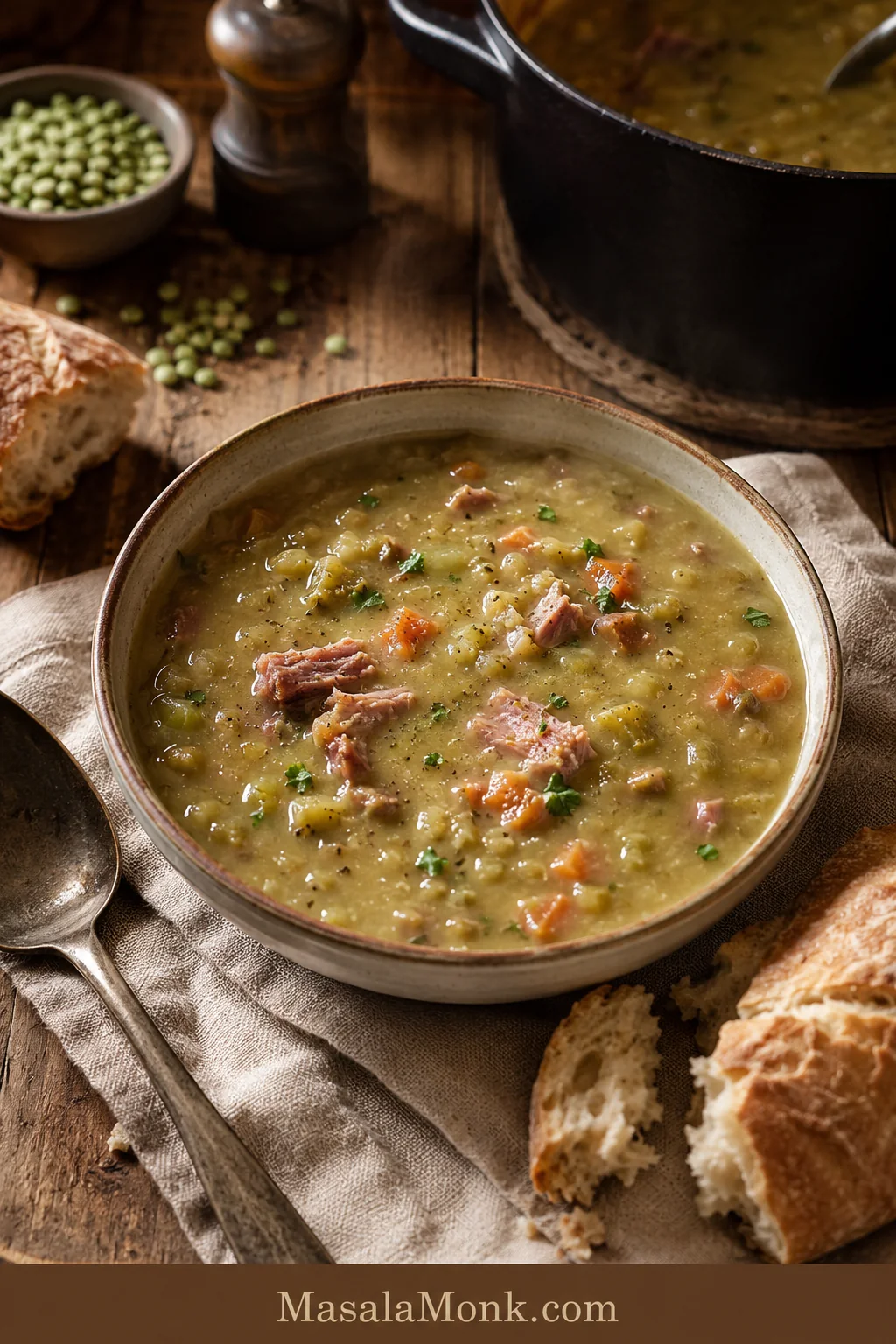
This pea and ham soup recipe is for the ham bone in the fridge — the one you almost tossed, then kept because it still had one good meal left in it. A smoked hock, gammon joint, ham hough, or diced leftovers can get you there too.
The main recipe is the classic dried split pea version: green split peas, ham, vegetables, water or stock, and enough time for the peas to collapse into a thick, comforting bowl. This recipe is built around the ham you actually have — a leftover bone, smoked hock, ham hough, gammon joint, or diced cooked ham — so you can get the salt, timing, and texture right the first time.
Start with the ham you have. The soup follows from there.
It will not stay bright green, and it does not need to. This is a smoky, spoonable, bread-dipping soup that gets its comfort from time, not flash.
Quick Answer
Best default formula
For classic pea and ham soup, simmer 500g / 1 lb dried green split peas with 1.2–1.5kg / 2.5–3 lb ham bone, smoked ham hock, ham hough, or gammon, plus 2 litres / about 8 cups water or low-sodium stock. Cook until the peas lose their shape, the broth coats a spoon, and the ham is soft enough to shred.
Split peas usually do not need soaking. Salt only after the ham has cooked into the broth. If the soup gets too thick, loosen it with hot water or stock; if it is too thin, simmer uncovered or blend a small portion after removing bones and bay leaves.
Before you cook: Use this as the quick mental map: split peas build body, ham seasons the broth, vegetables balance the pot, and time does the thickening.
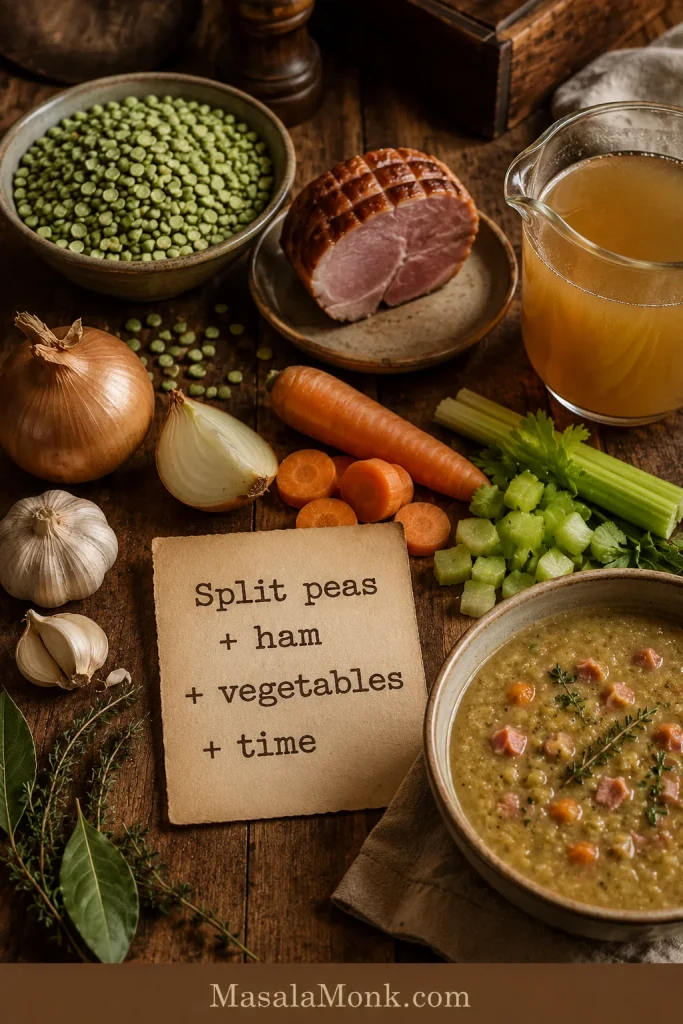
Table of Contents
Start Here
Make the Soup
Choose Your Ham Route
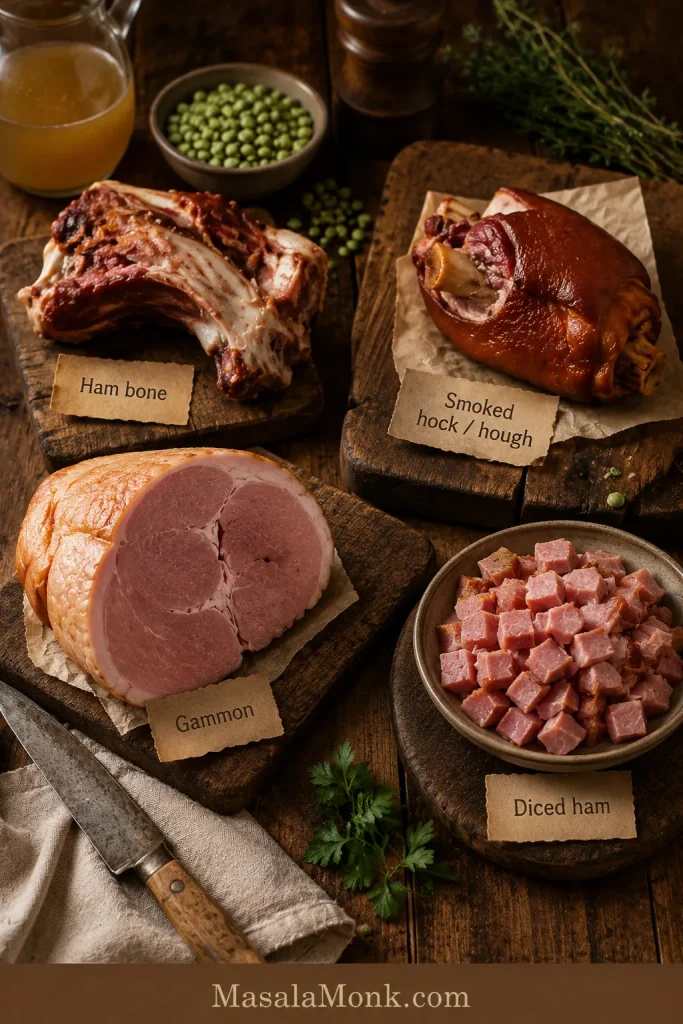
First, identify the ham before you worry about the exact method. A meaty bone gives depth, a smoked hock gives smoke, gammon gives a UK-style pot, and diced ham needs stock behind it. Use this table as a quick matchmaker for the ham in front of you.
Route cue: Choose the ham before the method.
| You have | Best route | Key tip |
|---|---|---|
| Meaty ham bone | Classic stovetop soup | Simmer from the start, then shred any attached meat. |
| Smoked ham hock or ham hough | Traditional slow-simmer soup | Cook until the meat pulls away easily; remove skin and excess fat. |
| Gammon joint | Classic soup with careful salt control | If raw, cook fully until tender before shredding. Rinse or soak first if very salty. |
| Leftover diced ham only | Faster split pea soup | Use low-sodium stock and add the ham near the end so it stays tender. |
Most pots start with one of these four ham situations. Frozen peas, yellow split peas, and no-ham versions can still work, but they move away from the classic dried split pea pot. Extra cooked ham is also perfect for ham and cheese quiche if you have more than this soup needs.
Next: cook the soup or check cook time by ham type.
Pea and Ham Soup Recipe Card
Pea and Ham Soup Recipe with Ham Bone, Ham Hock or Gammon
Servings: 6–8
Prep time: 15 minutes
Cook time: 2 hours 15 minutes
Total time: About 2 hours 30 minutes
Method: Stovetop
Equipment: 5–6 qt / 5–6 L Dutch oven or heavy soup pot
Done when: the peas have collapsed, the broth coats a spoon, and the ham pulls away easily from the bone, hock, hough, or gammon.
Pot size note: do not use a small saucepan. Split pea soup foams, thickens, and needs room to simmer. A 5–6 qt / 5–6 L pot gives the peas and ham enough space.
Ingredients
- 500g / 1 lb dried green split peas, about 2¼ cups, rinsed and sorted
- 1.2–1.5kg / 2.5–3 lb ham bone, smoked ham hock, ham hough, or gammon joint
- 2 litres / about 8 cups water or low-sodium chicken stock, plus more as needed
- 1 large onion, finely chopped, about 180–220g
- 2 medium carrots, diced, about 150g
- 2 celery ribs, diced, about 80–100g
- 3 garlic cloves, minced, about 1 tablespoon
- 1 tablespoon olive oil or butter
- 2 bay leaves
- 1 teaspoon dried thyme, or 1 tablespoon fresh thyme leaves
- ½ teaspoon black pepper, plus more to taste
- Fine salt, to taste after cooking, added in small pinches
- Fresh parsley or mint, optional, for finishing
If using leftover diced ham instead of a bone or hock: use 300–450g / 10–16 oz diced cooked ham and choose low-sodium stock instead of plain water for better flavor. Add the diced ham near the end.
If using raw gammon: cook it until fully cooked and tender before shredding, following the package guidance if needed. Use a meat thermometer if needed and follow the package’s safe-cooking guidance. For very salty gammon, rinse it or soak it according to the package directions before adding it to the soup.
Instructions
Build the Base
- Rinse the split peas. Place the split peas in a sieve, rinse well under cold water, and remove any small stones or damaged peas.
- Soften the vegetables. Heat the oil or butter in a large Dutch oven or heavy soup pot over medium heat. Add the onion, carrot, and celery. Cook for 6–8 minutes, stirring often, until the vegetables soften.
- Stir in the aromatics. Add the garlic, bay leaves, thyme, and black pepper. Cook for 30 seconds, just until fragrant.
- Combine peas, ham, and liquid. Add the rinsed split peas, your chosen ham, and 2 litres / about 8 cups water or stock. The ham does not have to be fully underwater, but it should be mostly submerged. Add a little extra water if your pot is wide or the ham sits too high.
- Bring to a boil. Increase the heat and bring the pot to a boil. Skim off any foam if needed.
- Simmer gently. Reduce the heat to low, partly cover the pot, and simmer for 2 to 2½ hours, stirring occasionally, until the split peas have softened, the soup has thickened, and the ham is tender.
Shred, Adjust and Finish
- Stir more often near the end. Once the split peas begin breaking down, keep the heat low and stir from the base of the pot so the soup does not catch.
- Remove the ham and bay leaves. Lift out the ham bone, hock, hough, or gammon. Remove and discard the bay leaves. Let the ham cool slightly.
- Shred the meat. Remove the meat from the bone. Discard bone, tough skin, and excess fat. Shred or chop the ham.
- Return the meat to the soup. Stir the shredded ham back into the pot.
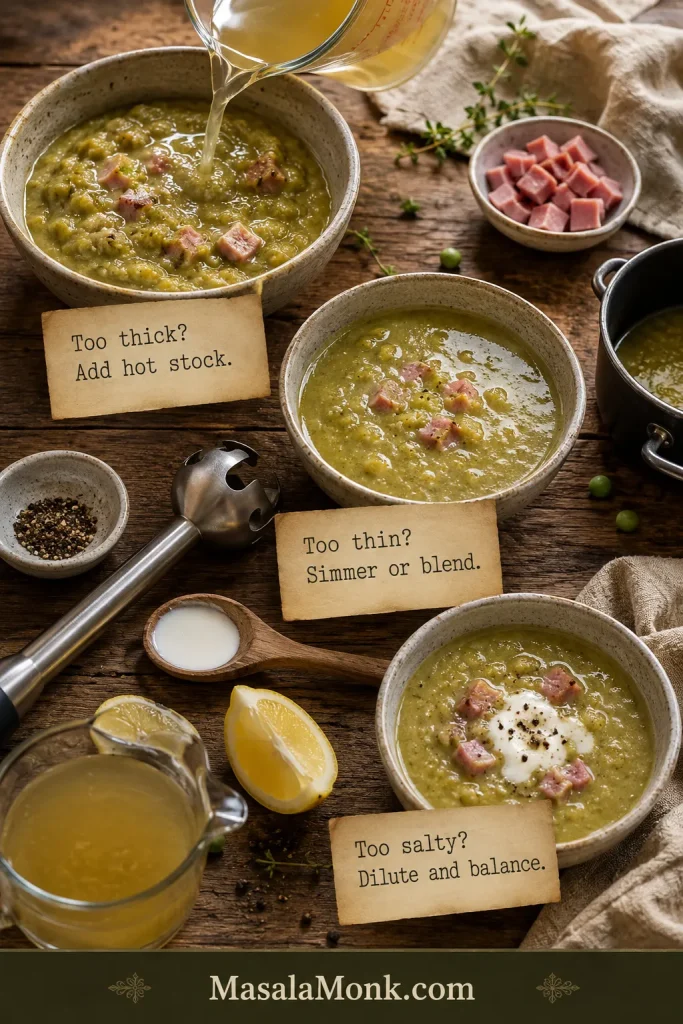
- Adjust the thickness. For a too-thick soup, add hot water or stock, ½ cup / 120ml at a time. When it is too thin, simmer uncovered for 10–20 minutes or blend a small portion after the bones and bay leaves have been removed.
- Taste before salting. Add salt in small pinches only after the ham has seasoned the broth. Finish with parsley, mint, extra black pepper, or a small squeeze of lemon if desired.
Recipe Notes
- Cook time varies by ham size, pea age, and whether the ham is raw, smoked, cured, or already cooked.
- A glazed ham bone makes a slightly sweeter soup; smoked hock gives the pot a deeper smoky edge.
- For a smoother soup, blend only part of it so you still keep some shredded ham and texture.
- Always remove bones and bay leaves before blending.
- This soup thickens as it cools, so expect to loosen leftovers with water or stock.
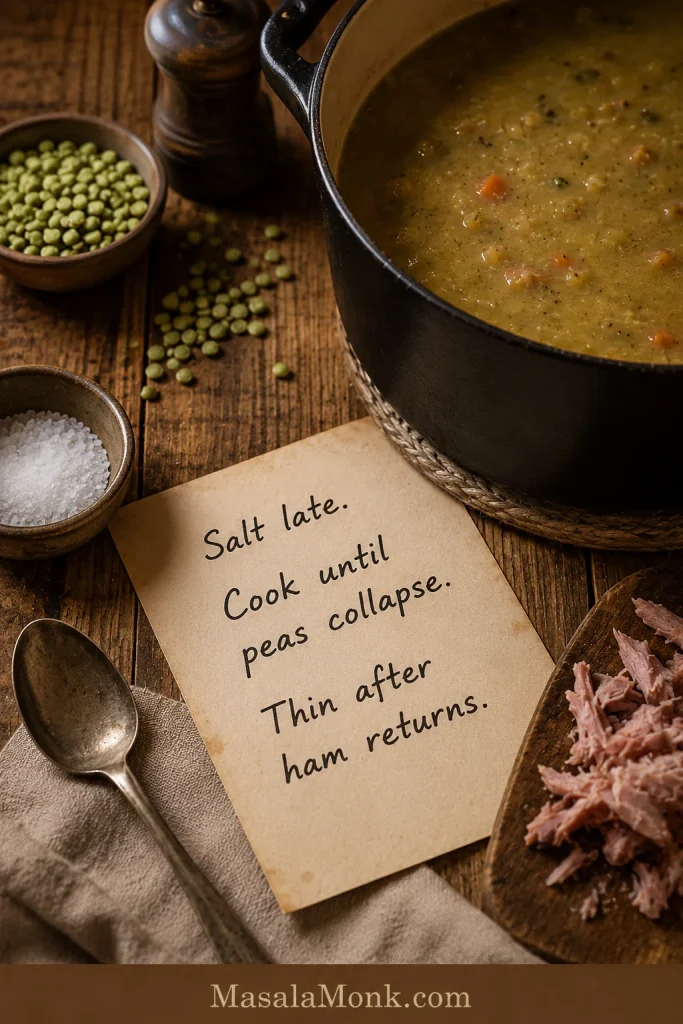
If you remember only three things: salt late, cook until the peas collapse, and adjust the thickness after the ham is shredded back in.
While it simmers: Keep these guardrails in mind, especially before adding salt, blending, or thinning the soup.
Pea and Ham Soup: Key Cooking Cues
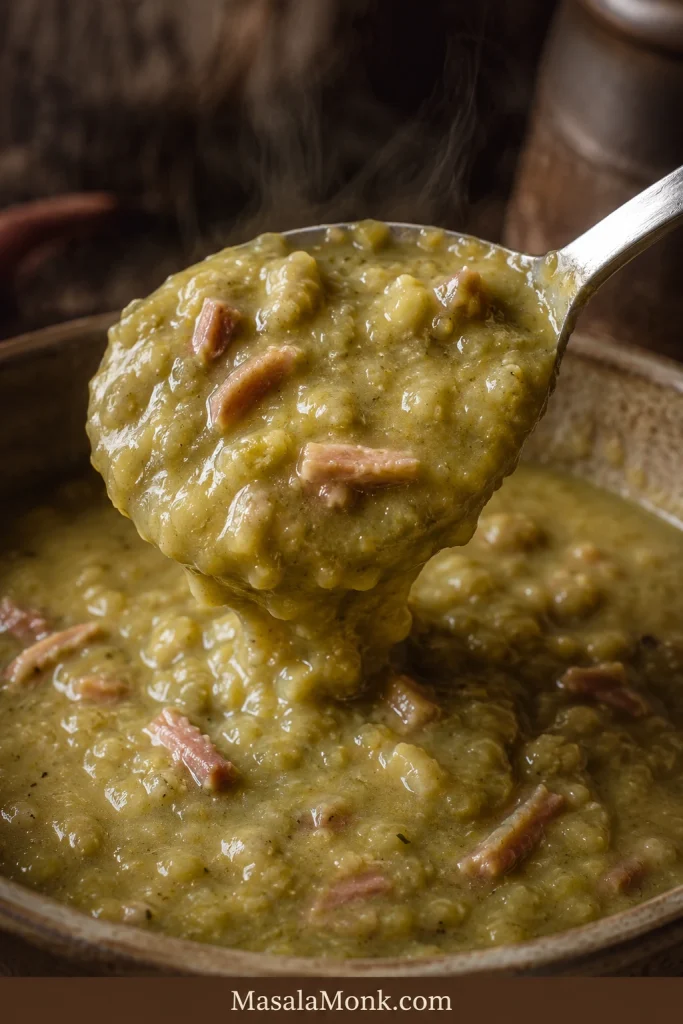
The finished soup should be thick enough to coat the spoon, soft enough to settle back into the bowl, and loose enough that it does not sit like paste. Use these cues before you decide it is done.
Texture cue: Do not stop at the clock alone; check whether the split peas have broken down and the soup coats a spoon.
| Cue | What it means |
|---|---|
| Peas still look like little discs | Keep simmering. They need to collapse for the soup to thicken properly. |
| Soup is olive green or khaki | Normal for dried split peas cooked with ham. Do not judge the pot by frozen-pea color. |
| Ham does not shred easily | It needs more time, especially if using hock, hough, or gammon. |
| Soup coats the spoon | Good sign. It should be thick but still spoonable. |
| Soup stands up too stiffly | Thin it after cooking with hot water or stock. |
| Broth tastes salty early | Wait before adding more salt; the flavor changes as the pot cooks. |
| Bottom starts catching | Lower the heat and stir from the base of the pot. |
Cook’s note: do not judge the soup before the ham is shredded back in. The broth, salt, color, and thickness all settle after the peas collapse and the meat returns to the pot.
Need help? Jump to troubleshooting or fix the thickness.
Why This Recipe Works
Every part of the pot has a job: ham seasons the broth, split peas build body, and vegetables add sweetness. Wait until the ham has flavored the liquid before you decide how much salt the soup needs.
- Split peas thicken the soup naturally. They soften, collapse, and create a creamy texture without cream.
- Bone-in ham builds the broth. Simmering a bone, hock, hough, or gammon piece from the beginning gives the soup depth that diced ham alone cannot provide.
- The recipe follows texture, not just time. The soup is ready when the peas lose their shape and the ham shreds.
- It works with real-life leftovers. Use the ham you have, then adjust the method and timing around it.
Make This Soup When
This is the kind of soup that makes leftovers feel intentional.
- Leftover ham bone is waiting after Christmas, Easter, Thanksgiving, a Sunday roast, or honey glazed ham.
- Smoked ham hock sounds right because you want an old-fashioned soup with deep flavor.
- Ham hough is what you have, and a Scottish-style pea and ham soup makes sense.
- Gammon is in the fridge, and you want a UK-style pot that is hearty, thrifty, and freezer-friendly.
- The slow cooker would help because dinner can simmer gently while you do other things.
- Only diced leftover ham is left, and you need stock to make the broth taste deeper.
What Is Pea and Ham Soup?
Pea and ham soup is a hearty soup made by cooking peas with ham until the peas soften and the ham flavors the broth. In the UK and Australia, it is often called pea and ham soup. Across the US and Canada, many people search for the same style of soup as split pea soup with ham, ham bone split pea soup, or ham hock split pea soup.
The names change by region, but the comfort is the same: peas, ham, vegetables, and time turning into a bowl that feels bigger than its ingredients.
For the classic version, dried split peas are the usual base. Frozen peas make a brighter, lighter soup, but they do not thicken the pot in the same way. The old-fashioned spoonable version needs dried split peas for body.
Ingredients for Pea and Ham Soup
Ingredient cue: This base gives the soup body, smoke, sweetness, and balance without needing cream, flour, or complicated extras.
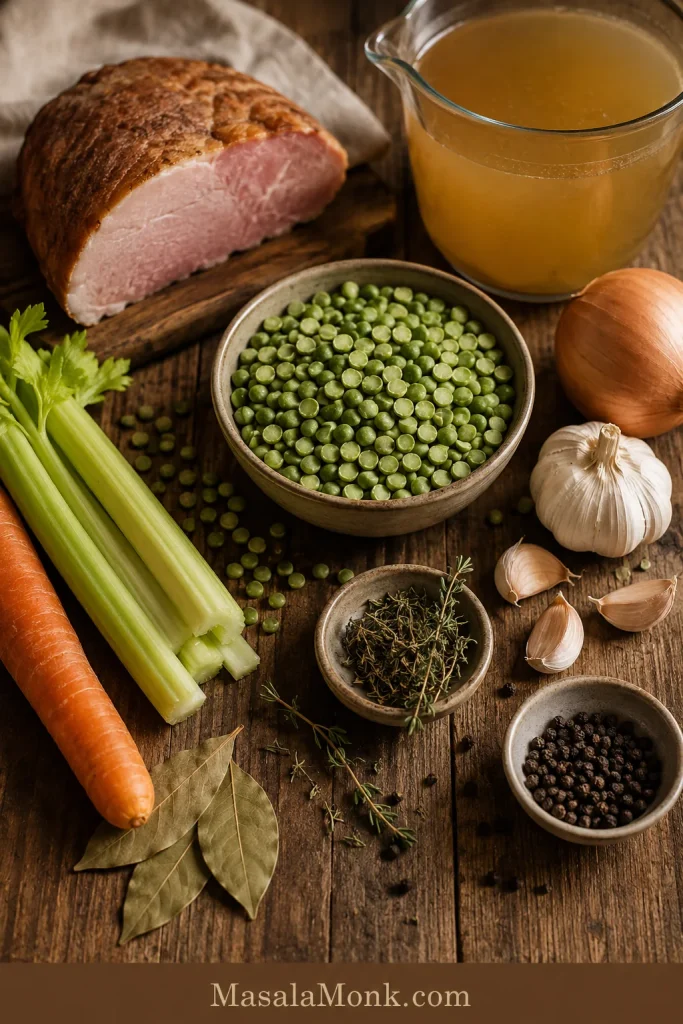
Green Split Peas
Dried green split peas are the best choice for classic pea and ham soup. They start dry and plain, then slowly melt into the broth until the soup turns creamy without cream. Rinse them well before cooking and quickly sort through them for small stones or dry, damaged pieces.
Freshness matters. A very old bag of split peas can take longer to soften. If your pot looks dull and khaki halfway through, do not judge it yet; dried split pea soup deepens as it cooks.
Ham Bone, Ham Hock, Ham Hough, Gammon or Leftover Ham
The ham choice changes the flavor, salt level, and cook time. A meaty ham bone is excellent after a roast, while a smoked hock or hough gives deeper flavor.
Gammon works well for a UK-style soup, but it can be salty and may be raw depending on how it is sold. Leftover diced ham is the fastest option, but it needs stock because it will not flavor the broth as strongly as a bone-in piece.
A hock or hough is a tough, bony cut with skin, fat, connective tissue, and deep flavor. Even a bare ham bone can give more flavor than it looks like it should. After cooking, keep the tender meat and discard tough skin or any fat you do not want in the bowl.
Onion, Carrot, Celery and Garlic
This simple vegetable base gives the soup sweetness and balance. The vegetables should not shout in the bowl; they should melt into the background and make the ham and peas taste rounder. A leek can also be added if you want a slightly sweeter UK-style flavor.
Bay, Thyme and Black Pepper
Bay leaf and thyme are classic with split peas and ham. Black pepper cuts through the richness. Parsley gives a clean finish, while mint works especially well if you add frozen peas for a brighter green variation.
Water or Stock
If you are using a strong ham bone, smoked hock, or gammon joint, water can be enough because the ham will create a rich broth as it cooks. With diced leftover ham only, use low-sodium chicken stock or vegetable stock so the pot does not taste flat.
Best Ham for Flavor: Bone, Hock, Hough or Gammon?
Here, the ham is not just an ingredient; it is the seasoning. The best ham for this soup is the piece that can flavor the broth while the peas soften. Bone-in pieces build the pot slowly; diced cooked ham is faster, but it needs good stock behind it so the soup still tastes full.
If you are buying ham just for this soup, choose a smoked ham hock for deeper flavor, or ask for a meaty ham bone if you want more shredded ham in each bowl. This is where the soup starts tasting like more than peas and water.
Ham Options at a Glance
| Ham option | Best for | How to use it |
|---|---|---|
| Ham bone | Leftover holiday ham or roast ham flavor | Simmer from the start, then remove and shred any attached meat. |
| Meaty ham bone | Best leftover option | Gives broth, meat, and body. Add extra diced ham only if needed. |
| Smoked ham hock | Deep smoky flavor | Simmer until tender, then remove skin, excess fat, and bone before shredding the meat. |
| Ham hough | Scottish-style pea and ham soup | Use like ham hock. Cook until the meat pulls away easily. |
| Gammon joint | UK-style pea and ham soup | If raw, simmer until fully cooked and tender. Taste carefully before adding salt. |
| Leftover diced ham | Quick split pea soup with ham | Add near the end so it does not dry out. Use stock for better flavor. |
| Smoked turkey leg | Smoky non-pork option | Use like a ham hock if it fits your diet, then adjust seasoning at the end. |
| Bacon | Extra smoky flavor | Use with stock and, if possible, diced ham. Bacon adds flavor but does not replace the body of a bone or hock. |
Ham stock upgrade: for extra-deep hock flavor, simmer a ham hock or ham hough first, strain the cooking liquid, then use that ham stock as the soup liquid. It adds time, but the broth tastes rounder and more deeply hammy. Shred the cooked meat and add it back near the end. Taste the ham stock before adding salt, because it can be very salty.
What if the Ham Bone Has Barely Any Meat?
Use it anyway if it has good flavor. Simmer the bone with the split peas and vegetables, then add diced cooked ham near the end. The bone gives the broth body, while the diced ham makes sure every bowl still has enough meat.
If you like the smoky beans-and-meat direction, red beans and rice is another slow-simmer comfort meal where seasoning, bean age, and final texture matter.
What if the Gammon Is Very Salty?
Check the package first. Some gammon should be soaked or rinsed before cooking. If yours is very salty, soak or rinse it as directed, use water or unsalted stock, and do not add salt until the soup is finished.
Best Peas to Use for Pea and Ham Soup
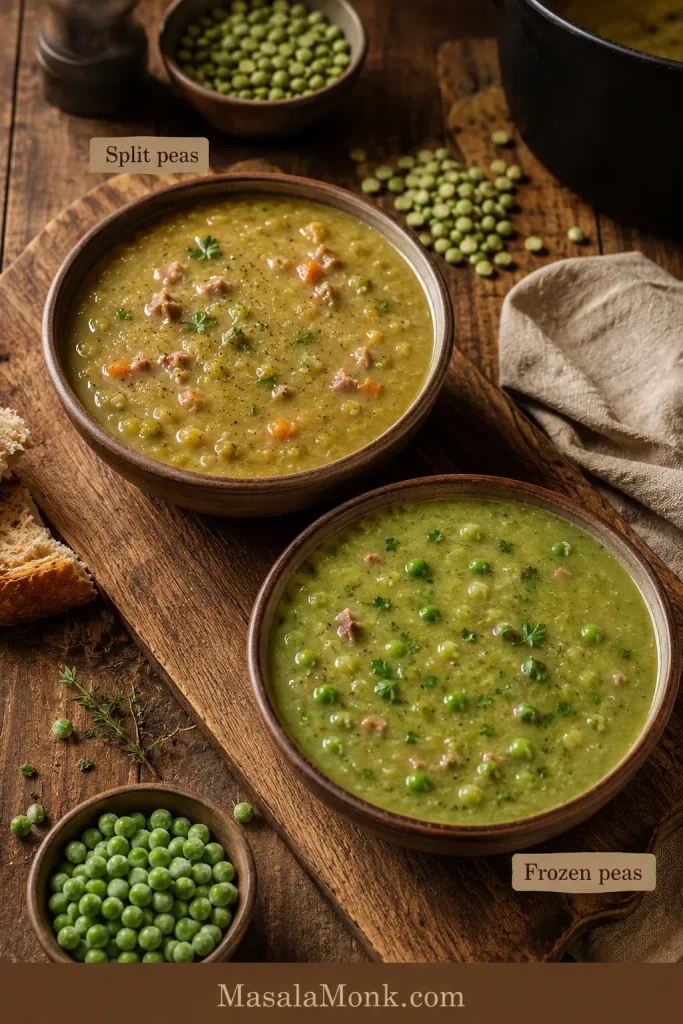
The peas decide the texture, which is why split peas and frozen peas should not be treated as the same soup. Green split peas are the classic choice because they break down and thicken the broth. Frozen peas are sweeter and brighter, but they make a different bowl.
Pea choice: Pick the pea by the texture you want: dried split peas for the classic thick soup, frozen peas for a brighter variation.
| Pea type | Result | Best use |
|---|---|---|
| Green split peas | Spoonable, classic, earthy soup | Best for this main recipe. |
| Yellow split peas | Thick, milder, earthier soup with yellow color | Good variation, especially with gammon or smoked ham. |
| Frozen peas | Bright green, sweeter, lighter soup | Best for a quick cooked-ham variation, not the classic version. |
| Fresh peas | Sweet and delicate | Better for a light spring soup than a ham bone soup. |
Important: frozen peas and split peas are not a direct swap. Split peas break down and thicken the soup. Frozen peas stay sweet and bright, but they need potato, cream, or blending for body.
Using frozen peas? See the quick variation. Ready to cook? Go to the method.
How to Make Pea and Ham Soup with a Ham Bone or Hock
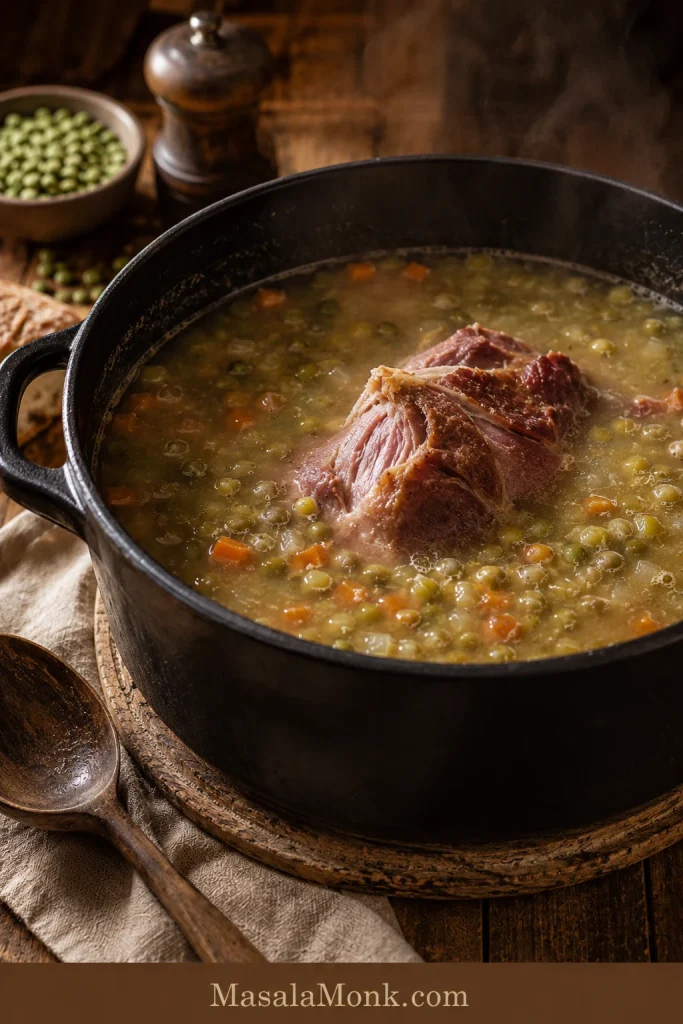
The method is simple: soften the vegetables, add split peas, ham, herbs, and liquid, then simmer until the peas collapse and the ham turns tender. As it cooks, the broth goes from thin and separate to cloudy, then creamy.
Method cue: Early simmering looks loose and separate; the creamy texture comes later as the split peas soften and collapse.
- Rinse the split peas. This removes dust and gives you a chance to check for small stones.
- Soften the vegetables first. Onion, carrot, and celery taste better when cooked before the liquid is added.
- Stir in herbs and garlic. Bay, thyme, black pepper, and garlic create the classic soup base.
- Add the ham and liquid. Bone-in ham, hock, hough, or gammon should go in early so it can flavor the broth.
- Simmer slowly. Keep the heat gentle once the pot has boiled. Hard boiling can make thick pea soup stick.
- Remove bones and bay leaves before blending. This is the one step not to skip.
- Shred the ham. Return only the tender meat to the pot.
- Finish by texture and taste. Adjust thickness, then season after tasting.
Shredding cue: After the ham is tender, remove the bones and bay leaves first, then return only the edible shredded meat to the pot.
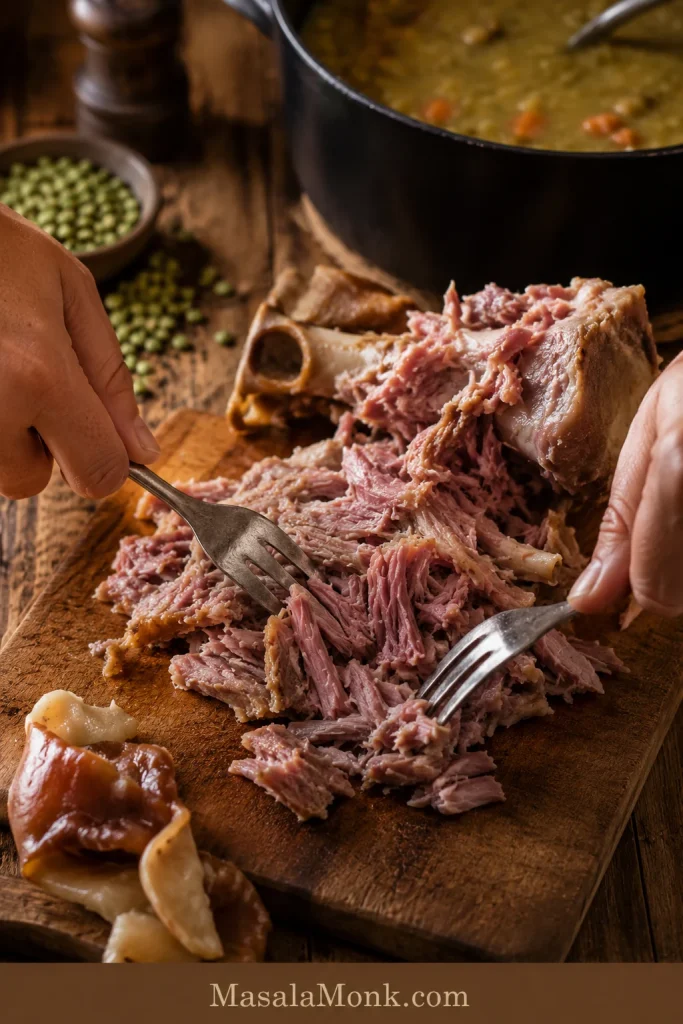
By the end, the ham should be soft, the broth settled, and the finish peppery.
Pea and Ham Soup Cook Time by Ham Type
This is the part where patience pays you back. Diced leftover ham is already tender. A ham bone, hock, hough, or gammon joint needs longer because it has to flavor the broth and soften enough to pull apart.
| Method | Approximate time | Best for |
|---|---|---|
| Stovetop with diced leftover ham | 1 hour 30 minutes to 1 hour 45 minutes | Quickest split pea soup with ham. |
| Stovetop with ham bone | 2 to 2½ hours | Leftover roast ham bone soup. |
| Stovetop with ham hock or ham hough | 2 to 2½ hours, sometimes longer | Traditional pea and ham soup, smoky if the ham is smoked. |
| Stovetop with gammon | 2 to 2½ hours, depending on size | UK-style pea and ham soup. |
| Slow cooker on low | 8–10 hours | Hands-off ham hock or ham bone soup. |
| Slow cooker on high | 5–6 hours | Faster crockpot version. |
| Instant Pot with diced ham or small bone | 15–25 minutes high pressure + natural release | Fast pressure-cooker version. |
| Instant Pot with large ham hock, hough, or gammon | 45–75 minutes high pressure + natural release | Large pieces that need time to become shreddable. |
If the peas still look firm or the ham does not pull away easily, keep cooking. Trust the pot, not just the clock.
Changing method? See slow cooker notes or see Instant Pot notes.
Do You Need to Soak Split Peas?
No, split peas usually do not need soaking for pea and ham soup. Soaking is mainly useful if the peas are old or you want to shorten the cook time.
Most split peas can go straight into the pot. They are small enough to cook without soaking, which is why this soup can start straight from the bag.
If you add lemon, vinegar, wine, or tomatoes as a variation, wait until the split peas are soft. Acidic ingredients can slow softening when added too early.
Slow Cooker Pea and Ham Soup Notes
The slow cooker is especially good for bone-in ham, smoked hocks, ham houghs, and gammon because the long, gentle heat gives the meat time to soften. It is also the version that makes the kitchen smell like dinner long before anyone asks what is cooking.
Slow-cooker cue: For a hands-off version, give ham hock, ham hough, gammon, or a meaty bone enough time to soften gently.
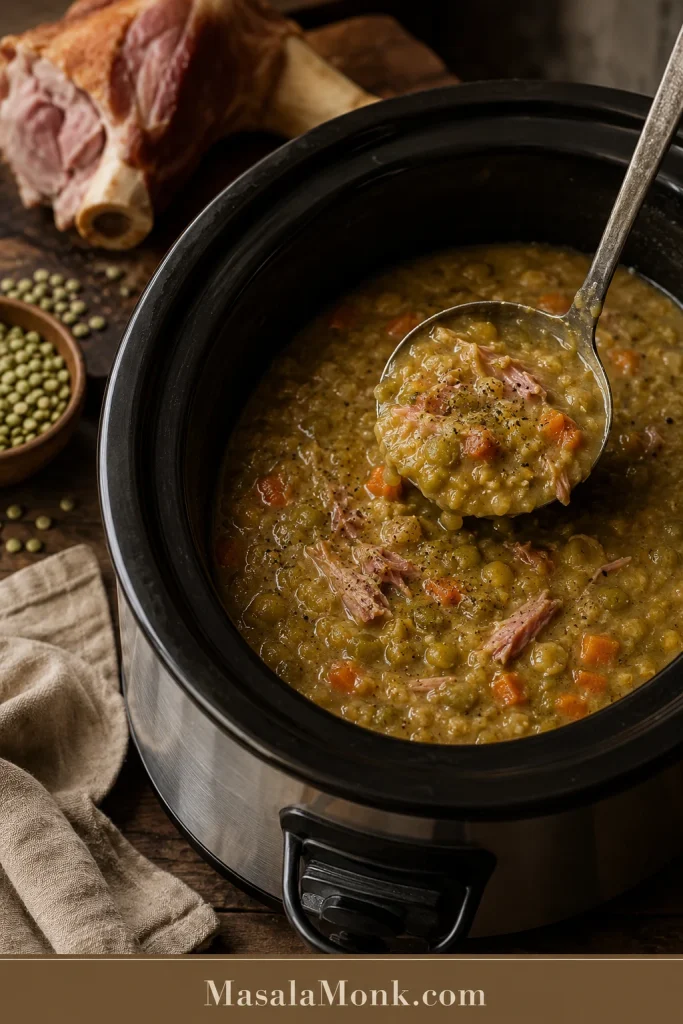
- Add the split peas, onion, carrot, celery, garlic, bay, thyme, ham, and liquid to a 6 qt / 5.7 L slow cooker.
- Cook on low for 8–10 hours or high for 5–6 hours.
- Remove the ham and bay leaves when the soup is done.
- Shred the meat and stir it back into the soup.
- Let the soup rest for a few minutes before judging the thickness.
- Taste before adding salt.
If the soup looks too thick near the end, stir in hot water or stock before serving. Slow cooker split pea soup often thickens more after it rests.
For another busy-day soup, this slow cooker broccoli cheese soup goes creamy and cheesy instead of smoky and hearty.
Instant Pot Pea and Ham Soup Notes
Use the pressure cooker when you want the split peas softened faster, but do not expect it to cheat a tough hock into tenderness without enough time. Large hocks, houghs, and raw gammon need a longer cook; diced leftover ham and small cooked bones are much faster.
A 6 qt or larger pressure cooker is best because split pea soup foams, thickens, and leaves starchy residue.
Pressure-cooker cue: Pressure cooking speeds up the split peas, but tough ham pieces still need enough time and natural release.
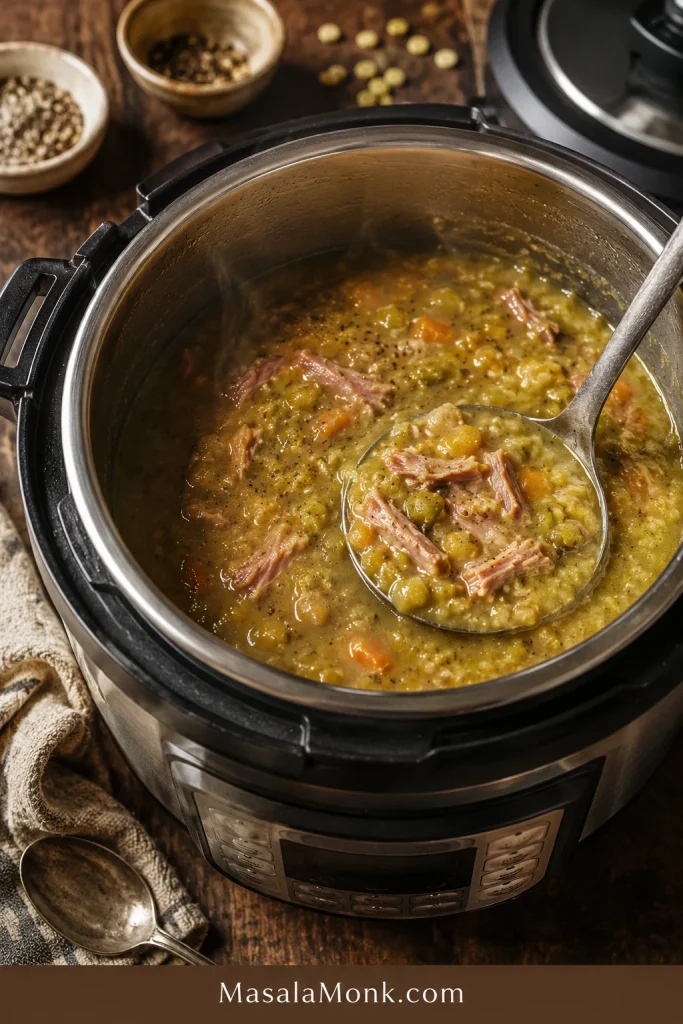
| Pressure cooker version | Suggested timing | Note |
|---|---|---|
| Diced leftover ham | 15 minutes high pressure + 10–15 minutes natural release | Fastest version; use stock for flavor. |
| Small ham bone | 20–25 minutes high pressure + natural release | Good when the bone is already from cooked ham. |
| Large smoked ham hock or ham hough | 45–75 minutes high pressure + natural release | Needs longer to become tender enough to shred. |
| Raw gammon joint | 45–75 minutes high pressure + natural release, depending on size | Must be fully cooked and tender before shredding. |
Use the longer end of the range for large, tough, or raw pieces, and the shorter end for smaller cooked bones or diced ham. Keep the soup below your pressure cooker’s max-fill line for beans, grains, or foamy foods if your model has one.
Let the pressure release naturally, and clean the lid, gasket, and valve after cooking because split pea soup can leave starchy residue.
Quick Frozen Pea and Ham Soup Variation
This is not the classic split pea version, but it is useful when you want a brighter green soup in about 30 minutes. Use frozen peas with leftover ham or cooked gammon for a lighter, fresher bowl.
Cook onion and garlic in butter, add diced potato if you want extra creaminess, then pour in stock and simmer until the potato is tender. Add frozen peas near the end and cook just until bright green. Blend the soup, then stir in diced ham or shredded gammon. Finish with mint, parsley, black pepper, or a little cream.
Avoid These Pea and Ham Soup Mistakes
Before you blend: Most problems start before the final simmer, so scan this checklist before you salt, blend, or swap the peas.
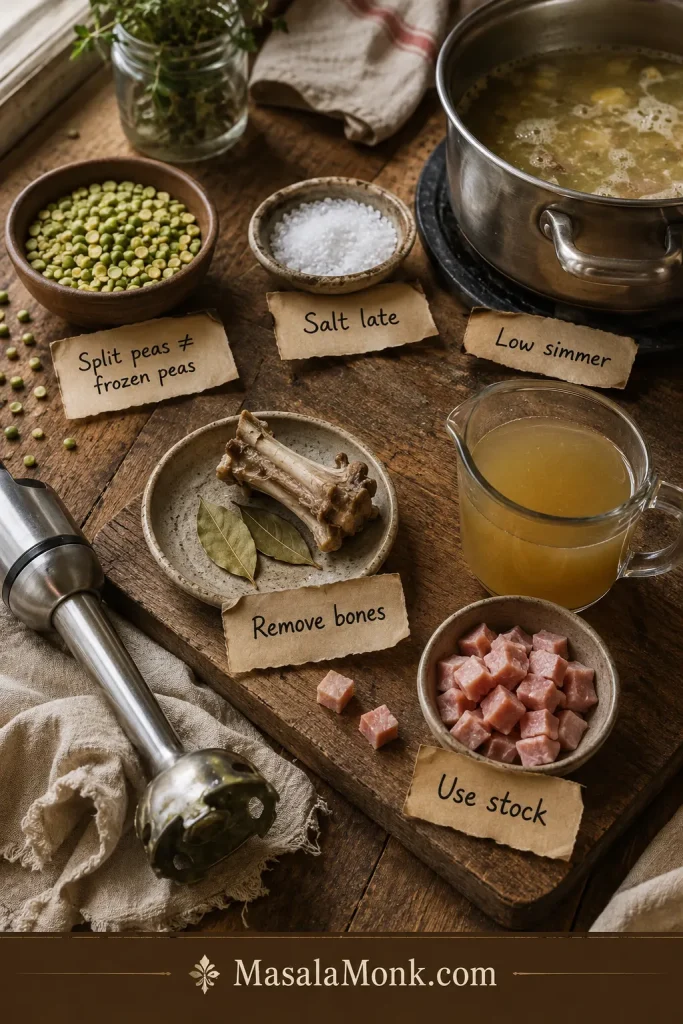
- Salting before the ham has simmered. Ham can season the whole pot as it cooks.
- Judging the soup before the peas collapse. Split peas need to lose their shape for the broth to thicken.
- Blending before removing bones and bay leaves. Take them out first every time.
- Using water with diced ham only and expecting deep broth. Diced ham needs stock behind it.
- Boiling hard once the soup thickens. A low simmer protects the bottom of the pot.
- Assuming frozen peas behave like split peas. Frozen peas make a different, lighter soup.
Already happened? Go to the fix-it section.
How to Thicken Pea and Ham Soup
To thicken pea and ham soup, simmer it uncovered, mash some peas, or blend a small portion after removing the bones and bay leaves.
- Need it thicker? Simmer uncovered for 10–20 minutes.
- Want it smoother? Blend a small portion with an immersion blender after removing bones and bay leaves.
- Prefer it rustic? Mash some peas against the side of the pot.
- Did it thicken too much? Add hot water or stock, ½ cup / 120ml at a time.
You usually do not need flour, cornstarch, or potato flakes. Split pea soup is supposed to thicken from the peas themselves.
Troubleshooting Pea and Ham Soup
This is a forgiving soup, but it does have moods: sometimes the peas take longer, sometimes the ham is saltier, and sometimes yesterday’s perfect soup turns into a thick block in the fridge. None of that means the pot is ruined.
Quick Texture and Salt Fixes
Fix-it cue: Use this section when the pot is already cooked but the texture, thickness, or salt level still needs fixing.
| Problem | Urgency | What to do |
|---|---|---|
| Split peas are still hard | Needs time | Keep simmering and add hot water if needed. Old peas, hard water, salt too early, or acidic ingredients can slow softening. |
| Too salty | Fix carefully | Add unsalted water or stock, more cooked peas, diced potato, cream, or a little lemon for balance. |
| Too thin | Easy fix | Simmer uncovered, blend a portion, mash some peas, or let the soup rest. |
| Too thick | Easy fix | Add hot water or stock, ½ cup / 120ml at a time, until it loosens. |
| Bland broth | Easy fix | Add black pepper, thyme, parsley, bay, a little lemon, or more ham. If using diced ham only, use stock instead of water. |
| Bottom starts catching | Act now | Lower the heat and stir from the base of the pot before it burns. |
| Ham hock is fatty | Normal | Remove skin and excess fat before returning the shredded meat to the soup. |
| Solid after chilling | Normal | Reheat gently with water or stock until spoonable again. |
| Too smoky | Balance it | Add more stock, a little cream, parsley, black pepper, or a small squeeze of lemon. |
| Too sweet | Balance it | This can happen with a glazed ham bone. Balance with black pepper, herbs, lemon, and unsalted stock. |
Most imperfect pots need only one thing: more time, more liquid, or a better final balance.
Once fixed: serve the soup or store and freeze leftovers.
What to Serve with Pea and Ham Soup
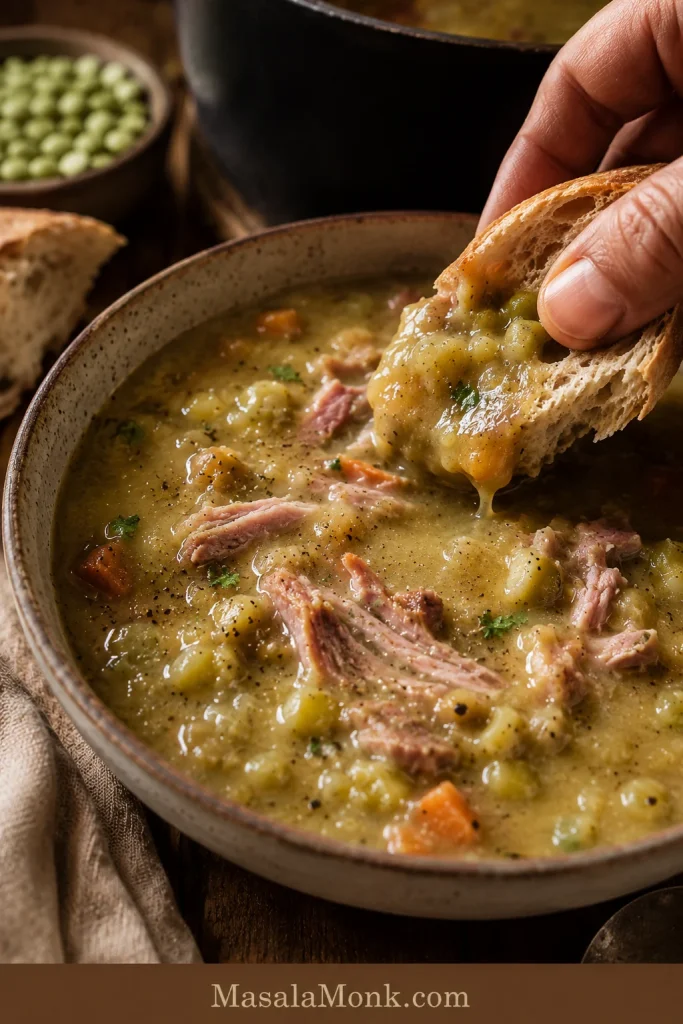
This is a bread-dipping soup, not a delicate starter. Serve it with something crisp, buttery, or slightly sharp to balance the bowl.
Serving cue: Serve the soup with something sturdy and crisp enough to balance the thick split pea texture and smoky ham.
- Crusty bread or sourdough
- Buttered toast
- Garlic croutons
- Soda bread
- Grilled cheese
- A simple green salad
- Pickles or mustard on the side
- Extra black pepper, parsley, or mint
For bread that can stand up to a thick bowl, sourdough focaccia is especially good because the crisp edges and airy center can handle dipping.
Later in the week, French onion soup goes in a completely different direction with caramelized onions, savory broth, toast, and melted cheese.
How to Store, Freeze and Reheat Split Pea Soup with Ham
Leftovers are one of the reasons to make the full pot. This is a good make-ahead soup because it thickens and deepens after a night in the fridge. The next-day bowl is often even better, especially with extra black pepper and a splash of stock to loosen it.
- Fridge: Store in an airtight container for 3–4 days.
- Freezer: Freeze in portions for up to 3 months for best quality.
- Cooling: Cool the soup before storing it, and divide large batches into smaller containers so they chill faster.
- Reheating: Warm gently on the stovetop or in the microwave, stirring often, until steaming hot throughout.
- Thinning after storage: Add water or stock until the soup returns to the texture you like.
For safe leftover timing, the USDA recommends using refrigerated leftovers within 3–4 days; freeze extra soup if you want to keep it longer.
Back to Recipe Card · Back to Table of Contents
Frequently Asked Questions
These are the doubts that usually come up once the pot is already on the stove.
Is a ham bone enough for pea and ham soup?
Yes, especially if it still has some meat attached. Simmer it with the split peas, then remove the bone, shred any meat, and stir the meat back in.
Ham hock or ham bone: which tastes better?
A smoked ham hock is usually smokier and richer, while a ham bone tastes more like the roast it came from. Both work well. Choose smoked hock for smoke and ham bone for leftovers.
What is ham hough?
Ham hough is another name for ham hock, commonly used in Scotland. Use it the same way: simmer until tender, then remove the skin, excess fat, and bone before shredding the meat.
How salty is gammon in soup?
Gammon can be quite salty, depending on how it is cured. Use water or low-sodium stock, follow any soaking or rinsing guidance on the package, and season only after tasting near the end.
How much diced ham do I need without a bone?
Start with 300–450g / 10–16 oz diced cooked ham. Add it near the end and use stock instead of plain water so the broth has enough flavor.
Do split peas really need soaking?
No, not usually. Split peas can cook directly in the soup. Soaking can help if your peas are old or you want to shorten the cook time.
Why did my split peas stay hard?
They may be old, the water may be hard, or acidic ingredients may have gone in too early. Keep simmering and add hot water as needed.
Why did my soup turn khaki instead of green?
That is normal. Dried split peas cooked with ham usually turn olive green, khaki, or golden-green. Bright green pea soup is usually made with frozen or fresh peas.
Should pea and ham soup be smooth or chunky?
Either works. For the best texture, blend only part of the soup so it stays creamy but still has shredded ham and a little body.
Can I use yellow split peas?
Yes. Yellow split peas still make a thick, comforting soup, but the flavor is a little earthier and the color will be golden instead of green.
Can I use frozen peas instead of split peas?
You can, but it becomes a different soup. Frozen peas make a brighter, sweeter, lighter bowl; split peas make the old-fashioned thick version.
Can I use the water from cooking ham hock?
Yes, if it tastes good and is not too salty. Strain it first, then use it as part or all of the soup liquid.
Best way to fix pea and ham soup that is too salty?
Add unsalted water or stock, more cooked peas, diced potato, or a splash of cream. A small squeeze of lemon can help balance the flavor.
Can I make pea and ham soup the day before?
Yes. It is an excellent make-ahead soup. Chill it, then reheat gently with extra water or stock until it loosens back to a spoonable texture.
Can I make it in a slow cooker?
Yes. Use a 6 qt / 5.7 L slow cooker and cook on low for 8–10 hours or high for 5–6 hours. Remove and shred the ham at the end.
Can I make it in an Instant Pot?
Yes, but timing depends on the ham. Diced leftover ham or a small cooked ham bone can work in about 15–25 minutes at high pressure, plus natural release. Large hocks, ham hough, or raw gammon need longer, often 45–75 minutes.
What if I need a no-ham version?
Use vegetable stock, onion, carrot, celery, garlic, bay, thyme, smoked paprika, and olive oil or butter for richness. For a vegetable-heavy soup instead, try minestrone soup.
Best way to freeze pea and ham soup?
Freeze it in portions for up to 3 months for best quality. Thaw, then reheat with a splash of water or stock because the soup thickens after freezing.
Final Recipe Notes
The best pea and ham soup starts with the ham in front of you. Once you know whether it is a bone, hock, hough, gammon, or diced leftovers, the rhythm is simple: simmer until the peas collapse, shred the tender meat, and adjust the final texture.
It is humble food, but that is the point: peas, ham, vegetables, water, time, and patience becoming a pot that feeds people well.








