
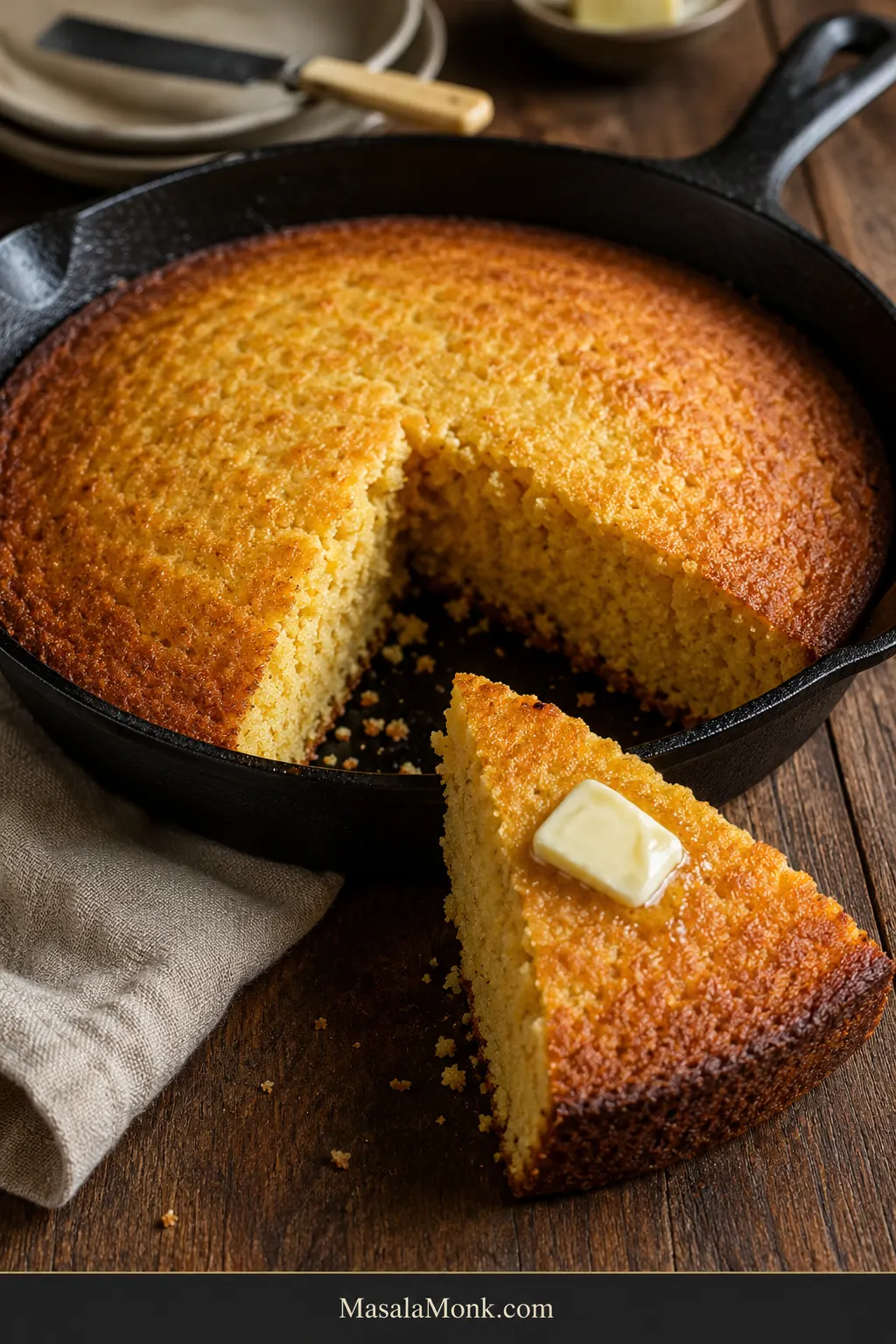
Good Southern cornbread announces itself twice: first with the sizzle when the batter hits the cast-iron skillet, then with the faint scrape of a knife through the browned bottom crust.
This one is savory and old-fashioned, with plenty of corn flavor, buttermilk for tenderness, and just enough flour and egg to hold the moist crumb together without turning it soft and cakey. The base recipe has no sugar, with measured options if the cornbread you know and love carries a little sweetness.
If the cornbread you came looking for has a deeply browned skillet edge, a tender but slightly rugged middle, and tastes more of corn than sugar, you are in the right place.
Cornbread itself isn’t fussy. Most batches go right when the skillet is properly hot, the batter isn’t overmixed, and you begin checking before the inside dries out. When a batch behaves differently, the cornmeal, pan and oven usually leave clues.
Jump to Recipe · Choose Your Cornbread · Fix Common Problems
Quick Answer: How Do You Make Southern Cornbread?
For savory, old-fashioned Southern cornbread, make a cornmeal-heavy batter with buttermilk, eggs and a modest amount of flour, then pour it into a fully heated 10-inch / 25 cm cast-iron skillet coated with hot bacon drippings, oil or shortening.
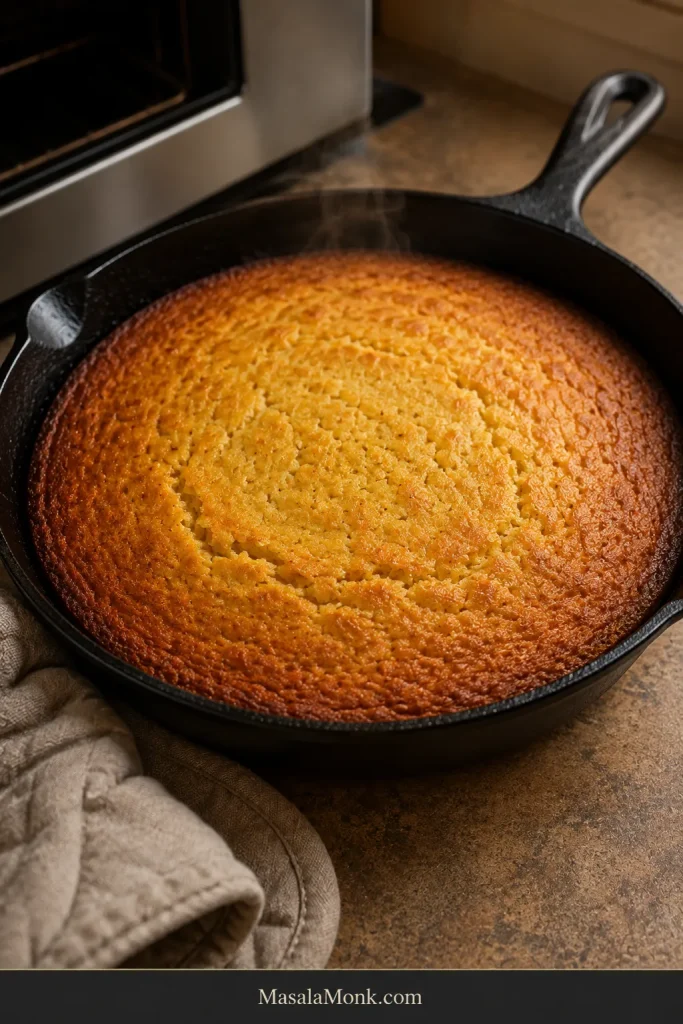
Bake on the center rack at 425°F / 218°C for 18–24 minutes, starting your checks around 18 minutes. The edge should be deeply browned, the middle set and lightly springy, and a tester pushed into the thickest part should come back without wet batter. Rest for 5 minutes before cutting.
Choose Your Cornbread: Savory, Balanced or Lightly Sweet
Southern cornbread traditions do not agree on sugar, and we do not need to settle that argument before dinner. Pick the version that tastes right at your table.
| Version | Sugar | What You Get |
|---|---|---|
| Savory / base recipe | 0 g | Strong corn flavor with no detectable sweetness |
| Balanced | 12–13 g / 1 tbsp | Rounds the corn flavor without making the bread taste sweet |
| Lightly sweet | 25 g / 2 tbsp | A noticeable touch of sweetness while still tasting clearly like skillet cornbread |
The main batch below uses no sugar, keeping the corn flavor firmly in front. That also leaves room for sweeter dishes at the table, including saucy baked beans. Honey can always go on the warm piece for anyone who wants sweetness there instead.
With the full 2 tablespoons of sugar, the top and edges may color sooner, so start checking around 18 minutes.
Southern Cornbread Recipe
These proportions are built for a 10-inch / 25 cm cast-iron skillet.
| Yield | 8 generous pieces |
|---|---|
| Skillet | 10-inch / 25 cm cast iron |
| Oven | 425°F / 218°C |
| Prep | About 15 minutes |
| Bake | 18–24 minutes |
| Rest | 5 minutes |
| Style | Savory, crisp-bottomed and moist inside |
Equipment
- 10-inch / 25 cm cast-iron skillet
- Large mixing bowl
- Medium mixing bowl
- Whisk
- Flexible spatula or wooden spoon
- Kitchen scale and/or measuring cups and spoons
- Toothpick, thin skewer or cake tester
Ingredients
Dry ingredients
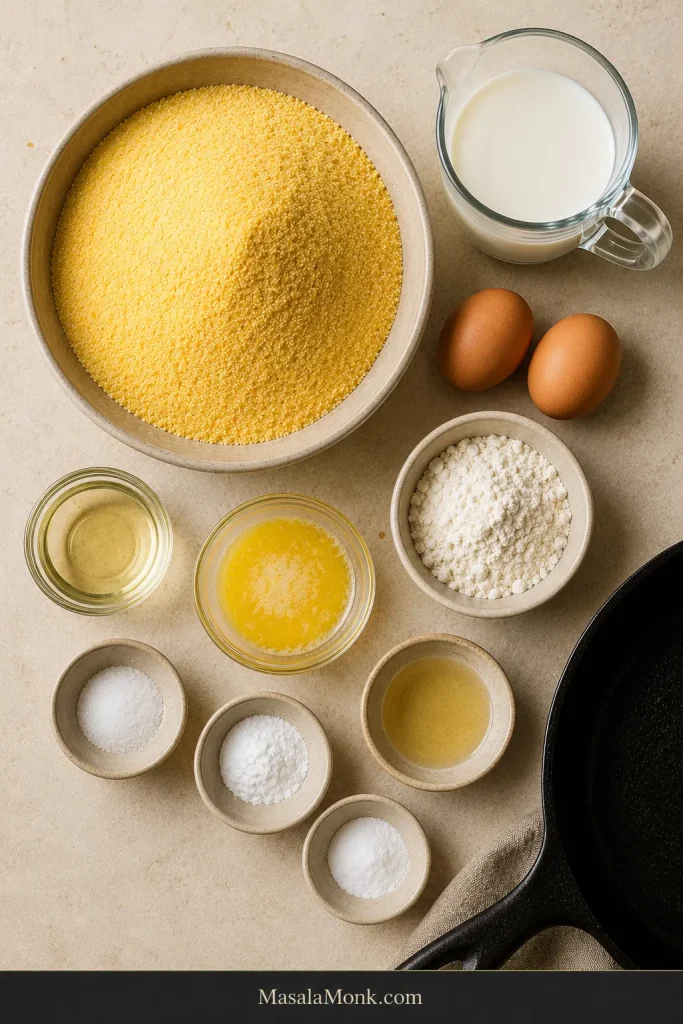
- 250 g / 8.8 oz medium-grind plain cornmeal, about 1¾ cups; use the weight when possible because brands and grinds vary
- 80 g / 2.8 oz all-purpose flour, about ⅔ cup
- 8 g baking powder, about 2 teaspoons
- 2 g baking soda, about ½ teaspoon
- 5 g fine or table salt, about ⅞ teaspoon
- 0–25 g granulated sugar, optional
Wet ingredients
- 360 ml / 1½ cups cultured buttermilk, plus more only if needed
- 2 large eggs
- 56 g / 2 oz unsalted butter, 4 tablespoons, melted and cooled until warm
- 30 ml / 2 tablespoons neutral oil, such as vegetable or canola
For the skillet
- 30 ml / 2 tablespoons bacon drippings, vegetable or canola oil, or shortening
Instructions
- Heat the oven and skillet. Put a rack in the center of the oven. Place the empty cast-iron skillet on it and preheat to 425°F / 218°C. Leave the skillet heating while you mix the batter so the iron is thoroughly hot when you are ready to pour.
- Mix the dry ingredients. Whisk the cornmeal, flour, baking powder, baking soda, salt and sugar, if using, until evenly combined. Give the bowl a few extra turns so the leaveners are well dispersed.
- Mix the wet ingredients. In the second bowl, whisk the buttermilk and eggs until smooth. Whisk in the melted butter and neutral oil. The butter should be warm, not piping hot.
Check the Cornbread Batter Consistency
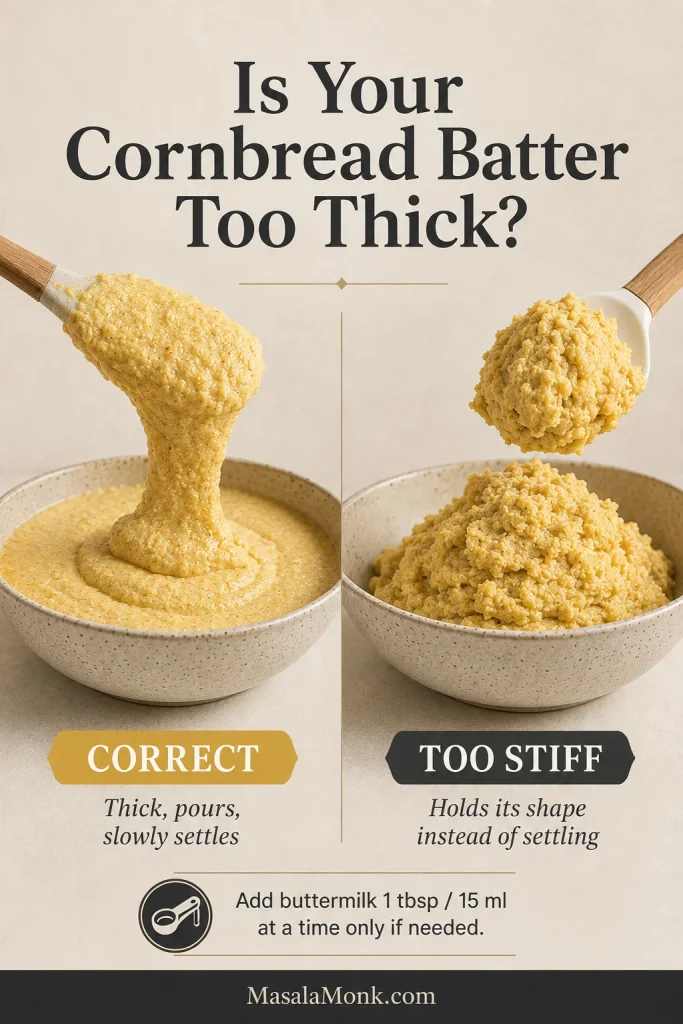
- Bring the batter together. Pour the wet mixture into the dry ingredients and fold just until the dry pockets disappear. Small lumps are fine. The batter should have body but still pour and slowly settle. Batter that stands stiffly like soft dough needs more buttermilk; fold it in 1 tablespoon / 15 ml at a time.
Finish in the Hot Skillet
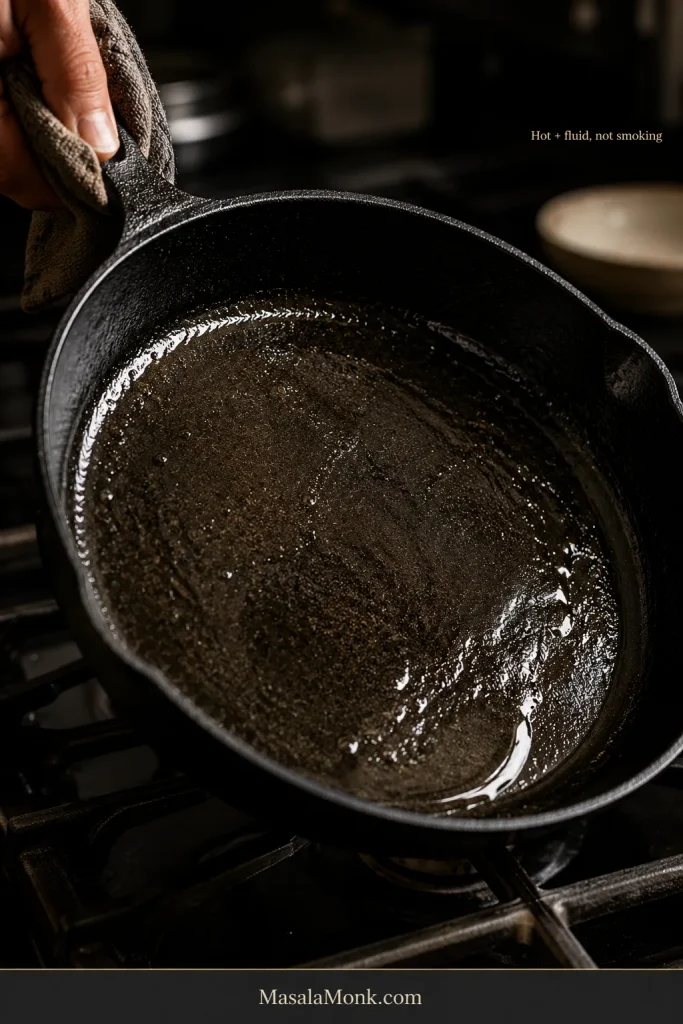
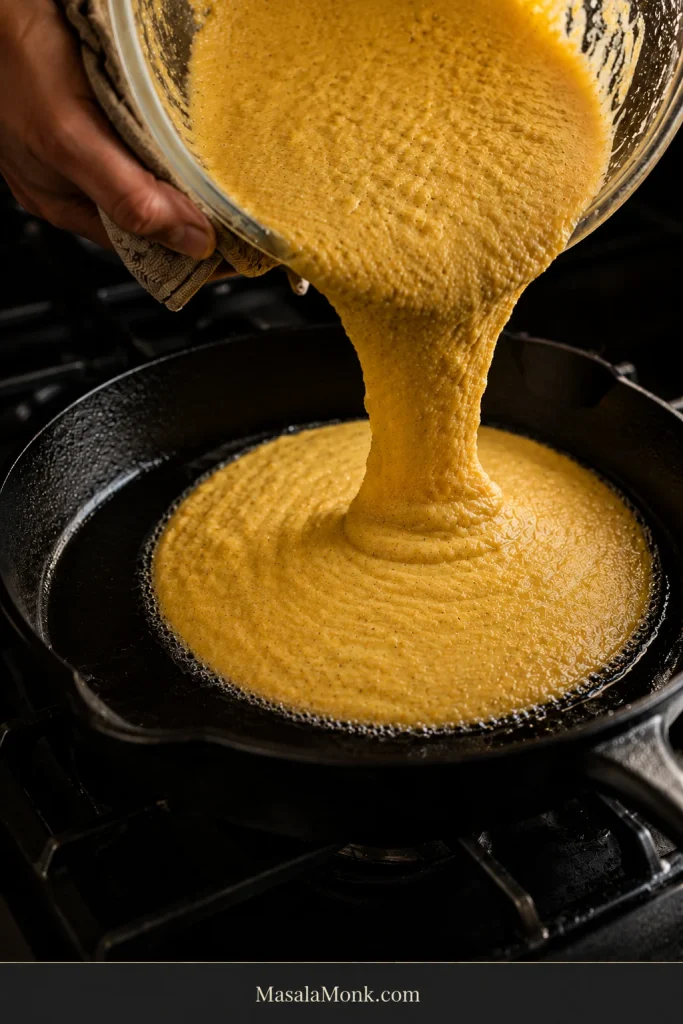
- Coat the hot skillet. Carefully remove the skillet from the oven. Add the bacon drippings, oil or shortening and swirl it across the bottom and partway up the sides. The fat should be hot and fluid; it does not need to smoke.
- Pour in the batter. A lively sizzle around the perimeter tells you the skillet was ready. That first contact begins setting the crust immediately.
- Bake. Return the skillet to the center rack and bake for 18–24 minutes. Start checking around 18 minutes. Look for a deeply browned edge, a set interior that springs lightly when touched, and no wet batter on a tester pushed into the thickest part.
- Rest for 5 minutes. Give the hot crumb a few minutes to settle before cutting so the first pieces lift more cleanly. Serve while the underside is still crisp and butter melts almost on contact.
If your skillet is already in the oven, you have everything you need.
In This Guide
Get the Cornbread Right
- What Makes This Old-Fashioned Southern Cornbread?
- Why This Recipe Works
- Which Cornmeal Should You Use?
- Cast Iron, Pan Size & the Crispy Crust
- How to Know When It’s Done
Choose, Fix & Serve
- Cornbread Rescue at a Glance
- Why Did My Cornbread Turn Out This Way?
- No Buttermilk, Self-Rising Cornmeal & Other Swaps
- Using This Cornbread for Dressing
- What to Serve With Southern Cornbread
- Store, Freeze & Reheat Cornbread
What Makes This Old-Fashioned Southern Cornbread?
By old-fashioned here, we mean a savory, cornmeal-led skillet bread made with buttermilk and hot fat. Sugar is optional rather than central, and corn remains the loudest flavor in the pan.
Cornbread traditions get specific quickly: white or yellow meal, sugar or none, flour or no flour, one egg or two or none, bacon drippings or shortening or oil. Southern kitchens have never all made it exactly the same way.
Nobody needs this recipe to prove somebody else’s grandmother wrong. This is simply one savory, skillet-baked branch of a much bigger Southern cornbread family.
Why This Recipe Works
Cornmeal brings the flavor and rustic texture. Flour and eggs give each piece enough structure to hold, buttermilk keeps the inside tender, and hot skillet fat creates the crust.
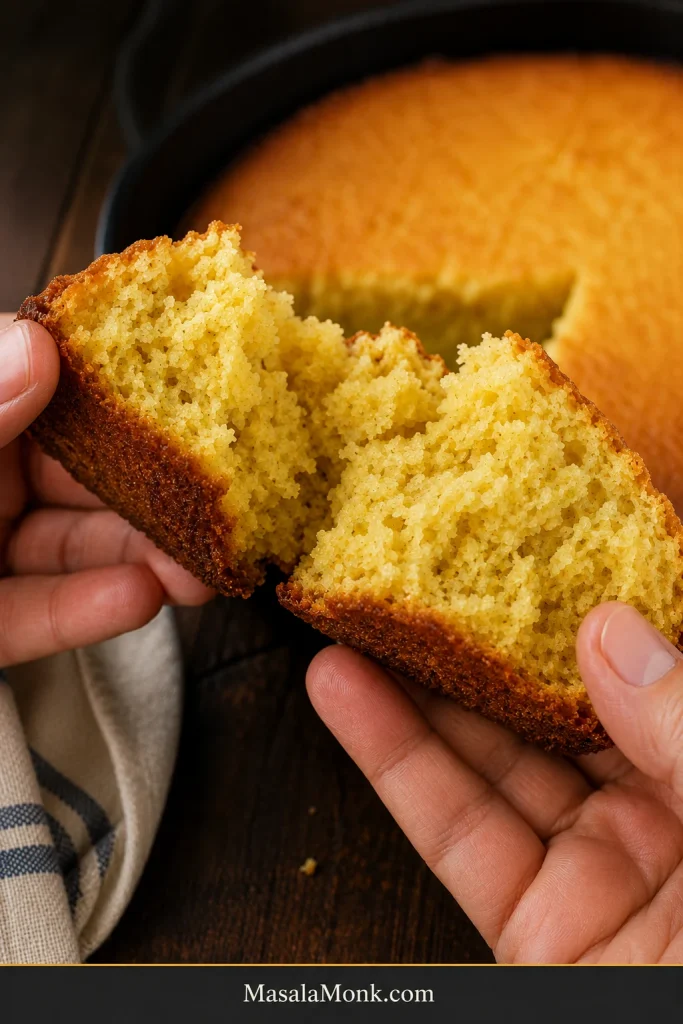
There is a little over three times as much cornmeal as flour by weight, so wheat never takes over the bread. The eggs help that small amount of flour hold everything together, while buttermilk adds moisture, body and a faint tang that sits naturally beside corn.
Butter flavors the cornbread itself. The hot fat in the skillet is what gives the underside its crust. A warm piece should hold easily in your hand, then break naturally when you pull it apart.
Which Cornmeal Should You Use?
For this recipe, use medium-grind plain cornmeal. It gives you obvious corn character without making every bite aggressively coarse, and it leaves the salt and leavening under your control.
From there, choose by texture rather than worrying about which color or grind is supposed to be “correct.”
Fine, Medium or Coarse?
| Cornmeal | What the Crumb Is Like | Best For |
|---|---|---|
| Fine | Smoother and tighter | If you dislike noticeable graininess |
| Medium | Distinct cornmeal texture without excessive grit | Best starting point here |
| Coarse / stone-ground | Rougher and more noticeably grainy | If you genuinely enjoy a rustic crumb |
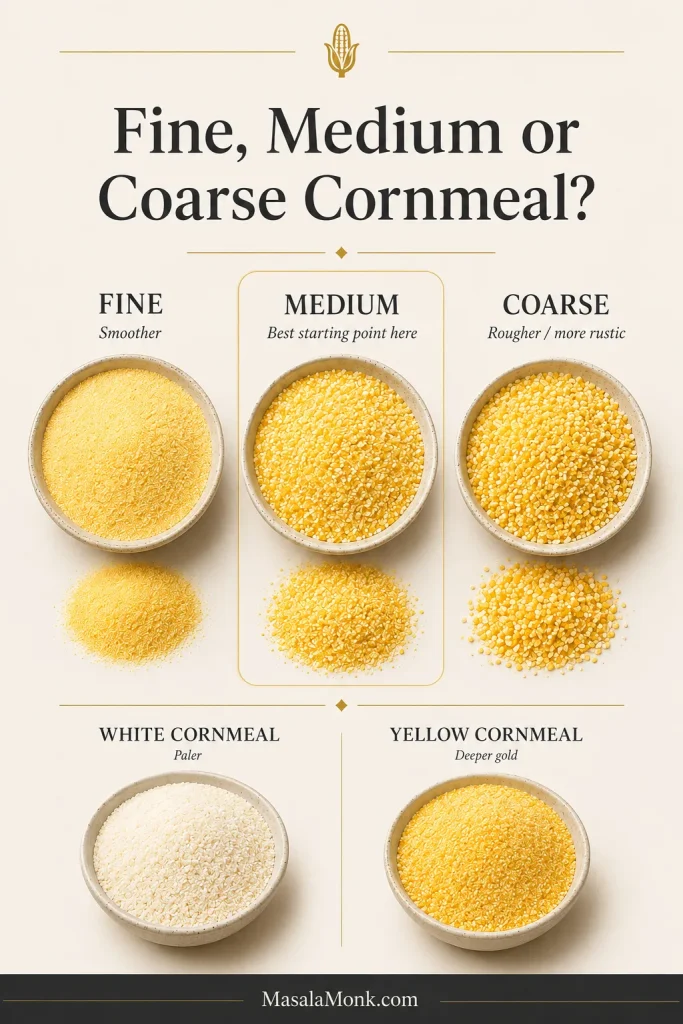
Choose coarse meal because you enjoy its rougher texture. Sandy, dry-feeling bites usually call for a finer grind, not another ingredient. Stone-ground whole-grain meal can also absorb liquid differently, so an unusually stiff batter may need more buttermilk.
White or Yellow Cornmeal?
Both work comfortably here. White cornmeal is associated with many Southern cornbread traditions and gives a paler crumb. Yellow meal brings the familiar deeper gold and, depending on the corn and milling, can taste more assertive.
Choose the one whose flavor and texture you prefer. Color matters much less here than using the grind that gives you the crumb you actually enjoy eating.
Plain Cornmeal, Self-Rising Cornmeal and Cornmeal Mix
| Package Says | What It Means Here |
|---|---|
| Plain cornmeal | Use the main recipe as written |
| Self-rising cornmeal | Already contains leavening and salt; use proportions intended for that product |
| Self-rising cornmeal mix | Often contains flour as well as leavening and salt |
| Corn muffin mix | A different, usually sweeter convenience product |
| Masa harina | Nixtamalized corn flour; a different ingredient |
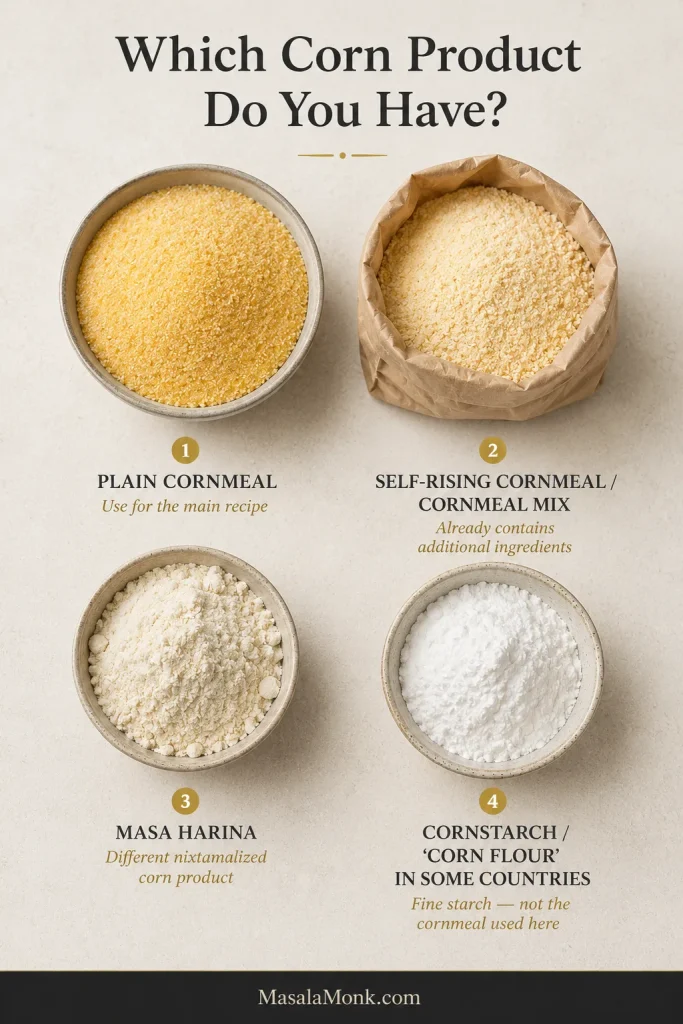
Ingredient names can be confusing outside the United States. In some countries, corn flour means the very fine starch Americans call cornstarch; that is not the ingredient needed here. Look for ground dried corn sold as cornmeal. A polenta product can sometimes work when the grind is appropriate, but check what is actually in the package instead of relying on the name alone.
Why weighing helps: cornmeal brands and grinds do not all fill a cup the same way. Use the 250 g amount when you have a scale. With cups, treat 1¾ cups as approximate and watch the batter before it reaches the skillet.
The rest of the bag won’t go to waste: plain cornmeal also gives these Southern-style salmon croquettes their crisp exterior.
Cast Iron, Pan Size & the Crispy Crust
The skillet changes the food, not just the presentation.
Heavy cast iron holds onto heat. When batter reaches the hot, greased pan, the underside begins cooking immediately while the inside is still fluid. That head start is what gives the bottom its distinctive crispness.
Why a 10-Inch Skillet?
A 10-inch / 25 cm skillet gives this amount of batter a good balance between height and crust.
| Pan | What Changes |
|---|---|
| 9-inch / 23 cm | Deeper batter, taller pieces and generally a longer bake |
| 10-inch / 25 cm | Recipe default: balanced crust and moist crumb |
| 12-inch / 30 cm | Thinner bread, more crust relative to crumb and an earlier doneness check |
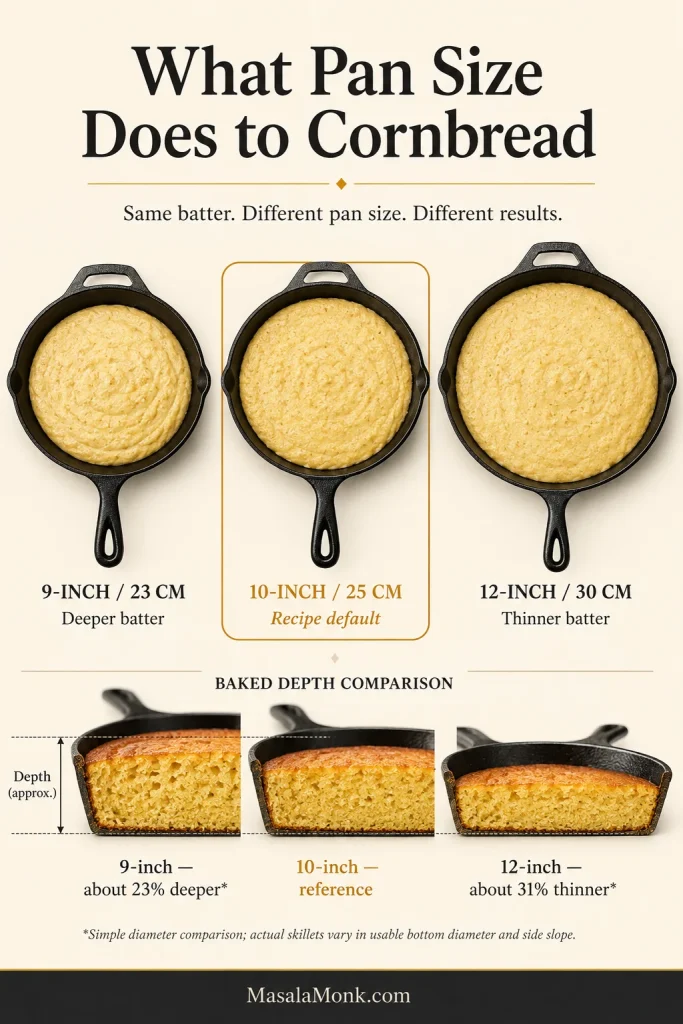
As a simple diameter comparison, the same amount of batter would sit about 23% deeper in a 9-inch round than in a 10-inch one, while a 12-inch round would spread it about 31% thinner. Those numbers are only a rough way to show how much pan size can matter; cast-iron skillets slope differently and do not all have the same usable bottom diameter.
Pale Bottom or Over-Browned Bottom?
Begin on the center rack. A consistently pale underside, even with a thoroughly heated skillet, is a reason to move the pan one rack lower next time. A bottom that darkens well before the inside is ready calls for one rack higher.
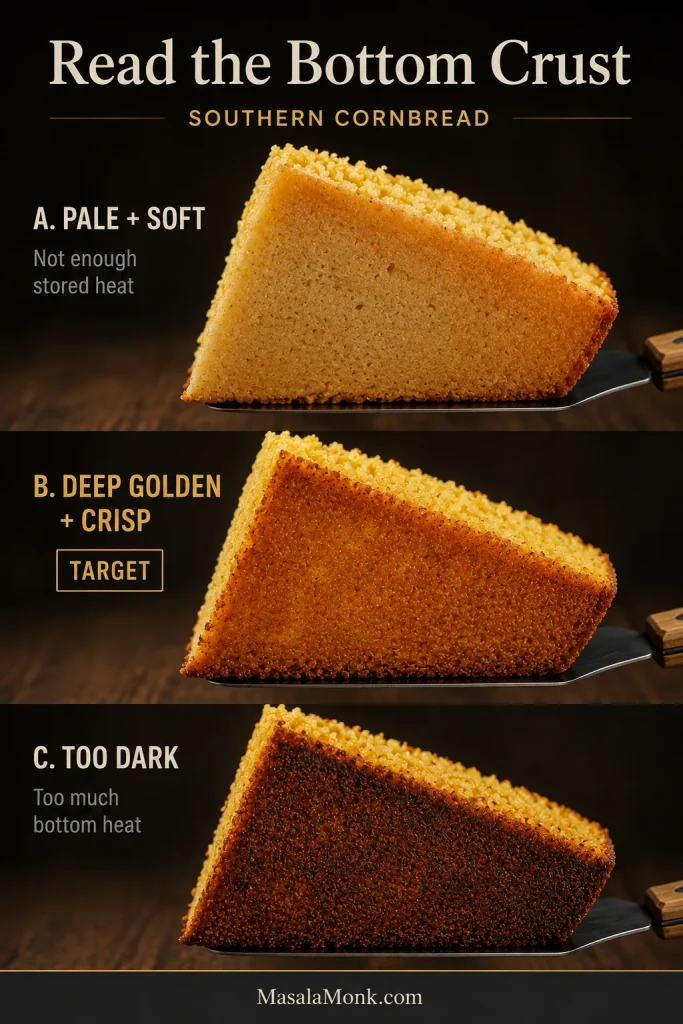
Let your own oven tell you which way to go. There is no prize for putting every skillet on the lowest possible rack.
No Cast Iron?
Use a heavy metal cake pan or another oven-safe metal skillet of similar diameter and preheat it with the oven. A lighter pan can still make excellent cornbread, although the underside will usually be softer and paler because the metal carries less stored heat into the batter.
Metal is the straightforward substitute for this hot-pan method. Skip preheating an empty glass baking dish.
How to Know When It’s Done
Start looking around 18 minutes. By then the kitchen should smell unmistakably of toasted corn.
Four Cornbread Doneness Checks
- Look for a deeply browned edge.
- The interior should look set, with no wet or shiny batter.
- Press the middle gently; it should spring back lightly.
- A tester should come back without wet batter; a few moist crumbs are fine.
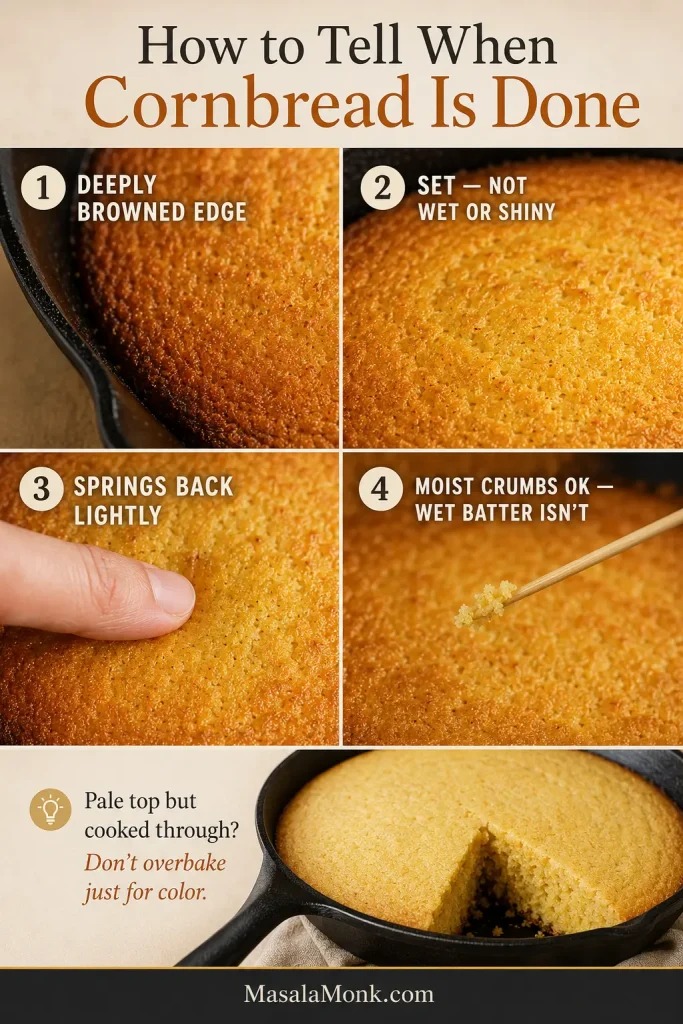
A cooked-through cornbread with a pale top does not need a long extra bake just for color. Unsweetened cornbread often browns less dramatically on top than a sweeter batch. For a darker surface, use a very brief broil and stay close—the change can happen quickly.
Cornbread Rescue at a Glance
Something looks wrong after the skillet comes out? Deal with the pan in front of you first.
| What You See | What to Do Now |
|---|---|
| Middle still wet | Return it to the oven for 3–5 minutes; loosely shield a dark top if needed |
| Top pale, bread cooked | Use a very brief broil instead of extending the whole bake |
| Breaking apart while hot | Stop cutting and give it the full 5-minute rest |
| A little dry | Serve warm with butter, broth, beans or gravy |
| Bottom softer than hoped | Toast buttered slices in a skillet |
| Leftovers lost their crust | Use the oven or skillet instead of relying only on the microwave |
Not every rough edge needs rescuing. A rustic crack across the top or some crumble at the cut edge can be completely normal for this style of cornbread.
A slightly dry piece can still be very good beside something deliberately saucy, such as this thick bean stew. The crumb gets to drink up what is in the bowl.
Why Did My Cornbread Turn Out This Way?
Think back to what you saw, felt or heard while you were making it. One clue is often enough.
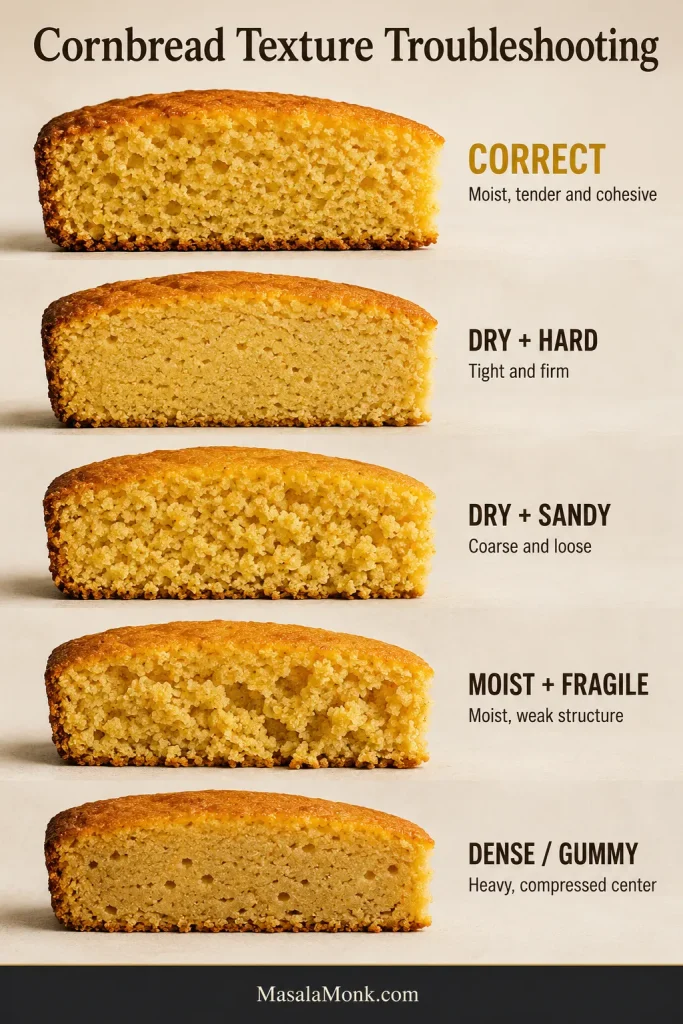
Dry, Hard or Falling Apart?
A dry, firm piece and a dry, sandy piece usually point to different problems.
- Dry and hard: the cornbread probably baked too long or your oven ran hot.
- Dry and sandy: the cornmeal may have been unusually coarse or the batter needed more liquid.
- Moist but fragile: it may have been cut too soon, or the meal may be particularly coarse.
- Dense and tough: too much mixing becomes a stronger suspect.
A little crumble belongs here. Properly rustic cornbread should still soften readily once warm butter, bean broth or gravy reaches it.
Dark Edges, Wet Middle
Dark edges around a shiny or wet middle usually make batter depth the first suspect. The same amount of batter sits deeper in a smaller skillet, so the outside can finish while the thickest part still needs time.
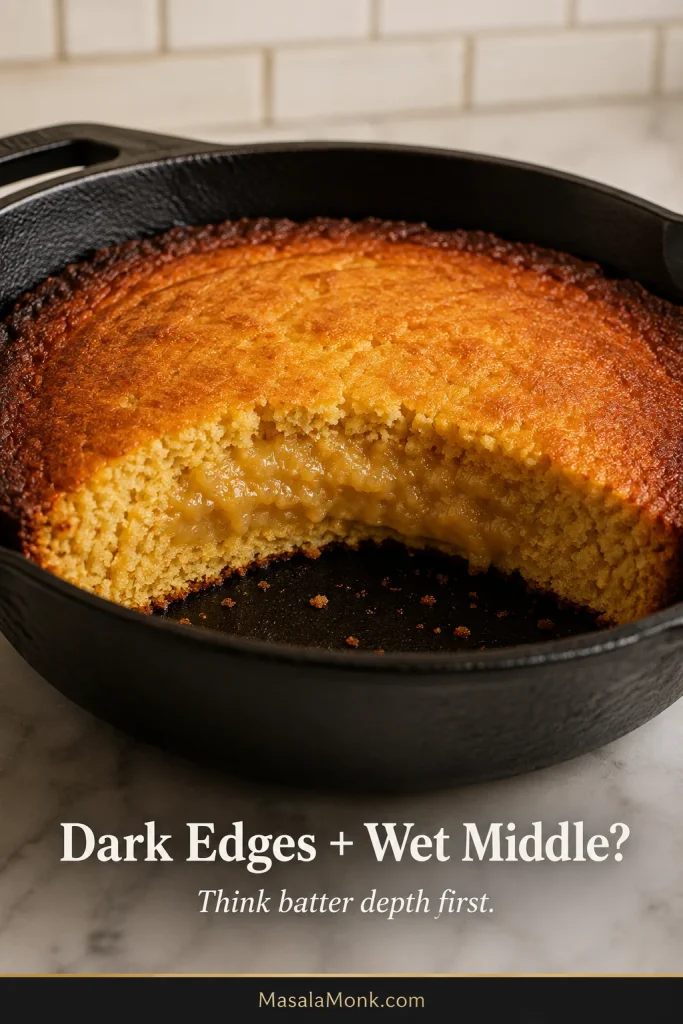
With the intended 10-inch pan, repeated dark-edge/wet-middle batches are a reason to move the skillet one rack higher or check whether the oven runs hotter than its setting suggests.
No Crisp Bottom? Start With the Skillet
Think back to the moment the batter hit the iron. An almost silent pour is a strong clue that the skillet had not stored enough heat.
Check the fat too. You want a visible coating between batter and iron, not a pan that merely looks polished.
Gritty or Sandy Cornbread
A pleasantly coarse crumb and a sandy one are different experiences. Very coarse meal is the first thing to check. Keeping that rough grind may require more buttermilk so the baked crumb stays pleasantly textured instead of dry.
Cornmeal should announce itself. It should not feel as if you accidentally baked sand.
Dense or Gummy Cornbread
A damp, heavy patch through the middle usually means the cornbread needed more time or the batter sat unusually deep in the pan.
Heaviness throughout the whole crumb points more toward old baking powder or too much mixing. Small lumps are harmless. Beating the batter perfectly smooth is not an upgrade.
Bitter, Chemical or Too Salty?
Start with the package label. Self-rising cornmeal and cornmeal mixes may already contain leavening and salt, so adding the full amounts from the main recipe can push both too far.
Salt can also surprise you when measured by spoons. Fine salt and different kosher salts do not pack identically. Weighing 5 g keeps that variable under control; King Arthur’s guide to salt for baking explains why spoon-for-spoon swaps can change the result.
Give old cornmeal or saved bacon drippings a sniff too. Whole-grain meal and cooking fats can turn stale, and sweetness will not hide that flavor.
Stuck or Burned on the Bottom
Sticking sends you back to three things: enough skillet fat, thoroughly heated iron, and reasonably good seasoning.
A burned underside means the bottom received too much heat before the rest of the cornbread was ready. Move the pan one rack higher next time, begin checking earlier, and remember that a sweeter batch can brown faster.
No Buttermilk, Self-Rising Cornmeal & Other Swaps
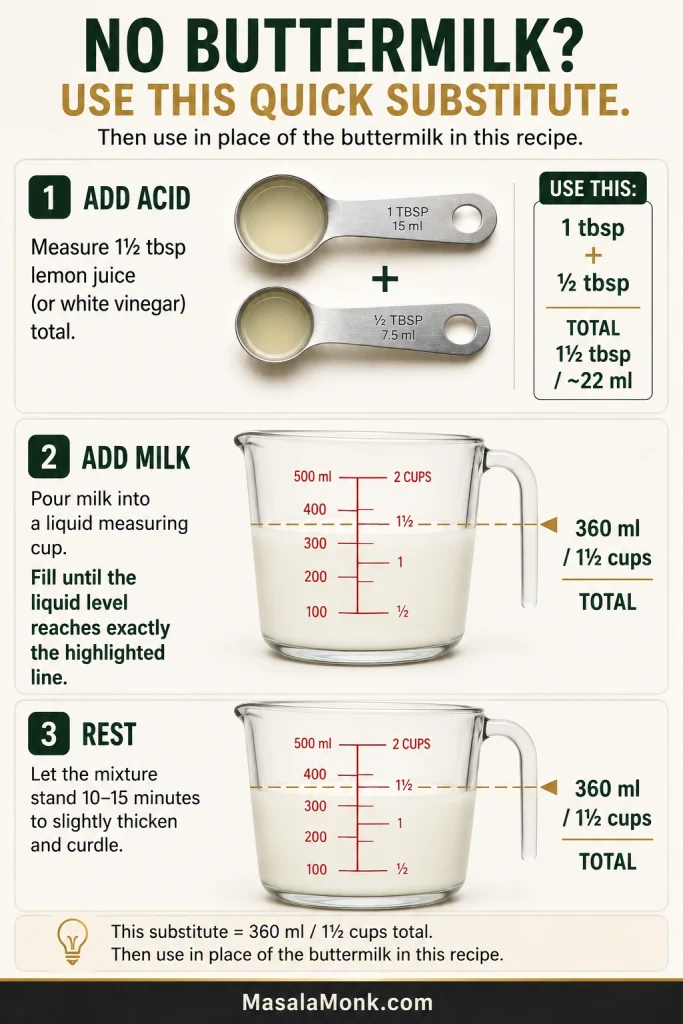
No Buttermilk? Use Acidified Milk
Put 1½ tablespoons / about 22 ml lemon juice or plain white vinegar into a measuring jug, then add milk until the total reaches 1½ cups / 360 ml.
Let it stand for 10–15 minutes, then use it in place of the buttermilk. It won’t have quite the same cultured tang and may be a little thinner, but the added acid gives the baking soda what it needs to react properly.
A carton of cultured buttermilk is easy to use up elsewhere; the leftovers can go into these fluffy buttermilk pancakes the next morning.
Using Self-Rising Cornmeal
A bag labeled self-rising already contains leavening and salt, so pause before measuring either from the main recipe. Follow the proportions intended for the product in your hand; formulations vary enough that guessing is not worth it.
Using White Lily Self-Rising Cornmeal Mix: For its buttermilk option, White Lily’s official Southern cornbread uses 2 cups mix, 1½ cups / 360 ml buttermilk, 1 egg and ¼ cup / 60 ml oil, plus 1 teaspoon shortening for the pan and optional sugar. It bakes in a preheated 8-inch / 20 cm pan at 425°F / 218°C for 25–30 minutes. Another brand may call for different proportions.
Flourless or Eggless Southern Cornbread?
Flourless: Flourless cornmeal breads belong comfortably within Southern cooking traditions. Removing the 80 g flour changes the balance of this batter, so use proportions designed for a flourless version.
Eggless: Eggless Southern cornbread exists too. Both eggs in this batch help the inside hold together. For an eggless version, start with a recipe designed to work without eggs.
Butter vs Oil in the Skillet
Butter works, but its milk solids brown quickly in a very hot pan. Bacon drippings, vegetable or canola oil, or shortening are more forgiving here. Butter is better used where its flavor is easiest to notice: in the batter and melting over the finished piece.
← Back to the Southern Cornbread Recipe · ↑ Back to top
Using This Cornbread for Dressing
Yes—this cornbread works well for Southern cornbread dressing. Use the savory version and, when practical, bake it a day ahead.
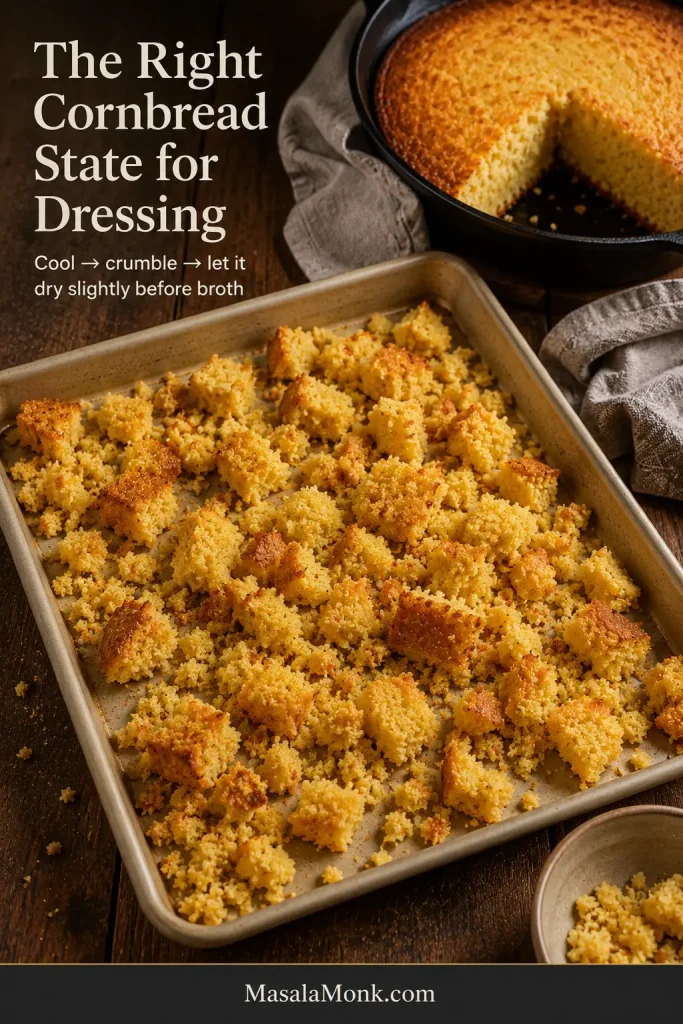
The small amount of flour helps the crumbled bread absorb broth while keeping some structure. Cool the skillet completely, crumble the cornbread, and give some of its fresh-baked moisture time to escape before adding broth.
Slightly drier cornbread is easier to control. It can soak up broth without beginning the dressing already soft and saturated.
What to Serve With Southern Cornbread
Savory cornbread is happiest beside food with broth, gravy, beans or smoky juices for the crumb to catch.
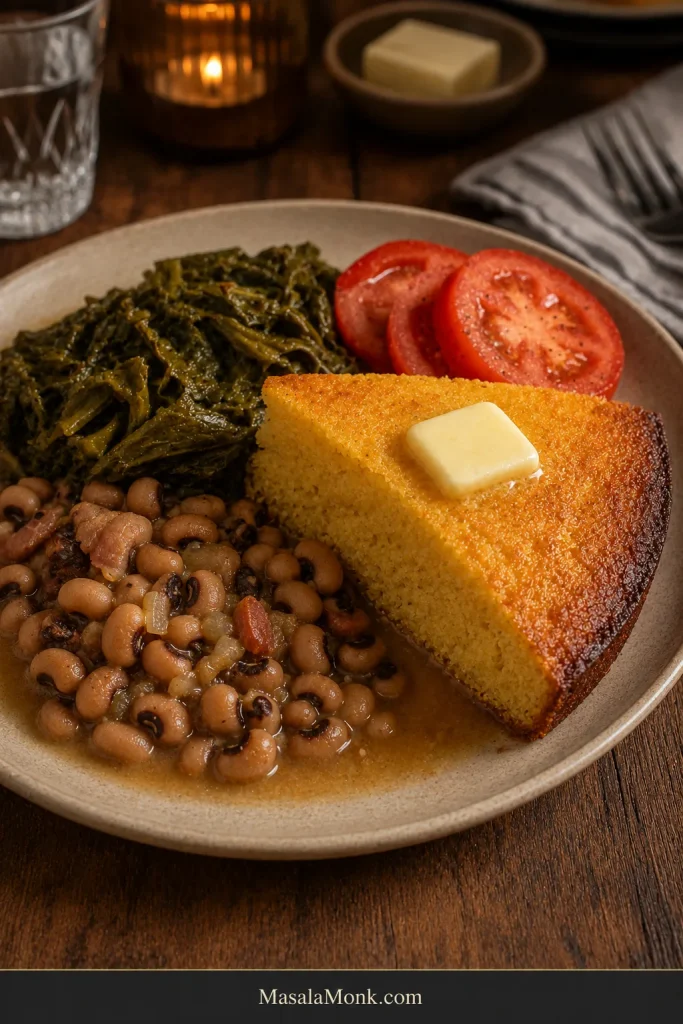
For a cold-weather dinner, put a warm piece beside crockpot chili. The part touching the broth softens while the browned edge stays sturdy enough to scoop with.
Gravy may be an even better excuse. These smothered pork chops come with the kind of onion-rich sauce that settles straight into the cut face of the cornbread.
Barbecue is another natural fit: pair slow cooker pulled pork with something cold and crunchy such as coleslaw on the side.
For a more old-fashioned Southern plate, think field peas or black-eyed peas, cooked greens and sliced summer tomatoes. Those softer, juicier foods are exactly where a crisp piece of skillet cornbread earns its place.
And if crumbled cornbread with cold buttermilk is part of the tradition you know, this savory version fits naturally there too.
It does not need a full meal either. Split a warm piece, add butter, and let it soak into the little cracks. Put honey nearby for anyone who wants it.
How to Store, Freeze & Reheat Cornbread
Cornbread is at its best the day it is baked, when the contrast between crisp crust and tender crumb is strongest. Let it cool completely before wrapping or sealing it; trapped steam softens the crust quickly.
For the same day or overnight, keep the cooled bread well covered at room temperature. For longer keeping, refrigerate it well wrapped or in an airtight container for 3–4 days for best quality.
Reheating Cornbread
Microwave: best when you want one warm piece quickly. Heat in short bursts just until the middle is warm. The crust will soften, so this is the convenience option rather than the crispest one.
Oven: for several pieces, 350°F / 177°C for roughly 10–15 minutes is a useful starting point. Check smaller pieces early. Loosely cover cornbread that is beginning to dry, then uncover near the end if you want the outside to firm again.
Best Leftover Crust: Butter + Skillet
This is the method worth remembering.
- Split or slice the cornbread.
- Spread butter over the cut surfaces.
- Place them cut-side down in a hot skillet.
- Toast until browned and crisp outside and hot through the middle.
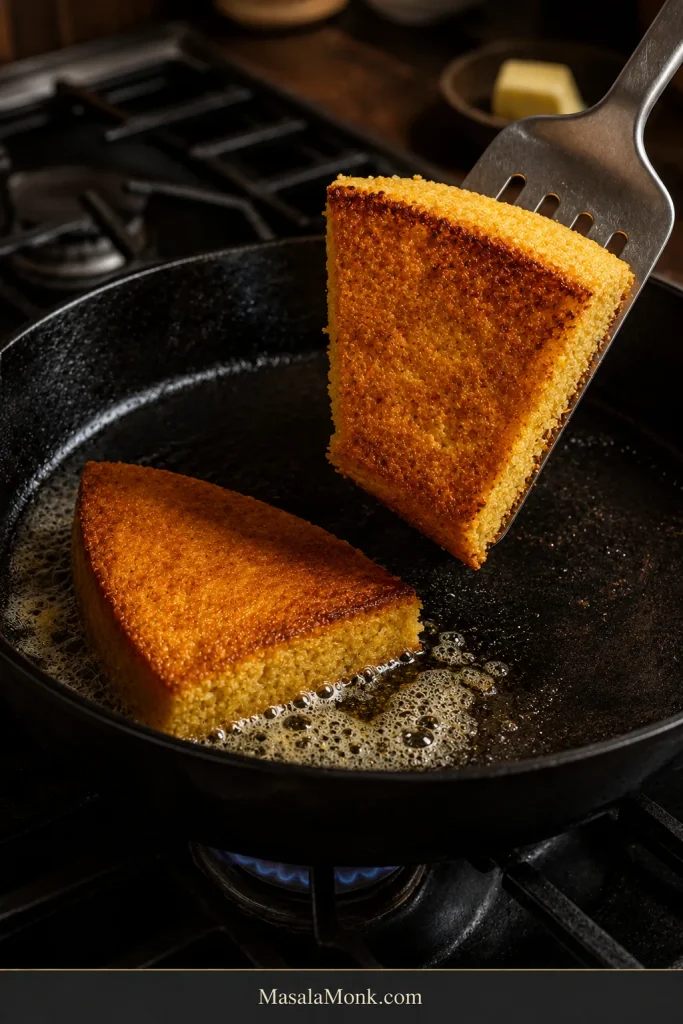
The leftover develops a new crust of its own: browned butter against toasted cornmeal with a tender middle underneath.
A second-day piece that has dried slightly is also excellent with something gravy-rich such as slow cooker beef stew. What seemed thirsty on its own becomes very good at catching the sauce.
Freezing Cornbread
Cool the cornbread completely, divide it into useful portions and wrap them well. Freeze for up to 3 months for best quality. Thaw before reheating, then use the oven or skillet if you want some of the crust back.
The Cornbread We Are After
The best moment is not when the timer rings.
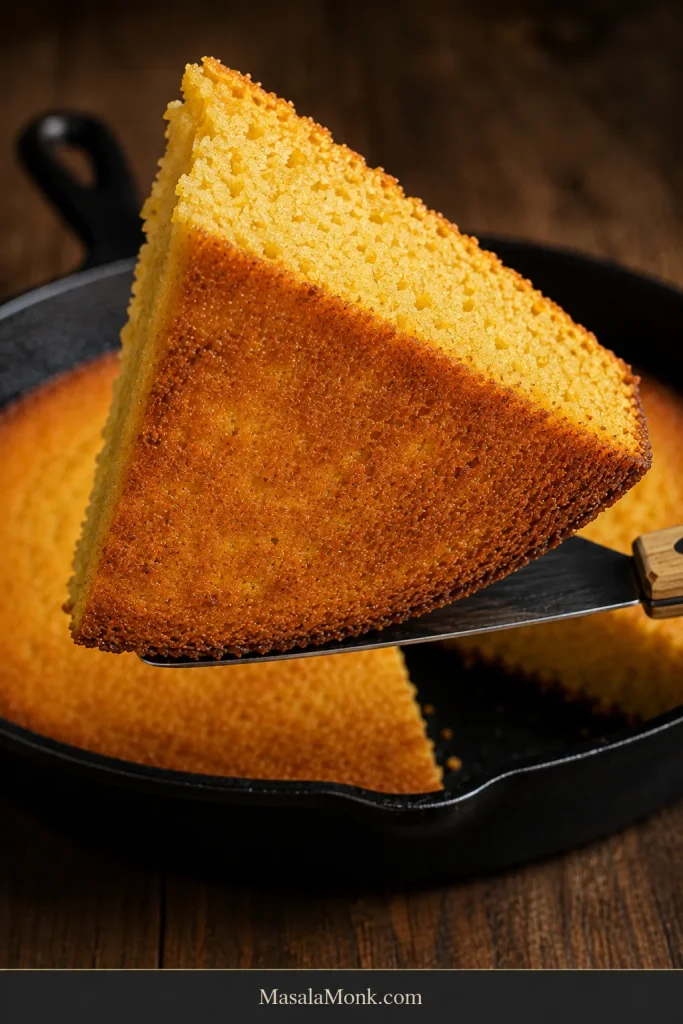
It is when the first piece comes free and you can see the contrast: a browned underside and crisp rim surrounding a warm, moist crumb that still looks unmistakably like ground corn.
Butter disappears into the little cracks. The edge is sturdy enough to pick up. The middle breaks rather than bounces. And the savory version is just as comfortable soaking up bean broth and gravy as it is carrying a little honey at the table.
If you make it, tell us which cornmeal you used, your skillet size, whether you added sugar, and how long yours took in the oven. Those details can tell the next cook far more than simply saying it worked.








