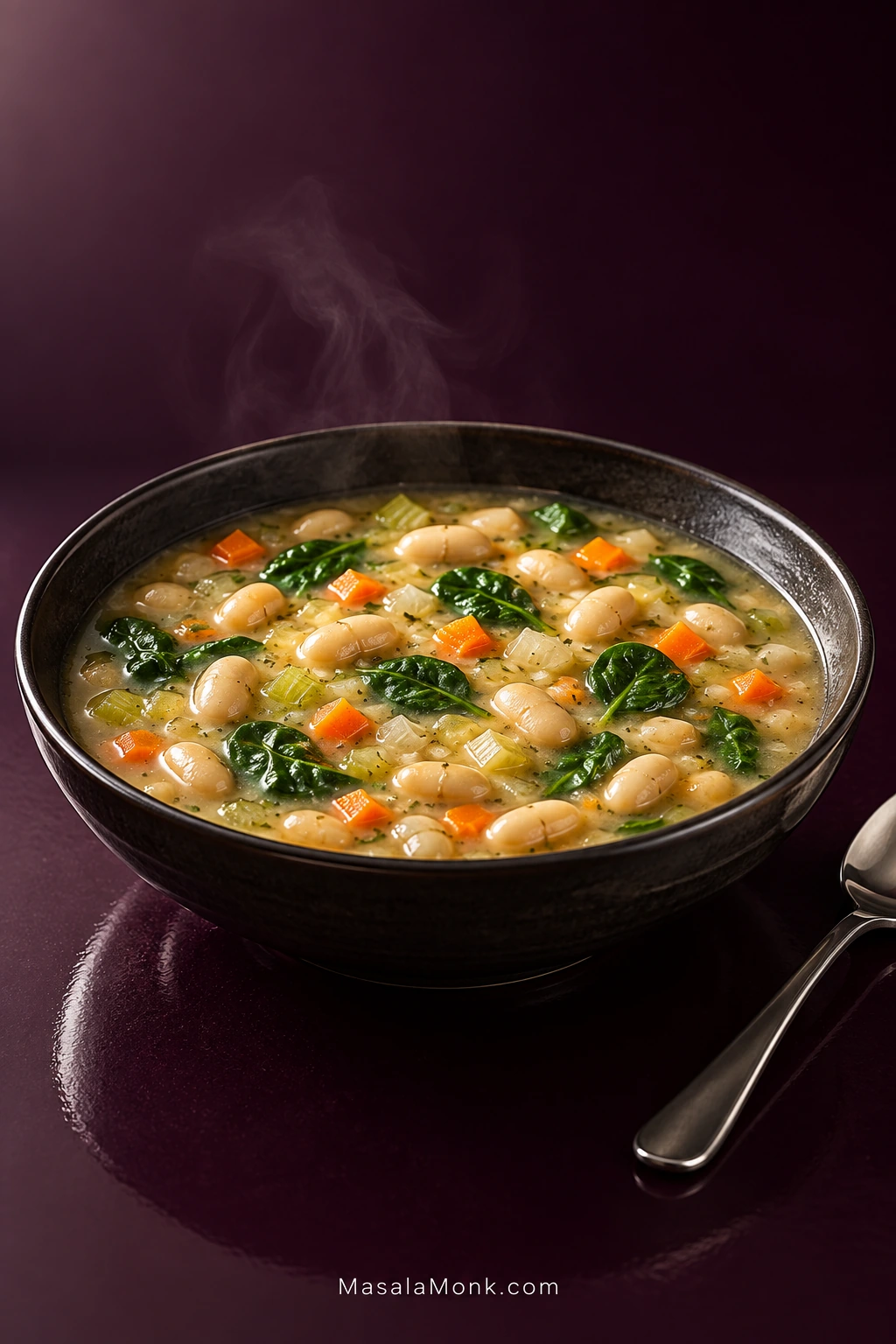
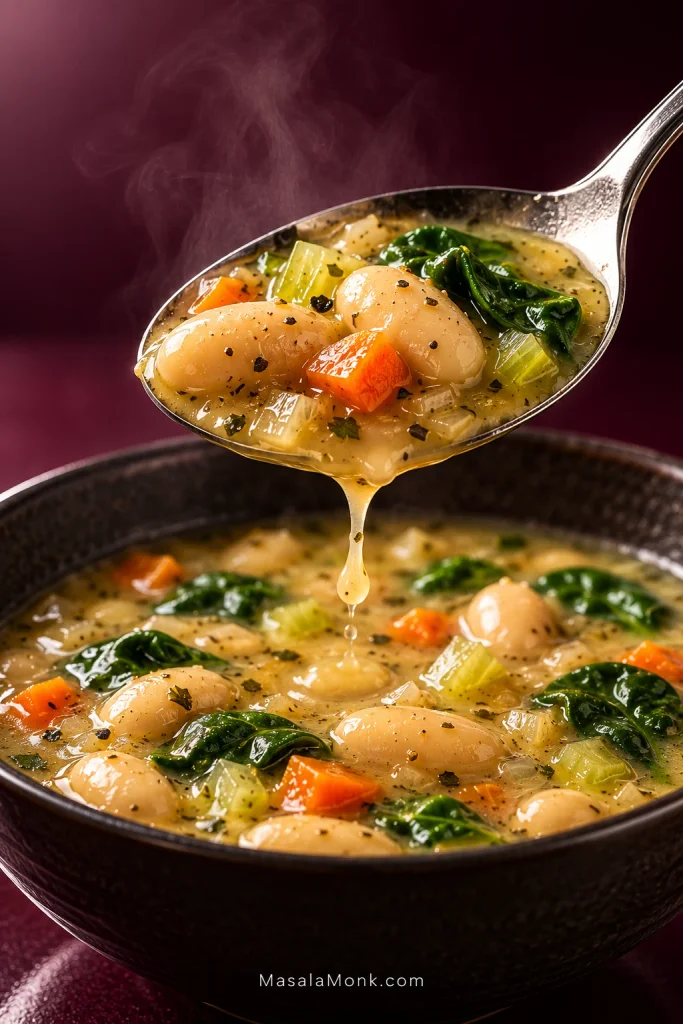
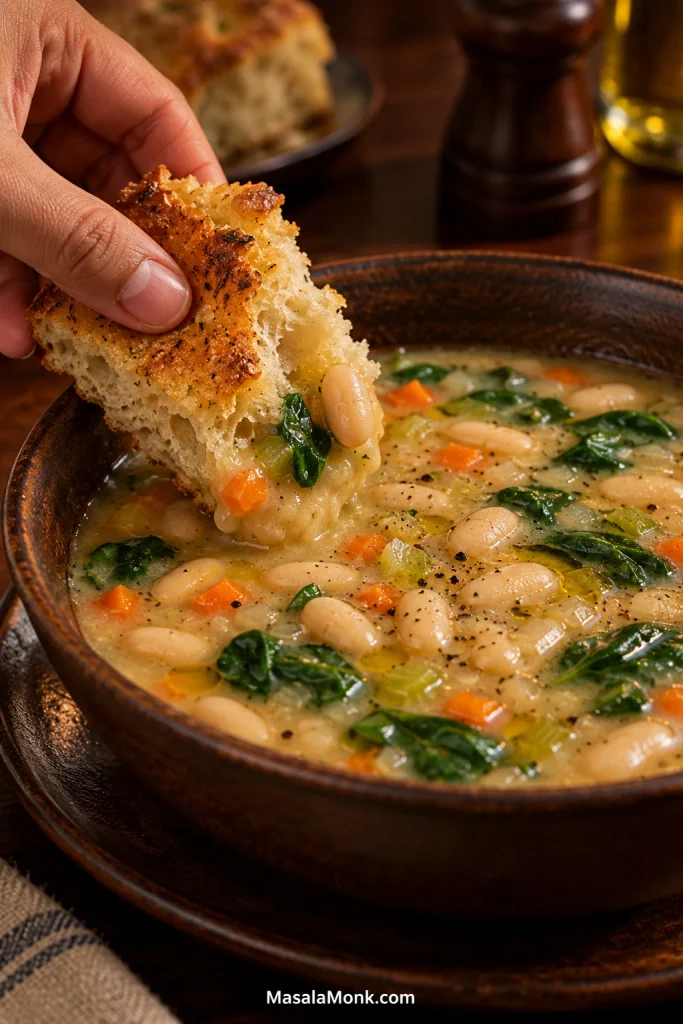
A few cans of white beans, an onion, a carrot and some broth do not look like much of a dinner. Half an hour later, they can be a pot of creamy broth full of whole cannellini beans, tender vegetables and wilted spinach, with enough garlic, herbs and lemon to keep every spoonful lively.
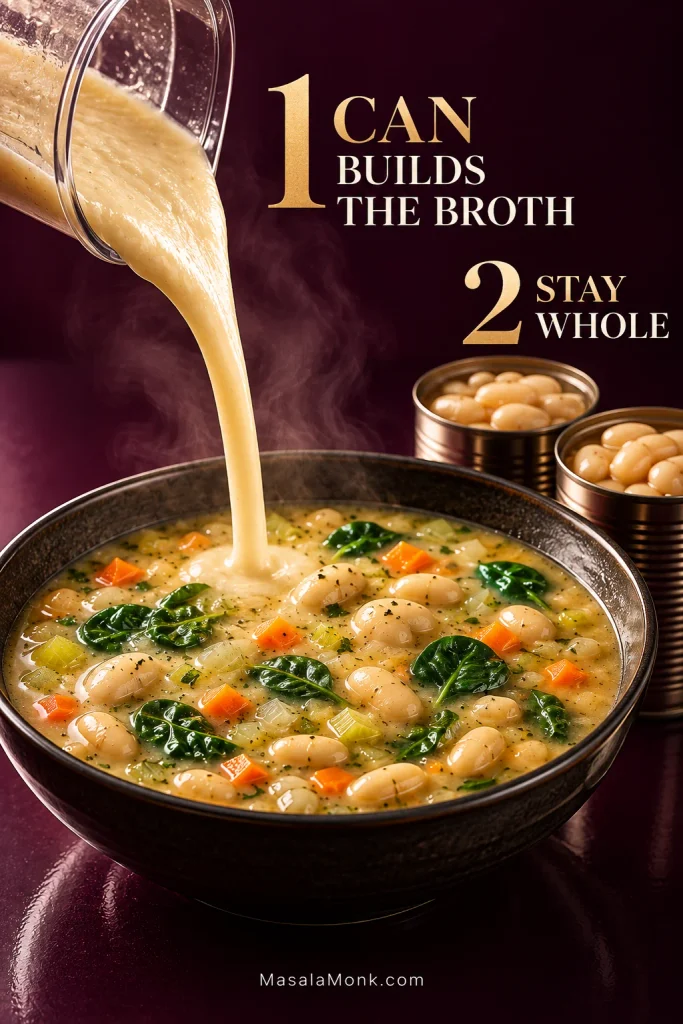
The broth gets its body from the beans themselves, not from flour or heavy cream. One can is blended until smooth and the other two stay whole, so the bowl still feels hearty rather than puréed.
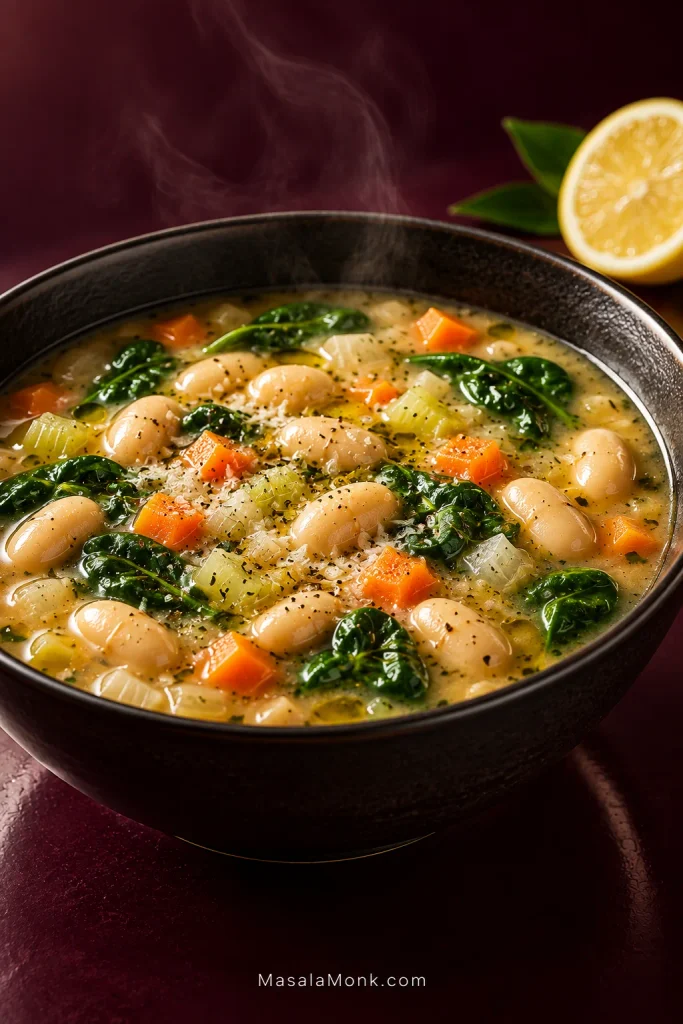
Cannellini beans, tender vegetables and spinach in a bean-thickened broth with garlic, rosemary, thyme and fresh lemon.
Pot 5–6 qt / 4.7–5.7 L
Prep 10 min
Cook 20 min
Total 30 min
Yield 4 generous / 6 lighter servings
Equipment
5- to 6-quart / 4.7- to 5.7-liter Dutch oven or soup pot
Countertop blender or immersion blender with a tall blending jug; see notes for a no-blender option
Ingredients
2 tablespoons / 30 ml olive oil
1 medium yellow onion, about 170 g peeled, diced
2 medium carrots, about 150 g trimmed, diced
2 celery ribs, about 100 g trimmed, diced
4 garlic cloves / about 14 g, finely chopped or minced
1 teaspoon dried thyme
½ teaspoon dried rosemary, lightly crushed between your fingers
¼ teaspoon red pepper flakes, or less for a very mild soup
3 × 15 oz / 425 g cans cannellini beans, drained and rinsed
4 cups / 950 ml low-sodium vegetable or chicken broth, plus more if needed
3 packed cups / about 90–100 g baby spinach
1½ tablespoons / about 22 ml fresh lemon juice, plus another 1–2 teaspoons if needed
¼ teaspoon fine sea salt to start, plus more to taste
¼ teaspoon freshly ground black pepper, plus more to taste
For serving, if you like: grated Parmesan, chopped parsley, extra-virgin olive oil, black pepper, red pepper flakes and crusty bread.
Method
Build the Base
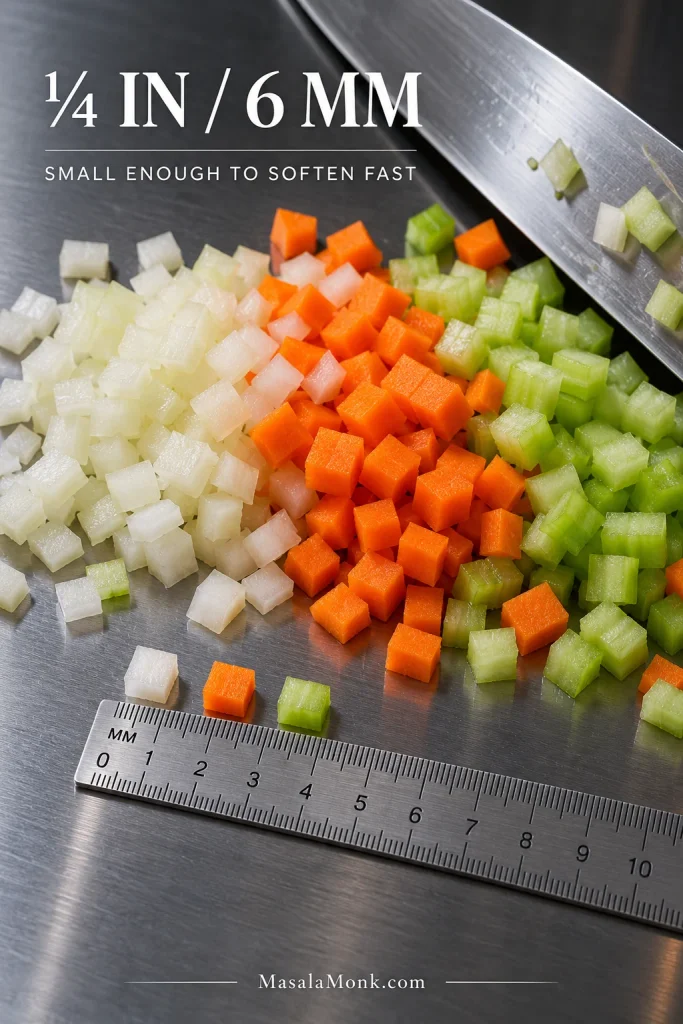
Start the vegetables. Heat the olive oil over medium heat. Add the onion, carrots, celery and the measured ¼ teaspoon salt. Keep the vegetables around ¼ inch / 6 mm so they soften within the short cook. Cook for about 6–7 minutes, stirring occasionally, until the onion is translucent and the vegetables are beginning to soften.
Uniformity matters more than perfect knife work. Keep the onion, carrot and celery close to ¼ inch / 6 mm so one oversized piece does not stay firm after the rest has softened.
Blend one can of beans while the vegetables cook. Put one drained and rinsed can of cannellini beans in a countertop blender or tall blending jug with 1 cup / 240 ml of the unheated broth. Blend until smooth and glossy, with no obvious pieces of bean skin.
Watch the texture in the blender: the bean mixture should be smooth enough to pour, not thick enough to sit like paste. That fluid base is what later gives the broth body.
Add the aromatics. Stir in the garlic, thyme, rosemary and red pepper flakes. Cook for 30–60 seconds, until the garlic loses its raw edge and the herbs smell noticeably stronger. Do not let the garlic brown.
Simmer and Finish
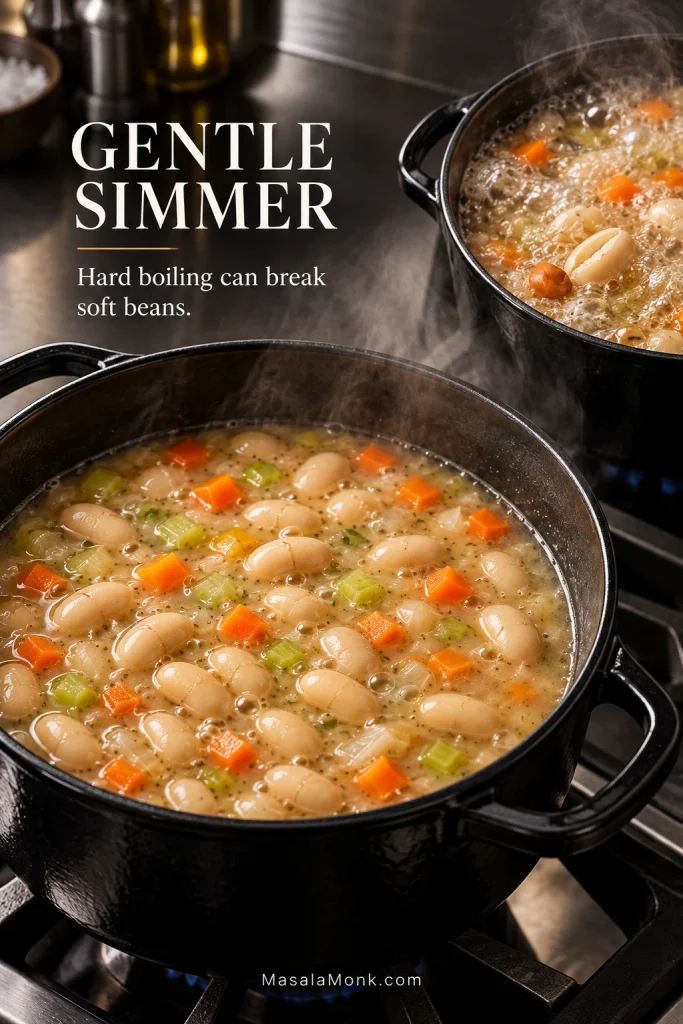
Add the beans and broth. Stir in the two remaining cans of whole beans, the bean purée and the remaining 3 cups / about 710 ml broth. Bring the pot just to a boil, then lower the heat to a gentle simmer. Cook uncovered for about 8–10 minutes, until the vegetables are tender and the broth has lightly thickened.
The surface should stay mostly calm with small bubbles rising through it. When the whole pot churns, very tender canned beans are more likely to split and lose their skins.
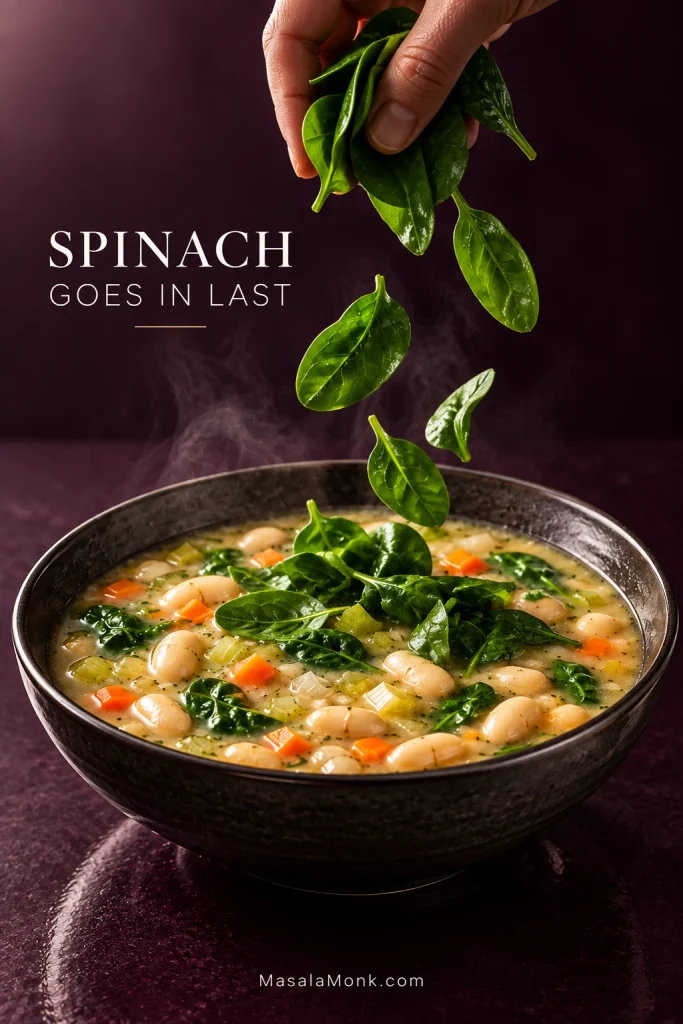
Wilt the spinach. Add the spinach. It will look like a lot at first, then collapse quickly. Cook for 1–2 minutes, until wilted but still green.
Once the leaves lose their volume, there is little benefit in cooking them much longer. Extra time mostly dulls their color and softens their texture.
Finish off the heat. Stir in 1½ tablespoons / about 22 ml lemon juice and the black pepper. Taste before adding more salt. Already salty enough but still dull? Add another teaspoon of lemon first. Loosen with a little extra broth if needed.
A balanced spoonful carries broth, beans, vegetables and greens together. If the solids sink away from watery broth—or barely move through something gravy-thick—the texture still needs adjusting.
Recipe Notes
No blender: Mash one drained can very thoroughly, then loosen it with a little broth before adding it to the pot.
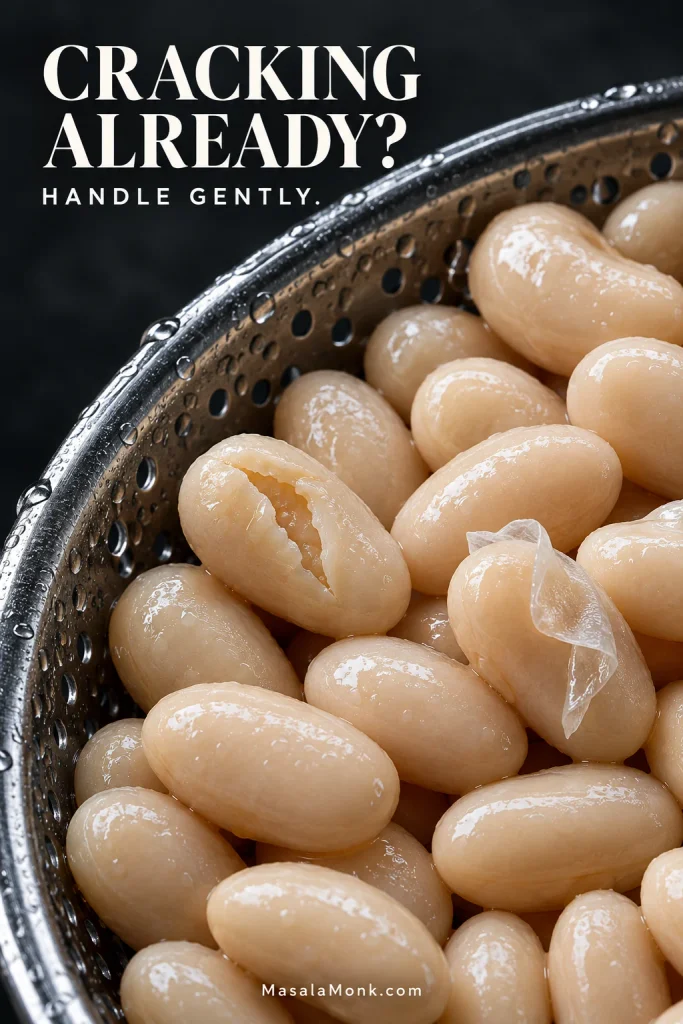
Very soft canned beans: Beans already cracking or shedding skins in the colander need a shorter simmer and gentler stirring from here.
Vegan: Use vegetable broth and leave off the Parmesan. A drizzle of extra-virgin olive oil at serving adds richness.
The colander can tell you a lot before cooking starts. Beans that are already cracking or slipping out of their skins need gentler stirring than a firmer batch.
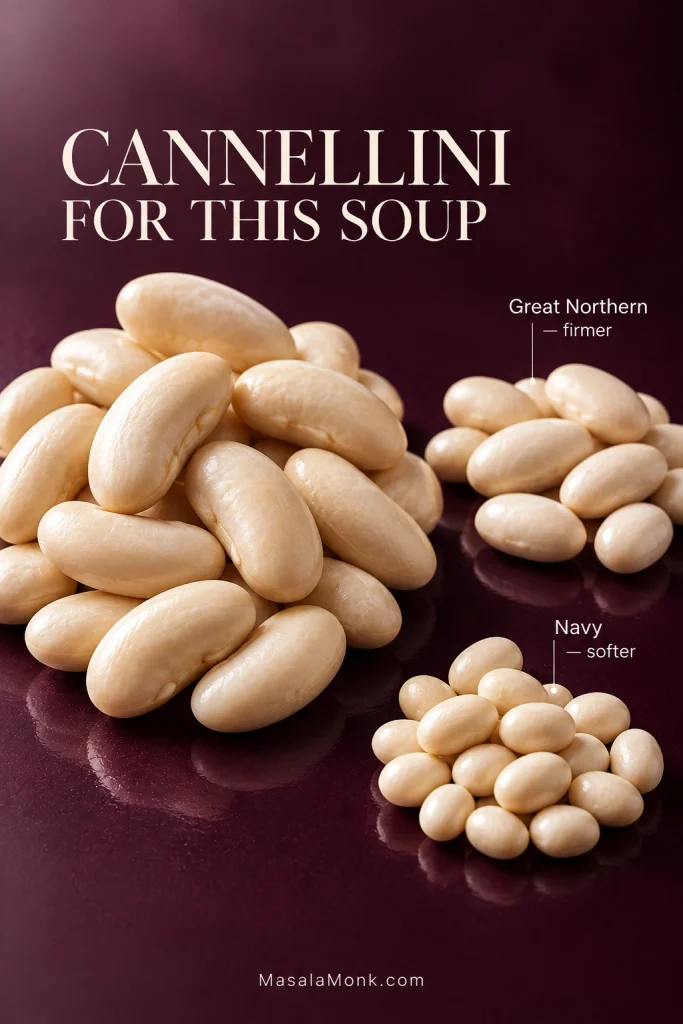
Cannellini: large and creamy, with enough structure to stay mostly whole. They give this soup a fuller broth without disappearing into it.
Great Northern: smaller, slightly firmer and very mild. Use them as a direct swap.
Navy: smaller and softer. They tend to break down sooner, so the finished soup may feel thicker.
Size changes what you notice in the bowl. Cannellini stay prominent, Great Northern beans sit in the middle, while smaller navy beans disappear into the broth more easily as they soften.
Should You Drain and Rinse Canned Beans?
For this recipe, yes. Canned bean liquid contains starch and can be useful, but its saltiness, thickness and flavor vary quite a bit by brand.
Rinsing gives you more control and can wash away a noticeable canned or metallic taste from some packing liquids. The blended beans already provide the starch we need here.
Using Dried White Beans? Cook Them First
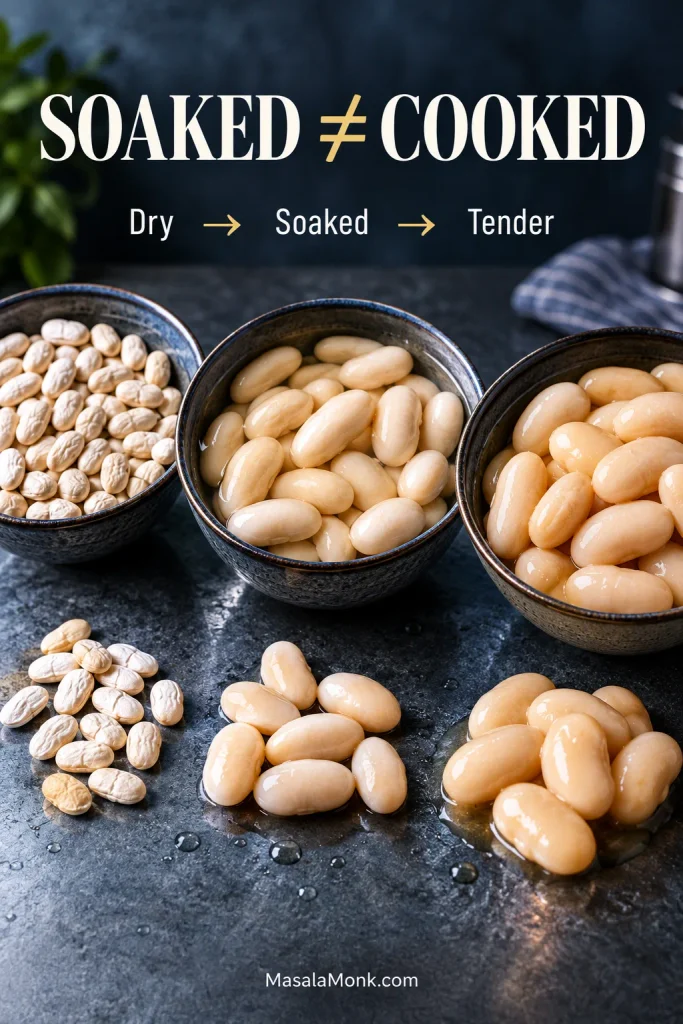
Cook them all the way before using them in this recipe. Soaking hydrates cannellini, Great Northern or navy beans, but it does not make them tender enough to go straight into this quick soup.
Once cooked, use enough beans to replace the three drained cans called for in the recipe. Because dried-bean yield varies with the bean and cooking method, match the finished cooked amount rather than relying on an untested dry-bean conversion.
Plump does not mean tender. Dried white beans can look ready after soaking while still being far from the soft texture needed for soup.
Creamy Without Cream
Creamy describes the broth; the whole soup should not be smooth. You still want whole beans and pieces of carrot, celery and spinach in every bowl.
With three cans of beans and 4 cups / 950 ml broth, the soup stays substantial without becoming dense. One can builds the broth while the other two keep the bowl full of whole beans.
Separating the beans by job gives you more control later. The blended portion can build body while the whole beans preserve texture, so thickening the broth does not mean sacrificing every intact bean.
Drag a spoon through a ladleful. The broth should cling lightly to the beans and vegetables, then flow straight back into the gap. Bean brands vary, so use that result instead of chasing one exact look.
Pay attention to how the trail closes. A gap that stays open suggests the soup is too dense; one that vanishes immediately points to a looser broth.
Too brothy: mash or blend another ½–1 cup of beans.
Still too thin: simmer uncovered for another 2–4 minutes.
Too thick: add broth in ¼-cup / 60 ml increments.
Stop a little earlier than you think. The beans keep thickening the broth as it sits.
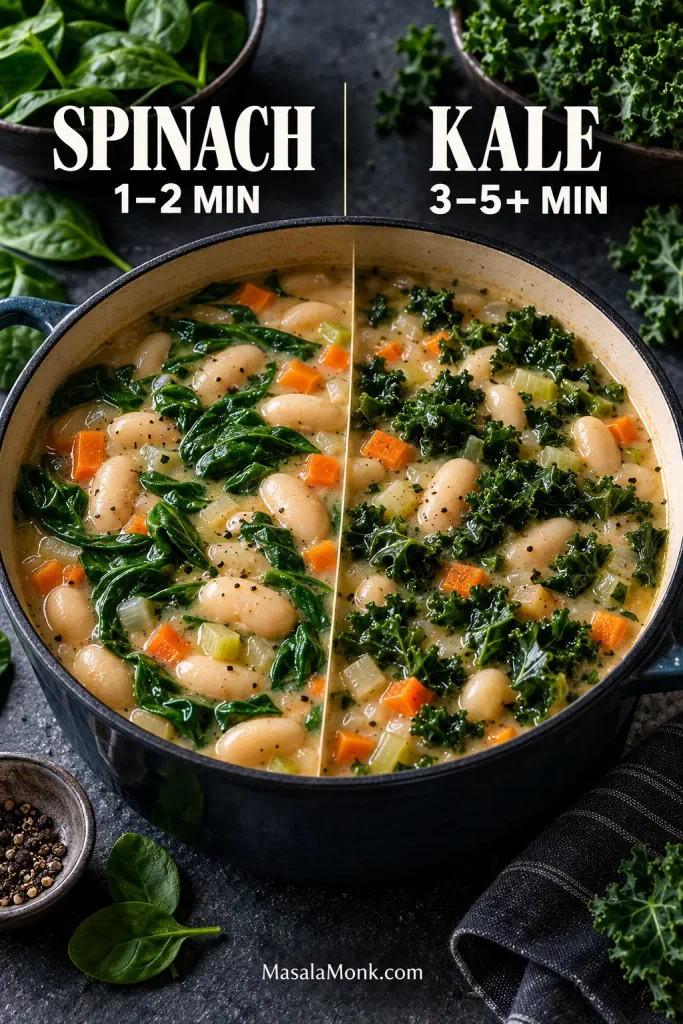
Spinach is the quicker option and stays fairly quiet in the finished bowl. Add 3 packed cups / about 90–100 g only after the beans have simmered and the broth is where you want it.
Kale has more chew and a stronger flavor. Use roughly 2½–3 loosely packed cups / 70–90 g stemmed, chopped kale. Tender leaves may be ready in 3–5 minutes; mature kale often needs longer.
The choice changes the eating experience as much as the timing. Spinach almost melts into the broth, while kale stays more noticeable and gives each spoonful extra chew.
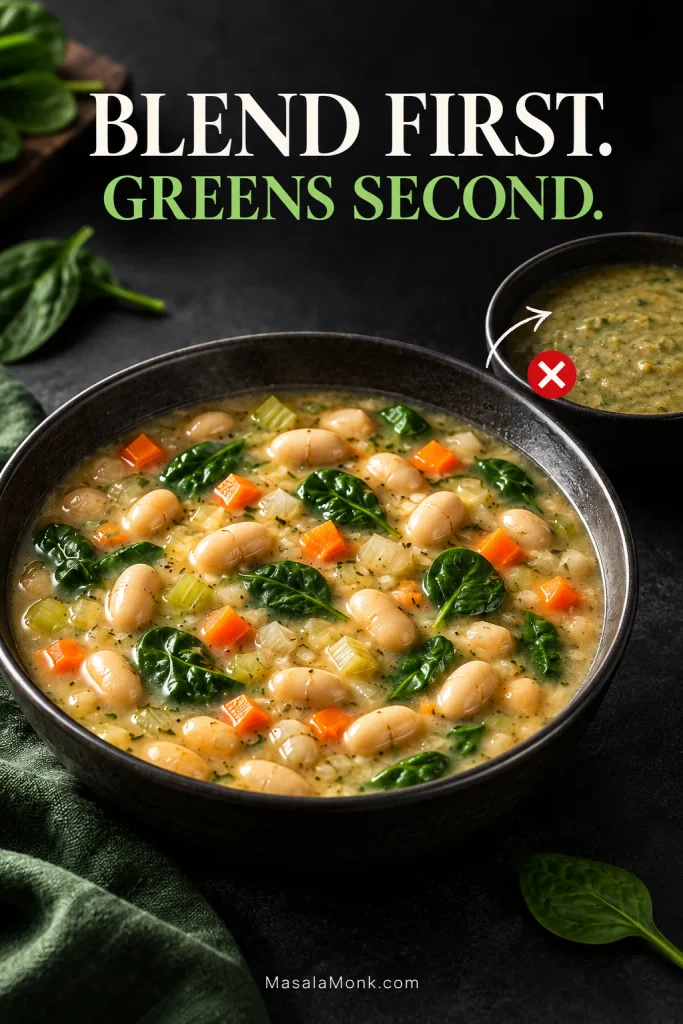
Blend first, greens second. Once the leaves are in, leave the blender alone. Otherwise the pale broth turns muddy and the greens disappear into the purée.
Once leafy greens are blended into the base, their clean color and leaf definition are gone for good. Finish the blending while the pot is still just beans and broth.
Frozen spinach works too; thaw it and squeeze out excess water first. For a brothier bowl with beans, vegetables, greens and small pasta, the minestrone soup recipe goes in that direction.
Salty does not necessarily mean flavorful. Taste once before reaching for anything. Is it actually under-salted, or simply dull? Those are different problems.
Salt and acidity do different jobs. If the white bean soup already tastes seasoned, fresh lemon can sharpen the beans, vegetables and herbs without pushing the salt level higher.
What it tastes like
Try this next
Clearly under-salted
Add a small pinch of salt, stir, then taste again.
Salty enough but flat
Add another teaspoon of lemon juice.
Bright but still one-dimensional
Try black pepper, red pepper flakes, parsley or Parmesan at the table.
Slightly too sweet
Add lemon first, then reassess pepper and salt.
Actually too salty
Dilute with unsalted broth or water, then taste again.
Low-sodium broth leaves more room for those final changes because canned beans and packaged broth both vary.
When the Texture Is Off
Problem
Likely cause
Fix now
Pasty
Too much purée or too much evaporation
Add broth ¼ cup / 60 ml at a time.
Crunchy carrots
Pieces were too large or the initial sauté was rushed
Keep simmering before adding greens. Next time keep the dice near ¼ inch / 6 mm.
Beans falling apart
The pot boiled too hard or the beans were very soft to begin with
Lower the heat and stir gently.
Lots of loose skins
Soft beans, vigorous cooking or the bean brand itself
Keep the simmer mild. Repeated loose skins are also a good reason to try another brand.
Mushy spinach
It went in too early
Next time add it only for the final 1–2 minutes.
Why It Gets Thicker Overnight
The beans keep absorbing liquid as they sit, so tomorrow’s bowl will usually be thicker than tonight’s. Expect to add a splash of broth or water when reheating.
Make the final consistency judgment after the leftovers are hot. Chilled bean soup can look deceptively dense, and adding too much liquid too early may leave the reheated bowl thinner than you wanted.
Freezer: Freeze cooled portions in suitable containers, leaving a little room for expansion. For best quality, use within about 2–3 months. The spinach will be softer after thawing.
Reheating: Warm gently, adding broth or water in ¼-cup / 60 ml increments until the broth pours easily again. Reheat leftovers to 165°F / 74°C.
Taste again before serving. Added liquid can soften the seasoning, and some of the fresh lemon character fades in storage. Another small squeeze may be all the bowl needs.
Once the broth is balanced, the soup needs very little at the table. Parmesan adds salt, olive oil adds richness and black pepper adds warmth, so finish the bowl according to what it still needs.
What to Serve With It
This is filling enough to be dinner on its own, though bread is hard to argue with. Homemade focaccia gives you a soft middle and crisp olive-oil edges; a homemade garlic bread loaf is the more garlicky option. Either one is good for dragging through the last of the broth.
An airy focaccia crumb traps broth and small pieces of beans and vegetables especially well. Dip as you eat rather than leaving it submerged, and the bread keeps more of its structure.
A simple green salad works too. Parmesan, parsley, black pepper or a drizzle of extra-virgin olive oil are all good at the table. When the pot is right, though, it does not need much: tender vegetables, whole beans, broth that clings lightly, and just enough lemon to pull you into another spoonful. Add bread and dinner is done.
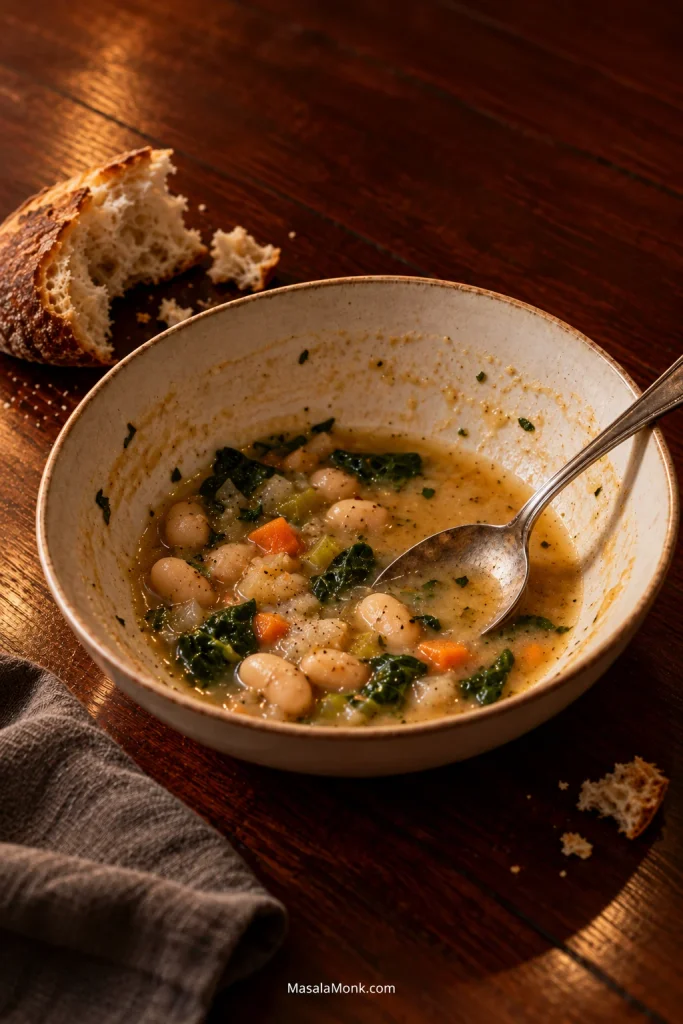
A little broth, a few beans and torn bread left at the end of dinner—sometimes that says more about the soup than another perfectly styled bowl ever could.
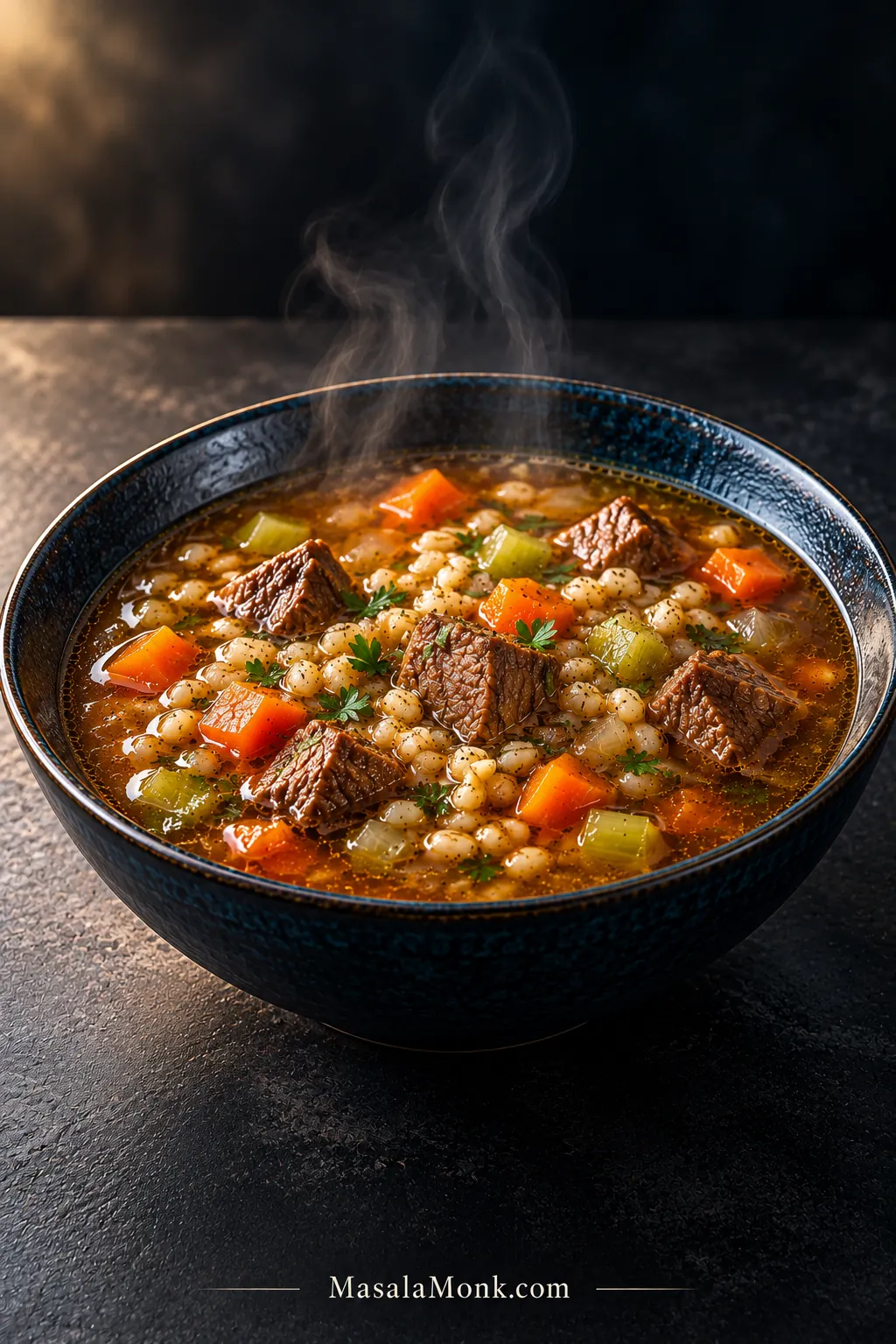
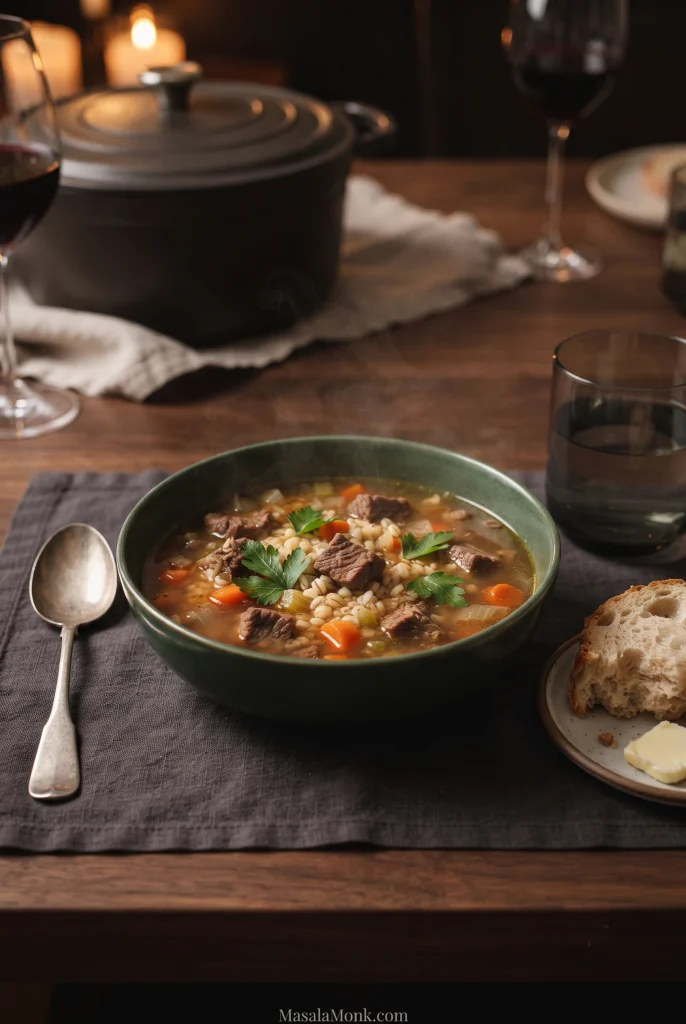
A good beef barley soup recipe should give you tender pieces of beef, plump pearl barley with a little chew, carrots and celery that keep their shape, and enough deeply savory broth for the bowl to remain unmistakably soup. The best spoonful catches a little of everything, with dark broth settling back around the beef and grain instead of disappearing into them.
The tricky part is that those ingredients do not finish on the same schedule. This version browns the chuck in batches, gives the beef a head start, then brings in the barley and vegetables according to how long they actually need. The flavors stay classic—beef, barley, onion, carrots, celery and herbs—but the timing is more deliberate, which helps prevent rubbery beef, overdone vegetables and a pot that quietly turns into barley stew.
Brown the chuck and simmer until it has clearly begun softening. Add the pearl barley, then add the carrots and celery when the barley has about 20-25 minutes left to cook. Use 3/4 cup (about 160 g) barley for a substantial soup that remains brothy, and adjust the final consistency with reserved broth.
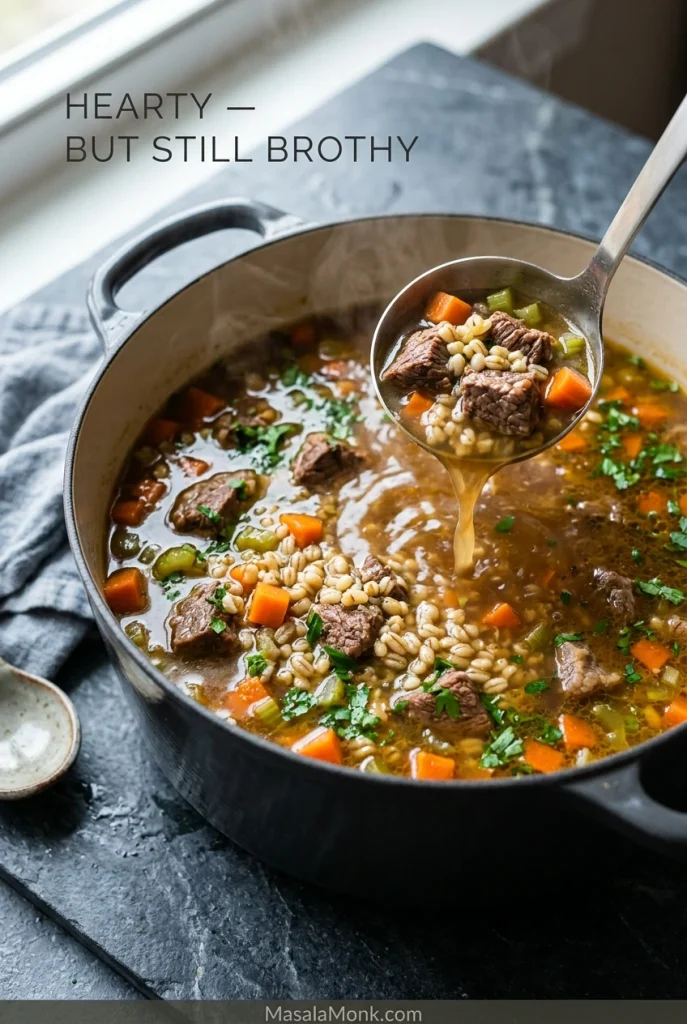
A hearty bowl can still be brothy: look for liquid moving freely between the beef, barley and vegetables.
Before the Pot Goes On
Beef: boneless chuck roast, cut into 3/4-inch (2 cm) pieces.
Barley: regular pearl barley, sometimes sold as medium pearled barley; not quick-cooking barley.
Pot: 5 1/2- to 6-quart (about 5.2-5.7 L) Dutch oven or heavy soup pot.
Make the Soup: Tender Beef Barley Soup
Yield
6 generous servings
Prep
About 25 minutes
Cook
About 1 1/2-2 hours, depending on the beef and barley
Total
About 2-2 1/2 hours
Final texture
Tender beef, plump barley, intact vegetables and a full-bodied broth that still flows
Ingredients
2 lb (900 g) boneless beef chuck roast, trimmed of thick hard exterior fat and cut into 3/4-inch (2 cm) pieces
1 1/4 teaspoons fine sea salt, divided, plus more to taste; this is a starting point for low-sodium broth
1 teaspoon freshly ground black pepper, divided
2 tablespoons (30 ml) neutral cooking oil, plus a little more if needed between batches
1 large yellow onion, about 8-9 oz (225-255 g), chopped
4 garlic cloves, minced
1 tablespoon (about 16 g) tomato paste
1/2 cup (120 ml) dry red wine, such as Cabernet Sauvignon, Merlot or Pinot Noir, optional; if omitted, use an additional 1/2 cup (120 ml) beef broth in addition to the 7 cups below
3 medium carrots, about 8-9 oz (225-255 g), cut into 1/2-inch (1.25 cm) pieces
3 celery ribs, about 5 oz (140 g), cut into 1/2-inch (1.25 cm) pieces
3/4 cup (about 160 g) regular pearl barley, rinsed and drained if directed on the package
1/4 cup chopped flat-leaf parsley
Up to 1 teaspoon (5 ml) red wine vinegar or apple cider vinegar, optional, for final adjustment
Brown the Beef
Dry and season the beef. Pat the chuck very dry. Season with about 3/4 teaspoon of the salt and 1/2 teaspoon of the black pepper.
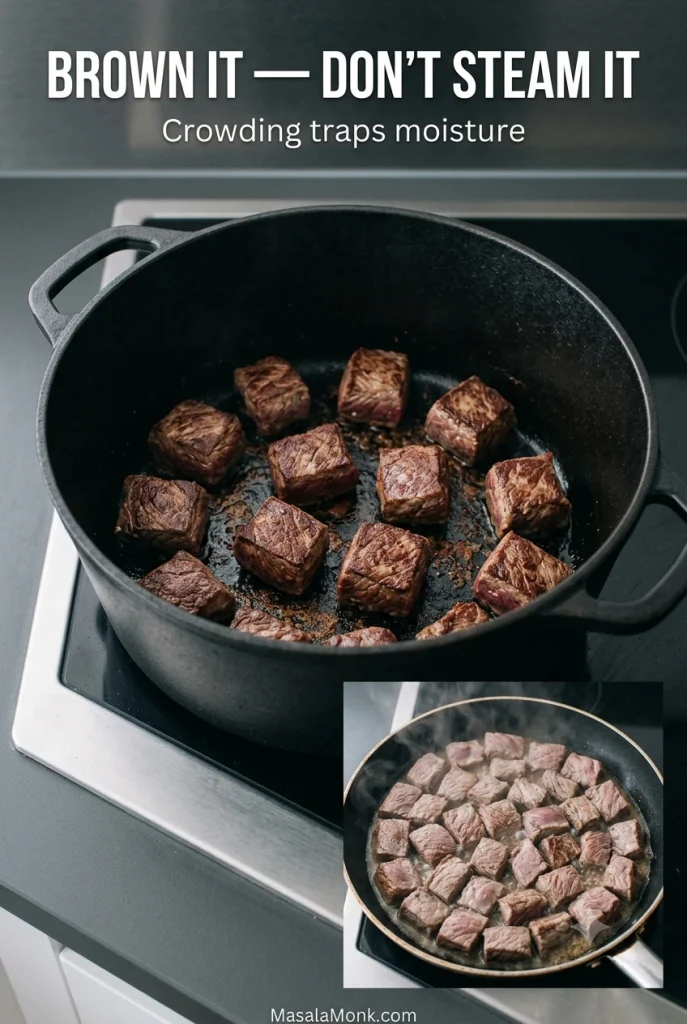
Brown in batches. Heat 1 tablespoon oil over medium-high heat. Add enough beef for one uncrowded layer. Leave it undisturbed until the underside develops a dark brown crust and releases reasonably cleanly, then turn and brown additional sides. Transfer to a bowl and repeat with the remaining beef, adding the remaining oil as needed.
The beef does not need to cook through here. Look for dark brown patches on the meat and a brown film on the bottom of the pot. Pale, wet-looking beef needs more space. By the end of this step, the pot should smell roasted and beefy rather than steamed.
Pale, wet-looking beef needs more room before it can brown properly.
Build the Broth
Cook the onion. Reduce the heat to medium. Add the onion and cook for 5-6 minutes, until softened and lightly golden, scraping loose browned bits from the pot.
Build the savory base. Stir in the garlic and tomato paste and cook for about 1 minute, until fragrant and the paste has darkened slightly. If using wine, add it now, scrape the bottom of the pot well, and let it bubble for 2-3 minutes. Without wine, add 1/2 cup (120 ml) extra beef broth here; this is in addition to the 7 cups used in the next step.
Start the beef simmer. Return the beef and accumulated juices to the pot. Add 7 cups broth, Worcestershire, thyme, bay leaf, the remaining black pepper and the remaining 1/2 teaspoon salt. Bring just to the edge of a boil, then reduce to a gentle simmer. Partially cover and cook for about 40-45 minutes.
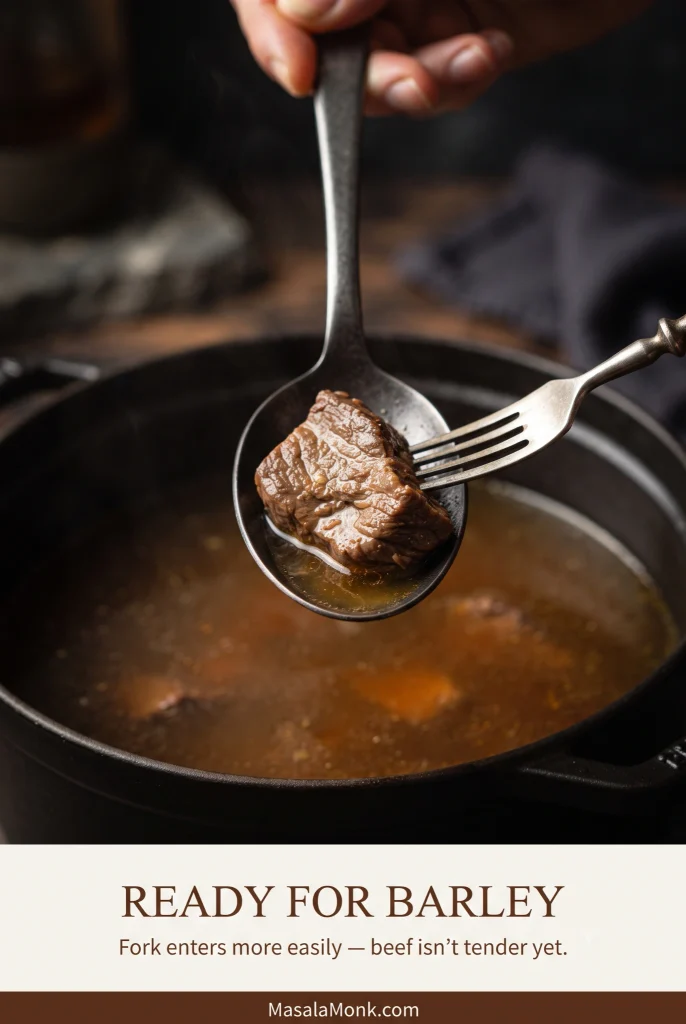
Before You Add the Barley, Check One Piece of Beef
Test one beef cube after about 40-45 minutes. A fork should enter more easily than it did at the start, but the meat does not need to be fully tender yet. If the beef seems stubborn at this point, that is not unusual. Give it another 10-15 minutes, check again, and repeat as needed. Do not add the barley merely because another 15 minutes passed. Wait until the chuck has clearly begun to soften.
Do not rush the chuck.
The chuck only needs to begin softening here; full tenderness comes later.
Add the Barley, Then the Vegetables
Add the barley. Stir in the pearl barley. The dry amount may look small. Do not add more by eye.
Add the vegetables when the barley has about 20-25 minutes left to cook. Check the cooking time on your barley. For a 30-35 minute pearl barley, that usually means adding the carrots and celery about 8-10 minutes after the barley goes in. A slower barley simply gets a longer head start.
This 20-25 minute window assumes roughly 1/2-inch carrot and celery pieces; larger cuts need more time.
Cook until the barley is ready. Keep the soup partially uncovered and stir across the bottom every 8-10 minutes so settled grain does not catch. Bite one grain as you approach its expected cooking time. It is ready when the center is tender with a little pleasant resistance left.
Finish the Soup
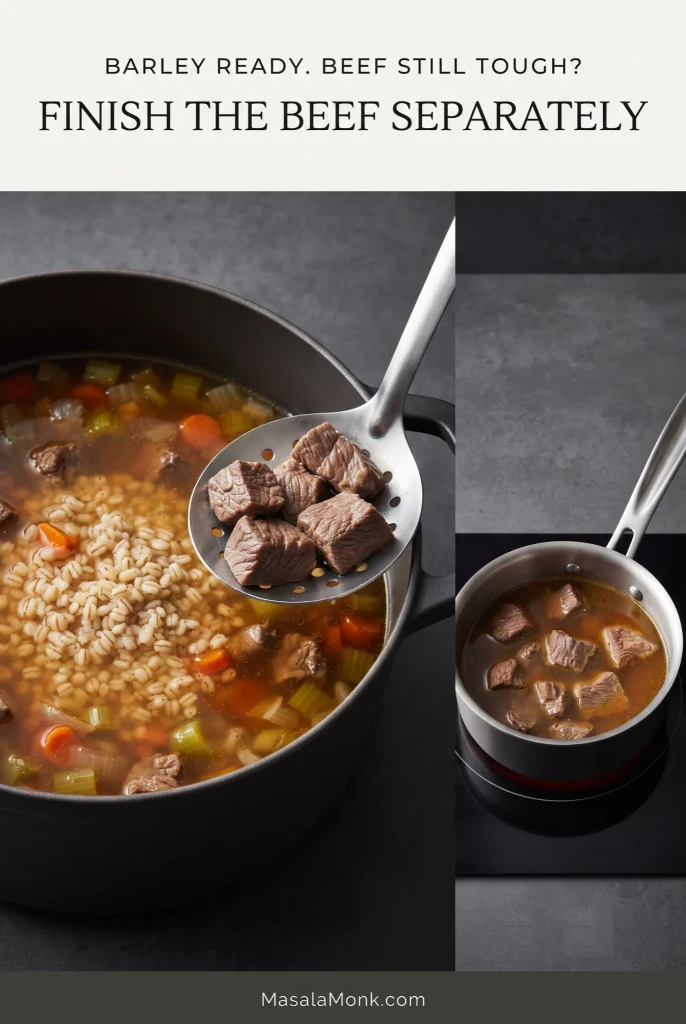
Check the beef. Bite into a piece. It should give easily, without a rubbery center. If it needs only a few more minutes, leave the whole pot at the gentlest simmer. When the barley is already ready but the beef remains substantially tough, lift out the beef and finish it gently in a little hot broth before returning it to the pot.
Set the consistency. Remove the bay leaf and fresh thyme stems. Add hot reserved broth 1/4-1/2 cup (60-120 ml) at a time until liquid moves freely around the beef, vegetables and grain. Drag a ladle through the pot: the broth should close back in behind it instead of leaving a trench. If the soup is too thin, simmer uncovered for a few minutes.
Set the soup’s flow before the final seasoning adjustment; added broth can change how salty the pot tastes.
Season and rest. Taste before adding more salt. Adjust salt and black pepper and stir in the parsley. If the broth is properly salted but tastes rich and dull, add 1/2 teaspoon vinegar, taste, and add more only if needed, up to 1 teaspoon total. Rest for about 5 minutes before serving.
Recipe Notes
Use regular pearl barley. Different brands can cook at noticeably different speeds, so use the grain’s texture as the final judge.
Keep broth in reserve. The exact amount needed depends on the barley, simmer and how long the soup stands.
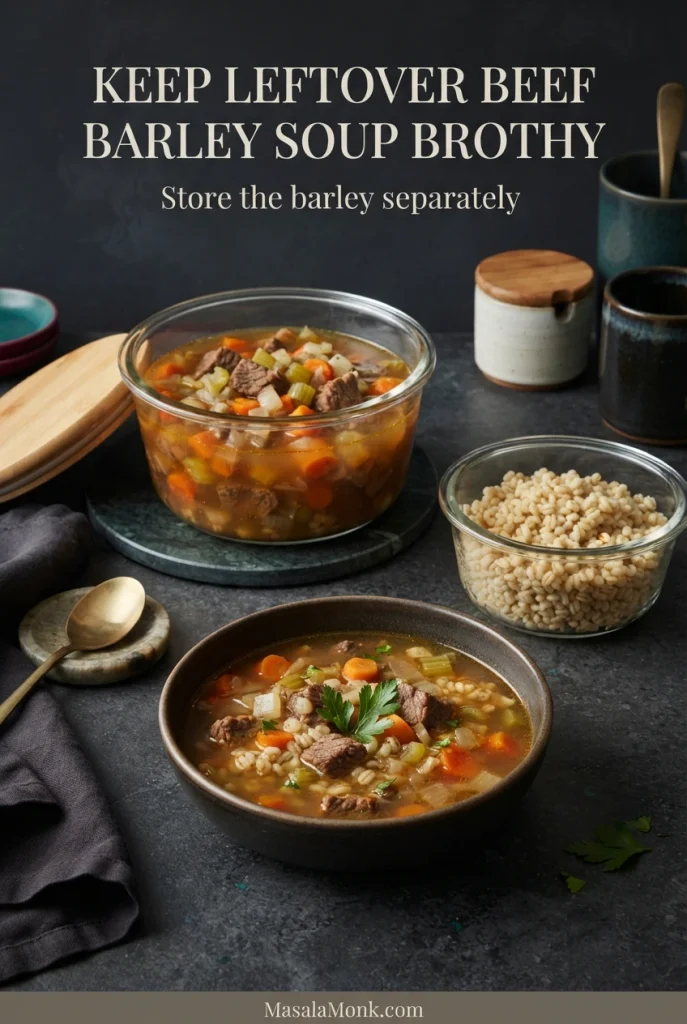
For multi-day leftovers, cook the barley separately. The make-ahead method below keeps the soup brothier for longer.
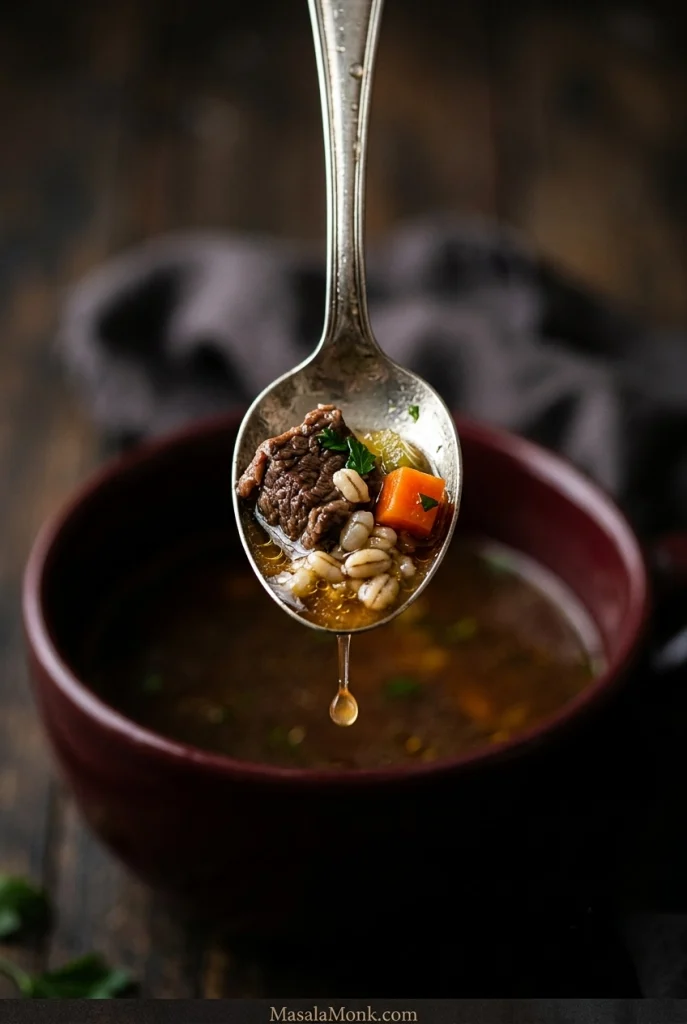
A finished spoonful is one last check on the whole pot: beef, barley and vegetables should all feel present, with broth still visible around them.
If you are cooking now, the recipe above is all you need. The guide below is for choosing beef and barley, adjusting the final texture, rescuing a pot that behaves differently from the ideal one, or adapting it for another kind of beef.
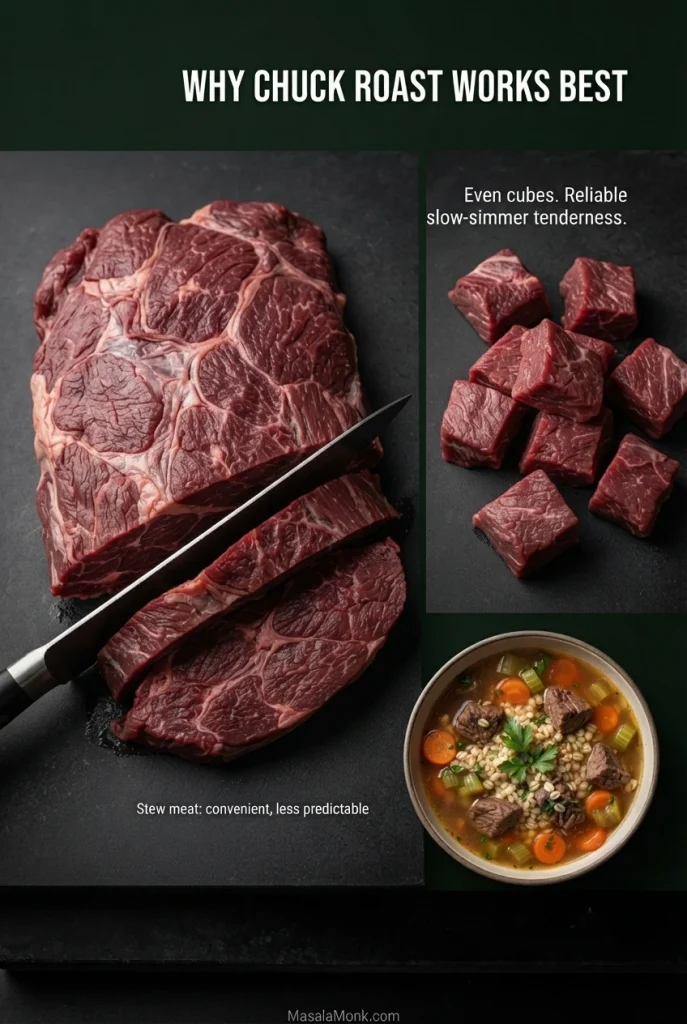
Boneless chuck roast is the best all-around choice because its marbling and connective tissue soften during a long, gentle simmer. Buying a whole roast also lets you cut pieces to a consistent size, which helps them reach tenderness more evenly.
Aim for pieces around 3/4 inch (2 cm). Smaller cubes can lose their presence in the finished bowl; much larger ones may still be firm when the barley is ready. Trim thick hard exterior fat and obvious silverskin, but leave the useful internal marbling.
Even 3/4-inch chuck cubes are more likely to soften on the same schedule.
Beef
How it behaves here
Chuck roast
Preferred. Rich, predictable and suited to a long gentle simmer.
Packaged stew meat
Convenient, but less predictable than cutting a chuck roast yourself.
Boneless short rib
Rich and tender, but more expensive and often fattier.
Beef shank
Excellent beef flavor, but usually needs a longer cooking window.
Ground beef
A different, faster soup with browned beef crumbles instead of tender chuck pieces.
Cooked roast or brisket
Add near the end so already-tender beef does not dry out.
Cooked steak or prime rib
Warm only briefly at the end, especially if you want to preserve a pink center.
Stew meat works too, but a package can contain several cuts. One cube may turn tender while the next still fights the fork, so check the meat itself instead of expecting every piece to finish together.
Pearl Barley: How Much to Use and When to Add It
Use regular pearl barley for this recipe. It needs no overnight soaking, but cooking time varies considerably with the grain and degree of pearling. Some pearl barley may be tender around the half-hour mark, while other medium pearled barley needs considerably longer. Check the package once, then let texture make the final decision. The Whole Grains Council’s barley guide explains the differences between hulled, pearl and quick barley.
Regular pearl barley: the recipe default; add it after the beef has clearly begun softening.
Quick-cooking barley: add it near the end and follow its shorter cooking time.
Hulled barley: cook it separately according to its package directions, then add it near the end. Its longer cook makes it awkward to synchronize with this soup’s beef and vegetables.
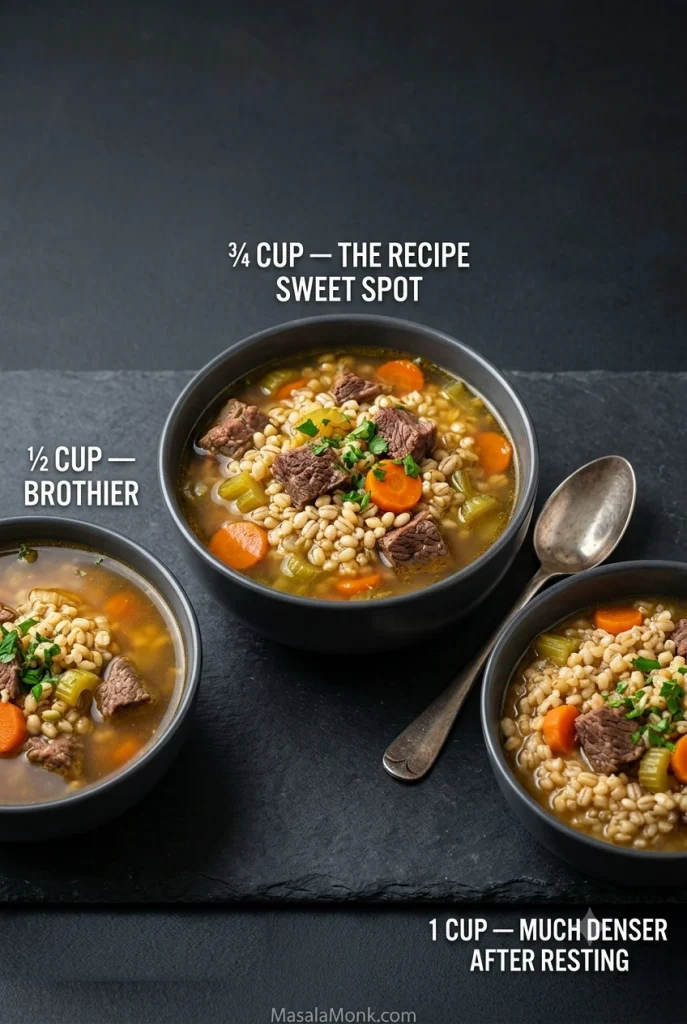
Brothier, with beef and vegetables dominating each spoonful.
3/4 cup (about 160 g)
The balance used here: plenty of barley, with broth still moving freely around it.
1 cup (about 210-215 g)
Much more grain-heavy and likely to become stew-like after resting.
Three-quarters cup gives the best balance here; a full cup makes the soup noticeably denser after resting.
Three-quarters of a cup looks stingy when the barley is dry. It will not look stingy half an hour later. Leave it alone and let it expand before deciding the pot needs more grain.
How Thick Should Beef Barley Soup Be?
Beef barley soup should be hearty enough to satisfy, with broth moving freely between the solids. Tilt a full ladle and you should see liquid run around the beef, vegetables and barley rather than clinging like gravy.
Too thick now: add hot broth 1/4-1/2 cup (60-120 ml) at a time and stir before deciding whether it needs more.
Too thin now: simmer uncovered for a few minutes before changing the seasoning.
Much thicker tomorrow: nothing went wrong. Loosen the soup with broth or water while reheating.
Troubleshooting
The Beef Is Still Tough
Tough does not mean ruined. Keep the soup at a gentle simmer and check another piece in 10-15 minutes. Repeat until the fork enters reasonably easily. A hard boil is not the fix; give the chuck time.
The Barley Is Ready but the Beef Is Still Tough
If the beef needs only a few more minutes, leave the whole pot at the gentlest simmer. Substantially tough beef needs its own finish: lift out the pieces, put them in a small saucepan with enough hot soup broth to come partway up the meat, simmer gently until tender, then return everything to the pot. The grain and vegetables can stop cooking while the chuck catches up.
Separate the jobs: let the barley stop cooking while the beef gets the extra time it needs.
The barley swallowed all the broth.
Add hot broth 1/4-1/2 cup (60-120 ml) at a time until the soup looks properly brothy again, then taste for salt.
The vegetables are falling apart.
There is no way to restore their shape once they are soft. Next time, add them when the barley has 20-25 minutes left to cook.
The broth tastes flat.
Check salt first. Properly salted but lacking savory depth? Add 1/2 teaspoon Worcestershire, taste, then add more only if needed. If the broth tastes rich and heavy, try 1/2 teaspoon red wine vinegar or apple cider vinegar instead. The vinegar should brighten the broth without announcing itself.
Smaller problem
Likely fix
Barley is still hard
Keep simmering gently and add broth if needed. Give the grain the time it needs.
Barley is mushy
It cooked too long or quick barley was used. Loosen the soup with broth; the grain’s bite cannot be restored.
Soup is greasy
Skim surface fat. Next time trim thick hard exterior fat and avoid unnecessary extra oil.
Soup is too salty
Dilute with unsalted broth or water, then taste again.
Barley is sticking
Lower the heat and scrape across the bottom regularly after the grain goes in.
Broth looks cloudy or foamy
This is usually harmless coagulated protein from the beef. Skim it if you prefer a clearer-looking broth.
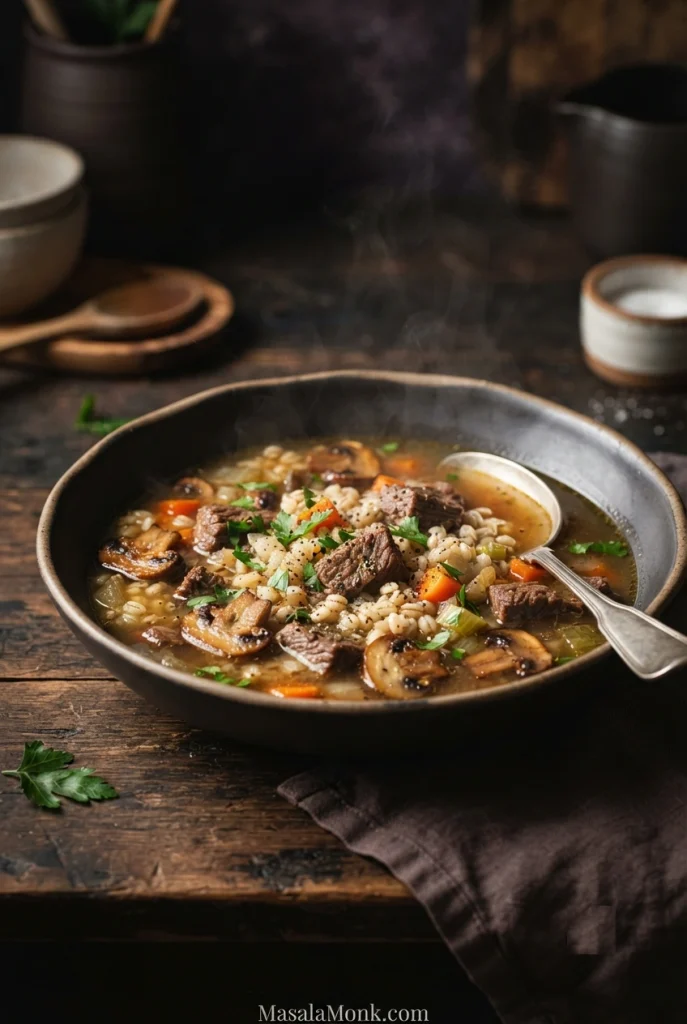
For noticeable mushroom flavor without overwhelming the beef, use about 8 oz (225 g) sliced cremini or button mushrooms. Brown the beef first and remove it. If the pot looks dry, add 1-2 teaspoons oil, then cook the mushrooms until their released moisture has evaporated and real browning begins. Remove the mushrooms and cook the onion as written.
Continue with the broth and beef as written, then return the mushrooms for the final 10-15 minutes. Want mushrooms to play a bigger role? Increase them to 12-16 oz (340-450 g).
Using Leftover Roast Beef or Brisket
Use about 1 1/2 lb (680 g) chopped or cubed cooked roast beef or brisket. Build the broth without the long chuck-tenderizing phase, then cook the barley as directed.
Add the carrots and celery when the grain has about 20-25 minutes left. Stir in the cooked roast or brisket for only the final 5 minutes or so, just long enough to heat through.
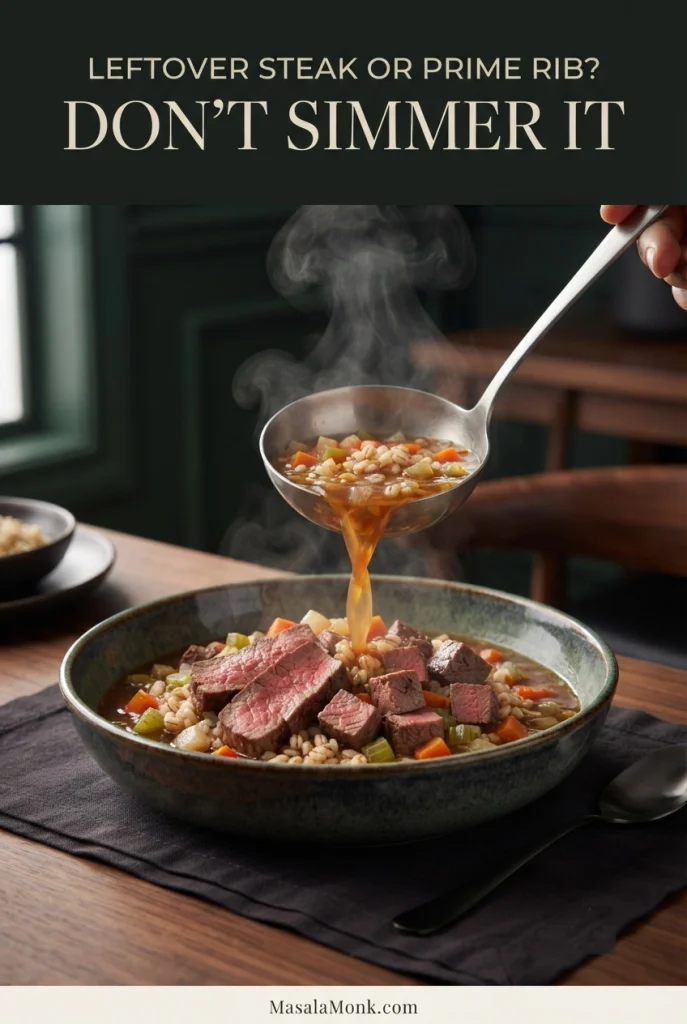
Using Leftover Steak or Prime Rib
Already-pink steak or prime rib needs much less heat. Slice or cube it and add it only at the very end, just long enough to warm through. To protect a medium-rare center, put the meat directly into individual bowls and ladle the steaming soup over it.
Ground Beef Barley Soup
Use about 1 1/2 lb (680 g) ground beef for a faster soup with browned beef crumbles instead of tender chuck pieces. Brown the meat thoroughly, drain excess fat if needed, and transfer it to a bowl. Cook the onion, garlic and tomato paste as written, then return the beef when you add the broth.
Add the barley, followed by the carrots and celery when the grain has about 20-25 minutes left to cook. There is no long tenderizing phase.
Easy Swaps
Swap
Adjustment
No wine
Replace the 1/2 cup (120 ml) wine with the same amount of beef broth.
No tomato paste
Omit it if you want beef barley soup without tomato. The broth will be lighter in color and slightly less concentrated.
Quick-cooking barley
Add it near the end and follow its shorter cooking time.
Hulled barley
Cook separately according to package directions, then stir it into the soup near the end.
Make-Ahead Beef Barley Soup
For several days of leftovers, cook and store the barley separately. For a pot you expect to finish within a day or so, cooking the grain directly in the soup is the better default because it takes on beef flavor and gives the broth natural body.
How to Cook the Barley Separately
Bring 3 cups (710 ml) water or low-sodium broth to a boil.
Add the recipe’s 3/4 cup (about 160 g) pearl barley and a small pinch of salt.
Reduce to a steady simmer and cook until the grain is tender through the center with a little chew. Start checking around the time listed on the package rather than forcing one universal minute mark.
Drain well, cool promptly and refrigerate separately from the soup.
Add barley to individual bowls as the soup reheats.
Separate storage sacrifices a little shared beef flavor, but gives you far more control over leftover brothiness.
When the barley is staying out of the soup pot, continue simmering the beef until it is nearly tender—a fork goes in fairly easily, but there is still a little resistance. Add the carrots and celery at that point and cook for another 20-25 minutes, until the vegetables are tender and the beef is ready. Spoon barley into each bowl and ladle the hot soup over it.
If you like your beef barley soup especially brothy, portioning the barley bowl by bowl also lets each person control how grain-heavy their serving becomes. Our Minestrone Soup keeps its starch separate for the same practical reason: leftovers stay brothier.
Storage and Reheating
The flavors often settle and deepen overnight, while the soup itself becomes thicker. Add broth or water during reheating until it returns to the consistency you like.
Refrigerating. Divide the soup into shallow covered containers and refrigerate promptly. Use refrigerated leftovers within 3-4 days. If the barley was cooked separately, keep it in its own container and combine portions only as you reheat them. This follows USDA food-safety guidance on rapid cooling and leftover storage.
Freezing. Freeze chilled portions in airtight freezer-safe containers for best quality within about 2-3 months. Barley can be frozen in the soup, although keeping it separate gives you more control over the broth when freezing a batch for later.
Reheating. For about 2 cups of cold soup, start with 1/4 cup (60 ml) beef broth or water and add more as needed. Reheat leftovers to 165°F (74°C), stirring so the soup heats evenly.
Whenever you serve it, ladle the soup into warm bowls and scatter over a little parsley.
Bring it to the table while the broth is steaming and the beef is tender enough to meet the spoon without a fight. Crusty bread or soft dinner rolls are welcome alongside, but this is already dinner in the bowl.
Chicken tortilla soup can go wrong in a surprisingly ordinary way: plenty of chicken, beans and chips, yet a broth that tastes mostly of canned tomato. A good bowl should be different. The first spoonful should taste of chile, chicken broth and fresh lime, with tortilla strips that still crack when they hit the soup.
This chicken tortilla soup recipe starts with the broth. Dried chile, tomato, onion and garlic are blended and cooked down before the rest of the liquid goes in. Two corn tortillas disappear into that base for a little body and toasted-corn flavor; the rest become the crisp topping. Add tender chicken, black beans and sweet corn and you have a generous dinner that still eats like soup rather than bean chili. The broth itself is simpler than the ingredient list suggests: most of it moves between the blender and one soup pot.
Chicken tortilla soup is a tomato-and-chile chicken soup finished with corn tortillas and fresh toppings; this version also blends a small amount of tortilla into the broth for gentle body. It stays broth-forward, without cream or flour thickening. Allow 45–50 minutes with raw chicken thighs, 35–40 minutes with cooked chicken and whole dried chiles, or roughly 25–30 minutes when you also use the ancho-powder and ready-made tortilla chip shortcuts.
Use the spoon as a quick texture check: the broth can cling lightly to the chicken, but it should break naturally into drops as it falls. A heavy, stretchy stream is a sign the soup has moved beyond a broth-forward consistency.
Chicken Tortilla Soup Recipe
Smoky tomato-and-dried-chile broth, tender shredded chicken, black beans and corn, with corn tortilla blended into the soup for gentle body and another batch kept crisp for serving.
Dried chiles, corn tortillas and broth brands all vary a little. The measurements give you a reliable starting point; use the color, texture and doneness cues alongside them.
Prep 15 minutes
Cook 30–35 minutes
Total 45–50 minutes
Yield 6 generous bowls
Pot 5–6 qt / 4.7–5.7 L
Heat Usually mild-medium; chile heat varies
Equipment
5–6 qt / 4.7–5.7 L Dutch oven or heavy soup pot
Blender
Fine-mesh strainer, optional
Instant-read thermometer
Small 8-inch / 20 cm skillet for frying, or a rimmed baking sheet for baked tortilla strips
Chicken Tortilla Soup Ingredients
The dried chiles are the specialty ingredient most worth finding. Mexican oregano is easier to substitute, and the toppings are flexible.
For the blended tomato-chile base
1 medium dried pasilla (negro) chile, stemmed and seeded / 8–10 g after trimming
1 medium dried guajillo chile, stemmed and seeded / 5–7 g after trimming
2 tablespoons neutral oil / 30 ml, divided
1 medium white onion, chopped / 160 g
4 garlic cloves, roughly chopped / 16 g
1 can fire-roasted diced tomatoes with their juices / 28 oz / 794 g
1½ teaspoons finely chopped chipotle in adobo / 8 g
1 teaspoon adobo sauce / 5 ml
2 small corn tortillas, about 6 inches / 15 cm each / 50 g total, torn
1 cup low-sodium chicken broth / 240 ml
1 teaspoon ground cumin / 2 g
½ teaspoon Mexican oregano / 0.5 g, crushed between your fingers
Buying pasilla: look for a long, narrow, very dark dried chile, sometimes labeled pasilla negro. A fresh green poblano is not the same thing, even though some stores use “pasilla” loosely.
No whole dried chiles? Start with 1 tablespoon pure ancho chile powder, not an American-style chili powder seasoning blend. Skip the soaking step and add the ancho powder with the cumin and oregano near the end of the tomato-base reduction.
Mexican oregano is more citrusy and earthy than standard Mediterranean-style oregano. Regular dried oregano can stand in when that is what you have.
To finish the soup
4 cups low-sodium chicken broth / 950 ml
Up to 1 additional cup low-sodium chicken broth / 240 ml, only if needed for consistency
5 g fine sea salt / about 1 teaspoon, plus more to taste
1½ lb boneless skinless chicken thighs / 680 g
1 can black beans / 15 oz / 425 g, rinsed and drained / 255 g drained
1 cup corn kernels / 165 g, frozen or well-drained canned corn
2 tablespoons fresh lime juice / 30 ml, plus more to taste
For the crispy tortilla strips
6 small corn tortillas, about 6 inches / 15 cm each / 150 g total
For frying: ¾ cup neutral high-heat oil / 180 ml, or enough for about ¼ inch / 6 mm depth in an 8-inch / 20 cm skillet
For baking or air frying: 1 tablespoon neutral oil / 15 ml
Fine salt, for seasoning
Canola, sunflower, avocado or another neutral high-heat oil will work.
For serving
1 large avocado, diced
½ cup crumbled cotija or queso fresco / 60 g
⅓ cup Mexican crema or sour cream / 80 ml, optional
Fresh cilantro leaves or roughly chopped cilantro
1–2 limes, cut into wedges
Sliced jalapeño or hot sauce, optional
How to Make Chicken Tortilla Soup
Think of the method in four phases: build the broth base, cook the chicken, crisp the tortillas, then finish the soup.
Build the broth base
Toast and soften the chiles. Set the dry soup pot over medium heat. Press the pasilla and guajillo against the surface for 10–15 seconds per side, just until fragrant and slightly pliable. Do not let them blacken. Transfer them to a heatproof bowl, cover with very hot water and leave for 10–15 minutes. While they soak, move straight on to the onion and garlic. Skip this step when using ancho powder.
Cook the onion and garlic. Add 1 tablespoon / 15 ml oil to the pot. Cook the onion over medium heat for 5–7 minutes, stirring occasionally, until soft with a few golden edges. Add the garlic and cook for 30 seconds.
Blend the base. Drain the softened chiles. Blend them with the cooked onion and garlic, tomatoes and juices, chipotle, adobo sauce, torn tortillas and 1 cup / 240 ml broth. Let the mixture sit for 2 minutes so the tortillas soften, then blend until smooth. If your blender is not rated for hot liquids, let the mixture cool first and follow the manufacturer’s venting instructions. Strain only if coarse chile-skin flecks remain.
Cook the puree down. Add the remaining tablespoon / 15 ml oil to the pot, then carefully pour in the puree. Cook over medium heat for 6–8 minutes, stirring frequently. The color deepens, the raw tomato smell fades and a spatula dragged across the bottom leaves a brief track before the puree flows back. This is where the pot stops smelling like canned tomatoes and starts smelling like dinner. Stir in the cumin and oregano for the final 30 seconds; add ancho powder here when using that shortcut.
Cook the chicken and crisp the tortillas
Add the broth and chicken. Stir in 4 cups / 950 ml broth and the starting salt, then keep the soup at a gentle simmer. Unfold the thighs before adding them. Begin checking at 12–14 minutes. 165°F / 74°C is the safety threshold; thighs often shred more easily nearer 175°F / 79°C. If the meat still fights the forks, give it another couple of minutes.
Make the tortilla strips while the chicken cooks. Cut the tortillas into strips roughly ¼ inch / 6 mm wide and 2–3 inches / 5–7.5 cm long. Very fresh strips can be dried at 250°F / 120°C for 10–12 minutes first. For frying, heat the oil to 350–365°F / 175–185°C and cook in small batches for 45–75 seconds. As moisture leaves, the bubbling calms. Pull the strips when golden and crisp, then drain and salt lightly.
Rest and shred the chicken. Transfer the thighs to a plate for a few minutes, then pull them into substantial bite-size pieces. Keep the juices that collect on the plate.
Finish and serve
Finish the soup. Add the beans and corn to the simmering broth and cook for 3 minutes. Return the shredded chicken and its juices, then warm everything together for another minute.
Check the consistency. Tilt the ladle: the broth should still run easily around the chicken and beans. Give the tortilla starch another minute to thicken the broth before adjusting it. For a thinner soup, add the optional broth ¼ cup / 60 ml at a time.
Add the lime and taste. Turn off the heat and stir in 2 tablespoons / 30 ml lime juice. Broth, beans, cheese and any salty tortilla topping can all shift the final seasoning, so taste before adding more salt. A flat soup may simply need salt; a well-seasoned bowl that still feels heavy often needs another squeeze of lime. Save extra heat for the table.
Serve. Ladle the soup into bowls. Put the tortilla strips, avocado, cheese, cilantro, lime, crema, jalapeño and hot sauce on the table and let everyone finish their own.
Shortcuts and alternate routes
Prefer not to fry? Toss the strips with 1 tablespoon / 15 ml oil and a pinch of salt. Bake at 400°F / 205°C for 8–12 minutes, tossing halfway. For the air fryer, use the same lightly oiled strips and cook at 350°F / 175°C for 4–6 minutes per batch, keeping them in a loose layer.
Cooked chicken: Use 3 loosely packed cups / 14–16 oz / 400–450 g rotisserie or leftover chicken and add it during the final few minutes. Keeping the whole dried chiles puts this route at roughly 35–40 minutes.
Fastest route: Cooked chicken + pure ancho chile powder + ready-made tortilla chips can bring the recipe closer to 25–30 minutes.
Chicken breast: Use the same 1½ lb / 680 g and remove it promptly once the thickest part reaches 165°F / 74°C.
Blend the tomato, chiles, aromatics and tortilla first, then cook that puree down before adding the rest of the broth.
Chicken, beans and corn make the bowl filling. The broth decides whether it tastes like tortilla soup. Putting canned tomatoes straight into several cups of stock can leave the liquid tasting thin even when the bowl is crowded with ingredients. Cooking the blended tomato-chile mixture first drives off water, deepens the color and pushes that raw canned-tomato smell into the background.
Rick Bayless uses the same basic order in his sopa Azteca: the tomato, onion, garlic and pasilla mixture is concentrated before the broth goes in. Here, black beans, corn and plenty of chicken simply make the finished bowl more filling.
The first cup of broth gives the softened chiles and torn corn tortillas enough liquid to circulate smoothly in the blender. As a result, the tortilla starch disperses through the base instead of leaving obvious pieces in the finished chicken tortilla soup.
Pasilla, guajillo and chipotle
Pasilla = earthy and dark. Guajillo = brighter and fruitier. Chipotle = smoky and hotter. Pasilla gives the broth its darker base note, guajillo lifts it, and chipotle supplies the obvious smoke. If you want to work more deeply with dried chiles, the pozole rojo recipe uses guajillo and ancho much more prominently.
Treat chipotle as a smoke control, not the answer to every chile problem. If the broth already has enough smoke but needs more heat, jalapeño or hot sauce can raise the heat without pushing the chicken tortilla soup further toward chipotle.
Tortillas Have Two Jobs
Two go in; the rest stay out. If you are here for the crunchy half, jump to the crispy tortilla strips.
The tortillas blended with the tomato and chiles give the broth gentle body and carry corn flavor into the soup itself. Weight matters more than count here because corn tortillas vary considerably in thickness and hydration—especially homemade ones. The homemade corn tortilla recipe goes deeper into masa harina and hydration.
Moisture treatment needs to be opposite here: the tortillas blended into the broth should soften completely, while the serving strips need to lose moisture and stay dry. That contrast is what lets corn tortillas create both body and crunch.
Chicken Tortilla Soup with Thighs, Breast or Rotisserie Chicken
Boneless skinless thighs are the default because they stay juicy in broth and tolerate the extra cooking needed to become tender enough to shred.
The safe minimum for poultry is 165°F / 74°C. For thighs, that is the safety threshold; a little more gentle cooking can make them much easier to shred. Around 175°F / 79°C is a useful texture target when the meat still resists.
Check the temperature while the thigh is still whole, since the thickest section gives a more reliable reading than shredded pieces. Once 165°F / 74°C is reached, use fork resistance—not temperature alone—to decide whether it needs a little more gentle simmering.
Breast needs less time. Remove it promptly at 165°F / 74°C instead of giving it the extra simmer that helps thighs. The baked chicken breast guide has a fuller breakdown of thickness and temperature.
Rotisserie chicken only needs warming. Add roughly 3 loosely packed cups during the final few minutes; simmering already-cooked chicken through the whole recipe only gives it more opportunity to dry out.
Taste and Adjust the Broth Before Serving
This is often the point where you’ve tasted the pot twice and something still seems slightly off. Reaching for another spoonful of cumin is tempting. It is rarely the first answer.
Broth brands, tomato acidity and tortilla thickness all vary, so identify what the soup is missing before adding more of anything.
What you notice
What to do
Thin like plain stock
Simmer uncovered first. If it still needs body, blend ½ small corn tortilla with ½ cup / 120 ml hot soup and return it to the pot.
Too thick or chili-like
Add warm low-sodium broth ¼ cup / 60 ml at a time.
Flat everywhere
Add a little salt, stir well and taste again.
Seasoned but heavy or dull
Add fresh lime juice 1 teaspoon / 5 ml at a time.
Mostly tastes of tomato
Check the salt first. If that is balanced, stir ½ teaspoon pure ancho or guajillo chile powder into a few spoonfuls of hot broth, return it to the pot and simmer for 2–3 minutes.
Needs more smoke
Add a small amount of adobo sauce.
Smoke is right but you want more heat
Add jalapeño or hot sauce instead of more chipotle.
Change one variable at a time, stir thoroughly, then taste again. Lime can brighten a seasoned broth but cannot replace missing salt; likewise, adding more salt will not supply the acidity a heavy chicken tortilla soup may need.
How thick should chicken tortilla soup be, and how do you thicken it?
Chicken tortilla soup does not need to be thick. This version stays broth-forward, with enough tortilla starch to give the liquid light body without making it pasty. If your soup is thinner than that, simmer first; only then add a little blended tortilla if it still needs help.
Tilt a spoonful and the broth still moves freely around the chicken and beans. Newly added tortilla continues hydrating for a few minutes, so give it time before deciding the pot needs more.
Another useful consistency cue is how quickly the broth closes behind a ladle. It should flow back readily; if a trench lingers or the liquid piles around the solids, the chicken tortilla soup is moving closer to chili than broth.
Crispy Tortilla Strips
The recipe card gives the exact frying, baking and air-fryer routes. What matters most is moisture. Very fresh tortillas sputter longer because they have more water to lose; slightly drier tortillas crisp sooner. Small batches also help the frying oil recover quickly instead of turning the process into a long, greasy soak.
Watch the bubbles as well as the clock. They are lively at first and calm as the strips lose moisture. Golden color plus noticeably quieter bubbling is the cue to get them out.
Once the tortilla strips leave the oil, drain them in a loose layer and season while they are still hot. Piling freshly fried strips too deeply traps steam, which can undo some of the crispness you just worked to create.
The fastest shortcut: tortilla chips
Good tortilla chips are fine on a busy night. Put them on the table instead of stirring them into the pot. An open bag also gives you an easy excuse for some fresh guacamole.
Substitutions
Beans: use pinto instead of black beans, or leave them out for a lighter bowl. Prefer beans on the side? These quick refried beans are an easy option.
Corn: leave it out when you do not want the sweetness or extra bulk. Nothing needs to replace it.
Pasilla: ancho gives a sweeter, rounder result; another guajillo makes the chile profile brighter and fruitier.
Chile de árbol: use it only when you deliberately want extra heat. It is much hotter than pasilla, guajillo or ancho and is not an equal-weight replacement.
Regular canned tomatoes: use them. Fire-roasted tomatoes simply bring another roasted note.
Flour tortillas: skip the blended tortilla if corn tortillas are unavailable. Once hydrated, flour tortillas taste different and behave differently.
Gluten-free: this recipe contains no added flour. For strict gluten avoidance, check that the broth, chipotle in adobo, corn tortillas or packaged chips, and toppings are labelled or otherwise confirmed gluten-free.
Cream or cream cheese: a substantial amount turns this into a different kind of soup. For a creamy chicken-and-bean dinner, the slow cooker white chicken chili is a better fit.
The broth adjustment table above handles seasoning and thickness. These problems usually come from the cooking itself.
The soup is much hotter than expected
Dilute the pot with unsalted broth, then rebalance the salt and lime. Avocado and crema can make each spoonful taste milder, but they can’t take heat back out of the pot.
The chicken is chewy
Breast usually gets chewy because it cooked too long. Thighs can stay firm because their connective tissue has not softened enough yet. Thigh meat that still resists shredding needs a little longer at a gentle simmer.
The broth feels gritty
Dried chile skin is the likely culprit. Blend longer, then strain the puree if coarse flecks remain.
The soup tastes bitter
The chile may have burned during toasting, or the puree may have caught on the bottom while reducing. Brief toasting brings aroma; blackened chile can turn the entire pot bitter.
Do not send a scorched dried chile into the blender hoping the broth will hide it. Because blending distributes that burnt flavor through the entire tomato-chile base, discarding one blackened chile is much easier than rescuing a bitter pot later.
Storage, Make-Ahead and Reheating
The soup can be made a day ahead. Refrigerate the broth, chicken, beans and corn together, then keep the tortilla strips and fresh toppings separate until serving.
Tortilla strips can also be prepared a day ahead. Let them cool completely before sealing them in a dry airtight container.
For food safety, USDA guidance recommends shallow containers for rapid cooling and using cooked leftovers within 3–4 days. If you need longer storage, freeze the soup without the tortilla strips or fresh toppings and use it within roughly 2–3 months for best quality.
Tomorrow’s soup will almost certainly be thicker. Tortilla starch continues taking up liquid as the soup rests, so loosen it with a little broth while reheating and bring leftovers back to 165°F / 74°C. Taste the salt and lime again before the bowls go out.
Judge the consistency after the soup is hot, not straight from the refrigerator. Chilled tortilla starch can make leftovers look unusually thick; therefore, reheat first and add broth gradually only after you can see how freely the soup moves.
Toppings and Serving
Put the toppings on the table and let the bowls diverge. Someone will want extra lime, somebody else more heat, and another person may skip the crema entirely. If you trim the topping list, keep the tortilla strips and lime; the rest can flex around whoever is eating.
Serving the toppings separately does more than offer choice. Cool avocado or crema can soften and cool an individual bowl, while lime, jalapeño and crisp tortilla strips adjust brightness, heat and texture without changing the entire pot.
For a brighter green counterpoint, add a spoonful of roasted salsa verde at the table. It brings tomatillo, green chile and lime without changing the whole pot.
The bowl should land in layers: smoky broth, fresh lime, tender chicken and sweet corn, with cool avocado, salty cheese and crisp tortilla around the edges. Add those strips at the last second.
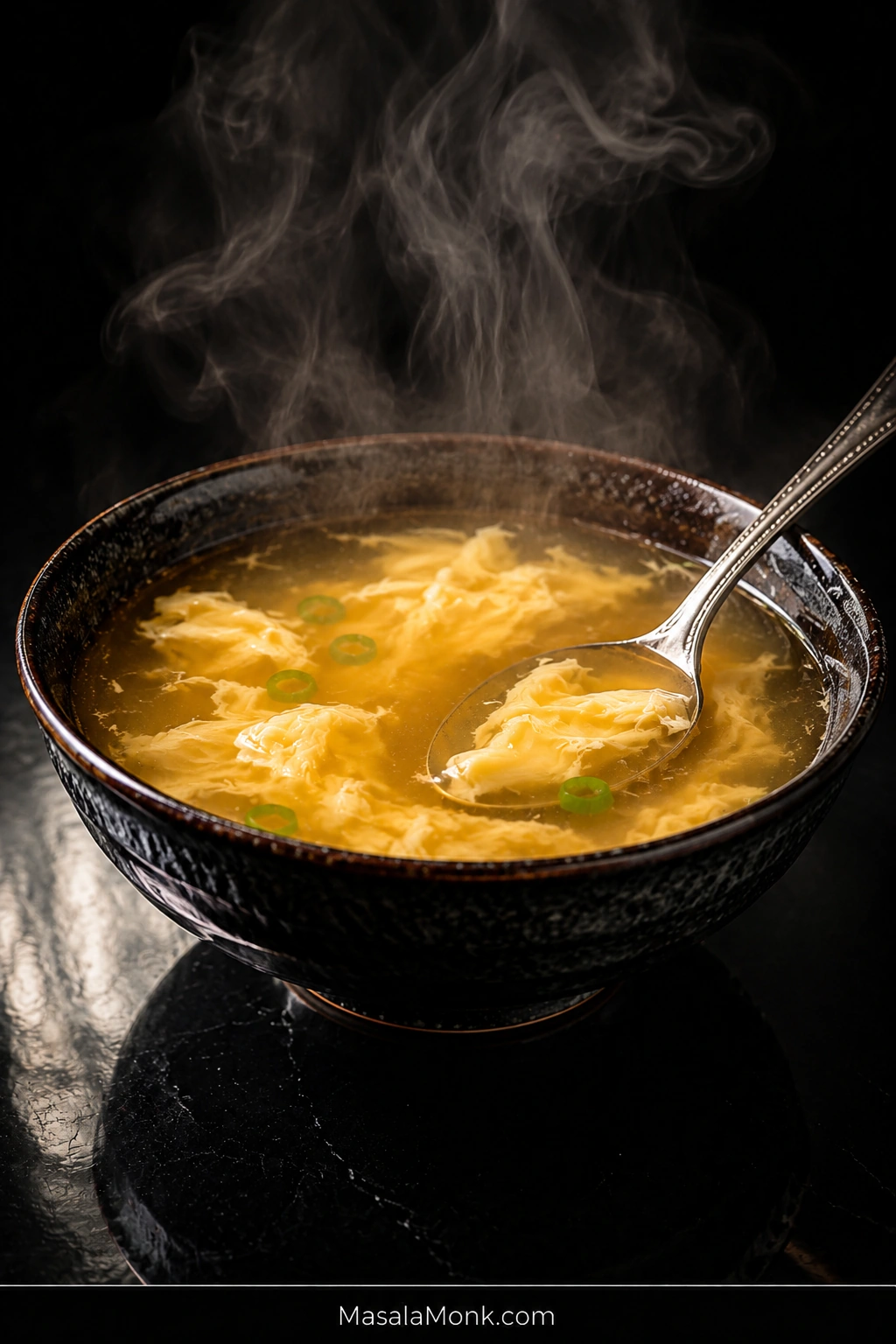
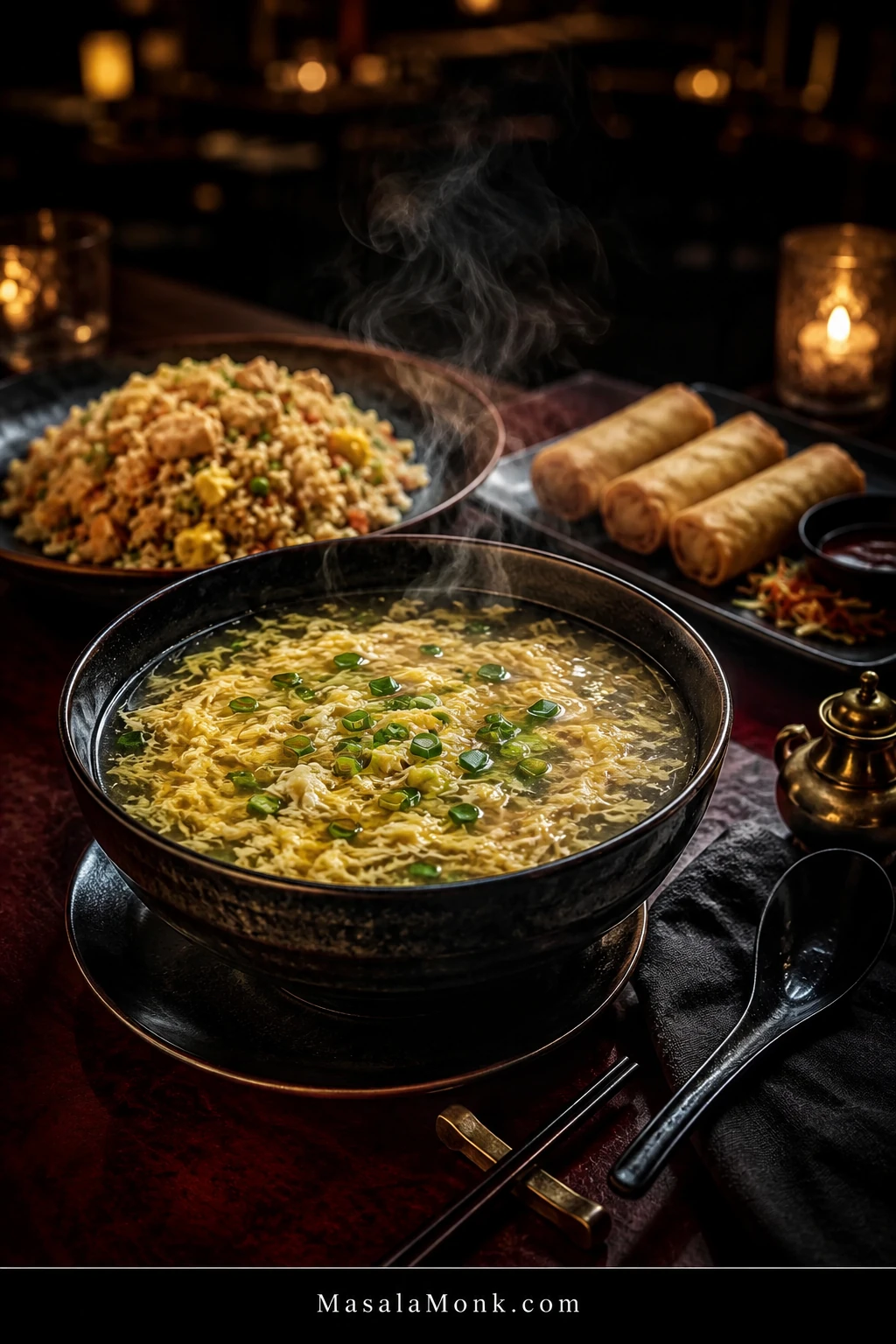
Sometimes egg drop soup is the first thing you want from a Chinese takeout order: a steaming bowl, soft ribbons drifting through savory broth, a few scallion greens on top, and just enough body to make every spoonful feel silky.
The base is simple. The egg pour is the only part worth slowing down for.
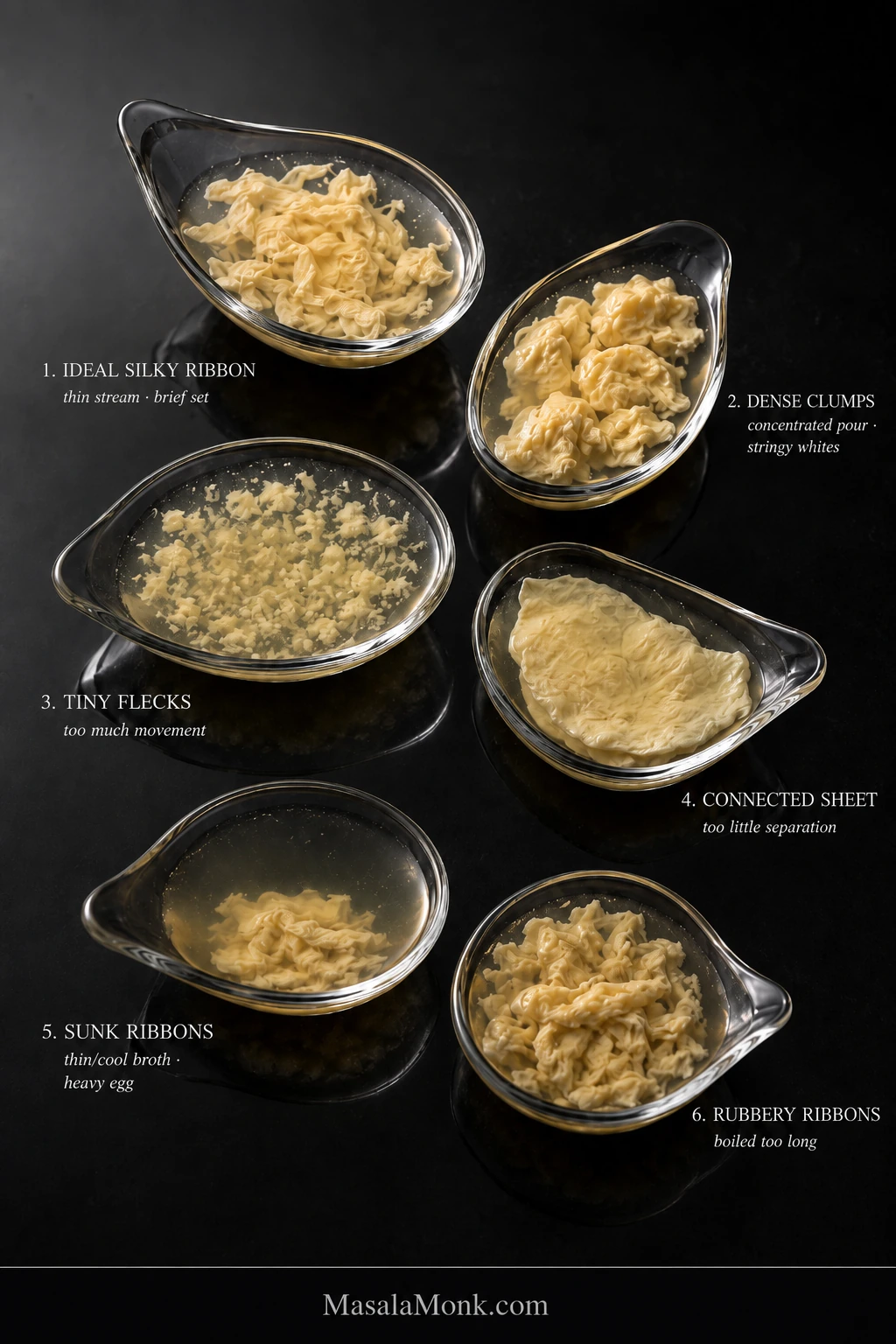
Too much movement can break the egg into tiny flecks. A heavy pour can leave dense clumps. Stir before the egg has set and the ribbons may disappear into cloudy broth.
Thicken first. Create the movement first. Let the egg set before you move it again.
Quick formula: For the base recipe, use 4 cups / 946 ml chicken broth, 2 large eggs, 2 teaspoons / 10 ml water for the eggs, and 1½ tablespoons / about 12 g cornstarch.
This makes 4 starter bowls or 2 generous bowls. The finished soup is broth-forward and lightly thickened, with soft egg ribbons suspended throughout.
Recipe at a Glance
Serves
4 starter bowls or 2 generous bowls
Prep
About 5 minutes
Cook
About 10 minutes
Total
About 15 minutes
Pot
Medium saucepan, about 2½–3 qt
Equipment
Medium saucepan, about 2½–3 quarts
Small bowl for the cornstarch slurry
Spouted measuring cup or another easy-pouring cup for the eggs
Fork or small whisk
Ladle or large spoon
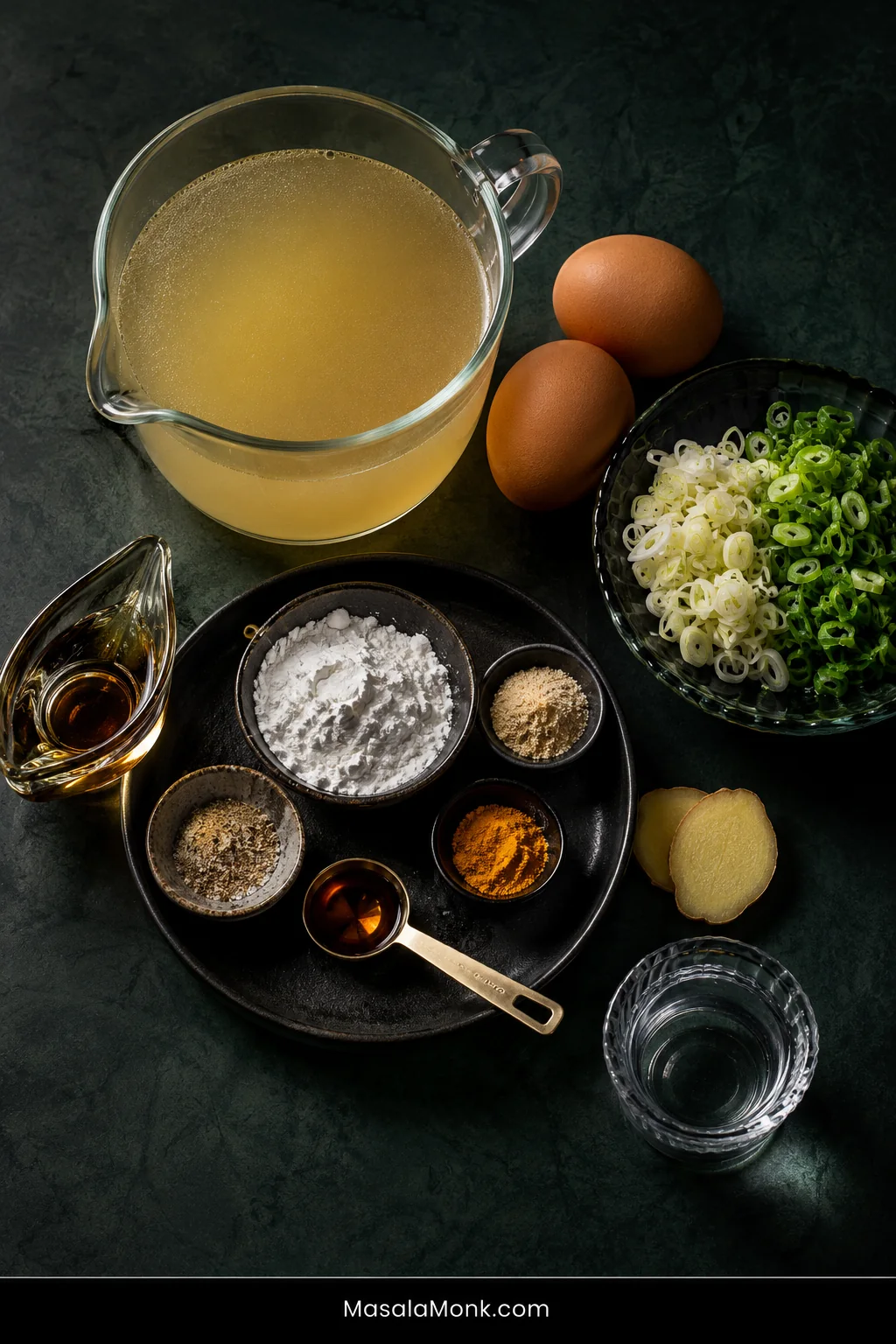
Ingredients
4 cups / 32 fl oz / 946 ml low-sodium chicken broth
2 scallions, thinly sliced, white and green parts separated
2 thin slices fresh ginger, about 5 g
½–1 teaspoon chicken powder or bouillon, optional, depending on your broth
¼ teaspoon ground white pepper, plus more to taste
⅛ teaspoon turmeric, optional, for warmer color
1½ tablespoons cornstarch, about 12 g
1½ tablespoons / 22 ml cold water, for the slurry
2 large eggs, about 100 g without shells
2 teaspoons / 10 ml water, for loosening the eggs
½ teaspoon / 2.5 ml toasted sesame oil, optional, plus more by drops to taste
Salt, as needed after tasting
Most of this recipe’s leverage sits in three things: broth for flavor, egg for texture, and cornstarch for body. The rest should stay deliberately restrained.
1. Season the Broth
Add the chicken broth, scallion whites, ginger, white pepper, and optional turmeric to a medium saucepan.
Bring to a boil, lower the heat, and simmer for 2–3 minutes. Remove the ginger slices after they have flavored the broth.
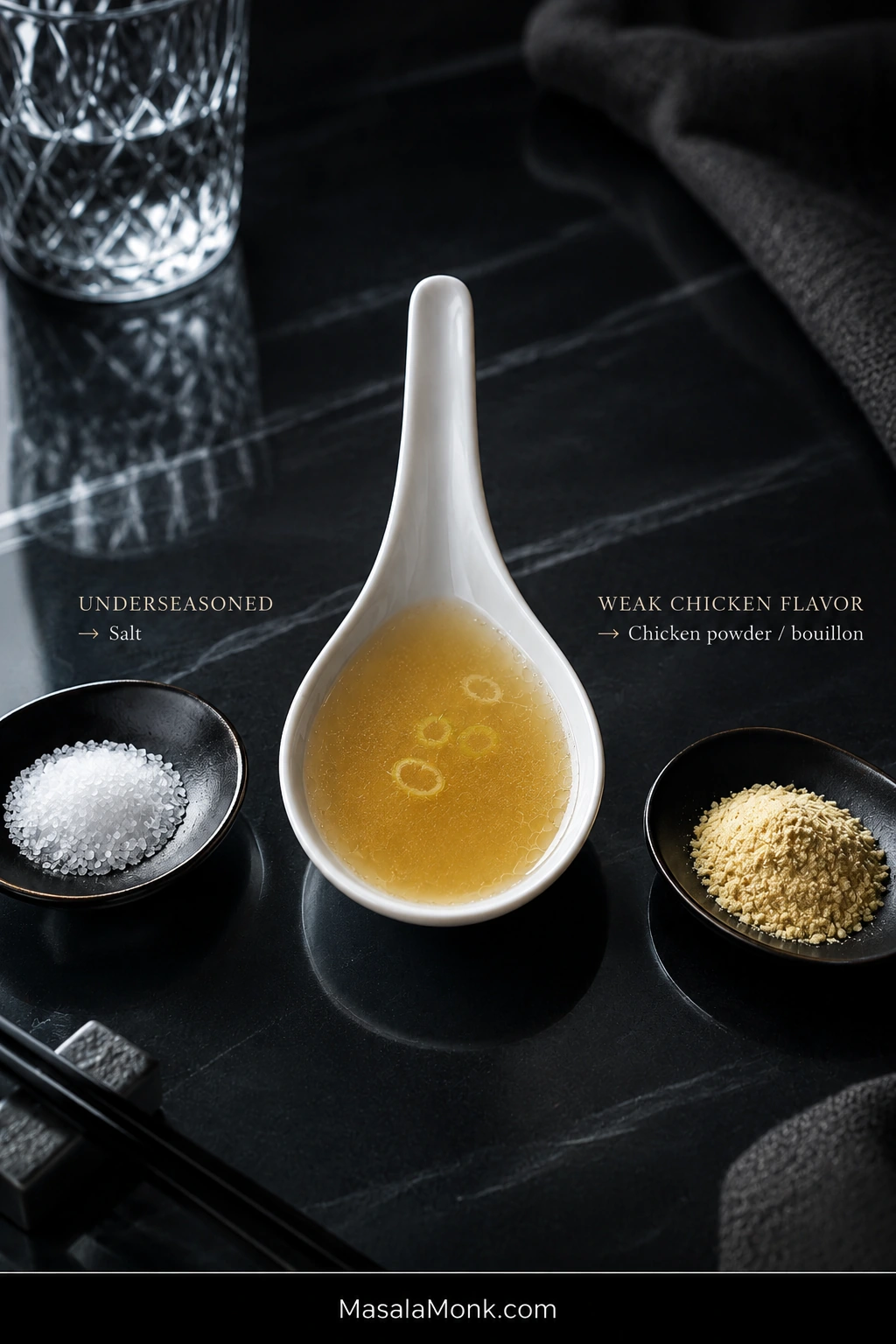
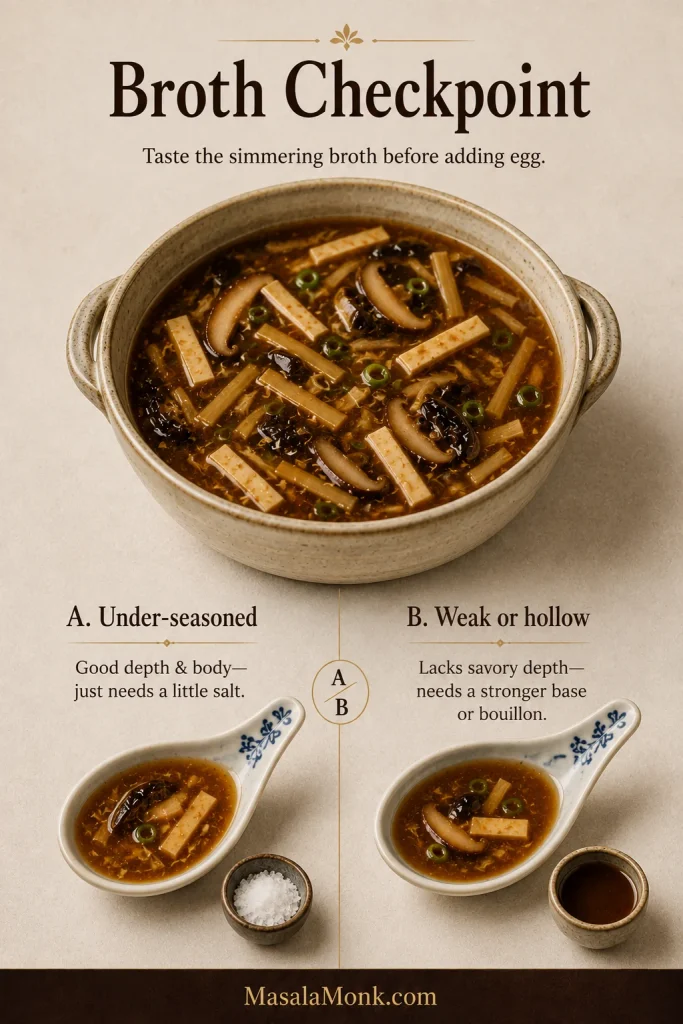
Now taste. If the chicken flavor is good but the broth simply tastes underseasoned, add salt. If the chicken flavor itself feels weak or hollow, add ½ teaspoon chicken powder or bouillon, let it dissolve, and taste again before using more.
Get the broth tasting good here. Cornstarch will change its texture and egg will add richness, but neither one can supply the savory foundation the broth is missing.
If the broth is salty enough but still tastes hollow, the missing piece may be chicken depth rather than more salt.
2. Thicken the Broth
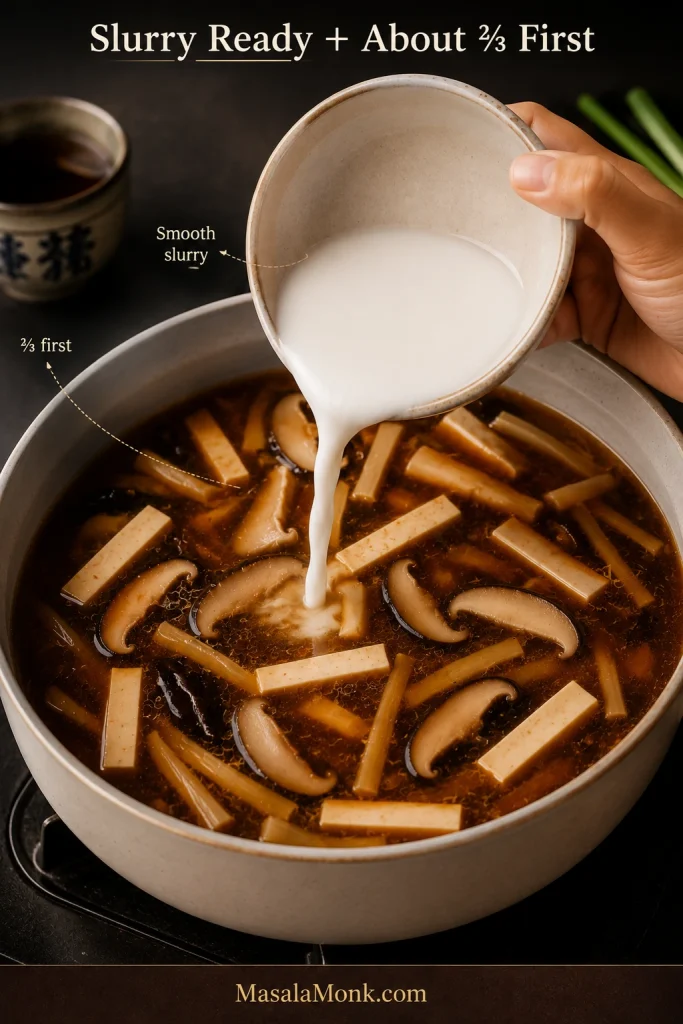
Mix the cornstarch with 1½ tablespoons / 22 ml cold water until smooth.
Stir the slurry again immediately before using it; cornstarch settles quickly. Pour it gradually into the simmering broth while stirring.
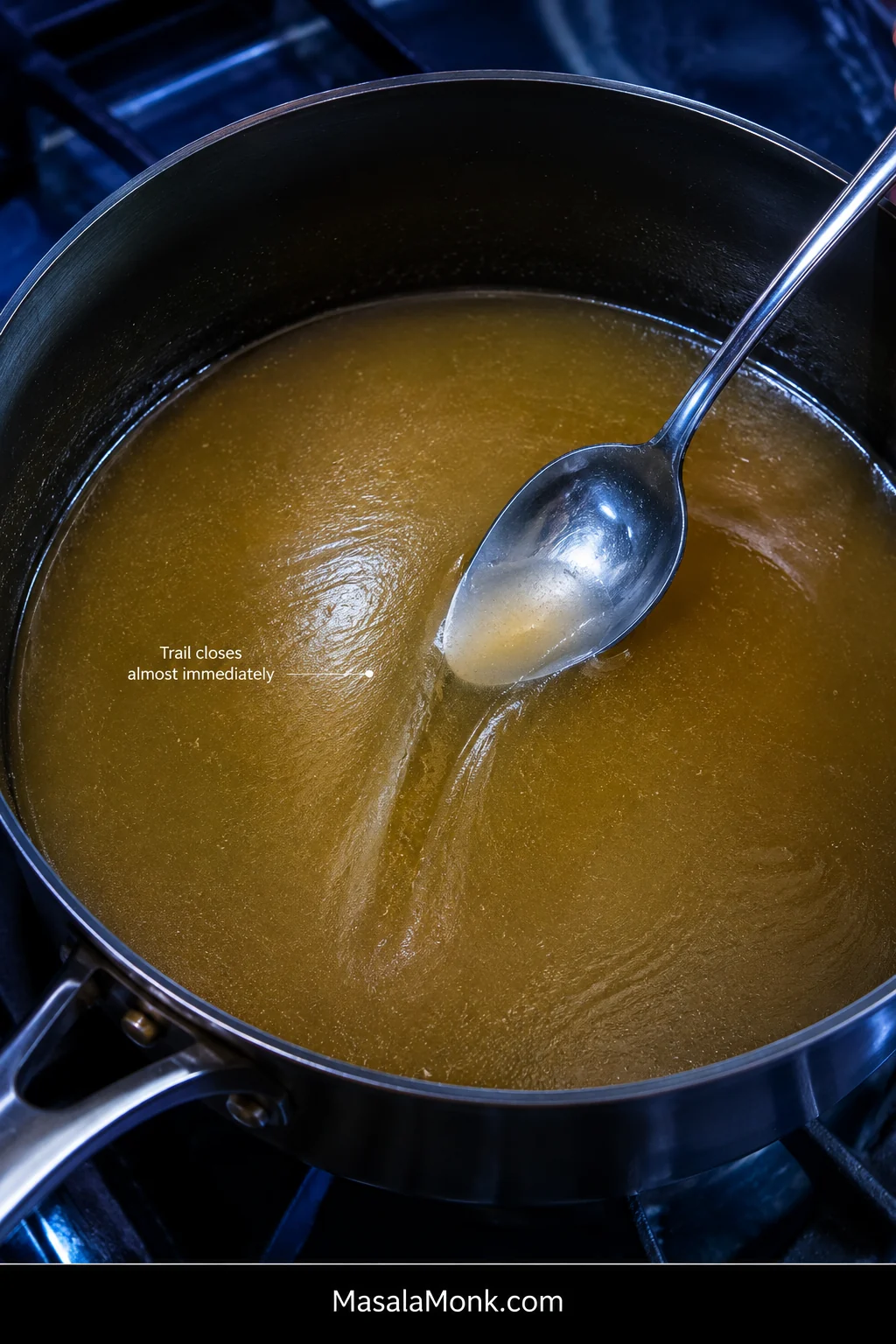
Cook for about 45–60 seconds, then drag a spoon through the pot. The broth should have a slight sheen, and the path behind the spoon should close almost immediately. A lingering trench means the soup is becoming too thick. If it looks almost unchanged from plain stock, give the starch another few seconds at a simmer.
The texture should remain fluid enough to move easily around the saucepan, with just enough body to feel silky on the spoon.
Think of the trail as a wake, not a trench. You want to glimpse where the spoon passed without leaving a channel that sits open behind it.
3. Prepare the Eggs
Beat the eggs with 2 teaspoons / 10 ml water until the yolks and whites are evenly combined and no clear, stringy ropes of egg white remain.
The added water makes the eggs easier to pour in a narrow stream. Stop once the mixture is smooth and fluid; foam does not help the ribbons.
The smooth sample gives you the most predictable pour. Stringy whites create uneven pieces, while excess foam makes the stream harder to control.
4. Make the Egg Ribbons
For this simmer-based method, keep a few quiet bubbles breaking the surface.
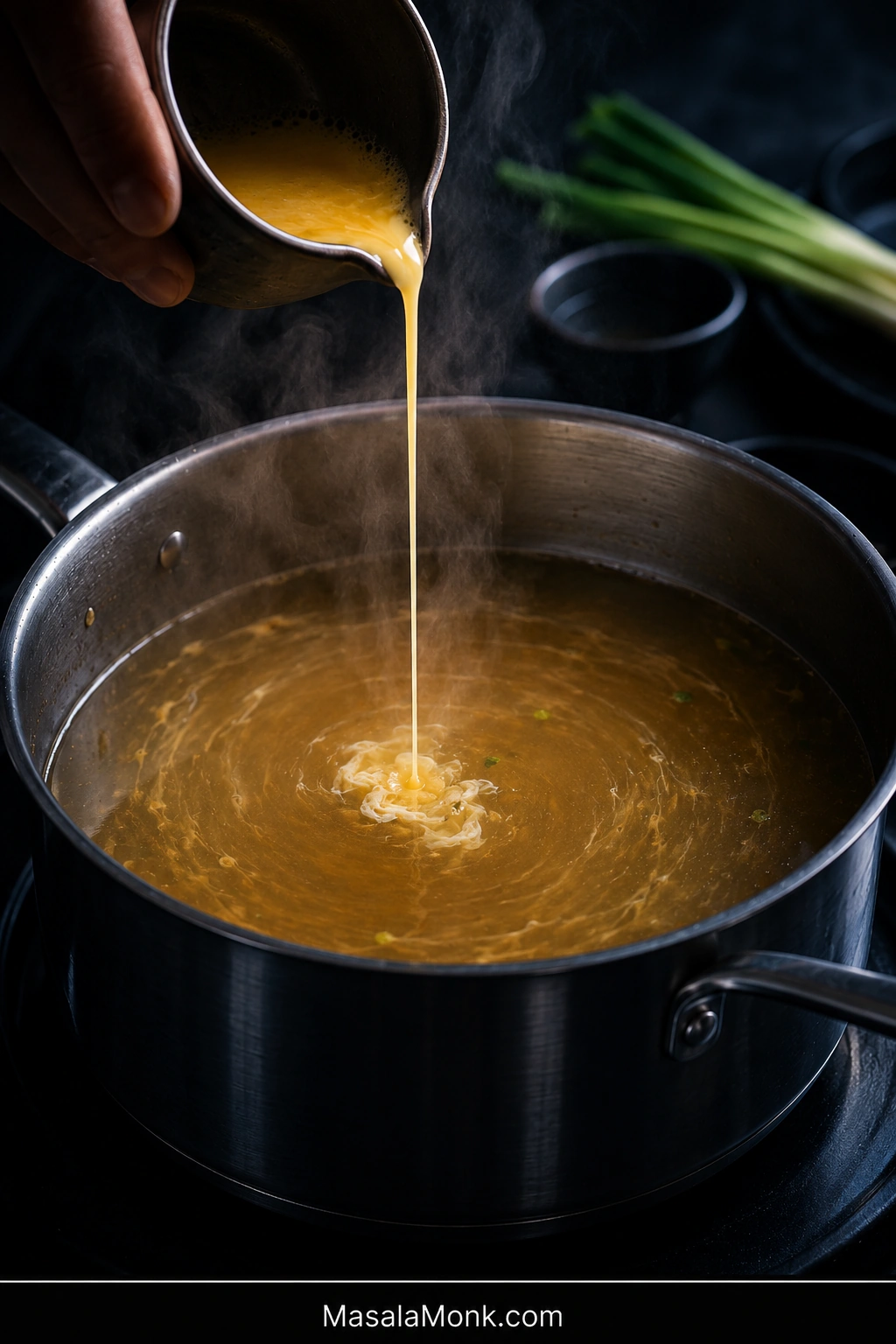
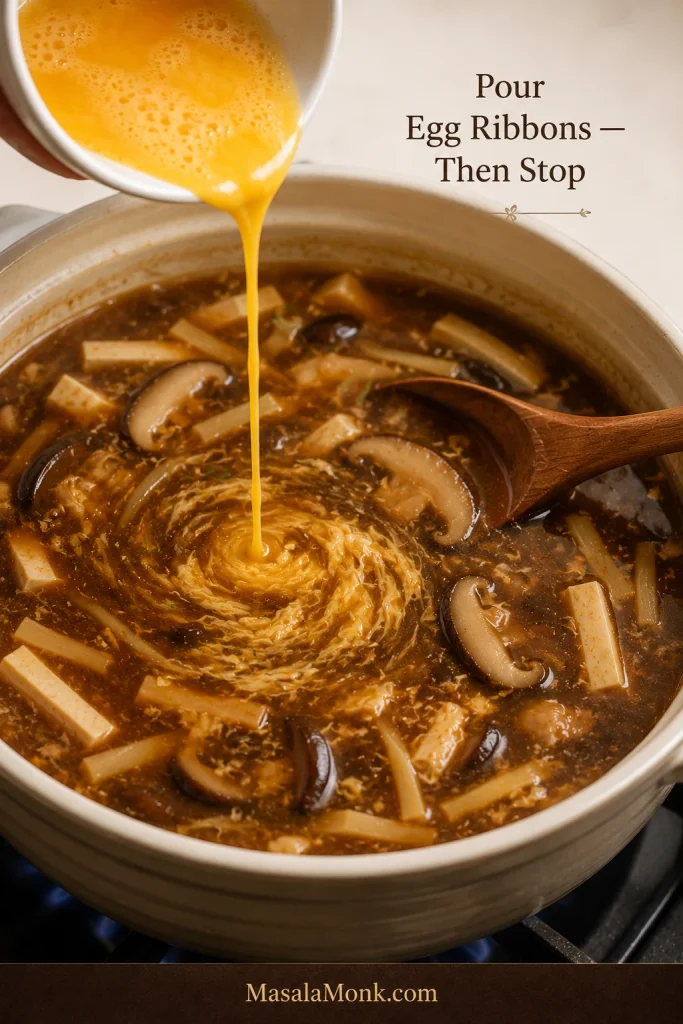
Give the broth one broad circular stir to create a slow current, then put the spoon down.
Pour the egg in a thin, steady stream around the pot, allowing the moving broth to carry it instead of repeatedly pouring into one spot.
Because the spoon is out of the pot, the slow current can stretch a narrow pour into ribbons instead of breaking the setting egg into flecks.
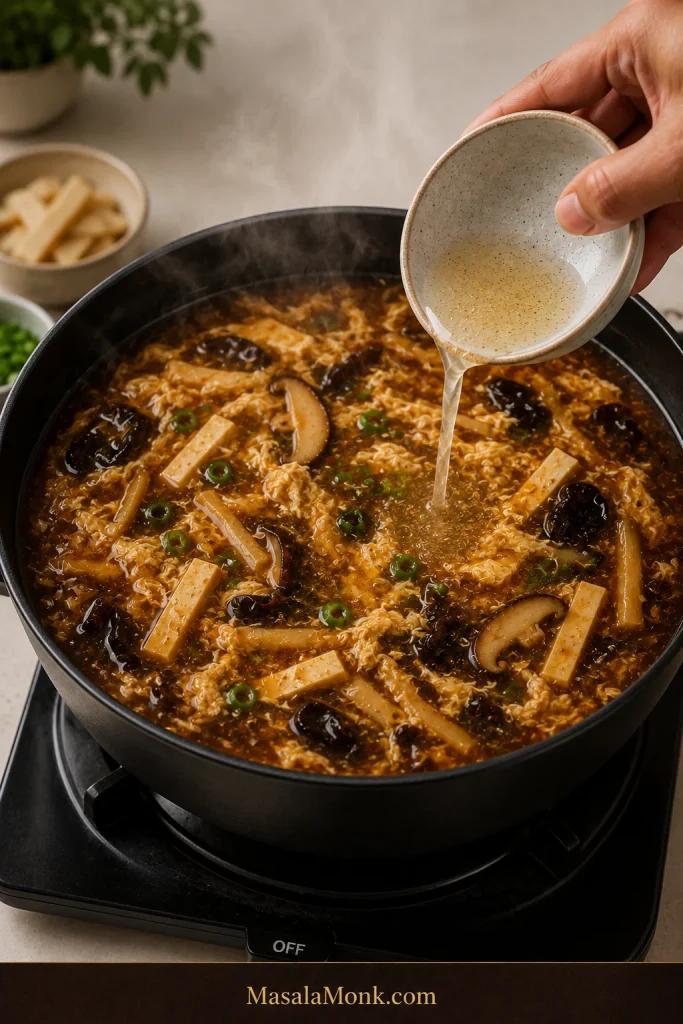
Leave the soup untouched for about 10–15 seconds, or until the egg is opaque and distinct ribbons are visible. Use one or two easy strokes to separate pieces that have joined together.
Watch the color change: translucent streaks become opaque folds. That shift—not the stopwatch alone—tells you the egg is ready for gentle separation.
Once those ribbons are visible, the tricky part is over.
A spouted cup gives you the most control. With a wider cup, hold a fork across the lip and let the beaten egg pass through the tines in a narrower stream.
5. Finish and Serve
Turn off the heat. Add the scallion greens and, if you like it, ½ teaspoon toasted sesame oil.
Taste once more. Add salt only when needed. Increase the sesame oil by drops so its toasted fragrance stays in the background.
Serve while the soup is steaming and the ribbons are soft.
Before You Sit Down: Check the Soup
The broth pours easily from the ladle.
The egg floats through it as ribbons or soft flowers instead of one heavy mass.
White pepper gives the sip a quiet warmth.
The ribbons do not need to look identical. When the soup tastes good and looks inviting, stop adjusting it and eat it hot.
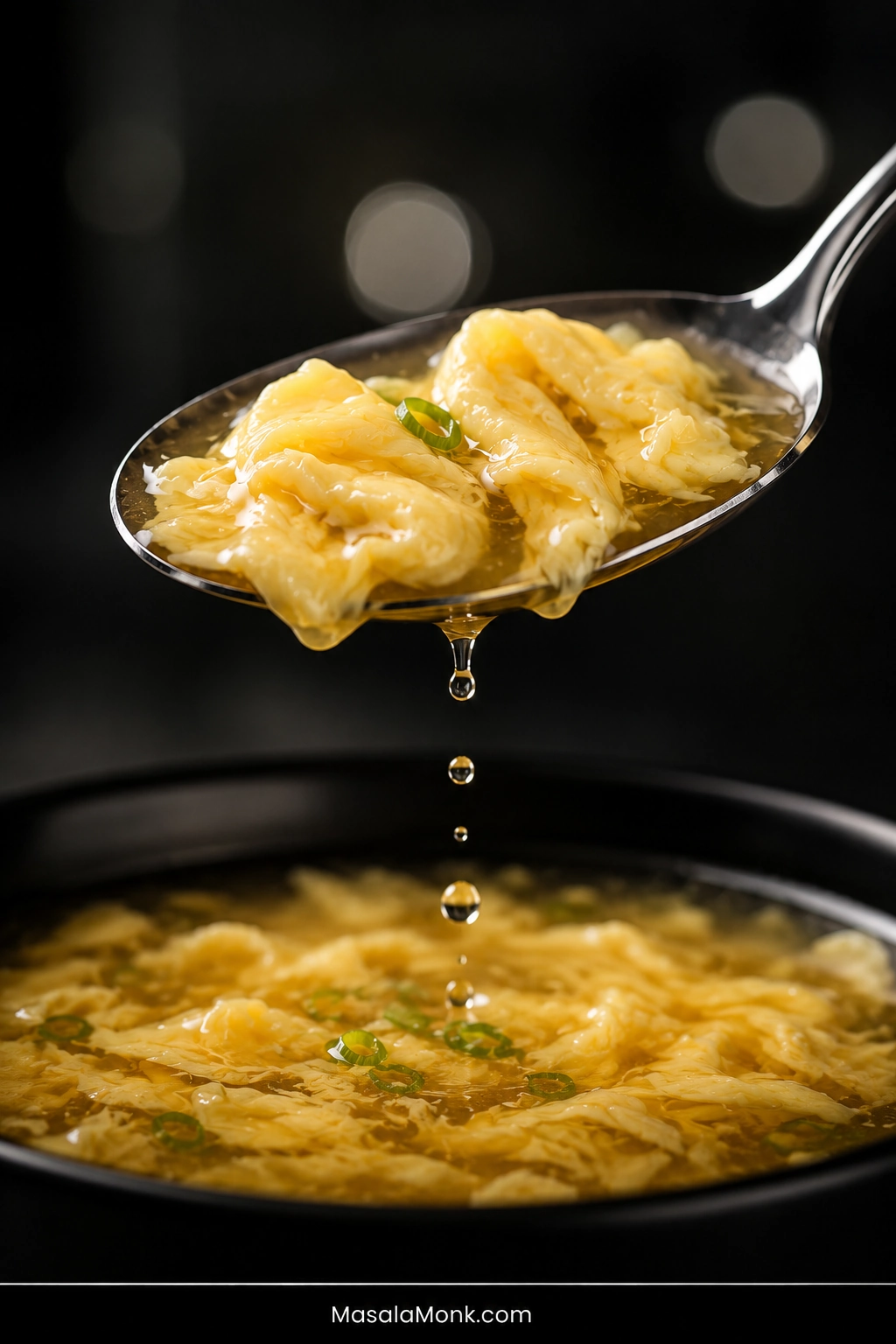
Lifted from the broth, tender ribbons should drape and fold rather than stand stiff like curds. That softness is more useful to judge than perfect shape.
Egg Drop Soup Ingredients: What Matters Most
Start with a clean-tasting chicken broth rather than one dominated by heavy roasting, tomatoes, or strong herbs. A mild broth is fine because you can correct its salt and savory strength before making the ribbons.
Cornstarch gives many restaurant-style versions their lightly glossy body and helps keep the egg suspended. The amount determines how broth-like or thick the finished soup feels.
White pepper supplies the familiar earthy warmth. Chicken powder or bouillon strengthens weak chicken flavor, while sesame oil is an optional finishing aroma and is best added cautiously.
Turmeric only adjusts color here. It is not needed for the flavor or for successful egg ribbons.
Choose Your Texture
One restaurant may serve egg drop soup almost broth-like while another makes it thick enough to cling to the spoon. Ribbon size varies too.
You want…
Try this
A lighter broth
Start with about 1 tbsp / 8 g cornstarch
The silky default
Use 1½ tbsp / about 12 g
A thicker takeout texture
Increase gradually toward 2 tbsp / about 16 g
More egg
Use 3 large eggs
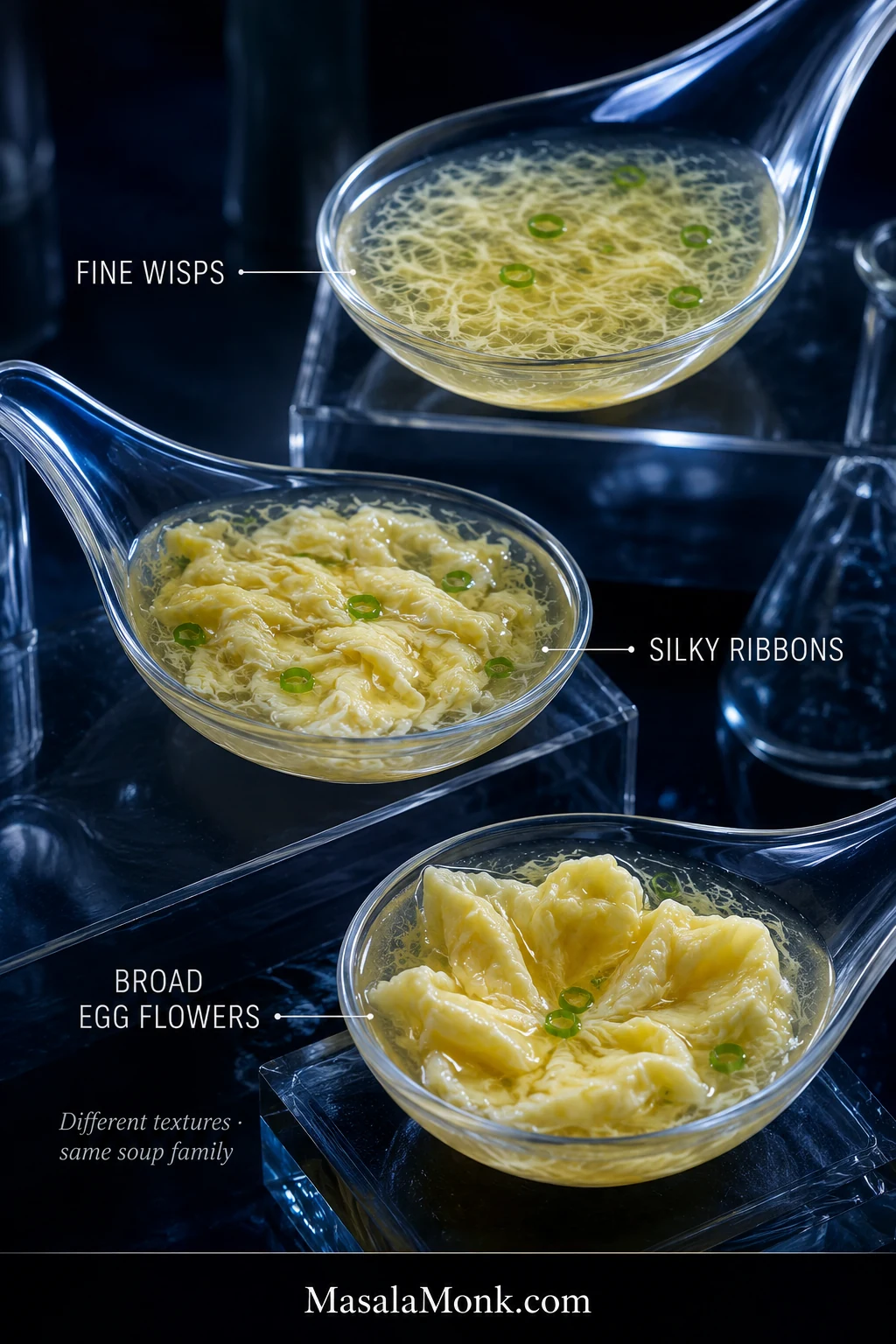
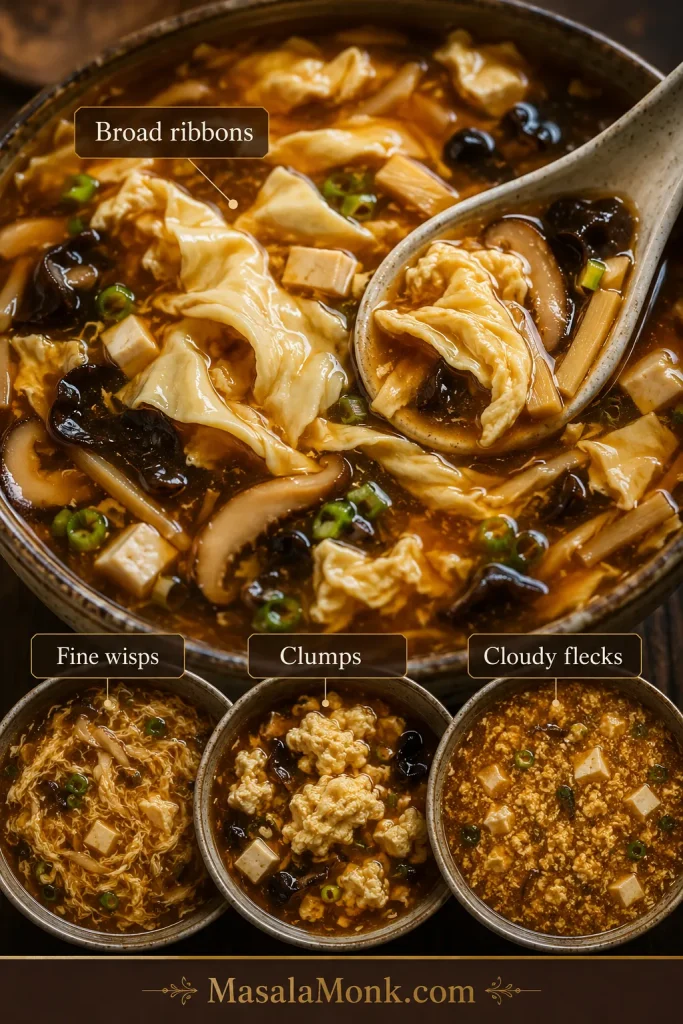
Fine wisps
Use a finer stream with more movement in the broth
Broad soft flowers
Give the egg more stillness once it enters
These are starting points, not pass-or-fail rules. The difference between wisps, ribbons, and broad flowers is mostly texture and appearance.
Read the drips, not the color. Lighter broth runs cleanly off the spoon; a thicker takeout-style egg drop soup coats and releases more slowly.
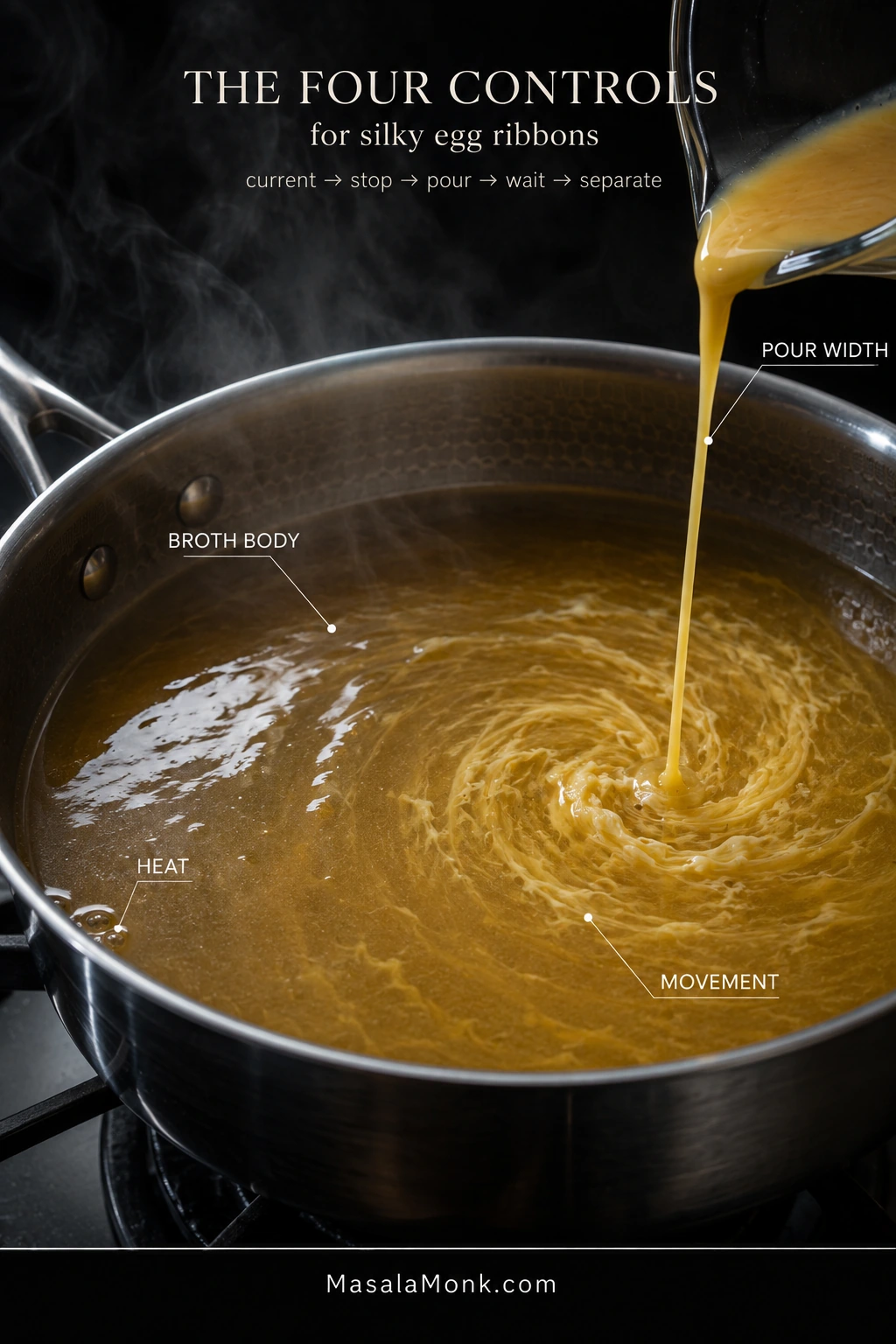
The shape of the egg comes down to four controls: broth body, heat, pour width, and movement.
A little starch slows the egg enough to help it remain suspended instead of immediately sinking through thin broth. Too much starch goes the other way and makes the soup heavy. Heat matters too: vigorous boiling can break delicate egg apart, while broth that has cooled too far may not set the stream cleanly with this simmer-based method.
Pour width changes the size of the pieces that enter the soup. A narrow stream produces finer ribbons; a heavier stream naturally forms broader ones. Movement determines how much those setting pieces are broken apart.
After you create a slow current, the broth can do most of the work. Continued stirring during the pour breaks the setting egg into smaller pieces before the ribbons have time to hold together.
Create the current → stop stirring → pour → wait → gently separate.
Use this as a diagnosis map rather than a formula. Large pieces point you toward pour width and stillness; tiny flecks point you toward excess movement or heat.
That same pause-before-stirring principle is useful in Hot and Sour Soup, where the egg shares the broth with tofu, mushrooms, and stronger seasonings.
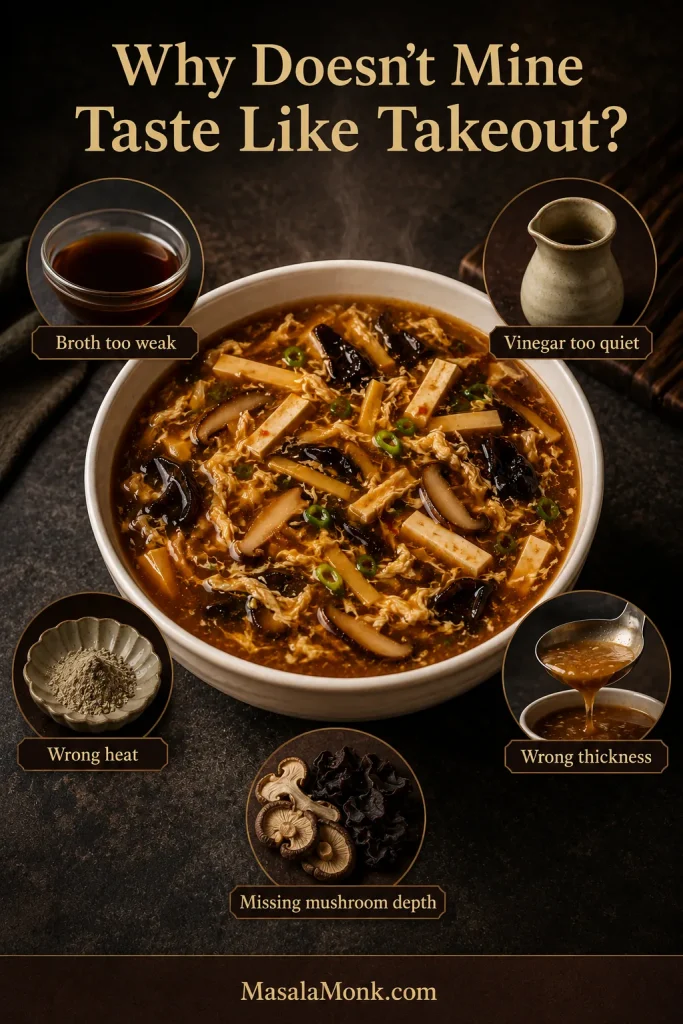
Why Homemade Egg Drop Soup Doesn’t Taste Like the Restaurant
The frustrating batch is the one that looks right but tastes nothing like the soup you had in mind.
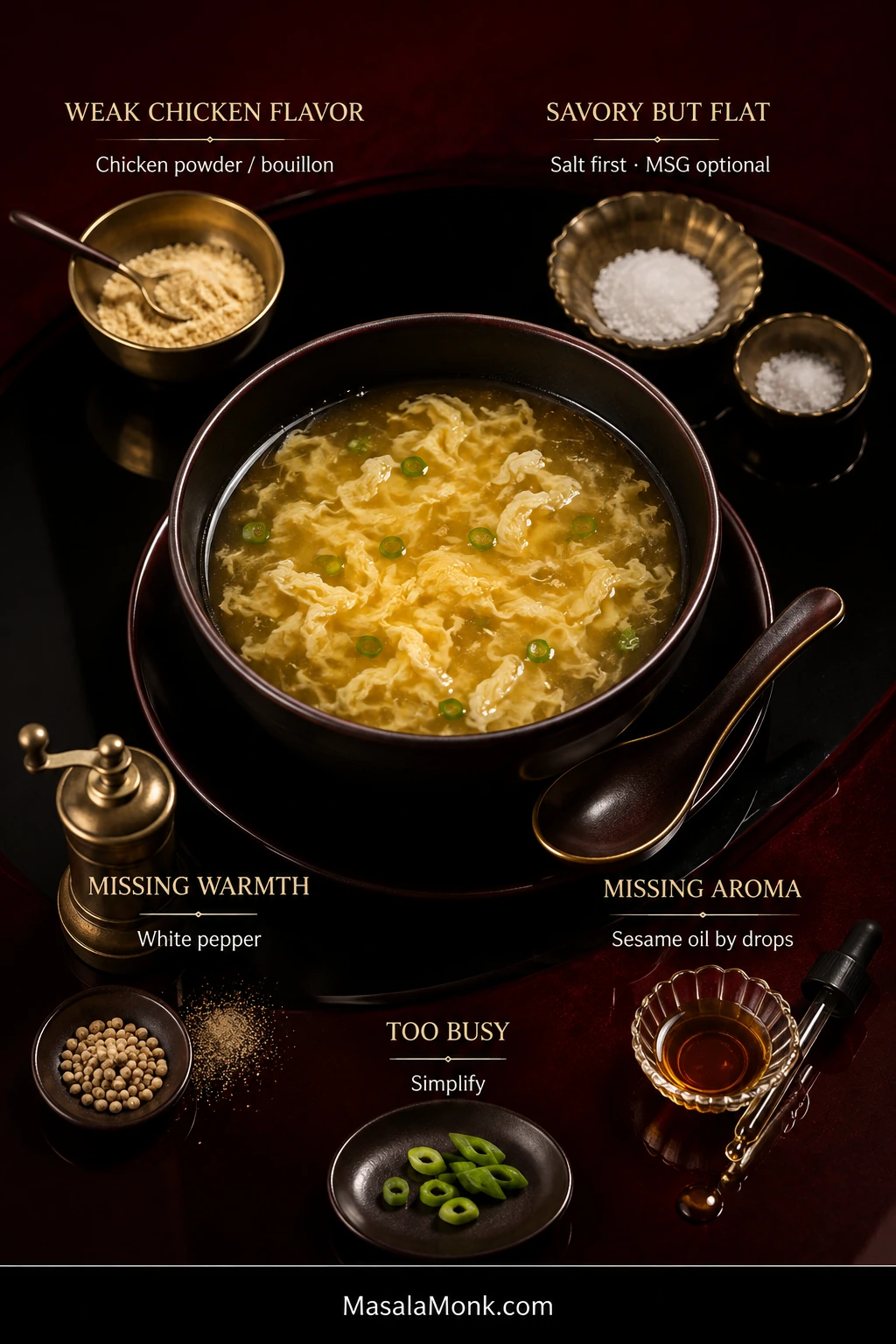
The difference is usually broth strength, salt and savory depth, white pepper, or how heavily sesame and soy are used. Start with what you can actually taste instead of adding every seasoning at once.
Weak chicken flavor: add some chicken powder or bouillon. Mild carton broth benefits more from this than a rich homemade stock.
Savory but flat: check the salt first. When the salt tastes right, add a very small pinch of MSG, stir, taste, and add more only if the broth needs it. Many chicken powders already contain MSG, so read the label before adding more. The FDA’s overview of MSG has more background on the ingredient and its use in food.
Missing warmth: add another touch of white pepper. Its heat tends to arrive toward the back of the sip without dominating the first taste.
Missing aroma: try a few drops of toasted sesame oil and stop when the fragrance becomes noticeable.
Tastes too busy: simplify. Skip the soy sauce, reduce or omit sesame oil, and let chicken broth, white pepper, ginger, and scallion carry the soup. Some takeout versions are much more restrained than heavily seasoned homemade recipes.
Restaurant-style flavor often comes from restraint. The best correction is usually the smallest adjustment that makes the broth taste complete, then stopping there.
Do You Need Soy Sauce?
No. Soy sauce is perfectly usable, but it changes both the color and flavor of the broth.
For a pale, clean-tasting soup, build the chicken flavor first. Add soy when you specifically want its savory fermented character.
Why Is Restaurant Egg Drop Soup Yellow?
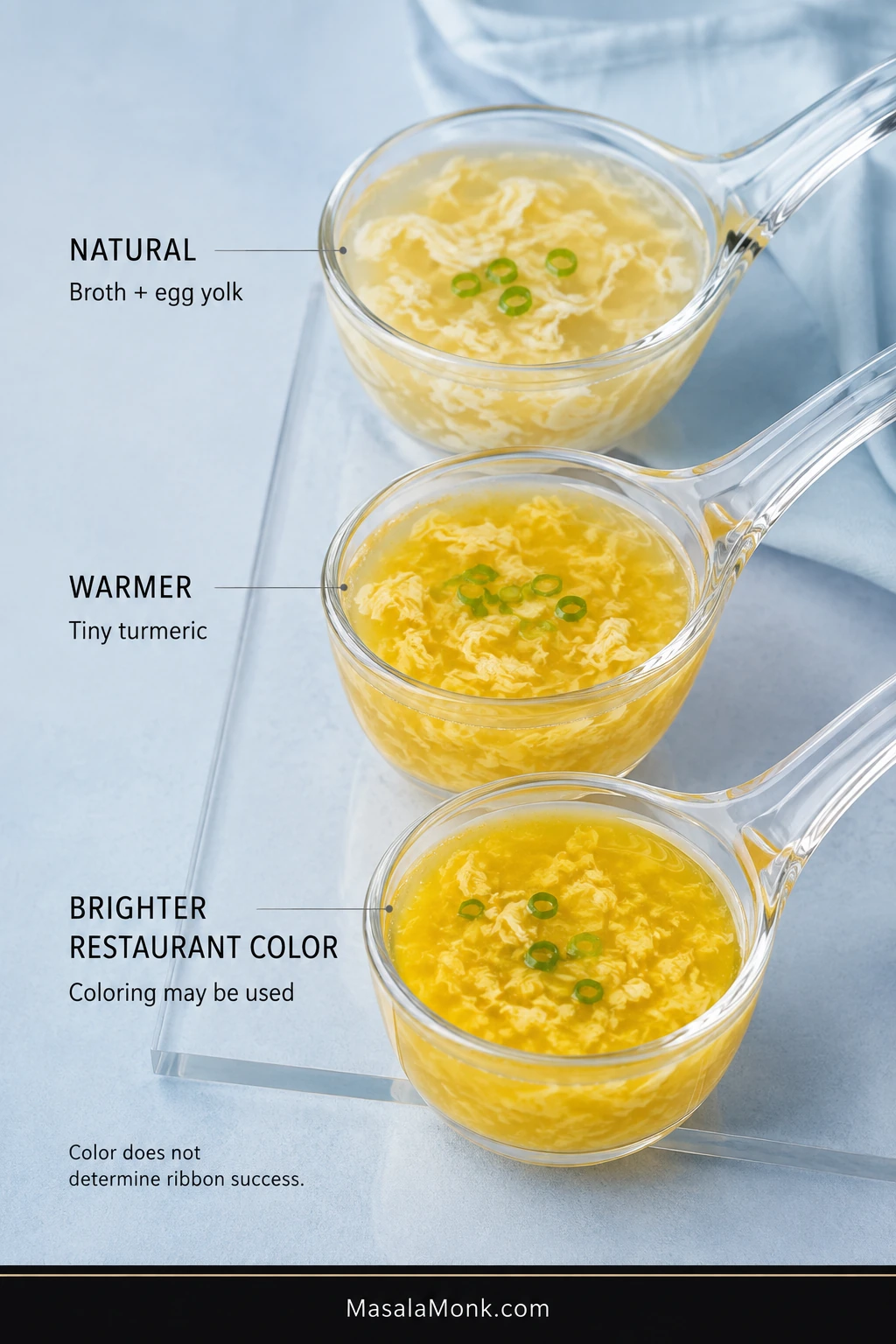
Egg drop soup can be naturally pale yellow; brighter restaurant-yellow versions may use turmeric or food coloring. Color has nothing to do with whether the ribbons formed correctly.
Chicken broth and egg yolks on their own can range from cream-gold to soft yellow.
For a warmer shade, the base recipe needs only ⅛ teaspoon turmeric. More can begin changing the flavor instead of simply warming the color.
Some Chinese-American restaurants use food coloring for a brighter takeout look. It is entirely cosmetic.
Pale soup is not failed soup.
Color and technique are separate variables. A pale bowl can have perfect ribbons, while brighter restaurant-yellow soup may simply use turmeric or coloring.
Troubleshooting
Broth problems are easier to rescue than cooked egg. You can thicken a watery soup, loosen an over-thickened one, and strengthen a bland broth. After the egg has cooked into a particular shape, the useful question is what caused it and what can be done with the bowl you already have.
My Egg Disappeared and the Broth Turned Cloudy
The egg dispersed before distinct ribbons had time to set. Continuous stirring is the usual culprit; broth that has cooled too far can also make clean setting harder with this method.
Give the poured egg more stillness while it sets. The broth may stay cloudy, but that does not stop it from tasting good.
Glass makes the difference easy to see: distinct ribbons hold their shape, while dispersed egg turns the broth hazier. The cloudy version is different—not wasted.
I Got Scrambled-Looking Clumps
Large dense pieces usually mean too much egg reached one area at once, or thick ropes of white were still present in the beaten eggs.
A narrower pour and fully blended eggs prevent most of this. Separate the clumps lightly in the soup you already have and carry on. The texture is different, but dinner is still dinner.
I Got Tiny Flecks
The egg was broken apart by too much movement while it was trying to set.
Use less agitation after the pour. The flecks will not turn back into broad ribbons, but the soup itself is perfectly usable.
I Got One Big Sheet of Egg
The egg set with too little separation and joined into one connected piece.
Break the sheet gently into ribbons. When newly poured egg turns opaque, one or two careful strokes are enough to separate it before the whole mass sets together.
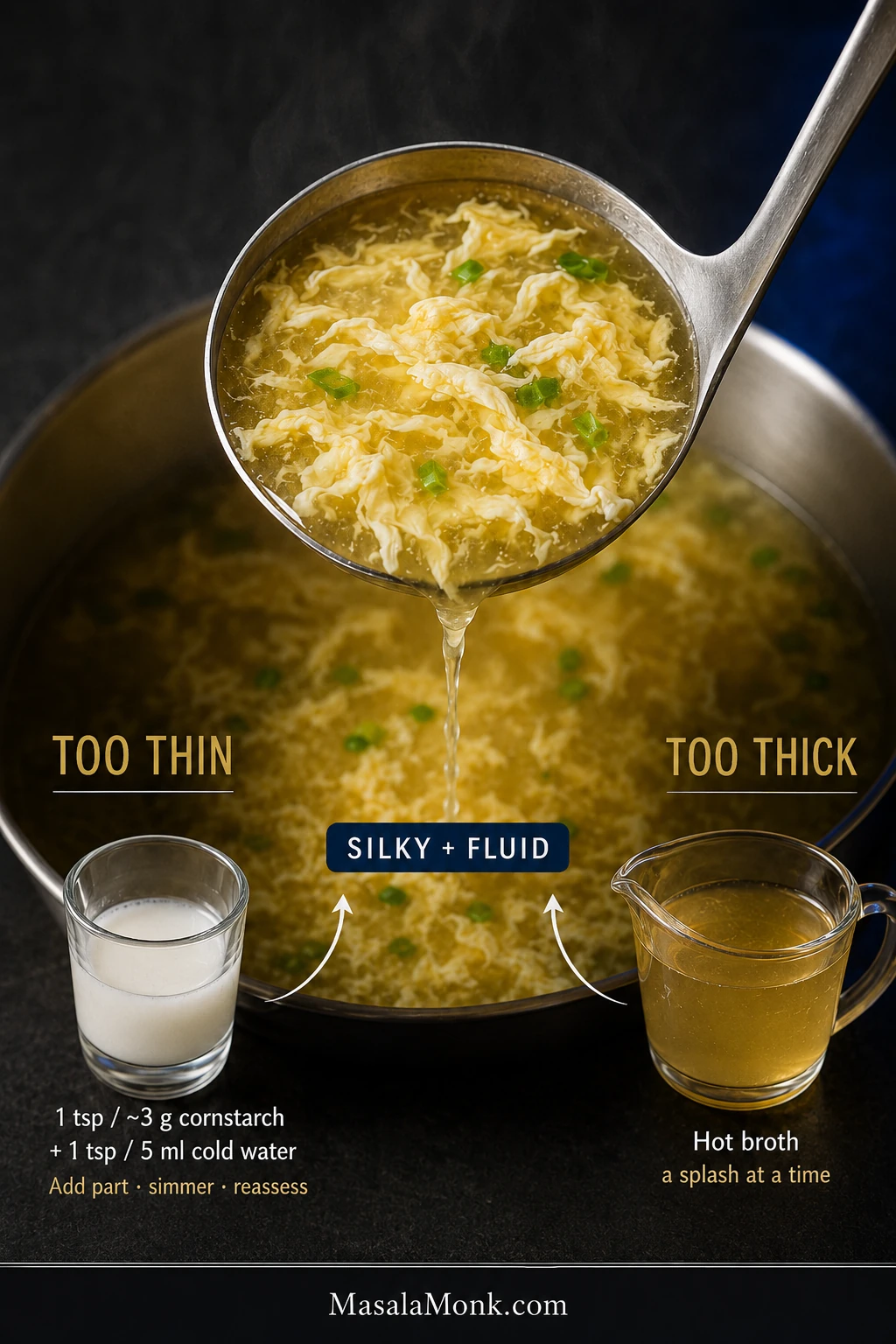
My Soup Is Too Thin
Give the original slurry about a minute at a simmer before assuming you need more starch.
Still too light? Mix 1 teaspoon / about 3 g cornstarch + 1 teaspoon / 5 ml cold water. Add part of it, simmer briefly, and reassess before using the rest.
My Soup Is Too Thick
Add hot low-sodium chicken broth a splash at a time, moving the spoon carefully around the ribbons.
If it takes a substantial amount of broth to loosen the soup, use less cornstarch when you make it again.
Both rescues are deliberately incremental. Cornstarch keeps developing as it simmers, while extra broth also dilutes seasoning—so correct a little, then reassess.
Other Quick Fixes
Ribbons sank: thin broth, heavy pieces of egg, too much egg, or broth that cooled too far can contribute. Keep the base egg ratio and make sure the broth is back at a quiet simmer before pouring.
Rubbery egg: prolonged boiling after the ribbons have set is usually responsible. When the egg is opaque and set, finish the soup and get it off the heat.
Cornstarch lumps: if you spot them before adding the egg, strain the broth and return it to the saucepan. After ribbons have formed, remove obvious lumps with a spoon instead of sending the finished soup through a strainer.
Too much sesame oil: dilute the soup with more broth. Sesame is much easier to add than remove.
Broth looks brown: dark stock or soy sauce is usually responsible. The color alone does not mean anything went wrong.
Soup tastes of turmeric: dilute it when practical and use less in the next pot.
Identify the shape before choosing the fix. Clumps, flecks, sheets, sinking, and rubbery ribbons point back to different moments in the egg-drop process.
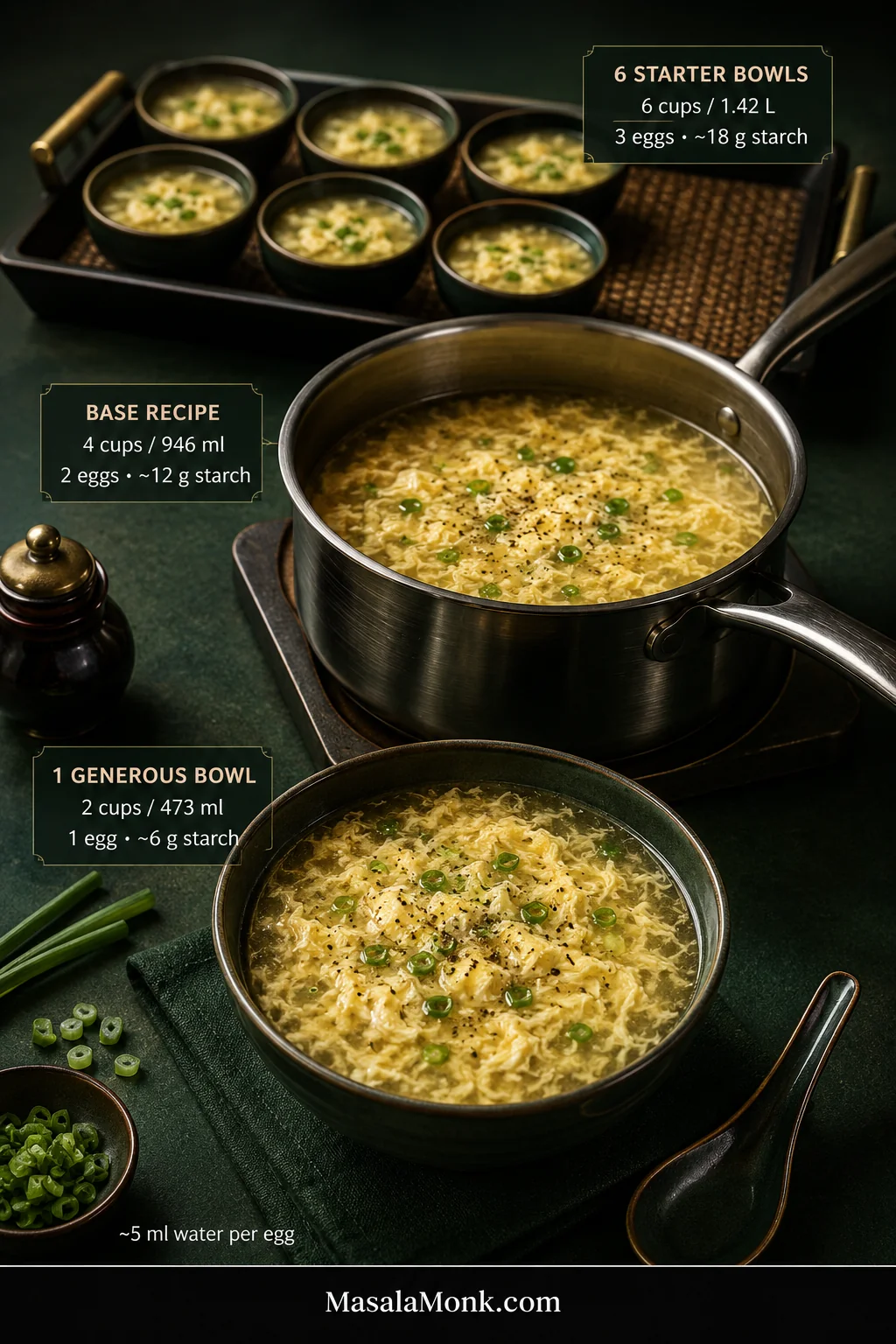
How to Scale Egg Drop Soup for One, Two or a Crowd
Egg drop soup is especially handy when you are cooking only for yourself. One egg and a couple of cups of broth are enough for a hot lunch or easy dinner without leaving a large pot behind.
Need
Starting broth
Egg
Cornstarch
1 generous bowl
2 cups / 473 ml
1 large / ~50 g
2¼ tsp / ~6 g
Base recipe
4 cups / 946 ml
2 large / ~100 g
1½ tbsp / ~12 g
6 starter bowls
6 cups / 1.42 L
3 large / ~150 g
2¼ tbsp / ~18 g
Use about 1 teaspoon / 5 ml water per large egg to loosen the mixture.
Scale broth, eggs, and cornstarch by measurement. Salt, bouillon, and chicken powder are better adjusted by taste because brands vary so much.
Scaling changes more than the arithmetic. A larger pot can take longer to recover a gentle simmer, so re-check the heat before the egg pour.
Variations and Substitutions
Can I Make Egg Drop Soup Without Cornstarch?
Yes. Leave the cornstarch out and the egg will continue to form wisps or ribbons. The broth will simply be lighter and more delicate, without the glossy body common in many Chinese-American restaurant versions.
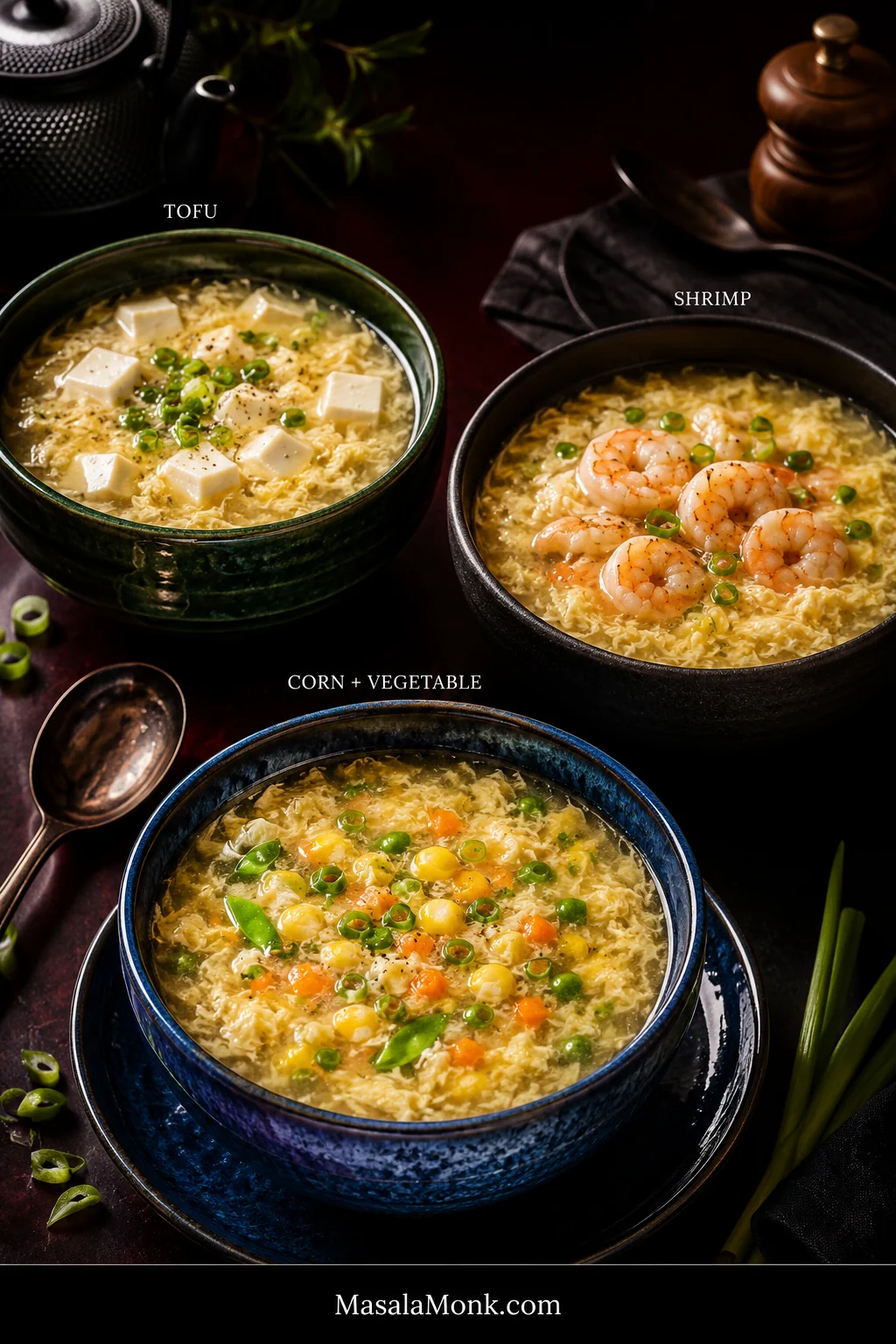
Other Easy Variations
Potato starch: make a cold slurry and begin with less than the full cornstarch quantity. Add gradually until the broth reaches the same spoon-path cue used in the base recipe; different starches do not always thicken one-for-one.
Vegetable broth: choose a clean, savory one. Dark roasted or tomato-heavy broth changes the character of the soup considerably.
Tofu: warm small cubes of soft or silken tofu in the seasoned broth before adding the slurry and egg. For a tofu-centered meal, serve the soup alongside Mapo Tofu and rice.
Shrimp: poach peeled, deveined shrimp until barely cooked, lift them out, and continue with the slurry and egg. Return the shrimp at the end just long enough to heat through.
Vegetables: peas, finely diced carrot, mushrooms, spinach, and other quick-cooking vegetables fit easily. Add firm vegetables earlier and delicate greens near the end.
Corn: a handful adds sweetness and texture. With enough corn to become a main flavor, the soup takes on a noticeably sweeter, fuller character.
Rice: spoon cooked rice into individual bowls so leftovers do not absorb most of the broth. Starting from dry rice? Our guide to cooking rice covers the basics.
Whatever you add, leave enough open broth for the egg ribbons to move and stay visible. The variation should support the soup rather than crowd it.
Is Egg Flower Soup the Same as Egg Drop Soup?
Yes. Egg drop soup and egg flower soup generally refer to the same broad family of soups. “Egg flower” describes the soft, flower-like shapes created when beaten egg sets in hot broth.
The exact soup changes from kitchen to kitchen. Some versions are clear and delicate with fine wisps; others have broad flowers and noticeably more body.
This spectrum also explains why two restaurants can serve visibly different soups under the same name: ribbon geometry varies even when the underlying technique belongs to the same family.
Chinese home-style soups may include tomato, seaweed, tofu, corn, or vegetables. Many Chinese-American restaurant versions lean toward concentrated chicken flavor, some starch thickening, white pepper, and egg suspended through a pale or yellow broth.
Egg plays a completely different role in Egg Foo Young, another Chinese-American restaurant favorite where it becomes the body of the dish instead of delicate ribbons in broth.
Your favorite restaurant may serve its soup thinner, thicker, brighter, or more egg-heavy. The controls above make those differences easy to adjust.
What to Serve With Egg Drop Soup
As a starter, egg drop soup works especially well with something that brings more texture or substance to the table.
A small bowl before Chicken Fried Rice makes an easy takeout-style dinner: hot soup first, followed by separate grains, vegetables, egg, and chicken.
Crispy spring rolls add crunch; steamed dumplings, plain rice, Chinese-style noodles, stir-fried vegetables, and simple chicken or beef dishes all fit comfortably beside it.
After all the technique, texture contrast is what makes the meal satisfying: soft soup beside fried rice, crisp spring rolls, dumplings, or another substantial side.
Two generous cups can also make a light lunch on their own, especially on a day when cooking anything elaborate sounds unnecessary.
Make Ahead, Store & Reheat
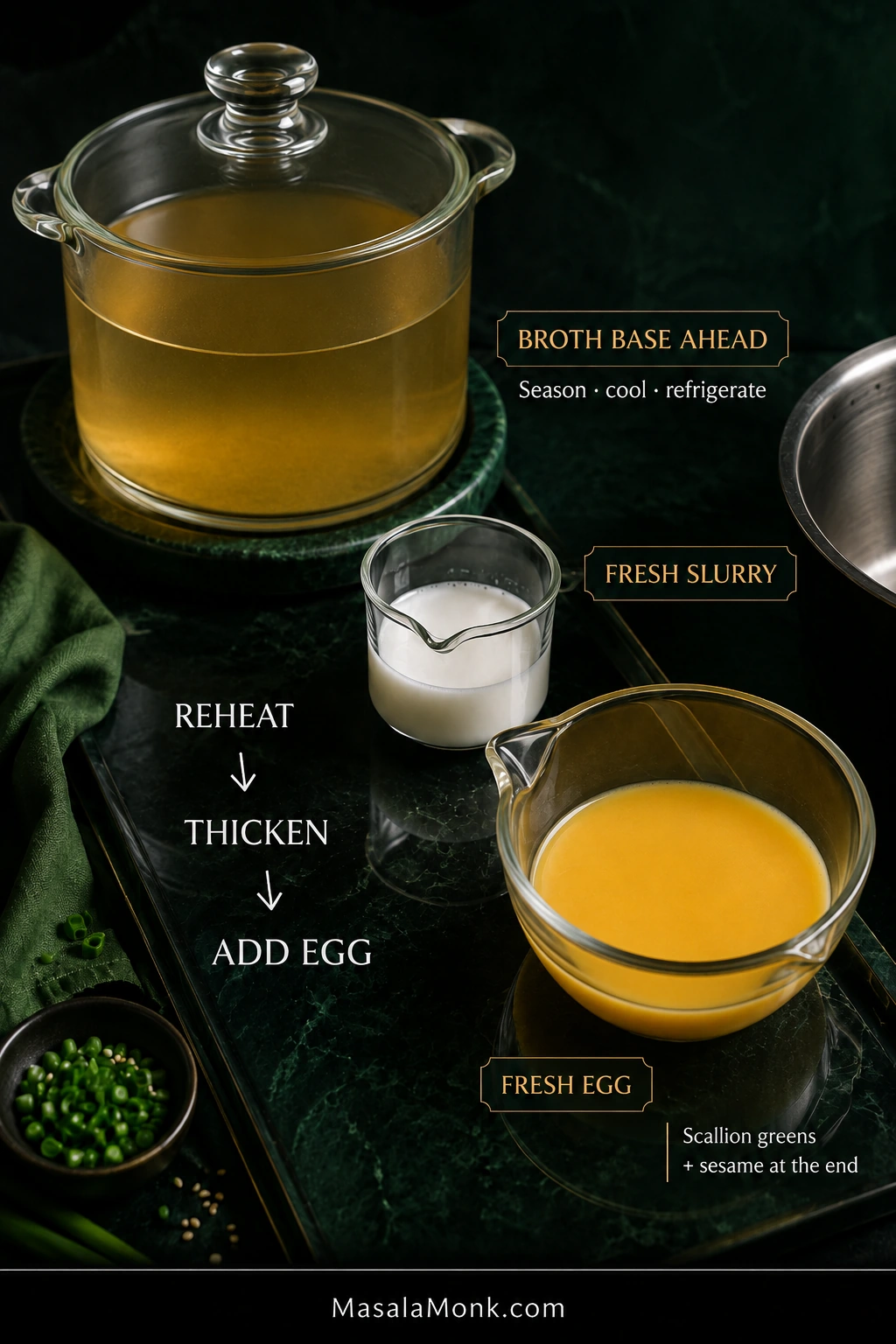
Egg drop soup is nicest when the ribbons have just been made, but the seasoned broth is easy to prepare ahead. That gives you most of the convenience while saving the egg for the last few minutes.
Best Make-Ahead Method
Prepare the seasoned broth, remove the ginger slices, cool it, and refrigerate without cornstarch or egg.
Bring the broth back to a simmer when you want the soup.
Add a freshly mixed slurry.
Add freshly beaten egg when the broth has the body you want.
Finish with scallion greens and optional sesame oil.
A few minutes at the stove later, you have fresh ribbons without remaking the broth from the beginning.
Broth waits better than ribbons do. For make-ahead egg drop soup, hold the seasoned base, then thicken and pour the egg close to serving.
Storing Leftovers
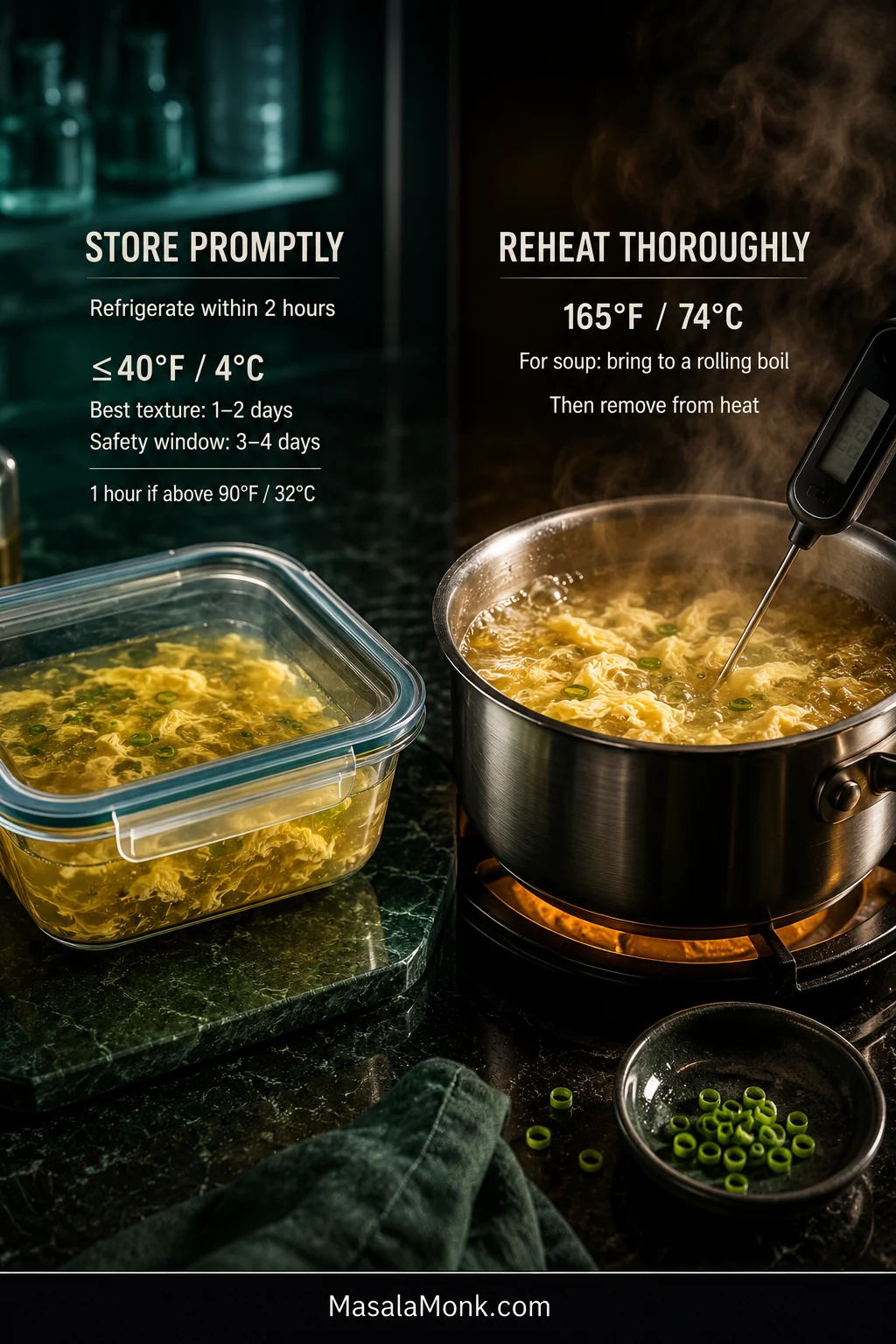
Refrigerate leftovers promptly in a covered, shallow container. For the nicest ribbon and broth texture, aim to eat the soup within 1–2 days. Properly refrigerated cooked leftovers generally have a broader 3–4 day food-safety window at 40°F / 4°C or below.
Get leftovers into the refrigerator within 2 hours of cooking, or within 1 hour when the surrounding temperature is above 90°F / 32°C. The USDA guide to leftovers and reheating has the broader food-safety guidance.
Reheating
Bring leftover soup to a rolling boil when reheating and make sure it reaches 165°F / 74°C. After the soup is thoroughly hot, take it off the heat so the cooked ribbons spend as little extra time boiling as possible.
In the microwave, heat in shorter intervals and stir between them so the soup warms evenly.
If chilled soup has lost some of its original body, mix 1 teaspoon / about 3 g cornstarch + 1 teaspoon / 5 ml cold water. Add only as much of that slurry as the reheated soup needs.
The shallow container is part of the method, not just storage. It helps leftovers cool more quickly and evenly; reheating then brings the soup back to serving temperature.
Can You Freeze It?
The seasoned broth base freezes better than the completed soup. Thaw and reheat the broth, then add fresh slurry and egg when you are ready to eat.
The best part of learning the egg pour is not making every ribbon look identical. It is knowing that a saucepan of broth and a couple of eggs can become that familiar steaming soup whenever you want it.
Some nights it is a starter before dinner. Some nights it is the whole point: something warm, savory, and comforting on the table in about 15 minutes.
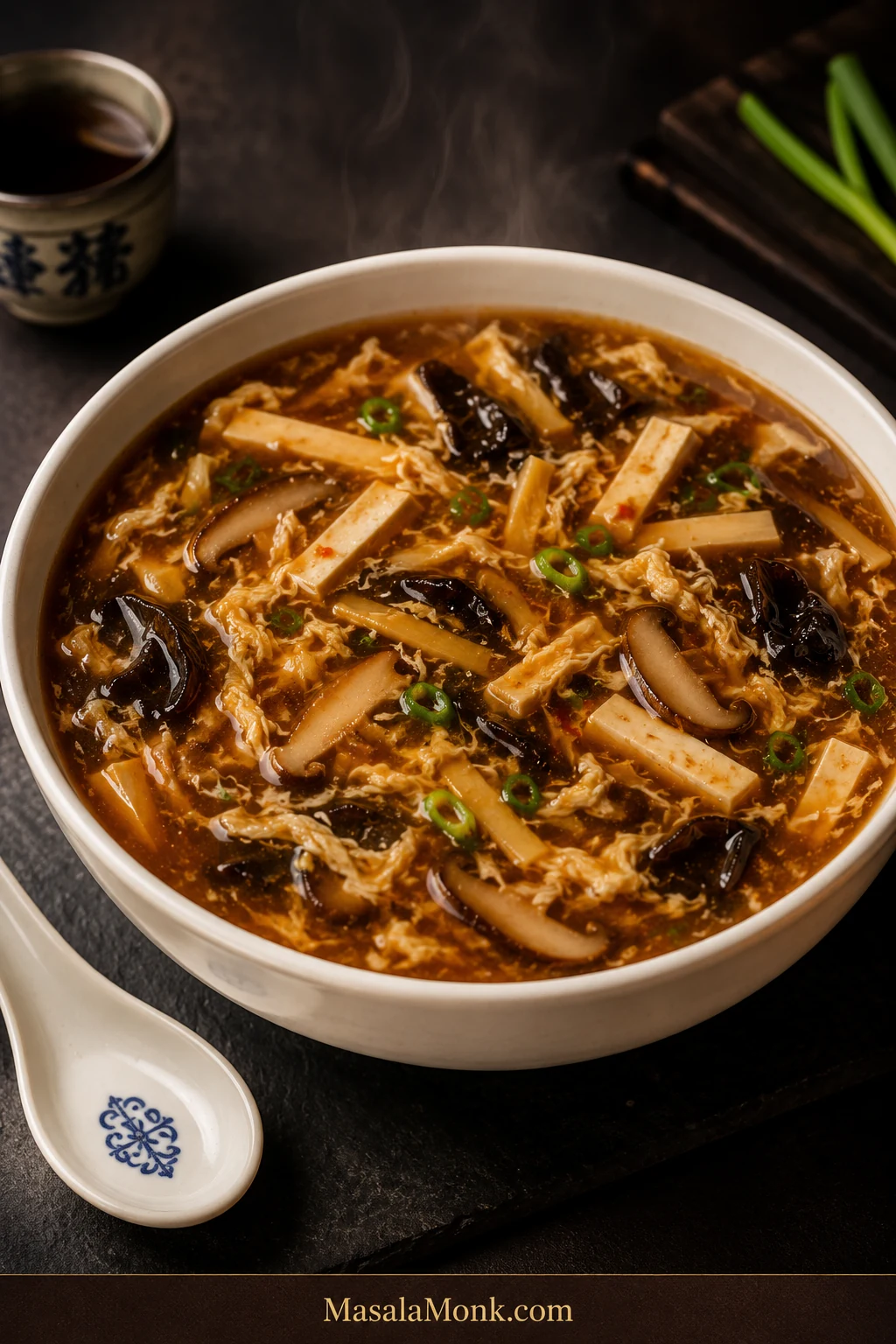
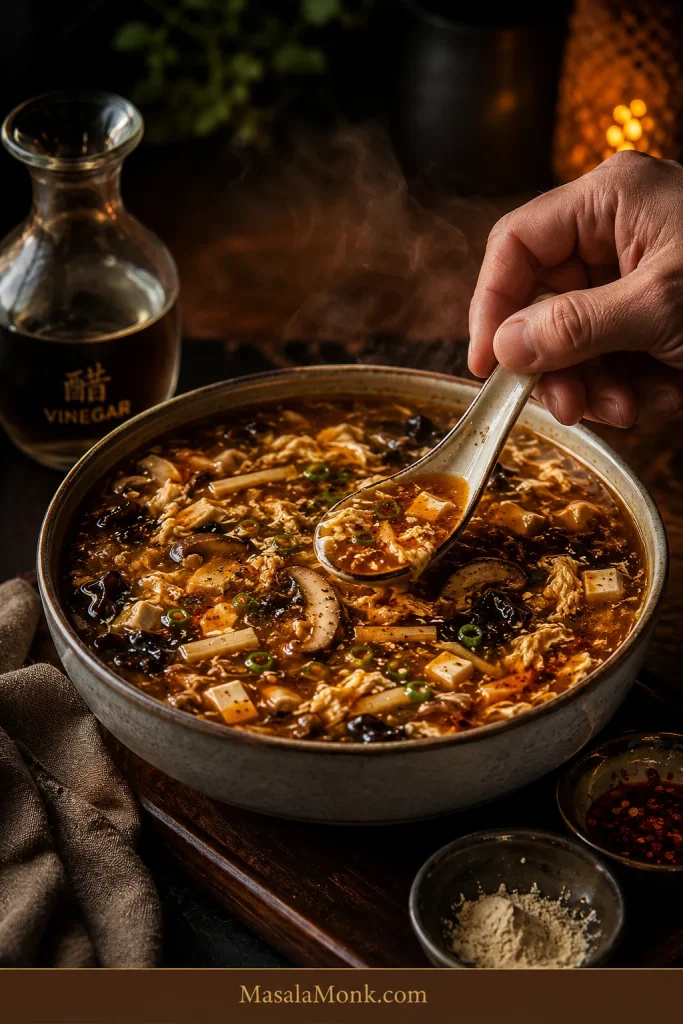
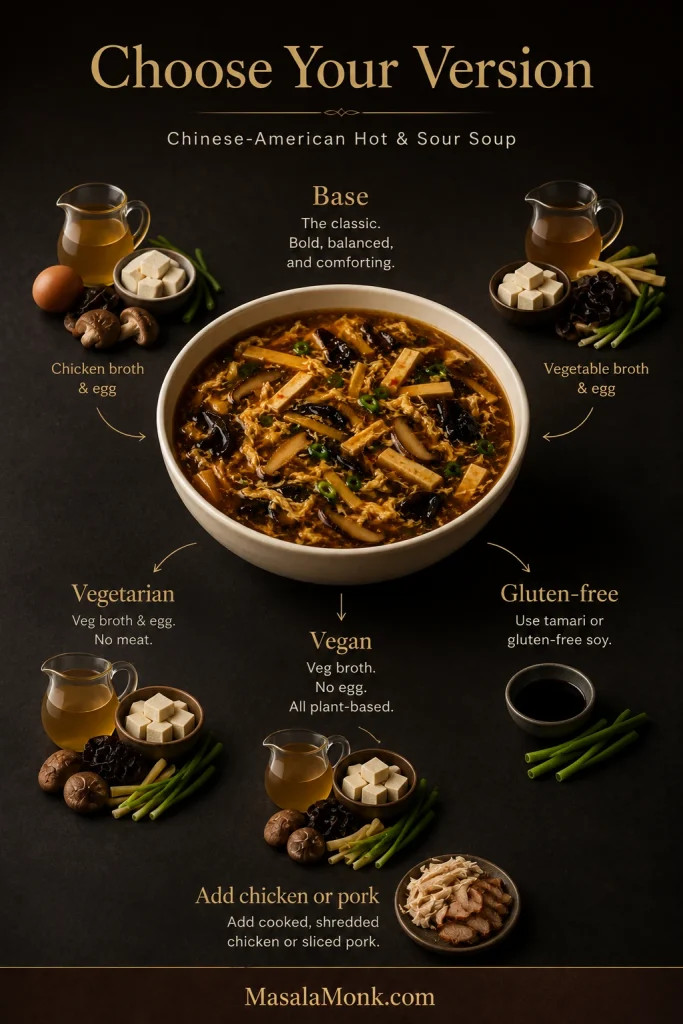
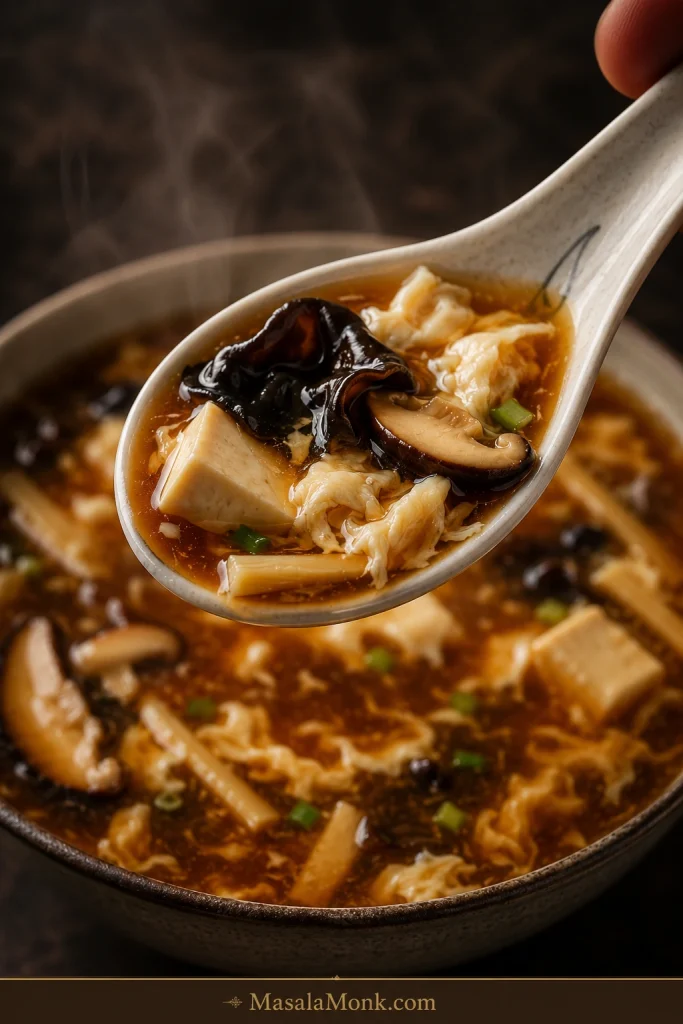
Hot and sour soup is one of those bowls you notice before the first spoonful. Vinegar rises with the steam, white pepper catches gently at the back of your throat, and underneath it all is savory broth threaded with mushrooms, tender tofu and silky ribbons of egg.
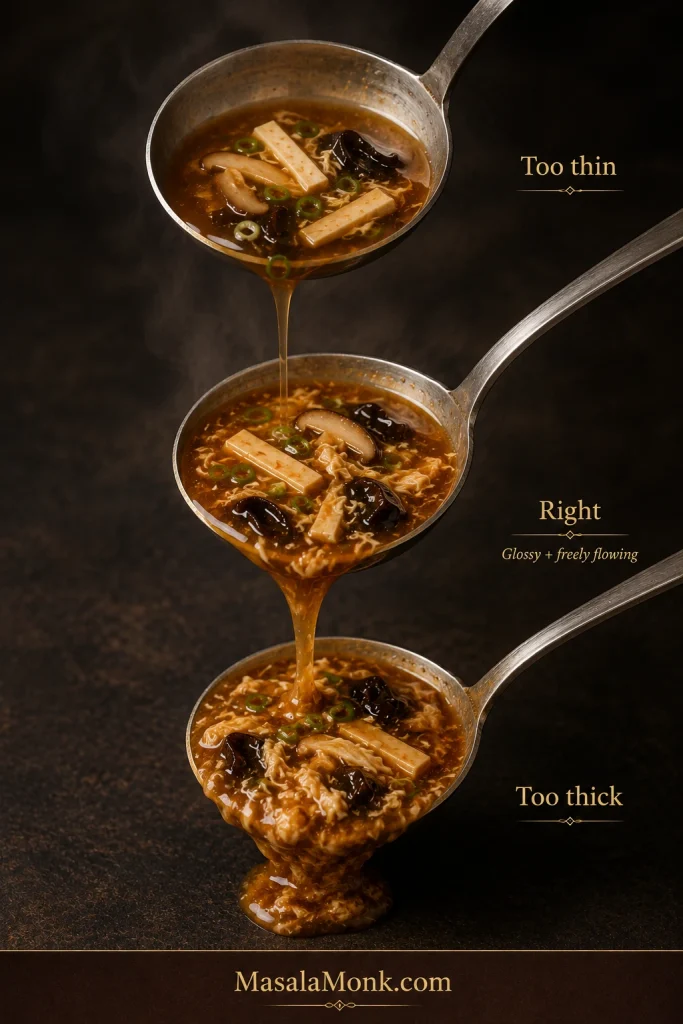
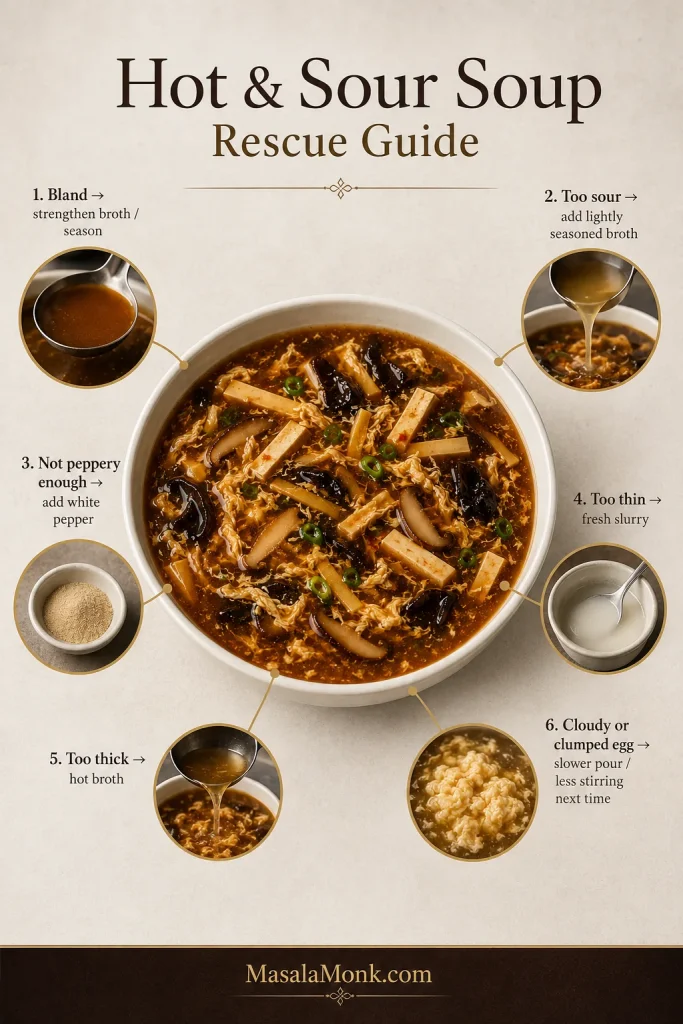
It is also surprisingly easy to get almost right. Plenty of chilli makes the soup spicy without necessarily giving it that familiar white-pepper warmth. Too much starch turns the broth gluey. Let the vinegar cook too long and some of its brightness fades. Pour the egg too quickly and it disappears into cloudy flecks instead of ribbons.
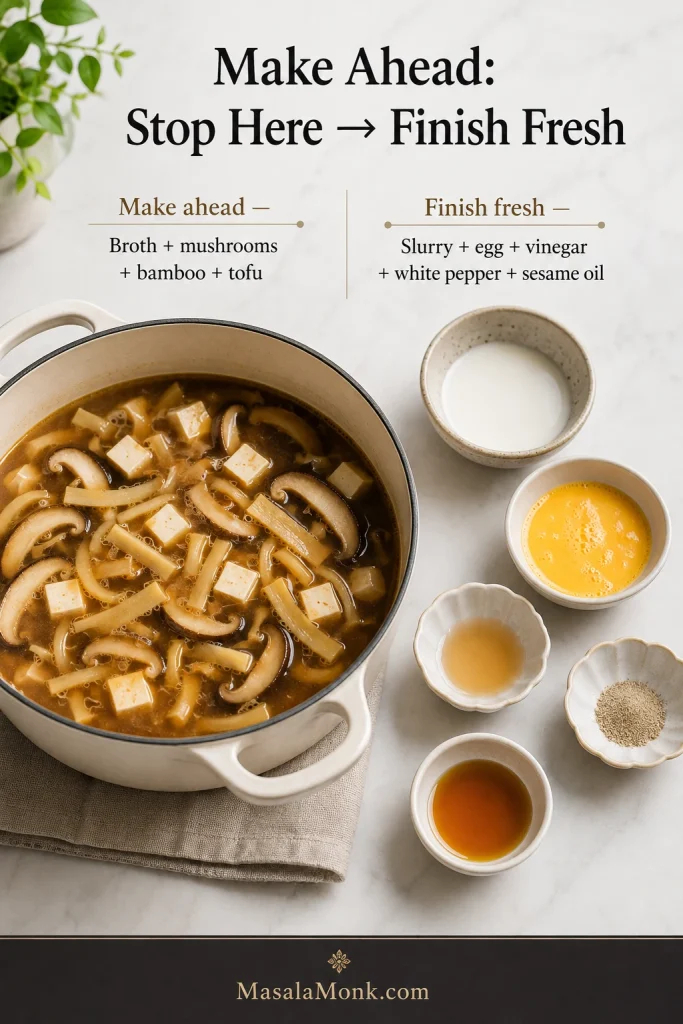
The simplest way to make restaurant-style hot and sour soup is to build it in layers: make the broth savory first, thicken only until it looks right, set the egg, then adjust sourness and peppery heat separately at the end.
Maybe the bowl in your head is thin and sharply peppery. Maybe it is darker and glossy, with enough vinegar to catch in your nose over the first spoonful. This method gives you a reliable place to start—and enough room to take the pot toward whichever version you remember.
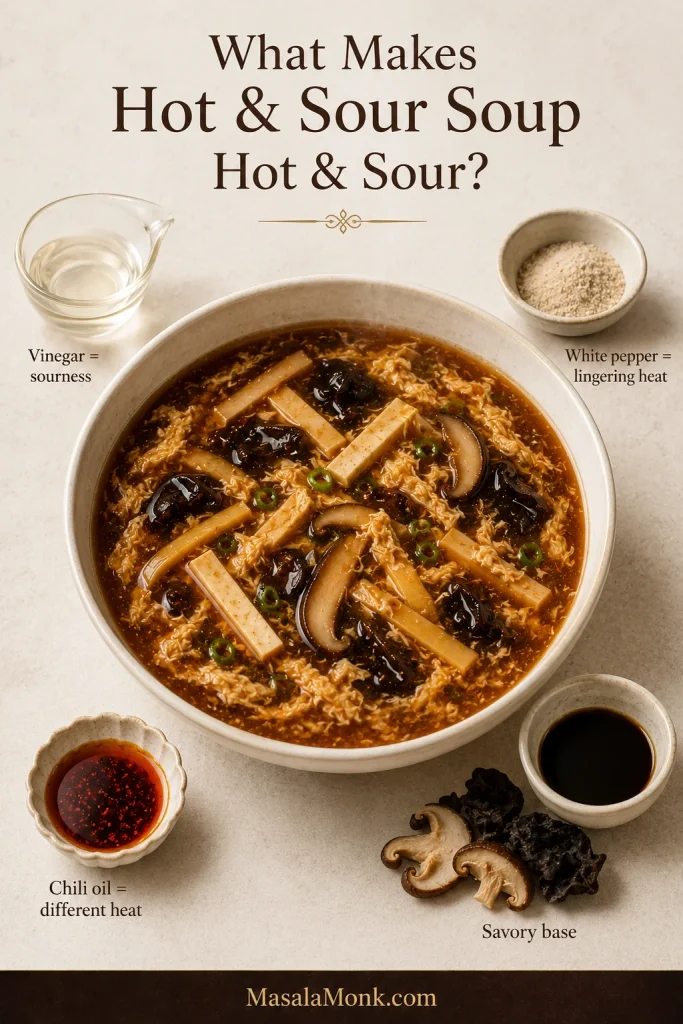
Quick Answer: What Makes Hot and Sour Soup Hot and Sour?
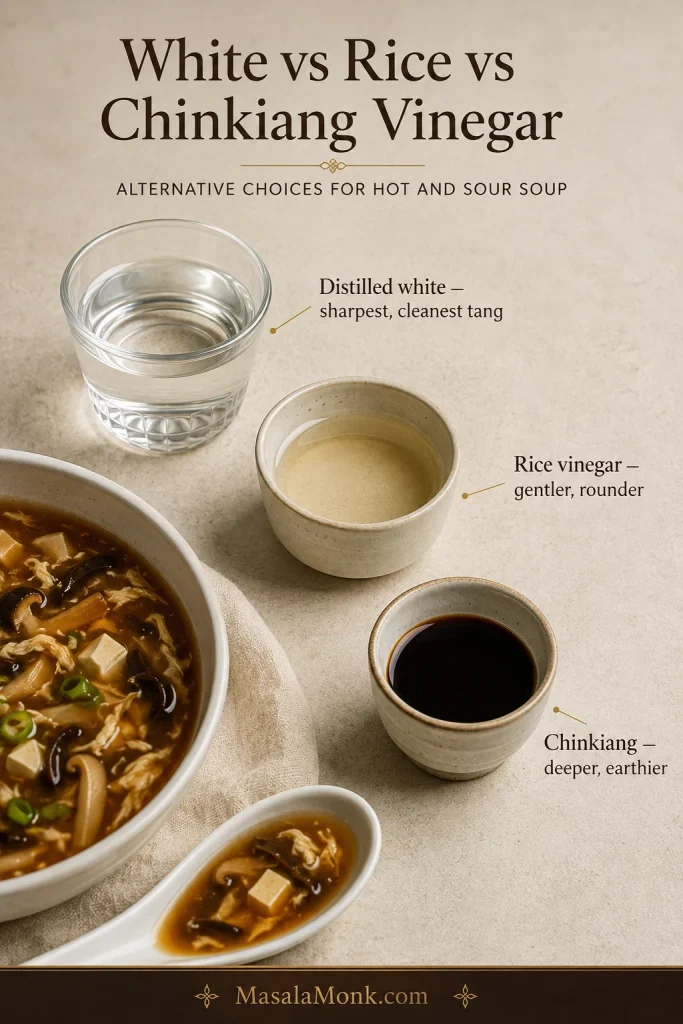
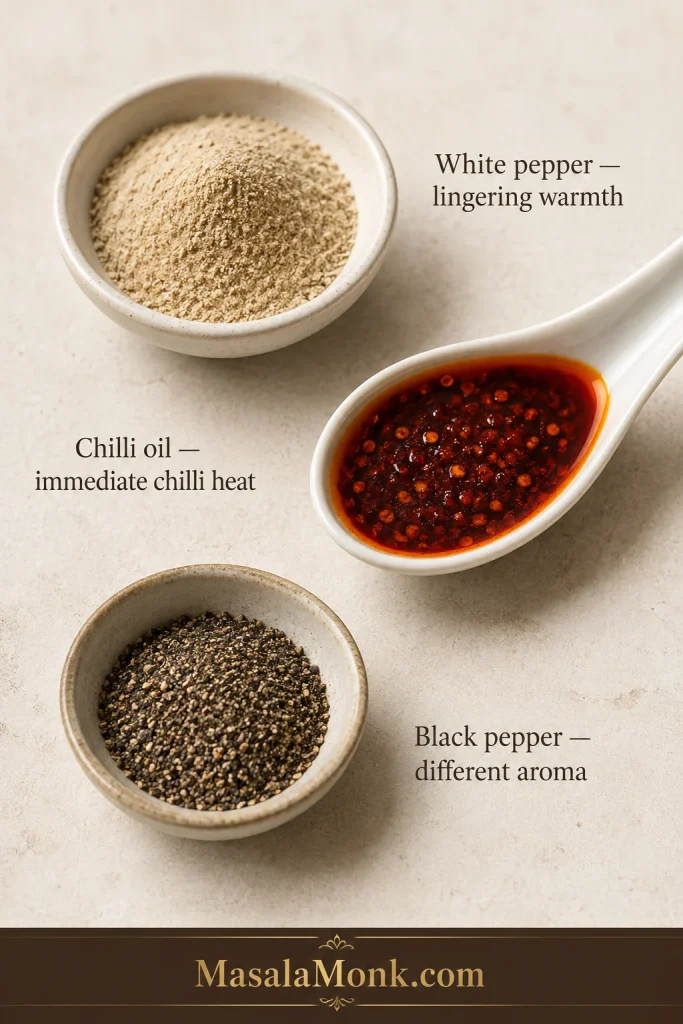
White pepper gives hot and sour soup its characteristic peppery heat. Vinegar supplies the sourness. Chilli oil gives a more immediate chilli burn. White pepper leaves the cleaner warmth that lingers after each sip.
Broth, mushrooms and soy sauce provide the savory foundation. Cornstarch controls the body of the soup, while egg provides the silky strands.
Check one thing at a time. Is the broth savory enough? Then judge the heat, sourness and thickness. Finally, look for some contrast—soft tofu or egg against something chewy or crisp. Fix only what is missing.
Sourness and heat are separate controls. Vinegar brightens the broth; white pepper provides the lingering warmth that chilli alone does not recreate.
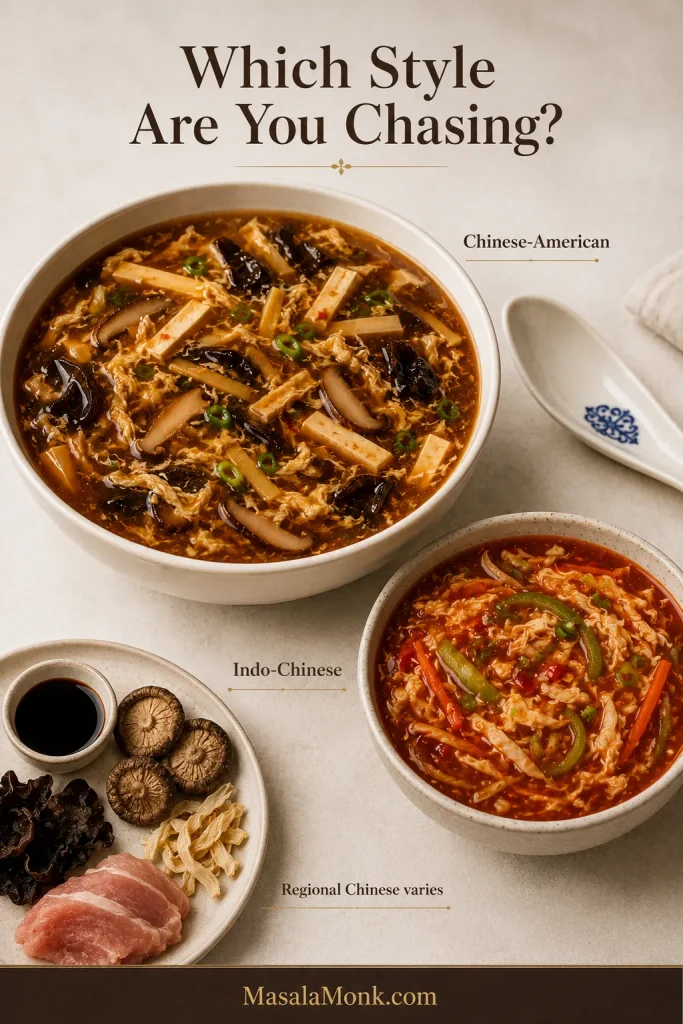
Which Hot and Sour Soup Are You Looking For?
Hot and sour soup is a Chinese soup built around peppery heat and vinegar sourness, usually with ingredients such as mushrooms, tofu and egg; restaurant versions vary considerably in thickness and supporting ingredients.
Two excellent hot and sour soups can look surprisingly different. It helps to know which style you are chasing before you start changing the vinegar, chilli or starch.
Color can mislead. Chinese-American, regional Chinese and Indo-Chinese hot and sour soups can differ in thickness, heat and ingredients, so season toward the bowl you actually want.
Style
What to Expect
Chinese-American restaurant style
Brownish, glossy, peppery and tangy, usually with mushrooms, tofu and egg. This is the style made below.
Regional Chinese versions
Recipes vary widely and may use black vinegar, dried shiitake, wood ear, dried lily buds and pork, with thickness varying considerably by style.
Indo-Chinese restaurant style
Often redder and more chilli-forward, with vegetables such as cabbage, carrot and capsicum/bell pepper, and sometimes chicken.
This recipe makes the first style: savory broth with a clear vinegar tang, white-pepper warmth, a glossy broth that still pours freely and enough contrast between mushrooms, tofu and egg to keep the soup interesting.
Many Chinese-American restaurant versions also include thin strips of pork or chicken. Here, added meat is optional, with an easy chicken or pork variation later.
Hot and Sour Soup Recipe
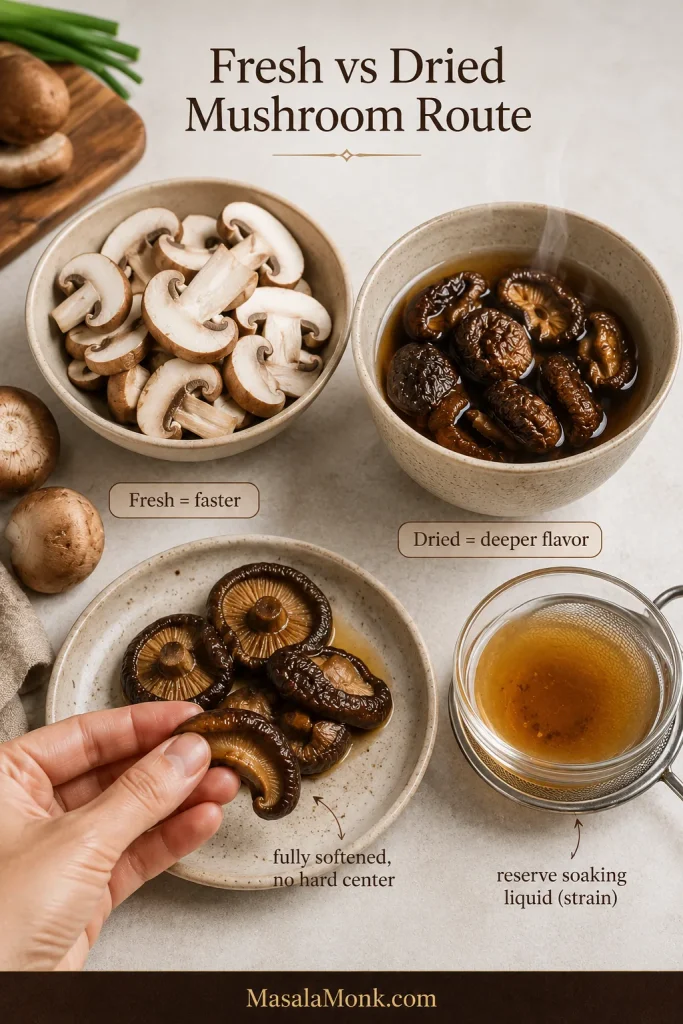
Using fresh mushrooms, this takes about 30–35 minutes from prep to bowl. Dried mushrooms need soaking time but give the broth more depth. Keep some vinegar and white pepper in reserve either way so you can make the final adjustment by taste.
Recipe Snapshot
Prep: about 15 minutes
Cook: about 15–20 minutes
Total with fresh mushrooms: about 30–35 minutes
Total with dried mushrooms: about 40–50 minutes, depending on how much soaking overlaps with prep
Makes: 4 generous bowls or about 6 appetizer servings
No specialty market tonight? Fresh shiitake or cremini, ordinary low-sodium broth and distilled white or unseasoned rice vinegar still make a very good soup. Wood ear and bamboo are optional.
Equipment: a 4–5 quart / 4–5 litre saucepan or Dutch oven, a few small prep bowls, and a fine-mesh strainer if using shiitake soaking liquid.
Ingredients and Measurements
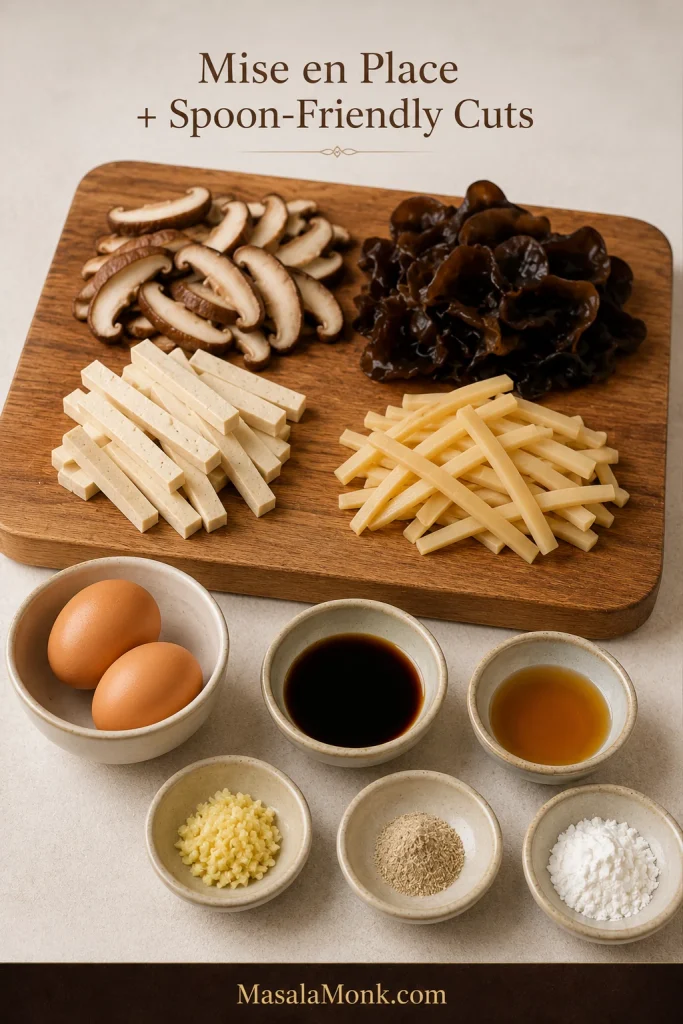
Broth & Solids
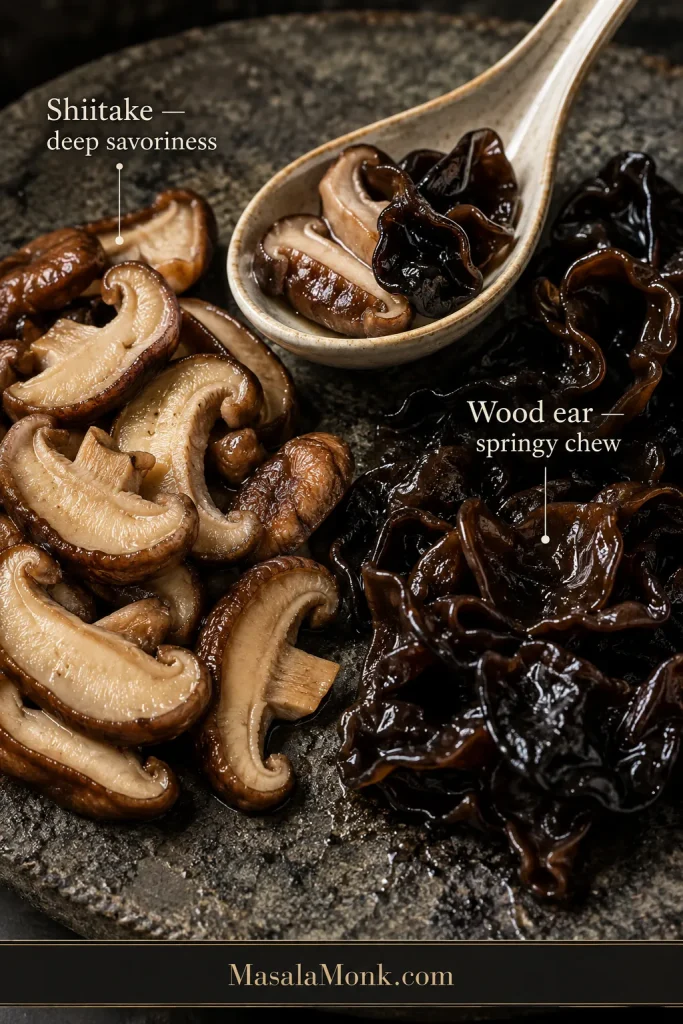
Mushrooms: 15 g dried shiitake, about 4 medium mushrooms, or 5 oz / 140 g fresh shiitake or cremini. Use up to 6 oz / 170 g fresh mushrooms for a mushroom-heavy soup.
Wood ear: ¼ oz / 7 g dried wood ear mushrooms (black fungus), dry weight, optional.
Broth: 6 cups / 1.4 litres total low-sodium chicken or vegetable broth. If using strained shiitake soaking liquid, substitute up to ½ cup / 120 ml for the same amount of broth.
Tofu: 8 oz / 225 g firm or medium-firm tofu, cut into thin strips or small spoon-sized cubes.
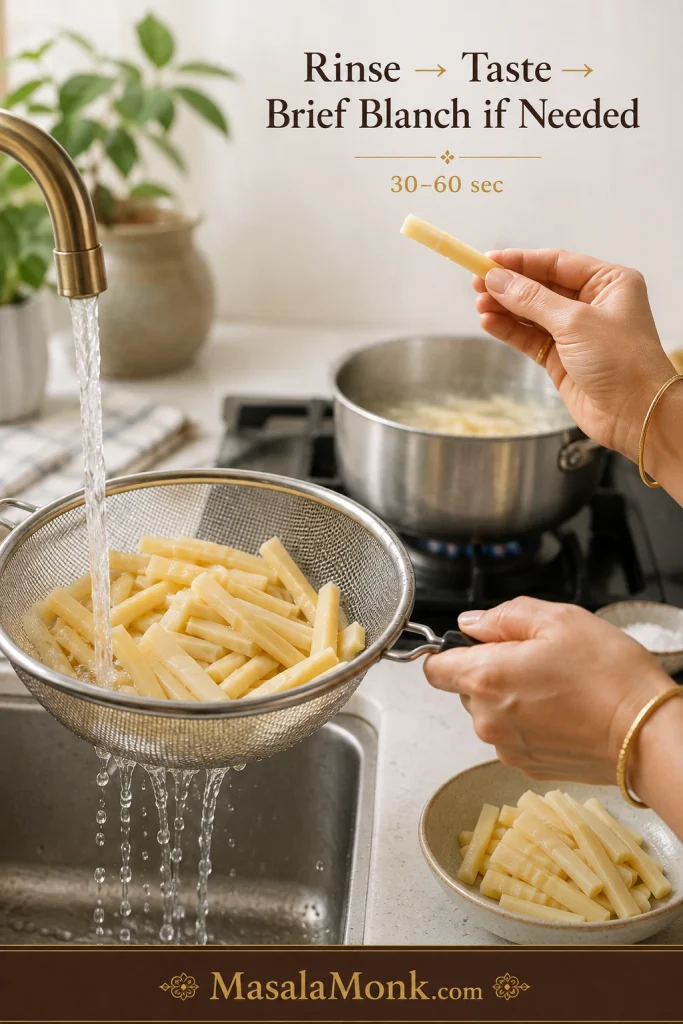
Bamboo: ½ cup / about 70 g bamboo shoots, drained, rinsed and cut into strips, optional.
Ginger: 1 teaspoon finely grated fresh ginger.
Broth Seasoning
1½ tablespoons / 22 ml Chinese light soy sauce or regular soy sauce; start with 1 tablespoon / 15 ml if your broth or bouillon is already quite salty
1 teaspoon / 5 ml dark soy sauce, optional
½ teaspoon sugar
Fine salt, only if needed after tasting
Thickening & Egg
3 tablespoons / about 24 g cornstarch (UK: cornflour). Make the full slurry but expect to begin with about two-thirds.
¼ cup / 60 ml cold water or cold broth
2 large eggs
1 teaspoon water, optional, to loosen the beaten eggs slightly
Hot-Sour Finish
¼ cup / 60 ml distilled white vinegar or unseasoned rice vinegar, divided: 3 tablespoons / 45 ml to start, plus up to 1 tablespoon / 15 ml more to taste
1 teaspoon ground white pepper, divided: ¾ teaspoon to start, plus up to ¼ teaspoon more to taste
1 teaspoon toasted sesame oil
2 scallions, thinly sliced, optional
Chilli oil, optional, for serving
1. Soak and Prep Before the Pot Gets Hot
Using fresh mushrooms? Skip the soaking instructions below, slice them, and continue with the rest of the prep.
Fresh mushrooms are the faster route. Dried shiitake are worth the soak when you want more mushroom depth, especially with a mild broth.
If using dried mushrooms, cover them with very hot water and soak until completely pliable. Most soften in about 20–30 minutes, but the mushrooms get the final say: there should be no hard, dry center left.
If you plan to use shiitake soaking liquid in the broth, soak the dried shiitake separately from the wood ear. Lift the softened mushrooms from the water, trim any tough stems and slice thinly. Strain the shiitake liquid through fine mesh or carefully pour off only the clear upper portion. Leave the sediment behind.
For a more restaurant-like spoonful, cut the mushrooms, tofu and bamboo into fairly thin pieces of similar length. Measure the seasonings, beat the eggs and mix the cornstarch with cold water or cold broth.
Use the spoon as the size guide. Tofu, mushrooms and bamboo should fit comfortably into one bite instead of arriving as long, awkward pieces.
In another small bowl, whisk together 3 tablespoons / 45 ml vinegar and ¾ teaspoon white pepper for the finish. Once the broth starts simmering, the remaining steps move quickly, so have everything within reach.
2. Build a Broth That Already Tastes Good
Add the broth, mushrooms, bamboo shoots, ginger, soy sauce, optional dark soy and sugar to the pot. Bring to a gentle simmer over medium-high heat, then lower the heat and cook for about 5 minutes.
Add the tofu and simmer for another 2–3 minutes. Firm tofu tolerates stirring well. With softer tofu, sweep the spoon around the pieces so they stay intact.
Check the broth here. It should already be savory enough to drink on its own, even though the vinegar and white pepper are still missing.
If the broth has good depth but simply needs more seasoning, add salt a small pinch at a time. If it tastes weak or hollow, deepen the base with a small amount of concentrated broth or bouillon. Extra soy alone can push the salt too far. Starch can change a watery texture; it cannot fix watery flavor.
Taste before thickening. Once starch and the final seasonings go in, a weak broth becomes harder to diagnose cleanly.
3. Add the Slurry Gradually
Cornstarch has a habit of settling the moment you stop looking at it, so stir the slurry thoroughly just before it goes into the soup.
While stirring, pour in about two-thirds of the slurry. Return the soup to a simmer and wait 20–30 seconds before judging the texture.
Lift some with a spoon and tip it back. The broth should leave a glossy trace, then fall away cleanly. It should still move like soup, not gravy.
Still too light? Remix the remaining slurry and add it in stages. Bring the soup back to a simmer each time before deciding whether it needs more.
Start with about two-thirds of the slurry, bring the soup back to a simmer, then judge. Add more only if the broth still needs body.
4. Pour the Egg Ribbons
Beat the eggs until the whites and yolks are completely combined. A teaspoon of water makes them slightly easier to pour in a fine stream, but it is optional.
Keep the thickened soup at a gentle simmer. Stir slowly in one direction to create a mild current, then pour the beaten egg in a thin stream as you move your hand around the pot.
Then stop.
Once all the egg is in, leave the pot unstirred until the strands look set. Stir once or twice afterward to separate them without breaking them into tiny flecks.
Pour the egg in a thin stream into a mild current, then stop stirring until the strands look set.
5. Turn Off the Heat—Then Make It Hot and Sour
Add the vinegar and white pepper after the heat is off. Stir in the prepared vinegar-and-pepper mixture, then add the toasted sesame oil.
Once the heat is off, the job changes from cooking to preserving aroma. That is when vinegar and white pepper can stay sharp, fragrant and distinct.
Taste, Adjust and Stop
Now taste. This is where you steer the soup toward the one you remember. For more sourness, add the remaining vinegar 1 teaspoon / 5 ml at a time. For stronger peppery warmth, add the reserved white pepper in small pinches. If it tends to clump, first mix it with a teaspoon of vinegar or broth.
The vinegar should brighten the broth without erasing the mushrooms and soy underneath it. White pepper should become more noticeable toward the finish than on the first instant of the sip.
Add scallions if using and put extra vinegar, white pepper and chilli oil on the table.
Try one complete spoonful before serving. Check the savory base first, then the vinegar and white pepper, then the body and textures.
Change one thing at a time. A pale soup may already taste right. A glossy soup does not need more starch just because another restaurant serves theirs thicker.
Taste broth and solids together. Mushrooms, tofu and egg can change how strong the vinegar or white pepper feels in a complete bite.
Something crisp is lovely beside the soft tofu and egg. Crispy vegetable spring rolls make an especially good contrast.
For Chinese-American takeout-style soup, distilled white vinegar gives the sharpest, cleanest tang. Use unseasoned rice vinegar for gentler acidity, or Chinkiang black vinegar for a deeper, earthier sourness.
Distilled white vinegar is direct and bright. If the soup you remember has a nose-tingling takeout tang, this will usually get you there fastest.
Unseasoned rice vinegar is softer and rounder. The soup remains distinctly sour, but the acidity lands less sharply.
Chinkiang or Chinese black vinegar brings earthy, slightly malty flavor along with acidity. Use it in place of the white or rice vinegar, starting with the same 3 tablespoons / 45 ml off heat, then adjust by taste because brands vary.
For familiar Chinese-American takeout-style hot and sour soup, distilled white vinegar is the cleanest starting point; rice vinegar softens the edge, while Chinkiang adds darker depth.
Adding most of the vinegar after cooking keeps the acidity lively. Prolonged boiling makes its sharp edge less noticeable.
White Pepper vs Chilli
White pepper delivers the sharp warmth that builds toward the end of the sip. Chilli oil hits sooner with a more obvious chilli burn.
Black pepper will still add heat, but its aroma is different; white pepper gives the more familiar Chinese-American restaurant-style finish.
Use the timing of the heat as a clue: chilli burns sooner, while white pepper is more noticeable toward the finish and lingers differently from black pepper.
If you know you prefer gentler heat, start with ½ teaspoon white pepper instead of ¾ teaspoon in the finishing mixture. The standard recipe starts with ¾ teaspoon and keeps the final ¼ teaspoon in reserve.
Keep chilli at the table unless everyone wants it. One serving may be fiery while another stays purely peppery.
How Thick Should Hot and Sour Soup Be?
Hot and sour soup should be glossy and lightly spoon-coating while still flowing freely. It should not move like gravy.
Thickness is easiest to judge while the soup is moving. The right broth briefly coats the ladle, then falls cleanly instead of hanging like sauce.
Restaurants disagree on exactly where that line sits. Some versions are almost brothy. Others are thick enough to keep strips of tofu and mushroom suspended.
If the takeout soup you love is particularly dense, take this one thicker too. The staged slurry lets you stop early or keep building body without committing the entire pot at once.
Used all the slurry and still want it very thick? Mix another 1 tablespoon cornstarch with 1 tablespoon cold water. Add it gradually, return the soup to a simmer and reassess before making another batch.
If you overshoot, loosen the soup with hot broth and check the seasoning again.
How to Make Silky Egg Ribbons
Why do some bowls have broad egg ribbons while others have fine wisps? Broth thickness, pour speed and movement all affect the shape.
A broth with some body supports the egg better than a completely thin liquid. A calm current encourages broader ribbons. More movement breaks the egg into finer strands.
The pause matters too. Stir before the egg has set and the strands break into flecks. Pour too much into one place and you get larger clumps.
The egg itself records what happened in the pot. Broad ribbons, fine wisps, clumps and cloudy flecks reveal differences in pour speed and stirring.
Imperfect ribbons do not ruin dinner. The technique helps you get the shape you prefer more consistently.
Why Doesn’t My Homemade Hot and Sour Soup Taste Like Chinese Takeout?
You can make a perfectly good hot and sour soup and still know after the first taste that it is not the restaurant soup you were trying to make.
The usual differences are a weaker broth base, not enough fresh vinegar or white-pepper heat, and a starch level that does not match the restaurant version you remember.
The base tastes weak. Some restaurants start with a more concentrated broth or bouillon-style base.
The heat is mostly chilli. Chilli burn does not taste the same as white-pepper warmth.
The vinegar has gone quiet. A fresh splash after cooking brings the sourness back into focus.
The texture is wrong. Your favorite place may use considerably more—or less—starch.
The soup lacks mushroom depth or contrast. Dried shiitake brings savoriness. Wood ear or bamboo adds a firmer bite beside the soft tofu and egg.
When homemade hot and sour soup feels close but not quite right, start with broth depth before chasing extra vinegar, pepper or soy sauce.
Restaurant kitchens may also lean on more sodium or MSG. Our guide to MSG and umami explains what MSG does to savory perception. It is optional here; if you use it, count it as part of the overall seasoning so the broth does not become overly salty.
Once the soup is where you want it, shrimp fried rice turns it into a fuller takeout-style meal without making the soup itself heavier.
Hot and Sour Soup Ingredients: What Each One Adds
The ingredient list looks less intimidating once flavor and texture are separated. Some ingredients deepen the broth; others are there for chew, crunch or softness.
Ingredient
Main Job
If You Skip It
Dried shiitake
Deep mushroom savoriness
The broth tastes lighter
Wood ear
Springy chew
Less textural contrast
Tofu
Soft body
The soup feels less substantial
Bamboo
Clean crunch
Little change to the broth itself
Dark soy
Deeper color
The soup looks lighter
Broth: Mild Homemade or Deeper Takeout Flavor?
Chicken broth gives the most familiar base, while vegetable broth works well for a meatless version. Mild carton broth makes a lighter soup. A more concentrated chicken or bouillon-style base gets closer to the savory intensity of many Chinese-American takeout versions.
You should still be able to taste the broth after the vinegar goes in. If all you notice is sourness, the foundation was probably too weak. Concentrated broth also brings more sodium, so start with less soy and salt and adjust once everything is hot.
Mushrooms: Flavor and Texture Are Separate Jobs
Dried shiitake deepens both the smell and flavor of the broth as it simmers. Its brown soaking liquid is intensely mushroomy too, which is why a strained portion is useful in the pot.
Wood ear does something different. It brings a springy bite against the softer tofu and egg. If you omit it, bamboo or water chestnuts restore some crunch.
Using both mushrooms gives depth without making every bite soft. If one is missing, replace the job it performs—not simply the mushroom name.
Dried lily buds are another traditional addition in some Chinese versions, bringing an earthy, slightly chewy element. They are optional and not needed for the restaurant-style recipe above.
Tofu: Firm Is Easiest
Firm or medium-firm tofu is easiest because it holds its shape. Soft tofu gives the soup a silkier, more delicate texture but is more fragile.
A partly used block can go into Mapo tofu, which takes the same ingredient in a much bolder, spicier direction.
Bamboo Shoots: Taste Before They Go In
Some canned bamboo carries a strong aroma straight from the tin. Drain and rinse it well. If a piece still tastes unpleasant, blanch the bamboo in boiling water for 30–60 seconds and drain it before adding it to the soup.
The quick blanch is about cleaner flavor, not softer bamboo. If rinsing removes the canned note, there is no reason to cook it again.
Soy, Ginger, Sugar and Final Aromatics
Chinese light soy sauce or regular soy sauce supplies salt and savoriness. Dark soy is mainly useful for deeper color and is entirely optional.
A lighter-colored soup may already taste exactly right. Adding regular soy merely to darken the liquid risks making the soup saltier than intended. No need to chase the color.
Ginger gives the base a fresh aromatic edge. The small amount of sugar rounds the soy and vinegar without making the soup sweet. Toasted sesame oil goes in after cooking so its nutty aroma remains noticeable.
Making the soup without onion or garlic? Neither is required. Omit the scallions, avoid garlic-containing chilli condiments, and check packaged broth and sauce labels because some brands include onion or garlic.
Missing one ingredient rarely ruins the soup. Most substitutions change flavor, texture or both.
No dried shiitake? Use fresh shiitake or cremini. The mushroom flavor will be lighter.
No wood ear? Leave it out, or use bamboo or water chestnuts for some crunch.
No cornstarch? Leave it out for a brothier soup. The egg ribbons may not stay suspended as evenly. Potato starch is another option; add it gradually because it thickens differently.
No tofu? Omit it or use cooked chicken or pork for a firmer, meatier result.
Adding Chicken or Pork
Stir about 4 oz / 115 g cooked shredded chicken or thinly sliced cooked pork into the soup with the tofu, or use the meat in place of tofu. Heat it through briefly before finishing the soup.
Vegetarian, Vegan & Gluten-Free
For vegetarian hot and sour soup, use vegetable broth and keep the tofu, mushrooms and egg. For a vegan version, omit the egg as well. A mushroom-forward broth becomes especially useful once the chicken broth and egg are gone.
For a gluten-free version, use certified gluten-free tamari or soy sauce and check the broth, vinegar and chilli-condiment labels. Chinese black vinegars vary by brand, and some contain wheat-derived ingredients.
Most variations need only targeted swaps. Change the broth, egg, soy sauce or protein according to the version you want rather than rebuilding the entire soup.
Keep additions in proportion to the broth. Pile in too many extras and the vinegar and white pepper start getting lost among all the solids.
You want soft tofu or egg, something with bite, and enough broth around both for the soup to remain lively.
What About Indo-Chinese Hot and Sour Soup?
Indo-Chinese hot and sour soup is usually redder, more vegetable-heavy and more chilli-driven than this Chinese-American version. It works better as its own style than as this soup with extra chilli sauce.
Common additions include cabbage, carrot, capsicum/bell pepper, chicken, chilli sauce or chilli paste and sometimes tomato or ketchup, with green-chilli vinegar alongside. When that is the soup you want, those ingredients should shape the pot from the beginning.
Most problems become much easier to fix once you identify which part of the soup actually went wrong.
Fix the problem that actually failed, retaste, then move on. Changing salt, vinegar, white pepper and starch together makes the next adjustment harder to read.
What Happened?
Likely Reason
Quick Fix
Bland
The savory base is weak
Strengthen the broth; then adjust soy or salt
Not sour enough
Too little fresh acidity
Add vinegar 1 tsp / 5 ml at a time
Too sour
Too much vinegar
Add lightly seasoned broth gradually, then reassess seasoning and body
Not peppery enough
Too little white pepper
Add small pinches after cooking
Too chilli-hot
Too much chilli
Dilute gradually with lightly seasoned broth, then rebalance
Too thin
Not enough starch
Add a small fresh slurry and return to a simmer
Too thick
Too much starch
Add hot broth gradually, then reseason
Cloudy egg
The egg dispersed before setting
Pour more slowly and wait before stirring next time
Big egg clumps
Too much egg entered one spot
Use a finer stream around the pot next time
Broken tofu
Hard boiling or too much stirring
Use a softer simmer and less movement
Gritty or grainy
Sediment or a starch problem
Check the soaking liquid and slurry; see below
What the Egg Shape Tells You
Large clumps usually mean too much egg reached one area at once. Very fine flecks suggest too much movement before the egg set. A milky or cloudy broth means the egg dispersed through the liquid before distinct strands formed.
There is nothing urgent to rescue—the soup will still taste good. The shape tells you what to change next time.
Gritty, Grainy or Muddy-Tasting Soup
Visible or earthy grit often points to sediment from shiitake soaking liquid. A powdery or starchy mouthfeel may mean the slurry was not mixed smoothly, the soup did not return to a simmer after the starch went in, or the wrong corn product was used.
For thickening, use the fine white starch sold as cornstarch in the US and cornflour in the UK—not cornmeal or coarser US-style corn flour.
Poorly rinsed bamboo sometimes carries an unpleasant canned flavor. White pepper varies by brand; if yours tastes stale or unpleasantly harsh to you, try a fresher or different one before increasing the amount. Too much dark soy added only for color may make the broth taste muddy.
If one ingredient tastes wrong on its own, piling on extra vinegar or chilli usually just hides it.
Make Ahead, Storage and Reheating
For make-ahead prep, prepare the broth, mushrooms, bamboo and tofu in advance. Reheat the base before serving, then do the final starch adjustment, egg ribbons, vinegar, white pepper and sesame oil close to serving time for the freshest texture and aroma.
This make-ahead split protects the two things that fade fastest: freshly set egg texture and the bright finish from vinegar, white pepper and sesame oil.
Storage, Reheating and Freezing
Cool leftovers promptly and refrigerate them in a covered container for 3–4 days. The USDA leftovers guidance recommends reheating leftovers thoroughly to 165°F / 74°C and bringing soups to a boil during reheating.
After the soup is thoroughly reheated, lower the heat and check it again. If it has loosened, stir in a small fresh slurry and briefly return it to a simmer. If the flavor seems dull, fresh vinegar and white pepper are often more useful than extra salt.
You can freeze hot and sour soup, but the tofu, egg and starch-thickened broth may not return to exactly the same texture after thawing. Correct the body and seasoning after reheating.
Leftovers also make a quick noodle soup. Add cooked noodles or ramen, loosen with broth if needed, and refresh the vinegar and white pepper just before eating.
One Last Taste
A good hot and sour soup should feel lively rather than heavy: savory broth underneath, vinegar bright in the steam, white pepper warming the finish, and soft tofu and egg interrupted now and then by the springy bite of wood ear or the crunch of bamboo.
Some people will want another splash of vinegar. Others will reach for more white pepper. Keep both on the table, taste once more, and stop when the bowl tastes like the one you were hoping for.
The best bite carries several textures at once: silky egg and tofu, meaty shiitake, springy wood ear and crisp bamboo in the same bright, peppery-sour broth.