Posted on 2 Comments

High Protein Muffins That Stay Moist and Fluffy

High protein muffins on a cooling rack with one muffin split open to show a soft chocolate chip crumb.

Too many high protein muffins sound better than they taste. They promise easy breakfast meal prep and extra protein, then come out dry, rubbery, chalky, or heavy enough to feel like a compromise. This recipe is built the other way around: soft first, moist first, useful first.

The goal is a muffin you actually want to eat with coffee, not a “healthy” muffin you tolerate because it has protein. Greek yogurt, a reasonable amount of protein powder, oat flour or whole wheat flour, and banana or applesauce all work together to keep the crumb tender.

If you like make-ahead breakfasts in this same lane, you may also like these high protein overnight oats for a no-bake option.

Use the base recipe once, then make it fit your mornings: banana chocolate chip when you want cozy, blueberry lemon when you want fresh, pumpkin when you want softer and spiced, or cottage cheese when you want extra moisture without relying only on protein powder.

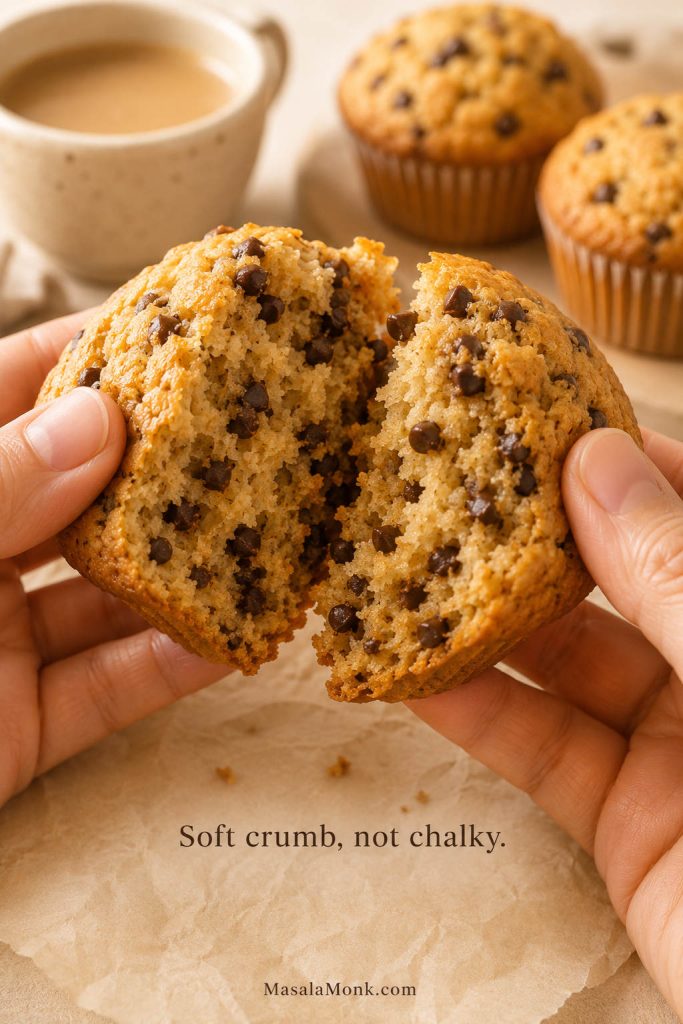
Soft Crumb, Not Chalky

Close-up of a high protein muffin torn open to show a soft moist crumb with chocolate chips.
The crumb tells you whether the recipe worked. Pull the muffins when they are just set, because they continue to firm up as they cool.

Already know you want to bake? Use the jump button to go straight to the recipe card. If you want to avoid dry protein muffins, read the batter and protein powder notes first.

Table of Contents

Use this guide to make soft protein muffins, choose the right protein base, fix texture problems, and store them for easy breakfasts or snacks.

Quick Answer: How Do You Make High Protein Muffins?

To make high protein muffins, combine flour or oat flour, protein powder, Greek yogurt, eggs, banana or applesauce, a little maple syrup or honey, leavening, and enough milk to make a sturdy muffin batter. After that, bake in a lined muffin tin until the tops spring back lightly and a toothpick comes out clean or with a few moist crumbs.

This recipe makes 12 muffins. The exact protein number depends on your protein powder, yogurt, flour, and mix-ins. Most batches land around 9–12 grams of protein per muffin, which makes them more filling without pushing the texture into dry, dense, or chalky territory.

Texture rule: the batter should be thick enough to scoop, but not dry or crumbly. When it looks stiff, loosen it gradually with milk before baking.

If you are ready to bake, jump to the recipe card. If your past protein muffins turned dry or rubbery, read the protein powder tips and troubleshooting guide first.

High Protein Muffins at a Glance

Yield12 muffins
Total timeAbout 30–35 minutes
ProteinAbout 9–12g per muffin, depending on protein powder, yogurt, flour, and mix-ins
TextureTender, lightly hearty, and muffin-like
Best first protein baseGreek yogurt + vanilla protein powder
Best no-powder pathGreek yogurt, cottage cheese, eggs, oats, nut butter, and seeds
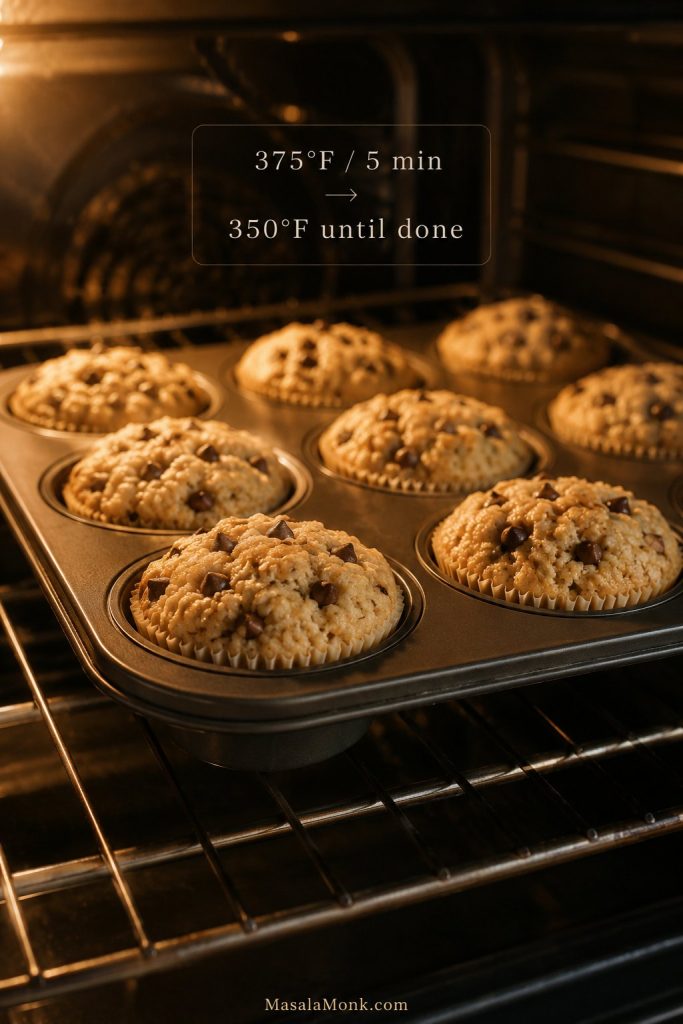
Oven375°F / 190°C for 5 minutes, then 350°F / 175°C until done
StorageFridge 4–5 days, freezer up to 3 months
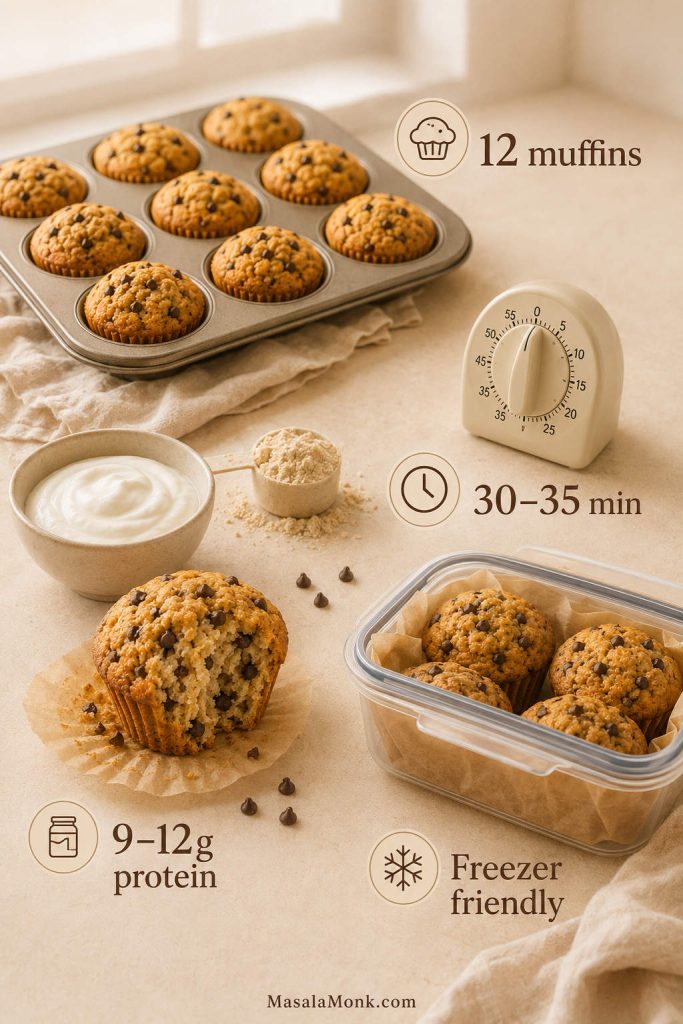
At-a-glance guide for high protein muffins showing yield, time, protein range, and freezer-friendly storage.
This 12-muffin batch is built for real meal prep: a realistic protein range, a soft crumb, and fridge-or-freezer flexibility for busy mornings.

What They Should Taste Like

These are not cupcake-style muffins, and they are not meant to taste like dry protein bars either. Instead, the crumb should be soft and lightly hearty, with enough moisture from Greek yogurt and banana or applesauce to keep each bite tender.

With banana, the muffins lean cozy and breakfast-like. Applesauce gives a more neutral base, which works better with blueberries, chocolate chips, lemon zest, or pumpkin spice. Either way, the muffin should feel satisfying without tasting like a protein powder project.

The best batch should feel like a real breakfast muffin first: warm, tender, lightly sweet, and satisfying enough that you would eat it even without counting the protein. If you add mini chocolate chips, they should give little sweet pockets in the crumb. If you choose blueberries, the muffin should feel fresher and brighter, not wet or gummy.

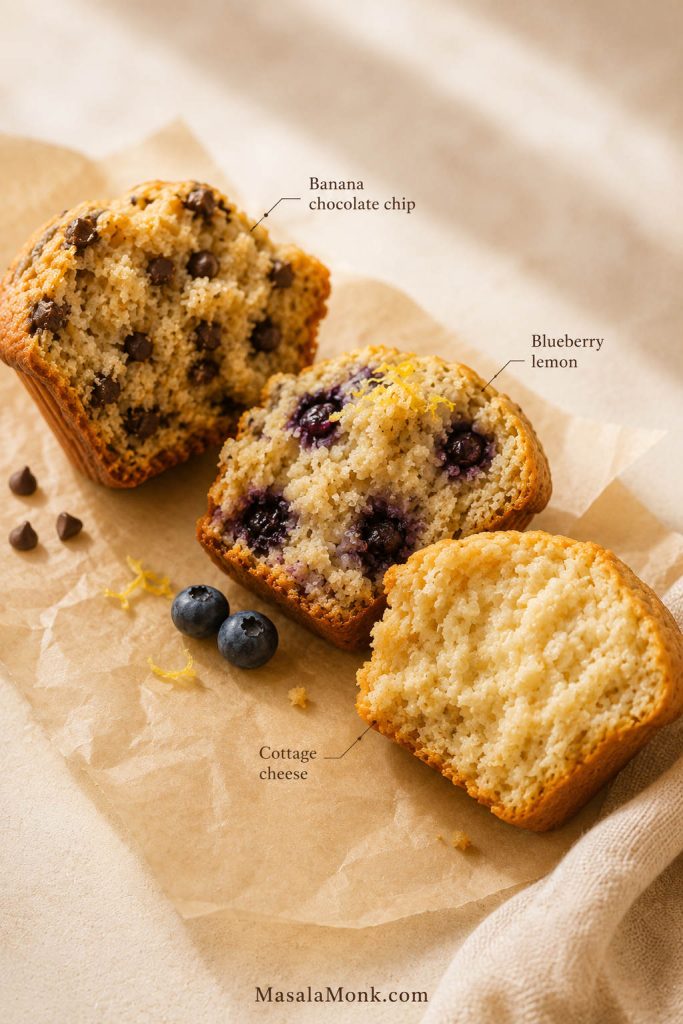
How Each Version Should Look Inside

Different mix-ins change the color and flavor of the crumb, but they should not change the goal: a tender muffin that still feels soft after cooling.

Crumb comparison of banana chocolate chip, blueberry lemon, and cottage cheese high protein muffins.
Banana chocolate chip is cozy, blueberry lemon is bright, and cottage cheese adds extra moisture. Every version should still bake up tender rather than chalky.

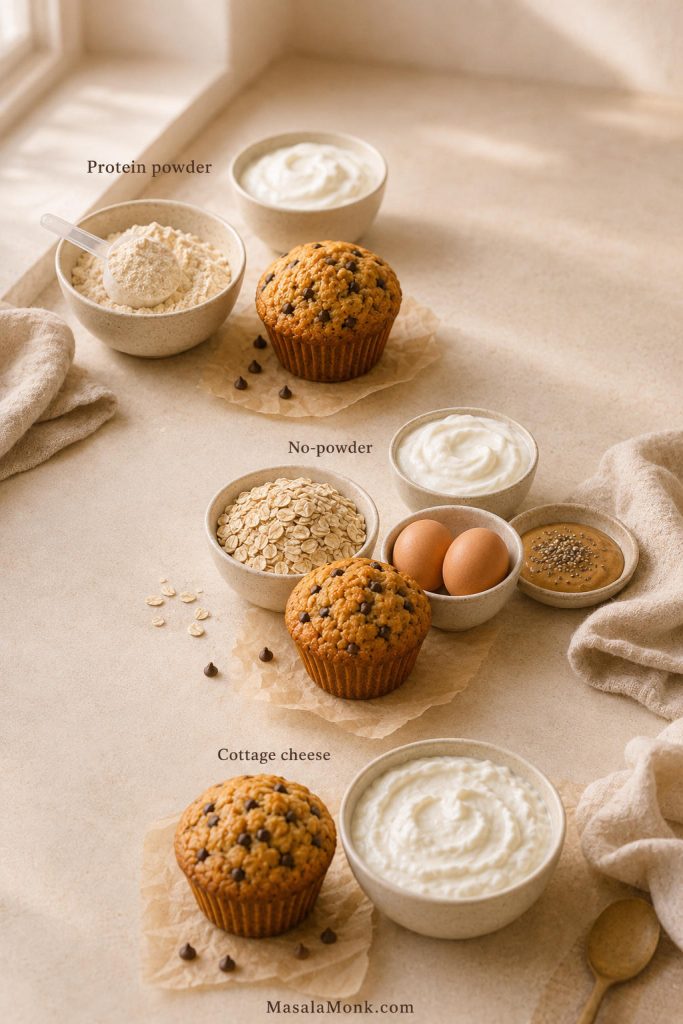
Choose Your Muffin Path

There is no single “right” way to make a higher-protein muffin. Some days you may want the extra boost from protein powder. Other times, you may want a more natural muffin built around Greek yogurt, cottage cheese, eggs, and oats. Use this table to choose the version that fits your kitchen and your taste.

PathBest forMain protein sourceTexture note
Protein powder muffinsHigher protein with simple ingredientsVanilla protein powder + Greek yogurtNeeds enough moisture so the crumb stays soft.
No-powder protein muffinsReaders who dislike protein powder tasteGreek yogurt, eggs, oats, hemp hearts, nut butterSofter and more natural, but usually lower in protein per muffin.
Cottage cheese protein muffinsMoist, filling breakfast muffinsBlended cottage cheese + eggsVery moist; needs proper baking and cooling so the centers set.
Decision guide showing protein powder, no-powder, and cottage cheese paths for high protein muffins.
Choose by texture and taste, not just protein. Protein powder gives the biggest boost; no-powder and cottage cheese versions lean more real-food and naturally moist.

Once you choose your path, use the protein powder notes for the main version, the no-powder section for real-food protein muffins, or the cottage cheese variation if you want extra moisture.

Why This High Protein Muffin Recipe Works

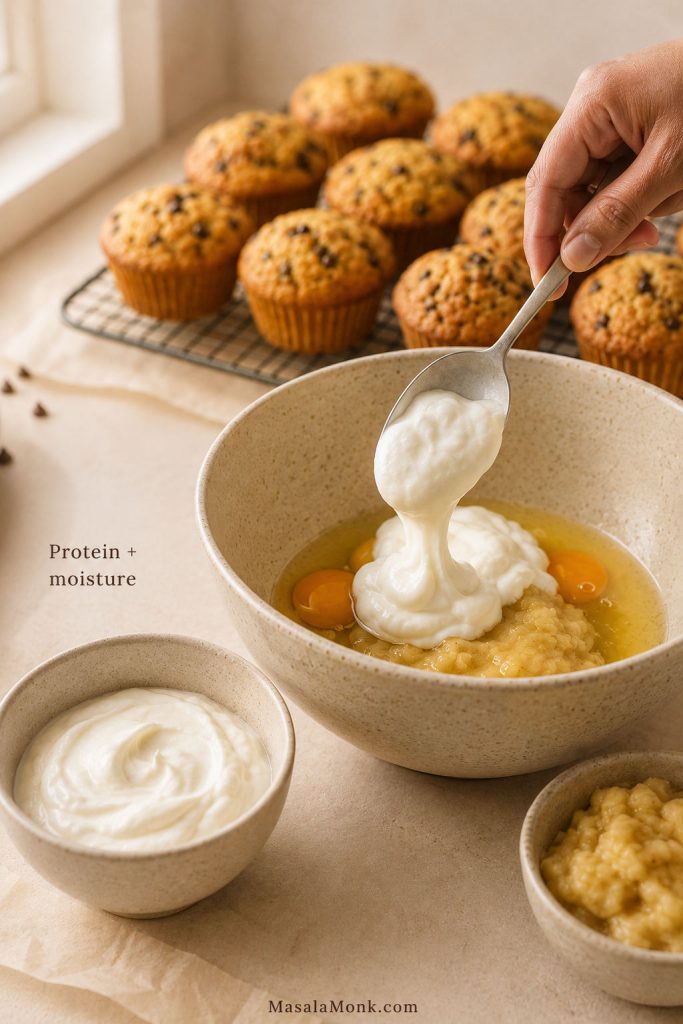
Greek yogurt keeps the crumb moist

Greek yogurt is one of the most useful ingredients here because it adds protein and moisture at the same time. It also helps balance the drying effect of protein powder, especially if you are using whey or a very absorbent plant-based powder.

Greek yogurt also gives the recipe a real-food protein base instead of making the entire muffin depend on powder. It is naturally protein-rich, and Harvard Health includes Greek yogurt among useful protein sources, which is why it works so well in breakfast recipes that need both moisture and staying power.

Greek yogurt being added to muffin batter ingredients to keep high protein muffins moist.
Greek yogurt helps twice: it adds protein and protects the crumb from drying out, which makes it one of the most useful ingredients in this batter.

Protein powder adds structure, but not too much

The fastest way to ruin protein muffins is to treat protein powder like regular flour. It absorbs liquid, changes the structure of the batter, and can make muffins firm when used too heavily. So this recipe uses enough protein powder to support the high-protein goal without letting it take over the texture.

A hotter oven start helps muffins rise

Start the muffins at a slightly higher oven temperature, then finish them lower. That short hot start encourages lift, while the gentler finish helps the center bake through without drying out the edges.

Banana or applesauce protects the texture

Mashed banana gives the muffins a naturally sweeter breakfast flavor. If you want a more neutral base, use unsweetened applesauce instead. Both add moisture, which is especially helpful in a protein-rich batter.

A little fat makes them taste like real muffins

Low-fat protein muffins often taste dry because too many softening ingredients are removed at once. That is why a modest amount of oil or melted butter helps the crumb stay tender, especially after refrigeration or freezing.

How Much Protein Should a Protein Muffin Have?

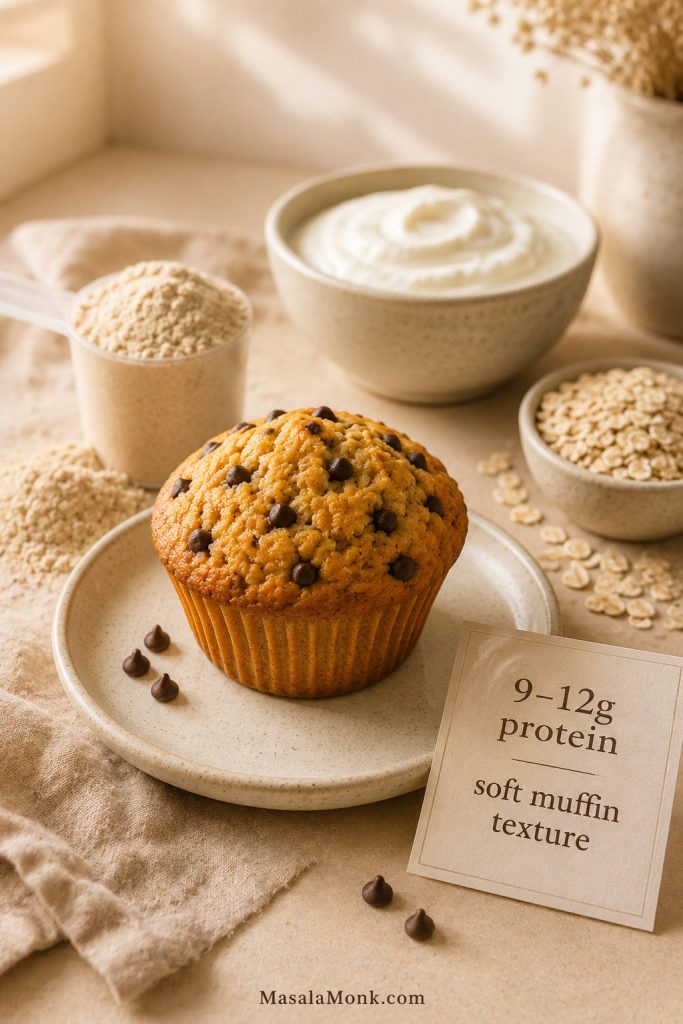
A realistic protein muffin can land anywhere from about 7g to 14g protein per muffin depending on the formula. Protein-powder versions can go higher, but the texture often becomes harder to protect. For this base recipe, the goal is about 9–12g protein per muffin with a soft, repeatable texture.

For exact numbers, use the labels on your own protein powder, yogurt, flour, and milk. Treat the nutrition estimate as a helpful range, not a fixed number. You can also look up individual ingredients in USDA FoodData Central if you want a more precise calculation.

That matters because a muffin with 20g protein is not automatically better if it tastes tough, chalky, or too lean. For most home bakers, the better target is a muffin that gives more protein than a regular muffin while still being enjoyable enough to make again.

Useful rule: a slightly lower-protein muffin that tastes good is more valuable than an ultra-high-protein muffin nobody wants to eat.

High protein muffin with a note showing a realistic 9 to 12 gram protein range and soft texture.
A realistic protein target protects texture. In practice, a softer 9–12g muffin is more useful than a dry batch chasing the biggest number.

Ingredients for High Protein Muffins

Best first version to make

Best first batch: start with oat flour, almond flour, vanilla protein powder, plain Greek yogurt, mashed banana, neutral oil, and mini chocolate chips. That version gives the easiest balance of flavor, moisture, and texture. Once you like the base, try applesauce, blueberries, pumpkin, or cottage cheese.

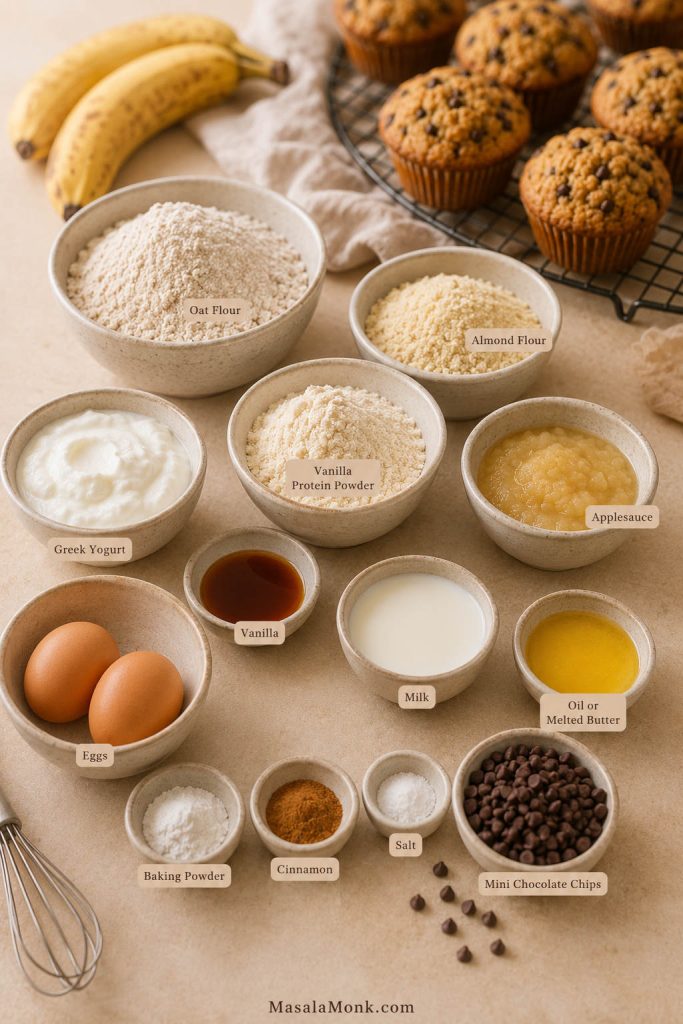
Ingredients for high protein muffins including oat flour, protein powder, Greek yogurt, banana, eggs, and chocolate chips.
Balance matters more than any one “healthy” add-in: flour gives body, Greek yogurt adds moisture, eggs set the crumb, and protein powder brings the boost.

Oat flour, white whole wheat flour, or all-purpose flour

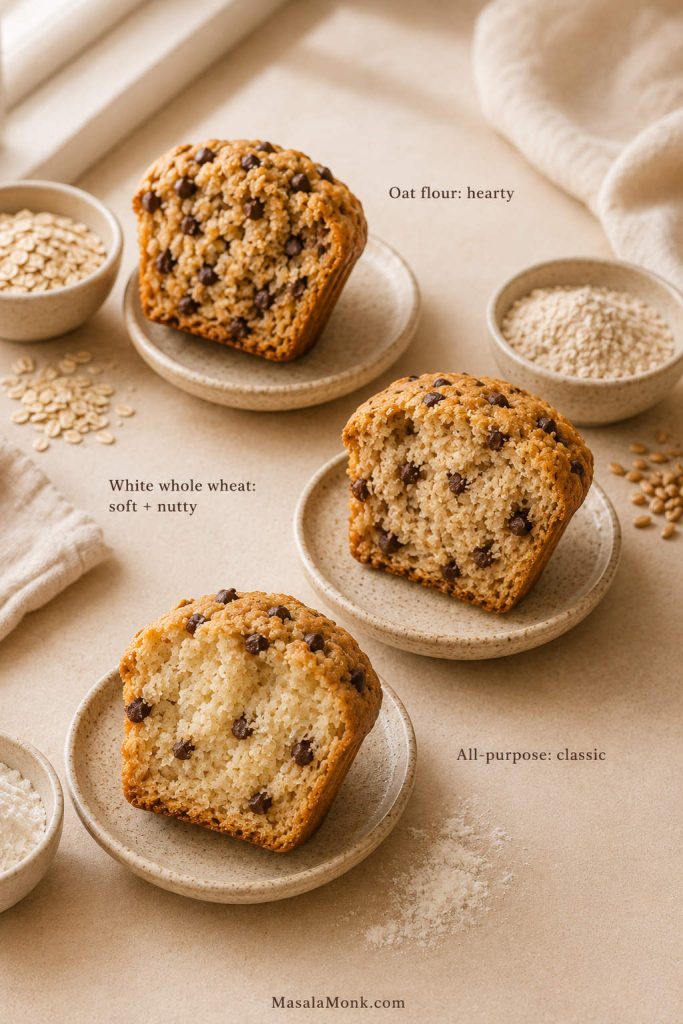
Oat flour gives these muffins a wholesome breakfast feel. White whole wheat flour gives a slightly nutty but still soft muffin. All-purpose flour gives the most classic texture. For the base recipe, use 100g oat flour or 120g all-purpose or white whole wheat flour.

Comparison of oat flour, white whole wheat, and all-purpose flour textures in high protein muffins.
Flour choice changes the crumb: oat flour is heartier, white whole wheat adds soft nuttiness, and all-purpose flour gives the most classic muffin texture.

If oats are your favorite breakfast base, this guide to high protein oatmeal has more ideas for using oats with yogurt, protein powder, cottage cheese, seeds, and nut butter.

Almond flour or extra oat flour

A small amount of almond flour adds tenderness and helps keep the muffin from tasting too lean. If you do not want to use almond flour, use extra oat flour instead. Avoid replacing all the flour with almond flour unless you are using a recipe designed for that structure.

Protein powder

Vanilla protein powder is the easiest choice because it adds sweetness and flavor. Plain protein powder can work, but the muffins may need more vanilla, cinnamon, sweetener, or mix-ins. For example, chocolate protein powder works best in chocolate chip, double chocolate, or banana chocolate versions.

Greek yogurt

Use plain Greek yogurt. Full-fat or 2% yogurt gives the softest result, but nonfat Greek yogurt also works. If the batter looks too stiff after mixing, add a small splash of milk until it loosens.

Banana or applesauce

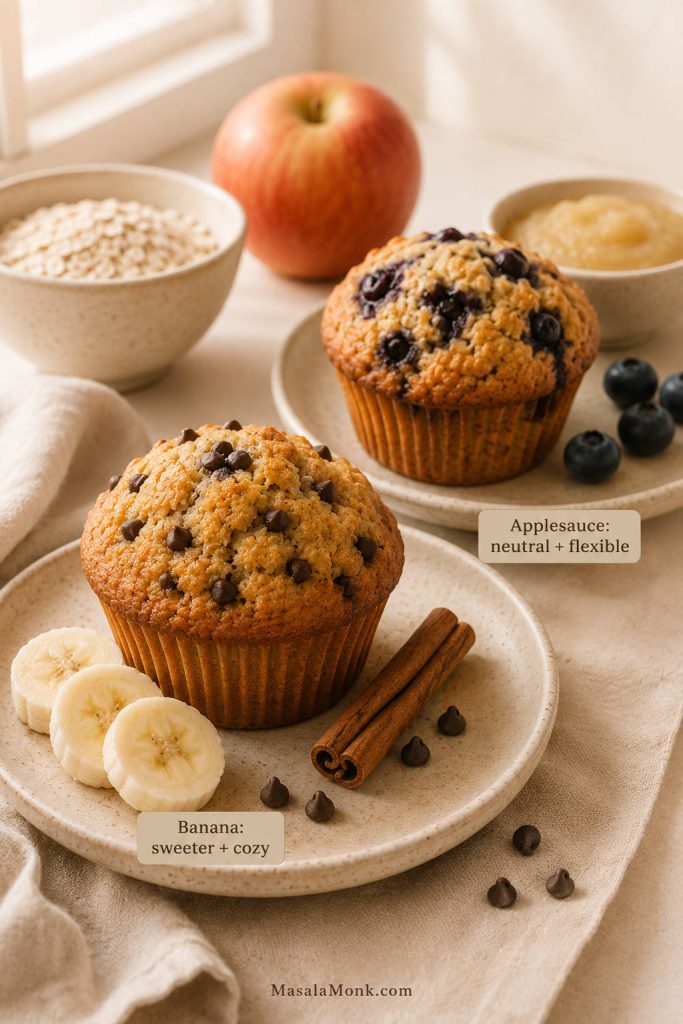
Use mashed ripe banana for a banana-forward muffin. If you want a more neutral base, use unsweetened applesauce instead. Banana gives more flavor and sweetness; applesauce keeps the muffin more flexible for blueberry, chocolate chip, or pumpkin variations.

Banana and applesauce high protein muffin comparison showing different moisture and flavor bases.
Banana makes the batch sweeter and more banana-bread-like. Applesauce keeps the base more neutral for blueberry, chocolate chip, or pumpkin variations.

Eggs, milk, and oil

Eggs give structure, milk adjusts the batter, and a little oil or melted butter keeps the crumb tender. Think of the milk as an adjustment, not a fixed amount. Start with less, then add only what the batter needs.

Mix-ins

Mini chocolate chips, blueberries, chopped walnuts, lemon zest, cinnamon, pumpkin spice, and diced strawberries can all work. Keep mix-ins to about ½–¾ cup so the muffins bake evenly.

Flavor and sweetness

Protein powder, oats, and Greek yogurt can mute sweetness once baked. If your protein powder is plain or lightly sweetened, use the full amount of maple syrup or honey and do not skip the vanilla, cinnamon, or salt. For a more treat-like muffin, mini chocolate chips usually help more than extra sweetener because they give little pockets of flavor in every bite.

Best Protein Powder for Muffins

Protein powder can make muffins better, but it can also make them dry if the batter is not balanced. Different powders absorb liquid differently, so use the batter texture as your final guide.

This is the part that decides whether your muffins taste like breakfast or like a protein bar in muffin form. The same recipe can turn out soft with one powder and dry with another, so the batter matters more than brand loyalty.

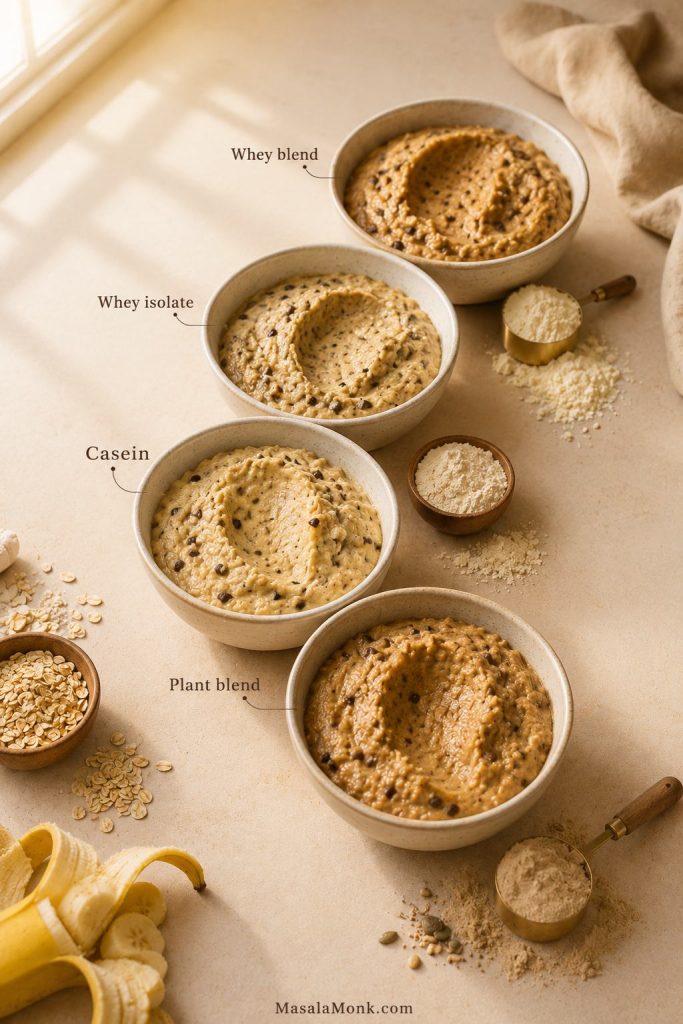
Four muffin batter bowls showing how whey, casein, and plant protein powders create different batter textures.
The same recipe can bake differently with whey, casein, or plant protein. Start with the formula, then adjust the batter before it goes into the pan.
Protein powder typeWhat to expect in muffinsBest adjustment
Whey isolateCan bake firm or dry if overused.Add extra yogurt or milk and check early for doneness.
Whey blendUsually easier than pure isolate and works well in muffin batter.Start with the recipe amount of milk, then adjust if needed.
CaseinAbsorbs a lot of liquid and can make the batter sturdy.Loosen gradually with milk until the batter is easy to scoop.
Pea proteinGood structure, but can become dense or earthy.Use enough flavor, moisture, and gentle mixing.
Plant protein blendOften reliable, but brands vary widely in absorption.Judge by batter texture, not just the printed amount of milk.
CollagenNot ideal as the only protein powder replacement.Use as a partial boost, not a full swap for flour or protein powder.

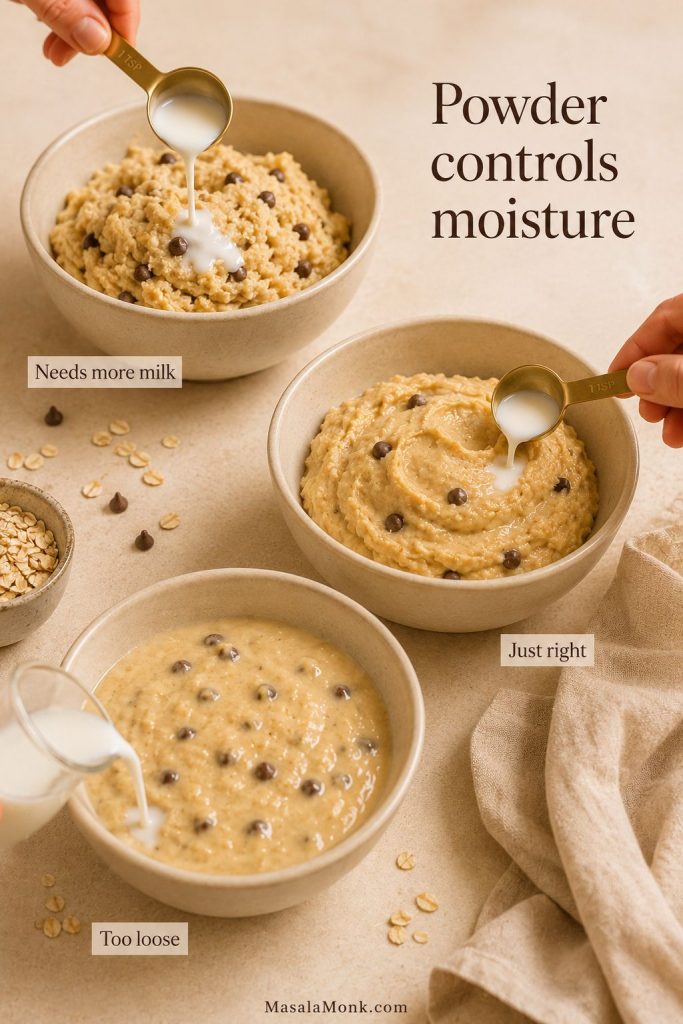
How protein powder changes batter moisture

Protein muffin batter absorption guide showing thick, just-right, and too-loose batter after adding milk.
A stiff batter does not always mean the recipe is wrong. Often, the protein powder simply needs a slower, splash-by-splash milk adjustment.

Protein powder rule: do not keep adding protein powder just to raise the number. Once protein powder becomes too large a share of the dry ingredients, muffins turn tough, dry, or heavy. A better muffin with 9–12g protein is more useful than a 20g muffin nobody wants to eat.

As a practical starting point, avoid replacing more than about one-third of the dry ingredient base with protein powder unless the recipe has been specifically built for that much powder. The more powder you add, the more moisture, fat, flavor, and careful baking you usually need.

Check the batter texture before baking

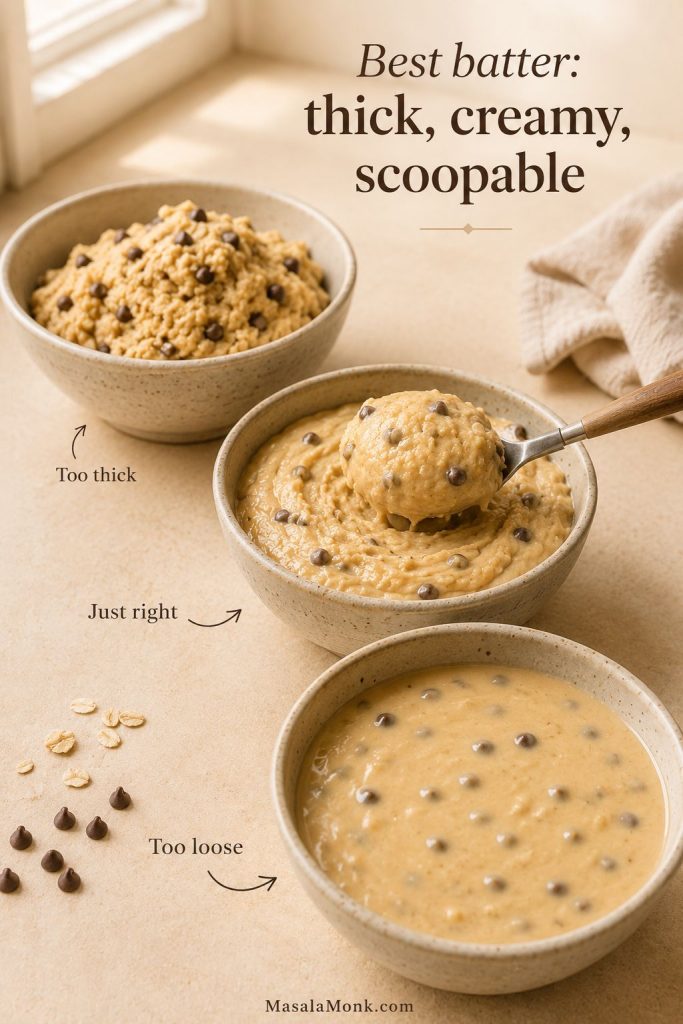
Before you bake: if the batter looks like cookie dough, it needs more milk. If it pours like pancake batter, it needs oat flour and a short rest. The sweet spot is thick, creamy, and scoopable.

Three bowls showing too-thick, just-right, and too-loose batter textures for high protein muffins.
This is the texture check that prevents most dry protein muffins. The batter should hold a scoop without crumbling or pouring.

If your batter already looks too stiff or too loose, fix it here before filling the pan. For finished muffins that came out dry, dense, or rubbery, jump to troubleshooting.

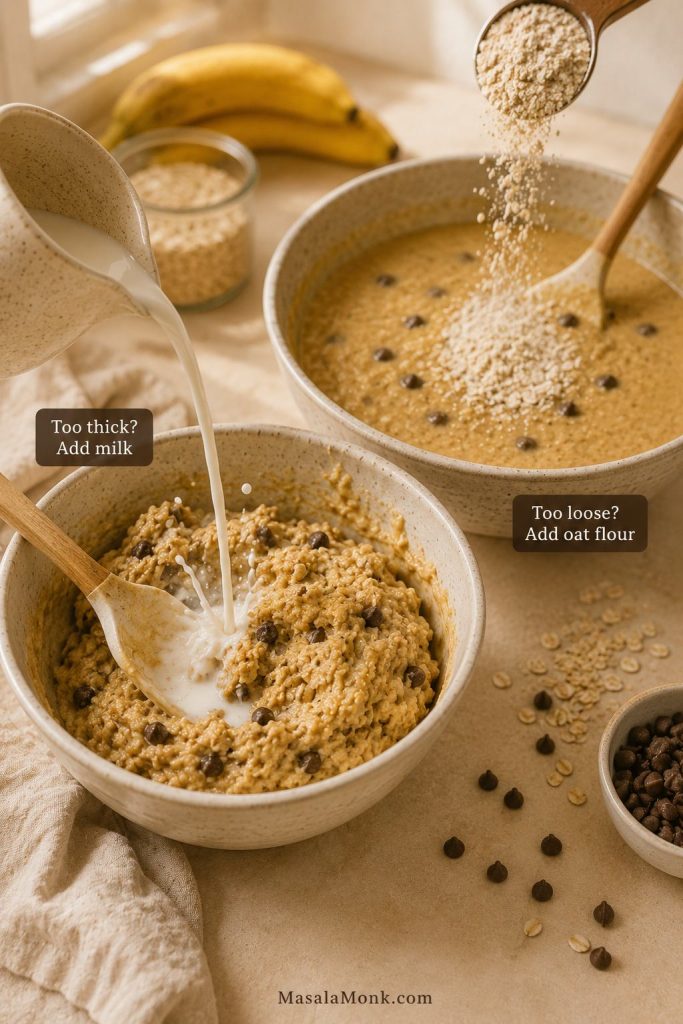
How to fix thick or loose batter

Muffin batter being fixed with milk for thick batter and oat flour for loose batter.
Most batter problems are fixable before baking. Use milk to loosen a stiff mix, or oat flour to tighten a loose one, then let the batter rest briefly.

This is the best moment to fix the batter. If it does not look scoopable, check the batter texture guide before filling the muffin tin.

Step-by-Step Method

1. Mix the dry ingredients

In a large bowl, whisk together the flour or oat flour, almond flour or extra oat flour, protein powder, baking powder, baking soda, salt, and cinnamon. Whisking first helps distribute the protein powder and leavening evenly.

2. Whisk the wet ingredients

In a separate bowl, whisk the Greek yogurt, eggs, mashed banana or applesauce, maple syrup or honey, oil or melted butter, milk, and vanilla. The mixture should look smooth and creamy.

3. Combine gently

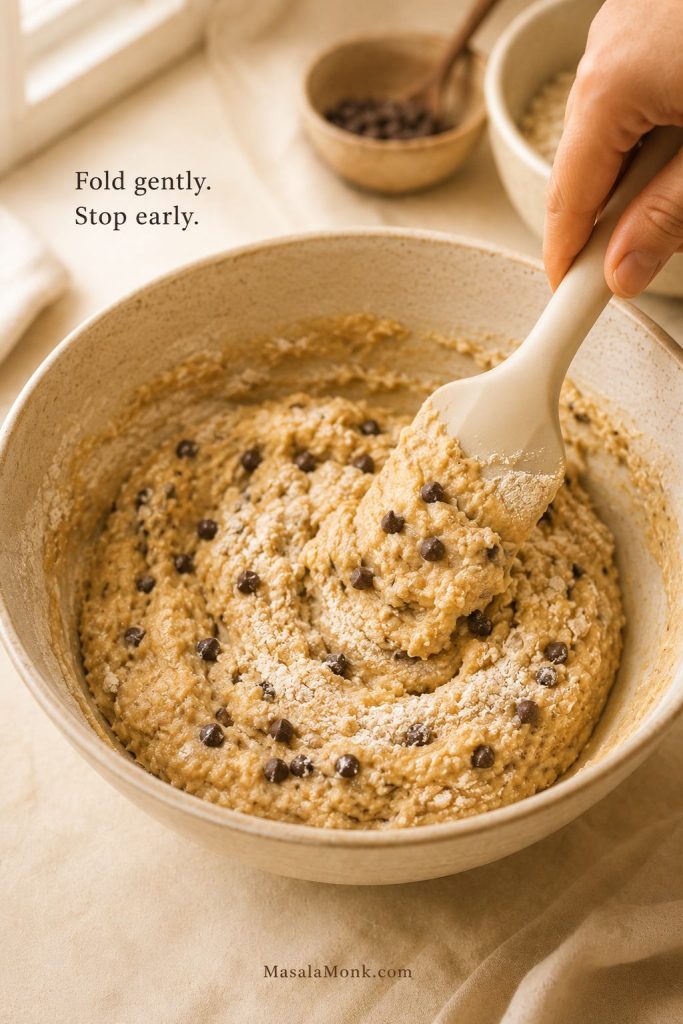
Add the wet ingredients to the dry ingredients and fold with a spatula. Stop when no dry streaks remain. Do not worry if the mixture looks a little sturdier than regular muffin batter; that is normal here.

This is the point where the recipe either stays tender or starts getting tough. A few tiny lumps are fine; a perfectly smooth batter is not the goal.

High protein muffin batter being gently folded with a spatula before overmixing.
Stop folding as soon as the batter comes together. A few streaks are better than overmixing, which can make protein muffins dense or rubbery.

4. Check and fix the batter texture

The batter should be creamy, scoopable, and easy to portion. It should mound slightly on a spoon but still spread slowly when scooped into the muffin cup. If it looks dry or crumbly, add a small splash of milk. If it pours like pancake batter, add oat flour 1 tablespoon at a time and let it rest for 5 minutes.

5. Let the batter rest if needed

If using oat flour, casein, pea protein, or a thick plant protein blend, let the batter rest for 5 minutes before scooping. Some powders hydrate slowly, so a short rest can make the final texture more even. If it becomes too stiff after resting, loosen it with 1–2 tablespoons of milk.

6. Fold in mix-ins

Fold in chocolate chips, blueberries, nuts, or other mix-ins gently. Overmixing at this point can make the muffins dense.

7. Fill the muffin tin

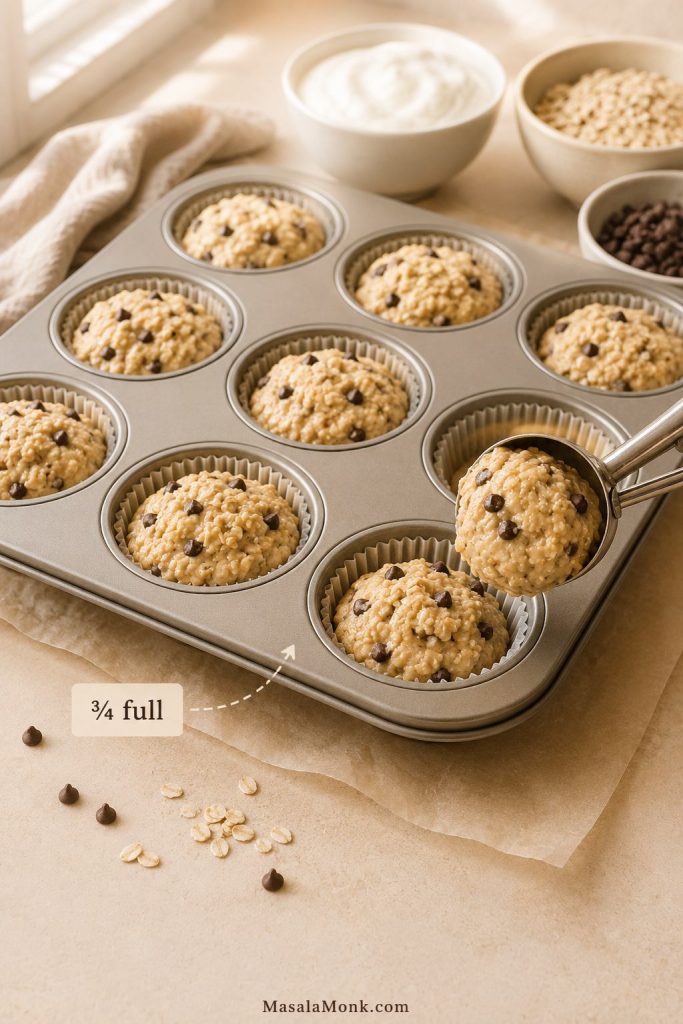
Line a 12-cup muffin tin and lightly spray the liners. Fill each cup about ¾ full for regular muffins, or slightly fuller for taller tops.

High protein muffin batter scooped into a muffin tin with cups filled about three-quarters full.
Fill each muffin cup about three-quarters full. That gives the batter room to rise while still creating a generous, bakery-style top.

8. Bake and cool

Bake at the higher starting temperature first, then reduce the oven temperature without opening the door. After that, let the muffins cool in the pan for 10 minutes before moving them to a rack. A little patience here pays off because the centers continue to settle as they cool.

Bake Time, Temperature, and Doneness

For the best balance of lift and moisture, start the muffins at 375°F / 190°C for 5 minutes. Then reduce the oven to 350°F / 175°C and bake for another 12–17 minutes, depending on your oven, muffin tin, protein powder, and mix-ins.

High protein muffins baking with a hot-start oven cue of 375 degrees then 350 degrees.
A short hot start helps protein muffins lift before the lower temperature finishes the centers gently. This gives better rise without drying the edges.

How to check doneness

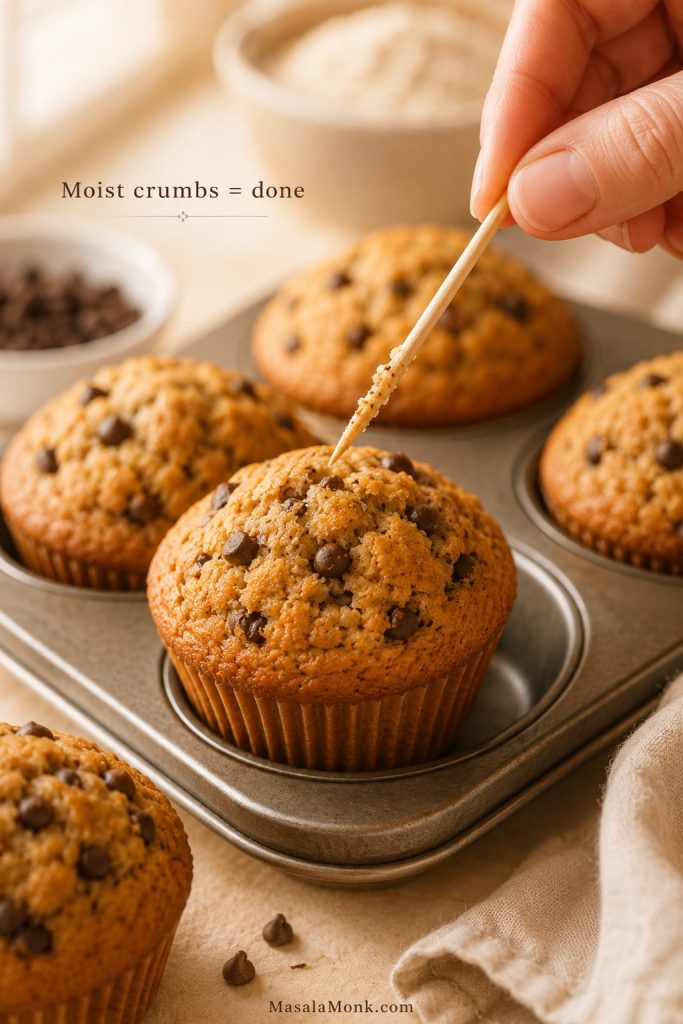
The muffins are done when the tops spring back lightly and a toothpick inserted in the center comes out clean or with a few moist crumbs. Do not wait until the tops feel hard. Instead, pull them when they are just set because they continue to firm up as they cool.

Toothpick test showing moist crumbs on a high protein muffin to indicate doneness.
Do not wait for a perfectly clean toothpick if you want a softer crumb. A few moist crumbs usually mean the muffins are done.

A good batch should rise slightly, feel soft when pressed, and smell warm and lightly sweet. The tops should not feel hard when they leave the oven. If they do, the batch likely baked a few minutes too long.

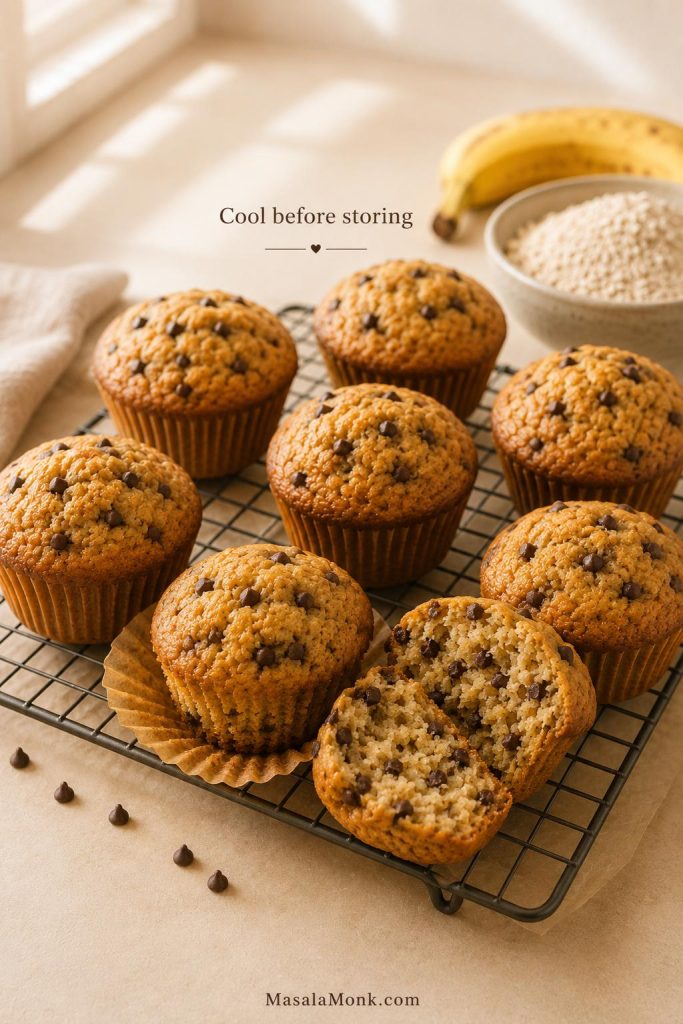
Cool before storing

Do not skip cooling: these muffins can seem slightly soft in the center when hot. Give them 10 minutes in the pan and more time on a rack before judging the final texture.

High protein muffins cooling on a wire rack with one muffin split open after cooling.
Cooling is part of the recipe, not an afterthought. Letting the muffins rest helps the centers settle and keeps extra steam out of the storage container.

After baking, let the muffins cool before judging the final crumb. Then use the storage and freezing tips if you are making them for meal prep.

Easy Muffin Variations

Use the base recipe as a flexible formula. The mixture should be sturdy enough to scoop, but still soft enough to settle into the muffin cups. Adjust with milk if your protein powder makes it too stiff.

Choose the version based on what you want the muffin to feel like: banana for cozy breakfast, blueberry for fresh and bright, chocolate chip for snack prep, oatmeal for a heartier morning muffin, and pumpkin for a softer fall batch.

Best first variation: banana chocolate chip is the easiest crowd-pleaser. Blueberry lemon is fresher, pumpkin is softer, and cottage cheese is best when you want extra moisture without relying only on protein powder.

For the easiest first batch, start with banana chocolate chip. For a brighter version, try blueberry lemon; for extra moisture, use the cottage cheese version.

Banana protein muffins

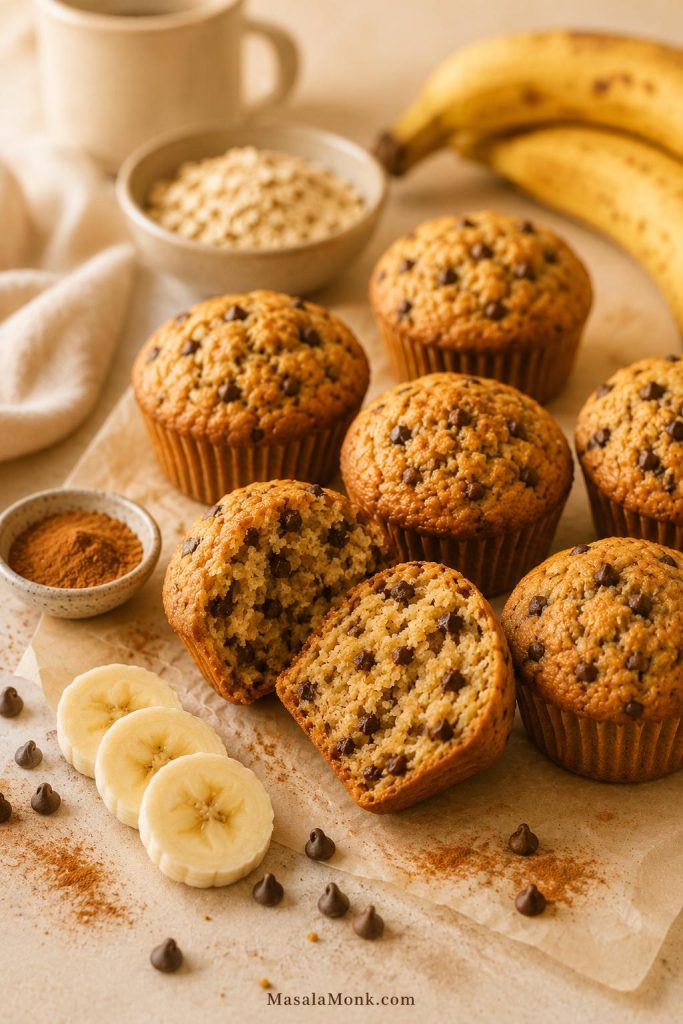
Choose this when you want the coziest version. Mashed ripe banana makes the muffins taste closer to banana bread, especially with cinnamon and mini chocolate chips.

Banana chocolate chip high protein muffins with one muffin split open to show a moist crumb.
Banana chocolate chip is the coziest variation: ripe banana adds sweetness, while mini chips spread little pockets of flavor through the crumb.

Blueberry protein muffins

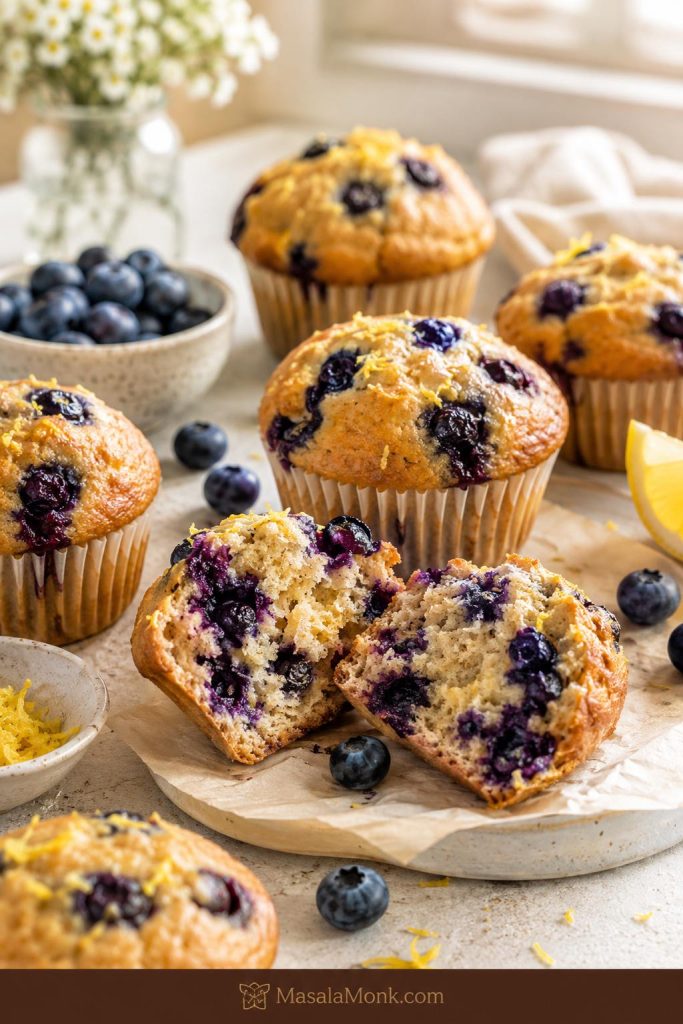
Choose this when you want something fresher and brighter. Applesauce keeps the base neutral, while blueberries and lemon zest make the muffins feel more like a morning bakery muffin.

Blueberry lemon high protein muffins with one muffin split open to show a soft crumb and blueberry pockets.
Blueberry lemon gives the same protein muffin base a fresher, brighter flavor. Keep the batter thick enough so the berries stay suspended instead of sinking.

Chocolate chip protein muffins

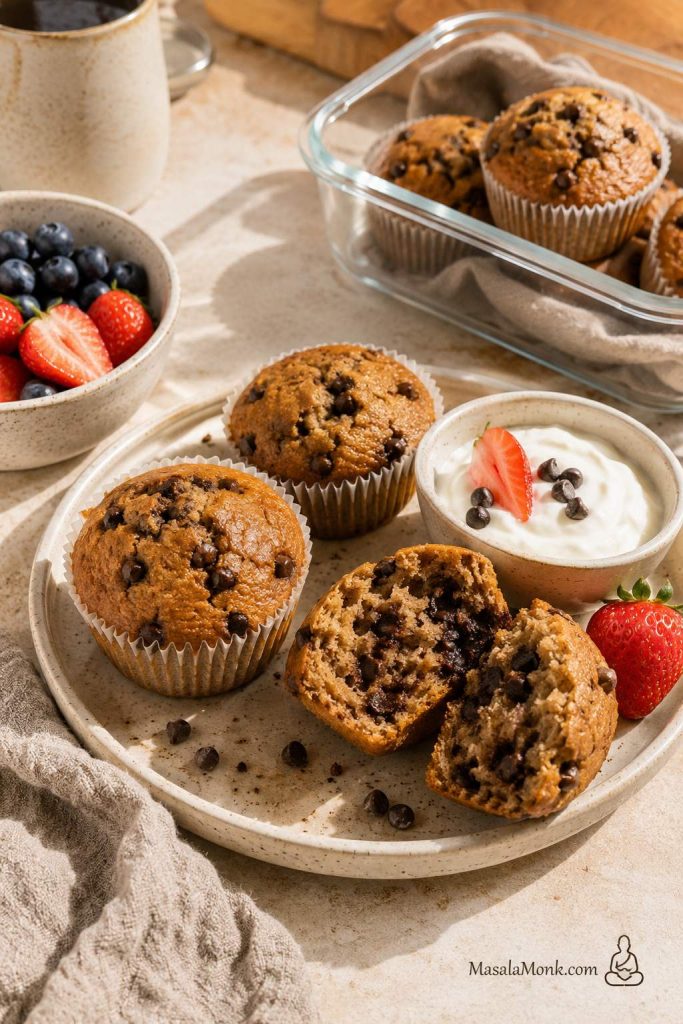
Choose this when you want the batch to feel more like a snack than a strict breakfast. Mini chips spread through the crumb better, so you get chocolate in more bites without overloading the batter.

Chocolate chip high protein muffins served with Greek yogurt and fruit for snack prep.
For snack prep, mini chocolate chips make the muffins feel more satisfying without overloading the batter. Pair one with yogurt and fruit for a fuller bite.

Oatmeal protein muffins

For a heartier breakfast muffin, use oat flour and a small amount of rolled oats. Avoid steel-cut oats here because they will not soften properly in a standard muffin bake.

Pumpkin protein muffins

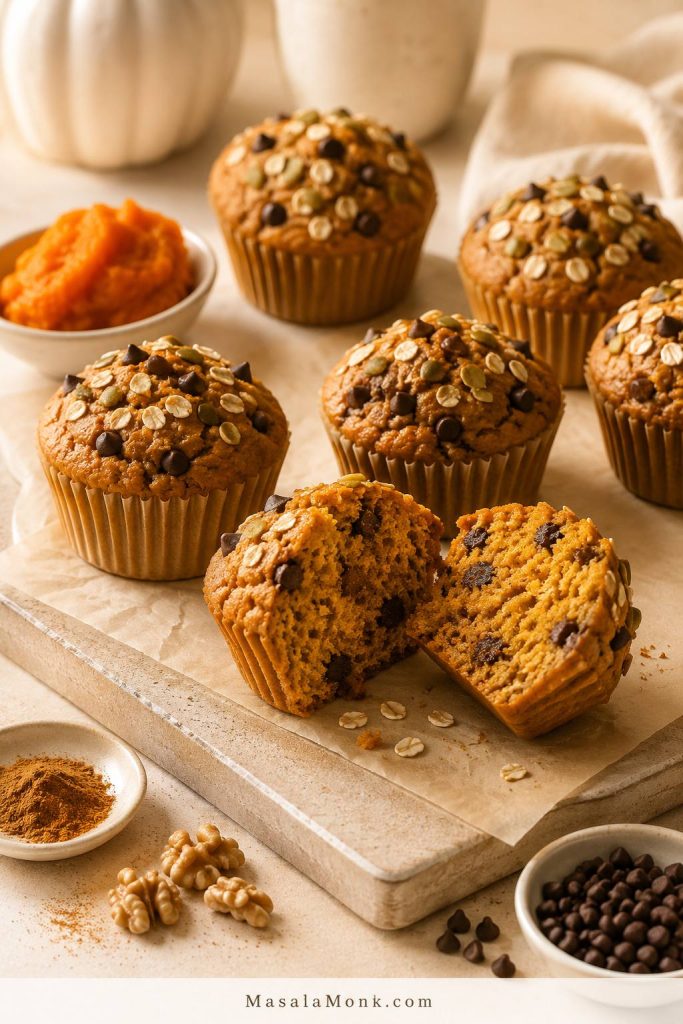
To make a fall-style batch, replace the banana or applesauce with pumpkin puree, add pumpkin pie spice, and use chocolate chips or walnuts. Because pumpkin adds a lot of moisture, these muffins may need the longer end of the bake window.

Pumpkin high protein muffins with a soft orange crumb and warm spice cues.
Pumpkin adds moisture, color, and warm spice, but it also softens the batter. Use the longer end of the bake window if the centers need more time.

Cottage cheese protein muffins

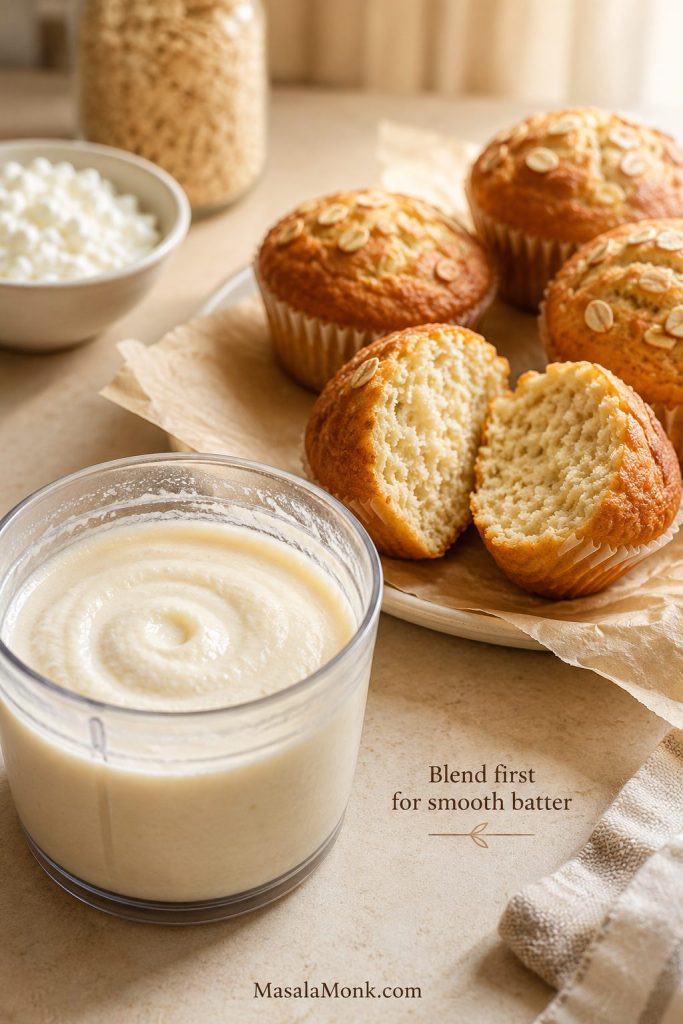
Choose this when you want extra moisture and a softer center. This is the best cottage cheese protein muffin direction if you want more real-food protein without making the batch depend only on powder. Blend the cottage cheese into the wet ingredients first so the batter bakes smooth instead of curdy.

Cottage cheese protein muffins with blended cottage cheese and a split muffin showing a smooth tender crumb.
Cottage cheese works best when blended into the wet ingredients first. That simple step adds moisture without leaving curdy pockets in the crumb.

For more breakfast ideas using the same ingredient, see cottage cheese for breakfast.

How to Make High Protein Muffins Without Protein Powder

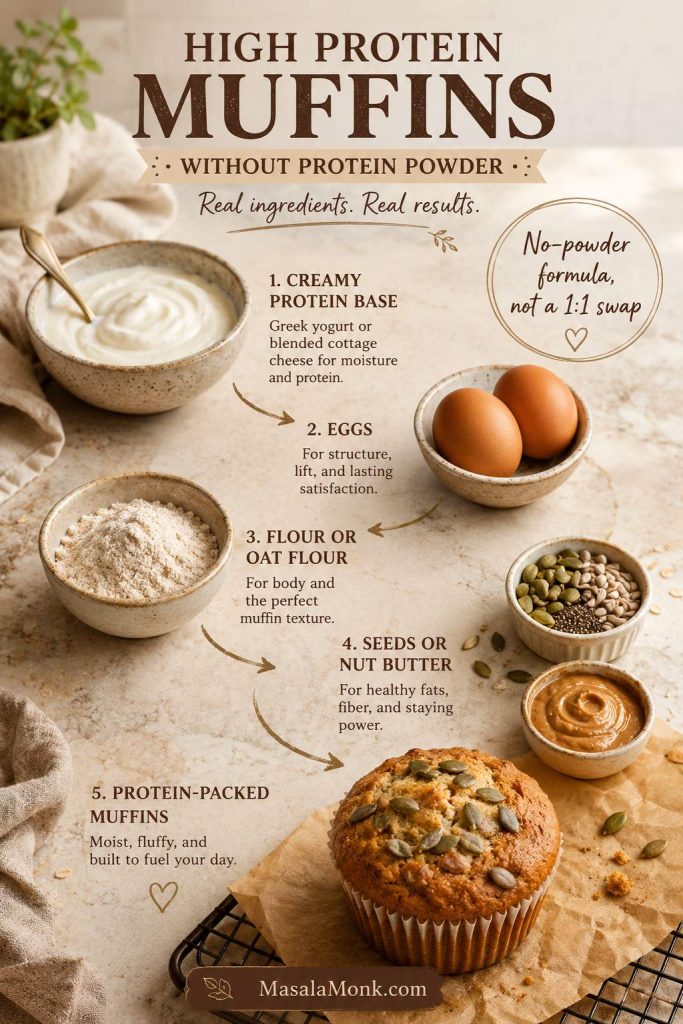
You can make protein-rich muffins without protein powder, but the recipe needs a different strategy. For a no-powder batch, think in parts: a creamy protein base, eggs for structure, flour for body, and a little fat, seeds, or nut butter for staying power.

Important: this is not a direct one-for-one swap. If you simply remove the protein powder from the main recipe, the batter balance changes. Use the no-powder formula below instead.

If you are using protein powder after all, return to the main recipe card. If you want to avoid powder completely, follow the no-powder formula below rather than removing the powder from the main batter.

Best no-powder formula

For muffins without protein powder, start with a structure that balances moisture, lift, body, and staying power:

  • Creamy protein base: ¾–1 cup Greek yogurt or blended cottage cheese
  • Structure: 2 eggs
  • Body: 1 cup oat flour + 1 cup all-purpose or white whole wheat flour
  • Staying power: ¼–½ cup hemp hearts or nut butter
  • Moisture and flavor: banana or applesauce
  • Lift: 2 teaspoons baking powder + ½ teaspoon baking soda
  • Balance: ½ teaspoon salt
No-powder high protein muffin formula with Greek yogurt or cottage cheese, eggs, flour, seeds, nut butter, and a finished muffin.
A no-powder protein muffin needs its own structure. Build around yogurt or cottage cheese, eggs, flour, and seeds or nut butter instead of simply removing protein powder.

This will usually give less protein than a protein-powder muffin. The flavor is often more natural, though, and the texture can be softer.

The same idea works in other breakfast batters too. These oat pancakes use oats, cottage cheese, and high-protein options in a way that feels very similar: simple ingredients, better texture, and no need to rely only on protein powder.

Best real-food protein options

IngredientHow it helpsBest use
Cottage cheeseAdds protein and moisture.Blend with wet ingredients for a smooth muffin.
Greek yogurtAdds protein and keeps the crumb soft.Use in banana, blueberry, and chocolate chip muffins.
EggsAdd structure and protein.Useful in almost every muffin formula.
Oats or oat flourAdd breakfast texture and slow-digesting carbs.Best for oatmeal and banana protein muffins.
Nut butterAdds fat, flavor, and some protein.Best in banana, chocolate, and peanut butter muffins.
Hemp, flax, or chiaAdds protein, fiber, and texture.Use in small amounts so the muffins do not turn heavy.

For the best no-powder result, use cottage cheese or Greek yogurt as part of the wet base rather than treating them like simple add-ins. They help the batter stay moist while adding protein in a more natural way.

Troubleshooting: Why Are My Protein Muffins Dry, Dense, or Rubbery?

Most protein muffin problems are not disasters. They are signals. Dry muffins, sticky centers, flat tops, and chalky flavor usually mean the batter needed a little more moisture, less mixing, or a shorter bake.

If your first batch is not perfect, do not treat it like a failure. Protein muffin batter is more sensitive than regular muffin batter because protein powder, oats, yogurt, and cottage cheese all hold moisture differently. Most problems can be fixed by changing the liquid, mixing less, or pulling the muffins from the oven a little earlier.

The batter usually tells you what it needs. A stiff batter needs a little milk. A loose batter needs oat flour and a short rest. Finally, flat flavor usually needs more vanilla, cinnamon, salt, fruit, or chocolate next time.

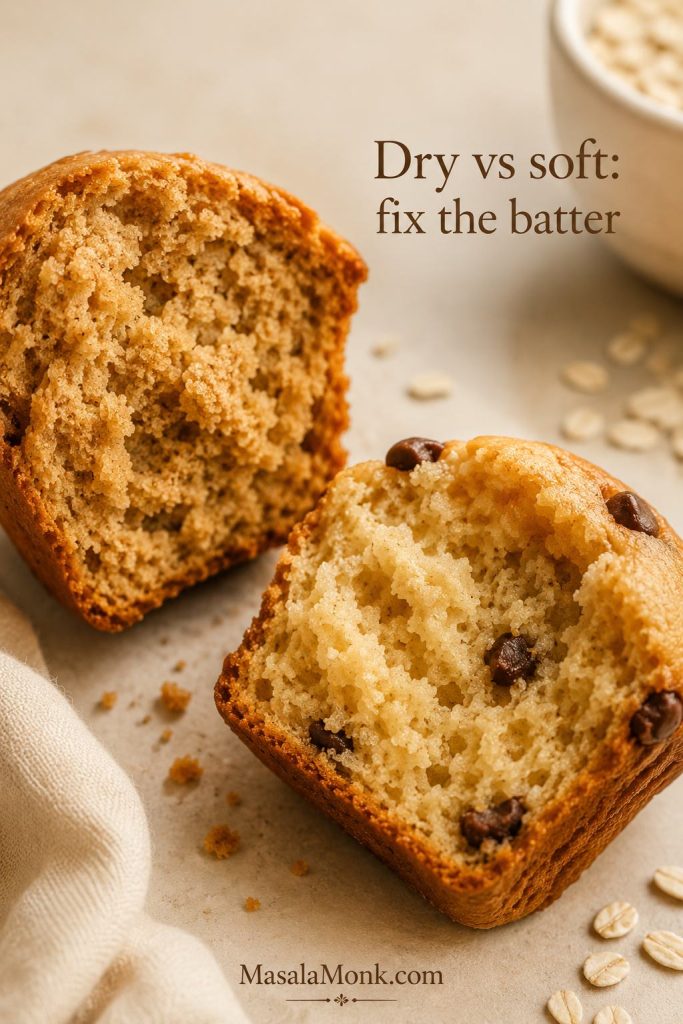
Dry vs moist: read the crumb

Dry protein muffin crumb compared with soft moist protein muffin crumb for troubleshooting.
Dry protein muffins usually point back to the batter. More moisture, less overbaking, and a better powder-to-flour balance can change the result.

If the problem started before baking, go back to the batter texture cue. If the muffins looked fine going in but came out dry, check the bake time and doneness notes.

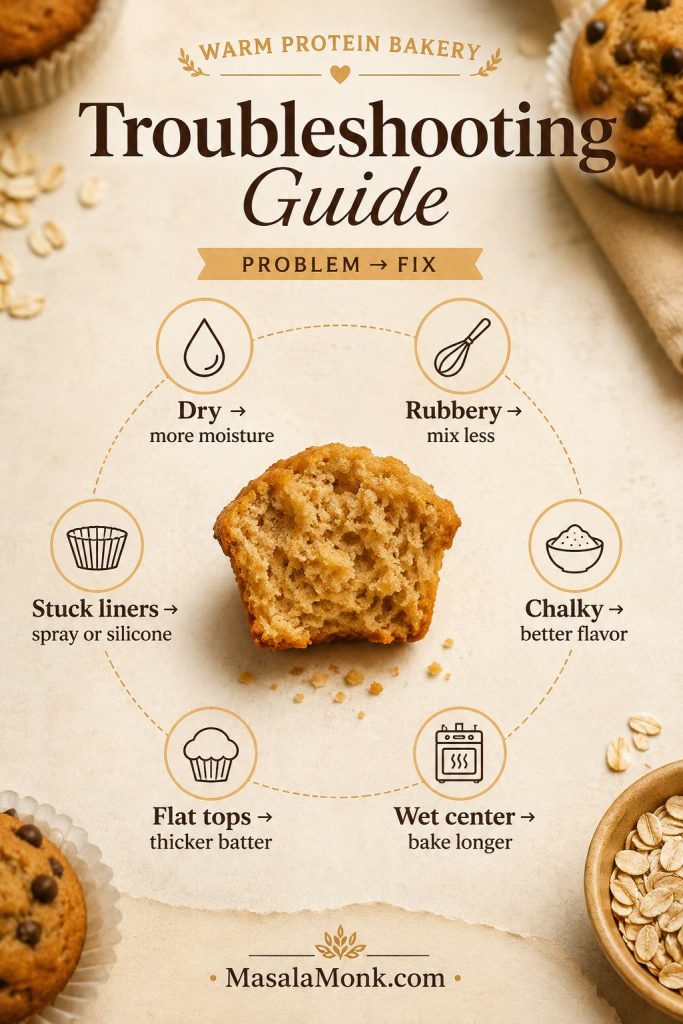
Protein muffin troubleshooting guide

Troubleshooting guide for high protein muffins showing fixes for dry, rubbery, chalky, wet, flat, and stuck muffins.
Most protein muffin problems have a simple cause. Once you know whether it is moisture, mixing, bake time, or liners, the next batch is easier to fix.

Use the tables below like a quick diagnosis: find what happened, then adjust the next batch before changing the whole recipe.

Texture problems

ProblemLikely reasonFix
Dry muffinsToo much protein powder, not enough moisture, or overbaking.Add more yogurt or milk next time and check the muffins earlier.
Rubbery textureThe batter was overmixed after the wet and dry ingredients were combined.Fold gently and stop as soon as the batter comes together.
Chalky tasteThe protein powder flavor is too strong or too much powder was used.Use a better-tasting powder, add cinnamon or vanilla, or reduce the powder slightly.
Wet centerToo much fruit, yogurt, or cottage cheese; muffins may also need more cooling.Bake 2–4 minutes longer and let the muffins cool fully before storing.

Baking and pan problems

ProblemLikely reasonFix
Flat topsThe oven was not hot enough at the start or the batter was too thin.Use the hot-start method and keep the batter thick enough to hold shape.
Muffins stick to linersLow-fat, high-protein batters often cling to paper liners.Spray the liners lightly or use silicone muffin cups.
Blueberries sinkThe berries were too wet, too large, or folded into thin batter.Toss berries with a little flour and keep the batter thick.

Batter and flavor fixes

ProblemLikely reasonFix
Batter too thickThe protein powder absorbed more liquid than expected.Add milk gradually until the batter softens.
Batter too thinToo much yogurt, fruit, or milk was added.Add oat flour 1 tablespoon at a time and let the batter rest for 5 minutes.
Muffins taste “healthy” in a bad wayNot enough flavor against the protein powder.Add cinnamon, vanilla, banana, chocolate chips, lemon zest, or a pinch more salt.

How to Store and Freeze Protein Muffins

These muffins are at their best once fully cooled, which makes them useful for breakfast prep. Bake a batch, cool them completely, then keep a few in the fridge and freeze the rest for mornings when you want something filling without cooking.

For another freezer-friendly breakfast that works well on busy mornings, these freezer-friendly breakfast burritos are a savory option to keep alongside muffins.

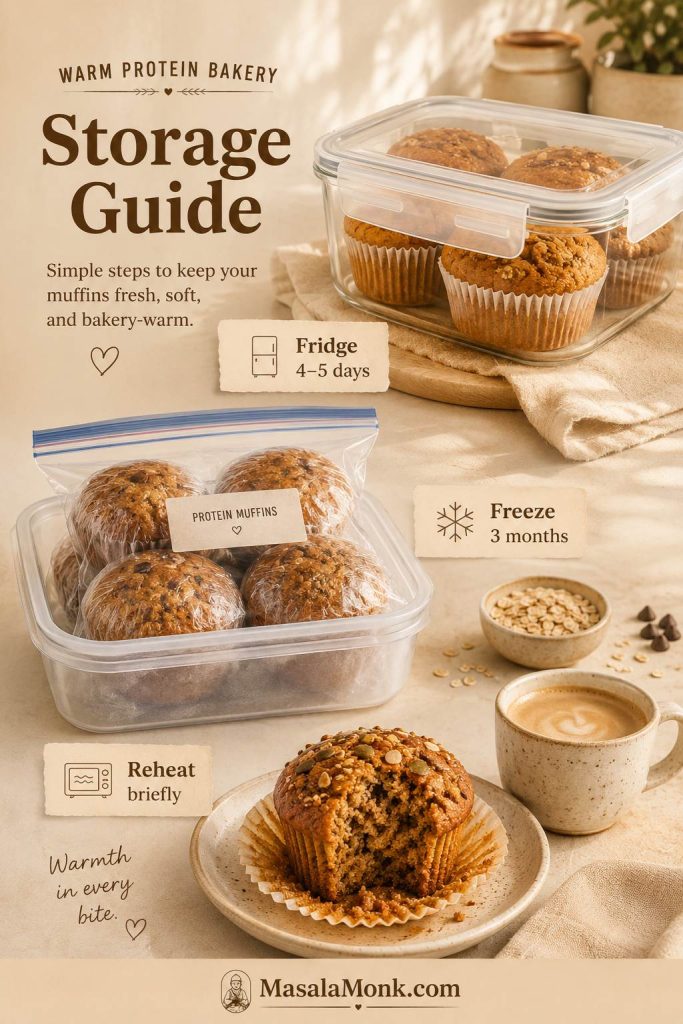
Storage guide for high protein muffins showing fridge storage, freezer storage, and reheating.
Store protein muffins only after they cool completely. Then refrigerate the week’s batch and freeze the rest so the texture stays fresher for longer.

Meal prep tip: save the base recipe once, then change only the fruit, mix-ins, and protein powder adjustment. The batter texture should stay the same even when the flavor changes.

Storage times

Storage methodHow longBest tip
Room temperatureSame day, or overnight if your kitchen is coolFor longer storage, refrigerate because these muffins are moist and yogurt-based.
Refrigerator4–5 daysStore in an airtight container with a paper towel to absorb moisture.
FreezerUp to 3 monthsFreeze individually, then move to a freezer bag or airtight container.
Reheating15–45 secondsMicrowave briefly until just warm, not hot and tough.

What to Serve with High Protein Muffins

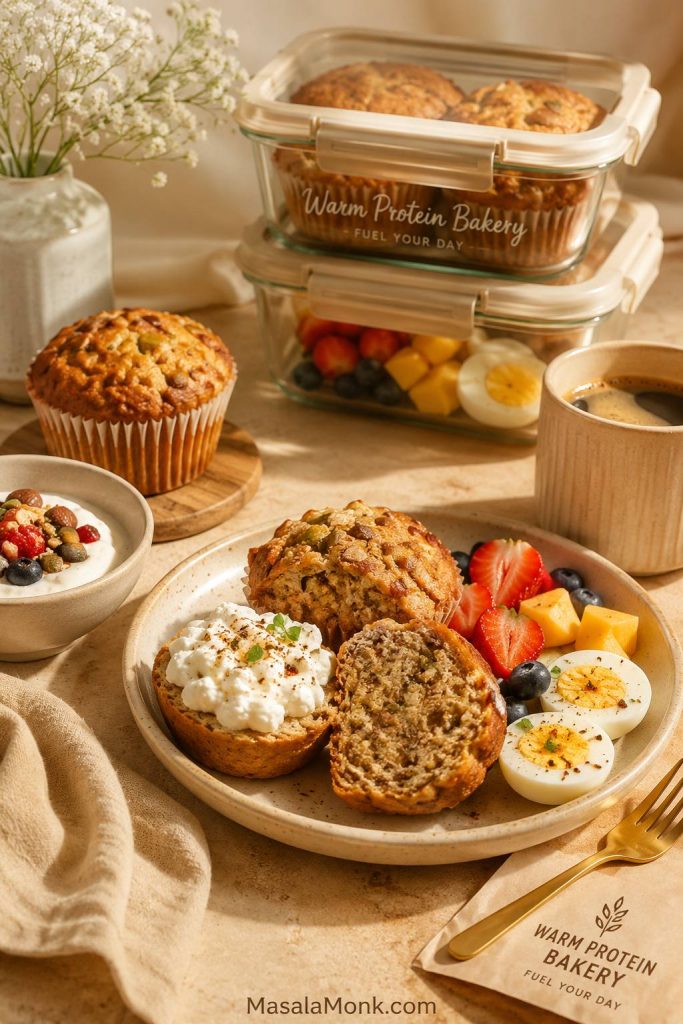
These muffins work well as a quick breakfast, lunchbox item, pre-workout bite, or afternoon snack. For a fuller breakfast, serve one with Greek yogurt, fruit, boiled eggs, cottage cheese, nut butter, or a smoothie.

High protein muffins served with Greek yogurt, fruit, eggs, and coffee for breakfast meal prep.
One muffin can be a quick snack, but it becomes a fuller breakfast with Greek yogurt, fruit, eggs, cottage cheese, or coffee.

When you want a softer, bakery-style breakfast, warm one muffin briefly and split it with a little butter, peanut butter, or almond butter.

For snack prep, pair this recipe with healthy oat protein bars so you have both baked muffins and grab-and-go bars ready for the week.

Once you understand the batter, this becomes an easy recipe to repeat. Keep the base the same, change the fruit or mix-ins, and you have a breakfast muffin that can move from weekday meal prep to a weekend coffee plate without feeling like “diet food.”

For your own next batch, note the protein powder you used and how much milk the batter needed. Once you know that one detail, this recipe becomes easy to repeat with banana, blueberries, chocolate chips, pumpkin, or cottage cheese.

Ready to bake? The full recipe card below gives you the exact amounts, bake time, and adjustment notes. If your protein powder is very absorbent, start with the lower milk amount and add more only after mixing.

High Protein Muffins Recipe Card

A flexible, meal-prep friendly muffin base made with Greek yogurt, protein powder, oat flour or whole wheat flour, and banana or applesauce. Use the notes below to adjust the batter for your protein powder and favorite mix-ins.

Yield12 muffins

Prep Time10 minutes

Bake Time17–22 minutes

Total Time30–35 minutes

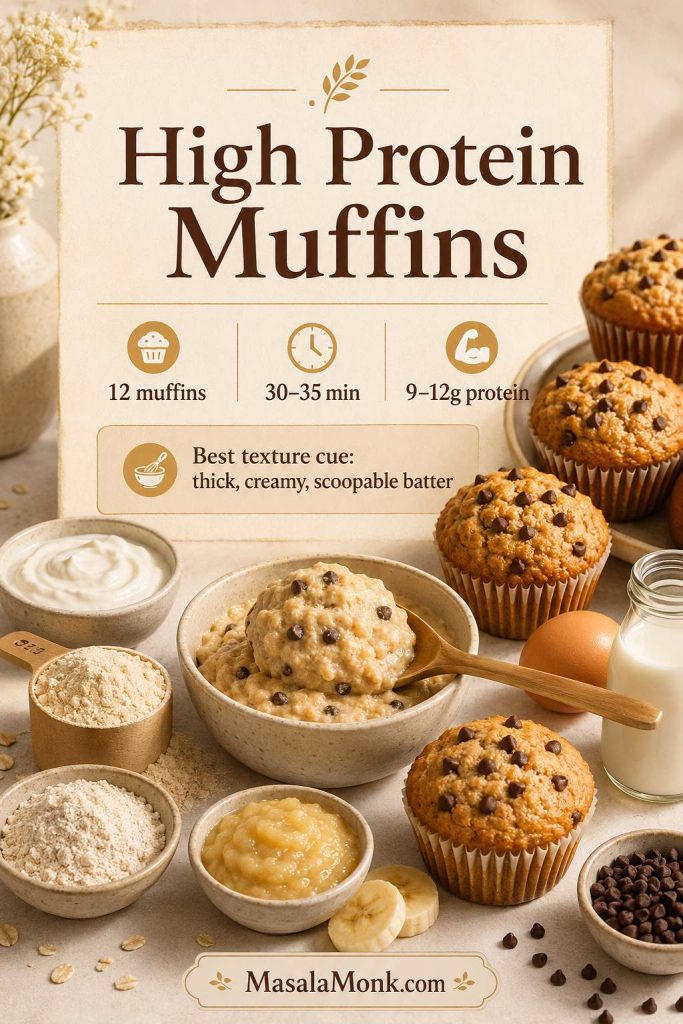
High protein muffins recipe card image with yield, time, protein range, and batter texture cue.
Save the texture cue along with the ingredient list: the batter should hold its shape, feel creamy, and scoop easily before it goes into the muffin tin.

Equipment

  • 12-cup muffin tin
  • Muffin liners or silicone muffin cups
  • Mixing bowls
  • Whisk
  • Rubber spatula
  • ¼ cup scoop or spoon
  • Wire cooling rack

Ingredients

Dry ingredients

  • 1 cup oat flour, 100g, for the default breakfast-style version
  • Flour swap: use 1 cup all-purpose or white whole wheat flour, 120g, for a softer classic muffin texture
  • ½ cup almond flour, about 50–55g, for extra tenderness
  • Almond-free swap: use ½ cup extra oat flour instead
  • ½ cup vanilla protein powder, about 50–60g
  • 2 teaspoons baking powder
  • ½ teaspoon baking soda
  • ½ teaspoon fine salt
  • 1 teaspoon cinnamon

Wet ingredients

  • ¾ cup plain Greek yogurt, about 180g
  • ½ cup mashed ripe banana or unsweetened applesauce, about 120g
  • 2 large eggs
  • ⅓ cup maple syrup or honey, about 80ml
  • 3 tablespoons neutral oil or melted butter, about 45ml
  • 3–6 tablespoons milk, about 45–90ml, starting with 3 tablespoons and adding more only if the batter looks too stiff
  • 2 teaspoons vanilla extract

Optional mix-ins

  • ½ cup mini chocolate chips
  • ½–¾ cup blueberries
  • ½ cup chopped walnuts or pecans
  • 1 tablespoon lemon zest for blueberry muffins
  • ½ teaspoon pumpkin pie spice for a warmer flavor

Instructions

  1. Preheat the oven. Preheat to 375°F / 190°C. Line a 12-cup muffin tin and lightly spray the liners.
  2. Mix the dry ingredients. In a large bowl, whisk together the flour, almond flour or extra oat flour, protein powder, baking powder, baking soda, salt, and cinnamon.
  3. Mix the wet ingredients. In a second bowl, whisk Greek yogurt, mashed banana or applesauce, eggs, maple syrup or honey, oil or melted butter, 3 tablespoons milk, and vanilla.
  4. Combine gently. Add the wet ingredients to the dry ingredients. Fold with a spatula until just combined.
  5. Adjust the batter. The batter should be sturdy but not dry. If it looks stiff, add a small splash of milk. If it looks too loose, add oat flour 1 tablespoon at a time and rest for 5 minutes.
  6. Rest if needed. If using oat flour, casein, pea protein, or a very absorbent plant protein powder, let the batter rest for 5 minutes before scooping.
  7. Add mix-ins. Fold in chocolate chips, blueberries, nuts, or other mix-ins. Do not overmix.
  8. Fill the muffin tin. Divide the batter between 12 muffin cups, filling each about ¾ full.
  9. Bake with a hot start. Bake at 375°F / 190°C for 5 minutes. Without opening the oven, reduce the temperature to 350°F / 175°C and bake for 12–17 more minutes.
  10. Check for doneness. The muffins are done when the tops spring back lightly and a toothpick comes out clean or with a few moist crumbs.
  11. Cool properly. Cool in the pan for 10 minutes, then transfer to a wire rack. Let the muffins cool before storing.

Recipe Notes

  • Best texture cue: the batter should mound on a spoon but still spread slowly in the muffin cup.
  • Protein powder varies: if your batter looks dry, add milk gradually before baking.
  • Banana version: use mashed ripe banana instead of applesauce.
  • Neutral base: use applesauce and vanilla protein powder.
  • Softer muffins: avoid overbaking and give the muffins enough cooling time.
  • Sticking prevention: use silicone liners or spray paper liners lightly.
  • Dairy-free batch: use thick dairy-free yogurt and a plant-based protein powder, then adjust the milk as needed.

Approximate Nutrition

Approximate per muffin, based on 12 muffins: 180–230 calories, 9–12g protein, 20–28g carbohydrates, 6–10g fat, and 2–4g fiber. Exact numbers vary by protein powder, yogurt, flour, sweetener, milk, and mix-ins.

Storage

Store fully cooled muffins in an airtight container in the refrigerator for 4–5 days, or freeze for up to 3 months. Reheat briefly in the microwave until just warm.

FAQs About High Protein Muffins

How much protein is in each muffin?

Each muffin has about 9–12 grams of protein depending on the protein powder, yogurt, flour, milk, eggs, and mix-ins you use. For the most accurate number, calculate using the exact brands and amounts in your kitchen.

What if I do not want to use protein powder?

A no-powder version needs a slightly different formula built around cottage cheese, Greek yogurt, eggs, oats, nut butter, or seeds. Simply removing the protein powder from this recipe will change the flour-to-liquid balance.

Which protein powder works best for muffins?

A vanilla whey blend or plant-based blend is the easiest starting point. Whey isolate can bake dry if used heavily, while casein and some plant powders may need extra milk because they absorb more liquid.

Why did my protein muffins turn dry?

Dry muffins usually come from too much protein powder, not enough liquid, overbaking, or using a powder that absorbs heavily. Next time, add more yogurt or milk and check the muffins earlier.

Why is my batter thicker than regular muffin batter?

Protein powder, oat flour, and Greek yogurt all make the batter sturdier than a classic muffin batter. It should still be scoopable, not dry. Let it rest for 5 minutes, then loosen with a small splash of milk if needed.

Does oat flour work in this recipe?

Oat flour works well and gives the muffins a breakfast-style flavor. The texture will be slightly heartier than all-purpose flour. If the batter gets too stiff, add a little more milk.

How should I freeze and reheat them?

Cool the muffins fully, freeze them individually, then move them to a freezer bag or airtight container for up to 3 months. To reheat, microwave briefly from frozen or thaw overnight in the fridge.

How do I make a dairy-free version?

Choose a thick dairy-free yogurt and a plant-based protein powder. Because plant-based powders often absorb more liquid, add milk gradually until the batter looks sturdy but workable.

Blueberries or chocolate chips: which works better?

Both work well, but they give different results. Blueberries make the muffins feel fresher and more breakfast-like, while mini chocolate chips make them feel more snackable. Keep mix-ins around ½–¾ cup so the muffins bake evenly.

How do I know when they are done?

The tops should spring back lightly, and a toothpick should come out clean or with a few moist crumbs. Pull them before they feel firm and dry because they continue to set as they cool.

Are these filling enough for breakfast?

They can be, especially when paired with fruit, Greek yogurt, cottage cheese, eggs, or coffee. On their own, they are more filling than a regular muffin because they include protein-rich ingredients and a more substantial crumb.

If you try these, leave a note with the protein powder you used, whether you chose banana or applesauce, and how much milk your batter needed. Those little details often help the next reader get a softer batch on the first try.

Back to top

Posted on 2 Comments

Breakfast Casserole with Hash Browns

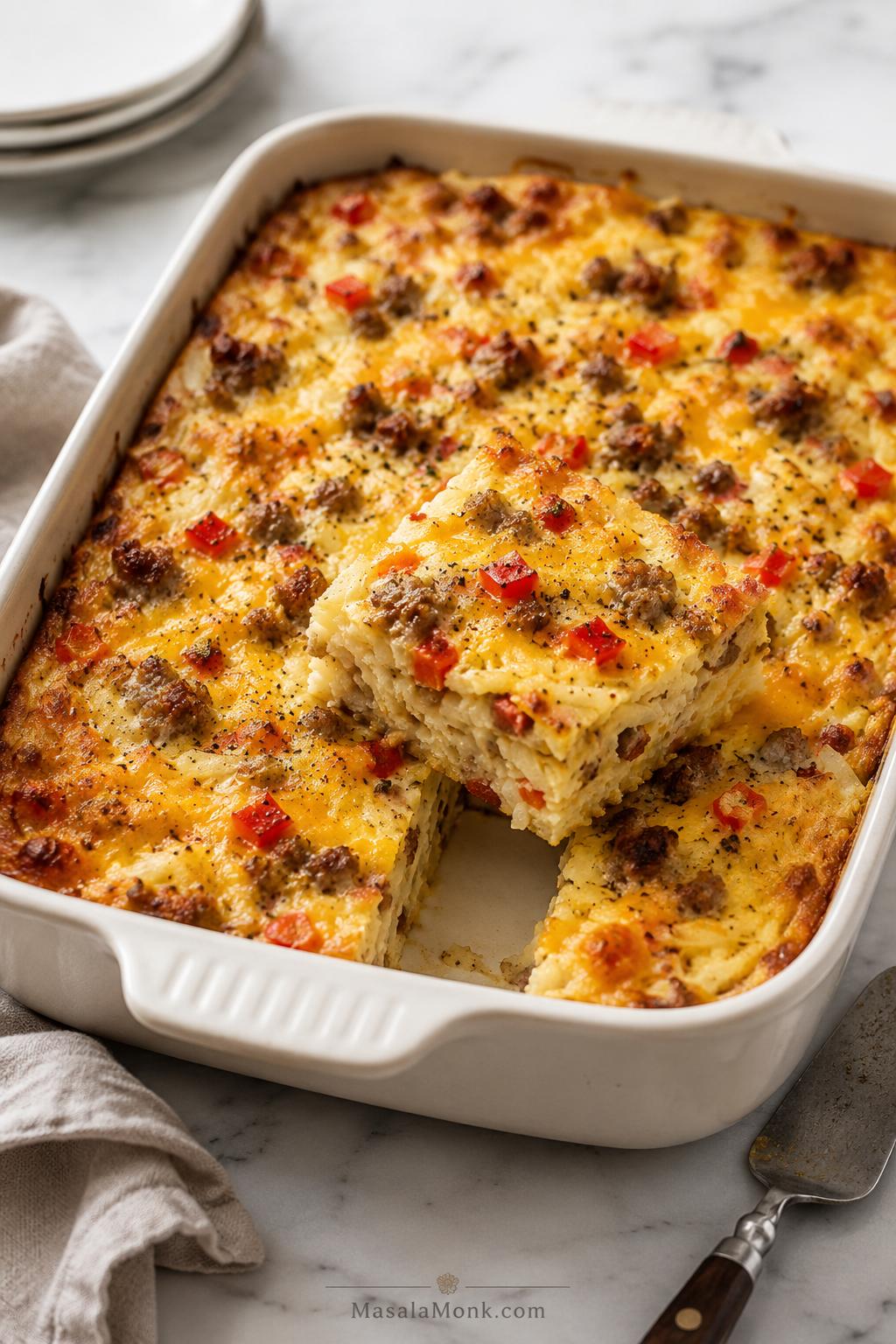
Breakfast casserole with hash browns, sausage, eggs, cheese, peppers, and golden edges in a 9x13 baking dish.

This breakfast casserole with hash browns is the egg-based brunch bake to make when you want something hearty, cheesy, sliceable, and easy to prep ahead. Frozen shredded hash browns, eggs, sausage, cheese, and a creamy egg mixture bake together in a 9×13 pan until the center is softly set, the cheese melts into the potatoes, and the edges turn golden.

The key is moisture control. Hash brown breakfast casserole can turn watery, greasy, rubbery, or bland if the potatoes are too wet, the meat is not drained, or the vegetables go in raw. This version shows you how to avoid that, plus how to make it with bacon, ham, no meat, hash brown patties, or overnight prep.

It is the kind of casserole that makes sense when the morning already has enough going on, whether that means Christmas breakfast, Easter brunch, overnight guests, a weekend family breakfast, or a meal-prep Sunday where one pan needs to handle the eggs, potatoes, cheese, and sausage.

This pan is especially good for the kind of morning where people drift into the kitchen at different times, coffee is still being poured, and nobody wants to stand at the stove making eggs in batches. It comes out hot, cheesy, and ready to slice, and everyone can make it their own with hot sauce, scallions, salsa, or fruit on the side.

This is the egg-based breakfast version. If you were looking for the creamy cheesy potato side dish made with sour cream, cheddar, cream soup or homemade sauce, and a crunchy topping, use this hashbrown casserole recipe instead. That one is the dinner-side and potluck version; this one is the breakfast casserole with eggs.

Quick Answer: Breakfast Casserole with Hash Browns

To make breakfast casserole with hash browns, layer thawed and patted-dry frozen shredded hash browns in a greased 9×13-inch baking dish with cooked sausage, sautéed onion and bell pepper, and shredded cheese. Pour over a mixture of eggs, milk or half-and-half, sour cream or Greek yogurt, and seasoning. Bake at 350°F / 175°C for 45–55 minutes, or until the center is set and the edges are lightly golden.

The texture is much better when the hash browns are thawed and excess moisture is removed before baking. This keeps the casserole from turning watery and helps the eggs set more evenly. If that is your main concern, the watery casserole fixes below are worth reading before you assemble the pan. If you assemble it the night before, bake it cold from the fridge and add a few extra minutes as needed.

The finished bake should feel hearty but not heavy: tender eggs, savory sausage, melted cheese, and hash browns that taste like breakfast potatoes instead of a wet potato layer.

Best default formula: 30 oz / 850 g frozen shredded hash browns + 10 large eggs + 1 lb / 454 g cooked sausage + 2 cups / 225 g cheese + 1 cup / 240 ml milk or half-and-half + ½ cup / 120 g sour cream or Greek yogurt.

This is the version I would choose for a holiday breakfast, a brunch table, or a meal-prep pan because it is sturdy enough to slice but still soft and creamy in the center.

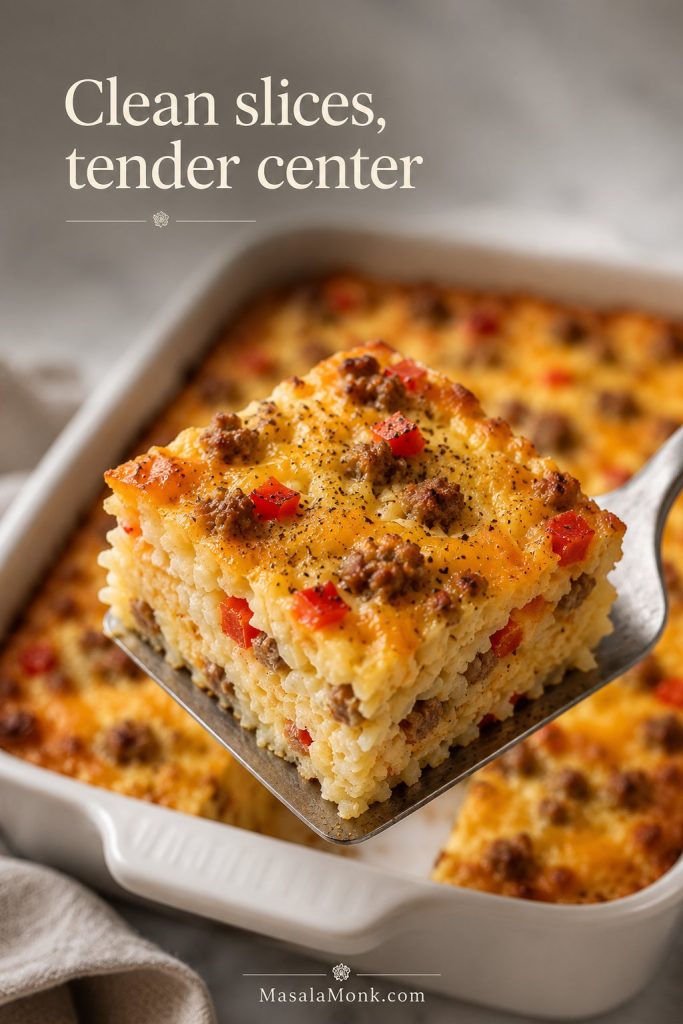
Lifted slice of hash brown breakfast casserole showing eggs, sausage, cheese, peppers, and shredded potato layers.
A clean slice tells you the casserole had enough eggs, the hash browns were not too wet, and the pan rested before cutting.

Hash Brown Breakfast Casserole at a Glance

Best pan 9×13-inch / 23×33 cm baking dish
Oven temperature 350°F / 175°C
Hash browns 30 oz / 850 g frozen shredded hash browns, thawed and patted dry
Eggs 10 large eggs for balanced texture; 12 for a taller egg bake
Default protein 1 lb / 454 g breakfast sausage, cooked and drained
Cheese 2 cups / about 225 g shredded cheddar, Colby Jack, Monterey Jack, or pepper Jack
Bake time 45–55 minutes, or 55–65 minutes if chilled overnight
Make-ahead Assemble overnight, or prep components separately for the cleanest texture

Breakfast Casserole vs Hashbrown Casserole

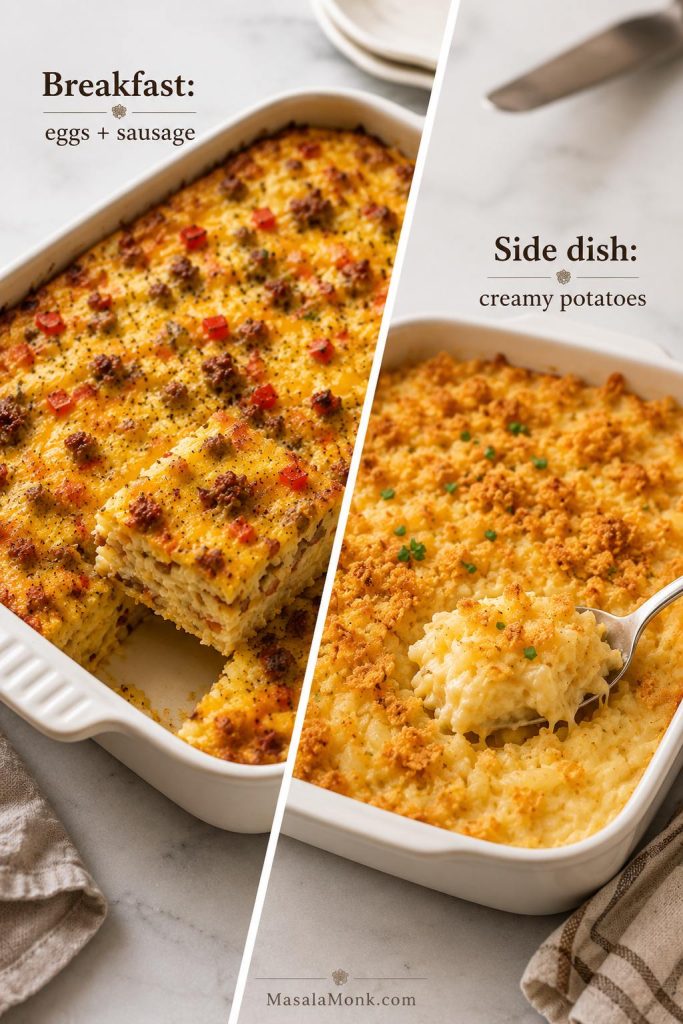
The phrase “hashbrown casserole” can mean two different dishes. This recipe is a breakfast casserole with hash browns, which means it has eggs, cheese, hash browns, and usually sausage, bacon, ham, or vegetables. It is baked like a brunch egg casserole and served in slices.

A classic side-dish hashbrown casserole is different. That version is usually a creamy potato bake with sour cream, cheddar, cream soup or homemade sauce, butter, and sometimes a crunchy topping. It is served with dinner, holiday meals, potlucks, and barbecue-style mains. This breakfast version stays in the egg-and-brunch lane.

Use this breakfast version when you want eggs and protein in the same pan. Use the side-dish version when you want a cheesy potato casserole to serve next to ham, chicken, barbecue, or a holiday dinner spread.

Split comparison of egg-based breakfast casserole with hash browns and creamy side-dish hashbrown casserole.
Although both dishes use hash browns, this breakfast casserole is built around eggs and protein, while the side-dish version is creamier, softer, and meant for dinner plates or potlucks.

Why This Hash Brown Breakfast Casserole Works

The best hash brown breakfast casseroles taste like a real breakfast plate baked into one pan: golden potatoes, savory sausage, soft eggs, sweet peppers, and melted cheese. This recipe works because each part is handled before it goes into the dish instead of asking the oven to fix everything at once.

Thawed, dried hash browns do not leak water into the eggs. Cooking and draining the sausage first keeps the casserole savory without making it greasy. A quick sauté gives the onion and bell pepper time to soften and lose some moisture before baking.

Milk or half-and-half keeps the eggs tender, while sour cream or Greek yogurt adds body and creaminess without making the center loose. Dry mustard or Dijon, garlic powder, pepper, and enough salt help season the potatoes, not just the eggs.

Resting is the quiet step that makes the slices look better. Like many egg bakes, this casserole firms as it sits, so cutting into it right away can make the center look looser than it really is.

Ingredients for Hash Brown Breakfast Casserole

The main version is a sausage breakfast casserole with hash browns, but the same base works with bacon, ham, or vegetables. If you are not sure which potatoes to use, jump to the hash brown comparison before you start. Here is what each ingredient does.

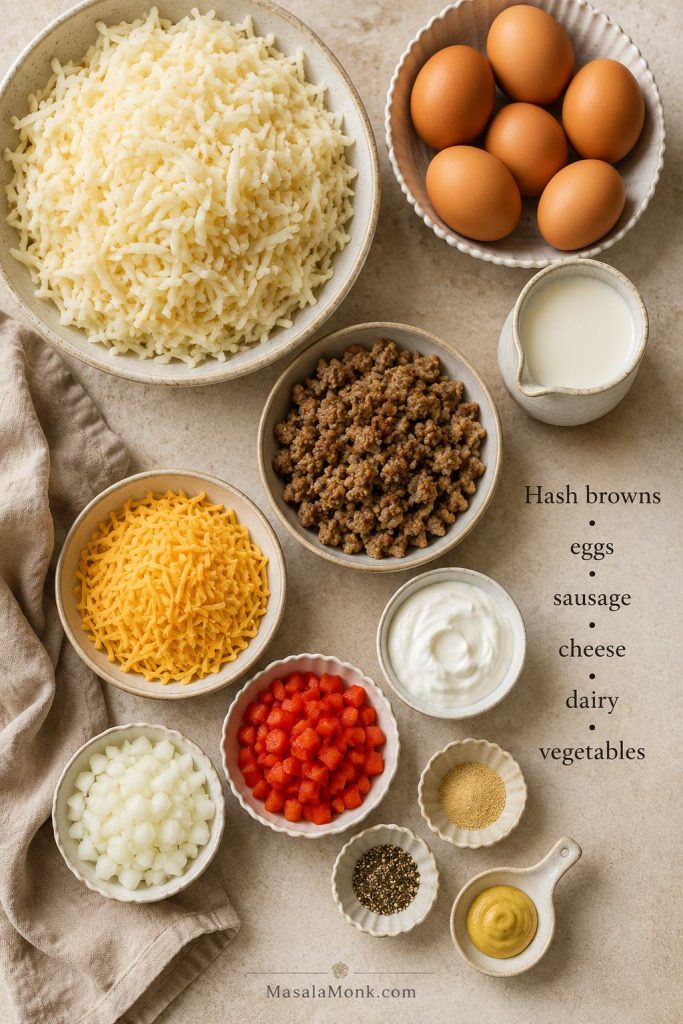
Ingredients for breakfast casserole with hash browns, including eggs, sausage, cheese, dairy, peppers, onion, seasonings, and thawed potatoes.
The best texture starts before baking: thawed potatoes, cooked sausage, sautéed vegetables, and a balanced egg mixture all help the casserole set evenly.

Hash Browns

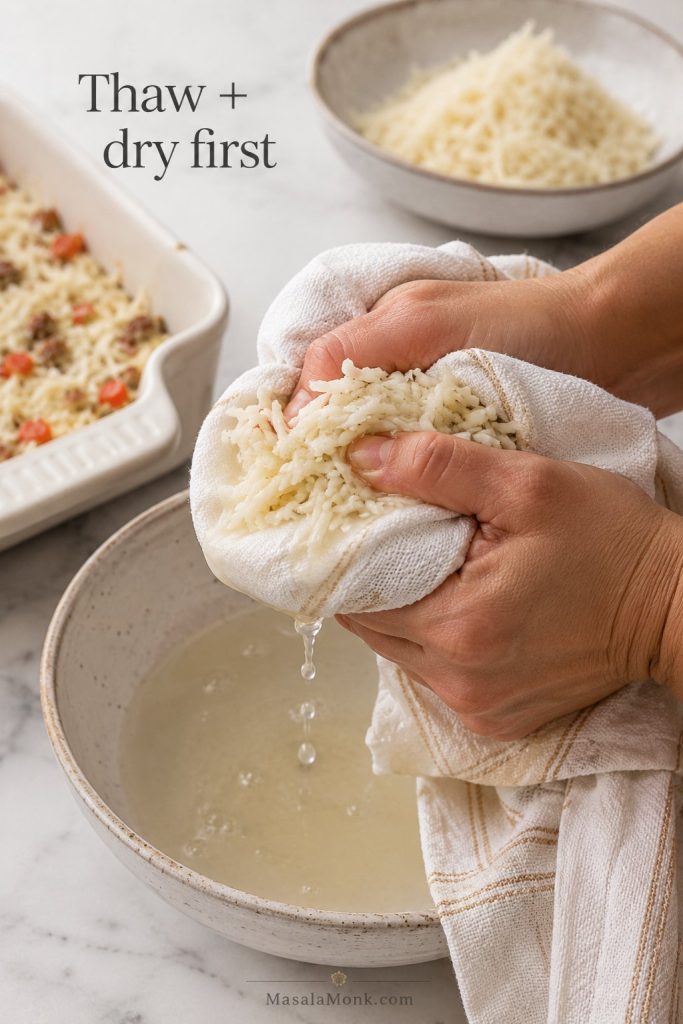
Use 30 oz / 850 g frozen shredded hash browns for the most classic texture. Thaw them first, then pat them dry with paper towels or squeeze gently in a clean kitchen towel if they feel wet. This step is one of the biggest differences between a clean, sliceable casserole and a watery one.

Thawed shredded hash browns being pressed dry in a towel before making breakfast casserole.
Drying thawed hash browns is the easiest no-soggy step because it removes extra moisture before the eggs ever hit the pan.

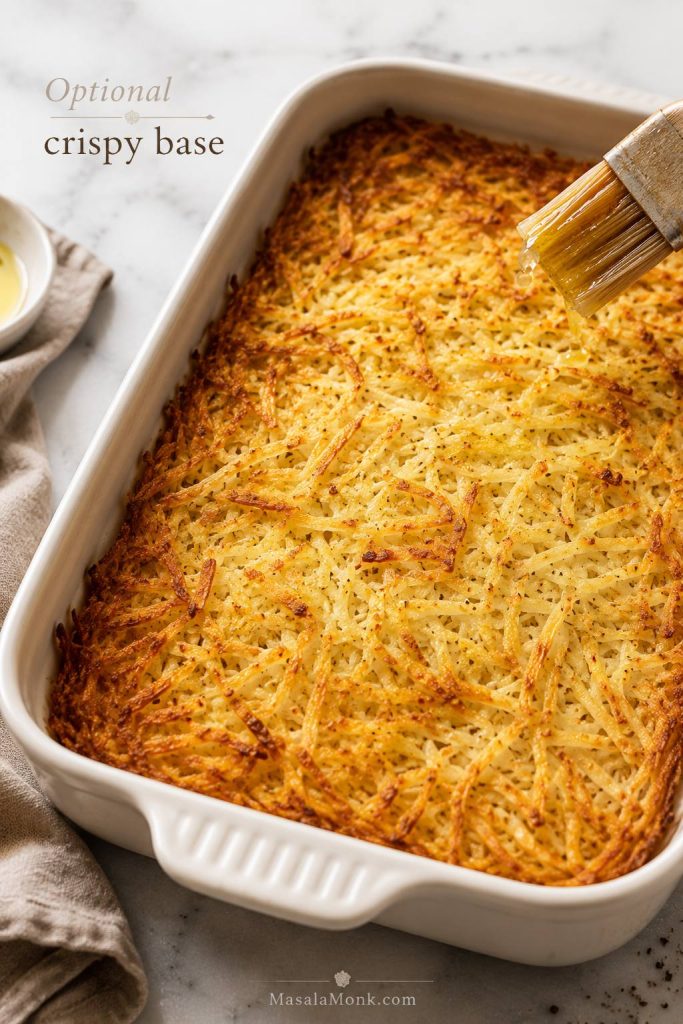
For a more golden potato layer, see the crispy hash brown base option before layering the eggs.

If you are still deciding which kind of potatoes to use, this air fryer hash browns guide is useful because it explains frozen shredded hash browns, patties, diced potatoes, and homemade grated potatoes in more detail.

Eggs

Use 10 large eggs for a creamy, balanced 9×13 casserole. If you want a taller, more egg-forward breakfast bake, use 12 eggs. If you use fewer than 8 eggs in a 9×13 pan, the casserole becomes more potato-heavy and may not hold together as neatly.

Dairy

Use 1 cup / 240 ml whole milk or half-and-half plus ½ cup / 120 g sour cream or Greek yogurt. Whole milk keeps the casserole lighter; half-and-half makes it richer. Sour cream gives a softer, creamier texture and helps the egg layer feel less flat.

Cheese

Use 2 cups / about 225 g shredded cheese. Cheddar gives the most classic breakfast-casserole flavor, Colby Jack melts smoothly, Monterey Jack keeps things mild and creamy, and pepper Jack adds a little heat without changing the whole dish. Divide the cheese so some melts into the casserole and some goes on top.

Sausage, Bacon, Ham, or No Meat

The default is 1 lb / 454 g breakfast sausage, cooked and drained. You can replace it with cooked bacon, diced ham, or sautéed vegetables. For a bacon version, cook the bacon first and crumble it before adding it to the pan.

Vegetables and Seasoning

Onion and bell pepper are the safest default because they bring sweetness and color without overwhelming the casserole. Sauté them first. Raw vegetables can release water as they bake, especially mushrooms, spinach, zucchini, and peppers. For seasoning, use garlic powder, black pepper, dry mustard or Dijon, and enough salt to season the potatoes.

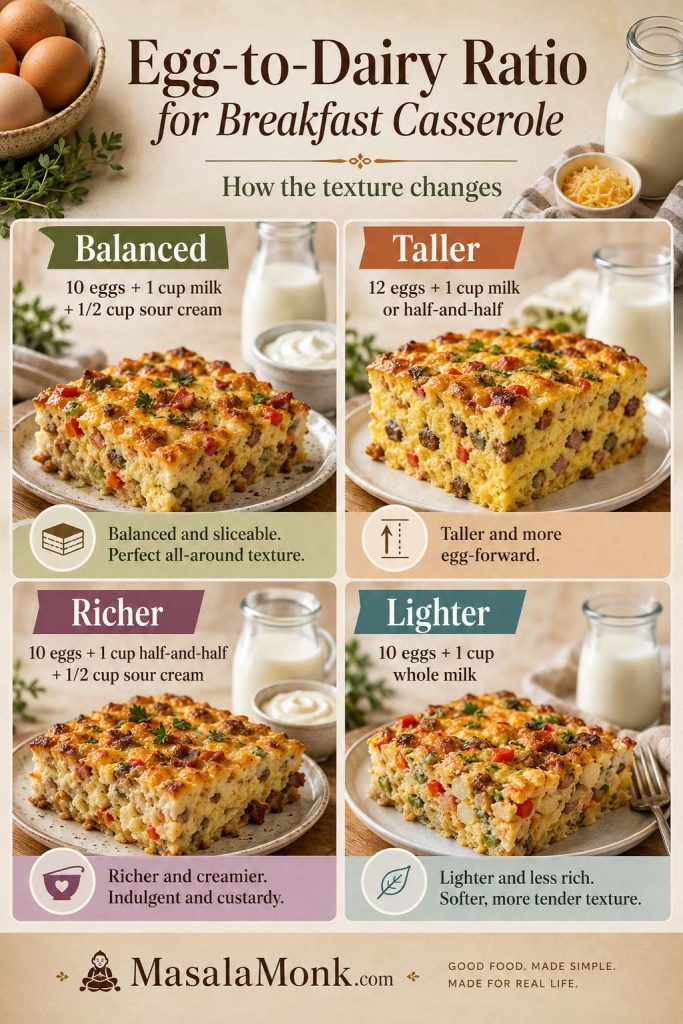
Egg-to-Dairy Ratio for a 9×13 Breakfast Casserole

The egg-to-dairy balance is what keeps the center creamy instead of wet. Use this table if you want to make the bake taller, richer, lighter, or more sliceable.

Texture Goal Eggs Dairy
Balanced and sliceable 10 large eggs 1 cup milk + ½ cup sour cream
Taller and more egg-forward 12 large eggs 1 cup milk or half-and-half
Richer and creamier 10 large eggs 1 cup half-and-half + ½ cup sour cream
Lighter 10 large eggs 1 cup whole milk only
Egg-to-dairy ratio guide for making hash brown breakfast casserole balanced, taller, richer, or lighter.
Once the base formula is right, small egg and dairy changes can make the casserole taller, richer, lighter, or easier to slice.

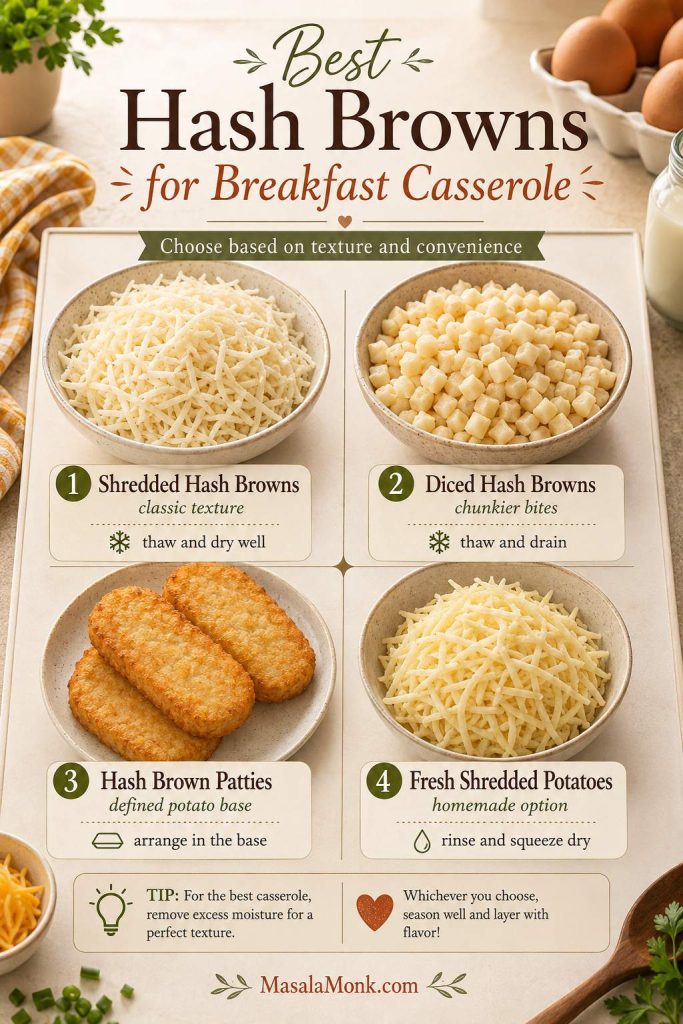
Best Hash Browns for Breakfast Casserole

Most breakfast casserole recipes use frozen shredded hash browns, but they are not the only option. The best choice depends on whether you want a soft, classic casserole, a chunkier potato bite, or a more defined potato layer.

Comparison of shredded hash browns, diced hash browns, hash brown patties, and fresh shredded potatoes for breakfast casserole.
Shredded hash browns give the classic soft breakfast casserole texture; patties create a more defined base, while diced potatoes make the bake chunkier.
Hash Brown Type Best For How to Use
Frozen shredded hash browns Classic breakfast casserole texture Thaw, pat dry, and layer into the pan.
Diced hash browns Chunkier, potato-forward casserole Thaw if frozen. Bake time may be slightly longer.
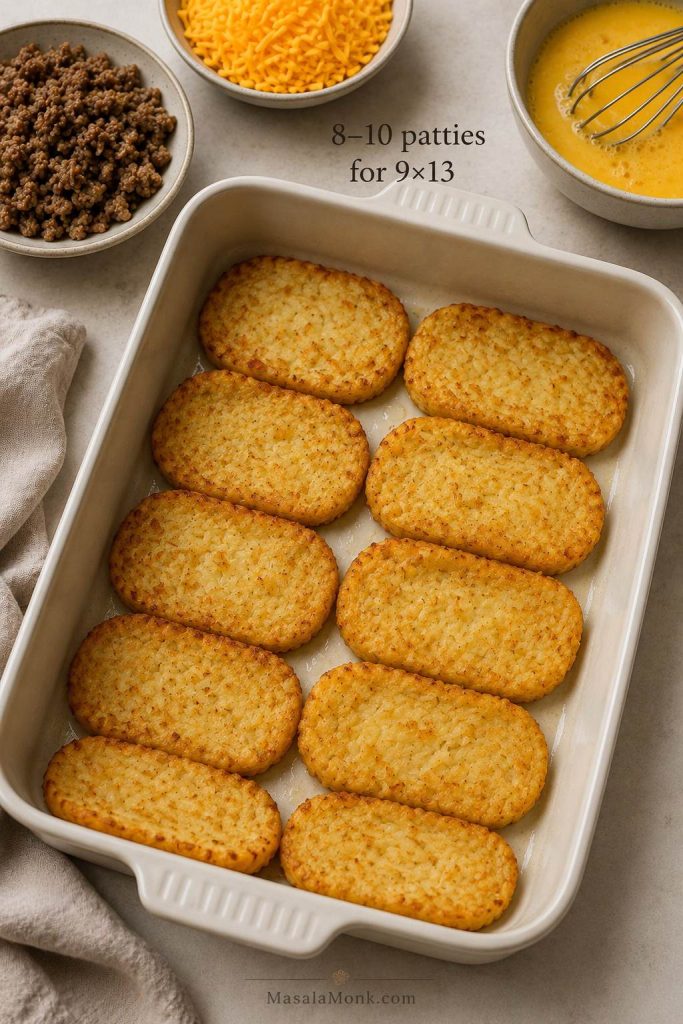
Hash brown patties Defined potato base or shortcut layer Arrange 8–10 patties in the bottom of a 9×13 pan.
Refrigerated shredded hash browns Fast prep, less thawing Pat dry if damp. Use the same amount by weight.
Fresh shredded potatoes Homemade version Rinse, drain, and squeeze very dry before using.

O’Brien-style hash browns, which usually include diced peppers and onions, also work. Because they already include vegetables, reduce or skip the fresh bell pepper and onion in the recipe, and make sure the potatoes are thawed so the casserole does not bake up watery.

Should You Thaw Hash Browns First?

For this recipe, yes. Thawing is the safer choice because frozen hash browns can release extra moisture into the egg mixture and extend the bake time. Longer bake time can make the edges overcook before the center sets.

The best method is to thaw the hash browns in the refrigerator overnight, then pat them dry. If they feel wet, squeeze them gently in a clean towel. They do not need to be bone-dry, but they should not be icy or dripping.

Can You Use Frozen Hash Browns Without Thawing?

You can bake this with frozen hash browns, but thawed and dried hash browns give a cleaner, less watery casserole. If speed matters more than sliceability, use them frozen and expect a softer center and a longer bake time.

Should You Brown the Hash Browns First?

You do not have to, but it gives the casserole better potato flavor and helps remove moisture. To do it, warm a little butter or oil in a large skillet, add the thawed hash browns, and cook for 5–8 minutes until some of the moisture evaporates and a few edges turn lightly golden. Then spread them into the baking dish.

Want a Crispier Hash Brown Base?

If you want the potato layer to taste more like diner-style breakfast potatoes, pre-bake it before adding the eggs. Spread the thawed hash browns in the greased baking dish, drizzle with 2 tablespoons melted butter or oil, and bake at 400°F / 200°C for 15–20 minutes. Then add the sausage, cheese, and egg mixture and bake as directed.

This step is optional, but it makes the edges more golden and gives the casserole a more memorable first bite.

Pre-baked crispy hash brown base in a baking dish before eggs, sausage, and cheese are added.
Pre-baking the hash brown layer is optional, but it adds golden edges and a more diner-style potato flavor underneath the eggs.

How to Keep It from Getting Watery

The biggest mistake with breakfast casserole with hash browns is adding too much hidden moisture. Hash browns, vegetables, sausage, bacon, and spinach can all release liquid into the eggs if they are not handled first.

Moisture Source What to Do Why It Helps
Frozen shredded hash browns Thaw and pat dry before layering. Prevents icy potatoes from watering down the egg mixture.
Bell peppers and onions Sauté for 3–5 minutes first. Softens the vegetables and cooks off extra water.
Mushrooms Cook until their liquid evaporates. Stops them from leaking water into the eggs.
Spinach Wilt and squeeze dry before adding. Keeps the casserole from turning loose or watery.
Sausage or bacon Cook and drain well. Prevents grease from pooling around the eggs.

The cleanest slices come from thawed hash browns, cooked vegetables, drained meat, and a wide 9×13-inch dish. For extra potato flavor, lightly brown the hash browns in a skillet before layering them into the casserole.

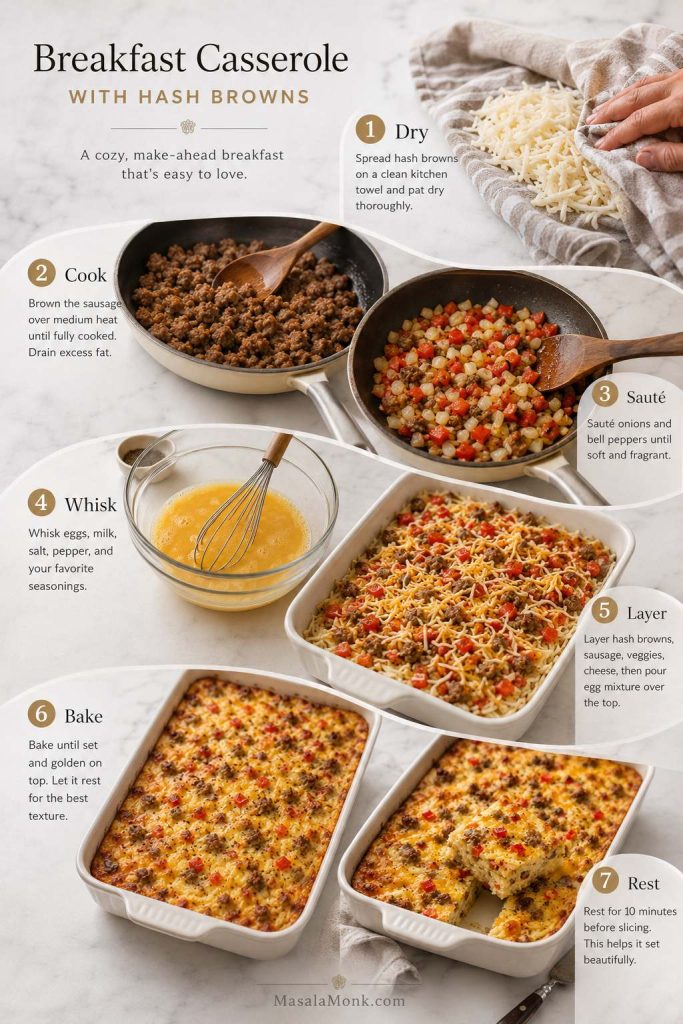
How to Make Breakfast Casserole with Hash Browns

This is the basic 9×13 method. It is simple, but the order matters. For exact amounts while you cook, use the recipe card.

Step-by-step guide showing dried potatoes, cooked sausage, sautéed vegetables, whisked eggs, layering, baking, and resting.
Follow the order for the best result: dry the potatoes, cook the filling, whisk the eggs, layer evenly, bake until set, then rest.

1. Prepare the Baking Dish

Grease a 9×13-inch / 23×33 cm baking dish with butter or nonstick spray. A 3-quart baking dish works well. Avoid a very deep smaller dish unless you are prepared to bake longer.

2. Thaw and Dry the Hash Browns

Thaw the frozen shredded hash browns, then pat them dry. Spread them evenly in the bottom of the prepared baking dish. Season this layer lightly because potatoes need more seasoning than eggs.

3. Cook the Sausage

Cook the sausage in a large skillet over medium heat, breaking it into small pieces. Drain off excess grease. If you are using bacon, cook it until crisp and crumble it. If you are using ham, it usually only needs to be diced.

4. Sauté the Vegetables

In the same skillet, cook the onion and bell pepper for a few minutes until slightly softened. This keeps them from releasing too much water into the casserole.

5. Whisk the Egg Mixture

In a large bowl, whisk the eggs, milk or half-and-half, sour cream or Greek yogurt, garlic powder, dry mustard or Dijon, black pepper, and salt. Whisk until the mixture looks smooth and evenly blended.

6. Layer the Casserole

Scatter the cooked sausage, sautéed vegetables, and most of the cheese over the hash browns. Pour the egg mixture evenly over the top. Use a spatula to gently nudge the filling so the eggs settle into the layers. Finish with the remaining cheese.

7. Bake Until Set

Bake at 350°F / 175°C for 45–55 minutes, or until the edges are puffed and lightly golden and the center no longer jiggles loosely. Do not wait for the whole top to look dry; the casserole will continue to firm as it rests. If it was refrigerated overnight, it may need 55–65 minutes.

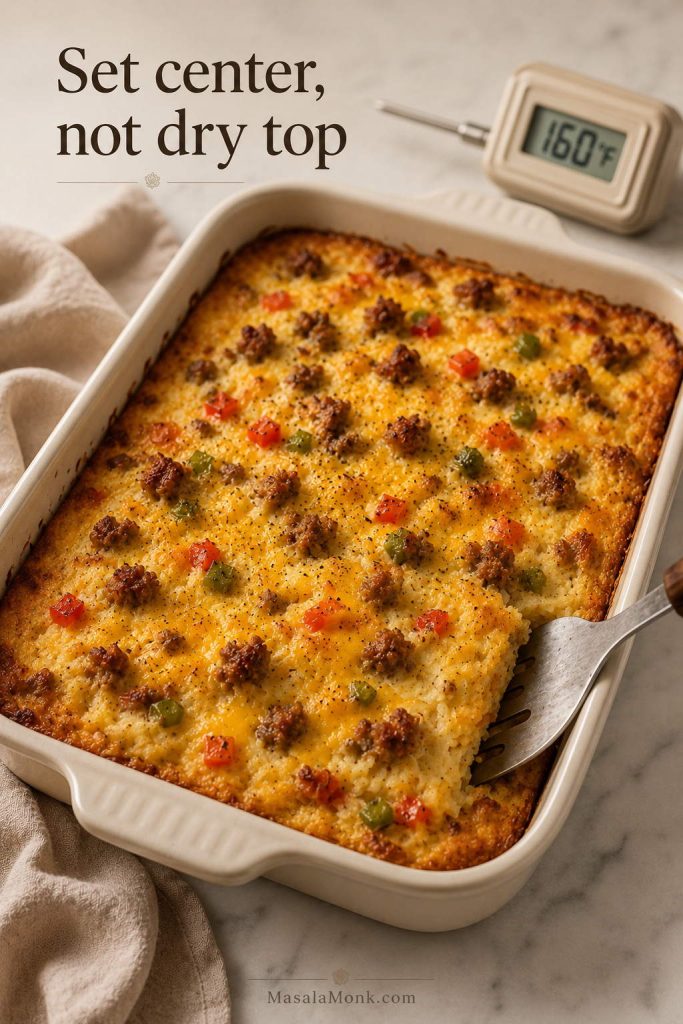
Finished breakfast casserole with hash browns, golden edges, set center, sausage, peppers, cheese, and thermometer cue.
Stop baking when the center is set but the top still looks tender; a completely dry-looking surface usually means the eggs have gone too far.

8. Rest Before Slicing

Let the casserole rest for 10–15 minutes before cutting. This improves the texture and makes the slices cleaner.

If this is your first time making it, start with the sausage-and-cheddar version below. It gives you the cleanest baseline for texture, seasoning, and bake time, then the bacon, ham, spicy, vegetarian, and patty versions are easy to adjust later.

Recipe Card: Breakfast Casserole with Hash Browns

This make-ahead breakfast casserole bakes hash browns, eggs, sausage, and cheese into a creamy, savory 9×13 breakfast bake with golden edges and clean slices. It is hearty enough for brunch, holidays, or breakfast meal prep.

Servings
10–12
Prep Time
20 minutes
Cook Time
45–55 minutes
Total Time
About 1 hour 15 minutes

Equipment

  • 9×13-inch / 23×33 cm baking dish
  • Large skillet
  • Large mixing bowl
  • Whisk
  • Spatula
  • Foil, optional for overnight storage or if the top browns too quickly

Ingredients

  • 30 oz / 850 g frozen shredded hash browns, thawed and patted dry
  • 1 lb / 454 g breakfast sausage
  • ½ cup / 75 g diced onion
  • 1 cup / 120–150 g diced bell pepper
  • 10 large eggs
  • 1 cup / 240 ml whole milk or half-and-half
  • ½ cup / 120 g sour cream or plain Greek yogurt
  • 2 cups / about 225 g shredded cheddar, Colby Jack, or Monterey Jack, divided
  • 1 tsp kosher salt, or to taste depending on sausage and cheese
  • ½ tsp black pepper
  • ½ tsp garlic powder
  • ½ tsp dry mustard or 1 tsp Dijon mustard
  • Optional: ¼ tsp smoked paprika, a few dashes hot sauce, sliced scallions for serving

Instructions

  1. Preheat the oven to 350°F / 175°C. Grease a 9×13-inch baking dish.
  2. Thaw the hash browns and pat them dry. Spread them evenly in the prepared baking dish.
  3. Cook the sausage in a large skillet over medium heat until browned and fully cooked. Break it into small crumbles, then drain excess grease.
  4. Add the diced onion and bell pepper to the skillet and cook for 3–5 minutes, until slightly softened. Scatter the sausage and vegetables over the hash browns.
  5. Sprinkle about 1½ cups of the cheese over the potato and sausage layer. Save the remaining ½ cup for the top.
  6. In a large bowl, whisk the eggs, milk or half-and-half, sour cream or Greek yogurt, salt, pepper, garlic powder, and dry mustard or Dijon until smooth.
  7. Pour the egg mixture evenly over the casserole. Gently press the filling with a spatula so the egg mixture settles through the layers. Sprinkle the remaining cheese on top.
  8. Bake for 45–55 minutes, until the edges are lightly golden, the center is set, and the middle no longer sloshes when the dish is gently moved. If baking straight from the refrigerator, plan on 55–65 minutes.
  9. Rest for 10–15 minutes before slicing. Top with scallions or hot sauce if you like.

Notes

  • Use 12 eggs instead of 10 if you want a taller, more egg-forward casserole.
  • While you prep the sausage and vegetables, you can let the eggs sit out for 15–20 minutes so they blend more easily and bake a little more evenly.
  • Thaw and dry the hash browns before baking for the cleanest texture.
  • Replace the sausage with 2½–3 cups cooked vegetables for a no-meat version.
  • Use 1½ cups / 225 g diced ham instead of sausage for a ham version.
  • Use about 1 cup cooked crumbled bacon for a bacon version. For an easier prep option, cook the strips first using this air fryer bacon recipe, then crumble them into the casserole.
  • If using hash brown patties, use 8–10 patties in the bottom of the pan and expect a slightly longer bake.
  • To avoid a watery casserole, do not add raw mushrooms, raw spinach, or icy hash browns directly to the pan.
  • If the top browns before the center is set, loosely cover the dish with foil.
  • Egg-based casseroles should be cooked until set; for food safety, egg dishes are commonly cooked to 160°F / 71°C. See the FDA’s egg safety guidance for more detail: What You Need to Know About Egg Safety.
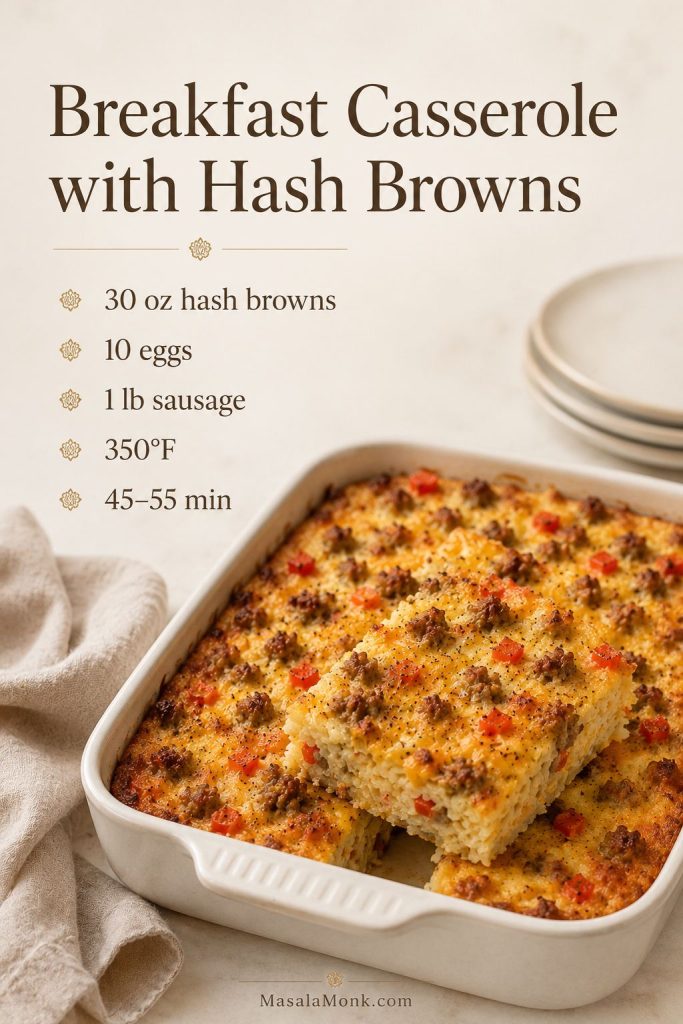
Recipe card for breakfast casserole with hash browns showing 30 ounces hash browns, 10 eggs, 1 pound sausage, 350°F, and 45 to 55 minutes.
Start with the dependable 9×13 formula: 30 ounces hash browns, 10 eggs, 1 pound sausage, cheese, dairy, and a 350°F bake.

Overnight Breakfast Casserole with Hash Browns

This casserole is ideal for making ahead because the ingredients are sturdy and the 9×13 format feeds a group. You have two good options: the easiest overnight method and the best-texture method.

If you are making this for guests, the overnight version is less about saving ten minutes and more about saving your morning. The sausage is cooked, the cheese is ready, the potatoes are handled, and breakfast can go into the oven before the kitchen gets busy.

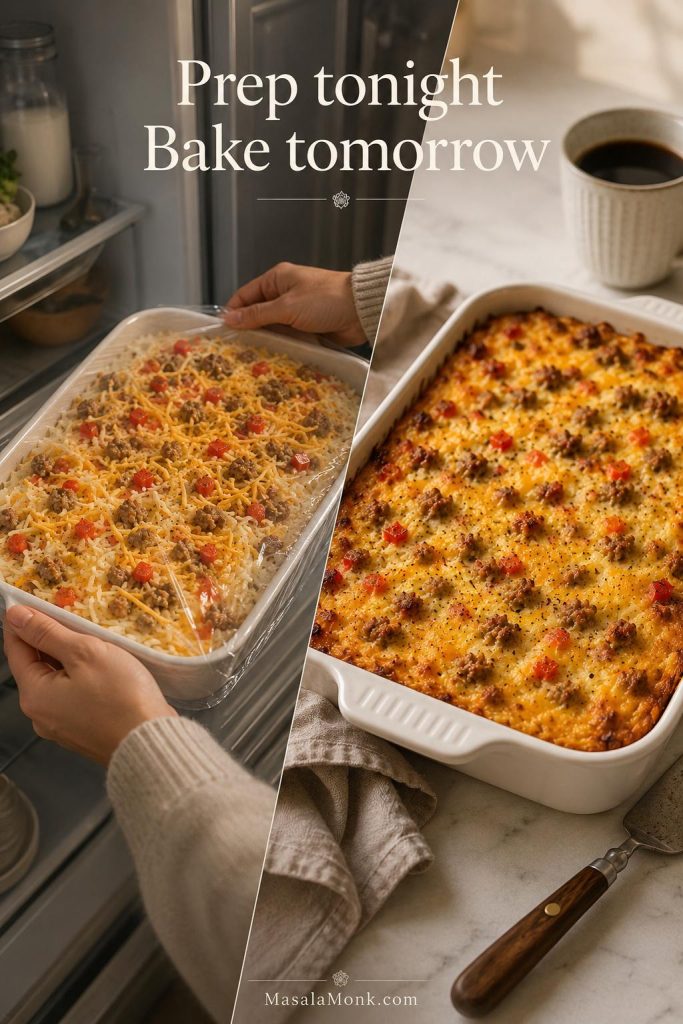
Overnight breakfast casserole with hash browns being prepared in the refrigerator and baked the next morning.
Overnight prep is useful because the potatoes, sausage, cheese, and egg mixture are handled before the morning gets busy.

Easy Overnight Method

Assemble the entire casserole in the baking dish, cover tightly, and refrigerate overnight. In the morning, let the dish sit at room temperature while the oven preheats. Bake as directed, adding 5–10 minutes if the center is still loose.

Best-Texture Overnight Method

For the cleanest texture, prep the components separately. Cook and drain the sausage, sauté the vegetables, thaw and dry the hash browns, and whisk the egg mixture. Refrigerate everything separately, then assemble just before baking. This prevents the potatoes from sitting in the egg mixture all night and gives a neater slice.

Overnight tip: If your hash browns are very wet or your vegetables are raw, the casserole can turn watery by morning. Dry the potatoes well, cook the vegetables first, and drain the meat before assembling.

Can You Bake It Straight from the Fridge?

Yes. A cold casserole usually needs extra time. Start checking around 50 minutes, but do not be surprised if it takes 55–65 minutes. When the top browns quickly while the center is still soft, cover the dish loosely with foil and keep baking.

If you are baking from cold, use the doneness cues rather than the clock alone.

Sausage, Bacon, Ham, and No-Meat Hash Brown Breakfast Casserole

Once the base is set, this recipe becomes very flexible. Sausage is the classic choice, bacon makes it smoky, ham makes it perfect for leftovers, and the no-meat version works well when the vegetables are cooked first. Pick the version that fits your morning rather than changing the whole recipe.

For the most dependable first batch, use sausage, cheddar or Colby Jack, thawed shredded hash browns, and the 10-egg base. Bacon, ham, cream cheese, pepper Jack, and extra vegetables all work, but they change salt, moisture, richness, or bake time.

If you are using patties instead of shredded potatoes, go straight to the hash brown patty version because the setup and bake time are slightly different.

If your family already has a “usual” breakfast casserole version, this is the section to make it yours. Some houses are sausage-and-cheddar houses, some are bacon-and-pepper-Jack houses, and some are firmly leftover-ham-after-Easter houses.

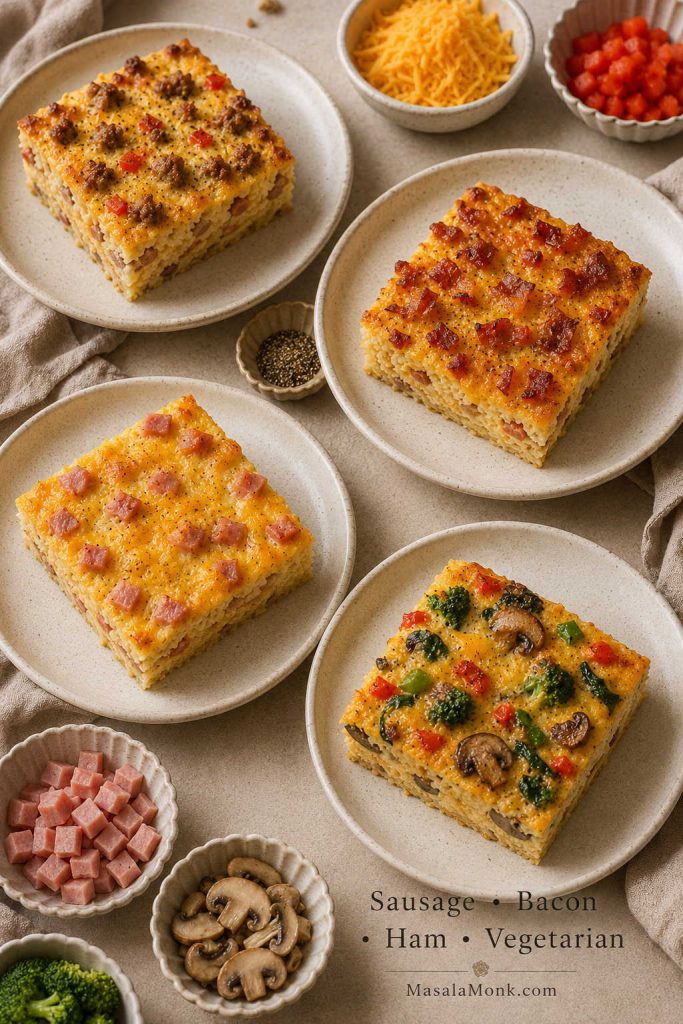
Four hash brown breakfast casserole variations with sausage, bacon, ham, and vegetarian fillings on separate plates.
Sausage, bacon, ham, and vegetables all work in this hash brown breakfast casserole, but each one changes salt, moisture, richness, or bake time.

Sausage Version

This is the default version and the most classic. Use 1 lb / 454 g breakfast sausage, cooked and drained. Mild sausage gives a family-friendly flavor, while hot sausage adds more punch. If your sausage is very salty, reduce the added salt in the egg mixture.

Bacon Version

Replace the sausage with 8–12 oz raw bacon, cooked until crisp and crumbled, or about 1 cup cooked bacon pieces. Bacon is saltier than sausage, so go easy on extra salt. For a loaded version, use half sausage and half bacon.

Ham and Cheese Version

Use 1½ cups / about 225 g diced ham, or up to 12 oz / 340 g for a ham-heavy version. This is especially useful after Easter, Christmas, or any big breakfast where leftover ham is already in the fridge. Cheddar, Swiss, Monterey Jack, and Colby Jack all work well here.

Vegetarian Version

Skip the meat and add more vegetables. Good choices include sautéed mushrooms, bell peppers, onions, spinach, broccoli, and scallions. The key is to cook watery vegetables first. Spinach should be wilted and squeezed dry. Mushrooms should be sautéed until their liquid cooks off.

For a no-meat 9×13 casserole, use about 2½–3 cups cooked vegetables in place of the sausage. A good mix is 1 cup bell pepper, ¾ cup mushrooms, ½ cup onion, and 1 cup spinach that has been wilted and squeezed dry. Add an extra ½ cup cheese if you want the casserole to feel richer without meat.

Cream Cheese Version

A richer version starts with 4 oz / 115 g softened cream cheese stirred into the warm cooked sausage before it goes into the casserole. This makes the filling extra creamy and hearty. Keep the sour cream in the egg mixture or reduce it slightly if you prefer a lighter texture.

Spicy Version

Use pepper Jack cheese, hot breakfast sausage, diced jalapeño, and a few dashes of hot sauce in the egg mixture for a version that tastes warmer and sharper without losing the potato-and-egg comfort. A little smoked paprika or chili powder also works well.

Gluten-Free Notes

The casserole can be naturally gluten-free, but check labels carefully. Some sausage, frozen hash browns, seasoning blends, and shredded cheeses may include additives or cross-contact warnings. Use certified gluten-free ingredients if needed.

Breakfast Casserole with Hash Brown Patties

Hash brown patties make a more defined potato layer and are a useful shortcut. Instead of shredded hash browns, arrange 8–10 frozen hash brown patties in a single layer in the bottom of a greased 9×13-inch baking dish. They can overlap slightly if needed.

Frozen hash brown patties arranged in a 9×13 baking dish with sausage, cheese, and eggs nearby.
Hash brown patties are a useful shortcut because they create a clear potato base before the eggs, cheese, and sausage go on top.

Top the patties with cooked sausage, bacon, or ham, then add cheese and pour the egg mixture over everything. Because patties are denser than shredded hash browns, the bake time may land closer to 50–60 minutes. Let the casserole rest before slicing so the patty layer and egg layer hold together.

Patty Setup Amount for 9×13 Pan
Hash brown patties 8–10 frozen patties
Eggs 10 large eggs, or 9 if using fewer toppings
Milk or half-and-half 1 cup / 240 ml
Cheese 2 cups / 225 g
Protein 1 lb sausage or 1½ cups diced ham

For a more structured patty-style bake, cover the dish with foil for the first 25 minutes, then uncover and bake another 20–30 minutes until the edges are golden and the center is set. This helps the egg mixture cook through without drying out the cheese on top too early.

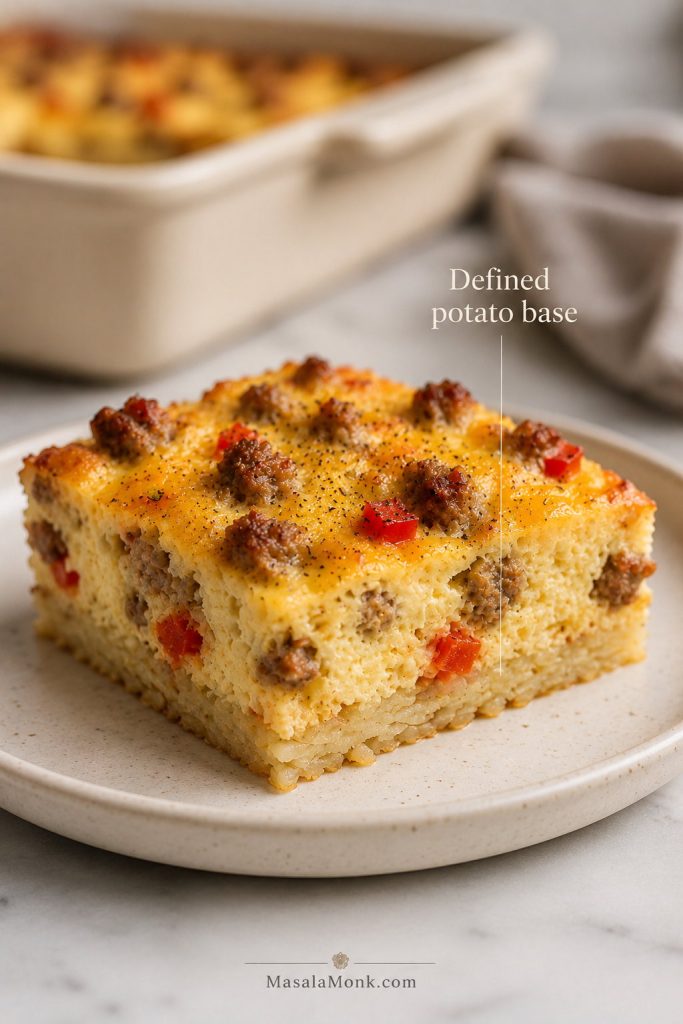
Slice of breakfast casserole with a defined hash brown patty base, eggs, sausage, cheese, and peppers.
The patty version slices differently from shredded hash browns because the potato layer stays more structured in each piece.

Patty version shortcut: Use 8–10 hash brown patties, 10 eggs, 1 cup / 240 ml milk or half-and-half, 2 cups / 225 g cheese, and 1½ cups diced ham or 1 lb cooked sausage. Use 9 eggs only if your pan is less loaded.

Can You Make It in a Slow Cooker?

You can make a breakfast casserole with hash browns in a slow cooker, but the texture will be softer and more scoopable than the oven version. It will not have the same golden edges or clean slices.

For a slow cooker version, layer thawed hash browns, cooked sausage or ham, vegetables, cheese, and egg mixture in a greased slow cooker. Cook on low until the eggs are set, and avoid holding it too long after cooking because eggs can turn rubbery.

Start checking around 3–4 hours on low, depending on your slow cooker size and how full it is. Avoid cooking on high if you want a softer egg texture; the edges can overcook before the center sets.

How to Tell When It’s Done

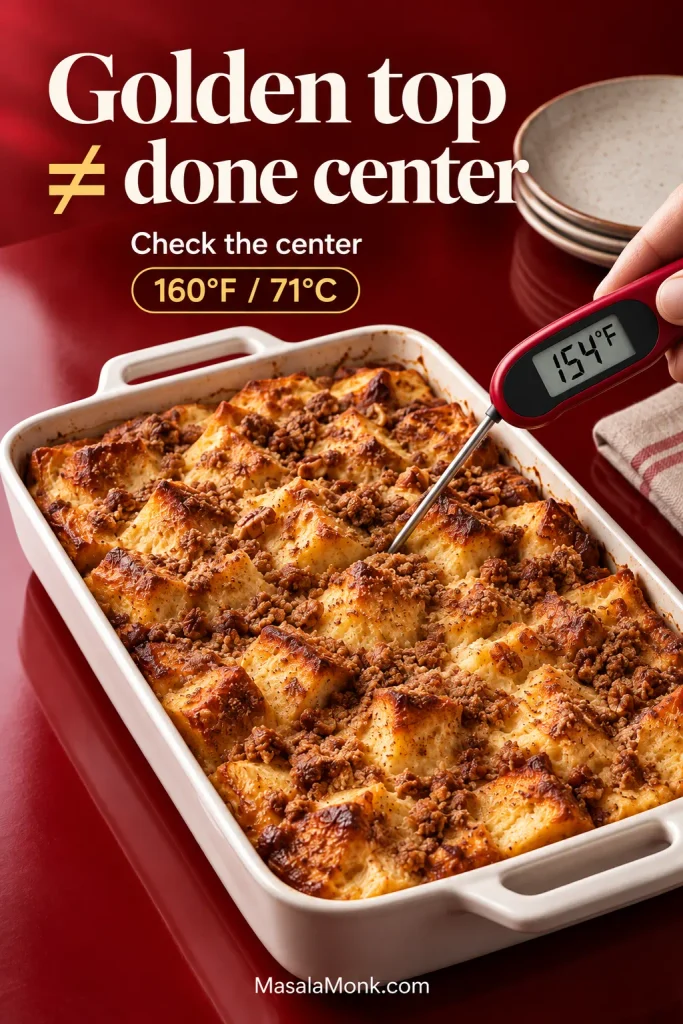
Breakfast casserole is done when the center is set, the edges are puffed, and the top is lightly golden. The middle should not slosh when you gently shake the dish. A knife inserted near the center should come out mostly clean, though a little melted cheese is normal.

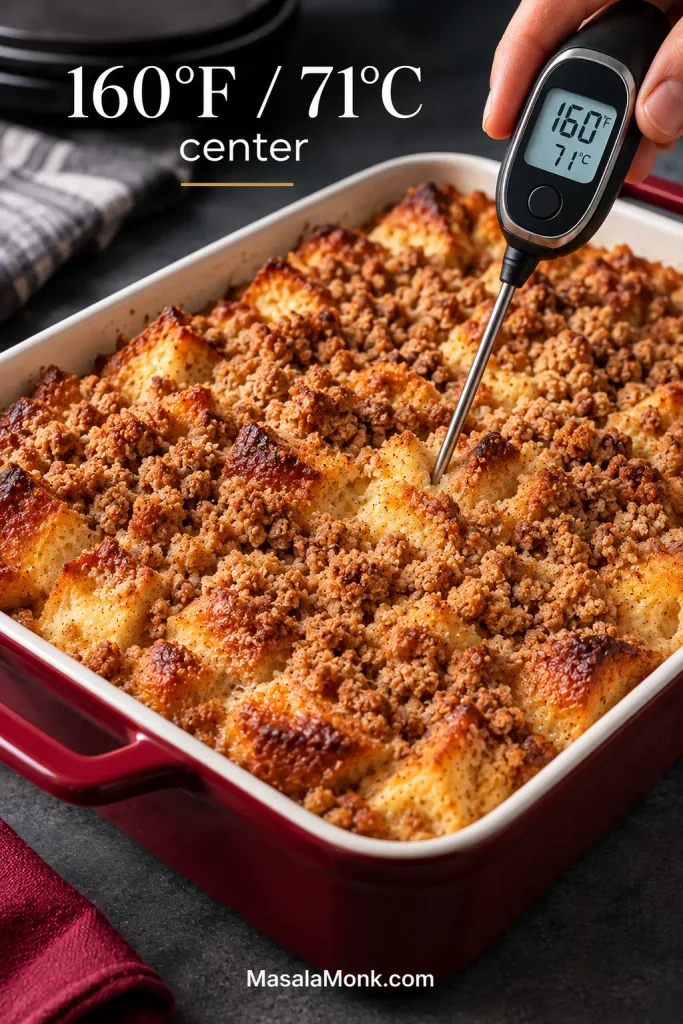
If you use a food thermometer, the center of an egg-based casserole should reach 160°F / 71°C. This is especially helpful when baking a cold overnight casserole, a deeper pan, or a loaded version with extra meat and vegetables.

A good finished casserole should not look dry or stiff. The center should be set enough to slice after resting, but the eggs should still look tender and slightly creamy around the potatoes.

Try not to bake it until the top looks dry all the way across. A breakfast egg bake should look set, puffed, and lightly golden, but still moist inside. The rest time will finish the texture without drying out the eggs.

Troubleshooting: Watery, Rubbery, Bland, or Loose

Most problems come down to moisture, bake time, or balance. Use this table if your casserole is watery, greasy, bland, or hard to slice.

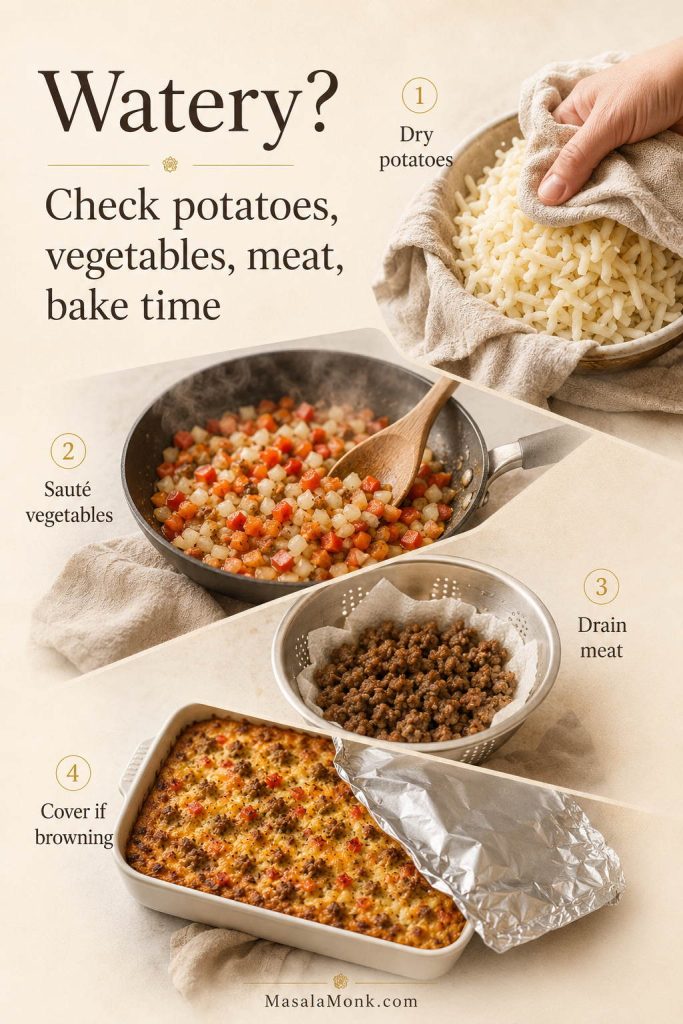
Troubleshooting guide for watery breakfast casserole showing drying potatoes, sautéing vegetables, draining meat, and covering a browning top.
Most watery casseroles start with hidden moisture, so dry the potatoes, sauté watery vegetables, drain the meat, and cover only if the top browns too fast.
Problem Likely Cause Fix
Watery casserole Wet hash browns, raw vegetables, or too much liquid Thaw and dry the hash browns. Sauté vegetables first. Drain spinach, mushrooms, sausage, and bacon well.
Rubbery eggs Overbaking or too little dairy Bake just until set. Use milk, half-and-half, sour cream, or Greek yogurt for tenderness.
Center not set Cold pan, deep dish, frozen potatoes, or too many add-ins Keep baking in 5–10 minute increments. Cover the top loosely with foil if it is browning too fast.
Greasy casserole Sausage or bacon was not drained Drain cooked meat before layering it into the dish.
Bland potatoes Hash browns were not seasoned Season the egg mixture well and lightly season the potato layer before adding toppings.
Casserole falls apart Cut too soon or too little egg for the amount of filling Rest 10–15 minutes before slicing. Use 10–12 eggs for a full 9×13 pan.
Top browns too quickly Oven runs hot or cheese is exposed too long Cover loosely with foil and continue baking until the center sets.

Storage, Freezing, and Reheating

Let the casserole cool, then store leftovers in an airtight container in the refrigerator. For best quality and food safety, cooked egg casseroles and leftovers are generally best used within 3–4 days. You can also freeze portions for longer storage. FoodSafety.gov’s cold storage chart is a useful reference for leftover timing: Cold Food Storage Charts.

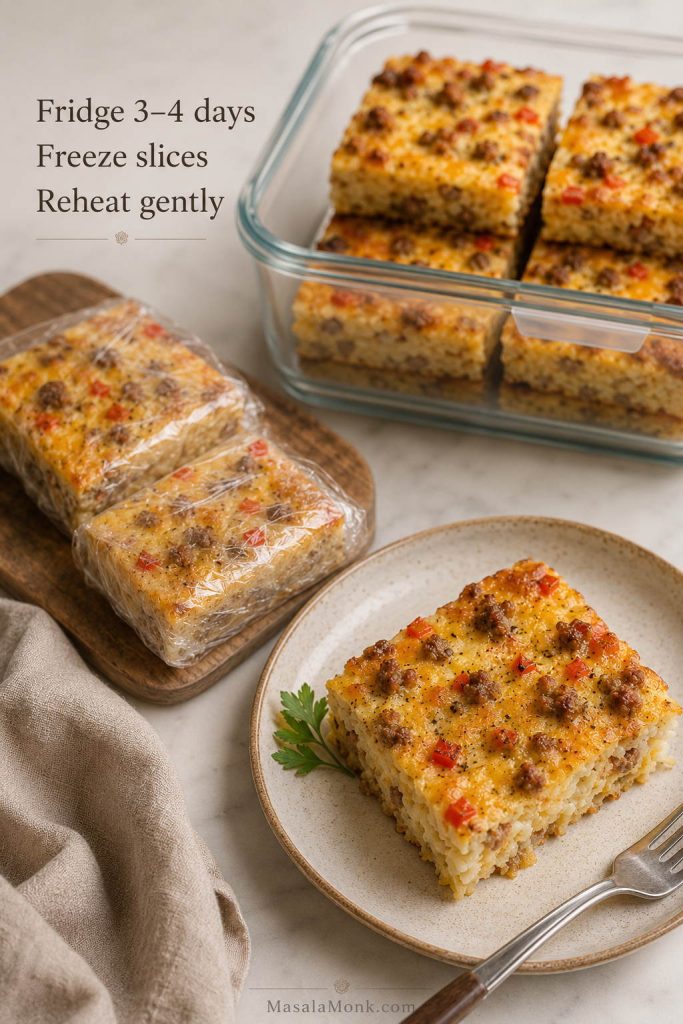
Breakfast casserole slices stored in a glass container, wrapped for freezing, and served reheated on a plate.
After cooling, slice the casserole for easier breakfasts: refrigerate what you will eat soon, then freeze individual portions for later.

How to Refrigerate

Cool the casserole, cover the baking dish, or move slices to airtight containers. Refrigerate within 2 hours of baking.

How to Freeze

Freeze individual slices wrapped tightly, then place them in a freezer-safe bag or container. For easier breakfasts, freeze slices separately so you can reheat only what you need.

If you are building a bigger freezer breakfast rotation, these meal prep breakfast burritos use the same cooked-filling, no-soggy logic in a grab-and-go format.

How to Reheat

Reheat individual slices in the microwave in short intervals until hot. For better texture, reheat slices in a covered oven-safe dish at 325°F / 165°C until warmed through. Add a splash of milk before reheating if the casserole seems dry.

What to Serve with It

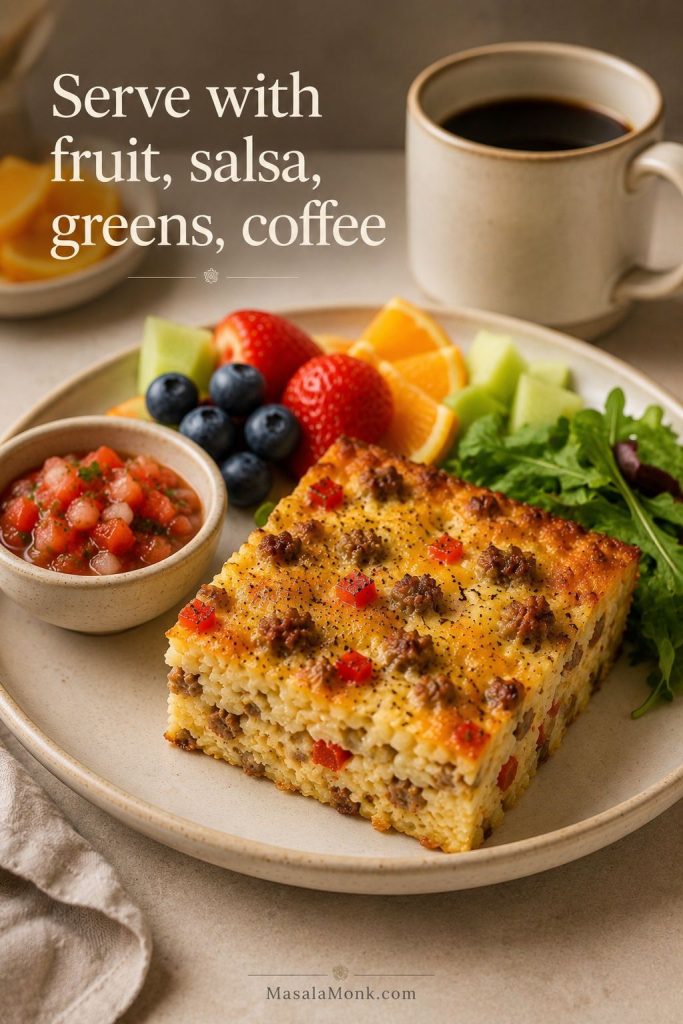
This casserole is hearty on its own, so the best sides are usually fresh, bright, or simple. Serve it with fruit salad, sliced avocado, toast, biscuits, salsa, hot sauce, or a green salad for brunch.

Breakfast casserole with hash browns served with fruit, salsa, greens, and coffee on a brunch plate.
Since the casserole is already rich with eggs, cheese, potatoes, and sausage, fresh sides like fruit, salsa, greens, and coffee keep the plate balanced.

For brunch, keep the plate balanced with fruit and something crisp or fresh so the casserole does not feel too heavy. For meal-prep mornings, simple sides work best because the eggs, potatoes, cheese, and sausage are already doing the filling work. To rotate in a cold make-ahead option, these overnight oats are a good opposite: creamy, chilled, and ready straight from the fridge.

FAQs

Do hash browns need to be thawed before breakfast casserole?

For the best texture, yes. Thawed hash browns bake more evenly and are easier to dry before adding to the casserole. This helps prevent a watery center.

What kind of hash browns work best?

Frozen shredded hash browns are the best all-purpose choice. They give the classic breakfast casserole texture and spread evenly through a 9×13 dish. Diced hash browns make the casserole chunkier, while hash brown patties create a more defined potato base.

Should I cook the hash browns before adding them?

You do not have to cook them first, but lightly browning thawed hash browns gives the casserole better flavor and helps remove moisture. If you are short on time, thawing and patting them dry is enough.

Can I use fresh potatoes instead of frozen hash browns?

Yes, but fresh shredded potatoes need more prep. Rinse them to remove excess starch, drain well, and squeeze very dry before using. If they go into the casserole wet, the egg mixture can turn loose.

Why is my breakfast casserole watery?

Usually, extra moisture sneaks in through the potatoes, vegetables, or meat. Thaw and dry the hash browns, cook watery vegetables first, squeeze spinach dry, and drain sausage or bacon before layering everything into the pan.

How many eggs do I need for a 9×13 hash brown breakfast casserole?

Use 10 large eggs for a balanced casserole or 12 eggs for a taller, more egg-forward bake. If you use fewer eggs, the casserole becomes more potato-heavy and may slice less cleanly.

Can I halve this recipe?

Yes. Use an 8×8-inch or 9×9-inch baking dish, about 15 oz / 425 g hash browns, 5–6 eggs, ½ lb / 225 g sausage, ½ cup milk or half-and-half, ¼ cup sour cream or Greek yogurt, and 1 cup cheese. Start checking around 30–35 minutes because a smaller casserole bakes faster.

Is this better with sausage, bacon, or ham?

Sausage gives the most classic breakfast casserole flavor. Bacon adds smoky crispness, while ham is a great option for leftover holiday ham. All three work, as long as cooked meats are drained before layering.

Can this breakfast casserole be made the night before?

Yes. Assemble the casserole, cover it tightly, and refrigerate overnight. Bake it in the morning, adding 5–10 extra minutes if it goes into the oven cold. For the cleanest texture, prep the components separately and assemble before baking.

How long does breakfast casserole with hash browns bake at 350°F?

Most 9×13 versions bake for 45–55 minutes at 350°F / 175°C. If the casserole is cold from the refrigerator, extra loaded, or made in a deeper dish, it may need closer to 55–65 minutes.

Can I use hash brown patties instead of shredded hash browns?

Yes. Arrange 8–10 hash brown patties in the bottom of a greased 9×13 pan, then layer the meat, cheese, and egg mixture over them. The casserole may need a slightly longer bake time.

How do I make it without meat?

Skip the sausage and use 2½–3 cups cooked vegetables such as mushrooms, peppers, onions, spinach, broccoli, or scallions. Cook watery vegetables first so they do not release liquid into the eggs.

Does hash brown breakfast casserole freeze well?

It freezes best in individual slices. Cool the casserole completely, wrap the portions tightly, and reheat only what you need. The texture is usually better when slices are thawed overnight in the refrigerator before reheating.

If you make this, I’d love to know which version became your house version: sausage, bacon, ham, vegetarian, or hash brown patties. Those little changes are often what make a breakfast casserole feel like it belongs on your table.

Back to top

Posted on 2 Comments

Egg Muffins Recipe: Easy Breakfast Egg Muffin Cups for Meal Prep

Golden breakfast egg muffins on a cream plate, with one muffin cut open to show egg, spinach, bell pepper, cheese, and cooked meat.

This egg muffins recipe is for the mornings when you want breakfast handled before the day gets loud. The muffins are soft, savory, protein-rich, and easy to reheat, with tender centers, lightly cheesy edges, and enough filling to feel like a real breakfast instead of plain baked eggs.

If your past egg muffins turned watery, rubbery, stuck to the pan, or collapsed into dense, disappointing little pucks, this version fixes the usual problems. The ratio is simple, the fillings are controlled, and the bake is gentle enough for meal prep.

If your last batch failed, jump straight to watery egg muffin fixes, rubbery texture fixes, or sticking and pan-release tips.

This recipe for breakfast egg muffins uses a reliable base formula: 10 eggs, a little dairy, controlled fillings, a 350°F oven, and a 3/4-full muffin cup. The main batch uses cheddar, bell pepper, cooked spinach, and your choice of cooked bacon, sausage, ham, or mushrooms. From there, you can change the fillings without changing the ratio.

Because they are naturally high in protein, these muffin tin eggs are especially useful when you want a savory breakfast before the morning rush. For another freezer-friendly breakfast that feels more filling, keep these in rotation with meal prep breakfast burritos.

Quick Answer: The Best Egg Muffin Cups Recipe

The best egg muffin cups recipe starts with 10 large eggs, 1/4 cup milk or cream, 3/4 cup cheese, and 1 to 1 1/2 cups cooked or well-drained fillings. Bake them in a greased muffin tin or silicone muffin pan at 350°F / 175°C for 18–22 minutes, until the centers are set and no longer wet or jiggly.

Egg muffin cups recipe ratio board showing eggs, dairy, cheese, cooked fillings, oven temperature, and bake time.
Start with the base ratio before changing flavors. Once the eggs, dairy, cheese, and fillings stay balanced, the recipe becomes much easier to customize.
Detail Start here
Yield 12 egg muffins
Oven temperature 350°F / 175°C
Bake time 18–22 minutes
Eggs 10 large eggs, about 500 g without shells
Dairy 1/4 cup / 60 ml milk, half-and-half, cream, or blended cottage cheese
Cheese 3/4 cup / 85 g shredded cheese
Add-ins 1 to 1 1/2 cups / about 140–225 g cooked or drained vegetables, meat, or both
Fill level About 3/4 full
Doneness cue Set centers, lightly puffed tops, no wet jiggle

Once you have the base formula, you can jump to the full ratio guide, the step-by-step method, or the meal prep storage tips.

The First Batch to Make

For the first batch, use cheddar, bell pepper, cooked spinach, and cooked bacon, sausage, ham, or mushrooms. It gives you color, savory flavor, protein, and a steady texture without pushing the filling too far.

Muffin tin filled with breakfast egg muffins made with cheddar, bell pepper, cooked spinach, and cooked bacon, sausage, ham, or mushrooms.
This first batch gives you color, protein, and savory flavor without overloading the muffin cups. After that, adjust one ingredient at a time so you know what changed the texture.

As a result, the finished egg muffins are savory, cheesy, and tender, with little pockets of vegetables and protein in every bite. They puff in the oven, settle slightly as they cool, and stay sturdy enough for meal prep without tasting dry when reheated gently.

Egg Muffins Recipe Card

These savory egg muffins bake up tender, cheesy, and sturdy enough for meal prep, with bell pepper, spinach, and your choice of cooked bacon, sausage, ham, or mushrooms in every bite. They are easy to customize, simple to reheat, and designed to stay soft instead of turning watery or rubbery.

Yield12 egg muffins
Prep Time12 minutes
Cook Time18–22 minutes
Total TimeAbout 35 minutes

Ingredients

  • 10 large eggs, about 500 g without shells
  • 1/4 cup / 60 ml milk, half-and-half, cream, or blended cottage cheese
  • 3/4 cup / 85 g shredded cheddar, Monterey Jack, mozzarella, Swiss, pepper jack, feta, or mixed cheese
  • 1/2 cup / 70–80 g finely diced bell pepper, raw for a little crunch or sautéed 2–3 minutes for softer, less watery muffins
  • 1/2 cup / 70–80 g cooked spinach, squeezed dry and chopped
  • 1/2 cup / 60–75 g cooked and drained bacon, sausage, ham, turkey sausage, chicken sausage, mushrooms, or extra vegetables
  • 3/4 teaspoon fine salt
  • 1/4 teaspoon black pepper
  • 1/4 teaspoon garlic powder, optional
  • 1/4 teaspoon onion powder, optional
  • Cooking spray, butter, or oil for greasing

Instructions

  1. Preheat the oven to 350°F / 175°C. Grease a 12-cup muffin pan generously, or use lightly greased silicone liners.
  2. Cook and drain any watery or greasy fillings. Mushrooms, onions, spinach, zucchini, bacon, sausage, turkey sausage, chicken sausage, and similar fillings should be cooked before adding.
  3. In a large bowl, whisk the eggs, dairy, salt, pepper, garlic powder, and onion powder until just combined.
  4. Divide the cooked fillings and cheese evenly among the muffin cups.
  5. Pour the egg mixture over the fillings, filling each cup about 3/4 full.
  6. Bake for 18–22 minutes, until the centers are set and the tops are lightly puffed.
  7. Cool in the pan for 5–10 minutes, then remove carefully.
  8. Serve warm, or cool completely before storing for meal prep.

Recipe Notes

  • Use silicone if you want the easiest release.
  • Do not overfill the cups; egg muffins puff while baking.
  • Cook and drain watery vegetables before baking.
  • If starting with fresh spinach, use about 2 packed cups, cook it down, then squeeze dry before measuring 1/2 cup cooked spinach.
  • Cook and drain meat before adding it to the egg mixture.
  • Reheat gently to avoid rubbery eggs.
  • For a softer, higher-protein version, blend cottage cheese into the egg base.
  • For a vegetarian batch, replace bacon, sausage, or ham with sautéed mushrooms, broccoli, peppers, or extra spinach.
Saveable egg muffins recipe card with yield, bake temperature, bake time, fill level, and meal prep reminders.
The quick formula matters: 12 egg muffins, 350°F, 18–22 minutes, and cups filled about 3/4 full. Together, those details help the batch bake evenly.

What Are Egg Muffins?

At their simplest, egg muffins are small baked egg cups made in a muffin pan. They are not sweet muffins, and they do not have a bread-like crumb. Instead, they are closer to mini frittatas: eggs are whisked with a little dairy, cheese, seasoning, and fillings, then baked until set.

Because these are muffins made with egg rather than flour, the recipe depends more on oven timing, moisture control, and the right pan than on traditional muffin mixing technique.

That muffin-tin shape is what makes them useful. Each cup becomes a single portion, so you can eat one or two for breakfast, pack them in a lunchbox, or store a batch in the fridge for busy mornings.

For more easy ways to build meals around eggs, this guide to egg dishes with 2 eggs gives you extra breakfast and brunch ideas beyond muffin tin eggs.

Are Egg Muffins the Same as Egg Cups?

Usually, yes. Many people use the names egg muffins, egg muffin cups, and egg cups for the same basic idea. The difference is that some egg cup recipes use a “cup” or shell made from bacon, hash browns, tortillas, or bread.

This version uses the classic whisked-egg muffin tin method. Later in the post, you will also find notes for bacon egg muffins, hash brown egg cups, cottage cheese egg muffins, and other variations.

Are Egg Muffins Mini Frittatas?

Yes, that is the easiest way to understand their texture. Egg muffins are basically small frittatas baked in a muffin tin. They should be set and tender, not wet in the middle and not dry like overcooked scrambled eggs.

What Texture Should Egg Muffins Have?

Good egg muffins should be set and tender, not wet in the middle and not dry or squeaky around the edges. They are usually firmer than café-style egg bites, but they should still reheat without turning tough.

Why This Recipe Works

What makes this recipe reliable is the balance between the egg base, fillings, cheese, dairy, and bake time. In other words, the goal is not just to make egg muffins that look good when they come out of the oven. The goal is to make breakfast egg muffins that still taste good after chilling and reheating.

The real win is that these egg muffins are not just good straight from the oven. They are built to survive the fridge, the microwave, and a busy weekday morning without turning wet, bland, or rubbery.

  • 10 eggs make fuller muffins. An 8-egg batch can work, but 10 eggs gives a steadier all-purpose texture for 12 muffin cups.
  • A little dairy keeps the eggs tender. Milk, half-and-half, cream, or blended cottage cheese helps soften the texture.
  • The add-ins are controlled. Too many vegetables or meats can make egg muffins watery, crumbly, or hard to remove.
  • Watery fillings are cooked or drained first. Spinach, mushrooms, onions, zucchini, and tomatoes need extra attention.
  • 350°F / 175°C is gentle enough for meal prep. A slightly lower oven temperature helps avoid rubbery edges.
  • The pan matters. Silicone or a very well-greased pan makes removal much easier.
  • A short cooling time helps. Resting the muffins for 5–10 minutes helps them finish setting and release more cleanly.

Ingredients for Breakfast Egg Muffins

The ingredients are simple, but they should taste like more than “eggs in a muffin tin.” Cheddar brings savory richness, bell pepper adds small sweet pops, spinach keeps the batch colorful, and bacon, sausage, ham, or mushrooms make each cup feel like a real breakfast. The key is keeping those add-ins flavorful without letting them make the muffins watery.

Already know your fillings? Skip ahead to how to prep vegetables and protein, or check the watery egg muffin fixes if your batches often release liquid after baking.

Ingredients for egg muffins arranged on a light surface, including eggs, dairy, cheese, bell pepper, cooked spinach, cooked protein, and seasonings.
Simple ingredients can still make flavorful breakfast egg muffins. For the best texture, cook and drain watery fillings before they go into the pan.

Eggs

Use 10 large eggs, about 500 g without shells, for the main batch. This amount fills a standard 12-cup muffin pan nicely when combined with dairy, cheese, and fillings.

  • 8 eggs make lighter, more filling-heavy muffins.
  • 10 eggs give the most reliable all-purpose balance.
  • 12 eggs make firmer, more egg-forward muffins.

If you are making egg white muffins, use extra seasoning and some cheese or cottage cheese for softness. Egg whites can turn rubbery faster than whole eggs, especially if they are overbaked.

Milk, Cream, Half-and-Half, or Cottage Cheese

Use 1/4 cup / 60 ml milk, cream, half-and-half, or blended cottage cheese for a standard batch. Milk gives a lighter texture, half-and-half makes the muffins a little softer, and cream gives a richer low-carb version.

Use 1/4 cup blended cottage cheese as a simple dairy swap in the standard recipe. However, use 3/4–1 cup blended cottage cheese only when you want a softer, higher-protein egg-bite-style version. If you want the cottage cheese to disappear into the egg base, blend it first until smooth.

For the softest, higher-protein version, cottage cheese works best when it is blended into the egg base instead of stirred in as curds.

Cottage cheese egg muffins with a soft interior and blended cottage cheese in the egg base.
Blended cottage cheese gives this version its softer, higher-protein texture. Stirring it in as curds can leave the egg base less smooth.

Dairy-Free Egg Muffins

For dairy-free egg muffins, use unsweetened dairy-free milk and skip the cheese, or use a dairy-free shredded cheese you already like. The muffins may be a little firmer without dairy or cheese, so avoid overbaking and add flavorful vegetables, herbs, salsa, or cooked sausage for balance.

This is still an egg-based breakfast. For high-protein breakfasts without eggs, these plant-based breakfast ideas are a better fit than trying to force this recipe into an egg-free version.

Cheese

Use 3/4 cup / 85 g shredded cheese for balanced egg muffins. Cheddar, Monterey Jack, mozzarella, Swiss, pepper jack, and feta all work.

  • 3/4 cup is balanced.
  • 1 cup is cheesier but still reasonable.
  • 1 1/2 cups is better reserved for richer bacon or sausage egg muffins.

Too much cheese can make the edges stick and the bottoms feel greasy, so start with 3/4 cup and increase only if you want a richer batch.

For a lighter batch, use more vegetables, lean meat, milk instead of cream, and a little less cheese. If you skip cheese completely, add extra herbs, seasoning, or salsa so the muffins still taste savory and balanced.

Vegetables and Protein Add-Ins

For the best texture, use 1 to 1 1/2 cups total cooked or well-drained add-ins, which is about 140–225 g depending on the ingredients. That could be vegetables, meat, or a mix of both.

Good options include bell pepper, spinach, mushrooms, onions, broccoli, tomatoes, bacon, sausage, ham, turkey sausage, chicken sausage, feta, cheddar, and herbs. Cook bacon, sausage, mushrooms, onions, spinach, zucchini, and other watery or greasy fillings before adding them to the muffin tin.

Cooked vegetables and drained meat for egg muffins, showing sautéed spinach, mushrooms, onions, and cooked bacon or sausage.
Cooked, drained fillings make a cleaner egg muffin cup. They prevent extra vegetable liquid and meat fat from pooling at the bottom.
Important: Do not add raw sausage, bacon, chicken, turkey, or other raw meat to the egg mixture. Cook meat fully, drain off excess fat, then divide it among the muffin cups.

Seasoning

Egg muffins need enough seasoning because eggs and vegetables can taste flat once chilled. Start with:

  • 3/4 teaspoon fine salt
  • 1/4 teaspoon black pepper
  • 1/4 teaspoon garlic powder, optional
  • 1/4 teaspoon onion powder, optional

You can also add smoked paprika, chili flakes, chopped herbs, curry powder, taco seasoning, or everything bagel seasoning depending on the flavor you want.

The Best Egg Muffin Ratio

Think of this as the formula that keeps the batch predictable. Once the egg base, cheese, and fillings stay in balance, you can change the flavor without gambling on the texture.

Best egg muffin ratio board showing lighter, most reliable, and cottage cheese batch styles with eggs, dairy, cheese, and fillings.
Your egg muffin ratio can change with the texture you want. Use the 10-egg version as the all-purpose batch, then shift lighter or softer once you know your preference.
Batch style Eggs Dairy Cheese Add-ins Works well for
Lighter 8 eggs 1/4 cup / 60 ml 1/2–3/4 cup 1 cup Veggie-heavy muffins
Most reliable 10 eggs 1/4 cup / 60 ml 3/4 cup / 85 g 1–1 1/2 cups Classic breakfast egg muffins
Extra egg-forward 12 eggs 1/4–1/3 cup 3/4–1 cup 1 cup Protein-heavy or low-carb muffins
Cottage cheese style 8–10 eggs 3/4–1 cup blended cottage cheese Optional 1 cup Softer, higher-protein egg muffins

If you are scaling the batch, go to how to scale the recipe. If your muffins overflow or stick around the edges, check how full to fill the cups before baking.

How to Scale the Recipe

You can scale the same ratio up or down without changing the method.

Batch size Eggs Dairy Cheese Add-ins
6 egg muffins 5 large eggs 2 tablespoons / 30 ml 6 tablespoons / about 40 g 1/2–3/4 cup
12 egg muffins 10 large eggs 1/4 cup / 60 ml 3/4 cup / 85 g 1–1 1/2 cups
24 egg muffins 20 large eggs 1/2 cup / 120 ml 1 1/2 cups / 170 g 2–3 cups
Egg muffins scaling guide showing 6 muffins, 12 muffins, and 24 muffins with matching egg amounts.
Scaling stays simple when the ratio stays the same. Therefore, a small batch or double batch can use the same method without guesswork.

How Full Should You Fill the Muffin Cups?

Fill each muffin cup about 3/4 full. If the cups are too low, the muffins look flat. If they are too full, the egg mixture can overflow, bake onto the edges, and stick to the pan.

As they bake, egg muffins puff and then settle slightly as they cool. That small deflation is normal and does not mean the recipe failed.

Three muffin cups showing too low, 3/4 full, and too full levels for egg muffin cups.
A 3/4-full cup gives the eggs space to rise while still baking into a full-looking muffin. As a result, the cups puff neatly without overflow or stuck edges.

How Much Filling Is Too Much?

For 12 egg muffins, 1 cup of add-ins is the safest amount, while 1 1/2 cups gives a more loaded breakfast muffin. You can push toward 2 cups, but only if the vegetables are cooked and drained very well. More than that usually makes the muffins watery, crumbly, or difficult to remove.

Equipment You Need

You do not need much equipment for egg muffins, but the pan matters more than it does for regular muffins. Eggs and cheese cling easily, so silicone or a very well-greased metal tin will save you cleanup later.

  • 12-cup muffin pan
  • Silicone muffin pan or silicone liners
  • Large mixing bowl
  • Whisk
  • Measuring cup with pour spout
  • Skillet for cooking vegetables or protein
  • Cooling rack
  • Airtight container for storage
  • Freezer-safe bag or container if freezing

If sticking is your biggest issue, skip to the full pan-release section before choosing liners or a muffin tin.

Best Pan for Egg Muffins: Silicone vs Metal vs Paper Liners

If egg muffins have ever welded themselves to your muffin tin, the pan is probably the reason. A good pan or liner can save you from broken muffins and a long cleanup.

Pan comparison for egg muffins showing silicone muffin pan, metal muffin tin, and paper liners.
Pan choice matters because baked eggs cling more than regular muffin batter. Silicone releases most easily, while metal pans need a generous coating of oil, butter, or spray.
Pan or liner Works well for Pros Watch out
Silicone muffin pan Regular meal prep Easiest release, less sticking, good for weekly batches Place it on a baking sheet for stability
Silicone liners in metal pan Easy cleanup Good shape, reusable, easier release Lightly grease them for extra safety
Nonstick metal muffin tin Defined edges Common, sturdy, easy to move Must be greased generously
Paper liners Not ideal Easy serving in theory Eggs often stick badly unless liners are sprayed
Parchment liners Occasional batches Easier release than plain paper Can wrinkle the muffin edges

How to Make Egg Muffins

This muffin tin eggs recipe gives you evenly filled cups with a tender texture and fewer sticking problems. The two biggest keys are cooking watery fillings first and not overbaking the eggs.

Step-by-step egg muffins guide showing pan prep, cooked fillings, whisked egg base, cups filled 3/4 full, and baking for 18 to 22 minutes.
Think of the method as a texture sequence: dry the fillings first, keep the egg base simple, fill evenly, and stop baking when the centers are just set.

Step 1: Prep the Pan and Preheat the Oven

Preheat the oven to 350°F / 175°C. Grease a 12-cup muffin pan very well with cooking spray, butter, or oil. If you are using a silicone muffin pan, place it on a sturdy baking sheet before filling so it is easier to move in and out of the oven.

Step 2: Cook and Drain Watery Fillings

Cook mushrooms, onions, spinach, zucchini, bacon, sausage, or any filling that releases water or fat. If the pan still looks wet after cooking mushrooms or onions, keep going for another minute or two. If using cooked spinach, squeeze it dry before adding it to the muffin cups.

This step keeps the final egg muffins from becoming watery after baking or after a night in the fridge.

Step 3: Whisk the Egg Base

In a large bowl, whisk the eggs, dairy, salt, pepper, garlic powder, and onion powder until combined. Do not beat the eggs until foamy. Too much trapped air can make the muffins puff dramatically and then sink more as they cool.

Step 4: Divide Fillings and Cheese

Add the cooked fillings and cheese directly to the muffin cups first. This gives you better portion control than mixing everything into the bowl, where heavier fillings can sink to the bottom.

Step 5: Fill 3/4 Full

Pour the egg mixture over the fillings until each cup is about 3/4 full. A measuring cup with a pour spout makes this cleaner and helps you fill each cup evenly.

Egg mixture being poured into a muffin tin with spinach, bell pepper, cheese, and cooked protein in the cups.
Dividing the fillings first gives every cup a balanced mix. Then the egg base can flow around the vegetables, cheese, and protein more evenly.

Step 6: Bake Until Just Set

Bake for 18–22 minutes, or until the centers are set and the tops are lightly puffed. Start checking around 18 minutes, especially if your muffin cups are not very full or if your oven runs hot.

Step 7: Cool Before Removing

Let the egg muffins cool in the pan for 5–10 minutes. This short rest helps them firm up and release more cleanly. If you are using a metal pan, gently run a thin knife around the edges before lifting them out.

How Long to Bake Egg Muffins

The best oven temperature for classic egg muffins is 350°F / 175°C. It is gentle enough to keep the texture soft, but still hot enough to set the centers in about 20 minutes.

Egg muffin bake-time guide showing wet, just-set, and overbaked textures with a 350°F and 18 to 22 minute cue.
Bake time is about doneness, not just the clock. Look for set centers and lightly puffed tops; if the edges look dry before the middle is done, the oven may be too hot.
Oven temp Approx. time Texture Works well for
350°F / 175°C 18–22 minutes Softer, less rubbery Default meal prep egg muffins
375°F / 190°C 15–20 minutes Faster, slightly firmer Smaller muffins or quick bake
325°F / 160°C 22–28 minutes Gentler, softer Cottage cheese or egg-bite-style versions
400°F / 200°C Not ideal for classic egg muffins Firmer edges Hash brown cups or bacon-shell cups

How Long to Bake Mini Egg Muffins

Mini egg muffins bake faster than standard muffin tin eggs. Start checking a mini muffin pan around 12–15 minutes at 350°F / 175°C. The exact time depends on the size of the cups, how full they are, and how many fillings you add.

How to Tell Egg Muffins Are Done

You will know they are done when the centers are set, the tops are lightly puffed, and there is no wet jiggle in the middle. If you use an instant-read thermometer, aim for 160°F / 71°C; egg dishes such as frittata and quiche are listed at that temperature on the FoodSafety.gov safe minimum temperature chart.

Why Egg Muffins Puff and Then Deflate

Egg muffins rise because steam and air expand in the oven. After they cool, they settle. Some deflation is normal. The goal is not to keep them tall forever; instead, the goal is to keep them tender, set, and not watery.

Egg muffins puffed in the oven and slightly settled after cooling, showing that a little deflation is normal.
As steam expands in the oven, the muffins puff; as they cool, they settle. That small deflation is normal, so focus on tender set texture rather than height.

How to Stop Egg Muffins from Sticking to the Pan

If your first batch has ever stuck to the pan, you are not doing anything unusual. Baked eggs cling more than regular muffin batter, especially when cheese melts onto the edges. The fix is mostly about pan choice, grease, and giving the muffins a short cooling time before you remove them.

Egg muffin sticking guide showing silicone cups, greased metal pan, and muffins being released from a muffin tin.
Sticking usually comes down to the pan, the grease, or removing the muffins too soon. Let them cool briefly before lifting them out so the edges can release cleanly.

Best Pan and Liner Tips

  • Use silicone if you make egg muffins often. A silicone muffin pan or silicone liners give the cleanest release.
  • Grease metal pans generously. Coat the bottom, sides, and upper rim of each cup because puffed egg and melted cheese can stick near the top.
  • Avoid plain paper liners. They often hold onto baked eggs unless they are sprayed first.
  • Let the muffins cool for 5–10 minutes. That short rest helps the eggs finish setting and makes removal easier.

How to Keep Egg Muffins from Getting Watery

Watery egg muffins usually come from watery fillings, too many add-ins, or storing the muffins while they are still warm. Fortunately, the fix is simple: control moisture before the egg mixture goes into the pan.

Watery egg muffins guide showing cooked and drained fillings compared with wet vegetables and excess liquid.
Watery batches usually start with fillings that were not cooked, squeezed, drained, or cooled. Fix the moisture before baking, and the finished cups will store much better.
Add-in Problem Prep first
Spinach Releases water Cook and squeeze dry
Mushrooms Release lots of moisture Sauté until the pan looks dry
Onion Can water out and taste sharp Sauté first
Bell pepper Mild moisture Dice small; sauté briefly if using a lot
Tomato Can make muffins soggy Use drained diced tomato or skip very juicy tomato
Zucchini Very watery Salt and squeeze, or sauté first
Broccoli Can be bulky Chop small and pre-cook
Bacon or sausage Grease can pool Cook and drain before adding

Cool Before Storing

Do not put hot egg muffins straight into an airtight container. Steam gets trapped, turns into condensation, and makes the muffins wet. Let them cool completely first.

Blot Before Reheating If Needed

Vegetable-heavy egg muffins can release a little liquid after chilling. If that happens, blot the bottom lightly with a paper towel before reheating. This is especially helpful with spinach, mushrooms, tomatoes, and zucchini.

How to Make Egg Muffins Fluffy, Not Rubbery

Rubbery egg muffins usually mean the eggs were pushed a little too far, either in the oven or during reheating. You want the centers fully set, but not dry, squeaky, or spongey.

Fluffy egg muffins compared with dry, rubbery egg muffins, with tips to bake just until set, use dairy, and reheat gently.
A tender center comes from stopping the bake as soon as the eggs are set. To avoid a rubbery texture, use a little dairy and reheat in short bursts.

Five Ways to Keep Egg Muffins Tender

  • Start checking at 18 minutes. Pull the muffins when the centers are just set and the tops are lightly puffed.
  • Use a little dairy. Milk, half-and-half, cream, or blended cottage cheese softens the egg texture.
  • Do not rely only on egg whites. Egg white muffins can turn rubbery faster, so add cheese, cottage cheese, or a few whole eggs if you want a softer bite.
  • Whisk until combined, not foamy. Too much trapped air can make the muffins puff dramatically and then collapse more as they cool.
  • Reheat gently. Use short microwave bursts or medium power, and cover the muffins with a damp paper towel so the edges do not dry out.

Egg Muffins Recipe: Storage, Freezing, and Reheating

The real test of egg muffins is not just how they taste warm from the oven. It is whether you still want to eat them on Wednesday morning. Cool them completely before packing, and reheat them gently for the best texture.

Meal prep egg muffins stored in an airtight glass container for refrigerator storage.
For meal prep, cool the egg muffins before packing them and avoid trapping steam in the container. That small pause helps protect the texture for the next few mornings.
Method How long / how to do it Texture tip
Refrigerate Store airtight for 3–4 days Cool completely before closing the container
Freeze Freeze airtight for up to 3 months for best texture Freeze flat first, then transfer to a bag or container
Reheat from fridge Microwave 20–30 seconds Cover with a damp paper towel
Reheat from frozen Microwave 60–90 seconds at 50–70% power Thaw overnight first if possible
Oven reheat 300–350°F for 5–10 minutes Good for reheating several at once
Air fryer reheat 325–350°F for 2–4 minutes Use a gentle setting to avoid drying the edges

For make-ahead planning, jump to freezing egg muffins or reheating without a rubbery texture.

How Long Do Egg Muffins Last in the Fridge?

Store cooked egg muffins in an airtight container in the refrigerator for 3–4 days. The USDA/FSIS refrigeration guidance lists cooked egg dishes with a refrigerator storage time of 3–4 days, which is the safest guideline to follow for meal prep.

A Simple Weekly Meal Prep Plan

For an easy workweek plan, bake 12 egg muffins on Sunday. Keep 6–8 in the fridge for the next 3–4 days, then freeze the rest. After that, reheat two at a time with a damp paper towel so they warm gently instead of turning rubbery.

If you like prepping eggs for the week, air fryer hard-boiled eggs are another easy option for salads, snack boxes, and quick breakfasts.

Can You Freeze Egg Muffins?

Yes. Cool them completely, then freeze in a single layer until firm. After that, transfer them to a freezer-safe bag or container. Use within about 3 months for the best texture.

Egg muffins arranged on a tray in the freezer with a freezer bag of stored egg muffins behind them.
Freeze the muffins flat first so they do not stick together. After they firm up, transfer them to a freezer-safe bag or container for easier grab-and-go breakfasts.

How to Reheat Egg Muffins from the Fridge

Microwave one egg muffin for 20–30 seconds, covered with a damp paper towel. Add more time only if needed. If your microwave runs hot, use medium power instead of full power.

Egg muffins on a plate under a damp paper towel beside a microwave, with reheating times for fridge and frozen muffins.
Reheating is where many egg muffins turn rubbery. Instead, use gentle heat, short bursts, and a damp paper towel so the centers warm before the edges dry out.

How to Reheat Egg Muffins from Frozen

For the best texture, thaw overnight in the refrigerator. To reheat straight from frozen, microwave at 50–70% power for 60–90 seconds, checking in short bursts.

When reheating leftovers, heat them until hot all the way through. Use short bursts so the centers warm without drying out the edges.

Can You Eat Egg Muffins Cold?

You can eat them cold if they have been stored safely, but the texture is better when they are gently warmed. A short reheat brings back the softer texture and makes the cheese taste better.

Egg Muffin Variations

This is where the recipe becomes your own. Keep the same base ratio, then choose the filling style that fits your morning: hearty, lighter, kid-friendly, low-carb, or brunch-ready.

Need a specific version? Jump to the classic cheddar batch, hash brown egg cups, or the egg muffins vs egg bites comparison.

Egg muffin variations arranged in a flavor wheel with lighter, hearty, kid-friendly, low-carb, and brunch-ready styles.
Flavor variations work best when the base ratio stays steady. Then you can change the style—hearty, lighter, kid-friendly, low-carb, or brunch-ready—without losing structure.

Choose Your Filling Style

If your morning needs… Choose… Key adjustment
Grab-and-go protein Bacon, sausage, or cottage cheese muffins Use cooked meat and keep the bake gentle
A lighter breakfast Peppers, spinach, mushrooms, and less cheese Cook watery vegetables first
A kid-friendly batch Ham and cheddar Keep seasonings mild
A brunch plate Spinach feta or mushroom Swiss Serve warm with salad or toast
Low-carb meal prep Eggs, cream, cheese, bacon, and spinach Skip potatoes and starchy add-ins

How to Customize Without Ruining the Texture

If this is your first time making the recipe, start with the easy classic cheddar version. It gives you the best read on the base texture before you experiment with cottage cheese, egg whites, hash browns, or heavier vegetable mixes.

After that, adjust one thing at a time: the cheese, the protein, or the vegetables. That way, you can tell what changed the texture and what changed the flavor.

Specific Egg Muffin Filling Ideas

If you already know the style you want, the table below gives you more specific filling combinations while keeping the same basic egg-to-filling ratio.

Variation Add-ins Special note
Bacon egg muffins Cooked bacon, cheddar, green onion Drain bacon well before adding
Sausage egg muffins Cooked sausage, cheddar, peppers Drain fat before adding
Ham and cheese egg muffins Diced ham, cheddar or Swiss Good for kids and meal prep
Spinach feta egg muffins Spinach, feta, herbs Squeeze spinach dry
Cottage cheese egg muffins Blended cottage cheese, eggs, spinach Softer, higher-protein texture
Egg white muffins Egg whites, vegetables, cheese Season well and do not overbake
Keto egg muffins Eggs, cream, cheese, bacon or sausage Skip starchy add-ins
Hash brown egg cups Hash brown shell, egg filling Different method; bake the shell first
Vegetarian egg muffins Peppers, spinach, mushrooms, cheese Cook watery vegetables first
Spicy egg muffins Jalapeño, pepper jack, onion Remove seeds for milder heat

Easy Classic Cheddar Version

Use cheddar, bell pepper, spinach, and cooked bacon, ham, or sausage. Cheddar melts into the edges, bell pepper gives small sweet pops, and the cooked meat makes the muffins feel breakfasty and satisfying. If you are using bacon, this is a good place to prep extra from your air fryer bacon batch.

Classic cheddar breakfast egg muffins with visible spinach, bell pepper, cheese, and cooked meat, including one muffin cut open.
This classic cheddar version is the safest first batch because it balances moisture, protein, color, and flavor before you start testing heavier or softer variations.

Higher-Protein Cottage Cheese Version

Use blended cottage cheese in the egg base and add turkey sausage, chicken sausage, or extra egg whites. Cottage cheese makes the texture softer and more café-style, but the bake should stay gentle so the eggs do not turn spongey. On days when you want a bowl instead of baked eggs, protein oatmeal gives you another high-protein breakfast option.

Low-Carb or Keto Version

Use eggs, cream, cheese, bacon or sausage, spinach, and mushrooms. Skip potatoes, hash browns, and sweet vegetables if you want a stricter low-carb version.

Vegetarian Spinach and Mushroom Version

Use spinach, bell peppers, mushrooms, onions, feta, cheddar, or herbs. Mushrooms bring savory depth, feta adds brightness, and spinach keeps the batch colorful. Cook the mushrooms and onions first so the muffins do not turn watery.

Hash Brown Egg Cups Version

Hash brown egg cups need a different method. Press seasoned hash browns into the muffin cups first, bake them until they begin to crisp, then add the egg filling and bake again. This gives you a potato shell instead of a classic egg muffin base. If you are starting with frozen shredded potatoes or patties, the timing notes in this air fryer hash browns guide can help you understand how moisture and crisp edges behave before you turn them into cups.

Hash brown egg cups in a muffin tin with crispy potato shells and set egg filling with spinach, pepper, cheese, and bacon.
Hash brown egg cups use a different method from classic egg muffins. Bake the potato shell first, then add the egg filling so the outside stays crisp.

What to Serve with Egg Muffins

Two breakfast egg muffins can be a full light breakfast on their own. Because egg muffins are soft and savory, they taste best with contrast: fruit for freshness, avocado for creaminess, salsa for brightness, toast for crunch, or roasted potatoes when you want the plate to feel more like brunch.

Breakfast egg muffins served with avocado, salsa, fruit, toast, and orange juice on a light breakfast plate.
Because egg muffins are soft and savory, they taste better with contrast. Add fruit for freshness, toast for crunch, avocado for creaminess, or salsa for brightness.

For a heartier plate, add an English muffin, hash browns, or a small breakfast sandwich. For sandwich-style ideas, this list of breakfast sandwich recipes can help you build a more filling morning meal.

Egg Muffins vs Egg Bites vs Mini Frittatas

These names are closely related, but the texture and method can be different. Knowing the difference helps you choose the right recipe style for your breakfast meal prep.

Comparison of egg muffins, egg bites, and mini frittatas on separate plates, labeled sturdy, custardy, and brunch-style.
Egg muffins, egg bites, and mini frittatas are related, but their textures are different. The muffin version is sturdier for meal prep, egg bites are softer and custardy, and mini frittatas feel more brunch-style.

Egg Muffins

Egg muffins are firm enough to pick up and meal prep easily. They are usually whisked, not blended, and baked in a muffin tin. This is the best version when you want a simple, sturdy, make-ahead breakfast.

As a baked egg cups recipe, this version is firmer and easier to store than custardy egg bites, which makes it better for grab-and-go breakfasts.

Egg Bites

Egg bites are softer and more custardy. They often use blended cottage cheese and a gentler baking method. If you want a Starbucks-style texture, make a cottage cheese egg bite version rather than a classic egg muffin.

For a softer egg-bite texture, blend the eggs with cottage cheese and bake more gently, around 325°F / 160°C. A water bath is not needed for classic egg muffins, but it can help egg bites cook more evenly and stay custardy. For that method, set a metal muffin tin or silicone-lined muffin tin inside a larger baking dish, pour hot water into the outer dish until it comes partway up the sides of the muffin tin, and move everything carefully so no water splashes into the eggs.

Mini Frittatas

Mini frittatas are very similar to egg muffins, but the name often appears in brunch-style recipes. They may be served fresh rather than packed for meal prep.

Which One Should You Make?

  • Easy meal prep: make classic egg muffins.
  • Softer café-style texture: make cottage cheese egg bites.
  • Brunch-style serving: call them mini frittatas and serve them warm.
  • Crispy base: make hash brown egg cups instead.
Three mistakes cause most bad egg muffins: overfilling the cups, using raw watery vegetables, and reheating too aggressively. Fix those three things and this recipe becomes much more reliable.

Troubleshooting Egg Muffins
If a batch turns out watery, rubbery, stuck, or bland, it usually comes down to one small step rather than the whole recipe failing. Use this table before your next batch, and the fix should be clear.

Not sure what went wrong? The most common fixes are also covered in the dedicated sections for watery egg muffins, rubbery texture, and sticking to the pan.

Egg muffins troubleshooting guide with fixes for watery, rubbery, stuck, bland, and greasy egg muffins.
Most egg muffin problems trace back to one of five things: wet fillings, too much heat, poor pan release, weak seasoning, or greasy protein. Fix the cause, not the whole recipe.
Problem Likely cause Fix next time
Watery egg muffins Raw watery vegetables, too many add-ins, or storing while warm Cook and drain vegetables; cool completely before storing
Rubbery texture Overbaked or reheated too aggressively Bake just until set and reheat gently
Stuck to pan Not enough grease, plain paper liners, or metal pan Use silicone or grease generously
Collapsed muffins Normal cooling, overmixed eggs, or watery filling Whisk gently and control moisture
Bland flavor Not enough salt, cheese, herbs, or savory fillings Season the egg base and use flavorful add-ins
Dry muffins Too long in the oven or too little dairy Reduce bake time and add milk, cream, or cottage cheese
Undercooked center Cups overfilled or oven runs cool Fill 3/4 full and bake a few minutes longer
Greasy bottoms Bacon or sausage not drained Cook and drain protein before adding
Spongey texture Overcooked eggs or too many egg whites Use whole eggs, dairy, and a gentler bake

FAQs About Egg Muffins

How many eggs do I need for 12 egg muffins?

Use 10 large eggs for the best all-purpose batch. That gives you enough egg mixture to fill a standard 12-cup muffin pan while still leaving room for cheese, vegetables, and protein.

What temperature is best for egg muffins?

350°F / 175°C is the best default temperature. It is hot enough to set the centers in about 20 minutes, but gentle enough to keep the edges from turning tough.

How long do egg muffins take to bake?

Most egg muffins take 18–22 minutes at 350°F / 175°C. Start checking around 18 minutes, especially if your cups are lightly filled or your oven runs hot.

How long do mini egg muffins take?

Mini egg muffins usually take about 12–15 minutes at 350°F / 175°C. Since mini muffin pans vary, check early and pull them when the centers are just set.

Why are my egg muffins watery?

Watery egg muffins usually come from raw watery vegetables, too many fillings, or storing the muffins before they cool. Cook and drain ingredients like spinach, mushrooms, onions, tomatoes, and zucchini before baking.

Why did my egg muffins turn rubbery?

Rubbery egg muffins usually mean the eggs were overbaked or reheated too aggressively. Pull them when the centers are just set, then reheat in short bursts with a damp paper towel.

What is the best pan for egg muffins?

A silicone muffin pan or silicone liners are the easiest options because baked eggs release more cleanly from silicone. A metal nonstick muffin tin also works, but it needs generous greasing.

Are egg muffins healthy?

They can be. Egg muffins are naturally high in protein, and you can make them lighter with vegetables, lean meat, cottage cheese, egg whites, or less cheese. The final nutrition depends on the fillings you choose.

Are egg muffins keto?

Yes, they can be keto if you use eggs, cream, cheese, bacon or sausage, and low-carb vegetables such as spinach, mushrooms, peppers, or zucchini. Skip potatoes, hash browns, and sweet starchy add-ins.

Do egg muffins freeze well?

They freeze well enough for meal prep, especially if you cool them completely and reheat them gently. The texture is usually best after an overnight thaw, but even from frozen, short microwave bursts work better than one long blast.

What is the difference between egg muffins and egg bites?

Egg muffins are usually firmer and more like mini frittatas. Egg bites are softer, smoother, and often blended with cottage cheese or cooked more gently for a custardy texture.

Frozen vegetables in egg muffins: what works best?

Thaw and drain frozen vegetables before adding them. Frozen spinach, broccoli, peppers, and mixed vegetables can all work, but they need a quick squeeze or blot first so they do not leak into the egg base.

Raw meat in egg muffins: why cook it first?

Cook sausage, bacon, chicken sausage, turkey sausage, or any other meat before adding it to the muffin cups. The eggs cook quickly, so raw meat will not cook evenly inside the cups; cooked and drained meat gives you safer, cleaner, less greasy muffins.

Final Tips for Better Egg Muffins

Once you know the basic ratio, this egg muffins recipe becomes easy to repeat. Keep the oven gentle, control moisture, fill the cups only 3/4 full, and reheat gently. After one or two batches, you will know which fillings taste best for your mornings and which ones reheat the cleanest.

Warm breakfast scene with egg muffin cups on a plate, one cut open, a glass storage container, and a cup of coffee.
The real test is whether breakfast egg muffin cups still taste good after chilling and reheating. When the texture stays tender, the batch earns its place in your week.

That is how you get tender centers, savory fillings, lightly cheesy edges, and breakfast egg muffin cups that are easy to store, easy to customize, and actually worth eating all week.

Posted on 3 Comments

Meal Prep Breakfast Burritos

Cut breakfast burrito filled with eggs, potatoes, cheese, peppers, and sausage, with wrapped freezer burritos and fresh toppings nearby.

These meal prep breakfast burritos are made for the freezer, the fridge, and the kind of morning when you want real breakfast without cooking from scratch.

The filling is hearty without being wet, the eggs stay tender, the tortillas roll tightly, and the reheating method helps the center get hot without turning the outside soggy or chewy.

Done right, they come out cheesy, savory, filling, and easy to eat with one hand — exactly the kind of breakfast you are happy to find waiting in the freezer.

The part that usually goes wrong with make-ahead burritos is not the flavor. It is the texture. Hot filling steams the tortilla, salsa leaks into the wrap, overfilled burritos reheat with cold centers, and rushed microwaving can make the outside tough before the inside is warm.

This recipe fixes those problems with a simple system: cook a sturdy filling, let it stop steaming, use the right amount per tortilla, keep fresh toppings out until serving, wrap each burrito well, and reheat it in a way that matches your morning.

What You’ll Find in This Guide

This guide walks through what to cook, how much filling to use, what to keep out, how to wrap, how to reheat, and how to adjust the batch for high-protein, healthy, vegetarian, or vegan versions.

Quick Answer: The Best Way to Make Meal Prep Breakfast Burritos

The best meal prep breakfast burritos are built like freezer food from the start. Use 10-inch flour tortillas, about 1 cup of cooled filling per burrito, and a sturdy mix of eggs, cooked protein, potatoes or beans, cheese, and cooked vegetables.

The real trick is moisture control. Keep salsa, avocado, sour cream, raw tomato, and lettuce out of the wrap until serving. Roll the burritos tightly, freeze them flat, then reheat gently before crisping the outside so the center gets hot without turning the tortilla tough.

Freezer breakfast burrito with cooked filling inside and salsa, avocado, yogurt, lime, and cilantro kept outside until serving.
Moisture control starts before freezing. Keep cooked eggs, potatoes, beans, cheese, and protein inside; then add salsa, avocado, and creamy toppings after reheating.

If you already have a batch ready, go straight to the reheating guide. If your main worry is texture, the no-soggy tips and freeze-inside vs add-after table will help most.

Four-step meal prep breakfast burrito process showing cooked filling, cooled filling, wrapped burritos, and a reheated cut burrito.
The easiest system is cook, cool, wrap, and reheat. Cooling before wrapping is the step that turns a regular breakfast burrito into a reliable freezer breakfast.
Best rule: do not wrap hot filling. Hot eggs, potatoes, and meat steam inside the tortilla. That steam turns into freezer ice, then reheats into a wet, heavy wrap.
Hot breakfast burrito filling in a deep bowl compared with cooled filling spread on a sheet pan before wrapping.
Cooling the filling on a tray gives steam a place to escape, which helps protect the tortilla before the burritos go into the freezer.

Meal Prep Breakfast Burritos at a Glance

Quick Batch Guide

Yield12 full-size burritos
Tortilla size10-inch flour tortillas
Filling amountAbout 1 cup per burrito
Cooling timeAt least 15–20 minutes, or until no longer hot
Freezer timeBest within 2–3 months
Reheat target165°F / 74°C in the center
Breakfast burrito batch guide showing twelve burritos, ten-inch tortillas, one cup of filling, cooling before wrapping, and reheating to 165°F.
For a consistent freezer batch, use 10-inch tortillas, portion about one cup of filling per burrito, cool before wrapping, and reheat until the center is hot.

The batch is big enough to make the prep worthwhile, but not so huge that your freezer turns into a burrito warehouse. Make 12 if you want a proper stash of grab-and-go breakfasts, or use the batch chart below for a smaller test run.

For exact amounts by batch size, use the batch size chart. For the full cooking method, jump to how to make the burritos.

Make-Ahead Breakfast Burritos vs Regular Breakfast Burritos

A regular breakfast burrito is made to eat right away. You can add salsa, avocado, sour cream, soft eggs, and juicy fillings because the tortilla only needs to hold up for a few minutes.

A make-ahead freezer burrito has a harder job. It has to survive cooling, wrapping, freezing, reheating, and maybe a rushed weekday morning. That means the structure matters more: less moisture, better rolling, controlled filling, and clear reheating instructions.

Regular breakfast burrito with fresh toppings compared with a make-ahead freezer breakfast burrito made with cooked fillings.
A fresh burrito can handle juicy toppings right away. However, a make-ahead breakfast burrito needs drier cooked filling so it can freeze and reheat cleanly.

For a fresh, made-now version, use this breakfast burrito recipe. The recipe below is the make-ahead version built for freezing and reheating.

Why These Freezer Breakfast Burritos Work

Freezer breakfast burritos work best when each ingredient has a job. Eggs give the burrito its breakfast base, potatoes or beans make it filling, cheese adds flavor and a little protection against moisture, and cooked vegetables bring flavor without leaking water into the tortilla.

Think of every ingredient by how it behaves after freezing: does it stay sturdy, leak water, dry out, or help the tortilla hold together?

  • Large tortillas roll better. A 10-inch tortilla gives you room to fold the sides and seal the filling.
  • The filling is cooked dry. Peppers, onions, spinach, potatoes, and protein should not be watery when they go into the wrap.
  • The eggs are just set. Overcooked eggs become dry after freezing and reheating.
  • The burritos are not overfilled. About 1 cup filling gives you a satisfying burrito that still reheats evenly.
  • Fresh toppings stay fresh. Salsa, avocado, sour cream, and lettuce are added after reheating, not frozen inside.

Ingredients for Meal Prep Breakfast Burritos

You can change the fillings, but the basic structure should stay the same: tortilla, eggs, protein, starch or beans, cheese, and cooked vegetables. That combination gives you burritos that are filling, flavorful, and easier to reheat.

Once you have your ingredients, the most important part is portioning. The 1-cup filling formula keeps the burritos easy to roll and easier to reheat.

Best Tortillas for Freezer Breakfast Burritos

For full-size make-ahead burritos, 10-inch flour tortillas are the safest choice. They give you enough room to fold the sides, tuck the filling in tightly, and still end up with a burrito that reheats evenly. If you use 8-inch tortillas, treat them as smaller breakfast wraps and reduce the filling.

Whole-wheat, high-fiber, low-carb, corn, and gluten-free tortillas can work, but warm them before rolling. Stiffer tortillas crack more easily when cold.

Hands folding a ten-inch tortilla around breakfast burrito filling with a smaller tortilla shown nearby as a wrap option.
A 10-inch tortilla gives you room to fold the sides, tuck the filling, and seal the burrito without forcing the wrap to stretch or split.

Eggs, Egg Whites, or Cottage Cheese Eggs

Whole eggs give the classic breakfast burrito texture. For extra protein, use a mix of eggs and egg whites, or blend cottage cheese into the eggs before cooking. The eggs should be cooked until just set, then cooled before wrapping.

If you use cottage cheese, blend it with the eggs until mostly smooth. Blending gives the smoothest texture; if you whisk cottage cheese in without blending, small curds may remain, which is fine but more noticeable. If you skip it, use the eggs as written and cook them gently; for a softer texture, whisk in 2 tablespoons water before cooking.

Cottage cheese and eggs being blended with soft scrambled eggs in a skillet for breakfast burritos.
Blending cottage cheese into the eggs helps create a softer, higher-protein filling that holds up better after freezing and reheating.

Best Proteins for Freezer Breakfast Burritos

For the base recipe, breakfast sausage, turkey sausage, lean ground turkey, or chicken sausage work especially well. Cook the protein fully, brown it well, and drain excess grease. You want seasoned protein, not a greasy or watery scoop that will soak the tortilla later.

Bacon and ham also work, but use them more lightly because they are saltier and can make the filling greasy if overused. Tofu scramble, black beans, and pinto beans are good meat-free options.

Cooked protein options for breakfast burritos, including sausage, turkey, chicken sausage, tofu, and beans.
Choose protein that is fully cooked, seasoned, and drained. That way, the burrito gets flavor and staying power without extra grease or moisture.

Potatoes, Beans, Cheese, and Vegetables

Potatoes, hash browns, sweet potatoes, and beans make the burritos more satisfying and help them feel like a real breakfast after reheating. For the easiest timing, use cooked diced potatoes, thawed hash browns, or cooked sweet potatoes. If starting with raw diced potatoes, cook them separately first until tender, then add them to the filling.

Cheese adds flavor and can act as a small moisture barrier. Bell peppers, onions, spinach, and mushrooms should be cooked until their extra moisture is gone. You should not see liquid pooling when you drag a spatula through the filling.

Breakfast burrito filling with potatoes, black beans, peppers, onions, and cooked vegetables in a skillet.
Potatoes, beans, and vegetables make the filling more satisfying. Meanwhile, cooking off extra moisture keeps the tortilla from turning wet in the freezer.

If hash browns are your favorite burrito filling, this air fryer hash browns guide is useful for getting the potatoes crisp and dry before they go into the tortilla.

Seasoning and Sauce

Eggs and potatoes need proper seasoning, especially after freezing. Use taco seasoning, chili powder, cumin, smoked paprika, garlic powder, onion powder, black pepper, or a simple breakfast burrito seasoning blend. Taste the filling before cooling. It should taste well-seasoned now, because tortillas, potatoes, and eggs can dull the flavor after freezing.

Keep wet sauces on the side until after reheating. Salsa, pico de gallo, crema, and avocado taste fresher that way, and the tortilla stays in better shape.

The 1-Cup Filling Formula for Freezer Breakfast Burritos

The easiest way to make burritos that roll cleanly and reheat evenly is to use about 1 cup total filling per 10-inch tortilla.

The 1-cup rule: for each 10-inch tortilla, use about 1 cup total filling, including eggs, protein, potatoes, beans, cheese, and vegetables.
One cup of breakfast burrito filling beside a large flour tortilla for portioning freezer breakfast burritos.
Portioning the filling before you roll keeps every burrito the same size, so the batch freezes neatly and reheats more predictably.

This is the rule that keeps the whole batch from falling apart. A slightly smaller burrito that reheats evenly is much better than an oversized one with a cold middle and torn tortilla.

More filling sounds better, but it usually causes problems. Overfilled burritos tear, freeze unevenly, take longer to heat through, and fall apart when you eat them. The best version is not the biggest burrito possible; it is the one you will actually enjoy when you are hungry and short on time.

Overfilled breakfast burrito splitting open beside a neatly rolled breakfast burrito with controlled filling.
More filling often creates more problems. Instead, keep the burrito slightly controlled so it seals well and reheats evenly.
Component Amount Per Burrito Why It Helps
Eggs About 1 large egg, or egg plus egg whites Gives the burrito its breakfast base and protein.
Protein 2–3 tablespoons cooked meat, beans, or tofu Adds flavor and keeps the burrito filling.
Potatoes or hash browns 3–4 tablespoons Adds body and improves reheated texture.
Cheese 1–2 tablespoons Adds flavor and helps protect the tortilla from moisture.
Cooked vegetables 1–2 tablespoons Adds flavor without making the burrito watery.

How to Make Meal Prep Breakfast Burritos

This main method uses a skillet because it is the easiest way to control moisture, seasoning, and egg texture. The goal is not just to cook the filling. The goal is to cook off extra water, cool everything properly, and roll burritos that will still taste good after freezing.

Before rolling, check the freeze-inside vs add-after table if you are tempted to add salsa, avocado, sour cream, or fresh toppings.

1. Cook the Protein

Heat a large skillet over medium heat. Add the sausage, turkey, chicken sausage, bacon, tofu, or other protein and cook until fully done and lightly browned. Break up ground meat as it cooks so it spreads evenly through the filling.

Drain off extra grease or liquid before moving on. A little fat adds flavor, but a greasy filling can soak through the tortilla once the burritos are wrapped.

Ground breakfast sausage or turkey browning in a skillet with excess grease being drained for burrito filling.
Browning builds flavor, but draining extra grease matters too. Otherwise, the filling can soak into the tortilla after wrapping.

2. Cook the Potatoes and Vegetables

Add the cooked potatoes, thawed hash browns, or cooked sweet potatoes and cook until lightly browned and dry around the edges. If you are starting with raw diced potatoes, cook them separately first until tender, then add them to the filling.

Add peppers and onions and cook until softened. If using spinach or mushrooms, keep cooking until the skillet looks glossy instead of watery. When you drag a spatula through the pan, there should not be liquid pooling behind it.

Potatoes, peppers, onions, and beans cooking in a skillet with a spatula showing no liquid pooling.
The skillet should look glossy, not watery. Once liquid stops pooling, the vegetables and potatoes are ready for freezer-friendly burrito filling.

3. Make the Eggs

Whisk or blend the eggs with cottage cheese, salt, pepper, and seasoning. Lower the heat to medium-low, then cook the eggs gently until just set. They should look soft and slightly glossy, not dry or browned.

If your skillet is crowded, cook the eggs separately and fold them into the filling afterward. That gives you better control and keeps the eggs from overcooking.

Soft scrambled eggs being folded in a skillet until just set for freezer breakfast burritos.
Eggs should be just set and still soft. If they are dry before freezing, they usually become even firmer after reheating.

4. Cool the Filling Until It Stops Steaming

This is the unglamorous step that makes the whole batch work. Filling that is still steaming will soften the tortilla now, create ice crystals in the freezer, and come back as wetness when you reheat the burrito later.

Spread the cooked filling out on a tray, sheet pan, or large plate so heat escapes faster. Do not leave the filling piled in a deep bowl to cool. Wait until it is no longer hot before adding it to the tortillas. It can be slightly warm, but it should not be steaming.

For a large batch, this usually takes at least 15–20 minutes. That little bit of patience is what gives you a burrito that reheats cleanly instead of steaming itself soggy.

Breakfast burrito filling spread thinly on a sheet pan to cool before wrapping, with a bowl of filling in the background.
Spreading the filling on a tray helps heat escape faster. As a result, less steam gets trapped inside the tortilla once the burritos are rolled.

5. Warm, Fill, and Roll the Burritos

Warm the tortillas for 10–20 seconds so they bend easily. Add a little cheese first, then about 1 cup cooled filling. Fold the sides in, roll tightly from the bottom, and place each burrito seam-side down.

Do not add salsa, avocado, sour cream, lettuce, raw tomato, or pico de gallo before freezing. Those taste better after reheating and keep the tortilla from getting wet.

Hands folding a tortilla around cheese and cooled breakfast burrito filling while rolling a freezer breakfast burrito tightly.
Start with cheese against the tortilla, then add cooled filling and fold firmly; this helps the wrap hold together without becoming overloaded.

Optional Sheet-Pan Egg Shortcut

If you prefer a sheet-pan egg layer, blend the eggs with cottage cheese and seasoning, pour into a greased 9×13-inch baking dish, and bake at 350°F / 175°C for 18–22 minutes, or until just set in the center. Cool, cut into 12 portions, and add one portion to each tortilla with the cooked potatoes, protein, vegetables, beans, and cheese.

Sheet-pan eggs cut into even portions for assembling meal prep breakfast burritos.
Sheet-pan eggs speed up batch prep and give each tortilla an even egg portion, which helps the burritos roll and reheat more consistently.

What to Freeze Inside vs Add After Reheating

Cooked, sturdy fillings handle the freezer best. Watery, creamy, and fresh toppings are better added after the burrito is hot. Think of the freezer as the final test: anything watery going in will feel even wetter coming out.

Open freezer breakfast burrito filled with cooked eggs, potatoes, sausage, beans, cheese, peppers, and onions.
Cooked eggs, potatoes, beans, cheese, protein, and softened vegetables are the best fillings to freeze because they stay sturdy inside the wrap.
Freeze Inside the Burrito Add After Reheating Why
Eggs, egg whites, or cottage cheese eggs Avocado or guacamole Avocado changes texture and can brown.
Cooked sausage, turkey, chicken sausage, bacon, ham, tofu, or beans Salsa, pico de gallo, or raw tomato Watery toppings soak the tortilla.
Hash browns, diced potatoes, or sweet potatoes Sour cream, Greek yogurt, crema, or extra sauce Creamy toppings are better cold and fresh.
Cooked peppers, onions, spinach, or mushrooms Lettuce or fresh greens Fresh greens wilt and turn unpleasant.
Cheddar, Monterey Jack, pepper jack, or Mexican-style cheese Fresh cilantro, lime, salsa, and extra hot sauce Fresh toppings brighten the burrito after reheating.

Best Toppings After Reheating

Once the burrito is hot, add the fresh things that do not belong in the freezer: salsa, avocado, pico de gallo, sour cream, Greek yogurt, hot sauce, cilantro, lime, or a spoonful of crema. This gives you the fresh flavor of a made-now burrito without sacrificing freezer texture.

Reheated breakfast burrito cut open and topped with salsa, avocado, cilantro, lime, and Greek yogurt after reheating.
Once the burrito is hot, fresh toppings can do their job properly: brighten the flavor, add creaminess, and keep the freezer wrap from turning wet.

How to Wrap and Freeze Breakfast Burritos

Wrapping matters because it protects the tortilla from drying out, prevents freezer burn, and makes reheating easier. The best setup is parchment around the burrito, foil outside that if needed, and a freezer bag or airtight container around the batch.

Wrapping sequence for freezer breakfast burritos showing a rolled burrito, parchment, foil, and a freezer bag.
A layered wrap protects the burritos from drying out, while individual wrapping makes it easier to reheat one breakfast at a time.
  1. Roll each burrito tightly and place it seam-side down.
  2. Let the rolled burritos finish cooling if they are still warm.
  3. Wrap each burrito in parchment paper.
  4. Add foil around the parchment if freezing longer than a couple of weeks.
  5. Place wrapped burritos in a freezer bag or airtight container.
  6. Press out as much air as possible.
  7. Label the bag with the date and reheating note.
  8. Freeze flat first, then stack once solid.
Wrapped breakfast burritos arranged flat on a freezer tray and stacked in a bag once solid.
Freeze the burritos flat first so they keep their shape. Then, once solid, stack them to save freezer space.

If you are making several flavors, label them before freezing. Once wrapped, turkey sausage, vegetarian, and spicy burritos all look exactly the same.

Wrapped breakfast burritos labeled turkey, vegetarian, and spicy before being stored in a freezer bag.
Label the flavor and date before freezing. Once wrapped, turkey, vegetarian, and spicy breakfast burritos can look almost identical.

Once the burritos are frozen, the next decision is how you want to reheat them. The morning workflow gives the easiest plan, and the reheating table gives exact times for microwave, oven, skillet, and air fryer.

Microwave safety note: remove foil before microwaving. Parchment can usually stay on, but foil should never go into the microwave.

How to Keep Breakfast Burritos from Getting Soggy

A soggy freezer burrito usually does not come from one big mistake. It comes from several small ones stacking up: filling that was still steaming, vegetables that held too much water, salsa trapped inside the wrap, or a microwave blast that made the tortilla tough before the center was hot.

Fix those small things, and the burritos suddenly feel much more like something you made on purpose, not something rescued from the freezer.

  • Cool everything first. A warm filling is fine; a steamy filling is not.
  • Cook vegetables until dry. Peppers, onions, mushrooms, and spinach should not leak water.
  • Keep salsa out. Salsa and pico de gallo are better after reheating.
  • Use cheese as a barrier. Add cheese against the tortilla before the filling.
  • Do not overfill. About 1 cup filling is enough for a 10-inch tortilla.
  • Warm the center gently first. Lower power helps the inside heat through before the tortilla overcooks.
No-soggy freezer breakfast burrito guide showing cooled filling, dry vegetables, toppings kept separate, and gentle reheating.
No-soggy burritos come from several small choices working together: dry filling, toppings on the side, tight wrapping, and gentle reheating.

If your burritos are already wrapped or frozen, skip ahead to the reheating methods. Gentle reheating can fix a lot, even if the filling was not perfect.

Do not freeze these inside the burrito: salsa, pico de gallo, avocado, guacamole, sour cream, Greek yogurt, lettuce, and raw tomato. Add them after reheating for better texture and flavor.

Best Morning Workflow for Make-Ahead Breakfast Burritos

The best morning version starts the night before. Move one burrito to the refrigerator before bed, and breakfast becomes much easier: faster reheating, a hotter center, and a tortilla that is easier to crisp instead of chew through.

This is the part that decides whether the burrito feels like a real breakfast or just something rushed from the freezer.

Situation Best Move Why It Works
You planned ahead Thaw overnight in the fridge, microwave 60–90 seconds, then skillet-crisp 1–2 minutes per side. Fastest good-texture method.
You forgot to thaw Microwave from frozen at 50% power first, then finish on high and crisp if you have time. Lower power warms the center before the tortilla overcooks.
You need several burritos Use the oven so they heat together instead of microwaving one by one. Best for family breakfasts or batch reheating.
You want the crispiest outside Thaw first, then use the air fryer or skillet. Crisps the tortilla without leaving the center cold.
Breakfast burrito reheating workflow showing thawing overnight in the refrigerator or warming from frozen before crisping.
Thawing overnight gives the most even reheat. Still, frozen burritos work well when you warm the center gently before crisping the tortilla.

How to Reheat Frozen Breakfast Burritos

The reheating goal is simple: warm the center before the tortilla gives up. That is why a fully frozen burrito needs gentler heat at first, while a thawed burrito can go faster and crisp more easily.

For food safety, reheat leftovers until the center reaches 165°F / 74°C. An instant-read thermometer is useful if your burritos are large or densely filled.

Method Best For From Frozen From Fridge or Thawed Texture
Microwave Fastest breakfast Remove foil. Wrap in a damp paper towel. Microwave at 50% power for 3–5 minutes, then high for 60–90 seconds. Rest 1 minute before eating. Microwave 60–90 seconds, then rest 1 minute. Soft tortilla, fastest method.
Microwave + Skillet Best everyday texture Microwave until hot in the center, then skillet-crisp 1–2 minutes per side. Microwave briefly if needed, then skillet-crisp 1–2 minutes per side. Hot center with a toasted outside.
Oven Heating several burritos Bake at 375°F / 190°C for 30–40 minutes, loosely covered for the first 20 minutes if the tortilla browns too quickly. Bake at 350°F / 175°C for 15–20 minutes. Good for batches, slower but steady.
Air Fryer Crispier outside Remove foil. Air fry at 300°F / 150°C for 12–15 minutes, then increase to 350°F / 175°C for 3–5 minutes to crisp. Turn once and check the center. Remove foil. Air fry at 350°F / 175°C for 8–12 minutes, turning once. Crisp outside, but frozen centers need gentle heat first.
Frozen breakfast burrito reheating methods showing microwave, skillet, oven, and air fryer options.
Microwave, skillet, oven, and air fryer methods can all work. The key is to heat the center first, then crisp the outside if you want better texture.

For most mornings, microwave plus skillet gives the best balance of speed and texture. The microwave warms the center quickly, and the skillet brings back the toasted tortilla finish that frozen burritos often lose.

Breakfast burrito crisping in a skillet after microwaving with a cut half showing eggs, potatoes, cheese, and sausage inside.
For busy mornings, this two-step method gives the best tradeoff: fast heat from the microwave and a toasted finish from the skillet.

High-Protein Meal Prep Breakfast Burritos

For a high-protein version, increase the protein without making the burrito dry. A good balance is eggs, egg whites, cottage cheese, lean cooked protein, beans, and enough cheese or potato to keep the filling satisfying.

High-protein meal prep breakfast burrito filled with eggs, turkey, black beans, cheese, potatoes, and peppers.
A high-protein meal prep breakfast burrito still needs to eat like a real burrito, so keep the filling flavorful, soft, and balanced.

High-Protein Breakfast Burrito Formula

For a direct high-protein batch, use 12 eggs, 1 cup cottage cheese, 1 lb turkey sausage or lean ground turkey, 1 can black beans, 1 cup shredded cheese, and the same tortillas, potatoes, peppers, and onions from the main recipe. If you want it even leaner, replace 4 of the whole eggs with 8 egg whites.

Depending on the tortilla, meat, beans, cottage cheese, and cheese you use, a high-protein version can often land around 25–35g protein per burrito. Treat that as a planning range, not a fixed nutrition label. For exact numbers, calculate with your specific brands.

If you are changing the protein, keep the same portioning rule from the 1-cup filling formula so the burritos still roll and reheat properly.

The best high-protein version still needs to eat like a burrito, not like a protein target wrapped in a tortilla. These swaps keep the filling satisfying while raising the protein:

  • Use eggs plus egg whites for more protein without too much heaviness.
  • Blend cottage cheese into the eggs for a tender, higher-protein egg layer.
  • Use turkey sausage, chicken sausage, lean ground turkey, tofu scramble, or beans.
  • Add black beans or pinto beans for fiber and plant protein.
  • Keep a little cheese, potato, or sauce after reheating so the burrito does not taste dry.

The mistake with high-protein burritos is removing everything that makes the burrito enjoyable. A better version still needs seasoning, texture, and a little softness.

For more breakfast protein ideas beyond burritos, MasalaMonk also has a practical guide to turning oatmeal into a high-protein meal with egg whites, yogurt, cottage cheese, tofu, and other add-ins.

Healthy Meal Prep Breakfast Burritos

A healthy freezer breakfast burrito should still taste like something you want to eat. Use better proportions, not punishment. Keep it flavorful, filling, and easy to reheat.

Healthy Breakfast Burrito Formula

A balanced healthy breakfast burrito usually works best with eggs or egg whites, beans or lean protein, cooked vegetables, a moderate amount of cheese, and salsa or Greek yogurt after reheating. The goal is not to make the burrito joyless. The goal is to make it filling enough that you do not need a second breakfast an hour later.

Healthy meal prep breakfast burrito with eggs, beans, vegetables, sweet potatoes, cheese, salsa, avocado, and Greek yogurt.
A healthy breakfast burrito should still be satisfying. Protein, fiber, cooked vegetables, and fresh toppings make it filling without making it dry.
Goal Best Adjustment
More protein Add egg whites, cottage cheese eggs, turkey, chicken sausage, tofu, or beans.
More fiber Use beans, cooked vegetables, sweet potatoes, or whole-wheat tortillas.
Lower grease Drain meat well and choose lean protein.
Lower calories Use less cheese, more vegetables, and sauce after reheating instead of inside the wrap.
Better fullness Keep some potato, beans, or cheese instead of making the burrito too lean.
  • Choose a tortilla that fits your goals but still rolls without cracking.
  • Use vegetables and lean protein to make the burrito lighter without making it dry.
  • Keep enough beans, potato, cheese, or sauce-after-reheating so the burrito still feels satisfying.

Balance matters more than making the burrito as lean as possible. A burrito with eggs, beans, vegetables, and a moderate amount of cheese will usually be more satisfying than a dry wrap that only looks healthy on paper.

Vegetarian and Vegan Meal Prep Breakfast Burritos

Vegetarian Freezer Breakfast Burritos

For vegetarian burritos, use eggs, cheese, potatoes, beans, cooked peppers, onions, and spinach. Black beans and pinto beans are especially helpful because they make the filling more substantial and add protein without meat.

Season the beans and potatoes well. Vegetarian freezer burritos can taste flat if the filling relies only on eggs and cheese, so use cumin, chili powder, smoked paprika, garlic powder, onion powder, black pepper, or a spoonful of taco seasoning.

Vegan Freezer Breakfast Burritos

For vegan burritos, use tofu scramble, beans, potatoes, cooked peppers and onions, and vegan cheese if you like it. Cook the tofu scramble until flavorful and not watery, then add avocado, salsa, or hot sauce after reheating.

Tofu holds up well in the freezer when it is seasoned and cooked until the extra moisture is gone. Crumble it into the skillet, season it generously, and let it cook long enough that it looks fluffy rather than wet.

For both vegetarian and vegan versions, the same freezer rule applies: cook off extra moisture before wrapping, then add avocado, salsa, lime, or hot sauce after reheating.

Vegetarian and vegan freezer breakfast burritos with eggs, tofu scramble, beans, potatoes, peppers, avocado, salsa, lime, and cilantro.
Vegetarian and vegan freezer burritos work best when beans, tofu, eggs, or vegetables are cooked dry and finished with fresh toppings after reheating.

If you are using tofu as the egg replacement, this guide to high-protein plant-based breakfast ideas has more tofu scramble and wrap-friendly breakfast inspiration.

For more meat-free batch-cooking ideas, you may also like these vegetarian high-protein meal prep ideas.

Breakfast Burritos vs Breakfast Wraps for Meal Prep

Breakfast burritos and breakfast wraps overlap, but they are not exactly the same for freezing. Burritos are usually larger, more tightly folded, and better for a full freezer meal. Breakfast wraps are often smaller and faster to reheat, but they need less filling or they split.

If you are using 8-inch tortillas, treat them as breakfast wraps. Use less filling, avoid bulky amounts of potato, and reheat for a shorter time. If you want a full freezer breakfast that keeps you full longer, use 10-inch tortillas and the 1-cup filling rule.

Large breakfast burrito compared with a smaller breakfast wrap, both cut open to show eggs, potatoes, cheese, peppers, and protein.
Use a 10-inch tortilla for a fuller meal prep breakfast burrito. Smaller tortillas work better as lighter breakfast wraps with less filling.

If you want another grab-and-go breakfast format, these breakfast sandwich ideas are useful for mornings when you want something quick but not wrapped like a burrito.

Meal Prep Breakfast Burrito Batch Size Chart

Use this chart to scale the recipe up or down. The amounts are flexible, but the filling should still land around 1 cup per 10-inch tortilla.

Burritos Eggs Protein Potatoes / Hash Browns Cheese Tortillas
4 4 large eggs ⅓ lb / 150g 1 cup / 150–170g ⅓–½ cup / 40–55g 4 large tortillas
6 6 large eggs ½ lb / 225g 1½ cups / 225–250g ½–¾ cup / 55–85g 6 large tortillas
8 8 large eggs ¾ lb / 340g 2 cups / 300–340g ¾–1 cup / 85–115g 8 large tortillas
10 10 large eggs 1 lb / 454g 2½ cups / 375–425g 1–1¼ cups / 115–140g 10 large tortillas
12 12 large eggs 1–1¼ lb / 454–565g 3 cups / 450–500g 1–1½ cups / 115–170g 12 large tortillas

How to Store Freezer Breakfast Burritos Safely

Store these burritos in the refrigerator for 3–4 days, or freeze them for the best texture within 2–3 months. Properly frozen food kept at 0°F / -18°C can stay safe longer, but tortillas, eggs, potatoes, and cheese lose quality over time.

For food safety, reheat leftovers until the center reaches 165°F / 74°C. You can read more from the USDA on leftovers and food safety and freezing and food safety.

Storage Method Best Timeframe Best Practice
Refrigerator 3–4 days Wrap well so the tortilla does not dry out.
Freezer Best within 2–3 months Wrap individually, press air from the freezer bag, and label with the date.
Thawed in refrigerator Use within 24 hours for best texture Thawed burritos reheat more evenly than fully frozen burritos.
Meal prep breakfast burrito storage guide showing burritos in the refrigerator, freezer bag storage, and reheating to 165°F.
Short-term burritos belong in the fridge, longer-term batches belong in the freezer, and every reheated burrito should be hot in the center before serving.

Troubleshooting Freezer Breakfast Burritos
Most freezer burrito problems are easy to fix once you know what caused them. If the issue is happening during reheating, also check the reheating table. If the problem starts before freezing, the fix is usually in the no-soggy tips or the wrapping method.

Troubleshooting guide for freezer breakfast burritos showing soggy tortillas, cold centers, cracked tortillas, dry eggs, and bland filling with fixes.
Most freezer breakfast burrito problems come from moisture, overfilling, rushed reheating, or under-seasoning. Fortunately, many can be improved in the current batch and prevented in the next one.

Texture and Reheating Problems

Problem Likely Cause Fix
Soggy tortilla Hot filling, wet toppings, or watery vegetables For this batch, unwrap slightly and reheat gently so steam can escape. Next time, cool the filling fully, keep salsa and avocado out, and cook vegetables until dry.
Cold center Too much filling or too much high heat too soon Microwave at lower power first, rest 1 minute, then crisp only after the center is hot. Next time, use about 1 cup filling per tortilla.
Dry eggs Eggs were overcooked before freezing Add salsa, Greek yogurt, or avocado after reheating for this batch. Next time, cook eggs just until set, blend in cottage cheese for softness, or add egg whites only if you want more protein.
Greasy wrap Protein was not drained before filling Blot the reheated burrito if needed. Next time, drain excess fat and let the filling cool before rolling.

Wrapping, Freezing, and Flavor Problems

Problem Likely Cause Fix
Tortilla cracks Cold tortilla or stiff wrap Warm tortillas for 10–20 seconds before rolling. If using low-carb or gluten-free tortillas, warm them extra carefully and avoid overfilling.
Burrito falls apart Overfilled or rolled loosely For this batch, reheat seam-side down and eat with a plate. Next time, use 10-inch tortillas, fold the sides tightly, and keep the filling closer to 1 cup.
Freezer burn Loose wrapping or too much air in the freezer bag Trim away any dry edges if needed. Next time, use parchment, foil, and a freezer bag with the air pressed out.
Bland filling Eggs and potatoes were under-seasoned Add hot sauce, salsa, lime, or a seasoned yogurt sauce after reheating. Next time, taste the filling before cooling and season it a little more boldly.

Equipment for Meal Prep Breakfast Burritos

  • Large skillet or rimmed sheet pan
  • Mixing bowl or blender for eggs and cottage cheese
  • Spatula
  • Measuring cup for portioning filling
  • Parchment paper
  • Aluminum foil
  • Freezer bags or airtight freezer containers
  • Marker for labeling
  • Optional instant-read thermometer
  • Microwave, oven, air fryer, or skillet for reheating

Meal Prep Breakfast Burritos Recipe Card

Meal Prep Breakfast Burritos

Freezer-friendly breakfast burritos with eggs, protein, potatoes, beans, cheese, and cooked vegetables. They are built to roll cleanly, freeze well, and reheat without turning soggy.

Serving size: 1 burrito

Yield12 burritos
Prep Time25 minutes
Cook Time30 minutes
Total TimeAbout 1 hour 10 minutes, including cooling

Breakfast Burrito Ingredients

  • 12 large 10-inch flour tortillas
  • 12 large eggs
  • 1 cup / about 225g cottage cheese, optional but recommended for softer high-protein eggs
  • 1–1¼ lb / 454–565g breakfast sausage, turkey sausage, lean ground turkey, or chicken sausage
  • 3 cups / about 450–500g cooked diced potatoes, thawed hash browns, or cooked sweet potatoes
  • 2 medium bell peppers, diced, about 250–300g
  • 1 medium onion, diced, about 150g
  • 1 can black beans, drained well, about 240–260g drained, optional or use in place of some of the potatoes
  • 1 to 1½ cups / 115–170g shredded cheddar, Monterey Jack, pepper jack, or Mexican-style cheese
  • 2 tablespoons / 30ml oil, divided as needed
  • 2–3 teaspoons taco seasoning, chili powder blend, or breakfast burrito seasoning
  • 1 to 1½ teaspoons salt, divided, or to taste
  • ½ teaspoon black pepper
  • Optional after reheating: salsa, avocado, Greek yogurt, sour cream, hot sauce, cilantro, lime

Cook the Breakfast Burrito Filling

  1. Cook the protein. Heat a large skillet over medium heat. Add the sausage, turkey, or chosen protein and cook until browned and fully cooked. Break up ground meat as it cooks. Drain excess grease or liquid.
  2. Cook the potatoes. Add oil if the skillet looks dry. Add the cooked potatoes, thawed hash browns, or cooked sweet potatoes and cook until lightly browned and dry around the edges. If starting with raw diced potatoes, cook them separately first until tender.
  3. Cook the vegetables. Add bell peppers and onion. Cook until softened and no longer watery. If using spinach or mushrooms, cook until their extra moisture has evaporated.
  4. Make the eggs. Blend or whisk eggs with cottage cheese, seasoning, salt, and pepper. Cook gently over medium-low heat until just set and still soft. If the skillet is crowded, cook the eggs separately.
  5. Combine the filling. Stir together the eggs, protein, potatoes, vegetables, and drained beans, if using. Taste while warm and adjust seasoning. The filling should taste well-seasoned before cooling.
  6. Cool until no longer steaming. Spread the filling on a tray, sheet pan, or large plate. Let it cool for at least 15–20 minutes, or until it is no longer hot or steaming. Do not leave the filling in a deep hot pile.

Fill, Wrap, Freeze, and Reheat

  1. Warm the tortillas. Warm tortillas for 10–20 seconds so they roll without cracking.
  2. Fill. Add a small layer of cheese first, then about 1 cup cooled filling per tortilla. Do not add salsa, avocado, sour cream, lettuce, pico de gallo, or raw tomato before freezing.
  3. Roll. Fold the sides in, roll tightly from the bottom, and place seam-side down.
  4. Wrap. Wrap each burrito in parchment paper, then foil if freezing longer than a couple of weeks. Place wrapped burritos in a freezer bag or airtight container and press out extra air.
  5. Freeze. Label the bag with the date and freeze flat until solid. Stack once frozen.
  6. Reheat. Remove foil before microwaving. From frozen, microwave at 50% power for 3–5 minutes, then high for 60–90 seconds. For better texture, crisp in a skillet for 1–2 minutes per side after microwaving.

Recipe Notes

  • Use about 1 cup total filling per 10-inch tortilla.
  • Cool the filling until it is no longer hot or steaming before wrapping.
  • Freeze wet toppings separately or add them after reheating.
  • For best quality, eat frozen burritos within 2–3 months.
  • Reheat until the center reaches 165°F / 74°C.
  • Total time assumes cooked potatoes, thawed hash browns, or cooked sweet potatoes. Raw diced potatoes need extra cooking time.
  • If skipping cottage cheese, use the eggs as written and cook gently. For softer eggs, whisk in 2 tablespoons water before cooking.
  • For a sheet-pan egg option, bake the egg mixture in a greased 9×13-inch dish at 350°F / 175°C for 18–22 minutes, or until just set.
  • Nutrition will vary depending on tortillas, protein, cheese, and whether you use cottage cheese or egg whites.

FAQs About Meal Prep Breakfast Burritos

Can you freeze breakfast burritos with eggs?

Yes. Eggs freeze well in breakfast burritos when they are cooked just until set and cooled before wrapping. The main thing to avoid is dry, browned eggs, because they become even firmer after freezing and reheating.

How do you keep frozen breakfast burritos from getting soggy?

The biggest fix is cooling the filling before wrapping. After that, keep salsa, avocado, raw tomato, sour cream, and lettuce out of the freezer burrito, and warm the center gently before crisping the tortilla.

How long do meal prep breakfast burritos last in the freezer?

They are best within 2–3 months for texture. Properly frozen food can stay safe longer, but tortillas, eggs, and potatoes lose quality over time.

Can you reheat a breakfast burrito from frozen?

Yes. Remove the foil, wrap the burrito in a damp paper towel, microwave at lower power first, then finish on high. For better texture, crisp it in a skillet or air fryer after the center is hot.

Are meal prep breakfast burritos healthy?

They can be. Use eggs or egg whites, lean protein, beans, cooked vegetables, a tortilla that fits your goals, and sauce after reheating. The healthiest version is still satisfying enough that you actually want to eat it.

Can I make vegetarian meal prep breakfast burritos?

Yes. Use eggs, cheese, beans, potatoes, cooked peppers, onions, and spinach. For a vegan version, use tofu scramble, beans, potatoes, cooked vegetables, and vegan cheese if desired.

Should I thaw frozen breakfast burritos before reheating?

You do not have to, but thawed burritos reheat more evenly. If you remember, move one to the refrigerator the night before. If reheating from frozen, use lower microwave power first so the center warms before the tortilla overcooks.

Can I put salsa inside freezer breakfast burritos?

It is better not to. Salsa, pico de gallo, and raw tomato can make the tortilla wet after freezing and reheating. Add salsa after the burrito is hot.

What is the best way to reheat a frozen breakfast burrito?

The best everyday method is microwave plus skillet. Microwave at lower power first so the center heats through, then crisp the tortilla in a skillet for 1–2 minutes per side.

Can I make breakfast burritos ahead without freezing?

Yes. Store wrapped burritos in the refrigerator for 3–4 days, then reheat until the center is hot. Refrigerated burritos usually reheat faster and more evenly than frozen ones.

Finished freezer breakfast burrito reheated and served with salsa, avocado, cilantro, lime, and wrapped burritos in the background.
After reheating and crisping, fresh toppings turn a freezer breakfast burrito back into a warm, satisfying breakfast that feels freshly made.

Back to top

Posted on 2 Comments

Breakfast Burrito Recipe

Toasted breakfast burrito cut open on a plate, showing scrambled eggs, browned potatoes, melted cheese, and sausage inside a flour tortilla.

This breakfast burrito recipe gives you the kind of burrito that actually feels worth waking up for: soft scrambled eggs, crisp-edged potatoes or hash browns, melted cheese, and a filling that stays inside the tortilla. Make them hot from the skillet this morning, or wrap a batch so tomorrow’s breakfast is already handled.

The goal is simple: a burrito that is full but still foldable, cheesy but not wet, freezer-friendly but not sad after reheating. That comes down to a few small choices: a large, flexible tortilla, cooked and seasoned fillings, browned potatoes, soft eggs, cheese in the right place, and sauce used smartly.

Below, you will get the main 6-burrito method, a simple per-burrito formula, folding tips, freezer instructions, reheating methods, filling ideas, sauce options, high-protein swaps, and fixes for cracked tortillas, rubbery eggs, cold centers, and filling that spills out.

Quick Answer: What Goes in a Breakfast Burrito?

A good breakfast burrito starts with a large flour tortilla, gently cooked eggs, crisp potatoes or hash browns, cheese, and a flavorful filling such as sausage, bacon, chorizo, black beans, peppers, onions, steak, chicken, or vegetables.

Ingredient guide showing a tortilla, eggs, potatoes, cheese, cooked filling, and sauce for making breakfast burritos
Think of a breakfast burrito as a simple build: tortilla for structure, eggs for softness, potatoes for bite, cheese for binding, filling for flavor, and sauce for brightness.

What the Finished Burrito Should Look Like

The finished burrito should be full enough to feel satisfying but not so packed that the tortilla tears. Look for a warm tortilla, soft eggs, browned potatoes, melted cheese, and a filling line that stays compact when sliced or reheated.

Close-up of a cut breakfast burrito with soft eggs, potatoes, melted cheese, and sausage visible inside
The inside should look generous but not overloaded. When the layers are balanced, the burrito slices cleanly and still holds up for reheating.

The Easy Breakfast Burrito Formula

For one large burrito, use 1 large tortilla, 1–2 eggs, about ½ cup cooked potatoes or hash browns, ¼–⅓ cup cheese, ¼–½ cup cooked meat, beans, or vegetables, and 1–2 tablespoons salsa or sauce. That formula is the easiest way to build a burrito that feels generous without fighting the tortilla.

Open flour tortilla with measured breakfast burrito fillings arranged to show eggs, potatoes, cheese, filling, and sauce amounts
This formula keeps the filling controlled before you roll. As a result, the burrito feels full without turning into a torn, bulky wrap.
For 1 Breakfast Burrito Best Amount Why It Matters
Large flour tortilla 1 tortilla, 10–12 inch / 25–30 cm Large tortillas fold better and hold more filling without tearing.
Eggs 1–2 large eggs Soft eggs give the burrito body without making it dry.
Potatoes or hash browns About ½ cup cooked A crisp potato layer makes the burrito hearty and breakfast-like.
Cheese ¼–⅓ cup shredded Cheese adds flavor, melts into the filling, and helps hold it together.
Protein, beans, or vegetables ¼–½ cup cooked Add sausage, bacon, chorizo, steak, chicken, beans, peppers, onions, or another cooked filling here.
Sauce or salsa 1–2 tablespoons Use lightly inside fresh burritos; serve on the side for freezer burritos.

Best First Version to Make

Best first version: Start with eggs, crisp hash browns or diced potatoes, cheddar or Monterey Jack, and breakfast sausage or black beans. Add salsa or hot sauce on the side. Once that base works, bacon, chorizo, steak, chicken, tofu scramble, and extra vegetables are easy swaps.

Breakfast burrito filled with eggs, crisp potatoes, cheddar, and sausage, served with salsa on the side
Start with the classic version first because it teaches the balance: eggs for softness, potatoes for texture, cheese for melt, and sausage or beans for flavor.

At a Glance

At a glance: This recipe makes 6 breakfast burritos in about 45–50 minutes. Use 10–12 inch flour tortillas, about ½ cup cooked potatoes or hash browns per burrito, and a skillet toast for the best texture. They keep 3–4 days in the fridge and freeze best without wet toppings inside.

Need the full method? Go to the recipe card. Meal-prepping? See freezer breakfast burritos. Want more flavor? Head to best sauces for breakfast burritos.

Why This Breakfast Burrito Recipe Works

The best breakfast burritos are not just full; they are balanced. You want enough egg to feel soft and breakfasty, enough potato to make it hearty, enough cheese to hold everything together, and just enough sauce to wake it up without soaking the tortilla.

Once the base is right, the filling is where the recipe becomes fun. Use breakfast sausage for a classic burrito, bacon for a smoky version, chorizo for heat, black beans for a vegetarian breakfast burrito, or a mix of eggs, egg whites, beans, and lean meat for a high-protein breakfast burrito.

Most importantly, the small details matter: warming the tortilla before folding, cooking the potato layer until browned, pulling eggs from the heat before they dry out, placing cheese down first, cooling fillings before freezing, and reheating gently so the eggs stay soft instead of rubbery.

Ready to cook? The full 6-burrito method is below. After the recipe card, you will find deeper notes on ingredients, folding, freezer storage, sauces, high-protein options, and troubleshooting.

Easy Breakfast Burrito Recipe

This breakfast burrito recipe makes 6 hearty burritos with soft eggs, browned potatoes or hash browns, cheese, and your choice of sausage, bacon, chorizo, beans, steak, chicken, or vegetables.

Yield6 burritos
Prep Time15–20 minutes
Cook Time25–30 minutes
Total Time45–50 minutes

Ingredients

  • 6 large flour tortillas, 10–12 inch / 25–30 cm
  • 8 large eggs, about 400 g without shells
  • 2 tablespoons milk, sour cream, or Greek yogurt, optional / 30 ml
  • 1–1¼ lb potatoes or frozen hash browns / 450–570 g
  • 10–12 oz breakfast sausage or chorizo before cooking / 280–340 g, or 8–10 oz cooked bacon, steak, or chicken / 225–280 g, or 1 drained 15 oz can black beans or pinto beans / about 240 g drained
  • For a vegetable version: 1½–2 cups cooked peppers, onions, mushrooms, spinach, or mixed vegetables / about 225–300 g cooked
  • 1½–2 cups shredded cheddar, Monterey Jack, or pepper jack / 170–225 g
  • 2–3 tablespoons oil or butter / 30–45 ml
  • ½ cup salsa, hot sauce, or burrito sauce, mostly for serving / 120 ml
  • ¾–1¼ teaspoons salt total, divided / 4–7 g
  • ½ teaspoon black pepper / 1–2 g
  • ½ teaspoon smoked paprika, ½ teaspoon cumin, ½ teaspoon chili powder, and ¼ teaspoon garlic powder, optional
  • ¼–½ cup chopped green onion or cilantro, optional / 10–20 g

Step-by-Step Method

  1. Cook the protein or vegetables. Brown raw sausage or chorizo in a large skillet, or warm cooked bacon, steak, chicken, beans, peppers, onions, or your chosen filling. Then, drain excess fat or liquid and transfer to a plate.
  2. Crisp the potatoes. Add 2 tablespoons oil or butter to the skillet. Cook diced potatoes for 12–15 minutes, stirring only occasionally, until tender inside and golden outside. Frozen shredded hash browns usually need 7–10 minutes in a thin layer. Season with salt, pepper, and optional smoked paprika, cumin, chili powder, or garlic powder.
  3. Scramble the eggs softly. Whisk eggs with milk, sour cream, or Greek yogurt if using. Cook over medium-low heat for 2–4 minutes, stirring slowly, until the eggs are just set but still glossy. Transfer them to a plate right away so they do not keep cooking in the hot pan.
  4. Warm the tortillas. Microwave tortillas under a damp paper towel for 15–30 seconds, or warm each one briefly in a dry skillet.
  5. Fill the burritos. Place a tortilla on a board. Add cheese first, then potatoes, eggs, protein or beans, and optional herbs. Keep the filling in a narrow strip slightly below the center.
  6. Fold tightly. Fold the left and right sides inward, pull the bottom flap over the filling, tuck it snugly, and roll forward into a tight burrito.
  7. Toast seam-side down. Place the burrito seam-side down in a dry skillet over medium heat. Toast for 1–2 minutes per side, until golden and sealed.
  8. Serve. Serve hot with salsa, chipotle crema, avocado crema, hot sauce, or green chile sauce on the side.

Recipe Notes

  • Start with ¾ teaspoon salt total if using bacon, chorizo, seasoned sausage, salty cheese, or canned beans. Add more only after tasting the cooked filling.
  • For freezer burritos, cool the eggs, potatoes, and filling before wrapping.
  • For freezer burritos, keep wet and fresh toppings for serving after reheating.
  • For a higher-protein version, use 10–12 eggs, egg whites, black beans, turkey sausage, chicken sausage, tofu scramble, or cottage cheese in the eggs.
  • For a vegetarian version, use eggs, black beans, crisp potatoes, peppers, onions, cheese, and salsa.
Saveable breakfast burrito recipe card with a burrito photo, ingredient formula, method steps, and freezer notes
This saveable recipe card keeps the main breakfast burrito method easy to scan, especially when you are batch-cooking or freezing burritos for later.

How to Scale the Recipe

The base recipe makes 6 burritos, which is a good size for one family breakfast or a few make-ahead meals. For a bigger freezer batch, double the filling and assemble 12 burritos while everything is already cooked and ready.

Batch Size Eggs Potatoes / Hash Browns Protein or Beans Cheese
6 burritos 8 eggs 1–1¼ lb / 450–570 g 10–12 oz raw sausage/chorizo, 8–10 oz cooked meat, or 1 drained can beans 1½–2 cups / 170–225 g
12 burritos 16 eggs 2–2½ lb / 900 g–1.1 kg 20–24 oz raw sausage/chorizo, 1–1¼ lb cooked meat, or 2 drained cans beans 3–4 cups / 340–450 g

For a larger batch, you can also roast the potatoes, peppers, and onions on a sheet pan, then cook the eggs separately while the vegetables finish. A full sheet-pan method deserves its own recipe, but this shortcut helps when you are making 12 burritos at once.

Breakfast Burrito Assembly Line

Before you start rolling, set up the tortillas, eggs, potatoes, cheese, and filling in one place. This keeps the portions more even, helps the tortillas stay warm, and makes it easier to build several breakfast burritos without overfilling the last few.

Breakfast burrito assembly station with warm tortillas, scrambled eggs, potatoes, cheese, sausage, and herbs arranged for filling
Set up the fillings before you roll. That way, the tortillas stay warm, the portions stay consistent, and each breakfast burrito is easier to fold tightly.
Want to make these easier to roll or prep ahead? See how to fold a breakfast burrito, toasting tips, or how to make freezer breakfast burritos.

Breakfast Burrito Ingredients: What Matters Most

This is a forgiving recipe, but the small choices matter. Once the tortilla is warm, the potatoes are browned, the eggs are soft, and the wet toppings are controlled, you can swap the meat, beans, cheese, vegetables, or sauce without losing the structure of the burrito.

Ingredient board showing tortillas, eggs, potatoes, cheese, sausage, beans, vegetables, sauce, and seasonings for breakfast burritos
The ingredient list is flexible, but each category has a job. Once you know what the tortilla, eggs, potatoes, cheese, filling, sauce, and seasoning do, swaps become easier.

Large Flour Tortillas

A large, flexible tortilla is the difference between a burrito that rolls cleanly and one that cracks before breakfast even starts. Aim for 10 inches for a standard burrito, or 12 inches if you like a generous filling or are still getting comfortable with folding.

Before filling, warm the tortillas. Stack them under a damp paper towel and microwave for 15–30 seconds, or warm each tortilla briefly in a dry skillet. That way, the tortilla bends around the filling instead of tearing.

Comparison of 10-inch and 12-inch flour tortillas for making breakfast burritos
A larger tortilla gives you more folding margin. Therefore, 12-inch tortillas are easier for generous burritos, while 10-inch tortillas work best with controlled filling.

Eggs

Scrambled eggs are the heart of the burrito. For 6 burritos, this recipe uses 8 large eggs, which gives enough egg to feel breakfast-forward without making every bite too heavy. For a bigger, higher-protein version, use 10–12 eggs or replace some whole eggs with egg whites.

Texture matters more than most people think. Cook the eggs over medium-low heat and stop while they are still soft and slightly glossy. Dry eggs become firm after folding, and they get even tougher if you reheat the burritos later.

Soft scrambled eggs cooking in a skillet with a spatula, showing a glossy texture
Pull the eggs before they look completely dry. They will continue to firm up after folding, and they need enough softness to survive reheating.

Potatoes or Hash Browns

Potatoes and hash browns give the burrito its hearty breakfast texture, but they need to be cooked properly before they go inside. The best choice depends on whether you want diced potatoes, shredded hash browns, patties, tots, or a roasted potato shortcut.

Guide showing diced potatoes, hash browns, hash brown patties, tater tots, roasted potatoes, and sweet potatoes for breakfast burritos
Diced potatoes, hash browns, patties, tots, roasted potatoes, and sweet potatoes can all work. However, they need browned edges before they go inside the burrito.

Why the Potato Layer Matters

The potatoes are what make this feel like a proper breakfast burrito instead of scrambled eggs wrapped in a tortilla. Get them browned first, and the whole burrito tastes more satisfying. Diced potatoes, frozen shredded hash browns, hash brown patties, tater tots, leftover roasted potatoes, and sweet potatoes can all work.

Do not rush the potato layer. Once the edges are browned, the filling has the texture that keeps the burrito from tasting soft all the way through. For each burrito, use about ½ cup cooked potatoes or hash browns.

Golden diced potatoes browned in a skillet for breakfast burrito filling
Crisp potatoes make the filling feel more complete. Without that browned layer, a breakfast burrito can taste soft from tortilla to center.

Fresh Grated Potatoes

If you grate fresh potatoes, squeeze them in a clean kitchen towel before cooking. Removing excess moisture helps the potatoes brown instead of steaming in the pan.

Roasted Potatoes for Breakfast Burritos

If you prefer roasting, spread diced potatoes on a sheet pan with oil, salt, pepper, and seasoning. Roast at 425°F / 220°C for 22–28 minutes, flipping once, until the centers are tender and the edges are browned.

Hash Browns and Shortcut Potatoes

If you are starting with frozen shredded potatoes, patties, or homemade grated potatoes, this MasalaMonk guide to crispy air fryer hash browns has useful timing and texture cues you can borrow before filling the burritos.

Potato Option Amount for 6 Burritos Best Method
Diced russet or yellow potatoes 1–1¼ lb / 450–570 g Dice small and pan-fry for 12–15 minutes, or roast at 425°F / 220°C for 22–28 minutes.
Frozen shredded hash browns 16–20 oz / 450–570 g Cook in a thin layer for 7–10 minutes until browned; press out excess moisture if needed.
Hash brown patties 6 patties Cook until crisp, then use one patty per burrito.
Tater tots About 20 oz / 570 g Bake or air-fry until crisp, then crush lightly before filling.
Leftover roasted potatoes About 3 cups Re-crisp in a skillet before adding to the burritos.
Sweet potatoes 1–1¼ lb / 450–570 g Roast with smoked paprika, cumin, chili powder, or pepper.

Cheese

Cheddar, Monterey Jack, pepper jack, mozzarella, or a Mexican-style cheese blend all work. Cheese adds flavor, but it also helps bind the filling and creates a light barrier between the tortilla and the warm eggs or potatoes.

For the best fold, add cheese to the tortilla first, then layer the warm filling over it. The heat from the eggs and potatoes softens the cheese while the burrito is folded and toasted.

Open flour tortilla with shredded cheese added first, followed by eggs and potatoes for a breakfast burrito
Cheese does more than add flavor. Placing it first helps catch the warm filling, melt into the layers, and reduce direct moisture against the tortilla.

Sausage, Bacon, Chorizo, Beans, or Vegetables

The main recipe works with many fillings. Breakfast sausage gives you the most classic version, bacon makes it smoky, chorizo adds heat, steak makes it hearty, chicken sausage keeps it lighter, and black beans with peppers make a filling vegetarian burrito.

Whatever you choose, cook and drain it before assembly. Otherwise, wet fillings make burritos harder to fold and easier to tear, especially if you plan to freeze them.

Simple Breakfast Burrito Seasoning

For a quick breakfast burrito seasoning, use ½ teaspoon smoked paprika, ½ teaspoon cumin, ½ teaspoon chili powder, ¼ teaspoon garlic powder, and a pinch of black pepper. Sprinkle it over the potatoes, sausage, beans, or vegetables rather than only adding seasoning to the eggs. Because each layer is seasoned, the burrito tastes better from end to end.

Salsa, Sauce, and Toppings

Sauce tastes better after reheating than it does trapped inside a freezer wrap. For fresh burritos, a small spoonful of salsa, hot sauce, chipotle crema, avocado crema, green chile sauce, or sour cream lime sauce can go inside. For freezer burritos, save sauce for the side and add it after warming.

Fresh avocado, pico de gallo, sour cream, lettuce, raw tomato, and watery salsa taste good, but they are not ideal inside freezer burritos. Instead, add them after reheating for better texture.

Helpful Equipment

You do not need special equipment for this method, but a few tools make the process easier: a large skillet or cast-iron pan for the filling, a flexible spatula for soft eggs, a sheet pan if you are cooling fillings for freezer burritos, foil or parchment for wrapping, and a freezer bag or airtight container for storage.

How to Fold a Breakfast Burrito

Folding is where many breakfast burritos go wrong. The filling may be good, but if the tortilla is cold, small, or overstuffed, the burrito cracks, unrolls, or spills from both ends.

If your burritos have cracked, leaked, or fallen apart before, it probably was not the filling idea that failed. It was usually the tortilla temperature, filling shape, or moisture level.

Start with a warm 10–12 inch flour tortilla. Next, place the filling in a narrow strip just below the center of the tortilla, not in a big mound. Fold the left and right sides inward first. Then, pull the bottom edge up and over the filling, tuck it tightly under the filling, and roll forward until closed.

Step-by-step folding guide showing a breakfast burrito being filled, sides folded in, tucked, and rolled closed
The fold works best when the filling starts narrow. Then the sides can tuck in cleanly, and the bottom flap can roll forward without pushing everything out.

How Much Filling Is Too Much?

As a rough limit, keep the total filling to about 1½ cups per 10–12 inch tortilla. More than that can make the burrito bulky, split the tortilla, or keep the ends from closing. If you want a bigger burrito, use a larger tortilla instead of forcing more filling into a smaller one.

Comparison showing an overfilled breakfast burrito tortilla beside a correctly filled tortilla with a narrow filling line
Overfilling is the fastest way to ruin the roll. Keep the filling line compact so the tortilla can close, seal, and toast properly.

Set the burrito seam-side down right away. If you are eating it fresh, toast it seam-side down in a skillet to seal the fold and give the outside a lightly crisp finish.

Folding rule: Warm tortilla, narrow filling line, sides in first, bottom flap over, tuck tightly, roll forward, then toast seam-side down.

If the tortilla cracks or the filling spills out, check the troubleshooting section for quick fixes.
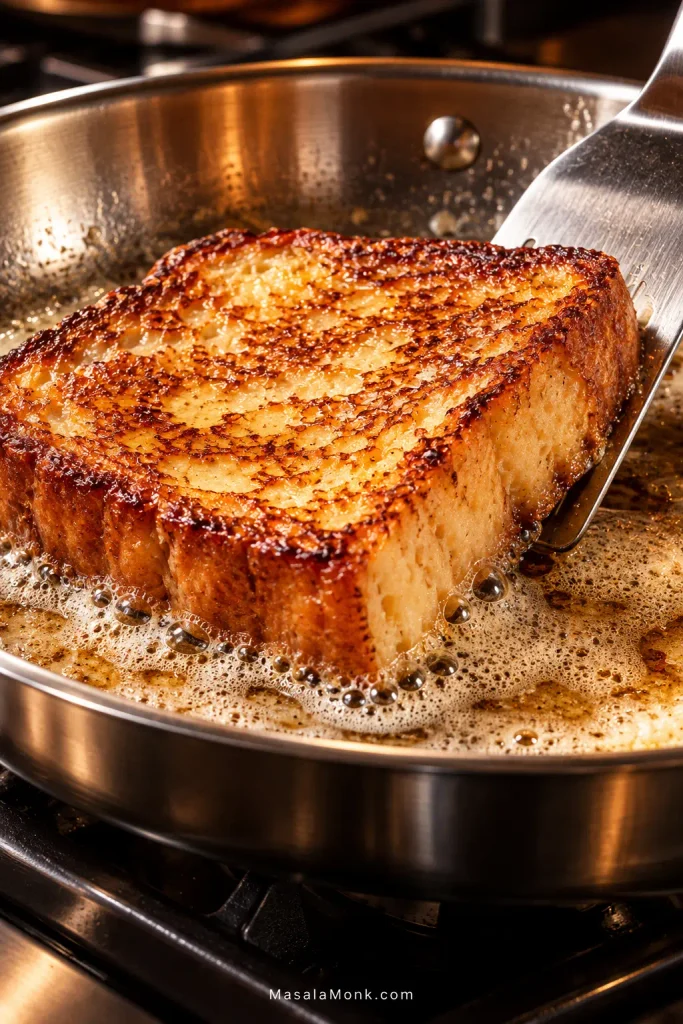
Should You Toast a Breakfast Burrito?

Toasting is worth it if you are eating the burrito right away. It seals the seam, melts the cheese, warms the tortilla, and gives the outside a better texture. A soft wrapped burrito is fine for packed breakfasts, but a toasted breakfast burrito feels more finished.

Because this recipe uses warm fillings and shredded cheese, even a short skillet toast helps everything come together. It also makes the burrito easier to pick up without the seam opening.

Breakfast burrito toasting seam-side down in a skillet until the tortilla is golden
Toasting seam-side down first helps lock the fold. After that, the outside can brown evenly while the cheese finishes melting inside.
Finish Best For How to Do It
Skillet toast Best everyday texture Toast seam-side down for 1–2 minutes per side over medium heat.
Oven finish Several burritos at once Bake at 425°F / 220°C for 8–10 minutes, until hot and lightly crisp.
Broiler finish Fast browning Broil on low for 3–6 minutes, watching closely so tortillas do not burn.
Sandwich press Compact, crisp burritos Press gently until the outside is golden and the cheese melts.

How to Make Freezer Breakfast Burritos

Freezer breakfast burritos are brilliant when they work and disappointing when they do not. The difference is usually steam and sauce. Let the fillings cool, keep wet toppings out, wrap tightly, and reheat gently so the eggs stay soft and the tortilla does not turn limp.

The goal is to freeze a burrito that still tastes like breakfast after reheating, not a steamed tortilla with dry eggs inside.

Wrapped freezer breakfast burritos beside one cut-open burrito and a freezer bag
Freezer breakfast burritos need sturdy fillings and controlled moisture. Otherwise, they may freeze well but reheat into a soft, damp tortilla.

Cool the Filling First

Hot eggs, potatoes, and sausage release steam. If you wrap them immediately, that steam gets trapped inside the tortilla and softens it. For freezer burritos, spread the cooked fillings on a plate or sheet pan and let them cool until warm, not hot, before assembling.

Cooked eggs, potatoes, sausage, and peppers spread on a tray to cool before being wrapped into breakfast burritos
Letting the fillings cool gives steam a chance to escape. Because of that, the tortilla is less likely to soften before the burrito even reaches the freezer.

What Not to Put Inside Before Freezing

Some ingredients taste better added after reheating. Keep fresh avocado, guacamole, sour cream, watery salsa, pico de gallo, lettuce, raw tomato, and very wet sauces out of the burritos before freezing. Otherwise, they can turn watery, dull, or mushy after thawing.

Better freezer fillings include eggs, cheese, cooked sausage, bacon, chorizo, beans, potatoes, hash browns, cooked peppers, and cooked onions.

Avocado, sour cream, pico de gallo, lettuce, tomato, and salsa shown beside a breakfast burrito as toppings to add later
Avocado, sour cream, lettuce, pico, tomato, and watery salsa taste better after reheating. Keep them fresh on the side instead of freezing them inside.

Freezer Breakfast Burrito Workflow

  1. Cook the protein, potatoes, and eggs separately.
  2. Spread the hot fillings on a plate or sheet pan so steam can escape.
  3. Warm the tortillas so they fold without cracking.
  4. Add cheese first, then potatoes, eggs, and protein or beans.
  5. Fold tightly and place each burrito seam-side down.
  6. Wrap each burrito in parchment or foil.
  7. Place wrapped burritos in a freezer bag, label, and freeze flat.
  8. Reheat gently, then add salsa, crema, avocado, or fresh toppings after warming.
Workflow image showing cooked filling, cooled filling, burrito assembly, wrapping, and freezing steps
The freezer method is easier when you follow the order: cook, cool, fill, wrap, and freeze. Skipping the cooling step is where most texture problems begin.

How to Wrap Breakfast Burritos for the Freezer

Wrap each cooled burrito tightly in parchment or foil. Then, place the wrapped burritos in a freezer bag or airtight container. Foil helps protect the shape, but a freezer bag gives better protection from freezer air.

Label the bag with the filling and date. Breakfast burritos are best within 2–3 months for texture, depending on how well they are wrapped.

Hands wrapping breakfast burritos in parchment or foil with wrapped burritos and a freezer bag nearby
A tight wrap protects the tortilla and keeps the burrito compact. Then the freezer bag adds the second layer of protection against drying out.
Next: go straight to how to reheat breakfast burritos or jump down to storage, freezing, and reheating for the short version.

How to Reheat Breakfast Burritos

The best everyday method is microwave plus skillet: warm the center first, then crisp the outside. The microwave alone is fastest, but it can make the tortilla chewy. The oven or toaster oven gives better texture when reheating several burritos.

Reheating guide showing breakfast burritos in a microwave, skillet, oven, and air fryer
Reheating is not one-size-fits-all. The microwave is fastest, the skillet improves texture, the oven handles batches, and the air fryer adds crispness.
Situation Best Method Exact Guidance
Fresh burrito, eating now Skillet Toast seam-side down for 1–2 minutes per side.
Refrigerated burrito Microwave + skillet Microwave 45–90 seconds, then crisp in a skillet for 1–2 minutes per side.
Frozen burrito, fastest Microwave Remove foil, wrap in a paper towel, defrost at 50% power for 3–5 minutes, then heat on full power for 1–2 minutes more.
Frozen burrito, best oven texture Oven or toaster oven Heat foil-wrapped at 350°F / 175°C for 45–55 minutes, until hot in the center.
Thawed burrito, oven Oven or toaster oven Heat at 400°F / 200°C for 15–20 minutes.
Frozen burrito, air fryer Air fryer Remove foil or parchment. Heat at 350°F / 175°C for 15–20 minutes, checking the center.
Thawed burrito, air fryer Air fryer Heat at 350°F / 175°C for 8–12 minutes.
Crisp finish Skillet After warming, toast 1–2 minutes per side over medium heat.

Microwave and Skillet Reheating Method

For the best everyday texture, warm the burrito first so the center is hot, then finish it in a skillet so the tortilla gets lightly crisp again. This is especially helpful for refrigerated burritos and thawed freezer burritos because the microwave handles the center while the skillet fixes the outside.

Breakfast burrito first warmed in the microwave and then crisped in a skillet
This two-step method solves a common problem: the microwave warms the center, while the skillet brings back the toasted tortilla texture.

For food safety, reheat leftovers until hot throughout. If checking with a thermometer, the center should reach 165°F / 74°C. You can read more about safe leftover handling from the USDA leftover food safety guide.

Breakfast Burrito Filling Ideas

Once the basic breakfast burrito recipe formula is clear, the burritos become easy to customize. Keep the same structure: tortilla, cheese, eggs, potatoes or hash browns, a flavorful filling, and sauce on the side or added lightly inside.

Choose Your Breakfast Burrito Version

Quick chooser: Want classic? Use sausage, eggs, potatoes, and cheddar. Want smoky? Use bacon, hash browns, and chipotle crema. Want spicy? Use chorizo, potatoes, and salsa verde. Want meatless? Use eggs, black beans, peppers, onions, and cheese. Want high-protein? Use eggs or egg whites, beans, turkey sausage, cottage cheese, or tofu scramble.

Variation board showing classic, smoky, spicy, meatless, and high-protein breakfast burrito filling ideas
Once the base formula works, the filling can change with the mood: classic sausage, smoky bacon, spicy chorizo, meatless beans, or a higher-protein build.

Breakfast Burrito Variation Table

Variation Filling Best Sauce Notes
Sausage Breakfast Burrito Eggs, breakfast sausage, potatoes, cheddar Salsa or hot sauce The most classic version and a good first recipe.
Bacon Hash Brown Burrito Eggs, bacon, hash browns, cheddar Chipotle crema Smoky, crisp, and very brunch-friendly.
Chorizo Breakfast Burrito Eggs, chorizo, potatoes, Monterey Jack Salsa verde Spicy and rich; drain the chorizo well before filling.
Steak and Egg Breakfast Burrito Steak, eggs, potatoes, cheese Salsa roja or hot sauce Hearty and high-protein, especially good with leftover steak.
Chicken Breakfast Burrito Chicken sausage or shredded chicken, eggs, potatoes Avocado crema A lighter meat option that still feels filling.
Vegetarian Breakfast Burrito Eggs, black beans, potatoes, peppers, onions, cheese Salsa or avocado crema Meatless but still hearty because of beans and potatoes.
Vegan Breakfast Burrito Tofu scramble, beans, potatoes, salsa, vegan cheese Salsa or vegan crema Add avocado after reheating if freezing.
High-Protein Breakfast Burrito Eggs, egg whites, turkey sausage, beans, cottage cheese Salsa or Greek yogurt sauce Best for meal prep and macro-friendly breakfasts.
Freezer-Friendly Burrito Eggs, potatoes, cheese, sausage or beans Sauce on the side Avoid wet toppings inside before freezing.
Need matching sauce ideas? Head to best sauces for breakfast burritos. Want a lighter version? See how to make a healthy or high-protein breakfast burrito.

Sausage Breakfast Burrito

Use cooked breakfast sausage, soft eggs, golden potatoes, and cheddar or Monterey Jack. Before assembly, drain the sausage so the tortilla does not get greasy. This is the best classic version to make first.

Bacon Breakfast Burrito

Cook bacon until crisp, chop it, and pair it with eggs, hash browns, and cheddar. Bacon works especially well with chipotle crema, hot sauce, or a small spoonful of salsa.

Chorizo Breakfast Burrito

Chorizo brings spice and richness. Cook it fully, drain off extra fat, and balance it with eggs, potatoes, cheese, and salsa verde. Because chorizo is strongly seasoned, taste before adding extra salt.

Steak and Egg Breakfast Burrito

Use thinly sliced cooked steak or leftover steak with eggs, potatoes, cheese, and salsa roja. This version feels more filling and higher-protein, so it works well as a brunch or post-workout breakfast.

Chicken Breakfast Burrito

Use chicken sausage, shredded cooked chicken, or chopped grilled chicken with eggs, potatoes, cheese, and avocado crema. Since chicken has a milder flavor than bacon or chorizo, season the potatoes and sauce well.

Vegetarian Breakfast Burrito

Use eggs, black beans or pinto beans, crisp potatoes, peppers, onions, cheese, and salsa. The beans replace meat while adding protein, fiber, and a creamy texture against the browned potatoes.

Vegetarian breakfast burrito cut open with eggs, beans, potatoes, peppers, onions, and cheese
A vegetarian breakfast burrito should still feel hearty. Beans bring protein and creaminess, while potatoes, peppers, eggs, and cheese keep the texture satisfying.

Vegan Breakfast Burrito

Use tofu scramble instead of eggs, then add black beans, crisp potatoes, salsa, sautéed peppers, onions, and vegan cheese or cashew queso. If freezing, keep avocado and fresh greens out of the burrito and add them after reheating. For more savory plant-based breakfast ideas, MasalaMonk’s guide to using tofu instead of eggs is a natural companion.

Vegan breakfast burrito with tofu scramble, beans, potatoes, salsa, and vegetables
Tofu scramble works best when it is treated like a real filling, not an afterthought. Pair it with beans, potatoes, vegetables, and salsa for better balance.

High-Protein Breakfast Burrito

For a high-protein breakfast burrito, use extra eggs or egg whites, black beans, turkey sausage, chicken sausage, steak, tofu scramble, or cottage cheese-enriched eggs. Still, keep the potatoes if you want the burrito to taste like breakfast instead of a plain protein wrap.

High-protein breakfast burrito with eggs, egg whites, beans, lean meat, and potatoes
A high-protein breakfast burrito works better when protein is added around the classic structure. Keep enough potato, cheese, or sauce so it still tastes like breakfast.

Best Sauces for Breakfast Burritos

A dry breakfast burrito tastes like meal prep. A good sauce makes it feel like breakfast you actually wanted. The trick is using enough salsa, crema, or hot sauce to brighten the eggs and potatoes without making the tortilla wet.

This recipe works with several sauces, so choose based on the filling. For example, chorizo is great with salsa verde, bacon works beautifully with chipotle crema, and vegetarian burritos taste brighter with avocado crema or salsa.

Sauce guide showing salsa roja, salsa verde, hot sauce, chipotle crema, avocado crema, sour cream lime sauce, and green chile sauce with a breakfast burrito
Sauce changes the whole direction of the burrito. For example, salsa verde brightens spicy fillings, while chipotle crema makes bacon or hash browns feel richer.

Quick 3-Ingredient Breakfast Burrito Sauce

For the fastest sauce, stir together 3 tablespoons mayonnaise or Greek yogurt, 1 tablespoon lime juice, and 1–2 teaspoons taco seasoning or hot sauce. It is not as smoky as chipotle crema, but it gives the burrito a creamy, tangy finish in less than 2 minutes.

Creamy quick breakfast burrito sauce served beside a burrito with sauce ingredients nearby
A quick sauce can rescue a basic meal-prep burrito. Even a small creamy, tangy finish makes eggs, potatoes, and tortillas taste fresher.
Sauce Best With Use Inside or On the Side?
Salsa roja Sausage, bacon, steak, eggs Lightly inside fresh burritos; side for freezer burritos
Salsa verde Chorizo, potatoes, vegetarian burritos Best on the side or added after reheating
Hot sauce Almost any breakfast burrito Inside or on the side, but use lightly
Chipotle crema Bacon, hash browns, chicken, steak Side for freezer burritos
Avocado crema Vegetarian, chicken, spicy burritos Add after reheating for best texture
Sour cream lime sauce Classic egg and potato burritos Fresh serving only; not ideal inside freezer burritos
Green chile sauce Egg, potato, sausage, and cheese burritos Best spooned over or served on the side
Want to pair sauces with specific fillings? Jump back to breakfast burrito filling ideas or return to the main recipe.

For an egg-free creamy sauce, use thick yogurt, sour cream, or an egg-free mayo base. MasalaMonk’s eggless mayonnaise recipe is a useful starting point if you want a creamy breakfast burrito sauce without using eggs in the condiment.

Quick Chipotle Crema for Breakfast Burritos

For a smoky creamy sauce, mix 1 cup Greek yogurt, sour cream, or crema with 1 minced chipotle pepper in adobo, 1 tablespoon adobo sauce, 2 teaspoons lime juice, ¼ teaspoon garlic powder, and salt to taste. Blend for a smooth sauce or whisk if the chipotle is finely minced. If you like building sauces from a creamy base, MasalaMonk’s homemade mayo guide has more spicy mayo and garlic mayo ideas that can be adapted for burritos.

How to Make a Healthy or High-Protein Breakfast Burrito

A high-protein breakfast burrito should still taste like breakfast, not like a dry protein wrap. Keep the potatoes or hash browns for texture, then build more protein around them with eggs, egg whites, beans, turkey sausage, chicken sausage, steak, tofu scramble, or cottage cheese-enriched eggs.

For a lighter version, use whole eggs plus egg whites, add black beans or pinto beans, choose turkey sausage or chicken sausage, use a whole-wheat or high-fiber tortilla, and keep the sauce bright rather than heavy. A little sharp cheddar can also give more flavor than a lot of mild cheese.

High-protein formula: Use 1 whole egg + 2 egg whites, ¼–½ cup beans, 2–3 oz lean meat or tofu, ¼ cup cheese or cottage cheese, and ½ cup potatoes or vegetables per burrito.

Goal Best Move
More protein Add egg whites, black beans, turkey sausage, chicken sausage, steak, tofu scramble, or cottage cheese-enriched eggs.
Lower calories Use less cheese, lean protein, more peppers and onions, and sauce on the side.
More fiber Add black beans, pinto beans, a whole-wheat tortilla, spinach, peppers, or onions.
Still satisfying Keep about ½ cup potatoes or hash browns instead of removing the carb layer completely.

A higher-protein burrito works well with 2 eggs or 1 egg plus egg whites per burrito, ¼–½ cup beans, and turkey sausage, chicken sausage, steak, tofu scramble, or cottage cheese-enriched eggs. If you are building more protein-focused breakfasts across the week, this high-protein oatmeal guide gives another breakfast format using oats, yogurt, egg whites, cottage cheese, tofu, or protein powder.

Prefer a more classic version first? Go back to the main breakfast burrito recipe. Want filling inspiration? Browse the variation ideas.

Breakfast Burrito vs Breakfast Wrap

A breakfast burrito is usually larger, fuller, and folded closed on both ends. It often includes eggs, potatoes or hash browns, cheese, and a hearty filling. A breakfast wrap is usually lighter, flatter, and easier to toast, with fewer fillings or a more sandwich-like shape.

A lighter breakfast wrap works best with less potato, less cheese, a thinner layer of eggs, and a smaller amount of filling. A true breakfast burrito needs a large tortilla and enough filling so every bite has eggs, potatoes, cheese, and something flavorful. If you are deciding between a burrito, wrap, toast, or egg-and-cheese build, MasalaMonk’s breakfast sandwich ideas can help you choose a smaller, faster format for busy mornings.

Side-by-side comparison of a larger filled breakfast burrito and a lighter breakfast wrap
The difference is mostly structure. A breakfast burrito is fuller and folded closed, while a breakfast wrap is lighter, flatter, and easier to toast quickly.

Breakfast Burrito Troubleshooting
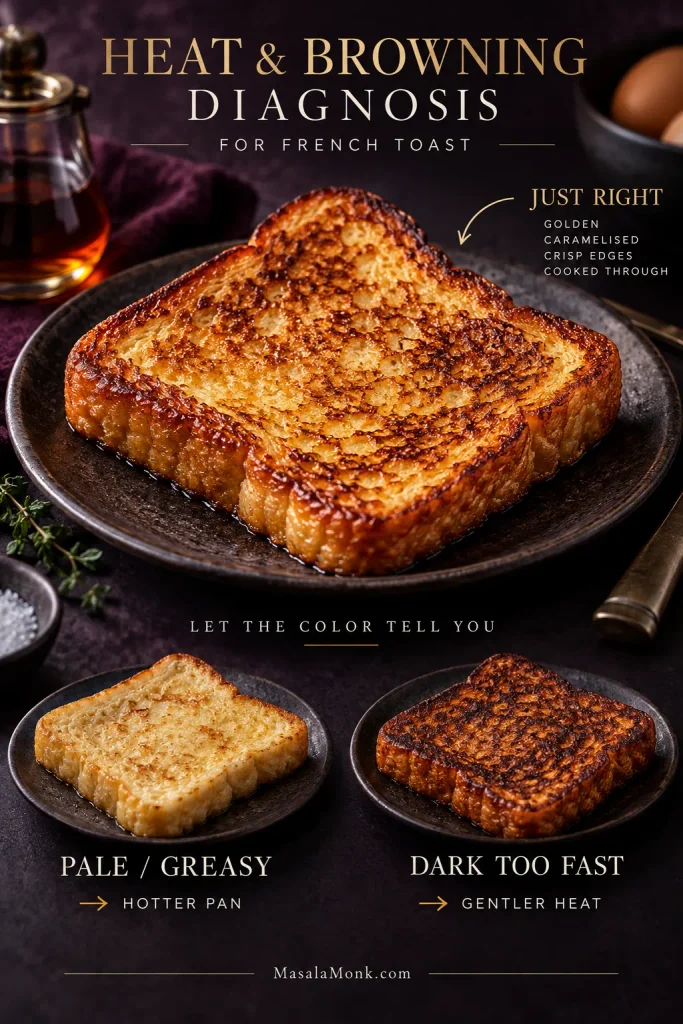
When breakfast burritos go wrong, it is usually not because the idea is bad. It is usually one of three things: too much moisture, a cold or small tortilla, or fillings that were overcooked before they ever went inside. Once you know which one caused the problem, the fix is usually simple.

Troubleshooting guide for breakfast burritos showing common problems such as cracked tortillas, soggy burritos, rubbery eggs, and cold centers
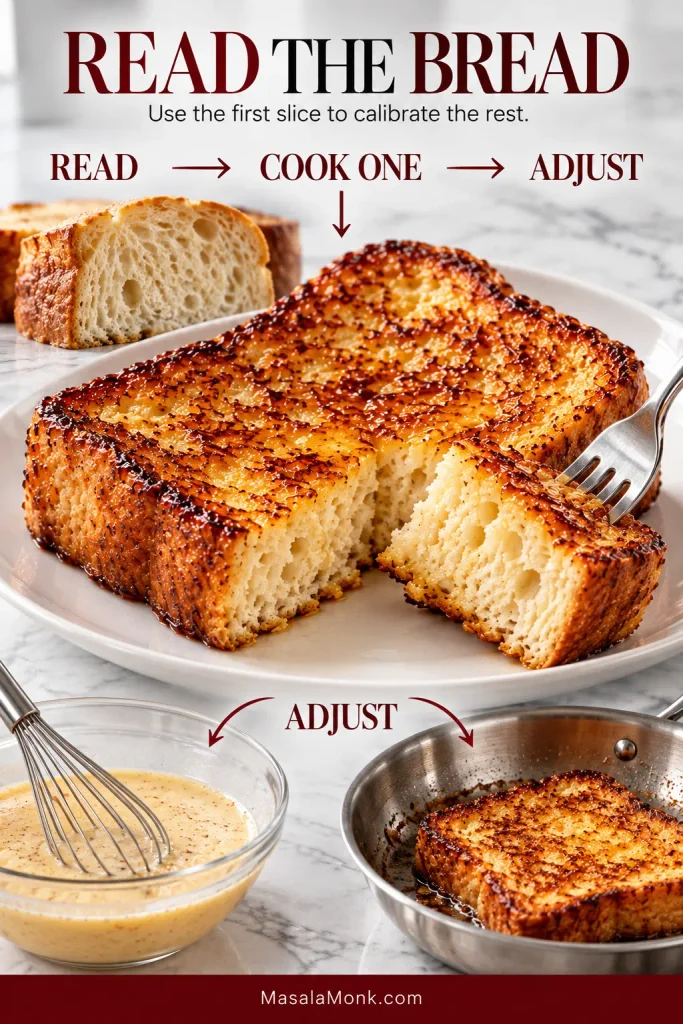
Most breakfast burrito problems are fixable. Check moisture, tortilla warmth, filling amount, egg texture, and reheating method before changing the whole recipe.
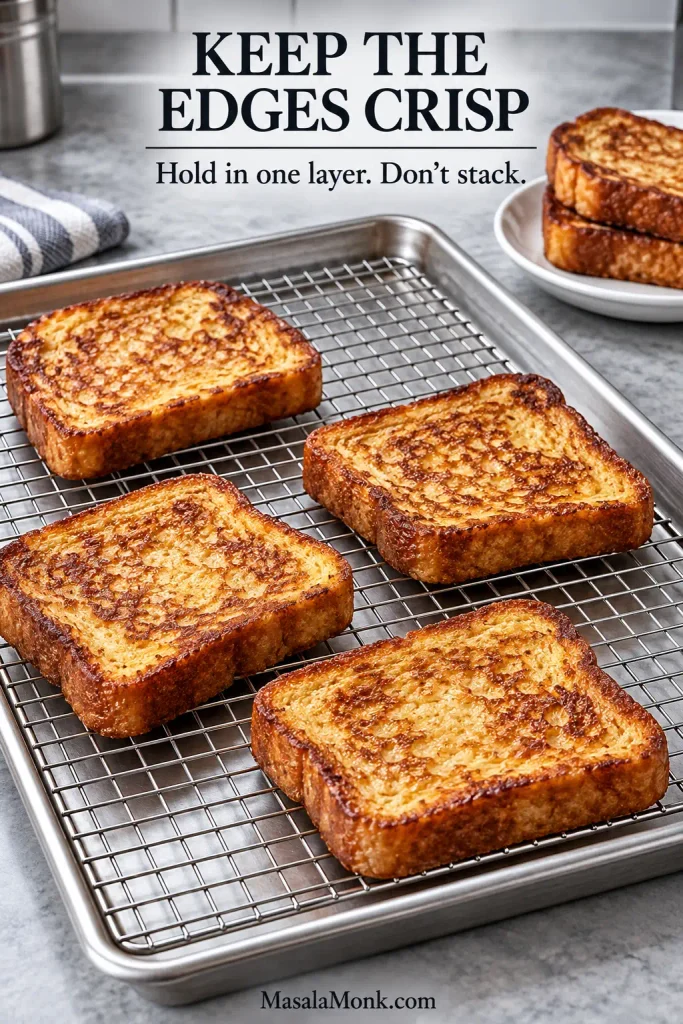
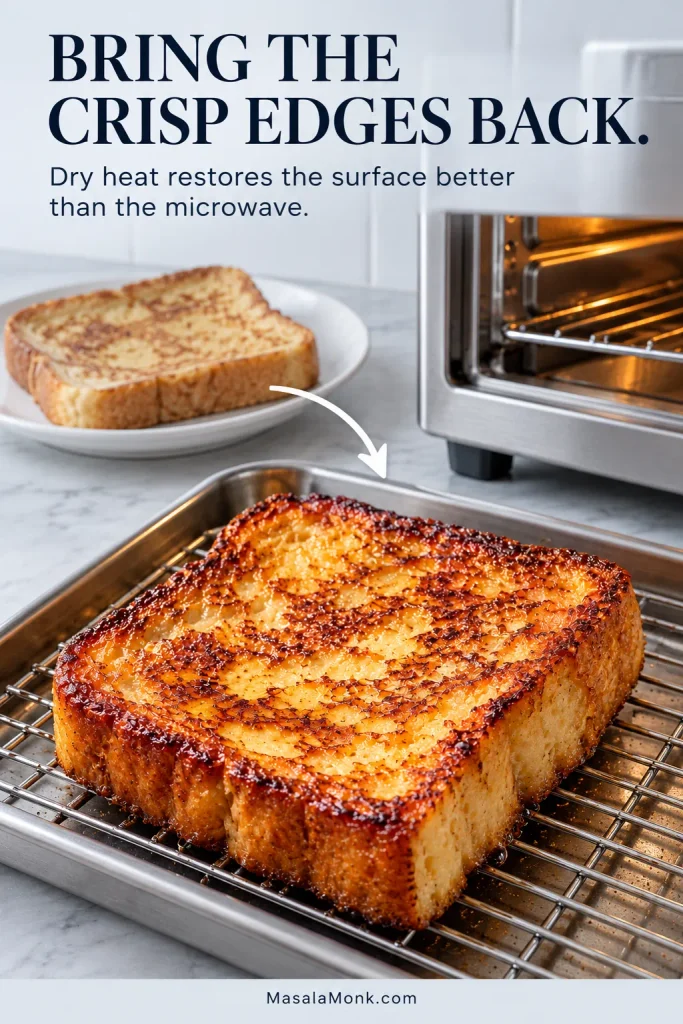
Problem Likely Cause Fix
Burrito falls apart Too much filling or tortilla too small Use a 10–12 inch tortilla and keep filling in a narrow strip.
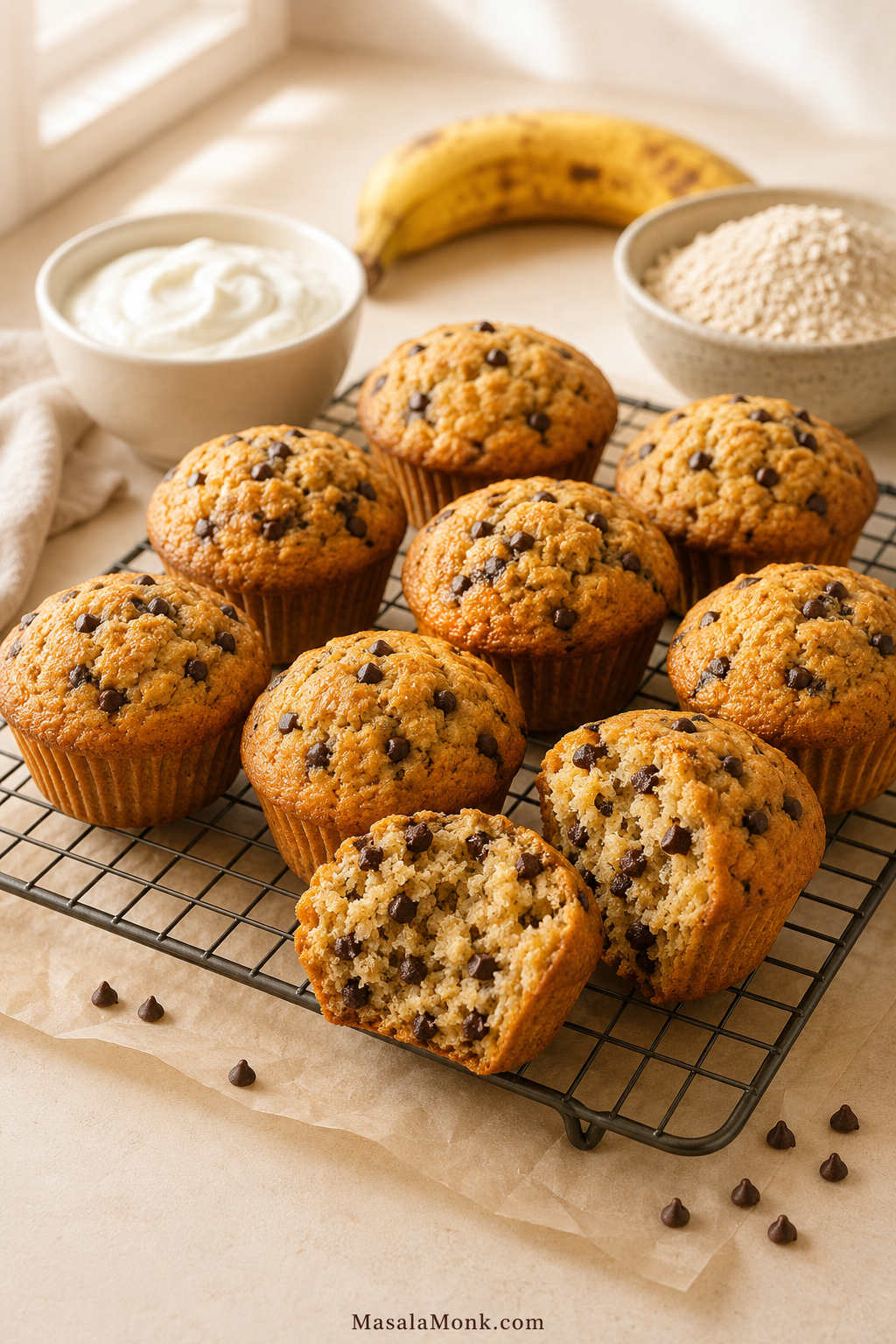
Tortilla cracks Cold or dry tortilla Warm under a damp paper towel for 15–30 seconds before folding.
Burrito turns wet or limp Hot filling, watery salsa, or wet toppings inside Cool fillings first and keep sauce, sour cream, and avocado on the side.
Eggs turn rubbery Eggs overcooked before folding or overheated during reheating Cook eggs softly and reheat gently.
Potatoes are mushy Pan overcrowded or potatoes under-browned Cook in a thin layer until golden before adding to burritos.
Filling tastes bland Only the eggs were seasoned Season potatoes, eggs, and protein separately.
Cheese does not melt Cheese added too late or filling not warm enough Add cheese first, then warm fillings, and toast the burrito.
Frozen burrito is cold in the center Outside heated faster than the middle Defrost first, microwave at lower power, or oven-reheat longer.
Tortilla gets chewy in microwave Over-microwaved or uncovered Use a damp paper towel and finish in a skillet for better texture.
Burrito feels too bulky Too much potato or filling Use about ½ cup potatoes and ¼–½ cup protein or beans per tortilla.
Need the detailed fix? Revisit folding, freezer tips, reheating, or sauce ideas.

What to Serve with Breakfast Burritos

Breakfast burritos are filling enough on their own, but the right sides make them feel more complete. Serve them with salsa, hot sauce, avocado, fruit, roasted potatoes, a simple salad, or extra beans. For brunch, add lime wedges, pickled onions, sliced jalapeños, or a bowl of chipotle crema for dipping.

If you are serving a crowd, keep the burritos warm in a low oven, then set out sauces and toppings separately. This keeps the tortillas from softening too much and lets everyone choose their own heat level.

Storage, Freezing, and Reheating

Leftover breakfast burritos keep well in the refrigerator for 3–4 days. For longer storage, wrap them individually and freeze them for best quality within 2–3 months.

In the fridge, wrap each burrito in foil or parchment and keep it in an airtight container. For the freezer, wrap each cooled burrito tightly, then place the wrapped burritos in a freezer bag. After that, reheat until hot throughout and add sauce, avocado, sour cream, or fresh salsa only after warming.

Storage guide showing wrapped breakfast burritos for the refrigerator, wrapped burritos in a freezer bag, and a reheated cut burrito
Storage matters because eggs, cheese, potatoes, and tortillas all change texture over time. Refrigerate short-term batches and freeze longer meal prep portions.

This recipe is best when reheated gently rather than blasted on high heat from frozen. For a broader reference on refrigerator and freezer timing across eggs, cooked dishes, meats, and prepared foods, the FoodSafety.gov cold food storage chart is also useful.

Best make-ahead move: Freeze the burritos without wet toppings, then serve with salsa, crema, hot sauce, avocado, or pico de gallo after reheating.

Once you understand the formula, breakfast burritos become one of the easiest breakfasts to repeat: warm tortilla, soft eggs, crisp potatoes, melted cheese, a flavorful filling, and sauce used smartly. Make them fresh when you want a hot skillet breakfast, or wrap a batch for the freezer so a real breakfast is ready on busy mornings instead of another rushed compromise.

Final Breakfast Burrito Serving Idea

When you are ready to serve, keep the burrito warm and add the fresh toppings at the end. Salsa, avocado, crema, hot sauce, lime, or pico de gallo all taste better when they finish the burrito instead of sitting inside during storage.

Finished breakfast burrito served with avocado, salsa, and sauce on a plate
The payoff is a burrito that works fresh, reheated, or meal-prepped: warm tortilla, soft eggs, crisp potatoes, melted cheese, and fresh toppings added at the end.

FAQs

What goes in a breakfast burrito?

A classic breakfast burrito recipe usually includes a large flour tortilla, scrambled eggs, potatoes or hash browns, cheese, and a filling such as sausage, bacon, chorizo, beans, peppers, onions, steak, chicken, or vegetables. Salsa or sauce is usually served inside lightly or on the side.

What size tortilla is best for breakfast burritos?

For most home cooks, 10 inches is the smallest size I would use for a proper breakfast burrito. A 12-inch tortilla is easier if you like a generous filling or are still learning to fold tightly. Smaller tortillas usually crack, tear, or leave the ends open.

Do breakfast burritos need potatoes or hash browns?

Potatoes are not required, but they make breakfast burritos more filling and give the inside better texture. Diced potatoes, shredded hash browns, hash brown patties, tater tots, and leftover roasted potatoes all work.

How do you keep breakfast burritos from getting soggy?

The biggest fix is moisture control. Let hot fillings cool before wrapping, use cheese as the first layer, and keep watery salsa, sour cream, avocado, raw tomato, and wet sauces on the side if the burritos are going into the fridge or freezer.

Should salsa go inside a breakfast burrito?

A small spoonful of salsa can go inside a fresh burrito. For freezer burritos, keep salsa on the side and add it after reheating so the tortilla does not turn wet.

How do you fold a breakfast burrito?

Warm the tortilla first, place the filling in a narrow strip, fold the sides inward, pull the bottom flap over the filling, tuck it tightly, and roll forward. Then, toast seam-side down to help seal it.

Should you toast a breakfast burrito?

Toasting improves the texture and helps seal the fold. Place the burrito seam-side down in a skillet and cook for 1–2 minutes per side until the outside is lightly golden.

How long do breakfast burritos last in the fridge?

Breakfast burritos keep well in the refrigerator for 3–4 days when wrapped and stored in an airtight container. After reheating, add fresh toppings like avocado, sour cream, or salsa.

How do you freeze breakfast burritos?

Cool the fillings first, assemble the burritos without wet toppings, wrap each one tightly in parchment or foil, then place them in a freezer bag or airtight container. Label with the date and use within 2–3 months for best texture.

What should you leave out of freezer breakfast burritos?

Leave out fresh avocado, guacamole, sour cream, watery salsa, pico de gallo, lettuce, and raw tomato. These are better added after reheating because they can turn watery or mushy in the freezer.

How do you reheat frozen breakfast burritos?

The fastest method is to remove the foil, wrap the burrito in a paper towel, defrost it in the microwave at 50% power, and then heat until hot. For better texture, warm it first and then crisp it in a skillet. When reheating several burritos, the oven gives more even heat.

How do you make a high-protein breakfast burrito?

Use more eggs or egg whites, add black beans, choose turkey sausage, chicken sausage, steak, tofu scramble, or cottage cheese-enriched eggs, and use a higher-fiber tortilla. Keep the potatoes if you still want it to feel like a real breakfast burrito.

How do you make a vegetarian breakfast burrito?

Use scrambled eggs, black beans or pinto beans, crisp potatoes or hash browns, sautéed peppers and onions, cheese, and salsa. Together, beans and potatoes keep the burrito filling even without meat.

What sauce is best for breakfast burritos?

Salsa, hot sauce, chipotle crema, avocado crema, green chile sauce, and sour cream lime sauce all work well. For freezer burritos, serve sauce on the side or add it after reheating.

What is the difference between a breakfast burrito and a breakfast wrap?

A breakfast burrito is usually larger, fuller, and folded closed, often with eggs, potatoes, cheese, and a hearty filling. A breakfast wrap is often lighter, flatter, and easier to toast with fewer fillings.