Posted on Leave a comment

Overnight French Toast Casserole: Easy Make-Ahead Baked French Toast

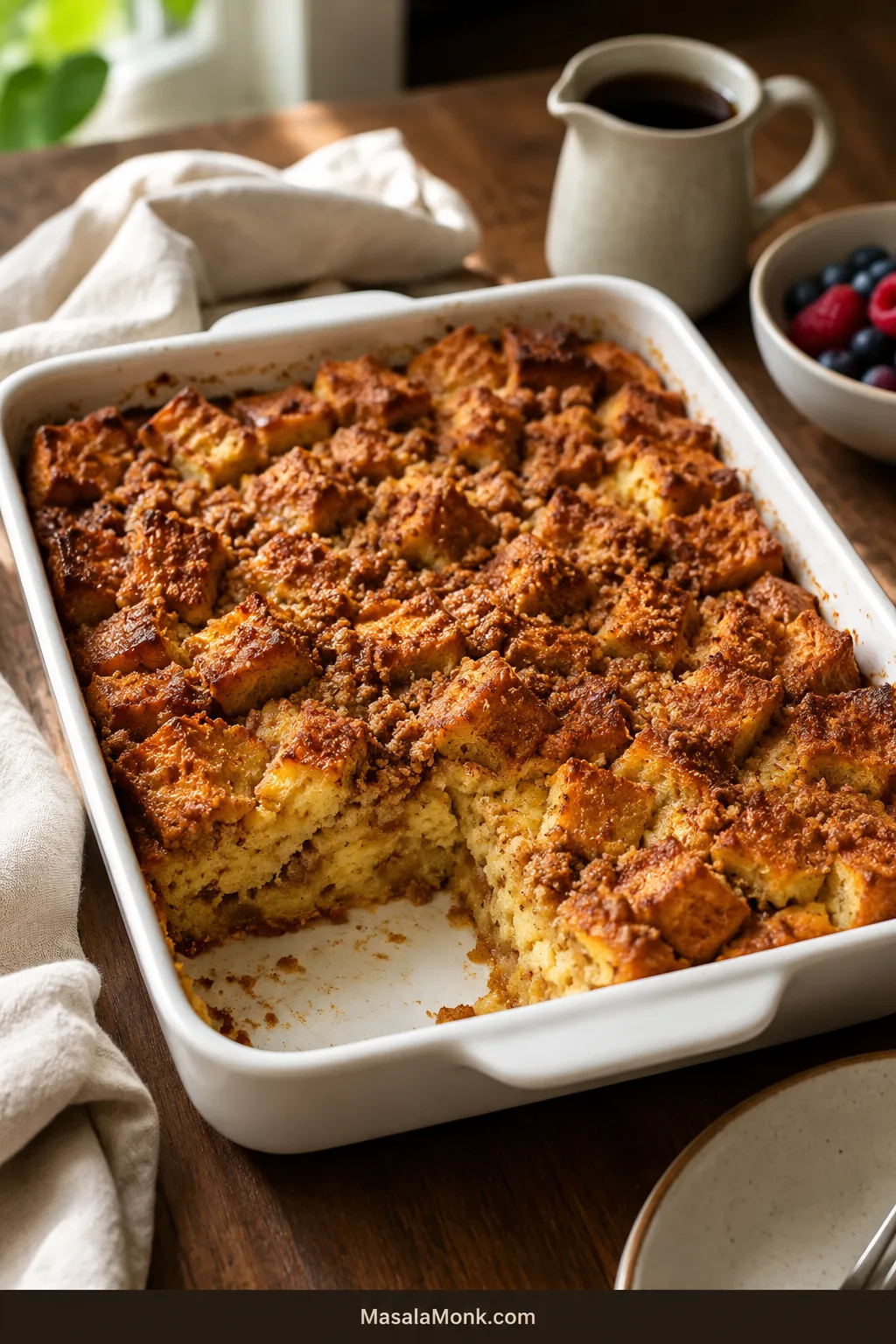
Overnight French toast casserole with golden cinnamon streusel and one serving removed from the baking dish.

By the time the oven begins to warm, breakfast should already be decided. The bread has spent the night soaking in cinnamon-vanilla custard, the streusel is cold and crumbly, and the morning work is little more than scattering the topping, baking the pan and pouring the coffee.

The easy morning only pays off when an overnight French toast casserole comes out properly: crisp and buttery across the top, tender where the bread has absorbed the custard, and set enough that the first spoonful holds together. Here, the bread is weighed rather than guessed, the sweetness stays balanced, and the middle—not merely the golden topping—decides when the pan is ready.

Day-old French bread absorbs the custard without collapsing, which makes it the easiest loaf to use here. Brioche, challah, sourdough, plain Texas toast and sturdy gluten-free bread can also work with a few adjustments. Once the bread amount, pan depth and final doneness are right, the method is highly forgiving.

Start here

The Version to Make First

Use 16 oz / 450 g day-old French bread—about 10–12 loosely filled cups after cutting it into 1-inch / 2.5 cm pieces. Soak it overnight in a mixture of 8 eggs, 2 cups / 480 ml whole milk and ½ cup / 120 ml half-and-half or cream. Keep the streusel cold and separate until morning.

Bake in a standard 9×13-inch / 23×33 cm dish at 350°F / 175°C. Begin checking near 40 minutes; many pans finish in approximately 45–55 minutes. The topping should be golden, the middle should look set rather than fluid, and the thickest central area should reach at least 160°F / 71°C.

The clock tells you when to check; the center tells you when to stop.

This is the texture to aim for: recognizable bread pieces held together by softly set custard, with a crisp top and no liquid collecting beneath the serving.
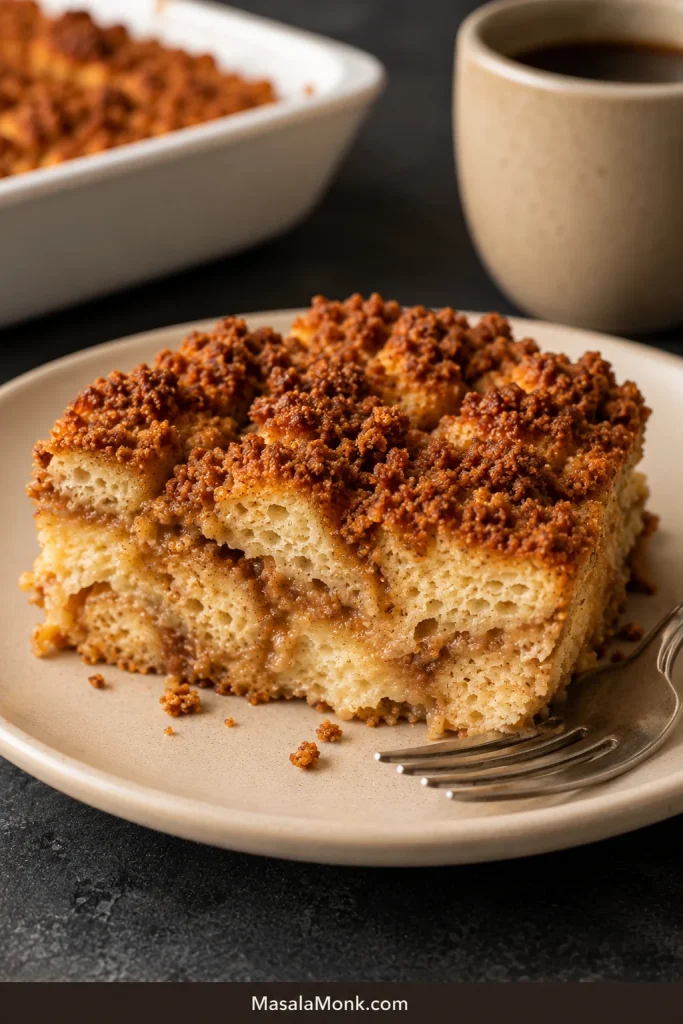
Slice of overnight French toast casserole with crisp cinnamon streusel, distinct bread pieces and a softly set custardy center
The cut face should show moist seams between recognizable bread pieces—not a smooth pudding layer or a dry, cake-like crumb.

Make it tonight

Overnight French Toast Casserole Recipe

A make-ahead French toast bake with cinnamon-vanilla custard, crisp exposed bread edges and a cold brown sugar streusel added just before baking. It is moderately sweet on its own, leaving room for warm maple syrup at the table.

Recipe at a Glance

  • Yield: 10 standard servings, 8 generous servings or up to 12 smaller brunch portions
  • Active preparation: About 20 minutes at night, plus 5 minutes in the morning
  • Chilling: 8–12 hours
  • Bake and rest: Approximately 45–55 minutes, plus 10 minutes
  • Total elapsed time: Approximately 9–13½ hours, mostly unattended
  • Pan: Standard 9×13-inch / 23×33 cm dish, about 3 quarts / 2.8 liters
  • Oven: 350°F / 175°C
  • Doneness: The center looks set, a thin knife shows no raw custard, and the thickest area reaches at least 160°F / 71°C

Equipment

  • Standard 9×13-inch / 23×33 cm baking dish, about 3 quarts / 2.8 liters
  • Large mixing bowl and whisk
  • Serrated bread knife and cutting board
  • Kitchen scale
  • Measuring cups and spoons
  • Rimmed sheet pan if the bread needs drying
  • Foil
  • Instant-read thermometer, recommended

Ingredients

For the Bread and Custard

  • 16 oz / 450 g French bread, preferably day-old, about 10–12 loosely filled cups after cutting
  • 8 large eggs
  • 2 cups / 480 ml whole milk
  • ½ cup / 120 ml half-and-half or heavy cream
  • ⅓ cup / 70 g packed light brown sugar
  • 1 tablespoon / 15 ml vanilla extract
  • 2 teaspoons ground cinnamon
  • ¼ teaspoon ground nutmeg
  • ¾ teaspoon fine salt
  • Unsalted butter or nonstick cooking spray, for the dish

For the Cinnamon Streusel

  • ½ cup / 60 g all-purpose flour
  • ⅓ cup / 70 g packed light brown sugar
  • 1 teaspoon ground cinnamon
  • Pinch of fine salt
  • 6 tablespoons / 85 g cold unsalted butter, cut into small cubes
  • ½ cup / about 55 g chopped pecans, optional

For Serving

  • Warm maple syrup
  • Fresh berries, sliced apples or another fresh fruit
  • Powdered sugar, optional

Measure the custard and streusel ingredients separately before beginning, especially the two portions of brown sugar.
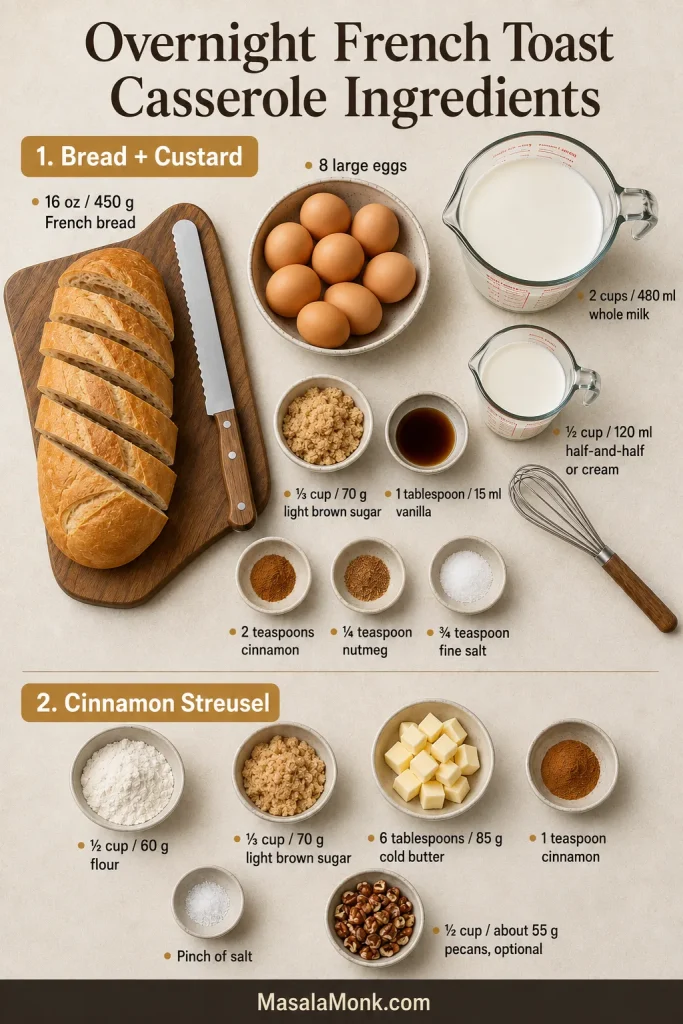
Measured French bread, eggs, milk, cream, brown sugar, spices, flour, cold butter and optional pecans arranged for French toast casserole.
Keep the two brown-sugar portions separate: one sweetens the cinnamon-vanilla custard, whereas the second combines with flour and cold butter to form the streusel.

Instructions

Before Bed

  1. Prepare the dish. Butter the base, sides and especially the corners of a standard 9×13-inch / 23×33 cm baking dish generously. Custard-soaked bread can cling where the pan is only lightly coated. Nonstick cooking spray can be used instead.
  2. Cut the bread. Cut the French bread into pieces around 1 inch / 2.5 cm. Keep the crusts unless they are unusually hard or thick; they add structure and create some of the crispest exposed edges. If the bread is fresh and soft, dry it using the method in the notes, then let it cool.
  3. Fill the pan loosely. Spread the bread through the dish. The pan should look comfortably full, with the pieces sitting loosely instead of being pressed into a dense layer.
  4. Whisk the custard. Whisk the eggs until the whites and yolks are fully blended. Add the milk, half-and-half or cream, brown sugar, vanilla, cinnamon, nutmeg and salt. Continue whisking until the sugar is mostly dissolved and no visible streaks of egg white remain.
Coat, Cover and Chill
  1. Coat the bread. Pour the custard in stages, pausing to turn the pieces gently so the liquid reaches the middle and corners. Press lightly until the dry edges touch the custard. Packing the bread down firmly can make the casserole dense.
  2. Check the pan. The bread should look well moistened, with a little custard visible near the bottom. It should not be floating in a deep pool.
  3. Cover and refrigerate. Cover tightly and refrigerate for 8–12 hours.
  4. Make the streusel. Mix the flour, brown sugar, cinnamon and salt. Work in the cold butter until it is coated and the topping contains fine crumbs with a few pea-sized clumps. Mix in the pecans when using, then cover and refrigerate separately.

Before covering the pan, make sure the bread still sits loosely, looks evenly moistened and rises above the small amount of custard at the base.
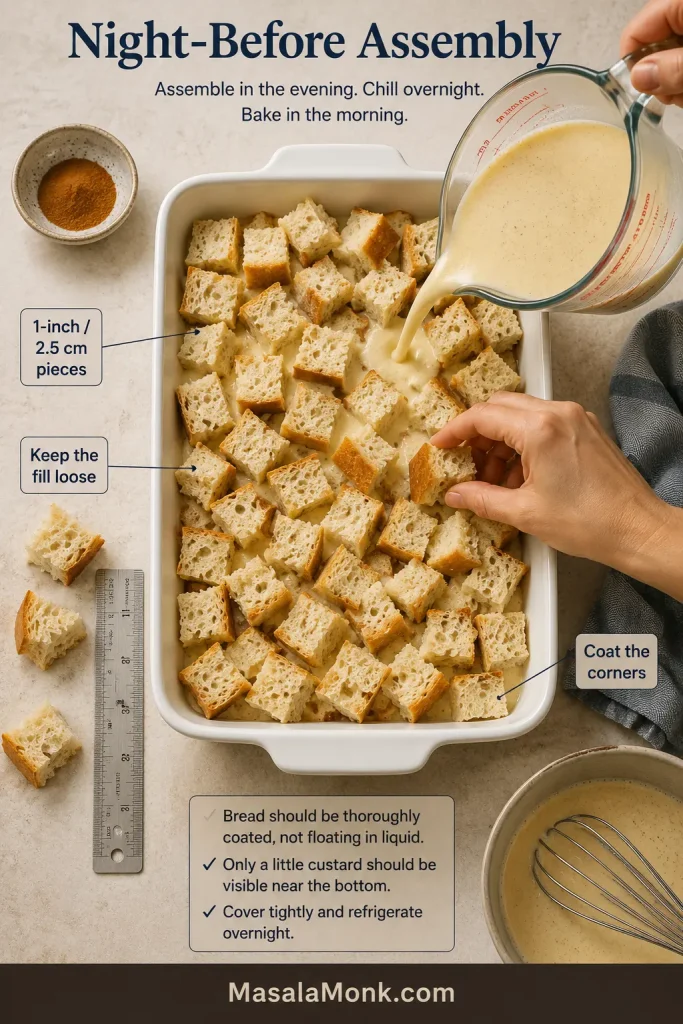
Overhead assembly guide showing evenly cut bread loosely arranged in a white baking dish while custard is poured between the pieces.
Pour the custard in several passes, pausing between them; dry-looking corners and pale upper surfaces reveal where the next pour should go.

The Next Morning

By morning, the bread should look fuller and darker with custard, while the dish remains stable rather than sloshing when moved.
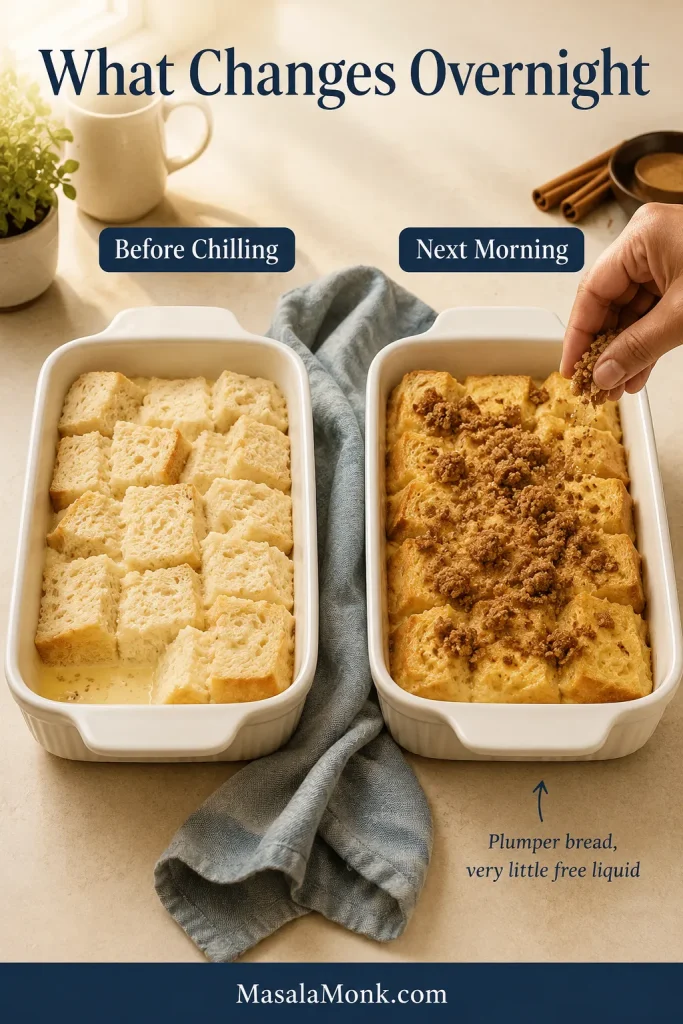
Two baking dishes compare freshly assembled French toast casserole with an overnight-soaked pan being topped with cold streusel.
Check the corners as well as the center: pale, dry pieces there suggest the custard was not distributed evenly before chilling.
  1. Heat the oven. Preheat to 350°F / 175°C. A metal pan can come out of the refrigerator while the oven heats. For glass or ceramic, first check the cold-bakeware guidance below.
  2. Check the overnight absorption. The pieces should look plumper and slightly darker with custard. A little liquid may remain visible low in the pan, but pressing the top should not make it surge across the dish.
  3. Add the topping. Uncover the dish and scatter the cold streusel over the bread. Leave a few edges exposed so they can crisp.
  4. Bake. Place the dish on the center rack and begin checking around 40 minutes.
Protect the Top and Check the Center
  1. Protect the top when needed. If the streusel and exposed bread are deeply golden while the center is still loose, tent the dish with foil and continue baking.
  2. Check the center. The edges should look puffed, and the middle should no longer appear shiny or liquid. Insert a thin knife through an area with less streusel; it should show moist crumbs, not raw custard.
  3. Confirm the temperature. The thickest central area should reach at least 160°F / 71°C. Melted butter and brown sugar may cling to the knife even when the custard underneath is set.
  4. Rest before serving. Let the pan stand for 10 minutes. Use that time to warm the maple syrup, put out the fruit and call everyone to the table.

Cold Glass and Ceramic Bakeware

Avoid exposing very cold glass or ceramic bakeware to sudden high heat unless the manufacturer specifically approves refrigerator-to-oven use. Letting the dish stand while the oven preheats may reduce the temperature difference, but it does not replace the manufacturer’s instructions. A metal pan avoids this thermal-shock concern.

Success Notes

  • Fresh bread: Dry the pieces at 300°F / 150°C for 10–15 minutes, turning once. Very soft, freshly baked bread may need up to 20 minutes. Stop while the pieces remain pale.
  • Without cream: Replace the half-and-half or heavy cream with an equal amount of whole milk.
  • Dairy-free: Use 2½ cups / 600 ml oat milk and plant-based butter; see the complete dairy-free adaptation below.
  • Gluten-free: Use 450 g sturdy gluten-free bread and 1:1 gluten-free flour in the streusel; see the complete gluten-free adaptation below.
  • Nut-free: Leave out the pecans. No replacement is needed.
  • Same-day version: Dry the bread thoroughly and soak it for 45–60 minutes before baking.
  • Sweetness: Keep the casserole moderately sweet and add more maple syrup at the table.

After a 10-minute rest, the casserole should scoop cleanly enough for the plate while still looking soft between the bread pieces.
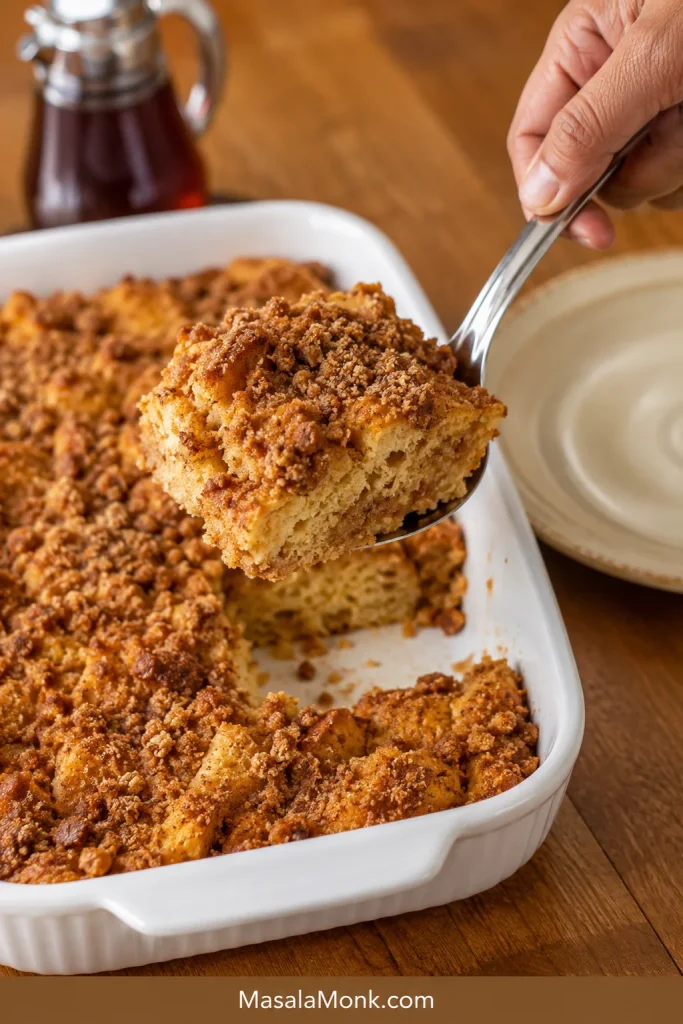
A serving spoon lifts a tender portion of French toast casserole from a white baking dish, exposing the moist center beneath the topping.
A broad serving spoon supports the tender base better than a narrow utensil, helping the rested casserole reach the plate without splitting through the middle.

Cooking now? The recipe above is all you need. Keep reading when you want help choosing bread, shortening the soak, scaling the pan or rescuing a soggy center.

Day-old bread has enough dryness to absorb the custard while still holding its shape. Weighing the loaf makes sure there is enough bread for the custard, and a shallow 9×13-inch dish gives the center time to set before the edges dry. When the top looks ready first, a thermometer removes the remaining guesswork.

The Best Bread for French Toast Casserole

French bread has an open crumb that accepts the custard, while its crust and firmer interior help the pieces hold their shape overnight. With another type of loaf, start with 450 g and use the pan’s fill level as the final check. The cut pieces should loosely fill the dish to approximately the same level as 10–12 cups of French bread.
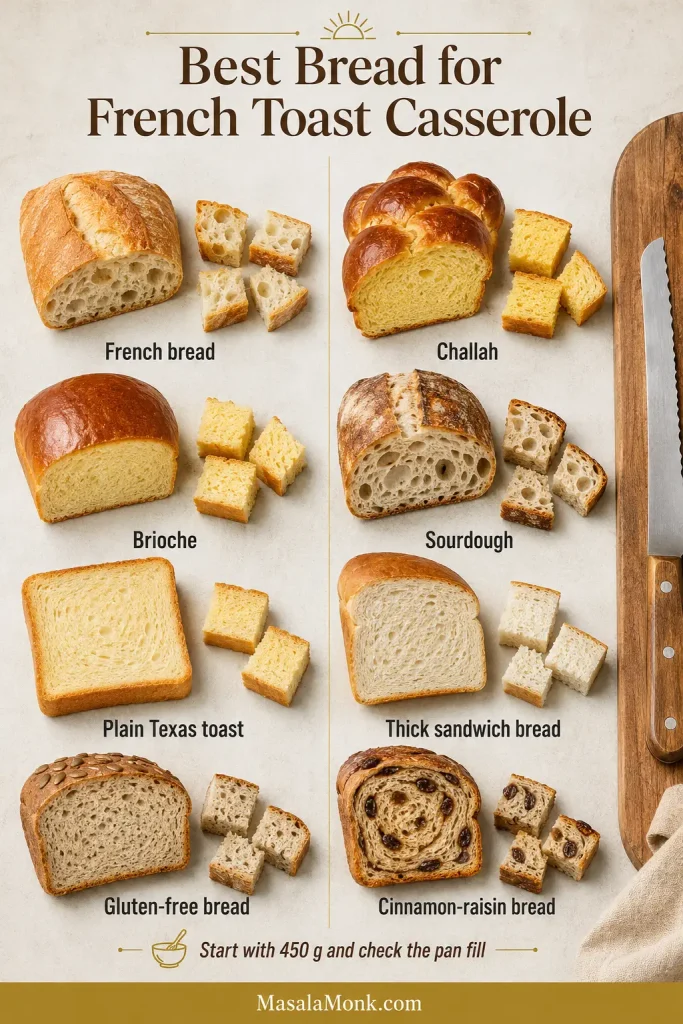
French bread, challah, brioche, sourdough, Texas toast, sandwich bread, gluten-free bread and cinnamon-raisin bread arranged for comparison.
Use the loaf lineup as a texture map: chewy, open crumbs tolerate a long soak, while soft enriched breads need more drying and gentler handling.

How Each Bread Changes the Casserole

BreadResultHandling
French breadClear bread-and-custard contrast with crisp exposed edgesUse day-old bread or dry fresh pieces briefly
ChallahA softer, richer result with a slightly eggier flavorDry well; when noticeably sweet, reduce the custard sugar to ¼ cup / 50 g
BriocheA very buttery, tender resultDry thoroughly; when sweetened, reduce the custard sugar to ¼ cup / 50 g
SourdoughFirmer pieces with a light tangAllow the full overnight soak; especially good for a less-sweet pan
Plain Texas toastA soft, familiar casserole with even piecesUse plain thick-cut bread—not prepared garlic toast—and dry it when very fresh
Thick sandwich breadA softer bake with less contrast from the crustsDry well and leave the pieces loose in the pan
Gluten-free breadResults vary considerably by brand and loaf densityChoose a sturdy loaf, weigh it, dry it well and turn gently
Cinnamon-raisin breadBuilt-in spice, sweetness and pockets of dried fruitUse ¼ cup / 50 g custard sugar and reduce the custard cinnamon to 1 teaspoon

No special bakery loaf is required. The bread already in your kitchen can usually work once you know whether it needs a little drying first.

Croissants soften and compress much faster than French bread. They need their own bread-to-custard ratio, so they are not a direct swap in this recipe.

Fresh, Stale or Oven-Dried?

Day-old bread usually needs no extra drying. If the loaf has become very hard, trim any unusually tough crust and allow the full overnight soak.

Fresh bread should feel dry and slightly firm on the outside while the pieces still give when squeezed. Spread it over a rimmed sheet pan and bake at 300°F / 150°C for 10–15 minutes, turning once. Very soft bread may need up to 20 minutes. Keep the pieces pale instead of toasting them brown, then let them cool before adding the eggs.
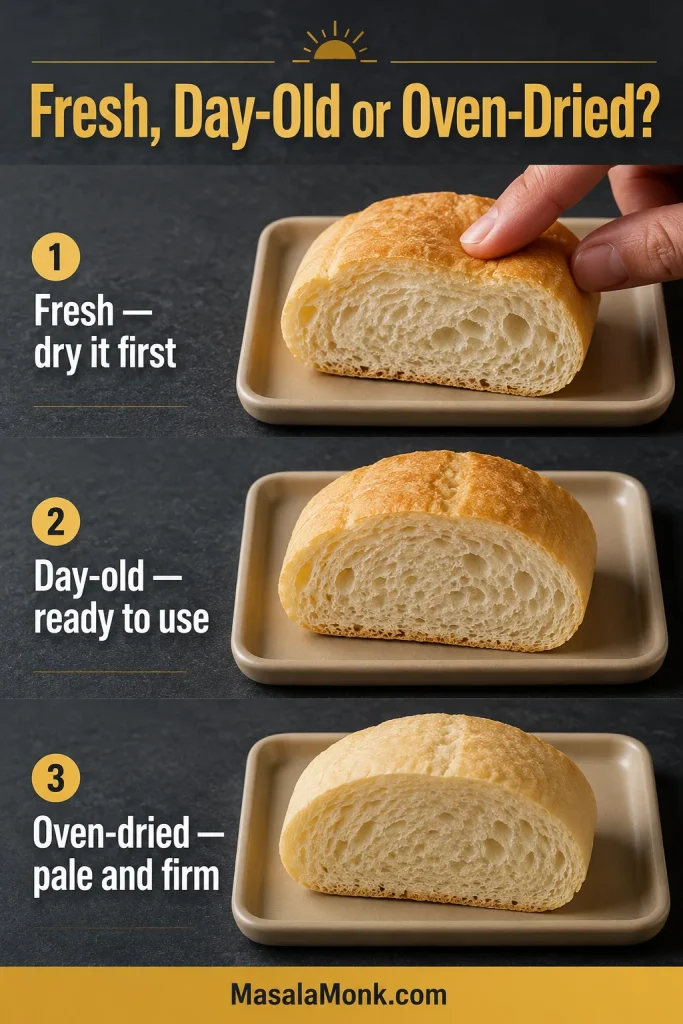
The same French bread compared when fresh and soft, day-old and resilient, and pale after oven-drying.
The oven-dried sample should look almost unchanged; the useful difference is a dry, firm surface that absorbs custard without compressing.

What the Custard Ingredients Do

Eggs set the custard around the bread. Whole milk gives it enough richness without making the casserole unusually heavy, while a smaller amount of cream makes the baked custard richer and more tender. Whisk the eggs first so visible streaks of white do not bake into firm patches.

  • Whole milk: Gives the custard body while keeping the casserole breakfast-like.
  • Half-and-half or cream: Adds richness and a softer finish.
  • Unsweetened oat milk: Gives the custard more body than most everyday plant milks.
  • Unsweetened almond milk: Produces a lighter result.
  • Evaporated milk: Can replace up to half of the whole milk for a richer dairy flavor.

Brown sugar brings a light caramel note without turning the casserole fully into dessert. Vanilla and cinnamon supply the familiar French toast aroma, nutmeg adds warmth underneath, and salt keeps the whole pan from tasting flat.

How Long Should French Toast Casserole Soak?

Soak the casserole for 8–12 hours when you can. That gives the custard time to reach the center of the bread and leaves almost nothing to do in the morning. Thoroughly dried bread can still produce a good same-day version after 45–60 minutes.
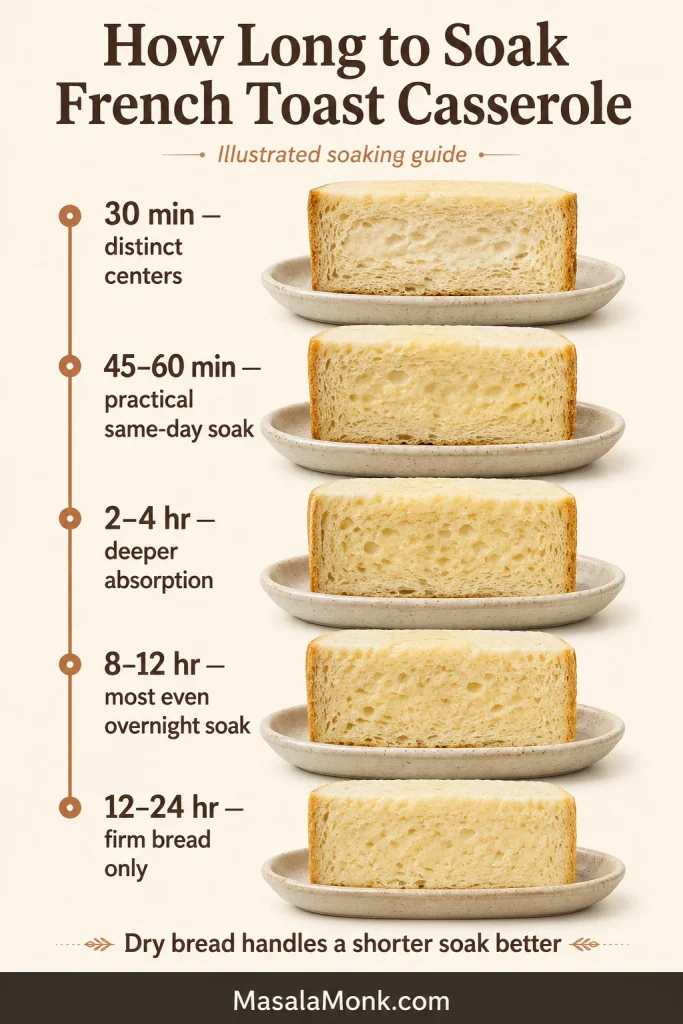
Illustrated timeline comparing bread absorption after 30 minutes, one hour, several hours, overnight and up to 24 hours.
The change is gradual rather than dramatic: longer soaking narrows the pale dry core while the bread still keeps its edges.
Soaking timeWhen it worksWhat to expect
30 minutesWhen time is very short and the bread has been dried thoroughlyMore distinct bread centers and less complete absorption
45–60 minutesA practical same-day casseroleGood results when the bread is dried and turned once
2–4 hoursFirm or moderately dry breadThe custard reaches farther into the center of each piece
8–12 hoursThe easiest overnight scheduleVery little morning work and the most consistent soak
12–24 hoursFirm, dry French bread or sourdoughUsually workable; softer breads may begin losing their shape

Before Refrigerating: Three Assembly Checks

This is the last real bit of work for the night. Three details make the biggest difference once the pan is covered.

  • Keep the bread pieces similar in size. Pieces around 1 inch / 2.5 cm absorb at a similar rate. Tiny pieces can compact into a soft layer, while oversized chunks may remain dry inside.
  • Whisk the eggs completely. Blend the whites and yolks before adding the dairy and flavorings so firm patches of egg white do not appear in the finished custard.
  • Distribute the custard throughout the pan. Add it in stages and turn the bread gently so the upper pieces and corners receive their share.

None of these checks has to be perfect. When the bread is well coated, the pan is not swimming in custard and the center is allowed to finish baking, the casserole is very forgiving.

In the Morning: Bake Until the Center Is Set

By morning, the pieces should look plumper and slightly darker with custard. A little liquid may remain low in the pan, but the dish should not slosh when nudged. Scatter over the cold streusel and begin baking uncovered so the exposed bread edges and topping can crisp.

As the streusel turns deep gold, cinnamon, vanilla and warm butter begin to fill the kitchen. By then, the smell has usually reached the rest of the house.

A golden top can look ready while the middle still needs time. Once the surface is dark enough, a loose foil tent lets the center continue baking without taking the streusel any further.
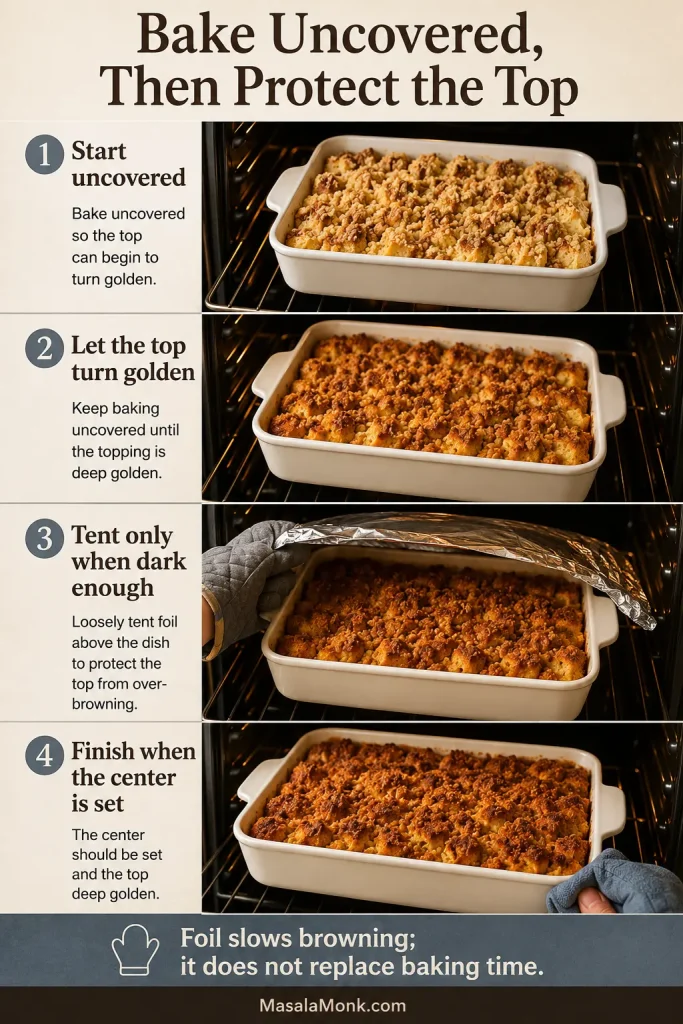
Four-stage guide showing French toast casserole starting uncovered, browning, loosely tented with foil and finishing fully baked.
A loose foil tent should sit above the streusel instead of pressing against it, slowing browning while preserving the crumbly surface.

How to Tell When the Casserole Is Done

  • Look: The center no longer appears glossy or filled with liquid custard.
  • Nudge the dish: A gentle wobble through the center is fine; a flowing wave means it needs longer.
  • Use a thin knife: Moist crumbs are expected. Raw custard coating the knife means the casserole needs more time.
  • Check the temperature: Insert an instant-read thermometer into the thickest central area, avoiding the base of the dish.
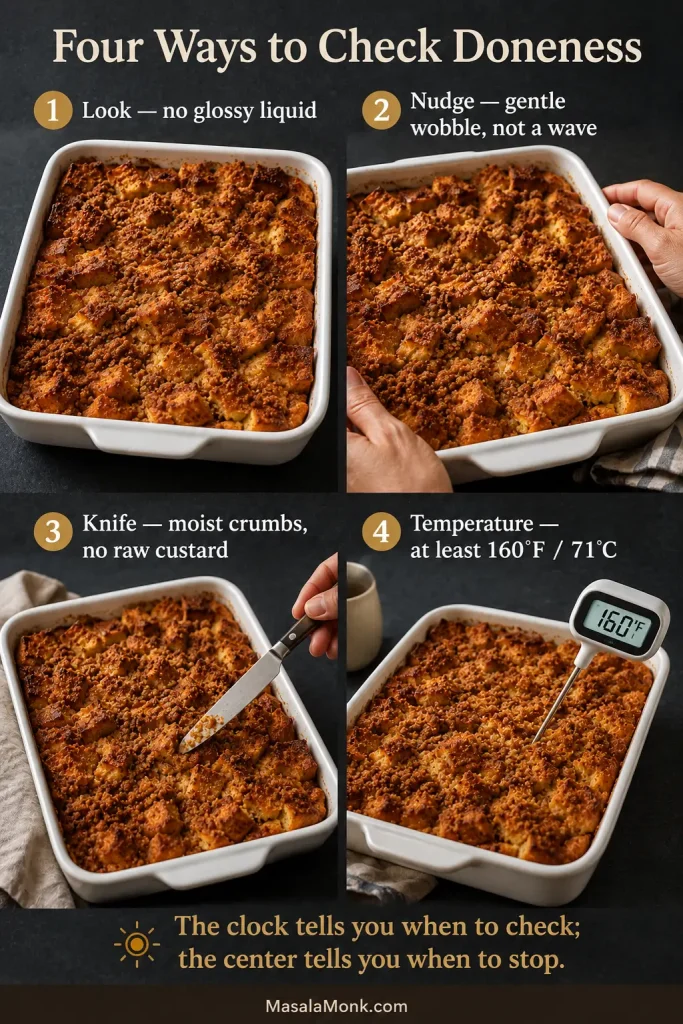
Doneness guide showing the casserole’s appearance, gentle wobble, knife test and a thermometer reading 160 degrees Fahrenheit or 71 degrees Celsius.
To tell when French toast casserole is done, use the cues in order—look, nudge, knife and temperature—so the oven loses as little heat as possible between checks.

The USDA recommends 160°F / 71°C for casseroles and other dishes containing eggs (opens in a new tab). Let that temperature confirm what you can already see: a set center, no flowing wave and no raw custard on the knife.
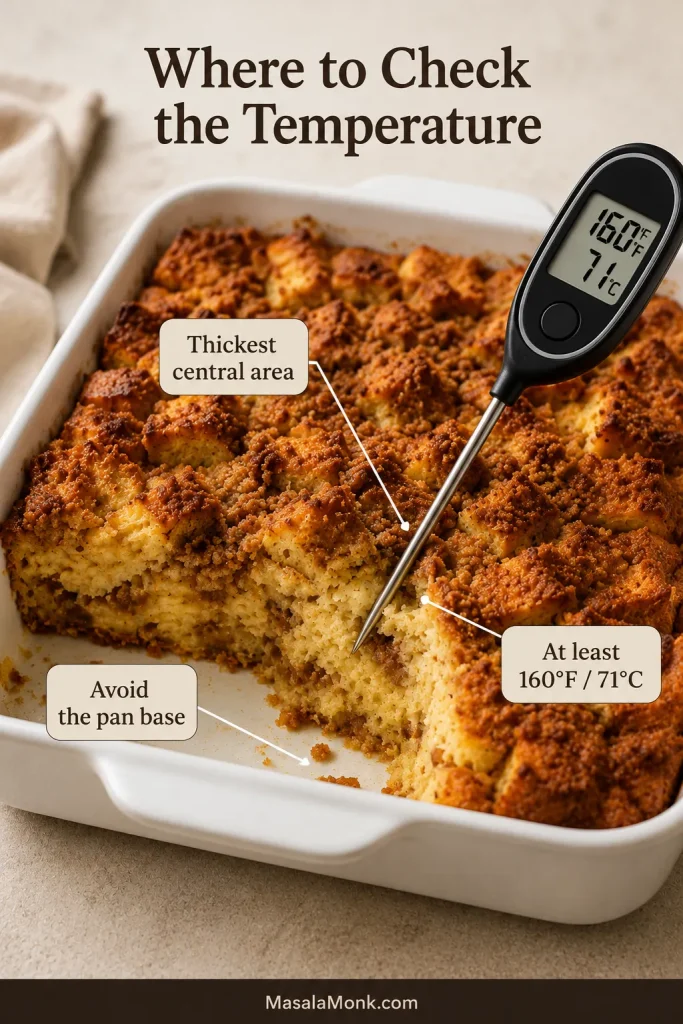
Instant-read thermometer inserted into the thick center of French toast casserole without touching the ceramic pan.
Angle the thermometer into solid bread and custard in the thickest central area; an air gap or contact with the hot dish can produce a misleading reading.

Forgot Last Night? Use the Same-Day Method

Remembered after waking? A full overnight soak is no longer possible, but the morning does not have to become a scramble. Thoroughly dried bread gives a shorter soak a much better chance to work.

  1. Cut the bread into pieces around 1 inch / 2.5 cm.
  2. Dry it using the oven method above, allowing up to 20 minutes when the bread is especially fresh and soft.
  3. Cool the bread before adding the egg mixture.
  4. Toss thoroughly so every piece makes contact with the custard.
  5. Let the assembled casserole stand for 45–60 minutes.
  6. Turn the upper pieces gently once midway through the soak.
  7. Add the streusel and bake using the same center-of-the-pan cues as the overnight version.
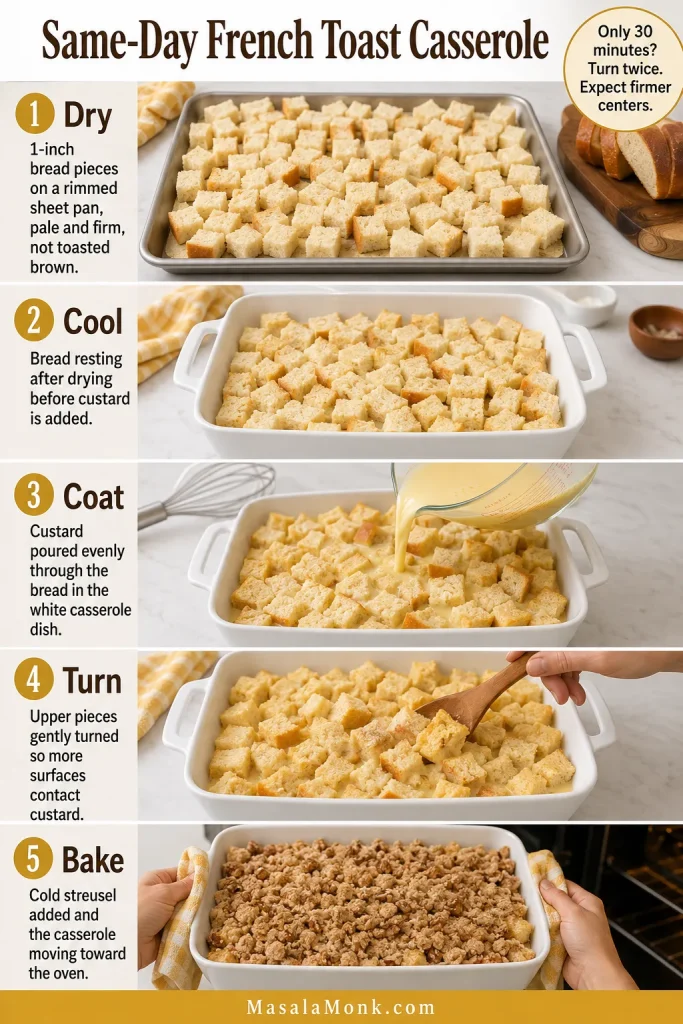
Five-step guide showing bread being dried, cooled, coated with custard, gently turned and topped before same-day baking.
For same-day French toast casserole, cool the dried bread before adding custard; otherwise, trapped steam can soften the surface you just worked to dry.

The casserole will still bake up warm and crisp-topped; the bread will simply keep more of its individual shape.

The 30-Minute Backup

Dry the bread thoroughly, keep the pieces close to 1 inch and turn them twice during the short soak. Those two turns help more of the surface meet the custard before the pan goes into the oven.

Whether the bread soaked for an hour or overnight, the same moisture cues determine whether the center finishes custardy or remains wet.

How to Keep French Toast Casserole From Getting Soggy

Softness belongs in the dish. Free liquid does not. Most soggy pans come back to four causes.

  • Too little bread. An unusually small loaf leaves more custard than the pan can absorb. Use the full 16 oz / 450 g.
  • Bread that was too soft or moist. Very fresh pieces lose their shape more easily during a long soak. Dry them until the surface feels firm but remains pale.
  • A dish that is too deep. The edges can finish before enough heat reaches the middle. Two standard pans are more dependable than one very deep casserole.
  • A center that needed more baking. A brown top does not guarantee that the custard underneath has set. Cover the surface with foil when it is dark enough and continue until the middle passes the visual, knife and temperature checks.
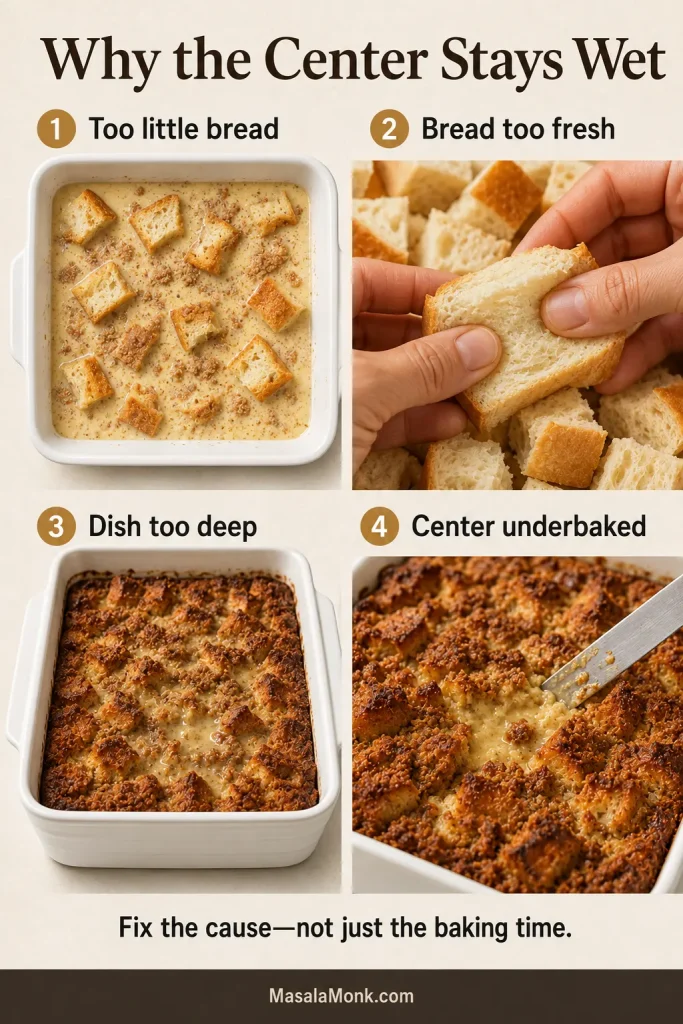
Four-panel guide showing too little bread, overly soft fresh bread, a deep casserole dish and a golden but underbaked center.
Before changing the egg-and-milk ratio, check the four more likely causes of a wet French toast casserole: bread quantity, starting moisture, pan depth and center doneness.

Custardy or Still Wet?

Custardy means the bread is tender and moist, with no liquid collecting around the serving spoon. Still wet means custard flows when the dish moves or coats a knife in the center.
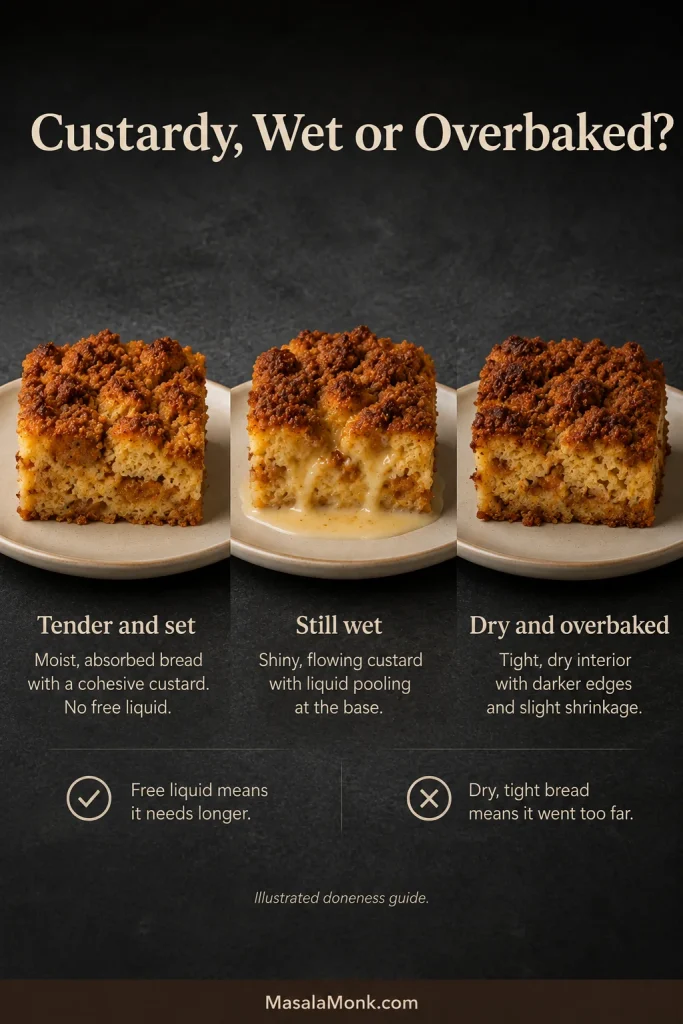
Three servings compare French toast casserole that is properly set, still wet with visible liquid and dry from overbaking.
Compare the cut faces: the correct center glistens lightly and holds, the wet sample slumps, and the overbaked sample fractures.

Dietary Adaptations

These adaptations work best when the substitutes preserve the original structure: sturdy bread by weight, enough body in the custard and a firm fat that can still form streusel crumbs.
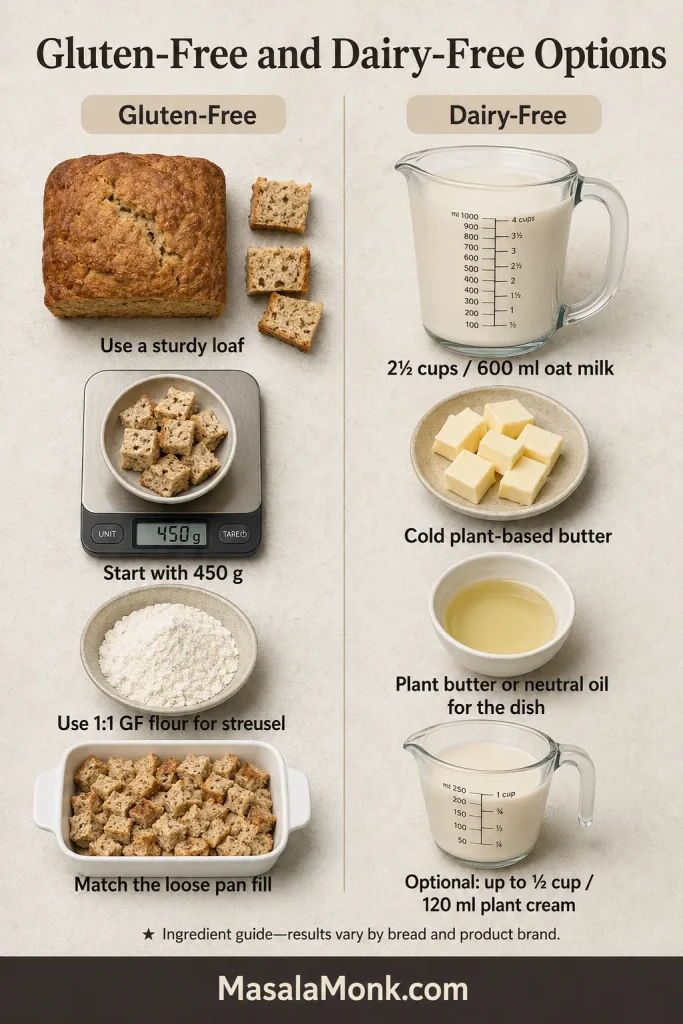
Gluten-free bread, a scale reading 450 grams, gluten-free flour, oat milk, plant-based butter, oil and optional plant cream.
For gluten-free and dairy-free French toast casserole, keep the structure intact: weigh the bread, use oat milk for body and choose firm plant butter for crisp streusel.

Gluten-Free

Use a certified gluten-free loaf and replace the all-purpose flour in the streusel with ½ cup / 60 g 1:1 gluten-free baking flour. Begin with 450 g bread and check that the pieces loosely fill the pan to roughly the same level as 10–12 cups of French bread.

A thick, sturdy loaf usually holds up better overnight than thin packaged slices. When cooking for someone with celiac disease or significant cross-contact concerns, check the certification of all packaged ingredients.

Dairy-Free

Use 2½ cups / 600 ml unsweetened oat milk. Replace the streusel butter with an equal weight of cold, firm plant-based butter, and grease the dish with plant-based butter or neutral oil. For a richer custard, replace up to ½ cup / 120 ml of the oat milk with an unsweetened plant-based cream suitable for cooking.

Egg-Free or Vegan

Eight eggs do most of the setting in this recipe, so replacing them changes the whole custard—not only the flavor. A general egg replacer is unlikely to hold a full 9×13-inch casserole together on its own. Begin with a vegan baked-French-toast custard designed for a full casserole. This vegan French toast guide explains several egg-free custard approaches and how each one helps the mixture set.

Pan Size, Servings and Scaling

A half batch suits a smaller table and still leaves room for one easy breakfast the following day. For a larger gathering, two ordinary pans bake more consistently and are easier to serve than one extra-deep casserole.
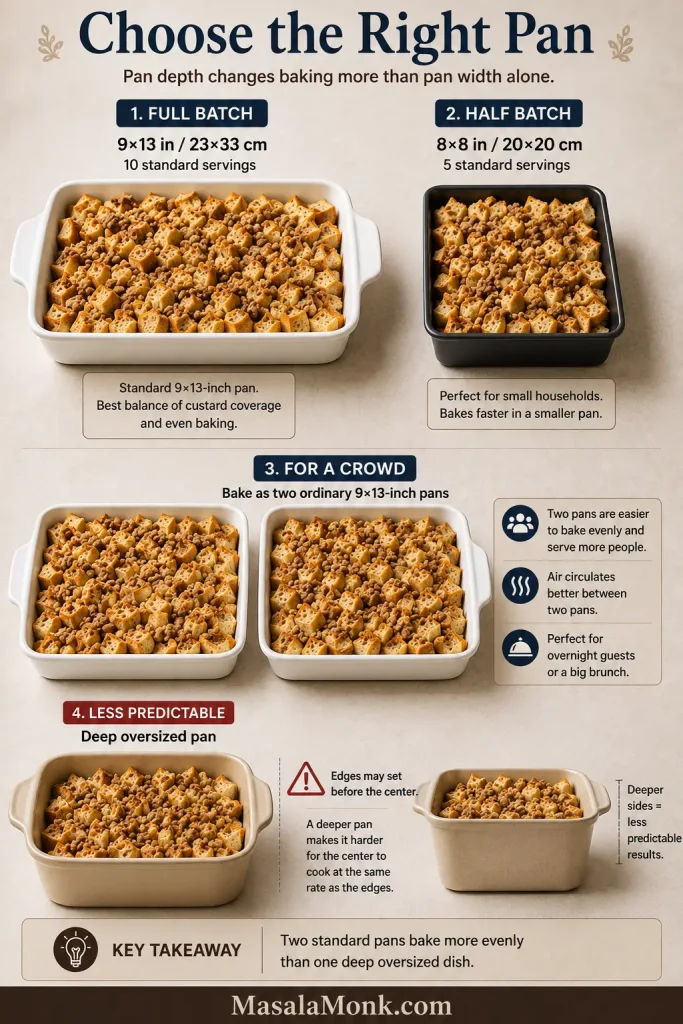
A 9-by-13-inch dish, an 8-by-8-inch pan, two crowd-size pans and one deeper casserole dish compared by size.
The side profile matters more than the footprint alone: a deeper custard layer needs longer for heat to reach its center.
SetupYieldBegin checkingWatch for
9×13-inch full batch10 standard servings, 8 generous or up to 12 smaller brunch portionsAbout 40 minutesThe center setting before the top becomes too dark
8×8-inch / 20×20 cm half batch5 standard, 4 generous or up to 6 smaller portionsAbout 30 minutesMany dishes finish around 35–45 minutes
Two 9×13-inch pans20 standard servings, or 16–24 depending on the menuCheck each pan on its ownOne pan finishing several minutes before the other
One deeper oversized batchVaries with dish sizeLater than the standard batchThe edges setting before the center

Half Batch for an 8×8-Inch / 20×20 cm Dish

Quick guide: This smaller pan makes 5 standard, 4 generous or up to 6 smaller servings. Begin checking at 30 minutes; many half batches finish in approximately 35–45 minutes.
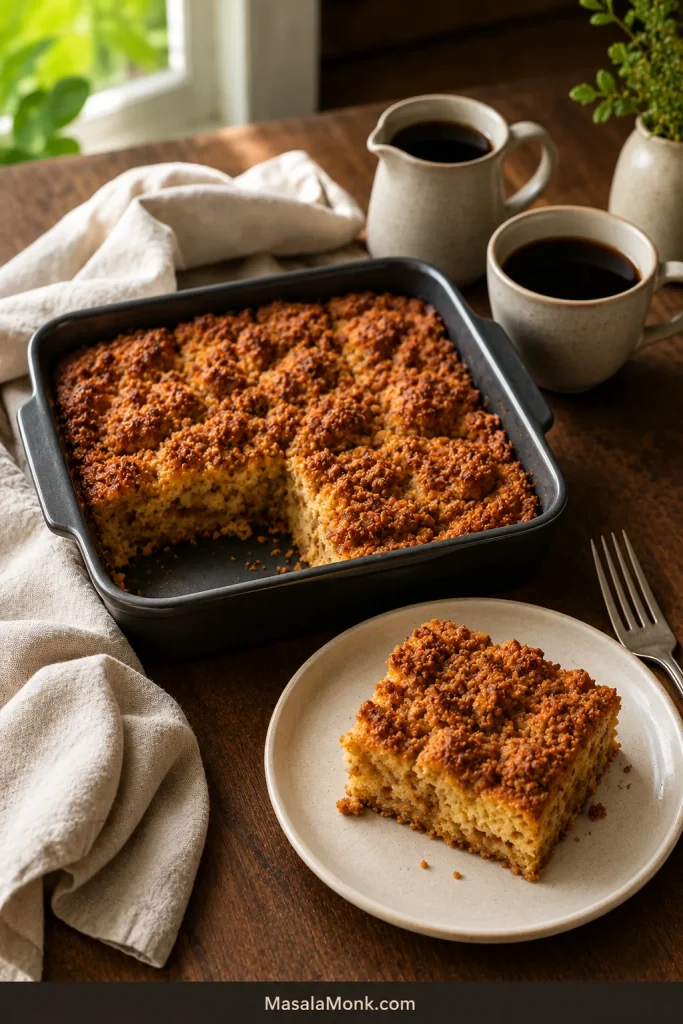
Half-batch French toast casserole in a dark square pan with servings removed and one portion plated for a smaller breakfast.
A half-batch French toast casserole still bakes at 350°F / 175°C; only the quantity and checking time change, so resist lowering the oven temperature.

Follow the same night-before assembly, morning topping and center-doneness cues as the full recipe.

  • 8 oz / 225 g bread
  • 4 large eggs
  • 1 cup / 240 ml whole milk
  • ¼ cup / 60 ml half-and-half or cream
  • 2 tablespoons plus 2 teaspoons / 35 g brown sugar
  • 1½ teaspoons vanilla
  • 1 teaspoon cinnamon
  • ⅛ teaspoon nutmeg
  • ⅜ teaspoon fine salt, or ¼ teaspoon plus ⅛ teaspoon

For the smaller streusel, use ¼ cup / 30 g flour, 35 g brown sugar, ½ teaspoon cinnamon, a pinch of salt, 3 tablespoons / 43 g butter and ¼ cup / about 28 g pecans when using.

Baking Two Pans for a Crowd

Leave space around both pans for airflow and rotate their positions when the oven browns unevenly. When guests are staying over, two pans also let breakfast reach the table without anyone cooking individual batches at the stove.
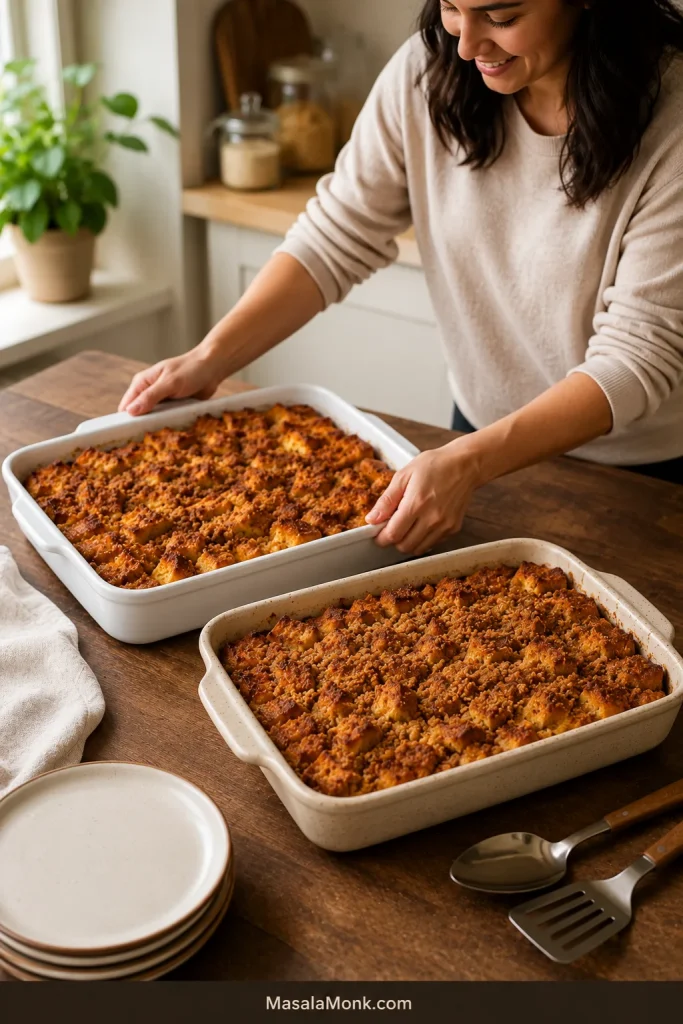
Two rectangular pans of golden French toast casserole arranged with space between them in a bright kitchen.
Treat two pans as separate bakes: rotate only when needed and remove each pan when its own center reaches doneness.

When the table needs one sweet pan and one savory pan, this breakfast casserole with hash browns can also be assembled ahead.

Blueberry, Apple and Cream Cheese Variations

Blueberry

Blueberries add tart, juicy pockets against the cinnamon custard and brown sugar topping. Scatter 1 cup / 140 g through the bread. Fresh blueberries hold their shape better and release less juice. Frozen berries also work; add them straight from the freezer and expect the surrounding bread to become slightly softer.
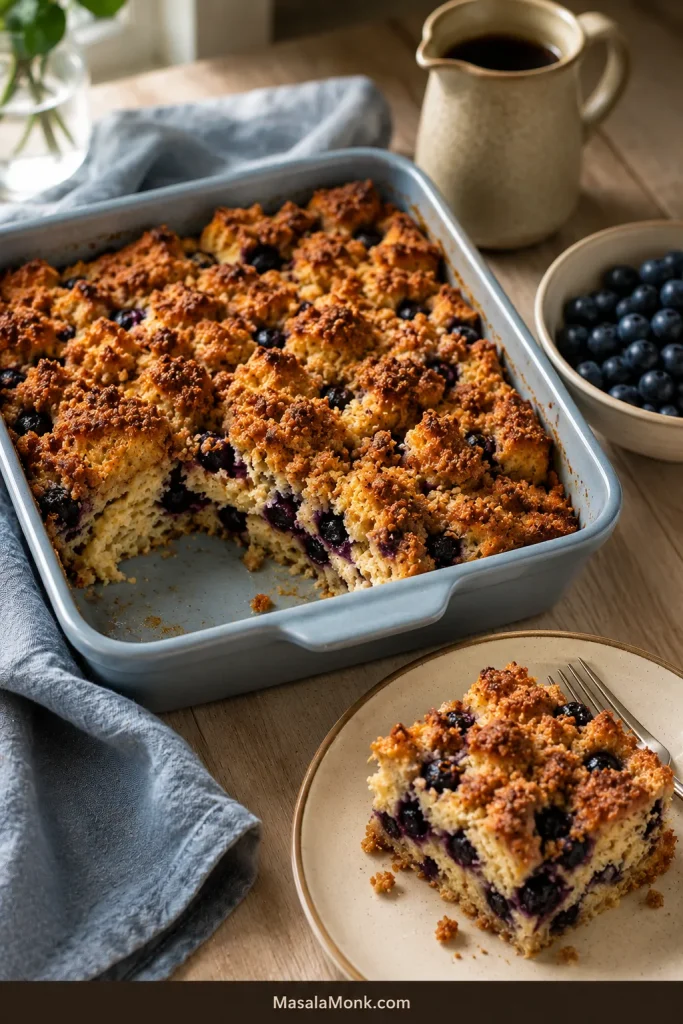
Blueberry French toast casserole in a blue-grey dish with berries visible inside the bread beneath golden streusel.
For blueberry French toast casserole, tuck berries between several bread layers instead of piling them on top, reducing scorched fruit and concentrated pockets of juice.

Apple-Cinnamon

Soft cinnamon apples make the casserole warmer, fruitier and especially well suited to an autumn or holiday brunch. Cook 1½ cups / approximately 180–200 g peeled, diced apples in 1 tablespoon / 14 g butter with a pinch of cinnamon until just tender but still holding their shape. Cool them on a plate before distributing them through the bread.
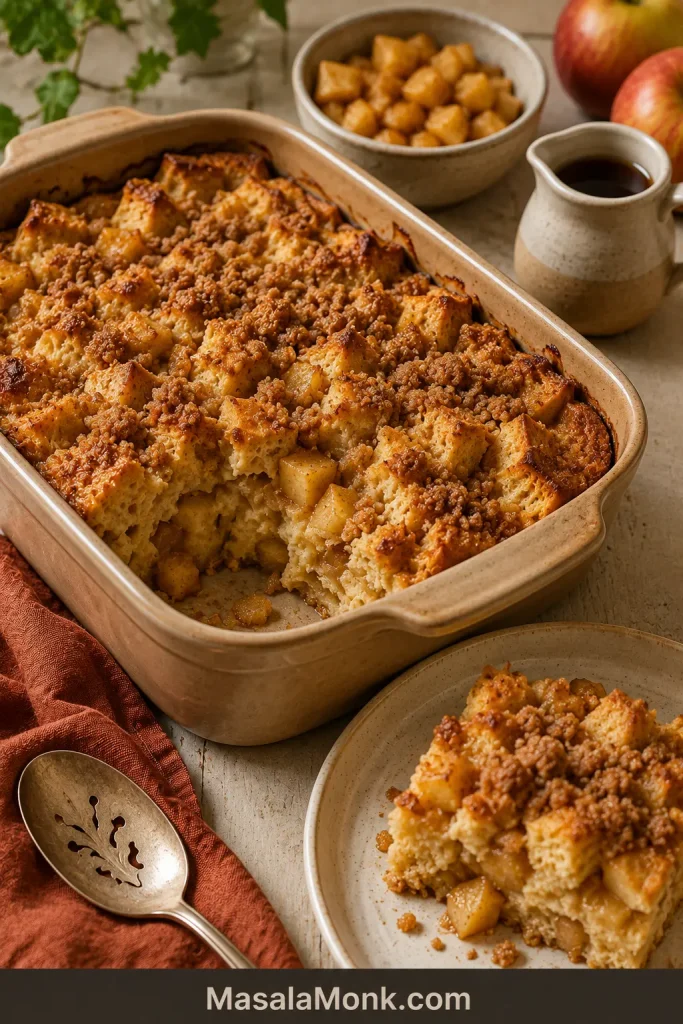
Apple-cinnamon French toast casserole with small cooked apple pieces visible inside the bread and in a plated serving.
Spread the cooked, cooled apples through several shallow layers; this gives every serving fruit without creating one heavy pocket that weakens the custard structure.

Cream Cheese

Cream cheese adds small tangy pockets that break up the sweetness of the custard and streusel. Use 4–6 oz / 115–170 g cold full-fat block cream cheese, cut into small pieces. Tuck them throughout the bread so every serving gets a few creamy pockets. Avoid whipped or spreadable tub cream cheese, which brings more moisture.
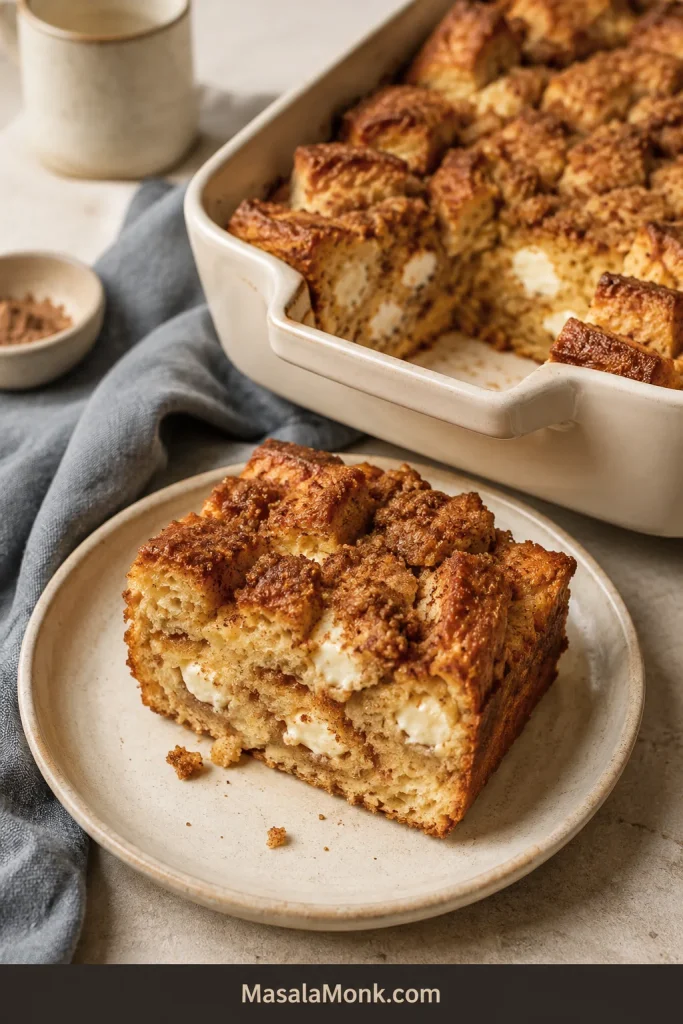
French toast casserole with small white cream-cheese pockets distributed between defined bread pieces beneath a golden topping.
Keep the cream-cheese pieces smaller than a walnut so they stay scattered instead of melting into one heavy stripe.

Less-Sweet Version

For a more breakfast-like pan, reduce the brown sugar in the custard to ¼ cup / 50 g and leave the crisp streusel unchanged.

What to Serve With French Toast Casserole

The casserole is rich, soft and sweet enough that the best sides usually bring freshness, salt or a crisper texture. Air-fryer hash browns add crisp potatoes without competing for oven space.

  • Fresh fruit: Berries, orange segments, melon or lightly tart apples brighten the plate.
  • Maple syrup: Warm it separately so each person can decide how sweet the serving should be.
  • Eggs: Soft scrambled eggs or a simple egg bake make the meal feel more balanced.
  • Breakfast meat: Bacon or breakfast sausage provides a salty contrast to the cinnamon topping.
  • Holiday main: Sliced honey glazed ham works especially well for Christmas or Easter brunch.
  • Yogurt: Plain or lightly sweetened yogurt adds tang and pairs naturally with berries.
  • Coffee or tea: Often the only other thing a quiet weekend breakfast needs.
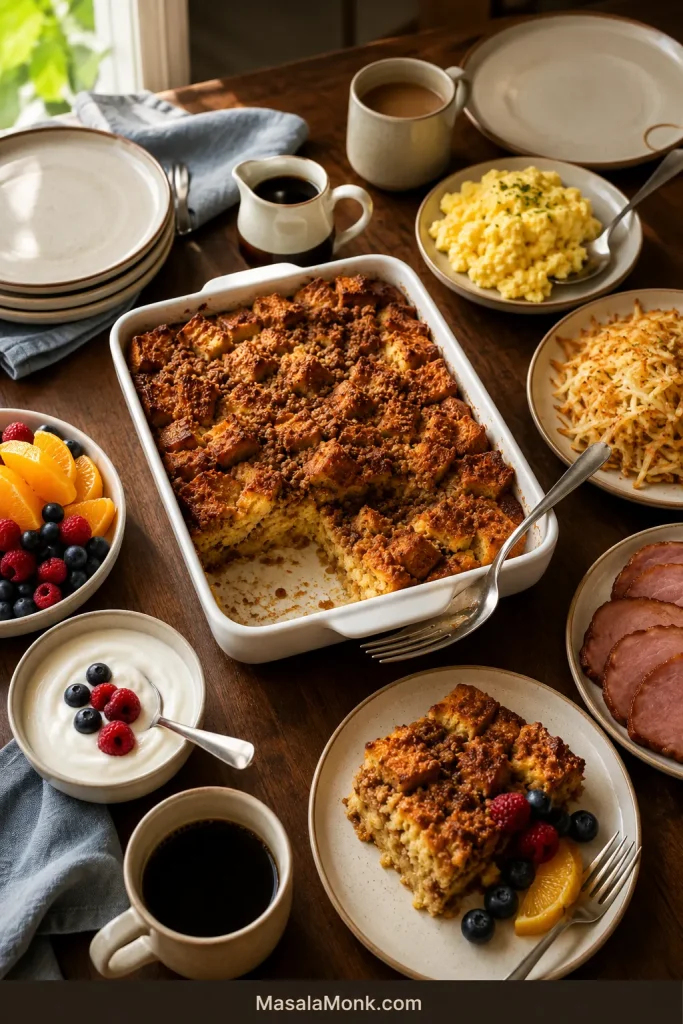
Brunch table with French toast casserole, fruit, yogurt, scrambled eggs, hash browns, sliced ham, maple syrup and coffee.
Build the brunch around contrast: pair the soft, sweet casserole with at least one fresh side, one crisp side and one savory side, then serve maple syrup separately.

For a holiday spread with more than one sweet centerpiece, homemade cinnamon rolls can also be prepared the night before.

For a buffet, cut smaller portions first; people can always return for another spoonful. When the casserole is the main event, plan on eight generous servings.

Leftovers, Freezing and Reheating

The top softens in the refrigerator, but a little dry heat brings back enough crispness to make leftovers worth looking forward to.

Refrigerate or Freeze

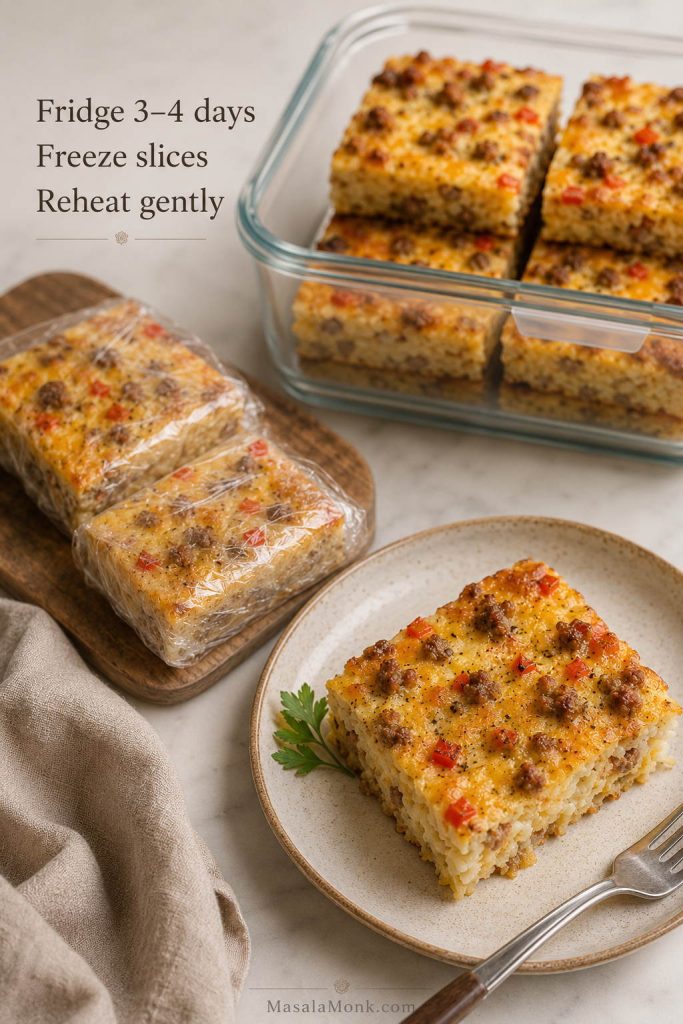
Leftovers. Refrigerate within two hours of serving, then keep in covered containers for 3–4 days. The USDA leftovers guidance (opens in a new tab) recommends rapid cooling, covered storage and reheating leftovers to 165°F / 74°C.

Freeze before baking. Assemble the bread and custard in a freezer-safe pan, wrap tightly and freeze the streusel separately. Thaw overnight in the refrigerator before topping and baking. Follow the cold-bakeware guidance in the recipe when choosing the pan.

Freeze after baking. Let the casserole cool briefly, then cut it into portions and refrigerate until cold. Wrap the chilled portions well and freeze for up to about two months for the best texture.
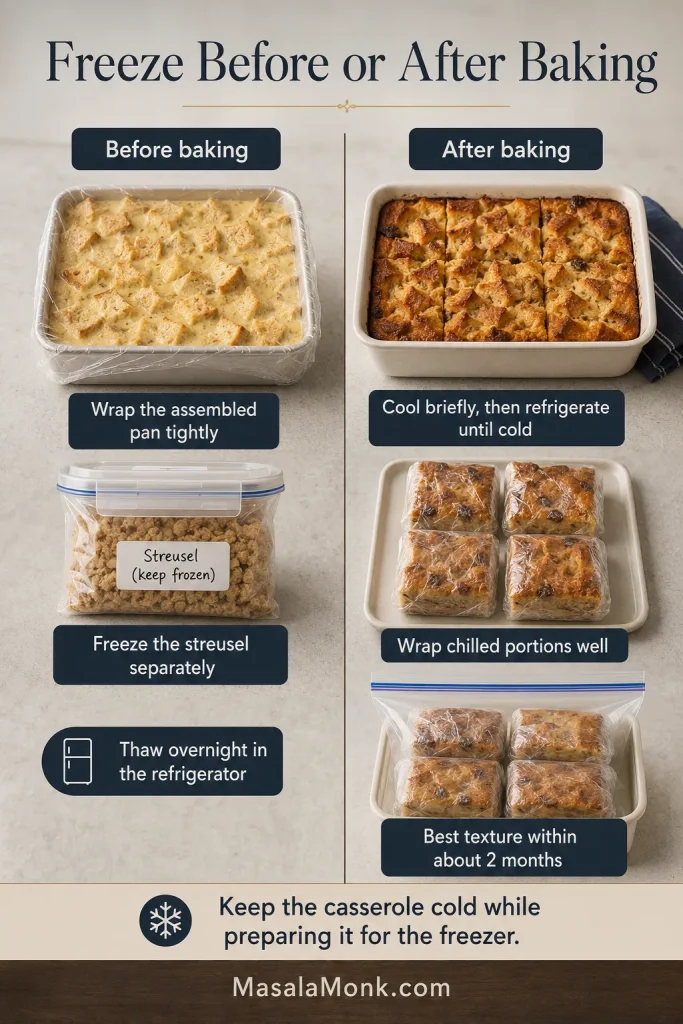
Freezing guide showing an unbaked wrapped casserole with separate streusel and baked portions chilled, wrapped and placed in a freezer bag.
To freeze French toast casserole before baking, keep the streusel separate; after baking, chill individual portions before wrapping so less condensation becomes trapped inside.

Reheat One Portion or Several

One portion. Microwave in 30-second intervals until nearly heated through. To restore the top, begin checking after about 2 minutes in a 350°F / 175°C air fryer or after about 5 minutes in a conventional oven. Confirm that the center has reached 165°F / 74°C before serving.

Several portions. Cover and reheat at 325°F / 165°C. Begin checking after 15 minutes and continue until the thickest part reaches 165°F / 74°C. Uncover for the final few minutes to refresh the streusel.
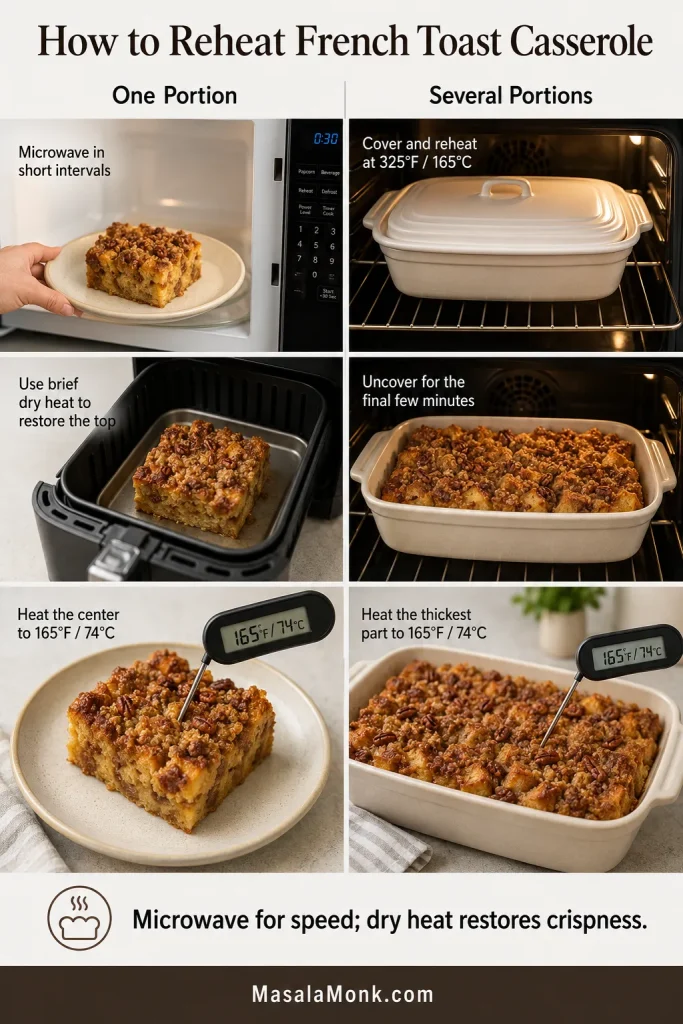
Guide showing one casserole portion microwaved and crisped separately, alongside several portions reheated covered and then uncovered in the oven.
Heat and crisp are separate jobs: covered or microwave heating warms the center, while a brief uncovered finish refreshes the streusel.

For the best second breakfast, chill the remaining casserole promptly and reheat only the portion you plan to serve.
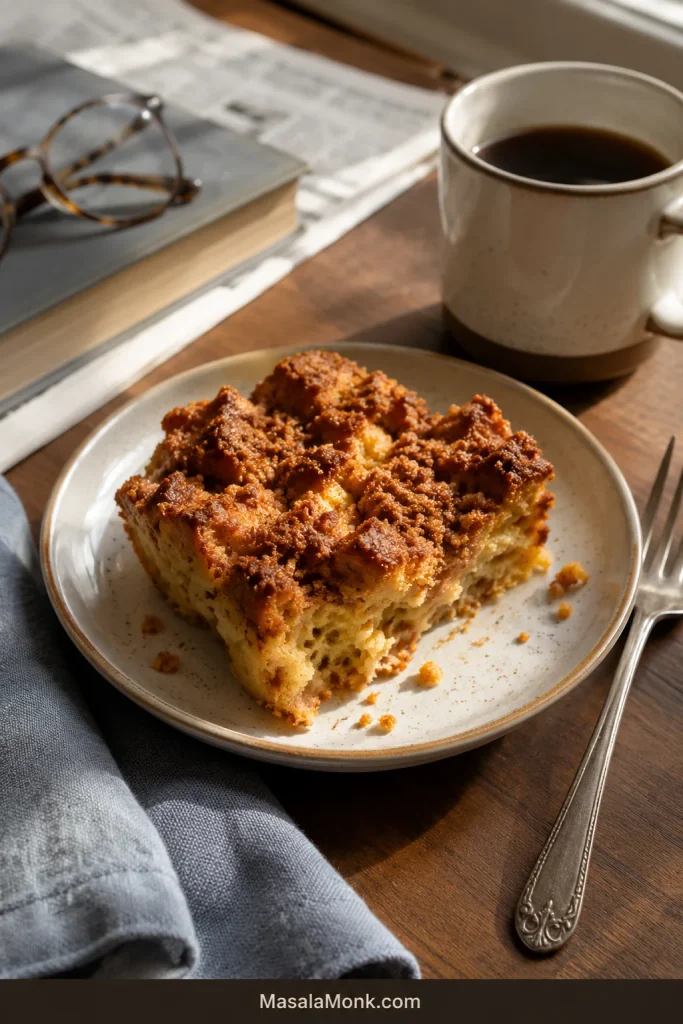
Reheated French toast casserole serving with a crisp cinnamon topping beside coffee, a fork, glasses and a book in morning light.
A chilled portion reheated once can bring back enough crispness for an easy second breakfast.

Troubleshooting Overnight French Toast Casserole

Most problems are recoverable: cover a dark top, give a loose center more time, or revive dry pieces with warm syrup.

ProblemFix it nowNext time
Center is wetReturn the casserole to the oven and continue baking. Add a loose foil tent only if the top is already brown enoughUse the stated bread weight and check the thickest area; time alone can mislead
Top is dark but center is looseCover loosely with foil and continue bakingKeep the pan on the center rack and begin checking earlier
Casserole is dryServe with warm syrup, fruit or yogurtUse the full custard amount and remove the pan once the center is set
Flavor is overly eggyTart fruit and maple syrup can make the egg flavor less noticeableAvoid adding extra eggs, and whisk the custard thoroughly before pouring
Edges are rubberyTrim only the driest edge when servingBegin checking sooner, especially in dark metal pans
Some bread is still drySpoon warm syrup over those piecesPour in stages and turn the bread during assembly
Bread collapsed into mushLet the casserole rest longer, then serve it by the spoonful instead of cutting clean portions. Add fresh fruit or toasted pecans for contrastUse firmer or better-dried bread and avoid adding extra liquid
Streusel disappearedAdd a light dusting of cinnamon sugar after bakingRefrigerate the topping separately and add it in the morning

Frequently Asked Questions

Can I assemble it more than one night ahead?
Firm, dry French bread or sourdough can usually remain refrigerated for up to about 24 hours. Softer breads may begin losing their shape, so 8–12 hours remains the usual target.

Can I bake it directly from the refrigerator?
Check the manufacturer’s guidance before moving cold glass or ceramic bakeware into a hot oven. A metal pan avoids that thermal-shock concern.

Should French toast casserole bake covered or uncovered?
Bake this streusel-topped version uncovered so the exposed bread and topping can crisp. If the top becomes dark before the center is set, tent it loosely with foil and continue baking.

Breakfast Is Waiting

The cinnamon streusel and soft vanilla custard make this pan feel special, but the real reward happened the night before. The bread was cut, the eggs were whisked and most of the kitchen was already cleaned while the morning was still hours away.

Now the top is crisp, the center is properly set and breakfast can be carried to the table all at once. No skillet line, no stack growing cold while the next pieces cook—just one warm casserole and a morning that began with the difficult part already handled.

What bread did you use? Tell us whether you made the casserole overnight or used the same-day method—and what you might add next time.
↑ Back to the top

Posted on Leave a comment

Tater Tot Breakfast Casserole

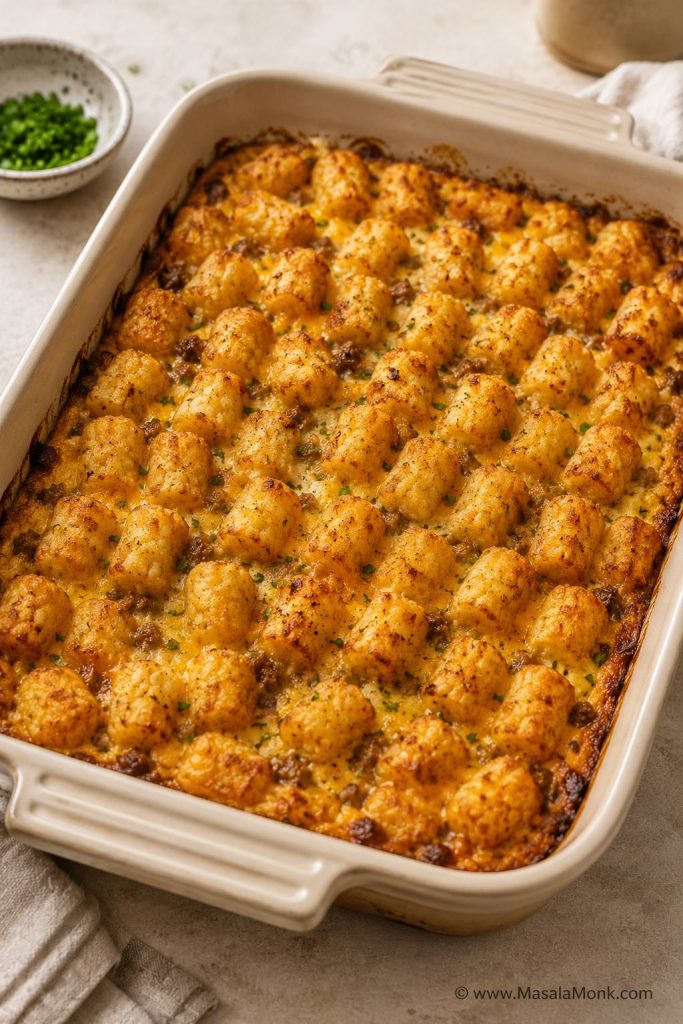
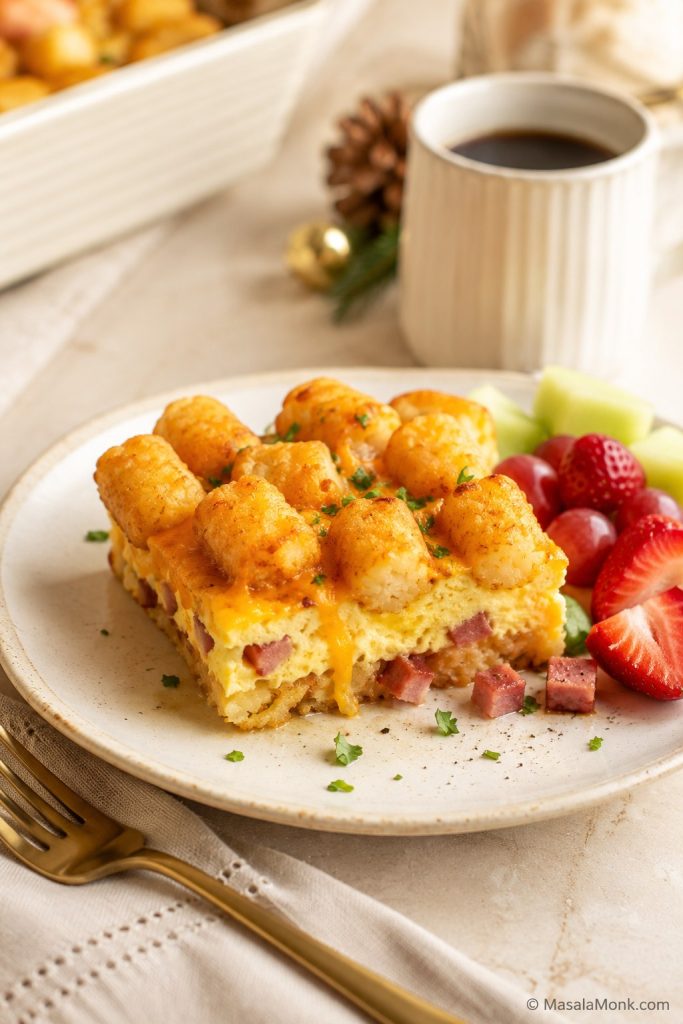
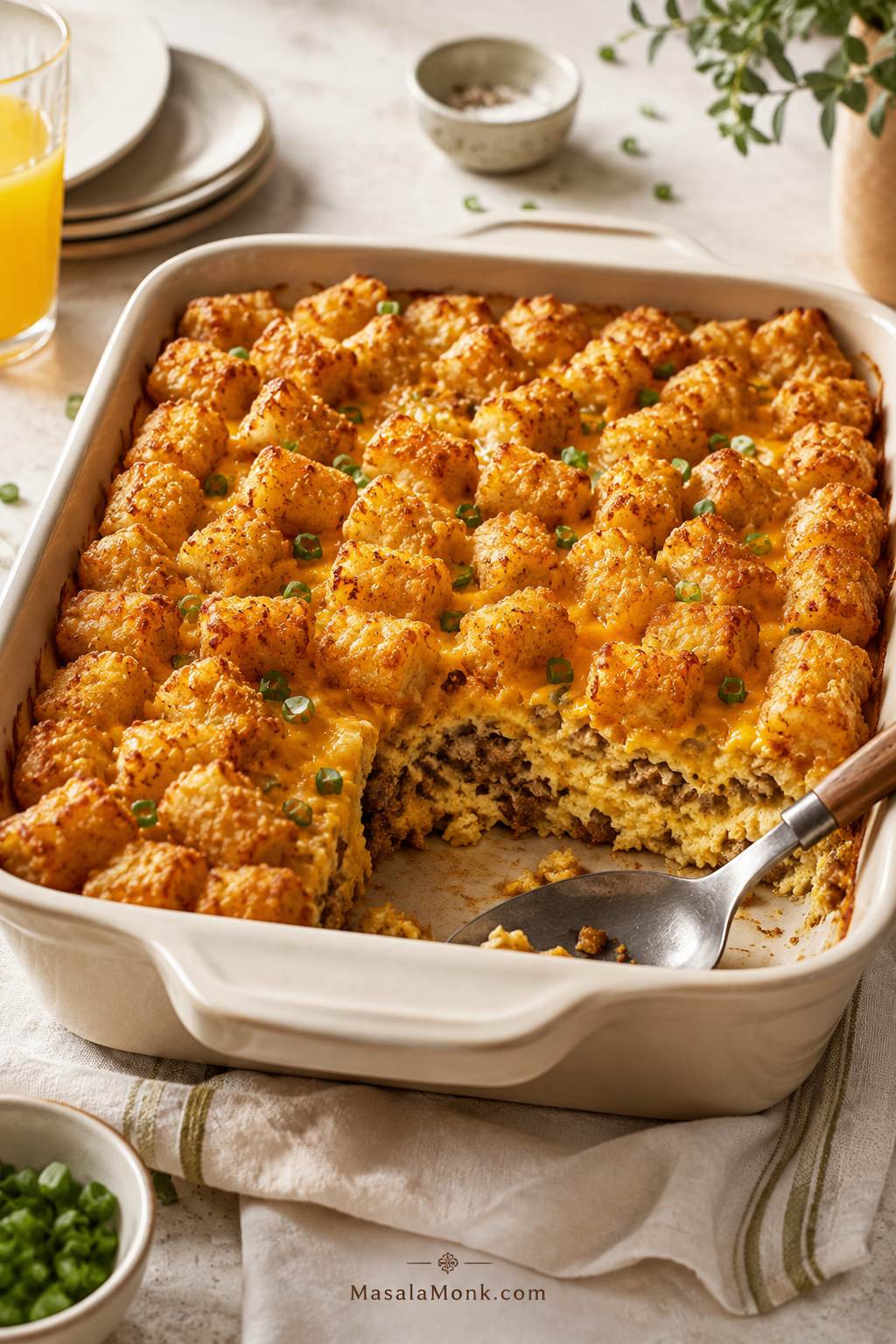
Tater tot breakfast casserole in a white baking dish with golden-browned tots, melted cheese, sausage, and a cut corner showing the egg layer.

This tater tot breakfast casserole is for the morning when people are already wandering into the kitchen hungry. The sausage is savory, the eggs bake up tender but sliceable, and the frozen tots turn into the crisp-edged potato topping everyone reaches for first.

It feels generous enough for holidays, brunch guests, and slow weekend mornings, but it is still practical: one skillet, one bowl, one 9×13 pan, and no frying potatoes on the side. Make it when breakfast needs to feel abundant without turning the cook into a short-order chef; the oven does most of the work while the kitchen starts to smell like sausage, potatoes, and melted cheese.

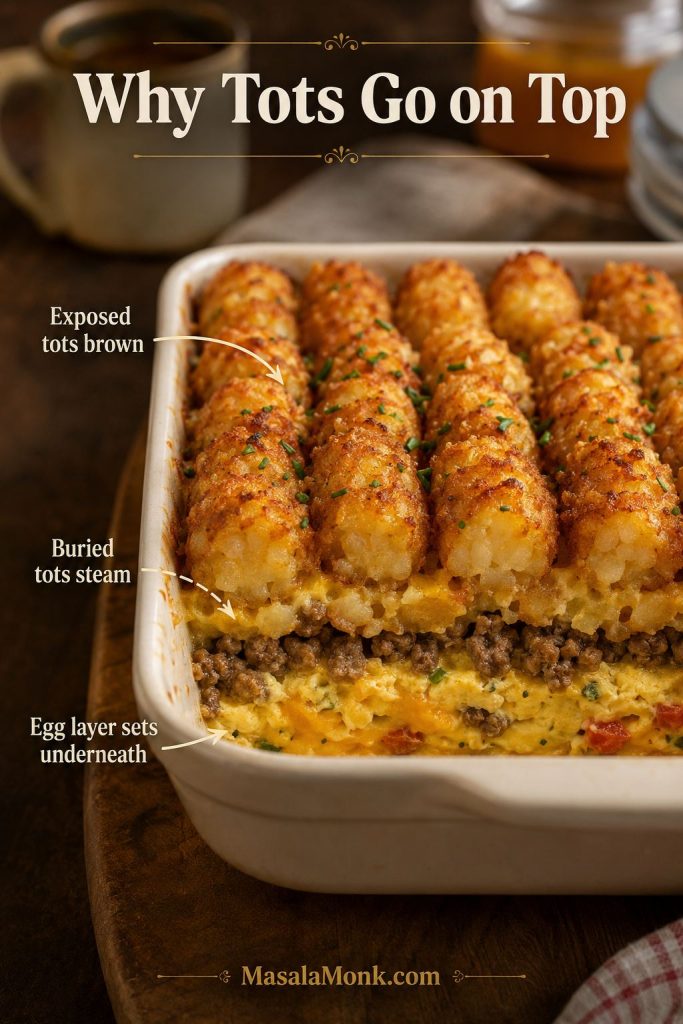
The key is keeping the tots on top instead of burying them under the eggs. That way, the center can bake into a tender egg casserole while the potatoes stay visible, crisp-edged, and browned.

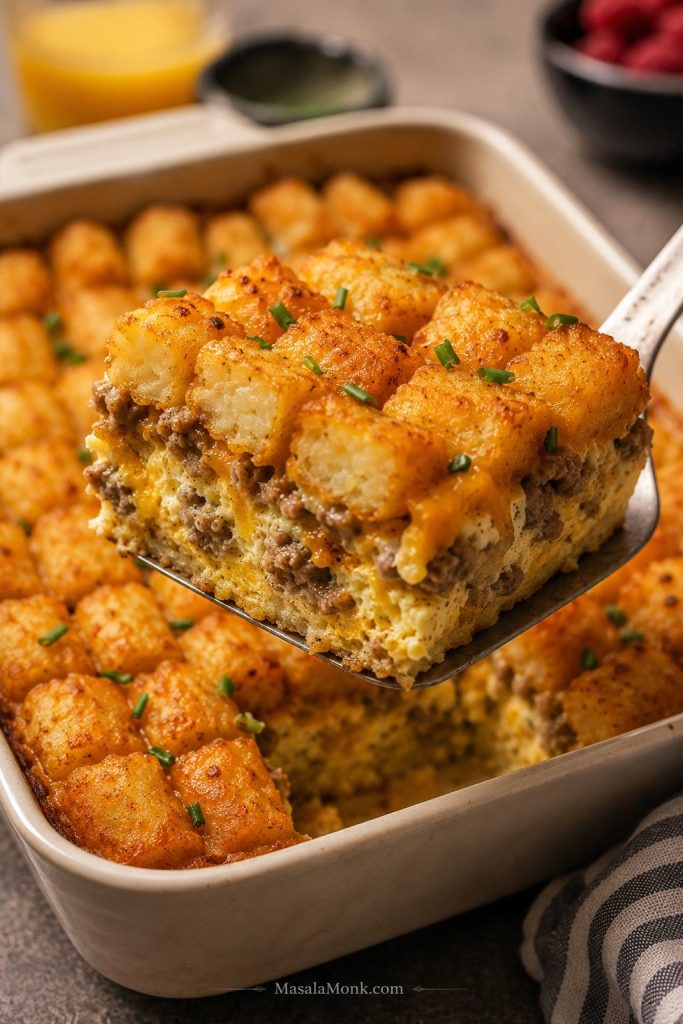
A spatula lifting a square slice of tater tot breakfast casserole with visible eggs, sausage, cheese, and browned tater tots.
After resting, a well-baked casserole should lift from the pan in clean squares instead of collapsing into loose egg and potatoes.

Quick Answer: Tater Tot Breakfast Casserole

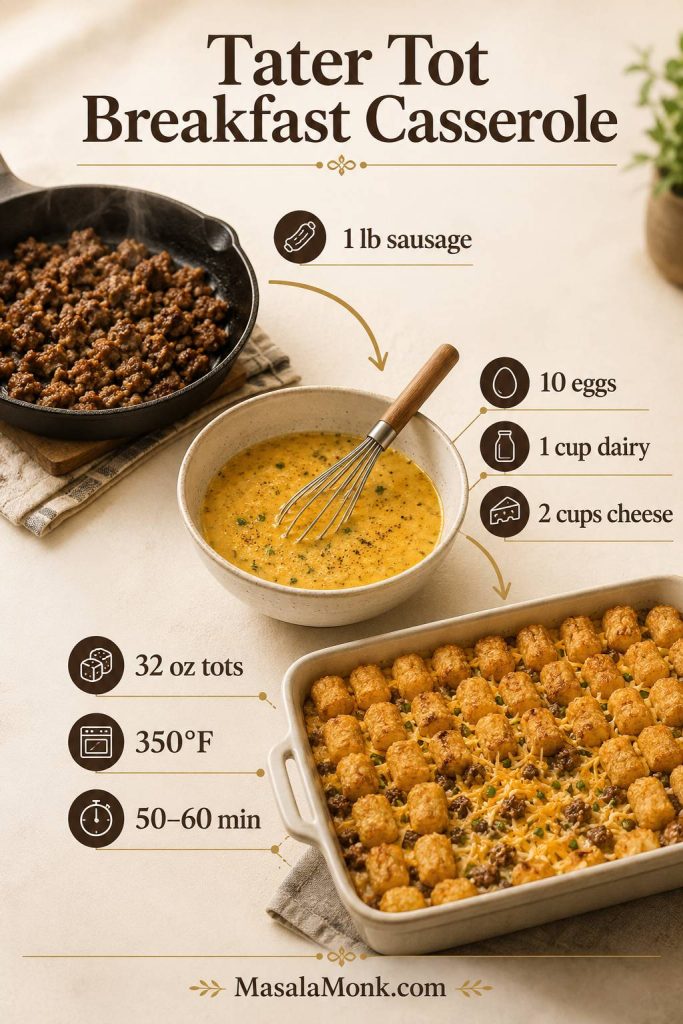
For a golden-browned, sliceable tater tot breakfast casserole, use 1 pound / 454 g breakfast sausage, 10 large eggs, 1 cup / 240 ml milk or half-and-half, 2 cups / about 225 g shredded cheese, and 32 oz / 907 g frozen tater tots. Brown the sausage, whisk the eggs with the dairy, layer everything in a greased 9×13-inch pan, arrange the tots on top, and bake uncovered at 350°F / 175°C for 50–60 minutes.

The overnight choice is simple: easiest morning, or better potato texture. A fully assembled overnight casserole works, but the topping loses some crispness. For the neatest potato top, prep the sausage and egg mixture ahead, then add the tots right before baking.

Best first version: sausage, cheddar, 10 eggs, 1 cup dairy, and a full layer of tots. It is hearty, sliceable, and built for a browned potato top without needing a separate pan of breakfast potatoes.
Quick guide for tater tot breakfast casserole showing sausage, eggs, dairy, cheese, frozen tots, bake temperature, and bake time.
For the quickest path to a reliable 9×13 brunch bake, keep the ratio simple: meat, eggs, dairy, cheese, and frozen tots.

At a Glance

Detail Recommended Setup
Pan 9×13 inch / 23×33 cm baking dish
Tater tots 32 oz / 907 g frozen tater tots
Eggs 10 large eggs
Protein 1 lb / 454 g breakfast sausage
Dairy 1 cup / 240 ml milk or half-and-half
Cheese 2 cups / about 225 g shredded cheese
Oven 350°F / 175°C
Bake time 50–60 minutes, longer if chilled
Rest time 10 minutes before slicing
Doneness 165°F / 74°C in the center

Those amounts give you a casserole that slices cleanly without turning into a dry block of eggs and potatoes. The bottom stays savory and tender, while the top gives you the crisp potato bite people usually reach for first, especially around the edges.

What Is Tater Tot Breakfast Casserole?

A tater tot breakfast casserole is an egg-based brunch bake with frozen tots, cheese, and a breakfast-style filling such as sausage, bacon, ham, or vegetables. It gives you the comfort of eggs and potatoes in one pan, with the tots standing in for hash browns or breakfast potatoes on the side.

If you want crispy potatoes without the full egg bake, these air fryer hash browns are a quicker potato side. This casserole is for the morning when you want the eggs, sausage, cheese, and potatoes baked together in one pan so you can slice and serve it to a group without juggling separate skillets on the stove.

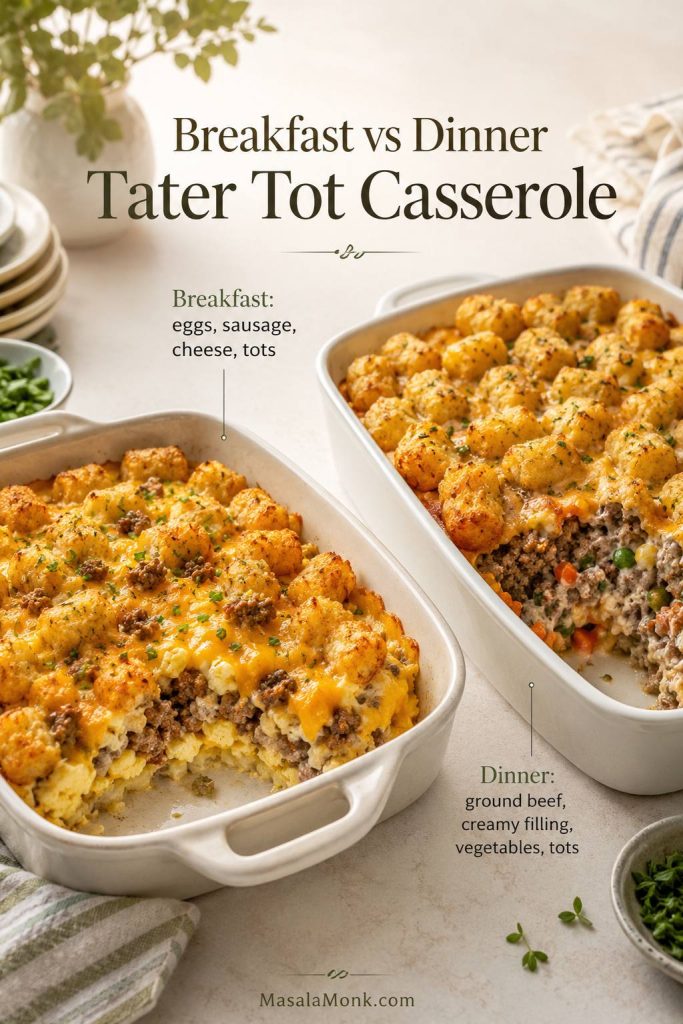
Unlike a classic dinner-style tater tot casserole, this breakfast version does not use cream of mushroom soup. Eggs, milk, and cheese hold everything together, so the finished dish eats like a brunch egg bake rather than a creamy ground-beef casserole.

Breakfast Version vs Dinner Casserole

If you landed here looking for the dinner-style version, MasalaMonk also has a cozy tater tot casserole recipe made with ground beef, creamy filling, vegetables, cheese, and crisp tots. This breakfast version is different: it is built around eggs, breakfast sausage, cheese, and frozen tots, so it eats more like a brunch casserole than a creamy dinner bake.

Version Main Ingredients Best For
Tater tot breakfast casserole Eggs, sausage or bacon, cheese, milk, frozen tots Brunch, holiday breakfast, breakfast meal prep
Regular tater tot casserole Ground beef, creamy sauce, vegetables, cheese, frozen tots Dinner, potlucks, comfort food meals
Hash brown breakfast casserole Eggs, sausage or bacon, cheese, shredded hash browns A classic breakfast casserole with a softer potato base
Comparison of breakfast tater tot casserole with eggs and sausage and dinner tater tot casserole with ground beef and creamy filling.
Although both versions use tots, the breakfast casserole is egg-based, while the dinner casserole usually depends on ground beef and a creamy filling.

If you want a more traditional shredded-potato brunch bake, use this breakfast casserole with hash browns. If you want the crisp-topped, golden-potato version, this egg-and-tot bake is the better fit.

Why This Recipe Works

The problem with many tater tot breakfast casseroles is that the top looks ready before the egg center is fully cooked, or the tots turn limp because they are buried under too much filling. This version is built around two things: an egg layer that sets properly and a potato layer that gets a chance to brown.

  • The tots stay exposed. That gives the potatoes a chance to brown instead of steaming inside the egg layer.
  • The sausage is browned first. This gives the casserole flavor and prevents greasy raw sausage from cooking inside the eggs.
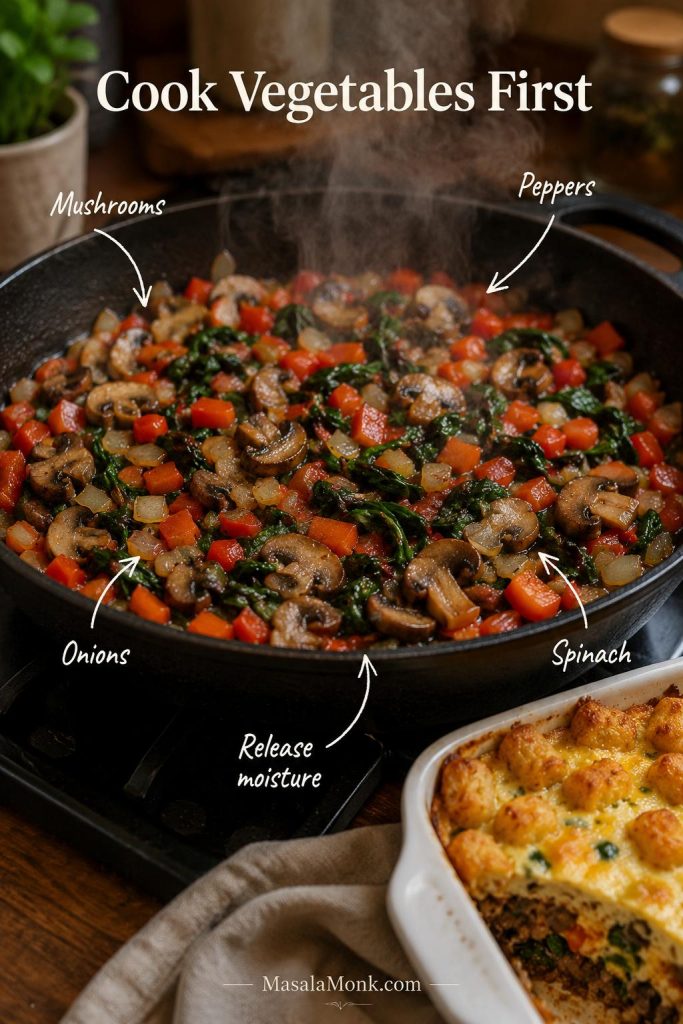
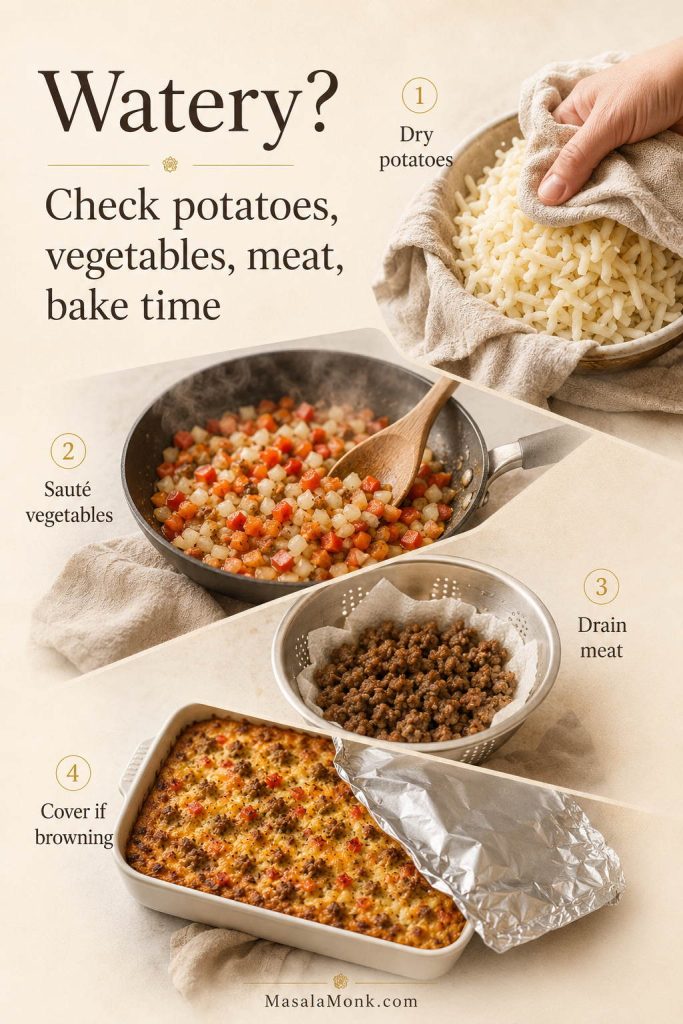
  • Vegetables are cooked before baking. Onion, peppers, mushrooms, and spinach can release water. Cooking them first keeps the middle from turning watery.
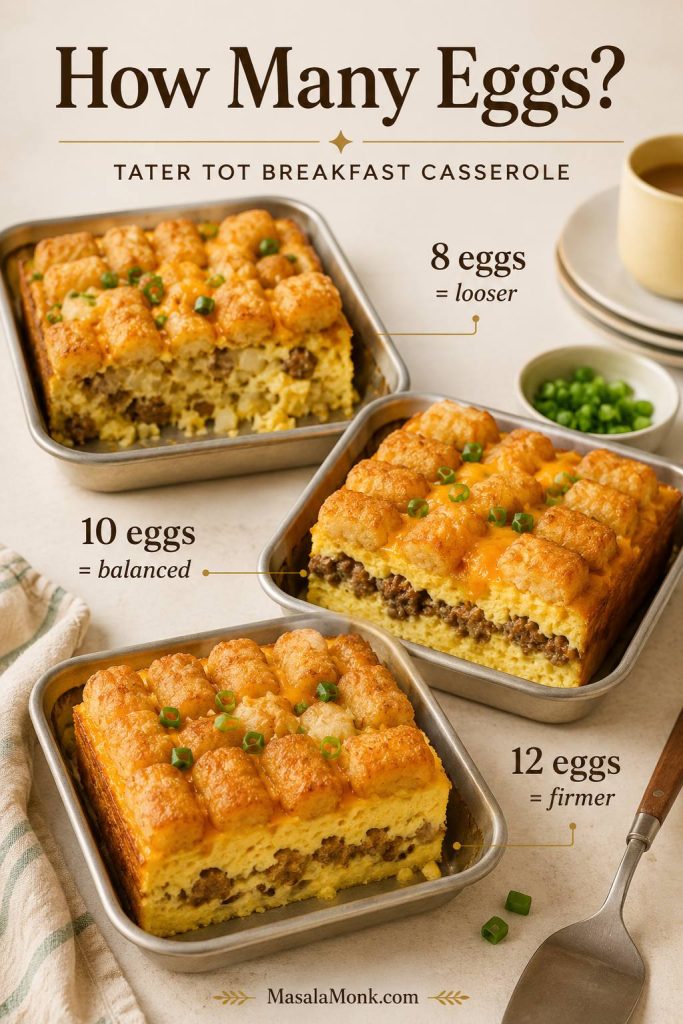
  • Ten eggs are deliberate. For a 9×13 pan, 10 eggs give the best middle ground: 8 eggs make the casserole looser and more potato-heavy, while 12 eggs push it closer to a firm egg bake.
  • One cup of dairy keeps the eggs tender. It softens the texture without flooding the pan.
  • Frozen tots make the method predictable. They hold their shape, cover the top neatly, and are less likely to collapse into the egg layer.
Cutaway guide showing tater tots on top of breakfast casserole, with egg and sausage filling underneath.
Since the potato layer needs dry heat to brown, the tots work better as a topping than as a hidden layer inside the eggs.

Choose Your Version

If you already know the kind of morning you are cooking for, use this as a shortcut. The base recipe stays the same; the meat, timing, and topping method change the personality of the casserole.

Want This? Make It This Way
Classic brunch pan Sausage, cheddar, 10 eggs, and tots arranged on top.
Easiest holiday morning Fully assemble, cover, refrigerate, then bake covered first and uncovered to finish.
Crispest tot topping Prep the sausage and egg mixture ahead, then add frozen tots in the morning.
Bacon-lover version Use cooked bacon with cheddar-Jack or sharp cheddar.
Leftover ham brunch Use diced ham with cheddar, Swiss, or Monterey Jack.
Vegetable-packed bake Use cooked mushrooms, peppers, onions, spinach, broccoli, or roasted poblanos.
Creamier high-protein bake Add cottage cheese and reduce the milk slightly.
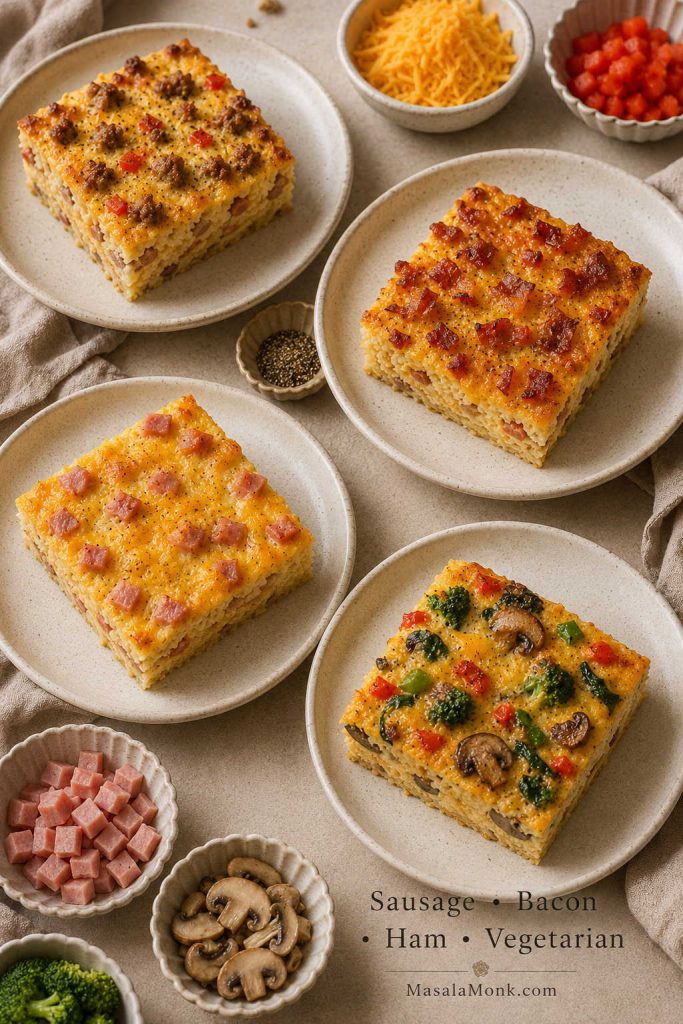
Six plated tater tot breakfast casserole variations, including classic, bacon, ham, vegetarian, and high-protein styles.
Once the base is right, the same casserole can shift toward classic sausage, smoky bacon, leftover ham, vegetarian, or higher-protein brunch versions.

Ingredients for Tater Tot Breakfast Casserole

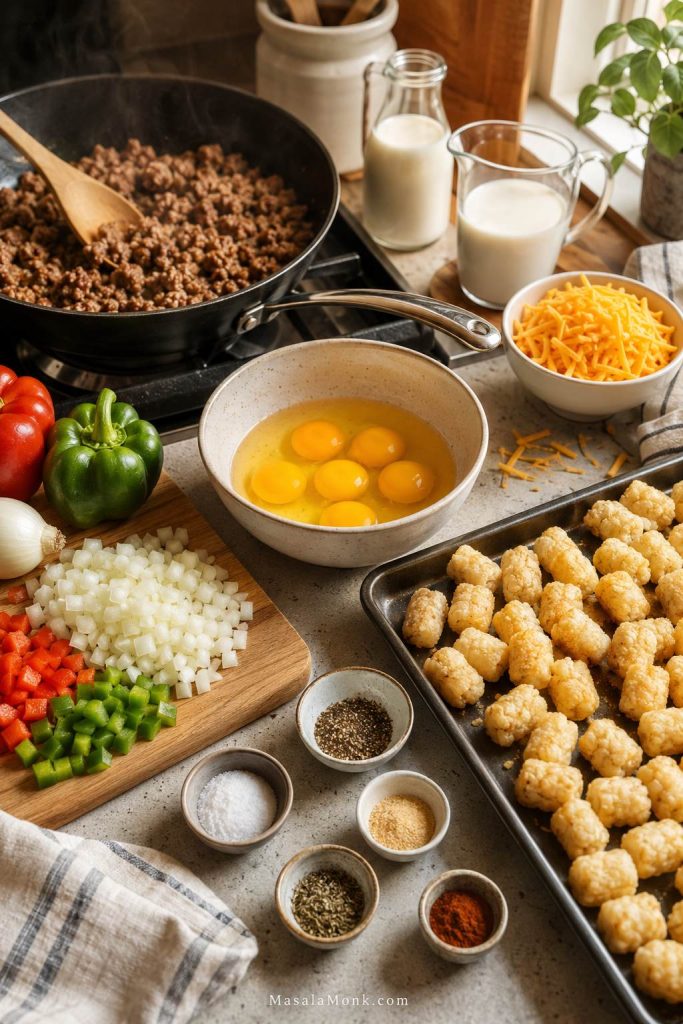
The ingredient list is short, so the ratios do most of the work. Too many eggs make the bake firm, too much dairy loosens the center, and thawed tots lose structure.

Ingredients for tater tot breakfast casserole, including sausage, eggs, milk, shredded cheese, frozen tots, vegetables, and seasonings.
The ingredients are familiar, but the balance matters: enough eggs for structure, enough dairy for tenderness, and frozen tots for a defined top.

Frozen tater tots

Use 32 oz / 907 g frozen tater tots for a generous 9×13 casserole. Keep them in the freezer until you are ready to assemble so they hold their shape and are less likely to break apart.

Breakfast sausage

Breakfast sausage brings seasoning, fat, and savory depth. Use 1 pound / 454 g pork breakfast sausage, turkey sausage, chicken sausage, or spicy breakfast sausage. Brown it fully and drain excess grease before layering it into the casserole.

Eggs

Ten large eggs give the casserole enough structure for a 9×13 pan without making it feel dry or rubbery. For a lighter, more potato-heavy bake, use 8 eggs. However, if you want it firmer and more egg-forward, use 12.

Egg ratio guide for tater tot breakfast casserole showing 8 eggs, 10 eggs, and 12 eggs with different casserole textures.
For a 9×13 pan, 10 eggs give the most balanced texture; 8 eggs lean looser, while 12 eggs make the bake firmer.

If you want a smaller skillet egg bake instead of a full brunch pan, this frittata recipe uses a similar cooked-filling logic but bakes faster and serves fewer people.

Milk or half-and-half

Use 1 cup / 240 ml whole milk or half-and-half. This helps the eggs bake into a tender layer. Too much dairy can make the center loose, especially if you also add vegetables that release moisture.

Cheese

Use 2 cups / about 225 g shredded cheese. Sharp cheddar gives the boldest flavor, while Monterey Jack, Colby Jack, or pepper jack melt smoothly. A cheddar-Jack blend gives you both flavor and melt.

Vegetables and seasonings

Onion and bell pepper are optional but useful. Cook them with the sausage so they soften before going into the baking dish. Garlic powder, onion powder, black pepper, dry mustard, and a little hot sauce all help the egg mixture taste seasoned instead of flat.

Try to keep added vegetables to about 1 1/2 to 2 cups cooked total so the egg layer still sets cleanly.

Vegetables cooking in a pan before being added to tater tot breakfast casserole, with mushrooms, peppers, onions, and spinach.
Before vegetables go into the casserole, sautéing them helps remove moisture so mushrooms, peppers, onions, and spinach do not loosen the egg layer.

Which Tater Tots to Use

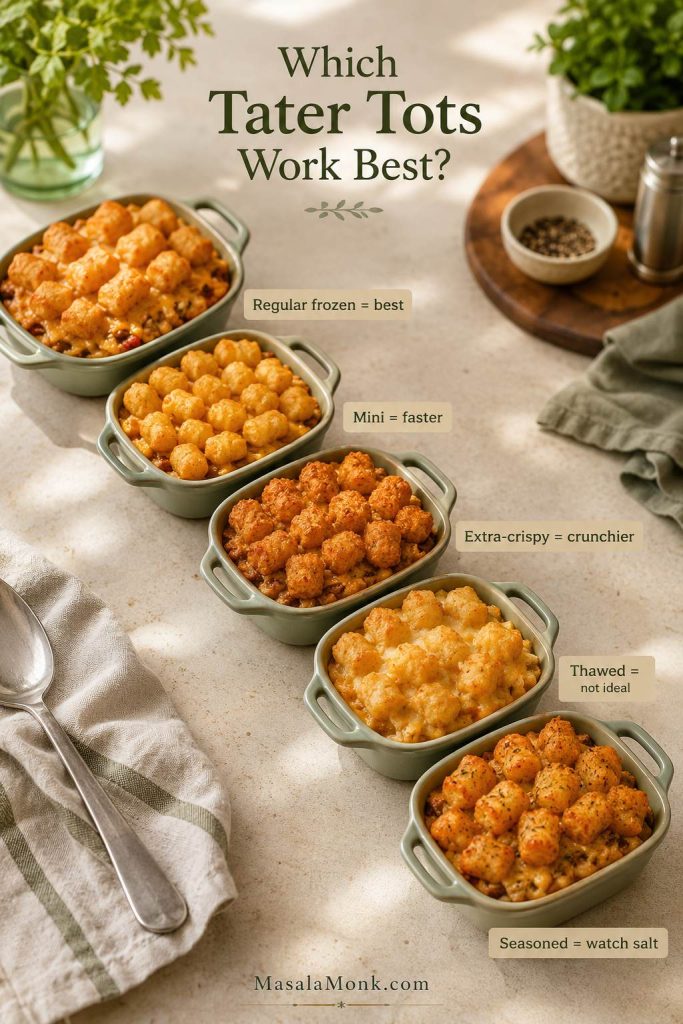
Regular frozen tater tots are the easiest choice for this breakfast bake because they hold their shape and brown predictably. They are already shaped, par-cooked, and ready to go straight from the freezer to the casserole.

Type of Tot Will It Work? Notes
Regular frozen tater tots Recommended Strong structure and the most predictable bake time.
Mini tots Yes They brown faster, so start checking earlier.
Extra-crispy tots Yes Good for a stronger crunch on top.
Thawed tots Not ideal They can soften, break, and lose structure.
Seasoned tots Sometimes Use less added salt if the tots are already salty.
Guide comparing regular frozen, mini, extra-crispy, thawed, and seasoned tater tots for breakfast casserole.
Regular frozen tots are the safest first choice; however, mini, extra-crispy, and seasoned tots can work when timing and salt are adjusted.

If you are using a smaller bag, 28 oz / about 794 g will still work. The top layer will be a little less full, but the casserole will bake well.

Tots on Top vs Tots on Bottom

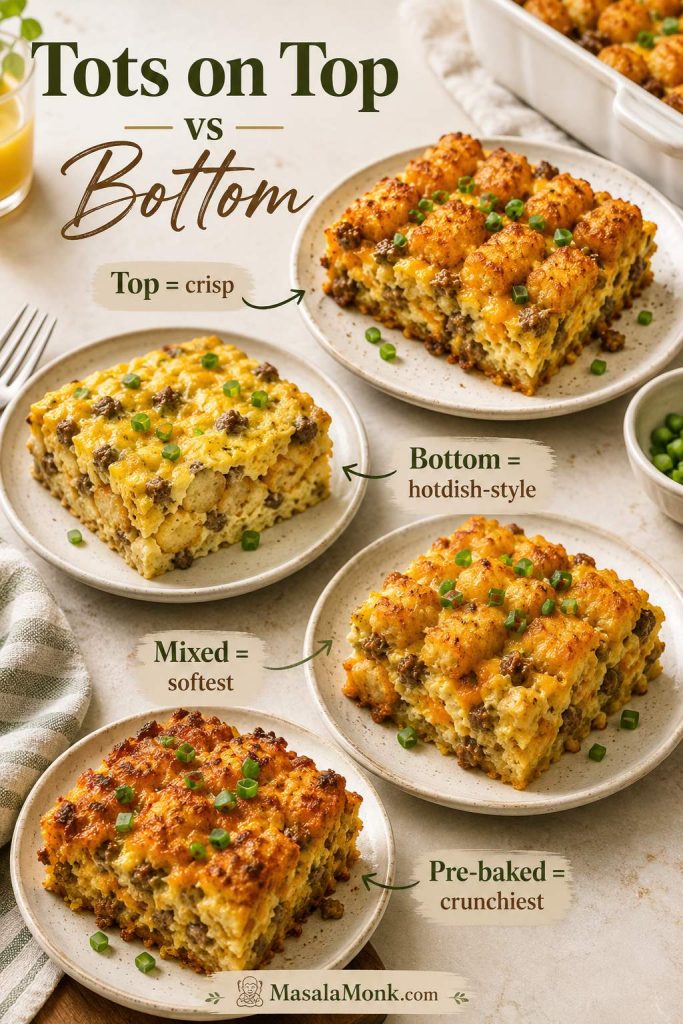
This is the biggest texture decision in the whole recipe. Some tater tot breakfast casserole recipes place the tots on the bottom, some mix them in, and some arrange them on top. None of those methods is wrong, but they do not give the same result.

Method Texture When to Use It
Tots on top Crisp, browned top, clear potato layer Best for a classic tater tot topping
Tots on bottom More hotdish-style, absorbs egg mixture Overnight casseroles or a softer potato texture
Tots mixed in Easy, but least crisp Casual family bake
Pre-baked tots Crunchiest, but takes extra time When you do not mind an extra step
Comparison of tater tots on top, on the bottom, mixed in, and pre-baked for tater tot breakfast casserole texture.
Placement changes the texture: tots on top stay more distinct, while bottom or mixed-in tots create a softer, hotdish-style bite.

For this recipe, the tots go on top because that is where they can actually brown. The eggs, sausage, and cheese bake underneath, while the corners get the best crisp-edged potato bites. Once you choose that texture, follow the step-by-step method below.

How to Make Tater Tot Breakfast Casserole

The method is easy, but a little order makes a big difference. Brown and drain the sausage first, season the eggs before they hit the pan, and keep the tots frozen until the casserole is ready for the oven. If you are baking a chilled casserole, use the bake time and doneness section before you start.

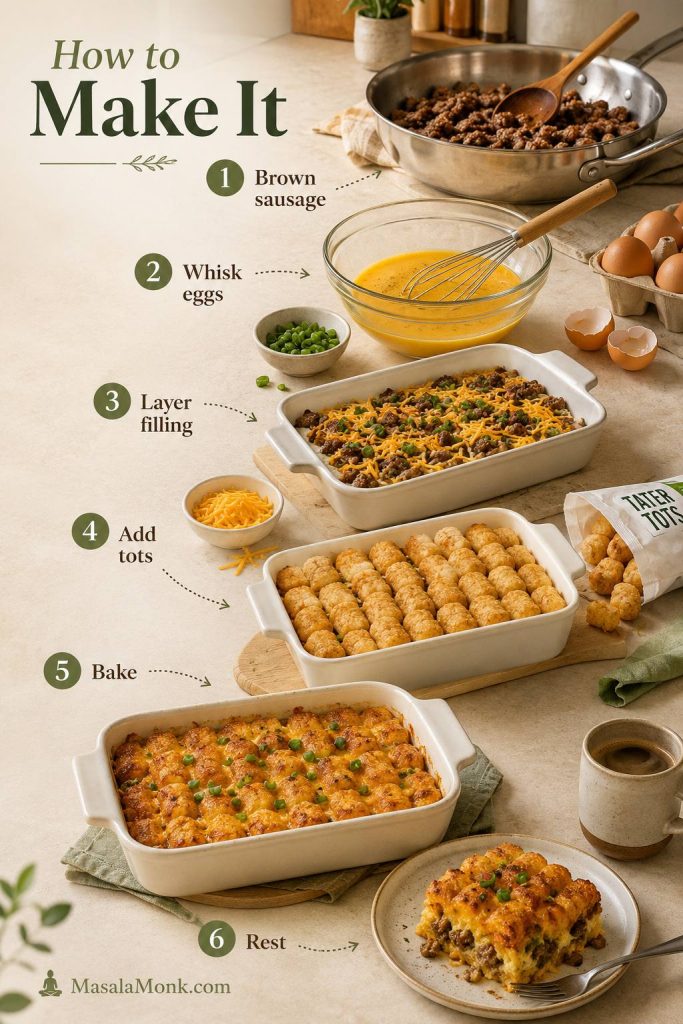
Step-by-step guide showing sausage browning, eggs whisked, filling layered, tots added, casserole baked, and slices rested.
The casserole comes together more predictably when the filling is cooked first, the eggs are seasoned separately, and the tots are added last.

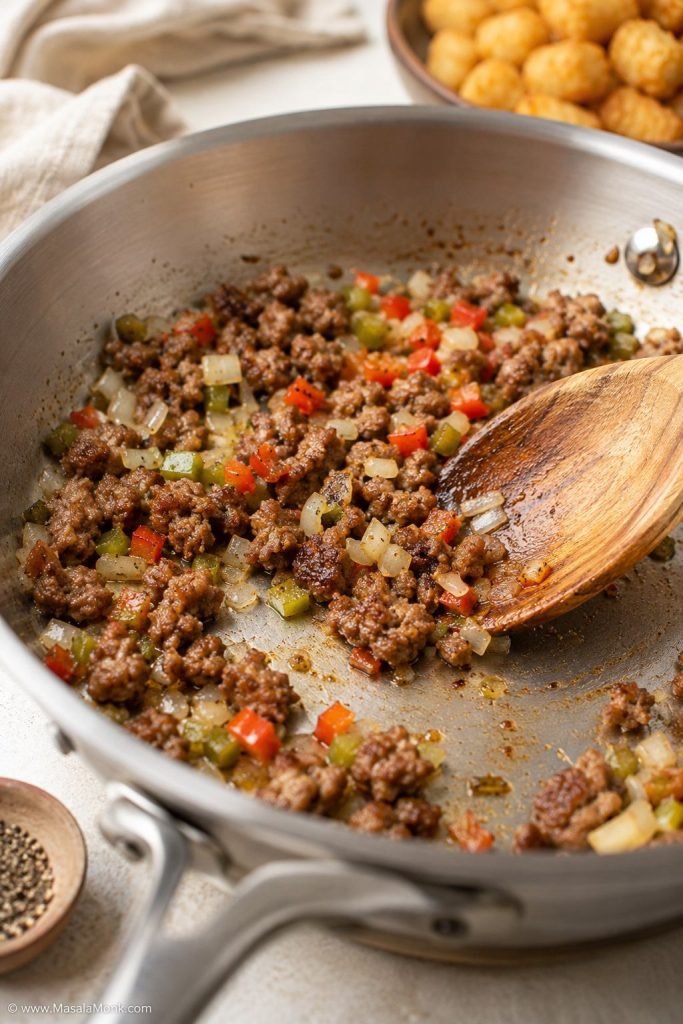
1. Brown the sausage

Heat a large skillet over medium heat. Add 1 pound / 454 g breakfast sausage and cook until browned, no longer pink, and the crumbles have a little color. If you are using onion or bell pepper, add them once the sausage has started to brown and cook until softened.

Drain excess grease so the bottom of the casserole does not turn heavy or oily.

Breakfast sausage browning in a skillet with onions and peppers for tater tot breakfast casserole.
Browning the sausage before baking adds deeper flavor, and draining it helps keep the finished egg layer from turning greasy.

2. Whisk the eggs

In a large bowl, whisk 10 large eggs with 1 cup / 240 ml milk or half-and-half. Add garlic powder, onion powder, black pepper, dry mustard if using, hot sauce if using, and a little salt. Be careful with salt if your sausage and cheese are already salty.

3. Layer the filling

Grease a 9×13-inch / 23×33 cm baking dish. Spread the cooked sausage mixture evenly over the bottom. Sprinkle most of the cheese over the sausage, saving a little for the top if you like a cheesy finish.

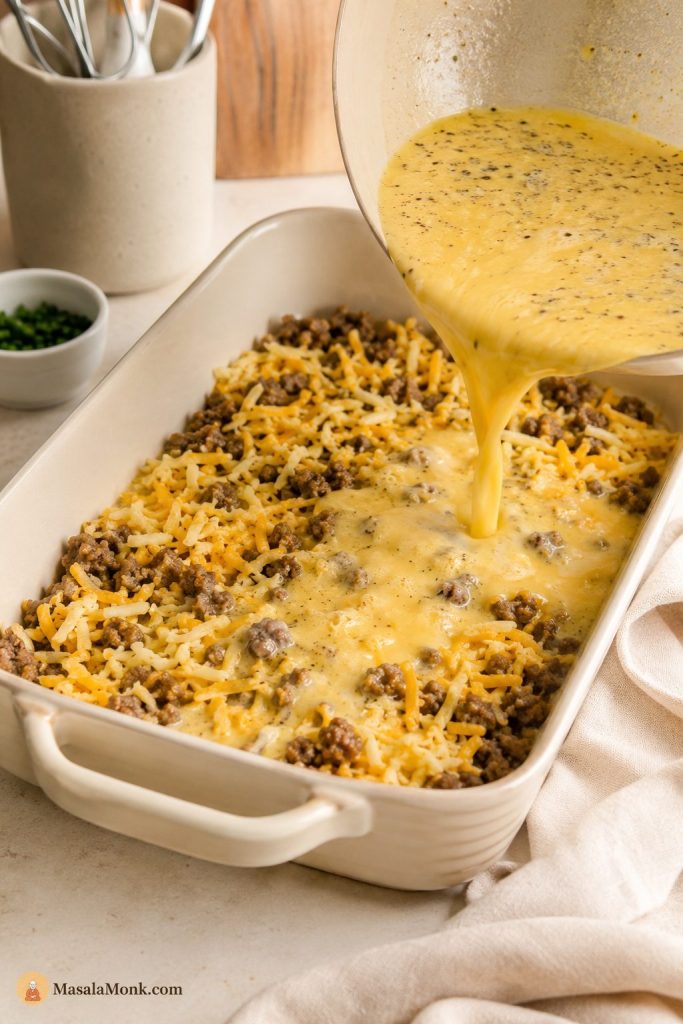
4. Add the egg mixture

Pour the egg mixture evenly over the sausage and cheese. Tilt the dish gently if needed so the eggs settle into the corners.

Egg mixture being poured over cooked sausage and shredded cheese in a baking dish for tater tot breakfast casserole.
Once the filling is spread evenly, pouring the eggs slowly helps them reach the corners and hold the casserole together when sliced.

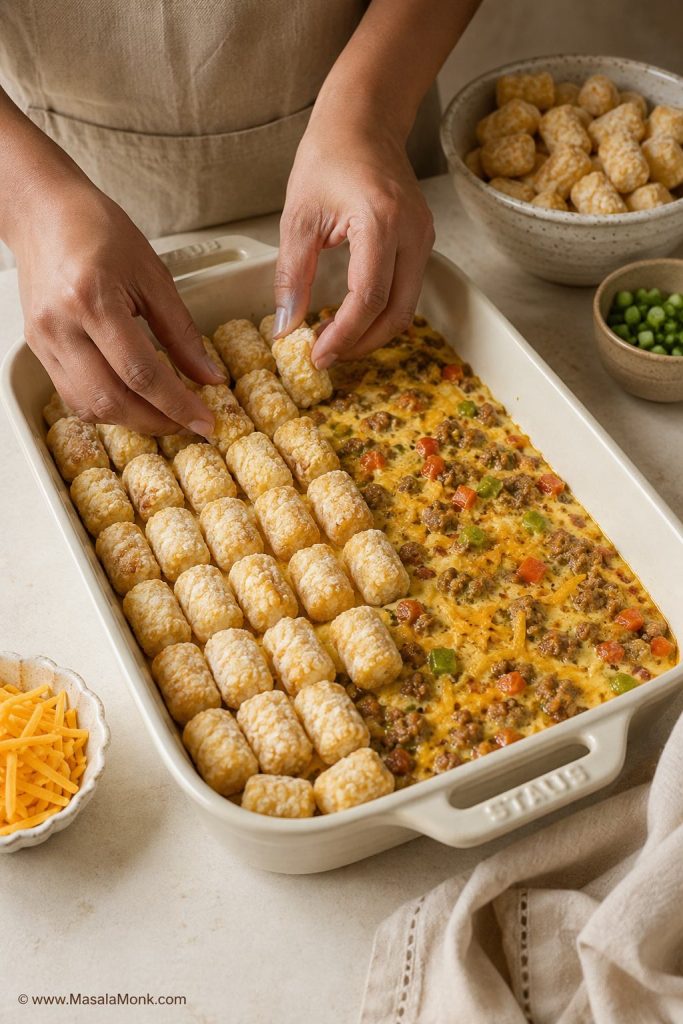
5. Arrange the frozen tots

Place the frozen tater tots on top in a single layer. They do not need to be perfectly lined up, but try to keep them exposed rather than buried under the egg mixture.

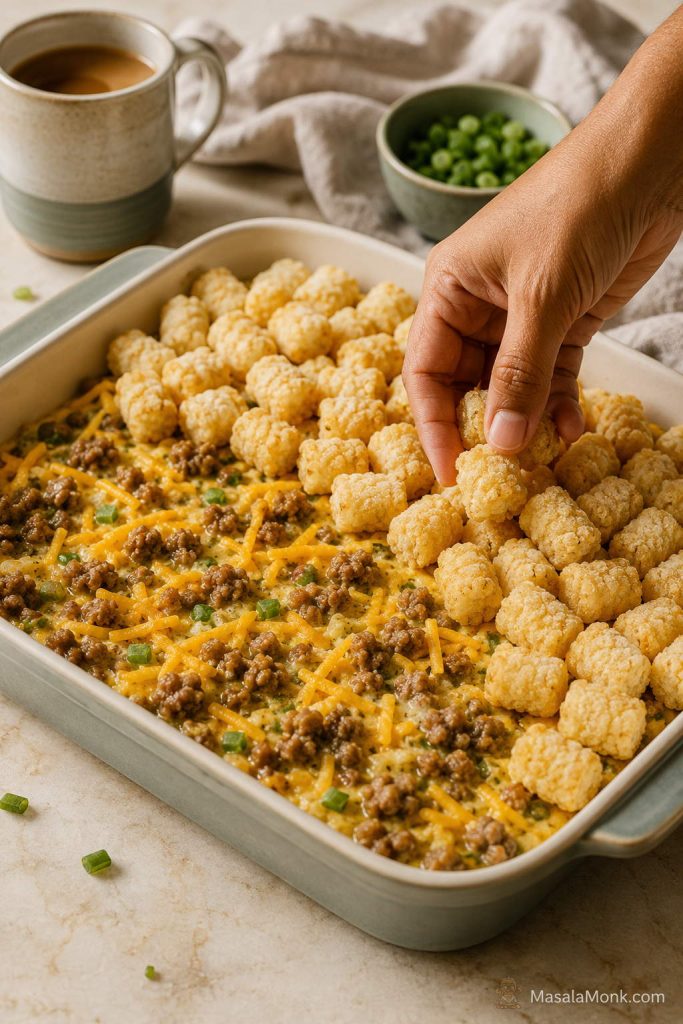
A hand arranging frozen tater tots over sausage, cheese, and egg filling in a rectangular baking dish.
Instead of thawing them first, add the tots frozen so they keep their shape and remain visible as the casserole bakes.

6. Bake and rest

Bake uncovered at 350°F / 175°C for 50–60 minutes, until the egg layer has firmed and the tots are crisp-edged and golden. Add the remaining cheese during the last 5–10 minutes if you want a cheesy top. Let the casserole rest for 10 minutes before slicing so the squares hold together.

By the end, the edges should look lightly browned and the center should feel set rather than sloshy.

Baked tater tot breakfast casserole with golden-browned tots, melted cheese, and crisp edges in a ceramic dish.
By the end of baking, the tots should look golden-browned and crisp-edged, but the center still needs a final doneness check.
For the best-looking top: keep most or all of the cheese under the tots. If adding cheese on top, sprinkle it lightly during the last 5–10 minutes instead of covering the tots completely.

Bake Time and Doneness

The top will usually look ready before the middle is done, so use the clock as a guide and the center as the final judge. For a freshly assembled 9×13 tater tot breakfast casserole, plan on 50–60 minutes at 350°F / 175°C. If the casserole is cold from the refrigerator, it may need 60–70 minutes total.

Version Temperature Approximate Time
Freshly assembled 9×13 casserole 350°F / 175°C 50–60 minutes
Cold overnight casserole 350°F / 175°C 60–70 minutes
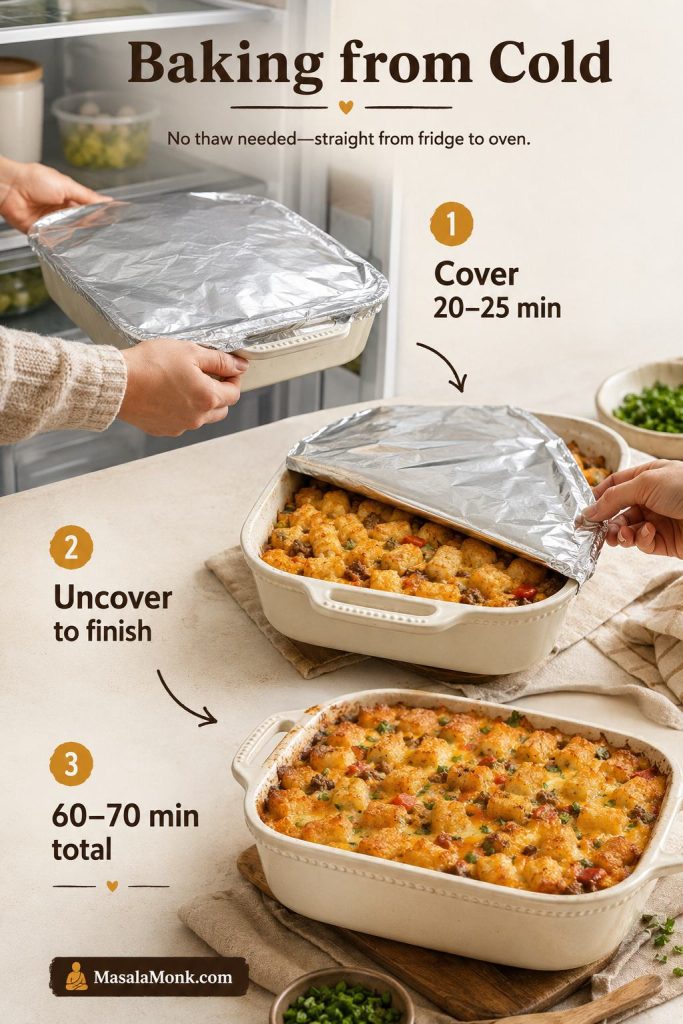
Covered start for chilled casserole 350°F / 175°C Cover 20–25 minutes, then uncover until done
More browned top Finish at 400°F / 200°C Last 5 minutes only, if needed

Baking from Cold

Cover only a cold casserole that needs help warming through before the top gets too brown. For a freshly assembled casserole, bake uncovered from the start.

Guide for baking cold overnight tater tot breakfast casserole with covered start, uncovered finish, and longer bake time.
When the dish starts cold, a covered start helps the middle warm through before the potato topping gets too dark.

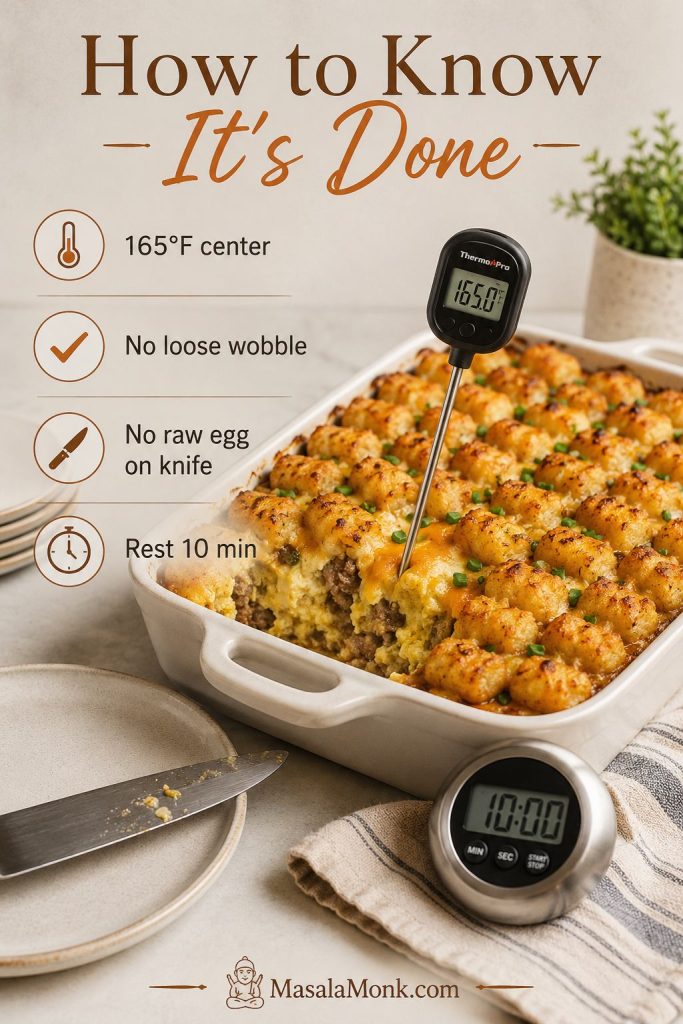
For the simplest safe target, check the center with an instant-read thermometer and look for 165°F / 74°C. FoodSafety.gov lists casseroles, including meatless casseroles, at 165°F / 74°C, so that is the clearest doneness target for this full breakfast bake. You can review the safe internal temperature guidance from FoodSafety.gov.

If you do not have a thermometer, look for no loose wobble in the middle and no raw egg on a knife inserted near the center.

Doneness guide for tater tot breakfast casserole with a thermometer, knife test, and resting time cues.
Because the surface can brown early, the safest cue is the center: look for 165°F, no loose wobble, and no raw egg on the knife.
Do not pull it too early: a casserole can look browned on top while the egg center is still loose underneath. Check near the middle, not just the edges. If the center stays loose or the tots are browning too fast, use the troubleshooting table.

Sausage, Bacon, Ham, and Vegetarian Variations

Once the egg-to-dairy balance is right, the casserole is forgiving. The flavor can go smoky with bacon, milder and holiday-friendly with ham, or vegetable-heavy with a vegetarian version as long as the moisture is cooked off first.

Sausage tater tot breakfast casserole

Sausage works especially well because it seasons the whole pan as it cooks. Use 1 pound / 454 g breakfast sausage, cooked and drained. Pork sausage gives the richest flavor, but turkey or chicken breakfast sausage works too. For a spicier casserole, use hot breakfast sausage or add pepper jack cheese.

If your sausage is very salty, reduce the salt in the egg mixture. The cheese and tots will add salt too.

For a richer sausage-and-cream-cheese version, stir 4 oz / 115 g softened cream cheese into the cooked sausage before layering. Keep the milk at 1 cup so the egg layer does not turn too loose.

Bacon tater tot breakfast casserole

Bacon gives the casserole a smokier, saltier flavor than sausage. Use 12–16 oz / 340–454 g bacon, cook it until crisp, drain it well, and crumble it before adding it to the dish. For a few strips, this air fryer bacon guide keeps the process quick. For a full pack, oven bacon is usually easier because you get more space and less batch work.

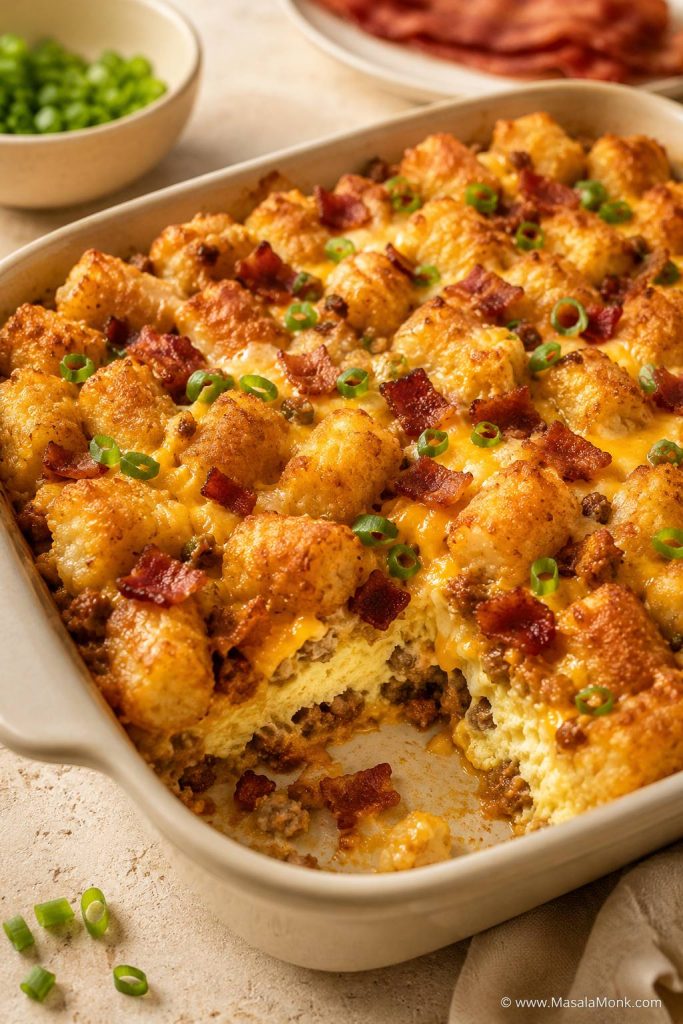
Because bacon adds more salt and fat than sausage, go lighter with added salt and avoid pouring bacon grease into the casserole.

Bacon tater tot breakfast casserole with crisp bacon pieces, eggs, cheese, green onion, and browned tater tots.
Since bacon brings salt, smoke, and fat, the best bacon version usually needs less added salt in the egg mixture.

Ham and cheese tater tot casserole

Diced ham turns this into a milder, holiday-friendly brunch casserole. Use 12–16 oz / 340–454 g diced cooked ham, especially if you have leftovers from Easter, Christmas, or a weekend dinner.

Ham can be salty, so season the eggs carefully. Cheddar, Monterey Jack, Swiss, or a cheddar-Jack blend all work well, while green onions, bell peppers, or a little Dijon-style mustard in the egg mixture help balance the richness.

Ham and cheese tater tot breakfast casserole served with fruit, showing diced ham, eggs, cheese, and golden tots.
Leftover ham gives the casserole a milder holiday-brunch feel, especially with cheddar, Swiss, or Monterey Jack.

Vegetarian tater tot breakfast casserole

A vegetarian version works well as long as the vegetables are cooked first. Mushrooms, peppers, onions, spinach, broccoli, green onions, and roasted poblano peppers are all good choices.

The key is managing moisture. Mushrooms, spinach, peppers, and onions can all release water as they bake. Sauté them before adding them to the casserole, and squeeze spinach dry if using frozen spinach.

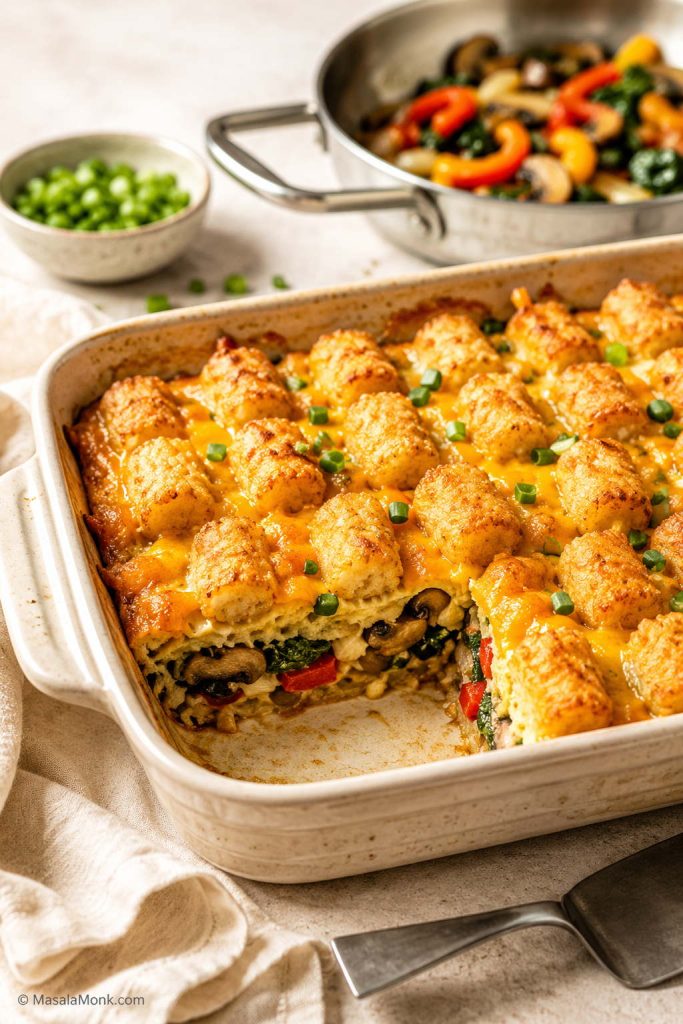
Vegetarian tater tot breakfast casserole with mushrooms, peppers, spinach, onions, eggs, cheese, and browned tater tots.
For a vegetarian tater tot breakfast casserole, cooked vegetables add color and flavor while helping the center stay set.

Cottage cheese or high-protein version

For a higher-protein version, add 1/2 to 1 cup cottage cheese to the egg mixture and reduce the milk slightly. This makes the egg layer creamier and more filling. Blend the cottage cheese first if you want a smoother texture. For a smaller breakfast with the same creamy, higher-protein idea, try these scrambled eggs with cottage cheese.

You can also use turkey sausage and add extra egg whites, but avoid making the casserole too lean or it can bake up dry.

Make-Ahead and Overnight Tips

This is the section to read if you are making the casserole for Christmas morning, a brunch table, overnight guests, or a weekend when you do not want to think before coffee.

The tradeoff is simple: easiest morning, or best tot texture. Both work. You just decide which one matters more that day.

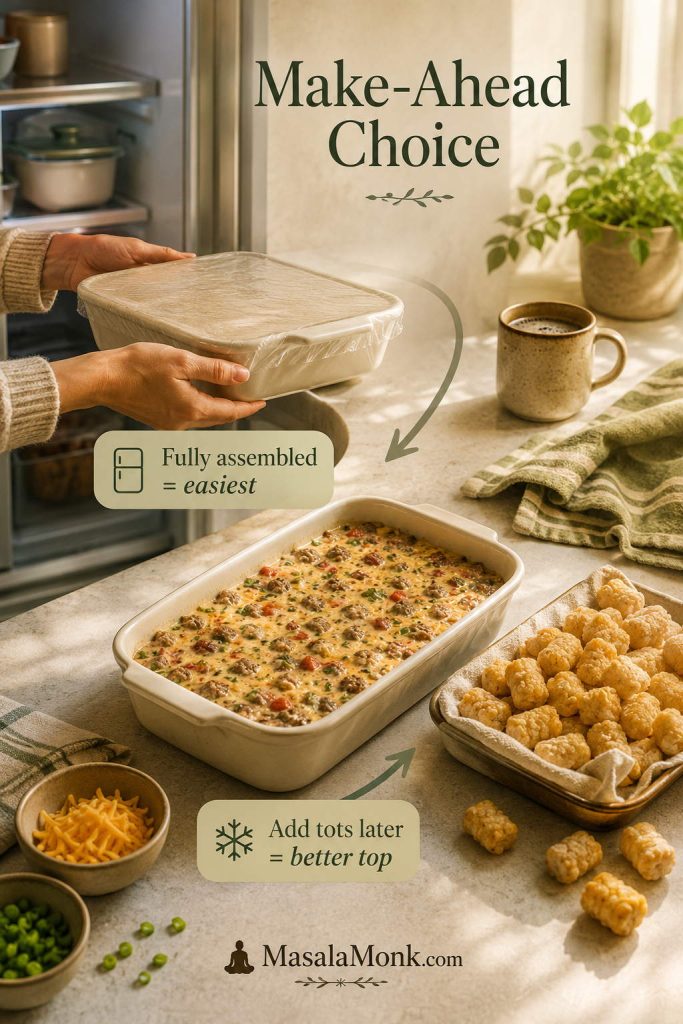
The best topping comes from prepping the filling ahead and adding the tots just before baking; the fully assembled overnight version is easier, but the top bakes less crisp.

Make-ahead guide showing a covered casserole near the refrigerator and prepped filling with frozen tater tots added later.
The make-ahead choice depends on the morning: fully assembled is easiest, while adding tots later gives a more defined top.
Method What to Do Result
Fully assemble overnight Assemble the casserole, cover, and refrigerate overnight Easiest morning, less crisp topping
Add tots in the morning Cook sausage, prep egg mixture, refrigerate separately, then add tots before baking Better browned top and clearer potato layer
Same-day bake Assemble and bake right away Most predictable texture

Either way, let the casserole sit at room temperature while the oven preheats. That short rest takes the chill off the dish and helps the center bake more evenly.

If convenience matters most, assemble the whole casserole the night before. Cover it tightly and refrigerate. In the morning, bake it covered for the first 20–25 minutes, then uncover and continue baking until the center reaches 165°F / 74°C.

Add Tots in the Morning for Better Texture

If the topping matters most, cook the sausage and vegetables the night before, whisk the eggs and milk, and refrigerate those separately. In the morning, layer everything in the baking dish and add the tots right before baking.

A hand adding frozen tater tots to a prepared breakfast casserole filling in a baking dish.
Adding frozen tots right before baking is the better make-ahead move when the topping matters more than total overnight convenience.

If you are planning several freezer-friendly breakfasts at once, these meal prep breakfast burritos are a good companion recipe because they use the same no-soggy logic: cool the filling first, control moisture, and reheat with texture in mind. For leftover casserole slices, use the storage, freezing, and reheating section below.

Storage, Freezing, and Reheating

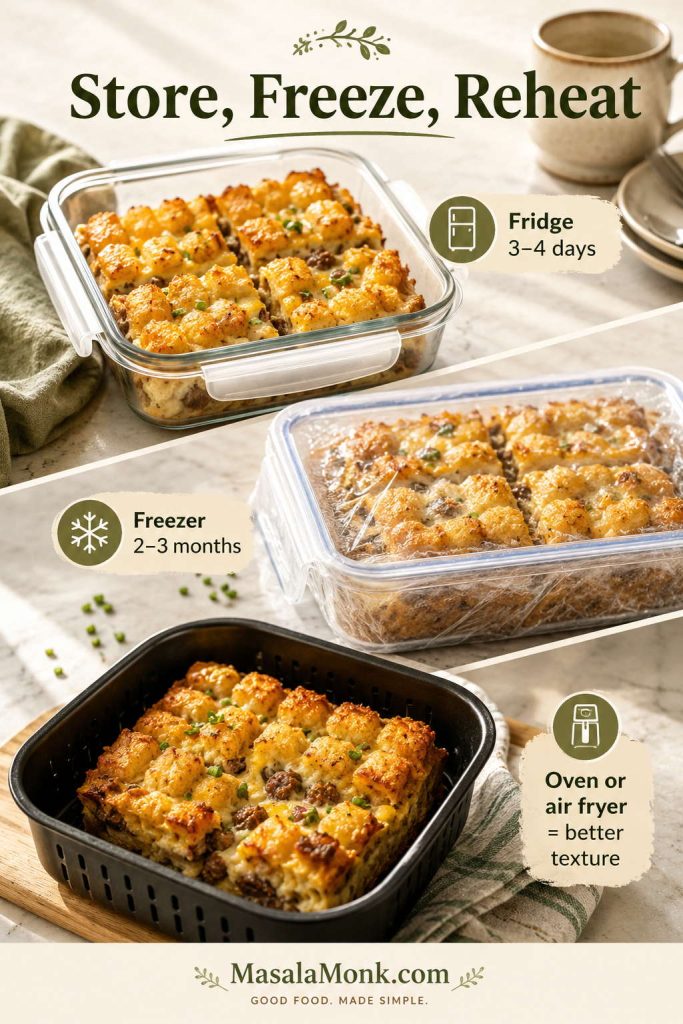
Let leftovers cool briefly, then refrigerate them in an airtight container within 2 hours. Stored properly, the casserole keeps for 3–4 days. The tots will lose some crispness as they sit, but the flavor stays good. The FoodSafety.gov cold storage chart gives the same general window for baked egg casseroles: 3–4 days in the refrigerator and 2–3 months in the freezer.

For freezing, baked portions work better than an unbaked fully assembled casserole. Wrap slices tightly or store them in freezer-safe containers for up to 2–3 months. Thaw overnight in the refrigerator before reheating.

For better texture, reheat slices in a 350°F / 175°C oven or air fryer until hot. The microwave is faster, but the oven or air fryer helps the tots regain more texture than the microwave gives.

Storage guide for tater tot breakfast casserole showing fridge storage, freezer portions, and reheating in an air fryer or oven.
After baking, fridge or freezer portions reheat best with dry heat, so the oven or air fryer gives better texture than the microwave.

For a smaller freezer breakfast that reheats faster, these egg muffins are easier to portion, while this casserole is better when you want one big brunch pan.

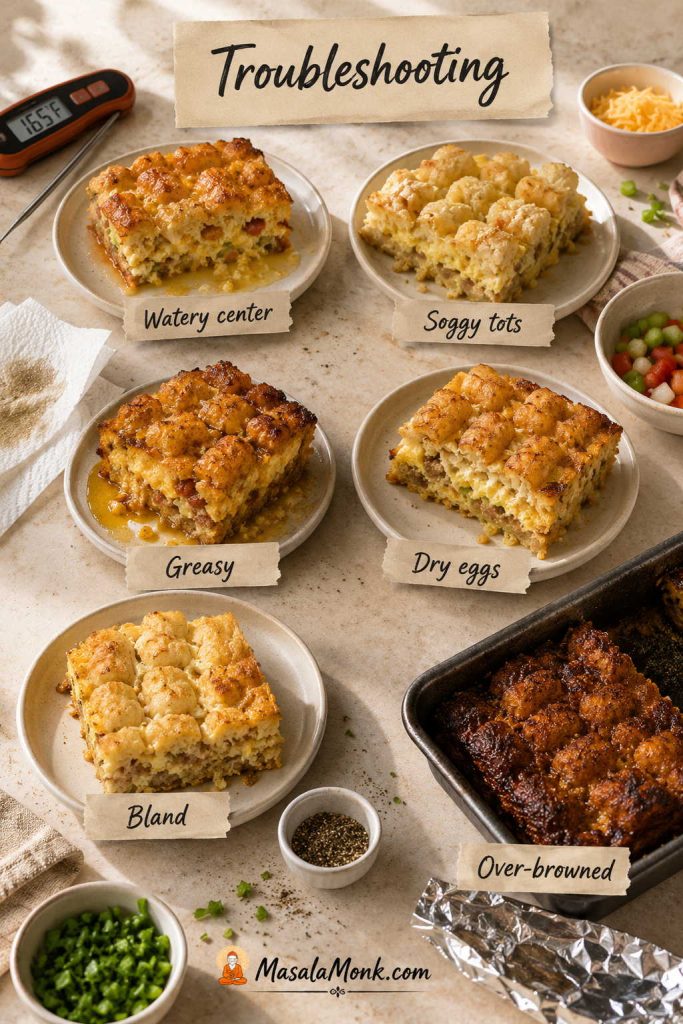
Troubleshooting

Most problems with this casserole come down to moisture, timing, or where the tots sit in the pan. The fixes are simple once you know what caused the problem.

Problem Likely Cause Fix
Watery center Raw vegetables, too much dairy, or underbaked eggs Sauté vegetables first, use 1 cup dairy, and bake until the center reaches 165°F / 74°C.
Soggy or soft tots Tots were buried, thawed, or fully assembled overnight Use frozen tots, keep them exposed, and add them just before baking when texture matters.
Greasy casserole Sausage or bacon was not drained Drain cooked meat before layering it into the dish.
Dry eggs Overbaked casserole or too little dairy Use 1 cup milk or half-and-half and start checking near the low end of the bake time.
Bland flavor Egg mixture was not seasoned Season the eggs directly and use sharp cheese or spicy sausage.
Too salty Sausage, bacon, ham, cheese, and tots all added salt Reduce added salt and balance with vegetables, herbs, or a milder cheese.
Middle not setting Casserole was cold, pan was deep, or egg layer was too thick Bake longer, cover briefly if the top browns too fast, and check the center temperature.
Tots browned before eggs set Oven runs hot or pan is too close to top heat Loosely tent with foil and keep baking until the center is done.
Troubleshooting board for tater tot breakfast casserole showing watery center, soggy tots, greasy casserole, dry eggs, bland flavor, and over-browned top.
Most fixes start with one question: is the problem moisture, timing, seasoning, or tot placement? That usually points to the right correction.

What to Serve with It

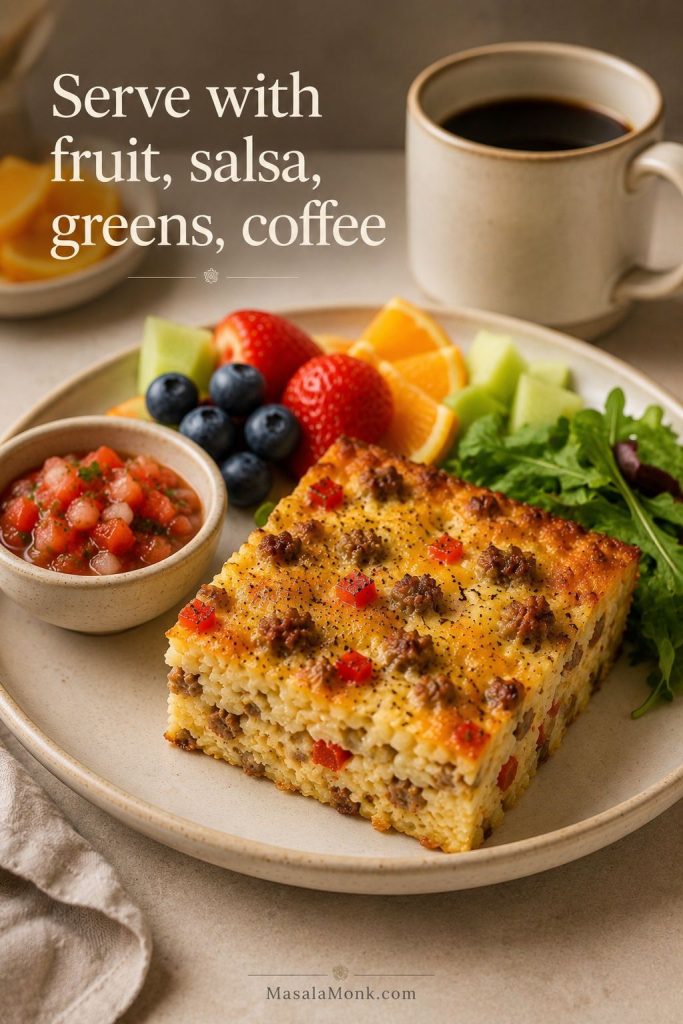
Because this casserole is hearty, fresh sides help the plate feel lighter. A bowl of berries, sliced oranges, salsa, avocado, or a sharp green salad cuts through the eggs, cheese, and potatoes.

For a brunch table, pair it with coffee, orange juice, berries, and something crisp or acidic on the side. Hot sauce, salsa, or pickled jalapeños are especially good if you use mild sausage and cheddar because they cut through the richness.

If you want something handheld and freezer-friendly instead, this breakfast burrito recipe is easier to eat on the go. For a lighter brunch side, a cold berry smoothie keeps the meal bright and easy.

Recipe Card: Tater Tot Breakfast Casserole

This tater tot breakfast casserole is a hearty 9×13 breakfast bake with sausage, eggs, melted cheese, and frozen tots arranged on top for a golden-browned potato finish.

Prep Time 20 minutes
Cook Time 50–60 minutes
Rest Time 10 minutes
Total Time 1 hour 20–30 minutes
Yield 10–12 servings

Equipment

  • 9×13-inch / 23×33 cm baking dish
  • Large skillet
  • Mixing bowl
  • Whisk
  • Measuring cups and spoons
  • Instant-read thermometer, recommended

Ingredients

  • 1 lb / 454 g breakfast sausage
  • 1/2 cup / about 75 g diced onion, optional
  • 1/2 to 1 cup / about 75–150 g diced bell pepper, optional
  • 10 large eggs
  • 1 cup / 240 ml whole milk or half-and-half
  • 1/2 teaspoon garlic powder
  • 1/2 teaspoon onion powder
  • 1/2 teaspoon black pepper
  • 1/2 teaspoon dry mustard, optional
  • 1–2 teaspoons hot sauce, optional
  • 1/2 to 3/4 teaspoon salt, depending on your sausage and cheese
  • 2 cups / about 225 g shredded cheddar, Monterey Jack, Colby Jack, or a blend
  • 32 oz / 907 g frozen tater tots, do not thaw
  • Butter or oil, for greasing the dish

Instructions

  1. Preheat the oven to 350°F / 175°C. Grease a 9×13-inch / 23×33 cm baking dish.
  2. Cook the sausage in a large skillet over medium heat, breaking it into crumbles, until browned and cooked through.
  3. If using onion and bell pepper, add them to the skillet and cook until softened. Drain excess grease.
  4. In a large bowl, whisk the eggs, milk or half-and-half, garlic powder, onion powder, black pepper, dry mustard, hot sauce, and salt.
  5. Spread the sausage mixture evenly in the prepared baking dish.
  6. Sprinkle about 1 1/2 cups of the cheese over the sausage.
  7. Pour the egg mixture evenly over the filling.
  8. Arrange the frozen tater tots on top in a single layer.
  9. Bake uncovered for 50–60 minutes, until the center reaches 165°F / 74°C and the tots are golden-browned. If using the remaining 1/2 cup cheese on top, add it during the last 5–10 minutes.
  10. Let the casserole rest for 10 minutes before slicing.

Notes

  • Keep the tots frozen and add them right before baking for the neatest topping; thawed tots soften and break more easily.
  • For the best-looking top, keep most or all of the cheese under the tots. If adding cheese on top, sprinkle it lightly during the last 5–10 minutes instead of covering the tots completely.
  • Bake on the center rack so the eggs cook evenly. If the tots need more color at the end, move the dish slightly higher for the last few minutes or finish briefly at 400°F / 200°C.
  • Overnight choice: fully assemble for ease, or prep the filling separately and add tots in the morning for better texture.
  • If baking from cold, plan on 60–70 minutes total. Cover for the first 20–25 minutes if the tots are browning before the center is done, then uncover and finish baking.
  • For bacon, use 12–16 oz / 340–454 g cooked and crumbled bacon.
  • For ham, use 12–16 oz / 340–454 g diced cooked ham and reduce the added salt.

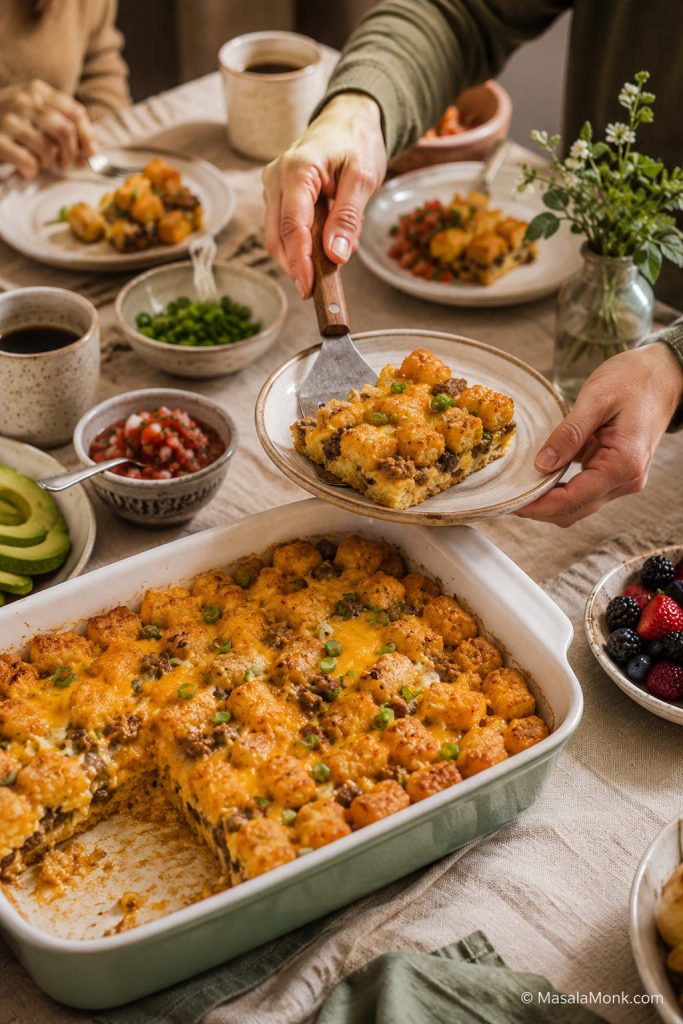
Serve It from One Hot Brunch Pan

Once the filling is browned, the eggs are whisked, and the tots are added, the oven turns the dish into a breakfast people can serve themselves from — the kind of brunch that feels relaxed even when the kitchen is full.

Hands serving tater tot breakfast casserole from a large baking dish at a brunch table with plates, fruit, salsa, and coffee.
Finally, the payoff is one hot brunch pan that feeds the table without making anyone stand over the stove for separate eggs, meat, and potatoes.

FAQs

Do tater tots need to be thawed first?

No. Keep them frozen so they hold their shape on top. Thawed tots can soften, break apart, and sink into the egg layer instead of giving you a clear potato topping.

Is it better to put tater tots on top or bottom?

Put them on top if you want a browned, classic tater tot topping. Put them on the bottom if you prefer a softer, hotdish-style casserole where the tots absorb more of the egg mixture.

How many eggs go in a 9×13 tater tot breakfast casserole?

Ten large eggs are a good middle ground for a 9×13 pan with 32 oz / 907 g tots. Eight eggs will make it a little lighter and more potato-heavy; 12 eggs will make it firmer and more egg-forward.

Why did my casserole turn watery?

The most common causes are raw vegetables, too much milk, greasy sausage, or an underbaked center. Cook vegetables first, drain meat well, keep the dairy to about 1 cup, and bake until the center reaches 165°F / 74°C.

How far ahead can I assemble it?

Assemble it the night before and refrigerate it, or prep the sausage and egg mixture separately and add the tots in the morning. Fully assembled is easiest; morning-added tots give the better topping.

Does this casserole freeze well?

Baked portions freeze better than an unbaked fully assembled casserole. Let it cool, slice it, wrap portions tightly, and freeze for up to 2–3 months. Reheat in the oven or air fryer for better texture than the microwave gives.

What is the difference between tater tot breakfast casserole and breakfast hotdish?

The terms can overlap. “Breakfast hotdish” is often used for a hearty baked dish with potatoes, eggs, cheese, and meat, especially in Midwest-style cooking. This recipe fits that style, though most readers will recognize it as an egg-and-tot breakfast casserole or brunch bake.

What can I use instead of sausage?

Use cooked bacon, diced ham, turkey sausage, chicken sausage, chorizo-style sausage, sautéed vegetables, or a mix of vegetables and cheese. If you skip meat entirely, cook and drain the vegetables well so the casserole does not turn watery.

Can I use hash browns instead of tater tots?

Yes, but the recipe becomes a different style of breakfast casserole. Shredded hash browns create a softer potato base, while frozen tots give this version a more defined, golden topping. If swapping them here, use thawed shredded hash browns and expect a softer, less crisp casserole.

Back to top

Posted on 2 Comments

Breakfast Casserole with Hash Browns

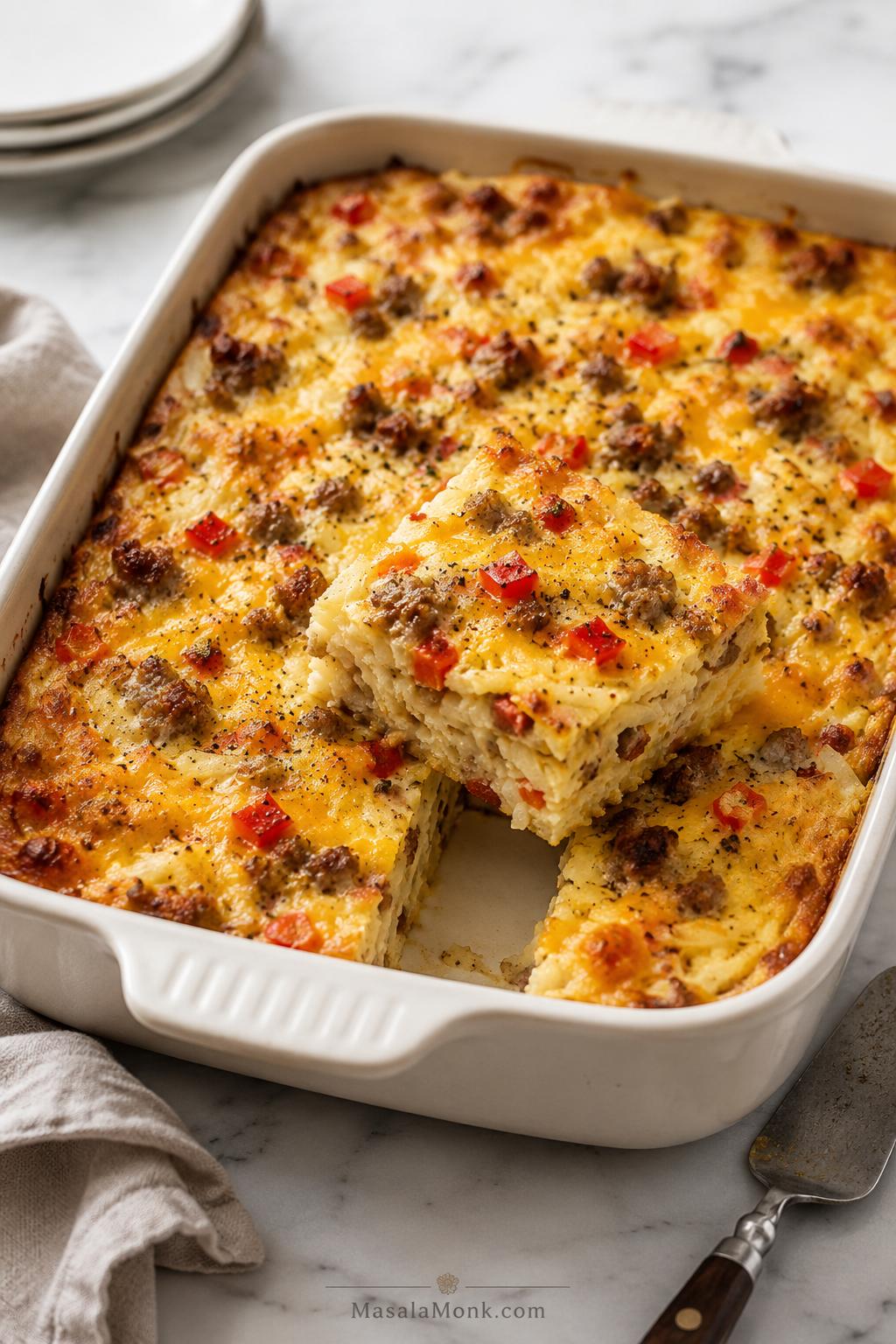
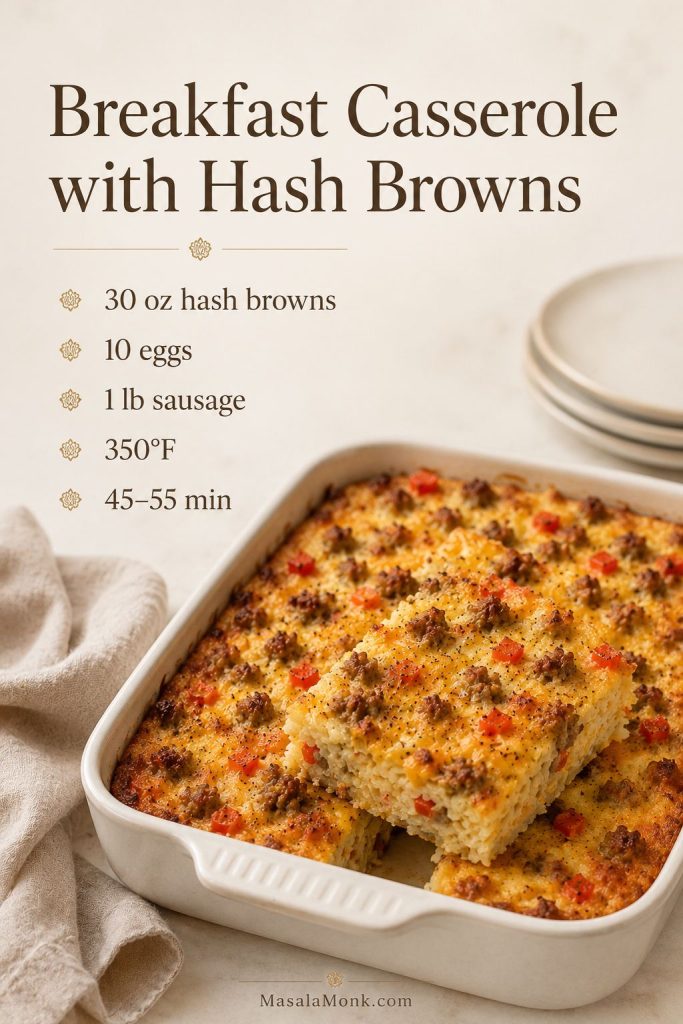
Breakfast casserole with hash browns, sausage, eggs, cheese, peppers, and golden edges in a 9x13 baking dish.

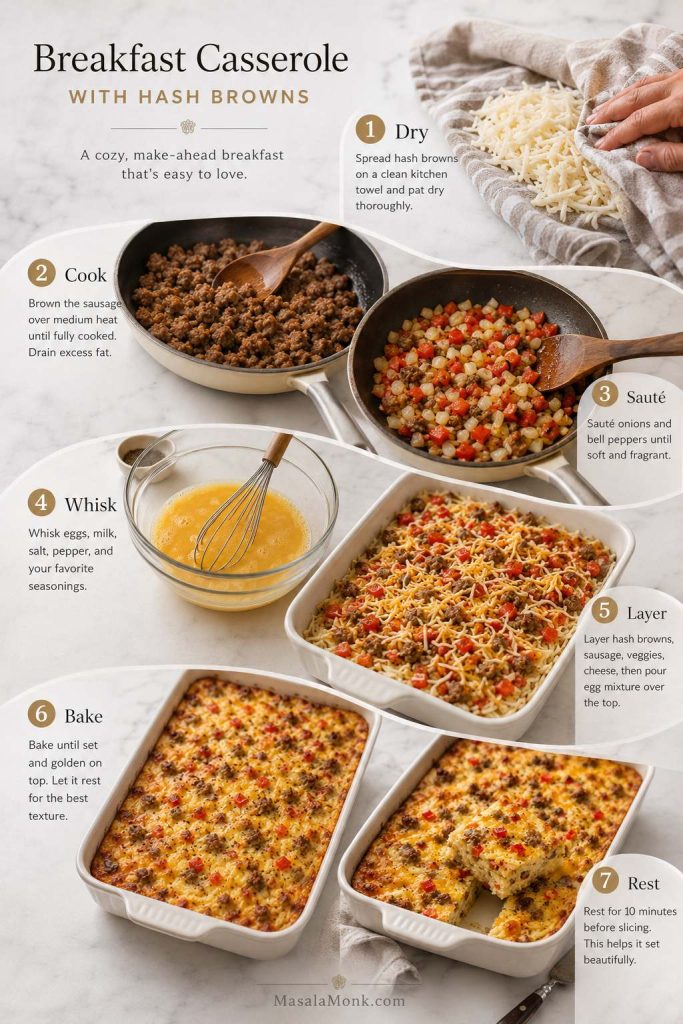
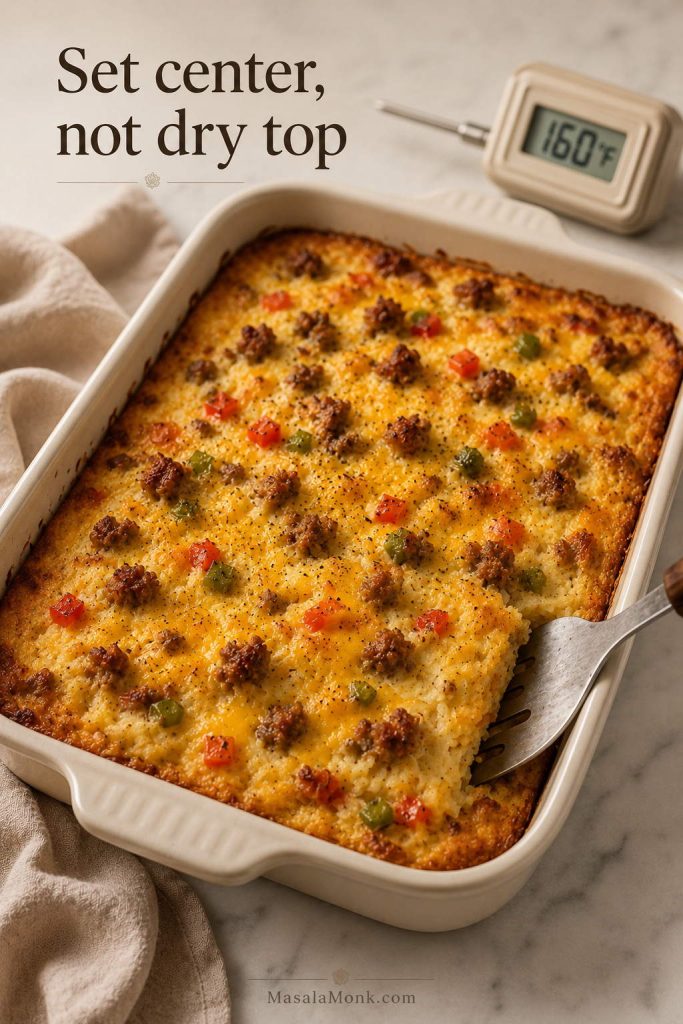
This breakfast casserole with hash browns is the egg-based brunch bake to make when you want something hearty, cheesy, sliceable, and easy to prep ahead. Frozen shredded hash browns, eggs, sausage, cheese, and a creamy egg mixture bake together in a 9×13 pan until the center is softly set, the cheese melts into the potatoes, and the edges turn golden.

The key is moisture control. Hash brown breakfast casserole can turn watery, greasy, rubbery, or bland if the potatoes are too wet, the meat is not drained, or the vegetables go in raw. This version shows you how to avoid that, plus how to make it with bacon, ham, no meat, hash brown patties, or overnight prep.

It is the kind of casserole that makes sense when the morning already has enough going on, whether that means Christmas breakfast, Easter brunch, overnight guests, a weekend family breakfast, or a meal-prep Sunday where one pan needs to handle the eggs, potatoes, cheese, and sausage.

This pan is especially good for the kind of morning where people drift into the kitchen at different times, coffee is still being poured, and nobody wants to stand at the stove making eggs in batches. It comes out hot, cheesy, and ready to slice, and everyone can make it their own with hot sauce, scallions, salsa, or fruit on the side.

This is the egg-based breakfast version. If you were looking for the creamy cheesy potato side dish made with sour cream, cheddar, cream soup or homemade sauce, and a crunchy topping, use this hashbrown casserole recipe instead. That one is the dinner-side and potluck version; this one is the breakfast casserole with eggs.

Quick Answer: Breakfast Casserole with Hash Browns

To make breakfast casserole with hash browns, layer thawed and patted-dry frozen shredded hash browns in a greased 9×13-inch baking dish with cooked sausage, sautéed onion and bell pepper, and shredded cheese. Pour over a mixture of eggs, milk or half-and-half, sour cream or Greek yogurt, and seasoning. Bake at 350°F / 175°C for 45–55 minutes, or until the center is set and the edges are lightly golden.

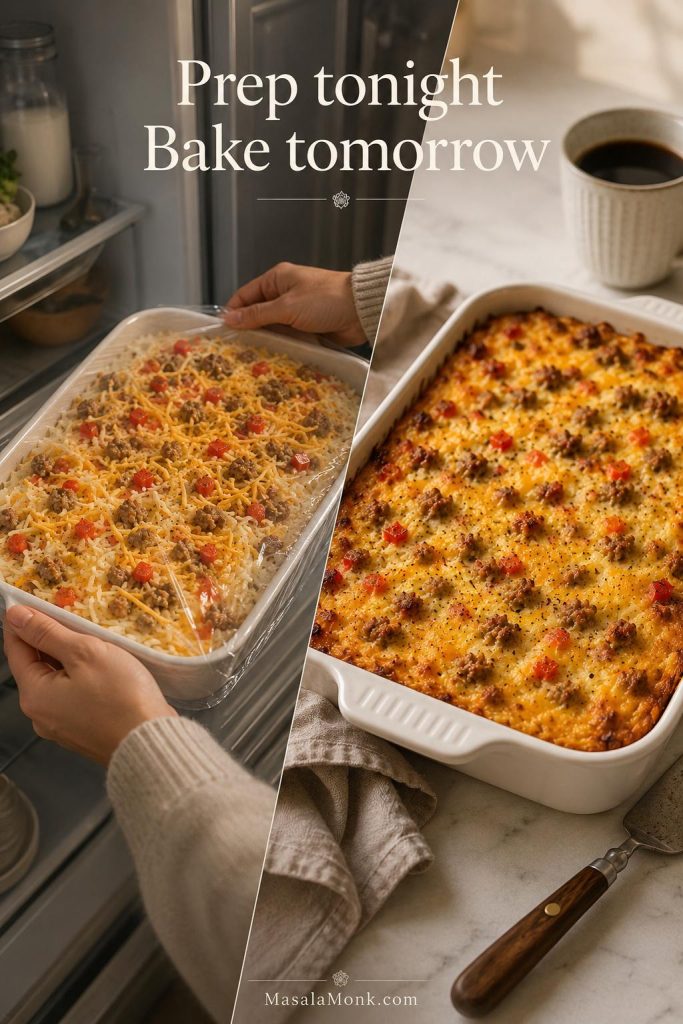
The texture is much better when the hash browns are thawed and excess moisture is removed before baking. This keeps the casserole from turning watery and helps the eggs set more evenly. If that is your main concern, the watery casserole fixes below are worth reading before you assemble the pan. If you assemble it the night before, bake it cold from the fridge and add a few extra minutes as needed.

The finished bake should feel hearty but not heavy: tender eggs, savory sausage, melted cheese, and hash browns that taste like breakfast potatoes instead of a wet potato layer.

Best default formula: 30 oz / 850 g frozen shredded hash browns + 10 large eggs + 1 lb / 454 g cooked sausage + 2 cups / 225 g cheese + 1 cup / 240 ml milk or half-and-half + ½ cup / 120 g sour cream or Greek yogurt.

This is the version I would choose for a holiday breakfast, a brunch table, or a meal-prep pan because it is sturdy enough to slice but still soft and creamy in the center.

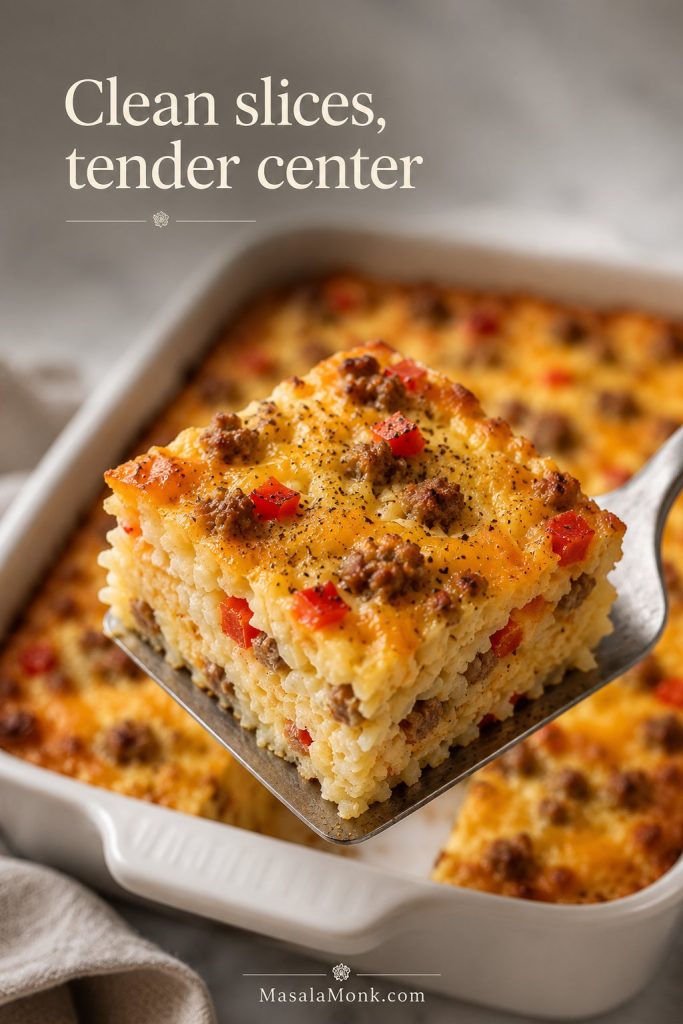
Lifted slice of hash brown breakfast casserole showing eggs, sausage, cheese, peppers, and shredded potato layers.
A clean slice tells you the casserole had enough eggs, the hash browns were not too wet, and the pan rested before cutting.

Hash Brown Breakfast Casserole at a Glance

Best pan 9×13-inch / 23×33 cm baking dish
Oven temperature 350°F / 175°C
Hash browns 30 oz / 850 g frozen shredded hash browns, thawed and patted dry
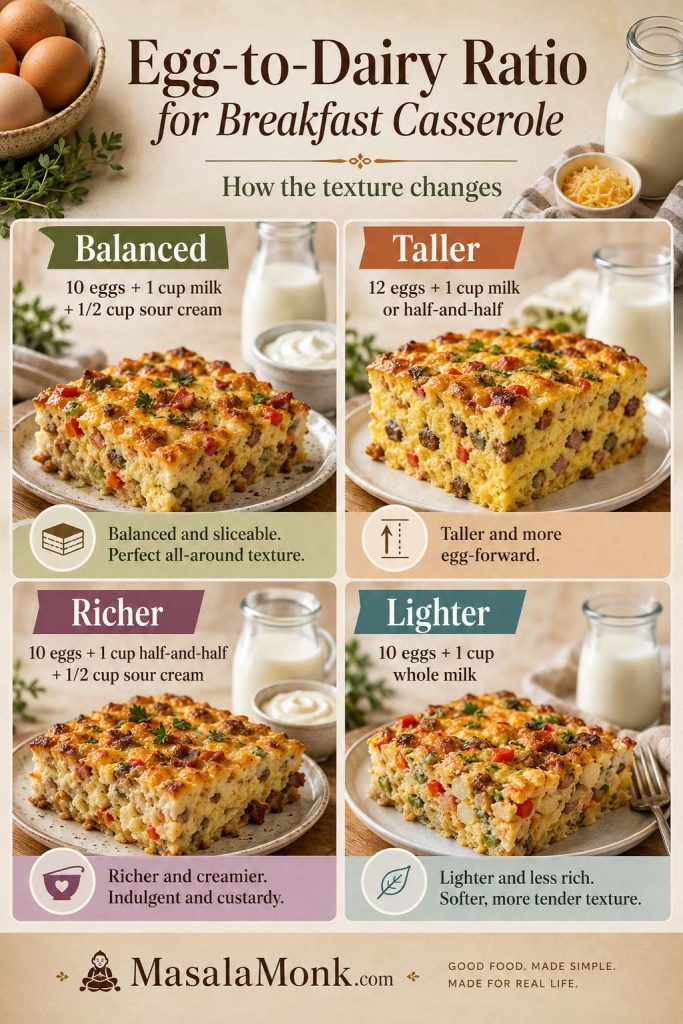
Eggs 10 large eggs for balanced texture; 12 for a taller egg bake
Default protein 1 lb / 454 g breakfast sausage, cooked and drained
Cheese 2 cups / about 225 g shredded cheddar, Colby Jack, Monterey Jack, or pepper Jack
Bake time 45–55 minutes, or 55–65 minutes if chilled overnight
Make-ahead Assemble overnight, or prep components separately for the cleanest texture

Breakfast Casserole vs Hashbrown Casserole

The phrase “hashbrown casserole” can mean two different dishes. This recipe is a breakfast casserole with hash browns, which means it has eggs, cheese, hash browns, and usually sausage, bacon, ham, or vegetables. It is baked like a brunch egg casserole and served in slices.

A classic side-dish hashbrown casserole is different. That version is usually a creamy potato bake with sour cream, cheddar, cream soup or homemade sauce, butter, and sometimes a crunchy topping. It is served with dinner, holiday meals, potlucks, and barbecue-style mains. This breakfast version stays in the egg-and-brunch lane.

Use this breakfast version when you want eggs and protein in the same pan. Use the side-dish version when you want a cheesy potato casserole to serve next to ham, chicken, barbecue, or a holiday dinner spread.

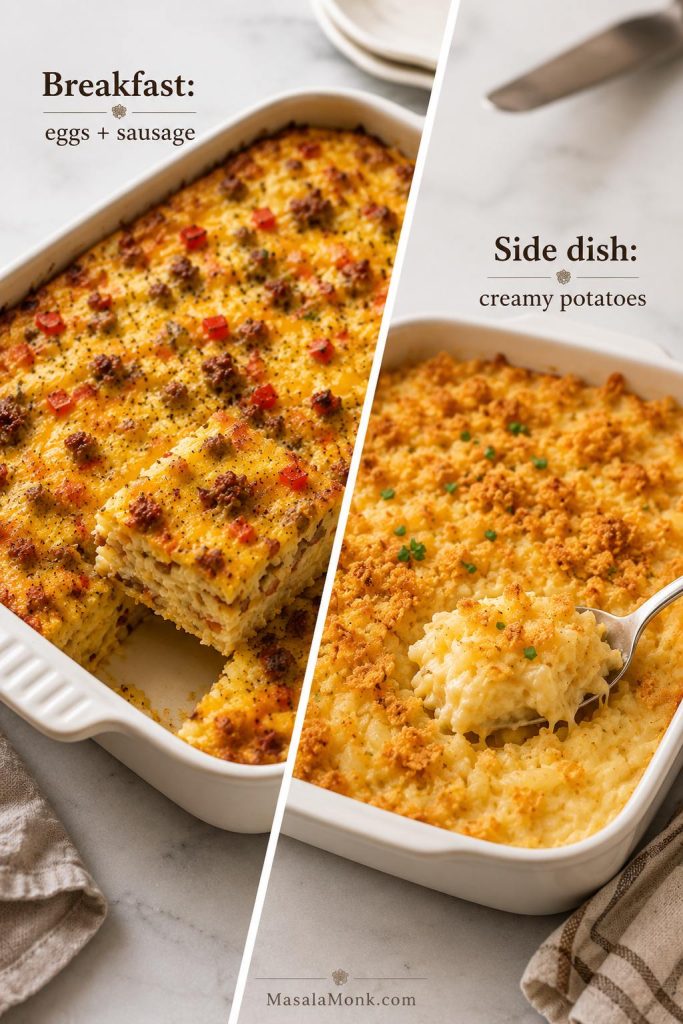
Split comparison of egg-based breakfast casserole with hash browns and creamy side-dish hashbrown casserole.
Although both dishes use hash browns, this breakfast casserole is built around eggs and protein, while the side-dish version is creamier, softer, and meant for dinner plates or potlucks.

Why This Hash Brown Breakfast Casserole Works

The best hash brown breakfast casseroles taste like a real breakfast plate baked into one pan: golden potatoes, savory sausage, soft eggs, sweet peppers, and melted cheese. This recipe works because each part is handled before it goes into the dish instead of asking the oven to fix everything at once.

Thawed, dried hash browns do not leak water into the eggs. Cooking and draining the sausage first keeps the casserole savory without making it greasy. A quick sauté gives the onion and bell pepper time to soften and lose some moisture before baking.

Milk or half-and-half keeps the eggs tender, while sour cream or Greek yogurt adds body and creaminess without making the center loose. Dry mustard or Dijon, garlic powder, pepper, and enough salt help season the potatoes, not just the eggs.

Resting is the quiet step that makes the slices look better. Like many egg bakes, this casserole firms as it sits, so cutting into it right away can make the center look looser than it really is.

Ingredients for Hash Brown Breakfast Casserole

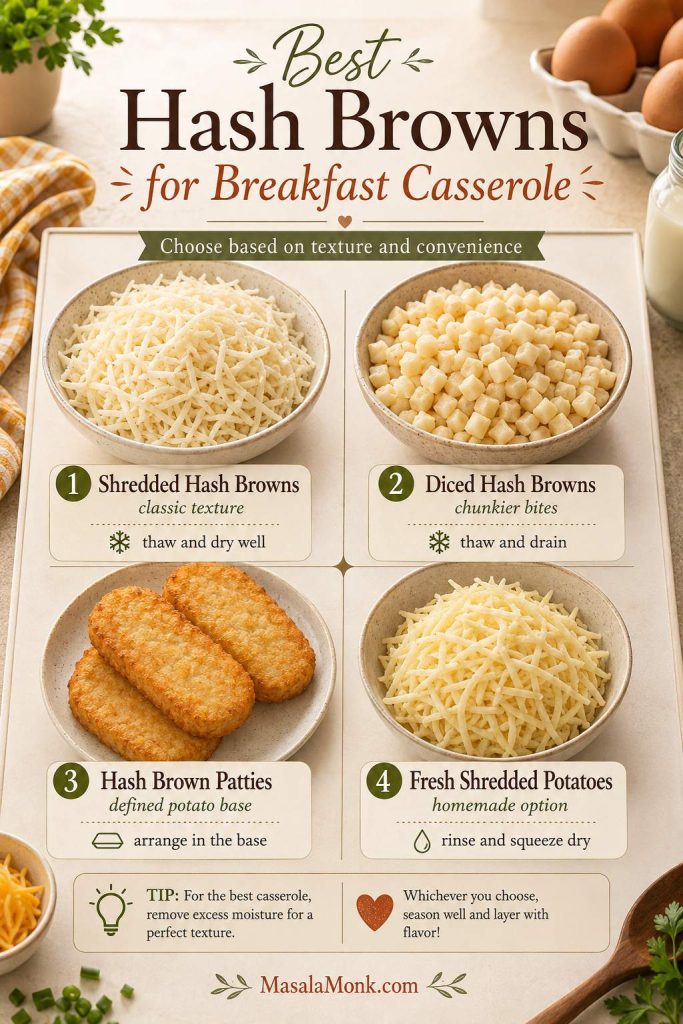
The main version is a sausage breakfast casserole with hash browns, but the same base works with bacon, ham, or vegetables. If you are not sure which potatoes to use, jump to the hash brown comparison before you start. Here is what each ingredient does.

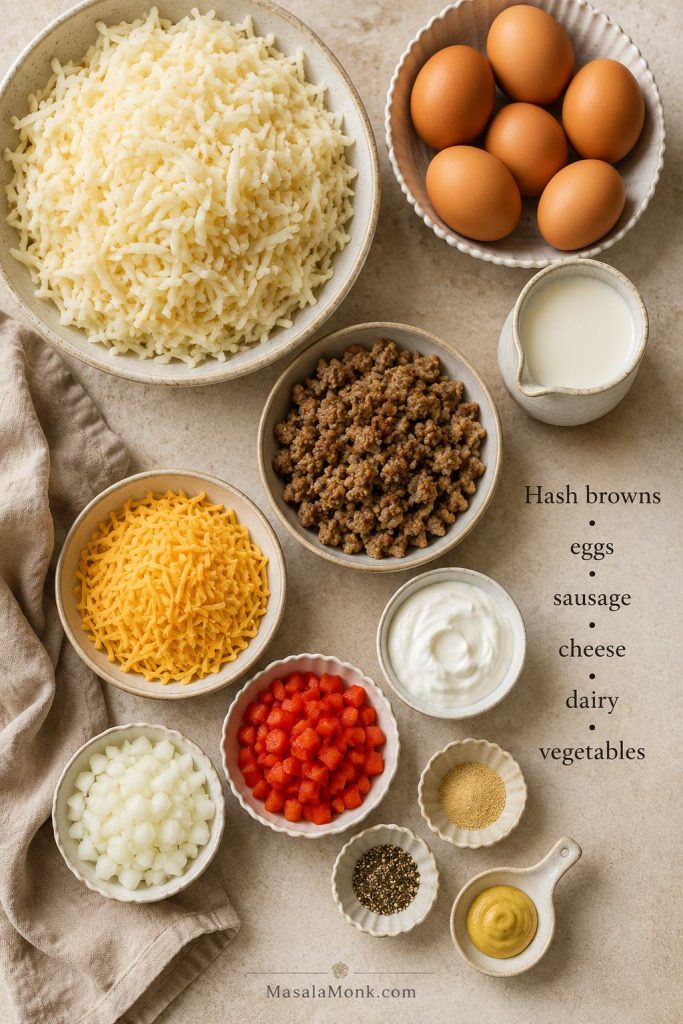
Ingredients for breakfast casserole with hash browns, including eggs, sausage, cheese, dairy, peppers, onion, seasonings, and thawed potatoes.
The best texture starts before baking: thawed potatoes, cooked sausage, sautéed vegetables, and a balanced egg mixture all help the casserole set evenly.

Hash Browns

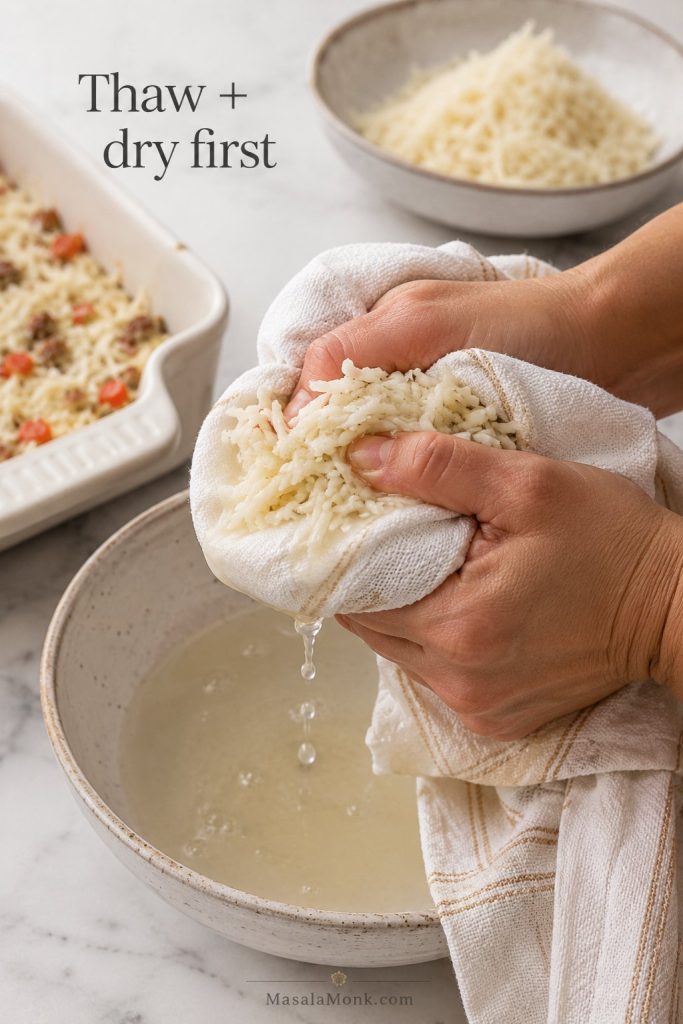
Use 30 oz / 850 g frozen shredded hash browns for the most classic texture. Thaw them first, then pat them dry with paper towels or squeeze gently in a clean kitchen towel if they feel wet. This step is one of the biggest differences between a clean, sliceable casserole and a watery one.

Thawed shredded hash browns being pressed dry in a towel before making breakfast casserole.
Drying thawed hash browns is the easiest no-soggy step because it removes extra moisture before the eggs ever hit the pan.

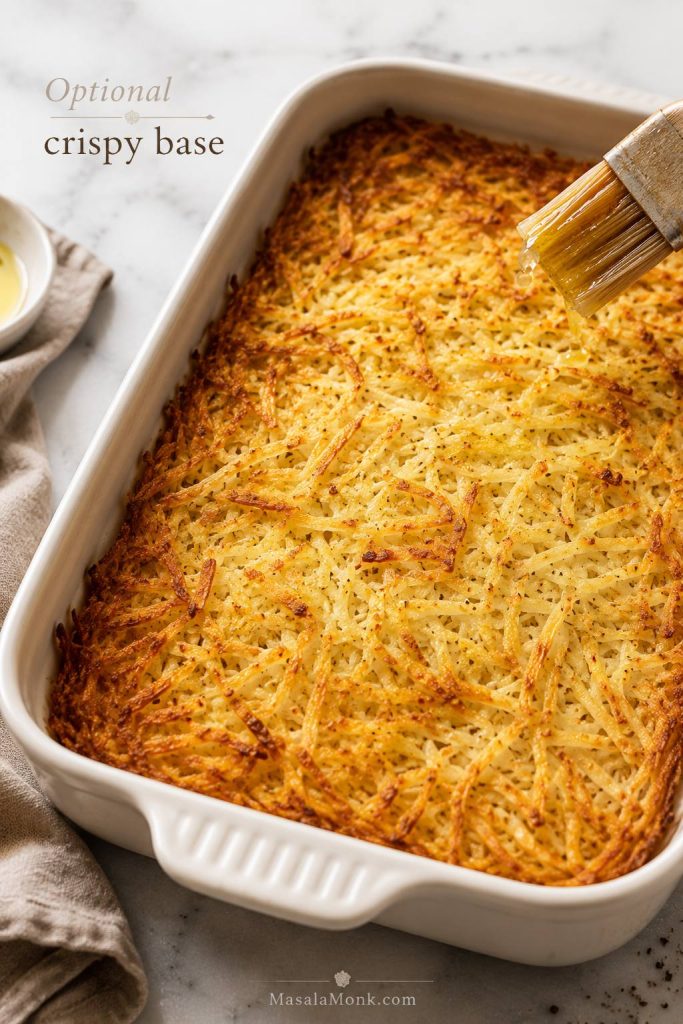
For a more golden potato layer, see the crispy hash brown base option before layering the eggs.

If you are still deciding which kind of potatoes to use, this air fryer hash browns guide is useful because it explains frozen shredded hash browns, patties, diced potatoes, and homemade grated potatoes in more detail.

Eggs

Use 10 large eggs for a creamy, balanced 9×13 casserole. If you want a taller, more egg-forward breakfast bake, use 12 eggs. If you use fewer than 8 eggs in a 9×13 pan, the casserole becomes more potato-heavy and may not hold together as neatly.

Dairy

Use 1 cup / 240 ml whole milk or half-and-half plus ½ cup / 120 g sour cream or Greek yogurt. Whole milk keeps the casserole lighter; half-and-half makes it richer. Sour cream gives a softer, creamier texture and helps the egg layer feel less flat.

Cheese

Use 2 cups / about 225 g shredded cheese. Cheddar gives the most classic breakfast-casserole flavor, Colby Jack melts smoothly, Monterey Jack keeps things mild and creamy, and pepper Jack adds a little heat without changing the whole dish. Divide the cheese so some melts into the casserole and some goes on top.

Sausage, Bacon, Ham, or No Meat

The default is 1 lb / 454 g breakfast sausage, cooked and drained. You can replace it with cooked bacon, diced ham, or sautéed vegetables. For a bacon version, cook the bacon first and crumble it before adding it to the pan.

Vegetables and Seasoning

Onion and bell pepper are the safest default because they bring sweetness and color without overwhelming the casserole. Sauté them first. Raw vegetables can release water as they bake, especially mushrooms, spinach, zucchini, and peppers. For seasoning, use garlic powder, black pepper, dry mustard or Dijon, and enough salt to season the potatoes.

Egg-to-Dairy Ratio for a 9×13 Breakfast Casserole

The egg-to-dairy balance is what keeps the center creamy instead of wet. Use this table if you want to make the bake taller, richer, lighter, or more sliceable.

Texture Goal Eggs Dairy
Balanced and sliceable 10 large eggs 1 cup milk + ½ cup sour cream
Taller and more egg-forward 12 large eggs 1 cup milk or half-and-half
Richer and creamier 10 large eggs 1 cup half-and-half + ½ cup sour cream
Lighter 10 large eggs 1 cup whole milk only
Egg-to-dairy ratio guide for making hash brown breakfast casserole balanced, taller, richer, or lighter.
Once the base formula is right, small egg and dairy changes can make the casserole taller, richer, lighter, or easier to slice.

Best Hash Browns for Breakfast Casserole

Most breakfast casserole recipes use frozen shredded hash browns, but they are not the only option. The best choice depends on whether you want a soft, classic casserole, a chunkier potato bite, or a more defined potato layer.

Comparison of shredded hash browns, diced hash browns, hash brown patties, and fresh shredded potatoes for breakfast casserole.
Shredded hash browns give the classic soft breakfast casserole texture; patties create a more defined base, while diced potatoes make the bake chunkier.
Hash Brown Type Best For How to Use
Frozen shredded hash browns Classic breakfast casserole texture Thaw, pat dry, and layer into the pan.
Diced hash browns Chunkier, potato-forward casserole Thaw if frozen. Bake time may be slightly longer.
Hash brown patties Defined potato base or shortcut layer Arrange 8–10 patties in the bottom of a 9×13 pan.
Refrigerated shredded hash browns Fast prep, less thawing Pat dry if damp. Use the same amount by weight.
Fresh shredded potatoes Homemade version Rinse, drain, and squeeze very dry before using.

O’Brien-style hash browns, which usually include diced peppers and onions, also work. Because they already include vegetables, reduce or skip the fresh bell pepper and onion in the recipe, and make sure the potatoes are thawed so the casserole does not bake up watery.

Should You Thaw Hash Browns First?

For this recipe, yes. Thawing is the safer choice because frozen hash browns can release extra moisture into the egg mixture and extend the bake time. Longer bake time can make the edges overcook before the center sets.

The best method is to thaw the hash browns in the refrigerator overnight, then pat them dry. If they feel wet, squeeze them gently in a clean towel. They do not need to be bone-dry, but they should not be icy or dripping.

Can You Use Frozen Hash Browns Without Thawing?

You can bake this with frozen hash browns, but thawed and dried hash browns give a cleaner, less watery casserole. If speed matters more than sliceability, use them frozen and expect a softer center and a longer bake time.

Should You Brown the Hash Browns First?

You do not have to, but it gives the casserole better potato flavor and helps remove moisture. To do it, warm a little butter or oil in a large skillet, add the thawed hash browns, and cook for 5–8 minutes until some of the moisture evaporates and a few edges turn lightly golden. Then spread them into the baking dish.

Want a Crispier Hash Brown Base?

If you want the potato layer to taste more like diner-style breakfast potatoes, pre-bake it before adding the eggs. Spread the thawed hash browns in the greased baking dish, drizzle with 2 tablespoons melted butter or oil, and bake at 400°F / 200°C for 15–20 minutes. Then add the sausage, cheese, and egg mixture and bake as directed.

This step is optional, but it makes the edges more golden and gives the casserole a more memorable first bite.

Pre-baked crispy hash brown base in a baking dish before eggs, sausage, and cheese are added.
Pre-baking the hash brown layer is optional, but it adds golden edges and a more diner-style potato flavor underneath the eggs.

How to Keep It from Getting Watery

The biggest mistake with breakfast casserole with hash browns is adding too much hidden moisture. Hash browns, vegetables, sausage, bacon, and spinach can all release liquid into the eggs if they are not handled first.

Moisture Source What to Do Why It Helps
Frozen shredded hash browns Thaw and pat dry before layering. Prevents icy potatoes from watering down the egg mixture.
Bell peppers and onions Sauté for 3–5 minutes first. Softens the vegetables and cooks off extra water.
Mushrooms Cook until their liquid evaporates. Stops them from leaking water into the eggs.
Spinach Wilt and squeeze dry before adding. Keeps the casserole from turning loose or watery.
Sausage or bacon Cook and drain well. Prevents grease from pooling around the eggs.

The cleanest slices come from thawed hash browns, cooked vegetables, drained meat, and a wide 9×13-inch dish. For extra potato flavor, lightly brown the hash browns in a skillet before layering them into the casserole.

How to Make Breakfast Casserole with Hash Browns

This is the basic 9×13 method. It is simple, but the order matters. For exact amounts while you cook, use the recipe card.

Step-by-step guide showing dried potatoes, cooked sausage, sautéed vegetables, whisked eggs, layering, baking, and resting.
Follow the order for the best result: dry the potatoes, cook the filling, whisk the eggs, layer evenly, bake until set, then rest.

1. Prepare the Baking Dish

Grease a 9×13-inch / 23×33 cm baking dish with butter or nonstick spray. A 3-quart baking dish works well. Avoid a very deep smaller dish unless you are prepared to bake longer.

2. Thaw and Dry the Hash Browns

Thaw the frozen shredded hash browns, then pat them dry. Spread them evenly in the bottom of the prepared baking dish. Season this layer lightly because potatoes need more seasoning than eggs.

3. Cook the Sausage

Cook the sausage in a large skillet over medium heat, breaking it into small pieces. Drain off excess grease. If you are using bacon, cook it until crisp and crumble it. If you are using ham, it usually only needs to be diced.

4. Sauté the Vegetables

In the same skillet, cook the onion and bell pepper for a few minutes until slightly softened. This keeps them from releasing too much water into the casserole.

5. Whisk the Egg Mixture

In a large bowl, whisk the eggs, milk or half-and-half, sour cream or Greek yogurt, garlic powder, dry mustard or Dijon, black pepper, and salt. Whisk until the mixture looks smooth and evenly blended.

6. Layer the Casserole

Scatter the cooked sausage, sautéed vegetables, and most of the cheese over the hash browns. Pour the egg mixture evenly over the top. Use a spatula to gently nudge the filling so the eggs settle into the layers. Finish with the remaining cheese.

7. Bake Until Set

Bake at 350°F / 175°C for 45–55 minutes, or until the edges are puffed and lightly golden and the center no longer jiggles loosely. Do not wait for the whole top to look dry; the casserole will continue to firm as it rests. If it was refrigerated overnight, it may need 55–65 minutes.

Finished breakfast casserole with hash browns, golden edges, set center, sausage, peppers, cheese, and thermometer cue.
Stop baking when the center is set but the top still looks tender; a completely dry-looking surface usually means the eggs have gone too far.

8. Rest Before Slicing

Let the casserole rest for 10–15 minutes before cutting. This improves the texture and makes the slices cleaner.

If this is your first time making it, start with the sausage-and-cheddar version below. It gives you the cleanest baseline for texture, seasoning, and bake time, then the bacon, ham, spicy, vegetarian, and patty versions are easy to adjust later.

Recipe Card: Breakfast Casserole with Hash Browns

This make-ahead breakfast casserole bakes hash browns, eggs, sausage, and cheese into a creamy, savory 9×13 breakfast bake with golden edges and clean slices. It is hearty enough for brunch, holidays, or breakfast meal prep.

Servings
10–12
Prep Time
20 minutes
Cook Time
45–55 minutes
Total Time
About 1 hour 15 minutes

Equipment

  • 9×13-inch / 23×33 cm baking dish
  • Large skillet
  • Large mixing bowl
  • Whisk
  • Spatula
  • Foil, optional for overnight storage or if the top browns too quickly

Ingredients

  • 30 oz / 850 g frozen shredded hash browns, thawed and patted dry
  • 1 lb / 454 g breakfast sausage
  • ½ cup / 75 g diced onion
  • 1 cup / 120–150 g diced bell pepper
  • 10 large eggs
  • 1 cup / 240 ml whole milk or half-and-half
  • ½ cup / 120 g sour cream or plain Greek yogurt
  • 2 cups / about 225 g shredded cheddar, Colby Jack, or Monterey Jack, divided
  • 1 tsp kosher salt, or to taste depending on sausage and cheese
  • ½ tsp black pepper
  • ½ tsp garlic powder
  • ½ tsp dry mustard or 1 tsp Dijon mustard
  • Optional: ¼ tsp smoked paprika, a few dashes hot sauce, sliced scallions for serving

Instructions

  1. Preheat the oven to 350°F / 175°C. Grease a 9×13-inch baking dish.
  2. Thaw the hash browns and pat them dry. Spread them evenly in the prepared baking dish.
  3. Cook the sausage in a large skillet over medium heat until browned and fully cooked. Break it into small crumbles, then drain excess grease.
  4. Add the diced onion and bell pepper to the skillet and cook for 3–5 minutes, until slightly softened. Scatter the sausage and vegetables over the hash browns.
  5. Sprinkle about 1½ cups of the cheese over the potato and sausage layer. Save the remaining ½ cup for the top.
  6. In a large bowl, whisk the eggs, milk or half-and-half, sour cream or Greek yogurt, salt, pepper, garlic powder, and dry mustard or Dijon until smooth.
  7. Pour the egg mixture evenly over the casserole. Gently press the filling with a spatula so the egg mixture settles through the layers. Sprinkle the remaining cheese on top.
  8. Bake for 45–55 minutes, until the edges are lightly golden, the center is set, and the middle no longer sloshes when the dish is gently moved. If baking straight from the refrigerator, plan on 55–65 minutes.
  9. Rest for 10–15 minutes before slicing. Top with scallions or hot sauce if you like.

Notes

  • Use 12 eggs instead of 10 if you want a taller, more egg-forward casserole.
  • While you prep the sausage and vegetables, you can let the eggs sit out for 15–20 minutes so they blend more easily and bake a little more evenly.
  • Thaw and dry the hash browns before baking for the cleanest texture.
  • Replace the sausage with 2½–3 cups cooked vegetables for a no-meat version.
  • Use 1½ cups / 225 g diced ham instead of sausage for a ham version.
  • Use about 1 cup cooked crumbled bacon for a bacon version. For an easier prep option, cook the strips first using this air fryer bacon recipe, then crumble them into the casserole.
  • If using hash brown patties, use 8–10 patties in the bottom of the pan and expect a slightly longer bake.
  • To avoid a watery casserole, do not add raw mushrooms, raw spinach, or icy hash browns directly to the pan.
  • If the top browns before the center is set, loosely cover the dish with foil.
  • Egg-based casseroles should be cooked until set; for food safety, egg dishes are commonly cooked to 160°F / 71°C. See the FDA’s egg safety guidance for more detail: What You Need to Know About Egg Safety.
Recipe card for breakfast casserole with hash browns showing 30 ounces hash browns, 10 eggs, 1 pound sausage, 350°F, and 45 to 55 minutes.
Start with the dependable 9×13 formula: 30 ounces hash browns, 10 eggs, 1 pound sausage, cheese, dairy, and a 350°F bake.

Overnight Breakfast Casserole with Hash Browns

This casserole is ideal for making ahead because the ingredients are sturdy and the 9×13 format feeds a group. You have two good options: the easiest overnight method and the best-texture method.

If you are making this for guests, the overnight version is less about saving ten minutes and more about saving your morning. The sausage is cooked, the cheese is ready, the potatoes are handled, and breakfast can go into the oven before the kitchen gets busy.

Overnight breakfast casserole with hash browns being prepared in the refrigerator and baked the next morning.
Overnight prep is useful because the potatoes, sausage, cheese, and egg mixture are handled before the morning gets busy.

Easy Overnight Method

Assemble the entire casserole in the baking dish, cover tightly, and refrigerate overnight. In the morning, let the dish sit at room temperature while the oven preheats. Bake as directed, adding 5–10 minutes if the center is still loose.

Best-Texture Overnight Method

For the cleanest texture, prep the components separately. Cook and drain the sausage, sauté the vegetables, thaw and dry the hash browns, and whisk the egg mixture. Refrigerate everything separately, then assemble just before baking. This prevents the potatoes from sitting in the egg mixture all night and gives a neater slice.

Overnight tip: If your hash browns are very wet or your vegetables are raw, the casserole can turn watery by morning. Dry the potatoes well, cook the vegetables first, and drain the meat before assembling.

Can You Bake It Straight from the Fridge?

Yes. A cold casserole usually needs extra time. Start checking around 50 minutes, but do not be surprised if it takes 55–65 minutes. When the top browns quickly while the center is still soft, cover the dish loosely with foil and keep baking.

If you are baking from cold, use the doneness cues rather than the clock alone.

Sausage, Bacon, Ham, and No-Meat Hash Brown Breakfast Casserole

Once the base is set, this recipe becomes very flexible. Sausage is the classic choice, bacon makes it smoky, ham makes it perfect for leftovers, and the no-meat version works well when the vegetables are cooked first. Pick the version that fits your morning rather than changing the whole recipe.

For the most dependable first batch, use sausage, cheddar or Colby Jack, thawed shredded hash browns, and the 10-egg base. Bacon, ham, cream cheese, pepper Jack, and extra vegetables all work, but they change salt, moisture, richness, or bake time.

If you are using patties instead of shredded potatoes, go straight to the hash brown patty version because the setup and bake time are slightly different.

If your family already has a “usual” breakfast casserole version, this is the section to make it yours. Some houses are sausage-and-cheddar houses, some are bacon-and-pepper-Jack houses, and some are firmly leftover-ham-after-Easter houses.

Four hash brown breakfast casserole variations with sausage, bacon, ham, and vegetarian fillings on separate plates.
Sausage, bacon, ham, and vegetables all work in this hash brown breakfast casserole, but each one changes salt, moisture, richness, or bake time.

Sausage Version

This is the default version and the most classic. Use 1 lb / 454 g breakfast sausage, cooked and drained. Mild sausage gives a family-friendly flavor, while hot sausage adds more punch. If your sausage is very salty, reduce the added salt in the egg mixture.

Bacon Version

Replace the sausage with 8–12 oz raw bacon, cooked until crisp and crumbled, or about 1 cup cooked bacon pieces. Bacon is saltier than sausage, so go easy on extra salt. For a loaded version, use half sausage and half bacon.

Ham and Cheese Version

Use 1½ cups / about 225 g diced ham, or up to 12 oz / 340 g for a ham-heavy version. This is especially useful after Easter, Christmas, or any big breakfast where leftover ham is already in the fridge. Cheddar, Swiss, Monterey Jack, and Colby Jack all work well here.

Vegetarian Version

Skip the meat and add more vegetables. Good choices include sautéed mushrooms, bell peppers, onions, spinach, broccoli, and scallions. The key is to cook watery vegetables first. Spinach should be wilted and squeezed dry. Mushrooms should be sautéed until their liquid cooks off.

For a no-meat 9×13 casserole, use about 2½–3 cups cooked vegetables in place of the sausage. A good mix is 1 cup bell pepper, ¾ cup mushrooms, ½ cup onion, and 1 cup spinach that has been wilted and squeezed dry. Add an extra ½ cup cheese if you want the casserole to feel richer without meat.

Cream Cheese Version

A richer version starts with 4 oz / 115 g softened cream cheese stirred into the warm cooked sausage before it goes into the casserole. This makes the filling extra creamy and hearty. Keep the sour cream in the egg mixture or reduce it slightly if you prefer a lighter texture.

Spicy Version

Use pepper Jack cheese, hot breakfast sausage, diced jalapeño, and a few dashes of hot sauce in the egg mixture for a version that tastes warmer and sharper without losing the potato-and-egg comfort. A little smoked paprika or chili powder also works well.

Gluten-Free Notes

The casserole can be naturally gluten-free, but check labels carefully. Some sausage, frozen hash browns, seasoning blends, and shredded cheeses may include additives or cross-contact warnings. Use certified gluten-free ingredients if needed.

Breakfast Casserole with Hash Brown Patties

Hash brown patties make a more defined potato layer and are a useful shortcut. Instead of shredded hash browns, arrange 8–10 frozen hash brown patties in a single layer in the bottom of a greased 9×13-inch baking dish. They can overlap slightly if needed.

Frozen hash brown patties arranged in a 9×13 baking dish with sausage, cheese, and eggs nearby.
Hash brown patties are a useful shortcut because they create a clear potato base before the eggs, cheese, and sausage go on top.

Top the patties with cooked sausage, bacon, or ham, then add cheese and pour the egg mixture over everything. Because patties are denser than shredded hash browns, the bake time may land closer to 50–60 minutes. Let the casserole rest before slicing so the patty layer and egg layer hold together.

Patty Setup Amount for 9×13 Pan
Hash brown patties 8–10 frozen patties
Eggs 10 large eggs, or 9 if using fewer toppings
Milk or half-and-half 1 cup / 240 ml
Cheese 2 cups / 225 g
Protein 1 lb sausage or 1½ cups diced ham

For a more structured patty-style bake, cover the dish with foil for the first 25 minutes, then uncover and bake another 20–30 minutes until the edges are golden and the center is set. This helps the egg mixture cook through without drying out the cheese on top too early.

Slice of breakfast casserole with a defined hash brown patty base, eggs, sausage, cheese, and peppers.
The patty version slices differently from shredded hash browns because the potato layer stays more structured in each piece.

Patty version shortcut: Use 8–10 hash brown patties, 10 eggs, 1 cup / 240 ml milk or half-and-half, 2 cups / 225 g cheese, and 1½ cups diced ham or 1 lb cooked sausage. Use 9 eggs only if your pan is less loaded.

Can You Make It in a Slow Cooker?

You can make a breakfast casserole with hash browns in a slow cooker, but the texture will be softer and more scoopable than the oven version. It will not have the same golden edges or clean slices.

For a slow cooker version, layer thawed hash browns, cooked sausage or ham, vegetables, cheese, and egg mixture in a greased slow cooker. Cook on low until the eggs are set, and avoid holding it too long after cooking because eggs can turn rubbery.

Start checking around 3–4 hours on low, depending on your slow cooker size and how full it is. Avoid cooking on high if you want a softer egg texture; the edges can overcook before the center sets.

How to Tell When It’s Done

Breakfast casserole is done when the center is set, the edges are puffed, and the top is lightly golden. The middle should not slosh when you gently shake the dish. A knife inserted near the center should come out mostly clean, though a little melted cheese is normal.

If you use a food thermometer, the center of an egg-based casserole should reach 160°F / 71°C. This is especially helpful when baking a cold overnight casserole, a deeper pan, or a loaded version with extra meat and vegetables.

A good finished casserole should not look dry or stiff. The center should be set enough to slice after resting, but the eggs should still look tender and slightly creamy around the potatoes.

Try not to bake it until the top looks dry all the way across. A breakfast egg bake should look set, puffed, and lightly golden, but still moist inside. The rest time will finish the texture without drying out the eggs.

Troubleshooting: Watery, Rubbery, Bland, or Loose

Most problems come down to moisture, bake time, or balance. Use this table if your casserole is watery, greasy, bland, or hard to slice.

Troubleshooting guide for watery breakfast casserole showing drying potatoes, sautéing vegetables, draining meat, and covering a browning top.
Most watery casseroles start with hidden moisture, so dry the potatoes, sauté watery vegetables, drain the meat, and cover only if the top browns too fast.
Problem Likely Cause Fix
Watery casserole Wet hash browns, raw vegetables, or too much liquid Thaw and dry the hash browns. Sauté vegetables first. Drain spinach, mushrooms, sausage, and bacon well.
Rubbery eggs Overbaking or too little dairy Bake just until set. Use milk, half-and-half, sour cream, or Greek yogurt for tenderness.
Center not set Cold pan, deep dish, frozen potatoes, or too many add-ins Keep baking in 5–10 minute increments. Cover the top loosely with foil if it is browning too fast.
Greasy casserole Sausage or bacon was not drained Drain cooked meat before layering it into the dish.
Bland potatoes Hash browns were not seasoned Season the egg mixture well and lightly season the potato layer before adding toppings.
Casserole falls apart Cut too soon or too little egg for the amount of filling Rest 10–15 minutes before slicing. Use 10–12 eggs for a full 9×13 pan.
Top browns too quickly Oven runs hot or cheese is exposed too long Cover loosely with foil and continue baking until the center sets.

Storage, Freezing, and Reheating

Let the casserole cool, then store leftovers in an airtight container in the refrigerator. For best quality and food safety, cooked egg casseroles and leftovers are generally best used within 3–4 days. You can also freeze portions for longer storage. FoodSafety.gov’s cold storage chart is a useful reference for leftover timing: Cold Food Storage Charts.

Breakfast casserole slices stored in a glass container, wrapped for freezing, and served reheated on a plate.
After cooling, slice the casserole for easier breakfasts: refrigerate what you will eat soon, then freeze individual portions for later.

How to Refrigerate

Cool the casserole, cover the baking dish, or move slices to airtight containers. Refrigerate within 2 hours of baking.

How to Freeze

Freeze individual slices wrapped tightly, then place them in a freezer-safe bag or container. For easier breakfasts, freeze slices separately so you can reheat only what you need.

If you are building a bigger freezer breakfast rotation, these meal prep breakfast burritos use the same cooked-filling, no-soggy logic in a grab-and-go format.

How to Reheat

Reheat individual slices in the microwave in short intervals until hot. For better texture, reheat slices in a covered oven-safe dish at 325°F / 165°C until warmed through. Add a splash of milk before reheating if the casserole seems dry.

What to Serve with It

This casserole is hearty on its own, so the best sides are usually fresh, bright, or simple. Serve it with fruit salad, sliced avocado, toast, biscuits, salsa, hot sauce, or a green salad for brunch.

Breakfast casserole with hash browns served with fruit, salsa, greens, and coffee on a brunch plate.
Since the casserole is already rich with eggs, cheese, potatoes, and sausage, fresh sides like fruit, salsa, greens, and coffee keep the plate balanced.

For brunch, keep the plate balanced with fruit and something crisp or fresh so the casserole does not feel too heavy. For meal-prep mornings, simple sides work best because the eggs, potatoes, cheese, and sausage are already doing the filling work. To rotate in a cold make-ahead option, these overnight oats are a good opposite: creamy, chilled, and ready straight from the fridge.

FAQs

Do hash browns need to be thawed before breakfast casserole?

For the best texture, yes. Thawed hash browns bake more evenly and are easier to dry before adding to the casserole. This helps prevent a watery center.

What kind of hash browns work best?

Frozen shredded hash browns are the best all-purpose choice. They give the classic breakfast casserole texture and spread evenly through a 9×13 dish. Diced hash browns make the casserole chunkier, while hash brown patties create a more defined potato base.

Should I cook the hash browns before adding them?

You do not have to cook them first, but lightly browning thawed hash browns gives the casserole better flavor and helps remove moisture. If you are short on time, thawing and patting them dry is enough.

Can I use fresh potatoes instead of frozen hash browns?

Yes, but fresh shredded potatoes need more prep. Rinse them to remove excess starch, drain well, and squeeze very dry before using. If they go into the casserole wet, the egg mixture can turn loose.

Why is my breakfast casserole watery?

Usually, extra moisture sneaks in through the potatoes, vegetables, or meat. Thaw and dry the hash browns, cook watery vegetables first, squeeze spinach dry, and drain sausage or bacon before layering everything into the pan.

How many eggs do I need for a 9×13 hash brown breakfast casserole?

Use 10 large eggs for a balanced casserole or 12 eggs for a taller, more egg-forward bake. If you use fewer eggs, the casserole becomes more potato-heavy and may slice less cleanly.

Can I halve this recipe?

Yes. Use an 8×8-inch or 9×9-inch baking dish, about 15 oz / 425 g hash browns, 5–6 eggs, ½ lb / 225 g sausage, ½ cup milk or half-and-half, ¼ cup sour cream or Greek yogurt, and 1 cup cheese. Start checking around 30–35 minutes because a smaller casserole bakes faster.

Is this better with sausage, bacon, or ham?

Sausage gives the most classic breakfast casserole flavor. Bacon adds smoky crispness, while ham is a great option for leftover holiday ham. All three work, as long as cooked meats are drained before layering.

Can this breakfast casserole be made the night before?

Yes. Assemble the casserole, cover it tightly, and refrigerate overnight. Bake it in the morning, adding 5–10 extra minutes if it goes into the oven cold. For the cleanest texture, prep the components separately and assemble before baking.

How long does breakfast casserole with hash browns bake at 350°F?

Most 9×13 versions bake for 45–55 minutes at 350°F / 175°C. If the casserole is cold from the refrigerator, extra loaded, or made in a deeper dish, it may need closer to 55–65 minutes.

Can I use hash brown patties instead of shredded hash browns?

Yes. Arrange 8–10 hash brown patties in the bottom of a greased 9×13 pan, then layer the meat, cheese, and egg mixture over them. The casserole may need a slightly longer bake time.

How do I make it without meat?

Skip the sausage and use 2½–3 cups cooked vegetables such as mushrooms, peppers, onions, spinach, broccoli, or scallions. Cook watery vegetables first so they do not release liquid into the eggs.

Does hash brown breakfast casserole freeze well?

It freezes best in individual slices. Cool the casserole completely, wrap the portions tightly, and reheat only what you need. The texture is usually better when slices are thawed overnight in the refrigerator before reheating.

If you make this, I’d love to know which version became your house version: sausage, bacon, ham, vegetarian, or hash brown patties. Those little changes are often what make a breakfast casserole feel like it belongs on your table.

Back to top