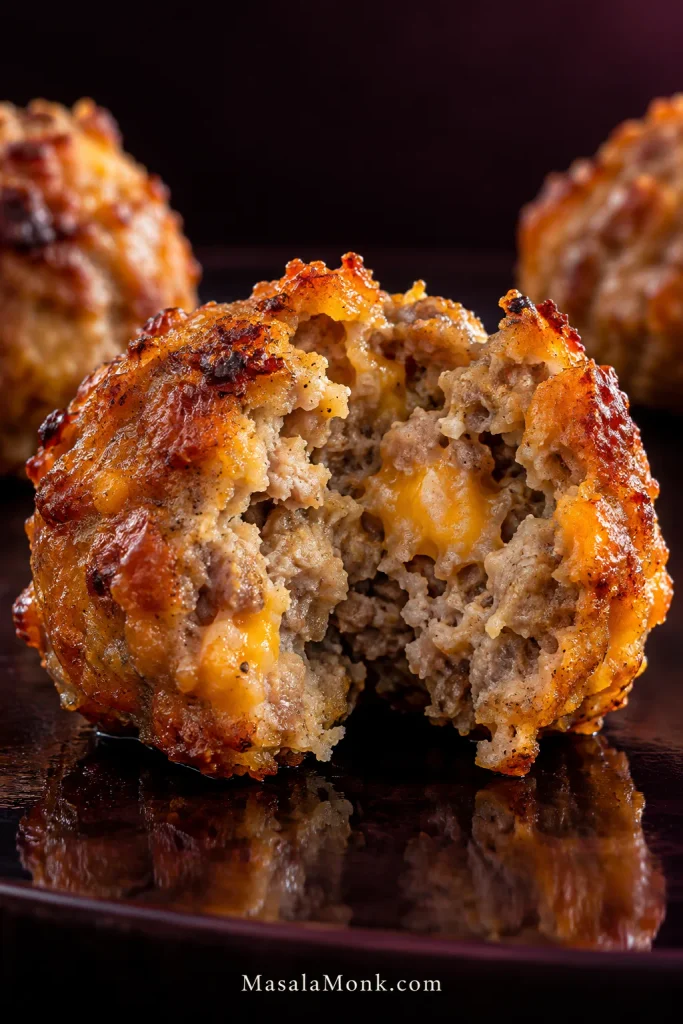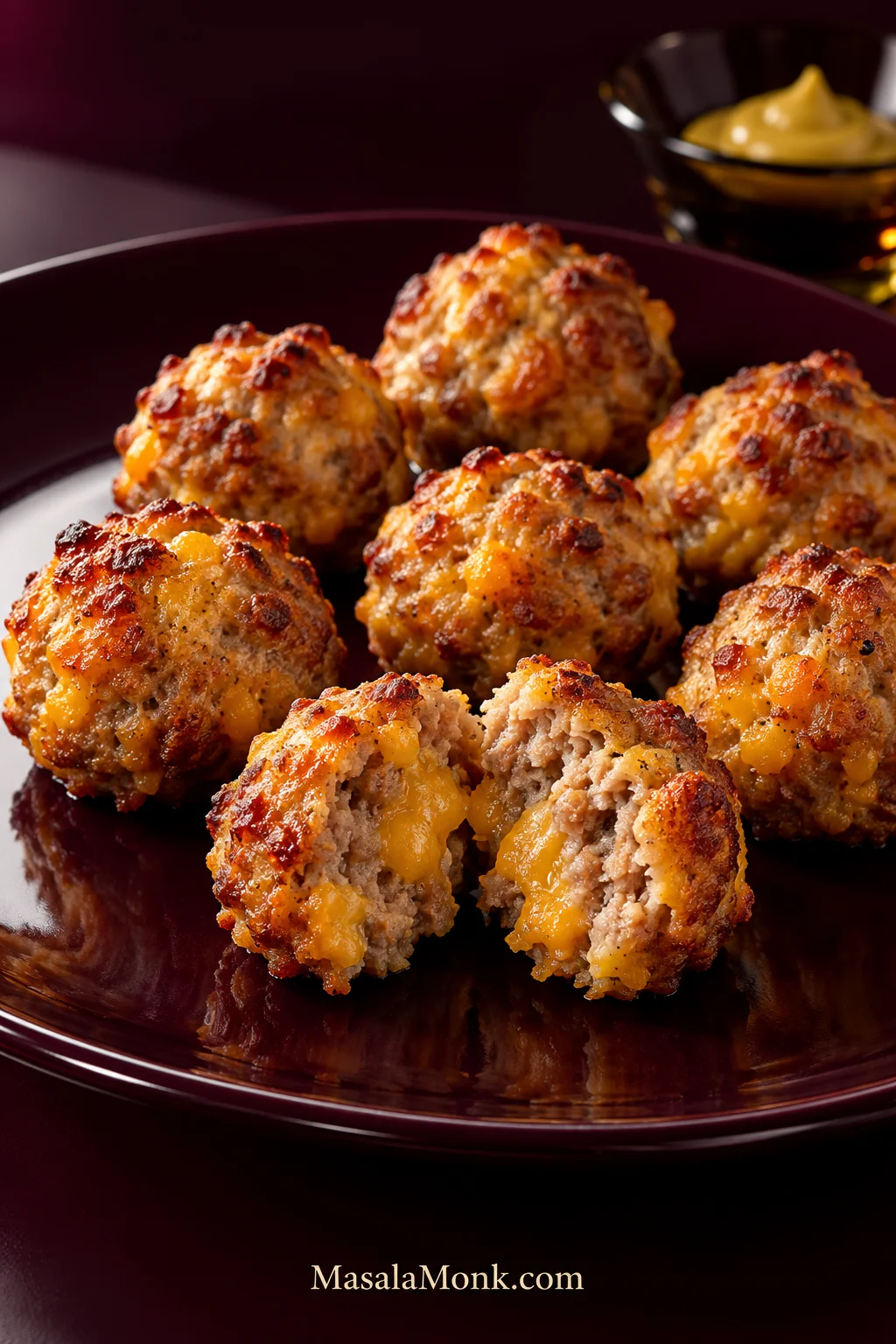
Good sausage balls should taste like sausage and sharp cheddar, not like biscuits with a little meat mixed in. The outside should be lightly golden, the middle tender and cheesy, with little browned edges where the cheddar meets the pan.
They are also exactly the kind of food that disappears from a Christmas breakfast tray or game-day table before anyone thinks to count how many they have eaten.
This sausage balls recipe stays close to the old-school three-ingredient idea—raw breakfast sausage, Bisquick and cheddar—but gives you a better way to judge the one thing that changes from batch to batch: moisture.
Three main ingredients, roughly 35–40 minutes, and no automatic splash of milk. Mix everything first. Then squeeze a handful. The texture will usually tell you what to do next.
Quick Answer: Mix First, Adjust Second
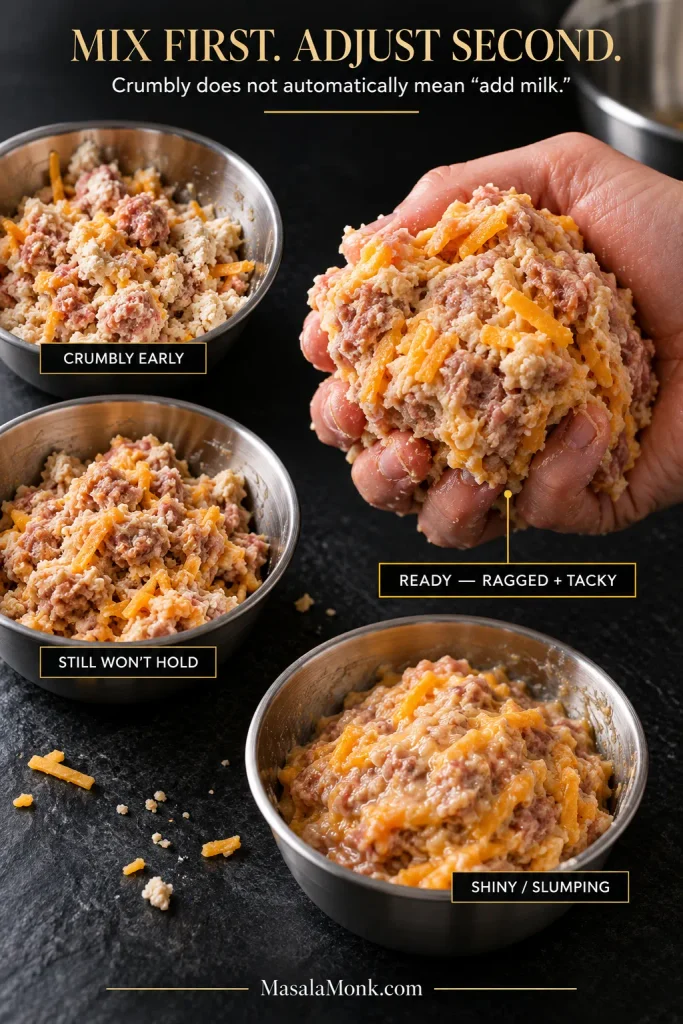
Mix the sausage, Bisquick and cheddar completely before reaching for milk. If a firmly squeezed handful still crumbles, add milk 1 tablespoon / 15 ml at a time.
The right texture feels dense and tacky and stays together with slightly ragged edges. If it already holds, leave it alone. A shiny mixture that feels soft enough to slump is better chilled for 15–20 minutes.
And if everything looks crumbly during the first minute of mixing, don’t panic. That is normal here.
Two Things Worth Knowing Before You Start
- Cheddar: full-fat sharp or extra-sharp brings better flavor and richness. Freshly grated melts more smoothly, but bagged shredded cheddar still works.
- Bisquick: weigh it if possible. A packed cup can quietly add much more dry mix than you intended.
Make It Now: Easy Cheesy Bisquick Sausage Balls
These Bisquick sausage balls use 1 1/2 cups / 180 g baking mix for every pound of sausage. That is enough to help them stay round while keeping the bite more sausage-and-cheddar than biscuit.
Equipment
- large mixing bowl or stand mixer with paddle attachment
- large rimmed baking sheet
- parchment paper
- small cookie scoop, optional
- digital kitchen scale, recommended for consistent 22 g portions
- instant-read thermometer
Ingredients
- 1 lb / 454 g raw bulk pork breakfast sausage — mild, hot, or half mild and half hot
- 1 1/2 cups / 180 g Bisquick Original baking mix
- 8 oz / 227 g full-fat sharp or extra-sharp cheddar, shredded
- 1–2 tbsp / 15–30 ml milk, only if needed after mixing
Instructions
- Heat and line. Preheat the oven to 350°F / 175°C. Line a large rimmed baking sheet with parchment. The rim catches sausage fat, while the parchment keeps melted cheddar from sticking stubbornly to the pan.
- Mix completely. Combine the raw sausage, Bisquick and cheddar with clean hands or a stand mixer fitted with the paddle on low. At first it may look hopelessly crumbly. Keep going. As the sausage and cheese work through the Bisquick, everything should begin to come together.
- Squeeze before adding milk. Compress a small handful firmly. If it stays together, it is ready. If it still falls apart in your hand, add 1 tbsp / 15 ml milk, mix again and check before adding more.
- Roll 22 g balls. Portion about 22 g each, roughly a heaping tablespoon and about 1 1/4 inches across. They don’t need to be perfectly round; slightly rough edges brown beautifully.
- Bake until lightly golden. Leave a little room between the balls and bake for about 18–22 minutes. Start checking at 18 minutes. You should smell browned sausage and toasted cheddar, and the tops should be lightly golden.
- Check the center. Pork sausage should reach 160°F / 71°C; poultry sausage needs 165°F / 74°C. If the center is not there yet, bake another 2 minutes and check again. A thermometer beats guessing from color.
- Rest and split one. Give them 2–3 minutes, then check the center. It should be cooked through but still visibly moist, with melted cheddar and no dry biscuit-like crumb.
How to Know When Sausage Balls Are Done
Golden is enough. Once the raw sausage mixture held together before baking and the center has reached the safe temperature, stop there.
If your first tray already looks right, you can stop here. Otherwise, see why the Bisquick ratio changes the texture, troubleshoot a dry batch, or jump to the cream cheese and other variations below.

More Sausage Ball Help
Variations
Make Ahead & Serving
How Much Bisquick Should You Use per Pound of Sausage?
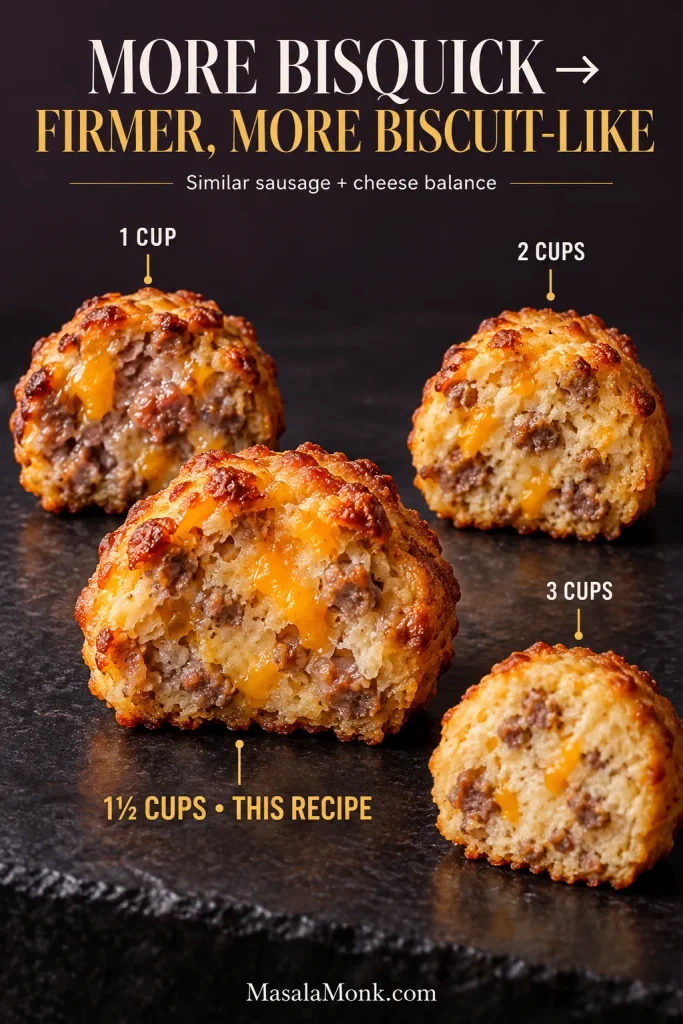
With similar amounts of sausage and cheese, less Bisquick gives you a meatier sausage ball; more pushes the texture toward firmer and more biscuit-like. This recipe uses 1 1/2 cups / 180 g per pound of sausage.
There is no single universal “original” ratio. Three cups of Bisquick give you a much more biscuit-forward result than 1 or 1 1/2 cups, although recipes built around that larger amount often balance it with substantially more cheese, milk or both.
| Bisquick per 1 lb sausage | What to expect |
|---|---|
| Around 1 cup | Very meaty and rich; fatty sausage can leave the balls softer or more prone to spreading. |
| Around 1 1/2 cups | The amount used here: enough Bisquick to help them stay round while sausage and cheddar remain prominent. |
| Around 2 cups | Firmer and more biscuit-like. With lean sausage or less cheese, dryness becomes easier to notice. |
| Around 3 cups | Much more biscuit-forward and usually paired with substantially more cheese and/or liquid. |
Why Do Sausage Balls Turn Out Dry?
Sausage balls usually turn out dry because there is too much Bisquick, the sausage is very lean, the cheese is reduced-fat, or they bake too long. Floury dryness points more strongly to the Bisquick ratio; hard but not floury usually points to fat level or overbaking.
The raw ingredients look dry and crumbly
Keep mixing. Bisquick can look stubbornly separate at first, but sausage fat and cheese gradually pull it together. If a firmly squeezed handful still falls apart after that, add a little milk.
The baked balls taste floury
Floury usually means too much Bisquick for the amount of sausage and cheese. A packed measuring cup can create the same problem. Weighing the mix removes that guesswork.
They are hard and dry, but not floury
Look at the sausage, cheese, ball size and oven time. Very lean sausage, reduced-fat cheddar, tiny portions and overbaking can all pull moisture out of the center.
If the center has reached 160°F / 71°C and is still moist, stop there. More oven time will only push it toward dry.

If They Spread Instead of Staying Round
If sausage balls spread flat, chill the shaped balls before changing the ingredient ratio. A shiny, greasy mixture does not need more milk. Very fatty sausage can soften the mix, while cutting the Bisquick too far can leave the balls without enough structure to hold their shape.
Some grease on the parchment is completely normal. Flattened discs sitting in a large puddle are not.

What Sausage Works Best for Sausage Balls?
Raw bulk pork breakfast sausage is the classic choice, and its fat and moisture help bring the Bisquick together as the balls bake.
| Sausage | What it does |
|---|---|
| Mild | Familiar breakfast-sausage flavor with little heat. |
| Half mild + half hot | More seasoning and a gentle kick while staying broadly crowd-friendly. |
| Hot | A noticeably spicier appetizer. |
| Maple | A sweeter breakfast version that pairs naturally with maple syrup. |
| Turkey or chicken | Leaner and more likely to need moisture adjustment; cook to 165°F / 74°C. |
| Precooked crumbles | Not a direct swap because some fat and moisture have already been cooked away. |
A very lean sausage may need some of the optional milk. A fatty one may benefit more from chilling before baking. Your sausage can simply behave differently from somebody else’s; that does not mean you measured anything wrong.

What Does Cream Cheese Do to Sausage Balls?
Cream cheese makes the center softer, richer and more tender. It changes the texture more than the flavor, while the sausage and cheddar can still brown around the outside.
Mix the cream cheese with the raw sausage first so it distributes evenly, then add the Bisquick and cheddar.
Cream-cheese versions vary in baking mix and ball size, so don’t assume they’ll bake in the same 18–22 minute window as the main recipe. The mixture should still hold when squeezed; for pork, use 160°F / 71°C in the center rather than the clock to decide when they’re done.

Can You Use Cheddar Bay Biscuit Mix for Sausage Balls?
Yes, but a full 11.36 oz / 322 g box of Cheddar Bay Biscuit Mix brings substantially more dry mix plus its own cheddar, garlic and herb flavor, so treat it as its own formulation rather than a gram-for-gram Bisquick swap. Mix everything fully before deciding it needs additional moisture.
The included garlic-herb seasoning packet can go into the sausage mixture for stronger flavor throughout, or into melted butter brushed over the baked balls. With salty sausage, go easy at first.
Keep the portions consistent and cook pork to 160°F / 71°C rather than relying on browning alone.

Can You Add Rotel to Sausage Balls?
Undrained Rotel can make sausage balls spread because the tomato liquid loosens the mixture. Drain it hard. Rotel is easier to manage in a cream-cheese version, where the cream cheese gives the mixture more body.
If what you really want is the same sausage-and-tomato combination in something scoopable, make Rotel dip with Velveeta and sausage. There, the tomato liquid actually helps.

Can You Make Sausage Balls Without Bisquick?
Plain flour is not a 1:1 substitute for Bisquick in sausage balls. Bisquick also supplies fat, leavening and salt, so replacing it with plain flour alone changes both the texture and the way the balls bake.
The easiest substitution is another all-purpose baking or biscuit mix. A truly from-scratch version needs its own balanced combination of flour, fat, leavening and seasoning rather than a cup-for-cup flour swap.
Make Ahead, Freeze and Reheat Sausage Balls
Raw sausage balls can be shaped about a day ahead and refrigerated, or frozen before baking. Cooked ones can be chilled, frozen and reheated later too.
On a holiday morning, you can pull a tray from the refrigerator, slide it into the oven, and have something hot on the table while coffee is going and the rest of breakfast comes together.

Make Them Ahead
Shape the uncooked balls, cover and refrigerate for up to about 24 hours. Bake them straight from the refrigerator and expect a cold tray to take a little longer.
For a bigger holiday breakfast, a make-ahead tater tot breakfast casserole can be prepped the same evening, leaving very little work for the morning.
Freeze and Reheat
Freeze raw shaped balls on a parchment-lined tray first so they stay separate. Once firm, transfer them to a freezer-safe bag or container. They can go into the oven frozen; begin checking a few minutes beyond the normal bake window. Depending on your freezer and oven, they may need roughly 5–10 minutes longer. Center temperature decides.
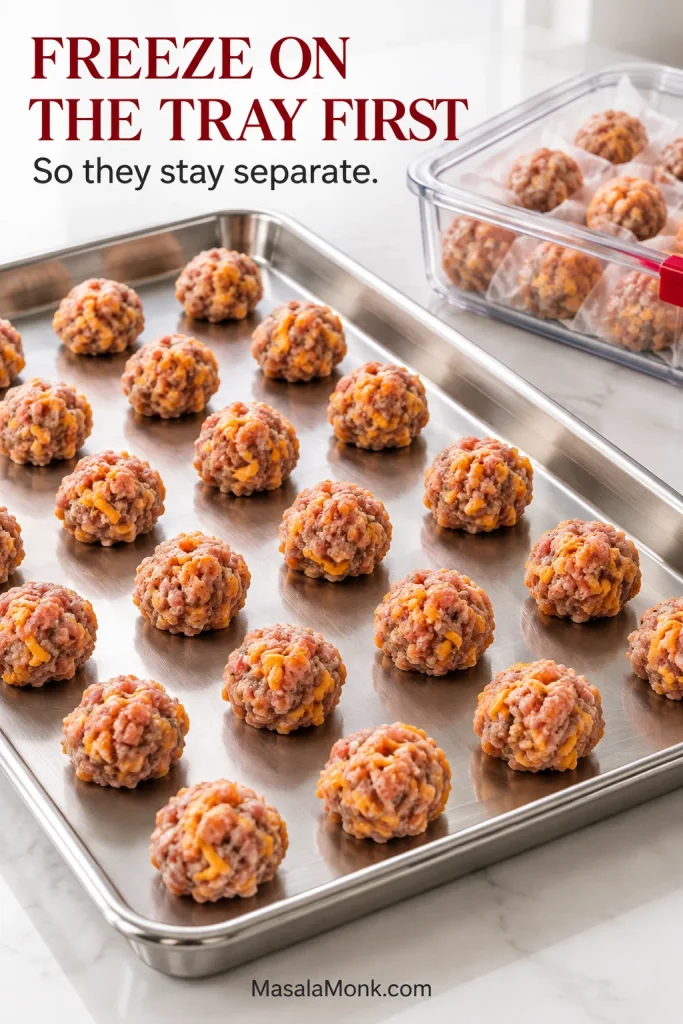
For best quality, aim to use raw frozen sausage balls within 1–2 months and cooked frozen sausage balls within 2–3 months. Those are quality windows rather than hard safety cutoffs for food kept continuously frozen.
Cool cooked sausage balls promptly, refrigerate until chilled, then freeze.
For refrigerated leftovers, reheat to 165°F / 74°C. The microwave is fastest for a few pieces. For a larger tray, cover loosely and warm in a 325°F / 165°C oven until hot throughout. An air fryer restores more crispness around the outside, but check early so the exterior does not dry out.
If you like keeping party food in the freezer, homemade sausage rolls can also be frozen before baking.
Feeding a Crowd
A double batch makes roughly 76–80 small sausage balls. How far a batch goes depends on the rest of the table: they stretch much further as one appetizer among several than when they are the main hot bite.

Double the sausage, Bisquick and cheddar as written. Adjust the optional milk only after mixing, exactly as you would for a single batch. If one bowl gets crowded, divide the mixture between two. Keep the individual balls the same size and leave the oven temperature alone.
With two trays in the oven, swap their positions partway through if yours has obvious hot spots. Otherwise, successive trays give more predictable browning.
At a party, nobody wants to babysit appetizers all afternoon. Reheat the sausage balls first, then use a slow cooker or warming tray only to hold them hot at 140°F / 60°C or warmer. Even safely held food gradually dries with hours of heat, so smaller, freshly reheated batches usually taste better.
A chilled make-ahead dish also takes pressure off the oven. Classic deviled eggs can be finished beforehand and give the table something cool and creamy beside the hot sausage.
Refrigerate leftovers within 2 hours—or within 1 hour if the temperature is above 90°F / 32°C—and use them within about 3–4 days, according to USDA pork-storage guidance.
What to Serve With Sausage Balls
Once the texture is right, they do not need much dressing up. Serve them warm enough for the cheese to stay soft and let the sausage do most of the work.
For breakfast, eggs, crisp potatoes, fresh fruit or warm maple syrup all make sense.
For a party tray, tangy and lightly sweet sauces cut through the pork and cheddar nicely. Spicy brown mustard needs no work at all; for something creamier, use a thicker honey mustard dipping sauce. Homemade hot honey sauce and pepper jelly are good with mild sausage too.

Sausage Ball Troubleshooting
If everything worked, you are done. Keep this table for the batch that does not.
| What you see | Why it happens + what to do |
|---|---|
| Mixture looks crumbly early in mixing | It may simply need more mixing. Keep mixing before adding milk. |
| Mixture still won’t hold together after mixing | The sausage and cheese are not supplying quite enough moisture. Add milk 1 tbsp / 15 ml at a time. |
| Dry, floury or too biscuit-like | There may be too much Bisquick for the amount of sausage and cheese. Weigh the mix and avoid packed cups; if you prefer a meatier result, reduce the Bisquick next time. |
| Hard but not floury | Overbaking, lean sausage, reduced-fat cheese or very small balls can all dry the center. Use fuller-fat ingredients and stop once the center is safely cooked and still moist. |
| They spread flat | Very fatty sausage, too much milk, warm dough or too little Bisquick can soften the structure. Chill the shaped balls and avoid adding more liquid. |
| Bland | Mild cheese, mild sausage or too much baking mix can mute the flavor. Use sharp cheddar first; for more punch, try half mild and half hot sausage. |
| Too salty | Sausage, cheese and seasoned mixes can stack a lot of salt. Skip extra salt and go easier on seasoning packets. |
| Rotel version is loose | Too much tomato liquid loosens the mixture. Drain it thoroughly and use it with the cream-cheese version. |
| Leftovers turn hard | They were reheated too long. Warm only until the centers are hot. |
Sausage Balls FAQ
Do you cook the sausage before making sausage balls?
No—use raw sausage for classic sausage balls. Browning it first removes fat and moisture that the Bisquick would otherwise absorb, so cooked sausage crumbles behave differently in the same recipe.
What temperature are sausage balls done?
Cook pork sausage balls to 160°F / 71°C and ground chicken or turkey sausage balls to 165°F / 74°C, according to USDA safe-temperature guidance. Use a thermometer instead of waiting for the outside to turn dark brown.
How long can sausage balls sit out?
Two hours at room temperature is the usual maximum, or 1 hour above 90°F / 32°C. If you are holding them hot for serving, keep them at 140°F / 60°C or warmer; otherwise refrigerate leftovers promptly.
Once the mixture feels right, there isn’t much left to overthink: roll, bake, and put them out while the cheddar is still soft and the browned edges are at their best.