Posted on Leave a comment

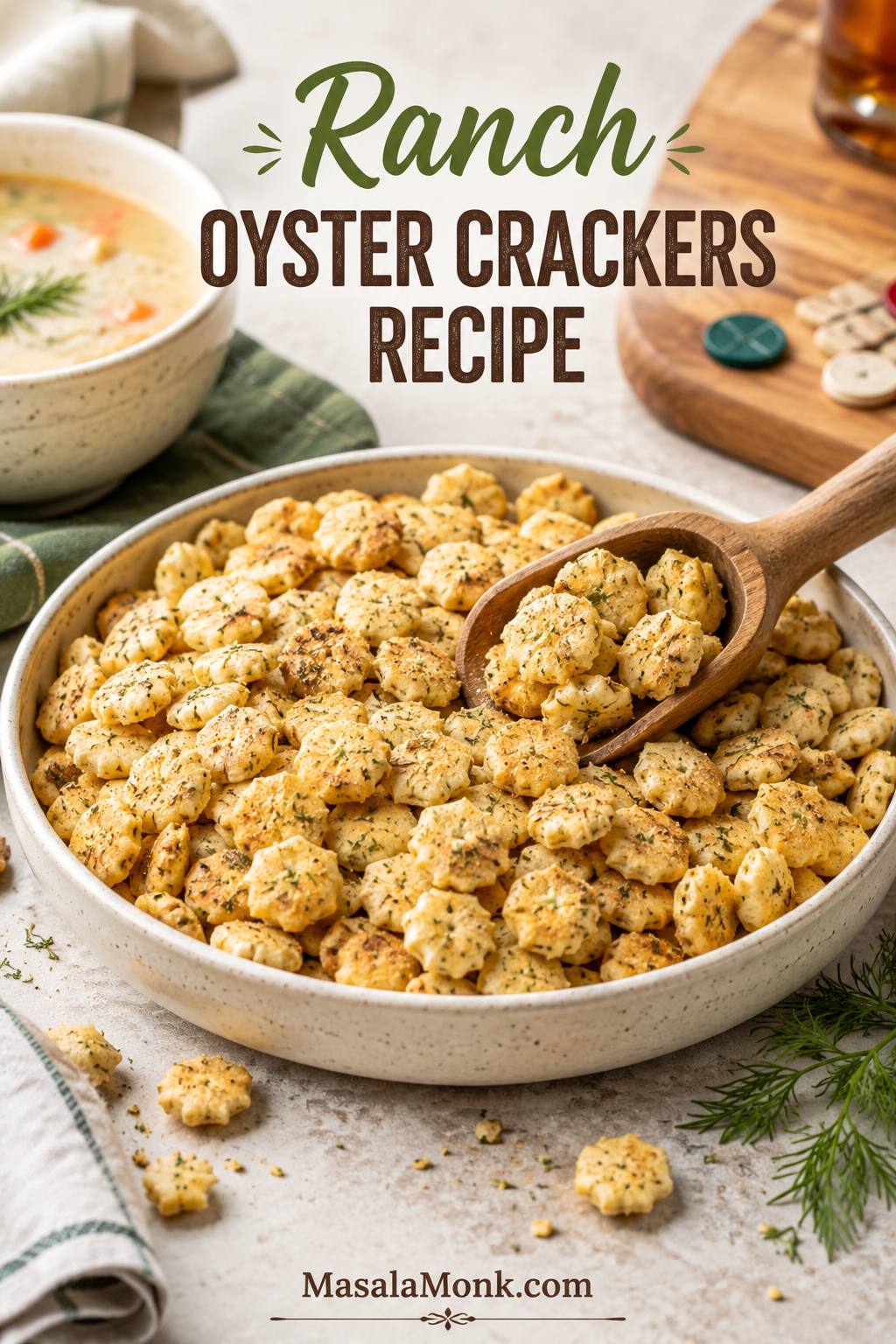
Ranch Oyster Crackers Recipe

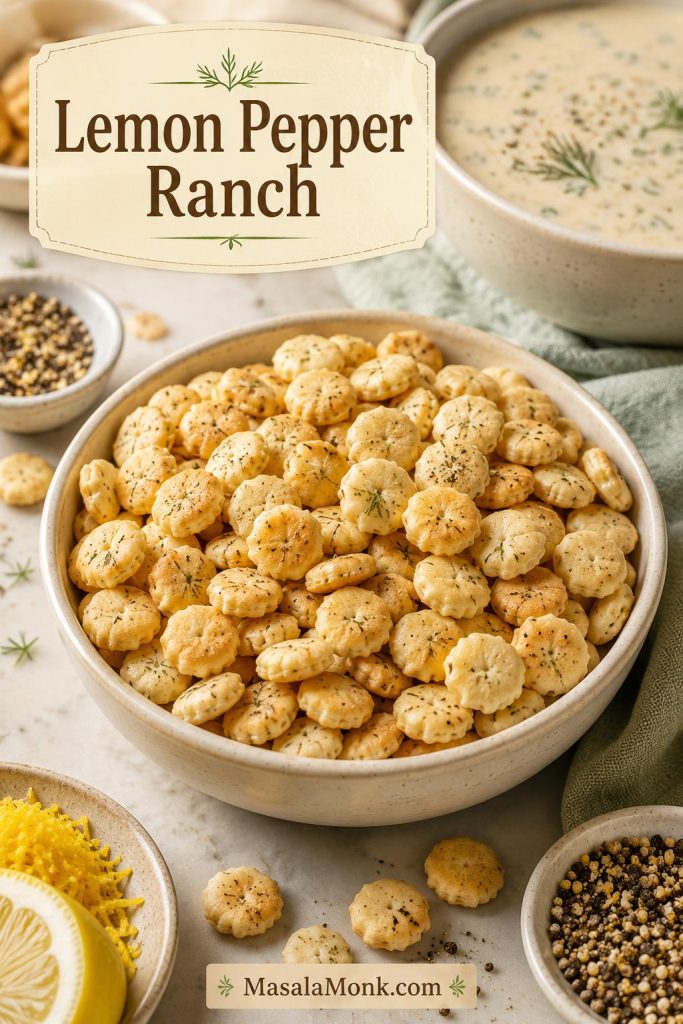
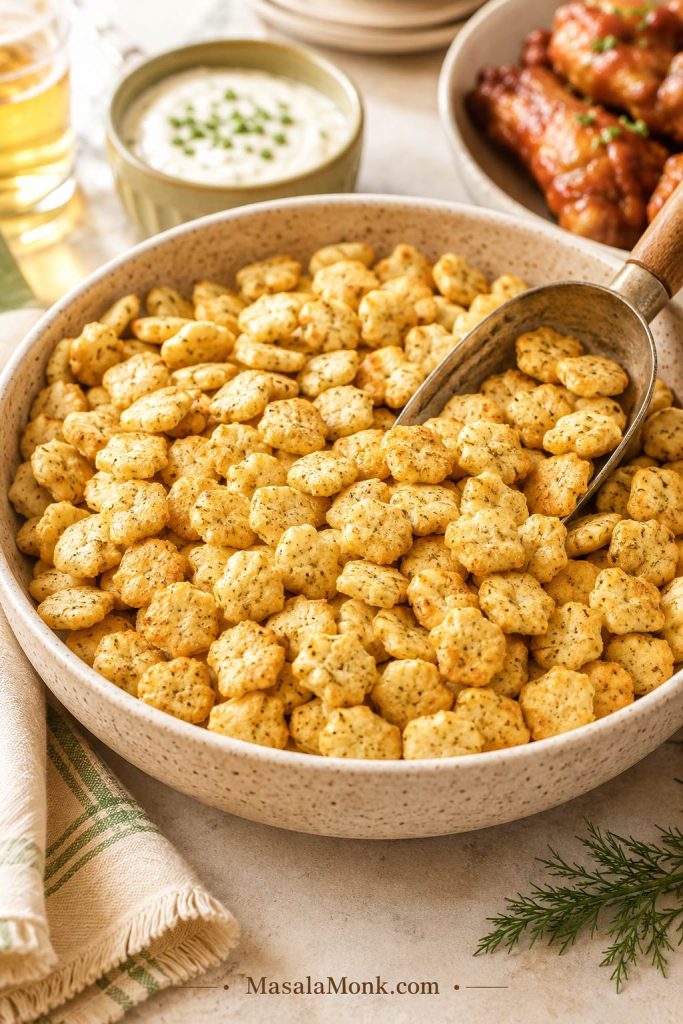
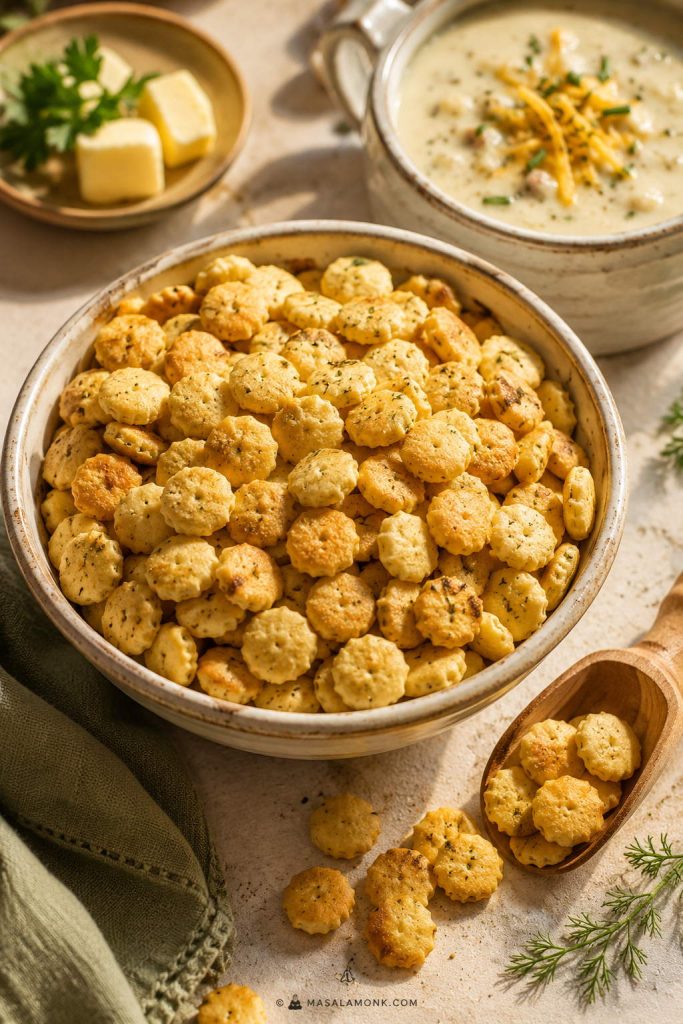
Bowl of golden ranch oyster crackers with herb flecks, scoop, and cozy snack-table sides.

Ranch oyster crackers are the kind of snack that disappears quietly. You set out a bowl before the game starts, beside a pot of soup, or on a holiday snack table, and somehow everyone keeps drifting back for another salty, herby handful. They are crisp, tiny, ranch-seasoned, and just rich enough to feel like a treat without asking much from you.

The recipe itself is easy. The confusing part is everything around it: whether “ranch dressing” means bottled dressing or the dry ranch packet, how much seasoning to use for a 9 oz, 12 oz, or 16 oz bag, whether oil or butter gives a better crunch, whether the crackers really need to be baked, and what to do if they turn out greasy, salty, or soft.

Once those little decisions are clear, the batch is easy to get right. The baked method gives the snappiest result, and the ratio table helps you adjust for whatever bag you have. From there, choose oil or butter, dill or no dill, a gentle ranch coating or a bolder party-snack bowl. The result should be bold but not harsh, coated but not oily, and crunchy enough that people keep reaching back into the bowl.

Quick Answer: The Best Ranch Oyster Crackers Formula

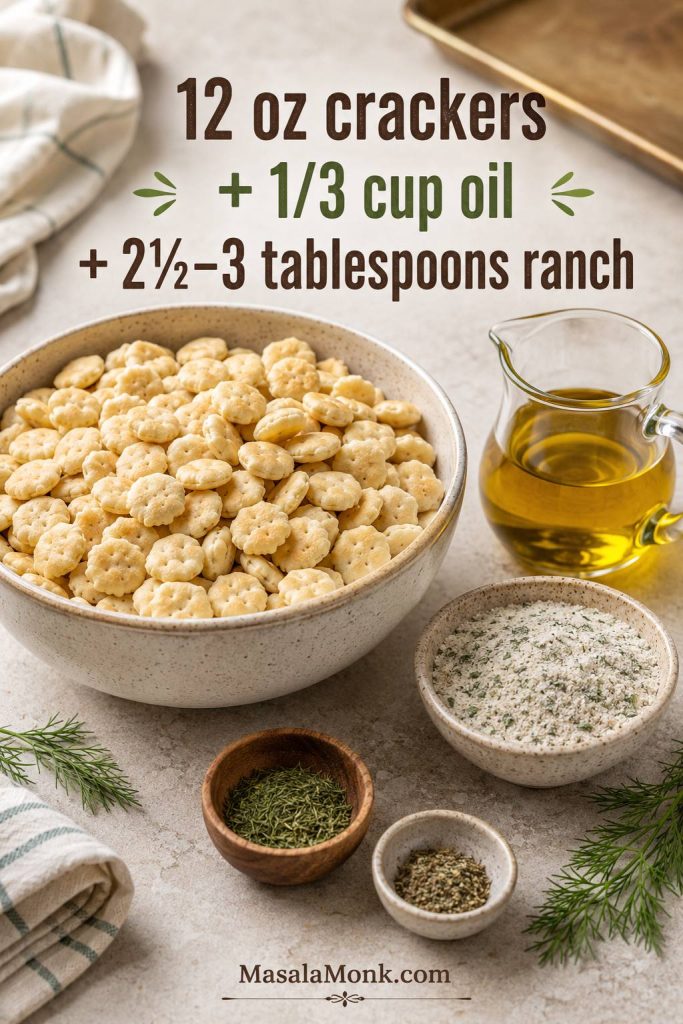
For 12 oz / 340 g oyster crackers, use ⅓ cup / 80 ml neutral oil, 2½ tablespoons dry ranch seasoning for a balanced batch or up to 3 tablespoons for a bolder batch, 1 teaspoon dried dill, ½ teaspoon garlic powder, and ½ to 1 teaspoon lemon pepper.

Toss well, spread on a rimmed baking sheet, bake at 250°F / 120°C for 18–22 minutes, stir once halfway, and cool fully before storing. The first handful should taste salty, herby, crisp, and evenly coated — never dusty in one bite and oily in the next.

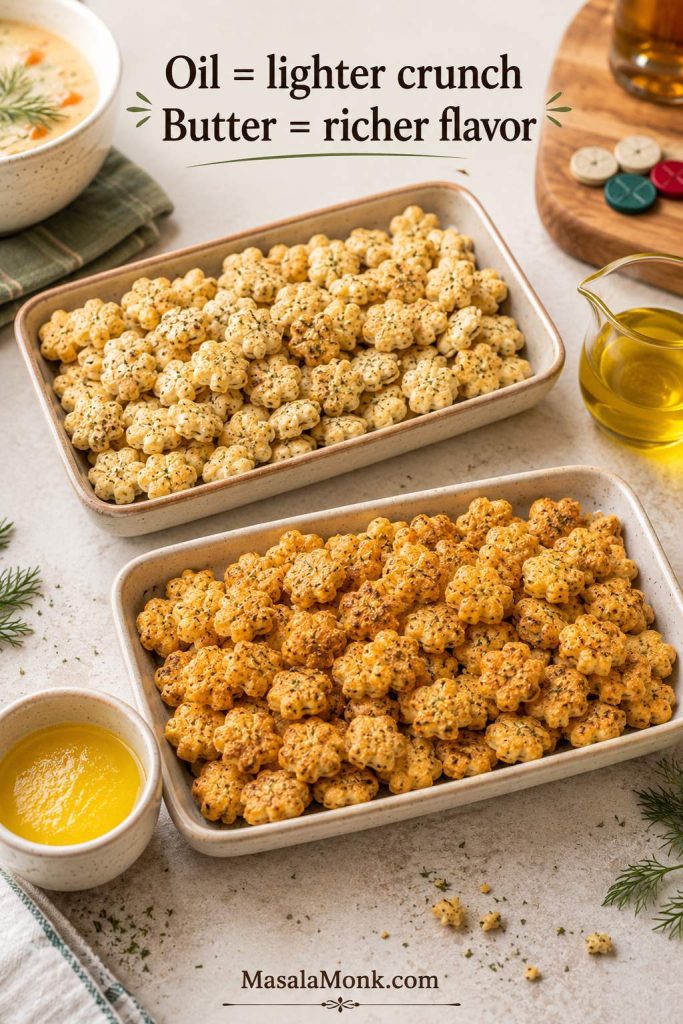
Quick pick: Use neutral oil for the best crunch, melted butter for the richest flavor, the air fryer for the fastest small batch, the no-bake method when you want to skip the oven, and a 16 oz batch for parties, gifting, game day, or bigger soup nights.

If you are using a full 1 oz / 28 g ranch packet with a 12 oz bag, expect a bold, salty party-snack flavor. For a safer first batch, start with 2½ tablespoons, bake, taste, and dust the crackers with a little more seasoning while they are still warm on the tray.

Using a 9 oz or 16 oz bag? Check the ranch seasoning ratios before mixing the coating.

Prep scene with oyster crackers, oil, dry ranch seasoning, dill, garlic powder, lemon pepper, and sheet pan.
Start with this 12-ounce ranch oyster crackers formula, then adjust the next batch toward bolder seasoning, richer butter, or more heat.

Why This Recipe Works

The best batches come out lightly toasted, evenly seasoned, and crisp after cooling. That does not happen by dumping ranch powder over crackers; it comes from the order, the ratio, and a little low-heat baking time.

  • Dry ranch seasoning keeps the crackers crisp. Bottled dressing adds moisture, while dry mix gives flavor without making the crackers soggy.
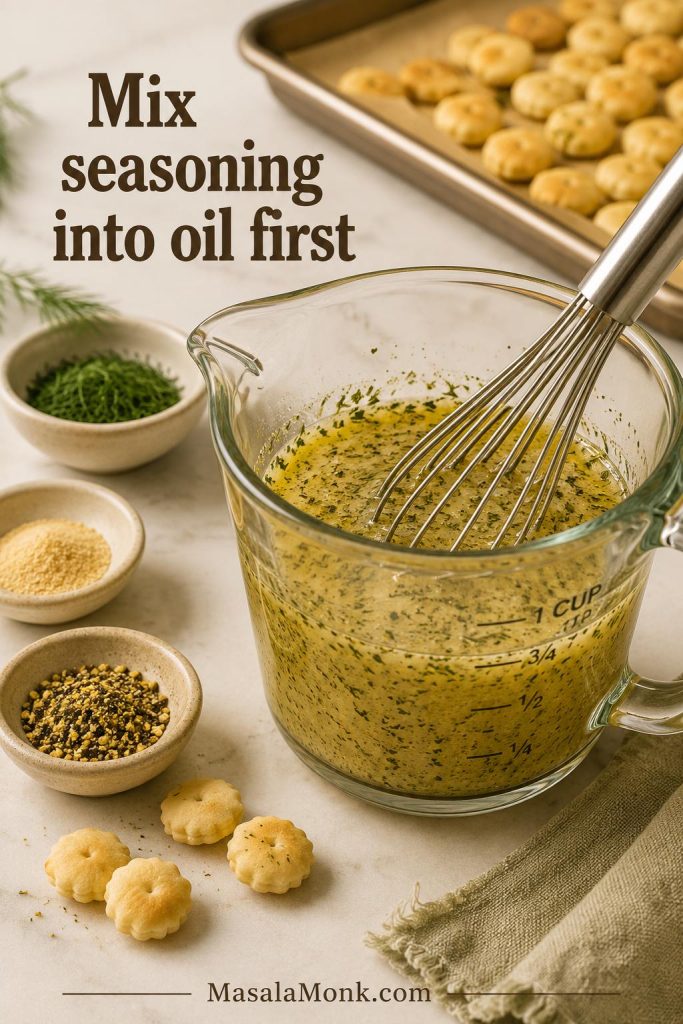
  • Whisking the seasoning into the oil first prevents clumps. The ranch powder, dill, garlic, and lemon pepper spread more evenly when they are suspended in oil before they touch the crackers.
  • A low oven sets the coating instead of scorching it. At 250°F / 120°C, the crackers have time to toast gently while the oil or butter settles into a clean, savory finish.
  • The ratio table protects the batch. Oyster cracker bags vary, and using the same seasoning amount for every bag can make one batch bland and another too salty.
  • Cooling on the tray finishes the texture. The crackers firm up as the seasoning settles into the surface.

The goal is simple: every handful should taste seasoned, not dusty in some bites and oily in others. Mix the coating first, bake low, and let the crackers cool on the pan, and the bowl lands crisp, salty, herby, and clean.

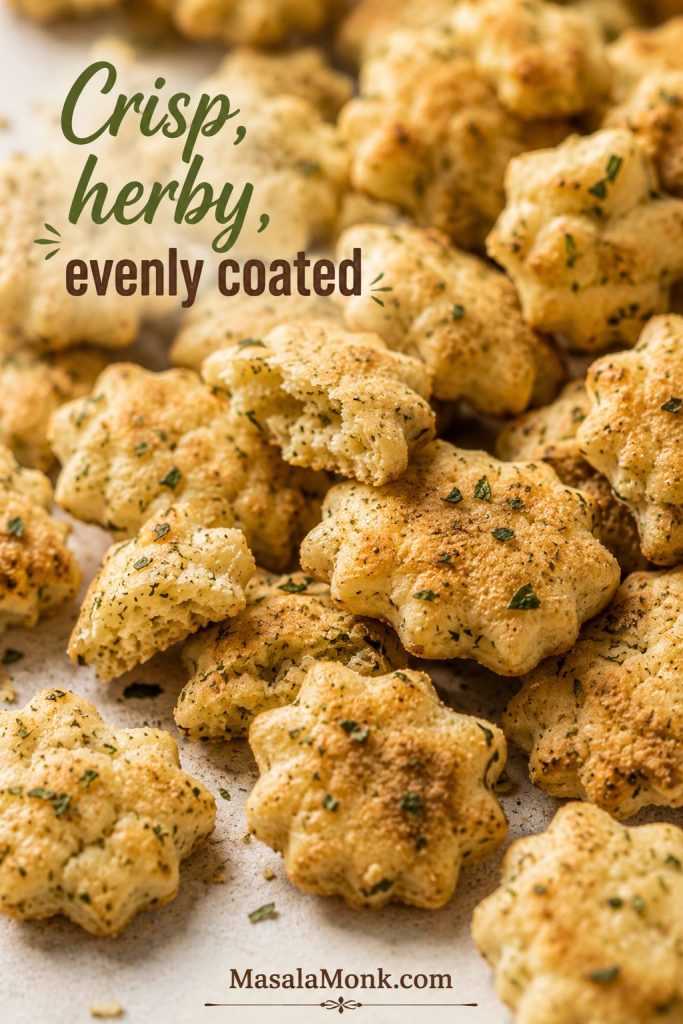
Close-up of crisp ranch oyster crackers with toasted edges, broken pieces, and green herb flecks.
Look for a matte, herby surface with lightly toasted edges; that finish tells you the seasoning has settled instead of sitting on the crackers as oil.

What Are Ranch Oyster Crackers?

Ranch oyster crackers are small oyster crackers tossed with dry ranch seasoning, oil or melted butter, and simple seasonings like dill, garlic powder, lemon pepper, and onion powder. They are usually baked at a low temperature until the seasoning clings and the crackers become crunchy again.

They are one of the most common versions of seasoned oyster crackers: the ranch packet gives the base flavor, while dill, garlic, lemon pepper, Parmesan, or heat can push the batch in different directions.

Despite the name, oyster crackers usually do not contain oysters. They are small soup crackers traditionally served with oyster stew, chowder, chili, and other soups. That soup-and-stew background is also why they make so much sense with creamy bowls and chili today. For a little more history, this history of oyster crackers explains where the name comes from.

Think of them as a snack mix shortcut. They are easier than Chex mix, less fussy than homemade crackers, and more interesting than plain soup crackers. Once baked and cooled on the pan, they are sturdy enough for snacking but still small enough to scatter over tomato soup, chili, chowder, salad, or a dip board.

Dry Ranch Seasoning vs Bottled Ranch Dressing

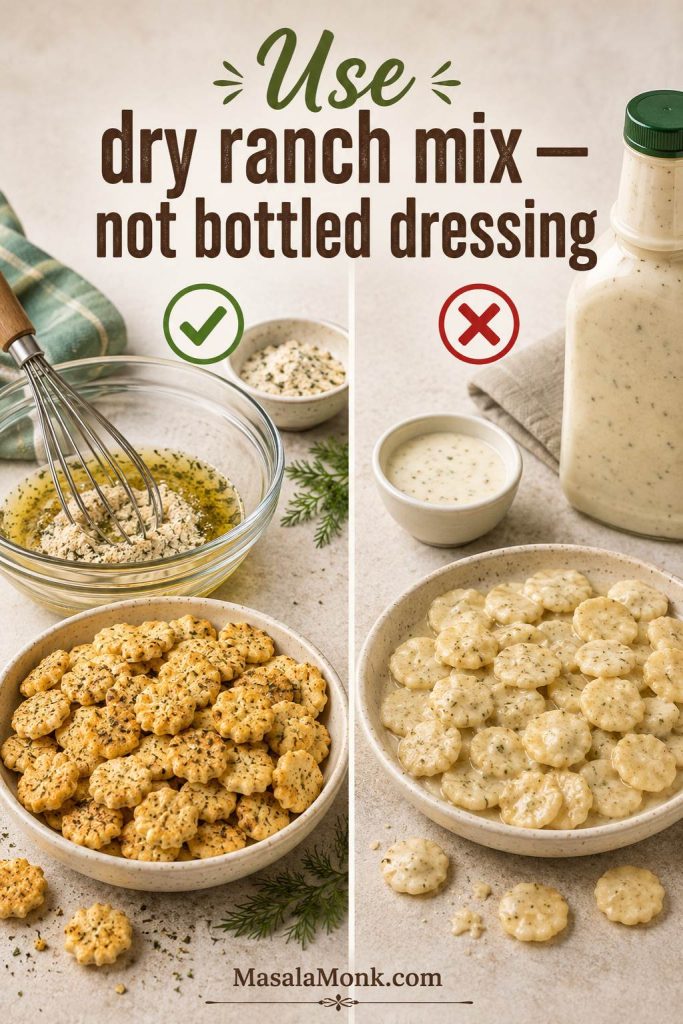
Use dry ranch seasoning here. It gives concentrated ranch flavor without the moisture that comes from bottled dressing. Creamy ranch dressing may sound tempting, but it can turn the crackers soft instead of snappy.

Split comparison of dry ranch seasoning mixed with oil and bottled ranch dressing with softer crackers.
Dry ranch mix seasons the crackers without adding water or cream, which is why it gives a cleaner crunch than bottled dressing.
Ranch productCan you use it?What to know
Dry ranch seasoning packetYes, best choiceClassic, easy, and bold. Use the packet weight and taste for saltiness.
Ranch seasoning shakerYesMeasure by tablespoons. Start with less if the blend is salty.
Dry ranch dip mixUsually yesCan be saltier or stronger than dressing mix. Start with a little less.
Bottled ranch dressingNot recommendedAdds moisture and can make the crackers soft.
Homemade ranch-style dry mixYesGood if you want more control over salt, dill, garlic, onion, and herbs.

Helpful rule: When people say “ranch dressing crackers,” they often mean crackers made with dry ranch dressing mix, not creamy dressing from a bottle.

Homemade Dry Ranch-Style Mix

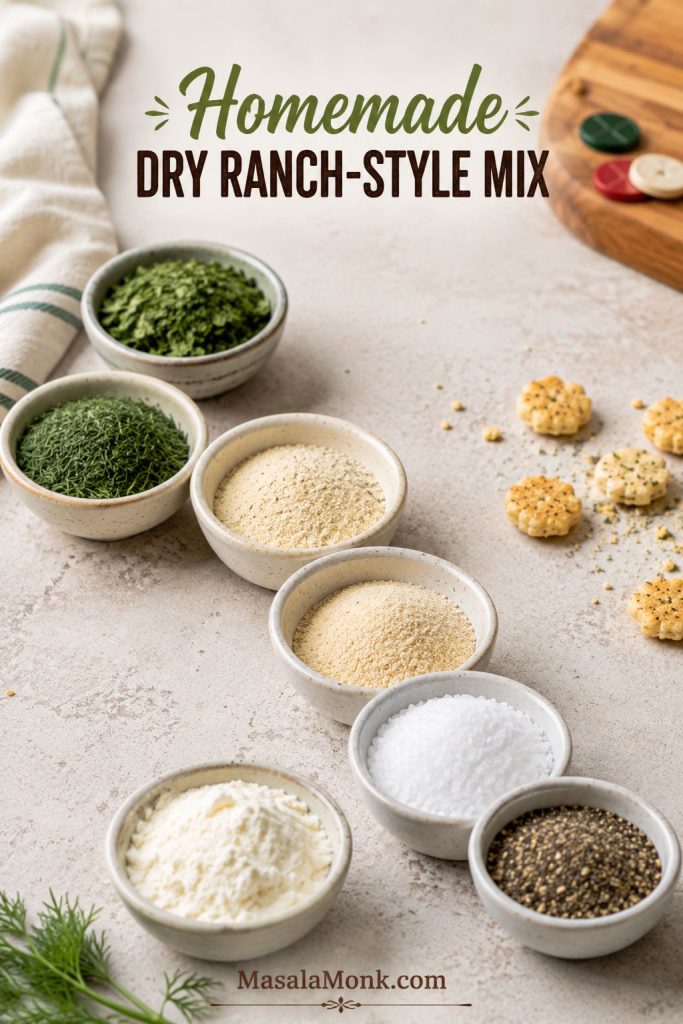
A homemade ranch-style dry mix can work too, especially if it includes parsley, dill, garlic powder, onion powder, salt, pepper, and optional buttermilk powder. Without buttermilk powder, the flavor will be more herby-garlicky than creamy-ranch, but it can still make a good seasoned cracker batch.

Small bowls of parsley, dill, garlic powder, onion powder, salt, pepper, and buttermilk powder for dry ranch mix.
A homemade dry ranch-style mix lets you control salt, herbs, and garlic, which is helpful when serving kids, low-salt guests, or lighter soup-night batches.

Ingredients and What Each One Does

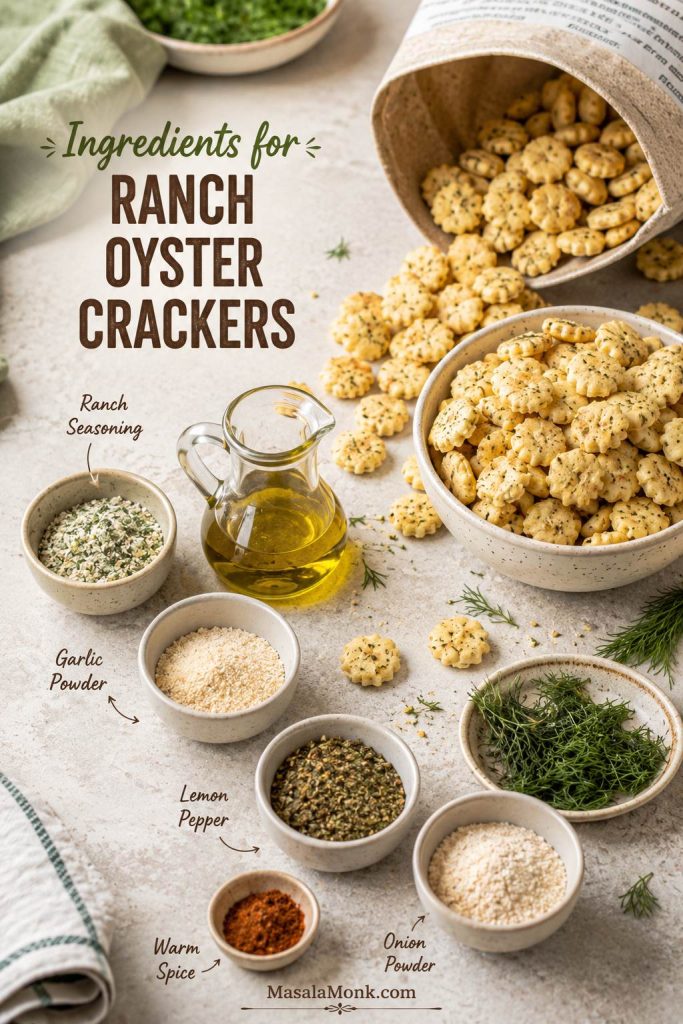
If you have oyster crackers, dry ranch mix, and a neutral oil, you are most of the way there. The crackers bring the crunch, the ranch mix brings the salty-herby flavor, and the oil or butter decides how light or rich the final batch feels.

Oyster crackers with oil, dry ranch seasoning, dill, garlic powder, lemon pepper, and onion powder in small bowls.
Every flavoring in this mix is dry, so the crackers can pick up ranch, dill, garlic, and lemon pepper while still baking into a snackable texture.

Oyster crackers

Use plain oyster crackers. Common bags are 9 oz / 255 g, 12 oz / 340 g, and 16 oz / 454 g. Cup counts vary by brand, but 9 oz is usually about 4–5 cups, 12 oz about 5½–6 cups, and 16 oz about 7–8 cups. Weight is more reliable than cups, so use the ratio table if your bag size is different.

Dry ranch seasoning

A standard dry ranch packet gives the classic flavor most people expect: tangy, salty, herby, garlicky, and slightly creamy-tasting even though there is no bottled dressing in the recipe. Store-brand ranch seasoning also works. The familiar green-label style packets are common, but the brand matters less than the salt level and packet size.

Dry ranch mix is useful beyond snack crackers too; it brings the same shortcut flavor to easy dinners like one-pot chicken bacon ranch pasta. Here, though, the seasoning needs to stay dry enough to cling to crackers instead of turning into a sauce.

Unsure how much of the packet to use? Jump to the ranch packet adjustment notes before you season the crackers.

Neutral oil or melted butter

Neutral oil gives the lightest, snappiest batch. Canola, vegetable, avocado, or another mild oil works well. Melted butter gives richer flavor and makes the kitchen smell more like party mix. Use unsalted butter if your ranch mix is already salty; if you only have salted butter, start with less seasoning.

Dried dill and other seasonings

Dill gives the crackers that old-school ranch snack-mix flavor. Garlic powder deepens the ranch flavor, lemon pepper adds lift, and onion powder rounds everything out. Cayenne, red pepper flakes, smoked paprika, Parmesan, parsley, taco seasoning, or Italian seasoning can all work too; add salty extras carefully because ranch packets already bring plenty of salt.

How Much Ranch Seasoning to Use for Oyster Crackers

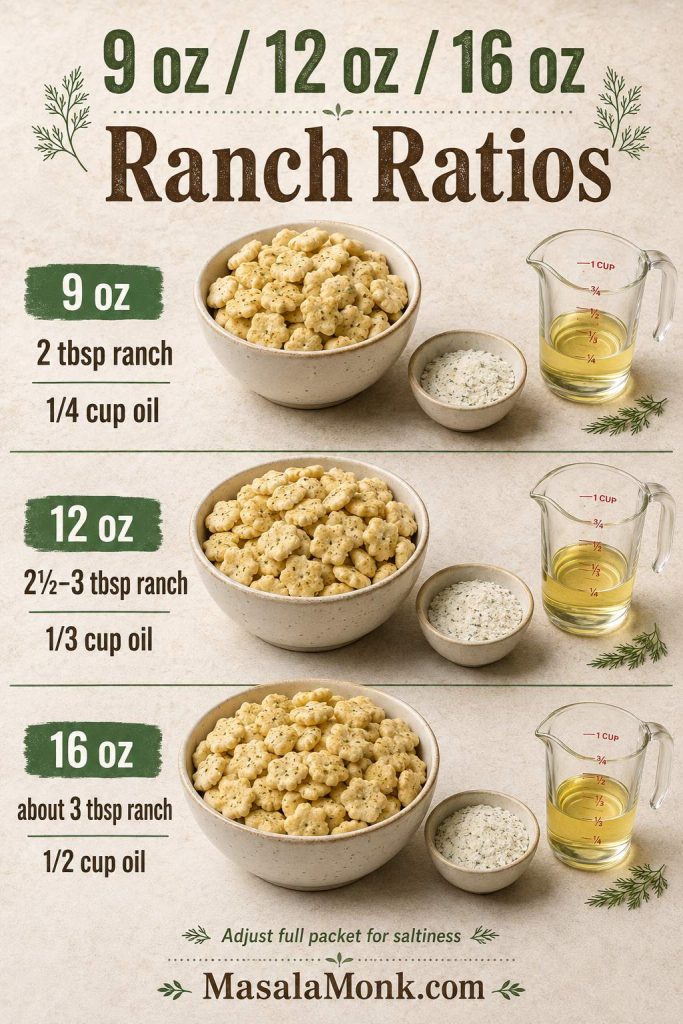
The seasoning gets easier once you match it to the bag size. Some recipes use cups, some use ounces, some say one packet, and ranch packet sizes are not always identical. Use this table as the practical guide.

Ranch Ratios by Bag Size

Oyster crackersMetricRanch seasoningOil or butterBake time at 250°F / 120°C
9 oz255 g2 tbsp mild
2½–3 tbsp bold
¼ cup oil for lighter coating
⅓ cup oil or 5 tbsp butter for richer coating
15–20 min
12 oz340 g2½ tbsp balanced
3 tbsp bold
⅓ cup oil
up to ½ cup butter for richer coating
18–22 min
16 oz454 gAbout 3 tbsp
or most/all of a standard 1 oz / 28 g packet, adjusted for saltiness
½ cup oil or ½ cup melted butter20–25 min
2 × 16 oz908 gAbout 6 tbsp
or 2 standard 1 oz / 28 g packets, adjusted for saltiness
1 cup oilUse 2 sheet pans
Three ranch oyster cracker ratio sections for 9 ounce, 12 ounce, and 16 ounce batches with ranch and oil measurements.
Bag size matters: the same ranch packet can taste bold in a 12-ounce batch but more balanced in a larger 16-ounce party batch.

How to Adjust the Ranch Packet

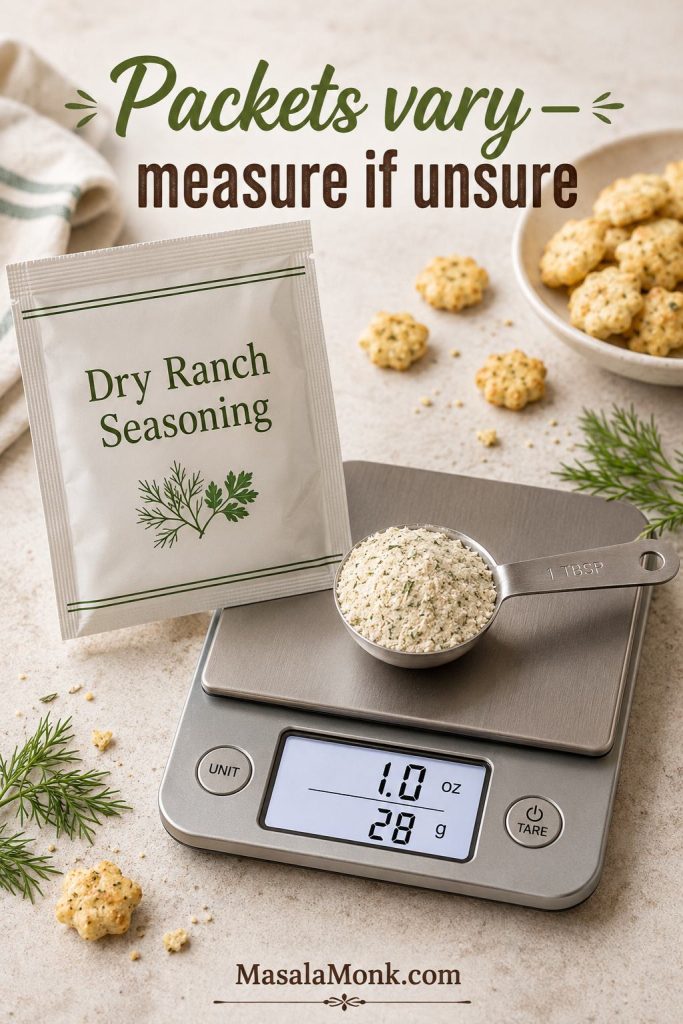
A ranch packet is sold by weight, not by tablespoons, and brands vary. The same 1 oz / 28 g packet can make a bold 12 oz batch or a more moderate 16 oz batch; it depends on how salty and intense you want the bowl.

Dry ranch seasoning packet, tablespoon measure, kitchen scale, and oyster crackers for checking packet weight.
Since ranch packets are sold by weight, measuring once helps you match the recipe instead of guessing from packet to packet.

Balanced for Soup, Bold for Parties

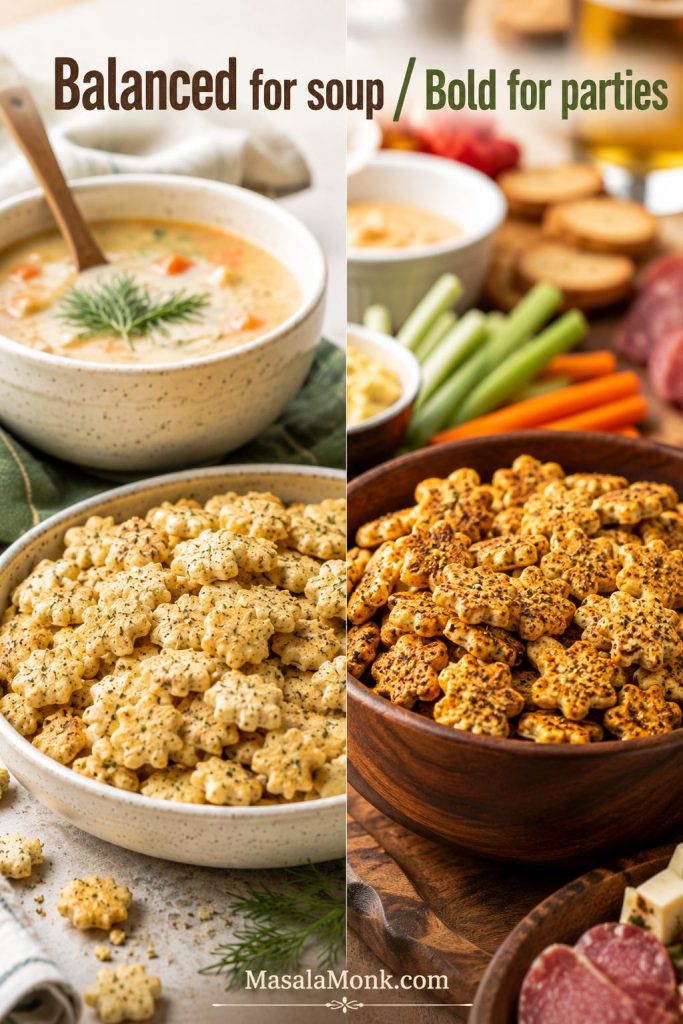
Making these for soup? Stay closer to the balanced ranch amount so the crackers add crunch without taking over the bowl. Making them for a party snack? Go bolder, especially if the crackers will sit beside dips, wings, cheese, or other strong flavors.

Lighter ranch oyster crackers for soup beside a bolder seasoned batch for parties.
Keep the seasoning lighter for soup so it does not overpower the bowl; go bolder when the crackers need to stand beside dips, wings, and cheese.

Best starting point: For a 12 oz / 340 g bag, use ⅓ cup oil and 2½ tablespoons ranch seasoning. After that, adjust toward extra dill, more butter, or a bolder packet-style coating depending on how your house likes them.

For batch size, think of 9 oz as a small test batch, 12 oz as the one-pan standard, and 16 oz as the party or gifting size. If you double a 16 oz batch, use two sheet pans so the crackers have room to toast evenly.

Once the bag size and seasoning amount are clear, move to the baked method and mix the coating.

Oil vs Butter for Ranch Oyster Crackers

Neither oil nor butter is wrong; they just make different snack bowls. Oil gives you the light, crunchy version people keep grabbing from between sips of soup. Butter gives you the richer bowl that smells like party mix coming out of the oven.

Two ranch oyster cracker batches comparing a lighter oil-coated version with a richer butter-coated version.
Oil keeps the bite lighter and drier, whereas melted butter gives a deeper, party-mix flavor that feels richer while still warm.
ChoiceResultBest forWatch out for
Neutral oilSnappy, light, evenly coatedMain recipe, make-ahead snacks, soup toppingUse a measured amount so the crackers do not feel greasy
Melted butterRicher, more savory, slightly heavierParty bowls, warm snacking, buttery flavorUse unsalted if your ranch mix is salty
Half oil, half butterBalanced flavor and crunchBest compromiseGive it enough baking time for the coating to settle
Olive oilMore noticeable flavorSmall batches or herby versionsUse a mild one so it does not fight the ranch flavor
Popcorn oilOld-school snack flavorHeavier party mixTaste first because some brands are extra salty

For the main recipe, use oil if you want the cleanest crunch. Use melted butter for a richer snack, then give the crackers enough space and baking time so the coating settles instead of feeling heavy.

How to Make Ranch Oyster Crackers

Once you choose the fat, the method is simple: whisk the seasoning into the oil or butter first, toss the crackers gently, spread them in one layer, bake low, stir once, and let them sit on the tray. This is snack food, not pastry; the goal is seasoned, easy, and good by the handful.

If the coating looks a little uneven or the first batch tastes slightly light, you can usually fix it with a few more minutes in the oven or a small dusting of seasoning while the crackers are warm.

Step 1: Heat the oven

Heat the oven to 250°F / 120°C. This low temperature gives the seasoning time to settle onto the crackers without burning the ranch powder, dill, garlic, or lemon pepper.

Step 2: Mix the seasoning oil

In a small bowl or measuring cup, whisk together the oil, dry ranch seasoning, dried dill, garlic powder, lemon pepper, and any optional onion powder, smoked paprika, or cayenne. Mixing the seasonings into the oil first helps prevent salty clumps and bare patches.

Dry ranch seasoning, dill, garlic powder, and lemon pepper being whisked into oil in a glass bowl.
Mixing the ranch seasoning into the oil first helps the herbs and powders move evenly through the batch instead of clinging in salty clumps.

Step 3: Coat the crackers gently

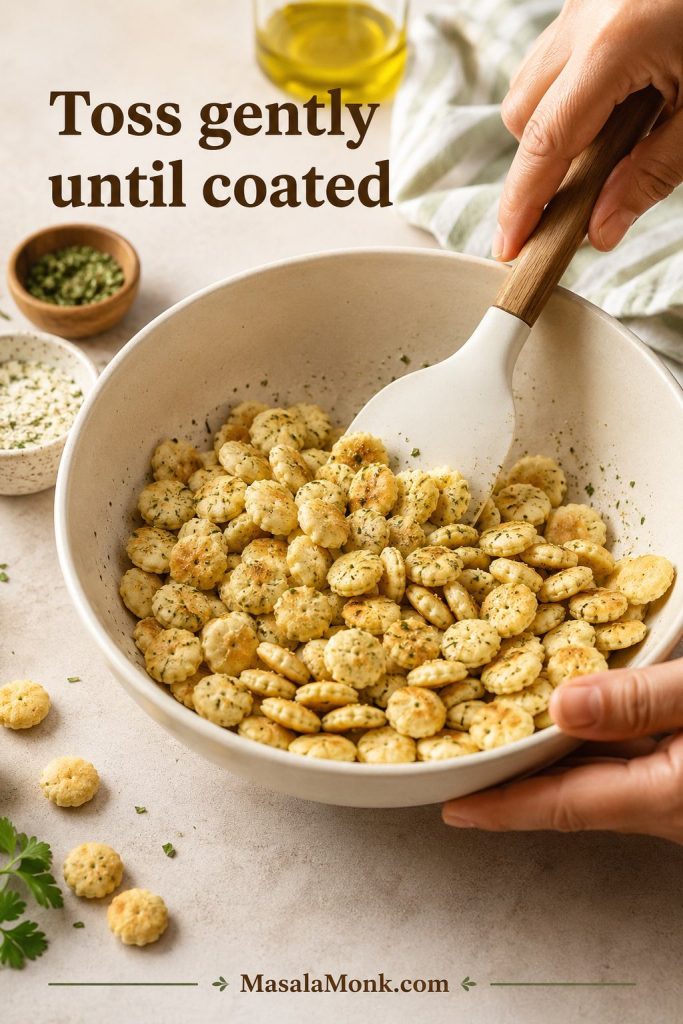
Add the oyster crackers to a large mixing bowl or a gallon zip-top bag. Pour the seasoning oil over them and toss gently until the crackers look evenly coated. A bowl is gentler and reduces breakage. A zip-top bag is faster and less messy, but shake softly rather than crushing the crackers.

Hands gently tossing oyster crackers with ranch seasoning oil in a large cream mixing bowl.
Use a wide bowl and gentle folds so the oyster crackers pick up seasoning without breaking into too many crumbs.

Step 4: Spread on a rimmed baking sheet

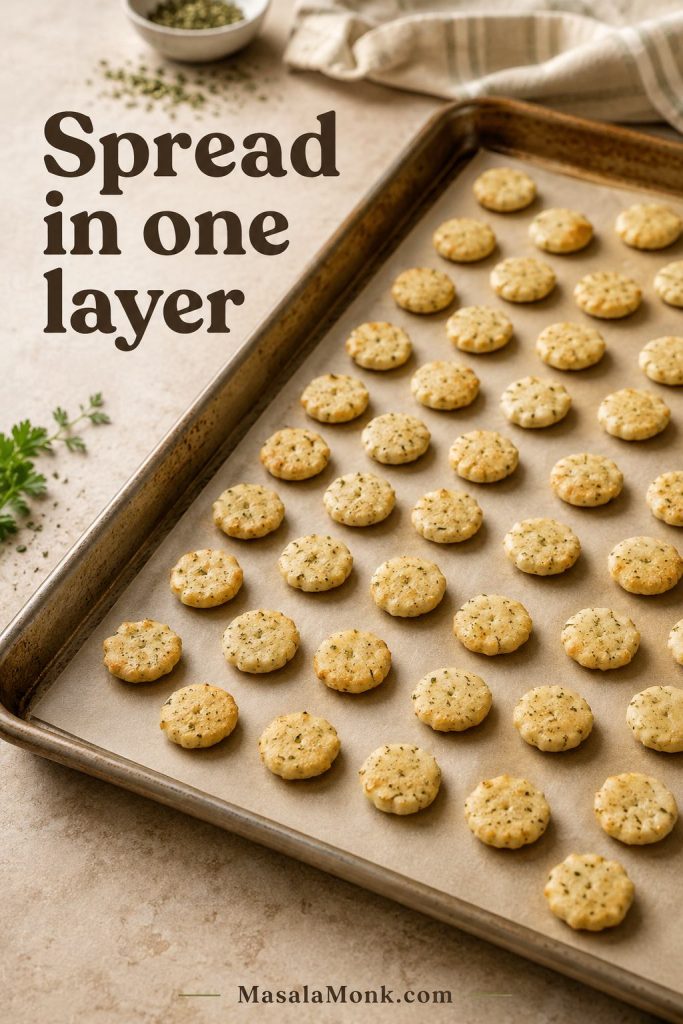
Spread the crackers on a rimmed baking sheet in as even a layer as possible. Parchment makes cleanup easier, and space on the pan helps the coating set evenly.

Ranch oyster crackers spread in a single layer on a parchment-lined rimmed baking sheet.
A single layer gives each cracker space to dry and toast, while crowded spots can stay heavy even after baking.

Step 5: Bake low and stir once

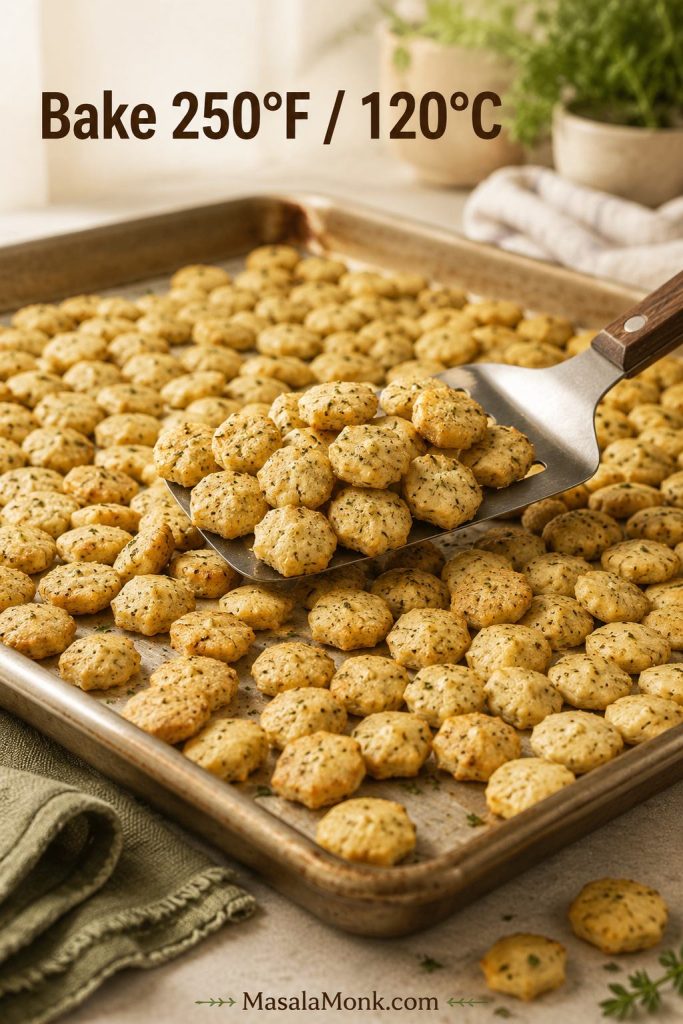
Bake for 18–22 minutes, stirring after about 10 minutes. A smaller or lightly coated batch may be ready closer to 15–18 minutes. A butter-heavy or 16 oz batch may need 20–25 minutes. The crackers should smell toasted and look set rather than wet or shiny.

Baked ranch oyster crackers on a sheet pan with toasted edges, herb flecks, and a spatula lifting some crackers.
The best doneness cue is not deep browning; instead, the crackers should smell toasted and look set, dry, and evenly speckled.

Step 6: Let the crackers cool on the pan

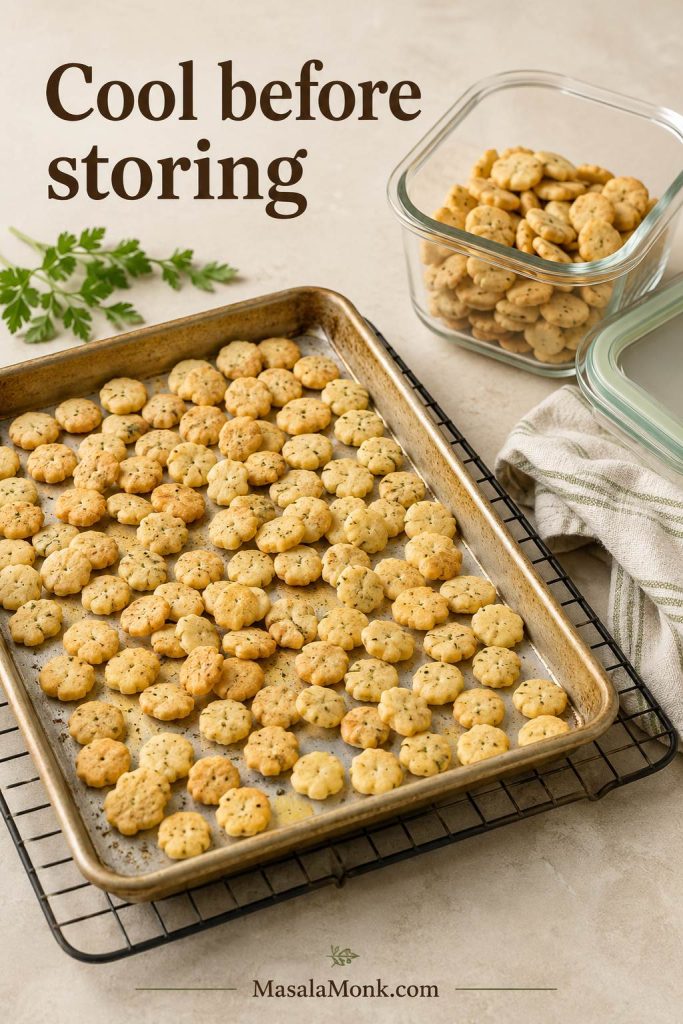
Leave the crackers on the pan until they are no longer warm. Once cooled, they should be evenly seasoned and ready to store.

Ranch oyster crackers cooling on a sheet pan beside an open glass storage container and lid.
Leave the crackers on the pan until the warmth fades, then move them into storage so the finished texture stays clean.

Texture cue: If the crackers still look glossy after baking, give them another 3–5 minutes at the same low temperature. They should look coated, not shiny with oil.

Equipment note: A large bowl is gentler, a zip-top bag coats faster, a rimmed baking sheet keeps the crackers contained, parchment helps cleanup, and a thin spatula makes stirring easier.

Want to skip the oven or use the air fryer instead? Compare the baked, no-bake, and air fryer methods before choosing.

Baked, No-Bake, and Air Fryer Methods

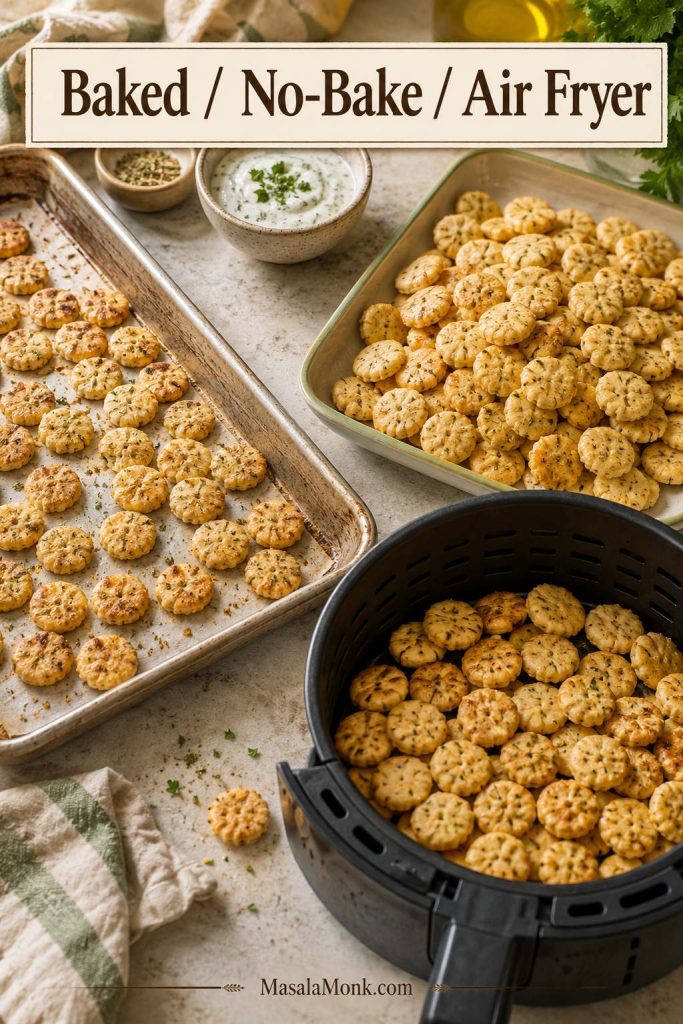
If you want the most reliable crunch, use the oven. No-bake and air-fryer versions are useful when you are short on time, avoiding the oven, or making a small batch. The microwave is included only as a backup.

Baked, no-bake, and air fryer ranch oyster crackers shown with a sheet pan, resting tray, and air fryer basket.
Pick the oven for an even full batch, the air fryer for speed, or the no-bake method when make-ahead ease matters more than maximum crunch.
MethodTimeTextureBest for
Baked18–22 minMost even and snappyMost reliable crunch
No-bake2–4 hours sitting timeGood, but slightly softerNo oven, prep-ahead snack
Air fryer7–10 minVery crisp, small batchesQuick small batch
Microwave backup2–3 minFast but less evenOnly when speed matters most

No-bake version

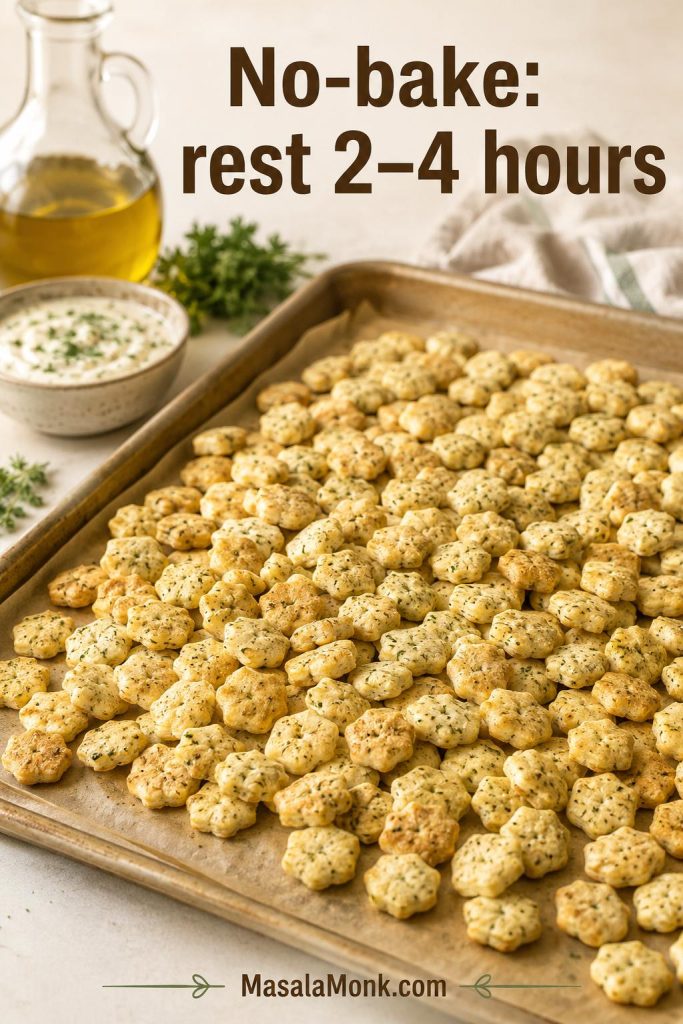
Choose this when you need the snack made ahead and do not mind a slightly softer crunch. Toss the oyster crackers with the seasoned oil, spread them on a sheet pan, and let them sit for 2–4 hours, stirring occasionally. They are ready when the surface no longer feels slick. Oil works better than butter here because it coats without setting up heavy as it cools.

No-bake ranch oyster crackers resting on a sheet pan with oil and seasoning nearby.
The no-bake method needs patience: spreading the crackers out gives the seasoned oil time to settle before serving.

Air fryer version

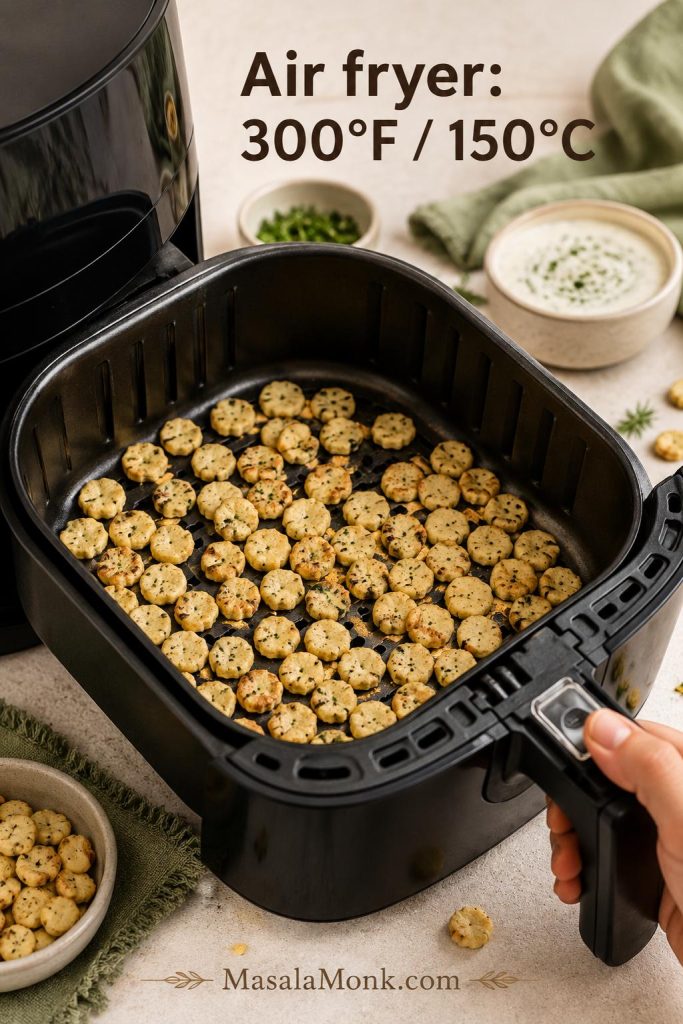
For the air fryer, cook small batches at 300°F / 150°C for 5 minutes, shake the basket, then cook another 2–5 minutes until set and lightly toasted. Air fry only 3–4 cups at a time unless you have a large basket. A little less oil usually works better in smaller baskets.

Ranch oyster crackers cooked in a thin layer inside an air fryer basket.
Keep air fryer batches shallow, because the crackers need moving air around them to toast rather than simply warm through.

If the air fryer is already out, you can keep the same snack-table rhythm going with air fryer chicken wings while the crackers cool.

Microwave backup

The microwave is the fastest backup, not the best texture method. Work in short bursts, then spread the crackers out afterward so steam does not soften them.

Dill or No Dill?

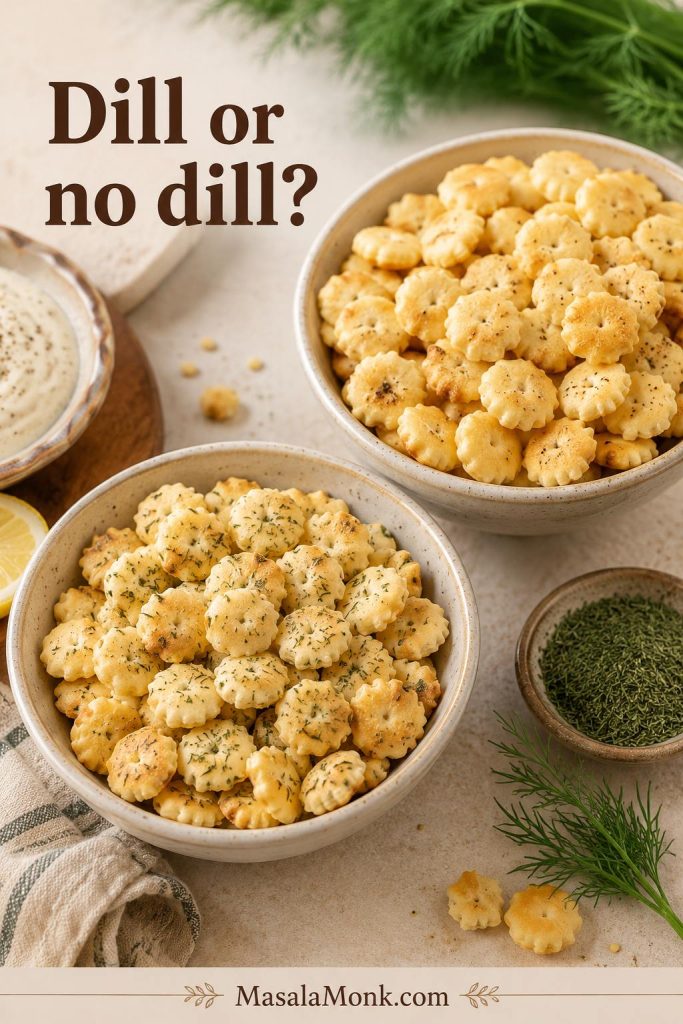
Dill is the old-school choice here. It gives these crackers their classic ranch snack-mix flavor, although the batch still works without it. For 9 oz / 255 g, use about ¾–1 teaspoon; for 12 oz / 340 g, use 1 teaspoon; for 16 oz / 454 g, use 1½–2 teaspoons. If you skip dill, replace it with dried parsley, chives, extra onion powder, or a little more lemon pepper.

Two bowls of ranch oyster crackers comparing a dill-speckled batch with a cleaner no-dill batch.
Dill gives the classic old-school ranch snack flavor, though parsley, chives, onion powder, or extra lemon pepper can still round out the batch.

Flavor Variations

Treat the base recipe like a blank snack mix. Keep the crackers, fat, and low oven steady; change the personality with the seasonings. This is where the batch starts to feel like yours.

Need the base formula first? Jump to the ranch oyster crackers recipe card, then come back and choose a variation.

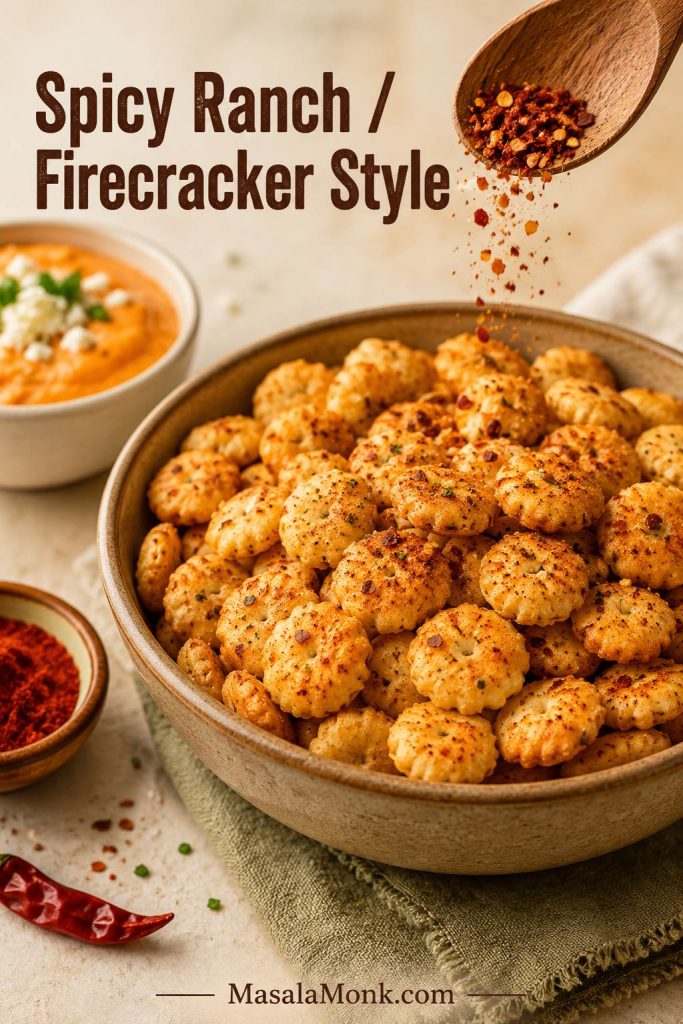
Spicy Ranch Oyster Crackers, or Firecracker Style

Add ¼ teaspoon cayenne for mild heat, ½ teaspoon cayenne for a stronger kick, or 1 tablespoon red pepper flakes for a more obvious spicy snack. Classic firecracker oyster crackers are usually hotter, red-pepper-forward, and more heavily seasoned than regular ranch crackers, so keep them milder here unless you know your crowd wants heat.

For a hotter game-day table, pair the spicy crackers with a scoopable dish like buffalo chicken dip. The crackers are better for topping and nibbling, while sturdier chips or bread can handle the heaviest scoops.

Dry heat is easier than wet hot sauce. Cayenne, smoked paprika, chili powder, and red pepper flakes keep the batch punchy without adding extra moisture.

Spicy ranch firecracker oyster crackers with red pepper flakes, cayenne, and a buffalo-style dip nearby.
For firecracker-style oyster crackers, dry heat such as cayenne and red pepper flakes adds punch without softening the snack.

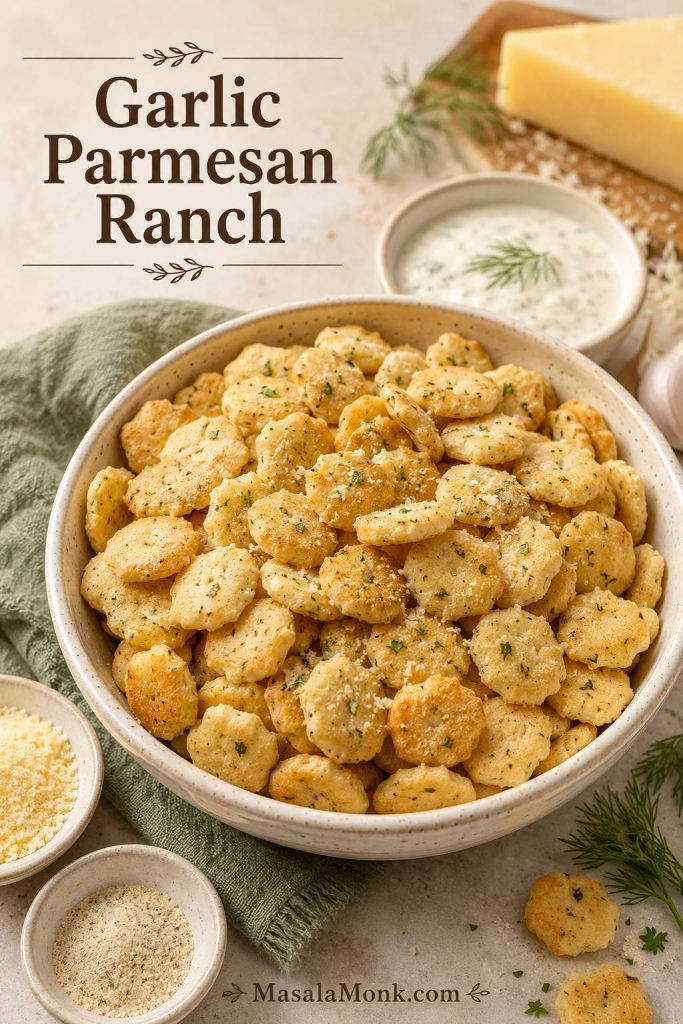
Garlic Parmesan ranch oyster crackers

Add a little extra garlic powder to the seasoning oil. After baking, while the crackers are still warm, toss with finely grated Parmesan and dried parsley. Adding Parmesan after baking keeps the cheese from scorching and gives the crackers a salty, savory finish.

Garlic Parmesan ranch oyster crackers in a bowl with grated Parmesan, garlic powder, parsley, and Parmesan wedge.
Add Parmesan after baking so the cheese stays savory and delicate instead of scorching on the sheet pan.

Lemon pepper ranch oyster crackers

Increase the lemon pepper to 1½ teaspoons for a 12 oz batch. This version is especially good as a soup topping because the citrusy pepper flavor cuts through creamy soups, chowder, and chili. If you like that bright, peppery flavor, it also makes a natural game-day pairing with lemon pepper chicken wings.

Lemon pepper ranch oyster crackers with lemon zest, lemon slice, pepper seasoning, and creamy soup in the background.
Lemon pepper lifts the ranch flavor, making this variation especially useful with creamy soups, chowders, and richer dips.

Taco ranch oyster crackers

Use ranch seasoning plus a small amount of taco seasoning, smoked paprika, and cayenne. Start lightly because taco seasoning can be salty. This version works well for movie-night bowls, game-day spreads, pretzels, corn chips, and roasted nuts.

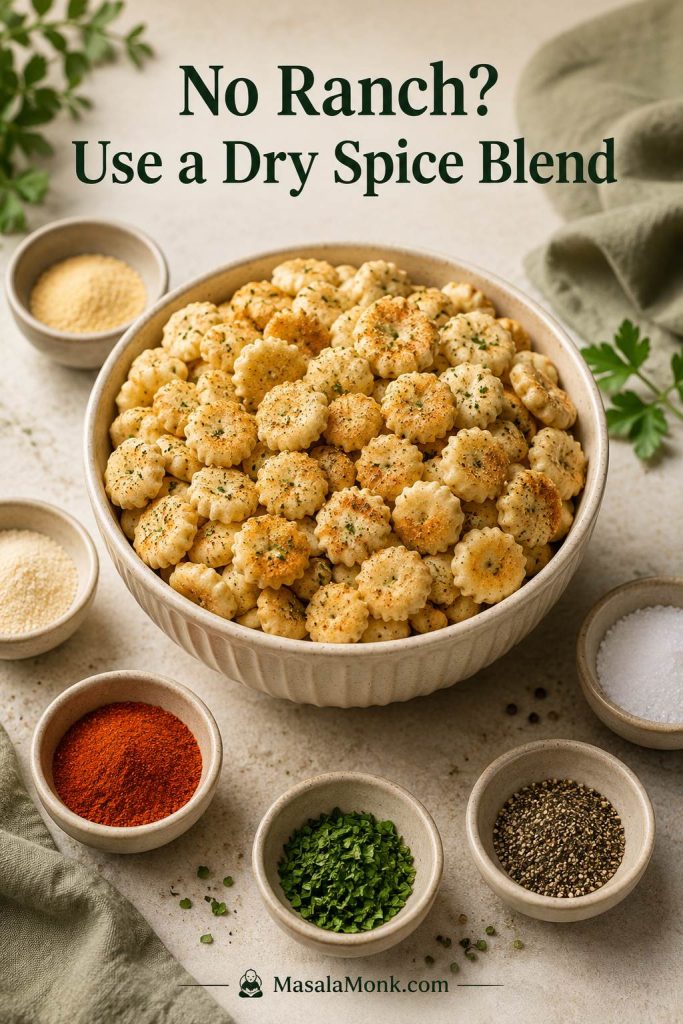
No-ranch seasoned oyster crackers

If you want a ranch-free seasoned oyster cracker batch, keep the same method and use a dry homemade seasoning blend. For 12 oz / 340 g oyster crackers, whisk together:

  • ⅓ cup / 80 ml neutral oil or melted butter
  • 1 teaspoon garlic powder
  • 1 teaspoon onion powder
  • 1 teaspoon dried parsley or Italian seasoning
  • ½ teaspoon dried dill, optional
  • ½ teaspoon smoked paprika or sweet paprika
  • ¼–½ teaspoon fine salt, depending on how salty your crackers are
  • ¼ teaspoon black pepper

Toss with the crackers and bake the same way. If you want a Parmesan version, add finely grated Parmesan after baking while the crackers are still warm.

Seasoned oyster crackers with bowls of paprika, parsley, black pepper, salt, garlic powder, and onion powder.
A ranch-free dry spice blend keeps the same easy method while giving readers a packet-free way to season oyster crackers.

Cinnamon sugar oyster crackers are a separate sweet snack direction. They usually use butter, sugar, cinnamon, and a slightly different baking rhythm, so treat that as its own snack bowl rather than folding it into this ranch version.

How to Serve Ranch Oyster Crackers

Ranch oyster crackers are easy to snack on straight from a bowl, but they are more useful than that. They can act like tiny croutons, party mix, soup crackers, or the salty crunch on a larger appetizer table.

Making them ahead for a party or snack table? Read the storage tips before you seal the batch.

Best Ways to Serve Them

UseHow to serve them
Soup toppingScatter over tomato soup, chowder, potato soup, chicken soup, or a cozy bowl like crock pot lasagna soup. Add them right before eating so the first spoonful is still crunchy.
Chili crunchUse instead of plain crackers for a salty ranch finish.
Party bowlServe in a big bowl with a small scoop or spoon so people can grab handfuls easily.
Snack mixCombine with pretzels, Chex, Goldfish-style crackers, roasted nuts, or mini saltines.
Dip boardUse as one crunchy element beside chips, vegetables, and bread pieces.
Cheese boardPair with a make-ahead cheese ball, cheddar cubes, soft cheese, pickles, and sliced vegetables.
Lunchbox snackPack only once the crackers are dry and no longer warm.
Road-trip snackStore in a zip-top bag or airtight snack container.
Holiday snack jarFill small jars or tins once the crackers have cooled and feel dry to the touch.

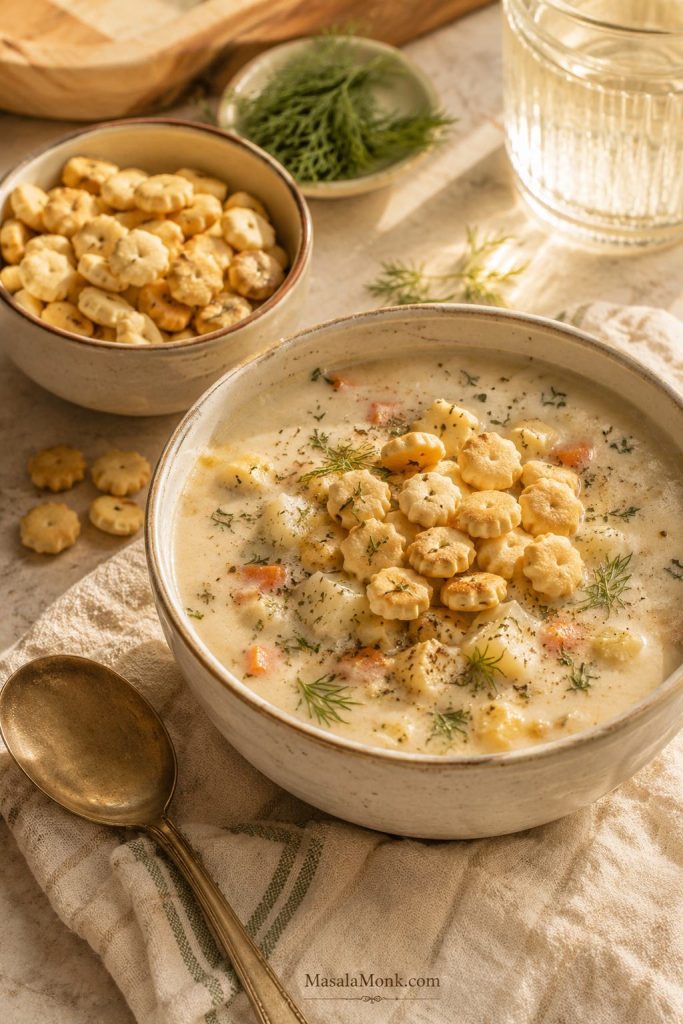
Use Ranch Oyster Crackers as a Soup Topping

For soup, add the crackers right before eating rather than letting them sit in the bowl. That keeps the first spoonful creamy underneath and crunchy on top.

Creamy soup topped with ranch oyster crackers, with extra crackers in a small bowl nearby.
Think of these as tiny ranch croutons: they work especially well on creamy soups where plain crackers can taste flat.

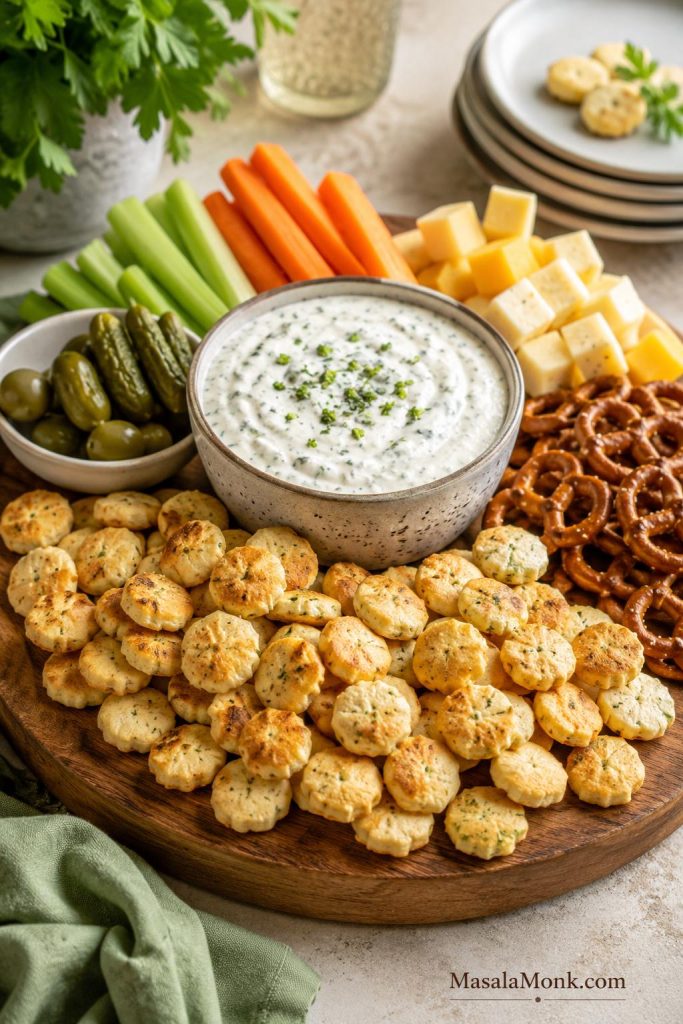
Dip Boards and Appetizer Tables

For a hot appetizer table, set a bowl of these crackers near a bubbling spinach artichoke dip. They are best for nibbling alongside it or sprinkling over individual scoops, while sturdier chips, bread, or vegetables can handle the heaviest dips.

Ranch oyster crackers served on an appetizer board with creamy dip, cheese cubes, carrots, celery, pretzels, pickles, and olives.
On an appetizer board, ranch oyster crackers shine as a nibble or topping, while sturdier chips, bread, and vegetables can handle heavy dips.

They also fit neatly into a larger snack board or casual charcuterie board, especially when you want one seasoned, crunchy element beside cheeses, pickles, fruit, nuts, and plain crackers.

Party Bowl for Game Day and Snack Tables

If you are building a bigger game-day spread, serve them near wings, deviled eggs, cheese cubes, crunchy vegetables, and a few stronger crackers for heavier dips. Oyster crackers are excellent for sprinkling, topping, and casual snacking, but they are not always sturdy enough for very thick dips.

Large bowl of ranch oyster crackers with a scoop, dip, drinks, and party snacks in the background.
A small scoop keeps the party bowl cleaner and makes the crackers easier to serve beside dips, wings, and snack-board extras.

Storage and Make-Ahead Tips

Ranch oyster crackers are a good make-ahead snack as long as they are cool before they go into a container. Once cooled, store them airtight at room temperature and use them within the first several days for the cleanest crunch.

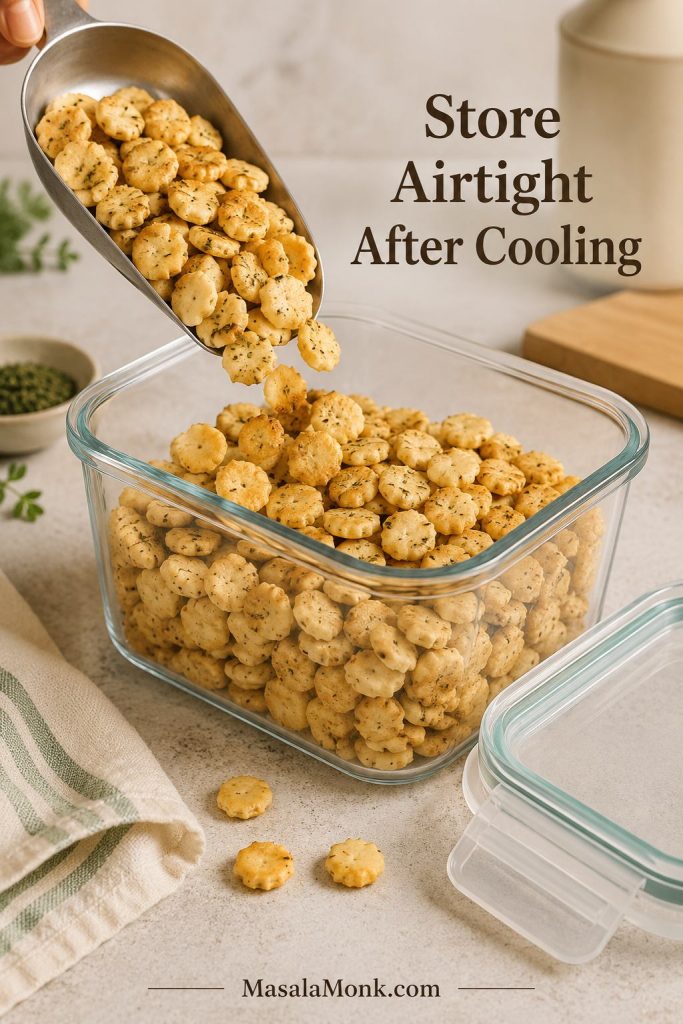
Ranch oyster crackers being poured into an open airtight glass container with the lid nearby.
A wide, airtight container protects the seasoning better than a loose bag when you are making the snack a day ahead.
  • Best storage: Use a sealed container, jar, tin, or zip-top bag.
  • Room temperature only: The fridge can make crackers stale faster.
  • Longer storage: If baked dry and stored airtight, they usually keep about 1 week, depending on humidity and coating.
  • Gift jars: Use only crackers that feel dry to the touch, and never seal them warm.
  • Refresh if needed: Bake at 250°F / 120°C for 5–8 minutes, then cool on the pan again.
  • Freshness check: If they smell stale, taste flat, or feel soft even after refreshing, make a fresh batch.

Gift Jars

For gifting, pack only fully cooled crackers into clean jars or tins. A simple label and tight seal matter more than fancy packaging because the texture is the real gift.

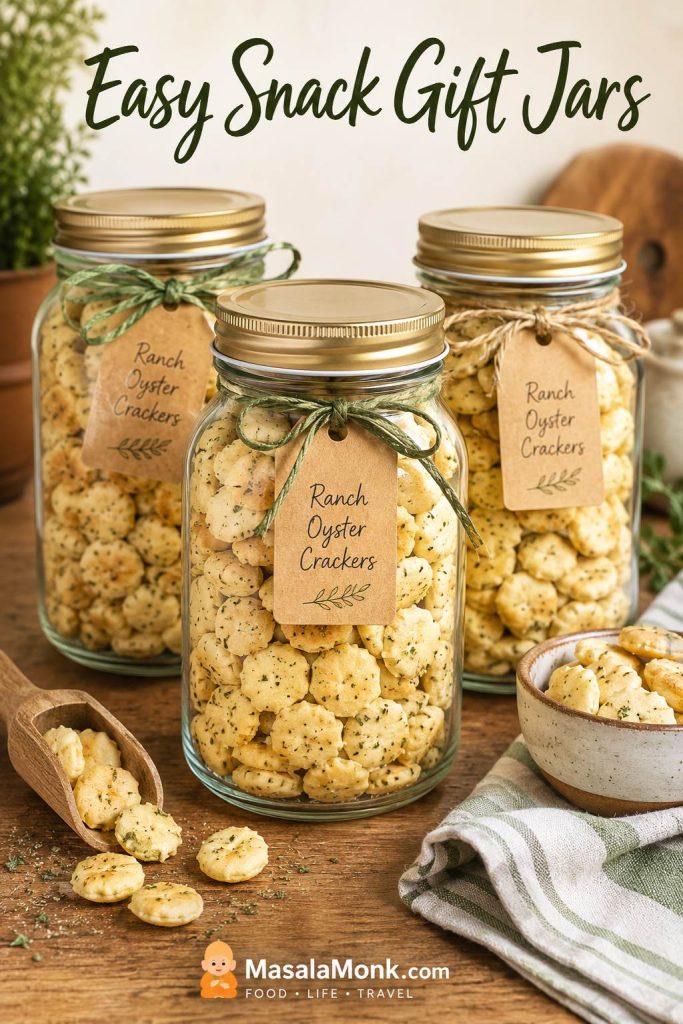
Glass jars filled with ranch oyster crackers, kraft tags, ribbons, scoop, and small bowl of crackers.
For gift jars, leave a little headspace and use a tight lid so the crackers stay neat, crisp, and easy to pour.

They are especially useful because you can make them before people arrive, then put out a bowl when the table still feels like it needs one more salty, crunchy thing.

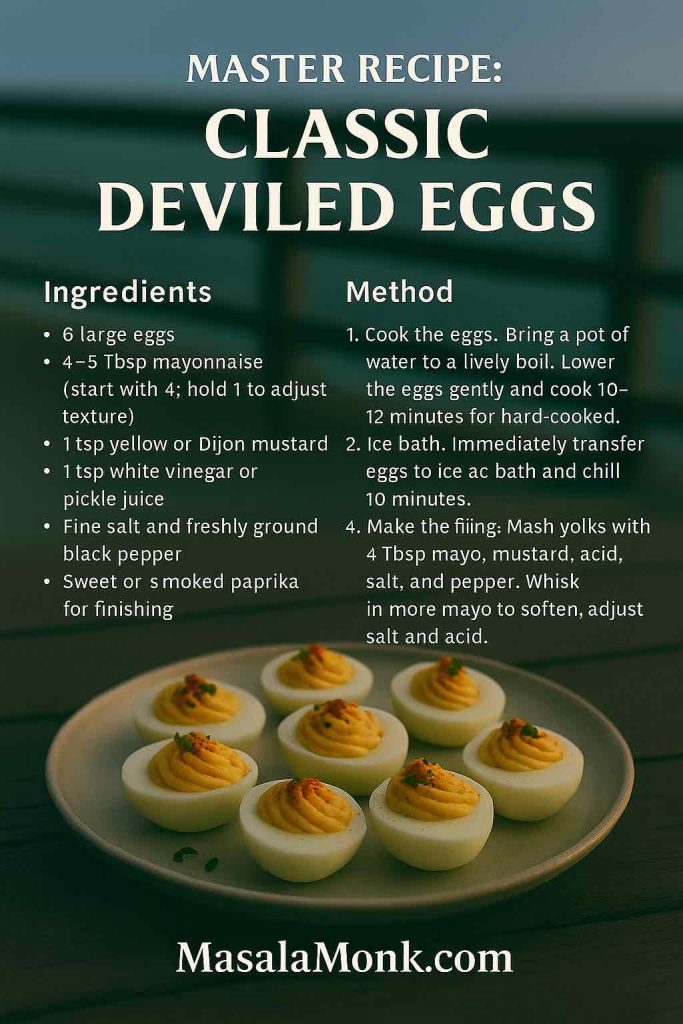
If you are making these for a party, prep one or two other make-ahead bites too. A tray of classic deviled eggs gives the table something creamy and tidy while the crackers bring the crunch.

Freezing is not worth it for most batches. The crackers can pick up moisture and lose their clean crunch, so make them a few days before the party and store them well instead.

If a stored batch turns soft or oily, use the troubleshooting guide before deciding it is a loss.

Troubleshooting the Batch

If a batch does not come out quite right, it is usually one of four things: too much fat, too much salt, not enough baking time, or uneven coating. The good news is that many batches can be saved, especially if the flavor is right but the texture is off.

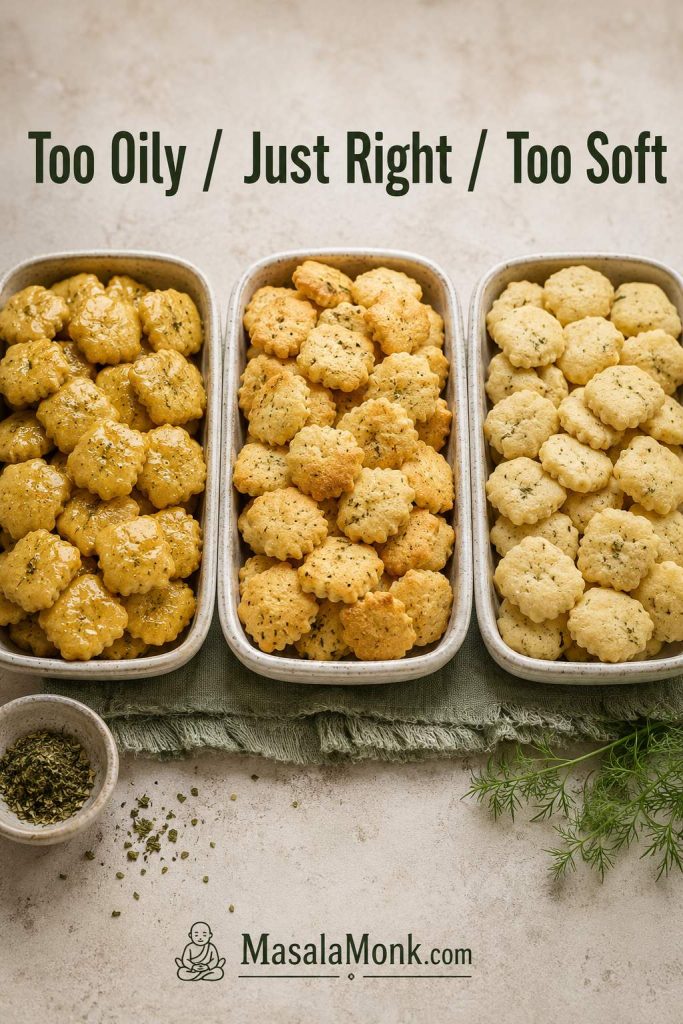
Three trays of ranch oyster crackers showing too oily, just right, and too soft textures.
Use the texture as your guide: shiny crackers need more drying time, pale crackers may need better mixing, and the ideal batch looks evenly coated.

Common Problems and Fixes

ProblemWhy it happenedFix nowFix next time
Greasy crackersToo much oil or butter, or not baked long enoughSpread on a pan and bake 5–8 minutes more at 250°F / 120°CUse less fat and spread in one layer
Soggy crackersBottled ranch dressing, too much fat, or stored while warmBake low until dry, then let the tray coolUse dry ranch mix only and wait until the crackers are no longer warm before storing
Too saltyFull packet plus salty crackers, ranch dip mix, or salty add-insAdd more plain crackers and toss; if you do not have extra crackers, mix the batch into unsalted pretzels or plain cerealStart with ¾ packet or fewer salty extras
BlandToo many crackers or too little seasoningDust while warm on the tray, then let cool before storingUse the ratio table and taste your seasoning mix
Seasoning clumpedDry powder hit oily crackers unevenlyToss longer, break up clumps gently, and add a handful of plain crackers if some bites are too saltyWhisk seasoning into oil before adding to crackers
Burnt edgesOven too hot, thin pan, or not stirredRemove dark pieces before they flavor the batchUse 250°F / 120°C and stir halfway
Crackers brokeBag shaken too hard or crackers were fragileUse broken pieces as soup toppingToss in a bowl with a spatula instead of shaking hard
Soft after storageStored warm, humid room, or container not airtightRe-crisp at 250°F / 120°C for 5–8 minutesCool on the pan and store airtight

Fix Greasy Crackers

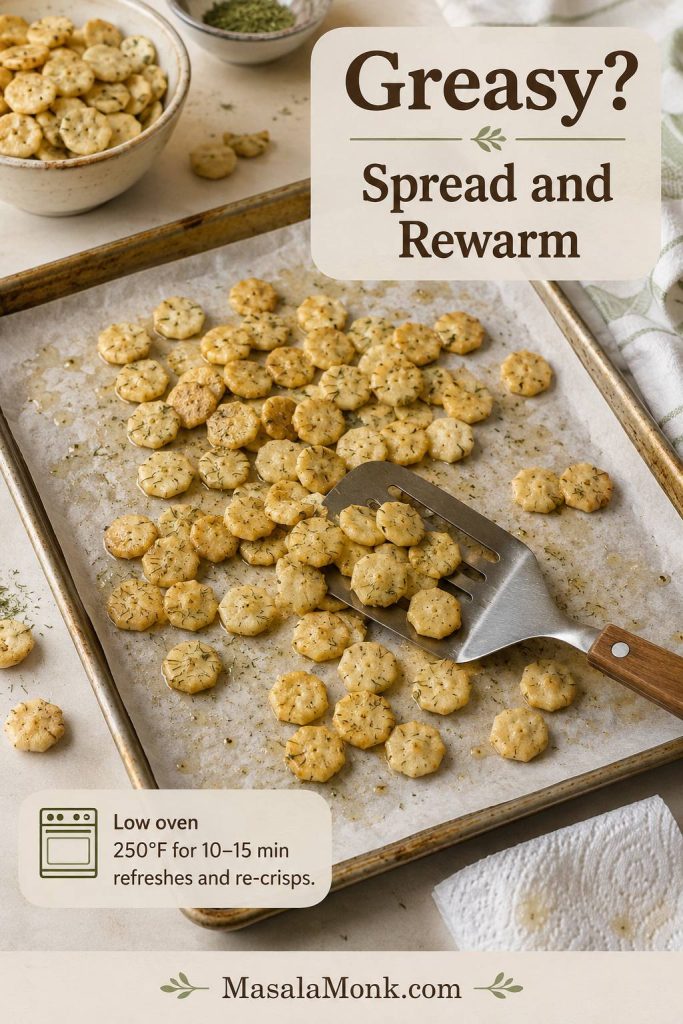
If the flavor is good but the crackers feel slick, spread them back onto a pan and warm them gently. This gives the extra coating a chance to settle instead of sitting on the surface.

Greasy ranch oyster crackers spread on a parchment-lined baking sheet with a spatula and paper towel nearby.
Use low heat for a greasy batch; the goal is to dry the surface gently, not brown the crackers further.

Too Salty? Stretch the Batch

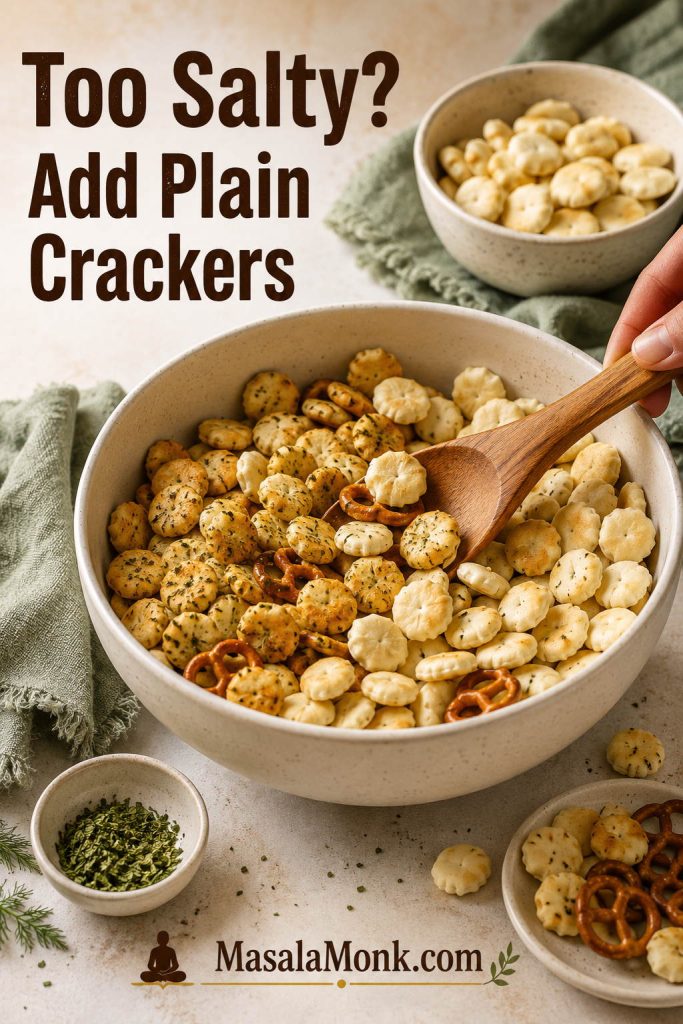
If the seasoning tastes too strong, stretch the batch with plain crackers, pretzels, or unsalted cereal. Diluting the coating is usually better than trying to scrape seasoning off.

Seasoned ranch oyster crackers mixed with plain crackers and pretzels in a bowl to reduce saltiness.
When ranch oyster crackers taste too salty, stretch the seasoning with plain crackers, pretzels, or cereal instead of tossing the batch.

Use Broken Crackers as Soup Topping

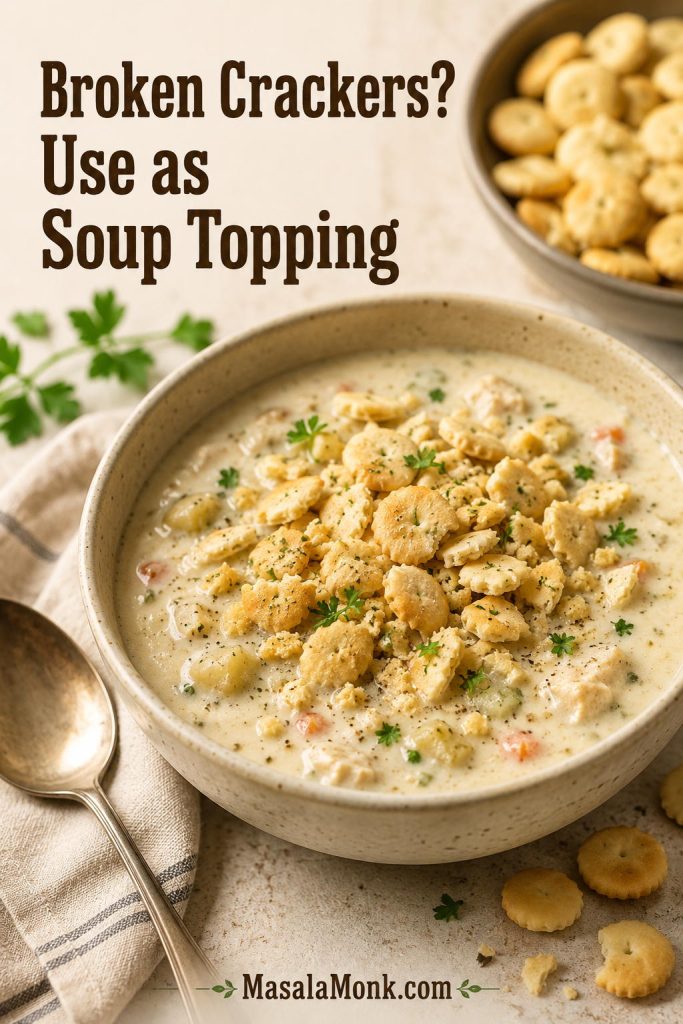
The most reassuring part: even imperfect batches rarely go to waste. If the flavor is good, the broken, softer, or extra-seasoned crackers can still become excellent soup toppers.

Broken ranch oyster crackers sprinkled over creamy soup with whole crackers and a spoon nearby.
Broken pieces still bring crunch and ranch flavor, so save them for soup instead of reserving only the perfect whole crackers.

Ranch Oyster Crackers Recipe

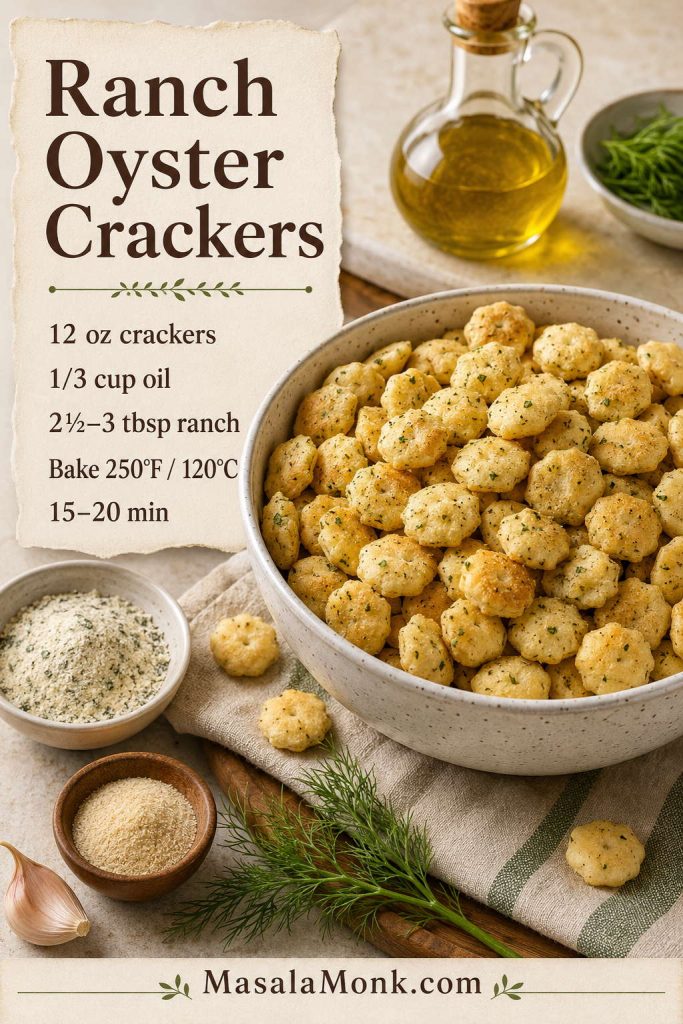
These baked ranch oyster crackers make about 5½–6 cups of crisp, savory snack crackers for soup, parties, road trips, and make-ahead appetizer bowls.

Saveable recipe card with ranch oyster crackers, oil, dry ranch seasoning, garlic powder, dill, and bake time.
Use this base formula as your starting point, then adjust future batches with more dill, butter, heat, Parmesan, or a ranch-free spice blend.
Prep Time5 minutes
Cook Time18–22 minutes
Total Time25–30 minutes
YieldAbout 5½–6 cups / 8–10 snack servings

Equipment: Large bowl or gallon zip-top bag, small bowl or measuring cup, rimmed baking sheet, parchment paper, and a spatula.

Ingredients

  • 12 oz / 340 g oyster crackers, about 5½–6 cups depending on brand
  • ⅓ cup / 80 ml neutral oil, such as canola, vegetable, or avocado oil
  • 2½ tablespoons dry ranch seasoning for balanced flavor, or up to 3 tablespoons for a bolder batch
  • 1 teaspoon dried dill
  • ½ teaspoon garlic powder
  • ½–1 teaspoon lemon pepper
  • ½ teaspoon onion powder, optional
  • ¼ teaspoon smoked paprika or cayenne, optional

Instructions

  1. Heat the oven to 250°F / 120°C. Line a rimmed baking sheet with parchment if you want easier cleanup.
  2. In a small bowl or measuring cup, whisk together the oil, ranch seasoning, dried dill, garlic powder, lemon pepper, and any optional onion powder, smoked paprika, or cayenne.
  3. Add the oyster crackers to a large mixing bowl or gallon zip-top bag. Pour the seasoning oil over the crackers.
  4. Toss gently until the crackers are evenly coated.
  5. Spread the crackers in a single layer on the prepared baking sheet.
  6. Bake for 18–22 minutes, stirring after about 10 minutes, until the crackers smell toasted and look dry rather than glossy.
  7. Let the crackers cool on the pan before serving or storing.

Notes

  • For a 9 oz / 255 g bag, use 2 tablespoons ranch seasoning for mild flavor or 2½–3 tablespoons for bold flavor. Use ¼ cup oil for a lighter coating, or ⅓ cup oil / 5 tablespoons melted butter for a richer snack.
  • For a 16 oz / 454 g bag, use ½ cup oil and about 3 tablespoons ranch seasoning, or most/all of a standard 1 oz / 28 g packet adjusted for saltiness.
  • For a butter version, use up to ½ cup / 113 g melted unsalted butter instead of oil.
  • Dry ranch mix gives the crispest coating; bottled dressing softens the crackers.
  • If the crackers need more flavor, dust them while warm on the tray.

Ranch Oyster Crackers FAQs

Can I use bottled ranch dressing instead of dry ranch mix?

Skip bottled ranch for this recipe. Dry ranch mix gives you the ranch flavor without adding the moisture that makes crackers soften.

How much ranch seasoning is in one packet?

Many packets are about 1 oz / 28 g, but the tablespoon amount can vary. For a 12 oz bag, 2½ tablespoons is balanced and 3 tablespoons gives a bolder snack-bowl flavor.

Can I use ranch dip mix instead of ranch dressing mix?

Yes, with a light hand. Dip mix can taste saltier or stronger, so start with a little less and add more after baking if the crackers need it.

Do I have to use a specific brand?

No. Store-brand ranch seasoning, shaker seasoning, classic packets, or homemade dry ranch-style seasoning can all work. The salt level matters more than the label.
Do they have to be baked?

Not always. Baking gives the snappiest batch, but the no-bake method works when you have time to let the crackers sit for a few hours.

Can I skip the dill?

Yes. Dill gives the old-school ranch-snack flavor, but parsley, chives, onion powder, or extra lemon pepper can take its place.

Is butter better than oil?

Choose butter for richer flavor and oil for a lighter crunch. For make-ahead batches, oil is the safer default because it stays cleaner and less heavy.

Why are mine greasy?

They can usually be rescued. Spread them out and bake at 250°F / 120°C for another 5–8 minutes so the coating has time to settle.

How long do they stay fresh?

They are best in the first several days. If baked dry, cooled fully, and stored airtight, they usually keep about a week.

Can I make them in the air fryer?

Yes. Cook a small batch at 300°F / 150°C for 5 minutes, shake, then cook another 2–5 minutes. Give the crackers room in the basket so they toast evenly.

Can I turn them into snack mix?

Absolutely. Once the crackers are baked and cool, fold them into pretzels, Chex-style cereal, cheese crackers, roasted nuts, or mini saltines.

Can I use another cracker?

Yes — just watch the timing. Mini saltines, small pretzels, Chex-style cereal, cheese crackers, and Goldfish-style crackers can all brown or dry at different speeds.

Are oyster crackers made with oysters?

Usually, no. They are small soup crackers traditionally served with oyster stew and chowder. Always check the package if you have allergy concerns.

Can I make them ahead?

Yes. Make them a day or two ahead, cool them fully, and store airtight at room temperature. Re-crisp at 250°F / 120°C for 5–8 minutes if needed.

Final Bite

Once the ratio makes sense, this becomes one of those repeat snacks you barely need to think about. It can sit beside soup on a quiet night, fill the extra bowl on an appetizer table, travel in a road-trip bag, or turn into a holiday jar without much work.
Make them once as written, then adjust the next batch to fit your table: extra dill for the old-school version, cayenne for the spicy bowl, Parmesan for a savory finish, or a no-ranch blend when you want something more homemade. However you season them, the job is the same: give soup a little crunch, give the snack table one more reason to linger, and make sure the bowl empties before anyone quite notices.

Final serving bowl of ranch oyster crackers with a wooden scoop, creamy soup, butter, herbs, and soft green linen.
Serve the finished bowl near something creamy or soft, and the tiny crackers bring the salty crunch that makes the table feel complete.

Back to top

Posted on 1 Comment

Easy Cheese Ball Recipe

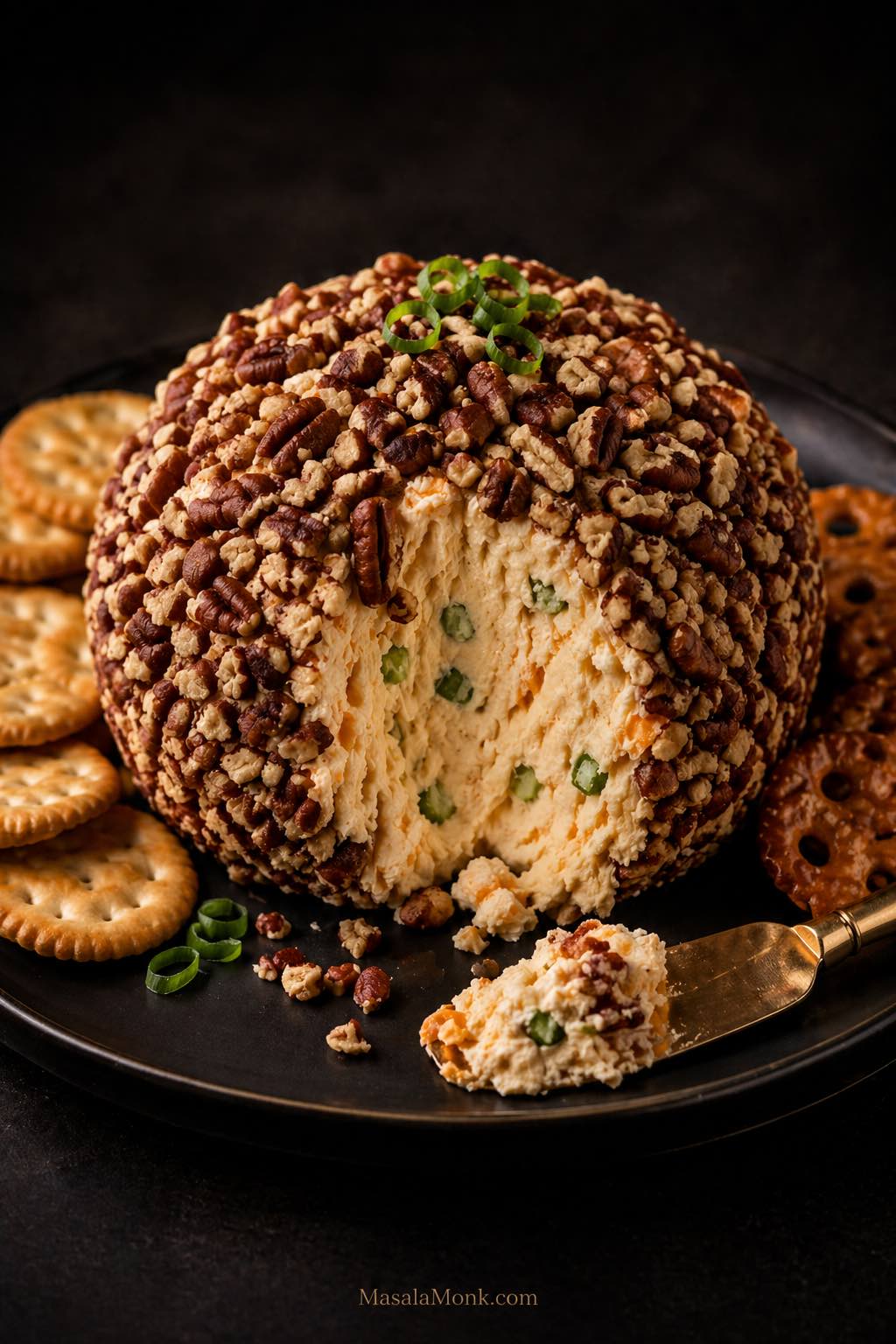
Close-up of a pecan-coated cheese ball on a dark plate with round crackers and a spreader, with a scoop taken out to show the creamy cheddar and green onion filling inside.

This easy cheese ball recipe is the classic no-cook party appetizer you want when you need something creamy, savory, make-ahead friendly, and reliable. It starts with cream cheese, sharp cheddar, green onion, simple seasonings, and a crunchy pecan coating, then chills into a firm but spreadable ball that works with crackers, pretzels, vegetables, holiday boards, game day snacks, and party platters.

A good cheese ball should not taste like plain cream cheese with nuts stuck to the outside. Instead, the filling should be creamy, savory, a little sharp from the cheddar, fresh from the green onion, and easy to scoop once it softens slightly on the platter. Since the base recipe is simple, you can also turn the same cheese mixture into a bacon ranch cheese ball, dried beef cheese ball, pineapple cheese ball, cranberry pecan cheese ball, mini cheese ball bites, cheese ball dip, or a no-nut version without starting over.

This is the chilled cream cheese appetizer, not the crispy fried snack. If you are looking for hot, fried cheese balls with an Indian-inspired flavor profile, MasalaMonk already has a guide to crispy Indian-inspired cheese balls. Here, we are making the classic cheese ball served with crackers, vegetables, and party boards.

Active prep is only about 15 minutes. The rest of the time is chilling, which makes this an easy make-ahead appetizer rather than a last-minute kitchen project.

Quick Answer: What Is a Cheese Ball?

A cheese ball is a chilled, spreadable appetizer made with cream cheese, shredded cheese, seasonings, and an outer coating such as chopped pecans, walnuts, herbs, bacon, crushed pretzels, or dried cranberries. Once the filling is mixed, it is shaped into a ball, chilled until firm, rolled in the coating, and served with crackers, vegetables, pretzels, crostini, or a party board.

Unlike fried cheese balls, this version is creamy, cold, and spreadable rather than hot, breaded, or crisp. First, the cream cheese makes it smooth. Then, the cheddar gives it sharper flavor, the seasonings keep it from tasting flat, and the coating adds crunch and color. After chilling, the ball should hold its shape on the platter; however, this recipe should still soften enough to spread after 15 to 20 minutes at room temperature.

Quick answer: Mix 16 oz / 450 g softened cream cheese with 1½ to 2 cups / 170 to 225 g shredded cheddar, green onion, Worcestershire sauce, garlic powder, onion powder, and black pepper. Then shape, chill for 1 to 2 hours, and roll in chopped pecans, herbs, bacon, pretzels, or another coating.
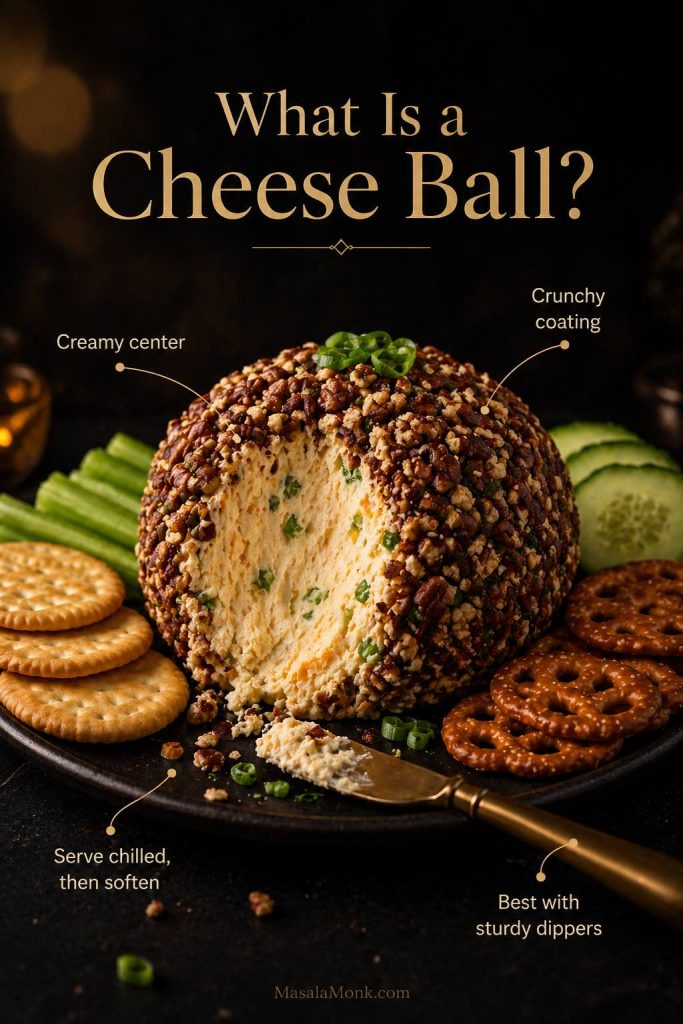
Annotated guide showing a finished cheese ball with crackers, celery, cucumber, pretzel crisps, and a spreader, with labels noting the creamy center, crunchy coating, chilled serving style, and sturdy dippers.
A cheese ball is a chilled, spreadable appetizer with a creamy center and a textured outer coating. Because it is easier to serve once slightly softened, sturdy dippers like crackers, pretzel crisps, and crisp vegetables work especially well.

Cheese Ball Ingredients at a Glance

If you only remember one thing, remember this: cream cheese gives the ball body, cheddar gives this recipe sharper flavor, seasonings make it taste complete, and the coating makes it party-ready. Once those jobs are clear, it becomes much easier to adjust the recipe without making the filling too soft, salty, or bland.

Ingredient What It Does Best Tip
Cream cheese Creamy base and structure Use softened block-style cream cheese, not melted cream cheese
Sharp cheddar Real cheese flavor Freshly shredded cheddar blends best, although pre-shredded works in a pinch
Green onion Freshness and mild onion bite Slice it finely so every bite gets a little
Worcestershire sauce Savory depth Start with 1 teaspoon / 5 ml, then taste before adding more
Garlic and onion powder Even seasoning Use powders because they spread smoothly through the cream cheese
Pecans, herbs, bacon, or pretzels Crunch, color, and finish Roll the cheese ball in crunchy coatings close to serving
Ingredient guide for a cheese ball recipe showing cream cheese, shredded sharp cheddar, green onions, Worcestershire sauce, garlic powder, onion powder, black pepper, chopped pecans, herbs, and optional bacon arranged on a dark background.
The base of a classic cheese ball recipe is simple, but each ingredient has a job. Cream cheese gives structure, sharp cheddar adds flavor, Worcestershire brings savory depth, and pecans or herbs finish the outside with crunch and contrast.

How to Make a Cheese Ball

The method is easy, but the order matters. First, beat the cream cheese until smooth. Next, mix in the flavorings, shape the filling before it gets too warm, chill until firm, and add the coating close enough to serving that it stays fresh. That way, the cheese ball recipe stays simple without turning soft, lumpy, or messy.

Six-step visual guide showing how to make a cheese ball: soften cream cheese, mix in cheddar and seasonings, shape into a ball, chill until firm, roll in coating, and serve with crackers.
How to make a cheese ball is easier than it looks: soften, mix, shape, chill, coat, and serve. Most important, do not skip the chilling step, because that is what helps the cheese ball hold its shape and coat cleanly.

Step 1: Soften the Cream Cheese

Start with softened cream cheese. Leave it at room temperature until it is easy to press with a spoon. If the cream cheese is too cold, it will not mix smoothly. If it is melted, the filling may become loose and harder to shape. For that reason, softened but still-cool cream cheese gives you the best balance.

Step 2: Mix the Filling

Beat the cream cheese until smooth. Then mix in shredded cheddar, green onion, Worcestershire sauce, garlic powder, onion powder, black pepper, and any add-ins. Scrape the bowl well so the seasoning is evenly spread through the filling.

Before shaping, taste the mixture. It should taste slightly bold because crackers and vegetables will soften the flavor. If it tastes flat, add a little more green onion, black pepper, garlic powder, onion powder, or Worcestershire sauce. At this stage, the recipe is easier to fix because the cheese has not yet been shaped into a ball.

Step 3: Shape and Chill

Spoon the filling onto a large piece of plastic wrap or parchment. Then, gather the wrap around the mixture and shape it into a ball. It does not need to be perfect yet because chilling will make it easier to smooth and coat. After the first chill, you can gently reshape it if needed.

Refrigerate for at least 1 hour. For a cleaner shape, chill for 2 hours. If you are making the cheese ball ahead, stop here and keep it wrapped until the day you plan to serve it.

Step 4: Roll in the Coating

Spread chopped pecans, herbs, bacon, pretzels, or your chosen coating on a plate. After that, unwrap the chilled cheese ball, then roll and press it gently into the coating until the outside is covered.

Nuts hold up better than most coatings. However, bacon, pretzels, crackers, and fresh herbs are best added closer to serving. That keeps the outside crisp, fresh, and more appetizing. The cheese ball also looks cleaner when the final coating is added after the recipe has had time to chill.

Step 5: Serve Slightly Softened

A cheese ball is usually too firm right from the refrigerator. So, let it sit for 15 to 20 minutes before serving so it becomes easier to spread. It should soften slightly, but it should not sit out for the entire party. Instead, serve it in a planned window and keep extra portions chilled if the gathering will last longer.

Texture target: Before chilling, the mixture should look thick, creamy, and scoopable. It should not be runny, greasy, or crumbly. After chilling, it should be firm enough to roll in coating, but it should still soften enough to spread after 15 to 20 minutes at room temperature. If it feels loose before chilling, add a little more cheddar; if it feels dry, let it rest briefly and mix again.

Easy Cheese Ball Recipe

Easy Cheese Ball Recipe with Cream Cheese

This classic cheese ball recipe is creamy, savory, make-ahead friendly, and perfect with crackers, vegetables, pretzels, and party boards.

YieldAbout 3 to 3½ cups
Servings16 to 20 appetizer servings
Prep Time15 minutes
Chill Time1 to 2 hours
Total Time1 hour 15 minutes to 2 hours 15 minutes
Cook Time0 minutes

Ingredients

  • 16 oz / 450 g cream cheese, softened
  • 1½ to 2 cups / about 170 to 225 g shredded sharp cheddar cheese
  • 2 to 3 green onions, finely sliced, about 20 to 30 g
  • 1 teaspoon / 5 ml Worcestershire sauce
  • ½ teaspoon garlic powder
  • ½ teaspoon onion powder
  • ¼ teaspoon black pepper
  • Pinch of salt, only if needed

For the Coating

  • ¾ to 1 cup / about 85 to 115 g finely chopped pecans or walnuts
  • 2 tablespoons chopped parsley, chives, or green onion
  • Optional: ¼ to ½ cup / about 25 to 50 g cooked crumbled bacon

Instructions

  1. Add softened cream cheese to a mixing bowl and beat until smooth
  2. Add shredded cheddar, green onion, Worcestershire sauce, garlic powder, onion powder, black pepper, and a small pinch of salt if needed
  3. Mix until evenly combined, then taste and adjust the seasoning before shaping
  4. Spoon the mixture onto plastic wrap or parchment and shape it into a ball
  5. Wrap tightly and refrigerate for at least 1 hour, or 2 hours for a firmer, cleaner shape
  6. Spread chopped pecans, herbs, and optional bacon on a plate
  7. Unwrap the chilled cheese ball and roll it in the coating, pressing gently so the outside is covered
  8. Let it sit for 15 to 20 minutes before serving with crackers, pretzels, vegetables, or crostini

Recipe Notes

  • Taste the filling before shaping. It should taste slightly bold because crackers, vegetables, and pretzels soften the flavor once served
  • For a softer spread, use 1½ cups / 170 g cheddar instead of 2 cups / 225 g
  • For a firmer cheese ball, chill longer or mix in a little more shredded cheddar
  • For a no-nut cheese ball, coat it with herbs, bacon, crushed pretzels, crushed crackers, everything seasoning, or toasted breadcrumbs
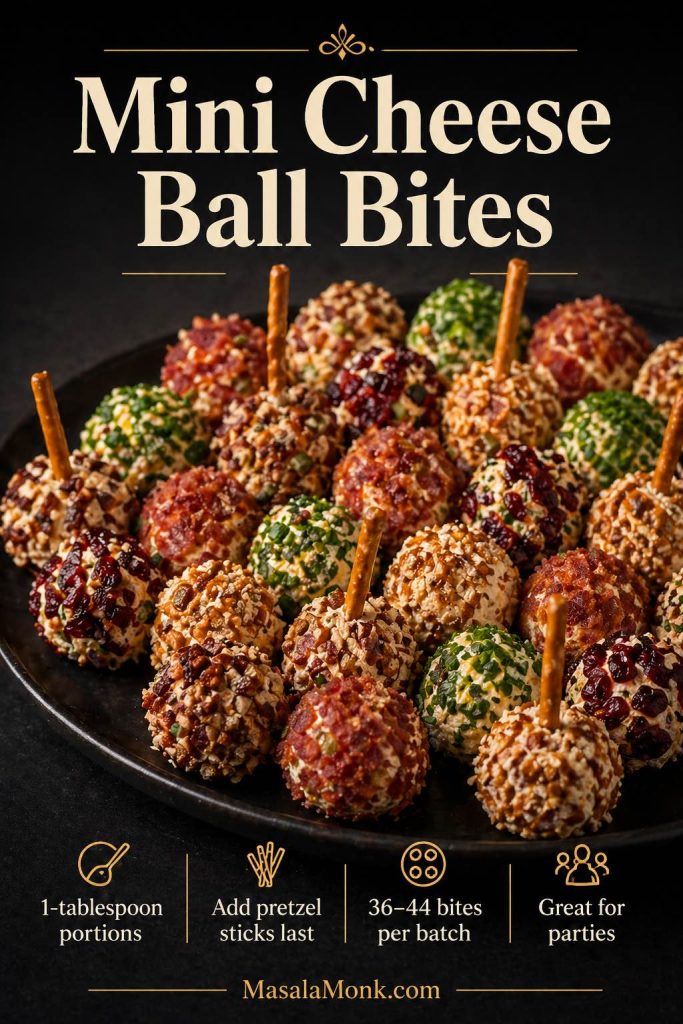
  • For mini cheese ball bites, chill the mixture, scoop into 1-tablespoon portions, roll each one in coating, and add pretzel sticks right before serving
Recipe card graphic for an easy cheese ball recipe with a photo of the finished cheese ball, yield and timing details, an ingredient list including cream cheese, sharp cheddar, green onions, Worcestershire, seasonings, and pecans, plus a short method.
This easy cheese ball recipe uses a classic formula: cream cheese, sharp cheddar, green onions, Worcestershire, simple seasonings, and chopped pecans. Since it is make-ahead friendly, it is a strong choice for holidays, parties, and snack boards.

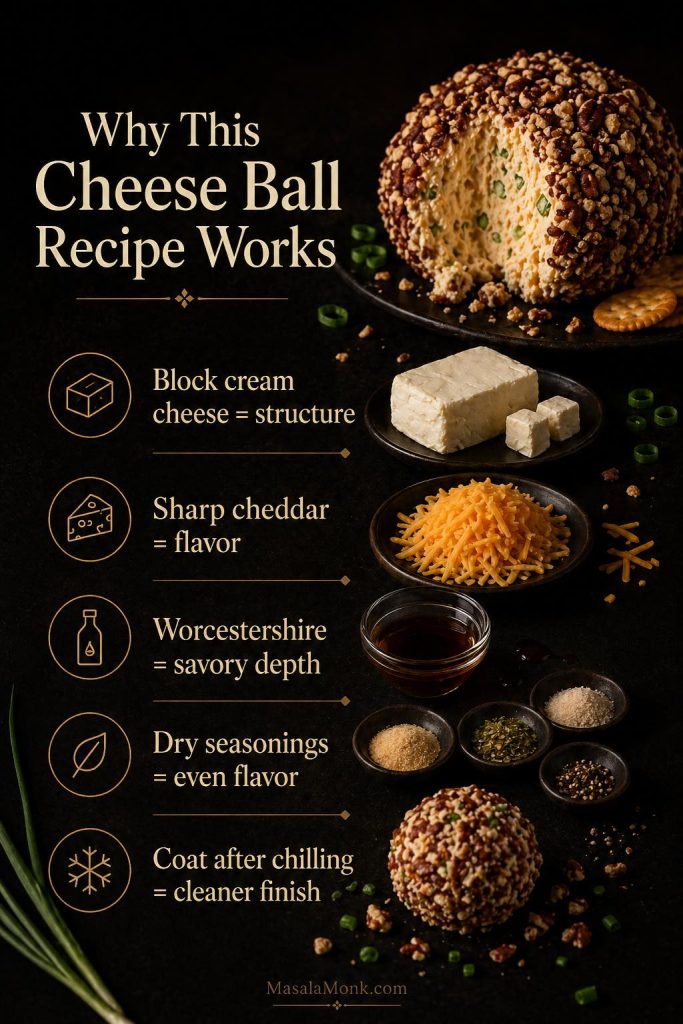
Why This Cheese Ball Recipe Works

This cheese ball recipe works because it keeps the base firm, flavorful, and easy to spread. Instead of adding too many wet ingredients, it uses full-fat block cream cheese for structure, sharp cheddar for stronger cheese flavor, and dry seasonings that blend smoothly through the filling.

Also, the coating goes on after the ball has chilled. That timing matters because the outside stays cleaner, the nuts or herbs stick better, and the finished appetizer looks fresher on the platter. That way, the cheese ball stays make-ahead friendly without tasting flat or turning messy.

Recipe Choice Why It Helps
Full-fat block cream cheese Firms up enough to shape into a ball
Sharp cheddar Adds enough flavor to stand up to crackers and vegetables
Garlic powder and onion powder Season evenly without harsh raw pieces
Worcestershire sauce Adds savory depth so the filling does not taste one-note
Coating after chilling Keeps the outside fresher, cleaner, and crunchier
Explainer board showing why a cheese ball recipe works, with callouts for block cream cheese for structure, sharp cheddar for flavor, Worcestershire for savory depth, dry seasonings for even flavor, and coating after chilling for a cleaner finish.
A good cheese ball recipe works because the structure and flavor stay balanced. Block cream cheese keeps it firm, sharp cheddar keeps it from tasting flat, and coating the ball after chilling helps the outside stay cleaner and more defined.

That is what keeps the recipe flexible without making it vague. You can change the coating, the add-ins, or the serving style, while the cream cheese and cheddar base still keeps the ball structured enough to slice, scoop, and spread.

Cheese Ball Ingredient Notes

The base is simple, but each ingredient matters. Because the recipe is no-cook, the flavor comes from good cheese, proper seasoning, and the contrast between the creamy inside and the textured coating. That is why bland cheese, cold cream cheese, and watery add-ins can make the whole appetizer fall flat.

Cream Cheese

Use full-fat block-style cream cheese for the best structure. Because this is a chilled recipe, the cheese needs to firm up around the ball without turning stiff or crumbly. Block-style cream cheese softens smoothly, firms up well in the refrigerator, and gives the finished cheese ball a rich but spreadable texture. By contrast, whipped cream cheese can make the mixture looser, while cold cream cheese can leave small lumps in the filling.

Let the cream cheese soften at room temperature until it presses easily with a spoon. It should be soft enough to beat, but not melted or greasy. If it melts, the cheese mixture can become loose, and the ball may take much longer to firm up in the refrigerator. On the other hand, if it is too cold, the filling can stay lumpy even after mixing.

If your kitchen is cool, cream cheese may need 45 to 60 minutes to soften. If your kitchen is warm, check it sooner so it softens without turning greasy.

Sharp Cheddar

Sharp cheddar is the easiest choice because it brings more flavor than mild cheddar. Also, it balances the cream cheese, so the finished appetizer tastes like a proper cheddar cheese ball instead of a plain cream cheese spread. For this recipe, the cheese should be bold enough that the ball still tastes savory after it is spread onto crackers.

Whenever possible, shred the cheddar fresh because it blends more smoothly into the cream cheese base. Still, pre-shredded cheddar can work when convenience matters. If the mixture feels dry after using packaged shredded cheese, let it sit for a few minutes and mix again before shaping. In practice, the recipe is forgiving as long as the cheese tastes bold and the ball still holds together after chilling.

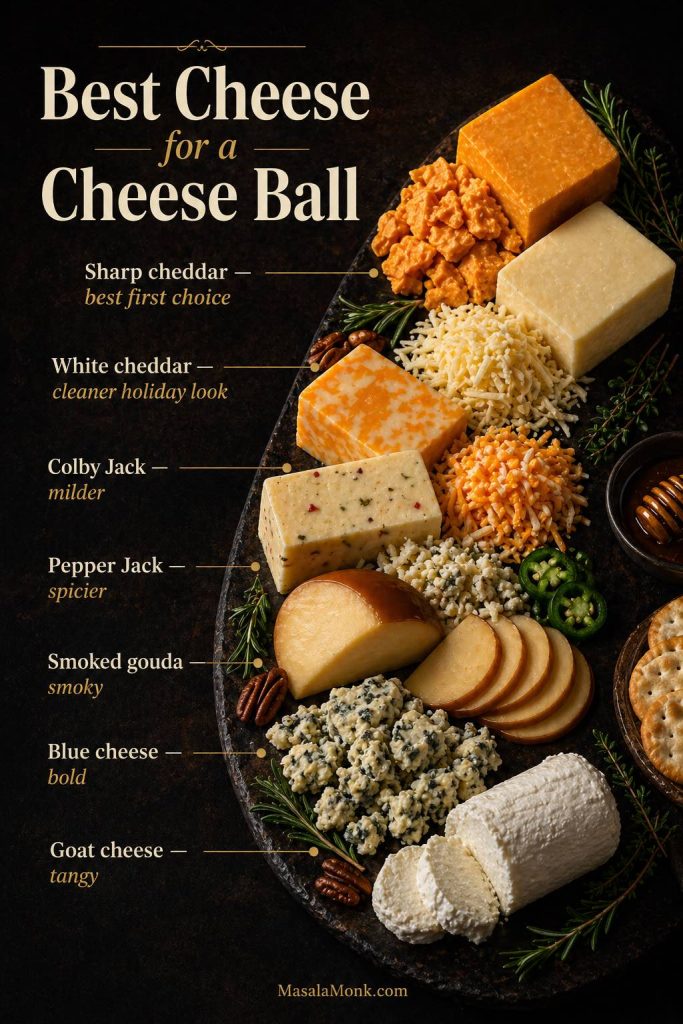
Best Cheese for a Cheese Ball

For most versions, sharp cheddar is the best first choice because it has enough flavor to balance the cream cheese. However, this recipe can move in different directions depending on the cheese you choose. If you want the ball to taste milder, sharper, smokier, or spicier, start with the guide below.

Cheese Best For How to Use It
Sharp cheddar Classic cheese ball recipe Main shredded cheese for the strongest everyday version
White cheddar Holiday boards Use like yellow cheddar for a sharper but cleaner-looking ball
Colby Jack Milder family-style cheese ball Use when you want a softer flavor
Pepper Jack Spicy cheese ball Use half pepper Jack and half cheddar
Smoked gouda Smoky party flavor Use a small amount with cheddar rather than replacing all the cheese
Blue cheese Bold retro appetizer Use a little because the flavor is strong
Goat cheese Tangier variation Use as a partial swap, but expect a softer ball
Chooser guide comparing cheeses for a cheese ball recipe, including sharp cheddar, white cheddar, Colby Jack, Pepper Jack, smoked gouda, blue cheese, and goat cheese, each labeled with its flavor style.
Sharp cheddar is the best first choice for a cheese ball because it gives strong flavor without making the filling complicated. However, white cheddar, Pepper Jack, smoked gouda, or even a little blue cheese can shift the recipe in a different direction.

When in doubt, start with sharp cheddar. After that, use the table as a flavor guide rather than a strict rule. For example, pepper Jack makes sense for a spicy cheese ball, while white cheddar looks cleaner on a holiday board.

Green Onion, Garlic, Onion, and Worcestershire

Green onion adds freshness, while garlic powder and onion powder season the filling evenly. Meanwhile, Worcestershire sauce adds a savory note that makes the cheese ball taste fuller and less one-dimensional. Together, they make the recipe taste seasoned without adding extra moisture.

Because crackers, pretzels, bacon, dried beef, and seasoning blends can all be salty, add salt carefully. Before shaping the ball, taste the cheese filling; then decide if the recipe needs even a small pinch.

Pecans, Walnuts, Herbs, Bacon, or Pretzels

Although chopped pecans are the classic coating, walnuts, herbs, bacon, and crushed pretzels can all work depending on the flavor you want. Pecans add crunch and a slightly sweet nuttiness, while herbs such as parsley, chives, and green onion make the outside fresher and brighter.

For a game-day cheese ball, add cooked crumbled bacon to the coating. For a no-nut cheese ball, use herbs, bacon, crushed pretzels, crushed crackers, everything seasoning, or toasted breadcrumbs instead.

Do You Need Sour Cream, Mayo, or Butter?

You do not need sour cream, mayo, or butter for this classic shaped cheese ball recipe. In fact, keeping them out makes the ball easier to shape because the filling stays thicker and cleaner. Full-fat cream cheese already gives the recipe enough richness, while cheddar and seasonings bring the flavor.

That said, sour cream or mayo can be useful if you are making cheese ball dip instead of a shaped appetizer. In that case, add only 1 to 2 tablespoons at first, then check the texture before adding more. Otherwise, the dip can move from creamy to loose very quickly.

Warm cheese option: If you want a pourable cheese dip instead of a chilled cream cheese appetizer, try MasalaMonk’s easy cheese sauce recipe for nachos, fries, broccoli, pasta, and dipping.

Equipment You Need

You do not need special equipment for this recipe, but a few basic tools make the cheese mixture smoother and the final ball easier to shape. If the cream cheese is properly softened, even a sturdy spatula can work. However, a hand mixer makes the filling smoother faster, especially when you are doubling the recipe.
Tool Why It Helps
Mixing bowl For beating the cream cheese and folding in cheddar
Hand mixer or sturdy spatula For a smoother filling
Box grater For freshly shredded cheddar
Plastic wrap or parchment For shaping the filling into a clean ball
Plate or shallow tray For rolling the chilled cheese ball in coating
Serving knife or spreader For easier spreading without breaking crackers

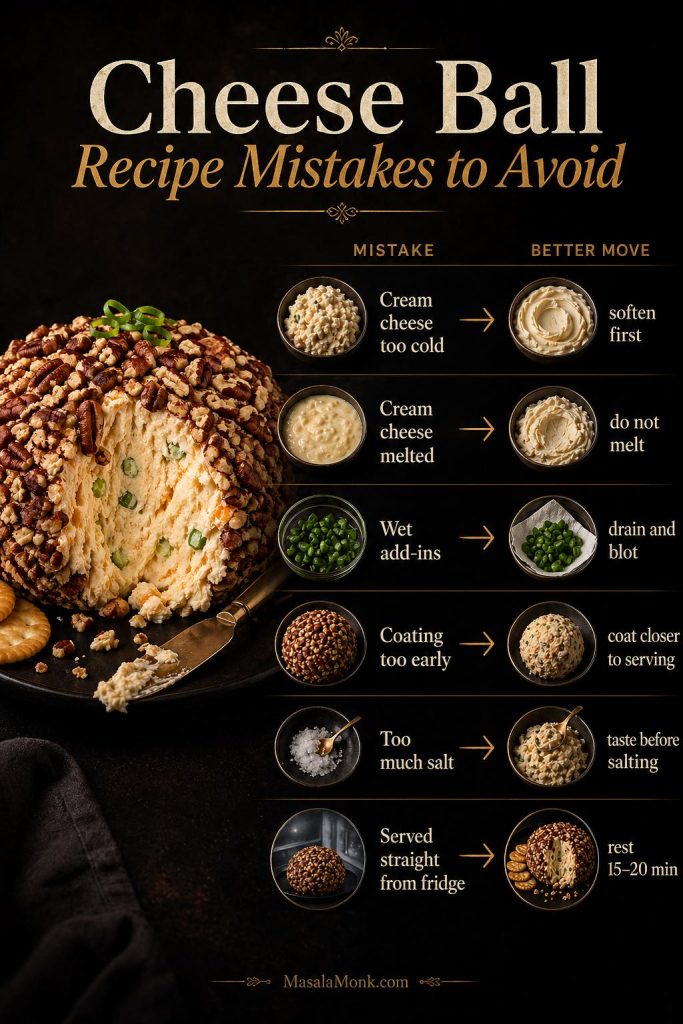
Common Mistakes to Avoid

Before you start mixing, it helps to know what can go wrong. Most cheese ball problems come from cream cheese that is too cold, add-ins that are too wet, or coatings that are added too early. Fortunately, each problem is easy to avoid if you build the recipe in the right order. More importantly, fixing the filling before shaping is much easier than fixing a finished ball after the coating is already on.

Mistake What Happens Better Move
Melting the cream cheese Loose or greasy filling Soften at room temperature instead
Using cold cream cheese Lumpy cheese ball mixture Let it soften until it presses easily
Adding wet pineapple, pickles, or jalapeños Soft or watery filling Drain and blot before mixing
Coating with pretzels or bacon too early Soft outside layer Add crunchy coatings closer to serving
Adding salt too soon Overly salty cheese ball Taste first, then salt only if needed
Serving straight from the fridge Firm texture and broken crackers Rest 15 to 20 minutes before serving
Mistake-and-fix guide for a cheese ball recipe showing six common problems: cream cheese too cold, cream cheese melted, wet add-ins, coating too early, too much salt, and serving straight from the fridge.
Most cheese ball recipe problems are easy to avoid once you know what to watch for. For example, cold cream cheese causes lumps, wet add-ins can loosen the mixture, and serving the ball straight from the fridge makes it harder to spread.

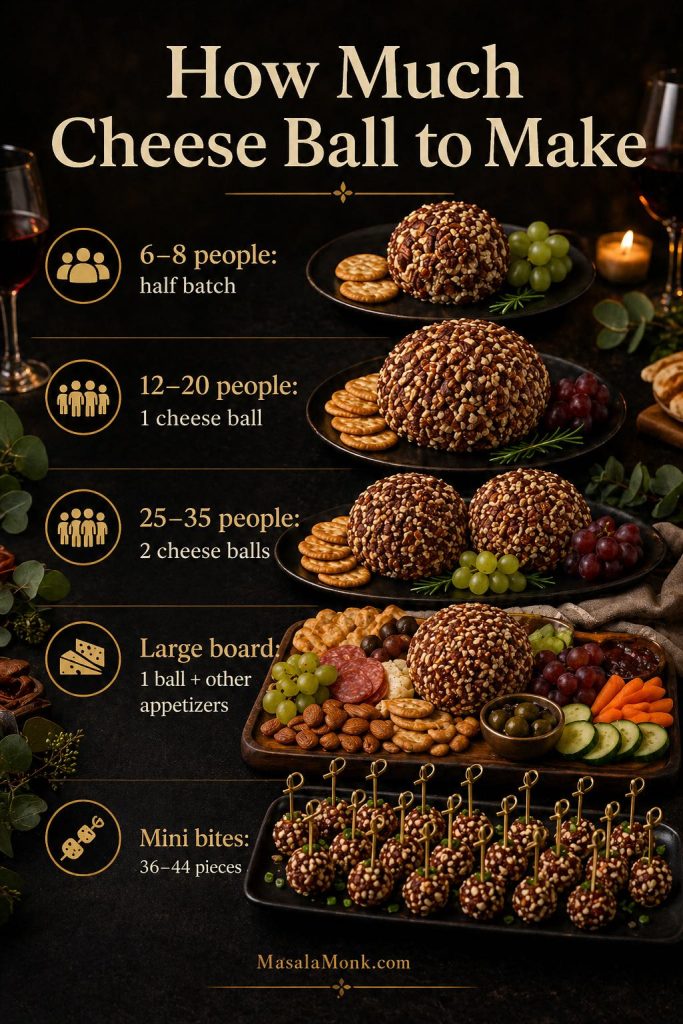
How Much Cheese Ball to Make

Because this cheese ball recipe is usually served as part of a snack table, the right amount depends on what else you are serving. If the ball is the main appetizer, plan more. However, if it sits on a board with dips, crackers, vegetables, fruit, and hot snacks, one batch can stretch further. In that case, variety matters more than making one oversized cheese ball.

Crowd Size Amount to Make Best Plan
6 to 8 people Half batch Smaller ball or full recipe as dip with leftovers planned
12 to 20 people 1 full cheese ball Crackers, vegetables, pretzels, and at least one fresh side
25 to 35 people 2 cheese balls Two flavors, such as classic pecan and bacon ranch
Large party board 1 cheese ball plus other appetizers Warm dip, crunchy snack, fruit, pickles, olives, and sturdy crackers
Individual portions 36 to 48 mini cheese ball bites 1-tablespoon portions with pretzel sticks added right before serving
Serving guide showing how much cheese ball to make for different group sizes, including half a batch for 6 to 8 people, one cheese ball for 12 to 20, two cheese balls for 25 to 35, one ball plus other appetizers for a large board, and mini bites as another option.
How much cheese ball to make depends on how you are serving it. If it is one appetizer among several, one batch goes further; however, for larger gatherings, two cheese balls or a tray of mini bites makes hosting much easier.

Cheese Ball Dip: How to Serve This Without Shaping It

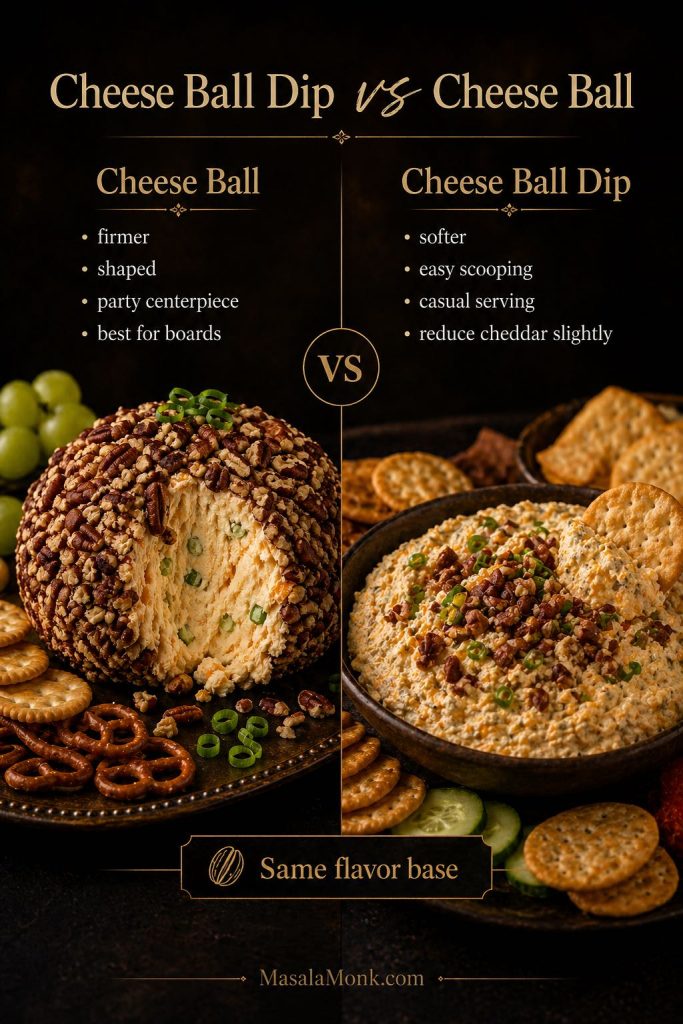
If you want the flavor of a cheese ball without shaping it, turn the mixture into cheese ball dip. This is useful for casual parties, snack boards, and smaller gatherings where a bowl of spread is easier than a shaped appetizer. Instead of changing the whole recipe, you only need to adjust the cheese slightly so the ball mixture becomes softer and more scoopable.

To make cheese ball dip, use the same base recipe but reduce the cheddar to 1½ cups / about 170 g so the texture stays softer. Then, mix the filling, spoon it into a shallow serving bowl, smooth the top, and sprinkle the coating over the surface. Chill for 30 to 60 minutes if making it ahead; afterward, let it soften slightly before serving so you get the same flavor with less shaping and easier scooping.

For Cheese Ball Dip Use This Adjustment
Softer texture Use 1½ cups / 170 g cheddar instead of 2 cups / 225 g
Easy serving Spoon into a shallow bowl instead of shaping into a ball
Better topping Add pecans, herbs, bacon, or pretzels right before serving
Best dippers Crackers, pretzel crisps, celery, cucumber, bell pepper, crostini, or pita chips
Side-by-side comparison showing a shaped cheese ball on a platter and a bowl of cheese ball dip, with notes that the cheese ball is firmer and better for boards while the dip is softer and easier to scoop.
Cheese ball dip vs cheese ball comes down to texture and serving style. Both use a similar flavor base, yet the dip is softer and easier to scoop, while the shaped cheese ball feels more polished for a party platter or snack board.

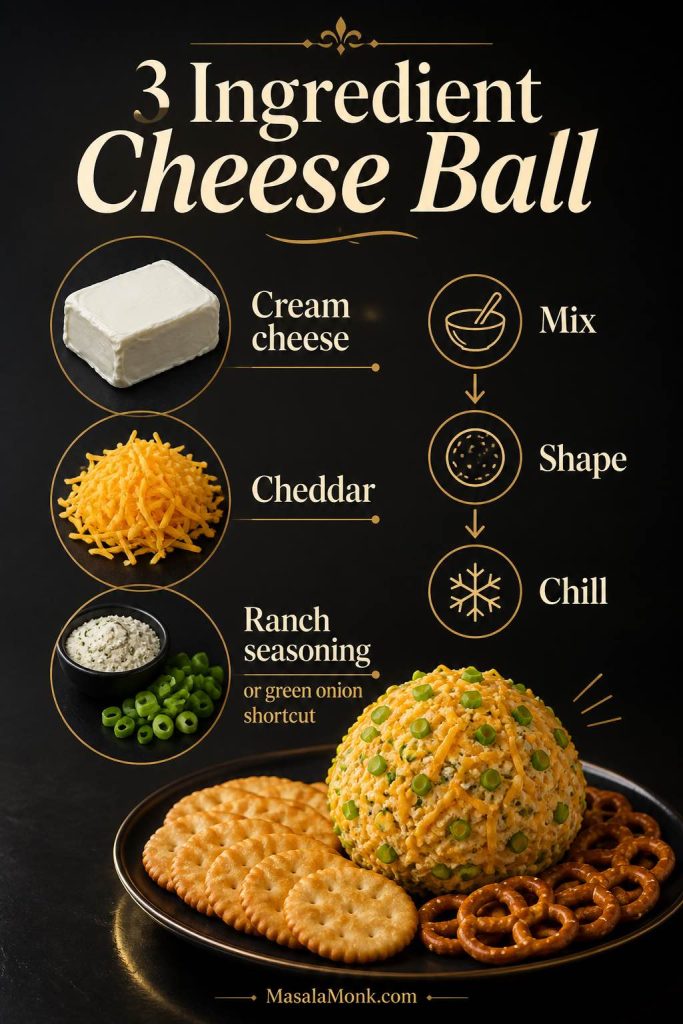
3 Ingredient Cheese Ball

A 3 ingredient cheese ball is useful when you need the fastest possible appetizer. However, it will not have the same depth as the full recipe because garlic, onion, pepper, and Worcestershire add much of the savory background flavor. Still, when time is short, cream cheese, cheddar, and one strong seasoning can form a simple ball that works with crackers and pretzels.

Version Ingredients Best Use
Classic shortcut 16 oz / 450 g cream cheese + 1½ cups / 170 g cheddar + 1 packet / about 28 g ranch seasoning Fast game-day cheese ball
No-ranch shortcut 16 oz / 450 g cream cheese + 1½ cups / 170 g cheddar + 3 sliced green onions Milder cheese ball for simple crackers
Coated shortcut 16 oz / 450 g cream cheese + 1½ cups / 170 g cheddar + ¾ cup / 85 g chopped pecans Basic party cheese ball with crunch
Guide image for a 3 ingredient cheese ball showing cream cheese, shredded cheddar, ranch seasoning or green onion, plus a finished cheese ball served with crackers and pretzels, with the steps mix, shape, and chill.
A 3 ingredient cheese ball is the fastest shortcut version when you need a party appetizer quickly. However, the full cheese ball recipe gives you better depth because Worcestershire, garlic powder, onion powder, pepper, and green onion round out the flavor.

For the best flavor, though, use the full recipe. Worcestershire sauce, garlic powder, onion powder, black pepper, and green onion make the cheese ball taste more complete without making the method harder. Still, the shortcut version is useful when speed matters more than building the most layered flavor.

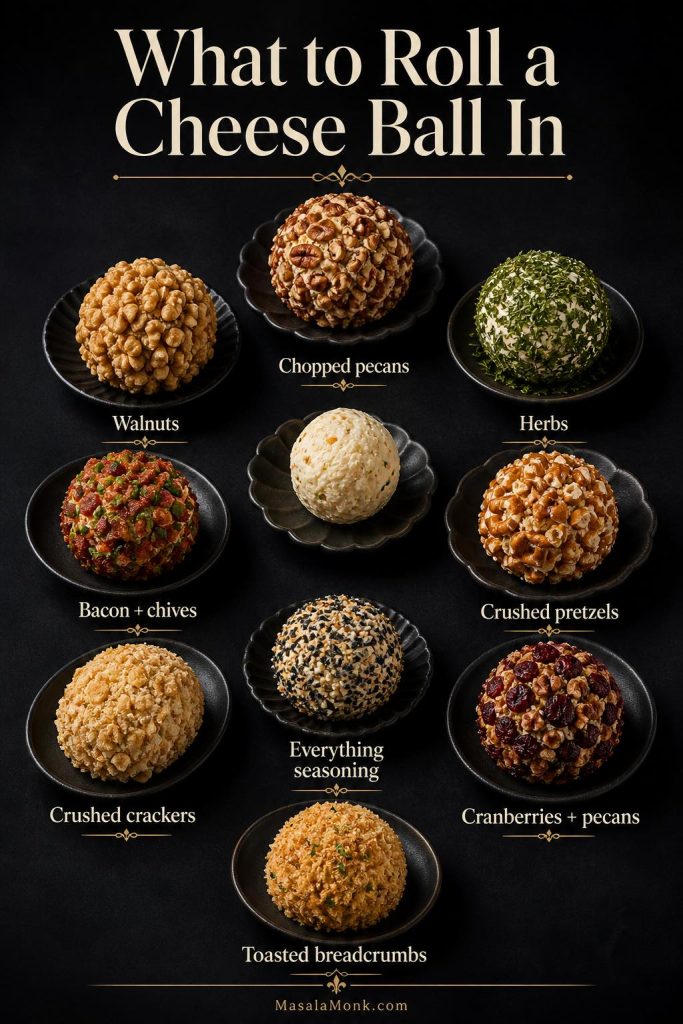
What to Roll a Cheese Ball In

The coating does more than make the cheese ball look finished. It adds texture, controls richness, and tells people what kind of flavor to expect. Although pecans are classic, there are plenty of good nut-free and holiday-friendly options. For example, this recipe can move from a classic cheese ball to a game-day ball or holiday cheese board centerpiece just by changing the outside layer.

Coating Best For Notes
Chopped pecans Classic cheese ball Toast lightly, then cool before using
Chopped walnuts Earthier flavor Chop finely so the pieces stick well
Parsley, chives, or green onion Fresh green finish Good for a lighter-looking or no-nut version
Bacon and chives Game day Add close to serving so the bacon stays crisp
Crushed pretzels No-nut crunch Add shortly before serving because pretzels soften
Crushed crackers Simple no-nut coating Use sturdy crackers and crush finely
Everything seasoning Bagel-style flavor Use lightly because it can be salty
Dried cranberries and pecans Holiday cheese ball Sweet, salty, colorful, and festive
Toasted breadcrumbs Nut-free coating Use dry crumbs and add close to serving
Coating guide showing cheese balls rolled in chopped pecans, walnuts, herbs, bacon and chives, crushed pretzels, crushed crackers, everything seasoning, cranberries and pecans, and toasted breadcrumbs.
What you roll a cheese ball in changes both texture and flavor. For example, pecans give the classic crunch, bacon and chives make it more savory, while crushed pretzels or crackers work well when you want a no-fuss party coating.

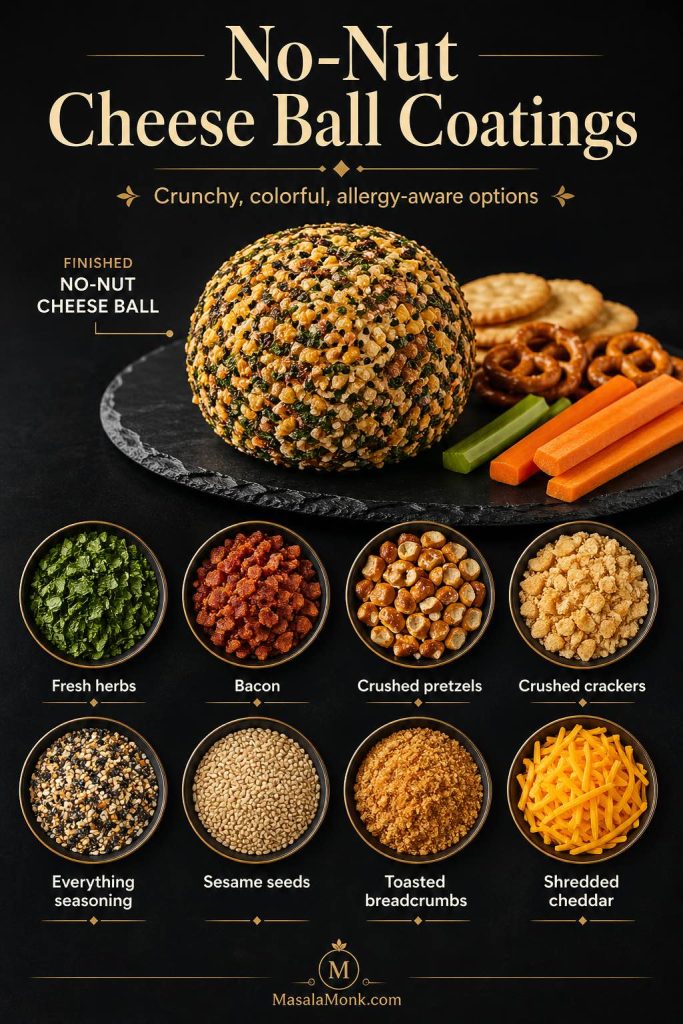
No-Nut Cheese Ball Coatings

For a cheese ball without nuts, use chopped herbs, cooked bacon, crushed pretzels, crushed crackers, everything seasoning, toasted breadcrumbs, sesame seeds, or a mix of herbs and shredded cheddar. If allergies are a concern, avoid using nut coatings anywhere near the same platter, utensils, or serving board. In that case, keep the whole platter nut-free rather than relying on separate corners of the same board.

No-nut cheese ball coating guide showing a finished no-nut cheese ball with coating options including fresh herbs, bacon, crushed pretzels, crushed crackers, everything seasoning, sesame seeds, toasted breadcrumbs, and shredded cheddar.
A no-nut cheese ball can still look colorful and taste crunchy. Instead of pecans or walnuts, use fresh herbs, bacon, crushed pretzels, cracker crumbs, sesame seeds, toasted breadcrumbs, or shredded cheddar for a safer party-board option.

What to Serve With a Cheese Ball

A cheese ball works best with dippers that can handle a creamy spread. So, put out a mix of crackers, vegetables, pretzels, and a few fresh or tangy sides so the platter does not feel too heavy. Since this recipe is rich, the best cheese board pairings usually include something crisp, something salty, and something fresh. That balance keeps guests coming back without making every bite feel the same.

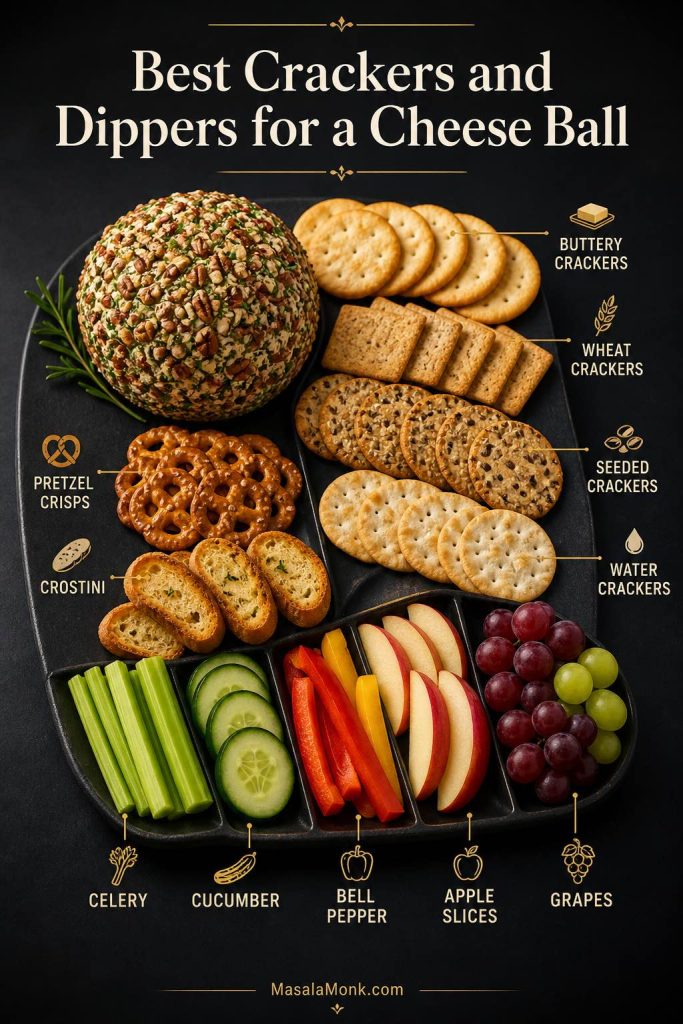
Best Crackers for a Cheese Ball

Cracker or Dipper Why It Works Best Pairing
Buttery crackers Classic party flavor and easy crunch Classic pecan or cranberry pecan
Wheat crackers Sturdy, nutty, and less fragile Dried beef or bacon ranch
Seeded crackers More texture and grown-up flavor Herb or no-nut cheese ball
Water crackers Clean flavor that lets the cheese stand out Classic cheddar once slightly softened
Pretzel crisps Salty, crunchy, and strong enough for scooping Bacon ranch, jalapeño, or dill pickle
Crostini or baguette slices Strongest option for a firmer cheese ball Party boards and holiday platters
Celery, cucumber, and bell pepper Fresh, lighter, and crisp Rich cheese balls and game-day spreads
Apple slices and grapes Sweet and fresh against savory cheese Cranberry pecan, pineapple, or classic pecan
Serving guide showing a cheese ball with buttery crackers, wheat crackers, seeded crackers, water crackers, pretzel crisps, crostini, celery, cucumber, bell pepper, apple slices, and grapes.
The best crackers and dippers for a cheese ball are sturdy enough to scoop without breaking. Since the filling is rich, a mix of crackers, pretzel crisps, fresh vegetables, apple slices, and grapes keeps the platter balanced.

Because the cheese ball can be firm when it first comes out of the fridge, sturdy crackers work better than very thin ones. So let it soften for 15 to 20 minutes before serving, or include a small spreading knife on the platter.

For a low-carb platter, serve the cheese ball with celery, cucumber rounds, bell pepper strips, cheese crisps, pork rinds, or other sturdy options from MasalaMonk’s guide to keto chips for dips. This works especially well when the cheese ball is part of a heavier game-day table and you want a few lighter, crunchier options.

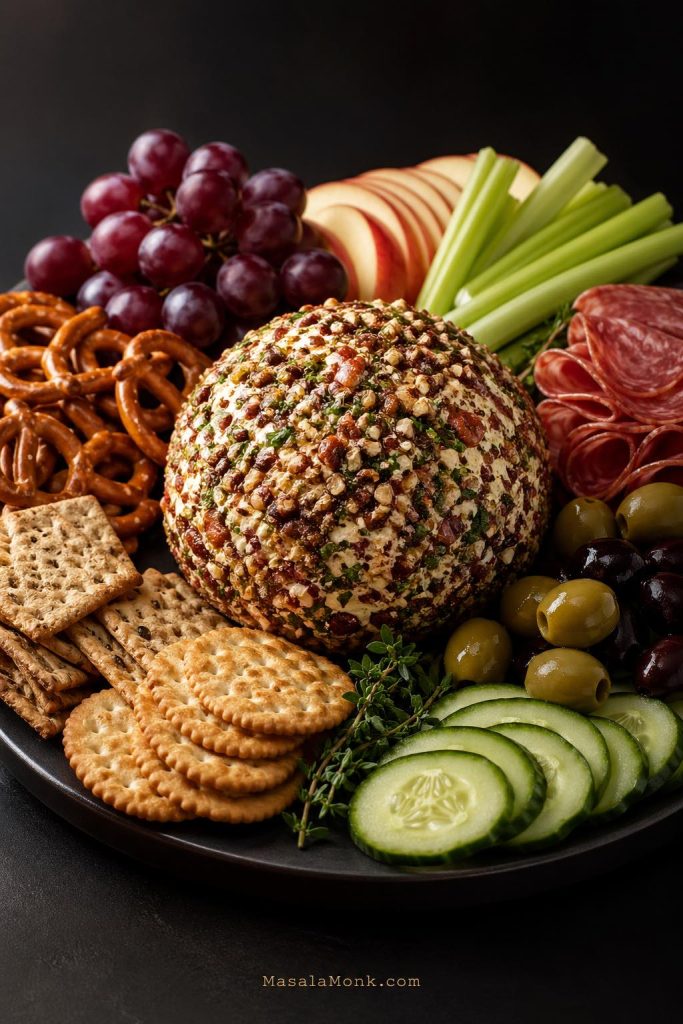
Turn It Into a Party Board

For a fuller spread, place the cheese ball on a board with crackers, pretzels, fruit, nuts, pickles, olives, cured meats, and a small bowl of jam or chutney. If you want a simple layout formula, MasalaMonk’s guide to charcuterie board ideas gives you an easy structure for building a balanced board. From there, add one crunchy item, one fresh item, and one sweet or tangy item around the cheese ball.

For a game-day table, pair this cheese ball with buffalo chicken dip, crispy mozzarella sticks, or a tray of potato appetizers. That gives guests a mix of cold, creamy, hot, crispy, salty, and fresh bites.

Close-up of a cheese ball party board with a nut-coated cheese ball surrounded by crackers, pretzels, grapes, apple slices, celery, cucumber slices, olives, and folded cured meat on a dark platter.
A cheese ball party board works best when it has contrast. Add salty crackers, crisp vegetables, fresh fruit, and a few briny sides so the creamy cheese ball feels like the centerpiece instead of the only thing on the platter.

Make Ahead, Storage, and Freezing

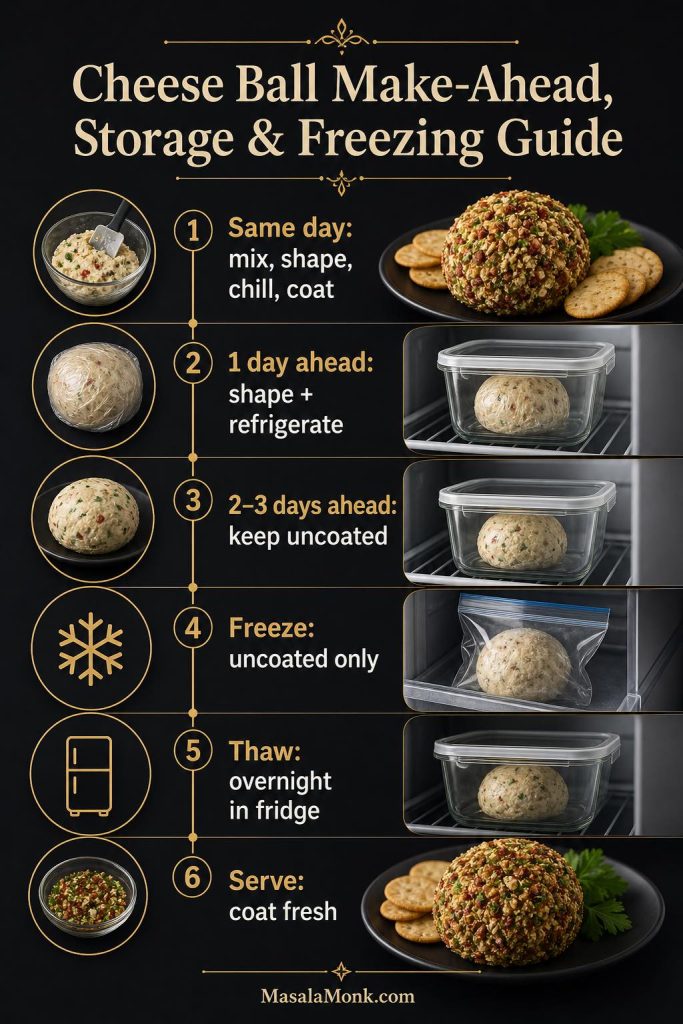
A cheese ball is one of the easiest make-ahead appetizers because chilling helps it firm up. In fact, the recipe often tastes better after a few hours because the cheese, onion, and seasonings have time to settle. The best approach is to make and shape the filling ahead, then add the coating closer to serving. That way, the inside gets time to develop flavor while the outside still tastes fresh.

Best make-ahead method: Mix and shape the cheese ball 1 day ahead, wrap tightly, and refrigerate. Then roll it in pecans, herbs, bacon, pretzels, or crumbs closer to serving so the outside stays fresh and crisp.

Make-Ahead Timeline

When You Are Serving What to Do Best Coating Timing
Same day Mix, shape, chill for 1 to 2 hours Coat after chilling
1 day ahead Mix, shape, wrap tightly, and refrigerate Coat the day you serve
2 to 3 days ahead Shape uncoated and keep tightly wrapped Coat shortly before serving
Freezer prep Freeze the shaped, uncoated cheese ball Thaw overnight, then coat fresh
Make-ahead storage and freezing guide for a cheese ball showing steps for same-day prep, making it 1 day ahead, keeping it uncoated for 2 to 3 days, freezing it uncoated, thawing overnight in the fridge, and coating fresh before serving.
For the cleanest make-ahead cheese ball, shape and chill the filling first, then add the coating close to serving. That way, the inside has time to firm up while the outside stays fresh, crisp, and party-ready.

How to Store a Cheese Ball

After shaping, wrap the cheese ball tightly in plastic wrap or store it in an airtight container in the refrigerator. If it has already been coated, use a container large enough that the outside does not get crushed.

For best texture, keep a shaped, uncoated cheese ball refrigerated for up to 3 days before serving. Once the cheese ball has been coated or served, store leftovers tightly covered in the refrigerator and use them within 3 to 4 days. For freezing, freeze the shaped, uncoated cheese ball for up to 1 month, then thaw it overnight in the refrigerator and coat it fresh before serving.

Keep the cheese ball refrigerated at 40°F / 4°C or colder. For the cleanest presentation, store the shaped cheese ball uncoated, then roll it in pecans, herbs, bacon, or crumbs shortly before serving.

Can You Freeze a Cheese Ball?

If you need to make it further ahead, freeze the cheese ball before adding the coating so the outside stays fresher after thawing. Wrap the shaped cheese ball tightly, place it in a freezer-safe bag or container, and freeze at 0°F / -18°C. Then thaw it overnight in the refrigerator and roll it in a fresh coating before serving.

Freezing works best with the plain cream cheese, cheddar, green onion, and seasoning base. Wet add-ins such as pineapple, pickles, or jalapeños can release moisture after thawing, so those versions are better made fresh or only 1 to 2 days ahead. After thawing, always add a fresh coating so the outside tastes crisp instead of stale or soft.

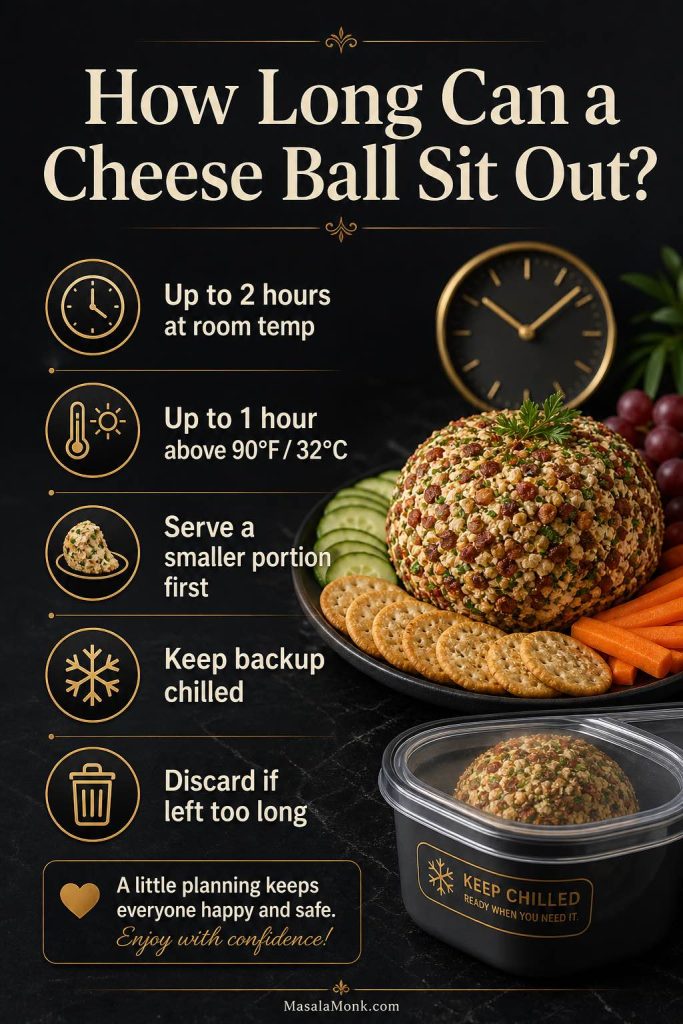
How Long Can a Cheese Ball Sit Out?

Because a cheese ball is made with cream cheese and shredded cheese, treat it like a perishable appetizer. According to USDA food safety guidance, perishable food should not be left out for more than 2 hours at room temperature, or more than 1 hour when the temperature is above 90°F / 32°C.

For a long party, serve a smaller cheese ball first and keep the backup chilled. Then, if the platter runs low, bring out a fresh one instead of letting the same ball sit for hours. If the cheese ball has been sitting out too long, do not wrap it back up for later. Instead, refrigerate safe leftovers promptly and discard anything that has been left out beyond the safe window.

Food safety guide showing a cheese ball platter with a clock and chilled backup container, explaining that a cheese ball can sit out up to 2 hours at room temperature or 1 hour above 90°F or 32°C.
A cheese ball should not sit out all day just because it is served chilled. For safer entertaining, serve a smaller portion first, keep the backup refrigerated, and replace the platter when needed instead of leaving one ball out for hours.

Cheese Ball Variations

Once the base recipe works, the variations are easy. Instead of rebuilding the appetizer from scratch, keep the cream cheese structure, then change the cheese, seasonings, add-ins, and coating. The formulas below are designed as practical starting points, so you do not have to guess how much bacon, dried beef, pineapple, jalapeño, or cranberry to add to each ball. After that, you can adjust salt, heat, sweetness, or crunch to match the occasion.

Which Cheese Ball Variation Should You Make?

Choose This Version Best For Flavor Direction
Classic pecan Safest party version Creamy, savory, nutty, familiar
Bacon ranch Game day Salty, herby, bold, snacky
Dried beef or chipped beef Old-school party flavor Salty, savory, retro
Cranberry pecan Thanksgiving or Christmas Sweet-salty, colorful, festive
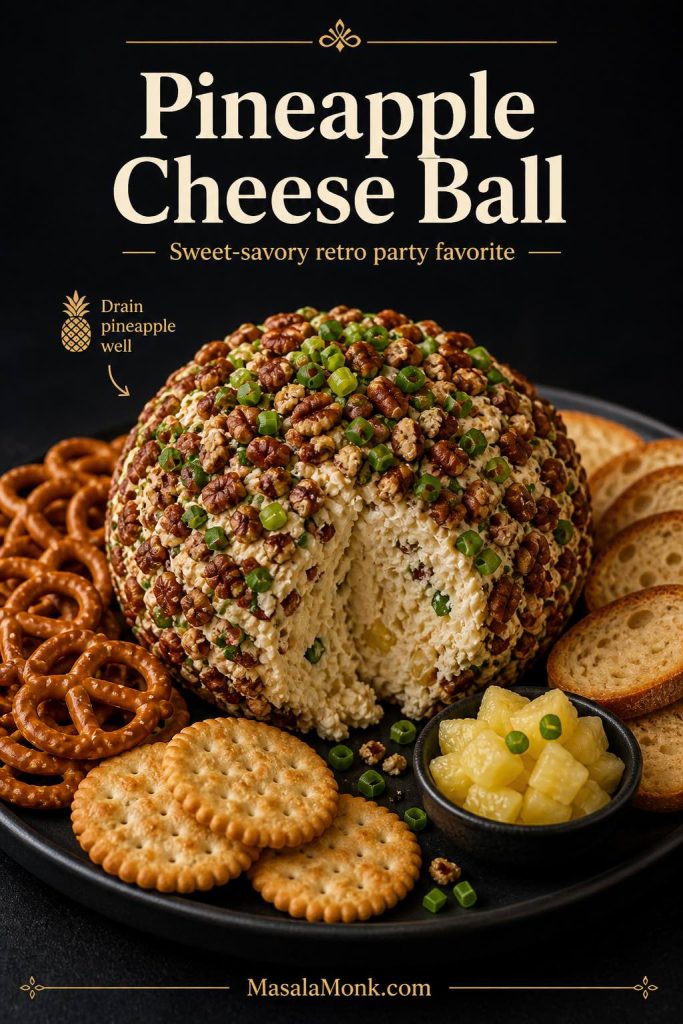
Pineapple Retro sweet-savory spread Creamy, tangy, slightly sweet
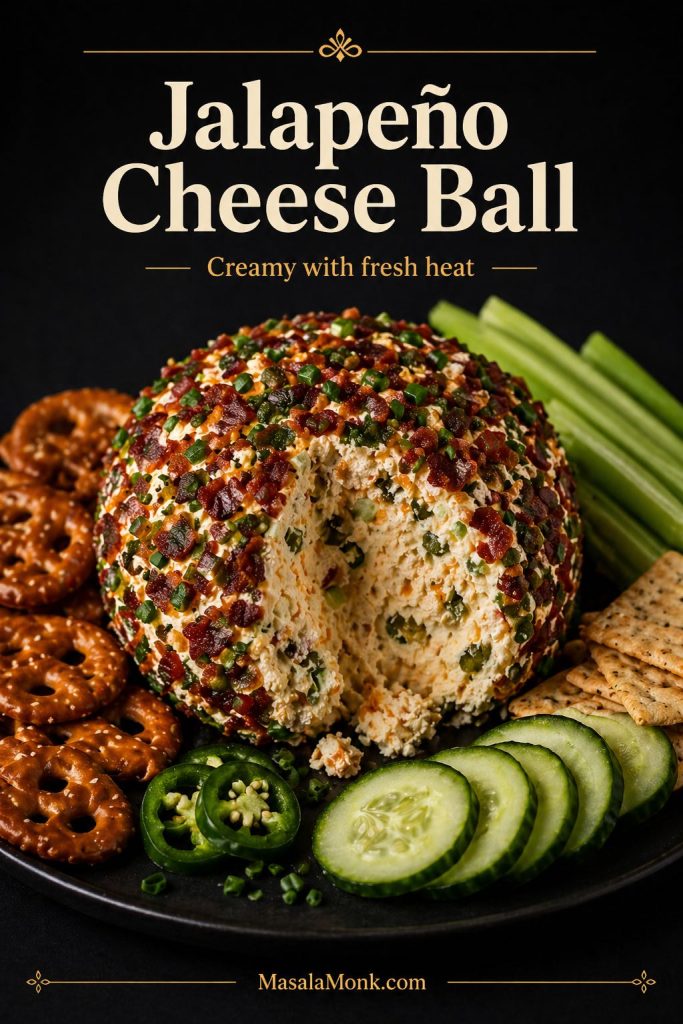
Jalapeño Spicy snack table Cheesy, peppery, fresh heat
Mini bites Easy individual serving Party-friendly and mess-light
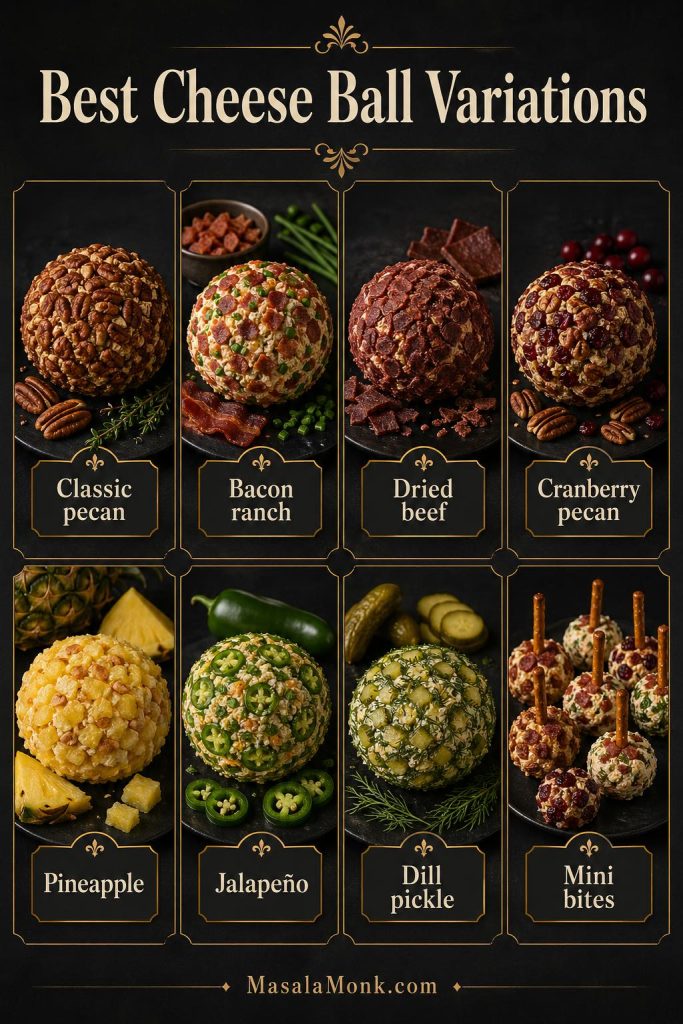
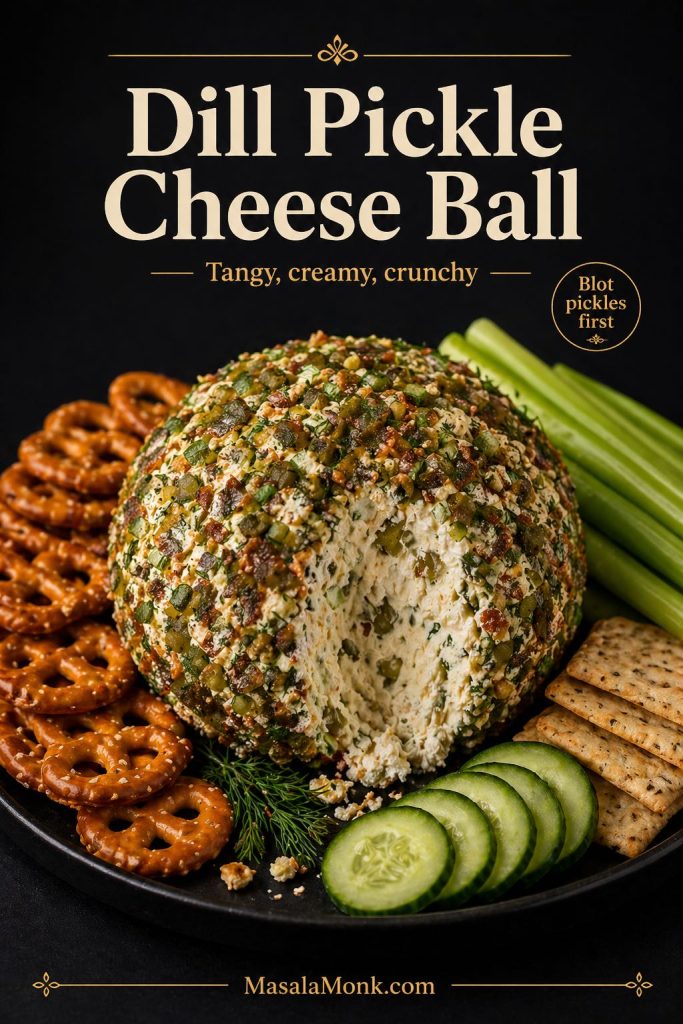
Variation guide showing eight cheese ball ideas: classic pecan, bacon ranch, dried beef, cranberry pecan, pineapple, jalapeño, dill pickle, and mini cheese ball bites with pretzel sticks.
Once the base cheese ball recipe is right, the variations are easy. Keep the cream cheese structure, then change the coating and add-ins for bacon ranch, dried beef, cranberry pecan, pineapple, jalapeño, dill pickle, or mini cheese ball bites.

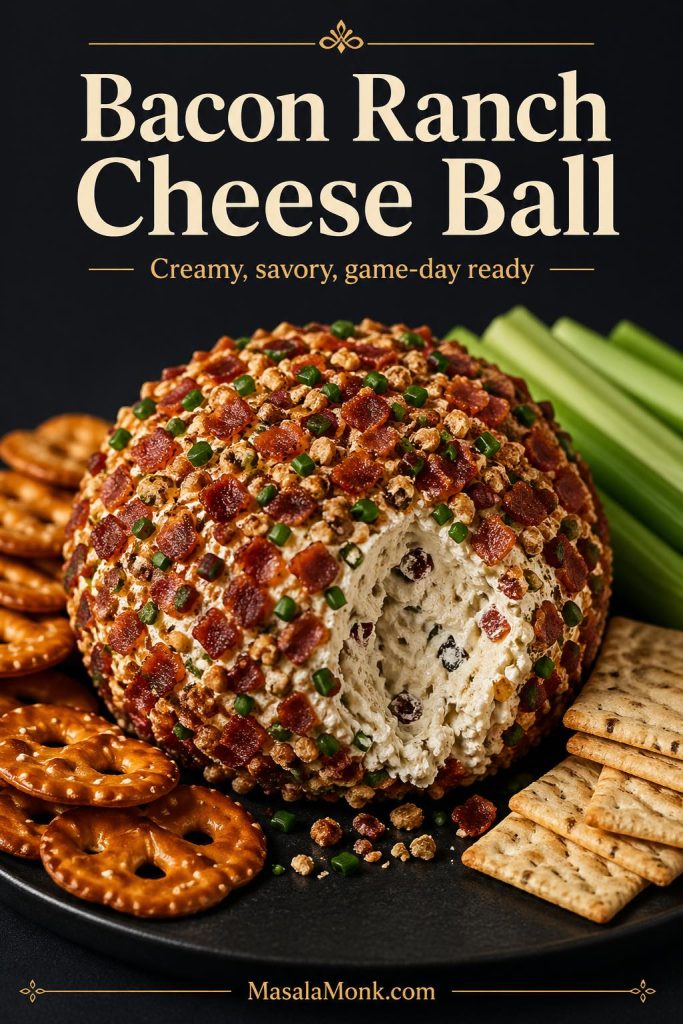
Bacon Ranch Cheese Ball

For a bacon ranch cheese ball, use 16 oz / 450 g cream cheese, 1½ cups / 170 g shredded cheddar, 1 packet / about 28 g ranch seasoning, ½ cup / about 50 g cooked crumbled bacon, and 2 sliced green onions. Then roll the outside in more bacon, chopped chives, and pecans or crushed pretzels.

Because ranch seasoning and bacon are both salty, do not add extra salt until you taste the filling. If the cheese ball tastes strong on its own, serve it with celery, bell pepper strips, or unsalted crackers for balance. Otherwise, pretzel crisps, wheat crackers, and sturdy buttery crackers all work well.

Close-up of a bacon ranch cheese ball coated with chopped bacon, chives, and crunchy bits, served with pretzels, celery sticks, and crackers on a dark platter.
A bacon ranch cheese ball is ideal for game day because it is salty, creamy, and easy to serve with pretzels, celery, and sturdy crackers. Since bacon and ranch seasoning are already flavorful, taste before adding extra salt.

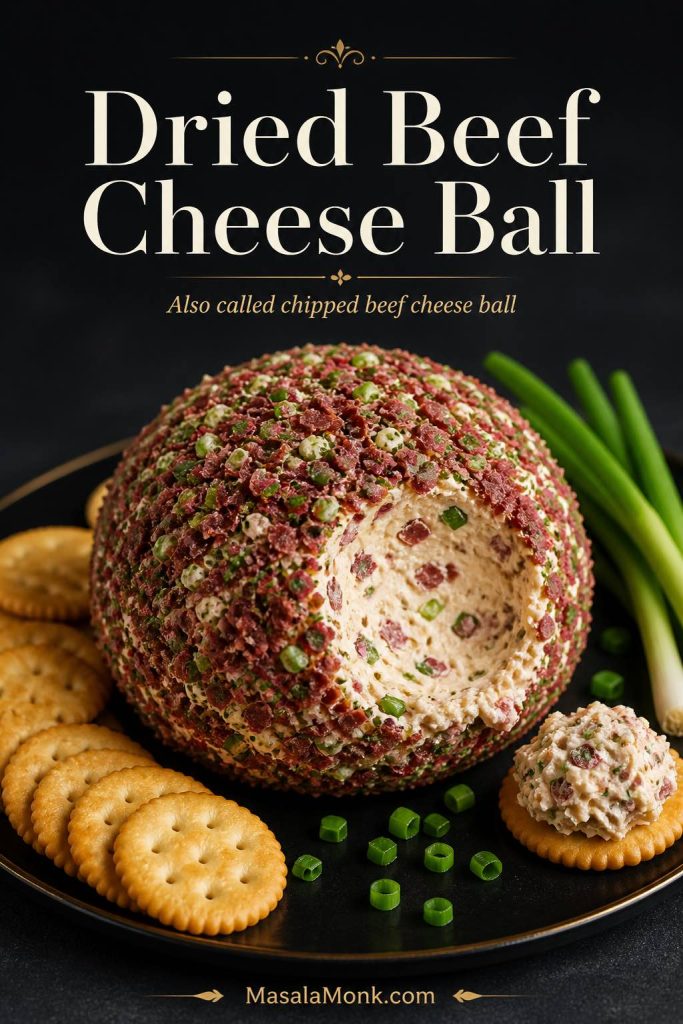
Dried Beef Cheese Ball or Chipped Beef Cheese Ball

For a dried beef cheese ball, use 16 oz / 450 g cream cheese, 1½ cups / 170 g shredded cheddar, 4 to 5 oz / 115 to 140 g finely chopped dried beef or chipped beef, 2 sliced green onions, 1 teaspoon / 5 ml Worcestershire sauce, ½ teaspoon onion powder, and ½ teaspoon garlic powder.

Because dried beef is already salty, skip the added salt. Then roll the outside in chopped pecans, herbs, more finely chopped dried beef, or a mix of all three. If you like a sharper old-school flavor, add 1 to 2 teaspoons prepared horseradish, but blot any extra moisture first.

Old-school party version: Since dried beef is salty, chop it very finely and reserve a little for the outside coating. That way, the cheese ball recipe gets flavor inside and a clear visual cue outside.
Close-up of a dried beef cheese ball, also called a chipped beef cheese ball, coated with finely chopped dried beef and green onion, with crackers and a scoop of the creamy filling visible.
A dried beef cheese ball brings an old-school party flavor into a modern appetizer board. Because dried beef is naturally salty, chop it finely, skip extra salt at first, and balance the cheese ball with crackers, green onion, and fresh dippers.

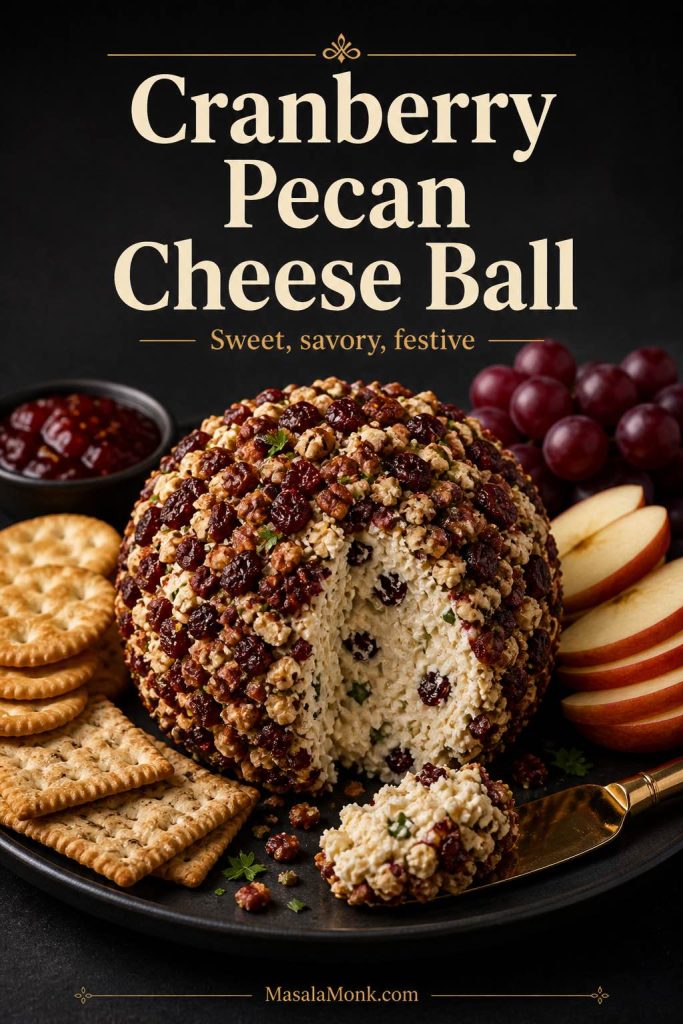
Cranberry Pecan Cheese Ball

For a cranberry pecan cheese ball, use the base recipe and mix in ½ cup / about 60 g chopped dried cranberries. Then roll the outside in ½ cup / 55 g chopped pecans, ¼ cup / 30 g chopped dried cranberries, and 2 tablespoons chopped parsley or chives.

A little orange zest makes this version brighter, especially for Thanksgiving or Christmas. Because this version already has sweetness from the cranberries, salty or buttery crackers usually work better than sweet dippers. For that reason, it is especially good with apple slices, grapes, and a small bowl of pepper jelly or chutney.

Cranberry pecan cheese ball with a creamy center, coated in chopped pecans, dried cranberries, and herbs, served with crackers, apple slices, grapes, and a small bowl of red chutney.
A cranberry pecan cheese ball is the best holiday-style variation when you want sweet, savory, creamy, and crunchy in one appetizer. Because the cranberries add sweetness, serve it with salty crackers, apple slices, grapes, or a tangy chutney for balance.

Jalapeño Cheese Ball

For a jalapeño cheese ball, add 1 to 2 finely chopped jalapeños to the base recipe. Fresh jalapeño tastes brighter, while pickled jalapeño adds tang. Either way, blot the pieces dry before mixing so the filling does not become watery.

Cheddar, bacon, smoked paprika, and chives all work well here. For more heat, add a pinch of cayenne instead of adding too much hot sauce, which can loosen the texture. If your crowd likes creamy heat, this jalapeño version also pairs well with baked jalapeño poppers on the same snack table. Meanwhile, celery and cucumber help cool the heat without making the platter boring.

Jalapeño cheese ball with a creamy filling, chopped jalapeños, green herbs, and cheddar flecks, served with pretzels, cucumber slices, celery sticks, and crackers.
A jalapeño cheese ball should taste creamy first and spicy second. Since fresh jalapeños can vary in heat, start with a modest amount, then add more only after tasting the filling so the cheese ball stays balanced.

Pineapple Cheese Ball

For a pineapple cheese ball, use 16 oz / 450 g cream cheese, 1 to 1½ cups / 115 to 170 g shredded cheddar, ¾ cup / about 180 g crushed pineapple that has been drained and blotted very well, 2 sliced green onions, and ½ cup / about 55 g chopped pecans.

The pineapple must be very dry before it goes into the filling. If it is watery, the cheese ball will turn soft and loose. Therefore, drain it well, press out extra juice, and blot it before mixing. Since this version is sweet-savory, it works especially well with salty crackers, pretzels, and toasted baguette slices.

Pineapple cheese ball coated with chopped pecans and green onion, with a creamy filling and pineapple pieces inside, served with crackers, pretzels, toasted bread slices, and a small bowl of pineapple.
A pineapple cheese ball works best when the pineapple is drained very well before mixing. Otherwise, the filling can turn loose; however, when the pineapple is dry, it adds a sweet-savory flavor that pairs beautifully with salty crackers and pretzels.

Dill Pickle Cheese Ball

For a dill pickle cheese ball, add ½ cup / about 75 g finely chopped pickles, 1 to 2 teaspoons dill, 1½ cups / 170 g cheddar, garlic powder, and green onion to the cream cheese base. Before mixing, blot the chopped pickles very well so the filling stays thick.

After chilling, roll the outside in chopped herbs, crushed pretzels, or a mix of herbs and shredded cheddar. Since pickles add both salt and moisture, taste before adding extra salt and serve this version with pretzel crisps, celery, cucumber rounds, and sturdy crackers.

Dill pickle cheese ball with chopped pickles, dill, herbs, and a creamy center, served with pretzels, cucumber slices, celery sticks, and seeded crackers.
A dill pickle cheese ball should taste tangy and fresh without becoming watery. For that reason, blot chopped pickles before mixing them into the cream cheese base, then serve the finished ball with pretzels, celery, cucumber, or sturdy crackers.

Mini Cheese Ball Bites

Mini cheese ball bites are ideal when you want individual party portions instead of one large cheese ball. After the filling chills until firm, scoop it into generous 1-tablespoon portions. A full batch usually makes about 36 to 48 mini cheese ball bites, depending on how generously you scoop and how much coating you use.

From there, roll each mini cheese ball in chopped pecans, herbs, bacon, crushed pretzels, or dried cranberries. Then add pretzel sticks right before serving so they stay crisp and do not soften in the cheese mixture. If you are making this recipe ahead, chill the coated bites without the sticks and add the pretzels only when the platter is ready.

Tray of mini cheese ball bites in different coatings, including herbs, bacon, pecans, crushed pretzels, and dried cranberries, with some bites topped with pretzel sticks.
Mini cheese ball bites are ideal when guests need an easy one-bite appetizer. Once the mixture is chilled, scoop it into 1-tablespoon portions, roll each bite in coating, and add pretzel sticks last so they stay crisp.

Christmas Cheese Ball

For a Christmas cheese ball, use the cranberry pecan version or roll the outside in a red-and-green mix of dried cranberries, pecans, parsley, and chives. You can keep it round, shape it into a wreath, or make a simple ornament-style cheese ball for a holiday board.

Still, flavor should come first. A simple round cheese ball with cranberries, pecans, herbs, crackers, grapes, and apple slices usually looks festive without needing a complicated shape. Plus, it is easier to chill, coat, transport, and serve.

Pumpkin Cheese Ball

For Halloween or Thanksgiving, shape the cheese ball into a pumpkin. After wrapping the cheese ball, use rubber bands or kitchen twine around the outside to create pumpkin-like ridges while it chills. Once firm, remove the wrap and add a bell pepper stem or pretzel rod on top.

For a more orange look, use a cheddar-heavy filling or press finely shredded cheddar onto the outside. Since this is mostly a shaping idea, keep the flavor familiar and serve it with crackers, pretzels, and vegetables for a seasonal appetizer board.

Holiday Cheese Ball Shapes

If you want the cheese ball to match a holiday or party theme, change the shape without changing the whole recipe. The easiest approach is to keep the same cream cheese base, chill it well, and shape the ball before adding the final coating. That way, the design changes but the flavor stays reliable.

Shape Best Season How to Do It
Pumpkin Halloween or Thanksgiving Wrap, tie with twine or rubber bands, chill, then add a pepper stem or pretzel rod
Christmas wreath Christmas Shape into a ring, chill, then coat with herbs, pecans, and dried cranberries
Ornament Christmas Keep round and use a cranberry-herb coating
Football Game day Shape into an oval, coat with bacon or nuts, then add thin cheese strips as laces
Mini bites Any party Scoop into 1-tablespoon balls and serve with pretzel sticks
Holiday cheese ball shapes guide showing a pumpkin-shaped cheese ball, Christmas wreath cheese ball, ornament cheese ball, football cheese ball, and mini cheese ball bites.
Holiday cheese ball shapes let you use the same base recipe in different party styles. For example, shape it into a pumpkin for fall, a wreath or ornament for Christmas, a football for game day, or mini cheese ball bites for easy serving.

How to Fix a Cheese Ball

Most cheese ball problems are easy to fix before the coating goes on. So, taste and adjust the filling first, then shape, chill, and roll it once the texture is right. If the recipe feels off after the ball is coated, the fix usually gets messier. Use the troubleshooting table as a quick check before the cheese ball goes on the platter.

Problem Why It Happened How to Fix It
Too soft Warm cream cheese, short chill, or wet add-ins Chill longer; if needed, mix in more shredded cheddar
Too firm Too much shredded cheese or very cold serving temperature Let it sit for 15 to 20 minutes before serving
Bland Not enough seasoning Add garlic powder, onion powder, Worcestershire, pepper, herbs, or sharper cheddar
Too salty Bacon, dried beef, ranch seasoning, or everything seasoning Add more cream cheese if possible and serve with unsalted crackers or vegetables
Coating falls off Outside too cold, dry, or loosely pressed Let the cheese ball soften slightly, then press the coating on gently
Nuts, pretzels, or crumbs get soft Coated too far ahead Roll in crunchy coatings closer to serving time
Lumpy filling Cream cheese was too cold Soften fully and beat smooth before adding cheddar
Watery filling Pineapple, pickles, or jalapeños were not drained enough Blot wet add-ins well, chill longer, and mix in more cheddar if needed
Troubleshooting guide for how to fix a cheese ball, showing a cut pecan-coated cheese ball with crackers and tips for fixing a cheese ball that is too soft, too firm, bland, too salty, lumpy, watery, or has coating that falls off.
Most cheese ball problems are easiest to fix before the coating goes on. Taste and adjust the filling first, then chill, shape, and roll it once the texture is right.

More Cheese Appetizers and Party Snacks

If you are building a larger party table, this chilled cheese ball can anchor the cold, creamy side while hot appetizers bring crunch. For more cheese-forward snacks, try MasalaMonk’s mozzarella sticks or Indian-inspired cheese balls. For a broader small-plates spread, add croquettes or build an Indian-inspired tapas night. Together, those options give the table contrast instead of making everything soft, cold, or cheese-heavy.

FAQs

What is a cheese ball made of?

A classic cheese ball is usually made with cream cheese, shredded cheese, seasonings, and an outer coating. In this recipe, cream cheese gives the ball structure, while sharp cheddar, green onion, Worcestershire sauce, garlic powder, onion powder, black pepper, and pecans add flavor and texture.

What cheese is best for a cheese ball?

Because sharp cheddar has strong flavor without making the recipe complicated, it is the best first choice. However, white cheddar, Colby Jack, pepper Jack, smoked gouda, blue cheese, or goat cheese can work if you want the cheese ball to taste milder, smokier, spicier, or tangier.

How long should a cheese ball chill?

At minimum, chill a cheese ball for 1 hour. However, 2 hours is better if you want a cleaner shape and easier coating. If you make it the night before, let it soften for 15 to 20 minutes before serving so crackers do not break as easily.

Can I make a cheese ball the night before?

Yes. For the freshest texture, shape and wrap the cheese ball the night before, then refrigerate it. After that, roll it in the coating closer to serving, especially if the coating includes bacon, pretzels, crackers, or herbs.

Can you freeze a cheese ball?

Yes, but freeze it before adding the coating. That way, the outside tastes fresher after thawing. Wrap the shaped cheese ball tightly, freeze it in a freezer-safe container, thaw it overnight in the refrigerator, and then roll it in a fresh coating before serving.

How long can a cheese ball sit out?

Because it is made with cream cheese and shredded cheese, a cheese ball should not sit out for more than 2 hours at room temperature. If the temperature is above 90°F / 32°C, keep that window to 1 hour. After that, refrigerate safe leftovers promptly or discard anything that has been sitting out too long.

What crackers are best for a cheese ball?

Because the cheese ball firms up in the fridge, sturdy crackers work better than very thin ones. Buttery crackers, wheat crackers, seeded crackers, pretzel crisps, pita chips, crostini, and baguette slices all work well. If the ball is still very firm, let it soften briefly or add a small spreading knife.

Can I make a cheese ball without nuts?

Yes. Instead of pecans or walnuts, use chopped herbs, bacon, crushed pretzels, crushed crackers, everything seasoning, sesame seeds, or toasted breadcrumbs. If allergies are a concern, keep the whole platter nut-free rather than using separate sections of the same board.

Do I need sour cream or mayo in a cheese ball?

No, not for a classic shaped cheese ball recipe. Sour cream and mayo can loosen the mixture, which makes the ball harder to shape. If you are making cheese ball dip, though, a small spoonful can help make the texture softer.

Why is my cheese ball too soft?

A cheese ball is usually too soft because the cream cheese was too warm, the mixture did not chill long enough, or there were too many wet add-ins. First, chill it longer. If it is still too loose, mix in more shredded cheddar before adding the coating.

Can I serve this as cheese ball dip?

Yes. If you want cheese ball dip, use slightly less cheddar for a softer texture, spoon the mixture into a shallow bowl, and add the coating on top instead of shaping it into a ball. This works especially well for casual parties where easy scooping matters more than presentation.

Is this the same as fried cheese balls?

No. This is a chilled cream cheese appetizer served with crackers and vegetables. Fried cheese balls are a different snack style, often made with potato, cheese, breadcrumbs, and frying or baking. So, if you want a hot crispy snack, use a fried cheese ball recipe instead.

Can I make mini cheese ball bites?

Yes. After the cheese mixture chills until firm, scoop it into 1-tablespoon portions, roll each one in coating, and add pretzel sticks right before serving. A full batch usually makes about 36 to 48 mini cheese ball bites.

A classic cheese ball recipe is simple, but the small details make it better. First, soften the cream cheese properly. Then, season the filling before shaping, chill it until firm, and add the coating at the right time. Once the base is right, you can keep it classic with pecans, make it festive with cranberries, turn it bold with bacon ranch, add old-school flavor with dried beef, or serve it as mini cheese ball bites for an easy party platter. In the end, the best version is the one that tastes good, spreads easily, and fits the way you are serving it.

Posted on 10 Comments

10 Easy Potato Appetizers: Crispy, Cheesy & Party-Perfect

Cover image for potato appetizers: sweet-potato rounds topped with whipped goat cheese and pecans on a platter, with champagne toasts blurred in the background.

Potatoes are the great equalizer. They delight picky kids and impress seasoned food lovers; they soothe weeknights and energize parties. More importantly, they deliver drama for pennies: shattering edges, buttery interiors, and aromas that make people drift toward the platter. Yet truly memorable potato appetizers don’t happen by accident. Instead, they rely on three repeatable disciplines—dryness, direct heat, and bold finishing—that turn humble spuds into the first tray to disappear.

Why Potato Appetizers Win (Speed, Texture, Crowd-Love)

First, dryness. After boiling or rinsing, water clings to starch. However, a quick steam-dry in a colander (or on a warm sheet pan) drives off surface moisture. Consequently, oil clings, seasoning sticks, and browning starts immediately instead of after a texture-killing wait.

Second, direct heat. A preheated, lightly oiled sheet pan (or a hot grill, or an uncrowded air-fryer basket) mimics restaurant sizzle. Therefore, you get fast contact browning and true crisp edges. Similarly, spacing matters; if pieces touch, they steam. Besides, shaking once mid-cook exposes new sides to hot air and evens color.

Third, bold finishing. Richness loves lift. So, add acid, add herbs, add something cool and bright. A squeeze of lemon on croquettes. A cool dairy dip with bacon-wrapped bites. A tuft of dill on canapés. Moreover, contrast—crisp vs. creamy, hot vs. cool, salty vs. sweet—keeps guests returning to the board of potato appetizers.

Crisp rule (memorize this): Parboil, steam-dry, and cook on a preheated, lightly oiled surface—or air-fry in a single, uncrowded layer. Consequently, edges shatter while centers stay plush.


1) Loaded Potato Skins — The Icon of Potato Appetizers

At a glance — Time: ~60 min • Yield: 16 halves • Oven: 220°C / 425°F • Air fryer: 200°C / 390°F
How to: Bake russets, scoop to a ¼-inch shell, crisp empty shells, then fill and broil.

Intro
Among potato appetizers, loaded skins are nostalgic and—done right—surprisingly elegant. The trick isn’t the topping; it’s the shell. Crisp the empty shell first, then melt the cheese. Consequently, every bite lands hot, crunchy, and creamy at once.

Ingredients
Russet potatoes (medium), butter or neutral oil, fine salt, pepper, sharp cheddar (grated), cooked bacon (crumbled), sour cream, chives.

Loaded potato skins recipe card showing ingredients and 6-step method—crispy shells with cheddar, bacon, sour cream, and chives; oven and air-fryer times.
Crispy Loaded Potato Skins: Game-day friendly—prep and scoop russets ahead, then re-crisp empty shells 10–12 min before guests arrive (or air-fry 6–8 min). Broil to melt cheddar + bacon, and garnish tableside with sour cream and chives for shatter-crisp edges and creamy centers.

Method

  1. Scrub and prick; bake on a rack until just tender (35–45 min).
  2. Halve lengthwise; carefully scoop to a ¼-inch shell.
  3. Brush inside and out with butter/oil; season assertively.
  4. Return empty shells to the oven 10–12 min until glassy-crisp.
  5. Add cheddar and bacon; broil briefly until bubbling.
  6. Finish with sour cream and chives.

Air-Fryer Option
Crisp empty shells 6–8 min; fill; air-fry 1–2 min to melt.

Why This Order Works
Crisping the shell first blocks moisture from seeping back. For bar-style upgrades (including “potato cups”), see Serious Eats’ better potato skins; for smoke, adapt grilled potato skins.

Variations & Swaps
Jalapeño-cheddar; buffalo chicken + blue-cheese drizzle; black beans + corn + scallion + lime.

Make-Ahead & Storage
Bake and scoop shells up to 2 days ahead; keep chilled. Re-crisp, then top. Hold briefly on a low oven rack.

Serve & Pairing
Drizzle or dunk in blue cheese dip; the tang cuts cheddar and bacon without dulling the crunch. If you’re pouring, a bright Lemon Drop Martini resets the palate between bites.


2) Crispy Baby Potato Bites — Crowd-Proof Potato Appetizers

At a glance — Time: 40–50 min • Serves: 6–8 • Oven: 230°C / 450°F • Air fryer: 200°C / 390°F
How to: Parboil → steam-dry → roast on a preheated, oiled tray; add cheese at the end.

Intro
These low-effort, high-glory potato appetizers thrive on dryness and heat. Parboil, steam-dry, and roast on a hot, oiled tray. Then, in the last minutes, shower with parmesan so it fuses into a lacy crust.

Ingredients
Baby potatoes, oil, salt, garlic powder (optional), finely grated parmesan (optional), lemon.

Golden baby potato bites on a dark plate with lemon zest and herbs; minimal recipe card overlay showing time and temps.
Caterer’s trick for even color: after parboil, leave potatoes in the colander 5–10 minutes until the skins look matte; then go onto a preheated, lightly oiled tray. Finish with lemon zest right before plating so the aroma lands at the table.

Method (oven)

  1. Parboil 8–10 min until just tender; drain.
  2. Steam-dry 5 min until surfaces look matte.
  3. Toss with oil, salt, and optional garlic powder.
  4. Preheat an oiled sheet pan; roast 20–25 min, shaking once.
  5. In the final 3–4 min, add parmesan so it melts and crisps.
  6. Finish with lemon zest and a squeeze of juice.

Air-Fryer Option
Single layer; 14–18 min; shake once; cheese in the last 2 min.

Why They Crisp
Dryness + hot contact = fast browning. The same logic powers smashed potatoes—see RecipeTin Eats’ ultra-crispy method.

Variations & Swaps
Lemon-pepper + parsley; Cajun + lime; ranch + chive; peri-peri + a touch of honey.

Make-Ahead & Storage
Parboil ahead; roast to finish just before serving. Re-crisp on a hot tray for 5–7 min if needed.

Serve & Pairing
Keep it simple: lemon wedges at the ready, and a pitcher of watermelon mocktails on ice—clean, cold, and refreshing alongside the crust.


3) Mashed Potato Bites — Mini-Muffin Potato Appetizers

At a glance — Time: 30–35 min • Yield: 24 mini bites • Oven: 200°C / 400°F • Air fryer: 190°C / 375°F
How to: Mix cold mash + egg + cheese, portion into a mini-muffin tin, bake until puffed and bronzed.

Intro
Cold mash is a blank canvas. With egg and cheese, it behaves like soft dough that puffs and bronzes in mini-muffin wells. Consequently, you get crisp rims and creamy centers—without deep-frying. For the base approach, see The Kitchn’s mashed-potato puffs.

Ingredients
Cold mashed potatoes, egg, shredded cheese, chives, black pepper, butter or oil for greasing.

Golden mashed potato bites puffed in a mini-muffin tin with chives; cozy indoor light; minimal recipe card overlay.
Best texture hack: use cold mash, then pack the wells to the rim so the tops dome and the edges crisp. Loosen while warm, rest 2 minutes on a rack, then return to a hot oven for 3–4 minutes to re-crisp before serving.

Method

  1. Mix mash, egg, cheese, chives, and pepper until cohesive.
  2. Grease a mini-muffin tin; pack to the rim.
  3. Bake 18–22 min until bronzed and lightly puffed.
  4. Loosen while warm so rims stay crisp.

Air-Fryer Option
Walnut-sized mounds on a lined basket; 10–12 min, turning once.

Variations & Swaps
Caramelized onions; crisp bacon; roasted corn; finely chopped spinach + nutmeg. Add a spoon of fine breadcrumbs if you want extra structure.

Make-Ahead & Storage
Bake, cool, and refrigerate up to 24 hours; re-crisp 6–8 min in a hot oven.

Serve & Pairing
These are plush, so contrast lightly—chives, lemon, and a grown-up zero-proof lane from lychee mocktails (crisp, floral, not cloying).


4) Smashed Potato Bites — Shatter-Crisp Potato Appetizers

At a glance — Time: ~45 min • Yield: 4–6 servings • Oven: 230°C / 450°F
How to: Boil → steam-drysmash to ½-inch → roast with butter + a little oil.

Intro
When you want “how are these so crispy?” reactions, make smashed bites. Boil; steam-dry; smash thin; roast on a hot, oiled tray. Thus the edges frill like lace while the centers remain plush. For a masterclass, see RecipeTin Eats’ smashed potatoes.

Ingredients
Small waxy potatoes, butter, oil, salt, pepper.

Smashed potato bites with frilly, crisp edges on a hot sheet pan outdoors; lemon wedge and dip in background.
For maximum “lace”: steam-dry until skins wrinkle, then smash to ½-inch on parchment and slide the sheet onto a preheated pan—no sticking, faster browning. Salt as soon as they come out; hold on a wire rack in a low oven so edges stay shattery.

Method

  1. Boil until just tender; drain.
  2. Steam-dry thoroughly so skins wrinkle and surfaces roughen.
  3. Transfer to a hot, oiled tray; smash to ½-inch with a glass.
  4. Brush with butter + oil; season generously.
  5. Roast 20–25 min until undersides are deep gold and edges frill.

Air-Fryer Option
Smash on a board; move carefully to the basket; cook in one layer 12–16 min, turning once.

Variations & Swaps
Luxe: crème fraîche + chive. Bold: chili crisp + scallions. Bright: lemon zest + parsley + olive oil.

Make-Ahead & Storage
Boil and smash earlier; hold covered (not stacked). Roast to finish just before service so edges stay shattery.

Serve & Pairing
Serve while they’re shatter-crisp; a dot of lemon is enough. If you’re pouring, a citrus-forward Lemon Drop Martini works beautifully between bites.


5) Potato-and-Cheese Balls (Croquettes) — Party Croquette Potato Appetizers

At a glance — Time: ~45 min (incl. chill) • Yield: ~24 • Fry: 175–180°C / 350–360°F • Air fryer: 200°C / 390°F
How to: Wrap seasoned mash around tiny mozzarella cubes, chill, bread thoroughly, then fry or air-fry.

Intro
Plush inside, crackly outside, and endlessly adaptable—these croquettes are party catnip. Because the centers turn molten, you need a firm exterior. Therefore, chilling and thorough breading matter most.

Ingredients
Mashed potatoes, salt, pepper, tiny mozzarella cubes (or cheddar), flour, eggs, breadcrumbs, oil.

Golden potato-and-cheese croquettes on a rack, crisp crumb outside and molten cheese center; lemon and herbs nearby.
Burst-proof method: form around tiny cheese cubes, chill 20–30 min, then bread flour → egg → crumbs and rest 5 min so crumbs hydrate. Fry at 175–180°C (oil recovers faster in a Dutch oven). For air-fryer batches, mist lightly and flip once; season while hot. Make-ahead: bread and freeze on a tray; cook from frozen, +1–2 min.

Method

  1. Wrap mash around cheese cubes; roll tight.
  2. Chill 20–30 min so balls set.
  3. Bread: flour → egg → crumbs; rest 5 min to hydrate crumbs.
  4. Fry 3–4 min to deep gold; drain on a rack.

Air-Fryer Option
Mist lightly; cook 10–12 min, turning once.

Variations & Swaps
Cheddar cubes; smoked mozzarella; feta folded into the mash; herbs in the crumb.

Make-Ahead & Storage
Form and bread; freeze on a tray; fry from frozen, adding 1–2 min.

Serve & Pairing
Set croquettes on a warm board and pass lemon wedges; for game-night energy that still reads fresh, shake up watermelon margarita variations.


6) Bacon-Wrapped Potato Bites — Smoky-Savory Potato Appetizers

At a glance — Time: ~40 min • Yield: ~24 pieces • Oven: 220°C / 425°F
How to: Parboil chunks → wrap with ½ slice bacon → bake on a rack over a tray so fat renders.

Intro
Salty-smoky bacon around tender potato is simple, yes, yet irresistible. However, if you bake on a flat tray, bottoms stew. On a rack, fat renders away and edges lacquer instead.

Ingredients
Potato chunks, bacon halves, toothpicks, black pepper, optional maple-chili glaze, lime.

Bacon-wrapped potato bites skewered and sizzling on grill grates with a lime wedge; minimal recipe card overlay.
Render, then lacquer: parboil and pat dry, wrap with ½ slice bacon, and cook elevated (grill grates or a rack over a tray) so fat drains and the bacon crisps. Brush a thin maple-chili glaze in the last 2–3 minutes, rest on a wire rack 3–4 minutes, then finish with cracked pepper and lime.

Method

  1. Parboil chunks; pat completely dry.
  2. Wrap each with half a slice of bacon; secure with a pick.
  3. Arrange on a rack over a tray; roast until mahogany.
  4. Finish with pepper; rest 3–4 min.

Air-Fryer Option
If your basket has a raised grate, cook 12–16 min, turning once.

Variations & Swaps
Brush a thin maple-chili glaze during the last 2–3 min; or keep it simple with pepper + lime.

Make-Ahead & Storage
Parboil and wrap earlier; chill on a rack. Roast just before serving for maximum crisp.

Serve & Pairing
Let the bacon lead, then finish with cracked pepper and lime; for the zero-proof crowd, pour from these low-sugar summer mocktails—cold, bright, and not syrupy.


7) Sweet-Potato Rounds — Color-Forward Potato Appetizers

At a glance — Time: 35–40 min • Yield: ~24 rounds • Oven: 220°C / 425°F
How to: Roast ½-inch rounds → top with whipped goat cheese + pecans + honey → finish with thyme + chili.

Intro
Not every platter should be brown and crunchy. These glossy coins bring color, perfume, and balance. Moreover, their sweet-salty-creamy-crunchy profile resets the palate between heavier potato appetizers. For ratios and presentation cues, see Well Plated’s sweet-potato rounds and Recipe Runner’s goat-cheese bites.

Ingredients
Sweet potatoes, oil, salt, goat cheese, toasted pecans, honey, thyme, chili flakes.

Roasted sweet-potato rounds topped with whipped goat cheese, toasted pecans, thyme and chili, finished with a honey drizzle on a slate platter.
Toast pecans first (5–7 min at 175°C/350°F) so they stay crisp on the creamy topping. For lift, whip the goat cheese with a spoon of yogurt and a pinch of salt, then add a micro-zest of orange right before serving—sweet + acid keeps the bites bright.

Method

  1. Slice into ½-inch rounds; toss with oil and salt.
  2. Roast 18–22 min, flipping once for even caramelization.
  3. Cool briefly; pipe or spoon whipped goat cheese.
  4. Top with pecans; thread on honey; finish with thyme + chili.

Air-Fryer Option
One layer; 12–15 min, turning once.

Variations & Swaps
Whipped feta; walnuts; date syrup; orange zest; microgreens.

Make-Ahead & Storage
Roast rounds; cool and chill. Rewarm briefly; pipe cheese and finish at the last minute.

Serve & Pairing
The goat cheese and honey want something lifted and clean; add a tiny squeeze of orange zest and, if readers ask nutrition questions, point them (once) to sweet-potato benefits & nutrition.


8) Twice-Baked Mini Potatoes — Elegant Potato Appetizers

At a glance — Time: 55–65 min • Yield: ~24 halves • Oven: 200°C / 400°F
How to: Roast → scoop a shallow well → mash centers with sour cream + butter + cheese → rebake.

Intro
These read like tiny jackets with whipped, tangy centers. Because they’re structured, they travel well and hold heat. Additionally, they welcome endless flavor detours and pair seamlessly with other potato appetizers. For a flame-kissed direction (easy to scale to minis), see Serious Eats: grilled, loaded twice-baked potatoes.

Ingredients
Small potatoes, sour cream, butter, sharp cheese, salt, pepper, chives.

For tall, tidy swirls: pass the mash through a ricer, season boldly, then pipe while warm. Brush the peaks with a touch of melted butter before the second bake—faster browning, glossy finish. Hold on a wire rack in a low oven so the bottoms stay dry.

Method

  1. Roast until tender; cool slightly; halve.
  2. Scoop a shallow well; mash centers with sour cream, butter, and cheese; season boldly.
  3. Refill neatly; bake again until peaks brown lightly.
  4. Top with chives.

Air-Fryer Option
If the oven is crowded, set tops in a preheated basket 3–5 min.

Variations & Swaps
Caramelized onions + gruyère; jalapeño + cheddar; harissa + feta + mint. Russets yield fluffier fillings; baby yellows lean creamy.

Make-Ahead & Storage
Assemble to the second bake; chill on a tray; bake to finish right before service.

Serve & Pairing
If dairy comes up in comments, a calm sidebar on sour cream & keto answers it without derailing the recipe.


9) Stuffed Baby Potatoes & Fingerling Canapés — Polished Potato Appetizers

At a glance — Time: ~45 min • Yield: ~30 canapés • Oven: 200°C / 400°F
How to: Roast tiny potatoes → trim a tiny base to stand → scoop a small well → pipe fillings.

Intro
When you want one-bite elegance, make these. They look expensive yet stay simple. Meanwhile, because you control the filling, the flavor can skew Mediterranean, American, or Nordic without changing the base—useful when you’re composing a board of mixed potato appetizers. Prefer a lacy base? Pan-fry bite-size boxty using Serious Eats’ template.

Ingredients
Petite potatoes, oil, salt, dill, lemon zest, sour cream or yogurt, feta, roasted red pepper, olive tapenade, parsley, goat cheese, capers.

Standing baby potatoes and fingerling canapés on a slate platter with three fillings—dill-lemon sour cream, whipped feta with red pepper, and olive tapenade with parsley—minimal recipe card overlay.
For perfect “stand-up” canapés, trim a 2–3 mm base before scooping the well, then pre-crisp empty shells 5–6 min so they don’t weep. Pipe chilled fillings right before serving and finish with a pinch of lemon zest + flaky salt to wake up the potatoes.

Method (shells)

  1. Roast until just tender; cool briefly.
  2. Trim a tiny base so each stands; scoop a small well from the top.
  3. Pipe fillings: dill-sour cream + lemon zest; whipped feta + roasted red pepper; olive tapenade + parsley; herbed goat cheese + capers.

Air-Fryer Option
Crisp the empty shells 5–6 min to “set” them before filling.

Variations & Swaps
For a cold platter, chill shells; spoon in a tangy potato-salad spoonful just before guests arrive.

Make-Ahead & Storage
Prepare shells and fillings separately; keep chilled. Assemble at the last minute so everything looks glossy, not weepy.

Serve & Pairing
Go bright and modern with a mango martini—fruity nose, clean finish, easy to batch for a crowd.


10) Indian Aloo Starters — Aloo Tikki → Chaat (Festival-Style Potato Appetizers)

At a glance — Time: 35–45 min • Yield: 18–24 • Pan or Air fryer: medium-high / 200°C
How to: Mix spiced mash with ginger, chilies, coriander + a bit of cornflour → form patties → pan-fry/air-fry → turn into chaat with chutneys + yogurt + sev.

Intro
This is the show-stopper path: simple spiced patties that transform into chaat with chutneys, yogurt, sev, and onion. Because textures contrast wildly—hot vs. cool, crisp vs. creamy—the plate feels like a mini festival of potato appetizers. For garnish cadence and proportion cues, use Bon Appétit’s aloo tikki as a frame.

Ingredients
Boiled potatoes, grated ginger, chopped green chilies, coriander leaves, garam masala, cumin, chaat masala, salt, cornflour, oil; plus yogurt, tamarind and green chutneys, sev, onion for chaat.

Golden aloo tikki on a brass plate—two plain, two topped as chaat with yogurt, green and tamarind chutneys, sev, onion, and coriander; minimal recipe card overlay.
For chaat that pops: keep yogurt thick (hung or Greek) and layer tamarind → green chutney → yogurt → sev → onion → chaat masala. Salt the tikkis the moment they leave the pan, then plate and finish fast so the sev stays crisp.

Method

  1. Mash potatoes with spices and herbs; season confidently.
  2. Add cornflour; form small patties; chill briefly so edges set.
  3. Pan-fry in shallow oil until deep golden; or brush with oil and air-fry, flipping once.
  4. For chaat, plate hot tikkis; spoon tamarind + green chutneys; add thick yogurt, sev, onion, and a final dusting of chaat masala.

Air-Fryer Option
Lightly oil both sides; cook 10–14 min, turning once; rest 2 min.

Variations & Swaps
Stuff with a pea masala; add beet for color; or swap some potato with sweet potato.

Make-Ahead & Storage
Form patties and chill up to a day. Fry to order. Hold cooked tikki briefly in a low oven.

Serve & Pairing
Because the plate is lively—hot, cool, crisp, creamy—keep drinks crisp and not sweet: digestive-leaning ACV & cranberry mocktails pair surprisingly well.


Smarter Hosting for Potato Appetizers (Make-Ahead, Reheat & Flow)

  • Skins: bake, scoop, and pre-crisp empty shells up to two days ahead; re-crisp 5–7 min, then top and broil.
  • Croquettes: form and bread; freeze on a tray; fry from frozen, adding 1–2 min.
  • Smashed: boil and smash earlier; roast right before serving so edges keep their shatter.
  • Canapés: keep bases and fillings separate; assemble last minute so textures stay lively.
  • Air-fryer juggling: when the oven is full, finish small trays in the air fryer; however, never stack or they’ll steam. Crowding kills crisp; if color stalls, this roundup of common air-fryer mistakes is a fast rescue.

Fast fixes
If skins feel limp, give empty shells more high heat before topping. And if croquettes threaten to burst, chill longer and bread thoroughly. Bites look pale? Raise heat and spread them out. If the air fryer under-browns, add a minute or two and shake once. Therefore, service stays smooth while stress stays low.


Ingredient Notes That Actually Help Potato Appetizers

Potatoes

  • Russet: drier flesh, fluffy interiors—ideal for skins and twice-baked minis.
  • Waxy baby reds or yellows: hold shape—best for bites, smashed, and canapés.
  • Yukon Gold: creamy all-rounder—great for mash-based fillings and croquettes.
    For diet-minded readers, one calm pointer is enough: how potatoes can fit a weight-loss plan—portioning and cooking method matter more than panic.

Cheese
Cheddar for melt and flavor; parmesan for lacy finishes; gruyère for nutty depth; feta or goat cheese for salty brightness; mozzarella for stretch. Additionally, grate fresh—pre-shredded blends often resist quick melt.

Acid & Heat
Balance richness with lemon or lime. Add chili (fresh or flake) or a cool dairy dip for lift. Instead of heavy sauces, offer small bowls so guests tune their own bite of potato appetizers.

Scaling Smart
Double trays; stagger oven times by 10 minutes. As a result, hot food flows without bottlenecks. For board layout sanity, the charcuterie 3-3-3-3 rule keeps things balanced without overbuying.


Conclusion: Small Bites, Big Joy

Ultimately, potato appetizers multiply delight while minimizing effort. Once you lean into dryness and direct heat, the rest becomes play—choose a cheese, pick an herb, add a spark of acid, and finish confidently. Meanwhile, the structure of these recipes lets you prep ahead and still serve crisp food without guarding the oven door. Consequently, the platters return empty, the room gets louder, and you—finally—enjoy your own party.

FAQs

1) What are the best potatoes for potato appetizers (skins, bites, and hors d’oeuvres)?

For crispy shells and fluffy centers, russets win; their drier flesh makes loaded potato skins and twice-baked minis sing. Meanwhile, waxy baby reds or yellows hold shape beautifully for crispy potato bites, smashed bites, and stuffed baby potatoes. Yukon Golds sit happily in the middle—creamy enough for mashed potato bites and croquettes, yet sturdy enough for pan work.
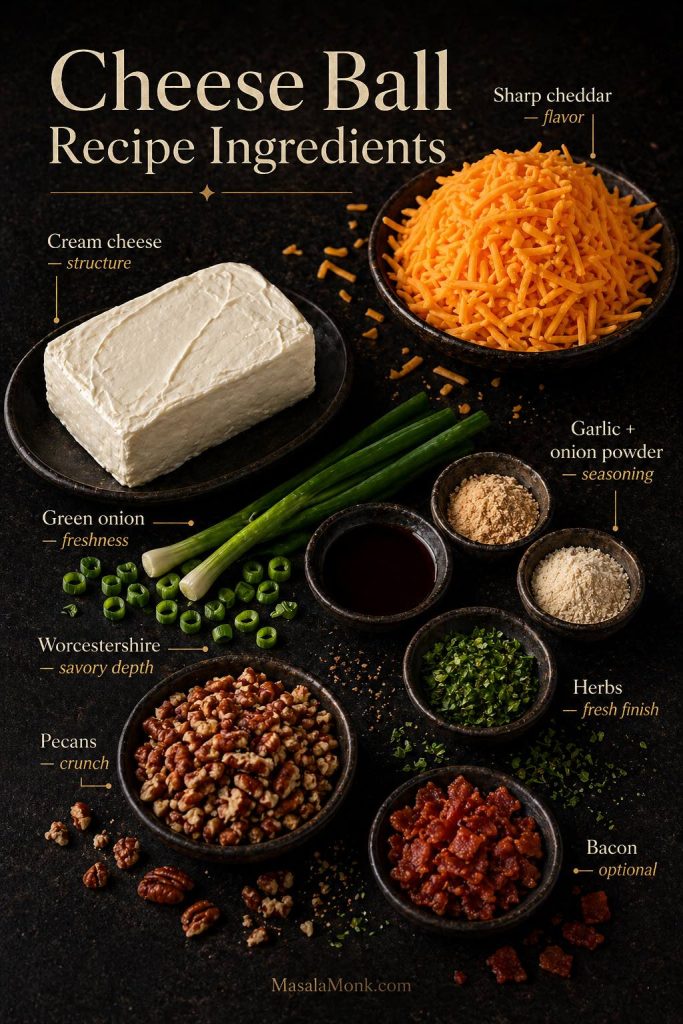
2) How do I keep potato skins extra crisp and not soggy?

First, bake whole potatoes until just tender. Then, scoop to a ¼-inch shell, brush inside and out with oil or butter, and—crucially—re-crisp the empty shells before filling. Consequently, moisture won’t creep back in, and the final broil merely melts cheese instead of steaming the shell.

3) Oven vs. air fryer: which method is best for potato appetizers?

Both shine, but differently. The oven handles big trays and yields even browning; the air fryer delivers fast, concentrated heat for small batches. Therefore, use the oven for parties and the air fryer when you want a quick round of baked potato bites or air-fryer potato appetizers before guests arrive.

4) What temperatures and times should I start with (so I don’t guess)?

As a starting grid:

  • Loaded potato skins: 220°C / 425°F until tender; re-crisp shells 10–12 minutes; broil to finish.
  • Crispy potato bites: 230°C / 450°F for 20–25 minutes; shake once.
  • Smashed potato bites: 230°C / 450°F for 20–25 minutes after smashing thin.
  • Mashed potato bites (mini muffin): 200°C / 400°F for 18–22 minutes.
  • Croquettes: fry at 175–180°C / 350–360°F for 3–4 minutes.
    Adjust by a few minutes for size and spacing; if color stalls, spread pieces out.

5) How do I adapt these potato appetizers for the air fryer?

Go single-layer, preheat if your model suggests it, and avoid crowding. Generally: bites 14–18 minutes at ~200°C / 390°F; smashed 12–16 minutes; mashed-bite mounds 10–12 minutes; skins 6–8 minutes to crisp shells, then 1–2 minutes after topping. Shake once mid-cook and, moreover, add cheese in the final 1–2 minutes so it melts without over-browning.

6) Can I make potato appetizers ahead for a party?

Absolutely. Bake and scoop skins a day or two ahead, then re-crisp just before service. Boil and smash smashed bites in advance; roast to finish right before serving. Form and bread croquettes earlier and freeze; fry from frozen, adding 1–2 minutes. As a result, you get hot platters with almost no last-minute stress.

7) What’s the secret to truly crispy potato bites?

Dryness + direct heat. After parboiling, let potatoes steam-dry until surfaces turn matte. Next, roast on a preheated, lightly oiled tray (or a hot air-fryer basket) with room to breathe. Finally, season assertively; salt draws out a touch of moisture and helps browning, while a last-minute sprinkle of finely grated hard cheese creates a lacy crust.

8) How do I prevent croquettes, cheese balls, or potato and cheese balls from bursting?

Chill the formed balls so they firm up, bread thoroughly (flour → egg → crumbs), and rest 5 minutes so crumbs hydrate. Fry hot enough to set the crust quickly, but not so hot the outside browns before the center warms. Similarly, tiny cheese cubes inside behave better than large ones.

9) What about sweet potato appetizers—any quick rules?

Because sweet potatoes run moister and sweeter, slice thicker (about ½-inch) for rounds and roast hot for caramelized edges. Pair with salty, tangy toppings—goat cheese, feta, herbs, citrus—to balance sweetness. Consequently, sweet potato bites feel bright and modern, not dessert-like.

10) Which cheeses melt best for cheesy potato bites and skins?

Sharp cheddar melts smoothly and tastes assertive. Parmesan turns lacy and crisp in the final minutes. Gruyère adds nutty depth; mozzarella brings stretch but needs salt and acid for balance. For twice-baked minis, a mix (cheddar + a little parmesan) gives both flavor and texture.

11) What are easy vegetarian or gluten-free swaps for potato hors d’oeuvres?

Skip bacon and lean on smoked paprika, roasted peppers, or crisped mushrooms for savory depth. Most recipes are naturally gluten-free if you avoid breadcrumbs; for croquettes, use gluten-free crumbs or a thin rice-flour coating. Likewise, plant-based yogurt or cashew cream can stand in for sour cream on canapés.

12) Can I freeze any of these potato appetizers?

Yes—especially croquettes and mashed potato bites. Freeze in a single layer until firm, then bag. Bake/fry from frozen, adding a minute or two. As for loaded potato skins, freeze the empty, pre-crisped shells; thaw briefly, re-crisp, fill, and broil.

13) How many pieces per person should I plan for party potato appetizers?

For a spread with multiple items, plan 3–4 pieces per person per hour—more at the start, fewer later. For a game-day or all-apps party, scale to 6–8 pieces per person total, mixing rich bites (skins, croquettes) with lighter or zesty options (smashed bites with lemon, sweet-potato rounds).

14) What are smart seasoning lanes that always work?

Go “bright and salty”: lemon zest, parsley, and olive oil. Or “spicy and cool”: chili flakes plus a creamy element on the side. Alternatively, try “herby and nutty”: dill, chive, and a dusting of parmesan. Meanwhile, a squeeze of citrus just before plating wakes up every one of these potato appetizers.

15) My air-fryer potato appetizers aren’t browning—what now?

First, reduce the load and cook in two rounds; crowding traps steam. Next, pat drier and add a teaspoon more oil to help conduction. Finally, raise the temperature slightly or extend 1–3 minutes. Therefore, you’ll get color without overcooking the centers.

16) Which dips pair well (besides the usual suspects) with appetizers made with potatoes?

Think “contrast, not camouflage.” Blue cheese dip adds tangy punch to loaded potato skins and bacon-wrapped bites. A lemony yogurt or thin sour-cream sauce lifts smashed potato bites and twice-baked minis. For sweet potato hors d’oeuvres, go clean—whipped feta or light goat cheese with herbs.

17) Any quick plating tips so my potato party snacks look premium?

Yes—group by texture and temperature. Put hot-and-crisp items together so aromas stack; nearby, set warm-and-creamy bites for contrast. Add a color break with sweet-potato rounds. Garnish sparingly: chives, dill, thin radish slices, and lemon wedges. Consequently, your board looks intentional, not crowded.

18) How do I keep baked potato appetizers hot without losing crunch?

Use a low oven (90–100°C / 200–210°F) and a wire rack so air circulates under the pieces. Instead of holding for long stretches, serve in waves—small trays every 10–15 minutes. As a result, guests always meet crisp edges and creamy centers.

19) What’s the simplest way to turn leftovers into tomorrow’s potato appetizer bites?

Chill leftover mash, fold in an egg and a little grated cheese, then portion into a mini-muffin tin and bake until puffed. Alternatively, form patties and pan-sear for quick mashed potato bites. Meanwhile, leftover skins re-crisp beautifully; refill with whatever cheese or veg you have.

20) Lastly, what are the biggest mistakes to avoid with easy potato appetizer recipes?

Overcrowding trays, skipping the steam-dry step, and adding cheese too early (it over-browns before the potatoes crisp). Also, scooping skins too thick (they eat heavy) or too thin (they collapse). Fix these, and—therefore—your potato appetizers will reliably steal the show.

Posted on 14 Comments

Classic Deviled Eggs (Easy) + 8 Flavorful Variations

Classic deviled eggs on a ceramic plate, topped with paprika and chives, photographed on a blue table—master recipe with 8 variations by MasalaMonk.
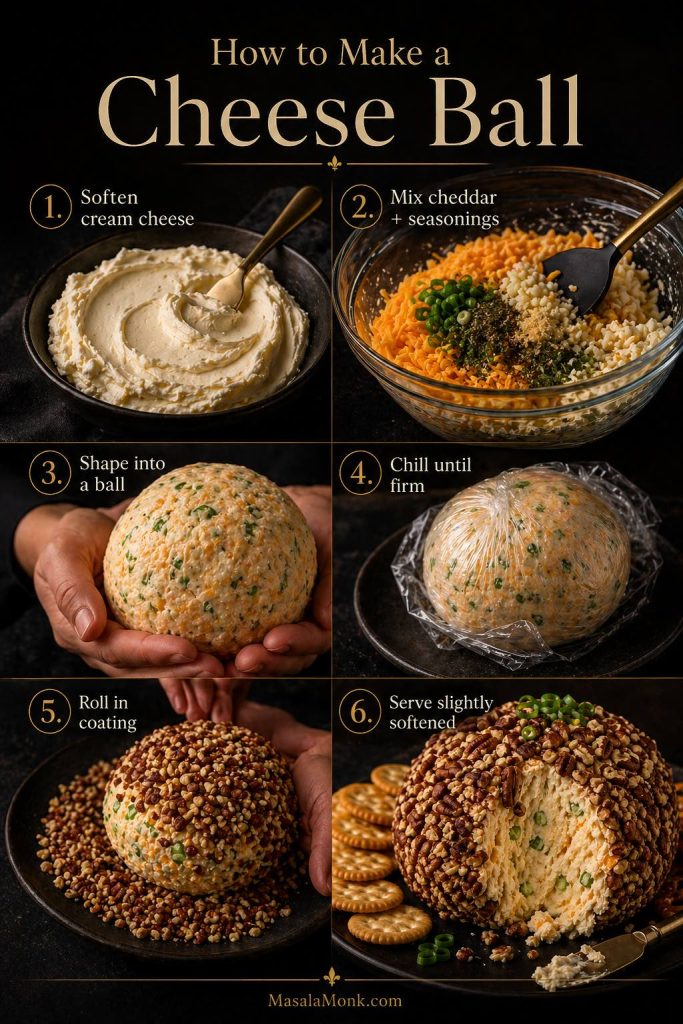
There’s a reason classic deviled eggs are the platter that empties first. They’re simple, yes, but they’re also quietly perfect: a tender white that cradles a plush, tangy filling; a dusting of paprika that looks like confetti; a garnish that promises exactly what you’re about to taste. They travel well, they scale easily, and they make friends at every table—from potlucks to weddings to sleepy Sunday brunch. Most of all, they invite tinkering, so after you master the base, you can tilt the flavor toward briny, herby, smoky, or spicy without losing the comfort of the original.
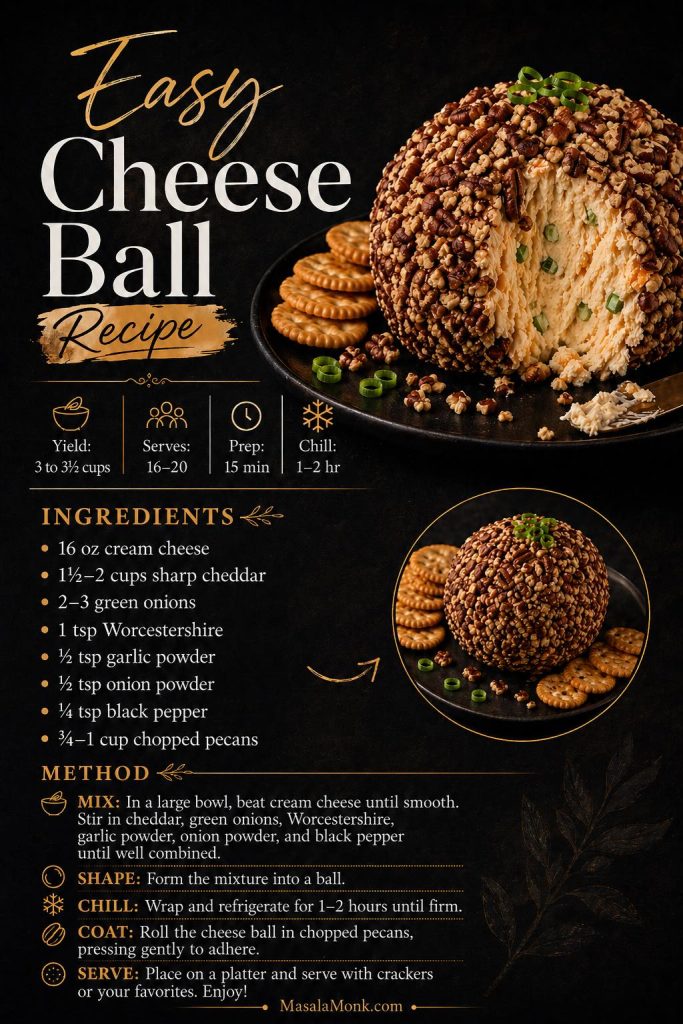
Today, you’ll get a dependable classic deviled eggs recipe that scales cleanly, plus eight variations that read as real, distinct ideas rather than tiny tweaks. Along the way, you’ll see why cooking method matters, how a brief whisk transforms texture, and where tiny adjustments in acid and salt make magic. If you want seasoning inspiration while you read, take a quick spin through MasalaMonk’s friendly roundup, Egg-cellent Seasoning Options for Flavorful Eggs; it’s full of small, confident nudges. For paprika style and color sense, Elevate Your American Cooking is a quick primer. And for a clear demonstration of the steam method (which often peels easier), the step-by-step at Serious Eats helps: Steamed Hard-Boiled Eggs. Finally, because we all host in the real world, the FDA’s plain-English refresher on time and temperature is worth a single, sensible link: Egg Safety.


The quiet mechanics of great deviled eggs

Before we cook, it helps to know what we’re chasing. First, texture: you want smooth whites without moon-craters and a filling that’s plush, pipeable, and light. Therefore, a hot-start boil or a gentle steam—followed by an aggressive ice bath—works in your favor. Because heat sets the albumen from the outside in, starting hot contracts the membrane early; consequently, shells slip off with less drama, and yolks stay sunny instead of green-rimmed.

Second, balance: every bite needs a little fat (mayo), a little heat (mustard, pepper, or both), and a little acid (vinegar or pickle brine). Since flavors pop faster in a silky puree, you add acid by drops and salt by pinches, tasting as you go; as a result, you land in that bright, savory zone that makes people reach back to the platter without thinking.

Third, finish: garnish isn’t decoration so much as a promise. Dill signals pickle; celery leaf whispers buffalo; tarragon says French; chives nod toward ranch; bacon speaks for itself. Meanwhile, a gentle snowfall of paprika acts like lighting—softening edges and adding warmth without hiding the swirl.

Also Read: Eating Boiled Eggs at Night: Benefits, Side Effects & Weight Loss Tips


Master Recipe: Classic Deviled Eggs

Yield: 12 halves (serves 4–6 as an appetizer)
Total time: about 30 minutes (including a short chill)

Ingredients

  • 6 large eggs
  • 4–5 Tbsp mayonnaise (start with 4; hold 1 to adjust texture)
  • 1 tsp yellow or Dijon mustard
  • 1 tsp white vinegar or pickle juice
  • Fine salt and freshly ground black pepper
  • Sweet or smoked paprika, for finishing
  • Optional: snipped chives or fresh dill

Scaling ratio (per whole egg → 2 halves):
1 yolk + 1½ tsp mayo + ⅛ tsp mustard + ⅛ tsp acid + pinch salt & pepper.
Because that ratio is easy to remember, you can scale from a snack for two to a party tray without doing math on your phone mid-peel.

Dill Pickle & Brine deviled eggs on a wooden plate at sunset with pickle coin and dill garnish; portrait recipe card overlay showing add-ins, method, garnish, flavor, and MasalaMonk.com footer.
Serve these briny deviled eggs with crisp kettle chips and chilled dill spears; the snap mirrors the pickle notes. A light pilsner or sparkling water with lemon keeps the palate fresh between bites.

Method

  1. Cook the eggs. Bring a pot of water to a lively boil. Lower the eggs gently and cook 10–12 minutes for hard-cooked. (Alternatively—and often more peel-friendly—steam eggs over simmering water for ~12 minutes; if you want a visual, the walkthrough at Steamed Hard-Boiled Eggs is clear and kind.)
  2. Ice bath. Immediately transfer eggs to an ice bath and chill 10 minutes. In practice, this interrupts carryover cooking and helps the membrane release; consequently, peels behave.
  3. Peel. Tap all over, roll gently to web the shell, then peel from the wide end where the air pocket sits. If you hit a stubborn spot, peel under water; it sneaks under the membrane.
  4. Halve and collect yolks. Slice lengthwise. Pop yolks into a bowl; set whites cut-side up on a platter. If they’re sliding, line the platter with a paper towel while you work and remove it before serving.
  5. Make the filling. Add 4 Tbsp mayo, mustard, vinegar or pickle juice, a pinch of salt, and a few grinds of pepper to the yolks. First mash very smooth with a fork; then whisk 30–60 seconds until the mixture looks glossy and plush. Taste. If you want a softer swirl, add the remaining tablespoon of mayo. Adjust acid drop by drop and salt to taste.
  6. Fill. Spoon the filling back into the whites, or pipe from a small bag with the corner snipped (set the bag in a tall glass to fill neatly; then twist and burp air).
  7. Finish and chill. Dust lightly with paprika; add chives or dill if you like. Finally, chill 10–20 minutes so the tops set and the tray travels as well as it tastes.

Also Read: Egg Intolerance Symptoms


Why this base is so forgiving

Because the base is conservative on liquid, the filling stays sturdy enough to pipe crisply; because a short whisk aerates without adding water, the texture reads decadent rather than dense. Meanwhile, that easy ratio means your hands remember it, which—in a real kitchen, at a real hour—creates confidence. Moreover, since we season late and in tiny increments, you can walk flavor right to the edge without tipping it over. If you want to extend the spice conversation—cayenne, onion powder, mustard powder, smoked paprika—MasalaMonk’s list is helpful and relaxed: Egg-cellent Seasoning Options for Flavorful Eggs. And if you’re deciding between sweet, hot, and smoked paprika—and how each reads on the plate—this quick primer will save you a few experiments: Elevate Your American Cooking.


Scaling (US & metric that won’t betray you mid-party)

Whole EggsYolksMayoMustardAcidFine SaltYield
446 tsp / ~30 g½ tsp½ tsp¼ tsp8 halves
669 tsp / ~45 g¾ tsp¾ tsp⅜ tsp12 halves
101015 tsp / ~75 g1¼ tsp1¼ tsp⅝ tsp20 halves
121218 tsp / ~90 g1½ tsp1½ tsp¾ tsp24 halves
242436 tsp / ~180 g3 tsp3 tsp1½ tsp48 halves

For very large batches, weigh the mayo and whisk briefly in a wide bowl—or on a mixer’s lowest speed for 20–30 seconds—so the filling emulsifies evenly without going slack. Then pause. Because you can always loosen with a few drops of acid or water, restraint keeps you in control.


Troubleshooting you’ll actually use

  • Too stiff? Add ½ tsp liquid (pickle juice, vinegar, or water) and whisk. Repeat if you must, but slowly.
  • Too loose? Mash in an extra cooked yolk if you have one; otherwise, chill 10 minutes and reassess.
  • Grainy? Press through a fine mesh sieve, then whisk 20 seconds.
  • Flat flavor? Add a tiny pinch of salt and a few drops of acid; dust with paprika.
  • Whites tearing? Chill longer; next time, steam the eggs and use eggs that aren’t ultra-fresh.\

Also Read: Egg Yolks or Yellow: Nutritional & Protein Profile


Eight variations (fully detailed, distinct, and platter-friendly)

Each variation starts with the master filling at Step 5. Because the base is balanced, you can layer flavor confidently, yet the texture remains classic.

1) Dill Pickle & Brine Deviled Eggs

Add to filling

  • 2 Tbsp finely chopped dill pickles
  • Replace vinegar with 1–2 tsp pickle juice
  • 1 Tbsp fresh dill, finely chopped (optional)
Dill Pickle & Brine deviled eggs on a wooden plate at sunset with pickle coin and dill garnish; portrait recipe card overlay showing add-ins, method, garnish, flavor, and MasalaMonk.com footer.
Serve these briny deviled eggs with crisp kettle chips and chilled dill spears; the snap mirrors the pickle notes. A light pilsner or sparkling water with lemon keeps the palate fresh between bites.

How to do it
Whisk the base using pickle juice for acid. Fold pickles and dill in at the end to protect texture. If the filling tightens from the solids, loosen with a few drops of brine.

Garnish
A thin pickle coin, a small dill frond, and a whisper of paprika.

Flavor
Bright, savory, and gently crunchy—the one people spot from across the room.

Further seasoning ideas? Stroll through Egg-cellent Seasoning Options for Flavorful Eggs for easy pinches that lean into the briny theme.


2) Ranch Deviled Eggs

Add to filling

  • 1–2 tsp dry ranch seasoning
  • 1–2 tsp water or buttermilk only if needed
  • Snipped chives
Ranch deviled eggs on a dark plate with chives and black pepper, bar counter setting with blurred neon bokeh and beer glass; portrait recipe card overlay; MasalaMonk.com footer.
Pair ranch deviled eggs with crunchy crudités—celery, cucumbers, carrots—and a cold lager or sparkling water. The crisp veg resets the palate, so the herby filling stays bright through the whole platter.

How to do it
Whisk ranch powder into the finished base; blends vary, so taste before adding extra salt. If it tightens, loosen with water or buttermilk by drops.

Garnish
Chives and a crack of black pepper.

Flavor
Herby, garlicky, friendly with crudités and beer, and comfortable on any tray.

Also Read: Are Expensive Eggs Worth Your Money? Guide to Choosing Eggs


3) Buffalo Deviled Eggs

Add to filling

  • 1–2 tsp vinegary hot sauce (Frank’s-style)
  • Optional ½ tsp melted butter for roundness
  • Optional micro blue cheese crumble
Buffalo deviled eggs topped with paprika and tiny celery leaves on a wooden bar, warm pub bokeh; portrait recipe card overlay showing add-ins, method, garnish, and flavor; MasalaMonk.com footer.
Dial heat precisely by adding the hot sauce in drops, then whisking in a ½ tsp of melted butter to round the edges. Set a ramekin of extra sauce and a small bowl of blue-cheese crumbles on the side so guests can customize without loosening the filling; celery sticks keep the bites crisp between rounds.

How to do it
Whisk hot sauce (and butter, if using) into the base. If your crowd loves blue cheese, add the tiniest crumble to the filling or reserve it purely as garnish so the swirl stays smooth.

Garnish
A small celery leaf and a sprinkle of blue if you’re leaning classic.

Flavor
Tangy heat over a creamy backbone—like wings night and brunch met in the middle.


4) French Dijon & Fines Herbes Deviled Eggs

Swap + add

  • Dijon instead of yellow mustard
  • White wine vinegar instead of plain vinegar
  • 1–2 tsp fines herbes (parsley, chives, tarragon; very finely chopped)
French Dijon & fines herbes deviled eggs on pale stoneware at an outdoor table with soft garden bokeh; portrait recipe card overlay with swaps, method, garnish, and flavor; MasalaMonk.com footer.
For the silkiest texture, press yolks through a fine sieve before whisking, then fold ultra-fine herbs in just before piping. Pair with a dry Crémant or Sauvignon Blanc and a simple salad dressed with white-wine vinaigrette so the Dijon and tarragon stay bright.

How to do it
Use the swaps in the base, then fold in herbs right before piping. Because big pieces can snag, chop them fine so they look like confetti rather than confetti cannons.

Garnish
A tiny tarragon tip or extra chives; minimal paprika (or none).

Flavor
Clean, elegant, perfume-y without shouting—brunch-pretty and dinner-worthy.

Also Read: Eggs Benedict: Desi Twist Challenge


5) Bacon & Chive Deviled Eggs

Add to filling

  • 2 Tbsp very crisp bacon, finely crumbled
  • 1 Tbsp chives, snipped
  • Optional: replace 1 Tbsp of mayo with sour cream for extra fluff
Bacon & Chive deviled eggs on white stoneware in bright daylight, topped with crisp bacon crumble and chive batons; portrait recipe card overlay with add-ins, method, garnish, flavor; MasalaMonk.com footer.
Bake bacon on a rack at 200°C / 400°F for 12–18 min until shatter-crisp, then cool completely before crumbling—stays crunchy longer than pan-fried. For clean lines, snip chives with scissors and add after piping. Traveling? Carry bacon in a separate container and sprinkle on at the venue to keep every bite crisp.

How to do it
Fold bacon and chives into the finished filling. If using sour cream, whisk a touch longer to regain body. Keep bacon bits small; large shards puncture whites.

Garnish
A pinch of bacon and a neat chive baton.

Flavor
Savory-smoky with a fresh herbal lift—the first to disappear when no one’s watching.

Also Read: 5 Creative Ideas for Bacon-Wrapped Potatoes


6) Sweet Southern Relish Deviled Eggs

Add to filling

  • 1–2 Tbsp sweet pickle relish, very well-drained
  • Optional ¼–½ tsp sugar dissolved in a few drops vinegar for that church-social finish
Sweet Southern Relish deviled eggs arranged on a metal sheet pan over red-and-white gingham with a community-hall crowd blurred in the background; portrait recipe card overlay with add-ins, method, garnish, flavor; MasalaMonk.com footer.
Drain relish in a fine sieve and pat dry with paper towel so the filling doesn’t weep. If you like a classic potluck sweetness, dissolve ¼–½ tsp sugar in a few drops of white vinegar before whisking in. Transport on the same sheet pan, then dust paprika and dot the relish at the venue to keep the tops pristine.

How to do it
Whisk the base; fold in relish gently. If adding a touch of sugar, dissolve it first so the filling stays silky.

Garnish
Paprika with a tiny dot of relish.

Flavor
Nostalgic, soft, a little sweet, and surprisingly moreish.


7) Sour-Cream & Onion Deviled Eggs

Swap + add

  • Replace ⅓ to ½ of the mayo with sour cream
  • ½–1 tsp onion powder or 1–2 tsp very finely grated onion (squeezed dry)
  • Thin scallion rings
Sour-Cream & Onion deviled eggs on a white marble plate with thin scallion rings and black pepper; emerald green backdrop; portrait recipe card overlay with swap-ins, method, garnish, and flavor; MasalaMonk.com footer.
Squeeze grated onion in a paper towel until nearly dry—extra moisture thins the filling and dulls the flavor. For the cleanest “dip” vibe, use full-fat sour cream and finish with freshly cracked pepper; serve beside crunchy celery and kettle chips to echo the sour-cream-and-onion profile without adding more salt.

How to do it
Blend yolks with the mayo/sour-cream mix first, then season with onion powder (or a little fresh onion). Because fresh onion is potent, add gradually and taste.

Garnish
Scallion rings and fresh pepper.

Flavor
Tangy, lighter, and unmistakably “dip” in deviled-egg clothing.

Also Read: Is Sour Cream a Good Choice for Keto? Exploring Its Creamy Goodness on a Low-Carb Journey


8) Smoky Paprika or Chipotle Deviled Eggs

Add to filling

  • ½–1 tsp smoked paprika or ½–1 tsp very finely minced chipotle in adobo
Smoky Paprika or Chipotle deviled eggs in a small cast-iron skillet on a dark slate surface, paprika-dusted swirls with tiny parsley leaf; portrait recipe card overlay with add-ins, method, and flavor; MasalaMonk.com footer.
Use pimentón de la Vera (dulce or picante) for clean smoke; sift it through a fine strainer so the dusting looks even and doesn’t clump. If choosing chipotle in adobo, blot first and mince to a paste—then season salt last and brighten with a few drops of white vinegar or lime so the heat reads vivid, not muddy. Pair with roasted nuts or grilled corn bites to echo that campfire vibe without overpowering the eggs.

How to do it
Whisk smoked paprika straight into the base; if using chipotle, mince extremely fine and start small. Adjust salt last—chipotle’s depth can trick your palate.

Garnish
Extra smoked paprika and a small parsley leaf.

Flavor
Warm, deep, slightly mysterious, and strikingly beautiful on the platter.

Curious about paprika styles? A quick skim here will help you choose by color and heat: Elevate Your American Cooking.


Make-ahead, storage, and transport (real-life logistics)

Two days ahead: Cook and peel up to 48 hours in advance. Store whites and filling separately. Layer whites between paper towels in a covered container; press plastic wrap directly onto the surface of the filling before lidding. Consequently, you avoid crusting and keep whites satin-smooth.

On the day: Assemble within 4 hours of serving so the swirls stay glossy and the paprika doesn’t bloom in condensation. If you’re plating outside, keep a small cooler nearby; that way, refreshing the tray is easy.

At the table: Keep the platter cold. If the party runs long, rotate a second chilled tray and return the first to the fridge. For a simple, sane reminder on timing, temperature, and leftovers, the FDA’s page is short and useful: What You Need to Know About Egg Safety.

Transport: Easiest of all, carry whites and filling separately and pipe on arrival—zero smears. Otherwise, chill pre-filled halves until the tops set, then pack snugly with minimal headspace. If you line the container with a lightly damp paper towel, the whites won’t skate around during the ride.


Plating that invites people in

Because we eat with our eyes first, presentation isn’t fussy—it’s welcoming. Try a classic ring on a white platter with an even paprika halo and a light snowfall of chives. Or, build a garden board with celery sticks, cucumbers, radishes, and gentle herbs; ranch and dill versions feel at home there. For the briny crowd, create a pickle party: ring the eggs with cornichons, dill spears, and a bowl of pickled onions so people can build little bites. Meanwhile, brunch loves bacon & chive beside crisp hash browns and toast soldiers. If you’re serving a crowd, consider a mixed trio per tray—classic, herby/briny, and spicy/smoky—with distinct garnishes so guests can choose at a glance.

Naturally, platters don’t live alone. If you’d like to anchor the table with sturdy companions, point readers to MasalaMonk’s snackable ideas that genuinely fit: 10 Potato Appetizers Ideas You Will Never Imagine and 5 Sweet Potato Appetizers Ideas to Inspire the Chef in You. And if you’ve boiled a few extra eggs, send cooks straight to quick inspiration: 10 Examples of Egg Dishes, with 2 Eggs.


Serving sizes and party math (so you never come up short)

For a mixed appetizer spread, plan 2–3 halves per person; if classic deviled eggs are the star (or your people are egg people), lean toward 4 halves. A standard dozen eggs (24 halves) satisfies 8–12 with other options or 6–8 among superfans. If you’re making two trays, lead with classic, dill pickle & brine, and smoky paprika, then follow with ranch, buffalo, and bacon & chive. Consequently, you’ll cover mild, briny, and bold without repeating yourself.

When scaling beyond 12 eggs, weigh the mayo, stick to the ratio, and whisk briefly on a mixer’s lowest speed—stop the moment the filling looks glossy and holds ridges. Then chill a few minutes and pipe. Because restraint is your friend, you can always loosen with a drop or two of acid; you can’t un-thin a bowl of filling.

Also Read: Punch with Pineapple Juice: Guide & 9 Party-Perfect Recipes


Technique notes cooks actually care about

  • Egg size and timing: Large eggs are the assumed standard here. If you’re using extra-large eggs, add a minute; if medium, subtract a minute.
  • Altitude: At altitude, water boils lower; therefore, add 1–2 minutes to the cook time and keep that ice bath honest.
  • Older vs. fresh eggs: Older peel easier; very fresh can be stubborn. Consequently, if all you’ve got is farm-fresh, steam them.
  • Color cues: A green ring around the yolk isn’t dangerous; it’s overcooked. Ice baths help prevent that.
  • Piping tips: A plain snip gives rustic peaks; a star tip gives height and texture; a French star gives tidy ridges that catch paprika beautifully.
  • Garnish discipline: Less is more. Place the herb where it makes sense: dill for pickle, celery leaf for buffalo, tarragon for French, chives for ranch, bacon for—well—bacon.

Concluding it all

Here’s the truth: classic deviled eggs are less about perfection and more about care. You boiled water; you shocked eggs; you mashed and seasoned and tasted; you piped little swirls that look like you meant it. That intention shows. Guests notice when food feels calm and confident, and they lean in when there’s just enough variety to make choosing fun. So make the base once, then make it yours—tilt it toward dill for the cousin who loves pickles, nudge it toward Dijon and herbs for the friend who wears linen, drift it toward buffalo for the crew who cheer at the TV. And when the platter comes back empty—and it will—smile, because you did a simple thing well.

If you want to keep playing, wander a little: try a dusting of smoked paprika after chilling for deeper color; or set two tiny bowls next to the tray—one with extra pickle chips, one with chives—so people can customize their second pass. Meanwhile, if you’re planning a bigger spread, these two MasalaMonk roundups fit right beside deviled eggs without stealing the spotlight: 10 Potato Appetizers Ideas You Will Never Imagine and 5 Sweet Potato Appetizers Ideas to Inspire the Chef in You. Finally, for a clear, friendly technique refresher anytime, the steam method steps are here when you need them: Steamed Hard-Boiled Eggs. And because good hosting is also safe hosting, one bookmark for your kitchen drawer: Egg Safety.

Now breathe. Plate the eggs. Watch the tray empty. Then take your quiet bow.

FAQs

1. What are classic deviled eggs, exactly?

Classic deviled eggs are hard-cooked eggs halved and filled with a creamy yolk mixture seasoned with mayonnaise, mustard, a touch of acid (vinegar or pickle brine), salt, pepper, and usually paprika. In short, they’re simple, savory, and endlessly adaptable.

2. What’s the master ratio for classic deviled eggs?

Per 1 egg (2 halves): 1 yolk + 1½ tsp mayo + ⅛ tsp mustard + ⅛ tsp acid + a pinch of salt and pepper. Because that ratio scales cleanly, you can multiply straight across for 4, 6, 10, 12, or even 24 eggs without fuss.

3. Should I boil or steam the eggs?

Both work; however, steaming is often more forgiving and peels more cleanly. Either way, immediately shock in ice water for 10 minutes so shells release easily and yolks stay sunny.

4. How do I peel eggs without tearing the whites?

First, crack all over and roll gently; then start from the wide end where the air pocket sits. If a spot resists, peel under water—consequently, the membrane loosens and the peel slips away.

5. How long do hard-cooked eggs last in the fridge?

Generally, up to 7 days when kept refrigerated. That said, once you mix the filling, aim to enjoy your classic deviled eggs within 2–3 days for the best texture and flavor.

6. How far ahead can I assemble deviled eggs?

Ideally, cook and peel up to 48 hours ahead but keep whites and filling separate. Then, assemble within 4 hours of serving so the swirls stay glossy and the paprika looks fresh.

7. How long can deviled eggs sit out at a party?

As a rule, try not to exceed 2 hours at room temperature. After that, move the platter back to the fridge—or instead, set it over ice so you can linger longer, safely.

8. What’s the best way to transport deviled eggs?

If possible, carry whites and filling separately and pipe on arrival—no smears, no sliding. Otherwise, chill pre-filled halves until the tops set; then pack snugly with minimal headspace.

9. My filling is too stiff—how do I fix it?

Add ½ teaspoon liquid (pickle juice, vinegar, or water) and whisk briefly; if needed, repeat in tiny increments. Consequently, you keep control and avoid overshooting into soupy territory.

10. My filling is too loose—now what?

First, chill 10 minutes; often it firms up. If it’s still slack, mash in one extra cooked yolk, then taste and adjust salt and acid.

11. What kind of mustard is best?

Yellow mustard tastes nostalgic and mild; Dijon is sharper and a bit more elegant. In practice, both make excellent classic deviled eggs—choose based on the crowd (and the garnishes).

12. Is pickle juice better than vinegar?

They’re different tools. Vinegar gives clean brightness; meanwhile, pickle juice adds tang plus a whisper of dill and salt, which pairs beautifully with “dill pickle deviled eggs.”

13. Can I make deviled eggs without mayonnaise?

Yes—try part sour cream or thick Greek yogurt for tang (though the texture will be slightly lighter). Even so, keep the ratio gentle on liquid and whisk just until plush.

14. What’s the easiest flavor variation to master first?

Start with Dill Pickle & Brine: swap vinegar for pickle juice and fold in chopped dill pickles. Instantly, you get briny snap and, moreover, a garnish that tells guests what’s inside.

15. How do I make ranch deviled eggs taste balanced, not salty?

Whisk in 1–2 tsp dry ranch and taste before adding any extra salt—blends vary widely. If the filling tightens, loosen with a teaspoon of water or buttermilk.

16. What’s the trick to buffalo deviled eggs?

Blend 1–2 tsp vinegary hot sauce into the yolk base; optionally add a touch of melted butter for wing-style roundness. Then, garnish with a tiny celery leaf (and a micro crumble of blue cheese if your people love it).

17. How do I keep bacon crisp in bacon-chive deviled eggs?

Cook bacon very crisp, cool completely, then crumble finely. Fold it in right before piping; otherwise, it softens and can puncture the whites.

18. Which herbs make the “French” variation sing?

Use Dijon and white wine vinegar, then add very finely chopped fines herbes (parsley, chives, tarragon). Consequently, you’ll get an aromatic, elegant take on classic deviled eggs.

19. What’s the difference between smoked paprika and chipotle here?

Smoked paprika gives warm, gentle smokiness and gorgeous color; chipotle adds smoke plus heat. Therefore, start small with chipotle (½ tsp), taste, and adjust.

20. How many deviled eggs should I plan per person?

For a mixed spread, plan 2–3 halves per person; if deviled eggs are the star, estimate 4 halves. Practically speaking, a dozen eggs (24 halves) feeds 8–12 with other apps.

21. What’s the best garnish strategy for a mixed tray?

Keep garnishes distinct and readable: dill fronds for pickle, chives for ranch, celery leaves for buffalo, tarragon tips for French, bacon for bacon-chive. As a result, guests choose confidently without asking.

22. Spoon or pipe—does it matter?

Both work. Nevertheless, piping (even from a snipped zip bag) creates height and catches paprika beautifully, whereas spooning feels rustic and relaxed.

23. How do I avoid a green ring on the yolks?

Don’t overcook, and always ice bath for at least 10 minutes. Because carryover heat causes that green ring, rapid chilling stops it in its tracks.

24. Why do my whites get watery in the fridge?

Excess moisture—either from very fresh eggs or wet add-ins—can weep. To prevent it, drain relish well, chop pickles finely, and, additionally, store whites on paper towels before assembly.

25. Can I scale classic deviled eggs for a crowd without losing texture?

Absolutely. Weigh the mayo for large batches, whisk briefly on the lowest mixer speed (20–30 seconds), and pause early; then loosen by drops if needed. Consequently, the filling stays plush, not pasty.

26. What are the most “guest-proof” three flavors for one platter?

Classic, Dill Pickle & Brine, and Smoky Paprika. Together, they cover creamy, briny, and warm-smoky; moreover, the garnishes are unmistakable at a glance.

27. Can I add sweetness without making them cloying?

Yes—especially for Southern relish deviled eggs. Dissolve ¼–½ tsp sugar in a few drops of vinegar first, then whisk in; therefore, the sweetness disperses evenly.

28. Do medium or extra-large eggs change anything?

Slightly. Medium eggs cook a minute faster; extra-large need a minute more. Regardless, the ratio still holds—because you’ll season to taste at the end, you remain in control.

29. What’s one small step that makes my classic deviled eggs look pro?

Whisk the filling briefly until glossy, then chill 10 minutes before piping. As a result, ridges hold, paprika dusts evenly, and the platter looks serene.

30. Where can I learn more about seasonings and paprika styles?

For friendly ideas, browse MasalaMonk’s Egg-cellent Seasoning Options for Flavorful Eggs. For color, heat, and how smoked paprika changes the look and flavor of classic deviled eggs, see Elevate Your American Cooking.

Posted on 8 Comments

Cheese Balls: 5 Irresistible Indian-Inspired Variations

Indian-Inspired CHEESE BALLS

Cheese balls are the perfect bite-sized indulgence, combining creamy cheese with crispy exteriors and irresistible flavor. While cheese balls are a global favorite, the Indian kitchen brings a flavorful twist to this beloved snack. Whether you’re planning a party, preparing a weekend treat, or looking for a quick yet satisfying appetizer, these Indian-inspired cheese ball recipes have something for everyone.

In this blog, we explore five standout variations that marry the comforting taste of cheese with the bold, diverse flavors of Indian cuisine. Let’s dive right in.


1. Masala Cheese Balls

Flavor Profile:

Spicy, tangy, and aromatic

Why It Works:

These are an elevated version of the classic cheese balls with a desi punch. Think of it as aloo tikki meets molten cheese.

Ingredients:

  • 1 cup grated processed cheese
  • 2 medium boiled potatoes (mashed)
  • 1 tsp red chili powder
  • ½ tsp garam masala
  • ½ tsp chaat masala
  • 1 tbsp chopped coriander
  • 1 chopped green chili
  • Salt to taste
  • Cornflour (for binding)
  • Bread crumbs (for coating)
  • Oil (for deep frying)

Preparation:

  1. In a mixing bowl, combine mashed potatoes, cheese, spices, coriander, and green chili.
  2. Add cornflour to form a soft, pliable dough.
  3. Shape into small balls and roll in breadcrumbs.
  4. Chill for 15 minutes to firm up.
  5. Deep-fry until golden and crispy.

Serving Tip:

Serve hot with green chutney or a tangy tamarind dip.


2. Paneer & Spinach Cheese Balls

Flavor Profile:

Earthy, creamy, and subtly spiced

Why It Works:

This healthier option uses spinach and paneer, making it rich in protein and iron while still being indulgent.

Ingredients:

  • 1 cup grated paneer
  • ½ cup grated cheese
  • 1 cup finely chopped blanched spinach
  • ½ tsp cumin powder
  • 1 tsp ginger-garlic paste
  • Salt and pepper to taste
  • 1 tbsp cornflour
  • Bread crumbs
  • Oil (for shallow frying)

Preparation:

  1. Squeeze out excess water from spinach.
  2. Mix paneer, cheese, spinach, spices, and cornflour.
  3. Shape into small balls and roll in breadcrumbs.
  4. Pan-fry or air-fry until golden.

Serving Tip:

Pair with yogurt-mint dip or serve on a skewer for a canapé-style appetizer.


3. Schezwan Cheese Balls

Flavor Profile:

Spicy, umami, and Indo-Chinese

Why It Works:

If you love spice and fusion, this one’s for you. Schezwan sauce adds a fiery depth that balances the creamy cheese.

Ingredients:

  • ½ cup grated mozzarella
  • ½ cup chopped bell peppers and spring onions
  • 2 tbsp Schezwan sauce
  • 1 tsp soy sauce
  • 2 tbsp cornflour
  • Salt to taste
  • Bread crumbs

Preparation:

  1. Combine all ingredients to form a dough.
  2. Shape into balls, coat in breadcrumbs.
  3. Deep-fry or air-fry for 8–10 minutes.

Serving Tip:

Serve with extra schezwan sauce or chili mayo for dipping.


4. Tandoori Cheese Balls

Flavor Profile:

Smoky, spiced, and bold

Why It Works:

Bringing in the magic of tandoori masala, this version captures that smoky restaurant-style flavor in a compact snack.

Ingredients:

  • ½ cup paneer, crumbled
  • ½ cup grated cheese
  • 2 tbsp thick yogurt (hung curd preferred)
  • 1 tsp tandoori masala
  • ½ tsp kasuri methi
  • ½ tsp chili powder
  • Salt to taste
  • Semolina or bread crumbs

Preparation:

  1. Marinate the paneer and cheese with yogurt and spices.
  2. Shape into balls and coat with semolina or breadcrumbs.
  3. Shallow-fry or bake until golden.

Serving Tip:

Garnish with onion rings, mint chutney, and lemon wedges.


5. Aloo-Makhani Cheese Balls

Flavor Profile:

Rich, buttery, and luxurious

Why It Works:

Inspired by the iconic makhani (butter) sauce, this version is indulgent and flavor-packed.

Ingredients:

  • 1 cup mashed potatoes
  • Cheese cubes (for stuffing)
  • ½ cup makhani gravy (can be store-bought or homemade)
  • Salt, garam masala, and kasuri methi
  • Cornflour for binding
  • Bread crumbs for coating

Preparation:

  1. Mix mashed potatoes with spices and a spoonful of makhani gravy.
  2. Encase cheese cubes within the mixture and shape into balls.
  3. Coat with breadcrumbs and fry until golden.
  4. Warm remaining makhani sauce for serving.

Serving Tip:

Serve on a platter with a spoonful of makhani sauce under each ball. Garnish with coriander and cream.


Final Thoughts

Cheese balls are more than just party snacks—they can be canvases for creativity. These five Indian-inspired variations offer options for every taste and occasion. Whether you’re going for spicy, healthy, indulgent, or fusion, there’s a version here that will wow your guests and satisfy your cravings.

Ready to try these at home? Let us know which one stole your heart. And if you have a twist of your own, share it in the comments—we’d love to feature it in a future post!

FAQs

1. Can I make these cheese balls ahead of time?
Yes, you can shape and coat the cheese balls, then refrigerate them for up to 24 hours. For longer storage, freeze them uncooked and fry directly from frozen when needed.

2. What is the best cheese to use for Indian-style cheese balls?
Processed cheese, mozzarella, or a mix of mozzarella and cheddar works best. Paneer is also ideal when used in combination for Indian flavors.

3. How do I prevent cheese balls from breaking while frying?
Ensure the dough is firm and not too moist. Chill the shaped balls before frying and avoid overcrowding the pan. Double-coating with breadcrumbs helps too.

4. Can I bake or air-fry these instead of deep frying?
Absolutely. Brush with oil and bake at 200°C (392°F) for 15–20 minutes or air-fry at 180°C (356°F) for 10–12 minutes, flipping halfway.

5. Are these cheese balls gluten-free?
Some versions can be made gluten-free by using gram flour (besan) and gluten-free breadcrumbs. Avoid maida (all-purpose flour) if you need a gluten-free recipe.

6. What are good vegetarian substitutes for eggs in the coating?
Use a slurry of cornflour and water or all-purpose flour and water for binding and coating. These help the breadcrumbs stick just like egg wash.

7. Can I make these cheese balls spicy or mild?
Yes, you can adjust the spice level easily. Skip green chilies and reduce chili powder for mild versions, or add chili flakes and spicy sauces for a kick.

8. What sauces or dips go best with these cheese balls?
Indian green chutney, mint yogurt dip, tamarind chutney, schezwan sauce, or even spicy mayo all work well depending on the variation.

9. How can I stuff the cheese balls without the cheese leaking out?
Make sure the outer potato or paneer layer is thick enough to fully seal the cheese cube. Chilling them before frying helps keep the stuffing intact.

10. Can I reuse leftover makhani gravy or sabzis for any variation?
Yes! Leftover makhani gravy is perfect for the Aloo-Makhani balls. Leftover dry sabzis like aloo-matar can also be mashed and repurposed into the mix.