Posted on Leave a comment

Spanakopita Recipe: Greek Spinach Pie with Feta, Phyllo & Crispy Layers

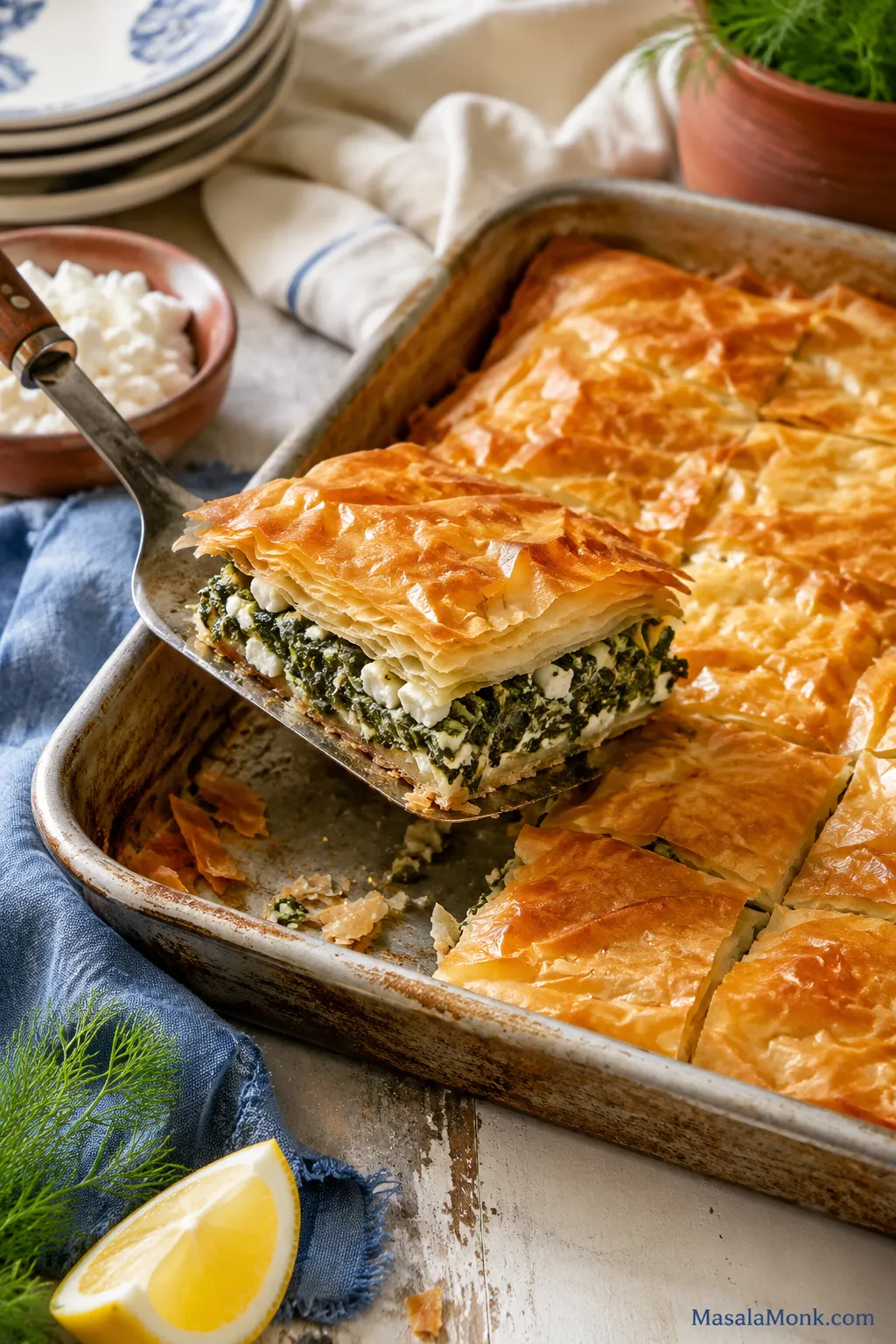
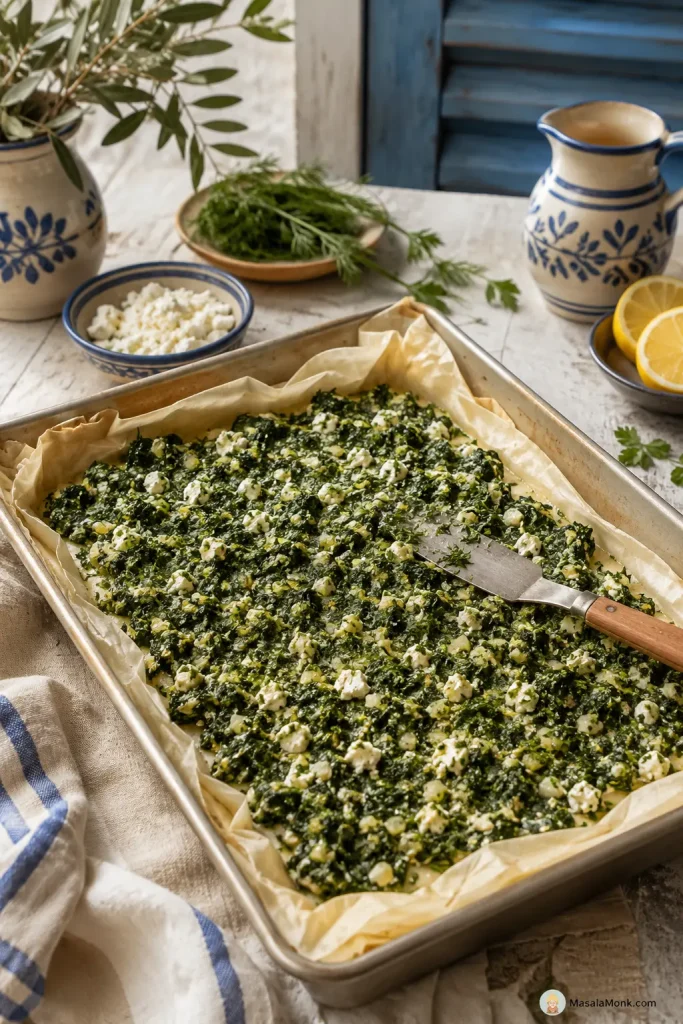
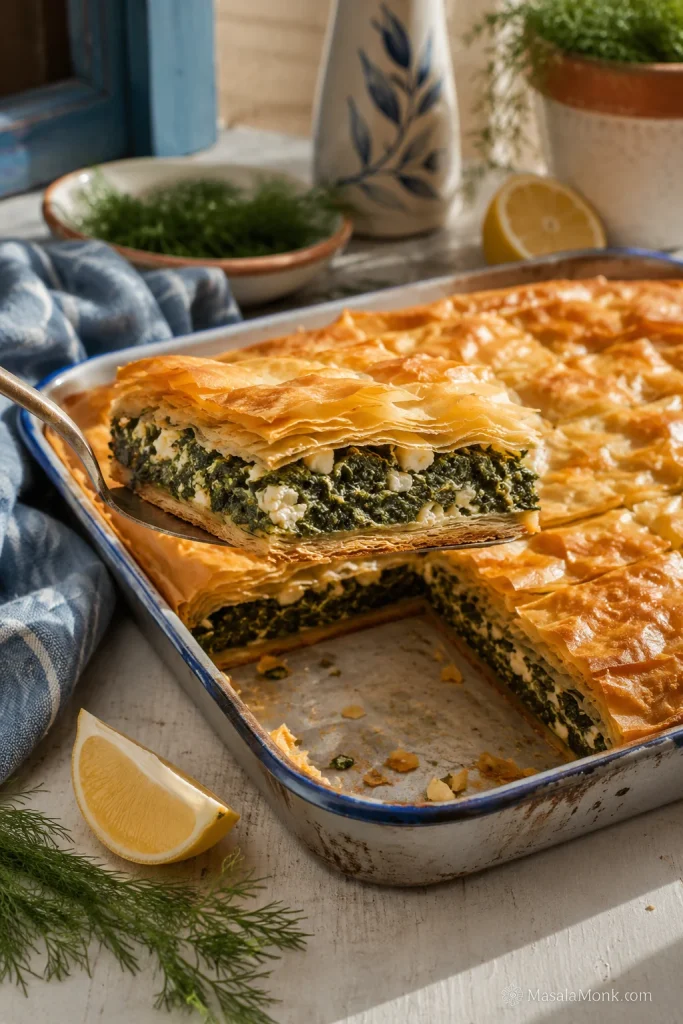
A spatula lifting a corner piece of baked spanakopita from a rectangular pan, showing golden phyllo layers and green spinach feta filling.

You know spanakopita is right when the knife crackles through the golden top and the first corner lifts cleanly from the pan. Under those flaky phyllo layers should be warm spinach, salty feta, fresh herbs, and enough structure to slice without the bottom turning wet.

This is a practical home-kitchen spanakopita: store-bought phyllo, a well-drained spinach-feta filling, clear success cues, and a crisp base that does not depend on perfect pastry work. You still get the drama of a flaky Greek spinach pie, but the process stays manageable: dry the greens, mix the filling, layer, bake, rest, and slice.

If phyllo makes you nervous, you are in good company. It tears, dries, and wrinkles, but this pie does not need perfect sheets. The hidden layers can be patchwork, the top can be a little rustic, and the tray will still bake into something golden, flaky, and shareable.

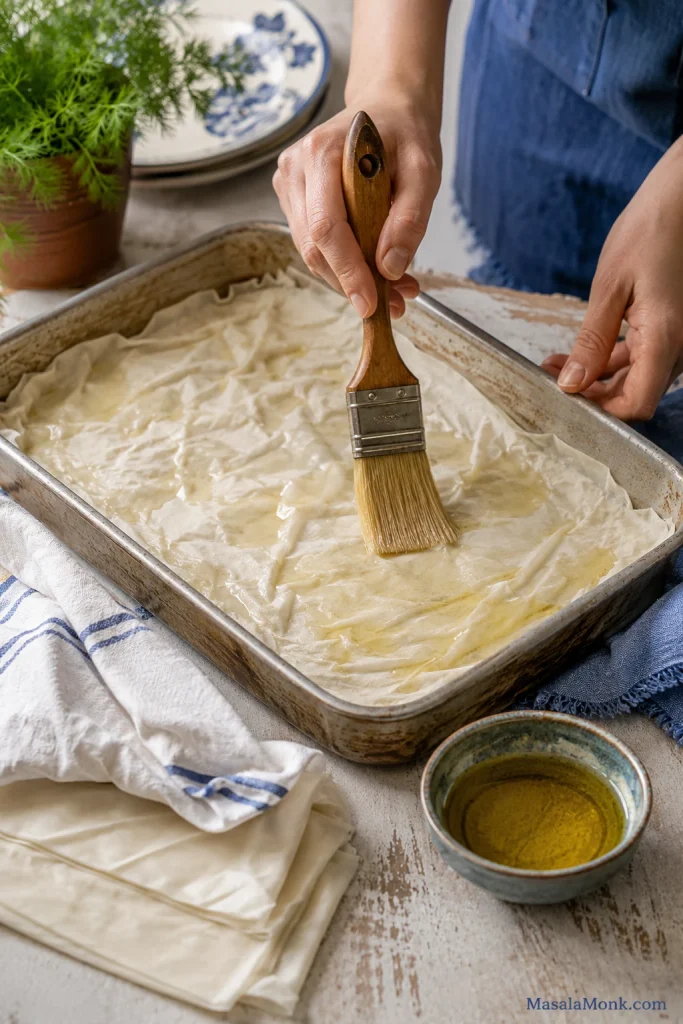
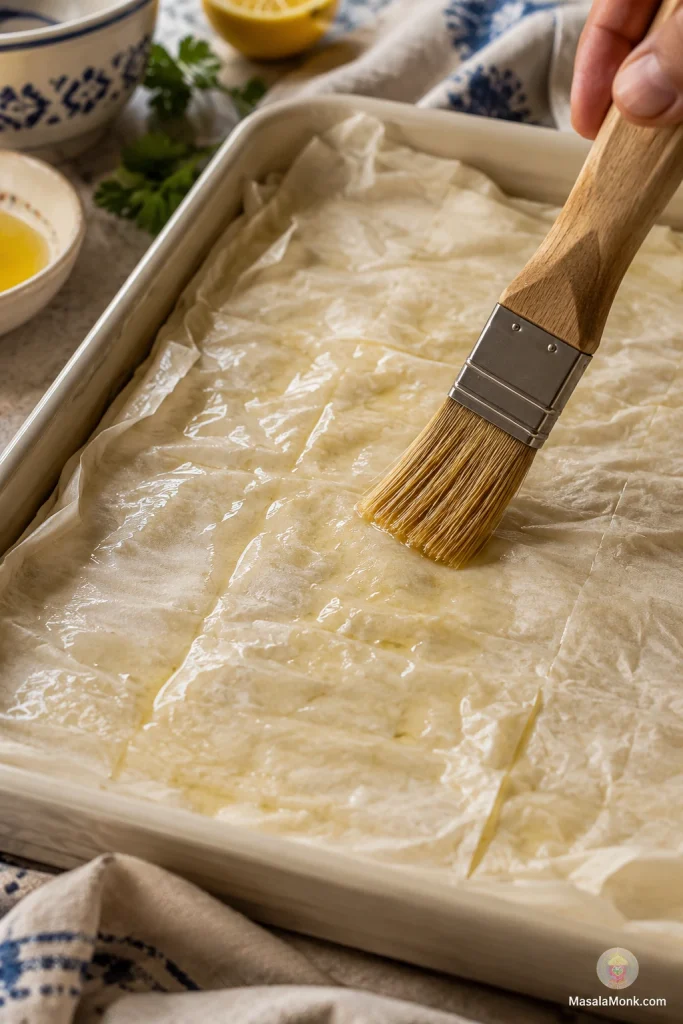
Hands brushing oil over a wrinkled sheet of phyllo pastry inside a rectangular baking pan.
Wrinkled phyllo is still usable phyllo. Once it is lightly brushed and layered, those folds become extra flaky edges instead of a problem to fix.

Fastest reliable path: use frozen spinach, block feta, 14 phyllo sheets, and a 9 x 13 inch pan. Fresh spinach works too, but frozen keeps the filling easier to control for a first tray.

This is the version for the cook who wants spanakopita to feel doable before it feels impressive.

Spanakopita Recipe Snapshot

Recipe typeGreek spinach pie / spinach and feta phyllo pie
Prep time35–45 minutes with frozen spinach; longer with fresh bunch spinach
Cook time45–55 minutes
Total time1 hour 20 minutes to 1 hour 40 minutes, not including phyllo thawing
Advance stepThaw frozen phyllo overnight in the refrigerator
Yield10–12 pieces
Pan size9 x 13 inch / 23 x 33 cm baking dish or pan
Oven temperature350°F / 180°C
Oven rackLower-middle rack
Spinach500 g / 16 oz frozen spinach or 700–900 g / 1½–2 lb fresh spinach
Resting time15–20 minutes, uncovered, before slicing

Jump to the full recipe, or keep reading for the spinach, phyllo, and crisp-bottom tips that make the tray work.

Table of Contents

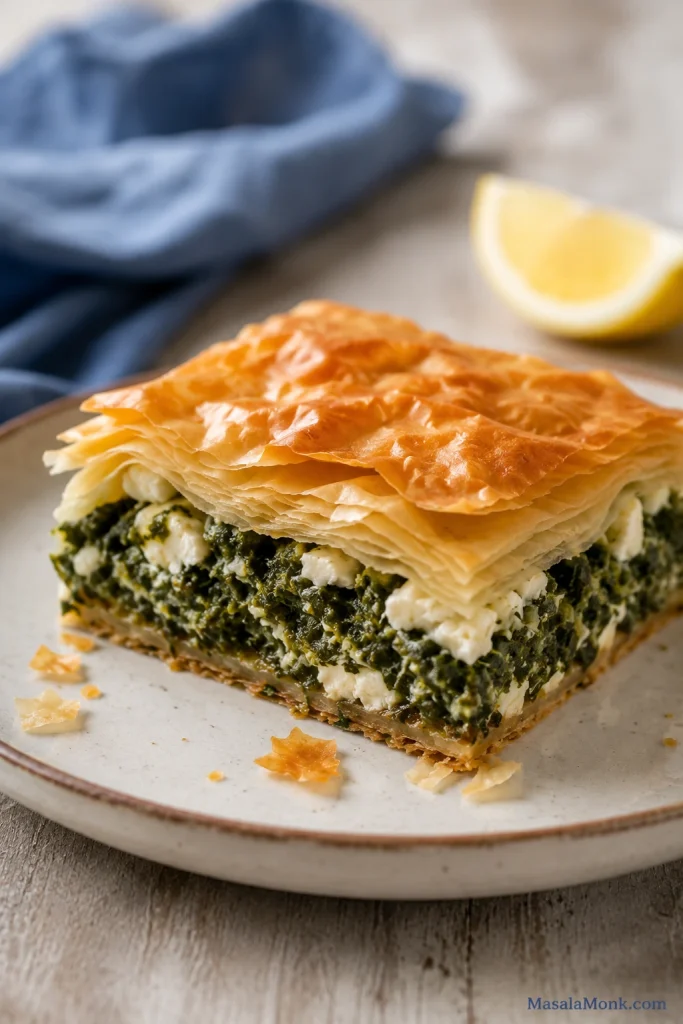
Before we get into the details, this is the texture you are aiming for: crisp pastry outside, green spinach through the middle, and small feta pieces that stay visible after baking.

A plated slice of Greek spinach pie showing flaky phyllo layers, green spinach filling, and white feta pieces.
A good Greek spinach pie slice should show contrast: crisp pastry outside, herby spinach inside, and small feta pockets throughout. That uneven texture is part of what makes spanakopita feel homemade.

Why This Spanakopita Works

The goal here is not perfect pastry work. It is a tray that lifts cleanly, tastes generous, and gives you flaky layers without asking you to baby every sheet. Frozen spinach takes one variable off your hands, block feta gives better texture, seven bottom phyllo sheets create structure, and the lower-middle rack helps the base bake through before the top gets too dark.

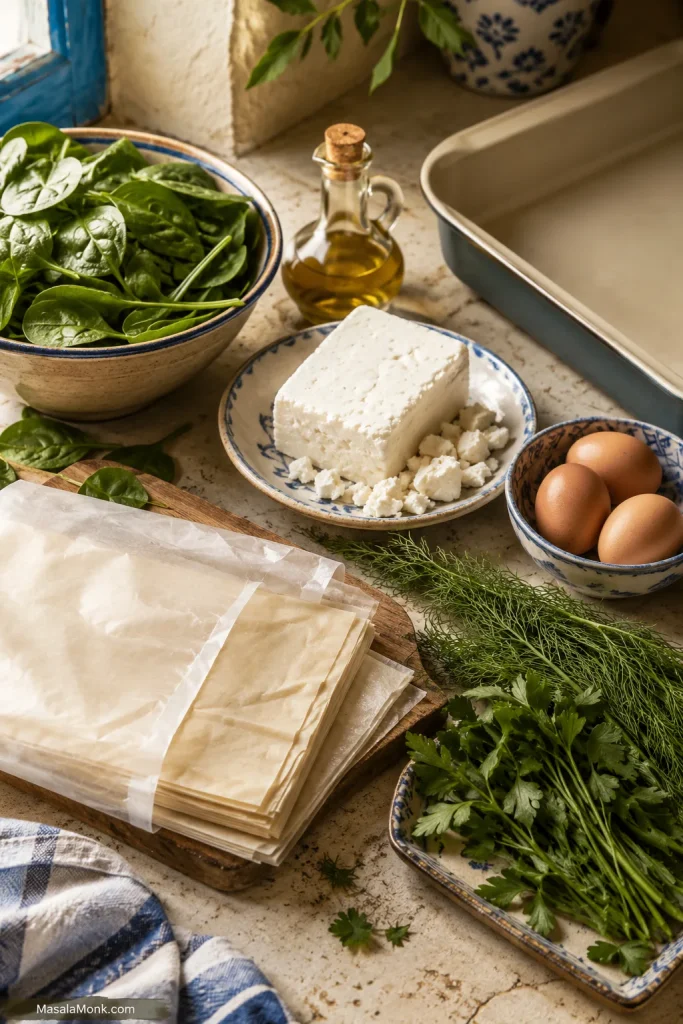
This is the practical spanakopita setup: filling ingredients ready, phyllo still protected, and the pan waiting before assembly begins.

Spanakopita ingredients on a kitchen counter, including phyllo sheets, spinach, feta, herbs, eggs, olive oil, and a rectangular baking pan.
Set up the spanakopita station before opening the phyllo: spinach, feta, herbs, eggs, oil, brush, and pan. Then the delicate sheets spend less time drying on the counter.
  • Frozen spinach makes the filling easier to control. Fresh works too, but frozen is already wilted, so once it is pressed well, the tray becomes more predictable.
  • Block feta gives creamy, salty pockets. It tastes fuller than very dry pre-crumbled feta.
  • Seven bottom sheets support the filling. They help the pie slice cleanly.
  • The lower-middle rack helps the base cook. This is especially useful in glass or ceramic pans.
  • A short rest finishes the texture. The filling settles, the pastry stays flaky, and the pieces cut cleaner.

The tray format is forgiving in a way triangles are not. Torn sheets disappear inside, the filling spreads evenly, and the lower layers have enough time to firm up before slicing.

You still get the flavor of a classic Greek spinach pie, just with store-bought phyllo, a forgiving tray format, and enough structure that the first slice does not collapse.

What Is Spanakopita?

Spanakopita is a Greek spinach pie made with thin phyllo pastry and a savory filling of spinach, feta cheese, herbs, and often eggs.

You may see the pastry spelled as phyllo or filo. They are the same thing: paper-thin pastry sheets that bake into crisp, flaky layers when brushed with olive oil or melted butter.

Greek spinach pies vary by family and region. Some use leeks, some add more herbs, some use homemade phyllo, and some keep the filling very simple. Here, the spirit is classic — greens, feta, herbs, olive oil, and crisp phyllo — while the handling is modern and practical: store-bought pastry, clear texture cues, and a tray format that gives the filling room to settle.

For dinner and clean slices, the tray version is the easiest path; triangles are better when you want appetizers, lunch boxes, or party bites.

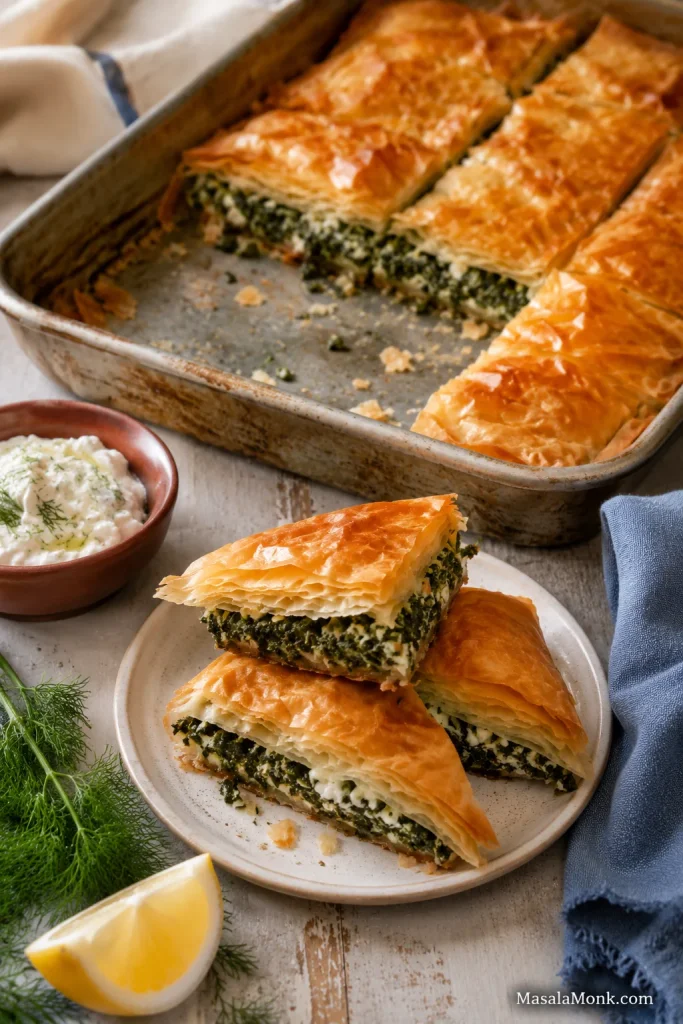
A tray of spanakopita in the background with baked spinach and feta phyllo triangles in the foreground.
The same spinach-feta filling can become a full tray or folded spanakopita triangles. Choose the tray for an easier family-style bake, or make triangles when you want appetizer-sized pieces.

Spanakopita is not meant to be creamy like spinach dip. The filling should be savory, herby, and moist enough to taste generous, but firm enough that the phyllo bakes into layers instead of steaming from underneath.

In either shape, the best pieces have contrast: brittle golden corners, soft salty feta tucked into the greens, and a herby filling that smells good before the tray even reaches the oven.

Ingredients and Substitutions

The filling is simple, which is why the details show up in the finished slice. Good feta gives salty pockets, fresh herbs keep the spinach lively, and well-prepared greens let the phyllo stay flaky instead of heavy. If spinach is your main question, jump to the fresh vs frozen spinach guide before mixing.

Spinach and feta are the two ingredients that matter most. Spinach controls texture; feta controls flavor. Loose spinach weakens the pastry, while bland feta makes the whole filling taste flat.

This amount gives a generous but sliceable filling: enough spinach and feta to taste full, but not so much that the lower layers steam. If you add extra greens, keep the final squeezed amount close to the recipe amount.

Spanakopita Ingredient Amounts

IngredientAmountNotes
Frozen chopped spinach500 g / 16 ozThaw fully and press well.
OR fresh spinach700–900 g / 1½–2 lbWilt in batches, cool, chop if needed, then squeeze well.
Feta cheese300 g / about 10½ ozBlock feta gives better flavor and texture than very dry pre-crumbled feta.
Large eggs2Help bind the filling so the pieces slice more cleanly.
Phyllo sheets14 sheetsUse 7 sheets on the bottom and 7 on top.
Olive oil, divided120 ml / ½ cup for brushing, plus 1–2 tablespoons for cookingYou may not use all of it. Sheets should look lightly glossy, not heavy.
Onion or scallions1 small onion or 4–6 scallionsAdds sweetness and depth.
Garlic1–2 cloves, minced, optionalAdds extra savory depth.
Dill, fresh¼ cup choppedClassic fresh herb flavor.
Parsley, fresh¼ cup choppedAdds brightness.
Mint, fresh1–2 tablespoons, optionalAdds a brighter, more aromatic note.
Lemon zest½ teaspoon, optionalAdds brightness if your feta is mild or the filling tastes flat.
Black pepperTo tasteUse generously if your feta is mild.
NutmegPinch, optionalWorks well with spinach and cheese.

Before the eggs go in, taste the filling so you can judge the feta’s saltiness. Some feta needs no added salt at all.

Feta Cheese

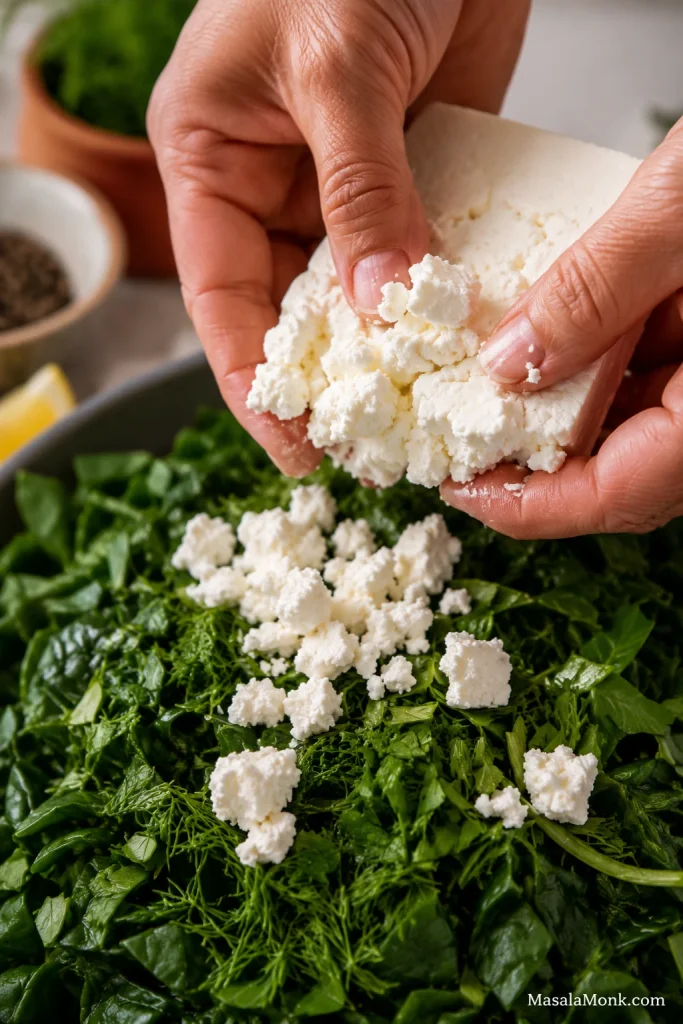
Most of the salt and tang comes from the feta, so it matters. Block feta is the better choice if you can get it. Crumble it yourself for a softer, creamier texture. Pre-crumbled feta works, but it can be drier.

A hand crumbling block feta over chopped spinach and herbs for spanakopita filling.
Crumble block feta unevenly instead of mashing it smooth. Those small salty pockets give the filling better flavor and a more satisfying bite.

Use 300 g / about 10½ oz as the default. If your feta is very salty, use a little less and skip extra salt. If your feta is mild, lean on black pepper, herbs, and a little lemon zest before adding more salt.

Olive Oil or Butter?

Olive oil gives the pie a more classic Greek flavor. Melted butter makes the pastry richer and more golden. Both work, and you can also use half olive oil and half melted butter.

Brush lightly. The pastry needs enough fat to crisp, but it should not feel soaked or heavy.

Can You Add Ricotta, Cream Cheese, or Yogurt?

You can add a little ricotta, cream cheese, or Greek yogurt for a creamier filling, but use a light hand. Too much soft cheese makes the mixture wetter and heavier. It should mound softly on a spoon, not spread like dip. If what you really want is a creamy spinach appetizer, MasalaMonk’s spinach dip recipes are a better fit.

Fresh Herbs and Dried Herb Substitutes

Fresh dill and parsley give the filling its best flavor. If using dried dill, start with about 1 teaspoon dried dill for every 1 tablespoon fresh dill. Dried parsley is milder, so fresh parsley is better when possible. Dried mint can be strong, so use only a small pinch.

Leeks, Chard, and Other Greens

Leeks add sweetness and depth. Chard or silverbeet can replace part of the spinach, especially if you like a stronger green flavor. Kale, mushrooms, artichokes, and pine nuts can work too, but treat them as variations. For the cleanest first tray, keep the filling simple: spinach, feta, herbs, onion, and eggs.

Fresh or Frozen Spinach: Which Works Better?

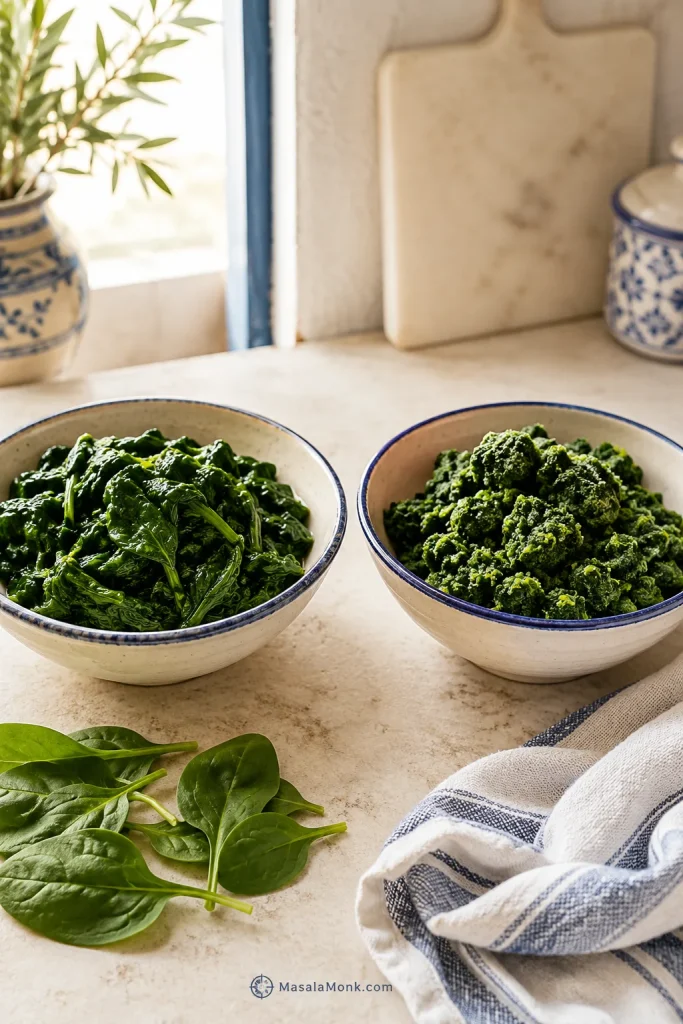
Best spinach for spanakopita: frozen chopped spinach is the most reliable choice for a first tray because it is already wilted and easier to drain evenly. Fresh spinach gives brighter flavor, but it takes more prep and still needs to be cooked, cooled, chopped, and pressed before mixing.

Two bowls showing wilted fresh spinach and thawed frozen spinach side by side, with a kitchen towel nearby.
Fresh spinach gives a brighter taste, while frozen spinach is easier and more predictable. Either way, the winning move is removing moisture before the filling touches the phyllo.
Use thisBest whenWatch out for
Frozen spinachYou want the most reliable first tray.It must be fully thawed and pressed well.
Fresh bunch spinachYou want brighter flavor and a more traditional fresh-greens feel.It takes longer and cooks down heavily.
Baby spinachYou want faster fresh spinach prep.The filling can be softer and milder.
Chard or silverbeetYou want a deeper greens flavor.Stems need chopping finely or removing.

Use about 700 g for tender baby spinach and closer to 900 g for mature bunch spinach with stems. After wilting and squeezing, you want roughly the same packed amount you would get from 500 g / 16 oz thawed frozen spinach.

Fresh spinach always looks like too much at first. Then it wilts down dramatically, which is exactly why the recipe starts with such a large amount.

Spinach Dryness Test

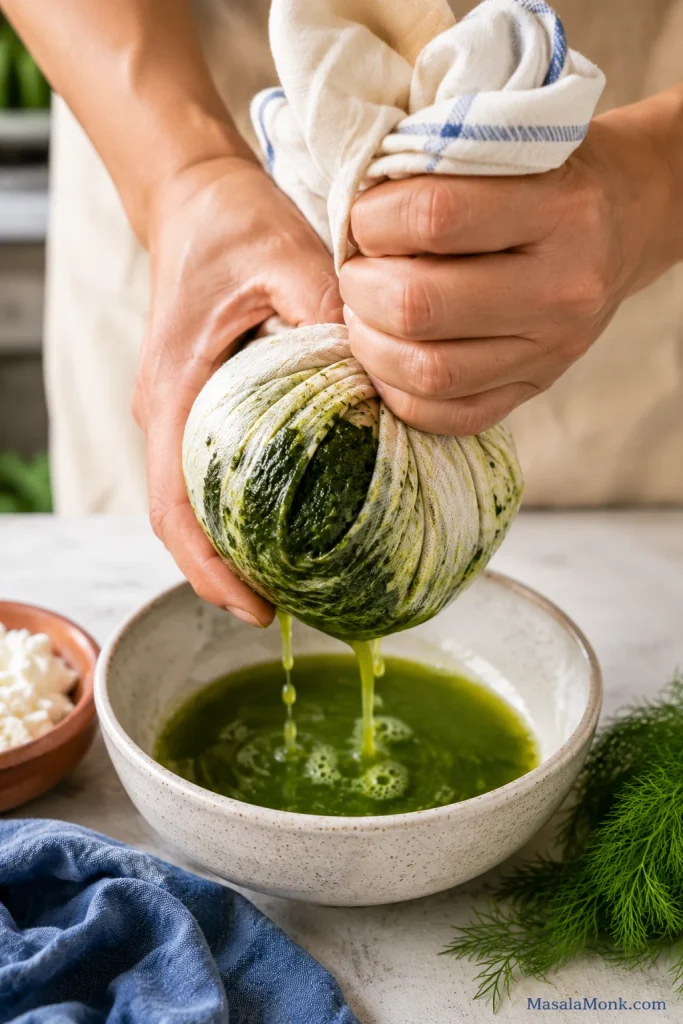
After squeezing, press the spinach with your hand or the back of a spoon. It should hold together in a soft mound, but the bowl should stay dry. If green liquid gathers at the bottom, squeeze again.

Hands squeezing spinach in a kitchen towel over a bowl to remove excess liquid.
First, squeeze out the hidden water. This one step does more for crisp spanakopita than almost any extra seasoning or topping.

For frozen spinach, squeeze it in a clean kitchen towel in small handfuls rather than one large mass; it is easier to remove more liquid that way.

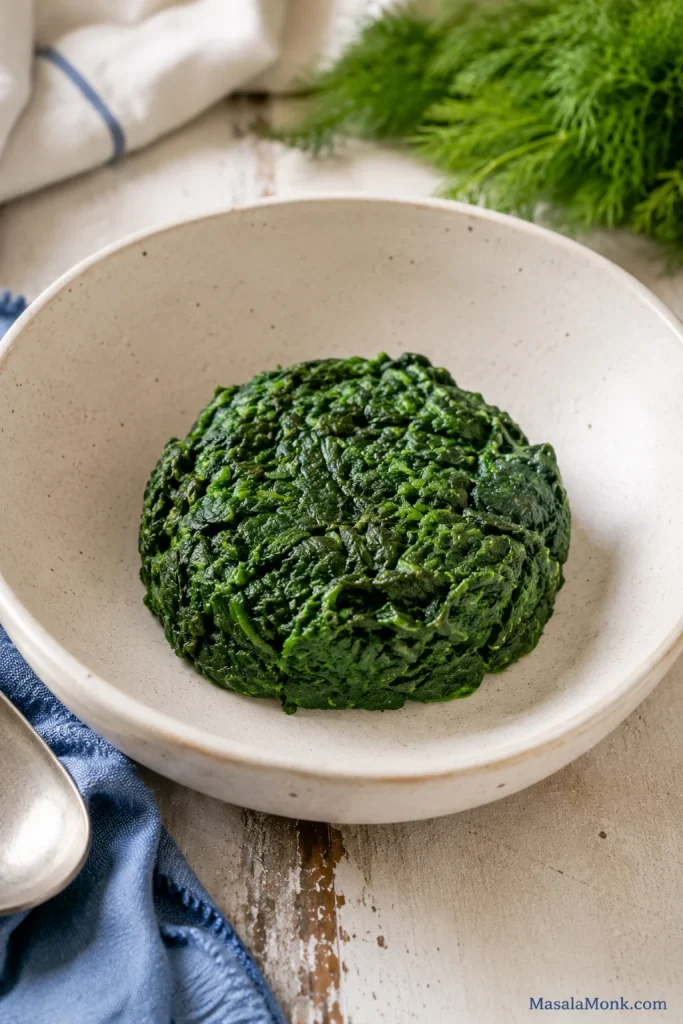
The Dry-Bowl Cue

Here, the greens stop being watery and become a proper filling. Spanakopita can handle moist spinach. It cannot handle dripping spinach.

A compact mound of pressed spinach in a dry bowl with no visible liquid underneath.
After pressing, the spinach should sit in a compact mound with no liquid pooling below it. That dry-bowl cue tells you the filling is ready to mix.

How to Make Spanakopita

Once the spinach is ready and the filling tastes good, assembly is straightforward. The prep work is what makes the tray easy; now it comes together quickly. If the phyllo is the stressful part, the phyllo help section has the calmer fixes.

This method makes one large 9 x 13 inch / 23 x 33 cm Greek spinach pie. It is easier than folding triangles and gives you generous pieces with firm edges, flaky tops, and warm spinach-feta filling.

The tray may look a little untidy before baking. That is normal. Phyllo has a way of looking chaotic in the pan and beautiful after heat does its work.

Step 1: Thaw the Phyllo

Thaw frozen phyllo overnight in the refrigerator, or according to package directions. Before assembling, let the sealed package sit briefly at room temperature so the sheets are easier to unroll. Open the package only when the filling and pan are ready.

Step 2: Prepare the Spinach

For frozen spinach, thaw it completely and press out as much liquid as possible. For fresh spinach, wilt it in batches in a large pan, let it cool, chop it if the leaves are large, and squeeze well. If liquid gathers in the bowl after squeezing, press it again.

Step 3: Cook the Aromatics

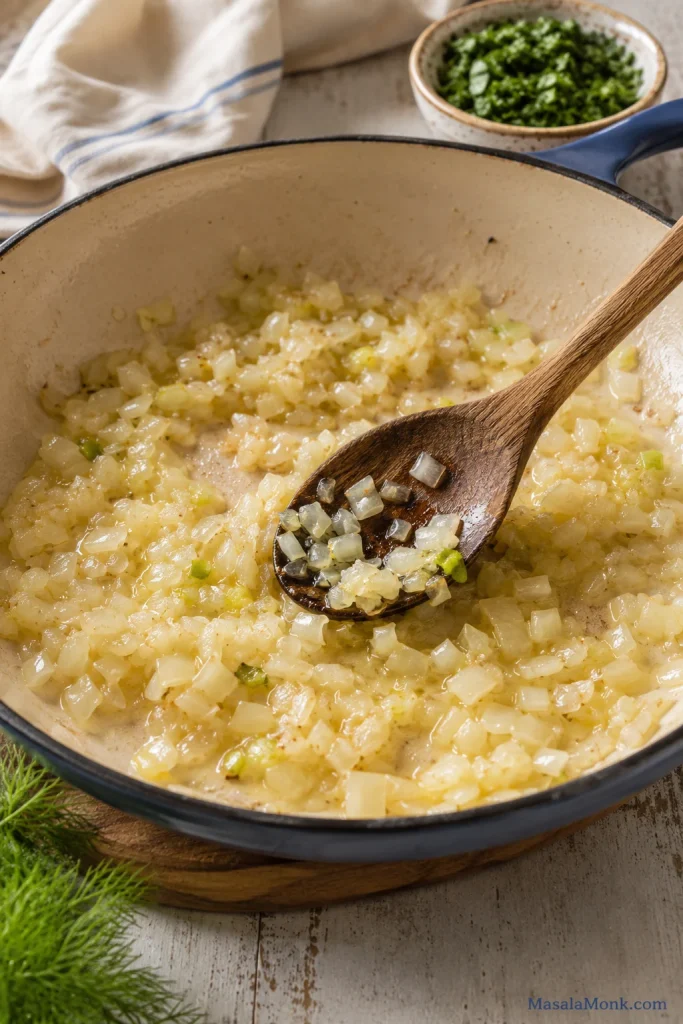
Warm 1–2 tablespoons olive oil in a skillet. Add the onion or scallions and cook until softened. Add optional garlic and cook briefly until fragrant. Let the mixture cool slightly.

The onion should smell sweet and mellow, not sharp, before it goes into the spinach.

Softened onion, scallion, and garlic cooking in a skillet with a wooden spoon.
Let the aromatics soften until they smell mellow and sweet. This gives the spinach-feta filling depth without making the Greek spinach pie taste heavy.

Step 4: Mix and Taste the Filling Before Adding Eggs

In a large bowl, combine the squeezed spinach, cooked aromatics, crumbled feta, dill, parsley, black pepper, optional lemon zest, and any optional mint or nutmeg. Taste this mixture before adding salt, because feta can be very salty. Once the seasoning tastes right, mix in the eggs.

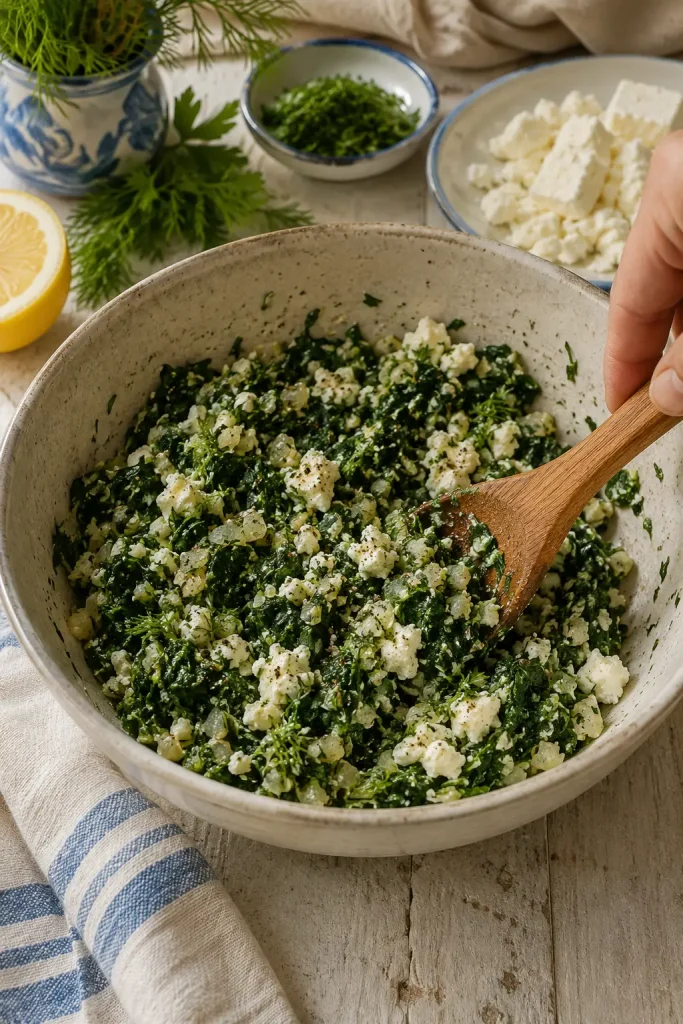
A bowl of spanakopita filling before eggs are added, with spinach, feta chunks, herbs, onion, and seasonings.
Before the eggs go in, the filling should look textured rather than creamy. Visible herbs, spinach, and feta pieces mean every slice will have better flavor contrast.

The Filling Texture Test

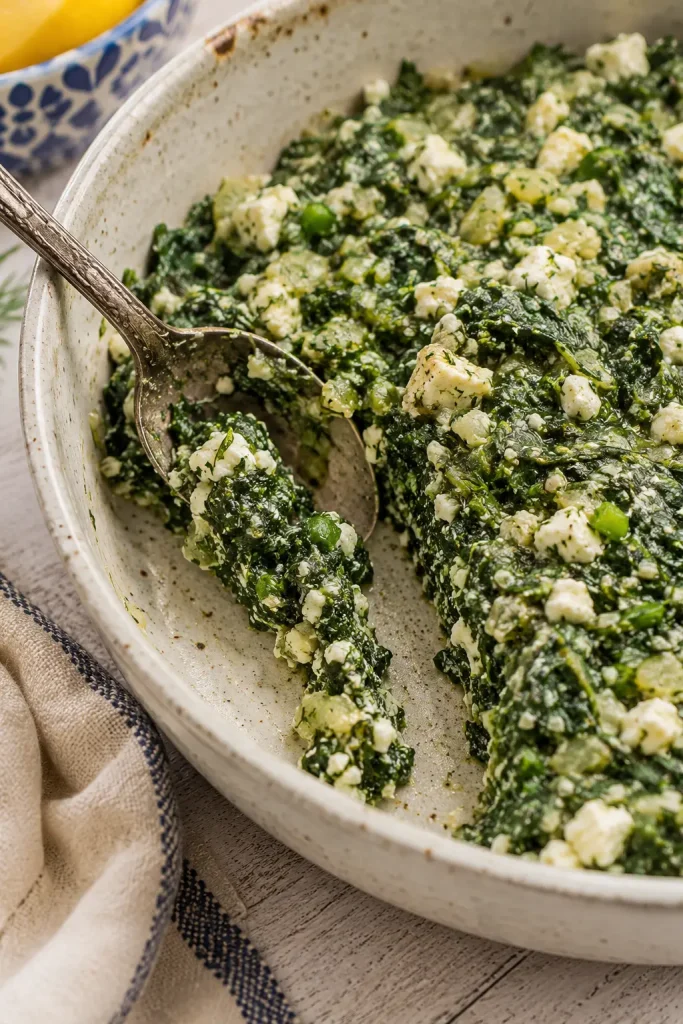
You should have a generous bowl of filling that looks clumpy and spoonable, with little white pieces of feta still visible in the greens. When you drag a spoon through it, it should not leave watery liquid behind.

A spoon dragged through spinach and feta filling, leaving a visible trail with no liquid pooling in the bowl.
Use the spoon trail as a quick filling test. If water does not rush back into the line, the mixture is clumpy enough to protect the phyllo layers.

By this point, the bowl should already smell like the finished pie: salty feta, green herbs, softened onion, and clean spinach.

Step 5: Heat the Oven and Ready the Pan

Heat the oven to 350°F / 180°C and place a rack in the lower-middle position. Brush a 9 x 13 inch / 23 x 33 cm baking dish or pan with olive oil.

For a fan or convection oven, start around 170°C and check a little early, since the top may brown faster.

Step 6: Layer the Bottom Phyllo

Now comes the part that looks fancier than it is. Open the phyllo and keep the unused sheets covered with a barely damp towel. Place one sheet in the dish and brush lightly with olive oil. Repeat until you have 7 bottom sheets. Torn or wrinkled sheets can go here; save the neatest ones for the top.

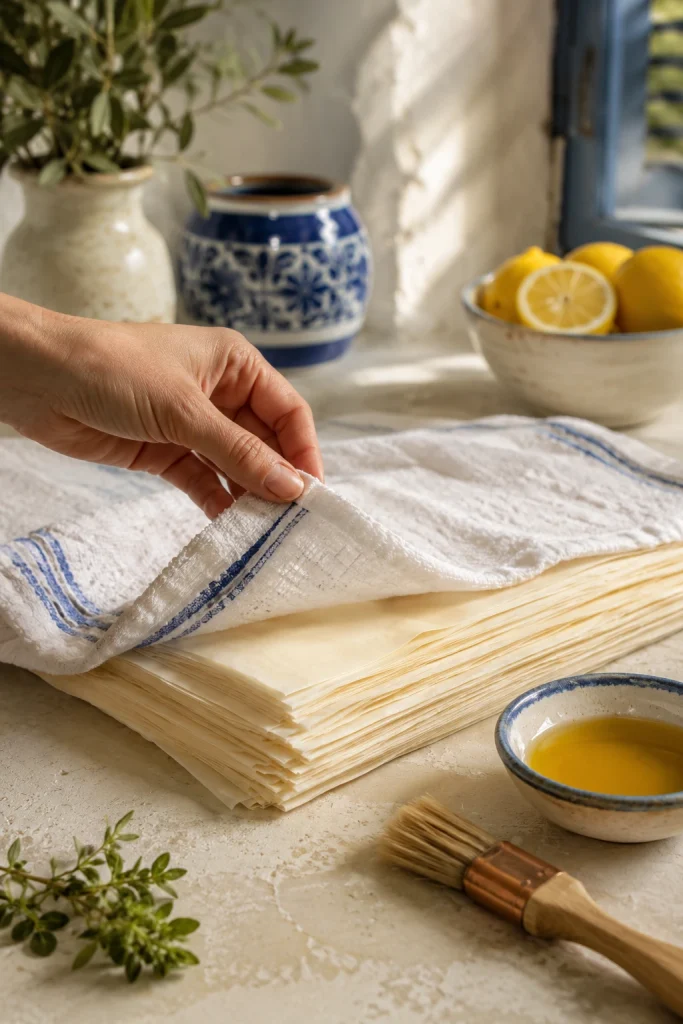
A hand lifting a striped towel to reveal stacked phyllo sheets beside a pastry brush and oil.
Cover the phyllo between layers, but keep the towel only barely damp. The goal is flexible sheets, not wet pastry.

Patchwork the Hidden Layers

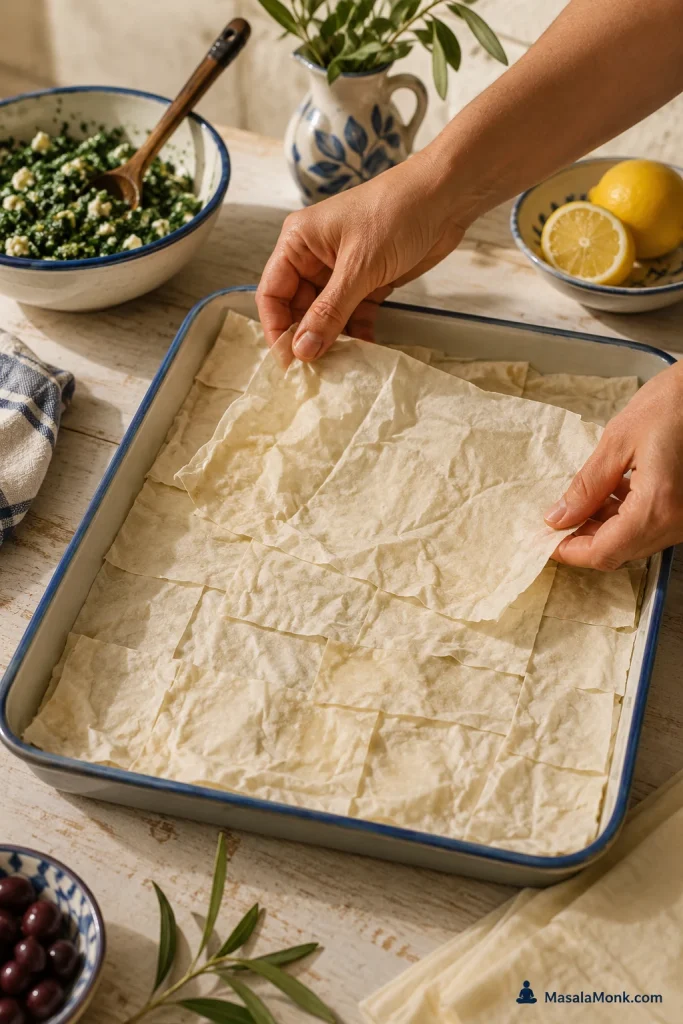
Use torn or smaller phyllo pieces where they will be hidden. Overlapping the gaps gives the filling support without requiring perfect sheets.

Hands layering torn and overlapping sheets of phyllo in the bottom of a rectangular baking pan.
Torn sheets belong in the bottom layers. Overlap them like patchwork, then keep building; the filling needs coverage and structure, not perfect rectangles.

Step 7: Add the Filling

Spread the spinach-feta filling evenly over the phyllo. Keep it loose and even rather than pressing it down hard. The filling should sit in a generous layer, not a compacted block.

Spinach and feta filling being spread evenly over layered phyllo in a rectangular pan.
Spread the filling evenly, then stop. Pressing it down too hard can make the pie dense instead of giving you a lighter, layered spanakopita.

Step 8: Add the Top Phyllo

Layer 7 more phyllo sheets over the filling, brushing each sheet lightly with olive oil. Tuck or fold the edges into the pan. The sheets should look lightly glossy in spots. They do not need to shine like they are soaked.

A pastry brush spreading a thin sheen of oil over wrinkled phyllo sheets in a baking pan.
Brush just enough oil to leave a light sheen. Too much fat can weigh down the phyllo, while a thin coat helps the layers crisp and separate.

Tuck the Top Edges

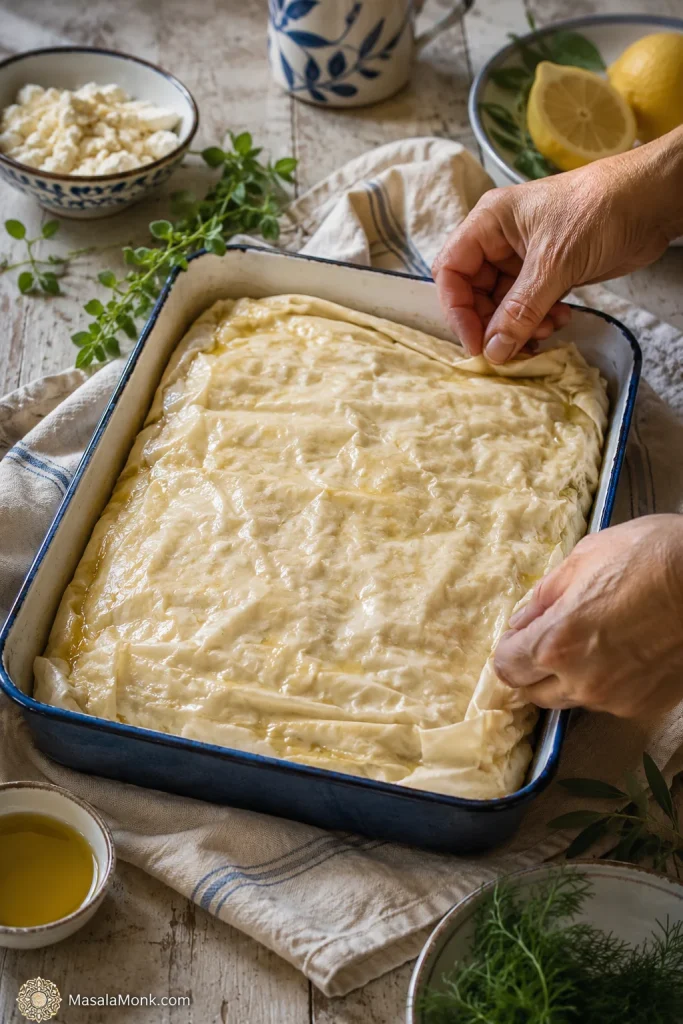
Fold the overhanging sheets inward so the top looks tidy and the corners have enough pastry to crisp.

Hands folding and tucking the top phyllo edges into a rectangular pan before baking.
Tuck the top sheets inward for a tidy edge and better corner texture. Those folded bits often bake into the crispiest parts of the tray.

Step 9: Score the Top

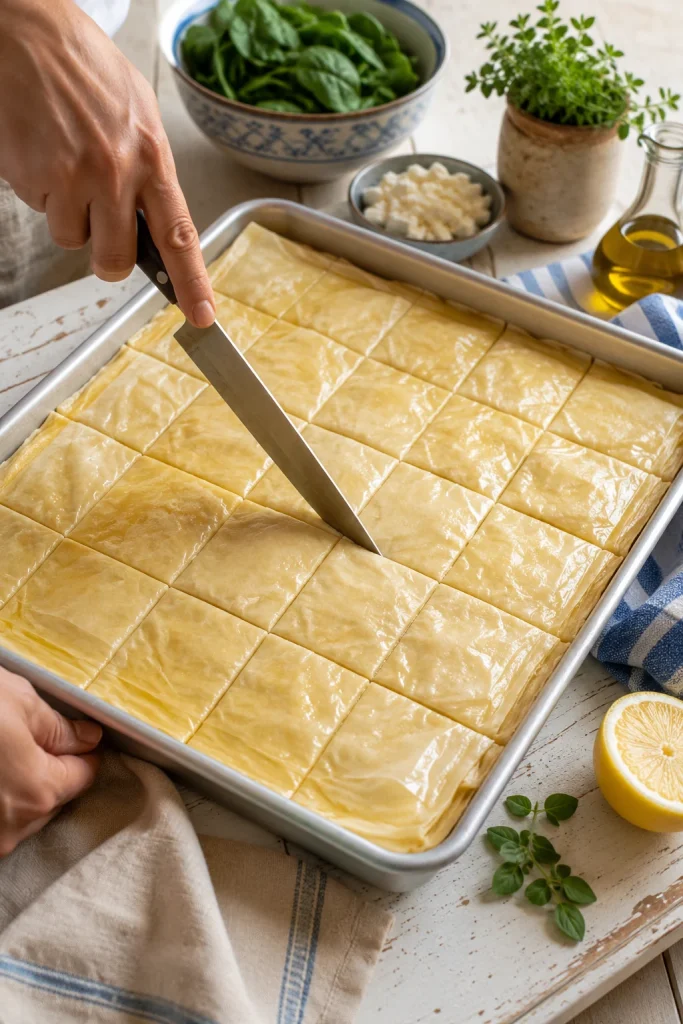
Use a sharp knife to score the top layers into squares, rectangles, or diamonds. You do not need to cut all the way through the filling before baking. Scoring now makes the finished pie easier to slice without shattering the top.

A knife scoring the top of an unbaked spanakopita tray into portions before baking.
Score before baking, while the phyllo is still soft enough to guide. Once crisp, those shallow lines help the knife move cleanly instead of crushing the top.

Squares are easiest for weeknights. Diamonds make the same tray look instantly party-ready once the golden top opens along the scored lines.

Step 10: Bake Until Golden-Brown and Crisp

Bake for 45–55 minutes, until the top is golden-brown, the edges are firm, and the filling is hot and set. Start checking at 45 minutes, but trust the pastry more than the clock. If the top browns too quickly, tent it loosely with foil and keep baking. Not sure yet? Compare it with the doneness cues before pulling the tray.

Step 11: Rest, Then Slice

Let the spanakopita rest uncovered for 15–20 minutes before cutting fully through the scored lines. The wait is annoying, but it is what turns a hot, loose filling into clean pieces with flaky tops and edges that hold.

If you only follow the method above, you can make a good tray. The next sections are for the moments that make cooks nervous: a soft base, fussy phyllo, loose filling, make-ahead timing, and slices that need to hold together.

How to Keep the Bottom Crisp

To keep spanakopita from getting soggy: remove excess spinach moisture, avoid loose or creamy filling, use enough bottom phyllo, bake until the pastry is fully golden, and rest the pie uncovered before slicing.

If the bottom turns soft, the pie is usually telling you one of two things: the filling was too wet, or the base needed more heat and time. For specific fixes, use the troubleshooting table.

What Actually Keeps the Bottom Crisp

  1. Moisture first: no liquid pooling in the filling.
  2. Structure second: enough bottom phyllo to support the greens and feta.
  3. Heat third: lower-middle rack so the base bakes before the top over-browns.
  4. Rest last: 15–20 minutes so the filling settles before slicing.

If the filling looks wet, drain off any visible liquid before layering. If the mixture still looks loose, stir in 1–2 tablespoons breadcrumbs, fine semolina, or crushed crackers to absorb extra moisture. This is a rescue trick, not something you should need every time.

Clean First Corner Lift

When the bottom is right, the first corner lifts cleanly instead of slumping, and that is the moment you know the tray worked.

A lifted corner piece of baked spanakopita on a spatula, showing a firm bottom layer, green filling, and golden phyllo top.
The first lifted piece is the real test. If it holds shape on the spatula, the spinach was drained well and the bottom phyllo had enough time to crisp.

If Phyllo Makes You Nervous

The method above is enough for most cooks, but these small phyllo habits make the first tray feel calmer. Most of the fear disappears once you stop trying to keep every sheet perfect.

Thaw phyllo overnight in the refrigerator, then let the sealed package sit at room temperature until pliable. Rushing the thaw can make sheets crack, stick, or turn damp in patches. Once opened, keep unused sheets covered with a barely damp towel.

For this recipe, 14 sheets is the default: 7 on the bottom and 7 on top. Very thin brands can take up to 16 sheets.

Smaller phyllo sheets can be overlapped to make one layer. Larger sheets can climb the sides of the pan and fold inward. The goal is layered coverage, not perfect single-sheet geometry.

If a sheet tears, use it in the bottom or middle layers and overlap the gaps. If a sheet dries out, discard it or tuck it into the middle rather than forcing it across the top.

Think of the inner sheets as patchwork. Nobody will see them, and they still bake beautifully. Once the first few sheets are down, the rest feels much less precious.

Since phyllo brands vary, follow your package first. For a deeper handling reference, Athens Foods has a practical guide to phyllo storage, thawing, and handling.

How to Tell When Spanakopita Is Done

For a 9 x 13 inch / 23 x 33 cm tray, bake at 350°F / 180°C for 45–55 minutes. Your oven and pan matter, but the pastry will tell you when it is ready.

A pale top usually means the lower layers need more time too. A deeply golden top, dry scored lines, and a firm first corner matter more than hitting exactly 50 minutes.

Golden Tray Doneness

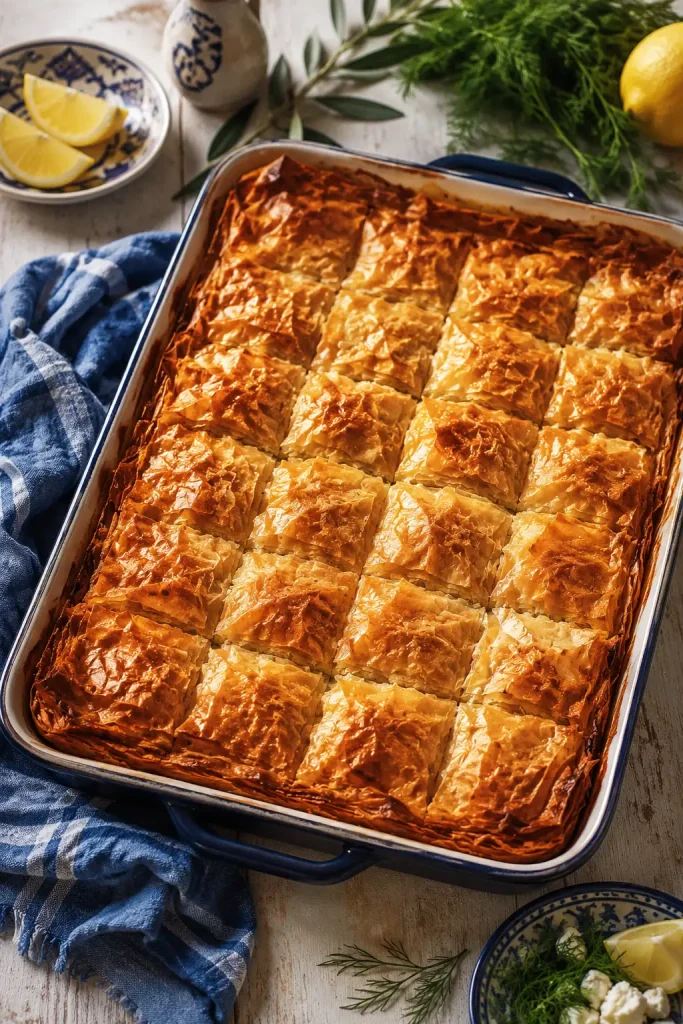
Look for a tray that reads crisp before you cut into it: browned edges, dry scoring lines, and a top that no longer looks soft or steamed.

A whole baked tray of spanakopita with a golden phyllo top and dry scored lines.
Check more than color. A finished spanakopita tray should have browned edges, dry scored seams, and a top that looks crisp rather than steamed.
  • Top: deeply golden and crisp, not pale.
  • Edges: flaky, browned, and firm.
  • Scored lines: dry-looking, not wet.
  • Filling: hot and set, not leaking.
  • Bottom: firm enough that a corner lifts with a spatula instead of drooping back into the pan.

When the pie is close, the kitchen starts to smell like toasted pastry, herbs, and warm feta.

A metal pan gives the crispest bottom. Glass or ceramic works too; just give the base a few extra minutes if it still looks soft. If using a metal baking pan, setting it on a preheated sheet pan can help the bottom crisp. If using glass or ceramic, avoid sudden temperature changes, especially if the dish is cold from the refrigerator.

Spanakopita Success Cues

  • Before assembly: the filling smells herby and salty, with no liquid pooling in the bowl.
  • While layering: the phyllo looks lightly glossy, not wet or heavy.
  • Before baking: the top is scored and the edges are tucked into the pan.
  • After baking: the top is deeply golden and the scored lines look dry.
  • After resting: the first corner lifts cleanly instead of collapsing.

Crisp Flaky Phyllo Layers

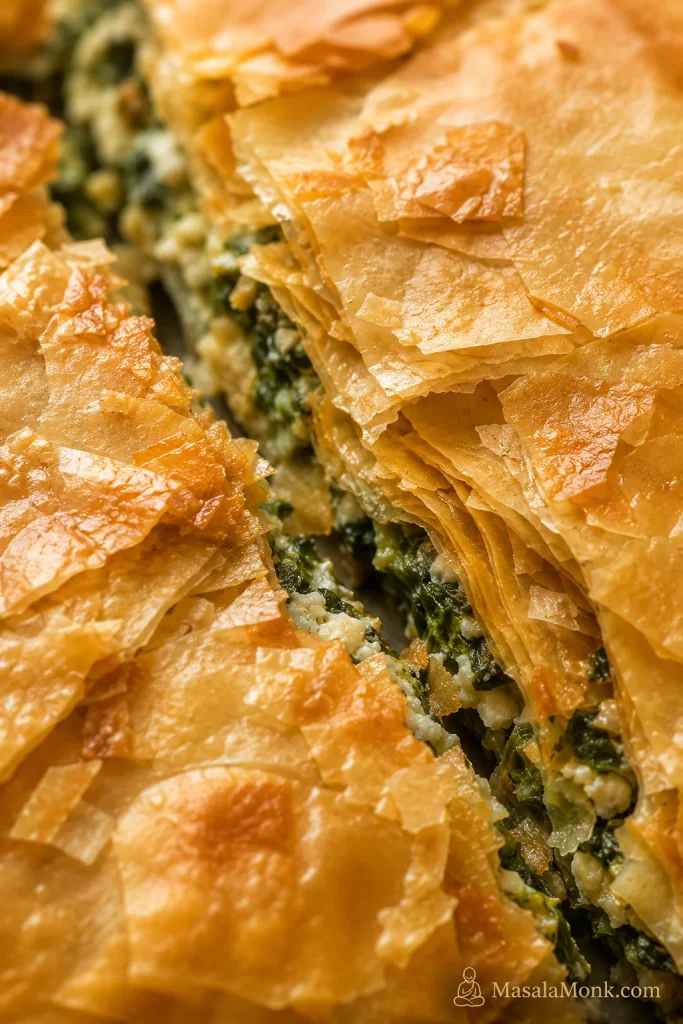
Close up, the finished pastry should look brittle and layered, with small shards breaking away from the spinach-feta filling beneath.

A close-up of crisp baked phyllo layers with flaky shards and a glimpse of green filling.
This close-up shows the payoff of careful layering: brittle phyllo on top, tender spinach-feta filling below, and flaky shards that break cleanly when cut.

Troubleshooting Spanakopita

Most spanakopita problems are not mysterious. A soggy bottom, leaking filling, or shattered top usually comes from one of three things: too much moisture, not enough baking time, or slicing before the filling has settled.

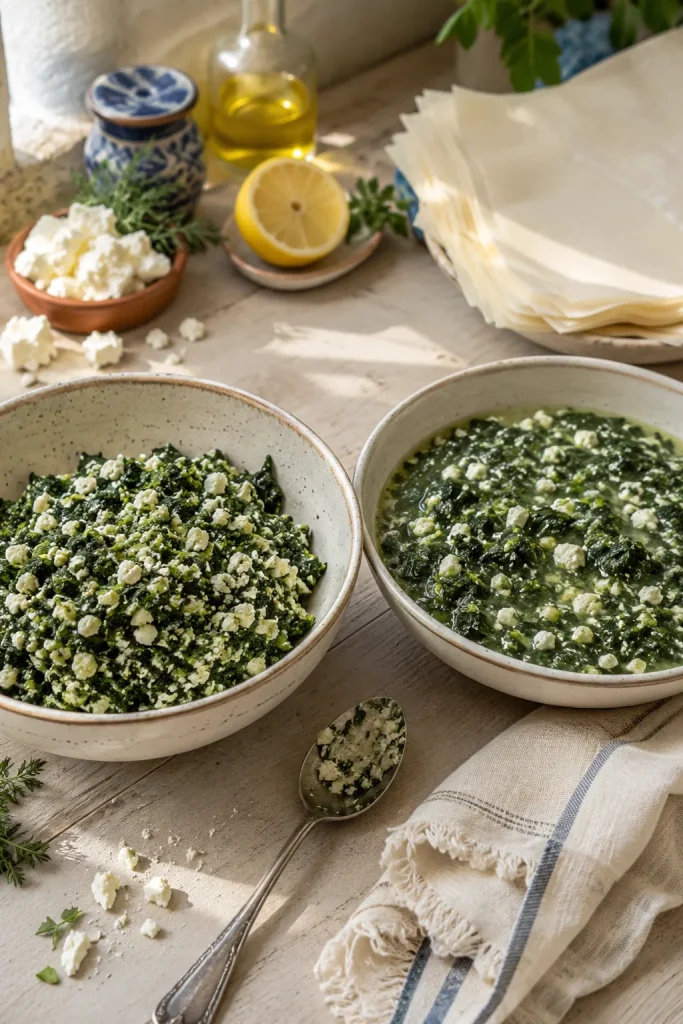
Correct Filling vs Loose Filling

Before assembly, compare the filling texture instead of guessing. A clumpy mixture protects the pastry; a loose mixture brings too much steam and moisture into the tray.

Two bowls of spanakopita filling, one thick and clumpy and the other looser with visible liquid.
For troubleshooting, compare the two textures before assembly. The thicker filling bakes into cleaner slices, while the loose mixture can soften the pastry and make cutting messier.
ProblemLikely causeFix
Soggy bottomWet filling or underbaked basePress more moisture from the spinach, bake longer, and use a lower rack.
Top browns too fastOven runs hot or tray is too highTent loosely with foil and continue baking.
Bottom is soft but top is doneWeak bottom heatMove lower and bake 10 more minutes with foil over the top.
Phyllo tearsSheets are dry, cold, or handled slowlyKeep covered and use torn sheets inside.
Leaking fillingToo much moisture or overfillingDrain the filling better and keep the layer even.
Bland fillingMild feta or not enough herbsAdd dill, parsley, black pepper, or a little lemon zest.
Too-salty fillingVery salty fetaAdd more spinach or herbs if available; serve with yogurt sauce or a lemony salad.
Dense fillingThe spinach layer was packed down too hardSpread loosely next time; do not compress the spinach layer.
Top shatters badly when slicingNot scored before baking or cut too soonScore before baking, rest 15–20 minutes, then cut through the same lines.
Slices fall apartCut too soon or filling too looseRest 15–20 minutes before slicing fully.
Pastry soft after storageFridge moisture or trapped steamReheat uncovered in the oven or air fryer.

Variations and Shortcuts

The large tray is the main recipe. Once you understand that filling and layering method, these variations become easy to judge.
Spanakopita Triangles

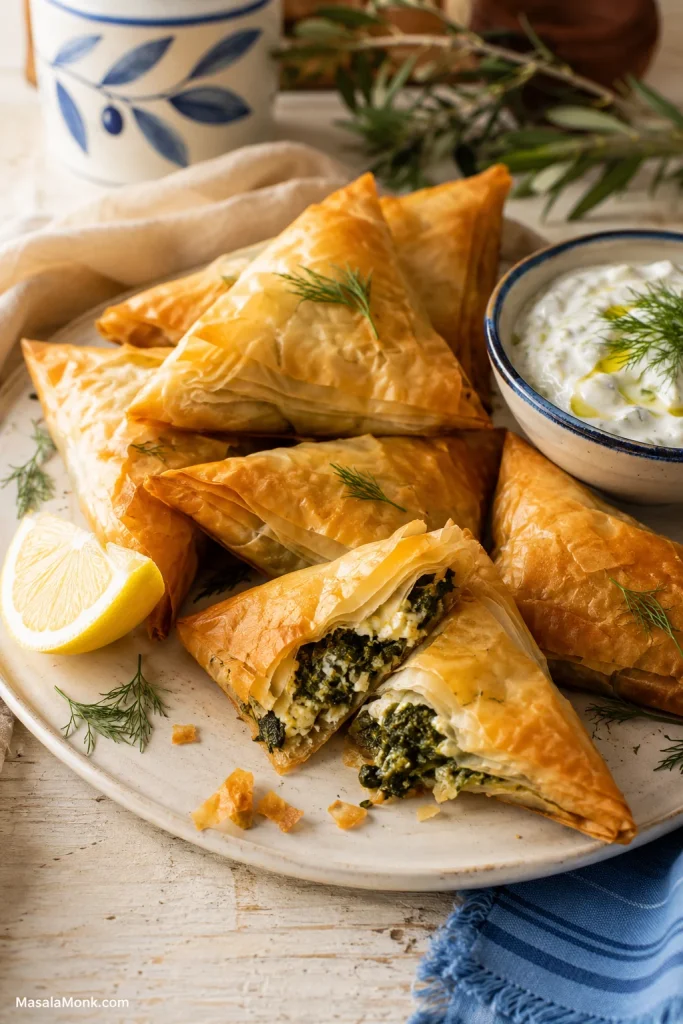
Once the filling is made, triangles are just a folding project. They are great for appetizers, mezze platters, lunch boxes, and party trays. The first triangle is usually the clumsiest. By the third or fourth, your hands understand the fold.

Baked spanakopita triangles on a plate with one broken open to show spinach and feta filling, served with tzatziki.
For appetizer-style spanakopita triangles, use less filling than you think. Snug folds and modest filling help the phyllo seal, brown, and crisp all the way around.

They are especially good with a bowl of Greek tzatziki sauce and crisp bites like homemade falafel.

  • Phyllo strip width: 2½–3 inches / 6–7.5 cm.
  • Layers: 2 phyllo sheets per strip.
  • Filling: ½–1 tablespoon per triangle.
  • Fold: like folding a flag.
  • Oven: 375°F / 190°C.
  • Small appetizer triangles: 15–18 minutes.
  • Medium triangles: 20–25 minutes.

If the filling squeezes out as you fold, use less. A neat triangle needs less filling than you think. The triangles are done when the seams look dry, the corners are golden, and the pastry feels crisp enough to pick up. For dips and sides, jump to the serving ideas.

Puff Pastry Shortcut

Puff pastry makes a delicious shortcut, though the texture is thicker and more buttery than classic phyllo. It is a good option when you want a spinach-feta pie without layering many thin sheets.

Puff pastry should be pliable but still cold; once it warms too much, it gets sticky and bakes less cleanly. Use the same filling, place one puff pastry sheet on the bottom, add the spinach mixture, cover with a second sheet, seal the edges, and cut a few slits in the top so steam can escape.

For a full puff pastry pie, start checking around 35 minutes and expect 40–50 minutes depending on the thickness of the filling and pastry. For small puff pastry parcels, start checking around 20–25 minutes.

Gluten-Free Spanakopita

Use gluten-free phyllo if available, or gluten-free puff pastry as a shortcut. If neither is available, make a crustless spinach-feta bake with the same filling flavors.

Vegan or Dairy-Free Spanakopita

Use olive oil for brushing and replace feta with a salty vegan feta or a firm tofu-cashew mixture. Keep the filling well-seasoned because feta normally provides both salt and tang.

Egg-Free Spanakopita

You can skip the eggs, but the slices will be looser. Keep the spinach very well pressed, avoid wet cheeses, and rest the pie before cutting.

Make It Ahead Without Losing the Crisp Layers

Spanakopita is one of those recipes you can do in pieces. For the best make-ahead texture, assemble it unbaked, refrigerate it for up to 24 hours, then bake until golden and crisp. For longer storage, freeze it unbaked.

  • Make the filling ahead: Prepare up to 1 day ahead and refrigerate. Drain off any liquid before assembling.
  • Assemble unbaked: Refrigerate the covered tray for up to 24 hours, then bake from chilled with a few extra minutes if needed.
  • Freeze unbaked: Score the top while the phyllo is still soft, wrap tightly, and freeze.
  • Bake from frozen: Add 15–25 minutes and cover loosely with foil if the top browns early.
  • Store leftovers: Cool fully, refrigerate for 3–4 days, and reheat uncovered in the oven or air fryer.

If making the filling ahead, check it again before assembling. Spinach can release more liquid in the fridge, so drain or squeeze off any liquid before layering it with phyllo. Use the filling texture comparison if it looks loose.

For a party, serve the pie warm after a 15–20 minute rest, or at room temperature on a mezze table. Let hot spanakopita breathe; trapped steam softens the pastry. Room temperature is fine for serving, but refrigerate leftovers rather than leaving them out for a long time.

This is the kind of dish that solves more than one meal: dinner tonight, brunch tomorrow, party squares on a platter, or a cold leftover piece eaten straight from the fridge.

Reheating Frozen or Leftover Spanakopita

Best way to reheat spanakopita: reheat pieces uncovered in the oven or air fryer. Dry heat helps the phyllo crisp again, while covered reheating traps steam and softens the pastry. The microwave is fast, but it will not bring back the flaky texture.

SituationMethodTime
Frozen spanakopita trianglesAir fryer at 350°F / 177°C8–12 minutes
Frozen spanakopitaOven at 400°F / 200°C17–20 minutes
Leftover homemade sliceOven at 350°F / 175°C8–13 minutes
Leftover homemade sliceAir fryer at 325–350°F / 160–177°C4–7 minutes
MicrowaveFastest, but softens pastryUse only if needed

For frozen or store-bought spanakopita, follow the package instructions first because sizes vary. If using a thermometer, the center should reach 165°F / 74°C. FoodSafety.gov gives the same 165°F / 74°C target for reheated leftovers in its safe minimum internal temperature chart.

These general notes can help with Costco, Trader Joe’s, Aldi, or other frozen spanakopita, but start checking early because every brand and size cooks differently.

What to Serve with Spanakopita

A good tray of spanakopita does not need much ceremony. Cut it warm, let the flaky shards fall where they want, and serve it with something cold and lemony.

It is the kind of food that does not need to be piping hot to be loved; even warm or room temperature, the salty filling and flaky edges still do their job.

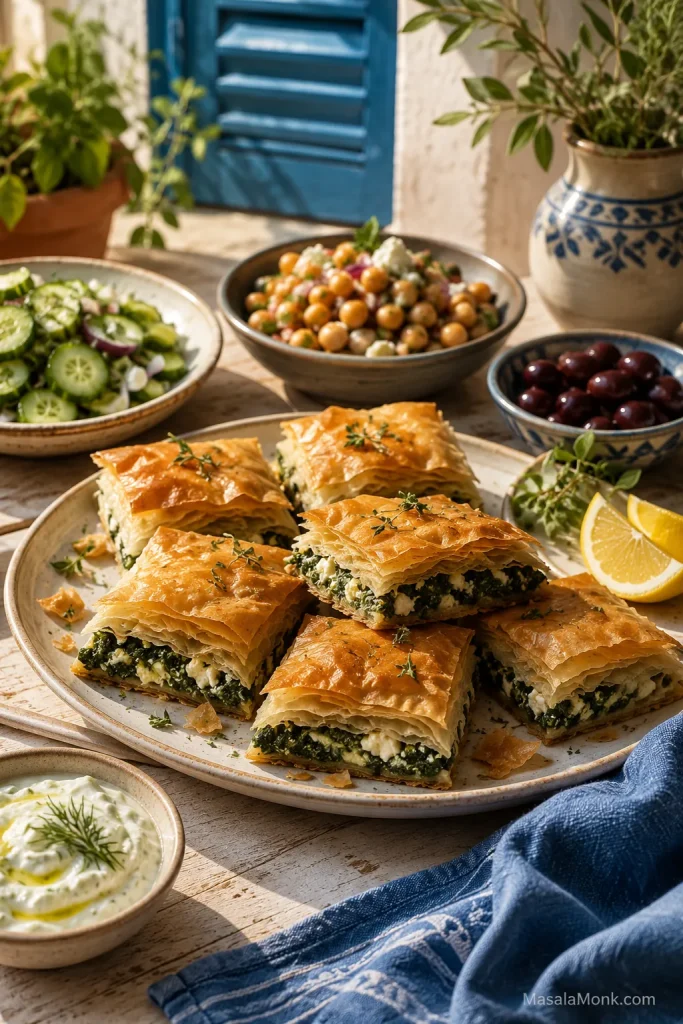
For a full Greek-inspired spread, keep the sides cool, bright, and simple so they balance the rich phyllo instead of competing with it.

Spanakopita served on a table with tzatziki, cucumber salad, chickpea salad, olives, lemon wedges, and herbs.
Serve rich spanakopita with cool and bright sides. Tzatziki, cucumber salad, chickpeas, olives, lemon, and herbs balance the salty feta and crisp phyllo without distracting from the pie.

Greek-Inspired Dinner

Serve warm pieces with Greek salad, roasted potatoes, red lentil soup, baked chicken breast, fish, lamb, olives, and lemon wedges.

Vegetarian Mezze Table

Cut smaller pieces and serve with tzatziki, hummus, pita, roasted vegetables, olives, cucumber salad, and homemade falafel.

Brunch or Lunch Boxes

Room-temperature pieces are excellent with cucumber salad, chickpea salad, yogurt sauce, eggs, fresh fruit, or a tomato cucumber salad.

Tabbouleh is also a strong side because the lemon, parsley, mint, and tomato cut through the rich pastry.

Quick lemon-dill yogurt sauce: Mix Greek yogurt with lemon juice, minced garlic, chopped dill, a little olive oil, salt, and black pepper. It is especially good with warm triangles.

Full Spanakopita Recipe

This tray-style spanakopita gives you flaky top layers, a firm base, and a spinach-feta filling that settles into clean pieces after resting.

Recipe name: Spanakopita Recipe: Greek Spinach Pie with Feta and Phyllo

Description: A generous Greek spinach pie recipe with crisp golden phyllo, salty feta, fresh herbs, and a spinach filling that slices cleanly after resting.

Yield: 10–12 pieces

Prep time: 35–45 minutes with frozen spinach, longer with fresh bunch spinach. This does not include overnight phyllo thawing.

Cook time: 45–55 minutes

Total time: 1 hour 20 minutes to 1 hour 40 minutes, plus phyllo thawing

Equipment: 9 x 13 inch / 23 x 33 cm baking dish or pan, large skillet, mixing bowl, colander, clean kitchen towel or cheesecloth, pastry brush, sharp knife, barely damp towel for phyllo.

Before you start: Make sure the spinach is pressed well, the phyllo is fully thawed, and the filling is mixed before you open the phyllo package. Once phyllo is exposed to air, the recipe moves much faster.

Ingredients

  • 500 g / 16 oz frozen chopped spinach, thawed and squeezed well or 700–900 g / 1½–2 lb fresh spinach, wilted, cooled, and squeezed well
  • 300 g / about 10½ oz feta cheese, crumbled
  • 2 large eggs
  • 14 sheets phyllo pastry, thawed
  • Olive oil, divided: 120 ml / ½ cup for brushing, plus 1–2 tablespoons for cooking the onion
  • 1 small onion, finely chopped, or 4–6 scallions, sliced
  • 1–2 garlic cloves, minced, optional
  • ¼ cup chopped fresh dill
  • ¼ cup chopped fresh parsley
  • 1–2 tablespoons chopped fresh mint, optional
  • ½ teaspoon lemon zest, optional
  • Black pepper, to taste
  • Pinch of nutmeg, optional
  • Salt, only if needed after tasting the filling before adding eggs

Instructions

Prepare the Filling

  1. Thaw the phyllo. Thaw frozen phyllo overnight in the refrigerator, or according to package directions. Let the sealed package sit briefly at room temperature before opening. Open the phyllo only when the filling is mixed, the oil is ready, and the pan is brushed.
  2. Prepare the spinach. If using frozen spinach, thaw completely and press out as much liquid as possible. If using fresh spinach, wilt it in batches in a large pan, cool it, chop if needed, and squeeze well. The bowl should not show liquid pooling when pressed.
  3. Cook the aromatics. Heat 1–2 tablespoons olive oil in a skillet. Add onion or scallions and cook until softened. Add optional garlic and cook briefly until fragrant. Let cool slightly.
  4. Mix and taste before adding eggs. In a large bowl, mix spinach, cooked aromatics, feta, dill, parsley, optional mint, optional lemon zest, black pepper, and optional nutmeg. Taste and add salt only if needed. Then mix in the eggs. The filling should hold together without liquid pooling at the bottom of the bowl.

Layer the Spanakopita

  1. Prepare the pan and oven. Heat oven to 350°F / 180°C. Place a rack in the lower-middle position. Brush a 9 x 13 inch / 23 x 33 cm baking dish or pan with olive oil.
  2. Layer the bottom phyllo. Open the phyllo and cover unused sheets with a barely damp towel. Place one sheet in the dish and brush lightly with olive oil. Repeat until you have 7 bottom sheets. Use torn or wrinkled sheets here if needed.
  3. Add the filling. Spread the spinach-feta filling evenly over the phyllo. Keep it loose and even rather than pressing it down hard.
  4. Add the top phyllo. Layer 7 more sheets over the filling, brushing each sheet lightly with olive oil. Tuck or fold the edges into the pan. The sheets should look lightly glossy, not soaked.

Bake, Check, and Rest

  1. Score the top. Use a sharp knife to score the top layers into squares, rectangles, or diamonds. You do not need to cut all the way through the filling yet.
  2. Bake. Bake for 45–55 minutes, until the top is golden-brown, the edges are firm, and the filling is hot and set. If the top browns too quickly, tent loosely with foil and keep baking.
  3. Check for doneness. The top should be golden and crisp, the scored lines should look dry, and a corner should lift without sagging. If the top is brown but the bottom feels soft, cover loosely with foil and bake 5–10 minutes longer.
  4. Rest and slice. Let the spanakopita rest uncovered for 15–20 minutes. Cut fully through the scored lines and serve warm or at room temperature.

Recipe Notes

  • Block feta gives better flavor and texture. Use slightly less if it is very salty, or up to 340 g / 12 oz for a cheesier filling.
  • Lemon zest is optional but useful if your feta is mild or the filling tastes flat. Avoid adding much lemon juice because extra liquid can loosen the filling.
  • If your phyllo sheets are very thin, use up to 16 sheets total.
  • You may not use all the oil. The phyllo should look lightly glossy, not soaked.
  • A metal pan gives the crispest bottom. Glass or ceramic works too, but may need a few extra minutes.
  • For a fan/convection oven, start around 170°C and check a little early because the top can brown faster.
  • If the filling looks wet, drain visible liquid and mix in 1–2 tablespoons breadcrumbs, fine semolina, or crushed crackers.
  • Let hot spanakopita breathe. Steam softens the pastry if it is covered tightly.

Frequently Asked Questions

These are the questions that usually come up the first time you make spanakopita.

Spanakopita Basics

Is spanakopita the same as Greek spinach pie?

Yes. Spanakopita is Greek spinach pie made with phyllo pastry and a filling of spinach, feta, herbs, and often eggs.

Is it phyllo or filo?

Both spellings refer to the same thin pastry sheets. Phyllo is common in the US, while filo is common in the UK and other places.

Ingredients, Spinach, and Phyllo

Fresh spinach or frozen spinach: which is better for spanakopita?

Frozen spinach is easier and more predictable because it is already chopped and wilted. Fresh spinach gives brighter flavor, but it takes more prep and still needs to be pressed well before mixing.

Should fresh spinach be cooked before adding it to spanakopita?

Yes. Fresh spinach should be wilted, cooled, chopped if needed, and pressed well before mixing. Raw spinach releases too much moisture as it bakes and can make the filling loose.

How many phyllo layers should spanakopita have?

Use 14 sheets as a reliable default: 7 on the bottom and 7 on top. If your phyllo is very thin, you can use up to 16 sheets.

Do torn phyllo sheets matter?

No. Use torn sheets in the bottom or middle layers and save the neatest sheets for the top. Once baked, the inner patchwork still turns flaky.

Why did my spanakopita turn soggy?

The most common cause is excess spinach moisture or underbaking. Press the spinach well, keep the filling moundable instead of loose, and bake until the pastry is fully golden-brown.

What cheese can I use besides feta?

Feta gives spanakopita its classic salty tang, so keep it as the main cheese if possible. For a milder filling, replace a small portion with ricotta or cottage cheese, but keep the mixture firm and well-drained so the phyllo does not soften.

Make-Ahead, Freezing, and Reheating

How far ahead can I assemble spanakopita?

You can assemble it unbaked and refrigerate it for up to 24 hours. Check for released liquid before baking and add a few extra minutes if baking from chilled.

Does spanakopita freeze better baked or unbaked?

Unbaked usually gives the best texture because the phyllo crisps for the first time in the oven. Score the top before freezing while the sheets are still soft, wrap tightly, and bake from frozen with extra time. Baked leftovers can also be frozen, but the pastry is more likely to soften after reheating.

What is the best way to reheat spanakopita?

Reheat it uncovered in the oven or air fryer. Dry heat helps the phyllo crisp again. The microwave works for speed, but it softens the pastry.

Diet and Serving Questions

Should spanakopita be served hot or room temperature?

Spanakopita is good warm or at room temperature. Let it rest after baking so the filling settles and the pieces slice more cleanly.

Can spanakopita be made without eggs?

Yes, but the filling will be looser. Keep the spinach especially well pressed, avoid wet cheeses, and rest the pie before cutting.

Puff pastry or phyllo: which is better for spanakopita?

Phyllo is better for classic spanakopita because it bakes into thin, crisp, flaky layers. Puff pastry works as a shortcut, but it gives a thicker, buttery crust and a less traditional texture.

Is classic spanakopita gluten-free?

No. Classic spanakopita uses wheat-based phyllo, so it is not usually gluten-free. For a gluten-free version, use gluten-free phyllo if available, gluten-free puff pastry as a shortcut, or make a pastryless spinach-feta bake inspired by the same flavors.

If you make it, I would love to know which route you took: frozen spinach tray, fresh spinach tray, triangles, or puff pastry shortcut.

The first tray may look a little rustic before it goes into the oven, and that is part of the charm. Once the phyllo turns golden and the spinach-feta filling settles, you get the kind of pie people keep returning to, knife in hand, promising they are cutting “just one more” piece.

Posted on Leave a comment

Crispy Zucchini Chips Recipe: Air Fryer, Oven, Panko, Keto & Dehydrator Methods

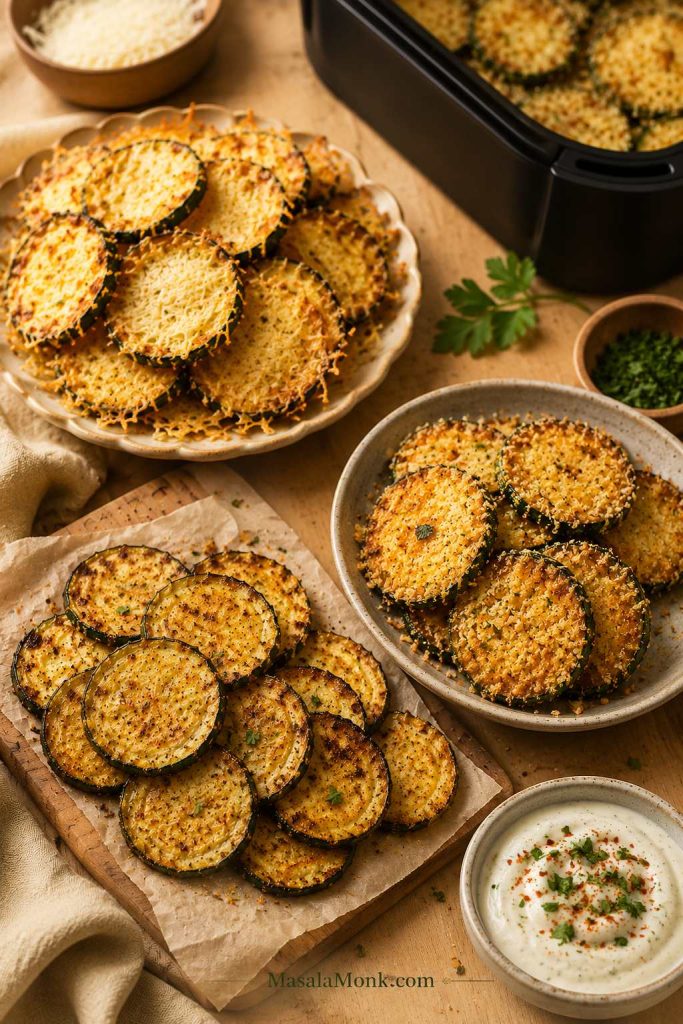
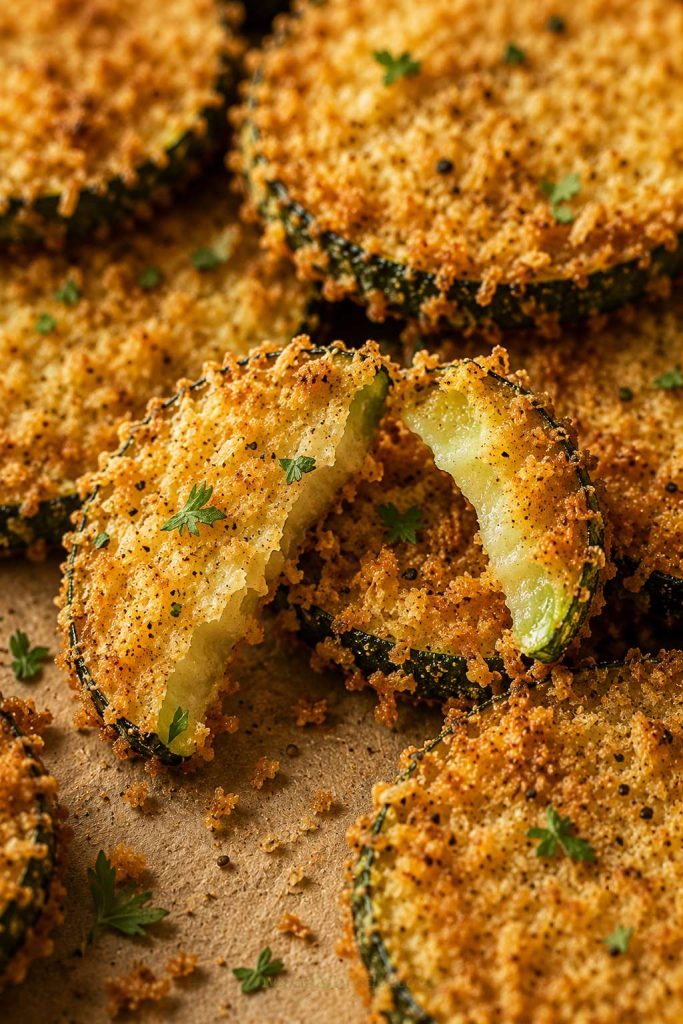
These crispy zucchini chips are golden at the edges, tender in the center, and best dipped while the parmesan still has its crunch.

Zucchini chips sound easy until you pull them from the oven or air fryer and find the same annoying problem: browned edges, soft centers, and slices that look like chips but bend like roasted zucchini.

If that has happened to you, the problem was probably not just the cooking time. Zucchini is naturally tender and water-rich, so it needs a little help before it can become crisp. Even slicing, a short salting step, proper drying, light oil, enough space, and the right heat make the difference between limp slices and a snack you actually want to keep reaching for.

Most zucchini chips recipes are not actually disagreeing with each other. They are making different snacks. This guide starts with the easiest crisp-edged air fryer parmesan version, then shows when to use the oven, panko, keto/no-breadcrumb, or dehydrator method for the texture you actually want. If you already know the texture you want, compare the styles first.

These will not behave exactly like packaged potato chips, and that is okay. The win is a crisp-edged, salty bite that lets zucchini be zucchini without turning limp.

Quick Answer: How to Make Crispy Zucchini Chips

To make crispy zucchini chips, slice the zucchini evenly, salt the slices briefly, pat them very dry, season lightly, and cook in a single layer. Start with air fryer parmesan zucchini chips at 370°F / 188°C for 10–12 minutes, then cool them spread out for a few minutes so the cheese can firm. Need amounts and steps? Jump to the recipe card.

Seasoning helps, but the real win happens before the zucchini hits the heat. If the slices go in wet, they soften before the edges can firm up. Use only a little oil or oil spray, avoid crowding, and do not judge the final texture until the chips have cooled for a few minutes.

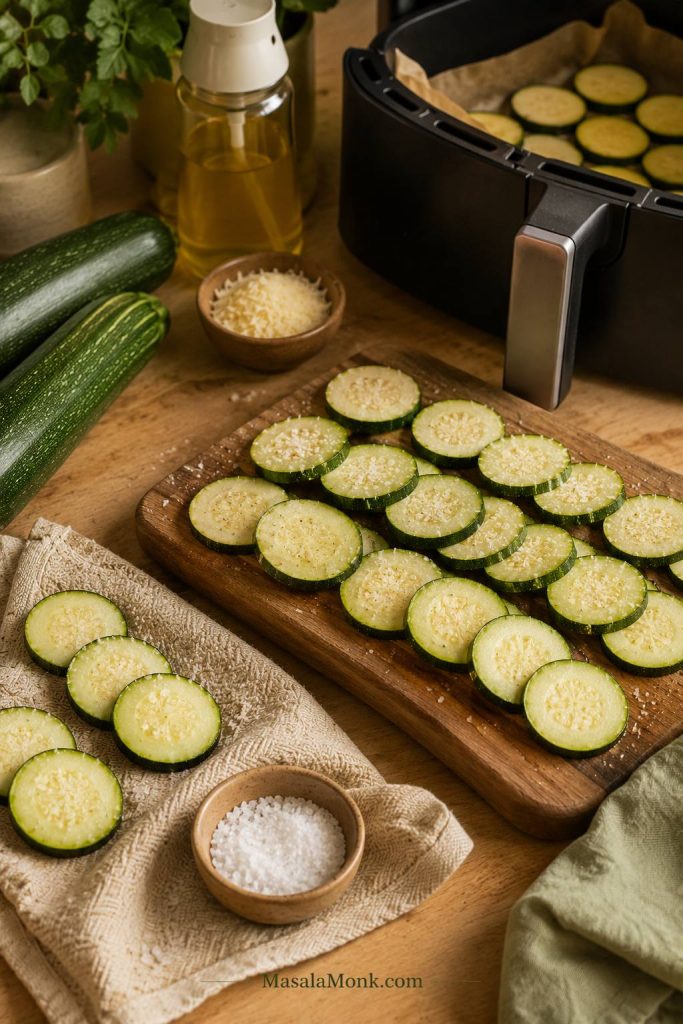
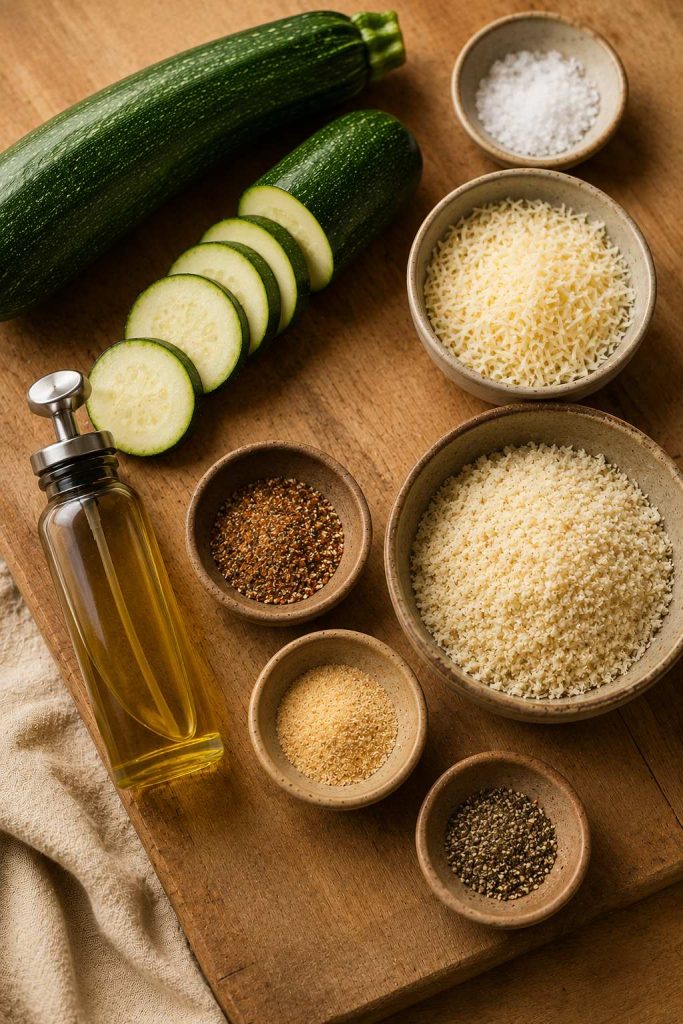
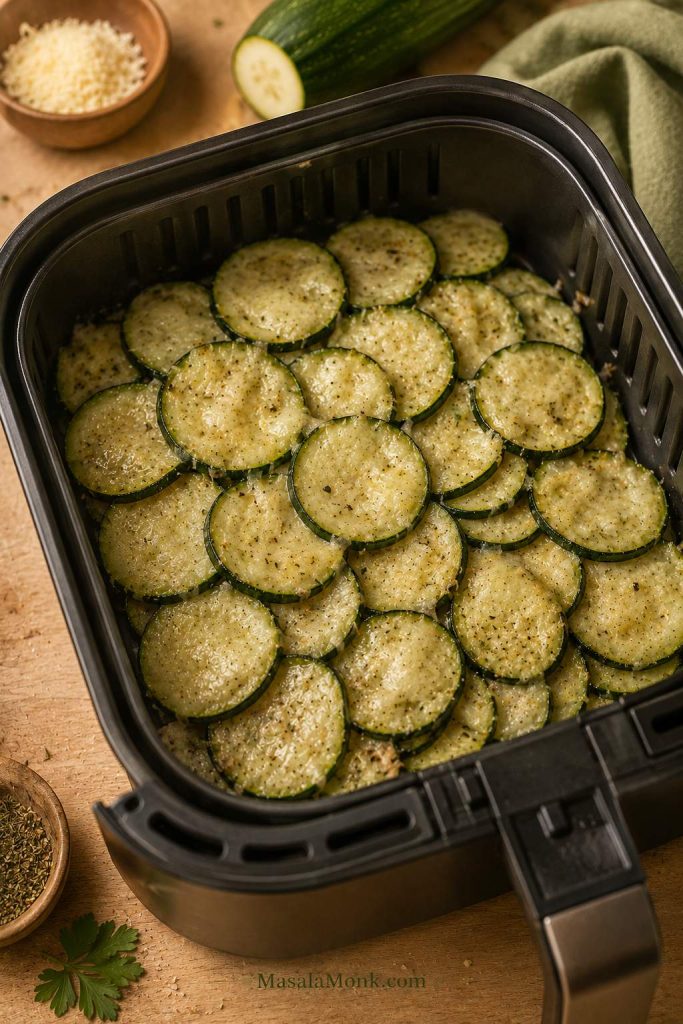
Sliced zucchini, salt, parmesan, oil spray, towel, and air fryer basket arranged on a wooden surface.
Before the air fryer or oven does any work, set the zucchini up for success with even slices, salt, towels, light oil, and parmesan.

Best first batch: air fryer parmesan zucchini chips.

The crispness rule: slice evenly, salt briefly, pat very dry, cook in one layer, and cool spread out.

Crispy Air Fryer Parmesan Zucchini Chips Recipe

This is the first batch to make because parmesan gives zucchini a shortcut to crisp edges. The slices still need salting and drying, but the cheese browns quickly, firms as it cools, and turns a soft vegetable into something snackable without breadcrumbs or a long oven bake.

Texture: crisp parmesan edges, tender centers, and a salty snack bite. Not packaged potato-chip snap, but much better than limp zucchini rounds.

Yield4 servings

Prep Time20 minutes

Cook Time10–12 minutes

Total Time30–35 minutes

Ingredients

  • 2 medium zucchini, about 400 g / 14 oz total
  • ½ tsp fine salt, about 3 g, for salting the zucchini
  • 1 tbsp olive oil or avocado oil, 15 ml, or use oil spray
  • ½ tsp garlic powder, about 1.5 g
  • ½ tsp paprika or smoked paprika, about 1 g
  • ¼ tsp black pepper, about 0.5 g
  • ⅓ cup finely grated parmesan, about 30 g
  • Extra salt only if needed, after cooking

Instructions

  1. Slice the zucchini. Slice into even rounds, about ⅛ inch / 3 mm for thinner chips or slightly thicker if your air fryer tends to blow thin slices around.
  2. Salt the slices. Arrange the zucchini on a towel or in a colander. Sprinkle with the salt and let rest for 15–20 minutes.
  3. Dry very well. Pat the slices dry with a clean kitchen towel or paper towels. The surface should look matte, not shiny-wet.
  4. Season lightly. Toss the zucchini with oil, garlic powder, paprika, black pepper, and finely grated parmesan. The slices should look lightly glossy, with seasoning clinging to the surface instead of sliding around.
  5. Arrange in the air fryer. Place slices in a single layer in the basket. Cook in batches if needed; it is better to cook two quick batches than one crowded soft batch.
  6. Air fry. Cook at 370°F / 188°C for 10–12 minutes, flipping or shaking gently halfway, until the parmesan smells toasted, the edges look dry, and the slices feel lighter. Start checking around 8 minutes.
  7. Remove finished chips early. If some slices are golden before others, remove them and keep cooking the softer pieces.
  8. Cool before serving. Spread the chips out for a few minutes. The parmesan firms up and the edges crisp more as they cool.
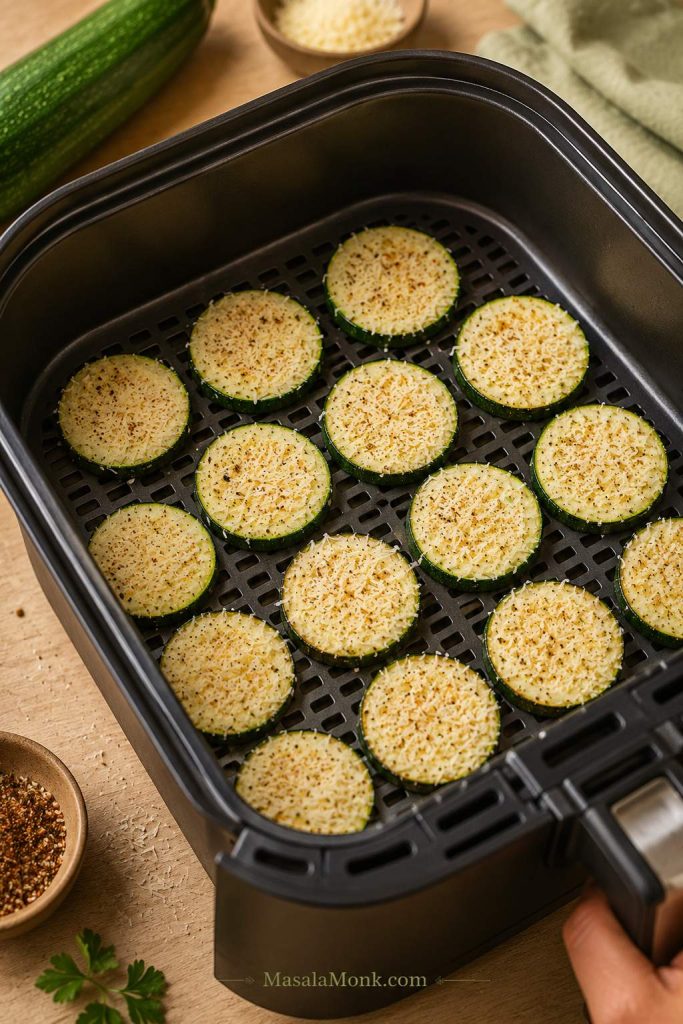
Parmesan-coated zucchini rounds arranged in one layer inside an air fryer basket.
For air fryer zucchini chips, keep the rounds in one layer. Hot air needs open gaps to dry the edges instead of steaming the centers.

Recipe Notes

  • Use finely grated parmesan for the most reliable crisping.
  • Smaller or thinner slices may finish first; pull them out early.
  • Do not add extra salt until after cooking, especially if using parmesan.
  • No air fryer? Use the hot oven parmesan method.
  • Serve soon after cooling, while the parmesan edges are still crisp.
  • Re-crisp leftovers in the air fryer or oven, not the microwave.

Why this works: salting gives the slices a better start, parmesan browns quickly, and cooling lets the cheese firm up. That is why the chips often feel crisper after a few minutes on the plate than they do straight from the air fryer. If they still come out soft, use the soggy-chip fixes.

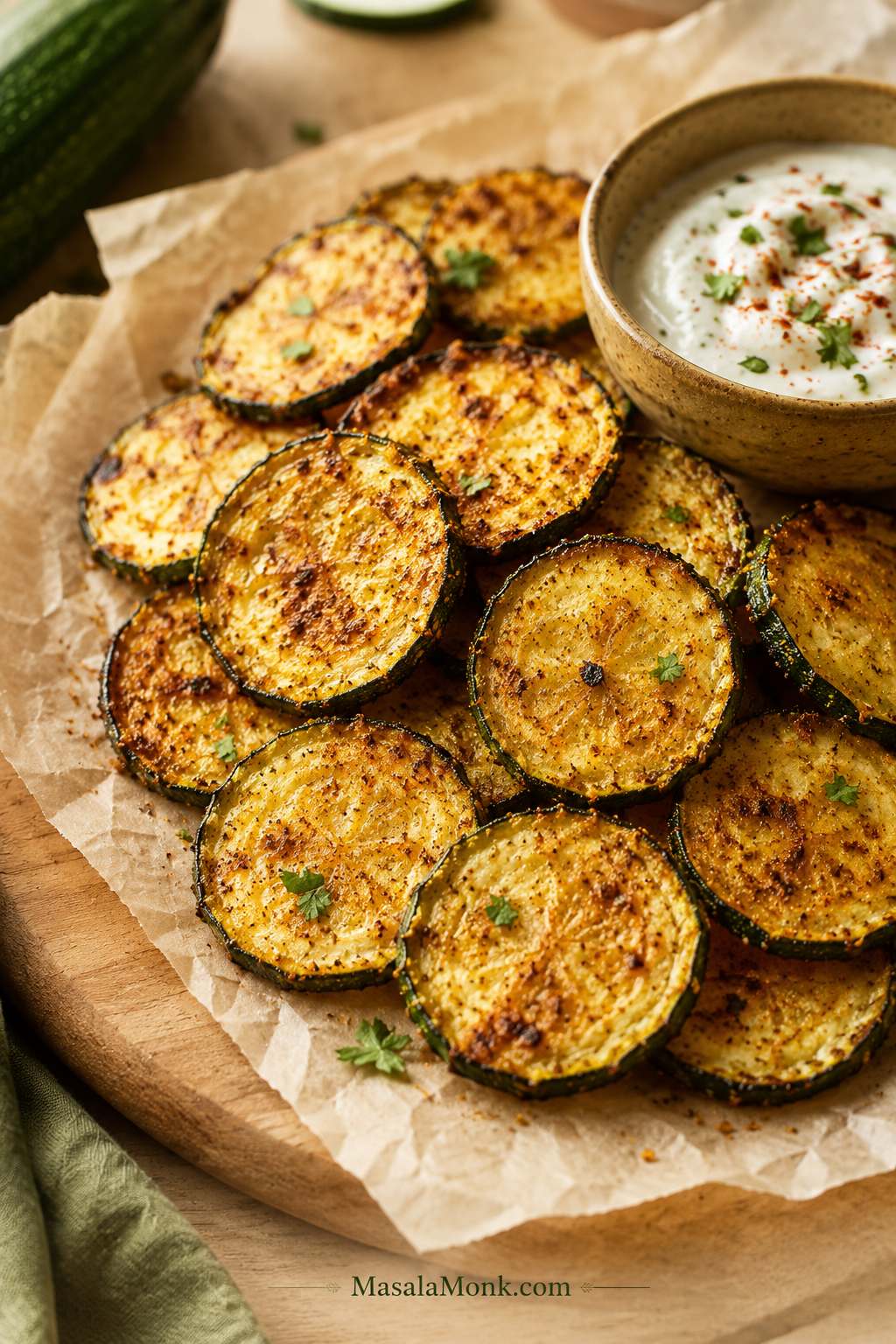
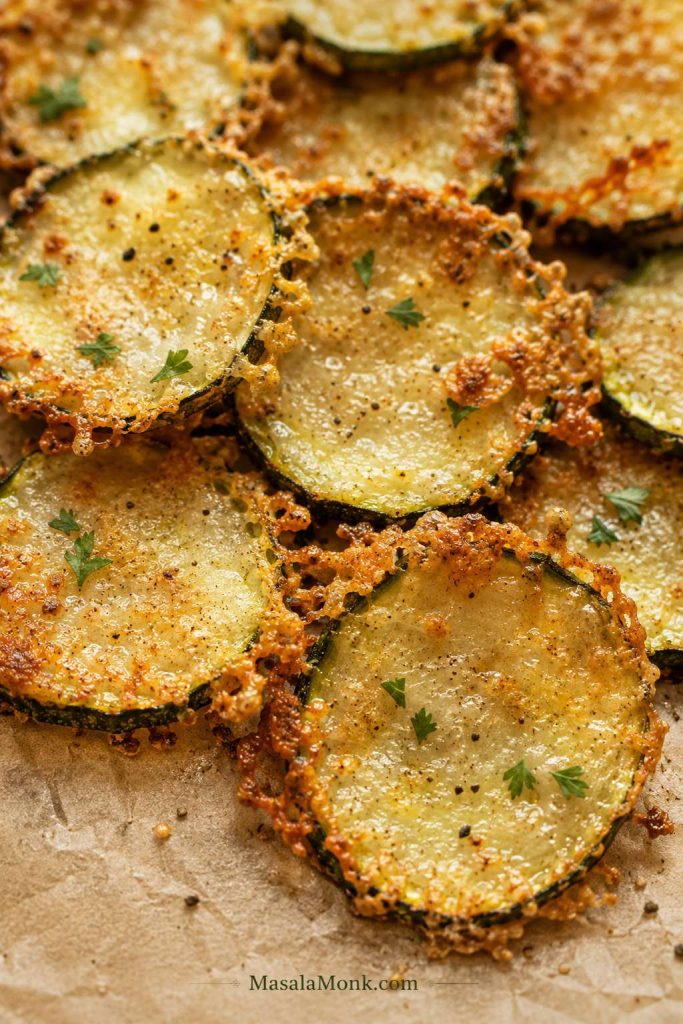
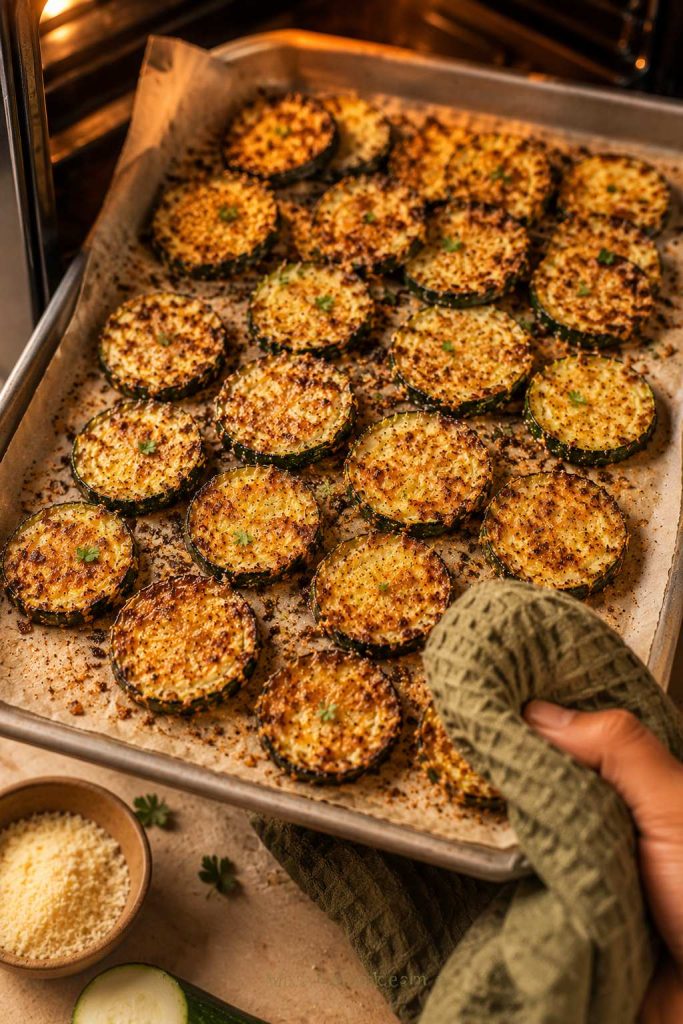
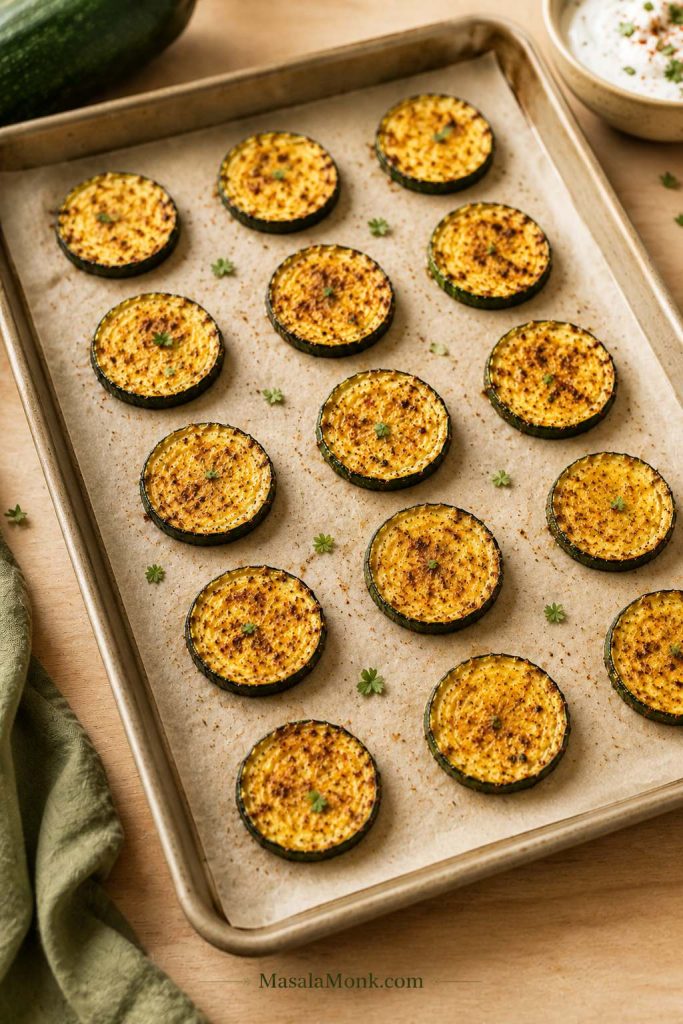
Close-up of parmesan zucchini chips with golden lacy cheese edges on parchment.
With parmesan zucchini chips, the best sign is a lacy golden edge. Let them cool briefly so the cheese can firm and crisp.

The first successful batch feels obvious in hindsight: the slices look lighter, the parmesan smells toasted, and the edges firm up while you are getting the dip. A few softer pieces are normal. At their best, they taste salty and cheesy, with crisp edges and tender centers.

The first crisp one is the cook’s tax. Eat it while the edges are still at their best.

Want a Different Texture? Choose Your Zucchini Chip Style

From here, the same idea can shift into oven trays, panko coating, keto chips, or make-ahead dehydrated chips. You do not need to master every version today. Choose the one that matches what you want to eat: the air fryer method for speed, the panko method for crunch, or the dehydrator method for make-ahead chips.

Thin chips dry. Parmesan rounds crisp. Panko rounds crunch. Once you know which style you are making, the times stop looking random.

Three zucchini chip styles shown together: thin plain chips, parmesan rounds, and panko-coated rounds.
Not every zucchini chip should look the same: thin chips dry, parmesan rounds crisp at the edges, and panko rounds bring the loudest crunch.
If You Want…Make ThisWhy It Works
The easiest first tryFast cheesy: air fryer parmesanParmesan helps the edges crisp quickly and adds salty, snacky flavor.
The crunchiest appetizerCrunchy appetizer: panko roundsPanko creates a crisp coating while the zucchini stays tender inside.
Keto or no-breadcrumb snackLow-carb: plain or parmesanParmesan gives better low-carb crispness than almond flour alone.
Larger sheet-pan batchSheet-pan: oven-bakedA baking sheet gives the slices more room than most air fryer baskets.
The most chip-like thin slicesThin veggie chips: low oven or dehydratorSlower heat gives thin slices time to turn light and crisp.
A sturdy dipperSturdy dippers: panko or thick parmesanThin plain chips are delicate; coated rounds hold up better.

Best choice guide: air fryer parmesan for the first batch, low oven or dehydrator for the most chip-like thin texture, panko for party crunch, parmesan for keto, and dehydrator or low-and-slow oven for better storage.

This is the kind of tray that disappears by the edges first: the lacy parmesan pieces, the extra-golden rounds, the ones everyone says they are “just testing.”

Why Zucchini Chips Turn Soggy

Most failed batches come down to one problem: the slices steam before they crisp. Already dealing with a limp tray? Skip to the troubleshooting table.

Zucchini carries a lot of moisture. When the slices are too thick, too crowded, or too wet, that moisture gets trapped. Instead of crisping at the edges, the zucchini softens. That is how you get chips that look browned but still bend in the middle.

If your last batch came out limp, you are not alone. This vegetable can make even a good recipe feel unpredictable until you give the slices a better start.

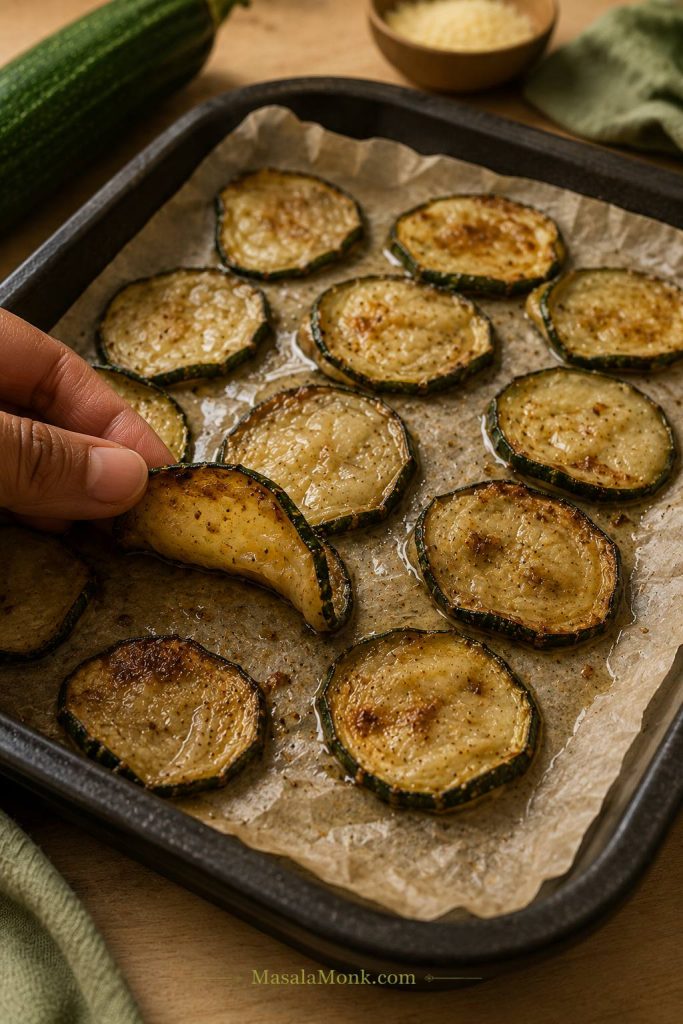
Soft browned zucchini chip being bent above a tray of limp zucchini slices.
If zucchini chips brown but still bend, they probably steamed before they crisped. Next time, go thinner, drier, or less crowded.

The rule that saves most batches: slice evenly, salt briefly, pat very dry, cook with space, and cool the chips spread out. That matters more than adding extra oil.

Once you solve that, the reward is simple: golden edges, better seasoning, and chips that feel like a snack instead of a side dish.

The Mistakes That Keep Zucchini Chips Soft

If a batch stays limp, the fix usually points back to one of these habits. This is not about being fussy; it is about giving zucchini a fair chance to crisp.

  • You salted but did not dry. Salting brings moisture to the surface; drying removes it. If the slices still look shiny, press them between towels before cooking.
  • You used too much oil. Glossy is good. Wet or slick is not. Too much oil coats the surface and keeps the chip soft.
  • You crowded the basket or pan. Overlapping slices steam each other. Cook in batches if needed.
  • You sliced unevenly. Thin pieces brown first while thick pieces stay soft. Pull the crisp ones early instead of waiting for the whole tray to match.
  • You used wet flavors too early. Lemon juice, hot sauce, fresh garlic paste, and watery marinades belong after cooking.
  • You piled them hot. Stacked chips lose their edge quickly. Spread them out for a few minutes first.
  • You expected every method to crunch the same way. Thin chips dry, parmesan rounds crisp, and panko rounds crunch. Choose the texture first.

Why These Ingredients Help Zucchini Chips Crisp

The ingredient list is short, but every item has a job. Medium zucchini gives you neat slices, salt draws moisture to the surface so you can pat it away, oil helps browning, parmesan firms into crisp edges, and panko gives the loudest crunch.

Zucchini, salt, grated parmesan, panko, oil spray, and spices arranged on a wooden board.
Keep the ingredient list simple, but choose each one for a job: salt manages moisture, parmesan builds crisp edges, and panko adds crunch.
  • Best zucchini: medium, firm zucchini with fewer watery seeds. Oversized zucchini can stay soft in the center.
  • Best crisping helper: finely grated parmesan. It clings better than large shreds and sets as it cools.
  • Best crunch coating: panko. Use it for appetizer-style rounds, not thin delicate chips that need to stay light.
  • Best oil approach: a light toss or spray. Glossy is enough; greasy slices soften.
  • Best seasoning type: dry spices and dried herbs. Save lemon juice, hot sauce, and fresh garlic paste for after cooking.

If you only have a very large zucchini, cut it lengthwise and scoop out the soft, seedy center if it looks watery. Use the firmer outer flesh for chips. And if you are comparing it with cucumber, remember that zucchini and cucumber are different vegetables, even though they can look similar at first glance.

Equipment That Actually Helps

You do not need a perfect kitchen setup here. A sharp knife, a clean towel, and enough space on the tray will get you most of the way there.

  • Mandoline or sharp knife: for even thickness.
  • Kitchen towels or paper towels: for drying after salting.
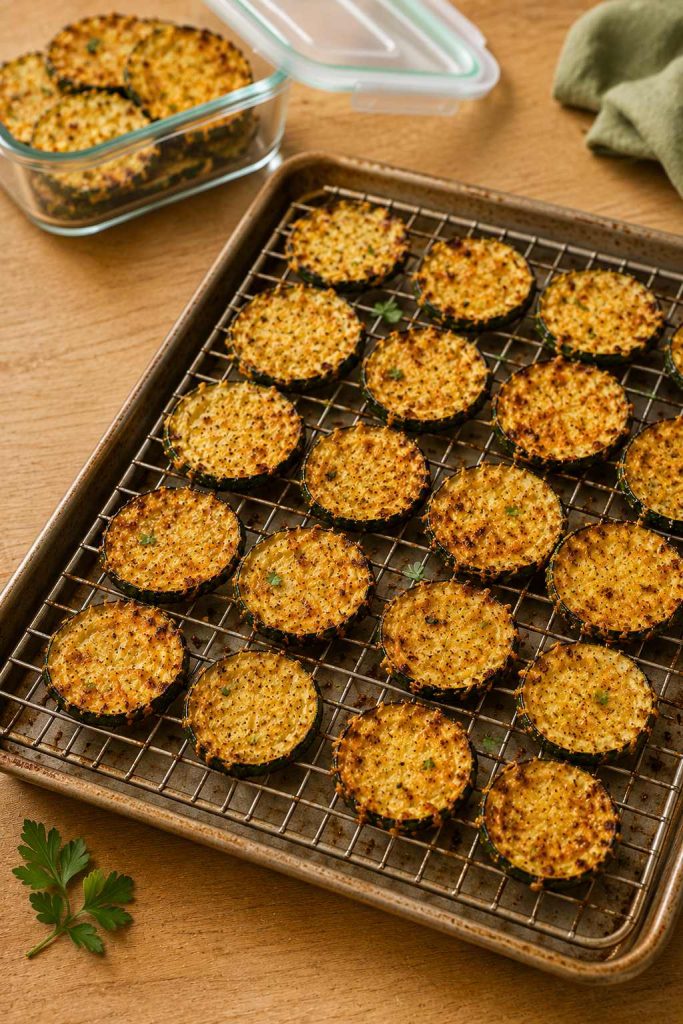
  • Parchment or wire rack: for oven batches and cooling.
  • Oil spray: for a light coating without greasiness.
  • Tongs: for pulling finished chips early.
  • Dehydrator: optional, but helpful for dry, make-ahead veggie chips.

Dry towels, even slices, and a little patience will do more for crispness than another spoonful of seasoning.

How Thin Should You Slice Zucchini for Chips?

Thickness decides whether you get a delicate chip, a cheesy round, or a sturdy dipper.

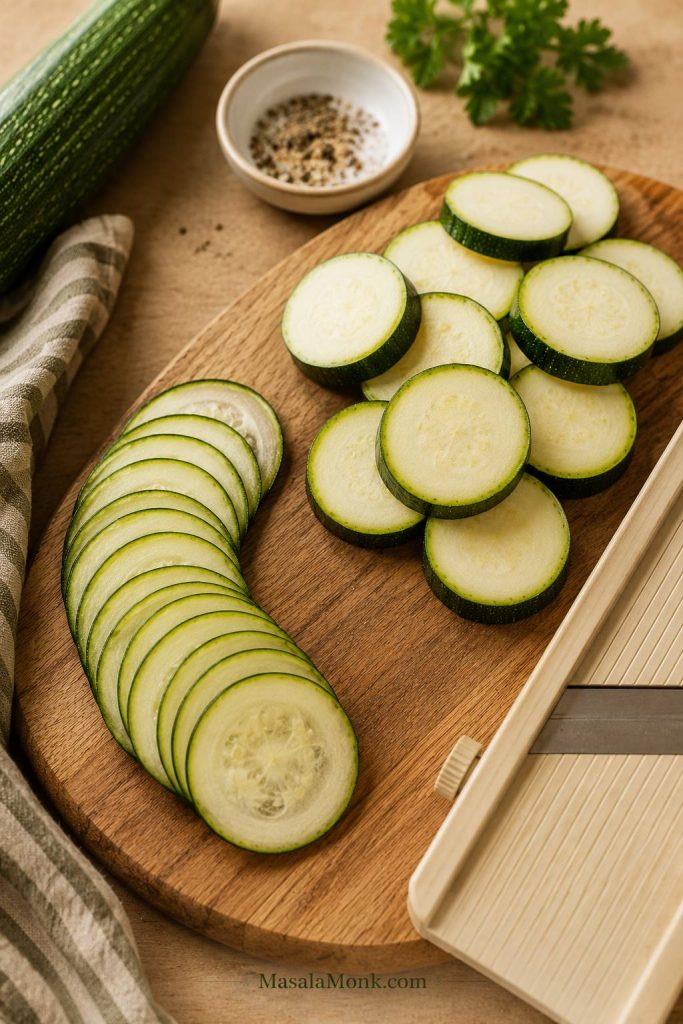
Thin zucchini slices and thicker zucchini rounds shown on a cutting board with a slicing tool.
Slice thickness decides the snack: thin rounds make delicate chips, while thicker rounds hold parmesan or panko coatings better.

For thin plain chips, aim for about ⅛ inch / 3 mm. These slices dry better, but they can burn quickly or fly around in some air fryer baskets.

For breaded or panko chips, slice closer to ¼ inch / 6 mm. Thicker rounds hold the coating better and are less fragile. They will be crunchy outside and tender inside, not dry all the way through; see the panko method if that is the texture you want.

For parmesan chips, either thickness can work. Choose thinner slices for a more chip-like result, or slightly thicker slices for a snacky zucchini round with crisp cheese edges.

A good batch will not all finish at the same second. Pull the crisp ones early. That is not fussiness; that is how zucchini behaves.

Should You Salt Zucchini First?

Yes. It is the small step that makes the biggest difference, especially if your zucchini is juicy or your last batch came out soft.

Salt draws moisture to the surface so you can pat it away before the zucchini hits the air fryer, oven, or dehydrator. It also helps breaded coatings stick because the slices are not slippery.

Here is the simple way to do it:

  1. Slice the zucchini evenly.
  2. Spread the slices on a clean towel or place them in a colander.
  3. Sprinkle with salt.
  4. Let them rest for 15–30 minutes.
  5. Pat very dry with a clean kitchen towel or paper towels.

You should see moisture on the surface after the rest. That is good. It means the water is on the towel instead of trapped in the chip.

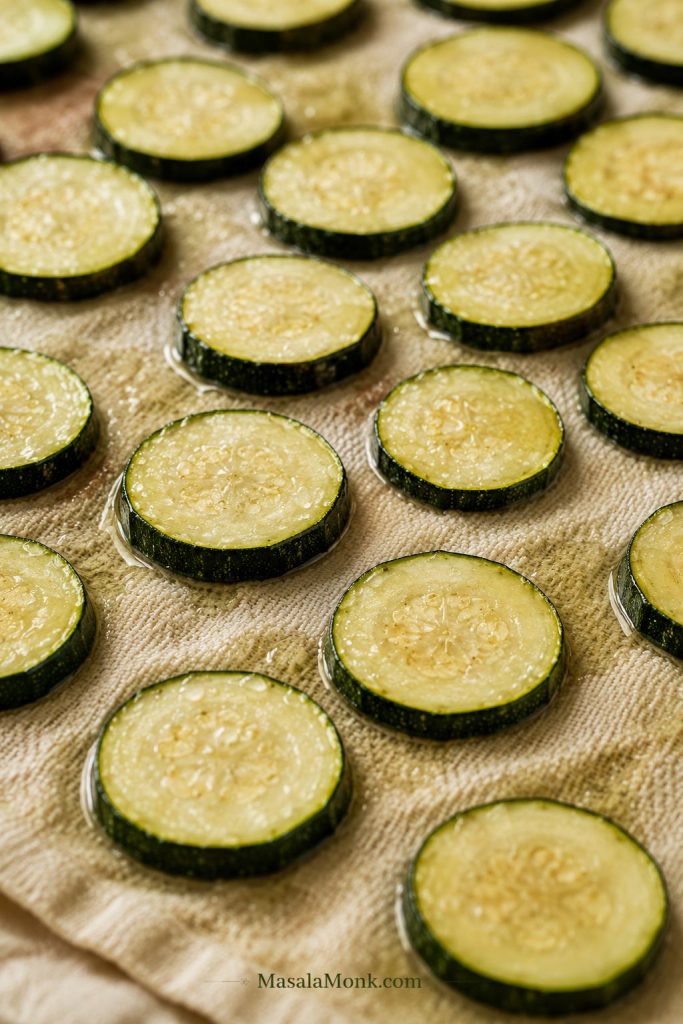
Salted zucchini rounds resting on a towel with moisture beads visible on the surface.
After salting, moisture should bead on the zucchini surface. That is the water you want on the towel, not trapped inside the chip.

You do not need to rinse if you used a light amount of salt. If you salted heavily, rinse quickly and dry extremely well. For thin low-and-slow chips, you can rest the zucchini longer, even up to 45–60 minutes, but for most batches, 20–30 minutes is enough.

Do not skip the drying after salting. Pat away the surface moisture before cooking, or the slices will steam. Next, see how spacing changes the result in the air fryer and oven methods.

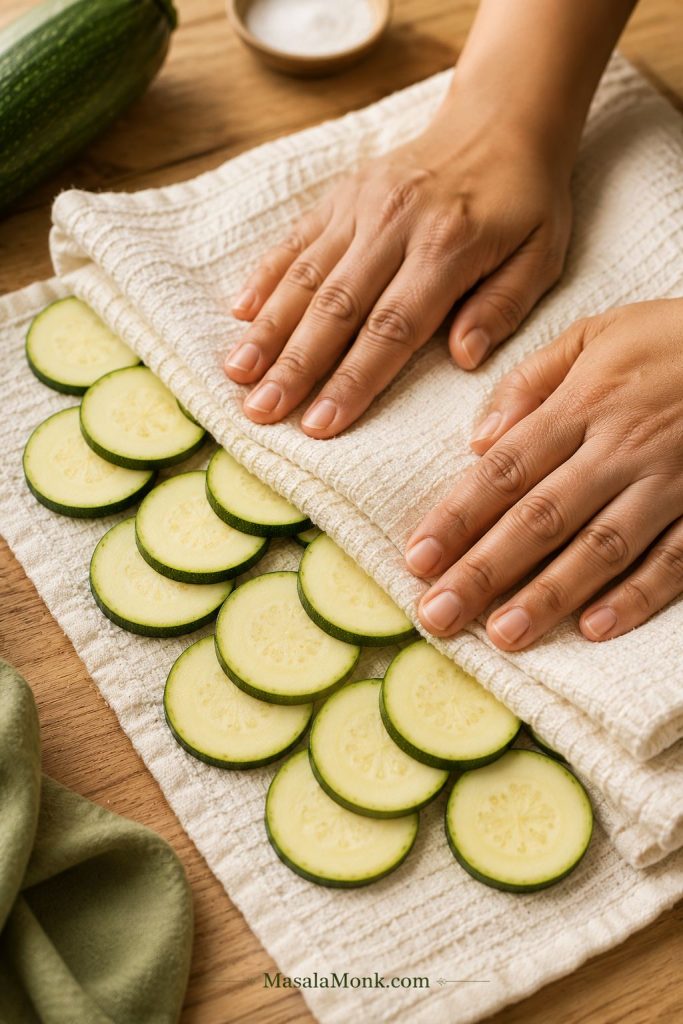
Hands patting zucchini rounds dry between clean towels before cooking.
Once the slices release moisture, press them until they look matte. Shiny zucchini usually means softer chips later.

Air Fryer Zucchini Chips: What Matters Most

The air fryer moves hot air, not magic. If the slices overlap, steam wins.

Overlapping zucchini rounds crowded inside an air fryer basket.
A crowded air fryer basket traps steam fast. Even well-seasoned zucchini chips stay soft when the slices overlap this much.

This is the weeknight version: quick heat, toasted parmesan, and a snack that is ready before anyone gets impatient. Good air fryer chips have browned parmesan around the edges, a garlic-paprika aroma, and enough firmness to dip gently after they cool for a few minutes.

Air Fryer StyleTemperatureTimeWhat to Look For
Plain thin chips370°F / 188°C12–18 minutesEdges dry and lightly browned
Parmesan chips370°F / 188°C10–12 minutesCheese is golden and edges are crisp
Panko chips400°F / 204°C10–12 minutesPanko is golden and crunchy

Very thin slices may finish early; thicker slices may need a few more minutes. Pull the early winners. Waiting for the whole basket to match is how the best chips become bitter.

The second batch is usually better because you already know how fast your air fryer runs.

If very thin chips fly around: slice them slightly thicker next time or use an air fryer rack or mesh insert if your model allows it. Overcrowding the basket will hold them down, but it will also trap steam.

Oven Zucchini Chips: Hot and Fast vs Low and Slow

The oven only looks confusing because thin chips and coated rounds need completely different treatment. Use a hot oven, around 425°F / 218°C, for parmesan or panko-coated rounds that need quick browning. For thin plain slices, a low oven around 225–235°F / 107–113°C gives the zucchini time to dry out.

Hot oven batches should smell toasted and look golden at the edges. Low oven batches should look drier, lighter, and slightly curled.

Golden baked zucchini chips on a parchment-lined sheet pan being pulled from the oven.
Baked zucchini chips need steady heat and enough tray room. Look for golden tops, drier centers, and edges that lift slightly.

Hot Oven Parmesan or Panko Chips

  1. Preheat the oven to 425°F / 218°C.
  2. Slice zucchini into ¼-inch / 6 mm rounds for panko chips, or slightly thinner for parmesan chips.
  3. Salt, rest, and dry the slices.
  4. Coat with parmesan or panko mixture.
  5. Arrange in a single layer on a parchment-lined baking sheet.
  6. Spray lightly with oil.
  7. Bake for 25–30 minutes, flipping halfway, until golden and crisp at the edges.

The chips should look lighter, slightly curled at the edges, and golden where the cheese or coating touches the heat. If they only look browned but still bend like roasted zucchini, give them more time.

Zucchini rounds arranged with space between them on a parchment-lined sheet pan.
On a sheet pan, visible gaps are not wasted space. They let heat move around each zucchini slice so the edges can firm.

Low-and-Slow Thin Zucchini Chips

  1. Preheat the oven to 225–235°F / 107–113°C.
  2. Slice zucchini thinly, about ⅛ inch / 3 mm.
  3. Salt for 20–30 minutes, then pat very dry.
  4. Use very little oil, or just a light spray, then add dry seasoning.
  5. Spread in a single layer on parchment or a wire rack set over a baking sheet.
  6. Bake for 70–120 minutes, rotating trays halfway.
  7. Start checking around 70 minutes, then remove dry pieces every 10–15 minutes as needed.
  8. Cool completely before serving.

They are done when the centers stop looking wet, the edges curl slightly, and the slices feel light. If they still bend like roasted zucchini, they need more time.

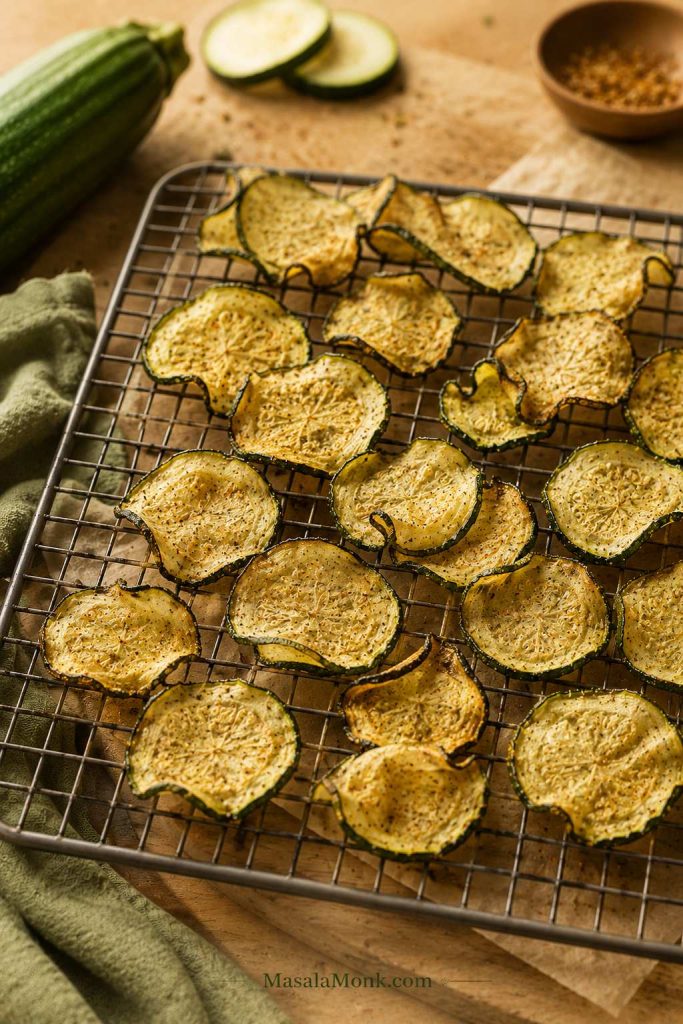
Thin lightly curled zucchini chips cooling on a wire rack.
Low-and-slow zucchini chips should look light, thin, and slightly curled. Cooling them on a rack keeps the undersides from softening.

Dehydrator Zucchini Chips

The dehydrator is not the fastest route, but it is the one to choose if you want chips that stay crisp after the first hour. This is the quiet, patient version: less hot-snack energy, more crisp pantry-snack payoff.

  1. Slice zucchini very thin and even.
  2. Salt lightly for 20–30 minutes, then pat dry very well.
  3. Use very little oil or skip oil completely.
  4. Season lightly with garlic powder, paprika, pepper, or dried herbs.
  5. Arrange in a single layer on dehydrator trays.
  6. Dehydrate at 135–150°F / 57–66°C for 4–8 hours.
  7. Rotate trays if your dehydrator heats unevenly.
  8. Cool completely before storing.
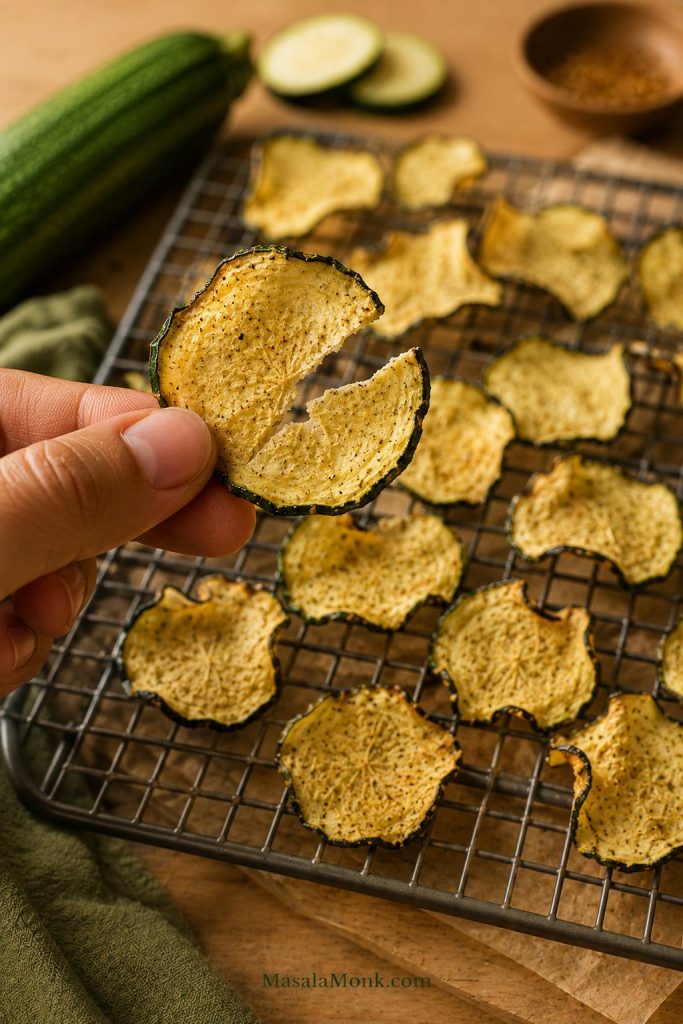
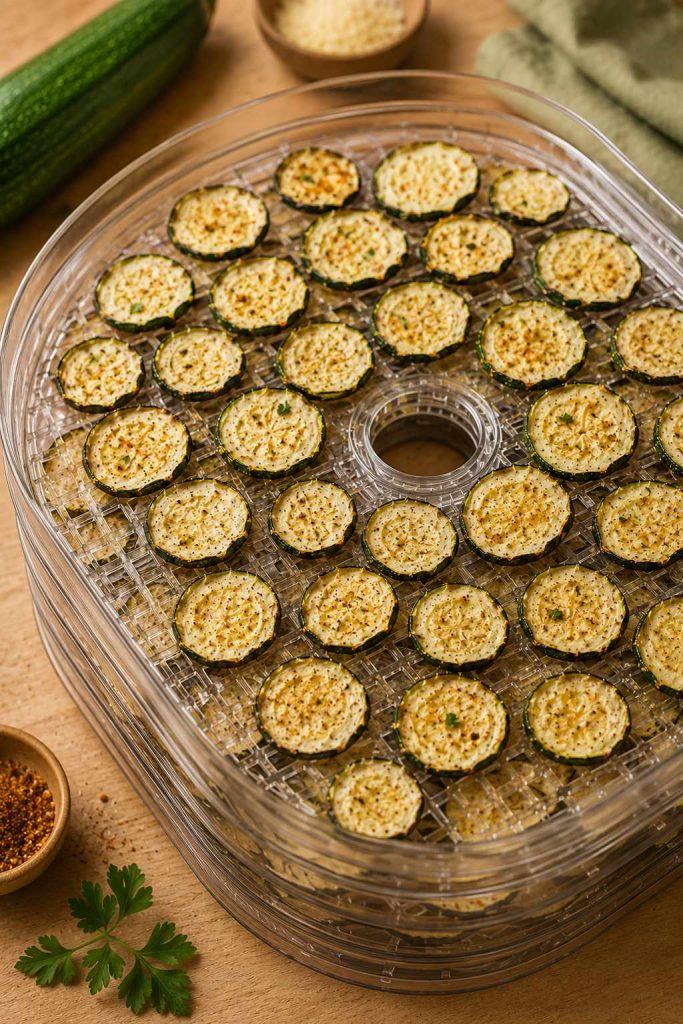
Thin zucchini slices arranged in a single layer on a dehydrator tray.
For dehydrator zucchini chips, single-layer spacing is the method. Thin slices dry more evenly and store better after they cool.

Use salt lightly here; dehydrated chips taste saltier as they dry. Humid kitchens, thicker slices, and crowded trays will push the timing toward the longer end.

Home-drying guidance supports the same idea used here: a single layer and steady dehydrator temperature help the slices dry evenly.

Cool one chip, then test it. Warm zucchini can lie to you. Fully dried chips should snap or feel crisp after cooling, not leathery. For keeping that texture, use the storage and re-crisping guide.

Hand holding a thin dried zucchini chip above a rack of dehydrated zucchini chips.
Cool one chip before testing. A dehydrated zucchini chip should feel dry and crisp, not warm, leathery, or bendy.

Parmesan Zucchini Chips: How to Get Lacy, Crisp Edges

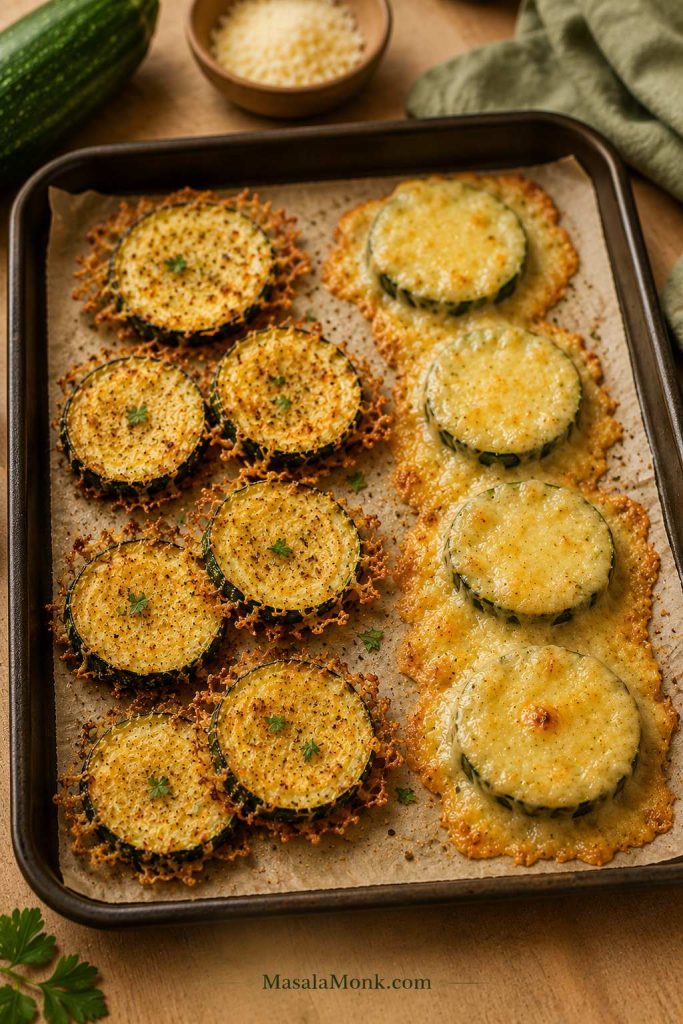
Parmesan chips are done when the cheese looks golden and lacy at the edges, not pale and melted. If the parmesan smells sharp, bitter, or turns dark brown before the zucchini looks lighter, the heat is too high or the slices need more drying before cooking.

Finely grated parmesan works best because it clings in a thin layer and firms as it cools. Big shreds melt into patches. Too much cheese can also form a heavy blanket instead of a crisp edge, so use enough to coat lightly, not bury the zucchini.

Zucchini rounds on a tray showing light lacy parmesan coating beside heavy melted cheese coating.
Parmesan helps, but too much can act like a blanket. A lighter coating gives zucchini chips better lacy edges and cleaner crisping.
  • Use finely grated parmesan, not big shreds.
  • Look for golden, lacy edges instead of dark brown spots.
  • Pull the tray or basket if the cheese smells bitter.
  • Let the chips cool spread out so the cheese can firm.
  • Add extra salt only after tasting; parmesan already brings salt.

Parmesan chips are especially good with something tomatoey on the side. A small bowl of marinara sauce makes them feel closer to a crispy zucchini appetizer than a plain vegetable snack.

Breaded or Panko Zucchini Chips

When you want the kind of crunch people hear across the table, use panko. Treat this version as crispy zucchini rounds, not thin vegetable chips. They are golden outside, tender inside, and strong enough for thick dips.

Panko crisps better than regular breadcrumbs because the flakes are larger and airier. Finished panko rounds should sound crisp when tapped with tongs, even though the zucchini inside stays tender.

This is the party version: golden crumbs outside, soft zucchini inside, and enough crunch to scoop a thick dip without collapsing.

Broken panko-coated zucchini chip showing a crunchy golden coating and tender zucchini center.
With panko zucchini chips, the coating turns golden and crisp while the zucchini inside stays tender.

Panko Ingredients

  • 2 medium zucchini, sliced into ¼-inch / 6 mm rounds
  • ½ cup all-purpose flour, about 60 g
  • 2 large eggs, beaten
  • 1 cup panko breadcrumbs, about 55–60 g
  • ½ cup finely grated parmesan, about 45 g
  • 1 tsp Italian seasoning or dried oregano
  • ½ tsp garlic powder
  • Oil spray

Panko Method

  1. Salt the zucchini rounds briefly and pat them dry.
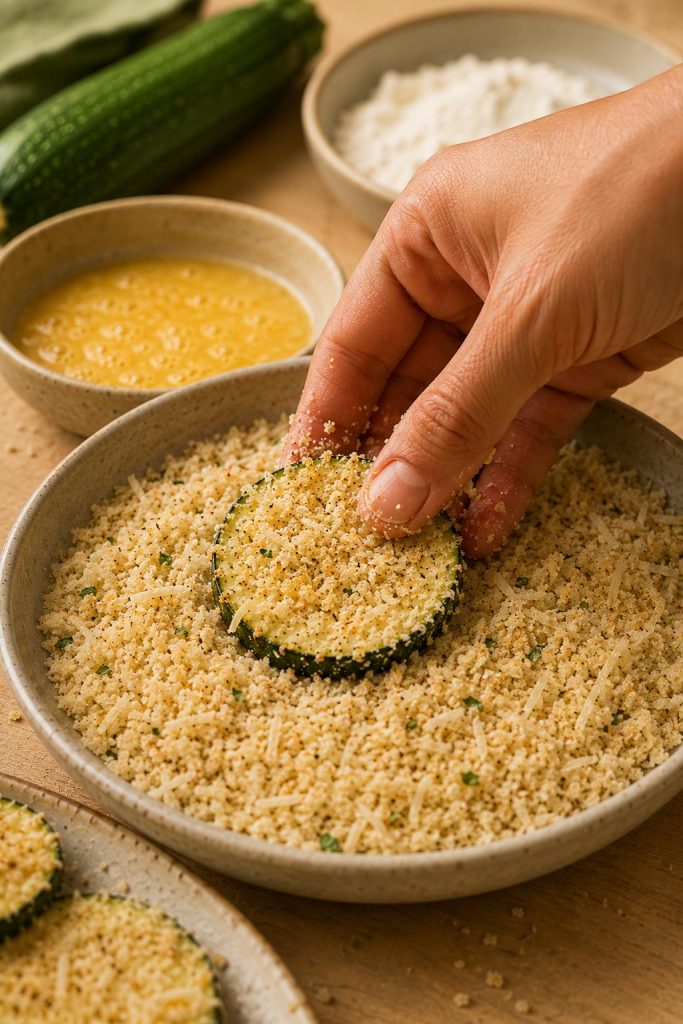
  2. Set up three bowls: flour, beaten eggs, and panko mixed with parmesan and seasoning.
  3. Coat each slice in flour, then egg, then panko mixture.
  4. Press gently so the coating sticks.
  5. Arrange in a single layer and spray lightly with oil.
  6. Bake at 425°F / 218°C for 25–30 minutes, or air fry at 400°F / 204°C for 10–12 minutes, checking early because panko can brown quickly.
Hand pressing a zucchini round into panko crumbs during breading.
For panko zucchini chips, press the crumbs onto dry slices gently. That contact helps the coating cling and brown into a crunchy shell.

If the coating falls off, the zucchini was probably too wet before breading. Salt, drain, and dry the slices well before coating. For more soft-chip fixes, check the troubleshooting table.

The panko version is especially good with buffalo chicken dip or spinach artichoke dip. If you want something simpler, a warm cheese sauce works too.

Keto and No-Breadcrumb Zucchini Chips

If breadcrumbs are off the table, parmesan is the easiest way to get real edge crispness. Plain zucchini can dry nicely, but parmesan gives the snack more structure and a salty bite.

Almond flour can work, but it does not behave like panko. It tends to feel heavier and less crisp, so use it lightly or pair it with parmesan instead of expecting a breadcrumb-style crunch.

If you are building a bigger low-carb snack plate, these parmesan chips can sit alongside other keto chips, cucumber sticks, olives, cheese, and a creamy ranch or garlic yogurt dip.

Dry Seasonings That Work Best

Keep the wet flavors for later. Before cooking, dry spices are your friend.

  • Garlic parmesan: garlic powder, black pepper, and finely grated parmesan.
  • Ranch-style: garlic powder, onion powder, dried dill, parsley, and black pepper.
  • Chili lime: chili powder, garlic powder, lime zest, and a squeeze of lime after cooking.
  • Smoky paprika: smoked paprika, garlic powder, black pepper, and a little parmesan.
  • Italian herb: dried oregano, basil, garlic powder, black pepper, and parmesan.
  • Spicy parmesan: garlic powder, paprika, cayenne, black pepper, and finely grated parmesan.

Taste before adding more salt at the end, especially with parmesan. If you like heat, keep hot sauce or other wet sauces for after cooking; they work better as a finishing touch than as a pre-cook coating.

What to Serve with Zucchini Chips

The dip depends on the style of chip. Thin plain chips are delicate, so they work better with lighter dips like ranch, garlic yogurt, or tzatziki. Parmesan chips are great with marinara or salsa verde. If you want something sweeter and brighter, mango salsa also works.

For a snack board, pair warm zucchini chips with one creamy dip, one bright dip, and a few crunchy extras like cucumber sticks, carrot sticks, crackers, or olives. The contrast is what makes the board work: warm chips, cool dip, crisp edge, creamy finish.

How to Store and Re-Crisp Zucchini Chips

Fresh is best, but leftovers are not hopeless. You just have to bring the dry heat back.

They are best while the cheese has just firmed, the edges still crackle lightly, and the centers are still warm. As they sit, zucchini continues to soften, so even a crisp batch can lose some texture.

Do not seal in the steam you just worked so hard to remove. Spread hot chips out for a few minutes before piling them into a bowl or container.

Same-Day Storage

If you are serving them within a few hours, cool them completely first. Keep them loosely covered rather than sealing them while warm.

Overnight Storage

Refrigerate parmesan or panko chips in an airtight container once fully cool. They will lose some crispness, but you can revive them in the oven or air fryer.

Make-Ahead Chips

Choose low-and-slow oven chips or dehydrator chips if you need something that stores better. They hold up longer because they are dried more thoroughly.

How to Re-Crisp Them

Leftover zucchini chips spread on a rack with an open storage container nearby for re-crisping.
To re-crisp zucchini chips, spread them out and bring back dry heat. The air fryer or oven works better than a microwave.
  • Air fryer: re-crisp at 350–370°F / 175–188°C for 3–5 minutes, checking often.
  • Oven: bake at 350°F / 175°C for 8–10 minutes, uncovered, until the edges crisp again.

Re-crisped chips will not be exactly like fresh, but dry heat can still bring back that salty edge. The microwave is the one option to skip; it softens zucchini instead of reviving it.

Troubleshooting: Soggy, Burnt, Oily, or Uneven Chips

A soft tray is not a failed recipe. It is usually one adjustment away: drier slices, less oil, more space, or a few more minutes.

Quick Fixes for Soft or Uneven Zucchini Chips

ProblemRight NowNext Batch
Chips are soggyRe-crisp uncovered in the air fryer or oven.Salt longer, pat very dry, use less oil, and avoid crowding.
Chips are soft in the middleCook a few minutes longer at moderate heat.Slice thinner or use a lower, slower oven method.
Edges burned but centers stayed softRemove the burnt pieces and lower the heat slightly.Slice more evenly and check earlier.
Chips stayed softSpread them out and cook a few minutes more.Use a single layer and cook in batches.
Chips feel oilyDrain briefly on a towel and re-crisp with dry heat.Use oil spray or toss with less oil.

Fixes for Coating, Salt, and Air Fryer Problems

ProblemRight NowNext Batch
Parmesan burnedPull the basket or tray before the cheese turns bitter.Use finely grated parmesan, less cheese, or slightly lower heat.
Parmesan stuck to the trayLet it cool briefly before lifting.Use parchment for oven chips or a light oil spray for air fryer chips.
Panko coating fell offServe the loose crumbs as a crunchy topping.Dry zucchini well before breading and press the coating gently.
Panko browned but zucchini stayed wateryReturn the soft pieces to the oven or air fryer for a few minutes.Use ¼-inch / 6 mm slices and dry them better before coating.
Chips taste too saltyServe with an unsalted dip or yogurt sauce.Use less salt before cooking, especially with parmesan.
Chips taste bitterRemove dark pieces and serve the lighter ones.Lower heat slightly and add delicate seasonings after cooking.
Air fryer chips flew aroundPause and settle the chips if needed.Slice slightly thicker or use a rack/mesh insert.
Chips softened after coolingRe-crisp in the air fryer or oven.Cool spread out before storing or serving.

If the first tray bends, do not panic. Moisture usually won the first round, and the next batch often only needs one or two adjustments.

Frequently Asked Questions

Why are my zucchini chips soggy?

Zucchini chips turn soggy when moisture gets trapped. Slice evenly, salt briefly, pat very dry, use little oil, and cook in a single layer.

Why are my air fryer zucchini chips not crispy?

The slices may be wet, thick, crowded, or coated with too much oil. Cook in batches and pull finished pieces early instead of waiting for every slice to match.

Do you have to salt zucchini first?

You do not absolutely have to, but it helps a lot. Even a 15–20 minute rest gives the slices a better start before they hit the heat.

Do they get crispier as they cool?

Yes, especially parmesan chips. The cheese firms as it cools, so give the chips a few minutes before judging the texture.

Air fryer or oven: which is better?

Choose the air fryer for speed and small batches. Use the oven for larger trays, panko-coated chips, and low-and-slow thin chips.

Can I bake zucchini chips without breadcrumbs?

Yes. Use thin slices, salt and dry them well, then bake low and slow at 225–235°F / 107–113°C. Add finely grated parmesan if you want crisp edges without breadcrumbs.

What is the best no-breadcrumb coating?

Finely grated parmesan is the easiest no-breadcrumb coating because it browns, firms as it cools, and adds salty flavor.

How thin should I slice the zucchini?

Slice about ⅛ inch / 3 mm for thin plain chips and about ¼ inch / 6 mm for breaded or panko rounds.

Are zucchini chips keto?

Plain and parmesan versions can be keto-friendly. Panko or regular breadcrumb-coated chips are not keto unless you use a low-carb coating.

Can I use yellow squash or courgette?

Yes. Courgette is another name for zucchini, and yellow summer squash can also work. If you actually have cucumber, use it fresh in a cucumber salad instead of baking it into chips.

Should I peel the zucchini?

No. The skin adds color, helps the slices hold together, and gives better texture.

Can I use frozen zucchini?

Frozen zucchini is not ideal for chips because it releases too much liquid after thawing. Use fresh zucchini for this recipe.

Are these the same as zucchini fries?

No. Chips are usually sliced into rounds, while zucchini fries are cut into thicker sticks and often breaded.

Can I use a dehydrator for zucchini chips?

Yes. Slice very thin, salt and dry the slices, season lightly, and dehydrate at 135–150°F / 57–66°C for 4–8 hours.

How do I store zucchini chips?

Cool them completely first. Store fully dried chips airtight, refrigerate parmesan or panko leftovers, and re-crisp in the air fryer or oven.

Final Thoughts

Zucchini chips stop feeling random once you stop treating every version like the same snack. Thin chips need drying time, parmesan rounds need a light coating and a cool-down, and panko rounds need enough thickness to hold their crunch.

Your first batch teaches you what your zucchini and air fryer are doing. Usually, the next one is the keeper.

When the edges finally crisp, the whole thing clicks: not a packaged potato chip, not a limp roasted round, but a golden, salty zucchini snack that actually earns its dip.

Back to top

Posted on 1 Comment

Easy Cheese Ball Recipe

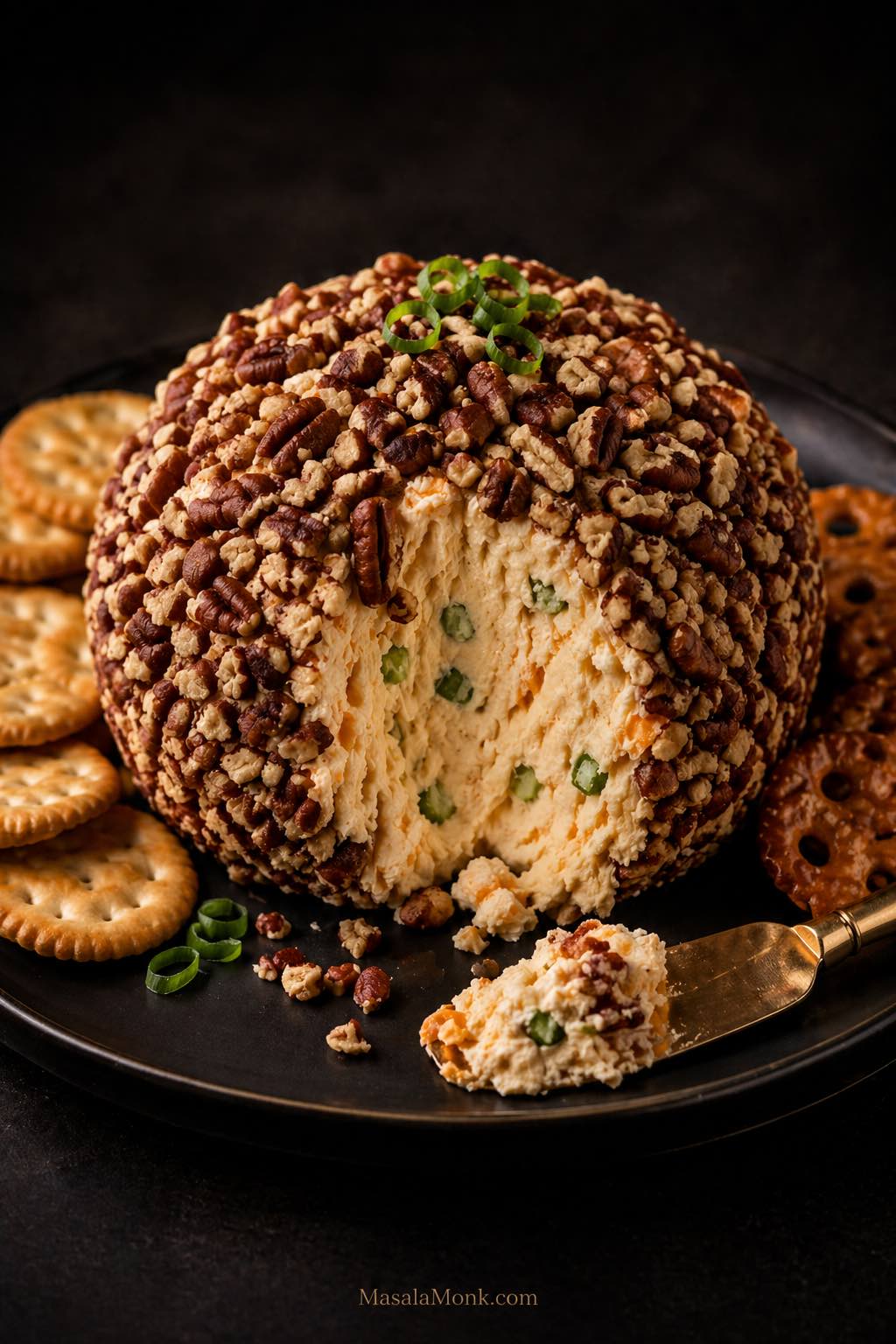
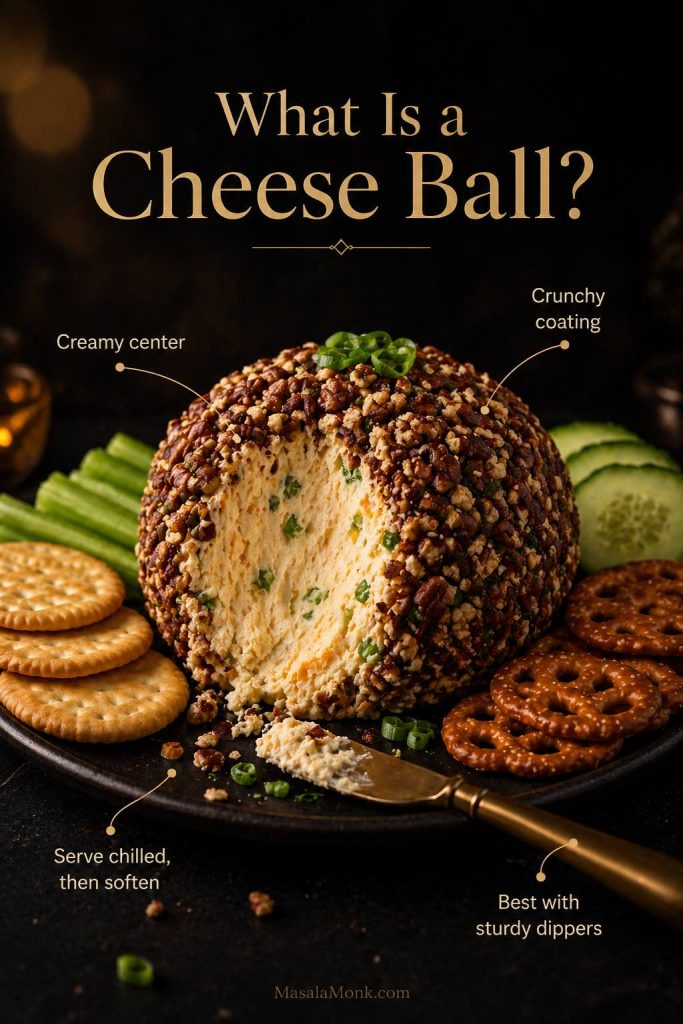
Close-up of a pecan-coated cheese ball on a dark plate with round crackers and a spreader, with a scoop taken out to show the creamy cheddar and green onion filling inside.

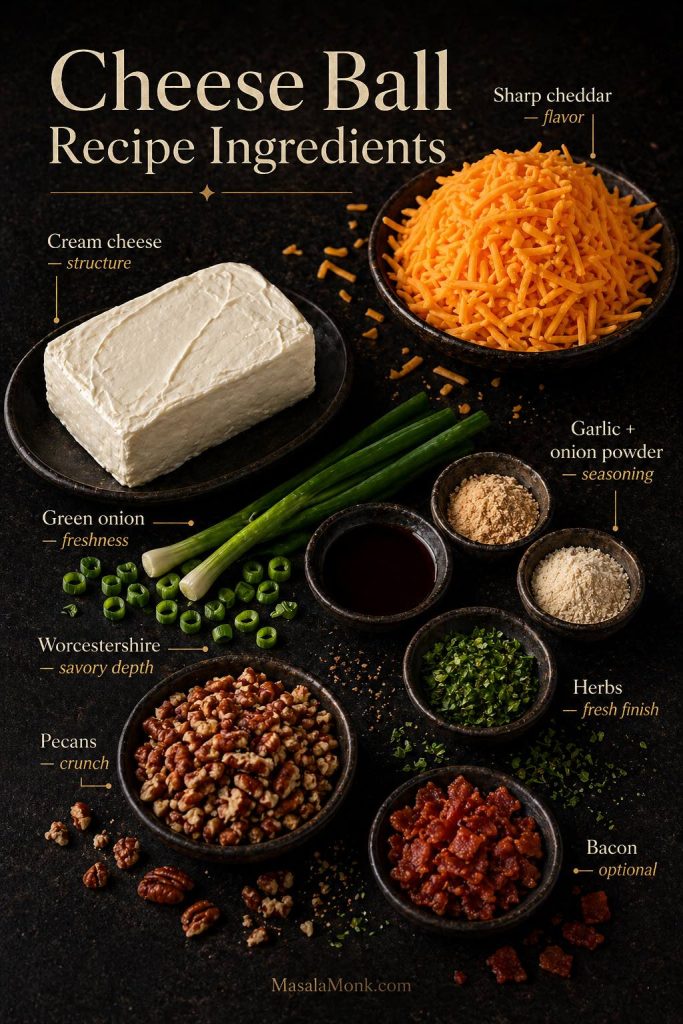
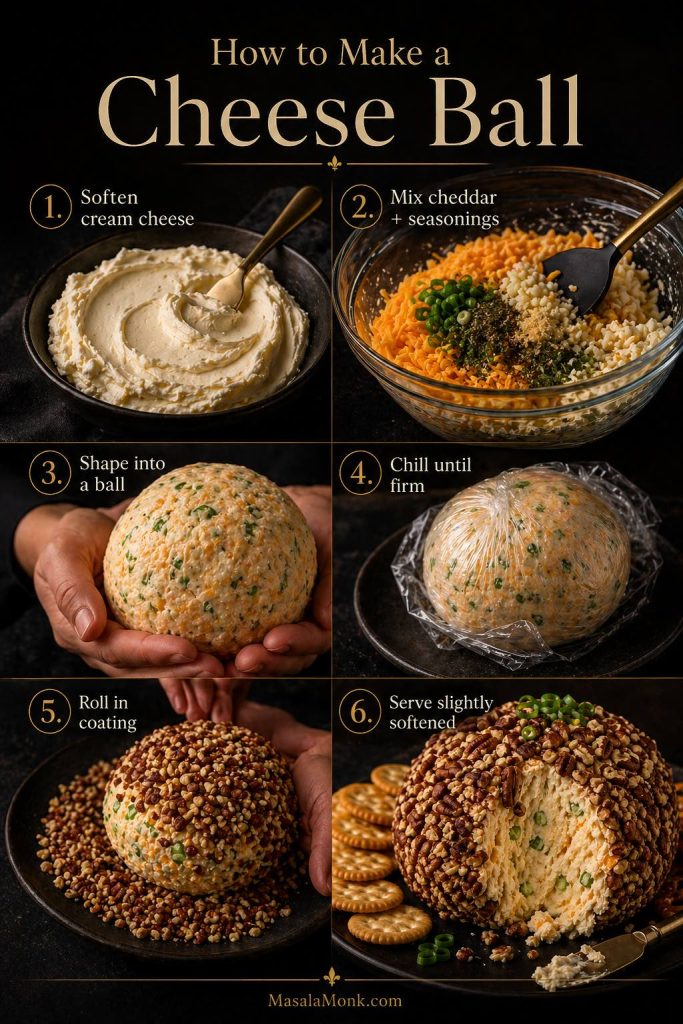
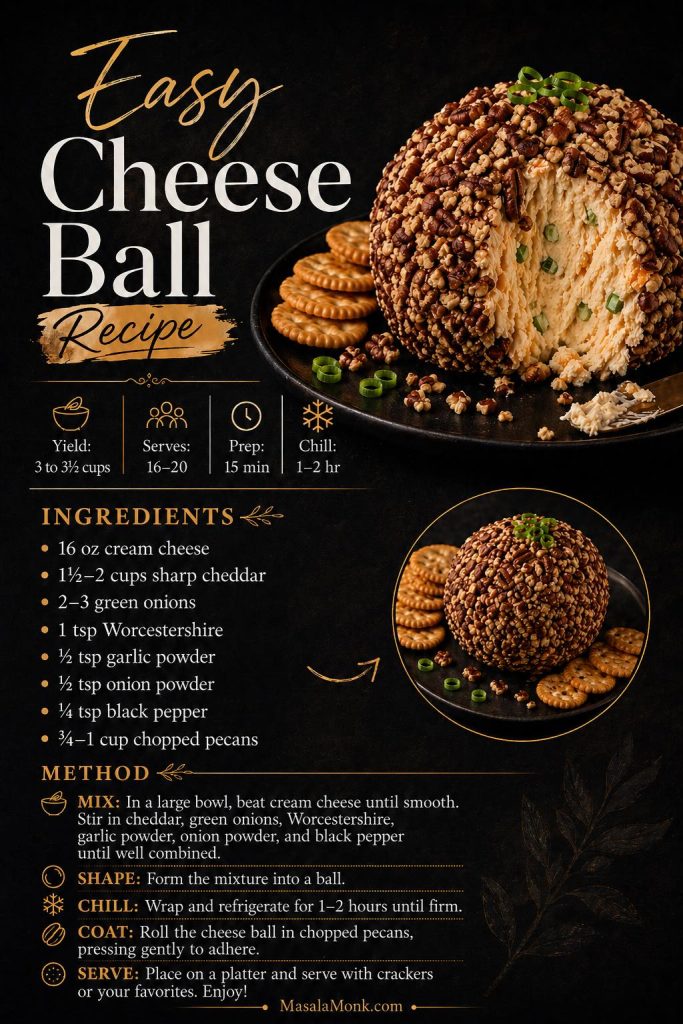
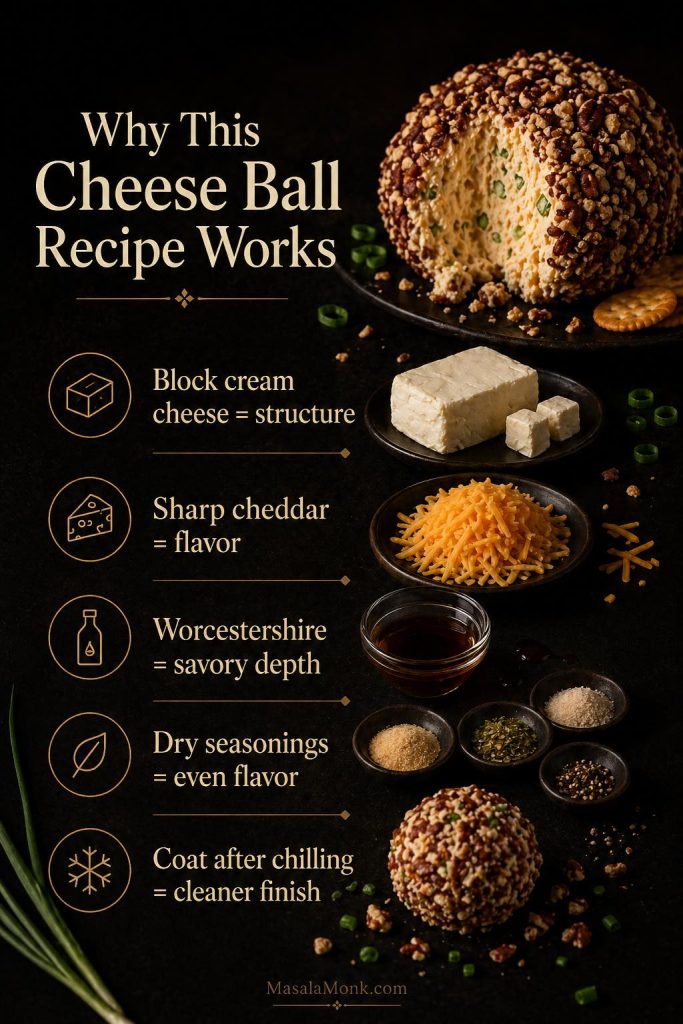
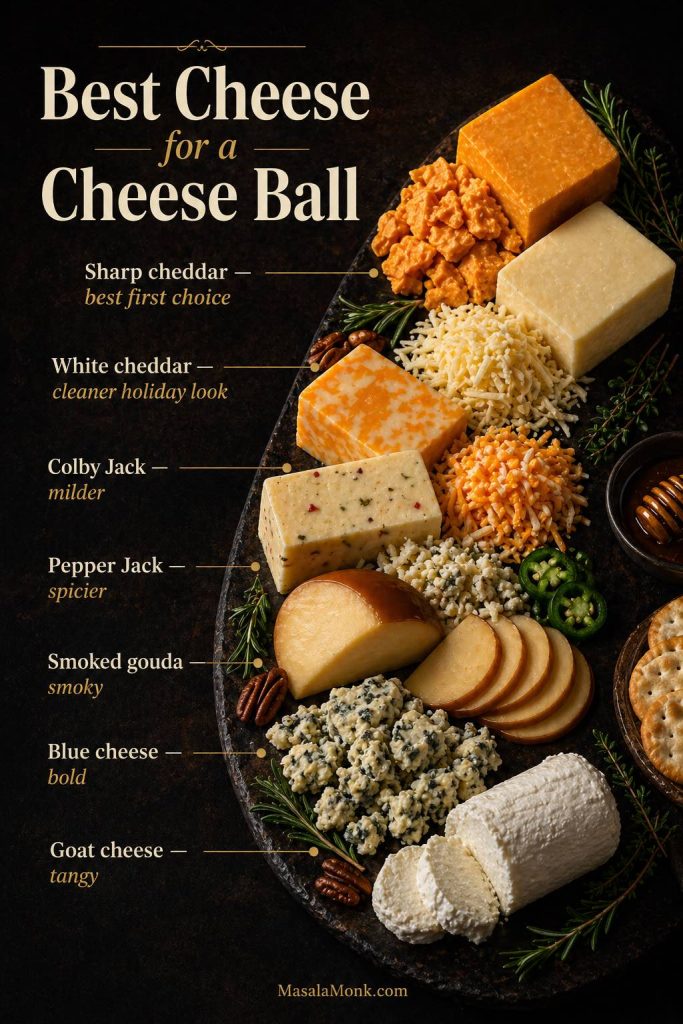
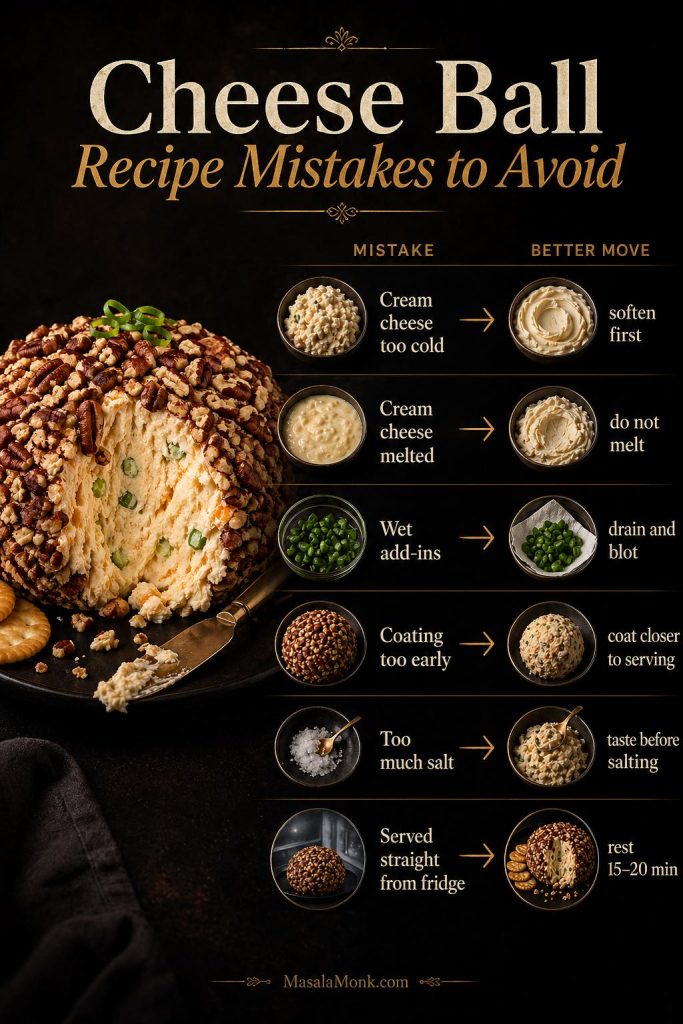
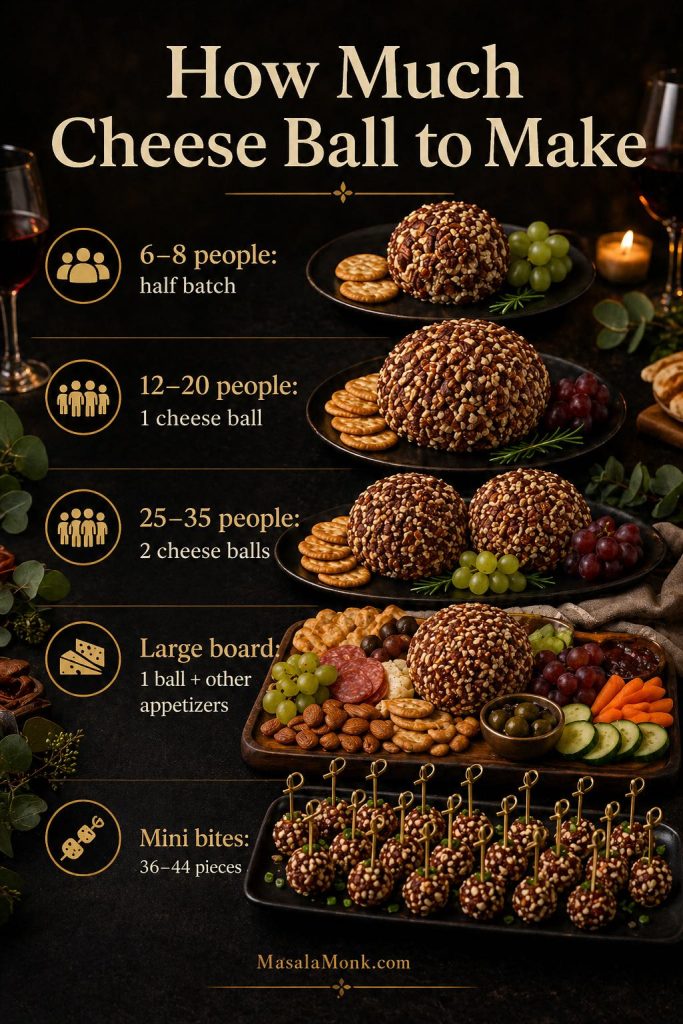
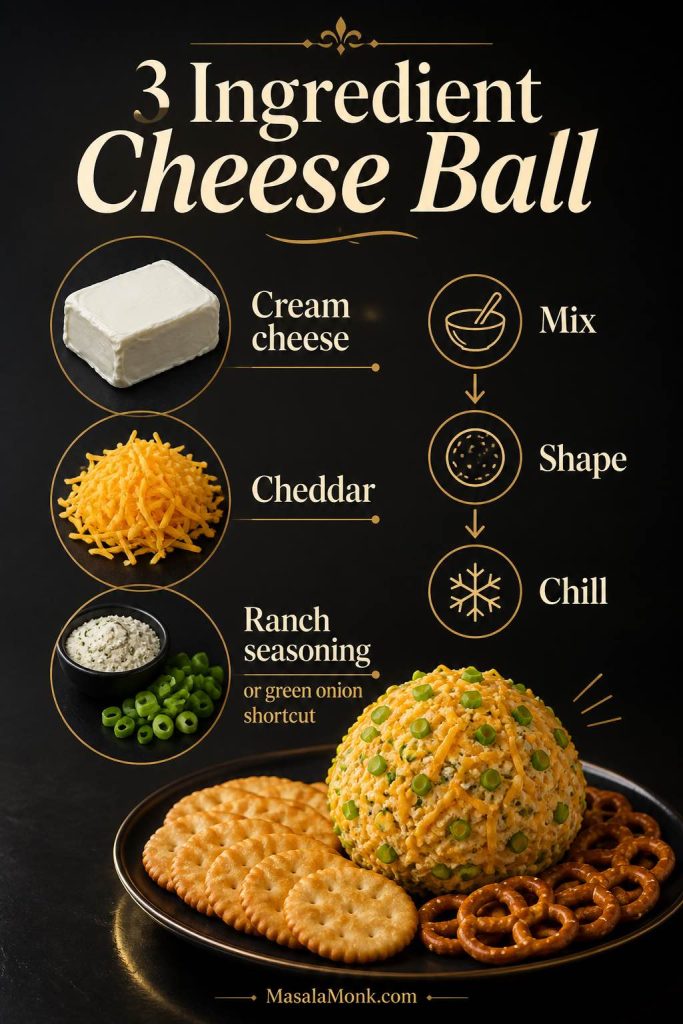
This easy cheese ball recipe is the classic no-cook party appetizer you want when you need something creamy, savory, make-ahead friendly, and reliable. It starts with cream cheese, sharp cheddar, green onion, simple seasonings, and a crunchy pecan coating, then chills into a firm but spreadable ball that works with crackers, pretzels, vegetables, holiday boards, game day snacks, and party platters.

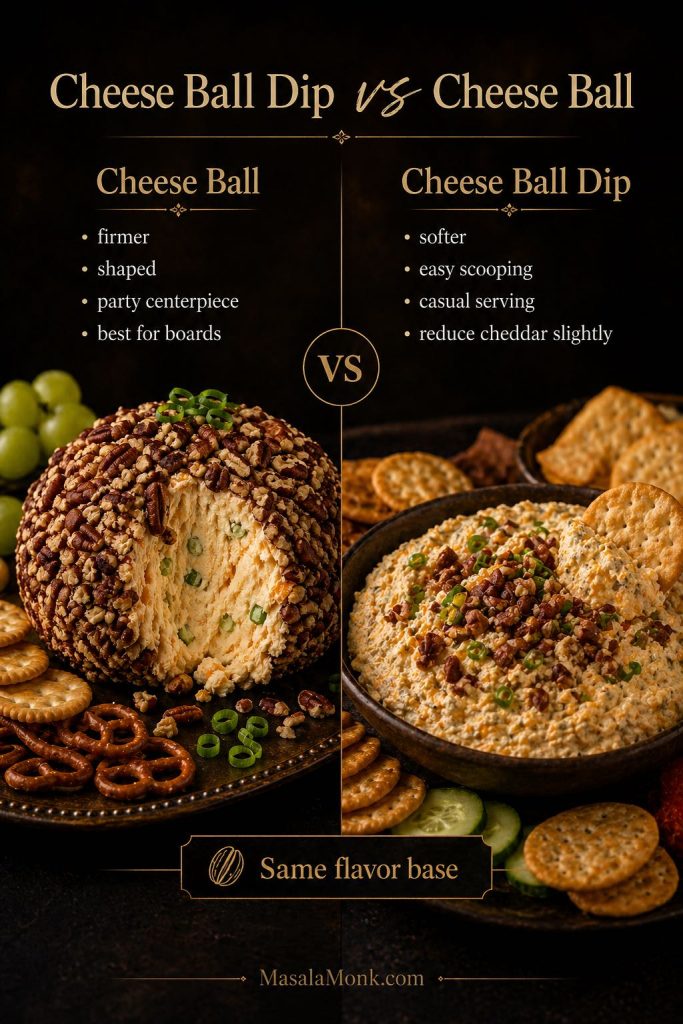
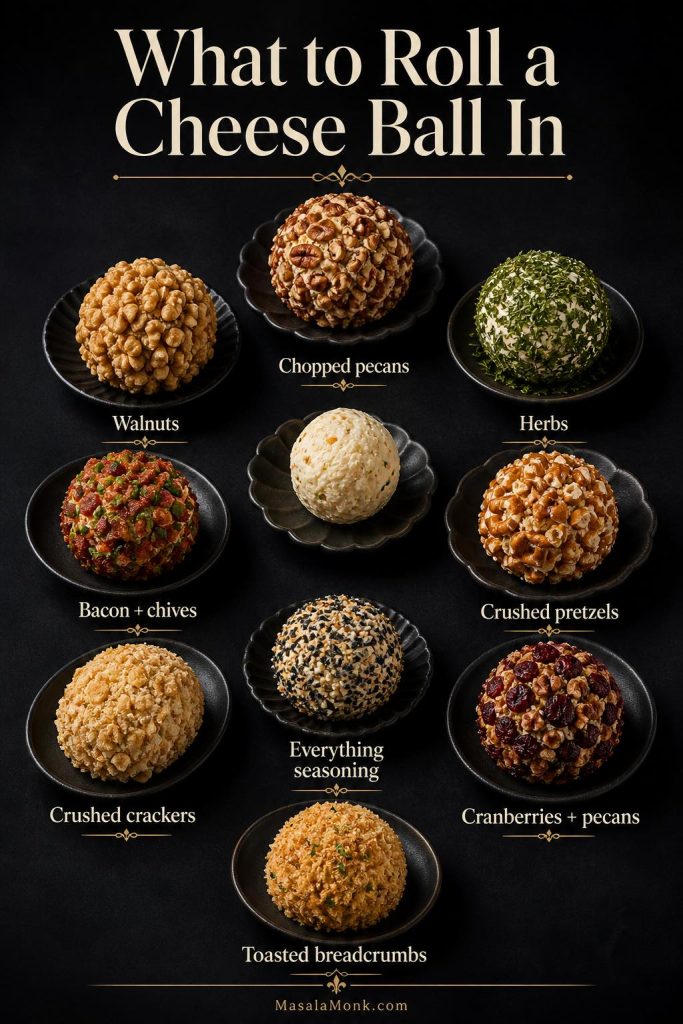
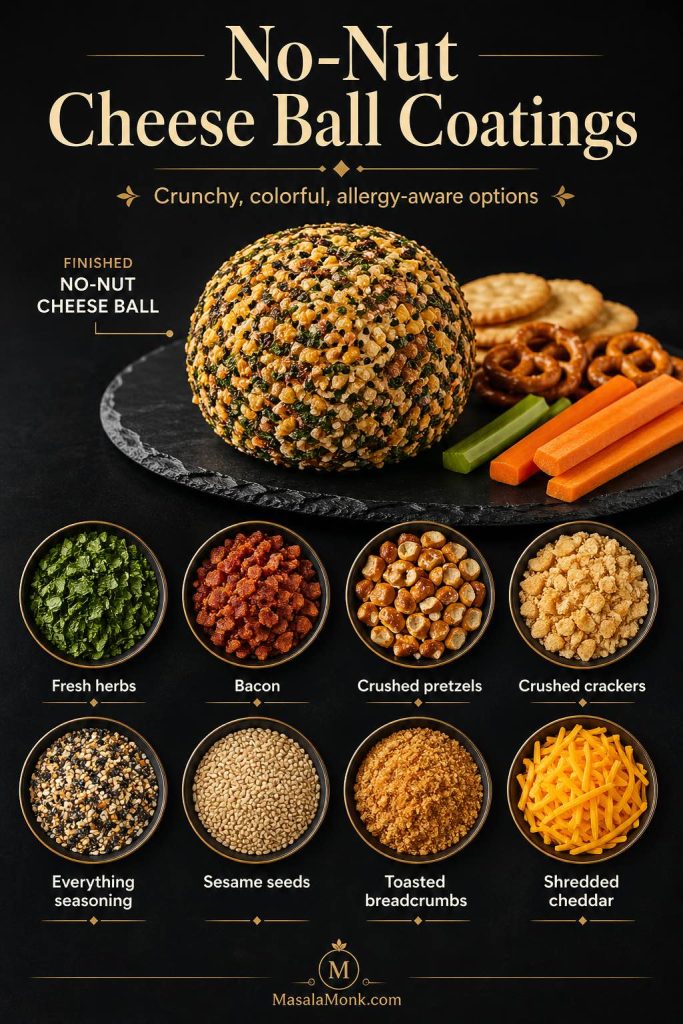
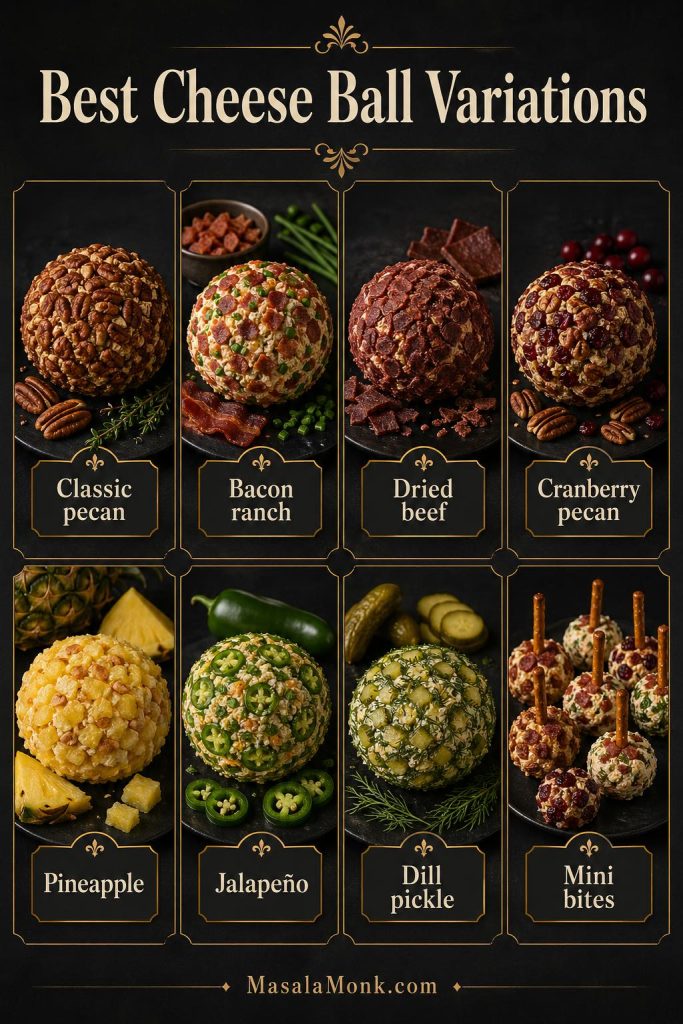
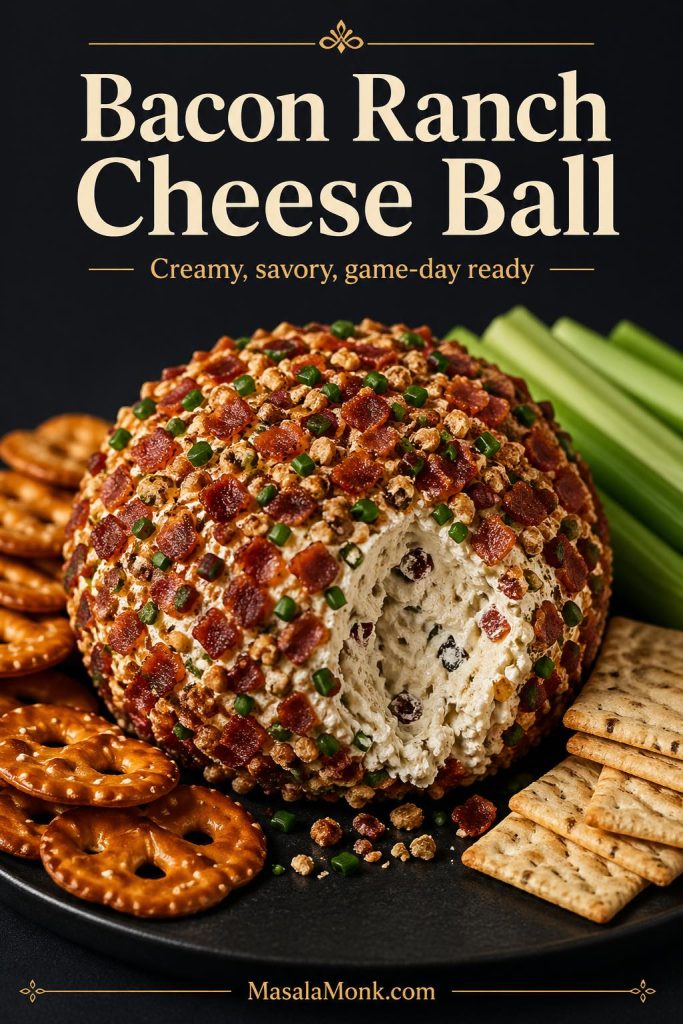
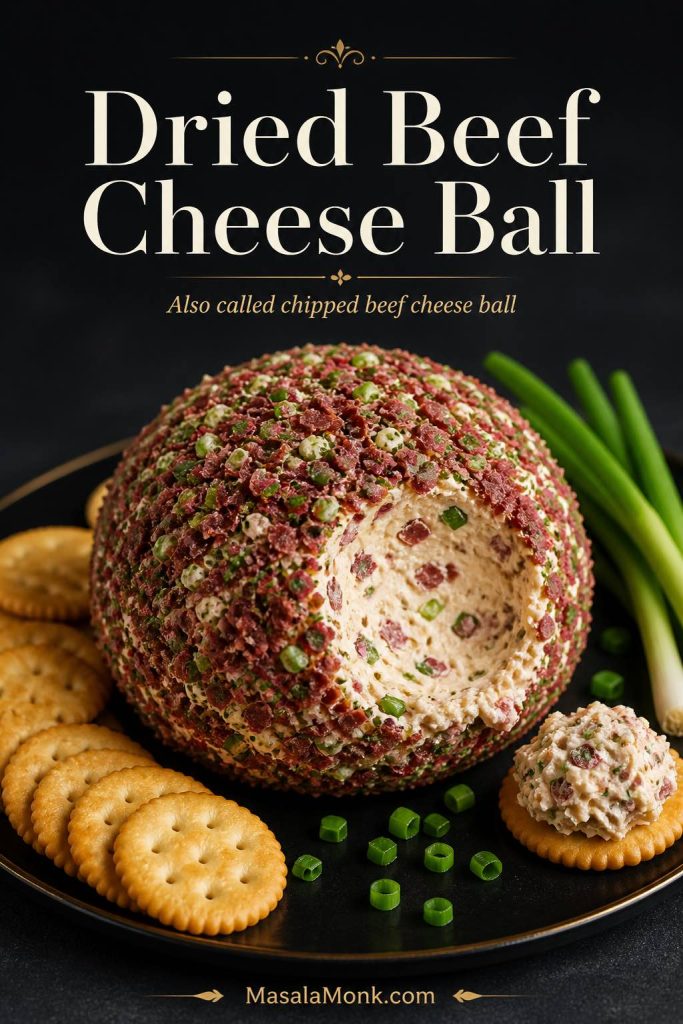
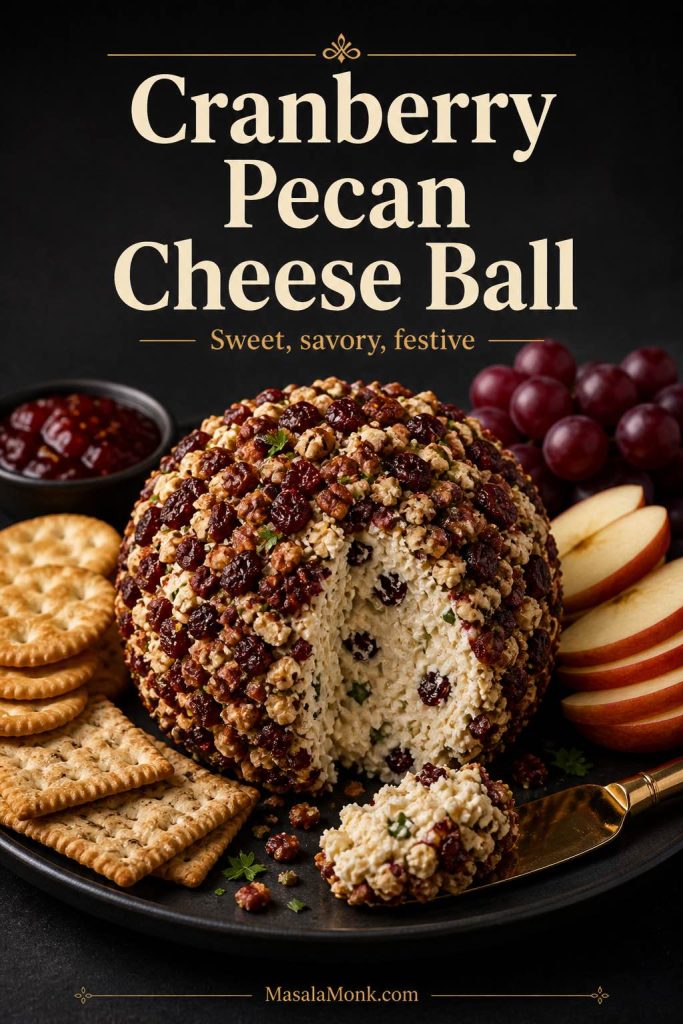
A good cheese ball should not taste like plain cream cheese with nuts stuck to the outside. Instead, the filling should be creamy, savory, a little sharp from the cheddar, fresh from the green onion, and easy to scoop once it softens slightly on the platter. Since the base recipe is simple, you can also turn the same cheese mixture into a bacon ranch cheese ball, dried beef cheese ball, pineapple cheese ball, cranberry pecan cheese ball, mini cheese ball bites, cheese ball dip, or a no-nut version without starting over.

This is the chilled cream cheese appetizer, not the crispy fried snack. If you are looking for hot, fried cheese balls with an Indian-inspired flavor profile, MasalaMonk already has a guide to crispy Indian-inspired cheese balls. Here, we are making the classic cheese ball served with crackers, vegetables, and party boards.

Active prep is only about 15 minutes. The rest of the time is chilling, which makes this an easy make-ahead appetizer rather than a last-minute kitchen project.

Quick Answer: What Is a Cheese Ball?

A cheese ball is a chilled, spreadable appetizer made with cream cheese, shredded cheese, seasonings, and an outer coating such as chopped pecans, walnuts, herbs, bacon, crushed pretzels, or dried cranberries. Once the filling is mixed, it is shaped into a ball, chilled until firm, rolled in the coating, and served with crackers, vegetables, pretzels, crostini, or a party board.

Unlike fried cheese balls, this version is creamy, cold, and spreadable rather than hot, breaded, or crisp. First, the cream cheese makes it smooth. Then, the cheddar gives it sharper flavor, the seasonings keep it from tasting flat, and the coating adds crunch and color. After chilling, the ball should hold its shape on the platter; however, this recipe should still soften enough to spread after 15 to 20 minutes at room temperature.

Quick answer: Mix 16 oz / 450 g softened cream cheese with 1½ to 2 cups / 170 to 225 g shredded cheddar, green onion, Worcestershire sauce, garlic powder, onion powder, and black pepper. Then shape, chill for 1 to 2 hours, and roll in chopped pecans, herbs, bacon, pretzels, or another coating.
Annotated guide showing a finished cheese ball with crackers, celery, cucumber, pretzel crisps, and a spreader, with labels noting the creamy center, crunchy coating, chilled serving style, and sturdy dippers.
A cheese ball is a chilled, spreadable appetizer with a creamy center and a textured outer coating. Because it is easier to serve once slightly softened, sturdy dippers like crackers, pretzel crisps, and crisp vegetables work especially well.

Cheese Ball Ingredients at a Glance

If you only remember one thing, remember this: cream cheese gives the ball body, cheddar gives this recipe sharper flavor, seasonings make it taste complete, and the coating makes it party-ready. Once those jobs are clear, it becomes much easier to adjust the recipe without making the filling too soft, salty, or bland.

Ingredient What It Does Best Tip
Cream cheese Creamy base and structure Use softened block-style cream cheese, not melted cream cheese
Sharp cheddar Real cheese flavor Freshly shredded cheddar blends best, although pre-shredded works in a pinch
Green onion Freshness and mild onion bite Slice it finely so every bite gets a little
Worcestershire sauce Savory depth Start with 1 teaspoon / 5 ml, then taste before adding more
Garlic and onion powder Even seasoning Use powders because they spread smoothly through the cream cheese
Pecans, herbs, bacon, or pretzels Crunch, color, and finish Roll the cheese ball in crunchy coatings close to serving
Ingredient guide for a cheese ball recipe showing cream cheese, shredded sharp cheddar, green onions, Worcestershire sauce, garlic powder, onion powder, black pepper, chopped pecans, herbs, and optional bacon arranged on a dark background.
The base of a classic cheese ball recipe is simple, but each ingredient has a job. Cream cheese gives structure, sharp cheddar adds flavor, Worcestershire brings savory depth, and pecans or herbs finish the outside with crunch and contrast.

How to Make a Cheese Ball

The method is easy, but the order matters. First, beat the cream cheese until smooth. Next, mix in the flavorings, shape the filling before it gets too warm, chill until firm, and add the coating close enough to serving that it stays fresh. That way, the cheese ball recipe stays simple without turning soft, lumpy, or messy.

Six-step visual guide showing how to make a cheese ball: soften cream cheese, mix in cheddar and seasonings, shape into a ball, chill until firm, roll in coating, and serve with crackers.
How to make a cheese ball is easier than it looks: soften, mix, shape, chill, coat, and serve. Most important, do not skip the chilling step, because that is what helps the cheese ball hold its shape and coat cleanly.

Step 1: Soften the Cream Cheese

Start with softened cream cheese. Leave it at room temperature until it is easy to press with a spoon. If the cream cheese is too cold, it will not mix smoothly. If it is melted, the filling may become loose and harder to shape. For that reason, softened but still-cool cream cheese gives you the best balance.

Step 2: Mix the Filling

Beat the cream cheese until smooth. Then mix in shredded cheddar, green onion, Worcestershire sauce, garlic powder, onion powder, black pepper, and any add-ins. Scrape the bowl well so the seasoning is evenly spread through the filling.

Before shaping, taste the mixture. It should taste slightly bold because crackers and vegetables will soften the flavor. If it tastes flat, add a little more green onion, black pepper, garlic powder, onion powder, or Worcestershire sauce. At this stage, the recipe is easier to fix because the cheese has not yet been shaped into a ball.

Step 3: Shape and Chill

Spoon the filling onto a large piece of plastic wrap or parchment. Then, gather the wrap around the mixture and shape it into a ball. It does not need to be perfect yet because chilling will make it easier to smooth and coat. After the first chill, you can gently reshape it if needed.

Refrigerate for at least 1 hour. For a cleaner shape, chill for 2 hours. If you are making the cheese ball ahead, stop here and keep it wrapped until the day you plan to serve it.

Step 4: Roll in the Coating

Spread chopped pecans, herbs, bacon, pretzels, or your chosen coating on a plate. After that, unwrap the chilled cheese ball, then roll and press it gently into the coating until the outside is covered.

Nuts hold up better than most coatings. However, bacon, pretzels, crackers, and fresh herbs are best added closer to serving. That keeps the outside crisp, fresh, and more appetizing. The cheese ball also looks cleaner when the final coating is added after the recipe has had time to chill.

Step 5: Serve Slightly Softened

A cheese ball is usually too firm right from the refrigerator. So, let it sit for 15 to 20 minutes before serving so it becomes easier to spread. It should soften slightly, but it should not sit out for the entire party. Instead, serve it in a planned window and keep extra portions chilled if the gathering will last longer.

Texture target: Before chilling, the mixture should look thick, creamy, and scoopable. It should not be runny, greasy, or crumbly. After chilling, it should be firm enough to roll in coating, but it should still soften enough to spread after 15 to 20 minutes at room temperature. If it feels loose before chilling, add a little more cheddar; if it feels dry, let it rest briefly and mix again.

Easy Cheese Ball Recipe

Easy Cheese Ball Recipe with Cream Cheese

This classic cheese ball recipe is creamy, savory, make-ahead friendly, and perfect with crackers, vegetables, pretzels, and party boards.

YieldAbout 3 to 3½ cups
Servings16 to 20 appetizer servings
Prep Time15 minutes
Chill Time1 to 2 hours
Total Time1 hour 15 minutes to 2 hours 15 minutes
Cook Time0 minutes

Ingredients

  • 16 oz / 450 g cream cheese, softened
  • 1½ to 2 cups / about 170 to 225 g shredded sharp cheddar cheese
  • 2 to 3 green onions, finely sliced, about 20 to 30 g
  • 1 teaspoon / 5 ml Worcestershire sauce
  • ½ teaspoon garlic powder
  • ½ teaspoon onion powder
  • ¼ teaspoon black pepper
  • Pinch of salt, only if needed

For the Coating

  • ¾ to 1 cup / about 85 to 115 g finely chopped pecans or walnuts
  • 2 tablespoons chopped parsley, chives, or green onion
  • Optional: ¼ to ½ cup / about 25 to 50 g cooked crumbled bacon

Instructions

  1. Add softened cream cheese to a mixing bowl and beat until smooth
  2. Add shredded cheddar, green onion, Worcestershire sauce, garlic powder, onion powder, black pepper, and a small pinch of salt if needed
  3. Mix until evenly combined, then taste and adjust the seasoning before shaping
  4. Spoon the mixture onto plastic wrap or parchment and shape it into a ball
  5. Wrap tightly and refrigerate for at least 1 hour, or 2 hours for a firmer, cleaner shape
  6. Spread chopped pecans, herbs, and optional bacon on a plate
  7. Unwrap the chilled cheese ball and roll it in the coating, pressing gently so the outside is covered
  8. Let it sit for 15 to 20 minutes before serving with crackers, pretzels, vegetables, or crostini

Recipe Notes

  • Taste the filling before shaping. It should taste slightly bold because crackers, vegetables, and pretzels soften the flavor once served
  • For a softer spread, use 1½ cups / 170 g cheddar instead of 2 cups / 225 g
  • For a firmer cheese ball, chill longer or mix in a little more shredded cheddar
  • For a no-nut cheese ball, coat it with herbs, bacon, crushed pretzels, crushed crackers, everything seasoning, or toasted breadcrumbs
  • For mini cheese ball bites, chill the mixture, scoop into 1-tablespoon portions, roll each one in coating, and add pretzel sticks right before serving
Recipe card graphic for an easy cheese ball recipe with a photo of the finished cheese ball, yield and timing details, an ingredient list including cream cheese, sharp cheddar, green onions, Worcestershire, seasonings, and pecans, plus a short method.
This easy cheese ball recipe uses a classic formula: cream cheese, sharp cheddar, green onions, Worcestershire, simple seasonings, and chopped pecans. Since it is make-ahead friendly, it is a strong choice for holidays, parties, and snack boards.

Why This Cheese Ball Recipe Works

This cheese ball recipe works because it keeps the base firm, flavorful, and easy to spread. Instead of adding too many wet ingredients, it uses full-fat block cream cheese for structure, sharp cheddar for stronger cheese flavor, and dry seasonings that blend smoothly through the filling.

Also, the coating goes on after the ball has chilled. That timing matters because the outside stays cleaner, the nuts or herbs stick better, and the finished appetizer looks fresher on the platter. That way, the cheese ball stays make-ahead friendly without tasting flat or turning messy.

Recipe Choice Why It Helps
Full-fat block cream cheese Firms up enough to shape into a ball
Sharp cheddar Adds enough flavor to stand up to crackers and vegetables
Garlic powder and onion powder Season evenly without harsh raw pieces
Worcestershire sauce Adds savory depth so the filling does not taste one-note
Coating after chilling Keeps the outside fresher, cleaner, and crunchier
Explainer board showing why a cheese ball recipe works, with callouts for block cream cheese for structure, sharp cheddar for flavor, Worcestershire for savory depth, dry seasonings for even flavor, and coating after chilling for a cleaner finish.
A good cheese ball recipe works because the structure and flavor stay balanced. Block cream cheese keeps it firm, sharp cheddar keeps it from tasting flat, and coating the ball after chilling helps the outside stay cleaner and more defined.

That is what keeps the recipe flexible without making it vague. You can change the coating, the add-ins, or the serving style, while the cream cheese and cheddar base still keeps the ball structured enough to slice, scoop, and spread.

Cheese Ball Ingredient Notes

The base is simple, but each ingredient matters. Because the recipe is no-cook, the flavor comes from good cheese, proper seasoning, and the contrast between the creamy inside and the textured coating. That is why bland cheese, cold cream cheese, and watery add-ins can make the whole appetizer fall flat.

Cream Cheese

Use full-fat block-style cream cheese for the best structure. Because this is a chilled recipe, the cheese needs to firm up around the ball without turning stiff or crumbly. Block-style cream cheese softens smoothly, firms up well in the refrigerator, and gives the finished cheese ball a rich but spreadable texture. By contrast, whipped cream cheese can make the mixture looser, while cold cream cheese can leave small lumps in the filling.

Let the cream cheese soften at room temperature until it presses easily with a spoon. It should be soft enough to beat, but not melted or greasy. If it melts, the cheese mixture can become loose, and the ball may take much longer to firm up in the refrigerator. On the other hand, if it is too cold, the filling can stay lumpy even after mixing.

If your kitchen is cool, cream cheese may need 45 to 60 minutes to soften. If your kitchen is warm, check it sooner so it softens without turning greasy.

Sharp Cheddar

Sharp cheddar is the easiest choice because it brings more flavor than mild cheddar. Also, it balances the cream cheese, so the finished appetizer tastes like a proper cheddar cheese ball instead of a plain cream cheese spread. For this recipe, the cheese should be bold enough that the ball still tastes savory after it is spread onto crackers.

Whenever possible, shred the cheddar fresh because it blends more smoothly into the cream cheese base. Still, pre-shredded cheddar can work when convenience matters. If the mixture feels dry after using packaged shredded cheese, let it sit for a few minutes and mix again before shaping. In practice, the recipe is forgiving as long as the cheese tastes bold and the ball still holds together after chilling.

Best Cheese for a Cheese Ball

For most versions, sharp cheddar is the best first choice because it has enough flavor to balance the cream cheese. However, this recipe can move in different directions depending on the cheese you choose. If you want the ball to taste milder, sharper, smokier, or spicier, start with the guide below.

Cheese Best For How to Use It
Sharp cheddar Classic cheese ball recipe Main shredded cheese for the strongest everyday version
White cheddar Holiday boards Use like yellow cheddar for a sharper but cleaner-looking ball
Colby Jack Milder family-style cheese ball Use when you want a softer flavor
Pepper Jack Spicy cheese ball Use half pepper Jack and half cheddar
Smoked gouda Smoky party flavor Use a small amount with cheddar rather than replacing all the cheese
Blue cheese Bold retro appetizer Use a little because the flavor is strong
Goat cheese Tangier variation Use as a partial swap, but expect a softer ball
Chooser guide comparing cheeses for a cheese ball recipe, including sharp cheddar, white cheddar, Colby Jack, Pepper Jack, smoked gouda, blue cheese, and goat cheese, each labeled with its flavor style.
Sharp cheddar is the best first choice for a cheese ball because it gives strong flavor without making the filling complicated. However, white cheddar, Pepper Jack, smoked gouda, or even a little blue cheese can shift the recipe in a different direction.

When in doubt, start with sharp cheddar. After that, use the table as a flavor guide rather than a strict rule. For example, pepper Jack makes sense for a spicy cheese ball, while white cheddar looks cleaner on a holiday board.

Green Onion, Garlic, Onion, and Worcestershire

Green onion adds freshness, while garlic powder and onion powder season the filling evenly. Meanwhile, Worcestershire sauce adds a savory note that makes the cheese ball taste fuller and less one-dimensional. Together, they make the recipe taste seasoned without adding extra moisture.

Because crackers, pretzels, bacon, dried beef, and seasoning blends can all be salty, add salt carefully. Before shaping the ball, taste the cheese filling; then decide if the recipe needs even a small pinch.

Pecans, Walnuts, Herbs, Bacon, or Pretzels

Although chopped pecans are the classic coating, walnuts, herbs, bacon, and crushed pretzels can all work depending on the flavor you want. Pecans add crunch and a slightly sweet nuttiness, while herbs such as parsley, chives, and green onion make the outside fresher and brighter.

For a game-day cheese ball, add cooked crumbled bacon to the coating. For a no-nut cheese ball, use herbs, bacon, crushed pretzels, crushed crackers, everything seasoning, or toasted breadcrumbs instead.

Do You Need Sour Cream, Mayo, or Butter?

You do not need sour cream, mayo, or butter for this classic shaped cheese ball recipe. In fact, keeping them out makes the ball easier to shape because the filling stays thicker and cleaner. Full-fat cream cheese already gives the recipe enough richness, while cheddar and seasonings bring the flavor.

That said, sour cream or mayo can be useful if you are making cheese ball dip instead of a shaped appetizer. In that case, add only 1 to 2 tablespoons at first, then check the texture before adding more. Otherwise, the dip can move from creamy to loose very quickly.

Warm cheese option: If you want a pourable cheese dip instead of a chilled cream cheese appetizer, try MasalaMonk’s easy cheese sauce recipe for nachos, fries, broccoli, pasta, and dipping.

Equipment You Need

You do not need special equipment for this recipe, but a few basic tools make the cheese mixture smoother and the final ball easier to shape. If the cream cheese is properly softened, even a sturdy spatula can work. However, a hand mixer makes the filling smoother faster, especially when you are doubling the recipe.

Tool Why It Helps
Mixing bowl For beating the cream cheese and folding in cheddar
Hand mixer or sturdy spatula For a smoother filling
Box grater For freshly shredded cheddar
Plastic wrap or parchment For shaping the filling into a clean ball
Plate or shallow tray For rolling the chilled cheese ball in coating
Serving knife or spreader For easier spreading without breaking crackers

Common Mistakes to Avoid

Before you start mixing, it helps to know what can go wrong. Most cheese ball problems come from cream cheese that is too cold, add-ins that are too wet, or coatings that are added too early. Fortunately, each problem is easy to avoid if you build the recipe in the right order. More importantly, fixing the filling before shaping is much easier than fixing a finished ball after the coating is already on.

Mistake What Happens Better Move
Melting the cream cheese Loose or greasy filling Soften at room temperature instead
Using cold cream cheese Lumpy cheese ball mixture Let it soften until it presses easily
Adding wet pineapple, pickles, or jalapeños Soft or watery filling Drain and blot before mixing
Coating with pretzels or bacon too early Soft outside layer Add crunchy coatings closer to serving
Adding salt too soon Overly salty cheese ball Taste first, then salt only if needed
Serving straight from the fridge Firm texture and broken crackers Rest 15 to 20 minutes before serving
Mistake-and-fix guide for a cheese ball recipe showing six common problems: cream cheese too cold, cream cheese melted, wet add-ins, coating too early, too much salt, and serving straight from the fridge.
Most cheese ball recipe problems are easy to avoid once you know what to watch for. For example, cold cream cheese causes lumps, wet add-ins can loosen the mixture, and serving the ball straight from the fridge makes it harder to spread.

How Much Cheese Ball to Make

Because this cheese ball recipe is usually served as part of a snack table, the right amount depends on what else you are serving. If the ball is the main appetizer, plan more. However, if it sits on a board with dips, crackers, vegetables, fruit, and hot snacks, one batch can stretch further. In that case, variety matters more than making one oversized cheese ball.

Crowd Size Amount to Make Best Plan
6 to 8 people Half batch Smaller ball or full recipe as dip with leftovers planned
12 to 20 people 1 full cheese ball Crackers, vegetables, pretzels, and at least one fresh side
25 to 35 people 2 cheese balls Two flavors, such as classic pecan and bacon ranch
Large party board 1 cheese ball plus other appetizers Warm dip, crunchy snack, fruit, pickles, olives, and sturdy crackers
Individual portions 36 to 48 mini cheese ball bites 1-tablespoon portions with pretzel sticks added right before serving
Serving guide showing how much cheese ball to make for different group sizes, including half a batch for 6 to 8 people, one cheese ball for 12 to 20, two cheese balls for 25 to 35, one ball plus other appetizers for a large board, and mini bites as another option.
How much cheese ball to make depends on how you are serving it. If it is one appetizer among several, one batch goes further; however, for larger gatherings, two cheese balls or a tray of mini bites makes hosting much easier.

Cheese Ball Dip: How to Serve This Without Shaping It

If you want the flavor of a cheese ball without shaping it, turn the mixture into cheese ball dip. This is useful for casual parties, snack boards, and smaller gatherings where a bowl of spread is easier than a shaped appetizer. Instead of changing the whole recipe, you only need to adjust the cheese slightly so the ball mixture becomes softer and more scoopable.

To make cheese ball dip, use the same base recipe but reduce the cheddar to 1½ cups / about 170 g so the texture stays softer. Then, mix the filling, spoon it into a shallow serving bowl, smooth the top, and sprinkle the coating over the surface. Chill for 30 to 60 minutes if making it ahead; afterward, let it soften slightly before serving so you get the same flavor with less shaping and easier scooping.

For Cheese Ball Dip Use This Adjustment
Softer texture Use 1½ cups / 170 g cheddar instead of 2 cups / 225 g
Easy serving Spoon into a shallow bowl instead of shaping into a ball
Better topping Add pecans, herbs, bacon, or pretzels right before serving
Best dippers Crackers, pretzel crisps, celery, cucumber, bell pepper, crostini, or pita chips
Side-by-side comparison showing a shaped cheese ball on a platter and a bowl of cheese ball dip, with notes that the cheese ball is firmer and better for boards while the dip is softer and easier to scoop.
Cheese ball dip vs cheese ball comes down to texture and serving style. Both use a similar flavor base, yet the dip is softer and easier to scoop, while the shaped cheese ball feels more polished for a party platter or snack board.

3 Ingredient Cheese Ball

A 3 ingredient cheese ball is useful when you need the fastest possible appetizer. However, it will not have the same depth as the full recipe because garlic, onion, pepper, and Worcestershire add much of the savory background flavor. Still, when time is short, cream cheese, cheddar, and one strong seasoning can form a simple ball that works with crackers and pretzels.

Version Ingredients Best Use
Classic shortcut 16 oz / 450 g cream cheese + 1½ cups / 170 g cheddar + 1 packet / about 28 g ranch seasoning Fast game-day cheese ball
No-ranch shortcut 16 oz / 450 g cream cheese + 1½ cups / 170 g cheddar + 3 sliced green onions Milder cheese ball for simple crackers
Coated shortcut 16 oz / 450 g cream cheese + 1½ cups / 170 g cheddar + ¾ cup / 85 g chopped pecans Basic party cheese ball with crunch
Guide image for a 3 ingredient cheese ball showing cream cheese, shredded cheddar, ranch seasoning or green onion, plus a finished cheese ball served with crackers and pretzels, with the steps mix, shape, and chill.
A 3 ingredient cheese ball is the fastest shortcut version when you need a party appetizer quickly. However, the full cheese ball recipe gives you better depth because Worcestershire, garlic powder, onion powder, pepper, and green onion round out the flavor.

For the best flavor, though, use the full recipe. Worcestershire sauce, garlic powder, onion powder, black pepper, and green onion make the cheese ball taste more complete without making the method harder. Still, the shortcut version is useful when speed matters more than building the most layered flavor.

What to Roll a Cheese Ball In

The coating does more than make the cheese ball look finished. It adds texture, controls richness, and tells people what kind of flavor to expect. Although pecans are classic, there are plenty of good nut-free and holiday-friendly options. For example, this recipe can move from a classic cheese ball to a game-day ball or holiday cheese board centerpiece just by changing the outside layer.

Coating Best For Notes
Chopped pecans Classic cheese ball Toast lightly, then cool before using
Chopped walnuts Earthier flavor Chop finely so the pieces stick well
Parsley, chives, or green onion Fresh green finish Good for a lighter-looking or no-nut version
Bacon and chives Game day Add close to serving so the bacon stays crisp
Crushed pretzels No-nut crunch Add shortly before serving because pretzels soften
Crushed crackers Simple no-nut coating Use sturdy crackers and crush finely
Everything seasoning Bagel-style flavor Use lightly because it can be salty
Dried cranberries and pecans Holiday cheese ball Sweet, salty, colorful, and festive
Toasted breadcrumbs Nut-free coating Use dry crumbs and add close to serving
Coating guide showing cheese balls rolled in chopped pecans, walnuts, herbs, bacon and chives, crushed pretzels, crushed crackers, everything seasoning, cranberries and pecans, and toasted breadcrumbs.
What you roll a cheese ball in changes both texture and flavor. For example, pecans give the classic crunch, bacon and chives make it more savory, while crushed pretzels or crackers work well when you want a no-fuss party coating.

No-Nut Cheese Ball Coatings

For a cheese ball without nuts, use chopped herbs, cooked bacon, crushed pretzels, crushed crackers, everything seasoning, toasted breadcrumbs, sesame seeds, or a mix of herbs and shredded cheddar. If allergies are a concern, avoid using nut coatings anywhere near the same platter, utensils, or serving board. In that case, keep the whole platter nut-free rather than relying on separate corners of the same board.

No-nut cheese ball coating guide showing a finished no-nut cheese ball with coating options including fresh herbs, bacon, crushed pretzels, crushed crackers, everything seasoning, sesame seeds, toasted breadcrumbs, and shredded cheddar.
A no-nut cheese ball can still look colorful and taste crunchy. Instead of pecans or walnuts, use fresh herbs, bacon, crushed pretzels, cracker crumbs, sesame seeds, toasted breadcrumbs, or shredded cheddar for a safer party-board option.

What to Serve With a Cheese Ball

A cheese ball works best with dippers that can handle a creamy spread. So, put out a mix of crackers, vegetables, pretzels, and a few fresh or tangy sides so the platter does not feel too heavy. Since this recipe is rich, the best cheese board pairings usually include something crisp, something salty, and something fresh. That balance keeps guests coming back without making every bite feel the same.

Best Crackers for a Cheese Ball

Cracker or Dipper Why It Works Best Pairing
Buttery crackers Classic party flavor and easy crunch Classic pecan or cranberry pecan
Wheat crackers Sturdy, nutty, and less fragile Dried beef or bacon ranch
Seeded crackers More texture and grown-up flavor Herb or no-nut cheese ball
Water crackers Clean flavor that lets the cheese stand out Classic cheddar once slightly softened
Pretzel crisps Salty, crunchy, and strong enough for scooping Bacon ranch, jalapeño, or dill pickle
Crostini or baguette slices Strongest option for a firmer cheese ball Party boards and holiday platters
Celery, cucumber, and bell pepper Fresh, lighter, and crisp Rich cheese balls and game-day spreads
Apple slices and grapes Sweet and fresh against savory cheese Cranberry pecan, pineapple, or classic pecan
Serving guide showing a cheese ball with buttery crackers, wheat crackers, seeded crackers, water crackers, pretzel crisps, crostini, celery, cucumber, bell pepper, apple slices, and grapes.
The best crackers and dippers for a cheese ball are sturdy enough to scoop without breaking. Since the filling is rich, a mix of crackers, pretzel crisps, fresh vegetables, apple slices, and grapes keeps the platter balanced.

Because the cheese ball can be firm when it first comes out of the fridge, sturdy crackers work better than very thin ones. So let it soften for 15 to 20 minutes before serving, or include a small spreading knife on the platter.

For a low-carb platter, serve the cheese ball with celery, cucumber rounds, bell pepper strips, cheese crisps, pork rinds, or other sturdy options from MasalaMonk’s guide to keto chips for dips. This works especially well when the cheese ball is part of a heavier game-day table and you want a few lighter, crunchier options.

Turn It Into a Party Board

For a fuller spread, place the cheese ball on a board with crackers, pretzels, fruit, nuts, pickles, olives, cured meats, and a small bowl of jam or chutney. If you want a simple layout formula, MasalaMonk’s guide to charcuterie board ideas gives you an easy structure for building a balanced board. From there, add one crunchy item, one fresh item, and one sweet or tangy item around the cheese ball.

For a game-day table, pair this cheese ball with buffalo chicken dip, crispy mozzarella sticks, or a tray of potato appetizers. That gives guests a mix of cold, creamy, hot, crispy, salty, and fresh bites.

Close-up of a cheese ball party board with a nut-coated cheese ball surrounded by crackers, pretzels, grapes, apple slices, celery, cucumber slices, olives, and folded cured meat on a dark platter.
A cheese ball party board works best when it has contrast. Add salty crackers, crisp vegetables, fresh fruit, and a few briny sides so the creamy cheese ball feels like the centerpiece instead of the only thing on the platter.

Make Ahead, Storage, and Freezing

A cheese ball is one of the easiest make-ahead appetizers because chilling helps it firm up. In fact, the recipe often tastes better after a few hours because the cheese, onion, and seasonings have time to settle. The best approach is to make and shape the filling ahead, then add the coating closer to serving. That way, the inside gets time to develop flavor while the outside still tastes fresh.

Best make-ahead method: Mix and shape the cheese ball 1 day ahead, wrap tightly, and refrigerate. Then roll it in pecans, herbs, bacon, pretzels, or crumbs closer to serving so the outside stays fresh and crisp.

Make-Ahead Timeline

When You Are Serving What to Do Best Coating Timing
Same day Mix, shape, chill for 1 to 2 hours Coat after chilling
1 day ahead Mix, shape, wrap tightly, and refrigerate Coat the day you serve
2 to 3 days ahead Shape uncoated and keep tightly wrapped Coat shortly before serving
Freezer prep Freeze the shaped, uncoated cheese ball Thaw overnight, then coat fresh
Make-ahead storage and freezing guide for a cheese ball showing steps for same-day prep, making it 1 day ahead, keeping it uncoated for 2 to 3 days, freezing it uncoated, thawing overnight in the fridge, and coating fresh before serving.
For the cleanest make-ahead cheese ball, shape and chill the filling first, then add the coating close to serving. That way, the inside has time to firm up while the outside stays fresh, crisp, and party-ready.

How to Store a Cheese Ball

After shaping, wrap the cheese ball tightly in plastic wrap or store it in an airtight container in the refrigerator. If it has already been coated, use a container large enough that the outside does not get crushed.

For best texture, keep a shaped, uncoated cheese ball refrigerated for up to 3 days before serving. Once the cheese ball has been coated or served, store leftovers tightly covered in the refrigerator and use them within 3 to 4 days. For freezing, freeze the shaped, uncoated cheese ball for up to 1 month, then thaw it overnight in the refrigerator and coat it fresh before serving.

Keep the cheese ball refrigerated at 40°F / 4°C or colder. For the cleanest presentation, store the shaped cheese ball uncoated, then roll it in pecans, herbs, bacon, or crumbs shortly before serving.

Can You Freeze a Cheese Ball?

If you need to make it further ahead, freeze the cheese ball before adding the coating so the outside stays fresher after thawing. Wrap the shaped cheese ball tightly, place it in a freezer-safe bag or container, and freeze at 0°F / -18°C. Then thaw it overnight in the refrigerator and roll it in a fresh coating before serving.

Freezing works best with the plain cream cheese, cheddar, green onion, and seasoning base. Wet add-ins such as pineapple, pickles, or jalapeños can release moisture after thawing, so those versions are better made fresh or only 1 to 2 days ahead. After thawing, always add a fresh coating so the outside tastes crisp instead of stale or soft.

How Long Can a Cheese Ball Sit Out?

Because a cheese ball is made with cream cheese and shredded cheese, treat it like a perishable appetizer. According to USDA food safety guidance, perishable food should not be left out for more than 2 hours at room temperature, or more than 1 hour when the temperature is above 90°F / 32°C.

For a long party, serve a smaller cheese ball first and keep the backup chilled. Then, if the platter runs low, bring out a fresh one instead of letting the same ball sit for hours. If the cheese ball has been sitting out too long, do not wrap it back up for later. Instead, refrigerate safe leftovers promptly and discard anything that has been left out beyond the safe window.

Food safety guide showing a cheese ball platter with a clock and chilled backup container, explaining that a cheese ball can sit out up to 2 hours at room temperature or 1 hour above 90°F or 32°C.
A cheese ball should not sit out all day just because it is served chilled. For safer entertaining, serve a smaller portion first, keep the backup refrigerated, and replace the platter when needed instead of leaving one ball out for hours.

Cheese Ball Variations

Once the base recipe works, the variations are easy. Instead of rebuilding the appetizer from scratch, keep the cream cheese structure, then change the cheese, seasonings, add-ins, and coating. The formulas below are designed as practical starting points, so you do not have to guess how much bacon, dried beef, pineapple, jalapeño, or cranberry to add to each ball. After that, you can adjust salt, heat, sweetness, or crunch to match the occasion.

Which Cheese Ball Variation Should You Make?

Choose This Version Best For Flavor Direction
Classic pecan Safest party version Creamy, savory, nutty, familiar
Bacon ranch Game day Salty, herby, bold, snacky
Dried beef or chipped beef Old-school party flavor Salty, savory, retro
Cranberry pecan Thanksgiving or Christmas Sweet-salty, colorful, festive
Pineapple Retro sweet-savory spread Creamy, tangy, slightly sweet
Jalapeño Spicy snack table Cheesy, peppery, fresh heat
Mini bites Easy individual serving Party-friendly and mess-light
Variation guide showing eight cheese ball ideas: classic pecan, bacon ranch, dried beef, cranberry pecan, pineapple, jalapeño, dill pickle, and mini cheese ball bites with pretzel sticks.
Once the base cheese ball recipe is right, the variations are easy. Keep the cream cheese structure, then change the coating and add-ins for bacon ranch, dried beef, cranberry pecan, pineapple, jalapeño, dill pickle, or mini cheese ball bites.

Bacon Ranch Cheese Ball

For a bacon ranch cheese ball, use 16 oz / 450 g cream cheese, 1½ cups / 170 g shredded cheddar, 1 packet / about 28 g ranch seasoning, ½ cup / about 50 g cooked crumbled bacon, and 2 sliced green onions. Then roll the outside in more bacon, chopped chives, and pecans or crushed pretzels.

Because ranch seasoning and bacon are both salty, do not add extra salt until you taste the filling. If the cheese ball tastes strong on its own, serve it with celery, bell pepper strips, or unsalted crackers for balance. Otherwise, pretzel crisps, wheat crackers, and sturdy buttery crackers all work well.

Close-up of a bacon ranch cheese ball coated with chopped bacon, chives, and crunchy bits, served with pretzels, celery sticks, and crackers on a dark platter.
A bacon ranch cheese ball is ideal for game day because it is salty, creamy, and easy to serve with pretzels, celery, and sturdy crackers. Since bacon and ranch seasoning are already flavorful, taste before adding extra salt.

Dried Beef Cheese Ball or Chipped Beef Cheese Ball

For a dried beef cheese ball, use 16 oz / 450 g cream cheese, 1½ cups / 170 g shredded cheddar, 4 to 5 oz / 115 to 140 g finely chopped dried beef or chipped beef, 2 sliced green onions, 1 teaspoon / 5 ml Worcestershire sauce, ½ teaspoon onion powder, and ½ teaspoon garlic powder.

Because dried beef is already salty, skip the added salt. Then roll the outside in chopped pecans, herbs, more finely chopped dried beef, or a mix of all three. If you like a sharper old-school flavor, add 1 to 2 teaspoons prepared horseradish, but blot any extra moisture first.

Old-school party version: Since dried beef is salty, chop it very finely and reserve a little for the outside coating. That way, the cheese ball recipe gets flavor inside and a clear visual cue outside.
Close-up of a dried beef cheese ball, also called a chipped beef cheese ball, coated with finely chopped dried beef and green onion, with crackers and a scoop of the creamy filling visible.
A dried beef cheese ball brings an old-school party flavor into a modern appetizer board. Because dried beef is naturally salty, chop it finely, skip extra salt at first, and balance the cheese ball with crackers, green onion, and fresh dippers.

Cranberry Pecan Cheese Ball

For a cranberry pecan cheese ball, use the base recipe and mix in ½ cup / about 60 g chopped dried cranberries. Then roll the outside in ½ cup / 55 g chopped pecans, ¼ cup / 30 g chopped dried cranberries, and 2 tablespoons chopped parsley or chives.

A little orange zest makes this version brighter, especially for Thanksgiving or Christmas. Because this version already has sweetness from the cranberries, salty or buttery crackers usually work better than sweet dippers. For that reason, it is especially good with apple slices, grapes, and a small bowl of pepper jelly or chutney.

Cranberry pecan cheese ball with a creamy center, coated in chopped pecans, dried cranberries, and herbs, served with crackers, apple slices, grapes, and a small bowl of red chutney.
A cranberry pecan cheese ball is the best holiday-style variation when you want sweet, savory, creamy, and crunchy in one appetizer. Because the cranberries add sweetness, serve it with salty crackers, apple slices, grapes, or a tangy chutney for balance.

Jalapeño Cheese Ball

For a jalapeño cheese ball, add 1 to 2 finely chopped jalapeños to the base recipe. Fresh jalapeño tastes brighter, while pickled jalapeño adds tang. Either way, blot the pieces dry before mixing so the filling does not become watery.

Cheddar, bacon, smoked paprika, and chives all work well here. For more heat, add a pinch of cayenne instead of adding too much hot sauce, which can loosen the texture. If your crowd likes creamy heat, this jalapeño version also pairs well with baked jalapeño poppers on the same snack table. Meanwhile, celery and cucumber help cool the heat without making the platter boring.

Jalapeño cheese ball with a creamy filling, chopped jalapeños, green herbs, and cheddar flecks, served with pretzels, cucumber slices, celery sticks, and crackers.
A jalapeño cheese ball should taste creamy first and spicy second. Since fresh jalapeños can vary in heat, start with a modest amount, then add more only after tasting the filling so the cheese ball stays balanced.

Pineapple Cheese Ball

For a pineapple cheese ball, use 16 oz / 450 g cream cheese, 1 to 1½ cups / 115 to 170 g shredded cheddar, ¾ cup / about 180 g crushed pineapple that has been drained and blotted very well, 2 sliced green onions, and ½ cup / about 55 g chopped pecans.

The pineapple must be very dry before it goes into the filling. If it is watery, the cheese ball will turn soft and loose. Therefore, drain it well, press out extra juice, and blot it before mixing. Since this version is sweet-savory, it works especially well with salty crackers, pretzels, and toasted baguette slices.

Pineapple cheese ball coated with chopped pecans and green onion, with a creamy filling and pineapple pieces inside, served with crackers, pretzels, toasted bread slices, and a small bowl of pineapple.
A pineapple cheese ball works best when the pineapple is drained very well before mixing. Otherwise, the filling can turn loose; however, when the pineapple is dry, it adds a sweet-savory flavor that pairs beautifully with salty crackers and pretzels.

Dill Pickle Cheese Ball

For a dill pickle cheese ball, add ½ cup / about 75 g finely chopped pickles, 1 to 2 teaspoons dill, 1½ cups / 170 g cheddar, garlic powder, and green onion to the cream cheese base. Before mixing, blot the chopped pickles very well so the filling stays thick.

After chilling, roll the outside in chopped herbs, crushed pretzels, or a mix of herbs and shredded cheddar. Since pickles add both salt and moisture, taste before adding extra salt and serve this version with pretzel crisps, celery, cucumber rounds, and sturdy crackers.

Dill pickle cheese ball with chopped pickles, dill, herbs, and a creamy center, served with pretzels, cucumber slices, celery sticks, and seeded crackers.
A dill pickle cheese ball should taste tangy and fresh without becoming watery. For that reason, blot chopped pickles before mixing them into the cream cheese base, then serve the finished ball with pretzels, celery, cucumber, or sturdy crackers.

Mini Cheese Ball Bites

Mini cheese ball bites are ideal when you want individual party portions instead of one large cheese ball. After the filling chills until firm, scoop it into generous 1-tablespoon portions. A full batch usually makes about 36 to 48 mini cheese ball bites, depending on how generously you scoop and how much coating you use.

From there, roll each mini cheese ball in chopped pecans, herbs, bacon, crushed pretzels, or dried cranberries. Then add pretzel sticks right before serving so they stay crisp and do not soften in the cheese mixture. If you are making this recipe ahead, chill the coated bites without the sticks and add the pretzels only when the platter is ready.

Tray of mini cheese ball bites in different coatings, including herbs, bacon, pecans, crushed pretzels, and dried cranberries, with some bites topped with pretzel sticks.
Mini cheese ball bites are ideal when guests need an easy one-bite appetizer. Once the mixture is chilled, scoop it into 1-tablespoon portions, roll each bite in coating, and add pretzel sticks last so they stay crisp.

Christmas Cheese Ball

For a Christmas cheese ball, use the cranberry pecan version or roll the outside in a red-and-green mix of dried cranberries, pecans, parsley, and chives. You can keep it round, shape it into a wreath, or make a simple ornament-style cheese ball for a holiday board.

Still, flavor should come first. A simple round cheese ball with cranberries, pecans, herbs, crackers, grapes, and apple slices usually looks festive without needing a complicated shape. Plus, it is easier to chill, coat, transport, and serve.

Pumpkin Cheese Ball

For Halloween or Thanksgiving, shape the cheese ball into a pumpkin. After wrapping the cheese ball, use rubber bands or kitchen twine around the outside to create pumpkin-like ridges while it chills. Once firm, remove the wrap and add a bell pepper stem or pretzel rod on top.

For a more orange look, use a cheddar-heavy filling or press finely shredded cheddar onto the outside. Since this is mostly a shaping idea, keep the flavor familiar and serve it with crackers, pretzels, and vegetables for a seasonal appetizer board.

Holiday Cheese Ball Shapes

If you want the cheese ball to match a holiday or party theme, change the shape without changing the whole recipe. The easiest approach is to keep the same cream cheese base, chill it well, and shape the ball before adding the final coating. That way, the design changes but the flavor stays reliable.

Shape Best Season How to Do It
Pumpkin Halloween or Thanksgiving Wrap, tie with twine or rubber bands, chill, then add a pepper stem or pretzel rod
Christmas wreath Christmas Shape into a ring, chill, then coat with herbs, pecans, and dried cranberries
Ornament Christmas Keep round and use a cranberry-herb coating
Football Game day Shape into an oval, coat with bacon or nuts, then add thin cheese strips as laces
Mini bites Any party Scoop into 1-tablespoon balls and serve with pretzel sticks
Holiday cheese ball shapes guide showing a pumpkin-shaped cheese ball, Christmas wreath cheese ball, ornament cheese ball, football cheese ball, and mini cheese ball bites.
Holiday cheese ball shapes let you use the same base recipe in different party styles. For example, shape it into a pumpkin for fall, a wreath or ornament for Christmas, a football for game day, or mini cheese ball bites for easy serving.

How to Fix a Cheese Ball

Most cheese ball problems are easy to fix before the coating goes on. So, taste and adjust the filling first, then shape, chill, and roll it once the texture is right. If the recipe feels off after the ball is coated, the fix usually gets messier. Use the troubleshooting table as a quick check before the cheese ball goes on the platter.

Problem Why It Happened How to Fix It
Too soft Warm cream cheese, short chill, or wet add-ins Chill longer; if needed, mix in more shredded cheddar
Too firm Too much shredded cheese or very cold serving temperature Let it sit for 15 to 20 minutes before serving
Bland Not enough seasoning Add garlic powder, onion powder, Worcestershire, pepper, herbs, or sharper cheddar
Too salty Bacon, dried beef, ranch seasoning, or everything seasoning Add more cream cheese if possible and serve with unsalted crackers or vegetables
Coating falls off Outside too cold, dry, or loosely pressed Let the cheese ball soften slightly, then press the coating on gently
Nuts, pretzels, or crumbs get soft Coated too far ahead Roll in crunchy coatings closer to serving time
Lumpy filling Cream cheese was too cold Soften fully and beat smooth before adding cheddar
Watery filling Pineapple, pickles, or jalapeños were not drained enough Blot wet add-ins well, chill longer, and mix in more cheddar if needed
Troubleshooting guide for how to fix a cheese ball, showing a cut pecan-coated cheese ball with crackers and tips for fixing a cheese ball that is too soft, too firm, bland, too salty, lumpy, watery, or has coating that falls off.
Most cheese ball problems are easiest to fix before the coating goes on. Taste and adjust the filling first, then chill, shape, and roll it once the texture is right.

More Cheese Appetizers and Party Snacks

If you are building a larger party table, this chilled cheese ball can anchor the cold, creamy side while hot appetizers bring crunch. For more cheese-forward snacks, try MasalaMonk’s mozzarella sticks or Indian-inspired cheese balls. For a broader small-plates spread, add croquettes or build an Indian-inspired tapas night. Together, those options give the table contrast instead of making everything soft, cold, or cheese-heavy.

FAQs

What is a cheese ball made of?

A classic cheese ball is usually made with cream cheese, shredded cheese, seasonings, and an outer coating. In this recipe, cream cheese gives the ball structure, while sharp cheddar, green onion, Worcestershire sauce, garlic powder, onion powder, black pepper, and pecans add flavor and texture.

What cheese is best for a cheese ball?

Because sharp cheddar has strong flavor without making the recipe complicated, it is the best first choice. However, white cheddar, Colby Jack, pepper Jack, smoked gouda, blue cheese, or goat cheese can work if you want the cheese ball to taste milder, smokier, spicier, or tangier.

How long should a cheese ball chill?

At minimum, chill a cheese ball for 1 hour. However, 2 hours is better if you want a cleaner shape and easier coating. If you make it the night before, let it soften for 15 to 20 minutes before serving so crackers do not break as easily.

Can I make a cheese ball the night before?

Yes. For the freshest texture, shape and wrap the cheese ball the night before, then refrigerate it. After that, roll it in the coating closer to serving, especially if the coating includes bacon, pretzels, crackers, or herbs.

Can you freeze a cheese ball?

Yes, but freeze it before adding the coating. That way, the outside tastes fresher after thawing. Wrap the shaped cheese ball tightly, freeze it in a freezer-safe container, thaw it overnight in the refrigerator, and then roll it in a fresh coating before serving.

How long can a cheese ball sit out?

Because it is made with cream cheese and shredded cheese, a cheese ball should not sit out for more than 2 hours at room temperature. If the temperature is above 90°F / 32°C, keep that window to 1 hour. After that, refrigerate safe leftovers promptly or discard anything that has been sitting out too long.

What crackers are best for a cheese ball?

Because the cheese ball firms up in the fridge, sturdy crackers work better than very thin ones. Buttery crackers, wheat crackers, seeded crackers, pretzel crisps, pita chips, crostini, and baguette slices all work well. If the ball is still very firm, let it soften briefly or add a small spreading knife.

Can I make a cheese ball without nuts?

Yes. Instead of pecans or walnuts, use chopped herbs, bacon, crushed pretzels, crushed crackers, everything seasoning, sesame seeds, or toasted breadcrumbs. If allergies are a concern, keep the whole platter nut-free rather than using separate sections of the same board.

Do I need sour cream or mayo in a cheese ball?

No, not for a classic shaped cheese ball recipe. Sour cream and mayo can loosen the mixture, which makes the ball harder to shape. If you are making cheese ball dip, though, a small spoonful can help make the texture softer.

Why is my cheese ball too soft?

A cheese ball is usually too soft because the cream cheese was too warm, the mixture did not chill long enough, or there were too many wet add-ins. First, chill it longer. If it is still too loose, mix in more shredded cheddar before adding the coating.

Can I serve this as cheese ball dip?

Yes. If you want cheese ball dip, use slightly less cheddar for a softer texture, spoon the mixture into a shallow bowl, and add the coating on top instead of shaping it into a ball. This works especially well for casual parties where easy scooping matters more than presentation.

Is this the same as fried cheese balls?

No. This is a chilled cream cheese appetizer served with crackers and vegetables. Fried cheese balls are a different snack style, often made with potato, cheese, breadcrumbs, and frying or baking. So, if you want a hot crispy snack, use a fried cheese ball recipe instead.

Can I make mini cheese ball bites?

Yes. After the cheese mixture chills until firm, scoop it into 1-tablespoon portions, roll each one in coating, and add pretzel sticks right before serving. A full batch usually makes about 36 to 48 mini cheese ball bites.

A classic cheese ball recipe is simple, but the small details make it better. First, soften the cream cheese properly. Then, season the filling before shaping, chill it until firm, and add the coating at the right time. Once the base is right, you can keep it classic with pecans, make it festive with cranberries, turn it bold with bacon ranch, add old-school flavor with dried beef, or serve it as mini cheese ball bites for an easy party platter. In the end, the best version is the one that tastes good, spreads easily, and fits the way you are serving it.

Posted on 7 Comments

12 Common Air Fryer Mistakes You Could Be Making

12 COMMON AIR FRYER MISTAKES YOU COULD BE MAKING

Air fryers have gone from trendy gadgets to everyday essentials in just a few short years. They promise the best of both worlds — crisp, golden fries and snacks with a fraction of the oil. Whether it’s fries, samosas, pakoras, or even roasted vegetables, the air fryer has become the go-to tool for anyone who wants indulgent flavors without the guilt of deep frying.

But here’s the reality check: owning an air fryer doesn’t automatically guarantee perfect results. Many first-time users — and even seasoned home cooks — find themselves frustrated. Instead of crunchy fries, they end up with soggy sticks. Instead of juicy chicken, they pull out pieces that are dry outside and raw inside. Sometimes the fryer smokes, smells odd, or just doesn’t deliver the promised magic.

Sound familiar? If so, you’re not alone. The truth is that air fryers aren’t foolproof. They’re powerful tools, but like any tool, they only shine when you use them correctly. The smallest mistakes can have a big impact — from overcrowding the basket to skipping the preheat, from choosing the wrong oils to ignoring safety basics.

The good news? These mistakes are easy to fix. With a little know-how, you’ll start producing crispy, delicious, healthy results every time. That’s why we’ve put together this guide: to walk you through the 12 most common air fryer mistakes and, more importantly, show you how to avoid them.

So let’s start by understanding how this kitchen wonder actually works.


🍳 Understanding Your Air Fryer: How It Works & Why Mistakes Happen

To get the best out of your air fryer, it helps to know what’s happening inside it. Unlike deep frying, where food is submerged in hot oil, or baking, where heat radiates slowly from oven walls, air fryers use a powerful heating element and a high-speed fan to push hot air around your food.

This process mimics frying by creating the Maillard reaction — the browning effect that gives fries their crunch and roasted chicken its golden color. The magic lies in air circulation. When food is surrounded by rapidly moving hot air, the surface crisps while the inside stays moist.

But this efficiency also makes air fryers less forgiving:

  • Airflow is everything. Block it, and food won’t crisp.
  • Moisture matters. Extra water leads to steaming, not frying.
  • Temperature precision is key. Air fryers heat fast, so even small mistakes can overcook food.
  • Surface contact counts. Oil, seasonings, and basket setup affect results.

Understanding these principles makes the common mistakes much clearer. Overcrowding stops airflow. Skipping preheating delays crisping. Using too much oil smothers food instead of helping it brown.

Now, let’s dive into the 12 biggest mistakes air fryer users make — and the simple fixes that will change your cooking game forever.


❌ Mistake #1: Overcrowding the Basket

The Problem: Many try to save time by piling food into the fryer basket.

The Consequence: Overcrowding blocks air circulation. Fries end up limp, chicken undercooked, and veggies taste steamed instead of roasted.

The Fix: Cook in smaller batches. Keep food in a single layer with space between pieces. If you need to cook a lot, it’s better to do two quick rounds than one disappointing big batch. Racks can help you layer food while keeping air flowing.

Pro Tip: Shake the basket halfway through to give every piece a chance at golden crispness.


❌ Mistake #2: Skipping the Preheat

The Problem: People assume air fryers don’t need preheating because they’re small.

The Consequence: Without preheating, food cooks unevenly. Fries go limp, breading won’t set, and meats release moisture before crisping.

The Fix: Preheat your fryer for 3–5 minutes before adding food. Many models have a preheat function; if not, run it empty at your target temperature.

Pro Tip: Preheating shortens cooking time and ensures consistent results.


❌ Mistake #3: Forgetting to Shake or Flip

The Problem: Air fryers push hot air from the top down, so the bottom layer cooks slower.

The Consequence: Food ends up browned on one side and pale on the other. Fries clump together, and proteins cook unevenly.

The Fix: Shake or flip food halfway through. Smaller foods like fries just need a quick shake; larger foods like chicken thighs need flipping with tongs.

Pro Tip: Use your fryer’s halfway timer beep (if it has one) as a reminder.


❌ Mistake #4: Using the Wrong Amount of Oil

The Problem: Some avoid oil entirely, while others overdo it.

The Consequence: No oil = dry, baked texture. Too much oil = soggy, greasy results that smoke.

The Fix: Use just 1–2 teaspoons per batch. Toss food in oil before cooking or mist with a refillable spray bottle for even coverage.

Pro Tip: Apply oil to the food, not the basket — it’s more effective.


❌ Mistake #5: Not Cleaning After Every Use

The Problem: People assume the fryer only needs occasional cleaning.

The Consequence: Grease and crumbs burn during the next use, causing smoke, bad smells, and bitter flavors. Over time, residue damages the coating.

The Fix: Clean after every session. Let it cool, then wash or wipe the basket and drawer. Do a deep clean weekly. Avoid metal scrubbers that scratch.

Pro Tip: Use parchment liners or silicone mats to make cleanup easier, but don’t skip cleaning.


❌ Mistake #6: Cooking at the Wrong Temperature

The Problem: Many crank the fryer to max heat or play it too safe with low temps.

The Consequence: Too hot burns the outside while leaving the inside raw. Too low makes food limp and chewy.

The Fix: Follow tested air fryer recipes. As a general rule, reduce oven temps by 20°C and cooking times by 20–25%. Use a thermometer for meat.

Pro Tip: Start hot for searing, then lower the temperature to finish cooking evenly.


❌ Mistake #7: Not Drying Food First

The Problem: Damp veggies, potatoes, or marinated meats go straight into the fryer.

The Consequence: Extra moisture turns to steam, preventing crisping. Fries taste boiled, meats go rubbery, veggies soften instead of roasting.

The Fix: Pat food dry before seasoning and cooking. For marinated items, let them rest so excess liquid drains.

Pro Tip: Dry food holds seasonings better, giving more flavor and crunch.


❌ Mistake #8: Using Aerosol Spray Cans

The Problem: Aerosol sprays like PAM are convenient but contain propellants.

The Consequence: These chemicals break down nonstick coatings, causing sticking and shortening your fryer’s life.

The Fix: Use a refillable oil mister with natural oils like olive, avocado, or ghee.

Pro Tip: Mist food lightly, not heavily — a thin coat is enough.


❌ Mistake #9: Ignoring Food Size & Cut

The Problem: Ingredients are cut into random shapes and sizes.

The Consequence: Thin pieces burn while thick pieces stay raw. Fries, for example, turn out uneven if sizes vary.

The Fix: Cut food into uniform sizes. Use slicers or cutters for consistency.

Pro Tip: Smaller, evenly cut pieces crisp faster — adjust time accordingly.


❌ Mistake #10: Limiting Yourself to Frozen Foods

The Problem: Many only use fryers for frozen fries or nuggets.

The Consequence: This limits the fryer’s true versatility. It can roast, bake, toast, and even dehydrate.

The Fix: Try new recipes — roasted veggies, chickpeas, paneer tikka, muffins, or reheating leftovers.

Pro Tip: Air fryers reheat pizza or parathas far better than a microwave — crisp, not soggy.


❌ Mistake #11: Neglecting Safety Setup

The Problem: Fryers are often placed against walls, under cabinets, or on unstable surfaces.

The Consequence: Poor ventilation risks overheating. Weak surfaces can warp or melt.

The Fix: Place on a flat, stable, heat-safe surface with 6 inches of clearance on all sides. Always unplug after use.

Pro Tip: Allow it to cool fully before cleaning or moving to prevent accidents.


❌ Mistake #12: Skipping Accessories

The Problem: Many stick to the basket alone.

The Consequence: Without racks, skewers, or liners, you miss out on layered cooking, kebabs, muffins, and easier cleanup.

The Fix: Invest in simple accessories. Racks let you cook more at once, liners keep things tidy, and silicone molds expand your options.

Pro Tip: Skewers make kebabs or veggie sticks effortless in the fryer.


⚡ Health Tips for Smarter Air Frying

  • Choose the right oils: Avocado, olive, mustard oil, or ghee work best for health and high smoke points.
  • Avoid over-relying on frozen foods: Whole foods like veggies, beans, and proteins give better nutrition.
  • Watch your portions: Air-fried food is lighter, but calories still add up. Balance with roasted vegetables or salads.

🔥 Safety Tips Every User Should Know

  • Leave 6 inches of clearance around the fryer.
  • Place it on a flat, heat-resistant surface.
  • Let it cool before cleaning.
  • Always unplug after use.

🚫 What NOT to Air Fry

  • Wet batters → they drip and burn.
  • Leafy greens → they blow around and scorch.
  • Uncoated cheese → melts into a mess.
  • Popcorn → cooks unevenly, risks burning.

🎯 Conclusion: Master Your Air Fryer

The air fryer is one of the most versatile tools in your kitchen — but only if you use it right. By avoiding these 12 common mistakes, following smart health tips, and respecting basic safety rules, you’ll transform soggy, disappointing batches into crispy, golden, healthy meals.

Air frying isn’t just about convenience — it’s about unlocking new possibilities. From snacks to mains to reheated leftovers, your fryer can do far more than you think. Once you master these basics, you’ll wonder how you ever lived without it.

So go ahead, preheat that basket, spread out those fries, and give your food the space and care it deserves. Perfect crunch is waiting.


❓ Frequently Asked Questions (FAQs) About Air Fryers

1. Do you need to preheat an air fryer every time?

Yes, most recipes benefit from preheating. It ensures the basket is hot before food goes in, which helps create a crispy outer layer and reduces cooking time. Skipping preheat often leads to soggy or uneven results.


2. Can you put aluminum foil or parchment paper in an air fryer?

Yes, but with care. Use perforated parchment paper or poke holes in foil so air can circulate freely. Avoid covering the entire basket surface, or you’ll block airflow and reduce crisping.


3. Why does my air fryer smoke?

Excess oil, greasy foods, or leftover crumbs from previous cooking are the usual culprits. Clean the basket regularly, avoid using too much oil, and choose oils with high smoke points like avocado or peanut oil.


4. Can you cook raw meat in an air fryer?

Absolutely. Chicken, fish, kebabs, and even steak can be cooked from raw in the fryer. Just ensure you use a food thermometer to check the internal temperature for safety.


5. Why are my fries soggy in the air fryer?

The most common reasons are overcrowding, skipping preheating, or not drying the potatoes before cooking. Always cut evenly, pat them dry, toss with a little oil, and spread them in a single layer for the crispiest fries.


6. What foods should not be cooked in an air fryer?

Avoid wet batters (like tempura), leafy greens (they fly around and burn), loose cheese, and popcorn. These either don’t cook well or can damage your fryer.


7. How much oil do you really need in an air fryer?

Usually 1–2 teaspoons per batch. A light misting or toss is enough to help food crisp without making it greasy. Too much oil creates smoke and soggy textures.


8. Can you bake in an air fryer?

Yes! Muffins, cupcakes, small cakes, and cookies all bake beautifully in air fryers. Use silicone molds or small pans that fit in the basket. Just remember, cooking time will usually be shorter than in an oven.


9. Do air fryers use a lot of electricity?

No, they’re energy efficient. Air fryers heat up quickly and cook faster than ovens, which means they generally use less power overall.


10. How often should you clean your air fryer?

Clean the basket and drawer after every use to prevent grease buildup. Do a deeper clean once a week, wiping down heating elements and the interior to keep it in top shape.

Posted on 4 Comments

Charcuterie Boards: History, Assembly, Health, and the 3-3-3-3 Rule

CHARCUTERIE BOARD

A well-crafted charcuterie board is more than just food—it’s a statement piece, a conversation starter, and a delicious way to bring people together. Whether for a cozy family gathering or a festive celebration, the art of arranging meats, cheeses, and their accompaniments is timeless and endlessly creative.

Let’s dive deep into the world of charcuterie boards—what they are, where they come from, how to make them healthy, and, most importantly, how to build a show-stopping spread at home.


What Is a Charcuterie Board?

At its core, a charcuterie board is an artful arrangement of cured meats (charcuterie), cheeses, bread, crackers, fruits, nuts, pickles, and spreads—all beautifully presented on a platter or wooden board. The word “charcuterie” is French, originally referring to shops that sold cured pork products. Today, charcuterie has expanded to encompass a much wider variety of meats, cheeses, and snacks.

Modern charcuterie boards are as diverse as their creators, often blending traditions from around the world. They’re now a mainstay at parties, wine nights, and even as a casual dinner option for families.


The History & Evolution of Charcuterie

  • European Roots: The tradition of curing meats began in France and Italy centuries ago as a way to preserve food before refrigeration. Meats were salted, air-dried, and sometimes smoked, then enjoyed with bread and local cheese.
  • Charcuterie Shops: In 15th-century France, “charcutiers” specialized in preparing and selling pork products—everything from pâté to sausage and rillettes.
  • The Modern Board: In recent decades, charcuterie boards have evolved, especially in the US, to include a wide array of cheeses, fruits, nuts, and even sweet elements like chocolate or honeycomb.

The Anatomy of a Charcuterie Board

A truly great charcuterie board offers balance, variety, and visual appeal. Here’s what usually makes the cut:

  • Cured Meats: Salami, prosciutto, coppa, soppressata, chorizo, turkey or chicken salami, pâté.
  • Cheeses: Soft (brie, camembert, goat), semi-hard (manchego, gouda), hard (aged cheddar, parmesan), blue cheese.
  • Bread & Crackers: Baguette slices, rustic bread, grissini (breadsticks), artisanal crackers, crostini.
  • Accompaniments: Fresh/dried fruits (grapes, figs, apricots), olives, pickles, nuts (almonds, walnuts, pistachios), jams, honey, mustards, and fresh herbs for garnish.

The secret: Mix flavors and textures—salty, sweet, tangy, creamy, crunchy.


The 3-3-3-3 Rule: Your Charcuterie Blueprint

Feeling overwhelmed by all the options? Use the 3-3-3-3 rule to guarantee a well-rounded, visually stunning board:

  • 3 Meats: (e.g., prosciutto, salami, chorizo)
  • 3 Cheeses: (e.g., brie, aged cheddar, blue cheese)
  • 3 Starches: (e.g., crackers, sliced baguette, breadsticks)
  • 3 Accompaniments: (e.g., olives, fruit, nuts)

This formula makes shopping simple and ensures a good mix without overloading the board.


How to Arrange Your Charcuterie Board Like a Pro

  1. Start Big: Place small bowls for olives, jams, and spreads on the board first.
  2. Add Cheese: Arrange cheese in different corners. Vary the shape—wedge, block, crumbled.
  3. Meats: Fold or fan out slices of meat for volume and easy grabbing. Group different meats together.
  4. Starches: Add stacks of crackers and bread in gaps, fanned or leaning for height.
  5. Fill Gaps: Tuck in fruits, nuts, and pickles to fill empty spaces and add pops of color.
  6. Finishing Touches: Garnish with fresh herbs (rosemary, thyme, basil) or edible flowers.

Tip: Serve at room temperature (let the board sit out for 15-30 minutes) to bring out the best flavors and textures.

CategoryClassic OptionVeg/Vegan OptionBudget-Friendly
MeatsProsciutto, SalamiRoasted Veggies, HummusTurkey slices
CheesesBrie, CheddarPlant-based cheeseLocal fresh cheese
StarchesBaguette, CrackersSeed crackers, PitaPopcorn, Breadsticks
AccompanimentsOlives, Grapes, NutsFruit, Pickles, NutsDried fruit
“Build-Your-Own Board” table for easy planning
CHARCUTERIE BOARD

5 Things to Avoid on a Charcuterie Board

  1. Overly Wet Foods: Juicy fruits or olives without bowls can make crackers soggy and messy.
  2. Super-Pungent Cheeses or Meats: Very strong flavors (like aged blue cheese or spicy sausage) can dominate—use sparingly and keep separate.
  3. Pre-Sliced Cheese: It dries out fast. Use blocks or wedges and slice just before serving.
  4. Too Many Crackers/Breads: Stick to 2-3 types so the board isn’t overwhelming.
  5. Chocolate or Fish: Chocolate can clash with savory items, and seafood flavors may overpower the board.

Are Charcuterie Boards Healthy?

Charcuterie boards can be healthy—or indulgent—depending on what you include. Tips for a more nutritious board:

  • Opt for lean, minimally processed meats (turkey, chicken, nitrate-free options).
  • Include fresh fruits and veggies for fiber, color, and vitamins.
  • Choose whole-grain crackers for more nutrients and fiber.
  • Add nuts for healthy fats and crunch.
  • Use cheese in moderation (watch out for high-fat, high-sodium varieties).

Remember: Processed meats, even those cured “naturally,” should be enjoyed in moderation. Pair with fresh foods and plenty of hydration.


Pro Tips & Pairing Ideas

  • Balance is Key: Always have something salty, something sweet, something creamy, and something crunchy.
  • Regional Pairings: Pair Italian meats with Italian cheeses and crackers; Spanish chorizo with Manchego and Marcona almonds.
  • Wine Pairings: White wines pair well with softer cheeses and lighter meats; bold reds with hard cheeses and spicy cured meats.

Charcuterie Board FAQ

1. What is a charcuterie board?
A charcuterie board is a platter featuring an assortment of cured meats, cheeses, breads or crackers, fruits, nuts, pickles, and spreads, arranged artfully for sharing.

2. How do I use the 3-3-3-3 rule for charcuterie boards?
Include 3 meats, 3 cheeses, 3 starches (crackers or breads), and 3 accompaniments (such as fruit, nuts, or pickles) for a well-balanced, visually pleasing board.

3. What should I avoid putting on a charcuterie board?
Avoid overly wet foods, very pungent cheeses or meats, pre-sliced cheese, too many types of crackers, and chocolate or fish, which can clash with other flavors.

4. How far in advance can I prepare a charcuterie board?
Prep ingredients a few hours in advance, but assemble the board just before serving to keep everything fresh and prevent drying out.

5. How much should I serve per person?
As an appetizer, plan for about 2 ounces of meat and 2 ounces of cheese per person.

6. Are charcuterie boards healthy?
They can be! Choose lean meats, lots of fruits and vegetables, whole grain crackers, and limit high-fat cheeses and processed meats for a more nutritious board.

7. What’s the best way to arrange a charcuterie board?
Start with bowls for spreads and olives, place cheeses and meats next, then fill in with breads, crackers, fruits, nuts, and garnishes for color and balance.

8. Can I include vegetarian or vegan options?
Yes! Add hummus, plant-based cheeses, marinated veggies, roasted nuts, and fruit for vegetarian or vegan guests.

9. What drinks pair best with a charcuterie board?
Wine is classic (red, white, or sparkling), but craft beers, ciders, and even mocktails pair well depending on the board’s flavors.

10. How do I keep the board looking fresh?
Keep wet foods in small bowls, use herbs for garnish, and avoid overcrowding—leave a little space so each item stands out.


Conclusion: The Joy of Sharing

Charcuterie boards celebrate abundance, flavor, and togetherness. With the right mix of elements—and a few pro tips—you can create a spread that delights the eyes as much as the tastebuds. Whether you’re a purist or a creative host, the charcuterie board is your canvas.

Want more tips, recipes, or printable guides?
Visit MasalaMonk.com for in-depth how-tos, shopping lists, and inspiration!


What’s your favorite element on a charcuterie board? Share your thoughts or questions below!